This final rule amends Department of Homeland Security (DHS) regulations governing the employment-based, fifth preference (EB-5) immigrant investor classification and associated...
This final rule amends Department of Homeland Security (DHS) regulations governing the employment-based, fifth preference (EB-5) immigrant investor classification and associated regional centers to reflect statutory changes and modernize the EB-5 program. In general, under the EB-5 program, individuals are eligible to apply for lawful permanent residence in the United States if they make the necessary investment in a commercial enterprise in the United States and create or, in certain circumstances, preserve 10 full-time jobs for qualified United States workers. This rule provides priority date retention to certain EB-5 investors, increases the required minimum investment amounts, reforms targeted employment area designations, and clarifies USCIS procedures for the removal of conditions on permanent residence. DHS is issuing this rule to codify existing policies and change certain aspects of the EB-5 program in need of reform.
DATES:
This final rule is effective November 21, 2019.
FOR FURTHER INFORMATION CONTACT:
Edie C. Pearson, Policy Branch Chief, Immigrant Investor Program Office, U.S. Citizenship and Immigration Services, Department of Homeland Security, 131 M Street NE, 3rd Floor, Washington, DC 20529; Telephone (202) 357-9350.
SUPPLEMENTARY INFORMATION:
Table of Contents
I. Executive Summary
A. Purpose of the Regulatory Action
B. Legal Authority
C. Summary of the Final Rule Provisions
1. Priority Date Retention
2. Increases to the Investment Amounts
3. TEA Designations
4. Removal of Conditions
5. Miscellaneous Changes
D. Summary of Costs and Benefits
E. Effective Date
F. Implementation
II. Background
A. The EB-5 Program
B. The Regional Center Program
C. EB-5 Immigrant Visa Process
D. Final Rule
III. Response to Public Comments on the Proposed Rule
A. Need for Rulemaking and Regulatory Process
B. Priority Date Retention
1. Proposed Standards for Retaining a Priority Date
2. Other Comments on Priority Date Retention
C. Increases to the Investment Amounts
1. Increase to the Standard Minimum Investment Amount
2. Use of CPI-U
3. Adjustments Every Five Years Tied to CPI-U
4. Implementation of the Increase in Investment Amount
5. Increase to the TEA Minimum Investment Amount
6. Investment Level Differential Between Standard Investment Amount and TEA Investment Amount
D. Revisions to the Targeted Employment Area (TEA) Designation Process
1. Standards Applicable to the Designation of a TEA
2. Proposal To Eliminate State Designation of TEAs
4. Other Comments on Proposal To Change to Special Designation of High Unemployment Area
5. Other Comments on the TEA Designation Process
E. Technical Changes
1. Separate Filings for Derivatives
2. Equity Holders
F. Other Comments on the Rule
1. Processing Times
2. Visa Backlogs
3. Timing of the Rule
4. Material Change
5. Comments Outside the Scope of This Rulemaking
G. Public Comments and Responses on Statutory and Regulatory Requirements
1. Data, Estimates, and Assumptions Used (Executive Orders 12866 and 13563)
2. Costs (Executive Orders 12866 and 13563)
3. Other Impacts (Executive Orders 12866 and 13563)
4. Other Comments on the Regulatory Impact Analysis (Executive Orders 12866 and 13563)
5. Comment on Unfunded Mandates Reform Act (UMRA)
IV. Statutory and Regulatory Requirements
A. Executive Orders 12866 (Regulatory Planning and Review), 13563 (Improving Regulation and Regulatory Review), and 13771 (Reducing Regulation and Controlling Regulatory Costs)
B. Small Business Regulatory Enforcement Fairness Act of 1996
C. Regulatory Flexibility Act
1. Industry Classifications/NAICS Codes To Classify Regional Centers
2. Industry Classifications/NAICS Codes To Classify NCEs
DHS is updating its regulations governing EB-5 immigrant investors and regional centers to reflect statutory changes and codify existing policies. This final rule also changes areas of the EB-5 program in need of reform.
B. Legal Authority
The Secretary of Homeland Security's authority for this final rule can be found in various provisions of the Immigration and Nationality Act (INA), 8 U.S.C. 1101et seq.,
as well as the Departments of Commerce, Justice, and State, the Judiciary, and Related Agencies Appropriations Act, 1993, Public Law 102-395, 106 Stat. 1828; the 21st Century Department of Justice Appropriations Authorization Act, Public Law 107-273, 116 Stat. 1758; and the Homeland Security Act of 2002 (HSA), Public Law 107-296, 116 Stat. 2135, 6 U.S.C. 101et seq.
General authority for issuing this final rule is found in section 103(a) of the INA, 8 U.S.C. 1103(a), which authorizes the Secretary to administer and enforce the immigration and nationality laws, including by establishing such regulations as the Secretary deems necessary to carry out her authority; section 101(b)(1)(F) of the HSA, 6 U.S.C. 111(b)(1)(F), which establishes that a primary mission of DHS is to ensure that the overall economic security of the United States is not diminished by the Department's efforts, activities, and programs aimed at securing the homeland; and section 102 of the HSA, 6 U.S.C. 112, which vests all of the functions of DHS in the Secretary.
The aforementioned authorities for this final rule include:
Section 203(b)(5) of the INA,8 U.S.C. 1153(b)(5), which makes visas available to immigrants investing in new commercial enterprises in the United States that will benefit the U.S. economy and create full-time employment for not fewer than 10 United States workers.
Section 204(a)(1)(H) of the INA,8 U.S.C. 1154(a)(1)(H), which requires individuals to file petitions with DHS when seeking classification under section 203(b)(5).
Section 216A of the INA,8 U.S.C. 1186b, which places conditions on permanent residence obtained under section 203(b)(5) and authorizes the Secretary to remove such conditions for immigrant investors who have met the applicable investment requirements, sustained such investment, and
( printed page 35751)
otherwise conformed to the requirements of sections 203(b)(5) and 216A.
Section 610 of Public Law 102-395,8 U.S.C. 1153 note, as amended, which created the Immigrant Investor Pilot Program (the “Regional Center Program”), authorizing the designation of regional centers for the promotion of economic growth, and which authorizes the Secretary to set aside visas authorized under section 203(b)(5) of the INA for individuals who invest in regional centers.
C. Summary of the Final Rule Provisions
DHS carefully considered the public comments received and this final rule adopts, with appropriate changes, the regulatory text proposed in the Notice of Proposed Rulemaking (NPRM) published in the
Federal Register
on January 13, 2017.
See EB-5 Immigrant Investor Program Modernization;
Proposed Rule, 82 FR 4738. This final rule also relies on all of the justifications articulated in the NPRM, except as reflected below.
This rule makes the following changes as compared to the NPRM:
The rule clarifies that the priority date of a petition for classification as an investor is the date the petition is properly filed.
The rule clarifies that a petitioner with multiple approved immigrant petitions for classification as an investor is entitled to the earliest qualifying priority date;
The rule retains the 50 percent minimum investment differential between a targeted employment area (TEA) and a non-TEA instead of changing the differential to 25 percent as proposed, thereby increasing the minimum investment amount in a TEA from $500,000 to $900,000 (rather than $1.35 million, as DHS initially proposed);
The rule makes a technical correction to the inflation adjustment formula for the standard minimum investment amount and the high employment area investment amount, such that future inflation adjustments will be based on the initial investment amount set by Congress in 1990, rather than on the most recent inflation adjustment. Thus, for instance, the next inflation adjustment will be based on the initial minimum investment amount of $1,000,000 in 1990, rather than this rule's minimum investment amount of $1,800,000, which is a rounded figure. This change better implements the intent of the proposed rule; it ensures that future inflation adjustments more accurately track inflation since 1990, rather than being based on rounded figures.
The rule modifies the original proposal that any city or town with a population of 20,000 or more may qualify as a TEA, to provide that only cities and towns with a population of 20,000 or moreoutside
of metropolitan statistical areas (MSAs) may qualify as a TEA.
The rule modifies the application of the rule, such that amendments or supplements to any offering necessary to maintain compliance with applicable securities laws based upon the changes in this rulemaking will not independently result in denial or revocation of a petition, provided the petition meets certain criteria.
The rule also makes other minor non-substantive and clarifying changes.
This final rule makes the following major revisions to the EB-5 program regulations:
1. Priority Date Retention
The final rule authorizes certain EB-5 petitioners to retain the priority date [1]
of an approved EB-5 immigrant petition for use in connection with any subsequent EB-5 immigrant petition.[2] See
final 8 CFR 204.6(d). Petitioners with approved immigrant petitions might need to file new petitions due to circumstances beyond their control (for instance, DHS might have terminated a regional center associated with the original petition), or might choose to do so for other reasons (for instance, due to business conditions a petitioner may seek to materially change aspects of his or her qualifying investment). This rule generally allows EB-5 petitioners to retain the priority date of a previously approved petition to avoid delays on immigrant visa processing associated with loss of a priority date. DHS believes that priority date retention may become increasingly important due to the strong possibility that the EB-5 category will remain oversubscribed for the foreseeable future.
In the final rule, DHS amends the originally proposed regulatory text by defining the term “priority date” to mean the date that the petition is properly filed.
See
final 8 CFR 204.6(d). DHS inadvertently left this definition out of the NPRM's proposed regulatory text,
see82 FR 4738, even though this definition is in the current regulation,
see8 CFR 204.6(d) and acknowledged in the NPRM preamble,
see82 FR 4738, 4739 n. 1 (“An EB-5 immigrant petition's priority date is normally the date on which the petition was properly filed. In general, when demand exceeds supply for a particular visa category, an earlier priority date is more advantageous than a later one.”). This change is for clarity.
DHS also amends the originally proposed regulatory text by changing “approved EB-5 immigrant petition” to “immigrant petition approved for classification as an investor, including immigrant petitions whose approval was revoked on grounds other than those set forth below,” and also “approved petition” to “immigrant petition approved for classification as an investor.” The purpose of these revisions is to clarify that an investor may retain a priority date from petitions that had been approved but have since been revoked on grounds not specifically excepted in the provision. DHS further amends the originally proposed regulatory text by changing “based upon that approved petition” to “using the priority date of the earlier-approved petition.” This revision makes it clear that once a petitioner uses that approved petition's priority date to obtain conditional permanent residence, that priority date is no longer available for use on any later-filed petition.
Last, DHS amends the originally proposed regulatory text by adding the sentence: “In the event that the alien is the petitioner of multiple immigrant petitions approved for classification as an investor, the alien shall be entitled to the earliest qualifying priority date.” This sentence was added to mirror a similar sentence at 8 CFR 204.5(e) pertaining to other employment-based categories, and clarifies which date applies should an investor have multiple approved petitions.
2. Increases to the Investment Amounts
Pursuant to 8 U.S.C. 1153(b)(5)(C), DHS consulted with the Departments of State and Labor [3]
to increase the minimum investment amounts for all new EB-5 petitioners in this final rule.
See
final 8 CFR 204.6(f). The increase will ensure that program requirements reflect the present-day dollar value of the investment amounts established by Congress in 1990. Specifically, consistent with the NPRM, the rule increases the standard minimum investment amount, which also applies to high employment areas, from $1
( printed page 35752)
million to $1.8 million. Final 8 CFR 204.6(f)(1), (3). This change represents an adjustment for inflation from 1990 to 2015 as measured by the unadjusted Consumer Price Index for All Urban Consumers (CPI-U), an economic indicator that tracks the prices of goods and services in the United States.[4]
This rule also makes a technical correction to the inflation adjustment formula, so that future inflation adjustments will be based on the initial investment amount set by Congress in 1990, rather than on the most recent inflation adjustment.
For investors seeking to invest in a new commercial enterprise that will be principally doing business in a TEA, the proposed rule would have decreased the differential between TEA and non-TEA minimum investment amounts to 25 percent, thereby increasing the TEA minimum investment amount to $1.35 million, which is 75 percent of the increased standard minimum investment amount. However, based on a review of the comments, the final rule will retain the 50 percent differential, and only increase the minimum investment amount from $500,000 to $900,000. Final 8 CFR 204.6(f)(2).
In addition, the final rule sets the schedule for regular CPI-U-based adjustments in the standard minimum investment amount, and conforming adjustments to the TEA minimum investment amount, every 5 years, beginning 5 years from the effective date of these regulations.
3. TEA Designations
Congress authorized DHS to set a different minimum investment amount for investments made in TEAs, or “targeted employment areas” (
i.e.,
rural areas and areas of high unemployment).
See
INA section 203(b)(5)(C)(ii), 8 U.S.C. 1153(b)(5)(C)(ii). The final rule reforms the TEA designation process to ensure consistency in TEA adjudications and better ensure that TEA designations more closely adhere to congressional intent. Specifically, the final rule eliminates the ability of a state to designate certain geographic and political subdivisions as high unemployment areas; instead, DHS will make such designations directly, using standards described in more detail elsewhere in this final rule.
See
final 8 CFR 204.6(i). DHS believes these changes will help address inconsistencies between and within states in designating high unemployment areas, and better ensure that the reduced investment threshold is reserved for areas experiencing sufficiently high levels of unemployment, as Congress intended.
DHS is making three changes from the NPRM, with respect to TEA designations. First, DHS is modifying its proposal on high unemployment areas to include only cities and towns with a population of 20,000 or more
outside of MSAs
as a specific and separate area that may qualify as a TEA.
See
final 8 CFR 204.6(j)(6)(ii)(A). By contrast, the NPRM proposed to allow any city or town with high unemployment and a population of 20,000 or more to qualify as a TEA, regardless of whether located within an MSA. Under the current regulatory scheme, TEA designations are not available at the city or town level, unless a state designates the city or town as a high unemployment area and provides evidence of such designation to a prospective EB-5 investor for submission with the Form I-526.
See
proposed 8 CFR 204.6(j)(6)(ii)(A). DHS recognizes the proposal was inadvertently over-inclusive because DHS intended the proposal to provide non-rural cities and towns located outside of MSAs additional methods to qualify as a TEA, but the proposal would have allowed cities and towns with high unemployment and a population of 20,000 or more located within MSAs to qualify. DHS did not necessarily intend to permit cities and towns within MSAs to qualify or to create any new distinctions between cities and towns of various populations within MSAs. The final rule modifies the proposal to include only cities and towns with a population of 20,000 or more outside of MSAs as a specific and separate area that may qualify as a TEA based on high unemployment.
See
final 8 CFR 204.6(j)(6)(ii)(A).
Second, DHS is finalizing a technical change to 8 CFR 204.6(i) and (j)(6)(B) by removing the mention of “geographic and political subdivisions” for special designations. Because DHS proposed and is finalizing the census tract process for special designations, references to other subdivisions are no longer required.
Third, DHS is making an additional technical change to the description of special designation TEAs at 8 CFR 204.6(i) proposed in the NPRM, replacing “contiguous” as it is used to describe additional census tracts that can be added to the census tract(s) in which the NCE is principally doing business, with “directly adjacent.” This technical change was made to mirror the description of special designation TEAs elsewhere in the rule and to minimize confusion to the public, as the term “contiguous” could be read to include census tracts beyond those directly adjacent to the census tract(s) in which the NCE is principally doing business.
4. Removal of Conditions
The final rule revises the regulations to clarify that derivative family members must file their own petitions to remove conditions on their permanent residence when they are not included in a petition to remove conditions filed by the principal investor.
See
final 8 CFR 216.6(a)(1)(ii). In addition, the rule improves the adjudication process for removing conditions by providing flexibility in interview locations and updates the regulation to conform to the current process for issuing permanent resident cards.
See generally
final 8 CFR 216.6.
5. Miscellaneous Changes
The final rule updates the regulations to reflect miscellaneous statutory changes made since DHS first published the regulation in 1991 and clarifies definitions of key terms for the program.[5]
By aligning DHS regulations with statutory changes and defining key terms, the rule provides greater certainty regarding the eligibility criteria for investors and their family members.
This final rule will apply to petitioners who file on or after the effective date. To respond to concerns regarding the potential effect of this rule on existing petitioners, DHS has clarified in the final regulatory text that DHS will not deny a petition filed prior to this rule's effective date (or revoke an approved petition) based solely on the fact that the underlying investment offerings have been amended or supplemented as a result of this rulemaking to maintain compliance with applicable securities laws.
See
final 8 CFR 204.6(n). This addresses situations in which, for instance, an investor is actively in the process of investing into an ongoing offering and filed a Form I-526 petition that is pending on the effective date of this final rule, but the documents for the offering need to be modified to ensure compliance with applicable securities laws because of the increase to the minimum investment amounts resulting from this rulemaking DHS provides further detail on this provision below.
( printed page 35753)
D. Summary of Costs and Benefits
This final rule changes certain aspects of the EB-5 program that are in need of reform and updates the regulations to reflect statutory changes and codify existing policies. This final rule makes five major categories of revisions to the existing EB-5 program regulations. Three of these categories, which involve (i) Priority date retention; (ii) increasing the investment amounts; and (iii) reforming the TEA designations, are substantive. The two other major categories, focused on (iv) the removal of conditions; and (v) miscellaneous changes, involve generally technical adjustments to the EB-5 program. Details concerning these three major substantive and two major technical categories of changes are provided in above sections, and in Table 2 in terms of benefit-cost considerations.
Within the five major categories of revisions to existing regulations, this final rule also makes some changes from the NPRM. Most importantly, the reduced investment amount for TEAs will be raised to $900,000 instead of the proposed $1.35 million, in order that the 50 percent differential between investment tiers be maintained. The other changes between this final rule and the NPRM are not expected to create costs and are listed here:
Clarifies that the priority date of a petition for classification as an investor is the date the petition is properly filed;
Clarifies that a petitioner with multiple approved immigrant petitions for classification as an investor is entitled to the earliest qualifying priority date;
Modifies the original proposal that any city or town with a population of 20,000 or more may qualify as a TEA, to provide that only cities and towns with a population of 20,000 or moreoutside
of metropolitan statistical areas (MSAs) may qualify as a TEA;
Modifies the application of the rule, such that amendments or supplements to any offering necessary to maintain compliance with applicable securities laws based upon the changes in this rulemaking will not independently result in denial or revocation of a petition, provided the petition meets certain criteria;
Makes a technical correction to the inflation adjustment formula for the standard minimum investment amount and the high employment area investment amount, such that future inflation adjustments will be based on the initial investment amount set by Congress in 1990, rather than on the most recent inflation adjustment; and
Makes minor non-substantive and clarifying changes.
DHS analyzed the five major categories of revisions carefully. EB-5 investment structures are complex, and typically involve multiple layers of investment, finance, development, and legal business entities. The interconnectedness and complexity of such relationships make it very difficult to quantify and monetize the costs and benefits. Furthermore, since demand for EB-5 investments incorporate many factors related to international and U.S. specific immigration and business, DHS cannot predict with accuracy changes in demand for the program germane to the major categories of revisions that increase the investment amounts and reform the TEA designation process. DHS has no way to assess the potential reduction in investments either in terms of past activity or forecasted activity, and cannot therefore quantitatively estimate any impacts concerning job creation, losses or other downstream economic impacts driven by these major provisions. DHS provides a full qualitative analysis and discussion in the Executive Orders 12866 and 13563 section of this final rule.
There are several costs involved in the final rule for which DHS has conducted quantitative estimates. For the technical revision that clarifies that derivative family members must file their own petitioners to remove conditions on their permanent residence when they are not included in the principal investor's petition, we estimate costs to be approximately $91,023 annually for those derivatives. Familiarization costs to review the rule are estimated to be $629,758 annually.
In addition, DHS has prepared a Final Regulatory Flexibility Analysis (FRFA) under the Regulatory Flexibility Act (RFA) to discuss any potential impacts to small entities. As discussed further in the FRFA, DHS cannot estimate the exact impact to small entities. DHS, however, does expect some impact to regional centers and non-regional center projects. As it relates to the FRFA, each of 1,570 business entities involved in familiarization of the rule would incur costs of about $401.
Table 2—Summary of Changes and Impact of the Adopted Provisions
Current policy
Adopted change
Impact
Priority Date Retention
Current DHS regulations do not permit investors to use the priority date of an immigrant petition approved for classification as an investor for a subsequently filed immigrant petition for the same classification.
DHS will allow an EB-5 immigrant petitioner to use the priority date of an immigrant petition approved for classification as an investor for a subsequently filed immigrant petition for the same classification for which the petitioner qualifies, unless DHS revokes the petition's approval for fraud or willful misrepresentation by the petitioner, or revokes the petition for a material error.
Benefits:
• Makes visa allocation more predictable for investors with less possibility for large fluctuations in visa availability dates due to regional center termination.
• Provides greater certainty and stability regarding the timing of eligibility for investors pursuing permanent residence in the U.S. and thus lessens the burden of unexpected changes in the underlying investment.
• Provides more flexibility to investors to contribute to more viable investments, potentially reducing fraud and improving potential for job creation.
Costs:
• None anticipated.
( printed page 35754)
Increases to Investment Amounts
The standard minimum investment amount has been $1 million since 1990 and has not kept pace with inflation—losing almost half its real value.
Further, the statute authorizes a reduction in the minimum investment amount when such investment is made in a TEA by up to 50 percent of the standard minimum investment amount. Since 1991, DHS regulations have set the TEA investment threshold at 50 percent of the minimum investment amount.
Similarly, DHS has not increased the minimum investment amount for investments made in a high employment area beyond the standard amount.
DHS will account for inflation in the investment amount since the inception of the program. DHS will raise the minimum investment amount to $1.8 million to account for inflation through 2015, and includes a mechanism to automatically adjust the minimum investment amount based on the unadjusted CPI-U every 5 years.
DHS will retain the TEA minimum investment amount at 50 percent of the standard amount. The minimum investment amount in a TEA will initially increase to $900,000.
DHS is not changing the equivalency between the standard minimum investment amount and those made in high employment areas. As such, DHS will set the minimum investment amounts in high employment areas to be $1.8 million, and follow the same mechanism for future inflationary adjustments.
Benefits:
• Increases in investment amounts are necessary to keep pace with inflation and real value of investments;
• Raising the investment amounts increases the amount invested by each investor and potentially increases the total amount invested under this program.
• For regional centers, the higher investment amounts per investor will mean that fewer investors will have to be recruited to pool the requisite amount of capital for the project, so that searching and matching of investors to projects could be less costly.
Costs:
• Some investors may be unable or unwilling to invest at the higher levels of investment.
• There may be fewer jobs created if significantly fewer investors invest at the higher investment amounts.
• For regional centers, the higher amounts could reduce the number of investors in the global pool and result in fewer investors, thus potentially making the search and matching of investors to projects more costly.
• Potential reduced numbers of EB-5 investors could prevent certain projects from moving forward due to lack of requisite capital.
• An increase in the investment amount could make foreign investor visa programs offered by other countries more attractive.
TEA Designations
A TEA is defined by statute as a rural area or an area that has experienced high unemployment (of at least 150 percent of the national average rate). Currently, investors demonstrate that their investments are in a high unemployment area in two ways:
(1) Providing evidence that the Metropolitan Statistical Area (MSA), the specific county within the MSA, or the county in which a city or town with a population of 20,000 or more is located, in which the new commercial enterprise is principally doing business, has experienced an average unemployment rate of at least 150 percent of the national average rate; or
(2) submitting a letter from an authorized body of the government of the state in which the new commercial enterprise is located, which certifies that the geographic or political subdivision of the metropolitan statistical area or of the city or town with a population of 20,000 or more in which the enterprise is principally doing business has been designated a high unemployment area.
DHS will eliminate state designation of high unemployment areas. DHS also amends the manner in which investors can demonstrate that their investments are in a high unemployment area.
(1) DHS will add cities and towns with a population of 20,000 or more outside of MSAs as a specific and separate area that may qualify as a TEA based on high unemployment.
(2) DHS will amend its regulations so that a TEA may consist of a census tract or contiguous census tracts in which the new commercial enterprise is principally doing business if
• the new commercial enterprise is located in more than one census tract; and
• the weighted average of the unemployment rate for the tract or tracts is at least 150 percent of the national average.
(3) DHS will also amend its regulations so that a TEA may consist of an area comprising the census tract(s) in which the new commercial enterprise is principally doing business, including any and all adjacent tracts, if the weighted average of the unemployment rate for all included tracts is at least 150 percent of the national average.
Benefits:
• Rules out TEA configurations that rely on a large number of census tracts indirectly linked to the actual project tract by numerous degrees of separation.
• Potential to better stimulate job growth in areas where unemployment rates are the highest, consistent with congressional intent.
Costs:
• This TEA provision could cause some projects and investments to no longer qualify as being in high unemployment areas. DHS presents the potential number of projects and investments that could be affected in Table 5.
Current technical issues:
• The current regulation does not clearly define the process by which derivatives may file a Form I-829 petition when they are not included on the principal's petition.
• Interviews for Form I-829 petitions are generally scheduled at the location of the new commercial enterprise.
• The current regulations require an immigrant investor and his or her derivatives to report to a district office for processing of their permanent resident cards.
DHS will amend its regulations to include the following technical changes:
• Clarify the filing process for derivatives who are filing a Form I-829 petition separately from the immigrant investor.
• Provide flexibility in determining the interview location related to the Form I-829 petition.
• Amend the regulation by which the immigrant investor obtains the new permanent resident card after the approval of his or her Form I-829 petition because DHS captures biometric data at the time the immigrant investor and derivatives appear at an ASC for fingerprinting.
• Add 8 CFR 204.6(n) to allow certain investors to remain eligible for the EB-5 classification if a project's offering is amended or supplemented based upon the final rule's effectiveness.
Conditions of Filing:
Benefits:
• Adds clarity and eliminates confusion for the process of derivatives who file separately from the principal immigrant investor.
Costs:
• Total cost to applicants filing separately will be $91,023 annually.
Conditions of Interview:
Benefits:
• Interviews may be scheduled at the USCIS office having jurisdiction over either the immigrant investor's commercial enterprise, the immigrant investor's residence, or the location where the Form I-829 petition is being adjudicated, thus making the interview program more effective and reducing burdens on the immigrant investor.
( printed page 35755)
• Some petitioners will benefit by traveling shorter distances for interviews and thus see a cost savings in travel costs and opportunity costs of time for travel and interview time.
Costs:
• None anticipated.
Investors obtaining a permanent resident card:
Benefits:
• Cost and time savings for applicants for biometrics data.
Costs:
• None anticipated.
Eligibility Following Changes to Offering:
Benefits:
• An amendment to a project's offering based on the final rule's provisions might not result in the denial or revocation of a petition.
Costs:
• None anticipated.
Miscellaneous Changes
Current miscellaneous items:
• 8 CFR 204.6(j)(2)(iii) refers to the former U.S. Customs Service.
• Public Law 107-273 eliminated the requirement that alien entrepreneurs establish a new commercial enterprise from both INA section 203(b)(5) and INA section 216A.
• 8 CFR 204.6(j)(5) introductory text and (j)(5)(iii) reference “management”;
• Current regulation at 8 CFR 204.6(j)(5) has the phrase “as opposed to maintain a purely passive role in regard to the investment”;
• Public Law 107-273 allows limited partnerships to serve as new commercial enterprises;
• Current regulation references the former Associate Commissioner for Examinations.
• 8 CFR 204.6(k) requires USCIS to specify in its Form I-526 decision whether the new commercial enterprise is principally doing business in a targeted employment area.
DHS will amend its regulations to make the following miscellaneous changes:
• DHS is updating references at 8 CFR 204.6(j)(2)(iii) from U.S. Customs Service to U.S. Customs and Border Protection.
• Removing references to requirements that alien entrepreneurs establish a new commercial enterprise in 8 CFR 216.6.
• Removing references to “management” at 8 CFR 204.6(j)(5) introductory text and (j)(5)(iii);
• Removing the phrase “as opposed to maintain a purely passive role in regard to the investment” from 8 CFR 204.6(j)(5);
• Clarifies that any type of entity can serve as a new commercial enterprise;
• Replacing the reference to the former Associate Commission for Examinations with a reference to the USCIS AAO.
• Amending 8 CFR 204.6(k) to specify how USCIS will issue a decision.
These provisions are technical changes and will have no impact on investors or the government.
• Sections 204.6 and 216.6 use the term “entrepreneur” and “deportation.” These sections also refer to Forms I-526 and I-829.
• 8 CFR 204.6(i) and (j)(6)(ii)(B) use the phrase “geographic or political subdivision” in describing state designations of high unemployment areas for TEA purposes.
• The priority date of a petition for classification as an investor is the date the petition is properly filed.
• Revising sections 8 CFR 204.6 and 216.6 to use the term “investor” instead of “entrepreneur” and to use the term “removal” instead of “deportation.”
• Removing references to “geographic or political subdivision” in 8 CFR 204.6(i) and (j)(6)(ii)(B).
• Providing clarification in 8 CFR 204.6(d) that the petitioner of multiple immigrant petitions approved for classification as an investor generally is entitled to the earliest qualifying priority date.
In addition to the above, applicants will need to read and review the rule to become familiar with the final rule provisions. Familiarization costs to read and review the rule are estimated at $629,758 annually.
E. Effective Date
This final rule will be effective on November 21, 2019, 120 days from the date of publication in the
Federal Register
. DHS has determined that this 120-day period is reasonable to ensure that EB-5 petitioners and the EB-5 market have time to adjust their plans to the changes made under this rule. DHS believes it will be able to implement this rule in a manner that will balance the equities of stakeholders and avoid delays of processing these and other petitions.
F. Implementation
The changes in this rule will apply to all Immigrant Petition by Alien Investor (Form I-526) petitions filed on or after the effective date of the final rule. Form I-526 petitions filed prior to the effective date of the rule will be allowed to demonstrate eligibility based on the regulatory requirements in place at the time of filing of the petition. DHS has determined that this manner of implementation best balances operational considerations with fairness to the public.
II. Background
A. The EB-5 Program
As part of the Immigration Act of 1990, Public Law 101-649, 104 Stat. 4978, Congress established the EB-5 immigrant visa classification to incentivize employment creation in the United States. As enacted by Congress, the EB-5 program makes lawful permanent resident (LPR) status available to foreign nationals who invest at least $1 million in a new commercial enterprise (NCE) that will create at least 10 full-time jobs in the United States.
See
INA section 203(b)(5), 8 U.S.C. 1153(b)(5). The INA permits DHS to
( printed page 35756)
specify a higher investment amount if the investment is in a high employment area or a lesser investment amount if the investment is in a TEA, defined to include certain rural areas and areas of high unemployment.
Id.; 8 CFR 204.6(f). The INA allots 9,940 immigrant visas each fiscal year for foreign nationals seeking to enter the United States under the EB-5 classification.
See
INA section 201(d), 8 U.S.C. 1151(d); INA section 203(b)(5), 8 U.S.C. 1153(b)(5). Not less than 3,000 of these visas must be reserved for foreign nationals investing in TEAs.
See
INA section 203(b)(5)(B), 8 U.S.C. 1153(b)(5)(B).
B. The Regional Center Program
Enacted in 1992, section 610 of the Departments of Commerce, Justice, and State, the Judiciary, and Related Agencies Appropriations Act, 1993, Public Law 102-395, 106 Stat. 1828, established a pilot program that requires the allocation of a limited number of EB-5 immigrant visas to individuals who invest through DHS-designated regional centers. The Regional Center Program was initially designed as a pilot program set to expire after 5 years, but Congress has continued to extend the program to the present day.
See, e.g.,Public Law 115-141, Div. M, Tit. II, sec. 204 (Mar. 23, 2018).
Under the Regional Center Program, foreign nationals base their EB-5 petitions on investments in new commercial enterprises located within “regional centers.” DHS regulations define a regional center as an economic unit, public or private, that promotes economic growth, regional productivity, job creation, and increased domestic capital investment.
See8 CFR 204.6(e). While all EB-5 petitioners go through the same petition process, those petitioners participating in the Regional Center Program may meet statutory job creation requirements based on economic projections of either
direct
or
indirect
job creation, rather than only on jobs directly created by the new commercial enterprise.
See8 CFR 204.6(m)(3). In addition, Congress authorized the Secretary to give priority to EB-5 petitions filed through the Regional Center Program.
See
section 601(d) of Public Law 102-395, 106 Stat. 1828, as amended by Public Law 112-176, Sec. 1, 126 Stat. 1326 (Sept. 28, 2012).
Requests for regional center designation must be filed with USCIS on the Application for Regional Center Designation Under the Immigrant Investor Program (Form I-924).
See8 CFR 204.6(m)(3)-(4). Once designated, regional centers must provide USCIS with updated information to demonstrate continued eligibility for the designation by submitting an Annual Certification of Regional Center (Form I-924A) on an annual basis or as otherwise requested by USCIS.
See8 CFR 204.6(m)(6)(i)(B). USCIS may seek to terminate a regional center's participation in the program if the regional center no longer qualifies for the designation, the regional center fails to submit the required information or pay the associated fee, or USCIS determines that the regional center is no longer promoting economic growth.
See8 CFR 204.6(m)(6)(i). As of September 10, 2018, there were 886 designated regional centers.
C. EB-5 Immigrant Visa Process
A foreign national seeking LPR status under the EB-5 immigrant visa classification must go through a multi-step process during which the investor must sustain the investment. The individual must first file an Immigrant Petition by Alien Investor (Form I-526, or “EB-5 petition”) with USCIS. The petition must be supported by evidence that the foreign national's lawfully obtained capital is invested (
i.e.,
placed at risk), or is actively in the process of being invested, in a new commercial enterprise in the United States that will create full-time positions for not fewer than 10 qualifying employees.[6] See8 CFR 204.6(j).
If USCIS approves the EB-5 petition, the petitioner must take additional steps to obtain LPR status. In general, the petitioner may either apply for an immigrant visa through a Department of State (DOS) consular post abroad or, if the petitioner is already in the United States and is otherwise eligible to adjust status, the petitioner may seek adjustment of status by filing an Application to Register Permanent Residence or Adjust Status (Form I-485, or “application for adjustment of status”) with USCIS. Congress has imposed limits on the availability of such immigrant visas, including by capping the annual number of visas available in the EB-5 category and by separately limiting the percentage of immigrant visas that may be issued on an annual basis to individuals born in any one country.
To request an immigrant visa while abroad, an EB-5 petitioner must apply at a U.S. consular post.
See
INA sections 203(e) and (g), 221 and 222, 8 U.S.C. 1153(e) and (g), 1201 and 1202;
see also22 CFR part 42, subparts F and G. The petitioner must generally wait to receive a visa application packet from the DOS National Visa Center to commence the visa application process. After receiving this packet, the petitioner must collect required information and file the immigrant visa application with DOS. As noted above, the wait for the visa depends on the demand for immigrant visas in the EB-5 category and the petitioner's country of birth.[7]
Generally, DOS authorizes the issuance of a visa and schedules the petitioner for an immigrant visa interview for the month in which the priority date will be current. If the petitioner's immigrant visa application is ultimately approved, he or she is issued an immigrant visa and, on the date of admission to the United States, obtains LPR status on a conditional basis.
See
INA sections 211, 216A, and 221, 8 U.S.C. 1181, 1186, and 1201.
Alternatively, an EB-5 petitioner who is in the United States in lawful nonimmigrant status generally may seek LPR status by filing with USCIS an application for adjustment of status, Form I-485.
See
INA section 245, 8 U.S.C. 1255; 8 CFR part 245. Before filing such an application, however, the EB-5 petitioner must wait until an immigrant visa is “immediately available.”
See
INA section 245(a), 8 U.S.C. 1255(a); 8 CFR 245.2(a)(2)(i)(A). Generally, an immigrant visa is considered “immediately available” if the petitioner's priority date under the EB-5 category is earlier than the relevant date indicated in the monthly DOS Visa Bulletin.
See8 CFR 245.1(g)(1).
Whether obtained through the issuance of an immigrant visa or adjustment of status, LPR status based on an EB-5 petition is granted on a conditional basis.
See
INA section 216A(a)(1), 8 U.S.C. 1186b(a)(1). Within the 90-day period preceding the second anniversary of the date the immigrant investor obtains conditional permanent resident status, the immigrant investor must file with USCIS a Petition by Investor to Remove Conditions on Permanent Resident Status (Form I-829).
See
INA section 216A(c) and (d),
( printed page 35757)
8 U.S.C. 1186b(c) and (d); 8 CFR 216.6(a)(1). Failure to timely file Form I-829 results in automatic termination of the immigrant investor's conditional permanent resident status and the initiation of removal proceedings.
See
INA section 216A(c), 8 U.S.C. 1186b(c); 8 CFR 216.6(a)(5). In support of the petition to remove conditions, the investor must show, among other things, that the commercial enterprise was established, that he or she invested or was actively involved in investing the requisite capital, that he or she sustained those actions for the period of residence in the United States, and that job creation requirements were met or will be met within a reasonable time.
See8 CFR 216.6(a)(4). If approved, the conditions on the investor's permanent residence are removed as of the second anniversary of the date the investor obtained conditional permanent resident status.
See8 CFR 216.6(d)(1).
D. Final Rule
In response to the proposed rule, DHS received 849 comments during the 89-day public comment period. In addition, DHS reviewed 11 comments submitted to the docket USCIS-2016-0008, EB-5 Immigrant Investor Regional Center Program, an advance notice of proposed rulemaking (ANPRM) published in the
Federal Register
two days prior to the proposed rule,[8]
but which contained content relevant to the proposed rule. As a result, DHS considered a total of 860 comment submissions in response to the proposed rule. Approximately 560 of the comments were letters submitted through mass mailing campaigns and 290 comments were unique submissions. Commenters consisted primarily of individuals, including some investors, but also included anonymous submissions, law firms, advocacy groups, EB-5 job-creating entities, EB-5 new commercial enterprises, regional centers, non EB-5 entity companies, industry professional associations, industry trade/business associations, community or social organizations, members of Congress, and representatives from state and local governments.
Following careful consideration of public comments received, DHS made some modifications to the regulatory text proposed in the NPRM. The rationale for the proposed rule and the reasoning provided in the background section of that rule remain valid with respect to these regulatory amendments, except where new or supplemental rationale is reflected below. Section III of this final rule preamble includes a summary and analysis of public comments that are pertinent to the proposed rule. A brief summary of comments DHS deemed to be out of scope or unrelated to this rulemaking, making a substantive response unnecessary, is provided at the end of Section III. Comments may be reviewed at
www.regulations.gov,
docket number USCIS-2016-0006.
III. Response to Public Comments on the Proposed Rule
DHS reviewed all of the public comments received in response to the proposed rule and addresses relevant comments in this final rule, grouped by subject area. DHS does not address comments seeking changes in U.S. laws, regulations, or agency policies that are unrelated to the changes to 8 CFR 204.6 and 216.6 proposed in the NPRM. This final rule does not resolve issues outside the scope of this rulemaking.
A. Need for Rulemaking and Regulatory Process
Comments:
Multiple commenters expressed support for general integrity reforms and measures that deter fraud, but recommended the legislative process to reform the program. A few commenters urged DHS to withdraw the proposed rule because the proposed reforms should be under the purview of Congress, as they stated that the reforms are better addressed through the legislative process. The commenters stated that the legislative process generally requires consensus building and input from various stakeholders. One commenter stated that legislative reform would be more comprehensive, address interconnected impacts, and provide for needed reforms that go beyond the statutory authority for regulatory reform. The commenter also expressed concern that pending EB-5 legislation has conflicting changes that, if passed, would supersede many or most of the proposed regulatory changes or render them moot. Another commenter stated that collecting comments on this rule prior to the reauthorization of the EB-5 Regional Center Program was premature; the commenter asserted that a legislative solution could address the issues in the proposed rule without the need for rulemaking. These commenters called for the withdrawal of the proposed rule and asserted that even if these changes were effected through regulation, any regulatory changes should be drafted from scratch under the new administration. Another commenter suggested that the proposed regulation exceeds the scope of legislative changes recently discussed by Congress.
Response:
DHS disagrees with commenters that it was premature to propose the rule prior to the reauthorization of the EB-5 Regional Center Program and that the issues addressed in the final rule are best resolved through the legislative process. The final rule addresses overarching issues concerning the EB-5 program generally, not just the Regional Center Program. Additionally, the Regional Center Program has been reauthorized numerous times in recent years, without reform.
See, e.g.,Public Law 115-123 (Feb. 9, 2018); Public Law 115-120 (Jan. 22, 2018); Public Law 115-96 (Dec. 22, 2017); Public Law 115-31 (May 5, 2017); Public Law 114-254 (Dec. 10, 2016); Public Law 114-223 (Sept. 29, 2016); Public Law 114-113 (Dec. 18, 2015). DHS has worked diligently to provide technical assistance to Congress since 2014 to reform the EB-5 program through legislation. To date, Congress has not passed comprehensive EB-5 reform legislation.[9]
In fact, some members of Congress have specifically requested that “because Congress has failed to reform or end this program, we call on the Department of Homeland Security to expeditiously finalize regulations that would reduce the widespread abuses of the EB-5 program.” [10]
DHS would, of course, faithfully implement any new legislation, if passed.
DHS agrees with the members of Congress who requested taking this regulatory action because of the lack of legislative reforms. DHS is finalizing this NPRM to implement needed regulatory reforms in a timely manner. Although the legislative process has certain benefits, the regulatory process is transparent and includes the solicitation of input from the public. These regulatory reforms do not require new legislation; the statutory authority underlying these regulatory reforms is
( printed page 35758)
set forth at length in the preamble to the proposed rule and elsewhere in this preamble. For example, when creating the EB-5 program, Congress clearly intended that the administering agency may periodically raise the minimum investment amounts. The INA provides that the Secretary of Homeland Security “in consultation with the Secretary of Labor and the Secretary of State, may from time to time prescribe regulations increasing” the $1,000,000 minimum investment amount.[11]
Yet, even though the Immigration and Naturalization Service had recommended before the creation of the EB-5 program that the minimum investment amount in an investor visa program be “adjusted periodically based on some criteria such as the Consumer Price Index,” [12]
this has never been done in the quarter century since the program's creation. Nor do the regulatory reforms require revision solely by virtue of a change in administration. Finally, promulgation of these regulatory reforms does not preclude legislative reform of the EB-5 program by Congress.
Comments:
Other commenters disagreed with the approach to bifurcate EB-5 issues into an NPRM and an ANPRM, stating that the issues contained in both were interconnected and must be addressed together. The commenters asked DHS to withdraw the NPRM and amend the ANPRM to include the issues addressed in the NPRM (namely the designation of TEAs and minimum investment levels), as issues for an extended public comment process prior to rulemaking. In doing so, the commenters said DHS should also extend the comment period for the ANPRM for 60 days, in order to solicit more meaningful and data-driven comments.
Response:
DHS disagrees with the commenters. The NPRM focused on issues common to all EB-5 petitioners, whether or not they are associated with a regional center. The ANPRM focused exclusively on the Regional Center Program. DHS believed bifurcating the proposals was critical for two reasons: (1) The EB-5 program is in need of reform related to the issues addressed in the NPRM and this final rule; and (2) DHS believed the agency had sufficient data to support the changes proposed in the NPRM for the entire EB-5 program at the time of publication, whereas DHS desired to solicit additional data from stakeholders regarding potential changes to the Regional Center Program. DHS decided to publish an ANPRM to gather this additional information. As DHS did not merge the two proposals, DHS believes an extension to the almost 90-day comment period was not warranted.
B. Priority Date Retention
1. Proposed Standards for Retaining a Priority Date
Comments:
Many commenters discussed the proposed standards for retaining a priority date. Several commenters expressed general support for the proposal to allow EB-5 investors to retain the original filing date of their Form I-526 petition as logical and necessary, especially with “retrogression” or oversubscription of the category (
i.e.,
lengthening of the period of time before a priority date assigned to a Form I-526 petition becomes current and an EB-5 visa becomes available for issuance). They asserted that priority date retention would provide flexibility to investors as conditions change and may encourage investment in the United States by protecting EB-5 petitioners from having to “restart the clock” on their petition due to circumstances outside of their control. One commenter stated that this change will mitigate otherwise catastrophic results that would occur to some petitioners stuck in the visa queue. One commenter stated that preserving the priority date can give the investor an incentive to reinvest in a project. DHS agrees that priority date retention would protect petitioners and encourage investment.
Several commenters stated that all EB-5 petitions should retain the priority date, even if the EB-5 petition is not yet approved, but did not provide any additional justification for this statement. Other commenters proposed that the priority date also be retained for those petitions that were denied due to no fault of the petitioner—for instance, if an associated regional center is terminated before adjudication of the petition due to its failure to meet program requirements—because circumstances can change as a result of potentially lengthy Form I-526 processing times. One commenter suggested that DHS use the same standard as INA section 245(i) to determine whether an EB-5 petitioner may retain a priority date from an earlier filed EB-5 petition, where benefits attach if a petition was approvable when filed, defined by the commenter as properly filed, meritorious in fact, and non-frivolous. This commenter also recommended DHS allow a supplemental Form I-526 filing and priority date retention for petitioners if, under USCIS policy, a material change to an investment project would require the filing of a new Form I-526 petition, as long as the petition was approvable when filed.
Response:
The final rule requires that the Form I-526 petition be approved for an EB-5 petitioner to retain the priority date associated with that petition. DHS disagrees with commenters' proposals that a priority date should attach when the petition is filed, rather than when it is approved (including (1) where the pending petition is denied through no fault of the petitioner, or (2) the petition was approvable when filed but a new petition is required due to the USCIS material change policy). Section 203(e) of the INA provides that immigrant visas must be issued to
eligible
immigrants in the order in which a petition on behalf of each such immigrant is filed. USCIS determines such eligibility through its approval of petitions.
See also, e.g.,
INA section 203(b)(5) and (f), 8 U.S.C. 1153(b)(5) and (f); INA section 204(a)(1)(H) and (b), 8 U.S.C. 1154(a)(1)(H) and (b); 8 CFR 103.2(b)(8)(i). Requiring approval of the petition prior to establishment of a priority date is consistent with DHS's historical interpretation of eligibility with respect to order of consideration for visa issuance under INA section 203(e), the Department of State's regulation on priority dates for visa issuance, and DHS's priority date retention regulation for other employment-based categories.
See8 CFR 103.2(b)(1) (mandating eligibility from time of filing through adjudication); 22 CFR 42.53(a); 8 CFR 204.5(e) (priority date retention). USCIS determines a petitioner's eligibility as part of adjudication of the petition, and USCIS's approval of the petition along with the filing date establishes the order of consideration for a visa.
Additionally, the commenters' proposals to revise USCIS's material change policy would have implications beyond priority date retention and the scope of this rulemaking. DHS did not propose to revise its material change policy as part of the proposed rule for this action. Rather, DHS solicited public feedback on potential changes to the policy in the EB-5 Immigrant Investor Regional Center Program ANPRM.
See82 FR 3211 (Jan. 11, 2017).
Moreover, allowing petitioners to establish a priority date prior to the adjudication of the petition has negative policy and operational implications. DHS believes that assigning a priority date to a pending Form I-526 petition would incentivize frivolous petition
( printed page 35759)
filings solely to establish an earlier priority date. By assigning priority dates only upon petition approval, DHS hopes to eliminate the possibility that investors may file a petition that is unlikely to be approved purely to lock-in an earlier priority date, which may lead to further delays in adjudication. Additionally, allowing petitioners to retain priority dates for unapproved petitions that may have been approvable when filed would present an operational burden that would complicate and prolong the adjudications process, as USCIS would need to determine whether priority date retention is possible for these petitions separate from its normal adjudications framework.
For these reasons, the final rule will only allow an EB-5 petitioner to retain the priority date from an
approved
Form I-526 petition. Priority date retention is not available in cases involving fraud or willful misrepresentation of a material fact by the petitioner, or when DHS determines that it approved the petition based on a material error.
See
final 8 CFR 204.6(d). DHS believes this change will address situations in which petitioners whom USCIS has already determined meet eligibility requirements may become ineligible through circumstances beyond their control (
e.g.,
the termination of a regional center) as they wait for their visa priority date to become current as well as provide investors with greater flexibility to deal with changes to business conditions.
In contrast to the proposed rule, this final rule also clarifies that an investor may retain a priority date from a petition that had been approved but has since been revoked on grounds not specifically described in the provision. The final rule also clarifies that if an investor has multiple approved petitions, the investor is entitled to the earliest qualifying priority date.
See
final 8 CFR 204.6(d).
Comment:
One commenter stated that some EB-5 investors with pending Form I-526 petitions may have already invested their funds and created jobs, but their petitions may no longer be approvable due to circumstances outside of their control, such as regional center termination. The commenter stated that the proposal would be unfair due to processing times, as some investors awaiting approval may have already achieved the goals of the program, but cannot retain the priority date, while other similarly situated investors will retain their priority dates simply because their petitions were approved.
Response:
As explained above, DHS is only providing priority date retention to EB-5 investors with approved Form I-526 petitions for a range of reasons. DHS also notes that no law, regulation, or DHS policy requires that the petitioner's capital be invested prior to petition approval. On the contrary, INA section 203(b)(5)(A)(i) provides that an investor can qualify for EB-5 status by showing that he or she is “actively in the process of investing.”
See also8 CFR 204.6(j)(2). Nothing prevents a petitioner from holding his or her contribution of capital in escrow until the petitioner has obtained conditional permanent resident status.[13]
Comments:
Several commenters stated the proposal does not protect victims of EB-5 scams where investment capital was diverted, misappropriated, or subjected to an asset freeze. Some commenters suggested that such victims be allowed to choose another project for re-investment and retain the filing date of the pending Form I-526 petition as the priority date. They suggested that, because currently many investors who are victims of various EB-5 scams and other criminal activities conducted by regional centers and project managers, the victims cannot withdraw and reinvest their funding because they would lose their original priority date. One commenter suggested that allowing victims to reinvest and retain the priority date would provide fairness to investors and prevent deliberate EB-5 scams in the future since investors would not be forced to maintain their investment in a fraudulent project just to preserve a priority date.
Response:
For the reasons explained above, DHS is only providing priority date retention to EB-5 investors with approved Form I-526 petitions. Although DHS is sympathetic to petitioners with pending petitions who are victims of scams and other criminal activities conducted by regional centers and project managers, a petitioner must be eligible at the time of filing and remain eligible until the petition is adjudicated. Retention of a priority date does not relieve petitioners of their burden to meet the relevant eligibility requirements, including their statutory burden of investing the required minimum investment pursuant to INA 203(b)(5)(A)(i).
In addition, certain changes to a pending Form I-526 petition, including a change in regional center and certain changes relating to the new commercial enterprise or job-creating entity, may constitute a material change to the petition.[14]
A change is material if the changed circumstances would have a natural tendency to influence or are predictably capable of affecting the decision.[15]
Material changes prior to the approval of an EB-5 investor's Form I-526 petition would render the petition ineligible for the benefit sought. Similarly, material changes after the approval of the Form I-526 but before the petitioner has obtained conditional permanent residence, would constitute good and sufficient cause to issue a notice of intent to revoke, which if not overcome would constitute good cause to revoke the petition's approval.[16]
This rule provides petitioners faced with revocation of an approved petition due to a material change the means to retain the priority date of that approved petition when filing a new petition, except in cases of fraud, misrepresentation, or material error.
See
final 8 CFR 204.6(d). DHS did not propose to change its current material change policy, either with respect to pending petitions or its ability to revoke approved petitions, and does not intend to do so in this final rule. Rather, the final rule provides certain petitioners with the opportunity to retain the priority date of their approved petitions if they submit another Form I-526 petition for which they are qualified.
See
final 8 CFR 204.6(d). This additional protection helps reduce the impact of material changes to EB-5 investors with approved petitions due to changed business conditions.
Comments:
Some commenters recommended that investors who may be ineligible for EB-5 status due to circumstances outside their control, specifically fraud or force majeure (established by showing any extreme circumstance beyond anyone's control), should not lose the benefit of any period for which the age of the investor's child has been frozen under the Child Status Protection Act (CSPA) such that the child might “age-out.” Other commenters suggested “freezing” the child's age at the time the EB-5 applicant files his or her Form I-526 without specific reference to the CSPA. Several commenters expressed specific concerns regarding the children of Chinese investors aging out of the program due to the visa backlogs, which may ultimately cause potential investors with young children to invest in other countries.
( printed page 35760)
Response:
While DHS appreciates the commenters' concerns regarding minor beneficiaries who may age out during the process, DHS does not intend to change its guidance regarding the applicability of the CSPA. DHS notes that, by statute, once a person turns 21, he or she is no longer a “child” for purposes of the INA, subject to certain statutory exceptions by which individuals who surpass that age are or may be considered to remain a “child” by operation of law.
See
INA sections 101(b)(1) and 203(h), 8 U.S.C. 1101(b)(1) and 1153(h). The CSPA was enacted on August 6, 2002, and provides continuing eligibility for certain immigration benefits to the principal or derivative beneficiaries of certain benefit requests after such beneficiaries reach 21 years of age.
SeePublic Law 107-208; INA sections 201(f), 203(h), 204(k), 207(c)(2), and 208(b)(3), 8 U.S.C. 1151(f), 1153(h), 1154(k), 1157(c)(2), and 1158(b)(3).[17]
The CSPA, among other things, protects minor beneficiaries from aging out of their beneficiary status due to the length of time that it takes DHS to adjudicate petitions.[18]
By contrast, the priority date retention provision in this rule is meant to protect investors with approved petitions from losing a priority date while awaiting an immigrant visa. Protection against fraud or force majeure is beyond the scope of the CSPA. DHS has not been presented with any evidence of reduced interest in the EB-5 program due to its application of the CSPA, and has no way of determining in what manner application of the CSPA will affect future investment levels under the EB-5 program. DHS notes, however, that some children of principal beneficiaries of EB-5 petitions may benefit from priority date retention in that, if there is a visa backlog, they may spend a shorter amount of time in the queue, thus reducing the possibility they will reach an age that they no longer qualify as derivative beneficiaries.
Comments:
Some commenters suggested that DHS allow an EB-5 investor to freely gift and transfer his or her priority date from an approved petition to another family member (either by switching the principal investor or having a family member file a new Form I-526), such as a child, to prevent a child from aging out, or losing the ability to immigrate if he or she turns 21 while waiting for an immigrant visa to become available.[19]
A commenter also suggested DHS allow priority dates to transfer to a petitioner's heir if the petitioner is deceased.
Response:
As stated previously, section 203(e) of the INA provides that immigrant visas must be issued to eligible immigrants in the order in which a petition on behalf of each such immigrant is filed. USCIS determines such eligibility through its approval of petitions and establishment of priority dates. Determination of eligibility for one immigrant cannot be substituted for another; each petitioning immigrant must qualify on his or her own merit. INA 203(e);
see8 CFR 103.2(b)(1) (“An
applicant or petitioner
must establish that
he or she
is eligible for the requested benefit at the time of filing the benefit request and must continue to be eligible through adjudication.” (emphasis added)).[20]
For that reason, the final rule explicitly states that a priority date is not transferable to another alien.
See
final 8 CFR 204.6(d).
Comment:
One commenter suggested extending priority date retention benefits to investors who have already obtained conditional LPR status to alleviate the burden on investors who will otherwise be unable to obtain permanent LPR status through no fault of their own. The commenter also asserted that delays in adjudicating I-829 petitions increase the risk to the investor that “situations in which petitioners may become ineligible through circumstances beyond their control (
e.g.,
the termination of a regional center) may occur.
Response:
As explained in the NPRM, DHS proposed priority date retention to provide flexibility to deal with changes to business conditions in light of oversubscription of the program (
i.e.,
demand that outpaced the supply in visa numbers). 82 FR at 4756. Absent priority date retention, petitioners who may have met all of the requirements to participate in the EB-5 program may face harsh consequences upon losing their place in the immigrant visa queue if a material change occurs through no fault of the investor. Once a visa becomes available and a petitioner becomes a conditional permanent resident, oversubscription is no longer a concern. DHS believes there are other protections already in place for individuals who are conditional permanent residents and who seek to remove conditions. For example, an immigrant investor may proceed with the petition to remove conditions and present documentary evidence demonstrating that, notwithstanding deviation from the business plan contained in the initial Form I-526 petition, the requirements for the removal of conditions have been satisfied.[21]
Further, a priority date cannot generally be re-used in other employment-based or family-based preference categories once the individual becomes a lawful permanent resident. Thus, consistent with DHS's treatment of individuals who obtain permanent residence under other immigrant classifications, DHS declines to create an anomalous carve-out for one class of immigrants allowing them to repeatedly jump to the beginning of the visa queue ahead of others who may have endured a lengthy wait to obtain a visa. Once a priority date is used by virtue of the petitioner becoming a conditional permanent resident, he or she will have obtained the benefit connected to the priority date, and DHS will not permit the priority date to be retained for further use.
2. Other Comments on Priority Date Retention
Comment:
One commenter requested that USCIS clarify that priority dates for EB-5 petitions are determined based on the date of filing the initial petition.
Response:
DHS agrees with the commenter and has added language that was inadvertently left out of the NPRM to the final regulatory text.
See
final 8 CFR 204.6(d) (“The priority date of a petition for classification as an investor is the date the completed, signed petition (including all initial evidence and the correct fee) is properly filed.”).
Comment:
One commenter expressed concern with DHS proposing priority date retention along with changes to the investment amounts and TEA
( printed page 35761)
designation process. The commenter recommended that if DHS finalizes the priority date retention provision, the following information will also need to be clarified for investors during a transition period: (1) The amount of money investors need to invest during the transition period if they want to move their investment dollars to a different qualifying project (
i.e.,
must they reinvest the amounts required under this rule or may they reinvest at the same investment level permitted before the new regulatory requirements take effect); and (2) whether if investors who are able to reinvest at the earlier levels and retain their priority date would be able to reinvest that money into a project that was located within a TEA in place before the new regulatory requirements have taken effect at the amounts then authorized for investment in TEAs. The commenter expressed a preference for allowing investment consistent with the regulatory regime in existence prior to this rule becoming effective, and allowing investment opportunities in any type of project, regardless of the project's future TEA status once a final rule takes effect.
Response:
DHS appreciates the commenter's concerns and has clarified the effective date and implementation process in this final rule preamble in Sections I.E and I.F. The changes in this rule will apply to any Form I-526 filed on or after the effective date of the rule, including any Form I-526 filed on or after the effective date where the petitioner is seeking to retain the priority date from a Form I-526 petition filed and approved prior to the effective date of this rule. A Form I-526 petitioner can retain the priority date from an approved Form I-526 petition filed prior to the effective date of this rule, so long as the petitioner is not lawfully admitted to the United States as a conditional permanent resident based on that earlier-approved petition, and USCIS did not revoke the approval based on the petitioner's fraud or willful misrepresentation or because USCIS determined that it approved the petition based on material error. This rule becomes binding on petitioners on the effective date; beginning at that time, any new petition, regardless of whether the petitioner had previously filed a Form I-526, must meet the eligibility requirements in place at the time of filing.
See8 CFR 103.2(b)(1). DHS believes it would be operationally burdensome to set and adjudicate different eligibility requirements for investors who want to move their investment dollars to a different qualifying project and must file a new petition. The regulatory requirements, including the minimum investment amounts and TEA designation process, in place at the time of filing the petition will govern the eligibility requirements for that petition, regardless of the priority date. DHS believes this manner of implementation best balances the needs of investors, parity of treatment among investors, and operational concerns.
Comment:
One commenter stated that the priority date proposal would create unexpected delays to petitioners who had done their due diligence and chosen a successful project. The commenter believes that roughly 15 percent of projects are failing or have failed. The commenter argued that, if priority dates can be retained, then most petitioners in failed projects are likely to re-file through a different project, thus causing petitioners already in the queue to wait longer for a visa that otherwise would have become available due to the failed projects. The commenter recommended that priority date retention be restricted to projects where Form I-829 petitions would be denied only because of fraud committed by the “EB-5 sponsors,” rather than assisting investors whose projects fail for other reasons. Another commenter stated that innocent investors should not be punished by fraud and scams committed by the investment project.
Response:
As contemplated by Congress, the immigrant investor visa was a way to provide aliens an immigration incentive for investing and creating jobs in the United States. For petitioners with approved petitions who invest in projects that appear unlikely to succeed after petition approval and while the investor is awaiting visa availability, priority date retention provides further incentive for them to reinvest in another project in the United States as opposed to withdrawing their investment in the United States. In addition, providing for priority date retention only where a Form I-526 petition has been approved is consistent with Congress's goal of issuing visas to eligible immigrants in the order petitions were filed, in that it allows investors to remain in the queue only if the agency had deemed them eligible for EB-5 classification. Although DHS acknowledges the commenter's point that priority date retention could potentially result in a longer wait in the visa queue for some petitioners, the final rule provides equitable relief to those EB-5 petitioners described in the comment who find that, through no fault of their own, their approved Form I-526 cannot be used to seek admission to the United States as lawful permanent residents. The final rule is also intended to produce parity in priority date retention between EB-5 petitioners and beneficiaries of petitions under other employment-based categories.
In response to commenter concerns that a fraudulent project or sponsor could affect an innocent petitioner, DHS clarifies in the final rule that the fraud or willful misrepresentation of a material fact must be done by the petitioner.
See
final 8 CFR 204.6(d)(1).
Comment:
One commenter suggested that because a petition must be approvable both at the time it was filed and also on the date it is adjudicated, the priority date retention proposal would create the potential for the retroactive application of the regulations to pending Form I-526 and Form I-829 petitions as well as to current conditional permanent residents. Citing to
Bowen
v.
Georgetown Univ. Hosp.,
488 U.S. 204, 208, 109 S. Ct. 468, 471 (1998), the commenter argued that there is no precedent for retroactive application of regulations.
Response:
The final rule does not change the longstanding requirement at 8 CFR 103.2(b)(1) that a petitioner demonstrate eligibility at the time of filing and throughout adjudication, and thus it does not result in a retroactive application of regulations. The preamble to this final rule also clarifies the effective date of this rule, as well as implementation procedures in Sections I.E and I.F. As explained above, the changes in this rule will apply to all Form I-526 petitions filed on or after the effective date of the final rule. Petitions filed before the effective date will be adjudicated under the regulations in place at the time of filing. As the final rule will only apply to petitions filed on or after the effective date, DHS does not anticipate that the final rule will be applied retroactively.
C. Increases to the Investment Amounts
1. Increase to the Standard Minimum Investment Amount
Comments:
Multiple commenters stated that the proposed standard minimum investment amount is too high because it would greatly reduce the number of investors in the EB-5 program, but did not suggest an alternative. Similarly, many commenters agreed that the minimum investment amount should increase, but stated that $1.8 million was too high because, combined with the TEA designation changes, the increase will result in many projects that could previously have been funded with $500,000 individual investments now
( printed page 35762)
needing $1.8 million individual investments. Several commenters noted that the proposed amounts far exceed those proposed and under consideration by Congress, and one commenter suggested reducing the standard and TEA minimum investment amounts by half of the current amount. Other commenters suggested DHS consider investment amounts ranging from $500,000 to $1.5 million. One commenter stated that the amount set in 1990 was too high as evidenced by the program not being fully utilized before 2014 and suggested that setting the investment amount too high will repeat the mistake. The commenter asserted that job creation was the most important principle and the investment amount was just a “gate keeping mechanism,” but did not provide additional support for these assertions.
Several commenters expressed support for the proposal to increase the standard investment amount to $1.8 million; some expressed support for the proposed increase, but did not focus on a specific amount. Commenters supporting the proposed minimum investment increases stated that the market can handle an increase in the minimum investment amounts and that leading investor visa programs in other countries require investment amounts higher than those recommended by DHS. Several commenters agreed with updating the minimum investment amount to account for inflation. One commenter agreed with the proposal to increase the minimum investment amount to account for inflation, and stated the increase was necessary to realistically achieve the goal of sustaining 10 full-time employees in light of the increases in national average salaries from 1990 to 2015. Some members of Congress noted that the increase is important in order for the program to recapture the real 1990 investment value and infuse additional capital in to the United States. They further stated that the failure to adjust the minimum investment amount for inflation has cost the U.S. economy billions of dollars each year in potential investment funds, ultimately requiring developers to attract more foreign investors than needed in order to raise the desired amount of capital.
Response:
In 1990, Congress set the minimum investment amount for the program at $1 million and authorized the Attorney General (now the Secretary of Homeland Security) to increase the minimum investment amount, in consultation with the Secretaries of State and Labor. INA section 203(b)(5)(C)(i), 8 U.S.C. 1153(b)(5)(C)(i). Neither the former INS nor DHS has exercised its authority to increase the minimum investment amount. As a result, over time, inflation has eroded the present-day value of the minimum investment required to participate in the EB-5 program—leaving it at little more than half its real value when the program was created. Thus, after consulting with the Departments of State and Labor, DHS proposed in the NPRM to increase the minimum investment amount consistent with increases in the CPI-U during the intervening period, for a new minimum investment amount of $1.8 million.
DHS disagrees with the commenter who suggested that lower utilization of the program is evidence that the investment amount was set too high prior to 2014, because DHS has reason to believe other factors significantly contributed to lower utilization of the program. For example, in 2009, a CIS Ombudsman's recommendation for the EB-5 program discussed various reasons for the program's lower utilization related to administrative obstacles and uncertainties that undermined stakeholder confidence, including uncertainty in the program, changes in guidance, concerns of insider access, as well as suspicions of abuse, misrepresentation, and fraud.[22]
The Ombudsman also cited to a 2005 Government Accountability Office (GAO) report which attributed “low participation to a series of factors that led to uncertainty among potential investors. These factors include an onerous application process; lengthy adjudication periods; and the suspension of processing of over 900 EB-5 cases—some of which date to 1995—precipitated by a change in [USCIS'] interpretation of regulations regarding financial [qualifications].” [23]
Although neither the Ombudsman nor the GAO expressly reviewed statutory requirements such as the Congressionally-set minimum investment amount, and were instead focused on USCIS implementation of the EB-5 program and how that may have contributed to low participation, both reports give DHS reason to believe the program's lower utilization in the past is due to a range of reasons.
In addition, DHS notes that other trends led to higher utilization of the program over the last 10 years. For example, the reduction of available U.S.-based commercial lending funds due to the U.S. financial crisis in 2008 led to interest in alternative funding sources, such as the EB-5 program.[24]
The commenter who claimed that lower utilization of the program in the past was due to the investment amount being too high also acknowledged that the demand for EB-5 funds from eligible projects is not dependent on the level of investment set by DHS. The commenter claimed that demand was instead set by market factors totally independent of EB-5, most notably risk tolerance of primary lenders and the level of the premium charged by commercial lenders.
Regardless of what factors ultimately accounted for higher utilization of the program, the reality is that the program has become and remains hugely oversubscribed at current investment levels, DHS disagrees with commenters who assert that raising the minimum investment amount would necessarily cause the number of EB-5 investors to return to the levels in the earliest days of the program, or even to fall below the number necessary to ensure full utilization of the 9,940 visas available a year, as demand is related to a range of internal and external factors.[25]
The program makes available 9,940 immigrant visas a year, and as of December 1, 2018, there are 40,017 beneficiaries (principals and immediate family members) of approved EB-5 petitions [26]
waiting for the availability of immigrant visas. According to the Department of State's Visa Bulletin for December 2018, petitioners from mainland China must have a priority date (the date of filing of the I-526 petition with USCIS) before August 22, 2014, in order for an immigrant visa to be available.[27]
In addition, as of
( printed page 35763)
December 1, 2018, USCIS had 13,125 pending I-526 petitions that had yet to be adjudicated.[28]
Using the average of 1.81 derivative beneficiaries for each EB-5 principal who received an immigrant visa over fiscal years 2014-2016 [29]
and assuming that about 10% of petitions filed will be denied, terminated, or withdrawn, this would represent 33,193 potential beneficiaries. Thus, there are already in the pipeline approximately 73,000 beneficiaries or potential beneficiaries—representing over seven years' worth of EB-5 immigrant visas as allocated by Congress.
The inevitable result has been ever growing wait times for immigrant visas to become available for EB-5 petitioners with approved petitions born in mainland China (and their derivative beneficiaries). The annual EB-5 visa cap was reached for the first time in fiscal year 2014.[30]
In May 2015, the State Department found it necessary to establish a waiting list for petitioners with approved petitions born in mainland China, when it announced that immigrant visas were available only for such petitioners (with investments in regional center projects and/or projects in TEAs) whose priority dates were earlier than May 1, 2013.[31]
That waiting list has since grown, so that EB-5 visas are only now available for petitioners born in mainland China with priority dates before August 22, 2014—which represents a wait of over 40 months. As there are over seven years' worth of beneficiaries in the pipeline, the wait time will likely only grow.
Given that over 80% of EB-5 petitioners who receive immigrant visas do not adjust their status from within the United States, but receive their visas overseas,[32]
many potential EB-5 investors may choose not to wait for such an extended period of time before they can immigrate to the United States, especially considering that most petitioners invest the required capital well before their petitions are approved. This might at least in part account for the fact that the number of petitions filed has fallen each year since reaching a high water mark in fiscal year 2015. By fiscal year 2018, the number of petitions filed had fallen by more than half.[33]
In the future, the number of foreign investors impacted by the per-country cap and the resultant waiting list for EB-5 visas who choose to file petitions may well further decline to the point that total petitions filed each year may not even account for the 9,940 visas allocated. This decline, of course, would be independent of the particular minimum investment amounts required by regulation, but may mitigate any decline that might be associated with such amounts. This is because some prospective petitioners who might have foregone use of the program due to increases in the investment amounts would have already foregone use of the program due to overall waitlist issues.
To commenters who suggest that DHS establish a new standard minimum investment amount below the $1 million threshold, DHS notes that the current investment amounts are the minimum set by statute, and DHS does not have authority to reduce them beyond those amounts.
Comments:
Many commenters suggested that the proposed increase would make the EB-5 program less competitive with other countries' programs. Several commenters suggested that the proposed rule's comparisons to other investor visa programs were flawed and failed to account for the differences between the programs other than the investment amount, highlighting that the EB-5 program stands alone in requiring investors to place their investment at-risk. Two commenters questioned DHS' comparison to Canada's closed Immigrant Investor Venture Capital Program, which they described as having failed because it required a high capital contribution and funds that must be placed at risk, instead of focusing on its Quebec Program. One commenter noted that the comparison failed to account for other investor immigration programs with minimum investment amounts ranging from $40,000 USD to $1.8 million USD, including programs in Antigua and Barbuda, Austria, Belgium, Cayman Islands, Cyprus, Dominica, Grenada, Hong Kong, Ireland, Jersey, Malaysia, Malta, Monaco, Portugal, and Singapore.
Response:
Even with the increase, the EB-5 program will remain competitive with other countries' visa programs as discussed in the NPRM.[34]
In the NPRM, DHS compared the EB-5 program to the United Kingdom's Tier 1 Investor Visa, Australia's Significant and Premium Investment Programs, Canada's Immigrant Investor Venture Capital Pilot Program, and New Zealand's Investor 1 Resident Visa.
See
82 FR at 4757. DHS noted in the NPRM that it has no means of ascertaining an investor's preference for a given program, but believes an investor's decision would be based in part on the investment amount and country-specific investment risk preferences of each investor.
Id.
DHS focused on the UK, Australia, Canada, and New Zealand because these countries offer similar program requirements, immigration benefits, and comparable financial risk to the United States.
DHS disagrees with the comment suggesting that these programs do not carry risk. While the types of investments allowed in each program differ, they carry varying levels of financial risk. The UK requires
( printed page 35764)
investments in government bonds, share capital, or loan capital.[35]
Australia permits investment in a variety of options, including bonds, stocks, and equity funds.[36]
Canada required investment into an at-risk Immigrant Investor Venture Capital Fund for 15 years.[37]
New Zealand's investment options include government bonds, residential property development, and equity in public or private New Zealand firms.[38]
Such investments present levels of risk that are generally comparable to the level of risk associated with many EB-5 investments.
With respect to the Quebec Program, DHS does not believe it is comparable to the EB-5 program. The Quebec program requires a CDN $800,000 (approximately $620,000 USD), 5-year non-interest bearing investment.[39]
While this amount is lower than the new EB-5 minimum investment amounts, that program also has numerous other primary requirements in order to qualify. These include requirements that the applicant have net assets of CDN $1.6 million (approximately $1.2 million USD), experience in management, as well as a requirement that the investor intends to settle in the Province of Quebec. The EB-5 program does not have additional experience requirements. Additionally, the EB-5 program does not require settlement in a particular location in the United States, which would be highly restrictive. The investor simply loans his or her money to the Canadian government for 5 years. While there is no risk posed to the investor in terms of losing some or all of the principal, the zero-interest condition means that investors in the Quebec program do incur an opportunity cost of investing, as the present value of their investment would be discounted for the five-year period.[40]
DHS reviewed each of the countries where government-provided information was readily available.[41]
Some countries may require a lower investment amount, but include additional requirements that the EB-5 program does not require. For example, to be considered for a visa/entry permit to enter the Hong Kong Special Administrative Region for investment as an entrepreneur, the applicant must, among meeting other requirements, have a “good education background, normally a first degree in a relevant field.” [42]
In general, DHS found that none of the countries raised by commenters present a straight-line comparison to the EB-5 program. There is no way to quantify an individual's desire to resettle in the United States or any other country. Each country has varying requirements, and there is no universal standard of success for an immigrant investor program. That said, DHS believes the increase is reasonable when the minimum investment amount is compared to the investor visa programs of similarly developed economies, such as the United Kingdom, Canada, Australia, and New Zealand, which typically require higher investment thresholds than what DHS proposes.[43]
Comments:
A few commenters suggested the increase would favor continued participation by wealthy investors only, instead of encouraging innovative, forward-thinking entrepreneurs, small businesses, and younger investors.
Response:
Congress enacted the investor visa program to attract entrepreneurs and job-creators into the U.S. economy [44]
and infuse new capital into the country.[45]
Congress did not specify any particular type of investor it was seeking.[46]
As discussed previously, DHS believes that the increase to the minimum investment amount is appropriate because inflation has eroded the present-day value of the minimum investment required to participate in the EB-5 program since Congress set the initial investment amounts in 1990, and this final rule is an effort at remedying that erosion. In addition, DHS believes the increased amount will attract the same type of investment levels that Congress intended to attract in 1990.
DHS recognizes that many EB-5 petitioners do not necessarily take an entrepreneurial role in the operations of their new commercial enterprise; however, the EB-5 program has been and may continue to be used by petitioners who do take an entrepreneurial role in the operations of their new commercial enterprise. Moreover, under the current regulatory and statutory regime, the EB-5 program contains no specific entrepreneurship requirements. DHS does not differentiate between and collects no data on petitioners who take an entrepreneurial role in the operations of their new commercial enterprise relative to those who do not. Accordingly, DHS has no data to support and there is no persuasive reason to believe that raising the minimum investment amount would disproportionately decrease the number of petitioners who take an entrepreneurial role in their new commercial enterprise relative to those who do not.
Comments:
Several commenters stated that the proposed increase to the standard investment amount would result in long wait times for projects involving Chinese EB-5 investors due to currency control efforts in China that limit the transfer of funds, and concluded that the increase therefore will undermine almost any legitimate project. One commenter estimated the proposed increases in investment amounts would extend the transfer time
( printed page 35765)
by at least 5 times and another commenter suggesting the transfer time would be close to 11 months. Other commenters suggested a more limited increase to encourage investors from countries other than China to continue to participate in the program. Another commenter stated the proposed increase in investment amounts would render the program dependent on investors from China.
Response:
DHS does not believe it is appropriate to limit the increase to the minimum investment amount below what was proposed in order to attempt to attract investment from specific countries, nor does DHS believe that the policies of any specific country should dictate the administration of the EB-5 program. DHS believes the increase to the minimum investment amount based on inflation is appropriate and justified for the reasons described.
2. Use of CPI-U
Comments:
Multiple commenters provided input on the methodology used to calculate the proposed investment amount increases or provided alternative approaches. Several commenters stated that DHS should increase the minimum investment amount by the annual household income growth rate because it is a better gauge of job creation over time than an unadjusted CPI metric and would better link the increase to job creation. Another commenter commented that DHS should link the investment amount increase to average wage level because changes in wages better show the amount required to create the requisite number of jobs. Other commenters stated that the increase should consider changes in exchange rates since 1990, and how those changes have affected foreign investors. For instance, one commenter stated that a $1 million investment would have cost 17 million Indian rupees in 1990, but would cost 65 million Indian rupees in 2017. Another commenter stated that the rule should compare the value in U.S. dollars of the currency of the country where the investor has earned or otherwise accumulated his or her capital, because there are several countries where the current minimum investment amount is now higher than it was in 1990, in inflation-adjusted local currency.
Some commenters agreed with the use of CPI-U to calculate the proposed increase, but disagreed with calculating the increase from 1990. Some of these commenters noted that the standard investment amount has never been competitive. They stated that the TEA investment amount only became competitive in 2008, when the price of the investment program began to match demand and the number of petitions began to increase, or in 2011 when the visa allocation was fully utilized. Several commenters noted that 2011 was the first year the number of Form I-526 petitions filed represented nearly the supply of visas available (thus, visa supply nearly equaled visa demand). These commenters recommended that DHS calculate the adjustment to the minimum investment amounts from a base year later than 1990, such as 2008 or 2011.
In addition, one commenter suggested DHS attempt some analysis of the price elasticity of demand for EB-5 visas before adjusting the minimum investment amount based on the CPI-U for the past 25 years in one adjustment.
Response:
DHS considered a number of different measures upon which to base the proposed adjustment and future adjustments. DHS considered both the average household income and average wage level as potential bases for the proposed adjustments as the commenters suggested; however, both only look at one factor to determine inflation. DHS acknowledges that job creation outcomes depend on multiple factors in addition to the wage level. Such factors may include, but are not limited to, the perceived level of economic stability and growth potential, taxation, workforce availability, level of infrastructure development and price stability.
DHS chose the unadjusted All Items Consumer Price Index for All Urban Consumers (CPI-U) for the U.S. City Average (BLS CPI Series Id: CUSR0000SA0) because it considers multiple inflationary factors over time.[47]
DHS appreciates that singular factors such as average wage and income changes can reflect and influence inflation, but because such factors are narrower in focus, DHS does not believe that they translate to the overall cost of doing business in today's economy as well as the CPI-U does. The unchained CPI-U (BLS CPI Series Id: CUSR0000SA0) for all items is the “broadest and most comprehensive CPI,” and is the most widely used measure of inflation.48
Because the CPI-U is an indicator of the change in costs of goods and services necessary for adequate capitalization of an EB-5 enterprise, DHS believes that the CPI-U also provides an appropriate reference point for the purpose of ensuring the statutorily required level of job creation. DHS therefore believes that, as proposed, the CPI-U is an appropriate measure for changes to the minimum investment amount.
DHS recognizes that other alternative measures may provide a broader or more accurate measure of inflation for certain purposes, but DHS also notes that the government uses CPI-U for a range of inflation adjustments. The technical change that DHS made to the inflation adjustment formula in this rule (tying the adjustment back to 1990, rather than to the prior adjustment) will ensure that disparities between different measures are not exacerbated over time. Thus, DHS believes the CPI-U is the most appropriate reference point for purposes of establishing the new investment amount with respect to determining the present-day cost to the investor.
Some commenters recommended using average household income or average wage level. The commenters stated that those measurements may better reflect the amount required to create the requisite number of jobs. However, as stated above, DHS believes an adequately capitalized enterprise (as determined by the costs of goods or services required to do business) also strongly correlates to job creation, and the CPI-U is valuable in this regard because it is appropriately reflects the change in costs of goods and services. DHS also believes it is appropriate to adjust the minimum investment amount upward based on inflation without directly correlating the minimum investment amount to the statutory requirement to create a minimum of 10 jobs. As DHS stated in the NPRM, Congress did not provide for adjustments in the investment threshold to be directly related to the EB-5 job creation requirements.[49]
Indeed, the controlling statutory authorities permit varying investment amounts in various circumstances (
e.g.,
investment in TEAs or high employment areas) while maintaining the requirement that 10 jobs be created.
DHS also disagrees with comments that suggest it should determine the impact of the minimum investment amount on the U.S. economy by considering the relative value of another country's currency, or the relative value of U.S. currency in other countries. The EB-5 program encourages investment in the United States and thus it is
( printed page 35766)
appropriate to use the value of U.S. currency in the United States as the focal point. Although some commenters claim that in many source countries, the contribution amount has gone up since 1990 when their own currencies, adjusted for inflation, are referenced, DHS believes it is more reasonable to focus on the U.S. economy rather than take into account currency value fluctuations from certain source countries, or currency values worldwide. DHS notes that the statute set specific minimum investment amounts that are meant to apply to all investors.
DHS also disagrees with calculating the adjustment from a later year than 1990. Commenters who recommend using a later year rely on a supply and demand rationale, arguing that the investment amounts-or “price” of the program-only started to match demand around 2008 or 2011, depending on the commenter. As stated earlier, DHS disagrees that prior lower utilization of the program was due primarily to the investment amounts being set too high. Both the CIS Ombudsman and the GAO pointed out programmatic problems that contributed to the lower utilization of the program. Therefore, DHS does not believe it is reasonable to assume that supply and demand reached equilibrium simply due to the “cost” having dropped in present-day values; rather, multiple factors contributed to the program's lower utilization in the early years and its later oversubscription. DHS believes that calculating the increase to account for inflation from 1990 will ensure the program requirements reflect the present-day dollar value of the investment amount established by Congress in that year.
Regarding commenters' concern that the increased investment amounts will shrink demand for the EB-5 visa to levels experienced in the 1990s and early 2000s, DHS believes these suppositions fail to fully account for the range of factors that contribute to demand (or lack thereof) for the program. As discussed in the sections in the NPRM detailing potential benefits and costs, and now updated for this Final Rule, DHS appreciates that the minimum investment amount is one key factor that could affect utilization of the program, and the increase in the minimum investment amount might deter some investors, or otherwise make an investment under the EB-5 program no longer affordable for some potential investors. DHS does not anticipate, however, that the demand for the EB-5 visa will likely revert to 1990 levels, or even fall to levels that fail to fully account for the 9,940 visas available a year, solely because of the increase in the minimum investment amount, due to the numerous other factors involved, including those that have led to higher utilization of the program since 2008. Notably, no commenters provided concrete evidence to support the speculation that demand would decrease so dramatically.
Finally, with respect to the commenter's suggestion that an analysis of the price elasticity of demand for the EB-5 visa would offer valuable information regarding investor demand for the EB-5 visa and their price sensitivity, DHS observes that the commenter erroneously assumes DHS has access to certain data and can control certain variables. Since the inception of the program in 1990, the required minimum investment amounts, for a standard investment or an investment in a TEA, have never changed. Calculating a price elasticity of demand for the EB-5 visa would require that DHS know the ratio of the percent change in EB-5 visa demand to the percent change in the investment amount. However, there are likely numerous factors that have influenced the growth of EB-5 investor applications over the past several decades. DHS cannot develop a model that controls for all of the specific variables nor predicts future unforeseeable events. DHS could not accurately measure the influence of the two investment levels on demand for past and future EB-5 investment applications.
3. Adjustments Every Five Years Tied to CPI-U
Comments:
Some commenters supported increasing the minimum investment amounts every five years. One commenter agreed with the general concept of periodically increasing the minimum investment amount to prevent past practice from repeating. One commenter stated that applying the overall inflation in the U.S. economy to the minimum investment amount every 5 years would compound the damaging impact of raising the minimum investment amount to $1.8 million now. Another commenter suggested developing a different model that would allow the minimum investment amount to increase or decrease based on overall demand for EB-5 immigrant visas and differences in demand between TEA and non-TEA investments (though this commenter acknowledged that the statute does not allow for decreases in the minimum investment amount below the statutory minimum). Two other commenters suggested that an increase should not be automatic every five years, but instead DHS should evaluate whether an increase is appropriate at that time and how the increase would affect investment and job creation.
Response:
DHS agrees with the commenters who stated that it is important to include a periodic inflation-adjustment mechanism to avoid a recurrence of the current situation, where the minimum investment amount remains unchanged for a lengthy period and is eroded by inflation, and thus provides for adjustment based on the change in the cumulative annual percentage change in CPI-U. DHS disagrees with basing the amount on the overall demand of the program, as the statute does not specify that demand be the primary (or even a necessary) factor in making a determination to increase the minimum investment amount. Moreover, demand could fluctuate for a variety of reasons outside of the minimum investment amount and thus does not provide a reliable, consistent metric that would permit USCIS and stakeholders to anticipate adjustments (if any) to the minimum investment amount for purposes of consistent adjudication and investment structuring. Further, because the minimum investment amount has not been adjusted since the program's inception, DHS does not have adequate data to propose adjustment of the minimum investment amount based on the impact of such adjustments on overall demand of the program.
DHS also disagrees with the suggestion to evaluate how an increase would affect investment and job creation prior to making future adjustments, rather than utilizing an automatic increase. First, Congress did not explicitly tie the statutory investment amount to the aggregate level of investors, investment, or job creation. The statute contains only individualized requirements for each investor to invest the specified minimum amount of capital and create at least 10 jobs. It is therefore reasonable for adjustments to the individual investment amount to keep pace with inflation, as discussed elsewhere in this rule, rather than be tied to total investors, investment, or job creation.
Moreover, DHS believes that an automatic adjustment based on CPI-U affords greater certainty for investment decisions because stakeholders can predict the level of adjustment on the readily available CPI-U. As noted by the Organization for Economic Co-operation and Development (OECD):
The aim of policies for attracting foreign direct investment must necessarily be to
( printed page 35767)
provide investors with an environment in which they can conduct their business profitably and without incurring unnecessary risk. Experience shows that some of the most important factors considered by investors as they decide on investment location are: A predictable and non-discriminatory regulatory environment and an absence of undue administrative impediments to business more generally.[50]
Given that uncertainty and perceived risk affect investment decisions, DHS believes that an automatic adjustment of the minimum investment amount that occurs every five years provides predictability and consistency to stakeholders so they can tailor business plans accordingly, without needing to wait for DHS' determination.
This rule also makes a technical correction to the inflation adjustment formula for the standard minimum investment amount and the high employment area investment amount, such that future inflation adjustments will be based on the initial investment amount set by Congress in 1990, rather than on the most recent inflation adjustment. Thus, for instance, the next inflation adjustment will be based on the initial minimum investment amount of $1,000,000 in 1990, rather than this rule's minimum investment amount of $1,800,000, which is a rounded figure. This change better implements the intent of the proposed rule; it ensures that future inflation adjustments more accurately track inflation since 1990, rather than being based on rounded figures.
4. Implementation of the Increase in Investment Amount
Comments:
Multiple commenters provided suggestions on how to implement the increase in the minimum investment amounts, with most of these commenters advocating a phased-in approach. One commenter suggested a transition period to ensure the minimum investment amount catches up to the ideal minimum investment amount without drying up access to capital. Other commenters recommended an incremental approach because the market responds better to smaller increases over time rather than a single increase, and it would also minimize disruptions in EB-5 program activity. Several commenters encouraged DHS to implement a reasonable, stepped increase over the next 5 years.
Response:
DHS considered phasing in the minimum investment amount over the next five years, including increasing the amount every year or every other year. However, DHS believes constantly changing amounts would present challenges to the EB-5 market, in that continual, frequent increases would commonly require different investment amounts for different petitioners within the same investment project over a period of time. Such differences would require frequent adjustments to offering documents that could overly complicate adjudications and place burdens on the EB-5 market, including EB-5 petitioners. Most importantly, a phased-in approach or transition period means the minimum investment amount would not fully account for the change in inflation for another five years. DHS believes it is important to take steps to revise the program by making the adjustment now rather than continuing to delay the impact of the inflation-adjusted increase.
5. Increase to the TEA Minimum Investment Amount
Comments:
Some commenters expressed support for the proposed increase to the TEA minimum investment amount from $500,000 to $1.35 million. A commenter stated that the demand for EB-5 visas is high and the program is oversubscribed, and a higher minimum investment per visa will “increase the overall funding flow and relieve some of the pressure/challenge” to create 10 jobs per visa.
Many commenters stated that the proposed TEA investment amount was too high. Many of these commenters argued that the proposed increase would be detrimental to the future viability of the EB-5 program, especially in light of the fact that the vast majority of historical investments have been made in TEA investments. Many commenters made similar arguments against the proposal to increase the TEA minimum investment amount as they made against the proposal to increase the standard minimum investment amount, such as: The proposed increase would make the EB-5 program less competitive with the immigration investment programs of other countries; the proposed increase would result in minimum investment amounts far exceeding those under consideration by Congress; the proposed increase would have the unintended consequence of severely limiting the participation of many successful mid-career professionals and entrepreneurs; and the proposed increase would especially burden investors from China due to currency control restrictions. Another commenter recommended that the TEA investment amount not be increased in light of a recent GAO study, which found that rural America only accounted for 3 percent of the projects under the EB-5 program. Some commenters said that an increased TEA investment amount provides a disincentive for the type of projects in areas of high unemployment and rural areas that the program should encourage, and would disproportionately and negatively affect areas needing investment the most.
Commenters proposed several alternative increases to the TEA minimum investment amount. A commenter suggested investment levels “somewhat less than” the levels proposed in recent legislation (
e.g.,
H.R. 5992, the American Job Creation and Investment Promotion Reform Act, which proposed a TEA minimum investment amount of $800,000) because such levels would not shock the investor market, would maintain the competitiveness of the U.S. program relative to the costs of entry for similar investment-related immigration programs in other nations, and could “be reasonably supported by data comparable to that cited by” another commenter. The commenter did not identify which of the other commenter's data it found most relevant, and how data comparable to the other commenter's data would be used to support an $800,000 minimum investment amount.
One commenter suggested setting the TEA investment amount at $650,000 now and gradually increasing the amount to adjust for inflation. This commenter stated that the EB-5 market would not withstand an increase as dramatic as the one proposed; according to the commenter, because the majority of investments are currently made at the $500,000 level, increasing the amount to $1.35 million will significantly reduce the investor pool and make the EB-5 program an unattractive investment when compared with other countries. Other commenters suggested TEA minimum investment amounts ranging from $600,000 to $1 million, similarly arguing that the proposed investment amounts are too high.
One commenter argued for applying an inflation-based increase to the TEA minimum investment amount, rather than the standard investment amount, so that the TEA minimum investment amount would be $900,000. The commenter argued that if a further policy goal is to reduce the TEA versus non-TEA differential to 25 percent instead of the current 50 percent, then
( printed page 35768)
the minimum for non-TEA investment amount would become $1.2 million.
Response:
DHS considered the comments received on this proposed change and, for the reasons explained in the
Investment Level Differential Between Standard Investment Amount and TEA Investment Amount
section below, it will retain the 50 percent differential between TEA and non-TEA investment amounts.
DHS agrees with commenters who supported the proposed increase to $1.35 million in that DHS also believes a higher minimum investment per visa would “increase the overall funding flow and relieve some of the pressure/challenge” to create 10 jobs per visa. DHS notes that an increase from $500,000 to $900,000, though not as high as $1.35 million, will have a similar benefit.
Many commenters, however, asserted that the proposed minimum investment amount for TEAs was too high, or higher than Congress has considered in recent legislation. The proposed increase in the minimum investment amount for TEAs was intended in part to remedy the imbalance referred to in comments, where the vast majority of investments are currently in entities in TEAs, contrary to the balance Congress appears to have expected.[51]
While DHS continues to have some concern about the imbalance, the reforms to the designation process for high unemployment TEAs finalized in this rule will better ensure that, even if some imbalance remains, it is benefiting truly deserving communities, as Congress intended. Also, it should be kept in mind that Congress set aside thousands of EB-5 visas a year for those investors (and their immediate family members) investing in TEAs. In fact, while no less than 3,000 visas must be so set aside each year, Congress left DHS with the discretionary ability to set aside even more.[52]
Congress did not reserve visas for investors investing in non-TEA projects. These features of the program provide additional indication that Congress considered the goal of incentivizing investments in rural and high-unemployment areas of crucial importance. This set-aside, along with the provision authorizing DHS to institute a substantial investment differential between the TEA and non-TEA investments, are the primary tools that Congress gave the administering agency to achieve this goal.[53]
Ultimately, DHS believes in a meaningful incentive to invest in rural areas and areas of true high-unemployment, and thus, upon careful consideration of the comments related to this issue, DHS opted to retain the differential between TEA and non-TEA investments at 50 percent.
With regard to commenters' suggestions that the current utilization and oversubscription of the program are mainly a result of the fact that presently a significant number of investors can afford to invest at the TEA level amount of $500,000, DHS believes that minimum investment levels represent only one of a range of factors that likely influence demand for the program, including as compared to other countries' investor visa programs. Commenters did not discuss other factors, referenced earlier in this preamble, that likely account for the program's current and past utilization.
DHS considered commenters' other objections that repeated those expressed regarding the increase to the standard minimum investment (the increase will make the EB-5 program less competitive against the immigration investment programs of other countries; the increase represents amounts far exceeding those under consideration by Congress; the increase would have the unintended consequence of severely limiting the participation of many successful mid-career professionals and entrepreneurs; and the increase would especially burden investors from China due to currency control restrictions). DHS disagrees with these commenters for the same reasons stated earlier in this preamble.[54]
DHS likewise disagrees with the commenter suggesting that the TEA minimum investment should be implemented gradually for the same reasons described earlier in this preamble related to phasing-in the standard minimum investment amount.
DHS agrees with commenters who assert that not enough EB-5 investment has gone to rural areas and areas of truly high unemployment, but disagrees that this rule will discourage investment in such areas. On the contrary, DHS believes that the changes made in this rule to the TEA investment amounts and the TEA designation process will increase total investment in rural and high unemployment areas. As discussed in greater detail below, the changes to the TEA designation process made by this final rule will help ensure that areas eligible for the lesser investment amounts as areas of high unemployment are actually areas of high unemployment. DHS also maintains the 50 percent investment level differential between the TEA minimum investment amount and the standard minimum investment amount—rather than reducing it to 25 percent as proposed—in order to continue to incentivize investments in TEAs. DHS believes that the increase in the minimum investment amount in TEAs, while less than proposed, and the reforms to the TEA designation process will result in more overall infusion of capital into rural and high unemployment areas.
DHS considered the alternatives proposed by commenters for the level of the TEA minimum investment amount, such as setting the amount at a number ranging from $600,000 to $1 million. However, having determined to increase the standard minimum investment to $1.8 million based on the CPI-U inflation rate for reasons explained elsewhere in this preamble, investments in TEAs below $900,000 are not permissible under the controlling statute.
DHS also disagrees with the proposal to first adjust the TEA minimum investment amount for inflation, and then determine the standard minimum investment amount based on that. In the statute, Congress set the standard minimum investment amount and gave DHS the authority to increase it. With respect to targeted employment areas, Congress authorized DHS to specify a minimum investment amount that is less than, but no less than half of, the standard amount. Consistent with the mechanism for determining TEA minimum investments under the authorizing statute, in this final rule DHS initially sets the standard amount and then establishes a lesser minimum investment amount for targeted employment areas. INA section 203(b)(5)(C), 8 U.S.C. 1153(b)(5)(C). In addition, if the minimum investment amount for TEAs were adjusted for inflation first and the 25 percent differential were maintained, as the commenter suggests, the differential between the two investment tiers would have been only $300,000, which is
( printed page 35769)
appreciably smaller than the differential initially proposed ($450,000). As discussed further below, the $300,000 differential could reduce the incentive to invest in TEAs. Therefore, the final rule applies the CPI-U-based increase to the standard minimum investment first.
Id.
While DHS disagrees with some of the commenters' bases for setting the minimum investment amount for a TEA, DHS will ultimately set the amount lower than proposed for the reasons discussed below. The final rule does not reduce the differential between the standard minimum investment amount and the TEA minimum investment amount from 50 percent to 25 percent as proposed. Rather, this final rule sets the TEA minimum investment amount at $900,000, making the difference between the two investment tiers $900,000.
6. Investment Level Differential Between Standard Investment Amount and TEA Investment Amount
Comments:
Some commenters expressed support for the proposed investment level differential, reasoning that it will maintain a meaningful incentive for foreign investors to invest in a TEA. One commenter stated that the adjustment to a TEA minimum investment amount that is 75 percent of the standard minimum investment amount will continue to attract investors to investments in TEAs since the relative proportion of EB-5 investments that are made in TEAs is already very high. Multiple commenters stated that the differential between the standard minimum investment amount and the minimum investment amount for TEAs should be decreased to encourage non-TEA investments. Referencing anecdotal evidence, a commenter recommended a differential no greater than $200,000 to create an active market for non-TEA investments and demand at both price points. Another commenter recommended that the percentage discount for TEAs should be no more than 20 percent as the only way to make a non-TEA investment feasible. One commenter recommended that the minimum investment amount for a TEA investment should be two-thirds of the standard minimum investment amount, but did not supply any data to support this differential.
Another commenter recommended a more gradual decrease in the relative difference between the standard minimum investment amount and the TEA minimum investment amount to “reduce the severity of the shift of capital” between TEA and non-TEA investments.
Other commenters recommended that the current 50 percent differential should be maintained. One of these commenters argued that a substantial differential is essential as an effective incentive to make investments in TEAs, and that a substantial differential reflects congressional intent. Another commenter stated that the rule should maintain the 50 percent differential between TEA and non-TEA minimum investment amounts, or at the very least maintain the $500,000 differential by raising the minimum investments amounts to $750,000 in a TEA and $1.25 million outside of a TEA (which would represent a 40 percent differential). Several commenters felt that revisions to the designation of a high unemployment TEA would be effective in directing funds to rural and high unemployment areas without changing the differential between the two minimum investment amount levels.
One commenter agreed with DHS that the 50 percent differential between the standard investment amount and the TEA investment amount has not struck the balance that Congress intended, but believes DHS's proposed solution to this problem would substitute one static differential for another, which is not nearly as market driven as what the commenter would propose to be implemented—a changeable differential (the commenter acknowledged that such a differential would require congressional action). This commenter also encouraged DHS to support legislative resolution of this issue, contending that such solutions would be much more effective in improving the program's reputation and operability.
Response:
After reviewing the comments, DHS decided that the final rule should maintain the 50 percent minimum investment amount differential between TEAs and non-TEAs. In order to address the imbalance between TEA and non-TEA investments, DHS had originally proposed reducing the differential between the investment amounts to 25 percent in addition to changing the way certain high unemployment TEAs are designated. DHS was concerned that maintaining the current differential of 50 percent, a reduction of $900,000 from the increased standard investment amount, might not adequately correct the current imbalance between TEA and non-TEA investments where the vast majority of investments are in TEAs, many of which have been criticized as gerrymandered as discussed below.[55]
DHS was also concerned that maintaining the 50 percent differential may result in too large of a dollar difference that may create unintended distortions in investment decisions, and that maintaining the differential at a dollar amount similar to the one that previously existed ($500,000 to $450,000) could soften the impact of the multiple changes that will impact TEA investments. Thus, DHS settled on a midpoint between the maximum discount allowed by Congress of 50 percent, and no discount at all.
DHS continues to recognize that addressing the imbalance between TEA and non-TEA investments is worthwhile; however, it must balance that concern with a continued interest in providing a strong incentive to attract investments to rural areas and areas of true high unemployment under the modified TEA designation standards, in order to promote those congressional aims. As noted by one of the commenters, the NPRM quoted Senator Rudolph Boschwitz and Senator Paul Simon, both of whom expressed in 1990 the importance of attracting investment to rural locations and areas with particularly high unemployment.[56]
Notably, Senator Simon stated that the lower the investment level for TEAs, the more encouragement there would be for investments in those areas.[57]
The same commenter quotes an April 6, 2017 letter from Senator Charles Grassley and other lawmakers to Senator Mitch McConnell and others identifying rural and distressed urban areas as “the very communities this program was originally intended to benefit.” [58]
DHS finds the comment that a substantial differential is essential as an effective incentive to make investments in TEAs, and that a substantial differential is consistent with congressional intent, to be persuasive. DHS also feels that
( printed page 35770)
maintaining the 50% differential is responsive to commenters who suggested lower differentials and discounts, as well as commenters who suggested gradual implementation of the differential change, since the differential will no longer be changing over time. Further, DHS is satisfied that the reform to TEA designations and the move away from deferring to state TEA designations will address the concerns about gerrymandering that contribute to the imbalance between TEA and non-TEA investments: That investors may choose TEA investments because the designated areas are affluent, due to gerrymandering. It is possible that the percentage of petitioning investors seeking to invest in projects in TEAs will decrease simply because they no longer will have the ability to invest in projects in affluent areas and at the same time reap the benefits of investing in TEA areas. The GAO found that of a random sample of petitioning investors (filing petitions in the fourth quarter of fiscal year 2015) investing in high-unemployment TEAs, 90% were investing in projects that relied on combining census tracts or census block groups.[59]
GAO also found that, for those petitioners that elected to invest in a high unemployment TEA, the unemployment rate in the census tract(s) where the projects were physically located was:
0-2% in 7% of EB-5 petitioners,
greater than 2-4% in 29% of EB-5 petitioners,
greater than 4-6% in 41% of EB-5 petitioners,
greater than 6-8% in 12% of EB-5 petitioners,
greater than 8-10% in 3% of EB-5 petitioners,
greater than 10-12% in 3% of EB-5 petitioners, and
Joint commenters noted that GAO's findings indicate that only 12 percent of EB-5 petitioners that qualified for the lower investment amount based on being in high-unemployment TEAs were actually investing in projects physically located in census tracts with unemployment rates of greater than 8 percent. However, the national unemployment rate in the fourth quarter of 2015 averaged 5.15 percent. The commenters stated that given that, under section 203(b)(5)(B)(ii) of the INA, “high unemployment” means “at least 150 percent of the national average rate,” these projects would have had to show an unemployment rate of in the neighborhood of 7.725 percent.[61]
Accordingly, if DHS had looked at the actual physical location of the projects, few would have qualified as being in high unemployment areas.
Congress authorized DHS to create a multi-leveled investment framework with different minimum investment amounts for investments in TEAs. This final rule retains the current 50 percent differential between TEA and non-TEA investment amounts. DHS believes it is reasonable to conclude, as a matter of common sense, that the revisions to the high unemployment TEA designation standards and process finalized in this rule will likely ameliorate the current imbalance between TEA and non-TEA investments, although some investors may continue to favor investments in more affluent urban areas. Even if the imbalance remains, keeping the current 50 percent differential for TEA investments will benefit the areas intended by Congress by preserving the incentive for investments in rural and high unemployment areas. DHS acknowledges the commenter's concern that a static differential is not market driven. DHS also notes that this final rule in no way affects Congress's ability to pursue a legislative change, for which the commenter advocated.
D. Revisions to the Targeted Employment Area (TEA) Designation Process
1. Standards Applicable to the Designation of a TEA
1.1. Proposal To Allow Designation of a City or Town With High Unemployment and a Population of 20,000 or More
Comments:
Several commenters discussed the proposal to allow cities and towns with a population of 20,000 or more to be independently designated as a TEA if the average unemployment rate for the city or town is at least 150 percent above the national average. Most of these commenters supported the proposal. Two commenters stated this was a logical extension of the current policy. One commenter said that setting clear guidelines will help clear up discrepancies and inconsistencies in the EB-5 immigration process. One commenter stated that the addition of municipalities will lead to robust economic growth and opportunities for communities that need it most. One commenter opposed to the proposal contended that the proposal limits areas that can independently qualify as TEAs by removing the TEA possibility for all cities and towns with populations less than 20,000 that can currently qualify through state designation. The commenter further added that the proposal mistakenly confused the population criteria for TEAs because the 20,000 population requirement pertains to cities and towns residing in counties outside of MSAs that do not meet the requirements for rural TEA status. The commenter stated the population criteria should be 25,000 and not 20,000 because BLS data is only published for cities and towns with populations of 25,000 or more.
Response:
DHS disagrees with the commenter opposing this proposal but recognizes that the proposal was inadvertently over-inclusive, because DHS intended the proposal to provide additional options for non-rural cities and towns outside of MSAs to qualify as a TEA. DHS did not intend to create an additional option for cities and towns within MSAs. And DHS did not intend to create an artificial distinction between cities and towns within MSAs that have a population of 20,000 or more, on the one hand, and cities and towns within MSAs that have a population under 20,000, on the other. The current regulations do not contain such a distinction.
Accordingly, the final rule only finalizes a portion of the proposal. The final rule allows designation of cities and towns with a population of 20,000 or more outside of MSAs as a specific and separate area that may qualify as a TEA based on high unemployment.
See
final 8 CFR 204.6(j)(6)(ii)(A). DHS is not finalizing the aspect of the proposal that allowed such designation for cities and towns with a population of 20,000 or more within an MSA. The statute expressly excludes cities and towns with populations of 20,000 or more as well as MSAs from qualifying as “rural” TEAs and existing regulations have permitted MSAs to independently qualify as TEAs based on high unemployment, but non-rural cities and towns with a population of 20,000 or more outside of MSAs have had only one expressly identified means to qualify as TEAs,
i.e.,
based on the unemployment levels of the county in which they are located.[62]
In order to
( printed page 35771)
address this lack of parity with respect to TEA options available to NCEs principally doing business in non-rural areas outside of MSAs, DHS is finalizing the rule to expressly include cities and towns with a population of 20,000 or more outside of MSAs as a specific and separate area that could independently qualify as a TEA if the average unemployment rate is at least 150 percent of the national average.
See
final 8 CFR 204.6(j)(6)(ii)(A).
Under the EB-5 statute, cities and towns with a population of 20,000 or more cannot qualify as “rural” TEAs, INA section 203(b)(5)(B)(iii), 8 U.S.C. 1153(b)(5)(B)(iii), and DHS believes that maintaining the population criterion at 20,000 for cities and towns outside of MSAs to qualify as a high unemployment area TEA comports with the overall statutory framework. Additionally, while DHS appreciates the comment regarding data availability from the Bureau of Labor Statistics, DHS further notes that publicly available unemployment data for those cities or towns with a population between 20,000 and 25,000 can be found within other government sources of unemployment data, such as the U.S. Census Bureau's American Community Survey (ACS).[63]
Lastly, DHS notes that other geographic areas with high unemployment that are not specifically mentioned above and in the final rule can pursue TEA designation through the census tract approach.
1.2. Definition of Rural Area
Some commenters commented on DHS's proposed amendment to the definition of “rural area” clarifying that qualification as a rural area is based on data from the most recent decennial census of the United States. One commenter supported the proposed clarification on the definition of “rural area.”
Comments:
Some commenters stated that there has been a larger legislative discussion about the definition of what qualifies as “rural” for purposes of a TEA, and accordingly, that “regulatory discussion should be held” until a legislative resolution is enacted. Another commenter said proposed 8 CFR 204.6(j)(6)(i) must be revised for consistency with the definition of “rural area” that appears in both Section 203 of the INA and the substantive definition of “rural area” at 8 CFR 204.6(e), as well as an Office of Management and Budget (OMB) directive that states that many counties included in an MSA “contain both urban and rural territory and populations.” [64]
The commenter suggested replacement text for 8 CFR 204.6(j)(6)(i).
Response:
DHS disagrees with the commenters. The agency is bound by the statutory framework established by Congress in 1990 when it defined a “rural area” for TEA designation purposes as “any area
other than an area within a metropolitan statistical area
or within the outer boundary of any city or town having a population of 20,000 or more”. 8 U.S.C. 1153(b)(5)(B)(iii); INA 203(b)(5)(B)(iii). Although, arguably, MSAs may include rural territory and populations, for purposes of the EB-5 program and this regulation, DHS will continue to mirror the statutory language. The final rule revises the existing regulatory text to conform with that statutory framework as interpreted by the agency.
See
final 8 CFR 204.6(e). Further, this final rule in no way adversely affects Congress's ability to enact relevant legislation. With respect to consistency between the definition of “rural area” at 8 CFR 204.6(e) and (j)(6)(i), the final rule revises the definition of “rural area” at 8 CFR 204.6(e) to be consistent with both the existing and revised regulations at 8 CFR 204.6(j)(6)(i). DHS appreciates the commenter's proposed changes to 8 CFR 204.6(j)(6)(i), but believes the revisions to the definition of “rural area” at 8 CFR 204.6(e) achieves consistency between applicable regulatory requirements without disturbing the existing agency interpretation as found in both the current and revised regulatory requirements at 8 CFR 204.6(j)(6)(i).
1.3. Alternative Proposals for How To Designate a TEA
Several commenters offered alternative proposals for TEA definitions for purposes of designation.
Comments:
A couple of commenters indicated that public infrastructure projects, where the borrower and beneficiary of the EB-5 capital is solely a governmental body, should be automatically included in the definition of a TEA. These commenters were concerned that without expressly designating public infrastructure projects as TEAs, use of the EB-5 program by public infrastructure projects could be hampered because the project necessarily spans multiple census tracts, counties, and state boundaries. One commenter said the TEA definition should be expanded to include an area that is within the boundaries of a state or federally defined economic development incentive program, as each of these designations is based on a multi-variable formula. Another commenter asserted that some states have rural cities with populations as low as a few hundred residents each, but that these cities fail to qualify for the rural TEA designation because they sit on the outskirts of a county that falls within a large MSA. The commenter suggested that the rule discriminates against rural cities that happen to be in bigger states, and argued that “a rural city should be a rural city” no matter where it is located. One commenter stated that TEA opportunities could be expanded by granting rural TEA status to all census tracts not within an urbanized area with a population of 50,000 or more, as defined by the most recent decennial census data, if the individual census tract meets a predetermined minimum size and maximum population density criteria, such as greater than 100 square miles and population density of fewer than 25 people per square mile. Another commenter suggested the definition could be broadened to include regions with high level of rent burden or provide flexibility on the job creation requirement if the investor provides affordable housing in the development. Another commenter stated that TEA status should only be given to rural and high poverty areas in the urban MSAs. Some of these commenters opposed the entire idea of a TEA. These commenters suggested that the non-TEA investment amount has never been competitive and that visa set-asides would provide the necessary incentives for rural and distressed urban areas.
Response:
DHS is bound by the statutory definition of a TEA and rural area at section 203(b)(5)(B) of the INA and DHS cannot redefine a TEA in a manner that is inconsistent with these statutory parameters. The statute defines a TEA as a “rural area or an area which has experienced high unemployment (of at least 150 percent of the national average rate)” and, in turn, defines rural area as “any area other than an area within a metropolitan statistical area or within the outer boundary of any city or town having a population of 20,000 or more (based on the most recent decennial census of the United States).” While several comments suggested areas that may be in need of investment, Congress set the parameters within
( printed page 35772)
which DHS may define a TEA; the final rule fits within the statutory framework. Each of the different alternative criteria suggested are not reasonable interpretations of the statute because they either (1) are not limited to areas as defined by the statute (public infrastructure projects focus on activities rather than areas), (2) are contrary to the existing statutory definitions (smaller cities and towns in outlying areas of a county within an MSA are still within an MSA and thus cannot be rural), or (3) contain criteria that go beyond those mandated by the statute (high rent burden, high poverty (or low income) areas and population density are not based on unemployment or absolute population and areas with a population of 50,000 or more exceeds the population criterion of 20,000 or more set by statute). For USCIS to base TEAs on economic indicators other than unemployment data or to allow local designations based on such indicators would require a statutory change. Finally, while DHS has the discretion to adjust the minimum investment amount for investments within TEAs, the statute nonetheless reserves 3,000 visas for investment into TEAs and, therefore, DHS may not eliminate TEAs entirely.
See
INA sec. 203(b)(5)(B)(i), 8 U.S.C. 1153(b)(5)(B)(i).
1.4. Other Comments on the Proposed Standards for Designating TEAs
Comment:
One commenter stated that the proposal aims to tighten the TEA definition, but hobbles the TEA incentive by decreasing the monetary differential between TEA and non-TEA investment amounts. The commenter stated that industry studies indicate that tightening the TEA definition could, by itself, have the effect of making a majority of EB-5 projects subject to the standard investment level. The commenter mentioned one study that notes that over 80 percent of EB-5 projects in the study's database of large-scale EB-5 projects would not qualify as a TEA by solely changing the TEA standard for special designations of high unemployment areas.
Response:
DHS agrees with the commenter that decreasing the monetary differential between TEA and non-TEA investment amounts undermines the incentive to invest in TEAs. As discussed above, Senator Rudolph Boschwitz and Senator Paul Simon both expressed in 1990 the importance of attracting investment to rural locations and areas with particularly high unemployment. Notably, Senator Simon stated that the lower the investment level for TEAs, the more encouragement there would be for investments in those areas.[65]
The commenter cites to a publication by Jeanne Calderon and Gary Friedland of New York University's Stern School of Business, who state that
[T]he two essential ingredients to a meaningful TEA incentive are (1) a narrowly defined area that limits the number of projects that may qualify for the TEA discount, and (2) a sufficiently wide TEA spread between the minimum amount required for a TEA project location and other location.[66]
DHS agrees with the commenter that although the reforms to high unemployment TEA designation and process address the first ingredient, reducing the differential undermines the second ingredient. Thus, in the final rule, DHS maintains a 50 percent differential between the TEA investment amount and non-TEA investment amount in order to encourage development outside of affluent areas and increase investment in TEAs.
Additionally, many TEAs have been criticized as being “gerrymandered” to qualify for the reduced threshold amount.[67]
DHS believes the best solution to deter “gerrymandered” TEAs and to more effectively utilize the congressionally mandated TEA incentive is to reform both the TEA definitions and designation process while maintaining the 50 percent differential. DHS believes these changes will more optimally incentivize targeted investment into areas of need that Congress sought when establishing the TEA provisions of the EB-5 program.
2. Proposal To Eliminate State Designation of TEAs
Multiple commenters discussed the proposed shift of TEA designation from the states to DHS. Of those, most but not all opposed the proposal to shift all TEA designation from the states to USCIS.
Comments:
Several commenters provided support for the proposal to shift the TEA designation authority from the states to DHS as written. Several of these commenters supported the proposal because it would standardize and streamline the TEA designation process, provide much needed transparency, and align the TEA designations process with congressional intent. One commenter noted that most TEA projects are not actually located in rural or economically distressed areas because states have had such a high degree of flexibility to designate a TEA. Many commenters argued that the states have the most expertise with local employment and unemployment data, as well as knowledge of local demographics and economies to make TEA designation determinations. In addition, some commenters indicated their appreciation of working with local officials and that such coordination has mutual benefits for the project and the local economic development agencies, which they felt would be lost if states were removed from the designation process. One commenter stated that a state-based perspective is more likely to capture an accurate reality of unemployment and the rural conditions of Indian tribes.
Response:
DHS recognizes that states may possess expertise in local demographics and economies and that states may play an important role in facilitating EB-5 projects. However, DHS must weigh such expertise against transparency in TEA designations and a state's natural self-interest in promoting economic development.[68]
This self-interest has resulted in the application of inconsistent rules for designation of high unemployment areas by the states. This inconsistency results in acceptance of TEAs that are criticized as “gerrymandered.” [69]
TEA designations made by states under the existing system thus do not reliably fulfill the congressional intent of the program to
( printed page 35773)
incentivize the investment of EB-5 capital in actual high unemployment areas. To better adhere to this congressional intent, DHS believes the EB-5 program is best served by shifting the designation of high unemployment areas from the states to DHS.
DHS also rejects the commenter's assertion that states are better positioned to determine the unemployment of Indian tribal areas. The commenter failed to provide any data to support the claim that a state-based perspective is more likely to capture an accurate reality of unemployment in and the rural conditions of Indian tribal areas. The U.S. Census Bureau conducts outreach to Indian tribes to collect information, including unemployment rates, from Indian tribes.[70]
Comment:
One commenter stated that because USCIS adjudications of TEA designations are not within the agency's area of immigration-law expertise, such adjudications would not receive deference under
Chevron USA
v.
Natural Resources Defense Council, Inc.,
467 U.S. 837 (1984), if challenged in federal court. The commenter suggested that the possibility of litigation over such adjudications was “another reason to give serious consideration to allowing the states to retain the authority to make [TEA] determination[s].”
Response:
DHS disagrees with the commenter's interpretation of the case law, but in any case has elected to move forward with its proposal for the reasons expressed elsewhere in this preamble.
Comments:
Some commenters expressed concerns about the impact of the proposal on processing times. Some commenters argued that states have the resources and capacity to process high unemployment designation letters relatively quickly, whereas shifting the high unemployment designation authority to DHS would exacerbate processing backlogs and delay investments and project progress. Some commenters explained that DHS must be committed to a speedy TEA designation process, as the TEA designation must be secured early in the process of analyzing whether a particular project is suitable for EB-5 investment. One commenter stated that currently, almost all states are able to provide a TEA designation in two weeks or less. The commenter questioned DHS's ability to process TEA requests in under 30 days, which the commenter claimed is what would be required to make the system viable. One commenter noted that developers often seek multiple TEA designation letters from states as part of their due diligence, further compounding the adjudication demands on DHS. One commenter expressed concern about resources at USCIS being moved from Form I-526 and Form I-829 adjudications to TEA designation determinations, which would further increase petition backlogs for all EB-5 forms. Two commenters said it is unclear whether there will be any ability for TEA designations to be made prior to adjudication of the Form I-526 petition or Form I-924 application. The commenters stated that TEA designations should be available to projects prior to filing of the Form I-526 or Form I-924. One commenter stated that DHS should allow the filing of Forms I-924 and Forms I-526 while a TEA designation is pending, arguing that if the DHS process is uniform and predictable, investors and market participants can proceed on an efficient parallel track to expedite projects.
Response:
The framework detailed in the NPRM and finalized in this rule should not add a significant additional burden to petitioners or to DHS in the adjudication process. DHS is committed to providing timely TEA designation decisions as part of the adjudication process. DHS does not foresee an increase in petition backlogs based on handling high unemployment area designations as the agency already reviews state designation evidence provided by petitioners As in the current process, EB-5 petitioners will be required to provide evidence to demonstrate the area in which the new commercial enterprise into which they are investing is principally doing business is a TEA. The new framework, while implementing a new methodology, still requires petitioners to demonstrate that the area specified in the regulations in which the NCE is principally doing business has the requisite unemployment level. DHS will still review this data as it currently reviews high unemployment area designation letters from states, by reviewing the area for which TEA designation is sought to confirm it complies with the new methodology for including census tracts. As DHS has now set the parameters for the size of a TEA, something states previously did, there is no longer a role for the states. The new methodology allows petitioners to determine on their own whether the proposed location is a TEA by reviewing the census tract and, if necessary, the adjoining tracts.
This rule does not establish a separate application or process for obtaining TEA designation from USCIS prior to filing the EB-5 immigrant petition and USCIS will not issue separate TEA designation letters for areas of high unemployment. DHS will make the determination as part of the existing adjudication process and does not anticipate an impact to the overall timing of the adjudication process.
DHS recognizes that this final rule represents a shift from the current process by which designations of certain high unemployment areas may be obtained from states in advance of filing. If a regional center prefers to seek TEA determination in advance of investor petition filings, the regional center may file an exemplar application as part of a Form I-924 adjudication. If the exemplar application is approved, the approval (including the TEA determination) will receive deference in individual investor petition filings associated with that exemplar in accordance with existing USCIS policy (for example, absent a material change in facts affecting the underlying favorable determination or its applicability to eligibility for the individual investor). For non-regional center investors, unemployment data is readily available by which they can determine if an investment in a particular area satisfies applicable TEA designation requirements. As a result of the clearer, more objective designation standards under this final rule, this rule should provide sufficient certainty regarding the amount and timing of an investment to establish eligibility when filing their petitions.
DHS notes that this change harmonizes the process for all types of TEAs—including rural areas, for which no preliminary determination process exists. In any event, if necessary, DHS could raise associated fees to bring on board additional adjudicators.
Comments:
Some commenters said it is clear from the
Federal Register
and the Adjudicator's Field Manual that congressional intent was to allow states to have the right to issue high unemployment area designations. These commenters referenced the issuance of the EB-5 regulations in 1991 where legacy INS previously decided to delegate the TEA designation process to the states and further cited the now-superseded Adjudicator's Field Manual that explained how the agency provided deference to decisions made by the states, emphasizing that USCIS has no
( printed page 35774)
role in the determination process. One commenter said that DHS assuming the role of high unemployment area designation overturns two decades of allowing the formulation of high unemployment areas to be determined by states. One commenter stated that the proposal is directly contrary to the government's asserted priority to transfer authority from the Federal Government to the states, while another commenter expressed concern that the shift would “politicize” the designation process.
Response:
DHS disagrees with the assertion that the congressional intent of the EB-5 program was to allow states to designate high unemployment areas. Commenters referenced no statutory text or legislative history to this effect. Regulations promulgated by the legacy Immigration and Naturalization Service (INS), the predecessor to USCIS, and not INA section 203(b)(5), authorized the role of states in the TEA designation process. It is clear that the congressional intent of the TEA provision was to incentivize EB-5 investment in areas of actual high unemployment. Currently, as a result of each state's interest in promoting investment with its borders, the states' role in designating high unemployment areas for purposes of the EB-5 program has resulted in instances when high unemployment area designations include areas far outside of actual distressed areas that many have called “gerrymandered.” [71]
For these reasons, DHS has determined that it is necessary to shift the high unemployment area designation from the states to DHS.
DHS recognizes that eliminating the state role in high unemployment area designation represents a significant change from the existing regulations.[72]
However, as pointed out in the NPRM, allowing states to make high unemployment area designations has resulted in the application of inconsistent rules by various states in order to facilitate EB-5 funding to increase economic development within those states.[73]
The result is that 97 percent of all EB-5 petitions filed in 2015 were within state-designated high unemployment areas, and according to the GAO's analysis of I-526 petitions from the fourth quarter of fiscal year 2015, the vast majority of EB-5 petitioners who purported to invest in areas of high unemployment had invested in projects physically located in a census tract or tracts with unemployment levels below the 150% of the national unemployment rate threshold for high unemployment.[74]
DHS believes that this is inconsistent with clear congressional aims in enacting the EB-5 program and therefore warrants a change in policy mandating high unemployment area designations by DHS rather than by the states.
DHS disagrees with the proposition that removing states from the high unemployment area designation process will “politicize” the designation process. DHS has proposed a clear and objective high unemployment area designation framework allowing high unemployment areas consisting of a census tract, or contiguous census tracts, in which the new commercial enterprise is principally doing business, if the weighted average of the unemployment rate for the tract or tracts is at least 150 percent above the national average. Such determinations will not be based on subjective or political factors. DHS will make high unemployment designation determinations based solely on publicly available data. DHS believes this final rule makes the process more transparent and uniform and less subject to political whims by eliminating the current political pressures within each state associated with the current process.
Comments:
One commenter said shifting designation responsibility to the Federal Government will invariably make it harder for direct investments (
i.e.,
non-regional center investments) to compete with larger, better funded regional centers. Another commenter suggested issuance of TEA designation by DHS would be appropriate for regional center projects because these projects can cross state lines and the size allows for more financial resources to pay for independent economic studies. The commenter stated that, on the other hand, TEA designation by DHS is not appropriate for direct investment projects because the projects tend to be smaller and in the same state, and because coordinating with the local government provides the project with valuable economic and demographic data.
Response:
DHS rejects the notion that its administration of the TEA designation process will make it harder for direct investment projects. This final rule lays out a TEA designation process easily navigated by any petitioner—whether associated with a regional center or not—for little or no cost. The data necessary for the TEA designation determination is publicly available from the Bureau of Labor Statistics or U.S. Census Bureau. A TEA designation request alternatively can be supported with other data, public or private, provided that DHS can validate that data. The TEA designation process will not require additional costly studies, or steps beyond what is already required as part of the Form I-526 petition, that would make TEA designation unviable for direct investment projects. More importantly, whereas DHS has laid out a transparent process for all new commercial enterprises to use, each state has a different high unemployment area designation process that petitioners must satisfy. Investigating and complying with a particular state's requirements beyond those specified in the regulations, or with multiple states' different requirements for direct investments that are either not location-specific or located in multiple jurisdictions, is likely to require more financial resources than adhering to a single, uniform set of standards and processes through DHS. DHS thus is not persuaded that changes made by this rule will be detrimental to or disproportionately affect direct investment projects. Nothing in this rule would inhibit their ability to coordinate with units of local government.
Comments:
Several commenters suggested that DHS clearly communicate to the states a program-wide set of well-defined, technically sound, and transparent guidelines, standards, and rules, such as providing a limit of census tracts, or particular data the state must use for the designation. This would allow the states
( printed page 35775)
to continue to be the designators of high unemployment areas, but would require the states to operate in a more streamlined manner.
Response:
DHS rejects the proposal. While the changes in this rule to the definition of a high unemployment area that qualifies as a TEA could provide the rules for state designators, DHS would still need to make individual determinations on each state designation as to whether it complies with those rules. DHS believes it would be duplicative and wasteful, administratively burdensome, and more difficult to evaluate the individualized determinations of the various states than to implement and administer a nationwide standard on its own.
3. Proposal To Change Special Designation of a High Unemployment Area
Some commenters supported the proposed changes to the special designation of a high unemployment area. Several commenters said the changes align with congressional intent to provide an incentive for projects located in a truly high unemployment area and reduce TEA gerrymandering and manipulation. Other commenters emphasized that TEA gerrymandering and manipulation has been well documented and criticized by Congress, the media, scholars, and industry insiders. Other commenters appreciated the proposal as a reasonable “compromise” to the possible definitions of the geographic area that could constitute a TEA.
3.1 Alternatives—Use of Census Tracts vs. Block Groups
Comments:
Multiple commenters suggested the use of block groups, which are the smallest geographic configuration for which employment and unemployment data is available, instead of, or in addition to, census tracts. Commenters listed several benefits to using block groups instead of census tracts. One commenter indicated block groups allow TEAs to better reflect true high unemployment areas that using larger areas will not allow (
e.g.,
in smaller pockets of high unemployment inner city areas). Another commenter noted that, in urban areas, block group high unemployment areas are more equitable because resident demographics can change drastically from one city block to the next. Commenters indicated that more than 15 states currently use census block groups as allowable sub-municipal building blocks in the design of areas for high unemployment area approval, and many other states have indicated a willingness to consider a census block approach for defining high unemployment area TEAs. In proposing the use of census blocks, commenters generally suggested a limitation regarding the number of census block groups that could be used to define a high unemployment area, as long as the limitation reflected the fact that census block groups are a significantly smaller area. Commenters offered examples, such as San Antonio's limitation to 24 block groups and Houston's 60-block-group limitation.
Response:
DHS disagrees with commenters supporting the use of census block groups in lieu of or in addition to census tracts. While data is available for both census block groups and census tracts in 5-year estimates,[75]
census tract boundaries are delineated with the intention of being maintained over a long period of time so that statistical comparisons can be made from census to census.[76]
While census tracts are occasionally split due to population growth or merged as a result of substantial population decline, such changes are generally reflected in census tract numbering to preserve continuity for comparison purposes. Census block groups do not offer the same longevity analysis and census blocks are not delineated based on population. In fact, many census blocks are unpopulated.[77]
Thus, census tract data is ultimately more reliable for purposes of designating areas of high unemployment, as census tracts, unlike census blocks, generally contain certain levels of population at any given time, which strengthens the reliability of the unemployment data collected for that population.[78]
As DHS reviews areas to determine whether they qualify for high unemployment area designation at the time of investment or at the time of filing the EB-5 petition, as appropriate, DHS believes the use of census tracts provides both petitioners and the industry with an overall more statistically reliable area for high unemployment area designation.
Commenters indicated some states are currently utilizing census block groups in their high unemployment area designations and suggested that numerical limitations could be placed on the number of census blocks that may be utilized, yet neither the use by states nor numerical limitations address the issues presented by census blocks relative to census tracts discussed above. The final rule contains a consistent and clear adjudication framework to reduce these issues.
Comments:
Some commenters stated that limiting high unemployment area configurations to census tracts would negatively affect the many states that currently utilize both block groups and census tracts. These commenters stated that the exclusion of census block groups would particularly affect states in the western United States, where less densely populated areas can result in census tracts that are several tens of square miles, even hundreds of square miles, in size.
Response:
While DHS appreciates the concerns raised, DHS disagrees with the commenters' concerns about the impact to the western United States and believes that because the final rule will eliminate the states' role in the high unemployment area designation process, it will result in uniform application across the United States. As discussed elsewhere, census tracts are drawn based on the total population within the area. Tracts that are hundreds of square miles in size often would not require a high unemployment area designation based on the census tract, but would instead qualify as a rural area, and thereby be eligible for TEA designation even if ineligible under the high unemployment area criteria. Further, even if such a large tract was not rural, any concentrated urban area within that tract that is a city or town of sufficient population size could independently qualify on that basis. Finally, because the census tract is based on population size, the size of the area of the tract is ultimately irrelevant. No matter the tract size, the methodology for determining whether the tract (or combination of tracts) constitutes a TEA is the same, based on the unemployment rate, with the calculation being unaffected by the size of the tract.
3.2. Alternative—Commuter Patterns
Comments:
Numerous commenters stated that the designation of a high unemployment TEA should include a “commuter pattern” analysis that would
( printed page 35776)
focus on defining a high unemployment area as encompassing the area in which workers may live and be commuting from, rather than just where the investment is made and where the NCE is principally doing business.
Multiple commenters stated that the rule should recognize the relationship between job locations and where workers live and that urban centers where the jobs are located are not necessarily a measure of where unemployed residents reside. These commenters stated that limiting TEA designation to the project's census tracts and any immediately adjacent tracts (sometimes called “spooled tracts” or “donuts”) is unnecessarily restrictive, fails to take into account the linear economic development of cities following a block-by-block path and/or transit lines, and would make many large job-creating projects in highly concentrated urban areas ineligible because the non-contiguous worker-supplying areas (where significant job benefits would accrue) would be excluded from the TEA designation calculations. Two commenters said the rule inappropriately ignores that EB-5 investment projects benefit U.S. workers outside the specific project location who use regional mass transit to commute to urban centers of employment. One of these commenters asserted that, if the proposed TEA definitions are implemented, many large-scale urban projects that meet current requirements and have benefited from significant foreign investment would no longer qualify for EB-5 investment. Similarly, some individuals wrote that the proposal to limit TEAs in urban cores to a single census track or cluster of “spooled” census tracts would unfairly disadvantage “the most economically viable urban projects”—described by the commenters as those that create jobs for workers commuting from the greater metropolitan area.
Commenters offered various suggestions to implement a commuter-based approach. Two commenters recommended employing the contiguous model approach with a state-defined limit of census tracts, which would limit the area that could be utilized, but still provide a wide enough perimeter to allow for commuting pattern approach. Two commenters recommended that the rule include high unemployment, non-contiguous census tracts (or block groups, as discussed above) in the TEA designation. One commenter recommended a statistically driven, replicable commuter-based methodology for urban “high unemployment areas” that would combine ACS unemployment data with the census's best available commuting data (which the commenter noted is already used for current high unemployment designations) and also merge ACS unemployment data with the Federal Highway Administration's online Census Transportation Planning Products (CTPP). The commenter said its proposed “9-step” approach was consistent with statutory text, but encouraged closer analysis and refinement of the proposed approach by industry and government experts.
Response:
DHS disagrees with these commenters. The statutory language regarding TEA designations provides that the targeted employment area (
i.e.,
the area experiencing high unemployment or rural area) must be the area in which the new commercial enterprise will create jobs.[79]
The proposals put forth by the commenters were either the same approach previously analyzed by DHS and already deemed inappropriate or similar approaches that nonetheless presented the same unresolved issues. While DHS appreciates the arguments made by commenters regarding economic development and commuting patterns, DHS believes that the commuter-based approaches presented do not adequately address the issue of selectively choosing among high unemployment commuting areas rather than more comprehensively including all areas to and from which an individual may commute (including areas of low unemployment), which may ultimately result in merely a different form of the same type of “gerrymandering” that DHS seeks to address with this regulation. Moreover, DHS believes that the statutory incentive for the reduced investment amount in a targeted employment area is best effectuated by restricting its application to investments in new commercial enterprises that create jobs in the actual area experiencing high unemployment or rural area—not in non-rural areas without high unemployment that are physically distant or otherwise disconnected from selected outlying areas with high unemployment from which prospective workers may commute. Moreover, as discussed in the NPRM, the commuter pattern approach previously considered by DHS was deemed too operationally burdensome to implement as it posed challenges in establishing standards to determine the relevant commuting area that would fairly account for variances across the country.[80]
In addition, DHS could not identify a commuting-pattern standard that would appropriately limit the geographic scope of a TEA designation consistent with the statute and the policy goals of this regulation to address “gerrymandering” concerns and more closely link the locus of investment and job-creation with areas actually experiencing high unemployment.
Assuming that a commuting patterns model might result in jobs being created for workers residing in high-unemployment areas, the only way to demonstrate that this is the case would be to require that petitioners provide W-2s or other evidence demonstrating where the workers lived. Even where such evidence could be provided, it would be too complex and operationally burdensome to determine which cases would be impacted and to review such evidence and link each worker to a separate area of high unemployment for each petitioner.
In any event, commuter pattern analysis would unduly limit the effects of TEA investments on the areas that Congress most intended to benefit. For instance, the Leadership Conference on Civil and Human Rights has argued that “it is imperative that Investor Visa funds go directly into building infrastructure in communities in West
( printed page 35777)
Baltimore and the South Bronx and the like. Projects in neighboring areas will leave these communities of concentrated poverty no better off in terms of development and infrastructure after their conclusion.” [81]
In comments to the proposed rule, the Leadership Conference similarly suggested that a commuter pattern analysis would be misused to continue the practice of cobbling together census tracts in order to get the TEA discount for an area that is not in fact a high poverty area.
DHS considers a variety of officially recognized areas (
e.g.,
metropolitan statistical areas and counties) for determining whether a given area has experienced high unemployment. Under both the final rule and existing regulations, petitioners may demonstrate that the metropolitan statistical area in which their new commercial enterprise is principally doing business has the requisite unemployment; MSA designation is based in part on commuting ties among related counties.[82]
Thus, petitioners are not entirely without options to achieve TEA designation in non-rural areas that account for commuter patterns and that does not present the same issues as the other approaches discussed above.
Comments:
Several commenters stated that it would be inconsistent for DHS to dismiss a commuter-based TEA option in the urban context because “rural” TEAs rely on key OMB and Census Bureau definitions that depend on commuting ties. These commenters point to the U.S. Census Bureau's definition of a core based statistical area (CBSA) as defined by the U.S. Census Bureau:
A statistical geographic entity defined by the U.S. Office of Management and Budget (OMB), consisting of the county or counties associated with at least one core (urban area) of at least 10,000 population, plus adjacent counties having a high degree of social and economic integration with the core as measured through commuting ties with the counties containing the core. Metropolitan and micropolitan statistical areas are the two types of CBSAs.[83]
Response:
DHS is bound by the statutory framework defining what constitutes a TEA. As explained above, the statute specifically defines what constitutes a rural area and the final rule conforms to the statutory definition. With respect to areas experiencing high unemployment, petitioners may demonstrate that the metropolitan statistical area in which their new commercial enterprise is principally doing business has the requisite unemployment. Because metropolitan statistical areas themselves are defined by reference to commuting patterns, petitioners have a TEA option for non-rural areas that is reasonably commuter-based.
3.3. Alternative—Tract/Block Limitation
Comments:
Multiple commenters stated that the proposed TEA definition should be limited to a single census tract, the tract in which the project is located. The commenters stated that this would reduce the chance that the TEA status of a project location might be based on the economic condition of a remote tract that does not reflect the characteristics of the project tract. However, these commenters also suggested that if DHS is determined to allow contiguous/adjacent census tracts to be included, all contiguous/adjacent tracts should be taken into account rather than allowing the applicant to “pick and choose” any single contiguous/adjacent tract that, taken together with the project tract, would meet the high unemployment test.
Response:
DHS appreciates the concerns raised by the commenters. While DHS believes that a single-tract approach would be operationally efficient to implement, DHS appreciates the concerns held by many other commenters regarding the changes to the TEA designation process. Allowing petitioners the flexibility to incorporate those tracts adjacent to the tract(s) in which the new commercial enterprise is principally doing business helps meet the policy goals of reducing inconsistencies and inequities in adjudications while also recognizing that a single-tract approach may itself be inequitable to particular businesses with close connections to adjacent areas that may cross census tract boundaries. DHS believes the compromise to allow for the inclusion, as needed, of adjacent census tracts will provide for some flexibility in business and economic development while still providing significant incentive to invest in a high unemployment area as Congress intended.
Comment:
While supporting some sort of tract limitation to prevent gerrymandering, several commenters argued that there should be unlimited configurations of census blocks, block groups, or other political subdivisions if the high unemployment area is located entirely within either an MSA or county. To further prevent attempts to gerrymander TEAs for projects close to the border of MSA regions, some commenters said the rule could include a limit to the number of sub-municipal areas (
e.g.,
a limit of 12 or 15 sub-municipal areas) if the TEA were to cross an MSA or county boundary.
Response:
DHS disagrees with these commenters. The final rule continues the existing policy of allowing an entire MSA or county to be designated as a TEA. Further, the final rule clarifies that a city or town with a population of 20,000 or more outside of an MSA can be designated entirely as a TEA if otherwise eligible. Where a new commercial enterprise is principally doing business in a non-rural area that cannot qualify at the MSA, county, or city/town outside of an MSA level, the final rule offers the smaller geographic area of a census tract(s) and the adjacent census tracts to qualify as a TEA. As previously explained, DHS believes the census tract is the most appropriate and smallest geographic area from which relevant, reliable data can be obtained regarding unemployment statistics. DHS rejects the use of census blocks, block groups, or other smaller sub-municipal areas for the reasons stated above. Allowing unlimited census tracts within an MSA or county would wholly or substantially continue the existing practice of certain states along with the attendant concerns regarding high unemployment area designation inconsistencies and inequities that the final rule eliminates.
3.4. Alternative—California Approach
Comments:
Several commenters supported the approach implemented by California, which limits the geographic or political subdivision to 12 contiguous census tracts. One commenter said all gerrymandering concerns can be fully addressed by limiting the number of combined areas to 12, or to some other agreed-upon number when a TEA crosses MSA (or county) boundaries. One commenter said the stated goal of uniformity can be attained by imposing a single federal standard for TEA determinations, such as California's rule which has a limit of no more than 12 contiguous census tracts. The commenter also said that the concerns about gerrymandering can be adequately addressed by requiring the responsible state agency to articulate a reasonable basis for its determination that investment at the project site will have a beneficial job-creating impact across the entire area of the TEA. One commenter supported the California
( printed page 35778)
approach, but suggested a limit of 15 contiguous census tracts.
Response:
DHS disagrees with the commenters that gerrymandering concerns would be fully addressed by limiting the number of combined areas when a high unemployment area crosses MSA or county lines. DHS expressed concerns in the NPRM that the use of a limitation approach, such as the one espoused by the California Governor's Office of Economic and Business Development, would not be appropriate for nationwide application. In particular, given the disparity in the size and shape among potentially includable tracts across various regions in the United States, DHS continues to believe that the type of limitations on the number of tracts used as suggested by the commenters would still result in projects in certain regions being much farther removed from each of its constituent tracts than in other regions, ultimately undermining the very purpose of reforming the high unemployment area designation process. The final rule does not adopt a numerical limitation on the number of tracts used to ensure that the analysis is focused specifically on the area in which job creation is occurring, taking into account both the population density and geographic area.
3.5. Alternative—New Markets Tax Credit Program and Other Suggestions
Comments:
Several commenters stated that a better approach to defining TEAs would be to utilize the criteria established under another proven federal economic development program called the New Markets Tax Credit (NMTC) program, rather than a single criterion (unemployment rate). A commenter stated that NMTCs may be applied based on three criteria,[84]
but because they do not focus solely on unemployment rates, Congress would have to act in order to recognize the NMTC criteria for determining a non-rural area as a TEA. One commenter asserted that the use of single-variable definition (unemployment rate) is contrary to economic development principles practiced elsewhere in the Federal Government, such as measures used by HUD to establish beneficial geographies for the NMTC Program. Another commenter provided potential guidelines and definitions within the NMTC framework that could be adopted in the TEA designation context, suggested allowing use of an unlimited amount of census tracts or block groups, and suggested the incorporation of the “urban cluster.” Another commenter suggested use of the NMTC criteria as an alternative to the proposed rule's limited geographic area for high unemployment area designation, together with use of a single dataset to determine the unemployment rate. One commenter requested that DHS allow a Gateway City [85]
TEA designation.
Response:
While DHS appreciates these suggestions, the statutory definitions of a TEA includes rural areas and areas experiencing high unemployment (of at least 150 percent of the national average rate). DHS believes the statute is best interpreted as limiting consideration to these two factors.
4. Other Comments on Proposal To Change to Special Designation of High Unemployment Area
Approximately 45 commenters provided other input on the proposed special designation process for high unemployment areas.
Comments:
One commenter stated that in the preamble to the proposed rule, DHS incorrectly defined how the weighted average of the unemployment rate is calculated, noting that all official unemployment rate calculations derived by BLS and individual states utilize the civilian labor force concept, not the total/full labor force (which includes military personnel). Another commenter stated that the rule presents an oddly complicated manner of calculating a weighted average, asserting that the calculation for a TEA's unemployment is simple: Sum the number of unemployed people across all of the tracts, sum the number of people in the Civilian Labor Force across all of the tracts, and divide the number of unemployed by the Civilian Labor Force.
Response:
DHS appreciates these technical comments regarding the unemployment data calculations. While the commenter references BLS unemployment rate figures, BLS does not make unemployment data publicly available for geographic areas with populations less than 25,000.
DHS mistakenly indicated in the NPRM that it would consider labor force to be “civilians ages 16 and older who are employed or employed, plus active duty military”, thus appearing to rely solely on total labor force.
See
82 FR at 4748 n.41. Elsewhere, DHS referenced the U.S. Census Bureau's American Community Survey (ACS) data as an example in the NPRM because the survey provides publicly available unemployment data at smaller geographic area levels such as the census-tract level,
see
82 FR at 4749; ACS's unemployment data is based on its calculation of the civilian labor force. Thus, the NPRM was not intended to require the use of total labor force. Similarly, the final rule does not provide one specific set of data from which petitioners can draw to demonstrate their investment is being made in a TEA. Rather, the burden is on the petitioner to provide DHS with evidence documenting that the area in which the petitioner has invested is a high unemployment area, and such evidence should be reliable and verifiable. DHS believes that the unemployment data provided to the public by both ACS and BLS qualify as reliable and verifiable data for petitioners to reference in order to carry their evidentiary burden.
Regardless of which reliable and verifiable data petitioners choose to present to DHS, the data should be internally consistent. For example, DHS notes that although both BLS and the Census Bureau rely on the concept of the civilian labor force in their unemployment rate calculations, they employ different methodologies. If petitioners rely on ACS data to determine the unemployment rate for the requested TEA, they should also rely on ACS data to determine the national unemployment area to which the TEA is compared.
Finally, DHS opted to use the methodology in the final rule to ensure proper weight is given to the more heavily populated tracts. The method suggested by the commenter reduces the effect that a more densely populated area may have on the average.
Comment:
Several commenters suggested that USCIS should publish a single dataset covering the entire country that practitioners must use for TEA unemployment calculations to standardize the process and enhance predictability in designations.
Response:
DHS disagrees with these commenters, as DHS believes there is already data available to the public to use in calculating the unemployment rate for particular areas, such as the data provided by the U.S. Census Bureau in the American Community Survey. To invest at the reduced amount, petitioners will be required to demonstrate that their investment is within a TEA using reliable and verifiable data such as data from ACS or
( printed page 35779)
BLS to qualify under the requirements of a high unemployment area.
Comments:
One commenter stated that the methodology presented for deriving the unemployment rate uses ACS data that is insufficiently current for EB-5 purposes, and asserted that all states properly use ACS data in conjunction with the latest available official county estimates in order to best reflect current economic status. One commenter stated that the proposed rule did not specify which dataset should be used for TEA calculations, recommending that USCIS follow the guidance given by the BLS Local Area Unemployment Statistics (LAUS) branch in their Technical Memo S-10-20. Another commenter presumed that USCIS would utilize the most current unemployment datasets and the census-share methodology—ACS and BLS—to create a mapping system that would enable the user to readily determine whether a project location qualifies as a TEA. A commenter urged the selection of a single dataset from which the unemployment statistics are obtained, recommending the ACS 5-year estimates.
Response:
DHS appreciates these suggestions. DHS recognizes that ACS data for census tracts is currently provided in five-year estimates and that states may have more recent data at the census tract level. However, given that—as the commenter acknowledged—states utilize different methodologies than ACS and BLS, petitioners may not be able to compare the state census tract data to a national unemployment rate that utilizes the same methodology. Although DHS recognizes that there are benefits to limiting the unemployment statistics to a single dataset, the final rule does not provide one specific set of data from which petitioners can draw to demonstrate their investment is being made into a TEA because currently no one dataset is perfect for every scenario. Thus, the burden is on the petitioner to provide DHS with evidence documenting that the area in which the petitioner has invested is a high unemployment area, and such evidence should be reliable and verifiable. DHS believes that the unemployment data provided to the public by the U.S. Census Bureau's American Community Survey as well as data available from the Bureau of Labor Statistics qualify as reliable and verifiable data for petitioners to reference in order to carry their evidentiary burden, though, as noted above, the data relied upon should be internally consistent. For instance, if petitioners rely on ACS data to determine the unemployment rate for the requested TEA, they should also rely on ACS data to determine the national unemployment area to which the TEA is compared.
Comments:
Some commenters asserted that there is limited or no evidence that even the most egregious gerrymanders have done anything less than create needed jobs for high unemployment regions. One commenter wrote that “Manhattan for instance, a big area of controversy for TEA critics, has in fact had projects with gerrymandered TEAs. Even the most luxurious developments in Manhattan that boast condos with no less than $3 million price tag per unit, have created much needed jobs for construction workers in the Bronx, Queens, Brooklyn, Harlem, and Long Island. If the agency can find any research out there that shows otherwise, please provide that research before any final rule on the TEA issue.”
Response:
DHS appreciates these comments regarding gerrymandering concerns. In addition to the DHS data analysis detailed in the NPRM, the Government Accountability Office (GAO) completed an audit of EB-5 TEA data in 2016.[86]
GAO's review determined that approximately 90 percent of petitioners from the fourth quarter of FY 2015 who elected to invest in a high unemployment TEA did so in an area not consisting of a single census tract, census block group, or county. Of those petitioners, 38 percent combined 11 or more tracts in order to demonstrate the project was in a high unemployment area, with 12 percent utilizing more than 100 census tracts. DHS believes the high percentage of petitioners utilizing so many census tracts gives rise to a significant concern that congressional intent relating to TEA investments is too often not being met. DHS believes this is because the percentages likely reflect efforts to artificially construct areas that meet the unemployment threshold requirement to qualify for the reduced investment amount incentive rather than an intention to locate the investment in the area actually experiencing high unemployment. DHS recognizes that many investment projects regardless of location will create jobs, some of which might even be filled by individuals from outlying areas experiencing high unemployment (though verifying whether jobs are being created for such individuals would be a significant challenge). Still, DHS continues to believe that congressional intent for the reduced investment amount incentive is best served by locating investment into areas actually experiencing high unemployment rather than other locations strung together to such areas and to which individuals from such areas could potentially commute for employment. In order to best assist in the revitalization of those areas, the actual development must be located there. The final rule provides clear criteria for the designation and eliminates state involvement to ensure that the TEA incentive is not afforded to gerrymandered areas where high unemployment may not truly exist.
Comments:
A few commenters said the proposed revisions to the method of determining a high unemployment area would disproportionately favor rural areas over urban areas and even further disadvantage the more densely populated urban areas. One commenter stated that the approach in the rule skews in favor of certain American towns and cities while disfavoring other urban markets simply because they vary in population density, arguing that population density does not provide a rational basis to prefer certain urban TEAs to the detriment of others.
Another commenter cited Census Tract 99 in New York County—a tract that is the site of some EB-5 projects—to illustrate some of the commenter's key concerns about DHS's TEA proposal in the NPRM. The commenter argued that BLS and ACS data, as well as data made available through the U.S. Census Bureau's Longitudinal Employer-Household Dynamics (LEHD) tool, show that high unemployment tracts within New York County are well within standard commuting distances to Census Tract 99. The commenter stated that “[a]ccording to the NYC MTA, a person could board the subway at the north end of Manhattan Island and travel to a subway station in the middle of Census Tract 99 in 30-50 minutes for $2.75 or less one-way. The DHS proposal should recognize that an unemployed person is unlikely to object to that kind of commute.” The commenter also pointed out that a focus on unemployment rates in a particular area, rather than total numbers of unemployed persons, potentially obscures the impact that DHS's proposal could have on economically distressed urban areas. The commenter stated that in 2014, New York County had on average 55,387 unemployed workers, as compared to 75,259 unemployed workers statewide for Iowa, and 14,302 for Vermont. The commenter concluded that any proposal should not seek to “fix” the lack of rural and highly
( printed page 35780)
distressed urban project deal flow in the EB-5 program by establishing rules that discourage investment in some urban areas. Rather, TEA designations should encourage new investment and new job creation under the EB-5 program in a fair and predictable way, with positive inducements for projects to locate in rural or distressed urban areas. The commenter ultimately supported the “New Markets Tax Credit”-like approach that DHS has addressed elsewhere in this preamble.
Another commenter stated that DHS should strive to ensure that both urban and rural projects have “equal opportunity” to improve their respective communities.
Response:
DHS believes the final rule does ensure that both urban and rural projects have equal opportunity to improve their respective communities. Petitioners have overwhelmingly obtained TEA designation in urban (
i.e.,
non-rural) areas in recent years.[87]
Although projects in more affluent urban areas may have created employment for employees living in high unemployment areas within a reasonable commuting distance, DHS notes that it is challenging to verify this, and would require the provision of W-2 forms or other sufficient documentation for direct jobs. In addition, allowing such areas to qualify as a TEA may have deterred direct EB-5 funding in areas truly experiencing high unemployment and in dire need of revitalization. Also, developers of projects in affluent urban areas may be able to market the projects to potential EB-5 investors as more likely to (1) result in the investors receiving green cards because the projects are less likely to fail, (2) result in the investors seeing their capital returned because they are less likely to fail, and (3) deliver a higher rate of return on the investors' investments.[88]
These factors could more than compensate for the higher required investment amount. In fact, to the extent that a higher rate of return and more safety for invested capital are expected, foreign investors might actually prefer to increase the amount of capital they invest in these projects above the minimums required. Foreign investors may also see investments in projects in affluent urban areas to be more prestigious. In addition, to the extent that projects in affluent areas that can no longer attract EB-5 capital still proceed with other sources of capital, while more projects in poor or rural areas receive EB-5 capital without which they could not proceed, overall investment in the U.S. economy may increase.
The final rule clarifies the requirements for TEA designation in high unemployment areas and also eliminates state involvement in the high unemployment area designation process to better ensure consistent, equitable adjudications across the country. DHS is bound by the statutory framework defining rural areas and areas of high unemployment (based on unemployment rate greater than 150 percent of the national average rather than total number of unemployed individuals). By utilizing the census tract (and/or adjacent tract(s)) in which the new commercial enterprise is principally doing business, DHS is regulating consistent with the statutory framework to ensure that the area most directly affected by the investment and in which jobs are created is the focus regardless of population size or density.
5. Other Comments on the TEA Designation Process
Multiple commenters provided other input on the TEA designation process.
Comments:
Numerous commenters recommended grandfathering the existing TEA methodology, including suggestions to allow for a “meaningful” transition period, or at least allow petitioners who properly filed prior to the change to continue to qualify. Several of these commenters asserted that the rule should include a transition or phase-in period or delayed effective date to enable projects that are presently in the market to make the necessary changes in their operations going forward. One commenter expressed uncertainty in how the revised TEA designation process would be implemented, particularly with respect to its effect on current projects and conditional permanent residents, pending Form I-526 and Form I-829 petitions, and exemplars approved by DHS prior to the effective date of the rule.
Response:
DHS believes that an extension to the transition period is appropriate, given the potential impacts of the TEA designation changes on current projects and investors. DHS is therefore is providing for an effective date that is 120 days after publication of this rule,
i.e.,
90 days beyond the minimum implementation period required by 5 U.S.C. 553(d), and 60 days beyond the minimum implementation period required for major rules under 5 U.S.C. 801(a)(3). The implementation period is intended to provide additional time for EB-5 petitioners and the EB-5 market to adjust investment plans. Even those commenters that requested specific implementation periods longer than 120 days (
e.g.,
six months or one year) did not provide clear, actionable data underlying such recommendations. An implementation period longer than 120 days would likely place an additional burden on agency operations and potential petitioners, because it would likely result in an influx of new petitions prior to the effective date that could lengthen adjudication delays and visa backlogs. Such an influx would generally be consistent with past experience during times when petitioners anticipate significant changes to the program.
DHS has detailed how it will implement the rule in Sections I.E and I.F of this preamble, and elsewhere in this rule. As explained elsewhere, the changes in this rule will apply to all Form I-526 petitions filed on or after the effective date of the final rule. Petitions filed before the effective date will be adjudicated under the regulations in place at the time of filing. DHS disagrees with the commenter's request that TEA designations be available prior to Form I-924 and Form I-526 filings. In accordance with the statutory framework, under which TEA designation must be determined “at the time of the investment,” INA section 203(b)(5)(B)(ii), 8 U.S.C. 1153(b)(5)(B)(ii), and consistent with longstanding policy, a TEA determination is made at the time the Form I-526 petitioner makes his or her investment or at the time the Form I-526 petition is filed for petitioners who are actively in the process of investing. As with the existing process, DHS will review the TEA designation evidence with the Form I-526 petitioner's filing to determine eligibility at that time. For petitioners who have a pending or approved Form I-526, already received conditional permanent resident status, or a pending Form I-829 petition based on a previously approved Form I-526, a TEA determination will have already been made or will be made based on the regulations in place at the time of filing of those Form I-526 petitions.
Comments:
A few commenters said the final rule should clarify that the TEA designation is honored from when the funds are actually invested, not
( printed page 35781)
when the funds are placed in escrow, because a location's TEA designation is subject to change based on changed circumstances.
Response:
DHS disagrees with the commenters. Section 203(b)(5)(B)(ii) of the INA provides that the area must qualify as a TEA at the time of investment. However, section 203(b)(5)(A)(i) of the INA also provides that to be eligible for an EB-5 visa, a petitioner may either have invested or be actively in the process of investing capital into an NCE. Applicable administrative precedent decisions have further clarified that petitioners must demonstrate that the NCE into which they have invested or are actively in the process of investing is principally doing business in a TEA at the time of filing the petition.[89]
To make the TEA determination in a manner consistent with the statutory provisions and the precedent decisions, and promote predictability in the capital investment process, DHS has implemented a policy of making the TEA determination as follows:
If the petitioner has invested capital into the NCE, and the capital has been made available to the job-creating entity (JCE) in the case of investment through a regional center, prior to the filing of the Form I-526 petition, then the TEA analysis focuses on whether the NCE, or JCE in the case of an investment through a regional center, is principally doing business in a TEA at the time of investment.
If, at the time of filing the Form I-526 petition, the petitioner is actively in the process of investing capital into the NCE but the capital has not been made available to the JCE in the case of investment through a regional center, then the TEA analysis focuses on whether the NCE, or JCE in the case of investment through a regional center, is principally doing business in a TEA at the time of filing the Form I-526 petition.[90]
The final rule does not change this policy. DHS believes that this policy is consistent with the relevant statutory provisions and precedent decisions and is the most fair to individual investors because it provides predictability for the capital investment process. If the commenters' suggestion was followed, it would be unclear at what point the area in which the NCE is principally doing business needs to qualify as a TEA. The moment at which the investor who was actively in the process of investing at time of filing has completed that process can vary depending on a number of factors—including at some point after the adjudication of the Form I-526 petition. In other words, because investments need to be structured prior to filing the Form I-526 petition but may continue after the adjudication of the Form I-526 petition, the commenters' proposed policy would lead to circumstances where it could not be known whether the area would qualify as a TEA until after the Form I-526 petition has been adjudicated. This would create an untenable degree of uncertainty in the capital investment process. Furthermore, DHS would have no basis for determining TEA eligibility at either the time of filing or at the time of adjudication because the petitioner would have no basis to demonstrate TEA eligibility at such times. DHS recognizes the commenters' concern that it is possible that some project tracts that qualify as a TEA at the time of filing of the petition might not qualify as a TEA when a petitioner who was actively in the process of investing at time of filing has completed that process. The change in policy suggested by the commenters would create uncertainty and unpredictability in the capital investment process; and would render DHS incapable of determining TEA eligibility in cases where the petitioner is actively in the process of investing at the time of filing the petition.
Comments:
Some commenters said the TEA process should be eliminated, along with the increased minimum investment at the two-tier level, and instead should be replaced by a set-aside of visas for the desired targets (rural, high unemployment, infrastructure, and manufacturing). One commenter suggested that DHS incentivize the creation of direct jobs by allowing projects that do so to be exempt from the necessity of being in a TEA to be subject to the lower minimum investment amount.
Response:
DHS declines to adopt the commenters' suggestions regarding TEAs. DHS lacks the authority to make some of the changes requested by these commenters given the current statutory framework of the EB-5 program. DHS cannot completely eliminate TEA designations because 3,000 visas are statutorily set aside for investment in TEAs (rural and high unemployment areas).
DHS could eliminate the differential between the standard minimum investment amount and the TEA minimum investment amount, thereby eliminating the two-tier investment amount system currently in place, leaving the visa set aside as the only incentive for investment in TEAs. However, DHS declines to do so and has decided to maintain the 50 percent differential to continue to incentivize investment in rural and high unemployment areas. Removing the differential and leaving in place only the visa set aside as an incentive would not leave a sufficient incentive in place for investment in TEAs. Congress permitted DHS to offer a two-tier investment system, with reduced minimum investment amounts in TEAs relative to outside of TEAs. DHS is addressing the current imbalance in which almost all investments are made in potentially gerrymandered TEAs by revising the designation of areas of high unemployment that may qualify as a TEA. This change, in combination with maintaining the 50 percent differential, will maintain a sufficient incentive for investment in TEAs while ensuring that the TEAs benefiting from the incentives align with congressional intent.
Finally, DHS does not have the statutory authority to reduce the minimum investment amount for investments in a new commercial enterprise that creates direct jobs. The statute only authorizes a lower minimum investment amount for investments made in a TEA.
E. Technical Changes
1. Separate Filings for Derivatives
Comments:
Many commenters supported the proposal that derivatives file their own separate Form I-829 petitions if not included in the principal's Form I-829 petition for reasons other than the death of the principal. The commenters stated this would protect derivatives against termination of their conditional permanent residence when the principal investor's conditional permanent residence is abandoned. One commenter disagreed with the proposal, recommending that USCIS retain what the commenter believed to be the current practice of allowing the spouse's or child's biographical documents to be “interfiled” when a family member is not included in the investor's Form I-829 petition. The commenter stated that because the filings would be identical to the investor's filing, USCIS would not need to review project documents filed
( printed page 35782)
with the spouse or child's petition and USCIS should not charge a filing fee since it will not be re-adjudicating the I-829 project documents.
Response:
DHS believes the commenter who disagreed with the proposal misunderstands the proposed change. DHS did not propose to change the current process, under which derivatives may still request to be added to a principal's pending Form I-829 if they pay the biometric fee, and are otherwise eligible to be classified as the principal's derivatives. Such derivatives may be added to the pending Form I-829 even in case of divorce during the conditional residence period. Instead, DHS proposed to standardize the process for those derivatives who file an individual Form I-829 petition and cannot be included on the principal's Form I-829, generally because the principal fails or refuses to file a Form I-829. Under these circumstances, the final rule clarifies the current DHS practice of requiring all derivatives connected to a single principal investor to file separately. Thus, for example, if there are two derivatives (either a spouse and child, or two children) and the principal refuses to file a Form I-829 petition, each derivative is required to file a separate Form I-829 petition. This final rule only allows derivatives to apply together on a single Form I-829 petition when the principal is deceased, because INA 204(l) directs DHS to adjudicate “notwithstanding the death of the qualifying relative.” Because the principal would have had the option to file a single Form I-829 on behalf of the whole family, the option remains even though the principal is deceased. This rule does not change the current DHS practice, and DHS is simply clarifying the language in 8 CFR 216.6(a)(1) to avoid a situation where derivatives filing separately do so incorrectly, causing their petition to be rejected.
2. Equity Holders
Comment:
DHS received one comment on the proposal to consider equity holders in a new commercial enterprise as sufficiently engaged in policymaking if the equity holder is provided with the rights, duties, and powers normally provided to equity holders in those types of entities. This commenter indicated there is a difference between equity holders that manage the company and third party managers that manage the company, which should be clarified in the rule. The commenter asserted that this clarification is important in the context of limited liability companies (LLCs), which, unlike limited partnerships, do not have a General Partner and Limited Partners; or a corporation, which has officers and directors. The commenter stated that an LLC will either be member managed or manager managed.
Response:
DHS believes the language in the rule at final 8 CFR 204.6(j)(5)(iii) is broad enough to encompass a variety of different possible ownership and management structures, including members of both member-managed LLCs and manager-managed LLCs because each of those types of LLCs normally provide their respective members (equity holders) with different rights, duties, and powers. In the future, DHS may consider issuing policy guidance to provide additional clarification if deemed necessary.
F. Other Comments on the Rule
1. Processing Times
Comments:
Multiple commenters discussed current USCIS processing times or the impact the proposed rule would have on processing times. Many commenters expressed frustration with USCIS processing times, stating that current wait times are harming investors. Commenters recommended electronic submissions and premium processing to decrease delays.
Response:
DHS appreciates the concerns raised by these comments regarding USCIS processing times. DHS is considering ways to improve the EB-5 program to decrease processing times. However, DHS does not believe that the changes made by this rule will have an adverse effect on processing times. With respect to Form I-526 petitions, this rule only raises the investment amounts and provides more specific requirements for petitioners investing in targeted employment areas. These changes should not increase adjudication times. With respect to Form I-829 petitions, this rule clarifies when derivative family members must file their own petition and seeks to improve the adjudication process by providing flexibility in interview locations. DHS does not anticipate this will adversely affect Form I-829 processing times because the adjudication standards remain the same. The recommendation regarding electronic submissions and premium processing to decrease delays is outside the scope of this rulemaking.
Comments:
Numerous commenters expressed concerns about processing times in TEA designations as DHS takes over the designation process from the states.
Response:
DHS is committed to providing timely TEA decisions as part of the adjudication process. DHS does not foresee an increase in petition backlogs based on handling TEA designations, because the agency currently reviews the TEA designation evidence provided by petitioners to determine TEA statutory eligibility. The framework detailed in the NPRM and finalized in this rule should not increase the burden to petitioners or to DHS in the adjudication process. As in the current process, EB-5 petitioners will be required to provide evidence to demonstrate the area in which the new commercial enterprise into which they are investing is principally doing business is a TEA. The new framework requires petitioners to identify the census tract(s) in which the NCE is doing business and provide population and unemployment statistics for that tract and any other adjacent tracts that are relevant to the determination. USCIS will review this data in a manner similar to how USCIS currently reviews high unemployment area designation letters from states; it will review the proposed area to confirm it is the area in which the NCE is principally doing business and review the underlying data and methodology associated with the statistics provided.[91]
In fact, the use of a uniform methodology for all TEA designations could improve the efficiency of these determinations as adjudicators will be more familiar with the new framework. As such, DHS does not anticipate a negative impact to the overall timing of the adjudication process.
2. Visa Backlogs
Comments:
Many commenters discussed visa backlogs in the EB-5 program. Multiple commenters stated that the current visa backlog was negatively affecting participation in the EB-5 program. Several commenters argued that if DHS intends to increase the minimum investment amount, it should focus on fixing the visa backlog first or at the same time.
Response:
Congress, not DHS, has set the annual visa allocation for the EB-5 program. These concerns should more properly be addressed to Congress.
3. Timing of the Rule
Comments:
Most commenters were concerned about the implementation and timing of the rule and its impact on previously filed EB-5 petitions and current projects. Many commenters argued that the proposed rule, if finalized, should not apply retroactively, and USCIS should grandfather currently approved and pending petitions and applications, or
( printed page 35783)
grandfather in entire projects such that future EB-5 petitioners in grandfathered projects would only need to invest at the lowered investment thresholds in place prior to the effective date. Several commenters requested a transition period before the rule's effective date to provide a grace period for the change and prevent a chilling effect on the EB-5 investment market, and one commenter suggested twelve months to allow certain projects additional time to complete fundraising. Some commenters requested clarification on how the rule would affect current projects. One commenter stated that the petitions filed up to the date of promulgation of the rule should only be subject to the new requirements if they are denied by USCIS because of project discrepancies, when adjudicated after the date of enactment. Conversely, another commenter stated that due to the current visa backlog, DHS should apply the rule to pending EB-5 applications because otherwise changes would not affect the EB-5 program for several years.
Response:
This final rule will become effective 120 days after publication, as outlined earlier in this preamble. Specifically, the provisions of this final rule will apply to Form I-526 petitions filed on or after that effective date. Form I-526 petitions filed prior to the effective date of the rule will be allowed to demonstrate eligibility based on the regulatory requirements in place at the time of filing of the petition.
With respect to the commenter suggesting this rule be applied only to denied petitions that fail to remedy project discrepancies prior to the effective date of the rule, any petition filed on or after the date of this implementation will be required to establish eligibility under the new rules. This seems to reflect the commenter's suggested approach.
DHS disagrees with the comments suggesting grandfathering approved projects under the current rules. Grandfathering of approved projects would result in unequal treatment of petitions filed after the rule is in effect and would be overly burdensome operationally. Further, grandfathering approved projects would have the effect of delaying the application of this rule for a substantial number of petitioners, which would tend to undermine the immediate effectiveness of the policy aims of this rule. It would grant existing projects in affluent urban areas that have been marketed as TEAs an unfair competitive advantage against new projects in such areas, which will need to attract investors at the higher minimum investment amount. It would also thwart congressional intent by allowing such projects to continue to attract investors using the incentives that Congress intended for high unemployment and rural areas only, potentially reducing the amount of EB-5 capital going to those areas. While DHS appreciates the comment suggesting that pending petitions be subject to this rule due to the current backlog, implementation would be difficult because petitioners for each pending petition would have to make material changes to their petitions to meet the new standards, including by investing additional amounts that they did not anticipate. DHS believes this would unfairly harm investors that filed based on the eligibility requirements in place at that time and invested in projects that had been planned and initiated with the investment amounts in place at the time. For example, in addition to the fact that resulting project changes would likely be considered material changes, requiring pending petitions to increase their investment could provide a project with too much capital, and in turn potentially precipitate a misappropriation of excess funds. DHS believes applying the new rules to petitions filed on or after the effective date is the best way to implement this rule. As such, and as mentioned above, DHS will apply the regulatory scheme in place at the time of filing when adjudicating Form I-526 petitions, which means that this final rule will apply to Form I-526 petitions filed on or after the effective date.
While DHS is declining commenters' suggestion to grandfather approved projects, DHS has considered how pending petitions associated with existing projects could be affected and is making one revision to the regulations in this final rule to address a problem that could affect some pending petitions as a result of this regulatory change. DHS is adding one regulatory text clarification at 8 CFR 204.6(n) regarding how this rule will be implemented with respect to petitioners with pending or approved petitions who filed prior to the effective date of the final rule. Investment offering documents are typically associated with a particular number of investors investing a specific dollar amount. Projects that are still accepting new investors after the effective date of this rule may have to change their offering documents to account for the new minimum investment amounts, or to maintain compliance with other securities regulations. The change in offering documents also could provide existing investors with pending petitions with an option to withdraw their investment as a result of applicable securities laws. Accordingly, the offering documents associated with a Form I-526 petition filed before the effective date of this rule may be affected, and such modifications normally would likely result in a denial of the petition based on a material change. The regulatory text at final 8 CFR 204.6(n) provides that amendments or supplements to offerings made to maintain compliance with applicable securities laws, based solely upon this rule's effectiveness, will not independently result in ineligibility of petitioners with pending or approved Form I-526 petitions who filed prior to this rule's effective date and who remain invested, or who are actively in the process of investing, and who have no right to withdraw or rescind their investment or commitment to invest into such offering when their petition is adjudicated. This addition clarifies that petitioners will not be adversely affected by a change to offering documents, necessitated by this final rule's changes, so long as the petitioner's investment remains at risk through adjudication and the petitioner continues to meet program requirements. Additionally, the provision that changes to offering documents should not include a right to withdraw or rescind at the time of adjudication allows petitioners to remove or reject such provisions because of changes necessitated by this regulation without penalty, in accordance with the existing material change policy.
4. Material Change
Comment:
One commenter recommended expanding the NPRM to incorporate the material change portion of the policy memorandum (PM-602-0083) issued May 30, 2013, to avoid confusion and codify the material change policy. The commenter asserted that this change would make clear that an investor who obtained conditional LPR status may proceed with the I-829 petition, and provide evidence that the requirements for the removal of conditions have been satisfied, without the need to file a new Form I-526 petition if there have been changes to the business plan since the Form I-526 was filed. The same commenter suggested that DHS expand its material change policy to allow those with approved Form I-526 petitioners to remain eligible for adjustment of status even if material changes occur in the interim.
Response:
DHS believes existing policy guidance on material change is sufficiently clear, specifically that
( printed page 35784)
USCIS does not deny Form I-829 petitions based solely on the failure to adhere to the business plan contained in the Form I-526 petition,[92]
and thus will not codify the policy into regulation at this time. DHS also does not intend to change its material change policy through this final rule, but did solicit public feedback on potential changes to the policy in the EB-5 Immigrant Investor Regional Center Program ANPRM.[93]
5. Comments Outside the Scope of This Rulemaking
DHS received many comments outside the scope of this rulemaking. For instance, some comments suggested potential ways to improve the EB-5 program as a whole or sought guidance regarding existing requirements that would have been unaffected by the proposed rule. Because these comments are outside the scope of this rulemaking, DHS is not providing responses to these comments. To the extent that the suggestions for program improvements do not require congressional action to change the statutory authority governing the EB-5 program, DHS may consider these suggestions when developing the proposed rule that DHS plans to issue following the ANPRM or in future guidance materials. With respect to comments requesting guidance on current requirements, DHS may consider including clarifications in future guidance materials.
Comments from the public outside the scope of this rulemaking concerned the following issues:
Allowing stand-alone program petitioners to count indirect jobs, as indirect jobs relate to the impact of the investment on the community where the project is located;
Creating a more balanced and fair approach to counting direct job creation for stand-alone projects;
Encouraging more stand-alone EB-5 investment projects “where actual, full-time, permanent jobs are more likely to be created,” rather than regional center construction projects which frequently depend on indirect jobs to satisfy the job creation requirement;
Requiring that investors show that jobs established through indirect modeling methodologies are full-time jobs and that the investors have actually created the requisite number of jobs;
Eliminating projects that rely solely on “tenant occupancy” to fulfill the job creation requirements in which regional center funding is used to construct or renovate office or retail space;
Placing meaningful limits on the number of jobs created by non-EB-5 capital that can be attributed to EB-5 investors;
Setting different differentials for regional center petitioners investing in TEAs, and non-regional center investors investing in TEAs;
Clarifying which indirect jobs may count towards the job creation requirement;
Clarifying how the adjudications backlog affects the job creation requirement. The commenter stated that many construction jobs are temporary and disappear prior to the investor establishing conditional residency, putting many investors at risk of having their petitions denied for failing to create 10 jobs;
Revamping or completely eliminating the job-creating entity process in favor of making qualified investments in individual state-approved infrastructure projects;
Amending the regulations to clearly state that the I-924 amendments are not necessary to amend the geography of a previously filed I-924, or that a Form I-526 petition may be filed subject to the expansion of a previously filed and pending Form I-924; [94]
Allowing Forms I-924 to be perfected after filing because, the commenter states, the critical point for demonstrating full eligibility is at time of adjudication;
Authorizing expedited processing for Form I-526 petitions and Form I-924 applications;
Allowing parole for all investors who have already invested and filed a Form I-526 petition;
Allowing concurrent filing of the Form I-526 petition and the Form I-485, Application to Register Permanent Residence or Adjust Status;
Requiring practitioners who prepare source of funds documents to file an attestation with the Form I-526 petition stating that they performed certain due diligence checks;
Making regional center exemplar filings mandatory and prohibiting an investor from filing a Form I-526 petition in connection with a regional center until an exemplar is provisionally approved; [95]
Encouraging more public infrastructure projects to participate in the EB-5 program to facilitate the flow of much-needed capital to public infrastructure projects nationally, in order to save taxpayer dollars and fuel improvement initiatives that might otherwise be delayed by funding challenges;
Prohibiting the use of publicly tradeable securities, such as municipal bonds, to qualify as an eligible use of EB-5 capital;
Allowing only investors who come from countries that enforce similar labor and financial laws as the United States;
Precluding roll-over of the required 3,000 visas set aside for TEAs into the regular EB-5 visa pool and instead requiring the set-aside to remain available only for investments in rural and depressed areas;
Precluding reauthorization of the Regional Center Program because of its potential for fraud;
Expanding the Regional Center Program to help spur the private market;
Changing requirements to allow a petitioner to remain eligible despite regional center termination;
Creating a mandatory administrative appeals process for the EB-5 program, requiring investors to exhaust their administrative remedies prior to going to the judicial system; [96]
To ensure transparency, requiring third-party administration of the investment funds that are being used in the EB-5 projects to show the investor that there is compliance with the business plan;
Prioritizing non-Chinese petitions because there is a low likelihood that any visas for Chinese investors will be available in the near future;
Removing conditions on residence for investors with a visa backlog of more than two years;
Modifying8 CFR 204.6(j) to provide that the list of evidence of property transferred from abroad for use in a U.S. enterprise is a list of possible, but not required, evidence;
Not counting 2,000 EB-5 cases that the commenter indicated were processed late due to USCIS oversight toward the visa quota because it would
( printed page 35785)
unfairly penalize investors for USCIS's error;
Modifying Department of State's Visa Bulletin;
Reducing visa wait times for Chinese nationals;
Increasing the number of EB-5 visas to 30,000 or 50,000, or modifying the number of visas through administrative remedies or legislation;
Adjusting the EB-5 visa limit from 10,000 individuals to 10,000 petitions, 30,000 individuals, or 10,000 families (excluding EB-5 derivatives from the EB-5 visa quota);
Increasing the number of visas allocated to TEAs;
Allocating 10,000 EB-5 visas for rural areas, high unemployment urban areas, and manufacturing and infrastructure projects;
Increasing administration fees;
Allocating visas from other visa categories; and
Recapturing unused visas in any given year.
Approximately 20 commenters discussed fraud and integrity measures in the EB-5 program. Most of the commenters supported the proposed rule, but many urged USCIS to go further to prevent fraud in the program. Several commenters generally encouraged USCIS to take action to address fraud in the EB-5 program. Example areas of fraud identified by commenters include the following:
Document fraud and money laundering;
EB-5 applicants applying for federal public benefits; and
Evasion of U.S. taxes through failure to disclose fully business profits earned overseas.
Several commenters recommended additional measures USCIS could implement to address fraud in the EB-5 program, including the following:
Audits and site visits not only for regional center projects, but for standalone projects as well; [97]
Securities and Exchange Commission oversight and regulation of broker/dealers and agent activities anywhere investors are being sought;
Prohibit the sale or rental of regional centers;
Mandatory interviews of immigrant investors within 90 days of filing their Form I-829;
Disclosure and accounting of commissions paid by developers to raise capital on annual Form I-924A filings;
Monitor and regulate regional centers; and
Offer defrauded investors remedies, such as parole in place, employment authorization, and age-out protections for minors.
DHS appreciates these proposals to improve program integrity and combat fraud. DHS, however, did not address these issues in the proposed rule, and therefore these suggestions fall outside of the scope of this rulemaking. As such, DHS will not address these suggestions in this final rule. DHS, however, is committed to strengthening the security and integrity of the immigration system through efficient and consistent adjudications of benefits and fraud detection.
G. Public Comments and Responses on Statutory and Regulatory Requirements [98]
1. Data, Estimates, and Assumptions Used (Executive Orders 12866 and 13563)
Comments:
Multiple commenters discussed the data, estimates, and assumptions utilized by USCIS to ascertain the costs of the rule. A commenter stated that stakeholders require additional time to provide data-based estimates regarding economic impacts of the new investment amounts and impacts on jobs. Some commenters suggested that until additional data collection and analysis is conducted, the rulemaking should not move forward. Likewise, several commenters recommended that DHS withdraw the proposed rule so that the impacts of the rule can be more thoroughly studied, including how the proposed rule might hinder the job benefits estimated by a study conducted by the Commerce Department. A commenter suggested that DHS did not calculate an expected cost to stakeholders or the EB-5 program goals based on the proposed investment level and TEA definition. The commenter concluded that, given enough time, it was willing to work with its members to quantify the impacts of the new investment levels on ongoing and proposed projects and associated projects.
Response:
DHS disagrees with commenters suggesting that either more time for comments is required or that it should withdraw the entire rule to allow further study of the effects of the rule. DHS recognizes that EB-5 investment structures are complex and typically involve multiple layers of investment, finance, development, and legal business entities. Further, DHS acknowledges that data limitations preclude a detailed analysis of the potential quantitative costs of this rule. However, DHS does not see how extending the timeline for implementing the rule would be beneficial. Additional time would not allow DHS to estimate with accuracy how many investors or projects might be affected by the proposal. When the NPRM was published, DHS invited public participation, in the form of comments, data, and other information, from EB-5 stakeholders. DHS specifically sought comments on all aspects of the NPRM, including the economic analysis included in the NPRM. DHS believes the 90-day comment period was an adequate amount of time during which stakeholders could have submitted data-based estimates and information on any or all proposals of the NPRM, as exemplified by the fact that some commenters submitted data-based comments. All stakeholders, however, had the same opportunity and nearly three months to provide data-based estimates of the potential effects of the rule. DHS notes that Section 6 of E.O. 12866 recommends that, in most cases, the comment period be not less than 60 days. In this case, DHS provided the public with approximately 30 more days than recommended, and more time than it has in recent years for other rules. Because DHS believes the changes to the EB-5 program made by this final rule are valuable for the reasons described above, it will not delay further the effectiveness of the rule in response to commenters' requests. DHS appreciates all stakeholder feedback it received on the NPRM.
2. Costs (Executive Orders 12866 and 13563)
2.1. General Economic Costs of the Rule
Comments:
Many commenters submitted comments concerning the economic costs of the rule, including loss of jobs and adverse economic impacts. Some commenters believed the rule's proposals would have a negative impact on industry, generally impairing the flow of EB-5 capital to projects in the U.S. and hindering job creation and economic growth. A commenter anticipated the proposal would adversely affect current and future EB-5 projects, while other commenters generally lamented the potential loss of U.S. jobs. One commenter cited the
( printed page 35786)
Commerce Department study that analyzed the job-creating impact of the investor visa program,[99]
noting the study found 11,000 immigrant investors provided $5.8 billion in capital for the FY 2012 and FY 2013, supporting an estimated 174,039 jobs in the United States. The commenter stated that these positive economic impacts of the EB-5 program are threatened by the rule's proposal to increase the minimum investment amounts, because such increases would “discourage investment in American job markets that need it most. Investors will have the option of going to Australia, or Canada—high income countries with lower visa monetary requirements.” The commenter stated that “USCIS has been unable to determine the possible impact of the new rules.” One commenter stated that the proposed increase to the minimum investment amount was too high and would effectively stop the flow of $2.5 billion in foreign direct investments to the United States.
Response:
DHS believes it is reasonable to increase the minimum investment amount to account for inflation to ensure the required minimum investment amounts reflect the present-day dollar value of the investment amounts established by Congress. Given that the minimum investment amounts have not been increased since the program's inception, and multiple factors have contributed to increased or decreased utilization of the program in the past, DHS cannot accurately predict how the increase to the minimum investment amounts will affect demand on the program. DHS acknowledges that it is reasonable to assume some number of investors will be unwilling or unable to invest at the increased investment amount. However, their capital contributions may very well be more than replaced by other investors investing at the higher minimum investment levels. In addition, given the oversubscription of the program—as long as a sufficient number of investors file petitions each year to account for the allotment of visas provided by Congress, the program's overall contribution of capital to the U.S. economy will increase. However, commenters who claim that the increases to investment amounts will have a significant negative impact (
e.g.,
the claim that the investment increase would stop $2.5 billion in foreign direct investments into the U.S.) provided no objective data to support those claims. Like DHS, commenters can only speculate as to precisely how the increases will affect the EB-5 market. DHS believes factors other than the investment amount significantly contribute to the program's utilization. Though the precise impact of the increases on the EB-5 market is unknowable, DHS believes it is reasonable to increase the investment amounts based on the CPI-U to reflect the present-day value of the amounts set by Congress in 1990 for the reasons discussed earlier in this preamble.
In addition, DHS acknowledges the Commerce Department study cited by one commenter that analyzed the job-creating impact of the investor visa program. The study did estimate that for FY 2012 and FY 2013, 11,000 immigrant investors provided $5.8 billion in capital that was “
expected to create
an estimated 174,039 jobs,” [100]
but the study was based on forecasts made in economic impact analyses provided by petitioners, and not verification of jobs actually created.[101]
DHS notes that the majority of EB-5 investments have been made through regional centers (approximately 92 percent, as discussed below). Regional center investments use methodologies that rely on indirect job creation. Such indirect job creation estimates accrue to numerous downstream industries, and therefore, it is not possible to verify exactly how many new jobs could be attributed to a specific EB-5 investment once it is made (it is also possible that indirect job forecasts may overstate actual job creation linked to any specific investment). The study also includes jobs associated with non-EB-5 investor sources of capital, which is allowed under current regulations.[102]
Relatedly, the GAO's audit of EB-5 TEA data in 2016 revealed that in the GAO's sampling from the fourth quarter of fiscal year 2015, the median percentage of total potential EB-5 investment in petitioner projects was only 29 percent of the total estimated project cost, and the estimated mean percentage was 40 percent.[103]
Because jobs created by non-EB-5 funding can be credited to EB-5 investors, and many projects could still be viable without EB-5 funding given that such funding makes up only a portion of overall funding, DHS does not believe it is reasonable to assume that a certain loss of EB-5 investment necessarily translates to a commensurate loss of jobs. Notably, the Commerce Study does not conclude that the predicted number of jobs expected to be created through EB-5 funding would not be created but for the EB-5 funding. Thus, the Commerce Department study was not helpful in evaluating the impacts of the final rule.
2.2. Costs to Investors, Regional Centers and New Commercial Enterprises
Comments:
Multiple commenters discussed costs to investors, regional centers, and NCEs, generally expressing concern regarding the impacts the proposed changes would have on various aspects of the EB-5 program and ability of investors to participate in the program. A commenter warned that the proposed changes to the minimum investment amounts would create an influx of investment at the current lower minimum investment level (in the hope of filing prior to the effective date of the increase). The commenter asserted that this rush to invest at the current minimum investment levels would be costly to investors, giving them less time to evaluate projects and trapping the investors in underperforming projects. Relatedly, some commenters expressed concern that changes to the program would increase both the petition processing times and the financial burden of obtaining visas, which will further discourage investment in American job markets as investors look to other options.
Response:
DHS appreciates the comments, but notes that it is an individual investor's decision as to the appropriate timing for his or her investment and the individual's responsibility to evaluate and decide whether to invest in specific projects. No provision in this rule requires investors to make anything less than fully considered and informed investment decisions based on individual circumstances at the time of the investment. DHS also disagrees that the provisions in this rule will increase processing times. USCIS works diligently to adjudicate and process EB-5 petitions in a timely manner and will continue to do so following the changes made in this final rule. In addition, USCIS has considered its staffing needs following the promulgation this rule, and will remain attentive to such needs in the course of implementation of this rule.[104]
Finally, as mentioned in several
( printed page 35787)
earlier instances, DHS believes the increase in the investment amount is appropriate and that the EB-5 program will remain competitive relative to other countries' immigrant investor programs.
Comments:
Several commenters stated that they anticipated that a reduction in investors caused by the increased investment amount would ultimately put several of the regional centers out of business, noting that one of the costs laid out by DHS in the NPRM is that some investors may not be able or willing to invest at the proposed higher investment level. Similarly, one commenter suggested that raising the investment amount increases an investor's perception of risk in the investment, which would reduce interest in the program, therefore forcing regional centers out of business. However, the commenters did not provide verifiable evidence or data to support the claims.
Response:
In the NPRM, DHS discussed the difficulties of quantifying the impacts of the rule's provisions on EB-5 entities due to the absence of data, such as data on regional center operating revenues. DHS wrote that it is reasonable to assume that the changes in the investment amounts may affect some regional centers, but that it was not possible to predict the extent of those impacts. In the Final Regulatory Flexibility Analysis (FRFA) accompanying this final rule, DHS again discusses the rule's potential impacts on regional centers, albeit mainly in the context of whether or not regional centers can be classified as small entities. That discussion, however, is relevant to the commenter's concerns. In that section, DHS recognizes that the increase in the investment amount could deter some investors, but asserts that it cannot determine with accuracy the quantitative effects of the rule, because it is not possible to know exactly how many potential investors may be deterred from the program due to the rule's provisions or how regional centers may respond if some investors may be unable or unwilling to invest at the higher minimum investment amounts.
2.3. Costs of Increasing the Investment Amounts
Comments:
Many commenters discussed the costs of increasing the investment amounts. Overall, the majority of commenters suggested that changing the investment amounts would result in a contraction of the EB-5 program and lead to job loss, with commenters writing that the future marketability of the program is in jeopardy. A commenter noted that raising minimum investment amounts could possibly result in lower investment levels in absolute terms depending on how much demand is reduced by raising the minimum investment amount. The same commenter noted giving the largest price hike to investors in targeted employment areas may not be wise from an economic perspective, as those are likely to be the more price-sensitive investors.
Response:
DHS recognizes that it is possible that the absolute amount of investment could decrease if the proportionate decline in investments outweighs the proportionate increase from the higher investment amount. Of course, it could also increase. For example, there were an average of 9,238 approved Form I-526 petitions annually from 2015-2017. If the 80 percent higher levels of required investment do not lead to a reduction in the number of EB-5 investments, the absolute amount of investment would increase by 80 percent.[105]
As is described in the preamble above, DHS considered the public comments and as a result, this final rule will retain the 50 percent differential between the general and reduced investment amount and set the latter at $900,000. In response to the comment, a general analysis conducted by DHS reveals that it would take a substantial reduction in the number of investors in order for TEA investment to decline taken in total. Adjusting the 9,238 investments total from above for the TEA portion of all investments, 96 percent (discussed below), yields 8,868 annual TEA investments amounting to $4.43 billion in investment. At the TEA investment amount of $900,000 in this final rule, this same level of total TEA investment would be achieved with 4,927 investors, which represents 44 percent fewer investors. Furthermore, small and even moderate reductions in investors actually stand to generate growth in total investment. For example, investor declines of 10, 20, and 30 percent would grow aggregate TEA investment 62, 44, and 26 percent, respectively. Investor declines would however result in reductions in the total numbers of jobs required to be created. We emphasize that this analysis does not reflect DHS predictions about what will happen to investment levels or job creation, but is intended to convey, generally, that based on the number of investors alone, it would take a substantial reduction to actually reduce TEA total investment from recent levels.
Thus, while DHS believes it is possible that some investors may be deterred from investing at the higher amount, evidence or data has not been provided by commenters to suggest that the decrease in demand would be as significant as claimed. In the absence of data indicating whether the final rule will lead to a decrease in overall investment, and by how much, DHS believes it is reasonable to raise the minimum investment amounts, which have remained unchanged for decades, for the reasons already addressed.
Finally, as it pertains to the reduced investment amount of $1.35 million in the proposed rule and the $900,000 amount contained in this final rule, DHS does not have enough information or data to predict the likely difference in aggregate investment as a result of DHS's determination to use the $900,000 amount. Total TEA investment at the $900,000 level this rule finalizes could be greater or smaller than at the initially proposed $1.35 million.
Comments:
One commenter cites to a specific report, the
2016 World Wealth Report,
and stated that 90 percent of high net worth individuals globally have a net worth of $5 million or less. The commenter further stated that such individuals will allocate up to 25
( printed page 35788)
percent of their net worth to “long term, low yield” investment. The commenter recognized that EB-5 investors do not necessarily have the same investment preferences (
e.g.,
EB-5 investors “may well commit a significantly higher amount just to reach their goal of U.S. permanent residence”). The commenter estimated based on the above, and practical experience, that investors with a net worth as low as $1.5 million have been willing to commit $500,000 in support of their immigration goals. The commenter suggested that if DHS increases the minimum investment amounts as proposed, “most in this category will not be willing to participate in the program.”
Response:
DHS disagrees that the commenter's assumptions about the willingness of investors to invest at the increased investment amounts is sufficiently supported by the source cited. The comment relies on the report for the finding that 90 percent of high net-worth individuals have a net worth of $5 million or less, and states, without support, that the majority of EB-5 investors fall into this category. The commenter also relies on either the report or unnamed studies for the assertion that such investors will allocate up to 25 percent of their net worth to “this type of investment (long-term, low-yield)”, and states, without accompanying citations or other support, that EB-5 investors would be willing to invest up to one-third of their total net worth. DHS believes the commenter's assumptions are inadequately supported. In addition, the commenter does not explain why EB-5 investments can be accurately described as long-term [106]
and low yield or how EB-5 investments are comparable to other types of investments, and also fails to quantify the other factors that may motivate an EB-5 investment based on objective data. Thus, the comment does not establish a clear relationship between the report cited and the quantitative estimates provided in the comment.
Comments:
Some commenters contended that DHS's proposed increases to the minimum investment amounts would cause the number of EB-5 investors interested in participating in the program to return to the levels from the 1990s. These commenters pointed to low utilization of the program during that time and stated that even the reduced minimum investment amount of $500,000 was too high for investors. Based on those assumptions, the commenters estimated that the number of petitions would drop by 88 percent when compared to the number of petitions filed in 2011 and 97 percent when compared to the number of petitions filed in 2016. The commenters concluded that the reduced interest would be damaging to the U.S. economy and reduce the number of jobs created by the EB-5 program.
In addition, one commenter stated that it had asked “many potential investors and others about the impact of [the proposed] investment amounts on their interest and/or ability to invest in the [United States].” The commenter reported that “[t]he proposed increase would drastically reduce potential investors' interest and ability to invest.” DHS notes that the commenter referenced the specific proposed investment level of $1.35 million, but our response is not different in the context of finalizing the reduced investment level of $900,000.
Response:
DHS disagrees with the commenters' basic premise that lower utilization of the program in the 1990s was solely because even the reduced minimum investment amount was too high for investors. Rather, as discussed in previous sections, DHS has reason to believe use of the program over time has been affected by a range of factors, including administration of the program, stakeholder confidence, and changes in the U.S. economy. For example, the CIS Ombudsman concluded in 2009 that the lower utilization level was “principally caused by significant regulatory and administrative obstacles, as well as uncertainties that undermine investor and stakeholder confidence.” [107]
In addition, Congress never chose to decrease the minimum required investment amounts during the years in which the program was undersubscribed for any reason, including in order to specifically encourage more utilization of the program. And as the minimum investment amounts have not changed since the program's inception, DHS cannot predict with certainty what the impacts of the changes will be, with respect to both the number of investors willing to participate in the program and any changes in potential job creation. DHS acknowledges that the higher investment amounts could deter some portion of investors. However, commenters do not support their assertions that demand would fall to a specific historical level based on price alone with a valid methodological approach.
Similarly, a commenter reported that, based on an informal survey of potential investors, the proposed increases would reduce investors' ability and willingness to participate in the program. Although the commenter does not provide substantive data or analysis to support their claim, DHS recognizes that many potential EB-5 investors may prefer to have as small a required investment amount as possible, but may be prepared to invest more if necessitated by law. DHS also acknowledges that there could be a decline in investors. However, in the absence of objective evidence on the impacts of the proposed increases on demand, DHS believes that it is reasonable to increase the minimum investment amounts to account for inflation for the reasons stated elsewhere, and to make future inflation adjustments based on the initial amount set by Congress in 1990.
2.4. Costs of Shifting the TEA Designation Responsibility From States to USCIS
Comment:
One commenter suggested that the proposal to eliminate state involvement in the TEA designations has the potential to reduce costs for the industry. The same commenter, however, wrote that USCIS should consider some process for local involvement in unusual circumstances.
Response:
DHS agrees that the change in the process for TEA designation has the potential to reduce costs for the industry. DHS, however, rejects the commenter's suggestion that there should continue to be local involvement in TEA designation. As discussed in earlier comment responses, congressional intent of the TEA provision was to incentivize EB-5 investment in areas of
actual
high unemployment. Currently, the states' dual role in both TEA designation and promoting investment within their borders incentivizes states to secure TEA designations through “gerrymandering” without due regard for whether the designated area truly is experiencing high unemployment. For these reasons, DHS has determined that it is necessary to shift the TEA designation mechanism from the states to DHS.
2.5. Costs to USCIS
Comments:
A few commenters provided input on potential costs to USCIS. One commenter noted that the rulemaking would extend processing times, requiring an increase in USCIS
( printed page 35789)
adjudicator staffing. Similarly, another commenter wrote the rule would add TEA designation to an already overwhelmed and short-staffed adjudications team. Conversely, a few commenters suggested that the increased investment amounts will drastically reduce the number of investors, which would in turn reduce the workload for USCIS adjudicators. Regarding the proposal to eliminate state involvement in the designation of high unemployment areas, a commenter suggested DHS consider the increase in USCIS workload that would result. The commenter stated that USCIS should publish a “census tract-based depiction of the entire U.S, so regional centers and developers can begin planning for the implementation of the new regulation.” The commenter suggested that USCIS should consider the resources required to produce such a publication.
Response:
DHS appreciates commenters' concerns over USCIS staffing issues, but conveys to the public that at a very broad level, staffing and adjudication time were considered when the rule was proposed. Additionally, USCIS conducts a fee study on a biennial basis which takes into consideration volume projections of forms and staffing levels, among other things.[108]
USCIS staffing level plans are, in part, based on these studies in conjunction with anticipated regulatory changes. Further, as noted above, USCIS' Immigrant Investor Program Office (IPO) has restructured into multidisciplinary teams, which reduced Form I-829 adjudication times, and launched a similar initiative for Form I-526 adjudications in late 2017.[109]
Finally, DHS rejects the commenter's suggestion that USCIS create and publish a census tract-based depiction of the entire United States. Foremost, census tract maps and unemployment data are otherwise publicly available, and it will be up to the petitioner to submit reliable and verifiable evidence to demonstrate that his or her investment is within a TEA.
See
final 8 CFR 204.6(j)(6)(ii)(B). In addition, the commenter raises concerns over the increased workload to DHS involved in taking over TEA designations from states, but does not say how publishing a map would increase or decrease the workload. DHS therefore believes the operational burden for USCIS to create and publish a census tract-based map of the United States would be prohibitive and redundant given that this type of data is publicly available to use in calculating the unemployment rate for a particular area.
3. Other Impacts (Executive Orders 12866 and 13563)
3.1. Impacts on the Number of Projects Receiving EB-5 Capital
Comments:
Some commenters discussed impacts the proposed regulation would have on the number of projects receiving EB-5 capital. Commenters, including regional centers and individuals, expressed general concern that the increase in minimum investment amount would adversely affect current and future EB-5 projects by decreasing capital available to the EB-5 program participants. A couple of other commenters expressed concern that the lack of EB-5 investors would prevent projects from moving forward due to the lack of needed capital.
Response:
As mentioned in the NPRM, due to the absence of data, DHS is unable to determine the number of current or future projects that may be negatively affected by the rule's provisions. This is in large part because DHS does not have data to estimate how this rulemaking or other factors may influence potential future investors' behavior. In the NPRM, DHS acknowledges that it is reasonable to suggest that some individuals may be deterred from investing at the increased investment amounts, and therefore some projects may be affected. DHS notes, however, that at the increased investment amounts projects will have to recruit fewer EB-5 investors to meet the same capital funding needs. DHS also notes that, even where a project may not be able to obtain the full amount of EB-5 capital originally contemplated, there may be other sources of potential capital that could be drawn upon to satisfy a given project's capital needs (for example, bank financing, non-EB-5 equity investment, etc.), although the financing from other sources could be costlier in terms of interest and other fees. One of the prime advantages of EB-5 capital for developers is that it can entail a low cost of capital. “Many of such projects could easily have been financed on the private market, according to [New York University Stern School of Business scholar-in-residence] Gary Friedland. . . . `It's a profit enhancement. . . .' ”[110]
EB-5 capital has also been characterized as “lower-cost capital with favorable terms.”[111]
Further, DHS has no way to estimate when and how such other sources of capital may be used to offset any potential loss of EB-5 capital investment. DHS further believes the increases in the investment amount will bring the investment amounts from 1990 in line with their real values today and EB-5 capital will continue to be an important source of investment for projects.
3.2. Impacts on Particular Sectors of the Economy and Geographic Areas
Comments:
Some commenters discussed sectors of the economy and geographic areas that may be disproportionately affected by the proposed rule. One commenter worried that certain industries, such as transportation and non-profit industries, “where conventional capital is almost impossible,” have utilized EB-5 capital in order to survive and create jobs. Some commenters expressed concern that the proposed rulemaking (specifically, removing the ability for states to designate TEAs) would negatively affect job growth and wellbeing of areas that need economic development the most, notably rural areas and high unemployment areas. Another commenter suggested that the proposed increase for TEA projects would unfairly affect the ability of rural projects to compete with projects in wealthy census blocks of the U.S. cities, as well as other countries, and proposed that the TEA investment amount increase to no more than $800,000, and be maintained at 50% of the standard investment amount.
Response:
Business plans and economic analyses submitted to DHS associated with EB-5 petitions involve many industries and project types, and DHS does not dispute the commenter's claim that conventional financing may be difficult to obtain in some sectors. However, the commenter submitted no credible information or data to support the claim that the proposed changes to the program would cause a significant reduction in investment and job creation to a particular industry or the economy overall. DHS reiterates that the popularity and growth of the EB-5 program has likely been driven by
( printed page 35790)
numerous factors, including but not limited to, its sourcing of capital funding for projects across U.S. industries. GAO's analysis—taken from a random sample of 200 of the 6,652 petitions submitted by petitioners to participate in the EB-5 program in the fourth quarter of fiscal year 2015—estimated that of the 99% of EB-5 petitioners who elected to invest in a TEA, about 3% chose to invest in rural areas and about 97% chose to invest in a high unemployment area (GAO noted that the percentages do not add up to 99 due to rounding), and of the EB-5 petitioners who elected to invest in high unemployment areas, only 12% invested in projects actually located in census tracts where the unemployment rate was over 8%.[112]
Thus, given that only a small minority of investments are currently being made in either a rural area or a project located in census tracts with an unemployment rate of over 8%, even though over 30% of visas (3,000 out of 9,940) are statutorily reserved for investments in TEAs, it is very possible that the reforms contained in this rule will increase the percentage of EB-5 capital going towards rural areas and areas of true high unemployment.
Additionally, and as discussed in earlier comment responses, DHS agrees that not enough EB-5 investment has gone to rural areas and areas of truly high unemployment. The changes made in this rule to the TEA designation process, and DHS's decision to maintain the differential between the investment tiers at 50% (as one commenter suggested), or $900,000, were intended to better reflect Congressional intent with respect to incentivizing investments in these areas.. In addition, the higher minimum investment amount will mean that more capital per investor is being infused into those areas, and with the changes to the TEA designation process, DHS expects that more capital overall will be infused in areas of truly high unemployment.
3.3. Impacts of Change in the TEA Designation Standard
Comments:
Several commenters addressed impacts of the proposed changes to the TEA designation standard. A commenter stated that the proposed TEA requirement would arbitrarily exclude lower unemployment areas that would otherwise attract a significant number, if not the majority, of their workers from nearby higher unemployment areas. The commenter stated that the proposed designation requirements lacked a sound economic or labor market rationale or basis, and would result in loss of economic projects, investment, and potential job creation opportunities. Some commenters stated that the increased investments and designation for TEAs would “destroy” the EB-5 program. Another commenter proposed that the TEA designation requirements should ensure that urban and rural projects are provided equal opportunity to improve their communities through job creation.
Response:
DHS disagrees with the commenter that the new TEA requirements are arbitrary or would randomly exclude high unemployment areas. On the contrary, DHS believes the new high unemployment area designation standard brings clarity and consistency to a process that lacked uniformity nationwide. In developing the proposed high unemployment area standard, DHS sought to ensure the designation is made in a transparent and objectively defined manner, and not one in which the rules are subject to shifting applications by the states or other interested entities based on economic, political, or other rationales, some of which may be unrelated to incentivizing EB-5 investment in areas of true high unemployment. DHS disagrees that the new TEA designation standard, as it applies to either or both the TEA geography reform or the TEA investment amount increase, will destroy the EB-5 program, and notes that the commenter provides no credible evidence or information to support their assertion. As noted in other instances in the preamble, we believe there will continue to be sufficient interest in the EB-5 program notwithstanding the changes. Additionally, DHS adopts the new requirements to better align TEA designation requirements with Congressional intent and to ensure both urban and rural areas are provided appropriate opportunity to be designated as TEAs (and qualify for the reduced minimum investment amount incentive) in order to attract EB-5 capital funding.
3.4. Other Comments on Impacts
Comments:
One commenter stated that increasing the investment amounts would negatively affect the ability of mid-career professionals and entrepreneurs to participate in the EB-5 program and this impact would deprive the economy of potential contributions of these younger investors. The commenter presented anecdotal evidence to support the claim that investors would be less interested and less able to invest at the higher investment amounts.
Response:
As noted above, Congress enacted the investor visa program to attract entrepreneurs and job-creators into the U.S. economy [113]
and infuse new capital into the country.[114]
Congress did not specify any particular type of investor it was seeking.[115]
As discussed previously, DHS believes that the increase to the minimum investment amount is appropriate because inflation has eroded the present-day value of the minimum investment required to participate in the EB-5 program since Congress set the initial investment amounts in 1990, and this final rule is an effort at remedying that erosion. In addition, DHS believes the increased amount will attract the same type of investment levels that Congress intended to attract in 1990.
DHS recognizes that many EB-5 petitioners do not necessarily take an entrepreneurial role in the operations of their new commercial enterprise; however, the EB-5 program has been and may continue to be used by petitioners who do take an entrepreneurial role in the operations of their new commercial enterprise. Moreover, under the current regulatory and statutory regime, the EB-5 program contains no specific entrepreneurship requirements. DHS does not differentiate between and collects no data on petitioners who take an entrepreneurial role in the operations of their new commercial enterprise relative to those who do not. Accordingly, DHS has no data to support and there is no persuasive reason to believe that raising the minimum investment amount would disproportionately decrease the number of petitioners who take an entrepreneurial role in their new commercial enterprise relative to those who do not.
4. Other Comments on the Regulatory Impact Analysis (Executive Orders 12866 and 13563)
Comments:
Approximately 10 commenters provided other input on the Regulatory Impact Analysis. One commenter asserted that DHS has not fulfilled its obligation, under Executive Orders 12866 and 13563, to share how it weighed the option to pursue regulatory action as opposed to not taking action while Congress works to pursue partial reforms using the legislative process. According to the commenter, it is counterproductive to revise vital components of the program while Congress is debating possible program reforms. Another commenter
( printed page 35791)
said the impact analysis should be rejected as being an incomplete and not fully-considered analysis of the implications of the proposed increases in the proposed minimum investment amounts.
Response:
The commenters appear to misunderstand the requirements of the Executive Orders. Executive Order 12866 is an exercise of the President's authority to manage the Executive Branch of the United States under Article II of the Constitution. The implementation of the Executive Orders and OMB Circulars, and other internal guidance, is a matter of Executive Branch consideration and discretion.
The fact that preparation of a regulatory impact analysis (RIA) under Executive Order 12866 is a matter of Executive Branch discretion is underscored by the terms of Executive Order 12866, section 10, which provides that nothing in the Executive order shall affect any otherwise available judicial review of agency action. The Executive Order is intended only to improve the internal management of the Federal Government and does not create any right or benefit, substantive or procedural, enforceable at law or equity by a party against the United States, its agencies or instrumentalities, its officers or employees, or any other person.
The internal, managerial nature of this and other similarly worded Executive Orders has been recognized by the courts, and actions taken by an agency to comply with the Executive Order are not subject to judicial review.
Cal-Almond, Inc.
v.
USDA,
14F.3d 429, 445 (9th Cir. 1993) (citing
Michigan
v.
Thomas,
805 F.2d 176,187 (6th Cir. 1986)).
DHS made a good faith effort to analyze the impacts of this rule. DHS reviewed numerous studies and requested comment from the public but received no credible data or information that would provide a more accurate estimate of the impacts.
DHS also disagrees that the current rulemaking is counterproductive when legislative reforms are under consideration. As mentioned in an earlier comment response, some members of Congress, commenting on this rule, requested that DHS take this regulatory action in part because of Congress' inability to enact legislative reforms over the 114th and 115th Congresses. In fact, the Chairs of the House and Senate Judiciary Committees noted that “Congress has failed to reform” the EB-5 program.[116]
DHS is finalizing this NPRM to implement needed reforms in a timely manner. Promulgation of these regulatory change does not preclude legislative changes by Congress.
5. Comment on Unfunded Mandates Reform Act (UMRA)
Comment:
One commenter disagreed with DHS that no unfunded mandates exist in the proposed rule. According to the commenter, states have developed systems to track and review portions of the EB-5 program as it relates to their state. The commenter provided background regarding the State of California's process for analyzing regional center information and determining census tracts that would qualify as areas of high unemployment. The commenter suggested that the proposed federalization of the designation of high unemployment areas would eliminate the state-based processes. The commenter urged DHS to consult with California and other states with unique regulatory frameworks prior to transitioning, and suggested governors and mayors also be consulted to determine the needs of their respective states and cities.
Response:
DHS disagrees with the commenter that unfunded mandates are imposed by this final rule. The UMRA's written statement requirements apply when a Federal mandate is likely to result in the expenditure by State, local, and tribal governments, in the aggregate, or by the private sector, of $100,000,000 or more (adjusted annually for inflation) in any 1 year. 2 U.S.C. 1532(a). A federal intergovernmental mandate means any provision in legislation, statute, or regulation that would impose an enforceable duty upon State, local, or tribal governments (except certain conditions of Federal assistance or duties arising from participation in a voluntary Federal programs). 2 U.S.C. 658(5)(A). While one state might have voluntarily developed a system to track and review portions of the EB-5 program, this rule does not create any enforceable duties.
See id.;2 U.S.C. 1555. Furthermore, by eliminating state designation of high unemployment areas, DHS is assuming the administrative burden (and relieving states of the burden) of determining which areas qualify as TEAs, rather than relying on state designations. Additionally, for the purposes of the UMRA of 1995, this rule does not impose costs exceeding the threshold of $100 million (or the inflation-adjusted value equivalent of $100 million in 1995 dollars).
IV. Statutory and Regulatory Requirements
A. Executive Orders 12866 (Regulatory Planning and Review), 13563 (Improving Regulation and Regulatory Review), and 13771 (Reducing Regulation and Controlling Regulatory Costs)
Executive Orders 12866 and 13563 direct agencies to assess the costs and benefits of available regulatory alternatives and, if regulation is necessary, to select regulatory approaches that maximize net benefits (including potential economic, environmental, public health and safety effects, distributive impacts, and equity). Executive Order 13563 emphasizes the importance of quantifying both costs and benefits, of reducing costs, of harmonizing rules, and of promoting flexibility. Executive Order 13771 (“Reducing Regulation and Controlling Regulatory Costs”) directs agencies to reduce regulation and control regulatory costs.
This rule has been designated a “significant regulatory action”—although not an economically significant regulatory action—under section 3(f) of Executive Order 12866. Accordingly, the rule has been reviewed by the Office of Management and Budget. This rule is a regulatory action under Executive Order 13771.
(1) Summary
This final rule changes certain aspects of the EB-5 program that are in need of reform and updates the regulations to reflect statutory changes and codify existing policies. This final rule makes five major categories of revisions to the existing EB-5 program regulations. Three of these categories, which involve (i) priority date retention; (ii) increasing the investment amounts; and (iii) reforming the TEA designations, are substantive. The two other major categories focused on (iv) procedures for removal of conditions on lawful permanent residence; and (v) miscellaneous changes, involve generally technical adjustments to the EB-5 program. Details concerning these three major substantive and two major technical categories of changes are provided in above sections, and in Table 2 in terms of benefit-cost considerations.
Within the five major categories of revisions to existing regulations, this
( printed page 35792)
final rule also makes some changes from the NPRM. Most importantly, the reduced investment amount for TEAs will be raised to $900,000 instead of the proposed $1.35 million, in order that the 50 percent differential between investment tiers be maintained. The other nonsubstantive changes between this final rule and the NPRM are listed here:
Clarification that the priority date of a petition for classification as an investor is the date the petition is properly filed;
Clarification that a petitioner with multiple approved immigrant petitions for classification as an investor is entitled to the earliest qualifying priority date;
Modifying the original proposal that any city or town with a population of 20,000 or more may qualify as a TEA, to provide that only cities and towns with a population of 20,000 or moreoutside
of metropolitan statistical areas (MSAs) may qualify as a TEA;
Adding that amendments or supplements to any offering necessary to maintain compliance with applicable securities laws based upon the changes in this rulemaking will not independently result in denial or revocation of a petition, provided the petition meets certain criteria; and
Additional minor non-substantive and clarifying changes.
DHS analyzed the five major categories of revisions carefully. EB-5 investment structures are complex, and typically involve multiple layers of investment, finance, development, and legal business entities. The interconnectedness and complexity of such relationships make it very difficult to quantify and monetize the costs and benefits. Furthermore, since demand for EB-5 investments incorporate many factors related to international and U.S. specific immigration and business, DHS cannot predict with accuracy changes in demand for the program germane to the major categories of revisions that increase the investment amounts and reform the TEA designation process. DHS has no way to assess the potential increase or reduction in investments either in terms of past activity or forecasted activity, and cannot therefore quantitatively estimate any impacts concerning job creation, losses or other downstream economic impacts driven by these major provisions.
There are several costs involved in the final rule for which DHS has conducted quantitative estimates. For the technical revision that clarifies that derivative family members must file their own petitions to remove conditions on their permanent residence when they are not included in the principal investor's petition, we estimate costs to be approximately $91,023 annually for those derivatives. Familiarization costs to review the rule are estimated to be $629,758 annually.
In addition, DHS has prepared a Final Regulatory Flexibility Analysis (FRFA) under the Regulatory Flexibility Act (RFA) to discuss potential impacts to small entities. As discussed further in the FRFA, DHS cannot estimate the exact impact to small entities. DHS, however, does expect some impact to regional centers and non-regional center projects. As it relates to the FRFA, each of 1,570 business entities involved in familiarization of the rule would incur costs of about $401.
Table 2—Summary of Changes and Impact of the Adopted Provisions
Current policy
Adopted change
Impact
Priority Date Retention
Current DHS regulations do not permit investors to use the priority date of an immigrant petition approved for classification as an investor for a subsequently filed immigrant petition for the same classification.
DHS will allow an EB-5 immigrant petitioner to use the priority date of an immigrant petition approved for classification as an investor for a subsequently filed immigrant petition for the same classification for which the petitioner qualifies, unless DHS revokes the petition's approval for fraud or willful misrepresentation by the petitioner, or revokes the petition for a material error.
Benefits:
• Makes visa allocation more predictable for investors with less possibility for large fluctuations in visa availability dates due to regional center termination.
• Provides greater certainty and stability regarding the timing of eligibility for investors pursuing permanent residence in the U.S. and thus lessens the burden of unexpected changes in the underlying investment.
• Provides more flexibility to investors to contribute to more viable investments, potentially reducing fraud and improving potential for job creation.
Costs:
• None anticipated.
( printed page 35793)
Increases to Investment Amounts
The standard minimum investment amount has been $1 million since 1990 and has not kept pace with inflation—losing almost half its real value.
Further, the statute authorizes a reduction in the minimum investment amount when such investment is made in a TEA by up to 50 percent of the standard minimum investment amount. Since 1991, DHS regulations have set the TEA investment threshold at 50 percent of the minimum investment amount.
Similarly, DHS has not increased the minimum investment amount for investments made in a high employment area beyond the standard amount.
DHS will account for inflation in the investment amount since the inception of the program. DHS will raise the minimum investment amount to $1.8 million to account for inflation through 2015, and includes a mechanism to automatically adjust the minimum investment amount based on the unadjusted CPI-U every 5 years.
DHS will retain the TEA minimum investment amount at 50 percent of the standard amount. The minimum investment amount in a TEA will initially increase to $900,000.
DHS is not changing the equivalency between the standard minimum investment amount and those made in high employment areas. As such, DHS will set the minimum investment amounts in high employment areas to be $1.8 million, and follow the same mechanism for future inflationary adjustments.
Benefits:
• Increases in investment amounts are necessary to keep pace with inflation and real value of investments;
• Raising the investment amounts increases the amount invested by each investor and potentially increases the total amount invested under this program.
• For regional centers, the higher investment amounts per investor will mean that fewer investors will have to be recruited to pool the requisite amount of capital for the project, so that searching and matching of investors to projects could be less costly.
Costs:
• Some investors may be unable or unwilling to invest at the higher levels of investment.
• There may be fewer jobs created if fewer investors invest at the higher investment amounts.
• For regional centers, the higher amounts could reduce the number of investors in the global pool and result in fewer investors, thus potentially making the search and matching of investors to projects more costly.
• Potential reduced numbers of EB-5 investors could prevent certain projects from moving forward due to lack of requisite capital.
• An increase in the investment amount could make foreign investor visa programs offered by other countries more attractive.
TEA Designations
A TEA is defined by statute as a rural area or an area that has experienced high unemployment (of at least 150 percent of the national average rate). Currently, investors demonstrate that their investments are in a high unemployment area in two ways:
(1) providing evidence that the Metropolitan Statistical Area (MSA), the specific county within the MSA, or the county in which a city or town with a population of 20,000 or more is located, in which the new commercial enterprise is principally doing business, has experienced an average unemployment rate of at least 150 percent of the national average rate; or
(2) submitting a letter from an authorized body of the government of the state in which the new commercial enterprise is located, which certifies that the geographic or political subdivision of the metropolitan statistical area or of the city or town with a population of 20,000 or more in which the enterprise is principally doing business has been designated a high unemployment area.
DHS will eliminate state designation of high unemployment areas. DHS also amends the manner in which investors can demonstrate that their investments are in a high unemployment area.
(1) DHS will add cities and towns with a population of 20,000 or more outside of MSAs as a specific and separate area that may qualify as a TEA based on high unemployment.
(2) DHS will amend its regulations so that a TEA may consist of a census tract or contiguous census tracts in which the new commercial enterprise is principally doing business if
• the new commercial enterprise is located in more than one census tract; and
• the weighted average of the unemployment rate for the tract or tracts is at least 150 percent of the national average.
(3) DHS will also amend its regulations so that a TEA may consist of an area comprising the census tract(s) in which the new commercial enterprise is principally doing business, including any and all adjacent tracts, if the weighted average of the unemployment rate for all included tracts is at least 150 percent of the national average.
Benefits:
• Rules out TEA configurations that rely on a large number of census tracts indirectly linked to the actual project tract by numerous degrees of separation.
• Potential to better stimulate job growth in areas where unemployment rates are the highest, consistent with congressional intent.
Costs:
• This TEA provision could cause some projects and investments to no longer qualify as being in high unemployment areas. DHS presents the potential number of projects and investments that could be affected in Table 5.
( printed page 35794)
Current technical issues:
• The current regulation does not clearly define the process by which derivatives may file a Form I-829 petition when they are not included on the principal's petition.
• Interviews for Form I-829 petitions are generally scheduled at the location of the new commercial enterprise.
• The current regulations require an immigrant investor and his or her derivatives to report to a district office for processing of their permanent resident cards.
DHS will amend its regulations to include the following technical changes:
• Clarify the filing process for derivatives who are filing a Form I-829 petition separately from the immigrant investor.
• Provide flexibility in determining the interview location related to the Form I-829 petition.
• Amend the regulation by which the immigrant investor obtains the new permanent resident card after the approval of his or her Form I-829 petition because DHS captures biometric data at the time the immigrant investor and derivatives appear at an ASC for fingerprinting.
• Add 8 CFR 204.6(n) to allow certain investors to remain eligible for the EB-5 classification if a project's offering is amended or supplemented based upon the final rule's effectiveness.
Conditions of Filing:
Benefits:
• Adds clarity and eliminates confusion for the process of derivatives who file separately from the principal immigrant investor.
Costs:
• Total cost to applicants filing separately will be $91,023 annually.
Conditions of Interview:
Benefits:
• Interviews may be scheduled at the USCIS office having jurisdiction over either the immigrant investor's commercial enterprise, the immigrant investor's residence, or the location where the Form I-829 petition is being adjudicated, thus making the interview program more effective and reducing burdens on the immigrant investor.
• Some petitioners will benefit by traveling shorter distances for interviews and thus see a cost savings in travel costs and opportunity costs of time for travel and interview time.
Costs:
• None anticipated.
Investors obtaining a permanent resident card:
Benefits:
• Cost and time savings for applicants for biometrics data.
Costs:
• None anticipated.
Eligibility Following Changes to Offering:
Benefits:
• An amendment to a project's offering based on the final rule's provisions might not result in the denial or revocation of a petition.
Costs:
• None anticipated.
Miscellaneous Changes
Current miscellaneous items:
• 8 CFR 204.6(j)(2)(iii) refers to the former U.S. Customs Service.
• Public Law 107-273 eliminated the requirement that alien entrepreneurs establish a new commercial enterprise from both INA section 203(b)(5) and INA section 216A.
• 8 CFR 204.6(j)(5) introductory text and (j)(5)(iii) reference “management”;
• Current regulation at 8 CFR 204.6(j)(5) has the phrase “as opposed to maintain a purely passive role in regard to the investment”;
• Public Law 107-273 allows limited partnerships to serve as new commercial enterprises;
• Current regulation references the former Associate Commissioner for Examinations.
• 8 CFR 204.6(k) requires USCIS to specify in its Form I-526 decision whether the new commercial enterprise is principally doing business in a targeted employment area.
• Sections 204.6 and 216.6 use the term “entrepreneur” and “deportation.” These sections also refer to Forms I-526 and I-829.
• 8 CFR 204.6(i) and (j)(6)(ii)(B) use the phrase “geographic or political subdivision” in describing state designations of high unemployment areas for TEA purposes.
• The priority date of a petition for classification as an investor is the date the petition is properly filed.
DHS will amend its regulations to make the following miscellaneous changes:
• DHS is updating references at 8 CFR 204.6(j)(2)(iii) from U.S. Customs Service to U.S. Customs and Border Protection.
• Removing references to requirements that alien entrepreneurs establish a new commercial enterprise in 8 CFR 216.6.
• Removing references to “management” at 8 CFR 204.6(j)(5) introductory text and (j)(5)(iii);
• Removing the phrase “as opposed to maintain a purely passive role in regard to the investment” from 8 CFR 204.6(j)(5);
• Clarifies that any type of entity can serve as a new commercial enterprise;
• Replacing the reference to the former Associate Commission for Examinations with a reference to the USCIS AAO.
• Amending 8 CFR 204.6(k) to specify how USCIS will issue a decision.
• Revising sections 8 CFR 204.6 and 216.6 to use the term “investor” instead of “entrepreneur” and to use the term “removal” instead of “deportation.”
• Removing references to “geographic or political subdivision” in 8 CFR 204.6(i) and (j)(6)(ii)(B).
• Providing clarification in 8 CFR 204.6(d) that the petitioner of multiple immigrant petitions approved for classification as an investor generally is entitled to the earliest qualifying priority date.
These provisions are technical changes and will have no impact on investors or the government.
In addition to the above, applicants will need to read and review the rule to become familiar with the final rule provisions. Familiarization costs to read and review the rule are estimated at $629,758 annually.
( printed page 35795)
(2) Background and Purpose of the Final Rule
The preceding sections of the preamble review key historical aspects and goals of the program, and specific justifications for the particular provisions in the final rule. This section supplements and provides additional points of analysis that are pertinent to this regulatory impact assessment.
A person wishing to immigrate to the United States under the EB-5 program must file an Immigrant Petition by Alien Investor (Form I-526). Each individual immigrant investor files a Form I-526 petition containing information about their investment.[117]
The investment must be made into either an NCE within a designated regional center in accordance with the Regional Center Program or a standalone NCE outside of the Regional Center Program (“non-regional center” investment). The NCE may create jobs directly (required for non-regional center investments), or pool immigrant investors' funds into associated NCEs that in turn undertake job-creating activities directly or, more typically, indirectly through JCEs which receive EB-5 capital from the regional center (RC)-associated NCEs. With respect to regional center investors, once a regional center has been designated, affiliated investors can submit Form I-526 petitions in the concurrent year and in future years, provided the regional center maintains its designation. Each year, the stock of approved regional centers represents the previous year's approved total, plus new regional centers approved during the current year, minus regional centers that are terminated in the concurrent year.[118]
DHS analysis of Form I-526 filing data for FY 2014-2016 indicates that on average, 13,103 Form I-526 petitions were filed annually. Investments in regional centers accounted for an average of 12,042 such petitions annually, or 92 percent of all submitted Form I-526 petitions, while non-regional center investments accounted for an average of 1,062 Form I-526 petitions annually, or about 8 percent.
EB-5 filings grew rapidly starting in 2008, when the U.S. financial crisis reduced available U.S.-based commercial lending funds and alternative funding sources, such as the EB-5 program, were sought. Based on the type of projects that Form I-526 petitions describe, it appears that EB-5 capital has been used as a source of financing for a variety of projects, including a large number of commercial real estate development projects to develop hotels, assisted living facilities, and office buildings.
In general, DHS databases do not track the total number of investment projects associated with each individual EB-5 investment by petitioners, but rather track the NCE associated with each individual investment. Any given NCE could fund multiple projects. DHS analysis of filing data reveals that for FY 2014-2016, on average per year, 1,461 unique NCEs were referenced in the Form I-526 petitions submitted. On average 51 percent of the overall number of unique NCEs were found in petitions associated with regional centers, and 49 percent of the overall number of NCEs, were found in non-regional center-associated petitions. This suggests that on average, unique NCEs are more common in non-regional center filings, as 92 percent of individual petitioner filings are associated with regional centers.[119]
DHS obtained and analyzed a random sample of Form I-526 petitions that were submitted in FY 2016. The files in the sample were pending adjudicative review at IPO in May 2016.[120]
As the results obtained from analysis of this random sample are utilized in forthcoming sections of this regulatory analysis, it henceforth will be referred to as the “2016 NCE sample” for brevity. A key takeaway from the review of the sample is that a majority of all NCEs (80 percent) blended program capital with capital from other sources. For regional center NCEs sourced with blended capital, the EB-5 portion comprised 40 percent of the total capital outlay, while for non-regional center NCEs sourced with blended capital, the EB-5 portion comprised 50 percent of the total capital outlay.
(3) Baseline Program Forecasts
DHS produced a baseline forecast of the total number of Form I-526 receipts, beginning in the first year the rule will take effect and extending for 10 years for the period FY 2017-2026.[121]
This Form I-526 forecast includes the historical trend of Form I-526 receipts from FY 2005 to FY 2015, the filing projections from the USCIS Volume Projections Committee (VPC), and input from IPO. The VPC projects that the high rate of growth in EB-5 investment filings, which averaged 39 percent annually since FY 2008, will slow to about 3.3 percent over the next 3 years and will subsequently level off. The program grew exponentially starting in 2008 with the economic downturn. At that time, commercial lending was extremely difficult to obtain. As the U.S. economy has improved, commercial lending is now more viable, resulting in fewer overall petitions. In addition, in the past, USCIS has experienced significant spikes in filings in anticipation of the possibility that Congress would either allow the Regional Center Program to sunset or implement new legislative reforms that would increase the required minimum investment amounts, as investors sought to “beat” the new levels. These spikes have occurred around the program's anticipated sunset (
e.g.,
September 2015, December 2015, and September 2016). USCIS believes that the filing growth rate will level off once the program is extended for longer than one year at a time. DHS used this information to inform a forecasting model based on a logistic function that captures the past increase in receipts from a low baseline, the exponential growth that the program experienced from FY 2008-2015, and a very small rate of growth anticipated for the next 3 years leading to a leveling off of future growth. The technical details are provided in the accompanying footnote, and as can be seen in the graph, the DHS estimation technique closely fits past
( printed page 35796)
filings and captures the expected trends alluded to earlier.[122]
Figure 1 graphs the volume of “past” actual Form I-526 filings from 2005 to 2016, compared with the past receipts for the same period estimated by our forecasting function, plus the forecasts thereafter for future filings. Additionally, changes in receipts driven by this rule could cause variations in the future receipts that are not reflected in the present forecasts.
The forecast values are listed in Table 3:
Table 3—DHS Forecasts for Investor Form I-526 Receipts and NCEs
FY
Investors
NCEs
2017
15,241
1,481
2018
15,685
1,524
2019
15,925
1,547
2020
16,052
1,560
2021
16,119
1,566
2022
16,153
1,570
2023
16,171
1,571
2024
16,181
1,572
2025
16,185
1,573
2026
16,188
1,573
10-year total
159,900
15,538
Annual Average
15,990
1,554
The last column of Table 3 provides estimates of the total number of NCEs. An assumption of the NCE forecasts is that there is no change in the relationship between the number of NCEs and the number of Form I-526 filings over time.[123]
The impact of these provisions on the forecasts will be described in the relevant sections of this analysis.
(4) Economic Impacts of the Major Rule Provisions
a. Retention of Priority Date
This rule will generally allow an EB-5 immigrant petitioner to use the priority date of an approved EB-5 petition for any subsequently filed EB-5 petition for which the petitioner qualifies. Provided that petitioners have not yet obtained lawful permanent residence pursuant to their approved petition and that such petition has not been revoked on certain grounds, petitioners will be able to retain their priority date and therefore retain their place in the visa queue. DHS is allowing priority date retention to: Address situations in which petitioners may become ineligible through circumstances beyond their control (
e.g.,
the termination of a regional center) as they wait for their EB-5 visa priority date to become current; and provide investors with greater flexibility to deal with changes to business conditions. For example, investors with an approved petition involved with an underperforming or failing investment project will be able to move their investment funds to a new, more promising investment project without losing their place in the visa queue.
There will be an operational benefit to the investor cohort because priority date retention will make visa allocation more predictable with less possibility for massive fluctuations due to regional center termination that could, in the case of some large regional centers, negatively affect investors who are in the line at a given time. This change will provide greater certainty and stability for investors in their pursuit of permanent residence in the United States, helping lessen the burden of situations unforeseen by the investor related to their investment. In addition,
( printed page 35797)
by allowing priority date retention, investors obtain greater flexibility in moving their investment funds out of potentially risky projects, thereby potentially reducing fraud and improving the potential for job creation in the United States. DHS cannot quantify or monetize the net benefits of the priority date retention provision or assess how many past or future investors might be affected.
b. Investment Amount Increase
DHS will raise the standard minimum investment amount from the current $1 million to $1.8 million to account for the rate of inflation from the program's inception in 1990 until the time of the proposed rule. DHS will also raise the reduced investment amount for TEA projects to $900,000, which is 50 percent of the general investment amount.[124]
DHS will further adjust the minimum investment amounts every 5 years. The standard level will be adjusted for inflation based on the 1990 level and the reduced amount will be adjusted to maintain 50 percent of the standard minimum investment amount. These increases are needed because the investment amounts have never been adjusted to keep pace with inflation, thereby eroding the real value of the investments.
DHS believes it is reasonable to assume that some prospective investors under the current rule may be unable or unwilling to invest at either of the higher levels of investment under the new rule. However, DHS is unable to estimate the potential reduction in investments either in terms of past activity or forecasted activity, and cannot therefore estimate any impacts concerning job creation, losses or other downstream economic impacts driven by the investment amount increases. DHS evaluates the source of investor funds for legitimacy but not for information on investor income, wealth, or investment preferences. DHS therefore cannot estimate how many past investors would have been unable or unwilling to have invested at the new amounts, and hence cannot make extrapolations to potential future investors and projects. However, as noted earlier, it would take a substantial reduction in investors to actually reduce total investment below current levels. If the 80 percent higher levels of required investment do not lead to a reduction in the number of EB-5 investments, the absolute amount of investment would increase by 80 percent. There is currently about $4.43 billion in annual TEA investment under the program. At the TEA investment amount of $900,000 in this final rule, this same level of total TEA investment would be achieved with 44 percent fewer investors. Furthermore, small and even moderate reductions in investors actually stand to generate growth in total investment. It is entirely possible that total investment will actually increase, even if the number of investors were to decrease.
In addition to the effect on investors, it is reasonable to assume that the changes to the investment amounts will also affect regional centers. If the higher amounts reduce the number of investors in the global pool, competition for fewer investors may make it more costly for regional centers to identify and match with investors. However, the net effect on regional center costs is not something DHS can forecast with accuracy.
DHS also believes that for both regional center and non-regional center investments, the projects and the businesses involved could be affected. A reduced number of EB-5 investors could preclude some projects from going forward due to outright lack of requisite capital. Other projects will likely see an increase in the share of non-EB-5 capital, such as capital sourced to domestic or other foreign sources. As alluded to in Section Two of this analysis, analysis of the 2016 NCE sample reveals that 80 percent of NCEs blend EB-5 capital with other sources of capital. DHS believes that the costs of capital and return to capital could be different depending on the source of the capital. As a result, a change in the composition of capital could change the overall profitability for one or more of the parties involved; however, if the project on the whole promises net profitability, taking into account risk and potential returns from other investments, it may proceed as planned. The specific impact on each party for each project will vary on a case-by-case basis, and will be dependent on, among other things, the particular financial structures and agreements between the regional center, investors, NCE, and project developer. It will also be determined by local and regional investment supply and demand, lending conditions, and general business and economic factors.
DHS also considers that an increase in the investment amount could make other countries' foreign investor visa programs more attractive and therefore there could be some substitution into such programs. The decision to invest in another country's program will depend in part on the investment and country-specific risk preferences of each investor. While DHS has no means of ascertaining such preferences, it is possible that some substitution into non-U.S. investor visa programs could occur as a result of the higher required investment amounts. However, according to DHS research, substitution into another country's immigrant investor program will likely be more costly for investors than investing in the EB-5 program even with increases in the EB-5 investment amounts. DHS has laid out some of the comparisons to other countries' immigrant investor programs earlier in the preamble.
There are numerous ancillary services and activities linked to both regional center and direct investments, such as, but not limited to, business consulting and advising, finance, legal services, and immigration services. However, DHS is not certain how the rule will affect these services. Similarly, DHS does not have information on how the revenues collected from these types of activities contribute to the overall revenue of the regional centers or direct investments.
( printed page 35798)
In summary, DHS believes that the increase in the minimum investment amount will bring the investment amounts in line with real values. DHS recognizes that some of the investment increase benefits could be offset if some investors are deterred from investing at the higher amounts. DHS does not have the data or information necessary to attempt to estimate such mitigating effects. It is possible that the higher investment amounts could deter some investors from EB-5 activity and therefore negatively affect regional center revenue in some cases, although the magnitudes and net effects of these impacts cannot be estimated. It is also possible that the higher investment amounts could attract additional capital overall and stimulate projects to get off the ground that otherwise might not. Due to the complexity of EB-5 financial arrangements and unpredictability of market conditions, DHS cannot forecast with confidence how many projects would be affected by the increased investment amounts through a change in the number of individuals investing through the EB-5 program. Some projects could be forgone while others will proceed with a higher composition of non-EB-5 capital, with resultant changes in profitability and rates of return to the parties involved. An overall decrease in investments and projects will potentially reduce some job creation and result in other downstream effects.
c. Periodic Adjustments to the Investment Amounts
In addition to initially raising the investment thresholds to account for inflation, DHS will adjust the standard investment threshold every 5 years (as compared to $1,000,000 in January 1990 at the program's inception) to account for future inflation, and to adjust the reduced investment threshold for TEAs to keep pace with the standard amount. DHS projected the effects of this methodology using a relatively low, recent inflation index (1.5 percent) and a more moderate inflation index (3.2 percent). DHS made two separate projections based on two different indexes because DHS cannot predict with certainty what the future inflation index will be. The 1.5 percent estimate is based on the average rate of inflation for the period 2009-2017, which economists generally consider to be relatively low compared to earlier periods. The 3.2 percent estimate used for the higher-end projection is based on the 3.2 percent inflation rate in 2011, which was the highest annual inflation rate observed from the 2009 to 2017 period. DHS believes it is appropriate to characterize the 3.2 percent rate as a “moderate” inflation baseline, because although it is higher than the average annual rate since 2009, it is not considered by economists to be high as compared to other historical periods.[125]
Table 4 lists the general minimum investment amounts and reduced investment amounts after 5 and 10 years if the amounts are raised initially as finalized in this rule. The figures are in millions of U.S. dollars and are rounded to the nearest fifty-thousandth. DHS notes that estimates are slightly different than those provided in the proposed rule due to the modification to the inflation adjustment.
Table 4—Projected Investment Amounts at 5-Year Revisions
[Figures are in millions of $]
Provision: Initial increase
Revision
(year)
Projected investment amount
Based on
average
inflation
scenario,
1.5 percent
Based on
moderate
inflation
scenario,
3.2 percent
Standard Investment Amount = $1.8 Million in 2018
5
1.95
2.12
10
2.10
2.48
Minimum Investment Amount = $900,000 in 2018
5
.98
1.06
10
1.05
1.24
DHS attempted to assess the costs of these changes. As described earlier, the potential cost of the higher amounts may result in a reduction in the number of investors and projects and a lower share of EB-5 capital for some projects, which could result in capital losses, fewer jobs created, and other reductions in economic activity. Or, there could be an increase in overall EB-5 capital flowing into the economy, which could result in more jobs created and increases in economic activity. DHS is not able to predict how many investors and projects will be affected, nor can we predict the impact to the capital available for projects.
d. Targeted Employment Areas
Under the current regulations, a state may designate an area in which the enterprise is principally doing business as a high unemployment TEA if that area is a geographic or political subdivision of a metropolitan statistical area (MSA) or of a city or town with a population of 20,000 or more. As is the current practice, state determinations for TEAs define the appropriate boundaries of a geographic or political subdivision that constitutes the TEA, although it is the responsibility of the petitioner to provide the supporting data and methodology involved in the state TEA determination. DHS ensures state designations comply with the statutory requirement that the proposed area designated by the state has an unemployment rate of at least 150 percent above the national average by reviewing state determinations of the unemployment rate and assessing the method or methods by which the state authority obtained the unemployment statistics.[126]
Currently DHS does not
( printed page 35799)
limit the number of census tracts that a state can aggregate as part of a high unemployment TEA designation. TEA configurations that DHS has evaluated from state designations have included the census tract or tracts where the NCE is principally doing business (“project tract(s)”), one or more directly adjacent tracts, and others that are further removed, resulting in configurations resembling a chain-shape or other contorted shape. This final rule will remove states from the high unemployment area designation process; instead, investors will be required to provide sufficient evidence to DHS in order to qualify for the reduced investment threshold. Under this final rule, DHS will generally limit the number of census tracts that could be combined for this purpose.
127
Specifically, DHS will allow for a high unemployment area to consist of an area comprised of the census tract(s) in which the new commercial enterprise is principally doing business, including any and all adjacent tracts, if the weighted average of the unemployment rate for all included tracts is at least 150 percent of the national average. Additionally, DHS will allow cities and towns with a population of 20,000 or more outside of MSAs to qualify as a TEA based on high unemployment. See final 8 CFR 204.6(j)(6)(ii)(A).
In order to assess the impacts of the changes to the TEA designation requirements, DHS performed further analysis on the 2016 NCE sample. First, DHS determined, based on the sample, that 98 percent of regional center investments and 68 percent of non-regional center investments are made into TEAs. Because the 2016 sample significantly over-represents non-regional center investments, DHS also determined the percentage of investments overall that were applied to TEAs. DHS found that 96 percent of investments and 83 percent of NCEs were applied to TEAs.[128]
About 9 percent of investments that were made into TEAs were made into rural TEAs. The non-regional center share of rural TEA investments was slightly higher than that of regional centers, at 9 and 11 percent, in order.
DHS then parsed the TEA filings comprising the 2016 NCE sample into specific cohorts. Specifically, DHS is interested in the number and share of projects and NCEs that would likely be affected by the rule. DHS thus split the sample of NCEs into regional center and non-regional center groups, and then broke these into two subgroups each. The first subgroup is the number of filings that comprised rural, and then high unemployment TEA filings that did not rely on state designations to qualify. The TEAs in this cohort did not require state designations because the project was located in a specific geographical unit that met the unemployment threshold.[129]
These TEAs would be unaffected by the changes being finalized in this rule as they pertain to TEA reform. This first subgroup also adds the filings that relied on one or two census tracts, respectively. These too will be unaffected by the specific TEA changes proposed in this rule. Hence the first subgroup represents filings that would not be affected by the rule. The second subgroup is the remainder—those filings into high unemployment TEAs that relied on three or more census tracts. This final rule will potentially affect some of the designations in this second subgroup.
Having broken out the filings to identify the segment that would potentially be affected, DHS proceeded to estimate the shares of investments and NCEs potentially impacted, as well as the actual numbers, on an annual basis. There are two caveats to our analysis. Foremost, we emphasize that the figures presented represent potential and likely maximum impacts for the following reason. Some of the group that relied on three or more tracts may have been configured in a manner that could meet the new provision. The data that DHS analyzed only contained the number of tracts, not the raw data to evaluate the actual geographical configuration and to determine if it would meet the provision in the final rule. Second, the figures for investments and NCEs apply to petitions filed and thus not to actual approvals or investments actually made. The weighted percentages and figures applicable are summarized in the Table 5 below, noting that the amounts are based on the average of filings for FY 2014-2016; potential changes in future filing patterns are discussed later.
Table 5—TEA Metrics
TEA cohort
Investments
NCEs
Amount
Share
(percent)
Amount
Share
(percent)
Not affected by the rule
6,207
46
832
57
Potentially affected by the rule
7,075
54
628
43
( printed page 35800)
As the table reveals, just over half (54 percent) of investments, or about 7,075 annually, could potentially be affected, though we stress again that this is an upper bound estimate. In reality, some portion of the maximum cohort for projects and NCEs will have continued to qualify for TEA designation under the changes by this rule. However, currently DHS does not have reliable, statistically valid information from which DHS can more accurately estimate the share and number of projects and NCEs likely to be affected by the rule. Slightly under half, 43 percent, of NCEs could be impacted.
DHS obtained Census Bureau data on adjacent tracts that were utilized in studies unrelated to the current rulemaking provision.[130]
From the population of 74,001 tracts provided in the Census dataset, DHS randomly sampled 390 tracts, which is slightly more than the 383 needed for 95 percent confidence and a 5 percent margin of error. The average number of adjacent tracts was 6.4 and the median was 6, with a maximum of 11, a minimum of 3, and a range of 8. Since “partial” tracts are not viable under the EB-5 program, the average was rounded to the nearest whole number and 1 tract was added to account for the primary tract for which the adjacencies were counted, to yield an average of 7 total tracts. This suggests that it may not be unusual for a TEA designation of three or more tracts to satisfy the adjacency requirements of this final rule.
The benefit of this aspect of the final rule is that it will prevent certain TEA configurations that rely on a large number of census tracts indirectly linked to the actual project tract(s) by multiple degrees of separation. As a result, some investments may be re-directed to areas where unemployment rates are truly high, according to the 150 percent threshold, and therefore may stimulate job creation where it is most needed.
DHS also considered an alternative provision, under which TEA designations would be subject to a twelve-tract limit. This limit is used by the State of California in its TEA certifications. DHS considered this limit as an alternative approach because it is the only case in which a state limits the number of census tracts to a specific number. Analysis of the NCE sample revealed that for tract configurations with two or more tracts, the average number of tracts aggregated was 16, but the median was 7. The figures are slightly higher at 17 and 8, respectively, when the cohort is isolated to three or more multiple tract configurations. The difference in the mean and median indicates that the distribution is right-skewed, characterized by a small number of very large-tract number compilations, evidenced by a sample range of 198 tracts. DHS notes that there is sufficient variation in the data to preclude state locational bias, as 21 states and the District of Columbia were represented in the 2016 NCE sample. Ultimately, DHS did not choose this alternative option because it is not necessarily appropriate for nationwide application, as the limitation to 12 census tracts may be justifiable for reasons specific to California but may not be apt on a national scale.
DHS stresses that the maximum cohorts presented in Table 5 overstate the number and shares of future investments and NCEs that will be affected by the TEA reform provision because some of the configurations that relied on multiple tracts (3 or more) may be able to meet the requirements of the rule. Furthermore, the number of affected investments and NCEs is also likely to be lower because regional centers may be able to replace forgone projects in places that will not meet the high unemployment criteria under the final rule with other projects that will in fact qualify. For example, a regional center seeking to locate a project on one city block that will no longer qualify as a TEA may opt to locate the project on another block that could qualify as a TEA under the new rule. In that sense, the final rule may provide additional incentive for investments in rural areas, because such investments will be unaffected by this rule, or in areas that are more closely associated with high unemployment. DHS believes that some regional centers will not be able to make such a substitution and that there may be costs in the forms of forgone investments and projects, and accompanying reductions in job creation and other economic activity (unless other investments and projects create compensatory or more than compensatory economic activity).
DHS has described some of the possible negative consequences of a reduced number of investors. A decrease in investments and projects may potentially reduce some job creation and have other downstream effects.
In addition to the amendments examined in the preceding analysis, DHS will allow cities and towns with a population of 20,000 or more outside of MSAs as a specific and separate area that may qualify as a TEA based on high unemployment. This is a narrower change than was introduced in the NPRM, where it was proposed to allow any city or town with a population of 20,000 to qualify as a TEA based on high unemployment. DHS cannot estimate the additional number of NCEs that will qualify as principally doing business in and creating jobs in a TEA based on this amendment. However, DHS anticipates the change will provide benefits in that additional areas may qualify as a TEA based on high unemployment, potentially offering investors more opportunities to invest in a TEA at the reduced investment amount, and encouraging job creation in more areas of high unemployment.
e. Other Provisions
DHS has also analyzed the other provisions in the rule:
Removal of Conditions Filing.
DHS is revising its regulations to clarify that, except in limited circumstances, derivative family members must file their own petitions to remove conditions from their permanent residence when they are not included in a petition to remove conditions filed by the principal investor. Generally, an immigrant investor's derivatives are included in the principal immigrant investor's Form I-829 petition. However, there have been cases where the derivatives are not included in the principal's petition but instead file one or more separate Form I-829 petitions. This final rule clarifies that, except in the case of a deceased principal, derivatives not included in the principal's Form I-829 petition cannot use one petition for all the derivatives combined, but must each separately file his or her own Form I-829 petition. Based on IPO review of historical filings for this group, on average over a 3-year period about 24 cases per year involved such circumstances. Biometrics are currently required for the joint Form I-829 petition submissions, so the provision requiring separate filings will not impose any additional biometric, travel, or associated opportunity costs. The only costs expected from this specific provision in the final rule will be the separate filing fee and associated opportunity cost. DHS has attempted to quantify these new costs as follows. The filing fee for a Form I-829 petition is $3,750. DHS estimates that the form
( printed page 35801)
takes 4 hours to complete. DHS recognizes that many dependent spouses and children do not currently participate in the U.S. labor market, and as a result, are not represented in national average wage calculations. In order to provide a reasonable proxy of time valuation, DHS has to assume some value of time above zero and therefore uses an hourly cost burdened minimum wage rate of $10.66 to estimate the opportunity cost of time for dependent spouses. The value of $10.66 per hour represents the Federal minimum wage with an upward adjustment multiple of 1.47 for benefits.[131]
Each applicant will face a time cost burden of $42.64, which when added to the filing fee, is $3,792.64. Extrapolating the past number of average annual filings of 24 going forward, total applicant costs will total $91,023.36 annually.[132]
Removal of Conditions Interview.
In addition to the separate filing requirement discussed earlier, DHS is improving the adjudication process relevant to the investor's Form I-829 interview process by providing flexibility in interview scheduling and location. Section 216A(c)(1)(B) of the INA, 8 U.S.C. 1186b(c)(1)(B), generally requires Form I-829 petitioners to be interviewed prior to final adjudication of the petition, although DHS may waive the interview requirement at its discretion.
See
INA section 216A(d)(3), 8 U.S.C. 1186b(d)(3). Under this rule, DHS is giving USCIS greater flexibility to require Form I-829 interviews and determine the appropriate location for such an interview. Additionally, current DHS regulations allow for Form I-829 petitioners to be interviewed prior to final adjudication of a Form I-829 petition, but require the interview to be conducted at the USCIS District Office holding jurisdiction over the immigrant investor's new commercial enterprise. However, there is no requirement that the immigrant investor reside in the same location as the new commercial enterprise, and DHS has determined through some preliminary surveys conducted by IPO that many immigrant investors are located a considerable distance from the new commercial enterprise. Therefore, DHS clarifies that USCIS has authority to schedule an interview at the USCIS office holding jurisdiction over either the immigrant investor's commercial enterprise, the immigrant investor's residence, or the location in which the Form I-829 petition is being adjudicated. DHS cannot currently determine how many petitioners will potentially be affected by these changes. From fiscal years 2012 to 2016, DHS received an average of 2,137 Form I-829 petitions. While not all of these petitioners will require an interview or face hardship to travel for an interview, some of this maximum population may be affected.[133]
Some petitioners will benefit by traveling shorter distances for interviews and thus see a cost savings in travel costs and opportunity costs of time for travel and interview time.
Process for Issuing Permanent Resident Cards.
DHS also amends regulations governing the process by which immigrant investors obtain their new permanent resident cards after the approval of their Form I-829 petitions. Current regulations require the immigrant investor and his or her derivatives to report to a district office for processing of their permanent resident cards after approval of the Form I-829 petition. This process is no longer necessary in light of intervening improvements in DHS's biometric data collection program.[134]
DHS now captures the required biometric data while the Form I-829 petition is pending, at the time the immigrant investor and his or her derivatives appear at an Application Support Center for fingerprinting, as required for the Form I-829 background and security checks. DHS then mails the permanent resident card directly to the immigrant investor by U.S. Postal Service registered mail after the Form I-829 petition is approved. Accordingly, there is generally no need for the immigrant investor and his or her derivatives to appear at a district office after approval of the Form I-829 petition.
DHS does not estimate any additional costs for this provision. This provision will likely benefit immigrant investors and any derivatives, including by providing savings in cost, travel, and time, since this regulation will no longer require them to report to a district office for processing of their permanent resident cards. DHS also benefits by removing a process that is no longer necessary.
Petitioner Eligibility Following a Change in a Project's Offering.
DHS also modifies its regulations to indicate that amendments or supplements made to an EB-5 project's offering in order to maintain compliance with securities laws based upon the final rule's changes to 8 CFR 204.6 shall not independently result in denial or revocation of an investor's petition. DHS does not estimate any additional costs for this provision. This allowance will likely benefit certain investors whose eligibility for the EB-5 classification may have been at risk, absent this provision, because of an amendment to offering documents based on the changes made in this final rule. The petitions for this narrowly defined population of investors will not be denied or revoked under the circumstances put forth at new 8 CFR 204.6(n), provided the investors were eligible at the time of filing their petitions and remain eligible at the time of adjudication.
Miscellaneous Other Changes.
DHS is also making a number of other technical changes to the EB-5 regulations. First, DHS is updating a reference to the former United States Customs Service, so that it will now refer to U.S. Customs and Border Protection. Second, DHS is conforming DHS regulations to Public Law 107-273, which eliminated the requirement that immigrant entrepreneurs establish a new commercial enterprise from both section 203(b)(5) and section 216A of the INA. Accordingly, DHS removes references to this requirement in 8 CFR 216.6. Third, DHS is further conforming DHS regulations to Public Law 107-273 by removing the references to “management” at 8 CFR 204.6(j)(5) introductory text and (j)(5)(iii). Fourth, DHS is removing the phrase “as opposed to maintaining a purely passive role in regard to the investment” from 8 CFR 204.6(j)(5). Fifth, DHS is allowing any type of entity to serve as a new commercial enterprise. Sixth, DHS is amending 8 CFR 204.6(k) to remove the requirement on USCIS to specify in the decision on the EB-5 petition whether the new commercial enterprise is principally doing business in a TEA. Finally, DHS is making revisions to otherwise unaffected sections of section 204.6 and 216.6 to replace the term “entrepreneur” with the term “investor.”
Since the NPRM, DHS is making six additional miscellaneous changes to (1)
( printed page 35802)
remove references to “geographic or political subdivision” in 8 CFR 204.6(i) and (j)(6)(ii)(B), (2) provide clarification in 8 CFR 204.6(d) that the petitioner of multiple immigrant petitions approved for classification as an investor is entitled to the earliest qualifying priority date, (3) changing “approved EB-5 immigrant petition” to “immigrant petition approved for classification as an investor, including immigrant petitions whose approval was revoked on grounds other than those set forth below,” and “approved petition” to “immigrant petition approved for classification as an investor,” (4) changing “based upon that approved petition” to “using the priority date of the earlier-approved petition” in final 8 CFR 204.6(d), (5) clarifying that a TEA may include census tracts directly adjacent to the census tract(s) in which the NCE is primarily engaged in business, and (6) making a technical correction to the inflation adjustment formula for the standard minimum investment amount and the high employment area investment amount, such that future inflation adjustments will be based on the initial investment amount set by Congress in 1990, rather than on the most recent inflation adjustment. All of these provisions are technical changes and will have no impact on investors or the government. Therefore, the benefits and costs for these changes were not estimated.
Miscellaneous Costs.
Familiarization costs: DHS assumes that there will be familiarization costs associated with this rule. To estimate these costs, DHS relied on several assumptions. First, DHS believes that each approved regional center will need to review the rule. Other than regional centers, the NCEs will also need to be familiar with the final rule. Based on the 851 regional centers as having approved Forms I-924 and 719 non-regional center NCEs when this analysis was conducted (July 3, 2017), a total of at least 1,570 identified entities will likely need to review the rule. DHS believes that lawyers will likely review the rule and that it will take about 4 hours to review and inform any additional parties of the changes in this final rule. Based on the BLS “Occupational Employment Statistics (OES)” dataset, the current mean hourly wage for a lawyer was $68.22.[135]
DHS burdens this rate by a multiple of 1.47 to account for other compensation and benefits, to arrive at an hourly cost of $100.28. The total cost of familiarization is $629,758.4 annually based on the current number of approved regional centers and non-regional center NCEs in the recent past.[136]
B. Small Business Regulatory Enforcement Fairness Act of 1996
This rule is not a major rule as defined by section 804 of the Small Business Regulatory Enforcement Fairness Act of 1996. This rule will not result in an annual effect on the economy of $100 million or more, a major increase in costs or prices, or significant adverse effects on competition, employment, investment, productivity, innovation, or on the ability of United States companies to compete with foreign-based companies in domestic and export markets. However, as some small businesses may be affected under this regulation, DHS has prepared a Final Regulatory Flexibility Analysis under the Regulatory Flexibility Act.
C. Regulatory Flexibility Act
The Regulatory Flexibility Act of 1980 (RFA), 5 U.S.C. 601-612, as amended by the Small Business Regulatory Enforcement Fairness Act of 1996, Public Law 104-121, 5 U.S.C. 601-612, requires Federal agencies to consider the potential impact of regulations on small entities during the development of their rules. The term “small entities” comprises small businesses, not-for-profit organizations that are not dominant in their fields, and governmental jurisdictions with populations of less than 50,000. An “individual” is not defined by the RFA as a small entity, and costs to an individual from a rule are not considered for RFA purposes. In addition, the courts have held that the RFA requires an agency to perform a regulatory flexibility analysis of small entity impacts only when a rule directly regulates small entities.[137]
Consequently, any indirect impacts from a rule to a small entity are not costs for RFA purposes.
However, the changes proposed by DHS to modernize and improve the EB-5 program may have the potential to affect several types of business entities involved in EB-5 projects. Therefore, DHS prepared an Initial Regulatory Flexibility Analysis (IRFA) under the RFA in the proposed rule because some of the entities involved may be considered small entities.
In the IRFA of the NPRM, DHS explained that there were four main types of business entities involved in EB-5 that could be affected by the proposed rule changes: Immigrant Investors, Regional Centers (RCs), New Commercial Enterprises (NCEs), and Job-Creating Entities (JCEs). DHS explained that the investors who invest funds and file Form I-526 petitions are individuals who voluntarily apply for immigration benefits on their own behalf and thus do not meet the definition of a small entity. Therefore, the EB-5 investors were not considered further for purposes of the RFA.
DHS also explained in the IRFA that the complex, multi-layered structure of most EB-5 investments, coupled with a lack of data concerning revenue and employment, made it impossible for DHS to determine if NCEs and JCEs were small entities. These constraints still apply and DHS cannot determine if these entities are small in terms of the RFA. DHS sought public feedback on the topic but did not receive data or information that could facilitate an appropriate small entity analysis for this final rule.
In the IRFA, DHS explained that RCs were difficult to analyze because of the lack of official data concerning employment, income, and industry classification of the regional center itself. First, DHS explained that the bundled investments that RCs typically pool and structure as loans do not constitute revenue. Second, RCs typically report the North American Industry Classification (NAICS) codes associated with the sectors they plan to direct investor funds toward, but these codes do not generally apply to the RCs business themselves. In addition, information provided to DHS concerning RCs generally does not explicitly include revenues or employment.[138]
As a result, DHS was unable to make a determination concerning the small entity status of RCs in the IRFA.
Since the IRFA, DHS was able, despite data constraints, to obtain some information under some specific assumptions to develop a methodology to analyze the small entity status of RCs, as will be explained in detail under section D. Therefore, DHS presents this Final Regulatory Flexibility Analysis (FRFA), which includes this additional
( printed page 35803)
analysis. In summary, DHS was able to determine that a significant number of RCs may be small entities. However, DHS was still not able to conclusively determine the impact of this final rule on those small entities.
Final Regulatory Flexibility Analysis
Small entities that may incur additional indirect costs by this rule are the RCs that pool immigrant investors' funds into associated NCEs that in turn undertake job-creating activities directly or, more typically, indirectly through JCEs that receive EB-5 capital from the RC-associated NCEs (most often through loans). RC activity has grown substantially since 2008, and as of July 3, 2017, there were 851 approved RCs. RC-affiliated Form I-526 petitions accounted for 13,103, or 92 percent, of Form I-526 petitions submitted annually from 2014-2016. Since RCs, NCEs, and JCEs all have a role to play in the EB-5 program, the regulatory changes promulgated in this final rule notice could affect all three types of entities. However, as was discussed in the IRFA of the NPRM, DHS does not have a way of knowing if NCEs and JCEs are small entities.
1. A Statement of the Need for, and Objectives of, the Rule.
DHS is updating its EB-5 regulations to modernize aspects of the EB-5 program and improve areas of the program in need of reform. The rule will also reflect statutory changes and codify existing policies. Elsewhere in this preamble, DHS provides further background and explanation for changes being made in this final rule.
2. A Statement of the Significant Issues Raised by the Public Comments in Response to the Initial Regulatory Flexibility Analysis, A Statement of the Assessment of the Agency of Such Issues, and A Statement of Any Changes Made in the Proposed Rule as a Result of Such Comments.
DHS received several comments on the IRFA analysis provided with the proposed rule. These comments are summarized and addressed as follows:
1. Industry Classifications/NAICS Codes To Classify Regional Centers
A commenter that represents multiple regional centers stated that according to its members, RCs typically are classified under NAICS code 523, Securities, Commodity Contracts, and Other Financial Investments and Related Activities. According to the commenter, subsector 523 is identified in the Small Business Administration's (SBA) size standard list as a small entity based on a revenue level of $38.5 million or less.
See13 CFR 121.201. The commenter suggested that DHS should review such data, and that if most regional centers are small businesses, additional analysis is needed to assess potential changes to the course of the regulatory process.
DHS appreciates the commenter's suggestion on using the size standard revenue found in NAICS subsector 523 to determine the small entity status of RCs. However, DHS disagrees that subsector 523, and its corresponding size standard revenue, is the only appropriate industry in which to classify RCs. Subsector 523 primarily engages in underwriting, brokering, or providing other services related to securities, commodity contracts, and other financial investments and related activities.[139]
However, other NAICS categories might also apply to certain RCs. For instance, DHS determined that some RCs could be classified under NAICS code 522310, Mortgage and Nonmortgage Loan Brokers, given the prevalence of the NCE to JCE loan model and the role that RCs typically occupy in facilitating such loans. NAICS industry 522310 is comprised of establishments primarily engaged in arranging loans by bringing borrowers and lenders together on a commission or fee basis.[140]
The small business size standard for NAICS industry 522310 is based on a revenue level of $7.5 million or less. Regardless of which NAICS code applies to some RCs, however, DHS reiterates that the revenue of RCs is still difficult to determine because of the lack of official data concerning income and employment of the RC. Therefore, even if a NAICS code allows for industry classification of the RC itself, application of the size standard is more challenging. The information provided by RC applicants as part of the Form I-924 and I-924A processes does not include RC revenues or employment, which would be necessary to compare against the SBA size standard.
2. Industry Classifications/NAICS Codes To Classify NCEs
One commenter stated that if most NCEs and JCEs consider projects within a few industries, it would not be burdensome for DHS to review IPO annual reports to make the most economically sound conclusions as to the NAICS codes for most EB-5 program NCEs and JCEs.
As described in the proposed rule and similar to challenges with identifying RCs as small entities, DHS had challenges in trying to identify NCEs and JCEs as small entities. The multiplicity of ways in which an NCE can engage in the job creating activity make it difficult to assign a NAICS code to any particular entity that constitutes or comprises part of what is considered the NCE. Additionally, DHS does not require RC applicants or petitioners to submit on their applications or petitions the type of revenue and employment data appropriate for analysis, regardless of the type of NCE or how it is structured. Also, due to data capture limitations, it is not feasible for DHS to reliably estimate the number of JCEs at this time. DHS anticipates forthcoming form revisions that may collect additional data on JCEs that receive EB-5 capital, and expects to be able to examine this more closely in the future.
3. Sources of Revenue for RCs and NCEs
A commenter stated that although revenue and employee numbers for RCs and NCEs are not collected on the Form I-924A for Annual Certification, the revenue and employee numbers are contained in supplementary papers filed annually with the Form I-924A.
DHS reiterates that the information provided by RC applicants as part of the Form I-924 and I-924A processes does not include adequate data to allow DHS to reliably identify the small entity status of individual RCs or businesses entities, such as NCEs and JCEs, under their purview. Information provided to DHS concerning RCs generally does not include RC revenues or employment of the RCs themselves.
4. Other Comments on the RFA
There were several other comments concerning the RFA. One commenter claimed that individual investors should be considered small entities for purposes of this RFA. A second claimed that although DHS has acknowledged its responsibilities under the RFA, it is actually not compliant with the RFA because of the lack of detailed analysis. A third claimed that the rule would cause significant impacts on many small businesses, but that DHS did not seriously consider any alternative proposals. These commenters suggest that the rule should not be implemented until a more detailed analysis of small entity impacts can be undertaken and evaluated.
DHS appreciates the commenters' concerns but disagrees with the premise that DHS did not comply with the RFA. DHS has fully complied with the requirements of the RFA, which are
( printed page 35804)
procedural in nature. Sections 603 and 604 of the RFA describe what information needs to be included in an IRFA and FRFA. DHS has provided that information. DHS notes the RFA provides analytical flexibilities to agencies and does not contain a requirement for a detailed analysis; for instance, section 607 of the RFA states a quantitative analysis is not required to comply with the RFA's analytical requirements.[141]
DHS explained in the proposed rule and in this final rule the reasons why this data is difficult to obtain and assess. Since the proposed rule, however, DHS has attempted to seek some additional data on RCs and has included that analysis in this final regulatory flexibility analysis. This additional analysis provides an estimated percentage of RCs that may be considered small entities. As DHS has described in this analysis and in the published NPRM, DHS was not able to obtain additional data on JCEs. Additionally, aside from the suggestion to review investor and RC filings (which, as described above, DHS has done), commenters did not provide any data sources that would allow small entity analysis for JCEs.
DHS disagrees with the commenter that investors must be considered under the RFA. An investor who wishes to immigrate to the United States through the EB-5 program must file an Immigrant Petition by Alien Investor (Form I-526). Individuals who file Form I-526 petitions apply for immigration benefits on their own behalf and thus do not meet the definition of a small entity. Therefore, DHS reiterates that investors need not be considered further for purposes of regulatory flexibility analysis.
Finally, although the commenters claimed that there would likely be significant costs to small entities, they did not provide credible data or analysis to support the claim. As it pertains to compliance with regulatory flexibility analysis requirements, DHS complied with such requirements. For instance, DHS considered several alternatives, and determined that a significant share of affected business entities could be small entities, as described below.
3. The Response of the Agency to Any Comments Filed by the Chief Counsel for Advocacy of the Small Business Administration in Response to the Proposed Rule, and a Detailed Statement of Any Change Made to the Proposed Rule in the Final Rule as a Result of the Comments.
No comments were filed by the Chief Counsel of Advocacy of the SBA.
4. A Description of and an Estimate of the Number of Small Entities to Which the Rule Will Apply or an Explanation of Why No Such Estimate Is Available.
As mentioned above, DHS was able to obtain some additional information on RCs since the publication of the NPRM. RCs file Form I-924 with DHS that includes a plan of operations for the RC and information regarding fees and surcharges paid to the RC. Additionally, individuals investing through the RC program file Form I-526 with DHS based on a specific NCE, which are affiliated with a specific RC. For this analysis, DHS manually consulted internal file tracking datasets on Form I-526 and NCE submissions for RC investors. NCEs can have multiple investors, but each individual investor must file a unique Form I-526. DHS searched for filed Forms I-526 and grouped them according to NCE. Then, DHS connected the identified NCEs to the unique regional center. Through this process, DHS obtained the number of investors and year of each investment for each of the approved RCs.
When reviewing Forms I-924 submitted by RCs to DHS, adjudicators and economists prepare economic due diligence reports (EDD) as part of the adjudication process. These EDDs are not captured in formal DHS databases. However, for this analysis, DHS manually obtained EDDs for 574 regional centers with approved Forms I-924 in FY 2017. The EDDs contain data from the Form I-924 submission, such as the administrative fee that the RC may charge to investors as well as plans and projections concerning investors. DHS assumes that these administrative fees contribute to the revenues of RCs.[142]
While the RCs submit projections of anticipated numbers of investors, the actual investments and related Form I-526 filings submitted under the purview of RCs can only be determined after the Form I-924 is approved. Thus, DHS cannot rely on these early projections in determining RC revenue. But DHS can multiply the administrative fees by the number of associated EB-5 investors. Therefore, in an effort to reach a more accurate count of RC revenue, DHS manually matched each RC EDD to the corresponding investors from the Form I-526.
Through the process described in the preceding paragraph, DHS obtained the number of investors per RC and proceeded to refine the RC cohort by removing RCs that did not have relevant data, RCs that have been terminated, and those RCs that had no affiliated Form I-526 petitions associated with them (as those would present no information that could be used in the analysis). For those RCs included in the analysis, DHS notes that the numbers of Forms I-526 filed under a specific RC (and related administrative fee payments) are not spread evenly across years, as some years have more Form I-526 submissions than others. This posed substantial challenges for DHS analysis, because there is no natural cutoff (such as a fiscal year or calendar year) for analyzing the data and it does not allow DHS to capture the number of unique investors to each RC. If DHS were to extend the analytical cohort back to earlier approvals in order to capture the total number of investors unique to the RC, the timeframe for analysis would span multiple years.[143]
Therefore, this makes DHS' ability to accurately assess RC revenue against the SBA standards difficult.[144]
To address the timing issue, DHS analyzed the time-distribution of the filing of Form I-526 petitions associated with designated RCs and found that the clear bulk of filings—exactly four-fifths—were made in the first year and the second year after a RC was designated, while only 7 percent of filings were made in the same year the RC was designated. Moreover, a larger share, 13 percent, were made in the first half of 2017), as is reported in Figure 2:
( printed page 35805)
For the purposes of this analysis, DHS assumes that each Form I-526 filed under an RC represents an instance in which the RC will receive an administrative fee that will contribute to the RC's revenue. Although DHS cannot assume that administrative fees are paid when the forms are filed, this analysis assumes the fees will be paid eventually.
DHS believes that the Form I-526 filings made through RCs that were designated in 2014 are a reasonable benchmark for analysis that mitigate the aforementioned constraints as best as possible.
For the RCs approved in 2014 that had EDDs with viable information, and were non-terminated and “active” (meaning that they actually had Form I-526 filings in 2016), we obtained a cohort of 95 RCs that were associated with 6,308 individual investors. DHS analysis reveals that the number of investors per RC varies substantially, with a range of 2,272. The distribution is highly right-skewed, with a mean of 85, a median of 39, and a skewness value of 8. These results indicate suggest that the median is a proper measure for central location. Next, DHS analyzed the administrative fees in the cohort. The distribution is tight (or clustered closely together) with both the mean and median at $50,000. Next DHS estimated revenues for each RC in the analytical cohort by multiplying the total number of investors who filed a Form I-526 for each RC by its actual administrative fee reported on the EDD, which yielded a median revenue amount of $1,250,000 over the period considered. DHS recognizes that by using the total number of investors who filed a Form I-526 for each RC over the course of 2014, when the RC was designated, FYs years 2015 and 2016, and the first half of 2017 does not exactly match the SBA size standard time-frame, which is based on a single calendar year. However, DHS believes that this is the best analysis that can be conducted given the uniqueness of regional centers. DHS believes that our modified methodology provides a reasonable estimate of RC revenue.[145]
To determine the appropriate size standard for the RCs, DHS extensively reviewed various NAICS codes. DHS determined that NAICS code 522310, Mortgage and Nonmortgage Loan Brokers defined as an “industry [that] comprises establishments primarily engaged in arranging loans by bringing borrowers and lenders together on a commission or fee basis,” may be an appropriate NAICS industry in which RCs might be found given the typical activities undertaken by RC-associated NCEs (loaning EB-5 capital to the JCEs) and the role typically undertaken by RCs in facilitating those activities. The SBA size standard for the NAICS category chosen is based on a revenue of $7.5 million. DHS compared the revenues of the 95 RCs against this size standard and concludes that approximately 89 percent of RCs may be small entities for the purposes of this FRFA. Extrapolating this share to the 864 approved RCs would mean that approximately 769 RCs may be small entities.
DHS evaluated the suggestion from a commenter that regional centers should be classified under NAICS code subsection 523, as either “an entity engaged in miscellaneous investment activities” or “an entity engaged in miscellaneous intermediation.” However, DHS believes that the coding we chose is the most appropriate to use in the analysis because it applies to the majority of regional center projects, and thus is a more accurate reflection of the regional center entities.[146]
DHS again caveats that due to the uniqueness of the RC business operation system and constraints on data, this analysis incorporates some modifications to the typical methodology that DHS utilizes in its rulemakings. Namely, DHS had to use a three-and-a-half-year timeframe instead of the standard one-year timeframe and was compelled to assign an industry code based on a description of RCs that is our best knowledge of how RCs tend to function. Lastly, we note that the number of investors utilized likely understates the true time-independent revenue of RCs since there will generally be forthcoming investments (and associated fee payments) not measurable at the point in time when the analysis was conducted.
While DHS believes the methodology described in this section can lead to reasonable assumptions on the number of small entities that may be RCs, DHS still cannot determine the exact impact of this rule on those small entities. Part of this issue is due to the fact that DHS is not sure how many, if any, investors will be deterred from the EB-5 program
( printed page 35806)
due to the increased investment amounts and the new TEA requirements. DHS cannot estimate the full potential impact of this rule on RC revenue.
5. A Description of the Projected Reporting, Recordkeeping and Other Compliance Requirements of the Rule, Including an Estimate of the Classes of Small Entities Which Will Be Subject to the Requirement and the Type of Professional Skills Necessary for Preparation of the Report or Record.
The final rule does not directly impose any new or additional “reporting” or “recordkeeping” requirements on filers of Forms I-526, I-829 or I-924. The rule does not require any new professional skills for reporting. However, the rule may create some additional time burden costs related to reviewing the proposed provisions, as is discussed earlier. As noted, DHS believes that lawyers would likely review the rule and that it would take about 4 hours to review and inform any additional parties of the changes in this rule. As was discussed above under “Miscellaneous Costs,” the current benefits-burdened hourly wage of a lawyer is $100.28. At this rate each reviewing entity would face a familiarization cost of $401.12
While DHS has estimated these costs, and assumes that they may affect some small entities, for reasons stated previously, data limitations prevent DHS from determining the extent of the impact to the small entities.
6. A Description of the Steps the Agency Has Taken to Minimize the Significant Economic Impact on Small Entities Consistent with the Stated Objectives of Application Statutes, Including a Statement of the Factual, Policy, and Legal Reasons for Selecting the Alternative Adopted in the Final Rule and Why Each of the Other Significant Alternatives to the Rule Considered by the Agency Which Affect the Impact on Small Entities Was Rejected.
While DHS has determined, via the preceding analysis, that a significant share of regional centers may be considered small entities, DHS does not have enough data to determine the impact that this rule may have on those entities. Therefore, while many regional centers may be small entities, DHS cannot determine whether this rule will have a substantial impact, positive or negative, on those small entities.
DHS considered several alternatives to reform the TEA designation process, but found that they did not adequately accomplish the objective of INA section 203(b)(5)(B)(ii). One alternative DHS considered was limiting the geographic or political subdivision of TEA configurations to an area containing up to, but no more than, 12 contiguous census tracts, an option currently used by the state of California in its TEA designation process.[147]
However, DHS is not confident that this option is necessarily appropriate for nationwide application, as the limitation to 12 census tracts may be justifiable for reasons specific to California but may not be practical on a national scale. Another significant alternative DHS considered that would be relatively straightforward to implement and understand would be to limit the geographic or political subdivision of the TEA to the actual project tract(s). While this option would be easy to put in practice for both stakeholders and the agency, it was considered too restrictive in that it would exclude immediately adjacent areas that would be affected by the investment.
DHS also considered options based on a “commuter pattern” analysis, which focuses on defining a TEA as encompassing the area in which workers may live and be commuting from, rather than just where the investment is made and where the new commercial enterprise is principally doing business. The “commuter pattern” proposal was deemed too operationally burdensome to implement as it posed challenges in establishing standards to determine the relevant commuting area that would fairly account for variances across the country.[148]
In addition, DHS could not identify a commuting-pattern standard that would appropriately limit the geographic scope of a TEA designation consistent with the statute and the policy goals of this proposed regulation.
With respect to the minimum investment amount provision, DHS proposed an alternative to setting the reduced TEA investment amount to half of the standard minimum amount ($900,000 instead of $1,350,000), consistent with the existing regulatory framework.[149]
DHS initially proposed a reduction to 75 percent rather than 50 percent of the standard minimum amount to better balance the Congressional aim of incentivizing investment in TEAs with the goal of encouraging greater investment in the United States more generally. History suggests that a 50 percent reduction coincides with an imbalance in favor of TEA investments. DHS continues to have some concern about the imbalance, though Congress granted DHS explicit authority to create this “imbalance” to incentivize investments in targeted employment areas. 8 U.S.C. 203(b)(5)(C)(ii). However, the reforms to the designation process for certain high unemployment TEAs finalized in this rule will ensure that, even if some imbalance remains, it is benefiting truly deserving communities as Congress intended. Ultimately, DHS believes in a meaningful incentive to invest in rural areas and areas of true high-unemployment, and thus, upon careful consideration of the comments related to this issue, DHS opted to retain the differential between TEA and non-TEA investments at 50 percent.
D. Unfunded Mandates Reform Act of 1995
The Unfunded Mandates Reform Act of 1995 (UMRA) is intended, among other things, to curb the practice of imposing unfunded Federal mandates on State, local, and tribal governments. Title II of the UMRA requires each Federal agency to prepare a written statement assessing the effects of any Federal mandate in a proposed or final agency rule that may result in a $100 million or more expenditure (adjusted annually for inflation) in any one year by State, local, and tribal governments, in the aggregate, or by the private sector. The value equivalent of $100 million in 1995 adjusted for inflation to 2016 levels by the Consumer Price Index for
( printed page 35807)
All Urban Consumers (CPI-U) is $157 million.
As noted above, this rule does not include any unfunded Federal mandates. The requirements of Title II of the UMRA, therefore, do not apply, and DHS has not prepared a statement under the UMRA.
This rule would not have substantial direct effects on the States, on the relationship between the National Government and the states, or on the distribution of power and responsibilities among the various levels of government. Therefore, in accordance with section 6 of Executive Order 13132, it is determined that this rule does not have sufficient federalism implications to warrant the preparation of a federalism summary impact statement.
This rule meets the applicable standards set forth in sections (3)(a) and (3)(b)(2) of Executive Order 12988.
G. National Environmental Policy Act
DHS Directive (Dir.) 023-01 Rev. 01 and Instruction (Inst.) 023-01-001 Rev. 1 establish the policies and procedures that DHS and its components use to comply with NEPA and the Council on Environmental Quality (CEQ) regulations for implementing NEPA, 40 CFR parts 1500-1508. The CEQ regulations allow federal agencies to establish, with CEQ review and concurrence, categories of actions which experience has shown do not individually or cumulatively have a significant effect on the human environment (“categorical exclusions”) and, therefore, do not require an Environmental Assessment (EA) or Environmental Impact Statement (EIS). 40 CFR 1507.3(b)(1)(iii), 1508.4.
Inst. 023-01-001 Rev. 01 establishes Categorical Exclusions that DHS has found to have no such effect. Inst. 023-01-001 Rev. 01 Appendix A Table 1. Inst. 023-01 -001 Rev. 01 requires the action to satisfy each of the following three conditions: (1) The entire action clearly fits within one or more of the categorical exclusions; (2) the action is not a piece of a larger action; and (3) no extraordinary circumstances exist that create the potential for a significant environmental effect. Inst. 023-01-001 Rev. 01 section V.B (1)-(3).
This final rule amends the regulations implementing the EB-5 immigrant visa program. The final rule purely relates to the agency's administration of the EB-5 program. DHS does not believe that NEPA applies to this action as any attempt to analyze a potential environmental impact associated with changes to the agency's administration of the EB-5 program contemplated by this rule would be largely, if not completely, speculative. Specifically, this rule changes a number of eligibility requirements and introduces priority date retention for certain immigrant investor petitioners. It also amends existing regulations to reflect statutory changes and codifies existing EB-5 program policies and procedures. Additionally, the rule does not affect the number of visas which can be issued and for this reason as well would have no impact on the environment. DHS does not know where new commercial enterprises will be established, or where petitioners will invest or live. To the degree that it is possible to ascertain reasonably foreseeable impacts, DHS knows only that this rule does not change the number of visas Congress initially authorized in 1990. Public Law 101-649. With a current population in excess of 323 million and a land mass of 3.794 million square miles, an unchanged 10,000 visas annually is insignificant by any measure.
While DHS believes that NEPA frequently does not apply to USCIS rules, that analysis is unnecessary here because DHS has determined that if NEPA were to apply, this rule fits within categorical exclusions number A3(a) in Inst. 023-01-001 Rev. 01, Appendix A, Table 1: “Promulgation of rules . . . strictly of an administrative or procedural nature” and A3(d) for rules that interpret or amend an existing regulation without changing its environmental effect.
This rule is not part of a larger action and presents no extraordinary circumstances creating the potential for significant environmental effects. Therefore, this proposed rule is categorically excluded from further NEPA review.
H. Paperwork Reduction Act
Under the Paperwork Reduction Act of 1995 (PRA), Public Law 104-13, all Departments are required to submit to the Office of Management and Budget (OMB), for review and approval, any reporting requirements inherent in a rule.
SeePublic Law 104-13, 109 Stat. 163 (May 22, 1995). USCIS is revising one information collection in association with this rulemaking action: Immigrant Petition by Alien Entrepreneur (Form I-526), consistent with the changes proposed in the NPRM, and is making conforming changes to two information collections: Petition by Entrepreneur to Remove Conditions on Permanent Resident Status, Form I-829, Application for Regional Center Designation Under the Immigrant Investor Program, approved OMB Control Number 1615-0045; and Form I-924, Annual Certification of Regional Center, and Form I-924A, Supplement to Form I-924, approved under OMB Control Number 1615-0061.
Specifically, the Form I-526 will collect additional information about the targeted employment area and the new commercial enterprise into which the petitioner is investing to determine the eligibility of qualified aliens to enter the United States to engage in commercial enterprises. In accordance with the final regulatory text, DHS is changing the title of Form I-526 to “Immigrant Petition by Alien Investor” from “Immigrant Petition by Alien Entrepreneur.”
DHS is also making two additional conforming changes. First, DHS will update the references to the Form I-526, which will now be entitled “Immigrant Petition by Alien Investor” in Forms I-829, I-924, and I-924A. Second, as this final rule replaces references to “entrepreneur” with “investor,” DHS will replace the references to “entrepreneur” with “investor” in the Forms I-829, I-924, and I-924A. Accordingly for Forms I-829, I-924, and I-924A, USCIS will submit a Form OMB 83-C, Correction Worksheet, and amended form and instructions to OMB for review and approval in accordance with the PRA.
Overview of Information Collection-Form I-526
(1)
Type of Information Collection:
Revision to a currently approved information collection.
(2)
Title of the Form/Collection:
Immigrant Petitioner by Alien Entrepreneur.
(3)
Agency form number, if any, and the applicable component of the DHS sponsoring the collection:
Form I-526; USCIS.
(4)
Affected public who will be asked or required to respond, as well as a brief abstract:
Primary: Individuals. Form I-526 is used by the USCIS to determine if an alien can enter the U.S. to engage in commercial enterprise
(5)
An estimate of the total number of respondents and the amount of time estimated for an average respondent to respond:
The estimated total number of respondents for the information collection is 15,799 and the estimated hour burden per response is 1hour and 50 minutes.
(6)
An estimate of the total public burden (in hours) associated with the collection:
The total estimated annual hour burden associated with this collection is 28,912 hours.
( printed page 35808)
(7)
An estimate of the total public burden (in cost) associated with the collection:
The estimated total annual cost burden associated with this collection of information is $17,378,900.
a. Revising the section heading and paragraphs (a), (c), and (d);
b. In paragraph (e):
i. Removing the terms “entrepreneur” and “entrepreneur's” and adding in their place “investor” and “investor's,” respectively, in the definitions for Capital, Invest,
and
Qualifying employee;
ii. Removing the terms “Immigrant Investor Pilot” and “Pilot” and adding in their place the term “Regional Center” in the definitions for
Employee
and
Full-time employment;
iii. Adding a definition for
Regional Center Program
in alphabetical order;
iv. Revising the definitions for
Rural area
and
Targeted employment area;
v. Removing “entrepreneur's Form I-526” and adding in its place “investor's EB-5 immigrant petition” in the definition for Troubled business;
c. Revising paragraphs (f)(1), (2), and (3);
d. In paragraph (g)(1), removing the term “entrepreneur” and adding in its place the term “investor”;
e. Revising paragraphs (g)(2), (i), (j)(2)(iii), (j)(5) introductory text, (j)(5)(iii), (j)(6)(i) and (ii), and (k); and
(a)
General.
An EB-5 immigrant petition to classify an alien under section 203(b)(5) of the Act must be properly filed in accordance with the form instructions, with the appropriate fee(s), initial evidence, and any other supporting documentation.
* * * * *
(c)
Eligibility to file and continued eligibility.
An alien may file a petition for classification as an investor on his or her own behalf.
(d)
Priority date.
The priority date of a petition for classification as an investor is the date the completed, signed petition (including all initial evidence and the correct fee) is properly filed. The priority date of an immigrant petition approved for classification as an investor, including immigrant petitions whose approval was revoked on grounds other than those set forth below, will apply to any subsequently filed petition for classification under section 203(b)(5) of the Act for which the alien qualifies. A denied petition will not establish a priority date. A priority date is not transferable to another alien. In the event that the alien is the petitioner of multiple immigrant petitions approved for classification as an investor, the alien shall be entitled to the earliest qualifying priority date. The priority date of an immigrant petition approved for classification as an investor shall not be conferred to a subsequently filed petition if the alien was lawfully admitted to the United States for permanent residence under section 203(b)(5) of the Act using the priority date of the earlier-approved petition or if at any time USCIS revokes the approval of the petition based on:
(1) Fraud or a willful misrepresentation of a material fact by the petitioner; or
(2) A determination by USCIS that the petition approval was based on a material error.
(e) * * *
Regional Center Program
means the program established by Public Law 102-395, Section 610, as amended.
Rural area
means any area other than an area within a standard metropolitan statistical area (as designated by the Office of Management and Budget) or within the outer boundary of any city or town having a population of 20,000 or more based on the most recent decennial census of the United States.
Targeted employment area
means an area that, at the time of investment, is a rural area or is designated as an area that has experienced unemployment of at least 150 percent of the national average rate.
* * * * *
(f) * * *
(1)
General.
Unless otherwise specified, for EB-5 immigrant petitions filed on or after November 21, 2019, the amount of capital necessary to make a qualifying investment in the United States is one million eight hundred thousand United States dollars ($1,800,000). Beginning on October 1, 2024, and every five years thereafter, this amount will automatically adjust for petitions filed on or after each adjustment's effective date, based on the cumulative annual percentage change in the unadjusted All Items Consumer Price Index for All Urban Consumers (CPI-U) for the U.S. City Average reported by the Bureau of Labor Statistics, as compared to $1,000,000 in 1990. The qualifying investment amount will be rounded down to the nearest hundred thousand. DHS may update this figure by publication of a technical amendment in the
Federal Register
.
(2)
Targeted employment area.
Unless otherwise specified, for EB-5 immigrant petitions filed on or after November 21, 2019, the amount of capital necessary to make a qualifying investment in a targeted employment area in the United States is nine hundred thousand United States dollars ($900,000). Beginning on October 1, 2024, and every five years thereafter, this amount will automatically adjust for petitions filed on or after each adjustment's effective date, to be equal to 50 percent of the standard minimum investment amount described in paragraph (f)(1) of this section. DHS may update this figure by publication of a technical amendment in the
Federal Register
.
(3)
High employment area.
Unless otherwise specified, for EB-5 immigrant petitions filed on or after November 21, 2019, the amount of capital necessary to make a qualifying investment in a high employment area in the United States is one million eight hundred thousand United States dollars ($1,800,000). Beginning on October 1, 2024, and every five years thereafter, this amount will automatically adjust for petitions filed on or after each adjustment's effective date, based on the cumulative annual percentage change in the unadjusted All Items Consumer Price Index for All Urban Consumers (CPI-U) for the U.S. City Average reported by the Bureau of Labor Statistics as compared to $1,000,000 in 1990. The qualifying investment amount will be rounded down to the nearest hundred thousand. DHS may update this figure by publication of a technical amendment in the
Federal Register
.
(g) * * *
(2)
Employment creation allocation.
The total number of full-time positions created for qualifying employees shall be allocated solely to those alien investors who have used the
( printed page 35809)
establishment of the new commercial enterprise as the basis for a petition. No allocation must be made among persons not seeking classification under section 203(b)(5) of the Act or among non-natural persons, either foreign or domestic. USCIS will recognize any reasonable agreement made among the alien investors in regard to the identification and allocation of such qualifying positions.
* * * * *
(i)
Special designation of a high unemployment area.
USCIS may designate as an area of high unemployment (at least 150 percent of the national average rate) a census tract or contiguous census tracts in which the new commercial enterprise is principally doing business, and may also include any or all census tracts directly adjacent to such census tract(s). The weighted average of the unemployment rate for the subdivision, based on the labor force employment measure for each census tract, must be at least 150 percent of the national average unemployment rate.
(j) * * *
(2) * * *
(iii) Evidence of property transferred from abroad for use in the United States enterprise, including U.S. Customs and Border Protection commercial entry documents, bills of lading, and transit insurance policies containing ownership information and sufficient information to identify the property and to indicate the fair market value of such property;
* * * * *
(5)
Petitioner engagement.
To show that the petitioner is or will be engaged in the new commercial enterprise, either through the exercise of day-to-day managerial control or through policy formulation, the petition must be accompanied by:
* * * * *
(iii) Evidence that the petitioner is engaged in policy making activities. For purposes of this section, a petitioner will be considered sufficiently engaged in policy making activities if the petitioner is an equity holder in the new commercial enterprise and the organizational documents of the new commercial enterprise provide the petitioner with certain rights, powers, and duties normally granted to equity holders of the new commercial enterprise's type of entity in the jurisdiction in which the new commercial enterprise is organized.
(6) * * *
(i) In the case of a rural area, evidence that the new commercial enterprise is principally doing business within an area not located within any standard metropolitan statistical area as designated by the Office of Management and Budget, nor within any city or town having a population of 20,000 or more as based on the most recent decennial census of the United States; or
(ii) In the case of a high unemployment area:
(A) Evidence that the metropolitan statistical area, the specific county within a metropolitan statistical area, the county in which a city or town with a population of 20,000 or more is located, or the city or town with a population of 20,000 or more outside of a metropolitan statistical area, in which the new commercial enterprise is principally doing business has experienced an average unemployment rate of at least 150 percent of the national average rate; or
(B) A description of the boundaries and the unemployment statistics for the area for which designation is sought as set forth in paragraph (i) of this section, and the reliable method or methods by which the unemployment statistics were obtained.
(k)
Decision.
The petitioner will be notified of the decision, and, if the petition is denied, of the reasons for the denial. The petitioner has the right to appeal the denial to the Administrative Appeals Office in accordance with the provisions of part 103 of this chapter.
* * * * *
(n)
Offering amendments or supplements.
Amendments or supplements to any offering necessary to maintain compliance with applicable securities laws based upon changes to this section effective on November 21, 2019 shall not independently result in denial or revocation of a petition for classification under section 203(b)(5) of the Act, provided that the petitioner:
(1) Filed the petition for classification under section 203(b)(5) of the Act prior to November 21, 2019;
(2) Was eligible for classification under 203(b)(5) of the Act at the time the petition was filed; and
(3) Is eligible for classification under 203(b)(5) of the Act, including having no right to withdraw or rescind the investment or commitment to invest into such offering, at the time of adjudication of the petition.
PART 216—CONDITIONAL BASIS OF LAWFUL PERMANENT RESIDENCE STATUS
3. The authority citation for part 216 continues to read as follows:
Petition by investor to remove conditional basis of lawful permanent resident status.
(a) * * *
(1)
General procedures.
(i) A petition to remove the conditional basis of the permanent resident status of an investor accorded conditional permanent residence pursuant to section 203(b)(5) of the Act must be filed by the investor with the appropriate fee. The investor must file within the 90-day period preceding the second anniversary of the date on which the investor acquired conditional permanent residence. Before the petition may be considered as properly filed, it must be accompanied by the fee required under 8 CFR 103.7(b)(1), and by documentation as described in paragraph (a)(4) of this section, and it must be properly signed by the investor. Upon receipt of a properly filed petition, the investor's conditional permanent resident status shall be extended automatically, if necessary, until such time as USCIS has adjudicated the petition.
(ii) The investor's spouse and children may be included in the investor's petition to remove conditions. Where the investor's spouse and children are not included in the investor's petition to remove conditions, the spouse and each child must each file his or her own petition to remove the conditions on their permanent resident status, unless the investor is deceased. If the investor is deceased, the spouse and children may file separate petitions or may be included in one petition. A child who reached the age of 21 or who married during the period of conditional permanent residence, or a former spouse who became divorced from the investor during the period of conditional permanent residence, may be included in the investor's petition or must each file a separate petition.
* * * * *
(5)
Termination of status for failure to file petition.
Failure to properly file the petition to remove conditions within the 90-day period immediately preceding the second anniversary of the date on which the investor obtained lawful
( printed page 35810)
permanent residence on a conditional basis shall result in the automatic termination of the investor's permanent resident status and the initiation of removal proceedings. USCIS shall send a written notice of termination and a notice to appear to an investor who fails to timely file a petition for removal of conditions. No appeal shall lie from this decision; however, the investor may request a review of the determination during removal proceedings. In proceedings, the burden of proof shall rest with the investor to show by a preponderance of the evidence that he or she complied with the requirement to file the petition within the designated period. USCIS may deem the petition to have been filed prior to the second anniversary of the investor's obtaining conditional permanent resident status and accept and consider a late petition if the investor demonstrates to USCIS' satisfaction that failure to file a timely petition was for good cause and due to extenuating circumstances. If the late petition is filed prior to jurisdiction vesting with the immigration judge in proceedings and USCIS excuses the late filing and approves the petition, USCIS shall restore the investor's permanent resident status, remove the conditional basis of such status, and cancel any outstanding notice to appear in accordance with 8 CFR 239.2. If the petition is not filed until after jurisdiction vests with the immigration judge, the immigration judge may terminate the matter upon joint motion by the investor and DHS.
(6)
Death of investor and effect on spouse and children.
If an investor dies during the prescribed 2-year period of conditional permanent residence, the spouse and children of the investor will be eligible for removal of conditions if it can be demonstrated that the conditions set forth in paragraph (a)(4) of this section have been met.
(b)
Petition review
—(1)
Authority to waive interview.
USCIS shall review the petition to remove conditions and the supporting documents to determine whether to waive the interview required by the Act. If satisfied that the requirements set forth in paragraph (c)(1) of this section have been met, USCIS may waive the interview and approve the petition. If not so satisfied, then USCIS may require that an interview of the investor be conducted.
(2)
Location of interview.
Unless waived, an interview relating to the petition to remove conditions for investors shall be conducted by a USCIS immigration officer at the office that has jurisdiction over either the location of the investor's commercial enterprise in the United States, the investor's residence in the United States, or the location of the adjudication of the petition, at the agency's discretion.
(3)
Termination of status for failure to appear for interview.
If the investor fails to appear for an interview in connection with the petition when requested by USCIS, the investor's permanent resident status will be automatically terminated as of the second anniversary of the date on which the investor obtained permanent residence. The investor will be provided with written notification of the termination and the reasons therefore, and a notice to appear shall be issued placing the investor in removal proceedings. The investor may seek review of the decision to terminate his or her status in such proceedings, but the burden shall be on the investor to establish by a preponderance of the evidence that he or she complied with the interview requirements. If the investor has failed to appear for a scheduled interview, he or she may submit a written request to USCIS asking that the interview be rescheduled or that the interview be waived. That request should explain his or her failure to appear for the scheduled interview, and if a request for waiver of the interview, the reasons such waiver should be granted. If USCIS determines that there is good cause for granting the request, the interview may be rescheduled or waived, as appropriate. If USCIS waives the interview, USCIS shall restore the investor's conditional permanent resident status, cancel any outstanding notice to appear in accordance with 8 CFR 239.2, and proceed to adjudicate the investor's petition. If USCIS reschedules that investor's interview, USCIS shall restore the investor's conditional permanent resident status, and cancel any outstanding notice to appear in accordance with 8 CFR 239.2.
(c) * * *
(2) If derogatory information is determined regarding any of these issues or it becomes known to the government that the investor obtained his or her investment funds through other than legal means, USCIS shall offer the investor the opportunity to rebut such information. If the investor fails to overcome such derogatory information or evidence that the investment funds were obtained through other than legal means, USCIS may deny the petition, terminate the investor's permanent resident status, and issue a notice to appear. If derogatory information not relating to any of these issues is determined during the course of the interview, such information shall be forwarded to the investigations unit for appropriate action. If no unresolved derogatory information is determined relating to these issues, the petition shall be approved and the conditional basis of the investor's permanent resident status removed, regardless of any action taken or contemplated regarding other possible grounds for removal.
(d)
Decision
—(1)
Approval.
If, after initial review or after the interview, USCIS approves the petition, USCIS will remove the conditional basis of the investor's permanent resident status as of the second anniversary of the date on which the investor acquired conditional permanent residence. USCIS shall provide written notice of the decision to the investor. USCIS may request the investor and derivative family members to appear for biometrics at a USCIS facility for processing for a new Permanent Resident Card.
(2)
Denial.
If, after initial review or after the interview, USCIS denies the petition, USCIS will provide written notice to the investor of the decision and the reason(s) therefore, and shall issue a notice to appear. The investor's lawful permanent resident status and that of his or her spouse and any children shall be terminated as of the date of USCIS' written decision. The investor shall also be instructed to surrender any Permanent Resident Card previously issued by USCIS. No appeal shall lie from this decision; however, the investor may seek review of the decision in removal proceedings. In proceedings, the burden shall rest with USCIS to establish by a preponderance of the evidence that the facts and information in the investor's petition for removal of conditions are not true and that the petition was properly denied.
Kevin K. McAleenan,
Acting Secretary of Homeland Security.
Footnotes
1.
An EB-5 immigrant petition's priority date is the date on which the petition was properly filed. In general, when demand exceeds supply for a particular visa category, an earlier priority date is more advantageous than a later one.
5.
See
final 8 CFR 216.6(a)(4)(i) and (c)(1)(i). DHS proposed this specific change to remove references to the requirement that immigrant entrepreneurs establish a new commercial enterprise, because the requirement was removed by the 21st Century Department of Justice Appropriations Authorization Act, Public Law 107-273, 116 Stat. 1758. 82 FR at 4751. However, this change was inadvertently left out of the proposed regulatory text. This final rule reflects the appropriate changes.
6.
Under current USCIS policy, the investor must sustain these actions through the end of the sustainment period (2 years from the date the investor obtains conditional resident status). The total amount of time will vary, however, depending on when the investor firsts invests or becomes actively in the process of investing as well as the amount of time the investor may wait to obtain status due to oversubscription for the investor's nationality.
7.
When demand for a visa exceeds the number of visas available for that category and country, the demand for that particular preference category and country of birth is deemed oversubscribed. The Department of State (DOS) publishes a Visa Bulletin that determines when a visa may be authorized for issuance.
See
U.S. Dep't of State, Bureau of Consular Aff., Visa Bulletin,
available at travel.state.gov/content/visas/en/law-and-policy/bulletin.html.
8.
The ANPRM is titled, “EB-5 Immigrant Investor Regional Center Program” and was published on January 11, 2017 at 82 FR 3211. The eleven comments from the ANPRM docket considered were 0002, 0005, 0006, 0007, 0008, 0009, 0015, 0018, 0021, 0024, and 0025.
9.
A number of pieces of legislation have been introduced.
See generally
S.1501, the “American Job Creation and Investment Promotion Reform Act of 2015”, 114th Congress (2015-2016); S.2415, the “EB-5 Integrity Act”, 114th Congress (2015-2016); S.2122, the “Invest in Our Communities Act”, 114th Congress (2015-2016); H.R. 5992, the “American Job Creation and Investment Promotion Reform Act of 2016”, 114th Congress (2015-2016); and S.727, the “Invest in Our Communities Act”, 115th Congress (2017-2018).
12.
Legal Immigration Reforms: Hearing Before the Subcomm. on Immigration and Refugee Affairs of the Senate Comm. on the Judiciary,
S. Hrg. 100-990 at 90 (1987) (INS responses to questions by Senator Paul Simon) (1987).
17.
Guidance on the agency's application of the CSPA to visa petitions can be found in the USCIS Policy Manual.
See
USCIS Policy Manual, 7 USCIS-PM A (Nov. 30, 2016).
19.
INA section 203(d) allows a spouse or child as defined in INA section 101(b)(1)(A), (B), (C), (D), or (E), 8 U.S.C. 1101(b)(1)(A), (B), (C), (D), or (E), to accompany or follow to join a spouse or parent as a family-preference, employment-based, or diversity immigrant. INA section 101(b)(1) defines a child as an unmarried person under 21 years of age. Consequently, if a primary immigrant's child has turned 21 and has not yet immigrated, that child is no longer eligible to accompany or follow to join the primary immigrant.
20.
In addition, INA 203(b)(5)(A) provides that visas shall be made available to qualified immigrants seeking to enter the United States “for the purpose of engaging in an NCE . . . in which
such alien
has invested or is actively in the process of investing . . . .” And INA 203(e) states that immigrant visas made available under subsection (a) or (b) of this section shall be issued to “eligible immigrants in the order in which a petition
in behalf of each such immigrant
is filed.” DHS believes that these provisions, taken together, are best read as contemplating eligibility by a single petitioner whose visa is made available in the order in which such individual petitioned and established eligibility.
24.
“A Roadmap to the Use of EB-5 Capital: An Alternative Financing Tool for Commercial Real Estate Projects,” Professor Jeanne Calderon and Guest Lecturer Gary Friedland of the NYU Stern School of Business (May 22, 2015) (“Despite the Program's enactment by Congress in 1990, for many years EB-5 was not a common path followed by immigrants to seek a visa. However, when the traditional capital markets evaporated during the Great Recession, developers' demand for alternate capital sources rejuvenated the Program. Since 2008, the number of EB-5 visas sought, and hence the use of EB-5 capital, has skyrocketed. EB-5 capital has become a capital source providing extraordinary flexibility and attractive terms, especially to finance commercial real estate projects.”).
25.
To the extent that the changes made by this rule reduce the number of investors, the INA provides that unused visas would be allocated to different employment-based categories.
See generally
INA section 203(b), 8 U.S.C. 1153(b).
31.
U.S. Dep't of State, Bureau of Consular Aff.,
Visa Bulletin for May 2015, available attravel.state.gov/content/travel/en/legal/visa-law0/visa-bulletin/2015/visa-bulletin-for-may-2015.html.
This is a result of the interaction between the employment-based green cards per-county caps and the fact that the overwhelming majority of EB-5 visas (75% in fiscal year 2017) go to beneficiaries born in maintain China.
See
section 202 of the INA, 8 U.S.C. 1152; Bureau of Consular Affairs, U.S. State Department,
Report of the Visa Office Fiscal Year 2017
(table V (part 3)).
34.
The United Kingdom's Tier 1 Investor visa requires a minimum investment of £2,000,000 (approximately $2.7 million USD), and offers permanent residence to those who have invested at least £5,000,000 (approximately $8.1 million USD).
Tier 1 (Investor) Visa,
Gov. UK,
www.gov.uk/tier-1-investor/overview.
Australia's Significant and Premium Investment Visa Programs require AU $5 million (approximately $3.9 million USD) and AU $15 million (approximately $11.8 million USD), respectively; its “investor stream” visa program requires an AU $1.5 million (approximately $1.2 million USD) investment and a host of other requirements.
Business Innovation and Investment Visa,
Australian Government,
www.homeaffairs.gov.au/Trav/Visa-1/188-.
Canada's Immigrant Investor Venture Capital Pilot Program required a minimum investment of CDN $2 million (approximately $1.6 million USD) and a net worth of CDN $10 million (approximately $8 million USD) or more.
Immigrant Investor Venture Capital Pilot Program,
Government of Canada,
www.canada.ca/en/immigration-refugees-citizenship/services/immigrate-canada/immigrant-investor-venture-capital/eligibility.html.
New Zealand's Investor 1 Resident Visa requires a NZ $10 million (approximately $7.1 million USD) investment, and its Investor 2 Resident Visa requires a NZ $3 million (approximately $2.1 million USD) investment.
Investor Visas,
New Zealand Now,
www.newzealandnow.govt.nz/move-to-nz/new-zealand-visa/visas-to-invest/investor-visa.
Currency exchange calculations are as of January 2018.
40.
We refer to the Quebec program in the present tense because although it had been terminated several years ago, it was reopened recently (2018) for a temporary period.
43.
See
Madeleine Sumption and Kate Hooper, “Selling Visas and Citizenship: Policy Questions from the Global Boom in Investor Immigration”, Migration Policy Institute (October 2014) at 7,
available at www.migrationpolicy.org/research/selling-visas-and-citizenship-policy-questions-global-boom-investor-immigration
(“Among the popular English-speaking destinations, the United Kingdom has the highest minimum threshold at GBP 1 million, followed by New Zealand and Australia which require US $1.2 million and US $1.3 million respectively. The United States' minimum is significantly cheaper, at US $500,000, but requires a more risky investment (in private-sector businesses rather than government bonds).”).
47.
CPI-U measures the average change over time in the prices paid by urban consumers for a market basket of consumer goods and services. Bureau of Labor Statistics, Consumer Price Index: Frequently Asked Questions, available at
www.bls.gov/cpi/cpifaq.htm;
Bureau of Labor Statistics, Consumer Price Index: Addendum to Frequently Asked Questions, available at
www.bls.gov/cpi/cpiadd.htm#2_1.
(last accessed June 28, 2018).
50.
Christiansen, Hans,
Checklist for Foreign Direct Investment Incentive Policies,
Investment and Services Division, OECD Committee on International Investment and Multinational Enterprises (CIME) OECD, 2003,
available at www.oecd.org/daf/inv/investment-policy/2506900.pdf.
51.
See
136 Cong. Rec. S36,615 (Oct. 26, 1990) (statement of Sen. Simon). Senator Simon stated: “The general rule-and the vast majority of the investor immigrants will fit in this category-is that the investor must invest $1 million and create 10 U.S. jobs,” but he was also “mindful” of the need to target investments in rural areas and noted that the higher the differential, the more encouragement there would be to invest in TEAs).
53.
Congress also gave DHS the ability to set the minimum investment amount in non-rural areas with very low unemployment rates at up to three times the standard minimum investment amount (or up to $5,400,000 under the revised initial minimum investment amounts under this rule). Section 203(b)(5)(C)(iii) of the INA. This tool has never been utilized, but would be an option to explore in the future.
54.
DHS also received comments on the investment level differential between the standard minimum investment amount and minimum investment amount for TEAs, which will be addressed in the following section.
55.
Cf.
136 Cong. Rec. S35,615 (Oct. 26, 1990) (statement of Sen. Simon) (“The general rule—and the vast majority of the investor immigrants will fit in this category—is that the investor must invest $1 million and create 10 U.S. jobs.”).
56.
See
135 Cong. Rec. S7858-02 (July 13, 1989) (statement of Sen. Boschwitz that the amendment's purpose was to “attract significant investments to rural America.”); 136 Cong. Rec. S35,615 (Oct. 26, 1990) (statement of Sen. Simon: “[W]e are mindful of the need to target investments to rural America and areas with particularly high unemployment—areas that can use the job creation the most . . . America's urban core and rural areas have special job creation needs.”)
58.
Letter from Senator Grassley, Senator Leahy, Senator Feinstein, Representative Goodlatte, and Representative Conyers to Senator McConnell, Speaker Ryan, Senator Schumer, and Representative Pelosi (Apr. 6, 2017),
available at d2xxqpo46qfujt.cloudfront.net/downloads/letter-to-leadership.pdf.
62.
Under the current regulatory framework, cities and towns with a population of 20,000 or more inside an MSA can qualify as a high unemployment area through either their county or their MSA. However, cities and towns with a population of 20,000 or more outside an MSA can qualify as a high unemployment area only through their county. Under the final rule, cities and towns with a population of 20,000 or more will each have two options to qualify as a high unemployment—through the county or MSA if inside an MSA or through the city/town or county if outside an MSA.
67.
For instance, one industry participant expressed a belief that a clear majority of EB-5 capital was going to projects relying on “some form of gerrymandering” to qualify for the reduced minimum investment requirement. Eliot Brown, “How a U.S. Visa-for-Cash Plan Funds Luxury Apartment Buildings; Program Meant to Spur Jobs in Poor Areas Largely Finances Developments in Affluent Neighborhoods,”
Wall St. J.,
Sept. 9, 2015,
available at www.wsj.com/articles/how-immigrants-cash-funds-luxury-towers-in-the-u-s-1441848965
(last visited Dec. 17, 2018) (citing Michael Gibson, managing director,
USAdvisors.org).
68.
The Distortion of EB-5 Targeted Employment Areas: Time to End the Abuse: Hearing Before the S. Comm. On the Judiciary,
114th Cong. 12 (2016) (statement by Gary Friedland, Scholar-in-Residence, N.Y. Univ., Stern School of Bus.) (“Compounding the problem, often the state agency that is charged with making the TEA determination is the same agency that promotes local economic development.”) .
73.
Is the Investor Visa Program an Underperforming Asset?: Hearing Before the H. Comm. on the Judiciary,
114th Cong. 62 (2016) (statement of Matt Gordon, Chief Exec. Officer, E3 Inv. Group) (“Generally, States quickly learned to be as permissive as possible in an attempt to attract ever greater amounts of EB-5 capital.”);
see also The Distortion of EB-5 Targeted Employment Areas: Time to End the Abuse: Hearing Before the S. Comm. on the Judiciary,
114th Cong. 12 (2016) (statement of Gary Friedland, Scholar-in-Residence, N.Y. Univ., Stern School of Bus.) (“USCIS' continued delegation to the states of the TEA authority without guidelines results in the application of inconsistent rules by the various states. More important, each state has the obvious self-interest to promote economic development within its own borders. Delegation presents an opportunity for the states to establish lenient rules to enable project locations to qualify as a TEA. Compounding the problem, often the state agency that is charged with making the TEA determination is the same agency that promotes local economic development. As a consequence, virtually every EB-5 project location qualifies as a TEA.”).
79.
INA 203(b)(5)(B)(i) states: “No less than 3,000 of the visas made available under this paragraph for each fiscal year shall be reserved for qualified immigrants who invest in a new commercial enterprise described in subparagraph (A)
which will create employment in a targeted employment area
” (emphasis added).
80.
DHS reviewed a proposed commuter pattern analysis incorporating the data table from the Federal Highway Administration, “CTPP 2006-2010 Census Tract Flows,”
available at www.fhwa.dot.gov/planning/census_issues/ctpp/data_products/2006-2010_tract_flows/
(last updated Mar. 25, 2014). DHS also reviewed the CTTP updated status report (January 2018) entitled “Small and Custom Geography Policy Change Announcement CTPP Oversight Board is Discontinuing Census TAZ for Small Geography Data Reporting and Urging the Transportation Planning Community to Engage in 2020 Census Participant Statistical Areas Program (PSAP),” which is available at:
www.fhwa.dot.gov/planning/census_issues/ctpp/status_report/sr0118/fhwahep18046.pdf,
which will phase in slight methodological changes over the next year. DHS found the required steps to properly manipulate the Census Transportation Planning Product (CTPP) database might prove overly burdensome for petitioners with insufficient economic and statistical analysis backgrounds. Further, upon contacting the agency responsible to manage the CTPP data, DHS was informed that the 2006-2010 CTPP data is unlikely to be updated prior to FY2018 to incorporate proposed changes to the data table. U.S. Census is currently reviewing the CTPP proposed changes. As an alternative methodology for TEA commuter patter analysis, DHS reviewed data from the U.S. Census Tool, On the Map,
available at onthemap.ces.census.gov,
which is tied to the U.S. Census Bureau's American Community Survey. Although the interface appeared to be more user-friendly overall, using this data would be operationally burdensome, potentially requiring hours of review to obtain the appropriate unemployment rates for the commuting area.
84.
The criteria used to determine low income communities for the purposes of the NMTC are (1) median income levels of either the urban distressed area or rural area; (2) poverty rate of the area; or (3) unemployment rate of the area.
86.
GAO,
Immigrant Investor Program: Proposed Project Investments in Targeted Employment Areas,
GAO-16-749R, Published Sept. 19, 2016,
available at www.gao.gov/products/GAO-16-749R.
87.
See
GAO,
Immigrant Investor Program: Proposed Project Investments in Targeted Employment Areas,
GAO-16-749R, Published Sept. 19, 2016,
available at www.gao.gov/products/GAO-16-749R
(showing that approximately 97% of petitioners from the fourth quarter of fiscal year 2015 were estimated to have invested into a high unemployment TEA).
88.
“Foreign investors see glitzy projects in gateway cities as more secure investments, both for getting their money back and for getting their green cards.” Jeff Collins, “Need a Fast Track to Citizenship? Invest in These Orange County Luxury Hotels,”
Orange County Register,
(Oct. 13, 2015) (quoting Pat Hogan, president of CMB Regional Centers).
89.
See Matter of Soffici,
22 I&N Dec. 158, 159 (Assoc. Comm. 1998) (“A petitioner has the burden to establish that his enterprise does business in an area that is considered `targeted' as of the date he files his petition.”);
see also Matter of Izummi,
22 I&N Dec. 169, 173 n. 3 (Assoc. Comm. 1998) (“A petitioner must establish that certain areas are targeted employment areas as of the date he files his petition; just because a particular area used to be rural many years ago, for example, does not mean that it still is.”).
96.
Note that EB-5 petitioners can appeal decisions related to their Form I-526 petitions to the Administrative Appeals Office (AAO) within USCIS. USCIS, When to Use Form I-290B, Notice of Appeal or Motion,
available at www.uscis.gov/i-290b/jurisdiction
(last visited June 22, 2018).
98.
As noted above, numerous commenters expressed concerns that the proposed investment amount increase and TEA reform would disrupt the program and reduce the number of projects and investments under the program. DHS has addressed these claims in the appropriate portions of the preamble above. DHS also addresses some of these comments in the following discussion, because the claims made by the commenters specifically allege potential economic impacts, such as effects on investment and job creation.
103.
GAO,
Immigrant Investor Program: Proposed Project Investments in Targeted Employment Areas,
GAO-16-749R, Published Sept. 19, 2016,
available at www.gao.gov/products/GAO-16-749R.
104.
See
USCIS, EB-5 National Stakeholder Engagement Talking Points by IPO Acting Chief Julia Harrison (hereinafter “Harrison Talking Points”) (Nov. 7, 2017),
available at ilw.com/
immigrationdaily/news/20171206.pdf
(“[w]e had just created a division of Adjudicators and Economists who would focus on the I-829 adjudications and customer service inquiries. I am happy to share that this restructuring has paid off. The collaboration and cross training of the Adjudications Officer and Economist have contributed to a reduction in the I-829 processing time. It's just one month so far but I expect that trend to continue in FY2018 . . . A year ago it took us on average 20 days to resolve a customer inquiry. Now it takes us about 5 days to respond to inquiries, some of which are resolved within that time frame . . . Building on the success of the I-829/Customer Service team, during the last half of FY2017, IPO launched a multidisciplinary team made up of Economists and Adjudications Officers to focus on the Form I-526 adjudication . . . Some of the near term benefits gained from the new team include: The potential for an increase in staffing capacity and knowledge gained through training and the expansion of current employees' skill sets. This will allow IPO to better meet our mission.”).
105.
This calculation assumes that the proportion of TEA and non-TEA investments will be the same going forward. Based on an average of 9,238 annual investments, with 96 percent in TEAs and 4 percent not in TEAs yields 8,868 investments made at $500,000 and 370 made at $1,000,000, for a total of $4.80 billion. Taking these same numbers of investments made at the new amounts, 900,0000 and 1,800,000, respectively, yields a new amount of $8.65 billion in investment, which is an 80 percent increase (calculation: (8.65/4.80)−1). There could be variation to these amounts. If, for example, a higher percentage of investments were in non-TEA projects (since fewer projects would qualify for TEA status under the new standard), the increase in total investment would be even higher. If, due to this rule or other circumstances, a higher proportion of investments are made into TEAs, then total investment could decline, although more investment would flow to targeted areas. Since DHS cannot accurately forecast the ultimate effects on projects or their composition in terms of targeted areas, both possibilities exist.
106.
In fact, to be eligible for removal of conditions on their permanent residence status, EB-5 investors need only sustain their investment for the two-year period of conditional residence beginning on the date they obtain that status.
108.
In accordance with the requirements and principles of the Chief Financial Officers Act of 1990, 31 U.S.C. 901-03, (CFO Act), and Office of Management and Budget (OMB) Circular A-25, USCIS reviews the fees deposited into the Immigration Examinations Fee Account (IEFA) biennially.
110.
Eliot Brown,
“
How a U.S. Visa-for-Cash Plan Funds Luxury Apartment Buildings; Program Meant to Spur Jobs in Poor Areas Largely Financed Developments in Affluent Neighborhoods,”
Wall St. J.,
Sept. 9, 2015,
available at www.wsj.com/articles/how-immigrants-cash-funds-luxury-towers-in-the-u-s-1441848965
(last visited Dec. 17, 2018).
116.
U.S. Senator Charles Grassley, U.S. Representative Bob Goodlatte,
Press Release: Grassley, Goodlatte Call on DHS to Finalize EB-5 Regulations, End Unacceptable Status Quo,
(March 22, 2018) available at
judiciary.house.gov/press-release/goodlatte-grassley-call-dhs-finalize-eb-5-regulations-end-unacceptable-status-quo/.
Senator Grassley had noted a few days earlier that members of Congress had been working on reform aggressively for years, but to no avail.
See
164 Cong. Rec. S1778 (March 19, 2018).
117.
To be eligible at the time of the Form I-526 petition's filing, investors must demonstrate either that they have already invested their funds into the NCE or that they are actively in the process of investing. Some investors choose to demonstrate commitment of funds by placing their capital contribution in an escrow account, to be released irrevocably to the NCE upon a certain trigger date or event, such as approval of the Form I-526 petition.
119.
IPO NCE data records indicate that the disparity in the regional center petitioner filings compared to unique NCEs—92 percent of total petitioner filings compared to 49 percent of unique NCEs—exists because regional center projects include 18 investors on average, while non-regional center investments include only 1.5 investors on average.
120.
The figures for yearly volumes of Form I-526 filings are publicly available under DHS performance data: USCIS, Number of Form I-526 Immigrant Petitions by Alien Entrepreneurs by Fiscal Year, Quarter, and Case Status 2008-2016,
available at www.uscis.gov/sites/default/files/USCIS/Resources/Reports%20and%20Studies/Immigration%20Forms%20Data/Employment-based/I526_performancedata_fy2017_qtr2.pdf.
The NCE data were obtained from file tracking data supplied by IPO. Because the NCE file submissions contain detailed business plan and investor information, the NCE data are not captured in formal DHS databases that are provided publicly, but rather in internal program office and adjudication records.
121.
DHS did not attempt a similar forecast for Form I-924 receipts, because DHS does not have a sound basis for predicting how the rule will affect such receipts.
122.
DHS utilized a logistic function of the format, (
C
/(λ + β
e−rt)) where input
t
is the time year code (starting with zero),
e
is the base of the natural logarithm, and
C, λ, β, and ρ are parameters such that
C
/λ asymptotically approaches the maximum level of the predicted variable, the Form I-526 receipts. The parameters β and ρ jointly impact the inflection and elongation of the sigmoidal curve. DHS did not attempt an estimation procedure focused on minimizing the sum of squared errors (such as least squares regression) or other fitting technique, and instead chose the parameters to reflect the past trend of actual receipts and the expected leveling off in their growth rate. For the final forecast run, the specific calibration was C = 17,000, λ = 1.05, β = 180, and ρ = .66. The maximum expected level of receipts (equal to 17,000/1.05 which is approximately 16,200) was determined via input from EB-5 program management.
123.
In other words, the assumption is that the current number of investors per NCE holds in the future. For the NCE projections, the 2016 value is set at the 2014-2016 average of 1,404. For each year thereafter, the figure is based on the growth rate of predicted Form I-526 receipts.
124.
The adjustment to the standard minimum investment amount is based on the CPI-U, which, as compared to a base date of 1982-1984, was 130.7 in 1990 and 237.017 in 2015. The actual increase in prices for the period was approximately 81.34 percent, obtained as ((CPI-U2015
/CPI-U1990)−1)). The $1.8 million investment amount is rounded.
See generally
Bureau of Labor Statistics, Inflation & Prices,
available at www.bls.gov/data/#prices.
127.
According to USCIS policy in effect at the time of issuance of this rulemaking:
A new commercial enterprise is principally doing business in the location where it regularly, systematically, and continuously provides goods or services that support job creation. If the new commercial enterprise provides such goods or services in more than one location, it will be principally doing business in the location most significantly related to the job creation.
Factors considered in determining where a new commercial enterprise is principally doing business include, but are not limited to, the location of:
Any jobs directly created by the new commercial enterprise;
Any expenditure of capital related to the creation of jobs;
The new commercial enterprise's day-to-day operation; and
The new commercial enterprise's assets used in the creation of jobs.
USCIS Policy Manual, 6 USCIS-PM G (Nov. 30, 2016).
128.
To account for the over-representation on non-regional center investments, DHS uses a weighted average approach to increase precision in the estimates. In the 2016 NCE sample non-regional center NCE investments constitute exactly half, but more broadly they account for less than a tenth (8 percent) of submitted investments. This bias is not a feature of the sampling methodology but rather an inherent feature of the population, because non-regional center investments comprise almost half, 49 percent, of all NCEs. Note that there is a slight sampling discrepancy in NCEs as well but it is very slight, at 1 percent. The weighted average for TEA investments is the sum of the regional center share of investments (.92) multiplied by the TEA share found in the sample (.98), and the non-regional share of investments (.08) multiplied by the TEA share in the sample (.68). The resulting weighting equation is .90 + .06 = .96 or 96 percent. The weighted average for TEA NCEs is the sum of the regional center share of NCEs (.51) multiplied by the TEA share found in the sample (.98), and the non-regional share of NCEs (.49) multiplied by the TEA share in the sample (.68). The resulting weighting equation is .50 + .33 = .83.
129.
For the TEA geographies that met the high unemployment threshold in the sample analyzed, 90 percent utilized MSAs and the remaining 10 percent utilized counties.
130.
As of 2016, the Census Bureau records show 73,057 Tracts in the United States, including the District of Columbia but not counting U.S. Territories. U.S. Census Bureau, 2010 Census Tallies of Census Tracts, Block Groups and Blocks,
available at www.Census.gov/geo/maps-data/data/tallies/tractblock.html.
The data utilized in this analysis is currently available publicly from Brown University's (Providence, RI) American Communities Project website at
www.s4.brown.edu/us2010/Researcher/Pooling.htm.
131.
Minimum Wage,
U.S. DOL,
available at www.dol.gov/dol/topic/wages/minimumwage.htm
(indicating the Federal Minimum Wage is $7.25 per hour). The benefits-to-wage multiplier is calculated as follows: (Total Employee Compensation per hour)/(Wages and Salaries per hour). See Economic News Release, U.S. Department of Labor, Bureau of Labor Statistics, Table 1. Employer costs per hour worked for employee compensation and costs as a percent of total compensation: Civilian workers, by major occupational and industry group (June 2018),
available at www.bls.gov/news.release/archives/ecec_06082018.pdf.
135.
The wage figure reflects the May 2017 update from Bureau of Labor Statistics, Occupational Employment Statistics (OES) data set, provided in HTML format
available at www.bls.gov/oes/2017/may/oes_nat.htm#23-0000.
138.
DHS conducted a small entity analysis on EB-5 regional centers for the 2016 comprehensive fee rule, which went into effect on December 23, 2016.
See 81 FR 73292. However, the same data constraints as described in the NPRM of this rule made it impossible to draw any conclusions.
141.
Section 607 of the RFA, Preparation of Analyses, states that in complying with the provisions of sections 603 and 604 of this title, an agency may provide either a quantifiable or numerical description of the effects of a proposed rule or alternatives to the proposed rule, or more general descriptive statements if quantification is not practicable or reliable.
142.
The administrative fees charged to the investor may cover various charges related to the economic impact analysis, legal fees, business plan development, and immigration services fees.
145.
An additional assumption in this FRFA analysis is that the only source of regional center revenue is administrative fees charged to each investor. DHS believes that some regional centers may also obtain revenue from charges made to NCEs for management, consulting, or loan arrangements. DHS does not have data on these fees and thus relies on the aforementioned assumption of the single revenue stream accruing to administrative fees charged to investors.
146.
DHS points out for the administrative record that even though a large majority of regional centers would be small entities under the analysis undertaken, both classifications recommended by the commenter would involve revenue based size standards of $38.5 million, which means that an even larger share of regional centers would be small entities.
148.
In the NPRM and development of this final rule, DHS reviewed a proposed commuter pattern analysis incorporating the data table from the Federal Highway Administration, “CTPP 2006-2010 Census Tract Flows,”
available at
(
www.fhwa.dot.gov/planning/census_issues/ctpp/data_products/2006-2010_tract_flows/) (last updated Mar. 25, 2014). DHS also reviewed the CTTP updated status report (released in January 2018), entitled “CTPP Oversight Board is Discontinuing Census TAZ for Small Geography Data Reporting and Urging the Transportation Planning Community to Engage in 2020 Census Participant Statistical Areas Program (PSAP),”
available at www.fhwa.dot.gov/planning/census_issues/ctpp/status_report/sr0118/fhwahep18046.pdf,
which will phase in slight methodological changes over the next year. DHS found that the required steps to properly manipulate the Census Transportation Planning Product (CTPP) database might prove overly burdensome for petitioners with insufficient economic and statistical analysis backgrounds. As an alternate methodology for TEA commuter pattern analysis, DHS reviewed data from the U.S. Census tool, On the Map,
available at onthemap.ces.census.gov/,
which is tied to the U.S. Census Bureau's American Community Survey. Although the interface appeared to be more user-friendly overall, using this data would be operationally burdensome, potentially requiring hours of review to obtain the appropriate unemployment rates for the commuting area.
 8 U.S.C. 1101
 8 CFR 204.6(d)
 www.regulations.gov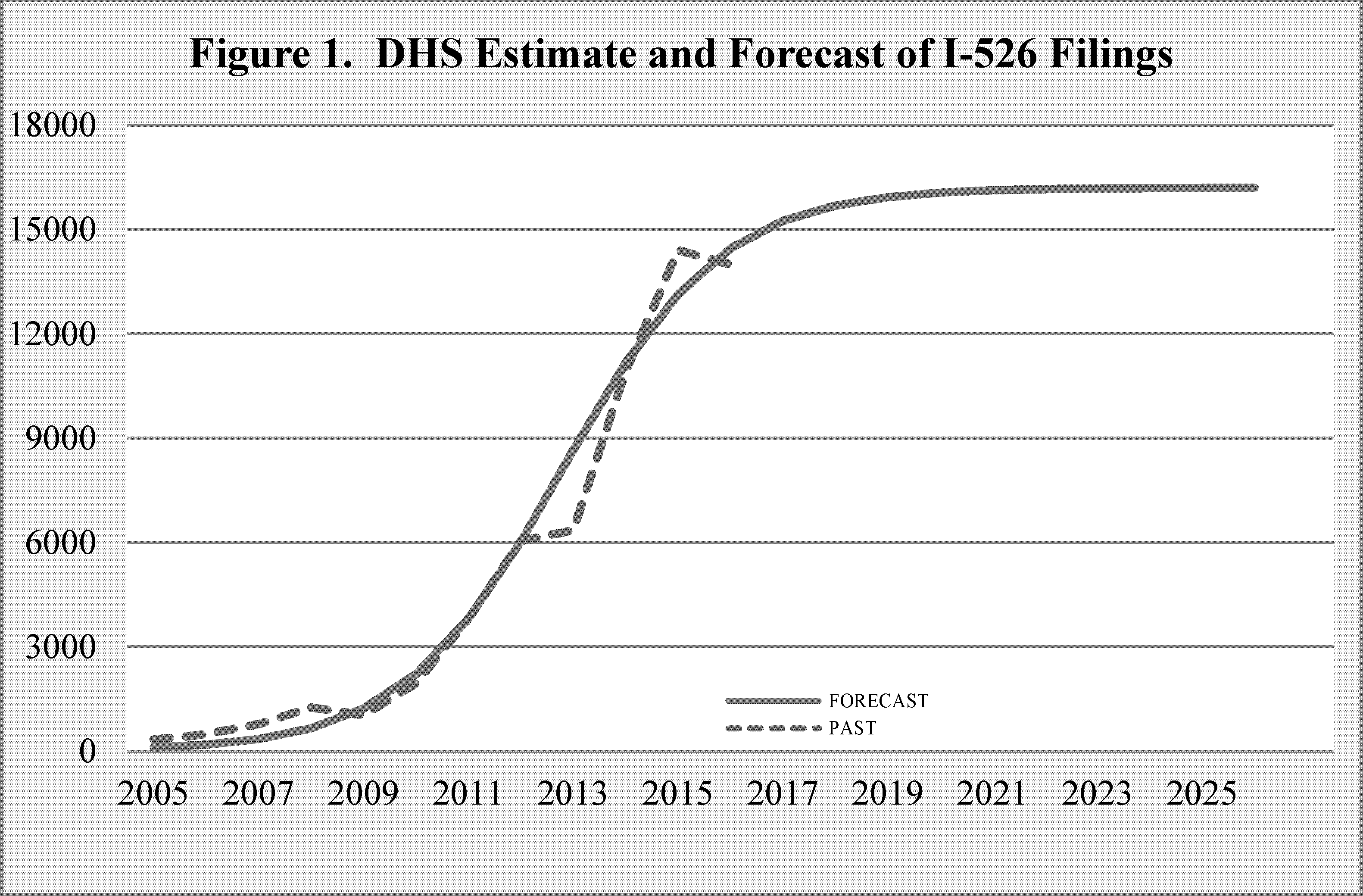
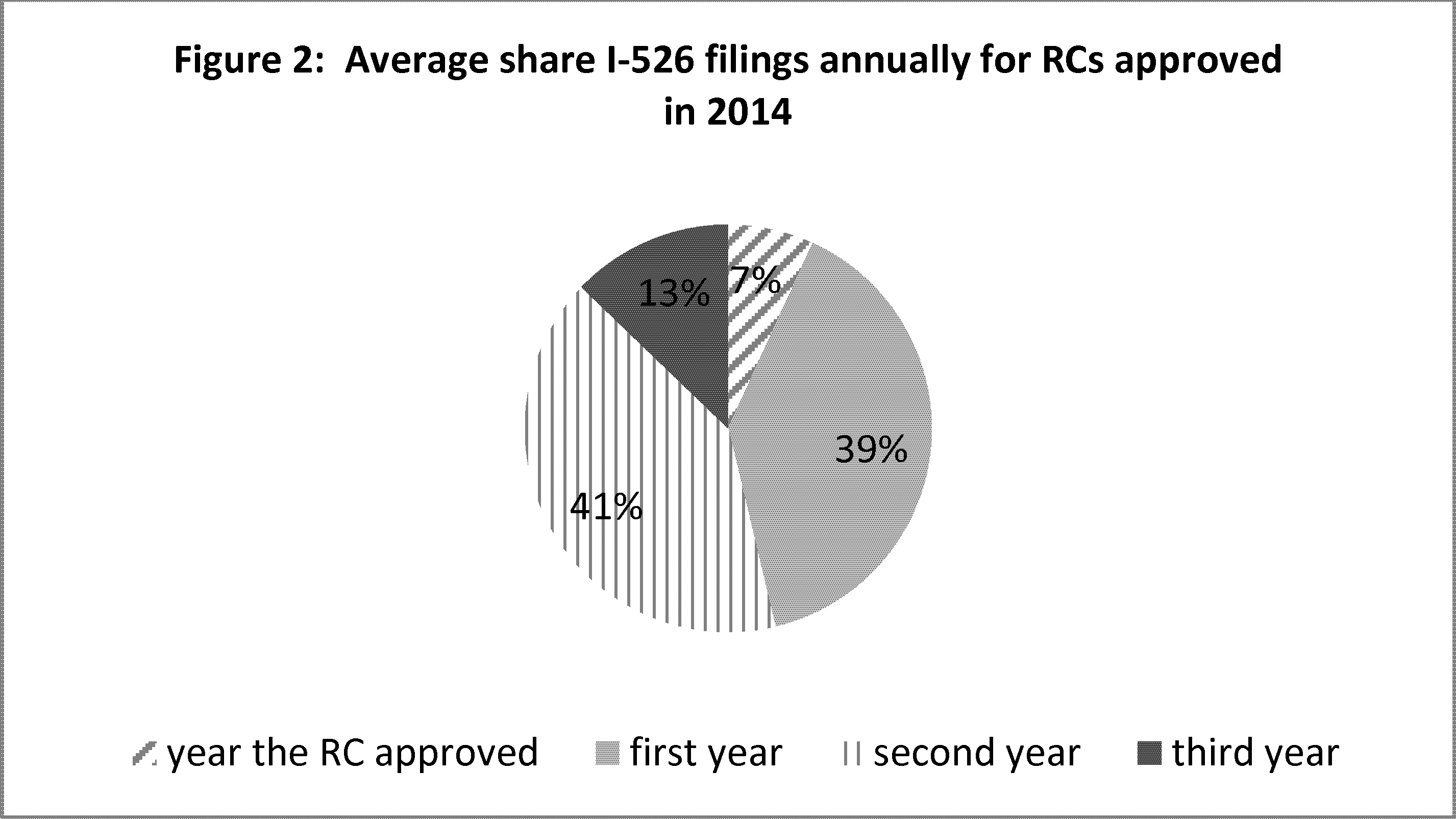
 www.bls.gov/data/inflation_calculator.htm
 travel.state.gov/content/visas/en/law-and-policy/bulletin.html
 www.grassley.senate.gov/news/news-releases/grassley-goodlatte-call-dhs-finalize-eb-5-regulations-end-unacceptable-status-quo
 www.uscis.gov/greencard/child-status-protection-act
 www.dhs.gov/xlibrary/assets/CIS_Ombudsman_EB-5_Recommendation_3_18_09.pdf
 preview.uscis.gov/sites/default/files/USCIS/Resources/Reports%20and%20Studies/Immigration%20Forms%20Data/Employment-based/I526_performancedata_fy2018_qtr4.pdf
 www.gov.uk/tier-1-investor/overview
 www.homeaffairs.gov.au/Trav/Visa-1/188-
 www.canada.ca/en/immigration-refugees-citizenship/services/immigrate-canada/immigrant-investor-venture-capital/eligibility.html
 www.newzealandnow.govt.nz/move-to-nz/new-zealand-visa/visas-to-invest/investor-visa
 www.immigration-quebec.gouv.qc.ca/en/immigrate-settle/businesspeople/applying-business-immigrant/three-programs/investors/index.html
 cip.gov/ag
 www.immigration.gov.ky/portal/page/portal/immhome/livinghere/independentmeans
 cbiu.gov.dm/faqs
 www.immd.gov.hk/eng/services/visas/investment.html
 www.inis.gov.ie/en/INIS/Pages/New%20Programmes%20for%20Investors%20and%20Entrepreneurs
 www.gov.je/travel/informationadvice/visitors/documents/ld%20immigration%20rules%20jm%20130217.pdf
 iip.gov.mt/
 www.migrationpolicy.org/research/selling-visas-and-citizenship-policy-questions-global-boom-investor-immigration
 www.oecd.org/daf/inv/investment-policy/2506900.pdf
 d2xxqpo46qfujt.cloudfront.net/downloads/letter-to-leadership.pdf
 www.census.gov/programs-surveys/acs/geography-acs/areas-published.html
 obamawhitehouse.archives.gov/sites/default/files/omb/bulletins/2015/15-01.pdf
 www.stern.nyu.edu/sites/default/files/assets/documents/EB-5%20Prescription%20for%20Reform%20-%20Legislation%20or%20Regulation%206.19.2017%20draft.pdf
 www.wsj.com/articles/how-immigrants-cash-funds-luxury-towers-in-the-u-s-1441848965
 nyti.ms/2FgZoQq
 www.fhwa.dot.gov/planning/census_issues/ctpp/data_products/2006-2010_tract_flows/
 onthemap.ces.census.gov
 docs.house.gov/meetings/JU/JU00/20160211/104454/HHRG-114-JU00-20160211-SD004.pdf
 www.worcestermass.org/city-initiatives/gateway-cities-initiative
 www.gao.gov/products/GAO-16-749R
 www.commerce.gov/sites/commerce.gov/files/migrated/reports/estimating-the-investment-and-job-creation-impact-of-the-eb-5-program_0.pdf
 ilw.com/
 judiciary.house.gov/press-release/goodlatte-grassley-call-dhs-finalize-eb-5-regulations-end-unacceptable-status-quo/
 www.hoover.org/sites/default/files/13110_-_meltzer_-_a_slow_recovery_with_low_inflation.pdf
 www.federalreserve.gov/econresdata/notes/feds-notes/2015/low-inflation-in-the-united-states-a-summary-of-recent-research-20151123.html
 www.frbsf.org/economic-research/files/wp2013-08.pdf
 www.s4.brown.edu/us2010/Researcher/Pooling.htm
 www.dol.gov/dol/topic/wages/minimumwage.htm
 www.sba.gov/sites/default/files/advocacy/rfaguide_0512_0.pdf
 business.ca.gov/International/EB5Program.aspx