Announcement of Preliminary Regulatory Determinations for Contaminants on the Fourth Drinking Water Contaminant Candidate List
The Safe Drinking Water Act (SDWA), as amended in 1996, requires the Environmental Protection Agency (EPA) to make regulatory determinations every five years on at least five un...
The Safe Drinking Water Act (SDWA), as amended in 1996, requires the Environmental Protection Agency (EPA) to make regulatory determinations every five years on at least five unregulated contaminants. A regulatory determination is a decision about whether or not to begin the process to propose and promulgate a national primary drinking water regulation (NPDWR) for an unregulated contaminant. A preliminary regulatory determination lays out and takes comment on EPA's view about whether certain unregulated contaminants meet three statutory criteria. After EPA considers public comment, EPA makes a final determination. The unregulated contaminants included in a regulatory determination are chosen from the Contaminant Candidate List (CCL), which the SDWA requires the EPA to publish every five years. The EPA published the fourth CCL (CCL 4) in the
Federal Register
on November 17, 2016. This document presents the preliminary regulatory determinations and supporting rationale for the following eight of the 109 contaminants listed on CCL 4: Perfluorooctanesulfonic acid (PFOS), perfluorooctanoic acid (PFOA), 1,1-dichloroethane, acetochlor, methyl bromide (bromomethane), metolachlor, nitrobenzene, and Royal Demolition eXplosive (RDX). The Agency is making preliminary determinations to regulate two contaminants (
i.e.,
PFOS and PFOA) and to not regulate six contaminants (
i.e.,
1,1-dichloroethane, acetochlor, methyl bromide, metolachlor, nitrobenzene, and RDX). The EPA seeks comment on these preliminary determinations. The EPA is also presenting an update on three other CCL 4 contaminants (strontium, 1,4-dioxane, and 1,2,3-trichloropropane).
DATES:
Comments must be received on or before May 11, 2020.
ADDRESSES:
You may send comments, identified by Docket ID No. EPA-HQ-OW-2019-0583, by any of the following methods:
Federal eRulemaking Portal: https://www.regulations.gov/
(our preferred method). Follow the online instructions for submitting comments.
Mail:
Water Docket, Environmental Protection Agency, Mail Code: [28221T], 1200 Pennsylvania Ave. NW, Washington, DC 20460.
Hand Delivery:
EPA Docket Center, [EPA/DC] EPA West, Room 3334, 1301 Constitution Ave. NW, Washington, DC. Such deliveries are only accepted during the Docket's normal hours of operation, and special arrangements should be made for deliveries of boxed information.
Instructions:
All submissions received must include the Docket ID No. for this rulemaking. Comments received may be posted without change to
https://www.regulations.gov/,
including any personal information provided. For detailed instructions on sending comments and additional information on the rulemaking process, see the “Written Comments” heading of the
SUPPLEMENTARY INFORMATION
section of this document.
FOR FURTHER INFORMATION CONTACT:
Richard Weisman, Standards and Risk Management Division, Office of Ground Water and Drinking Water, MC: 4607M, Environmental Protection Agency, 1200 Pennsylvania Ave. NW; telephone number: (202) 564-2822; email address:
weisman.richard@epa.gov.
SUPPLEMENTARY INFORMATION:
I. General Information
A. Written Comments
Submit your comments, identified by Docket ID No. EPA-HQ-OW-2019-0583, at
https://www.regulations.gov
(our preferred method), or the other methods identified in the
ADDRESSES
section. Once submitted, comments cannot be edited or removed from the docket. The EPA may publish any comment received to its public docket. Do not submit electronically any information you consider to be Confidential Business Information (CBI) or other information whose disclosure is restricted by statute. Multimedia submissions (audio, video, etc.) must be accompanied by a written comment. The written comment is considered the official comment and should include discussion of all points you wish to make. The EPA will generally not consider comments or comment contents located outside of the primary submission (
i.e.,
on the web, cloud, or other file sharing system). For additional submission methods, the full EPA public comment policy, information about CBI or multimedia submissions, and general guidance on making effective comments, please visit
https://www.epa.gov/dockets/commenting-epa-dockets.
When submitting comments, remember to:
Identify the rulemaking by docket number and other identifying information (subject heading,Federal Register
date, and page number).
Explain why you agree or disagree and suggest alternatives.
Describe any assumptions and provide any technical information and/or data that you used.
Provide specific examples to illustrate your concerns and suggest alternatives.
Explain your views as clearly as possible.
Make sure to submit your comments by the comment period deadline identified.
B. Does this action apply to me?
Neither these preliminary regulatory determinations nor the final regulatory determinations, when published, impose any requirements on anyone. Instead, this action notifies interested parties of the EPA's preliminary regulatory determinations for eight unregulated contaminants for comment.
Abbreviations Used in This Document
Abbreviation
Meaning
ADAF
Age Dependent Adjustment Factor
ADONA
4,8-dioxa-3H-perfluorononanoic acid
ALT
Alanine Aminotransferase
AM
Assessment Monitoring
AOP
Advanced Oxidative Process
ASDWA
Association of State Drinking Water Administrators
ATSDR
Agency for Toxic Substances and Disease Registry
AWIA
America's Water Infrastructure Act
BAT
Best Available Technology
BMD
Benchmark Dose
BMDL
Benchmark Dose Level
BMDS
Benchmark Dose Software
BMR
Benchmark Response
BW
Body Weight
CAR
Constitutive Androstane Receptor
CBI
Confidential Business Information
CCL
Contaminant Candidate List
CCL 1
First Contaminant Candidate List
CCL 2
Second Contaminant Candidate List
CCL 3
Third Contaminant Candidate List
CCL 4
Fourth Contaminant Candidate List
CDPHE
Colorado Department of Public Health and Environment
CDR
Chemical Data Reporting
CIIT
Chemical Industry Institute of Toxicology
CNS
Central Nervous System
cPAD
Chronic Population Adjusted Dose
CRL
Cancer Risk Level
CSF
Cancer Slope Factor
( printed page 14099)
CWS
Community Water System
CWSS
Community Water System Survey
D/DBP
Disinfectants/Disinfection Byproducts
DBP
Disinfection Byproduct
DDE
1,1-Dichloro-2,2-bis(p-chlorophenyl)ethylene
DWI
Drinking Water Intake
EPA
Environmental Protection Agency
EPCRA
Emergency Planning and Community Right-To-Know Act
EPTC
S-Ethyl dipropylthiocarbamate
ESA
Ethanesulfonic Acid
FtOH 6:2
6:2 Fluorotelomer Alcohol
FtOH 8:2
8:2 Fluorotelomer Alcohol
FtS 6:2
6:2 Fluorotelomer Sulfonic Acid
FtS 8:2
8:2 Fluorotelomer Sulfonic Acid
FQPA
Food Quality Protection Act
FR
Federal Register
HA
Health Advisory
HDL
High-Density Lipoprotein
HED
Human Equivalent Dose
HERO
Health and Environmental Research Online
HESD
Health Effects Support Document
HFPO
Hexafluoropropylene Oxide
HHRA
Human Health Risk Assessment
HRL
Health Reference Level
IARC
International Agency for Research on Cancer
ICR
Information Collection Rule
IOC
Inorganic Compound
IRED
Interim Reregistration Eligibility Decision
IRIS
Integrated Risk Information System
IUR
Inventory Update Reporting
K
H
Henry's Law Constant
K
oc
Organic Carbon Partitioning Coefficients
LOAEL
Lowest Observed Adverse Effect Level
log K
ow
Octanol-Water Partitioning Coefficient
MCL
Maximum Contaminant Level
MCLG
Maximum Contaminant Level Goal
metHB
Methemoglobin
MOA
Mode of Action
MRL
Minimum Reporting Level
NAM
New Approach Method
NAS
National Academy of Sciences
NAWQA
National Water Quality Assessment
NCDEQ
North Carolina Department of Environmental Quality
NCFAP
National Center for Food and Agricultural Policy
NCI
National Cancer Institute
NDEA
N-Nitrosodiethylamine
NDMA
N-Nitrosodimethylamine
NDPA
N-Nitroso-di-n-propylamine
NDPhA
N-Nitrosodiphenylamine
NDWAC
National Drinking Water Advisory Council
NEtFOSAA
2-(N-Ethylperfluorooctanesulfonamido) acetic acid
NHDES
New Hampshire Department of Environmental Services
NIEHS
National Institute of Environmental Health Sciences
B. Supporting Documentation for EPA's Preliminary Determination
C. Analyses Used To Support the Preliminary Regulatory Determinations
1. Evaluation of Adverse Health Effects
2. Evaluation of Contaminant Occurrence and Exposure
IV. Contaminant-Specific Discussions for the RD 4 Preliminary Determination
A. Summary of the Preliminary Regulatory Determination
B. Contaminant Profiles
1. PFOA and PFOS
2. 1,1-Dichloroethane
3. Acetochlor
4. Methyl Bromide (Bromomethane)
5. Metolachlor
6. Nitrobenzene
7. RDX
V. Status of the Agency's Evaluation of Strontium, 1,4-Dioxane, and 1,2,3-Trichloropropane
A. Strontium
B. 1,4-Dioxane
C. 1,2,3-Trichloropropane
VI. EPA's Request for Comments and Next Steps
VII. References
( printed page 14100)
II. Purpose and Background
This section briefly summarizes the purpose of this action, the statutory requirements, and previous activities related to the CCL and regulatory determinations.
A. What is the purpose of this action?
The purpose of this action is to request comment on the Environmental Protection Agency's (EPA's) preliminary regulatory determinations for the following eight unregulated contaminants: Perfluorooctanesulfonic acid (PFOS), perfluorooctanoic acid (PFOA), 1,1-dichloroethane, acetochlor, methyl bromide (bromomethane), metolachlor, nitrobenzene, and RDX. The Agency is making preliminary determinations to regulate two contaminants (PFOS and PFOA) and to not regulate the remaining six contaminants (1,1-dichloroethane, acetochlor, methyl bromide, metolachlor, nitrobenzene, and RDX). As described in Section III.A.3, if the EPA finalizes these preliminary regulatory determinations, it would represent the beginning of the Agency's regulatory development process, not the end. As required by SDWA, the EPA seeks comment on these preliminary determinations and is asking for information and comment on other per- and polyfluoroalkyl substances (PFAS) and potential regulatory approaches. The Agency is also requesting comment on the process and analyses used for this round of regulatory determinations (
i.e.,
RD 4), the supporting information, additional studies or sources of information the Agency should consider, and the rationale used to make these preliminary decisions. The EPA is also presenting an update on strontium (from the third regulatory determination) and two other CCL 4 contaminants for which the Agency is not making preliminary determinations today (1,4-dioxane and 1,2,3-trichloropropane).
It should be noted that the analyses associated with a regulatory determination process are distinct from the analyses needed to develop a National Primary Drinking Water Regulation (NPDWR). Thus, a decision to regulate is the beginning of the Agency's regulatory development process, not the end. For example, the EPA may find at a later point in the regulatory development process, and based on additional or new information, that a contaminant does not meet the three statutory criteria for finalizing a NPDWR.
B. Background on the CCL and Regulatory Determinations
1. Statutory Requirements for CCL and Regulatory Determinations
Section 1412(b)(1)(B)(i) of the SDWA requires the EPA to publish the CCL every five years after public notice and an opportunity to comment. The CCL is a list of contaminants which are not subject to any proposed or promulgated NPDWRs but are known or anticipated to occur in public water systems (PWSs) and may require regulation under the SDWA. SDWA section 1412(b)(1)(B)(ii) directs the EPA to determine, after public notice and an opportunity to comment, whether to regulate at least five contaminants from the CCL every five years. Under Section 1412(b)(1)(A) of SDWA, the EPA makes a determination to regulate a contaminant in drinking water if the Administrator determines that:
(a) The contaminant may have an adverse effect on the health of persons;
(b) the contaminant is known to occur or there is substantial likelihood that the contaminant will occur in public water systems with a frequency and at levels of public health concern; and
(c) in the sole judgment of the Administrator, regulation of such contaminant presents a meaningful opportunity for health risk reduction for persons served by public water systems.
If the EPA determines that these three statutory criteria are met and makes a final determination to regulate a contaminant (
i.e.,
a positive determination), the Agency must publish a proposed Maximum Contaminant Level Goal (MCLG) [1]
and NPDWR [2]
within 24 months. After the proposal, the Agency must publish a final MCLG and promulgate a final NPDWR (SDWA section 1412(b)(1)(E)) within 18 months.[3]
The development of the CCL, regulatory determinations, and any subsequent rulemaking should be viewed as a progression where each process builds upon the previous process, including the collection of data and analyses conducted. The Agency's improvements in developing CCLs 3 and 4 provided a foundation for RD 4 by enhancing the EPA's ability to identify contaminants of concern for drinking water. Sections III and IV in this document provide more detailed information about the approach and outcomes for RD 4 and the contaminant-specific regulatory determinations.
2. The First Contaminant Candidate List (CCL 1) and Regulatory Determination (RD 1)
The EPA published the final CCL 1, which contained 60 chemical and microbiological contaminants, in the
Federal Register
(FR) on March 2, 1998 (63 FR 10273; USEPA, 1998). The Agency published the final regulatory determinations for nine of the 60 CCL 1 contaminants in the FR on July 18, 2003. The Agency determined that NPDWRs were not necessary for nine contaminants:
Acanthamoeba,
aldrin, dieldrin, hexachlorobutadiene, manganese, metribuzin, naphthalene, sodium, and sulfate (68 FR 42898; USEPA, 2003a). The Agency posted information about
Acanthamoeba[4]
on the EPA's website and issued health advisories [5]
(HAs) for manganese, sodium, and sulfate.
3. The Second Contaminant Candidate List (CCL 2) and Regulatory Determination (RD 2)
The Agency published the final CCL 2 in the FR on February 24, 2005 (70 FR 9071; USEPA, 2005a) and carried forward the 51 remaining chemical and microbial contaminants listed on CCL 1. The Agency published the final regulatory determinations for 11 of the 51 CCL 2 contaminants in the FR on July 30, 2008. The Agency determined that NPDWRs were not necessary for 11 contaminants: Boron, the dacthal mono- and di-acid degradates, 1,1-dichloro-2,2-bis(p-chlorophenyl)ethylene (DDE), 1,3-dichloropropene (Telone), 2,4-dinitrotoluene, 2,6-dinitrotoluene, s-ethyl dipropylthiocarbamate (EPTC), fonofos, terbacil, and 1,1,2,2-
( printed page 14101)
tetrachloroethane (73 FR 44251; USEPA, 2008a). The Agency issued new or updated health advisories for boron, dacthal degradates, 2,4-dinitrotoluene, 2,6-dinitrotoluene, and 1,1,2,2-tetrachloroethane.
4. The Third Contaminant Candidate List (CCL 3) and Regulatory Determination (RD 3)
The Agency published the final CCL 3, which listed 116 contaminants, in the FR on October 8, 2009 (74 FR 51850; USEPA, 2009a). In developing CCL 3, the EPA improved and built upon the process that was used for CCL 1 and CCL 2. The CCL 3 process was based on substantial expert input and recommendations from the National Academy of Science's (NAS) National Research Council (NRC) and the National Drinking Water Advisory Council (NDWAC) as well as input from the public. Based on these consultations and input, the EPA developed a multi-step process to select candidates for the final CCL 3, which included the following key steps:
(a) Identification of a broad universe of ~7,500 potential drinking water contaminants (the CCL 3 Universe);
(b) screening the CCL 3 Universe to a preliminary CCL (PCCL) of ~600 contaminants based on the potential to occur in PWSs and the potential for public health concern; and
(c) evaluation of the PCCL contaminants based on a more detailed review of the occurrence and health effects data to identify a list of 116 CCL 3 contaminants.
The Agency published its preliminary regulatory determinations for contaminants listed on the CCL 3 in the FR on October 20, 2014 (79 FR 62715; USEPA, 2014a). In that document, the EPA made preliminary determinations for 5 of the 116 contaminants listed on the CCL 3 including a preliminary positive determination for strontium and preliminary negative determinations for dimethoate, 1,3-dinitrobenzene, terbufos, and terbufos sulfone. On January 4, 2016 (81 FR 13; USEPA, 2016a), the EPA finalized the negative determinations for dimethoate, 1,3-dinitrobenzene, terbufos, and terbufos sulfone. The EPA announced a delay in issuing a final regulatory determination on strontium in order to consider additional data. Additional discussion on strontium is provided in Section V of this document.
The EPA also published an off-cycle final determination to regulate one CCL 3 contaminant, perchlorate, on February 11, 2011 (76 FR 7762; USEPA, 2011a) during the RD 3 cycle (bringing the total number of final determinations to five). Additional information about the perchlorate determination can be found in that document.
5. The Fourth Contaminant Candidate List (CCL 4) and Regulatory Determination (RD 4)
The final CCL 4 was published on November 17, 2016 (81 FR 81099; USEPA, 2016b) and is the latest CCL published by EPA. The final CCL 4 consists of 97 chemicals or chemical groups and 12 microbiological contaminants. Most CCL 4 contaminants were carried over from CCL 3 (which, as described above, was developed according to a rigorous process with input from multiple stakeholders over the course of multiple years). The EPA added two contaminants (manganese and nonylphenol) to the CCL 4 list based on nominations. The EPA removed from the list those CCL 3 contaminants that had been subject to recent preliminary and/or final regulatory determinations (perchlorate, dimethoate, 1,3-dinitrobenzene, terbufos, terbufos sulfone, and strontium) and three pesticides with cancelled registrations (disulfoton, fenamiphos, and molinate).
III. Approach and Overall Outcomes for RD 4
This section describes (a) the approach the EPA used to identify and evaluate contaminants for the Agency's fourth round of Regulatory Determination (RD 4) along with the overall outcome of applying this approach, (b) the supporting RD 4 documentation, and (c) the technical analyses and sources of health and occurrence information.
A. Summary of the Approach and Overall Outcomes for RD 4
The approach taken under RD 4 is similar to that used in previous rounds of Regulatory Determination and formalized in a written Protocol under Regulatory Determination 3. The Regulatory Determination 4 Protocol, found in Appendix E of the Regulatory Determination 4 Support Document (USEPA, 2019a), like the Regulatory Determination 3 protocol, specifies a three-phase process. The three phases are: (1) The Data Availability Phase, (2) the Data Evaluation Phase, and (3) the Regulatory Determination Assessment Phase. Figure 1 provides an overview of the process the EPA uses to identify which CCL 4 contaminants are candidates for regulatory determinations and the SDWA statutory criteria considered in making the regulatory determinations. For more detailed information on the three phases of the RD 4 process please refer to the Regulatory Determination 4 Protocol (Appendix E to USEPA, 2019a).
SDWA 1412 (b)(1)(C) requires that the Administrator prioritize selection of contaminants that present the greatest public health concern. The Administrator, in making such selections, shall take into consideration, among other factors of public health concern, the effect of such contaminants upon subgroups that comprise a meaningful portion of the general population (such as infants, children, pregnant women, the elderly, individuals with a history of serious illness, or other subpopulations) that are identifiable as being at greater risk of adverse health effects due to exposure to contaminants in drinking water than the general population. Because the RD 4 process includes consideration of human health effects, the Agency's Policy on Evaluating Health Risks to Children (USEPA, 1995a) to consistently and comprehensively address children's unique vulnerabilities, recently reaffirmed by Administrator Wheeler (USEPA, 2018a), applies to this action. We have explicitly considered children's health in the RD 4 process by reviewing all the available children's exposure and health effects information.
( printed page 14102)
1. Phase 1 (Data Availability Phase)
In Phase 1, the
Data Availability Phase,
the Agency identifies contaminants that have sufficient health and occurrence data to proceed to Phase 2 and be listed on a “short list” for further evaluation. SDWA 1412(b)(1)(B)(ii)(II) requires that the EPA consider the best available public health information in making the regulatory determination.
To identify contaminant health effects data that are sufficient to make a regulatory determination regarding potential adverse health effect(s), the Agency considers whether an EPA health assessment or an externally peer-reviewed health assessment from another Agency is available, from which a health reference level (HRL) [6]
sufficient to inform a regulatory determination can be derived. (See Section III.C.1 of this document for information about how HRLs are derived.) Consistent with SDWA 1412.b.(3)(A)(i), EPA used health assessments to derive an HRL that the Agency has concluded are the best available peer reviewed science finalized before March 1, 2019. EPA establishes a cutoff date where it no longer considers new health-based information in order to allow for timely determinations and reviews. The EPA did not use draft health assessments to derive HRLs. Sources of health assessments may include: (a) EPA's Office of Water (OW) health assessments: Health Advisory (HA) Documents and Health Effects Support Documents (HESDs); (b) EPA's Office of Research and Development (ORD) Integrated Risk Information System (IRIS) assessments; (c) EPA's ORD Provisional Peer-Reviewed Toxicity Values (PPRTVs); (d) EPA's Office of Pesticide Programs (OPP) health assessments: Reregistration Eligibility Decisions (REDs), Interim Reregistration Eligibility Decisions (IREDs), Tolerance Reassessment Progress and Risk Management Decisions (TREDs), and Health Effects Division Human Health Risk Assessments (HED HHRAs); (e) U.S. Department of Health and Human Services' Agency for Toxic Substances and Disease Registry (ATSDR) Toxicological Profiles; (f) Health Canada Guidelines for Drinking Water; (g) the World Health Organization (WHO) Drinking Water Guidelines; and (h) publicly available state assessments that have been externally peer-reviewed and provide new science not considered in the other RD 4 assessment sources listed above. To support a regulatory determination, the EPA evaluates whether a health assessment used methods, standards, and guidelines comparable to those of current EPA guidelines and guidance documents. If a suitable health assessment is not available for a contaminant, the
( printed page 14103)
contaminant will not proceed to Phase 2. The EPA is aware of draft health assessments that have not yet been finalized for contaminants on which the EPA is making a preliminary determination today. Once finalized, the EPA will consider these new sources of information in future regulatory decision making.
To identify contaminant occurrence data that are sufficient to make a regulatory determination regarding the frequency and level of occurrence in PWSs, the Agency considers nationally representative finished water data (samples are collected after the water undergoes treatment). The following sources, administered or overseen by the EPA, include finished water occurrence data that are considered nationally representative: (a) The Third Unregulated Contaminant Monitoring Rule (UCMR 3); (b) the Second Unregulated Contaminant Monitoring Rule (UCMR 2); (c) the First Unregulated Contaminant Monitoring Rule (UCMR 1); (d) the Unregulated Contaminant Monitoring (UCM) program; and (e) the National Inorganics and Radionuclides Survey (NIRS).[7]
If nationally representative data are not available, the EPA identifies and evaluates other finished water data, which may include other national assessments, regional data, state, and more localized finished water assessments. These other finished water data may include assessments that are geographically distributed across the nation but not intended to be statistically representative of the nation. These other finished water data include: (a) Finished water assessments for Federal agencies (
e.g.,
EPA and the United States Geological Survey (USGS)); [8]
(b) state-level finished water monitoring data; (c) research performed by institutions, universities, and government scientists (information published in the scientific literature); and/or (d) other supplemental finished water monitoring surveys (
e.g.,
Pesticide Monitoring Program (PMP), and other targeted surveys or localized state/federal monitoring surveys).
The EPA prefers to have nationally representative data when making regulatory determinations but may also use other sources of finished water data to address the occurrence-related aspects of the statutory criteria when deciding to regulate a contaminant. In Phase 1, the Agency does this by assessing whether the non-nationally-representative finished water occurrence data show at least one detection in finished water at levels >
1/2
the HRL [9]
for the critical endpoint. If a contaminant has nationally representative or non-nationally representative finished water occurrence data showing at least one detection >
1/2
HRL, the contaminant passes the Occurrence Data Availability Assessment and proceeds to the next phase of analysis. However, it is difficult to determine that a contaminant is not occurring or not likely to occur based on sources of non-nationally representative finished water occurrence data because the data are limited in scope and the contaminant could be occurring in other parts of the country that were not monitored.
In certain limited cases, a contaminant's occurrence data may have been gathered using a specialized or experimental method that is not in general use. If a widely available analytical method does not exist, the contaminant will not be a viable candidate for regulation with a Maximum Contaminant Level (MCL). With that in mind, in the Analytical Methods Availability Assessment, the EPA determines for each contaminant whether a widely available analytical method for monitoring exists. (A widely available analytical method is a method employing technology that is commonly in use at numerous drinking water laboratories.) If a widely available analytical method exists, the contaminant passes the Analytical Methods Availability Assessment. If a widely available analytical method does not exist, the EPA may advance the contaminant to Phase 2 if the Agency determines that indicator or surrogate monitoring, or use of a treatment technique (TT), could allow for effective regulation and there is compelling evidence of occurrence.
In addition to considering contaminants individually, the EPA also may consider issuing a regulatory determination for groups of contaminants. The EPA has regulated certain contaminants in drinking water collectively.
After conducting the health and occurrence data availability assessments, the Agency identifies those contaminants and contaminant groups that meet the following Phase 1 data availability criteria:
(a) An EPA health assessment or an externally peer-reviewed health assessment from another Agency that conforms with the current EPA guidelines is available, from which an HRL can be derived;
(b) Either nationally representative finished water occurrence data are available, or other finished water occurrence data show occurrence at levels >
1/2
the HRL; and
(c) A widely available analytical method for monitoring is available.
If a contaminant or group meets these three criteria, it is placed on a “short list” and proceeds to Phase 2. After evaluating the 109 CCL 4 contaminants and two additional contaminants (4-androstene-3,17-dione and testosterone) [10]
in Phase 1, the Agency identified 25 CCL 4 contaminants to evaluate further in Phase 2 (contaminants listed in Table 1).
Table 1—Contaminants Proceeding From Phase 1 to Phase 2
1,1,1,2-Tetrachloroethane.
1,1-Dichloroethane.
1,2,3-Trichloropropane.
1,4-Dioxane.
Acephate.
Acetochlor.
alpha-Hexachlorocyclohexane.
Aniline.
Chlorate.
Cobalt.
Cyanotoxins.
Legionella pneumophila.
Manganese.
Methyl bromide (Bromomethane).
Metolachlor.
Molybdenum.
Nitrobenzene.
N-Nitrosodiethylamine (NDEA).
N-Nitrosodimethylamine (NDMA).
N-Nitroso-di-n-propylamine (NDPA).
N-Nitrosopyrrolidine (NPYR).
Perfluorooctanesulfonic acid (PFOS).
Perfluorooctanoic acid (PFOA).
RDX.
Vanadium.
The remaining 84 CCL 4 contaminants and two additional contaminants (4-androstene-3,17-dione and testosterone) (listed in Table 2) did not meet one or more of the Phase 1 data availability criteria above and were not considered further for RD 4.
( printed page 14104)
Table 2—Contaminants Not Proceeding From Phase 1 to Phase 2
Has nationally representative finished water data but no health assessment
1,3-Butadiene.
3-Hydroxycarbofuran.
4-Androstene-3,17-dione.
Acetochlor ethanesulfonic acid (ESA).
Acetochlor oxanilic acid (OA).
Alachlor ESA.
Alachlor OA.
Chloromethane (Methyl chloride).
Equilin.
Estradiol (17-beta estradiol).
Estriol.
Estrone.
Ethinyl Estradiol (17-alpha ethynyl estradiol).
Germanium.
Halon 1011 (bromochloromethane).
HCFC-22.
Methyl tert-butyl ether.
Metolachlor ESA.
Metolachlor OA.
n-Propylbenzene.
sec-Butylbenzene.
Tellurium.
Testosterone.
Has available or in process health assessment and other finished drinking water data but no occurrence at levels >
1/2
HRL
1-Butanol.
Acrolein.
Bensulide.
Benzyl chloride.
Captan.
Dicrotophos.
Diuron.
Ethoprop.
Ethylene glycol.
Ethylene thiourea (Maneb 12427382).
Formaldehyde.
Methamidophos.
Methanol.
N-Nitrosodiphenylamine (NDPhA) *.
Oxydemeton-methyl.
Oxyfluorfen.
Permethrin.
Profenofos.
Tebuconazole.
Tribufos.
Vinclozolin.
Ziram.
Has other finished drinking water data but no health assessment
17alpha-estradiol.
Acetaldehyde.
Adenovirus *.
Butylated hydroxyanisole.
Caliciviruses *.
Enterovirus *.
Equilenin.
Erythromycin.
Hexane.
Mestranol.
Mycobacterium avium
*.
Naegleria fowleri
*.
Nonylphenol.
Norethindrone (19-Norethisterone).
Does not have nationally representative or other finished water data
2-Methoxyethanol.
2-Propen-1-ol.
4,4′-Methylenedianiline.
Acetamide.
Campylobacter jejuni.
Clethodim.
Cumene hydroperoxide.
Dimethipin.
Escherichia coli
(O157).
Ethylene oxide.
Helicobacter pylori.
Hepatitis A virus.
Hydrazine.
Nitroglycerin.
N-Methyl-2-pyrrolidone.
o-Toluidine.
Oxirane, methyl-.
Quinoline.
Salmonella enterica.
Shigella sonnei.
Tebufenozide.
Thiodicarb.
Thiophanate-methyl.
Toluene diisocyanate.
Triethylamine.
Triphenyltin hydroxide (TPTH).
Urethane.
*
Does not have a widely available analytical method for occurrence monitoring.
2. Phase 2 (Data Evaluation Phase)
In Phase 2, the Agency collects additional data on occurrence (including finished water data; ambient water data; data on use, production, and release; and information on environmental fate and transport), and more thoroughly evaluates this information (based on factors below) to identify contaminants that should proceed to Phase 3.
In Phase 2, the Agency focuses its efforts to identify those contaminants or contaminant groups that are occurring or have substantial likelihood to occur at levels and frequencies of public health concern. As noted in Section III.A, SDWA 1412.b.1.C requires that the Administrator select contaminants that present the greatest public health concern. To identify such contaminants, the Agency considers the following information:
(a) How many samples (number and percentage) have detections > HRL and
1/2
HRL in the nationally representative and other finished water occurrence data?
(b) How many systems (number and percentage) have detections > HRL and
1/2
HRL in the nationally representative and other finished water occurrence data?
(c) Are there uncertainties or limitations with the data and/or analyses, such as the age of the dataset, the detection limit level (
i.e.,
minimum reporting level [MRL[11]
] > HRL), and/or representativeness of the data (
e.g.,
limited to a specific region) that may cause misestimation of occurrence in finished water at levels and frequency of public health concern?
After identifying contaminants that are occurring at levels and frequencies of public health concern to proceed to Phase 3, the Agency evaluates the remaining contaminants on the “short list” to determine which contaminants have no or low occurrence at levels of health concern that should proceed to Phase 3 for a potential negative determination. Because the primary goal of RD 4 is to focus on contaminants of public health concern, potential negative determinations are a lower priority than potential positive determinations. The Agency considers the following information in selecting contaminants of no or low potential for public health concern to proceed to Phase 3:
(a) Does the contaminant have nationally representative finished water data showing no or low number or percent of detections > HRL?
(b) If a contaminant has other finished water data in addition to nationally representative finished water data, does it support no or low potential for occurrence in drinking water? [12]
(c) Does additional occurrence information of high quality support the conclusion that there is low or no occurrence or potential for occurrence in drinking water? For example, is the occurrence in ambient/source water at levels below the HRL? How are releases to the environment or use/production changing over time?
(d) Are critical gaps in health and occurrence information/data minimal?
After evaluating the “short list” contaminants (listed in Table 1), the Agency identified 10 CCL 4 contaminants to proceed to Phase 3 (listed in Table 3). The contaminants are within one of the following Phase 2 data evaluation categories:
(a) A contaminant or part of a contaminant group occurring or likely to
( printed page 14105)
occur at levels and frequencies of public health concern, or
(b) A contaminant not occurring or not likely to occur at levels and frequencies of public health concern and no data gaps.
Table 3—Contaminants Proceed- ing From Phase 2 to Phase 3
1,1-Dichloroethane.
1,4-Dioxane.
1,2,3-Trichloropropane.
Acetochlor.
Methyl Bromide.
Metolachlor.
Nitrobenzene.
PFOA.
PFOS.
RDX.
Note that the Agency does not have a threshold for occurrence in drinking water that triggers whether a contaminant is of public health concern. A determination of public health concern requires a consideration of a number of factors, some of which include the health effect(s), the potency of the contaminant, the level at which the contaminant is found in drinking water, the frequency at which the contaminant is found, the geographic distribution (national, regional, or local occurrence), other possible sources of exposure, and potential impacts on sensitive populations or lifestages. Given the many possible combinations of factors, a simple threshold is not viable. In the end, a determination of whether there is a meaningful opportunity for health risk reduction by regulation of a contaminant in drinking water is a highly contaminant-specific decision that takes into consideration multiple factors.
The remaining 15 CCL 4 contaminants (listed in Table 4) did not proceed to Phase 3 and were not considered for RD 4 because of one or more of the following critical health, occurrence, and/or other data gaps:
(a) An updated health assessment completed by March 1, 2019 was not identified;
(b) Critical health effects gap (
e.g.,
lack of data to support quantification for the oral route of exposure);
(c) Lack of nationally representative finished water occurrence data and lack of sufficient other data to demonstrate occurrence at levels and frequencies of public health concern; and
(d) Critical occurrence data limitation or gap (
e.g.,
inconsistent results and/or trends in occurrence data requiring further research; significant uncertainty in occurrence analyses and/or data).
Table 4 identifies the health, occurrence, and/or other data gaps that prevented the following 15 contaminants from moving forward for RD 4. The Agency continues to conduct research and collect information to fill the data and information gaps identified in Table 4.
Table 4—Data and Rationale Summary of the 15 Contaminants in Phase 2 Not Proceeding to Phase 3
Number
Contaminant
Health
data
available
Occurrence
data
available
Rationale
1
1,1,1,2-Tetrachloroethane
Yes
Yes
Health data gap (a review of the current literature is needed to decide if an update to the 1987 IRIS health assessment is warranted).
2
Acephate
Yes
No
Occurrence data gaps (no nationally representative finished water data or sufficient other finished water data).
3
alpha-Hexachlorocyclohexane
Yes
No
Occurrence data gaps (no nationally representative finished water data or sufficient other finished water data).
4
Aniline
Yes
No
Occurrence data gaps (no nationally representative finished water data or sufficient other finished water data).
5
Chlorate
Will be evaluated and considered as part of the review of the existing Disinfectants/Disinfection Byproducts (D/DBP) rules.
13 14
6
Cobalt
Yes
Yes
Health data gap (updated health assessment needed to consider new subchronic and developmental studies).
7
Cyanotoxins
Yes
No
Health advisories available for some specific cyanotoxins (microcystins and cylindrospermopsin); occurrence data gaps (insufficient nationally representative finished water data or other finished water data). Certain cyanotoxins are being monitored under UCMR 4 but final UCMR 4 data will not be complete in time for preliminary determination.
8
Legionella pneumophila
Yes
No
MCLG available; occurrence data gaps (no nationally representative finished water data or sufficient other finished water data). Will be evaluated and considered as part of the review of the existing SWTR.14
9
Manganese
No
No
Health and occurrence data gaps (updated health assessment 15
not completed by RD 4 cutoff date). Manganese is being monitored for under UCMR 4 but final UCMR 4 data will not be complete in time for preliminary determination.
10
Molybdenum
No
Yes
Health data gap (updated assessment needed to consider multiple new studies).
11
N-Nitrosodiethylamine (NDEA)
Will be evaluated and considered as part of the review of the existing D/DBP rules.13
12
N-Nitrosodimethylamine (NDMA)
Will be evaluated and considered as part of the review of the existing D/DBP rules.13
13
N-Nitroso-di-n-propylamine (NDPA)
Will be evaluated and considered as part of the review of the existing D/DBP rules.13
14
N-Nitrosopyrrolidine (NPYR)
Will be evaluated and considered as part of the review of the existing D/DBP rules.13
Phase 3, the Regulatory Determination Assessment Phase, involves a complete evaluation of the statutory criteria for each contaminant or group of contaminants that proceed from Phase 2 and have sufficient information and data for making a regulatory determination. In this phase, the Agency evaluates the following statutory criteria (SDWA 1412(b)(1)(A)):
(a) Statutory Criterion #1—The contaminant may have an adverse effect on the health of persons. To evaluate criterion #1, the EPA evaluates whether a contaminant has an EPA health assessment, or an externally peer-reviewed health assessment from another Agency that is publicly available and conforms with current the EPA guidelines, from which an HRL can be derived. The HRL derived in or from the health assessment takes into account the MOA, the critical health effect(s), the dose-response relationship for critical health effect(s), and impacts on sensitive population(s) or lifestages. HRLs are preliminary health-based concentrations against which occurrence data is evaluated to determine if contaminants may occur at levels of potential public health concern. HRLs are not final determinations on establishing a protective level of a contaminant in drinking water for any particular population. HRLs are derived prior to the development of a complete health and exposure assessment and can be considered screening-level values.
If an acceptable health assessment that demonstrates adverse health effects is available, the Agency answers “yes” to the first statutory criterion. Otherwise, the Agency answers “no” to the first statutory criterion. (In practice, it is expected that any contaminant that reaches Phase 3 would receive a “yes” to the first criterion.)
(b) Statutory Criterion #2—The contaminant is known to occur or there is a substantial likelihood that the contaminant will occur in public water systems with a frequency and at levels of public health concern. The EPA compares the occurrence data for each contaminant to the HRL to determine if the contaminant occurs at a frequency and levels of public health concern. The types of occurrence data used at this stage are described in section III.C.2, Evaluation of Contaminant Occurrence and Exposure. The Agency may consider the following factors when identifying contaminants or contaminant groups that are occurring at frequencies and levels of public health concern:
How many samples (number and percentage) have detections > HRL in the nationally representative and other finished water occurrence data?
How many systems (number and percentage) have detections > HRL in the nationally representative and other finished water occurrence data?
Is the geographic distribution of the contaminant occurrence national, regional, or localized?
In addition to the number of systems, what type of systems does the contaminant occur in? Does the contaminant occur in large or small systems? Does the contaminant occur in surface or groundwater systems?
Are there significant uncertainties or limitations with the data and/or analyses, such as the age of the dataset, the detection limit level (i.e.,
MRL > HRL), and/or representativeness of the data (
e.g.,
limited in scope to a specific region)?
Additional, less important factors that the Agency considers when identifying contaminants or contaminant groups that are occurring at frequencies and levels of public health concern also include:
How many samples (number and percentage) have detections >1/2
HRL in the nationally representative and other finished water occurrence data?
How many systems (number and percentage) have detections >1/2
HRL in the nationally representative and other finished water occurrence data?
How many samples (number and percentage) have detections > HRL and1/2
HRL in the ambient/source water occurrence data?
How many monitoring sites (number and percentage) have detections > HRL and1/2
HRL in the ambient/source water occurrence data?
Are production and use trends for the contaminant increasing or decreasing?
How many pounds are discharged annually to surface water and/or released to the environment?
Do the environmental fate and transport parameters indicate that the contaminant would persist and/or be mobile in water?
Is the contaminant introduced by water treatment processes that provide public health benefits such that it is relevant to risk-balancing considerations?
Are there additional uncertainties or limitations with the data and/or analyses that should be considered?
If a contaminant is known to occur or substantially likely to occur at a frequency and level of health concern in public water systems based on consideration of the factors listed above, then the Agency answers “yes” to the second statutory criterion.
(c) Statutory Criterion #3—In the sole judgment of the Administrator, regulation of the contaminant presents a meaningful opportunity for health risk reduction for persons served by public water systems. The EPA evaluates the population exposed at the health level of concern along with several other
( printed page 14107)
factors to determine if regulation presents a meaningful opportunity for health risk reduction. Among other things, the EPA may consider the following factors in evaluating statutory criterion #3:
What is the nature of the health effect(s) identified in statutory criterion #1?
Are there sensitive populations that may be affected (evaluated either qualitatively or quantitatively [16]
)?
Based on the occurrence information for statutory criterion #2, including the number of systems potentially affected, what is the national population exposed or served by systems with levels > HRL and1/2
HRL?
For non-carcinogens, are there other sources of exposure that should be considered (i.e.,
what is the relative source contribution (RSC) from drinking water)?
What is the geographic distribution of occurrence (e.g.,
local, regional, national)?
Are there any uncertainties and/or limitations in the health and occurrence information or analyses that should be considered?
Are there any limiting considerations related to technology (e.g.,
lack of available treatment or analytical methods [17]
)?
If the Administrator, in his or her sole judgement, determines that there is a meaningful opportunity to reduce risk by regulating the contaminant in drinking water, then the Agency answers “yes” to the third statutory criterion.
If the Agency answers “yes” to all three statutory criteria in Phase 3 for a particular contaminant, then the Agency makes a positive preliminary determination. Additionally, after identifying compounds occurring at frequencies and levels of public health concern, if any, the Agency may initiate a systematic literature review to identify new studies that may influence the derivation of a Reference Dose (RfD) and/or Cancer Slope Factor (CSF). The list of potentially relevant health effect studies that could affect the derivation of an RfD or CSF identified through the systematic review process would then be placed in the docket at the time of the Preliminary Determination for public comment (discussed further in Section IV of this document).
If, after considering input provided during the public comment period, the Agency again answers “yes” to all three statutory criteria, the Agency then makes a positive final determination that regulation is necessary and proceeds to develop an MCLG and NPDWR. The Agency has 24 months to publish a proposed MCLG and NPDWR and an additional 18 months to publish a final MCLG and promulgate a final NPDWR.[18]
It should be noted that the analyses associated with a regulatory determination process are distinct from the more detailed analyses needed to develop an NPDWR. Thus, a decision to regulate is the beginning of the Agency's regulatory development process, not the end. For example, the EPA may find at a later point in the regulatory development process, and based on additional or new information, that the contaminant no longer meets the three statutory criteria and may, as a result, withdraw the determination to regulate.
If a contaminant has sufficient information and the Agency answers “no” to any of the three statutory criteria, based on the available data, then the Agency considers making a negative determination that an NPDWR is not necessary for that contaminant at that time. A final determination not to regulate a contaminant is, by statute, a final Agency action and is subject to judicial review. If a negative determination or no determination is made for a contaminant, the Agency may decide to develop a HA, which provides non-regulatory concentration values for drinking water contaminants at which adverse health effects are not anticipated to occur over specific exposure durations (
e.g.,
one-day, ten-days, several years, and a lifetime). The EPA's HAs are non-enforceable and non-regulatory and provide technical information to states agencies and other public health officials on health effects, analytical methodologies, and treatment technologies associated with drinking water contamination.
While a negative determination is considered a final Agency action under SDWA for a round of regulatory determinations, the contaminant may be relisted on a future CCL based on newly available health and/or occurrence information.
At this time, the Agency is not making preliminary regulatory determinations for two of the ten contaminants that proceeded to Phase 3. After evaluating the remaining CCL 4 contaminants in Table 3 against the three SDWA criteria and considering the factors listed for each, the Agency is making a preliminary regulatory determination for these eight CCL 4 contaminants. Table 5 provides a summary of the 10 contaminants evaluated for Phase 3 and the preliminary regulatory determination outcome for each. The Agency seeks comment on the preliminary determination to regulate two contaminants (PFOS and PFOA) and to not regulate six contaminants (1,1-dichloroethane, acetochlor, methyl bromide, metolachlor, nitrobenzene, and RDX). Section IV.B of this document provides a more detailed summary of the information and the rationale used by the Agency to reach its preliminary decisions for these contaminants. Section V of this document provides more information about 1,4-dioxane and 1,2,3-trichloropropane, the two Phase 3 contaminants for which the EPA is not making a preliminary regulatory determination at this time.
Table 5—Contaminants Evaluated in Phase 3 and the Regulatory Determination Outcome
Number
RD 3 contaminants
Preliminary
determination
outcome
1
1,1-Dichloroethane
Do Not Regulate.
2
1,4-Dioxane
No Determination.
3
1,2,3-Trichloropropane
No Determination.
4
Acetochlor
Do Not Regulate.
5
Methyl Bromide
Do Not Regulate.
6
Metolachlor
Do Not Regulate.
7
Nitrobenzene
Do Not Regulate.
8
PFOA
Regulate.
9
PFOS
Regulate.
10
RDX
Do Not Regulate.
B. Supporting Documentation for EPA's Preliminary Determination
For this action, the EPA prepared several supporting documents that are available for review and comment in the EPA Water Docket. These support documents include:
( printed page 14108)
The comprehensive regulatory support document,Regulatory Determination 4 Support Document
(USEPA, 2019a), summarizes the information and data on the physical and chemical properties, uses and environmental release, environmental fate, potential health effects, occurrence and exposure estimates, analytical methods, treatment technologies, and preliminary determinations. Additionally, Appendix E of the Regulatory Determinations 4 Support Document describes the approach implemented by the Agency to evaluate the CCL 4 contaminants in a three-phase process and select the contaminants for preliminary determinations for RD 4.
A comprehensive technical occurrence support document for UCMR 3,Occurrence Data from the Third Unregulated Contaminant Monitoring Rule (UCMR 3)
(USEPA, 2019b). This occurrence support document includes more detailed information about UCMR 3, how the EPA assessed the data quality, completeness, and representativeness, and how the data were used to generate estimates of drinking water contaminant occurrence in support of these regulatory determinations.
C. Analyses Used To Support the Preliminary Regulatory Determinations
Sections III.C.1 and 2 of this action outline the health effects and occurrence/exposure evaluation process the EPA used to support these preliminary determinations.
1. Evaluation of Adverse Health Effects
This section describes the approach for deriving the HRL for the contaminants under consideration for regulatory determinations. HRLs are health-based drinking water concentrations against which the EPA evaluates occurrence data to determine if contaminants occur at levels of potential public health concern. HRLs are not final determinations on establishing a protective level of a contaminant in drinking water for any particular population and are derived prior to the development of a complete health and exposure assessment. More specific information about the potential for adverse health effects for each contaminant is presented in section IV.B of this action.
a. Derivation of an HRL
There are two general approaches to the derivation of an HRL. One general approach is used for chemicals with a threshold dose-response (usually involving non-cancer endpoints, and occasionally cancer endpoints). The second general approach is used for chemicals that exhibit a linear, non-threshold response to dose (as is typical of carcinogens). A variant of the second approach is used when a carcinogen with a linear dose-response has a known mutagenic MOA (USEPA, 2019a).
HRLs for contaminants with a threshold dose-response (typically non-cancer endpoints) are calculated as follows:
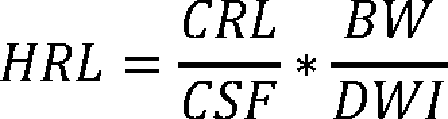
HRLs for contaminants with a linear dose-response (typically cancer endpoints) are calculated as follows:
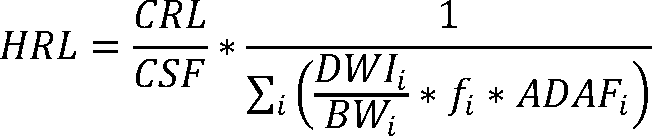
HRLs for carcinogenic contaminants with a known mutagenic MOA are calculated as follows:
Where:
HRL = Health Reference Level (µg/L)
RfD = Reference Dose (mg/kg/day)
DWI = Drinking Water Intake (L)
BW = Body weight (kg)
CSF = Cancer Slope Factor (mg/kg/day)
−1
CRL = Cancer risk level, assumed to be 1 in a million (1 × 10
−6
)
ADAF = The Age Dependent Adjustment Factor for the age group
i
(by default, ADAF = 10 from birth to two years of age; ADAF = 3 from two to sixteen years of age; ADAF = 1 from sixteen to seventy years of age)
f = fraction of applicable period of exposure (by default, lifetime of seventy years) represented by age group
i
RSC = Relative Source Contribution, which is the portion (percentage) of an individual's exposure attributed to drinking water rather than other sources (
e.g.,
food, ambient air). In Regulatory Determination, a 20% RSC is used for HRL derivation because (1) HRLs are developed prior to a complete exposure assessment, and (2) 20% is the lowest and most conservative RSC used in the derivation of an MCLG for drinking water.
b. Protection of Sensitive Subpopulations
In prioritizing the contaminants of greatest public health concern for regulatory determination, Section 1412(b)(1)(C) of SDWA requires the Agency to consider “among other factors of public health concern, the effect of such contaminants upon subgroups that comprise a meaningful portion of the general population (such as infants, children, pregnant women, the elderly, individuals with a history of serious illness, or other subpopulations) that are identifiable as being at greater risk of adverse health effects due to exposure to contaminants in drinking water compared to the general population.” If appropriate and if adequate data are available, the Agency will use data from sensitive populations and lifestages quantitatively when deriving HRLs for regulatory determinations in the following manner:
(a) For non-carcinogens, an HRL can be developed for a sensitive population if data are available to associate exposure with the critical health endpoint in a specific group or during a specific period of sensitivity. Age-specific drinking water intake (DWI) to body weight (BW) ratio values from the
Exposure Factors Handbook
(USEPA, 2011b) can be used to reflect the period of exposure more accurately. The Agency can also apply specific uncertainty factors (UFs) when deriving the RfD if toxicological data are lacking for a sensitive population. Two common justifications for UFs that can be applied to account for sensitive populations are: (1) Variation in sensitivity among the members of the human population (
i.e.,
intraspecies variability) and (2) uncertainty associated with an incomplete database.
(b) For HRLs developed for carcinogens with a mutagenic MOA, the 2005 Cancer Guidelines require consideration of increased risks due to early-life exposure. When chemical-specific data to quantify the increased risk are lacking, Age Dependent Adjustment Factors (ADAFs) are applied, generally with a 10-fold adjustment for early life exposures, a 3-fold adjustment for childhood/adolescent exposures, and no additional adjustment for exposures later in life (as shown above). Age-specific drinking-water-intake-to-body-weight ratio values are also applied from the
Exposure Factors Handbook
(USEPA, 2011b). In cases where the data on the MOA are lacking, the default low-dose linear extrapolation approach without ADAFs is used.
While this action is not subject to Executive Order 13045: Protection of Children from Environmental Health and Safety Risks, the Agency's Policy on Evaluating Health Risks to Children (USEPA, 1995a), recently reaffirmed by Administrator Wheeler (USEPA, 2018a), was still applied for the RD 4 preliminary determination. The EPA's policy (USEPA, 1995a) requires the EPA to consistently and comprehensively address children's unique vulnerabilities. For example, if exposure to a contaminant considered for RD 4 was associated with a developmental
( printed page 14109)
effect, the EPA derived HRLs using the exposure factors for a bottle-fed infant to be protective of children, assuming that the adverse effect identified could occur during the window of time when the infant is formula-fed (see metolachlor in Section IV.B as an example).
c. Sources of Data/Information for Health Effects
The EPA relies on health assessments produced by the Agency itself and produced by other agencies. The criteria for accepting a health assessment for RD 4 are described in Section III.A.1, above. Table 6 summarizes the sources of the health assessment data for each chemical with a preliminary determination under RD 4. As noted in Section III.A.3, in the case of potential positive determinations, the EPA searches for and evaluates additional data and information from the published literature to supplement the health assessment (Note that the two Phase 3 contaminants that are not receiving a preliminary determination are not discussed here. They are 1,4-dioxane and 1,2,3-trichloropropane. See section V of this document for more on those two contaminants.)
2. Evaluation of Contaminant Occurrence and Exposure
The EPA uses data from many sources to evaluate occurrence and exposure from drinking water contaminants. The following comprise the primary sources of finished drinking water occurrence data discussed in this
Federal Register
document:
Unregulated Contaminant Monitoring Rules (UCMR 1, 2, and 3)
UCM Program Rounds 1 and 2, and
Data collected by states.
Several of the primary sources of finished water occurrence data are designed to be statistically representative of the nation. These data sources include UCMR 1, UCMR 2, and UCMR 3.
The Agency also evaluates supplemental sources of information on occurrence in drinking water, occurrence in ambient and source water, and information on contaminant production and release to augment and complement these primary sources of drinking water occurrence data. Section III.C.2.a. of this action provides a brief summary of the primary sources of finished water occurrence data, and sections III.C.2.b and II.C.2.c provide brief summary descriptions of some of the supplemental sources of occurrence information and/or data. These descriptions do not cover all the sources that the EPA reviews and evaluates. For individual contaminants, the EPA reviews additional published reports and peer-reviewed studies that may provide the results of monitoring efforts in limited geographic areas. A summary of the occurrence data and the results or findings for each of the contaminants considered for regulatory determination is presented in section IV.B, the contaminant profiles section, and the data are described in further detail in the
Regulatory Determination 4 Support Document
(see USEPA, 2019a).
a. Primary Sources of Finished Drinking Water Occurrence Data
The following sections provide a brief summary of the finished water occurrence data sources used in RD 4. Table 8 in section IV lists the primary data source/finding used to evaluate each of the eight contaminants considered for regulatory
( printed page 14110)
determinations. Section V of this document provides more information about 1,4-dioxane and 1,2,3-trichloropropane, the two Phase 3 contaminants for which the EPA is not making a preliminary regulatory determination at this time. The contaminant-specific discussions in section IV provide more detailed information about the primary data source findings as well as any supplemental occurrence information.
(1) The Unregulated Contaminant Monitoring Rules (UCMR 1, UCMR 2, and UCMR 3)
The UCMR is the EPA's primary vehicle for collecting monitoring data on the occurrence of unregulated contaminants in PWSs. SDWA section 1412(b)(1)(B)(ii)(II) requires that the EPA include consideration of the data produced by the UCMR program in making regulatory determinations. The UCMR list is published every five years and is designed to collect nationally representative occurrence data that is developed in coordination with the CCL and Regulatory Determination processes. The UCMR sampling is limited by statute to no more than 30 contaminants every five years (SDWA section 1445(a)(2)). PWSs and state primacy agencies are required to report the data to the EPA. The EPA published the lists and requirements for the UCMR 1 on September 17, 1999 (64 FR 50556, September 17, 1999, USEPA, 1999), and the monitoring was conducted primarily during 2001-2003. UCMR 2 was published on January 4, 2007 (72 FR 367; USEPA, 2007a), with monitoring conducted primarily during 2008-2010. UCMR 3 was published on May 2, 2012 (77 FR 26071; USEPA, 2012a), with monitoring conducted primarily during 2013-2015. (The complete analytical monitoring lists are available at:
https://water.epa.gov/lawsregs/rulesregs/sdwa/ucmr/.) UCMR 4 was published on December 20, 2016 (81 FR 92666), with monitoring conducted between 2018 and 2020 (final UCMR 4 data is not complete in time for this RD 4 preliminary determination).
The UCMR program is designed as a three-tiered approach for monitoring contaminants related to the availability and complexity of analytical methods, laboratory capacity, sampling frequency, relevant universe of PWSs, and other considerations (
e.g.,
cost/burden). Assessment Monitoring (AM) includes the largest number of PWSs and is generally used when there is sufficient laboratory capacity. The Screening Survey (SS) includes a smaller number of PWSs to conduct monitoring and may be used, for example, when there are possible laboratory capacity issues for the analytical methods required. Pre-Screen Testing (PST) is generally used to collect monitoring information for contaminants with analytical methods that are in an early stage of development, and/or very limited laboratory availability.
The EPA designed the AM sampling frame to ensure that sample results would support a high level of confidence and a low margin of error (see USEPA, 1999 and 2001a, for UCMR design details). AM is required for all large and very large PWSs, those serving between 10,001 and 100,000 people and serving more than 100,000 people, respectively (
i.e.,
a census of all large and very large systems) and a national statistically representative sample of 800 small PWSs, those serving 10,000 or fewer people.[19]
PWSs that purchase 100% of their water were not required to participate in UCMR 1 and UCMR 2. However, those systems were not excluded under UCMR 3. All systems that purchase 100% of their water and serve more than 10,000 people were subject to UCMR 3. Systems that purchase 100% of their water and serve a retail population of 10,000 or fewer customers were only required to monitor if they were selected as part of the UCMR 3 nationally representative sample of small systems.
Each system conducts UCMR assessment monitoring for 12-consecutive months (during the three-year monitoring period). The rules typically require quarterly monitoring for surface water systems and twice-a-year, six-month interval monitoring for groundwater systems. At least one sampling event must occur during a specified vulnerable period. Differing sampling points within the PWS may be specified for each contaminant related to the contaminants source(s).
The objective of the UCMR sampling approach for small systems was to collect contaminant occurrence data from a statistically-selected, nationally representative sample of small systems. The small system sample was stratified and population-weighted, and included some other sampling adjustments such as allocating a selection of at least two systems from each state for spatial coverage (the design meets the data quality objective for overall exposure estimates (99% confidence level with ±1% error tolerance, at 1% exposure), while providing more precise occurrence estimates for categories of small systems). The UCMR AM program includes systems from all 50 states, the District of Columbia, all five U.S. territories, and tribal lands across all of the EPA regions. With contaminant monitoring data from all large PWSs—a census of large systems—and a statistical, nationally representative sample of small PWSs, the UCMR AM program provides a robust dataset for evaluating national drinking water contaminant occurrence.
UCMR 1 AM was conducted by approximately 3,090 large systems and 797 small systems. Approximately 33,800 samples were collected for each contaminant. In UCMR 2, sampling was conducted by over 3,300 large systems and 800 small systems and resulted in over 32,000 sample results for each contaminant.
As noted, in addition to AM, SS monitoring was required for contaminants. For UCMR 1, the SS was conducted at 300 PWSs (120 large and 180 small systems) selected at random from the pool of systems required to conduct AM. Samples from the 300 PWSs from throughout the nation provided approximately 2,300 analyses for each contaminant. While the statistical design of the SS is national in scope, the uncertainty in the results for contaminants that have low occurrence is relatively high. Therefore, the EPA looked for additional data to supplement the SS data for regulatory determinations.
For the UCMR 2 SS, the EPA improved the design to include a census of all systems serving more than 100,000 people (approximately 400 PWSs—but the largest portion of the national population served by PWSs) and a nationally representative, statistically selected sample of 320 PWSs serving between 10,001 and 100,000 people, and 480 small PWSs serving 10,000 or fewer people (72 FR 367, January 4, 2007, USEPA, 2007a). With approximately 1,200 systems participating in the SS, sufficient data were generated to provide a confident national estimate of contaminant occurrence and population exposure. In UCMR 2, the 1,200 PWSs provided more than 11,000 to 18,000 analyses (depending on the sampling design for the different contaminants).
For UCMR 3, all large and very large PWSs (serving between 10,001 and 100,000 people and serving more than 100,000 people, respectively), plus a statistically representative national sample of 800 small PWSs (serving
( printed page 14111)
10,000 people or fewer), conducted AM. UCMR 3 SS monitoring was conducted by all large systems serving more than 100,000 people, a nationally representative sample of 320 large systems serving 10,001 to 100,000 people, and a nationally representative sample of 480 small water systems serving 10,000 or fewer people. In contrast to implementation of UCMR 1 and 2 monitoring, transient noncommunity water systems that purchase all their finished water from another system were not excluded from the requirements of UCMR 3 (this was applicable only to PST). See USEPA (2012a) and USEPA (2019b) for more information on the UCMR 3 study design and data analysis.
As previously noted, the details of the occurrence data and the results or findings for each of the contaminants considered for regulatory determination are presented in Section IV.B, the contaminant profiles section, and are described in further detail in the
Regulatory Determination 4 Support Document
(USEPA, 2019a). The national design, statistical sampling frame, any new analytical methods, and the data analysis approach for the UCMR program has been peer-reviewed at different stages of development (see USEPA, 2001b, 2008b, 2015a, 2019b).
(2) National Inorganics and Radionuclides Survey (NIRS)
The EPA conducted the NIRS to provide a statistically representative sample of the national occurrence of 36 selected inorganic compounds (IOCs) and 6 radionuclides in CWSs served by groundwater. The sample was stratified by system size and 989 groundwater CWSs were selected at random representing 49 states (all except Hawaii) as well as Puerto Rico. The survey focused on groundwater systems, in part because IOCs tend to occur more frequently and at higher concentrations in groundwater than in surface water. Each of the selected CWSs was sampled at a single time between 1984 and 1986.
One limitation of the NIRS is a lack of occurrence data for surface water systems. Information about NIRS monitoring and data analysis is available in
The Analysis of Occurrence Data from the Unregulated Contaminant Monitoring (UCM) Program and National Inorganics and Radionuclides Survey (NIRS) in Support of Regulatory Determinations for the Second Drinking Water Contaminant Candidate List
(USEPA, 2008c). Another potential limitation of the NIRS is the age of the data. Although the NIRS monitoring occurred nearly 35 years ago, results may still provide insight into current conditions, as the presence of IOCs in aquifers depends in large part on equilibrium with stable natural sources in contiguous rock formations.
(3) Unregulated Contaminant Monitoring (UCM) Program Rounds 1 and 2
In 1987, the EPA initiated the UCM program to fulfill a 1986 SDWA Amendment requirement to monitor for specified unregulated contaminants. The UCM required PWSs serving more than 500 people to conduct monitoring. The EPA implemented the UCM program in two phases or rounds. The first round of UCM monitoring generally extended from 1988 to 1992 and is referred to as UCM Round 1 monitoring. The second round of UCM monitoring generally extended from 1993 to 1997 and is referred to as UCM Round 2 monitoring. Information about UCM monitoring and data analysis is available in
The Analysis of Occurrence Data from the Unregulated Contaminant Monitoring (UCM) Program and National Inorganics and Radionuclides Survey (NIRS) in Support of Regulatory Determinations for the Second Drinking Water Contaminant Candidate List
(USEPA, 2008c).
The UCM-State Round 1 dataset contains PWS monitoring results for 62 then-unregulated contaminants (some have since been regulated). These data were collected by 40 states and primacy entities between 1988 and 1992. The Round 2 dataset contains PWS monitoring results for 48 then-unregulated contaminants. These data were collected by 35 states and primacy entities between 1993 and 1997. Since UCM Round 1 and Round 2 data represent different time periods and include occurrence data from different states, the EPA developed separate national cross-sections for each data set. The UCM Round 1 national cross-section, consisting of data from 24 states, includes approximately 3.3 million records from approximately 22,000 unique PWSs. The UCM Round 2 national cross-section, consisting of data from 20 states, includes approximately 3.7 million records from slightly more than 27,000 unique PWSs.
b. Supplemental Sources of Finished Drinking and Ambient Water Occurrence Data
The Agency evaluates several sources of supplemental information related to contaminant occurrence in finished water and ambient and source waters to augment the primary drinking water occurrence data. Some of these sources were part of other Agency information gathering efforts or submitted to the Agency in public comment or suggested by stakeholders during previous CCL and Regulatory Determination efforts. These supplemental data are useful to evaluate the likelihood of contaminant occurrence in drinking water and/or to more fully characterize a contaminant's presence in the environment and potentially in source water, and to evaluate any possible trends or spatial patterns that may need further review. The descriptions that follow do not cover all the sources that the EPA used. For individual contaminants, the EPA reviewed additional published reports and peer-reviewed studies that may have provided the results of monitoring efforts in limited geographic areas. A more detailed discussion of the supplemental sources of information/data that the EPA evaluated and the occurrence data for each contaminant can be found in the
Regulatory Determination 4 Support Document
(USEPA, 2019a).
(1) Individual States' Data
For RD 4, the Agency evaluated data for unregulated contaminants from the second Six-Year Review of regulated contaminants (USEPA, 2009b), the third Six-Year Review of regulated contaminants (USEPA, 2016c), and individual state websites.
To support the second Six-Year Review of regulated contaminants (USEPA, 2009b), the EPA issued an Information Collection Rule (ICR) to collect compliance monitoring data from PWSs for the time period covering 1998-2005. After issuing the ICR, the EPA received monitoring data from 45 states plus Region 8 and Region 9 Tribes. Six states and Region 9 tribes also provided monitoring data for unregulated contaminants along with their compliance monitoring data. The EPA further collected additional unregulated contaminant data from two additional States that provide monitoring data through their websites.
To support the third Six-Year Review of regulated contaminants (USEPA, 2016c), the EPA issued an ICR to collect compliance monitoring data from PWSs for 2006-2011. After issuing the ICR, 46 states and 8 other primacy agencies provided compliance monitoring data. Nine states, three tribes, Washington, DC, and American Samoa also provided monitoring data for unregulated contaminants along with their compliance monitoring data.
The EPA supplemented these occurrence data for unregulated contaminants by downloading additional and more recent publicly available monitoring data from state websites. Drinking water monitoring
( printed page 14112)
data for select contaminants were available online from several states, including California, Colorado, Michigan, New Hampshire, New Jersey, and North Carolina. Very limited data were also available from Pennsylvania and Washington. The available state data are varied in terms of quantity and coverage. In many cases they represent targeted monitoring.
These datasets vary from state to state in the contaminants included, the number of samples, and the completeness of monitoring. They were reviewed and used to augment the national data and assessed if they provide supportive observations or any unique occurrence results that might warrant further review.
(2) Community Water System Survey (CWSS)
The EPA periodically conducts the CWSS to collect data on the financial and operating characteristics from a nationally representative sample of CWSs. As part of the CWSS, all systems serving more than 500,000 people receive the survey. In the 2000 and 2006 CWSS, these very large systems were asked questions about the occurrence and concentrations of unregulated contaminants in their raw and finished water. The 2000 CWSS (USEPA, 2002a, 2002b) requested data from 83 very large CWSs and the 2006 CWSS (USEPA, 2009c, 2009d) requested data from 94 very large CWSs. Not all systems answered every question or provided complete information on the unregulated contaminants. Because reported results are incomplete, they are illustrative, not representative, and are only used as supplemental information.
(3) United States Department of Agriculture (USDA) Pesticide Data Program (PDP)
Since 1991, the USDA PDP has gathered data on pesticide residues in food. In 2001 the program expanded to include sampling of pesticide residues in treated drinking water, and in 2004 some sampling of raw water was incorporated as well. The PDP drinking water project continued until 2013 (USDA, 2018). The CWSs selected for sampling tended to be small and medium-sized surface water systems (serving under 50,000 people) located in regions of heavy agriculture. The sampling frame was designed to monitor in regions of interest for at least two years to reflect the seasonal and climatic variability during growing seasons. PDP worked with the EPA to identify specific water treatment facilities where monitoring data were collected. The number of sites and samples varied among different sampling periods. The EPA reviewed the PDP data on the occurrence of select contaminants in untreated and treated water (USDA, 2018).
(4) USGS Pilot Monitoring Program (PMP)
In 1999, USGS and the EPA conducted the PMP to provide information on pesticide concentrations in small drinking water supply reservoirs in areas with high pesticide use (Blomquist et al., 2001). The study was undertaken, in part, to test and refine the sampling approach for pesticides in such reservoirs and related drinking water sources. Sampling sites represent a variety of geographic regions, as well as different cropping patterns. Twelve water supply reservoirs considered vulnerable to pesticide contamination were included in the study. Samples were collected quarterly throughout the year and at weekly or biweekly intervals following the primary pesticide-application periods. Water samples were collected from the raw water intake and from finished drinking water taps prior to entering the distribution system. At some sites, samples were also collected at the reservoir outflow.
(5) USGS National Water Quality Assessment (NAWQA)
The USGS instituted the National Water Quality Assessment (NAWQA) program in 1991 to examine ambient water quality status and trends in the United States. The NAWQA program is designed to apply nationally consistent methods to provide a consistent basis for comparisons over time and among significant watersheds and aquifers across the country. These occurrence assessments serve to facilitate interpretation of natural and anthropogenic factors affecting national water quality. The NAWQA program monitors the occurrence of chemicals such as pesticides, nutrients, volatile organic compounds (VOCs), trace elements, radionuclides, hormones and pharmaceuticals, and the condition of aquatic habitats and fish, insects, and algal communities. For more detailed information on the NAWQA program design and implementation, please refer to Leahy and Thompson (1994), Hamilton et al. (2004), and NRC (2012).
The NAWQA program has been designed in ten-year cycles to enable national coverage that can be used for trends and causal assessments. In the Cycle 1 monitoring period, which was conducted from 1991 through 2001, NAWQA collected data from over 6,400 surface water and 6,300 groundwater sampling points. Cycle 2 monitoring covers the period from 2002 through 2012, with various design changes from Cycle 1 (see Hamilton et al., 2004). Sampling for Cycle 3 is currently underway (2013-2023). Surface water monitoring will be conducted at 313 sites while groundwater assessments will be designed to evaluate status and trends at the principal aquifer and national scales. Refer to Rowe et al. (2010; 2013) for more details.
The EPA performed a summary analysis of the Cycle 1, Cycle 2, and available Cycle 3 water monitoring data for the Regulatory Determination process. The surface water data consisted of river and stream samples; for groundwater, all well data were used.
For RD 4, the EPA used and evaluated many USGS NAWQA reports to review causal or spatial factors that USGS may have presented in their interpretations. In particular, the EPA evaluated many reports from the Pesticide National Synthesis Programs (
e.g.,
Gilliom et al., 2007) and the VOC National Synthesis (
e.g.,
Delzer and Ivahnenko, 2003). While there is overlap in the data used in the USGS reports and the EPA analysis, the USGS reports can provide unique observations related to their synthesis of additional data.
For RD 4, the EPA also supplemented these data with information from recent special USGS reports that also used additional data from other programs, particularly reports that focused on contaminant occurrence in source waters for PWSs, such as: Organic compounds in source water of selected CWSs (Hopple et al., 2009 and Kingsbury et al., 2008); water quality in public-supply wells (Toccalino et al., 2010); water quality in domestic wells and principal aquifers (DeSimone, 2009 and DeSimone et al., 2014); nationwide reconnaissance of contaminants of emerging concern (Glassmeyer et al., 2017); water quality in select CWSs (Grady and Casey, 2001); water quality in carbonate aquifers (Lindsey et al., 2008); VOCs in domestic wells (Moran et al., 2002 and Rowe et al., 2007); and VOCs in the nation's groundwater (Zogorski et al., 2006).
(6) National Water Information System (NWIS)
For RD 4, the EPA evaluated contaminant monitoring results from the non-NAWQA data in the National Water Information System (NWIS) (USGS, 2016). NWIS houses the NAWQA data (described above) and includes other USGS data from unspecified projects. The non-NAWQA NWIS data were analyzed separately from NAWQA data.
( printed page 14113)
Although NWIS is comprised of primarily ambient water data, some finished drinking water data are included as well. The non-NAWQA data housed in NWIS generally involve fewer constituents per sample than the NAWQA data. Unlike the NAQWA data, the non-NAWQA data are a miscellaneous collection, so they are not as well-suited for making temporal and geographic comparisons. Most NWIS data are available via the Water Quality Portal (see below).
(7) Water Quality Exchange (WQX)/Water Quality Portal Data System (Formerly STORET)
The EPA's Water Quality Exchange (WQX) is the data format and mechanism for publishing monitoring data available through the Water Quality Portal. WQX replaces the Storage and Retrieval Data System (STORET) as the mechanism for data partners to submit water monitoring data to the EPA. The Water Quality Portal is the mechanism for anyone, including the public, to retrieve water monitoring data from the EPA WQX/STORET, USDA STEWARDS, and USGS NWIS/BIODATA. The WQX database contains raw biological, chemical, and physical data from surface and groundwater sampling conducted by federal, state and local agencies, Native American Tribes, volunteer groups, academics, and others. WQX includes data from monitoring locations in all 50 states as well as multiple territories and jurisdictions of the United States. Most data are from ambient waters, but in some cases finished drinking water data are included as well. Data owners are responsible for providing data of documented quality, so that data users can choose to access only those data collected and analyzed with data quality objectives that meet their study needs. For more general WQX data information, please refer to:
https://www.epa.gov/waterdata/water-quality-data-wqx.
To retrieve the data, please refer to:
https://www.waterqualitydata.us/portal/.
c. Supplemental Production, Use, and Release Data
The Agency reviews various sources of information to assess if there are changes or trends in a contaminant's production, use, and release that may affect its presence in the environment and potential occurrence in drinking water. The cancellation of a pesticide or a clear increase in production and use of a contaminant are trends that can inform the regulatory determination process. Several sources are described below. A more detailed discussion of the supplemental sources of information/data that the EPA evaluated and the occurrence data for each contaminant can be found in the
Regulatory Determination 4 Support Document
(USEPA, 2019a).
(1) Inventory Update Reporting (IUR) and Chemical Data Reporting (CDR) Program
The IUR regulation required manufacturers and importers of certain chemical substances, included on the Toxic Substances Control Act (TSCA) Chemical Substance Inventory, to report site and manufacturing information and the amount of chemicals produced or imported in amounts of 25,000 pounds or more at a single site. Additional information on domestic processing and use was required to be reported for chemicals produced or imported in amounts of 300,000 pounds or more at a single site. Prior to the 2003 TSCA Amendments (
i.e.,
reporting from 2002 or earlier), information was collected for only organic chemicals that were produced or imported in amounts of 10,000 pounds or more, and was limited to more basic manufacturing information such as production volume. In 2011 the Agency issued the CDR Rule, which replaced the IUR Rule and established a somewhat modified program, including annual data gathering and periodic reporting. CDR makes use of a two-tiered system of reporting thresholds, with 25,000 pounds the threshold for some contaminants and 2,500 pounds the threshold for others. Contaminants may have reports for some years but not others (USEPA, 2008d; USEPA, 2016d).
(2) Toxics Release Inventory (TRI)
The EPA established the Toxics Release Inventory (TRI) in 1987 in response to Section 313 of the Emergency Planning and Community Right-to-Know Act (EPCRA). EPCRA Section 313 requires facilities to report annual information on toxic chemical releases from facilities that meet reporting criteria to both the EPA and the states. The TRI database details not only the types and quantities of toxic chemicals released to the air, water, and land by facilities, but also provides information on the quantities of chemicals sent to other facilities for further management (USEPA, 2003b; USEPA, 2019c). Currently, for most chemicals, reporting of releases is required if 25,000 pounds or more of the chemical are manufactured or processed at a facility, or if 10,000 pounds or more are used at the facility. For certain chemicals the reporting threshold is as low as 0.1 grams, 10 pounds, or 100 pounds (40 CFR 372.28). Both the number and type of facilities required to report has increased over time. Information from the TRI was downloaded in 2017 (USEPA, 2017a).
Although TRI can provide a general idea of release trends, these trends should be interpreted with caution since the list of chemicals with reporting requirements has generally increased over time. In addition, only those facilities that meet specific criteria are required to report to the TRI program. Finally, data on releases cannot be used as a direct measure of public exposure to a chemical in drinking water (USEPA, 2019a).
(3) Pesticide Usage Estimates
For the regulatory determinations process, the Agency reviews various sources of information about pesticide usage. Pesticide use and manufacturing information is considered confidential business information (CBI) and therefore, accurate measures of production and use are not publicly available. As a result, the Agency reviews various estimates of use as supplemental information in the deliberative process.
For some pesticides, the EPA presents estimations of annual U.S. usage of individual pesticides in its pesticide reregistration documents (
e.g.,
REDs, IREDs, TREDs). The EPA also periodically issues Pesticides Industry Sales and Usage reports. The reports provide contemporary and historical information on U.S. pesticide production, imports, exports, usage, and sales, particularly with respect to dollar values and quantities of active ingredient (USEPA, 2004a; USEPA, 2011c; USEPA, 2017b).
The National Center for Food and Agricultural Policy (NCFAP), a private non-profit institution, has also produced national pesticide use estimates based on USDA state-level statistics and surveys for commercial agriculture usage patterns and state-level crop acreage. The database contains estimates of pounds applied and acres treated in each State for 220 active (pesticide) ingredients and 87 crops. The majority of the chemicals monitored are herbicides, but the database also follows significant numbers of fungicides and insecticides (NCFAP, 2000).
The USGS produced usage estimates and maps for over 200 pesticides used in United States crop production, providing spatial insight to the regional use of many pesticides (USGS, 2018). These pesticide use estimates were generated by the USGS using data from proprietary surveys of farm operations, USDA Census of Agriculture, and other
( printed page 14114)
sources. USGS used two methods to estimate pesticide usage, since pesticide usage information was not available in some districts. “EPest-High” estimates were generated by projecting usage estimates for such districts based on usage in neighboring districts. “EPest-Low” estimates were generated by assuming no usage in such districts.
IV. Contaminant-Specific Discussions for the RD 4 Preliminary Determination
A. Summary of the Preliminary Regulatory Determination
Based on the EPA's evaluation of the three SDWA criteria (discussed in section II.B.1), the Agency is making preliminary determinations to regulate two contaminants and to not regulate six contaminants. For each of the eight contaminants discussed in this section of this document, Table 7 summarizes information about the health assessment, principle study, critical effects, and associated reference dose and/or cancer slope factor used to derive an HRL. Following Table 7, Table 8 summarizes the primary occurrence information used to make these preliminary regulatory determinations. Section IV.B of this document provides a more detailed summary of the information and the rationale used by the Agency to reach its preliminary decisions for these eight contaminants. For more information about the two Phase 3 contaminants that are not receiving a preliminary regulatory determination, see section V.
Table 7—Health Effects Information for Contaminants Discussed in Section IV of This Document
RD 4 contaminant
Health
assessment
Principle study
Critical effect
RfD for
noncancer
effects, in
mg/kg/day
Cancer slope factor, in
(mg/kg/day)
−1
HRL, in µg/L
PFOS
EPA OW HESD, 2016
Luebker et al. 2005a and 2005b
decreased neonatal rat body weight
0.00002
n/a
0.07.
PFOA
EPA OW HESD, 2016
Lau et al., 2006
reduced ossification in proximal phalanges and accelerated puberty in male pups, in mice
0.00002
20
0.07
0.07.
1,1-Dichloroethane
EPA ORD PPRTV, 2006
Muralidhara et al., 2001
increased urinary enzyme markers for renal damage and central nervous system (CNS) depression in rats
0.2
n/a
1,000.
Acetochlor
EPA OPP HHRA, 2018
ICI, Inc. 1988
increased salivation, increased alanine aminotransferase (ALT), ornithine carbamyl transferase and triglyceride levels; decreased blood glucose; and histopathological changes in the kidneys, liver and testes of males, in beagle dogs
0.02
n/a
100.
Methyl Bromide (Bromomethane)
EPA OPP HHRA, 2006
Mertens, 1997
decreased body weight, decreased rate of body weight gain, and decreased food consumption in rats
0.022
n/a
100.
Metolachlor
EPA OPP HHRA, 2018
Page, 1981
decreased pup body weight in rats
0.26
n/a
300.
Nitrobenzene
EPA IRIS, 2009
NTP, 1983
changes in absolute and relative organ weights, splenic congestion, and increases in reticulocyte count and metHb concentration in rats
0.002
n/a
10.
RDX
EPA IRIS, 2018
Crouse et al., 2006 (noncancer); Lish et al. 1984 (cancer)
convulsions in rats (noncancer); lung and liver tumors in mice (cancer)
0.004
0.08
30 (noncancer); 0.4 (cancer).
Table 8—Occurrence Findings From Primary Data Sources
RD 4
contaminant
HRL, µg/L
Primary
database
PWSs with at least 1
detection >
1/2
HRL
Population served by PWSs with at least 1
detection >
1/2
HRL
PWSs with at least 1
detection > HRL
Population served by PWSs with at least 1 detection > HRL
PFOS
0.07
UCMR 3 AM
95/4,920 (1.93%)
10,427,193/241 M (4.32%)
46/4,920 (0.93%)
3,789,831/241 M (1.57%).
PFOA
0.07
UCMR 3 AM
53/4,920 (1.07%)
3,652,995/241 M (1.51%)
13/4,920 (0.26%)
490,480/241 M (0.20%).
1,1-Dichloroethane
1,000
UCMR 3 AM
0/4,916 (0.00%)
0/241 M (0.00%)
0/4,916 (0.00%)
0/241 M (0.00%).
Acetochlor
100
UCMR 1 AM
0/3,869 (0.00%)—UCMR 1
0/226 M (0.00%)—UCMR 1
0/3,869 (0.00%)—UCMR 1
0/226 M (0.00%)—UCMR 1.
UCMR 2 SS
0/1,198 (0.00%)—UCMR 2
0/157 M (0.00%)—UCMR 2
0/1,198 (0.00%)—UCMR 2
0/157 M (0.00%)—UCMR 2.
Methyl Bromide (Bromomethane)
100
UCMR 3 AM
0/4,916 (0.00%)
0/241 M (0.00%)
0/4,916 (0.00%)
0/241 M (0.00%).
Metolachlor
300
UCMR 2 SS
0/1,198 (0.00%)
0/157 M (0.00%)
0/1,198 (0.00%)
0/157 M (0.00%).
Nitrobenzene
10
UCMR 1 AM
2/3,861 (0.05%)
255,358/226 M (0.11%)
2/3,861 (0.05%)
255,358/226 M (0.11%).
RDX
30, 0.4
UCMR 2 AM
0/4,139 (0.00%) > 15 µg/L
0/229 M (0.00%) > 15 µg/L
0/4,139 (0.00%) > 30 µg/L
0/229 M (0.00%) > 30 µg/L.
( printed page 14115)
3/4,139 (0.07%) > 0.2 µg/L
96,033/229 M (0.04%) > 0.2 µg/L
3/4,139 (0.07%) > 0.4 µg/L
96,033/229 M (0.04%) > 0.4 µg/L.
B.
Contaminant Profiles
1. Perfluorooctane Sulfonate (PFOS) and Perfluorooctanoic Acid (PFOA)
a. Background
PFAS are a group of synthetic chemicals that have been in use since the 1940s. PFAS are found in a wide array of consumer and industrial products. PFAS manufacturing and processing facilities, facilities using PFAS in production of other products, airports, and military installations have been associated with PFAS releases into the air, soil, and water (USEPA, 2016e; USEPA, 2016f).
PFOS and PFOA—two of the most widely-studied and longest-used PFAS—are part of a subset of PFAS known as perfluorinated alkyl acids (PFAA). These two compounds have been detected in up to 98% of serum samples taken in biomonitoring studies that are representative of the U.S. general population; however, since PFOA and PFOS have been voluntarily phased out in the U.S., serum concentrations have been declining (CDC, 2019). The National Health and Nutrition Examination Survey (NHANES) data shows that 95th-percentile serum PFOS concentrations have decreased from 75.7 µg/L in the 1999-2000 cycle to 18.3 µg/L in the 2015-2016 cycle (CDC, 2019; Jain, 2018; Calafat et al., 2007; Calafat et al., 2019), a decrease of over 75 percent. In early 2000, the EPA worked with the 3M Company, which was the only major manufacturer of PFOS in the United States at that time, to support the company's voluntary phase-out and elimination of PFOS production and use. Under the EPA's 2010/2015 PFOA Stewardship Program, eight major chemical manufacturers and processors agreed to phase out the use of PFOA and PFOA-related chemicals in their products and emissions from their facilities. All companies met the PFOA Stewardship Program goals by 2015. While companies participating in the PFOA Stewardship program report that they no longer produce or use PFOA domestically, PFOA may still be produced domestically or imported or used by companies not participating in the PFOA Stewardship Program. In addition, PFOA and PFOS can also be present in imported articles (USEPA, 2017c). Due to the widespread use and persistence of PFAS in the environment, most people have been exposed to PFAS, including PFOA and PFOS (USEPA, 2016e; USEPA, 2016f).
Production of PFOA and PFOS is subject to CDR reporting. Production volumes of PFOA and PFOS were claimed by reporting companies as confidential for the most recent reporting cycles. The last time production (including import) of PFOA exceeded the CDR reporting threshold was during the 2016 reporting cycles (which includes production information from 2012-2015) and it was phased out by companies participating in the 2010/2015 PFOA Stewardship Program in 2013. Similarly, PFOS was phased out by 3M in 2002 and the most recently reported data for PFOS are from the 2002 reporting cycle (which includes production information from 2001 only) (USEPA, 2019a). Absence of recent reporting may indicate that production (including import) of PFOA and PFOS has halted or has been below the CDR reporting thresholds. Although PFOA and PFOS are not produced domestically or imported by the companies participating in the 2010/2015 PFOA Stewardship Program, PFOA and PFOS may still be produced domestically or imported below the CDR reporting thresholds (
i.e.,
2,500 pounds) by companies not participating in the PFOA Stewardship Program.
b. Statutory Criterion #1 (Adverse Health Effects)
The EPA is preliminarily determining that PFOA and PFOS meet the SDWA statutory criterion #1 for regulatory determinations: They may have adverse effects on the health of persons. In 2016, the EPA published health assessments (health effects support documents or HESDs) for PFOA and PFOS based on the Agency's evaluation of the peer reviewed science available at that time. This section presents a summary of the adverse health effects discussed in the HESDs. For specific details on the potential for adverse health effects and approaches used to identify and evaluate information on hazard and dose-response, please see USEPA (2016d), USEPA (2016e), USEPA (2016f), and USEPA (2016g). The lifetime HA of 0.07 µg/L is used as the HRL for Regulatory Determination 4.
Human epidemiology data report associations between PFOA exposure and high cholesterol, increased liver enzymes, decreased vaccination response, thyroid disorders, pregnancy-induced hypertension and preeclampsia, and cancer (testicular and kidney). The associations for most epidemiology endpoints are mixed. Although mean serum values are presented in the human studies, actual estimates of PFOA exposure (
i.e.,
doses/duration) are not currently available. Thus, the serum level at which the effects were first manifest and whether the serum had achieved steady state at the point the effect occurred cannot be determined. It is likely that some of the human exposures that contribute to serum PFOA values come from PFOA derivatives or precursors that break down metabolically to PFOA. These compounds could originate from PFOA in diet and materials used in the home, which creates potential for confounding. In addition, most of the subjects of the epidemiology studies have many PFASs and/or other contaminants in their blood. Although the study designs adjust for other potential toxicants as confounding factors, their presence constitutes a level of uncertainty that is usually absent in the animal studies. Taken together, the weight of evidence for human studies supports the conclusion that PFOA exposure is a human health hazard. At this time, EPA concludes that the human studies are adequate for use qualitatively in the identification hazard and are supportive of the findings in laboratory animals.
( printed page 14116)
For PFOA, oral animal studies of short-term, subchronic, and chronic duration are available in multiple species including monkeys, rats and mice. These animal studies report developmental effects (survival, body weight changes, reduced ossification, delays in eye opening, altered puberty, and retarded mammary gland development), liver toxicity (hypertrophy, necrosis, and effects on the metabolism and deposition of dietary lipids), kidney toxicity (weight), immune effects, and cancer (liver, testicular, and pancreatic) (USEPA, 2016e). Overall, the animal toxicity studies available for PFOA demonstrate that the developing fetus is particularly sensitive to PFOA-induced toxicity. Human epidemiology data report associations between PFOA exposure and high cholesterol, increased liver enzymes, decreased vaccination response, thyroid disorders, pregnancy-induced hypertension and preeclampsia, and cancer (testicular and kidney). Overall, the developmental toxicity studies in animals available for PFOA demonstrate that the developing rodent fetus and newborn rodent are sensitive to PFOA-induced toxicity.
PFOA is known to be transmitted to the fetus via cord blood and to the newborn, infant, and child via breast milk (USEPA, 2016f). Under the EPA's
Guidelines for Carcinogen Risk Assessment
(USEPA, 2005b), there is “suggestive evidence of carcinogenic potential” for PFOA. Similarly, the International Agency for Research on Cancer (IARC) classifies PFOA as “possibly carcinogenic to humans” (IARC, 2019a; IARC, 2019b).
The EPA calculated several candidate RfDs for PFOA in the 2016 HESD and selected the RfD of 0.00002 mg/kg/day based on reduced ossification in proximal phalanges and accelerated puberty in male pups following exposure during gestation and lactation in a developmental toxicity study in mice (Lau et al., 2006) for the derivation of a lifetime HA. The RfD for PFOA was calculated by applying uncertainty factors to account for interspecies variability (3), intraspecies differences (10), and use of a LOAEL (3). The Health Effects Support Document (USEPA, 2016h) describes these uncertainties in Section 4. Additionally, uncertainties and limitations (
i.e.,
human epidemiological data, immunological and mammary gland endpoints, and exposure) are discussed in detail in Section 8 of the Health Advisory (USEPA, 2016f) document. The lifetime HA of 0.07 µg/L was calculated using the 0.00002 mg/kg/day RfD for developmental effects, a DWI to BW ratio for the 90th percentile [21]
for lactating women (0.054 L/kg/day) and a calculated 20% RSC (USEPA, 2016f). This RfD is protective of effects other than those occurring during development such as kidney and immune effects. Because of the potential for increased susceptibility during the time period of pregnancy and lactation observed in this study, the EPA used DWI and BW parameters for lactating women in the calculation of a lifetime HA for this target population during this potential critical time period. The EPA also calculated a CSF of 0.07 (mg/kg/day)−1
based on testicular tumors in rats. The resultant HA using this CSF is greater than the lifetime HA based on noncancer effects, indicating that the HA derived based on the developmental endpoint is protective for the cancer endpoint (USEPA, 2016h).
For PFOS, epidemiological studies have reported associations between PFOS exposure and high serum cholesterol and reproductive and developmental parameters. The strongest associations are related to serum lipids with increased total serum cholesterol and high-density lipoproteins (HDLs). As with PFOA, the associations for most epidemiology endpoints are inconsistent. Although mean serum values are presented in the human studies, actual estimates of PFOS exposure (
i.e.,
doses/duration) are not currently available. Thus, the serum level at which the effects were first manifest and whether the serum had achieved steady state at the point the effect occurred cannot be determined (USEPA, 2016e) Human epidemiological studies suggest an association between higher PFOS levels and decreases in female fecundity and fertility, decreased birth weights in offspring and other measures of postnatal growth (
e.g.,
small for gestational age).
Short-term and chronic exposure studies in animals demonstrate increases in liver weight consistently. Co-occurring effects in these studies include decreased cholesterol, hepatic steatosis, lower body weight, and liver histopathology. One and two generation toxicity studies also show decreased pup survival and body weights. Additionally, developmental neurotoxicity studies show increased motor activity and decreased habituation and increased escape latency in the water maze test following in utero and lactational exposure to PFOS. Gestational and lactational exposures were also associated with higher serum glucose levels and evidence of insulin resistance in adult offspring. Limited evidence suggests immunological effects in mice. Short-term and subchronic duration studies are available in multiple animal species including monkeys, rats and mice. These studies also found increased serum glucose levels and insulin resistance in adult animals exposed during development, developmental effects (decreased body weight and survival), reproductive effects (impacts on mating behavior), liver toxicity (increased liver weight co-occurring with decreased serum cholesterol, hepatic steatosis), developmental neurotoxicity (impaired spatial learning and memory), suppressed immunological responses, and cancer (thyroid and liver). Increased incidence of hepatocellular adenomas in the male (12% at the high dose) and female rats (8% at the high dose) and combined adenomas/carcinomas in the females (10% at the high dose) were observed, but they did not display a clear dose-related response; Thyroid tumors (adenomas and carcinomas) were seen in males receiving 0, 0.5, 2, 5, or 20 ppm and in females receiving 5 or 20 ppm in their diet. The tumor (adenomas + carcinomas) prevalence for males was consistent across dose groups. In males the incidence of thyroid tumors was significantly elevated only in the high-dose, recovery group males exposed for 52 weeks (10/39) but not in the animals receiving the same dose at 105 weeks. There were very few follicular cell adenomas/carcinomas in the females (5 total) with no dose-response. The most frequent thyroid tumor type in the females was C-cell adenomas, but the highest incidence was that for the controls and there was a lack of dose response among the exposed groups. C-cell adenomas were not observed in males (Thomford 2002; Butenhoff et al. 2012). Overall, the animal toxicity studies available for PFOS demonstrate that the developing fetus and newborn rodent are sensitive to PFOS induced toxicity. PFOS is known to be transmitted to the fetus via cord blood and to the newborn, infant, and child via breast milk (USEPA, 2016f). Applying the EPA
Guidelines for Carcinogen Risk Assessment
(USEPA, 2005b), there is suggestive evidence of carcinogenic potential for PFOS. However, the weight of evidence for humans is too limited to support a quantitative cancer assessment given that there was no evidence for dose-response from which to derive a slope factor for the tumor types identified in animals.
( printed page 14117)
The EPA calculated multiple candidate RfDs for PFOS in the HESD and selected the RfD of 0.00002 mg/kg/day based on decreased neonatal rat body weight from both the one- and two-generation studies by Luebker et al. (2005a, 2005b) for the derivation of a lifetime HA. The RfD for PFOS was calculated by applying uncertainty factors to account for interspecies variability (3) and intraspecies differences (10). The Health Effects Support Document (USEPA, 2016g) describes these uncertainties in Section 4. Additionally, uncertainties and limitations (
i.e.,
human epidemiologic data, immunological and mammary gland endpoints, and exposure) are discussed in detail in Section 8 of the Health Advisory (USEPA, 2016e) document. The lifetime HA of 0.07 µg/L was calculated using the 0.00002 mg/kg/day RfD for developmental effects, a DWI to BW ratio for the 90th percentile 21
for lactating women (0.054 L/kg/day) and a 20% RSC (USEPA, 2016e). The lifetime HA of 0.07 µg/L is used as the HRL for Regulatory Determination 4.
The RfDs for both PFOA and PFOS are both based on developmental effects and are numerically identical. Thus, when both chemicals co-occur at the same time and location, the EPA recommended a conservative and health-protective approach of 0.07 µg/L for the PFOA/PFOS total combined concentration (USEPA, 2016e).
The EPA has initiated a systematic literature review of peer-reviewed scientific literature for PFOA and PFOS published since 2013 with the goal of identifying any new studies that may be relevant to human health assessment. An annotated bibliography of identified studies as well as the protocol used to identify the relevant publications can be found in Appendix D of the
Regulatory Determination 4 Support Document
(USEPA, 2019a), available in the docket for this document. Additional analyses of these new studies is needed to confirm relevance, extract the data to assess the weight of evidence, and identify critical studies in order to inform future decision making. The EPA is seeking comment on any additional studies and information that it should consider. Should the EPA make a final positive regulatory determination for PFOA and PFOS, the Agency will undertake the SDWA rulemaking process to establish a National Primary Drinking Water Regulation for those contaminants. For that rulemaking effort, in addition to using the best available science, the SDWA requires that the Agency seek recommendations from the EPA Science Advisory Board, and consider public comment on any proposed rule. Therefore, EPA anticipates further scientific review of new science prior to promulgation of any regulatory standard.
c. Statutory Criterion #2 (Occurrence at Frequency and Levels of Public Health Concern)
The EPA is preliminarily determining that PFOA and PFOS meet the SDWA statutory criterion #2 for regulatory determinations: they occur with a frequency and at levels of public health concern at PWSs based on the EPA's evaluation of the available occurrence information. The EPA is seeking public comment on whether the data described below support such a determination and whether additional data or studies exist which EPA should consider when finalizing a determination.
EPA has made its preliminary determination based, in part, on the UCMR 3 data (USEPA, 2019b). The EPA has determined in accordance with SDWA 1412(b)(1)(B)(ii)(II) that the UCMR 3 data are the best available occurrence information for the PFOA/PFOS regulatory determinations. UCMR 3 monitoring occurred between 2013 and 2015and currently represents the only nationally-representative finished water dataset for PFOA and PFOS. Under UCMR 3, 36,972 samples from 4,920 PWSs were analyzed for PFOA and PFOS. The MRL for PFOA was 0.02 µg/L and the MRL for PFOS was 0.04 µg/L. A total of 1.37% of samples had reported detections (greater than or equal to the MRL) of at least one of the two compounds. To examine the occurrence of PFOS and PFOA in aggregate, the EPA summed the concentrations detected in the same sample to calculate a total PFOS/PFOA concentration.
The EPA notes that when these two chemicals co-occur at the same time and location in a drinking water source, a conservative and health-protective approach that EPA recommends would be to compare the sum of the concentrations (USEPA, 2016g; USEPA, 2016h). The Regulatory Determination 4 Support Document presents a sample-level summary of the results for the individual contaminants (USEPA, 2019a). Concentrations of PFOS or PFOA below their respective MRLs were set equal to 0 µg/L when calculating the total PFOS/PFOA concentration for the sample. The maximum summed concentration of PFOA and PFOS was 7.22 µg/L and the median summed value was 0.05 µg/L. Summed PFOA and PFOS concentrations exceeded the HRL (0.07 µg/L) at a minimum of 1.3% of PWSs (63 PWSs [22]
). Since UCMR 3 monitoring occurred, certain sites where elevated levels of PFOA and PFOS were detected may have installed treatment for PFOA and PFOS, may have chosen to blend water from multiple sources, or may have otherwise remediated known sources of contamination. Those 63 PWSs serve a total population of approximately 5.6 million people and are located in 25 states, tribes, or U.S. territories (USEPA, 2019b). The HRLs for PFOA and PFOS are based on the 2016 drinking water Health Advisories and reflect concentrations of PFOA and PFOS in drinking water at which adverse health effects are not anticipated to occur over a lifetime (USEPA, 2016e; USEPA, 2016f).
Consistent with the Agency's commitment in the PFAS Action Plan (USEPA, 2019d) to present information about additional sampling for PFAS in water systems, the EPA has supplemented its UCMR data with data collected by states who have made their data publicly available at this time. In some cases, EPA obtained the data directly from the state's public website while, in others, these data were provided to EPA. Specifically, the EPA evaluated publicly available monitoring data that permitted summed PFOA and PFOS analyses from the state websites of New Hampshire, Colorado, and Michigan. Additional finished drinking water monitoring data was provided to the EPA by the New Jersey Department of Environmental Protection. These data are summarized in Table 9 below. The EPA notes that some of these data are from targeted sampling efforts and thus may not be representative of occurrence in the state. The EPA also notes that states which chose to make their occurrence data publicly available and the state that chose to provide its data to the EPA may not necessarily represent occurrence in other states. The Regulatory Determination 4 Support Document presents a detailed discussion of additional information from states on occurrence of these contaminants in drinking water systems (USEPA, 2019a). The EPA is also aware that some of these states may have updated data available and that additional states have or intend to conduct monitoring of finished drinking water, such as Illinois, Pennsylvania, and Vermont. The EPA will consider any data submitted in response to this proposal to inform future regulatory decision making. The EPA is also aware of additional locations with drinking
( printed page 14118)
water impacts (including private wells) from contaminated sites. These include sites near production facilities, active and former military bases, and other point sources.[23]
For the following summed PFOA and PFOS analyses, monitoring data sets from public water systems in New Hampshire and New Jersey permitted combined analysis of PFOS and PFOA occurrence (
i.e.,
with paired PFOS and PFOA concentrations reported for each individual water sample). In addition, Colorado and Michigan directly reported monitoring results for combined PFOS and PFOA. All states data sets summarized in Table 9 had at least one instance of summed PFOS and PFOA concentrations greater than the HRL of 0.07 µg/L. Additional details can be found in the
Regulatory Determination 4 Support Document
(USEPA, 2019a).
Table 9—Combined PFOS and PFOA Occurrence: Summary of State Monitoring Results 24
State
(reference)
Date range
Type of water tested
Notes on coverage
Summary of results
Survey type
Colorado (CDPHE, 2018)
2013-2017
Surface Water (Finished Water) and Drinking Water Distribution Samples
Data available from 28 “drinking water distribution zones” (one or more per public water system) in targeted sampling efforts at a known contaminated aquifer region. Data were collected by El Paso County Public Health, local water districts and utilities, and the Colorado Department of Public Health and Environment (CDPHE). Results represent data collected in a targeted region. Detection limits ranged from 0.002 µg/L to 0.040 µg/L
The maximum summed concentration of PFOA and PFOS was 0.3 µg/L and the median summed value was 0.09 µg/L. Summed PFOA and PFOS concentrations exceeded the EPA HRL (0.07 µg/L) at 25% of distribution zones (7 distribution zones)
Targeted.
Michigan (Michigan EGLE, 2019)
2018-2019
Groundwater and Surface Water—Raw and Finished Water (Community Water Supplies)
Data available from 1,119 public community water systems, downloaded in October 2019. Results are from the Michigan Department of Environment, Great Lakes and Energy (EGLE) statewide sampling efforts for PFAS of drinking water from community water supplies. Results are presented for the sum of PFOA and PFOS concentrations. Information on detection limits was not available
The maximum summed concentration of PFOA and PFOS was 1.52 µg/L and the median summed value was 0.004 µg/L. Summed PFOA and PFOS concentrations exceeded the EPA HRL (0.07 µg/L) at 0.09% of PWSs (1 PWS)
Statewide.
New Hampshire (NHDES, 2017)
2013-2017
Groundwater and Surface Water
Data available online from 295 PWSs providing results to NH, including PWSs near contaminated sites. Results represent all PFOA and PFOS water quality data reported to New Hampshire Department of Environmental Services (NHDES) through May 3, 2017. There is no discussion of representativeness. Detection limits ranged from 0.0005 µg/L to 0.04 µg/L
The maximum summed concentration of PFOA and PFOS was 0.242 µg/L and the median summed value was 0.006 µg/L. Summed PFOA and PFOS concentrations exceeded the EPA HRL (0.07 µg/L) at 1.01% of PWSs (3 PWSs)
Targeted.
New Jersey (NJDEP, 2019)
2019
Groundwater and Surface Water—Finished Water
Statewide sampling of finished drinking water data between January 1, 2019 and June 28, 2019. These represent the first two quarters of statewide efforts to sample of finished drinking water. Under this sampling effort, 2,459 water samples from 1,049 PWS were analyzed for PFOA and PFOS. Detection limits ranged from 0.0016 ‐ 0.0046 (doesn't specify for which PFAS compound)
The maximum summed concentration of PFOA and PFOS was 1.09 µg/L and the median summed value was 0.01 µg/L. Summed PFOA and PFOS concentrations exceeded the EPA HRL (0.07 µg/L) at 1.14% of PWSs (12 PWSs)
Statewide.
In addition to the monitoring data available from public water systems, North Carolina has made data from 17 private wells associated with the Chemours facility in Fayetteville available (NCDEQ, 2018). The maximum combined PFOS and PFOA concentration was 0.0319 μg/L, while the median was 0.004 μg/L. Summed PFOS and PFOA concentrations did not exceed the EPA HRL (0.07 μg/L) at any of the sampling sites. Note that the EPA does not regulate private drinking water wells but may evaluate data from private wells where the data may be indicative of contaminants in aquifers that are used as sources for public water system wells.
UCMR 3 data have also been used by researchers to evaluate co-occurrence of PFAS in drinking water at PWSs. For example, Guelfo and Adamson (2018) investigated PFAS data from UCMR 3 for occurrence and co-contaminant mixtures, trends in PFAS detections relative to PWS characteristics and potential release types, and temporal trends in PFAS occurrence. The study identified that approximately 50% of samples with PFAS detections contained ≥2 PFASs, and 72% of detections occurred in groundwater. Large PWSs (>10,000 customers) were 5.6 times more likely than small PWSs (≤10,000 customers) to exhibit PFAS detections; however, when detected, median total PFAS concentrations were higher in small PWSs (0.12 μg/L) than in large (0.053 μg/L). Hu et al. (2016) presented spatial analysis of PFAS concentrations under UCMR 3 and found that the number of industrial sites
( printed page 14119)
that manufacture or use these compounds, the number of military fire training areas, and the number of wastewater treatment plants are all significant predictors of PFAS detection frequencies and concentrations in public water supplies. The authors found that for PFAS monitored under UCMR 3, the detection frequency in drinking water sourced from groundwater was more than twice that from surface water. Additionally, PFOA and PFOS were more frequently detected in groundwater whereas UCMR 3 PFAS compounds with shorter chain lengths were detected more frequently in surface waters. Hu et al. (2016) noted that this observation could be due to the original mode of environmental release (aerosol, application to soil, and aqueous discharge).
The state data (as presented above and discussed in the Regulatory Determination 4 Support Document), while some are from targeted sampling efforts and therefore, would be expected to have higher detection rates than a random sample, show occurrence in multiple geographic locations consistent with what was observed during UCMR 3 monitoring. Additionally, some state monitoring efforts show detections above the EPA Health Advisory in water systems that were not required to conduct monitoring in the UCMR 3. EPA believes that these data support the Agency's preliminary determination that PFOA and PFOS occur with a frequency and at levels of public health concern in drinking water systems across the United States. Additional details of the EPA analyses of UCMR 3 monitoring data for PFAS can be found in the
Regulatory Determination 4 Support Document
(USEPA, 2019a). The EPA requests comment on whether there are additional occurrence data sets that it can use to supplement the analyses already performed and inform its determination, including more recent data from specific data sets mentioned above.
d. Statutory Criterion #3 (Meaningful Opportunity)
The EPA conducted extensive public outreach in the development of the PFAS Action Plan, including gathering diverse perspectives through the May 2018 National Leadership Summit, direct engagement with the public in impacted communities in five states, engagement with tribal partners, and roundtables conducted with community leaders near impacted sites. In addition, the Agency reviewed approximately 120,000 comments in the public docket that was specifically established to gather input for the Action Plan (USEPA, 2019d). Through these engagements, the EPA heard significant concerns from the public on the challenges these contaminants pose for communities nationwide and the need for uniform, protective drinking water regulations across the United States.
Based on the significant public interest in the potential risks posed by PFOA and PFOS, and the information currently available to the EPA, the Administrator has made the preliminary determination that regulation of PFOA and PFOS presents a meaningful opportunity for health risk reduction for persons served by PWSs. In determining that regulation of PFOA and PFOS presents a meaningful opportunity for health risk reduction for sensitive populations, the EPA was particularly mindful that PFOA and PFOS are known to be transmitted to the fetus via cord blood and to the newborn, infant, and child via breast milk (USEPA, 2016f).
Data from recent state monitoring efforts validate the UCMR 3 monitoring results (USEPA, 2019b; NJ DEP, 2019). Sun et al. observed similar temporal trends in their investigation in the Cape Fear Watershed of North Carolina, where PFAS concentrations remained similar between 2006 and 2013 (Sun et al., 2016). These observations suggest that PFOA and PFOS can be persistent in the environment, lack attenuation processes that would degrade these compounds over time and may be subject to precursor transformations. The EPA believes PFOA and PFOS occur at a frequency and at levels of public health concern. UCMR 3 indicates 1.3% of PWSs (63 PWSs) monitored reported combined PFOA/PFOS above the HRL. These systems serve a total population of approximately 5.6 million people. While this preliminary regulatory determination is based, in part, on the UCMR occurrence data, it is also based on additional factors discussed above.
State data (as described above and discussed in the Regulatory Determination 4 Support Document) support the UCMR results, and the Agency's determination that PFOA and PFOS occur with a frequency and at levels of public health concern in finished drinking water across the United States, with some results substantially elevated above the EPA's HAs. These data have also identified PFAS contamination in other locations, such as in small, previously unmonitored systems, beyond where the UCMR 3 required water systems to conduct monitoring. Due to the anthropogenic nature of PFOA and PFOS and their persistence in the environment, multiple localized areas of contamination across the country may be a significant contributor to drinking water contamination. The state data sets summarized in Table 9 had at least one instance of summed PFOS and PFOA concentrations greater than the HRL of 0.07 µg/L. While many detections are marginally above the EPA HA levels, there are many instances where localized samples substantially exceed the HA levels, sometimes by 2-3 orders of magnitude (
i.e.,
a maximum summed concentration as high as 1.52 μg/L). The EPA believes there is significant public health risk reduction potential in the localized areas with these significantly elevated concentrations. To assess communities with the highest exposures, the ATSDR has begun to perform PFAS exposure assessments in communities near current or former military bases with elevated concentrations of PFAS detected in drinking water (ATSDR, 2019a).
Adverse effects observed following exposures to PFOA and PFOS are the same or similar and include effects in humans on serum lipids, birth weight, and serum antibodies. Some of the animal studies show common effects on the liver, neonate development, and responses to immunological challenges. Both compounds were also associated with tumors in long-term animal studies (USEPA, 2016g; USEPA, 2016h). States have taken action to reduce exposures (as further discussed below). Some states have established regulatory or guidance levels in drinking water for PFOA, PFOS, as well as other PFAS (ASDWA, 2019). Moving forward with a national-level regulation for PFOA and PFOS may provide additional national consistency and reduce regulatory uncertainty for stakeholders across the country.
PFOA and PFOS are resistant to environmental degradation processes such as hydrolysis, photolysis, and biodegradation and are thus highly persistent in the environment (USEPA, 2019a). In addition, biotic and abiotic processes can degrade PFAS precursors to form PFAAs such as PFOA and PFOS over time and thus are also important contributors to the presence and persistence of these chemicals in the environment (ITRC, 2018). Additionally, PFOA and PFOS are expected to have a high likelihood of partitioning to water based on their ionic nature at typical environmental pH and their organic carbon partitioning coefficients (Koc). PFOA has a high likelihood of partitioning to water based on its water solubility while the water solubility of PFOS anion indicates a moderate likelihood of partitioning to water.
( printed page 14120)
Therefore, PFOA and PFOS have high mobility and persistence in soil and groundwater and are expected to form larger plumes than less mobile and persistent contaminants in the same hydrogeological setting (ITRC, 2018). In addition, long-range atmospheric transport of PFOA and PFOS through industrial releases (
e.g.,
stack emissions) can accumulate to measurable levels in soils and surface waters away from their point of release (Young et al., 2007; Wallington et al., 2006; Dreyer et al., 2010). Although some manufacturing companies agreed to phase out production of PFOA and PFOS in the United States, other sources could still exist such as fire training and emergency response sites, industrial sites, landfills, and wastewater treatment plant biosolids as well as imported in products (USEPA, 2017c; ITRC, 2018). Drinking water analytical methods are available to measure PFOA, PFOS, and other PFAS in drinking water. The EPA has published validated methodology for detecting a total of 29 unique PFAS in drinking water including EPA Method 537.1 (18 PFAS) (USEPA, 2018b) and EPA Method 533 (25 PFAS) (14 PFAS can be detected by both methods). Therefore, new information about the occurrence of PFAS in drinking water will become available as the Agency further evaluates regulatory action for these contaminants.
Available treatment technologies for removing PFAS from drinking water have been evaluated and reported in the literature (
e.g.,
Dickenson and Higgins, 2016). The EPA's Drinking Water Treatability Database (USEPA, 2019e) summarizes available technical literature on the efficacy of treatment technologies for a range of priority drinking water contaminants, including PFOA and PFOS. Conventional treatment (comprised of the unit processes coagulation, flocculation, clarification, and filtration) is not considered effective for the removal of PFOA. Granular activated carbon (GAC), anion exchange resins, reverse osmosis and nanofiltration are considered effective for the removal of PFOA. However, there are limitations and uncertainties pertaining to these removal processes for PFAS. For example, the treatment efficacy of GAC and anion exchange resins is strongly dependent upon the type of PFAS present and physio-chemical properties of the solution matrix. When mixed PFAS are in the source water, short-chain PFAS will break through the adsorber more quickly. When a system makes treatment technology decisions, it is important to consider the media reactivation and replacement frequency, the cost of reactivation or disposal of spent media, and the potential for overshoot (
i.e.,
higher concentrations of a contaminant in the effluent than the influent, due to preferential adsorption of other contaminants) if a treatment system is operated improperly (Crone et al., 2019; Speth, 2019). Reverse osmosis and nanofiltration are effective for removing a wide range of PFAS. However, they have high capital and operations costs (Crone et al., 2019; Speth, 2019). Additionally, membrane fouling, corrosion control, and the disposal or treatment of concentrate stream are issues that need to be addressed (Crone et al., 2019; Speth, 2019). Additional literature and discussion on the efficacy of these treatments can be found on the EPA's Drinking Water Treatability Database (USEPA, 2019e).
Considering the population exposed to PFOA and PFOS including sensitive populations and lifestages, such as children, the potential adverse human health impacts of these contaminants at low concentrations, the environmental persistence, the persistence in the human body, the availability of both methods to measure and treatment technologies to remove these contaminants, and significant public concerns regarding PFOA and PFOS contamination, the Agency proposes the finding that regulation of PFOA and PFOS presents a meaningful opportunity for health risk reduction for infants, children, and adults, including pregnant and nursing women, served by PWS. While SDWA specifies that the determination of whether PFOA and PFOS present “a meaningful opportunity for health risk reduction for persons served by public water systems” is made “in the sole judgement of the Administrator,” the EPA seeks public comment on the information and analyses described above.
e. Preliminary Regulatory Determination for PFOA and PFOS
At this stage, the Agency is making a preliminary determination to regulate PFOA and PFOS with an NPDWR after evaluating health, occurrence, and other related information against the three SDWA statutory criteria. The EPA has preliminarily determined that PFOA and PFOS may have an adverse effect on human health; that PFOA and PFOS occur in PWSs with a frequency and at levels of public health concern; and that regulation of PFOA and PFOS presents a meaningful opportunity for health risk reduction for persons served by PWSs. The
Regulatory Determination 4 Support Document
(USEPA, 2019a) and the
Occurrence Data from the Third Unregulated Contaminant Monitoring Rule (UCMR 3)
(USEPA, 2019b) present additional information and analyses supporting the Agency's evaluation of PFOA and PFOS.
The agency solicits comment on all aspects of this preliminary regulatory determination. In particular, the EPA requests comment on whether there are any additional data the agency should consider in making its final regulatory determination and whether EPA has appropriately considered the data.
f. Considerations for Additional PFAS
As stated in the EPA's PFAS Action Plan (USEPA, 2019d): “The Agency recognizes that there is additional information that the EPA should evaluate regarding PFAS other than PFOA and PFOS, including new monitoring and occurrence data, recent health effects data, and additional information to be solicited from the public, which will inform the development of a national drinking water regulation for a broader class of PFAS in the future.”
The EPA is aware that many states, tribes, and local communities face challenges from PFAS other than PFOA and PFOS. For example, in addition to PFOA and PFOS, the EPA worked with states and public water systems to characterize the occurrence of four additional PFAS (perfluorononanoic acid (PFNA), perfluorohexanesulfonic acid (PFHxS), perfluoroheptanoic acid (PFHpA), and PFBS)) in the nation's drinking water served by public water systems under UCMR 3. The EPA found that 4.0% of PWSs reported results for which one or more of the six UCMR 3 PFAS were measured at or above their respective MRL. The 4.0% figure is based on 198 PWSs reporting measurable PFAS results for one or more sampling events from one or more of their sampling locations. Those 198 PWS serve an estimated total population of approximately 16 million.
With the voluntary phase-out of PFOA and PFOS, manufacturers are shifting to alternative PFAS compounds (
e.g.,
hexafluoropropylene oxide (HFPO) dimer acid and HFPO dimer acid ammonium salt (GenX chemicals), and perfluorobutanesulfonic acid (PFBS)). There is less publicly available information on the occurrence and health effects of these replacements than for PFOA and PFOS and other members of the carboxylic acid and sulfonate PFAS families (Brendel et al., 2018).
The EPA plans to consider available human health toxicity and occurrence
( printed page 14121)
information for other PFAS as they become available. The EPA is working on hazard assessments for the following PFAS: GenX chemicals; PFBS; PFNA; perfluorobutanoic acid (PFBA); perfluorodecanoic acid (PFDA); perfluorohexanoic acid (PFHxA); and PFHxS.
The following PFAS have literature available in the EPA's Health and Environmental Research Online (HERO), which is a database of scientific studies and other references used to develop the EPA's risk assessments aimed at understanding the health and environmental effects of pollutants and chemicals. While HERO uses a variety of reference types, the majority are original research published in peer-reviewed literature. For some PFAS, there are epidemiological and/or experimental animal toxicity data available, which may be suitable to inform the evaluation of potential human health effects. Other references provide information on occurrence (both in humans and the environment). Available references for the PFAS listed below can be accessed at:
https://hero.epa.gov/hero/index.cfm/litbrowser/public/#PFAS.
The EPA continues to work towards filling information gaps for human health, toxicity and occurrence including through collaborations with federal, state, tribal, and other stakeholders. The EPA is generating PFAS toxicology data through new approaches such as high throughput screening, computational toxicology tools, and chemical informatics for chemical prioritization, screening, and risk assessment. This research can inform a more complete understanding of PFAS toxicity for the large set of PFAS chemicals without conventional toxicity data and allow prioritization of actions to potentially address groups of PFAS. For additional information on the new approach methods for PFAS toxicity testing, please visit:
https://www.epa.gov/chemical-research/pfas-chemical-lists-and-tiered-testing-methods-descriptions.
To further understand occurrence in drinking water and discussed in the EPA's PFAS Action Plan (USEPA, 2019d), the EPA will propose a nationwide drinking water monitoring for PFAS under the next UCMR monitoring cycle (UCMR 5) utilizing newer methods available to detect more PFAS chemicals and at lower MRLs than previous possible for the earlier UCMR monitoring. These monitoring results will improve understanding of the frequency and concentration of PFAS occurrence in the finished U.S. drinking water.
The EPA is also aware of ongoing toxicity work and guideline development by other federal agencies, state governments, international organizations, industry groups, and other stakeholders. For example, the U.S. National Toxicology Program is conducting ongoing toxicological studies for multiple PFAS compounds of varying length in rats, including 28-day studies for 7 PFAS compounds (3 carboxylates and 4 sulfonates), and a 2-year chronic toxicity and carcinogenicity study for PFOA that is currently undergoing peer-review. ATSDR developed a draft toxicological profile that characterizes toxicologic and adverse health effects information for PFOA, PFOS, and 10 other PFAS compounds which include PFBA, PFHxA, PFHpA, PFNA, PFDA, PFUnA, PFDoA, PFBS, PFHxS, and PFOSA (ATSDR, 2018). Some states, including California, Michigan, Minnesota, New Hampshire, New Jersey, New York and Vermont, are also developing health-based guidance or drinking water standards for individual targeted PFAS or the sum for several targeted PFAS
( printed page 14122)
(California OEHHA, 2019; Commonwealth of Massachusetts, 2019; MDH, 2019; Michigan Science Advisory Workgroup, 2019; NHDES, 2019; NJDOH, 2017; NYSDOH, 2018; VTDEC, 2019). PFAS that have been or are being evaluated by at least one state include Hexafluoropropylene Oxide (HFPO) Dimer Acid and its Ammonium Salt (GenX chemicals), PFBA, PFBS, PFHpA, PFHxA, PFHxS, PFNA, PFOA, and PFOS. The EPA will evaluate all available and reliable information to inform future decision making for these PFAS contaminants. The EPA is also aware of PFAS monitoring efforts by states and local communities to better understand PFAS occurrence in drinking water, including both statewide drinking water monitoring efforts and targeted sampling at locations that have potentially been impacted by releases or locations where PFAS-containing materials are known to have been used (Table 9). The EPA will consider these other information sources to inform future decisions for other PFAS.
g. Potential Regulatory Approaches
Since PFOA and PFOS raise complicated issues and since the issuance of any NPDWR imposes costs on the public, the EPA is taking advantage of this document by exploring and seeking comment on potential regulatory constructs and monitoring requirements the Agency may consider for PFAS chemicals including PFOA and PFOS if it were to finalize positive regulatory determinations. As noted above in the EPA PFAS Action Plan (USEPA, 2019d), the EPA is seeking information from the public to “inform the development of national drinking water regulation for a broader class of PFAS in the future”. The EPA is seeking feedback on potential regulatory approaches to address PFAS to support the potential development of a PFOA and PFOS regulation (pending final regulatory determinations) or in future PFAS regulatory actions. The EPA is exploring how to best use the available information when developing potential regulatory approaches for PFAS. Three potential regulatory approach options described below include (1) evaluate each additional PFAS on an individual basis; (2) evaluate additional PFAS by different grouping approaches; and (3) evaluate PFAS based on drinking water treatment techniques.
Evaluate Each Additional PFAS on an Individual Basis
This approach would focus on evaluating PFAS individually for potential future regulatory actions using information completed prior to a potential rule proposal. Examples of suitable information sources the EPA could evaluate under future actions include current and expected peer reviewed toxicity assessments, nationwide drinking water monitoring data, state drinking water monitoring data, and monitoring data from other Federal Agencies. This approach would be limited to those individual PFAS for which sufficient health and occurrence information is available or can be clearly and logically extrapolated. The EPA is actively working to fill information gaps needed to support this approach including developing toxicity assessments for PFBS, HFPO dimer acid and HFPO dimer acid ammonium salt or GenX chemicals, PFBA, PFHxA, PFNA, and PFHxS, and PFDA. The EPA plans to propose nationwide drinking water monitoring for PFAS under the next UCMR monitoring cycle (UCMR 5) utilizing newer methods available to measure more PFAS and at lower minimum reporting levels than previous UCMR monitoring. The EPA may also consider health assessments and occurrence data that are currently being developed by other federal, state and international agencies.
Evaluate Additional PFAS by Different Grouping Approaches
Since the 1940s, over 4000 PFAS have been manufactured and used in a variety of industries across the world (Guelfo et al., 2018; OECD 2019). Evaluations of the retrospective reporting requirements of the TSCA Inventory Notification Rule indicates 602 PFAS are currently commercially active in the United States. The EPA recognizes the challenges associated with evaluating each PFAS that may impact drinking water on an individual basis. The EPA has regulated contaminants as a group in drinking water, including, for example, disinfection byproducts (
i.e.,
haloacetic acids and total trihalomethanes).
In their study of organohalogen flame retardants, the National Academies of Sciences evaluated general approaches to forming chemical classes at regulatory agencies and concluded that a “science-based class approach does not necessarily require one to evaluate a large chemical group as a single entity for hazard assessment. That is, an approach that divides a large group into smaller units (or subclasses) to conduct the hazard assessment is still a class approach for purposes of hazard or risk assessment” (NASEM, 2019). An approach to exploring PFAS by groups could, for example, include evaluating groups of PFAS to account for similar physiochemical characteristics. The EPA's ORD and the National Institute of Environmental Health Sciences' (NIEHS) National Toxicology Program recently identified a subset of PFAS for testing with the goals of supporting read-across within structure-based subgroups and capturing the diversity of the broader PFAS class (Helman et al., 2019; Patlewicz et al., 2019a, 2019b). The EPA is also exploring new approaches such as high throughput and computational approaches to explore different chemical categories of PFAS. The EPA will continue research on methods for using these data to support risk assessments using new approach methods such as read-across (
i.e.,
an effort to predict biological activity based on similarity in chemical structure) and transcriptomics (
i.e.,
a measure of changes in gene expression in response to chemical exposure or other external stressors), and to make inferences about the toxicity of PFAS mixtures that commonly occur in real world exposures. Example classifications that the EPA could consider in its group evaluation include common adverse effects, chain length (
e.g.,
long chain and short chain), functional groups (
e.g.,
sulfonates, acids), degradation products (
i.e.,
some PFAS degrade to shorter chain PFAS), co-occurrence, or using a combination of physiochemical and fate characteristics (
e.g.,
long chain perfluoroalkyl sulfonic acids).
Evaluate PFAS Based on Drinking Water Treatment Techniques
SDWA 1412(b)(7)(A) authorizes the EPA to promulgate a treatment technique rule rather than an MCL if the Agency determines it is not economically or technologically feasible to ascertain the level of the contaminant. The EPA continues to develop reliable analytical methods to monitor for PFAS including evaluating methodologies to measure total PFAS. However, the EPA does not anticipate that reliable and validated methods that accurately and precisely capture all PFAS or total PFAS (and not other fluorinated, non-PFAS compounds) will be available for a number of years. Therefore, the Agency is considering whether a treatment technique regulatory approach may be appropriate.
The strength of the carbon-fluorine bond makes certain PFAS (such as perfluoroalkyl acids) relatively stable compounds that are not removed by conventional treatment such as coagulation/flocculation/sedimentation. Technologies that have reported removal efficiencies of greater than 90% for certain PFAS include granulated
( printed page 14123)
activated carbon, powdered activated carbon, anion exchange resins, nanofiltration and reverse osmosis (Crone et al., 2019; Dickenson and Higgins, 2016; Ross et al., 2018; USEPA, 2019e). Each of these technologies has benefits and limitations that need to be considered if they are to be used when treating PFAS contaminated drinking water, such as cost and operational feasibility (Speth, 2019). For example, nanofiltration and reverse osmosis are highly effective at removing PFAS but are more costly options and generate large waste streams that may require additional treatment. Anion exchange is effective at removing long-chain PFAS constituents but may be less effective at removing short-chain PFAS. Granular activated carbon has the advantage of being a less costly treatment technology and has the ability to be regenerated, however other organic matter present in the influent water may interact and compete for adsorption sites with PFAS, potentially making treatment less effective. In addition, unintended consequences of PFAS treatment also need consideration given regional differences in source water quality and treatment strategies in the United States. Additional discussion on benefits and limitations associated with drinking water treatment technologies for PFAS can be found in the Regulatory Determination Support Document (USEPA, 2019a).
A treatment technique regulation would address multiple PFAS with similar characteristics that may be removed by similar treatment technologies including some for which validated drinking water methods are currently available.
Monitoring Considerations
Should an MCL be established for PFOA, PFOS, and/or other PFAS chemicals pursuant to section 1412 of the SDWA, PWSs could be required to monitor for these contaminants. The EPA may seek to minimize the monitoring burden on water systems while assuring public health protection. Minimizing the monitoring burden to the maximum extent feasible and allowed by statute could reduce costs for drinking water systems that have other important risk-reduction resource demands. The EPA is considering alternative approaches for this monitoring that reduce monitoring frequency for systems that are reliably and consistently below the MCL or do not detect the contaminant. This framework provides primacy agencies with the flexibility to issue monitoring waivers, with the EPA's approval, which take into account regional and state specific characteristics and concerns. The Standardized Monitoring Framework for regulated synthetic organic chemicals under 40 CFR 141.24(h) provides a framework for determining compliance with a potential future MCL. Under this approach, monitoring frequency would be dependent on whether the contaminant has been detected above a certain “trigger level” and/or detected above an MCL, and whether a waiver from monitoring has been granted by the Primacy Agency.
An alternative approach to the Standardized Monitoring Framework could be to require monitoring at public water systems only when data show the presence of PFAS in finished drinking water and those designated by the Primacy Agency. Under this approach, monitoring would be required for public water systems with PFAS monitoring data and/or vulnerable systems designated by the state or Primacy Agency. For example, monitoring could be required if a Primacy Agency is aware of information indicating potential PFAS contamination of the public water supply. Information that could be considered includes proximity to facilities with historical or on-going use of fire-fighting foam and proximity to facilities that use or manufacture PFAS.
2. 1,1-Dichloroethane
a. Background
1,1-Dichloroethane is a halogenated alkane. It is an industrial chemical and is used as a solvent and a chemical intermediate. Annual production and importation of 1,1-dichloroethane in the United States was last reported by IUR in 2006 to be between 500,000 and 1 million pounds. The data show that production of 1,1-dichloroethane in the United States has declined since reporting began in 1986. Under CDR, there were no reports of 1,1-dichloroethane production in 2012, 2013, 2014, or 2015 (USEPA, 2019a).
TRI data for 1,1-dichloroethane from the years 1994-2016 show that an average of about 12,000 pounds per year of reported releases have entered the environment from 2003 onward. The number of states with releases of 1,1 dichloroethane has stayed steady at about five since 2004, while the number of states with surface water discharges has averaged two since 1994; surface water discharges ranged from 0 to 235 pounds per year over the approximately 20-year period (USEPA, 2019a).
1,1-Dichloroethane is expected to have a high likelihood of partitioning to water based on its Koc
and water solubility. The octanol-water partitioning coefficient (log Kow) indicates that 1,1-dichloroethane is expected to have a moderate likelihood of partitioning to water, while the Henry's Law Constant (KH) indicates that this compound is expected to have a low likelihood of partitioning to water. 1,1-Dichloroethane is expected to have moderate to high persistence in certain waters based on biodegradation half-lives (USEPA, 2019a).
b. Statutory Criterion #1 (Adverse Health Effects)
1,1-Dichloroethane may have an adverse effect on the health of persons. Based on a 13-week gavage study in rats (Muralidhara et al., 2001), the kidney was identified as a sensitive target for 1,1-dichloroethane, and no-observed-adverse-effect level (NOAEL) and lowest-observed-adverse-effect level (LOAEL) values of 1,000 and 2,000 mg/kg/day, respectively, were identified based on increased urinary enzyme markers for renal damage and central nervous system (CNS) depression (USEPA, 2006a).
The only available reproductive or developmental study with 1,1-dichloroethane is an inhalation study where pregnant rats were exposed on days 6 through 15 of gestation (Schwetz et al., 1974). No effects on the fetuses were noted at 3,800 ppm. Delayed ossification of the sternum without accompanying malformations was reported at a concentration of 6,000 ppm.
A cancer assessment for 1,1-dichloroethane is available on IRIS (USEPA, 1990a). That assessment classifies the chemical, according to the EPA's 1986
Guidelines for Carcinogenic Risk Assessment
(USEPA, 1986), as Group C, a possible human carcinogen. This classification is based on no human data and limited evidence of carcinogenicity in two animal species (rats and mice), as shown by increased incidences of hemangiosarcomas and mammary gland adenocarcinomas in female rats and hepatocellular carcinomas and benign uterine polyps in mice (NCI, 1978). The data were considered inadequate to support quantitative assessment. The close structural relationship between 1,1-dichloroethane and 1,2-dichloroethane, which is classified as a B2 probable human carcinogen and produces tumors at many of the same sites where marginal tumor increases were observed for 1,1-dichloroethane, supports the suggestion that the 1,1-isomer could possibly be carcinogenic to humans. Mixed results in initiation/promotion studies and genotoxicity assays are
( printed page 14124)
consistent with this classification. On the other hand, the animals from the 1,1-dichloroethane National Cancer Institute (NCI, 1978) study were housed with animals being exposed to 1,2-dichloroethane providing opportunities for possible co-exposure impacting the 1,1-dichloroethane results. The following groups of individuals may have an increased risk from exposure to 1,1-dichloroethane (NIOSH, 1978; ATSDR, 2015):
Those with chronic respiratory disease
Those with liver diseases that impact hepatic microsomal cytochrome P-450 functions
Individuals with impaired renal function and vulnerable to kidney stones
Individuals with skin disorders vulnerable to irritation by solvents like 1,1- dichloroethane
Those who consume alcohol or use pharmaceuticals (e.g.,
phenobarbital) that alter the activity of cytochrome P-450s
A provisional chronic RfD was derived from the 13-week gavage study in rats based on a NOAEL of 1,000 mg/kg/day administered for five days/week and adjusted to 714.3 mg/kg/day for continuous exposure (an increase in urinary enzymes was the adverse impact on the kidney). The chronic oral RfD of 0.2 mg/kg/day was derived by dividing the normalized NOAEL of 714.3 mg/kg/day in male Sprague-Dawley rats by a combined UF of 3,000. The combined UF includes factors of 10 for interspecies extrapolation, 10 for extrapolation from a subchronic study, 10 for human variability, and 3 for database deficiencies (including lack of reproductive and developmental toxicity tests by the oral route). This assessment noted several limitations in the critical study and database as a whole. Specifically, that the reporting of the results in the critical study were marginally adequate and that the database lacks information on reproductive and developmental and nervous system toxicity.
The EPA calculated an HRL for 1,1-dichloroethane of 1,000 µg/L, based on the EPA oral RfD of 0.2 mg/kg/day, using 2.5 L/day drinking water ingestion, 80 kg body weight and a 20% RSC factor.
c. Statutory Criterion #2 (Occurrence at Frequency and Levels of Public Health Concern)
The EPA proposes to find that 1,1-dichloroethane does not occur with a frequency and at levels of public health concern in public water systems based on the EPA's evaluation of the following occurrence information.
The primary occurrence data for 1,1-dichloroethane are recent (2013-2015) nationally-representative drinking water monitoring data generated through the EPA's UCMR 3. Under UCMR 3, 36,848 samples were collected from 4,916 PWSs and analyzed for 1,1-dichloroethane. The contaminant was not detected in any of the samples at levels greater than
1/2
the HRL (500 µg/L) or the HRL (1,000 µg/L). 1,1-Dichloroethane was detected in about 2.3% samples at or above the MRL (0.03 µg/L) (USEPA, 2019a; USEPA, 2019b).
Occurrence data for 1,1-dichloroethane in finished drinking water are also available from UCM Rounds 1 and 2 (1988-1992 and 1993-1997). None of those samples exceeded
1/2
the HRL or the HRL. In the Round 1 cross-section states, 1,1 dichloroethane was detected at 233 PWSs (1.14% of PWSs). Detected concentrations ranged from 0.01 µg/L to 500 µg/L. In the Round 2 cross-section states, 1,1 dichloroethane was detected at 184 PWSs (0.74% of PWSs). Detected concentrations ranged from 0.00126 µg/L to 159 µg/L (USEPA, 2008c; USEPA, 2019a).
Occurrence data for 1,1-dichloroethane in ambient water are available from the NAWQA program. Those data show that 1,1-dichloroethane was detected in between 2% and 4% of samples from between 2% and 4% of sites. No detections were greater than the HRL. The median concentrations based on detections were less than 0.06 µg/L (WQP, 2018). Ambient water data for 1,1-dichloroethane analysis are also available from the NWIS database. Those data show that 1,1-dichloroethane was detected in approximately 5% of samples (1,152 out of 24,560) and at approximately 5% of sites (620 out of 12,057). The median concentration of detections was 0.380 µg/L (USEPA, 2019a).
d. Statutory Criterion #3 (Meaningful Opportunity)
1,1-Dichloroethane does not present a meaningful opportunity for health risk reduction through regulation for persons served by PWSs based on the estimated exposed population, including sensitive populations. UCMR 3 findings indicate that the estimated population exposed to 1,1-dichloroethane at levels of public health concern is 0%. As a result, the Agency finds that an NPDWR for 1,1-dichloroethane does not present a meaningful opportunity for health risk reduction.
e. Preliminary Regulatory Determination for 1,1-dichloroethane
The Agency is making a preliminary determination to not regulate 1,1-dichloroethane with an NPDWR after evaluating health, occurrence, and other related information against the three SDWA statutory criteria. While data suggest that 1,1-dichloroethane may have an adverse effect on human health, the occurrence data indicate that 1,1-dichloroethane is not occurring or is not likely to occur in PWSs with a frequency and at levels of public health concern. Therefore, the Agency has determined that an NPDWR for 1,1-dichloroethane would not present a meaningful opportunity to reduce health risk for persons served by PWSs. The
Regulatory Determination 4 Support Document
(USEPA, 2019a) and the
Occurrence Data from the Third Unregulated Contaminant Monitoring Rule (UCMR 3)
(USEPA, 2019b) present additional information and analyses supporting the Agency's evaluation of 1,1-dichloroethane.
3. Acetochlor
a. Background
Acetochlor is a chloroacetanilide pesticide that is used as an herbicide for pre-emergence control of weeds. It was first registered by the EPA in 1994. It is registered for use on corn crops (field corn and popcorn); corn fields treated with acetochlor may later be rotated to grain sorghum (milo), soybeans, wheat, and tobacco. In March of 2006, the EPA released a
Report of the Food Quality Protection Act (FQPA) Tolerance Reassessment Progress and Risk Management Decision (TRED) for Acetochlor
(USEPA, 2006b). In 2010, the EPA approved the use of acetochlor on cotton as a rotational crop (USEPA, 2010a). Synonyms for acetochlor include 2-chloro-2′-methyl-6-ethyl-N-ethoxymethylacetanilide (USEPA, 2019a).
According to the EPA Pesticide Industry Sales and Usage reports, the amount of acetochlor active ingredient used in the United States was between 31 and 36 million pounds in 1997; between 30 and 35 million pounds in 1999, 2001 and 2003; between 26 and 31 million pounds in 2005; between 28 and 33 million pounds in 2007; between 23 and 33 million pounds in 2009; and between 28 and 38 million pounds in 2012 (USEPA, 2019a).
USGS pesticide use data show that there has been an increase in the annual usage of acetochlor, from about 32 million pounds per year in 2010 to over 45 million pounds in 2016. This increase can largely be attributed to the
( printed page 14125)
use of acetochlor on crops other than corn (USEPA, 2019a).
If released to soil, acetochlor is expected to have moderate to high mobility (HSDB, 2012). Acetochlor is expected to have a high likelihood of partitioning to water based on its KH
. The values for Koc
indicate that acetochlor is expected to have a moderate to high likelihood of partitioning to water. The water solubility indicates that acetochlor is expected to have a moderate likelihood of partitioning to water. Acetochlor is expected to have low to moderate persistence based on aerobic and anaerobic biodegradation/biotransformation half-lives (USEPA, 2019a).
b. Statutory Criterion #1 (Adverse Health Effects)
Acetochlor may have an adverse effect on the health of persons. Subchronic and chronic oral studies have demonstrated adverse effects on the liver, thyroid (secondary to the liver effects), nervous system, kidney, lung, testes, and erythrocytes in rats and mice (USEPA, 2006c; USEPA, 2018c). There was evidence of carcinogenicity in studies conducted with acetochlor in rats and mice and a non-mutagenic mode of action was demonstrated for nasal and thyroid tumors in rats (USEPA, 2006c). Cancer effects include nasal tumors and thyroid tumors in rats, lung tumors and histocytic sarcomas in mice, and liver tumors in both rats and mice (Ahmed and Seely, 1983; Ahmed et al., 1983; Amyes, 1989; Hardisty, 1997a; Hardisty, 1997b; Hardisty, 1997c; Naylor and Ribelin, 1986; Ribelin, 1987; USEPA, 2004b; USEPA, 2006c; and Virgo and Broadmeadow, 1988). No biologically sensitive human subpopulations have been identified for acetochlor. Developmental and reproductive toxicity studies do not indicate increased susceptibility to acetochlor exposure at early life stages in test animals (USEPA, 2006c).
The study used to derive the oral RfD is a 1-year oral chronic feeding study conducted in beagle dogs. This study describes a NOAEL of 2 mg/kg/day, and a LOAEL of 10 mg/kg/day, based on the critical effects of increased salivation; increased levels of alanine aminotransferase (ALT) and ornithine carbamoyl transferase (OTC); increased triglyceride levels; decreased blood glucose levels; and alterations in the histopathology of the testes, kidneys, and liver of male beagle dogs (USEPA, 2018c; ICI, Inc., 1988). The UF applied was 100 (10 for intraspecies variation and 10 for interspecies extrapolation). The EPA OPP RfD for acetochlor of 0.02 mg/kg/day, based on the NOAEL of 2 mg/kg/day from the 1-year oral chronic feeding study in beagle dogs, is expected to be protective of both noncancer and cancer effects.
The EPA calculated an HRL of 100 µg/L based on the EPA OPP RfD for non-cancer effects for acetochlor of 0.02 mg/kg/day (USEPA, 2018c) using 2.5 L/day drinking water ingestion, 80 kg body weight, and a 20% RSC factor.
c. Statutory Criterion #2 (Occurrence at Frequency and Levels of Public Health Concern)
The EPA proposes to find that acetochlor does not occur with a frequency and at levels of public health concern in public water systems based on the EPA's evaluation of the following occurrence information.
The primary data for acetochlor are from the UCMR 1 a.m. (2001-2003) and UCMR 2 SS (2008-2010). Acetochlor was not detected at or above the MRL of 2 µg/L or above the HRL of 100 µg/L in any of the 33,778 UCMR 1 a.m. samples (USEPA, 2008b; USEPA, 2019a) or in any of the 11,193 UCMR 2 SS samples (USEPA, 2015a; USEPA, 2019a).
To ascertain the impact of increased usage of acetochlor since the end of UCMR 2, the EPA assessed ambient water and limited finished water data collected after 2010. Sources of such data include the NAWQA program and the NWIS database. Three cycles of NAWQA data show that acetochlor was detected in between 13% and 23% of samples from between 3% and 10% of sites. While maximum values in NAWQA Cycle 2 (2002-2012) and Cycle 3 (2013-2017) monitoring exceeded the HRL (215 µg/L in 2004 and 137 µg/L in 2013) (only one sample in each of those two cycles exceeded the HRL), 90th percentile levels of acetochlor remained below 1 µg/L. More than 10,000 samples were collected in each cycle. Non-NAWQA NWIS data (1991-2016), which included limited finished water data in addition to the ambient water data, show no detected concentrations greater than the HRL (USEPA, 2019a).
d. Statutory Criterion #3 (Meaningful Opportunity)
Acetochlor does not present a meaningful opportunity for health risk reduction for persons served by PWSs based on the estimated exposed population, including sensitive populations. The estimated population exposed to acetochlor at levels of public health concern is 0% based on UCMR 1 finished water data gathered from 2001 to 2003 and UCMR 2 finished water data gathered from 2008 to 2010. As a result, the Agency finds that an NPDWR for acetochlor does not present a meaningful opportunity for health risk reduction.
e. Preliminary Regulatory Determination for Acetochlor
The Agency is making a preliminary determination to not regulate acetochlor with an NPDWR after evaluating health, occurrence, and other related information against the three SDWA statutory criteria. While data suggest that acetochlor may have an adverse effect on human health, the occurrence data indicate that acetochlor is not occurring or not likely to occur in PWSs with a frequency and at levels of public health concern. The EPA also noted that the use of acetochlor has increased since the nationally representative data collection from finished water under UCMR 2 (
i.e.,
2008-2010). A review of ambient and limited finished water monitoring data collected since 2010 in NAWQA and NWIS show no 90th percentile values exceeding 1 µg/L.
Therefore, the Agency has determined that an NPDWR for acetochlor would not present a meaningful opportunity to reduce health risk for persons served by PWSs. The
Regulatory Determination 4 Support Document
(USEPA, 2019a),
The Analysis of Occurrence Data from the First Unregulated Contaminant Monitoring Regulation (UCMR 1) in Support of Regulatory Determinations for the Second Drinking Water Contaminant Candidate List
(USEPA, 2008b), and the
Occurrence Data from the Second Unregulated Contaminant Monitoring Regulation (UCMR 2)
(USEPA, 2015a) present additional information and analyses supporting the Agency's evaluation of acetochlor.
4. Methyl Bromide (Bromomethane)
a. Background
Methyl bromide is a halogenated alkane and occurs as a gas. Methyl bromide has been used as a fumigant fungicide, applied to soil before planting, to crops after harvest, to vehicles and buildings, and for other specialized purposes.
Methyl bromide is an ozone-depleting chemical regulated under the Montreal Protocol. Use of the chemical in the United States was phased out in 2005, except for specific critical use exemptions and quarantine and pre-shipment exemptions. Critical use exemptions have included strawberry cultivation and production of dry cured pork. Additional information on the methyl bromide phase-out and exemptions in the United States can be found on the EPA's website:
https://
( printed page 14126)
www.epa.gov/ods-phaseout/methyl-bromide.
In August of 2006, the EPA released a TRED for methyl bromide and a RED for commodity uses (USEPA, 2006d). A RED for soil fumigant uses was released in July 2008, and amended in May 2009 (USEPA, 2009e). In 2011, the EPA issued a cancellation order for certain soil-related uses of methyl bromide, but this order did not affect its use as a post-harvest fumigant (76 FR 29238; USEPA, 2011d). Synonyms for methyl bromide include bromomethane, monobromomethane, curafume, Meth-O-Gas, and Brom-O-Sol (HSDB, 2019).
A report by the United Nations Environment Programme (UNEP, 2018) indicates that critical use exemptions in the United States under the Montreal Protocol declined steadily from 9,553 metric tons of methyl bromide in 2005 to 235 metric tons in 2016 and stood at 0 in 2017 and 2018. A total 50 metric tons were “on hand” in the United States at the end of 2016 (UNEP, 2018). Exempted quarantine and pre-shipment uses continue. Production data for methyl bromide are available from the EPA's IUR and CDR programs, and industrial release data are available from the EPA's TRI database, as described below.
The most recent quantities of methyl bromide produced and imported (in 2013, 2014, and 2015, as reported in CDR) are classified as CBI. The last publicly available data for production of methyl bromide are from 2006, under IUR, when production was in the range of 10 to <50 million pounds (USEPA, 2019a).
TRI data from 1988 to 2016 show a general long-term declining trend in industrial releases of methyl bromide, from over one million pounds per year in the 1990s to under 500,000 pounds most years since 2010. Air emissions have tended to dominate releases, with the exception of 2015, when an anomalous large quantity (350,000 pounds) was reported released by underground injection from a single facility. In 2016, facilities in 11 states reported releases of any kind and facilities in two states reported on-site surface water discharges (USEPA, 2019a).
According to the EPA's Pesticide Industry Sales and Usage reports, the amount of methyl bromide active ingredient used in the United States was between 38 and 45 million pounds in 1997; between 28 and 33 million pounds in 1999; between 20 and 25 million pounds in 2001; between 13 and 17 million pounds in 2003; between 12 and 16 million pounds in 2005; between 11 and 15 million pounds in 2007; between 5 and 9 million pounds in 2009; and between 2 and 6 million pounds in 2012 (USEPA, 2019a).
USGS pesticide use data show that there has been a decrease of methyl bromide use through 2016 down to about 2 million pounds from a high of about 78 million pounds in 1995 (USGS, 2018).
If released to dry or moist soil, methyl bromide is expected to be volatile (HSDB, 2019); its KH
indicates that methyl bromide is expected to have a low likelihood of partitioning to water from air. Methyl bromide is expected to have a high likelihood of partitioning to water based on its Koc
and water solubility. The log Kow
indicates that methyl bromide is expected to have a moderate likelihood of partitioning to water. Methyl bromide is predicted to have low persistence in soil based on experiments under simulated conditions in reaction with aniline. Measured hydrolysis half-lives indicate moderate persistence in water (USEPA, 2019a).
b. Statutory Criterion #1 (Adverse Health Effects)
Methyl bromide may have an adverse effect on the health of persons. The limited number of studies investigating the oral toxicity of methyl bromide indicate that the route of administration influences the toxic effects observed (USEPA, 2006e). The forestomach of rats (forestomachs are not present in humans) appears to be the most sensitive target of methyl bromide when it is administered orally by gavage (ATSDR, 1992a). Acute and subchronic oral gavage studies in rats identified stomach lesions (Kaneda et al., 1998), hyperemia (excess blood) (Danse et al., 1984), and ulceration (Boorman et al., 1986; Danse et al., 1984) of the forestomach. However, forestomach effects were not observed in rats and stomach effects were not observed in dogs that were chronically exposed to methyl bromide in the diet, potentially because methyl bromide degrades to other bromide compounds in the food (Mertens, 1997). Decreases in food consumption, body weight, and body weight gain were noted in the chronic rat study when methyl bromide was administered in capsules (Mertens, 1997).
In a subchronic (13-week) rat study (Danse et al., 1984), a NOAEL of 1.4 mg/kg/day (a time weighted average,
5/7
days, of the 2 mg/kg/day dose group) was selected in the EPA IRIS assessment based on severe hyperplasia of the stratified squamous epithelium in the forestomach, in the next highest dose group of 7.1 mg/kg/day (USEPA, 1989a). In ATSDR's Toxicological Profile (ATSDR, 1992a), a lower dose of 0.4 mg/kg/day is selected as the NOAEL because “mild focal hyperemia” was observed at the 1.4 mg/kg/day dose level. It is worth noting that authors of this study reported neoplastic changes in the forestomach. However, the EPA and others (USEPA, 1985; Schatzow, 1984) re-evaluated the histological results, concluding that the lesions were hyperplasia and inflammation, not neoplasms. ATSDR notes that histological diagnosis of epithelial carcinomas in the presence of marked hyperplasia is difficult (Wester and Kroes 1988; ATSDR 1992a). Additionally, the hyperplasia of the forestomach observed after 13 weeks of exposure to bromomethane regressed when exposure ended (Boorman et al. 1986; ATSDR 1992a).
The EPA selected an OPP Human Health Risk Assessment from 2006 as the basis for developing the HRL for methyl bromide (USEPA, 2006e). As described in the OPP document, the study was of chronic duration (two years) with four groups of male rats and four groups of female rats treated orally via encapsulated methyl bromide. In the OPP assessment (USEPA, 2006e), Mertens (1997) was identified as the critical study and decreased body weight, decreased rate of body weight gain, and decreased food consumption were the critical effects in rats orally exposed to methyl bromide (USEPA, 2006e). The NOAEL was 2.2 mg/kg/day and the LOAEL was 11.1 mg/kg/day. The RfD derived in the 2006 OPP Human Health Assessment is 0.022 mg/kg/day, based on the point of departure (POD) of 2.2 mg/kg/day (the NOAEL) and a combined uncertainty factor (UF) of 100 for interspecies variability (10) and intraspecies variability (10). No benchmark dose modeling was performed.
Neurological effects reported after inhalation exposures have not been reported after oral exposures, indicating that route of exposure may influence the most sensitive adverse health endpoint (USEPA, 1988).
Limited data are available regarding the developmental or reproductive toxicity of methyl bromide, especially via the oral route of exposure. ATSDR (1992a) found no information on developmental effects in humans with methyl bromide exposure. An oral developmental toxicity study of methyl bromide in rats (doses of 3, 10, or 30 mg/kg/day) and rabbits (doses of 1, 3, or 10 mg/kg/day) found that there were no treatment-related adverse effects in fetuses of the treated groups of either species (Kaneda et al., 1998). ATSDR's 1992 Toxicological Profile also did not
( printed page 14127)
identify any LOAELs for rats or rabbits in this study. In rats exposed to 30 mg/kg/day, there was an increase in fetuses having 25 presacral vertebrae; however, ATSDR notes that there were no significant differences in the number of litters with this variation and the effect was not exposure-related (ATSDR, 1992a). No significant alterations in resorptions or fetal deaths, number of live fetuses, sex ratio, or fetal body weights were observed in rats and no alterations in the occurrence of external, visceral, or skeletal malformations or variations were observed in the rabbits. Some inhalation studies reported no effects on development or reproduction, but other inhalation studies show adverse developmental effects. For example, Hardin et al. (1981) and Sikov et al. (1980) conducted studies in rats and rabbits and found no developmental effects, even when maternal toxicity was severe (ATSDR, 1992a). However, another inhalation study of rabbits found increased incidence of gallbladder agenesis, fused vertebrae, and decreased fetal body weights in offspring (Breslin et al., 1990). Decreased pup weights were noted in a multigeneration study in rats exposed to 30 ppm (Enloe et al., 1986). Reproductive effects were noted in intermediate-duration inhalation studies in rats and mice (Eustis et al., 1988; Kato et al., 1986), which indicated that the testes may undergo degeneration and atrophy at high exposure levels.
In the OPP HHRA for methyl bromide (USEPA, 2006e), methyl bromide is classified as “not likely to be carcinogenic to humans”. In 2007, the EPA published a PPRTV report which stated that there is “inadequate information to assess the carcinogenic potential” of methyl bromide in humans (USEPA, 2007b). The PPRTV assessment agrees with earlier National Toxicology Program (NTP) conclusions that the available data indicate that methyl bromide can cause genotoxic and/or mutagenic changes. The PPRTV assessment states that the results in studies by Vogel and Nivard (1994) and Gansewendt et al. (1991) clearly indicate methyl bromide is distributed throughout the body and is capable of methylating DNA in vivo. However, the PPRTV assessment also summarizes the results of several studies in mice and rats that have not demonstrated evidence of methyl bromide-induced carcinogenic changes (USEPA, 2007b; NTP, 1992; Reuzel et al. 1987; ATSDR, 1992a). In 2012, an epidemiology study was published that concluded there was a significant monotonic exposure-dependent increase in stomach cancer risk among 7,814 applicators of methyl bromide (Barry et al., 2012). In OPP's Draft HHRA for Methyl Bromide, OPP reviews all the epidemiological studies for methyl bromide, including the Barry et al. (2012) Agricultural Health Study. OPP concludes that “based on the review of these studies, there is insufficient evidence to suggest a clear associative or causal relationship between exposure to methyl bromide and carcinogenic or non-carcinogenic health outcomes.”
According to ATSDR (1992a) and the EPA OPP assessment (USEPA, 2006e), no studies suggest that a specific subpopulation may be more susceptible to methyl bromide, though there is little information about susceptible lifestages or subpopulations when exposed via the oral route. Because the critical effects of decreased body weight, decreased rate of body weight gain, and decreased food consumption in this study are not specific to a sensitive subpopulation or life stage, the target population of the general adult population was selected in deriving the HRL for regulatory determination. EPA's OPP assessment conducted additional exposure assessments for lifestages that may increase exposure to methyl bromide and concluded that no lifestages have expected exposure greater than 10% of the chronic population-adjusted dose (cPAD), including children.
The EPA calculated an HRL of 100 µg/L (rounded from 140.8 µg/L) based on an EPA OPP assessment cPAD of 0.022 mg/kg/day and using 2.5 L/day drinking water ingestion, 80 kg body weight, and a 20% RSC factor (USEPA, 2006d; USEPA, 2011b, Table 8-1 and 3-33).
c. Statutory Criterion #2 (Occurrence at Frequency and Levels of Public Health Concern)
The EPA proposes to find that methyl bromide does not occur with a frequency and at levels of public health concern in PWSs based on the EPA's evaluation of the following occurrence information.
The primary data for methyl bromide are from the UCMR 3 a.m., which was collected from January 2013 to December 2015. A total of 36,848 samples for methyl bromide were collected from 4,916 systems. Of these systems, 49 (1.0% of systems) reported at least one detection at or above the MRL of 0.2 µg/L. A total of 0.31% of samples had concentrations greater than or equal to the MRL (0.2 µg/L). Reported methyl bromide concentrations range from 0.2 µg/L to 6.9 µg/L. There was no occurrence above the
1/2
HRL or HRL thresholds.
In all three NAWQA cycles, methyl bromide was detected in fewer than 1% of samples from fewer than 2% of sites. No detections were greater than the HRL in any of the three cycles. The median concentration among detections were 0.5 µg/L and 0.8 µg/L in Cycle 1 and Cycle 3, respectively. There were no detections in Cycle 2. The results of the non-NAWQA NWIS analysis show that methyl bromide was detected in approximately 0.1% of samples at approximately 0.1% of sites. The median concentration among detections was 0.6 µg/L.
d. Statutory Criterion #3 (Meaningful Opportunity)
Methyl bromide does not present a meaningful opportunity for health risk reduction for persons served by PWSs based on the estimated exposed population, including sensitive populations. UCMR 3 findings indicate that the estimated population exposed to methyl bromide at levels of public health concern is 0%. As a result, the Agency finds that an NPDWR for methyl bromide does not present a meaningful opportunity for health risk reduction.
e. Preliminary Regulatory Determination for Methyl Bromide
The Agency is making a preliminary determination to not regulate methyl bromide with an NPDWR after evaluating health, occurrence, and other related information against the three SDWA statutory criteria. While data suggest that methyl bromide may have an adverse effect on human health, the occurrence data indicate that methyl bromide is not occurring or not likely to occur in PWSs with a frequency and at levels of public health concern. Furthermore, in accordance with U.S. obligations under the Montreal Protocol, production and importation of methyl bromide has steadily declined since 2005.
Therefore, the Agency has determined that an NPDWR for methyl bromide would not present a meaningful opportunity to reduce health risk for persons served by PWSs. The
Regulatory Determination 4 Support Document
(USEPA, 2019a) and the
Occurrence Data from the Third Unregulated Contaminant Monitoring Rule (UCMR 3)
(USEPA, 2019b) present additional information and analyses supporting the Agency's evaluation of methyl bromide.
5. Metolachlor
a. Background
Metolachlor is a chloroacetanilide pesticide that is used as an herbicide for weed control. Initially registered in
( printed page 14128)
1976 for use on turf, metolachlor has more recently been used on corn, cotton, peanuts, pod crops, potatoes, safflower, sorghum, soybeans, stone fruits, tree nuts, non-bearing citrus, non-bearing grapes, cabbage, certain peppers, buffalograss, guymon bermudagrass for seed production, nurseries, hedgerows/fencerows, and landscape plantings. In April of 1995, the EPA released a RED for metolachlor (USEPA, 1995b) and a TRED was released in June of 2002 (USEPA, 2002c). In 2012, the EPA reinstated tolerances for metolachlor on popcorn to rectify an omission of these tolerances in previous documentation (USEPA, 2012b). The metolachlor molecule can exist in right- and left-handed versions (enantiomers), labeled “R-” and “S-”. (The chemical terms are dextrorotatory and levorotatory: the factor refers to the direction the compound in solution rotates polarized light.) The “S-” version is more potent as a pesticide. When manufacturers found a way of producing metolachlor that was predominantly the “S-” enantiomer in the late 1990s, they began marketing that as “S-metolachlor,” while the racemic (roughly evenly balanced) mixture continues to be sold as “metolachlor” (Hartzler, 2004). Metolachlor and S-metolachlor are under registration review (USEPA, 2014b). Synonyms for metolachlor include dual and bicep (USEPA, 2019a).
Based on private market usage data, the EPA estimated that approximately 9 million pounds of metolachlor active ingredient and 28 million pounds of S-metolachlor active ingredient were applied annually between 1998 and 2012, both mostly on corn (USEPA, 2014b).
According to the EPA's Pesticide Industry Sales and Usage reports, the amount of metolachlor active ingredient (the racemic mixture) used in the United States was between 45 and 50 million pounds in 1987; between 63 and 69 million pounds in 1997; between 26 and 30 million pounds in 1999; between 15 and 22 million pounds in 2001; between 1 and 5 million pounds on 2009; and between 4 and 8 million pounds in 2012. Furthermore, the amount of S-metolachlor active ingredient used was between 16 and 19 million pounds in 1999; between 20 and 24 million pounds in 2001; between 28 and 33 million pounds in 2003; between 27 and 32 million pounds in 2005; between 30 and 35 million pounds in 2007; between 24 and 34 million pounds in 2009; and between 34 and 44 million pounds in 2012 (USEPA, 2019a).
USGS pesticide use data show that there has been a mild increase in metolachlor (racemic mixture) with a greater change in the amount of S-metolachlor relative to metolachlor. Between 2010 and 2016, the increase in metolachlor usage is about 3 million pounds, or about 30%, and for S-metolachlor the increase is about 25 million pounds, or about 75% (USEPA, 2019a).
If released to soil, metolachlor is expected to have moderate to high mobility. The EPA's RED document indicates that substantial leaching and/or runoff of metolachlor from soil is expected to occur (USEPA, 1995b). Metolachlor is expected to have a high likelihood of partitioning to water based on its KH,
while its log Kow
and water solubility indicate that metolachlor is expected to have a moderate likelihood of partitioning to water. The literature provides a wide range of values for Koc
(USEPA, 2019a provides additional information). Metolachlor is expected to have moderate to high persistence in soil and water under aerobic conditions based on aerobic biodegradation half-lives and high persistence in soil and water under anaerobic conditions based on anaerobic biodegradation half-lives (USEPA, 2019a).
b. Statutory Criterion #1 (Adverse Health Effects)
Metolachlor may have an adverse effect on the health of persons. The existing toxicological database includes studies evaluating both metolachlor and S-metolachlor. When combined with the toxicology database for metolachlor, the toxicology database for S-metolachlor is considered complete for risk assessment purposes (USEPA, 2018d). In subchronic (metolachlor and S-metolachlor) (USEPA, 1995b; USEPA, 2018d) and chronic (metolachlor) (Hazelette, 1989; Tisdel, 1983; Page, 1981; USEPA, 2018d) toxicity studies in dogs and rats, decreased body weight was the most commonly observed effect. Chronic exposure to metolachlor in rats also resulted in increased liver weight and microscopic liver lesions in both sexes (USEPA, 2018d). No systemic toxicity was observed in rabbits when metolachlor was administered dermally, though dermal irritation was observed at lower doses (USEPA, 2018d). Portal of entry effects (
e.g.,
hyperplasia of the squamous epithelium and mucous cell) occurred in the nasal cavity at lower doses in a 28-day inhalation study in rats (USEPA, 2018d). Systemic toxicity effects were not observed in this study. Immunotoxicity effects were not observed in mice exposed to S-metolachlor (USEPA, 2018d).
While some prenatal developmental studies in the rat and rabbit with both metolachlor and S-metolachlor revealed no evidence of a qualitative or quantitative susceptibility in fetal animals, decreased pup body weight was observed in a two-generation study (Page, 1981, USEPA, 2018d). Though there was no evidence of maternal toxicity, decreased pup body weight in the F1 and F2 litters was observed, indicating developmental toxicity (Page, 1981; USEPA, 1990b). Therefore, sensitive lifestages to consider include infants, as well as pregnant women and their fetus, and lactating women.
Although treatment with metolachlor did not result in an increase in treatment-related tumors in male rats or in mice (both sexes), metolachlor caused an increase in liver tumors in female rats (USEPA, 2018d). There was no evidence of mutagenic or cytogenetic effects in vivo or in vitro (USEPA, 2018d). In 1994 (USEPA, 1995b), the EPA classified metolachlor as a Group C possible human carcinogen, in accordance with the 1986
Guidelines for Carcinogen Risk Assessment
(USEPA, 1986). In 2017 (USEPA, 2018d), the EPA re-assessed the cancer classification for metolachlor in accordance with the EPA's final
Guidelines for Carcinogen Risk Assessment
(USEPA, 2005b), and reclassified metolachlor/S-metolachlor as “Not Likely to be Carcinogenic to Humans” at doses that do not induce cellular proliferation in the liver. This classification was based on convincing evidence of a constitutive androstane receptor (CAR)-mediated mitogenic MOA for liver tumors in female rats that supports a nonlinear approach when deriving a guideline that is protective for the tumor endpoint (USEPA, 2018d).
A recent OPP HHRA identified a two-generation reproduction study in rats as the critical study (USEPA, 2018d). OPP proposed an RfD for metolachlor of 0.26 mg/kg/day, derived from a NOAEL of 26 mg/kg/day for decreased pup body weight in the F1 and F2 litters. A combined UF of 100 was used based on interspecies extrapolation (10), intraspecies variation (10), and an FQPA Safety Factor of 1.[24]
This RfD is
( printed page 14129)
considered protective of carcinogenic effects as well as effects observed in chronic toxicity studies (USEPA, 2018d). The decreased F1 and F2 litter pup body weights in the absence of maternal toxicity were considered indicative of increased susceptibility to the pups. Therefore, a rate of 0.15 L/kg/day was selected from the
Exposure Factors Handbook
(USEPA, 2011b) to represent the consumers-only estimate of DWI based on the combined direct and indirect community water ingestion at the 90th percentile for bottle fed infants. This estimate is more protective than the estimate for pregnant women (0.033 L/kg/day) or lactating women (0.054 L/kg/day). DWI and BW parameters are further outlined in the
Exposure Factors Handbook
(USEPA, 2011b).
The EPA OW calculated an HRL for metolachlor of 300 µg/L (rounded from 0.347 mg/L). The HRL was derived from the oral RfD of 0.26 mg/kg/day for bottle fed infants ingesting 0.15 L/kg/day water, with the application of a 20% RSC.
c. Statutory Criterion #2 (Occurrence at Frequency and Levels of Public Health Concern)
The EPA proposes to find that metolachlor does not occur with a frequency and at levels of public health concern in public water systems based on the EPA's evaluation of the following occurrence information.
The primary data for metolachlor are from the UCMR 2 SS. A total of 11,192 metolachlor samples were collected from 1,198 systems. Of these systems, three (0.25%) had metolachlor detections and none of the detections were greater than
1/2
the HRL or the HRL of 300 µg/L (USEPA, 2015a; USEPA, 2019a).
Nationally representative finished water occurrence data for metolachlor are also available from the UCM Round 2 data set. In the Round 2 cross-section states, metolachlor was detected at 108 PWSs (0.83% of PWSs). Detected concentrations ranged from 0.01 µg/L to 13.8 µg/L. There were no exceedances of
1/2
the HRL or the HRL of 300 µg/L (USEPA, 2008c; USEPA, 2019a).
To ascertain the impact of increased usage of metolachlor since the end of UCMR 2, the EPA assessed ambient water and limited finished water data collected after 2010. Sources of such data include the NAWQA program and the NWIS database. The EPA found no values in the NAWQA data set that exceeded the HRL. The highest value in the NWIS data set (376 µg/L) exceeded the HRL, but the 99th percentile value (13.3 µg/L) did not exceed the HRL[25]
(USEPA, 2019a).
d. Statutory Criterion #3 (Meaningful Opportunity)
Metolachlor does not present a meaningful opportunity for health risk reduction for persons served by PWSs based on the estimated exposed population, including sensitive populations. UCMR 2 findings indicate that the estimated population exposed to metolachlor at levels of public health concern is 0%. As a result, the Agency finds that an NPDWR for metolachlor does not present a meaningful opportunity for health risk reduction.
e. Preliminary Regulatory Determination for Metolachlor
The Agency is making a preliminary determination to not regulate metolachlor with an NPDWR after evaluating health, occurrence, and other related information against the three SDWA statutory criteria. While data suggest that metolachlor may have an adverse effect on human health, the occurrence data indicate that metolachlor is not occurring or not likely to occur in PWSs with a frequency and at levels of public health concern. The EPA will continue to evaluate metolachlor as new finished water data become available.
Therefore, the Agency has determined that an NPDWR for metolachlor would not present a meaningful opportunity to reduce health risk for persons served by PWSs. The
Regulatory Determination 4 Support Document
(USEPA, 2019a) and the
Occurrence Data from the Second Unregulated Contaminant Monitoring Regulation (UCMR 2)
(USEPA, 2015a) present additional information and analyses supporting the Agency's evaluation of metolachlor.
6. Nitrobenzene
a. Background
Nitrobenzene is a synthetic aromatic nitro compound and occurs as an oily, flammable liquid. It is commonly used as a chemical intermediate in the production of aniline and drugs such as acetaminophen. Nitrobenzene is also used in the manufacturing of paints, shoe polishes, floor polishes, metal polishes, aniline dyes, and pesticides (USEPA, 2019a).
IUR data indicate that production of nitrobenzene in the United States increased between 1986 and 1990 and stood at over 1 billion pounds per year from 1990 to 2006. Data from the EPA's CDR program indicate that production of nitrobenzene was in the range of 1-5 billion pounds per year in 2012, 2013, 2014, and 2015 (USEPA, 2019a).
TRI data for nitrobenzene show that total releases were in the range of hundreds of thousands of pounds per year from 1988 through 2016. Underground injection dominated total reported releases, fluctuating between approximately 191,000 pounds (in 2003) and over 860,000 pounds (in 1992). On-site air emissions were in the range of tens of thousands of pounds annually. Since 1999, surface water discharges of nitrobenzene have not exceeded 500 pounds per year (USEPA, 2019a).
Nitrobenzene is expected to have a high likelihood of partitioning to water based on its water solubility. Multiple values for Koc
indicate that nitrobenzene is expected to have a moderate to high likelihood of partitioning to water, while the log Kow
and KH
indicate that nitrobenzene is expected to have a moderate likelihood of partitioning to water. Nitrobenzene is expected to have moderate persistence in water based on its aerobic biodegradation half-life (USEPA, 2019a).
b. Statutory Criterion #1 (Adverse Health Effects)
Nitrobenzene may have an adverse effect on the health of persons. NTP (1983) conducted a 90-day oral gavage study of nitrobenzene in F344 rats and B6C3F1 mice. The rats were more sensitive to the effects of nitrobenzene exposure than the mice, and changes in absolute and relative organ weights, hematologic parameters, splenic congestion, and histopathologic lesions in the spleen, testis, and brain were reported. Based on statistically significant changes in absolute and relative organ weights, splenic congestion, and increases in reticulocyte count and methemoglobin (metHb) concentration, a LOAEL of 9.38 mg/kg/day was identified for the subchronic oral effects of nitrobenzene in F344 male rats (USEPA, 2009f). This was the lowest dose studied, so a NOAEL was not identified. The mice were treated with higher doses and were generally more resistant to nitrobenzene toxicity, the toxic endpoints were similar in both species.
The testis, epididymis, and seminiferous tubules of the male reproductive system are targets of nitrobenzene toxicity in rodents. In male rats (F344/N and CD) and mice
( printed page 14130)
(B6C3F1), nitrobenzene exposure via the oral and inhalation routes results in histopathologic lesions of the testis and seminiferous tubules, testicular atrophy, a large decrease in sperm count, and a reduction of sperm motility and/or viability, which contribute to a loss of fertility (NTP, 1983; Bond et al., 1981; Koida et al., 1995; Matsuura et al., 1995; Kawashima et al., 1995). These data suggest that nitrobenzene is a male-specific reproductive toxicant (USEPA, 2009f).
Under the
Guidelines for Carcinogen Risk Assessment
(USEPA, 2005b), nitrobenzene is classified as “likely to be carcinogenic to humans” by any route of exposure (USEPA, 2009f). A two-year inhalation cancer bioassay in rats and mice (Cattley et al., 1994; CIIT, 1993) reported an increase in several tumor types in both species. However, the lack of available data, including a physiologically based biokinetic or model that might predict the impact of the intestinal metabolism on serum levels of nitrobenzene and its metabolites following oral exposures, precluded the EPA's IRIS program from deriving an oral CSF (USEPA, 2009f). Additionally, a metabolite of nitrobenzene, aniline, is classified as a probable human carcinogen (B2) (USEPA, 1988).
Nitrobenzene has been shown to be non-genotoxic in most studies and was classified as, at most, weakly genotoxic in the 2009 USEPA IRIS assessment (ATSDR, 1990; USEPA, 2009f).
Of the available animal studies with oral exposure to nitrobenzene, the 90-day gavage study conducted by NTP (1983) is the most relevant study for deriving an RfD for nitrobenzene. This study used the longest exposure duration and multiple dose levels. Benchmark dose software (BMDS) (version 1.4.1c; USEPA, 2007c) was applied to estimate candidate PODs for deriving an RfD for nitrobenzene. Data for splenic congestion and increases in reticulocyte count and metHb concentration were modeled. The POD derived from the male rat increased metHb data with a benchmark response (BMR) of 1 standard deviation (SD) was selected as the basis of the RfD (see USEPA, 2009f for additional detail). Therefore, the benchmark dose level (BMDL) used as the POD is a BMDL1SD
of 1.8 mg/kg/day.
In deriving the RfD, the EPA's IRIS program applied a composite UF of 1,000 to account for interspecies extrapolation (10), intraspecies variation (10), subchronic-to-chronic study extrapolation (3), and database deficiency (3) (USEPA, 2009f). Thus, the RfD calculated in the 2009 IRIS assessment is 0.002 mg/kg/day. The overall confidence in the RfD was medium because the critical effect is supported by the overall database and is thought to be protective of reproductive and immunological effects observed at higher doses; however, there are no chronic or multigenerational reproductive/developmental oral studies available for nitrobenzene. Because the critical effect in this study (increased metHb in the adult rat) is not specific to a sensitive subpopulation or lifestage, the general adult population was selected in deriving the HRL for regulatory determination.
The EPA calculated an HRL for the noncancer effects of nitrobenzene of 10 µg/L (rounded from 12.8 µg/L), based on the RfD of 0.002 mg/kg/day, using 2.5 L/day drinking water ingestion, 80 kg body weight, and a 20% RSC factor.
c. Statutory Criterion #2 (Occurrence at Frequency and Levels of Public Health Concern)
The EPA proposes to find that nitrobenzene does not occur with a frequency and at levels of public health concern in public water systems based on the EPA's evaluation of the following occurrence information.
The primary data for nitrobenzene are nationally-representative drinking water monitoring data generated through the EPA's UCMR 1 (USEPA, 2008b), collected from 2001 to 2003. UCMR 1 is the only dataset with nationally-representative finished water data for this contaminant. The EPA does not anticipate nitrobenzene occurrence meaningfully changing from the UCMR 1 monitoring period given that reported releases to surface water have generally decreased over time and detections of nitrobenzene in ambient waters and Six-Year Review monitoring data are at low levels. UCMR 1 collected 33,576 nitrobenzene samples from 3,861 PWSs. The contaminant was detected in only a small number of those samples (0.01%) above the HRL (10 µg/L), which is the same as the MRL (10 µg/L). The detections occurred in two large water systems (one surface water, the other groundwater); the maximum detected concentration of nitrobenzene was 100 µg/L.
Occurrence data for nitrobenzene in ambient water from the NAWQA program show that nitrobenzene was not detected in any of the samples collected under any of the three monitoring cycles. Non-NAWQA NWIS data show that nitrobenzene was detected in approximately 1% of samples (60 out of 7,265) and at approximately 1% of sites (25 out of 2,747). The median concentration among detections was 83.0 µg/L.
d. Statutory Criterion #3 (Meaningful Opportunity)
Nitrobenzene does not present a meaningful opportunity for health risk reduction for persons served by PWSs based on the estimated exposed population. UCMR 1 data indicate that the estimated population exposed to nitrobenzene above the HRL is 0.1%. As a result, the Agency finds that an NPDWR for nitrobenzene does not present a meaningful opportunity for health risk reduction.
e. Preliminary Regulatory Determination for Nitrobenzene
The Agency is making a determination to not regulate nitrobenzene with an NPDWR after evaluating health, occurrence, and other related information against the three SDWA statutory criteria. While data suggest that nitrobenzene may have an adverse effect on human health, the occurrence data indicate that nitrobenzene is not occurring or not likely to occur in PWSs with a frequency and at levels of public health concern, and regulation of such contaminant does not present a meaningful opportunity for health risk reduction for persons served by PWSs. Therefore, the Agency has determined that an NPDWR for nitrobenzene would not present a meaningful opportunity to reduce health risk for persons served by PWSs. The
Regulatory Determination 4 Support Document
(USEPA, 2019a) and the
Occurrence Data from the First Unregulated Contaminant Monitoring Regulation (UCMR 1)
(USEPA, 2008b) present additional information and analyses supporting the Agency's evaluation of nitrobenzene.
7. RDX
a. Background
RDX is a nitrated triazine and is an explosive. The name RDX is an abbreviation of “Royal Demolition eXplosive.” The formal chemical name is hexahydro-1,3,5-trinitro-1,3,5-triazine (USEPA, 2019a). Annual production and importation of RDX in the United States was last reported by the EPA's CDR program in 2015 to be in the range of 1-10 million pounds. It appears to have held steady in that range from 2002 onward (USEPA, 2019a).
Studies have shown that this compound is mobile in soil and therefore likely to leach into groundwater (ATSDR, 2012a). RDX is expected to have a high likelihood of partitioning to water based on its log Kow
and KH
. Multiple values for Koc
( printed page 14131)
indicate that RDX is expected to have a moderate to high likelihood of partitioning to water, while its water solubility indicates that RDX is expected to have a moderate likelihood of partitioning to water. RDX is expected to have low to moderate persistence based on modeled biodegradation rates (USEPA, 2019a).
b. Statutory Criterion #1 (Adverse Health Effects)
RDX may have adverse effects on the health of persons. Available health effects assessments include an IRIS toxicological review (USEPA, 2018e), and older assessments including an ATSDR toxicological profile (ATSDR, 2012a) and an OW assessment published in the 1992
Drinking Water Health Advisory: Munitions
(USEPA, 1992). The EPA IRIS assessment (2018e) presents an RfD of 0.004 mg/kg/day based on convulsions as the critical effect observed in a subchronic study in F-344 rats by Crouse et al. (2006). The POD for the derivation was a BMDL0.05
of 1.3 mg/kg/day derived using a pharmacokinetic model that identified the human equivalent dose (HED) based on arterial blood concentrations in the rats as the dose metric. A 300-fold UF (3 for extrapolation from animals to humans, 10 for interindividual differences in human susceptibility, and 10 for uncertainty in the database) was applied in determination of the RfD.
Additionally, the EPA IRIS assessment (USEPA, 2018e) classified data from the Lish et al. (1984) chronic study in B6C3F1
as providing
suggestive evidence of carcinogenic potential
following the EPA (USEPA, 2005b) guidelines. The slope factor was derived from the lung and liver tumors' dose-response in the Lish et al. (1984) study. The POD for the slope factor was the BMDL10
allometrically scaled to a HED yielding a slope factor of 0.08 per mg/kg/day.
In mice fed doses of 0 to 35 mg/kg/day for 24 months in the Lish et al. (1984) study, there were dose-dependent increases in adenomas or carcinomas of the lungs and liver in males and females (USEPA, 2018e). The formulation used contained 3 to 10% HMX, another munition ingredient. The EPA assessed the toxicity of HMX (USEPA, 1988). No chronic-duration studies were available to evaluate the carcinogenicity of HMX (USEPA, 1988). HMX is classified as Group D, or
not classifiable as to human carcinogenicity
(USEPA, 1992; USEPA, 1988). In the Levine et al. (1983) RDX dietary exposure study with Fischer 344 rats, a statistically significant increase in the incidence of hepatocellular carcinomas was observed in males but not in females (USEPA, 2018e). Although evidence of carcinogenicity included dose-dependent increases in two experimental animal species, two sexes, and two systems (liver and lungs), evidence supporting carcinogenicity in addition to the B6C3F1
mouse study was not robust; this factor contributed to the
suggestive evidence of carcinogenic potential
classification. The EPA considered both the Lish et al. (1984) and Levine et al. (1983) studies to be suitable for dose-response analysis because they were well conducted, using similar study designs with large numbers of animals at multiple dose levels (USEPA, 2018e). The EPA (2018e) concluded that insufficient information was available to evaluate male reproductive toxicity from experimental animals exposed to RDX. In addition, the EPA (2018e) concluded that inadequate information was available to assess developmental effects from experimental animals exposed to RDX. The EPA selected the 2018 EPA IRIS assessment to derive two HRLs for RDX: The RfD-derived HRL (based on Crouse et al., 2006) and the oral cancer slope factor-derived HRL (based on Lish et al., 1984). The EPA has generally derived HRLs for “possible” or Group C carcinogens using the RfD approach in past Regulatory Determinations. However, for RDX, the EPA decided to show both an RfD-derived and oral-cancer-slope-factor-derived HRL since the mode of action for liver tumors is unknown and the 1 × 10⁻⁶
cancer risk level provides a more health protective HRL to evaluate the occurrence information.
The RfD-derived HRL for RDX was calculated using the RfD of 0.004 mg/kg/day based on a subchronic study in F-344 rats by Crouse et al. (2006) with convulsions as the critical effect (USEPA, 2018e). The point of departure for the RfD calculation was a human equivalent BMDL0.05
of 1.3 mg/kg/day. The HED was derived using a pharmacokinetic model based on arterial blood concentrations in the rats as the dose metric. A 300-fold uncertainty factor (3 for extrapolation from animals to humans, 10 for interindividual differences in human susceptibility, and 10 for uncertainty in the database) was applied in determination of the RfD. The EPA calculated a RfD-derived HRL of 30 µg/L (rounded from 25.6 µg/L), for the noncancer effects of RDX based on the RfD of 0.004 mg/kg/day, using 2.5 L/day drinking water ingestion, 80 kg body weight, and a 20% RSC factor.
The oral-cancer-slope-factor-derived HRL for RDX was also based on values presented in the 2018 EPA IRIS assessment. The slope factor is derived from the dose-response for lung and liver tumors in the Lish et al. (1984) study, with elimination of the data for the high dose group due to high mortality. The point of departure for the slope factor of 0.08 (mg/kg/day)−1
was the BMDL10
which was allometrically scaled to a HED. The EPA calculated an oral cancer slope factor-derived HRL of 0.4 µg/L for RDX based on the cancer slope factor of 0.08 (mg/kg/day)−1, using 2.5 L/day drinking water ingestion, 80 kg body weight, and a 1 in a million cancer risk level.
The EPA's (USEPA, 2018e) derivation of an oral slope factor for cancer is in accordance with the
Guidelines for Carcinogen Risk Assessment
(USEPA, 2005b) while RDX is classified as having “suggestive evidence of carcinogenic potential.” Specifically, the guidelines state “when the evidence includes a well-conducted study, quantitative analyses may be useful for some purposes, for example, providing a sense of the magnitude and uncertainty of potential risks, ranking potential hazards, or setting research priorities” (USEPA, 2005b). The EPA IRIS assessment concluded that the database for RDX contains well-conducted carcinogenicity studies (Lish et al., 1984; Levine et al., 1983) suitable for dose response and that the quantitative analysis may be useful for providing a sense of the magnitude and uncertainty of potential carcinogenic risk (USEPA, 2018e). Therefore, the EPA felt it was important to evaluate the occurrence information against both the RfD-derived HRL and the oral cancer slope factor-derived HRL.
c. Statutory Criterion #2 (Occurrence at Frequency and Levels of Public Health Concern)
The EPA proposes to find that RDX does not occur with a frequency and at levels of public health concern in public water systems based on the EPA's evaluation of the following occurrence information.
The primary data for RDX are nationally-representative drinking water monitoring data generated through the EPA's UCMR 2 a.m., collected from 2008 to 2010 (USEPA, 2015a). UCMR 2 is the only dataset with nationally-representative finished water data for this contaminant. Under UCMR 2, 32,150 RDX samples were collected from 4,139 PWSs. The contaminant was detected in only a small number of samples (0.01%) at or above the MRL (1 µg/L), which is about 2.5 times higher than the oral cancer slope factor-derived HRL (0.4 µg/L). The detections occurred
( printed page 14132)
in three large surface water systems; the maximum detected concentration of RDX was 1.1 µg/L and the median detected value was 1.07 µg/L.
Occurrence data for RDX in ambient water are not available from the NAWQA program; however, non-NAWQA data are available from NWIS. The NWIS data show that RDX was detected in approximately 46% of samples (517 out of 1,115 samples) and at approximately 29% of sites (43 out of 147 sites). The median concentration based on detections was 26.0 µg/L (the 99th percentile was 120 µg/L and the maximum value was 310 µg/L). While the NWIS data show that ambient waters contain detectable levels of RDX, the nationally-representative drinking water monitoring data indicate that only a small number of samples are at or above the MRL; Section III.a.3 notes that ambient water data are a less important factor in making a regulatory determination.
d. Statutory Criterion #3 (Meaningful Opportunity)
RDX does not present a meaningful opportunity for health risk reduction for persons served by PWSs based on the estimated exposed population, including sensitive populations. UCMR 2 findings indicate that the estimated population exposed to RDX at or above the MRL is 0.04%. As a result, the Agency finds that an NPDWR for RDX does not present a meaningful opportunity for health risk reduction. Based on the small number of samples measured at or marginally above the MRL, the EPA does not believe that there would be enough occurrence in the narrow range between the HRL and the MRL to change our meaningful opportunity determination.
e. Preliminary Regulatory Determination for RDX
The Agency is making a preliminary determination to not regulate RDX with an NPDWR after evaluating health, occurrence, and other related information against the three SDWA statutory criteria. While data suggest that RDX may have an adverse effect on human health, the occurrence data indicate that RDX is not occurring or not likely to occur in PWSs with a frequency and at levels of public health concern. Therefore, the Agency has determined that an NPDWR for RDX would not present a meaningful opportunity to reduce health risk for persons served by PWSs. The
Regulatory Determination 4 Support Document
(USEPA, 2019a) and the
Occurrence Data from the Second Unregulated Contaminant Monitoring Regulation (UCMR 2)
(USEPA, 2015a) present additional information and analyses supporting the Agency's evaluation of RDX.
V. Status of the Agency's Evaluation of Strontium, 1,4-Dioxane, and 1,2,3-Trichloropropane
A. Strontium
Strontium is an alkaline earth metal. On October 20, 2014 the Agency published its preliminary regulatory determination to regulate strontium and requested public comment on the determination and supporting technical information (USEPA, 2014a). Informed by the public comments received, rather than making a final determination for strontium in 2016, the EPA delayed the final determination to consider additional data, and to decide whether there is a meaningful opportunity for health risk reduction by regulating strontium in drinking water (USEPA, 2016a). Specifically, the notification on the delayed final determination mentioned that the EPA would evaluate additional studies on strontium exposure and health studies related to strontium exposure. Since 2016, the EPA has worked to identify and evaluate published studies on health effects associated with strontium exposure, sources of exposure to strontium, and treatment technologies to remove strontium from drinking water. In this document, the EPA is clarifying that it is continuing with its previous 2016 decision (USEPA, 2016a) to delay a final determination for strontium in order to further consider additional studies related to strontium exposure.
With the preliminary regulatory determination in 2014, the EPA published a peer-reviewed HESD for strontium (USEPA, 2014c) and an HRL of 1,500 µg/L. That document addresses exposure from drinking water and other media, toxicokinetics, hazard identification, and dose-response assessment, and provides an overall characterization of the risk from drinking water containing strontium.
The chemical similarity of strontium to calcium allows it to exchange for calcium in a variety of biological processes, which could result in detrimental health effects. The most important of these processes is the substitution of calcium in bone, affecting skeletal development. Because the mode of action for this adverse effect is strontium uptake into bone, the toxicity of strontium depends on an individual's stage of bone development and their intake of nutrients related to bone formation, such as calcium, magnesium, phosphorous and Vitamin D. Infants, children and adolescents with low dietary intakes of bone forming nutrients are among the most vulnerable to exposures to high levels of strontium during periods of bone growth (USEPA, 2014c). Women who are pregnant or lactating may also be sensitive to strontium due to their increased requirement for bone-forming nutrients and increased rates of bone remodeling. Breast-fed infants (from exposure to lactating mothers who have an increased water intake), formula-fed infants (who will ingest a greater volume of contaminated water), and the developing fetus (from exposure to pregnant women who have an increased water intake) are other susceptible subpopulations. In these populations and lifestages, susceptibility is enhanced by a combination of high exposure and lifestage.
Toxicity studies indicate that strontium can decrease the calcification of the cartilaginous portion of bone. The results of animal studies show that the effects of strontium at doses from 400-500 mg Sr/kg/day include small changes in bone structure and inhibition of calcification, consistent with early development of osteomalacia and/or “strontium rickets.” Decreased levels of osteoclasts and associated decreases in bone resorption can also occur at these doses in animals. Higher doses of strontium can result in more severe bone effects including reduced growth, large areas of unmineralized bone, bone softening (“strontium rickets” in young animals, and osteomalacia in adults), excess growth of epiphyseal cartilage, and abnormal deposition of osteoid in the metaphyses (USEPA, 2014c). More recent information on strontium toxicity is now available in the peer reviewed literature. The EPA intends to do an updated literature search and systematic review before finalizing the assessment.
The primary finished drinking water occurrence data for strontium are recent (2013-2015) nationally-representative drinking water monitoring data generated through the EPA's UCMR 3. Under the UCMR 3, 62,913 samples were analyzed for strontium; 2.8% of those samples were found at concentrations greater than the HRL (potentially subject to change following examination of health studies), and 99.8% of the samples were found at concentrations greater than the MRL (0.3 µg/L). In addition, approximately 5.8% of the PWSs had at least one detection greater than the HRL, corresponding to 6.2% of the U.S. population.
The EPA evaluated several treatment-related studies concerning strontium's removal from drinking water. A full-
( printed page 14133)
scale evaluation of strontium removal from groundwater sources at four lime softening and four ion exchange softening plants in Ohio was reported by Lytle et al. (2017). Raw waters contained between 13 and 28 mg/L, and 1.2 and 15 mg/L strontium at the ion exchange and lime softening plants, respectively. Ion exchange effectively removed nearly all of the strontium, although under typical operation, treated strontium levels were dictated by the percentage of water that by-passed the ion exchange vessels. The amount of strontium that was removed by lime softening ranged between 49 and 94% on average (or to final levels of between 0.2 and 3.6 mg/L) likely dependent on treatment and water quality conditions.
O'Donnell et al. (2016) evaluated the effectiveness of conventional treatment (
i.e.,
coagulation/filtration) and lime-soda ash softening treatment methods to remove strontium from drinking water. The results indicated that coagulation/filtration was ineffective at removing strontium (6-12% removal) and lime-soda ash softening was more effective, with removal percentages as high as 78%. Additionally, the authors noted that the removal of strontium using lime-soda ash softening in all of the softening jar tests was directly associated with substantial calcium removal, typically at higher rates compared to the removal of strontium.
Najm (2016) reviewed available literature for the removal of naturally occurring stable strontium or anthropogenically produced radioactive strontium from drinking water. The main conclusion was that precipitative softening (
i.e.,
lime-soda ash softening) and cation-exchange are the most feasible options. Additionally, the report highlights that chemical precipitation is targeted for the removal of calcium or magnesium and it is unknown if targeted removal of strontium can be achieved. Likewise, partial removal of calcium is unavoidable with cation exchange, even in a process targeted for strontium removal.
While the EPA determined in 2014 that strontium may have adverse effects on the health of persons including children, the Agency continues to consider additional data, consult existing assessments (such as ATSDR's Toxicological Profile from 2004 and Health Canada's Drinking Water Guideline from 2018), and evaluate whether there is a meaningful opportunity for health risk reduction by regulating strontium in drinking water. Additionally, the EPA understands that strontium may co-occur with beneficial calcium in some drinking water systems and treatment technologies that remove strontium may also remove calcium. The agency is evaluating the effectiveness of treatment technologies under different water conditions, including calcium concentrations.
B. 1,4-Dioxane
The EPA is not making a preliminary determination for 1,4-dioxane at this time as the Agency has not determined whether there is a meaningful opportunity for public health risk reduction. As discussed in Section II.B.1 of this document, the EPA considers three statutory criteria mandated under SDWA Section 1412(b)(1)(A) in making a decision to regulate a contaminant. The EPA summarizes the current status of its evaluation of 1,4-dioxane below. The EPA will continue to evaluate 1,4-dioxane in the context of all three statutory criteria prior to making such a proposal as part of a future regulatory determination.
1,4-Dioxane is used as a solvent in cellulose formulations, resins, oils, waxes, and other organic substances; also used in wood pulping, textile processing, degreasing; in lacquers, paints, varnishes, and stains; and in paint and varnish removers.
Health effects information for 1,4-dioxane are available from several sources including EPA IRIS (USEPA, 2010b), ATSDR (2012b), and WHO (2005). The EPA's IRIS assessment (USEPA, 2010b) shows critical effects for both noncancer (liver, kidney, and nasal toxicity) and cancer (hepatocellular adenoma and carcinoma) endpoints.
The EPA's IRIS identified an oral reference dose (RfD) for 1,4-dioxane of 0.03 mg/kg/day based on the Kociba (1974) 2-year rat feeding study in which hepatic and renal toxicity in male rats were identified as critical effects (Kociba, 1974; USEPA, 2010b; USEPA, 2013). The LOAEL of 94 mg/kg/day was based on hepatocellular degeneration and necrosis as well as renal tubule epithelial cell degenerative changes and necrosis in male Sherman rats, with a NOAEL of 9.6 mg/kg/day. A composite UF of 300 was applied to the RfD to account for pharmacokinetic and pharmacodynamic differences between rats and humans (10); interindividual variability (10); and database deficiencies (3) (USEPA, 2010b; USEPA, 2013).
In 2013, the EPA IRIS classified 1,4-dioxane as “likely to be carcinogenic to humans” in accordance with the EPA's 2005
Guidelines for Carcinogenic Risk Assessment,
based on evidence of carcinogenicity in two-year studies performed with three strains of rats, two strains of mice, and guinea pigs. The MOA by which 1,4-dioxane induces tumors in animal models is not conclusive, so a linear low dose extrapolation was used to estimate human carcinogenic risk (USEPA, 2013).
For the HRL derivation, the EPA selected the oral cancer slope factor of 0.10 (mg/kg/day)−1
for 1,4-dioxane derived by the EPA IRIS for hepatocellular adenomas or carcinomas in female mice (2013). The principal study selected for the derivation of an oral cancer slope factor was Kano et al., 2009.[26]
The oral cancer slope factor was derived using linear extrapolation from the point of departure (POD) (
i.e.,
the 95% lower confidence limit on the dose associated with a benchmark response near the lower end of the observed data) calculated by fitting a curve to the experimental dose-response data using log-logistic benchmark dose modeling. The EPA (USEPA, 2013) indicated that a multistage model did not provide an adequate fit because of the steep rise in the dose-response curve from the low-dose to the mid-dose followed by a plateau between the mid- and high-dose groups for the hepatocellular adenoma or carcinoma incidence data in the female mice (USEPA, 2013). The EPA performed a comparison of benchmark dose (BMD) and benchmark dose limit (BMDL) estimates derived for studies of rats and mice and found that female mice are more sensitive to 1,4-dioxane induced liver carcinogenicity than other species or types of tumors (USEPA, 2013). The EPA therefore derived an oral cancer slope factor of 0.10 (mg/kg/day)−1
for 1,4-dioxane using the BMDL HED for hepatocellular adenomas or carcinomas in female mice with a benchmark response of 50% as the POD (USEPA, 2013). The EPA calculated an HRL for 1,4-dioxane of 0.32 µg/L based on the cancer slope factor of 0.1 (mg/kg/day)−1, using 2.5 L/day drinking water ingestion, 80 kg body weight, and a 1 in a million cancer risk level. The EPA recently released a draft risk evaluation for 1,4-dioxane (USEPA, 2019f) that includes an oral slope factor different than that provided by IRIS (USEPA, 2010b). Additionally, Health Canada released a guideline technical document for 1,4-dioxane for public consultation in 2018 (Health Canada, 2018). The consultation period ended November 9, 2018 and a final publication is pending.
( printed page 14134)
Once completed, the EPA will consider whether either the newer EPA oral slope factor or Canadian guideline technical document is appropriate to inform a regulatory determination.
The primary occurrence data for 1,4-dioxane are recent (2013-2015) nationally-representative drinking water monitoring data generated through the EPA's UCMR 3. Under the UCMR 3, 36,810 samples were analyzed for 1,4-dioxane; 3.4% of those samples were found at concentrations greater than the HRL, and 11.4% of the samples were found at concentrations greater than the MRL (0.07 µg/L). In addition, approximately 7.8% of the PWSs had at least one detection greater than the HRL.
While the health effects data suggest that 1,4-dioxane may have an adverse effect on human health and the occurrence data indicate that 1,4-dioxane is occurring in finished drinking water above the HRL, the EPA continues to evaluate whether there is a meaningful opportunity to reduce health risk for persons served by PWSs by establishing an NPDWR for 1,4-dioxane. Based on UCMR 3 data, the EPA derived a national estimate of less than two baseline cancer cases per year attributable to 1,4-dioxane in drinking water. The EPA derived this estimate by using the CSF from the IRIS assessment (USEPA, 2013), a national extrapolation of UCMR 3 population-weighted mean exposure data, and the assumption that all UCMR 3 non-detect samples were equivalent to the MRL (0.07 µg/L), which was intended to result in a high-end estimate of the number of national cancer cases. However, while the number of baseline cancer cases is relatively low, other adverse health effects following exposure to 1,4-dioxane may also contribute to potential risk to public health, and these analyses have not yet been completed.
As the EPA evaluates whether there is a meaningful opportunity to protect public health by establishing a national-level drinking water regulation for 1,4-dioxane, the Agency recognizes that several states have ongoing activities relevant to control of 1,4-dioxane in PWSs. For example, New York State has a recommended MCL of 1.0 µg/L,[27]
and California has a notification level of 1 µg/L.[28]
Based on UCMR 3 data, 38% of systems where system averages of 1,4-dioxane were greater than the HRL are in California and New York.
The Agency is not making a preliminary determination for 1,4-dioxane at this time as the Agency has not determined whether there is a meaningful opportunity for public health risk reduction. The Agency intends to complete its new risk evaluation for 1,4-dioxane that is currently in draft (USEPA, 2019f) and consider it and the Canadian guideline technical document and other relevant new science prior to making a regulatory determination. This evaluation may provide clarity as to whether there is a meaningful opportunity for an NPDWR to reduce public health risk. The
Regulatory Determination 4 Support Document
(USEPA, 2019a) and the
Occurrence Data from the Third Unregulated Contaminant Monitoring Rule (UCMR 3)
(USEPA, 2019b) present additional information and analyses supporting the Agency's evaluation of 1,4-dioxane.
C. 1,2,3-Trichloropropane
1,2,3-Trichloropropane is a man-made chemical used as an industrial solvent, cleaning and degreasing agent, and synthesis intermediate. Due to analytical method-based limitations, the EPA is not making a preliminary determination on 1,2,3-trichloropropane at this time.
Health effects information for 1,2,3-trichloropropane is available from EPA IRIS (USEPA, 2009g), EPA OW (USEPA, 1989b), ATSDR (1992b; 2011), and California OEHHA (2009). The most recent health assessment is the EPA's IRIS assessment (USEPA, 2009g), which uses an NTP study (NTP, 1993) to derive both an RfD of 0.004 mg/kg/day for noncancer effects and a CSF of 30 (mg/kg/day)−1. The NTP (1993) chronic duration oral bioassay gavage study of rats and mice shows critical effects for both noncancer (increased liver weight) and cancer endpoints (alimentary system squamous cell neoplasms, liver hepatocellular adenomas or carcinomas, Harderian gland adenoma, uterine/cervix adenomas or carcinomas) for oral exposure. 1,2,3-Trichloropropane received a classification of “likely to be carcinogenic to humans” based on statistically significant increases in multiple tumors types in rats and mice.
The HRL for the cancer effects is based on the EPA IRIS cancer slope factor for 1,2,3-trichloropropane of 30 (mg/kg/day)−1
(USEPA, 2009g). The oral cancer slope factor was calculated for adult exposures and does not take into account presumed early-life susceptibility to 1,2,3-trichloropropane exposure. As outlined in the IRIS assessment, the evidence indicates that 1,2,3-trichloropropane carcinogenicity occurs via a mutagenic MOA. The EPA provides guidance on assessing early life carcinogen exposure (USEPA, 2005b; USEPA, 2005c), and children potentially exposed to mutagenic carcinogens can be assumed to have the potential for increased early-life susceptibility to carcinogens. Therefore, for mutagenic carcinogens, the EPA recommends that risk assessors apply special adjustment factors to a given cancer slope factor which are dependent on age (ADAFs). Section 5.4.5 of the IRIS assessment for 1,2,3-trichloropropane describes application of the ADAFs to the CSF. The EPA recommends the application of these ADAFs when estimating cancer risks from early life (<16 years of age) exposure to 1,2,3-trichloropropane (USEPA, 2009g). Thus, the EPA calculated an HRL of 0.0004 µg/L (0.4 ng/L) using ADAFs and a cancer risk level of one cancer case per million people.
The primary occurrence data for 1,2,3-trichloropropane are nationally-representative drinking water monitoring data generated through the EPA's UCMR 3 (2013-2015). Under the UCMR 3, an MRL of 0.03 µg/L was identified for the method used to analyze that contaminant (EPA Method 524.3).[29]
For the 36,848 samples collected during UCMR 3, 0.69% of the samples exceeded the MRL. Further, about 1.4% of PWSs had at least one detection over the MRL, corresponding to 2.5% of the population.
While the UCMR 3 data indicated 1,2,3-trichloropropane occurrence was relatively low at concentrations above the MRL, the MRL (0.03 µg/L) is more than 75 times the HRL (0.0004 µg/L) for 1,2,3-trichloropropane. This discrepancy allows for a broad range of potential contaminant concentrations that could be in exceedance of the HRL but below the MRL. Thus, the EPA needs additional lower-level occurrence information prior to making a preliminary regulatory determination
( printed page 14135)
for 1,2,3-trichloropropane. The
Regulatory Determination 4 Support Document
(USEPA, 2019a) and the
Occurrence Data from the Third Unregulated Contaminant Monitoring Rule (UCMR 3)
(USEPA, 2019b) present additional information and analyses supporting the Agency's evaluation of 1,2,3-trichloropropane.
VI. EPA's Request for Comments and Next Steps
The EPA invites commenters to submit any relevant data or information pertaining to the preliminary regulatory determinations identified in this document, as well as other relevant comments. The EPA will consider the public comments and/or any new, relevant data submitted for the contaminants discussed in this document and in the supporting rationale.
The data and information requested by the EPA include peer-reviewed science and supporting studies conducted in accordance with sound and objective scientific practices, and data collected by accepted methods or best available methods (if the reliability of the method and the nature of the review justifies use of the data).
Peer-reviewed data are studies/analyses that have been reviewed by qualified individuals (or organizations) who are independent of those who performed the work, but who are collectively equivalent in technical expertise (
i.e.,
peers) to those who performed the original work. A peer review is an in-depth assessment of the assumptions, calculations, extrapolations, alternate interpretations, methodology, acceptance criteria, and conclusions pertaining to the specific major scientific and/or technical work products and the documentation that supports them (USEPA, 2015b).
Specifically, the EPA is requesting comment and/or information related to the following aspects:
The health effects information considered by the Agency in making the preliminary determinations described in this document. The EPA requests commenters identify any additional peer reviewed studies that could inform the final regulatory determination.
Drinking water occurrence information considered by the Agency in making the preliminary determinations described in this document. The EPA requests commenters identify any additional data and studies upon the occurrence of these contaminants in drinking water.
The EPA requests comment on what additional information the Agency should consider in developing a NPDWR for PFOA and PFOS beyond the information described in this document. The EPA notes that ongoing evaluations of PFOA and PFOS health effects include the National Toxicology Program's Technical Report on the Toxicology and Carcinogenesis Studies of PFOA, ATSDR toxicity assessments, as well as state health assessments.
The EPA requests comment upon potential regulatory constructs, grouping approaches, and potential monitoring requirements described in Sections III.A.1. and IV.B.1.f of this document.
The EPA requests additional studies and data that characterizes the occurrence of PFAS in drinking water. The Agency is particularly interested in datasets that include:
○ Information on the sample data that includes: Location and sample type (raw or treated water; groundwater or surface water source);
○ Information on the measurement results that includes: Specific analyte, analytical method used; measurement results; units and qualifiers; detection limit values (for non-detects);
○ Sample collection dates for a given sample and analysis dates for each analytical result;
○ Meta data that could include the organization that created the dataset; contact information; the purpose of the data collection; the size of the dataset; and indication of data quality (such as a quality assurance project plan); and
○ An accompanying data dictionary and reference to Quality Assurance processes for sample collection and analysis information.
The EPA requests peer reviewed health effects studies for PFAS other than PFOA and PFOS that the Agency could consider in future regulatory decision making.
Specific information about removal of PFOA, PFOS, and other PFAS from drinking water under field conditions, including information about effectiveness and costs of various treatment approaches and effectiveness of PFAS removal in the presence of other contaminants and constituents.
The EPA intends to carefully evaluate the public comments received on the eight preliminary determinations and issue its final regulatory determinations. If the Agency makes a final determination to regulate any of the contaminants, the EPA intends to propose an NPDWR within 24 months and promulgate a final NPDWR within 18 months following the proposal.[30]
In addition, the EPA will also consider information provided about the three contaminants discussed in Section V to inform potential future regulatory determinations.
VII. References
Ahmed, F.E. and J.C. Seely. 1983. Acetochlor: Chronic Feeding Toxicity and Oncogenicity Study in the Rat. Pharmacopathics Research Laboratories, Inc., Laurel, MD. Study No. PR-80-006. May 20, 1983. Unpublished report (as cited in USEPA, 2006c).
Ahmed, F.E., A.S. Tegeris, and J.C. Seely. 1983. MON 097: 24-Month Oncogenicity Study in the Mouse. Pharmacopathics Research Laboratories, Inc., Laurel, MD. Report No. PR-80-007. May 4, 1983. Unpublished report (as cited in USEPA, 2006c).
Amyes, S.J. 1989. SC-5676: 78 Week Feeding Study in CD-1 Mice. Life Science Research Ltd., Suffolk, England. Study No. 87/SUC0012/0702. June 9, 1989. Unpublished report (as cited in USEPA, 2006c).
Association of State Drinking Water Administrators (ASDWA). 2019. Per- and Polyfluoroalkyl Substances (PFAS) State Drinking Water Program Challenges.
https://www.asdwa.org/pfas/.
Web page copyright 2019.
Agency for Toxic Substances and Disease Registry (ATSDR). 1990.
Toxicological Profile for Nitrobenzene.
U.S. Department of Health and Human Services, Public Health Service. Available on the internet at:
https://www.atsdr.cdc.gov/toxprofiles/tp.asp?id=532&tid=95.
ATSDR. 1992a.
Toxicological Profile for Bromomethane.
U.S. Department of Health and Human Services, Public Health Service.
ATSDR. 1992b.
Toxicology Profile for 1,2,3-Trichloropropane.
U.S. Department of Health and Human Services, Public Health Service. September.
ATSDR. 2011.
Addendum to the Toxicology Profile for 1,2,3-Trichloropropane.
U.S. Department of Health and Human Services, Agency for Toxic Substances and Disease Registry. August.
ATSDR. 2012b.
Toxicological Profile for 1,4-Dioxane.
U.S. Department of Health and Human Services, Public Health Service. Available on the internet at:
https://www.atsdr.cdc.gov/toxprofiles/tp187.pdf.
ATSDR. 2015.
Toxicological Profile for 1,1-Dichloroethane.
U.S. Department of Health and Human Services, Public Health Service. Available on the internet at:
https://www.atsdr.cdc.gov/ToxProfiles/tp133.pdf.
ATSDR. 2018.
Toxicological Profile for Perfluoroalkyls.
Draft for Public Comment. U.S. Department of Health and Human Services, Public Health Service. Available on the internet at:
( printed page 14136)
https://www.atsdr.cdc.gov/ToxProfiles/tp200.pdf.
Barry, K.H., S. Koutros, J. Lupin, H.B. Coble, F. Barone-Adesi, L.E. Beane Freeman, D.P. Sandler, J.A. Hoppin, X. Ma, T. Zheng, and M.C.R. Alavanja. 2012. Methyl bromide exposure and cancer risk in the Agricultural Health Study.
Cancer Causes Control
23:807-818.
Blomquist, J.D., J.M. Denis, J.L. Cowles, J.A. Hetrick, R.D. Jones, and N.B. Birchfield. 2001.
Pesticides in Selected Water-Supply Reservoirs and Finished Drinking Water, 1999-2000: Summary of Results from a Pilot Monitoring Program.
U.S. Geological Survey Open-File Report 01-456. 65 pp. Available on the internet at:
https://pubs.er.usgs.gov/publication/ofr01456.
Bond, J.A., J.P. Chism, D.E. Rickert, et al. 1981. Induction of hepatic and testicular lesions in Fischer 344 rats by single oral doses of nitrobenzene.
Fundam Appl Toxicol
1:389-394 (as cited in USEPA, 2009f).
Boorman, G.A., H.L. Hong, C.W. Jameson, et al. 1986. Regression of methyl bromide induced forestomach lesions in the rat.
Toxicol Appl Pharmacol
86:131-139.
Brendel, S., E. Fetter, C. Staude, L. Vierke, and A. Biegel-Engler. 2018. Short-chain perfluoroalkyl acids: Environmental concerns and a regulatory strategy under REACH. Environmental
Sciences Europe
30(1):9.
Breslin, W.J., C.L. Zublotny, G.J. Bradley, et al. 1990. Methyl bromide inhalation teratology study in New Zealand white rabbits with cover letter and attachment (declassified). Dow Chemical Company. Submitted to the U.S. Environmental Protection Agency under TSCA Section 8E. OTS0522340-3 (as cited in ATSDR, 1992a).
Butenhoff, J.L., G.L. Kennedy, Jr., S.-C. Chang, and G.W. Olsen. 2012. Chronic dietary toxicity and carcinogenicity study with ammonium perfluorooctanoate in Sprague-Dawley rats.
Toxicol
298:1-13 (as cited in USEPA, 2016g).
Calafat, A.M., L-Y Wong, Z. Kuklenyik, J.A. Reidy, and L.L. Needham. 2007. Polyfluoroalkyl Chemicals in the U.S. Population: Data from the National Health and Nutrition Examination Survey (NHANES) 2003-2004 and Comparisons with NHANES 1999-2000.
Environ Health Perspect
115(11):1596-1602.
Calafat, A.M., K. Kato, K. Hubbard, et al. 2019. Legacy and alternative per and polyfluoroalkyl substances in the U.S. general population: Paired serum-urine data from the 2013-2014 National Health and Nutrition Examination Survey,
Environment International
131:105048.
California Environmental Protection Agency (CalEPA). 2003. 1,1-Dichloroethane in Drinking Water. Public Health Goals for Chemicals in Drinking Water. Office of Environmental Health Hazard Assessment (OEHHA), Pesticide and Environmental Toxicology Section. September 2003.
https://www.oehha.ca.gov/water/phg/pdf/Ph411DCA92603.pdf.
Cattley, R.C., J.I. Everitt, E.A. Gross, et al. 1994. Carcinogenicity and toxicity of inhaled nitrobenzene in B6C3F1 mice and F344 and CD rats.
Fundam Appl Toxicol
22:328-340 (as cited in USEPA, 2009f).
Chemical Industry Institute of Toxicology (CIIT). 1993. Initial submission: a chronic inhalation toxicity study of nitrobenzene in B6C3F1 mice, Fischer 344 rats and Sprague-Dawley (CD) rats. Chemical Industry Institute of Toxicology. Research Triangle Park, NC. EPA Document No. FYI-OTS-0794-0970; NTIS No. OTS0000970 (as cited in USEPA, 2009f).
Crone, B.C., T.F. Speth, D.G. Wahman, S.J. Smith, G. Abulikemu, E.J. Kleiner, and J.G. Pressman. 2019. Occurrence of per- and polyfluoroalkyl substances (PFAS) in source water and their treatment in drinking water.
Critical Reviews in Environmental Science and Technology
49(24): 2359-2396.
Crouse, L.C.B., M.W. Michie, M. Major, M.S. Johnson, R.B. Lee, and H.I. Paulus. 2006. Subchronic oral toxicity of RDX in rats. (Toxicology Study No. 85-XC-5131-03). Aberdeen Proving Ground, MD: U.S. Army Center for Health Promotion and Preventive Medicine.
Danse, L.H., F.L. van Velsen, and C.A. Van Der Heljden. 1984. Methylbromide: Carcinogenic effects in the rat forestomach.
Toxicol Appl Pharmacol
72:262-271 (as cited in ATSDR, 1992a).
Delzer, G.C. and T. Ivahnenko. 2003.
Occurrence and Temporal Variability of Methyl tert-Butyl Ether (MTBE) and Other Volatile Organic Compounds in Select Sources of Drinking Water: Results of the Focused Survey.
U.S. Geological Survey Water-Resources Investigations Report 02-4084. 65 pp. Available on the internet at:
https://sd.water.usgs.gov/nawqa/pubs/wrir/wrir02_4084.pdf.
DeSimone, L.A. 2009.
Quality of Water from Domestic Wells in Principal Aquifers of the United States, 1991-2004.
U.S. Geological Survey Scientific Investigations Report 2008-5227. 139 pp. Available on the internet at:
https://pubs.usgs.gov/sir/2008/5227/.
DeSimone, L.A., P.B. McMahon, and M.R. Rosen. 2014.
The Quality of Our Nation's Waters—Water Quality in Principal Aquifers of the United States, 1991-2010.
U.S. Geological Survey Circular 1360, 151 p. Available on the internet at:
https://pubs.usgs.gov/circ/1360/.
Dickenson, E.R.V. and C. Higgins. 2016.
Treatment Mitigation Strategies for Poly- and Perfluoroalkyl Substances.
Web Report #4322. Water Research Foundation. Denver, CO.
Dreyer, A., V. Matthias, I. Weinberg, and R. Ebinghaus. 2010. Wet Deposition of Poly- and Perfluorinated Compounds in Northern Germany.
Environmental Pollution
158(5): 1221-27. Available on the internet at:
https://doi.org/10.1016/j.envpol.2010.01.030.
Enloe, P.V., C.M. Salamon, and S.V. Becker. 1986. Two-generation reproduction study via inhalation in albino rats using methyl bromide. American Biogenics Corp. Submitted to the U.S. Environmental Protection Agency under TSCA Section 8d. OTS0515364. EPA Doc. ID 86-870000926 (as cited in ATSDR, 1992a).
Eustis, S.L., S.B. Haber, R.T. Drew, et al. 1988. Toxicology and pathology of methyl bromide in F344 rats and B6C3F1 mice following repeated inhalation exposure.
Fundam Appl Toxicol
11:594-610 (as cited in ATSDR, 1992a).
Gansewendt, B., U. Foest, D. Xu et al. 1991. Formation of DNA adducts in F-344 rats after oral administration or inhalation of [14C] methyl bromide.
Food Chem. Toxicol
29:557-563.
Gilliom, R.J., J.E. Barbash, C.G. Crawford, P.A. Hamilton, J.D. Martin, N. Nakagaki, L.H. Nowell, J.C. Scott, P.E. Stackelberg, G.P. Thelin, and D.M. Wolock. 2007.
The Quality of Our Nation's Waters—Pesticides in the Nation's Streams and Groundwater, 1992-2001.
Appendix 7. Statistical Summaries of Water-Quality Data. U.S. Geological Survey Circular 1291. 172 pp. Available on the internet at:
https://water.usgs.gov/nawqa/pnsp/pubs/circ1291/appendix7/.
Glassmeyer, S.T., E.T. Furlong, D.W. Kolpin, A.L. Batt, R. Benson, J.S. Boone, O. Conerly, M.J. Donohue, D.N. King, M.S.
( printed page 14137)
Kostich, H.E. Mash, S.L. Pfaller, K.M. Schenck, J.E. Simmons, E.A. Varughese, S.J. Vesper, E.N. Villegas, and V.S. Wilson. 2017. Nationwide Reconnaissance of Contaminants of Emerging Concern in Source and Treated Drinking Waters of the United States.
Science of the Total Environment
581-582 (1 March 2017): 909-922.
Grady, S.J. and G.D. Casey. 2001.
Occurrence and Distribution of Methyl tert-Butyl Ether and Other Volatile Organic Compounds in Drinking Water in the Northeast and Mid-Atlantic Regions of the United States, 1993-98.
U.S. Geological Survey Water-Resources Investigations Report 00-4228. 128 pp. Available on the internet at:
https://pubs.er.usgs.gov/publication/wri004228.
Guelfo, J.L. and D.T. Adamson. 2018. Evaluation of a national data set for insights into sources, composition, and concentrations of per- and polyfluoroalkyl substances (PFASs) in U.S. drinking water.
Environmental Pollution
236 (May): 505-513.
Guelfo J.L., T. Marlow, D.M. Klein, D.A. Savitz, S. Frickel, M. Crimi, and E.M. Suuberg. 2018. Evaluation and Management Strategies for Per- and Polyfluoroalkyl Substances (PFASs) in Drinking Water Aquifers: Perspectives from Impacted U.S. Northeast Communities. Environmental Health Perspectives 126(6):1-13, doi:10.1289/EHP2727.
Hardin, B.D., G.P. Bond, M.R. Sikov, et al. 1981. Testing of selected workplace chemicals for teratogenic potential.
Scand J Work Environ Health
7:66-75 (as cited in ATSDR, 1992a).
Hardisty, J.F. 1997a. Pathology Working Group Peer Review of Histiocytic Sarcoma in Female Mice from Two Long-Term Studies with Acetochlor. Experimental Pathology Laboratories, Inc., Research Triangle Park, NC. Laboratory Project ID CTL/C/3196, February 11, 1997. Unpublished report (as cited in USEPA, 2006c).
Hardisty, J.F. 1997b. Pathology Working Group Peer Review of Hepatocellular Neoplasms in the Liver of Rats and Mice from Five Long-Term Studies with Acetochlor. Experimental Pathology Laboratories, Inc., Research Triangle Park, NC. Laboratory Project ID CTL/C/3197, February 11, 1997. Unpublished report (as cited in USEPA, 2006c).
Hardisty, J.F. 1997c. Pathology Working Group Peer Review of Neoplastic Lesions in the Lung of Male and Female Mice from Two Long-Term Studies with Acetochlor. Experimental Pathology Laboratories, Inc., Research Triangle Park, NC. Laboratory Project ID CTL/C/3198, February 11, 1997. Unpublished report (as cited in USEPA, 2006c).
Helman, G., I. Shah, A. Williams, J. Edwards, J. Dunne, and G. Patlewicz. 2019. Generalized Read-Across (GenRA): A workflow implemented into the EPA CompTox Chemicals Dashboard,
ALTEX—Alternatives to Animal Experimentation
36(3):462-465. Doi: 10.14573/altex.1811292.
Hopple, J.A., G.C. Delzer, and J.A. Kingsbury. 2009.
Anthropogenic Organic Compounds in Source Water of Selected Community Water Systems that Use Groundwater, 2002-05.
U.S. Geological Survey Scientific Investigations Report 2009-5200. 74 pp. Available on the internet at:
https://pubs.usgs.gov/sir/2009/5200/pdf/sir2009-5200.pdf.
Hazelette, J. 1989. Metolachlor Technical: Chronic Toxicity Study in Dogs: Study No. 862253. Unpublished study prepared by Ciba-Geigy Corp. 758 p. MRID: 4098070 (as cited in USEPA, 2018d).
Hu X.C., D.Q. Andrews, A.B. Lindstrom, T.A. Bruton, L.A. Schaider, P. Grandjean, et al. 2016. Detection of poly- and perfluoroalkyl substances (PFASs) in U.S. drinking water linked to industrial sites, military fire training areas, and wastewater treatment plants.
Environ Sci Technol Lett
3(10):344-350.
International Agency for Research on Cancer (IARC). 2019a. Agents Classified by the IARC Monographs, volumes 1-125. Available on the internet at:
https://monographs.iarc.fr/ENG/Classification/index.php.
Last updated December 12, 2019.
ICI, Inc. 1988. MRID No. 41565118; HED Doc No. 008478. (or Broadmeadow, A. 1988). SC-5676: Toxicity Study by Oral (Capsule) Administration to Beagle Dogs for 52 Weeks. Life Science Research, Ltd., Suffolk, England. Study No.: LSR Report 88/SUC018/0136; December 2, 1988 (as cited in USEPA, 1993).
Jain, R.B. 2018. Time trends over 2003-2014 in the concentrations of selected perfluoroalkyl substance among U.S. adults aged ≥20 years: Interpretational issues.
Science of the Total Environment
645:946-957.
Japan Bioassay Research Center (JBRC). 1998. Two-week studies of 1,4-dioxane in F344 rats and BDF1 mice (drinking water studies). Kanagawa, Japan: Japan Bioassay Research Center.
Kaneda, M., H. Hojo, S. Teramoto, et al. 1998. Oral teratogenicity studies of methyl bromide in rats and rabbits.
Food Chem Toxicol.
36(5):421-427.
Kano, H., Y. Umeda, T. Kasai, T. Sasaki, M. Matsumoto, K. Yamazaki, K. Nagano, H. Arito, and S. Fukushima. 2009. Carcinogenicity of 1,4-dioxane administered in drinking-water to rats and mice for 2 years.
Food Chem Toxicol.
47:2776-2784.
Kato, N., S. Morinobu, and S. Ishizu. 1986. Subacute inhalation experiment for methyl bromide in rats.
Ind Health
24(2):87-103 (as cited in ATSDR, 1992a).
Kawashima, K, M. Usami, K. Sakemi, et al. 1995. Studies on the establishment of appropriate spermatogenic endpoints for male fertility disturbance in rodent induced by drugs and chemicals. I. Nitrobenzene.
J Toxicol Sci
20:15-22 (as cited in USEPA, 2009f).
Kingsbury, J.A., G.C. Delzer, and J.A. Hopple. 2008.
Anthropogenic Organic Compounds in Source Water of Nine Community Water Systems that Withdraw from Streams, 2002-05:
U.S. Geological Survey Scientific Investigations Report 2008-5208. 66 pp. Available on the internet at:
https://pubs.usgs.gov/sir/2008/5208/pdf/sir2008-5208.pdf.
Kociba, R.J., S.B. McCollister, C. Park, T.R. Torkelson, and P.J. Ghering. 1974. 1,4-Dioxane. I. Results of a 2-year ingestion study in rats.
Toxicology and Applied Pharmacology
30:275-286.
Koida, M, T. Nakagawa, K. Irimura, et al. 1995. Effects on the sperm and testis of rats treated with nitrobenzene: age and administration period differences.
Teratology
52:39B (as cited in USEPA, 2009f).
Lau, C., J.R. Thibodeaux, R.G. Hanson, M.G. Narotsky, J.M. Rogers, A.B. Lindstrom, and M.J. Strynar. 2006. Effects of perfluorooctanoic acid exposure during pregnancy in the mouse.
Toxicol Sci.
90(2):510-518.
Leahy, P.P. and T.H. Thompson. 1994.
Overview of the National Water-Quality Assessment Program.
U.S. Geological Survey Open-File Report 94-70. 4 pp. Available on the internet at:
https://water.usgs.gov/nawqa/NAWQA.OFR94-70.html.
Levine, B.S., P.M. Lish, E.M. Furedi, V.S. Rac, and J.M. Sagartz. 1983. Determination of the chronic mammalian toxicological effects of RDX (twenty-four-month, chronic toxicity/carcinogenicity
( printed page 14138)
study of hexahydro-1,3,5-trinitro-1,3,5-triazine (RDX) in the Fischer 344 rat): Final report—phase V. Chicago, IL: IIT Research Institute. (As cited in ATSDR, 2012a; USEPA, 2018e; USEPA, 1992.)
Lindsey, B.D., M.P. Berndt, B.G. Katz, A.F. Ardis, and K.A. Skach. 2008.
Factors Affecting Water Quality in Selected Carbonate Aquifers in the United States, 1993-2005.
U.S. Geological Survey Scientific Investigations Report 2008-5240. Available on the internet at:
https://pubs.usgs.gov/sir/2008/5240/.
Lish, P.M., B.S. Levine, E.M. Furedi, J.M. Sagartz, and V.S. Rac. 1984. Determination of the chronic mammalian toxicological effects of RDX: twenty-four-month, chronic toxicity/carcinogenicity study of hexahydro-1,3,5-trinitro-1,3,5-triazine (RDX) in the B6C3F1 hybrid mouse (Volumes 1-3). (ADA181766. DAMD17-79-C-9161). Fort Detrick. (As cited in ATSDR, 2012a; USEPA, 2018e; USEPA, 1992.)
Luebker, D.J., M.T. Case, R.G. York, J.A. Moore, K.J. Hansen, and J.L. Butenhoff. 2005a. Two-generation reproduction and cross-foster studies of perfluorooctanesulfonate (PFOS) in rats.
Toxicology
215(1):126-148.
Luebker, D.J., R.G. York, K.J. Hansen, J.A. Moore, and J.L. Butenhoff. 2005b. Neonatal mortality from in utero exposure to perfluorooctanesulfonate (PFOS) in Sprague-Dawley rats: Dose-response, and biochemical and pharamacokinetic parameters.
Toxicology
215(1):149-169.
Lytle, D.A., Chait, H., Williams, D., Pham, M., Muhlen, C. 2017. Removal of Strontium by Ion Exchange and Lime Softening. AWWA International Symposium on Inorganics, Detroit, MI, March 21-22.
Matsuura, I., N. Hoshino, Y. Wako, et al. 1995. Sperm parameter studies on three testicular toxicants in rats.
Teratology
52:39B (as cited in USEPA, 2009f).
Mertens, J.J.W.M. 1997. A 24-month chronic dietary study of methyl bromide in rats. WIL Research Laboratories, Inc., 1407 George Road, Ashland, OH 44805-9281, Laboratory Study No. WIL-49014, December 9, 1997, MRID 44462501. Unpublished.
Moran, M.J., W.W. Lapham, B.L. Rowe, and J.S. Zogorski. 2002.
Occurrence and Status of Volatile Organic Compounds in Ground Water from Rural, Untreated, Self-Supplied Domestic Wells in the United States, 1986-1999.
U.S. Geological Survey Water-Resources Investigations Report 02-4085, 51 pp.
Muralidhara, S., R. Ramanathan, S.M. Mehta, L.H. Lash, D. Acosta, and J.V. Bruckner. 2001. Acute, subacute, and subchronic oral toxicity studies of 1,1-dichloroethane in rats: Application to risk evaluation.
Toxicol. Sci.
64:135-145.
Najm, I. 2016.
Strontium in Water: Critical Review of its Treatment Options and Considerations for its Removal.
Water Reuse Foundation and American Water Works Association. Web Report #4604. ISBN 978-1-60573-239-8.
National Academies of Sciences, Engineering, and Medicine (NASEM). 2019.
A Class Approach to Hazard Assessment of Organohalogen Flame Retardants.
Washington, DC: The National Academies Press. Available on the internet at:
https://doi.org/10.17226/25412.
Naylor, M.W. and W.E. Ribelin. 1986. Chronic Feeding Study of MON 097 in Albino Rats. Monsanto Environmental Health Laboratory, St. Louis, MO. Laboratory Project ID EHL-83107 (Report No. MSL-6119). September 25, 1986. Unpublished report (as cited in USEPA, 2006c).
National Cancer Institute (NCI). 1978.
Bioassay of 1,1-Dichloroethane for Possible Carcinogenicity.
Bethesda, MD: National Cancer Institute. NCI Carcinogenesis Technical Report Series No. 66 (NCI-CG-TR-66). DHEW Publication No. (NIH) 78-1316. Available on the internet at:
https://ntp.niehs.nih.gov/ntp/htdocs/LT_rpts/tr066.pdf.
National Institute for Occupational Safety and Health (NIOSH). 1978.
Occupational health guidelines for 1,1-dichloroethane. Occupational health guidelines for chemical hazards.
Washington, DC: US Department of Labor, National Institute for Occupational Safety and Health, 1-4.
New Jersey Department of Environmental Protection (NJDEP). 2019. Agency communication between USEPA and NJDEP. October, 2019.
National Research Council (NRC). 2012.
Preparing for the Third Decade of the National Water-Quality Assessment Program.
Washington, DC: National Academies Press.
National Toxicology Program (NTP). 1983. Report on the subchronic toxicity via gavage of nitrobenzene (C60082) in Fischer 344 rats and B6C3F1 mice [unpublished]. National Toxicology Program, prepared by the EG&G Mason Research Institute, Worcester, MA, for the National Toxicology Program, National Institute of Environmental Health Services, Public Health Service, U.S. Department of Health and Human Services, Research Triangle Park, NC; MRI-NTP 08-83-19 (as cited in USEPA, 2009f).
NTP. 1992. Toxicology and carcinogenesis studies of methyl bromide (CAS NO. 74-83-9) in B6C3F1 mice (inhalation studies). U.S. Department of Health and Human Services. Public Health Service. National Institutes of Health.
NTP. 1993. Toxicology and carcinogenesis studies of 1,2,3-trichloropropane (CAS No. 96-18-4) in F344/N rats and B6C3F1 mice (gavage studies). Research Triangle Park, NC, US Department of Health and Human Services, National Toxicology Program, pp. 1-345. NTP TR 384, December 1993.
O'Donnell, A.J., D.A. Lytle, S. Harmon, K. Vu, H. Chait, and D.D. Dionysiou. 2016. Removal of strontium from drinking water by conventional treatment and lime softening in bench-scale studies.
Water Research
103: 319-333.
https://dx.doi.org/10.1016/j.watres.2016.06.036.
Page, J.G. 1981. Two-Generation Reproduction Study in Albino Rats with Metolachlor Technical. Toxigenics, Decatur, IL. Study Number 450-0272,
( printed page 14139)
August 31, 1981. Unpublished. MRID: 00080897 (cited as “Smith et al. 1981” in USEPA 1995b, cited as “Ciba-Geigy 1981” in USEPA 1990b, cited as “Page 1981” in USEPA 2018d).
Patlewicz, G., L.E. Lizarraga, D. Rua, D.G. Allen, A.B. Daniel, S.C. Fitzpatrick, N. Garcia-Reyero, J. Gordon, P. Hakkinen, A.S. Howard, A. Karmaus, J. Matheson, M. Mumtaz, A-N. Richarz, P. Ruiz, L. Scarano, T. Yamada, and N. Kleinstreuer. 2019a. Exploring current read-across applications and needs among selected U.S. Federal Agencies.
Regulatory Toxicology and Pharmacology
106: 197-209.
https://doi.org/10.1016/j.yrtph.2019.05.011.
Patlewicz, G., A.M. Richard, A.J. Williams, C.M. Grulke, R. Sams, J. Lambert, P.D. Noyes, M.J. DeVito, R.N. Hines, M. Strynar, A. Guiseppi-Elie, and R.S. Thomas. 2019b. A chemical category-based prioritization approach for selecting 75 per- and Polyfluoroalkyl substances (PFAS) for tiered toxicity and toxicokinetic testing.
Environ. Health Perspect.
127(1): 14501, 10.1289/EHP4555.
Reuzel, P.G., C.F. Kuper, H.C. Dreef-Van Der Meulen, et al. 1987. Initial submission: Chronic (29-month) inhalation toxicity and carcinogenicity study of methyl bromide in rats with cover letter dated 081092. DuPont Chem Co. Submitted to the U.S. EPA under TSCA Section ECP. OTS0546338. EPA Doc. 88-920008788 (as cited in ATSDR, 1992a).
Ribelin, W.E. 1987. Histopathology Findings in Noses of Rats Administered MON 097 in a Lifetime Feeding Study. Tegeris Laboratories, Laurel, MD and Monsanto Environmental Health Laboratory, St. Louis, MO. Laboratory Project No. ML-86-44/EHL 86027. November 4, 1987. Unpublished report (as cited in USEPA, 2006c).
Ross, I., J. McDonough, J. Miles, P. Storch, P.T. Kochunarayanan, E. Kalve, J. Hurst, S.S. Dasgupta, and J. Burdick. 2018. A review of emerging technologies for remediation of PFASs.
Remediation
28:101-126.
Rowe, B.L., P.L Toccalino, M.J. Moran, J.S. Zogorski, and C.V. Price. 2007. Occurrence and Potential Human-Health Relevance of Volatile Organic Compounds in Drinking Water from Domestic Wells in the United States.
Environmental Health Perspectives
115(11): 1539-46.
Rowe, G.L., K. Belitz, H.I. Essaid, R.J. Gilliom, P.A. Hamilton, A.B. Hoos, D.D. Lynch, M.D. Munn, and D.W. Wolock. 2010.
Design of Cycle 3 of the National Water-Quality Assessment Program, 2013-2023: Part 1: Framework of Water-Quality Issues and Potential Approaches.
U.S. Geological Survey Open-File Report 2009-1296.
https://pubs.usgs.gov/of/2009/1296/.
Rowe, G.L., K. Belitz, C.R. Demas, H.I. Essaid, R.J. Gilliom, P.A. Hamilton, A.B. Hoos, C.J. Lee, M.D. Munn, and D.W. Wolock. 2013.
Design of Cycle 3 of the National Water-Quality Assessment Program, 2013-23: Part 2: Science Plan for Improved Water-Quality Information and Management.
U.S. Geological Survey. Open-File Report 2013-1160.
https://pubs.er.usgs.gov/publication/ofr20131160.
Schatzow, S. 1984. Memorandum to D. Clay, November 9, 1984. FXI-OTS-1184-0327. Supplement, Sequence D (as cited in USEPA, 2007b).
Schwetz, B.A., B.K. Leong, and P.J. Gehring. 1974. Embryo- and fetotoxicity of inhaled carbon tetrachloride, 1,1-dichloroethane, and methyl ethyl ketone in rats.
Toxicol Appl Pharmacol.
28: 452-464 (as cited in CalEPA, 2003).
Sikov M.R., W.C. Cannon, and D.B. Carr. 1980.
Teratologic Assessment of Butylene Oxide, Styrene Oxide and Methyl Bromide.
Cincinnati, OH: National Institute for Occupational Safety and Health. PBSl168510 (as cited in ATSDR, 1992a).
Speth, T. 2019.
Treatment for Contaminants of Emerging Concern (CECs): Per- and Polyfluoroalkyl Substances (PFAS), Cyanotoxins, and Perchlorate.
Presentation delivered on February 26, 2019, as part of the EPA's Small Systems Monthly Webinar Series.
Sun, M., Arevalo, E., M. Strynar, A. Lindstrom, M. Richardson, B. Kearns, A. Pickett, C. Smith, and D.R. Knappe, 2016. Legacy and emerging perfluoroalkyl substances are important drinking water contaminants in the Cape Fear River Watershed of North Carolina.
Environmental Science & Technology Letters
3(12): 415-419.
Thomford, P.J. 2002. 104-week dietary chronic toxicity and carcinogenicity study with perfluorooctane sulfonic acid potassium salt (PFOS; T-6295) in rats. 6329-183. Covance Laboratories Inc (as cited in USEPA, 2016g).
Tisdel, M., T. Jackson, P. MacWilliams, et al. 1983. Two-year Chronic Oral Toxicity and Oncogenicity Study with Metolachlor in Albino Rats: Study No. 80030. Final rept. (Unpublished study received May 24, 1983 under 100-587; prepared by Hazleton Raltech, Inc., submitted by Ciba-Geigy Corp., Greensboro, NC; CDL: 250369-A; 250370; 250371; 250372; 250373; 250374; 250375) (cited as MRID 00129377 in USEPA, 2018d).
Toccalino, P.L., J.E. Norman, and K.J. Hitt. 2010.
Quality of Source Water from Public-Supply Wells in the United States, 1993-2007.
U.S. Geological Survey Scientific Investigations Report 2010-5024. 206 pp. Available on the internet at:
https://pubs.usgs.gov/sir/2010/5024/.
United States Environmental Protection Agency (USEPA). 1985.
Chemical Hazard Information Profile. Draft Report. Methyl Bromide.
Rev. Feb. 20, 1985. USEPA, OTS, Washington, DC (as cited in ATSDR, 1992a).
USEPA. 1986.
Guidelines for Carcinogen Risk Assessment.
EPA 630-R-00-004.
USEPA. 1988.
Chemical Assessment Summary Information for Octahydro-1,3,5,7-tetranitro-1,3,5,7-tetrazocine (HMX) on the Integrated Risk Information System (IRIS).
National Center for Environmental Assessment, Washington, DC. Available on the internet at:
https://cfpub.epa.gov/ncea/iris2/chemicalLanding.cfm?substance_nmbr=311.
USEPA. 1989a. Bromomethane (CASRN 74-83-9). Integrated Risk Information System. Carcinogenicity assessment verification date March 1, 1989. U.S. Environmental Protection Agency, Office of Research and Development, Washington, DC.
USEPA. 1989b.
1,2,3-Trichloropropane Drinking Water Health Advisory.
Office of Water, PB91-160697.
USEPA. 1992. Health Advisory for Hexahydro-1,3,5-trinitro-1,3,5-triazine (RDX). In Roberts, WC and WR Hartley eds.
Drinking Water Health Advisory: Munitions.
Boca Raton FL: Lewis Publishers, pp 133-180.
USEPA. 1996. National Primary Drinking Water Regulations: Monitoring Requirements for Public Drinking Water
( printed page 14140)
Supplies: Cryptosporidium, Giardia, Viruses, Disinfection Byproducts, Water Treatment Plant Data and Other Information Requirements.
Federal Register
61(94): 24353, May 14, 1996.
USEPA. 1998. Announcement of the Drinking Water Contaminant Candidate List; Notice.
Federal Register
63(40): 10273. March 2, 1998. Available on the internet at:
https://federalregister.gov/a/98-5313.
USEPA. 1999. Revisions to the Unregulated Contaminant Monitoring Regulation for Public Water Systems; Final Rule.
Federal Register
64(80): 50556, September 17, 1999.
USEPA. 2000.
National Drinking Water Advisory Council Minutes of Meeting Held June 14, 2000.
EPA 810-S-00-001. August 2000.
USEPA. 2001a.
Statistical Design and Sample Selection for the Unregulated Contaminant Monitoring Regulation (1999).
August 2001. Office of Water. EPA-815-R-01-004.
USEPA. 2001b.
Reference Guide for the Unregulated Contaminant Monitoring Regulation.
Office of Water. EPA 815-R-01-023. 65 pp.
USEPA. 2003a. Announcement of Regulatory Determinations for Priority Contaminants on the Drinking Water Contaminant Candidate List.
Federal Register
68(138): 42898. July 18, 2003. Available on the internet at:
https://federalregister.gov/a/03-18151.
USEPA. 2004a.
Pesticide Industry Sales and Usage: 2000 and 2001 Market Estimates.
Biological and Economic Analysis Division, Office of Pesticide Programs.
USEPA. 2005a. Drinking Water Contaminant Candidate List 2; Final Notice.
Federal Register
70(36): 9071. February 24, 2005. Available on the internet at:
https://federalregister.gov/a/05-3527.
USEPA. 2005c.
Supplemental Guidance for Assessing Susceptibility from Early-Life Exposure to Carcinogens.
U.S. Environmental Protection Agency Risk Assessment Forum. Washington, DC. EPA/630/R-03/003F. Available on the internet at:
https://www.epa.gov/cancerguidelines/guidelines-carcinogen-supplement.htm.
USEPA. 2006a.
Provisional Peer Reviewed Toxicity Values for 1,1-Dichloroethane (CASRN 75-34-3).
Superfund Health Risk Technical Support Center, National Center for Environmental Assessment, Office of Research and Development. 9-27-2006. Available on the internet at:
https://hhpprtv.ornl.gov/issue_papers/Dichloroethane11.pdf.
USEPA. 2006b.
Report of the Food Quality Protection Act (FQPA) Tolerance Reassessment Progress and Risk Management Decision (TRED) for Acetochlor.
Office of Prevention, Pesticides and Toxic Substances. EPA 738-R-00-009. March 2006. Available on the internet at:
https://archive.epa.gov/pesticides/reregistration/web/pdf/acetochlor_tred.pdf.
USEPA. 2006d.
Report of Food Quality Protection Act (FQPA) Tolerance Reassessment and Risk Management Decision (TRED) for Methyl Bromide, and Reregistration Eligibility Decision (RED) for Methyl Bromide's Commodity Uses.
Office of Prevention, Pesticides and Toxic Substances. EPA 738-R-06-026. Available on the internet at:
https://archive.epa.gov/pesticides/reregistration/web/pdf/methyl_bromide_tred.pdf.
USEPA. 2006e.
Methyl Bromide: Phase 5 Health Effects Division (HED) Human Health Risk Assessment for Commodity Uses.
PC Code 053201, DP Barcode D304623. Office of Prevention, Pesticides and Toxic Substances.
USEPA. 2007a. Unregulated Contaminant Monitoring Regulation (UCMR) for Public Water Systems Revisions.
Federal Register
72(2): 367, January 4, 2007.
USEPA. 2007b. Provisional Peer Reviewed Toxicity Values for Bromomethane (CASRN 74-83-9). Superfund Health Risk Technical Support Center, National Center for Environmental Assessment, Office of Research and Development, U.S. Environmental Protection Agency, Cincinnati, OH.
https://hhpprtv.ornl.gov/issue_papers/Bromomethane.pdf.
USEPA. 2007c. Benchmark dose software (BMDS) version 1.4.1c (last modified November 9, 2007).
USEPA. 2008a. Drinking Water: Regulatory Determinations Regarding Contaminants on the Second Drinking Water Contaminant Candidate List.
Federal Register
73(147): 44251. July 30, 2008. Available on the internet at:
https://federalregister.gov/a/E8-17463.
USEPA. 2008b.
The Analysis of Occurrence Data from the First Unregulated Contaminant Monitoring Regulation (UCMR 1) in Support of Regulatory Determinations for the Second Drinking Water Contaminant Candidate List (CCL 2).
EPA 815-R-08-013.
USEPA, 2008c.
The Analysis of Occurrence Data from the Unregulated Contaminant Monitoring (UCM) Program and National Inorganics and Radionuclides Survey (NIRS) in Support of Regulatory Determinations for the Second Drinking Water Contaminant Candidate List (CCL 2).
EPA 815-R-08-014. June 2008.
USEPA. 2009a. Drinking Water Contaminant Candidate List 3—Final.
Federal Register
74(194): 51850. October 8, 2009. Available on the internet at:
https://federalregister.gov/a/E9-24287.
USEPA. 2009b.
The Analysis of Regulated Contaminant Occurrence Data from Public Water Systems in Support of the Second Six-Year Review of National Primary Drinking Water Regulations.
EPA-815-B-09-006. October 2009.
USEPA. 2009c.
Community Water System Survey 2006. Volume 1: Overview.
EPA 815-R-09-001.
USEPA. 2009d.
Community Water System Survey 2006. Volume II: Detailed Tables and Survey Methodology.
EPA 815-R-09-002.
USEPA. 2009f.
Toxicological Review of Nitrobenzene (CAS No. 98-95-3) in Support of Summary Information on the Integrated Risk Information System (IRIS).
National Center for Environmental Assessment, Washington, DC. EPA 635-R-08-004F.
USEPA. 2010b.
Toxicological Review of 1,4-Dioxane (CAS No. 123-91-1): In Support of Summary Information on the Integrated Risk Information System (IRIS).
EPA 635-R-09-005F. Available on the internet at:
https://cfpub.epa.gov/ncea/risk/recordisplay.cfm?deid=205170.
USEPA. 2011a. Drinking Water: Regulatory Determination on Perchlorate.
Federal Register
76(29): 7762, February 11, 2011. Available on the internet at:
https://federalregister.gov/a/2011-2603.
USEPA. 2011d. Methyl Bromide; Cancellation Order for Registration Amendments To Terminate Certain Soil Uses.
Federal Register
76(98): 29238, May 20, 2011.
USEPA. 2012a. Revisions to the Unregulated Contaminant Monitoring Regulation (UCMR 3) for Public Water Systems.
Federal Register
77(85): 26071, May 2, 2012.
USEPA. 2012b. Butylate, Clethodim, Dichlorvos, Dicofol, Isopropyl Carbanilate, et al.; Tolerance Actions.
Federal Register
77(187): 59120, September 26, 2012.
USEPA. 2014a. Announcement of Preliminary Regulatory Determinations for Contaminants on the Third Drinking Water Contaminant Candidate List.
Federal Register
79(202): 62715, October 20, 2014.
USEPA. 2016a. Announcement of Final Regulatory Determinations for Contaminants on the Third Drinking Water Contaminant Candidate List.
Federal Register
81(1): 13, January 4, 2016.
USEPA. 2016b. Drinking Water Contaminant Candidate List 4—Final.
Federal Register
81(222): 81099, November 17, 2016.
USEPA. 2016c.
Analysis of Occurrence Data from the Third Six-Year Review of Existing National Primary Drinking Water Regulations: Chemical Phase Rules and Radionuclides Rules.
December 2016. EPA 810-R-16-014.
USEPA, 2018b.
Method 537.1: Determination of Selected Per- and Polyfluorinated Alkyl Substances in Drinking Water by Solid Phase Extraction and Liquid Chromatography/Tandem Mass Spectrometry (LC/MS/MS).
Office of Research and Development, National Exposure Research Laboratory. EPA 600-R-18-352.
USEPA. 2018c.
Acetochlor Human Health Risk Assessment for Proposed New Use on Alfalfa and Related Animal Commodities.
Office of Chemical Safety and Pollution Prevention. April 4, 2018. Available on the internet at:
https://www.regulations.gov/document?D=EPA-HQ-OPP-2017-0235-0009.
USEPA. 2018d. S-Metolachlor: Human Health Risk Assessment for (1) Establishment of Tolerances for New Uses on Chicory, Stevia and Swiss Chard; (2) Tolerance Translations from Table Beet Tops, Turnip Greens, and Radish Tops to Crop Group 2 (Leaves of Root and Tuber Vegetables), except Sugar Beets; (3) Tolerance Conversions (i) from Crop Subgroup 4B to Crop Subgroup 22B (Leaf Petiole Vegetable), (ii) from Crop Subgroup 5A to Crop Group 5-16 (Brassica, Head and Stem Vegetable) and (iii) from Crop Subgroup 5B to Crop Subgroup 4-16B (Brassica Leafy Greens); and (4) Tolerance Expansions of Representative Commodities to (i) Cottonseed Subgroup 20C, and (ii) Stalk and Stem Vegetable Subgroup 22A, except Kohlrabi. Human Health Risk Assessment. EPA-HQ-OPP-2017-0465. September.
USEPA. 2019f. Draft Toxic Substances Control Act (TSCA) Risk Evaluations and TSCA Science Advisory Committee on Chemicals (SACC) Meetings; Cyclic Aliphatic Bromide Cluster (HBCD) and 1,4-Dioxane; Notice of Availability and Public Meetings.
Federal Register
84(126): 31315, July 1, 2019.
United States Geological Survey (USGS). 2016. National Water Information System (NWIS) Water-Quality Web Services. Available on the internet at:
https://waterdata.usgs.gov/nwis.
Last modified December 2016.
Vogel, E.W. and M.J.M. Nivard. 1994. The subtlety of alkylating agents in reactions with biological macromolecules.
Mutat. Res.
305: 13-32 (as cited in USEPA, 2007).
Virgo, D.M. and A. Broadmeadow. 1988. SC-5676: Combined Oncogenicity and Toxicity Study in Dietary Administration to CD Rats for 104 Weeks. Life Science Research Ltd., Suffolk, England. Study No. 88/SUC017/0348. March 18, 1988. Unpublished report (as cited in USEPA, 2006c).
Wallington, T.J., M.D. Hurley, J. Xia, D.J. Wuebbles, S. Sillman, A. Ito, J.E. Penner, et al. 2006. Formation of C7F15COOH (PFOA) and Other Perfluorocarboxylic Acids during the Atmospheric Oxidation of 8:2 Fluorotelomer Alcohol.
Environmental Science & Technology
40(3): 924-30.
https://doi.org/10.1021/es051858x.
Wester, P.W. and R. Kroes, 1988. Forestomach carcinogens: pathology and relevance to man.
Toxicologic Pathology
16(2): 165-71 (as cited in ATSDR, 1992a).
World Health Organization (WHO). 2003. Metolachlor in Drinking-Water. Background document for development of WHO Guidelines for Drinking-Water Quality. Originally published in Guidelines for Drinking-Water Quality, 2nd ed., Vol. 2., Health Criteria and Other Supporting Information (World Health Organization, Geneva, 1996). WHO/SDE/WSH/03.04/39. Copyright WHO 2003. Available on the internet at:
https://www.who.int/water_sanitation_health/dwq/chemicals/metolachlor.pdf.
Water Quality Portal (WQP). 2018. Water Quality Portal Data Warehouse. Available on the internet at:
https://www.waterqualitydata.us/.
Data Warehouse consulted September 2018.
Yamazaki, K., H. Ohno, M. Asakura, H. Ohbayashi, H. Fujita, M. Ohnishisi, M.T. Katagiri, H. Senoh, K. Yamanouchi, E. Nakayama, S. Yamamoto, T. Noguchi, K. Nagano, M. Enomoto, and H. Sakabe. 1994. Two-year toxicological and carcinogenesis studies of 1,4-dioxane in F344 rats and BDF1 mice. Drinking studies. In: Proceedings on the Second Asia-Pacific Symposium on Environmental and Occupational Health, Environmental and Occupational Chemical Hazards (Kobe University, Kobe), vol. 2, pp. 193-198.
Yamazaki, K. 2006. Personal communication with Julie Stickney, dated December 18, 2006.
Young, C.J., V.I. Furdui, J. Franklin, R.M. Koerner, D.C.G. Muir, and S.A. Mabury. 2007. Perfluorinated Acids in Arctic Snow: New Evidence for Atmospheric Formation.
Environmental Science & Technology
41(10): 3455-61.
https://doi.org/10.1021/es0626234.
Zogorski, J.S., J.M. Carter, T. Ivahnenko, W.W. Lapham, M.J. Moran, B.L. Rowe, P.J. Squillace, and P.L. Toccalino. 2006.
Volatile Organic Compounds in the Nation's Ground Water and Drinking-Water Supply Wells.
USGS Circular 1292. Available on the internet at:
https://pubs.usgs.gov/circ/circ1292/pdf/circular1292.pdf.
Dated: February 20, 2020.
Andrew R. Wheeler,
Administrator.
Footnotes
1.
An MCLG is the maximum level of a contaminant in drinking water at which no known or anticipated adverse effect on the health of persons would occur, and which allows an adequate margin of safety. MCLGs are non-enforceable health goals. (40 CFR 141.2; 42 U.S.C. 300g-1)
2.
An NPDWR is a legally enforceable standard that applies to public water systems. An NPDWR sets a legal limit (called a maximum contaminant level or MCL) or specifies a certain treatment technique (TT) for public water systems for a specific contaminant or group of contaminants. The MCL is the highest level of a contaminant that is allowed in drinking water and is set as close to the MCLG as feasible using the best available treatment technology and taking cost into consideration.
5.
Health advisories provide information on contaminants that can cause human health effects and are known or anticipated to occur in drinking water. The EPA's health advisories are non-enforceable and provide technical guidance to states agencies and other public health officials on health effects, analytical methodologies, and treatment technologies associated with drinking water contamination. Health advisories can be found at
https://water.epa.gov/drink/standards/hascience.cfm.
6.
An HRL is a health-based concentration against which the Agency evaluates occurrence data when making decisions about preliminary regulatory determinations. An HRL is not a final determination on establishing a protective level of a contaminant in drinking water for a particular population; it is derived prior to development of a complete health and exposure assessment and can be considered a screening value.
7.
Specific types of UCMR monitoring (
e.g.,
assessment monitoring and sometimes the screening survey) are considered nationally representative. These are described further in Section III.C.2.a.1 of this document.
8.
These may be assessments that are geographically distributed across the nation but not intended to be statistically representative of the nation. Examples include the EPA's 1996 Monitoring Requirements for Public Drinking Water Supplies, also known as the Information Collection Rule (USEPA, 1996), and various USGS water quality surveys.
9.
Note that the
1/2
HRL threshold is based on a recommendation from the NDWAC working group that provided recommendations on the first regulatory determination effort (USEPA, 2000).
11.
The MRL is the minimum concentration that is required to be reported quantitatively in a study. The MRL is set at a value that takes into account typical laboratory capabilities to reliably and cost-effectively detect and quantify a compound.
12.
Note that other finished water data (
i.e.,
non-nationally-representative occurrence data) tend to be limited in scope and the EPA does not use these data alone to support a determination that the contaminant is not or is not substantially likely to “occur in PWSs with a frequency and at levels of public health concern,” which would therefore be a decision “not to regulate” (
i.e.,
negative determination).
13.
Under RD 3 (79 FR 62716), the EPA noted that disinfection byproducts (DBPs) need to be evaluated collectively, because the potential exists that the treatment used to control a specific DBP could affect the concentrations of other DBPs and potentially microorganisms.
14.
Under the Six-Year Review 3 (82 FR 3518, USEPA, 2016c), the Agency completed a detailed review of 76 NPDWRs and determined that eight NPDWRs were candidates for regulatory revision. The eight NPDWRs are included in the Stage 1 and the Stage 2 Disinfectants and Disinfection Byproducts Rules, the Surface Water Treatment Rule (SWTR), the Interim Enhanced Surface Water Treatment Rule, and the Long Term 1 Enhanced Surface Water Treatment Rule.
16.
If appropriate and available, the Agency quantitatively takes into account exposure data applicable to sensitive populations or lifestages when deriving HRLs for regulatory determinations. When data are not available on sensitive populations, the derivation of the RfD typically includes an uncertainty factor to account for the weakness in the database. Additionally, the EPA will use exposure factors relevant to the sensitive population in deriving the HRL. See section III.C.1. Sensitive populations are also qualitatively considered by providing national prevalence estimates for a particular sensitive population, if available.
17.
If the Agency decides to regulate a contaminant, the SDWA requires that the EPA issue a proposed regulation within two years of the final determination. As part of the proposal, the Agency must list best available technologies (BATs), small system compliance technologies (SSCTs), and approved analytical methods if it proposes an enforceable MCL. Alternatively, if the EPA proposes a TT instead of an MCL, the Agency must identify the TT. The EPA must also prepare a health risk reduction and cost analysis. This analysis includes an extensive evaluation of the treatment costs and monitoring costs at a system level and aggregated at the national level. To date, treatment information and approved analytical methods have not been significant factors in regulatory determinations but are important considerations for regulation development.
19.
Section 1445 of the Safe Drinking Water Act was recently amended by Public Law 115-270, America's Water Infrastructure Act of 2018 (AWIA), and now specifies that, effective October 23, 2021, subject to the availability of appropriations for such purpose and appropriate laboratory capacity, the EPA must require all systems serving between 3,300 and 10,000 persons to monitor and ensure that only a representative sample of systems serving fewer than 3,300 persons are required to monitor.
20.
Using the CSF, the calculated concentration in drinking water with one-in-a-million risk for an increase in testicular tumors at levels greater than background is 0.0005 mg/L.
The equivalent concentration derived from the RfD is lower than the concentration of 0.0005 mg/L associated with a one-in-a-million risk for testicular cancer indicating that a guideline derived from the developmental endpoint will be protective for the cancer endpoint. (USEPA, 2016g).
23.
Examples include Chemours Washington Works Facility, West Virginia (production facilities), Horsham Air National Guard Station, Pennsylvania and former Wurtsmith Air Force Base, Michigan (active and former military bases), and non-military firefighting activities (other point sources).
24.
Some of these data in these tables are from targeted sampling efforts and therefore, would be expected to have higher detection rates than a random sample.
24.
The EPA notes that for pesticide registrations under FIFRA, EPA's Office of Pesticides derives acute or chronic population adjusted doses (PADs) using an FQPA Safety Factor mandated by the FQPA taking into consideration potential pre and/or postnatal toxicity and completeness of the data with respect to exposure and toxicity to infants and children. In the majority of instances, the PAD and the RfD are the same. It is only in those few instances when the FQPA Safety Factor is attributed to residual uncertainty with regard to exposure or pre/postnatal toxicity that the RfD and PAD differ. More recently, FQPA Safety Factors can account for uncertainties in the overall completeness of the
toxicity database, extrapolation from subchronic to a chronic study duration, and LOAEL to NOAEL extrapolation.
25.
Approximately 99.9% of the metolachlor samples in NWIS are from ambient water. The highest finished water value in the NWIS data set is 0.24 µg/L, which is much lower than the HRL.
26.
Note that the study results for the two-year drinking water study have been reported in multiple publications and/or communications (Kano et al., 2009; Yamazaki et al., 1994; JBRC, 1998; and Yamazaki, 2006).
27.
In December 2018, the New York State Departments of Health and Environmental Conservation announced that the New York State Drinking Water Quality Council has recommended that the Department of Health “adopt an MCL for 1,4-dioxane of 1.0 part per billion” (
i.e.,
1.0 µg/L). New York State approved Advanced Oxidative Process (AOP) as an effective treatment technology for 1,4-dioxane.
28.
The California drinking water notification level for 1,4-dioxane is 1 μg/L. The response level, the level at which the source is removed from service, is 35 μg/L. The notification level is slightly greater than the de minimis (1 X 10E-6) level commonly used for notification levels based on cancer risk, reflecting difficulty in monitoring 1,4-dioxane at very low concentrations.
29.
Under UCMR 3, the MRL for an analyte, as determined by a specified analytical method, is a reporting threshold set at a level at which quantitation is achievable, with 95% confidence, by a capable analyst/laboratory at least 75% of the time when using the specified analytical method. This simultaneously accounts for both precision and accuracy.
Use this for formal legal and research references to the published document.
85 FR 14098
Web Citation
Suggested Web Citation
Use this when citing the archival web version of the document.
“Announcement of Preliminary Regulatory Determinations for Contaminants on the Fourth Drinking Water Contaminant Candidate List,” thefederalregister.org (March 10, 2020), https://thefederalregister.org/documents/2020-04145/announcement-of-preliminary-regulatory-determinations-for-contaminants-on-the-fourth-drinking-water-contaminant-candidat.