Agency Information Collection Activities: Survey of Supplemental Nutrition Assistance Program (SNAP) Employment and Training (E&T) Case Management
In accordance with the Paperwork Reduction Act of 1995, this notice invites the general public and other public agencies to comment on this proposed information collection. This...
In accordance with the Paperwork Reduction Act of 1995, this notice invites the general public and other public agencies to comment on this proposed information collection. This collection is a new collection for (1) describing States' approaches to SNAP E&T case management, (2) providing a comprehensive picture of States' approaches to SNAP E&T participant assessment, (3) documenting States' approaches to offering participant reimbursements and other supports, and (4) describing States' responses to the new case management requirement.
DATES:
Written comments must be received on or before September 4, 2020.
ADDRESSES:
Comments may be sent to: Kristen Corey, USDA Food and Nutrition Service, Office of Policy Support, 1320 Braddock Place, Alexandria, VA 22314. Comments may also be submitted via email to Kristen Corey at
kristen.corey@usda.gov.
Comments will also be accepted through the Federal eRulemaking Portal. Go to
https://www.regulations.gov,
and follow the online instructions for submitting comments electronically.
All responses to this notice will be summarized and included in the request for Office of Management and Budget approval. All comments will be a matter of public record.
FOR FURTHER INFORMATION CONTACT:
Requests for additional information or copies of this information collection should be directed to Kristen Corey at 703-305-2517.
SUPPLEMENTARY INFORMATION:
Comments are invited on: (a) Whether the proposed collection of information is necessary for the proper performance of the functions of the agency, including whether the information shall have practical utility; (b) the accuracy of the agency's estimate of the burden of the proposed collection of information, including the validity of the methodology and assumptions that were used; (c) ways to enhance the quality, utility, and clarity of the information to be collected; and (d) ways to minimize the burden of the collection of information on those who are to respond, including use of appropriate automated, electronic, mechanical, or other technological collection techniques or other forms of information technology.
Title:
Survey of SNAP E&T Case Management.
( printed page 40188)
Form Number:
Not Applicable.
OMB Number:
0584-NEW.
Expiration Date:
Not Yet Determined.
Type of Request:
New Collection.
Abstract:
The Agricultural Improvement Act of 2018 (2018 Farm Bill) requires States to provide case management to all E&T participants. Section 17 [7 U.S.C. 2026] (a)(1) of the Food and Nutrition Act of 2008, as amended, provides general legislative authority for the planned data collection. It authorizes the Secretary of Agriculture to enter into contracts with private institutions to undertake research that will help improve the administration and effectiveness of the Supplemental Nutrition Assistance Program (SNAP) in delivering nutrition-related benefits. Case management in E&T programs for low-income populations has great potential to facilitate positive outcomes for participants, but is one of the least studied aspects of such programs. Participants who receive support in their quest to obtain and maintain jobs that pay livable wages might be more likely to engage in program services and progress toward their employment-related goals than those who do not receive such support. Case management involves assessing participants' skills, interests, strengths, and challenges and using this information to develop an individualized plan for addressing barriers, obtaining skills, and gaining employment. Case managers can also use assessments to help identify which reimbursements participants need to successfully complete E&T activities and succeed in future employment. State SNAP agencies are required to provide participants with reimbursements for necessary and reasonable expenses that directly relate to their participation in SNAP E&T, such as child care and transportation. Case managers can help coordinate these reimbursements, as well as referrals to other services and supports, such as clothing for interviews, mental health services, housing resources, training and education services, and work-based learning opportunities. FNS has promoted providing case management and assessments as a best practice in SNAP E&T programs in recent years, including through guidance to States on how to prepare their annual SNAP E&T plans. Although States have provided varying degrees of case management, FNS lacks in-depth information about case management models and the intensity of services. Section 4005 of the Agriculture Improvement Act of 2018 (P.L. 115-334) modified the definition of an Employment and Training program in the Food and Nutrition Act to require that each State provide case management to all SNAP Employment and Training participants. States also must report on how they will provide case management in their fiscal year (FY) 2020 SNAP E&T State plans.
By surveying all 53 State SNAP E&T directors and conducting in-depth case studies of four States, this study will provide FNS a comprehensive picture of case management in SNAP E&T, including how States assess (and reassess) individuals' needs for specific E&T services and supports, and how States provide participant reimbursements and other support services to mitigate barriers to participating in SNAP E&T activities and seeking and maintaining employment. Findings from the study will inform the development of best practices and lessons learned that FNS can share with all State agencies. This information will be particularly important as FNS continues to work with States to implement high quality SNAP E&T programs and fulfill the new case management program requirement by documenting best practices to inform program guidance.
Affected Public:
Members of the public affected by the data collection include individuals/Hhouseholds; State and local governments and business not-for-profit or other for-profit agencies administering SNAP E&T programs. The survey will be conducted with State SNAP agency directors and staff. Case studies will be conducted with four of the States, affecting State and local SNAP agency directors and staff, business not-for-profit or other for-profit agencies, and individuals/households.
Survey:
After survey recruitment, FNS anticipates 100 percent participation from the State government agencies. We will reach out to fifty-three State or territory SNAP directors to complete a survey, and anticipate that all of these SNAP directors will agree to participate in the survey. Each SNAP director may designate up to three staff to complete sections of the survey, accounting for up to an additional 159 State or territory staff participating as respondents (212 survey respondents total [1]
). This is the highest possible number of survey respondents; FNS expects fewer to participate in the survey.
Case studies:
FNS will also reach out to eight States to participate in in-depth case studies and expects four to participate. The case studies will involve semi-structured interviews with program administrators and staff of State SNAP agencies and the local SNAP agencies and businesses or other agencies that provide SNAP E&T services. After recruiting the four State SNAP agencies, FNS expects all selected local SNAP agencies and SNAP providers to participate. The case studies will also include observations of staff-participant interactions during one-on-one case management sessions. FNS expects that approximately 14 percent of individuals/households invited to participate will choose not to participate and oversampled to account for nonresponse. The case studies will also include observations of staff and participants during group case management activities.
Respondent groups identified for the survey and case studies include the following:
State Government or territory SNAP director (53 survey respondents, 0 survey nonrespondents, 4 State case study recruitment respondents, 4 State case study recruitment nonrespondents, 4 case study interview respondents, and 0 case study nonrespondents)
State Government or territory SNAP E&T director (53 survey respondents, 4 State case study interview respondents, and 0 survey or State case study interview nonrespondents)
State Government or territory SNAP policy staff (53 survey respondents, 8 State case study interview respondents, and 0 survey or State case study interview nonrespondents)
State Government or territory SNAP financial staff (53 survey respondents, 4 State case study interview respondents, and 0 survey or State case study interview nonrespondents).
Local SNAP office administrator (10 case study respondents and 0 case study interview nonrespondents).
Local SNAP office supervisor (10 case study respondents and 0 case study interview nonrespondents).
Local SNAP office frontline staff (30 case study interview respondents, 0 case study interview nonrespondents, 6 case study one-on-one observation participants, 0 case study observation nonrespondents, 4 case study group observation participants, and 0 case study group observation nonrespondents).
Business—SNAP E&T provider administrators from not for profit agencies (5 case study interview respondents and 0 case study interview nonrespondents).
Business—SNAP E&T provider supervisors from not for profit agencies (5 case study interview respondents and 0 case study interview nonrespondents).
( printed page 40189)
Business—SNAP E&T provider frontline staff from not for profit agencies (15 case study interview respondents, 0 case study interview nonrespondents, 9 case study one-on-one observation participants, 0 case study one-on-one observation nonrespondents, 8 case study group observation participants, and 0 case study group observation nonrespondents).
Business—SNAP E&T provider administrators from business or other for profit agencies (5 case study interview respondents and 0 case study interview nonrespondents).
Business—SNAP E&T provider supervisors from business or other for profit agencies (5 case study interview respondents and 0 case study interview nonrespondents).
Business—SNAP E&T provider frontline staff from business or other for profit agencies (15 case study interview respondents, 0 case study interview nonrespondents, 9 case study one-on-one observation participants, and 0 case study one-on-one observation nonrespondents, 8 case study group observation participants, and 0 case study group observation nonrespondents).
Individual/household—SNAP E&T program participants (40 case study one-on-one observation participants, 8 case study one-on-one observation non-respondents, 200 case study group observation participants, and 0 case study group observation nonrespondents).
Estimated Number of Respondents:
The total estimated number of respondents and nonrespondents is 564. This includes the following:
53 State or territory SNAP directors will be asked to complete the survey (100 percent of whom will complete the survey instrument) and 8 of whom will participate in a case study recruitment call (50 percent of whom will then participate in a semi-structured interview).
53 State or territory SNAP E&T directors will be asked to complete the survey (100 percent of whom will complete the survey instrument; 4 of whom will participate in a semi-structured interview).
53 State or territory SNAP policy staff will be asked to complete the survey (100 percent of whom will complete the survey instrument; 8 of whom will participate in a semi-structured interview).
53 State or territory SNAP financial staff will be asked to complete the survey (100 percent of whom will complete the survey instrument; 4 of whom will participate in a semi-structured interview).
10 local SNAP office administrators will participate in a semi-structured interview.
10 local SNAP office supervisors will participate in a semi-structured interview.
30 local SNAP office frontline staff will participate in a semi-structured interview (6 of whom will participate in one-on-one observations and four of whom will participate in group observations).
5 SNAP E&T provider administrators from business not for profit agencies will participate in a semi-structured interview (FNS anticipates 100 percent participation from all business for or not for profit).
5 SNAP E&T provider supervisors from business not for profit agencies will participate in a semi-structured interview.
15 SNAP E&T provider frontline staff from business not for profit agencies will participate in a semi-structured interview (9 of whom will participate in one-on-one observations and eight of whom will participate in group observations).
5 SNAP E&T provider administrators from business or other for profit agencies will participate in a semi-structured interview.
5 SNAP E&T provider supervisors from business or other for profit agencies will participate in a semi-structured interview.
15 SNAP E&T provider frontline staff from business or other for profit agencies will participate in a semi-structured interview (9 of whom will participate in one-on-one observations and eight of whom will participate in group observations).
48 SNAP E&T participants (Individuals/households) will be asked to participate in a one-on-one observation (approximately 40 will go on to participate, that is about 83 percent of whom will agree to participate) and 8 will not go on to fully participate. In addition, 200 SNAP E&T participants will be asked to participate in a group observation. FNS expects 100 percent will go on to participate.
Estimated Number of Responses per Respondent:
1.5531914894.
Each respondent completing a survey section will do so only once. State SNAP directors recruited for the case studies will each participate in one recruitment phone call. Each case study interview respondent will participate in one semi-structured interview. Staff participating in observations will participate in up to two observations each. SNAP E&T participants participating in observations will participate in one observation each.
Estimated Total Annual Responses:
876.
Estimated Time per Response:
0.6198630137.
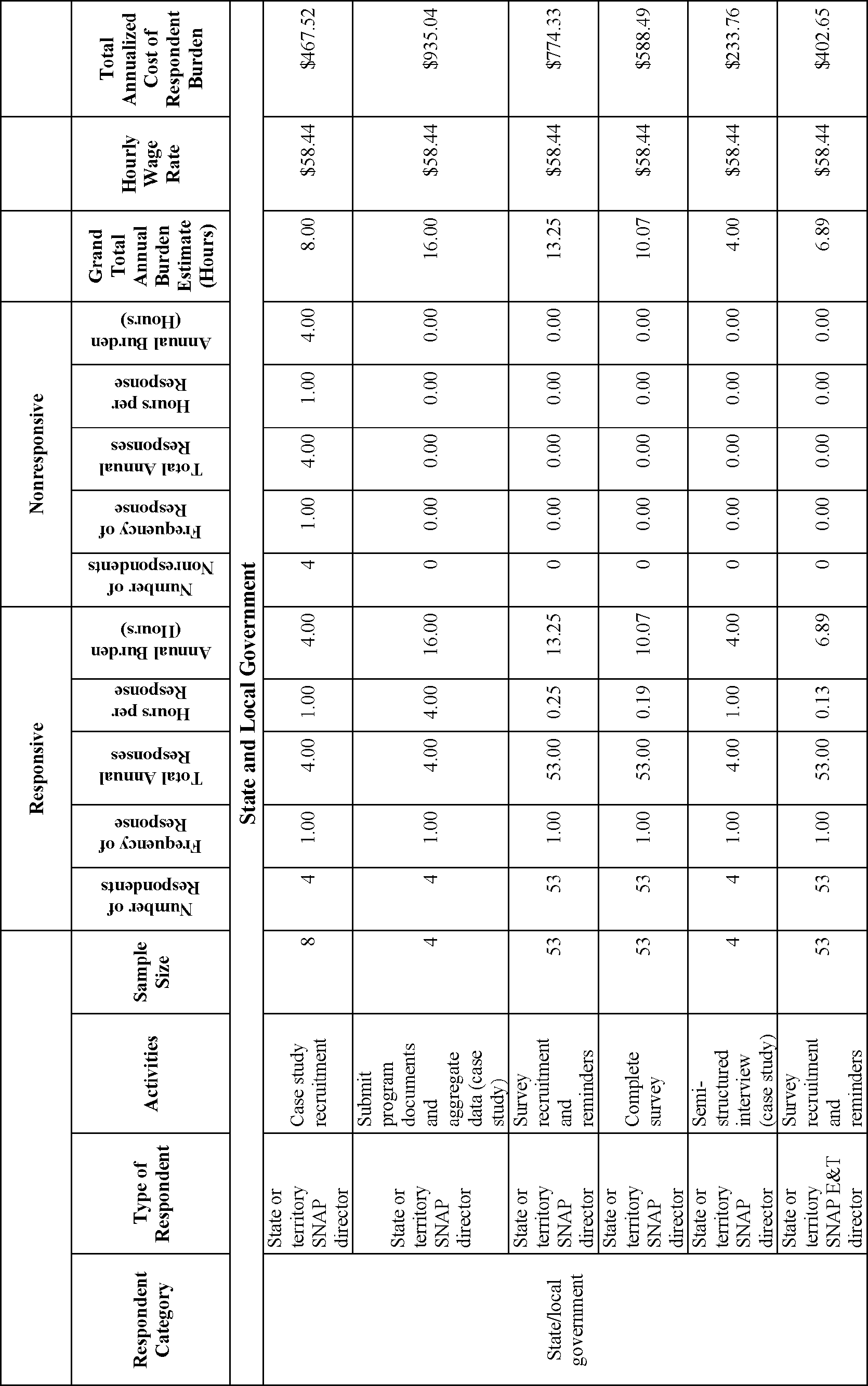
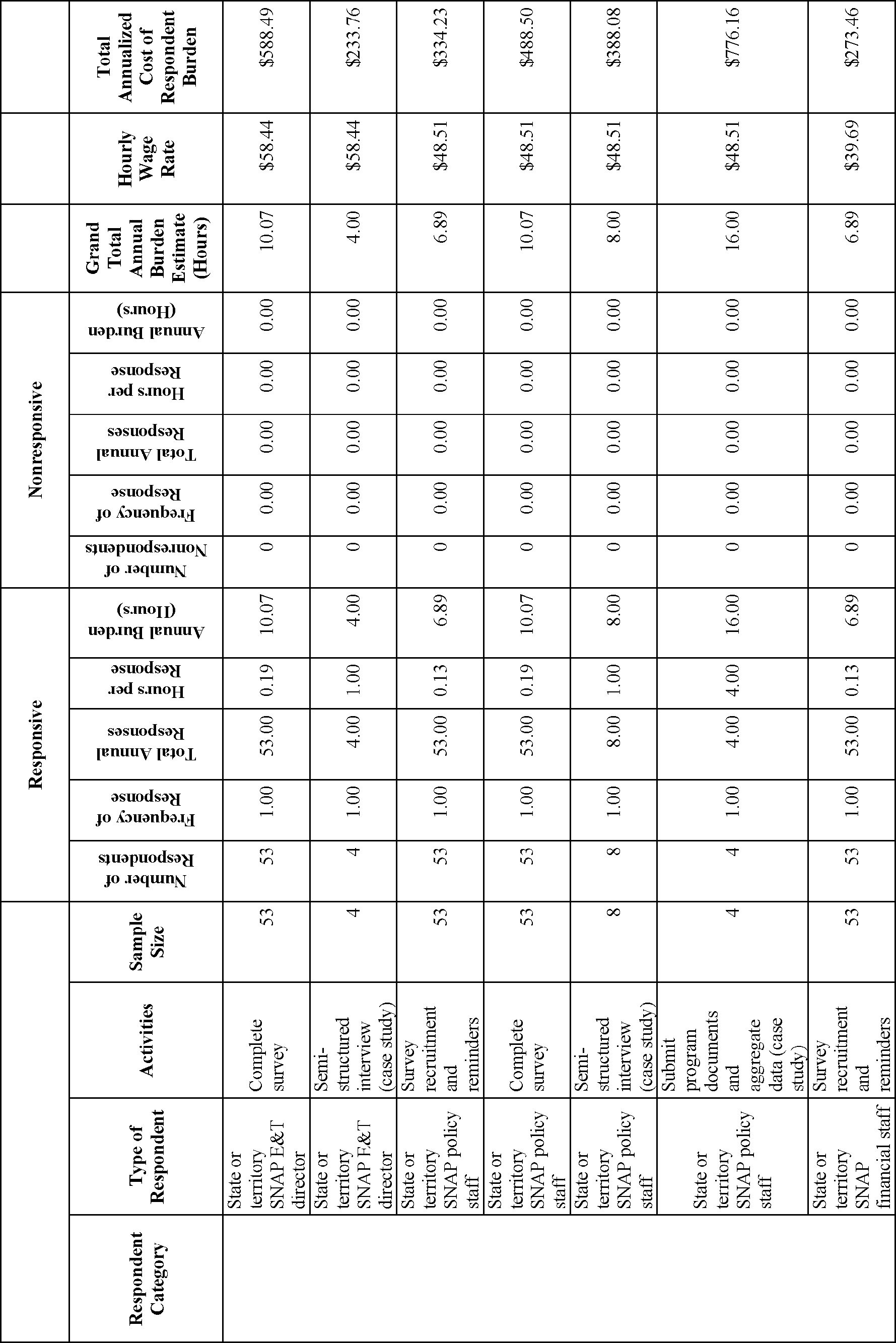
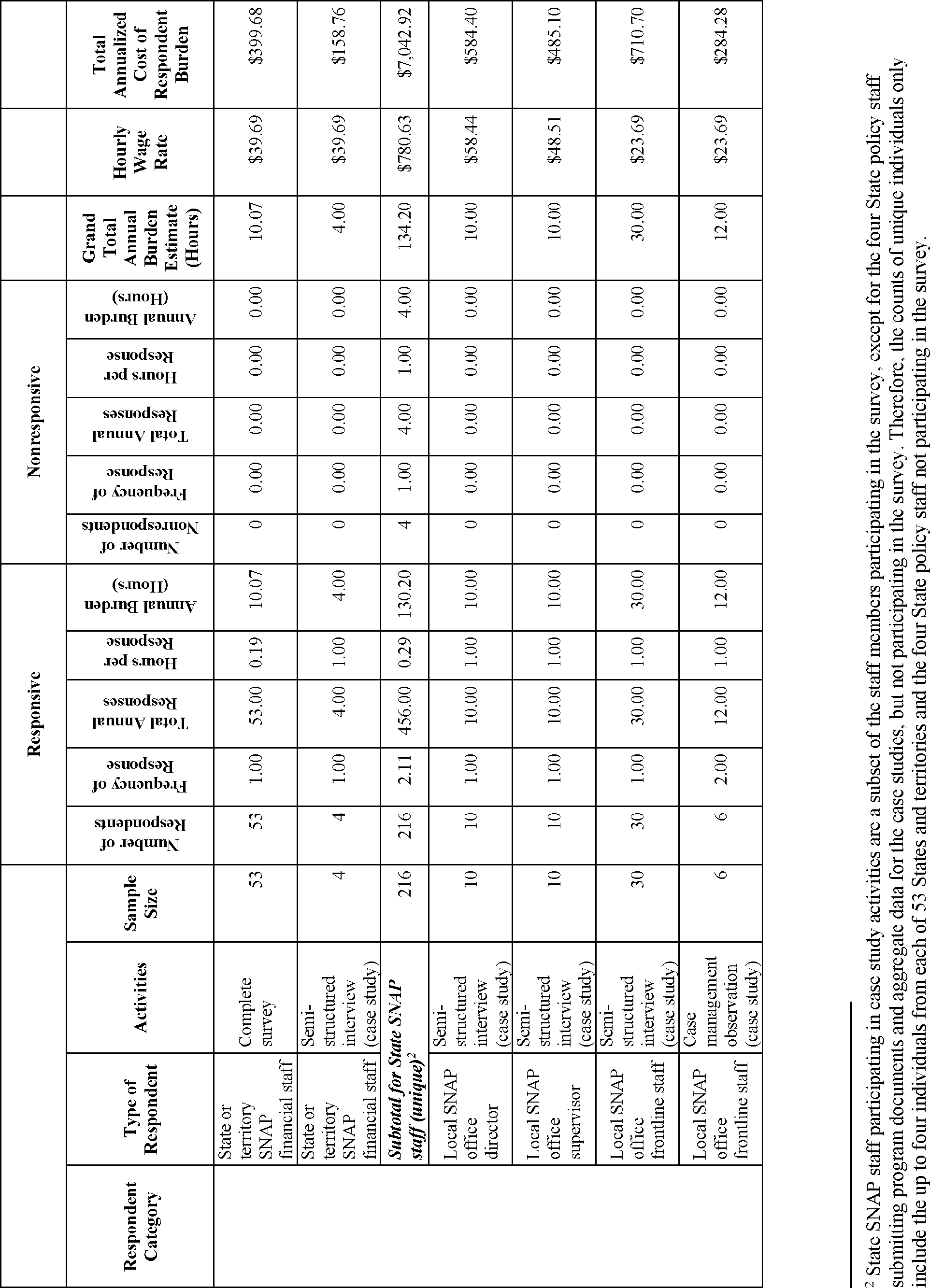
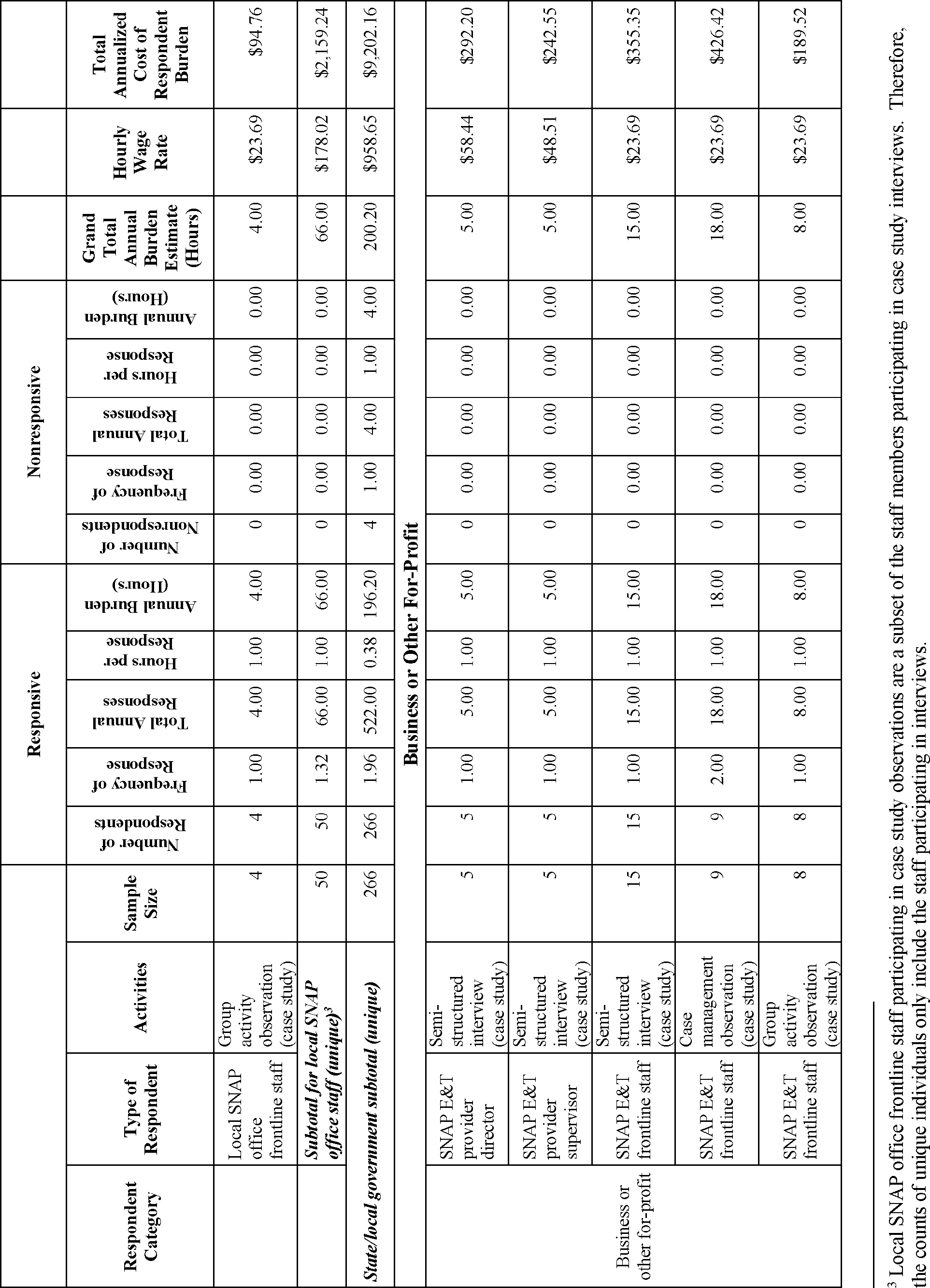
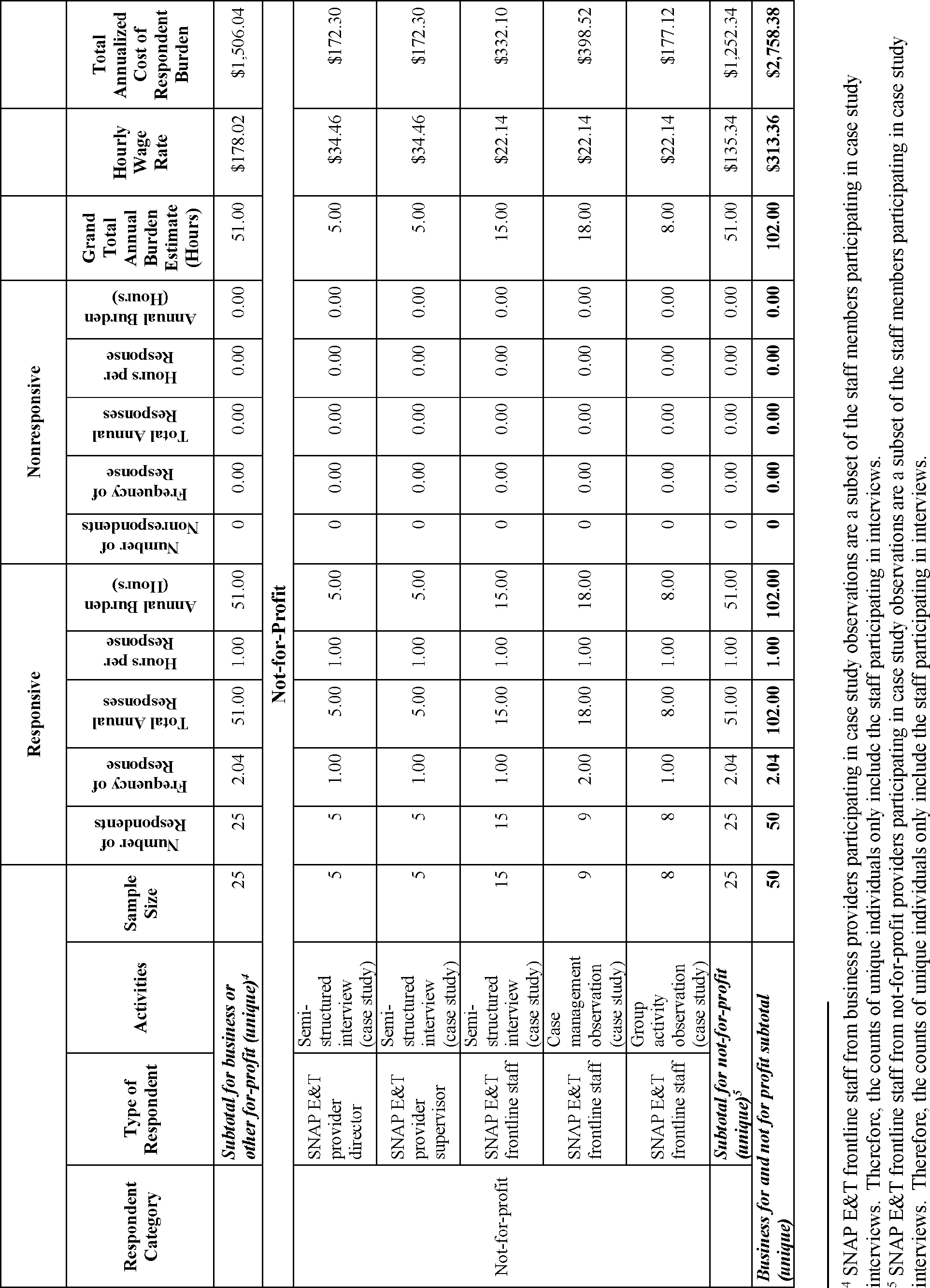
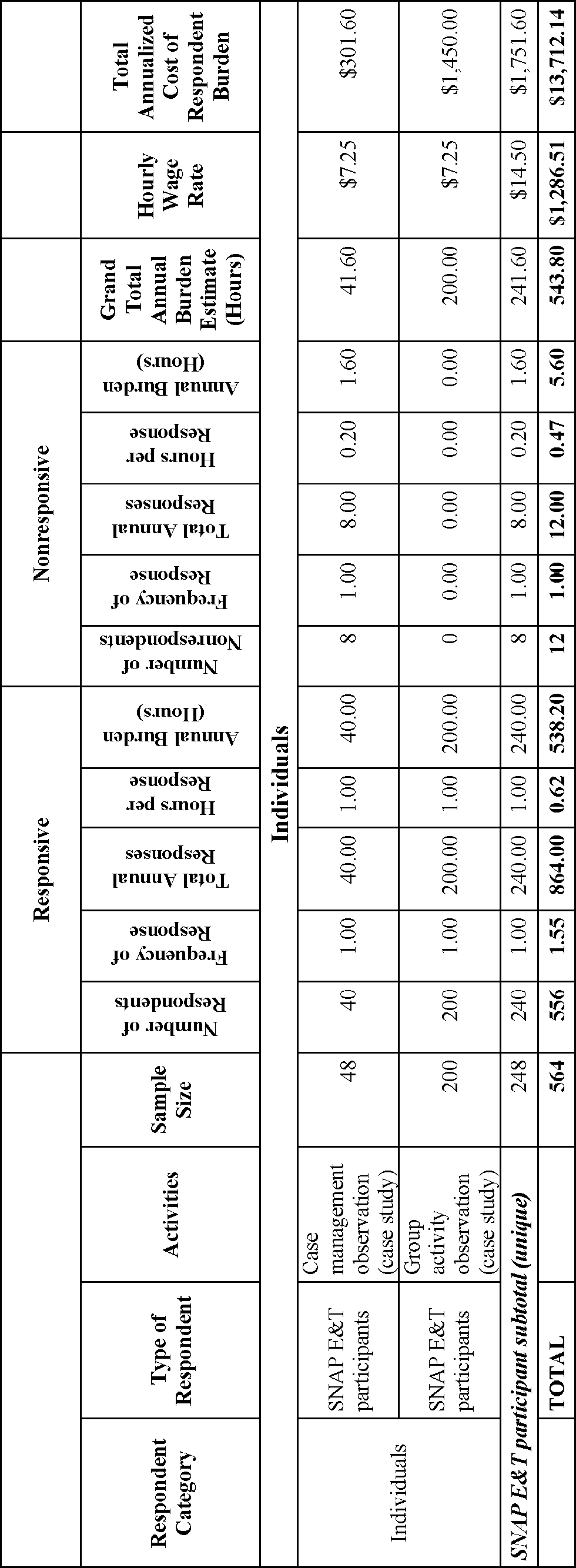
The estimated time of response varies from 0.13 to 1.00 hours (8 to 60 minutes) depending on respondent group and activity, as shown in the table below, with an average estimated time of 0.62 hours (37.4 minutes) for all responses. The average estimated time is calculated by dividing the 538.20 estimated total hours for responses in the table below by the 864 total estimated responses. The estimated average time for the non-respondent is 0.47 for all non-responses. The average estimated time is calculated by dividing the 5.60 estimated total hours for non-respondents in the table below by the 12 total estimated non-responses.
Estimated Total Annual Burden on Respondents:
543 hours. See the table below for estimated total annual burden for each type of respondent by data collection activity including the non-responses.
( printed page 40190)
( printed page 40191)
( printed page 40192)
( printed page 40193)
( printed page 40194)
( printed page 40195)
( printed page 40196)
Pamilyn Miller,
Administrator, Food and Nutrition Service.
Footnotes
1.
The table below counts a total of 216 State government respondents. This figure includes the 212 State government respondents, as well as four additional State government repondents that may participate in the case studies, but not the survey.
Use this for formal legal and research references to the published document.
85 FR 40187
Web Citation
Suggested Web Citation
Use this when citing the archival web version of the document.
“Agency Information Collection Activities: Survey of Supplemental Nutrition Assistance Program (SNAP) Employment and Training (E&T) Case Management,” thefederalregister.org (July 6, 2020), https://thefederalregister.org/documents/2020-14445/agency-information-collection-activities-survey-of-supplemental-nutrition-assistance-program-snap-employment-and-trainin.