The Department of the Treasury's Office of Foreign Assets Control (OFAC) is issuing this final rule to adjust certain civil monetary penalties for inflation pursuant to the Fede...
The Department of the Treasury's Office of Foreign Assets Control (OFAC) is issuing this final rule to adjust certain civil monetary penalties for inflation pursuant to the Federal Civil Penalties Inflation Adjustment Act of 1990, as amended by the Federal Civil Penalties Inflation Adjustment Act Improvements Act of 2015.
DATES:
This rule is effective February 9, 2022.
FOR FURTHER INFORMATION CONTACT:
OFAC: Assistant Director for Licensing, 202-622-2480; Assistant Director for Regulatory Affairs, 202-622-4855; Assistant Director for Sanctions Compliance & Evaluation, 202-622-2490.
SUPPLEMENTARY INFORMATION:
Electronic Availability
This document and additional information concerning OFAC are available from OFAC's website:
www.treasury.gov/ofac.
Background
Section 4 of the Federal Civil Penalties Inflation Adjustment Act (1990 Pub. L. 101-410, 104 Stat. 890; 28 U.S.C. 2461 note), as amended by the Federal Civil Penalties Inflation Adjustment Act Improvements Act of 2015 (Pub. L. 114-74, 129 Stat. 599, 28 U.S.C. 2461 note) (the FCPIA Act), requires each federal agency with statutory authority to assess civil monetary penalties (CMPs) to adjust CMPs annually for inflation according to a formula described in section 5 of the FCPIA Act. One purpose of the FCPIA Act is to ensure that CMPs continue to maintain their deterrent effect through periodic cost-of-living based adjustments.
OFAC has adjusted its CMPs seven times since the Federal Civil Penalties Inflation Adjustment Act Improvements Act went into effect on November 2, 2015: An initial catch-up adjustment on August 1, 2016 (81 FR 43070, July 1, 2016); an additional initial catch-up adjustment related to CMPs for failure to comply with a requirement to furnish information, the late filing of a required report, and failure to maintain records (“recordkeeping CMPs”) that were inadvertently omitted from the August 1, 2016 initial catch-up adjustment on October 5, 2020 (85 FR 54911, September 3, 2020); and annual adjustments on February 10, 2017 (82 FR 10434, February 10, 2017); March 19, 2018 (83 FR 11876, March 19, 2018); June 14, 2019 (84 FR 27714, June 14, 2019); April 9, 2020 (85 FR 19884, April 9, 2020); and March 17, 2021 (86 FR 14534, March 17, 2021).
Method of Calculation
The method of calculating CMP adjustments applied in this final rule is required by the FCPIA Act. Under the FCPIA Act and the Office of Management and Budget guidance required by the FCPIA Act, annual inflation adjustments subsequent to the initial catch-up adjustment are to be based on the percent change between the Consumer Price Index for all Urban Consumers (“CPI-U”) for the October preceding the date of the adjustment and the prior year's October CPI-U. As set forth in Office of Management and Budget Memorandum M-22-07 of December 15, 2021, the adjustment multiplier for 2022 is 1.06222. In order to complete the 2022 annual adjustment, each current CMP is multiplied by the 2022 adjustment multiplier. Under the FCPIA Act, any increase in CMP must be rounded to the nearest multiple of $1.
New Penalty Amounts
OFAC imposes CMPs pursuant to the penalty authority in five statutes: The Trading With the Enemy Act (50 U.S.C. 4301-4341, at 4315) (TWEA); the International Emergency Economic Powers Act (50 U.S.C. 1701-1706, at 1705) (IEEPA); the Antiterrorism and Effective Death Penalty Act of 1996 (18 U.S.C. 2339B) (AEDPA); the Foreign Narcotics Kingpin Designation Act (21 U.S.C. 1901-1908, at 1906) (FNKDA); and the Clean Diamond Trade Act (19 U.S.C. 3901-3913, at 3907) (CDTA).
The table below summarizes the existing and new maximum CMP amounts for each statute.
Table 1—Maximum CMP Amounts for Relevant Statutes
Statute
Existing maximum CMP amount
Maximum CMP amount effective February 9, 2022
TWEA
$91,816
$97,529
IEEPA
311,562
330,947
AEDPA
82,244
87,361
FNKDA
1,548,075
1,644,396
CDTA
14,074
14,950
( printed page 7370)
In addition to updating these maximum CMP amounts, OFAC is also updating two references to one-half the IEEPA maximum CMP from $155,781 to $165,474, and is adjusting the recordkeeping CMP amounts found in OFAC's Economic Sanctions Enforcement Guidelines in appendix A to 31 CFR part 501. The table below summarizes the existing and new maximum CMP amounts for OFAC's recordkeeping CMPs.
Table 2—Maximum CMP Amounts for Recordkeeping CMPs
Violation
Existing maximum CMP amount
Maximum CMP amount effective February 9, 2022
Failure to furnish information pursuant to 31 CFR 501.602 irrespective of whether any other violation is alleged
$24,046
$25,542
Failure to furnish information pursuant to 31 CFR 501.602 where OFAC has reason to believe that the apparent violation(s) involves a transaction(s) valued at greater than $500,000, irrespective of whether any other violation is alleged
60,115
63,855
Late filing of a required report, whether set forth in regulations or in a specific license, if filed within the first 30 days after the report is due
3,005
3,192
Late filing of a required report, whether set forth in regulations or in a specific license, if filed more than 30 days after the report is due
6,012
6,386
Late filing of a required report, whether set forth in regulations or in a specific license, if the report relates to blocked assets, an additional CMP for every 30 days that the report is overdue, up to five years
1,203
1,278
Failure to maintain records in conformance with the requirements of OFAC's regulations or of a specific license
60,226
63,973
Finally, OFAC is making changes in the authorities citations of 31 CFR parts 583 and 584, to more specifically reference one of the relevant statutory authorities in each citation.
Public Participation
The FCPIA Act expressly exempts this final rule from the notice and comment requirements of the Administrative Procedure Act by directing agencies to adjust CMPs for inflation “notwithstanding section 553 of title 5, United States Code” (Pub. L. 114-74, 129 Stat. 599; 28 U.S.C. 2461 note). As such, this final rule is being issued without prior public notice or opportunity for public comment, with an effective date of February 9, 2022.
Paperwork Reduction Act
The Paperwork Reduction Act does not apply because this rule does not impose information collection requirements that would require the approval of the Office of Management and Budget under 44 U.S.C. 3501et seq.
2. In § 501.701, in paragraph (a)(3), remove “$91,816” and add in its place “$97,529”.
3. Amend appendix A to part 501 as follows:
a. In paragraph IV.A., remove “$24,046” and add in its place “$25,542” and remove “$60,115” and add in in its place “$63,855”.
b. In paragraph IV.B., remove “$3,005” and add in its place “$3,192”, remove “$6,012” and add in its place “$6,386”, and remove “$1,203” and add in its place “$1,278”.
c. In paragraph IV.C., remove “$60,226” and add in its place “$63,973”.
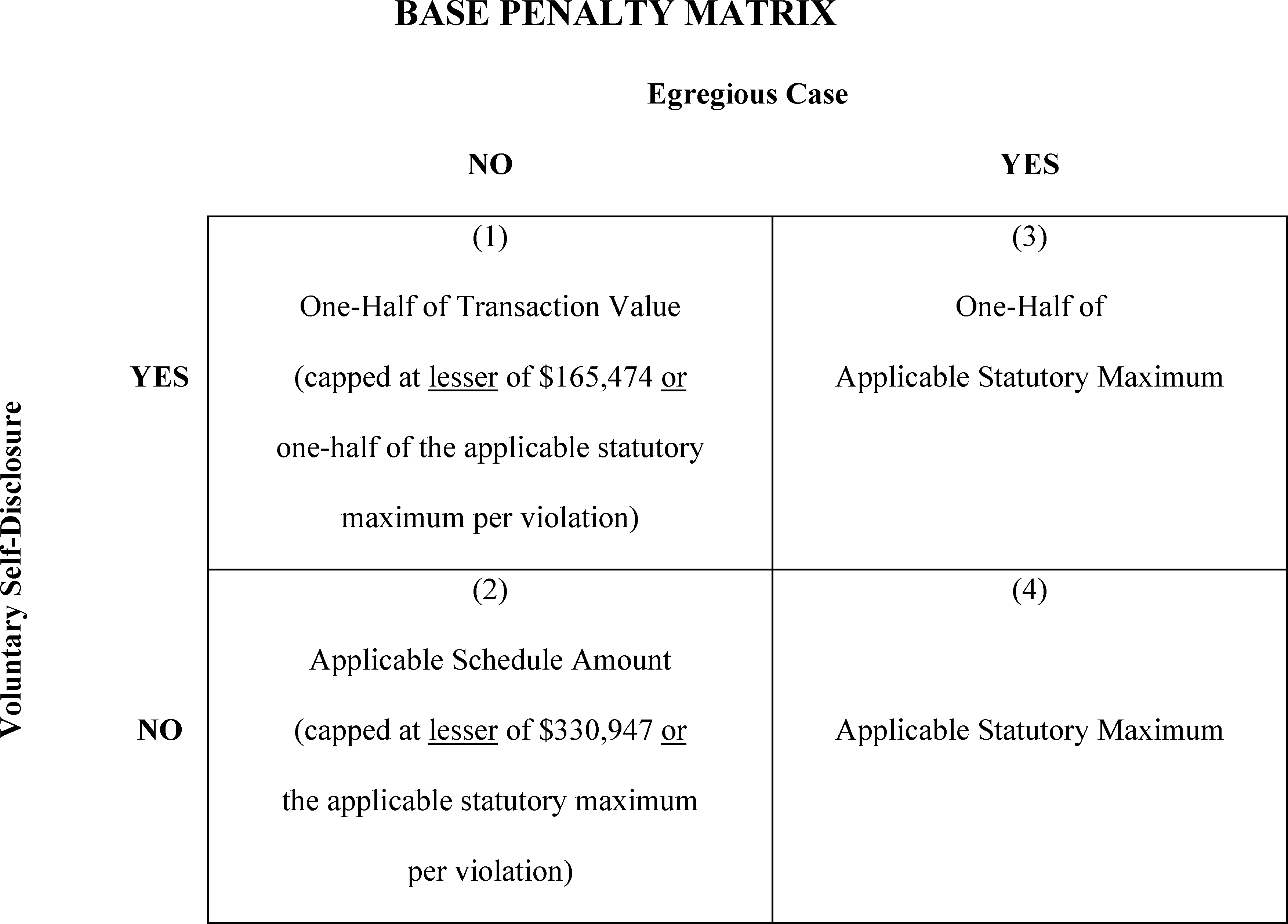
d. In paragraph V.B.2.a.i., remove “$155,781” and add in its place “$165,474” and remove “$311,562” and add in its place “$330,947”.
e. In paragraph V.B.2.a.ii., remove “$311,562” wherever it appears and add in its place “$330,947”.
f. In paragraph V.B.2.a.v., remove “$311,562” and add in its place “$330,947”, remove “$91,816” and add in its place “$97,529”, remove “$1,548,075” and add in its place “$1,644,396”, remove “$82,244” and add in its place “$87,361”, and remove “$14,074” and add in its place “$14,950”.
g. Revise paragraph V.B.2.a.vi.
The revision reads as follows:
Appendix A to Part 501—Economic Sanctions Enforcement Guidelines.
* * * * *
V. * * *
B. * * *
2. * * *
a. * * *
vi. The following matrix represents the base amount of the proposed civil penalty for each category of violation:
( printed page 7371)
* * * * *
PART 510—NORTH KOREA SANCTIONS REGULATIONS
4. The authority citation for part 510 continues to read as follows: