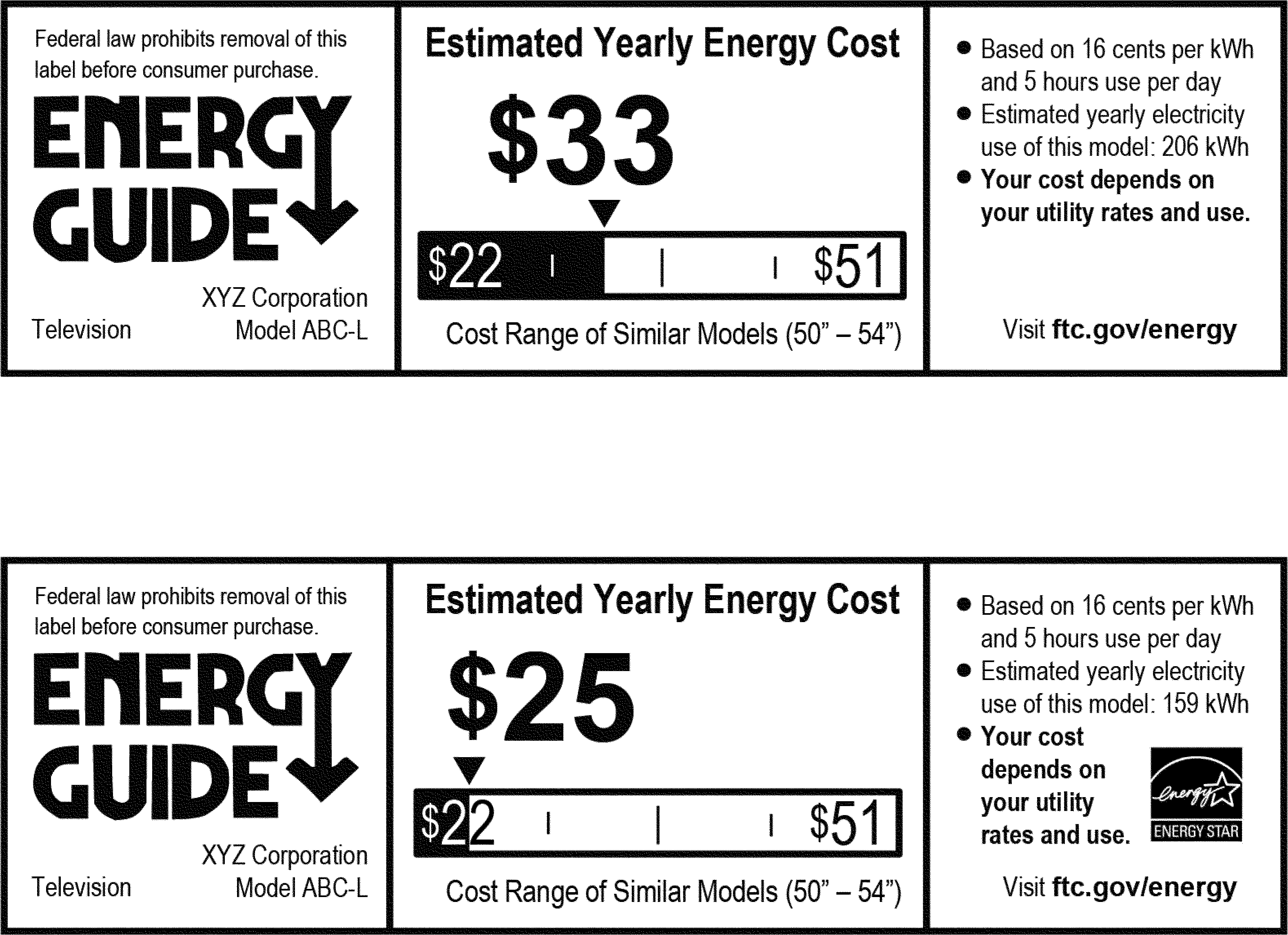
The Federal Trade Commission ("Commission") amends its Energy Labeling Rule ("Rule") by publishing new ranges of comparability for required EnergyGuide labels on televisions.
The Federal Trade Commission (“Commission”) amends its Energy Labeling Rule (“Rule”) by publishing new ranges of comparability for required EnergyGuide labels on televisions.
DATES:
The amendments are effective May 2, 2024.
ADDRESSES:
Relevant portions of the record of this proceeding, including this document, are available at
https://www.ftc.gov.
FOR FURTHER INFORMATION CONTACT:
Hampton Newsome, (202) 326-2889, or Hong Park, (202) 326-2158, Attorneys, Division of Enforcement, Bureau of Consumer Protection, Federal Trade Commission, Room CC-6316, 600 Pennsylvania Avenue NW, Washington, DC 20580.
SUPPLEMENTARY INFORMATION:
I. Background
The Commission issued the Energy Labeling Rule in 1979 pursuant to the Energy Policy and Conservation Act of
( printed page 7268)
1975 (“EPCA”).[1]
The Rule covers several categories of major household products, including televisions. It requires manufacturers of covered products to disclose specific energy consumption or efficiency information (derived from Department of Energy (“DOE”) test procedures) at the point of sale. In addition, each label must include a “range of comparability” indicating the highest and lowest energy consumption or efficiencies for comparable models. The Commission updates these ranges periodically.
II. Range Updates for Televisions
The Commission amends its television ranges in 16 CFR 305.25(f)(5) based on test data generated from DOE's revised test procedure. In a rule document published in October 2022 issuing range updates for other covered products, the Commission postponed television range updates until DOE finalized a new test procedure for those products.[2]
The document stated the FTC would publish updated ranges after data derived from the upcoming test procedure became available. DOE has issued a final test update, and new data is now available.[3]
Accordingly, this publication contains the updates to the television ranges, along with related sample labels. In addition, these amendments update the cost figure on the television label to 16 cents per kWh based on the most recent national electricity cost information published by DOE.[4]
Manufacturers should begin using the new ranges on labels for newly-produced units no later than May 2, 2024.
III. Regulatory Flexibility Act
The provisions of the Regulatory Flexibility Act relating to a Regulatory Flexibility Act analysis [5]
are not applicable to this proceeding because the amendments do not impose any new obligations on entities regulated by the Energy Labeling Rule. These technical amendments merely provide a routine change to the range and cost information already required on EnergyGuide labels. The Commission has concluded, therefore, that a regulatory flexibility analysis is not necessary, and certifies, under Section 605 of the Regulatory Flexibility Act, that the amendments announced today will not have a significant economic impact on a substantial number of small entities.[6]
IV. Paperwork Reduction Act
The current Rule contains recordkeeping, disclosure, testing, and reporting requirements that constitute information collection requirements as defined by 5 CFR 1320.3(c), the definitional provision within the Office of Management and Budget (“OMB”) regulations that implement the Paperwork Reduction Act (“PRA”). OMB has approved the Rule's existing information collection requirements through February 29, 2024 (OMB Control No. 3084-0069). The amendments now being adopted do not change the substance or frequency of the recordkeeping, disclosure, or reporting requirements and, therefore, do not require further OMB clearance.
V. Other Matters
Pursuant to the Congressional Review Act (5 U.S.C. 801et seq.), the OMB's Office of Information and Regulatory Affairs designated this rule as not a “major rule,” as defined by 5 U.S.C. 804(2).
(4) Estimated annual energy costs determined in accordance with this part, and based on a usage rate of 5 hours in on mode and 19 hours in standby (sleep) mode per day, and an electricity cost rate of 16 cents per kWh.
(5) The applicable ranges of comparability for estimated annual energy costs based on the labeled product's diagonal screen size, according to the following table:
Table 1 to Paragraph (
f
)(5)
Screen size
(diagonal)
Annual energy cost ranges for
televisions
Low
High
16-20″ (16.0 to 20.49″)
$7
$7
21-23″ (20.5 to 23.49″)
(*)
(*)
24-29″ (23.5 to 29.49″)
5
15
30-34″ (29.5 to 34.49″)
8
30
35-39″ (34.5 to 39.49″)
19
20
40-44″ (39.5 to 44.49″)
13
51
45-49″ (44.5 to 49.49″)
40
40
50-54″ (49.5 to 54.49″)
22
51
55-59″ (54.5 to 59.49″)
24
69
60-64″ (59.5 to 64.49″)
29
113
65-69″ (64.5 to 69.49″)
27
110
69.5″ or greater
32
155
* No data.
( printed page 7269)
* * * * *
3. In § 305.27, revise paragraph (b)(1)(i)(F) to read as follows:
(F)
Televisions.
The estimated annual operating cost determined in accordance with this part, and a disclosure stating “Your energy cost depends on your utility rates and use. The estimated cost is based on 16 cents per kWh and 5 hours of use per day. For more information, visit
www.ftc.gov/energy.”
* * * * *
4. Revise Prototype Labels 8, 9, and 10 and Sample Labels 14, 15, and 16 in Appendix L to read as follows:
Appendix L to Part 305—Sample Labels
* * * * *
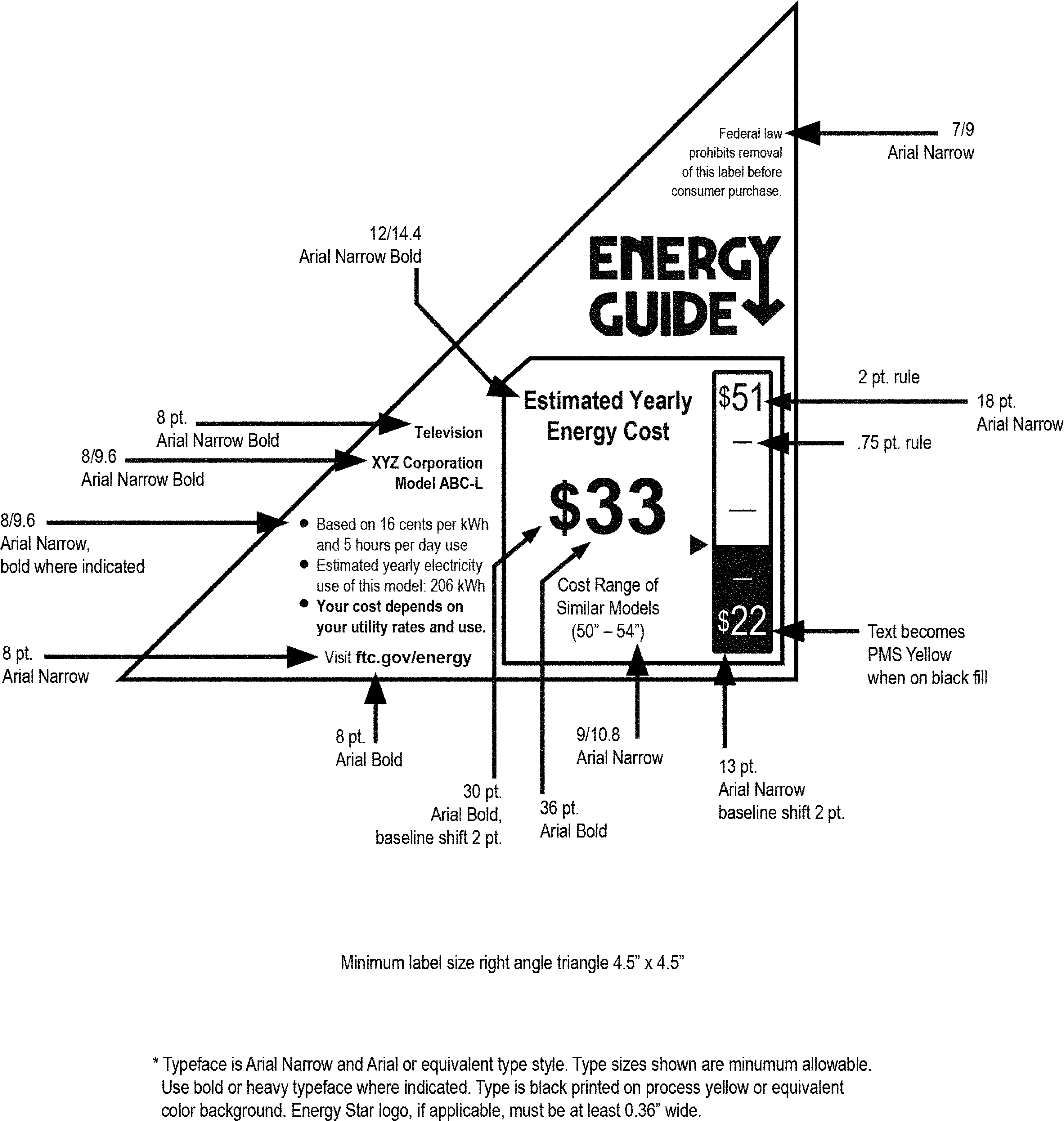
Prototype Label 8, Triangular Television Label
( printed page 7270)
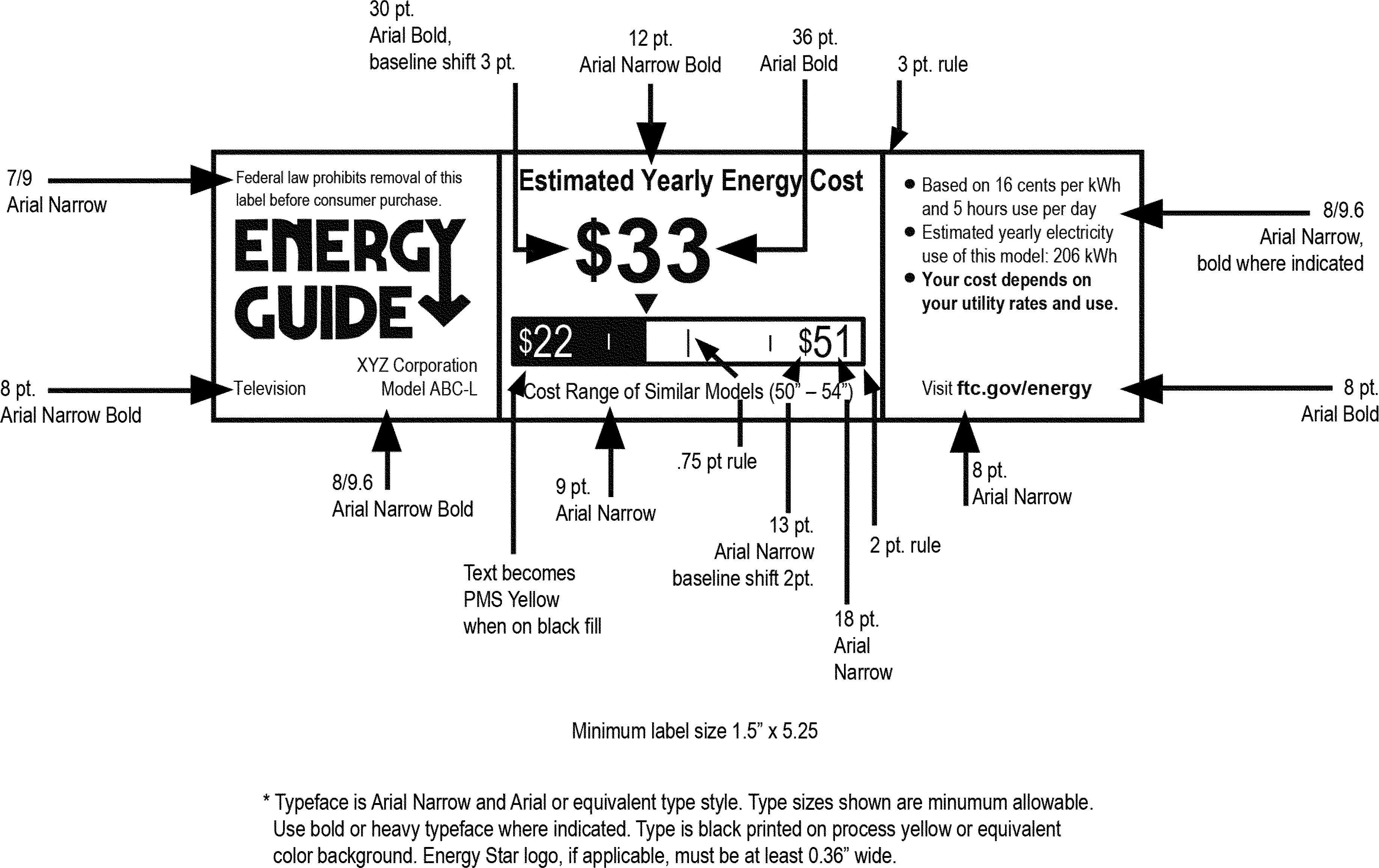
Prototype Label 9, Horizontal Rectangular Television Label
( printed page 7271)
Prototype Label 10, Vertical Rectangular Television Label
* * * * *
( printed page 7272)
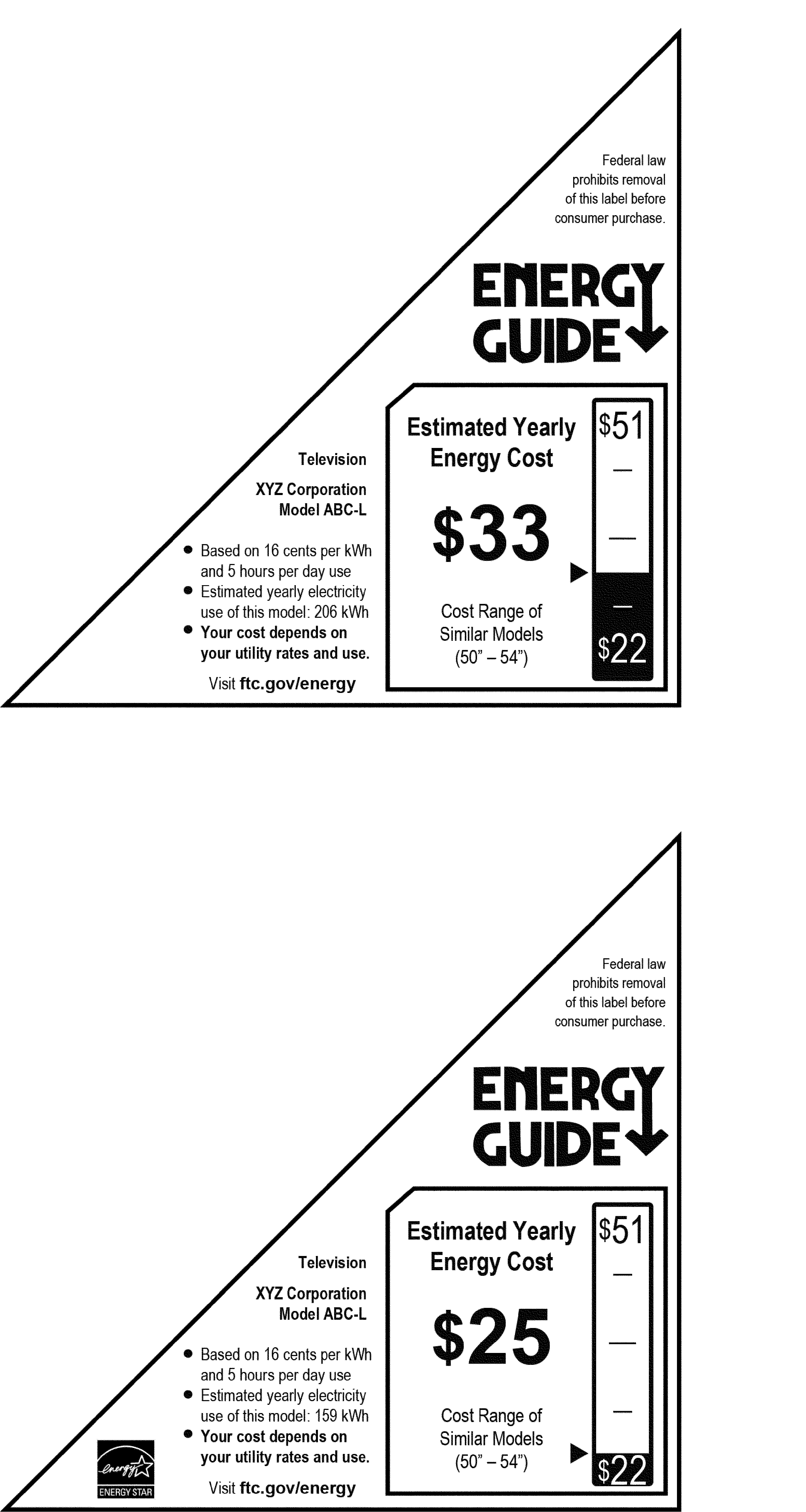
Sample Label 14, Triangular Television Labels
( printed page 7273)
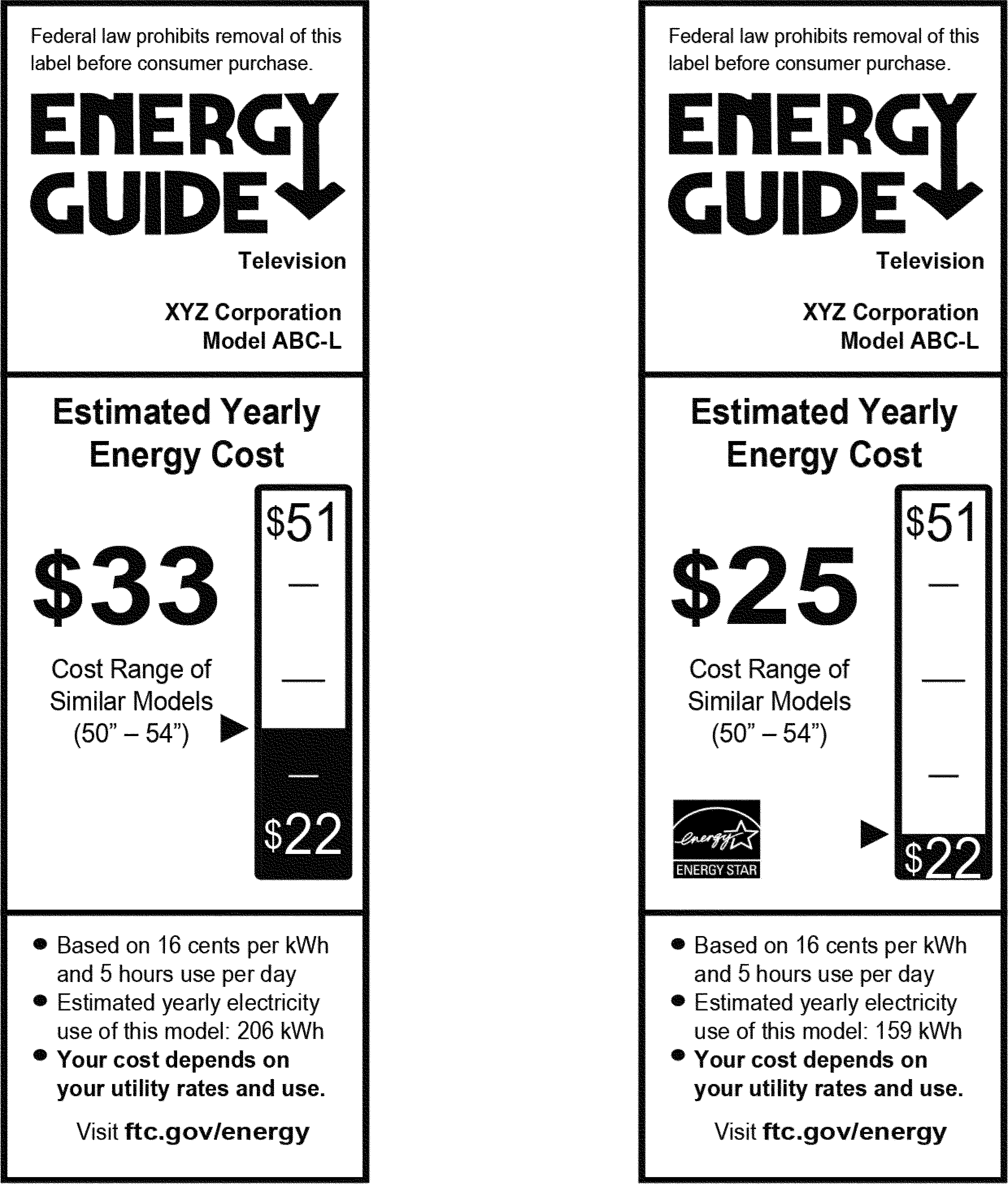
Sample Label 15, Vertical Television Labels
( printed page 7274)
Sample Label 16, Horizontal Television Labels
* * * * *
By direction of the Commission.
April J. Tabor,
Secretary.
Footnotes
1.
42 U.S.C. 6294; 44 FR 66466 (Nov. 19, 1979). EPCA also requires the Department of Energy (“DOE”) to set minimum efficiency standards and develop test procedures to measure energy use.