2024 Guidance Update on Patent Subject Matter Eligibility, Including on Artificial Intelligence
In accordance with Executive Order 14110 on the "Safe, Secure, and Trustworthy Development and Use of Artificial Intelligence" (October 30, 2023) (Executive Order), the United S...
Patent and Trademark Office, Department of Commerce.
ACTION:
Examination guidance.
SUMMARY:
In accordance with Executive Order 14110 on the “Safe, Secure, and Trustworthy Development and Use of Artificial Intelligence” (October 30, 2023) (Executive Order), the United States Patent and Trademark Office (USPTO) is issuing a guidance update on patent subject matter eligibility to address innovation in critical and emerging technologies (ET), especially artificial intelligence (AI). This guidance update will assist USPTO personnel and stakeholders in evaluating the subject matter eligibility of claims in patent applications and patents involving inventions related to AI technology (AI inventions). This update also announces a new set of examples that are intended to assist USPTO personnel in applying the USPTO's subject matter eligibility guidance to AI inventions during patent examination, appeal, and post-grant proceedings. In addition to addressing issues especially relevant to AI inventions, this guidance update addresses feedback from our stakeholders and includes discussions of recent Federal Circuit decisions on patent subject matter eligibility. This guidance update, together with the guidance provided in the Manual of Patent Examining Procedure (MPEP), is to be used by USPTO personnel when applying subject matter eligibility law.
DATES:
Applicability date:
This guidance is effective on July 17, 2024.
Comment deadline date:
Written comments must be received on or before September 16, 2024.
ADDRESSES:
Comments must be submitted through the Federal eRulemaking Portal at
www.regulations.gov.
To submit comments via the portal, enter docket number PTO-P-2024-0026 on the homepage and select “Search.” The site will provide a search results page listing all documents associated with this docket. Find a reference to this document and select the “Comment” icon, complete the required fields, and enter or attach your comments. Attachments to electronic comments will be accepted in Adobe® portable document format (PDF) or Microsoft Word® format. Because comments will be made available for public inspection, information that the submitter does not desire to make public, such as an address or phone number, should not be included in the comments.
Visit the Federal eRulemaking Portal for additional instructions on providing comments via the portal. If electronic submission of comments is not feasible due to a lack of access to a computer and/or the internet, please contact the USPTO using the contact information below for special instructions.
FOR FURTHER INFORMATION CONTACT:
Carolyn Kosowski, Senior Legal
( printed page 58129)
Advisor, at 571-272-7688; Nalini Mummalaneni, Senior Legal Advisor, at 571-270-1647; or Matthew Sked, Senior Legal Advisor, at 571-272-7627, all with the Office of Patent Legal Administration, Office of the Deputy Commissioner for Patents.
SUPPLEMENTARY INFORMATION:
I. Background
Recognizing that “[r]esponsible AI use has the potential to help solve urgent challenges while making our world more prosperous, productive, innovative, and secure,” President Biden issued Executive Order 14110.[1]
As its guiding principle, the Executive Order explains that:
Promoting responsible innovation, competition, and collaboration will allow the United States to lead in AI and unlock the technology's potential to solve some of society's most difficult challenges. This effort requires investments in AI-related education, training, development, research, and capacity, while simultaneously tackling novel intellectual property (IP) questions and other problems to protect inventors and creators.
Section 5.2 (Promoting Innovation) of the Executive Order specifically provides that:
(c) To promote innovation and clarify issues related to AI and inventorship of patentable subject matter, the Under Secretary of Commerce for Intellectual Property and Director of the United States Patent and Trademark Office (USPTO Director) shall:
* * * * *
(ii) subsequently, within 270 days of the date of this order, issue additional guidance to USPTO patent examiners and applicants to address other considerations at the intersection of AI and IP, which could include, as the USPTO Director deems necessary, updated guidance on patent eligibility to address innovation in AI and critical and emerging technologies.
In accordance with Executive Order 14110,[2]
the USPTO is issuing a guidance update on patent subject matter eligibility to address AI inventions. Pursuant to 35 U.S.C. 101, four categories of invention are appropriate subject matter for a patent: processes, machines, manufactures, and compositions of matter. On the other hand, the courts have found abstract ideas, laws of nature, and natural phenomena (including products of nature) to be outside of, or exceptions to, the appropriate subject matter for patents.[3]
This guidance update will assist USPTO personnel and stakeholders in evaluating the subject matter eligibility of claims in patent applications and patents involving AI inventions. This guidance update provides background on the USPTO's efforts related to AI and subject matter eligibility, an overview of the USPTO's existing patent subject matter eligibility guidance, and additional discussions of certain areas of the guidance that are particularly relevant to AI inventions.
In addition to addressing AI inventions, this guidance update addresses feedback from our stakeholders and provides further explanation of Step 2A of the USPTO's subject matter eligibility analysis, which asks whether a claim is directed to a judicial exception that the courts have found to be outside of, or exceptions to, the four statutory categories of invention.[4]
Step 2A of the USPTO's subject matter eligibility analysis is a two-pronged inquiry in which USPTO personnel evaluate: (1) whether a claim recites an abstract idea or other judicial exception (at Step 2A, Prong One); and (2) if so, whether the claim as a whole integrates the recited judicial exception into a practical application of the exception, and thus is not “directed to” the judicial exception (at Step 2A, Prong Two). This guidance update also addresses the subject matter eligibility of AI-assisted inventions, which are inventions created by natural persons using one or more AI systems. Finally, it announces a new set of examples that are intended to assist USPTO personnel in applying the USPTO's subject matter eligibility guidance to AI inventions during patent examination, appeal, and post-grant proceedings. This guidance update, together with the direction provided in the MPEP, is to be used by USPTO personnel when making determinations of subject matter eligibility.
A. The USPTO's AI/ET Efforts
In August 2019, the USPTO issued a request for comments on patenting AI inventions.[5]
Among the various policy questions raised in the notice, the USPTO requested comments on whether there are any patent eligibility considerations unique to AI inventions. In October 2020, the USPTO published a report titled “Public Views on Artificial Intelligence and Intellectual Property Policy,” which took a comprehensive look at the stakeholder feedback received in response to the questions posed in the August 2019 notice.[6]
According to the report, “[a] majority of commenters agreed that AI is viewed best as a subset of computer-implemented inventions. Therefore, this majority felt that current USPTO guidance, especially on patent subject matter eligibility and disclosure of computer-implemented inventions, is equipped to handle advances in AI.” [7]
However, some commenters were concerned that AI inventions are at risk under the subject matter eligibility analysis because they can be characterized as abstract ideas.[8]
In June 2022, the USPTO held its inaugural AI/ET Partnership meeting, which included a panel discussion on “Subject Matter Eligibility and the Impact of AI/ET Innovation.” [9]
Following the inaugural meeting, the USPTO held numerous events in 2022 and 2023, including an AI and Biotech event, an AI-Driven Innovation event, and an AI Tools and Data event. Also in 2023, the USPTO issued a request for comments seeking stakeholder input on the current state of AI technologies and inventorship issues that may arise in view of the advancement of such technologies, especially as AI plays a greater role in the innovation process.[10]
Additionally, in 2023 the USPTO held public listening sessions on inventorship for AI-assisted inventions at the USPTO headquarters and at Stanford University. Recently, the USPTO issued several Federal Register Notices on AI. For example, on February 13, 2024, the USPTO issued “Inventorship Guidance for AI-Assisted Inventions,” explaining the level of human contribution necessary for the USPTO to issue a patent on AI-assisted inventions.[11]
On April 11, 2024, the USPTO issued “Guidance on Use of Artificial Intelligence-Based Tools in Practice Before the United States Patent and Trademark Office,” informing practitioners and the public of the important issues that patent and trademark professionals, innovators,
( printed page 58130)
and entrepreneurs must navigate while using AI in matters before the USPTO.[12]
On April 30, 2024, the USPTO issued a “Request for Comments Regarding the Impact of the Proliferation of Artificial Intelligence on Prior Art, the Knowledge of a Person Having Ordinary Skill in the Art, and Determinations of Patentability Made in View of the Foregoing.” [13]
This notice built on the USPTO's recent AI-related efforts associated with Executive Order 14110,[14]
including the “Inventorship Guidance for AI-Assisted Inventions” [15]
published on February 13, 2024.
B. USPTO's Patent Subject Matter Eligibility Efforts
The USPTO's ongoing efforts include monitoring subject matter eligibility developments in the courts, soliciting input from stakeholders, and issuing examination guidance to assist USPTO personnel and stakeholders. In 2019, the USPTO published two eligibility guidance documents: the “2019 Revised Patent Subject Matter Eligibility Guidance” (2019 PEG) [16]
and the “October 2019 Patent Eligibility Guidance Update” (October 2019 Update).[17]
The 2019 PEG and the October 2019 Update revised USPTO procedures for identifying abstract ideas and for determining whether a claim in a patent application (or patent) is directed to a judicial exception (laws of nature, natural phenomena, and abstract ideas) under Step 2A of the USPTO's subject matter eligibility guidance.[18]
The 2019 PEG and the October 2019 Update were incorporated into the MPEP in the June 2020 publication of the 9th Edition, Rev. 10.2019. This guidance on subject matter eligibility continues to be available in sections 2103-2106.07 of the current MPEP (9th Edition, Rev. 07.2022), published in February 2023 and is the primary source for the USPTO's patent eligibility guidance.
As part of its continued efforts to bring clarity and consistency to the application of the subject matter eligibility analysis, the USPTO has also issued 46 examples providing analysis of various fact patterns to assist USPTO personnel and stakeholders in evaluating subject matter eligibility. The examples address a wide range of technologies, including AI, biotechnology, business methods, diagnostic and treatment methods, pharmaceutical treatments, precision medicine, and software.[19]
Following the issuance of the 2019 PEG and the October 2019 Update, the USPTO released a report titled “Adjusting to
Alice,
” which focuses on two USPTO patent examination outcomes and evaluates how these outcomes changed in response to the Supreme Court's decision in
Alice Corp.
v.
CLS Bank International
and the USPTO's guidance changes (
e.g.,
the 2019 PEG).[20]
The report discusses a study undertaken by the USPTO's Office of the Chief Economist in April 2020, which found that the 2019 revisions to the eligibility guidance resulted in a 25% decrease in the likelihood of
Alice
-affected technologies, including AI, receiving a first office action with a rejection for patent ineligible subject matter. The report also found that uncertainty about determinations of subject matter eligibility for the relevant technologies decreased by a remarkable 44% as compared to the previous year.
In June 2022, the USPTO published a report titled “Patent eligible subject matter: Public views on the current jurisprudence in the United States,” which summarized public views on how the current state of patent eligibility jurisprudence impacts investment and innovation in critical technologies, including AI.[21]
This report was requested by U.S. Senators Thom Tillis, Chris Coons, Mazie Hirono, and Tom Cotton, and summarized comments the USPTO received from a diverse group of stakeholders in response to a request for information the USPTO published in July 2021.[22]
According to the report, some commenters discussed how current subject matter eligibility jurisprudence impacts AI/ET and expressed “concerns that uncertainty and unpredictability in the law are undermining U.S. economic and innovative development.” [23]
In contrast, while “all commenters recognized the importance of fostering AI and quantum computing technologies, not all commenters held the view that stronger or more robust patent rights for these areas would achieve such results,” and some commenters even “advocated that AI innovations should be excluded from [subject matter] eligibility.” [24]
On July 25, 2022, the USPTO published a “Director's Blog” authored by Katherine K. Vidal, Under Secretary of Commerce for Intellectual Property and Director of the United States Patent and Trademark Office, titled “Providing clear guidance on patent subject matter eligibility.” The Director's Blog summarized the USPTO work on subject matter eligibility and emphasized that “there is more work to be done” to “achieve a more consistent examination under Section 101.” [25]
The blog invited the public to comment on the subject matter eligibility guidance in MPEP 2106. The USPTO extended the period to comment on the blog via a
Federal Register
Notice.[26]
As illustrated above, the USPTO has actively engaged with our stakeholders and has received extensive input from the public on subject matter eligibility and AI. In accordance with recent stakeholder feedback on the USPTO's subject matter eligibility guidance and the Executive Order 14110, and to continue its mission to drive U.S. innovation, inclusive capitalism, and global competitiveness as AI technology continues to advance and as judicial precedent evolves, the USPTO is providing a guidance update on determining subject matter eligibility for AI inventions to promote clarity, consistency, and address innovation in AI and critical and emerging technologies.
( printed page 58131)
C. Summary of Guidance Update and Impact on Examination Procedure and Prior Examination Guidance
Section II of this guidance update provides an overview of the USPTO's existing patent subject matter eligibility guidance. Section III provides an update on certain areas of the USPTO's subject matter eligibility guidance that are particularly relevant to AI inventions, including: (1) whether a claim recites an abstract idea (at Step 2A, Prong One of the USPTO's subject matter eligibility analysis); and (2) whether a claim integrates a recited judicial exception into a practical application because the claimed invention improves the functioning of a computer or another technology or technical field (at Step 2A, Prong Two of the USPTO's subject matter eligibility analysis). Section IV of this guidance update addresses AI-assisted inventions. Section V announces Examples 47-49, which are intended to assist examiners in applying the USPTO's subject matter eligibility guidance to AI inventions during the patent examination process. The USPTO has also produced an updated index of examples that includes the new set of examples. A copy of the examples and the index are available on the USPTO's website (
www.uspto.gov/PatentEligibility).
While this guidance update is focused on AI inventions, portions of this guidance can apply to other types of inventions. This guidance is not intended to announce any new USPTO practice or procedure and is meant to be consistent with existing USPTO guidance. However, if any earlier guidance from the USPTO, including any section of the current MPEP, is inconsistent with the guidance set forth in this notice, USPTO personnel are to follow this guidance. This guidance update will be incorporated into the MPEP in due course.
This guidance does not constitute substantive rulemaking and does not have the force and effect of law. The guidance sets out agency policy with respect to the USPTO's interpretation of the subject matter eligibility requirement of 35 U.S.C. 101 in view of decisions by the Supreme Court and the United States Court of Appeals for the Federal Circuit (Federal Circuit). The guidance does not create any right or benefit, substantive or procedural, enforceable by any party against the USPTO. Rejections will continue to be based on the substantive law, and it is those rejections that are appealable to the Patent Trial and Appeal Board and the courts.
II. Overview of the USPTO's Patent Subject Matter Eligibility Guidance
The USPTO's subject matter eligibility guidance is found in MPEP sections 2103-2106.07(c) and is used to analyze claims across all technologies, including AI inventions, which are generally considered to be computer-implemented inventions. For context for the AI-related discussion that follows, this subsection summarizes some of the existing guidance in the MPEP for those readers unfamiliar with the existing subject matter eligibility guidance.
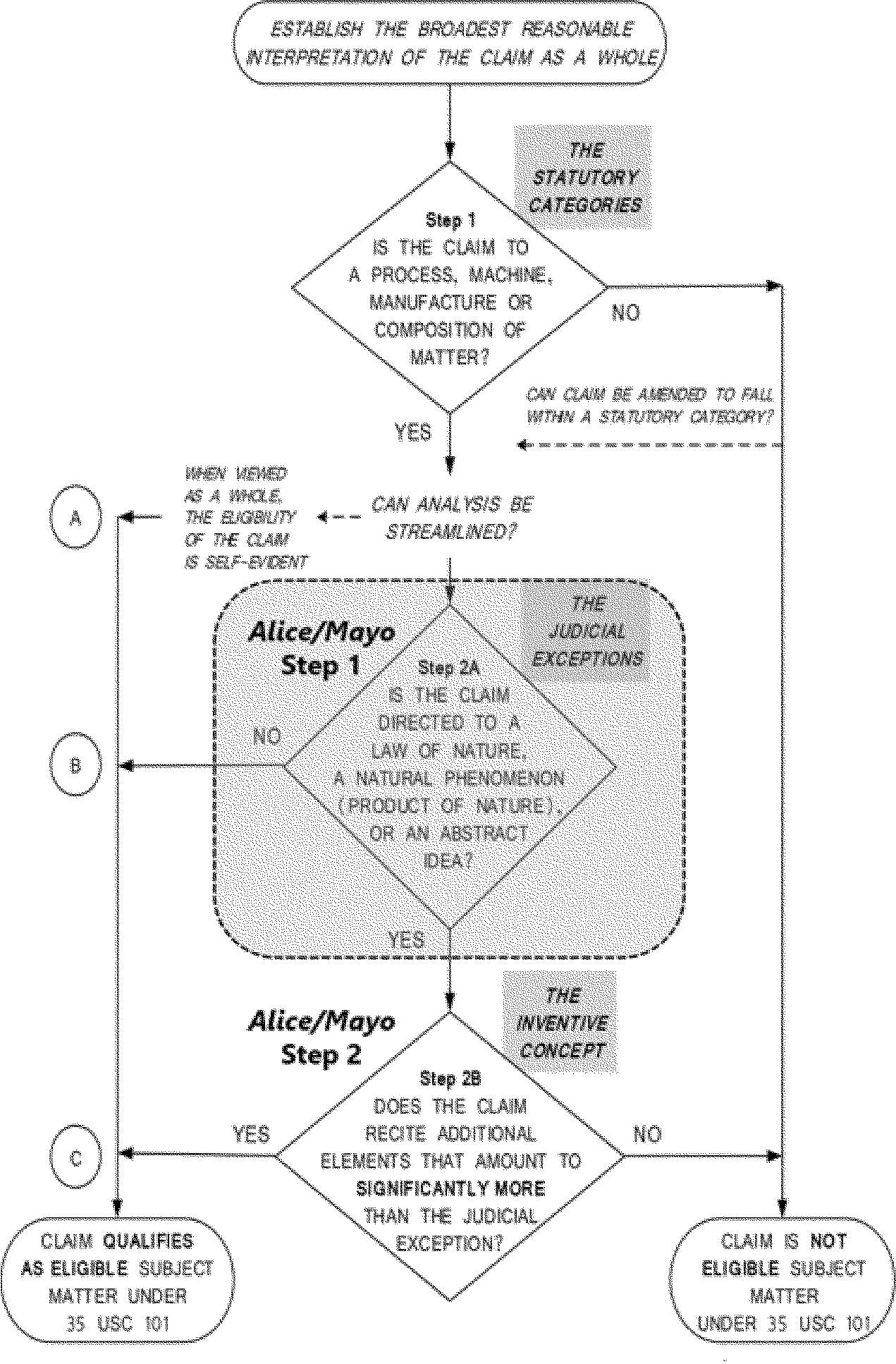
The guidance in the MPEP combines the criteria for eligibility into a single analysis, shown in the following flowchart, that applies to all categories of claims (
i.e.,
process, machine, manufacture, and composition of matter) and all types of judicial exceptions (
i.e.,
an abstract idea, law of nature, or natural phenomenon).[27]
( printed page 58132)
Step 1 of the USPTO's subject matter eligibility analysis addresses whether the claimed invention falls into at least one of the four categories recited in 35 U.S.C. 101.[28]
Step 2 of the USPTO's subject matter eligibility analysis applies the Supreme Court's two-part framework (
Alice/Mayo
Steps 1 and 2 in the above flowchart) to identify claims that are directed to a judicial exception and to then evaluate if additional elements of the claim provide an inventive concept.
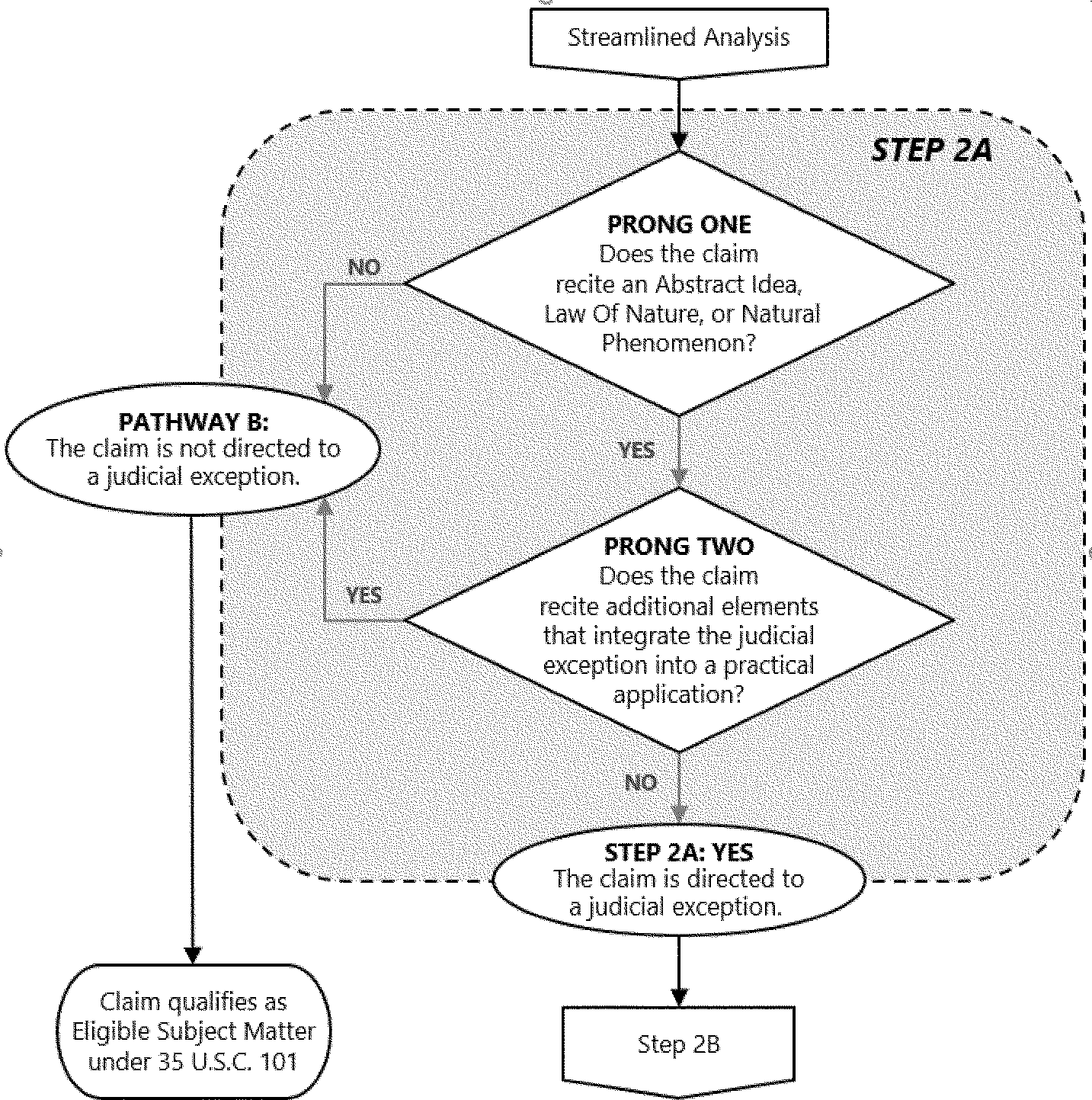
Step 2A [29]
is a two-pronged inquiry as shown in the flowchart below.[30]
( printed page 58133)
The first prong (Step 2A, Prong One) is a determination of whether a claim recites (
i.e.,
sets forth or describes) a judicial exception.[31]
As explained in MPEP 2106.04, subsection II.A.1, a claim “recites” a judicial exception when the judicial exception is “set forth” or “described” in the claim. If the claim does not recite a judicial exception, it is considered eligible, and the eligibility analysis ends. But if the claim does recite a judicial exception, the eligibility analysis continues to the second prong of Step 2A. This prong (Step 2A, Prong Two) is used to determine whether the claim integrates the recited judicial exception into a practical application of the exception (in which case the claim is eligible) or whether the claim is “directed to” the exception (in which case the claim requires further analysis at Step 2B). The Step 2A, Prong Two analysis requires an evaluation of the judicial considerations identified in MPEP 2106.04(d), subsection I; 2106.04(d)(1); 2106.04(d)(2); and 2106.05(a)-(c) and (e)-(h), such as whether the additional element(s) is(are) insignificant extra-solution activity; whether the additional element(s) is(are) mere instruction to apply an exception; or whether the claim reflects an improvement in the functioning of a computer, or an improvement to another technology or technical field.[32]
If the additional element(s) in the claim integrates the judicial exception into a practical application of the exception, the claim is not “directed to” the judicial exception, and the claim is eligible.[33]
If the claim is found to be directed to a judicial exception in Step 2A, the analysis continues to Step 2B [34]
to evaluate whether the claimed additional elements amount to significantly more than the recited judicial exception itself.[35]
Step 2A, Prong Two is similar to Step 2B in that both analyses involve evaluating a set of judicial considerations to determine if the claim is eligible.[36]
Although most of these judicial considerations overlap (
i.e.,
they are evaluated in both Step 2A, Prong Two and Step 2B), Step 2B includes a consideration of whether the additional element (or combination of elements) is a well-understood, routine, conventional activity.[37]
A claim may be found to lack significantly more (and thus be ineligible) based on one or more of these judicial considerations (
e.g.,
a conclusion that the additional limitation(s) is(are) insignificant extra-solution activity or mere instructions to apply an exception), in which case USPTO personnel will reject the claim under 35 U.S.C. 101 as lacking eligibility. If an eligibility rejection is based on a conclusion that an additional element or combination of elements is
( printed page 58134)
well-understood, routine, conventional activity in the field, the rejection should contain factual support for this conclusion, in accordance with MPEP sections 2106.05(d), subsection I and 2106.07(a).[38]
If USPTO personnel determine in Step 2B that the additional elements do amount to significantly more than the judicial exception, the claim is patent eligible. If the additional elements do not amount to significantly more, USPTO personnel will reject the claim under 35 U.S.C. 101 as lacking patent eligibility, and the applicant will be given a chance to respond, for example, by amending the claim or by making a showing of why the claim is patent eligible.[39]
Regardless of whether an eligibility rejection is made, the USPTO personnel will also evaluate the claim to determine whether it meets the other requirements for patentability, such as novelty and non-obviousness and the requirements under 35 U.S.C. 112.
III. Update on Certain Areas of the USPTO's Patent Subject Matter Eligibility Guidance Applicable to AI Inventions
While the
Alice/Mayo
test for analyzing subject matter eligibility has not changed, the MPEP has been updated to consolidate and incorporate all prior USPTO guidance and will continue to be updated as appropriate (
e.g.,
to include recent court decisions).[40]
Feedback from our stakeholders indicates that when considering the subject matter eligibility of AI inventions, there are certain areas of particular concern: (1) the evaluation of whether a claim recites an abstract idea in Step 2A, Prong One; and (2) the evaluation of the improvements consideration in Step 2A, Prong Two.
Therefore, this guidance update provides a discussion of how to evaluate whether a claim recites an abstract idea (
i.e.,
mathematical concepts, certain methods of organizing human activity, and mental processes) in Step 2A, Prong One based on the USPTO's current subject matter eligibility guidance. This inquiry can be challenging for AI inventions. This guidance update includes recent case law regarding mathematical concepts, certain methods of organizing human activity, and mental processes, which may be useful to USPTO personnel and stakeholders in evaluating Step 2A, Prong One. In addition, this guidance update provides further discussion of the evaluation of the improvements consideration in Step 2A, Prong Two based on the USPTO's current subject matter eligibility guidance. This discussion includes an explanation of how to demonstrate an improvement for AI inventions and recent case law that may be helpful in demonstrating such an improvement.
A. Evaluation of Whether a Claim Is Directed to a Judicial Exception (Step 2A)
Claims directed to nothing more than a judicial exception (
i.e.,
abstract ideas, natural phenomena, and laws of nature) are not eligible for patent protection.[41]
The Supreme Court has explained that the judicial exceptions reflect the Court's view that abstract ideas, laws of nature, and natural phenomena are “the basic tools of scientific and technological work,” and are thus excluded from patentability because “monopolization of those tools through the grant of a patent might tend to impede innovation more than it would tend to promote it.” [42]
Even if the judicial exception is narrow (
e.g.,
a particular mathematical formula or detailed mental process), the Court has held that a claim may not preempt that judicial exception.[43]
In applying subject matter eligibility law, the USPTO has developed the analysis discussed in section II above that uses a two-pronged inquiry to implement the first step of
Alice
(Step 2A of the USPTO's subject matter eligibly analysis). The first inquiry (Step 2A, Prong One, which asks whether a claim recites a judicial exception) is used to determine whether the claim is the type of claim that warrants further analysis under the law. There is no need to move to Step 2A, Prong Two if the claim does not recite a judicial exception in the first instance. Since all inventions “at some level embody, use, reflect, rest upon, or apply laws of nature, natural phenomena, or abstract ideas,” [44]
“an invention is not rendered ineligible for patent simply because it involves” a judicial exception.[45]
If the claim recites a judicial exception, that alone is not enough for the claim to be “directed to” the judicial exception. Under Step 2A, Prong Two, USPTO personnel must assess whether the claim as a whole integrates the judicial exception into a practical application of the exception, which is discussed below in section III.A.2.[46]
1. Evaluation of Whether a Claim Recites an Abstract Idea (Step 2A, Prong One)
While it is common for claims to AI inventions to involve abstract ideas, USPTO personnel must draw a distinction between a claim that “recites” an abstract idea (and thus requires further eligibility analysis) and one that merely involves, or is based on, an abstract idea.[47]
To assist in this evaluation, MPEP 2106.04(a)(1) provides non-limiting hypothetical examples of claims that do and do not recite an abstract idea. The USPTO has also issued examples that illustrate an analysis of claims that do and do not recite an abstract idea.[48]
This guidance update provides the following additional non-limiting hypothetical examples of claims that do not recite an abstract idea:
An application-specific integrated circuit (ASIC) for an artificial neural network, the ASIC comprising: a plurality of neurons organized in an array, wherein each neuron comprises a register, a processing element and at least one input, and a plurality of synaptic circuits, each synaptic circuit including a memory for storing a synaptic weight, wherein each neuron is connected to at least one other neuron via one of the plurality of synaptic circuits.[49]
( printed page 58135)
A system for monitoring health and activity in a herd of dairy livestock animals comprising: a memory; a processor coupled to the memory programmed with executable instructions, the instructions including a livestock interface for obtaining animal-specific information for a plurality of animals in the herd, wherein the animal-specific information comprises animal identification data and at least one of body position data, body temperature data, feeding behavior data, and movement pattern data; and a herd monitor including (a) a radio frequency reader for collecting the animal-specific information from a plurality of animal sensors attached to the animals in the herd when the animal sensors are within proximity to the radio frequency reader, each animal sensor having a radio frequency transponder, and (b) a transmitter for transmitting the collected animal-specific information to the livestock interface.[50]
A treatment method comprising administering rapamycin to a patient identified as having Nephritic Autoimmune Syndrome Type 3 (NAS-3).[51]
MPEP 2106.04(a) instructs USPTO personnel to “determine whether a claim recites an abstract idea by (1) identifying the specific limitation(s) in the claim under examination that the examiner believes recites an abstract idea, and (2) determining whether the identified limitations(s) fall within at least one of the groupings of abstract ideas” (
i.e.,
mathematical concepts, certain methods of organizing human activity, or mental processes) distilled from the relevant case law.[52]
The groupings of abstract ideas are defined in MPEP 2106.04(a)(2). In addition to the examples already present in MPEP 2106.04(a)(2), the following examples from Federal Circuit cases are informative. MPEP 2106.04(a)(2) will be updated in due course to include these examples, and the addition of these examples does not change the boundaries of the abstract idea groupings.
a. Mathematical Concepts
The USPTO's guidance on the “mathematical concepts” abstract idea grouping is found in MPEP 2106.04(a)(2), subsection I. USPTO guidance defines the mathematical concepts abstract idea grouping as mathematical relationships, mathematical formulas or equations, and mathematical calculations.[53]
A claim does not recite a mathematical concept (
i.e.,
the claim limitations do not fall within the mathematical concept grouping) if it is only based on or involves a mathematical concept.[54]
As an example of claims that do not recite an abstract idea (
e.g.,
a mathematical concept) or other judicial exception, in
XY, LLC
v.
Trans Ova Genetics,
968 F.3d 1323, 1330-32 (Fed. Cir. 2020), the Federal Circuit determined that claims to a method of operating a flow cytometry apparatus to classify and sort particles into at least two populations in real time to more accurately classify similar particles was not directed to “the abstract idea of using a `mathematical equation that permits rotating multi-dimensional data' ” even though they may have involved mathematical concepts.[55]
Applying the USPTO's guidance to the facts of this case would likewise result in a conclusion that the claims are not directed to an abstract idea. Specifically, these claims are eligible as not reciting a judicial exception at Step 2A, Prong One.
b. Certain Methods of Organizing Human Activity
The USPTO's guidance on the “certain methods of organizing human activity” abstract idea grouping is found in MPEP 2106.04(a)(2), subsection II and describes concepts related to fundamental economic principles or practices (including hedging, insurance, mitigating risk); commercial or legal interactions (including agreements in the form of contracts, legal obligations, advertising, marketing or sales activities or behaviors, and business relations); and managing personal behavior or relationships or interactions between people (including social activities, teaching, and following rules or instructions). The term “certain” qualifies the “certain methods of organizing human activity” grouping, and as a result, not all methods of organizing human activity are abstract ideas.[56]
In addition, except in rare circumstances, this grouping should not be expanded beyond the activity within the enumerated sub-groupings of fundamental economic principles or practices, commercial or legal interactions, and managing personal behavior or relationships or interactions between people.[57]
A discussion of concepts that are “certain methods of organizing human activity” is found in MPEP 2106.04(a)(2), subsection II. Below, the USPTO provides three additional examples of “certain methods of organizing human activity” based on Federal Circuit cases, which are not intended to change the scope of this abstract idea grouping:
Claims to “collect[ing] information on a user's movements and location history [and] electronically record[ing] that data” (i.e.,
“creating a digital travel log”),
Weisner
v.
Google LLC,
51 F.4th 1073, 1082 (Fed. Cir. 2022) (citation omitted). Under the USPTO's guidance, this is an example of “managing personal behavior or relationships or interactions between people.”
A claim to “monitoring the location of a mobile thing and notifying a party in advance of arrival of that mobile thing [ ] amount[s] to nothing more than the fundamental business practice of providing advance notification of the pickup or delivery of a mobile thing,” agreeing with the district court that “business practices designed to advise customers of the status of delivery of their goods have existed at least for several decades, if not longer.”Elec. Commc'n Techs., LLC
v.
ShoppersChoice.com, LLC,
958 F.3d 1178, 1181 (Fed. Cir. 2020). Under the USPTO's guidance, this is an example of a fundamental economic principle or practice.
Claims to methods for detecting fraud in financial transactions during a payment clearing process, including determining when there is a match between two financial records, sending a notification to a bank with authorization to process the financial transaction when there is a match, and sending a notification to a bank to not process the financial transaction when there is not a match,Bozeman Fin. LLC
v.
Fed. Reserve Bank of Atlanta,
955 F.3d 971, 978 (Fed. Cir. 2020). Under the USPTO's guidance, this is an example of a fundamental economic principle or practice.
c. Mental Processes
The USPTO's guidance on the “mental processes” abstract idea grouping is found in MPEP 2106.04(a)(2), subsection III. As
( printed page 58136)
explained in the MPEP, “[t]he courts consider a mental process (thinking) that `can be performed in the human mind, or by a human using a pen and paper' to be an abstract idea.” [58]
USPTO guidance defines the “mental processes” abstract idea grouping as concepts performed in the human mind and explains that claims recite a mental process when they contain limitations that can practically be performed in the human mind, including, for example, observations, evaluations, judgments, and opinions.[59]
In contrast, USPTO guidance explains that claims do not recite a mental process when they contain limitations that cannot practically be performed in the human mind, for instance when the human mind is not equipped to perform the claim limitations.[60]
The mental processes grouping is not without limits, and as such, claim limitations that only encompass AI in a way that cannot practically be performed in the human mind do not fall within this grouping.
A discussion of concepts performed in the human mind, as well as concepts that cannot practically be performed in the human mind and thus are not “mental processes,” is found in MPEP 2106.04(a)(2), subsection III.A. Below, the USPTO provides further examples based on recent Federal Circuit cases. These additional examples are not intended to change the scope of the “mental processes” abstract idea grouping.
Under the USPTO's guidance, an additional example of a claim that does not recite a mental process because it cannot be practically performed in the human mind includes:
A claim to “a specific, hardware-based RFID serial number data structure” (i.e.,
an RFID transponder), where the data structure is uniquely encoded (
i.e.,
there is “a unique correspondence between the data physically encoded on the [RFID transponder] with pre-authorized blocks of serial numbers”),
ADASA Inc.
v.
Avery Dennison Corp.,
55 F.4th 900, 909 (Fed. Cir. 2022).
Additional examples of mental processes are:
A claim to a method of “(1) receiving user information; (2) providing a polling question; (3) receiving and storing an answer; (4) comparing that answer to generate a `likelihood of match' with other users; and (5) displaying certain user profiles based on that likelihood” could practically be performed in the human mind (i.e.,
“[a] human mind could review people's answers to questions and identify matches based on those answers”),
Trinity Info Media, LLC
v.
Covalent, Inc.,
72 F.4th 1355, 1362 (Fed. Cir. 2023).
A claim to “the collection of information from various sources (a Federal database, a State database, and a case worker) and understanding the meaning of that information (determining whether a person is receiving SSDI benefits and determining whether they are eligible for benefits under the law),” where “ `[t]hese steps can be performed by a human, using “observation, evaluation, judgment, [and] opinion,” because they involve making determinations and identifications, which are mental tasks humans routinely do,' ” and thus can practically be performed in the human mind,In re Killian,
45 F.4th 1373, 1379 (Fed. Cir. 2022).
Claims to “the use of an algorithm-generated content-based identifier to perform the claimed data-management functions,” which include limitations to “controlling access to data items,” “retrieving and delivering copies of data items,” and “marking copies of data items for deletion,” where the claims cover “a medley of mental processes that, taken together, amount only to a multistep mental process,” such that the steps can be practically performed in the human mind,PersonalWeb Techs. LLC
v.
Google LLC,
8 F.4th 1310, 1316-18 (Fed. Cir. 2021).
2. Evaluation of Whether the Claim as a Whole Integrates the Judicial Exception Into a Practical Application of That Exception (Step 2A, Prong Two)
If it is determined that a claim recites a judicial exception in Step 2A, Prong One, USPTO personnel evaluate whether the claim as a whole integrates the recited judicial exception into a practical application of the exception, and thus is not “directed to” the judicial exception, in Step 2A, Prong Two.[61]
USPTO personnel evaluate integration into a practical application by: (1) identifying whether there are any additional elements recited in the claim beyond the judicial exception(s), and (2) evaluating those additional elements individually and in combination to determine whether they integrate the exception into a practical application of that exception. As explained in MPEP 2106.04(d), subsection III, the Step 2A, “Prong Two analysis considers the claim as a whole. That is, the limitations containing the judicial exception as well as the additional elements in the claim besides the judicial exception need to be evaluated together to determine whether the claim integrates the judicial exception into a practical application.”
This analysis is performed using one or more considerations identified by the courts, such as whether the additional elements improve the functioning of a computer or another technology, whether the claim generally links the judicial exception to a particular technological environment or field of use, or whether there is a step in the claim that applies or uses the judicial exception to effect a particular treatment or prophylaxis for a disease or medical condition.[62]
Step 2A, Prong Two specifically excludes consideration of whether the additional elements represent well-understood, routine, conventional activity. Instead, analysis of well-understood, routine, conventional activity is done in Step 2B. A claim that integrates a judicial exception into a practical application of the exception will apply, rely on, or use the judicial exception in a manner that imposes a meaningful limit on the judicial exception, such that the claim is more than a drafting effort designed to monopolize or preempt the judicial exception.
a. Evaluating Improvements in the Functioning of a Computer, or an Improvement to Any Other Technology or Technical Field
One way to demonstrate integration of the judicial exception into a practical application is to show that the claimed invention improves the functioning of a computer or improves another technology or technical field.[63]
“This consideration has also been referred to as the search for a technological solution to a technological
problem.” [64]
( printed page 58137)
The application or use of the judicial exception in this manner meaningfully limits the claim by going beyond generally linking the use of the judicial exception to a particular technological environment, and thus transforms the claim into patent eligible subject matter.[65]
Such claims are eligible at Step 2A because they are not “directed to” the recited judicial exception.
Many claims to AI inventions are eligible as improvements to the functioning of a computer or improvements to another technology or technical field. While the courts have not provided an explicit test for how to evaluate the improvements consideration, they have instead illustrated how it is evaluated in numerous decisions. These decisions and a detailed explanation of how USPTO personnel should evaluate this consideration are provided in MPEP sections 2106.04(d)(1) and 2106.05(a).
A key point of distinction to be made for AI inventions is between a claim that reflects an improvement to a computer or other technology described in the specification (which is eligible) and a claim in which the additional elements amount to no more than (1) a recitation of the words “apply it” (or an equivalent) or are no more than instructions to implement a judicial exception on a computer, or (2) a general linking of the use of a judicial exception to a particular technological environment or field of use (which is ineligible).[66]
“An important consideration in determining whether a claim improves technology is the extent to which the claim covers a particular solution to a problem or a particular way to achieve a desired outcome, as opposed to merely claiming the idea of a solution or outcome.” [67]
AI inventions may provide a particular way to achieve a desired outcome when they claim, for example, a specific application of AI to a particular technological field (
i.e.,
a particular solution to a problem).[68]
In these situations, the claim is not merely to the idea of a solution or outcome and amounts to more than merely “applying” the judicial exception or generally linking the judicial exception to a field of use or technological environment. In other words, the claim reflects an improvement in a computer or other technology.[69]
An improvement in the judicial exception itself is not an improvement in the technology.[70]
For example, in
In re Board of Trustees of Leland Stanford Junior University,
989 F.3d 1367, 1370, 1373 (Fed. Cir. 2021) (
Stanford I
), the applicant claimed methods of resolving a haplotype phase involving steps of determining an inheritance state based on received allele data using a Hidden Markov Model. The applicant further claimed determining a haplotype phase based on the pedigree data, the earlier-calculated inheritance state, transition probability data, and population linkage disequilibrium data using a computer system.[71]
The applicant argued that the claimed process was an improvement over prior processes because it “yields a greater number of haplotype phase predictions,” but the court found it was not “an improved technological process” and instead was an improved “mathematical process.” [72]
The court explained that such claims were directed to an abstract idea because they describe “mathematically calculating alleles' haplotype phase,” like the “mathematical algorithms for performing calculations” in prior cases.[73]
Notably, the Federal Circuit found that the claims did not reflect an improvement to a technological process, which would render the claims eligible.[74]
In contrast, an improvement can be provided by one or more additional elements or by the additional element(s) in combination with the recited judicial exception.[75]
An exemplary case illustrating such an improvement is
McRO, Inc.
v.
Bandai Namco Games America Inc.,
837 F.3d 1299 (Fed. Cir. 2016), which is discussed extensively in the MPEP at,
e.g.,
2106.04(d)(1) and 2106.05(a). In
McRO,
the claims were to a rule-based system to animate the lip synchronization and facial expressions of three-dimensional characters.[76]
The Federal Circuit relied on the specification's explanation of how the claimed rules enabled the automation of specific animation tasks that previously could not be automated.[77]
The court indicated that it was the incorporation of the particular claimed rules in computer animation that “improved [the] existing technological process.” [78]
The court also noted that the claims at issue described a specific way (use of particular rules to set morph weights and transitions through phonemes) to solve the problem of producing accurate and realistic lip synchronization and facial expressions in animated characters, rather than merely claiming the idea of a solution or outcome, and thus the claims reflected the disclosed improvement in computer animation.[79]
Therefore, the court found the claims were not directed to an abstract idea.[80]
USPTO personnel accordingly should analyze the claim as a whole when determining whether the claim provides an improvement to the functioning of a computer or an improvement to another technology or technical field.[81]
Examples of claims that improve technology and are not directed to a judicial exception are found in MPEP sections 2106.04(d)(1) and 2106.05(a). In addition, below the USPTO identifies other examples of claims that improve technology and are not directed to a judicial exception from Federal Circuit decisions:
Claim to “a specific, hardware-based RFID serial number data structure” (i.e.,
an RFID transponder), where the data structure is uniquely encoded (
i.e.,
there is “a unique correspondence between the data physically encoded on the [RFID transponder] with pre-authorized blocks of serial numbers”), such that it is “a hardware-based data structure focused on improvements to the technological process by which data is encoded,”
ADASA,
55 F.4th at 909.
Claims to performing error correction and detection encoding where the information bits appear in a variable number of subsets were directed to an improvement of encoding data that relies in part on irregular
( printed page 58138)
repetition and not an abstract idea,
Cal. Inst. of Tech.
v.
Broadcom Ltd,
25 F.4th 976, 988 (Fed. Cir. 2022).
Claims to a packet monitor to identify disjointed connection flows as belonging to the same conversational flow were directed to an improvement in computer technology and not an abstract idea,Packet Intel. LLC
v.
NetScout Sys., Inc.,
965 F.3d 1299, 1308-10 (Fed. Cir. 2020).
Claims to a primary station for use in a communication system, where an additional data field is added to enable the primary station to simultaneously send inquiry messages and poll parked secondary stations, were directed to an improvement in computer functionality, namely the reduction of latency experienced by parked secondary stations in communication systems and not an abstract idea,Uniloc USA, Inc.
v.
LG Elec. USA, Inc.,
957 F.3d 1303, 1305, 1307-08 (Fed. Cir. 2020).
Claims to a cardiac monitoring device that analyzes the variability in the beat-to-beat timing for atrial fibrillation and atrial flutter to more accurately detect the occurrence of these cardiac conditions were directed to an improvement in cardiac monitoring technology and not an abstract idea,CardioNet, LLC
v.
InfoBionic, Inc.,
955 F.3d 1358, 1368-69 (Fed. Cir. 2020).
Claims to varying the way check data is generated by modifying the permutation applied to different data blocks were directed to an improvement in a technological process for detecting systemic errors in data transmission and not an abstract idea,Koninklijke KPN N.V.
v.
Gemalto M2M GmbH,
942 F.3d 1143, 1150-51 (Fed. Cir. 2019).
IV. Applicability of the USPTO Eligibility Guidance to AI-Assisted Inventions
For the subject matter eligibility analysis under 35 U.S.C. 101, whether an invention was created with the assistance of AI is not a consideration in the application of the
Alice/Mayo
test and USPTO eligibility guidance and should not prevent USPTO personnel from determining that a claim is subject matter eligible. In other words, how an invention is developed is not relevant to the subject matter eligibility inquiry. Instead, the inquiry focuses on the claimed invention itself and whether it is the type of innovation eligible for patenting.
In contrast, the USPTO recently issued guidance on inventorship for AI-assisted inventions, which are inventions created by natural persons using one or more AI systems.[82]
The guidance explains that current statutes (
e.g.,35 U.S.C. 101 and 115) do not provide for recognizing contributions by tools such as AI systems (or other advanced systems) for inventorship purposes, even if those AI systems were instrumental in the creation of the invention. However, AI-assisted inventions are not categorically unpatentable. Patent protection may be sought for AI-assisted inventions where one or more persons made a significant contribution to the claimed invention.
V. Examples
The USPTO has developed new subject matter eligibility examples for AI inventions. The examples provide exemplary subject matter eligibility analyses under 35 U.S.C. 101 of hypothetical claims.
Example 47 illustrates the application of the eligibility analysis to claims that recite limitations specific to AI, particularly the use of an artificial neural network to identify or detect anomalies. Example 48 illustrates the application of the eligibility analysis to claims that recite AI-based methods of analyzing speech signals and separating desired speech from extraneous or background speech. Example 49 illustrates the analysis of method claims reciting an AI model that is designed to assist in personalizing medical treatment to the individual characteristics of a particular patient.
These examples are intended to assist USPTO personnel and the public in understanding the proper application of the USPTO's subject matter eligibility guidance in certain fact-specific situations, such as whether a claim recites an abstract idea or whether a claim integrates the abstract idea into a practical application, because the claimed invention improves the functioning of a computer or another technology or technical field and thus is not “directed to” the abstract idea. The USPTO has also produced an updated index of examples, which includes examples issued prior to the publication of this guidance. A copy of the examples and the index are available on the USPTO's website (
www.uspto.gov/PatentEligibility).
Katherine K. Vidal,
Under Secretary of Commerce for Intellectual Property and Director of the United States Patent and Trademark Office.
Footnotes
1.
Executive Order 14110, Safe, Secure, and Trustworthy Development and Use of Artificial Intelligence, 88 FR 75191 (November 1, 2023).
12.
Guidance on Use of Artificial Intelligence-Based Tools in Practice Before the United States Patent and Trademark Office, 89 FR 25609 (April 11, 2024).
13.
Request for Comments Regarding the Impact of the Proliferation of Artificial Intelligence on Prior Art, the Knowledge of a Person Having Ordinary Skill in the Art, and Determinations of Patentability Made in View of the Foregoing, 89 FR 34217 (April 30, 2024).
27.
MPEP 2106, subsection III provides a flowchart and an accompanying summary of the subject matter eligibility analysis. The flowchart in MPEP 2106, subsection III has been updated, as shown, to include reference to
Alice/Mayo
Steps 1 and 2 and to include a dotted line around Step 2A (
Alice/Mayo
Step 1).
28.
Prior to examining claims for eligibility, it is essential that the broadest reasonable interpretation (BRI) of the claim as a whole be established. The BRI sets the boundaries of the coverage sought by the claim and will influence whether the claim seeks to cover subject matter that is beyond the four statutory categories or encompasses subject matter that falls within the exceptions. See MPEP 2106, subsection II and 2111 for more information on determining the BRI. In addition, more information about Step 1 is provided in MPEP 2106.03.
30.
This flowchart differs from the one in MPEP 2106.04, subsection II.A because it no longer refers to Step 2A as “Revised” and includes the addition of the explanatory block “Step 2A: YES The claim is directed to a judicial exception.” More information about Step 2A is provided in MPEP 2106.04 and its subparts.
31.
For a detailed discussion of the judicial exceptions (
i.e.,
an abstract idea, law of nature, or natural phenomenon) and how USPTO personnel determine whether a claim recites a judicial exception, see MPEP sections 2106.04(a)-(c).
33.
Note that claims that are eligible at Step 2A, Prong 2 are also eligible at Step 2B. In addition, the improvements analysis performed at Step 2A, Prong 2 can also be performed at Step 2B. See MPEP 2106.04(d)(1) (“While the courts usually evaluate `improvements' as part of the `directed to' inquiry in part one of the
Alice/Mayo
test (equivalent to Step 2A), they have also performed this evaluation in part two of the
Alice/Mayo
test (equivalent to Step 2B).” (citation omitted)).
38.
However, as explained in MPEP 2106.07(a), subsection III, “[a]t Step 2A Prong Two or Step 2B, there is no requirement for evidence to support a finding that the exception is not integrated into a practical application or that the additional elements do not amount to significantly more than the exception unless the examiner asserts that additional limitations are well-understood, routine, conventional activities in Step 2B.”
39.
For more information on how examiners formulate rejections for a lack of subject matter eligibility and evaluate applicant responses thereto, see MPEP 2106.07 and its subparts.
40.
Note, the current version of the MPEP [R-07.2022], published in February 2023, was up-to-date as of July 31, 2022. The revisions to MPEP 2103-2106.07(c) were to update case citations and did not update the subject matter eligibility guidance in the MPEP [R-10.2019], published in June 2020. See Change Summary and Title Page for the 9th Edition, Rev. 07.2022 of the MPEP.
42.
Alice Corp. Pty. Ltd.
v.
CLS Bank Int'l,
573 U.S. 208, 216 (2014) (quoting
Association for Molecular Pathology
v.
Myriad Genetics, Inc.,
569 U.S. 576, 589 (2013), and
Mayo Collaborative Servs.
v.
Prometheus Labs. Inc.,
566 U.S. 66, 71 (2012)).
43.
See
Mayo,
566 U.S. at 79-80, 86-87 (2012). See also
SAP Am., Inc.
v.
InvestPic, LLC,
898 F.3d 1161, 1169 (Fed. Cir. 2018) (discussing how claims narrowing mathematical resampling operations to particular types of resampling “add nothing outside the abstract realm” and are still directed to ineligible abstract ideas).
45.
See
Alice Corp. Pty. Ltd.
v.
CLS Bank Int'l,
573 U.S. 208, 217 (2014) (“[W]e tread carefully in construing this exclusionary principle lest it swallow all of patent law.”).
47.
This guidance update specifically addresses the abstract idea exception, which is discussed in MPEP 2106.04(a). This guidance update does not specifically address laws of nature, natural phenomena, and products of nature, which are discussed in MPEP 2106.04(b)-(c).
55.
See also MPEP 2106.04(a)(2), subsection I, which discusses
Thales Visionix, Inc.
v.
United States,
850 F.3d 1343, 1348-49 (Fed. Cir. 2017) as an example of a claim that does not recite a mathematical concept.
60.
MPEP 2106.04(a)(2), subsection III.A (citing
SRI Int'l, Inc.
v.
Cisco Sys., Inc.,
930 F.3d 1295, 1304 (Fed. Cir. 2019) (declining to identify the claimed collection and analysis of network data as abstract because “the human mind is not equipped to detect suspicious activity by using network monitors and analyzing network packets as recited by the claims”);
CyberSource,
654 F.3d at 1376 (distinguishing
Research Corp. Techs.
v.
Microsoft Corp.,
627 F.3d 859 (Fed. Cir. 2010), and
SiRF Tech., Inc.
v.
Int'l Trade Comm'n,
601 F.3d 1319 (Fed. Cir. 2010), as directed to inventions that “could not, as a practical matter, be performed entirely in a human's mind”).
61.
See MPEP 2106.04(d) for further discussion on evaluating whether a judicial exception is integrated into a practical application of that exception in Step 2A, Prong Two.
62.
The considerations evaluated in Step 2A, Prong Two are discussed in MPEP 2106.04(d), subsection I, and in more detail in MPEP 2106.04(d)(1), 2106.04(d)(2), 2106.05(a)-(c), and 2106.05(e)-(h).
65.
Diamond
v.
Diehr,
450 U.S. 175, 187-88 (1981) (Reasoning that “a claim drawn to subject matter otherwise statutory does not become nonstatutory simply because it uses a mathematical formula,” and holding that a “process of curing synthetic rubber” that “employ[ed] a well-known mathematical equation” was patent eligible, even though the equation itself was not).
68.
Example 47, claim 3, claiming a specific application of AI to the field of network intrusion detection; and Example 48, claims 2 and 3, claiming a specific application of AI to the field of speech signal processing, which are available at
uspto.gov/PatentEligibility.
69.
MPEP 2016.05(a); MPEP 2106.05(a), subsection II (“it is important to keep in mind that an improvement in the abstract idea itself (
e.g.,
a recited fundamental economic concept) is not an improvement in technology”). See also
in re Board of Trs. of Leland Stanford Junior Univ.,
991 F.3d 1245, 1251 (Fed. Cir. 2021) (
Stanford II) (concluding that the claims are ineligible because the improvement in “the accuracy of a mathematically calculated statistical prediction” is an improvement to the abstract idea (
i.e.,
mathematical calculations) rather than an improvement to another technology).