Air Plan Approval; Connecticut; New Haven and Fairfield Counties Second 10-Year Limited Maintenance Plan for the 2006 24-Hour PM2.5 Standard
The Environmental Protection Agency (EPA) is proposing to approve, under the Clean Air Act (CAA), the limited maintenance plan (LMP) for the 2006 PM<INF>2.5</INF> national ambie...
The Environmental Protection Agency (EPA) is proposing to approve, under the Clean Air Act (CAA), the limited maintenance plan (LMP) for the 2006 PM2.5
national ambient air quality standard (NAAQS) for New Haven and Fairfield Counties, which comprise the Connecticut portion of the New York-N. New Jersey-Long Island (NY-NJ-CT) 2006 PM2.5
NAAQS maintenance area. This LMP was submitted on May 9, 2023, and supplemented on February 21, 2024, by the Connecticut Department of Energy and Environmental Protection (CT DEEP). The plan addresses the second 10-year maintenance period for particulate matter with an aerodynamic diameter less than or equal to a nominal 2.5 micrometers, known as PM2.5
. EPA is proposing approval of Connecticut's LMP submission because it provides for the maintenance of the 2006 24-hour PM2.5
NAAQS through the end of the second 10-year portion of the maintenance period. In addition, EPA is initiating the process to find the Connecticut PM2.5
LMP adequate for transportation conformity purposes.
DATES:
Written comments must be received on or before October 28, 2024.
ADDRESSES:
Submit your comments, identified by Docket ID No. EPA-R01-OAR-2024-0117 at
https://www.regulations.gov,
or via email to
martinelli.ayla@gmail.com.
For comments submitted at
Regulations.gov,
follow the online instructions for submitting comments. Once submitted, comments cannot be edited or removed from
Regulations.gov. For either manner of submission, the EPA may publish any comment received to its public docket. Do not submit electronically any information you consider to be Confidential Business Information (CBI) or other information whose disclosure is restricted by statute. Multimedia submissions (audio, video, etc.) must be accompanied by a written comment. The written comment is considered the official comment and should include discussion of all points you wish to make. The EPA will generally not consider comments or comment contents located outside of the primary submission (
i.e.,
on the web, cloud, or other file sharing system). For additional submission methods, please contact the person identified in the
FOR FURTHER INFORMATION CONTACT
section. For the full EPA public comment policy, information about CBI or multimedia submissions, and general guidance on making effective comments, please visit
https://www.epa.gov/dockets/commenting-epa-dockets.
Publicly available docket materials are available at
https://www.regulations.gov
or at the U.S. Environmental Protection Agency, EPA Region 1 Regional Office, Air and Radiation Division, 5 Post Office Square—Suite 100, Boston, MA. EPA requests that, if possible, you contact the contact listed in the
FOR FURTHER INFORMATION CONTACT
section to schedule your inspection. The Regional Office's official hours of business are Monday through Friday, 8:30 a.m. to 4:30 p.m., excluding legal holidays and facility closures due to COVID-19.
FOR FURTHER INFORMATION CONTACT:
Ayla Martinelli, Air Quality Branch, U.S. Environmental Protection Agency, EPA Region 1, 5 Post Office Square—Suite 100, (Mail code 5-MI), Boston, MA 02109-3912, tel. (617) 918-1057, email
martinelli.ayla@epa.gov.
SUPPLEMENTARY INFORMATION:
Throughout this document whenever “we,” “us,” or “our” is used, we mean EPA.
Table of Contents
I. Background and Purpose
A. The PM2.5
National Ambient Air Quality Standards (NAAQS)
B. Regulatory Actions in New Haven and Fairfield Counties
II. The Limited Maintenance Plan Option
A. Demonstration of Maintenance Using the Limited Maintenance Plan Option
B. Transportation Conformity Under Limited Maintenance Plan Option
C. General Conformity Under Limited Maintenance Plan Option
III. EPA's Analysis of the State's Submittal
A. Demonstration of Qualification for the Limited Maintenance Plan Option
B. Attainment Inventory
C. Air Quality Monitoring Network
D. Verification of Continued Attainment
E. Contingency Provisions
IV. Proposed Action
V. Statutory and Executive Order Reviews
I. Background and Purpose
A. The PM2.5
National Ambient Air Quality Standards (NAAQS)
EPA has established NAAQS for particulate matter with an aerodynamic diameter less than or equal to 2.5 micrometers, known as PM2.5, to protect human health and the environment. In 1997, EPA established the first PM2.5
standards based on significant scientific evidence and health studies demonstrating the serious health effects associated with exposure to PM2.5
. EPA set an annual standard of 15.0 micrograms per cubic meter (μg/m3
) and a 24-hour (or daily) standard of 65 μg/m3
. In 2006, EPA strengthened the 24-hour PM2.5
NAAQS by revising it to 35 μg/m3
and retained the level of the annual PM2.5
standard at 15.0 μg/m3
. Subsequently, in 2012, EPA established an annual primary PM2.5
NAAQS at 12.0 μg/m3
and retained the 2006 24-hour PM2.5
NAAQS at 35 μg/m3
. In early 2024, EPA strengthened the level of the annual primary PM2.5
standard to 9.0 μg/m3
and retained the 2006 24-hour PM2.5
NAAQS at 35 μg/m3
.
B. Regulatory Actions in New Haven and Fairfield Counties
Hereafter, “New Haven-Fairfield” means the Connecticut portion of the NY-NJ-CT maintenance area which is comprised of New Haven and Fairfield Counties. EPA promulgated the designations for New Haven-Fairfield as a PM2.5
nonattainment area for the 1997 annual PM2.5
NAAQS on January 5, 2005 (70 FR 944) and the 2006 24-hour PM2.5
NAAQS (74 FR 58688) on November 13, 2009, due to measured violations of the standards. These designations became effective on April 5, 2005, and December 14, 2009, respectively. On June 22, 2012, CT DEEP submitted a request to EPA to redesignate the New Haven- Fairfield nonattainment area to attainment of both the 1997 annual and 2006 24-hour PM2.5
NAAQS. This submittal included a maintenance plan to provide for maintenance of the PM2.5
NAAQS in the area for 10 years. EPA redesignated New Haven-Fairfield to attainment for the 1997 and 2006 PM2.5
NAAQS on October 24, 2013 (78 FR 58467) and approved the associated maintenance plan into the Connecticut State Implementation Plan (SIP). The purpose of CT DEEP's May 9, 2023 (supplemented on February 21, 2024) LMP submission is to fulfill the second 10-year planning requirement of CAA section 175A(b), thus ensuring PM2.5
NAAQS compliance through the end of the maintenance period.
( printed page 79190)
In the LMP submittal, CT DEEP indicates that it is seeking approval of the LMP for both the 2006 24-hour standard as well as the 1997 annual standard. However, as explained in the PM2.5
SIP Requirements Rule (81 FR 58009), a second 10-year maintenance plan for the revoked 1997 annual PM2.5
NAAQS is not required. Therefore, CT DEEP clarified via email that it incorrectly sought approval of the plan for the revoked 1997 annual standard and asked that EPA ignore the request for approval of the plan for this standard. The email, sent on July 7, 2023, can be found in the docket of this action. Thus, EPA will only proceed with proposing approval of the LMP for the 2006 24-hour PM2.5
NAAQS.
II. The Limited Maintenance Plan Option
A. Demonstration of Maintenance Using the Limited Maintenance Plan Option
Section 175A of the CAA sets forth the elements of a maintenance plan. Under section 175A, a state must submit a revision to the SIP that provides for maintenance of the applicable NAAQS for at least 10 years after an area is redesignated to attainment. Section 175A also requires that eight years into the first maintenance period, the state must submit a second maintenance plan demonstrating that the area will continue to attain for the following 10-year period.
EPA has published long-standing guidance for states on developing maintenance plans.[1]
The Calcagni memo provides that states may generally demonstrate maintenance by either performing air quality modeling to show that the future mix of sources and emission rates will not cause a violation of the NAAQS or by showing that future emissions of a pollutant and its precursors will not exceed the level of emissions during a year when the area was attaining the NAAQS (
i.e.,
attainment year inventory). EPA clarified in subsequent guidance memos that certain nonattainment areas could meet the CAA section 175A requirement to provide for maintenance by demonstrating that an area's design value is well below the NAAQS and that the historical stability of the area's air quality levels shows that the area is unlikely to violate the NAAQS in the future.[2]
Most recently, in October 2022, EPA released guidance extending this streamlined option for demonstrating maintenance under CAA section 175A to certain PM2.5
areas, titled “Guidance on Limited Maintenance Plan Option for Moderate PM2.5
Nonattainment Areas and PM2.5
Maintenance Areas” (PM2.5
LMP Guidance).[3]
EPA refers to this streamlined demonstration of maintenance as an LMP. EPA has interpreted CAA section 175A as permitting this option because section 175A of the Act defines few specific content requirements for maintenance plans, and in EPA's experience implementing the various NAAQS, areas that qualify for an LMP and have approved LMPs have rarely, if ever, experienced subsequent violations of the NAAQS. As noted in the PM2.5
LMP Guidance, states seeking an LMP should still submit the other maintenance plan elements outlined in the Calcagni memo, including: an attainment emissions inventory, provisions for the continued operation of the ambient air quality monitoring network, verification of continued attainment, and a contingency plan in the event of a future violation of the NAAQS. Moreover, states seeking an LMP must still submit their section 175A maintenance plan as a revision to their SIP, with all attendant notice and comment procedures.
The PM2.5
LMP Guidance, similar to the PM10
LMP Guidance, allows states to demonstrate that certain areas qualify for an LMP by showing that, based on their recent measured air quality, they are unlikely to violate the NAAQS in the future. Specifically, the PM2.5
LMP Guidance relies on the critical design value (CDV) concept. This guidance directs states to calculate a site-specific CDV for the monitoring site in an area with the highest design value, and also for all other active monitoring sites in the area with complete data. The PM2.5
LMP Guidance states that areas should show that the average design value (ADV) for each monitoring site in the area,
i.e.,
the average of at least the most recent consecutive 5 years of PM2.5
design values, does not exceed the associated CDV for each site.[4]
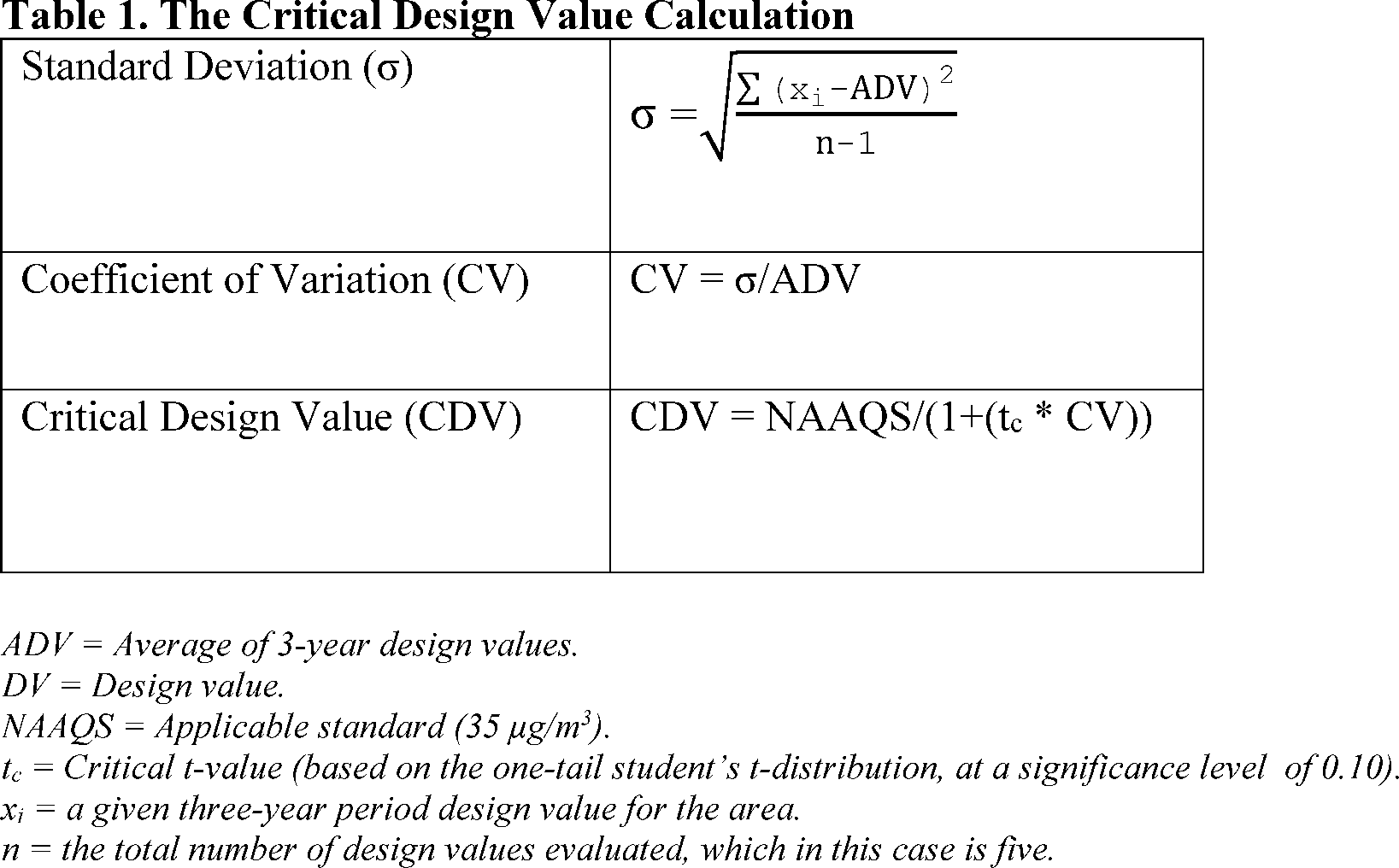
If the ADV for each monitoring site in the area is below the CDV then the probability of a future exceedance, based on the area's historical air quality and variability, is less than 10 percent. The CDV calculation for a monitoring site involves the following parameters: (1) the level of the relevant NAAQS; (2) the co-efficient of variation of recent design values measured at that site; and (3) a statistical parameter corresponding to a 10 percent probability of exceedance, such that sites with historically high variability in design values result in a lower (or more stringent) CDV. The eligibility calculation equations for the CDV demonstration are shown in table 1.
( printed page 79191)
B. Transportation Conformity Under Limited Maintenance Plan Option
Transportation conformity is required by section 176(c) of the CAA. Under that provision, conformity to a SIP means that transportation activities will not cause or contribute to new air quality violations, worsen existing violations, delay timely attainment of the NAAQS or any required interim emission reductions or other milestones in any area.
See
CAA 176(c)(1)(A) and (B). EPA's transportation conformity rule at 40 CFR part 93 subpart A establishes the criteria and procedures to determine whether metropolitan transportation plans, transportation improvement programs, and federally supported highway and transit projects conform to the SIP. Transportation conformity applies for transportation-related criteria pollutants in nonattainment areas and redesignated attainment areas with a CAA section 175A maintenance plan (
i.e.,
maintenance areas).
While qualification for the LMP option does not exempt an area from the need to determine conformity, in an area with an adequate or approved LMP, conformity may be demonstrated for a transportation plan or a transportation improvement program without a regional emissions analysis for the relevant NAAQS and pollutant (40 CFR 93.109(e)). However, transportation plan and transportation improvement program conformity determinations that meet applicable requirements continue to be required in these areas (see table 1 in 40 CFR 93.109). The areas also remain subject to the other transportation conformity requirements of 40 CFR part 93, subpart A, including fulfilling project-level conformity analyses requirements and consultation requirements. In addition, an LMP must demonstrate that it is unreasonable to expect that the qualifying area would experience enough growth in on-road emissions during the maintenance period such that a violation of the relevant NAAQS would occur (40 CFR 93.109(e)). Furthermore, consistent with the PM2.5
LMP Guidance, if re-entrained road dust has been found to be significant for PM2.5
transportation conformity purposes under 40 CFR 93.102(b)(3), the plan should include an on-road PM2.5
emissions analysis consistent with the methodology provided in attachment B of the PM10
LMP Guidance. EPA discusses CT DEEP's submittal in section III.A of this notice.
Along with this proposed action, EPA is initiating an adequacy process for the New Haven and Fairfield LMP.
See40 CFR 93.118(e)(4) and 93.118(f). Since LMPs do not include motor vehicle emissions budgets, EPA's adequacy review is to assess whether the demonstration required by 40 CFR 93.109(e) is met.
C. General Conformity Under Limited Maintenance Plan Option
The general conformity rule of November 30, 1993 (58 FR 63214) applies to nonattainment areas and redesignated attainment areas operating under maintenance plans (
i.e.,
maintenance areas). General conformity requires compliance to the purpose of a SIP, which means that federal activities not related to transportation plans, programs, and projects will not cause or contribute to any new violation of any standard in any area, increase the frequency or severity of any existing violation of any standard in any area or delay timely attainment of any standard or any required interim emission reductions or other milestones in any area (CAA section 176(c)(1)(A)and(1)(B)). As noted in the PM2.5
LMP Guidance, EPA's general conformity regulations do not distinguish between maintenance areas with an approved “full maintenance plan” and those with an approved LMP. Thus, maintenance areas with an approved LMP are subject to the same general conformity requirements under 40 CFR part 93 subpart B, as those covered by a “full maintenance plan.” Full compliance with the general conformity program is required within an LMP.
III. EPA's Analysis of the State's Submittal
A. Demonstration of Qualification for the Limited Maintenance Plan Option
EPA redesignated New Haven- Fairfield to attainment of the PM2.5
NAAQS on October 24, 2013 (78 FR 58467). Table 2 below shows the historical design values for each monitoring site within the maintenance area since it was redesignated in 2013.[5]
The 2006 24-hour PM2.5
NAAQS is attained when the 3-year average of the 98th percentile of 24-hour PM2.5
( printed page 79192)
concentrations is equal to or less than 35 µg/m3
, and as shown in table 2, the area has been measuring air quality well below the 2006 PM2.5
NAAQS with an overall decrease in PM2.5
concentrations over time. These design values from the individual monitoring sites within the maintenance area demonstrate the stability of ambient PM2.5
concentrations over time.
Table 2—PM
2.5
Design Values in New Haven-Fairfield Since Redesignation to Attainment in µg/m3
[2013-2023]
Design value period
090010010—
Roosevelt
School—
Bridgeport
090011123—
Western Conn
State
University
090090027—
Criscuolo
Park—
New Haven
090092123—
Meadow and
Bank Streets
2011-2013
23
25
24
23
2012-2014
23
24
21
24
2013-2015
24
25
22
24
2014-2016
24
23
20
* 23
2015-2017
21
22
20
* 20
2016-2018
20
21
19
* 20
2017-2019
19
20
18
19
2018-2020
21
21
20
20
2019-2021
22
21
21
20
2020-2022
21
22
21
21
2021-2023
21
21
20
6
20
* 24-hr data invalid due to site reconstruction.
EPA proposes
to find that the New Haven-Fairfield area meets the critical design value demonstration for an LMP. As noted above, the parameters of the CDV calculation include the level of the relevant NAAQS, the co-efficient of variation of recent design values, and a statistical parameter corresponding to a 10 percent probability of future violation. The CDV demonstration is designed such that if a site's ADV is lower than the site's CDV, the probability of a future violation of the NAAQS is less than 10 percent.[7]
Section 2.2 of CT DEEP's LMP submittal demonstrates the likelihood of continued attainment. EPA reviewed the data and methodology provided by the state and we find that each monitor's 5-year ADV is well below the corresponding site-specific CDV, as shown in table 3.
Table 3—Results of Calculation of CDVs at New Haven-Fairfield Monitors for the 24-Hour PM
2.5
NAAQS
Site
CDV
Average
design value
(2017-2021) a
Qualify for LMP?
090010010
32.3
20.6
Yes.
090011123
33.3
21.0
Yes.
090090027
32.1
19.6
Yes.
090092123
33.2
b
19.7
Yes.
a
CT DEEP uses the term `mean' interchangeably with ADV in the proposed LMP; the design values averaged for the ADV span seven years of data (2015-2017, 2016-2018, 2017-2019, 2018-2020, 2019-2021).
b
Only three years of design values (5 years of data) were used for the Meadow and Bank Streets' monitor due to site reconstruction. activities resulting in incomplete data for 2016 and invalidating design values for 2016-2018.
We also propose to find that the CT DEEP LMP submittal satisfies transportation conformity regulations under the LMP option. Connecticut holds annual transportation conformity interagency consultation meetings which include Federal, State, and local agencies. Additionally, the LMP SIP submittal for New Haven-Fairfield was developed in accordance with interagency consultation between Federal, State, and local partners. CT DEEP also includes analysis that addresses the demonstration under 40 CFR 93.109(e) in their supplement submitted on February 21, 2024. This transportation conformity regulation requires that an LMP would have to demonstrate that it would be unreasonable to expect that a maintenance area would experience enough motor vehicle emissions growth for a NAAQS violation to occur (40 CFR 93.109(e)).
The state's demonstration assesses the total projected growth in on-road motor vehicle PM2.5
emissions through the end of the 20-year maintenance period, where the projected percentage increase in vehicle miles traveled (VMTpi) to the end of the 20-year maintenance period (
i.e.,
2033), is multiplied by the motor vehicle design value (DVmv). The DVmv
is based on the on-road mobile portion of the attainment year inventory. CT DEEP analyzed whether the area's ADV for the period used to demonstrate LMP qualification plus (VMTpi
× DVmv) was less than or equal to the CDV for the relevant PM2.5
standard in µg/m[3]
for the given area. The state calculated the CDV for the entire maintenance area, 33 μg/m[3]
, using the most recent (2017-2021) maximum design values from each year.[8]
CT DEEP calculated the projected
( printed page 79193)
design value in 2033 to be 21.49 μg/m3
which is less than the determined CDV, 33 μg/m3
. Thus, CT DEEP concludes that it is unlikely that increased emissions from on-road mobile sources could, in the next 10 years, increase concentrations in the area enough to threaten the maintenance of the PM2.5
NAAQS. In consultation with the Connecticut Department of Transportation (CTDOT), CT DEEP also provided a VMTpi
of .0565 from 2017 to 2033, which is a 5.65% increase.
The VMT projection considered by Connecticut was based on the on-road emissions analysis calculation as laid out in the PM10
LMP Guidance. Under the PM2.5
LMP Guidance, this on-road emissions analysis is only necessary for LMPs where re-entrained road dust has been found to be significant for PM2.5
transportation conformity purposes under 40 CFR 93.102(b)(3) for a given maintenance area. While CT DEEP does not identify re-entrained road dust as a significant contributor to PM2.5
concentrations in the maintenance area, the state utilizes the same methodology to address projected VMT and motor vehicle emissions growth in its LMP submittal. CT DEEP's analysis indicates that the projected design value in 2033 is significantly below the area's CDV signaling future continued maintenance of the relevant NAAQS, with limited growth in VMT from 2017 to 2033. This analysis supports a conclusion that the state has demonstrated that it would be unreasonable to expect New Haven-Fairfield to experience enough growth in on-road emissions during the remaining maintenance period such that a violation of the 2006 24-hour PM2.5
NAAQS will occur.
Also, per 40 CFR 93.109(e), an area with an adequate or approved LMP is not required to satisfy the regional emissions analysis for § 93.118 and/or § 93.119 for a given pollutant and NAAQS, in this instance the 2006 PM2.5
NAAQS. However, the first 10-year maintenance plan for the New Haven-Fairfield area included motor vehicle emissions budgets for 2025. Therefore, if 2025 is within the timeframe of any transportation plan or transportation improvement program (TIP) and transportation conformity is determined for that plan or TIP, a regional emissions analysis is required for 2025.
In the PM2.5
LMP Guidance, EPA clarifies that an area submitting the second 10-year maintenance plan may be eligible for the LMP option if monitored air quality data and VMT trends support the LMP option. Given the air quality data demonstrating that New Haven- Fairfield has been maintaining the 2006 PM2.5
NAAQS for at least 8 years, the current PM2.5
design values in the area, the demonstrated downward trend in PM2.5
concentrations over the last ten years, and the state's on-road emissions analysis of projected VMT discussed above, we propose to find that CT DEEP's LMP submittal for the New Haven-Fairfield 2006 PM2.5
maintenance area meets the qualification criteria for an LMP, consistent with 40 CFR 93.109(e) and the PM2.5
LMP Guidance.
The following is a summary of EPA's interpretation of the section 175A requirements and EPA's evaluation of how each requirement is met. Under the LMP option, the state will be expected to determine on a regular basis that the criteria are still being met. If the state determines that the LMP criteria are not being met, it should take action to reduce PM2.5
concentrations enough to requalify. One possible approach the state could take is to implement the contingency measures contained in its first maintenance plan (78 FR 58467), that the state will continue to adhere to for the second maintenance period (
See
section 3.6 of the current state submittal). If the attempt to reduce PM2.5
concentrations fails, or if it succeeds but in future years it becomes necessary again to address increasing PM2.5
concentrations in an area, the area will no longer qualify for the LMP option.
B. Attainment Inventory
As noted above, states that qualify for an LMP must still meet the other elements of a maintenance plan, as articulated in the Calcagni Memo. This includes an attainment year emissions inventory. CT DEEP's New Haven-Fairfield PM2.5
LMP submission includes an emissions inventory, with a base year of 2017. This inventory was prepared as part of the 2017 National Emissions Inventory [9]
Version 2 under EPA's Air Emissions Reporting Rule (73 FR 76539, December 17, 2008). The 2017 base year represents the most recent emissions inventory data available when the state prepared the submission and is representative of the level of emissions during a period that the area shows monitored attainment of the NAAQS and is consistent with the data used to determine applicability of the LMP option (
i.e.,
having no violations of the NAAQS during the 5-year period used to calculate the design value). Table 3 shows the total 2017 emissions in New Haven-Fairfield in tons per year included in the state's submission.
Table 3—2017 Emissions (Tons/Year) in New Haven-Fairfield
Pollutant
Total
emissions
PM
2.5
4,361
Ammonia (NH
3
)
1,485
Nitrogen oxides (NO
X
)
22,020
Sulfur dioxide (SO
2
)
1,296
Volatile organic compounds (VOCs)
43,518
C. Air Quality Monitoring Network
Once an area is redesignated, the state must continue to operate an appropriate air monitoring network in accordance with 40 CFR part 58 to verify the attainment status of the area. CT DEEP continues to operate a PM2.5
monitoring network sited and maintained in accordance with federal siting and design criteria in 40 CFR part 58, and in consultation with EPA Region 1. CT DEEP submitted its 2023 Annual Monitoring Network Plan on June 26, 2023,[10]
which EPA approved on July 12, 2023.[11]
In the LMP submittal, CT DEEP commits to continued operation of its PM2.5
monitors within New Haven-Fairfield, consistent with the EPA-approved CT DEEP annual network plan. Currently, there are 4 monitors in the New Haven-Fairfield maintenance area.
D. Verification of Continued Attainment
The level of the 2006 24-hour PM2.5
NAAQS is 35 μg/m[3]
(40 CFR 50.13). The NAAQS is attained when the 3-year average of the 98th percentile of PM2.5
concentrations is equal to or less than the NAAQS, which CT DEEP has proven in its LMP submittal. As stated previously, CT DEEP commits to verifying continued attainment of the PM2.5
standards through the maintenance plan period with the operation of an appropriate PM2.5
monitoring network. In developing the second 10-year maintenance plan, CT DEEP evaluated the last 5 years of complete, quality-assured data (2017 through 2021) for New Haven-Fairfield at the time of the submittal to verify continued attainment of the standard. Certified air quality data from 2023, as
( printed page 79194)
shown in table 2, confirms continued attainment of the standard.[12]
E. Contingency Provisions
CAA section 175A(d) states that a maintenance plan must include contingency provisions, as necessary, to ensure prompt correction of any violation of the relevant NAAQS which may occur after redesignation of the area to attainment. As explained in the Calcagni memo, these contingency provisions are an enforceable part of the federally approved SIP. The maintenance plan should clearly identify the events that would “trigger” the adoption and implementation of a contingency provision, the contingency provision(s) that would be adopted and implemented, and the schedule indicating the timeframe by which the state would adopt and implement the provision(s). The Calcagni memo states that EPA will determine the adequacy of a contingency plan on a case-by-case basis. At a minimum, the plan must require that the state implement all measures contained in the CAA part D nonattainment plan for the area prior to redesignation.
CT DEEP will continue to adhere to the contingency plan they submitted with their first maintenance plan, which includes the required contingency provisions to ensure the area will promptly correct any violation of the 2006 PM2.5
NAAQS.[13]
Connecticut's contingency measures include a Warning Level Response and an Action Level Response. CT DEEP also commits to pursuing adoption (and submittal to EPA) and implementation of any appropriate regulatory revisions within 18 to 24 months after the verified violation. CT DEEP will select contingency measures based on cost effectiveness, emission reduction potential, economic and social considerations, or other appropriate factors. Stakeholder input will be solicited before final selection of any contingency measures. The contingency measures are described in detail in the NPRM for the first maintenance plan and will not be repeated here.
See78 FR 43096. EPA proposes to find that the contingency provisions in the PM2.5
LMP for the New Haven-Fairfield 2006 PM2.5
maintenance area meet the requirements of section 175A(d) of the CAA.
IV. Proposed Action
EPA is proposing to approve the second 10-year PM2.5
LMP for the New Haven-Fairfield 2006 24-hour PM2.5
maintenance area submitted by CT DEEP on May 9, 2023, and supplemented on February 21, 2024. EPA's review of the air quality data for the maintenance area indicates that it continues to show attainment well below the level of the 2006 24-hour PM2.5
NAAQS and meet all the LMP qualifying criteria as described in this action. If finalized, EPA's approval of this LMP will satisfy the CAA section 175A requirements for the second 10-year maintenance period.
As discussed previously, EPA is also initiating as part of this proposed rulemaking the process to determine if the LMP is adequate for transportation conformity purposes. Any comments on the adequacy of the submitted CT LMP should be submitted to the docket established for this rulemaking. EPA may complete that process either in a final action on this LMP or through a separate process provided for in the transportation conformity regulations.
See40 CFR 93.118(f). EPA is soliciting public comments on the issues discussed in this notice or on other relevant matters. These comments will be considered before taking final action. Interested parties may participate in the Federal rulemaking procedure by submitting written comments to this proposed rule by following the instructions listed in the
ADDRESSES
section of this
Federal Register
.
V. Statutory and Executive Order Reviews
Under the Clean Air Act, the Administrator is required to approve a SIP submission that complies with the provisions of the Act and applicable Federal regulations. See 42 U.S.C. 7410(k); 40 CFR 52.02(a). Thus, in reviewing SIP submissions, EPA's role is to approve state choices, provided that they meet the criteria of the Clean Air Act. Accordingly, this proposed action merely approves state law as meeting Federal requirements and does not impose additional requirements beyond those imposed by state law. For that reason, this proposed action:
Is not a significant regulatory action subject to review by the Office of Management and Budget under Executive Orders 12866 (58 FR 51735, October 4, 1993) and 13563 (76 FR 3821, January 21, 2011);
Does not impose an information collection burden under the provisions of the Paperwork Reduction Act (44 U.S.C. 3501et seq.);
Is certified as not having a significant economic impact on a substantial number of small entities under the Regulatory Flexibility Act (5 U.S.C. 601et seq.);
Does not contain any unfunded mandate or significantly or uniquely affect small governments, as described in the Unfunded Mandates Reform Act of 1995 (Pub. L. 104-4);
Is not subject to requirements of section 12(d) of the National Technology Transfer and Advancement Act of 1995 (15 U.S.C. 272 note) because application of those requirements would be inconsistent with the Clean Air Act.
In addition, the SIP is not approved to apply on any Indian reservation land or in any other area where EPA or an Indian tribe has demonstrated that a tribe has jurisdiction. In those areas of Indian country, the rule does not have tribal implications and will not impose substantial direct costs on tribal governments or preempt tribal law as specified by Executive Order 13175 (65 FR 67249, November 9, 2000).
Executive Order 12898 (Federal Actions to Address Environmental Justice in Minority Populations and Low-Income Populations, 59 FR 7629, Feb. 16, 1994) directs Federal agencies to identify and address “disproportionately high and adverse human health or environmental effects” of their actions on communities with environmental justice (EJ) concerns to the greatest extent practicable and permitted by law. EPA defines EJ as “the fair treatment and meaningful involvement of all people regardless of race, color, national origin, or income with respect to the development, implementation, and enforcement of environmental laws, regulations, and policies.” EPA further defines the term fair treatment to mean that “no group of people should bear a disproportionate burden of environmental harms and risks, including those resulting from the negative environmental consequences of industrial, governmental, and commercial operations or programs and policies.”
CT DEEP did not evaluate environmental justice considerations as part of its SIP submittal; the CAA and applicable implementing regulations
( printed page 79195)
neither prohibit nor require such an evaluation. EPA did not perform an EJ analysis and did not consider EJ in this action. Due to the nature of the action being taken here, this action is expected to have a neutral to positive impact on the air quality of the affected area. Consideration of EJ is not required as part of this action, and there is no information in the record inconsistent with the stated goal of E.O. 12898 of achieving environmental justice for communities with EJ concerns.
1.
See
Calcagni, John, Director, Air Quality Management Division, EPA Office of Air Quality Planning and Standards, “Procedures for Processing Requests to Redesignate Areas to Attainment,” September 4, 1992 (Calcagni memo). A copy of this memorandum can be found in the docket for this proposed rulemaking.
2.
See
“Limited Maintenance Plan Option for Nonclassifiable Ozone Nonattainment Areas” from Sally L. Shaver, Office of Air Quality Planning and Standards (OAQPS), dated November 16, 1994; “Limited Maintenance Plan Option for Nonclassifiable CO Nonattainment Areas” from Joseph Paisie, OAQPS, dated October 6, 1995; and “Limited Maintenance Plan Option for Moderate PM10
Nonattainment Areas” (PM10
LMP Guidance) from Lydia Wegman, OAQPS, dated August 9, 2001. Copies of these guidance memoranda can be found in the docket for this proposed rulemaking.
3.
See
the guidance document developed by the Office of Air Quality Planning and Standards, the Office of Transportation and Air Quality, and the Office of Air and Radiation titled “Guidance on the Limited Maintenance Plan Option for Moderate PM2.5
Nonattainment Areas and PM2.5
Maintenance Areas”. A copy of this guidance can be found in the docket for this proposed rulemaking.
4.
EPA recommends that the ADV be calculated using at least five years of design values, each representing a three-year period, because this approach would rely on a more robust dataset. However, we acknowledge that an alternative interpretation may be acceptable, where these variables could be calculated using three years of design values, collectively representing five years of air quality data.
6.
The 2020-2022 and 2021-2023 design values were not finalized until after CT DEEP submitted the PM2.5
LMP to EPA; they are included here to show the most recent air quality data.
Use this for formal legal and research references to the published document.
89 FR 79189
Web Citation
Suggested Web Citation
Use this when citing the archival web version of the document.
“Air Plan Approval; Connecticut; New Haven and Fairfield Counties Second 10-Year Limited Maintenance Plan for the 2006 24-Hour PM2.5 Standard,” thefederalregister.org (September 27, 2024), https://thefederalregister.org/documents/2024-22114/air-plan-approval-connecticut-new-haven-and-fairfield-counties-second-10-year-limited-maintenance-plan-for-the-2006-24-h.