Take of Marine Mammals Incidental to Specified Activities; Taking Marine Mammals Incidental to Rocky Intertidal Monitoring Surveys Along the Oregon and California Coasts
NMFS has received a request from University of California Santa Cruz (UCSC) for Incidental Take Regulations (ITR) and an associated Letter of Authorization (LOA) pursuant to the...
National Marine Fisheries Service (NMFS), National Oceanic and Atmospheric Administration (NOAA), Commerce.
ACTION:
Proposed rule; request for comments.
SUMMARY:
NMFS has received a request from University of California Santa Cruz (UCSC) for Incidental Take Regulations (ITR) and an associated Letter of Authorization (LOA) pursuant to the Marine Mammal Protection Act (MMPA). The requested regulations would govern the authorization of take of marine mammals over 5 years (2025-2030) incidental to the Multi-Agency Rocky Intertidal Network (MARINe) rocky intertidal monitoring surveys along the Oregon and California coasts. NMFS requests public comments on this proposed rule. NMFS will consider public comments prior to making any final decision on the promulgation of the requested ITR and issuance of the LOA.
DATES:
Comments and information must be received no later than April 21, 2025.
Electronic submissions:
Submit all electronic public comments via the Federal e-Rulemaking Portal. Go to:
https://www.regulations.gov
and enter NOAA-NMFS-2024-0144 in the Search box (
note:
copying and pasting the FDMS Docket Number directly from this document may not yield search results). Click on the “Comment” icon, complete the required fields, and enter or attach your comments.
Instructions:
Comments sent by any other method, to any other address or individual, or received after the end of the comment period, may not be considered by NMFS. All comments received are a part of the public record and will generally be posted for public viewing at:
https://www.regulations.gov
without change. All personal identifying information (
e.g.,
name, address), confidential business information, or otherwise sensitive information submitted voluntarily by the sender will be publicly accessible. NMFS will accept anonymous comments (enter “N/A” in the required fields if you wish to remain anonymous).
Jennifer Gatzke, Office of Protected Resources, NMFS, (301) 427-8401.
SUPPLEMENTARY INFORMATION:
Purpose and Need for Regulatory Action
This proposed rule, if adopted, would establish a framework under the authority of the MMPA (16 U.S.C. 1361et seq.) to authorize, for a 5-year period (2025-2030), take of marine mammals incidental to the UCSC/MARINe's rocky intertidal research activities in Oregon and California.
NMFS received an incidental take authorization (ITA) application from the UCSC/MARINe requesting 5-year regulations and an LOA to take four species of marine mammals by Level B harassment (Application). Take of harbor seal (
Phoca vitulina richardii), Steller sea lion (
Eumetopias jubatus), northern elephant seal (
Mirounga angustirostris), and California sea lion (
Zalophus californianus) would occur by Level B harassment only, incidental to visual and auditory disturbance of pinnipeds occurring near research sites. No mortality or serious injury is anticipated or proposed for authorization. Please see the Estimated Take of Marine Mammals section below for definitions of harassment.
The MMPA prohibits the “take” of marine mammals, with certain exceptions. Sections 101(a)(5)(A) and (D) of the MMPA (16 U.S.C. 1361et seq.) direct the Secretary of Commerce (as delegated to NMFS) to allow, upon request, the incidental, but not intentional, taking of small numbers of marine mammals by U.S. citizens who engage in a specified activity (other than commercial fishing) within a specified geographical region if certain findings are made, regulations are promulgated, and public notice and an opportunity for public comment are provided.
Authorization for incidental takings shall be granted if NMFS finds that the taking will have a negligible impact on the species or stock(s) and will not have an unmitigable adverse impact on the availability of the species or stock(s) for taking for subsistence uses (where relevant). Further, NMFS must prescribe the permissible methods of taking and other “means of effecting the least practicable adverse impact” on the affected species or stocks and their habitat. NMFS will pay particular attention to (1) rookeries, mating grounds, and areas of similar significance, (2) the availability of the species or stocks for taking for certain subsistence uses (referred to as “mitigation”), and (3) the requirements
( printed page 13323)
pertaining to the mitigation, monitoring and reporting of the takings are set forth. The definitions of all applicable MMPA statutory terms cited above are included below.
Section 101(a)(5)(A) of the MMPA and the implementing regulations at 50 CFR part 216, subpart I, provide the legal basis for proposing and, if appropriate, issuing 5-year regulations and an associated LOA. This proposed rule, if adopted, would establish required mitigation, monitoring, and reporting requirements for the UCSC/MARINe's activities.
Summary of Major Provisions Within the Proposed Rule
The following is a summary of the major provisions of this proposed rule regarding UCSC/MARINe's research activities. These provisions include measures requiring:
Mitigation to minimize impact to pinnipeds and avoid disruption to dependent pups including several measures to approach haulouts cautiously to minimize disturbance, especially when pups are present; and
Monitoring of the research areas to detect the presence of marine mammals before initiating surveys.
National Environmental Policy Act
To comply with the National Environmental Policy Act of 1969 (NEPA) (42 U.S.C. 4321et seq.) and NOAA Administrative Order (NAO) 216-6A, NMFS must evaluate the proposed action (
i.e.,
promulgation of regulations and subsequent issuance of a 5-year LOA) and alternatives with respect to potential impacts on the human environment.
This action is consistent with categories of activities identified in Categorical Exclusion B4 (incidental harassment authorizations (IHAs) with no anticipated serious injury or mortality) of the Companion Manual for NAO 216-6A, which do not individually or cumulatively have the potential for significant impacts on the quality of the human environment and for which we have not identified any extraordinary circumstances that would preclude this categorical exclusion. Accordingly, NMFS has preliminarily determined that issuance of the proposed rule qualifies to be categorically excluded from further NEPA review. Information in the Application and this document collectively provide the environmental information related to proposed issuance of these regulations and subsequent incidental take authorization for public review and comment. We will review all comments submitted in response to this notice of proposed rulemaking prior to concluding our NEPA process and prior to making a final decision on the request for incidental take authorization.
Summary of UCSC/MARINe Request
On September 6, 2024, NMFS received the initial Application requesting authorization for take of four species of marine mammals incidental to rocky intertidal monitoring surveys along the Oregon and California coasts. After the applicant responded to our questions and submitted a revised Application, NMFS determined the Application was adequate and complete on November 26, 2024. On December 5, 2024, we published a notice of receipt of the Application in the
Federal Register
, requesting comments and information related to the request for 30 days (89 FR 96645). We received no public comments.
The UCSC/MARINe requests authorization to take the following four species of pinnipeds: harbor seal (
Phoca vitulina richardii), Steller sea lion (
Eumetopias jubatus), northern elephant seal (
Mirounga angustirostris), and California sea lion (
Zalophus californianus) by Level B harassment only. The proposed regulations would be valid for 5 years (2025-2030). Neither UCSC/MARINe nor NMFS expects Level A harassment, serious injury, or mortality to result from this activity and no such take is authorized by this action.
UCSC/MARINe proposes to continue rocky intertidal monitoring work that has been ongoing for over 20 years. UCSC/MARINe focuses on understanding the nearshore ecosystems of the U.S. west coast through a number of interdisciplinary collaborations. The program integrates long-term monitoring of ecological and oceanographic processes at dozens of sites with experimental work in the lab and field. Research is conducted throughout the year along the California and Oregon coasts and is expected to continue indefinitely. Researchers accessing and conducting research activities on the sites may occasionally result in the incidental take of four pinniped species by incidental, Level B harassment. UCSC/MARINe expects, and NMFS concurs, that the disturbance to pinnipeds from the research activities will be limited to Level B harassment. Take by Level A harassment, serious injury, or mortality is not authorized by this action.
Dates and Duration
UCSC/MARINE's research is conducted throughout the year. Most sites are sampled one to two times per year over a 1 to 2-day period (4-6 hours per site) during a negative low tide series (when tides are lower than the average). Due to the large number of research sites, scheduling constraints, the necessity for negative low tides and favorable weather/ocean conditions, exact survey dates are variable and difficult to predict. Some sampling may occur in all months of the calendar year. Over the course of this 5-year effective period for the proposed rule, UCSC/MARINe expects approximately 300 days of survey effort. The regulations would become effective as soon as possible and would be effective for a period of five years.
Specific Geographic Region
Sampling sites occur along the California and Oregon coasts. Community structure monitoring survey sites range from Ecola State Park near Cannon Beach, Oregon to Government Point located northwest of Santa Barbara, California. Biodiversity survey sites extend from Ecola State Park south to Cabrillo National Monument in San Diego County, California. Exact locations of sampling sites can be found in table 1 of the Application, along with maps at:
https://www.fisheries.noaa.gov/action/incidental-take-authorization-university-california-santa-cruzs-rocky-intertidal-monitoring.
Detailed Description of Specific Activity
Community structure monitoring surveys involve the use of permanent photoplot quadrats, which target specific algal and invertebrate assemblages (
e.g.,
mussels, rockweeds, barnacles). Each photoplot is photographed and scored for percent
( printed page 13324)
cover. The community structure monitoring approach is based largely on surveys that quantify the percent cover and distribution of algae and invertebrates that constitute these communities. This approach allows researchers to quantify both the patterns of abundance of targeted species, as well as characterize changes in the communities in which they reside. Such information provides managers with insight into the causes and consequences of changes in species abundance. There are a total of 49 community structure monitoring sites, each of which will be visited one to two times per year (see table 1 of the Application for details of each site) and surveyed over a 1-day period during a low tide series.
Biodiversity surveys are part of a long-term monitoring project and are conducted every 3-5 years across 150 established sites. These biodiversity surveys involve point contact identification along permanent transects, mobile invertebrate quadrat counts, sea star band counts, and tidal height topographic measurements. Many of the biodiversity survey sites are also community structure sites. During the five-year period of effectiveness for the regulations, biodiversity survey sites will be sampled zero to five times (see tables 3-6 in the Application for details of expected survey frequency).
The intertidal zones where UCSC/MARINe conducts intertidal monitoring are also areas where pinnipeds can be found hauled out (
i.e.,
temporarily leaving the water) on the shore at or adjacent to some research sites. Accessing portions of the intertidal habitat at these locations may cause incidental Level B harassment of pinnipeds through some unavoidable approaches if pinnipeds are hauled out directly in the study plots or while biologists walk from one location to another. Disturbance may also occur when researchers replace survey marker bolts using an electric rotary hammer drill.
UCSC/MARINe also plans the occasional use of unmanned aerial vehicles (UAVs), which is a new component to this survey activity. They operate two quadcopter UAV models: a Da-Jiang Innovations (DJI) Miniature Autonomous Vehicle with Intelligent Controller (MAVIC) 2 Pro and a DJI Mavic 3 Enterprise. UCSC/MARINe conducts flights from 10-30 meters altitude for mapping and photography. UAVs can cause behavioral response in pinnipeds from both visual and acoustic stimuli. This response can range from alertness to flushing (
i.e.,
disturbing from its position) depending on factors such as UAV altitude, conditions such as ambient noise from swell and wind, and the pinniped's level of habituation to disturbance (Christiansen
et al.
2016, Pérez Tadeo
et al.
2023). UAVs trigger a stronger response when hovering compared to when in motion (Pérez Tadeo
et al.
2023). UCSC/MARINe UAV flights typically occur at 10-30 meters altitude and are done autonomously (while under control of a licensed UAV pilot) to map the survey area and to achieve proper image overlap for photogrammetry processing. Flight speed is typically 1 to 2 meters/second and hovering only occurs during take-off and landing. If pinnipeds are present during a UAV flight and a response is triggered by the UAV, the pilot will take control of the UAV and increase altitude before ending the flight to minimize effects on the animals. Please see the Proposed Mitigation and Proposed Monitoring and Reporting sections for the proposed mitigation, monitoring, and reporting measures.
Description of Marine Mammals in the Area of Specified Activities
Sections 3 and 4 of the Application summarize available information regarding status and trends, distribution and habitat preferences, and behavior and life history, of the potentially affected species. Additional information regarding population trends and threats may be found in NMFS's Stock Assessment Reports (SARs) at:
https://www.fisheries.noaa.gov/national/marine-mammal-protection/marine-mammal-stock-assessments.
More general information about these species (
e.g.,
physical and behavioral descriptions) may be found on NMFS's website at:
https://www.fisheries.noaa.gov/find-species.
Table 1 lists all species or stocks for which take is expected and proposed to be authorized for this activity and summarizes information related to the population or stock, including regulatory status under the MMPA and the Endangered Species Act (ESA) and potential biological removal (PBR), where known. PBR is defined by the MMPA as the maximum number of animals, not including natural mortalities, that may be removed from a marine mammal stock while allowing that stock to reach or maintain its optimum sustainable population (16 U.S.C. 1362(20)). While no serious injury or mortality is anticipated or authorized by this action, PBR and annual serious injury and mortality from anthropogenic sources are included here as gross indicators of the status of the species or stocks and other threats.
Marine mammal abundance estimates presented in this document represent the total number of individuals that make up a given stock or the total number estimated within a particular study or survey area. NMFS's stock abundance estimates for most species represent the total estimate of individuals within the geographic area, if known, that comprises that stock. For some species, this geographic area may extend beyond U.S. waters. All managed stocks in this region are assessed in NMFS' U.S. Pacific and Alaska SARs. All values presented in table 1 are the most recent available at the time of publication (including from the Final 2023 SARs) and are available online at:
https://www.fisheries.noaa.gov/national/marine-mammal-protection/marine-mammal-stock-assessments.
Table 1—Marine Mammals Potentially Present Near the UCSC/MARIN
e
Research Sites, According to the Most Recent NMFS SARs
Common name
Scientific name
Stock
ESA/
MMPA status;
strategic
(Y/N) 1
Stock abundance
(CV, N
min
, most recent
abundance survey) 2
PBR
Annual
M/SI 3
Order Carnivora—Superfamily Pinnipedia
Family Otariidae (eared seals and sea lions):
California sea lion
Zalophus californianus
U.S
-; N
257,606 (n/a; 233,515; 2014)
14,011
>321
Steller sea lion
Eumetopias jubatus
Eastern U.S
-; N
36,308 (n/a; 36,308; 2022)
2,178 (U.S. only)
92.3
Family Phocidae (earless seals):
Harbor seal
Phoca vitulina
California
-; N
30,968 (n/a; 27,348; 2012)
1,641
43
( printed page 13325)
Oregon/Washington
-; N
24,732 (unknown; 16,165 mean; 1999) 4
unknown
10.6
Northern elephant seal
Mirounga angustirostris
California
-; N
187,386 (n/a; 85,369; 2013)
5,122
13.7
1
Endangered Species Act (ESA) status: Endangered (E), Threatened (T)/MMPA status: Depleted (D). A dash (-) indicates that the species is not listed under the ESA or designated as depleted under the MMPA. Under the MMPA, a strategic stock is one for which the level of direct human-caused mortality exceeds PBR or which is determined to be declining and likely to be listed under the ESA in the near future. Any species or stock listed under the ESA is automatically designated under the MMPA as depleted and as a strategic stock.
3
These Mortality/Serious Injury (M/SI) values, found in NMFS's SARs, represent annual levels of human-caused mortality plus serious injury from all sources combined (
e.g.,
commercial fisheries, ship strike). Annual M/SI often cannot be determined precisely and is in some cases presented as a minimum value or range. A CV associated with estimated mortality due to commercial fisheries is presented in some cases.
4
The most recent abundance estimate for this stock (24,732 animals) is from 1999 surveys (Final 2023 SAR), with a mean calculated at 16,165 animals.
We note that although the southern sea otter may be found from San Francisco south to the Channel Islands, that species is managed by the U.S. Fish and Wildlife Service and are not considered further in this document.
California Sea Lions
California sea lions (
Zalophus californianus) are distributed along the west coast of North America from British Columbia to Baja California and throughout the Gulf of California. Breeding occurs on offshore islands along the west coast of Baja California and the Gulf of California as well as on the California Channel Islands. There are three recognized California sea lion stocks (U.S. stock, Western Baja stock, and the Gulf of California stock) with the U.S. stock ranging from the U.S./Mexico border into Canada. Although there is some movement between stocks, U.S. rookeries are considered to be isolated from rookeries off of Baja California (Barlow
et al.
1995).
Following the passage of the MMPA in 1972, as well as limits on killing and harassment in Mexico, the population has rapidly increased (Reeves
et al.
2002). Declines in pup production did occur during the 1983-84, 1992-93, 1997-98, and 2003 El Niño events, but production returned to pre-El Niño levels within 2-5 years (Carretta
et al.
2017). In 2013, due to the elevated number of sea lion pup strandings in southern California, NOAA declared an Unusual Mortality Event (UME), which lasted until September 2016. The cause of this event was thought to be nutritional stress related to declines in prey availability. California sea lions have been observed in the project vicinity at 41 of the research sites (see Application table 4).
Steller Sea Lion
Steller sea lions (
Eumetopias jubatus) range along the North Pacific Rim from northern Japan to California, with centers of abundance and distribution in the Gulf of Alaska and Aleutian Islands. Outside of their late May to early July breeding season, large numbers of individuals widely disperse to access seasonally important prey resources (Muto
et al.
2019). In 1997, NMFS identified two distinct population segments (DPSs) of Steller sea lions under the ESA: a Western DPS and an Eastern DPS (62 FR 24345, May 5, 1997). While the Western DPS is listed as endangered, the Eastern DPS is not. For MMPA purposes, the Eastern DPS is called the Eastern U.S. stock and the Western DPS is called the Western U.S. stock. The Steller sea lions along the Oregon and California coasts are part of the Eastern Stock (and DPS). Steller sea lions are rare in the research areas. They have only been observed in the project vicinity at Cape Arago in 2009 and have not been observed during this research project since then.
Northern Elephant Seal
Northern elephant seals (
Mirounga angustirostris) range widely throughout the eastern Pacific for most of the year to forage. They return to haulout locations along the west coast of the continental United States including the Channel Islands, the central California coast, and islands off Baja California, to breed and molt. Breeding occurs from mid-December through the end of March, with males returning to haulout locations earlier than females to establish dominance hierarchies. Molting occurs from late April to August, with juveniles and adult females returning to haulout locations earlier than adult males (Reeves
et al.
2002). Due to very little movement between colonies in Mexico and those in California, the California population is considered to be a separate stock (Carretta
et al.
2019).
This species was hunted for several thousand years and thought to be extinct. (Stewart
et al.
1994). The population began increasing in the early 1900s and progressively colonized southern and central California through the 1980s (Reeves
et al.
2002). The population is reported to have grown at 3.1 percent annually since 1988 (Lowry
et al.
2020) and have been observed at 14 of the research sites (see Application table 5).
Pacific Harbor Seal
Before federal protections, commercial hunting of harbor seals along the west coast depleted the California stock to isolated groups in the hundreds (Bartholomew and Boolootian 1960), but the population increased in the late 1900s (Carretta
et al.
2023). Under the MMPA, harbor seals are not considered to be ‘depleted’, nor are they listed as ‘threatened’ or ‘endangered’ under the ESA. Based on currently available data, minimum numbers of serious injury and mortality, due to fishery interactions, research activities, and other human related causes, are thought to be low when compared to population sizes of stocks (Carretta
et al.
2023). A complete count of harbor seals is not possible because it relies upon all animals being hauled out of the water at the same time, and pups enter the water almost immediately following birth.
Pacific harbor seals (
Phoca vitulina richardii) inhabit near-shore coastal and estuarine areas from Baja California, Mexico, to the Pribilof Islands in Alaska. They are divided into two subspecies:
P. v. stejnegeri
in the western North Pacific, near Japan, and
P. v. richardii
in the northeast Pacific Ocean. The latter subspecies includes two stocks protected under the MMPA
( printed page 13326)
in the project area: the Oregon and Washington Coast stock in the outer coastal waters of Oregon and Washington States, and the California stock (Carretta
et al.
2019).
In Oregon there are over 40 haulout sites (Brown
et al.
2005), while in California, over 500 harbor seal haulout sites are widely distributed along the mainland and offshore islands, and include rocky shores, beaches and intertidal sandbars (Lowry
et al.
2005). Harbor seals mate at sea, and females give birth during the spring and summer, although, the pupping season varies with latitude. Pups are nursed for an average of 24 days and are ready to swim minutes after being born. Harbor seal pupping takes place at many locations, and rookery size varies from a few pups to many hundreds of pups. Pupping generally occurs between March and June, and molting occurs between May and July.
Potential Effects of Specified Activities on Marine Mammals and Their Habitat
This section includes a discussion of the ways that components of the specified activity may impact marine mammals and their habitat. The Estimated Take of Marine Mammals section later in this document includes a quantitative analysis of the number of individuals that are expected to be taken by this activity. The Negligible Impact Analysis and Determination section considers the content of this section, the Estimated Take of Marine Mammals section, and the Proposed Mitigation section, to draw conclusions regarding the likely impacts of these activities on the reproductive success or survivorship of individuals and how those impacts on individuals are likely to impact marine mammal species or stocks.
The presence of researchers has the potential for the incidental take of pinnipeds hauled out at sampling sites by Level B harassment of. If pinnipeds are hauled out in the immediate vicinity of the permanent study plots, approach by survey personnel may be unavoidable in order to conduct the research. Disturbance from such approach may result in reactions ranging from an animal simply becoming alert to the presence of researchers (
e.g.,
turning the head, assuming a more upright posture) to flushing from the haulout site into the water. NMFS does not consider these lesser reactions to constitute take by Level B harassment, but rather assumes that more substantive responses (
e.g.,
flight over greater distance or notable change in the speed or direction of their movement in response to the presence of researchers) constitute behavioral harassment. Animals that respond to the presence of researchers by becoming alert, but do not move or change the nature of locomotion as described, are not considered to have been subject to Level B harassment.
Numerous studies have shown that human activity can flush harbor seals off haulout sites (Allen
et al.
1985, Suryan and Harvey 1999). The Hawaiian monk seal (
Neomonachus schauinslandi) has been shown to avoid beaches that have been disturbed often by humans (Kenyon 1972). Moreover, in one case, human disturbance appeared to cause Steller sea lions to desert a breeding area at Northeast Point on St. Paul Island, Alaska (Kenyon 1962).
There are several ways in which disturbance, as described previously, could potentially result in Level A harassment, which is defined as any act of pursuit, torment, or annoyance which has the potential to injure a marine mammal or marine mammal stock in the wild (16 U.S.C. 1362(18)(A)(i)). Stampeding, a potentially dangerous occurrence in which large numbers of animals succumb to mass panic and rush away from a stimulus, can lead to injury. The risks for injury are (1) falling when entering the water at high-relief locations; (2) extended separation of mothers and pups; and (3) crushing of elephant seal pups by large males during a stampede. UCSC researchers have only recorded one instance of stampeding, which occurred in 2013. Because pups are typically found on sand beaches, and the study sites are located in the rocky intertidal zone, there is typically a buffer between researchers and pups. The caution exercised by researchers in approaching sites generally precludes the possibility of behaviors that could result in extended separation of mothers and dependent pups, or trampling of pups (
e.g.,
stampeding).
Because hauled out animals may move towards the water when disturbed, there is the risk of injury if animals stampede towards shorelines with precipitous relief (
e.g.,
cliffs). Shoreline habitats near the survey areas tend to consist of steeply sloping rocks with unimpeded and unobstructed access to the water. If disturbed, hauled out animals in these situations are likely to move toward the water slowly without risk of unexpectedly falling off cliffs or encountering barriers or hazards or that would otherwise prevent them from leaving the area. Using a cautious approach (
i.e.,
following mitigation measures), research activity is not likely to risk injury or death as a result of disturbance at these high-relief locations. Therefore, it is unlikely that these disturbances will result in Level A harassment, serious injury, or mortality, and NMFS is not proposing to authorize take by Level A harassment, serious injury, or mortality resulting from this research activity. A small number of harbor seal, northern elephant seal, and California sea lion pups have been observed in the research area during past years, and few pups are expected to be present during the proposed monitoring surveys. Though elephant seal pups are occasionally present when researchers visit survey sites, risk of pup mortalities is low because elephant seals are far less reactive to researcher presence than the other two species. Due to the implementation of mitigation measures, it is unlikely that harbor seal pups will be injured. Surveys are timed to avoid harbor seal breeding season (March through June), and researchers shall abort the survey if they arrive and see harbor seal pups are present.
The only habitat modification associated with the proposed activity is the placement of permanent bolts and temporary sampling equipment in the intertidal zone. The installation of bolts and sampling equipment is conducted under the appropriate permits (National Marine Sanctuary, California State Parks). Once a particular study has ended, the respective sampling equipment is removed, while the bolts remain. No trash or field gear is left at a site. Since these sites are only visited one to two times per year, minimizing repeated disturbances, sampling activities are not expected to result in long-term modifications of haulout use, nor haulout abandonment. During periods of low tide (
e.g.,
when tides are 0.6 m (2 ft) or less and low enough for pinnipeds to haul out), we would expect the pinnipeds to return to the haulout site within 60 minutes of the disturbance (Allen
et al.
1985).
During prior authorizations, only temporary displacement from haulouts has been observed, so we do not expect that pinnipeds will permanently abandon a haulout site during the conduct of rocky intertidal surveys. Additionally, impacts to prey species from survey activities are not anticipated. Thus, the proposed activity is not expected to have any habitat-related effects that could cause significant or long-term consequences for individual marine mammals or their populations.
Estimated Take of Marine Mammals
This section provides an estimate of the number of incidental takes of the four species of pinnipeds by Level B harassment proposed for authorization through this proposed rule, which will
( printed page 13327)
inform both NMFS' consideration of “small numbers” and the negligible impact determination.
Harassment, defined previously in the Purpose and Need for Regulatory Action section, is the only type of take expected to result from these activities.
Authorized takes would be by Level B harassment only, in the form of potential disruption of behavioral patterns for individual marine mammals resulting from exposure to researchers and the operation of their equipment. Based on the nature of the activity, Level A harassment is neither anticipated nor proposed to be authorized. As described previously, no mortality is anticipated or proposed to be authorized for this activity. We describe how the proposed take numbers are estimated below. Monitoring reports from the previously issued LOA (2020-2025), including Level B harassment take numbers, are available on our website at:
https://www.fisheries.noaa.gov/action/incidental-take-authorization-university-california-santa-cruz-rocky-intertidal-monitoring-0.
Marine Mammal Occurrence
In this section, we provide the information about the presence, density, or group dynamics of marine mammals that will inform the take calculations. Take estimates are based on historical marine mammal observations from 2013-2024 at each site from previous UCSC/PISCO (MARINe) survey activities. Marine mammal observations are recorded as part of research site observations, including notes on physical and biological conditions at the site, completed on each study day. From 2013-2024 observations were categorized on a four point scale:
0 = observation by researchers from a distance, no reaction by pinniped
1 = pinniped reacted to presence of researchers with movement <1 meter
2 = pinniped reacted to presence of researchers with short movement of 1-3 meters
3 = pinniped flushed (i.e.,
disturbed from its position) to the water or moved >3 meters in retreat
A marine mammal is recorded as an “encounter” (
i.e.,
at least level 0 on the above scale) if it is seen on access ways to the site, at the site, or immediately up-coast or down-coast of the site, regardless of whether that animal was considered a take under the MMPA. Also recorded are marine mammals in the water immediately offshore. Using the above scale, level 2 and level 3 observations constitute a take under the MMPA.
Once sampling is concluded, researchers record the maximum number of marine mammals (by species) sighted at any given time throughout the sampling day (categories 0 through 3). Other relevant information is also noted, including the location of a marine mammal relevant to the site, unusual behavior, and the presence of pups.
Take Calculation and Estimation
Researchers with extensive knowledge and experience at each site estimated the actual number of marine mammal takes likely to occur, using the observations described above. Take estimates for each species were based on the following equation:
Take estimate/survey site = # of expected animals/site * # of planned survey events/survey site.
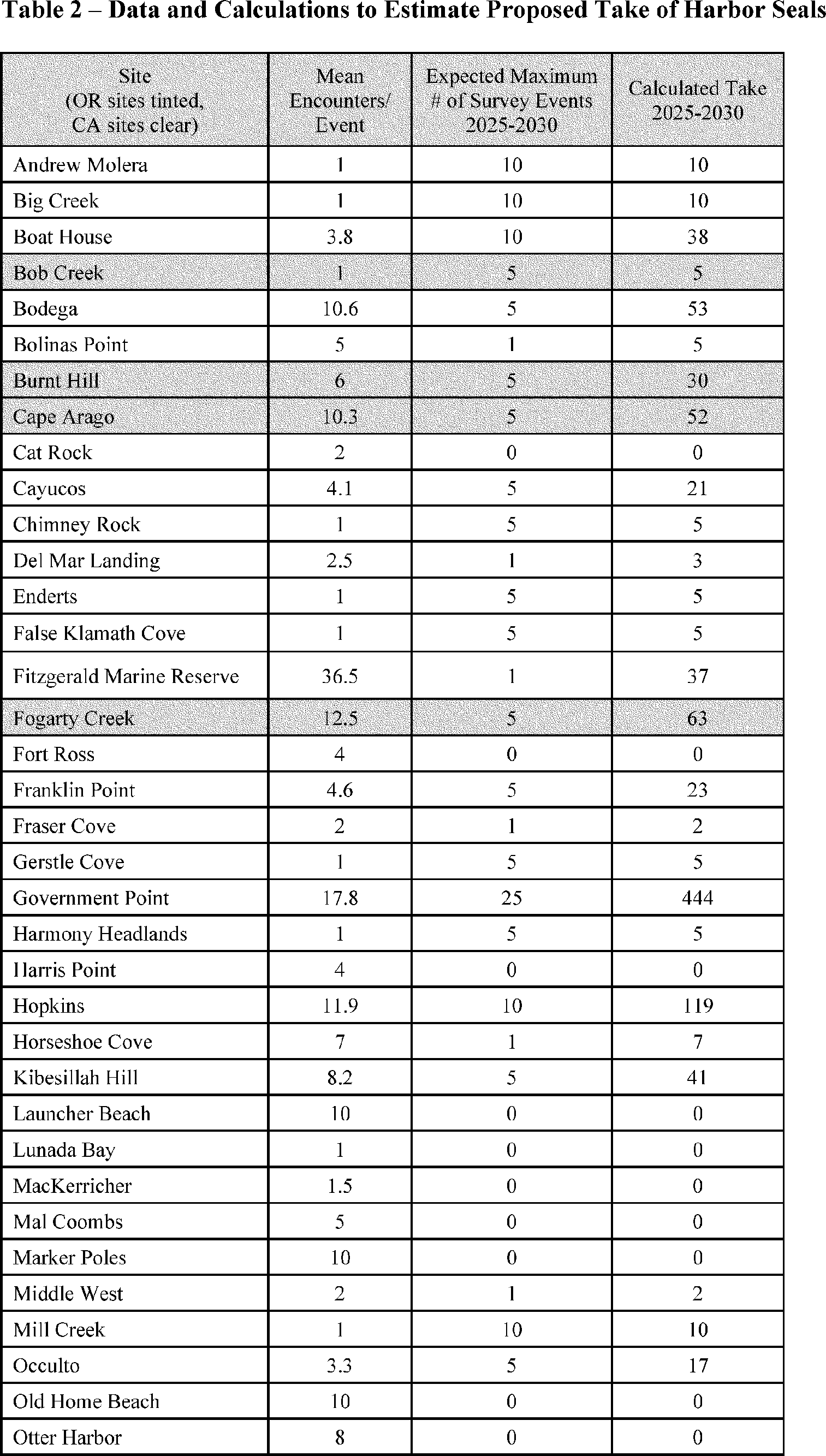
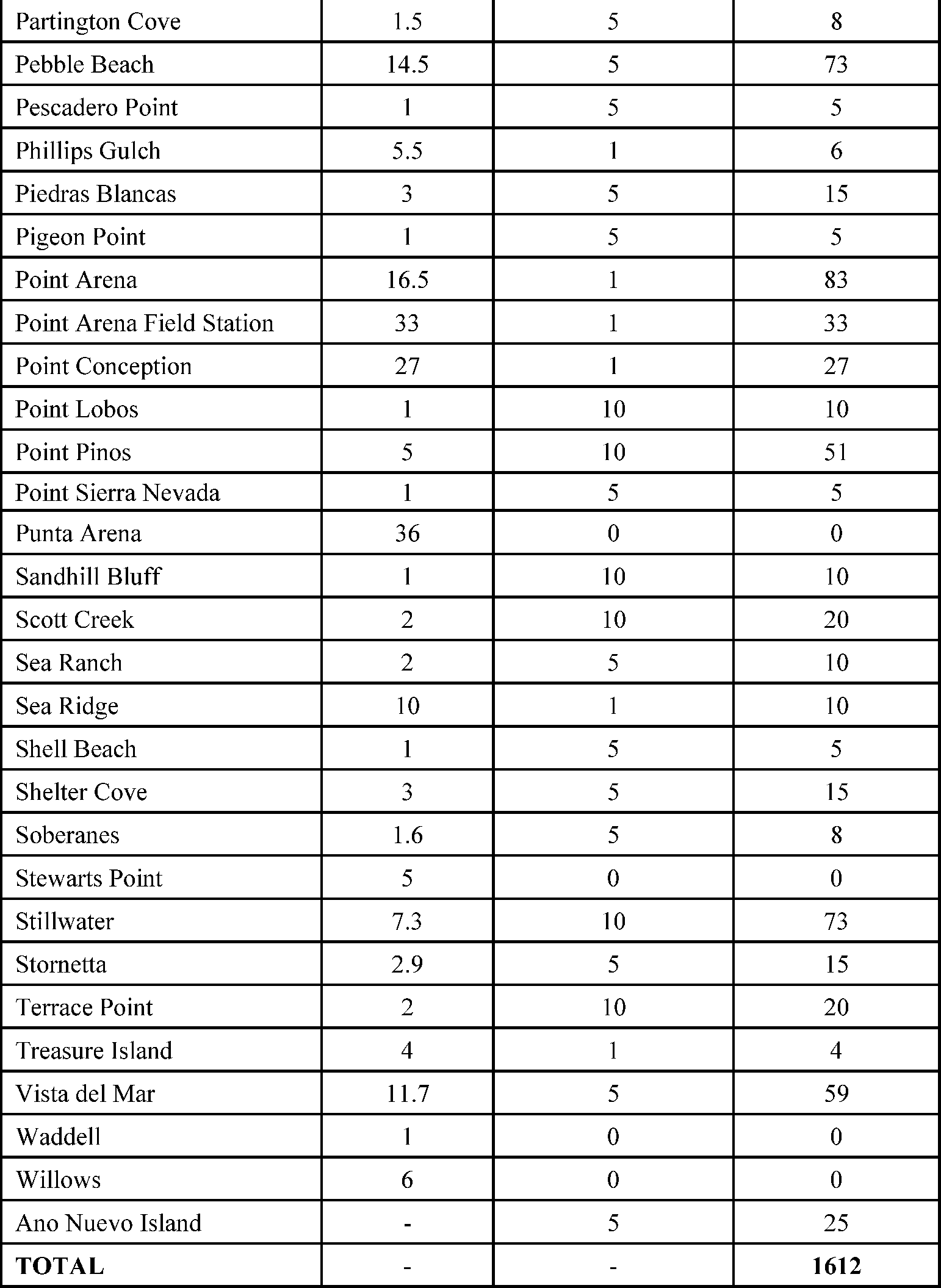
UCSC/MARINe summed the total number of each species of marine mammal “encountered” at each research site during the period from 2013 to 2024 (observations score between 0 to 3 on the above scale). To calculate the number of expected animals per site, they summed the number of sampling events where marine mammals were encountered at each site and calculated the average number of encounters per event (see tables 2-5). Less than 40 percent of all encounters qualified as incidental take by Level B harassment (see Application Section 6); therefore, calculated take estimates are expected to be conservative. The maximum number of planned survey events per survey site is listed in tables 2-5. For Steller sea lions, the single sighting from 2009 was used in this analysis. Calculation results for the take estimate by species per survey site can also be found in tables 2-5.
In coming years, UCSC plans to re-establish monitoring plots for historic black abalone (an endangered marine gastropod) on Ano Nuevo Island, CA. Since they did not have monitoring data to inform their take estimates, these estimates were calculated based on prior experience on the island, as well as discussions with Ano Nuevo Reserve personnel and other UCSC researchers who conduct studies on the island. Site visits are planned for the fall during non-breeding season for marine mammals. Locations of fall sea lion and elephant seal haulouts were compared to the research plots to establish the best estimates for species occurrence per site.
( printed page 13328)
( printed page 13329)
Table 3—Data and Calculations To Estimate Proposed Take of California Sea Lions
Site
Encounters/
event
Expected maximum
number of
survey events
2025-2030
Calculated take
2025-2030
Alder Creek
1
0
0
Andrew Molera
1
10
10
Bird Rock
30.5
1
31
Bodega
2.75
5
14
Cape Arago
15.5
5
78
Cayucos
1
5
5
Crook Point
3
0
0
Cuyler Harbor
1
1
1
Del Mar Landing
6.5
1
7
( printed page 13330)
Eel Point
1.5
2
3
Enderts
2
5
10
False Klamath Cove
2.3
5
12
Franklin Point
2
5
10
Fraser Cove
1
1
1
Gerstle Cove
1
5
5
Government Point
3.5
25
88
Kibesillah Hill
1.5
5
8
Marker poles
200
0
0
Middle West
1
1
1
Old Stairs
1.5
1
2
Otter Harbor
13
0
0
Partington Cove
1
5
5
Piedras Blancas
27.5
5
138
Point Conception
1
1
1
Point Dume
4
0
0
Point Lobos
1
10
10
Point Pinos
1
5
5
Point Sierra Nevada
1
5
5
Punta Arena
1
0
0
Purisma
1
5
5
Sandhill Bluff
6
10
60
Scott Creek
1
10
10
Sea Lion Rookery
40
1
40
Sea Ranch
3
5
15
Shell Beach
1
5
5
Shelter Cove
1.5
5
8
Soberanes
2.5
5
13
Stairs
1
5
5
Stillwater
1.5
10
15
Stornetta
1.3
5
7
Terrace Point
1.6
10
17
Ano Nuevo Island
5
2,500
Total
3,150
Table 4—Data and Calculations To Estimate Proposed Take of Elephant Seals
Site
Encounters/
event
Expected maximum
number of
survey events
2025-2030
Calculated take
2025-2030
Ano Nuevo
5
1
5
Boat House
5.5
10
55
Chimney Rock
12.8
5
64
Coches Prietos
1
0
0
Crook Point
1.5
0
0
Cuyler Harbor
1.5
1
2
Government Point
3
25
75
Harmony Headlands
1
5
5
Marker Poles
200
0
0
Mill Creek
1
10
10
Otter Harbor
4.5
0
0
Piedras Blancas
7.8
5
39
Point Sierra Nevada
1
5
5
Tranquility Beach
50
0
0
Ano Nuevo Island
5
500
Total
760
Table 5—Data and Calculations To Estimate Proposed Take of Steller Sea Lions
Site
Encounters/
event
Expected maximum
number of survey events
2025-2030
Calculated take
2025-2030
Cape Arago
5
5
50
( printed page 13331)
Ano Nuevo Island
5
25
Total
75
The species' totals for each survey site were summed to arrive at a total estimated take for the entire duration of the proposed rule across all four impacted species of pinnipeds. This is listed as the total take (table 6).
Table 6—Proposed Authorized Incidental Take by Level B Harassment (in Total and per Year) and Percentage of Populations Affected
Species
Abundance
(Caretta et al. 2023,
Young et al. 2023)
Proposed authorized incidental take (Level B harassment only)
Take over
5 years
Take per
year
% of
population
Harbor seal—CA stock
(Phoca vitulina)
30,968
1462
292
0.94
Harbor seal—WA/OR stock
(Phoca vitulina)
24,732
150
30
0.12
California sea lion
(Zalophus californianus)
257,606
3150
630
0.24
Northern elephant seal
(Mirounga angustirostris)
187,386
760
152
0.08
Steller sea lion (
(Eumetopias jubatus)
36,308
75
15
0.04
Proposed Mitigation
Under section 101(a)(5)(D) of the MMPA, NMFS must set forth the permissible methods of taking pursuant to the activity, and other means of effecting the least practicable impact on the species or stock and its habitat, paying particular attention to rookeries, mating grounds, and areas of similar significance, and on the availability of the species or stock for taking for certain subsistence uses (the latter is not applicable for this action). NMFS regulations require applicants for incidental take authorizations to include information about the availability and feasibility (economic and technological) of equipment, methods, and manner of conducting the activity or other means of effecting the least practicable adverse impact upon the affected species or stocks, and their habitat (50 CFR 216.104(a)(11)).
In evaluating how mitigation may or may not be appropriate to ensure the least practicable adverse impact on species or stocks and their habitat, as well as subsistence uses where applicable, NMFS considers two primary factors:
(1) The manner in which, and the degree to which, the successful implementation of the measure(s) is expected to reduce impacts to marine mammals, marine mammal species or stocks, and their habitat. This considers the nature of the potential adverse impact being mitigated (
e.g.,
likelihood, scope, range). It further considers the likelihood that the measure will be effective if implemented (
i.e.,
probability of accomplishing the mitigating result if implemented as planned), the likelihood of effective implementation (probability of accomplishing the mitigating result if implemented as planned); and
(2) The practicability of the measures for applicant implementation, which may consider cost and impact on operations.
UCSC/MARINe will implement several mitigation measures to reduce potential take by Level B harassment. Measures are listed below.
Researchers will observe a site from a distance for at least 5 minutes, using binoculars, if necessary, to detect any marine mammals prior to approach to determine if mitigation is required (i.e.,
site surveys will not be conducted if other pinnipeds are present, researchers will approach with caution, walking slowly, quietly, and close to the ground to avoid surprising any hauled out individuals and to reduce flushing/stampeding of individuals).
Researchers will avoid pinnipeds along access ways to sites by locating and taking a different access route. Researchers will keep a safe distance from, and not approach, any marine mammal while conducting research unless it is absolutely necessary to flush (i.e.,
disturb from its position) a marine mammal in order to continue conducting research (
i.e.
if a site cannot be accessed or sampled due to the presence of pinnipeds).
Researchers will avoid making loud noises (e.g.,
using hushed voices) and keep bodies low to the ground (
i.e.,
crouched) in the visual presence of pinnipeds.
Researchers will monitor the offshore area for predators (e.g.,
killer whales and great white sharks) and avoid flushing of pinnipeds when predators are observed in nearshore waters. Note that UCSC/MARINe has never observed an offshore predator while researchers were present at any of the survey sites.
Intentional approach will not occur if dependent pups are present to avoid mother/pup separation and trampling of pups. Staff shall reschedule work at sites where pups are present unless other means of accomplishing the work can be done without causing disturbance to mothers and dependent pups.
When operating UAVs around pinnipeds, altitude will not drop below 10 meters.
Researchers will promptly vacate sites at the conclusion of sampling.
The primary methods of mitigating the risk of disturbance to pinnipeds is the selection of judicious routes of approach to study sites, avoiding close contact with pinnipeds hauled out on shore, and the use of extreme caution upon approach. Each visit to a given study site will last for approximately 4-6 hours, after which the site is vacated and can be re-occupied by any marine mammals that may have been disturbed by the presence of researchers. Also,
( printed page 13332)
workers will be arriving before low tide, worker presence will tend to encourage pinnipeds to move to other areas for the day before they haul out and settle onto rocks at low tide.
Based on our evaluation of the applicant's proposed measures, NMFS has preliminarily determined that the proposed mitigation measures provide the means effecting the least practicable impact on the affected species or stocks and their habitat, paying particular attention to rookeries, mating grounds, and areas of similar significance.
Proposed Monitoring and Reporting
In order to issue regulations and an LOA for an activity, Section 101(a)(5)(A) of the MMPA states that NMFS must set forth requirements pertaining to the monitoring and reporting of such taking. The MMPA's implementing regulations at 50 CFR 216.104 (a)(13) indicate that requests for authorizations must include the suggested means of accomplishing the necessary monitoring and reporting that will result in increased knowledge of the species and of the level of taking or impacts on populations of marine mammals that are expected to be present in the proposed action area. Effective reporting is critical both to compliance as well as ensuring that the most value is obtained from the required monitoring.
Monitoring and reporting requirements prescribed by NMFS should contribute to improved understanding of one or more of the following:
Occurrence of marine mammal species or stocks in the area in which take is anticipated (e.g.,
presence, abundance, distribution, density);
Nature, scope, or context of likely marine mammal exposure to potential stressors/impacts (individual or cumulative, acute or chronic), through better understanding of: (1) action or environment (e.g.,
source characterization, propagation, ambient noise); (2) affected species (
e.g.,
life history, dive patterns); (3) co-occurrence of marine mammal species with the action; or (4) biological or behavioral context of exposure (
e.g.,
age, calving or feeding areas);
Individual marine mammal responses (behavioral or physiological) to acoustic stressors (acute, chronic, or cumulative), other stressors, or cumulative impacts from multiple stressors;
How anticipated responses to stressors impact either (1) long-term fitness and survival of individual marine mammals; or (2) populations, species, or stocks;
Effects on marine mammal habitat (e.g.,
marine mammal prey species, acoustic habitat, or other important physical components of marine mammal habitat); and
Mitigation and monitoring effectiveness.
UCSC/MARINe will contribute to the knowledge of pinnipeds in California and Oregon by noting observations of: (1) unusual behaviors, numbers, or distributions of pinnipeds, such that any potential follow-up research can be conducted by the appropriate personnel; (2) tag-bearing carcasses of pinnipeds, allowing transmittal of the information to appropriate agencies and personnel; and (3) rare or unusual species of marine mammals for agency follow-up.
Proposed monitoring requirements in relation to UCSC/MARINe's rocky intertidal monitoring will include observations made by the applicant. Information recorded will include species counts (with numbers of pups/juveniles) of animals present before approaching, numbers of observed disturbances (based on the scale below), and descriptions of the disturbance behaviors during the monitoring surveys, including location, date, and time of the event. For consistency, any reactions by pinnipeds to researchers will be recorded according to a three-point scale shown in table 7. Note that only observations of disturbance levels 2 and 3 should be recorded as takings.
Table 7—Levels of Pinniped Behavioral Disturbance
Level
Type of response
Definition
0
Observation
Observation by researchers from a distance; no disturbance to pinniped.
1
Alert
Seal head orientation or brief movement in response to disturbance, which may include turning head towards the disturbance, craning head and neck while holding the body rigid in a u-shaped position, changing from a lying to a sitting position, or brief movement of less than twice the animal's body length.
2
Movement
Movements away from the source of disturbance, ranging from short withdrawals at least twice the animal's body length to longer retreats over the beach, or if already moving a change of direction of greater than 90 degrees.
3
Flush
All retreats (flushes) to the water.
In addition, observations regarding the number and species of any marine mammals observed (either in the water or hauled out at, or adjacent to, a research site) are recorded as part of field observations during research activities. Information regarding physical and biological conditions pertaining to a site, as well as the date and time that research was conducted, will also be recorded. This information will be incorporated into a monitoring report for NMFS and raw data will be provided.
If at any time the specified activity clearly causes the take of a marine mammal in a prohibited manner such as an injury (Level A harassment), serious injury, or mortality, UCSC/MARINe shall immediately cease the specified activities and report the incident to the Office of Protected Resources, NMFS, and the West Coast Regional Stranding Coordinator, NMFS. The report must include the following information:
(1) Time and date of the incident;
(2) Description of the incident;
(3) Environmental conditions (
e.g.,
wind speed and direction, Beaufort sea state, cloud cover, and visibility);
(4) Description of all marine mammal observations in the 24 hours preceding the incident;
(5) Species identification or description of the animal(s) involved;
(6) Fate of the animal(s); and
(7) Photographs or video footage of the animal(s) (if equipment is available).
Activities shall not resume until NMFS is able to review the circumstances of the prohibited take. NMFS will work with UCSC/MARINe to determine what measures are necessary to minimize the likelihood of further prohibited take and ensure MMPA compliance. UCSC/MARINe may not resume the activities until notified by NMFS.
In the event that UCSC/MARINe discovers an injured or dead marine mammal and determines that the cause of the injury or death is unknown and the death is relatively recent (
e.g.,
in less than a moderate state of
( printed page 13333)
decomposition), UCSC/MARINe shall immediately report the incident to the Office of Protected Resources, NMFS, and the West Coast Regional Stranding Coordinator, NMFS. The report must include the same information identified in the paragraph above. Activities may continue while NMFS reviews the circumstances of the incident. NMFS will work with UCSC/MARINe to determine whether additional mitigation measures or modifications to the activities are appropriate.
In the event that an injured or dead marine mammal is discovered and it is determined that the injury or death is not associated with or related to the activities authorized in the regulations and LOA (
e.g.,
previously wounded animal, carcass with moderate to advanced decomposition, or scavenger damage), UCSC/MARINe shall report the incident to the Office of Protected Resources, NMFS, and the West Coast Regional Stranding Coordinator, NMFS, within 24 hours of the discovery. UCSC/MARINe shall provide photographs, video footage (if available) or other documentation of the stranded animal sighting to NMFS and the Marine Mammal Stranding Network. Activities may continue while NMFS reviews the circumstances of the incident.
A draft annual report shall be submitted to NMFS Office of Protected Resources within 90 days after the conclusion of each annual field season (50 CFR 217.105(d)(1)). The report will include a summary of the information gathered pursuant to the monitoring requirements set forth above and in the LOA. A final annual report shall be submitted to the Director of the NMFS Office of Protected Resources within 30 days after receiving comments from NMFS on the draft annual report (50 CFR 217.105(d)(2)). If no comments are received from NMFS, the draft annual report will be considered the final report.
Monitoring Results From Previously Authorized Activities
UCSC/MARINe complied with the mitigation and monitoring that were required under the prior IHAs issued from 2013 to 2019, and the LOA issued in 2020. In compliance with those IHAs, they submitted reports detailing the activities and marine mammal monitoring they conducted, the most recent report submitted in 2024 and accessible at:
https://www.fisheries.noaa.gov/action/incidental-take-authorization-university-california-santa-cruz-rocky-intertidal-monitoring-0.
The IHAs required UCSC/MARINe to conduct counts of pinnipeds present at study sites prior to approaching the sites and to record species counts and any observed reactions to the presence of the researchers. These monitoring results were discussed above in the Estimated Take of Marine Mammals section.
Based on the results from the monitoring reports, we conclude that the mitigation measures set forth in the previous authorizations effected the least practicable impact on the species or stocks. There were no stampede events during these years and most disturbances were level 1 and 2 on the disturbance scale (see table 3), meaning the animal did not fully flush but observed or moved slightly in response to researchers. Those that did fully flush to the water did so slowly. Most of these animals tended to observe researchers from the water and then re-haul out farther up-coast or down-coast of the site within approximately 30 minutes of the disturbance.
Negligible Impact Analysis and Determination
NMFS has defined negligible impact as an impact resulting from the specified activity that cannot be reasonably expected to, and is not reasonably likely to, adversely affect the species or stock through effects on annual rates of recruitment or survival (50 CFR 216.103). A negligible impact finding is based on the lack of likely adverse effects on annual rates of recruitment or survival (
i.e.,
population-level effects). An estimate of the number of takes alone is not enough information on which to base an impact determination. In addition to considering estimates of the number of marine mammals that might be “taken” through harassment, NMFS considers other factors, such as the likely nature of any responses (
e.g.,
intensity, duration), the context of any responses (
e.g.,
critical reproductive time or location, migration), as well as effects on habitat, and the likely effectiveness of the mitigation. We also assess the number, intensity, and context of estimated takes by evaluating this information relative to population status. Consistent with the 1989 preamble for NMFS's implementing regulations (54 FR 40338, September 29, 1989), the impacts from other past and ongoing anthropogenic activities are incorporated into this analysis via their impacts on the environmental baseline (
e.g.,
as reflected in the regulatory status of the species, population size and growth rate where known, ongoing sources of human-caused mortality, or ambient noise levels).
To avoid repetition, the discussion of our analyses applies to all the species listed in table 6, given that the anticipated effects of this activity on these different marine mammal stocks are expected to be similar. There is little information about the nature or severity of the impacts, or the size, status, or structure of any of these species or stocks that would lead to a different analysis for this activity. Research activities have the potential to disturb or displace marine mammals. Specifically, the project activities may result in take, in the form of Level B harassment from researcher's movements and equipment handling. Potential takes could occur if individuals of these species are present nearby when these activities are underway. No injuries or mortalities are anticipated to occur as a result of UCSC/MARINe's rocky intertidal monitoring surveys and none are proposed to be authorized.
Typically, even those reactions constituting Level B harassment would result, at most, in a temporary, short-term behavioral disturbance. In any given study season, researchers will visit select sites one to two times per year for 4-6 hours per visit. Therefore, disturbance of pinnipeds resulting from the presence of researchers lasts only for short periods. These short periods of disturbance lasting less than a day are separated by months or years. Community structure sites are visited at most twice per year and the visits occur in different seasons. Biodiversity surveys take place at a given location once every 3-5 years.
Of the marine mammal species anticipated to occur in the proposed activity areas, none are listed under the ESA. Taking into account the planned mitigation measures, effects to marine mammals are generally expected to be restricted to short-term changes in behavior or temporary abandonment of haulout sites, pinnipeds are not expected to permanently abandon any area that is surveyed by researchers, as is evidenced by continued presence of pinnipeds at the sites during annual monitoring counts. No adverse effects to prey species are anticipated and habitat impacts are limited and highly localized, consisting of the placement of permanent bolts and temporary research equipment in the intertidal zone. Based on this analysis of the likely effects of the specified activity on marine mammals and their habitat, and considering the implementation of the proposed mitigation and monitoring measures, NMFS finds that the total marine mammal incidental take from UCSC/MARINe's rocky intertidal monitoring program will not adversely affect annual rates of recruitment or survival. Therefore, such incidental take
( printed page 13334)
will have a negligible impact on the affected species or stocks.
In summary and as described above, the following factors primarily support our preliminary determination that the impacts resulting from this activity are not expected to adversely affect the species or stock through effects on annual rates of recruitment or survival:
No Level A harassment, serious injury or mortality is anticipated or authorized;
Only a small number of pups are expected to be disturbed;
Effects of the survey activities would be limited to short-term, localized behavioral changes;
Nominal impacts to pinniped habitat are anticipated; and
Mitigation measures are anticipated to be effective in minimizing the number and severity of takes by Level B harassment, which are expected to be of short duration.
Based on the analysis contained herein of the likely effects of the specified activity on marine mammals and their habitat, and taking into consideration the implementation of the proposed monitoring and mitigation measures, NMFS preliminarily finds that the total marine mammal take from the proposed activity will have a negligible impact on all affected marine mammal species or stocks.
Small Numbers
As noted above, only small numbers of incidental take may be authorized under sections 101(a)(5)(A) of the MMPA for specified activities other than military readiness activities. The MMPA does not define small numbers and so, in practice, where estimated numbers are available, NMFS compares the number of individuals taken to the most appropriate estimation of abundance of the relevant species or stock in our determination of whether an authorization is limited to small numbers of marine mammals. Additionally, other qualitative factors may be considered in the analysis (
e.g.,
the temporal or spatial scale of the activities).
The amount of take NMFS proposes to authorize is 0.04 to 0.94 percent of any stock's best population estimate (see table 6). These are likely conservative estimates because they assume all encounters result in take, which has not historically been the case.
Based on the analysis contained herein of the proposed activity, including the proposed mitigation and monitoring measures, and the anticipated take of marine mammals, NMFS preliminarily finds that small numbers of marine mammals will be taken relative to the population size of the affected species or stocks.
Unmitigable Adverse Impact Analysis and Determination
There are no relevant subsistence uses of the affected marine mammal stocks or species implicated by this action. Therefore, NMFS has preliminarily determined that the total taking of affected species or stocks would not have an unmitigable adverse impact on the availability of such species or stocks for taking for subsistence purposes.
Adaptive Management
The regulations governing the take of marine mammals incidental to the UCSC/MARINe's research activities would contain an adaptive management component. The reporting requirements associated with this proposed rule are designed to provide NMFS with annual monitoring data to allow consideration of whether any changes are appropriate. The use of adaptive management allows NMFS to consider new information from different sources to determine on an annual basis if mitigation or monitoring measures should be modified (including additions or deletions). Mitigation measures could be modified if new data suggests that such modifications would have a reasonable likelihood of reducing adverse effects to marine mammals and if the measures are practicable.
The following are some of the possible sources of applicable data to be considered through the adaptive management process: (1) results from monitoring reports, as required by MMPA authorizations; (2) results from general marine mammal and sound research; and (3) any information which reveals that marine mammals may have been taken in a manner, extent, or number not authorized by these regulations or LOAs issues pursuant to these regulations.
Endangered Species Act (ESA)
Section 7(a)(2) of the Endangered Species Act of 1973 (ESA) (16 U.S.C. 1531et seq.) requires that each Federal agency ensures that any action it authorizes, funds, or carries out is not likely to jeopardize the continued existence of any endangered or threatened species or result in the destruction or adverse modification of designated critical habitat. To ensure ESA compliance for the issuance of proposed rules, NMFS consults internally with scientific and regulatory subject matter experts whenever we propose to authorize take for endangered or threatened species.
No incidental take of any ESA-listed species is proposed for authorization or expected to result from this activity. Therefore, NMFS has determined that formal consultation under section 7 of the ESA is not required for this action.
Request for Additional Information and Public Comment
NMFS requests that interested persons submit comments, information, and suggestions concerning the UCSC/MARINe request and the proposed regulations to NMFS for consideration (see
ADDRESSES
). All comments will be reviewed and evaluated as we prepare a final rule and make final determinations on whether to issue the requested authorization. This notice of proposed rulemaking and the referenced documents provide all environmental information relating to our proposed action for public review.
Classification
The Office of Management and Budget has determined that this proposed rule is not significant for purposes of Executive Order 12866. Pursuant to Executive Order 14192, this proposed rule is considered a deregulatory action.
Pursuant to section 605(b) of the Regulatory Flexibility Act (RFA), the Chief Counsel for Regulation of the Department of Commerce has certified to the Chief Counsel for Advocacy of the Small Business Administration that this proposed rule, if adopted, would not have a significant economic impact on a substantial number of small entities. UCSC/MARINe is the sole entity that would be subject to the requirements in these proposed regulations, and UCSC/MARINe is not a small governmental jurisdiction, organization, or business as defined by the RFA. Because of this certification, an initial regulatory flexibility analysis is not required and none has been prepared.
This proposed rule does contain collection-of-information requirements subject to the provisions of the Paperwork Reduction Act (PRA) (44 U.S.C. 3501-3521). Notwithstanding any other provision of law, no person is required to respond to, nor shall a person be subject to, a penalty for failure to comply with a collection of information subject to the requirements of the PRA unless that collection of information displays a currently valid Office of Management and Budget (OMB) control number. These requirements have been approved by OMB under control number 0648-0151 and include the applications for regulations, subsequent LOA, and reports. Submit comments regarding any aspect of this data collection, including
( printed page 13335)
suggestions for reducing the burden, to NMFS (see
ADDRESSES
section) and through the Regulatory Dashboard at:
https://www.reginfo.gov.
Dated: March 17, 2025.
Samuel D. Rauch III,
Deputy Assistant Administrator for Regulatory Programs, National Marine Fisheries Service.
Specified activity and specified geographical region.
(a) Regulations in this subpart apply only to the University of California Santa Cruz's Multi-Agency Rocky Intertidal Network (UCSC/MARINe) and those persons it authorizes or funds to conduct activities on its behalf for the taking of marine mammals that occur in the areas outlined in paragraph (b) of this section and that occur incidental to rocky intertidal monitoring research surveys.
(b) The taking of marine mammals by UCSC/MARINe may be authorized in a Letter of Authorization (LOA) only if it occurs on the coasts of Oregon or California.
Under LOAs issued pursuant to §§ 216.106 of this chapter and 217.106, the Holder of the LOA (hereinafter “UCSC/MARINe”) may incidentally, but not intentionally, take marine mammals within the area described in § 217.100(b) by Level B harassment associated with rocky intertidal monitoring activities, provided the activity is in compliance with all terms, conditions, and requirements of the regulations in this subpart and the appropriate LOA.
Notwithstanding takings contemplated in § 217.100 and authorized by an LOA issued under §§ 216.106 of this chapter and 217.106, no person in connection with the activities described in § 217.100 may:
(a) Violate, or fail to comply with, the terms, conditions, and requirements of this subpart or a LOA issued under §§ 216.106 of this chapter and 217.106;
(b) Take any marine mammal not specified in such LOA;
(c) Take any marine mammal specified in such LOA in any manner other than as specified in § 217.102;
(d) Take a marine mammal specified in such LOA if NMFS determines such taking results in more than a negligible impact on the species or stocks of such marine mammal; or
(e) Take a marine mammal specified in such LOA if NMFS determines such taking results in an unmitigable adverse impact on the species or stock of such marine mammal for taking for subsistence uses.
When conducting the activities identified in § 217.100(a), the mitigation measures contained in any LOA issued under §§ 216.106 of this chapter and 217.106 must be implemented. These mitigation measures shall include but are not limited to:
(1)(a)
General conditions.
(1) Researchers must observe a site from a distance for at least five minutes, using binoculars if necessary, to detect any marine mammals prior to approach to determine if mitigation is required. Site surveys will not be conducted if other species of pinnipeds are present. Researchers will approach with caution, walking slowly, quietly, and close to the ground to avoid surprising any hauled out individuals and to reduce flushing (
i.e.,
disturbing from its position).
(2) Researchers shall avoid pinnipeds along access ways to sites by locating and taking a different access way. Researchers shall keep a safe distance from and not approach any marine mammal while conducting research, unless it is absolutely necessary to approach a marine mammal in order to continue conducting research (
i.e.,
if a site cannot be accessed or sampled due to the presence of pinnipeds).
(3) Researchers shall avoid making loud noises (
e.g.,
using hushed voices) and keep bodies low to the ground in the visual presence of pinnipeds.
(4) Researchers shall monitor the offshore area for predators (
e.g.,
killer whales and great white sharks) and avoid flushing of pinnipeds when predators are observed in nearshore waters.
(5) Researchers shall promptly vacate sites at the conclusion of sampling.
(6) Researchers shall not operate unmanned aerial vehicles (UAVs) at an altitude below 10 meters while in the presence of pinnipeds.
(b)
Pup protection measures.
(1) Intentional approach will not occur if dependent pups are present to avoid mother/pup separation and trampling of pups. Staff shall reschedule work at sites where pups are present, unless other means of accomplishing the work can be done without causing disturbance to mothers and dependent pups.
(a)
Visual monitoring program.
(1) Standard information recorded will include species counts (with numbers of pups/juveniles when possible) of animals present before approaching, numbers of observed disturbances, and descriptions of the disturbance behaviors during the monitoring surveys, including location, date, and time of the event.
(2) UCSC/MARINe must note observations of:
(i) Unusual behaviors, numbers, or distributions of pinnipeds, such that any potential follow-up research can be conducted by the appropriate personnel;
(ii) Tag-bearing carcasses of pinnipeds, allowing transmittal of the information to appropriate agencies and personnel; and
(iii) Rare or unusual species of marine mammals for agency follow-up.
(3) For consistency, any reactions by pinnipeds to researchers must be recorded according to a three-point pinniped disturbance scale included in any LOA issued under § 216.106 of this chapter and § 217.106.
( printed page 13336)
(4) UCSC/MARINE must note information regarding the date and time that research is conducted, as well as the physical and biological conditions pertaining to a site.
(b)
Prohibited take.
(1) If at any time the specified activity clearly causes the take of a marine mammal in a manner prohibited by these regulations or LOA, such as an injury (Level A harassment), serious injury, or mortality, UCSC/MARINe shall immediately cease the specified activities and report the incident to the Office of Protected Resources, NMFS, and the West Coast Regional Stranding Coordinator, NMFS. The report must include the following information:
(i) Time and date of the incident;
(ii) Description of the incident;
(iii) Environmental conditions (
e.g.,
wind speed and direction, Beaufort sea state, cloud cover, and visibility);
(iv) Description of all marine mammal observations in the 24 hours preceding the incident;
(v) Species identification or description of the animal(s) involved;
(vi) Fate of the animal(s); and
(vii) Photographs or video footage of the animal(s) (if equipment is available).
(2) Activities shall not resume until NMFS is able to review the circumstances of the prohibited take. NMFS will work with UCSC/MARINe to determine what measures are necessary to minimize the likelihood of further prohibited take and ensure Marine Mammal Protection Act (MMPA) compliance. UCSC/MARINe must not resume the activities until notified by NMFS via letter, email, or telephone.
(c)
Notification of dead or injured marine mammals.
(1) In the event that UCSC/MARINe discovers an injured or dead marine mammal and determines that the cause of the injury or death is unknown and the death is relatively recent (
e.g.,
in less than a moderate state of decomposition), UCSC/MARINe shall immediately report the incident to the Office of Protected Resources, NMFS, and the West Coast Regional Stranding Coordinator, NMFS. The report must include the information identified in paragraph (b)(1) of this section. Activities may continue while NMFS reviews the circumstances of the incident. NMFS will work with UCSC/MARINe to determine whether additional mitigation measures or modifications to the activities are appropriate.
(2) In the event that an injured or dead marine mammal is discovered and it is determined that the injury or death is not associated with or related to the activities authorized in the regulations and LOA (
e.g.,
previously wounded animal, carcass with moderate to advanced decomposition, or scavenger damage), UCSC/MARINe shall report the incident to the Office of Protected Resources, NMFS, and the West Coast Regional Stranding Coordinator, NMFS, within 24 hours of the discovery. UCSC/MARINe shall provide photographs, video footage (if available) or other documentation of the stranded animal sighting to NMFS and the Marine Mammal Stranding Network. Activities may continue while NMFS reviews the circumstances of the incident.
(d)
Annual report.
(1) A draft annual report shall be submitted to NMFS Office of Protected Resources within 90 days after the conclusion of each annual field season. The final annual report after year five may be included as part of the final report (see paragraph (e) of this section). The report will include a summary of the information gathered pursuant to the monitoring requirements set forth above and in the LOA.
(2) A final annual report shall be submitted to the Director of the NMFS Office of Protected Resources within 30 days after receiving comments from NMFS on the draft annual report. If no comments are received from NMFS, the draft annual report will be considered the final report.
(a) To incidentally take marine mammals pursuant to these regulations, UCSC/MARINe must apply for and obtain an LOA.
(b) An LOA, unless suspended or revoked, may be effective for a period of time not to exceed the expiration date of these regulations.
(c) If an LOA expires prior to the expiration date of these regulations, UCSC/MARINe may apply for and obtain a renewal of the LOA.
(d) In the event of projected changes to the activity or to mitigation and monitoring measures required by an LOA, UCSC/MARINe must apply for and obtain a modification of the LOA as described in § 217.107.
(e) The LOA shall set forth:
(1) Permissible methods and numbers of incidental taking;
(2) Means of effecting the least practicable adverse impact (
i.e.,
mitigation) on the species, its habitat, and on the availability of the species for subsistence uses; and
(3) Requirements for monitoring and reporting.
(f) Issuance of the LOA shall be based on a determination that the level of taking will be consistent with the findings made for the total taking allowable under these regulations.
(g) Notice of issuance or denial of an LOA shall be published in the
Federal Register
within 30 days of a determination.
Renewals and modifications of Letters of Authorization.
(a) An LOA issued under §§ 216.106 of this chapter and 217.106 for the activity identified in § 217.100(a) shall be renewed or modified upon request by the applicant, provided that:
(1) The proposed specified activity and mitigation, monitoring, and reporting measures, as well as the anticipated impacts, are the same as those described and analyzed for these regulations (excluding changes made pursuant to the adaptive management provision in paragraph (c)(1) of this section), and
(2) NMFS' Office of Protected Resources determines that the mitigation, monitoring, and reporting measures required by the previous LOA under these regulations were implemented.
(b) For an LOA modification or renewal requests by the applicant that include changes to the activity or the mitigation, monitoring, or reporting (excluding changes made pursuant to the adaptive management provision in paragraph (c)(1) of this section) that do not change the findings made for the regulations or result in no more than a minor change in the total estimated number of takes (or distribution by species or years), NMFS' Office of Protected Resources may publish a notice of proposed LOA in the
Federal Register
, including the associated analysis of the change, and solicit public comment before issuing the LOA.
(c) An LOA issued under §§ 216.106 of this chapter and 217.106 for the activity identified in § 217.100(a) may be modified by NMFS' Office of Protected Resources under the following circumstances:
(1) Adaptive Management—NMFS' Office of Protected Resources may modify (including augment) the existing mitigation, monitoring, or reporting measures (after consulting with UCSC/MARINe regarding the practicability of the modifications) if doing so creates a reasonable likelihood of more effectively accomplishing the goals of the mitigation and monitoring set forth in the preamble for these regulations.
(i) Possible sources of data that could contribute to the decision to modify the mitigation, monitoring, or reporting measures in an LOA:
(A) Results from UCSC/MARINe's monitoring from the previous year(s).
( printed page 13337)
(B) Results from other marine mammal and/or sound research or studies.
(C) Any information that reveals marine mammals may have been taken in a manner, extent or number not authorized by this subpart or subsequent LOAs.
(ii) If, through adaptive management, the modifications to the mitigation, monitoring, or reporting measures are substantial, NMFS' Office of Protected Resources will publish a notice of proposed LOA in the
Federal Register
and solicit public comment.
(2) Emergencies—If NMFS' Office of Protected Resources determines that an emergency exists that poses a significant risk to the well-being of the species or stocks of marine mammals specified in LOAs issued pursuant to §§ 216.106 of this chapter and 217.106, an LOA may be modified without prior notice or opportunity for public comment. Notice will publish in the
Federal Register
within 30 days of the action.
Use this for formal legal and research references to the published document.
90 FR 13322
Web Citation
Suggested Web Citation
Use this when citing the archival web version of the document.
“Take of Marine Mammals Incidental to Specified Activities; Taking Marine Mammals Incidental to Rocky Intertidal Monitoring Surveys Along the Oregon and California Coasts,” thefederalregister.org (March 21, 2025), https://thefederalregister.org/documents/2025-04806/take-of-marine-mammals-incidental-to-specified-activities-taking-marine-mammals-incidental-to-rocky-intertidal-monitorin.