Review of the Commission's Assessment and Collection of Regulatory Fees for Fiscal Year 2025
In this document, the Federal Communications Commission (Commission or FCC) adopts its regulatory fee schedule to assess and collect regulatory fees for Fiscal Year 2025 (FY 25).
[MD Docket Nos. 25-190, 24-85; FCC 25-52; FR ID 311170]
AGENCY:
Federal Communications Commission.
ACTION:
Final rule.
SUMMARY:
In this document, the Federal Communications Commission (Commission or FCC) adopts its regulatory fee schedule to assess and collect regulatory fees for Fiscal Year 2025 (FY 25).
DATES:
Effective September 8, 2025. To avoid penalties and interest, regulatory fees should be paid by the due date of September 25, 2025.
FOR FURTHER INFORMATION CONTACT:
Patrick Brogan, Office of Economics and Analytics,
Patrick.Brogan@fcc.gov
or 202-418-7378.
SUPPLEMENTARY INFORMATION:
This is a summary of the Commission's Report and Order (
FY 2025 Regulatory Fees Report and Order) in MD Docket Nos. 25-190, 24-85, FCC 25-52, adopted on August 28, 2025, and released on August 29, 2025. The full text of this document is available at
https://docs.fcc.gov/public/attachments/FCC-25-52A1.pdf.
Final Regulatory Flexibility Analysis.
The Regulatory Flexibility Act of 1980, as amended (RFA), requires that an agency prepare a regulatory flexibility analysis for notice and comment rulemakings, unless the agency certifies that “the rule will not, if promulgated, have a significant economic impact on a substantial number of small entities.” Accordingly, the Commission has prepared a final Regulatory Flexibility Analysis (FRFA) concerning the potential impact of rule and policy changes contained in the
FY 2025 Regulatory Fees Report and Order.
The FRFA is set forth below.
Congressional Review Act.
The Commission has determined, and the Administrator of the Office of Information and Regulatory Affairs, Office of Management and Budget, concurs that this rule is non-major under the Congressional Review Act, 5 U.S.C. 804(2). The Commission will send a copy of the
FY 2025 Regulatory Fees Report and Order
to Congress and the Government Accountability Office pursuant to 5 U.S.C. 801(a)(1)(A).
Final Paperwork Reduction Act of 1995 Analysis.
This document does not contain any proposed new or substantively modified information collections subject to the Paperwork Reduction Act of 1995 (PRA), Public Law 104-13. In addition, therefore, it does not contain any new or modified information collection burden for small business concerns with fewer than 25 employees, pursuant to the Small Business Paperwork Relief Act of 2002, Public Law 107-198, see 44 U.S.C. 3506(c)(4).
People with Disabilities.
To request materials in accessible formats for people with disabilities (braille, large print, electronic files, audio format), send an email to
fcc504@fcc.gov
or call the Consumer and Governmental Affairs Bureau at 202-418-0530 (voice).
Synopsis
Each fiscal year (FY), the Commission must adopt a schedule of regulatory fees to be assessed and collected by the end of September in an amount that reasonably can be expected to total the Commission's annual salaries and expenses (S&E) appropriation. Pursuant to the Commission's statutory obligation in Section 9 of the Communications Act of 1934, as amended, (Act or Communications Act) and the Commission's FY 2025 Further Consolidation Appropriations Act, the Commission adopts a regulatory fee schedule for FY 2025, to assess and collect $390,192,000 in regulatory fees.
In June, the Commission proposed a regulatory fee schedule for FY 2025. Consistent with the Commission's long-standing regulatory fee methodology and the record gathered, the Commission adopts the proposal in the
FY 2025 NPRM,90 FR 25432, June 16, 2025, to reallocate the time of 61 indirect full time equivalents (FTEs) as direct for regulatory fee purposes. This determination rests on the Commission's conclusion that certain FTE work in the Office of General Counsel, the Office of Economics and Analytics, and the Public Safety and Homeland Security Bureau is sufficiently linked to the oversight and regulation of regulatory fee payors such that the burden of that work should be considered in applying the Commission's regulatory fee methodology.
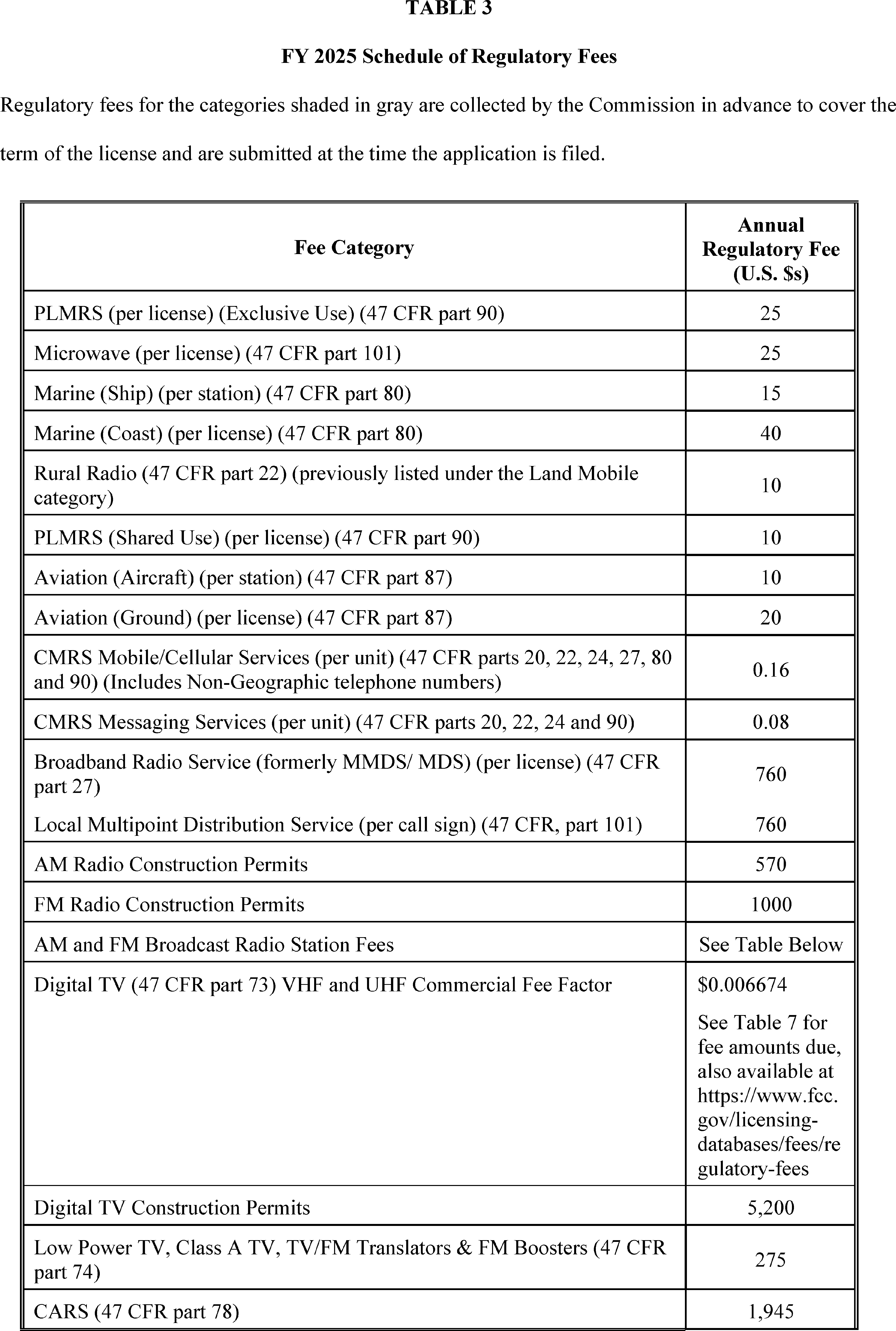
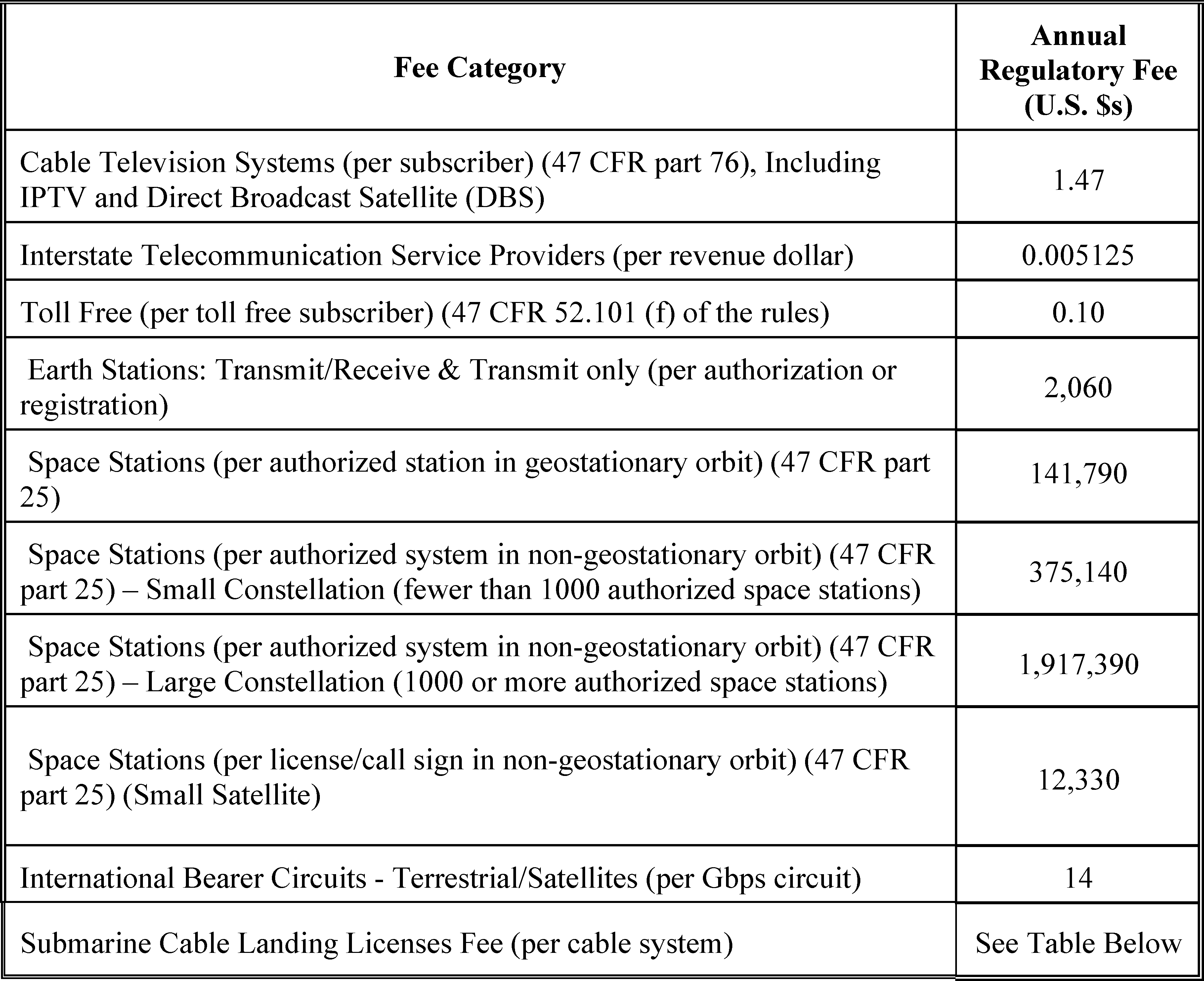
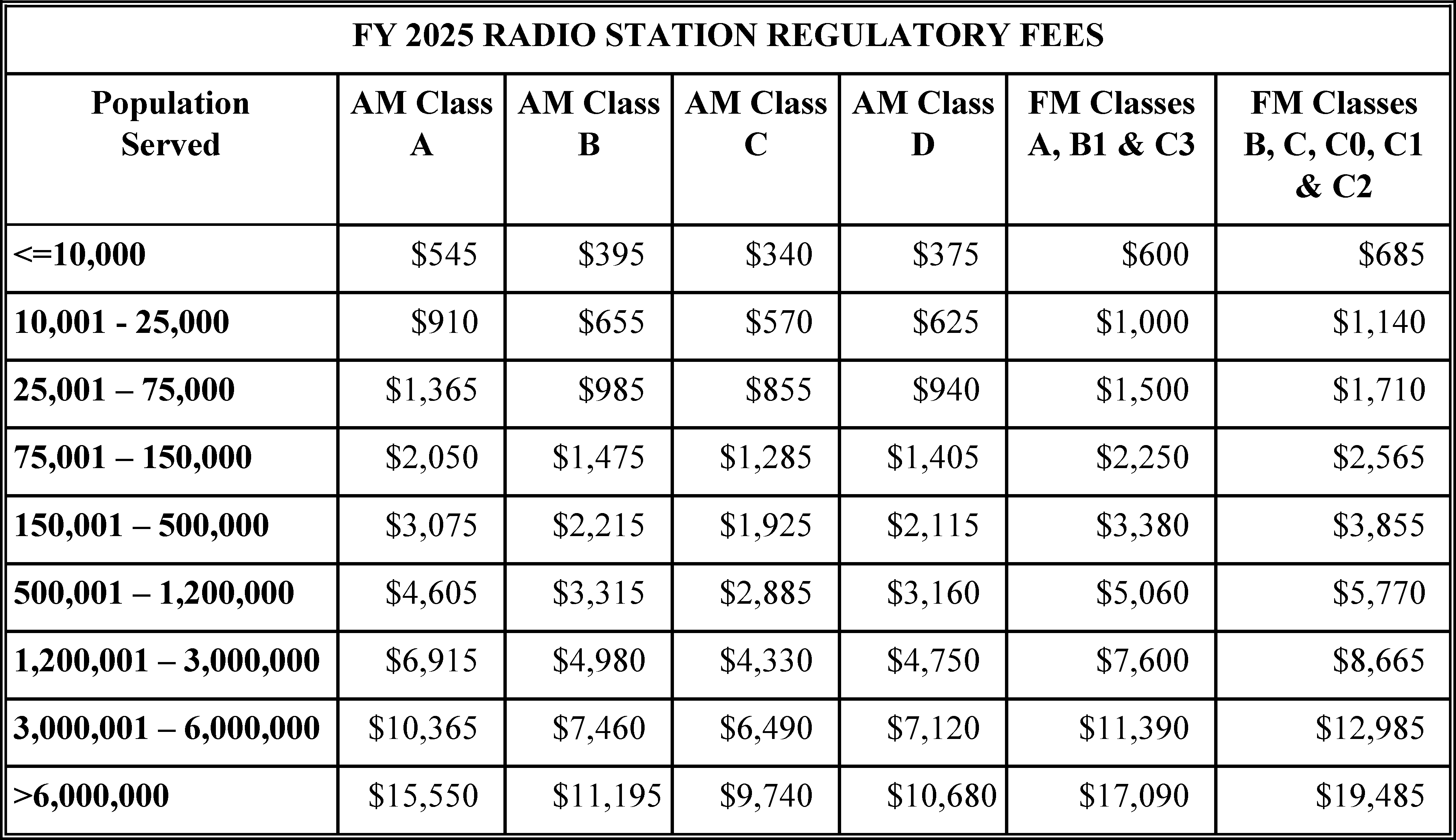
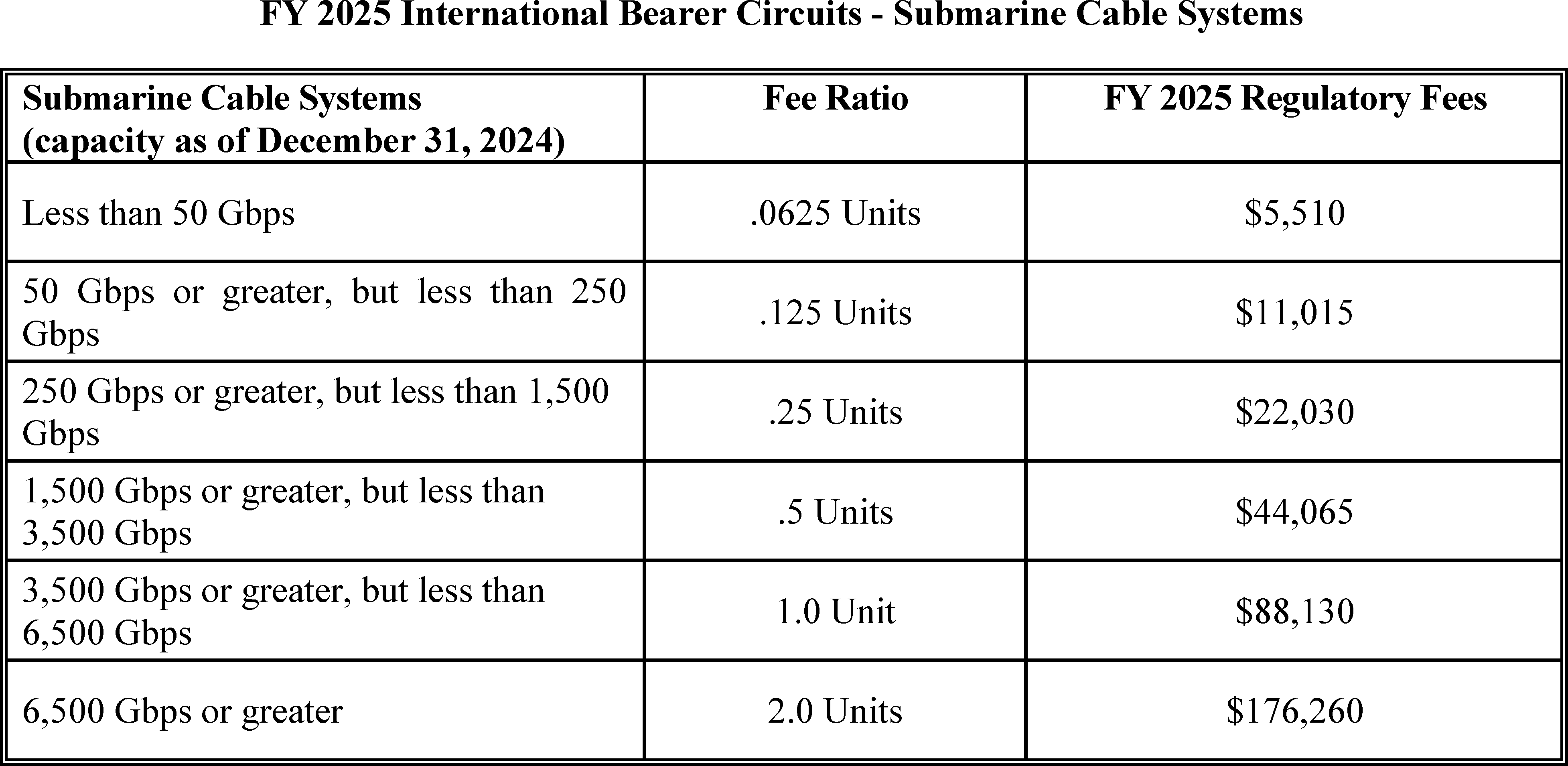
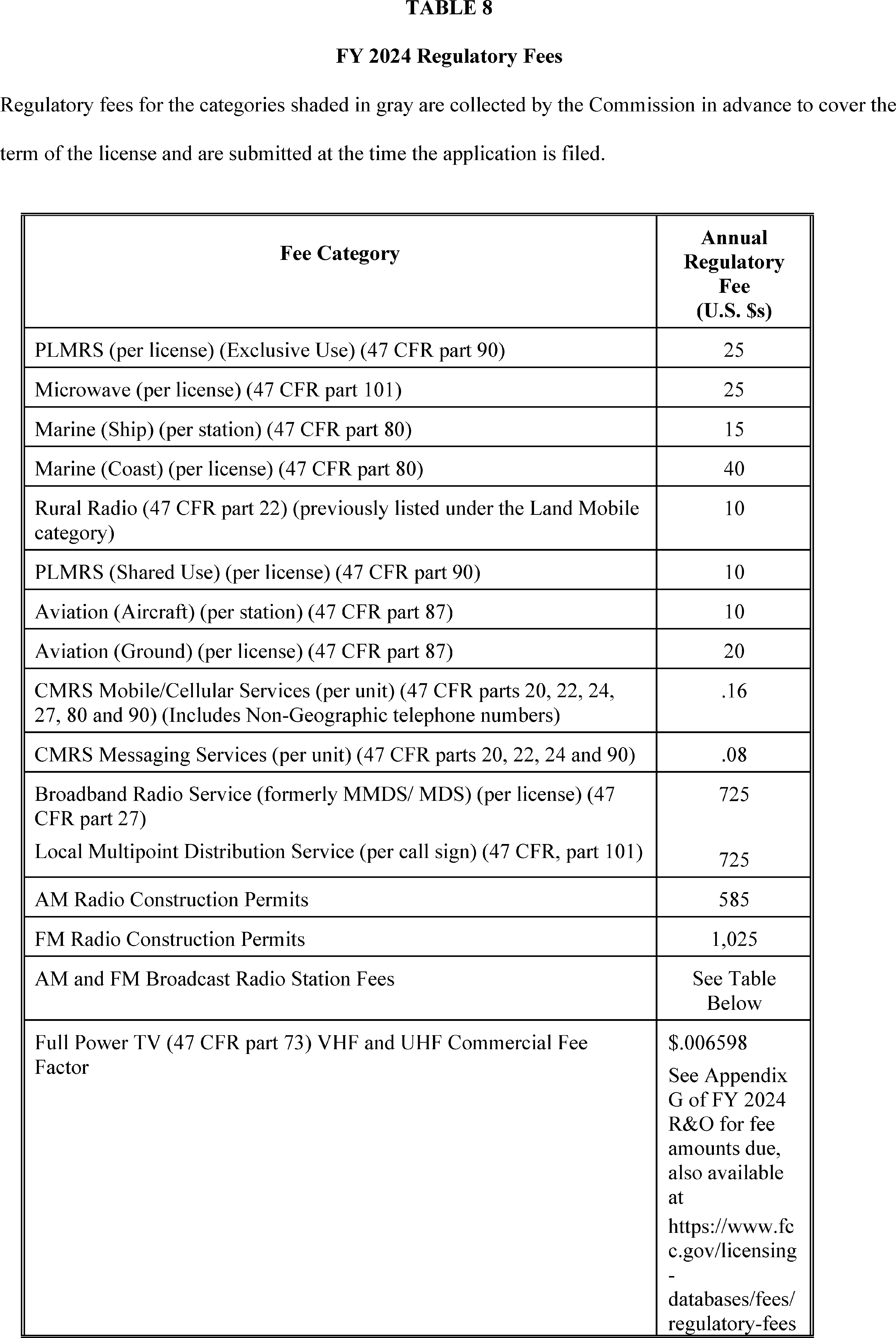
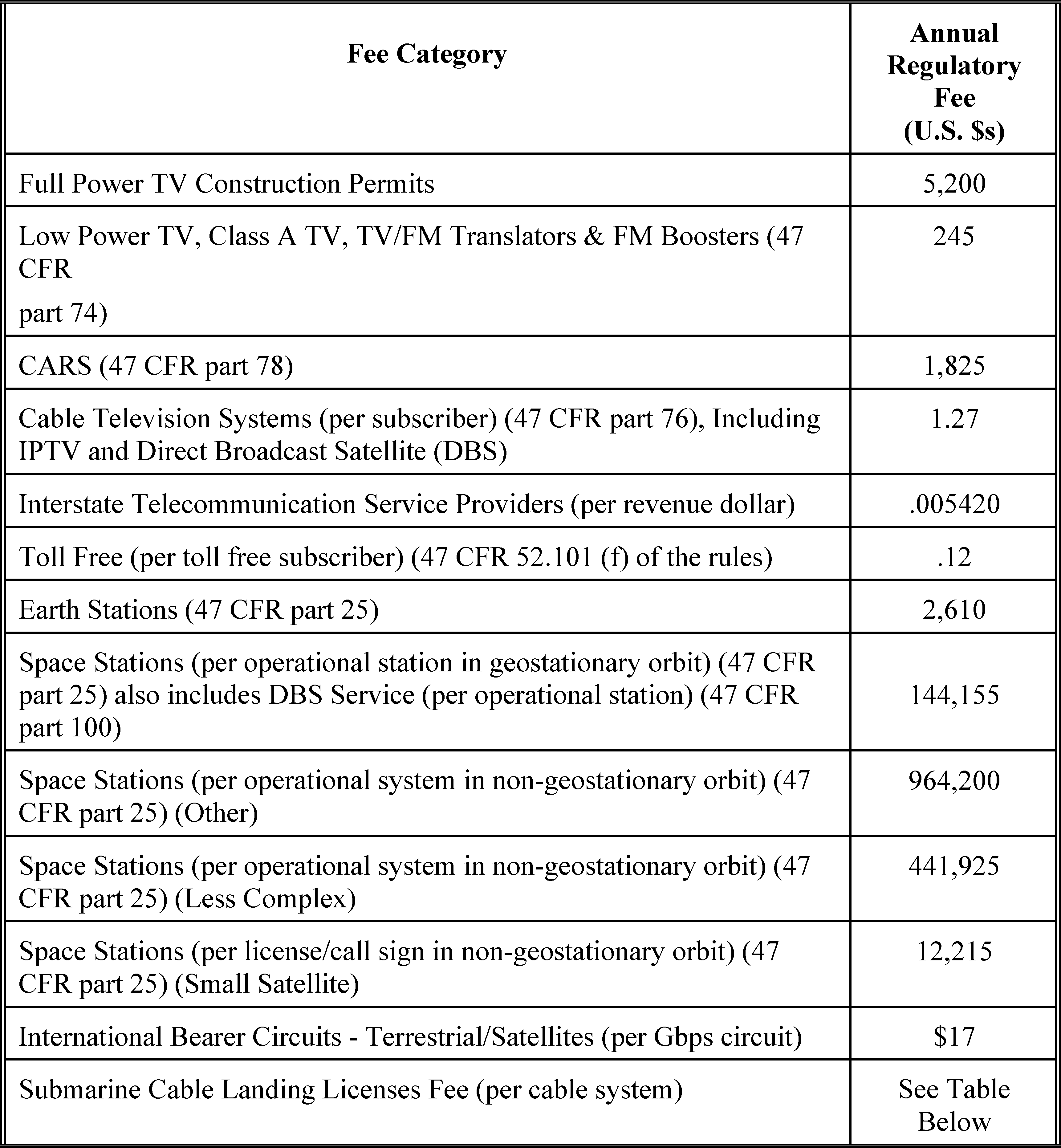
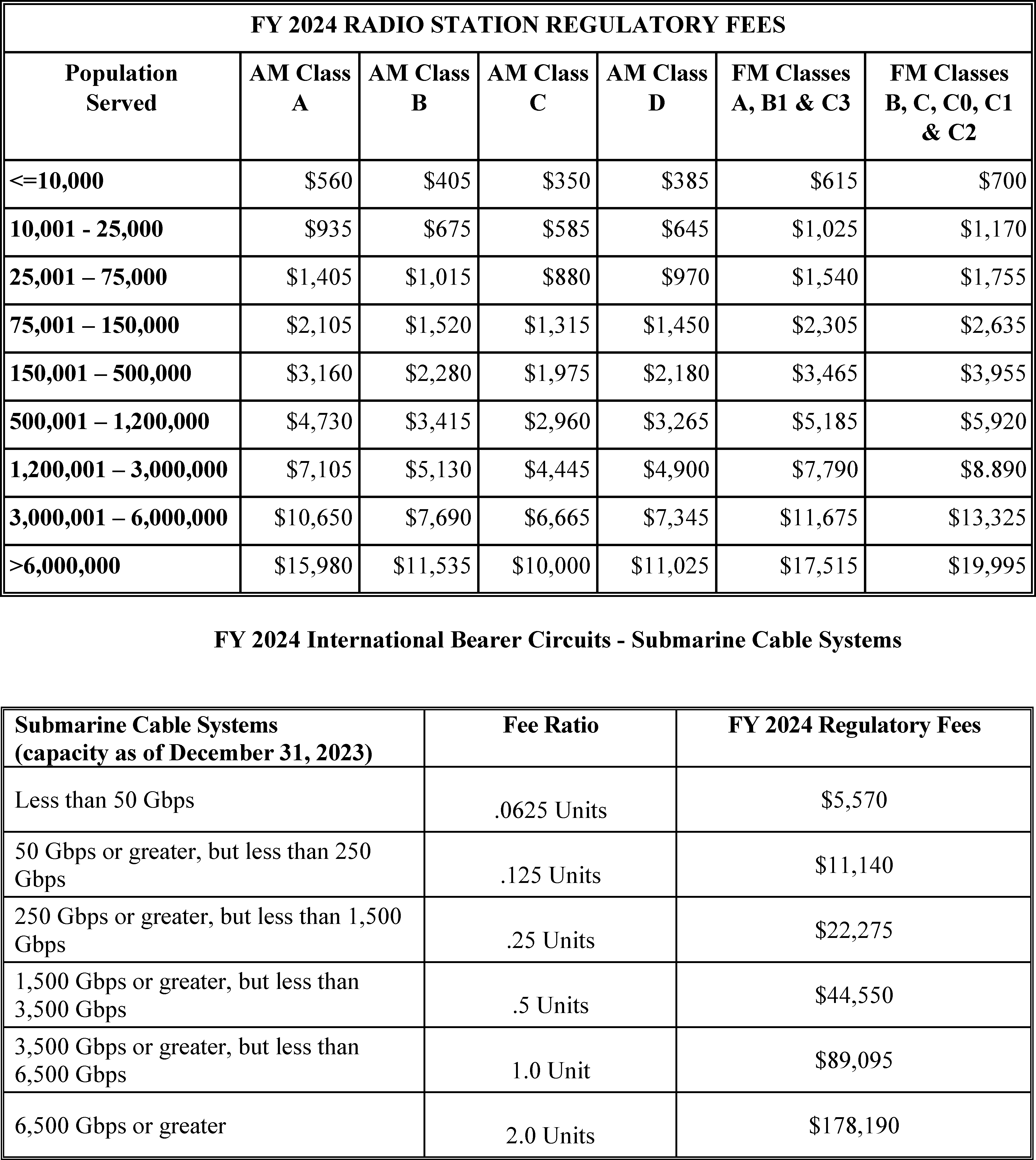
The Commission also implements the targeted amendments it adopted in June 2025 to the methodology it uses to assess regulatory fees for space and earth stations. Additionally, the Commission adopts its proposal in the FY 2025 NPRM for the calculation of television broadcaster regulatory fees, as adjusted. The Commission implements these determinations and adopts a schedule of regulatory fees, as set forth in Tables 3 and 4.
Finally, the Commission declines to adopt various proposals to modify its regulatory fee methodology or to add new regulatory fee categories in FY 2025. The arguments supporting such proposals have been fully considered by the Commission in prior proceedings. Commenters have provided no basis for the Commission to change its prior determinations, and therefore the Commission reaffirms the prior conclusions that the methodology changes and new regulatory fee categories that have been proposed are unworkable and logistically infeasible at this time.
Background.
FY 2025 started on October 1, 2024, and ends on September 30, 2025. The regulatory fee collection is guided by both the statutory authority in sections 6 and 9 of the Act and the explicit language of each fiscal year's S&E appropriation directing the amount to be collected as an offsetting collection. Section 9 of the Act and the FY 2025 S&E appropriation require the Commission to collect $390,192,000 in regulatory fees in FY 2025. The Act requires the Commission to assess and collect regulatory fees to recover the costs of carrying out its activities in the total amounts provided for in Appropriations Acts. Regulatory fees cover the Commission's non-auctions direct, indirect, and support costs, including costs to cover statutorily required tasks that do not directly equate with oversight and regulation of a particular fee payor, but instead benefit the Commission and the industry as a whole. Direct costs are those such as salaries and expenses, indirect costs are those such as overhead functions, and support costs include those such as rent, utilities, and equipment. Since regulatory fees must recover the total amount of the Commission's S&E appropriation for the fiscal year, they also must cover the costs incurred in oversight and regulation of: (1) entities that are statutorily exempt from paying regulatory fees; (2) entities whose total assessed annual regulatory fees fall below the annual de minimis threshold; and (3) entities whose regulatory fees are waived. Entities that are exempt from paying regulatory fees include governmental and nonprofit entities, amateur radio operators, and noncommercial radio and television stations. The Commission has previously observed that it is consistent with the Act to include those costs that are attributable to the fee paying and exempt regulatees in the revenue requirement because all of the
( printed page 43285)
regulatees in that fee category, whether they pay regulatory fees or not, benefit from the oversight and regulation of that bureau. The Commission's annual de minimis threshold is $1,000. The Commission takes into consideration the relatively small amount of waivers, exemptions, and non-payors in our calculations each year so that we can recover the full amount of our S&E appropriation.
Regulatory Fees Calculation Methodology
Congress has prescribed a method for the Commission to collect the full S&E appropriation by keying its regulatory fee assessment to its FTE burden. One FTE, a “Full Time Equivalent” or “Full Time Employee,” is a unit of measure equal to the work performed annually by a full-time person (working a 40-hour workweek for a full year) assigned to the particular job, and subject to agency personnel staffing limitations established by the U.S. Office of Management and Budget. In this proceeding, if the Commission states 1.5 FTEs work on a particular subject matter, that might mean three individuals spend 50% of their time on that area. Moreover, in the
FY 2025 Regulatory Fees Report and Order,
when the Commission discusses FTEs and any change in allocation, it is solely for regulatory fee purposes and does not reflect proposals for the change of personnel in the various organizational work units. The methodology for assessing regulatory fees must “reflect the full-time equivalent number of employees within the bureaus and offices of the Commission, adjusted to take into account factors that are reasonably related to the benefits provided to the payor of the fee by the Commission's activities.” Thus, the fee assigned to each regulatory fee category relates to the FTE burden associated with oversight and regulation of each regulatory fee category by the relevant core bureaus (
i.e.,
the Wireless Telecommunications Bureau, the Media Bureau, most of the Wireline Competition Bureau, part of the Office of International Affairs (OIA), and most of the Space Bureau). The Commission has previously concluded that allocating the work of FTEs in the Wireline Competition Bureau devoted to non-high-cost Universal Service Fund programs as indirect FTEs is consistent with how FTEs working for programs that benefit consumers and the American public are treated elsewhere in the Commission. Moreover, in the non-high-cost universal service fund programs, the E-Rate, Lifeline, and Rural Healthcare programs tie funding eligibility based on the beneficiary,
i.e.,
a school, a library, a low-income individual or family, or a rural healthcare provider and not to Commission regulatory fee payors. Thus, the burden of FTE time devoted to non-high-cost Universal Service Fund programs is properly categorized as indirect. As part of this determination, the Commission has also excluded broadcasters from the fee burden associated with these indirect FTEs because broadcasters do not directly participate in the universal service program. The burden of this indirect FTE work is analyzed by staff annually and is deducted from the calculation of the direct FTEs allocated to the Wireline Competition Bureau and, after it excludes broadcasters, the Commission apportions these indirect FTEs among all other fee payors. The Commission has also explained that most of the work of OIA, including the work of the Global Strategies and Negotiation Division, does not benefit a specific fee payor, but rather the government as a whole, and is therefore appropriately categorized as indirect. However, the Commission continues to categorize as direct the FTE work of OIA concerning international bearer circuit issues, including the services provided over submarine cables, determining that there were eight FTEs within OIA whose work was direct on that basis.
The total amount of the offsetting collection generally changes each fiscal year. Therefore, the regulatory fees due from payors also typically change as a mathematical consequence of the total amount that needs to be collected, the number of FTEs, and the projected unit estimates for each regulatory fee category. For example, if the number of units in a regulatory fee category increase, the amount due per unit may decrease, depending on other factors. This would also include proportionate increases in a given fee category to reflect an overall increase in the annual FY appropriation. Insofar as the Communications Act's explicit language requires that fees must reflect FTEs, the Commission has consistently concluded that FTE counts are the most administrable starting point for regulatory fee allocations, and the Commission's regulatory fees are based on the direct FTEs in core bureaus. Thus, when considering changes, additions, or deletions to the regulatory fee schedule, the Commission focused on the direct FTE cost burden related to the regulatory fee category at issue within each of the core licensing bureaus.
FTEs are not assigned within a bureau to specific fee categories “by rote or at random, but rather in a manner that reflects the time spent by FTEs on a regulatory fee category, which is in itself a reflection of `benefit' to the fee category.” The Commission has stated that Section 9 of the Act is clear, however, that regulatory fee assessments are based on the burden imposed on the Commission, not benefits realized by regulatees. The Commission apportions regulatory fees across fee categories based on the number of direct FTEs in each core bureau to take into account factors that are reasonably related to the payors' benefits. Any decrease to the fees paid by one category of regulatory fee payors necessitates an increase in fees paid by other categories of regulatory fee payors, which means the collection of the Commission's regulatory fees is a zero-sum exercise.
The Commission allocates FTEs according to the nature of the work performed by its different organizational units. If FTE work directly relates to the oversight and regulation of a regulatory fee category in one of the five core licensing bureaus then it is considered to be direct. Work that cannot be allocated to one of those regulatory fee categories is counted as indirect FTE time.
Indirect FTE time covers a wide range of issues that include services that are not specifically correlated with one core bureau, let alone one specific category of regulatory fee payors. Indirect FTE work also includes matters that are not specific to any regulatory fee category, and many Commission attorneys, economists, engineers, analysts, and other staff work on a variety of issues during a single fiscal year, which benefits the Commission, the telecommunications industry, and the public. Historically, the Commission has categorized FTE work conducted in the Enforcement, Consumer and Governmental Affairs, and Public Safety and Homeland Security Bureaus along with some of the work in the Wireline Competition and the former International Bureau as well as the work of those in the Office of the Chair and the Commissioners' Offices and in the Offices of the Managing Director, General Counsel, Inspector General, Communications Business Opportunities, Engineering and Technology, Legislative Affairs, Workplace Diversity, Media Relations, Economics and Analytics, and Administrative Law Judges as indirect for regulatory fee purposes. Following this framework, the Commission assesses the allocation of FTEs by first determining the number of direct non-auctions FTEs in each of the Commission's core bureaus. Other
( printed page 43286)
factors the Commission takes into consideration include the annual S&E appropriation and the projected unit estimates. Early in each fiscal year, the Human Resources Management office identifies FTEs at the core bureau level. The Commission then validates that data through consultation with the bureaus and offices to determine the number of direct FTEs allocated to each of the five core bureaus. Those numbers are then used to calculate the corresponding percentage of the total amount of regulatory fees to be collected for a given fiscal year from the fee payors of each core bureau. The percentage for each core bureau is the number of direct non-auction FTEs within the core bureau divided by the total number of direct non-auction FTEs in the Commission.
This means fees are apportioned across the regulatory fee categories based on the number of direct FTEs in each core bureau whose time is focused on a particular industry segment and are adjusted “to take into account factors that are reasonably related to the benefits provided to the payor of the fee by the Commission's activities.” Specifically, the Commission allocates appropriated amounts to be recovered proportionally based on the number of direct FTEs within each core bureau. As a general matter, there is no additional calculation to attribute indirect costs. Instead, the proportional allocation of the whole S&E appropriation based on the number of direct FTEs effectively attributes all indirect costs among the core bureaus so that the Commission can recover its entire appropriation each year. Those proportions are then subdivided and apportioned within each core bureau into fee categories among those served based on the time spent on each fee category. Finally, within each regulatory fee category the amount to be collected is divided by a unit count that allocates the regulatory fee payor's proportionate share based on an objective measure.
The FTE time devoted to developing and implementing the Commission's spectrum auctions is not included in the calculation of regulatory fees and is not offset by the collection of regulatory fees. Thus, the Commission's methodology excludes all spectrum auction-related FTEs and their overhead from the regulatory fee calculations. To the extent that FTEs within the core bureaus spend a portion of their time on auctions issues and a portion of their time on other issues, their time is split and only the non-auctions portion of their time is reflected in the relevant core bureau's direct FTE count.
Adjustments and Amendments to Regulatory Fees Schedule
In order to collect regulatory fees in the amount required by the Commission's annual S&E appropriation, it conducts a rulemaking proceeding each year to consider any necessary increases or decreases in the number of units subject to the payment of such fees and to reflect any adjustments needed to the prior year's fees schedule. For example, if the number of units in a regulatory fee category increase, the amount due per unit may decrease. This would also include proportionate increases in a given fee category to reflect an overall increase in the annual FY appropriation. Such changes are rarely the subject of dispute and are usually addressed in the more ministerial changes to the fee schedule. As necessary, the Commission will also propose amendments to the fee schedule “if it determines that changes are necessary for the fees to reflect the full-time equivalent number of employees within the bureaus and offices of the Commission, adjusted to take into account factors that are reasonably related to the benefits provided to the payor of the fee by the Commission's activities.” Pursuant to the Act, the Commission must notify Congress immediately upon adoption of any adjustment. The Act also requires the Commission to notify Congress at least 90 days prior to making effective any amendments to the regulatory fee schedule.
The Commission considers the adoption of a new regulatory fee category or a change in an existing regulatory fee category only when it develops a sufficient basis for making the change, ensuring that its assessment of regulatory fees is fair, administrable, and sustainable. The Commission will adopt new regulatory fee categories and new methodologies for calculating regulatory fees when there is a sufficient basis for doing so based on the record, and under the relevant statutory provisions and precedent.
Commission FY 2025 Regulatory Fee Releases
On June 5, 2025, the Commission released the
FY 2025 NPRM.
There, the Commission proposed and sought comment on the regulatory fees and methodology to assess and collect $390,192,000 in congressionally required regulatory fees for FY 2025. The Commission proposed to increase the number of FTEs that are allocated directly to the core licensing bureaus for this fiscal year based upon the determination that burden of the work they are performing is sufficiently linked to the oversight and regulation of certain regulatory fee payors. In particular, the Commission proposed reallocating 61 indirect FTEs as direct FTEs to the Commission's core licensing bureaus. In addition, the Commission sought comment on proposed regulatory fees for space and earth station fee payors either under the existing fee methodology or under the various alternative or amended methodologies on which the Commission was seeking comment at the time. The Commission also proposed to continue the past practice of calculating television broadcaster regulatory fees using the methodology based on the population covered by a full-service broadcast television station's contour. The
FY 2025 NPRM
did not propose any amendments that would require congressional notification 90 days before becoming effective.
On June 9, 2025, the Commission released the
FY 2024 Third Report and Order.
In that order, the Commission adopted changes to its regulatory fee methodology to (i) assess regulatory fees on space and earth stations once they are authorized, rather than when the stations are certified to be operational, and (ii) split existing regulatory fee categories for Space Stations (Non-Geostationary Orbit) into two new fee categories: small constellations (fewer than 1000 authorized space stations) and large constellations (1000 authorized space stations or more). The
FY 2024 Third Report and Order
was published in the
Federal Register
, 90 FR 29760, on July 7, 2025, and the amendments to the space and earth station regulatory fee methodologies become effective on September 14, 2025.
Discussion.
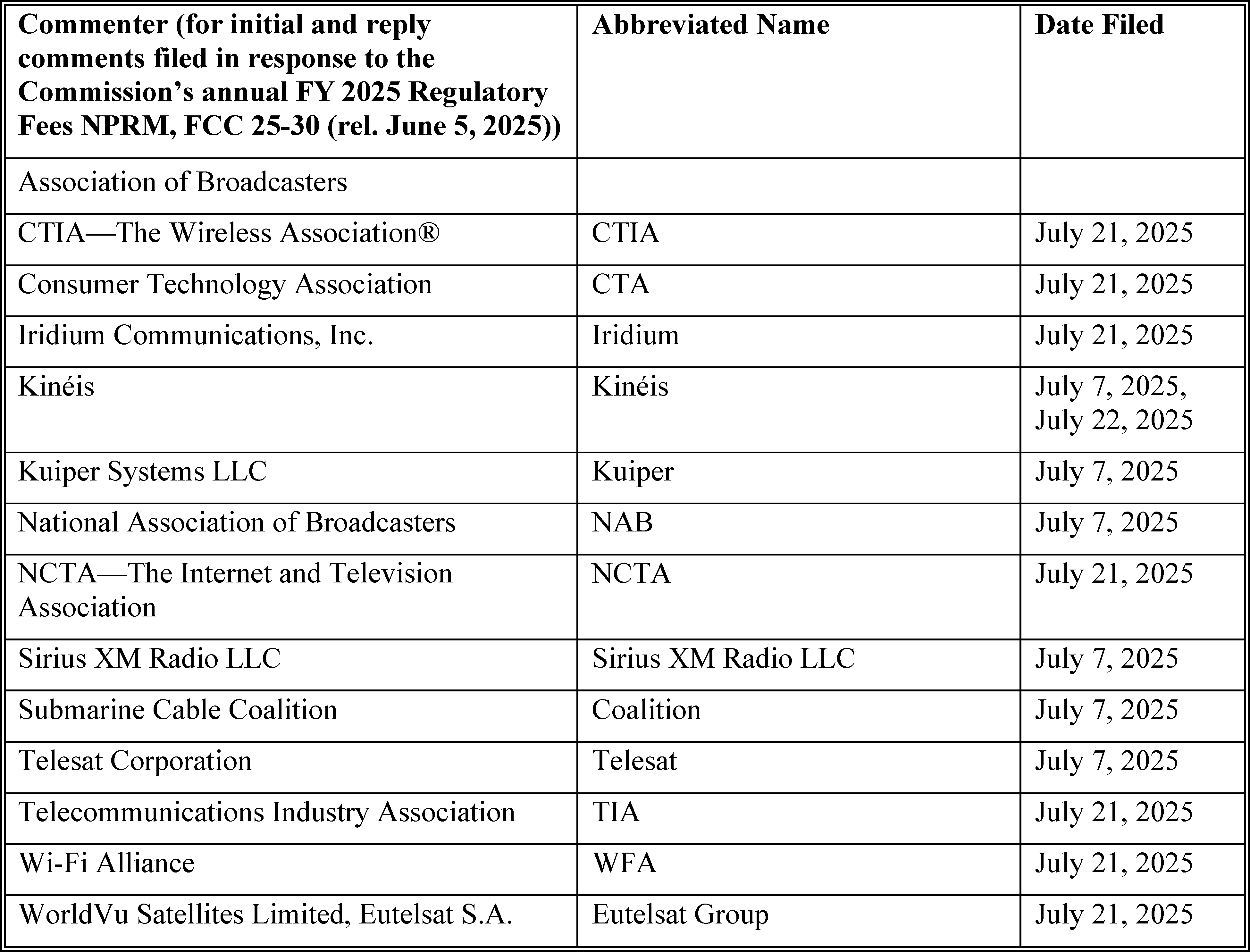
The Commission received six comments and nine reply comments in response to the Commission's
FY 2025 NPRM.
As generally supported by the record gathered, the Commission adopts its proposals in the
FY 2025 NPRM.
Accordingly, using the Commission's historical methodology for allocating FTEs, along with targeted amendments to assess regulatory fees for space and earth stations, the Commission adopts a regulatory fee schedule for FY 2025 to collect $390,192,000, which is an amount that reasonably can be expected to total the Commission's annual S&E FY 2025 appropriation, as set forth in Tables 3 and 4.
Assessment of Regulatory Fees
Methodology for Assessing Regulatory Fees.
Section 9 of the Communications Act requires the Commission to set
( printed page 43287)
regulatory fees to “reflect the full-time equivalent number of employees within the bureaus and offices of the Commission adjusted to take into account factors that are reasonably related to the benefits provided to the payor of the fee by the Commission's activities.”
As a general matter, to establish its regulatory fee schedule, first, the Commission identifies changes from the prior fiscal year regulatory fee proceeding,
e.g.,
changes in the (i) FY S&E appropriation, (ii) FTE levels, and (iii) relevant unit measures for each regulatory fee category. After that, the Commission identifies the number of direct non-auction FTEs in each core bureau for purposes of the regulatory fee calculation. The remaining non-auction FTEs are considered indirect and are not part of the regulatory fee calculation. Once the Commission determines the number of direct FTEs for each core bureau, it calculates the percentage of regulatory fees that it needs to collect for the given fiscal year from each regulatory fee category within each core bureau. These proportional calculations allocate all of the Commission's non-auction related costs across all regulatory fee categories. For FY 2025, the Commission implements the same methodology it has used historically for allocating FTEs as well as the targeted amendments to the methodology it uses to assess regulatory fees for space and earth stations that were adopted by the Commission in June 2025 in the
FY 2024 Third Report and Order.
Adjustment of Reallocations of Certain Indirect FTEs as Direct FTEs.
The Commission's decision to adopt its proposal to reallocate certain indirect FTEs as direct to one of its core bureaus reflects its conclusion that it can again determine, with reasonable accuracy for this fiscal year, that certain FTE time from the Office of General Counsel, the Office of Economics and Analytics, and the Public Safety and Homeland Security Bureau is devoted to work that is sufficiently linked to the oversight and regulation of regulatory fee payors such that the FTE burden of that work should be allocated as direct to a core bureau for regulatory fee purposes. As the Commission explained in 2023 and 2024, the Commission will continue to evaluate whether any FTEs should be reallocated for regulatory fee purposes each year when reviewing and validating the FTE data. The Commission, however, will exercise its discretion regarding where to focus its analytical efforts each year to best respond to changes in the Commission's substantive work and organization, and changes in the telecommunications industry itself. Thus, the Commission ensures it conducts its annual review in a manner that is fair, administrable, and sustainable. Moreover, commenters support the Commission's efforts to ensure that regulatory fees reflect the work performed by Commission FTEs, which benefits fee payors.
To conduct its annual review for FY 2025, the Commission evaluated the work being performed by FTEs. According to information provided by the Commission's Human Resources Management office, at the start of FY 2025, there were 384.5 direct non-auctions FTEs distributed among the core licensing bureaus. With respect to other bureaus and offices the Commission conducted a high-level, yet comprehensive, analysis of the work being performed by non-auctions FTEs in the Office of Economics and Analytics, Office of General Counsel, and Office of Engineering and Technology as well as the Public Safety and Homeland Security Bureau, Enforcement Bureau and the Consumer and Governmental Affairs Bureau (and other bureaus and offices) to determine if identifiable time of any of the FTEs in those organizational units is directly related to the oversight and regulation of fee payors such that it should be considered in applying its fee methodology. In other words, staff examined and validated the data through consultation with the bureaus and offices to determine whether in applying the Commission's regulatory fee methodology any FTE time in the non-core bureaus and offices should be reallocated and be considered as direct FTE time to a core bureau.
Based on staff analysis, which the Commission concludes is reasonably accurate for FY 2025, it adopts its proposal to reallocate 63 indirect FTEs from the Office of Economics and Analytics, the Office of General Counsel, and the Public Safety and Homeland Security Bureau as direct to a core bureaus. The Commission finds these reallocations are necessary because, as the Commission concluded in both FY 2024 and FY 2023, the nature of certain FTE work conducted in those organizations remains primarily related to the oversight and regulation of fee payors. Additionally, consistent with the Commission's determination for the past two fiscal years, it also reallocates two FTEs from the Media Bureau to be considered as indirect FTEs because the nature of their work is similar to work performed in the Enforcement Bureau, which it considers to be indirect. The Commission determines that these conclusions are consistent with Section 9 of the Act, which requires the Commission to base its methodology on the number of FTEs in calculating regulatory fees.
These reallocations result in an overall increase of 61 indirect FTEs being reallocated as direct FTEs to core bureaus. Although NAB notes its continued belief that FTE work devoted to certain non-high-cost Universal Service Fund matters also should be reallocated as direct, the Commission concludes that NAB provides no new arguments to warrant it to revisit the Commission's prior determinations that such work is appropriately categorized as indirect, and therefore the Commission declines to do so.
Reallocations, for Regulatory Fee Purposes, of Certain Indirect FTEs as Direct FTEs
As the Commission has previously explained, when it discusses FTEs, it is not referring to any particular employee at the Commission but rather an amount of work performed annually by a full time employee or employees. In analyzing the work of FTEs, the Commission applies conservative estimates so as not to imply a false sense of precision in the proposed reallocation. Specifically, where the amount of work under consideration for reallocation of an indirect FTE was half an FTE or less, the Commission rounds down and it only proposes its reallocations in full FTE increments.
In evaluating the nature of the work of its FTEs, the Commission generally categorizes the FTEs in its non-core bureaus and offices as indirect. For example, the Office of Engineering and Technology provides engineering and technical expertise to the agency as a whole and supports each of the agency's core bureaus. Likewise, the Enforcement Bureau FTE oversight is focused on the integrity of Commission's rules and ensuring the implementation of the Communications Act, which is work that benefits the agency as a whole and the American public, and not one particular group of regulatory fee payors. Similarly, the work of FTEs in the Consumer and Governmental Affairs Bureau is primarily devoted to developing and implementing consumer policies as required by the Communications Act, including disability rights, via rulemaking and declaratory ruling; consumer education; processing informal complaints; outreach to state, local, and Tribal governments; and oversight more generally of the telecommunications industry (
e.g.,
establishing and oversight of the Reassigned Numbers Database). In sum, the Commission has found it would not be equitable for any one
( printed page 43288)
regulatory fee group of payors to shoulder the FTE burden of indirect work.
While the Commission concludes that much of the work of the FTEs in the Office of Economics and Analytics, the Office of General Counsel, and the Public Safety and Homeland Security Bureau continues to be appropriately considered indirect, in validating the FTE count for this year, it affirms the Commission's conclusion of the past two years that certain work should again be reallocated as direct. The Commission explains that its consideration of the work of FTEs as direct or indirect may change over time based on its evaluation of the FTE burden associated with the Commission's work assignments, fluctuations within industry segments, the needs of specific regulatory fee payors, and the requests of commenters to continue its review of any necessary reallocations.
Office of Economics and Analytics (OEA).
OEA is responsible for expanding and strengthening the use of economic analysis in Commission policy making, for enhancing the development and use of auctions, and for implementing consistent and effective agency-wide data practices and policies. Much of the work of the non-auctions FTEs in OEA therefore benefits the Commission and the telecommunications industry as a whole and does not specifically focus on a particular category of regulatory fee payors. Thus, as the Commission has previously concluded, such work is appropriately considered to be indirect.
As the Commission recognized in both FY 2023 and FY 2024, however, and as it has validated again for FY 2025, there continues to be measurable FTE work conducted in OEA that is being done directly in furtherance of the oversight and regulation of regulatory fee payors in certain industry segments. On that basis, in the
FY 2025 NPRM,
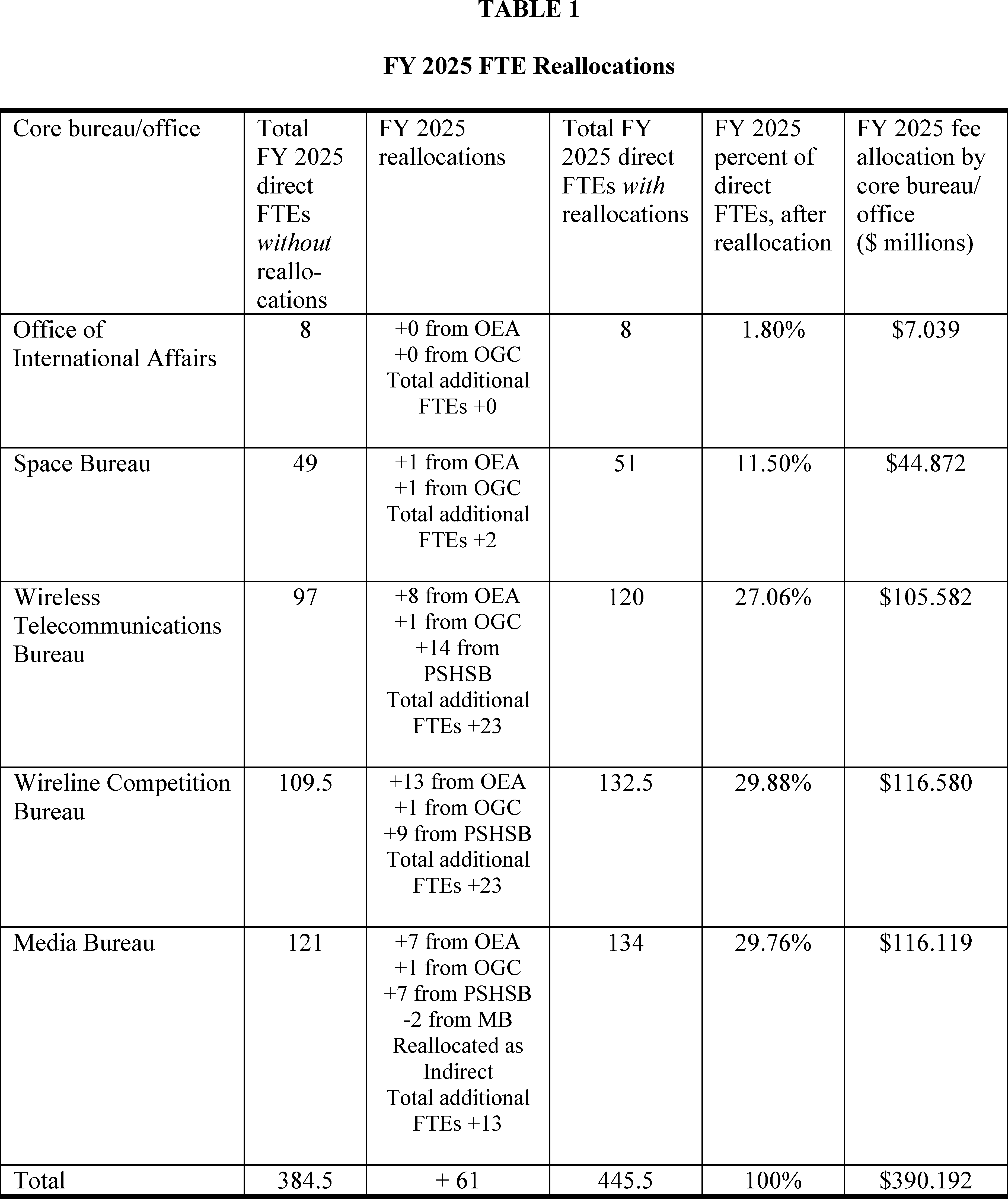
the Commission proposed targeted reallocations of OEA FTEs. No commenters disagreed with the Commission's proposal to reallocate 29 indirect FTEs from OEA as direct to a core bureau for regulatory fee purposes. Based on the Commission's staff analysis, it adopts that proposal and reallocates indirect FTEs from OEA as follows: one to the Space Bureau, eight to the Wireless Telecommunications Bureau, 13 to the Wireline Competition Bureau, and seven to the Media Bureau.
Office of General Counsel (OGC).
The Commission, as it has in the past, concludes that much of the work of the OGC, as represented by FTE allocations, should be considered to be indirect. OGC serves as the chief legal advisor to the Commission and its various bureaus and offices.
Yet, as the Commission recognized in FY 2023 and FY 2024, and has again validated for FY 2025, it finds that certain aspects of OGC's work are sufficiently linked to the oversight and regulation of individual regulatory fee categories that the associated FTEs should properly be considered direct FTEs for such regulatory fee categories. Specifically, based on the substance of the work that is done directly in furtherance of the oversight and regulation of regulatory fee payors in certain industry segments for FY 2025, the Commission adopts its proposal to reallocate four indirect FTEs as direct to a core bureau as follows: one to the Wireline Competition Bureau, one to the Wireless Telecommunications Bureau (instead of two as in FY 2024), one to the Space Bureau, and one to the Media Bureau.
Public Safety and Homeland Security Bureau (PSHSB).
The Commission also concludes, as the Commission has previously, that much of PSHSB's work, as represented by FTE allocations, should be considered to be indirect. PSHSB advises and coordinates within the Commission on all matters pertaining to public safety, homeland security, national security, cybersecurity, emergency management and preparedness, disaster management, and related matters.
As the Commission concluded in FY 2024 and FY 2023, and as it has validated again for FY 2025, there remains substantive work done by PSHSB that is directly in furtherance of the oversight and regulation of certain regulatory fee payors. For FY 2025, the Commission finds it is appropriate to reallocate 30 indirect FTEs from PSHSB as direct to a core bureau for regulatory fee purposes as follows: 14 to the Wireless Telecommunications Bureau, nine to the Wireline Competition Bureau, and seven to the Media Bureau.
Conclusion of the Proposal to Reallocate Certain Indirect FTEs from OEA, OGC, and PSHSB as Direct FTEs to a Relevant Core Bureau.
FTE time associated with these reallocations will be added to the direct FTE totals for a relevant core bureau. The reallocation of indirect FTEs will increase the number of direct FTEs in a core bureau and reduce the total number of indirect FTEs within the Commission. Insofar as the Commission's underlying methodology for calculating regulatory fees remains unchanged, the Commission concludes that its fee regulatory fee calculations continue to be consistent with Section 9 of the Communications Act.
The reallocation of 61 indirect FTEs as direct for regulatory fee purposes in FY 2025, results in a 15.9% increase in the Commission's overall direct FTE count for FY 2025, and a decrease of 4.25% in the overall direct FTE count from FY 2024.
The Result of the FTE Reallocations from the Office of Economic Analytics, Office of General Counsel, and Public Safety and Homeland Security Bureau.
Based on these reallocations and after adjustments are made to the direct FTE counts to implement Commission precedent, the Commission has a total of 445.5 non-auctions direct FTEs for FY 2025, and it will collect approximately $7.039 million (1.80%) in fees from the Office of International Affairs regulatory fee payors; $44.872 million (11.50%) in fees from the Space Bureau regulatory fee payors; $105.582 million (27.06%) in fees from Wireless Telecommunications Bureau regulatory fee payors; $116.580 million (29.88%) in fees from Wireline Competition Bureau regulatory fee payors; and $116.119 million (29.76%) in fees from Media Bureau regulatory fee payors. These FTE reallocations, for regulatory fee purposes, will be proportionally distributed within the core bureaus. The Commission's underlying methodology for calculating regulatory fees remains unchanged; its regulatory fee calculation continues to be consistent with Section 9 of the Act, which requires it to base its methodology on the number of FTEs in calculating regulatory fees.
( printed page 43289)
Although the Submarine Cable Coalition generally supports the Commission's efforts to reallocate FTEs that are working on the oversight and regulation of fee payors as direct FTEs, it nonetheless “asserts that further Commission review should be conducted to determine if it is possible to lower the number of direct FTEs attributed to international bearer circuits within OIA, or to convert some or all these direct FTEs into indirect FTEs.” In support of this position, it argues that it “should not be the burden of submarine cable operators, nor any one type of international licensee under OIA, to subsidize holders of other license types.” The Submarine Cable Coalition renews its claims that the “the benefits submarine cable licensees receive from the Commission's work pale significantly in comparison to the regulatory oversight required of other Commission licensees.” CTIA, however, responds to this argument by advocating that the Commission should decline to reclassify FTEs in OIA working on international bearer circuits as indirect, because doing so would disregard the requirements of Section 9 and the Commission's core principles underlying its regulatory fee framework. CTIA maintains that the Submarine Cable Coalition has provided no valid reason why the Commission should redo its FTE analysis and reclassify these FTEs based on something other than the work they undertake. The
( printed page 43290)
Commission agrees with CTIA and finds based on its staff analysis for FY 2025 that 8 FTEs are appropriately considered direct in OIA and declines to reclassify some or all as indirect FTEs.
The Commission also disagrees with the comments of Telesat that repeat a suggestion previously offered by the Satellite Operators in 2023 contending that the Commission should propose regulatory fees at the outset of each non-application rulemaking proceeding in order to collect its attendant costs. The Commission rejected this proposal at that time, observing that there was no explanation of “how such an approach would facilitate recovery on an annual basis of the Commission's entire FY S&E appropriation.” The Commission agrees with the Commission's 2023 conclusion that this proposal “does not appear administrable because it would inject a potentially contentious issue—who bears the FTE burden of the proceeding—into each rulemaking and thereby only increase the possible points of disagreement in each respective rulemaking.” As the Commission previously observed, because there is no way to determine at the NPRM stage of a proceeding the entities or interested parties that might file comments and/or challenge a matter in any given rulemaking, any initial allocations regarding the FTE burden of work associated with any category of fee payors for a particular rulemaking would require frequent reassessment.
Moreover, the Commission further explains that as a general matter, rulemakings are not based on a fiscal year, and the work attendant with any particular year can extend, and often evolve, across multiple years. Additionally, the Commission reasons that if this proposed approach were to replace its current approach, it would fail to capture the FTE burden of work on issues that involve the day-to-day oversight of policies and rules that impact all categories of regulatory fee payors, issues that are often unrelated to any particular proceeding that is active during the fiscal year. Furthermore, the Commission explains it is entirely unclear how it could manage the administration of regulatory fees if a proceeding were to go dormant or close. Such fluctuations in the expectations associated with assessing regulatory fees would be difficult for both fee payors as well as the Commission. The Commission therefore agrees with prior Commission conclusions that such a proposal is “impractical and thereby unlikely to facilitate the statutorily required recovery, on an annual basis, of the Commission's entire FY S&E appropriation.” The Commission concludes that Telesat has provided no new basis on which to revisit these conclusions or to adopt a revised approach.
Space and Earth Stations
The Commission implements for FY 2025 the targeted amendments to the methodology it uses to assess regulatory fees for space and earth stations that were adopted in the
FY 2024 Third Report and Order.
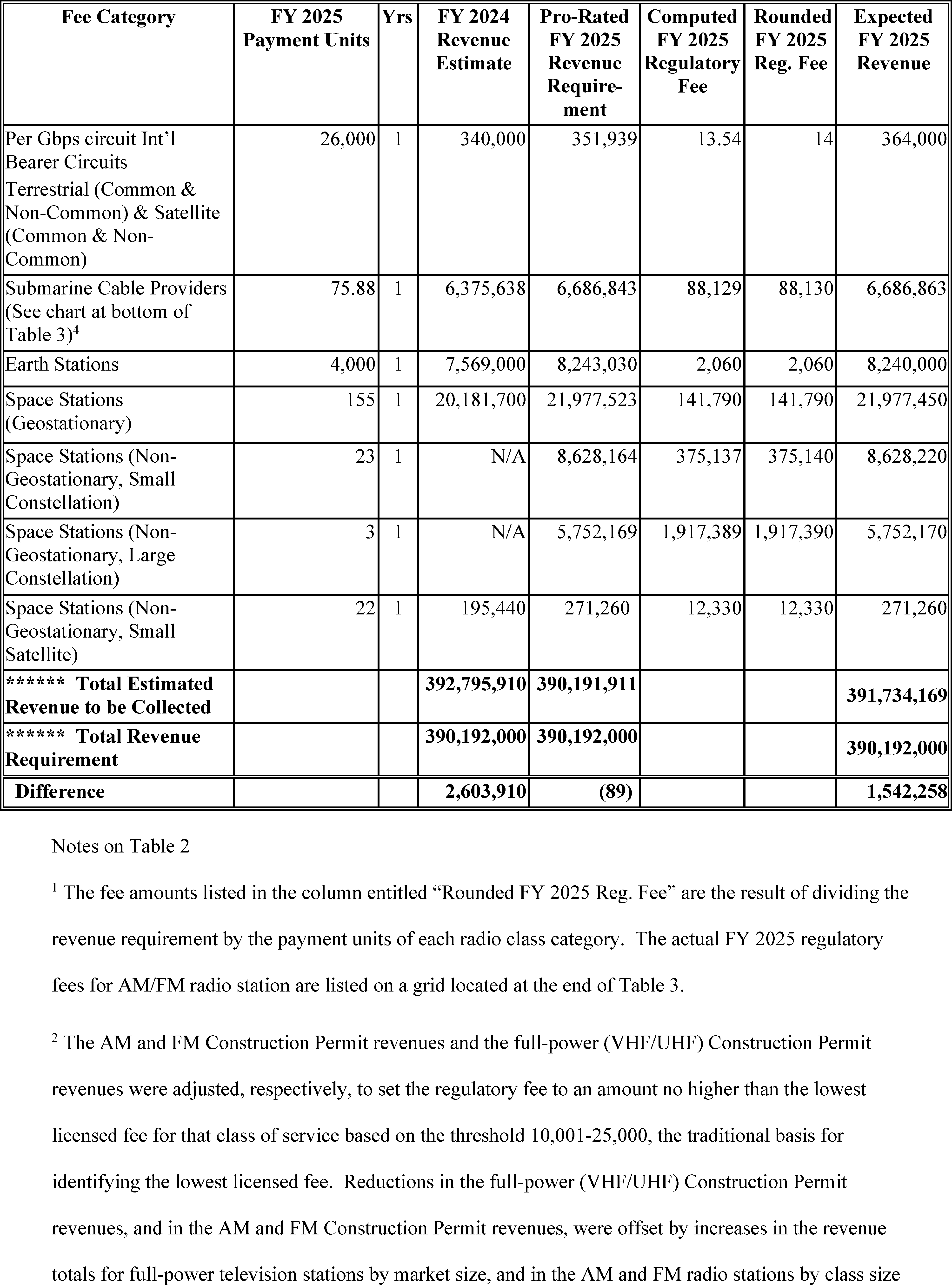
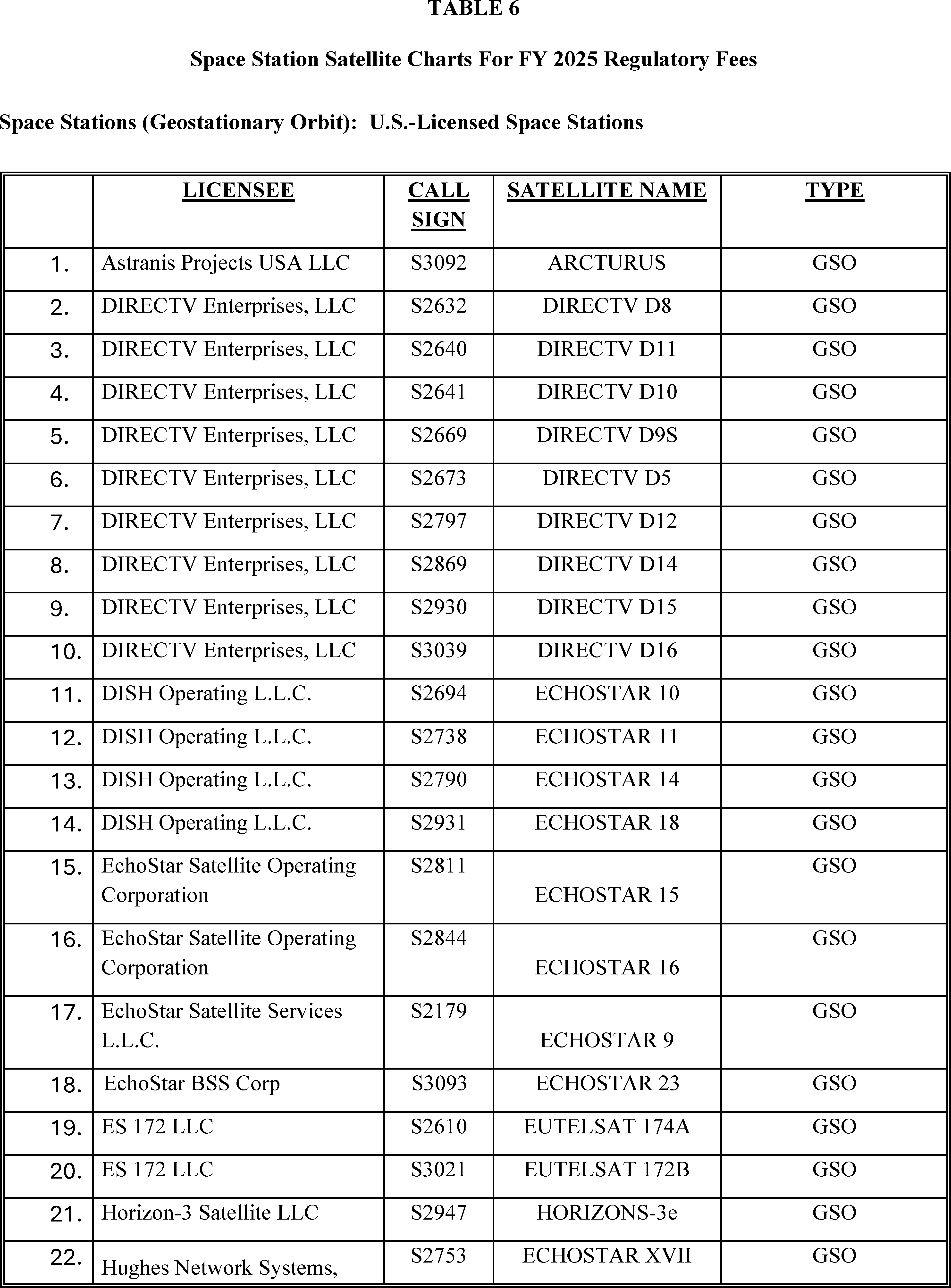
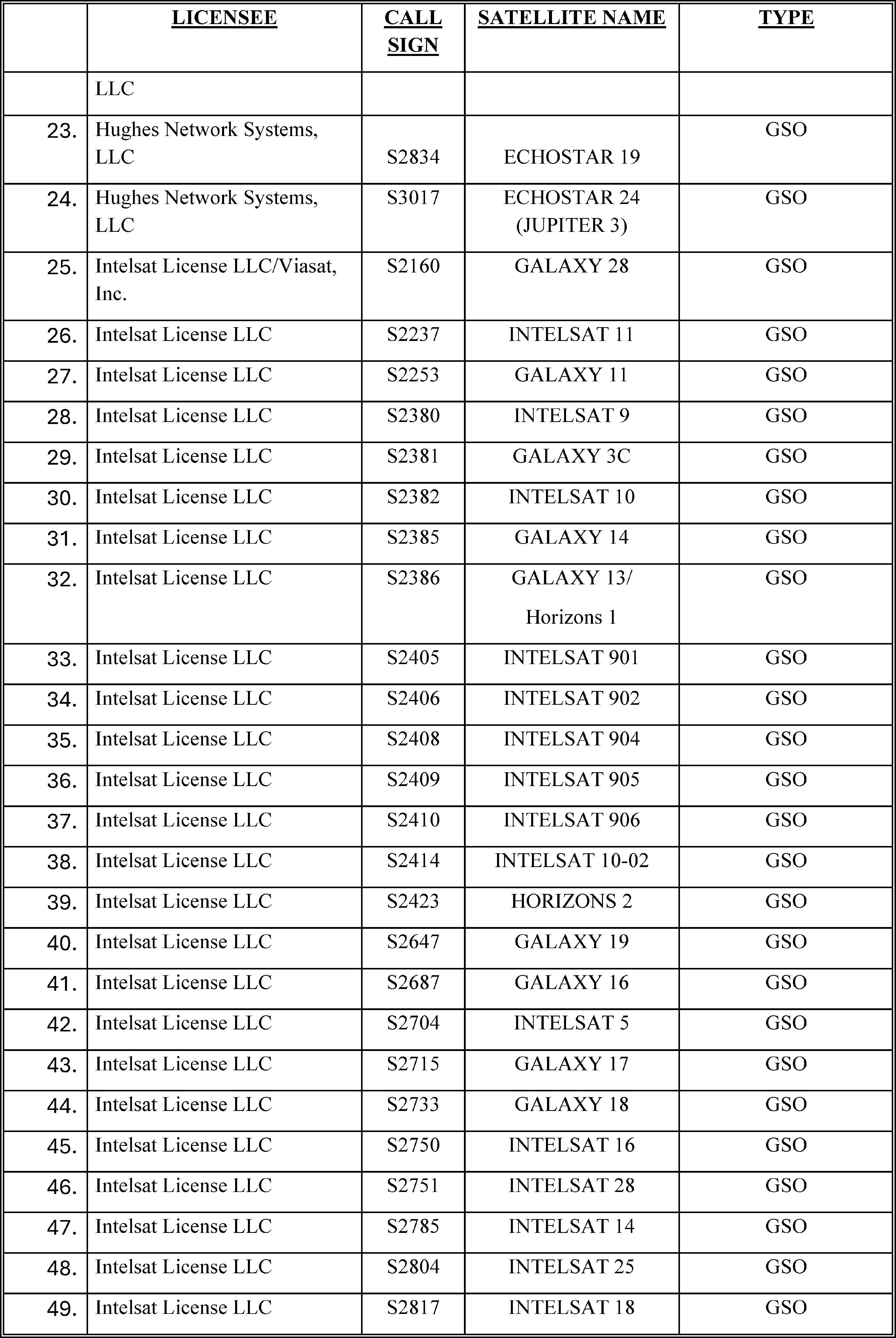
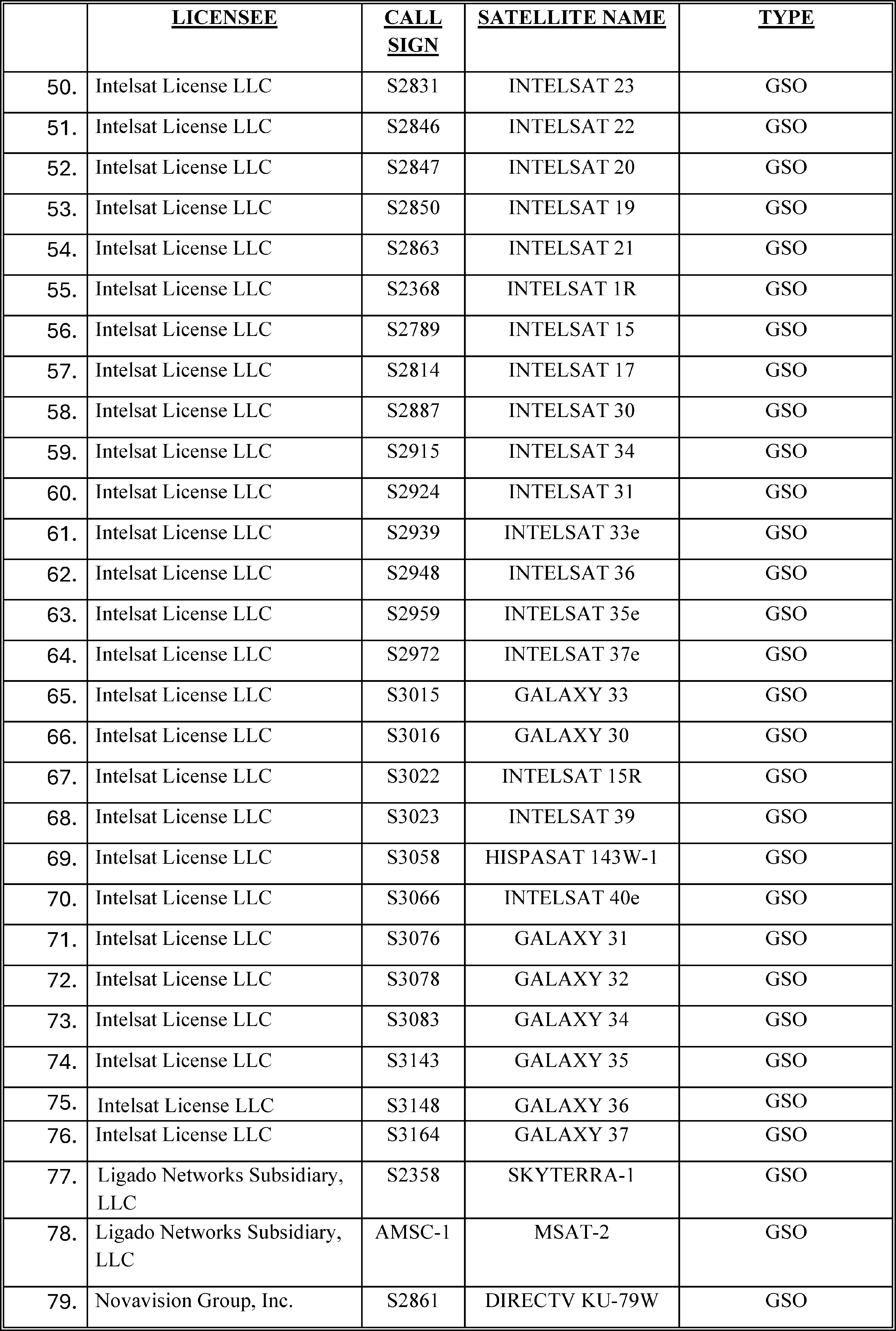
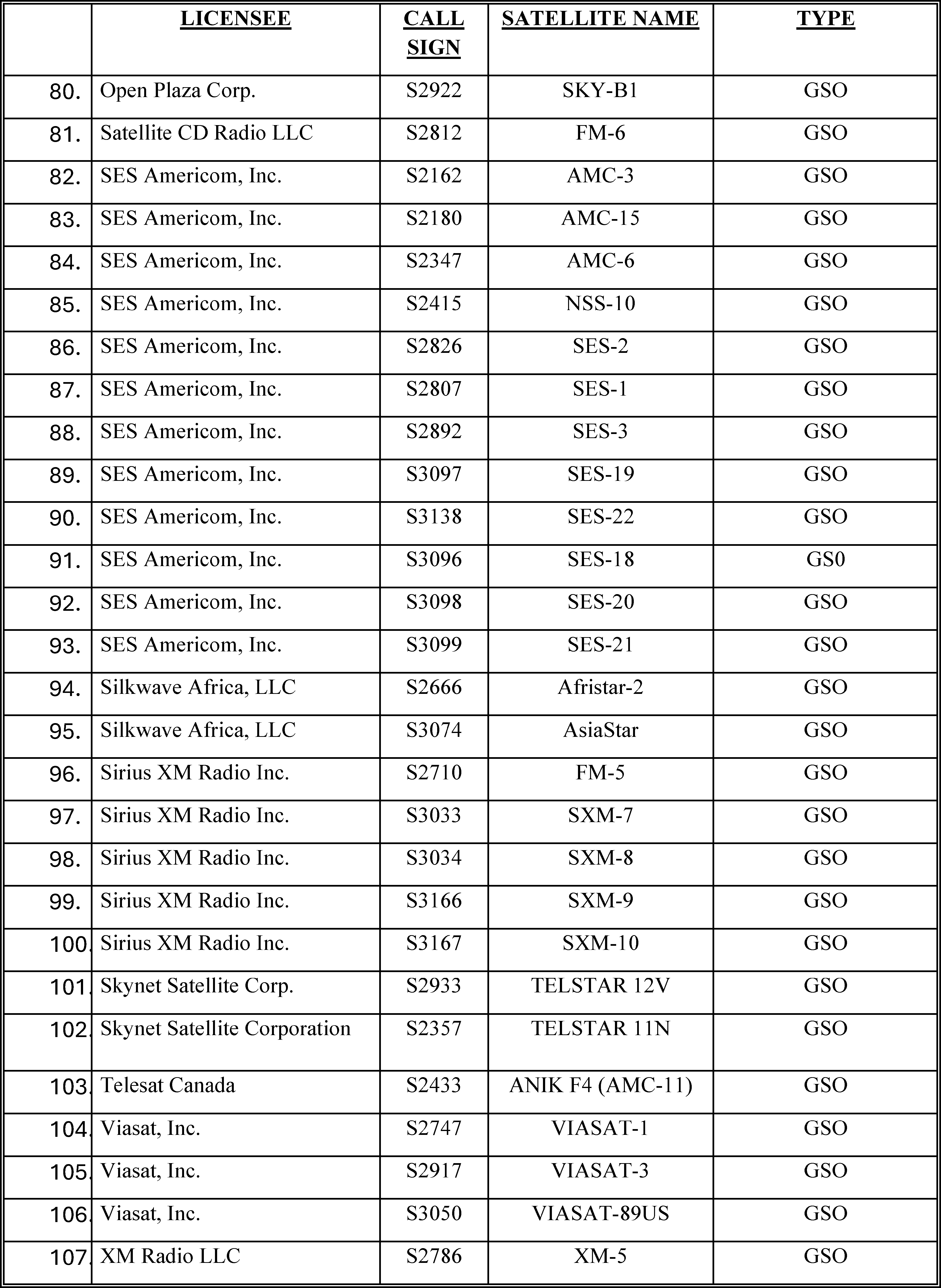
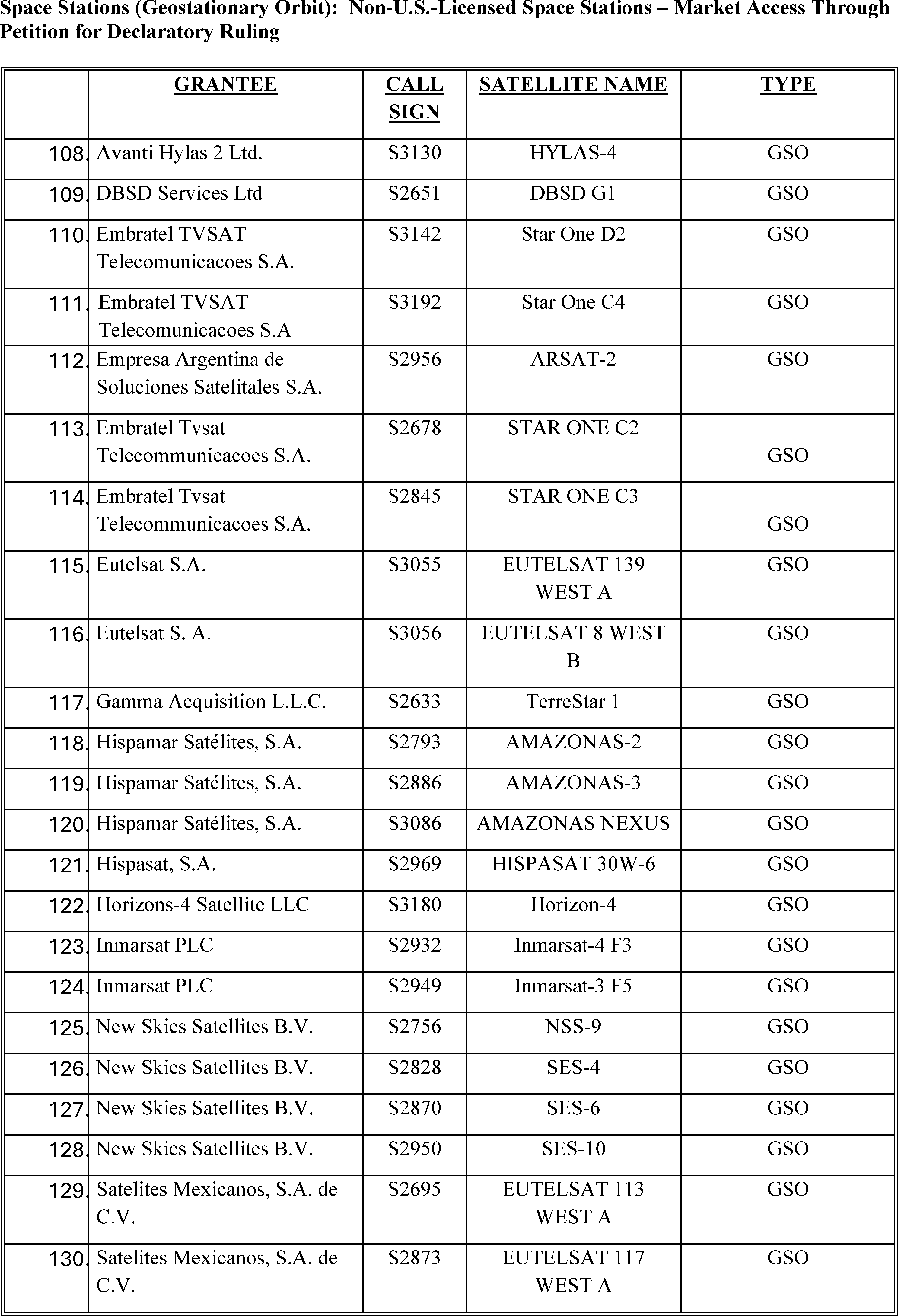
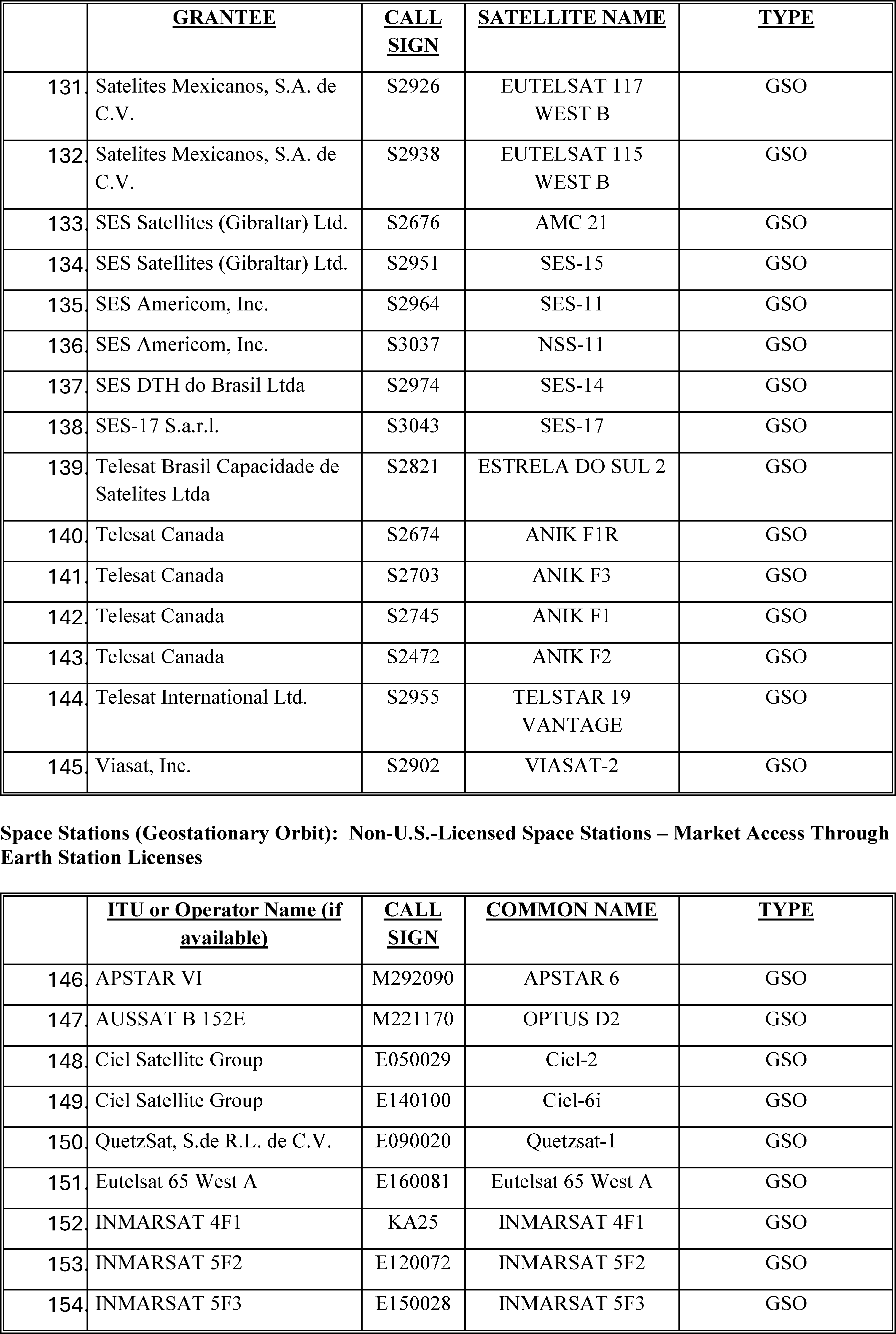
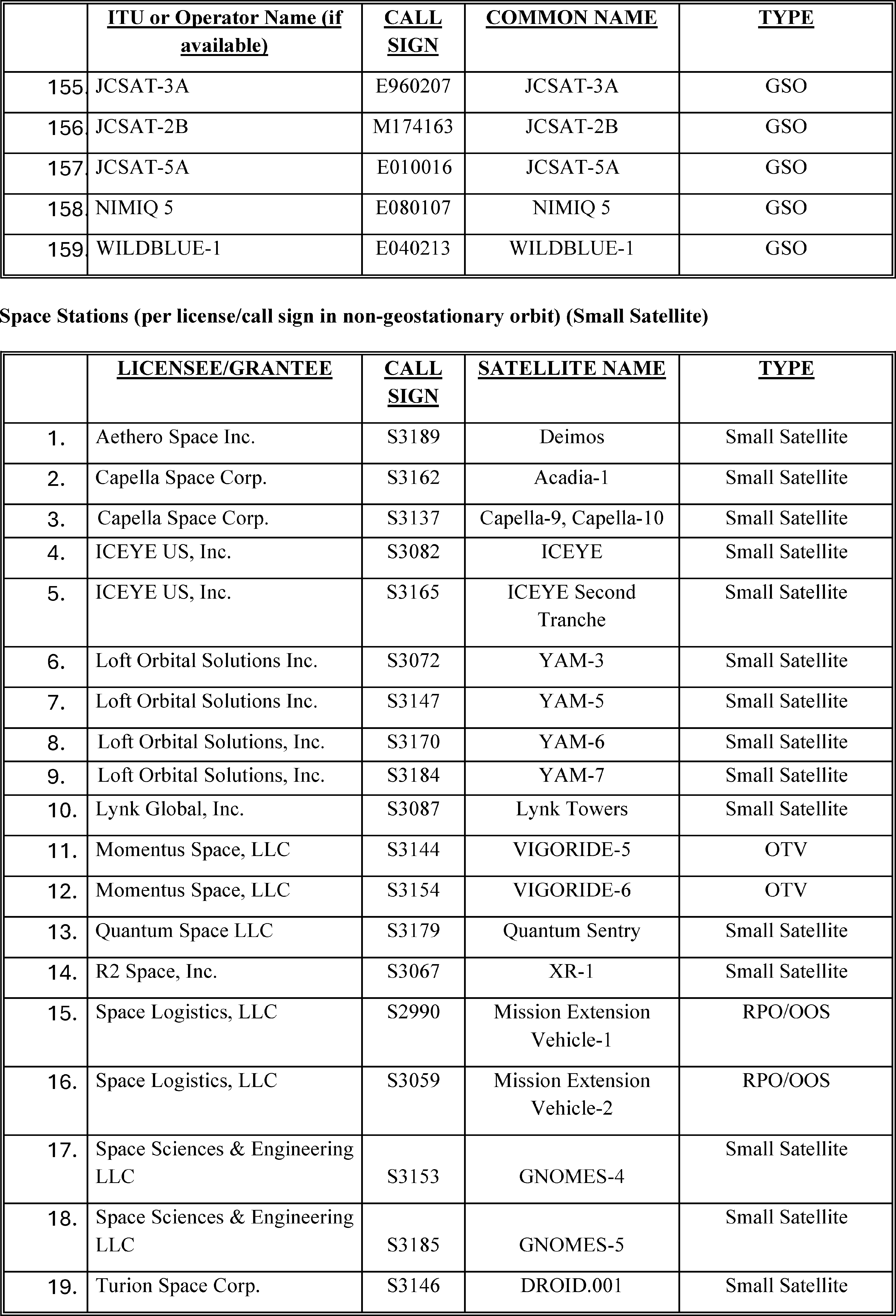
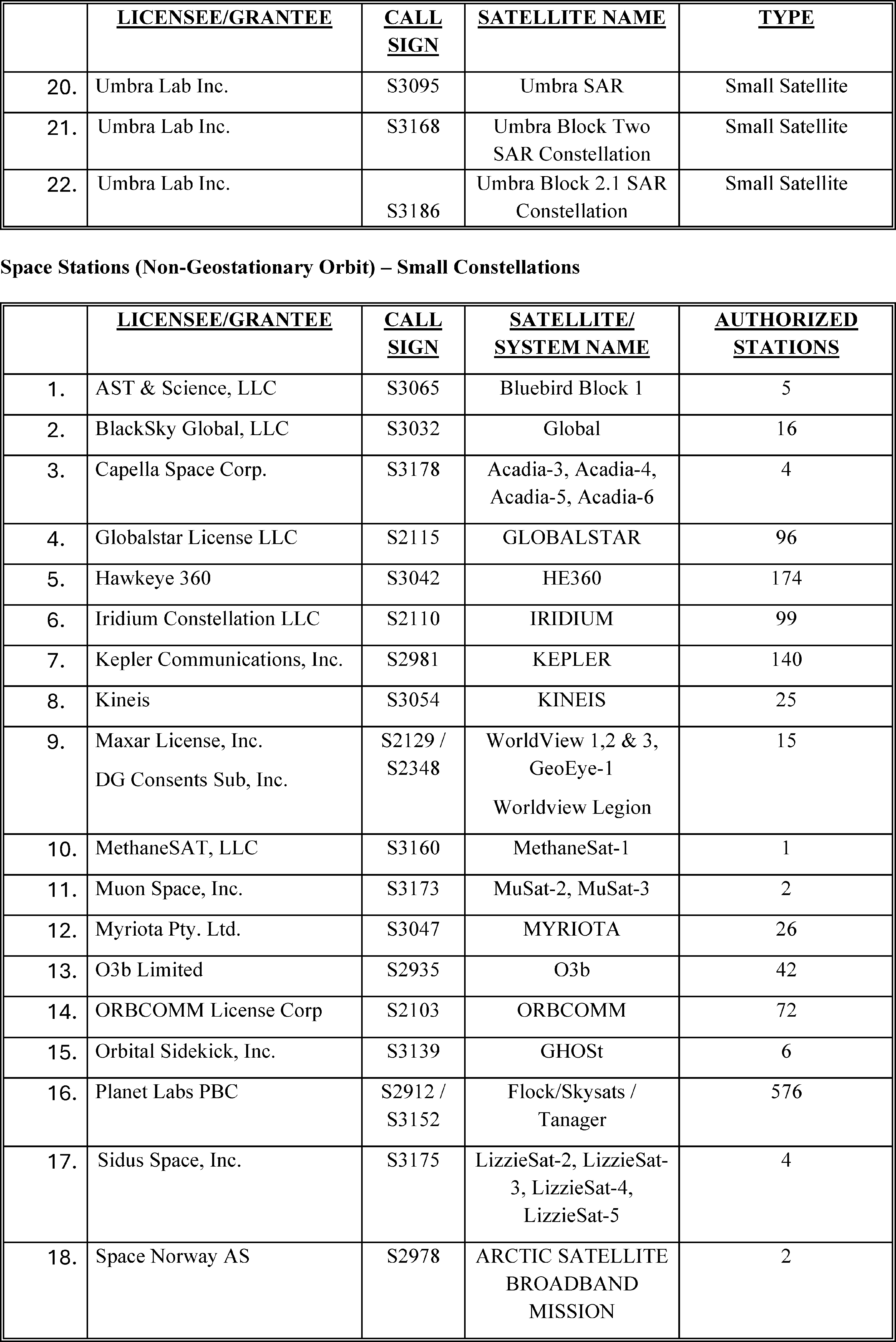
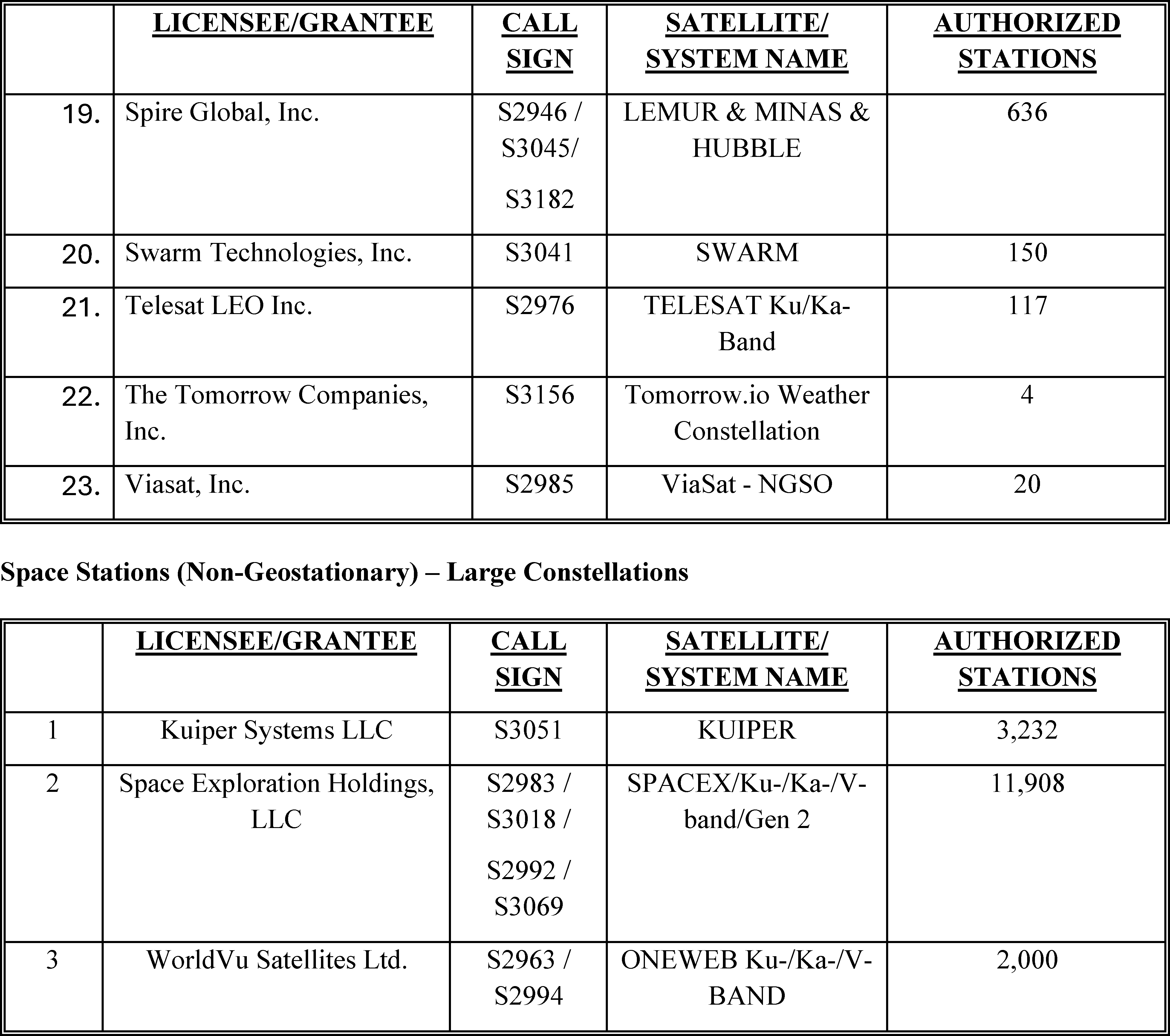
Specifically, for FY 2025, the Commission will (i) assess regulatory fees on space and earth stations once they are authorized, rather than when the stations are certified to be operational, and (ii) split existing regulatory fee categories for Space Stations (Non-Geostationary Orbit) into two new fee categories: small constellations (fewer than 1000 authorized space stations) and large constellations (1000 or more authorized space stations). The Commission specifically adopted the amendments in time for them to be effective for FY 2025. These changes to the fee categories are reflected within the schedule of regulatory fees for FY 2025 contained in § 1.1156(a) of the Commission's rules and in the charts of space stations assessed regulatory fees for FY 2025 in Table 6.
The Commission declines to revisit the decision made in the
FY 2024 Second Report and Order
to adopt a change to the allocation of space station regulatory fees between GSO and NGSO space stations. Specifically, Kuiper urges the Commission to reexamine the prior decision to increase the share of space station regulatory fees assessed to NGSO space stations from 20% to 40%. Kuiper presents no new evidence regarding the amount of FTE burdens attributable to GSO and NGSO space stations, but instead relies on arguments previously made and rejected by the Commission. Likewise, the Commission declines to revisit decisions made in the recent
FY 2024 Third Report and Order.
Commenters urge the Commission to change the 60-40% allocation of NGSO space station FTEs between small and large NGSO constellations, either to assess a greater share of FTE burdens to small constellations, or a greater share of FTE burdens to large constellations. The Commission declines at this time to revisit a decision made a little less than three months ago. As the Commission does each year, however, it will continue to examine the appropriate allocation of FTE burdens as part of future annual regulatory fee assessment proceedings. Likewise, the Commission will continue to consider potential amendments to its regulatory fee methodologies in future regulatory fee assessment proceedings, as urged by commenters, although the Commission declines to commence a rulemaking proceeding at this time specifically to address space station regulatory fees for FY 2026.
The Commission declines to interpret “authorized stations” solely as stations “that have received unconditional permission to provide service without the need for further agency action,” as requested by Kinéis. Kinéis argues that the placement of a condition on an authorization that must be satisfied at a later date leaves unclear the ultimate ability to commence service, and therefore a space station should not be deemed “authorized” until the Commission determines that the condition has been satisfied and grants an unconditional authorization. Kinéis's request returns to a focus on the operational status of the space station as the basis for assessing regulatory fees, although the Commission just recently determined that the operational status of a space or earth station should no longer be the deciding factor of whether space and earth station regulatory fees should be assessed. In the
FY 2024 Third Report and Order,
the Commission's decision to assess regulatory fees on authorized stations, rather than operational space stations, recognizes that significant FTE burdens are involved with the licensing of space and earth stations, even before a station becomes operational, and that if an authorized space station never becomes operational, then the FTE burdens associated with regulating such space stations would never be recovered and have to be borne by stations that are operational. These considerations equally apply to space stations that are authorized, but subject to a condition that needs to be fulfilled by the licensee or grantee prior to becoming operational, or prior to accessing the U.S. market (in the case of a non-U.S. licensed space station).
Furthermore, the Commission found that assessing regulatory fees on authorized stations broadens the base of regulatory fee payors, spreading the recovery of fees from all licensees and grantees that benefit from the Space Bureau's licensing and regulatory activities, and potentially lowering the per unit regulatory fee burden by increasing the number of units on which fees are assessed. This rationale for adopting regulatory fees on authorized stations would be undermined by not assessing regulatory fees on space stations that are authorized, but are subject to conditions that need to be fulfilled prior to commencing operations. Not assessing regulatory fees
( printed page 43291)
until all aspects of an application are fully resolved could effectively remove a significant number of current fee payors from regulatory fee assessments. It would also require Commission staff to determine whether the conditions placed on every space and earth station grant prevent the licensee from commencing operations, which risks being subjective and administratively burdensome.
Broadcast Television Stations
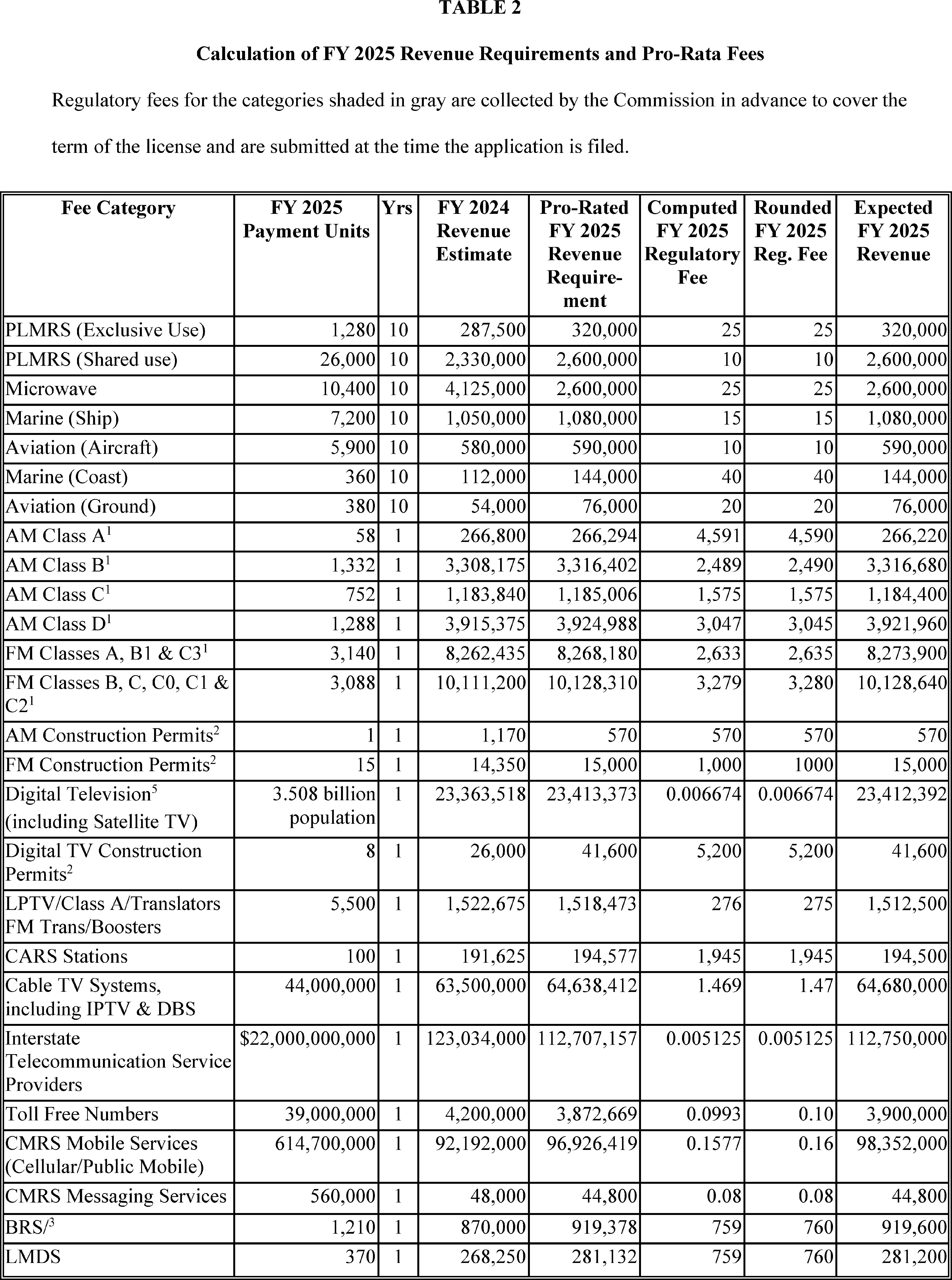
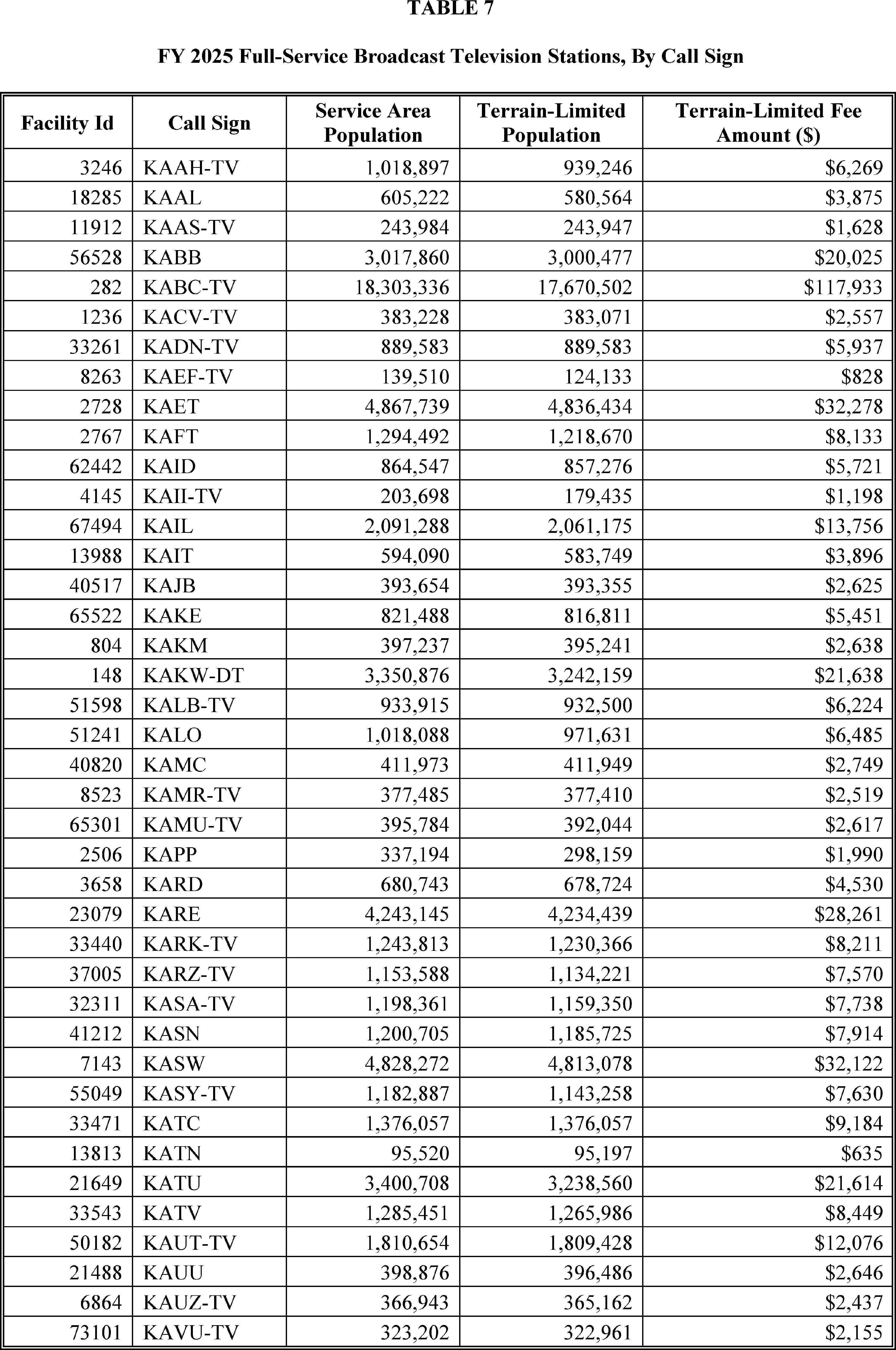
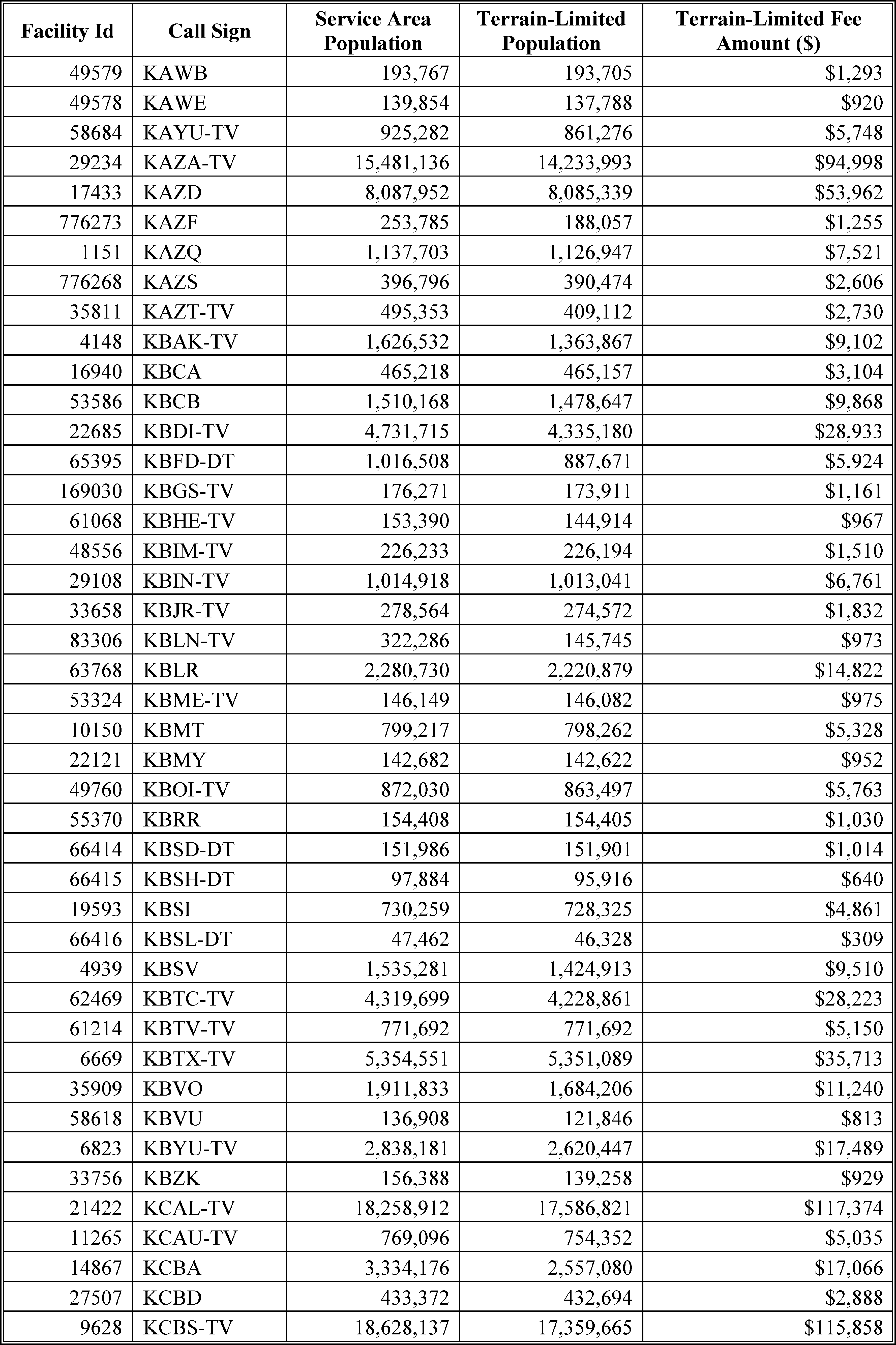
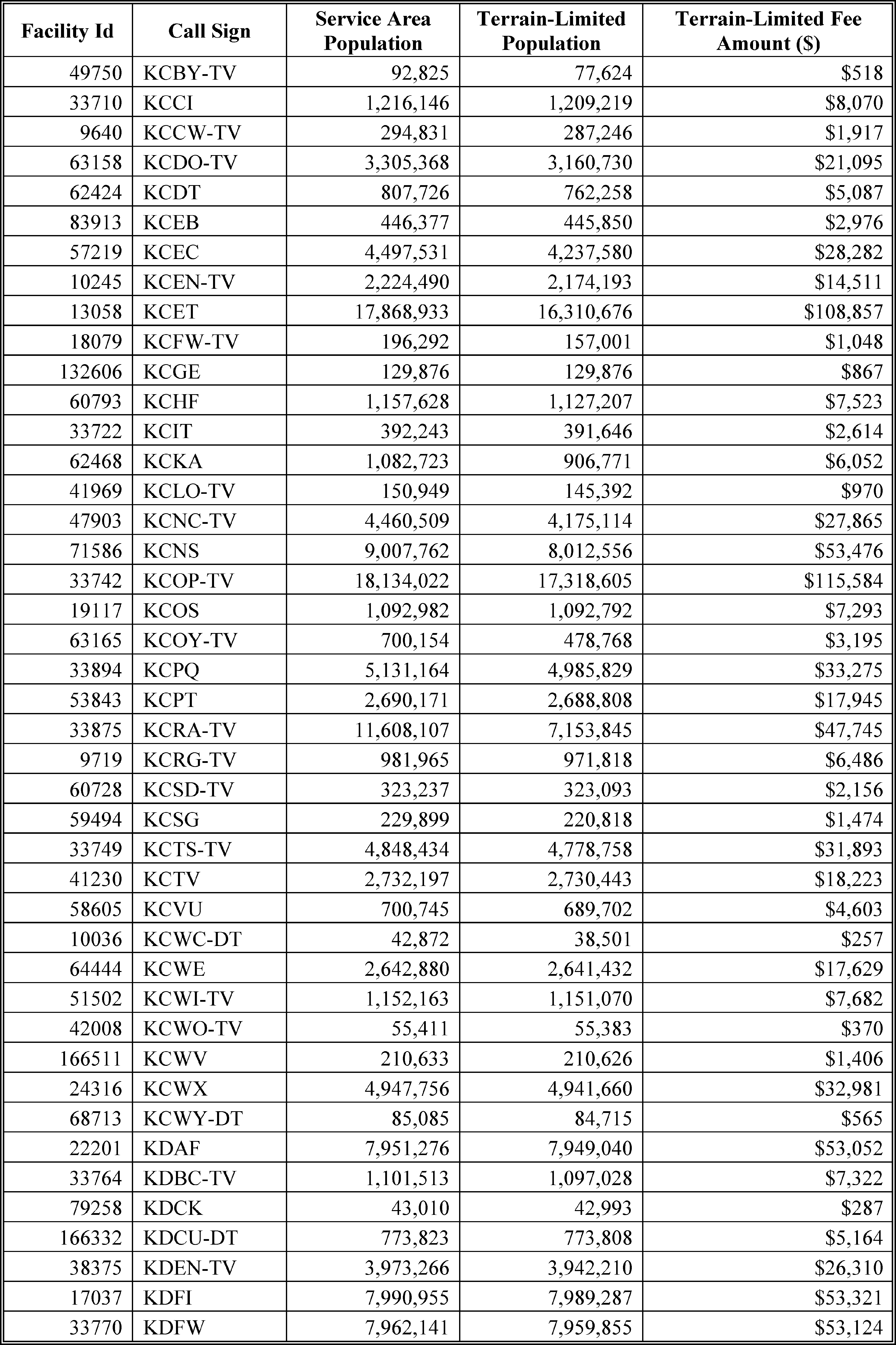
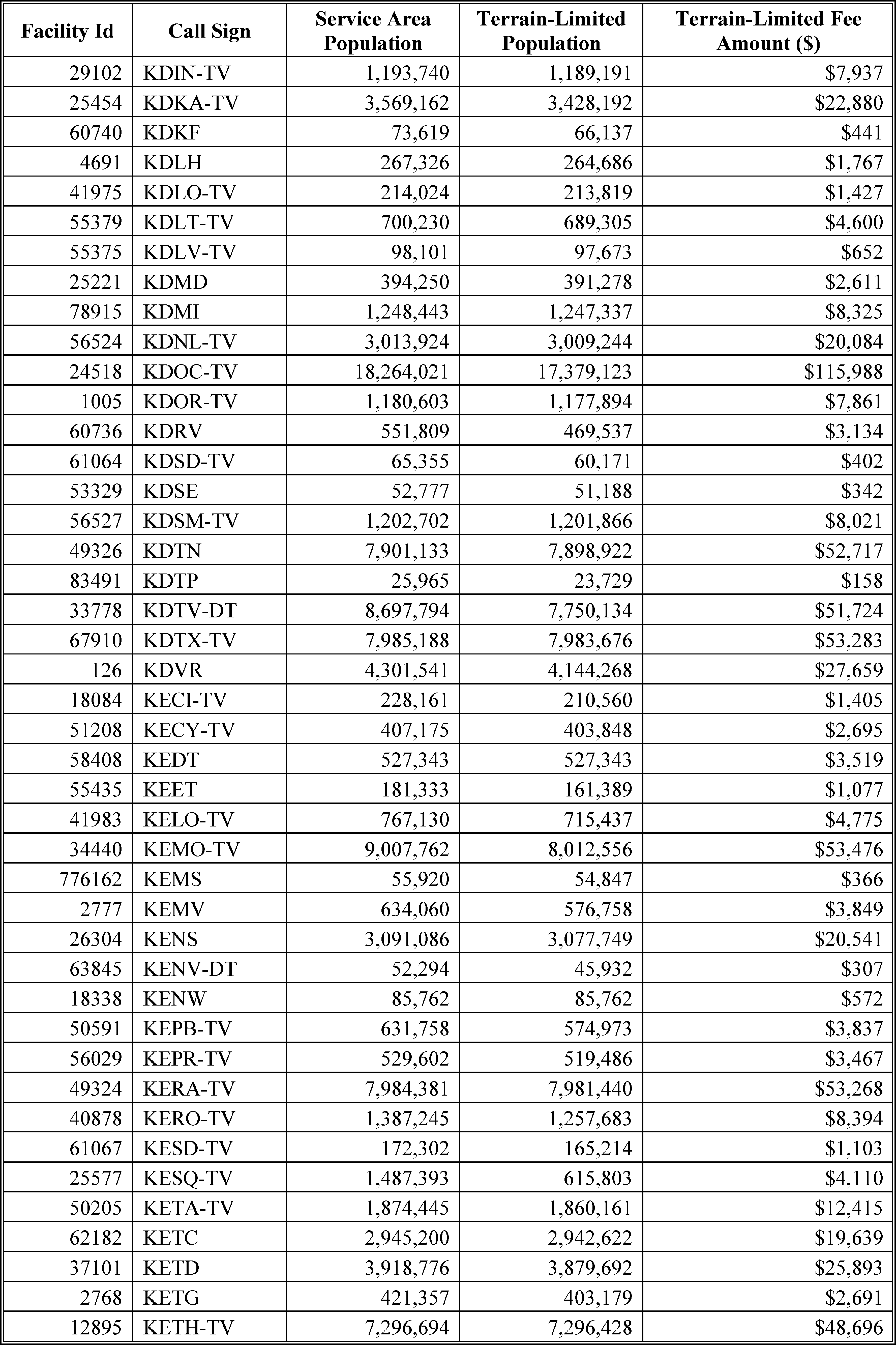
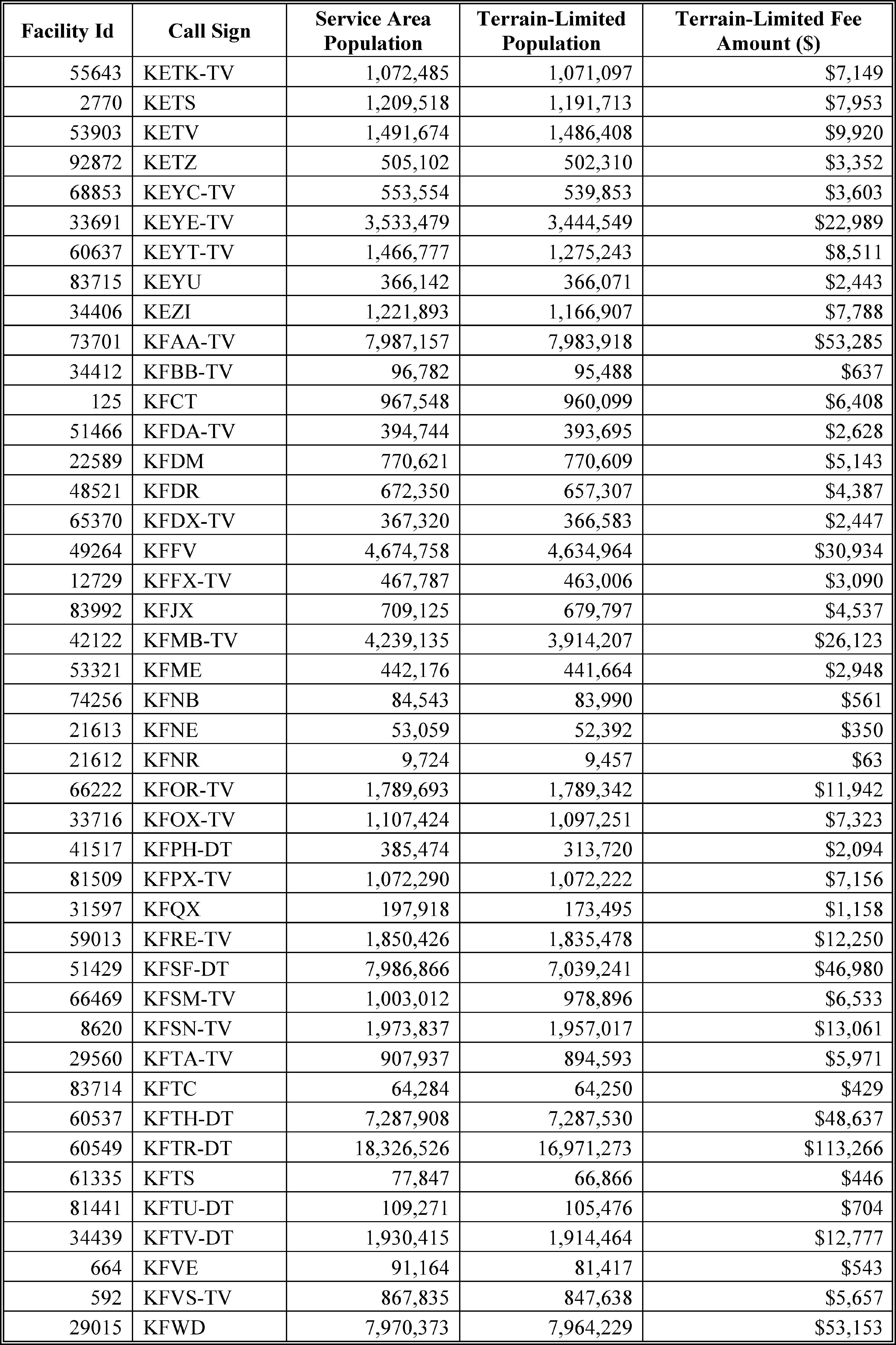
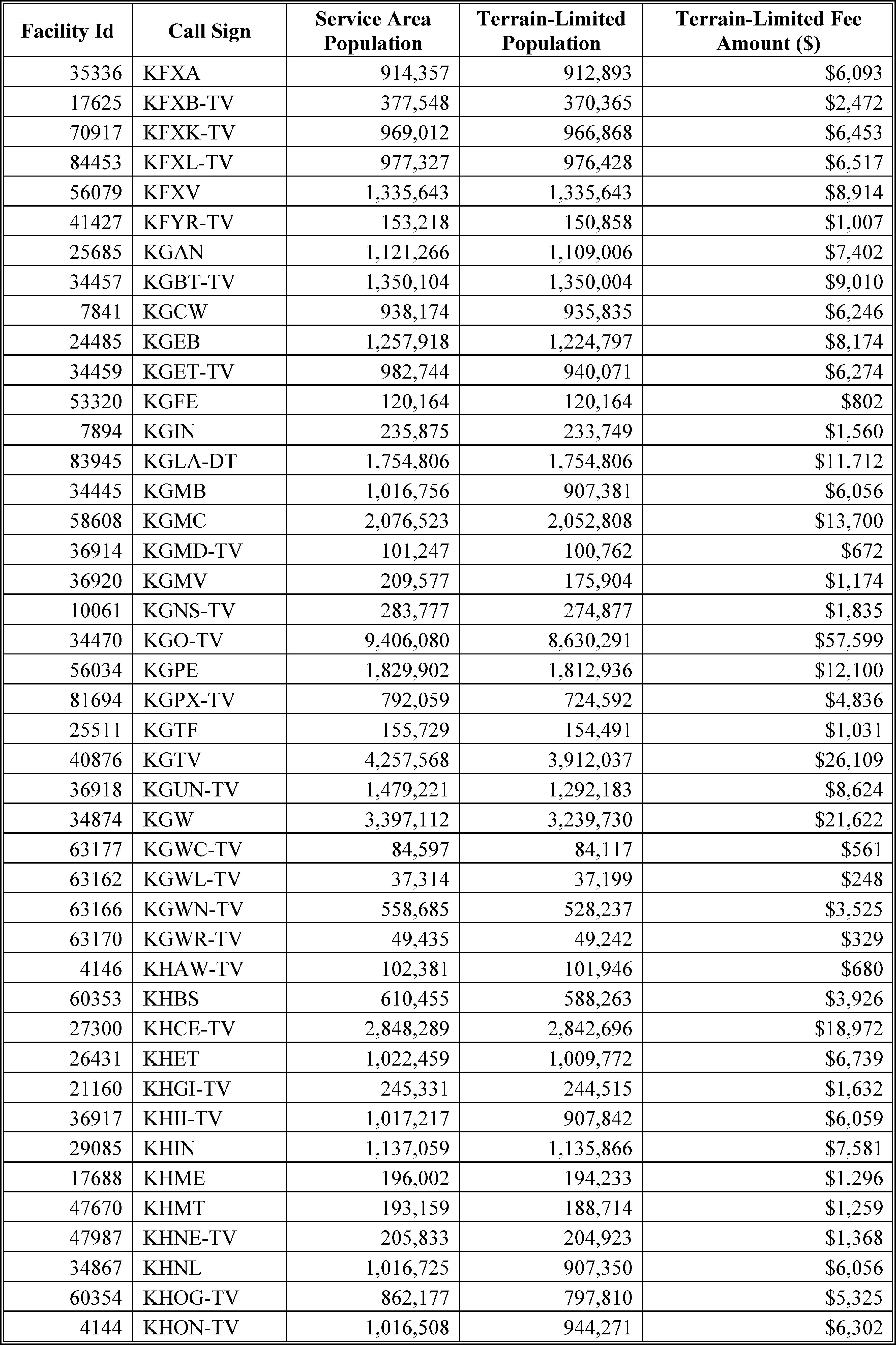
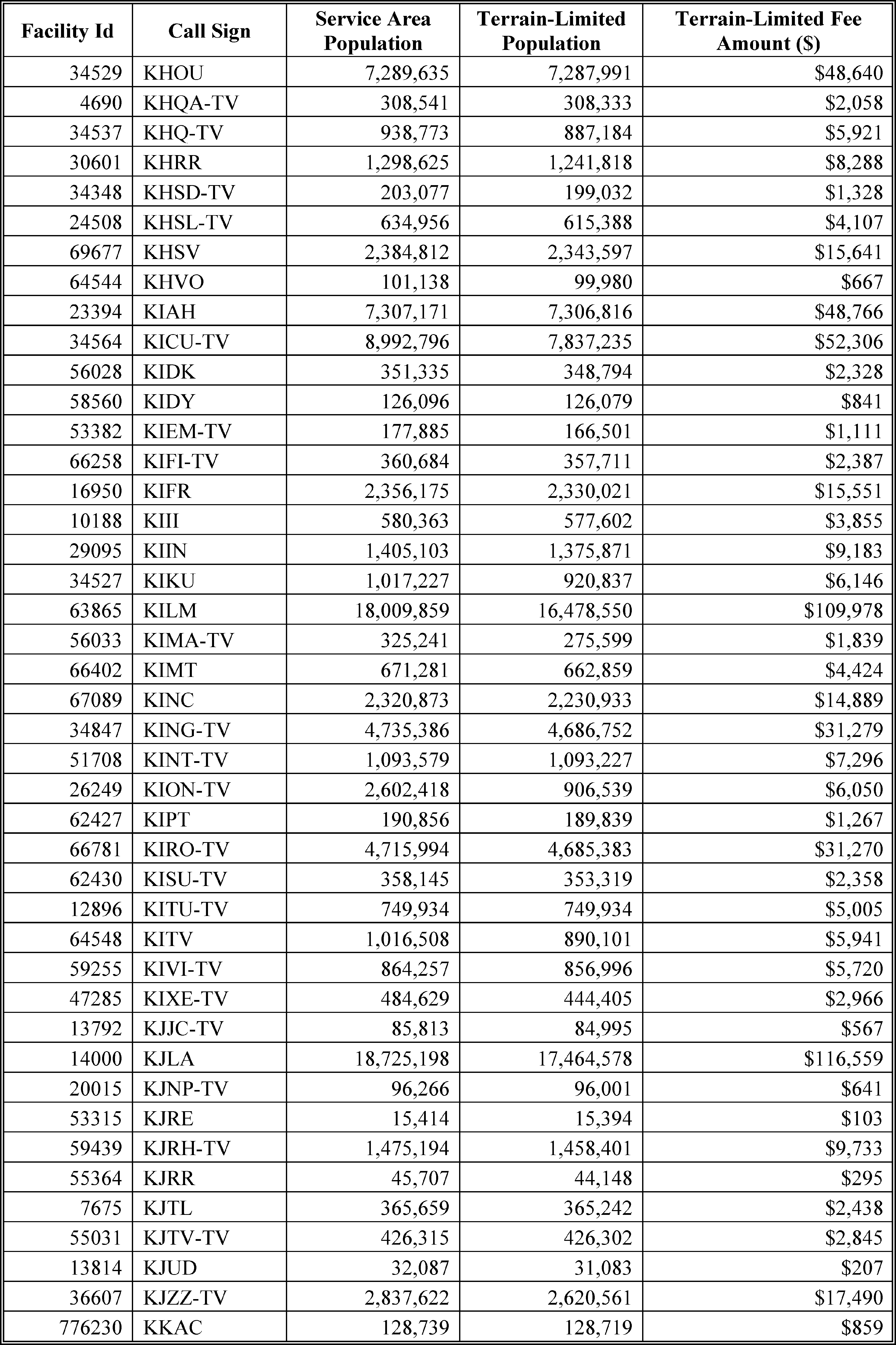
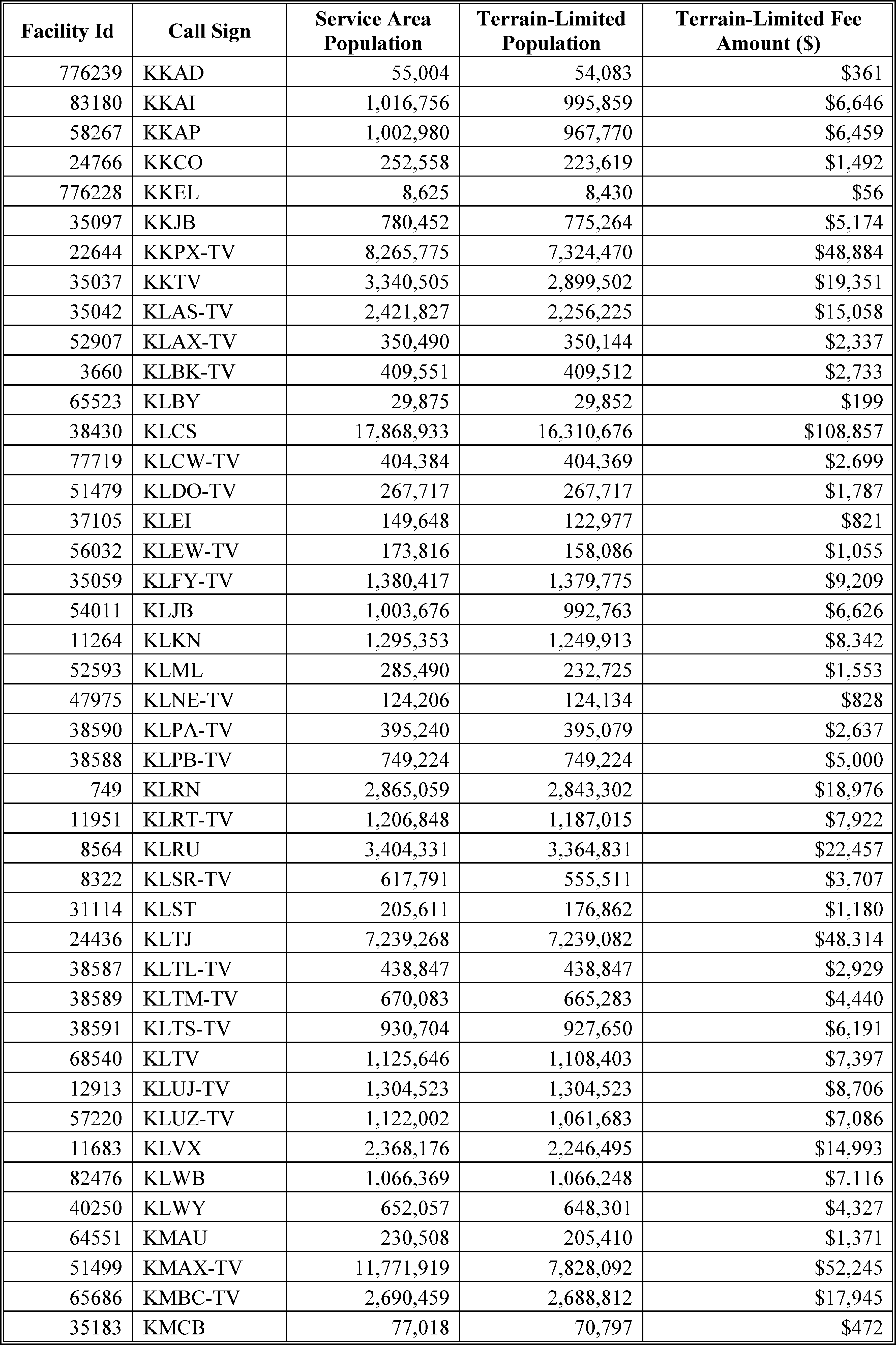
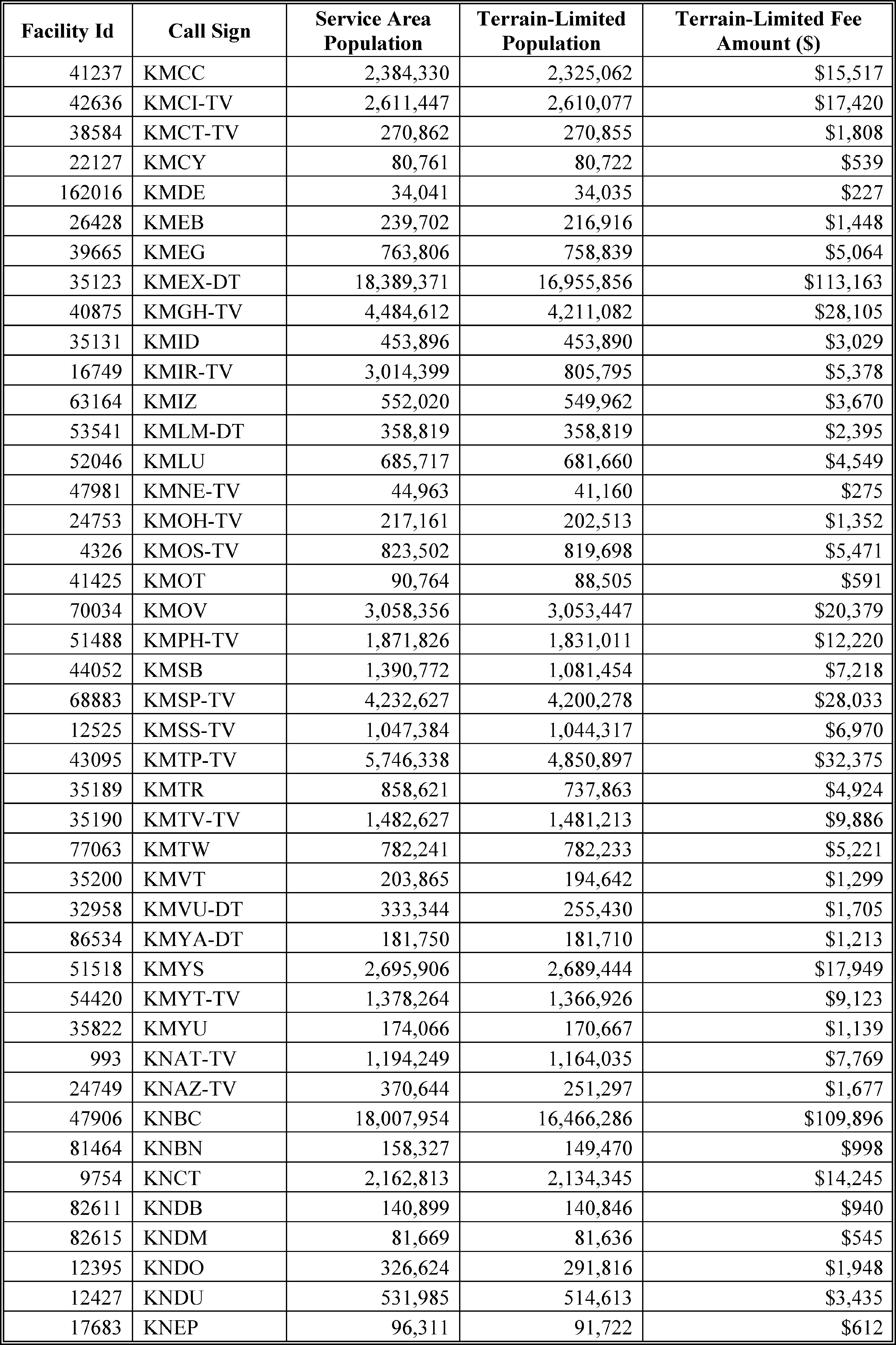
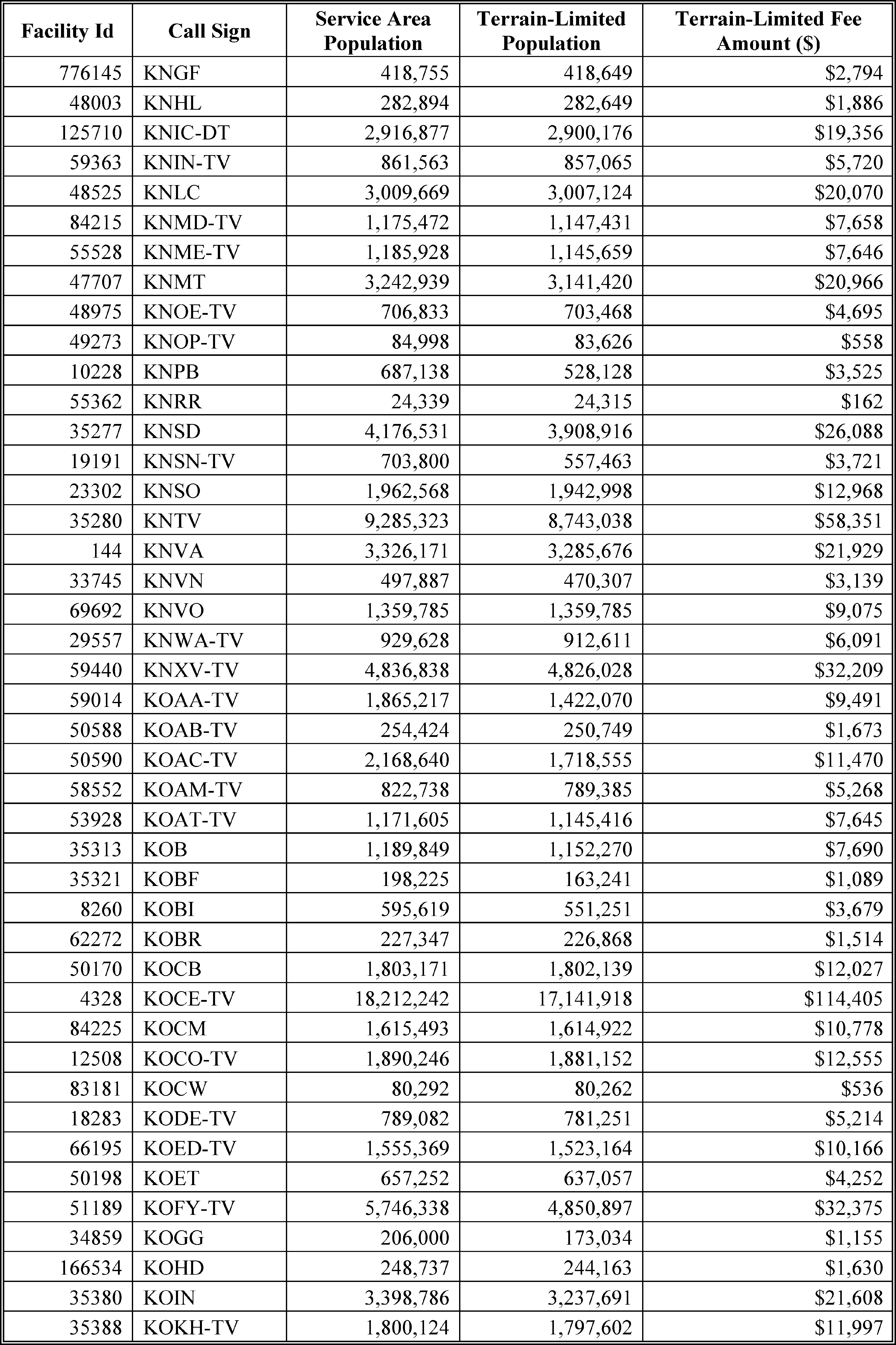
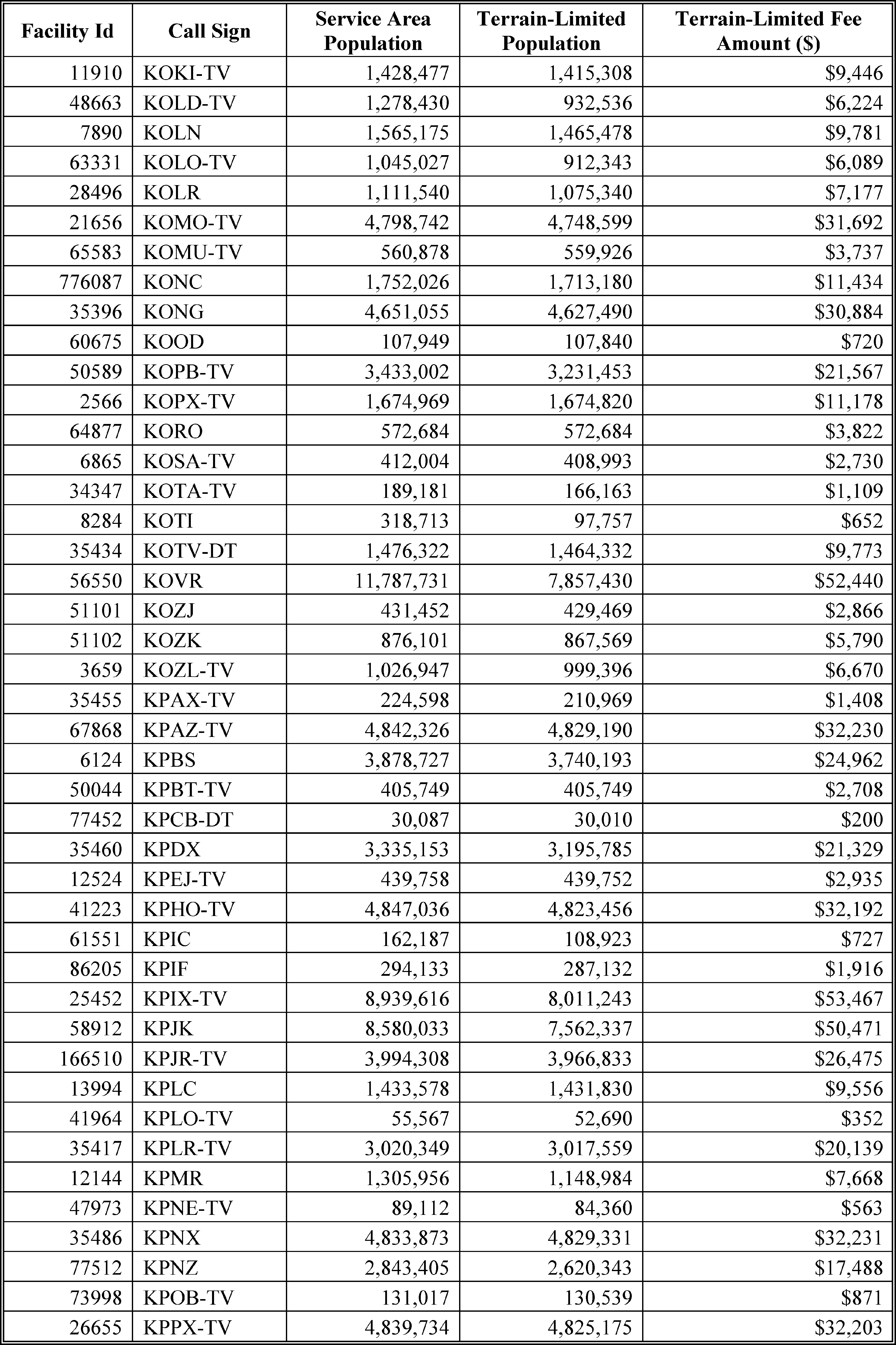
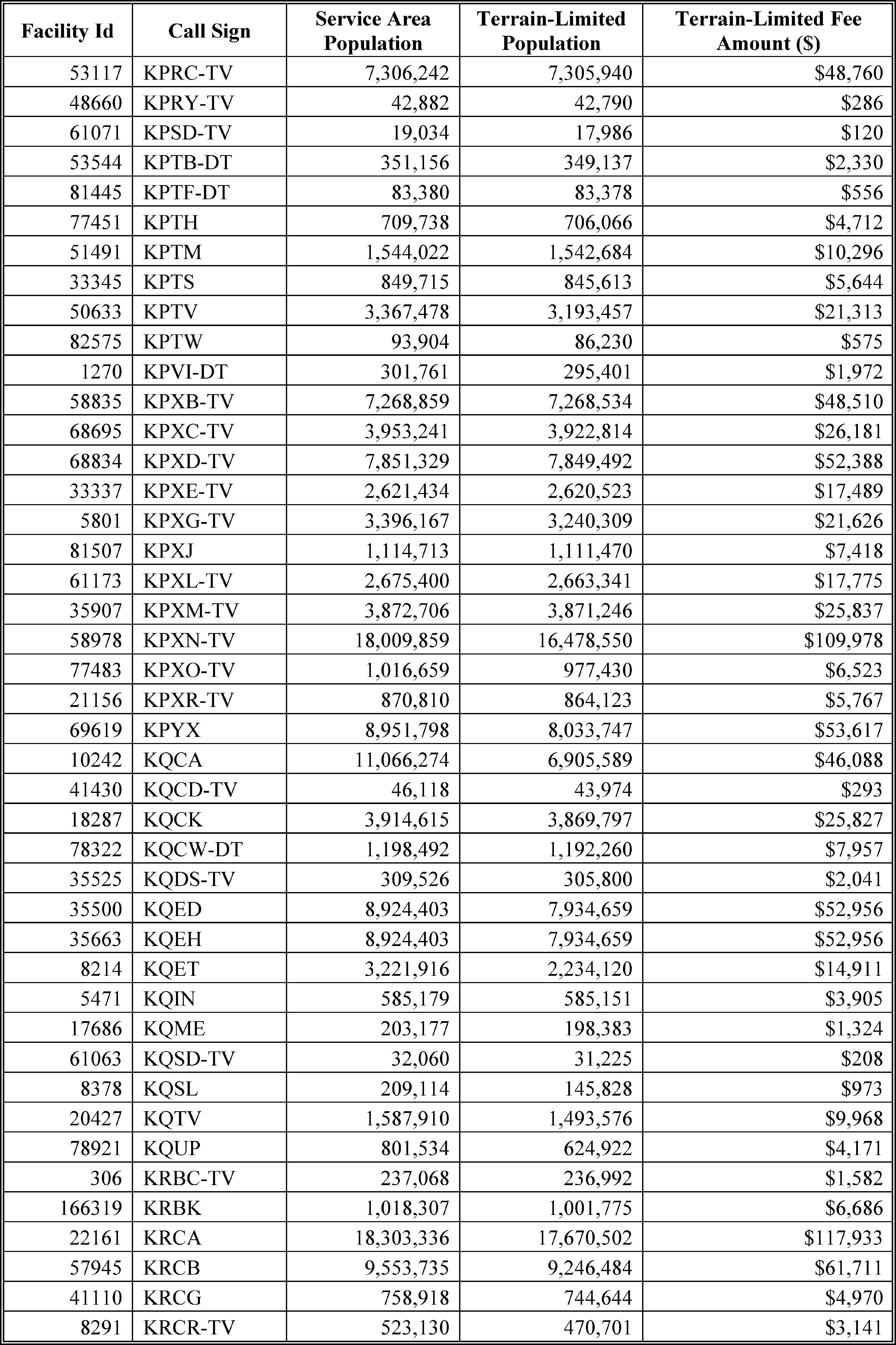
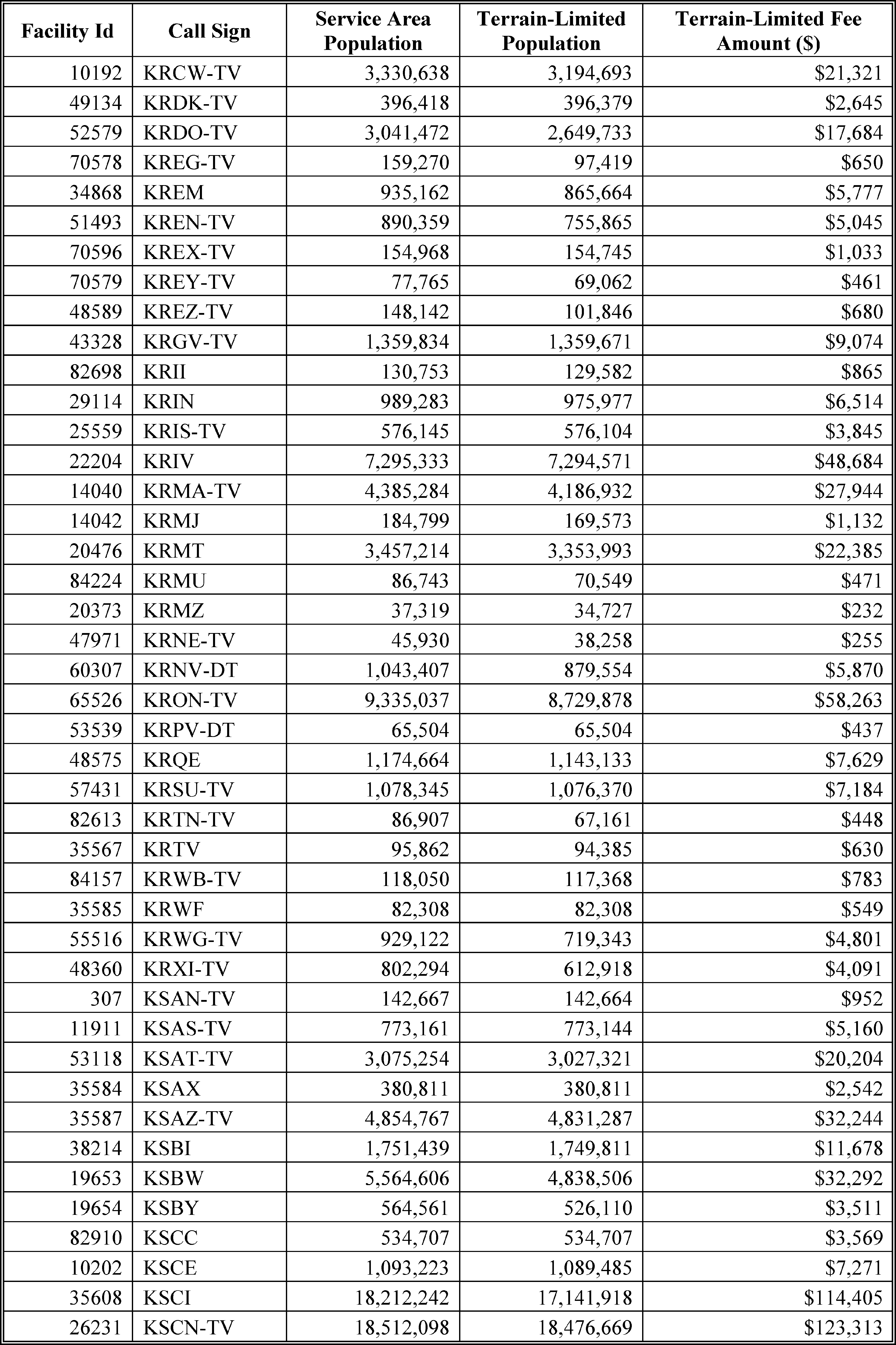
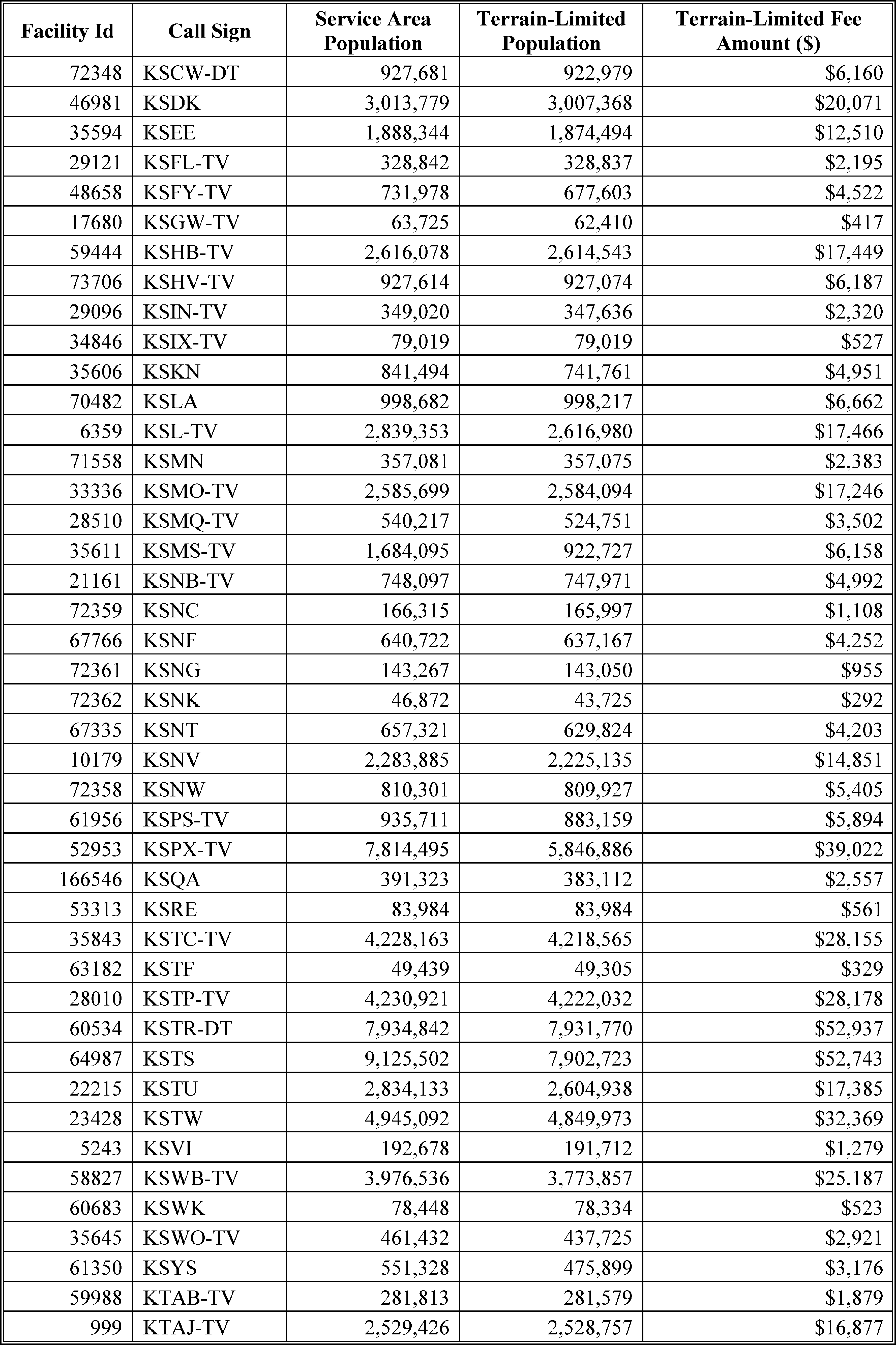
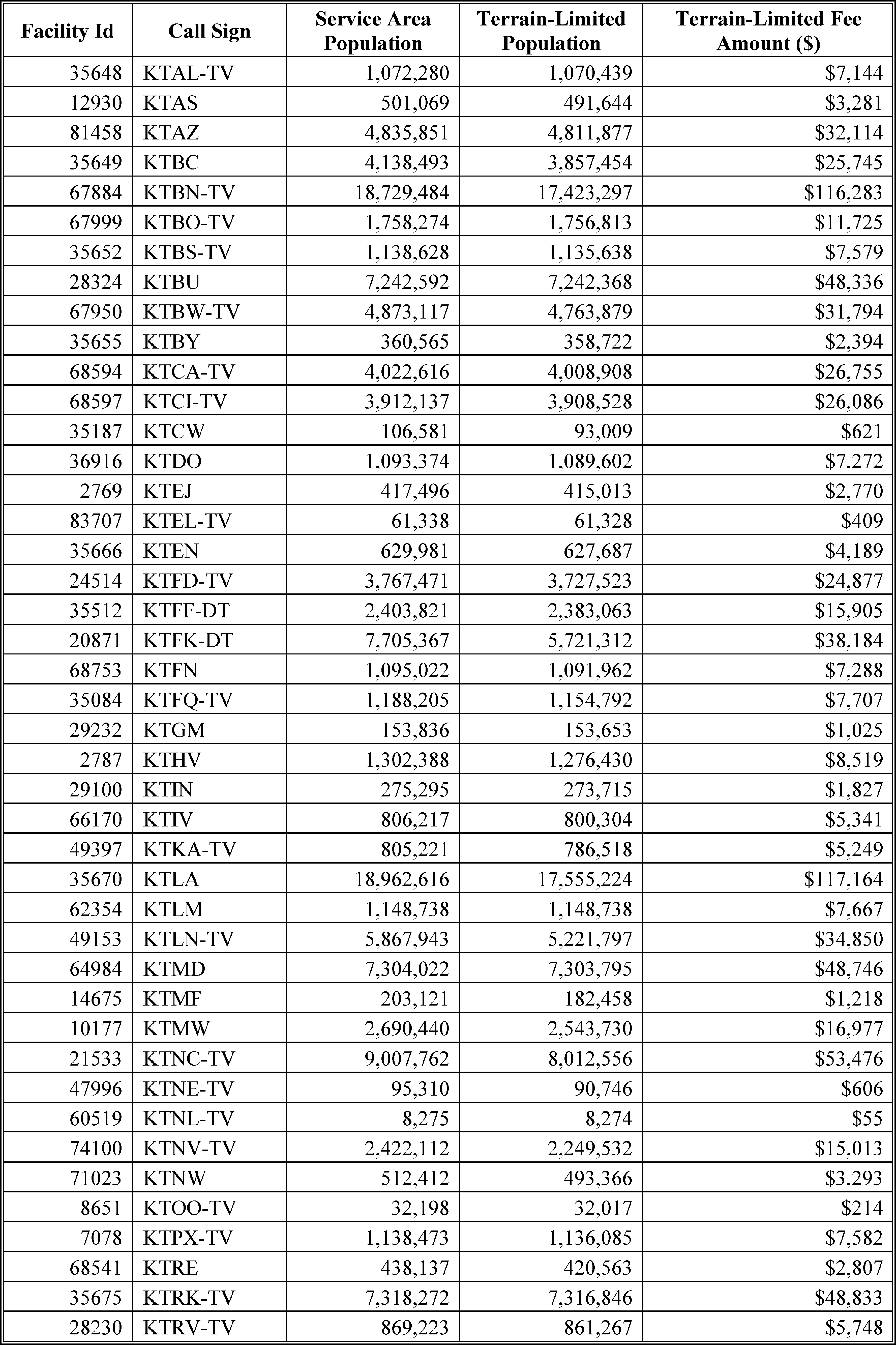
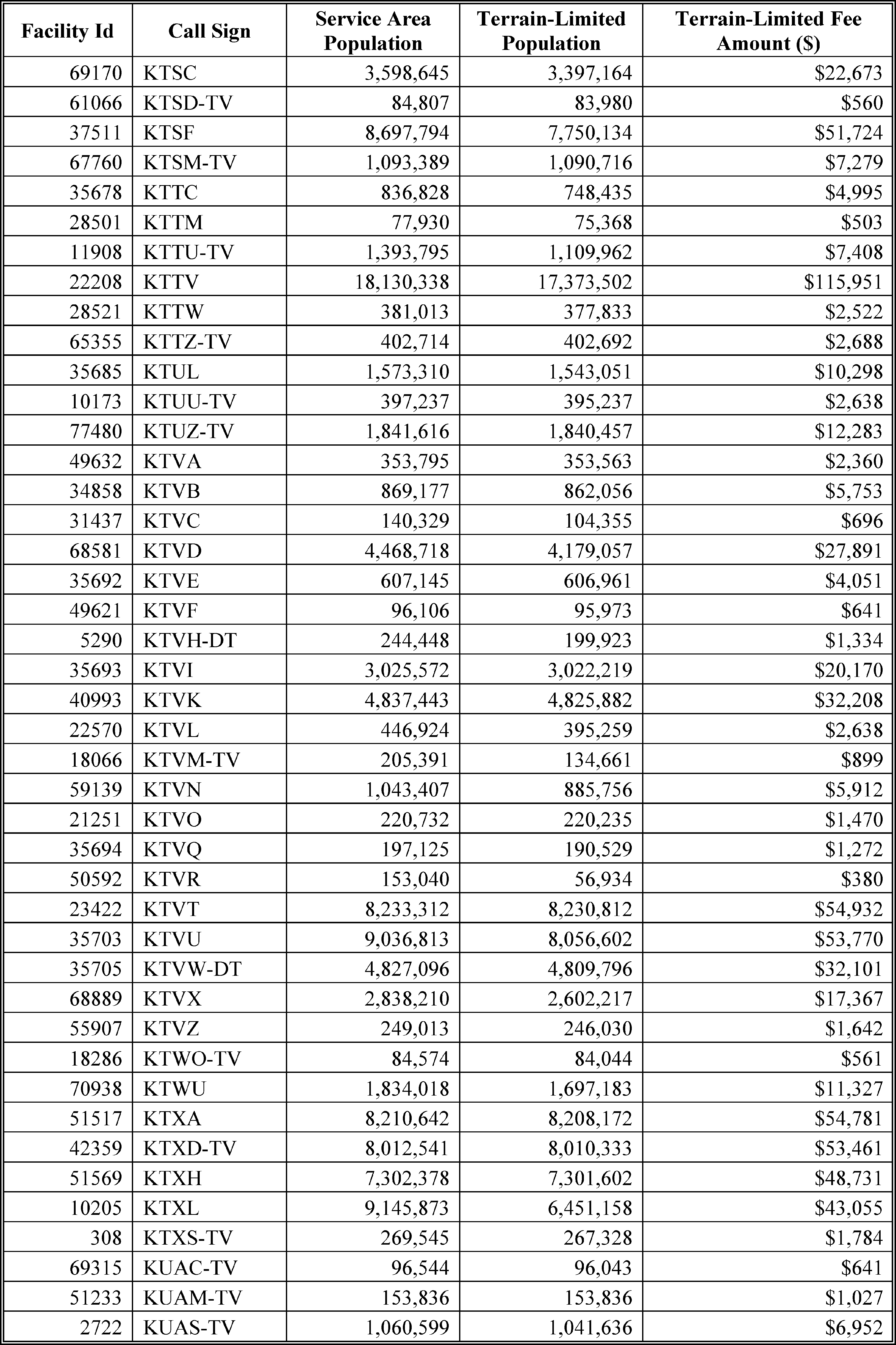
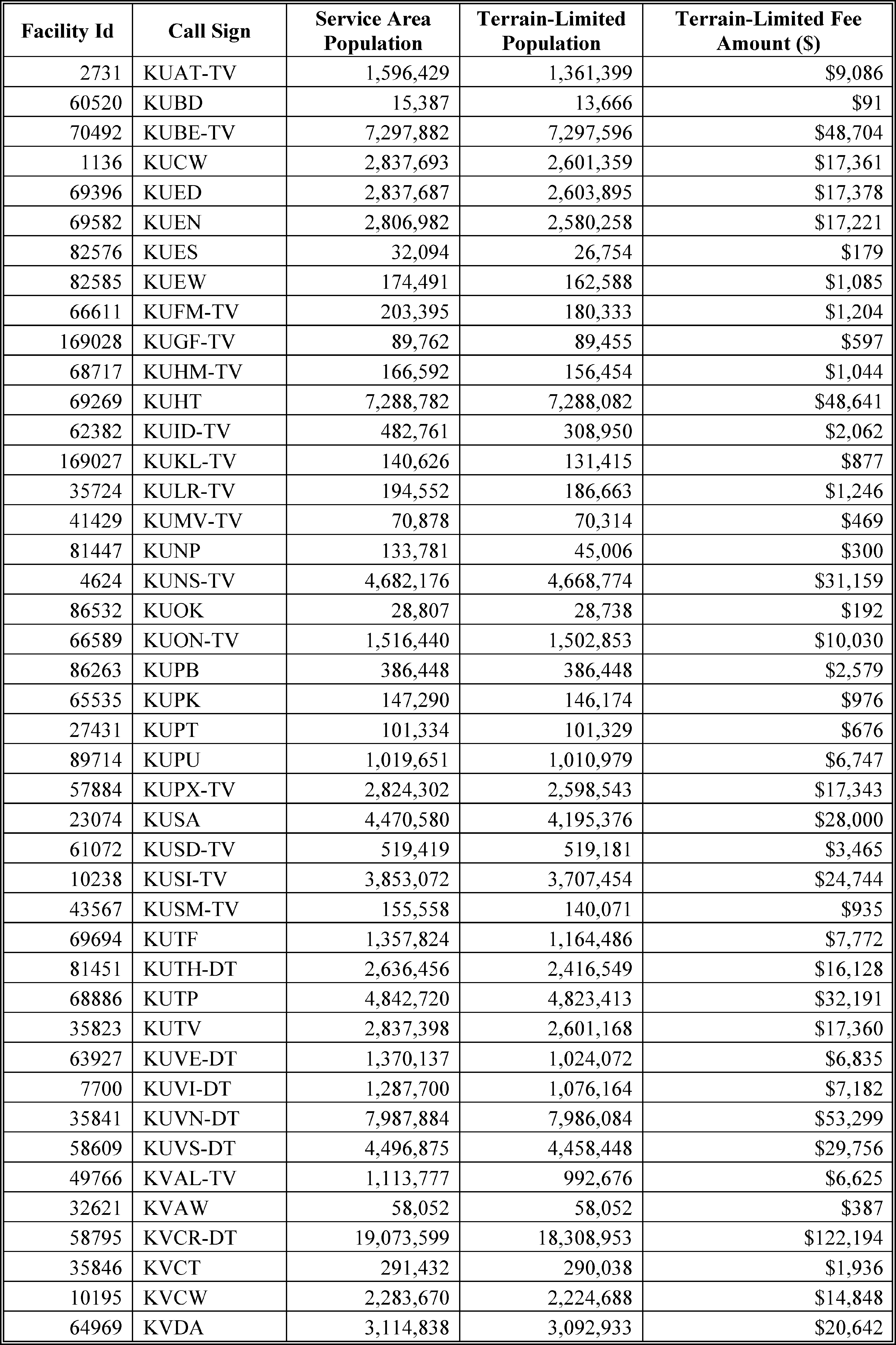
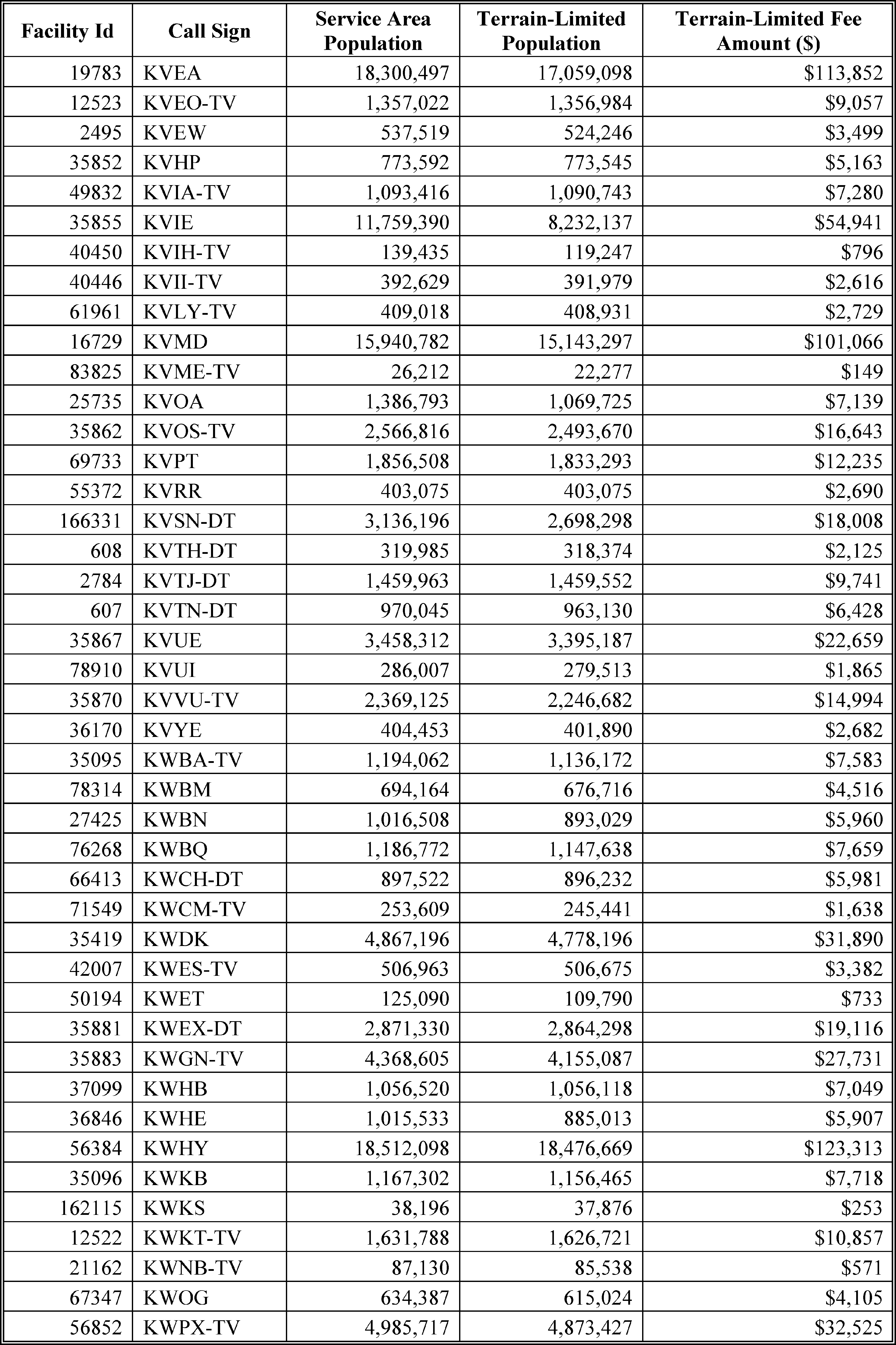
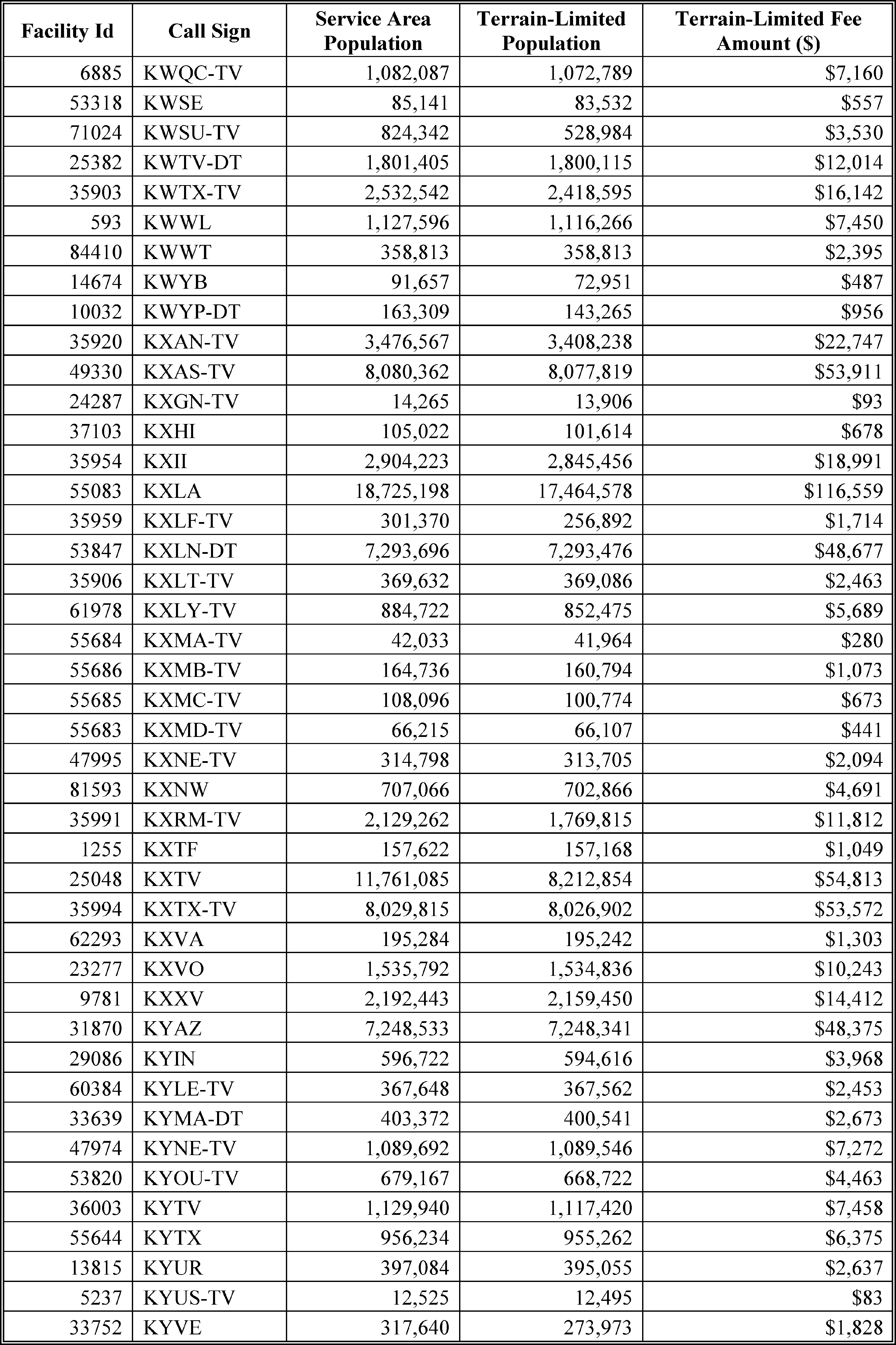
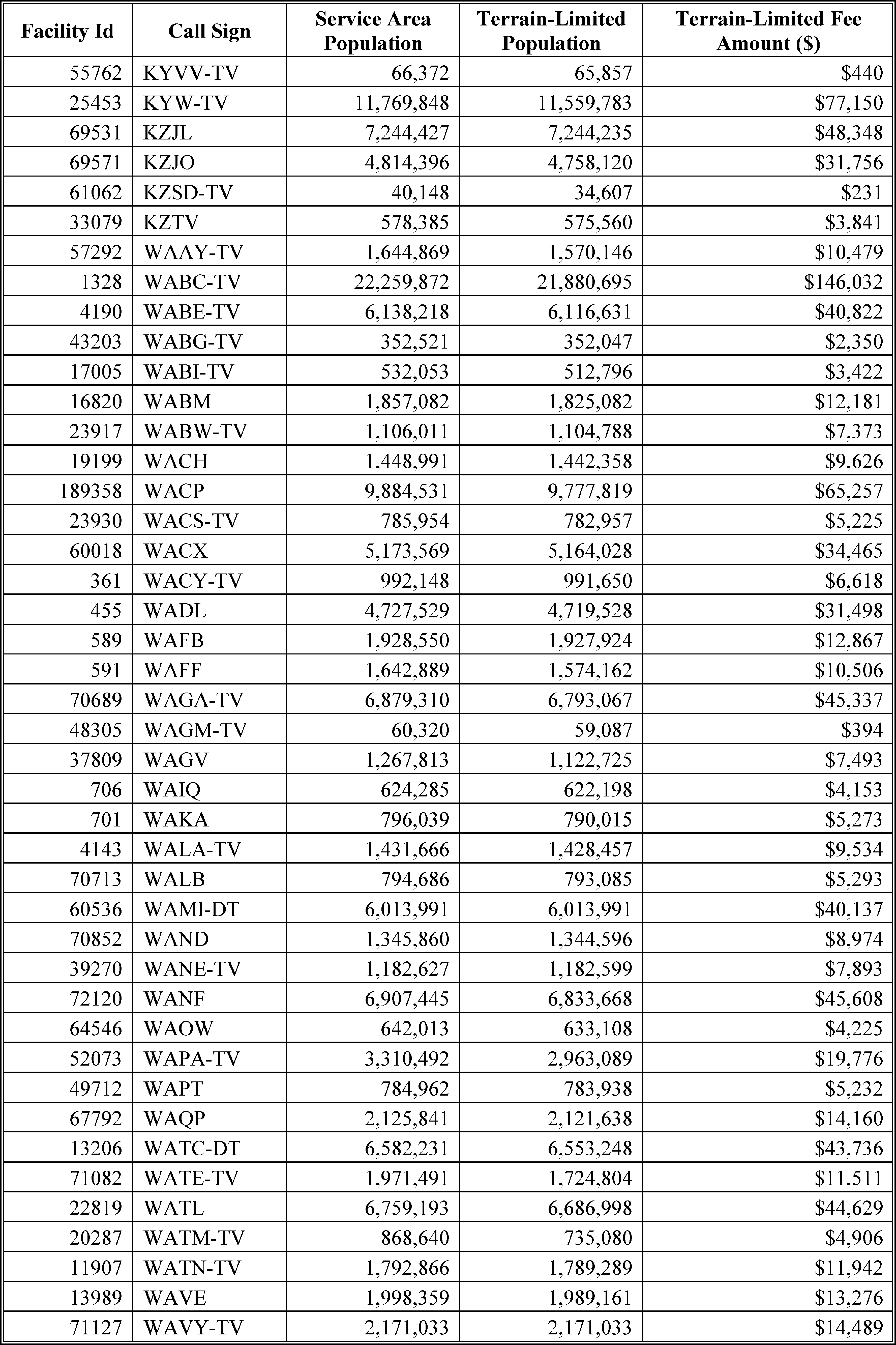
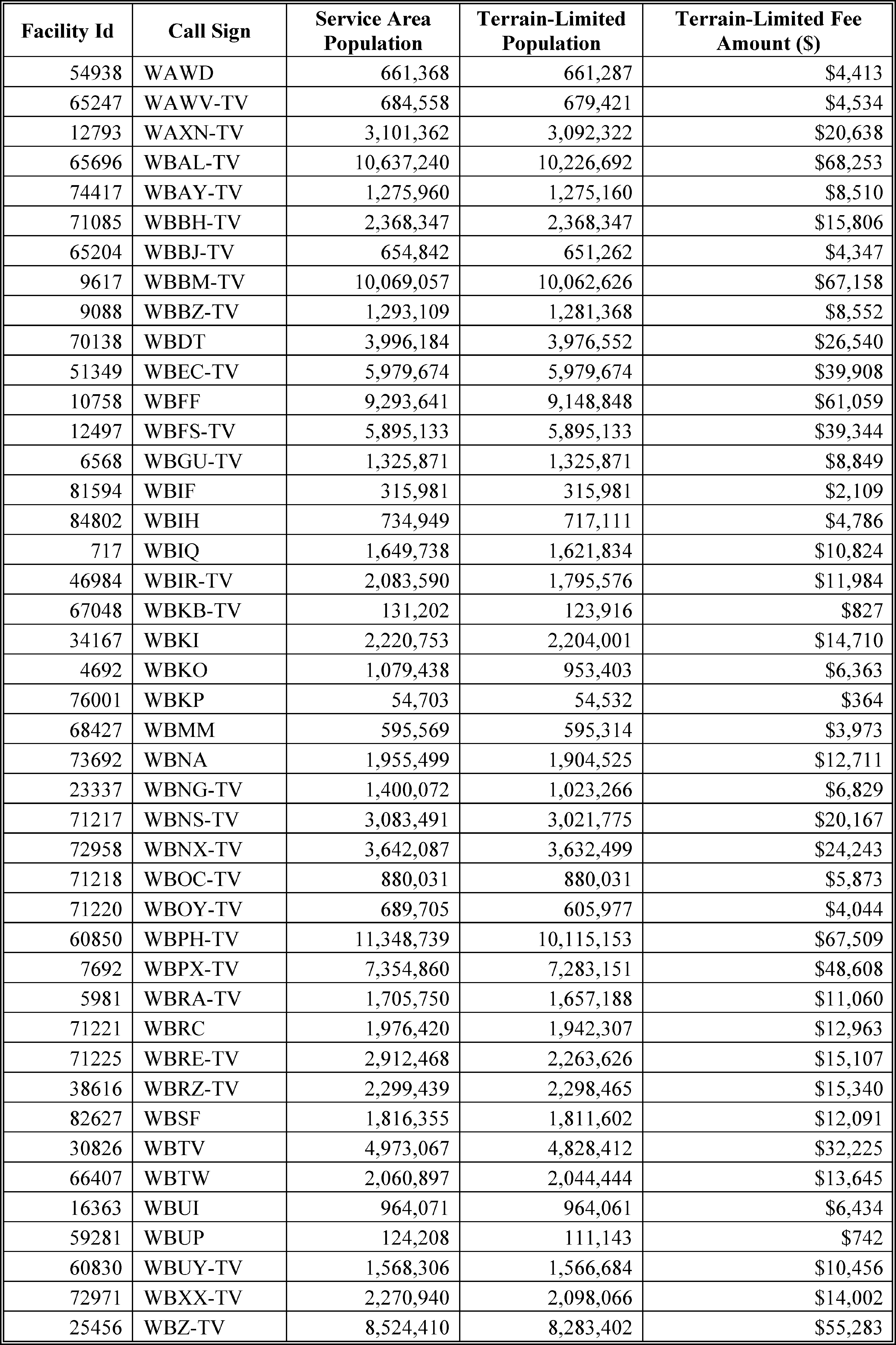
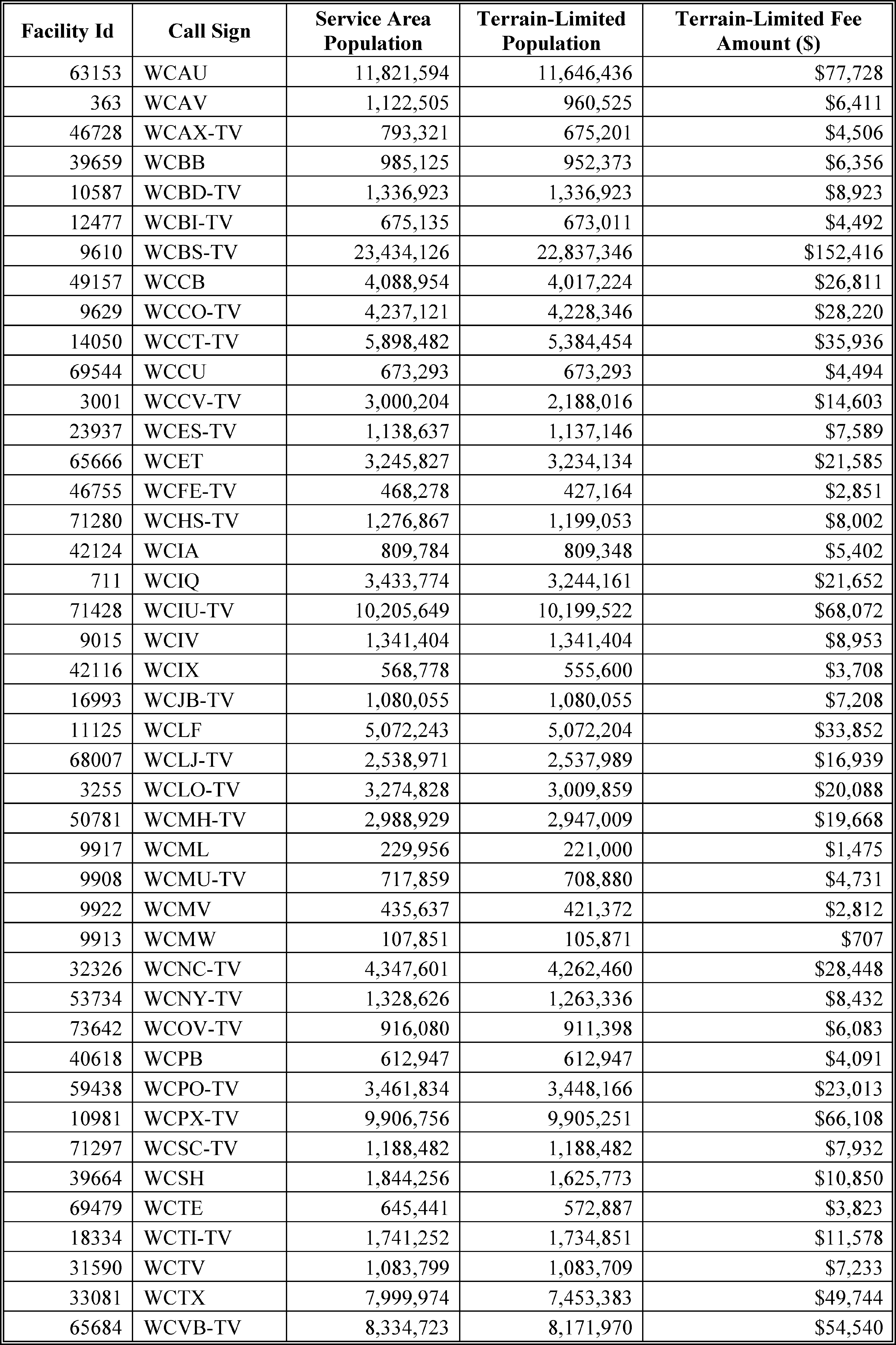
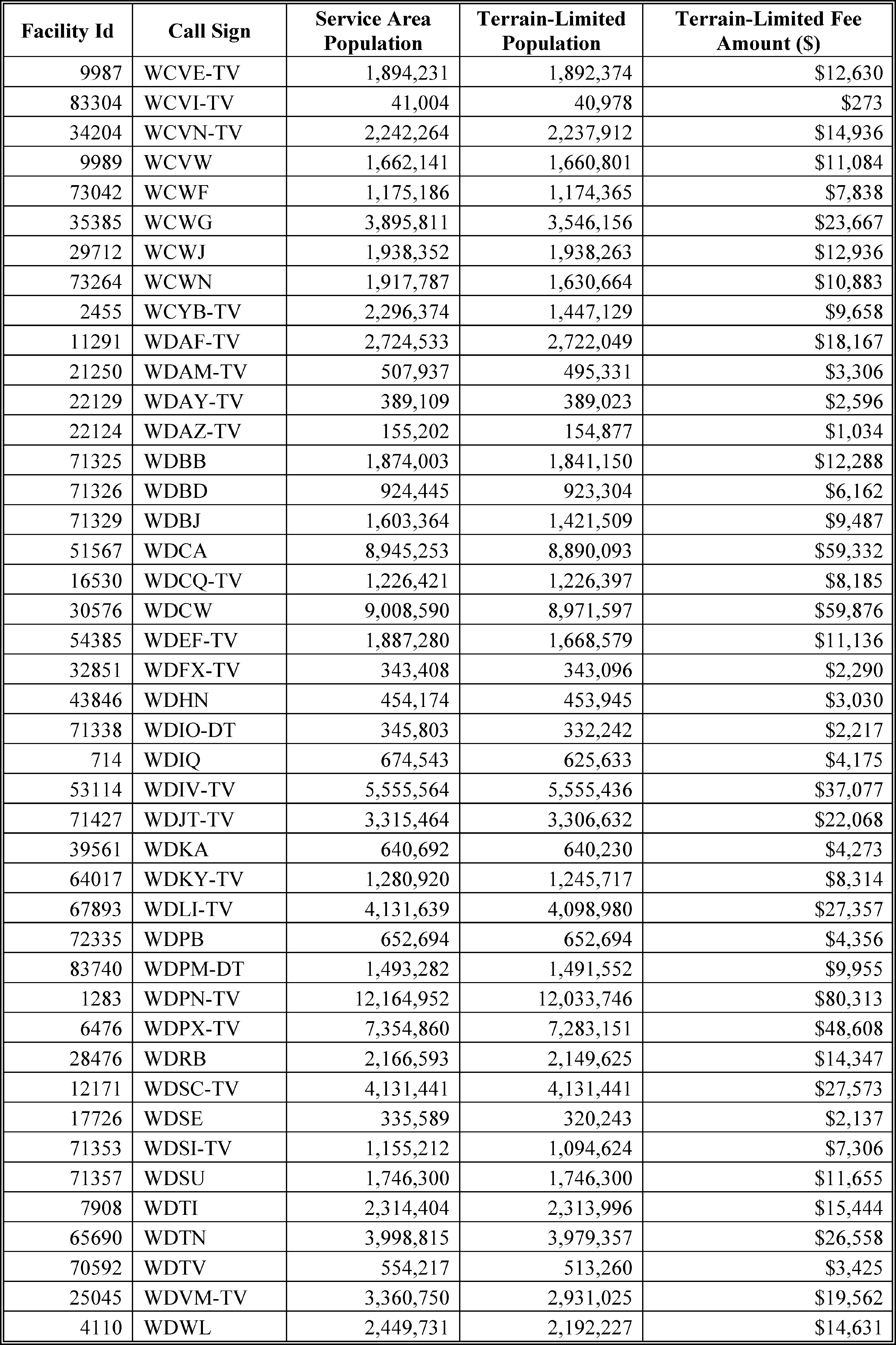
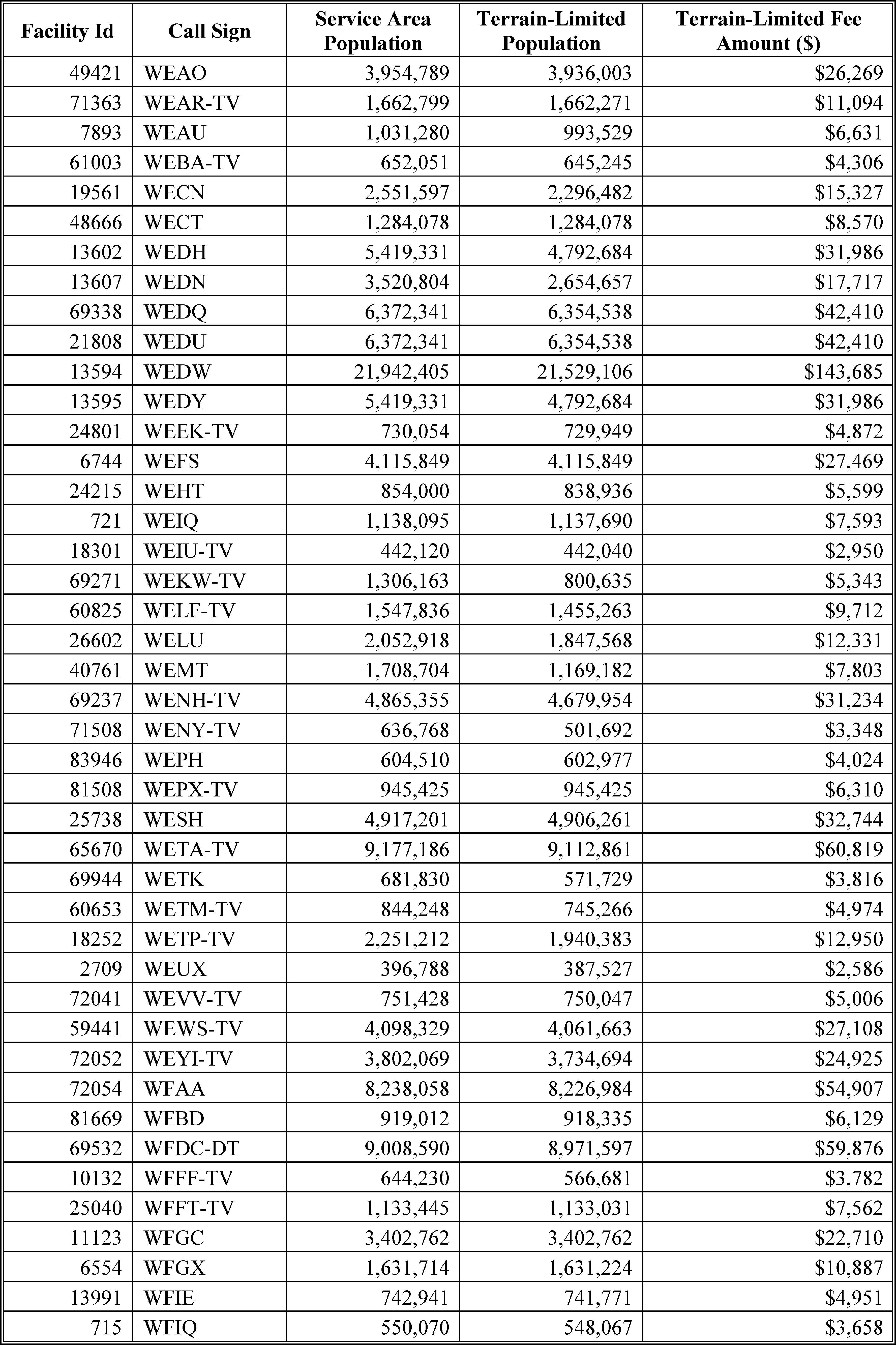
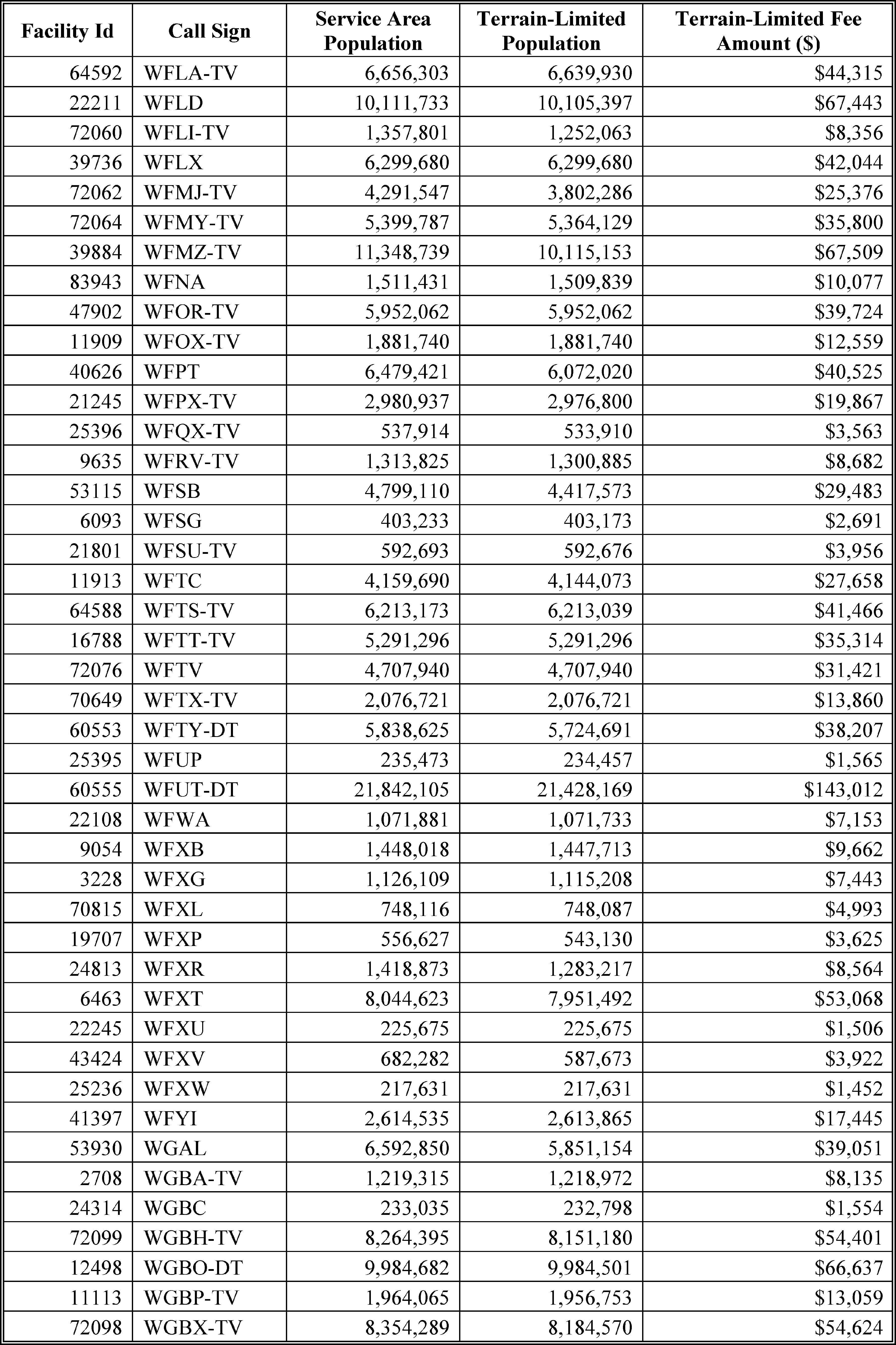
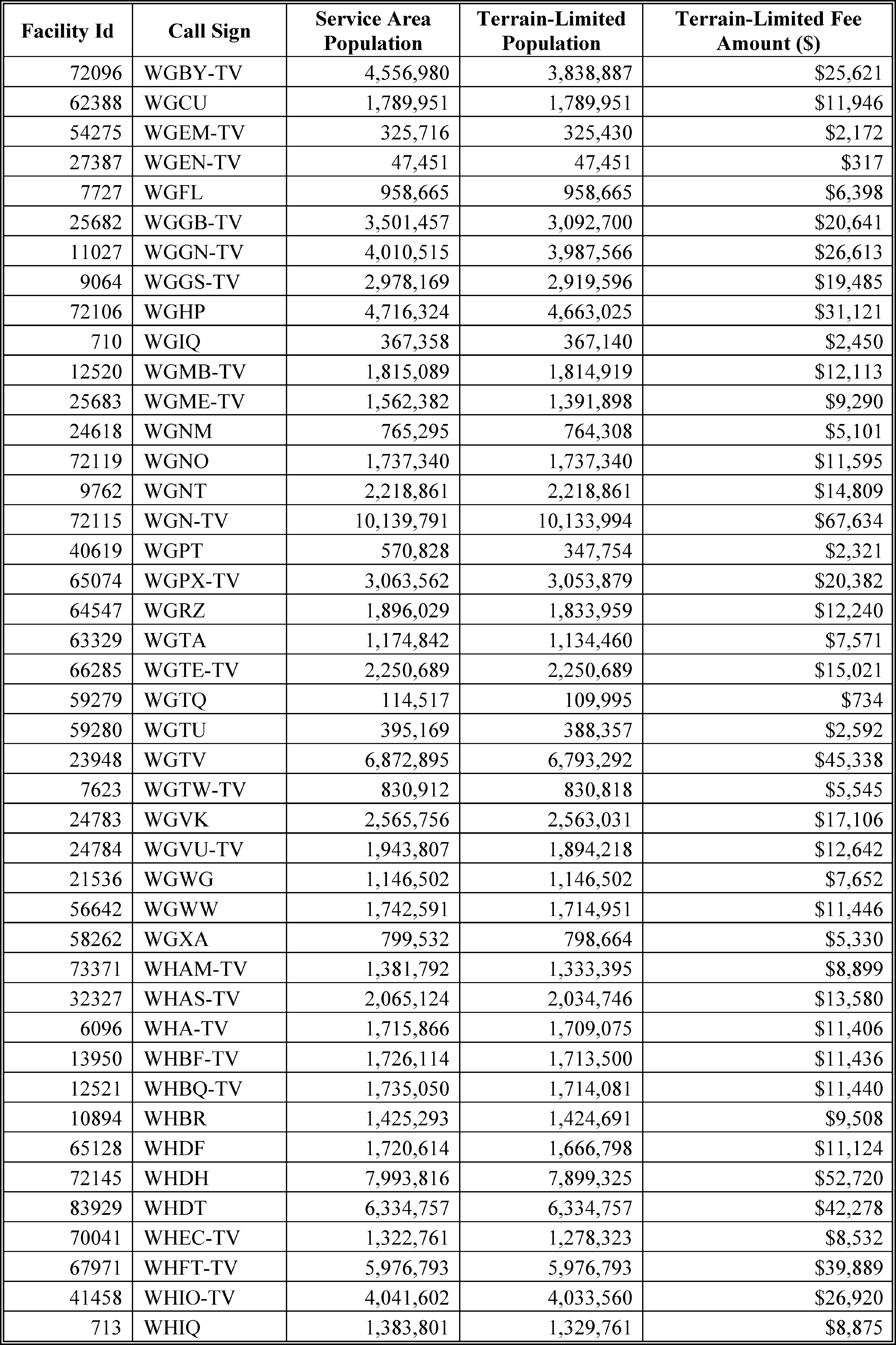
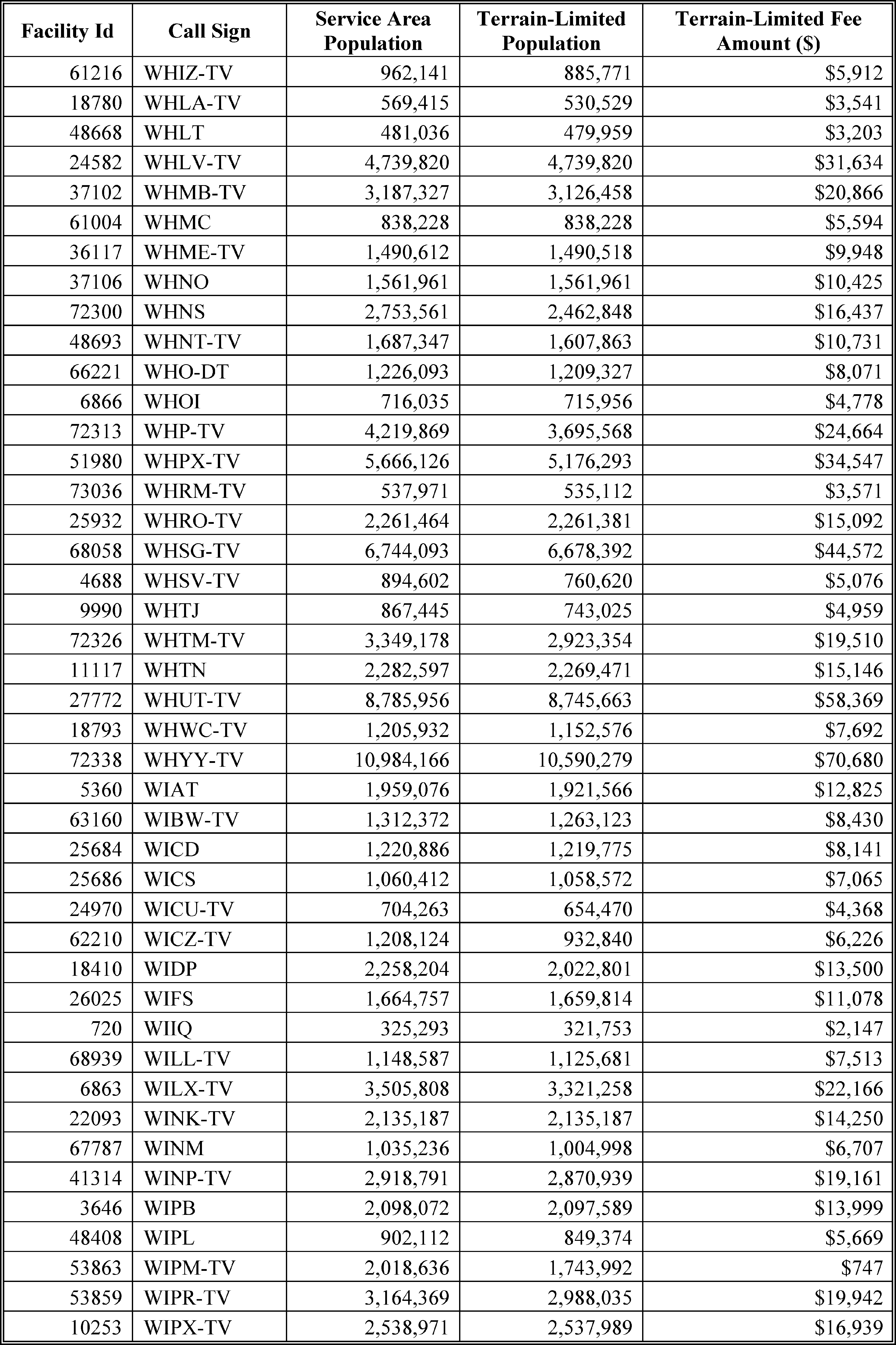
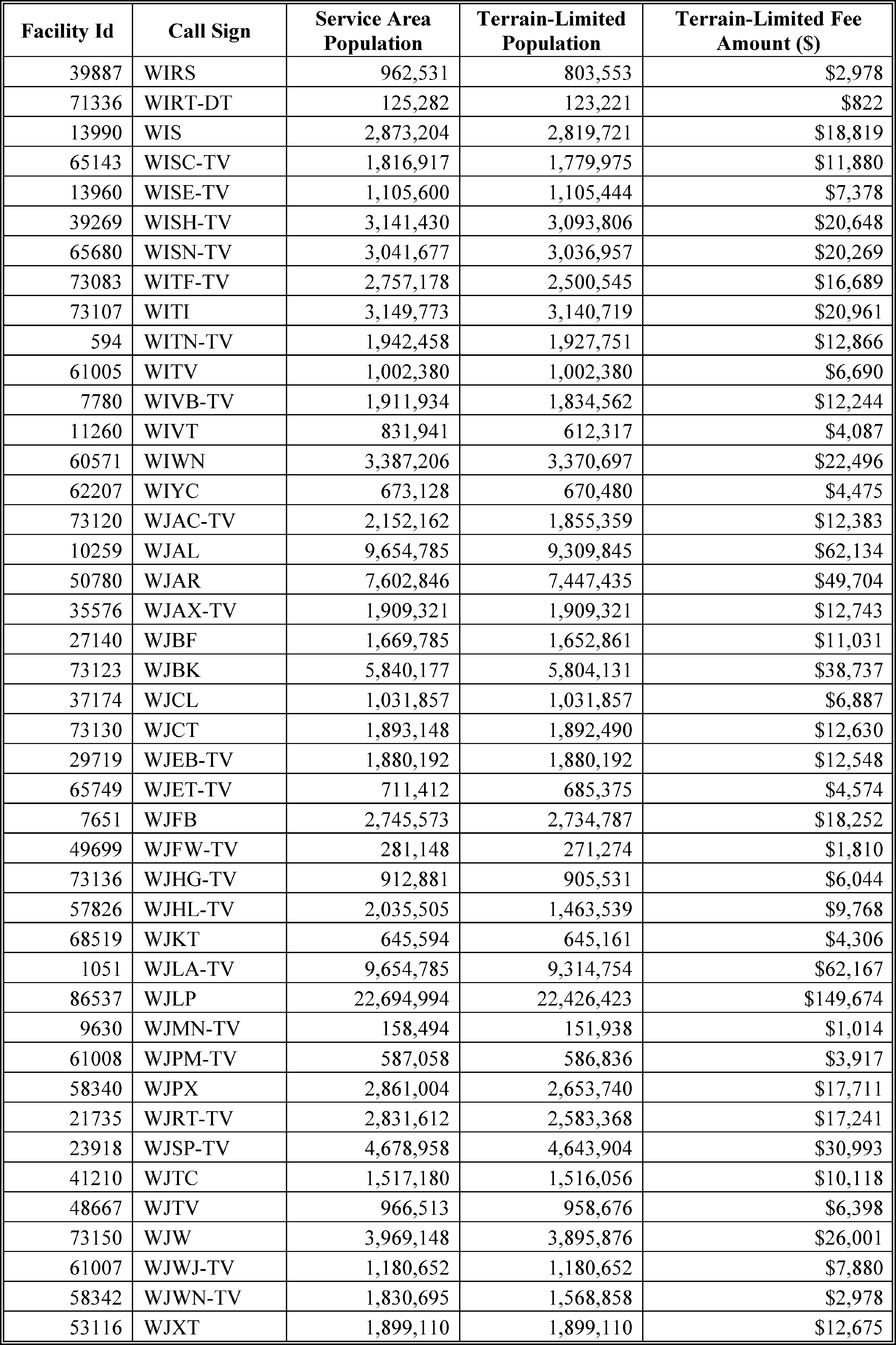
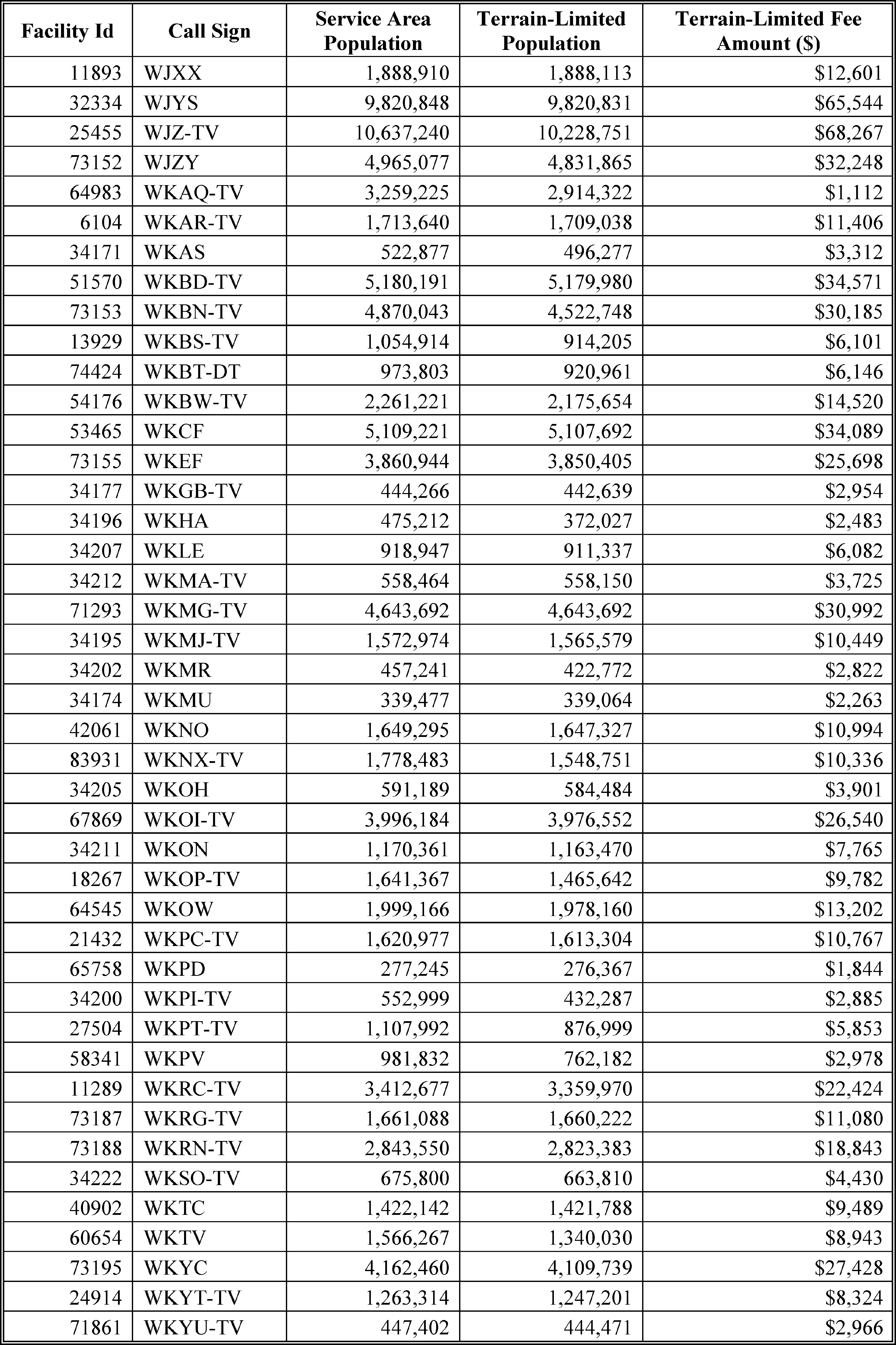
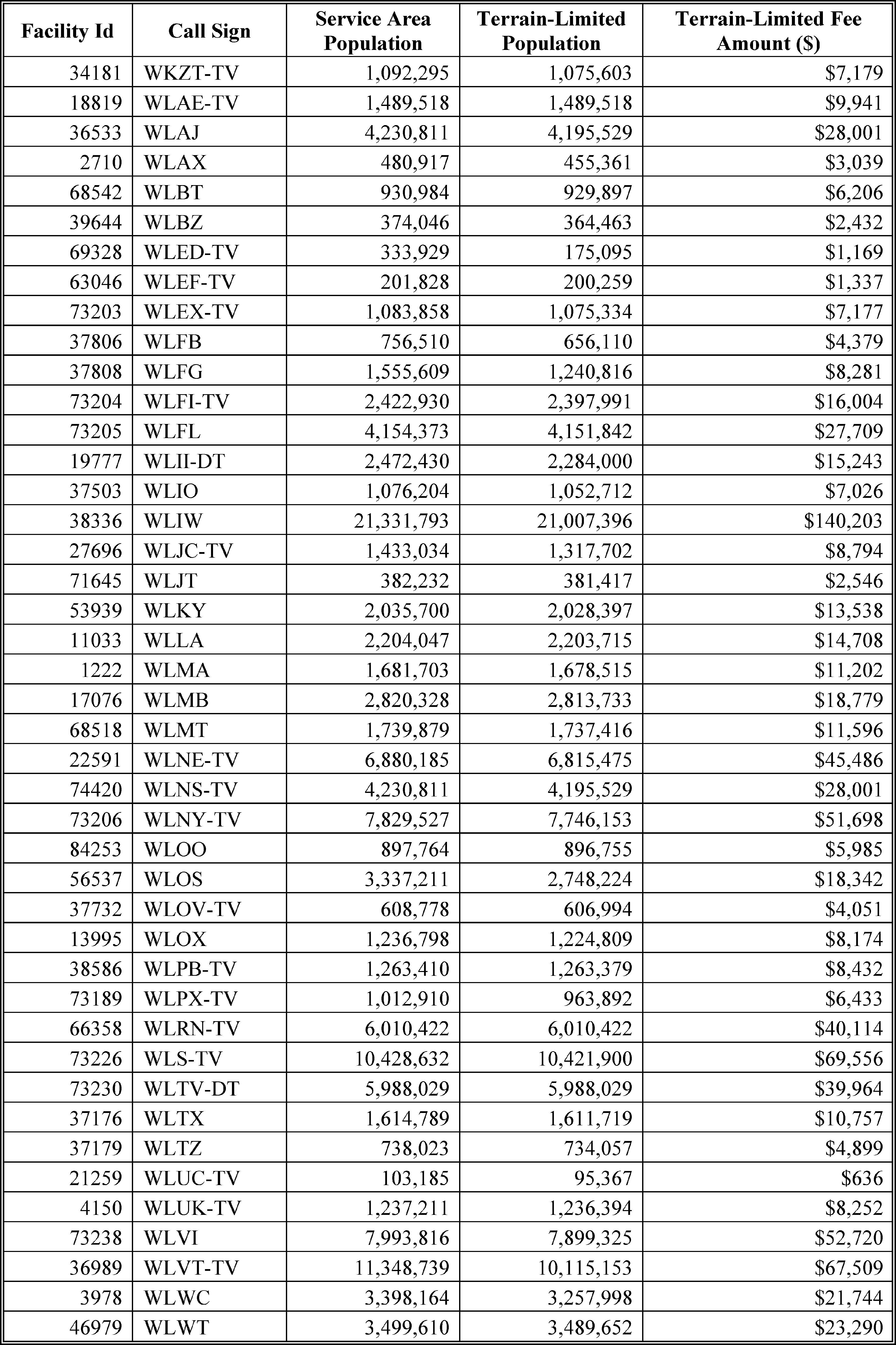
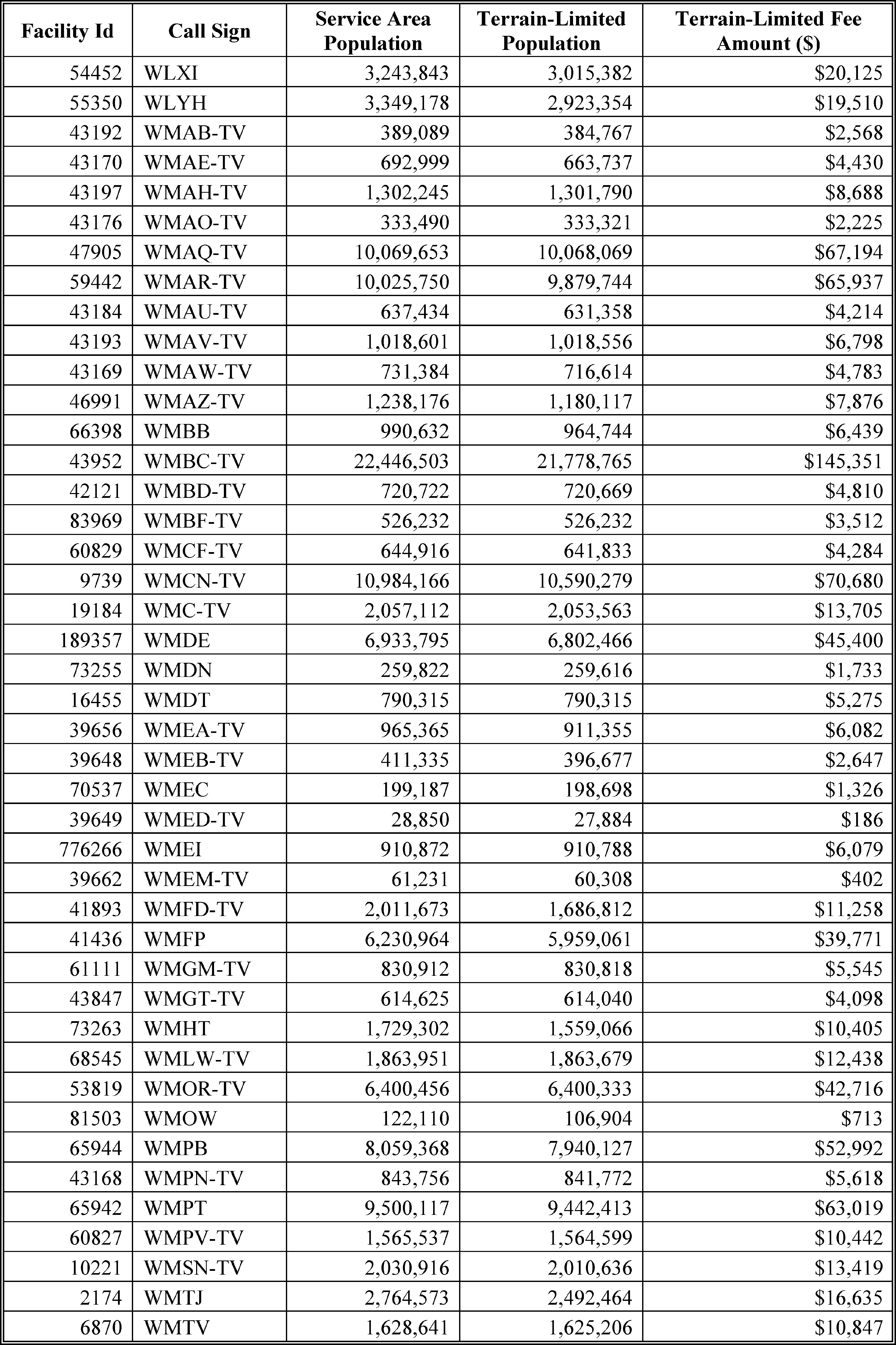
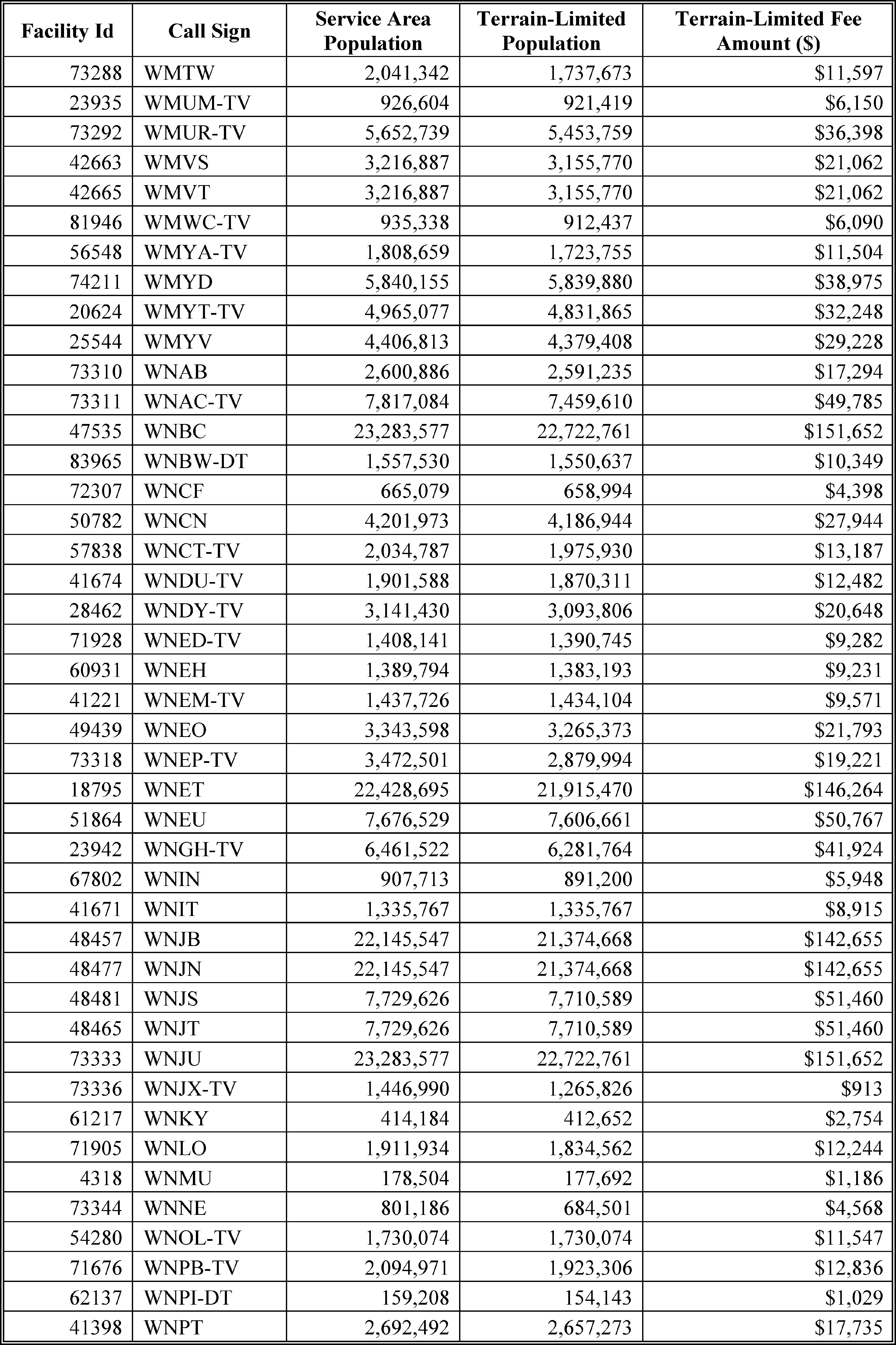
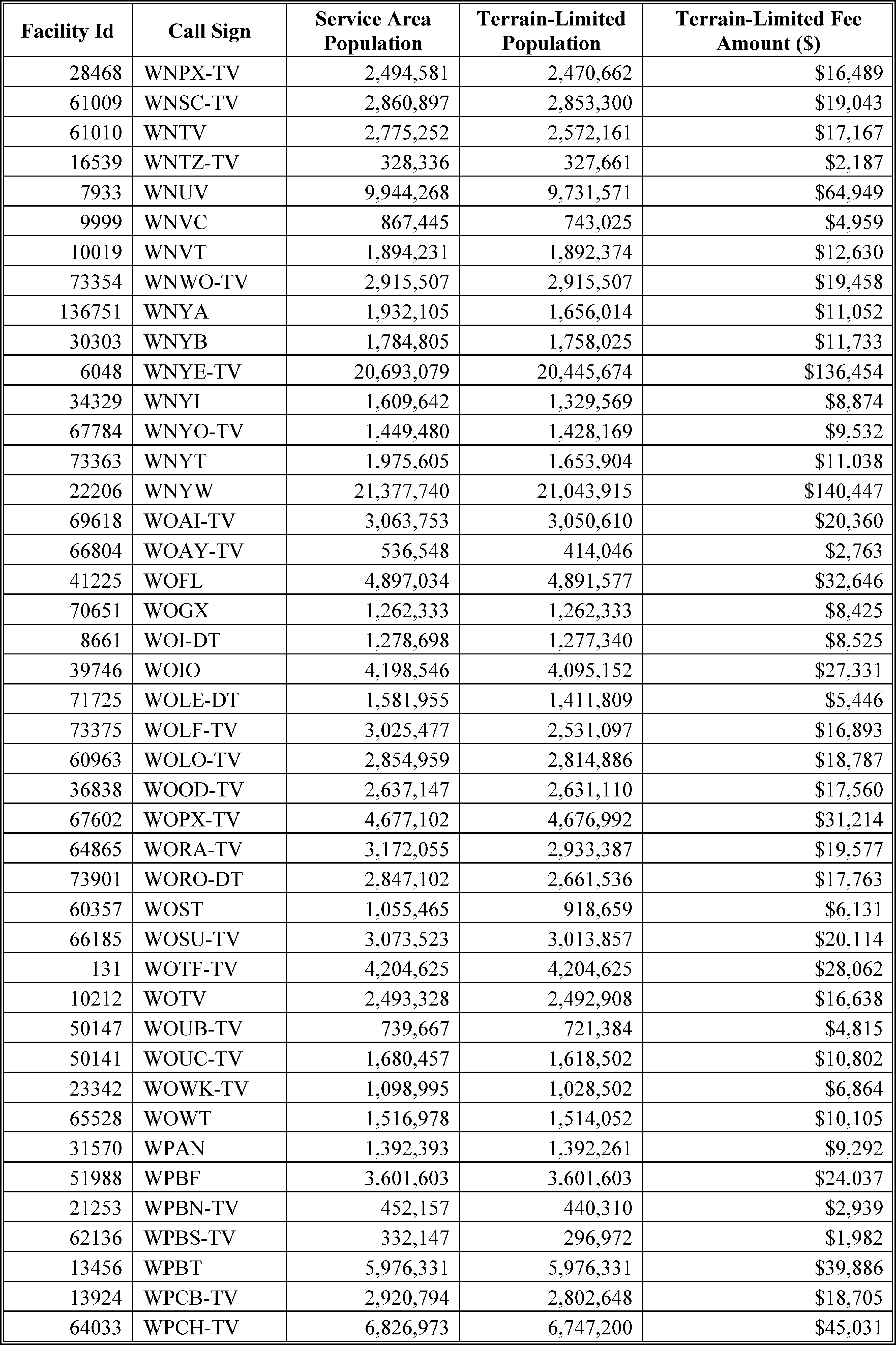
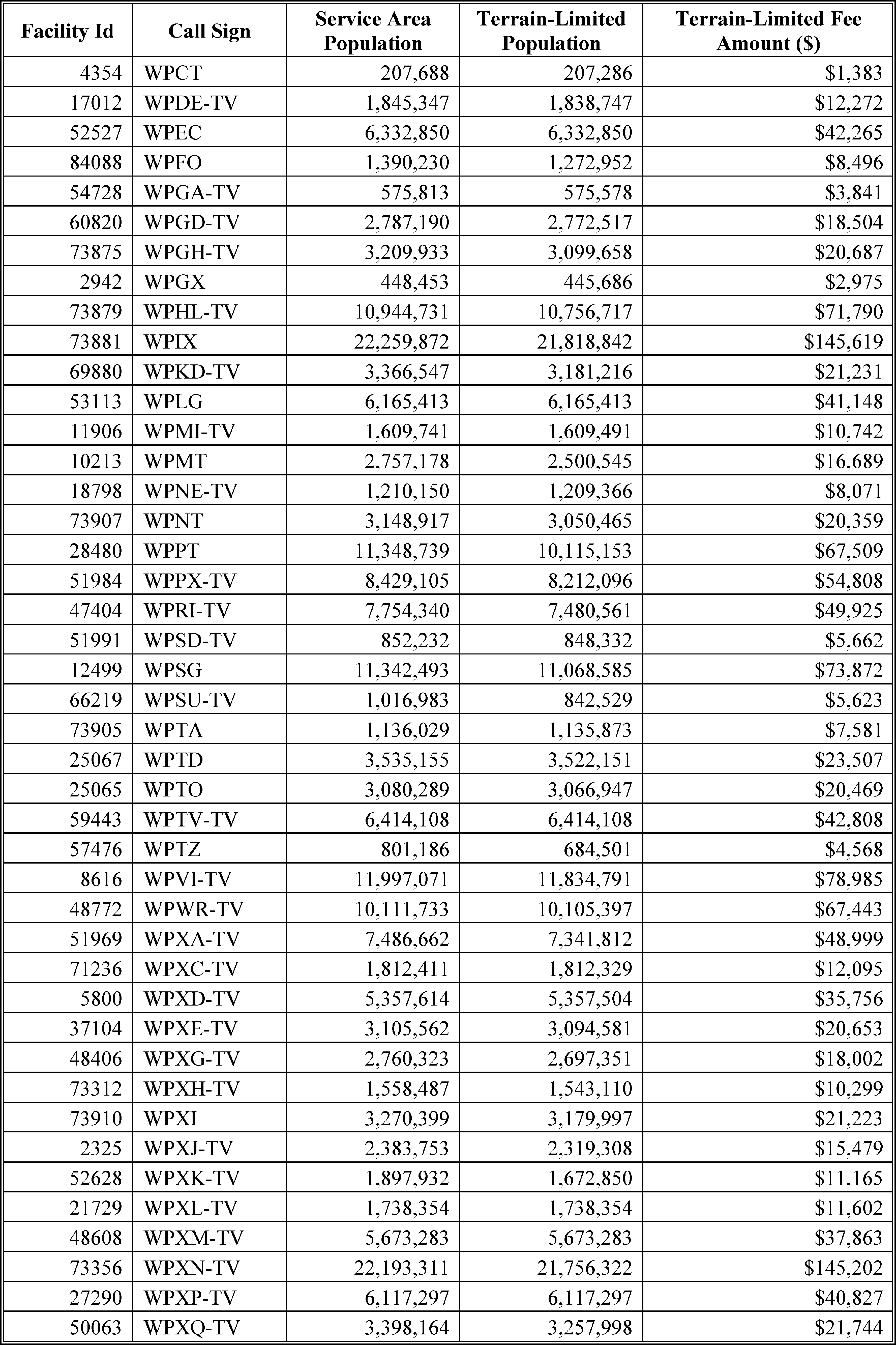
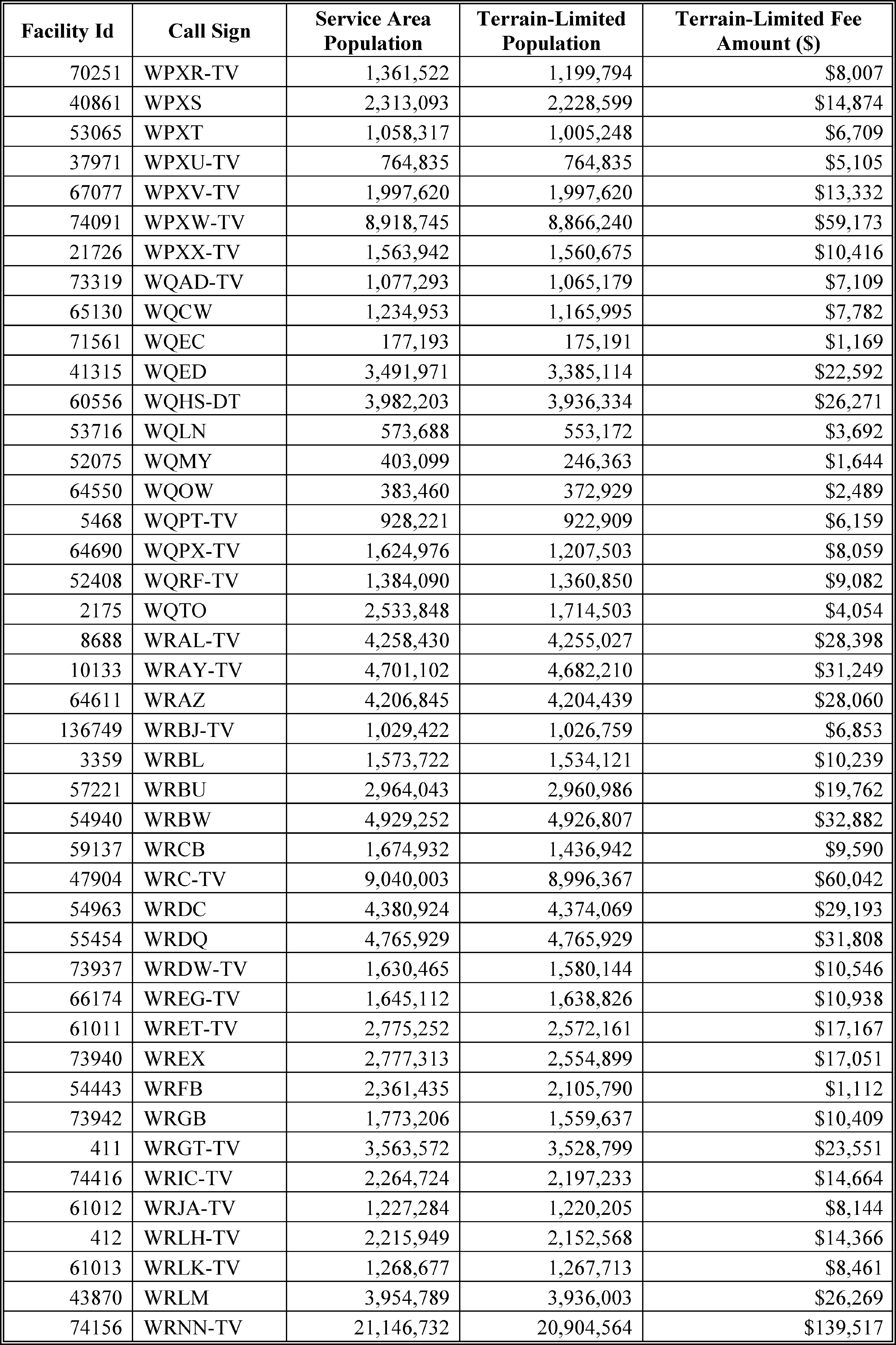
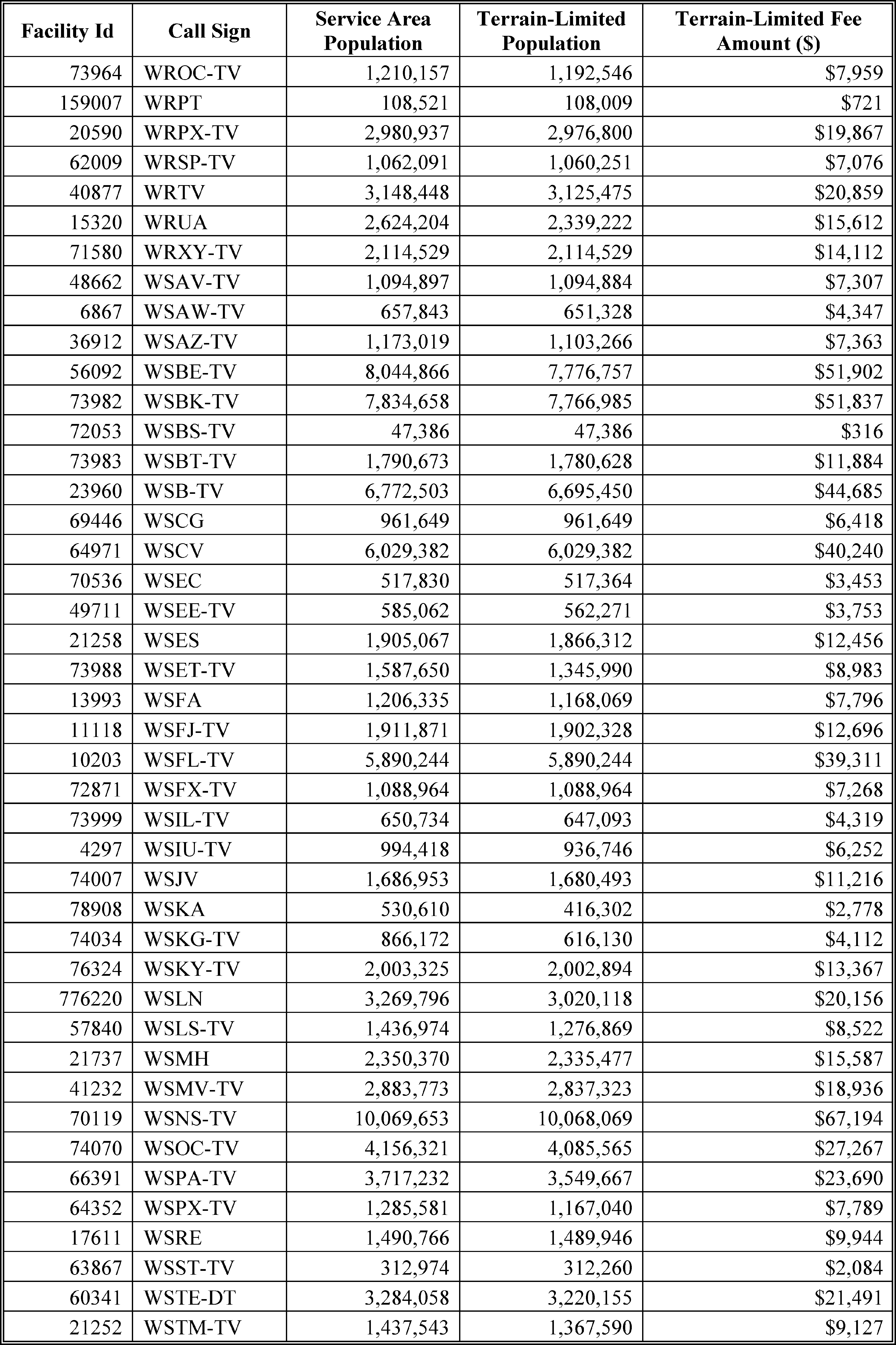
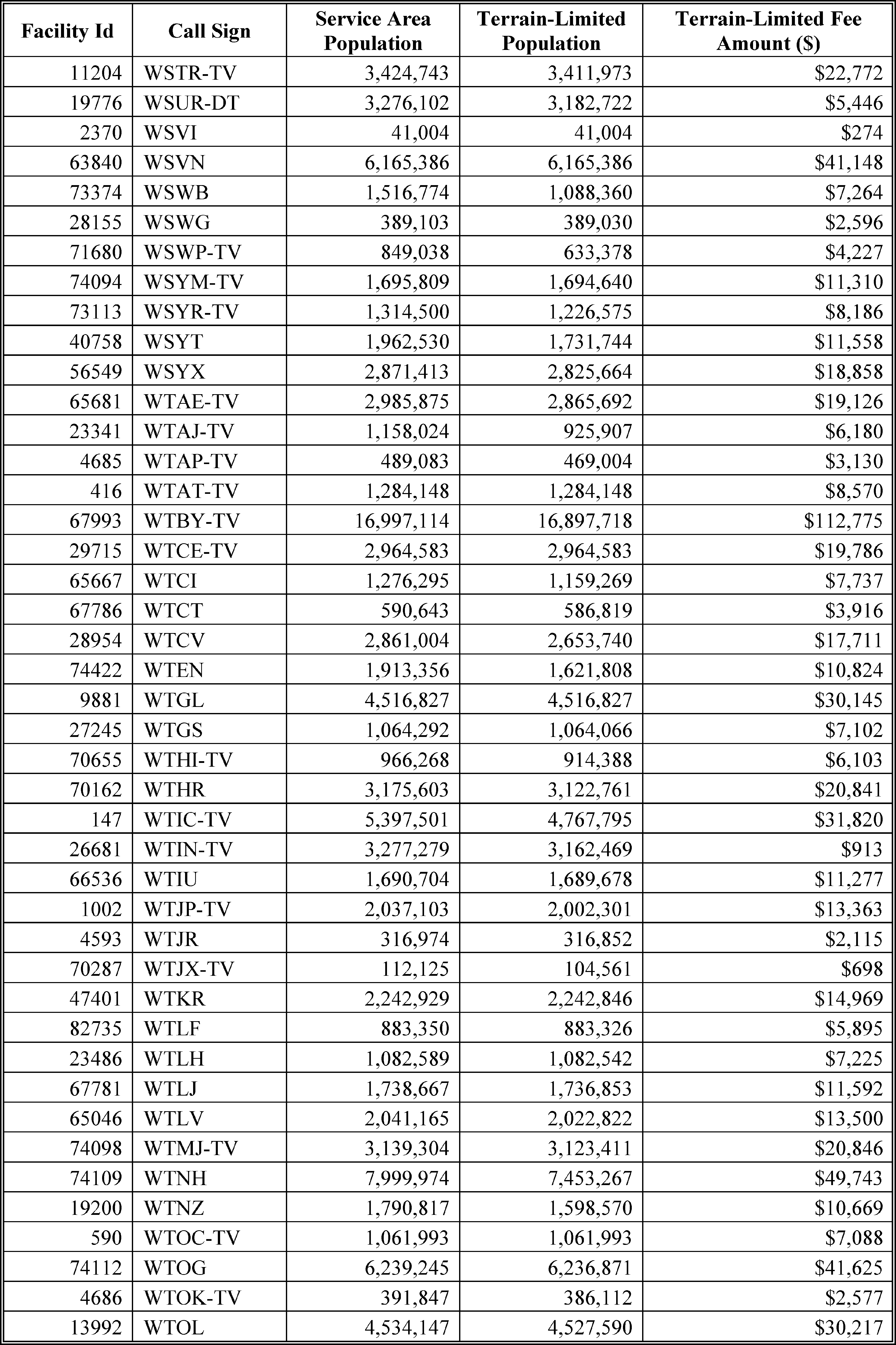
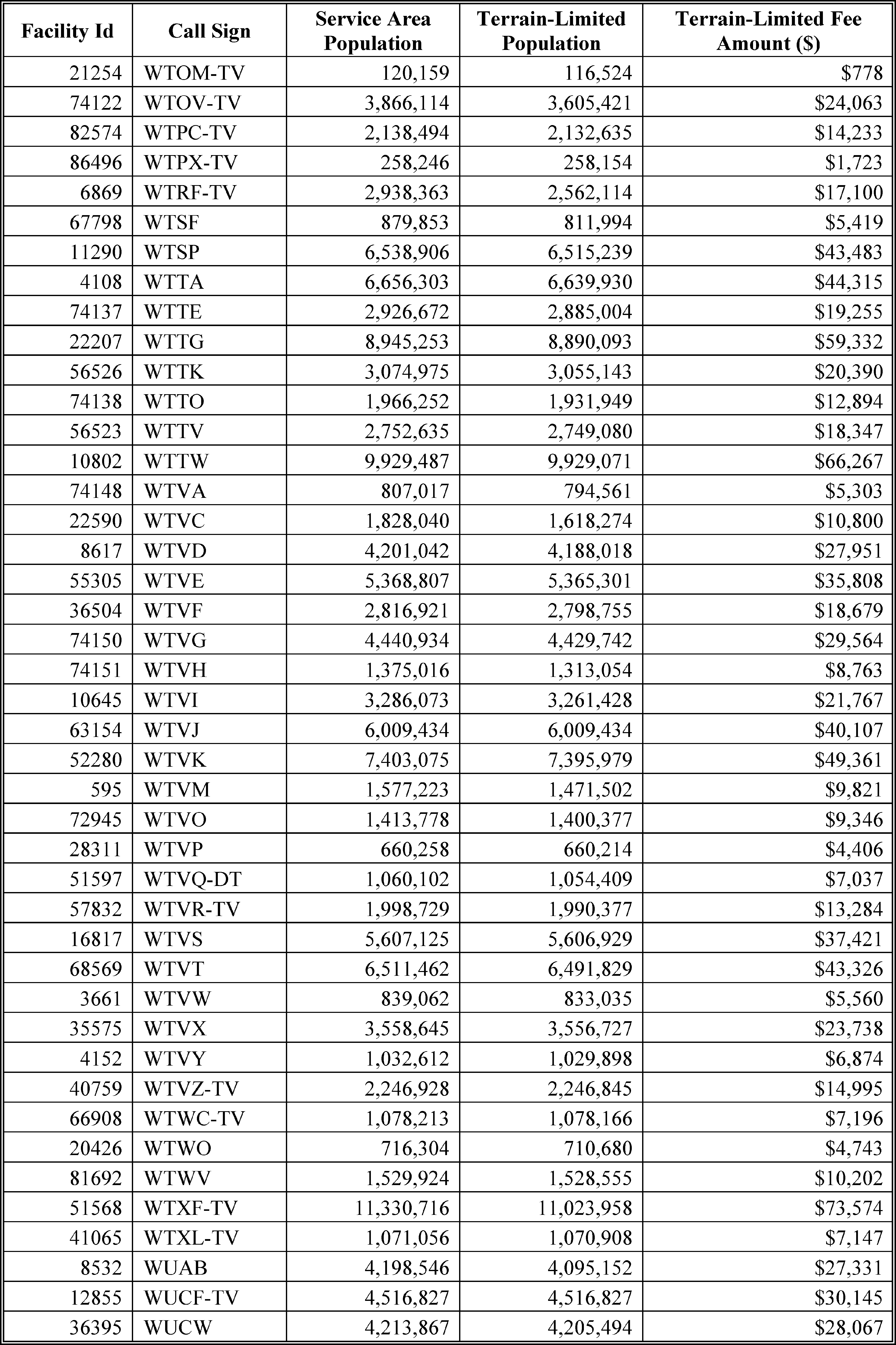
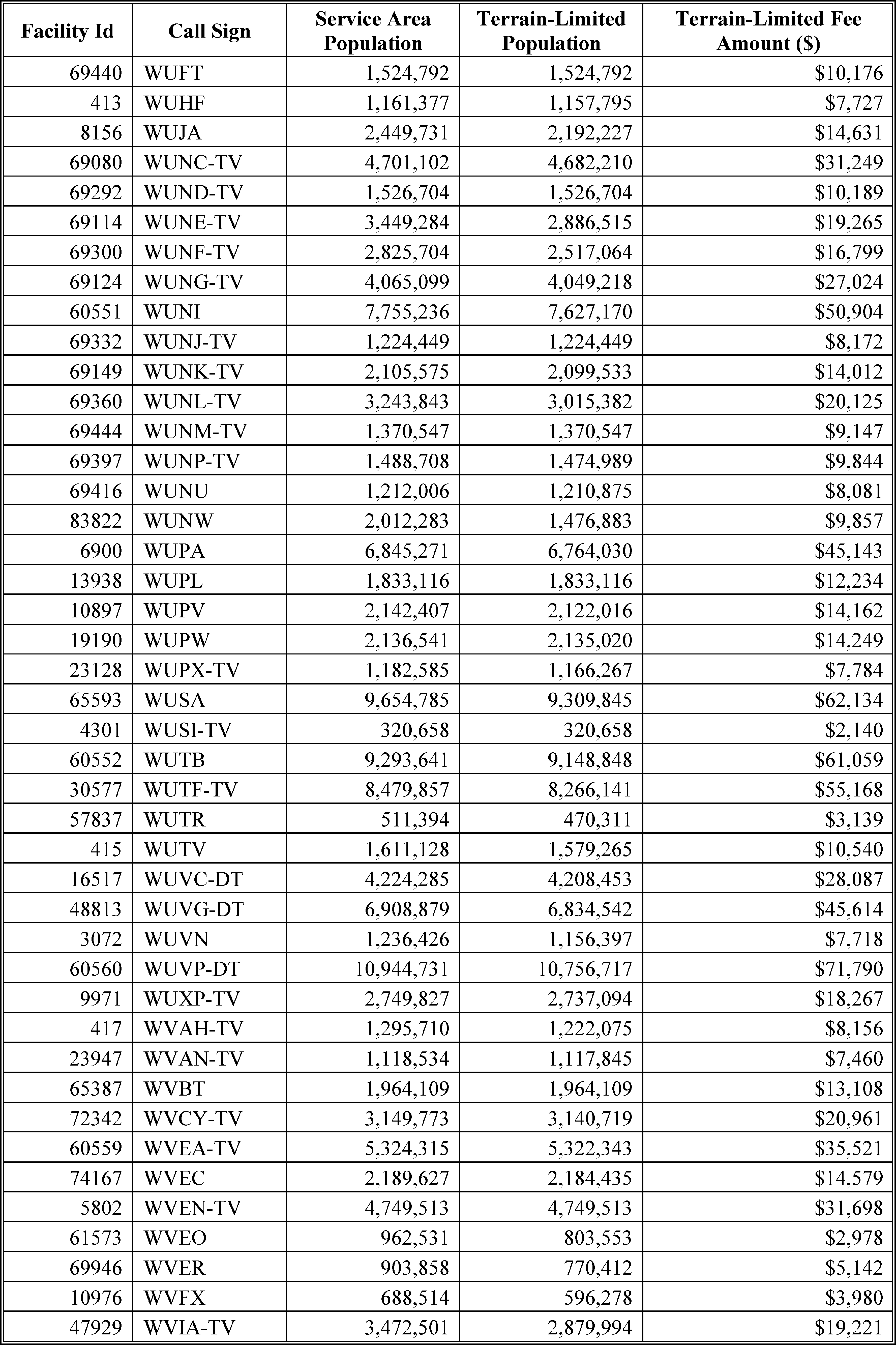
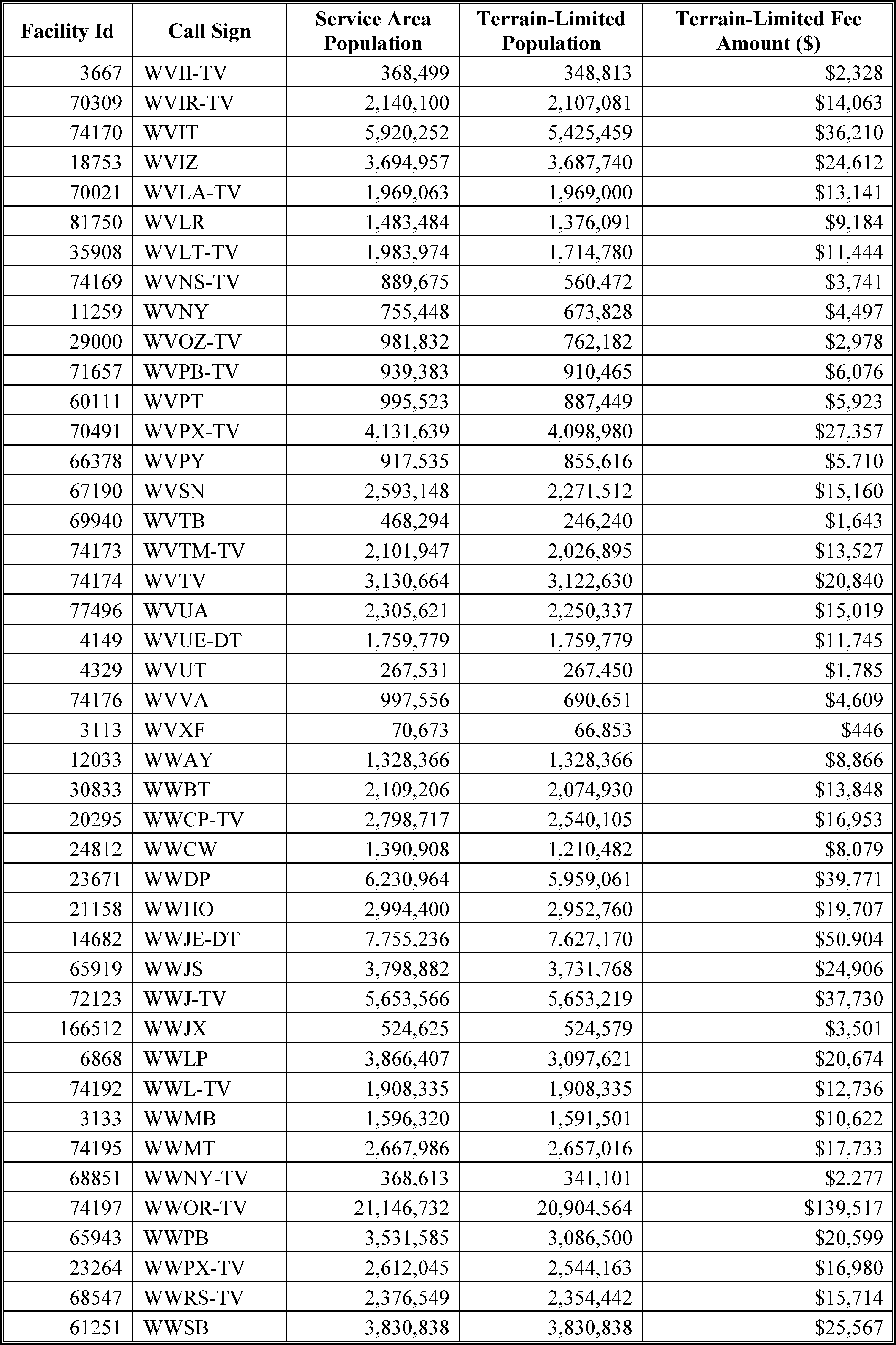
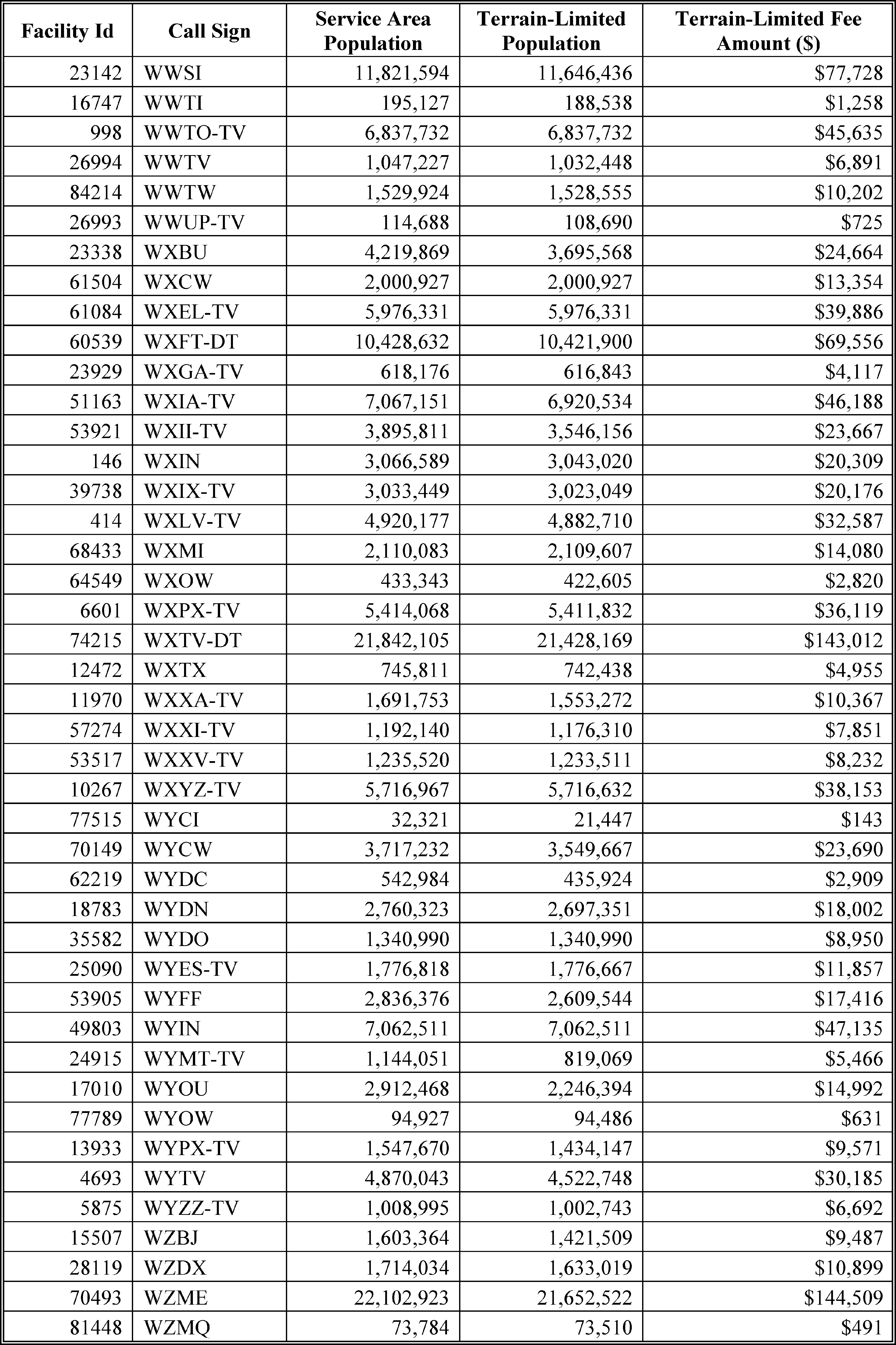
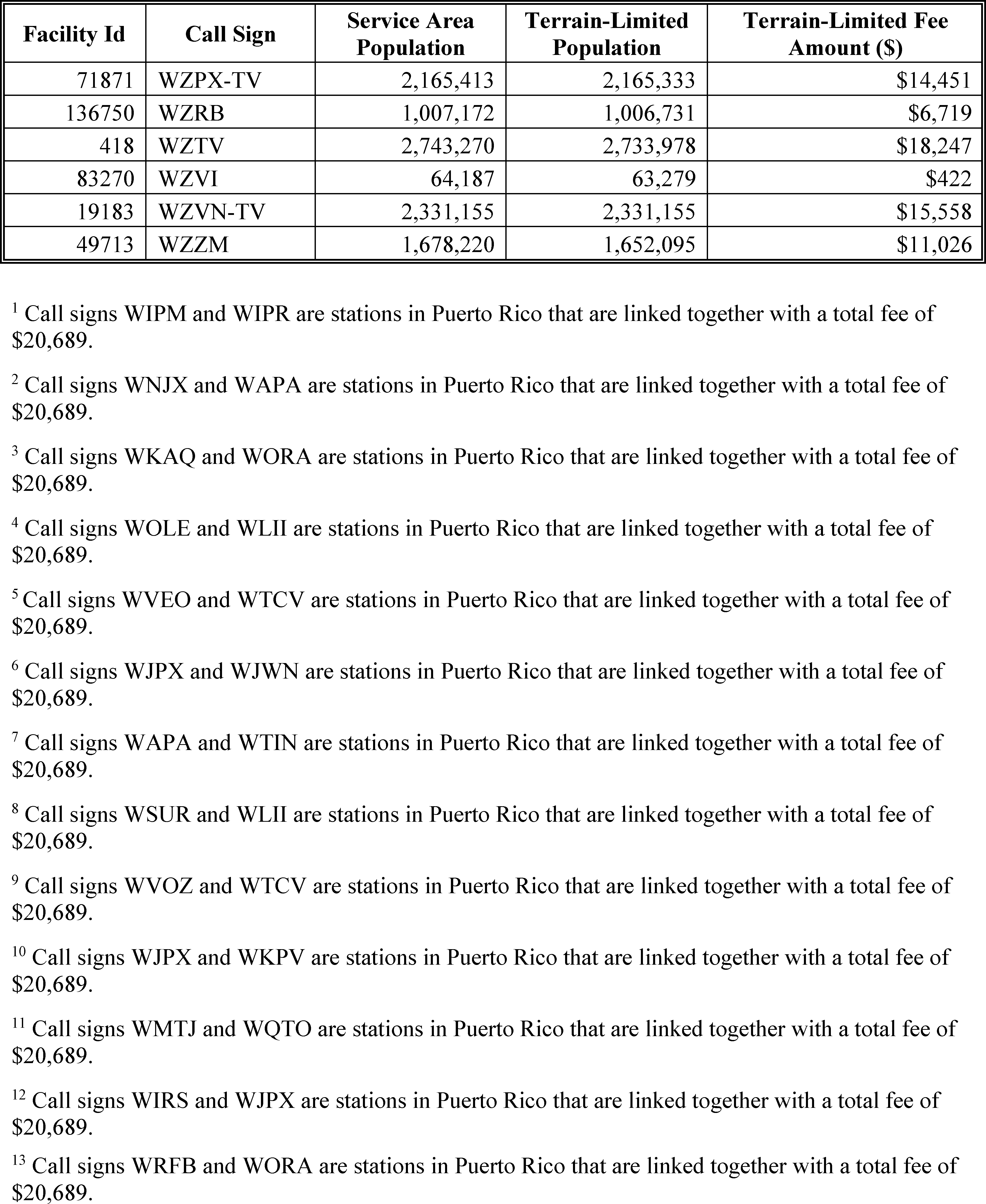
Having received no response to the Commission's FY 2025 NPRM proposals for assessing full-power broadcast stations, the Commission will continue to assess fees for full-power broadcast television stations based on the population covered by a full-service broadcast television station's contour as the Commission has since 2020. The population-based methodology conforms with the service authorized here—broadcasting television to the American people. The Commission will also continue its use of 2020 U.S. Census data to assess fees for full-power broadcast television stations, as it traditionally has over the last few years. The population data for broadcasters' service areas are determined using the TVStudy software and the Licensing and Management System (LMS) database, based on a station's projected noise-limited service contour. However, consistent with the Commission's decision in FY 2024, the Commission explains that it will base assessments on limiting the population count of full-power television stations that rely on satellite television stations to reach terrain-limited areas in Puerto Rico. The Commission adopts a factor of $.006674 per population served for the FY 2025 full-power broadcast television station fee. The population data for each licensee and the population-based fee (population multiplied by $.006674 for each full-power broadcast television station) are listed in Table 7.
Proposed New Regulatory Fee Categories
In the
FY 2025 NPRM,
the Commission also sought comment on whether it should consider any new regulatory fee categories. In exercising the Commission's Congressional mandate to collect regulatory fees each fiscal year, the Commission proceeds with careful consideration and make changes in its process, including the adoption of new fee categories and the accompanying assessment methodologies, only after fully developing the record. This meticulous approach to making changes serves the goal of ensuring that the Commission's actions in assessing regulatory fees are fair, administrable, and sustainable.
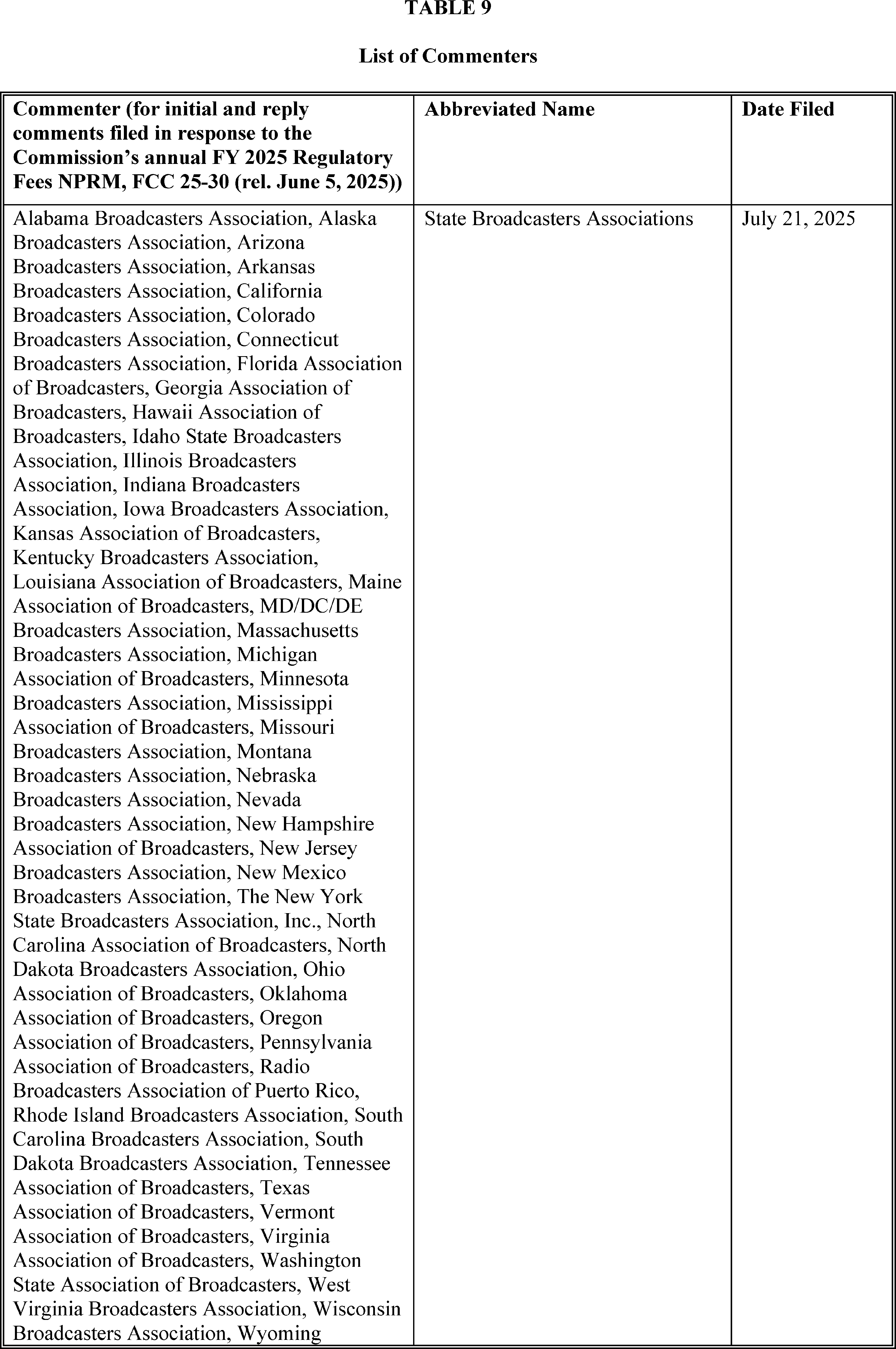
For FY 2025, the Commission rejects the proposals to add new regulatory fee categories because they fail to satisfy this standard. NAB and Telesat propose that the Commission should adopt five new regulatory fee categories to expand the base of fee payors. Specifically, they suggest that the Commission adopt fee categories for broadband service providers, large technology companies, equipment authorization holders, experimental license holders, and entities that provide database services to enable the provision of unlicensed services. Iridium and the State Broadcasters Associations support these proposals; however, CTIA, the Wi-Fi Alliance, Kinéis, NCTA, the Telecommunications Industry Association (TIA) and the Consumer Technology Association (CTA) strongly oppose them. The Commission does not adopt new fee categories at this time.
The Commission also declines NAB's proposal, supported by Iridium and the State Broadcasters Associations, to hold “roundtables” to discuss such matters in advance of the FY 2026 notice of proposed rulemaking. NAB claims that a lack of access to internal Commission FTE data constrains their and other commenters' ability to offer more detailed proposals and therefore the Commission should work with interested stakeholders to close these information gaps. Notably, some commenters do not agree. The Wi-Fi Alliance describes the proposal to as “unwarranted.” CTIA also maintains that there is no need to hold roundtables to gather additional information on creating new fee categories. Specifically, CTIA explains that such roundtables would create a duplicative process for stakeholders to continue to raise issues that the Commission has already considered because its annual rulemaking process provides “ample” opportunity for it and relevant stakeholders to consider changes to the regulatory fee process. CTA too disagrees with NAB's proposals, explaining that access to Commission staffing data is not a real problem that prevents NAB from defining the new fee categories it wants the Commission to create.
The Commission agrees with commenters that contend that convening roundtables is unnecessary. The Commission has extensively explained its reasoning with respect to the work of its FTEs that is both direct and indirect, and concludes that nothing has changed herein. Moreover, parties already have the ability to present new arguments and evidence to Commission staff in advance of the next fiscal year's regulatory fees rulemaking, thus rendering it inefficient for the Commission to host open-ended, presumably contentious stakeholder discussions that appear unlikely to yield a framework for the adoption of new fee categories that is fair, administrable, and sustainable. Hosting a forum for parties to rehash comments from prior years or to explore the granular details of the Commission's FTE work assignments and burdens is unlikely to persuade the Commission to adopt a new fee category.
Broadband internet Access Service Providers and Large Technology Companies.
The Commission is not persuaded by NAB's arguments, which Iridium and the State Broadcasters Associations support, that it should create a new regulatory fee category for either broadband internet service providers or large technology companies to expand the base of fee payors beyond licensees to other entities that benefit from its activities. Many commenters strongly reject these proposals.
Although NAB concedes that some of these types of entities may already pay regulatory fees for certain services, it nonetheless claims that they “escape paying the full amount of fees associated with their operations (
e.g.,
broadband services or equipment authorizations), even when those services directly benefit from FCC activity.” NAB maintains that a larger array of entities other than those currently paying regulatory fees benefit from the Commission's work. Notably, however, NAB offers no specific examples of what it believes to be the unaccounted FTE burden associated with oversight and regulation of these unnamed entities. Similarly, Iridium suggests that the Commission can “add new payors over time as it determines appropriate fees for the activities that benefit them,” but also provides no concrete suggestions as to how to differentiate such activities from those that are already covered by the Commission's existing regulatory fee categories. In support of NAB's proposals, the State Broadcasters Associations generally contend that as a matter of fairness, the Commission must look for entities that benefit from the Commission's work but have escaped paying regulatory fees because their benefits do not include a physical license issued by one of the core bureaus. While the State Broadcasters Associations claim that broadcasters and other licensed entities “unfairly subsidize” much “larger entities in healthy and growing industries that are far more able to bear the operating costs
( printed page 43292)
of the Commission,” it also fails to include any specificity as to which larger entities should fall into new fee categories.
The Commission will add a new fee category where it can determine that significant FTE resources of a core bureau are being spent on oversight and regulatory activities with respect to a specific service necessitating a new regulatory fee category. The Commission states such circumstances have not been presented here. As the Commission has previously explained, there is no specific bureau or office in the Commission with oversight of all broadband services because the work of Commission FTEs on broadband matters is spread out among most of its organizational units, including the core bureaus. Providers offering broadband internet access services are involved in many Commission initiatives and proceedings and are, in many cases, already responsible for regulatory fees. Broadband internet access services are offered through various technical means and by widely differing entities and to distinct user groups,
e.g.,
wireless service providers, wireline service providers (including VoIP), cable operators, and satellite operators, to consumers and businesses, on both a retail and wholesale basis. Thus, such service is offered by different types of providers and is delivered to end users in different ways. Accordingly, the Commission agrees with the Commission's conclusion from just last year that “creating a new regulatory fee category for broadband internet access services appears to be redundant with existing fee categories in the case of those broadband internet access service providers that otherwise already were subject to the existing fee categories, and thus a new fee category in this regard is not administrable at this time.” Additionally, the Commission recognizes that these same observations regarding the work being spread throughout the Commission could hold equally true for large technology companies, many of which may offer or rely upon broadband services.
As Wi-Fi Alliance points out, NAB's proposal to create a new fee category for large technology companies is too vague in its description of entities that would fall into this category or how the Commission could make such determinations to be administrable. CTA also strongly urges the Commission to reject NAB's proposal to adopt a new fee category for what it calls a “vaguely defined” group because NAB's suggestion is unworkable and lacks clarity. CTA further points out the NAB's proposal reiterates prior flawed arguments.
The Commission agrees with commenters that NAB's proposal for either of these new fee categories would be inconsistent with its policy goals of having regulatory fees that are fair, administrable, and sustainable. Commenters advocating for these new fee categories have failed to indicate how their adoption would fit within the Commission's current regulatory fee methodology. For example, claims that large technology companies “benefit significantly” from the Commission's work—presumably work promoting the deployment of broadband upon which they rely to reach consumers—are not sufficient. As CTA correctly observes, consumers likewise benefit immensely from having fast and reliable broadband available, but if any benefits—no matter how attenuated—were the criterion, they too would be subject to regulatory fees.
By merely reiterating the arguments that NAB acknowledges it has offered before, the Commission concludes NAB has failed to present any new basis or evidence to demonstrate that a broadband internet access service provider or large technology company regulatory fee category is necessary for this fiscal year. Likewise, the Commission reasons, Iridium's support of adopting new fee payor categories, without explaining a foundational basis or framework to do so, does not offer a workable solution. NAB, and supporting commenters, have not offered any new reason to revisit the Commission's prior determination that it would be administratively difficult to try to determine the FTEs that should be included in either of these proposed new regulatory fee categories. Likewise, convening roundtables to explore these proposals is not likely to solve such problems with administrable feasibility.
It is also worth noting, as the Commission has previously, that because the amount of regulatory fees collected from each core bureau is based on the number of non-auctions FTEs in each bureau, adding a new broadband internet access or large technology fee category would be unlikely to change the number of Media Bureau FTEs devoted to broadcast issues. Rather, as NCTA reasons, the Commission's efforts to modernize its media rules should, over time, result in decreased regulatory fees for Media Bureau regulatees as the Commission's deregulatory endeavors reduce the amount of time and effort Commission FTEs must devote to regulating the industry.
The Commission finds no basis to conclude that adopting either of these fee categories would satisfy the factors that the Commission has previously relied on to create a new regulatory fee category. Accordingly, the Commission concludes, as the Commission has over the last several years, that Section 9 of the Act does not require the creation of either category.
Holders of Equipment Authorizations.
The Commission also declines to adopt Telesat's and NAB's proposals to create a new regulatory fee category for manufacturers or others that hold equipment authorizations. Here too, the Commission finds that the record does not provide a sufficient basis, consistent with Section 9 of the Act, for the adoption of a new regulatory fee category. In the instances where the Commission has adopted a new fee category, it has done so based on a determination that significant FTE resources of a core bureau were being spent on oversight and regulatory activities with respect to a specific service. As the Commission has previously decided, the Commission again concludes that those circumstances with respect to equipment manufacturers are absent here.
Telesat generally maintains that because the Commission has broad authority to regulate services and equipment integral to the nation's communications networks, that authority should extend to recovering the cost of regulating manufacturers of equipment and the Commission should be able to recoup a significant amount of FTE time devoted to equipment authorizations. NAB includes entities that hold equipment authorizations in its broad list of those who “often escape paying the full amount of fees associated with their operations” even though they benefit directly from Commission activity. Both Iridium and the State Broadcasters Associations support this proposal generally, but neither provides any specificity with respect to how the Commission should administer a new fee category for holders of equipment authorizations.
As with other proposed fee categories, several reply commenters strongly maintain that the Commission should reject this proposal as it has in years past. For instance, TIA contends that NAB is recycling its prior rejected arguments that these types of entities are not paying regulatory fees and points out that such entities are not “escaping fees” as NAB alleges because they are already subject to authorization fees to third-party test labs and the Commission's authorized Telecommunication Certification Bodies (TCBs). CTA agrees, explaining that the
( printed page 43293)
proposal for such a fee category “ignores how the process actually works.” CTA, like TIA, explains that because the Commission has outsourced nearly all testing and certification work, “there is no free regulatory ride” for these entities, but rather “only a system that functions efficiently because the Commission wisely chose to privatize much of the burden.” The Wi-Fi Alliance asserts that because there are multiple categories of equipment authorization, this proposal presents challenges in determining a fair, administrable, or sustainable fee system. Finally, Kinéis calls the proposal for this class of regulatory fees “ill-defined” and explains that authorization holders have different and varied interactions with the Commission.
The Commission states that it is not persuaded to add a new fee category at this time. Nothing has changed from the Commission's examination last year of the functions of the Office of Engineering and Technology (OET) and its FTE work dedicated to equipment authorizations. As the Commission has repeatedly explained, it classifies OET FTEs as indirect because their work benefits the Commission and the industry as a whole and is not specifically focused on the regulatory fee payors and licensees of a specific core bureau. Many devices, including those operating wholly or in part on an unlicensed basis, are exempt from equipment authorization requirements. Moreover, devices that are not exempt are tested by competent test labs, and if certification is required, applications are submitted to Telecommunications Certification Bodies. Other devices, generally those considered to have reduced potential to cause RF interference, are authorized pursuant to the Commission's SDoC process, which provides for the equipment to be authorized based on the responsible party's self-declaration that the equipment complies with the pertinent Commission requirements. As the Commission concluded last year, its “regulatory framework does not include an efficient way to identify equipment, specifically that which is exempt from authorization or authorized pursuant to SDoC procedures, that operate on an unlicensed (as opposed to licensed) basis.” As was the case last year, commenters have not provided suggestions for an efficient methodology to obtain this type of information. In other words, as the Commission referenced last year, any FTE time devoted to this is proportionately small, and it has no method currently to segregate out the portion of direct FTE time devoted to such matters.
CTIA argues that, as in prior years, commenters advocating for this fee category have failed to provide any new reason or basis for the Commission to reverse course on its longstanding policy to exclude equipment authorizations from regulatory fees. Likewise, Wi-Fi Alliance maintains that commenters requesting this fee category have failed to demonstrate why the FTE burden of work conducted by OET for this category should not continue to be classified as indirect. The Commission agrees with these commenters and concludes, as it has previously found, that the work of OET FTEs concerning manufacturers and other holders of equipment authorizations benefits the Commission as a whole and industries in each of the core bureaus.
Furthermore, as the Commission has also previously opined, “equipment that operates on spectrum on an unlicensed basis is diverse in nature, ubiquitous, and used for many purposes including non-communications purposes.” Thus, the Commission explains that focusing on the service provided would not create a clear and administrable regulatory fee category, and at this time it remains unclear how it could distill a specific group of users, service providers, or manufacturers to form the core of a regulatory fee category. As in past years, under the current Commission equipment authorization regime, it does not collect information from or communicate with all device manufacturers. Accordingly, the Commission finds that a new regulatory fee category for manufacturers and other holders of equipment authorizations, on the basis of the instant record, is not consistent with Section 9 of the Communications Act and is not practicable at this time. The Commission therefore declines to adopt such a regulatory fee category.
Experimental License Holders. The Commission also disagrees with Telesat that experimental license holders should comprise a category of regulatory fee payors. Telesat proposes that the Commission impose regulatory fees on experimental license holders because such entities have “chosen to invoke the Commission's processes” and should therefore pay their fair share of regulatory expenses. Telesat argues that for-profit companies with experimental authority should be charged regulatory fees, just as they must pay application fees when seeking experimental licenses. Telesat further reasons that it is equitable to impose regulatory fees on experimental license holders because experimental authority confers important benefits that allow commercial entities to develop new technologies, and these parties should reimburse the Commission for the associated regulatory costs, rather than burdening other fee payors with those costs.
Other commenters oppose this proposal and advocate that the Commission should reject it as the Commission has in the past. Kinéis asserts that unlike broadcast, wireless, or satellite licensees that hold their licenses for lengthy, defined terms of years, experimental license holders may obtain authority for periods as limited as a few days or weeks (
e.g.,
experimental STAs). CTIA maintains that the Commission should reject calls to create new regulatory fee categories for experimental license holders. CTIA points to the Commission's previously stated reasoning for classifying OET FTEs as indirect, as well as its conclusions that experimental licensing affects multiple core bureaus and that fees for such users would be unworkable and logistically infeasible to collect. Wi-Fi Alliance agrees and states that the Commission has correctly rejected nearly identical proposals in each of the past few years, and commenters proposing these changes for FY 2025 have not identified any material change that warrants the Commission reaching a different decision now.
The Commission agrees with commenters opposing this proposal. Experimental licenses are granted subject to coordination and as secondary to all licensed services regulated by other bureaus. In the
FY 2022 Report and Order,
the Commission concluded that although “resources are expended on processing experimental applications, these licenses are approved for a proposed experiment or range of experiments, and not for an actual operational service under established service rules providing some level of interference protection.” The Commission finds that Telesat has not provided any new argument or evidence to convince it that an experimental license is the same as—or even sufficiently similar to—other Commission licenses such that it should be subject to a regulatory fee, even if it incurs an application fee. Nor has Telesat set forth any other persuasive reason why the Commission should revisit that decision. Accordingly, for all the reasons offered by the Commission over the last several years, which the Commission incorporates here, as well as the significant record opposing this proposal, the Commission declines to adopt a regulatory fee category for
( printed page 43294)
experimental license holders at this time.
Entities that Provide Database Services to Unlicensed Spectrum Users. The Commission is equally unpersuaded to adopt a regulatory fee category for entities that provide database services to unlicensed spectrum users. Telesat proposes that the Commission adopt a new fee category for entities that provide database services to unlicensed spectrum users, claiming that such fees would be consistent with those the Commission assesses for Responsible Organizations (RespOrgs) that administer the Toll Free Numbers (TFN) database.
Notably, this is not the first time this exact suggestion has been raised before the Commission. Telesat offered this same analogy to “RespOrgs” in reply comments offered by the Satellite Operators (of which it was a party) in the Commission's FY 2023 regulatory fees proceeding. The Commission was not persuaded by it then, nor is the Commission now. When the Commission last considered this proposal, it correctly explained: the suggestion that it create a regulatory fee category for only these database administrators ignores the fact that, under the Commission's rules, there are a variety of database administrators and spectrum coordinators (
e.g.,
television white space devices, 6 GHz devices, and fixed, personal/portable, and mobile devices). Thus, focusing solely on database administrators enabling the use of spectrum on an unlicensed basis,
i.e.,
selecting one type of database administrator, due to the connection with users of spectrum on an unlicensed basis, appears to be a tactic to assess regulatory fees on certain users of spectrum on an unlicensed basis.
Furthermore, the Commission finds the record does not support this proposal. For instance, Wi-Fi Alliance objects, explaining that “relevant FTE activities related to these databases—
i.e.,
rulemakings to establish the databases and ensure the administrators have the requisite technical expertise—benefit a broad range of industries across the Commission, including both licensed and unlicensed entities and are thus consistent with the treatment of these FTEs as indirect.” The Commission agrees with this observation, which is also consistent with the Commission's decision in FY 2023.
Telesat has failed to offer any evidence for the Commission to conclude that there are sufficient benefits (
i.e.,
FTE work in oversight or regulation) provided by the Commission each fiscal year to these types of database operators that warrant creating a regulatory fee category at this time. The Commission acknowledges that in establishing any set of rules that allow database operators to support unlicensed spectrum users, FTE time may be devoted to adopting regulations for database operators to perform such functions. But as a general matter, particularly in the absence of specific, contradictory evidence, the Commission would expect such FTE time to be minimal and almost always a one-time effort which provides an insufficient basis upon which to assess regulatory fees each fiscal year. Accordingly, the Commission finds that a new regulatory fee category for entities that provide database management for unlicensed spectrum users is not consistent with Section 9 of the Communications Act. The Commission therefore declines to adopt such a regulatory fee category.
Procedural Matters
The Commission includes procedural items as well as current payments and collection methods. These payments and collection procedures are a useful way of reminding regulatory fee payers and the public about these aspects of the annual regulatory fee collection process.
Commission's Registration System.
To increase efficiency, the Commission is using an all-electronic payment system for regulatory fees, which is contained within the Commission's Registration System (CORES). Before using CORES for the first time, one must obtain an FCC Username through the FCC User Registration System, and subsequently use it to access CORES and either register an FCC Registration Number (FRN) or associate an existing FRN to the Username. If unable to register electronically, fax the application for a Registration Number (FCC Form 160) to the CORES Helpdesk at (202) 418-7869 for filing procedures.
Credit Card Transaction Levels.
In accordance with
Treasury Financial Manual,
Volume I, Part 5, Chapter 7000, Section 7065.20a—
Credit Card Collections,
the total daily credit card transactions processed from a single customer can be no more than $24,999.99 (hereinafter the “Maximum Daily Limit”) and the total monthly transactions processed from a single customer (based on a rolling 30-day period) can be no more than $100,000.00 (hereinafter the “Maximum Monthly Limit”). Transactions greater than the Maximum Limits will be rejected. If a customer initiates multiple transactions on the same day with the same credit card, those transactions causing the total charge to exceed the Maximum Limits will also be rejected. This applies to single payments or bundled payments of more than one bill. Multiple transactions to a single agency in one day may be aggregated and treated as a single transaction subject to the $24,999.99 limit. Customers who wish to pay an amount greater than $24,999.99 should consider available electronic alternatives such as debit cards, Automates Clearing House (ACH) debits from a bank account, and wire transfers. Each of these payment options is available after filing regulatory fee information in the Commission's Registration System (CORES). Further details will be provided regarding payment methods and procedures at the time of FY 2025 regulatory fee collection in Fact Sheets,
https://www.fcc.gov/regfees.
Payment Methods.
During the fee season for collecting regulatory fees, regulatees can pay their fees by credit card through
Pay.gov,
ACH, debit card, or by wire transfer. Additional payment instructions are posted on the Commission's website at
https://www.fcc.gov/licensing-databases/fees/wire-transfer.
The receiving bank for all wire payments is the U.S. Treasury, New York, NY (TREAS NYC). Any other form of payment (
e.g.,
checks, cashier's checks, or money orders) will be rejected. For payments by wire, an FCC Form 159-E should still be transmitted via fax so that the Commission can associate the wire payment with the correct regulatory fee information. The fax should be sent to the Commission at (202) 418-2843 at least one hour before initiating the wire transfer (but on the same business day) so as not to delay crediting their account. Regulatees should discuss arrangements (including bank closing schedules) with their bankers several days before they plan to make the wire transfer to allow sufficient time for the transfer to be initiated and completed before the deadline. Complete instructions for making wire payments are posted at
https://www.fcc.gov/licensing-databases/fees/wire-transfer.
De Minimis Regulatory Fees, Section 9(e)(2) Exemption.
Under the de minimis rule, and pursuant to the Commission's analysis under Section 9(e)(2) of the Act, a regulatee is exempt from paying regulatory fees if the sum total of all of its annual regulatory fee liabilities is $1,000 or less for the fiscal year. The de minimis threshold applies only to filers of annual regulatory fees, not regulatory fees paid through multi-year filings, and it is not a permanent exemption. Each regulatee will need to reevaluate the total annual fee liability
( printed page 43295)
each fiscal year to determine whether it meets the de minimis exemption.
Standard Fee Calculations and Payment Dates.
The Commission will accept fee payments made in advance of the window for the payment of regulatory fees. The responsibility for payment of fees by service category is as follows:
Media Services:
Regulatory fees must be paid for initial construction permits that were granted on or before October 1, 2024 for AM/FM radio stations, full-power VHF/UHF broadcast television stations, and satellite television stations. Regulatory fees must be paid for all broadcast facility licenses granted on or before October 1, 2024.
Wireline (Common Carrier) Services:
Regulatory fees must be paid for authorizations that were granted on or before October 1, 2024. In instances where an authorization is transferred or assigned after October 1, 2024, responsibility for payment rests with the holder of the authorization as of the fee due date. Audio bridging service providers are included in this category. For Responsible Organizations (RespOrgs) that manage Toll Free Numbers (TFN), regulatory fees should be paid on all working, assigned, and reserved toll free numbers as well as toll free numbers in any other status as defined in § 52.103 of the Commission's rules. The unit count should be based on toll free numbers managed by RespOrgs on or about December 31, 2024.
Wireless Services:
Commercial Mobile Radio Service (CMRS) cellular, mobile, and messaging services (fees based on number of subscribers or telephone number count): Regulatory fees must be paid for authorizations that were granted on or before October 1, 2024. The number of subscribers, units, or telephone numbers on December 31, 2024 will be used as the basis from which to calculate the fee payment. In instances where a permit or license is transferred or assigned after October 1, 2024, responsibility for payment rests with the holder of the permit or license as of the fee due date.
Wireless Services, Multi-year fees:
The first eight regulatory fee categories in the Commission's Schedule of Regulatory Fees (first seven in its Calculation of Fees Table) pay “small multi-year wireless regulatory fees.” Entities pay these regulatory fees in advance for the entire amount period covered by the five-year or ten-year terms of their initial licenses and pay regulatory fees again only when the license is renewed, or a new license is obtained. The Commission includes these fee categories in its rulemaking to publicize its estimates of the number of “small multi-year wireless” licenses that will be renewed or newly obtained in FY 2025.
Multichannel Video Programming Distributor (MVPD) Services (cable television operators, Cable Television Relay Service (CARS) licensees, DBS, and IPTV):
Regulatory fees must be paid for the number of basic cable television subscribers as of December 31, 2024. Regulatory fees also must be paid for CARS licenses that were granted on or before October 1, 2024. In instances where a permit or license is transferred or assigned after October 1, 2024, responsibility for payment rests with the holder of the permit or license as of the fee due date. For providers of DBS service and IPTV-based MVPDs, regulatory fees should be paid based on a subscriber count on or about December 31, 2024. In instances where a permit or license is transferred or assigned after October 1, 2024, responsibility for payment rests with the holder of the permit or license as of the fee due date.
Space Services:
Regulatory fees must be paid for earth stations that were licensed (or authorized) on or before October 1, 2024. Regulatory fees must also be paid for geostationary orbit space stations (GSO) and non-geostationary orbit satellite systems (NGSO), and the two NGSO subcategories “Small Constellations ” and “Large Constellations,” that were authorized or granted U.S. market access on or before October 1, 2024. Licensees of small satellites and RPO, OOS, and OTV space stations that were authorized or granted U.S. market access on or before October 1, 2024 must also pay regulatory fees. In instances where a permit or license is transferred or assigned after October 1, 2024, responsibility for payment rests with the holder of the authorization as of the fee due date.
International Services (Submarine Cable Systems, Terrestrial and Satellite Services):
Regulatory fees for submarine cable systems are to be paid on a per cable landing license basis based on lit circuit capacity as of December 31, 2024. Regulatory fees for terrestrial and satellite IBCs are to be paid based on active (used or leased) international bearer circuits as of December 31, 2024, in any terrestrial or satellite transmission facility for the provision of service to an end user or resale carrier. When calculating the number of such active circuits, entities must include circuits used by themselves or their affiliates. For these purposes, “active circuits” include backup and redundant circuits as of December 31, 2024. Whether circuits are used specifically for voice or data is not relevant for purposes of determining that they are active circuits. In instances where a permit or license is transferred or assigned after October 1, 2024, responsibility for payment rests with the holder of the permit or license as of the fee due date.
CMRS and Mobile Services Assessments.
The Commission will compile data from the Numbering Resource Utilization Forecast (NRUF) report that is based on “assigned” telephone number (subscriber) counts that have been adjusted for porting to net Type 0 ports (“in” and “out”). The Commission has included non-geographic numbers in the calculation of the number of subscribers for each CMRS provider in Table 2 and the CMRS regulatory fee factor proposed in Table 3. CMRS provider regulatory fees will be calculated and should be paid based on the inclusion of non-geographic numbers. CMRS providers can adjust the total number of subscribers, if needed. This information of telephone numbers (subscriber count) will be posted on CORES along with the carrier's Operating Company Numbers (OCNs).
A carrier wishing to revise its telephone number (subscriber) count can do so by accessing CORES and following the prompts to revise their telephone number counts. Any revisions to the telephone number counts should be accompanied by an explanation. The Commission will then review the revised count and supporting explanation, if any, and either approve or disapprove the submission in CORES. If the submission is disapproved, the Commission will contact the provider to afford the provider an opportunity to discuss its revised subscriber count and/or provide supporting documentation. If the Commission receives no response from the provider, or the Commission does not reverse its initial disapproval of the provider's revised count submission, the fee payment must be based on the number of subscribers listed initially in CORES. Once the timeframe for revision has passed, the telephone number counts are final and are the basis upon which CMRS regulatory fees are to be paid. Providers can view their final telephone counts online in CORES.
Because some carriers do not file the NRUF report, they may not see their telephone number counts in CORES. In these instances, the carriers should compute their fee payment using the standard methodology that is currently in place for CMRS Wireless services (
i.e.,
compute their telephone number
( printed page 43296)
counts as of December 31, 2024), and submit their fee payment accordingly. Whether a carrier reviews its telephone number counts in CORES or not, the Commission reserves the right to audit the number of telephone numbers for which regulatory fees are paid. If the Commission determines that a carrier paid CMRS or mobile services regulatory fees based on an incorrect number of telephone numbers, the Commission will bill the carrier for the difference between what was paid and what should have been paid.
Effective Date.
Providing a 30-day period after
Federal Register
publication before this
FY 2025 Regulatory Fees Report and Order
becomes effective as normally required by 5 U.S.C. 553(d) will not allow sufficient time to collect the FY 2025 fees before FY 2025 ends on September 30, 2025. For this reason, pursuant to 5 U.S.C. 553(d)(3), the Commission finds there is good cause to waive the requirements of section 553(d), and the
FY 2025 Regulatory Fees Report and Order
will become effective upon publication in the
Federal Register
. Because payments of the regulatory fees will not actually be due until late September, persons affected by the
FY 2025 Regulatory Fees Report and Order
will still have a reasonable period in which to make their payments and thereby comply with the rules established herein.
( printed page 43297)
( printed page 43298)
( printed page 43299)
( printed page 43300)
( printed page 43301)
( printed page 43302)
Table 4—Sources of Payment Unit Estimates for FY 2025
In order to calculate individual service fees for FY 2025, we adjusted FY 2024 payment units for each service to more accurately reflect expected FY 2025 payment liabilities. We obtained our updated estimates through a variety of means and sources. For example, we used Commission licensee databases, actual prior year payment records, and industry and trade association projections, where available. The databases we consulted include our Universal Licensing System (ULS), International Bureau Filing System (IBFS), Licensing and Management System (LMS), and Cable Operations and Licensing System (COALS), as well as reports generated within the Commission such as the Wireless Telecommunications Bureau's
Numbering Resource Utilization Forecast.
Regulatory fee payment units are not all the same for all fee categories. For most fee categories, the term “units” reflect licenses or permits that have been issued, but for other fee categories, the term “units” reflect quantities such as subscribers, population counts, circuit counts, telephone numbers, and revenues. As more current data are received after the
NPRM
is released, the Commission sometimes adjusts the NPRM fee rates to reflect the new information in the
Report and Order.
This is intended to make sure that the fee rates in the
Report and Order
reflect more recent and accurate information. We realize that by adjusting the unit counts as more accurate information is received may adjust the fee rates for certain regulatory fee categories. Certain entities that collect the fees from customers in advance in order to pay the Commission, such as Cable and DBS companies, ITSP providers, Cell Phone and Toll-Free providers, may need to adjust their billings to customers as the Commission adjusts its fee rates. As a result, the Commission understands that these adjustments are necessary so that these regulatees can recover their fee obligations from their customers.
We sought verification for these estimates from multiple sources and, in all cases, we compared FY 2025 estimates with actual FY 2024 payment units to ensure that our revised estimates were reasonable. Where appropriate, we adjusted and/or rounded our final estimates to take into consideration the fact that certain variables that impact on the number of payment units cannot yet be estimated with sufficient accuracy. These include an unknown number of waivers and/or exemptions that may occur in FY 2025 and the fact that, in many services, the number of actual licensees or station operators fluctuates over time due to economic, technical, or other reasons. When we note, for example, that our estimated FY 2025 payment units are based on FY 2024 actual payment units, it does not necessarily mean that our FY 2025 projection is exactly the same number as in FY 2024. We have either rounded the FY 2025 number or adjusted it slightly to account for these variables.
( printed page 43303)
( printed page 43304)
Table 5—Factors, Measurements, and Calculations That Determine Signal Contours and Associated Population Coverages
AM Stations
For stations with nondirectional daytime antennas, the theoretical radiation was used at all azimuths. For stations with directional daytime antennas, specific information on each day tower, including field ratio, phase, spacing, and orientation was retrieved, as well as the theoretical pattern root-mean-square of the radiation in all directions in the horizontal plane (RMS) figure (milliVolt per meter (mV/m) @1 km) for the antenna system. The standard, or augmented standard if pertinent, horizontal plane radiation pattern was calculated using techniques and methods specified in §§ 73.150 and 73.152 of the Commission's rules. Radiation values were calculated for each of 360 radials around the transmitter site. Next, estimated soil conductivity data was retrieved from a database representing the information in FCC Figure R3. Using the calculated horizontal radiation values, and the retrieved soil conductivity data, the distance to the principal community (5 mV/m) contour was predicted for each of the 360 radials. The resulting distance to principal community contours were used to form a geographical polygon. Population counting was accomplished by determining which 2020 block centroids were contained in the polygon. (A block centroid is the center point of a small area containing population as computed by the U.S. Census Bureau.) The sum of the population figures for all enclosed blocks represents the total population for the predicted principal community coverage area.
FM Stations
The greater of the horizontal or vertical effective radiated power (ERP) (kW) and respective height above average terrain (HAAT) (m) combination was used. Where the antenna height above mean sea level (HAMSL) was available, it was used in lieu of the average HAAT figure to calculate specific HAAT figures for each of 360 radials under study. Any available directional pattern information was applied as well, to produce a radial-specific ERP figure. The HAAT and ERP figures were used in conjunction with the Field Strength (50-50) propagation curves specified in 47 CFR 73.313 of the Commission's rules to predict the distance to the principal community (70 dBu (decibel above 1 microVolt per meter) or 3.17 mV/m) contour for each of the 360 radials. The resulting distance to principal community contours were used to form a geographical polygon. Population counting was accomplished by determining which 2020 block centroids were contained in the polygon. The sum of the population figures for all enclosed blocks represents the total population for the predicted principal community coverage area.
( printed page 43305)
( printed page 43306)
( printed page 43307)
( printed page 43308)
( printed page 43309)
( printed page 43310)
( printed page 43311)
( printed page 43312)
( printed page 43313)
( printed page 43314)
( printed page 43315)
( printed page 43316)
( printed page 43317)
( printed page 43318)
( printed page 43319)
( printed page 43320)
( printed page 43321)
( printed page 43322)
( printed page 43323)
( printed page 43324)
( printed page 43325)
( printed page 43326)
( printed page 43327)
( printed page 43328)
( printed page 43329)
( printed page 43330)
( printed page 43331)
( printed page 43332)
( printed page 43333)
( printed page 43334)
( printed page 43335)
( printed page 43336)
( printed page 43337)
( printed page 43338)
( printed page 43339)
( printed page 43340)
( printed page 43341)
( printed page 43342)
( printed page 43343)
( printed page 43344)
( printed page 43345)
( printed page 43346)
( printed page 43347)
( printed page 43348)
( printed page 43349)
( printed page 43350)
( printed page 43351)
( printed page 43352)
( printed page 43353)
( printed page 43354)
( printed page 43355)
( printed page 43356)
( printed page 43357)
( printed page 43358)
( printed page 43359)
( printed page 43360)
Final Regulatory Flexibility Analysis
As required by the Regulatory Flexibility Act of 1980, as amended (RFA), the Federal Communications Commission (Commission) incorporated an Initial Regulatory Flexibility Analysis (IRFA) in the Review of the Commission's Assessment and Collection of Regulatory Fees for Fiscal Year 2025, released in June 2025. The Commission sought written public comment on the proposals in the FY 2025 NPRM, including comment on the IFRA. No comments were filed addressing the IRFA. This Final Regulatory Flexibility Analysis (FRFA) conforms to the RFA and it (or summaries thereof) will be published in the
Federal Register
.
Need for, and Objectives of, the Report and Order. In the FY 2025 Report and Order, the Commission adopts a regulatory fee schedule to meet its objective of fully complying with its congressionally mandated requirement of collecting regulatory fees for fiscal year (FY) 2025. For FY 2025, the Commission is required to collect $390,192,000 in regulatory fees, an amount equal to the Commission's annual salaries and expenses appropriation, pursuant to section 9 of the Communications Act of 1934, as amended (Communications Act or Act), and the Commission's FY 2025 Further Consolidation Appropriations Act. The Commission's methodology for assessing regulatory fees must “reflect the full-time equivalent number of employees within the bureaus and offices of the Commission, adjusted to take into account factors that are reasonably related to the benefits provided to the payor of the fee by the Commission's activities.” The total amount the Commission must collect in an offsetting collection generally changes each fiscal year, and payors' regulatory fees will also typically change each fiscal year as a mathematical consequence of the changes in the total amount to be collected, the number of full-time equivalents (FTEs), and projected unit estimates for each regulatory fee category.
In the FY 2025 NPRM, the Commission sought comment on several regulatory fee issues, including: (i) the proposed regulatory fees and methodology for FY 2025, as set forth in Tables 2, 3, and 6; (ii) the calculation of television broadcaster regulatory fees as set forth in Table 7; and (iii) whether any new regulatory fee categories or processes will improve its ability to meet its statutory obligations to assess and collect regulatory fees. For FY 2025, the Commission adopts, with modification, the regulatory fee schedule set forth in Tables 2 and 3 to the Report and Order.
Summary of Significant Issues Raised by Public Comments in Response to the IRFA. Although not specifically filed in response to the IRFA, comments were filed addressing the impact of the proposed rulemaking by small satellite and constellation entities Telesat Corporation, Iridium Communications, Inc., and Kinéis, arguing that the Commission should revisit its recent determinations regarding the targeted amendments it will implement to the methodology we use to assess regulatory fees for space and earth stations. Additionally, although they also were not filed in response to the IRFA, two commenters, NAB and Telesat, submitted proposals suggesting that the Commission should consider adopting
( printed page 43361)
new fee categories, arguing that fairness requires the Commission to expand regulatory fee categories to include additional entities that utilize, and are beneficiaries of Commission resources, but are not currently assessed regulatory fees. The proposals regarding new fee categories were supported by Iridium and the States Broadcasters Association, but strongly opposed by other commenters, including CTIA, the Wi-Fi Alliance, Kinéis, NCTA, TIA and the CTA. In section F below, we address these comments.
Response to Comments by the Chief Counsel for Advocacy of the Small Business Administration. Pursuant to the Small Business Jobs Act of 2010, which amended the RFA, the Commission is required to respond to any comments filed by the Chief Counsel for Advocacy of the Small Business Administration (SBA), and provide a detailed statement of any change made to the proposed rules as a result of those comments. The Chief Counsel did not file any comments in response to the proposed rules in this proceeding.
Description and Estimate of the Number of Small Entities to Which the Rules Will Apply. The RFA directs agencies to provide a description of, and where feasible, an estimate of the number of small entities that may be affected by the rules adopted herein. The RFA generally defines the term “small entity” as having the same meaning as under the Small Business Act. In addition, the term “small business” has the same meaning as the term “small business concern” under the Small Business Act.” A “small business concern” is one which: (1) is independently owned and operated; (2) is not dominant in its field of operation; and (3) satisfies any additional criteria established by the SBA.
Our actions, over time, may affect small entities that are not easily categorized at present. We therefore describe, at the outset, three broad groups of small entities that could be directly affected herein. In general, a small business is an independent business having fewer than 500 employees. These types of small businesses represent 99.9% of all businesses in the United States, which translates to 34.75 million businesses. Next, “small organizations” are not-for-profit enterprises that are independently owned and operated and not dominant their field. While we do not have data regarding the number of non-profits that meet that criteria, over 99 percent of nonprofits have fewer than 500 employees. Finally, “small governmental jurisdictions” are defined as cities, counties, towns, townships, villages, school districts, or special districts with populations of less than fifty thousand. Based on the 2022 U.S. Census of Governments data, we estimate that at least 48,724 out of 90,835 local government jurisdictions have a population of less than 50,000.
The rules adopted in the Report and Order will apply to small entities in the industries identified in the chart below by their six-digit North American Industry Classification System codes and corresponding SBA size standard.
Based on currently available U.S. Census data regarding the estimated number of small firms in each identified industry, we conclude that the adopted rules will impact a substantial number of small entities. Where available, we provide additional information regarding the number of potentially affected entities in the above identified industries, and information for other affected entities, as follows.
( printed page 43362)
Cable Companies and Systems (Rate Regulation). The Commission has developed its own small business size standard for the purpose of cable rate regulation. Under the Commission's rules, a “small cable company” is one serving 400,000 or fewer subscribers nationwide. Based on industry data, there are about 420 cable companies in the U.S. Of these, only seven have more than 400,000 subscribers. In addition, under the Commission's rules, a “small system” is a cable system serving 15,000 or fewer subscribers. Based on industry data, there are about 4,139 cable systems (headends) in the U.S. Of these, about 639 have more than 15,000 subscribers. Accordingly, the Commission estimates that the majority of cable companies and cable systems are small under this size standard.
Cable System Operators (Telecom Act Standard). The Communications Act of 1934, as amended, contains a size standard for a “small cable operator,” which is “a cable operator that, directly or through an affiliate, serves in the aggregate fewer than one percent of all subscribers in the United States and is not affiliated with any entity or entities whose gross annual revenues in the aggregate exceed $250,000,000.” For purposes of the Telecom Act Standard, the Commission determined that a cable system operator that serves fewer than 498,000 subscribers, either directly or through affiliates, will meet the definition of a small cable operator. Based on industry data, only six cable system operators have more than 498,000 subscribers. Accordingly, the Commission estimates that the majority of cable system operators are small under this size standard.
Direct Broadcast Satellite (DBS) Service. According to Commission data, only two entities provide DBS service, DIRECTV (owned by AT&T) and DISH Network, which require a great deal of capital for operation. DIRECTV and DISH Network both exceed the SBA size standard for classification as a small business.
Description of Economic Impact and Projected Reporting, Recordkeeping, and Other Compliance Requirements for Small Entities.
The RFA directs agencies to describe the economic impact of proposed rules on small entities, as well
( printed page 43363)
as projected reporting, recordkeeping and other compliance requirements, including an estimate of the classes of small entities which will be subject to the requirement and the type of professional skills necessary for preparation of the report or record.
The Report and Order does not adopt any changes to the Commission's reporting, recordkeeping, or other compliance requirements for collecting regulatory fees from regulatees. Small and other regulated entities are required to pay regulatory fees on an annual basis. The cost of compliance with the annual regulatory assessment for small entities is the amount assessed for their regulatory fee category, based upon the methodology employed by the Commission in FY 2025 to determine the allocation of direct FTEs within the core bureaus, and indirect FTEs in non-core bureaus and offices.
In the Report and Order, the Commission adopts the FY 2025 targeted amendments to the regulatory fee methodology adopted in the FY 2024 Third Report and Order, expanding the assessment of fees to include authorized—not just operational—space stations. This change broadens the fee base for GSO (Geostationary Orbit) and NGSO (Non-Geostationary Orbit) space station licensees and ensures more equitable cost recovery from all licensees and grantees that benefit from for the Space Bureau's licensing and regulatory activities. Nevertheless, while some small space station regulatees may see a decrease in their assessment fee, other small space station regulatees that may not have been assessed regulatory fees under the prior methodology will now be subject to regulatory fee payment compliance obligation and may have to hire professionals to comply. Small station regulatees that have previously paid regulatory fees should not require professional assistance to comply, as they are generally familiar with the Commission's current collection procedures.
Small entities facing financial hardship from the regulatory assessments adopted in the Report and Order may qualify for fee relief through waivers, reductions, deferrals, or installment payments. Additionally, small entities may be exempt from regulatory fees if the assessed amount falls below the Commission's established de minimis threshold.
Discussion of Steps Taken to Minimize the Significant Economic Impact on Small Entities, and Significant Alternatives Considered.
The RFA requires an agency to provide, “a description of the steps the agency has taken to minimize the significant economic impact on small entities . . . including a statement of the factual, policy, and legal reasons for selecting the alternative adopted in the final rule and why each one of the other significant alternatives to the rule considered by the agency which affect the impact on small entities was rejected.”
In response to the FY 2025 NPRM, the Commission received comments proposing alternatives to various elements of the methodology for assessing regulatory fees, the FY 2025 regulatory fee schedule, as well as proposals advocating the adoption of new fee categories for the collection of regulatory fees. After considering those comments and the Commission's precedent, the regulatory fees adopted in the Report and Order reflect the Commission's efforts to minimize significant economic impact on small entities when practicable. Below is a discussion of some of the steps the Commission has taken in the Report and Order and alternative proposals it considered in reaching its conclusions.
Assessment of Regulatory Fees. For FY 2025, we employ the same long-standing methodology as the Commission has applied in FY 2023 and 2024 as well as targeted amendments the Commission adopted in June 2025 to the methodology we use to assess regulatory fees for space and earth stations. However, we conclude as the Commission did in FY 2023 and 2024, that the work of certain FTEs located in the Office of General Counsel, the Office of Economics and Analytics, and the Public Safety and Homeland Security Bureau merits reallocation as direct FTEs to a core bureau. Based on the results of our staff's high-level evaluation of the work conducted within the Commission, we conclude that certain indirect FTEs could be reassigned as direct FTEs, and we incorporate these into the count of FTEs of the relevant core bureau for purposes of calculating regulatory fees for FY 2025, which could reduce regulatory fee obligations for some small and other regulatory fee payees.
In the Report and Order, we also considered and rejected the alternatives proposed by commenters, including Telesat, Iridium, Kinéis, regarding the targeted amendments the Commission adopted in June 2025 to the methodology we use to assess regulatory fees for space and earth stations as well as the proposals of NAB and Telesat, supported by Iridium and the State Broadcasters Associations, proposing to adopt new regulatory fee categories to include broadband service providers, experimental license holders, equipment authorization holders, and database administrators for unlicensed services as new categories of payors. For the reasons discussed below, the Commission declines to adopt any of these new fee payor categories which would impose new economic burdens on small entities in these categories.
For each of the suggested new categories of payors, commenters proposing or supporting these additions failed to provide with specificity the entities that would be included in the new categories, the factors the Commission would use to make such a determination, new information to justify the new categories, and a framework for administration of these new categories within the Commission's current regulatory fee assessment methodology. More specifically, Telesat, NAB, nor Iridium provided specific examples of the FTE burden it associates with the oversight and regulation of the unidentified additional entities, or any new evidence to support assessing regulatory fees for the proposed new categories. Additionally, some of the comments and proposals seek to revisit matters the Commission recently resolved.
For example, the Commission addressed the assessment of regulatory fees on broadband service providers last year concluding that “creating a new regulatory fee category for broadband internet access services appears to be redundant with existing fee categories in the case of those broadband internet access service providers that otherwise already were subject to the existing fee categories, and thus a new fee category in this regard is not administrable at this time.” Similarly, the comments and alternatives proposed by Kuiper and Kinéis attempt to revisit recent Commission space station regulatory fee methodology determinations. Kuiper advocates for a change to the 60-40% allocation of NGSO space station FTEs between small and large NGSO constellations the Commission adopted in the FY 2024 Second Report and Order, to allocate a larger share of FTE burdens to small constellations. Kinéis seeks to carve out licensees with conditional authorization from regulatory fee assessments which the Commission determined in the FY 2024 Third Report and Order would be based on authorized stations, rather than operational space stations. Kinéis requests that the Commission interpret “authorized stations” solely as stations “that have received unconditional permission to provide service without the need for further agency action.”
( printed page 43364)
Based on the record, there is no basis for the Commission to conclude that adopting any new fee categories would align with the factors the Commission has previously considered for establishing a new regulatory fee category. Likewise, there is no basis for the Commission to revisit recent regulatory assessment methodology fee determinations, or to change existing regulatory fee assessment methodologies discussed herein.
Broadcast Regulatory Fees. In the Report and Order, the Commission did not receive any comments on the FY 2025 NPRM proposals for full-power broadcast stations regulatory fee assessments, and therefore continues to assess fees for full-power broadcast television stations based on the population covered by a full-service broadcast television station's contour, which may reduce the economic impact of the regulatory fees for some small licensees. While the population-based methodology used to calculate full-power broadcast television station regulatory fees decreases fees for some licensees and increases fees for others, the Commission believes the population-based metric better conforms with the service of broadcasting television to the American people.
Report to Congress.
The Commission will send a copy of the FY 2025 Report and Order, including this Final Regulatory Flexibility Analysis, in a report to Congress pursuant to the Congressional Review Act. In addition, the Commission will send a copy of the FY 2025 Report and Order, including this Final Regulatory Flexibility Analysis, to the Chief Counsel for Advocacy of the SBA and will publish a copy of the FY 2025 Report and Order, and this Final Regulatory Flexibility Analysis (or summaries thereof) in the
Federal Register
.
Ordering Clauses
Accordingly,
it is ordered
that, pursuant to sections 4(i), 4(j), 9, 9A, and 303(r) of the Communications Act of 1934, as amended, 47 U.S.C. 154(i), 154(j), 159, 159a, and 303(r), the
FY 2025 Regulatory Fees Report and Orderis hereby adopted.
It is further ordered
that the FY 2025 Section 9 regulatory fees assessment requirements
are adopted
as specified herein.
It is further ordered
that the Commission's Office of the Secretary
shall send
a copy of the
FY 2025 Regulatory Fees Report and Order,
including the Final Regulatory Flexibility Analysis, to the Chief Counsel for Advocacy of the Small Business Administration.
Federal Communications Commission.
Katura Jackson,
Federal Register Liaison Officer, Office of the Secretary.
Use this for formal legal and research references to the published document.
90 FR 43284
Web Citation
Suggested Web Citation
Use this when citing the archival web version of the document.
“Review of the Commission's Assessment and Collection of Regulatory Fees for Fiscal Year 2025,” thefederalregister.org (September 8, 2025), https://thefederalregister.org/documents/2025-17218/review-of-the-commission-s-assessment-and-collection-of-regulatory-fees-for-fiscal-year-2025.