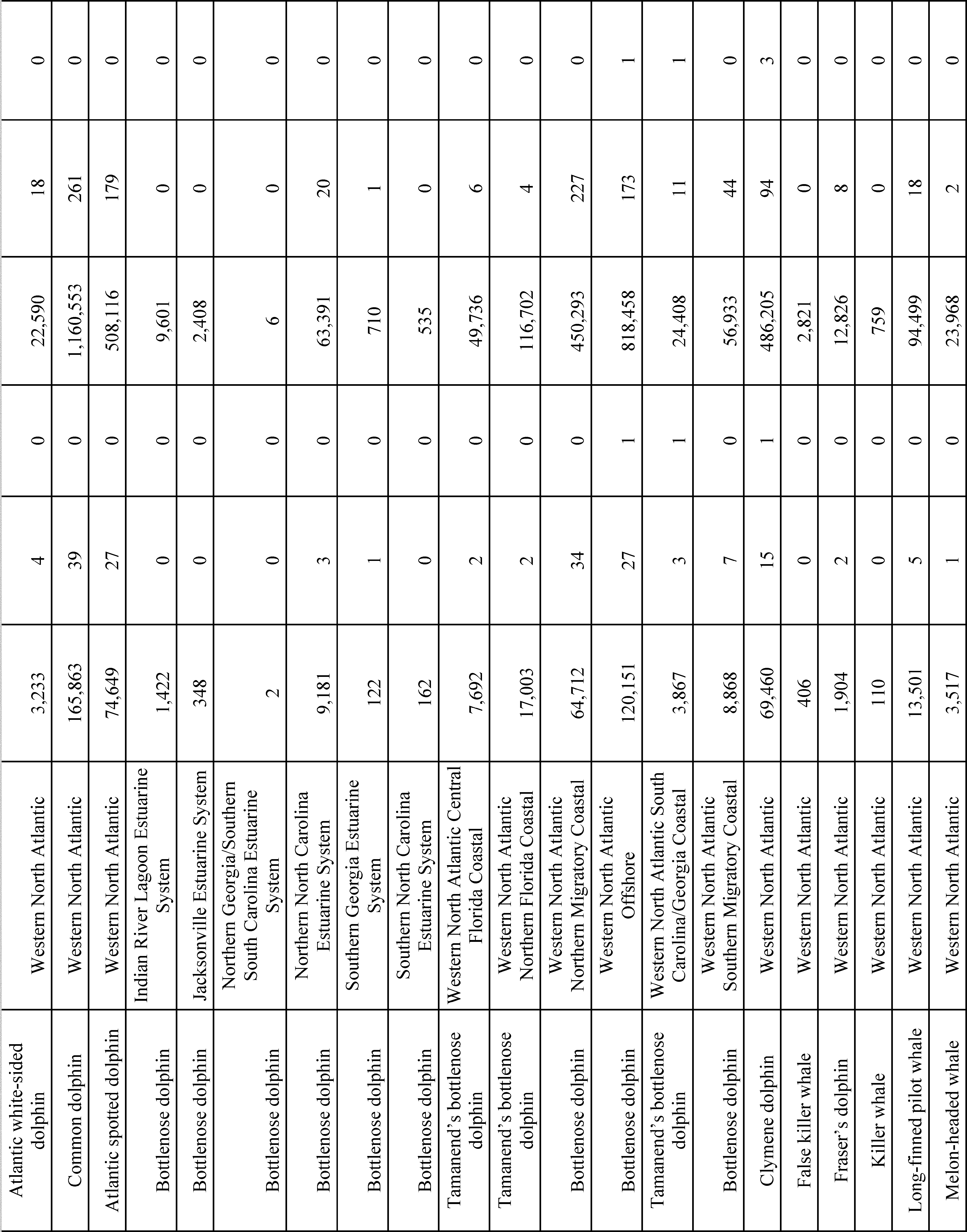
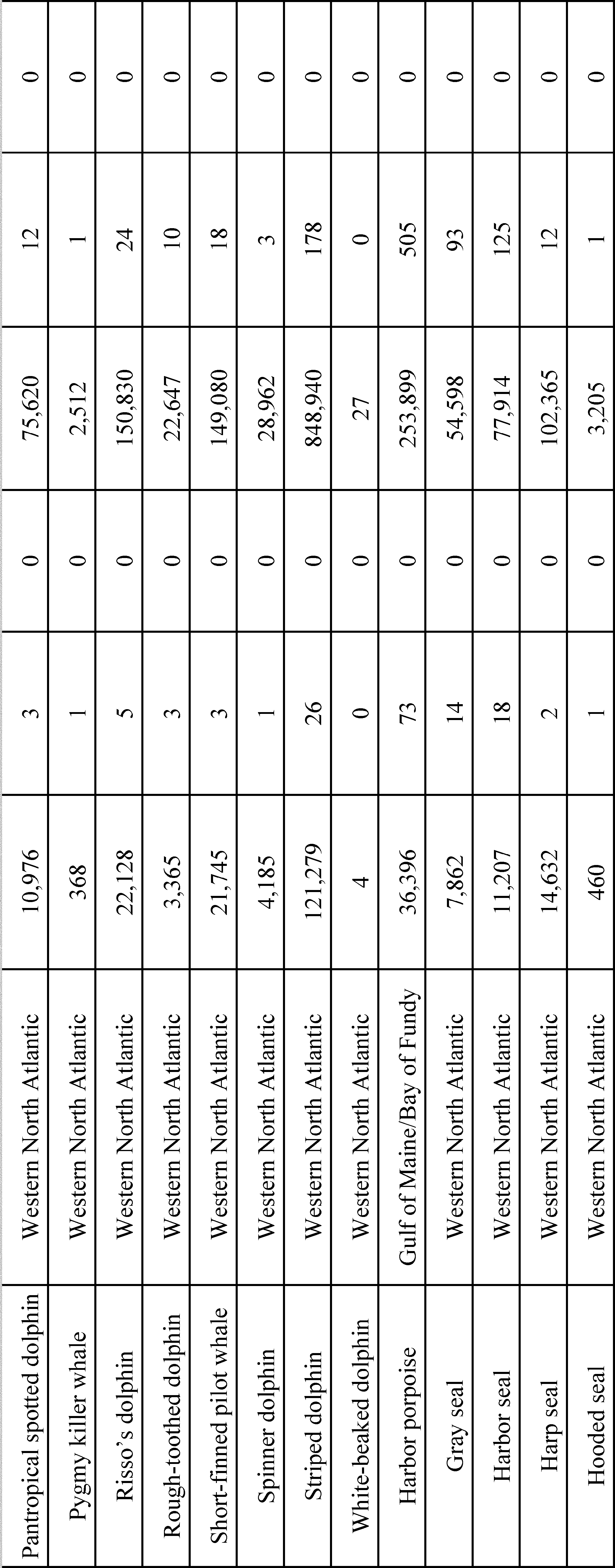
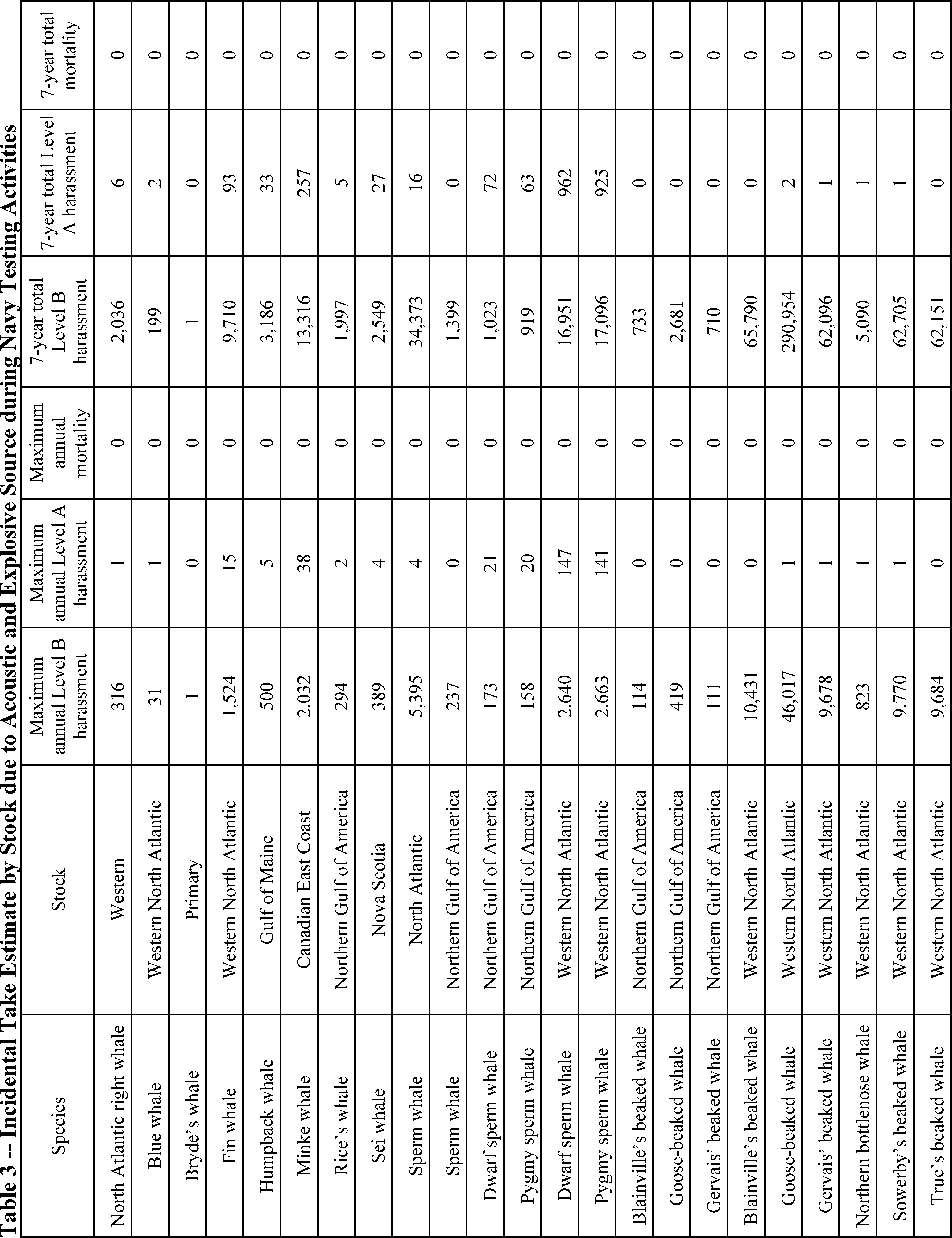
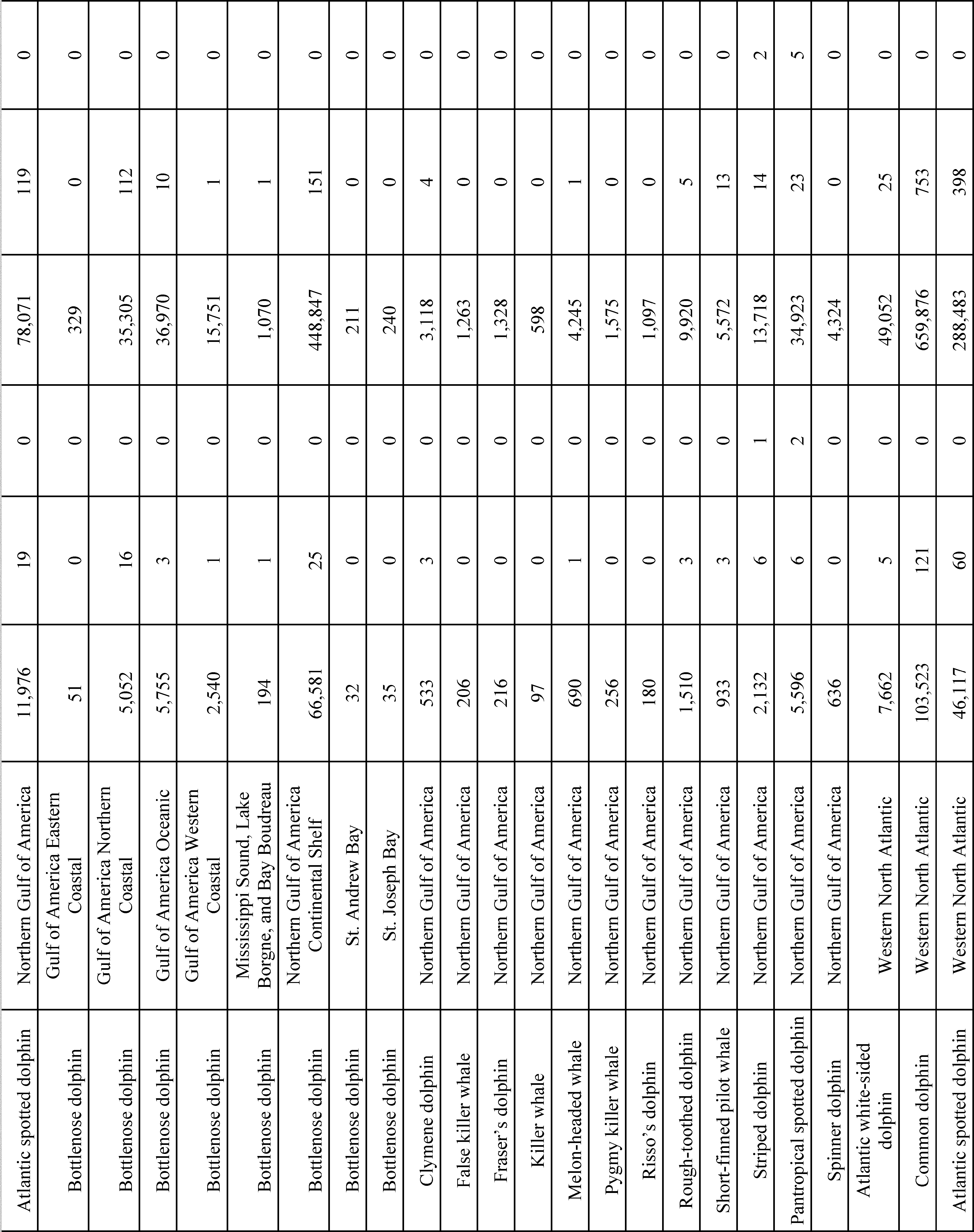
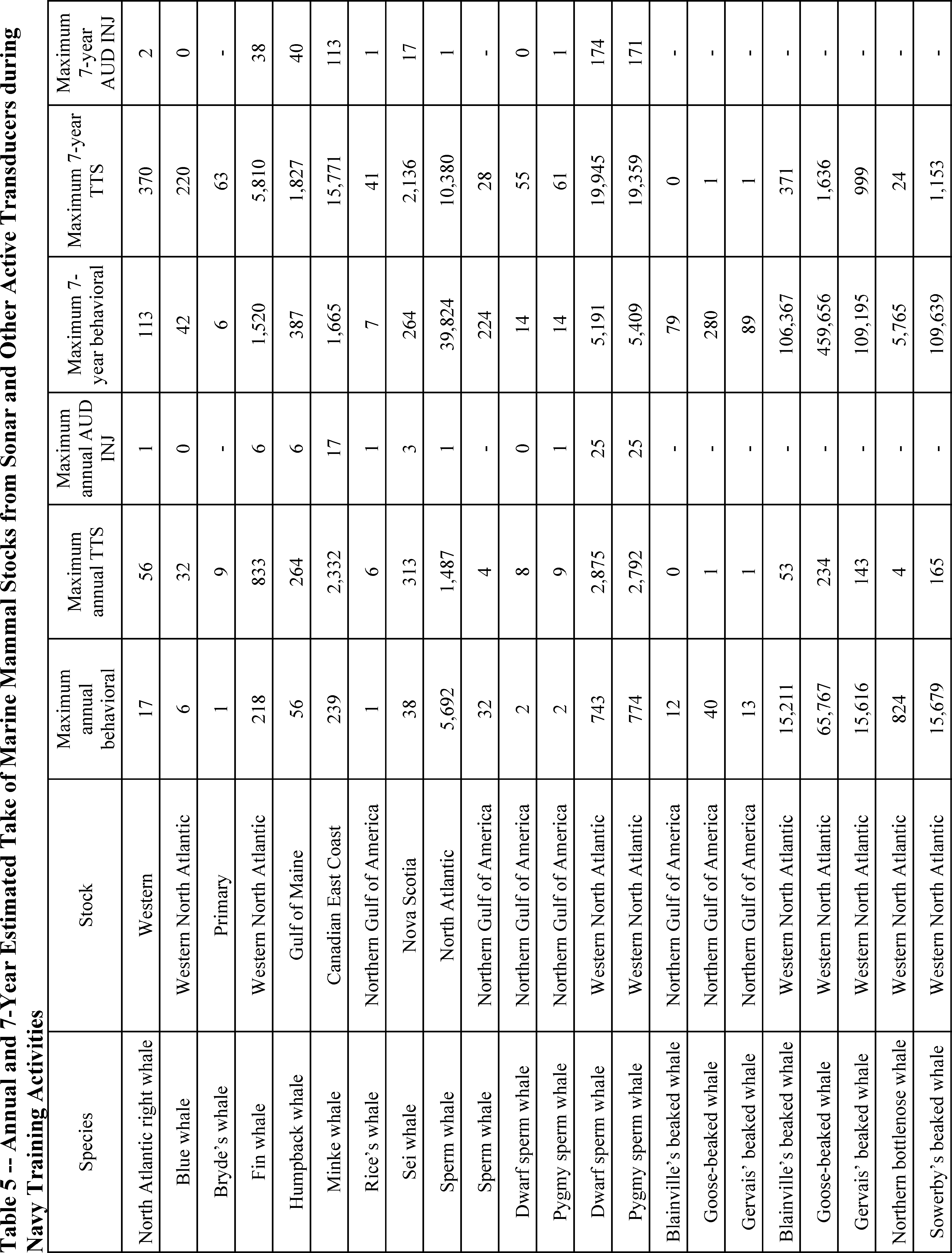
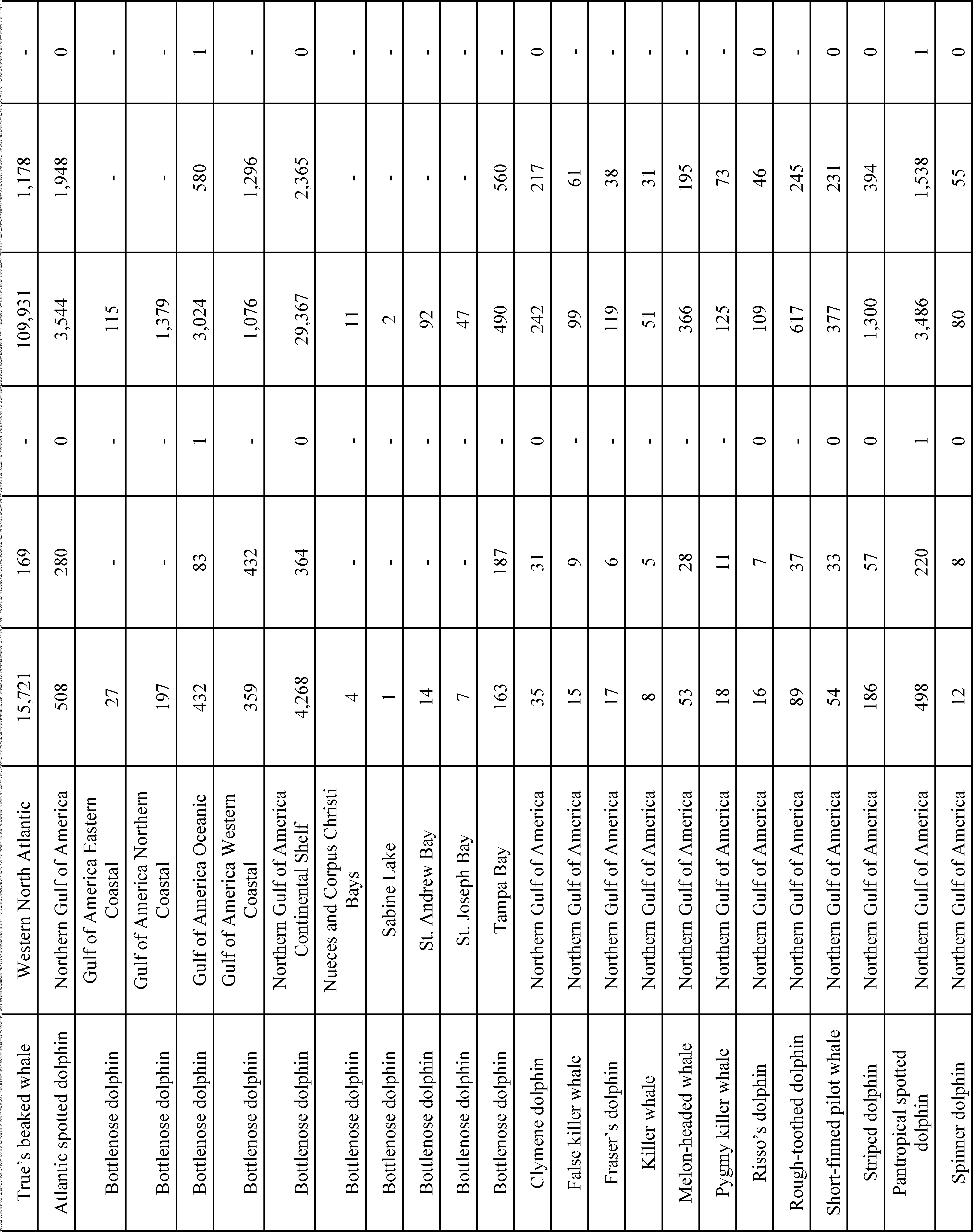
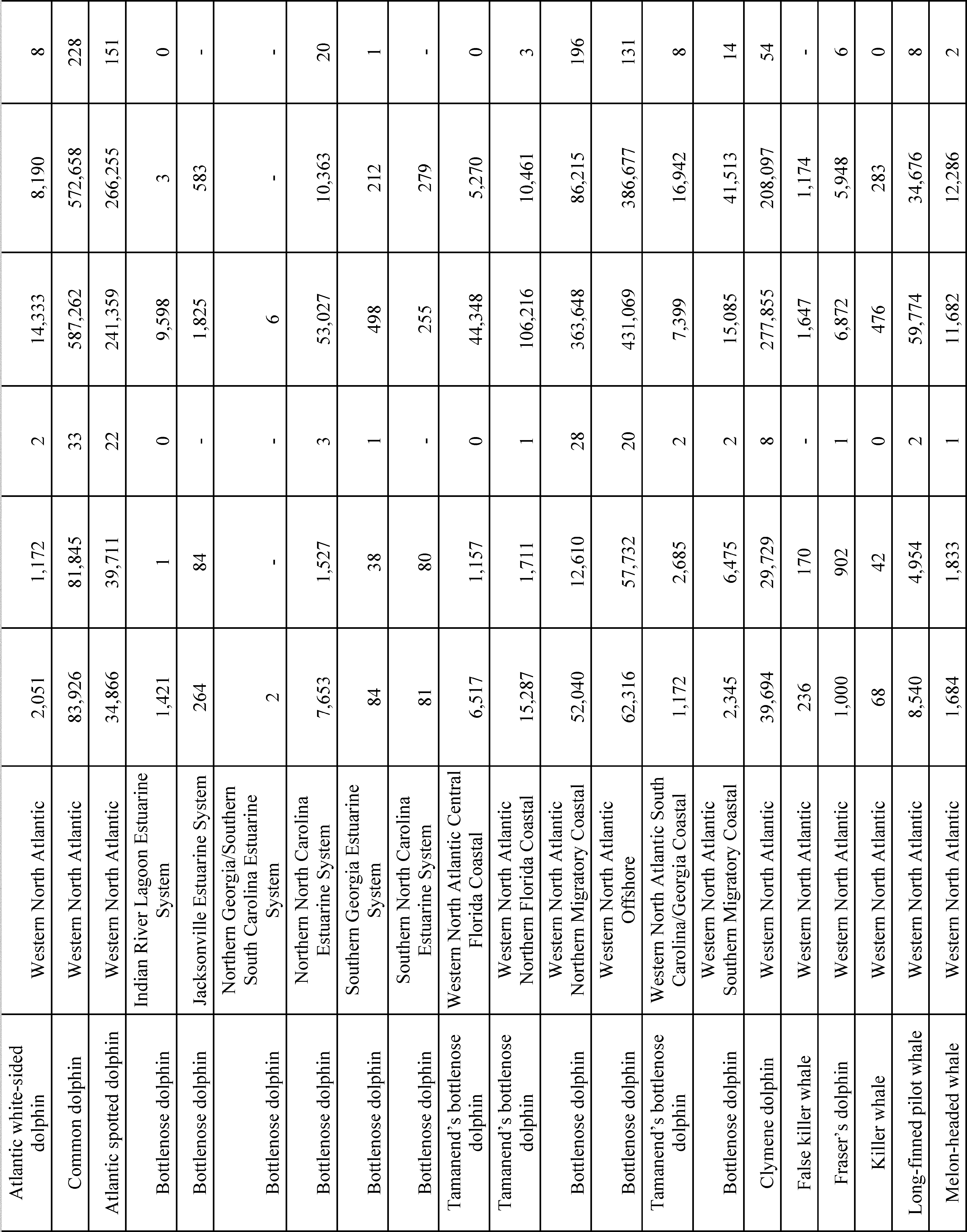
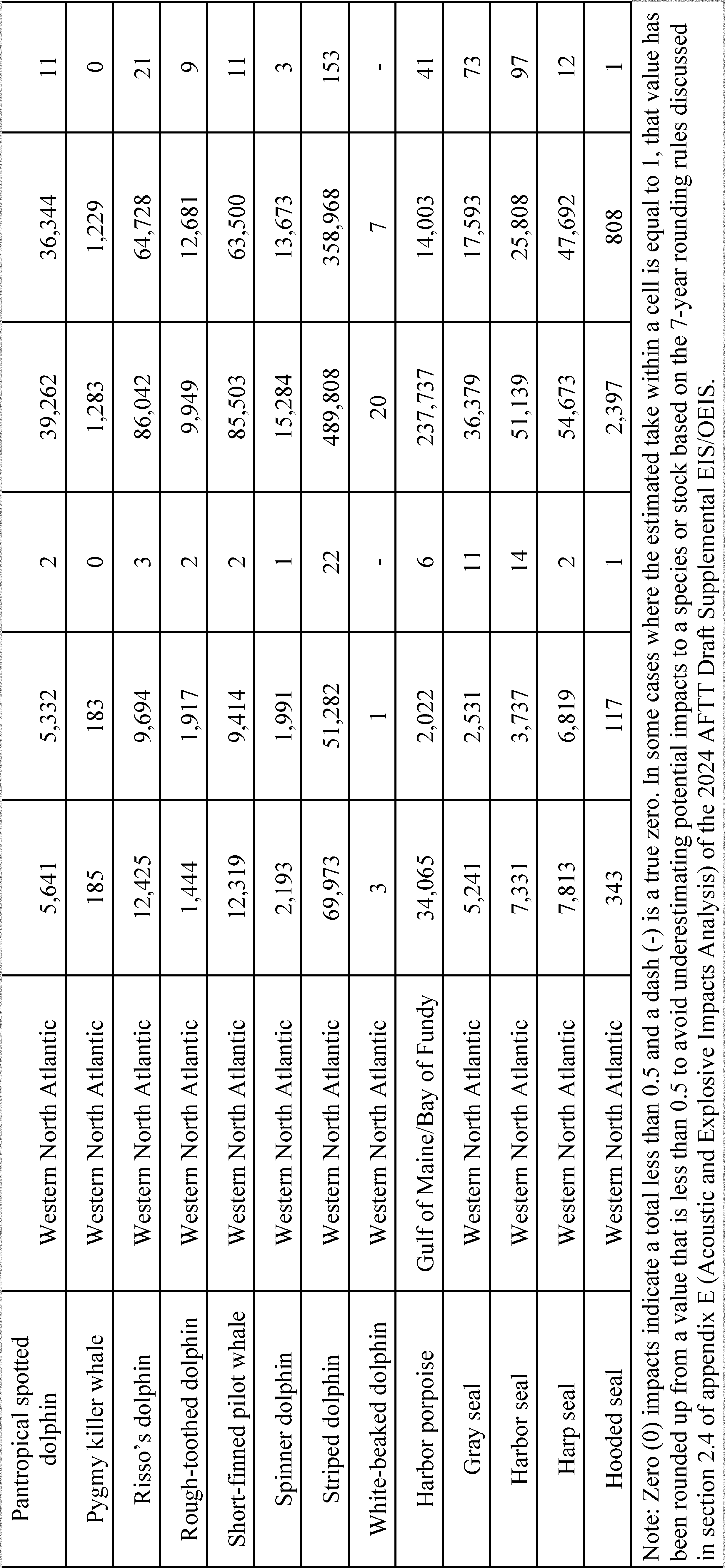
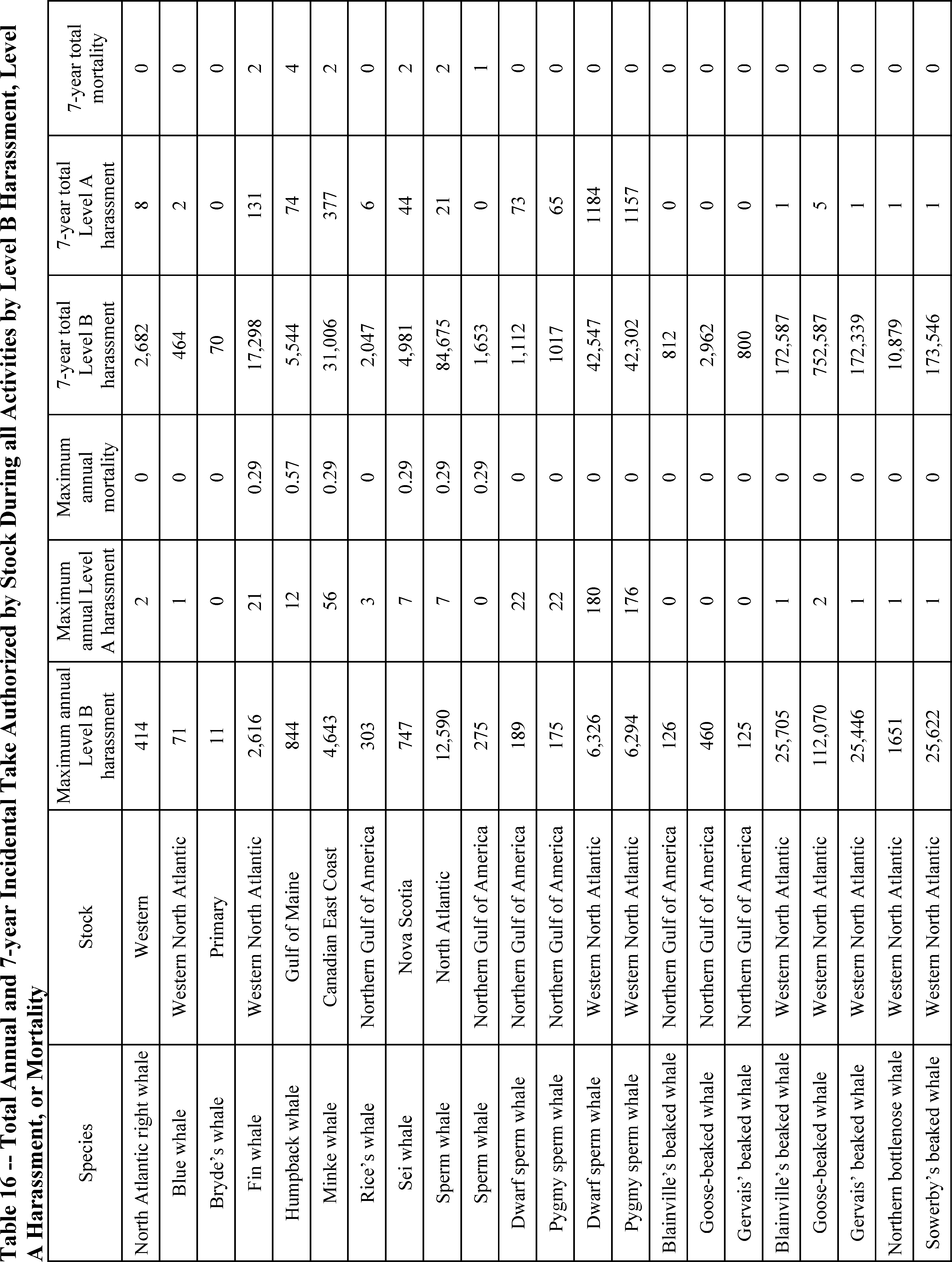
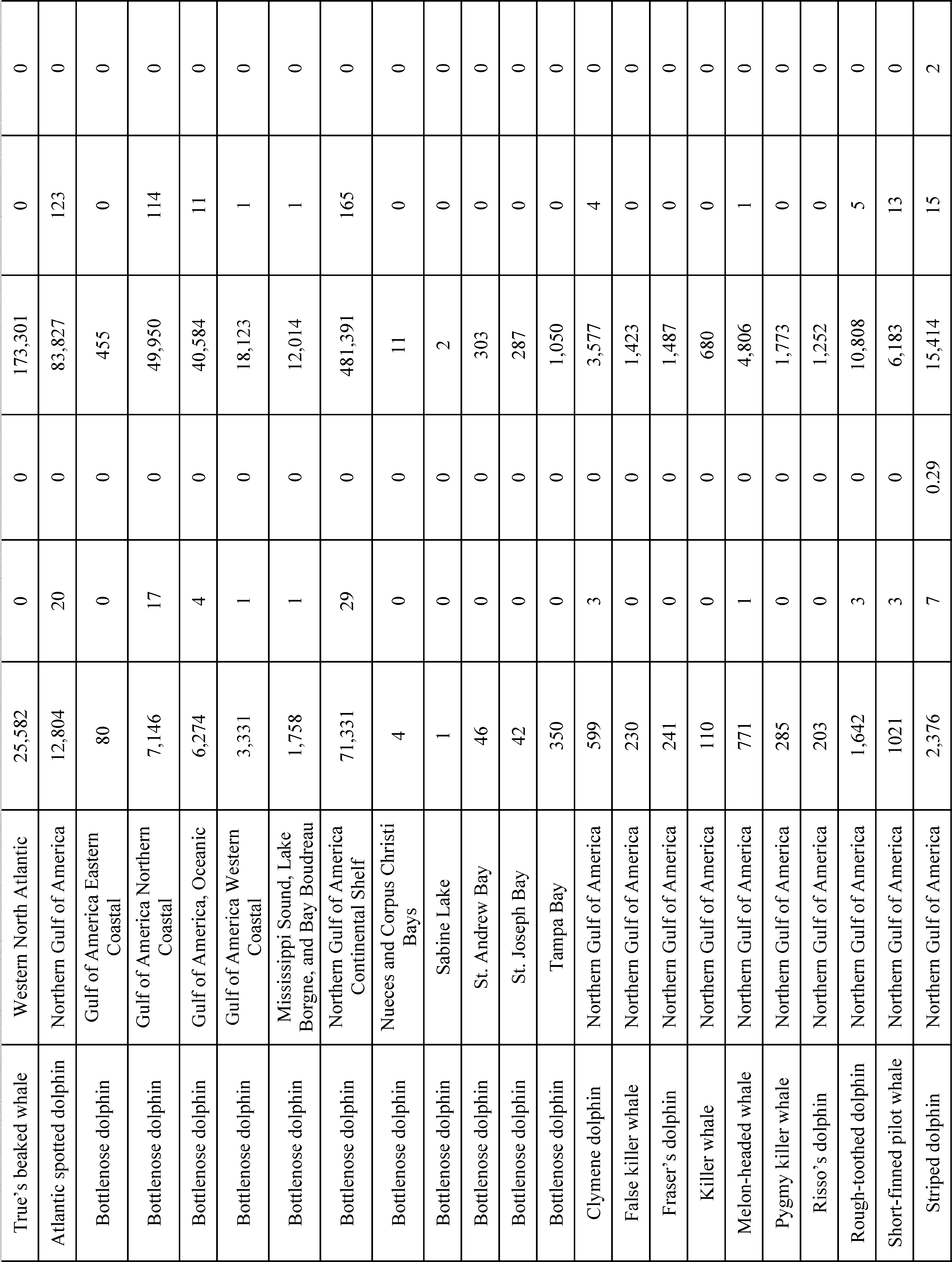
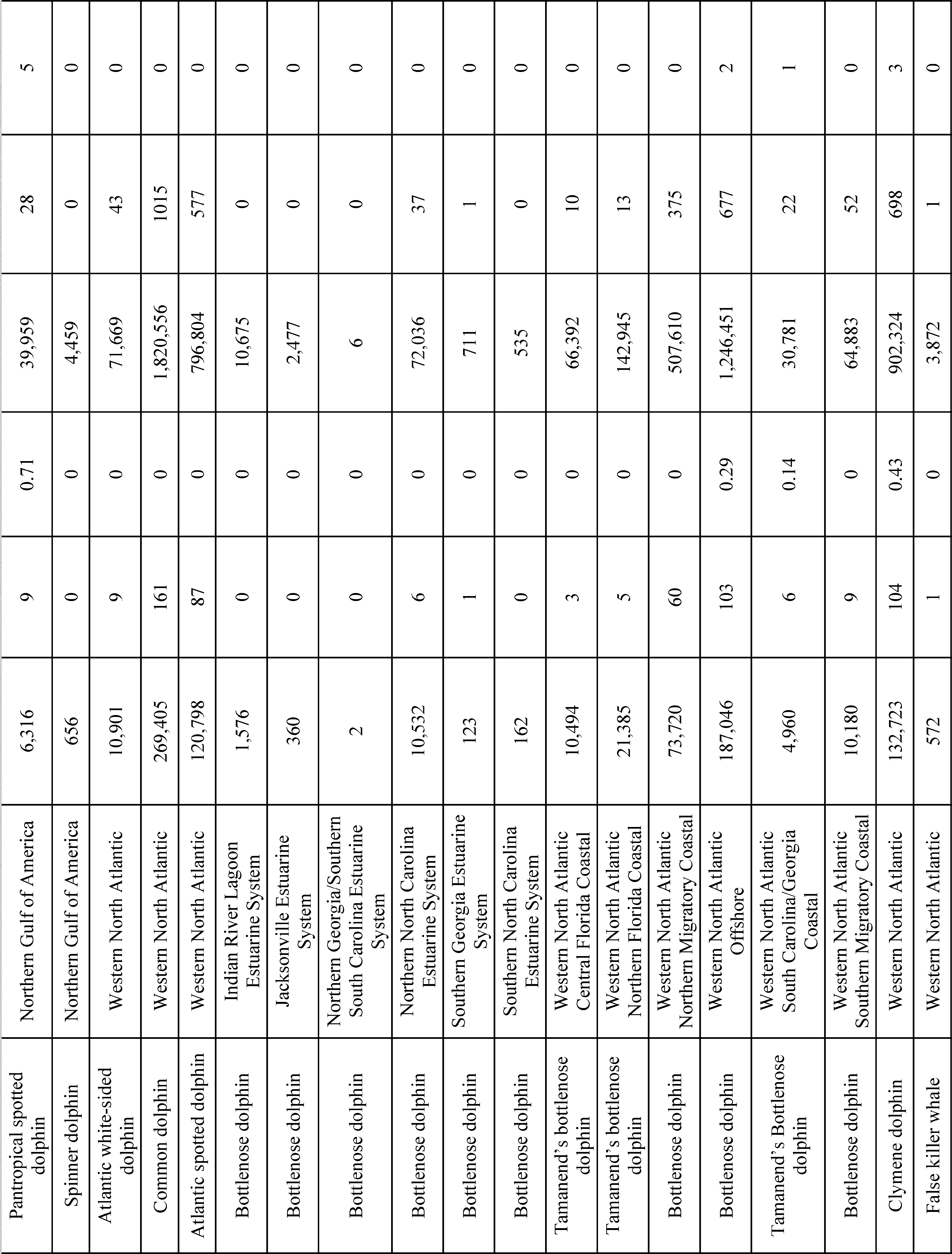
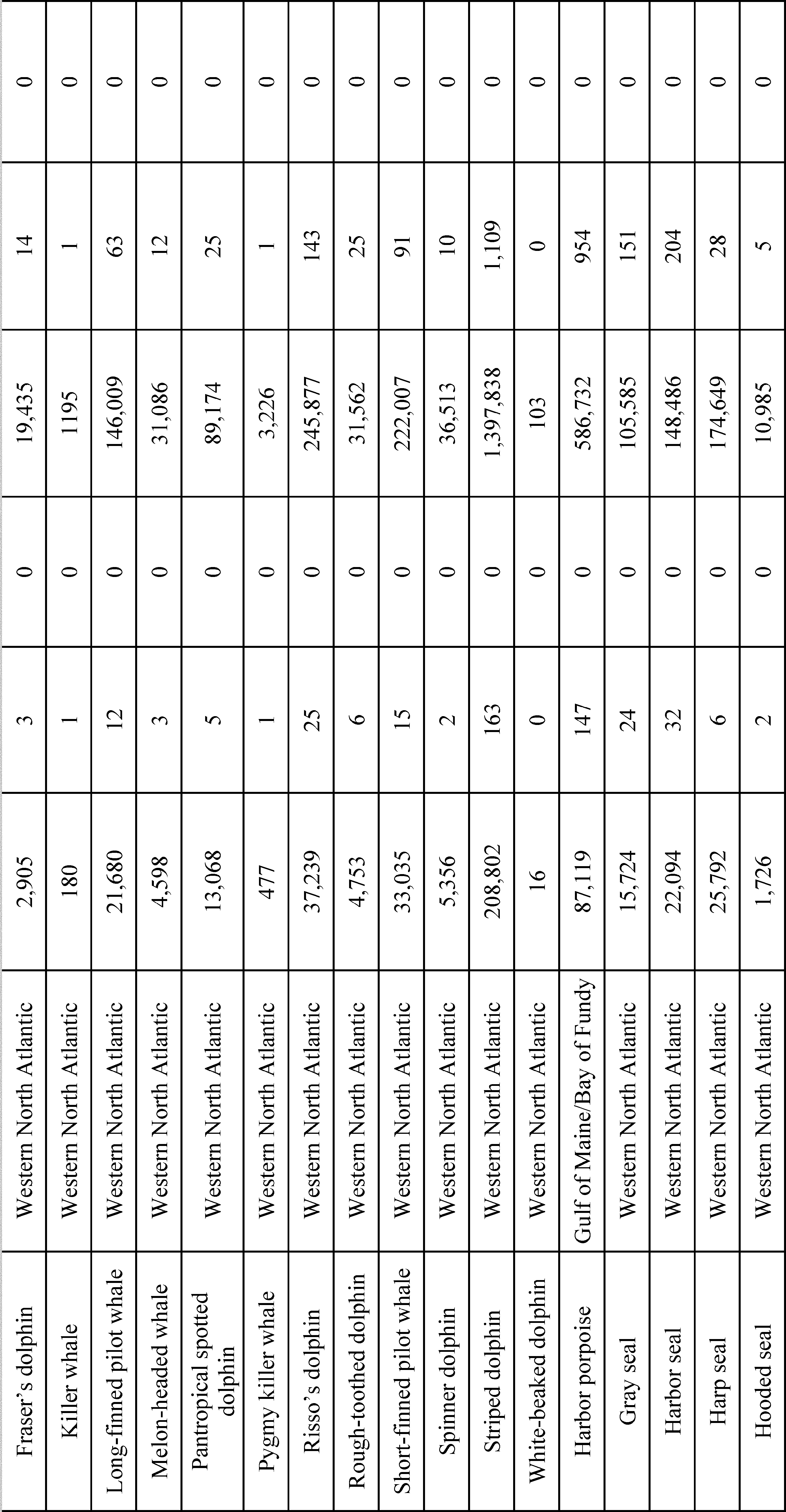
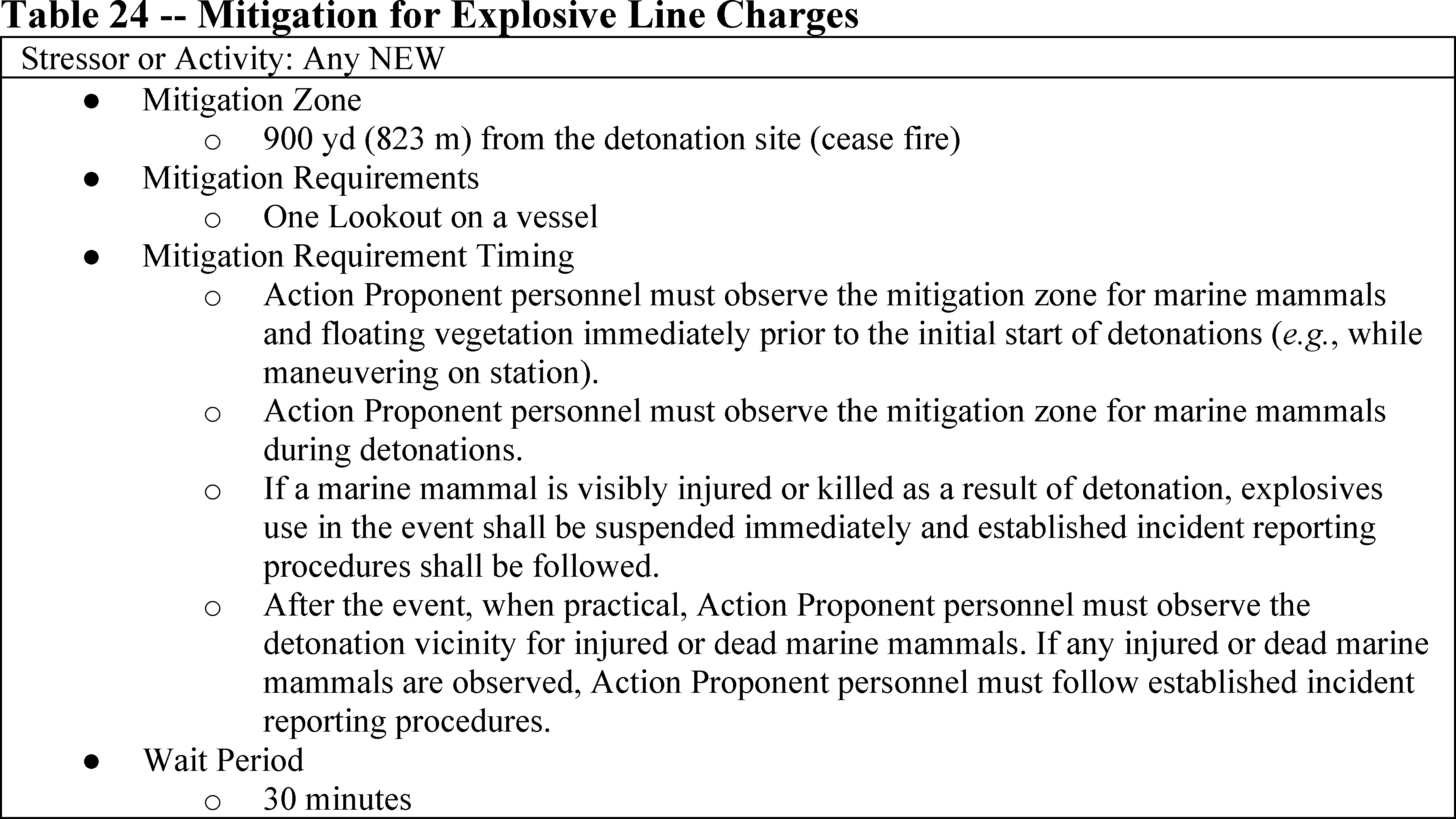
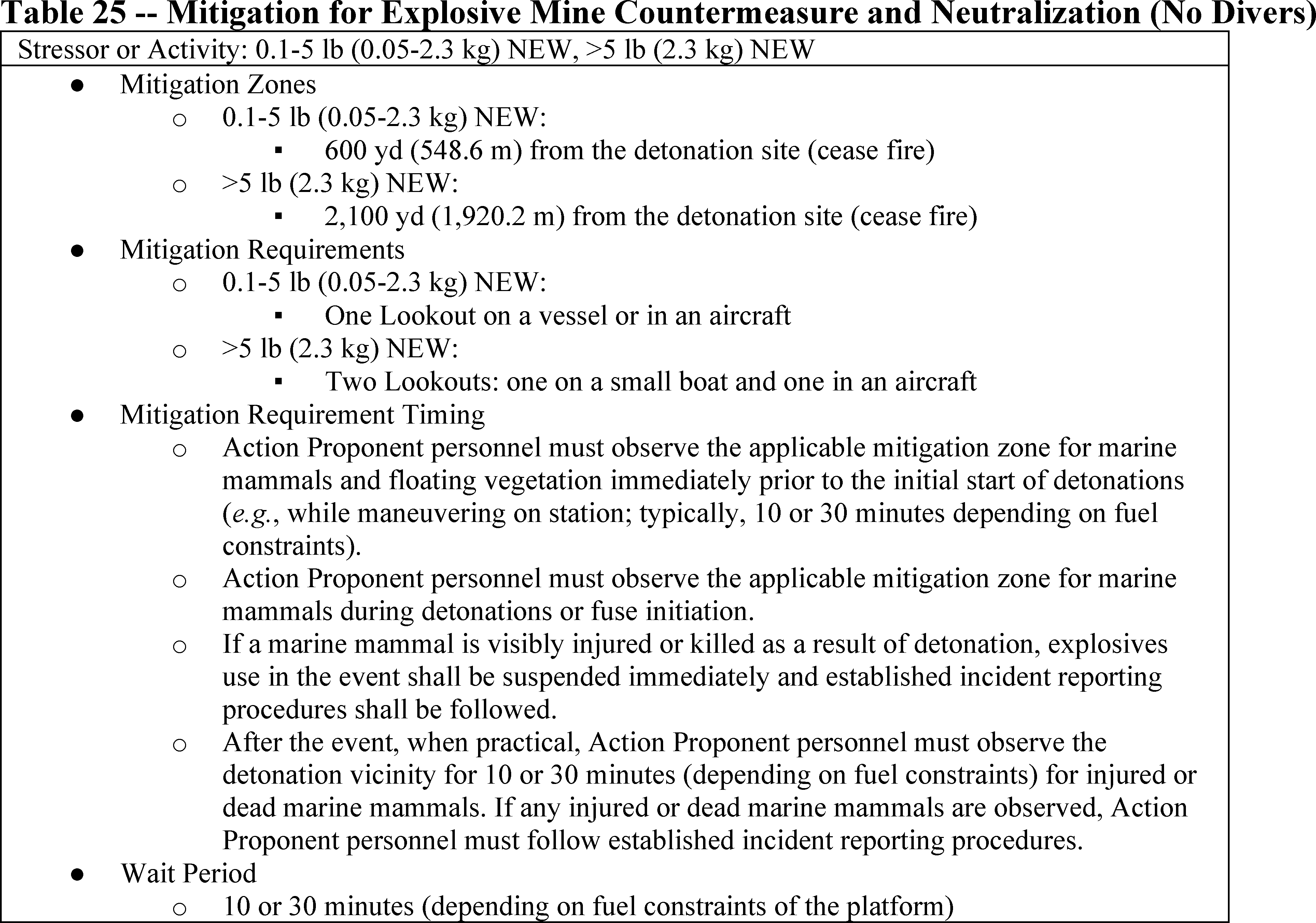
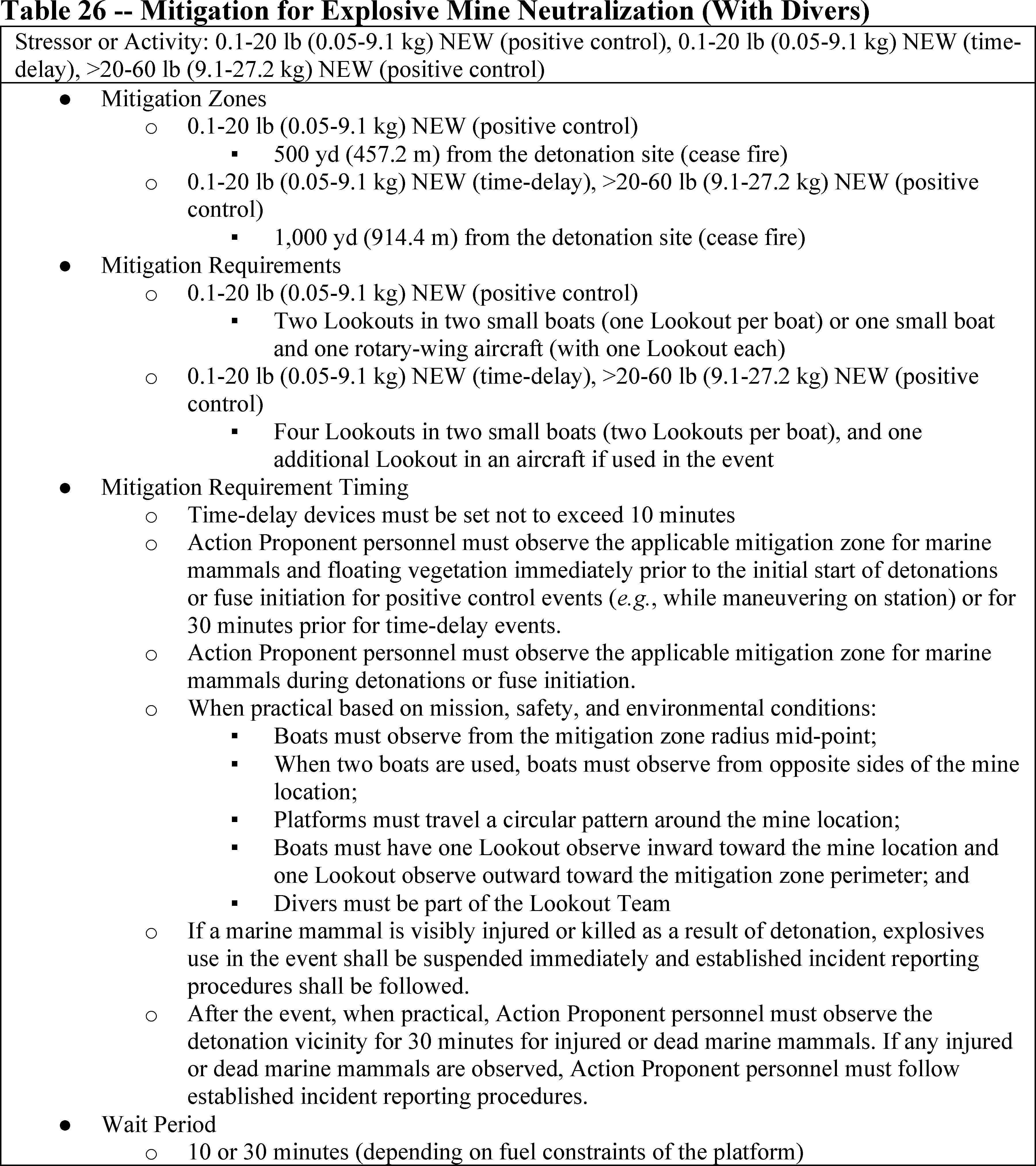
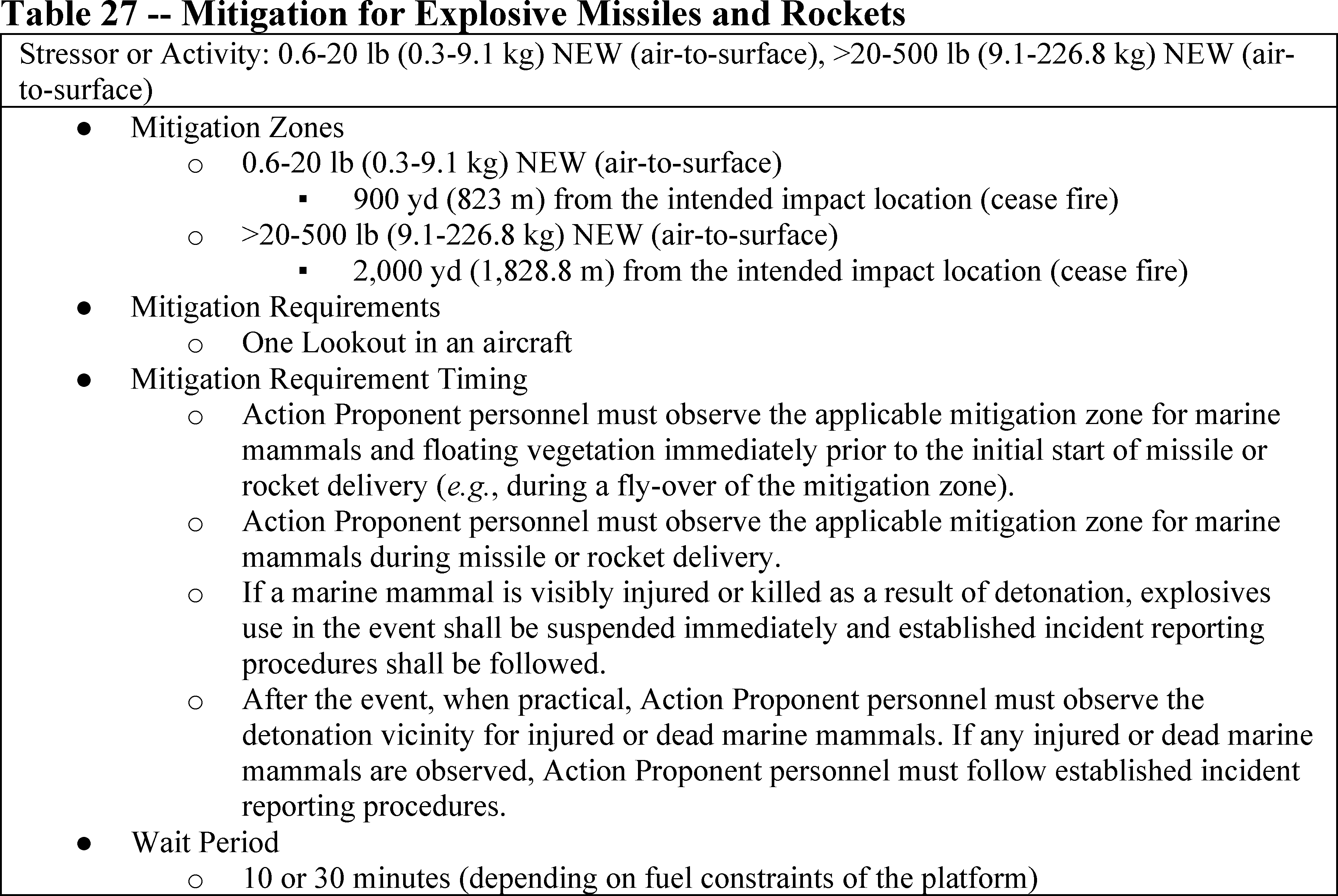
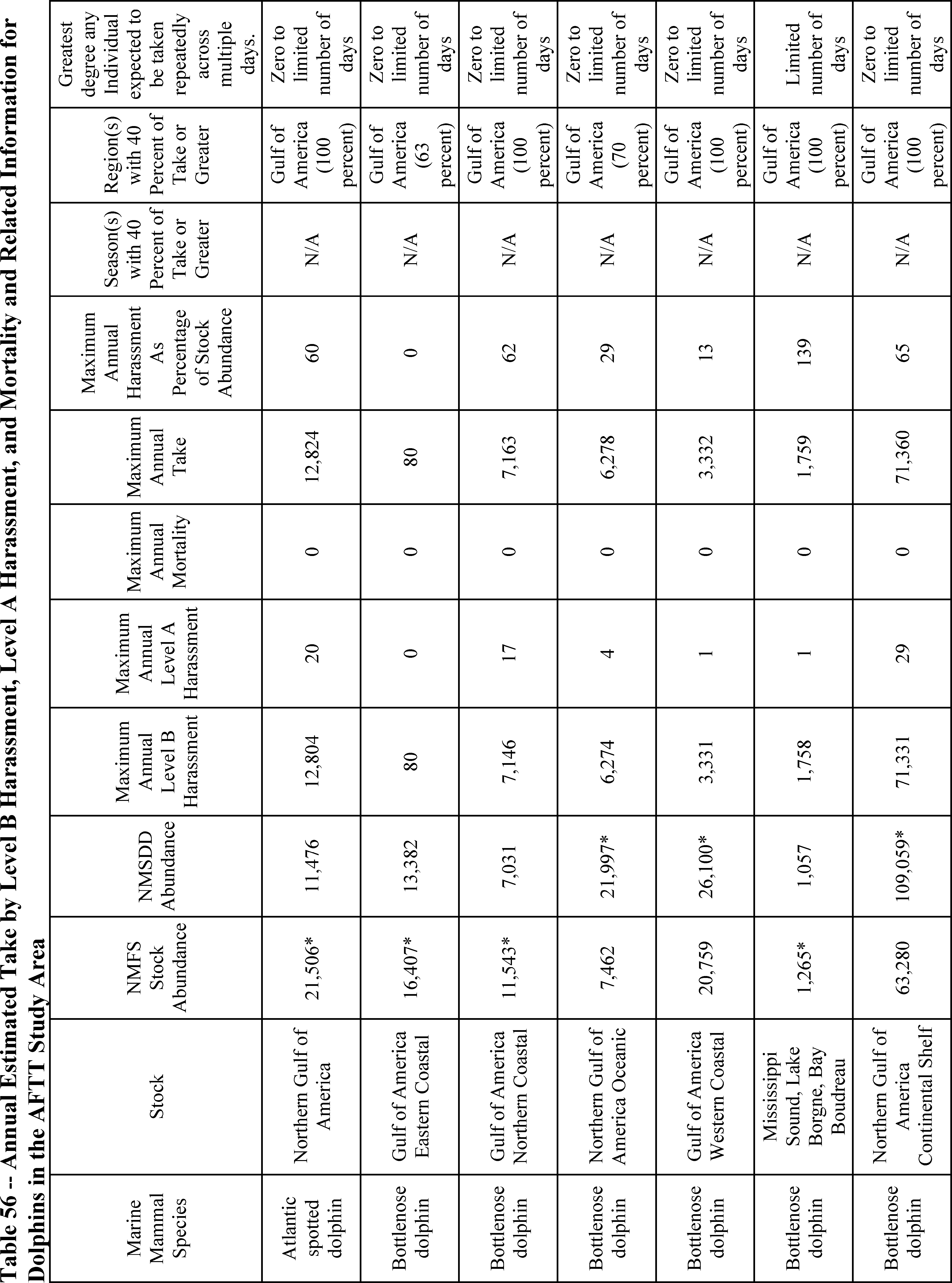
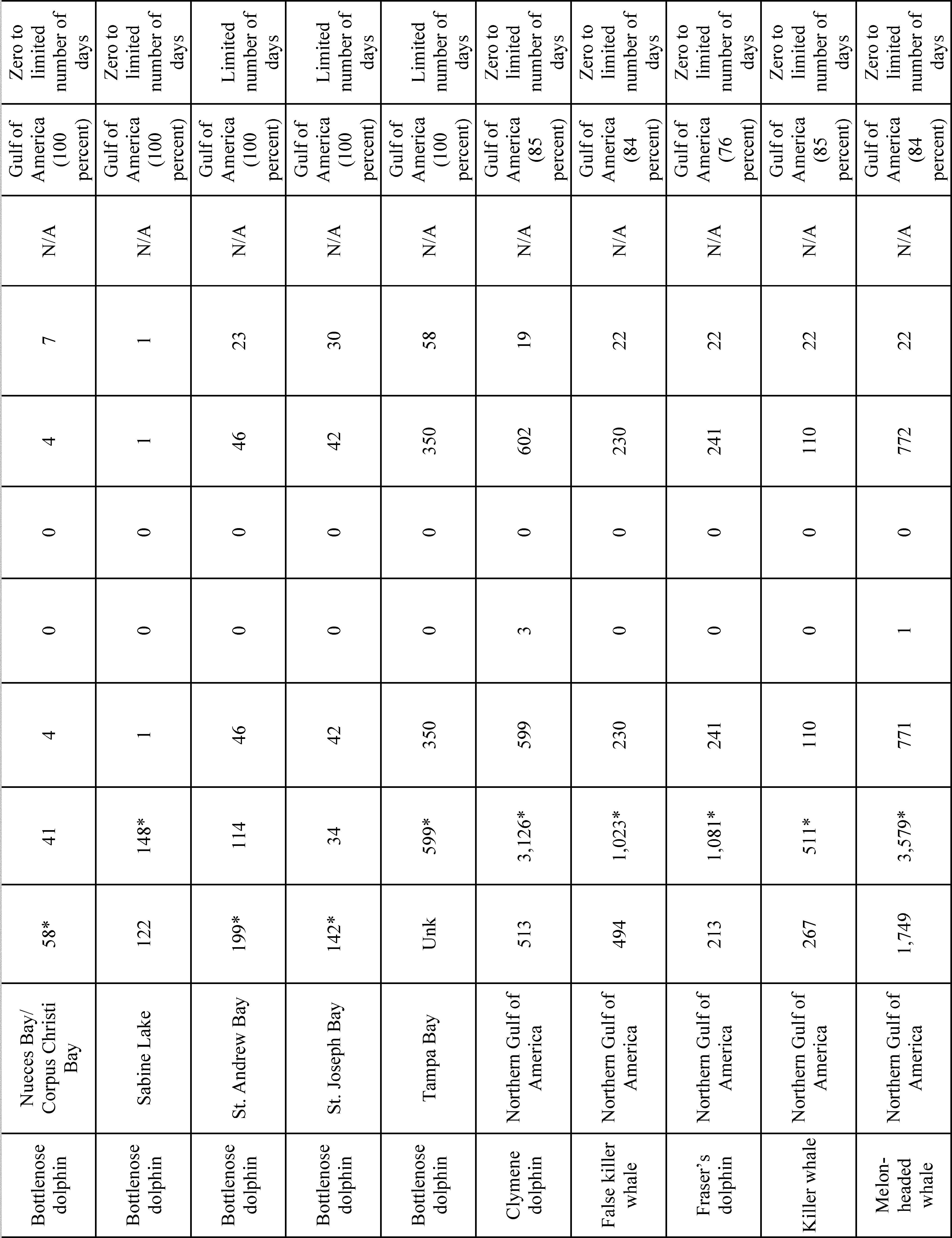
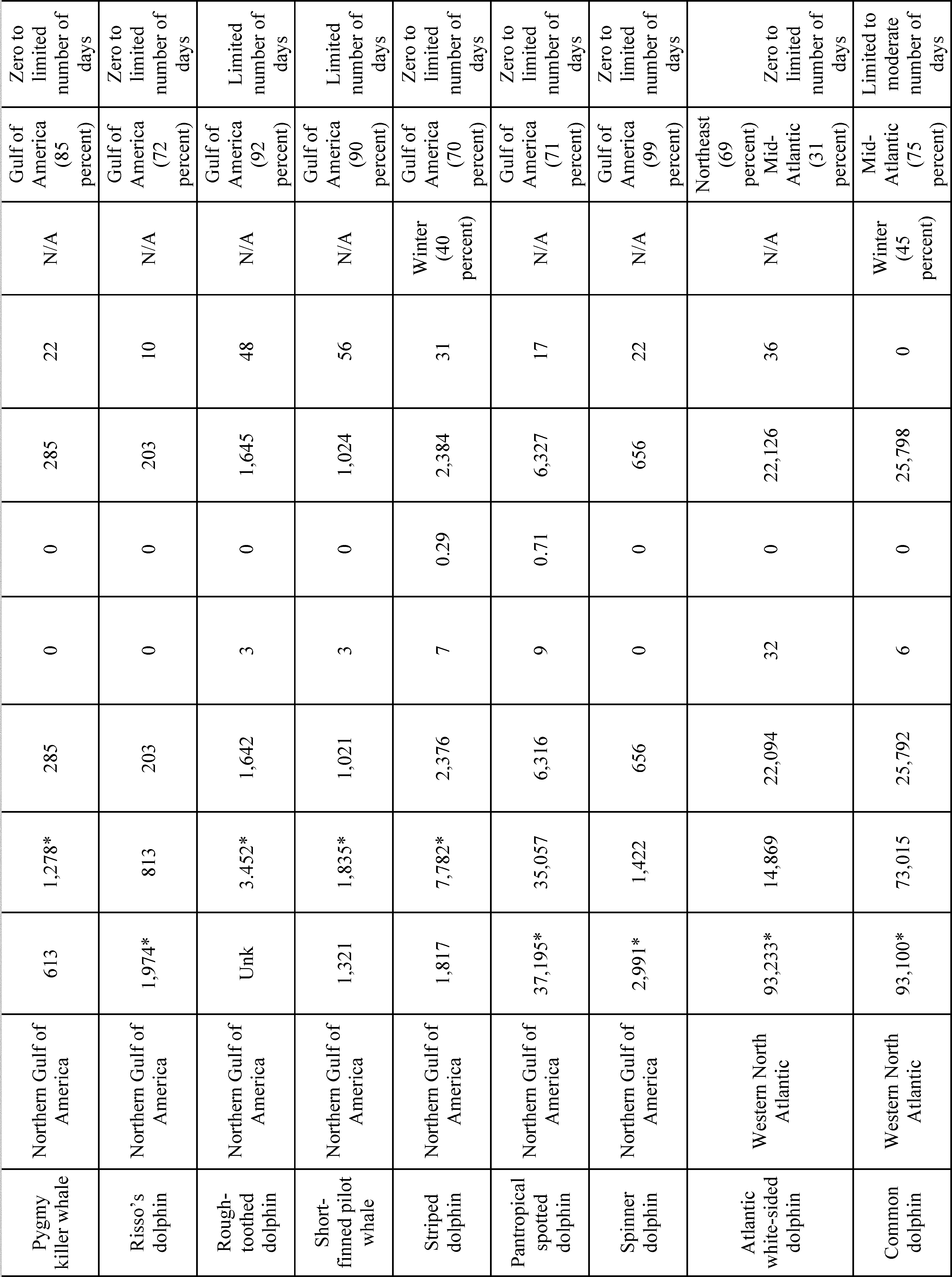
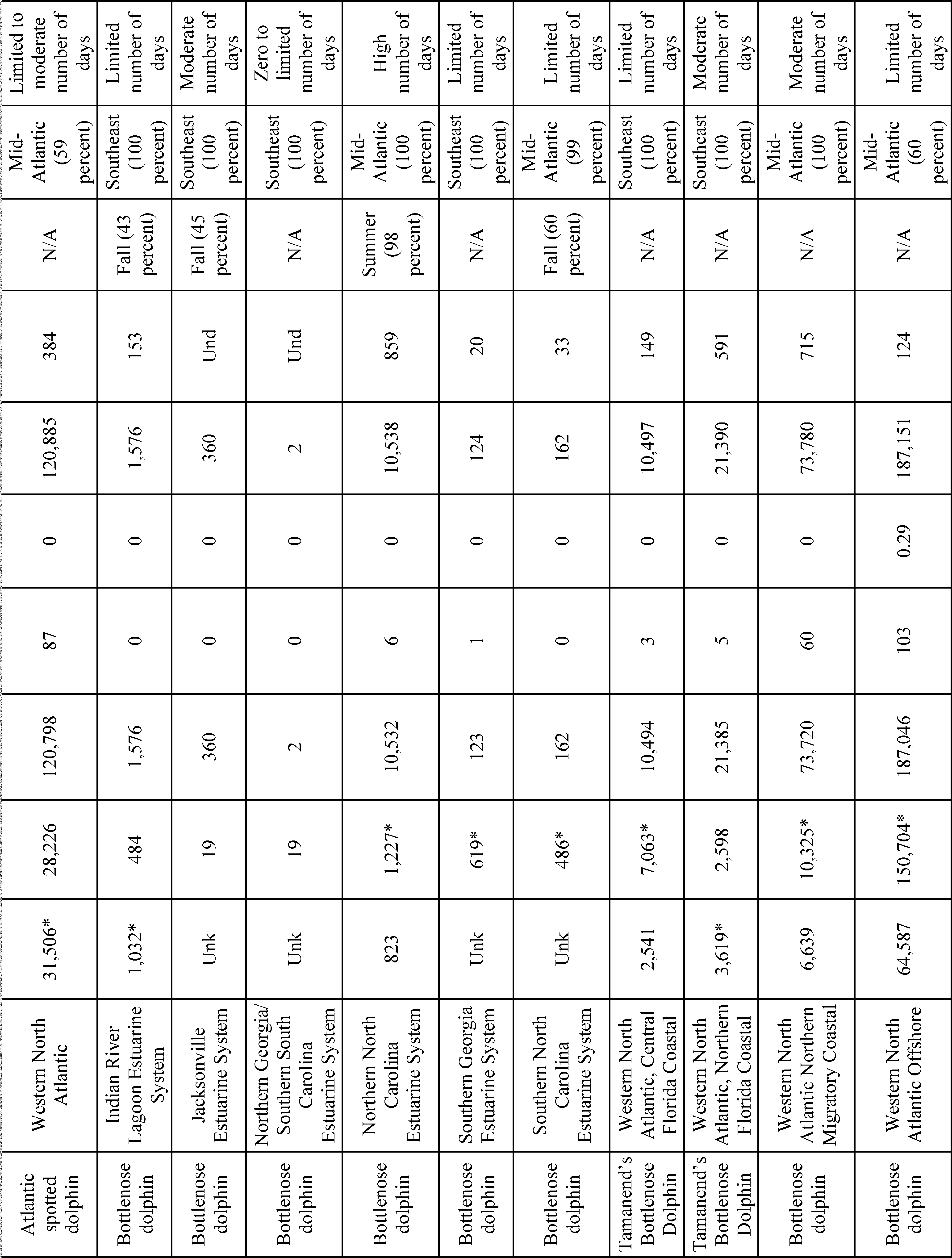
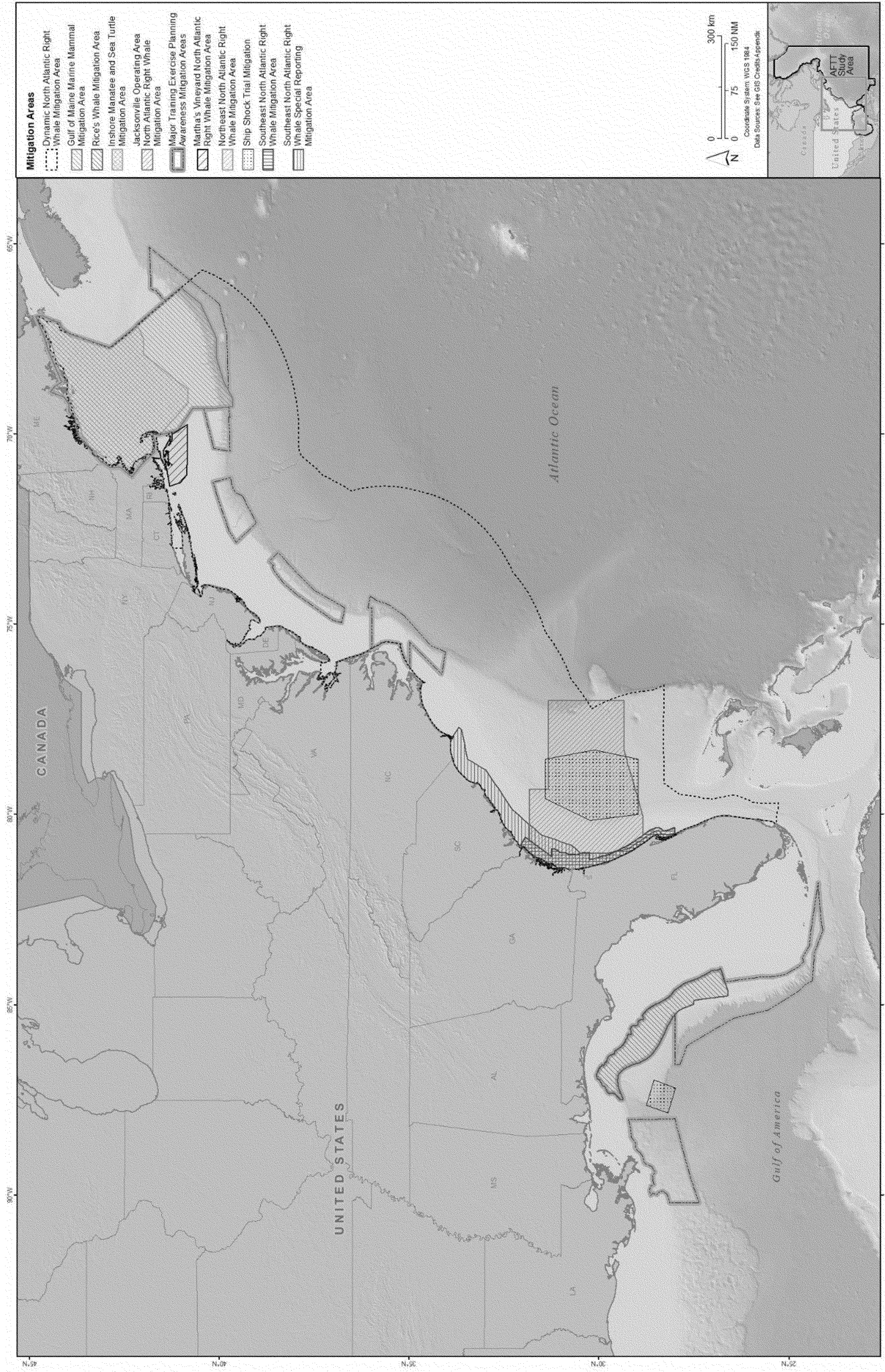
Takes of Marine Mammals Incidental to Specified Activities; Taking Marine Mammals Incidental to Military Readiness Activities in the Atlantic Fleet Training and Testing Study Area
NMFS, upon request from the U.S. Department of the Navy (including the U.S. Navy and the U.S. Marine Corps (Navy)) and on behalf of the U.S. Coast Guard (Coast Guard; hereafter,...
National Marine Fisheries Service (NMFS), National Oceanic and Atmospheric Administration (NOAA), Commerce.
ACTION:
Final rule; notification of issuance of letters of authorization.
SUMMARY:
NMFS, upon request from the U.S. Department of the Navy (including the U.S. Navy and the U.S. Marine Corps (Navy)) and on behalf of the U.S. Coast Guard (Coast Guard; hereafter, Navy and Coast Guard are collectively referred to as Action Proponents), issues these regulations pursuant to the Marine Mammal Protection Act (MMPA) to govern the taking of marine mammals incidental to training and testing activities conducted in the Atlantic Fleet Training and Testing (AFTT) Study Area over the course of 7 years from November 2025 through November 2032. These regulations, which allow for the issuance of letters of authorization (LOAs) for the incidental take of marine mammals during specified activities and timeframes, prescribe the permissible methods of taking and other means of effecting the least practicable adverse impact on marine mammal species and their habitat, and establish requirements pertaining to the monitoring and reporting of such taking. The Action Proponents' activities are considered military readiness activities pursuant to the MMPA, as amended by the National Defense Authorization Act for Fiscal Year 2004 (2004 NDAA) and the NDAA for Fiscal Year 2019 (2019 NDAA).
DATES:
Effective from November 14, 2025, through November 13, 2032.
ADDRESSES:
A copy of the Action Proponents' incidental take authorization (ITA) application and supporting documents, NMFS' proposed and final rules and subsequent LOAs for these regulations, as well as a list of the references cited in this document, may be obtained online at:
https://www.fisheries.noaa.gov/national/marine-mammal-protection/incidental-take-authorizations-military-readiness-activities.
In case of problems accessing these documents, please call the contact listed below (see
FOR FURTHER INFORMATION CONTACT
).
FOR FURTHER INFORMATION CONTACT:
Alyssa Clevenstine, Office of Protected Resources, NMFS, (301) 427-8401.
SUPPLEMENTARY INFORMATION:
Purpose and Need for Regulatory Action
These regulations, issued under the authority of the MMPA (16 U.S.C. 1361et seq.
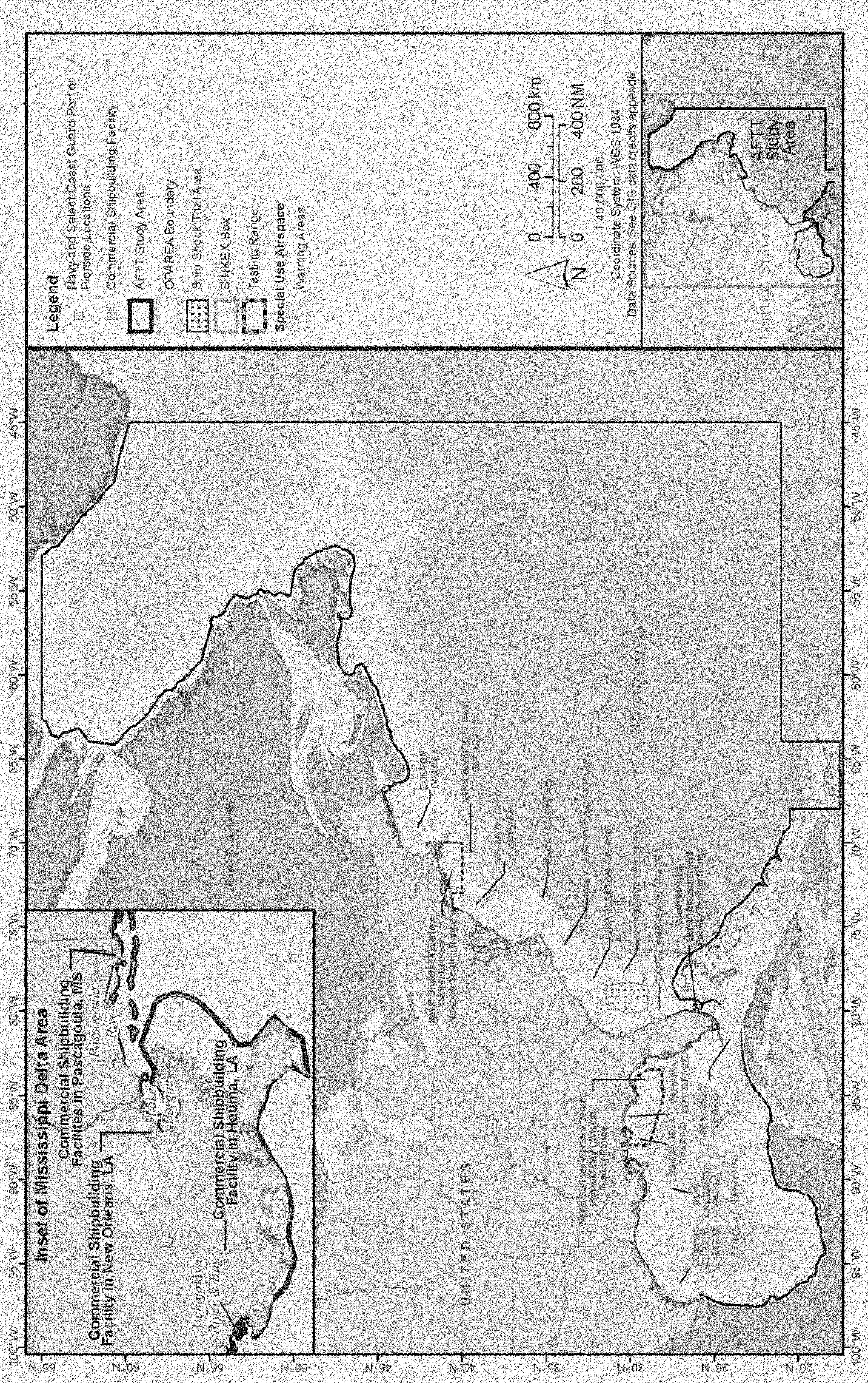
), allow for the authorization of take of marine mammals incidental to the Action Proponents' training and testing activities (which qualify as military readiness activities) involving the use of active sonar and other transducers, air guns, and explosives (including in-water explosives and underwater detonations); pile driving and vibratory extraction; and vessel movement in the AFTT Study Area. The AFTT Study Area includes air and water space of the western Atlantic Ocean along the east coast of North America, the Gulf of America (formerly Gulf of Mexico), and portions of the Caribbean Sea, covering approximately 2.6 million square nautical miles (nmi2
; 8.9 million square kilometers (km2
)) of ocean area (see figure 1.1-1 of the application). Please see the Legal Authority for the Final Action section for relevant definitions.
Legal Authority for the Final Action
The MMPA prohibits the “take” of marine mammals, with certain exceptions. Section 101(a)(5)(A) and (D) of the MMPA (16 U.S.C. 1361et seq.) directs the Secretary of Commerce (as delegated to NMFS) to allow, upon request, the incidental, but not intentional, taking of small numbers of marine mammals by U.S. citizens who engage in a specified activity (other than commercial fishing) within a specified geographical region if certain findings are made and either regulations are proposed or, if the taking is limited to harassment, a notice of a proposed authorization is provided to the public for review and the opportunity to submit comment.
Authorization for incidental takings shall be granted if NMFS finds that the taking will have a negligible impact on the species or stock(s) and will not have an unmitigable adverse impact on the availability of the species or stock(s) for taking for subsistence uses (where relevant). Further, NMFS must prescribe the permissible methods of taking; other “means of effecting the least practicable adverse impact” on the affected species or stocks and their habitat, paying particular attention to rookeries, mating grounds, and areas of similar significance, and on the availability of the species or stocks for taking for certain subsistence uses (referred to in shorthand as “mitigation”); and requirements pertaining to the monitoring and reporting of the takings. The MMPA defines “take” to mean to harass, hunt, capture, or kill, or attempt to harass, hunt, capture, or kill any marine mammal. The Analysis and Negligible Impact Determination section discusses the definition of “negligible impact.”
The 2004 NDAA (Pub. L. 108-136) amended section 101(a)(5) of the MMPA to remove the “small numbers” and “specified geographical region” provisions and amended the definition of “harassment” as applied to a “military readiness activity” to read as follows (section 3(18)(B) of the MMPA): (i) Any act that injures or has the significant potential to injure a marine mammal or marine mammal stock in the wild (Level A Harassment); or (ii) Any act that disturbs or is likely to disturb a marine mammal or marine mammal stock in the wild by causing disruption of natural behavioral patterns, including, but not limited to, migration, surfacing, nursing, breeding, feeding, or sheltering, to a point where such behavioral patterns are abandoned or significantly altered (Level B Harassment). The 2004 NDAA also amended section 101(a)(5)(A)(iii) of the MMPA, establishing that “[f]or military readiness activity . . . , a determination of `least practicable adverse impact' . . . shall include consideration of personnel safety, practicality of implementation, and impact on the effectiveness of the military readiness activity.” On August 13, 2018, the 2019 NDAA (Pub. L. 115-232) amended section 101(a)(5)(A)(ii) of the MMPA to allow incidental take regulations for military readiness activities to be issued for up to 7 years.
Summary of Major Provisions Within the Final Rule
The major provisions of this rule are:
Take of marine mammals by Level A harassment and/or Level B harassment;
Take of marine mammals by mortality or serious injury (M/SI);
Use of defined powerdown and shutdown zones (based on activity);
Measures to reduce the likelihood of vessel strikes;
Activity limitations in certain areas and times that are biologically important (i.e.,
for foraging, migration, reproduction) for marine mammals;
Implementation of a Notification and Reporting Plan (for dead, live
( printed page 50505)
stranded, or marine mammals struck by any vessel engaged in military readiness activities); and
Implementation of a robust monitoring plan to improve our understanding of the environmental effects resulting from the Action Proponents' training and testing activities.
This rule includes an adaptive management component that allows for timely modification of mitigation, monitoring, and/or reporting measures based on new information, when appropriate.
Summary of Request
On May 28, 2024, NMFS received an application from the Action Proponents requesting authorization to take marine mammals, by Level A and Level B harassment, incidental to training and testing (characterized as military readiness activities) including the use of sonar and other transducers, explosives, air guns, and impact and vibratory pile driving and extraction conducted within the AFTT Study Area. In addition, the Action Proponents requested authorization to take, by serious injury or mortality, a limited number of several marine mammal species incidental to use of explosives, ship shock trials, and vessel movement during military readiness activities conducted within the AFTT Study Area over the 7-year period of the LOAs. In response to our comments and following information exchange, the Action Proponents submitted a final revised application on August 16, 2024, that we determined was adequate and complete on August 19, 2024. On September 20, 2024, we published a notice of receipt (NOR) of application in the
Federal Register
(89 FR 77106), requesting comments and information related to the Action Proponents' specified activities. During the 30-day public comment period, we did not receive any public comments. On October 8, 2024, the Action Proponents submitted an updated application to revise take estimates for a subset of Navy activities. On January 21, 2025, the Action Proponents submitted an updated application which removed ship shock trials and estimated take associated with that activity within the Virginia Capes (VACAPES) Range Complex. On February 13, 2025, the Action Proponents submitted an updated application containing minor revisions. On May 9, 2025, we published a proposed rule (90 FR 19858) and requested comments and information related to the Action Proponents' request for 30 days. All relevant comments received during the proposed rulemaking comment period were considered in this final rule. Comments received on the proposed rule are addressed in this final rule in the Comments and Responses section.
NMFS has previously promulgated incidental take regulations pursuant to the MMPA relating to similar military readiness activities in the AFTT Study Area. NMFS published the first rule effective from January 22, 2009 through January 22, 2014 (74 FR 4844, January 27, 2009), the second rule effective from November 14, 2013 through November 13, 2018 (78 FR 73009, December 4, 2013), and the third rule effective from November 14, 2018 through November 13, 2023 (83 FR 57076, November 14, 2018), which was subsequently amended, extending the effective date through November 13, 2025 (84 FR 70712, December 23, 2019) pursuant to the 2019 NDAA. For this rulemaking, the Action Proponents plan to conduct substantially similar training and testing activities within the AFTT Study Area that were conducted under previous rules.
The Action Proponents' application reflects the most up-to-date compilation of training and testing activities deemed necessary to accomplish military readiness requirements. The types and numbers of activities included in this rule account for interannual variability in training and testing to meet evolving or emergent military readiness requirements. These regulations cover military readiness activities in the AFTT Study Area that will occur for a 7-year period following the expiration of the pre-existing MMPA authorization after November 13, 2025.
Description of Specified Activity
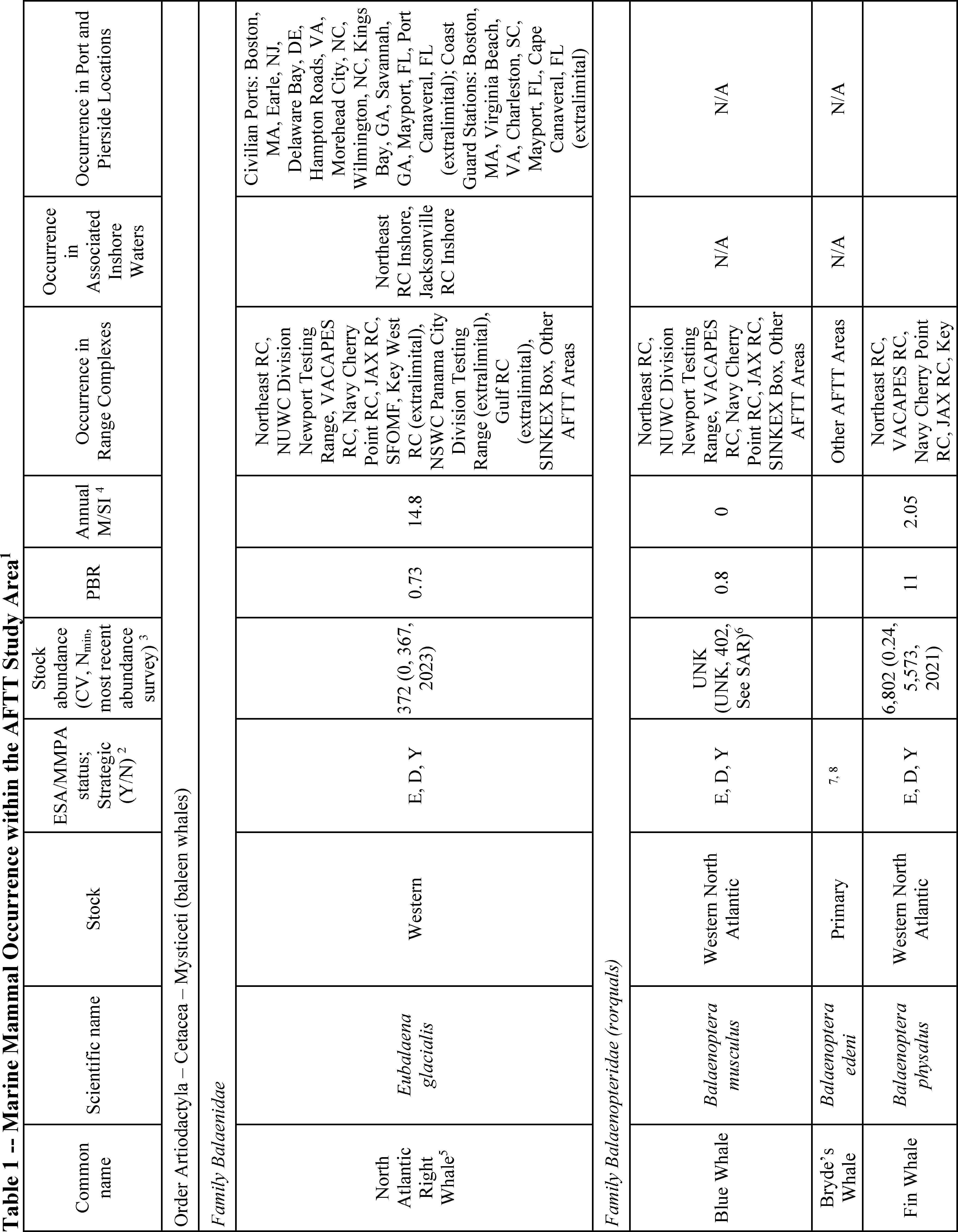
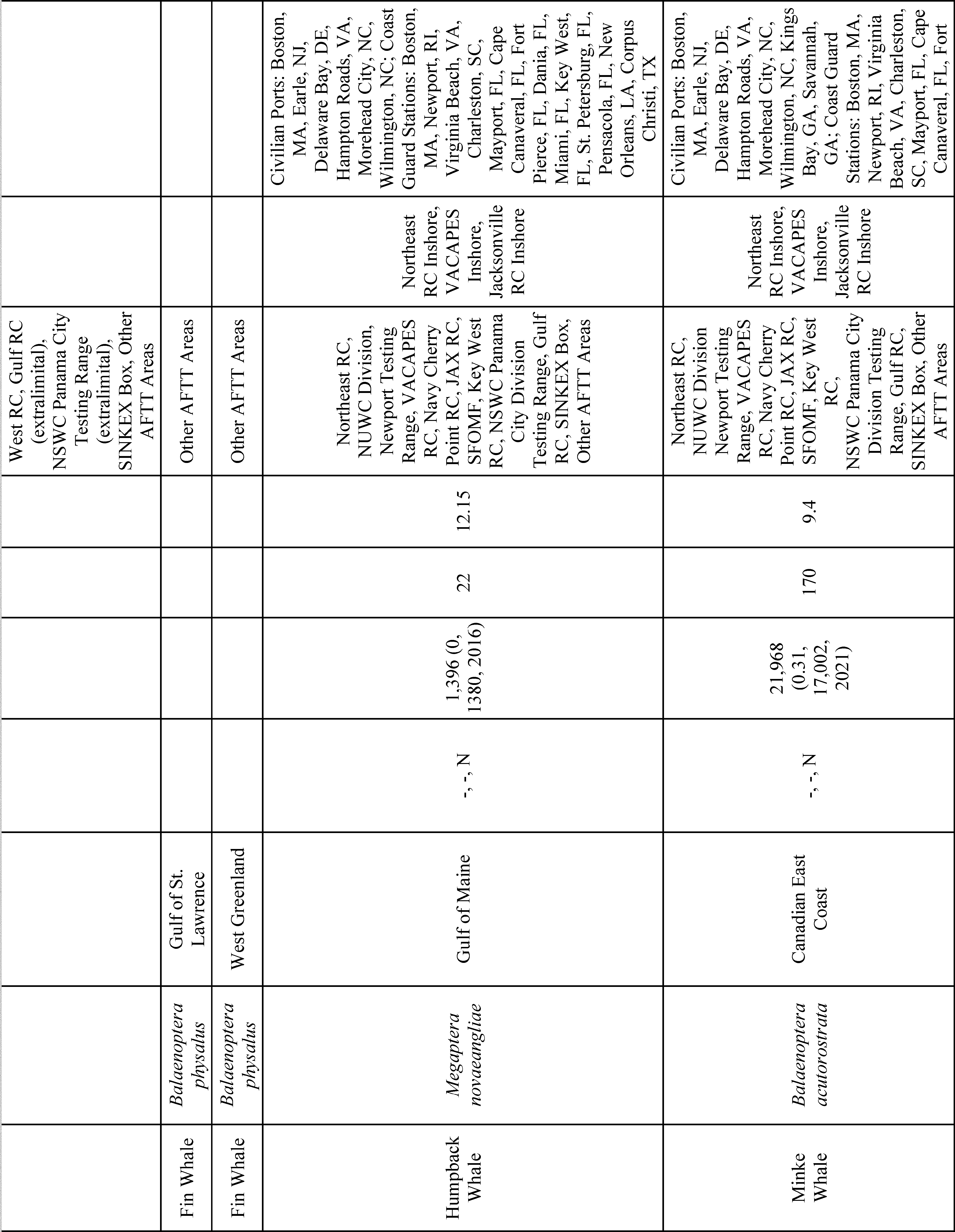
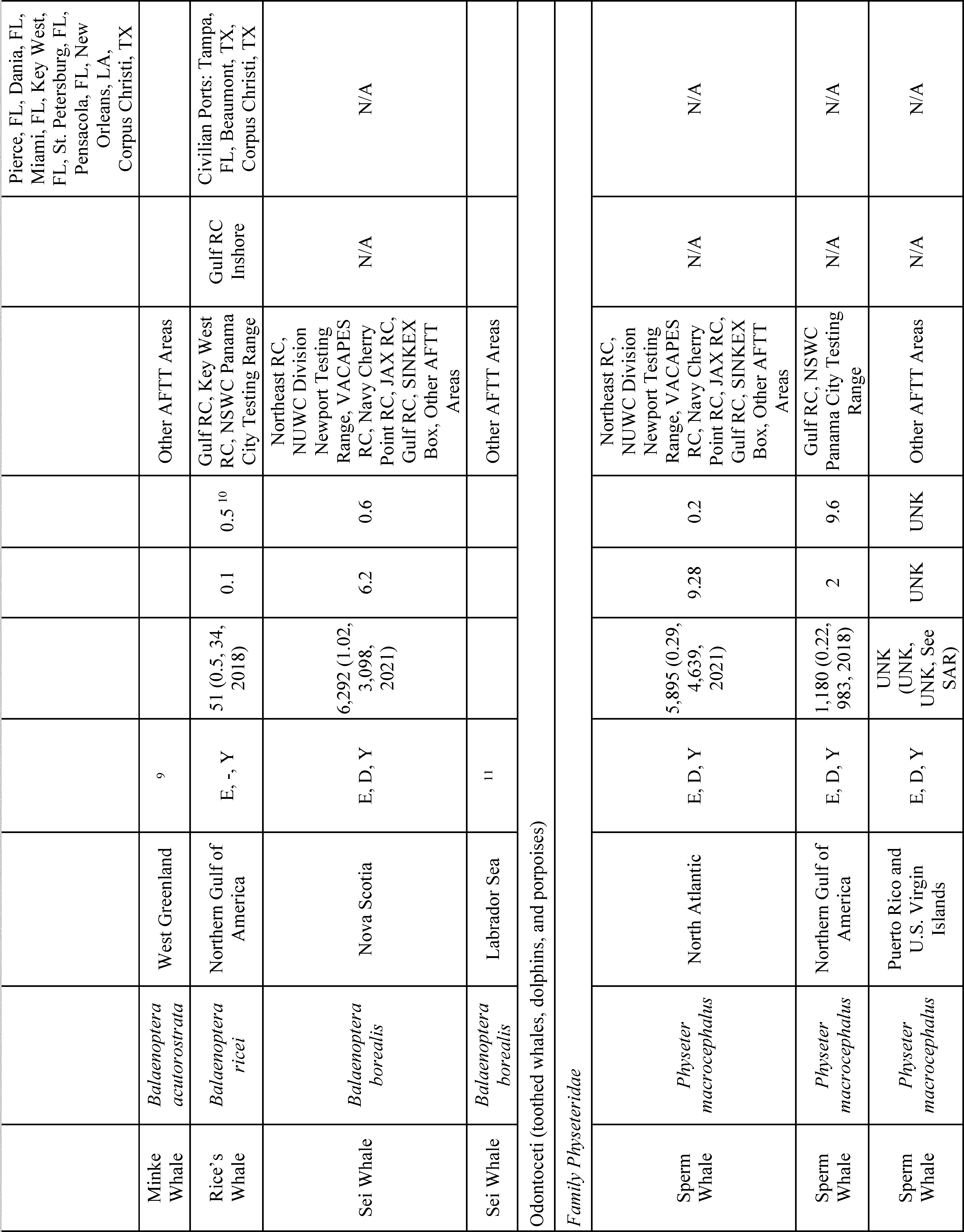
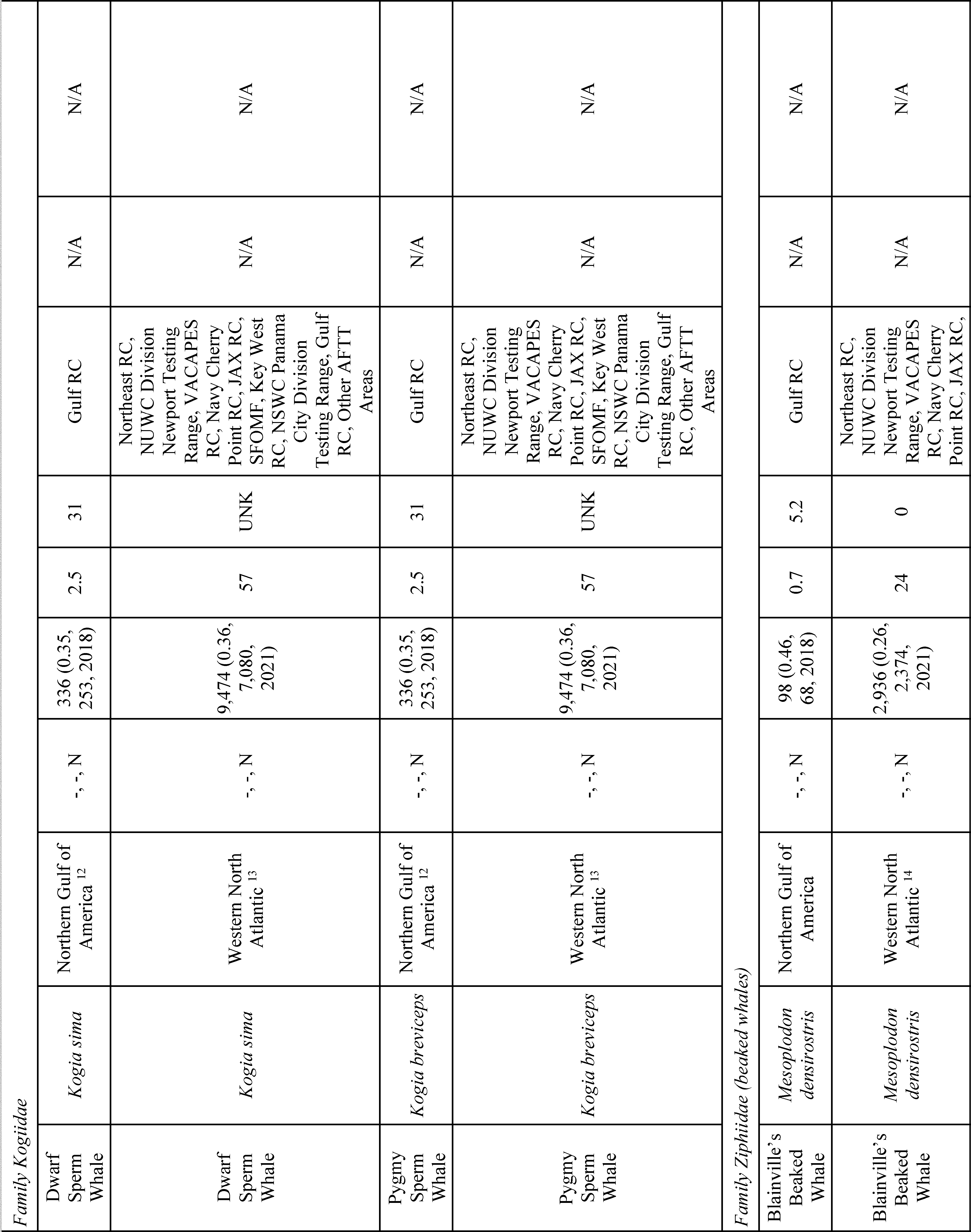
The Action Proponents requested authorization to take marine mammals incidental to conducting military readiness activities. The Action Proponents have determined that acoustic and explosives stressors are most likely to result in take of marine mammals in the form of Level A and B harassment, and a limited number of takes by serious injury or mortality may result from vessel movement and explosive use including ship shock trials. NMFS concurs with these determinations. Detailed descriptions of these activities are provided in chapter 2 of the 2025 AFTT Supplemental Environmental Impact Statement (EIS)/Overseas EIS (OEIS) (2025 AFTT Supplemental EIS/OEIS) (
https://www.nepa.navy.mil/aftteis/) and in the Action Proponents' application (
https://www.fisheries.noaa.gov/national/marine-mammal-protection/incidental-take-authorizations-military-readiness-activities).
A detailed description of the specified activities was provided in our proposed rule (90 FR 19858, May 9, 2025). NMFS hereby refers to the information and analysis provided in the proposed rule which continue to apply to this final rule. Since that time, no changes have been made to the planned activities. Therefore, a detailed description is not provided here. Please refer to the proposed rulemaking for the complete description of the specified activity.
Foreign Navies
In furtherance of national security objectives, foreign militaries may participate in multinational training and testing events in the AFTT Study Area. Foreign military activities that are planned by and under the substantial control and responsibility of the Action Proponents are included in the specified activity. These participants could be in various training or testing events described in appendix A of the 2025 AFTT Supplemental EIS/OEIS, and their effects are analyzed in this final rule. However, when foreign military vessels and aircraft operate independently within the study area as sovereign vessels outside the planning, control, and responsibility of the Action Proponents, those activities are not considered part of the specified activity. There are many reasons why foreign military vessels may traverse U.S. waters or come into a U.S. port, not all of which are at the request of any of the Action Proponents. Foreign military vessels and aircraft operate pursuant to their own national authorities and have independent rights under customary international law, embodied in the principle of sovereign immunity, to engage in various activities on the world's oceans and seas.
When foreign militaries are participating in a U.S. Navy-led exercise or event, foreign military use of sonar and explosives, when combined with the Action Proponents' use of sonar and explosives, would not result in exceedance of the analyzed levels (within each Navy Acoustic Effects Model (NAEMO) modeled sonar and explosive bin) used for estimating predicted impacts, which formed the basis of our acoustic impacts effects analysis that was used to estimate take in this final rule. Please see the Mitigation Measures section and Reporting section of this final rule for information about mitigation and reporting related to foreign navy activities in the AFTT Study Area.
( printed page 50506)
Comments and Responses
We published the proposed rule in the
Federal Register
on May 9, 2025 (90 FR 19858) with a 30-day comment period. In that proposed rule, we requested public input on our analyses, our preliminary findings, and the proposed regulations, and requested that interested persons submit relevant information and comments. During the 30-day comment period, we received 1,216 comments. Of this total, one submission was from the Marine Mammal Commission (Commission), two were from non-governmental organizations Natural Resources Defense Council and Turtle Island Restoration Network, and the remaining comments were from private citizens. The majority of these comments were form letter submissions containing identical or nearly identical content expressing general opposition toward the Action Proponents' proposed training and testing activities and requesting that NMFS not issue the regulations and LOAs, but the commenters provided no specific recommendations or supporting information. These general comments have been noted, but because they did not include information pertinent to NMFS' decision, they are not addressed further.
NMFS has reviewed and considered all relevant public comments received on the proposed rule and issuance of the LOAs. All substantive, relevant comments and our responses are described below. We organize our comment responses by major categories.
Impact Analysis and Thresholds
Comment 1:
The Commission stated that a 5-minute accumulation time for an entire day of pile driving is insufficient, particularly because of the Commission's assertion that the Navy does not implement, and NMFS has not proposed to require, soft-start procedures during pile-driving training activities. The Commission also noted differences in pile driving between the proposed rule and another recent military readiness activity involving pile driving (90 FR 20283, May 13, 2025). The Commission recommended that NMFS revise: (1) the range to effects for pile driving for temporary threshold shift (TTS) and auditory injury (AUD INJ) based on the number of piles of each pile type and installation method that would be installed on a given day, the number of minutes or strikes needed to install each pile to depth, and the correct source levels, including for vibratory installation of 24-inch (0.61 meter (m)) sheet piles; (2) the range to effects for pile driving for behavioral response for vibratory installation of 24-inch (0.61 m) sheet piles based on a source level of 159 decibel referenced to 1 microPascal (dB re 1 μPa) at 11 m; and (3) the numbers of takes accordingly for the final rule.
Response:
NMFS disagrees with the Commission's assertion that the source levels used for vibratory installation of 24-inch (0.61 m) sheet piles are incorrect. As indicated in the proposed rule and the technical report “Quantifying Acoustic Impacts on Marine Mammals and Sea Turtles: Methods and Analytical Approach for Phase IV Training and Testing” (U.S. Department of the Navy, 2024b), hereafter referred to as the Acoustic Impacts Technical Report, a source level of 159 dB root-means-square (RMS) for vibratory driving of 24-inch (0.61 m) steel sheet piles measured at 10 m (32.8 feet (ft)) (NAVFAC, 2020) is a reasonable representation of likely sound levels.
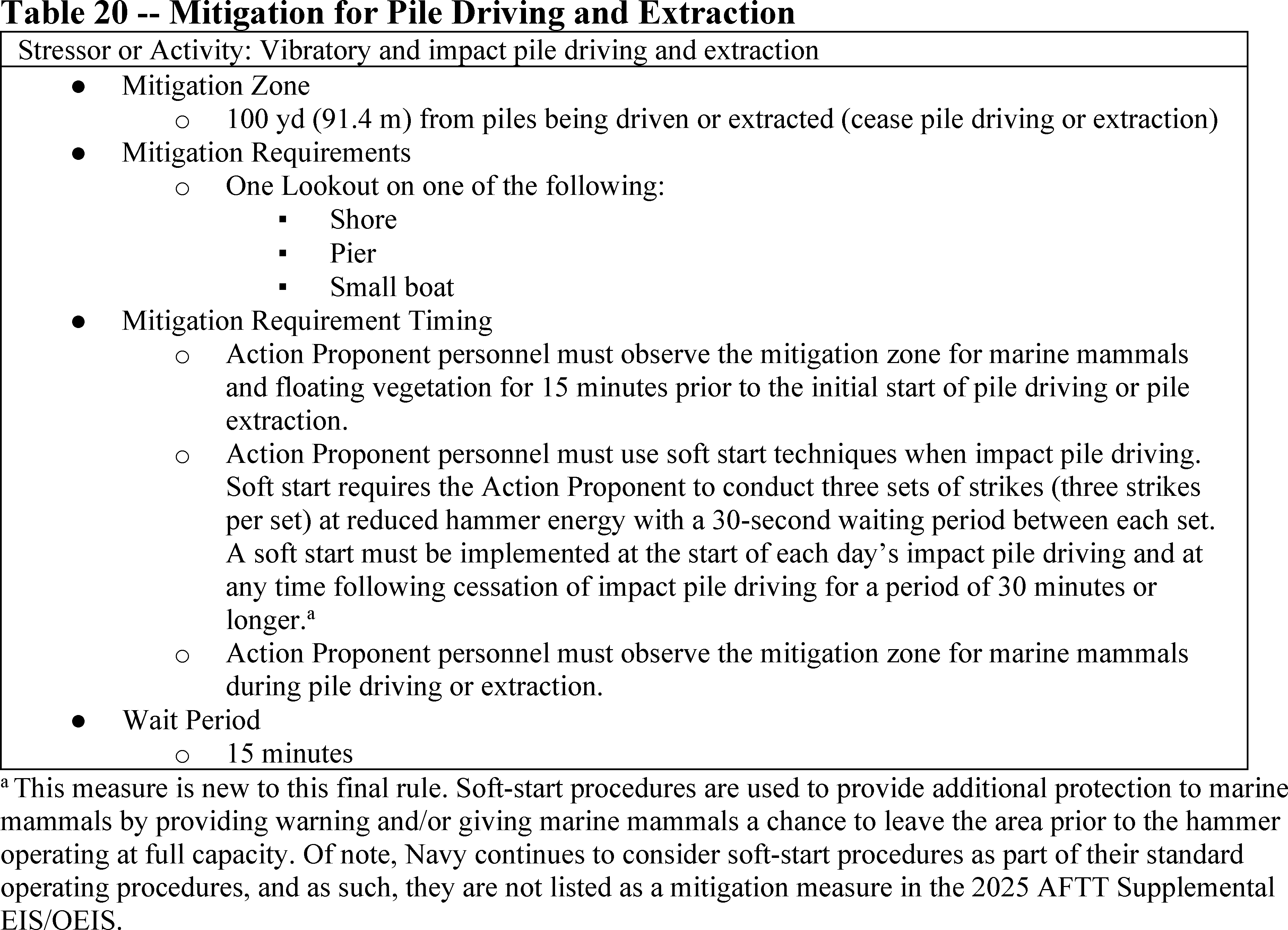
The Navy assumed, and NMFS concurred, that most animals in the area of pile driving activities would avoid higher sound levels that could cause injury over periods of time shorter than 5 minutes. The Navy is required to shut down pile driving if a bottlenose dolphin occurs within 100 yards (yd) (91.4 m) of the pile driving site. Since pile driving occurs in relatively calm, shallow, coastal waters, and Lookouts are on stationary platforms (
e.g.,
elevated piers, bulkhead walls), there is a high likelihood that marine mammals would be sighted within or approaching the 100 yd (91.4 m) shutdown zone and mitigation would be implemented, therefore preventing potential TTS or AUD INJ, as all the predicted ranges for these effects are significantly smaller than 100 yd (91.4 m). As such, Level A harassment from pile driving activities is neither anticipated nor authorized, consistent with the proposed rule.
Navy considers soft-start procedures for impact pile driving to be part of its standard operating procedures. As such, neither the 2024 AFTT Draft Supplemental EIS/OEIS, application, nor the AFTT proposed rule (90 FR 19858, May 9, 2025) listed soft start as a mitigation measure. Navy states that its standard operating procedures are essential to safety and mission success and are implemented regardless of their secondary benefits, whereas its mitigation measures are designed entirely for the purpose of avoiding or reducing impacts on marine mammals. As such, the Action Proponents did not include a description of the soft-start procedure in the mitigation section of the application, and NMFS did not propose to include soft start as a mitigation measure in the proposed rule. However, NMFS agrees with the Commission that it is appropriate to require soft-start procedures as a mitigation measure, and this final rule clarifies that the Navy must implement soft start techniques for impact pile driving. Of note, Navy continues to consider soft-start procedures as part of their standard operating procedures, and as such, they are not listed as a mitigation measure in the 2025 AFTT Supplemental EIS/OEIS.
Comment 2:
The Commission recommended that NMFS work with the Navy to use an avoidance swim speed of no more than 2 meters per second (m/second) for harbor porpoises and 1 m/second for pinnipeds, and to revise the NAEMO modeling and take estimates appropriately for the final rule. The Commission further recommended that NMFS work with the Navy to incorporate moving animats (
i.e.,
a virtual animal) into NAEMO that can actively avoid sound sources based on species-specific dive profiles and swim speeds for Phase V activities (which would occur in AFTT from 2032 to 2039) and, if that is not feasible, incorporate species-specific swim speeds and the actual modeled sound propagation into NAEMO to simulate avoidance for a given event. The Commission stated that both creating an emulator and running simulation studies outside of NAEMO, as recommended by Simmons
et al.
(2025), should inform how best to deal with moving animats and implementing avoidance within NAEMO.
Response:
NMFS and the Navy acknowledge the importance of using appropriate swim speeds in the avoidance analysis in NAEMO, which assesses the potential for marine mammals to mitigate high-intensity sound exposures that could lead to auditory injury. While baseline swim speeds can be informative, the Navy prioritized data on swim behavior observed near and during anthropogenic disturbance because these data were considered more representative of how animals might respond to acoustic stimuli and potentially reduce injury risk. NMFS concurs with this approach.
The Commission referenced a study by Kastelein
et al.
(2018) as support for a lower harbor porpoise swim speed. However, the cited speed of 7.1 kilometers per hour (km/hr) represents the sustained average speed of a single captive harbor porpoise in a relatively small pool during a pile driving playback study at exposures below those causing auditory injury. This specific observation does not accurately reflect the full range of harbor porpoise swim capabilities. As documented in
( printed page 50507)
table 8 of the appendix to the Acoustic Impacts Technical Report, data from free-swimming harbor porpoises indicate swim speeds up to and exceeding 3 m/second, supporting the Navy's chosen value for modeling avoidance.
For pinnipeds, the avoidance analysis used a reasonable swim speed of 2 m/second for a limited duration (10 minutes), acknowledging the lack of observed data on their swim behavior during acoustic exposures. This assumption balances the need for a realistic representation of potential avoidance behavior with the limited data availability, contributing to a conservative assessment of potential impacts.
The Navy's approach to modeling impacts is described in the Acoustic Impacts Technical Report. NMFS has reviewed the Acoustic Impacts Technical Report and concurs with Navy that the approach is based on the best available science. In early NAEMO development, the Navy compared the number of exposures (
i.e.,
>120 dB) using the Marine Mammal Movement and Behavior (3MB) model versus horizontally stationary animats and concluded that there was no significant difference in behavioral exposures between the two distribution methods. Thus, horizontally stationary animats were selected for computational efficiency.
NMFS and the Navy recognize the evolving nature of modeling techniques and acknowledge the Commission's desire for more dynamic and species-specific avoidance behaviors in future iterations of NAEMO. NMFS has encouraged the Navy to continue to explore NAEMO enhancements, and the Navy has indicated that it will consider species-specific swim speeds and potentially more complex movement models, as data availability and computational capabilities allow. Currently, however, detailed avoidance data for many species are limited, necessitating the use of surrogate data and generalized approaches, as is also the case with dive profiles.
The Navy states that it will continue to prioritize research and development efforts to enhance the accuracy of its impact modeling tools, ensuring the best available science informs its environmental assessments.
Comment 3:
The Commission recommended that NMFS work with the Navy to use NAEMO to conduct modeling of both multi-day events and multiple single-day events to estimate the number of repeated exposures an individual is expected to incur and to better assess repeated exposures of individuals and population-level consequences, rather than rely on what it called a qualitative assessment. The Commission cited Simmons
et al.
(2025) recommendation of ways that NAEMO and results from NAEMO could be better used to estimate repeated takes and population-level impacts.
Response:
NMFS and the Navy have had ongoing discussions about how to better assess and characterize the number of repeated takes of individuals from training and testing activities, including whether NAEMO could be used to generate estimates of repeated takes of individuals. A credible assessment of the repeated takes due to the specified activities per the approach suggested in the comment would require treating animats as unique individuals over the course of a year's activity and across a large study area, while incorporating migration patterns and nomadic movement. Such an effort would be computationally intensive and Navy anticipates that it is likely infeasible given reasonable resources. In contrast, the action analyzed by Zeddies
et al.
(2017) and referenced by the Commission in supporting statements was less complex than the specified activities. Thus, Zeddies
et al.
(2017) could assess repeated takes within spatially and temporally limited areas with undirected animal ingress/egress. NMFS will continue to work with the Navy to better assess and characterize the number of repeated takes of individuals. Of note, Simmons
et al.
(2025), referenced by the Commission, was written after a joint workshop with the Navy and SMRU Consulting. Recommendations from the workshop and associated report are being considered for future modeling improvements.
While NMFS and the Action Proponents' analyses could be further refined, the information in NMFS' analysis is sufficient for assessing whether the authorized take would have a negligible impact on the species or stocks of marine mammals, and it is not necessary to have exact number of times that an animal is estimated to be repeatedly taken in order to make the determination. As described in the Preliminary Analysis and Negligible Impact Determination section of the proposed rule (90 FR 19858, May 9, 2025) and this final rule, generally speaking, the higher the number of takes as compared to the population abundance, the more repeated takes of individuals are likely, and the higher the actual percentage of individuals in the population that are likely taken at least once in a year. We look at this comparative metric (number of takes to population abundance) to give us a relative sense of where a larger portion of a species is being taken by the specified activities, where there is a likelihood that the same individuals are being taken across multiple days, and whether the number of days might be higher or more likely sequential. Where the number of instances of take is less than 100 percent of the abundance, and there is no information to specifically suggest that some subset of animals is known to congregate in an area in which activities are regularly occurring (
e.g.,
a small resident population, takes occurring in a known important area such as a Biologically Important Area (BIA), or a large portion of the takes occurring in a certain region and season), the overall likelihood and number of repeated takes is generally considered low, as it could, on one extreme, mean that every take represents a separate individual in the population being taken on 1 day (a minimal impact to an individual) or, more likely, that some smaller number of individuals are taken on 1 day annually and some are taken on a few, not likely sequential, days annually, and of course some are not taken at all.
In the ocean, the use of sonar and other active acoustic sources is often transient and is unlikely to repeatedly expose the same individual animals within a short period, for example, within one specific exercise. However, for some individuals of some species, repeated exposures across different activities could occur over the year, especially where events occur in generally the same area with more resident species. In short, for some species, we expect that the total anticipated takes represent exposures of a smaller number of individuals of which some would be exposed multiple times, but based on the nature of the specified activities and the movement patterns of marine mammals, it is unlikely that individuals from most stocks would be taken over more than a few days within a given year. This means that even where repeated takes of individuals are likely to occur, they are more likely to result from non-sequential exposures from different activities, and, even if sequential, individual animals are not predicted to be taken for more than several days in a row, at most. As described elsewhere, the nature of the majority of the exposures would be expected to be of a less severe nature, and based on the numbers, it is likely that any individual exposed multiple times is still taken on only a small percentage of the days of the year. The greater likelihood is that
( printed page 50508)
not every individual is taken, or perhaps a smaller subset is taken with a slightly higher average and larger variability of highs and lows, but still with no reason to think that, for most species or stocks, any individuals would be taken a significant portion of the days of the year.
Of note, the Commission identified an error related to potential impacts to goose-beaked whales (Western North Atlantic stock) in the Preliminary Assessment and Negligible Impact Determination section of the proposed rule. This final rule includes a correction to that language to indicate that the impacts to the Western North Atlantic stock of goose-beaked whales could cause a limited number of females to forego reproduction for a year.
Comment 4:
The Commission recommended that NMFS work with the Navy to use its Range-Dependent Acoustic Model and the Navy's Standard Parabolic Equation (RAM/PE) model for non-impulsive sources to model all underwater detonations (
i.e.,
impulsive sources) for Phase IV activities for which modeling has not been completed and for all Phase V activities, until such time that Comprehensive Acoustic Simulation System/Gaussian Ray Bundle (CASS/GRAB) and the similitude equation have been validated for the range of detonation sizes and environmental parameters (
i.e.,
water depth and receiver range) in which it would be used. They supported this recommendation by stating that, given the comparability of the modeled zones from the Peregrine version of RAM/PE to the measured values and that RAM/PE is already used by the Navy for modeling non-impulsive sources that operate at less than 100 Hertz (Hz) and in shallow water, the Navy has the data to conduct a rigorous comparison of CASS/GRAB and the similitude equation and the in situ measurements of the USS Ford ship shock trial from Seger
et al.
(2023) to fulfill the project's intent and to inform future rulemakings.
Response:
Navy has indicated that it plans to conduct a verification of the impulsive propagation methods in NAEMO using the Seger
et al.
(2023) data, which was published by Madhusudhana
et al.
(2024).
The NAEMO impulsive modeling methods, as described in the Acoustic Impacts Technical Report, require arrival times, sound levels, and phases to be output from the propagation model. RAM/PE does not output the time information necessary for simulation and is thus not a suitable option for impulsive modeling in NAEMO. The limitations of the similitude equation are discussed in section 4.1.3.2 of the Acoustic Impacts Technical Report and comparisons between the peak pressure computed at various ranges against the theoretical value based on the similitude equation showed agreement, providing confidence that the similitude equation was appropriate for use in NAEMO.
The Navy states that it is committed to ensuring the accuracy of its impulsive propagation models and recognizes the importance of ongoing validation efforts. While the similitude equation has been evaluated and demonstrated good agreement with measured data, as detailed in section 4.1.3.2 of the Acoustic Impacts Technical Report, the Navy is open to exploring alternative approaches to meet NAEMO's requirements.
Comment 5:
The Commission highlighted multiple points regarding the behavioral response functions (BRF) following its review of the technical report “Criteria and Thresholds for U.S. Navy Acoustic and Explosive Effects Analysis (Phase 4)” (U.S. Department of the Navy, 2024a), which was revised to include updates to the version published in September 2024 and is hereafter referred to as the revised Criteria and Thresholds Technical Report (U.S. Department of the Navy, 2025). These points generally relate to the upper bound of the BRFs, Southall
et al.
data, odontocete BRFs, sensitive species BRFs, harbor porpoise data, pinniped BRFs, response severity denotation, and inconsistencies in some tables and figures. Please see the Commission's letter for a detailed discussion of its recommendation.
The Commission recommended that NMFS require the Navy to revise their criteria and thresholds to clarify and address these points, as that document underpins the current and future Phase IV rulemakings. The Commission also states that to increase efficiency for all of the agencies involved and to ensure accurate information is being provided for public comment, the Commission would welcome the opportunity to informally review future versions of the Navy's criteria and threshold documents. The Commission further recommends that NMFS work with the Navy to use the dose-response functions that were developed from all of the raw data rather than those that were regenerated for only moderate and severe responses and to refrain from extrapolating beyond the bounds of the underlying data when revising the BRFs.
In a related comment, a commenter stated that NMFS has not incorporated recent behavioral response data on common dolphins (Southall
et al.,
2024), and other important studies highlighted by the Commission, into its biphasic risk functions. The commenter references a fuller description of its concern in a comment on the 2024 Hawaii-California Training and Testing (HCTT) Draft EIS/OEIS.
Response:
Regarding the upper bound of the BRFs, the Navy adjusted the upper bound of the BRFs in Phase IV to more accurately reflect observed behavioral data, particularly at higher received levels. For example, sonar received levels between 170 and 182 dB re 1 µPa for humpback whales during 3S2 study (the second phase of the Sea Mammals, Sonar, Safety (3S) project) and between 175 and 186 dB re 1 µPa for sperm whales during 3S3 study (the third phase of the 3S project) did not elicit observable responses. See section 3.1.6.1.2 of the Criteria and Thresholds Technical Report for discussion of the 3S and 3S2 study, and section and 3.1.6.1.3 for discussion of the 3S3 study. Please see table E-1 in the revised Criteria and Thresholds Technical Report for details of all individual responses documented during studies in conjunction with received levels of sonar and sonar like sources.
Extending the upper bound to 200 dB re 1 µPa allows the BRFs to account for this lack of response at higher received levels. This adjustment does not arbitrarily shift the entire curve to the right, as the Commission suggests. For groups like pinnipeds, where responses are consistently observed at lower received levels, the BRF approaches 100 percent response probability at 185 dB re 1 µPa. Therefore, the upper bound adjustment primarily impacts the odontocete and mysticete BRFs, reflecting the observed data at higher exposures. It is also important to note that the lower bound of the BRFs were extended to 90 dB re 1 µPa in Phase IV (compared to the 100 dB re 1 µPa lower limit used in Phase III), further demonstrating that the adjustments were not solely focused on increasing the upper bound.
The Commission's observation of a flat slope between 185 and 200 dB re 1 µPa for the Phase III BRFs shown in figure 42 (Department of the Navy, 2024a) was a result of anchoring the Phase III BRFs at 185 dB re 1 µPa and then extending them to 200 dB re 1 µPa for plotting purposes.
Finally, regarding the point that the upper level of the mysticete BRF exceeds the TTS onset, it is important to emphasize that auditory and behavioral criteria are not directly linked. The Navy recognizes the evolving nature of acoustic science and
( printed page 50509)
will continue to refine its effects criteria as new data and understanding become available.
The descriptions of responses in appendix E (Behavioral Responses to Sonar and Sonar-Like Sources: All Individuals Included) of the revised Criteria and Thresholds Technical Report have been updated to include additional information on the observed responses.
Regarding data from Southall
et al.
(2024), the Navy develops its BRFs using the best available scientific data. While data from the Atlantic behavioral response study (BRS) cited by the Commission and Southall
et al.
(2024) cited by the commenter were collected during the timeframe referenced, these data were not available for use in the development of the BRFs for Phase IV. These functions are always developed in close consultation with scientists conducting BRS/controlled exposure experiment (CEE) studies, but when the data are not yet published, the researchers determine the appropriate time at which to share data with the Navy. In this case, Atlantic BRS behavioral response results and Southall
et al.
(2024) were not shared in time to be considered and/or included in the development of the Navy risk thresholds. The Navy did consider data from Southall
et al.
(2024) in appendix D of the 2025 AFTT Supplemental EIS/OEIS, indicating the potential responses observed in this study occurred at received levels and distances assessed for potentially significant behavioral responses in the analysis of Phase IV; however, the findings of this study do not change the conclusions made by the Navy nor NMFS' determination. The Navy remains committed to incorporating the best available scientific data into its impact assessments and will revisit its BRFs as new information, including the published results of the Atlantic BRS, becomes available.
Regarding the odontocete BRF, all the data from Houser
et al.
(2013a, 2013b) were included in the modified risk functions developed for subsampling in the Navy's BRFs. However, low-severity responses were classified as “non-responses” when deriving the BRFs (see also Southall
et al.
(2021) for a description of severity scoring). This approach, consistent with Phase III, reflects that low-severity behavioral responses are not typically considered “harassment” under the MMPA during military readiness activities. To balance field and captive study data, a subsampling method was used. This involved creating modified risk functions incorporating the new scoring values (classifying low-severity responses as non-responses) at different received levels. Thirty data points were then randomly selected from the bottlenose dolphin risk function generated using this method. This subsampling approach, similar to that used for beaked whale data in both Phase III and Phase IV, ensures each individual animal from the captive study receives equal weight, comparable to individuals from field studies. This allows for a more comprehensive consideration of exposures and responses for each species, unlike Phase III's selection of a single response level per individual. The Navy has clarified this methodology in the revised Criteria and Thresholds Technical Report. Further, the Navy's current odontocete BRF considers the potential for behavioral responses that may qualify as “harassment” under the MMPA for military readiness activities at the estimated received levels in Southall
et al.
(2024).
Regarding the sensitive species BRF, while the generalized additive model (GAM) published in Jacobson
et al.
(2022) only extended to 165 dB, the Navy requested that authors rerun their model to 200 dB to create a new curve that could be subsampled for the Navy Phase IV risk function; the same was done for the Moretti
et al.
(2014) data. Therefore, the two beaked whale range-based risk functions extended to the same bandwidth as the Navy BRF and the subsampling matched the rest of the data. The Navy has updated the Criteria and Thresholds Technical Report to reflect that the published GAMs were rerun with the broader bandwidth. Both Moretti
et al.
(2014) and Jacobson
et al.
(2022) were subsampled 10 times each.
To be included in the BRF, data sets needed to relate known or estimable received levels to observations of individual or group behavior. The data in Falcone
et al.
(2017) is not included in the development of the BRFs because it is not possible to reasonably estimate the received levels in this study; however, this data was considered in developing the distance conditions for the application of the sensitive species BRF.
The Navy is committed to ensuring scientific integrity in datasets used for BRF development. Using data that do not meet these criteria could result in unreliable or misleading risk assessments. A risk function has not yet been fit to Southern California Anti-Submarine Warfare Range (SOAR) data for beaked whales, nor has one been fit for minke whales at PMRF. The BRFs in Phase IV utilized only individual response-received level data outside of the four pre-existing risk functions that were subsampled. There were no individual response-received level data available for beaked whales at SOAR nor for minke whales at PMRF, therefore those data were not used in the Phase IV BRFs. As science continues to evolve, the Navy will continue to refine its effects criteria. The Navy remains committed to incorporating new data and analyses, including those from SOAR and PMRF, as they become available and meet the rigorous standards required for robust BRF development.
Regarding the Kastelein harbor porpoise data, when the same individuals were tested at multiple received levels for the same source within a single study, only the lowest received level eliciting a response was included in the data used for BRF development. However, in some studies, Kastelein tested the same sources using different parameters, such as an upsweep versus a downsweep signal (
e.g.,
Kastelein
et al.
(2014b), where both low frequency and mid frequency active sonar signals were tested as both a downsweep and upsweep), or as a continuous versus pulsed active sonar signal (
e.g.,
Kastelein
et al.,
2018). In that case, the response to both signal parameters would have been used in the BRF as those would be considered different signals. The citations for the relevant Kastelein studies, previously provided in tables 19 and 20, have been added to table E-1 in the revised Criteria and Thresholds Technical Report.
Regarding the pinniped BRFs, the Navy confirms that all data from the Houser
et al.
(2013a) California sea lion controlled exposure experiment were considered in developing the Phase IV BRFs. However, as with the odontocete BRF, low-severity responses were classified as “non-responses” when deriving the BRF. This decision aligns with the Navy's approach to assessing potential harassment under the MMPA during military readiness activities, where low-severity responses are not typically considered indicative of harassment. The original curves developed by Houser
et al.
(2013a) were not used because they included the low-severity responses as responses. The Navy has clarified this approach in the revised Criteria and Thresholds Technical Report.
Regarding the identified inconsistencies in some data, tables, and figures, NMFS and the Navy have carefully reviewed those identified in the Commission's comments and the Navy has made the necessary corrections to the revised Criteria and
( printed page 50510)
Thresholds Technical Report. These revisions ensure consistency in the reported ranges of received levels, distances, and significant responses across the executive summary, tables, figures, and accompanying text. Specifically, the Navy updated table E-1 in the revised Criteria and Thresholds Technical Report to include data for Blainville's beaked whales from Tyack
et al.
(2011). The studies by Moretti
et al.
(2014) and Jacobson
et al.
(2022) involved aggregated and modeled data rather than individual animal responses and were therefore incorporated into the BRFs through a random subsampling process, as described in the Criteria and Thresholds Technical Report, rather than being presented directly in table E-1, which focuses on individual-level data. The Navy also addressed inconsistencies between Curé
et al.
(2025) and table E-1 of U.S. Department of the Navy (2025) identified by the Commission. The Navy updated the closest points of approach so that the onset closest point of approach is given for signals that elicited significant responses, while the closest point of approach of the overall exposure session is given for signals that did not elicit a significant response. These corrections only affect the way data was presented in table E-1 and do not change the BRFs.
Finally, the Navy has confirmed to NMFS that it used the data from Houser
et al.
(2013a) and Houser
et al.
(2013b) to develop the new risk functions. As noted previously, low-severity responses were scored as “non-responses” within these functions to align with the Navy's approach to assessing potential harassment under the MMPA. These new risk functions were then subsampled using the same method applied to the beaked whale range risk functions in both Phase III and Phase IV, ensuring consistency in the Navy's treatment of such data. This subsampling approach, described in detail within those reports, ensures appropriate weighting of individual responses and contributes to the robustness of the Navy's BRFs.
Regarding the Commissions' offer to informally review future versions of the criteria and threshold reports, NMFS recommends that the Commission coordinate directly with the Navy for any potential early reviews as the Navy is the primary author.
Comment 6:
The Commission recommended that NMFS work with the Navy in a concerted manner to incorporate data that support criteria and threshold development more often than on a decadal cycle and to revise NAEMO to implement the relevant criteria and thresholds at a true post-processing stage so that animat dosimeter data can be re-queried if thresholds change, rather than needing to remodel the animat-portion of NAEMO.
Response:
The criteria and thresholds are typically updated at the beginning of each at-sea phase. This is a significant effort that involves collecting published data, working with marine mammal researchers to collect and understand emergent data, developing methods to incorporate the data, writing and publishing the technical report, and seeking approvals from Navy leadership and NMFS. Nevertheless, emergent data is continuously assessed against the current criteria and thresholds to ascertain whether it would create significant changes to the Navy's analysis. If so, the analysis would be altered to reflect this emergent data.
The Navy is continuously reassessing and evolving its analysis methods including the need to more frequently update criteria and threshold and the feasibility for NAEMO to more rapidly incorporate such changes. For example, the Navy has undertaken efforts to investigate the feasibility of moving the weighting functions to the post-processor for impulsive modeling, which would allow added flexibility to the modeling process when new data emerges outside of the normal criteria and threshold timeline. NMFS supports such efforts.
Comment 7:
The Commission recommended that NMFS determine whether inclusion of data from Kastelein
et al.
(2024a, 2025a, 2025b) would alter the weighting functions and/or thresholds for the functional hearing groups and, if so, whether those modifications would be sufficient to warrant revision of the weighting functions and associated thresholds for non-impulsive sources as stipulated in their criteria and thresholds.
Response:
Whether and when to share data for ongoing research is at the discretion of the researchers and funding agencies. Because the specific data from Kastelein
et al.
(2024) were not shared with the Navy prior to peer review and publication, these data could not be incorporated into the development of the Phase IV Criteria and Thresholds. However, the Navy's current approach using the existing Phase IV criteria remains protective even when compared to the findings of Kastelein
et al.
(2024a). Specifically, incorporating the TTS onset value of 169 dB sound exposure level (SEL) reported by Kastelein
et al.
(2024a) would raise the very high frequency (VHF) non-impulse exposure function by 4 dB. The impact on other impulsive and non-impulsive exposure functions is negligible (1 dB or less).
NMFS has also reviewed the data from Kastelein
et al.
(2024b, 2025a, 2025b). Kastelein
et al.
(2025a) evaluated the effect of one-sixth octave band noise centered at 40 kilohertz (kHz) on TTS in two California sea lions (
Zalophus californianus). Results indicate that TTS onset (6 dB threshold shift) occurred at approximately 169 dB cumulative SEL, which is lower than predicted by the current Phase IV TTS threshold and weighting function. Interestingly, this TTS onset level is lower than what was measured during exposure to 32 kHz in a previous study (179 dB cumulative SEL; Kastelein
et al.
(2024b)). So, despite hearing sensitivity decreasing at higher frequencies, Kastelein
et al.
(2025a) indicate that TTS onset occurs at a lower level than predicted, which contradicts typical trends in TTS onset previously measured in marine mammals. Thus, these data suggest a need to evaluate exposures at potentially higher frequencies to examine whether this disparate trend continues.
Kastelein
et al.
(2025b) examined TTS in two harbor seals (
Phoca vitulina) exposed to one-sixth octave band noise centered at 8 kHz. In this study, TTS onset (6 dB threshold shift) occurred at approximately 181 dB cumulative SEL, which is higher than what is predicted with the current Navy Phase IV criteria.
In consideration of the information discussed above, NMFS and Navy have concluded that revisions to the Phase IV Criteria and Thresholds are not warranted at this time.
Comment 8:
The Commission recommended that NMFS determine whether the low-frequency (LF) cetacean weighting function has been shifted far enough to the higher frequencies to reflect that 32 kHz was the most sensitive frequency tested in minke whales, determine whether use of the phocid carnivore in water (PCW) composite audiogram, weighting function, and threshold parameters are more representative of very low-frequency (VLF) and LF cetaceans than medians and means of the five other functional hearing groups, and work with the Navy to revise the VLF and LF cetacean composite audiograms, weighting functions, and thresholds as needed for impulsive and non-impulsive sources for the final rule and 2025 AFTT Supplemental EIS/OEIS.
In a related comment, a commenter stated that NMFS has applied a patently unrealistic, non-conservative auditory weighting scheme for “low frequency cetaceans” and references a similar
( printed page 50511)
comment on the 2024 HCTT Draft EIS/OEIS.
Response:
The lack of data on mysticete hearing, especially in terms of the impacts of noise on hearing, has made this a challenging group for which to develop acoustic criteria. The Navy has split the mysticetes into two hearing groups for its Phase IV analyses: VLF and LF cetaceans (see appendix B of the Criteria and Thresholds Technical Report). This decision is outlined in detail within the documentation and includes the best available science including the recommendations of Southall
et al.
(2019a) and the minke whale study by Houser
et al.
(2024). The Navy was given access to pre-published data on the 2023/2024 minke whale field season and was able to incorporate into their Phase IV criteria (noting, as the commenter did that the 2023 field season data was published in November 2024). In their Phase IV criteria, the Navy separated VLF cetaceans (
i.e.,
blue, fin, right, and bowhead whales) from LF cetaceans (all other mysticetes). Thus, they are acknowledging differences among mysticetes species.
NMFS and the Navy disagree that wholesale adoption of the PCW parameters or shifting the LF weighting function solely based on the 32 kHz sensitivity of minke whales is scientifically justified. There is no scientific evidence to support the exclusive use of the PCW composite audiogram and weighting function parameters for the LF and VLF groups. Adolescent minke whales were tested by Houser
et al.
(2024) specifically because of their small size compared to other baleen whales. Smaller head size generally facilitates hearing at higher frequencies, so a shift of the entire LF curve (intended to represent all species within the hearing group) to a center frequency of 32 kHz is not likely representative of most baleen whales, which are larger in size compared to adolescent minke whales.
Therefore, the Navy maintains, and NMFS concurs, that, based on the weight of the evidence, the existing LF weighting function and the use of medians and means from multiple functional hearing groups provide a more representative and protective approach for assessing acoustic impacts on VLF and LF cetaceans. This approach incorporates data from a broader range of species and avoids overreliance on data from a single species or functional hearing group. NMFS' approach has remained consistent throughout our technical guidance development (2016, 2018, 2024), and we have addressed comments on the LF cetacean weighting function in our previous
Federal Register
notices finalizing these documents (81 FR 51693, August 4, 2016; 89 FR 84872, October 24, 2024). NMFS' 2024 Technical Acoustic Guidance does not incorporate the recent data on minke whale hearing. However, NMFS has committed to incorporating this data into future versions, as indicated in our 2024 Updated Technical Guidance. NMFS is awaiting the publication from the 2024 field season to be published and made publicly available before re-evaluating our acoustic criteria for mysticetes.
Comment 9:
A commenter stated that NMFS has relied improperly on means and medians in establishing its thresholds for auditory impacts and references a similar comment on the 2024 HCTT Draft EIS/OEIS. In that comment, the commenter recommends implementation of a 6 dB reduction to its TTS and PTS thresholds in line with the suggestions by Tougaard
et al.
(2015). The commenter states that a 6 dB adjustment would accord with the minimum level of “non-trivial” TTS required to evaluate onset, effectively adjusting the exposure functions to more closely match the point where TTS begins.
Response:
The technical guidance appropriately uses measures of central tendency based on an onset level of 6 dB TTS. No reduction is necessary or supported by the scientific literature, especially considering numerous other conservative methods in the auditory criteria. For example, the Navy, and subsequently NMFS, assumes no recovery of hearing during time intervals between intermittent exposures. However, multiple studies from humans, terrestrial mammals, and marine mammals have demonstrated less TTS from intermittent exposures compared to continuous exposures with the same total energy because hearing is known to experience some recovery in between noise exposures. Therefore, the Navy's approach, as relied upon in NMFS' proposed and final rules, is known to overestimate the effects of intermittent noise sources such as tactical sonars. Further, marine mammal TTS data have shown that, for two exposures with equal energy, the longer duration exposure tends to produce a larger amount of TTS. Since most marine mammal TTS data have been obtained using exposure durations up to an hour, much longer than the durations of many tactical sources, the use of the existing marine mammal TTS data tends to over-estimate the effects of sonars with shorter duration signals.
Comment 10:
A commenter stated that NMFS wholly discounted gas-bubble pathology as a mechanism of harm to marine mammals due to the specified activities, and that the Action Proponents must assume that a number of beaked whales are subject to injury and mortality from gas-bubble formation.
Response:
The commenter's characterization of NMFS' analysis is incorrect. NMFS does not disregard the fact that it is possible for naval activities using hull-mounted tactical sonar to contribute to the death of marine mammals in certain circumstances (that are not present in the AFTT Study Area) via strandings resulting from behaviorally mediated physiological impacts or other gas-related injuries. In the Potential Effects of Specified Activities on Marine Mammals and Their Habitat section of the proposed rule, NMFS discusses these potential causes and outlines the few cases where active naval sonar (in the U.S. or, largely, elsewhere) has either potentially contributed to or, as with the Bahamas example, been more definitively causally linked with marine mammal strandings. As noted, there are a suite of factors that have been associated with these specific cases of strandings directly associated with sonar (steep bathymetry, multiple hull-mounted platforms using sonar simultaneously, constricted channels, strong surface ducts,
etc.). These factors are not present together in the AFTT Study Area during the specified activities (and the Navy takes care across the world not to operate under these circumstances without additional monitoring). Further, there have never been any strandings associated with Navy sonar use in the AFTT Study Area. For these reasons, NMFS does not anticipate that the Action Proponents' training or testing activities will result in marine mammal strandings, and none are authorized. Furthermore, ongoing Navy funded beaked whale monitoring at a heavily used training and testing area in the SOCAL Range Complex has not documented mortality or habitat abandonment by beaked whales. Passive acoustic detections of beaked whales have not significantly changed over 10 years of monitoring (DiMarzio
et al.,
2018; DiMarzio
et al.,
2019; DiMarzio
et al.,
2020). From visual surveys in the area since 2006 there have been repeated sightings of the same individual beaked whales, beaked whale mother-calf pairs, and beaked whale mother-calf pairs with mothers on their second calf (Schorr
et al.,
2018; Schorr
et al.,
2020). Satellite tracking studies of beaked whales documented high site fidelity to this area even though the
( printed page 50512)
study area is located in one of the most used Navy areas in the Pacific (Schorr
et al.,
2018; Schorr
et al.,
2020).
Comment 11:
A commenter stated that NMFS failed to present a meaningful analysis of the Navy's aggregate effects on marine mammal populations and refers to its comment on the 2024 HCTT Draft EIS/OEIS.
Response:
The commenter's supporting rationale for their comment is in reference to the 2024 HCTT Draft EIS/OEIS. While some of the information considered in the AFTT proposed rule and this final rule is generally similar, the commenter has not provided recommendations specific to how NMFS' analysis of the Action Proponents activities in the proposed rule fails to consider the Action Proponents' aggregate effects on marine mammal populations. NMFS fully analyzed and considered the potential for aggregate effects from all of the Action Proponents' specified activities, and has applied a reasoned and comprehensive approach to evaluating the effects of these activities on marine mammal species or stocks and their habitat. This analysis was detailed in the Preliminary Analysis and Negligible Impact Determination section of the proposed rule and is repeated here in the Analysis and Negligible Impact Determination section of the final rule.
Our analysis includes consideration of unusual mortality events (UMEs) and previous environmental impacts, where appropriate, to inform the baseline levels of both individual health and susceptibility to additional stressors, as well as stock status. Further, the species and stock-specific assessments in the Analysis and Negligible Impact Determination section (which have been updated and expanded since the previous AFTT rulemaking to consider additional species- and stock-specific factors) present and address the combined mortality, injury, behavioral harassment, and other effects of the aggregate activities, including impacts anticipated in important habitats such as Endangered Species Act (ESA)-designated critical habitat and known BIAs (and in consideration of applicable mitigation), as well as other information that supports our determinations that the Action Proponents' activities will not adversely affect any species or stocks via impacts on annual rates of recruitment or survival. We refer the reader to the Analysis and Negligible Impact Determination section for this analysis.
Further, widespread, extensive monitoring since 2006 on Navy ranges that have been used for training and testing for decades has demonstrated no evidence of population-level impacts (see
https://www.navymarinespeciesmonitoring.us/regions/pacific/current-projects/
for results,
e.g.,
“Cuvier's Beaked Whale and Fin Whale Population Dynamics and Impact Assessment at the Southern California Offshore Antisubmarine Warfare Range (SOAR)”). Based on the best available research from NMFS and Navy-funded marine mammal studies, there is no evidence that “population-level harm” to marine mammals, including beaked whales, is occurring in the AFTT Study Area.
Comment 12:
The Commission recommended that NMFS work with the Navy to reprogram NAEMO to implement densities at a post-processing stage so that densities can be easily revised rather than needing to remodel the animat-portion of NAEMO when density estimates change. The Commission states that such an improvement was recommended by Simmons
et al.
(2025) to be addressed through modifications to animat seeding and investigating runs by hearing group within NAEMO.
Response:
NMFS concurs that it is appropriate to explore whether NAEMO can be reprogrammed to implement densities at a post-processing stage so that densities can be easily revised rather than needing to remodel the animat-portion of NAEMO when density estimates change. The Navy has undertaken work in Fiscal Year 2025 to explore standardization of animat distributions and statistical considerations of applying species' densities after the NAEMO post-processor to scale results. If the Navy, in coordination with NMFS, finds that this proves feasible and appropriate, the Navy hopes to implement this for Phase V.
Comment 13:
The Commission recommended that NMFS refrain from using cut-off distances in conjunction with the Bayesian BRFs and re-estimate the numbers of marine mammal takes based solely on the Bayesian BRFs for the final rule.
In a related comment, a commenter stated that NMFS reduces the Navy's modeled take estimates through the application of cut-off distances that do not make sense conceptually, that are based on little or no data from the behavioral response literature, and that contradict data that are available, including Falcone
et al.
(2017) and Melcón
et al.
(2012). The commenter refers to a description of their concern in a comment on the 2024 HCTT Draft EIS/OEIS, in which they state that they agree with the Commission's recommendation that the Navy refrain from using cut-off distances and rely instead on the take estimates produced through its response functions.
Response:
The consideration of proximity (cut-off distances) was part of the criteria developed in consultation between the Navy and NMFS, and is appropriate based on the best available science, which shows that marine mammal responses to sound vary based on both sound level and distance. Therefore, these cut-off distances were applied within NAEMO. The derivation of the BRFs and associated cut-off distances is provided in the revised Criteria and Thresholds Technical Report.
The Phase IV approach represents a refinement in assessing potential behavioral impacts. It employs a probability of response condition for high source level exposures, addressing previous concerns from the Commission about potentially cutting off responses when the probability remained above 50 percent. This approach, combined with the distance cut-off, provides a more nuanced and protective assessment compared to the Phase III methodology, which relied solely on distance cut-offs. Therefore, directly comparing Phase III and Phase IV cut-off distances is not appropriate.
NMFS and the Navy are confident that this combined distance and probability threshold approach is well-substantiated by available data and effectively avoids underestimating potential behavioral responses to acoustic sources.
To clarify, section 3.1.4 (Dose and Contextual Responses) of the Criteria and Thresholds Technical Report explains that at low received levels, distance to the sound source factors into the likelihood of a behavioral response. Although distance was investigated as a covariate in the Bayesian BRF model, most BRFs to date have used similar source levels making received level and source-receiver distance tightly correlated (see section 3.1.9 (Behavioral Cut-off Conditions) of the Criteria and Thresholds Technical Report). Therefore, including distance in the BRF model using the available response-received level data did not improve the BRFs. Still, NMFS and the Navy agree that distance is an important contextual factor. Since it was not possible to directly account for distance in the Bayesian model at this time, the Navy incorporated the behavioral cut-off conditions, beyond which significant behavioral reactions are assumed to be unlikely. As described in section 3.1.9 of the Criteria and Thresholds Technical Report, the distance cut-off conditions were conservatively estimated based on
( printed page 50513)
observations from multiple cited studies. Applying the distance cut-off condition is appropriate to reasonably estimate significant impacts.
In addition, high source level exposures are addressed by also using a probability of response condition rather than the dual distance cut-off applied in Phase III. This method was devised in part to address public comments, including those from the Commission received in Phase III that were focused on cutting off behavioral responses, in some cases, where the probability of response was still above 50 percent. The probability of response cut-off condition in Phase IV allows for prediction of significant impacts beyond the distance cut-off.
Regarding the studies cited by a commenter, Melcón
et al.
(2012) found that the probability of recording blue whale “D calls” decreased with higher received levels at the high-frequency acoustic recording package (HARP) buoy averaged over many hours; however, this study does not provide any information about the distance between the sound source and any animals and cannot be used to derive cut-off distances. Falcone
et al.
(2017) was reviewed by the Navy and discussed in the Criteria and Threshold Technical Report: “. . . Falcone
et al.
(2017) modeled apparent responses to mid-powered sources out to 50 km (27 nmi) and responses to high-powered sources at distances as great as 100 km (54 nmi). However, the models were not developed to estimate distances to response, and care needs to be taken when interpreting the results in that context.” Responses at 100 km (54 nmi) were generally mild, such as a slight (
i.e.,
less than 2 minute) increase in the duration of shallow dives that was similar to the range of duration variability found in dives when no mid-frequency active sonar was present. The inter-deep dive interval duration also increased for both mid- and high-powered mid-frequency active sonar (MFAS) sources starting at 100 km (54 nmi); however, the inter-deep dive interval duration exhibited the strongest increase only within 20 km (10.8 nmi) of the source.
As described in section 3.1.9 of the Criteria and Thresholds Technical Report, the cut-off conditions are applied to predict significant behavioral responses. The data used to inform the BRFs includes observations beyond 10 km (5.4 nmi) and studies cited in section 3.1.9 of the Criteria and Thresholds Technical Report. This includes data on exposures to other sound sources which is informative when data on exposure to sonars is limited. All the identified significant behavioral responses that were used to develop the BRFs are within the cut-offs (either by distance or sound pressure level (SPL)). Although behavioral responses are predicted beyond the cut-off conditions, these are not expected to qualify as harassment under the MMPA as defined for military readiness activities.
NMFS and the Navy acknowledge the Commission's perspective but maintain that the combined use of cut-off distances and BRFs provides a more accurate and realistic assessment of potential behavioral impacts, particularly for military readiness activities. While Tyack and Thomas (2019) cautioned against using step functions anchored to the 50 percent response level of dose-response curves, the Navy's methodology does not employ such an approach. Instead, the cut-off distances, informed by the farthest observed distances of significant behavioral reactions in the available data (including those exceeding 10 km (5.4 nmi)), serve as a threshold for identifying responses reasonably likely to qualify as harassment under the MMPA. This approach prevents underestimating significant impacts while acknowledging that responses occurring beyond these distances, while possible, are less likely to reach this level of concern.
The Navy's Phase IV approach, incorporating both BRFs and scientifically informed cut-off distances, offers a more realistic assessment of potential behavioral impacts compared to relying solely on BRFs. This approach balances the statistical probabilities derived from the BRFs with empirical observations of behavioral responses in the field. NMFS and the Navy are confident that this combined approach, while still incorporating conservatism to account for uncertainty, does not underestimate potential take by Level B harassment under the MMPA during military readiness activities and provides a more accurate representation of potential impacts.
NMFS has independently assessed the thresholds used by the Navy to identify Level B harassment by behavioral disturbance and finds that they appropriately apply the best available science and it is not necessary to recalculate take estimates. As the science related to marine mammal behavior advances, NMFS and the Navy will continue to refine consideration of contextual factors, such as distance, in its assessment of behavioral responses.
Comment 14:
The Commission continues to maintain that NMFS has not provided adequate justification for dismissing the possibility that single underwater detonations can cause a behavioral response, and, therefore, again recommended that it estimate and authorize takes by Level B harassment of marine mammals during all explosive activities, including those that involve single detonations and gunnery exercises that have several detonations occurring within a few seconds. The Commission further recommends that NMFS encourage the Navy to invest resources in conducting BRSs on marine mammals' responses, including pinniped responses, to underwater detonations for the derivation of explosive BRFs, or at the very least a source-specific step-function threshold, noting that the Navy's Living Marine Resources program has provided funding for a few opportunistic studies involving behavioral response of cetaceans exposed to underwater detonations.
Response:
NMFS acknowledges the possibility that single underwater detonations (including some multiple explosive events, such as certain naval gunnery exercises, that may be treated as a single event because a few explosions occur closely spaced within a very short time (a few seconds)) can cause a behavioral response. The current take estimate framework allows for the consideration of animals exhibiting behavioral disturbance during single explosions as they are counted as “taken by Level B harassment” if they are exposed above the TTS threshold, which is 5 dB higher than the behavioral harassment threshold for multiple detonations. We acknowledge in our analysis that individuals exposed above the TTS threshold may also be harassed by behavioral disruption and those potential impacts are considered in the Analysis and Negligible Impact Determination section. Neither NMFS nor the Navy are aware of evidence to support the assertion that animals will have multiple significant behavioral responses (
i.e.,
those that would qualify as take) to temporally and spatially isolated explosions at received levels below the TTS threshold. However, if any such responses were to occur, they would be expected to be rare and since separated in space and time, would most likely result only in isolated startle responses (
i.e.,
additional behavioral responses would not be expected to add cumulatively or in severity). Furthermore, these rare responses would not be expected to occur at received levels below TTS onset. Thus, they would occur at received levels already bounded by the single
( printed page 50514)
detonation criteria (
i.e.,
TTS is used as the Level B harassment criteria for single detonations) and would therefore already be accounted for in the current take estimates.
The derivation of the explosive injury criteria is provided in the Criteria and Thresholds Technical Report. There is limited information upon which to estimate behavioral response thresholds specific to explosives. Therefore, as described in the Criteria and Thresholds Technical Report, the behaviors exhibited by animals exposed to brief intense tones in the Schlundt
et al.
(2000) study continue to inform the behavioral response threshold for explosives. Some of the observed behaviors in that study would be considered moderate severity for captive animals with trained behaviors and thus may be potentially significant in the context of wild animals. Appropriate threshold metrics are applied for this criterion given the supporting data. Additionally, RMS SPLs are not a preferred metric for explosives due to the challenge of identifying the appropriate time window.
Most explosive activities, including all explosive gunnery activities, analyzed in the rule and the 2025 AFTT SEIS/OEIS include multiple detonations. For these activities, significant behavioral responses are assumed to occur if the cumulative SELs are greater than or equal to 5 dB less than the threshold for onset of TTS. For single detonations, the analysis in appendix E of the 2025 AFTT Supplemental EIS/OEIS assumes that any auditory impact (TTS or AUD INJ) may have a concurrent significant behavioral response. This assumption for single detonations has been clarified in the revised Criteria and Thresholds Technical Report.
BRSs on marine mammal responses to underwater detonations would support future analyses, and NMFS will consider such a recommendation to Navy relative to other new and ongoing research priorities. The Navy supports a wide range of research to inform the development of criteria. The Navy is supporting new research into marine mammal behavioral responses to detonations through its Living Marine Resources program (
https://exwc.navfac.navy.mil/Products-and-Services/Environmental-Security/LMR/). The findings of this research will be incorporated into the behavioral response criteria when available. To clarify, the Navy has specifically monitored shock trial detonations since the 1990s. Madhusudhana
et al.
(2024) present data on pre- and post-detonation vocalizations at monitoring sites in the vicinity of the 2021 full ship shock trial. Most sites showed no significant changes in vocalization activity for the timeframes analyzed.
Mitigation and Monitoring
Comment 15:
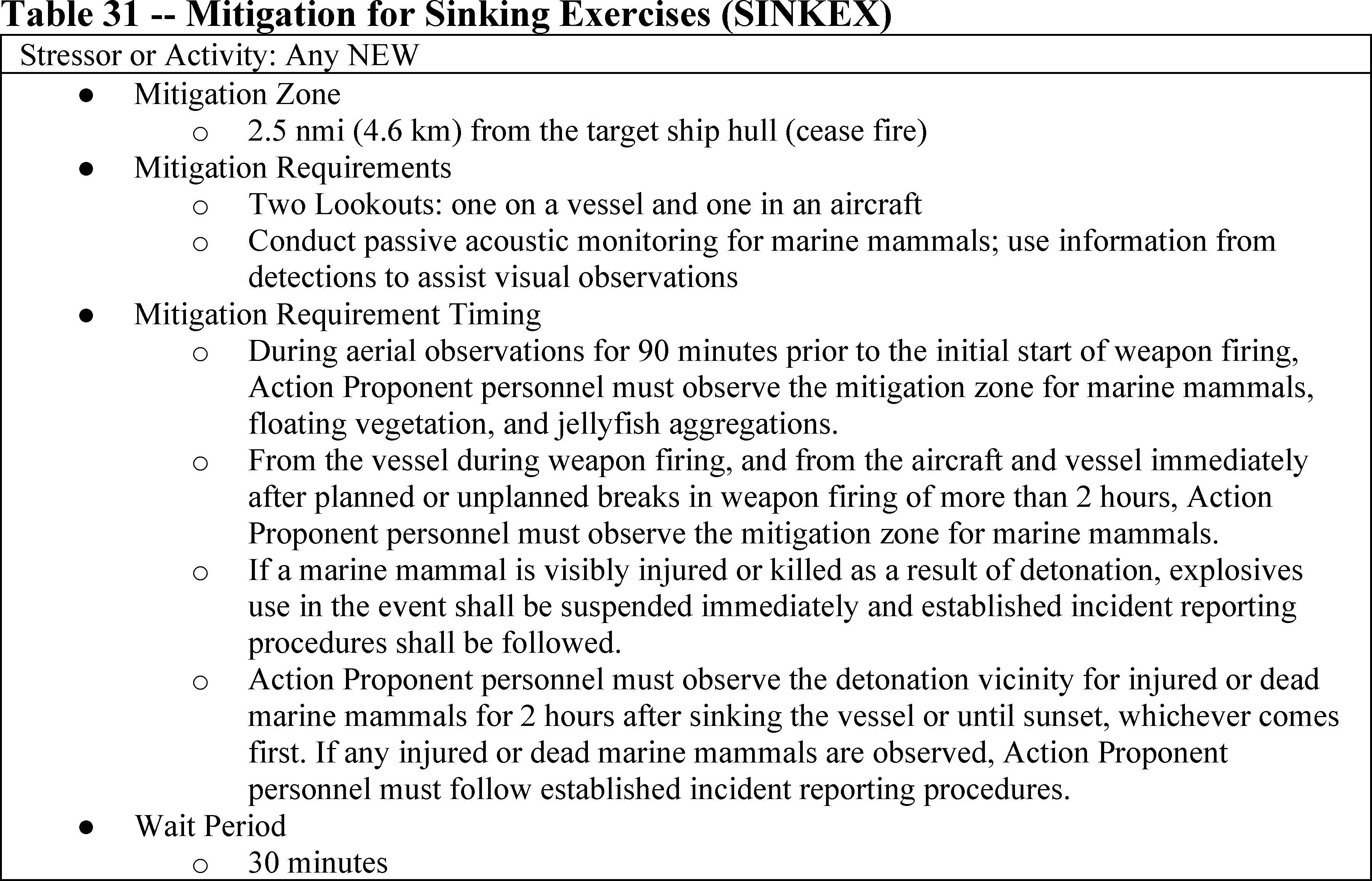
The Commission strongly recommended that NMFS require the Navy to use passive acoustic monitoring (PAM) prior to and during activities involving ship shock trials in the final rule, consistent with explosive sonobuoys, explosive torpedoes, and sinking exercises. The Commission notes that since mission effectiveness would not be impacted, the measures are considered practicable, and their implementation would reduce the potential for the most lethal marine mammal impacts.
Response:
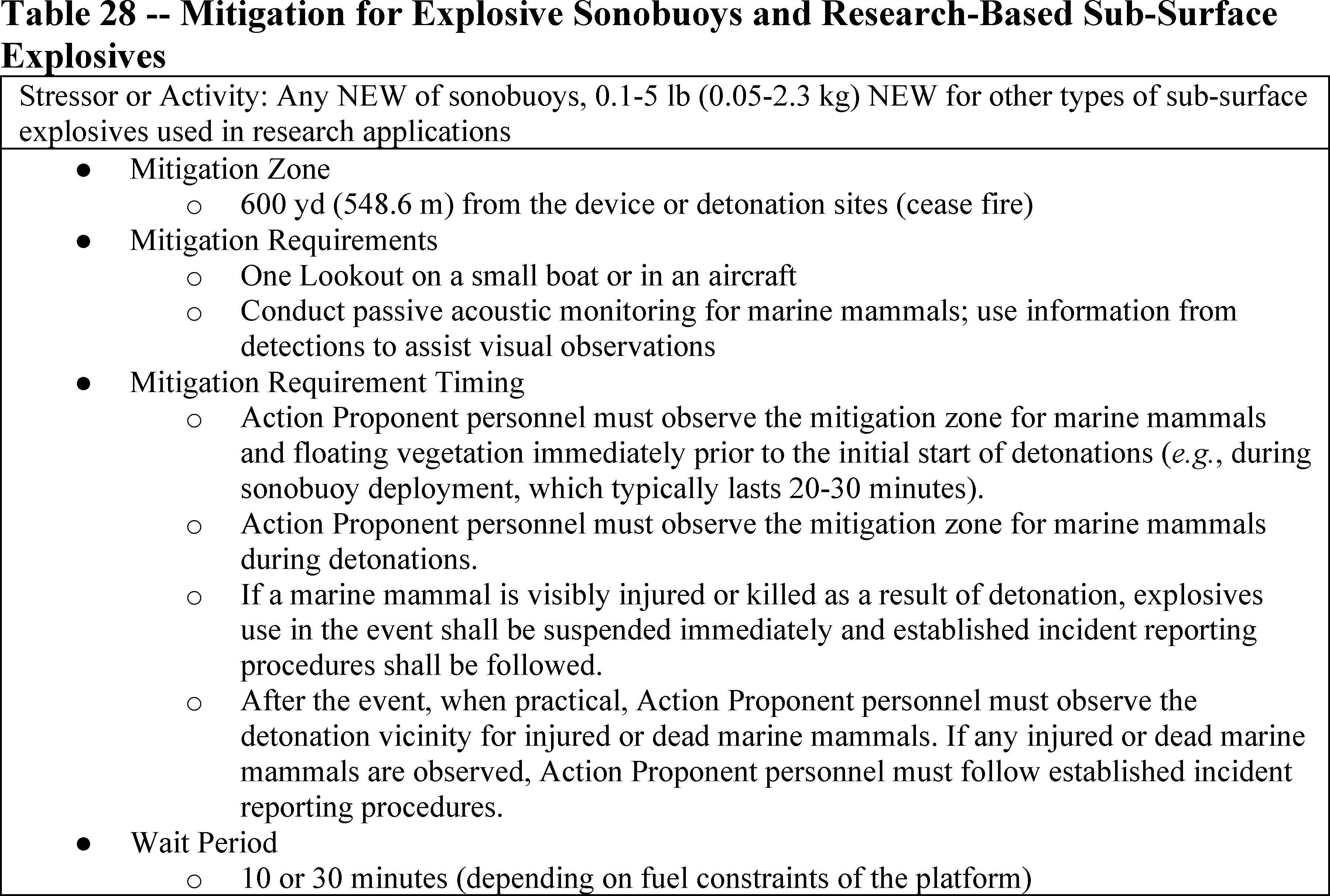
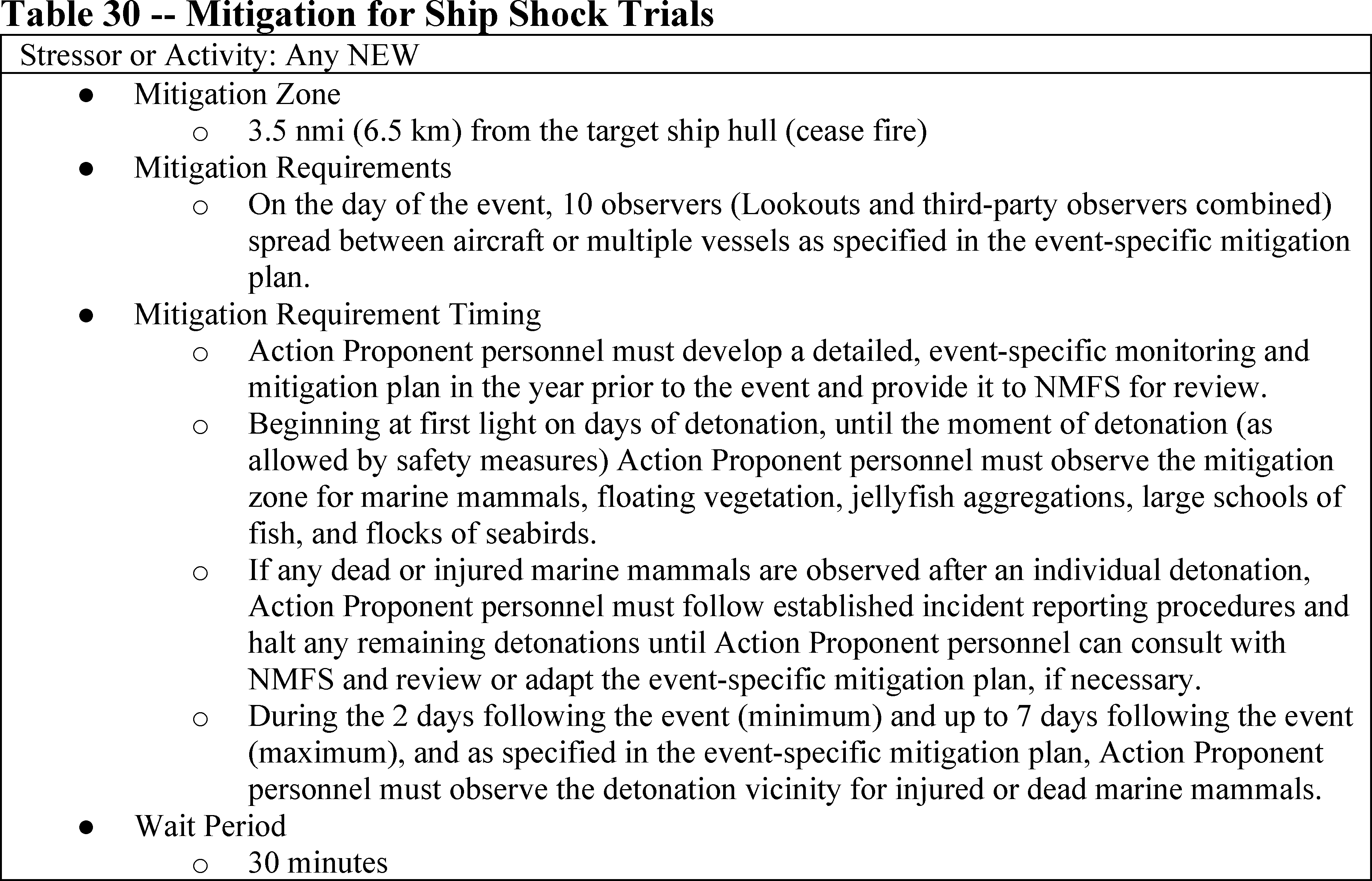
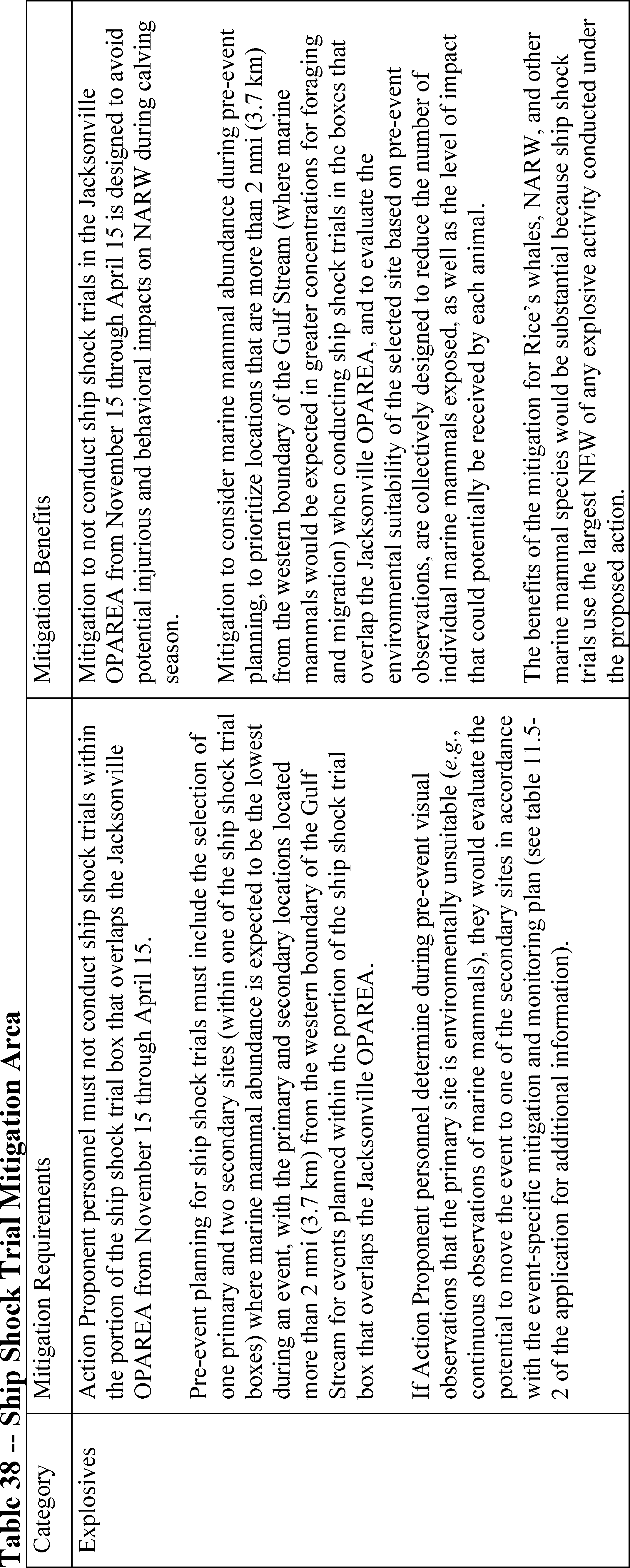
As detailed in table 38, the time and location of ship shock trials are chosen specifically to avoid impacts to large whales and, further, Naval Sea Systems Command (NAVSEA) will develop an extensive mitigation plan for NMFS review and concurrence prior to a ship shock trial. While use of sonobuoys would not affect the ship shock trial, PAM from a 2001 ship shock trial for the Churchill full ship shock trial indicated limited efficacy of the PAM (Clarke and Norman, 2005). As such, and given the significant expense associated with implementing PAM for ship shock trials, NMFS is not requiring the Navy to conduct PAM prior to and during ship shock trials.
Comment 16:
The Commission strongly recommended that NMFS require the Navy to use passive acoustic devices (
i.e.,
directional frequency analysis and recording (DIFAR) and other types of passive sonobuoys, operational hydrophones) prior to explosive bombing exercises and air-to-surface and surface-to-surface explosive missile and rocket exercises to detect marine mammals and implement the necessary mitigation measures in the final rule.
Response:
The Navy employs PAM to supplement visual monitoring when practicable to do so (
i.e.,
when assets that have PAM capabilities are already participating in the activity). For explosive events in which there are no platforms participating that have PAM capabilities, adding PAM capability for mitigation, either by adding a PAM device (
e.g.,
hydrophone) to a platform already participating in the activity or by adding a platform with integrated PAM capabilities to the activity (
e.g.,
a sonobuoy), is not practicable.
The type of aircraft that conduct these bombing, missile, and rocket exercises do not have the capability to deploy and employ sonobuoys. The Action Proponents state that diverting platforms that have PAM capabilities would impact their ability to meet their Title 10 requirements and reduce the service life of those systems. The Action Proponents additionally state that there are significant manpower and logistical constraints that make constructing and maintaining additional PAM systems or platforms for additional training and testing activities impracticable. Given the impracticality of such a measure, NMFS has found that this measure is not warranted, and it is not required in this final rule.
Comment 17:
The Commission recommended that NMFS prohibit detonation of explosive sonobuoys within 3 nmi (5.6 km) of the Southeast North Atlantic Right Whale Mitigation Area from 15 November through 15 April and the Rice's Whale Mitigation Area year-round in the final rule consistent with the Northeast North Atlantic Right Whale Mitigation Area.
Response:
NMFS concurs with the Commission's recommendation, and the Action Proponents have indicated that such a measure is practicable. Therefore, this final rule includes requirements that prohibit detonation of explosive sonobuoys within 3 nmi (5.6 km) of the Southeast North Atlantic Right Whale Mitigation Area from 15 November through 15 April and in the Rice's Whale Mitigation Area year-round.
Comment 18:
The Commission recommended that NMFS require the Navy to use its instrumented ranges and sonobuoys to localize marine mammals and implement the relevant mitigation measures during active acoustic events and to take a harder look at the technologies that the Canadian Department of National Defense (DND) uses during its at-sea activities and incorporate those technologies accordingly for other Phase IV LOA applications. The Commission cites the Lookout Effectiveness Study (Oedekoven and Thomas, 2022) in support of its recommendation. In a related comment, a commenter stated that to maximize the probability of detecting one or more North Atlantic right whales (NARWs) and further reduce risk to the species, the Action Proponents should use both visual observations and passive acoustic detections to inform mitigation decisions and raise the awareness of Lookouts.
Response:
The Action Proponents intend to continue to use PAM prior to activities involving explosive sonobuoys and explosive torpedoes, and during sinking exercises (SINKEX). During the use of active acoustics, Navy assets with
( printed page 50515)
PAM capabilities (
e.g.,
sonobuoys) that are already participating in an activity will continue to monitor for marine mammals, as described in section 5.6 (Activity-based Mitigations) of the 2025 AFTT Supplemental EIS/OEIS. However, the fluidity and nature of military readiness activities (
e.g.,
fast-paced and mobile readiness evolutions), as well as the limitations of these monitoring capabilities, make it impractical for passive acoustic devices to be used as precise real-time indicators of marine mammal location for mitigation (
e.g.,
active sonar power downs or shutdowns, ceasing use of explosives) without an accompanying visual sighting. While we acknowledge that the Lookout Effectiveness Study suggests that detection of marine mammals is less certain than previously assumed at certain distances, we disagree with the assertion that the use of Lookouts has been shown to be wholly ineffective. Lookouts remain an important component of the Action Proponents' mitigation strategy, especially as it relates to minimizing exposure to the more harmful impacts that may occur within closer proximity to the source, where Lookouts are most effective. Further, this final rule requires that in the Northeast North Atlantic Right Whale Mitigation Area and the Dynamic North Atlantic Right Whale Mitigation Area, the Action Proponents must provide the WhaleMap web address (
https://whalemap.org) and advise that risk of whale strike is increased: (1) after observing a NARW; (2) when operating within 5 nmi (9.3 km) of a known sighting reported within the past 24 hours; (3) within a NMFS-designated Seasonal Management Area, Dynamic Management Area, or Slow Zone; and (4) when transiting at night or during periods of reduced visibility. This final rule also requires that sightings data must be used when planning propulsion testing event details (
e.g.,
timing, location, duration) in the Dynamic North Atlantic Right Whale Mitigation Area to minimize impacts to NARW to the maximum extent practical, and during propulsion testing, to the maximum extent practical, Lookouts must be provided recent WhaleMap (
https://whalemap.org/) sightings data to help inform visual observations. Last, in the Northeast North Atlantic Right Whale Mitigation Area, the Action Proponents must conduct a web query or email inquiry to the North Atlantic Right Whale Sighting Advisory System or WhaleMap (
https://whalemap.org/) to obtain the latest NARW sightings data prior to transiting the mitigation area. The Action Proponents must provide the sightings data to Lookouts prior to them standing watch. Lookouts must use that data to help inform visual observations during vessel transits.
In the AFTT Study Area, a small subset of Navy training and testing takes place on the only instrumented range within the study area. The Navy's instrumented ranges do not have the capabilities to be used effectively for mitigation (see section 5.5.3 (Active and Passive Acoustic Monitoring Devices) of the 2018 AFTT EIS/OEIS). As such, NMFS disagrees with the Commission's assertion that real time localization of marine mammals using the Navy's instrumented ranges and sonobuoys is an appropriate requirement, beyond what the Action Proponents are currently doing.
The Action Proponents and NMFS have considered and will continue to study the Canadian DND project, including the technologies used during at-sea activities; however, NMFS disagrees that such a requirement is warranted in this final rule. As more information from the Canadian DND project becomes available, the Action Proponents and NMFS may reconsider whether additional requirements are needed.
Comment 19:
The Commission recommends that the NMFS final rule require the Action Proponents to follow established incident reporting procedures and halt any active acoustic, explosive, pile-driving, or air gun activity if a marine mammal is injured or killed during or immediately after the activity and require the Action Proponents to consult with NMFS to review or adapt the mitigation measures, as necessary.
Response:
The proposed rule and this final rule include a requirement for the Action Proponents to follow established incident reporting procedures if the specified activity is thought to have resulted in the mortality or serious injury of any marine mammals, as recommended by the Commission as outlined in the Notification and Reporting Plan. Note that the Notification and Reporting Plan also requires the Action Proponents to follow established incident reporting protocols for cetacean live strandings. Regarding the Commission's recommendation to require that the Action Proponents halt any active acoustic, explosive, pile driving, or air gun activity if a marine mammal is injured or killed during or immediately after the activity, and require the Action Proponents to consult with NMFS to review or adapt the mitigation measures, as necessary, NMFS agrees with the recommendation to suspend the use of explosives in an event if a marine mammal is injured or killed during or immediately after the activity. Neither NMFS nor the Action Proponents anticipate serious injury or mortality from any activity other than the use of explosives or vessel movement. For all activities involving explosives, the final rule expressly requires that, if a marine mammal is visibly injured or killed as a result of detonation, use of explosives in the event must be suspended immediately (see Mitigation Measures section). While similar language is not included for active acoustics, pile driving, and air gun activity, the proposed rule and this final rule require the Action Proponents to power down or shut down these sources if a marine mammal is observed within the applicable mitigation zone. The Action Proponents will also continue to follow incident reporting procedures (including for vessel strike, should it occur) and consult with NMFS to review or adapt the mitigation measures, as necessary, through the adaptive management process.
Comment 20:
The Commission recommended that NMFS—
Clearly separate its application of the least practicable adverse impact requirement from its negligible impact determination;
Adopt a clear decision-making framework that recognizes the species and stock component and the marine mammal habitat component of the least practicable adverse impact provision and always consider whether there are potentially adverse impacts on marine mammal habitat and whether it is practicable to minimize them;
Rework its evaluation criteria for applying the least practicable adverse impact standard to separate the factors used to determine whether a potential impact on marine mammals or their habitat is adverse and whether possible mitigation measures would be effective;
Address these concerns by adopting a simple, two-step analysis that more closely tracks the statutory provisions being implemented and, if NMFS is using some other legal standard to implement the least practicable adverse impact requirements, provide a clear and concise description of that standard and explain why it believes it to be “sufficient” to meet the statutory legal requirements; and
Apply these basic steps and criteria consistently for least practicable adverse impact determinations across incidental take authorizations.
The Commission references previous letters in which it has included its
( printed page 50516)
complete rationale for these recommendations.
Response:
NMFS has made clear in this and other rules that the agency separates its application of the least practicable adverse impact requirement in the Mitigation Measures section from its negligible impact analyses and determinations for each species or stock in the Analysis and Negligible Impact Determination section. Further, NMFS has made this separation clear in practice for years by requiring mitigation measures to reduce impacts to marine mammal species and stocks and their habitat for all projects, even those for which the anticipated take would clearly have a negligible impact, even in the absence of mitigation.
In the Mitigation Measures section of this rule, NMFS has explained in detail our interpretation of the least practicable adverse impact standard, the rationale for our interpretation, and how we implement the standard. The method the agency uses addresses all of the necessary components of the standard and produces effective mitigation measures that result in the least practicable adverse impact on both the species or stocks and their habitat. The commenter has failed to illustrate why NMFS' approach is inadequate or why the commenter's proposed approach would be better, and we therefore decline to accept the recommendation.
Also in the Mitigation Measures section, NMFS has explained in detail our application of the least practicable adverse impact standard. The commenter has recommended an alternate way of interpreting and implementing the least practicable adverse impact standard, in which NMFS would consider the effectiveness of a measure in our evaluation of its practicability. The commenter erroneously asserts that NMFS currently considers the effectiveness of a measure in a determination of whether the potential effects of an activity are adverse, but the commenter has misunderstood NMFS' application of the standard—rather, NMFS appropriately considers the effectiveness of a measure in the evaluation of the degree to which a measure will reduce adverse impacts on marine mammal species or stocks and their habitat, as a less effective measure will less successfully reduce these impacts on marine mammals. Further, the commenter has not provided information that shows that their proposed approach would more successfully evaluate mitigation under the least practicable adverse impact standard, and we decline to accept it.
Further, NMFS disagrees with the commenter's assertion that analysis of the rule's mitigation measures under the least practicable adverse impact standard remains unclear or that the suggested shortcomings exist. The commenter provides no rationale as to why the two-step process they describe is better than the process that NMFS uses to evaluate the least practicable adverse impact that is described in the rule, and therefore we decline to accept the recommendation.
Regarding the assertion that the standard shifts on a case-by-case basis, the commenter misunderstands NMFS' process. Neither the least practicable adverse impact standard nor NMFS' process for evaluating it shifts on a case-by-case basis. Rather, as the commenter suggests should be the case, the evaluation itself is case-specific to the proposed activity, the predicted impacts, and the mitigation under consideration.
Regarding the recommendation to apply the recommended steps and criteria for least practicable adverse impact determinations across incidental take authorizations, as outlined above, NMFS disagrees with these recommendations and therefore does not intend to apply them across incidental take authorizations.
Comment 21:
A commenter stated that to adequately protect NARW, the boundaries of the Southeast North Atlantic Right Whale Mitigation Area, and its requirements, should be extended north to Cape Fear, North Carolina. The commenter said this extension would limit the use of active sonar, prohibit in-water explosives and non-explosive ordnance, and impose several measures to reduce the risk of vessel strike in the entirety of the species' calving habitat from November 15 to April 15, reflecting the duration of the calving season.
Response:
Expansion of the Southeast North Atlantic Right Whale Mitigation Area northward to encompass all areas of potential occurrence would require training activities to move farther north or farther out to sea, which the Action Proponents indicate is impracticable due to implications for safety and sustainability, as detailed in section 5.4.3 (Mitigation Areas off the Mid-Atlantic and Southeastern United States) of the 2018 AFTT Final EIS/OEIS. Additionally, that section explains why further limitations on activities, including limitations on active sonar, in-water explosives and non-explosive ordnance, and imposition of additional measures to reduce the risk of vessel strike, within this area would be impracticable. NMFS reviewed and concurs with the Action Proponents' assessment of practicability, effects on mission effectiveness, and personnel safety, and as such, has not required expansion of the Southeast North Atlantic Right Whale Mitigation Area beyond that included in the proposed rule.
The best available density data for the AFTT Study Area shows that the Southeast North Atlantic Right Whale Mitigation Area encompasses the areas of highest density in the region (Roberts
et al.,
2023; U.S. Department of the Navy, 2025). Although NARW have been sighted on rare occasions east of the mitigation area, these animals were located outside of the higher use habitats that represent the primary occurrence of the population. Overall, most NARW sightings made during Navy and NMFS surveys have occurred in, or very close to, the Southeast North Atlantic Right Whale Mitigation Area, which further indicates that the mitigation area may have the highest seasonal abundance of NARW in waters off the mid-Atlantic and southeastern United States.
Though the spatial extent of the Southeast North Atlantic Right Whale Mitigation Area cannot be extended, this final rule includes additional mitigations in that area and in the Dynamic North Atlantic Right Whale Mitigation Area, which encompasses the U.S. Exclusive Economic Zone (EEZ) off the East Coast. In the Southeast North Atlantic Right Whale Mitigation Area, this final rule includes two new requirements. First, from November 15 to April 15, the Action Proponents must not detonate explosive sonobuoys within 3 nmi (5.6 km) of the Southeast North Atlantic Right Whale Mitigation Area. Second, during the same time period, the Action Proponents must not conduct vessel propulsion testing. In the Dynamic North Atlantic Right Whale Mitigation Area, in Protective Measures Assessment Protocol (PMAP)-generated reports, Action Proponents will provide the WhaleMap web address (
https://whalemap.org); advise that risk of whale strike is increased after observing a NARW; when operating within 5 nmi (9.3 km) of a known sighting reported within the past 24 hours; within a NMFS-designated Seasonal Management Area, Dynamic Management Area, or Slow Zone; and when transiting at night or during periods of reduced visibility; and reinforce the requirement of the International Regulations for Preventing Collisions at Sea (COLREGS) for vessels to proceed at a safe speed, appropriate to the prevailing circumstances and conditions, to avoid a collision with any
( printed page 50517)
sighted object or disturbance, including any marine mammal. Additionally, during propulsion testing in the mitigation area, to the maximum extent practical, Lookouts will be provided recent
https://www.whalemap.org
sightings data to help inform visual observations.
Further, this final rule requires that within the first year of AFTT Phase IV implementation, the Action Proponents must work collaboratively with the NMFS ESA Interagency Cooperation Division and the NMFS Permits and Conservation Division to: (1) analyze and discuss the application of new information from the NMFS North Atlantic Right Whale Persistence Modelling Efforts toward AFTT mitigation measures; (2) evaluate the practicability and conservation benefits of newly proposed mitigation measures and/or changes to existing measures based on information from the model; and (3) implement any new mitigation measures or changes to existing measures that meet the Action Proponents' Practicability Criteria and Sufficiently Beneficial requirements.
Comment 22:
The Commission stated that under the Gulf biological opinion (commonly referred to as BiOp) for oil and gas activities, the Bureau of Ocean Energy Management (BOEM) and the Bureau of Environmental Safety and Enforcement (BSEE) would be required to identify a near real-time platform (
e.g.,
WhaleAlert) to help oil- and gas-related vessels avoid strikes of Rice's whales. BOEM and BSEE, in collaboration with NMFS, also must work to ensure additional devices and near real-time detection data systems are integrated into the near real-time sightings platform to establish an integrated platform for all Rice's whale detections in the Gulf (
e.g.,
WhaleMap). The Commission recommends that NMFS require the Action Proponents to conduct a query of the aforementioned platform (
e.g.,
WhaleAlert, WhaleMap) that houses the Rice's whale sightings once it is established and prior to transiting the Rice's Whale Mitigation Area, provide those sightings data to the Lookouts prior to them standing watch, use the data to inform the Lookouts' visual observations during vessel transits, and implement speed reductions to 10 knots (kn) (18.5 km/hr) for surface ships transiting within 5 nmi (9.3 km) of a sighting reported in the platform within the previous 24 hours. Any modifications to the mitigation requirements for the Rice's Whale Mitigation Area can be addressed during the Navy's Annual Adaptive Management Meetings.
In a related comment, a commenter stated that protections must be afforded to Rice's whale throughout the entirety of their known habitat, and that NMFS and the Action Proponents should revise the boundaries of the Rice's Whale Mitigation Area westwards to include all U.S. waters between the 100-m and 400-m isobaths, to reflect best available scientific information on the species. The commenter also recommended that the requirements in the Rice's Whale Mitigation Area be expanded to include the following mitigation requirements that emulate a subset of those required for NARW in other proposed mitigation areas. The commenter stated that the recommendations account for the fact that an Early Warning System for Rice's whales does not yet exist. These include:
(1) Year-round within the mitigation area, surface ships must minimize transits and transit distances through Rice's whale habitat to the maximum extent practicable, and must implement speed reductions: (a) after they observe a Rice's whale, if they are within 5 nmi (9.3 km) of a sighting of a Rice's whale reported in the previous 12 hours, and (b) at minimum, at night and in restricted visibility; and
(2) The Action Proponents must provide Lookouts the sightings data prior to standing watch to help inform visual observations.
Response:
This rulemaking includes a Rice's Whale Mitigation Area that overlaps the Rice's whale small and resident population area identified by NMFS in its 2016 status review (Rosel
et al.,
2016) and most of the eastern portion of proposed critical habitat (88 FR 47453, July 24, 2023). Within this area, the Action Proponents must not use more than 200 hours of surface ship hull-mounted MFAS annually and must not detonate in-water explosives (including underwater explosives and explosives deployed against surface targets) except during mine warfare activities. Additionally, the Ship Shock Trial Mitigation Area would ensure that the northern Gulf of America ship shock trial box is situated outside of the Rice's whale core distribution area identified in 2019 (84 FR 15446, April 15, 2019). These restrictions will reduce the severity of impacts to Rice's whales by reducing their exposure to levels of sound from sonar or explosives that would have the potential to cause injury or mortality, thereby further supporting NMFS' determination that non-auditory injury and mortality are not expected to occur, reducing the likelihood of auditory injury, and, further, minimizing the severity of behavioral disturbance. Further, as described in the Changes from the Proposed Rule to the Final Rule section of this final rule, we have added three new measures in the Rice's Whale Mitigation Area since publication of the proposed rule. This final rule includes a requirement that the Action Proponents must not detonate explosive sonobuoys within 3 nmi (5.6 km) of the Rice's Whale Mitigation Area as well as two new measures to further reduce the risk of vessel strike of Rice's whale. The Action Proponents must avoid conducting vessel propulsion testing events in the Rice's Whale Mitigation Area to the maximum extent practical and the Action Proponents must issue an annual awareness message to Navy vessels that routinely train or test in the vicinity of the Rice's whale proposed critical habitat and Coast Guard vessels that routinely train anywhere in the Gulf of America.
While it is not practicable for the Action Proponents to issue speed restrictions (see section 5 (Mitigation Considered but Eliminated) of the 2025 AFTT SEIS/OEIS), as suggested by the commenter, this annual awareness message will advise that risk of whale strike is increased when transiting through Rice's whale proposed critical habitat (
i.e.,
within the 100 to 400 m isobaths), particularly at night or during periods of reduced visibility, and reinforce the requirement of the COLREGS (
https://www.imo.org/en/about/conventions/pages/colreg.aspx) for vessels to proceed at a safe speed, appropriate for the prevailing circumstances and conditions, to avoid a collision with any sighted object or disturbance, including any marine mammal.
Regarding the recommendation for surface ships to minimize transits and transit distances through Rice's whale habitat to the maximum extent practicable, Navy asserts that it does not have many training events in the area, and vessel traffic in the area is already limited. As such, transits through this area are already minimized, as recommended by the commenter.
Regarding the commenter's recommendation to revise the boundaries of the Rice's Whale Mitigation Area westwards to include all U.S. waters between the 100-m and 400-m isobaths, the majority of the Navy's activities do not occur within the central/western portion of Rice's whale habitat. The potential for impacts in that area is very low due to infrequent use of Navy surface ship hull-mounted MFAS or explosives in the central/western portion of the habitat. The Coast Guard does train in this area but
( printed page 50518)
their training activities do not include the use of sonar and other transducers or explosives (of note, the Coast Guard is not planning any testing activities as part of the specified activity in the AFTT Study Area). As such, the only applicable mitigation requirement for the waters west of the Rice's Whale Mitigation Area between the 100-m and 400-m isobaths is for the Action Proponents to issue an annual awareness message to Navy vessels that routinely train or test in the vicinity of the Rice's whale proposed critical habitat and for the Coast Guard to send the awareness messages required in the Rice's Whale Mitigation Area to all Coast Guard vessels that routinely train anywhere in the Gulf of America, and this final rule includes a requirement for the Action Proponents to do so.
Regarding the Commission's recommendation related to a future Rice's whale sightings platform (
e.g.,
WhaleAlert, WhaleMap), when such a platform is established, NMFS and the Action Proponents will evaluate its potential use for mitigating potential impacts to Rice's whale, including providing sightings data to the Lookouts prior to them standing watch, use of the data to inform the Lookouts' visual observations during vessel transits, and potential speed restrictions in a defined time and area relative to sightings. In the public comment related to the Commission's, the commenter stated that its recommendations account for the fact that an Early Warning System for Rice's whale does not yet exist, but it is unclear what the commenter is referring to regarding providing Lookouts the sightings data prior to standing watch to help inform visual observations absent a sighting platform such as WhaleMap, and as such, this final rule does not incorporate this recommendation.
Comment 23:
A commenter stated that while it provisionally supports aspects of the proposed rule, the least practicable adverse impact standard has not yet been met. The commenter provided specific mitigation recommendations in support of their assertion.
Response:
NMFS has described our well-reasoned process for identifying the measures needed to meet the least practicable adverse impact standard in the Mitigation Measures section in this rule, and we have followed the approach described there when analyzing potential mitigation for the Action Proponents' activities in the AFTT Study Area. Responses to specific recommendations for mitigation measures provided by the commenters are discussed separately.
Comment 24:
A commenter recommended that NMFS incorporate new scientific information into design of its mitigation areas, specifically referencing Houser
et al.
(2024) and Southall
et al.
(2024). The commenter recommended that NMFS use the data to inform which types of acoustic sources to limit in mitigation areas important to particular species, and the size of the stand-off distances to apply to those areas.
Response:
The mitigation measures in this rule are informed by multiple factors, including the sensitivity of certain hearing groups to certain sound sources (informed by the Phase IV criteria and thresholds) and vulnerability to other threats (
e.g.,
vessel strike). The Phase IV criteria and thresholds incorporate data from Houser
et al.
(2024), and as such, the mitigation areas in the proposed rule and final rule inherently consider those data. While the Phase IV criteria and thresholds do not incorporate data from Southall
et al.
(2024), they include delphinid response data from other studies, and the potential responses observed in Southall
et al.
(2024) occurred at received levels and distances assessed for potentially significant behavioral responses in the AFTT analysis. The commenter did not provide specific mitigation recommendations that may stem from the publications they reference. However, NMFS has responded to other mitigation recommendations from the commenter in separate responses herein and has explained that it has determined that the Action Proponents' planned mitigation measures would effect the least practicable adverse impact on the affected species and their habitat.
Comment 25:
A commenter stated that the proposed measure to minimize the use of helicopter dipping sonar to the maximum extent practicable in the Southeast North Atlantic Right Whale Mitigation Area is a step toward mitigation of impacts from dipping sonar. However, the commenter states that the available scientific evidence on the impacts of dipping sonar on deep-dive rates in beaked whales (family Ziphiidae), indicates that management of this acoustic source should be expanded, including to areas within the AFTT Study Area representing important habitat for beaked whale populations.
Response:
As stated in the Analysis and Negligible Impact Determination section of the proposed rule and this final rule, there are no known BIAs for beaked whales in the AFTT Study Area, though these stocks generally occur in higher densities year-round in deep waters over the Atlantic continental shelf margins. The Western North Atlantic stocks of goose-beaked whales and Blainville's beaked whales generally congregate over continental shelf margins from Canada to North Carolina, with goose-beaked whales reported as far south as the Caribbean and Blainville's beaked whales as far south as the Bahamas. The Western North Atlantic stock of Gervais' beaked whales generally congregate over continental shelf margins from New York to North Carolina. The Western North Atlantic stock of Sowerby's beaked whales is the most northerly distributed stock of deep-diving mesoplodonts, and they generally congregate over continental shelf margins from Labrador to Massachusetts. The Western North Atlantic stock of True's beaked whales generally congregate over continental shelf margins from Nova Scotia to Cape Hatteras, with northern occurrence likely relating to the Gulf Stream. The Western North Atlantic stock of northern bottlenose whales is uncommon in U.S. waters and generally congregates in areas of high relief, including shelf breaks and submarine canyons from the Davis Strait to New England, although strandings have occurred as far south as North Carolina.
The commenter provided a general recommendation for expansion of dipping sonar mitigation in important habitat for beaked whales but did not specify particular areas or beaked whale species to prioritize for such mitigation. As noted above, while beaked whales generally occur in higher densities year-round in deep waters over the Atlantic continental shelf margins, the latitudinal ranges vary depending on the species. If the entire shelf break were considered important habitat for beaked whales, that would limit the bathymetric scope of areas available for the training and testing of dipping sonar and would not be practical.
As the commenter notes, the proposed rule and this final rule include a Southeast North Atlantic Right Whale Mitigation Area in which the Action Proponents must minimize the use of helicopter dipping sonar to the maximum extent practical. This measure would benefit the Western North Atlantic stocks of goose-beaked whales and Blainville's beaked whales in the most southern portion of their range. The proposed rule and this final rule also include Major Training Exercise Planning Awareness Mitigation Areas across multiple areas along the Atlantic continental shelf break in which the Action Proponents must either limit major training exercises
( printed page 50519)
(MTEs) or not conduct MTEs. These restrictions would benefit multiple beaked whale species, and would inherently limit or prohibit dipping sonar, as the majority of dipping sonar used during training activities in the mid-Atlantic is used during MTEs (unit-level training mostly occurs in the Jacksonville Operating Area (OPAREA)). Also of note, the Action Proponents already do not conduct much sonar in some beaked whale habitats, such as the Cape Hatteras area where goose-beaked whales are known to occur. This location was chosen for the Atlantic BRS on beaked whales specifically because those beaked whales are not frequently exposed to mid-frequency active sonar. Additional restrictions on the use of dipping sonar in the Atlantic is not practicable, and as such, is not required by this final rule.
Comment 26:
A commenter stated that, to reflect the best available scientific information and achieve the least practicable adverse impact to NARW, the boundaries of the Northeast North Atlantic Right Whale Mitigation Area should be extended to include the established foraging habitat south of Martha's Vineyard and Nantucket, Massachusetts.
Response:
NMFS concurs with the commenter that additional mitigation is warranted in the NARW feeding area south of Martha's Vineyard and Nantucket. As such, this final rule includes a new Martha's Vineyard North Atlantic Right Whale Mitigation Area in which the Action Proponents must avoid conducting vessel propulsion testing events to the maximum extent practical. In addition to the new Martha's Vineyard North Atlantic Right Whale Mitigation Area, this final rule includes multiple new mitigation measures for NARW, as described in response to
Comment 21,
including new measures in the Dynamic North Atlantic Right Whale Mitigation Area, which overlaps the new Martha's Vineyard North Atlantic Right Whale Mitigation Area. In this area, the Action Proponents will provide North Atlantic Right Whale Dynamic Management Area information (
e.g.,
location and dates) to applicable assets transiting and training or testing in the vicinity of the Dynamic Management Area. Further, in PMAP reports generated in the Dynamic North Atlantic Right Whale Mitigation Area, Action Proponents will provide the WhaleMap web address (
https://www.whalemap.org), advise situations in which risk of vessel strike is increased, and reinforce the requirement for vessels to proceed at a safe speed. Additional details on the above can be found in the response to
Comment 21.
Additionally, in the Dynamic North Atlantic Right Whale Mitigation Area, during propulsion testing in the mitigation area, to the maximum extent practical, Lookouts will be provided recent
https://www.whalemap.org
sightings data to help inform visual observations. Further, the Action Proponents follow NARW sighting and avoidance measures regardless of location, including one or more Lookouts on manned underway surface vessels in accordance with the most recent navigation safety instruction and underway manned surface vessels maneuver themselves (which may include reducing speed) to maintain 500 yd (457.2 m) distance from whales, as mission and circumstances allow.
Within the northeast portion of the Study Area, the Northeast North Atlantic Right Whale Mitigation Area represents the largest area that is practical for the Navy to implement that full suite of mitigation. As such, this final rule does not require that the Action Proponents extend the boundary of the Northeast North Atlantic Right Whale Mitigation Area (and the mitigation required in that area) south of Martha's Vineyard and Nantucket for the reasons described below. Expanding the full suite of mitigation measures of the Northeast North Atlantic Right Whale Mitigation Area to the area south of Nantucket and Martha's Vineyard would encroach upon the primary water space where training and testing activities are planned to occur. Such modifications of training and testing activities would have a significant impact on safety, sustainability, and the Navy's ability to meet its mission requirements.
The Navy does not typically schedule MTEs in the Northeast Range Complexes, though MTEs originally planned for other locations may have to change during an exercise, or in exercise planning, based on an assessment of the performance of the units, or due to other conditions such as weather and mechanical issues. These contingency requirements preclude the Navy from completely eliminating MTEs from occurring in this area. For training and testing that does occur here, this area provides a wide range of bathymetric and topographic opportunities that support critical smaller scale training and testing necessary to meet mission requirements.
The area is important to the Navy's acoustic and oceanographic research. Specifically, having access to waterspace within 20 nmi (37 km) of Woods Hole Oceanographic Institute and in the vicinity of the New England Mud Patch is important to these research activities. Restricting the area would result in a reduced ability to conduct accurate oceanographic or acoustic research to meet research objectives, validate acoustic models, and conduct accurate engineering tests of acoustic sources, signal processing algorithms, and acoustic interactions.
Additionally, NAVSEA needs full access and flexibility to conduct testing in this area. Testing locations are typically located near systems command support facilities, which provide critical safety, platform, and infrastructure support and technical expertise necessary to conduct testing. Restricting the area would result in: (1) reduced ability to ensure the safety, functionality, and accuracy of systems, platforms, and components through maintenance, repairs, or testing prior to use at sea as needed or required by acquisition milestones, and (2) reduced ability to effectively test systems, platforms, and components before full-scale production or delivery in order to validate whether they perform as expected and determine whether they are operationally effective, suitable, survivable, and safe for their intended use by the fleet.
Comment 27:
A commenter recommended further research and exploration of the feasibility of signal modification, including converting upsweeps to downsweeps, reducing the level of the side bands, or lengthening the rise time. The 2024 AFTT Draft Supplemental EIS/OEIS considered, but rejected, modification of active sonar sources for training as part of a potential mitigation measure (“26. Reducing annual active sonar hours, replacing active sonar, with passive sonar or modifying active sonar sources for training”), deeming it impractical for achieving the mission. The commenter stated that the rationale provided in the 2024 AFTT Draft Supplemental EIS/OEIS does not clearly justify why signal modifications alone would be impractical. The commenter states that some of those modifications, such as converting up-sweeps to down-sweeps, would not alter the system's spectral output in any way. The commenter stated that it believes source modification requires greater validation across species and in more behavioral contexts before any decisions are made to alter signals—but, given the preliminary data, and given the potential of this measure to reduce the instances and severity of behavioral harassment, it urges NMFS to require or otherwise stimulate investigation of this potentially significant mitigation measure and provide a schedule for completion.
( printed page 50520)
Another commenter stated that NMFS and Navy should prioritize identifying and implementing alternative training methods, technologies, and locations that do not place vulnerable marine life at such extreme risk, stating that this would not only fulfill legal obligations, but also demonstrate a commitment to sustainable stewardship of our ocean ecosystems.
Response:
Active sonar signals are designed explicitly to provide optimum performance at detecting underwater objects (
e.g.,
submarines) in a variety of acoustic environments. The Action Proponents train with various active sonar signals, including up-sweeps and down-sweeps, to accurately replicate operational scenarios. Reducing training realism by restricting the signal used would ultimately prevent units from deploying with the required level of readiness necessary to accomplish their missions and impede the Action Proponents' ability to certify forces to deploy to meet national security tasking. Likewise, testing program requirements include test parameters designed to accurately determine whether a system is meeting its operational and performance requirements. Reducing realism by restricting the signal used would impact the ability of researchers, program managers, and weapons system acquisition programs to effectively test systems and platforms (and components of these systems and platforms) before full-scale production or delivery to the fleet. For these reasons, the Navy has determined, and NMFS concurs, that modifying or limiting the sonar signal as mitigation is impractical to implement as it would result in degraded realism of training and testing.
NMFS and the Navy will explore whether future studies on the efficacy and practicality of signal modification are appropriate in consideration of other ongoing research efforts, including some recommended by the commenter (
e.g.,
thermal detection). However, at this time, given the numerous other research priorities and established impracticality, NMFS is not requiring the Action Proponents to investigate the efficacy of signal modification.
Comment 28:
The Commission recommended that NMFS require Action Proponents' surface ships to maintain a speed of no more than 10 kn (18.5 km/hr) during transits when a NARW is observed, if the vessels are within 5 nmi (9.3 km) of a reported sighting, at night, and during periods of reduced visibility in the Northeast North Atlantic Right Whale Mitigation Area year-round and the Southeast North Atlantic Right Whale Mitigation Area from November 15 to April 15. The Commission also recommended that NMFS require Action Proponents' surface ships to maintain a speed of no more than 10 kn (18.5 km/hr) during transits when a Rice's whale is observed, at night, and during periods of reduced visibility in the Rice's Whale Mitigation Area year-round.
In a related comment, a commenter stated that according to the current vessel speed rule that was put into place to protect NARWs, military vessels are exempt from the speed restrictions. The commenter states that increasing naval vessel traffic in these same regions, especially when military vessels are exempt from civilian speed restrictions, will only heighten the risk of fatal interactions.
Response:
The proposed rule included multiple requirements to minimize the risk of vessel strike to NARW and Rice's whales, including a requirement within the Northeast North Atlantic Right Whale Mitigation Area requiring surface ships to implement speed reductions after observing a NARW, if transiting within 5 nmi (9.3 km) of a sighting reported to the North Atlantic Right Whale Sighting Advisory System within the past week, and when transiting at night or during periods of reduced visibility. It also included a requirement in the Southeast North Atlantic Right Whale Mitigation Area that from November 15 to April 15 requiring surface ships to minimize north-south transits to the maximum extent practical, and implement speed reductions after they observe a NARW, if they are within 5 nmi (9.3 km) of an Early Warning System sighting reported within the past 12 hours, and at night and in poor visibility. This final rule includes several additional measures to reduce the risk of vessel strike, as described below.
Within the Southeast North Atlantic Right Whale Mitigation Area, from November 15 to April 15, the Action Proponents must not conduct vessel propulsion testing. Further, this final rule includes a new Martha's Vineyard North Atlantic Right Whale Mitigation Area in which the Action Proponents must avoid conducting vessel propulsion testing events to the maximum extent practical. Additionally, in the Dynamic North Atlantic Right Whale Mitigation Area, the extent of which matches the boundary of the U.S. EEZ on the East Coast, the Action Proponents must provide North Atlantic Right Whale Dynamic Management Area information (
e.g.,
location and dates) to applicable assets transiting and training or testing in the vicinity of the Dynamic Management Area. The information must alert assets (and their Lookouts) to the possible presence of NARW in their vicinity. Lookouts must use the information to help inform visual observations during military readiness activities that involve vessel movements, active sonar, in-water explosives (including underwater explosives and explosives deployed against surface targets), or non-explosive ordnance deployed against surface targets in the mitigation area.
In PMAP reports generated in the Dynamic North Atlantic Right Whale Mitigation Area, this final rule requires that Action Proponents must provide the WhaleMap web address (
https://whalemap.org) and advise that risk of whale strike is increased after: (1) observing a NARW; (2) when operating within 5 nmi (6.5 km) of a known sighting reported within the past 24 hours; (3) within a NMFS-designated Seasonal Management Area, Dynamic Management Area, or Slow Zone; and (4) when transiting at night or during periods of reduced visibility. The PMAP report must also reinforce the requirement of the COLREGS for vessels to proceed at a safe speed, appropriate for the prevailing circumstances and conditions, to avoid a collision with any sighted object or disturbance, including any marine mammal. Additionally, this final rule requires that during propulsion testing in the Dynamic North Atlantic Right Whale Mitigation Area, to the maximum extent practical, Lookouts must be provided recent
https://whalemap.org
sightings data to help inform visual observations.
This final rule also requires that within the first year of AFTT Phase IV implementation, the Action Proponents must work collaboratively with the NMFS ESA Interagency Cooperation Division and the NMFS Permits and Conservation Division to: (1) analyze and discuss the application of new information from the NMFS North Atlantic Right Whale Persistence Modelling Efforts toward AFTT mitigation measures; (2) evaluate the practicability and conservation benefits of newly proposed mitigation measures and/or changes to existing measures based on information from the model; and (3) implement any new mitigation measures or changes to existing measures that meet the Action Proponents' Practicability Criteria and Sufficiently Beneficial requirements.
This final rule also includes two new measures to reduce the risk of vessel strike of Rice's whale. The Action Proponents must avoid conducting vessel propulsion testing events in the Rice's Whale Mitigation Area, to the maximum extent practical. The Action
( printed page 50521)
Proponents must also issue an annual awareness message to Navy and Coast Guard vessels that routinely train or test in the vicinity of the proposed Rice's whale proposed critical habitat. The message will advise that risk of whale strike is increased when transiting through proposed Rice's whale proposed critical habitat (
i.e.,
within the 100-400 m isobaths), particularly at night or during periods of reduced visibility, and reinforce the requirement of the COLREGS for vessels to proceed at a safe speed, appropriate for the prevailing circumstances and conditions, to avoid a collision with any sighted object or disturbance, including any marine mammal.
The Action Proponents require flexibility in use of variable ship speeds for training, testing, operational, safety, and engineering qualification requirements. Action Proponent vessels typically use the lowest speed practical given individual mission needs. NMFS has reviewed the analysis of these additional suggested restrictions and the impacts they would have on military readiness and concurs with the Navy's assessment that they are impracticable (see section 5.3.4.1 Vessel Movement and section 5.5 Measures Considered but Eliminated in the 2020 NWTT FSEIS/OEIS). Therefore, the Action Proponents are already planning to engage in the lowest practicable speed in biologically important habitats, including in designated critical habitat for NARW and proposed critical habitat for Rice's whales and other biologically important habitat for vulnerable species, as well as in all mitigation areas and other areas. As such, additional restrictions on vessel speed are not practicable and therefore, are not required.
The commenter did not provide a citation for the statement that naval vessel traffic is increasing in the AFTT Study Area. The Navy states that there has not been an increase in vessel traffic related to AFTT activities since the 2018 analysis. Rather, there has been a decrease in most areas and a decrease in the AFTT Study Area as a whole (see table 3.0-9 of the 2025 AFTT Supplemental EIS/OEIS).
Comment 29:
A commenter asserted that mitigation measures based on visual observation (
i.e.,
by Lookouts), such as safety zone maintenance, results in highly limited risk reduction for most species and under most conditions. The commenter stated that NMFS should require infrared and thermal detection technologies as alternative detection measures for mitigation and monitoring, stating that these technologies have achieved a readiness level that is capable of supporting monitoring and mitigation during Phase IV military readiness activities.
Response:
Lookouts remain an important component of the Action Proponents' mitigation strategy, especially as it relates to minimizing exposure to the more harmful impacts that may occur within closer proximity to the source, where Lookouts are most effective. As stated by the commenter, thermal detection technologies have advanced in recent years. However, significant limitations still exist, and the technology has not yet reached the level of performance needed for deployment during military readiness activities for mitigation uses. Current technologies are limited by: (1) low sensor resolution and a narrow field of view; (2) reduced performance in certain environmental conditions; and (3) high cost and uncertain long-term reliability.
Thermal detection systems are more useful for detecting marine mammals in some marine environments than others. Current technologies have limitations regarding water temperature and survey conditions (
e.g.,
rain, fog, sea state, glare, ambient brightness), for which further effectiveness studies are required. Thermal detection systems are generally thought to be most effective in cold environments, which have a large temperature differential between an animal's temperature and the environment. Current thermal detection systems have proven more effective at detecting large whale blows than the bodies of small animals, particularly at a distance. The effectiveness of current technologies has not been demonstrated for small marine mammals at-sea (noting that Richter
et al.
(2023) demonstrated efficacy in detecting killer whales in the Salish Sea using land-based thermal imaging systems). Thermal detection systems exhibit varying degrees of false positive detections (
i.e.,
incorrect notifications) due in part to their low sensor resolution and reduced performance in certain environmental conditions. False positive detections may incorrectly identify other features (
e.g.,
birds, waves, boats) as marine mammals (Boebel and Zitterbart, 2017; Zitterbart
et al.,
2020).
Thermal detection systems for military applications are deployed on various Department of Defense (DoD) platforms. These systems were initially developed for nighttime targeting and object detection such as a boat, vehicle, or people and are not optimized for marine mammal detections versus object detection, nor do these systems have the automated marine mammal detection algorithms the Navy is testing via its ongoing research program. The Action Proponents do not have available personnel to add Lookouts to use thermal detection systems in tandem with existing Lookouts who are using traditional observation techniques.
Existing specialized DoD infrared/thermal capabilities on Navy aircraft and surface ships are designed for fine-scale targeting. Viewing arcs of these thermal systems are narrow and focused on a target area. Furthermore, sensors are typically used only in select training events and have a limited lifespan before requiring expensive replacement. Some sensor elements can cost upward of $300,000 to $500,000 per device, so their use is predicated on a distinct military need.
The Office of Naval Research sponsored a project from 2019 to 2023 titled “Development of the Next Generation Automatic Surface Whale Detection System for Marine Mammal Mitigation and Distribution Estimation.” The aim of the project was to develop a system to be used by non-experts, with minimal installation requirements, applying algorithms to reliably detect, localize, and identify surfaced marine mammals from a vessel, while minimizing false detections. In 2024, the project transitioned to the Navy's Living Marine Resources Program, the applied research, development, test, and evaluation program that funds Navy driven research needs to support at-sea compliance and permitting. Thermal Imaging for Vessel Strike Mitigation on Autonomous Vessels (Project #LMR-68) will focus on adapting and testing two existing and proven thermal imaging-based whale detection systems to reduce the potential for vessel strike during navigation of unmanned Navy surface vessels.
When infrared and thermal mitigation technologies mature to the state where they are determined to be sufficiently effective at mitigating marine mammal impacts when considering the range of environmental conditions analogous to where the Action Proponents train and test and the species that could co-occur in space and time with the activities, then the Action Proponents will assess their compatibility with military readiness applications on both manned and unmanned vessels. This would include a practicality assessment of the budget and acquisition process (including costs associated with designing, building, installing, maintaining, and manning equipment), the logistical and physical considerations for retrofitting platforms with the appropriate equipment and their associated maintenance, repairs, or replacements (
e.g.,
conducting
( printed page 50522)
engineering studies to ensure compatibility with existing shipboard systems), the resource considerations for training personnel to effectively operate the equipment, and the potential security and classification issues. New system integration on Action Proponents' assets can entail up to 5-10 years of effort to account for acquisition, engineering studies, and development and execution of systems training.
Given the assessment above, this final rule does not require the Action Proponents to utilize thermal detection for mitigating training and testing impacts on marine mammals. As thermal detection technology improves and practicability of applying the technology for training and testing activities is further assessed, NMFS will consider whether requirements to utilize thermal detection for mitigating impacts to marine mammals is appropriate.
Negligible Impact Determination
Comment 30:
A commenter stated that NMFS has not met the negligible impact standard based on current scientific understanding and population status of species like the Rice's whale and NARW. The commenter states that authorizing incidental takes in areas that are biologically sensitive, federally protected, and home to critically endangered species sets a dangerous precedent.
In a related comment, a commenter identified six points that they described as methodological problems that require addressing to ensure the negligible impact determinations are valid under the MMPA and Administrative Procedure Act (APA). The six points were: (1) improper reliance on means and medians in establishing thresholds for auditory impacts; (2) application of an unrealistic non-conservative auditory weighting scheme for low-frequency cetaceans; (3) lack of incorporation of recent behavioral response data into biphasic risk functions; (4) reduction of modeled take estimates through the application of cut-off distances; (5) discounting gas-bubble pathology as a mechanism of harm to marine mammals; and (6) failure to present a meaningful analysis of the aggregate effects on marine mammal populations.
Response:
NMFS disagrees with the commenter's assertion that the negligible impact standard has not been satisfied for each species or stock. The commenter has not provided sufficient information to support their assertion.
As described in the proposed rule and this final rule, serious injury or mortality of NARW and Rice's whale is neither anticipated nor authorized, nor is any non-auditory injury. The maximum allowable take is limited to Level A and B harassment in the form of AUD INJ (table 16). As described in the Auditory Injury from Sonar Acoustic Sources and Explosives and Non-Auditory Injury from Explosives section of the proposed rule, any take that occurs in the form of TTS is expected to be lower-level, of short duration (from minutes to, at most, several hours or less than a day), and mostly not in a frequency band that would be expected to interfere with NARW or Rice's whale communication or other important low-frequency cues. Any associated lost opportunities or capabilities individuals might experience as a result of TTS would not be at a level or duration that would be expected to impact reproductive success or survival.
NMFS carefully considered the population status and best scientific evidence available for Rice's whale, NARW, and all other marine mammal species and stocks in making its negligible impact determinations. NMFS has worked with the Navy over the years to increase the spatio-temporal specificity of the descriptions of activities planned in or near areas of biological importance, when possible (
i.e.,
in NARW ESA-designated critical habitat). NMFS' analysis includes explicit consideration of takes occurring in important areas, as included in appendix A of the application, and inclusion of mitigation measures in areas of biological importance, where appropriate. NMFS may still find that the impacts of a specified activity are negligible even where take occurs in BIAs, critical habitat, or other important areas, and even though impacts in these protected areas warrant additional consideration, including potential mitigation.
As described in the Analysis and Negligible Impact Determination section and the Mitigation Measures section of the proposed rule and this final rule, mitigation measures, several of which are designed specifically to reduce impacts to NARW and Rice's whale, are expected to further reduce the potential severity of impacts through real-time operational measures that minimize higher level/longer duration exposures and time/area measures that reduce impacts in high value habitat. Specifically, this rule includes several geographic mitigation areas for NARW: Northeast North Atlantic Right Whale Mitigation Area, Gulf of Maine Mitigation Area, Martha's Vineyard North Atlantic Right Whale Mitigation Area, Jacksonville Operating Area North Atlantic Right Whale Mitigation Area, Southeast North Atlantic Right Whale Mitigation Area, Dynamic North Atlantic Right Whale Mitigation Area, Major Training Exercise Planning Awareness Mitigation Areas in the northeast and mid-Atlantic, and ship shock trial mitigation areas. The Northeast North Atlantic Right Whale Mitigation Area and Southeast North Atlantic Right Whale Mitigation Area in particular would reduce exposures in times and areas where impacts would be more likely to affect feeding and energetics, or important cow/calf interactions that could lead to reduced reproductive success or survival, including those in areas known to be biologically important, and such impacts are not anticipated. For example, any impacts predicted in the NARW migratory corridor BIA along the East Coast are less likely to impact individuals during feeding or breeding behaviors.
For Rice's whale, this rulemaking includes a Rice's Whale Mitigation Area that overlaps the Rice's whale small and resident population area identified by NMFS in its 2016 status review (Rosel
et al.,
2016) and most of the eastern portion of proposed critical habitat (88 FR 47453, July 24, 2023). Within this area, the Action Proponents must not use more than 200 hours of surface ship hull-mounted MFAS annually and must not detonate in-water explosives (including underwater explosives and explosives deployed against surface targets) except during mine warfare activities. Additionally, the Ship Shock Trial Mitigation Area would ensure the northern Gulf of America ship shock trial box is situated outside of the Rice's whale core distribution area identified in 2019 (84 FR 15446). These restrictions would reduce the severity of impacts to Rice's whales by reducing their exposure to levels of sound from sonar or explosives that would have the potential to cause injury or mortality, thereby reducing the likelihood of those effects and, further, minimizing the severity of behavioral disturbance.
Responses to the six “methodological problems” are included in NMFS response to
Comments 5, 8-11,
and
13.
Comment 31:
The Commission recommended that NMFS use the two-tiered approach from NMFS' 2020 Criteria for Determining Negligible Impact under MMPA Section 101(a)(5)(E) (NMFS, 2020), including using single negligible impact threshold (NITs) instead of 10 percent of potential biological removal (PBR), for informing its negligible impact determinations that involve M/SI for the final rule and other incidental take authorizations involving M/SI. The Commission asserts that this
( printed page 50523)
would provide consistency within NMFS' own policy directive.
Response:
As stated in the proposed rule (90 FR 19858, May 9, 2025), on June 17, 2020, NMFS finalized new Criteria for Determining Negligible Impact under MMPA section 101(a)(5)(E). The guidance explicitly notes the differences in the negligible impact determinations required under section 101(a)(5)(E), as compared to sections 101(a)(5)(A) and 101(a)(5)(D). As stated in the guidance, first, they differ in terms of the types of take being considered and consequently, the effects of the takes on population dynamics. In paragraphs (a)(5)(A) and (D) of section 101, NMFS must determine if the taking by harassment, injury, or mortality (or a combination of these) incidental to specified activities will have a negligible impact. In section 101(a)(5)(E), NMFS must determine if M/SI incidental to commercial fisheries will have a negligible impact. NMFS considers mortalities and serious injuries to be removals from the population that can be evaluated using well-documented models of population dynamics, whereas harassment and non-serious injury (sub-lethal taking) are not considered to be removals from the population. Second, they differ in whether they apply to all marine mammal stocks or only those stocks or species listed under the ESA: paragraphs (a)(5)(A) and (D) of section 101 apply to all marine mammal stocks (regardless of ESA listing status or MMPA depleted status), while paragraph (a)(5)(E) applies only to stocks designated as depleted because of their listing under the ESA. The guidance further specifies that the procedure in that document is limited to how the agency conducts negligible impact analyses for commercial fisheries under section 101(a)(5)(E) (
i.e.,
it is not intended to be a broad policy directive for M/SI analyses for all activities). As described in the Serious Injury and Mortality section of this final rule, when considering PBR during evaluation of effects of M/SI under section 101(a)(5)(A), we utilize a two-tiered analysis for each stock for which M/SI is proposed for authorization:
Tier 1:
Compare the total human-caused average annual M/SI estimate from all sources, including the M/SI proposed for authorization from the specific activity, to PBR. If the total M/SI estimate is less than or equal to PBR, then the specific activity is considered to have a negligible impact on that stock. If the total M/SI estimate (including from the specific activity) exceeds PBR, conduct the Tier 2 analysis.
Tier 2:
Evaluate the estimated M/SI from the specified activity relative to the stock's PBR. If the M/SI from the specified activity is less than or equal to 10 percent of PBR and other major sources of human-caused mortality have mitigation in place, then the individual specified activity is considered to have a negligible impact on that stock. If the estimate exceeds 10 percent of PBR, then, absent other mitigating factors, the specified activity could be considered likely to have a non-negligible impact on that stock.
In this final rule, NMFS has described its method for considering PBR to evaluate the effects of potential mortality in the negligible impact analysis. NMFS has reviewed the 2020 guidance and determined that our consideration of PBR in the evaluation of mortality, as described in the Serious Injury and Mortality section of the proposed rule and in this final rule, remains appropriate for use in the negligible impact analysis for the Action Proponents' activities under section 101(a)(5)(A). As such, NMFS disagrees with Commission's recommendation to use NMFS (2020) to inform its negligible impact determinations that involve M/SI.
Other Comments
Comment 32:
A commenter stated that the manuscripts for the East Coast and Gulf of America region BIAs have not yet been published; however, to the best of the commenter's knowledge, the scientific analysis has been completed and is available to NMFS for decision-making purposes. This scientific analysis represents the best available scientific information and should be incorporated into NMFS' impact analysis.
Response:
NMFS and the Action Proponents considered the best available science in developing the proposed rule and this final rule, including as it relates to BIAs for marine mammals. While the manuscripts for updated East Coast and Gulf of America region BIAs have not yet been published, NMFS and the Navy coordinated with the authors in development of the proposed rule to understand likely updates to the BIAs and consider the updated science they would rely upon.
Changes From the Proposed Rule to the Final Rule
Between publication of the proposed rule and development of the final rule, additional mitigation measures have been added in response to public comments and further proposals by the Action Proponents.
New mitigation measures were added in the following mitigation areas: (1) Southeast North Atlantic Right Whale Mitigation Area, (2) Dynamic North Atlantic Right Whale Mitigation Area, (3) Rice's Whale Mitigation Area, and (4) Major Training Exercise Planning Awareness Mitigation Areas.
In the Southeast North Atlantic Right Whale Mitigation Area, this final rule includes two new requirements. First, from November 15 to April 15, the Action Proponents must not detonate explosive sonobuoys within 3 nmi (5.6 km) of the Southeast North Atlantic Right Whale Mitigation Area. Second, during the same time period, the Action Proponents must not conduct vessel propulsion testing.
In PMAP reports generated in the Dynamic North Atlantic Right Whale Mitigation Area, this final rule requires that Action Proponents must provide the WhaleMap web address (
https://whalemap.org) and advise that risk of whale strike is increased after: (1) observing a NARW; (2) when operating within 5 nmi (6.5 km) of a known sighting reported within the past 24 hours; (3) within a NMFS-designated Seasonal Management Area, Dynamic Management Area, or Slow Zone; and (4) when transiting at night or during periods of restricted visibility. The PMAP report must also reinforce the requirement of the COLREGS for vessels to proceed at a safe speed, appropriate for the prevailing circumstances and conditions, to avoid a collision with any sighted object or disturbance, including any marine mammal. Further, this final rule requires that sightings data must be used when planning propulsion testing event details (
e.g.,
timing, location, duration) to minimize impacts to NARW to the maximum extent practical. During propulsion testing in the Dynamic North Atlantic Right Whale Mitigation Area, to the maximum extent practical, Lookouts must be provided recent
https://whalemap.org
sightings data to help inform visual observations. Last, this final rule clarifies that the extent of the mitigation area matches the boundary of the U.S. EEZ on the East Coast (
i.e.,
the full extent of where NMFS could potentially establish Dynamic Management Areas).
In the Rice's Whale Mitigation Area, this final rule includes a requirement that the Action Proponents must not detonate explosive sonobuoys within 3 nmi (5.6 km) of the Rice's Whale Mitigation Area as well as two new measures to further reduce the risk of vessel strike of Rice's whale. The Action Proponents must avoid conducting vessel propulsion testing events in the Rice's Whale Mitigation Area, to the
( printed page 50524)
maximum extent practical. The Action Proponents must also issue an annual awareness message to Navy vessels that routinely train or test in the vicinity of the Rice's Whale proposed critical habitat, and Coast Guard vessels that routinely train anywhere in the Gulf of America. The message will advise that risk of whale strike is increased when transiting through Rice's whale proposed critical habitat (
i.e.,
within the 100-400 m (328-1,312 ft) isobaths), particularly at night or during periods of restricted visibility, and reinforce the requirement of the COLREGS for vessels to proceed at a safe speed, appropriate for the prevailing circumstances and conditions, to avoid a collision with any sighted object or disturbance, including any marine mammal.
In the combined Major Training Exercise Planning Awareness Mitigation Areas located in the Gulf of America, this final rule includes a requirement that the Action Proponents must not conduct any MTEs in the mitigation area.
In the Dynamic North Atlantic Right Whale Mitigation Area, Northeast North Atlantic Right Whale Mitigation Area, Southeast North Atlantic Right Whale Mitigation Area, and Rice's Whale Mitigation Area, the term “reduced visibility” and “poor visibility” were updated to “restricted visibility” to align with the COLREGS used by the Action Proponents to train and test Lookouts.
In addition to the new measures within the existing mitigation areas, this final rule includes a new Martha's Vineyard North Atlantic Right Whale Mitigation Area in which the Action Proponents must avoid conducting vessel propulsion testing events to the maximum extent practical.
Regarding activity-based mitigation, this final rule clarifies that the Navy must implement soft start techniques for impact pile driving. Of note, Navy continues to consider soft-start procedures as part of their standard operating procedures, and as such, they are not listed as a mitigation measure in the 2025 AFTT Supplemental EIS/OEIS. Additionally, a new measure requires that for all activities involving explosives, if a marine mammal is visibly injured or killed as a result of detonation, explosives use in the event must be suspended immediately. This final rule also includes language that describes instances when activity-based mitigation for physical disturbance and strike stressors will not be implemented. These are listed in the Activity-Based Mitigation for Physical Disturbance and Strike Stressors section of this final rule.
Further, within the first year of AFTT Phase IV implementation, the Action Proponents must work collaboratively with the NMFS ESA Interagency Cooperation Division and the NMFS Permits and Conservation Division to: (1) analyze and discuss the application of new information from the NMFS North Atlantic Right Whale Persistence Modelling Efforts toward AFTT mitigation measures; (2) evaluate the practicability and conservation benefits of newly proposed mitigation measures and/or changes to existing measures based on information from the model; and (3) implement any new mitigation measures or changes to existing measures that meet the Action Proponents' Practicability Criteria and Sufficiently Beneficial requirements.
This final rule also includes a requirement for cetacean live-stranding or near-shore atypical milling events. These requirements have previously been included in the Notification and Reporting Plan only. In the event of a cetacean live stranding (or near-shore atypical milling) event within the AFTT Study Area or within 50 km (27 nmi) of the boundary of the AFTT Study Area, where the NMFS Stranding Network is engaged in herding or other interventions to return animals to the water, NMFS Office of Protected Resources (OPR) will advise the Action Proponents of the need to implement shutdown procedures for all active acoustic sources or explosive devices within 50 km of the stranding. Following this initial shutdown, NMFS will communicate with the Action Proponents to determine whether circumstances support modification of the shutdown zone. The Action Proponents may decline to implement all or part of the shutdown if the holder of the LOA, or his/her designee, determines that it is necessary for national security. Shutdown procedures for live stranding or milling cetaceans include the following:
If at any time, the marine mammal(s) die or are euthanized, or if herding/intervention efforts are stopped, NMFS will immediately advise that the shutdown around the animals' location is no longer needed;
Otherwise, shutdown procedures will remain in effect until NMFS determines and advises that all live animals involved have left the area (either of their own volition or following an intervention); and
If further observations of the marine mammals indicate the potential for re-stranding, additional coordination will be required to determine what measures are necessary to minimize that likelihood (e.g.,
extending the shutdown or moving operations farther away) and to implement those measures as appropriate.
Regarding reporting requirements, in addition to those included in the proposed rule, this final rule requires that in the Annual AFTT Training and Testing Reports, Navy personnel must confirm that foreign military use of sonar and explosives, when such militaries are participating in a U.S. Navy-led exercise or event, combined with the Action Proponents' use of sonar and explosives, would not cause exceedance of the analyzed levels within each NAEMO modeled sonar and explosive bin used for estimating predicted impacts.
NMFS also made several updates to its analysis in this final rule. Since publication of the proposed rule, the Society for Marine Mammalogy revised the taxonomy for Atlantic white-sided dolphin (
Lagenorhynchus acutus) by reassigning the species to the genus
Leucopleurus. The scientific name of the species is now
Leucopleurus acutus,
which has been updated in table 1. Further, in the
Group and Species-Specific Analyses
section, NMFS has updated the reproductive strategy of Bryde's-like whales (
i.e.,
Bryde's whales, Rice's whales) to “income” rather than capital, the movement ecology of Rice's whales to “resident” rather than nomadic, based on Constantine
et al.
(2018) and Izadi
et al.
(2018), as summarized in Garrison
et al.
(2024). Additionally, the Commission identified an error related to potential impacts to goose-beaked whales (Western North Atlantic stock) in the Preliminary Assessment and Negligible Impact Determination section of the proposed rule. This final rule includes a correction to that language to indicate that the impacts to the Western North Atlantic stock of goose-beaked whales could cause a limited number of females to forego reproduction for a year.
Description of Marine Mammals and Their Habitat in the Area of Specified Activities
Marine mammal species and their associated stocks that have the potential to occur in the AFTT Study Area are presented in table 1 along with each stock's ESA and MMPA statuses, abundance estimate and associated coefficient of variation (CV) value, minimum abundance estimate (Nmin), PBR, annual M/SI, and potential occurrence in the AFTT Study Area. The Action Proponents anticipate take of individuals of 41 marine mammal species (81 stocks) by Level A and Level B harassment incidental to military readiness activities from the use of
( printed page 50525)
sonar and other transducers, in-water explosives, air guns, pile driving/extraction, and vessel movement in the AFTT Study Area. The AFTT proposed rule included additional information about the species in this rule, marine mammal species for which take is not authorized, marine mammal species which could occur in the area but are not managed by NMFS, marine mammal hearing, National Marine Sanctuaries, and the 2010 Deepwater Horizon (DWH) oil spill, all of which remains valid and applicable but has not been reprinted in this final rule. NMFS hereby refers to the information and analysis provided in the proposed rule (90 FR 19858, May 9, 2025) which continue to apply to this final rule.
Information on the status, distribution, abundance, population trends, habitat, and ecology of marine mammals in the AFTT Study Area may be found in section 4 of the application. NMFS reviewed this information and found it to be accurate and complete. Additional information on the general biology and ecology of marine mammals is included in the 2025 AFTT Supplemental EIS/OEIS. Table 1 incorporates the best available science, including data from the U.S. Atlantic and Gulf of Mexico Marine Mammal Stock Assessment Report (SAR; Hayes
et al.,
2024) (now referred to as the Gulf of America; see
https://www.fisheries.noaa.gov/national/marine-mammal-protection/marine-mammal-stock-assessments), and 2024 draft SAR, as well as monitoring data from the Navy's marine mammal research efforts. NMFS has also reviewed scientific literature published since publication of the proposed rule and determined that none of this new information nor any other new information available changes our determination of which species have the potential to be affected by the Action Proponents' activities or the information pertinent to status, distribution, abundance, population trends, habitat, or ecology of the species in this final rulemaking, except as noted below.
( printed page 50526)
( printed page 50527)
( printed page 50528)
( printed page 50529)
( printed page 50530)
( printed page 50531)
( printed page 50532)
( printed page 50533)
( printed page 50534)
( printed page 50535)
( printed page 50536)
( printed page 50537)
( printed page 50538)
( printed page 50539)
( printed page 50540)
( printed page 50541)
( printed page 50542)
( printed page 50543)
( printed page 50544)
Below, we consider additional information about the marine mammals in the area of the specified activities that informs our analysis, such as identifying known areas of important habitat or behaviors, or where unusual mortality events (UME) have been designated.
Critical Habitat
Currently, only the NARW has ESA-designated critical habitat in the AFTT Study Area. However, NMFS recently published a proposed rule proposing new ESA-designated critical habitat for the Rice's whale (88 FR 47453, July 24, 2023).
North Atlantic Right Whale
On February 26, 2016, NMFS issued a final rule (81 FR 4838) to replace the critical habitat for NARW with two new critical habitat areas. The areas now designated as critical habitat contain approximately 29,763 nmi2
(102,084 km2
) of marine habitat in the Gulf of Maine and Georges Bank region (Unit 1), essential for NARW foraging and off the Southeast U.S. coast (Unit 2), including the coast of North Carolina, South Carolina, Georgia, and Florida, which are key areas essential for calving. These two ESA-designated critical habitats were established to replace three smaller previously ESA-designated critical habitats (Cape Cod Bay/Massachusetts Bay/Stellwagen Bank, Great South Channel, and the coastal waters of Georgia and Florida in the southeastern United States) that had been designated by NMFS in 1994 (59 FR 28805, June 3, 1994). Two additional areas in Canadian waters, Grand Manan Basin and Roseway Basin, were identified and designated as critical habitat under Canada's endangered species law (section 58 (5) of the Species at Risk Act (SARA), S. C. 2002, c. 29) and identified in Final Recovery Strategy for the NARW, posted June 2009 on the SARA Public Registry.
Unit 1 encompasses the Gulf of Maine and Georges Bank region including the large embayments of Cape Cod Bay and Massachusetts Bay and deep underwater basins, as well as state waters, except for inshore areas, bays, harbors, and inlets, from Maine through Massachusetts in addition to Federal waters, all of which are key areas (see figure 4.1-1 of the application). It also does not include waters landward of the 72 COLREGS lines (33 CFR part 80). The essential physical and biological features of foraging habitat for NARW are: (1) the physical oceanographic conditions and structures of the Gulf of Maine and Georges Bank region that combine to distribute and aggregate
Calanus finmarchicus
for right whale foraging, namely prevailing currents and circulation patterns, bathymetric features (basins, banks, and channels), oceanic fronts, density gradients, and temperature regimes; (2) low flow velocities in Jordan, Wilkinson, and Georges Basins that allow diapausing
C. finmarchicus
to aggregate passively below the convective layer so that the copepods are retained in the basins; (3) late stage
C. finmarchicus
in dense aggregations in the Gulf of Maine and Georges Bank region; and (4) diapausing
C. finmarchicus
in aggregations in the Gulf of Maine and Georges Bank region.
Unit 2 consists of all marine waters from Cape Fear, North Carolina, southward to approximately 27 nmi (50 km) below Cape Canaveral, Florida, within the area bounded on the west by the shoreline and the 72 COLREGS lines, and on the east by rhumb lines connecting the specific points described below (see figure 4.1-2 of the application). The essential physical and biological features correlated with the distribution of NARW in the southern critical habitat area provide an optimum environment for calving. These essential physical and biological features are: (1) calm sea surface conditions of Force 4 or less on the Beaufort Wind Scale; (2) sea surface temperatures from a minimum of 44.6 degrees Fahrenheit (°F) (7 °Celsius (C)), and never more than 62.6 °F (17 °C); and (3) water depths of 19.7 to 91.9 ft (6 to 28 m), where these features simultaneously co-occur over contiguous areas of at least 231 nmi2
(792.3 km2
) of ocean waters during the months of November through April. For example, the bathymetry of the inner and nearshore middle shelf area minimizes the effect of strong winds and offshore waves, limiting the formation of large waves and rough water. The average temperature of critical habitat waters is cooler during the time right whales are present due to a lack of influence by the Gulf Stream and cool freshwater runoff from coastal areas. The water temperatures may provide an optimal balance between offshore waters that are too warm for nursing mothers to tolerate, yet not too cool for calves that may have only minimal fatty insulation. Reproductive females and calves are expected to be concentrated in the critical habitat from December through April.
Rice's Whale
On August 23, 2021, NMFS published a final rule that revised the listing of Rice's whales under the ESA to reflect the change in the scientifically accepted taxonomy and nomenclature of this species (86 FR 47022). Prior to this revision, the Rice's whale was listed in 2019 under the ESA as an endangered subspecies of the Bryde's whale (Gulf of America subspecies (referred to as the Gulf of Mexico subspecies in 86 FR 47022)). The 2019 listing rule indicated that, with a total abundance of approximately 100 individuals, small population size and restricted range are the most serious threats to this species (84 FR 15446, April 15, 2019). However, other threats such as energy exploration, development, and production; oil spills and oil spill responses; vessel collision; fishing gear entanglement; and anthropogenic noise were also identified as threats that contribute to the risk of extinction.
The specific occupied areas proposed for designation as critical habitat for the Rice's whale contain approximately 28,270.65 mi2
(73,220.65 km2
) of continental shelf and slope associated waters between the 100-400 m (328-1,312 ft) isobaths within the Gulf of America spanning from the U.S. EEZ boundary off the southwestern coast of Texas, to the boundary between the South Atlantic Fishery Management Council and the Gulf Fishery Management Council off the southeastern coast of Florida.
In the final listing rule, NMFS stated that critical habitat was not determinable at the time of the listing, because sufficient information was not currently available on the geographical area occupied by the species (84 FR 15446, April 15, 2019). On July 24, 2023, NMFS published a proposed rule describing the proposed critical habitat designation, including supporting information on Rice's whale biology, distribution, and habitat use, and the methods used to develop the proposed designation (88 FR 47453). The physical and biological features essential to the conservation of the species identified in the proposed rule are: (1) sufficient density, quality, abundance, and accessibility of small demersal and vertically migrating prey species, including scombriformes, stomiiformes, myctophiformes, and myopsida; (2) marine water with (i) elevated productivity, (ii) bottom temperatures of 50-66.2 °F (10-19 °C), and (iii) levels of pollutants that do not preclude or inhibit any demographic function; and (3) sufficiently quiet conditions for normal use and occupancy, including intraspecific communication, navigation, and detection of prey, predators, and other threats.
Biologically Important Areas
LaBrecque
et al.
(2015) identified BIAs within U.S. waters of the East Coast and Gulf of America (referred to as the Gulf of Mexico in the LaBrecque
( printed page 50545)
et al.
(2015)), which represent areas and times in which cetaceans are known to concentrate in areas of known importance for activities related to reproduction, feeding, and migration, or areas where small and resident populations are known to occur. Unlike ESA critical habitat, these areas are not formally designated pursuant to any statute or law but are a compilation of the best available science intended to inform impact and mitigation analyses. An interactive map of the BIAs is available here:
https://oceannoise.noaa.gov/biologically-important-areas.
In some cases, additional, or newer, information regarding known feeding, breeding, or migratory areas may be available, and is included below.
On the East Coast, 19 of the 24 identified BIAs fall within or overlap with the AFTT Study Area: 10 feeding (2 for minke whale, 1 for sei whale, 3 for fin whale, 3 for NARW, and 1 for humpback), 1 migration (NARW), 2 reproduction (NARW), and 6 small and resident population (1 for harbor porpoise and 5 for bottlenose dolphin). Figures 4.1-1 through 4.1-14 of the application illustrate how these BIAs overlap with OPAREAs on the East Coast. In the Gulf of America, 4 of the 12 identified BIAs for small and resident populations overlap the AFTT Study Area (1 for Rice's (Bryde's) whale and 3 for bottlenose dolphin). Figures 4.1-9 through 4.1-13 of the application illustrates how these BIAs overlap with OPAREAs in the Gulf of America.
Large Whales Feeding BIAs—East Coast
Two minke whale feeding BIAs are located in the northeast Atlantic from March through November in waters less than 200 m (656 ft) in the southern and southwestern section of the Gulf of Maine including Georges Bank, the Great South Channel, Cape Cod Bay and Massachusetts Bay, Stellwagen Bank, Cape Anne, and Jeffreys Ledge (LaBrecque
et al.,
2015a; LaBrecque
et al.,
2015b). LaBrecque
et al.
(2015b) delineated a feeding area for sei whales in the northeast Atlantic between the 25-m (82-ft) contour off coastal Maine and Massachusetts to the 200-m (656-ft) contour in central Gulf of Maine, including the northern shelf break area of Georges Bank. The feeding area also includes the southern shelf break area of Georges Bank from 100 m to 2,000 m (328 ft to 6,562 ft) and the Great South Channel. Feeding activity is concentrated from May through November with a peak in July and August. LaBrecque
et al.
(2015b) identified three feeding areas for fin whales in the North Atlantic within the AFTT Study Area: (1) June to October in the northern Gulf of Maine; (2) year-round in the southern Gulf of Maine, and (3) March to October east of Montauk Point. LaBrecque
et al.
(2015b) delineated a humpback whale feeding area in the Gulf of Maine, Stellwagen Bank, and Great South Channel.
North Atlantic Right Whale BIAs—East Coast and Additional Information
LaBrecque
et al.
(2015b) identified three seasonal NARW feeding areas BIAs located in or near the AFTT Study Area: (1) February to April on Cape Cod Bay and Massachusetts Bay; (2) April to June in the Great South Channel and on the northern edge of Georges Bank; and (3) June to July and October to December on Jeffreys Ledge in the western Gulf of Maine. A mating BIA was identified in the central Gulf of Maine (from November through January), a calving BIA in the southeast Atlantic (from mid-November to late April) and the migratory corridor area BIA along the U.S. East Coast between the NARW southern calving grounds and northern feeding areas (see figures 4.1-1 through 4.1-14 of the application for how these BIAs overlap with Navy OPAREAs).
In addition to the BIAs described above, an area south of Martha's Vineyard and Nantucket, primarily along the western side of Nantucket Shoals, was recently described as an important feeding area (Kraus
et al.,
2016; O'Brien
et al.,
2022, Quintano-Rizzo
et al.,
2021). Its importance as a foraging habitat is well established (Leiter
et al.,
2017; Estabrook
et al.,
2022; O'Brien
et al.,
2022). Nantucket Shoals' unique oceanographic and bathymetric features, including a persistent tidal front, help sustain year-round elevated phytoplankton biomass and aggregate zooplankton prey for NARW (White
et al.,
2020; Quintana-Rizzo
et al.,
2021). O'Brien
et al.
(2022) hypothesize that NARW southern New England habitat use has increased in recent years (
i.e.,
over the last decade) as a result of either, or a combination of, a northward shift in prey distribution (thus increasing local prey availability) or a decline in prey in other abandoned feeding areas (
e.g.,
Gulf of Maine). Pendleton
et al.
(2022) characterize southern New England as a “waiting room” for NARW in the spring, providing sufficient, although sub-optimal, prey choices while NARW wait for
C. finmarchicus
supplies in Cape Cod Bay (and other primary foraging grounds like the Great South Channel) to optimize as seasonal primary and secondary production progresses. Throughout the year, southern New England provides opportunities for NARW to capitalize on
C. finmarchicus
blooms or alternative prey (
e.g., Pseudocalanus elongatus
and
Centropages
species, found in greater concentrations than
C. finmarchicus
in winter), although likely not to the extent provided seasonally in more well-understood feeding habitats like Cape Cod Bay in late spring or the Great South Channel (O'Brien
et al.,
2022). Although extensive data gaps, highlighted in a recent report by the National Academy of Sciences (NAS) (2023), have prevented development of a thorough understanding of NARW foraging ecology in the Nantucket Shoals region, it is clear that the habitat was historically valuable to the species given historic whaling activity there. It has become increasingly valuable over the last decade.
Harbor Porpoise BIA—East Coast
LaBrecque
et al.
(2015b) identified a small and resident population BIA for harbor porpoise in the Gulf of Maine (see figure 4.1-14 of the application). From July to September, harbor porpoises are concentrated in waters less than 150 m (492 ft) deep in the northern Gulf of Maine and southern Bay of Fundy. During fall (October to December) and spring (April to June), harbor porpoises are widely dispersed from New Jersey to Maine, with lower densities farther north and south (LaBrecque
et al.,
2015b).
Bottlenose Dolphin BIA—East Coast
LaBrecque
et al.
(2015b) identified nine small and resident bottlenose dolphin population areas within estuarine areas along the east coast of the U.S. (see figure 4.1-11 of the application). These areas include estuarine and nearshore areas extending from Pamlico Sound, North Carolina down to Florida Bay, Florida (LaBrecque
et al.,
2015b). The Northern North Carolina Estuarine System, Southern North Carolina Estuarine System, and Charleston Estuarine System populations partially overlap with nearshore portions of the Navy Cherry Point Range Complex, and Jacksonville Estuarine System Populations partially overlap with nearshore portions of the Jacksonville Range Complex. The Southern Georgia Estuarine System Population area also overlaps with the Jacksonville Range Complex, specifically within Naval Submarine Base Kings Bay, Kings Bay, Georgia and includes estuarine and intercoastal waterways from Altamaha Sound to the Cumberland River (LaBrecque
et al.,
2015b). The remaining
( printed page 50546)
four BIAs are outside but adjacent to the AFTT Study Area boundaries.
Bottlenose Dolphin BIA—Gulf of America
LaBrecque
et al.
(2015) also described 11 year-round BIAs for small and resident estuarine stocks of bottlenose dolphin that primarily inhabit inshore waters of bays, sounds, and estuaries (BSE) in the Gulf of America (see figures 4.1-12 and 4.1-13 in the application). Of the 11 BIAs identified for the BSE bottlenose dolphins in the Gulf of America, 3 overlap with the Gulf Range Complex (Aransas Pass Area, Texas; Mississippi Sound Area, Mississippi; and St. Joseph Bay Area, Florida), while 8 are located adjacent to the AFTT Study Area boundaries.
Rice's (Previously Bryde's) Whale BIA—Gulf of America
The Rice's (previously Bryde's) whale is a very small population that is genetically distinct from Bryde's whales and not genetically diverse within the Gulf of America (Rosel and Wilcox, 2014; Rosel
et al.,
2021). Further, the species is typically observed only within a narrowly circumscribed area within the eastern Gulf of America. Therefore, this area is described as a year-round BIA by LaBrecque
et al.
(2015). Previous survey effort covered all oceanic waters of the U.S. Gulf of America, and whales were observed only between approximately the 100- and 300-m (328- and 984-ft) isobaths in the eastern Gulf of America from the head of the De Soto Canyon (south of Pensacola, Florida) to northwest of Tampa Bay, Florida (Maze-Foley and Mullin, 2006; Waring
et al.,
2016; Rosel and Wilcox, 2014; Rosel
et al.,
2016). Rosel
et al.
(2016) expanded this description by stating that, due to the depth of some sightings, the area is more appropriately defined to the 400-m (1,312-ft) isobath and westward to Mobile Bay, Alabama, in order to provide some buffer around the deeper sightings and to include all sightings in the northeastern Gulf of America. Since then, passive acoustic detections of Rice's whale have occurred in the north central and western Gulf of America (Soldevilla
et al.,
2022; Soldevilla
et al.,
2024), although the highest densities of Rice's whales have been confined to the northeastern Gulf of America core habitat. The number of individuals that occur in the central and western Gulf of America and nature of their use of this area is poorly understood. Soldevilla
et al.
(2022) suggest that more than one individual was present on at least one occasion, as overlapping calls of different call subtypes were recorded in that instance, but also state that call detection rates suggest that either multiple individuals are typically calling or that individual whales are producing calls at higher rates in the central and western Gulf of America. Soldevilla
et al.
(2024) provide further evidence that Rice's whale habitat encompasses all 100-400 m (328-1,312 ft) depth waters encircling the entire Gulf of America, including Mexican waters (as described in the proposed critical habitat designation (88 FR 47453, July 24, 2023)), but they also note that further research is needed to understand the density of whales in these areas, seasonal changes in whale density, and other aspects of habitat usage.
Unusual Mortality Events
A UME is defined under section 410(9) of the MMPA as a stranding that is unexpected; involves a significant die-off of any marine mammal population; and demands immediate response. Three UMEs with ongoing investigations in the AFTT Study Area that inform our analysis are discussed below. The 2022 Maine Pinniped UME has closed and the 2018 Northeast Pinniped UME is non-active and pending closure.
North Atlantic Right Whale (2017-Present)
Beginning in 2017, elevated mortalities in NARW were documented in Canada and the United States and necessitated a UME be declared. The whales impacted by the UME include dead, injured, and sick individuals, who represent more than 20 percent of the population, which is a significant impact on an endangered species where deaths are outpacing births. Additionally, research demonstrates that only about one-third of right whale deaths are documented. The preliminary cause of mortality, serious injury, and morbidity (sublethal injury and illness) in most of these whales is from entanglements or vessel strikes. Endangered NARW are approaching extinction. There are approximately 372 individuals remaining, including fewer than 70 reproductively active females. Human impacts continue to threaten the survival of this species. The many individual whales involved in the UME are a significant setback to the recovery of this endangered species.
Since 2017, dead, seriously injured, sublethally injured, or ill NARW along the U.S. and Canadian coasts have been documented, necessitating a UME declaration and investigation. The leading category for the cause of death for this ongoing UME is “human interaction,” specifically from entanglements or vessel strikes. As of September 4, 2025, there have been 41 confirmed mortalities (dead, stranded, or floating) and 39 seriously injured free-swimming whales for a total of 80 whales. The UME also considers animals with sublethal injury or illness (
i.e.,
“morbidity”;
n
= 76) bringing the total number of whales in the UME to 156. More information about the NARW UME is available online at:
https://www.fisheries.noaa.gov/national/marine-life-distress/2017-2025-north-atlantic-right-whale-unusual-mortality-event.
Humpback Whale (2017-Present)
Since January 2016, elevated humpback whale mortalities have occurred along the Atlantic coast from Maine to Florida. This event was declared a UME in April 2017. Partial or full necropsy examinations have been conducted on approximately half of the 257 known cases (as of September 4, 2025). Of the whales examined (approximately 90), about 40 percent had evidence of human interaction either from vessel strike or entanglement. While a portion of the whales have shown evidence of pre-mortem vessel strike, this finding is not consistent across all whales examined and more research is needed. NOAA is consulting with researchers that are conducting studies on the humpback whale populations, and these efforts may provide information on changes in whale distribution and habitat use that could provide additional insight into how these vessel interactions occurred. More information is available at:
https://www.fisheries.noaa.gov/national/marine-life-distress/2016-2025-humpback-whale-unusual-mortality-event-along-atlantic-coast.
Minke Whale (2017-Present)
Elevated minke whale mortalities detected along the Atlantic coast from Maine through South Carolina resulted in the declaration of an on-going UME in 2017. As of September 4, 2025, a total of 205 minke whales have stranded during this UME. Full or partial necropsy examinations were conducted on more than 60 percent of the whales. Preliminary findings show evidence of human interactions or infectious disease, but these findings are not consistent across all of the minke whales examined, so more research is needed. More information is available at:
https://www.fisheries.noaa.gov/national/marine-life-distress/2017-2025-minke-whale-unusual-mortality-event-along-atlantic-coast.
( printed page 50547)
Phocid Seals (2018-2020, 2022)
Harbor and gray seals have experienced two UMEs since 2018, although one was recently closed (2022 Pinniped UME in Maine) and closure of the other, described here, is pending. Beginning in July 2018, elevated numbers of harbor seal and gray seal mortalities occurred across Maine, New Hampshire, and Massachusetts. Additionally, stranded seals have shown clinical signs as far south as Virginia, although not in elevated numbers, therefore the UME investigation encompassed all seal strandings from Maine to Virginia. A total of 3,152 reported strandings (of all species) occurred from July 1, 2018, through March 13, 2020. Full or partial necropsy examinations were conducted on some of the seals and samples were collected for testing. Based on tests conducted thus far, the main pathogen found in the seals is phocine distemper virus. NMFS is performing additional testing to identify any other factors that may be involved in this UME, which is pending closure. Information on this UME is available online at:
https://www.fisheries.noaa.gov/new-england-mid-atlantic/marine-life-distress/2018-2020-pinniped-unusual-mortality-event-along.
Potential Effects of Specified Activities on Marine Mammals and Their Habitat
We provided a detailed discussion of the potential effects of the specified activities on marine mammals and their habitat in our proposed rule (90 FR 19858, May 9, 2025). NMFS hereby refers to the information and analysis provided in the proposed rule which continue to apply to this final rule. In the Potential Effects of Specified Activities on Marine Mammals and Their Habitat section of the proposed rule, NMFS provided a description of the ways marine mammals may be affected by these activities in the form of, among other things, serious injury or mortality, physical trauma, sensory impairment (permanent and TTS and acoustic masking), physiological responses (particularly stress responses), behavioral disturbance, or habitat effects. All of this information remains valid and applicable. Therefore, we do not reprint the information here but refer the reader to that document.
NMFS has also reviewed new relevant information from the scientific literature since publication of the proposed rule. Summaries of the new key scientific literature reviewed since publication of the proposed rule are presented below.
Curé
et al.
(2025) examined the effects of MFAS received level and source distance on the behavioral responses of 14 tagged male sperm whales off northern Norway. Behavioral responses were scored using the severity scale from Southall
et al.
(2021), with probability and severity of behavioral responses (
e.g.,
changes in vocal and dive behaviors, avoidance, cessation of feeding or resting, locomotion or orientation changes) increasing with higher received levels (maximum sound exposure level) and closer source proximities. From observations, modeling indicates that beyond 14 km (7.6 nmi) no significant behavioral responses are predicted regardless of received level.
Wensveen
et al.
(2025), using the same animals from Curé
et al.
(2025), concluded that source proximity (close: vessels transmitting MFAS starting at 7.4 km (4 nmi) while approaching focal whale vs. distant: vessels transmitting MFAS starting 14.8 km (8 nmi) while approaching focal whale) influenced sperm whale behavioral responses by resulting in decreased foraging time with increased received levels and decreased source proximity, as well as short-term sensitization with subsequent exposure sessions. Specifically, sperm whales were found to increase time in a non-foraging behavioral state or produced a decrease in buzzes (indicative of reduced prey capture) when foraging with MFAS exposure.
Henderson
et al.
(2025) examined the potential behavioral effects of Navy Submarine Command Courses (SCC) involving MFAS (
i.e.,
hull-mounted; sonobuoys; helicopter-dipping) off the Pacific Islands Missile Range Facility (PMRF) on three satellite-tagged Blainville's beaked whales (there was a fourth tagged individual but it did not remain on the range during MFAS exposure). Behavioral responses showed individual variation but short-term changes in dive behavior and horizontal movements were detected. However, only temporary horizontal avoidance was observed, with animals remaining near PMRF (within 10s of kilometers) throughout the SCC and in two situations returning to PMRF after the SCC was completed. Received levels were up to 150 dB, with sources closest points of approach (CPAs) at 18 km (9.7 nmi).
Previous marine mammal TTS studies have followed the trend that susceptibility to noise-induced hearing loss reflects baseline hearing thresholds by frequency (
i.e.,
audiogram; where frequencies with lower baseline thresholds (lowest point in audiogram) being more susceptible to threshold shifts from noise than frequencies with higher baseline thresholds (at edges of hearing range)). Kastelein
et al.
(2025a) examined this trend using three species (harbor porpoise, California sea lion, and harbor seal) with similar baseline hearing thresholds (59-61 dB) at 8 kHz. Despite similar baseline thresholds at 8 kHz, TTS onset (6 dB threshold shift) varied among the species: 169 dB cumulative SEL for harbor porpoise, 176 dB cumulative SEL for California sea lion, and 182 dB cumulative SEL for harbor seal. Thus, despite similar baseline thresholds at 8 kHz, susceptibility varies among species and confirms it is not appropriate extrapolated data between species.
Kastelein
et al.
(2025b) examined TTS in two harbor seals exposed to one-sixth octave band noise centered 8 kHz. In this study, TTS onset (6 dB threshold shift) occurred at approximately 181 dB cumulative SEL, which is 6 dB higher than what is predicted with the current Navy Phase IV criteria (
i.e.,
current Navy Phase IV criteria is considered more protective). Furthermore, the equal energy hypothesis is supported based on the noise exposure scenarios (
e.g.,
frequency, duration, sound pressure levels) used in this study.
Having considered the new information, along with information provided in public comments on the proposed rule, we have determined that there is no new information that substantively affects our analysis of potential impacts on marine mammals and their habitat that appeared in the proposed rule, all of which remains applicable and valid for our assessment of the effects of the Action Proponents' activities during the 7-year period of this rule.
Estimated Take of Marine Mammals
This section indicates the number of takes NMFS is authorizing, which is based on the amount of take NMFS anticipates is reasonably likely to occur. NMFS coordinated closely with the Action Proponents in the development of their incidental take application and agrees that the methods the Action Proponents have put forth described herein to estimate take (including the model, thresholds, and density estimates), and the resulting numbers are based on the best available science and appropriate for authorization.
The 2025 AFTT Supplemental EIS/OEIS considered all military readiness activities planned to occur in the AFTT Study Area that have the potential to result in the MMPA defined take of marine mammals. The Action Proponents determined that the three stressors below could result in the incidental taking of marine mammals.
( printed page 50548)
NMFS has reviewed the Action Proponents' data and analysis and determined that it is complete and accurate, and agrees that the following stressors have the potential to result in takes by harassment of marine mammals from the specified activities:
Acoustics (sonars and other transducers, air guns, pile driving/extraction);
Explosives (explosive shock wave and sound, assumed to encompass the risk due to fragmentation); and
Vessel strike.
Acoustic and explosive sources are likely to result in incidental takes of marine mammals by harassment. Explosive sources and vessel strikes have the potential to result in incidental take by injury, serious injury, and/or mortality.
For this military readiness activity, section 3(18)(B) of the MMPA (16 U.S.C. 1362(18)(B)) defines “harassment” as: (1) any act that injures or has the significant potential to injure a marine mammal or marine mammal stock in the wild (Level A harassment); or (2) any act that disturbs or is likely to disturb a marine mammal or marine mammal stock in the wild by causing disruption of natural behavioral patterns, including, but not limited to, migration, surfacing, nursing, breeding, feeding, or sheltering, to a point where the behavioral patterns are abandoned or significantly altered (Level B harassment).
Authorized takes are primarily in the form of Level B harassment, as use of the acoustic (
e.g.,
active sonar, pile driving, and air guns) and explosive sources is most likely to result in disruption of natural behavioral patterns to a point where they are abandoned or significantly altered (as defined specifically at the beginning of this section, but referred to generally as behavioral disturbance) for marine mammals, either via direct behavioral disturbance or TTS. There is also the potential for Level A harassment, in the form of AUD INJ to result from exposure to the sound sources utilized in military readiness activities. Lastly, no more than 6 serious injuries or mortalities total (over the 7-year period) of large whales could potentially occur through vessel strikes, and 13 serious injuries or mortalities (over the 7-year period) from explosive use. Although we analyze the impacts of these potential serious injuries or mortalities that are authorized, the required mitigation and monitoring measures are expected to minimize the likelihood (
i.e.,
further lower the already low probability) that vessel strike (and the associated serious injury or mortality) would occur, as well as the severity of other takes (including serious injury or mortality from use of explosives).
Generally speaking, for acoustic impacts, NMFS estimates the amount and type of harassment by considering: (1) acoustic thresholds above which NMFS believes the best available science indicates marine mammals would experience behavioral disturbance or incur some degree of temporary or permanent hearing impairment; (2) the area or volume of water that would be ensonified above these levels in a day or event; (3) the density or occurrence of marine mammals within these ensonified areas; and (4) the number of days of activities or events.
We provided a detailed discussion of the acoustic thresholds, acoustic effects modeling and estimation, range to effects for stressors, and marine mammal density information in our proposed rule (90 FR 19858, May 9, 2025). NMFS hereby refers to the information and analysis provided in the proposed rule which continue to apply to this final rule. In the Estimated Take of Marine Mammals section of the proposed rule, we identified the subset of potential effects that would be expected to qualify as take both annually and over the 7-year period covered by the rule, then identified the maximum number of takes we believe could occur (mortality) or are reasonably expected to occur (harassment) based on the methods described. All of this information remains valid and applicable. Therefore, we do not repeat the information here, but refer the reader to the proposed rule.
Estimated Take From Acoustic Stressors
The quantitative analysis process used for the 2025 AFTT Supplemental EIS/OEIS and the application to estimate potential exposures to marine mammals resulting from acoustic and explosive stressors is detailed in the Acoustic Impacts Technical Report.
Regarding how avoidance of loud sources is considered in the take estimation, NAEMO does not simulate horizontal animat movement during an event. However, NAEMO approximates marine mammal avoidance of high sound levels due to exposure to sonars in a one-dimensional calculation that scales how far an animat would be from a sound source based on sensitivity to disturbance, swim speed, and avoidance duration. This process reduces the SEL, defined as the accumulation for a given animat, by reducing the received SPL of individual exposures based on a spherical spreading calculation from sources on each unique platform in an event. The onset of avoidance was based on the BRFs. Avoidance speeds and durations were informed by a review of available exposure and baseline data. This method captures a more accurate representation of avoidance by using the received sound levels, distance to platform, and species-specific criteria to calculate potential avoidance for each animat than the approach used in Phase III. However, this avoidance method may underestimate avoidance of long-duration sources with lower sound levels because it triggers avoidance calculations based on the highest modeled SPL received level exceeding p(0.5) on the BRF, rather than on cumulative exposure. This is because initiation of the avoidance calculation is based on the highest modeled SPL received level over p(0.5) on the BRF. Please see section 4.4.2.2 of the Acoustic Impacts Technical Report.
Regarding the consideration of mitigation effectiveness in the take estimation, during military readiness activities, there is typically at least one, if not numerous, support personnel involved in the activity (
e.g.,
range support personnel aboard a torpedo retrieval boat or support aircraft). In addition to the Lookout posted for the purpose of mitigation, these additional personnel observe and disseminate marine species sighting information amongst the units participating in the activity whenever possible as they conduct their primary mission responsibilities. However, the quantitative analysis does not reduce model-estimated impacts to account for activity-based mitigation, as was done in previous phases of AFTT. While the activity-based mitigation is not quantitatively included in the take estimates, table 2.3-1 of appendix A of the application indicates the percentage of the modeled instances of take where an animal's closest point of approach was within a mitigation zone and, therefore, AUD INJ could potentially be mitigated. Note that these percentages do not account for other factors, such as the sightability of a given species or viewing conditions.
Unlike activity-based mitigation, in some cases, implementation of the geographic mitigation areas is reflected in the quantitative analysis. The extent to which the mitigation areas reduce impacts on the affected species is addressed in the Analysis and Negligible Impact Determination section.
For additional information on the quantitative analysis process, refer to the Acoustic Impacts Technical Report and sections 6 and 11 of the application.
( printed page 50549)
As a general matter, NMFS does not prescribe the methods for estimating take for any applicant, but we review and ensure that applicants use the best available science, and methodologies that are logical and technically sound. Applicants may use different methods of calculating take (especially when using models) and still get to a result that is representative of the best available science and that allows for a rigorous and accurate evaluation of the effects on the affected populations. There are multiple pieces of the Navy's take estimation methods (
e.g.,
propagation models, animat movement models, and behavioral thresholds). NMFS evaluates the acceptability of these pieces as they evolve and are used in different rules and impact analyses. Some of the pieces of the Action Proponents' take estimation process have been used in Navy incidental take rules since 2009 and undergone multiple public comment processes; all of them have undergone extensive internal Navy review, and all of them have undergone comprehensive review by NMFS, which has sometimes resulted in modifications to methods or models.
The Navy uses rigorous review processes (verification, validation, and accreditation processes; peer and public review) to ensure the data and methodology it uses represent the best available science. For instance, NAEMO is the result of a NMFS-led Center for Independent Experts review of the components used in earlier models. The acoustic propagation component of NAEMO (titled CASS/GRAB) is accredited by the Oceanographic and Atmospheric Master Library (OAML), and many of the environmental variables used in NAEMO come from approved OAML databases and are based on in-situ data collection. The animal density components of NAEMO are base products of the Navy Marine Species Density Database (NMSDD), which includes animal density components that have been validated and reviewed by a variety of scientists from NMFS science centers and academic institutions. Several components of the model, for example the Duke University habitat-based density models, have been published in peer reviewed literature. Additionally, NAEMO simulation components underwent quality assurance and quality control (commonly referred to as QA/QC) review and validation for model parts such as the scenario builder, acoustic builder, scenario simulator,
etc.,
conducted by qualified statisticians and modelers to ensure accuracy.
In summary, we believe the Action Proponents' methods, including the method for incorporating avoidance, are the most appropriate methods for predicting AUD INJ, non-auditory injury, TTS, and behavioral disturbance. But even with the consideration of avoidance, given some of the more conservative components of the methodology (
e.g.,
the thresholds do not consider auditory threshold shift recovery between pulses), we would describe the application of these methods as identifying the maximum number of instances in which marine mammals would be reasonably expected to be taken through AUD INJ, non-auditory injury, TTS, or behavioral disturbance.
Based on the methods discussed in the previous sections and NAEMO, the Action Proponents provided their take estimate and request for authorization of takes incidental to the use of acoustic and explosive sources for military readiness activities annually (based on the maximum number of activities that could occur per 12-month period) and over the 7-year period, as well as the Navy's take request for ship shock trials, covered by the application. The following species/stocks present in the AFTT Study Area were modeled by the Navy and estimated to have zero takes of any type from any activity source: Barataria Bay Estuarine, Calcasieu Lake, Central Georgia Estuarine System, Chokoloskee Bay Ten Thousand Islands Gullivan Bay, Charleston Estuarine, Copano Bay Aransas Bay San Antonio Bay Redfish Bay Espiritu, Mississippi River Delta, and Northern South Carolina Estuarine System stocks of bottlenose dolphin. Further, modeled activities did not overlap the Puerto Rico and U.S. Virgin Islands stock of sperm whale, and therefore these stocks are estimated to have zero takes of any type. NMFS has reviewed the Action Proponents' data, methodology, and analysis and determined that it is complete and accurate. NMFS agrees that the estimates for incidental takes by harassment from all sources requested for authorization are the maximum number of instances in which marine mammals are reasonably expected to be taken and that the takes by mortality requested for authorization are for the maximum number of instances mortality or serious injury could occur, as in the case of ship shock trials and vessel strikes.
Table 2, table 3, and table 4 summarize the maximum annual and 7-year total amount and type of Level A harassment and Level B harassment that NMFS concurs is reasonably expected to occur by species and stock for Navy training activities, Navy testing activities, and Coast Guard training activities, respectively.
( printed page 50550)
( printed page 50551)
( printed page 50552)
( printed page 50553)
( printed page 50554)
( printed page 50555)
( printed page 50556)
( printed page 50557)
( printed page 50558)
( printed page 50559)
( printed page 50560)
Estimated Take From Sonar and Other Transducers
Table 5, table 6, and table 7 provide estimated effects from sonar and other transducers, including the comparative amounts of TTS and behavioral disturbance for each species and stock annually, noting that if a modeled marine mammal was “taken” through exposure to both TTS and behavioral disturbance in the model, it was recorded as a TTS. Of note, a higher proportion of the takes by Level B harassment of mysticetes include the potential for TTS (as compared to other taxa and prior rules) due to a combination of the fact that mysticetes are relatively less sensitive to behavioral disturbance and the number of auditory impacts from sonar (both TTS and AUD INJ) have increased for some species since the Phase III analysis (84 FR 70712, December 23, 2019) largely due to changes in how avoidance was modeled; for some stocks, changes in densities in areas that overlap activities have also contributed to increased or decreased impacts compared to those modeled in Phase III.
Additionally, although the Navy proposes to use substantially fewer hours of hull-mounted sonars in this action compared to the Phase III analysis, the updated high-frequency (HF) cetacean criteria reflect greater susceptibility to auditory effects at low and mid-frequencies than previously analyzed. Consequently, the predicted auditory effects due to sources under 10 kHz, including but not limited to MF1 hull-mounted sonar and other anti-submarine warfare sonars, are substantially higher for this auditory group than in prior analyses of the same activities. Thus, for activities with sonars, some modeled exposures that would previously have been categorized as significant behavioral responses may now instead be counted as auditory effects (TTS and AUD INJ). Similarly, the updated HF cetacean criteria reflect greater susceptibility to auditory effects at low and mid-frequencies in impulsive sounds. For VHF cetaceans, susceptibility to auditory effects has not changed substantially since the prior analysis.
( printed page 50561)
( printed page 50562)
( printed page 50563)
( printed page 50564)
( printed page 50565)
( printed page 50566)
( printed page 50567)
( printed page 50568)
( printed page 50569)
( printed page 50570)
( printed page 50571)
Estimated Take From Air Guns and Pile Driving
Table 8 provides estimated effects from air guns, including the comparative amounts of TTS and behavioral disturbance for each species and stock annually, noting that if a modeled marine mammal was “taken” through exposure to both TTS and behavioral disturbance in the model, it was recorded as a TTS.
( printed page 50572)
Table 9 provides the estimated effects from pile driving and extraction, including the comparative amounts of TTS and behavioral disturbance for each species and stock annually, noting that if a modeled marine mammal was
( printed page 50573)
“taken” through exposure to both TTS and behavioral disturbance in the model, it was recorded as a TTS.
( printed page 50574)
Estimated Take From Explosives
Table 10 provides estimated effects from explosives during Navy training activities and table 11 provides estimated effects from explosives including small ship shock trials from Navy testing activities. Table 12 provides estimated effects from small ship shock trials over a maximum year (two events) of Navy testing activities, which is a subset of the information included in table 11. Table 13 provides estimated effects from explosives during Coast Guard training activities.
( printed page 50575)
( printed page 50576)
( printed page 50577)
( printed page 50578)
( printed page 50579)
( printed page 50580)
( printed page 50581)
( printed page 50582)
( printed page 50583)
( printed page 50584)
( printed page 50585)
( printed page 50586)
( printed page 50587)
( printed page 50588)
Estimated Take From Vessel Strike by Serious Injury or Mortality
Vessel strikes from commercial, recreational, and military vessels are known to affect large whales and have resulted in serious injury and fatalities to cetaceans (Abramson
et al.,
2011; Berman-Kowalewski
et al.,
2010a; Calambokidis, 2012; Douglas
et al.,
2008; Laggner, 2009; Lammers
et al.,
2003; Van der Hoop
et al.,
2013; Van der Hoop
et al.,
2012). Records of vessel strikes of large whales date back to the early 17th century, and the worldwide number of vessel strikes of large whales appears to have increased steadily during recent decades (Laist
et al.,
2001; Ritter 2012).
Numerous studies of interactions between surface vessels and marine mammals have demonstrated that free-ranging marine mammals often, but not always (
e.g.,
McKenna
et al.,
2015), engage in avoidance behavior when surface vessels move toward them. It is not clear whether these responses are caused by the physical presence of a surface vessel, the underwater noise generated by the vessel, or an interaction between the two (Amaral and Carlson, 2005; Au and Green, 2000; Bain
et al.,
2006; Bauer 1986; Bejder
et al.,
1999; Bejder and Lusseau, 2008; Bejder
et al.,
2009; Bryant
et al.,
1984; Corkeron, 1995; Erbe, 2002; Félix, 2001; Goodwin and Cotton, 2004; Greig
et al.,
2020; Guilpin
et al.,
2020; Keen
et al.,
2019; Lemon
et al.,
2006; Lusseau, 2003; Lusseau, 2006; Magalhaes
et al.,
2002; Nowacek
et al.,
2001; Redfern
et al.,
2020; Richter
et al.,
2003; Scheidat
et al.,
2004; Simmonds, 2005; Szesciorka
et al.,
2019; Watkins, 1986; Williams
et al.,
2002; Wursig
et al.,
1998). Several authors suggest that the noise generated during motion is probably an important factor (Blane and Jaakson, 1994; Evans
et al.,
1992; Evans
et al.,
1994). These studies suggest that the behavioral responses of marine mammals to surface vessels are similar to their behavioral responses to predators. Avoidance behavior is expected to be even stronger in the subset of instances during which the Action Proponents are conducting military readiness activities using active sonar or explosives.
The marine mammals most vulnerable to vessel strikes are those that spend extended periods of time at the surface in order to restore oxygen levels within their tissues after deep dives (
e.g.,
sperm whales). In addition, some baleen whales seem generally unresponsive to vessel sound, making them more susceptible to vessel strikes (Nowacek
et al.,
2004). These species are primarily large, slow-moving whales. There are 9 species (15 stocks) of large whales that are known to occur within the AFTT Study Area (table 1): blue whale, Bryde's whale, fin whale, humpback whale, minke whale, NARW, Rice's whale, sei whale, and sperm whale.
Some researchers have suggested that the relative risk of a vessel strike can be assessed as a function of animal density and the magnitude of vessel traffic (
e.g.,
Fonnesbeck
et al.,
2008; Vanderlaan
et al.,
2008). Differences among vessel types also influence the probability of a vessel strike. The ability of any vessel to detect a marine mammal and avoid a collision depends on a variety of factors, including environmental conditions, vessel design, size, speed, and ability and number of personnel observing, as well as the behavior of the animal. Vessel speed, size, and mass are all important factors in determining if injury or death of a marine mammal is likely due to a vessel strike. For large vessels, speed and angle of approach can influence the severity of a strike. Large whales also do not have to be at the water's surface to be struck. Silber
et al.
(2010) found that when a whale is below the surface (about one to two times the vessel draft), under certain circumstances (vessel speed and location of the whale relative to the ship's centerline), there is likely to be a pronounced propeller suction effect. This suction effect may draw the whale into the hull of the ship, increasing the probability of propeller strikes.
There are some key differences between the operation of military and non-military vessels which make the likelihood of a military vessel striking a whale lower than some other vessels (
e.g.,
commercial merchant vessels). Key differences include:
Military vessels have personnel assigned to stand watch at all times, day and night, when moving through the water (i.e.,
when the vessel is underway). Watch personnel undertake extensive training and are certified to stand watch only after demonstrating competency in all necessary skills. While on watch, personnel employ visual search and reporting procedures in accordance with the U.S. Navy Lookout Training Handbook, the Coast Guard's Shipboard Lookout Manual, or civilian equivalent.
The bridges of many military vessels are positioned closer to the bow, offering better visibility ahead of the vessel (compared to a commercial merchant vessel);
Military readiness activities often involve aircraft (which can serve as part of the Lookout team), that can more readily detect cetaceans in the vicinity of a vessel or ahead of a vessel's present course, often before crew on the vessel would be able to detect them;
Military vessels are generally more maneuverable than commercial merchant vessels, and are therefore capable of changing course more quickly in the event cetaceans are spotted in the vessel's path;
Military vessels operate at the slowest speed practical consistent with operational requirements. While minimum speed is intended as a fuel conservation measure particular to a certain ship class, secondary benefits include a better ability to detect and avoid objects in the water, including marine mammals;
Military ships often operate within a defined area for a period of time, in contrast to point-to-point commercial shipping over greater distances;
The crew size on military vessels is generally larger than merchant vessels, allowing for stationing more trained Lookouts on the bridge. At all times when the Action Proponents' vessels are underway, trained Lookouts and bridge navigation teams are used to detect objects on the surface of the water ahead of the ship, including cetaceans. Some events may have additional personnel (beyond the minimum number of required Lookouts) who are already standing watch in or on the platform conducting the event or additional participating platforms and would have eyes on the water for all or part of an event. These additional personnel serve as members of the Lookout team; and
When submerged, submarines are generally slow moving (to avoid detection); as a result, marine mammals at depth with a submarine are likely able to avoid collision with the submarine. When a submarine is transiting on the surface, the Navy posts Lookouts serving the same function as they do on surface vessels.
Vessel strike to marine mammals is not associated with any specific military readiness activity. Rather, vessel strike is a limited and sporadic, but possible, accidental result of military vessel movement within the AFTT Study Area or while in transit.
Prior to 2009, there is limited information on vessel strikes from military readiness activities in the AFTT Study Area. One known incident of vessel strike in the AFTT Study Area occurred in 2001, when a 505 ft (154 m) Navy vessel struck and killed a sperm whale 17.4 nmi (32.2 km) south of Puerto Rico (Jensen and Silber, 2004). Of note, at the time of the strike, the Navy still used the Vieques Naval Training Range; activities in this area ceased in 2003, and since then, vessel traffic has significantly decreased, and
( printed page 50589)
there are currently no plans to increase activity in that area. A second known incident of vessel strike occurred in VACAPES on May 15, 2005, when a Navy vessel was involved in a strike with “reasonable potential” to have been a sperm whale.
Since 2009, there have been six recorded vessel strikes of large whales by the Action Proponents in the AFTT Study Area: three by the Navy and three by the Coast Guard. The Navy struck one whale in 2011 (species unknown), two whales in 2012 (species unknown), and has not struck a large whale in the AFTT Study Area since 2012. All strikes during this timeframe occurred in the VACAPES OPAREA: one strike in the VACAPES Range Complex in 2011, one strike in the VACAPES Range Complex in 2012, and one strike in the Lower Chesapeake Bay in 2012. The Coast Guard struck two whales in 2009 (both reported as NARW), and one whale in May 2024 (species unknown), all in the mid-Atlantic. On December 14, 2009, an 87-ft (26.5-m) Coast Guard patrol boat traveling at a speed of 9.2 kn (17 km/hr) struck two whales (reported as NARW) at the same time near Cape Henry, Virginia, and observed the animals swimming away without apparent injuries, though it is important to note that not all injuries are evident when a whale is struck and the fate of these two NARW is unknown. It is also important to note that not all whale strikes result in mortality; however, given the potential for non-visible injuries, NMFS conservatively assumes that these strikes resulted in mortality of both whales.
In light of the key differences between the operation of military and non-military vessels discussed above, it is highly unlikely that a military vessel would strike any type of marine mammal without detecting it. Specifically, Lookouts posted on or near the ship's bow can visually detect a strike in the absence of other indications that a strike has occurred. The Action Proponents' internal procedures and mitigation requirements include reporting of any vessel strikes of marine mammals, and the Action Proponents' discipline, extensive training (not only for detecting marine mammals, but for detecting and reporting any potential navigational obstruction), and strict chain of command give NMFS a high level of confidence that all strikes are reported. Accordingly, NMFS is confident that the Navy and Coast Guard's reported strikes are accurate and appropriate for use in the analysis.
Neither NMFS, nor the Action Proponents anticipate vessel strike of dolphins, small whales (not including large whale calves), porpoises, or pinnipeds from the specified activity. For as long as records have been kept, neither the Navy nor the Coast Guard have any record of any small whales or pinnipeds being struck by a vessel as a result of military readiness activities. Over the same time period, NMFS, the Navy, and the Coast Guard have only one record of a dolphin being struck by a vessel as a result of Navy or Coast Guard activities. The dolphin was accidentally struck by a Navy small boat in fall 2021 in Saint Andrew's Pass, Florida. Except for the single reported strike of a dolphin in 2021, NMFS has never received any reports from other LOA or Incidental Harassment Authorization holders indicating that these species have been struck by vessels. Further, the majority of the Action Proponents' activities involving faster-moving vessels (that could be considered more likely to hit a marine mammal) are located in offshore areas where smaller delphinid, porpoise, and pinniped densities are lower.
In order to account for the accidental nature of vessel strike to large whales in general, and the potential risk from vessel movement within the AFTT Study Area within the 7-year period of this authorization, the Action Proponents requested incidental takes based on probabilities derived from a Poisson distribution. A Poisson distribution is often used to describe random occurrences when the probability of an occurrence is small. Count data, such as cetacean sighting data, or in this case strike data, are often described as a Poisson or over-dispersed Poisson distribution. The Poisson distribution was calculated using vessel strike data between 2009 and 2024 in the AFTT Study Area, historical at-sea days in the AFTT Study Area for the Navy and the Coast Guard (described in detail in section 6 of the application) and estimated potential at-sea days for both Action Proponents during the 7-year period from 2025 to 2032 covered by the requested regulations. The Navy evaluated data beginning in 2009, as that year was the start of the Navy's Marine Species Awareness Training and adoption of additional mitigation measures to address vessel strike, which will remain in place along with additional and modified mitigation measures during the 7 years of this rulemaking. Navy vessel strike data only accounts for vessels larger than 65 ft (19.8 m) and does not include unmanned surface vehicles (USVs) or unmanned underwater vehicles (UUVs) as the Navy does not yet have data on their use in the AFTT Study Area. The Poisson vessel strike calculations do not include any specific number of at-sea days for USVs. Historically, the USVs used in the AFTT Study Area were equivalent to small boats. While it is anticipated that larger USVs will begin testing in the AFTT Study Area during the 7-year period, it was assessed that the addition of any at-sea days associated with the limited number of medium or large USVs being tested in AFTT would not be large enough to change the results of the analysis. In addition, there is no historical strike data for USVs. The analysis for the period of 2025 to 2032 is described in detail below and in section 6.3.2 (Probability of Vessel Strike of Large Whale Species) of the application.
Between 2009 and early 2024, there were a total of 42,748 Navy at-sea days and 26,756 Coast Guard at-sea days in the AFTT Study Area. During that same time, there were three Navy vessel strikes of large whales and three Coast Guard vessel strikes of large whales. From 2025 through 2032, the Navy anticipates 18,702 at-sea days, and the Coast Guard anticipates 11,706 at-sea days.
To calculate a vessel strike rate for each Action Proponent for the period of 2009 through 2024, the Action Proponents used the respective number of past vessel strikes of large whales and the respective number of at-sea days. Navy at-sea days (for vessels greater than 65 ft (19.8 m)) from 2009 through 2024 was estimated to be 42,748 days. Dividing the 3 known Navy strikes during that period by the at-sea days (
i.e.,
3 strikes/42,748 at-sea days) results in a strike rate of 0.000070 strikes per at-sea day. Coast Guard at-sea days (for vessels greater than 65 ft (19.8 m)) from 2009 through 2024 was estimated to be 26,756 days. Dividing the 3 known Coast Guard strikes during that period by the at-sea days (
i.e.,
3 strikes/26,756 at-sea days) results in a strike rate of 0.000112 strikes per day.
Based on the average annual at-sea days from 2009 to early 2024, the Action Proponents estimated that 18,702 Navy and 11,706 Coast Guard at-sea days would occur over the 7-year period associated with the requested authorization. Given a strike rate of 0.000070 Navy strikes per at-sea day, and 0.000112 Coast Guard strikes per at-sea day, the predicted number of vessel strikes over a 7-year period would be 1.31 strikes by the Navy and 1.31 strikes by the Coast Guard.
Using this predicted number of strikes, the Poisson distribution predicted the probabilities of a specific number of strikes (
n
= 0, 1, 2,
etc.) from 2025 through 2032. The probability
( printed page 50590)
analysis concluded that, for each Action Proponent, there is a 27 percent chance that zero whales would be struck by the Action Proponents' vessels over the 7-year period, and a 35, 23, 10, and 4 percent chance that one, two, three, or four whales, respectively, would be struck by each Action Proponent over the 7-year period (with a 73 percent chance that at least one whale would be struck by each Action Proponent over the entire 7-year period). Based on this analysis, the Navy requested authorization to take three large whales by serious injury or mortality by vessel strike incidental to Navy training and testing activities, and the Coast Guard is requesting authorization to take three large whales by serious injury or mortality by vessel strike incidental to Coast Guard training activities. NMFS concurs that take by serious injury or mortality by vessel strike of up to three large whales by each Action Proponent (six whales total) could occur over the 7-year regulations and, based on the information provided earlier in this section, NMFS concurs with the Action Proponents' assessment and recognizes the potential for incidental take by vessel strike of large whales only (
i.e.,
no dolphins, small whales (not including large whale calves), porpoises, or pinnipeds) over the course of the 7-year regulations from military readiness activities.
While the Poisson distribution allows the Action Proponents and NMFS to determine the likelihood of vessel strike of all large whales, it does not indicate the likelihood of each strike occurring to a particular species or stock. As described above, the Action Proponents have not always been able to identify the species of large whale struck during previous known vessel strikes. Therefore, the Action Proponents requested authorization for take by serious injury or mortality by vessel strike of any combination of the following stocks in the AFTT Study Area, with no more than two takes total from any of the following single stocks: humpback whale (Gulf of Maine stock), fin whale (Western North Atlantic stock), sei whale (Nova Scotia stock), minke whale (Canadian East Coast stock), blue whale (Western North Atlantic stock), and sperm whale (North Atlantic stock).
After concurring that take of up to six large whales could occur (three takes by each Action Proponent), and in consideration of the Navy's request, NMFS considered which species could be among the six large whales struck. NMFS conducted an analysis that considered several factors: (1) the relative likelihood of striking one stock versus another based on available strike data from all vessel types as denoted in the SARs; (2) whether each Action Proponent has ever struck an individual from a particular species or stock in the AFTT Study Area, and if so, how many times; and (3) whether implementation of the proposed mitigation measures (
i.e.,
specific measures to reduce the potential for vessel strike) would be expected to successfully prevent vessel strikes of certain species or stocks (noting that, for all stocks, activity-based mitigation would reduce the potential of vessel strike).
To address number (1) above, NMFS compiled information from the SARs (Hayes
et al.,
2024) on detected annual rates of large whale M/SI from vessel strike (table 14). The annual rates of large whale serious injury or mortality from vessel strike reported in the SARs help inform the relative susceptibility of large whale species to vessel strike in AFTT Study Area as recorded systematically over the 5-year period used for the SARs. We summed the annual rates of serious injury or mortality from vessel strikes as reported in the SARs and then divided each species' annual rate by this sum to get the percentage of total annual strikes for each species/stock (table 14).
To inform the likelihood of a single Action Proponent striking a particular species of large whale, we multiplied the percent of total annual strikes for a given species in table 14 by the total percent likelihood of a single Action Proponent striking at least one whale (
i.e.,
73 percent, as described by the probability analysis above). We also calculated the percent likelihood of a single Action Proponent striking a particular species of large whale two or three times by squaring or cubing, respectively, the value estimated for the probability of striking a particular species of whale once (
i.e.,
to calculate the probability of an event occurring twice, multiply the probability of the first event by the second). The results of these calculations are reflected in the last two columns of table 14. We note that these probabilities vary from year to year as the average annual mortality changes depending on the specific range of time considered; however, over the years and through updated data in the SARs, stocks tend to consistently maintain a relatively higher or relatively lower likelihood of being struck.
( printed page 50591)
The percent likelihood calculated (as described above) are then considered in combination with the information indicating the known species that the Navy or Coast Guard has struck in the AFTT Study Area since 2000 (table 15). We note that for the lethal take of species specifically denoted in table 15 below, most of those struck by the Navy or Coast Guard remained unidentified. However, given the information on known stocks struck, the analysis below remains appropriate.
( printed page 50592)
Accordingly, stocks that have no record of ever having been struck by any vessel are considered to have a zero percent likelihood of being struck by the Navy in the 7-year period of the rule. While the Western North Atlantic stock of blue whales, Northern Gulf of America stock of Rice's whale, Nova Scotia stock of sei whales, and North Atlantic stock of sperm whales have a reported annual rate of M/SI from vessel strike of zero, each of these stocks have records of strikes prior to the period reported in the SAR (Hayes
et al.
2024). There is record of a vessel strike in 1996 of a Western North Atlantic blue whale (Hayes
et al.
2024), two records of vessel strike of Rice's whale (one in 2009 and one in 2019), several records of vessel strikes in the 1990s and early 2000s of North Atlantic sperm whales, and a record of a probable sperm whale (Northern Gulf of America stock) strike in 1990. For the Nova Scotia stock of sei whale, several sei whale strandings during the time period analyzed for the SAR (
i.e.,
2017-2021) had an undetermined cause of death (Garron, 2022), and M/SI by vessel strike for sei whales along the U.S. East Coast were a more common occurrence in previous SAR 5-year periods (
i.e.,
four from 2012 to 2016, three from 2007 to 2011, and two from 2002 to 2006). Therefore, NMFS included each of these stocks for further analysis, and considered the historical strikes, but lack of recent strikes to inform the relative likelihood that the Navy or Coast Guard would strike these stocks.
While Bryde's whales in the Atlantic are not a NMFS-managed stock, the low number of estimated takes by harassment (11 takes by Level B harassment) indicates very low overlap of this stock with the Action Proponents' activities. As such, and given that there are no records of either Action Proponent having struck Bryde's whale in the Atlantic in the past, NMFS neither anticipates, nor proposes to authorize, serious injury or mortality by vessel strike of Bryde's whale.
To address number (2) above (whether each Action Proponent has ever struck an individual from a particular species or stock in the AFTT Study Area, and if so, how many times), the percent likelihoods of a certain number of strikes of each stock are then considered in combination with the information indicating the species that the Action Proponents have definitively struck in the AFTT Study Area since 2009. As noted above, since 2009, the U.S. Navy and Coast Guard have each struck three whales in the AFTT Study Area. The Navy struck one unidentified species in June 2011, one unidentified species (thought to likely be a humpback) in February 2012, and one unidentified species in October 2012. The USCG struck two whales (reported as NARW) in December 2009, and one unidentified large whale (thought to likely be a humpback) in 2024.
Stocks that have never been struck by the Navy, have rarely been struck by other vessels, and have a low percent likelihood based on the historical vessel strike calculation are also considered to have a zero percent likelihood to be struck by the Navy during the 7-year rule. As noted in table 15, in 2001, the Navy struck an unidentified whale in the Gulf of America, and given the stocks that occur there, this strike was of either a sperm whale or Rice's whale. Given the relative abundance of these two stocks, NMFS expects that this strike was likely of a sperm whale (Northern Gulf of America stock). Therefore, this step in the analysis rules out take by vessel strike of blue whale and Rice's whale. Even if the 2001 strike had been of a Rice's whale, consideration of the proposed geographic mitigation for Rice's whale (see Mitigation Measures section below) and the low stock abundance further supports the conclusion that vessel strike of Rice's whale is unlikely. This leaves the following stocks for further analysis: fin whale (Western North Atlantic stock), humpback whale (Gulf of Maine stock), minke whale (Canadian Eastern Coastal stock), NARW (Western stock), sei whale (Nova Scotia stock), and sperm whale (North Atlantic and Northern Gulf of America stocks).
Based on the information summarized in table 14, and the fact that there is potential for up to six large whales to be struck over the 7-year duration of this rulemaking, NMFS anticipates that each Action Proponent could strike one of each of the following stocks (two total per stock across both Action Proponents): fin whales (Western North Atlantic stock), minke whales (Canadian Eastern Coastal stock), sei whales (Nova Scotia stock), and sperm whales (North Atlantic stock). NMFS also anticipates that the Navy may strike up to one sperm whale (Northern Gulf of America stock) given the 2001 likely sperm whale strike. Given the already lower likelihood of striking this stock given the relatively lower vessel activity in the Gulf of America portion of the AFTT Study Area, and the relatively lower Coast Guard vessel traffic compared to Navy vessel traffic, NMFS neither anticipates, nor proposes to authorize, a Coast Guard strike of this stock. NMFS anticipates that each Action Proponent could strike up to two humpback whales (Gulf of Maine stock) given the
( printed page 50593)
higher relative strike likelihood indicated in table 14, and the Action Proponents' conclusion that several previous Navy and Coast Guard strikes of unidentified species were likely humpback whales.
Following the conclusion for the stocks above, NARW is the only remaining stock. NARW are known to be particularly susceptible to vessel strike, and vessel strike is one of the greatest threats to this stock. NMFS' quantitative analysis (table 14) indicates a 15 percent likelihood of one strike of NARW over the 7-year duration of this rule. However, for the reasons described below, NMFS does not anticipate vessel strike of NARW by either Action Proponent. As stated previously, in 2009, the Coast Guard struck two whales (reported as NARW). Since 2009, the Navy has had no known strikes of NARW, and it has been implementing extensive mitigation measures to avoid vessel strike of NARW. The lack of known strikes of NARWs indicates that the mitigation used by the Navy since 2009 and included here for the Action Proponents has likely been successful. Given that the Navy will continue to implement this mitigation for NARW, and the Coast Guard will continue/begin implementing mitigation also, (
e.g.,
funding of and communication with sightings systems, awareness of slow zones and dynamic management areas for NARW) we neither anticipate nor authorize take by serious injury or mortality by vessel strike of NARW. Please see the Mitigation Measures section of this rulemaking and section 11 of the application for additional detail.
In conclusion, although it is generally unlikely that any whales will be struck in a year, based on the information and analysis above, NMFS anticipates that no more than six takes of large whales by serious injury or mortality could occur over the 7-year period of the rule, with no more than three by each Action Proponent. Of those six whales over the 7 years: no more than four may come from the Gulf of Maine stock of humpback whale; no more than two may come from the Western North Atlantic stock of fin whale, the Canadian East Coast stock of minke whale, the Nova Scotia stock of sei whale, and the North Atlantic stock of sperm whale; and no more than one strike by the Navy may come from the Northern Gulf of America stock of sperm whale. Accordingly, NMFS has evaluated under the negligible impact standard the M/SI of 0.14, 0.29, or 0.57 whales annually from each of these species or stocks (
i.e.,
1, 2, or 4 takes, respectively, divided by 7 years to get the annual value), along with the expected incidental takes by harassment.
Summary of Requested Take From Military Readiness Activities
Table 16 and table 17 summarize the authorized take by Level B harassment, Level A harassment, or mortality and by effect type, respectively.
( printed page 50594)
( printed page 50595)
( printed page 50596)
( printed page 50597)
( printed page 50598)
( printed page 50599)
( printed page 50600)
( printed page 50601)
( printed page 50602)
( printed page 50603)
( printed page 50604)
Mitigation Measures
Under section 101(a)(5)(A) of the MMPA, NMFS must set forth the permissible methods of taking pursuant to the activity, and other means of effecting the least practicable adverse impact on the species or stocks and their habitat, paying particular attention to rookeries, mating grounds, and areas of similar significance, and on the availability of the species or stocks for subsistence uses (“least practicable adverse impact”). NMFS does not have a regulatory definition for least practicable adverse impact. The 2004 NDAA amended the MMPA as it relates to military readiness activities and the incidental take authorization process such that a determination of “least practicable adverse impact” shall include consideration of personnel safety, practicality of implementation, and impact on the effectiveness of the military readiness activity. For additional discussion of NMFS' interpretation of the least practicable adverse impact standard, see the Mitigation Measures section of the Gulf of Alaska Study Area final rule (88 FR 604, January 4, 2023).
The mitigation measures described in the following section were proposed by the Action Proponents in their adequate and complete application or are the result of subsequent coordination between NMFS and the Action Proponent. Pursuant to the 2004 NDAA, NMFS coordinated with the Action Proponents, and the Action Proponents have agreed that all of the mitigation measures are practicable. NMFS has fully reviewed the specified activities and the mitigation measures included in the application to determine if the mitigation measures will result in the least practicable adverse impact on marine mammals and their habitat, as required by the MMPA, and has determined the measures are appropriate. NMFS describes these below as mitigation requirements and has included them in the final regulations.
As noted in the Changes from the Proposed to Final Rule section, NMFS has added new mitigation requirements and clarified a few others in this final rule. These changes are described in detail in the sections below. Besides these changes, the required measures remain the same as those described in the proposed rule.
Implementation of Least Practicable Adverse Impact Standard
Here, we discuss how we determine whether a measure or set of measures meets the “least practicable adverse impact” standard. Our separate analysis of whether the take anticipated to result from the Action Proponents' activities meets the “negligible impact” standard appears in the Analysis and Negligible Impact Determination section.
Our evaluation of potential mitigation measures includes consideration of two primary factors:
1. The manner in which, and the degree to which, implementation of the potential measure(s) is expected to reduce adverse impacts to marine mammal species or stocks, their habitat, or their availability for subsistence uses (where relevant). This analysis considers such things as the nature of the potential adverse impact (
e.g.,
likelihood, scope, and range), the likelihood that the measure will be effective if implemented, and the likelihood of successful implementation; and
2. The practicability of the measure(s) for applicant implementation. Practicability of implementation may consider such things as cost, impact on activities, and, in the case of a military readiness activity, specifically considers personnel safety, practicality of implementation, and impact on the effectiveness of the military readiness activity.
While the language of the least practicable adverse impact standard calls for minimizing impacts to affected species or stocks, we recognize that the reduction of impacts to those species or stocks accrues through the application of mitigation measures that limit impacts to individual animals. Accordingly, NMFS' analysis focuses on measures that are designed to avoid or minimize impacts on individual marine mammals that are more likely to increase the probability or severity of population-level effects.
While direct evidence of impacts to species or stocks from a specified activity is rarely available, and additional study is still needed to understand how specific disturbance events affect the fitness of individuals of certain species, there have been improvements in understanding the process by which disturbance effects are translated to the population. With recent scientific advancements (both marine mammal energetic research and the development of energetic frameworks), the relative likelihood or degree of impacts on species or stocks may often be inferred given a detailed understanding of the activity, the environment, and the affected species or stocks—and the best available science has been used here. This same information is used in the development of mitigation measures and helps us understand how mitigation measures contribute to lessening effects (or the risk thereof) to species or stocks. We also acknowledge that there is always the potential that new information, or a new recommendation, could become available in the future and necessitate reevaluation of mitigation measures (which may be addressed through adaptive management) to see if further reductions of population impacts are possible and practicable.
In the evaluation of specific measures, the details of the specified activity will necessarily inform each of the two primary factors discussed above (expected reduction of impacts and practicability) and are carefully considered to determine the types of mitigation that are appropriate under the least practicable adverse impact standard. Analysis of how a potential mitigation measure may reduce adverse impacts on a marine mammal stock or species, consideration of personnel safety, practicality of implementation, and consideration of the impact on effectiveness of military readiness activities are not issues that can be meaningfully evaluated through a yes/no lens. The manner in which, and the degree to which, implementation of a measure is expected to reduce impacts, as well as its practicability in terms of these considerations, can vary widely. For example, a time/area restriction could be of very high value for decreasing population-level impacts (
e.g.,
avoiding disturbance of feeding females in an area of established biological importance) or it could be of lower value (
e.g.,
decreased disturbance in an area of high productivity but of less biological importance). Regarding practicability, a measure might involve restrictions in an area or time that impede the Navy's ability to certify a strike group (higher impact on mission effectiveness), or it could mean delaying a small in-port training event by 30 minutes to avoid exposure of a marine mammal to injurious levels of sound (lower impact). A responsible evaluation of “least practicable adverse impact” will consider the factors along these realistic scales. Accordingly, the greater the likelihood that a measure will contribute to reducing the probability or severity of adverse impacts to the species or stock or its habitat, the greater the weight that measure is given when considered in combination with practicability to determine the appropriateness of the mitigation measure, and vice versa. We discuss consideration of these factors in greater detail below.
( printed page 50605)
1. Reduction of Adverse Impacts to Marine Mammal Species or Stocks and Their Habitat
The emphasis given to a measure's ability to reduce the impacts on a species or stock considers the degree, likelihood, and context of the anticipated reduction of impacts to individuals (and how many individuals) as well as the status of the species or stock.
The ultimate impact on any individual from a disturbance event (which informs the likelihood of adverse species- or stock-level effects) is dependent on the circumstances and associated contextual factors, such as duration of exposure to stressors. Though any proposed mitigation needs to be evaluated in the context of the specific activity and the species or stocks affected, measures with the following types of effects have greater value in reducing the likelihood or severity of adverse species- or stock-level impacts: avoiding or minimizing injury or mortality; limiting interruption of known feeding, breeding, mother/young, or resting behaviors; minimizing the abandonment of important habitat (temporally and spatially); minimizing the number of individuals subjected to these types of disruptions; and limiting degradation of habitat. Mitigating these types of effects is intended to reduce the likelihood that the activity will result in energetic or other types of impacts that are more likely to result in reduced reproductive success or survivorship. It is also important to consider the degree of impacts that is expected in the absence of mitigation in order to assess the added value of any potential measures. Finally, because the least practicable adverse impact standard gives NMFS discretion to weigh a variety of factors when determining appropriate mitigation measures and because the focus of the standard is on reducing impacts at the species or stock level, the least practicable adverse impact standard does not compel mitigation for every kind of take, or every individual taken, if that mitigation is unlikely to meaningfully contribute to the reduction of adverse impacts on the species or stock and its habitat, even when practicable for implementation by the applicant.
The status of the species or stock is also relevant in evaluating the appropriateness of potential mitigation measures in the context of least practicable adverse impact. The following are examples of factors that may (either alone, or in combination) result in greater emphasis on the importance of a mitigation measure in reducing impacts on a species or stock: the stock is known to be decreasing or status is unknown, but believed to be declining; the known annual mortality (from any source) is approaching or exceeding the PBR level, as defined in section 3(20) of the MMPA (16 U.S.C. 1362); the affected species or stock is a small, resident population; or the stock is involved in a UME or has other known vulnerabilities, such as recovering from an oil spill.
Habitat mitigation, particularly as it relates to rookeries, mating grounds, and areas of similar significance, is also relevant to achieving the standard and can include measures such as reducing impacts of the activity on known prey utilized in the activity area or reducing impacts on physical habitat. As with species- or stock-related mitigation, the emphasis given to a measure's ability to reduce impacts on a species or stock's habitat considers the degree, likelihood, and context of the anticipated reduction of impacts to habitat. Because habitat value is informed by marine mammal presence and use, in some cases there may be overlap in measures for the species or stock and for use of habitat.
We consider available information indicating the likelihood of any measure to accomplish its objective. If evidence shows that a measure has not typically been effective nor successful, then either that measure should be modified or the potential value of the measure to reduce effects should be lowered.
2. Practicability
Factors considered may include cost, impact on activities, and, in the case of a military readiness activity, will include personnel safety, practicality of implementation, and impact on the effectiveness of the military readiness activity (see MMPA section 101(a)(5)(A)(ii)).
Assessment of Mitigation Measures for the AFTT Study Area
NMFS has fully reviewed the specified activities and the mitigation measures included in the application and the 2025 AFTT Supplemental EIS/OEIS to determine if the mitigation measures would result in the least practicable adverse impact on marine mammals and their habitat. NMFS worked with the Action Proponents in the development of their initially proposed measures, which are informed by years of implementation and monitoring. A complete discussion of the Action Proponents' evaluation process used to develop, assess, and select mitigation measures, which was informed by input from NMFS, can be found in chapter 5 (Mitigation) of the 2025 AFTT Supplemental EIS/OEIS. The process described in chapter 5 (Mitigation) and appendix A (Activity Descriptions) of the 2025 AFTT Supplemental EIS/OEIS robustly supported NMFS' independent evaluation of whether the mitigation measures would meet the least practicable adverse impact standard. The Action Proponents are required to implement the mitigation measures identified in this rule for the full 7 years to avoid or reduce potential impacts from acoustic, explosive, and physical disturbance and strike stressors.
As a general matter, where an applicant proposes measures that are likely to reduce impacts to marine mammals, the fact that they are included in the application indicates that the measures are practicable, and it is not necessary for NMFS to conduct a detailed analysis of the measures the applicant proposed (rather, they are simply included). However, it is still necessary for NMFS to consider whether there are additional practicable measures that would meaningfully reduce the probability or severity of impacts that could affect reproductive success or survivorship.
Since publication of the proposed rule, and in consideration of public comments received, additional mitigation requirements have been added that will further reduce the likelihood and/or severity of adverse impacts on marine mammal species and their habitat. Pursuant to the 2004 NDAA, NMFS coordinated with the Action Proponents, and the Action Proponents have agreed the additional mitigation measures are practicable for implementation, as previously described in the Changes from the Proposed Rule to the Final Rule section. Below we describe the added measures that the Action Proponents will implement and explain the manner in which they are expected to reduce the likelihood or severity of adverse impacts on marine mammals and their habitats.
Overall, the Action Proponents have agreed to mitigation measures that would reduce the probability and/or severity of impacts expected to result from acute exposure to acoustic sources or explosives, vessel strike, and impacts to marine mammal habitat. Specifically, the Action Proponents must use a combination of delayed starts, powerdowns, and shutdowns to avoid mortality or serious injury, minimize the likelihood or severity of AUD INJ or non-auditory injury, and reduce instances of TTS or more severe behavioral disturbance caused by acoustic sources or explosives. The Action Proponents must also implement
( printed page 50606)
multiple time/area restrictions that will reduce take of marine mammals in areas or at times where they are known to engage in important behaviors, such as calving, where the disruption of those behaviors would have a higher probability of resulting in impacts on reproduction or survival of individuals that could lead to population-level impacts.
The Action Proponents assessed the practicability of these measures in the context of personnel safety, practicality of implementation, and their impacts on the Action Proponents' ability to meet their congressionally mandated requirements and found that the measures are supportable. NMFS has independently evaluated the measures the Action Proponents proposed in the manner described earlier in this section (
i.e.,
in consideration of their ability to reduce adverse impacts on marine mammal species and their habitat and their practicability for implementation). We have determined that the measures will significantly reduce impacts on the affected marine mammal species and stocks and their habitat and, further, be practicable for implementation by the Action Proponents. We have determined that the mitigation measures ensure that the Action Proponents' activities will have the least practicable adverse impact on the species or stocks and their habitat.
The Action Proponents also evaluated numerous measures in the 2025 AFTT Supplemental EIS/OEIS that were not included in the application, and NMFS independently reviewed and concurs with the Action Proponents' analysis that their inclusion was not appropriate under the least practicable adverse impact standard based on our assessment. The Action Proponents considered these additional potential mitigation measures in the context of the potential benefits to marine mammals and whether they are practical or impractical.
Section 5.9 (Measures Considered but Eliminated) of chapter 5 (Mitigation) of the 2025 AFTT Supplemental EIS/OEIS, includes an analysis of an array of different types of mitigation that have been recommended over the years by non-governmental organizations or the public, through scoping or public comment on environmental compliance documents. These recommendations generally fall into three categories, discussed below: (1) reduction of activity; (2) activity-based operational measures; and (3) time/area limitations.
As described in section 5.9 (Measures Considered but Eliminated) of the 2025 AFTT Supplemental EIS/OEIS, the Action Proponents considered reducing the overall amount of training, reducing explosive use, modifying sound sources, completely replacing live training with computer simulation, and including time of day restrictions. Many of these mitigation measures could potentially reduce the number of marine mammals taken via direct reduction of the activities or amount of sound energy put in the water. However, as described in chapter 5 (Mitigation) of the 2025 AFTT Supplemental EIS/OEIS, the Action Proponents need to train in the conditions in which they fight—and these types of modifications fundamentally change the activity in a manner that would not support the purpose and need for the training (
i.e.,
are entirely impracticable) and therefore are not considered further. NMFS finds the Action Proponents' explanation of why adoption of these recommendations would unacceptably undermine the purpose of the training persuasive. After independent review, NMFS finds the Action Proponents' judgment on the impacts of these potential mitigation measures to personnel safety, practicality of implementation, and the effectiveness of training persuasive, and for these reasons, NMFS finds that these measures do not meet the least practicable adverse impact standard because they are not practicable.
In chapter 5 (Mitigation) of the 2025 AFTT Supplemental EIS/OEIS, the Action Proponents evaluated additional potential activity-based mitigation measures, including increased mitigation zones, ramp-up measures, additional passive acoustic and visual monitoring, and decreased vessel speeds. Some of these measures have the potential to incrementally reduce take to some degree in certain circumstances, though the degree to which this would occur is typically low or uncertain. However, as described in the Action Proponents' analysis, the measures would have significant direct negative effects on mission effectiveness and are considered impracticable (see chapter 5 of the 2025 AFTT Supplemental EIS/OEIS). NMFS independently reviewed the Action Proponents' evaluation and concurs with this assessment, which supports NMFS' findings that the impracticability of this additional mitigation would greatly outweigh any potential minor reduction in marine mammal impacts that might result; therefore, these additional mitigation measures are not warranted.
Last, chapter 5 (Mitigation) of the 2025 AFTT Supplemental EIS/OEIS also describes a comprehensive analysis of potential geographic mitigation that includes consideration of both a biological assessment of how the potential time/area limitation would benefit the species and its habitat (
e.g.,
is a key area of biological importance or would result in avoidance or reduction of impacts) in the context of the stressors of concern in the specific area and an operational assessment of the practicability of implementation (
e.g.,
including an assessment of the specific importance of an area for training, considering proximity to training ranges and emergency landing fields and other issues). In some cases, potential benefits to marine mammals were non-existent, while in others the consequences on mission effectiveness were too great.
NMFS has reviewed the Action Proponents' analysis in chapter 5 (Mitigation) and appendix A (Activity Descriptions) of the 2025 AFTT Supplemental EIS/OEIS, which consider the same factors that NMFS considers to satisfy the least practicable adverse impact standard, and concurs with the analysis and conclusions. Therefore, NMFS is not requiring any of the measures that the Action Proponents ruled out in the 2025 AFTT Supplemental EIS/OEIS. Below are the mitigation measures that NMFS has determined would ensure the least practicable adverse impact on all affected species and their habitat, including the specific considerations for military readiness activities. Table 18 describes the information designed to aid Lookouts and other applicable personnel with their observation, environmental compliance, and reporting responsibilities. The following sections describe the mitigation measures that must be implemented in association with the activities analyzed in this document. The mitigation measures are organized into two categories: (1) activity-based mitigation; and (2) geographic mitigation areas.
Of note, according to the U.S. Navy, consistent with customary international law, when a foreign military vessel participates in a U.S. Navy exercise within the U.S. territorial sea (
i.e.,
0 to 12 nmi (0 to 22.2 km) from shore), the U.S. Navy will request that the foreign vessel follow the U.S. Navy's mitigation measures for that particular event. When a foreign military vessel participates in a U.S. Navy exercise beyond the U.S. territorial sea but within the U.S. EEZ, the U.S. Navy will encourage the foreign vessel to follow the U.S. Navy's mitigation measures for that particular event (Navy 2022a; Navy 2022b). In either scenario (
i.e.,
both within and beyond the territorial sea), U.S. Navy personnel must provide the foreign vessels participating with a
( printed page 50607)
description of the mitigation measures to follow.
This final rule requires that in the event of a cetacean live stranding (or near-shore atypical milling) event within the AFTT Study Area or within 50 km (27 nmi) of the boundary of the AFTT Study Area, where the NMFS Stranding Network is engaged in herding or other interventions to return animals to the water, NMFS OPR will advise the Action Proponents of the need to implement shutdown procedures for all active acoustic sources or explosive devices within 50 km of the stranding. Following this initial shutdown, NMFS will communicate with the Action Proponents to determine whether circumstances support modification of the shutdown zone. The Action Proponents may decline to implement all or part of the shutdown if the holder of the LOA, or his/her designee, determines that it is necessary for national security. Shutdown procedures for live stranding or milling cetaceans include the following:
If at any time, the marine mammal(s) die or are euthanized, or if herding/intervention efforts are stopped, NMFS will immediately advise that the shutdown around the animals' location is no longer needed;
Otherwise, shutdown procedures will remain in effect until NMFS determines and advises that all live animals involved have left the area (either of their own volition or following an intervention); and
If further observations of the marine mammals indicate the potential for re-stranding, additional coordination will be required to determine what measures are necessary to minimize that likelihood (e.g.,
extending the shutdown or moving operations farther away) and to implement those measures as appropriate.
Further, this final rule requires that within the first year of AFTT Phase IV implementation, the Action Proponents shall work collaboratively with the NMFS ESA Interagency Cooperation Division and the NMFS Permits and Conservation Division to: (1) analyze and discuss the application of new information from the NMFS North Atlantic Right Whale Persistence Modelling Efforts toward AFTT mitigation measures; (2) evaluate the practicability and conservation benefits of newly proposed mitigation measure and/or changes to existing measures based on information from the model; and (3) implement any new mitigation measures or changes to existing measures that meet the Action Proponents' Practicability Criteria and Sufficiently Beneficial requirements.
Activity-Based Mitigation
Activity-based mitigation is mitigation that the Action Proponents must implement whenever and wherever an applicable military readiness activity takes place within the AFTT Study Area. The primary objective of activity-based mitigation is to reduce overlap of marine mammals with stressors that have the potential to cause injury or mortality in real time. Activity-based mitigations are fundamentally consistent across stressor activity, although specific variations account for differences in platform configuration, event characteristics, and stressor types. The Action Proponents customize mitigation for each applicable activity category or stressor. Activity-based mitigation generally involves: (1) the use of one or more trained Lookouts to diligently observe for marine mammals and other specific biological resources (
e.g.,
indicator species like floating vegetation, jelly aggregations, large schools of fish, and flocks of seabirds) within a mitigation zone; (2) requirements for Lookouts to immediately communicate sightings of marine mammals and other specific biological resources to the appropriate watch station for information
( printed page 50608)
dissemination; and (3) requirements for the watch station to implement mitigation (
e.g.,
halt an activity) until certain recommencement conditions have been met. The remainder of the mitigation measures are activity-based mitigation measures (table 19 through table 37) organized by stressor type and activity category and include acoustic stressors (
i.e.,
active sonar, air guns, pile driving, weapons firing noise), explosive stressors (
i.e.,
sonobuoys, torpedoes, medium-caliber and large-caliber projectiles, missiles and rockets, bombs, SINKEX, mine counter-measure and neutralization activities, mine neutralization involving Navy divers, line charge testing, ship shock trials), and physical disturbance and strike stressors (
i.e.,
vessel movement, towed in-water devices, small-, medium-, and large-caliber non-explosive practice munitions, non-explosive missiles and rockets, non-explosive bombs, mine shapes).
The Action Proponents must implement the mitigation measures described in table 19 through table 37, as appropriate, in response to an applicable sighting within, or entering into, the relevant mitigation zone for acoustic stressors, explosives, and non-explosive munitions. Each table describes the activities that the requirements apply to, the required mitigation zones in which the Action Proponents must take a mitigation action, the required number of Lookouts and observation platform, the required mitigation actions that the Action Proponents must take before, during, and/or after an activity, and a required wait period prior to commencing or recommencing an activity after a delay, power down, or shutdown of an activity.
The Action Proponents proposed wait periods because events cannot be delayed or ceased indefinitely for the purpose of mitigation due to impacts on safety, sustainability, and the ability to meet mission requirements. Wait periods are designed to allow animals the maximum amount of time practical to resurface (
i.e.,
become available to be observed) before activities resume. The Action Proponents factored in an assumption that mitigation may need to be implemented more than once when developing wait period durations. Wait periods are 15 minutes for pile driving events, 10 minutes when events involve aircraft that are typically fuel constrained, or 30 minutes when events involve only vessels or aircraft that are not typically fuel constrained. NMFS concurs with these wait periods.
If an applicable species (identified in relevant mitigation table) is observed within a required mitigation zone prior to the initial start of the activity, the Action Proponents must: (1) relocate the event to a location where applicable species are not observed; or (2) delay the initial start of the event (or stressor use) until one of the “Mitigation Zone All-Clear Conditions” (defined below) has been met. If an applicable stressor is observed within a required mitigation zone during the event (
i.e.,
during use of the indicated source) the Action Proponents must take the action described in the “Mitigation Zones” section of the table until one of the Mitigation Zone All-Clear Conditions has been met.
For all activities, an activity may not commence or recommence until one of the following “Mitigation Zone All-Clear Conditions” have been met: (1) a Lookout observes the applicable species exiting the mitigation zone; (2) a Lookout concludes that the animal has exited the mitigation zone based on its observed course, speed, and movement relative to the mitigation zone; (3) a Lookout affirms the mitigation zone has been clear from additional sightings for a designated “wait period”; or (4) for mobile events, the stressor has transited a distance equal to double the mitigation zone size beyond the location of the last sighting.
Activity-Based Mitigation for Active Acoustic Stressors
Mitigation measures for acoustic stressors are provided below and include active acoustic sources (table 19), pile driving and extraction (table 20), and weapons firing noise (table 21). Activity-based mitigation for acoustic stressors does not apply to:
Sources not operated under positive control (i.e.,
sources not actively controlled by a crewmember,
e.g.,
unmanned platforms performing predetermined operations);
Sources used for safety of navigation;
Sources used or deployed by aircraft operating at high altitudes;
Sources used, deployed, or towed by unmanned platforms except when escort vessels are already participating in the event and have positive control over the source;
Sources used by submerged submarines;
De minimis sources;
Unattended sources, such as moored buoys used for acoustic and oceanographic research; and
Vessel-based, unmanned vehicle-based, or towed in-water sources when marine mammals (e.g.,
dolphins) are determined to be intentionally swimming at the bow or alongside or directly behind the vessel, vehicle, or device (
e.g.,
to bow-ride or wake-ride).
( printed page 50609)
( printed page 50610)
Activity-Based Mitigation for Explosive Stressors
Mitigation measures for explosive stressors are provided below and include explosive bombs (table 22), explosive gunnery (table 23), explosive line charges (table 24), explosive mine countermeasure and neutralization without divers (table 25), explosive mine neutralization with divers (table 26), explosive missiles and rockets (table 27), explosive sonobuoys and research-based sub-surface explosives (table 28), explosive torpedoes (table 29), ship shock trials (table 30), and SINKEX (table 31). After the event, the Action Proponents must observe the area for marine mammals. Post-event observations are intended to aid incident reporting requirements for marine mammals. Practicality and the duration of post-event observations will be determined on site by fuel restrictions and mission-essential follow-on commitments. For example, it is more challenging to remain on-site for extended periods of time for some activities due to factors such as range from the target or altitude of an aircraft. This final rule requires that for all activities involving explosives, if a marine mammal is visibly injured or killed as a result of detonation, the use of explosives in the event must be suspended immediately.
Activity-based mitigation for explosive stressors does not apply to explosives:
( printed page 50611)
Deployed by aircraft operating at high altitudes;
Deployed by submerged submarines, except for explosive torpedoes;
Deployed against aerial targets;
During vessel-launched missile or rocket events;
Used at or below the de minimis threshold; and
Deployed by unmanned platforms except when escort vessels are already participating in the event and have positive control over the explosive.
( printed page 50612)
( printed page 50613)
( printed page 50614)
( printed page 50615)
( printed page 50616)
Activity-Based Mitigation for Non-Explosive Ordnance
Mitigation measures for non-explosive ordnance are provided below and include non-explosive aerial-deployed mines and bombs (table 32), non-explosive gunnery (table 33), and non-explosive missiles and rockets (table 34). Explosive aerial-deployed mines do not detonate upon contact with the water surface and are therefore considered non-explosive when mitigating the potential for a mine shape to strike a marine mammal at the water surface. Activity-based mitigation for non-explosive ordnance does not apply to non-explosive ordnance deployed:
By aircraft operating at high altitudes;
Against aerial targets;
During vessel-launched missile or rocket events; and
By unmanned platforms except when escort vessels are already participating in the event and have positive control over ordnance deployment.
( printed page 50617)
Activity-Based Mitigation for Physical Disturbance and Strike Stressors
Mitigation measures for physical disturbance and strike stressors are provided below and include manned surface vessels (table 35), unmanned vehicles (table 36), and towed in-water devices (table 37). This final rule clarifies that activity-based mitigation for physical disturbance and strike stressors will not be implemented:
By submerged submarines;
By unmanned vehicles except when escort vessels are already participating in the event and have positive control over the unmanned vehicle movements;
When marine mammals (e.g.,
dolphins) are determined to be intentionally swimming at the bow, alongside the vessel or vehicle, or directly behind the vessel or vehicle (
e.g.,
to bow-ride or wake-ride);
When pinnipeds are hauled out on man-made navigational structures, port structures, and vessels; and
When impractical based on mission requirements (e.g.,
during certain aspects of amphibious exercises).
( printed page 50618)
Geographic Mitigation Areas
In addition to activity-based mitigation, the Action Proponents must implement mitigation measures within mitigation areas to avoid or minimize potential impacts on marine mammals. A full technical analysis of the mitigation areas that the Action Proponents considered for marine mammals is provided in section 5.7 (Geographic Mitigation) of the 2025 AFTT Supplemental EIS/OEIS. The Action Proponents took into account public comments received on the 2018 AFTT Draft EIS/OEIS, the best available science, and the practicability of implementing additional mitigation measures and has enhanced its mitigation areas and mitigation measures beyond those that were included in the 2018-2025 regulations to further reduce impacts on marine mammals.
Descriptions of the mitigation measures that the Action Proponents must implement within mitigation areas are provided in table 38 through table 46. The mitigation applies year-round unless specified otherwise in the tables. The Changes from the Proposed Rule to the Final Rule section summarizes the mitigation area changes that have occurred since the proposed rule and the changes are further detailed in the descriptions of each mitigation area.
NMFS conducted an independent analysis of the mitigation areas that the Action Proponent must implement and are included in this rule. NMFS' analysis indicates the measures in these geographic mitigation areas are both practicable and will reduce the likelihood, magnitude, or severity of adverse impacts to marine mammals or their habitat in the manner described in the Action Proponents' analysis and this rule. NMFS is heavily reliant on the Action Proponents' description of operational practicability, since the Action Proponents are best equipped to describe the degree to which a given mitigation measure affects personnel safety or mission effectiveness, and is practical to implement. The Action Proponents consider the required measures in this rule to be practicable, and NMFS concurs. We further discuss the manner in which the geographic mitigation areas will reduce the likelihood, magnitude, or severity of adverse impacts to marine mammal species or their habitat in the Analysis and Negligible Impact Determination section.
Should national security require the Action Proponents to exceed the requirements within the Geographic Mitigation Areas, Action Proponent personnel must provide NMFS with advance notification and include the information (
e.g.,
sonar hours, explosives usage, or restricted area use)
( printed page 50619)
in its annual activity reports submitted to NMFS.
Table 38 details geographic mitigation related to ship shock trials, which involve the use of explosives. Ship shock trials are conducted only within two established ship shock trial boxes: one within the Gulf of America and one that overlaps the Jacksonville OPAREA. The boundaries of the mitigation areas match the boundaries of each ship shock trial box.
( printed page 50620)
Table 39 details geographic mitigation related to MTEs (
i.e.,
Composite Training Unit Exercises and Sustainment Exercises).
( printed page 50621)
Table 40 details geographic mitigation related to active sonar and explosives (and special reporting for their use), and physical disturbance and strike stressors off the northeastern United States. The mitigation area extent matches that of
( printed page 50622)
the NARW foraging critical habitat designated in 2016 (81 FR 4838, February 26, 2016). Mitigation is designed to protect individual NARWs within their foraging critical habitat. Mitigation will also protect individuals of other species whose biologically significant habitats overlap the mitigation area, including harbor porpoises and humpback, minke, sei, and fin whales. Special reporting for the use of acoustics and explosives is also required for this area (see Reporting section for details).
( printed page 50623)
( printed page 50624)
( printed page 50625)
Table 41 details geographic mitigation related to active sonar and special reporting for the use of active sonar and in-water explosives within the Gulf of Maine. Special reporting for the use of acoustics and explosives is also required for this area (see Reporting section for details).
Table 42 details geographic mitigation related to propulsion testing in the area south of Martha's Vineyard and Nantucket Islands. This mitigation area is new to this final rule.
Table 43 details geographic mitigation related to active sonar and explosives (and special reporting for their use), and physical disturbance and strike stressors in the Jacksonville OPAREA. Mitigation is a continuation of existing measures, with clarification that requirements pertain to in-water stressors (
i.e.,
not activities with no potential marine mammal impacts, such as air-to-air activities).
( printed page 50626)
Table 44 details geographic mitigation related to active sonar and explosives (and special reporting for their use), and physical disturbance and strike stressors off the southeastern U.S. The mitigation area is the largest area practical to implement within the NARW reproduction critical habitat designated by NMFS in 2016 (81 FR 4838, February 26, 2016). Mitigation is designed to protect reproductive mothers, calves, and mother-calf pairs within the only known NARW calving habitat. Mitigation benefits would be substantial because the mitigation area encompasses the Georgia and northeastern Florida coastlines (where the highest seasonal concentrations occur) and coastal extent of the Jacksonville OPAREA (an Action Proponent concentration area). Special reporting for the use of acoustics and explosives is also required for this area (see Reporting section for details).
( printed page 50627)
( printed page 50628)
Table 45 details geographic mitigation related to active sonar, explosives, and physical disturbance and strike stressors within the boundary of the U.S. EEZ on the East Coast (
i.e.,
the full extent of where NMFS could potentially establish Dynamic Management Areas).
( printed page 50629)
Table 46 details geographic mitigation related to active sonar and explosives (and special reporting for their use) in the northeastern Gulf of America. The mitigation area extent aligns with this species' small and resident population
( printed page 50630)
area identified by NMFS in its 2016 status review (Rosel
et al.,
2016). Special reporting for the use of acoustics and explosives is also required for this area (see Reporting section for details).
( printed page 50631)
( printed page 50632)
Mitigation Conclusions
NMFS has carefully evaluated the Action Proponents' proposed mitigation measures—many of which were developed with NMFS' input during the previous phases of AFTT authorizations but several of which are new since implementation of the 2018 to 2025 regulations, including some recommendations from public comments on the 2025 proposed rule—and considered a broad range of other measures (
i.e.,
the measures considered but eliminated in the 2018 AFTT Final EIS/OEIS, which reflect many of the comments that have arisen from public input or through discussion with NMFS in past years) in the context of ensuring that NMFS prescribes the means of effecting the least practicable adverse impact on the affected marine mammal species and their habitat. Our evaluation of potential measures included consideration of the following factors in relation to one another: (1) the manner in which, and the degree to which, the successful implementation of the mitigation measures is expected to reduce the likelihood and/or magnitude of adverse impacts to marine mammal species and their habitat; (2) the proven or likely efficacy of the measures; and (3) the practicability of the measures for applicant implementation, including consideration of personnel safety, practicality of implementation, and impact on the effectiveness of the military readiness activity.
Based on our evaluation of the Action Proponents' proposed measures, as well as other measures considered by the Action Proponents and NMFS, NMFS has determined the mitigation measures included in this rule are the appropriate means of effecting the least practicable adverse impact on marine mammal species and their habitat, paying particular attention to rookeries, mating grounds, and areas of similar significance, and considering specifically personnel safety, practicality of implementation, and impact on the effectiveness of the military readiness activity. Additionally, an adaptive management component helps further ensure that mitigation is regularly assessed and provides a mechanism to improve the mitigation, based on the factors above, through modification as appropriate. Thus, NMFS concludes the mitigation measures required in this rule satisfy the statutory standard and that any adverse impacts that remain cannot be practicably further mitigated.
Monitoring
Section 101(a)(5)(A) of the MMPA states that in order to authorize incidental take for an activity, NMFS must set forth requirements pertaining to the monitoring and reporting of such taking. The MMPA implementing regulations at 50 CFR 216.104(a)(13) indicate that requests for incidental take authorizations must include the suggested means of accomplishing the necessary monitoring and reporting that will result in increased knowledge of the species and of the level of taking or impacts on populations of marine mammals that are expected to be present.
We provided a detailed discussion of monitoring in our proposed rule (90 FR 19858, May 9, 2025). In the Proposed Monitoring section of the proposed rule, NMFS provided a description of the Navy Marine Species Research and Monitoring Strategic Framework, and past and current Navy monitoring in the AFTT Study Area. All of this information remains valid and applicable and is not repeated here.
The Navy's marine species monitoring program supports several monitoring projects in the AFTT Study Area at any given time. Additional details on the scientific objectives for each project can be found at:
https://www.navymarinespeciesmonitoring.us/regions/atlantic/current-projects/.
Future monitoring efforts by the Action Proponents in the AFTT Study Area are anticipated to continue along the same objectives: establish the baseline habitat uses and movement patterns; establish the baseline behavior (foraging, dive patterns,
etc.); evaluate potential exposure and behavioral responses of marine mammals exposed to training and testing activities; and support conservation and management of NARWs.
Adaptive Management
The regulations governing the take of marine mammals incidental to military readiness activities in the AFTT Study Area contain an adaptive management component. Our understanding of the effects of military readiness activities (
e.g.,
acoustic and explosive stressors) on marine mammals continues to evolve, which makes the inclusion of an adaptive management component both valuable and necessary within the context of 7-year regulations.
The reporting requirements associated with this rule are designed to provide NMFS with monitoring data from the previous year to allow NMFS to consider whether any changes to existing mitigation and monitoring requirements are appropriate. The use of adaptive management allows NMFS to consider new information from different sources to determine (with input from the Action Proponents regarding practicability) on an annual or biennial basis if mitigation or monitoring measures should be modified (including additions or deletions). Mitigation measures could be modified if new data suggests that such modifications would have a reasonable likelihood of more effectively accomplishing the goals of the mitigation and monitoring and if the measures are practicable. If the modifications to the mitigation, monitoring, or reporting measures are substantial, NMFS would publish a notice of the planned LOAs in the
Federal Register
and solicit public comment.
The following are some of the possible sources of applicable data to be considered through the adaptive management process: (1) results from monitoring and exercise reports, as required by MMPA authorizations; (2) compiled results of Navy-funded research and development studies; (3) results from specific stranding investigations; (4) results from general marine mammal and sound research; and (5) any information which reveals that marine mammals may have been taken in a manner, extent, or number not authorized by these regulations or subsequent LOAs. The results from monitoring reports and other studies may be viewed at
https://www.navymarinespeciesmonitoring.us.
Reporting
In order to issue incidental take authorization for an activity, section 101(a)(5)(A) of the MMPA states that NMFS must set forth requirements pertaining to the monitoring and reporting of such taking. Effective reporting is critical both to compliance as well as ensuring that the most value is obtained from the required monitoring. Reports from individual monitoring events, results of analyses, publications, and periodic progress reports for specific monitoring projects will be posted to the Navy's Marine Species Monitoring web portal at:
https://www.navymarinespeciesmonitoring.us.
We provided a detailed discussion of reporting in our proposed rule (90 FR 19858, May 9, 2025). In the Proposed Reporting section of the proposed rule, NMFS provided descriptions of: special reporting for geographic mitigation areas; the Notification and Reporting Plan for injured, live stranded, or dead marine mammals; annual AFTT Study Area marine species monitoring report;
( printed page 50633)
annual AFTT training and testing reports; and other reporting and coordination. All of this information remains valid and applicable and is not repeated here.
In addition to the reporting requirements included in the proposed rule, this final rule requires that in the annual AFTT training and testing reports Navy personnel must confirm that foreign military use of sonar and explosives, when such militaries are participating in a U.S. Navy-led exercise or event, combined with the Action Proponents' use of sonar and explosives, would not cause exceedance of the analyzed levels within each NAEMO modeled sonar and explosive bin used for estimating predicted impacts.
Analysis and Negligible Impact Determination
General Negligible Impact Analysis
Introduction
NMFS has defined negligible impact as an impact resulting from the specified activity that cannot be reasonably expected to, and is not reasonably likely to, adversely affect the species or stock through effects on annual rates of recruitment or survival (50 CFR 216.103). A negligible impact finding is based on the lack of likely adverse effects on annual rates of recruitment or survival (
i.e.,
population-level effects). An estimate of the number of takes alone is not enough information on which to base an impact determination. In addition to considering estimates of the number of marine mammals that might be taken by Level A harassment or Level B harassment (as presented in table 16), NMFS considers other factors, such as the likely nature of any responses (
e.g.,
intensity, duration) and the context of any responses (
e.g.,
critical reproductive time or location, migration), as well as effects on habitat and the likely effectiveness of the mitigation. We also assess the number, intensity, and context of estimated takes by evaluating this information relative to population status. Consistent with the 1989 preamble for NMFS' implementing regulations (54 FR 40338, September 29, 1989), the impacts from other past and ongoing anthropogenic activities are incorporated into this analysis via their impacts on the environmental baseline (
e.g.,
as reflected in the regulatory status of the species, population size and growth rate where known, other ongoing sources of human-caused mortality, and ambient noise levels).
In the Estimated Take of Marine Mammals section, we identified the subset of potential effects that would be expected to qualify as take both annually and over the 7-year period covered by this rule and then identified the maximum number of takes we believe could occur (mortality) or are reasonably expected to occur (harassment) based on the methods described. The impact that any given take will have is dependent on many case-specific factors that need to be considered in the negligible impact analysis (
e.g.,
the context of behavioral exposures such as duration or intensity of a disturbance, the health of impacted animals, the status of a species that incurs fitness-level impacts to individuals). For this rule, we evaluated the likely impacts of the enumerated maximum number of harassment takes that are authorized and reasonably expected to occur, in the context of the specific circumstances surrounding these predicted takes. We also include a specific assessment of serious injury or mortality (M/SI) takes that could occur, as well as consideration of the traits and statuses of the affected species and stocks. Last, we collectively evaluated this information, as well as other more taxa-specific information and mitigation measure effectiveness, in group-specific assessments that support our negligible impact conclusions for each stock or species. Because all of the Action Proponents' specified activities would occur within the ranges of the marine mammal stocks identified in the rule, all negligible impact analyses and determinations are at the stock level (
i.e.,
additional species-level determinations are not needed).
Harassment
The specified activities reflect representative levels of military readiness activities. The Description of Specified Activity section describes annual activities. There may be some flexibility in the exact number of hours, items, or detonations that may vary from year to year, but take totals would not exceed the maximum annual totals and 7-year totals indicated in table 16. We base our analysis and negligible impact determination on the maximum number of takes that would be reasonably expected to occur annually and are authorized, although, as stated before, the number of takes is only one part of the analysis, which includes extensive qualitative consideration of other contextual factors that influence the degree of impact of the takes on the affected individuals. To avoid repetition, we provide some general analysis immediately below that applies to all the species listed in table 16, given that some of the anticipated effects of the Action Proponents' military readiness activities on marine mammals are expected to be relatively similar in nature. Below that, we provide additional information specific to mysticetes, odontocetes, and pinnipeds and, finally, break our analysis into species (and/or stocks), or groups of species (and the associated stocks) where relevant similarities exist, to provide more specific information related to the anticipated effects on individuals of a specific stock or where there is information about the status or structure of any species that would lead to a differing assessment of the effects on the species or stock. Organizing our analysis by grouping species or stocks that share common traits or that will respond similarly to effects of the Action Proponents' activities and then providing species- or stock-specific information allows us to avoid duplication while assuring that we have analyzed the effects of the specified activities on each affected species or stock.
The Action Proponents' harassment take request is based on one model for pile driving and a second model (NAEMO) for all other acoustic stressors, which NMFS reviewed and concurs does appropriately estimate the maximum amount of harassment that is reasonably likely to occur. As described in more detail in the Navy Acoustics Effects Model section of the proposed rule (90 FR 19858, May 9, 2025), NAEMO calculates: (1) sound energy propagation from sonar and other transducers, air guns, and explosives during military readiness activities; (2) the sound or impulse received by animat dosimeters representing marine mammals distributed in the area around the modeled activity; and (3) whether the sound or impulse energy received by a marine mammal exceeds the thresholds for effects. Assumptions in the Navy models intentionally err on the side of overestimation when there are unknowns. The effects of the specified activities are modeled as though they would occur regardless of proximity to marine mammals, meaning that no activity-based mitigation is considered (
e.g.,
no power down or shut down). However, the modeling does quantitatively consider the possibility that marine mammals would avoid continued or repeated sound exposures to some degree, based on a species' sensitivity to behavioral disturbance. Additionally, the sonar modeling reflects some, but not all, of the geographic mitigation measures. NMFS provided input to, independently reviewed, and concurred with the Action Proponents on this process and
( printed page 50634)
the Action Proponents' analysis, which is described in detail in section 6 of the application, was used to quantify harassment takes for this rule.
The Action Proponents and NMFS anticipate more severe effects from takes resulting from exposure to higher received levels (though this is in no way a strictly linear relationship for behavioral effects throughout species, individuals, or circumstances) and less severe effects from takes resulting from exposure to lower received levels. However, there is also growing evidence of the importance of distance in predicting marine mammal behavioral response to sound (
i.e.,
sounds of a similar level emanating from a more distant source have been shown to be less likely to elicit a response of equal magnitude (DeRuiter, 2012)). The estimated number of takes by Level A harassment and Level B harassment does not equate to the number of individual animals the Action Proponents expect to harass (which is lower), but rather to the instances of take (
i.e.,
exposures above the Level A harassment and Level B harassment threshold) that are anticipated to occur over the 7-year period. These instances may represent either brief exposures (seconds or minutes) or, in some cases, longer durations of exposure within a day. In some cases, an animal that incurs a single take by AUD INJ or TTS may also experience a direct behavioral harassment from the same exposure. Some individuals may experience multiple instances of take (meaning over multiple days) over the course of the year, which means that the number of individuals taken is smaller than the total estimated takes. Generally speaking, the higher the number of takes as compared to the population abundance, the more repeated takes of individuals are likely, and the higher the actual percentage of individuals in the population that are likely taken at least once in a year. We look at this comparative metric (number of takes to population abundance) to give us a relative sense of where a larger portion of a species is being taken by the specified activities, where there is a likelihood that the same individuals are being taken across multiple days, and whether the number of days might be higher or more likely sequential. Where the number of instances of take is less than 100 percent of the abundance, and there is no information to specifically suggest that some subset of animals is known to congregate in an area in which activities are regularly occurring (
e.g.,
a small resident population, takes occurring in a known important area such as a BIA, or a large portion of the takes occurring in a certain region and season), the overall likelihood and number of repeated takes is generally considered low, as it could, on one extreme, mean that every take represents a separate individual in the population being taken on one day (a minimal impact to an individual) or, more likely, that some smaller number of individuals are taken on one day annually and some are taken on a few, not likely sequential, days annually, and of course some are not taken at all.
In the ocean, the use of sonar and other active acoustic sources is often transient and is unlikely to repeatedly expose the same individual animals within a short period, for example within one specific exercise. However, for some individuals of some species, repeated exposures across different activities could occur over the year, especially where events occur in generally the same area with more resident species. In short, for some species, we expect that the total anticipated takes represent exposures of a smaller number of individuals of which some would be exposed multiple times, but, based on the nature of the specified activities and the movement patterns of marine mammals, it is unlikely that individuals from most stocks would be taken over more than a few days within a given year. This means that even where repeated takes of individuals are likely to occur, they are more likely to result from non-sequential exposures from different activities, and, even if sequential, individual animals are not predicted to be taken for more than several days in a row, at most. As described elsewhere, the nature of the majority of the exposures would be expected to be of a less severe nature, and based on the numbers, it is likely that any individual exposed multiple times is still taken on only a small percentage of the days of the year. It is more likely that not every individual is taken, or perhaps a smaller subset is taken with a slightly higher average and larger variability of highs and lows, but still with no reason to think that, for most species or stocks, any individuals would be taken a significant portion of the days of the year.
Physiological Stress Response
Some of the lower level physiological stress responses (
e.g.,
orientation or startle response, change in respiration, change in heart rate) discussed in the Potential Effects of Underwater Sound on Marine Mammals section of the proposed rule (90 FR 19858, May 9, 2025), would likely co-occur with the predicted harassments, although these responses are more difficult to detect and fewer data exist relating these responses to specific received levels of sound. Takes by Level B harassment, then, may have a stress-related physiological component as well; however, we would not expect the Action Proponents' generally short-term, intermittent, and (typically in the case of sonar) transitory activities to create conditions of long-term continuous noise leading to long-term physiological stress responses in marine mammals that could affect reproduction or survival.
Behavioral Response
The estimates calculated using the BRF do not differentiate between the different types of behavioral responses that qualify as Level B harassment. As described in the application, the Action Proponents identified (with NMFS' input) that moderate behavioral responses, as characterized in Southall
et al.
(2021), would be considered a take. The behavioral responses predicted by the BRFs are assumed to be moderate severity exposures (
e.g.,
altered migration paths or dive profiles, interrupted nursing, breeding or feeding, or avoidance) that may last for the duration of an exposure. The Action Proponents then compiled the available data indicating at what received levels and distances those responses have occurred and used the indicated literature to build biphasic behavioral response curves and cut-off conditions that are used to predict how many instances of Level B behavioral harassment occur in a day (see the Criteria and Thresholds Technical Report). Take estimates alone do not provide information regarding the potential fitness or other biological consequences of the responses on the affected individuals. We therefore consider the available activity-specific, environmental, and species-specific information to determine the likely nature of the modeled behavioral responses and the potential fitness consequences for affected individuals.
Use of sonar and other transducers would typically be transient and temporary. The majority of acoustic effects to individual animals from sonar and other active sound sources during military readiness activities would be primarily from anti-submarine warfare events. It is important to note that, although anti-submarine warfare is one of the warfare areas of focus during MTEs, there are significant periods when active anti-submarine warfare sonars are not in use. Nevertheless, behavioral responses are assumed more
( printed page 50635)
likely to be significant during MTEs than during other anti-submarine warfare activities due to the duration (
i.e.,
multiple days), scale (
i.e.,
multiple sonar platforms), and use of high-power hull-mounted sonar in the MTEs. In other words, in the range of potential behavioral effects that might be expected as part of a response that qualifies as an instance of Level B behavioral harassment (which by nature of the way it is modeled/counted, occurs within 1 day), the less severe end might include exposure to comparatively lower levels of a sound, at a detectably greater distance from the animal, for a few or several minutes, and that could result in a behavioral response such as avoiding an area that an animal would otherwise have chosen to move through or feed in for some amount of time or breaking off one or a few feeding bouts. More severe effects could occur when the animal gets close enough to the source to receive a comparatively higher level, is exposed continuously to one source for a longer time or is exposed intermittently to different sources throughout a day. Such effects might result in an animal having a more severe flight response and leaving a larger area for a day or more or potentially losing feeding opportunities for a day. However, such severe behavioral effects are expected to occur infrequently.
To help assess this, for sonar (LFAS/MFAS/high-frequency active sonar (HFAS)) used in the AFTT Study Area, the Action Proponents provided information estimating the instances of take by Level B harassment by behavioral disturbance under each BRF that would occur within 6-dB increments (discussed in the
Group and Species-Specific Analyses
section), and by distance in 5-km (2.7-nmi) bins in section 2.3.3 of appendix A to the application. As mentioned above, all else being equal, an animal's exposure to a higher received level is more likely to result in a behavioral response that is more likely to lead to adverse effects, which could more likely accumulate to impacts on reproductive success or survivorship of the animal, but other contextual factors (
e.g.,
distance, duration of exposure, and behavioral state of the animals) are also important (Di Clemente
et al.,
2018; Ellison
et al.,
2012; Moore and Barlow, 2013, Southall
et al.,
2019, Wensveen
et al.,
2017,
etc.). The majority of takes by Level B harassment are expected to be in the form of comparatively milder responses (
i.e.,
lower-level exposures that still qualify as take, but would likely be less severe along the continuum of responses that qualify as take) of a generally shorter duration. We anticipate more severe effects from takes when animals are exposed to higher received levels of sound or at closer proximity to the source. Because species belonging to taxa that share common characteristics are likely to respond and be affected in similar ways, these discussions are presented within each species group below in the
Group and Species-Specific Analyses
section. As discussed in the Behavioral Responses section of the proposed rule (90 FR 19858, May 9, 2025), behavioral response is likely highly variable between species, individuals within a species, and context of the exposure. Specifically, given a range of behavioral responses that may be classified as Level B harassment, to the degree that higher received levels of sound are expected to result in more severe behavioral responses, only a smaller percentage of the anticipated Level B harassment from the specified activities might result in more severe responses (see the
Group and Species-Specific Analyses
section below for more detailed information).
Diel Cycle
Many animals perform vital functions, such as feeding, resting, traveling, and socializing on a diel cycle (
i.e.,
24-hour cycle). Behavioral responses to noise exposure, when taking place in a biologically important context, such as disruption of critical life functions, displacement, or avoidance of important habitat, are more likely to be significant if they last more than one diel cycle or recur on subsequent days (Southall
et al.,
2007). Henderson
et al.
(2016) found that ongoing smaller scale events had little to no impact on foraging dives for Blainville's beaked whale, while multi-day training events may decrease foraging behavior for Blainville's beaked whale (Manzano-Roth
et al.,
2016). Consequently, a behavioral response lasting less than 1 day and not recurring on subsequent days is not considered severe unless it could directly affect reproduction or survival (Southall
et al.,
2007). Note that there is a difference between multiple-day substantive behavioral responses and multiple-day anthropogenic activities. For example, just because an at-sea exercise lasts for multiple days does not necessarily mean that individual animals are either exposed to those exercises for multiple days or, further, exposed in a manner resulting in a sustained multiple day substantive behavioral response. Large multi-day Navy exercises, such as anti-submarine warfare activities, typically include vessels moving faster than while in transit (typically 10-15 kn (18.5-27.8 km/hr) or higher) and generally cover large areas that are relatively far from shore (typically more than 3 nmi (5.6 km) from shore) and in waters greater than 600 ft (182.9 m) deep. Marine mammals are moving as well, which would make it unlikely that the same animal could remain in the immediate vicinity of the ship for the entire duration of the exercise. Further, the Action Proponents do not necessarily operate active sonar the entire time during an exercise. While it is certainly possible that these sorts of exercises could overlap with individual marine mammals multiple days in a row at levels above those anticipated to result in a take, because of the factors mentioned above, it is considered unlikely for the majority of takes. However, it is also worth noting that the Action Proponents conduct many different types of noise-producing activities over the course of the year and it is likely that some marine mammals will be exposed to more than one activity and taken on multiple days, even if they are not sequential.
Durations of Navy activities utilizing tactical sonar sources and explosives vary and are fully described in chapter 2 of the 2024 AFTT Draft Supplemental EIS/OEIS. Sonar used during anti-submarine warfare would impart the greatest amount of acoustic energy of any category of sonar and other transducers analyzed in the application and include hull-mounted, towed, line array, sonobuoy, helicopter dipping, and torpedo sonars. Most anti-submarine warfare sonars are MFAS (1-10 kHz); however, some sources may use higher or lower frequencies. Anti-submarine warfare training activities using hull-mounted sonar planned for the AFTT Study Area generally last for only a few hours. However, anti-submarine warfare testing activities range from several hours, to a single or more than 1 day but less than 10 days, to more than 10 days for large integrated anti-submarine warfare MTEs (see section 1 of the application). For these multi-day exercises there will typically be extended intervals of non-activity in between active sonar periods. Because of the need to train in a large variety of situations, the Navy conducts anti-submarine warfare training exercises in varying locations. Given the average length and dynamic nature of anti-submarine warfare exercises (times of sonar use) and typical vessel speed, combined with the fact that the majority of the cetaceans would not likely remain in proximity to the sound source, it is unlikely that an animal would be exposed to LFAS/MFAS/HFAS at levels
( printed page 50636)
or durations likely to result in a substantive response that would then be carried on for more than 1 day or on successive days.
Most planned explosive events are instantaneous or scheduled to occur over a short duration (less than 2 hours) and the explosive component of these activities lasts only for minutes. Although explosive exercises may sometimes be conducted in the same general areas repeatedly, because of their short duration and the fact that they are in the open ocean and animals can easily move away, it is similarly unlikely that animals would be exposed for long, continuous amounts of time, or demonstrate sustained behavioral responses. Although SINKEXs may last for up to 48 hours (4-8 hours typically, possibly 1-2 days), they are almost always completed in a single day and only one event is planned annually for the AFTT Study Area (see section 1 of the application). They are stationary and conducted in deep, open water (where fewer marine mammals would typically be expected to be randomly encountered), and they have rigorous monitoring (see table 31) and shutdown procedures all of which make it unlikely that individuals would be exposed to the exercise for extended periods or on consecutive days, though some individuals may be exposed on multiple days.
Assessing the Number of Individuals Taken and the Likelihood of Repeated Takes
As described previously, Navy modeling uses the best available science to predict the instances of exposure above certain acoustic thresholds, which are equated, as appropriate, to harassment takes. As further noted, for active acoustics it is more challenging to parse out the number of individuals taken by Level B harassment and the number of times those individuals are taken from this larger number of instances, though factors such as movement ecology (
e.g.,
is the species resident and more likely to remain in closer proximity to ongoing activities, versus nomadic or migratory; Keen
et al.
2021) or whether there are known BIAs where animals are known to congregate can help inform this. One method that NMFS uses to help better understand the overall scope of the impacts is to compare these total instances of take against the abundance of that species (or stock if applicable). For example, if there are 100 harassment takes in a population of 100, one can assume either that every individual was exposed above acoustic thresholds once per year, or that some smaller number were exposed a few times per year, and a few were not exposed at all. Where the instances of take exceed 100 percent of the population, multiple takes of some individuals are predicted and expected to occur within a year. Generally speaking, the higher the number of takes as compared to the population abundance, the more multiple takes of individuals are likely, and the higher the actual percentage of individuals in the population that are likely taken at least once in a year. We look at this comparative metric to give us a relative sense of where larger portions of the species are being taken by the Action Proponents' activities and where there is a higher likelihood that the same individuals are being taken across multiple days and where that number of days might be higher. It also provides a relative picture of the scale of impacts on each species.
In the ocean, unlike a modeling simulation with static animals, the transient nature of sonar use makes it unlikely to repeatedly expose the same individual animals within a short period, for example, within one specific exercise. However, some repeated exposures across different activities could occur over the year with more resident species. In short, we expect the total anticipated takes represent exposures of a smaller number of individuals of which some could be exposed multiple times, but, based on the nature of the Action Proponents' activities and the movement patterns of marine mammals, it is unlikely that any particular subset would be taken over more than several sequential days (with a few possible exceptions discussed in the species-specific conclusions). In other cases, such as during pierside sonar testing at Naval Station Norfolk, repeated exposures of the same individuals may be more likely given the concentrated area within which the operations occur and the likelihood that a smaller number of animals would routinely use the affected habitat.
When calculating the proportion of a population taken (
e.g.,
the number of takes divided by population abundance), which can also be helpful in estimating the number of days over which some individuals may be taken, it is important to choose an appropriate population estimate against which to make the comparison. Herein, NMFS considers two potential abundance estimates, the SARs and the NMSDD abundance estimates. The SARs, where available, provide the official population estimate for a given species or stock in U.S. waters in a given year. These estimates are typically generated from the most recent shipboard and/or aerial surveys conducted, and in some cases, the estimates show substantial year-to-year variability. When the stock is known to range well outside of U.S. EEZ boundaries, population estimates based on surveys conducted only within the U.S. EEZ are known to be underestimates. The NMSDD-derived abundance estimates are abundances for within the U.S. EEZ boundaries only and, therefore, differ from some SAR abundance estimates.
The SAR and NMSDD abundance estimates can differ substantially because these estimates may be based on different methods and data sources. For example, the SARs consider data only from the past 8 year period, whereas the NMSDD considers a longer data history. Further, the SARs estimate the number of animals in a population but not spatial densities. NMSDD uses predictive density models to estimate species presence, even where sighting data is limited or lacking altogether. Thus, NMSDD density models beyond the U.S. EEZ have greater uncertainty than those within the U.S. EEZ, where most proposed activities would occur. Each density model is limited to the variables and assumptions considered by the original data source provider. NMFS considered these factors and others described in the technical report “U.S. Navy Marine Species Density Database Phase IV for the Atlantic Fleet Training and Testing Study Area” (U.S. Department of the Navy, 2024c), hereafter referred to as the Density Technical Report, when comparing the estimated takes to current population abundances for each species or stock.
In consideration of the factors described above, to estimate repeated impacts across large areas relative to species geographic distributions, comparing the impacts predicted in NAEMO to abundances predicted using the NMSDD models is usually preferable. By comparing estimated take to the NMSDD abundance estimates, impacts and abundance estimates are based on the same underlying assumptions about a species' presence. NMFS has compared the estimated take to the NMSDD abundance estimates herein for all stocks, with the exception of stocks where the abundance information fits into one of the following scenarios, in which case NMFS concluded that comparison to the SAR abundance estimate is more appropriate: (1) a species' or stocks' range extends beyond the U.S. EEZ and the SAR abundance estimate is greater than the NMSDD abundance. For highly migratory species (
e.g.,
large whales) or those whose geographic distribution extends beyond the boundaries of the
( printed page 50637)
AFTT Study Area (
e.g.,
populations with distribution along the entire western Atlantic Ocean rather than just the AFTT Study Area), comparisons to the SAR are appropriate. Many of the stocks present in the AFTT Study Area have ranges significantly larger than the AFTT Study Area, and that abundance is captured by the SAR. A good descriptive example is migrating large whales, which occur seasonally in the AFTT Study Area. Therefore, at any one time there may be a stable number of animals, but over the course of the entire year the entire population may pass through the AFTT Study Area. Thus,: (1) comparing the estimated takes to an abundance, in this case the SAR abundance, which represents the total population, may be more appropriate than modeled abundances for only the AFTT Study Area; and (2) when the current minimum population estimate in the SAR is greater than the NMSDD abundance, regardless of whether the stock range extends beyond the EEZ. The NMSDD and SAR abundance estimates are both included in table 50 (mysticetes), table 52 (sperm whales, dwarf sperm whales, and pygmy sperm whales), table 54 (beaked whales), table 56 (dolphins and small whales), table 58 (porpoises), and table 60 (pinnipeds), and each table indicates which stock abundance estimate was selected for comparison to the take estimate for each species or stock.
Temporary Threshold Shift
NMFS and the Navy have estimated that all species of marine mammals may incur some level of TTS from active sonar. As mentioned previously, in general, TTS can last from a few minutes to days, be of varying degree, and occur across various frequency bandwidths, all of which determine the severity of the impacts on the affected individual, which can range from minor to more severe. Table 5 through table 13 indicate the number of takes by TTS that may be incurred by different species from exposure to active sonar, air guns, pile driving, and explosives. The TTS incurred by an animal is primarily characterized by three characteristics:
(1) Frequency—Available data suggest that most TTS occurs in the frequency range of the source up to one octave higher than the source (with the maximum TTS at one-half octave above) (Finneran, 2015; Southall
et al.,
2019). The Navy's MF anti-submarine warfare sources, which are the highest power and most numerous sources and the ones that cause the most take by TTS, utilize the 1-10 kHz frequency band, which suggests that if TTS were to be induced by any of these MF sources it would be in a frequency band somewhere between approximately 1 and 20 kHz, which is in the range of communication calls for many odontocetes but below the range of the echolocation signals used for foraging. There are fewer hours of HF source use and the sounds would attenuate more quickly, plus they have lower source levels, but if an animal were to incur TTS from these sources, it would cover a higher frequency range (sources are between 10 and 100 kHz, which means that TTS could range up to the highest frequencies audible to VHF cetaceans, approaching 200 kHz), which could overlap with the range in which some odontocetes communicate or echolocate. However, HF systems are typically used less frequently and for shorter time periods than surface ship and aircraft MF systems, so TTS from HF sources is less likely than from MF sources. There are fewer LF sources and the majority are used in the more readily mitigated testing environment, and TTS from LF sources would most likely occur below 2 kHz, which is in the range where many mysticetes communicate and also where other auditory cues are located (
e.g.,
waves, snapping shrimp, fish prey). Also of note, the majority of sonar sources from which TTS may be incurred occupy a narrow frequency band, which means that the TTS incurred would also be across a narrower band (
i.e.,
not affecting the majority of an animal's hearing range).
(2) Degree of the shift (
i.e.,
by how many dB the sensitivity of the hearing is reduced)—Generally, both the degree of TTS and the duration of TTS will be greater if the marine mammal is exposed to a higher level of energy (which would occur when the peak SPL is higher or the duration is longer). The threshold for the onset of TTS was discussed in the Hearing Loss and Auditory Injury section of the proposed rule (90 FR 19858, May 9, 2025). An animal would have to approach closer to the source or remain in the vicinity of the sound source appreciably longer to increase the received SEL, which would be difficult considering the Lookouts and the nominal speed of an active sonar vessel (10-15 kn (18.5-27.8 km/hr)) and the relative motion between the sonar vessel and the animal. In the TTS studies discussed in the Potential Effects of Specified Activities on Marine Mammals and Their Habitat section of the proposed rule (90 FR 19858, May 9, 2025), some using exposures of almost an hour in duration or up to 217 SEL, most of the TTS induced was 15 dB or less, though Finneran
et al.
(2007) induced 43 dB of TTS with a 64-second exposure to a 20 kHz source. The SQS-53 (MFAS) hull-mounted sonar (MF1) nominally emits a short (1-second) ping typically every 50 seconds, incurring those levels of TTS due to this source is highly unlikely. Sources with higher duty cycles produce longer ranges to effects and contribute to auditory effects from this action. Since any hull-mounted sonar, such as the SQS-53, engaged in anti-submarine warfare training would be moving at between 10 and 15 kn (18.5 and 27.8 km/hr) and nominally pinging every 50 seconds, the vessel will have traveled a minimum distance of approximately 843.2 ft (257 m) during the time between those pings. For a Navy vessel moving at a nominal 10 kn (18.5 km/hr), it is unlikely a marine mammal would track with the ship and could maintain speed parallel to the ship to receive adequate energy over successive pings to suffer TTS. In short, given the anticipated duration and levels of sound exposure, we would not expect marine mammals to incur more than relatively low levels of TTS in most cases for sonar exposure. To add context to this degree of TTS, individual marine mammals may regularly experience variations of 6 dB differences in hearing sensitivity in their lifetime (Finneran
et al.,
2000; Finneran
et al.,
2002; Schlundt
et al.,
2000).
(3) Duration of TTS (recovery time)—As discussed in the Potential Effects of Specified Activities on Marine Mammals and Their Habitat section of the proposed rule (90 FR 19858, May 9, 2025), in the TTS laboratory studies using exposures of up to an hour in duration or up to 217 dB SEL, most individuals recovered within 1 day (or less, often in minutes) (Kastelein, 2020b). One study resulted in a recovery that took 4 days (Finneran
et al.,
2015; Southall
et al.
2019). However, there is evidence that repeated exposures resulting in TTS could potentially lead to residual threshold shifts that persist for longer durations and can result in PTS (Reichmuth
et al.,
2019).
Compared to laboratory studies, marine mammals are likely to experience lower SELs from sonar used in the AFTT Study Area due to movement of the source and animals, and because of the lower duty cycles typical of higher power sources (though some of the Navy MF1C sources have higher duty cycles). Therefore, TTS resulting from MFAS would likely be of lesser magnitude and duration compared to laboratory studies. Also, for the same reasons discussed above in the Diel Cycle section, and because of the short distance between the source
( printed page 50638)
and animals needed to reach high SELs, it is unlikely that animals would be exposed to the levels necessary to induce TTS in subsequent time periods such that hearing recovery is impeded. Additionally, though the frequency range of TTS that marine mammals might incur would overlap with some of the frequency ranges of their vocalization types, the frequency range of TTS from MFAS would not usually span the entire frequency range of one vocalization type, much less span all types of vocalizations or other critical auditory cues.
As a general point, the majority of the TTS takes are the result of exposure to hull-mounted MFAS (MF narrower band sources), with fewer from explosives (broad-band lower frequency sources), and even fewer from LFAS or HFAS sources (narrower band). As described above, we expect the majority of these takes to be in the form of mild, short-term (minutes to hours), narrower band (affecting only a portion of the animal's hearing range) TTS. This means that for one to several times per year, for several minutes, maybe a few hours, or at most in limited circumstances a few days, a taken individual will have diminished hearing sensitivity (more than natural variation, but nowhere near total deafness). More often than not, such an exposure would occur within a narrower mid- to higher frequency band that may overlap part (but not all) of a communication, echolocation, or predator range, but sometimes across a lower or broader bandwidth. The significance of TTS is also related to the auditory cues that are germane within the time period that the animal incurs the TTS. For example, if an odontocete has TTS at echolocation frequencies, but incurs it at night when it is resting and not feeding, it is not impactful. In short, the expected results of any one of these limited number of mild TTS occurrences could be that: (1) it does not overlap signals that are pertinent to that animal in the given time period; (2) it overlaps parts of signals that are important to the animal but not in a manner that impairs interpretation; or (3) it reduces detectability of an important signal to a small degree for a short amount of time—in which case the animal may be aware and be able to compensate (but there may be slight energetic cost), or the animal may have some reduced opportunities (
e.g.,
to detect prey) or reduced capabilities to react with maximum effectiveness (
e.g.,
to detect a predator or navigate optimally). However, it is unlikely that individuals would experience repeated or high degree TTS overlapping in frequency and time with signals critical for behaviors that would impact overall fitness.
Auditory Masking or Communication Impairment
The ultimate potential impacts of masking on an individual (if it were to occur) are similar to those discussed for TTS, but an important difference is that masking occurs only during the time of the signal, versus TTS, which continues beyond the duration of the signal. Fundamentally, masking is referred to as a chronic effect because one of the key harmful components of masking is its duration—the fact that an animal would have reduced ability to hear or interpret critical cues becomes much more likely to cause a problem the longer it occurs. Also inherent in the concept of masking is the fact that the potential for the effect is present only during the times that the animal and the source are in close enough proximity for the effect to occur (and further, this time period would need to coincide with a time that the animal was utilizing sounds at the masked frequency). As our analysis has indicated, because of the relative movement of vessels and the sound sources primarily involved in this rule, we do not expect the exposures with the potential for masking to be of a long duration.
Masking is fundamentally more of a concern at lower frequencies because low frequency signals propagate significantly farther than higher frequencies and because they are more likely to overlap both the narrower LF calls of mysticetes, as well as many non-communication cues such as fish and invertebrate prey, and geologic sounds that inform navigation. Masking is also more of a concern from continuous sources (versus intermittent sonar signals) where there is no quiet time between pulses and detection and interpretation of auditory signals is likely more challenging. For these reasons, dense aggregations of, and long exposure to, continuous LF activity are much more of a concern for masking, whereas comparatively short-term exposure to the predominantly intermittent pulses of often narrow frequency range MFAS or HFAS, or explosions are not expected to result in a meaningful amount of masking. While the Action Proponents occasionally use LF and more continuous sources, it is not in the contemporaneous aggregate amounts that would be expected to accrue to degrees that would have the potential to affect reproductive success or survival. Additional detail is provided below.
Standard hull-mounted MFAS typically pings every 50 seconds. Some hull-mounted anti-submarine sonars can also be used in an object detection mode known as “Kingfisher” mode (
e.g.,
used on vessels when transiting to and from port) where pulse length is shorter but pings are much closer together in both time and space since the vessel goes slower when operating in this mode, and during which an increased likelihood of masking in the vicinity of vessel could be expected. For the majority of other sources, the pulse length is significantly shorter than hull-mounted active sonar, on the order of several microseconds to tens of milliseconds. Some of the vocalizations that many marine mammals make are less than 1 second long so, for example, with hull-mounted sonar, there would be a 1 in 50 chance (only if the source was in close enough proximity for the sound to exceed the signal that is being detected) that a single vocalization might be masked by a ping. However, when vocalizations (or series of vocalizations) are longer than the 1 second pulse of hull-mounted sonar, or when the pulses are only several microseconds long, the majority of most animals' vocalizations would not be masked.
Most anti-submarine warfare sonars and countermeasures use MF frequencies and a few use LF and HF frequencies. Most of these sonar signals are limited in the temporal, frequency, and spatial domains. The duration of most individual sounds is short, lasting up to a few seconds each. A few systems operate with higher duty cycles or nearly continuously, but they typically use lower power, which means that an animal would have to be closer, or in the vicinity for a longer time, to be masked to the same degree as by a higher level source. Nevertheless, masking could occasionally occur at closer ranges to these high-duty cycle and continuous active sonar systems, but as described previously, it would be expected to be of a short duration. While data are lacking on behavioral responses of marine mammals to continuously active sonars, mysticete species are known to habituate to novel and continuous sounds (Nowacek
et al.,
2004), suggesting that they are likely to have similar responses to high-duty cycle sonars. Furthermore, most of these systems are hull-mounted on surface ships with the ships moving at least 10 kn (18.5 km/hr), and it is unlikely that the ship and the marine mammal would continue to move in the same direction and the marine mammal subjected to the same exposure due to that
( printed page 50639)
movement. Most anti-submarine warfare activities are geographically dispersed and last for only a few hours, often with intermittent sonar use even within this period. Most anti-submarine warfare sonars also have a narrow frequency band (typically less than one-third octave). These factors reduce the likelihood of sources causing significant masking. HF signals (above 10 kHz) attenuate more rapidly in the water due to absorption than do lower frequency signals, thus producing only a very small area of potential masking. If masking or communication impairment were to occur briefly, it would more likely be in the frequency range of MFAS (the more powerful source), which overlaps with some odontocete vocalizations (but few mysticete vocalizations); however, it would likely not mask the entirety of any particular vocalization, communication series, or other critical auditory cue, because the signal length, frequency, and duty cycle of the MFAS/HFAS signal does not perfectly resemble the characteristics of any single marine mammal species' vocalizations.
Other sources used in the Action Proponents' training and testing that are not explicitly addressed above, many of either higher frequencies (meaning that the sounds generated attenuate even closer to the source) or used less frequently, would be expected to contribute to masking over far smaller areas and/or times. For the reasons described here, any limited masking that could potentially occur would be minor and short-term.
In conclusion, masking is more likely to occur in the presence of broadband, relatively continuous noise sources such as from vessels; however, the duration of temporal and spatial overlap with any individual animal and the spatially separated sources that the Action Proponents use are not expected to result in more than short-term, low impact masking that will not affect reproduction or survival.
Auditory Injury From Sonar Acoustic Sources and Explosives and Non-Auditory Injury From Explosives
Table 5 through table 13 indicate the number of takes of each species by Level A harassment in the form of auditory injury resulting from exposure to active sonar and/or explosives is estimated to occur, and table 17 indicates the totals across all activities. The number of takes estimated to result from auditory injury annually from sonar, air guns, and explosives for each species/stock from all activities combined ranges from 0 to 180 (the 180 is for the Western North Atlantic stock of dwarf sperm whale). Nineteen stocks (all odontocetes) have the potential to incur non-auditory injury from explosives, and the number of individuals from any given stock from all activities combined ranges from 1 to 3 (the 3 is for the Northern Gulf of America stock of pantropical spotted dolphin). As described previously, the Navy's model likely overestimates the number of injurious takes to some degree. Nonetheless, these Level A harassment take numbers represent the maximum number of instances in which marine mammals would be reasonably expected to incur auditory and/or non-auditory injury, and we have analyzed them accordingly.
If a marine mammal is able to approach a surface vessel within the distance necessary to incur auditory injury in spite of the mitigation measures, the likely speed of the vessel (nominally 10-15 kn (18.5-27.8 km/hr)) and relative motion of the vessel would make it very difficult for the animal to remain in range long enough to accumulate enough energy to result in more than a mild case of auditory injury. As discussed previously in relation to TTS, the likely consequences to the health of an individual that incurs auditory injury can range from mild to more serious and is dependent upon the degree of auditory injury and the frequency band associated with auditory injury. The majority of any auditory injury incurred as a result of exposure to Navy sources would be expected to be in the 2-20 kHz range (resulting from the most powerful hull-mounted sonar) and could overlap a small portion of the communication frequency range of many odontocetes, whereas other marine mammal groups have communication calls at lower frequencies. Because of the broadband nature of explosives, auditory injury incurred from exposure to explosives would occur over a lower, but wider, frequency range. Regardless of the frequency band, the more important point in this case is that any auditory injury accrued as a result of exposure to Navy activities would be expected to be of a small amount (single digits). Permanent loss of some degree of hearing is a normal occurrence for older animals, and many animals are able to compensate for the shift, both in old age or at younger ages as the result of stressor exposure. While a small loss of hearing sensitivity may include some degree of energetic costs for compensating or may mean some small loss of opportunities or detection capabilities, at the expected scale it would be unlikely to impact behaviors, opportunities, or detection capabilities to a degree that would interfere with reproductive success or survival.
The Action Proponents implement mitigation measures (described in the Mitigation Measures section) during explosive activities, including delaying detonations when a marine mammal is observed in the mitigation zone. Nearly all explosive events will occur during daylight hours thereby improving the sightability of marine mammals and mitigation effectiveness. Observing for marine mammals during the explosive activities will include visual and passive acoustic detection methods (the latter when they are available and part of the activity) before the activity begins, in order to cover the mitigation zones that can range from 200 yd (183 m) to 2,500 yd (2,286 m) depending on the source (
e.g.,
explosive sonobuoy, explosive torpedo, explosive bombs), and 2.5 nmi (4.6 km) for sinking exercises (see table 22 through table 31).
The type and amount of take by Level A harassment are indicated for all species and species groups in table 50, table 52, table 54, table 56, table 58, and table 60. Generally speaking, non-auditory injuries from explosives could range from minor lung injuries (the most sensitive organ and first to be affected) that consist of some short-term reduction of health and fitness immediately following the injury that heals quickly and will not have any discernible long-term effects, up to more impactful permanent injuries across multiple organs that may cause health problems and negatively impact reproductive success (
i.e.,
increase the time between pregnancies or even render reproduction unlikely) but fall just short of a “serious injury” by virtue of the fact that the animal is not expected to die. Nonetheless, due to the Navy's mitigation and detection capabilities, we would not expect marine mammals to typically be exposed to a more severe blast located closer to the source—so the impacts likely would be less severe. In addition, most non-auditory injuries and mortalities or serious injuries are predicted for stocks with medium to large group sizes (mostly delphinids), which increases sightability. It is still difficult to evaluate how these injuries may or may not impact an animal's fitness; however, these effects are seen only in very limited numbers (single digits for all stocks) and mostly in species of moderate, high, and very high abundances. In short, it is unlikely that any, much less all, of the limited number of injuries accrued to any one stock would result in reduced reproductive success of any individuals. Even if a few injuries did result in
( printed page 50640)
reduced reproductive success of individuals, the status of the affected stocks are such that it would not be expected to adversely impact rates of reproduction (and auditory injury of the low severity anticipated here is not expected to affect the survival of any individual marine mammals).
Serious Injury and Mortality
NMFS is authorizing a very limited number of serious injuries or mortalities that could occur in the event of a vessel strike or as a result of marine mammal exposure to explosive detonations (mostly during ship shock trials). We note here that the takes from potential vessel strikes or explosive exposures enumerated below could result in non-serious injury, but their worst potential outcome (
i.e.,
mortality) is analyzed for the purposes of the negligible impact determination.
The MMPA requires that PBR be estimated in SARs and that it be used in applications related to the management of take incidental to commercial fisheries (
i.e.,
the take reduction planning process described in section 118 of the MMPA and the determination of whether a stock is “strategic” as defined in section 3). While nothing in the statute requires the application of PBR outside the management of commercial fisheries interactions with marine mammals, NMFS recognizes that as a quantitative metric, PBR may be useful as a consideration when evaluating the impacts of other human-caused activities on marine mammal stocks. Outside the commercial fishing context, and in consideration of all known human-caused mortality, PBR can help inform the potential effects of M/SI requested to be authorized under section 101(a)(5)(A). As noted by NMFS and the U.S. Fish and Wildlife Service (Services) in our implementing regulations for the 1986 amendments to the MMPA (54 FR 40341, September 29, 1989), the Services consider many factors, when available, in making a negligible impact determination, including, but not limited to: (1) the status of the species or stock relative to optimum sustainable population (if known); (2) whether the recruitment rate for the species or stock is increasing, decreasing, stable, or unknown; (3) the size and distribution of the population; and (4) existing impacts and environmental conditions. In this multi-factor analysis, PBR can be a useful indicator for when, and to what extent, the agency should take an especially close look at the circumstances associated with the potential mortality, along with any other factors that could influence annual rates of recruitment or survival.
Below we describe how PBR is considered in NMFS M/SI analysis. Please see the 2020 Northwest Training and Testing Final Rule (85 FR 72312, November 12, 2020) for a background discussion of PBR and how it was adopted for use authorizing incidental take under section 101(a)(5)(A) for specified activities such as the Action Proponent's training and testing in the AFTT Study Area.
When considering PBR during evaluation of effects of M/SI under section 101(a)(5)(A), we utilize a two-tiered analysis for each stock for which M/SI is proposed for authorization:
Tier 1:
Compare the total human-caused average annual M/SI estimate from all sources, including the M/SI proposed for authorization from the specific activity, to PBR. If the total M/SI estimate is less than or equal to PBR, then the specific activity is considered to have a negligible impact on that stock. If the total M/SI estimate (including from the specific activity) exceeds PBR, conduct the Tier 2 analysis.
Tier 2:
Evaluate the estimated M/SI from the specified activity relative to the stock's PBR. If the M/SI from the specified activity is less than or equal to 10 percent of PBR and other major sources of human-caused mortality have mitigation in place, then the individual specified activity is considered to have a negligible impact on that stock. If the estimate exceeds 10 percent of PBR, then, absent other mitigating factors, the specified activity is considered likely to have a non-negligible impact on that stock.
Additional detail regarding the two tiers of the evaluation is provided below.
As indicated above, the goal of the Tier 1 assessment is to determine whether total annual human-caused mortality, including from the specified activity, would exceed PBR. To aid in the Tier 1 evaluation and get a clearer picture of the amount of annual M/SI that remains without exceeding PBR, for each species or stock, we first calculate a “residual PBR,” which equals PBR minus the ongoing annual human-caused M/SI (
i.e.,
Residual PBR = PBR−(annual M/SI estimate from the SAR + other M/SI authorized under 101(a)(5)(A)). If the ongoing human-caused M/SI from other sources does not exceed PBR, then residual PBR is a positive number, and we consider how the authorized incidental M/SI from the specified activities being evaluated compares to residual PBR using the Tier 1 framework in the following paragraph. If the ongoing anthropogenic mortality from other sources already exceeds PBR, then residual PBR is a negative number and we move to the Tier 2 discussion further below to consider the M/SI from the specific activities.
To reiterate the Tier 1 analysis overview in the context of residual PBR, if the M/SI from the specified activity does not exceed PBR, the impacts of the authorized M/SI on the species or stock are generally considered to be negligible. As a simplifying analytical tool in the Tier 1 evaluation, we first consider whether the M/SI from the specified activities could cause incidental M/SI that is less than 10 percent of residual PBR, which we consider an “insignificance threshold.” If so, we consider M/SI from the specified activities to represent an insignificant incremental increase in ongoing anthropogenic M/SI for the marine mammal stock in question that alone will clearly not adversely affect annual rates of recruitment and survival and for which additional analysis or discussion of the anticipated M/SI is not required because the negligible impact standard clearly will not be exceeded on that basis alone.
When the M/SI from the specified activity is above the insignificance threshold in the Tier 1 evaluation, it does not indicate that the M/SI associated with the specified activities is necessarily approaching a level that would exceed negligible impact. Rather, it is used as a cue to look more closely if and when the M/SI for the specified activity approaches residual PBR, as it becomes increasingly necessary (the closer the M/SI from the specified activity is to 100 percent residual PBR) to carefully consider whether there are other factors that could affect reproduction or survival, such as take by Level A and/or Level B harassment that has been predicted to impact reproduction or survival of individuals, or other considerations such as information that illustrates high uncertainty involved in the calculation of PBR for some stocks. Recognizing that the impacts of harassment of any authorized incidental take (by Level A or Level B harassment from the specified activities) would not combine with the effects of the authorized M/SI to adversely affect the stock through effects on recruitment or survival, if the authorized M/SI for the specified activity is less than residual PBR, the M/SI, alone, would be considered to have a negligible impact on the species or stock. If the authorized M/SI is greater than residual PBR, then the assessment should proceed to Tier 2.
( printed page 50641)
For the Tier 2 evaluation, recognizing that the total annual human-caused M/SI exceeds PBR, we consider whether the incremental effects of the authorized M/SI for the specified activity, specifically, would be expected to result in a negligible impact on the affected species or stocks. For the Tier 2 assessment, consideration of other factors (positive or negative), including those described above (
e.g.,
the certainty in the data underlying PBR and the impacts of any harassment authorized for the specified activity), as well as the mitigation in place to reduce M/SI from other activities is especially important to assessing the impacts of the M/SI from the specified activity on the species or stock. PBR is a conservative metric and not sufficiently precise to serve as an absolute predictor of population effects upon which mortality caps would appropriately be based. For example, in some cases stock abundance (which is one of three key inputs into the PBR calculation) is underestimated because marine mammal survey data within the U.S. EEZ are used to calculate the abundance even when the stock range extends well beyond the U.S. EEZ. An underestimate of abundance could result in an underestimate of PBR. Alternatively, we sometimes may not have complete M/SI data beyond the U.S. EEZ to compare to PBR, which could result in an overestimate of residual PBR. The accuracy and certainty around the data that feed any PBR calculation, such as the abundance estimates, must be carefully considered to evaluate whether the calculated PBR accurately reflects the circumstances of the particular stock.
Also, as referenced above, in some cases the ongoing human-caused mortality from activities other than those being evaluated already exceeds PBR and, therefore, residual PBR is negative. In these cases, any additional mortality, no matter how small, and no matter how small relative to the mortality caused by other human activities, would result in greater exceedance of PBR. PBR is helpful in informing the analysis of the effects of mortality on a species or stock because it is important from a biological perspective to be able to consider how the total mortality in a given year may affect the population. However, section 101(a)(5)(A) of the MMPA indicates that NMFS shall authorize the requested incidental take from a specified activity if we find that “the total of such taking [
i.e.,
from the specified activity] will have a negligible impact on such species or stock.” In other words, the task under the statute is to evaluate the applicant's anticipated take in relation to their take's impact on the species or stock, not other entities' impacts on the species or stock. Neither the MMPA nor NMFS' implementing regulations call for consideration of other unrelated activities and their impacts on the species or stock.
Accordingly, we may find that the impacts of the taking from the specified activity may (alone) be negligible even when total human-caused mortality from all activities exceeds PBR (in the context of a particular species or stock). Specifically, where the authorized M/SI would be less than or equal to 10 percent of PBR and management measures are being taken to address M/SI from the other contributing activities (
i.e.,
other than the specified activities covered by the incidental take authorization under consideration), the impacts of the authorized M/SI would be considered negligible. In addition, we must also still determine that any impacts on the species or stock from other types of take (
i.e.,
harassment) caused by the applicant do not combine with the impacts from mortality or serious injury addressed here to result in adverse effects on the species or stock through effects on annual rates of recruitment or survival.
As noted above, while PBR is useful in informing the evaluation of the effects of M/SI in section 101(a)(5)(A) determinations, it is one consideration to be assessed in combination with other factors and is not determinative. For example, as explained above, the accuracy and certainty of the data used to calculate PBR for the species or stock must be considered. And we reiterate the considerations discussed above for why it is not appropriate to consider PBR an absolute cap in the application of this guidance. Accordingly, we use PBR as a trigger for concern while also considering other relevant factors to provide a reasonable and appropriate means of evaluating the effects of potential mortality on rates of recruitment and survival, while acknowledging that it is possible for total human-caused M/SI to exceed PBR (or for the M/SI from the specified activity to exceed 10 percent of PBR in the case where other human-caused mortality is exceeding PBR, as described in the last paragraph) by some small amount and still make a negligible impact determination under section 101(a)(5)(A).
We note that on June 17, 2020, NMFS finalized new Criteria for Determining Negligible Impact under MMPA section 101(a)(5)(E). The guidance explicitly notes the differences in the negligible impact determinations required under paragraph (a)(5)(E) of section 101, as compared to paragraphs (a)(5)(A) and (D) of section 101, and specifies that the procedure in that document is limited to how the agency conducts negligible impact analyses for commercial fisheries under section 101(a)(5)(E). In this rule, NMFS has described its method for considering PBR to evaluate the effects of potential mortality in the negligible impact analysis. NMFS has reviewed the 2020 guidance and determined that our consideration of PBR in the evaluation of mortality as described above and in the rule remains appropriate for use in the negligible impact analysis for the Action Proponents' activities under section 101(a)(5)(A).
Our evaluation of the M/SI for each of the species and stocks for which mortality or serious injury could occur follows.
We first consider maximum potential incidental M/SI from the Action Proponents' vessel strike analysis for the affected large whales (table 47) and from the Action Proponents' explosive detonations for the affected small cetaceans (table 48) in consideration of NMFS' threshold for identifying insignificant M/SI take. By considering the maximum potential incidental M/SI in relation to PBR and ongoing sources of anthropogenic mortality, as described above, we begin our evaluation of whether the potential incremental addition of M/SI through vessel strikes and explosive detonations may affect the species' or stocks' annual rates of recruitment or survival. We also consider the interaction of those mortalities with incidental taking of that species or stock by harassment pursuant to the specified activity.
Based on the methods discussed previously, NMFS is authorizing six mortalities of large whales due to vessel strike over the course of the 7-year rule, three by each Action Proponent. Across the 7-year duration of the rule, two takes by mortality (annual average of 0.29 takes) of fin whale (Western North Atlantic stock), minke whale (Canadian East Coast stock), sei whale (Nova Scotia stock), and sperm whale (North Atlantic stock) could occur and are authorized (table 47); one take by mortality (annual average of 0.14 takes) of the Northern Gulf of America stock of sperm whale could occur and is authorized; four takes by mortality (annual average of 0.57 takes) of humpback whale (Gulf of Maine stock) could occur and are authorized (table 47). To calculate the annual average of M/SI by vessel strike,
( printed page 50642)
we divided the 7-year take by serious injury or mortality by seven.
( printed page 50643)
The Action Proponents also requested a limited number of takes by M/SI from explosives. Across the 7-year duration, NMFS is authorizing five takes by M/SI (annual average of 0.71 takes) of pantropical spotted dolphin (Northern
( printed page 50644)
Gulf of America stock), two takes by M/SI (annual average of 0.29 takes) of striped dolphin (Northern Gulf of America stock), two takes by M/SI (annual average of 0.29 takes) of bottlenose dolphin (Western North Atlantic Offshore stock), one take by M/SI (annual average of 0.14 takes) of Tamanend's bottlenose dolphin (Western North Atlantic South Carolina/Georgia Coastal), and three takes by M/SI (annual average of 0.43 takes) of Clymene dolphin (Western North Atlantic stock) (table 48). To calculate the annual average of M/SI from explosives, we divided the 7-year take by serious injury or mortality by seven (table 48), the same method described for vessel strikes.
( printed page 50645)
As described above, NMFS M/SI analysis includes two tiers and our discussion is organized into sections that mirror that framework, as
( printed page 50646)
applicable. Specifically, we standardly first address stocks analyzed within Tier 1 (
i.e.,
those for which total known human-caused M/SI is below PBR (
i.e.,
the M/SI from the specified activity is below residual PBR)), considering those with proposed M/SI both below and above the insignificance threshold. Then, if applicable, we discuss stocks for which total mortality exceeds PBR in a Tier 2 analysis in which we compare the proposed M/SI of the specified activity alone against PBR and consider other factors as necessary. Of note, for some stocks total M/SI is not known, in which case a Tier 1 analysis is not possible and, therefore, we move directly to a Tier 2 analysis. In rare cases, PBR itself cannot be calculated, in which case we consider other known factors and/or surrogate stocks to inform the NID analysis.
Stocks With Total Average Annual Human-Caused M/SI Below PBR (Tier 1) and Authorized M/SI From the Specified Activity Is Below the Insignificance Threshold—
As noted above, for a species or stock with authorized M/SI less than 10 percent of residual PBR, we consider M/SI from the specified activities to represent an insignificant incremental increase in ongoing anthropogenic M/SI that alone (
i.e.,
in the absence of any other take and barring any other unusual circumstances) will clearly not adversely affect annual rates of recruitment and survival. In this case, as shown in table 47 and table 48, the following species or stocks have potential for estimated take by M/SI from vessel strike and explosives, respectively, and authorized below their insignificance threshold: fin whale (Western North Atlantic stock); humpback whale (Gulf of Maine stock); minke whale (Canadian East Coast stock); sei whale (Nova Scotia stock); sperm whale (North Atlantic stock); pantropical spotted dolphin (Northern Gulf of America Stock); bottlenose dolphin (Western North Atlantic Offshore); Tamanend's bottlenose dolphin (Western North Atlantic South Carolina/Georgia Coastal Stock); Clymene dolphin (Western North Atlantic Stock). While the authorized M/SI of humpback whales (Gulf of Maine stock) and minke whales (Canadian East Coast stock) are each below the insignificance threshold, because of the current UMEs, we further address how the authorized M/SI and the UMEs inform the negligible impact determinations immediately below. For the other seven stocks with authorized M/SI below the insignificance threshold, there are no other known factors, information, or unusual circumstances that indicate anticipated M/SI below the insignificance threshold could have adverse effects on annual rates of recruitment or survival and they are not discussed further. For the remaining stocks with potential M/SI above the insignificance threshold, how that M/SI compares to residual PBR, as well as additional factors, are discussed below as well.
Humpback Whale (Gulf of Maine Stock)
For this stock, PBR is currently set at 22. The total annual M/SI from other sources of anthropogenic mortality is estimated to be 12.15. This yields a residual PBR of 9.85. The additional 0.57 annual mortalities that are authorized in this rule are below the insignificance threshold (10 percent of residual PBR, in this case 0.985). Nonetheless, since January 2016, elevated humpback whale mortalities have occurred along the Atlantic coast from Maine to Florida. As of September 4, 2025, there have been 257 known strandings, and of the whales examined, about 40 percent had evidence of human interaction either from vessel strike or entanglement. NOAA is consulting with researchers that are conducting studies on the humpback whale populations, and these efforts may provide information on changes in whale distribution and habitat use that could provide additional insight into how these vessel interactions occurred. However, even in consideration of the UME, the incremental increase in annual mortality from the Action Proponents' specified activities is not expected to adversely affect annual rates of recruitment or survival.
Minke Whale (Canadian East Coast Stock)
For this stock, PBR is currently set at 170. The total annual M/SI from other sources of anthropogenic mortality is estimated to be 9.4. In addition, 1 annual mortality has been authorized for this same stock in the current incidental take regulations for NMFS' Northeast Fisheries Science Center (86 FR 58434, October 21, 2021). This yields a residual PBR of 159.6. The additional 0.29 annual mortalities that are authorized in this rule are well below the insignificance threshold (10 percent of residual PBR, in this case 16.0). Nonetheless, minke whale mortalities detected along the Atlantic coast from Maine through South Carolina resulted in the declaration of an on-going UME in 2017. Preliminary findings show evidence of human interactions or infectious disease, but these findings are not consistent across all of the minke whales examined, so more research is needed. As of September 4, 2025, a total of 205 minke whales have stranded during this UME, averaging about 25 animals per year. However, even in consideration of the UME, the incremental increase in annual mortality from the Action Proponents' activities is not expected to adversely affect annual rates of recruitment or survival.
Stocks With Total Average Human-Caused M/SI Above PBR (Tier 2))—
Sperm Whale (Northern Gulf of America Stock)
For the Northern Gulf of America stock of sperm whale, PBR is currently set at 2 and the total annual M/SI is estimated at 9.6, yielding a residual PBR of −7.6. This rule authorizes 1 M/SI (Navy only) over the 7-year duration of the rule (indicated as 0.14 annually for the purposes of comparing to PBR and evaluating overall effects on annual rates of recruitment and survival), which means that residual PBR is exceeded by 7.74. However, as described above, given that the negligible impact determination is based on the assessment of take of the activity being analyzed, when total annual mortality from human activities is higher, but the impacts from the specific activity being analyzed are very small, NMFS may still find the impact of the authorized take from a specified activity to be negligible even if total human-caused mortality exceeds PBR (specifically if the authorized mortality is less than 10 percent of PBR and management measures are being taken to address serious injuries and mortalities from the other activities causing mortality (
i.e.,
other than the specified activities covered by the incidental take authorization in consideration)). When those considerations are applied here, the authorized lethal take (0.14 annually) of the Northern Gulf of America stock of sperm whale is less than 10 percent of PBR (PBR is 2). Additionally, there are management measures in place to address M/SI from activities other than those the Action Proponents are conducting (as discussed below). Immediately below, we explain the information that supports our finding that the M/SI authorized by this rule is not expected to result in more than a negligible impact on this stock. As described previously, NMFS must also ensure that impacts by the applicant on the species or stock from other types of take (
i.e.,
harassment) do not combine with the impacts from mortality to adversely affect the species or stock via
( printed page 50647)
impacts on annual rates of recruitment or survival, which we have done further below in the stock-specific conclusion sections.
As discussed, we also take into consideration management measures in place to address M/SI caused by other activities. As reported in the SAR, of the total annual M/SI of this stock (9.6), 9.4 of those M/SI are from the DWH oil spill. (The remaining 0.2 are fishery-related M/SI.) Since the DWH spill, there have been numerous recovery efforts for marine mammals. The DWH oil spill Natural Resource Damage Assessment (NRDA) settlement allocated $144,000,000 to marine mammal restoration, and as of 2021, $30,968,016 has been allocated (DWH NRDA Trustees, 2021). Projects have focused on understanding and assessing Gulf cetacean populations, enhancing the capacity of stranding and response programs, enhancing our understanding of, and reducing, stressors on cetaceans, and developing and implementing decision support tools for cetaceans. Recovery efforts have included some efforts to minimize impacts to marine mammals from ocean noise. Proposals and planning for additional pilot projects, including projects to test existing alternatives to traditional airgun seismic surveys, engineering solutions for vessel quieting, and operational approaches for quieting commercial vessels while underway (Southall
et al.,
2024b).
In this case, 0.14 M/SI means one mortality in 1 of the 7 years and zero mortalities in 6 of those 7 years. Therefore, the Action Proponents would not be contributing to the total human-caused mortality at all in 6 of the 7, or 85.7 percent, of the years covered by this rulemaking. That means that even if a Northern Gulf of America stock of sperm whale were to be taken by mortality from vessel strike, in 6 of the 7 years there could be no effect on annual rates of recruitment or survival from Action Proponent-caused M/SI. Additionally, the loss of a male would have far less, if any, effect on population rates and absent any information suggesting that one sex is more likely to be struck than another, we can reasonably assume that there is a 50 percent chance that the single strike authorized by this rulemaking would be a male, thereby further decreasing the likelihood of impacts on the population rate. In situations like this where potential M/SI is fractional, consideration must be given to the lessened impacts anticipated due to the absence of M/SI in 6 of the 7 years and the fact that the single strike could be a male. Lastly, we reiterate that PBR is a conservative metric and also not sufficiently precise to serve as an absolute predictor of population effects upon which mortality caps would appropriately be based. This is especially important given the minor difference between zero and one across the 7-year period covered by this rulemaking, which is the smallest distinction possible when considering mortality. As noted above, Wade
et al.
(1998) (authors of the paper from which the current PBR equation is derived) note, “Estimating incidental mortality in 1 year to be greater than the PBR calculated from a single abundance survey does not prove the mortality will lead to depletion; it identifies a population worthy of careful future monitoring and possibly indicates that mortality-mitigation efforts should be initiated.” Importantly, M/SI authorized by this rule is below 10 percent of PBR, and management actions are in place to support recovery of the stock following the DWH oil spill impacts. Based on the presence of the factors described above, we do not expect lethal take from Navy activities, alone, to adversely affect Northern Gulf of America stock of sperm whales through effects on annual rates of recruitment or survival. Nonetheless, the fact that total human-caused mortality exceeds PBR necessitates close attention to the remainder of the impacts (
i.e.,
harassment) on the Northern Gulf of America stock of sperm whale from the Action Proponents' activities to ensure that the total authorized takes have a negligible impact on the species or stock. Therefore, this information will be considered in combination with our assessment of the impacts of authorized harassment takes in the
Group and Species-Specific Analyses
section that follows.
Striped Dolphin (Northern Gulf of America Stock)
For striped dolphin (Northern Gulf of America stock), PBR is currently set at 12 and the total annual M/SI is estimated at greater than or equal to 13. As described in the SAR, these 13 M/SI are predicted M/SI from the DWH oil spill. In addition, 0.6 annual mortalities have been authorized for this same stock in the current incidental take regulations for NMFS' Southeast Fisheries Science Center (85 FR 27028, May 6, 2020). This yields a residual PBR of −1.6. This rule authorizes two M/SI for the Navy over the 7-year duration of the rule (indicated as 0.29 annually for the purposes of comparing to PBR and evaluating overall effects on annual rates of recruitment and survival), which means that residual PBR is exceeded by 1.89. However, as described above, given that the negligible impact determination is based on the assessment of take of the activity being analyzed, when total annual mortality from human activities is higher, but the impacts from the specific activity being analyzed are very small, NMFS may still find the impact of the authorized take from a specified activity to be negligible even if total human-caused mortality exceeds PBR—specifically if the authorized mortality is less than 10 percent of PBR and management measures are being taken to address serious injuries and mortalities from the other activities causing mortality (
i.e.,
other than the specified activities covered by the incidental take authorization in consideration). When those considerations are applied here, the authorized lethal take (0.29 annually) of Northern Gulf of America stock of striped dolphin is less than 10 percent of PBR (PBR is 12). Additionally, there are management measures in place to address M/SI from activities other than those the Action Proponents are conducting (as discussed below). Immediately below, we explain the information that supports our finding that the M/SI authorized by this rule is not expected to result in more than a negligible impact on this stock. As described previously, NMFS must also ensure that impacts by the applicant on the species or stock from other types of take (
i.e.,
harassment) do not combine with the impacts from mortality to adversely affect the species or stock via impacts on annual rates of recruitment or survival, which we have done further below in the stock-specific conclusion sections.
As discussed, we also take into consideration management measures in place to address M/SI caused by other activities. As reported in the SAR, all 13 of the total annual M/SI of this stock are from the DWH oil spill. As described in the previous section in more detail, since the DWH spill, there have been numerous recovery efforts for marine mammals, including some efforts to minimize impacts to marine mammals from ocean noise, such as pilot projects to test existing alternatives to traditional airgun seismic surveys, engineering solutions for vessel quieting, and operational approaches for quieting commercial vessels while underway (Southall
et al.
2024b).
Additionally of note, in this case, 0.29 M/SI means zero mortalities in at least 5 of the 7 years that would be covered by this authorization. Therefore, the Action Proponents would not be contributing to the total human-caused
( printed page 50648)
mortality at all in 5 of the 7, or 71.4 percent, of the years covered by this rulemaking. That means that even if two striped dolphins were to be taken by mortality from explosives, in 5 of the 7 years there could be no effect on annual rates of recruitment or survival from Action Proponent-caused M/SI. Additionally, the loss of a male would have far less, if any, effect on population rates and absent any information suggesting that one sex is more likely to be taken than another, we can reasonably assume that one of the mortalities authorized by this rulemaking would be a male, thereby further decreasing the likelihood of impacts on the population rate. In situations like this where potential M/SI is fractional, consideration must be given to the lessened impacts anticipated due to the absence of M/SI in 6 of the 7 years and the fact that the single strike could be a male. Lastly, we reiterate that PBR is a conservative metric and also not sufficiently precise to serve as an absolute predictor of population effects upon which mortality caps would appropriately be based. This is especially important given the minor difference between zero and one across the 7-year period covered by this rulemaking, which is the smallest distinction possible when considering mortality. As noted previously, Wade
et al.
(1998) state, “Estimating incidental mortality in 1 year to be greater than the PBR calculated from a single abundance survey does not prove the mortality will lead to depletion; it identifies a population worthy of careful future monitoring and possibly indicates that mortality-mitigation efforts should be initiated.” Further, M/SI authorized by this rule is below 10 percent of PBR, and management actions are in place to support recovery of the stock following the DWH oil spill impacts. Based on the presence of the factors described above, we do not expect lethal take from Navy activities, alone, to adversely affect Northern Gulf of America stock of striped dolphins through effects on annual rates of recruitment or survival. Nonetheless, the fact that total human-caused mortality exceeds PBR necessitates close attention to the remainder of the impacts (
i.e.,
harassment) on the Northern Gulf of America stock of striped dolphins from the Action Proponents' activities to ensure that the total authorized takes have a negligible impact on the species or stock. Therefore, this information will be considered in combination with our assessment of the impacts of authorized harassment takes in the
Group and Species-Specific Analyses
section that follows.
Deepwater Horizon Oil Spill
As discussed in the Deepwater Horizon Oil Spill section of the proposed rule, the DWH oil spill caused a suite of adverse health effects to marine mammals in the Gulf of America. Coastal and estuarine bottlenose dolphin populations were some of the most severely injured (Hohn
et al.,
2017; Rosel
et al.,
2017; Thomas
et al.,
2017), but oceanic species were also exposed and experienced increased mortality, increased reproductive failure, and a higher likelihood of other adverse health effects.
Due to the scope of the DWH oil spill, the magnitude of potentially injured populations, and the difficulties and limitations of working with marine mammals, it is impossible to quantify injury without uncertainty. Wherever possible, the quantification results represent ranges of values that encapsulate the uncertainty inherent in the underlying datasets. The population model outputs shown in table 49 best represent the temporal magnitude of the injury and the potential recovery time from the injury (DWH NRDA Trustees, 2016). The values in the table inform the baseline levels of both individual health and susceptibility to additional stressors, as well as stock status, with which the effects of the Action Proponents' takes are considered in the negligible impact analysis. Additionally, estimates of annual mortality for many stocks now include mortality attributed to the effects of the DWH oil spill (see table 49) (Hayes
et al.,
2024), and these mortality estimates are considered as part of the environmental baseline.
( printed page 50649)
( printed page 50650)
( printed page 50651)
Group and Species-Specific Analyses
In this section, we build on the general analysis that applies to all marine mammals in the AFTT Study Area from the previous sections. We first include information and analysis that applies to mysticetes or, separately, odontocetes, or pinnipeds, and then within those three sections, more specific information that applies to smaller groups, where applicable, and the affected species or stocks. The specific authorized take numbers are also included in the analyses below, so here we provide some additional context and discussion regarding how we consider the authorized take numbers in those analyses.
The maximum amount and type of incidental take of marine mammals reasonably likely to occur and therefore authorized from exposures to sonar and other active acoustic sources and explosions during the 7-year activity period are shown in table 2, table 3, and table 4, and the subset attributable to ship shock trials is included in table 12.
In the discussions below, the estimated takes by Level B harassment represent instances of take, not the number of individuals taken (the much lower and less frequent Level A harassment takes are far more likely to be associated with separate individuals), and in some cases individuals may be taken more than one time. As part of our evaluation of the magnitude and severity of impacts to marine mammal individuals and the species, and specifically in an effort to better understand the degree to which the modeled and estimated takes likely represent repeated takes of the individuals of a given species/stock, we consider the total annual numbers of take by harassment (AUD INJ, non-auditory injury, TTS, and behavioral disturbance) for species or stocks as compared to their associated abundance estimates—specifically, take numbers higher than the stock abundance clearly indicate that some number of individuals are being taken on more than 1 day in the year, and broadly higher or lower ratios of take to abundance may reasonably be considered to equate to higher or lower likelihood of repeated takes, respectively, other potentially influencing factors being equal. In addition to the mathematical consideration of estimated take compared to abundance, we also consider other factors or circumstances that may influence the likelihood of repeated takes, where known, such as circumstances where activities resulting in take are focused in an area and time (
e.g.,
instrumented ranges or a homeport, or long-duration activities such as MTEs) and/or where the same individual marine mammals are known to congregate over longer periods of time (
e.g.,
pinnipeds at a haulout, mysticetes in a known foraging area, or resident odontocetes with smaller home ranges). Similarly, and all else being equal, estimated takes that are largely focused in one region and/or season (see appendix A of the application and table 50, table 52, table 54, table 56, table 58, and table 60 of this final rule) may indicate a higher likelihood of repeated takes of the same individuals.
Occasional, milder behavioral responses are unlikely to cause long-term consequences for individual animals or populations, and even if some smaller subset of the takes is in the form of a longer (several hours or a day) and more severe response, if they are not expected to be repeated over a comparatively longer duration of sequential days, impacts to individual fitness are not anticipated. Nearly all studies and experts agree that infrequent exposures of a single day or less are unlikely to impact an individual's overall energy budget (Farmer
et al.,
2018; Harris
et al.,
2018; King
et al.,
2015; NAS 2017; New
et al.,
2014; Southall
et al.,
2007; Villegas-Amtmann
et al.,
2015; Hoekendijk
et al.,
2018; Wisniewska
et al.,
2018; Czapanskiy
et al.,
2021; Pirotta, 2022). Generally speaking, and in the case of most species impacted by the planned activities, in the cases where some number of individuals may reasonably be expected to be taken on more than 1 day within a year, that number of days would be comparatively small and also with no reason to expect that those takes would occur on sequential days. In the rarer cases of species where individuals might be expected to be taken on a comparatively higher number of days of the year and there are reasons to think that these days might be sequential or clumped together, the likely impacts of this situation are discussed explicitly in the species discussions.
To assist in understanding what this analysis means, we clarify a few issues related to estimated takes and the analysis here. An individual that incurs AUD INJ or TTS may sometimes, for example, also be subject to behavioral disturbance at the same time. As described above in this section, the degree of auditory injury, and the degree and duration of TTS, expected to be incurred from the Navy's activities are not expected to impact marine mammals such that their reproduction or survival could be affected. Similarly, data do not suggest that a single instance in which an animal accrues auditory injury or TTS and is also subjected to behavioral disturbance would result in impacts to reproduction or survival. Alternately, we recognize that if an individual is subjected to behavioral disturbance repeatedly for a longer duration and on consecutive days, effects could accrue to the point that reproductive success is impacted. Accordingly, in analyzing the number of takes and the likelihood of repeated and sequential takes, we consider the total takes, not just the takes by Level B harassment by behavioral disturbance, so that individuals potentially exposed to both threshold shift and behavioral disturbance are appropriately considered. The number of takes by Level A harassment by AUD INJ are so low (and zero in some cases) compared to abundance numbers that it is considered highly unlikely that any individual would be taken at those levels more than once.
Use of sonar and other transducers would typically be transient and temporary. The majority of acoustic effects to most marine mammal stocks from sonar and other active sound sources during the specified military readiness activities would be primarily from anti-submarine warfare events. On the less severe end, exposure to comparatively lower levels of sound at a detectably greater distance from the animal, for a few or several minutes, could result in a behavioral response such as avoiding an area that an animal would otherwise have moved through or fed in, or breaking off one or a few feeding bouts. More severe behavioral effects could occur when an animal gets close enough to the source to receive a comparatively higher level of sound, is exposed continuously to one source for a longer time or is exposed intermittently to different sources throughout a day. Such effects might result in an animal having a more severe flight response and leaving a larger area for a day or more or potentially losing feeding opportunities for a day. However, such severe behavioral effects are expected to occur infrequently. In addition to the proximity to the source, the type of activity and the season and location during which an animal is exposed can inform the impacts. These factors, including the numbers and types of effects that are estimated in areas known to be biologically important for certain species are discussed in the group and species-specific sections, below.
Further, as described in the Mitigation Measures section, this rule includes mitigation measures that would reduce the probability and/or severity of
( printed page 50652)
impacts expected to result from acute exposure to acoustic sources or explosives, vessel strike, and impacts to marine mammal habitat. Specifically, the Action Proponents would use a combination of delayed starts, powerdowns, and shutdowns to avoid mortality or serious injury, minimize the likelihood or severity of AUD INJ or non-auditory injury, and reduce instances of TTS or more severe behavioral disturbance caused by acoustic sources or explosives. The Action Proponents would also implement multiple time/area restrictions that would reduce take of marine mammals in areas or at times where they are known to engage in important behaviors, such as calving, where the disruption of those behaviors would have a higher probability of resulting in impacts on reproduction or survival of individuals that could lead to population-level impacts.
These time/area restrictions include ship shock trial mitigation areas throughout the AFTT Study Area, MTE Planning Awareness Mitigation Areas in the Northeast and Mid-Atlantic, a Gulf of Maine Marine Mammal Mitigation Area, several mitigation areas specific to NARW, and a Rice's Whale Mitigation Area. Mitigation areas for NARW and Rice's whale specifically are discussed in those species-specific sections below. However, it is important to note that measures in those areas, while developed to protect those species, would also benefit other marine mammals in those areas.
Regarding ship shock trials, the Action Proponents will not conduct ship shock trials within the Rice's whale core distribution area in the northern Gulf of America or within the portion of the ship shock trial box that overlaps the Jacksonville OPAREA from November 15 through April 15. These mitigation measures would avoid potential exposure of Rice's whales to injurious levels of sound and avoid potential injurious and behavioral impacts to NARW during calving season. Additionally, pre-event planning for ship shock trials will include the selection of sites where marine mammal abundance is expected to be the lowest during the planned event and prioritize sites more than 2 nmi (3.7 km) from the western boundary of the Gulf Stream where marine mammals would be expected in greater concentrations for foraging and migration. Overall, the benefits of Ship Shock Trial Mitigation Areas would be substantial for all marine mammal taxa because ship shock trials use the largest NEW of any explosive activity conducted in the AFTT Study Area.
Regarding MTEs, the Action Proponents will not conduct any MTEs or any portion of any MTE in the Major Training Exercise Planning Awareness Mitigation Areas in the northeast. This would restrict MTEs from occurring within NARW foraging critical habitat, on Georges Bank, and in areas that contain underwater canyons (
e.g.,
Hydrographer Canyon, and a portion of the Northeast Canyons and Seamounts National Marine Monument), as these locations have been associated with high marine mammal abundance, feeding, and mating. In the Major Training Exercise Planning Awareness Mitigation Areas in the mid-Atlantic, the Action Proponents will not conduct any MTEs or any portion of any MTE to the maximum extent practicable and would conduct no more than four (or a portion of more than four) MTEs per year. This would restrict the number of MTEs that could occur within large swaths of shelf break that contain underwater canyons or other habitats (
e.g.,
Norfolk Canyon, part of the Cape Hatteras Special Research Area) associated with high marine mammal diversity in this region.
In the Gulf of Maine Marine Mammal Mitigation Area, the Action Proponents would use no more than 200 hours of surface ship hull-mounted MFAS annually. This measure is designed to reduce exposure of marine mammals to potentially injurious levels of sound from surface ship hull-mounted MFAS, the type of active sonar with the highest power source used in the AFTT Study Area.
Additionally, the Action Proponents would implement four mitigation areas specifically designed to protect NARW. These include the Northeast North Atlantic Right Whale Mitigation Area, Jacksonville Operating Area North Atlantic Right Whale Mitigation Area, Southeast North Atlantic Right Whale Mitigation Area, and the Dynamic North Atlantic Right Whale Mitigation Area. These areas are designed to reduce exposure of NARWs to acoustic and explosive stressors as well as vessel strike risk in foraging critical habitat, reproduction critical habitat, and in areas and times when the species has a higher occurrence in these areas. The Northeast North Atlantic Right Whale Mitigation Area would also protect other marine mammal species, including those with BIAs that overlap the mitigation area, including fin whale, humpback whale, minke whale, sei whale, and harbor porpoise (LaBrecque
et al.,
2015).
In addition to the nature and context of the disturbance, including whether take occurs in a known BIA, species-specific factors affect the severity of impacts to individual animals and population consequences of disturbance. Keen
et al.
(2021) identify three population consequences of disturbance themes: life history traits, environmental conditions, and disturbance source characteristics. Life history traits considered in Keen
et al.
(2021) include movement ecology (whether animals are resident, nomadic, or migratory), reproductive strategy (capital breeders, income breeders, or mixed), body size (based on size and life stage), and pace of life (slow or fast).
Regarding movement ecology, resident animals that have small home ranges relative to the size and duration of an impact zone have a higher risk of repeated exposures to an ongoing activity. Animals that are nomadic over a larger range may have less predictable risk of repeated exposure. For resident and nomadic populations, overlap of a stressor with feeding or reproduction depends more on time of year rather than location in their habitat range. In contrast, migratory animals may have higher or reduced potential for exposure during feeding and reproduction based on both location, time of the year, and duration of an activity. The risk of repeated exposure during individual events may be lower during migration as animals maintain directed transit through an area.
Reproduction is energetically expensive for female marine mammals, and reproductive strategy can influence an animal's sensitivity to disturbance. Mysticetes, with the exception of Bryde's whales and Rice's whales, and phocids are capital breeders. Capital breeders rely on their capital, or energy stores, to migrate, maintain pregnancy, and nurse a calf. Capital breeders would be more resilient to short-term foraging disruption due to their reliance on built-up energy reserves but are vulnerable to prolonged foraging impacts during gestation. Bryde's whales, Rice's whales, otariids, and most odontocetes are income breeders, which rely on some level of income, or regular foraging, to give birth and nurse a calf. Income breeders would be more sensitive to the consequences of disturbances that impact foraging during lactation. Some species exhibit traits of both, such as beaked whales.
Smaller animals require more food intake per unit body mass than large animals. They must consume food on a regular basis and are likely to be non-migratory and income breeders. The smallest odontocetes, the porpoises, must maintain high metabolisms to maintain thermoregulation and cannot rely on blubber stores for long periods
( printed page 50653)
of time, whereas larger odontocetes can more easily thermoregulate. The larger size of other odontocetes is an adaptation for deep diving that allows them to access high quality mesopelagic and bathypelagic prey. Both small and large odontocetes have lower foraging efficiency than the large whales. The filter-feeding large whales (mysticetes) consume most of their food within several months of the year and rely on extensive lipid reserves for the remainder of the year. The metabolism of mysticetes allows for fasting while seeking prey patches during foraging season and prolonged periods of fasting outside of foraging season (Goldbogen
et al.,
2023). Their energy stores support capital breeding and long migrations. The effect of a temporary feeding disturbance is likely to have inconsequential impacts to a mysticete but may be consequential for small cetaceans. Despite their relatively smaller size, amphibious pinnipeds have lower thermoregulatory requirements because they spend a portion of time on land. For purposes of this assessment, marine mammals were generally categorized as small (less than 10 ft (3.05 m)), medium (10-30 ft (3.05-9.1 m)), or large (more than 30 ft (9.1 m)) based on length.
Populations with a fast pace of life are characterized by early age of maturity, high birth rates, and short life spans, whereas populations with a slow pace of life are characterized by later age of maturity, low birth rates, and long life spans. The consequences of disturbance in these populations differ. Although reproduction in populations with a fast pace of life is more sensitive to foraging disruption, these populations are quick to recover. Reproduction in populations with a slow pace of life is resilient to foraging disruption, but late maturity and low birth rates mean that long-term impacts to breeding adults have a longer-term effect on population growth rates. Pace of life was categorized for each species in this analysis by comparing age at sexual maturity, birth rate interval, life span, body size, and feeding and reproductive strategy.
Southall
et al.
(2023) also identified factors that inform a population's vulnerability. The authors describe a framework to assess risk to populations from specific industry impact scenarios at different locations or times of year. While this approach may not be suitable for many military readiness activities, for which alternate spatial or seasonal scenarios are not usually feasible, the concepts considered in that framework's population vulnerability assessment are useful in this analysis, including population status (
e.g.,
endangered or threatened), population trend (
i.e.,
decreasing, stable, or increasing), population size, and chronic exposure to other anthropogenic or environmental stressors (
e.g.,
fisheries interactions, pollution). These factors are also considered when assessing the overall vulnerability of a stock to repeated effects from acoustic and explosive stressors.
In consideration of the factors outlined above, if impacts to individuals increase in magnitude or severity such that repeated and sequential higher severity impacts occur (the probability of this goes up for an individual the higher total number of takes it has) or the total number of moderate to more severe impacts increases substantially, especially if occurring across sequential days, then it becomes more likely that the aggregate effects could potentially interfere with feeding enough to reduce energy budgets in a manner that could impact reproductive success via longer cow-calf intervals, terminated pregnancies, or calf mortality. It is important to note that these impacts accrue exclusively to females, which comprise only approximately 50 percent of the population. Based on energetic models, it takes energetic impacts of a significantly greater magnitude to cause the death of an adult marine mammal, and females will always terminate a pregnancy or stop lactating before allowing their health to deteriorate. Also, the death of an adult female has significantly more impact on population growth rates than reductions in reproductive success, while the death of an adult male has very little effect on population growth rates. However, as explained earlier, such severe impacts from the specified activities would be very infrequent and not considered likely to occur at all for most species and stocks. We note that the negligible impact analysis is inherently a two-tiered assessment that first evaluates the anticipated impacts of the activities on marine mammals individuals, and then if impacts are expected to reproduction or survival of any individuals further evaluates the effects of those individual impacts on rates of reproduction and survival of the species or stock, in the context of the status of the species or stock. The analyses below in some cases address species collectively if they occupy the same functional hearing group (
i.e.,
VLF, LF, HF, and VHF cetaceans), share similar life history strategies, and/or are known to behaviorally respond similarly to acoustic stressors. Because some of these groups or species share characteristics that inform the impact analysis similarly, it would be duplicative to repeat the same analysis for each species. In addition, similar species typically have the same hearing capabilities and behaviorally respond in the same manner.
Thus, our analysis below considers the effects of the specified activities on each affected species or stock even where discussion is organized by functional hearing group and/or information is evaluated at the group level. Where there are meaningful differences between a species or stock that would further differentiate the analysis, they are either described within the section or the discussion for those species or stocks is included as a separate subsection. Specifically, below, we first give broad descriptions of the mysticete, odontocete, and pinniped groups and then differentiate into further groups as appropriate.
Mysticetes
This section builds on the broader discussion above and brings together the discussion of the different types and amounts of take that different stocks will incur, the applicable mitigation for each stock, and the status and life history of the stocks to support the negligible impact determinations for each stock. We have already described above why we believe the incremental addition of the limited number of low-level auditory injury takes will not have any meaningful effect towards inhibiting reproduction or survival. We have also described above in this section the unlikelihood of any masking or habitat impacts having effects that would impact the reproduction or survival of any of the individual marine mammals affected by the Action Proponents' activities. For mysticetes, there is no predicted non-auditory injury from explosives for any stock. Regarding the severity of individual takes by Level B harassment by behavioral disturbance for mysticetes, the majority of these responses are anticipated to occur at received levels below 172 dB, and last from a few minutes to a few hours, at most, with associated responses most likely in the form of moving away from the source, foraging interruptions, vocalization changes, or disruption of other social behaviors, lasting from a few minutes to several hours. Much of the discussion below focuses on the behavioral effects and the mitigation measures that reduce the probability or severity of effects in BIAs or other habitat. Because there are multiple stock-specific factors in relation to the status of the species, as well as mortality take for several stocks,
( printed page 50654)
at the end of the section we break out stock-specific findings.
In table 50 below for mysticetes, we indicate the total annual mortality, Level A harassment, and Level B harassment, and the maximum annual harassment as a percentage of stock abundance.
In table 51 below, we indicate the status, life history traits, important habitats, and threats that inform our analysis of the potential impacts of the estimated take on the affected mysticete stocks.
( printed page 50655)
( printed page 50656)
( printed page 50657)
( printed page 50658)
( printed page 50659)
North Atlantic Right Whale (Western Stock)—
NARW are listed as endangered under the ESA and as both a depleted and strategic stock under the MMPA. The current stock abundance estimate is 372 animals. As described in the
Unusual Mortality Events
section, a UME has been designated for NARW. NARW are migratory, though they have been detected across their range year-round. Detections in the mid-Atlantic are occurring more frequently (Engelhaupt
et al.
2023), and the Density Technical Report predicts a NARW density in the Mid-Atlantic Bight that is almost an order of magnitude higher from 2010 to 2019 compared to 2003 to 2009, which is consistent with visual and acoustic surveys showing an increase in the use of the region (Davis
et al.,
2020; O'Brien
et al.,
2022).
As described in the Description of Marine Mammals and Their Habitat in the Area of the Specified Activities section, the AFTT Study Area overlaps with the NARW migratory corridor BIA, which represents areas and months within which a substantial portion of a species or population is known to migrate (LaBrecque
et al.
2015). The Study Area also overlaps three seasonal feeding BIAs in the northeast Atlantic, a seasonal mating BIA in the central Gulf of Maine, and a seasonal calving BIA in the southeast Atlantic (LaBrecque
et al.
2015), as well as important feeding habitat in southern New England, primarily along the western side of Nantucket Shoals (Estabrook
et al.,
2022; Kraus
et al.,
2016; Leiter
et al.,
2017; O'Brien
et al.,
2022, Quintano-Rizzo
et al.,
2021). Additionally, the AFTT Study Area overlaps ESA-designated critical habitat for the NARW (Unit 1 and Unit 2) as described in the
Critical Habitat
section of this rule.
NARW are threatened due to a low population abundance, compromised body condition, high mortality rates, and low reproductive rates. They face several chronic anthropogenic and non-anthropogenic risk factors, including vessel strike, and entanglement, among others. Recent studies have reported individuals showing high stress levels (
e.g.,
Corkeron
et al.,
2017) and poor health, which has further implications on reproductive success and calf survival (Christiansen
et al.,
2020; Stewart
et al.,
2021; Stewart
et al.,
2022; Pirotta
et al.
2024). Given these factors, the status of the NARW population is of heightened concern and, therefore, additional analysis is warranted.
As shown in table 50, the maximum annual allowable instances of take under this rule by Level A harassment and Level B harassment are 2 and 414, respectively. Given the current status of the NARW, the loss of even one individual could significantly impact the population. However, no mortality is anticipated or authorized, nor is any non-auditory injury. The total take allowable across all 7 years of the rule is indicated in table 16.
Regarding the potential takes associated with auditory impairment, as described in the Auditory Injury from Sonar Acoustic Sources and Explosives and Non-Auditory Injury from Explosives section of the proposed rule (90 FR 19858, May 9, 2025), any takes in the form of TTS are expected to be lower-level, of short duration (from minutes to, at most, several hours or less than a day), and mostly not in a frequency band that would be expected to interfere with NARW communication or other important low-frequency cues. Any associated lost opportunities or capabilities individuals might experience as a result of TTS would not be at a level or duration that would be expected to impact reproductive success or survival. For similar reasons, while auditory injury impacts last longer, the low anticipated levels of AUD INJ that could be reasonably expected to result from these activities are unlikely to have any effect on fitness.
Regarding the likely severity of any single instance of take by behavioral disturbance, as described above, the majority of the predicted exposures are expected to be below 172 dB SPL and last from a few minutes to a few hours, at most, with associated responses most likely in the form of moving away from the source, foraging interruptions, vocalization changes, or disruption of other social behaviors, lasting from a few minutes to several hours. NARWs are large-bodied capital breeders with a slow pace of life, which would generally be less susceptible to impacts from shorter duration foraging disruptions.
Further, as described in the
Group and Species-Specific Analyses
section above and the Mitigation Measures section, mitigation measures, several of which are designed specifically to reduce impacts to NARW, are expected to further reduce the potential severity of impacts through real-time operational measures that minimize higher level/longer duration exposures and time/area measures that reduce impacts in high value habitat. Specifically, this rule includes the following geographic mitigation areas for NARW: (1) Northeast North Atlantic Right Whale Mitigation Area; (2) Gulf of Maine Mitigation Area; (3) Martha's Vineyard North Atlantic Right Whale Mitigation Area; (4) Jacksonville Operating Area North Atlantic Right Whale Mitigation Area; (5) Southeast North Atlantic Right Whale Mitigation Area; (6) Dynamic North Atlantic Right Whale Mitigation Area; (7) MTE Planning Awareness Mitigation Areas in the northeast and mid-Atlantic; and (8) ship shock trial mitigation areas. The Northeast North Atlantic Right Whale Mitigation Area and Southeast North Atlantic Right Whale Mitigation Area in particular would reduce exposures in times and areas where impacts would be more likely to affect feeding and energetics (note that these mitigation areas are not quantitatively accounted for in the modeling, which means that the mitigation may prevent some of the takes predicted, though the analysis considers that they could all occur). Also, because of the required mitigation measures, the estimated takes would be less likely to occur in areas or at times where impacts would be likely to affect feeding and energetics or important cow/calf interactions that could lead to reduced reproductive success or survival, including those in areas known to be biologically important, and such impacts are not anticipated. Any impacts predicted in the east coast migratory corridor are less likely to impact individuals during feeding or breeding behaviors.
As described above, in addition to evaluating the anticipated impacts of the single instances of takes, it is important to understand the degree to which individual marine mammals may be disturbed repeatedly across multiple days of the year. In this case, given the number of takes by harassment as compared to the stock/species abundance (see table 50), it is likely that some portion of the individuals taken are taken repeatedly over a limited number of days, particularly in the northeast (70 percent of the takes predicted are in this region) during the winter and spring where and when a combined 58 percent of takes of this stock would occur and animals are likely feeding. This is when NARW have a higher density at feeding grounds located near and south of Cape Cod, including areas overlapped by the Narragansett Bay OPAREA in the Northeast Range Complexes, and in the migratory corridor through the northeast region. However, given the variety of activity types that contribute to take across separate exercises conducted at different times and in different areas, the fact that many result from transient activities conducted at sea, and fact that the number of takes as compared to the abundance is just above 100 percent
( printed page 50660)
(112 percent), it is unlikely that takes would be in high enough numbers for any one individual or occur clumped across sequential days in a manner likely to impact foraging success and energetics, or that other behaviors such that reproduction or survival of any individuals is likely to be impacted.
Given the magnitude and severity of the impacts discussed above to NARW (considering annual take maxima and the total across 7 years) and their habitat, and in consideration of the required mitigation measures and other information presented, the Action Proponents' activities are unlikely to result in impacts on the reproduction or survival of any individuals and, thereby, unlikely to affect annual rates of recruitment or survival. Further, we have considered the UME for NARW species described above, and even in consideration of the fact that some of the affected individuals may have compromised health, given the anticipated impacts of the activity, the take authorized by this rule is not expected to exacerbate the effects of the UME or otherwise impact the population. For these reasons, we have determined that the take by harassment anticipated and authorized will have a negligible impact on the Western stock of NARW.
Blue Whale (Western North Atlantic Stock)—
Blue whales are listed as endangered under the ESA and as both depleted and strategic under the MMPA. The stock abundance is currently unknown, though NMFS' SAR reports an Nmin
of 402. The stock's primary range is outside of the AFTT Study Area. There are no UMEs or other factors that cause particular concern for this stock, and there are no known BIAs for blue whales in the AFTT Study Area. They are frequently located in continental shelf waters near eastern Canada but have also been sighted off the coast of Florida and along the mid-Atlantic ridge (likely the southern portion of their feeding range). Blue whales face several chronic anthropogenic and non-anthropogenic risk factors, including vessel strike, and entanglement, among others.
As shown in table 50, the maximum annual allowable instances of take under this rule by Level A harassment and Level B harassment are 1 and 71, respectively. No mortality is anticipated or authorized, nor is any non-auditory injury. The total take allowable across all 7 years of the rule is indicated in table 16.
Regarding the potential takes associated with auditory impairment, as described in the Auditory Injury from Sonar Acoustic Sources and Explosives and Non-Auditory Injury from Explosives section of the proposed rule (90 FR 19858, May 9, 2025), any takes in the form of TTS are expected to be lower-level, of short duration, and mostly not in a frequency band that would be expected to interfere with blue whale communication or other important low-frequency cues. Any associated lost opportunities or capabilities individuals might experience as a result of TTS would not be at a level or duration that would be expected to impact reproductive success or survival. For similar reasons, while auditory injury impacts last longer, the low anticipated levels of AUD INJ that could be reasonably expected to result from these activities are unlikely to have any effect on fitness.
Regarding the likely severity of any single instance of take by behavioral disturbance, as described above, the majority of the predicted exposures are expected to be below 172 dB SPL and last from a few minutes to a few hours, at most, with associated responses most likely in the form of moving away from the source, foraging interruptions, vocalization changes, or disruption of other social behaviors, lasting from a few minutes to several hours. Blue whales are large-bodied capital breeders with a slow pace of life and are therefore generally less susceptible to impacts from shorter duration foraging disruptions. Further, as described in the
Group and Species-Specific Analyses
section above and the Mitigation Measures section, mitigation measures are expected to further reduce the potential severity of impacts through real-time operational measures that minimize higher level/longer duration exposures and time/area measures that reduce impacts in high value habitat.
As described above, in addition to evaluating the anticipated impacts of the single instances of takes, it is important to understand the degree to which individual marine mammals may be disturbed repeatedly across multiple days of the year. In this case, given the lower number of takes by harassment as compared to the stock/species abundance (see table 50), their migratory movement pattern, and the absence of take concentrated in areas in which animals are known to congregate, it is unlikely that any individual blue whales would be taken on more than a limited number of days within a year and, therefore, the anticipated behavioral disturbance is not expected to affect reproduction or survival.
Given the magnitude and severity of the impacts discussed above to blue whales (considering annual take maxima and the total across 7 years) and their habitat, and in consideration of the required mitigation measures and other information presented, the Action Proponents' activities are not expected to result in impacts on the reproduction or survival of any individuals, much less affect annual rates of recruitment or survival. For these reasons, we have determined that the take by harassment anticipated and authorized will have a negligible impact on the Western North Atlantic stock of blue whales.
Bryde's Whale (Primary)—
This population of Bryde's whales spans the mid- and southern Atlantic. They have not been designated as a stock under the MMPA, are not ESA-listed, and there is no current reported population trend. There are no UMEs or other factors that cause particular concern for this stock and no known BIAs for Bryde's whale in the AFTT Study Area. Most Bryde's whales congregate in tropical waters south of the AFTT Study Area, and only occasionally travel as far north as Virginia. Bryde's whales generally face several chronic anthropogenic and non-anthropogenic risk factors, including vessel strike, and entanglement, among others.
As shown in table 50, the maximum annual allowable instances of take under this rule by Level B harassment is 11. No mortality is anticipated or authorized, nor is any auditory or non-auditory injury (Level A harassment). The total take allowable across all 7 years of the rule is indicated in table 16.
Regarding the potential takes associated with TTS, as described in the Temporary Threshold Shift section of the proposed rule (90 FR 19858, May 9, 2025), any takes in the form of TTS are expected to be lower-level, of short duration, and mostly not in a frequency band that would be expected to interfere with Bryde's whale communication or other important low-frequency cues. Any associated lost opportunities or capabilities individuals might experience as a result of TTS would not be at a level or duration that would be expected to impact reproductive success or survival.
Regarding the likely severity of any single instance of take by behavioral disturbance, as described above, the majority of the predicted exposures are expected to be below 172 dB SPL and last from a few minutes to a few hours, at most, with associated responses most likely in the form of moving away from the source, foraging interruptions, vocalization changes, or disruption of other social behaviors, lasting from a
( printed page 50661)
few minutes to several hours. Bryde's whales are large-bodied income breeders with a slow pace of life and may be susceptible to energetic costs from foraging disruption, especially during lactation.
As described above, in addition to evaluating the anticipated impacts of the single instances of takes, it is important to understand the degree to which individual marine mammals may be disturbed repeatedly across multiple days of the year. In this case, given the low number of takes by harassment (see table 50), their migratory movement pattern, and the absence of take concentrated in areas in which animals are known to congregate, it is unlikely that any individual Bryde's whales would be taken on more than a limited number of days within a year and, therefore, the anticipated behavioral disturbance is not expected to affect reproduction or survival.
Given the magnitude and severity of the impacts discussed above to this population of Bryde's whales (considering annual take maxima and the total across 7 years) and their habitat, and in consideration of the required mitigation measures and other information presented, the Action Proponents' activities are not expected to result in impacts on the reproduction or survival of any individuals, much less affect annual rates of recruitment or survival. For these reasons, we have determined that the take by harassment anticipated and authorized will have a negligible impact on Bryde's whales.
Fin Whale (Western North Atlantic Stock)—
Fin whales are listed as endangered under the ESA throughout the species' range and as both depleted and strategic under the MMPA. The Western North Atlantic stock abundance is 6,802 animals. There are no UMEs or other factors that cause particular concern for this stock. As described in the Description of Marine Mammals and Their Habitat in the Area of the Specified Activities section, the AFTT Study Area overlaps three fin whale feeding BIAs: (1) June to October in the northern Gulf of Maine; (2) year-round in the southern Gulf of Maine; and (3) March to October east of Montauk Point (LaBrecque
et al.
2015). More recent data supports that these areas remain biologically important (King
et al.,
2021; Lomac-MacNair
et al.,
2022). There is no ESA-designated critical habitat for fin whales in the AFTT Study Area. The Western North Atlantic stock of fin whales may be present year-round in the Atlantic with higher densities near the shelf break in the northeast and mid-Atlantic. Densities near feeding areas on the shelf in the northeast are higher in the summer. Fin whales face several chronic anthropogenic and non-anthropogenic risk factors, including vessel strike, and entanglement, among others.
As shown in table 50, the maximum annual allowable instances of take under this rule by Level A harassment and Level B harassment are 21 and 2,616, respectively. As indicated, the rule also allows for up to 2 takes by serious injury or mortality over the course of the 7-year rule, the impacts of which are discussed above in the Serious Injury and Mortality section. No non-auditory injury is anticipated or authorized. The total take allowable across all 7 years of the rule is indicated in table 16.
Regarding the potential takes associated with auditory impairment, as described in the Auditory Injury from Sonar Acoustic Sources and Explosives and Non-Auditory Injury from Explosives section of the proposed rule (90 FR 19858, May 9, 2025), any takes in the form of TTS are expected to be lower-level, of short duration (even the longest recovering in less than a day), and mostly not in a frequency band that would be expected to interfere with fin whale communication or other important low-frequency cues. Any associated lost opportunities or capabilities individuals might experience as a result of TTS would not be at a level or duration that would be expected to impact reproductive success or survival. For similar reasons, while auditory injury impacts last longer, the low anticipated levels of AUD INJ that could be reasonably expected to result from these activities are unlikely to have any effect on fitness.
Regarding the likely severity of any single instance of take by behavioral disturbance, as described above, the majority of the predicted exposures are expected to be below 172 dB SPL and last from a few minutes to a few hours, at most, with associated responses most likely in the form of moving away from the source, foraging interruptions, vocalization changes, or disruption of other social behaviors, lasting from a few minutes to several hours. Of the takes by Level B harassment, 5 would occur east of Montauk Point between March and October, and 52 would occur in the southern Gulf of Maine, both areas known to be biologically important for fin whale foraging. None of the takes by Level A harassment would occur in areas known to be biologically important. However, given that fin whales are large-bodied capital breeders with a slow pace of life and are therefore generally less susceptible to impacts from shorter duration foraging disruptions, as well as the limited number of takes anticipated to occur in the BIA, we do not anticipate that takes in this BIA would occur to any individual fin whale on more than a limited number of days within a year, as described further below. Further, as described in the
Group and Species-Specific Analyses
section above and the Mitigation Measures section, mitigation measures are expected to further reduce the potential severity of impacts through real-time operational measures that minimize higher level/longer duration exposures and time/area measures that reduce impacts in high value habitat.
As described above, in addition to evaluating the anticipated impacts of the single instances of takes, it is important to understand the degree to which individual marine mammals may be disturbed repeatedly across multiple days of the year. In this case, given the number of takes by harassment as compared to the stock/species abundance (see table 50), it is likely that some portion of the individuals taken are taken repeatedly over a limited number of days. However, given the variety of activity types that contribute to take across separate exercises conducted at different times and in different areas, and the fact that many result from transient activities conducted at sea, it is unlikely that repeated takes would occur either in numbers or clumped across sequential days in a manner likely to impact foraging success and energetics or other behaviors such that reproduction or survival of any individuals are likely to be impacted. Further, this stock is migratory, and the takes are not concentrated within a specific season.
As analyzed and described in the Mortality section above, given the status of the stock and in consideration of other ongoing human-caused mortality, the M/SI authorized by this rule for the Western North Atlantic stock of fin whales (2 over the course of the 7-year rule, or 0.29 annually) would not, alone, be expected to adversely affect the stock through rates of recruitment or survival. Given the magnitude and severity of the take by harassment discussed above and any anticipated habitat impacts, and in consideration of the required mitigation measures and other information presented, the take by harassment authorized is unlikely to result in impacts on the reproduction or survival of any individuals and, thereby, unlikely to affect annual rates of recruitment or survival either alone or in combination with the M/SI authorized by this rule. For these
( printed page 50662)
reasons, we have determined that the take anticipated and authorized will have a negligible impact on the Western North Atlantic stock of fin whales.
Humpback Whale (Gulf of Maine Stock)—
The West Indies distinct population segment (DPS) of humpback whales is not listed as threatened or endangered under the ESA, and the Gulf of Maine stock, which includes individuals from the West Indies DPS, is not considered depleted or strategic under the MMPA. The stock abundance is 1,396 animals. As described in the Description of Marine Mammals and Their Habitat in the Area of the Specified Activities section, humpback whales along the Atlantic Coast have been experiencing an active UME as elevated humpback whale mortalities have occurred along the Atlantic coast from Maine through Florida since January 2016. Of the cases examined, approximately 40 percent had evidence of human interaction (vessel strike or entanglement). As also described in the Description of Marine Mammals and Their Habitat in the Area of the Specified Activities section, the AFTT Study Area overlaps a humpback whale feeding BIA (LaBrecque
et al.
2015). This BIA is further supported by more recent information that suggests that the Gulf of Maine, Mid-Atlantic Shelf, New York Bight, and south New England are all important for humpback whale feeding (Brown
et al.,
2019; Hayes
et al.,
2019; Aschettino
et al.,
2020; Davis
et al.,
2020; Zeh
et al.,
2020; King
et al.,
2021; Pershing
et al.,
2021; Stepanuk
et al.,
2021; Zoidis
et al.,
2021; Lomac-MacNair
et al.,
2022; Smith
et al.,
2022). There is no ESA-designated critical habitat for the Gulf of Maine stock of humpback whales given that the associated DPS is not ESA-listed. The Gulf of Maine stock of humpback whales have particularly strong site fidelity in the Gulf of Maine feeding grounds March to December and in the Caribbean calving grounds from December to May. Humpback whales, however, may occur in the AFTT Study Area, particularly in the mid-Atlantic and northeast, year-round. They occur near the Chesapeake Bay mouth except in the summer. Humpback whales face several chronic anthropogenic and non-anthropogenic risk factors, including vessel strike, and entanglement, among others.
As shown in table 50, the maximum annual allowable instances of take under this rule by Level A harassment and Level B harassment are 12 and 844, respectively. As indicated, the rule also allows for up to four takes by serious injury or mortality over the course of the 7-year rule, the impacts of which are discussed above in the Serious Injury and Mortality section. No non-auditory injury is anticipated or authorized. The total take allowable across all 7 years of the rule is indicated in table 16.
Regarding the potential takes associated with auditory impairment, as described in the Auditory Injury from Sonar Acoustic Sources and Explosives and Non-Auditory Injury from Explosives section of the proposed rule (90 FR 19858, May 9, 2025), any takes in the form of TTS are expected to be lower-level, of short duration (even the longest recovering in several hours or less than a day), and mostly not in a frequency band that would be expected to interfere with humpback whale communication or other important low-frequency cues. Any associated lost opportunities or capabilities individuals might experience as a result of TTS would not be at a level or duration that would be expected to impact reproductive success or survival. For similar reasons, while auditory injury impacts last longer, the low anticipated levels of AUD INJ that could be reasonably expected to result from these activities are unlikely to have any effect on fitness.
Regarding the likely severity of any single instance of take by behavioral disturbance, as described above, the majority of the predicted exposures are expected to be below 172 dB SPL and last from a few minutes to a few hours, at most, with associated responses most likely in the form of moving away from the source, foraging interruptions, vocalization changes, or disruption of other social behaviors, lasting from a few minutes to several hours. Humpback whales are large-bodied capital breeders with a slow pace of life and are therefore generally less susceptible to impacts from shorter duration foraging disruptions. Further, as described in the
Group and Species-Specific Analyses
section above and the Mitigation Measures section, mitigation measures are expected to further reduce the potential severity of impacts through real-time operational measures that minimize higher level/longer duration exposures and time/area measures that reduce impacts in high value habitat.
As described above, in addition to evaluating the anticipated impacts of the single instances of takes, it is important to understand the degree to which individual marine mammals may be disturbed repeatedly across multiple days of the year. In this case, given the number of takes by harassment as compared to the stock/species abundance (see table 50) and the fact that a portion of the takes occur in BIAs, it is likely that some portion of the individuals taken are taken repeatedly over a limited number of days. However, given the migratory nature of the stock, the variety of activity types that contribute to take across separate exercises conducted at different times and in different areas (
i.e.,
not concentrated within a specific region and season), and the fact that many result from transient activities conducted at sea, it is unlikely that repeated takes would occur either in numbers or clumped across sequential days in a manner likely to impact foraging success and energetics or other behaviors such that reproduction or survival of any individuals is are likely to be impacted. Further, as noted above, humpback whales are large-bodied capital breeders with a slow pace of life and are therefore generally less susceptible to impacts from shorter duration foraging disruptions. As analyzed and described in the Serious Injury and Mortality section above, given the status of the stock and in consideration of other ongoing human-caused mortality, the M/SI authorized by this rule for Gulf of Maine humpback whales (four over the course of the 7-year rule, or 0.57 annually) would not, alone, be expected to adversely affect the stock through rates of recruitment or survival. Given the magnitude and severity of the take by harassment discussed above and any anticipated habitat impacts, and in consideration of the required mitigation measures and other information presented, the take by harassment authorized by this rule is unlikely to result in impacts on the reproduction or survival of any individuals and, thereby, unlikely to affect annual rates of recruitment or survival either alone or in combination with the M/SI authorized by this rule. Last, we have both considered the effects of the UME on this stock in our analysis and findings regarding the impact of the activity on the stock and also determined that we do not expect the authorized take to exacerbate the effects of the UME or otherwise impact the population. For these reasons, we have determined that the anticipated and authorized take will have a negligible impact on the Gulf of Maine stock of humpback whales.
Minke Whale (Canadian East Coast Stock)—
Minke whales are not listed as threatened or endangered under the ESA and are not considered depleted or strategic under the MMPA. The stock abundance is 21,968 animals (Hayes
et al.,
2024). The stock's range extends beyond the AFTT Study Area. There is
( printed page 50663)
an ongoing UME for minke whales along the Atlantic Coast from Maine through South Carolina, with the highest number of deaths in Massachusetts, Maine, and New York. Preliminary findings in several of the whales have shown evidence of human interactions or infectious diseases. However, we note that the stock abundance is greater than 21,000 and the take authorized is not expected to exacerbate the UME in any way. As described in the Description of Marine Mammals and Their Habitat in the Area of the Specified Activities section, the AFTT Study Area overlaps two minke whale feeding BIAs (LaBrecque
et al.,
2015; CETAP, 1982; Murphy, 1995). There is no ESA-designated critical habitat for minke whales, as the species is not ESA-listed. Minke whales face several chronic anthropogenic and non-anthropogenic risk factors, including vessel strike and entanglement, among others.
As shown in table 50, the maximum annual allowable instances of take under this rule by Level A harassment and Level B harassment are 56 and 4,643, respectively. As indicated, the rule also allows for up to two takes by serious injury or mortality over the course of the 7-year rule, the impacts of which are discussed above in the Serious Injury and Mortality section. The total take allowable across all 7 years of the rule is indicated in table 16.
Regarding the potential takes associated with auditory impairment, as described in the Auditory Injury from Sonar Acoustic Sources and Explosives and Non-Auditory Injury from Explosives section of the proposed rule (90 FR 19858, May 9, 2025), any takes in the form of TTS are expected to be lower-level, of short duration, and mostly not in a frequency band that would be expected to interfere with minke whale communication or other important low-frequency cues. Any associated lost opportunities or capabilities individuals might experience as a result of TTS would not be at a level or duration that would be expected to impact reproductive success or survival. For similar reasons, while auditory injury impacts last longer, the low anticipated levels of AUD INJ that could be reasonably expected to result from these activities are unlikely to have any effect on fitness.
Regarding the likely severity of any single instance of take by behavioral disturbance, as described above, the majority of the predicted exposures are expected to be below 172 dB SPL and last from a few minutes to a few hours, at most, with associated responses most likely in the form of moving away from the source, foraging interruptions, vocalization changes, or disruption of other social behaviors, lasting from a few minutes to several hours. Minke whales are medium-to-large-bodied capital breeders with a slow pace of life and are therefore generally less susceptible to impacts from shorter duration foraging disruptions. Further, as described in the
Group and Species-Specific Analyses
section above and the Mitigation Measures section, mitigation measures are expected to further reduce the potential severity of impacts through real-time operational measures that minimize higher level/longer duration exposures and time/area measures that reduce impacts in high value habitat.
As described above, in addition to evaluating the anticipated impacts of the single instances of takes, it is important to understand the degree to which individual marine mammals may be disturbed repeatedly across multiple days of the year. In this case, given the lower number of takes by harassment as compared to the stock/species abundance (see table 50), their migratory movement pattern, and the absence of take concentrated in areas in which animals are known to congregate, it is unlikely that any individual minke whales would be taken on more than a limited number of days within a year and, therefore, the anticipated behavioral disturbance is not expected to affect reproduction or survival.
As analyzed and described in the Mortality section above, given the status of the stock and in consideration of other ongoing human-caused mortality, the M/SI authorized by this rule for Canadian East Coast minke whales (two over the course of the 7-year rule, or 0.29 annually) would not, alone, be expected to adversely affect the stock through rates of recruitment or survival. Given the magnitude and severity of the take by harassment discussed above and any anticipated habitat impacts, and in consideration of the required mitigation measures and other information presented, the take by harassment authorized by this rule is unlikely to result in impacts on the reproduction or survival of any individuals and, thereby, unlikely to affect annual rates of recruitment or survival either alone or in combination with the M/SI authorized by this rule. Last, we have both considered the effects of the UME on this stock in our analysis and findings regarding the impact of the activity on the stock, and, also, determined that we do not expect the authorized take to exacerbate the effects of the UME or otherwise impact the population. For these reasons, we have determined that the take anticipated and authorized will have a negligible impact on the Canadian East Coast stock of minke whales.
Rice's Whale (Northern Gulf of America Stock)—
Rice's whales are listed as endangered under the ESA and as both depleted and strategic under the MMPA. The stock abundance is 51 animals (Hayes
et al.,
2024). The AFTT Study Area overlaps the Rice's whale small and resident population BIA (LaBrecque
et al.
2015, further supported by more recent information (
e.g.,
Rosel
et al.
2021, Garrison
et al.
2024)), as well as proposed ESA-designated critical habitat (88 FR 47453, July 24, 2023), as described in the Description of Marine Mammals in the Area of Specified Activities section. Rice's whales face several chronic anthropogenic and non-anthropogenic risk factors, including vessel strike, energy exploration and development, and a limited population size and distribution, among others. Although this stock is not experiencing a UME, given the stock's status, low abundance and vulnerability, constricted range, and lingering effects of exposure to oil from the DWH oil spill (which include adverse health effects on individuals, as well as population effects), additional analysis is warranted.
Although there is new evidence of Rice's whale occurrence in the central and western Gulf of America from passive acoustic detections (Soldevilla
et al.,
2022; 2024), the highest densities of Rice's whales remain confined to the northeastern Gulf of America core habitat, where their occurrence would overlap activities conducted in the offshore portions of the Naval Surface Warfare Center, Panama City Division Testing Area. The number of individuals that occur in the central and western Gulf of America and nature of their use of this area is poorly understood. Soldevilla
et al.
(2022) suggest that more than one individual was present on at least one occasion, as overlapping calls of different call subtypes were recorded in that instance, but also state that call detection rates suggest that either multiple individuals are typically calling or that individual whales are producing calls at higher rates in the central/western Gulf of America. Soldevilla
et al.
(2024) provide further evidence that Rice's whale habitat encompasses all 100-400 m (328-1,312 ft) depth waters encircling the entire Gulf of America (including Mexican waters), but they also note that further research is needed to understand the density of whales in these areas, seasonal changes in whale density, and other aspects of habitat usage.
( printed page 50664)
As shown in table 50, the maximum annual allowable instances of take under this rule by Level A harassment and Level B harassment are 3 and 303, respectively. No mortality is anticipated or authorized, nor is any non-auditory injury. The total take allowable across all 7 years of the rule is indicated in table 16. Most impacts to Rice's whale are due to UUV testing, which may use sonars at a variety of frequencies for multiple hours most days of the year on the testing range. 44 percent of takes of this stock would occur during the winter when Rice's whale densities are predicted to be highest in the northeastern Gulf of America.
Regarding the potential takes associated with auditory impairment, as described in the Auditory Injury from Sonar Acoustic Sources and Explosives and Non-Auditory Injury from Explosives section of the proposed rule (90 FR 19858, May 9, 2025), any takes in the form of TTS are expected to be lower-level, of short duration (from minutes to, at most, several hours or less than a day), and mostly not in a frequency band that would be expected to interfere with Rice's whale communication or other important low-frequency cues. Any associated lost opportunities or capabilities individuals might experience as a result of TTS would not be at a level or duration that would be expected to impact reproductive success or survival. For similar reasons, while auditory injury impacts last longer, the low anticipated levels of AUD INJ that could be reasonably expected to result from these activities are unlikely to have any effect on fitness.
Regarding the likely severity of any single instance of take by behavioral disturbance, as described above, the majority of the predicted exposures are expected to be below 172 dB SPL and last from a few minutes to a few hours, at most, with associated responses most likely in the form of moving away from the source, foraging interruptions, vocalization changes, or disruption of other social behaviors, lasting from a few minutes to several hours. Rice's whales are large-bodied income breeders (Constantine
et al.,
2018) with a slow pace of life, which may make them susceptible to repeated short-term foraging losses over time. As described in the
Group and Species-Specific Analyses
section above and the Mitigation Measures section, mitigation measures are expected to further reduce the potential severity of impacts through real-time operational measures that minimize higher level/longer duration exposures and time/area measures that reduce impacts in high value habitat. In particular, this rulemaking includes a Rice's Whale Mitigation Area that overlaps the Rice's whale small and resident population area identified by NMFS in its 2016 status review (Rosel
et al.,
2016). This area encompasses the area where Rice's whales are most likely to occur as well as most of the eastern portion of proposed critical habitat. Within this area, the Action Proponents must not use more than 200 hours of surface ship hull-mounted mid-frequency active sonar annually and must not detonate in-water explosives (including underwater explosives and explosives deployed against surface targets) except during mine warfare activities. Additionally, the Ship Shock Trial Mitigation Area would ensure that the northern Gulf of America ship shock trial box is situated outside of the Rice's whale core distribution area. These restrictions would reduce the severity of impacts to Rice's whales by reducing their exposure to levels of sound from sonar or explosives that would have the potential to cause injury or mortality, thereby reducing the likelihood of those effects and further minimizing the severity of behavioral disturbance.
As described above, in addition to evaluating the anticipated impacts of the single instances of takes, it is important to understand the degree to which individual marine mammals may be disturbed repeatedly across multiple days of the year. In this case, given the number of takes by harassment as compared to the stock/species abundance (see table 50), it is likely that some portion of the individuals taken are taken repeatedly over a moderate number of days. Whereas most large whales exhibit migratory movement patterns, Rice's whales are a resident species within the Gulf of America, where they live year-round, so the risk of repeated impacts on individuals is likely similar within the population as animals move throughout their range. Further, given the variety of activity types that contribute to take across separate exercises conducted at different times and in different areas, and the fact that many result from transient activities conducted at sea, it is unlikely that takes would occur either in numbers or clumped across sequential days in a manner likely to impact foraging success and energetics or other behaviors such that reproduction or survival are likely to be impacted. While Rice's whale core habitat is in the northeastern portion of the Gulf of America which has been identified as biologically important (LaBrecque
et al.
2015), and a majority of takes would occur in that area, additional important Rice's whale habitat occurs between the 100-400 m (328-1,312 ft) isobath in the Gulf of America (Soldevilla
et al.,
2024; 88 FR 47453, July 24, 2023).
Given the magnitude and severity of the impacts discussed above on Rice's whale (considering annual take maxima and the total across 7 years) and their habitat, and in consideration of the required mitigation measures and other information presented, the Action Proponents' activities are unlikely to result in impacts on the reproduction or survival of any individuals and, thereby, unlikely to affect annual rates of recruitment or survival. Last, we are aware that Rice's whales have experienced lower rates of reproduction and survival since the DWH oil spill; however, those effects are reflected in the SARs and other data considered in these analyses and do not change our findings. For these reasons, we have determined that the take by harassment anticipated and authorized will have a negligible impact on Rice's whale.
Sei Whale (Nova Scotia Stock)—
Sei whales are listed as endangered under the ESA throughout its range and are considered depleted and strategic under the MMPA. The Nova Scotia stock abundance is 6,292 animals. There are no UMEs or other factors that cause particular concern for this stock. As described in the Description of Marine Mammals and Their Habitat in the Area of the Specified Activities section, the AFTT Study Area overlaps a sei whale feeding BIA. There is no ESA-designated critical habitat for sei whales in the AFTT Study Area. The highest sei whale abundance in U.S. waters occurs during spring, with sightings concentrated along the eastern margin of Georges Bank, into the Northeast Channel area, south of Nantucket, and along the southwestern edge of Georges Bank (CETAP 1982; Hayes
et al.
2024; Kraus
et al.
2016; Roberts
et al.
2016; Palka
et al.
2017; Cholewiak
et al.
2018). Sei whales face several chronic anthropogenic and non-anthropogenic risk factors, including vessel strike, and entanglement, among others.
As shown in table 50, the maximum annual allowable instances of take under this rule by Level A harassment and Level B harassment are 7 and 747, respectively. As indicated, the rule also allows for up to two takes by serious injury or mortality over the course of the 7-year rule, the impacts of which are discussed above in the Serious Injury and Mortality section. The total take allowable across all 7 years of the rule is indicated in table 16.
Regarding the potential takes associated with auditory impairment, as
( printed page 50665)
described in the Auditory Injury from Sonar Acoustic Sources and Explosives and Non-Auditory Injury from Explosives section of the proposed rule (90 FR 19858, May 9, 2025), any takes in the form of TTS are expected to be lower-level, of short duration, and mostly not in a frequency band that would be expected to interfere with sei whale communication or other important low-frequency cues. Any associated lost opportunities or capabilities individuals might experience as a result of TTS would not be at a level or duration that would be expected to impact reproductive success or survival. For similar reasons, while auditory injury impacts last longer, the low anticipated levels of AUD INJ that could be reasonably expected to result from these activities are unlikely to have any effect on fitness.
Regarding the likely severity of any single instance of take by behavioral disturbance, as described above, the majority of the predicted exposures are expected to be below 172 dB SPL and last from a few minutes to a few hours, at most, with associated responses most likely in the form of moving away from the source, foraging interruptions, vocalization changes, or disruption of other social behaviors, lasting from a few minutes to several hours. Sei whales are large-bodied capital breeders with a slow pace of life and are therefore generally less susceptible to impacts from shorter duration foraging disruptions. Further, as described in the
Group and Species-Specific Analyses
section above and the Mitigation Measures section, mitigation measures are expected to further reduce the potential severity of impacts through real-time operational measures that minimize higher level/longer duration exposures and time/area measures that reduce impacts in high value habitat.
As described above, in addition to evaluating the anticipated impacts of the single instances of takes, it is important to understand the degree to which individual marine mammals may be disturbed repeatedly across multiple days of the year. In this case, given the lower number of takes by harassment as compared to the stock/species abundance (see table 50) and their migratory movement pattern, it is unlikely that any individual sei whales would be taken on more than a limited number of days within a year and, therefore, the anticipated behavioral disturbance is not expected to affect reproduction or survival.
As analyzed and described in the Mortality section above, given the status of the stock and in consideration of other ongoing human-caused mortality, the M/SI authorized by this rule for the Nova Scotia stock of sei whales (two over the course of the 7-year rule, or 0.29 annually) would not, alone, be expected to adversely affect the stock through rates of recruitment or survival. Given the magnitude and severity of the take by harassment discussed above and any anticipated habitat impacts, and in consideration of the required mitigation measures and other information presented, the take by harassment authorized by this rule is unlikely to result in impacts on the reproduction or survival of any individuals and, thereby, unlikely to affect annual rates of recruitment or survival either alone or in combination with the M/SI authorized by this rule. For these reasons, we have determined that the take anticipated and authorized will have a negligible impact on the Nova Scotia stock of sei whales.
Odontocetes
This section builds on the broader discussion above and brings together the discussion of the different types and amounts of take that different stocks will incur, the applicable mitigation for each stock, and the status and life history of the stocks to support the negligible impact determinations for each stock. We have already described above why we believe the incremental addition of the limited number of low-level auditory injury takes will not have any meaningful effect towards inhibiting reproduction or survival. We have also described above in this section the unlikelihood of any masking or habitat impacts having effects that would impact the reproduction or survival of any of the individual marine mammals affected by the Action Proponents' activities. Some odontocete stocks have predicted non-auditory injury from explosives, discussed further below. Regarding the severity of individual takes by Level B harassment by behavioral disturbance for odontocetes, the majority of these responses are anticipated to occur at received levels below 178 dB for most odontocete species and below 154 dB for sensitive species (
i.e.,
beaked whales and harbor porpoises, for which a lower behavioral disturbance threshold is applied), and last from a few minutes to a few hours, at most, with associated responses most likely in the form of moving away from the source, foraging interruptions, vocalization changes, or disruption of other social behaviors, lasting from a few minutes to several hours. Much of the discussion below focuses on the behavioral effects and the mitigation measures that reduce the probability or severity of effects in BIAs or other habitat. Because there are multiple stock-specific factors in relation to the status of the species, as well as mortality take for several stocks, at the end of the section we break out stock- or group-specific findings.
Sperm Whales, Dwarf Sperm Whales, and Pygmy Sperm Whales—
In table 52 (sperm whales, dwarf sperm whales, and pygmy sperm whales), table 54 (beaked whales), table 56 (dolphins and small whales), table 58 (porpoises), and table 60 (pinnipeds) below, we indicate the total annual mortality, Level A harassment, and Level B harassment, and the maximum annual harassment as a percentage of stock abundance.
In table 53 (sperm whales, dwarf sperm whales, and pygmy sperm whales), table 55 (beaked whales), table 57 (dolphins and small whales), table 59 (porpoises), and table 61 (pinnipeds), below, we indicate the status, life history traits, important habitats, and threats that inform our analysis of the potential impacts of the estimated take on the affected odontocete stocks.
( printed page 50666)
( printed page 50667)
( printed page 50668)
( printed page 50669)
Sperm Whale (North Atlantic Stock), Dwarf Sperm Whale (Western North Atlantic and Northern Gulf of America Stocks), Pygmy Sperm Whale (Western North Atlantic and Northern Gulf of America Stocks)
Sperm whales are listed as endangered under the ESA and the North Atlantic stock is considered depleted and strategic under the MMPA. Neither the dwarf sperm whale nor the pygmy sperm whale is listed under the ESA, and none of the stocks is considered depleted or strategic. The stock abundances range from 510 (combined estimate for the Northern Gulf of America stocks of dwarf and pygmy sperm whales from Navy's NMSDD) to 5,895 for the North Atlantic stock of sperm whale. There are no UMEs or other factors that cause particular concern for the stocks in the Atlantic Ocean, and there are no known BIAs for these stocks in the AFTT Study Area. These stocks face several chronic anthropogenic and non-anthropogenic risk factors, including entanglement, among others.
As shown in table 52, the maximum annual allowable instances of take under this rule by Level A harassment and Level B harassment range from 7 (North Atlantic stock of sperm whale) to 180 (Western North Atlantic stock of dwarf sperm whale) and 175 (Northern Gulf of America stock of pygmy sperm whale) to 12,590 (North Atlantic stock of sperm whale), respectively. As indicated, the rule also allows for up to two takes by serious injury or mortality of North Atlantic sperm whales over the course of the 7-year rule, the impacts of which are discussed above in the Serious Injury and Mortality section. The total take allowable for each stock across all 7 years of the rule is indicated in table 16.
Regarding the potential takes associated with auditory impairment, as described in the Auditory Injury from Sonar Acoustic Sources and Explosives and Non-Auditory Injury from Explosives section of the proposed rule (90 FR 19858, May 9, 2025), any takes in the form of TTS are expected to be lower-level, of short duration (even the longest recovering in several hours or less than a day), and mostly not in a frequency band that would be expected to interfere with odontocete echolocation, overlap more than a relatively narrow portion of the vocalization range of any single species or stock, or preclude detection or interpretation of important low-frequency cues. Any associated lost opportunities or capabilities individuals might experience as a result of TTS would not be at a level or duration that would be expected to impact reproductive success or survival. For similar reasons, while auditory injury impacts last longer, the low anticipated levels of AUD INJ that could be reasonably expected to result from these activities are unlikely to have any effect on fitness. The rule also allows for one take of North Atlantic sperm whale by non-auditory injury (table 17). As described above, given the limited number of potential exposures and the anticipated effectiveness of the mitigation measures in minimizing the pressure levels to which any individuals are exposed, these injuries are unlikely to impact reproduction or survival.
Regarding the likely severity of any single instance of take by behavioral disturbance, as described above, the majority of the predicted exposures are expected to be below 178 dB SPL and last from a few minutes to a few hours, at most, with associated responses most likely in the form of moving away from the source, foraging interruptions, vocalization changes, or disruption of other social behaviors, lasting from a few minutes to several hours. Pygmy and dwarf sperm whales are small-medium bodied income breeders with a fast pace of life. They are generally more sensitive to missed foraging opportunities, especially during lactation, but would be quick to recover given their fast pace of life. Sperm whales are large-bodied income breeders with a slow pace of life and are likely more resilient to missed foraging opportunities due to acoustic disturbance than smaller odontocetes. However, they may be more susceptible to impacts due to lost foraging opportunities during reproduction, especially if they occur during lactation (Farmer
et al.,
2018). Further, as described in the
Group and Species-Specific Analyses
section above and the Mitigation Measures section, mitigation measures are expected to further reduce the potential severity of impacts through real-time operational measures that minimize higher level/longer duration exposures and time/area measures that reduce impacts in high value habitat.
As described above, in addition to evaluating the anticipated impacts of the single instances of takes, it is important to understand the degree to which individual marine mammals may be disturbed repeatedly across multiple days of the year. In this case, given the number of takes by harassment as compared to the stock/species abundance (see table 52) and the fact that the majority of takes of the Northern Gulf of America stock of pygmy and dwarf sperm whale occur in the Gulf of America (95 and 96 percent, respectively), and the majority of takes of the North Atlantic stock of sperm whale and Western North Atlantic stock of pygmy and dwarf sperm whale occur in the mid-Atlantic (80, 72, and 73 percent, respectively) it is likely that some portion of the individuals taken are taken repeatedly over a limited number of days. However, given the variety of activity types that contribute to take across separate exercises conducted at different times and in different areas, and the fact that many result from transient activities conducted at sea, it is unlikely that repeated takes would occur either in numbers or clumped across sequential days in a manner likely to impact foraging success and energetics or other behaviors such that reproduction or survival are likely to be impacted. Further, sperm whales are nomadic, and there are no known foraging areas or other areas within which animals from any of these stocks are known to congregate.
As analyzed and described in the Serious Injury and Mortality section above, given the status of the stock and in consideration of other ongoing human-caused mortality, the M/SI authorized by this rule for the North Atlantic stock of sperm whales (2 over the course of the 7-year rule, or 0.29 annually) would not, alone, be expected to adversely affect the stock through rates of recruitment or survival. Given the magnitude and severity of the take by harassment for each stock discussed above and any anticipated habitat impacts, and in consideration of the required mitigation measures and other information presented, the authorized take by harassment is unlikely to result in impacts on the reproduction or survival of any individuals and, thereby, unlikely to affect annual rates of recruitment or survival of any of these stocks either alone or, for the North Atlantic stock of sperm whale, in combination with the M/SI authorized by this rule. Last, we are aware that some Northern Gulf of America stocks have experienced lower rates of reproduction and survival since the DWH oil spill; however, those effects are reflected in the SARs and other data considered in these analyses and do not change our findings. For these reasons, we have determined that the authorized take by harassment will have a negligible impact on the North Atlantic stock of sperm whale, Northern Gulf of America stocks of dwarf and pygmy sperm whales, and Western North Atlantic stocks of dwarf and pygmy sperm whales.
( printed page 50670)
Sperm Whale (Northern Gulf of America Stock)
Sperm whales are listed as endangered under the ESA and the Northern Gulf of America stock is considered depleted and strategic under the MMPA. The Navy's NMSDD estimates the stock abundance as 1,614 animals. Sperm whales aggregate at the mouth of the Mississippi River and along the continental slope in or near cyclonic cold-core eddies (
i.e.,
counterclockwise water movements in the northern hemisphere with a cold center) or anticyclone eddies (
i.e.,
clockwise water movements in the northern hemisphere) (Davis
et al.,
2007). Habitat models for sperm whale occurrence indicate a high probability of suitable habitat along the shelf break off the Mississippi delta, Desoto Canyon, and western Florida (Best
et al.,
2012; Weller
et al.,
2000), and this area may be important for feeding and reproduction (Baumgartner
et al.,
2001; Jochens
et al.,
2008; NMFS, 2010), although the seasonality of breeding in Northern Gulf of America stock of sperm whales is not known (Jochens
et al.,
2008). This stock faces several chronic anthropogenic and non-anthropogenic risk factors, including vessel strike, entanglement, and oil spills, among others.
As shown in table 52, the maximum annual allowable instances of take under this rule by Level B harassment is 275. As indicated, the rule also allows for up to one take by serious injury or mortality over the course of the 7-year rule, the impacts of which are discussed above in the Serious Injury and Mortality section. No Level A harassment (auditory or non-auditory injury) is authorized. The total take allowable across all 7 years of the rule is indicated in table 16.
Regarding the potential takes associated with TTS, as described in the Temporary Threshold Shift section of the proposed rule (90 FR 19858, May 9, 2025), any takes in the form of TTS are expected to be lower-level, of short duration (even the longest recovering in several hours or less than a day), and mostly not in a frequency band that would be expected to interfere with sperm whale communication or other important low-frequency cues. Any associated lost opportunities or capabilities individuals might experience as a result of TTS would not be at a level or duration that would be expected to impact reproductive success or survival.
Regarding the likely severity of any single instance of take by behavioral disturbance, as described above, the majority of the predicted exposures are expected to be below 178 dB SPL and last from a few minutes to a few hours, at most, with associated responses most likely in the form of moving away from the source, foraging interruptions, vocalization changes, or disruption of other social behaviors, lasting from a few minutes to several hours. Sperm whales are large-bodied income breeders with a slow pace of life and are likely more resilient to missed foraging opportunities due to acoustic disturbance than smaller odontocetes. However, they may be more susceptible to impacts due to lost foraging opportunities during reproduction, especially if they occur during lactation (Farmer
et al.,
2018).
As described above, in addition to evaluating the anticipated impacts of the single instances of takes, it is important to understand the degree to which individual marine mammals may be disturbed repeatedly across multiple days of the year. In this case, given the lower number of takes by harassment as compared to the stock/species abundance (see table 52), their migratory movement pattern, and the absence of take concentrated in areas in which animals are known to congregate, it is unlikely that any individual sperm whales would be taken on more than a limited number of days within a year and, therefore, the anticipated behavioral disturbance is not expected to affect reproduction or survival.
As analyzed and described in the Serious Injury and Mortality section above, given the status of the stock and in consideration of other ongoing human-caused mortality, the M/SI authorized by this rule for the Northern Gulf of America stock of sperm whales (one over the course of the 7-year rule, or 0.14 annually) would not, alone, be expected to adversely affect the stock through rates of recruitment or survival. Given the magnitude and severity of the take by harassment discussed above and any anticipated habitat impacts, and in consideration of the required mitigation measures and other information presented, the authorized take by harassment is unlikely to result in impacts on the reproduction or survival of any individuals and, therefore, unlikely to affect annual rates of recruitment or survival either alone or in combination with the M/SI authorized by this rule. Last, we are aware that some Northern Gulf of America stocks have experienced lower rates of reproduction and survival since the DWH oil spill; however, those effects are reflected in the SARs and other data considered in these analyses and do not change our findings. For these reasons, we have determined that the take anticipated and authorized will have a negligible impact on the Northern Gulf of America stock of sperm whales.
Beaked Whales—
This section builds on the broader odontocete discussion above (
i.e.,
that information applies to beaked whales as well), and brings together the discussion of the different types and amounts of take that different beaked whale species and stocks will likely incur, any additional applicable mitigation, and the status of the species and stocks to support the negligible impact determinations for each species or stock.
( printed page 50671)
( printed page 50672)
( printed page 50673)
( printed page 50674)
Beaked Whales (Western North Atlantic Stocks)
These stocks are not listed as endangered or threatened under the ESA, and they are not considered depleted or strategic under the MMPA. The stock abundance estimates generally range from 1,279 (Sowerby's beaked whale, NMSDD) to 8,595 (Gervais' beaked whale). The SAR states that the abundance of Western North Atlantic northern bottlenose whale is unknown, and the NMSDD estimates the stock abundance as 82 animals, but reports that the estimate is from within the EEZ and is lower than the overall population abundance given that the range of the stock exceeds the EEZ boundary. See the Density Technical Report for additional information. There are no UMEs or other factors that cause particular concern for this stock, and there are no known BIAs for beaked whales in the AFTT Study Area, though of note, these stocks generally occur in higher densities year-round in deep waters over the Atlantic continental shelf margins. The Western North Atlantic stocks of goose-beaked whales and Blainville's beaked whales generally congregate over continental shelf margins from Canada to North Carolina, with goose-beaked whales reported as far south as the Caribbean and Blainville's beaked whales as far south as the Bahamas. The Western North Atlantic stock of Gervais' beaked whales generally congregates over continental shelf margins from New York to North Carolina. The Western North Atlantic stock of Sowerby's beaked whales is the most northerly distributed stock of deep-diving mesoplodonts, and they generally congregate over continental shelf margins from Labrador to Massachusetts. The Western North Atlantic stock of True's beaked whales generally congregate over continental shelf margins from Nova Scotia to Cape Hatteras, with northern occurrence likely relating to the Gulf Stream. The Western North Atlantic stock of northern bottlenose whales is uncommon in U.S. waters and generally congregates in areas of high relief, including shelf breaks and submarine canyons from the Davis Strait to New England, although strandings have occurred as far south as North Carolina. Western North Atlantic beaked whales face several chronic anthropogenic and non-anthropogenic risk factors, including entanglement, among others.
As shown in table 54, the maximum annual allowable instances of take under this rule by Level A harassment and Level B harassment range from 0 to 2 and 1,651 to 112,070, respectively. No mortality is anticipated or authorized, nor is any non-auditory injury. The total take allowable across all 7 years of the rule is indicated in table 16.
Regarding the potential takes associated with auditory impairment (for True's beaked whale, TTS only), as described in the Auditory Injury from Sonar Acoustic Sources and Explosives and Non-Auditory Injury from Explosives section of the proposed rule (90 FR 19858, May 9, 2025), any takes in the form of TTS are expected to be lower-level, of short duration (from minutes to, at most, several hours or less than a day), and mostly not in a frequency band that would be expected to interfere with odontocete echolocation, overlap more than a relatively narrow portion of the vocalization range of any single species or stock, or preclude detection or interpretation of important low-frequency cues. Any associated lost opportunities or capabilities individuals might experience as a result of TTS would not be at a level or duration that would be expected to impact reproductive success or survival. For similar reasons, while auditory injury impacts last longer, the low anticipated levels of AUD INJ that could be reasonably expected to result from these activities (for all Western North Atlantic beaked whales except True's beaked whales) are unlikely to have any effect on fitness.
Regarding the likely severity of any single instance of take by behavioral disturbance, as described above, the majority of the predicted exposures are expected to be below 154 dB SPL and last from a few minutes to a few hours, at most, with associated responses most likely in the form of moving away from the source, foraging interruptions, vocalization changes, or disruption of other social behaviors, lasting from a few minutes to several hours. Beaked whales are medium-to-large-bodied odontocetes with a medium pace of life and likely moderately resilient to missed foraging opportunities due to acoustic disturbance. They are mixed breeders (
i.e.,
behaviorally income breeders), and they demonstrate capital breeding strategies during gestation and lactation (Keen
et al.,
2021). Therefore, they may be more vulnerable to prolonged loss of foraging opportunities during gestation. Further, as described in the
Group and Species-Specific Analyses
section above and the Mitigation Measures section, mitigation measures are expected to further reduce the potential severity of impacts through real-time operational measures that minimize higher level/longer duration exposures and time/area measures that reduce impacts in high value habitat.
As described above, in addition to evaluating the anticipated impacts of the single instances of takes, it is important to understand the degree to which individual marine mammals may be disturbed repeatedly across multiple days of the year. In this case, given the number of takes by harassment as compared to the stock/species abundance (see table 54), it is likely that some portion of the individuals taken are taken repeatedly over a small (Western North Atlantic northern bottlenose whale and Gervais' beaked whale) to moderate (all other stocks) number of days, with the exception of Sowerby's beaked whales and goose-beaked whales (discussed below). However, given the variety of activity types that contribute to take across separate exercises conducted at different times and in different areas, and the fact that many result from transient activities conducted at sea, it is unlikely that takes would occur clumped across sequential days in a manner likely to impact foraging success and energetics or other behaviors such that reproduction or survival are likely to be impacted. Further, while there are several known high-density areas for goose-beaked whales, around canyons, seamounts, and Cape Hatteras, which is common for multiple species, there are no known foraging areas or other areas within which animals are known to congregate for reproductive or other important behaviors, and nor are the takes concentrated within a specific region and season.
Regarding the magnitude of repeated takes for the Sowerby's beaked whales and goose-beaked whales, given the high number of takes by harassment as compared to the stock abundance, it is more likely that some number of individuals would experience a comparatively higher number of repeated takes over a potentially fair number of sequential days. Due to the higher number of repeated takes, it is more likely that a portion of the individuals taken by harassment (approximately 50 percent of which would be female) could be repeatedly interrupted during foraging in a manner and amount such that impacts to the energy budgets of a limited number of females (from either losing feeding opportunities or expending considerable energy moving away from sound sources or finding alternative feeding options) could cause them to forego reproduction for a year (noting that beaked whale calving intervals may be about 2 years) (New
et al.,
2013). Energetic impacts to males are generally
( printed page 50675)
meaningless to population rates unless they cause death, and it takes extreme energy deficits beyond what would ever be likely to result from these activities to cause the death of an adult marine mammal, male or female. While the population trend of the Western North Atlantic stock of Sowerby's beaked whale is not known, it is not considered depleted or strategic, and there are no known sources of human-caused mortality indicated in the SARs. Importantly, the increase in a calving interval by a year would have far less of an impact on a population rate than a mortality would and, accordingly, a limited number of instances of foregone reproduction would not be expected to adversely affect this stock through effects on annual rates of recruitment or survival (noting also that no mortality is predicted or authorized for this stock). The population trend of the Western North Atlantic stock of goose-beaked whales is not known but possibly increasing, and, like the Sowerby's beaked whale stock, it is not considered depleted or strategic, and there are no known sources of human-caused mortality indicated in the SARs. Importantly, the increase in a calving interval by a year would have far less of an impact on a population rate than a mortality would and, accordingly, a limited number of instances of foregone reproduction would not be expected to adversely affect this stock through effects on annual rates of recruitment or survival (noting also that no mortality is predicted or authorized for this stock).
Given the magnitude and severity of the take by harassment discussed above and any anticipated habitat impacts, and in consideration of the required mitigation measures and other information presented, the Action Proponents' activities are unlikely to result in impacts on the reproduction or survival of any individuals of the Western North Atlantic stocks of beaked whales (Blainville's beaked whale, Gervais' beaked whale, northern bottlenose dolphin, and True's beaked whale), with the exception of Sowerby's beaked whales and goose-beaked whales, and thereby unlikely to affect annual rates of recruitment or survival. For Sowerby's beaked whales and goose-beaked whales, as described above, we do not anticipate the relatively limited number of individuals that might be taken over repeated days within the year in a manner that results in a year of foregone reproduction to adversely affect either stock through effects on rates of recruitment or survival, given the statuses of these stocks. For these reasons, we have determined that the total take (considering annual maxima and across 7 years) anticipated and authorized will have a negligible impact on all Western North Atlantic beaked whales.
Beaked Whales (Northern Gulf of America Stocks)
These stocks are not listed as endangered or threatened under the ESA, and they are not considered depleted or strategic under the MMPA. The estimated abundances of these stocks of Blainville's beaked whale, goose-beaked whale, and Gervais' beaked whale are 99, 368, and 386, respectively, as indicated in the Navy's NMSDD estimates. There are no known BIAs for beaked whales in the Gulf of America. These stocks all occur year-round in deep water areas in the Gulf of America and Key West. Beaked whales in the Gulf of America face several chronic anthropogenic and non-anthropogenic risk factors, including energy exploration and development, and entanglement, among others.
As shown in table 54, the maximum annual allowable instances of take under this rule by Level B harassment are 126, 460, and 125 for Blainville's beaked whale, goose-beaked whale, and Gervais' beaked whale, respectively. No mortality is anticipated or authorized, nor is any auditory or non-auditory injury (Level A harassment). The total take allowable across all 7 years of the rule is indicated in table 16.
Regarding the potential takes associated with TTS, as described in the Temporary Threshold Shift section of the proposed rule (90 FR 19858, May 9, 2025), any takes in the form of TTS are expected to be lower-level, of short duration (from minutes to, at most, several hours or less than a day), and mostly not in a frequency band that would be expected to interfere with odontocete echolocation, overlap more than a relatively narrow portion of the vocalization range of any single species or stock, or preclude detection or interpretation of important low-frequency cues. Any associated lost opportunities or capabilities individuals might experience as a result of TTS would not be at a level or duration that would be expected to impact reproductive success or survival.
Regarding the likely severity of any single instance of take by behavioral disturbance, as described above, the majority of the predicted exposures are expected to be below 154 dB SPL and last from a few minutes to a few hours, at most, with associated responses most likely in the form of moving away from the source, foraging interruptions, vocalization changes, or disruption of other social behaviors, lasting from a few minutes to several hours. Beaked whales are medium-bodied odontocetes with a medium pace of life and likely moderately resilient to missed foraging opportunities due to acoustic disturbance. They are mixed breeders (
i.e.,
behaviorally income breeders) and they demonstrate capital breeding strategies during gestation and lactation (Keen
et al.,
2021), so they may be more vulnerable to prolonged loss of foraging opportunities during gestation.
As described above, in addition to evaluating the anticipated impacts of the single instances of takes, it is important to understand the degree to which individual marine mammals may be disturbed repeatedly across multiple days of the year. In this case, given the number of takes by harassment as compared to the stock/species abundances (see table 54) and the fact that 60-65 percent of the takes occur around Key West, it is likely that some portion of the individuals taken are taken repeatedly over a limited number of days. However, given the variety of activity types that contribute to take across separate exercises conducted at different times and in different areas, and the fact that many result from transient activities conducted at sea, it is unlikely that repeated takes would occur either in numbers or clumped across sequential days in a manner likely to impact foraging success and energetics or other behaviors such that reproduction or survival are likely to be impacted.
Given the magnitude and severity of the impacts discussed above to Northern Gulf of America stocks of beaked whales (considering annual take maxima and the total across 7 years) and their habitat, and in consideration of the other information presented, the Action Proponents' activities are unlikely to result in impacts on the reproduction or survival of any individuals and, thereby, unlikely to affect annual rates of recruitment or survival. Last, we are aware that some Northern Gulf of America stocks of beaked whales have experienced lower rates of reproduction and survival since the DWH oil spill; however, those effects are reflected in the SARs and other data considered in these analyses and do not change our findings. For these reasons, we have determined that the take by harassment anticipated and authorized will have a negligible impact on the Northern Gulf of America stocks of beaked whales.
Dolphins and Small Whales—
Of the 53 stocks of dolphins and small whales (Delphinidae) for which incidental take is authorized (see table
( printed page 50676)
56), none is listed as endangered or threatened under the ESA. Only spinner dolphins are listed as depleted under the MMPA; however, about a third of the species are listed as strategic, including 14 stocks of bottlenose dolphins, Northern Gulf of America stocks of Clymene, striped, and spinner dolphins, and the Western Northern Atlantic stocks of spinner dolphins and short-finned pilot whales. As shown in table 56 and table 57, these delphinids vary in stock abundance, body size, and movement ecology from, for example, the small-bodied, nomadic/migratory Western North Atlantic white-beaked dolphins that range well beyond the U.S. EEZ and outside the AFTT Study Area and have a SAR abundance over 500,000, to the medium-sized resident bay stocks of bottlenose dolphins with abundances under 200, to the large-bodied nomadic Western North Atlantic killer whale, for which the abundance is unknown. While there are several small and resident populations of bottlenose dolphins, there are no other known BIAs (
e.g.,
foraging, reproduction) for any of these delphinid stocks. Delphinids face a number of chronic anthropogenic and non-anthropogenic risk factors including biotoxins, chemical contaminants, fishery interaction, habitat alteration, illegal feeding/harassment, ocean noise, oil spills and energy exploration, vessel strikes, and disease, the impacts of which vary depending whether the stock is more coastal (
e.g.,
biotoxins and some fishing interactions more seen in bottlenose dolphins), more or less deep-diving (
e.g.,
entanglement more common in deep divers like pygmy killer whales and pilot whales), in the Gulf of America (
e.g.,
lingering lower reproductive rates for some stocks affected by DWH oil spill impacts), and other behavioral differences (
e.g.,
vessels strikes more concern for killer whales).
( printed page 50677)
( printed page 50678)
( printed page 50679)
( printed page 50680)
( printed page 50681)
( printed page 50682)
( printed page 50683)
( printed page 50684)
( printed page 50685)
( printed page 50686)
( printed page 50687)
( printed page 50688)
( printed page 50689)
( printed page 50690)
( printed page 50691)
( printed page 50692)
( printed page 50693)
( printed page 50694)
( printed page 50695)
( printed page 50696)
As shown in table 56, the maximum annual allowable instances of take by Level B harassment for delphinid stocks range from 1 (Sabine Lake bottlenose dolphin stock) to 269,405 for the Western North Atlantic common dolphin, with 26 stocks below 2,000, 7 stocks above 70,000, and the remainder between 2,000 and 38,000. Take by Level A harassment is 0 for 17 of the 53 stocks, above 15 for 11 stocks, and 11 or fewer for the remaining stocks. As indicated, the rule also allows for 1-2 takes annually by M/SI for five stocks (the Northern Gulf of America stocks of striped and pantropical dolphins, the Western North Atlantic offshore stock of bottlenose dolphins, the Western North Atlantic South Carolina/Georgia Coastal stock of Tamanend's bottlenose dolphins, and the Western North Atlantic stock of Clymene dolphins), the impacts of which are discussed above in the Mortality section. The total take allowable across all 7 years of the rule is indicated in table 16.
All but two delphinid stocks are expected to incur some number of takes in the form of TTS. As described in the Auditory Injury from Sonar Acoustic Sources and Explosives and Non-Auditory Injury from Explosives section of the proposed rule (90 FR 19858, May 9, 2025), these temporary hearing impacts are expected to be lower-level, of short duration (from minutes to at most several hours or less than a day), and mostly not in a frequency band that would be expected to interfere with delphinid echolocation, overlap more than a relatively narrow portion of the vocalization range of any single species or stock, or preclude detection or interpretation of important low-frequency cues. Any associated lost opportunities or capabilities individuals might experience as a result of TTS would not be at a level or duration that would be expected to impact reproductive success or survival. About two-thirds of the affected Delphinid stocks will incur some number of takes by AUD INJ, the majority of single digits, with higher numbers exceeding 50 and up to 161 for several stocks. For reasons similar to those discussed for TTS, while AUD INJ impacts are permanent, given the anticipated effectiveness of the mitigation and the likelihood that individuals are expected to avoid higher levels associated with more severe impacts, the lower anticipated levels of PTS that could be reasonably expected to result from these activities are unlikely to affect the fitness of any individuals. Five stocks are projected to incur notably higher numbers of take by AUD INJ (85-161, the Western North Atlantic stocks of Atlantic spotted dolphins, common dolphins, Clymene dolphins, striped dolphins, and offshore bottlenose dolphins) and while the conclusions above are still applicable, it is further worth noting that these five stocks have relatively large abundances and limited annual mortality as compared to PBR. The rule also allows for a limited number of takes by non-auditory injury (1-3) for 15 stocks. As described above in the Auditory Injury from Sonar Acoustic Sources and Explosives and Non-Auditory Injury from Explosives section of the proposed rule (90 FR 19858, May 9, 2025), given the limited number of potential exposures and the anticipated effectiveness of the mitigation measures in minimizing the pressure levels to which any individuals are exposed, these non-auditory injuries are unlikely to be of a nature or level that would impact reproduction or survival.
Regarding the likely severity of any single instance of take by behavioral disturbance, as described above, the majority of the predicted exposures are expected to be below 178 dB SPL and last from a few minutes to a few hours, at most, with associated responses most likely in the form of moving away from the source, foraging interruptions, vocalization changes, or disruption of other social behaviors, lasting from a few minutes to several hours. Delphinids are income breeders with a medium pace of life, meaning that while they can be sensitive to the consequences of disturbances that impact foraging during lactation, from a population standpoint, they can be moderately quick to recover. Further, as described in the
Group and Species-Specific Analyses
section above and the Mitigation Measures section, mitigation measures are expected to further reduce the potential severity of impacts through real-time operational measures that minimize higher level/longer duration exposures and time/area measures that reduce impacts in higher value habitat.
As described above, in addition to evaluating the anticipated impacts of the single instances of takes, it is important to understand the degree to which individual marine mammals may be disturbed repeatedly across multiple days of the year. In the case of just over half of the delphinid stocks (see the Maximum Annual Harassment As Percentage of Stock Abundance column in table 56), given the low number of takes by harassment as compared to the stock/species abundance alone, and also in consideration of their migratory movement pattern and whether take is concentrated in areas in which animals are known to congregate, it is unlikely that these individual Delphinids would be taken on more than a limited number
( printed page 50697)
of days within a year and, therefore, the anticipated behavioral disturbance is not expected to affect reproduction or survival. In the case of the rest of the stocks, with the exception of the Northern North Carolina Estuarine System stock of bottlenose dolphins (addressed below), given the number of takes by harassment as compared to the stock/species abundance, it is likely that some portion of the individuals taken are taken repeatedly over a small to moderate number of days (as indicated in the Greatest Degree Any Individual Expected to be Taken Repeatedly Across Multiple days column of table 56). However, given the variety of activity types that contribute to take across separate exercises conducted at different times and in different areas, and the fact that many result from transient activities conducted at sea, for all but one of the stocks (addressed below), it is unlikely that the anticipated small to moderate number of repeated takes for a given individual would occur clumped across sequential days in a manner likely to impact foraging success and energetics or other behaviors such that reproduction or survival of any individuals are likely to be impacted. Further, many of these stocks are nomadic or migratory and apart from the few small resident dolphin populations, there are no known foraging areas or other areas within which animals are known to congregate for important behaviors, and nor are the takes concentrated within a specific region and season.
Regarding the magnitude of repeated takes for the Northern North Carolina Estuarine System stock of bottlenose dolphins, given the number of takes by harassment as compared to the stock/species abundance, the small resident population, the fact that the predicted takes all occur in summer and are primarily from hull-mounted sonar pierside or navigating out of Norfolk (see appendix A to the application), it is more likely that some number of individuals occupying that area during the summer months would experience a comparatively higher number of repeated takes over a potentially fair number of sequential days. Due to the higher number of repeated takes focused within a limited time period, it is thereby more likely that a portion of the individuals occupying the area near Norfolk in the summer (approximately 50 percent of which would be female) could be repeatedly interrupted during foraging in a manner and amount such that impacts to the energy budgets of a limited number of females (from either losing feeding opportunities or expending considerable energy moving away from sound sources or finding alternative feeding options) could cause them to forego reproduction for a year (noting that bottlenose dolphin calving intervals are typically 3 or more years). Energetic impacts to males are generally meaningless to population rates unless they cause death, and it takes extreme energy deficits beyond what would ever be likely to result from these activities to cause the death of an adult marine mammal, male or female. This stock is considered potentially stable and, while strategic, is not depleted. Importantly, the increase in a calving interval by a year would have far less of an impact on a population rate than a mortality would and, accordingly, a limited number of instances of foregone reproduction would not be expected to adversely affect this stock through effects on annual rates of recruitment or survival (noting also that no mortality is predicted or authorized for this stock).
Given the magnitude and severity of the take by harassment discussed above and any anticipated habitat impacts, and in consideration of the required mitigation measures and other information presented, the Action Proponents' activities are unlikely to result in impacts on the reproduction or survival of any individuals of delphinid stocks, with the exception of the five stocks for which one to two takes by M/SI are predicted and the one stock for which an increased calving interval could potentially occur. Regarding the Northern North Carolina Estuarine System stock of bottlenose dolphins, as described above, we do not anticipate the relatively limited number of individuals that might be taken over repeated days within the year in a manner that results in a year of foregone reproduction to adversely affect the stock through effects on rates of recruitment or survival, given the status of the stock. Regarding the Northern Gulf of America stocks of striped and pantropical dolphins, the Western North Atlantic offshore stock of bottlenose dolphins, the Western North Atlantic South Carolina/Georgia stock of Tamanend's bottlenose dolphins, and the Western North Atlantic Clymene dolphins, as described in the Mortality section, given the status of the stocks and in consideration of other ongoing anthropogenic mortality, the amount of allowed M/SI take authorized here would not, alone, nor in combination with the impacts of the take by harassment discussed above (which are not expected to impact the reproduction or survival of any individuals for those stocks), be expected to adversely affect rates of recruitment and survival. Last, we are aware that some Northern Gulf of America stocks of delphinids have experienced lower rates of reproduction and survival since the DWH oil spill; however, those effects are reflected in the SARs and other data considered in these analyses and do not change our findings. For these reasons, we have determined that the total take (considering annual maxima and across 7 years) anticipated and authorized will have a negligible impact on all delphinid species and stocks.
Porpoises—
Harbor porpoises are not listed as endangered or threatened under the ESA, and the Gulf of Maine/Bay of Fundy stock is not considered depleted or strategic under the MMPA. The stock abundance is 85,765 animals. There are no UMEs or other factors that cause particular concern for this stock. A small and resident population BIA has been identified for this stock (LaBrecque
et al.,
2015). There is no ESA-designated critical habitat for harbor porpoise, as the species is not ESA-listed. While the Gulf of Maine/Bay of Fundy stock of harbor porpoises can be found from Greenland to North Carolina, they are primarily concentrated in the southern Bay of Fundy and northern Gulf of Maine during warmer months (summer), and from Maine to New Jersey during colder months (fall and spring). Harbor porpoises face several chronic anthropogenic and non-anthropogenic risk factors, including fishery interaction, and ocean noise.
( printed page 50698)
( printed page 50699)
As shown in table 58, the maximum annual allowable instances of take under this rule by Level A harassment and Level B harassment are 147 and
( printed page 50700)
87,119, respectively. No mortality is anticipated or authorized, nor is any non-auditory injury. The total take allowable across all 7 years of the rule is indicated in table 16.
Regarding the potential takes associated with auditory impairment, as VHF cetaceans, harbor porpoises are more susceptible to auditory impacts in mid- to high frequencies and from explosives than other species. As described in the Temporary Threshold Shift section of the proposed rule (90 FR 19858, May 9, 2025), any takes in the form of TTS are expected to be lower-level, of short duration (even the longest recovering in less than a day), and mostly not in a frequency band that would be expected to interfere with porpoise communication or other important auditory cues. Any associated lost opportunities or capabilities individuals might experience as a result of TTS would not be at a level or duration that would be expected to impact reproductive success or survival. For similar reasons, while auditory injury impacts last longer, the low anticipated levels of AUD INJ that could be reasonably expected to result from these activities are unlikely to have any effect on fitness.
Harbor porpoises are more susceptible to behavioral disturbance than other species. They are highly sensitive to many sound sources and generally demonstrate strong avoidance of most types of acoustic stressors. The information currently available regarding harbor porpoises suggests a very low threshold level of response for both captive (Kastelein
et al.,
2000; Kastelein
et al.,
2005) and wild (Johnston, 2002) animals. Southall
et al.
(2007) concluded that harbor porpoises are likely sensitive to a wide range of anthropogenic sounds at low received levels (approximately 90 to 120 dB). Research and observations of harbor porpoises for other locations show that this species is wary of human activity and will display profound avoidance behavior for anthropogenic sound sources in many situations at levels down to 120 dB re: 1 µPa (Southall, 2007). Harbor porpoises routinely avoid and swim away from large, motorized vessels (Barlow
et al.,
1988; Evans
et al.,
1994; Palka and Hammond, 2001; Polacheck and Thorpe, 1990). Accordingly, and as described in the Estimated Take of Marine Mammals section, the threshold for behavioral disturbance is lower for harbor porpoises, and the number of estimated takes is higher, with many occurring at lower received levels than other taxa. Regarding the likely severity of any single instance of take by behavioral disturbance, as described above, the majority of the predicted exposures are expected to be below 154 dB SPL and last from a few minutes to a few hours, at most. Associated responses would likely include avoidance, foraging interruptions, vocalization changes, or disruption of other social behaviors, lasting from a few minutes to several hours and not likely to exceed 24 hours.
As small odontocetes and income breeders with a fast pace of life, harbor porpoises are less resilient to missed foraging opportunities than larger odontocetes. Although reproduction in populations with a fast pace of life is more sensitive to foraging disruption, these populations are quick to recover. Further, as described in the
Group and Species-Specific Analyses
section above and the Mitigation Measures section, mitigation measures are expected to further reduce the potential severity of impacts through real-time operational measures that minimize higher level/longer duration exposures and time/area measures that reduce impacts in high value habitat.
As described above, in addition to evaluating the anticipated impacts of the single instances of takes, it is important to understand the degree to which individual marine mammals may be disturbed repeatedly across multiple days of the year. In this case, given the number of takes by harassment as compared to the stock/species abundance (see table 58), the small resident population and concentration of takes (85 percent) in the Northeast, it is likely that some portion of the individuals taken are taken repeatedly over a limited number of days. However, given the variety of activity types that contribute to take across separate exercises conducted at different times and in different areas, and the fact that many result from transient activities conducted at sea, it is unlikely that repeated takes would occur either in numbers or clumped across sequential days in a manner likely to impact foraging success and energetics or other behaviors such that reproduction or survival of any individuals are likely to be impacted.
Given the magnitude and severity of the impacts discussed above to harbor porpoises (considering annual take maxima and the total across 7 years) and their habitat, and in consideration of the required mitigation measures and other information presented, the Action Proponents' activities are unlikely to result in impacts on the reproduction or survival of any individuals and, thereby, unlikely to affect annual rates of recruitment or survival. For these reasons, we have determined that the take by harassment anticipated and authorized will have a negligible impact on the Gulf of Maine/Bay of Fundy stock of harbor porpoises.
Pinnipeds
This section builds on the broader discussion above and brings together the discussion of the different types and amounts of take that different stocks will incur, the applicable mitigation for each stock, and the status and life history of the stocks to support the negligible impact determinations for each stock. We have already described above why we believe the incremental addition of the limited number of low-level auditory injury takes will not have any meaningful effect towards inhibiting reproduction or survival. We have also described above in this section the unlikelihood of any masking or habitat impacts having effects that would impact the reproduction or survival of any of the individual marine mammals affected by the Action Proponents' activities. For pinnipeds, there is no predicted non-auditory injury from explosives for any stock, and no predicted mortality for any stock. Regarding the severity of individual takes by Level B harassment by behavioral disturbance for pinnipeds, the majority of these responses are anticipated to occur at received levels below 172 dB, and last from a few minutes to a few hours, at most, with associated responses most likely in the form of moving away from the source, foraging interruptions, vocalization changes, or disruption of other social behaviors, lasting from a few minutes to several hours. Because of the small magnitude and severity of effects for all of the species, it is not necessary to break out the findings by species or stock.
In table 60 below for pinnipeds, we indicate the total annual mortality, Level A harassment, Level B harassment, and the maximum annual harassment as a percentage of stock abundance. In table 61 below, we indicate the status, life history traits, important habitats, and threats that inform our analysis of the potential impacts of the estimated take on the affected pinniped stocks.
Gray seal, harbor seal, harp seal, and hooded seal are not listed as endangered or threatened under the ESA, and these stocks are not considered depleted or strategic under the MMPA. The abundance estimates for both Western North Atlantic gray seals and harbor seals are 27,911 and 61,336, but both of those estimates are for the U.S. portion of the stock only, while each stock's range extends into Canada. The
( printed page 50701)
estimated abundance of Western North Atlantic harp seals is 7,600,600, and a current abundance estimate for hooded seals is not available, though the most recent SAR (2018; Hayes
et al.,
2019) estimated an abundance of 593,500 individuals. The range of both harp seals and hooded seals also extends into Canada. In 2018, NMFS declared a UME affecting both gray seals and harbor seals (Northeast Pinniped UME, see
Unusual Mortality Events
section), but the UME is currently non-active and pending closure, with infectious disease determined to be the cause of the UME. The only known important areas for pinnipeds in the AFTT Study Area are known gray whale pupping areas on: Green Island, Maine; Seal Island, Maine; and Muskeget Island, Maine. Pinnipeds in the AFTT Study Area face several chronic anthropogenic and non-anthropogenic risk factors, including entanglement, and disease, among others.
( printed page 50702)
( printed page 50703)
As shown in table 60, the maximum annual allowable instances of take under this rule by Level A harassment and Level B harassment range from 2
( printed page 50704)
(hooded seal) to 32 (harbor seal) and 1,726 (hooded seal) to 25,792 (harp seal), respectively. No mortality is anticipated or authorized, nor is any non-auditory injury. The total take allowable across all 7 years of the rule for each stock is indicated in table 16.
Regarding the potential takes associated with auditory impairment, as described in the Temporary Threshold Shift section of the proposed rule (90 FR 19858, May 9, 2025), any takes in the form of TTS are expected to be lower-level, of short duration, and mostly not in a frequency band that would be expected to interfere with pinniped communication or other important low-frequency cues. Any associated lost opportunities or capabilities individuals might experience as a result of TTS would not be at a level or duration that would be expected to impact reproductive success or survival. For similar reasons, while auditory injury impacts last longer, the low anticipated levels of AUD INJ that could be reasonably expected to result from these activities are unlikely to have any effect on fitness.
Regarding the likely severity of any single instance of take by behavioral disturbance, as described above, the majority of the predicted exposures are expected to be below 172 dB SPL and last from a few minutes to a few hours, at most, with associated responses most likely in the form of moving away from the source, increased swimming speeds, increased surfacing time, or foraging interruptions, lasting from a few minutes to several hours. Pinnipeds have a fast pace of life but have a relatively lower energy requirement for their body size, which may moderate any impact due to foraging disruption. However, harp seals have a large inter-annual variability in reproductive rates due to variations in prey abundance (rely primarily on capelin as their preferred prey) and mid-winter ice coverage and may not reproduce as quickly as other pinnipeds. Also of note, gray seals are likely to be exposed to Navy noise sources when in their more southern habitats in the northeast region, especially in colder months when they breed and give birth.
As described above, in addition to evaluating the anticipated impacts of the single instances of takes, it is important to understand the degree to which individual marine mammals may be disturbed repeatedly across multiple days of the year. For gray seals and harbor seals the SARs do not provide stock abundances that reflect the full ranges of the stocks. For hooded seals, the SAR does not provide an up-to-date abundance estimate for any portion of the stock's range. The Navy's NMSDD abundance estimate for hooded seals was 1,097; however, this estimate appears to be underestimated by several orders of magnitude, as the most recent SAR estimate (2018 SAR; Hayes
et al.
2019) was 593,500 animals. For all pinniped species, given the lower number of takes by harassment as compared to the stock/species abundance (accounting for the factors described above regarding abundance estimates; see table 60) and their migratory or nomadic-migratory movement patterns, it is unlikely that any individual pinnipeds would be taken on more than a limited number of days within a year and, therefore, the anticipated behavioral disturbance is not expected to affect reproduction or survival.
Given the magnitude and severity of the impacts discussed above (considering annual maxima and across 7 years) and in consideration of the required mitigation measures and other information presented, for each pinniped stock, the Action Proponents' activities are not expected to result in impacts on the reproduction or survival of any individuals, much less affect annual rates of recruitment or survival. Last, we have both considered the effects of the Northeast Pinniped UME, pending closure, in our analysis and findings regarding the impact of the activity on these stocks and also determined that we do not expect the authorized take to exacerbate the effects of the UME or otherwise impact the populations. For these reasons, we have determined that the take by harassment anticipated and authorized will have a negligible impact on all pinniped stocks.
Determination
Based on the analysis contained herein of the likely effects of the specified activities on marine mammals and their habitat, and taking into consideration the implementation of the required monitoring and mitigation measures, NMFS finds that the total marine mammal take from the specified activity will have a negligible impact on all affected marine mammal species or stocks.
Unmitigable Adverse Impact Analysis and Determination
There are no relevant subsistence uses of the affected marine mammal stocks or species implicated by this action. Therefore, NMFS has determined that the total taking of affected species or stocks would not have an unmitigable adverse impact on the availability of such species or stocks for taking for subsistence purposes.
Classification
Endangered Species Act
There are six marine mammal species under NMFS jurisdiction that are listed as endangered or threatened under the ESA with confirmed or possible occurrence in the AFTT Study Area: blue whale, fin whale, NARW, Rice's whale, sei whale, and sperm whale. The NARW has critical habitat designated under the ESA in the AFTT Study Area (81 FR 4837, February 26, 2016) and the Rice's whale has proposed critical habitat in the AFTT Study Area (88 FR 47453, July 24, 2023).
The Action Proponents consulted with NMFS pursuant to section 7 of the ESA for AFTT activities, and NMFS also consulted internally on the promulgation of this rule and the issuance of LOAs under section 101(a)(5)(A) of the MMPA. NMFS issued a biological and conference opinion concluding that the promulgation of the rule and issuance of subsequent LOAs are not likely to jeopardize the continued existence of threatened and endangered species under NMFS' jurisdiction and are not likely to result in the destruction or adverse modification of designated or proposed critical habitat in the AFTT Study Area. The biological and conference opinion is available at:
https://www.fisheries.noaa.gov/national/marine-mammal-protection/incidental-take-authorizations-military-readiness-activities.
National Marine Sanctuaries Act
Federal agency actions that are likely to injure sanctuary resources are subject to consultation with NOAA's Office of National Marine Sanctuaries (ONMS) under section 304(d) of the National Marine Sanctuaries Act (NMSA) (16 U.S.C. 1431et seq.).
On November 20, 2024, NMFS and the Action Proponents jointly requested consultation with NOAA's ONMS to fulfill our responsibilities under the NMSA, as warranted. At that time, NMFS and the Action Proponents submitted a Sanctuary Resource Statement (SRS), as the Action Proponents concluded that their training and testing activities in the AFTT Study Area will likely injure sanctuary resources that reside within Gerry E. Studds Stellwagen Bank NMS, Gray's Reef NMS, Florida Keys NMS, and Hudson Canyon proposed NMS arising from sound and other environmental stressors, and NMFS concluded that proposed MMPA
( printed page 50705)
regulations and associated LOAs that would allow the Action Proponents to incidentally take marine mammals include a subset of those impacts that could occur to NMS resources.
ONMS reviewed the SRS and found the SRS sufficient for the purposes of making an injury determination and developing recommended alternatives as required by the NMSA. On March 14, 2025, ONMS concurred with NMFS and the Action Proponents' joint injury determination for the above mentioned sanctuaries that were subject to consultation and did not provide additional recommended alternatives. On April 15, 2025, NMFS and the Navy submitted a joint response concluding consultation under the NMSA.
National Environmental Policy Act
To comply with the National Environmental Policy Act of 1969 (NEPA) (42 U.S.C. 4321et seq.) and NOAA Administrative Order (NAO) 216-6A, NMFS must review our proposed actions with respect to potential impacts on the human environment. NMFS participated as a cooperating agency on the 2025 AFTT Supplemental EIS/OEIS, which was published on August 15, 2025 (90 FR 39392), and is available at:
https://www.nepa.navy.mil/aftteis/.
Pursuant to NAO 216-6A and its accompanying Companion Manual (as amended), NMFS independently reviewed and evaluated the 2025 AFTT Supplemental EIS/OEIS and determined that it is adequate and sufficient to meet our responsibilities under NEPA for the issuance of this rule and associated LOAs. NOAA, therefore, has adopted the 2025 AFTT Supplemental EIS/OEIS. NMFS has prepared a separate Record of Decision. NMFS' Record of Decision for adoption of the 2025 AFTT Supplemental EIS/OEIS and issuance of this final rule and subsequent LOAs can be found at:
https://www.fisheries.noaa.gov/national/marine-mammal-protection/incidental-take-authorizations-military-readiness-activities.
Regulatory Flexibility Act
Pursuant to the Regulatory Flexibility Act (RFA), the Chief Counsel for Regulation of the Department of Commerce has certified to the Chief Counsel for Advocacy of the Small Business Administration during the proposed rule stage that this action would not have a significant economic impact on a substantial number of small entities. The factual basis for the certification was published in the proposed rule and is not repeated here. No comments were received regarding this certification. As a result, a final regulatory flexibility analysis was not required and none was prepared.
Paperwork Reduction Act
This action does not contain any collection of information requirements for purposes of the Paperwork Reduction Act of 1980 (44 U.S.C. 3501et seq.).
NMFS has determined that there is good cause under the Administrative Procedure Act (APA) (5 U.S.C. 553(d)(3)) to waive the 30-day delay in the effective date of this final rule. No individual or entity other than the Action Proponents are affected by the provisions of these regulations. The Action Proponents have requested that this final rule take effect on or before November 14, 2025, to accommodate the Navy's LOAs that expire on November 13, 2025, so as to not cause a disruption in training and testing activities. The waiver of the 30-day delay of the effective date of the final rule will ensure that the MMPA final rule and LOAs are in place by the time the previous authorizations expire. Any delay in effectiveness of the final rule would result in either: (1) a suspension of planned naval training and testing, which would disrupt vital training and testing essential to national security; or (2) the Action Proponents' procedural non-compliance with the MMPA (should the Action Proponents conduct training and testing without LOAs), thereby resulting in the potential for unauthorized takes of marine mammals. Moreover, the Action Proponents are ready to implement the regulations immediately. For these reasons, NMFS finds good cause to waive the 30-day delay in the effective date. In addition, the rule authorizes incidental take of marine mammals that would otherwise be prohibited under the statute. Therefore, by granting an exception to the Action Proponents, the rule relieves restrictions under the MMPA, which provides a separate basis for waiving the 30-day effective date for the rule under section 553(d)(1) of the APA.
(a) Regulations in this subpart apply only to the U.S. Navy (Navy) and U.S. Coast Guard (Coast Guard) (collectively referred to as the “Action Proponents”) for the taking of marine mammals that occurs in the area described in paragraph (b) of this section and that occurs incidental to the activities listed in paragraph (c) of this section. Requirements imposed on the Action Proponents must be implemented by those persons they authorize or fund to conduct activities on their behalf.
(b) The taking of marine mammals by the Action Proponents under this subpart may be authorized in letters of authorization (LOAs) only if it occurs within the Atlantic Fleet Training and Testing (AFTT) Study Area. The AFTT Study Area includes areas of the western Atlantic Ocean along the east coast of North America, the Gulf of America, and portions of the Caribbean
( printed page 50706)
Sea, covering approximately 2.6 million nmi2
(8.9 million km2
) of ocean, oriented from the mean high tide line along the U.S. coast and extending east to 45° W longitude line, north to 65° N latitude line, and south to approximately the 20° N latitude line. It also includes Navy and Coast Guard pierside locations, port transit channels, bays, harbors, inshore waterways (
e.g.,
channels, rivers), civilian ports where military readiness activities occur, and vessel and aircraft transit routes among homeports, designated operating areas (OPAREAs), and testing and training ranges.
( printed page 50707)
Figure 1 to Paragraph (b)—Map of the AFTT Study Area
( printed page 50708)
(c) The taking of marine mammals by the Action Proponents is only authorized if it occurs incidental to the Action Proponents conducting military readiness activities, including those in the following categories:
(1) Amphibious warfare;
(2) Anti-submarine warfare;
(3) Expeditionary warfare;
(4) Mine warfare;
(5) Surface warfare;
(6) Vessel evaluation;
(7) Unmanned systems;
(8) Acoustic and oceanographic science and technology;
(a) Under LOAs issued pursuant to § 216.106 of this chapter and this subpart, the Action Proponents may incidentally, but not intentionally, take marine mammals within the area described in § 218.80(b) by Level A harassment and Level B harassment associated with the use of active sonar and other acoustic sources and explosives, as well as serious injury or mortality associated with vessel strikes and explosives, provided the activity is in compliance with all terms, conditions, and requirements of this subpart and the applicable LOAs.
(b) The incidental take of marine mammals by the activities listed in § 218.80(c) is limited to the following species:
Table 1 to Paragraph
(b)
Species
Stock
North Atlantic right whale
Western.
Blue whale
Western North Atlantic.
Bryde's whale
Primary.
Fin whale
Western North Atlantic.
Humpback whale
Gulf of Maine.
Minke whale
Canadian Eastern Coast.
Rice's whale
Northern Gulf of America.
Sei whale
Nova Scotia.
Sperm whale
North Atlantic.
Sperm whale
Northern Gulf of America.
Dwarf sperm whale
Northern Gulf of America.
Pygmy sperm whale
Northern Gulf of America.
Dwarf sperm whale
Western North Atlantic.
Pygmy sperm whale
Western North Atlantic.
Blainville's beaked whale
Northern Gulf of America.
Goose-beaked whale
Northern Gulf of America.
Gervais' beaked whale
Northern Gulf of America.
Blainville's beaked whale
Western North Atlantic.
Goose-beaked whale
Western North Atlantic.
Gervais' beaked whale
Western North Atlantic.
Northern bottlenose whale
Western North Atlantic.
Sowerby's beaked whale
Western North Atlantic.
True's beaked whale
Western North Atlantic.
Atlantic spotted dolphin
Northern Gulf of America.
Bottlenose dolphin
Gulf of America Eastern Coastal.
Bottlenose dolphin
Gulf of America Northern Coastal.
Bottlenose dolphin
Gulf of America, Oceanic.
Bottlenose dolphin
Gulf of America Western Coastal.
Bottlenose dolphin
Mississippi Sound, Lake Borgne, and Bay Boudreau.
Bottlenose dolphin
Northern Gulf of America Continental Shelf.
Bottlenose dolphin
Nueces and Corpus Christi Bays.
Bottlenose dolphin
Sabine Lake.
Bottlenose dolphin
St. Andrew Bay.
Bottlenose dolphin
St. Joseph Bay.
Bottlenose dolphin
Tampa Bay.
Clymene dolphin
Northern Gulf of America.
False killer whale
Northern Gulf of America.
Fraser's dolphin
Northern Gulf of America.
Killer whale
Northern Gulf of America.
Melon-headed whale
Northern Gulf of America.
Pygmy killer whale
Northern Gulf of America.
Risso's dolphin
Northern Gulf of America.
Rough-toothed dolphin
Northern Gulf of America.
Short-finned pilot whale
Northern Gulf of America.
Striped dolphin
Northern Gulf of America.
Pantropical spotted dolphin
Northern Gulf of America.
Spinner dolphin
Northern Gulf of America.
Atlantic white-sided dolphin
Western North Atlantic.
Common dolphin
Western North Atlantic.
Atlantic spotted dolphin
Western North Atlantic.
Bottlenose dolphin
Indian River Lagoon Estuarine System.
Bottlenose dolphin
Jacksonville Estuarine System.
Bottlenose dolphin
Northern Georgia/Southern South Carolina Estuarine System.
Bottlenose dolphin
Northern North Carolina Estuarine System.
Bottlenose dolphin
Southern Georgia Estuarine System.
( printed page 50709)
Bottlenose dolphin
Southern North Carolina Estuarine System.
Tamanend's bottlenose dolphin
Western North Atlantic Central Florida Coastal.
Tamanend's bottlenose dolphin
Western North Atlantic Northern Florida Coastal.
Bottlenose dolphin
Western North Atlantic Northern Migratory Coastal.
Bottlenose dolphin
Western North Atlantic Offshore.
Tamanend's bottlenose dolphin
Western North Atlantic South Carolina/Georgia Coastal.
Bottlenose dolphin
Western North Atlantic Southern Migratory Coastal.
Except incidental take described in § 218.82 and authorized by a LOA issued under this subpart, it shall be unlawful for any person to do the following in connection with the activities described in this subpart:
(a) Violate, or fail to comply with, the terms, conditions, and requirements of this subpart or a LOA issued under § 216.106 of this chapter and this subpart;
(b) Take any marine mammal not specified in § 218.82(b);
(c) Take any marine mammal specified in § 218.82(b) in any manner other than as specified in the LOAs; or
(d) Take a marine mammal specified in § 218.82(b) after NMFS determines such taking results in more than a negligible impact on the species or stock of such marine mammal.
(a) When conducting the activities identified in § 218.80(c), the mitigation measures contained in this section and any LOA issued under this subpart must be implemented by Action Proponent personnel or contractors who are trained according to the requirements in the LOA. If Action Proponent contractors are serving on behalf of Action Proponent personnel, Action Proponent contractors must follow the mitigation applicable to Action Proponent personnel. These mitigation measures include, but are not limited to:
(1)
Activity-based mitigation.
Activity-based mitigation is mitigation that the Action Proponents must implement whenever and wherever an applicable military readiness activity takes place within the AFTT Study Area. The Action Proponents must implement the mitigation described in paragraphs (a)(1)(i) through (xxii) of this section, except as provided in paragraph (a)(1)(xxiii) of this section.
(i)
Active acoustic sources with power down and shut down capabilities.
For active acoustic sources with power down and shutdown capabilities (low-frequency active sonar ≥200 decibels (dB), mid-frequency active sonar sources that are hull mounted on a surface ship (including surfaced submarines), and broadband and other active acoustic sources >200 dB):
(A)
Mitigation zones and requirements.
During use of active acoustic sources with power down and shutdown capabilities, the following mitigation zone requirements apply:
(
1) Within 1,000 yards (yd; 914.4 meters (m)) from a marine mammal, Action Proponent personnel must power down active acoustic sources by 6 dB total.
(
2) Within 500 yd (457.2 m) from a marine mammal, Action Proponent personnel must power down active acoustic sources by an additional 4 dB (10 dB total).
(
3) Within 200 yd (182.9 m) from a marine mammal, Action Proponent personnel must shut down active acoustic sources.
(B)
Lookout requirements.
The following Lookout requirements apply:
(
1) One Lookout in or on one of the following: aircraft; pierside, moored, or anchored vessel; underway vessel with space/crew restrictions (including small boats); or underway vessel already participating in the event that is escorting (and has positive control over sources used, deployed, or towed by) an unmanned platform.
(
2) Two Lookouts on an underway vessel without space or crew restrictions.
(
3) Lookouts must use information from passive acoustic detections to inform visual observations when passive acoustic devices are already being used in the event.
(C)
Mitigation zone observation.
Action Proponent personnel must observe the mitigation zones in accordance with the following:
(
1) Action Proponent personnel must observe the applicable mitigation zone for marine mammals and floating vegetation immediately prior to the initial start of use of active acoustic sources (
e.g.,
while maneuvering on station).
(
2) Action Proponent personnel must observe the applicable mitigation zone for marine mammals during use of active acoustic sources.
(D)
Commencement or recommencement conditions.
Action Proponent personnel must ensure one of
( printed page 50710)
the commencement or recommencement conditions in paragraph (a)(1)(xxi) of this section is met prior to the initial start of the activity (by delaying the start) or during the activity (by not recommencing or powering up active sonar transmission). The wait period for this activity is 30 minutes for activities conducted from vessels and for activities conducted by aircraft that are not fuel constrained and 10 minutes for activities involving aircraft that are fuel constrained (
e.g.,
rotary-wing aircraft, fighter aircraft).
(ii)
Active acoustic sources with shut down capabilities only (no power down capability).
For active acoustic sources with shut down capabilities only (no power down capability) (low-frequency active sonar <200 dB, mid-frequency active sonar sources that are not hull mounted on a surface ship (
e.g.,
dipping sonar, towed arrays), high-frequency active sonar, air guns, and broadband and other active acoustic sources <200 dB):
(A)
Mitigation zones and requirements.
During use of active acoustic sources with shut down capabilities only, the following mitigation zone requirements apply:
(
1) At 200 yd (182.9 m) from a marine mammal, Action Proponent personnel must shut down active acoustic sources.
(
2) [Reserved]
(B)
Lookout requirements.
The following Lookout requirements apply:
(
1) One Lookout in or on one of the following: aircraft; pierside, moored, or anchored vessel; underway vessel with space/crew restrictions (including small boats); or underway vessel already participating in the event that is escorting (and has positive control over sources used, deployed, or towed by) an unmanned platform.
(
2) Two Lookouts on an underway vessel without space or crew restrictions.
(
3) Lookouts must use information from passive acoustic detections to inform visual observations when passive acoustic devices are already being used in the event.
(C)
Mitigation zone observation.
Action Proponent personnel must observe the mitigation zones in accordance with the following:
(
1) Action Proponent personnel must observe the applicable mitigation zone for marine mammals and floating vegetation immediately prior to the initial start of use of active acoustic sources (
e.g.,
while maneuvering on station).
(
2) Action Proponent personnel must observe the applicable mitigation zone for marine mammals during use of active acoustic sources.
(D)
Commencement or recommencement conditions.
Action Proponent personnel must ensure one of the commencement or recommencement conditions in paragraph (a)(1)(xxi) of this section is met prior to the initial start of the activity (by delaying the start) or during the activity (by not recommencing or powering up active sonar transmission). The wait period for this activity is 30 minutes for activities conducted from vessels and for activities conducted by aircraft that are not fuel constrained and 10 minutes for activities involving aircraft that are fuel constrained (
e.g.,
rotary-wing aircraft, fighter aircraft).
(iii)
Pile driving and extraction.
For pile driving and extraction:
(A)
Mitigation zones and requirements.
During vibratory and impact pile driving and extraction, the following mitigation zone requirements apply:
(
1) Action Proponent personnel must cease pile driving or extraction if a marine mammal is sighted within 100 yd (91.4 m) of a pile being driven or extracted.
(
2) [Reserved]
(B)
Lookout requirements.
The following Lookout requirements apply:
(
1) One Lookout in or on one of the following: shore, pier, or small boat.
(
2) [Reserved]
(C)
Mitigation zone observation.
Action Proponent personnel must observe the mitigation zones in accordance with the following:
(
1) Action Proponent personnel must observe the mitigation zone for marine mammals and floating vegetation for 15 minutes prior to the initial start of pile driving or pile extraction.
(
2) Action Proponent personnel must use soft start standard operating procedures when impact pile driving. Soft start requires the Action Proponent to conduct three sets of strikes (three strikes per set) at reduced hammer energy with a 30-second waiting period between each set. A soft start must be implemented at the start of each day's impact pile driving and at any time following cessation of impact pile driving for a period of 30 minutes or longer.
(
3) Action Proponent personnel must observe the mitigation zone for marine mammals during pile driving or extraction.
(D)
Commencement or recommencement conditions.
Action Proponent personnel must ensure one of the commencement or recommencement conditions in paragraph (a)(1)(xxi) of this section is met prior to the initial start of the activity (by delaying the start) or during the activity (by not recommencing vibratory or impact pile driving or extraction). The wait period for this activity is 15 minutes.
(iv)
Weapons firing noise.
For weapons firing noise:
(A)
Mitigation zones and requirements.
During explosive and non-explosive large-caliber (57 millimeter (mm) and larger) gunnery firing noise (surface-to-surface and surface-to-air), the following mitigation zone requirements apply:
(
1) Action Proponent personnel must cease weapons firing if a marine mammal is sighted within 30 degrees on either side of the firing line out to 70 yd (64 m) from the gun muzzle (cease fire).
(
2) [Reserved]
(B)
Lookout requirements.
The following Lookout requirements apply:
(
1) One Lookout on a vessel.
(
2) [Reserved]
(C)
Mitigation zone observation.
Action Proponent personnel must observe the mitigation zones in accordance with the following:
(
1) Action Proponent personnel must observe the mitigation zone for marine mammals and floating vegetation immediately prior to the initial start of large-caliber gun firing (
e.g.,
during target deployment).
(
2) Action Proponent personnel must observe the mitigation zone for marine mammals during large-caliber gun firing.
(D)
Commencement or recommencement conditions.
Action Proponent personnel must ensure one of the commencement or recommencement conditions in paragraph (a)(1)(xxi) of this section is met prior to the initial start of the activity (by delaying the start) or during the activity (by not recommencing explosive and non-explosive large-caliber gunnery firing noise (surface-to-surface and surface-to-air)). The wait period for this activity is 30 minutes.
(v)
Explosive bombs.
For explosive bombs:
(A)
Mitigation zones and requirements.
During the use of explosive bombs of any net explosive weight (NEW), the following mitigation zone requirements apply:
(
1) Action Proponent personnel must cease use of explosive bombs if a marine mammal is sighted within 2,500 yd (2,286 m) from the intended target.
(
2) [Reserved]
(B)
Lookout requirements.
The following Lookout requirements apply:
(
1) One Lookout in an aircraft.
(
2) [Reserved]
(C)
Mitigation zone observation.
Action Proponent personnel must observe the mitigation zones in accordance with the following:
( printed page 50711)
(
1) Action Proponent personnel must observe the applicable mitigation zone for marine mammals and floating vegetation immediately prior to the initial start of bomb delivery (
e.g.,
when arriving on station).
(
2) Action Proponent personnel must observe the applicable mitigation zone for marine mammals during bomb delivery. If a marine mammal is visibly injured or killed as a result of detonation, use of explosives in the event must be suspended immediately.
(D)
Commencement or recommencement conditions.
Action Proponent personnel must ensure one of the commencement or recommencement conditions in paragraph (a)(1)(xxi) of this section is met prior to the initial start of the activity (by delaying the start) or during the activity (by not recommencing use of explosive bombs of any NEW). The wait period for this activity is 10 minutes.
(vi)
Explosive gunnery.
For explosive gunnery:
(A)
Mitigation zones and requirements.
During the use of air-to-surface medium-caliber ordnance (larger than 50 caliber and less than 57 mm), surface-to-surface medium-caliber ordnance, and surface-to-surface large-caliber ordnance, the following mitigation zone requirements apply:
(
1) Action Proponent personnel must cease use of air-to-surface medium-caliber ordnance if a marine mammal is sighted within 200 yd (182.9 m) of the intended impact location.
(
2) Action Proponent personnel must cease use of surface-to-surface medium-caliber ordnance if a marine mammal is sighted within 600 yd (548.6 m) of the intended impact location.
(
3) Action Proponent personnel must cease use of surface-to-surface large-caliber ordnance if a marine mammal is sighted within 1,000 yd (914.4 m) of the intended impact location.
(B)
Lookout requirements.
The following Lookout requirements apply:
(
1) One Lookout on a vessel or in an aircraft.
(
2) [Reserved]
(C)
Mitigation zone observation.
Action Proponent personnel must observe the mitigation zones in accordance with the following:
(
1) Action Proponent personnel must observe the applicable mitigation zone for marine mammals and floating vegetation immediately prior to the initial start of gun firing (
e.g.,
while maneuvering on station).
(
2) Action Proponent personnel must observe the applicable mitigation zone for marine mammals during gunnery fire. If a marine mammal is visibly injured or killed as a result of detonation, use of explosives in the event must be suspended immediately.
(
3) After the event, when practical, Action Proponent personnel must observe the detonation vicinity for injured or dead marine mammals. If any injured or dead marine mammals are observed, Action Proponent personnel must follow established incident reporting procedures.
(D)
Commencement or recommencement conditions.
Action Proponent personnel must ensure one of the commencement or recommencement conditions in paragraph (a)(1)(xxi) of this section is met prior to the initial start of the activity (by delaying the start) or during the activity (by not recommencing air-to-surface medium-caliber, surface-to-surface medium-caliber, surface-to-surface large-caliber explosive gunnery). The wait period for this activity is 30 minutes for activities conducted from vessels and for activities conducted by aircraft that are not fuel constrained and 10 minutes for activities involving aircraft that are fuel constrained (
e.g.,
rotary-wing aircraft, fighter aircraft).
(vii)
Explosive line charges.
For explosive line charges:
(A)
Mitigation zones and requirements.
During the use of explosive line charges of any NEW, the following mitigation zone requirements apply:
(
1) Action Proponent personnel must cease use of explosive line charges if a marine mammal is sighted within 900 yd (823 m) of the detonation site.
(
2) [Reserved]
(B)
Lookout requirements.
The following Lookout requirements apply:
(
1) One Lookout on a vessel.
(
2) [Reserved]
(C)
Mitigation zone observation.
Action Proponent personnel must observe the mitigation zones in accordance with the following:
(
1) Action Proponent personnel must observe the mitigation zone for marine mammals and floating vegetation immediately prior to the initial start of detonations (
e.g.,
while maneuvering on station).
(
2) Action Proponent personnel must observe the mitigation zone for marine mammals during detonations. If a marine mammal is visibly injured or killed as a result of detonation, use of explosives in the event must be suspended immediately.
(
3) After the event, when practical, Action Proponent personnel must observe the detonation vicinity for injured or dead marine mammals. If any injured or dead marine mammals are observed, Action Proponent personnel must follow established incident reporting procedures.
(D)
Commencement or recommencement conditions.
Action Proponent personnel must ensure one of the commencement or recommencement conditions in paragraph (a)(1)(xxi) of this section is met prior to the initial start of the activity (by delaying the start) or during the activity (by not recommencing use of explosive line charges of any NEW). The wait period for this activity is 30 minutes.
(viii)
Explosive mine countermeasure and neutralization (no divers).
For explosive mine countermeasure and neutralization (no divers):
(A)
Mitigation zones and requirements.
During explosive mine countermeasure and neutralization using 0.1-5 pound (lb) (0.05-2.3 kilogram (kg)) NEW and >5 lb (2.3 kg) NEW, the following mitigation zone requirements apply:
(
1) Action Proponent personnel must cease use of 0.1-5 lb (0.05-2.3 kg) NEW if a marine mammal is sighted within 600 yd (548.6 m) from the detonation site.
(
2) Action Proponent personnel must cease use of >5 lb (2.3 kg) NEW if a marine mammal is sighted within 2,100 yd (1,920.2 m) from the detonation site.
(B)
Lookout requirements.
The following Lookout requirements apply:
(
1) One Lookout on a vessel or in an aircraft during 0.1-5 lb (0.05-2.3 kg) NEW use.
(
2) Two Lookouts, one on a small boat and one in an aircraft during >5 lb (2.3 kg) NEW use.
(C)
Mitigation zone observation.
Action Proponent personnel must observe the mitigation zones in accordance with the following:
(
1) Action Proponent personnel must observe the applicable mitigation zone for marine mammals and floating vegetation immediately prior to the initial start of detonations (
e.g.,
while maneuvering on station; typically, 10 or 30 minutes depending on fuel constraints).
(
2) Action Proponent personnel must observe the applicable mitigation zone for marine mammals during detonations
( printed page 50712)
or fuse initiation. If a marine mammal is visibly injured or killed as a result of detonation, use of explosives in the event must be suspended immediately.
(
3) After the event, when practical, Action Proponent personnel must observe the detonation vicinity for 10 or 30 minutes (depending on fuel constraints) for injured or dead marine mammals. If any injured or dead marine mammals are observed, Action Proponent personnel must follow established incident reporting procedures.
(D)
Commencement or recommencement conditions.
Action Proponent personnel must ensure one of the commencement or recommencement conditions in paragraph (a)(1)(xxi) of this section is met prior to the initial start of the activity (by delaying the start) or during the activity (by not recommencing explosive mine countermeasure and neutralization using 0.1-5 lb (0.05-2.3 kg) NEW and >5 lb (2.3 kg) NEW). The wait period for this activity is 30 minutes for activities conducted from vessels and for activities conducted by aircraft that are not fuel constrained and 10 minutes for activities involving aircraft that are fuel constrained (
e.g.,
rotary-wing aircraft, fighter aircraft).
(A)
Mitigation zones and requirements.
During explosive mine neutralization (with divers) using 0.1-20 lb (0.05-9.1 kg) NEW (positive control), 0.1-20 lb (0.05-9.1 kg) NEW (time-delay), and >20-60 lb (9.1-27.2 kg) NEW (positive control), the following mitigation zone requirements apply:
(
1) Action Proponent personnel must cease use of 0.1-20 lb (0.05-9.1 kg) NEW (positive control) if a marine mammal is sighted within 500 yd (457.2 m) of the detonation site (cease fire).
(
2) Action Proponent personnel must cease use of 0.1-20 lb (0.05-9.1 kg) NEW (time-delay) and >20-60 lb (9.1-27.2 kg) NEW (positive control) if a marine mammal is sighted within 1,000 yd (914.4 m) of the detonation site (cease fire).
(B)
Lookout requirements.
The following Lookout requirements apply:
(
1) Two Lookouts in two small boats (one Lookout per boat) or one small boat and one rotary-wing aircraft (with one Lookout each) during use of 0.1-20 lb (0.05-9.1 kg) NEW (positive control).
(
2) Four Lookouts in two small boats (two Lookouts per boat) and one additional Lookout in an aircraft if used in the event during use of 0.1-20 lb (0.05-9.1 kg) NEW (time-delay) and >20-60 lb (9.1-27.2 kg) NEW (positive control).
(C)
Mitigation zone observation.
Action Proponent personnel must observe the mitigation zones in accordance with the following:
(
1) Time-delay devices must be set not to exceed 10 minutes.
(
2) Action Proponent personnel must observe the applicable mitigation zone for marine mammals and floating vegetation immediately prior to the initial start of detonations or fuse initiation for positive control events (
e.g.,
while maneuvering on station) or for 30 minutes prior for time-delay events.
(
3) Action Proponent personnel must observe the applicable mitigation zone for marine mammals, during detonations or fuse initiation. If a marine mammal is visibly injured or killed as a result of detonation, use of explosives in the event must be suspended immediately.
(
4) When practical based on mission, safety, and environmental conditions: (
i) Boats must observe from the mitigation zone radius mid-point.
(
ii) When two boats are used, boats must observe from opposite sides of the mine location.
(
iii) Platforms must travel a circular pattern around the mine location.
(
iv) Boats must have one Lookout observe inward toward the mine location and one Lookout observe outward toward the mitigation zone perimeter.
(
v) Divers must be part of the Lookout Team.
(
5) After the event, when practical, Action Proponent personnel must observe the detonation vicinity for 30 minutes for injured or dead marine mammals. If any injured or dead marine mammals are observed, Action Proponent personnel must follow established incident reporting procedures.
(D)
Commencement or recommencement conditions.
Action Proponent personnel must ensure one of the commencement or recommencement conditions in paragraph (a)(1)(xxi) of this section is met prior to the initial start of the activity (by delaying the start) or during the activity (by not recommencing explosive mine neutralization (with divers) using 0.1-20 lb (0.05-9.1 kg) NEW (positive control), 0.1-20 lb (0.05-9.1 kg) NEW (time-delay), and >20-60 lb (9.1-27.2 kg) NEW (positive control)). The wait period for this activity is 30 minutes for activities conducted from vessels and for activities conducted by aircraft that are not fuel constrained and 10 minutes for activities involving aircraft that are fuel constrained (
e.g.,
rotary-wing aircraft, fighter aircraft).
(x)
Explosive missiles and rockets.
For explosive missiles and rockets:
(A)
Mitigation zones and requirements.
During the use of explosive missiles and rockets using 0.6-20 lb (0.3-9.1 kg) NEW (air-to-surface) and >20-500 lb (9.1-226.8 kg) NEW (air-to-surface), the following mitigation zone requirements apply:
(
1) Action Proponent personnel must cease use of 0.6-20 lb (0.3-9.1 kg) NEW (air-to-surface) if a marine mammal is sighted within 900 yd (823 m) of the intended impact location (cease fire).
(
2) Action Proponent personnel must cease use of >20-500 lb (9.1-226.8 kg) NEW (air-to-surface) if a marine mammal is sighted within 2,000 yd (1,828.8 m) of the intended impact location (cease fire).
(B)
Lookout requirements.
The following Lookout requirements apply:
(
1) One Lookout in an aircraft.
(
2) [Reserved]
(C)
Mitigation zone observation.
Action Proponent personnel must observe the mitigation zones in accordance with the following:
(
1) Action Proponent personnel must observe the applicable mitigation zone for marine mammals and floating vegetation immediately prior to the initial start of missile or rocket delivery (
e.g.,
during a fly-over of the mitigation zone).
(
2) Action Proponent personnel must observe the applicable mitigation zone for marine mammals during missile or rocket delivery. If a marine mammal is visibly injured or killed as a result of detonation, use of explosives in the event must be suspended immediately.
(
3) After the event, when practical, Action Proponent personnel must observe the detonation vicinity for injured or dead marine mammals. If any injured or dead marine mammals are observed, Action Proponent personnel must follow established incident reporting procedures.
(D)
Commencement or recommencement conditions.
Action Proponent personnel must ensure one of the commencement or recommencement conditions in paragraph (a)(1)(xxi) of this section is met prior to the initial start of the activity (by delaying the start) or during the activity (by not recommencing use of explosive missiles and rockets using 0.6-20 lb (0.3-9.1 kg) NEW (air-to-surface) and >20-500 lb (9.1-226.8 kg) NEW (air-to-surface)). The wait period for this activity is 30 minutes for activities conducted from vessels and for activities conducted by aircraft that are not fuel constrained and 10 minutes for activities involving
( printed page 50713)
aircraft that are fuel constrained (
e.g.,
rotary-wing aircraft, fighter aircraft).
(xi)
Explosive sonobuoys and research-based sub-surface explosives.
For explosive sonobuoys and research-based sub-surface explosives:
(A)
Mitigation zones and requirements.
During the use of any NEW of explosive sonobuoys and 0.1-5 lb (0.05-2.3 kg) NEW for other types of sub-surface explosives used in research applications, the following mitigation zone requirements apply:
(
1) Action Proponent personnel must cease use of any NEW of sonobuoys and 0.1-5 lb (0.05-2.3 kg) NEW for other types of sub-surface explosives used in research applications if a marine mammal is sighted within 600 yd (548.6 m) of the device or detonation sites (cease fire).
(
2) [Reserved]
(B)
Lookout requirements.
The following Lookout requirements apply:
(
1) One Lookout on a small boat or in an aircraft.
(
2) Conduct passive acoustic monitoring for marine mammals; use information from detections to assist visual observations.
(C)
Mitigation zone observation.
Action Proponent personnel must observe the mitigation zones in accordance with the following:
(
1) Action Proponent personnel must observe the mitigation zone for marine mammals and floating vegetation immediately prior to the initial start of detonations (
e.g.,
during sonobuoy deployment, which typically lasts 20-30 minutes).
(
2) Action Proponent personnel must observe the mitigation zone for marine mammals during detonations. If a marine mammal is visibly injured or killed as a result of detonation, use of explosives in the event must be suspended immediately.
(
3) After the event, when practical, Action Proponent personnel must observe the detonation vicinity for injured or dead marine mammals. If any injured or dead marine mammals are observed, Action Proponent personnel must follow established incident reporting procedures.
(D)
Commencement or recommencement conditions.
Action Proponent personnel must ensure one of the commencement or recommencement conditions in paragraph (a)(1)(xxi) of this section is met prior to the initial start of the activity (by delaying the start) or during the activity (by not recommencing use of any NEW of sonobuoys and 0.1-5 lb (0.05-2.3 kg) NEW for other types of sub-surface explosives used in research applications). The wait period for this activity is 30 minutes for activities conducted from vessels and for activities conducted by aircraft that are not fuel constrained and 10 minutes for activities involving aircraft that are fuel constrained (
e.g.,
rotary-wing aircraft, fighter aircraft).
(xii)
Explosive torpedoes.
For explosive torpedoes:
(A)
Mitigation zones and requirements.
During the use of explosive torpedoes of any NEW, the following mitigation zone requirements apply:
(
1) Action Proponent personnel must cease use of explosive torpedoes of any NEW if a marine mammal is sighted within 2,100 yd (1,920.2 m) of the intended impact location.
(
2) [Reserved]
(B)
Lookout requirements.
The following Lookout requirements apply:
(
1) One Lookout in an aircraft.
(
2) Conduct passive acoustic monitoring for marine mammals; use information from detections to assist visual observations.
(C)
Mitigation zone observation.
Action Proponent personnel must observe the mitigation zones in accordance with the following:
(
1) Action Proponent personnel must observe the mitigation zone for marine mammals, floating vegetation, and jellyfish aggregations immediately prior to the initial start of detonations (
e.g.,
during target deployment).
(
2) Action Proponent personnel must observe the mitigation zone for marine mammals and jellyfish aggregations during torpedo launches. If a marine mammal is visibly injured or killed as a result of detonation, use of explosives in the event must be suspended immediately.
(
3) After the event, when practical, Action Proponent personnel must observe the detonation vicinity for injured or dead marine mammals. If any injured or dead marine mammals are observed, Action Proponent personnel must follow established incident reporting procedures.
(D)
Commencement or recommencement conditions.
Action Proponent personnel must ensure one of the commencement or recommencement conditions in paragraph (a)(1)(xxi) of this section is met prior to the initial start of the activity (by delaying the start) or during the activity (by not recommencing use of explosive torpedoes of any NEW). The wait period for this activity is 30 minutes for activities conducted from vessels and for activities conducted by aircraft that are not fuel constrained and 10 minutes for activities involving aircraft that are fuel constrained (
e.g.,
rotary-wing aircraft, fighter aircraft).
(xiii)
Ship shock trials.
For ship shock trials:
(A)
Mitigation zones and requirements.
During ship shock trials using any NEW, the following mitigation zone requirements apply:
(
1) Action Proponent personnel must cease ship shock trials of any NEW if a marine mammal is sighted within 3.5 nmi (6.5 km) of the target ship hull (cease fire).
(
2) [Reserved]
(B)
Lookout requirements.
The following Lookout requirements apply:
(
1) On the day of the event, 10 observers (Lookouts and third-party observers combined), spread between aircraft or multiple vessels as specified in the event-specific mitigation plan.
(
2) [Reserved]
(C)
Mitigation zone observation.
Action Proponent personnel must observe the mitigation zones in accordance with the following:
(
1) Action Proponent personnel must develop a detailed, event-specific monitoring and mitigation plan in the year prior to the event and provide it to NMFS for review.
(
2) Beginning at first light on days of detonation until the moment of detonation (as allowed by safety measures), Action Proponent personnel must observe the mitigation zone for marine mammals, floating vegetation, jellyfish aggregations, large schools of fish, and flocks of seabirds.
(
3) If any injured or dead marine mammals are observed after an individual detonation, Action Proponent personnel must follow established incident reporting procedures and halt any remaining detonations until Action Proponent personnel consults with NMFS and review or adapt the event-specific mitigation plan, if necessary.
(
4) During the 2 days following the event (minimum) and up to 7 days following the event (maximum), and as specified in the event-specific mitigation plan, Action Proponent personnel must observe the detonation vicinity for injured or dead marine mammals.
(D)
Commencement or recommencement conditions.
Action Proponent personnel must ensure one of the commencement or recommencement conditions in paragraph (a)(1)(xxi) of this section is met prior to the initial start of the activity (by delaying the start) or during the activity (by not recommencing ship shock trials). The wait period for this activity is 30 minutes.
( printed page 50714)
(xiv)
Sinking exercises.
For Sinking Exercises (SINKEX):
(A)
Mitigation zones and requirements.
During SINKEX using any NEW, the following mitigation zone requirements apply:
(
1) Action Proponent personnel must cease SINKEX of any NEW if a marine mammal is sighted within 2.5 nmi (4.6 km) of the target ship hull (cease fire).
(
2) [Reserved]
(B)
Lookout requirements.
The following Lookout requirements apply:
(
1) Two Lookouts, one on a vessel and one in an aircraft.
(
2) Conduct passive acoustic monitoring for marine mammals; use information from detections to assist visual observations.
(C)
Mitigation zone observation.
Action Proponent personnel must observe the mitigation zones in accordance with the following:
(
1) During aerial observations for 90 minutes prior to the initial start of weapon firing, Action Proponent personnel must observe the mitigation zone for marine mammals, floating vegetation, and jellyfish aggregations.
(
2) From the vessel during weapon firing, and from the aircraft and vessel immediately after planned or unplanned breaks in weapon firing of more than 2 hours, Action Proponent personnel must observe the mitigation zone for marine mammals. If a marine mammal is visibly injured or killed as a result of detonation, use of explosives in the event must be suspended immediately.
(
3) Action Proponent personnel must observe the detonation vicinity for injured or dead marine mammals for 2 hours after sinking the vessel or until sunset, whichever comes first. If any injured or dead marine mammals are observed, Action Proponent personnel must follow established incident reporting procedures.
(D)
Commencement or recommencement conditions.
Action Proponent personnel must ensure one of the commencement or recommencement conditions in paragraph (a)(1)(xxi) of this section is met prior to the initial start of the activity (by delaying the start) or during the activity (by not recommencing SINKEX). The wait period for this activity is 30 minutes.
(xv)
Non-explosive aerial-deployed mines and bombs.
For non-explosive aerial-deployed mines and bombs:
(A)
Mitigation zones and requirements.
During the use of non-explosive aerial-deployed mines and non-explosive bombs, the following mitigation zone requirements apply:
(
1) Action Proponent personnel must cease use of non-explosive aerial-deployed mines and non-explosive bombs if a marine mammal is sighted within 1,000 yd (914.4 m) of the intended target (cease fire).
(
2) [Reserved]
(B)
Lookout requirements.
The following Lookout requirements apply:
(
1) One Lookout in an aircraft.
(
2) [Reserved]
(C)
Mitigation zone observation.
Action Proponent personnel must observe the mitigation zones in accordance with the following:
(
1) Action Proponent personnel must observe the mitigation zone for marine mammals and floating vegetation immediately prior to the initial start of mine or bomb delivery (
e.g.,
when arriving on station).
(
2) Action Proponent personnel must observe the mitigation zone for marine mammals during mine or bomb delivery.
(D)
Commencement or recommencement conditions.
Action Proponent personnel must ensure one of the commencement or recommencement conditions in paragraph (a)(1)(xxi) of this section is met prior to the initial start of the activity (by delaying the start) or during the activity (by not recommencing use of non-explosive aerial-deployed mines and non-explosive bombs). The wait period for this activity is 10 minutes.
(xvi)
Non-explosive gunnery.
For non-explosive gunnery:
(A)
Mitigation zones and requirements.
During the use of non-explosive surface-to-surface large-caliber ordnance, non-explosive surface-to-surface and air-to-surface medium-caliber ordnance, and non-explosive surface-to-surface and air-to-surface small-caliber ordnance, the following mitigation zone requirements apply:
(
1) Action Proponent personnel must cease non-explosive surface-to-surface large-caliber ordnance, non-explosive surface-to-surface and air-to-surface medium-caliber ordnance, and non-explosive surface-to-surface and air-to-surface small-caliber ordnance use if a marine mammal is sighted within 200 yd (182.9 m) of the intended impact location (cease fire).
(
2) [Reserved]
(B)
Lookout requirements.
The following Lookout requirements apply:
(
1) One Lookout on a vessel or in an aircraft.
(
2) [Reserved]
(C)
Mitigation zone observation.
Action Proponent personnel must observe the mitigation zones in accordance with the following:
(
1) Action Proponent personnel must observe the mitigation zone for marine mammals and floating vegetation immediately prior to the start of gun firing (
e.g.,
while maneuvering on station).
(
2) Action Proponent personnel must observe the mitigation zone for marine mammals during gunnery firing.
(D)
Commencement or recommencement conditions.
Action Proponent personnel must ensure one of the commencement or recommencement conditions in paragraph (a)(1)(xxi) of this section is met prior to the initial start of the activity (by delaying the start) or during the activity (by not recommencing use of non-explosive surface-to-surface large-caliber ordnance, non-explosive surface-to-surface and air-to-surface medium-caliber ordnance, and non-explosive surface-to-surface and air-to-surface small-caliber ordnance). The wait period for this activity is 30 minutes for activities conducted from vessels and for activities conducted by aircraft that are not fuel constrained and 10 minutes for activities involving aircraft that are fuel constrained (
e.g.,
rotary-wing aircraft, fighter aircraft).
(xvii)
Non-explosive missiles and rockets.
For non-explosive missiles and rockets:
(A)
Mitigation zones and requirements.
During the use of non-explosive missiles and rockets (air-to-surface), the following mitigation zone requirements apply:
(
1) Action Proponent personnel must cease use of non-explosive missile and rocket (air-to-surface) if a marine mammal is sighted within 900 yd (823 m) of the intended impact location.
(
2) [Reserved]
(B)
Lookout requirements.
The following Lookout requirements apply:
(
1) One Lookout in an aircraft.
(
2) [Reserved]
(C)
Mitigation zone observation.
Action Proponent personnel must observe the mitigation zones in accordance with the following:
(
1) Action Proponent personnel must observe the mitigation zone for marine mammals and floating vegetation immediately prior to the start of missile or rocket delivery (
e.g.,
during a fly-over of the mitigation zone).
(
2) Action Proponent personnel must observe the mitigation zone for marine mammals during missile or rocket delivery.
(D)
Commencement or recommencement conditions.
Action Proponent personnel must ensure one of the commencement or recommencement conditions in paragraph (a)(1)(xxi) of this section is met prior to the initial start of the activity (by delaying the start) or during the activity (by not recommencing use of non-explosive missiles and rockets (air-to-surface)).
( printed page 50715)
The wait period for this activity is 30 minutes for activities conducted from vessels and for activities conducted by aircraft that are not fuel constrained and 10 minutes for activities involving aircraft that are fuel constrained (
e.g.,
rotary-wing aircraft, fighter aircraft).
(xviii)
Manned surface vessels.
For manned surface vessels:
(A)
Mitigation zones and requirements.
During the use of manned surface vessels, including surfaced submarines, the following mitigation zone requirements apply:
(
1) Underway manned surface vessels must maneuver themselves (which may include reducing speed) to maintain the following distances as mission and circumstances allow:
(
i) 500 yd (457.2 m) from whales.
(
ii) 200 yd (182.9 m) from other marine mammals.
(
2) [Reserved]
(B)
Lookout requirements.
The following Lookout requirements apply:
(
1) One or more Lookouts on manned underway surface vessels in accordance with the most recent navigation safety instruction.
(
2) [Reserved]
(C)
Mitigation zone observation.
Action Proponent personnel must observe the mitigation zones in accordance with the following:
(
1) Action Proponent personnel must observe the mitigation zone for marine mammals immediately prior to manned surface vessels getting underway and while underway.
(
2) [Reserved]
(xix)
Unmanned vehicles.
For unmanned vehicles:
(A)
Mitigation zones and requirements.
During the use of unmanned surface vehicles and unmanned underwater vehicles already being escorted (and operated under positive control) by a manned surface support vessel, the following mitigation zone requirements apply:
(
1) A surface support vessel that is already participating in the event, and has positive control over the unmanned vehicle, must maneuver the unmanned vehicle (which may include reducing its speed) to ensure it maintains the following distances as mission and circumstances allow:
(
i) 500 yd (457.2 m) from whales.
(
ii) 200 yd (182.9 m) from other marine mammals.
(
2) [Reserved]
(B)
Lookout requirements.
The following Lookout requirements apply:
(
1) One Lookout on a surface support vessel that is already participating in the event and has positive control over the unmanned vehicle.
(
2) [Reserved]
(C)
Mitigation zone observation.
Action Proponent personnel must observe the mitigation zones in accordance with the following:
(
1) Action Proponent personnel must observe the mitigation zone for marine mammals immediately prior to unmanned vehicles getting underway and while underway.
(
2) [Reserved]
(xx)
Towed in-water devices.
For towed in-water devices:
(A)
Mitigation zones and requirements.
During the use of in-water devices towed by an aircraft, a manned surface vessel, or an unmanned surface vehicle or unmanned underwater vehicle already being escorted (and operated under positive control) by a manned surface vessel, the following mitigation zone requirements apply:
(
1) Manned towing platforms, or surface support vessels already participating in the event that have positive control over an unmanned vehicle that is towing an in-water device, must maneuver itself or the unmanned vehicle (which may include reducing speed) to ensure towed in-water devices maintain the following distances as mission and circumstances allow:
(
i) 250 yd (228.6 m) from marine mammals.
(
ii) [Reserved]
(
2) [Reserved]
(B)
Lookout requirements.
The following Lookout requirements apply:
(
1) One Lookout on the manned towing vessel or aircraft, or on a surface support vessel that is already participating in the event and has positive control over an unmanned vehicle that is towing an in-water device.
(
2) [Reserved]
(C)
Mitigation zone observation.
Action Proponent personnel must observe the mitigation zones in accordance with the following:
(
1) Action Proponent personnel must observe the mitigation zone for marine mammals immediately prior to and while in-water devices are being towed.
(
2) [Reserved]
(xxi)
Commencement or recommencement conditions.
Action Proponents must not commence or recommence an activity after a marine mammal is observed within a relevant mitigation zone until one of the following conditions has been met:
(A)
Observed exiting.
A Lookout observes the marine mammal exiting the mitigation zone;
(B)
Concluded to have exited.
A Lookout concludes that the marine mammal has exited the mitigation zone based on its observed course, speed, and movement relative to the mitigation zone;
(C)
Clear from additional sightings.
A Lookout affirms the mitigation zone has been clear from additional sightings for the activity-specific wait period; or
(D)
Stressor transit.
For mobile events, the stressor has transited a distance equal to double the mitigation zone size beyond the location of the last sighting.
(xxii)
Exceptions to activity-based mitigation for acoustic and explosive stressors.
Activity-based mitigation for acoustic and explosive stressors will not apply to:
(A) Sources not operated under positive control (
e.g.,
moored oceanographic sources);
(B) Sources used for safety of navigation (
e.g.,
fathometers);
(C) Sources used or deployed by aircraft operating at high altitudes (
e.g.,
bombs deployed from high altitude);
(D) Sources used, deployed, or towed by unmanned platforms except when escort vessels are already participating in the event and have positive control over the source;
(E) Sources used by submerged submarines (
e.g.,
sonar);
(F) De minimis sources (
e.g.,
those >200 kilohertz);
(G) Unattended sources, such as moored buoys used for acoustic and oceanographic research; and
(H) Vessel-based, unmanned vehicle-based, or towed in-water sources when marine mammals (
e.g.,
dolphins) are determined to be intentionally swimming at the bow or alongside or directly behind the vessel, vehicle, or device (
e.g.,
to bow-ride or wake-ride).
(I) Explosives deployed by aircraft operating at high altitudes (
i.e.,
altitudes at which marine mammals on the surface cannot be distinguished);
(J) Explosives deployed by submerged submarines, except for explosive torpedoes;
(K) Explosives deployed against aerial targets;
(L) Explosives during vessel-launched missile or rocket events;
(M) Explosives used at or below the de minimis threshold (≤0.1 lb (0.05 kg) NEW);
(N) Explosives deployed by unmanned platforms except when escort vessels are already participating in the event and have positive control over the explosive;
(O) Non-explosive ordnance deployed by aircraft operating at high altitudes (
i.e.,
altitudes at which marine mammals on the surface cannot be distinguished);
(Q) Non-explosive ordnance deployed during vessel-launched missile or rocket events; and
(R) Non-explosive ordnance deployed by unmanned platforms except when escort vessels are already participating in the event and have positive control over ordnance deployment.
(xxiii)
Exceptions to activity-based mitigation for physical disturbance and strike stressors.
Activity-based mitigation for physical disturbance and strike stressors will not be implemented:
(A) By submerged submarines;
(B) By unmanned vehicles except when escort vessels are already participating in the event and have positive control over the unmanned vehicle movements;
(C) When marine mammals (
e.g.,
dolphins) are determined to be intentionally swimming at the bow, alongside the vessel or vehicle, or directly behind the vessel or vehicle (
e.g.,
to bow-ride or wake-ride);
(D) When pinnipeds are hauled out on man-made navigational structures, port structures, and vessels; and
(E) When impractical based on mission requirements (
e.g.,
during certain aspects of amphibious exercises).
(2)
Geographic mitigation areas.
The Action Proponents must implement the geographic mitigation requirements described in paragraphs (a)(2)(i) through (ix) of this section.
(i)
Ship shock trial mitigation area.
Figure 1 to this paragraph (a)(2) shows the location of the mitigation areas. Within the ship shock trial mitigation areas, the following requirements apply:
(A)
Jacksonville Operating Area.
Navy personnel must not conduct ship shock trials within the portion of the ship shock trial box that overlaps the Jacksonville Operating Area from November 15 through April 15.
(B)
Pre-event planning.
Pre-event planning for ship shock trials must include the selection of one primary and two secondary sites (within one of the ship shock trial boxes) where marine mammal abundance is expected to be the lowest during an event, with the primary and secondary locations located more than 2 nmi (3.7 km) from the western boundary of the Gulf Stream for events planned within the portion of the ship shock trial box that overlaps the Jacksonville Operating Area.
(C)
Environmentally unsuitable site.
If Action Proponent personnel determine during pre-event visual observations that the primary site is environmentally unsuitable (
e.g.,
continuous observations of marine mammals), personnel must evaluate the potential to move the event to one of the secondary sites as described in the LOAs.
(ii)
Major Training Exercise Planning Awareness Mitigation Areas.
Figure 1 to this paragraph (a)(2) shows the location of the mitigation area. Within the major training exercise (MTE) planning awareness mitigation areas, the following requirements apply:
(A)
Northeast.
Within Major Training Exercise Planning Awareness Mitigation Areas located in the northeast (
i.e.,
the combined areas within the Gulf of Maine, over the continental shelves off Long Island, Rhode Island, Massachusetts, and Maine), the Action Proponents must not conduct any full or partial MTEs.
(B)
Mid-Atlantic.
Within Major Training Exercise Planning Awareness Mitigation Areas located in the mid-Atlantic (
i.e.,
the combined areas off Maryland, Delaware, and North Carolina), the Action Proponents must not conduct any full or partial MTEs to the maximum extent practical and must not conduct more than four full or partial MTEs per year.
(C)
Gulf of America.
Within the combined MTE Planning Awareness Mitigation Areas located in the Gulf of America, the Action Proponents will not conduct any MTEs.
(iii)
Northeast North Atlantic Right Whale Mitigation Area.
Figure 1 to this paragraph (a)(2) shows the location of the mitigation area. Within the Northeast North Atlantic Right Whale Mitigation Area, the following requirements apply:
(A)
Active sonar.
The Action Proponents must minimize the use of low-frequency active sonar, mid-frequency active sonar, and high-frequency active sonar in the mitigation area to the maximum extent practical.
(B)
In-water explosives.
The Action Proponents must not detonate in-water explosives (including underwater explosives and explosives deployed against surface targets) within the mitigation area.
(C)
Explosive sonobuoys.
The Action Proponents must not detonate explosive sonobuoys within 3 nmi (5.6 km) of the mitigation area.
(D)
Non-explosive bombs.
The Action Proponents must not use non-explosive bombs within the mitigation area.
(E)
Non-explosive torpedoes.
During non-explosive torpedoes events within the mitigation area:
(
1) The Action Proponents must conduct activities during daylight hours in Beaufort sea state 3 or less.
(
2) The Action Proponents must post two Lookouts in an aircraft during dedicated aerial surveys, and one Lookout on the submarine participating in the event (when surfaced), in addition to Lookouts required as described in paragraph (a)(1)(xvii) of this section.
(
i) Lookouts must begin conducting visual observations immediately prior to the start of an event.
(
ii) If floating vegetation or marine mammals are observed in the event vicinity, the event must not commence until the vicinity is clear or the event is relocated to an area where the vicinity is clear.
(
iii) Lookouts must continue to conduct visual observations during the event.
(
iv) If marine mammals are observed in the vicinity, the event must cease until one of the commencement or recommencement conditions in paragraph (a)(1)(xxi) of this section is met.
(
3) During transits and normal firing, surface ships must maintain a speed of no more than 10 knots (kn; 18.5 kilometer/hour (km/hr)); during submarine target firing, surface ships must maintain speeds of no more than 18 kn (33.3 km/hr); and during vessel target firing, surface ship speeds may exceed 18 kn (33.3 km/hr) for brief periods of time (
e.g.,
10-15 minutes).
(F)
Vessel transits.
For vessel transits within the mitigation area:
(
1)
North Atlantic right whale sightings.
The Action Proponents must conduct a web query or email inquiry to the North Atlantic Right Whale Sighting Advisory System or WhaleMap (
https://whalemap.org/) to obtain the latest North Atlantic right whale sightings data prior to transiting the mitigation area.
(
2)
Sightings data to Lookouts.
To the maximum extent practical, the Action Proponents must provide Lookouts the sightings data prior to standing watch. Lookouts must use that data to help inform visual observations during vessel transits.
(
3)
Speed reductions.
Surface ships must implement speed reductions after observing a North Atlantic right whale, if transiting within 5 nmi (9.3 km) of a sighting reported to the North Atlantic Right Whale Sighting Advisory System within the past week, and when transiting at night or during periods of restricted visibility.
(iv)
Gulf of Maine Marine Mammal Mitigation Area.
Figure 1 to this paragraph (a)(2) shows the location of the mitigation area. Within the Gulf of Maine Marine Mammal Mitigation Area, the following requirements apply:
(A)
Surface ship hull-mounted mid-frequency active sonar.
The Action Proponents must not use more than 200 hours of surface ship hull-mounted mid-
( printed page 50717)
frequency active sonar annually within the mitigation area.
(B) [Reserved]
(v)
Martha's Vineyard North Atlantic Right Whale Mitigation Area.
Figure 1 to this paragraph (a)(2) shows the location of the mitigation area. Within the Martha's Vineyard North Atlantic Right Whale Mitigation Area, the following requirements apply:
(A)
Propulsion testing.
The Action Proponents must avoid conducting vessel propulsion testing events in the Martha's Vineyard North Atlantic Right Whale Mitigation Area, to the maximum extent practical.
(B) [Reserved]
(vi)
Jacksonville Operating Area North Atlantic Right Whale Mitigation Area.
Figure 1 to this paragraph (a)(2) shows the location of the mitigation area. Within the Jacksonville Operating Area North Atlantic Right Whale Mitigation Area, the following requirements apply:
(A)
November 15 to April 15.
From November 15 to April 15 within the mitigation area, prior to vessel transits or military readiness activities involving active sonar, in-water explosives (including underwater explosives and explosives deployed against surface targets), or non-explosive ordnance deployed against surface targets (including aerial-deployed mines), the Action Proponents must initiate communication with Fleet Area Control and Surveillance Facility, Jacksonville to obtain Early Warning System data. The facility must advise of all reported North Atlantic right whale sightings in the vicinity of planned vessel transits and military readiness activities. Sightings data must be used when planning event details (
e.g.,
timing, location, duration) to minimize impacts to North Atlantic right whale to the maximum extent practical.
(B)
Sightings data to Lookouts.
To the maximum extent practical, Action Proponent personnel must provide the sightings data to Lookouts prior to standing watch to help inform visual observations.
(vii)
Southeast North Atlantic Right Whale Mitigation Area.
Figure 1 to this paragraph (a)(2) shows the location of the mitigation area. Within the Southeast North Atlantic Right Whale Mitigation Area, the following requirements apply:
(A)
Helicopter dipping sonar and low-frequency or surface ship hull-mounted mid-frequency active sonar during navigation training or object detection.
From November 15 to April 15 within the mitigation area, to the maximum extent practical, the Action Proponents must minimize use of helicopter dipping sonar (a mid-frequency active sonar source) and low-frequency or surface ship hull-mounted mid-frequency active sonar during navigation training or object detection.
(B)
All other high-frequency, mid-frequency,or low-frequency active sonars.
From November 15 to April 15 within the mitigation area, the Action Proponents must not use high-frequency active sonar; or low-frequency or mid-frequency active sonar with the exception of the sources listed in paragraph (a)(2)(vi)(A) of this section in accordance with that paragraph.
(C)
Explosives.
From November 15 to April 15 within the mitigation area, the Action Proponents must not detonate in-water explosives (including underwater explosives and explosives deployed against surface targets).
(D)
Explosive sonobuoys.
From November 15 to April 15, the Action Proponents must not detonate explosive sonobuoys within 3 nmi (5.6 km) of the mitigation area.
(E)
Physical disturbance.
From November 15 to April 15 within the mitigation area, the Action Proponents must not deploy non-explosive ordnance against surface targets (including aerial-deployed mines).
(F)
Vessel strike.
From November 15 to April 15 within the mitigation area, surface ships must minimize north-south transits to the maximum extent practical and must implement speed reductions to the maximum extent practicable after they observe a North Atlantic right whale, if they are within 5 nmi (9.3 km) of an Early Warning System sighting reported within the past 12 hours, and at night and in restricted visibility.
(G)
Vessel propulsion testing.
From November 15 to April 15 within the mitigation area, the Action Proponents must not conduct vessel propulsion testing.
(H)
Acoustic, explosives,and physical disturbance and vessel strike.
From November 15 to April 15 within the mitigation area, prior to vessel transits or military readiness activities involving active sonar, in-water explosives (including underwater explosives and explosives deployed against surface targets), or non-explosive ordnance deployed against surface targets (including aerial-deployed mines), the Action Proponents must initiate communication with Fleet Area Control and Surveillance Facility, Jacksonville to obtain Early Warning System sightings data. The facility must advise of all reported North Atlantic right whale sightings in the vicinity of planned vessel transits and military readiness activities. To the maximum extent practical, the Action Proponents must provide Lookouts the sightings data prior to standing watch to help inform visual observations.
(viii)
Dynamic North Atlantic Right Whale Mitigation Area.
The mitigation area extent matches the boundary of the U.S. Exclusive Economic Zone on the East Coast, which is the full extent of where Dynamic Management Areas could potentially be established by NMFS year-round. Within the Dynamic North Atlantic Right Whale Mitigation Areas, the following requirements apply:
(A)
North Atlantic Right Whale Dynamic Management Area notifications.
The Action Proponents must provide North Atlantic Right Whale Dynamic Management Area information (
e.g.,
location and dates) to applicable assets transiting and training or testing in the vicinity of the Dynamic Management Area.
(
1)
Alert assets.
The information must alert assets (and their Lookouts) to the possible presence of North Atlantic right whale in their vicinity.
(
2)
Visual observations.
Lookouts must use the information to help inform visual observations during military readiness activities that involve vessel movements, active sonar, in-water explosives (including underwater explosives and explosives deployed against surface targets), or non-explosive ordnance deployed against surface targets in the mitigation area.
(B)
PMAP reports.
In Protective Measures Assessment Protocol (PMAP) reports generated in the Dynamic North Atlantic Right Whale Mitigation Area, Action Proponents must do the following:
(
2)
Strike risk.
Advise that risk of whale strike is increased after observing a North Atlantic right whale (NARW); when operating within 5 nmi (9.3 km) of a known NARW sighting reported within the past 24 hours; within a NMFS-designated Seasonal Management Area, Dynamic Management Area, or Slow Zone; and when transiting at night or during periods of restricted visibility; and
(
3)
Reinforce collision prevention.
Reinforce the requirement of the International Regulations for Preventing Collisions at Sea (COLREGS) for vessels to proceed at a safe speed appropriate to the prevailing circumstances and conditions, to avoid a collision with any sighted object or disturbance, including any marine mammal (33 CFR part 83).
(C)
Propulsion testing.
Sightings data must be used when planning propulsion testing event details (
e.g.,
timing, location, duration) to minimize impacts
( printed page 50718)
to NARW to the maximum extent practical. During propulsion testing in the mitigation area, to the maximum extent practical, Lookouts must be provided recent
https://whalemap.org
sightings data to help inform visual observations.
(ix)
Rice's Whale Mitigation Area.
Figure 1 to this paragraph (a)(2) shows the location of the mitigation area. Within the Rice's Whale Mitigation Area, the following requirements apply:
(A)
Surface ship mid-frequency active sonar.
The Action Proponents must not use more than 200 hours of surface ship hull-mounted mid-frequency active sonar annually within the mitigation area.
(B)
Explosives.
The Action Proponents must not detonate in-water explosives (including underwater explosives and explosives deployed against surface targets) within the mitigation area, except during mine warfare activities.
(C)
Explosive sonobuoys.
The Action Proponents must not detonate explosive sonobuoys within 3 nmi (5.6 km) of the mitigation area.
(D)
Propulsion testing.
The Action Proponents must avoid conducting vessel propulsion testing events in the Rice's Whale Mitigation Area, to the maximum extent practical.
(E)
Awareness message.
The Action Proponents must issue an annual awareness message to Navy vessels that routinely train or test in the vicinity of the Rice's whale proposed critical habitat, and Coast Guard vessels that routinely train anywhere in the Gulf of America. The message will advise that risk of whale strike is increased when transiting through Rice's whale proposed critical habitat (
i.e.,
within the 100-400 m isobaths), particularly at night or during periods of restricted visibility, and reinforce the requirement of the COLREGS for ships to proceed at a safe speed appropriate to the prevailing circumstances and conditions, to avoid a collision with any sighted object or disturbance, including any marine mammal.
(x)
National security requirement.
Should national security require the Action Proponents to exceed a requirement(s) in paragraphs (a)(2)(i) through (ix) of this section, Action Proponent personnel must provide NMFS with advance notification and include the information (
e.g.,
sonar hours, explosives usage, or restricted area use) in its annual activity reports submitted to NMFS.
( printed page 50719)
Figure 1 to Paragraph (a)(2)—Geographic Mitigation Areas for Marine Mammals in the AFTT Study Area
( printed page 50720)
(3)
Cetacean live stranding.
In the event of a cetacean live stranding (or near-shore atypical milling) event within the AFTT Study Area or within 50 km (27 nmi) of the boundary of the AFTT Study Area, where the NMFS Stranding Network is engaged in herding or other interventions to return marine mammals to the water, NMFS Office of Protected Resources will advise the Action Proponents of the need to implement shutdown procedures for all active acoustic sources or explosive devices within 50 km of the stranding. Following this initial shutdown, NMFS will communicate with the Action Proponents to determine whether circumstances support modification of the shutdown zone. The Action Proponents may decline to implement all or part of the shutdown if the holder of the LOA, or his/her designee, determines that it is necessary for national security. Shutdown procedures for live stranding or milling cetaceans include the following:
(i)
Shutdown no longer needed.
If at any time, the marine mammal(s) die or are euthanized, or if herding/intervention efforts are stopped, NMFS will immediately advise that the shutdown around the marine mammals' location is no longer needed;
(ii)
Shutdown procedures remain in effect.
Otherwise, shutdown procedures will remain in effect until NMFS determines and advises that all live marine mammals involved have left the area (either of their own volition or following an intervention); and
(iii)
Further observations.
If further observations of the marine mammals indicate the potential for re-stranding, additional coordination will be required to determine what measures are necessary to minimize that likelihood (
e.g.,
extending the shutdown or moving operations farther away) and to implement those measures as appropriate.
(4)
North Atlantic right whale persistence.
Within the first year of effectiveness of the LOA(s), the Action Proponents shall work collaboratively with the NMFS Endangered Species Act Interagency Cooperation Division and the NMFS Permits and Conservation Division to:
(1) Analyze and discuss the application of new information from the NMFS North Atlantic Right Whale Persistence Modelling Efforts toward AFTT mitigation measures;
(2) Evaluate the practicability and conservation benefits of newly proposed mitigation measure and/or changes to existing measures based on information from the model; and
(3) Implement any new mitigation measures or changes to existing measures that meet the Action Proponents' Practicability Criteria and Sufficiently Beneficial requirements.
The Action Proponents must implement the following monitoring and reporting requirements when conducting the specified activities:
(a)
Notification of take.
If the Action Proponent reasonably believes that the specified activity identified in § 218.80 resulted in the mortality or serious injury of any marine mammals, or in any Level A harassment or Level B harassment of marine mammals not identified in this subpart, then the Action Proponent shall notify NMFS immediately or as soon as operational security considerations allow.
(b)
Monitoring and reporting under the LOAs.
The Action Proponents must conduct all monitoring and reporting required under the LOAs.
(d)
Annual AFTT Study Area marine species monitoring report.
The Navy, on behalf of the Action Proponents, must submit an annual AFTT Study Area marine species monitoring report describing the implementation and results from the previous calendar year. Data collection methods will be standardized across range complexes and the AFTT Study Area to allow for comparison in different geographic locations. The draft report must be submitted to the Director, Office of Protected Resources, NMFS, annually. NMFS will submit comments or questions on the report, if any, within 3 months of receipt. The report will be considered final after the Action Proponents have addressed NMFS' comments, or 3 months after submittal of the draft if NMFS does not provide comments on the draft report. The report must describe progress of knowledge made with respect to intermediate scientific objectives within the AFTT Study Area associated with the Integrated Comprehensive Monitoring Program. Similar study questions must be treated together so that progress on each topic can be summarized across all Navy ranges. The report need not include analyses and content that do not provide direct assessment of cumulative progress on the monitoring plan study questions.
(e)
Quick look reports.
In the event that the sound levels analyzed in the preambles of the Marine Mammal Protection Act (MMPA) proposed rule (90 FR 19858, May 9, 2025) and final rule (90 FR [INSERT
FEDERAL REGISTER
PAGE NUMBER], November 7, 2025) were exceeded within a given reporting year, the Action Proponents must submit a preliminary report(s) detailing the exceedance within 21 days after the anniversary date of issuance of the LOAs.
(f)
Annual AFTT training and testing reports.
Regardless of whether analyzed sound levels were exceeded, the Navy must submit a detailed report (AFTT Annual Training Exercise Report and Testing Activity Report) and the Coast Guard must submit a detailed report (AFTT Annual Training Exercise Report) to the Director, Office of Protected Resources, NMFS, annually. NMFS will submit comments or questions on the reports, if any, within 1 month of receipt. The reports will be considered final after the Action Proponents have addressed NMFS' comments, or 1 month after submittal of the drafts if NMFS does not provide comments on the draft reports. The annual reports must contain a summary of all sound sources used (total hours or quantity (per the LOAs) of each bin of sonar or other non-impulsive source; total annual number of each type of explosive exercises; and total annual expended/detonated rounds (missiles, bombs, sonobuoys,
etc.) for each explosive bin). The annual reports must also contain cumulative sonar and explosive use quantity from previous years' reports through the current year. Additionally, if there were any changes to the sound source amount analyzed in the reporting year, or cumulatively, the reports would include a discussion of why the change was made and include analysis to support how the change did or did not affect the analysis in the 2025 AFTT Supplemental Environmental Impact Statement/Overseas Environmental Impact Statement (
https://www.nepa.navy.mil/aftteis/) and the analysis in the MMPA final rule (90 FR [INSERT
FEDERAL REGISTER
PAGE NUMBER], November 7, 2025). The annual reports must also include the details regarding specific requirements associated with the
( printed page 50721)
mitigation areas listed in paragraph (f)(4) of this section. The analysis in the detailed report must be based on the accumulation of data from the current year's report and data collected from previous annual reports. The final annual/close-out reports at the conclusion of the authorization period (year 7) will also serve as the comprehensive close-out reports and provide the annual totals for each sound source bin with a comparison to the annual amount analyzed and the 7-year total for each sound source bin with a comparison to the 7-year amount analyzed. The AFTT Annual Training and Testing Reports must include the specific information described in the LOAs.
(1)
MTEs.
This section of the report must contain the following information for MTEs completed that year in the AFTT Study Area.
(i)
Exercise information (for each MTE).
For exercise information (for each MTE):
(A) Exercise designator.
(B) Date that exercise began and ended.
(C) Location.
(D) Number and types of active sonar sources used in the exercise.
(E) Number and types of passive acoustic sources used in exercise.
(F) Number and types of vessels, aircraft, and other platforms participating in each exercise.
(G) Total hours of all active sonar source operation.
(H) Total hours of each active sonar source bin.
(I) Wave height (high, low, and average) during exercise.
(ii)
Individual marine mammal sighting information for each sighting in each exercise where mitigation was implemented.
For individual marine mammal sighting information for each sighting in each exercise where mitigation was implemented:
(A) Date, time, and location of sighting.
(B) Species (if not possible, indication of whale/dolphin/pinniped).
(E) Indication of specific type of platform observation was made from (including, for example, what type of surface vessel or testing platform).
(F) Length of time observers maintained visual contact with marine mammal.
(G) Sea state.
(H) Visibility.
(I) Sound source in use at the time of sighting.
(J) Indication of whether marine mammal was less than 200 yd (182.9 m), 200 to 500 yd (182.9 to 457.2 m), 500 to 1,000 yd (457.2 m to 914.4 m), 1,000 to 2,000 yd (914.4 m to 1,828.8 m), or greater than 2,000 yd (1,828.8 m) from sonar source.
(K) Whether operation of sonar sensor was delayed, or sonar was powered or shut down, and the length of the delay.
(L) If source in use was hull-mounted, true bearing of marine mammal from the vessel, true direction of vessel's travel, and estimation of marine mammal's motion relative to vessel (opening, closing, parallel).
(M) Lookouts must report the observed behavior of the marine mammal(s) in plain language and without trying to categorize in any way (such as marine mammal closing to bow ride, paralleling course/speed, floating on surface and not swimming,
etc.) and if any calves were present.
(iii)
An evaluation (based on data gathered during all of the MTEs) of the effectiveness of mitigation measures designed to minimize the received level to which marine mammals may be exposed.
For an evaluation (based on data gathered during all of the MTEs) of the effectiveness of mitigation measures designed to minimize the received level to which marine mammals may be exposed:
(A) This evaluation must identify the specific observations that support any conclusions the Navy reaches about the effectiveness of the mitigation.
(B) [Reserved]
(2)
Sinking exercises.
This section of the report must include the following information for each SINKEX completed that year in the AFTT Study Area:
(i)
Exercise information.
For exercise information:
(A) Location.
(B) Date and time exercise began and ended.
(C) Total hours of observation by Lookouts before, during, and after exercise.
(D) Total number and types of explosive source bins detonated.
(E) Number and types of passive acoustic sources used in exercise.
(F) Total hours of passive acoustic search time.
(G) Number and types of vessels, aircraft, and other platforms participating in exercise.
(H) Wave height in feet (high, low, and average) during exercise.
(I) Narrative description of sensors and platforms utilized for marine mammal detection and timeline illustrating how marine mammal detection was conducted.
(ii)
Individual marine mammal observation (by Action Proponent Lookouts) information for each sighting where mitigation was implemented.
For individual marine mammal observation (by Action Proponent Lookouts) information for each sighting where mitigation was implemented:
(A) Date/time/location of sighting.
(B) Species (if not possible, indicate whale, dolphin, or pinniped).
(C) Number of individuals.
(D) Initial detection sensor (
e.g.,
sonar or Lookout).
(E) Length of time observers maintained visual contact with marine mammal.
(F) Sea state.
(G) Visibility.
(H) Whether sighting was before, during, or after detonations/exercise, and how many minutes before or after.
(I) Distance of marine mammal from actual detonations (or target spot if not yet detonated): Less than 200 yd (182.9 m), 200 to 500 yd (182.9 to 457.2 m), 500 to 1,000 yd (457.2 to 914.4 m), 1,000 to 2,000 yd (914.4 to 1,828.8 m), or greater than 2,000 yd (1,828.8 m).
(J) Lookouts must report the observed behavior of the marine mammal(s) in plain language and without trying to categorize in any way (such as marine mammal closing to bow ride, paralleling course/speed, floating on surface and not swimming,
etc.), including speed and direction and if any calves were present.
(K) The report must indicate whether explosive detonations were delayed, ceased, modified, or not modified due to marine mammal presence and for how long.
(L) If observation occurred while explosives were detonating in the water, indicate munition type in use at time of marine mammal detection.
(3)
Summary of sources used.
This section of the report must include the following information summarized from the analyzed sound sources used in all training and testing events:
(i)
Totals for sonar or other acoustic source bins.
Total annual hours or quantity (per the LOA) of each bin of sonar or other acoustic sources (
e.g.,
pile driving and air gun activities); and
(ii)
Total for explosive bins.
Total annual expended/detonated ordnance (missiles, bombs, sonobuoys,
etc.) for each explosive bin.
(4)
Special reporting for geographic mitigation areas.
This section of the report must contain the following information for activities conducted in geographic mitigation areas in the AFTT Study Area:
(i)
Northeast North Atlantic Right Whale Mitigation Area.
The Action Proponents must report the total annual hours and counts of active sonar and in-water explosives (including underwater
( printed page 50722)
explosives and explosives deployed against surface targets) used in the mitigation area.
(ii)
Gulf of Maine Marine Mammal Mitigation Area.
The Action Proponents must report the total annual hours and counts of active sonar and in-water explosives (including underwater explosives and explosives deployed against surface targets) used in the mitigation area.
(iii)
Southeast North Atlantic Right Whale Mitigation Area.
The Action Proponents must report the total annual hours and counts of active sonar and in-water explosives (including underwater explosives and explosives deployed against surface targets) used in the mitigation area from November 15 to April 15.
(iv)
Southeast North Atlantic Right Whale Special Reporting Mitigation Area.
The Action Proponents must report the total annual hours and counts of active sonar and in-water explosives (including underwater explosives and explosives deployed against surface targets) used within the mitigation area from November 15 to April 15.
(v)
Rice's Whale Mitigation Area.
The Action Proponents must report the total annual hours and counts of active sonar and in-water explosives (including underwater explosives and explosives deployed against surface targets) used in the mitigation area.
(vi)
National security requirement.
If an Action Proponent(s) evokes the national security requirement described in § 218.84(a)(2)(ix), the Action Proponent personnel must include information about the event in its Annual AFTT Training and Testing Report.
(5)
Foreign military sonar and explosives.
Navy personnel must confirm that foreign military use of sonar and explosives, when such militaries are participating in a U.S. Navy-led exercise or event, combined with the Action Proponents' use of sonar and explosives, would not cause exceedance of the analyzed levels within each NAEMO modeled sonar and explosive bin used for estimating predicted impacts.
(g)
MTE sonar exercise notification.
The Action Proponents must submit to NMFS (contact as specified in the LOAs) an electronic report within 15 calendar days after the completion of any MTE indicating:
(1)
Location.
Location of the exercise;
(2)
Dates.
Beginning and end dates of the exercise; and
(a) To incidentally take marine mammals pursuant to this subpart, the Action Proponents must apply for and obtain LOAs.
(b) An LOA, unless suspended or revoked, may be effective for a period of time not to exceed the expiration date of this subpart.
(c) In the event of projected changes to the activity or to mitigation, monitoring, or reporting measures (excluding changes made pursuant to the adaptive management provision of § 218.87(c)(1)) required by an LOA, the Action Proponent must apply for and obtain a modification of the LOA as described in § 218.87.
(d) Each LOA will set forth:
(1) Permissible methods of incidental taking;
(2) Geographic areas for incidental taking;
(3) Means of effecting the least practicable adverse impact (
i.e.,
mitigation) on the species and stocks of marine mammals and their habitat; and
(4) Requirements for monitoring and reporting.
(e) Issuance of the LOA(s) must be based on a determination that the level of taking is consistent with the findings made for the total taking allowable under the regulations of this subpart.
(f) Notice of issuance or denial of the LOA(s) will be published in the
Federal Register
within 30 days of a determination.
(a) An LOA issued under §§ 216.106 of this chapter and 218.86 for the activity identified in § 218.80(c) shall be modified, upon request by an Action Proponent(s), provided that:
(1) The specified activity and mitigation, monitoring, and reporting measures, as well as the anticipated impacts, are the same as those described and analyzed for the regulations in this subpart (excluding changes made pursuant to the adaptive management provision in paragraph (c)(1) of this section); and
(2) NMFS determines that the mitigation, monitoring, and reporting measures required by the previous LOAs under this subpart were implemented.
(b) For LOA modification requests by the applicants that include changes to the activity or to the mitigation, monitoring, or reporting measures (excluding changes made pursuant to the adaptive management provision in paragraph (c)(1) of this section), the LOA should be modified provided that:
(1) NMFS determines that the change(s) to the activity or the mitigation, monitoring, or reporting do not change the findings made for this subpart and do not result in more than a minor change in the total estimated number of takes (or distribution by species or stock or years); and
(2) NMFS may publish a notice of proposed modified LOA in the
Federal Register
, including the associated analysis of the change, and solicit public comment before issuing the LOA.
(c) An LOA issued under §§ 216.106 of this chapter and 218.86 for the activities identified in § 218.80(c) may be modified by NMFS Office of Protected Resources under the following circumstances:
(1) After consulting with the Action Proponents regarding the practicability of the modifications, through adaptive management, NMFS may modify (including remove, revise, or add to) the existing mitigation, monitoring, or reporting measures if doing so creates a reasonable likelihood of more effectively accomplishing the goals of the mitigation and monitoring measures set forth in this subpart.
(i) Possible sources of data that could contribute to the decision to modify the mitigation, monitoring, or reporting measures in an LOA include, but are not limited to:
(A) Results from the Action Proponents' monitoring report and annual exercise reports from the previous year(s);
(B) Results from other marine mammal and/or sound research or studies; or
(C) Any information that reveals marine mammals may have been taken in a manner, extent, or number not authorized by this subpart or subsequent LOAs.
(ii) If, through adaptive management, the modifications to the mitigation, monitoring, or reporting measures are substantial, NMFS shall publish a notice of proposed LOA(s) in the
Federal Register
and solicit public comment.
(2) If the NMFS Office of Protected Resources determines that an emergency exists that poses a significant risk to the well-being of the species or stocks of marine mammals specified in LOAs issued pursuant to §§ 216.106 of this chapter and 218.86, a LOA may be modified without prior notice or opportunity for public comment. Notice would be published in the
Federal Register
within 30 days of the action.
Use this for formal legal and research references to the published document.
90 FR 50504
Web Citation
Suggested Web Citation
Use this when citing the archival web version of the document.
“Takes of Marine Mammals Incidental to Specified Activities; Taking Marine Mammals Incidental to Military Readiness Activities in the Atlantic Fleet Training and Testing Study Area,” thefederalregister.org (November 7, 2025), https://thefederalregister.org/documents/2025-19806/takes-of-marine-mammals-incidental-to-specified-activities-taking-marine-mammals-incidental-to-military-readiness-activi.