DHS proposes to rescind the 2022 public charge ground of inadmissibility regulations. The 2022 regulations are not the best implementation of the statute, inconsistent with cong...
U.S. Citizenship and Immigration Services (“USCIS”), Department of Homeland Security (“DHS”).
ACTION:
Notice of proposed rulemaking.
SUMMARY:
DHS proposes to rescind the 2022 public charge ground of inadmissibility regulations. The 2022 regulations are not the best implementation of the statute, inconsistent with congressional intent, unduly restrictive, and hamper DHS's ability to make accurate, precise, and reliable determinations of whether certain aliens are likely at any time to become a public charge. Rescission would restore broader discretion to evaluate all pertinent facts and align with long-standing policy that aliens in the United States should be self-reliant and government benefits should not incentivize immigration. DHS also proposes to address the breach and cancellation of public charge bonds.
DATES:
NPRM comment period:
Written comments on the NPRM must be submitted on or before December 19, 2025. The electronic Federal Docket Management System will accept comments prior to midnight eastern time at the end of that day.
Information collection comment period:
Comments on the information collection described in the Paperwork Reduction Act section below must be received by January 20, 2026.
ADDRESSES:
Comments on the NPRM:
You may submit comments on this NPRM, identified by DHS Docket No. USCIS-2025-0304, through the Federal e-Rulemaking Portal:
https://www.regulations.gov.
In accordance with 5 U.S.C. 553(b)(4), the summary of this rule found above may also be found at
https://www.regulations.gov.
Follow the website instructions for submitting comments.
Comments on the Information Collection:
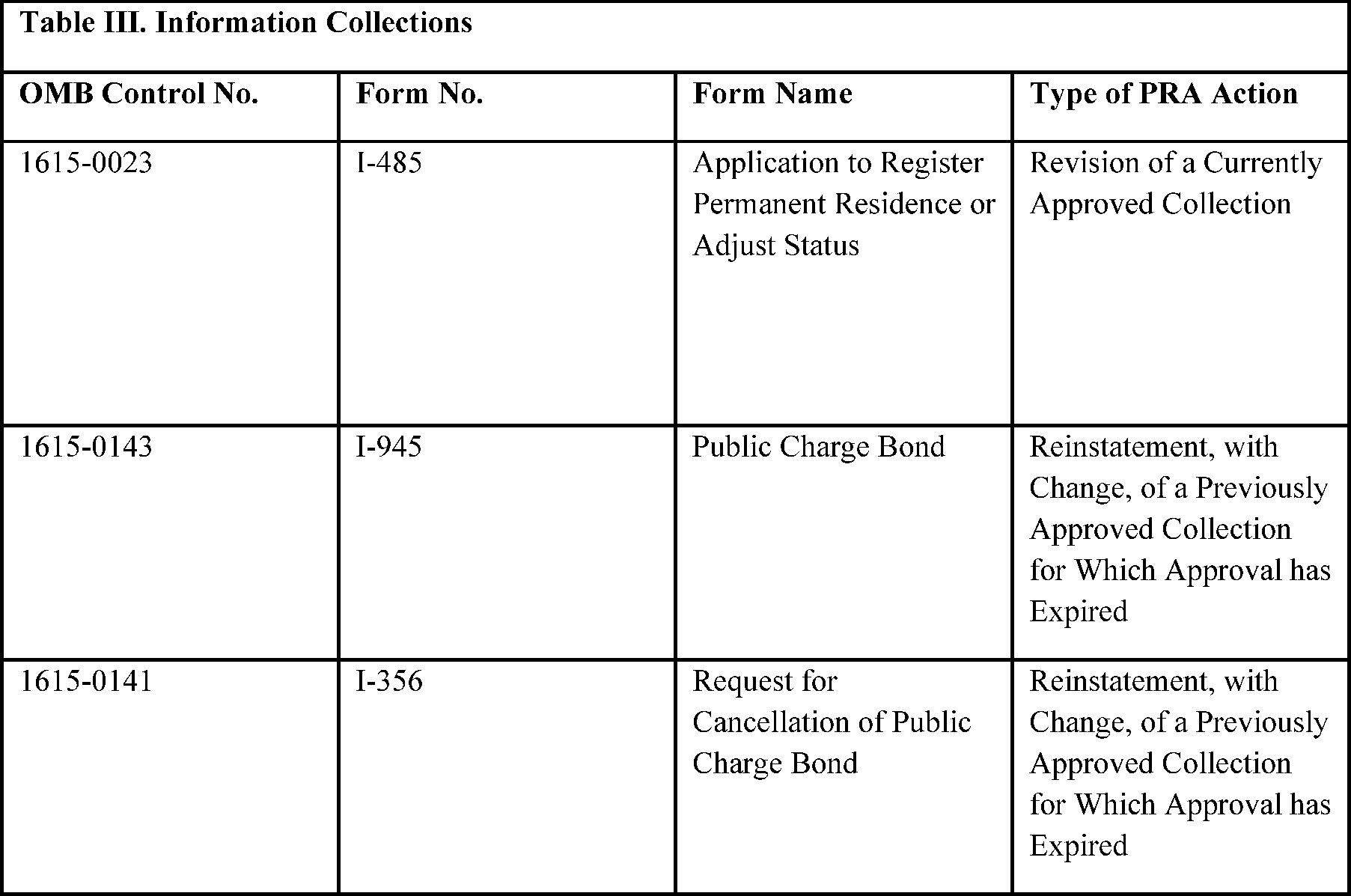
Submit comments on the information collections to the same docket as the NPRM. In addition, all comments on the information collections must include the following OMB Control Numbers: Form I-485 (1615-0023), Form I-945 (1615-0143), and Form I-356 (1615-0141).
Comments must be submitted in English, or an English translation must be provided. Comments submitted in a manner other than via
https://www.regulations.gov,
including emails or letters sent to DHS or USCIS officials, will not be considered comments on the NPRM and may not receive a response from DHS. Please note that DHS and USCIS cannot accept any comments that are hand-delivered or couriered. In addition, USCIS cannot accept comments contained on any form of digital media storage devices, such as CDs/DVDs and USB drives. USCIS is also not accepting mailed comments at this time.
If you cannot submit your comment by using
https://www.regulations.gov,
please contact Regulatory Coordination Division, Office of Policy and Strategy, U.S. Citizenship and Immigration Services, Department of Homeland Security, by telephone at (240) 721-3000 for alternate instructions.
FOR FURTHER INFORMATION CONTACT:
U.S. Citizenship and Immigration Services (USCIS), DHS, 5900 Capital Gateway Drive, Camp Springs, MD 20746; telephone (240) 721-3000 (not a toll-free call).
SUPPLEMENTARY INFORMATION:
Table of Contents
I. Public Participation
II. Executive Summary
A. Purpose of the Regulatory Action
B. Summary of Legal Authority
C. Summary of the Major Provisions of the Regulatory Action
D. Costs and Benefits
III. Background
A. Legal Authority
B. Grounds of Inadmissibility Generally
C. Public Charge Ground of Inadmissibility
1. Public Charge Statutes and Case Law, Pre-IIRIRA
2. Public Benefits Under PRWORA
3. Changes Under IIRIRA
4. INS 1999 Notice of Proposed Rulemaking and Interim Field Guidance
5. Victims of Trafficking and Violence Protection Act of 2000
6. DHS 2018 Inadmissibility on Public Charge Grounds Notice of Proposed Rulemaking and 2019 Final Rule
7. DHS 2022 Public Charge Ground of Inadmissibility Advance Notice of Proposed Rulemaking, Notice of Proposed Rulemaking, and Final Rule
IV. Basis and Purpose of the NPRM
A. The Prior Rules Were Overly Restrictive
B. Removal of the Existing Public Charge Inadmissibility Framework
V. Discussion of the NPRM
A. Introduction
B. Discussion of the Amendments and Removals in the NPRM
1. Cancellation and Breach of Public Charge Bonds—8 CFR 103.6(c)
2. Proposed Removal of Definitions and Regulatory Framework for Making Public Charge Inadmissibility Determinations—8 CFR 212.21
3. Removal of Regulations Outlining the Public Charge Inadmissibility Determination—8 CFR 212.22
4. Exemptions and Waivers for Public Charge Ground of Inadmissibility—8 CFR 212.23
5. Applicability of Public Charge Inadmissibility—8 CFR 212.20
VI. Statutory and Regulatory Requirements
A. Executive Order 12866 (Regulatory Planning and Review) and Executive Order 13563 (Improving Regulation and Regulatory Review), and 14192 (Unleashing Prosperity Through Deregulation)
G. Executive Order 13175 (Consultation and Coordination With Indian Tribal Governments)
H. National Environmental Policy Act
I. Paperwork Reduction Act
Table of Abbreviations
ANPRM—Advance Notice of Proposed Rulemaking
APA—Administrative Procedure Act
ASC—Application Support Center
BIA—Board of Immigration Appeals
CBP—U.S. Customs and Border Protection
CFR—Code of Federal Regulations
CHIP—Children's Health Insurance Program
COVID-19—Coronavirus Disease 2019
CPI-U—Consumer Price Index for All Urban Consumers
DHS—U.S. Department of Homeland Security
DOJ—Department of Justice
DOS—U.S. Department of State
E.O.—Executive Order
FAM—Department of State Foreign Affairs Manual
FFP—Federal Financial Participation
FMAP—Federal Medical Assistance Percentages
FR—Federal Register
FY—Fiscal Year
HCV—Housing Choice Voucher
HHS—U.S. Department of Health and Human Services
HSA—Homeland Security Act
HUD—U.S. Department of Housing and Urban Development
IIRIRA—Illegal Immigration Reform and Immigrant Responsibility Act of 1996
INA—Immigration and Nationality Act
INS—Immigration and Naturalization Service
IRCA—Immigration Reform and Control Act
LPR—Lawful Permanent Resident
NEPA—National Environmental Policy Act
NPRM—Notice of Proposed Rulemaking
OMB—Office of Management and Budget
PRA—Paperwork Reduction Act
( printed page 52169)
PRWORA—Personal Responsibility and Work Opportunity Reconciliation Act of 1996
RFA—Regulatory Flexibility Act of 1980
RIA—Regulatory Impact Analysis
SNAP—Supplemental Nutrition Assistance Program
SSA—Social Security Administration
SSI—Supplemental Security Income
TANF—Temporary Assistance for Needy Families
TPS—Temporary Protected Status
UMRA—Unfunded Mandates Reform Act of 1995
USCIS—U.S. Citizenship and Immigration Services
USDA—U.S. Department of Agriculture
I. Public Participation
DHS invites all interested parties to participate in this rulemaking by submitting written data, views, comments and arguments on all aspects of this proposed rule. DHS also invites comments that relate to the economic, environmental, or federalism effects that might result from this proposed rule. Comments must be submitted in English, or an English translation must be provided. Comments that will provide the most assistance to USCIS in implementing these changes will reference a specific portion of the proposed rule, explain the reason for any recommended change, and include data, information, or authority that support such recommended change. Comments submitted in a manner other than the one listed above, including emails or letters sent to DHS or USCIS officials, will not be considered comments on the proposed rule and may not receive a response from DHS.
Instructions:
If you submit a comment, you must include the agency name (U.S. Citizenship and Immigration Services) and the DHS Docket No. USCIS-2025-0304 for this rulemaking. Regardless of the method used for submitting comments or material, all submissions will be posted, without change, to the Federal eRulemaking Portal at
https://www.regulations.gov,
and will include any personal information you provide. Therefore, submitting this information makes it public. You may wish to consider limiting the amount of personal information that you provide in any voluntary public comment submission you make to DHS. DHS may withhold information provided in comments from public viewing that it determines may impact the privacy of an individual or is offensive. For additional information, please read the Privacy and Security Notice available at
https://www.regulations.gov.
Docket:
For access to the docket and to read background documents or comments received, go to
https://www.regulations.gov,
referencing DHS Docket No. USCIS-2025-0304. You may also sign up for email alerts on the online docket to be notified when comments are posted or a final rule is published.
II. Executive Summary
A. Purpose of the Regulatory Action
The purpose of this proposed rulemaking is to remove the current public charge inadmissibility provisions promulgated by the Public Charge Ground of Inadmissibility final rule (2022 Final Rule),[1]
as these provisions straitjacket DHS officers' ability to make public charge inadmissibility determinations that are consistent with Congress's express national policy on welfare and immigration enacted in the Personal Responsibility and Work Opportunity Reconciliation Act of 1996 (PRWORA).
SeePublic Law 104-193, section 400, 110 Stat. 2105, 2260 (codified at 8 U.S.C. 1601). The 2022 Final Rule imposes narrow definitions of statutory terms and the statutory minimum factors and limits the public benefits that DHS can consider in a public charge inadmissibility determination, which prevents DHS officers from considering all factors and information relevant to an alien's likelihood at any time of becoming a public charge, as Congress intended. Indeed, the 2022 Final Rule created a framework under which officers were directed to consider seven factors (five of those required by statute) rather than being explicitly empowered to consider any other factors or information relevant to determining an alien's likelihood at any time of becoming a public charge in the totality of the alien's circumstances.[2]
Compare that to the 2019 Final Rule, in which officers were directed to consider “all factors that are relevant” and listed “minimum factors to consider,” stating that the public charge inadmissibility determination “must at least entail consideration” of those minimum factors. 8 CFR 212.22 (2019).
DHS intends to remove the regulatory provisions in the 2022 Final Rule with the exception of certain public charge bond provisions and technical corrections, which will pave the way for DHS to, in the future, formulate appropriate policy and interpretive tools that will guide DHS officers in making individualized, fact-specific public charge inadmissibility determinations, based on a totality of the alien's circumstances, that are consistent with the statute and congressional intent, and comply with past precedent.[3]
DHS notes that while it is proposing to remove the public charge inadmissibility regulations in the short-term, DHS intends, after the removal of these regulations, to formulate appropriate policy and interpretive tools that will guide public charge inadmissibility determinations while empowering officers to consider: (1) the mandatory statutory factors in section 212(a)(4)(B) of the INA, 8 U.S.C. 1182(a)(4)(B); (2) all individualized case-specific factors and circumstances relevant to an alien's case; and (3) any empirical data relevant to an alien's self-sufficiency. Consideration of these, in the totality of the circumstances, will allow officers to more accurately assess an alien's likelihood at any time of becoming a public charge using their good judgment and discretion, as Congress intended. Consequently, through this NPRM, DHS proposes to move away from a bright line primary dependence standard, which would allow officers to make public charge inadmissibility determinations consistent with 8 U.S.C. 1601(2)(A) and reflected in established administrative case law prior to the 2022 Final Rule, and removing limitations on the types of public resources that are relevant for considering whether an alien is dependent, including the references to public cash assistance for income maintenance or long-term institutionalization at government expense. DHS welcomes feedback and recommendations on what to include in
( printed page 52170)
future policy and interpretive tools on public charge inadmissibility.
B. Summary of Legal Authority
The authority of the Secretary of Homeland Security (Secretary) for the proposed rescissions and regulatory amendments is found in section 212(a)(4) of the INA, 8 U.S.C. 1182(a)(4), which governs public charge inadmissibility determinations; section 235 of the INA, 8 U.S.C. 1225, which addresses applicants for admission; and section 245 of the INA, 8 U.S.C. 1255, which addresses eligibility criteria for applications for adjustment of status. In addition, section 103(a)(3) of the INA, 8 U.S.C. 1103(a)(3), authorizes the Secretary to establish such regulations as the Secretary deems necessary for carrying out the Secretary's authority under the INA.
C. Summary of the Major Provisions of the Regulatory Action
Remove8 CFR 212.22, Public charge inadmissibility determination
Remove8 CFR 212.23, Exemptions and waivers for public charge ground of inadmissibility
D. Costs and Benefits
DHS proposes to remove most provisions implemented in the 2022 Final Rule to allow DHS to better implement the public charge ground of inadmissibility. The proposed rule is expected to impose new benefits and transfers. To assess the impacts of the proposed rule, DHS considers the potential impacts of the rule relative to a no-action baseline, which reflects the current state of the world absent this regulatory action.
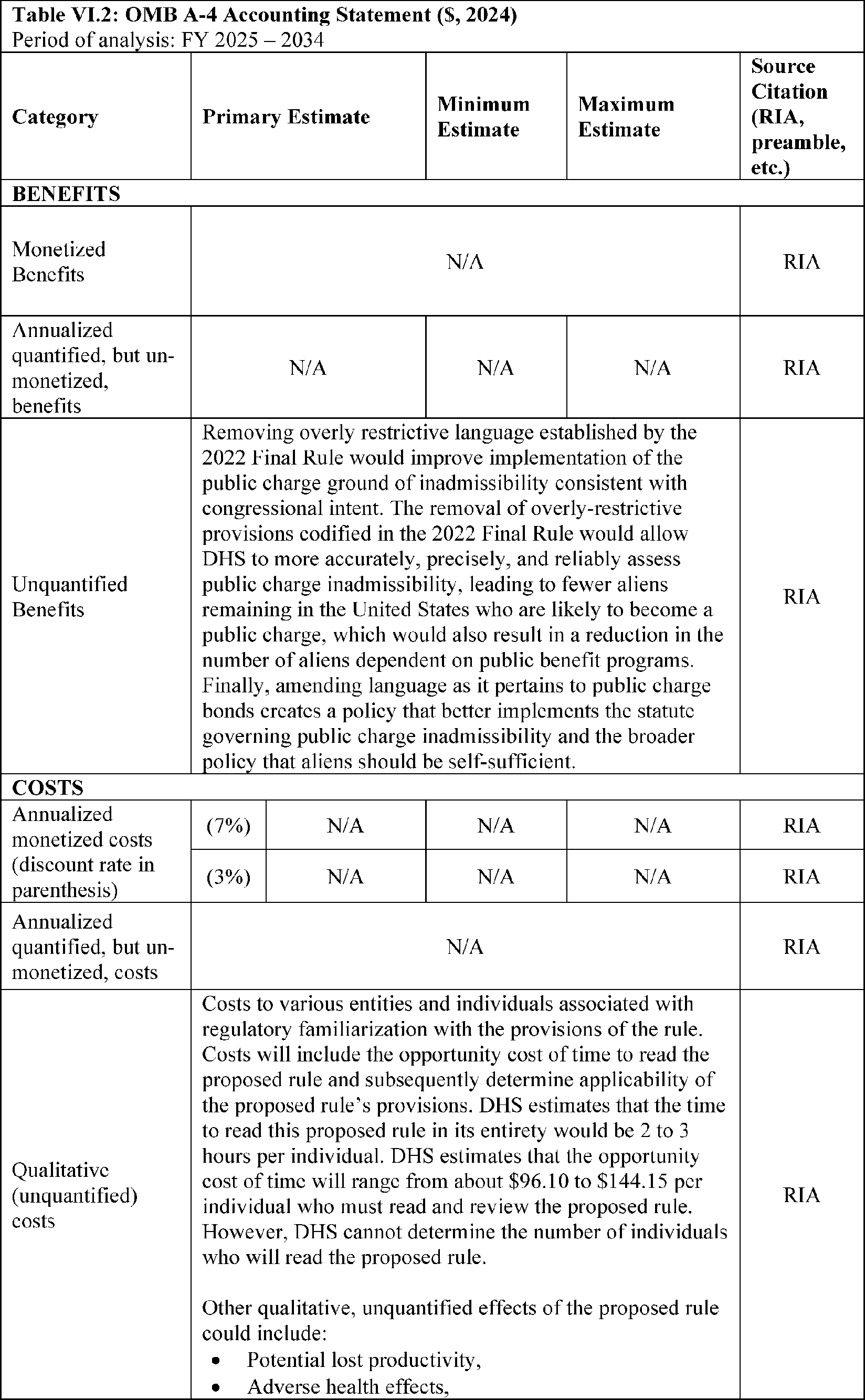
The primary source of unquantified benefits of this proposed rule is the removal of overly-restrictive provisions promulgated in the 2022 Final Rule that hinder officers in making public charge inadmissibility determinations. By removing rigid regulatory definitions and standards, this proposed rule would ensure that officers would be able to make highly individualized, fact-specific, case-by-case public charge inadmissibility decisions based on the totality of each alien's individual circumstances. This approach would prevent the application of overly restrictive criteria that unnecessarily limits DHS officers' ability to make public charge inadmissibility determinations.
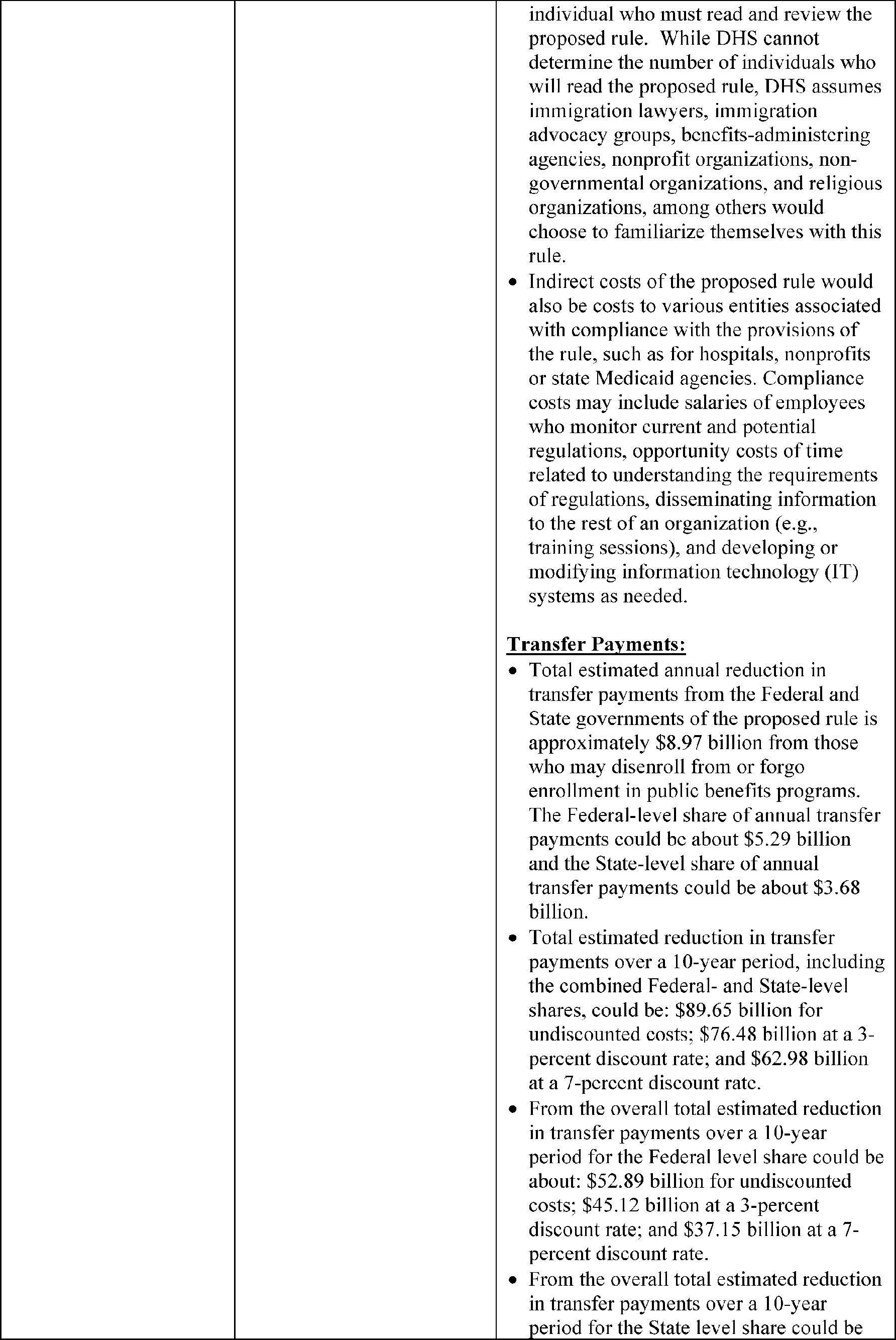
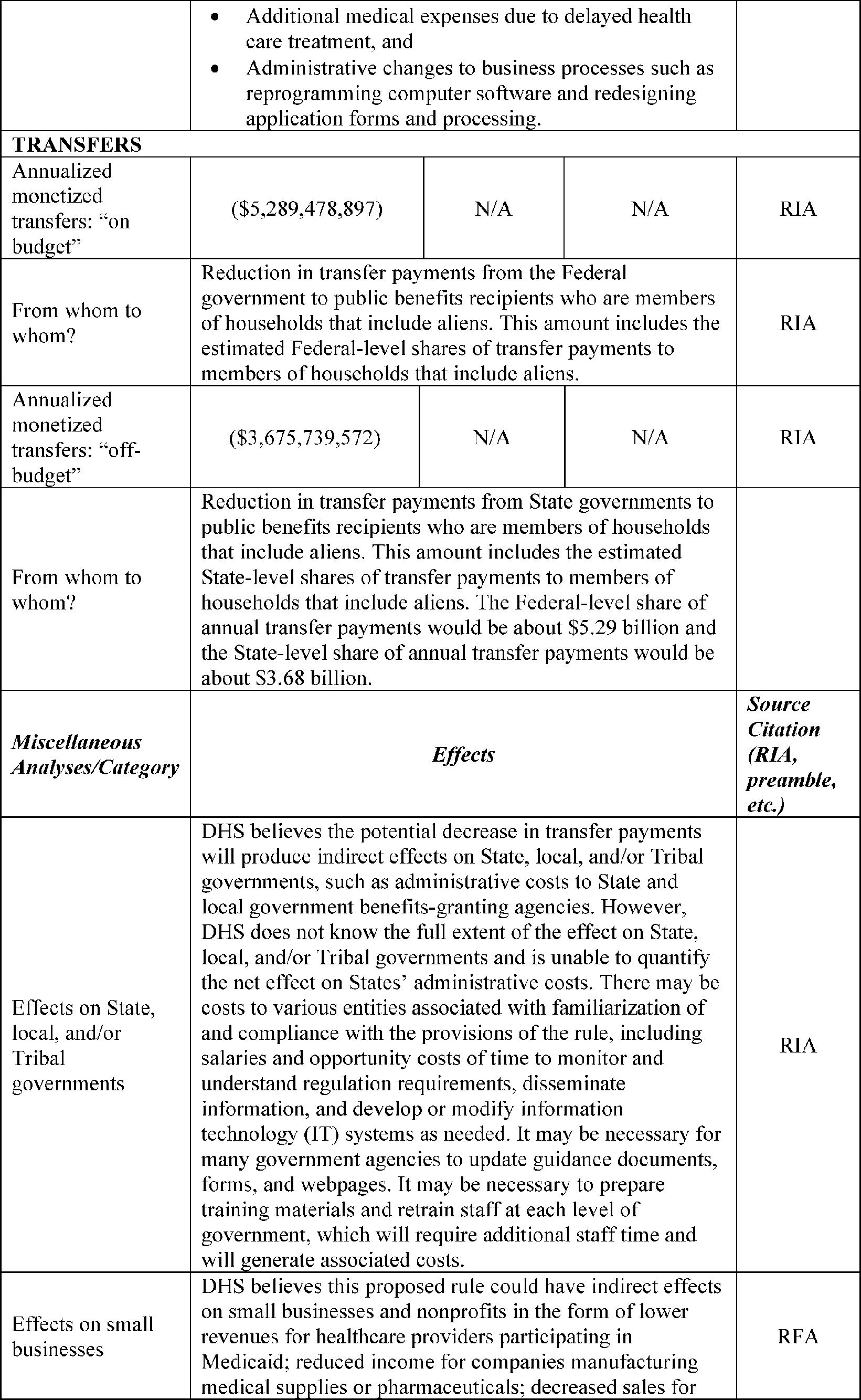
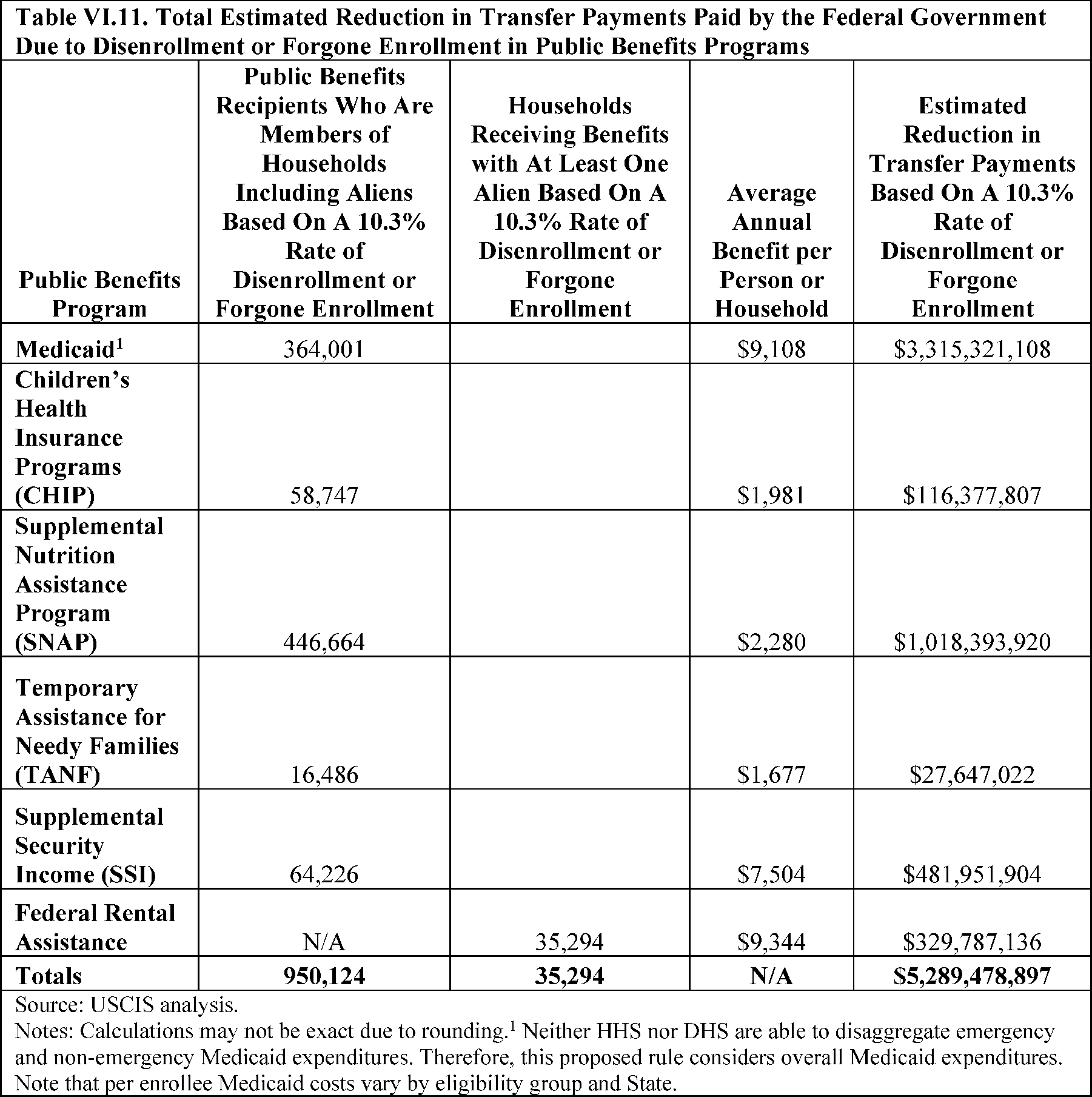
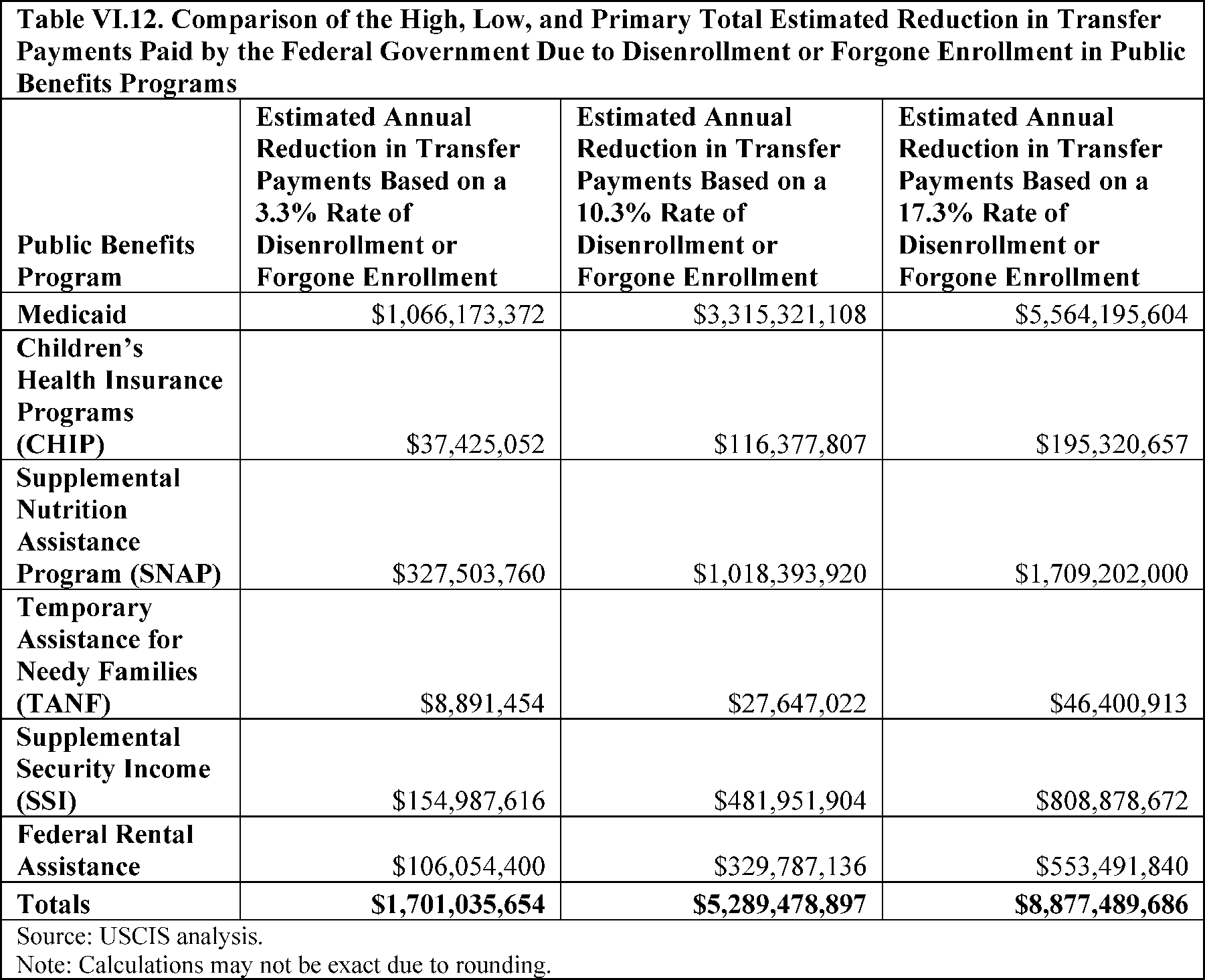
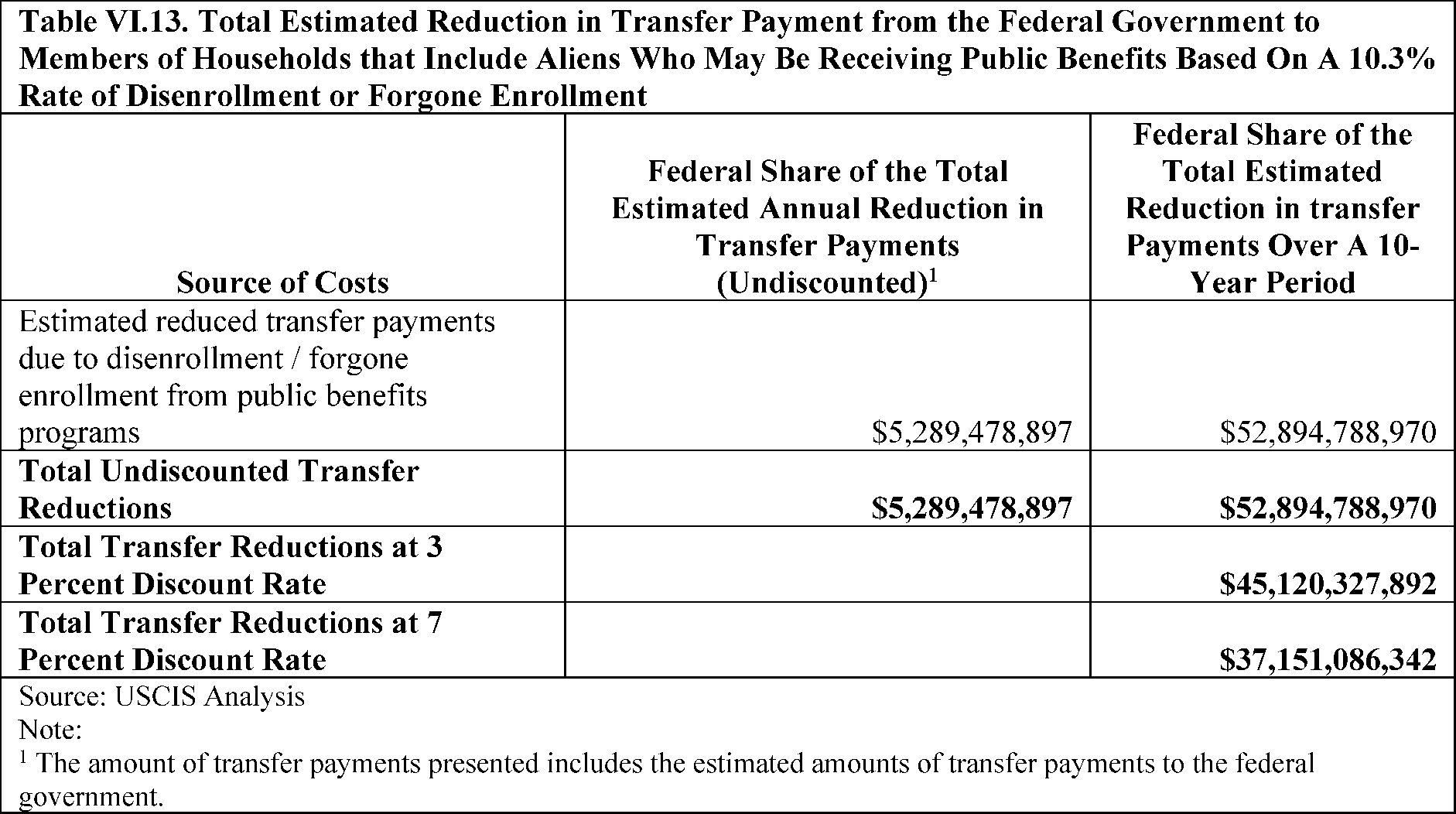
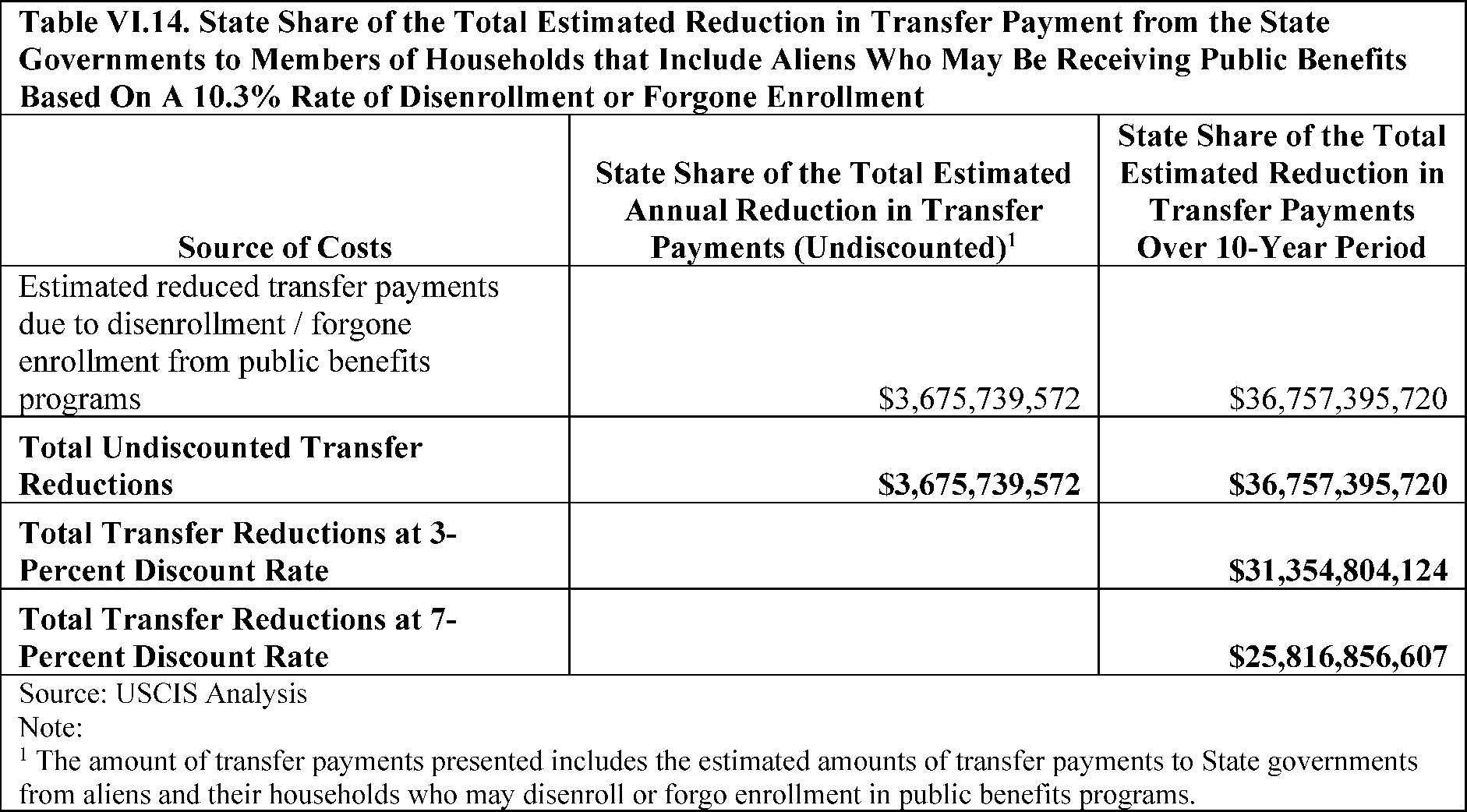
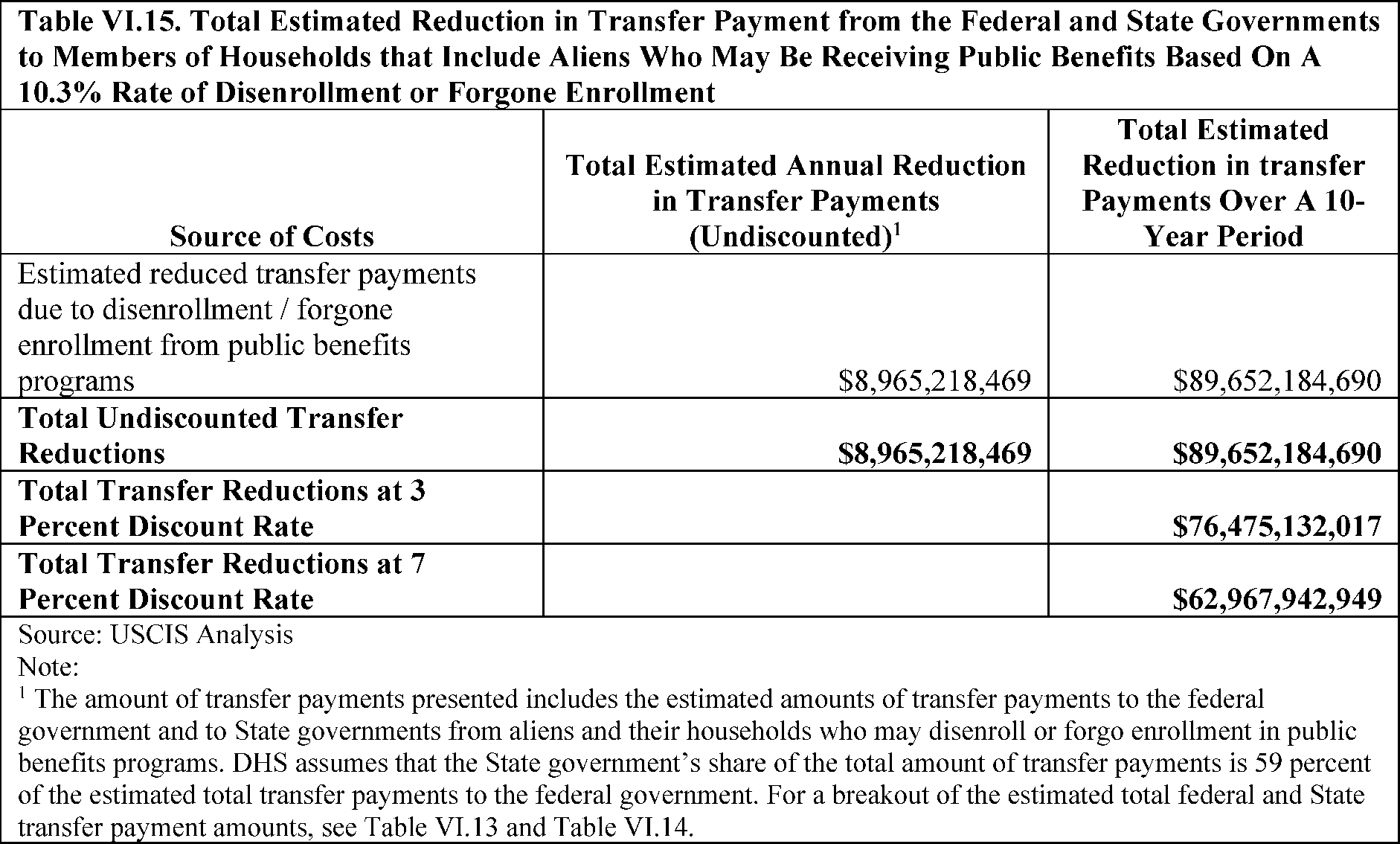
The proposed rule would also result in a reduction in transfer payments from the Federal Government to individuals who may choose to disenroll from or forgo enrollment in a public benefits program. Individuals who might choose to disenroll from or forgo future enrollment in a public benefits program include aliens as well as U.S. citizens who are members of mixed-status households. DHS estimates that the total reduction in transfer payments from the Federal and State governments could be approximately $8.97 billion annually due to disenrollment or forgone enrollment in public benefits programs by members of households that include aliens who may be receiving public benefits. DHS estimates that the 10-year discounted Federal and State transfer payments reduction of this proposed rule could be approximately $76.48 billion at a 3-percent discount rate and about $62.97 billion at a 7-percent discount rate. This total includes DHS' estimate that Federal transfer payments could decrease by approximately $45.12 billion at a 3-percent discount rate and about $37.15 billion at a 7-percent discount rate. Using the average Federal Medical Assistance Percentages (FMAP), DHS further estimates that State transfer payments could decrease by approximately $31.35 billion at a 3-percent discount rate and about $25.82 billion at a 7-percent discount rate. DHS notes there may be additional reductions in transfer payments that we are unable to quantify. DHS also recognizes that the estimated reductions in transfer payments are approximations and could be influenced by external factors unrelated to this proposed rule. For example, the recent enrollment changes to Medicaid and SNAP implemented in the H.R. 1 Reconciliation Bill are expected to impact enrollment rates, adding complexity to quantification efforts.[4]
DHS anticipates that disenrollment or forgone enrollment rates may fluctuate independently of this proposed rule, potentially affecting the transfer payment estimates presented in this analysis. However, it is too early to assess the impact of these policies on public benefit usage, and consequently, on the impact on overall estimates presented in this analysis.
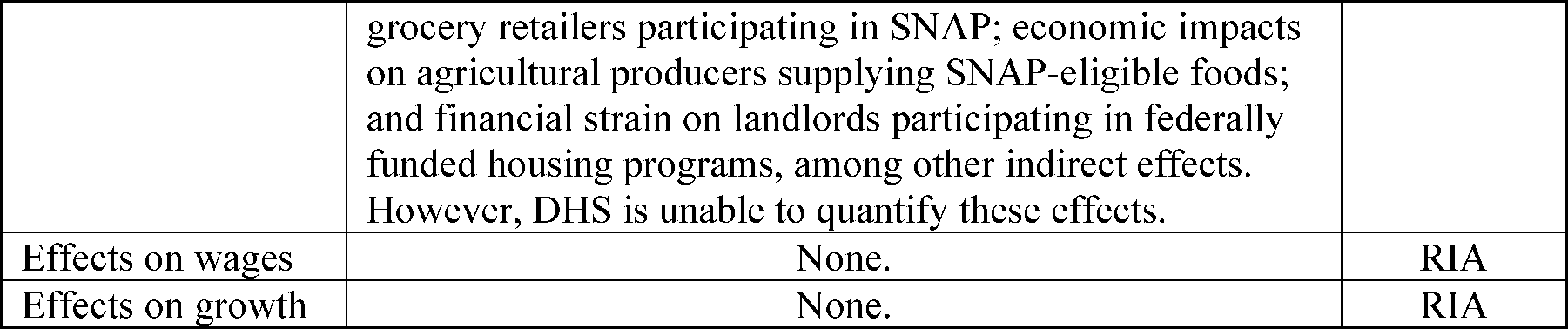
Finally, DHS recognizes that reductions in Federal and State transfers under Federal benefits programs may have downstream and upstream impacts on State and local economies, large and small businesses, and individuals. For example, the rule might result in reduced revenues for healthcare providers, such as hospitals and nonprofits, participating in Medicaid, companies that manufacture medical supplies or pharmaceuticals, grocery retailers participating in SNAP, agricultural producers who grow foods that are eligible for purchase using SNAP benefits, or landlords participating in federally funded housing programs.
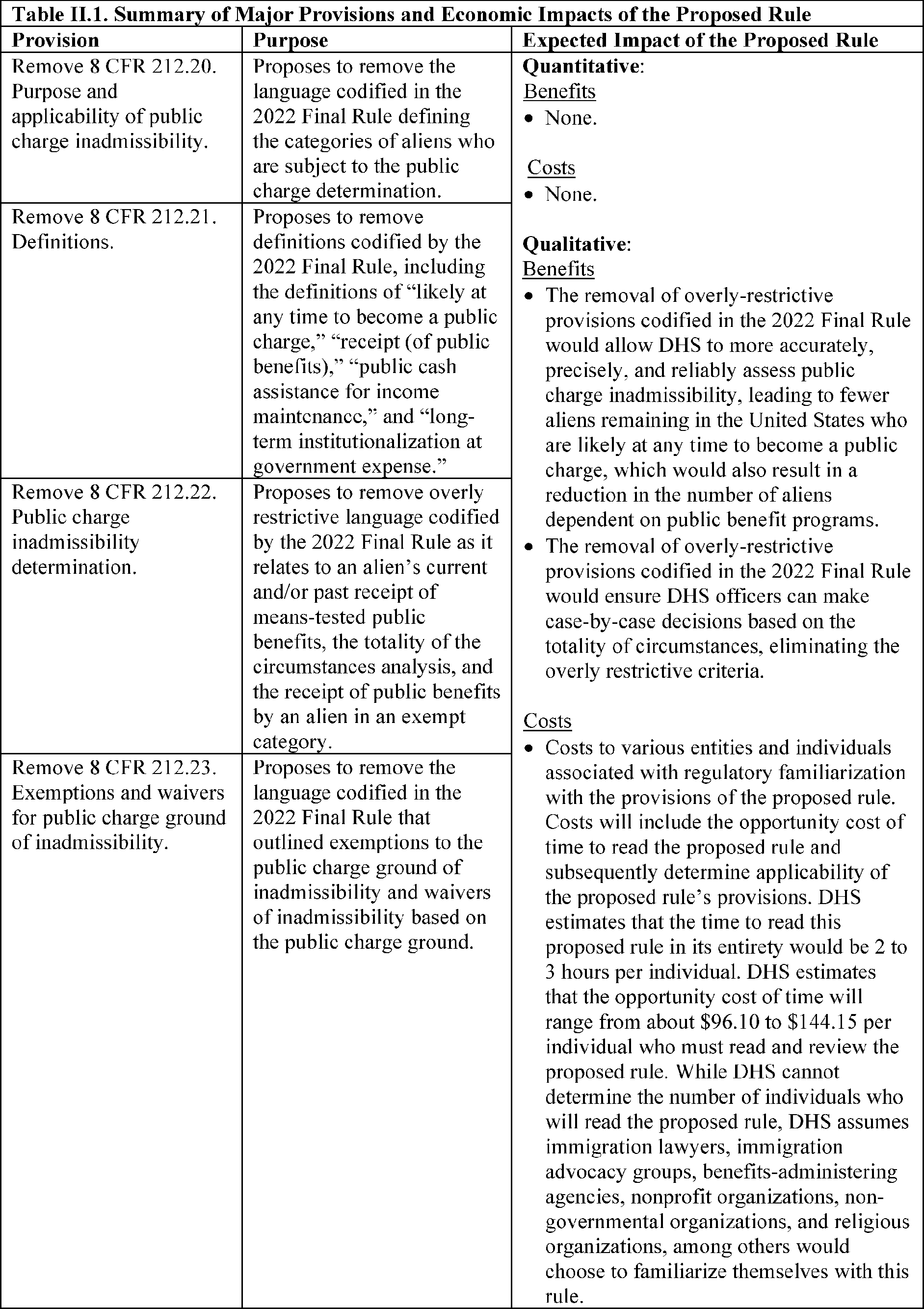
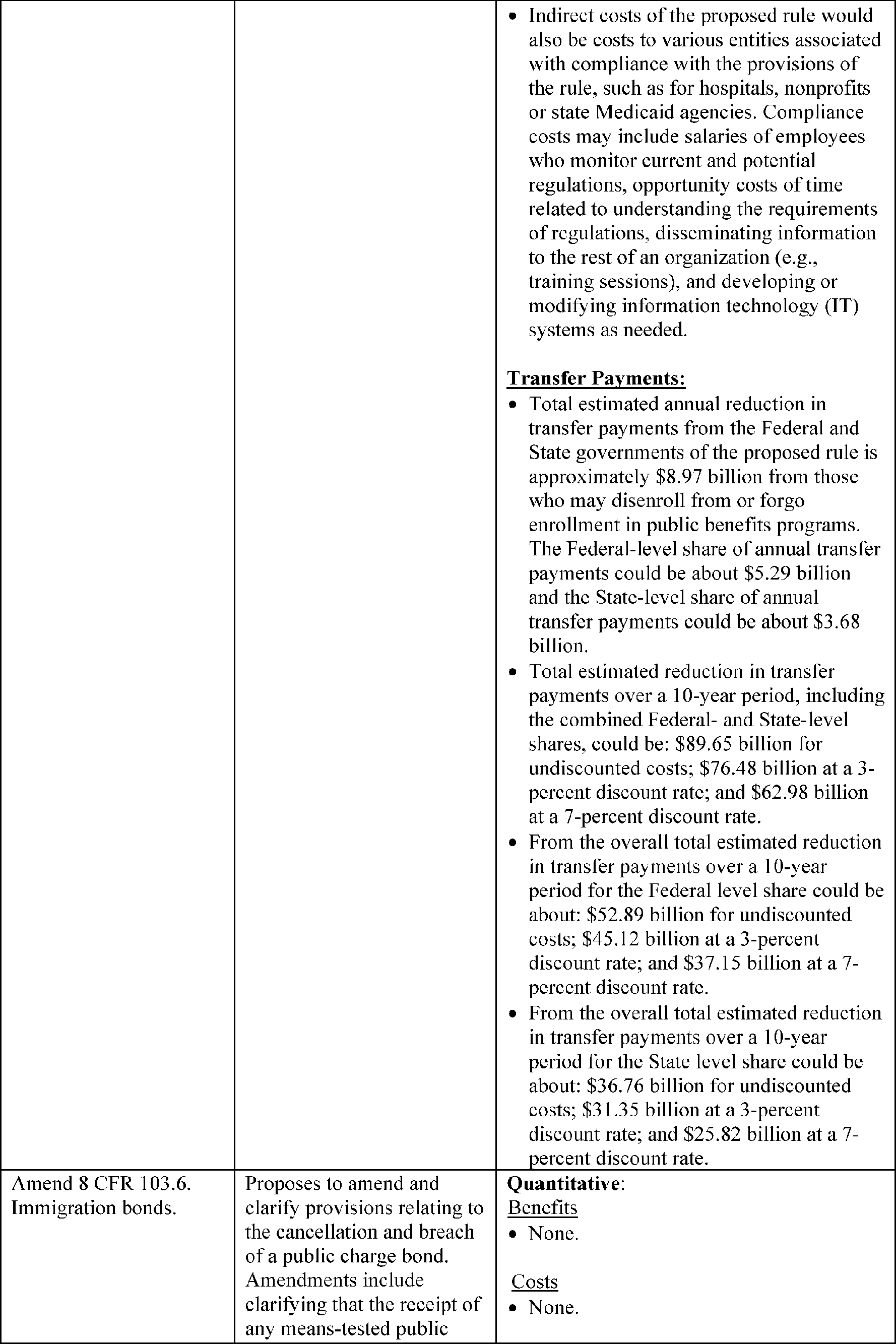
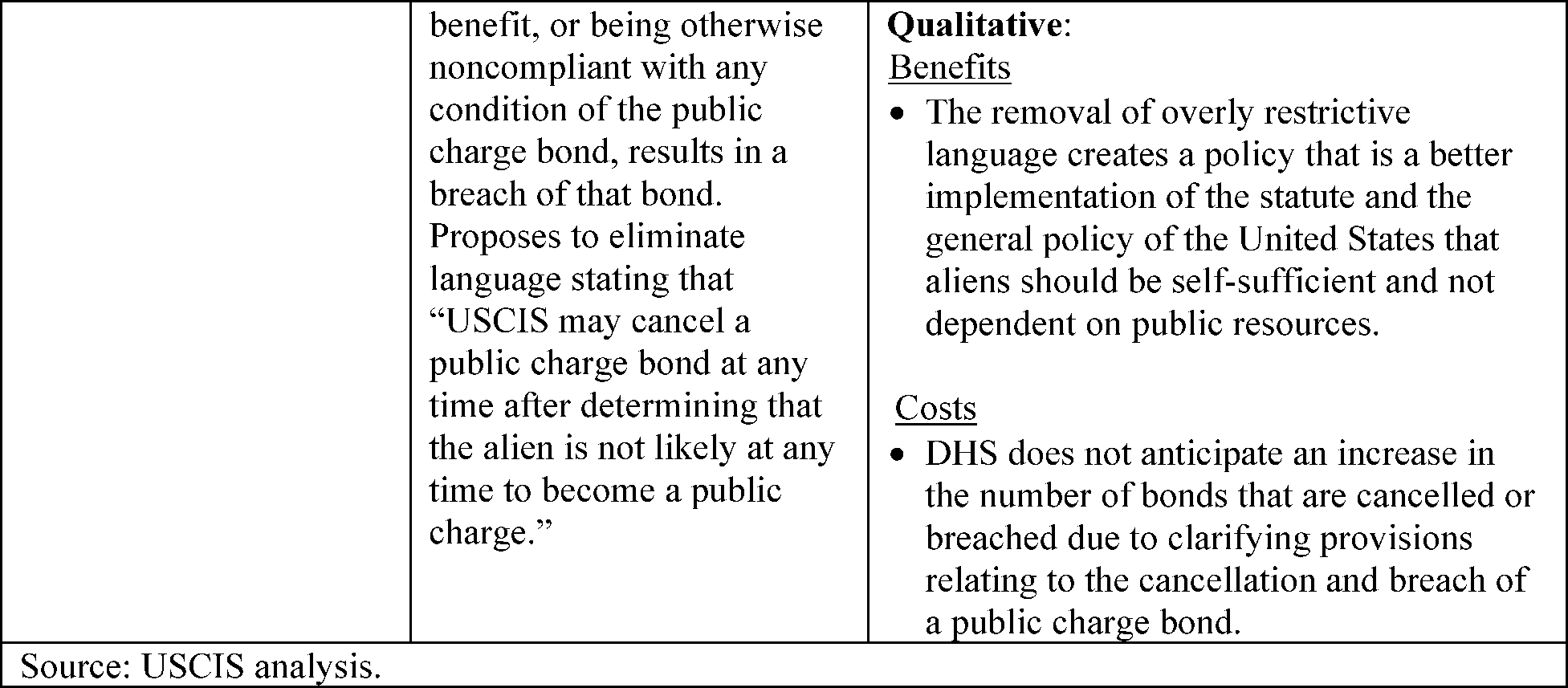
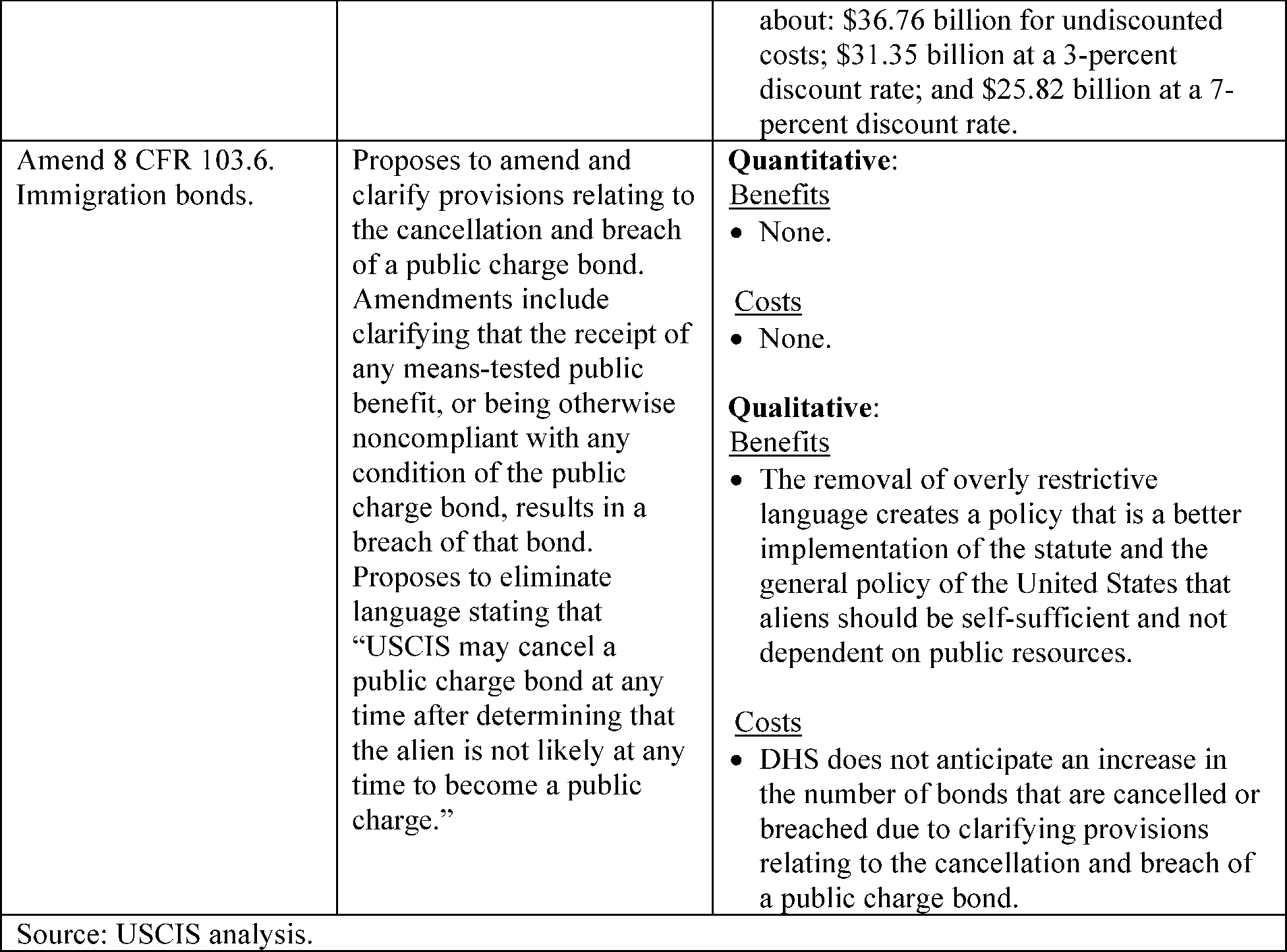
Table II.1
provides a detailed summary of the regulatory changes of the proposed rule and the estimated costs, benefits, and transfers associated with the expected impacts.5
( printed page 52171)
( printed page 52172)
( printed page 52173)
III. Background
A. Legal Authority
The Secretary's authority for issuing this rule is found in various sections of the INA, 8 U.S.C. 1101et seq.
), and the Homeland Security Act of 2002 (HSA).[6]
Section 102 of the HSA, 6 U.S.C. 112, and section 103 of the INA, 8 U.S.C. 1103, charge the Secretary with the administration and enforcement of the immigration laws of the United States. Section 101 of the HSA, 6 U.S.C. 111, establishes that part of DHS's primary mission is to ensure that efforts, activities, and programs aimed at securing the homeland do not diminish either the overall economic security of the United States or the civil rights and civil liberties of persons.
In addition to establishing the Secretary's general authority for the administration and enforcement of immigration laws, section 103 of the INA, 8 U.S.C. 1103, enumerates various related authorities, including the Secretary's authority to establish such regulations, prescribe such forms of bond, issue such instructions, and perform such other acts as the Secretary deems necessary for carrying out such authority.
Section 212(a)(4) of the INA, 8 U.S.C. 1182(a)(4), provides that any alien who applies for a visa, admission, or adjustment of status is inadmissible if he or she is likely at any time to become a public charge.
In general, under section 213 of the INA, 8 U.S.C. 1183, the Secretary has the discretion to admit into the United States an alien who is determined to be inadmissible based only on the public charge ground upon the giving of a suitable and proper bond or undertaking approved by the Secretary.
Under section 213A of the INA, 8 U.S.C. 1183a, certain aliens are required to submit a sufficient Affidavit of Support Under Section 213A of the INA executed by a sponsor who agrees to provide support to maintain the sponsored alien at an annual income that is not less than 125 percent of the Federal poverty line during the period in which the affidavit is enforceable. The Affidavit of Support Under Section 213A of the INA is intended to ensure that an intending immigrant has adequate means of financial support and is not likely to rely on the U.S. government for financial support.
Section 235 of the INA, 8 U.S.C. 1225, addresses the inspection of applicants for admission, including inadmissibility determinations of such aliens.
Section 245 of the INA, 8 U.S.C. 1255, generally establishes eligibility criteria for adjustment of status to that of a lawful permanent resident (LPR).
B. Grounds of Inadmissibility Generally
The United States has a long history of permitting aliens to enter the United States, whether permanently or on a temporary basis. At the same time, Congress has sought to exclude aliens who pose a threat to the safety or general welfare of the country or who seek to violate immigration laws.[7]
Congress has exercised this authority in part by establishing the concepts of admission [8]
and inadmissibility in the INA.[9]
Aliens are inadmissible due to a range of acts, conditions, and conduct.[10]
If an alien is inadmissible as described in section 212(a) of the INA, 8 U.S.C. 1182(a), that alien is ineligible to be admitted to the United States and ineligible to receive a visa, unless they apply for and receive a waiver of inadmissibility or other form of relief. Congress has extended the applicability of the inadmissibility grounds beyond the context of applications for admission and visas by making admissibility an eligibility requirement for certain immigration benefits, including adjustment of status to that of a lawful permanent resident.[11]
If an alien is inadmissible, that alien is also ineligible for those benefits unless the alien is eligible to apply for and is granted a discretionary waiver of inadmissibility or other form of relief to overcome the inadmissibility, where available and appropriate.[12]
( printed page 52174)
C. Public Charge Ground of Inadmissibility
Section 212(a)(4) of the INA, 8 U.S.C. 1182(a)(4), states that any alien who applies for a visa, admission, or adjustment of status is inadmissible if in the opinion of the consular officer or immigration officer, as applicable, the alien is likely at any time to become a public charge. The public charge ground of inadmissibility, therefore, applies to aliens applying for a visa to come to the United States temporarily or permanently, for admission at or between ports of entry, and for adjustment of status to that of a lawful permanent resident.[13]
Under the statute, some categories of aliens are exempt from the public charge ground of inadmissibility, while others, if found inadmissible under the public charge ground, may apply for a waiver of the public charge ground of inadmissibility or submit a public charge bond.[14]
The INA does not define the terms “public charge” or “likely at any time to become a public charge.” However, it does specify that when determining whether an alien is likely at any time to become a public charge, consular officers and immigration officers must, at a minimum, consider the alien's age; health; family status; assets, resources, and financial status; and education and skills.
See
INA sec. 212(a)(4)(B)(i), 8 U.S.C. 1182(a)(4)(B)(i). Additionally, section 212(a)(4)(B)(ii) of the INA, 8 U.S.C. 1182(a)(4)(B)(ii), permits the consular officer or the immigration officer to consider any Affidavit of Support Under Section 213A of the INA submitted on the alien's behalf, when determining whether the alien is likely at any time to become a public charge.[15]
In fact, with very limited exceptions, most aliens seeking family-based immigrant visas and adjustment of status, and to a lesser extent, some aliens seeking employment-based immigrant visas or adjustment of status, must submit a sufficient Affidavit of Support Under Section 213A of the INA in order to avoid being found inadmissible as likely at any time to become a public charge.
See
INA sec. 212(a)(4)(C) and (D), 8 U.S.C. 1182(a)(4)(C) and (D). In general, under section 213 of the INA, 8 U.S.C. 1183, the Secretary has the discretion to admit into the United States an alien who is determined to be inadmissible only on the public charge ground upon the giving of a suitable and proper bond or undertaking approved by the Secretary.
See
INA sec. 213, 8 U.S.C. 1183.
1. Public Charge Statutes and Case Law, Pre-IIRIRA
The United States has denied admission to aliens on public charge grounds since at least 1882.[16]
The 1882 law excluded “any person unable to take care of himself or herself without becoming a public charge” but notably the 1882 law did not provide any definition of a “public charge” or any guidelines for determining who would become one.[17]
The Immigration Act of 1891 completed the federalization of immigration regulation and retained the exclusion of “paupers or persons likely to become a public charge.” [18]
In 1903 Congress added “professional beggars” to the class of exclusion,[19]
a 1907 law added those with certain mental or physical defects “which may affect the ability of such an alien to earn a living,” [20]
and a 1917 law added “vagrants” to the public charge provision.[21]
This version of the public charge provision remained substantively unchanged until it was incorporated into the Immigration and Nationality Act of 1952.
While the INA of 1952 left the public charge ground of inadmissibility unchanged, it added language explicitly emphasizing officers' discretionary authority in determining an alien's likelihood at any time of becoming a public charge. The INA of 1952 excluded aliens who, in the opinion of the consular officer at the time of application for a visa, or in the opinion of the government at the time of application for admission, were likely at any time to become public charges.[22]
The government has long interpreted the words “in the opinion of” as evincing the inherently discretionary nature of the determination.[23]
The determination is also necessarily subjective due to its prospective nature. A series of administrative decisions after the passage of the INA of 1952 clarified that a totality of the circumstances review was the proper framework for making public charge determinations and that receipt of public benefits would not, alone, lead to a finding of likelihood of becoming a public charge.[24]
( printed page 52175)
The totality of the circumstances framework for public charge inadmissibility determinations was codified in relation to one specific class of aliens in the 1980s. In 1986, Congress passed the Immigration Reform and Control Act (IRCA), providing eligibility for adjustment of status to that of a lawful permanent resident to certain aliens who had resided in the United States continuously prior to January 1, 1982.[25]
No changes were made to the language of the public charge exclusion ground under former section 212(a)(15) of the INA, 8 U.S.C. 1182(a)(15), but IRCA contained special public charge rules for aliens seeking legalization under section 245A of the INA, 8 U.S.C. 1255a. Although IRCA provided otherwise eligible aliens an exemption or waiver for some grounds of excludability, the aliens generally remained subject to the public charge ground of exclusion.
See
INA sec. 245A(d)(2)(B)(ii)(IV), 8 U.S.C. 1255a(d)(2)(B)(ii)(IV). Under IRCA, however, if an alien demonstrated a history of self-support through employment and without receiving public cash assistance, they would not be ineligible for adjustment of status based on being inadmissible on the public charge ground.
See
INA sec. 245A(d)(2)(B)(iii), 8 U.S.C. 1255a(d)(2)(B)(iii). In addition, IRCA contained a discretionary waiver of public charge inadmissibility for aliens who were “aged, blind or disabled” as defined in section 1614(a)(1) of the Social Security Act who applied for lawful permanent resident status under IRCA and were determined to be inadmissible based on the public charge ground.[26]
The former Immigration and Naturalization Service (INS) promulgated 8 CFR 245a.3,[27]
which established that immigration officers would make public charge inadmissibility determinations for aliens seeking legalization under section 245A of the INA, 8 U.S.C. 1255a by examining the “totality of the alien's circumstances at the time of his or her application for legalization.”
See8 CFR 245a.3(g)(4)(i). According to the regulation, the existence or absence of a particular factor could never be the sole criterion for determining whether a person is likely to become a public charge.
Id.
Further, the regulation provided that the determination is a “prospective evaluation based on the alien's age, health, income, and vocation.”
Id.
A special provision in the rule stated that aliens with incomes below the poverty level were not excludable if they were consistently employed and show the ability to support themselves.
Id.
Finally, an alien's past receipt of public cash assistance would be a significant factor in a context that also considered the alien's consistent past employment.
Id.
In
Matter of A-,
INS again pursued a totality of the circumstances approach in public charge determinations for applicants for legalization. “Even though the test is prospective,” INS “considered evidence of receipt of prior public assistance as a factor in making public charge determinations.” [28]
INS also considered an alien's work history, age, capacity to earn a living, health, family situation, affidavits of support, and other relevant factors in their totality.[29]
These administrative practices surrounding public charge inadmissibility determinations began to crystallize into legislative changes in the 1990s.
The Immigration Act of 1990 reorganized section 212(a) of the INA, 8 U.S.C. 1182(a), and redesignated the public charge provision as section 212(a)(4) of the INA, 8 U.S.C. 1182(a)(4).[30]
In 1996, the Illegal Immigration Reform and Immigrant Responsibility Act of 1996 (IIRIRA) added to section 212(a)(4) of the INA, 8 U.S.C. 1182(a)(4), the mandatory statutory factors and the enforceable affidavit of support. Public Law 104-208, div. C, 110 Stat 3009-546. Also in 1996, in the Personal Responsibility and Work Opportunity Reconciliation Act of 1996 (PRWORA), which is commonly known as the 1996 welfare reform law, Congress stated that aliens generally should not depend on public resources and that the availability of public benefits should not constitute an incentive for immigration to the United States.
SeePublic Law 104-193, section 400, 110 Stat. 2105, 2260 (codified at 8 U.S.C. 1601). Congress also created section 213A of the INA, 8 U.S.C. 1183a, and made a sponsor's Affidavit of Support Under Section 213A of the INA for an alien beneficiary legally enforceable.[31]
The Affidavit of Support Under Section 213A of the INA provides a mechanism for public benefit granting agencies to seek reimbursement in the event a sponsored alien received means-tested public benefits.
See
INA sec. 213A(b), 8 U.S.C. 1183a(b).
2. Public Benefits Under PRWORA
PRWORA significantly restricted alien eligibility for many Federal, State, and local public benefits.
See8 U.S.C. 1601-1646. When Congress enacted PRWORA, it set forth a self-sufficiency policy statement that aliens should be able to financially support themselves with their own resources or by relying on the aid of family members, sponsors, and private organizations, without depending on government assistance.
See8 U.S.C. 1601(2). Although not defined in PRWORA, in context, self-sufficiency is tied to an alien's ability to meet their needs without depending on public resources.
Id.
With certain exceptions, Congress defined the term “Federal public benefit” broadly as: (A) any grant, contract, loan, professional license, or commercial license provided by an agency of the United States or by appropriated funds of the United States; and (B) any retirement, welfare, health, disability, public or assisted housing, postsecondary education, food assistance, unemployment benefit, or any other similar benefit for which payments or assistance are provided to an individual, household, or family eligibility unit by an agency of the United States or by appropriated funds of the United States.[32]
Generally, under
( printed page 52176)
PRWORA, “qualified aliens” are eligible for Federal means-tested benefits after 5 years and are not eligible for “specified Federal programs,” and States are allowed to determine whether the qualified alien is eligible for “designated Federal programs.”
SeePublic Law 104-193, tit. IV, 110 Stat. 2105, 2260-77.
Among the exceptions established by Congress allowing for eligibility for all aliens are provision of medical assistance for the treatment of an emergency medical condition; short-term, in-kind, non-cash emergency disaster relief; and public health assistance related to immunizations and treatment of the symptoms of a communicable disease.[33]
PRWORA identified three types of benefits and related eligibility rules. First, there are “specified Federal programs,” for which even “qualified aliens” are generally not eligible. 8 U.S.C. 1612(a). Second, there are “Federal means-tested public benefits,” for which “qualified aliens” are generally eligible after a 5-year waiting period. 8 U.S.C. 1613(a). And finally, there are “designated federal programs,” for which States are allowed to determine whether and when a “qualified alien” is eligible, subject to certain restrictions. 8 U.S.C. 1612(b). Subsequent legislation has added additional categories of aliens, many with humanitarian statuses, to PRWORA's various exceptions and special provisions in order to meet the needs of those vulnerable populations. The following is a list of immigration categories that are “qualified aliens” under PRWORA, who, as noted above and subject to certain exceptions, are generally eligible for Federal public benefits after 5 years:
An alien who is lawfully admitted for permanent residence under the INA.8 U.S.C. 1641(b)(1).
An alien who is paroled into the United States under section 212(d)(5) of the INA,8 U.S.C. 1182(d), for a period of at least 1 year.[34] 8 U.S.C. 1641(b)(4).
An alien who is granted conditional entry under section 203(a)(7) of the INA,8 U.S.C. 1153(a)(7), as in effect before April 1, 1980. 8 U.S.C. 1641(b)(6).
An alien who is a Cuban and Haitian entrant as defined in section 501(e) of the Refugee Education Assistance Act of 1980.8 U.S.C. 1641(b)(7).
An individual who lawfully resides in the United States in accordance with the Compacts of Free Association between the Government of the United States and the Governments of the Federated States of Micronesia, the Republic of the Marshall Islands, and the Republic of Palau referred to in8 U.S.C. 1612(b)(2)(G) (but only with respect to Medicaid). 8 U.S.C. 1641(b)(8).
An alien who has been battered or subjected to extreme cruelty in the United States by a spouse or a parent or by a member of the spouse or parent's family residing in the same household as the alien and the spouse or parent consented to, or acquiesced in, such battery or cruelty but only if (in the opinion of the agency providing such benefits) there is a substantial connection between such battery or cruelty and the need for the benefits to be provided, and the alien has been approved or has a petition pending that sets forth a prima facie case for status under section 204(a)(1)(A)(i)-(iv) of the INA,8 U.S.C. 1154(a)(1)(A)(i)-(iv), or classification pursuant to section 204(a)(1)(B)(i)-(iii) of the INA, 8 U.S.C. 1154(a)(1)(B)(i)-(iii), or suspension of deportation under section 244(a)(3) of the INA, 8 U.S.C. 1254a(a)(3), or cancellation of removal pursuant to section 240A(b)(2) of the INA, 8 U.S.C. 1229b(b)(2). 8 U.S.C. 1641(c)(1).
An alien whose child has been battered or subjected to extreme cruelty in the United States by a spouse or a parent of the alien (without active participation by the alien in such battery or cruelty), or by a member of the spouse or parent's family residing in the same household as the alien and the spouse or parent consented to, or acquiesced to such battery or cruelty (and the alien did not actively participate in such battery or cruelty), but only if (in the opinion of the agency providing such benefits) there is a substantial connection between such battery or cruelty and the need for the benefits to be provided, and the alien has been approved or has a petition pending which sets forth a prima facie case for status under section 204(a)(1)(A)(i)-(iv) of the INA,8 U.S.C. 1154(a)(1)(A)(i)-(iv), or classification pursuant to section 204(a)(1)(B)(i)-(iii) of the INA, 8 U.S.C. 1154(a)(1)(B)(i)-(iii), or suspension of deportation under section 244(a)(3) of the INA, 8 U.S.C. 1254a(a)(3), or cancellation of removal pursuant to section 240A(b)(2) of the INA, 8 U.S.C. 1229b(b)(2). 8 U.S.C. 1641(c)(2).
An alien child who resides in the same household as a parent who has been battered or subjected to extreme cruelty in the United States by that parent's spouse or by a member of the spouse's family residing in the same household as the parent, and the spouse consented to, or acquiesced to such battery or cruelty, but only if (in the opinion of the agency providing such benefits) there is a substantial connection between such battery or cruelty and the need for the benefits to be provided, and the alien has been approved or has a petition pending which sets forth a prima facie case for status under section 204(a)(1)(A)(i)-(iv) of the INA,8 U.S.C. 1154(a)(1)(A)(i)-(iv), or classification pursuant to section 204(a)(1)(B)(i)-(iii) of the INA, 8 U.S.C. 1154(a)(1)(B)(i)-(iii), or suspension of deportation under section 244(a)(3) of the INA, 8 U.S.C. 1254a(a)(3), or cancellation of removal pursuant to section 240A(b)(2) of the INA, 8 U.S.C. 1229b(b)(2). 8 U.S.C. 1641(c)(3).
An alien who has been granted nonimmigrant status under section 101(a)(15)(T) of the INA,8 U.S.C. 1101(a)(15)(T), or who has a pending application that sets forth a prima facie case for eligibility for such nonimmigrant status. 8 U.S.C. 1641(c)(4).
There are additional categories of aliens who may be eligible for certain benefits notwithstanding limitations set under PRWORA. For instance, the following aliens are treated as though they are refugees for benefits eligibility purposes, under other provisions of law:
An Iraqi or Afghan alien granted special immigrant status under section
( printed page 52177)
101(a)(27) of the INA, 8 U.S.C. 1101(a)(27). Public Law 111-118, Div. A., Tit. VIII., sec. 8120, 123 Stat. 3409, 3457 (2009).
A citizen or national of Afghanistan (or a person with no nationality who last habitually resided in Afghanistan) paroled into the United States after July 31, 2021, who meets certain requirements, until March 31, 2023, or the term of parole granted, whichever is later.Public Law 117-43, sec. 2502(b) (Sept. 30, 2021).
In addition, in the Medicaid context, States may also elect to provide medical assistance under Title XIX of the Social Security Act to cover all lawfully residing children under age 21 or pregnant individuals.
See
section 1903(v)(4) of the Social Security Act (42 U.S.C. 1396b(v)(4)). Under PRWORA, States may enact their own legislation to provide State and local public benefits to certain aliens not lawfully present in the United States.
See8 U.S.C. 1621(d). Some States and localities have funded public benefits for some aliens who may not be eligible for Federal public benefits.[36]
While PRWORA allows certain aliens to receive certain public benefits, Congress, except in very limited circumstances,[37]
did not prohibit DHS from considering the receipt of such benefits in a public charge inadmissibility determination under section 212(a)(4) of the INA, 8 U.S.C. 1182(a)(4), or direct DHS to do so.
3. Changes Under IIRIRA
Congress, in IIRIRA,[38]
codified in the public charge inadmissibility statute the following minimum factors that must be considered when making public charge inadmissibility determinations: [39]
Section 531(a) of IIRIRA amended section 212(a)(4) of the INA, 8 U.S.C. 1182(a)(4), to require an enforceable affidavit of support under newly added section 213A of the INA, 8 U.S.C. 1183a,[41]
for certain aliens to avoid a finding of inadmissibility under that section.[42]
The law required submission of an Affidavit of Support Under Section 213A of the INA for most family-based immigrants and certain employment-based immigrants and provided that these aliens are inadmissible under section 212(a)(4) of the INA, 8 U.S.C. 1182(a)(4), unless a sufficient affidavit is filed on their behalf.
See
INA sec. 212(a)(4)(C) and (D), 8 U.S.C. 1182(a)(4)(C) and (D). Congress also permitted, but did not require, consular and immigration officers to consider the Affidavit of Support Under Section 213A of the INA as a factor in the public charge inadmissibility determination.
See
INA sec. 212(a)(4)(B)(ii), 8 U.S.C. 1182(a)(4)(B)(ii). In the House Conference Report on IIRIRA, the committee indicated that the amendments to section 212(a)(4) of the INA, 8 U.S.C. 1182(a)(4), were designed to “expand” the public charge ground of inadmissibility by requiring DHS to find inadmissible those who lack a sponsor willing to support them.[43]
DHS may appropriately consider the policy goals articulated in PRWORA and IIRIRA when administratively implementing the public charge ground of inadmissibility, and may also consider other important goals including, but not limited to, clarity, fairness, and administrability.
Furthermore, in enacting PRWORA and IIRIRA very close in time, Congress made certain public benefits available to limited categories of aliens who are also subject to the public charge ground of inadmissibility, because Congress recognized that certain aliens present in the United States who are subject to the public charge ground of inadmissibility might find themselves in need of public benefits. Except in very limited circumstances,[44]
Congress did not prohibit DHS from considering the receipt of such benefits in a public charge inadmissibility determination under section 212(a)(4) of the INA, 8 U.S.C. 1182(a)(4). Consequently, although an alien may receive public benefits for which he or she is eligible, the receipt of those benefits can be properly considered an adverse factor for public charge inadmissibility determination purposes.
4. INS 1999 Notice of Proposed Rulemaking and Interim Field Guidance
On May 26, 1999, INS issued a proposed rule, Inadmissibility and Deportability on Public Charge Grounds (1999 NPRM) (64 FR 28676 (May 26, 1999)), and on that same day issued interim Field Guidance on Deportability and Inadmissibility on Public Charge Grounds (1999 Interim Field Guidance).[45]
In the 1999 NPRM, INS proposed to “alleviate growing public confusion over the meaning of the currently undefined term `public charge' in immigration law and its relationship to the receipt of Federal, State, or local public benefits.”
See64 FR 28676, 28676 (May 26, 1999).
INS sought to reduce negative public health and nutrition consequences generated by that confusion and to provide aliens, their sponsors, health care and immigrant assistance organizations, and the public with better guidance as to the types of public benefits that INS considered relevant to the public charge determination.
See64 FR 28676, 28676-77 (May 26, 1999). INS also sought to address the public's concerns about immigrants' fears of accepting public benefits for which they remained eligible, specifically in regard to medical care, children's immunizations, basic nutrition, and treatment of medical conditions that may jeopardize public health.
See64 FR 28676, 28676 (May 26, 1999).
When developing the 1999 NPRM, INS consulted with Federal benefit-granting agencies, such as the U.S. Department of Health and Human Services (HHS), the Social Security Administration (SSA), and the Department of Agriculture (USDA). The Deputy Secretary of HHS, which administers Temporary Assistance for Needy Families (TANF), Medicaid, the Children's Health Insurance Program (CHIP), and other benefits, advised that the best evidence of whether an individual is relying primarily on the government for subsistence is either the receipt of public cash benefits for income maintenance purposes or institutionalization for long-term care at government expense.
See64 FR 28676, 28686-87 (May 26, 1999). The Deputy
( printed page 52178)
Commissioner for Disability and Income Security Programs at SSA agreed that the receipt of Supplemental Security Income (SSI) “could show primary dependence on the government for subsistence fitting the INS definition of public charge.”
See64 FR 28676, 28687 (May 26, 1999). Furthermore, the USDA's Under Secretary for Food, Nutrition and Consumer Services advised that “neither the receipt of food stamps nor nutrition assistance provided under the Special Nutrition Programs administered by USDA should be considered in making a public charge determination.”
See64 FR 28676, 28688 (May 26, 1999).
While these letters supported the approach taken in the 1999 NPRM and 1999 Interim Field Guidance, the letters specifically focused on the reasonableness of a given INS interpretation (
i.e.,
primary dependence on the government for subsistence). The letters did not, and could not, foreclose the INS from adopting a different definition consistent with statutory authority.
INS defined public charge in the 1999 NPRM, as well as in the 1999 Interim Field Guidance, to mean, for purposes of admission and adjustment of status, “an alien who is likely to become . . . primarily dependent [46]
on the government for subsistence, as demonstrated by either (i) the receipt of public cash assistance for income maintenance or (ii) institutionalization for long-term care at government expense.” [47]
The 1999 NPRM provided that non-cash benefits, as well as “supplemental, special-purpose cash benefits should not be considered” for public charge purposes, in light of INS's decision to define public charge by reference to primary dependence on public benefits.
See64 FR 28676, 28692-93 (May 26, 1999). Ultimately, however, INS did not publish a final rule conclusively addressing these issues.[48]
The 1999 Interim Field Guidance was issued as an attachment to the 1999 NPRM in order to “provide additional information to the public on the Service's implementation of the public charge provisions of the immigration laws . . . in light of the recent changes in law.”
See64 FR 28689 (May 26, 1999). The 1999 Interim Field Guidance explained how the agency would determine if a person is likely to become a public charge under section 212(a)(4) of the INA, 8 U.S.C. 1182(a), for admission and adjustment of status purposes, and whether a person is deportable as a public charge under section 237(a)(5) of the INA, 8 U.S.C. 1227(a)(5).
See64 FR 28689, 28692-93 (May 26, 1999). The 1999 Interim Field Guidance also was intended to stem the fears that were causing aliens to refuse certain supplemental public benefits, such as transportation vouchers and childcare assistance, that were intended to help recipients become better able to obtain and retain employment and establish self-sufficiency.
See64 FR 28689 (May 26, 1999). The Department of State (DOS) also issued a cable to its consular officers at that time implementing similar guidance for visa adjudications, and its Foreign Affairs Manual (FAM) was similarly updated.
See64 FR 28676, 28680 (May 26, 1999).
Until both agencies published new regulations and policy guidance, including changes to the FAM, in 2018 and 2019, USCIS continued to follow the 1999 Interim Field Guidance in its adjudications and DOS continued following the public charge guidance set forth in the FAM in 1999.[49]
5. Victims of Trafficking and Violence Protection Act of 2000 [50]
In 2000, Congress amended section 212 of the INA, 8 U.S.C. 1182, to include a provision that prohibited consideration of the receipt of public benefits by ”certain battered aliens” in a public charge inadmissibility determination.[51]
Congress' prohibition of consideration of prior receipt of benefits by a specific class of aliens suggests that Congress understood and accepted that consideration of an alien's past receipt of public benefits in other circumstances was appropriate when making a public charge inadmissibility determination.
6. DHS 2018 Inadmissibility on Public Charge Grounds Notice of Proposed Rulemaking and 2019 Final Rule
In October 2018, DHS issued a notice of proposed rulemaking, Inadmissibility on Public Charge Grounds (2018 NPRM) (83 FR 51114 (Oct. 10, 2018)), which proposed regulatory changes regarding the definition of public charge and related terms and public charge ground inadmissibility determinations. DHS also included in the 2018 NPRM a withdrawal of the proposed regulation on public charge, the 1999 NPRM, that the former INS published on May 26, 1999.
Following public comments on the 2018 NPRM, DHS issued a final rule in August 2019, Inadmissibility on Public Charge Grounds (2019 Final Rule). The 2019 Final Rule changed DHS's public charge standards and procedures.
See84 FR 41292 (Aug. 14, 2019), as amended by 84 FR 52357 (Oct. 2, 2019). The 2019 Final Rule defined the term public charge to mean “an alien who receives one or more public benefits, as defined in [the 2019 Final Rule], for more than 12 months in the aggregate within any 36-month period (such that, for instance, receipt of two benefits in 1 month counts as 2 months).”
See84 FR 41292 (Aug. 14, 2019). It also defined the term public benefit to mean any Federal, State, local, or Tribal cash assistance for income maintenance (other than tax credits), SNAP, most forms of Medicaid, Section 8 Housing Assistance under the Housing Choice Voucher (HCV) Program, Section 8 Project-Based Rental Assistance, and certain other forms of subsidized housing.
Id.
DHS tailored the 2019 Final Rule to limit the rule's effects in certain ways, such as with respect to the consideration of public benefits received by active-duty military members and their spouses and children, and consideration of public benefits received by children in certain contexts.[52]
The 2019 Final Rule also provided an evidentiary framework under which USCIS would determine public charge
( printed page 52179)
inadmissibility and explained how DHS would interpret the statutory minimum factors for determining whether “in the opinion of” [53]
the officer, an alien is likely at any time to become a public charge. Specifically, for adjustment of status applications before USCIS, DHS created a new Declaration of Self Sufficiency, Form I-944, which collected information from aliens applying for adjustment of status relevant to the 2019 Final Rule's approach to the statutory factors and other factors identified in the rule that would be considered in the totality of the circumstances.[54]
The 2019 Final Rule also contained a list of negative and positive factors that DHS would consider as part of this inadmissibility determination and directed officers to consider these factors “in the totality of the circumstances.”
See84 FR 41292 (Aug. 14, 2019). These negative and positive factors, as well as the “heavily weighted” positive and negative factors, operated as guidelines to help the officer determine whether the alien was likely at any time to become a public charge.
Id.
In the 2019 Final Rule, DHS indicated that apart from the lack of an Affidavit of Support Under Section 213A of the INA, where required, the presence of a single positive or negative factor, or heavily weighted negative or positive factor, would never, on its own, create a presumption that an alien was inadmissible as likely at any time to become a public charge or determine the outcome of the public charge inadmissibility determination.
Id.
Rather, a public charge inadmissibility determination would be based on the totality of the circumstances presented in an alien's case.
Id.
Additionally, the 2019 Final Rule added provisions that rendered certain nonimmigrants ineligible for extension of stay or change of status if they received one or more public benefits, as defined in the rule, for more than 12 months in the aggregate within any 36-month period since obtaining the nonimmigrant status they wished to extend or change.
See84 FR 41292 (Aug. 14, 2019). The 2019 Final Rule also revised DHS regulations governing the Secretary's discretion to accept a public charge bond under section 213 of the INA, 8 U.S.C. 1183, for those seeking adjustment of status.
Id.
The 2019 Final Rule did not interpret or change DHS's implementation of the public charge ground of deportability.[55]
The 2019 Final Rule was set to take effect on October 15, 2019, but, before it did, numerous plaintiffs filed suits challenging the 2019 Final Rule in five district courts, across four circuits.[56]
All five district courts preliminarily enjoined the 2019 Final Rule.[57]
Following a series of stays of the preliminary injunctions,[58]
DHS began applying the 2019 Final Rule on February 24, 2020. On March 9, 2021, DHS announced its determination that continuing to defend the 2019 Final Rule before the Supreme Court and in the lower courts would not be in the public interest or an efficient use of government resources.[59]
Consistent with that determination, the government filed motions and stipulations with the various courts leading to the dismissal of its appeals of the lower court decisions. As a consequence of one such dismissal, a district court's vacatur of the 2019 rule went into effect.
See87 FR 55472, 55486 (Sept. 9, 2022) (detailing the litigation history of the 2019 Final Rule). DHS subsequently published a notice in the
Federal Register
formally removing the 2019 Final Rule from the CFR. 86 FR 14221 (Mar. 15, 2021).
7. DHS 2022 Public Charge Ground of Inadmissibility Advance Notice of Proposed Rulemaking, Notice of Proposed Rulemaking, and Final Rule
In 2021, DHS published an advance notice of proposed rulemaking, Public Charge Ground of Inadmissibility (2021 ANPRM),
see86 FR 47025 (Aug. 23, 2021), requesting broad public feedback on the public charge ground of inadmissibility to inform its development of a future regulatory proposal. DHS welcomed input from individuals, organizations, government entities and agencies, and all other interested members of the public.
See86 FR 47025, 47028-32 (Aug. 23, 2021). DHS also provided notice of virtual public listening sessions on the public charge ground of inadmissibility and the 2021 ANPRM. USCIS held two public listening sessions, one specifically for the general public, and one for State, territorial, local, and Tribal benefits-granting agencies and nonprofit organizations. The public comments DHS received were considered and discussed in the subsequent notice of proposed rulemaking, Public Charge of Inadmissibility (2022 NPRM).
See87 FR 10570, 10597-99 (Feb. 24, 2022).
Following public comments on the 2022 NPRM, DHS published a final rule, Public Charge Ground of Inadmissibility (2022 Final Rule).
See87 FR 55472 (Sept. 9, 2022). The final rule implemented a different policy than the 2019 Final Rule, more closely aligned with the 1999 Interim Field Guidance.[60]
The 2022 Final Rule defined public charge more narrowly than in the 2019 Final Rule as likely at any time to become primarily dependent on the government for subsistence, as demonstrated by either the receipt of public cash assistance for income maintenance or long-term institutionalization at government expense, and did not include mandatory consideration of past, current, and future receipt of certain supplemental public benefits that did not represent a primary dependence on such benefits for subsistence.
See8 CFR 212.21(a). Additional key definitions in the 2022 Final Rule included definitions for the terms “public cash assistance for income maintenance”, “long-term institutionalization at government expense”, “receipt (of public benefits)”, “government”, and “household”. The 2022 Final Rule also required a different information collection than the 2019 Final Rule, including the information collection for public charge inadmissibility determinations in USCIS' Application to Register Permanent Residence or Adjust Status, Form I-485, rather than in a separate
( printed page 52180)
form. The 2022 Final Rule did not designate “heavily weighted” positive or negative factors for making a public charge inadmissibility determination, but instead constrained the public charge inadmissibility determination to seven factors outlined in the regulation: the five statutory factors that must be considered under section 212(a)(4) of the INA, 8 U.S.C. 1182; the Affidavit of Support Under Section 213A of the INA where required; and current and/or past receipt of TANF; SSI; State, Tribal, territorial, or local cash benefit programs for income maintenance; and long-term institutionalization at government expense.
See8 CFR 212.22. Additionally, the 2022 Final Rule clarified DHS's approach to consideration of disability and long-term institutionalization at government expense [61]
and stated a bright-line rule prohibiting consideration of the receipt of public benefits by an alien's dependents, such as a U.S. citizen child in a mixed-status household.
See87 FR 55472, 55474 (Sept. 9, 2022). The 2022 Final Rule also listed the statutory exemptions from and waivers for the public charge ground of inadmissibility established by Congress.
See8 CFR 212.23.
The 2022 Final Rule did not revise DOS or DOJ standards or processes related to public charge inadmissibility determinations, and does not apply to nonimmigrants seeking extension of stay or change of status in the United States.
See87 FR 55472, 55502-03 (Sept. 9, 2022).
See87 FR 10570, 10600-01 (Feb. 24, 2022). The 2022 Final Rule only applies to aliens applying for admission or adjustment of status.
See87 FR 55472, 55491 (Sept. 9, 2022). The 2022 Final Rule did not interpret or change DHS's implementation of the public charge ground of deportability.[62]
In January 2023, the State of Texas filed a suit under the Administrative Procedure Act challenging DHS' repeal of the 2019 Final Rule and the promulgation of the 2022 Final Rule. On September 30, 2024, the District Court found the plaintiff lacked standing, denied the plaintiff's Motion for Summary Judgment, and terminated the case. The plaintiff appealed this decision to the U.S. Court of Appeals for the Fifth Circuit on December 2, 2024. On February 25, 2025, the Fifth Circuit granted the joint motion to stay further proceedings until May 27, 2025. On May 29, 2025, the Fifth Circuit further extended the stay of proceedings until August 27, 2025. On September 2, 2025, the Fifth Circuit granted DHS motion for abeyance for an additional 90 days until December 2, 2025.
IV. Basis and Purpose of the NPRM
As reflected in Executive Order 14218, Ending Taxpayer Subsidization of Open Borders, the Trump administration is taking steps to “uphold the rule of law, defend against the waste of hard-earned taxpayer resources, and protect benefits for American citizens in need, including individuals with disabilities and veterans.”
See90 FR 10581, 10581 (Feb. 25, 2025). Through this NPRM, DHS is proposing to rescind the regulations implemented by the 2022 Final Rule related to the public charge ground of inadmissibility at section 212(a)(4) of the INA, 8 U.S.C. 1182(a)(4).[63]
Both the 2019 Final Rule and the 2022 Final Rule erred in too narrowly defining the relevant terms in section 212(a)(4) of the INA, 8 U.S.C. 1182(a)(4), resulting in the inability of DHS to apply the public charge ground of inadmissibility consistent with administration policy and congressional intent.
This NPRM does not propose to revise DOS or DOJ standards or processes related to public charge inadmissibility determinations. Further, this NPRM does not propose to interpret or change DHS's application of the public charge ground of deportability at section 237(a)(5) of the INA, 8 U.S.C. 1227(a)(5).
A. The Prior Rules Were Overly Restrictive
The regulations implemented by the 2022 Final Rule and its predecessor, the 2019 Final Rule, are inconsistent with the national policy contained Executive Order 14218 and PRWORA and the spirit of the broad statutory text in section 212(a)(4) of the INA, 8 U.S.C. 1182(a)(4), in that both rules severely and unduly limited the factors that DHS could consider in making a public charge inadmissibility determination. This discouraged officers from considering relevant evidence essential to making an accurate and valid public charge inadmissibility determination that is consistent with the statute, the spirit of PRWORA, and past precedent decisions. This may have resulted in USCIS finding aliens eligible for adjustment of status even when their past receipt of means-tested public benefits may have demonstrated that they lacked self-sufficiency and were likely at any time to become a public charge, due to officers' inability to consider all benefits the alien depended on and any other relevant case-specific factor that has bearing on the inadmissibility determination.
Section 212(a)(4)(A) of the INA, 8 U.S.C. 1182(a)(4)(A), states that “any alien who, in the opinion of the consular officer at the time of application for a visa, or in the opinion of the [immigration officer] at the time of application for admission or adjustment of status, is likely at any time to become a public charge is inadmissible.” Section 212(a)(4)(B) of the INA, 8 U.S.C. 1182(a)(4)(B), lists the minimum, non-exhaustive list of factors the consular officer or immigration officer must consider when making a public charge inadmissibility determination: the alien's age; health; family status; assets, resources, and financial status; and education and skills. In addition to those five factors, the consular officer or immigration officer may also consider any Affidavit of Support under section 213A of the INA, 8 U.S.C. 1183a, when making a public charge inadmissibility determination. As the statutory language makes clear by stating that officers “shall at a minimum” consider these five factors, Congress clearly intended for officers to consider case-specific additional factors and information relevant to the public charge inadmissibility determination.
However, both the 2019 Final Rule and the 2022 Final Rule provided a finite list of factors that officers are required to consider without expressly providing officers with the authority to consider other factors that are relevant in any individual case. The 2022 Final Rule, in particular, failed to clarify for officers that their public charge inadmissibility determination was not limited to consideration of the factors enumerated in 8 CFR 212.22(a). While section 212(a)(4)(B) of the INA, 8 U.S.C. 1182(a)(4)(B), clearly lists the “minimum” and non-exhaustive factors that officers must consider when making inadmissibility determinations, the 2022 Final Rule unduly restricts officers primarily to these five factors plus two additional factors, leaving little opportunity for discretion or deviation from considering these seven factors in the totality of the circumstances. Indeed, the current regulation at 8 CFR 212.22(a) has no provision for officers to consider any other factors than the express factors listed. See 8 CFR 212.22(a). Significantly, the 2022 Final Rule failed to include a provision in 8 CFR 212.22(a) that expressly permits
( printed page 52181)
officers to consider any other relevant case-specific factors in the totality of the circumstances.[64]
In other words, there was no “catch-all” provision added to the limited, narrow scope of factors enumerated in either the 2019 Final Rule or the 2022 Final Rule. DHS has the authority to enumerate exclusive factors to be considered in making public charge inadmissibility determinations without a catch all provision and did so in the 2022 Final Rule.[65]
While enumerating factors in this manner is a permissible use of DHS's rulemaking authority, the effect of the specific factors that DHS enumerated restricts public charge inadmissibility determinations in such a way that the rule contravenes the clear congressional intent of the statute.[66]
To ensure that officers retain their statutorily-mandated ability to determine, in their opinion, whether an alien is likely at any time to become a public charge, DHS believes it must remove regulations that fail to explicitly permit officers to consider any case-specific factors that bear on an alien's likelihood of becoming a public charge at any time in the future.
Moreover, both the 2019 Final Rule and 2022 Final Rule, in providing narrow and finite lists of factors that officers were required to consider, are in significant tension with the inherently discretionary nature of the public charge inadmissibility determination. Indeed, because the statute requires the officer to determine inadmissibility in his or her opinion, the officer may, in his or her discretion, determine what factors other than the statutory minimum factors are relevant to any individual case. This includes a sufficient Affidavit of Support Under Section 213A of the INA, if one is required, and any other factors relevant to this ground of inadmissibility as tailored to the specific facts of a given case. As the Senate Judiciary Committee noted in 1950, “[s]ince the elements constituting likelihood of becoming a public charge are varied, there should be no attempt to define the term in the law, but rather to establish the specific qualification that the determination of whether an alien falls into that category rests within the discretion of the consular officers or [former INS].” [67]
Additionally, both the 2019 Final Rule and the 2022 Final Rule provided narrow and finite lists of public benefits that could be considered as part of the public charge inadmissibility determination, which is inconsistent with congressional intent. The 2019 Final Rule limited consideration of receipt of public benefits to Federal, State, local, or tribal cash assistance for income maintenance,[68]
Supplemental Nutrition Assistance Program (SNAP),[69]
Section 8 Housing Assistance under the Housing Choice Voucher Program,[70]
Section 8 Project-Based Rental Assistance (including Moderate Rehabilitation),[71]
most Medicaid; [72]
and Public Housing under section 9 of the U.S. Housing Act of 1937.
See8 CFR 212.21(b) (2019). However, the 2019 Final Rule expressly excluded from consideration the receipt of public benefits by certain groups, even though Congress did not exclude consideration of benefits received by these groups.[73]
See 8 CFR 212.22(b)(7)-(9) (2019).
The 2022 Final Rule limits consideration of public benefits to only the receipt of public cash assistance for income maintenance [74]
and long-term institutionalization at government expense.[75]
See 8 CFR 212.21. Unlike the 2019 rule, the 2022 Final Rule does not exempt consideration of the receipt of public benefits by servicemembers and their spouses and children or certain other children. Still, the rule excludes consideration of the receipt of, or certification or approval for future receipt of, certain excluded benefits. These excluded benefits include SNAP or other nutrition programs, Children's Health Insurance Program (CHIP), Medicaid (other than for long-term use of institutional services under section 1905(a) of the Social Security Act), housing benefits, any benefits related to immunizations or testing for communicable diseases, or other supplemental or special-purpose benefits. Congress did not expressly exclude receipt of such benefits.
B. Basis for the Removal of the Existing Public Charge Inadmissibility Framework
In addition to being inconsistent with administration policy and congressional intent, DHS notes that any narrow and finite lists of public benefits that may be considered as part of the public charge inadmissibility determination and similar limitations on the types of information that immigration officers may consider are incongruent with past agency guidance and public-facing communications materials documenting the expansive, fact-specific, totality of the circumstances, and discretionary nature of the public charge analysis, including:
A March 1946 INS article discussing the inherently fact-specific nature of the public charge analysis. “The proof in these cases usually consists of what is known as a Form I-234 (formerly 534), `Proof that alien has become a public charge,' which is executed by the proper hospital officials, showing that the alien is being maintained or has been maintained at public expense. This form shows the demand for payment and obligations due. The proof also consists of evidence, documentary or oral, establishing whether the cause arose before or after
( printed page 52182)
entry, which is necessary to a definitive determination of the issue in accordance with the statutory prerequisite. In medical cases, it is customary for the record to contain clinical findings, medical certificates and testimony of the alien, relatives, or friends on the factual issues . . .” [76]
A March 1949 INS article describing the administrative discretion inherent in the public charge analysis. “In executing his mandate to exclude `persons likely to become a public charge,' the immigration officer at a seaport or border is confronted with a difficult task. The statute's terms are highly ambiguous but they must be construed in consonance with the Congressional design and the American tradition. Moreover, the statute speaks of one `likely' to become a public charge, and thus it thrusts upon the immigration officer's shoulders the mantle of prophecy.Manifestly this determination necessarily entails the exercise of sound discretion.
” [77]
(emphasis supplied)
A May 1950, INS article documenting aliens deported as public charges to instruct INS officers on how to appropriately evaluate public charge, expressly stating that “further light may be thrown on the matter by a detailed examination of the actual cases deported in recent years.” The article noted that “likely to become a public charge” is a delineated term in immigration law and offered a highly factual analysis of recent cases, specifically addressing the types of charges, the cause of disability in the reported cases, status at last entry, length of residence in the United States before entering an institution, and facts regarding the social characteristics of the aliens (e.g.,
age, marital status, etc.) for such aliens. The article noted for officers that before the INS acts in any such cases, “a careful investigation is made.” [78]
On May 25, 1999, INS issued a Public Charge Fact Sheet that discussed the 1999 NPRM's criteria for public charge determinations, but then expressly stated “The law requires that INS and DOS officials consider several additional issues as well. Each determination is made on a case-by-case basis.” [79]
In 2009, the USCIS Public Charge web page was updated to provide additional guidance, including “Inadmissibility based on the public charge ground is determined by the totality of the circumstances. This means that the adjudicating officer must weigh both the positive and negative factors when determining the likelihood that someone might become a public charge. At a minimum, a U.S. Citizenship and Immigration Services (USCIS) officer must consider the following factors when making a public charge determination: Age, Health, Family status, Assets, Resources, Financial status, and Education and skills . . . In assessing the totality of the circumstances, including the statutory factors above, an officer may consider the individual's receipt of certain publicly funded benefits.” [80]
In 2011, USCIS issued a Public Charge Fact Sheet stating “Each determination is made on a case-by-case basis in the context of the totality of the circumstances. In addition, public assistance, including Medicaid, that is used to support aliens who reside in an institution for long-term care—such as a nursing home or mental health institution—may also be considered as an adverse factor in the totality of the circumstances for purposes of public charge determinations.” [81]
Even if some past agency policy or practice is inconsistent with these examples, DHS notes these examples of past practice as the most consistent with the statute and best means of reaching accurate, precise, and reliable determinations. Indeed, even the 1999 Interim Field Guidance, which the 2022 Final Rule substantively tracks in most other respects, emphasized “Officers must consider, at a minimum,” the statutory factors and mandated “Every denial order based on public charge must reflect consideration of each of these factors and specifically articulate the reasons for the officer's determination.” [82]
The guidance continued, “In determining whether an alien is likely to become a public charge, Service officers should assess the financial responsibility of the alien by examining the `totality of the alien's circumstances' . . . The determination of financial responsibility
should be a prospective evaluation
based on the alien's age, health, family status, assets, resources and financial status, education, and skills, among other factors . . . In addition, the Attorney General has ruled that `[s]ome specific circumstances, such as mental or physical disability, advanced age, or other fact reasonably tending to show that the burden of supporting the alien is likely to be cast on the public, must be present.' ” [83]
(emphasis in original)
These examples of past agency guidance and public-facing materials relating to public charge support DHS's position that the public charge determination is extremely fact-specific and discretionary in nature, but also that the 2019 Final Rule and the 2022 Final Rule were far too narrow in terms of reducing officer discretion and that the 2022 Final Rule continues to straitjacket DHS officers because it unduly limits the scope of factors officers may consider when arriving at a case-by-case determination in the totality of each alien's circumstances.
For these reasons, DHS believes that it must completely remove the public charge inadmissibility framework established by the 2022 Final Rule in order to be more consistent with PRWORA's directive that “aliens within the Nation's borders not depend on public resources to meet their needs, but rather rely on their own capabilities and the resources of their families, their sponsors, and private organizations,” as well as with section 212(a)(4)(A) of the INA, 8 U.S.C. 1182(a)(4)(A), which directs DHS to deny admission and adjustment of status to aliens who are likely at any time to become a public charge. Indeed, DHS believes that the 2022 Final Rule's public charge inadmissibility provisions do not faithfully implement PRWORA and section 212(a)(4)(A) of the INA, 8 U.S.C. 1182(a)(4)(A), insofar as they straitjacket DHS officers by limiting what public benefits DHS can consider in the totality of the circumstances and by precluding officers from considering factors beyond the seven factors outlined in the regulations.
To address the 2022 Final Rule's inconsistency with administration policy and the clear directives in PRWORA and section 212(a)(4) of the INA, 8 U.S.C. 1182(a)(4), in this NPRM, DHS proposes to remove 8 CFR 212.20, 212.21, 212.22, and 212.23. In removing 8 CFR 212.21 and 8 CFR 212.22, DHS
( printed page 52183)
will eliminate the unduly and inappropriately restrictive framework established by the 2022 Final Rule that results in officers being required to ignore aliens' receipt of certain public benefits such as Medicaid, CHIP, SNAP, and housing benefits. Eliminating this narrow approach allows DHS to formulate appropriate policy and interpretive tools that will guide DHS officer determinations, as envisioned by Congress in PRWORA and in the INA, where the receipt of any type of public benefits by a qualified alien is relevant and indeed critical to determining whether an alien is actually self-sufficient and able to rely on their own capabilities and the resources of their families, their sponsors, and private organizations rather than depending on public resources to meet their needs.
See8 U.S.C. 1601(2)(A); INA sec. 212(s), 8 U.S.C. 1182(s).
Additionally, DHS believes that it should remove the limitation on factors to be considered in public charge inadmissibility determinations in order to more faithfully implement PRWORA and section 212(a)(4) of the INA, 8 U.S.C. 1182(a)(4). DHS believes that the current regulations are inconsistent with section 212(a)(4) of the INA, 8 U.S.C. 1182(a)(4), by focusing on consideration of seven exclusive factors. Instead, DHS contends that Congress clearly signaled the inadmissibility determination must be a subjective, individualized, and case-specific determination based on consideration of all relevant factors rather than an enumerated, finite set of factors.
See
INA sec. 212(a)(4)(B), 8 U.S.C. 1182(a)(4)(B). Even if the 2022 Final Rule could be viewed as a faithful implementation of the INA as a legal matter, DHS would still move to rescind the rule in light of current administration policy and the national policies articulated in PRWORA with respect to welfare and immigration.[84]
Simply put, DHS believes that the narrow definitions as well as the limitations on what public benefits and what factors can be considered in public charge inadmissibility determinations that exist in 8 CFR 212.20, 212.21, and 212.22 impede DHS's ability to robustly execute administration and congressional policy concerning aliens who depend on public resources to meet their needs instead of relying on their own capabilities and the resources of their families, their sponsors, and private organizations. Put another way, the administration and clear congressional national policy on welfare and immigration point to the view that an alien who lacks self-sufficiency should not be admitted to the United States or be granted adjustment of status to that of a lawful permanent resident.[85]
Accordingly, DHS's expeditious removal of these regulations would allow DHS to more accurately, precisely, and reliably assess public charge inadmissibility, and would bolster DHS's ability to make individualized and case-specific public charge inadmissibility determinations that are required under the statute and are consistent with our national policy with respect to welfare and immigration.
DHS believes that the existing regulatory framework can lead to irrational outcomes where officers are precluded from finding aliens inadmissible under the public charge ground when it is evident that these aliens are clearly not self-sufficient, which can lead to both more aliens remaining in the United States who are likely at any time to become a public charge and more aliens being dependent on public benefits programs. For example, under the 2022 Final Rule, DHS officers could find aliens who receive multiple forms of means-tested benefits to meet their needs not inadmissible due to the restrictive definition of “likely at any time to become a public charge,” which exclusively focuses on public cash assistance for income maintenance and long-term institutionalization at government expense and ignores the vast majority of public assistance aliens could potentially depend on in the future.
If this proposed rule is finalized, while DHS works on formulating appropriate policy and interpretive tools that will guide DHS officers for public charge inadmissibility determinations, officers will be empowered to consider not only the mandatory statutory factors, but also all evidence and information specific to the alien and relevant to the public charge ground of inadmissibility that is before them as they determine whether that alien is likely at any time to become a public charge. This will restore an inadmissibility determination process that trusts in and relies on DHS officers' good judgment and sound discretion as envisioned by Congress.
DHS also believes that removing the current regulations would provide DHS greater flexibility to adapt to changing circumstances, such as Federal and State changes to aliens' eligibility for means-tested public benefits as well as changes to the value of those benefits, as occurred with the enactment of H.R. 1-One Big Beautiful Bill Act, Public Law 119-21, 139 Stat. 72 (“HR-1”). As the administration persists in its efforts to reduce the siloing of data,[86]
DHS anticipates working toward the integration of immigration records with records from Federal benefit-granting agencies. The analysis of that data will inform the development of the flexible and adaptive policy and interpretive tools that will guide future public charge inadmissibility determinations.
Upon removal of 8 CFR 212.20, 212.21, and 212.22, and until such time that DHS establishes its new public charge inadmissibility policy and interpretive tools, DHS will ensure that public charge inadmissibility determinations are made consistent with the statute and in accordance with the totality of the circumstances including those established by past precedent decisions.[87]
DHS notes that it is not proposing to replace the rescinded public charge inadmissibility regulations at this time. Notably, while INS published the 1999 NPRM,[88]
there were no regulations governing public charge inadmissibility determination
( printed page 52184)
from 1882 [89]
until the 2019 Final Rule.[90]
DHS also proposes to remove 8 CFR 212.23, which clarifies in one place the categories of aliens to whom the public charge ground of inadmissibility does not apply and the categories of aliens to whom the ground applies but for whom a waiver of inadmissibility is available. DHS believes that this regulatory text is unnecessary and redundant.
V. Discussion of the NPRM
A. Introduction
DHS proposes to remove its regulations governing the public charge ground of inadmissibility under section 212(a)(4) of the INA, 8 U.S.C. 1182(a)(4), because those regulations conflict or are in significant tension with congressional intent, administration and congressional national policy with respect to welfare and immigration,[91]
and past precedent decisions.[92]
The removal of these regulations, reflected in this NPRM, rescind the key policies implemented in the 2022 Final Rule while modifying provisions relating to public charge bonds to align with the removal of the other provisions and for clarity.
By removing overly restrictive provisions, DHS seeks to ensure that DHS officers more accurately and appropriately evaluate an alien's likelihood of becoming dependent on public resources to meet their needs by following the plain language of the statute and past precedent decisions that have guided public charge inadmissibility determinations for decades. DHS believes that removal of these overly restrictive provisions would lead to fewer aliens remaining in the United States who are likely at any time to become a public charge, which would also result in a reduction in the number of aliens dependent on public benefits programs, as intended by Congress in PRWORA.
B. Discussion of the Amendments and Removals in the NPRM
1. Proposed Amendments to Cancellation and Breach of Public Charge Bonds Provisions—8 CFR 103.6(c)
DHS proposes to amend its regulations governing the cancellation and breach of public charge bonds at 8 CFR 103.6(c)(1) to reflect the rescission of 8 CFR 212.21 as well as to more fully address when a public charge bond will be considered breached, and to explicitly address administrative appeals from a determination that the alien breached a bond.
Under the proposed 8 CFR 103.6(c)(1)(A), a public charge bond posted for an alien will continue to be cancelled when the alien dies, departs permanently from the United States, or is naturalized, provided the alien did not breach the bond as described in proposed 8 CFR 103.6(c)(1)(B). However, under proposed 8 CFR 103.6(c)(1)(B), a public charge bond submitted on or after the effective date of a forthcoming final rule would be breached if the bonded alien were to receive any means-tested public benefits prior to death, permanent departure, or naturalization, or otherwise violate a condition of the bond.
Since DHS proposes to remove references to public cash assistance for income maintenance or long-term institutionalization at government expense as part of the public charge inadmissibility determination, DHS relatedly proposes to replace that language prohibiting the cancellation of a public charge bond if the bonded alien has received public cash assistance for income maintenance or long-term institutionalization at government expense with language that prohibits cancellation if the bonded alien has breached the bond by receiving any means-tested public benefits or is otherwise noncompliant with any conditions of the bond. This amendment is intended to ensure that the government [93]
is held harmless if a bonded alien breaches his or her public charge bond, as required by the statute. See INA sec. 213, 8 U.S.C. 1183. An alien who submitted his or her public charge bond before the effective date of any forthcoming final rule that is issued based on this NPRM, and whose bond is accepted by USCIS, would be held to the regulatory standards from the 2022 Final Rule, which are also reflected on the bond form. That is, the alien would only breach the bond if he or she received public cash assistance for income maintenance or long-term institutionalization at government expense, or otherwise violated the conditions of the bond, before meeting one of the requirements for cancellation. In addition, cancellation of that bond submitted prior to the effective date of any final rule stemming from this NPRM (if accepted by USCIS) would be based on the version of 8 CFR 103.6 established by the 2022 Final Rule. Further, the proposed changes to this provision make explicit that final breach bond determinations are appealable by sureties under 8 CFR 103.6(f), and by aliens under 8 CFR 103.3.
DHS also proposes to amend 8 CFR 103.6(c)(1) to modify the standard for cancellation of a public charge bond after the fifth anniversary of the alien's admission or adjustment of status to reflect the removal of 8 CFR 212.21. Under the proposed 8 CFR 103.6(c)(1), if an alien files Form I-356, Request for Cancellation of Public Charge Bond, USCIS may cancel the bond if USCIS determines that the alien did not breach the bond by receiving any means-tested public benefit or otherwise being noncompliant with the conditions of the bond.
In addition, DHS proposes to remove language from 8 CFR 103.6(c)(1) stating that DHS can cancel a public charge bond at any time if it determines “that
( printed page 52185)
the alien is not likely at any time to become a public charge” because that provision is misleading and not feasible. For aliens who have been admitted to the United States as LPRs or adjusted to LPR status within the United States after submitting a suitable and proper public charge bond under section 213 of the INA, 8 U.S.C. 1183, DHS does not
sua sponte
make a second, post-adjudication public charge inadmissibility determination under section 212(a)(4)(A) of the INA, 8 U.S.C. 1182(a)(4)(A).[94]
The existing regulatory language suggests that USCIS may periodically review and reconsider its previous public charge inadmissibility determination and cancel the public charge bond, or that aliens who had submitted a public charge bond may request such a review. However, neither of these suggestions are accurate.[95]
Once USCIS or DOS determines that an alien is inadmissible under the public charge ground but adjusts the alien's status or grants their immigrant visa after the alien submits a suitable and proper bond, DHS would not cancel the bond except as otherwise noted in proposed 8 CFR 103.6(c). If the proposal is finalized, the removal of this language would result in regulatory text that clearly and transparently communicates to the regulated public about the circumstances under which a public charge bond may be cancelled.
DHS also proposes to restructure the current 8 CFR 103.6(c)(1) for clarity. It proposes to move content relating to the breach of bonds to a new 8 CFR 103.6(c)(1)(B). This proposed paragraph explains how the receipt of means-tested public benefits (or, for public charge bonds accepted before the effective date of the final rule, public cash assistance for income maintenance or long-term institutionalization at government expense), as well as any other noncompliance with a condition of the bond, will result in a breach. DHS also proposes to re-order and restructure 8 CFR 103.6(c)(1)(A), which outlines the bases for cancellation of a public charge bond. If finalized, this will help officers and the public better understand the separate bases for bond cancellation and the related requirements, and understand that cancellation requires the submission of a request on the form designated by DHS.
Apart from these changes, DHS is retaining the technical amendments from the 2022 Final Rule in 8 CFR 213.1 that facilitate the efficient administration of public charge bonds as well as the clarification concerning DHS's authority to offer public charge bonds, in its discretion, to certain adjustment of status applicants.
2. Proposed Removal of Definitions and Regulatory Framework for Making Public Charge Inadmissibility Determinations—8 CFR 212.21
DHS is proposing to remove 8 CFR 212.21, which contains definitions codified by the 2022 Final Rule. The definitions DHS proposes to remove include “likely at any time to become a public charge,” “receipt (of public benefits),” “public cash assistance for income maintenance,” and “long-term institutionalization at government expense.” DHS also proposes to eliminate the definitions for “government” and “household.”
a. Proposed Removal of Definition for Likely at Any Time To Become a Public Charge
The INA does not define “public charge” or “likely at any time to become a public charge.”
See
INA sec. 212(a)(4), 8 U.S.C. 1182(a)(4). It instead provides an orientational framework for making public charge inadmissibility determinations by identifying five mandatory factors and one discretionary factor for officers to consider when determining whether an alien is inadmissible under the public charge ground in the totality of the circumstances.
The 2019 Final Rule specifically defined a public charge as “an alien who receives one or more public benefits, as defined in paragraph (b) of this section, for more than 12 months in the aggregate within any 36-month period (such that, for instance, receipt of two benefits in one month counts as two months).” See 8 CFR 212.21(a) (2019). The 2019 Final Rule also defined likely at any time to become a public charge to mean “more likely than not at any time in the future to become a public charge, as defined in 212.21(a), based on the totality of the alien's circumstances.” See 8 CFR 212.21(c) (2019). These definitions were based on the longstanding national policy that aliens inside the United States must be self-sufficient and not rely on public benefits to meet their needs. See 84 FR 41292, 41295 (August 14, 2019).
The 2022 Final Rule did not define public charge, but defined “likely at any time to become a public charge” to mean “likely at any time to become primarily dependent on the government for subsistence, as demonstrated by either the receipt of public cash assistance for income maintenance or long-term institutionalization at government expense.”
See8 CFR 212.21(a) (2022). This interpretation was based on, among other things, an interpretation of the interplay between section 212(a)(4)(A) of the INA, 8 U.S.C. 1182(a)(4)(A), and 8 U.S.C. 1601.
See87 FR 10570, 10606 (Feb. 24, 2022).
However, DHS finds that the definitions for “likely at any time to become a public charge” in both the 2019 Final Rule and 2022 Final Rule are too restrictive and, as a result, prevented officers from assessing whether an alien is self-sufficient and is likely to depend on their own capabilities and the resources of their families, their sponsors, and private organizations to meet their needs, as intended by Congress when enacting 8 U.S.C. 1601 close in time to the changes to section 212(a)(4) of the INA, 8 U.S.C. 1182(a)(4), in IIRIRA. DHS does not believe that limiting the types of benefits and the time frame of receipt of such benefits in determining an alien's likelihood of becoming a public charge, as was done in the 2019 Final Rule, or a bright line primary dependence on the government for subsistence standard, as was done in the 2022 Final Rule, are the best implementation of the public charge inadmissibility statute given Congress' clear statement that “aliens within the Nation's borders not
depend
on
public resources
to meet their needs . . . .”
See8 U.S.C. 1601(2)(A) (emphasis added).
DHS is therefore proposing to eliminate the 2022 definition of “likely at any time to become a public charge,” which was defined as “likely at any time to become primarily dependent on the government for subsistence.” This would allow officers to focus on Congress' unequivocal policy goal that aliens not depend on public resources to meet their needs,[96]
but rather that aliens
( printed page 52186)
rely “on their own capabilities and the resources of their families, their sponsors, and private organizations” as envisioned by PRWORA.
See8 U.S.C. 1601(2). This interpretation also recognizes that aliens can lack self-sufficiency and not be relying on their own capabilities and the resources of their families, their sponsors, and private organizations, even where they are not primarily dependent on the government.[97]
Moreover, DHS notes that neither the statute nor case law prescribe the degree to which an alien must receive public benefits to be considered likely at any time to become a public charge. As concluded in past precedent, in general, an alien who is incapable of earning a livelihood, who does not have sufficient funds in the United States for support, who has no person in the United States willing and able to ensure that the alien will not need public support, and who, in fact, receives such public support generally is inadmissible as likely to become a public charge.[98]
Additionally, there are public benefits other than the two types relied upon in the 2022 Final Rule that are intended to meet the basic necessities of life and maintain a minimum quality of life within the United States. There are also classes of public benefits where the cost to the government (in the aggregate or on a per-alien basis) is similar to or greater than the costs associated with cash assistance for income maintenance.[99]
Ignoring any dependence on these other public benefits when making a public charge inadmissibility determination is inconsistent with the clear self-sufficiency objectives articulated by Congress in PRWORA.
Moreover, ignoring an alien's dependence on any benefit intended to help the alien meet their needs incentivizes immigration to the United States and is inconsistent with the clear national policy regarding welfare and immigration.
See8 U.S.C. 1601(2)(B). By removing unnecessarily restrictive definitions from the regulations, DHS officers will be able to make public charge inadmissibility determinations that are consistent with administration policy, the self-sufficiency goals of PRWORA, and the totality of the circumstances framework established in IIRIRA in section 212(a)(4) of the INA, 8 U.S.C. 1182(a)(4).
DHS believes that it is any dependence on a means-tested public benefit to meet the alien's needs—and not just receiving more than a designated public benefit for a specific period of time or being primarily dependent on public cash assistance for income maintenance or long-term institutionalization at government expense—that Congress intended to address with the public charge ground of inadmissibility as it has existed since IIRIRA. Limiting what it means to be likely at any time to become a public charge as it was done in the 2019 Final Rule and the 2022 Final Rule is inconsistent with congressional intent and DHS therefore declines to limit it in this way.
Consequently, through this NPRM, DHS proposes to move away from a bright line primary dependence standard, which would allow officers to make public charge inadmissibility determinations consistent with the dependence standard contemplated in 8 U.S.C. 1601(2)(A) and reflected in past precedent decisions. DHS proposes to remove all regulatory limitations on the types of public resources that are relevant for considering whether an alien is dependent by removing the references to public cash assistance for income maintenance or long-term institutionalization at government expense. This will allow officers to make public charge inadmissibility determinations that are consistent with Congress' intent.
DHS notes that the litigation on the 2019 Final Rule did not culminate in a decision on the merits from the U.S. Supreme Court, and therefore DHS does not have a nationally binding judicially established best interpretation of likely at any time to become a public charge.[100]
However, if DHS were to finalize this proposed removal of the 2022 Final Rule, until such time as DHS puts forth new policy and interpretive tools for public charge inadmissibility determinations, DHS would make these determinations in line with the mandatory statutory factors, relevant circuit precedent,[101]
and established
( printed page 52187)
precedent decisions that have historically informed such determinations.[102]
Those decisions favor a nuanced approach but generally recognize that a healthy individual of working age with no significant health conditions or disabilities impacting his or her ability to be self-sufficient, and who has family members, sponsors, or others obligated or otherwise able to come to their aid is unlikely to be inadmissible as likely at any time to become a public charge, and that even past receipt of public benefits is not always dispositive in such determinations.[103]
b. Proposed Removal of Definitions for Public Cash Assistance for Income Maintenance and Long-Term Institutionalization at Government Expense
To align this rule with the removal of the definition for “likely at any time to become a public charge”, DHS proposes to eliminate the definitions for public cash assistance for income maintenance and long-term institutionalization at government expense that are present in 8 CFR 212.21(b) and (c). As mentioned above, limiting consideration to primary dependence on only public cash assistance for income maintenance and long-term institutionalization at government expense is unnecessarily restrictive. Given the statute does not prescribe a primary dependence standard or consideration of only a narrow and specific list of public benefits for these inadmissibility determinations, DHS believes that it is appropriate to allow for consideration of the receipt of any means-tested public benefit when determining whether an alien is likely at any time to become a public charge.[104]
DHS notes that relevant precedent decisions do not prescribe primary dependence based on a narrow and specific list of public benefits either.[105]
Accordingly, DHS proposes to eliminate these definitions that limit the benefits that are considered as part of the public charge inadmissibility determination.
c. Proposed Removal of the Definition for Receipt (of Public Benefits)
In light of DHS's elimination of the definitions for likely at any time to become a public charge, public cash assistance for income maintenance, and long-term institutionalization at government expense, DHS is removing the definition from the 2022 Final Rule for receipt (of public benefits). The definition is not necessary and reflects an inappropriate limitation on immigration officer's ability to consider relevant evidence.
d. Proposed Removal of the Definitions for Government and Household
Similarly, in light of the rescission of the key policy elements of the 2022 Final Rule, no purpose would be served in retaining the definitions for “government” or “household” found in 8 CFR 212.21(e) and (f). DHS believes that the ordinary meaning of various terms (
e.g.,
government, household) that are relevant to public charge determinations are sufficient for officers to conduct determinations after DHS issues any final rule removing the 2022 Final Rule based on this NPRM, and before DHS has the opportunity to issue policy and interpretive tools addressing public charge inadmissibility.
3. Proposed Removal of Regulations Outlining the Public Charge Inadmissibility Determination—8 CFR 212.22
The stated aim of the 2022 Final Rule was to maintain the framework set forth in the 1999 Interim Field Guidance.[106]
Under the 2022 Final Rule, officers are directed to consider the statutory minimum factors, a sufficient Affidavit of Support Under Section 213A of the INA, where required, and the receipt of specified public benefits, in the totality of the circumstances, without separately codifying the standard and evidence required for each factor that existed in the 2019 Final Rule.[107]
a. Proposed Removal of Statutory Minimum Factors Provision
Under section 212(a)(4) of the INA, 8 U.S.C. 1182(a)(4), officers are required to consider specific minimum factors in determining whether an alien applying for a visa, admission, or adjustment of status is likely at any time to become a public charge—the alien's age; health; family status; assets, resources, and financial status; and education and
( printed page 52188)
skills.[108]
Insofar as the regulations at 8 CFR 212.22(a)(1) reflect what the statute mandates be considered as part of every public charge inadmissibility determination, DHS believes that it is unnecessary to restate these statutory minimum factors in the regulation.
If the removal of this regulation is finalized, the statute, DHS would continue to collect information pertinent to the statutory minimum factors and relevant considerations, such as the alien's household size, the alien's income, assets, and liabilities, the alien's education level and any skills, and whether the alien has or is receiving means-tested public benefits. DHS would continue to use this information to determine, in the totality of the circumstances, whether the alien is inadmissible as likely at any time to become a public charge. INA sec. 212(a)(4); 8 U.S.C. 1182(a)(4).
While DHS is adjusting the Form I-485 to account for the proposed removal of the regulatory provisions, DHS is not proposing to substantively change the collection of information related to the statutory minimum factors but will continue to request information in a manner that maximizes practical utility of the information collection and relevance to the totality of the circumstances analysis, consistent with governing precedent. For example, information pertaining to the health factor will continue to be obtained from Report of Immigration Medical Examination and Vaccination Record, Form I-693, and USCIS will continue to use Form I-485 and information obtained during any interview, if any, to collect information about the alien's age; family status; assets, resources, and financial status; education and skills; and receipt of means-tested public benefits.
As with any benefit request, officers may request additional evidence relating to any of the statutory minimum factors as needed, on a case-by-case basis, when indicated by evidence in the record, including responses to questions during an interview or on Form I-485 or other forms.[109]
As indicated elsewhere in this preamble, DHS believes that the statute, PRWORA, and the governing caselaw would provide sufficient guidance to officers to consider all relevant case-specific circumstances in their discretion while DHS formulates appropriate policy and interpretive tools that will guide DHS officers in making individualized, fact-specific public charge inadmissibility determinations, based on a totality of the alien's circumstances, that are consistent with the statute and congressional intent and comply with past precedent.[110]
As discussed earlier in this preamble, DHS's very purpose in proposing the removal of the 2022 Final Rule is to restore the case-by-case and inherently discretionary nature of the determination intended by Congress without constraining officers from considering information and evidence that is relevant to an alien's likelihood at any time of becoming a public charge. DHS believes that relevant precedent decisions that have guided public charge inadmissibility determinations for decades and as well as recent circuit case law would provide officers with sufficient guidance to conduct subjective individualized determinations based on the specific facts and circumstances of each alien's case. DHS believes that this approach falls within the explicit discretionary authority Congress delegated to the Secretary regarding public charge inadmissibility determinations.[111]
Furthermore, with respect to existing provisions informing the totality of the circumstances analysis, such as the consideration of current and/or past receipt of enumerated public benefits and the provision indicating that disability alone is not a sufficient basis to determine whether the alien is likely at any time to become a public charge, DHS believes that these provisions are already embedded in historical practice as dictated by past precedent decisions. DHS further believes that in following these past precedent decisions, officers would consider all information and evidence specific to an applicant in the context of all other information and evidence. For example, following past precedent, an officer would not conclude that an alien is inadmissible as likely at any time to become a public charge simply because that alien received a means-tested public benefit.[112]
Officers would, instead, look at the circumstances surrounding such receipt, for example the nature of the benefit and whether it is the type of benefit that alone or in combination with other benefits meets the alien's basic needs, the recency, duration, and amount of receipt, the reason for the receipt, whether the reason has or is likely to persist.[113]
In the context of any disability, officers would comply with existing law and consider whether or to what extent a disability is likely to impact an alien's ability to be self-sufficient, ensuring that disability is not used as the sole determinant of an alien's likelihood at any time of becoming a public charge.[114]
b. Proposed Removal of Favorable Consideration of a Sufficient Affidavit of Support Under Section 213A of the INA, if Required
IIRIRA amended the INA by setting forth requirements for submitting an enforceable affidavit of support (
i.e.,
the current Affidavit of Support Under Section 213A of the INA). The Affidavit of Support Under Section 213A of the INA is a contract between the sponsor and the U.S. Government that imposes
( printed page 52189)
on the sponsor a legally enforceable obligation “to provide support to maintain the sponsored alien at an annual income that is not less than 125 percent of the Federal poverty line during the period in which the affidavit is enforceable.” [115]
Under section 212(a)(4)(C) and (D) of the INA, 8 U.S.C. 1182(a)(4)(C) and (D), most family-based immigrants and some employment-based immigrants are required to submit an Affidavit of Support Under Section 213A of the INA executed by a sponsor to avoid being found inadmissible based on the public charge ground.[116]
This requirement applies even if the officer would ordinarily find, after reviewing the statutory minimum factors, that the intending immigrant is not likely at any time to become a public charge.[117]
Where such an Affidavit of Support Under Section 213A of the INA has been executed on an alien's behalf, the statute permits, but does not require, DHS to consider it along with the statutory minimum factors and any other relevant factors, evidence, information, or circumstances in the public charge inadmissibility determination.[118]
A sufficient Affidavit of Support Under Section 213A of the INA does not, alone, result in a finding that an alien is not likely at any time to become a public charge due to the statute's requirement to consider the statutory minimum factors and the clear statutory authority to consider any other factors, evidence, information, or circumstances relevant to the public charge inadmissibility determination.[119]
Additionally, an Affidavit of Support Under Section 213A is not intended to guarantee that an intending immigrant will not become dependent on the government for subsistence, but rather, to ensure that public benefit granting agencies could be reimbursed for certain aid provided to the sponsored alien.[120]
With the proposed removal of 8 CFR 212.22, officers would no longer be required by regulation to favorably consider a sufficient Affidavit of Support Under Section 213A of the INA. Consistent with section 212(a)(4)(B)(ii) of the INA, 8 U.S.C. 1182(a)(4)(B)(ii), officers would instead use their discretion to determine whether and how to consider the Affidavit of Support Under Section 213A of the INA on a case-by-case basis and in the totality of the circumstances, as intended by Congress when making the public charge inadmissibility determination in the officer's opinion. DHS does not believe that Congress intended DHS to always consider a sufficient Affidavit of Support Under Section 213A of the INA. Notably, Congress could have mandated the consideration of the Affidavit of Support Under Section 213A of the INA when it also mandated consideration of the five statutory minimum factors. However, Congress decided to leave consideration of the Affidavit of Support Under Section 213A of the INA to the officer's discretion, DHS does not believe it necessary to mandate such consideration. DHS reminds the public that the statute already requires that an alien's application for adjustment of status be denied due to inadmissibility under the public charge ground if the alien fails to submit a sufficient Affidavit of Support Under Section 213A of the INA, if such an affidavit is required.
See, e.g.,
INA sec. 212(a)(4)(C) and (D) and 213A(a), 8 U.S.C. 1182(a)(4)(C) and (D) and 1183a(a).
If the changes proposed in this rule are finalized, consistent with the statute and past precedent decisions, DHS would consider not only the mandatory statutory factors, but also all relevant evidence and information specific to the alien and relevant to determining that individual alien's likelihood at any time of becoming a public charge. This could include, but is not required to include a sufficient Affidavit of Support Under Section 213A of the INA. Indeed, DHS believes that Congress intended that officers would decide, on a case-by-case basis and in the totality of the circumstances, whether and how to consider an Affidavit of Support Under Section 213A of the INA.
c. Proposed Removal of Consideration of Current and/or Past Receipt of Public Benefits
Section 212(a)(4)(B) of the INA, 8 U.S.C. 1182(a)(4)(B), does not require consideration of the receipt of public benefits as part of the public charge inadmissibility determination. However, as noted previously, the 2022 Final Rule requires DHS officers to consider the alien's current and/or past receipt of public cash assistance for income maintenance or long-term institutionalization at government expense in the totality of the circumstances.[121]
Under the 2022 Final Rule, DHS will consider the amount and duration of receipt of these enumerated benefits, as well as how recently the alien received the benefits, and for long-term institutionalization at government expense, evidence submitted by the alien that the alien's institutionalization violates federal law, including the Americans with Disabilities Act or the Rehabilitation Act.[122]
This regulation also expressly prohibits consideration of any benefit that is not listed in 8 CFR 212.21(b)-(d).[123]
DHS believes, as noted previously, that an alien's dependence on any means-tested public benefit to meet his or her needs—and not just his or her dependence on public cash assistance for income maintenance and long-term institutionalization at government expense—is what that Congress intended to address with the public charge ground of inadmissibility. Indeed, DHS believes that the current and/or past receipt of any means-tested public benefit is a key gauge in determining an alien's likelihood of dependence on the government and therefore to determining whether an alien is inadmissible under section 212(a)(4)(A) of the INA, 8 U.S.C. 1182(a)(4)(A). DHS has determined that current regulations, which restrict consideration of receipt of public benefits to only public cash assistance for income maintenance or long-term institutionalization at government expense, prevent officers from making public charge inadmissibility determinations that align with the longstanding national policy that aliens within the Nation's borders are to be self-sufficient and not depend on public resources to meet their needs. DHS is therefore proposing to remove 8 CFR 212.22(a)(3).
Moreover, consistent with how DHS has proposed to broaden the universe of public benefits that may be considered as part of the public charge inadmissibility determination, DHS is also proposing to remove language that limited consideration of receipt of benefits other than public cash assistance for income maintenance or long-term institutionalization at government expense, such as SNAP or other nutrition programs, Children's Health Insurance Program (CHIP), Medicaid, or housing benefits. DHS is also proposing to remove the provision that excluded application for an
( printed page 52190)
approval or certification to receive in the future public benefits to clarify and align our consideration of the past receipt of means-tested public benefits with the prospective, forward-looking evaluation in a public charge inadmissibility determination.
If the proposed removal of 8 CFR 212.22 is finalized, DHS officers would, consistent with the statute and past precedent decisions, determine an alien's likelihood at any time of becoming a public charge by “consider[ing] of all the factors bearing on the alien's ability or potential ability to be self-supporting.” [124]
Importantly, past precedent decisions strongly suggests that an alien's self-sufficiency,
i.e.,
the alien's ability to meet his or her needs without depending on any public resources, plays a critical role in the outcome of a public charge inadmissibility determination.[125]
Consequently, DHS would consider the alien's receipt of any means-tested public benefit as part of the case-by-case and totality of the circumstances inadmissibility determination. Additionally, and consistent with past precedent decisions, DHS would continue to treat receipt of one or more means-tested public benefit as one of many factors considered in the totality of the circumstances.[126]
DHS would also consider the fact that an alien is trying to receive and/or has been approved or certified to receive in the future means-tested public benefits given this is relevant to the likelihood that an alien will become dependent on means-tested public benefits in the future.
e. Proposed Removal of Provision Addressing Disability as Alone Not Being Sufficient for a Finding of Inadmissibility
Section 212(a)(4)(B) of the INA, 8 U.S.C. 1182(a)(4)(B) requires DHS to consider an alien's health when assessing his or her likelihood at any time of becoming a public charge,[127]
which may include consideration of any disabilities identified in the report of medical examination in the record.[128]
However, there is no presumption under the statute that having a disability in and of itself means that the alien is in poor health or is likely at any time to become a public charge. Therefore, consistent with section 504 of the Rehabilitation Act, the current regulation at 8 CFR 212.22(a)(4) expressly precludes an officer from relying solely on an alien's disability, as defined by section 504 of the Rehabilitation Act, to determine that the alien is likely at any time to become a public charge in the totality of the circumstances.
However, insofar as section 504 of the Rehabilitation Act expressly prohibits discrimination against a qualified individual with a disability solely on the basis of that disability under any program or activity receiving Federal financial assistance or under any federally conducted program or activity, DHS is already precluded from treating an alien's disability alone as outcome determinative in a public charge inadmissibility determination.
See29 U.S.C. 794(a).
Therefore, DHS has determined that it is unnecessary to retain current 8 CFR 212.22(a)(4), which merely restates the prohibition on relying solely on an alien's disability to make a public charge inadmissibility determination. Since this is already binding on DHS officers when making public charge inadmissibility determinations, it is not necessary to duplicate it in the regulatory text.
If this NPRM is finalized in a final rule, DHS officers would, consistent with section 212(a)(4) of the INA, 8 U.S.C. 1182(a)(4), make public charge inadmissibility determinations on a case-by-case basis in the totality of the circumstances, considering all relevant case-specific factors, including, where applicable, an alien's disability. DHS would, however, not treat an alien's disability as outcome determinative, in compliance with section 504 of the Rehabilitation Act.
f. Proposed Removal of Totality of the Circumstances Provisions
Under section 212(a)(4)(B) of the INA, 8 U.S.C. 1182(a)(4)(B), officers are required, at a minimum, to consider the alien's age; health; family status; assets, resources, and financial status; and education and skills, and may consider a sufficient Affidavit of Support Under Section 213A of the INA, where required. Although the statute does not expressly include a totality of the circumstances test, this test “has been developed in several Service, BIA [Board of Immigration Appeals], and Attorney General decisions and has been codified in the Service regulations implementing the legalization provisions of the Immigration Reform and Control Act of 1986.” [129]
Federal courts have also endorsed this “totality of the circumstances” test.[130]
As a result, since at least 1999, DHS and the former INS have required officers to make public charge inadmissibility determinations in the totality of the circumstances and indicated that no single factor, other than the lack of a sufficient Affidavit of Support Under Section 213A of the INA, when required, would control the decision.[131]
Insofar as DHS is already required under past precedent decisions to make public charge inadmissibility decisions in the totality of the circumstances,[132]
DHS does not believe this provision is necessary to be retained. Therefore, if this NPRM is finalized, DHS would continue to consider the totality of an alien's circumstances when making a public charge inadmissibility determination consistent with past precedent decisions.
g. Proposed Removal of Denial Decision Provision
DHS regulations require that USCIS officers “explain in writing the specific reasons for a denial.”
See8 CFR 103.3(a)(1)(i). This requirement applies to all applications, petitions, and requests adjudicated by USCIS, including denials based on an adjustment of status applicant being inadmissible under the public charge
( printed page 52191)
ground.
Id.
Because existing DHS regulations and policy already require USCIS officers to specify in written denials the basis for the denial,[133]
DHS does not believe that a provision explicitly requiring denial decisions to include a discussion of the factors the officer considered in a public charge inadmissibility determination is necessary.
DHS notes that if this NPRM is finalized, DHS will continue to issue denial decisions consistent with 8 CFR 103.3(a)(1)(i).
h. Proposed Removal of Receipt of Public Benefits While an Alien Is in an Immigration Category Exempt From Public Charge Inadmissibility Provision
Under PRWORA, many aliens, whether present in the United States in a lawful immigration status or not, are ineligible to receive many types of public benefits.
See8 U.S.C. 1611, 1621, and 1641. Aliens who are eligible for Federal, State, Tribal, territorial or local benefits may include lawful permanent residents, refugees, and asylees who are not subject to a public charge inadmissibility determination.[134]
Although many aliens who are eligible for Federal, State, Tribal, territorial, or local benefits receive those benefits while present in an immigration classification or category that is exempt from the public charge ground of inadmissibility or after the alien obtained a waiver of the public charge ground of inadmissibility, such aliens may later apply for an immigration benefit that subjects them to the public charge ground of inadmissibility. For example, an alien admitted as a refugee may have received benefits on that basis but may later apply for adjustment of status based on marriage to a U.S. citizen and will be subject to the public charge ground of inadmissibility. And, as noted previously; while making such aliens eligible for the receipt of certain public benefits, Congress also made it clear that unless otherwise specified, these same aliens would be subject to the public charge ground of inadmissibility when they applied for visas, admission, or adjustment of status. Importantly, it is Congress, not DHS, who determines which aliens applying for visas, admission, or adjustment of status are exempt from the public charge ground of inadmissibility. Congress did not exempt aliens who are applying for visas, admission, or adjustment of status from the public charge ground of inadmissibility if they were, in the past, in a category of aliens exempt from the public charge ground of inadmissibility. And while Congress left it to DHS to determine which public benefits should be considered as part of a public charge inadmissibility determination,[135]
Congress neither left it to DHS to exempt certain aliens from the public charge ground of inadmissibility nor authorized DHS to ignore receipt of public benefits for purposes of the public charge inadmissibility determination if the alien received those benefits while in a category that is exempt from the public charge ground of inadmissibility.
Additionally, as discussed in previous sections, DHS believes that any prior receipt of means-tested public benefits is a key gauge to determining the likelihood of future dependence on the government for subsistence. This is true even if those benefits were received while in a status that is exempt. And Congress intended that receipt of public benefits, regardless of when they were received, should be considered.
See
INA sec. 212(s), 8 U.S.C. 1182(s). Therefore, it would be inconsistent with the purpose of the statute and administration and congressional policy on immigration and welfare to exclude such use from consideration.
For these reasons, DHS is proposing to eliminate the regulation at 8 CFR 212.22(d), which removes from consideration the receipt of public benefits by an alien in an exempt category in an adjudication for an immigration benefit for which the public charge ground of inadmissibility applies.
This change would not affect those categories of aliens who are exempt from the public charge ground of inadmissibility and who then pursue adjustment of status in an exempt category using the humanitarian path set out by Congress. For example, aliens admitted as refugees are eligible for means-tested public benefits [136]
and exempt from the public charge ground of inadmissibility.
See
INA sec. 207(c)(3), 8 U.S.C. 1157(c)(3). If such aliens then pursue adjustment of status using the path laid out by Congress under section 209 of the INA, 8 U.S.C. 1159, they remain exempt from the public charge ground of inadmissibility,[137]
and their use of means-tested public benefits while in refugee status will not negatively affect their ability to adjust status to that of a lawful permanent resident.[138]
In contrast, this change will affect those categories of aliens who have been in a category exempt from a public charge inadmissibility determination and who are seeking adjustment of status under a nonexempt category. For example, Congress did not provide a pathway to lawful permanent resident status for aliens granted Temporary Protected Status (TPS), who are exempt from the public charge ground of inadmissibility.[139]
Because Congress did not specifically exempt these aliens from section 212(a)(4) of the INA, 8 U.S.C. 1182(a)(4) at the time of adjustment, if these aliens seek adjustment of status in a category that is not exempt from the public charge ground of inadmissibility, it is reasonable and aligned with the statute for DHS to consider any current and/or past receipt of means-tested public benefits by these aliens when making a public charge inadmissibility determination.[140]
i. Proposed Removal of Receipt of Benefits Available to Refugees Provisions
Congress made discrete populations of aliens who have not been admitted to the United States under section 207 of the INA, 8 U.S.C. 1157, eligible for resettlement assistance, entitlement programs, and other benefits available to refugees, including services described under 8 U.S.C. 1522(d)(2) provided to an “unaccompanied alien child” as defined under 6 U.S.C. 279(g)(2).[141]
In
( printed page 52192)
the 2022 Final Rule, DHS added a provision at 8 CFR 212.22(e) to clarify that DHS would not consider any public benefits received by those categories of aliens eligible for all three of the types of support listed (resettlement assistance, entitlement programs, and other benefits) typically reserved for refugees in a public charge inadmissibility determination.
See87 FR 55472 (Sept. 9, 2022).
DHS proposes that the regulation at 8 CFR 212.22(e) should be removed. Similar to the regulation at 8 CFR 212.22(d), DHS has determined that any means-tested public benefit received by an alien should be considered if the alien is applying for adjustment of status in a category that is not exempt from the public charge ground of inadmissibility, regardless of previous status or the basis for his or her eligibility for public benefits.
As it relates specifically to aliens in categories who have previously been granted benefits available to refugees, DHS notes that these aliens are no different than any other alien whom Congress made eligible for public benefits while simultaneously making them subject to the public charge ground of inadmissibility. Indeed, DHS believes that Congress must have recognized that it made public benefits available to certain aliens who may be or may later become subject to the public charge ground of inadmissibility, even though receipt of such benefits would be considered in a public charge inadmissibility determination. If an alien, subsequent to receiving public benefits to which they are eligible, wishes to become a lawful permanent resident in the United States, the receipt of those benefits may be considered, consistent with IIRIRA and PRWORA, for future public charge inadmissibility determination purposes.
Moreover, the initial grant of such benefits to certain Afghan nationals and Ukrainians has since expired and most aliens in those categories can no longer receive those benefits.[142]
In addition, most Afghans paroled into the United States under Operation Allies Welcome have either obtained some other immigration status or have a pending application for such status.[143]
Since eligibility for public benefits for these populations is time-limited, a USCIS officer would take this into account when making a forward-looking public charge inadmissibility determination.[144]
While benefit eligibility for T nonimmigrants does not expire, T nonimmigrants seeking adjustment of status through the pathway designated by Congress under section 245(l) of the INA, 8 U.S.C. 1255(l), remain exempt from the public charge ground of inadmissibility. Removal of the regulation at 8 CFR 212.22(e) will not negatively impact those aliens so long as they seek adjustment of status as Congress intended.
4. Removal of Exemptions and Waivers for Public Charge Ground of Inadmissibility Provisions—8 CFR 212.23
DHS also proposes to remove 8 CFR 212.23. The first two paragraphs of this section enumerate the categories of aliens to whom the public charge ground of inadmissibility does not apply under the INA or various other laws. For example, Congress established in section 209(c) of the INA, 8 U.S.C. 1159(c), that the public charge ground of inadmissibility does not apply to refugees or asylees seeking adjustment of status under that section of law. Similarly, Congress exempted aliens applying for adjustment of status under the Cuban Adjustment Act [145]
from the public charge ground of inadmissibility. The third paragraph of the section outlines the existing waivers of the public charge ground of inadmissibility.
DHS, and former INS, included a similar list of exemptions and waivers in the 1999 Interim Field Guidance, the 1999 NPRM, and the 2019 Final Rule. As explained in 2022, DHS included this list because doing so would “better ensure that the regulated public understands which applicants for admission and adjustment of status are either exempt from the public charge ground of inadmissibility or may be eligible for a waiver of the inadmissibility ground.”
See87 FR 10570, 10625 (Feb. 24, 2022). While DHS acknowledges that publishing a list of exemptions and waivers may be useful for both the public and for DHS officers, it proposes to remove the list from the regulation.
DHS notes that this regulatory text is redundant to several other publicly available sources. First, DHS already publishes the same lists of exemptions and waivers in the USCIS Policy Manual.[146]
The Policy Manual can be easily updated to reflect any changes that Congress may make in the future to the exemptions and waivers for the public charge ground of inadmissibility. The possibility that the regulatory text would fall out of date is why DHS included two catchall provisions in the existing regulation.[147]
Second, DHS also publishes the list of exemptions within USCIS' Form I-485 (Part 9, Item Number 56, in the current version). DHS believes that USCIS Policy Manual content and the Form I-485 are equally or more accessible to officers and the general public than regulatory text. This is particularly true for Form I-485, where the exemptions are fully listed in an item specifically designed to help aliens understand if the public charge ground of inadmissibility applies to them as they complete the form. As a result, DHS believes there is no need to continue to include the same list in its regulations.
5. Removal of Applicability of Public Charge Inadmissibility Provision—8 CFR 212.20
As a conforming amendment to DHS's proposal to remove 8 CFR 212.21, through 212.23, DHS proposes to remove 8 CFR 212.20. This section serves two purposes: it introduces the three sections that follow and states that the provisions of those three sections apply to an applicant for admission or adjustment of status to that of a lawful permanent resident, unless the alien
( printed page 52193)
was in a category exempt from the public charge ground of inadmissibility.
In light of the proposed removal of the three other sections, retaining 8 CFR 212.20 in its current, or even an amended form, would serve no purpose. There are no longer other sections that require an introduction, and with or without this section the public charge ground of inadmissibility applies to an applicant for admission or adjustment of status, unless that alien is exempt.
C. Reliance Interests
DHS acknowledges that the regulated public may be relying on aspects of the regulatory scheme in the 2022 Final Rule, which, in many respects substantively aligns with the 1999 Interim Field Guidance. In this proposed rule, DHS has explained why neither the 2022 Final Rule nor the 2019 Final Rule provides an appropriate future path for conducting public charge inadmissibility determinations that are consistent with the statute and congressional intent. DHS has, to the greatest extent possible, explained how officers would conduct public charge inadmissibility determinations if DHS finalizes the proposed rescission of the 2022 Final Rule, including referencing controlling precedent and case law that officers would take into consideration in public charge inadmissibility determinations, and that largely but not exclusively formed the basis for the 1999 Interim Field Guidance and the 2022 Final Rule. DHS also plans to provide interpretive and policy tools to guide public charge inadmissibility determinations once DHS has had a chance to fully consider how to best (1) balance the need to conform the implementation of the public charge ground of inadmissibility with the clear congressional intent that aliens be self-sufficient and that the availability of public benefits not create an incentive for immigration, (2) fortify officer discretion, and (3) support accuracy, consistency, and reliability in individual determinations. DHS is seeking comments from the public on what aspects of the 2022 Final Rule might have engendered reliance interests, and how DHS should best address such reliance interests given its stated objective for the rulemaking.
D. Severability
DHS is proposing that certain proposed changes to 8 CFR 103.6(c) be severable from the proposed full rescission of regulatory provisions in 8 CFR part 212. To the extent DHS issues a final rule based on this NPRM that rescinds the public charge inadmissibility regulations in 8 CFR 212.20 through 212.23, and a court finds that such rescission is invalid or unenforceable, DHS intends that certain proposed changes to 8 CFR 103.6(c) nevertheless be construed so as to continue to give the maximum effect to those provision(s) permitted by law, unless any such provision(s) are also held to be wholly invalid and unenforceable.
Specifically, if finalized and effective, DHS intends to continue to give effect to the removal of the ground for cancellation 8 CFR 103.6(c)(1) stating that DHS can cancel a public charge bond at any time if it determines “that the alien is not likely at any time to become a public charge” because, as discussed in section V.B.1. of this preamble, the rationale for the proposed removal of that ground of cancellation is based on the practical infeasibility of applying it rather than the broader justification for rescinding DHS regulations in 8 CFR 212.20 through 212.23. Similarly, if finalized and effective and not separately invalidated or deemed unenforceable, DHS intends to keep the revised restructuring of 8 CFR 103.6(c)(1) namely the separation of cancelation and breach provisions into paragraphs (c)(1)(A) and (c)(1)(B) for clarity.
VI. Statutory and Regulatory Requirements
A.
Executive Order 12866 (Regulatory Planning and Review), Executive Order 13563 (Improving Regulation and Regulatory Review), and 14192 (Unleashing Prosperity Through Deregulation)
E.O. 12866 (Regulatory Planning and Review) and E.O. 13563 (Improving Regulation and Regulatory Review) direct agencies to assess the costs and benefits of available regulatory alternatives and, if regulation is necessary, to select regulatory approaches that maximize net benefits. E.O. 13563 emphasizes the importance of quantifying both costs and benefits, of reducing costs, of harmonizing rules, and of promoting flexibility. E.O. 14192 (Unleashing Prosperity Through Deregulation) directs agencies to significantly reduce the private expenditures required to comply with Federal regulations and provides that “any new incremental costs associated with new regulations shall, to the extent permitted by law, be offset by the elimination of existing costs associated with at least 10 prior regulations.”
This rule has been designated a “significant regulatory action” that is economically significant, under section 3(f)(1) of E.O. 12866. Accordingly, the rule has been reviewed by the Office of Management and Budget (OMB).
This rule is not an E.O. 14192 regulatory action because it is being issued with respect to an immigration-related function of the United States. The rule's primary direct purpose is to implement or interpret the immigration laws of the United States (as described in INA sec. 101(a)(17), 8 U.S.C. 1101(a)(17)) or any other function performed by the U.S. Federal Government with respect to aliens.
See
Office of Management and Budget Memorandum M-25-20, “Guidance Implementing Section 3 of E.O. 14192, titled `Unleashing Prosperity Through Deregulation'” (Mar. 26, 2025).
1. Summary
DHS proposes to remove most provisions implemented in the 2022 Final Rule to allow DHS to better implement the public charge ground of inadmissibility. The proposed rule is expected to impose new benefits and transfers. To assess the impacts of the proposed rule, DHS considers the potential impacts of the rule relative to a no-action baseline, which reflects the current state of the world absent this regulatory action.
The primary source of unquantified benefits of this proposed rule is the removal of overly-restrictive provisions promulgated in the 2022 Final Rule that hinder officers in making public charge inadmissibility determinations. By removing rigid regulatory definitions and standards, this proposed rule would ensure that officers would be able to make highly individualized, fact-specific, case-by-case public charge inadmissibility decisions based on the totality of each alien's individual circumstances. This approach would prevent the application of overly restrictive criteria that unnecessarily limits DHS officers' ability to make public charge inadmissibility determinations.
The proposed rule would also result in a reduction in transfer payments from the Federal Government to individuals who may choose to disenroll from or forgo enrollment in a public benefits program. Individuals who might choose to disenroll from or forgo future enrollment in a public benefits program include aliens as well as U.S. citizens who are members of mixed-status households. DHS estimates that the total reduction in transfer payments from the Federal and State governments could be approximately $8.97 billion annually due to disenrollment or forgone enrollment in public benefits programs by members of households that include aliens who may be receiving public
( printed page 52194)
benefits. DHS estimates that the 10-year discounted Federal and State transfer payments reduction of this proposed rule could be approximately $76.48 billion at a 3-percent discount rate and about $62.97 billion at a 7-percent discount rate. This total includes DHS' estimate that Federal transfer payments could decrease by approximately $45.12 billion at a 3-percent discount rate and about $37.15 billion at a 7-percent discount rate. Using the average Federal Medical Assistance Percentages (FMAP), DHS further estimates that State transfer payments could decrease by approximately $31.35 billion at a 3-percent discount rate and about $25.82 billion at a 7-percent discount rate. DHS notes there may be additional reductions in transfer payments that we are unable to quantify. DHS also recognizes that the estimated reductions in transfer payments are approximations and could be influenced by external factors unrelated to this proposed rule. For example, the recent enrollment changes to Medicaid and SNAP implemented in the H.R. 1 Reconciliation Bill are expected to impact enrollment rates, adding complexity to quantification efforts.[148]
DHS anticipates that disenrollment or forgone enrollment rates may fluctuate independently of this proposed rule, potentially affecting the transfer payment estimates presented in this analysis. However, it is too early to assess the impact of these policies on public benefit usage, and consequently, on the impact on overall estimates presented in this analysis.
Finally, DHS recognizes that reductions in Federal and State transfers under Federal benefits programs may have downstream and upstream impacts on State and local economies, large and small businesses, and individuals. For example, the rule might result in reduced revenues for healthcare providers, such as hospitals and nonprofits, participating in Medicaid, companies that manufacture medical supplies or pharmaceuticals, grocery retailers participating in SNAP, agricultural producers who grow foods that are eligible for purchase using SNAP benefits, or landlords participating in federally funded housing programs.
Table VI.1 provides a detailed summary of the regulatory
changes of the proposed rule and the estimated costs, benefits, and transfers associated with the expected impacts.149
( printed page 52195)
( printed page 52196)
( printed page 52197)
Table VI.2 presents the prepared accounting statement, as required by OMB Circular A-4, showing the costs, benefits, and transfers associated with this regulation.[150]
( printed page 52198)
( printed page 52199)
( printed page 52200)
2. Background and Purpose
As discussed in the preamble, DHS seeks to ensure the appropriate application of the public charge ground of inadmissibility by amending the regulations implemented in the 2022 Final Rule under section 212(a)(4) of the INA, 8 U.S.C. 1182(a)(4). Under the INA, an alien who, at the time of applying for a visa, admission, or adjustment of status, is deemed likely at any time to become a public charge is inadmissible to the United States. While the INA does not define public charge, Congress has specified that consular and DHS officers must, at a minimum, consider certain factors when making this determination. These factors include the alien's age; health; family status; assets, resources, and financial status; and education and skills. Additionally, DHS may consider any affidavit of support submitted under section 213A of the Act, 8 U.S.C. 1183a, on behalf of the alien. For most family-based and some employment-based immigrant visas or adjustment of status applications, a sufficient affidavit of support is required by statute; without it, applicants will be found inadmissible as likely to become a public charge.
DHS has determined that the 2022 Final Rule's consideration of a set number of factors—the alien's age, health, family status, assets, resources, and financial status, education and skills, sufficient Affidavit of Support Under Section 213A of the INA (if one was required), and any current and/or past receipt of public cash assistance for income maintenance and long-term institutionalization at government expense—prevented DHS officers from considering other evidence that might be in DHS records or systems that bears on an alien's likelihood of becoming a public charge. Thus, DHS proposes to remove or amend provisions related to public charge definitions, public charge inadmissibility determinations, public charge bonds, and other aspects outlined in the preamble. This proposed rule would align public charge inadmissibility determinations with INA section 212(a)(4), 8 U.S.C. 1182(a)(4). By removing restrictive provisions, DHS ensures that officers will be able to make a comprehensive evaluation of an alien's inadmissibility under the public charge ground in the totality of the circumstances.
With this proposed rule DHS officers will be able to make public charge inadmissibility determinations that focus on aliens' self-sufficiency and reliance “on their own capabilities and the resources of their families, their sponsors, and private organizations” rather than depending on the government to meet their needs.
See8 U.S.C. 1601(2). DHS officers will continue to assess statutory minimum factors, such as age; health; family status; assets, resources, and financial status; and education and skills and DHS will continue to collect this information through the submission and adjudication of Form I-485, Application to Register Permanent Residence or Adjust Status, and Form I-693, Report of Immigration Medical Examination and Vaccination Record. Officers will also continue to consider additional evidence on a case-by-case basis.
This proposed rule, through removal of certain provisions from the 2022 Final Rule, would remove the limitations on considering only past and current receipt of public cash assistance for income maintenance or long-term institutionalization at government expense. It would also remove the current limitation on DHS officers' forward-looking public charge inadmissibility determination, which only allowed them to consider the future use of those two limited benefit types. Additionally, DHS proposes to amend public charge bond provisions to state that the receipt of any means-tested public benefit during the effective period of the bond, or otherwise being noncompliant with the conditions of the bond, will result in the breach of the public charge bond.
This proposed rule, if finalized, would also provide DHS with greater flexibility to adapt to changing circumstances, such as Federal and State changes to aliens' eligibility for means-tested public benefits as well as changes to the value of those benefits, as occurred with the enactment of H.R.1—One Big Beautiful Bill Act, Public Law 119-21, 139 Stat. 72 (“HR-1”).
The estimation of costs and benefits for this proposed rule focuses on individuals applying for adjustment of status with USCIS using Form I-485, Application to Register Permanent Residence or Adjust Status. Such individuals apply from within the United States, rather than apply for a visa from a DOS consular officer at a U.S. embassy or consulate abroad. This analysis does not account for aliens arriving at ports of entry seeking admission with U.S. Customs and Border Protection (CBP). However, DHS acknowledges that aliens at ports of entry seeking admission to the United States are generally subject to the public charge ground of inadmissibility, though some may be exempt by law. Moreover, DHS notes that CBP may incur costs pursuant to this proposed rule, but it is unable to determine this potential cost due to data limitations. For example, CBP employees spend time examining noncitizens arriving at a port of entry seeking admission, either pursuant to a previously issued visa or as a traveler for whom visa requirements have been waived and determining if they are likely to become a public charge if they are admitted. However, DHS is not able to quantify the number of aliens who would appear to be inadmissible by CBP based on a public charge determination as a consequence of this proposed rule, and thus qualitatively acknowledges the potential impact.
3. Population
The population affected by USCIS' implementation of this proposed rule would consist of aliens who are present in the United States and apply for adjustment of status to that of a lawful permanent resident. By statute, an alien who seeks adjustment of status and is at any time likely to become a public charge is ineligible to adjust their status, unless the alien is exempt from or has received a waiver of the public charge ground of inadmissibility.
See
INA sec. 212(a)(4), 8 U.S.C. 1182(a)(4). The grounds of inadmissibility set forth in section 212 of the INA, 8 U.S.C. 1182, also apply when certain aliens seek
( printed page 52201)
admission to the United States, whether for a temporary purpose or permanently. However, the public charge inadmissibility ground (including ineligibility for adjustment of status) does not apply to all applicants since Congress has expressly exempted various categories of applicants from the public charge inadmissibility ground. This proposed rule would affect aliens who apply for adjustment of status, as these individuals will be subject to a determination of inadmissibility based on public charge grounds as long as the visa classification of an alien is not exempt from such a determination. DHS reiterates that the population estimates in this analysis are based on aliens present in the United States who are applying for adjustment of status and does not include aliens seeking admission at a port of entry.
In this analysis, DHS uses historical filing data of Form I-485 to estimate the population seeking an adjustment of status. Specifically, DHS uses a 6-year average to estimate the annual total population seeking an adjustment of status. These population estimates are used in the “Cost-Benefit Analysis” section to estimate the economic impact of the proposed rule.
a. Population Seeking Adjustment of Status
DHS estimates the affected population based on historical data from FY 2019 through FY 2024. Table VI.3 shows the annual Form I-485 receipts and approvals from FY 2019 through FY 2024.
The number of receipts from aliens seeking an adjustment of status over the period FY 2019 through FY 2024 decreased from 600,104 in FY 2019 to a period low of 577,972 in FY 2020 before increasing to a period high of 983,241 in FY 2024. In addition, the number of approvals over the same 6-year period decreased from 581,623 in FY 2019 to a period low of 442,764 in FY 2020, before increasing to a period high of 787,331 in FY 2024. DHS believes the decrease observed in 2020 was likely due to external factors, such as the COVID-19 pandemic. During this time, USCIS closed Application Support Centers (ASCs), and those that remained open operated at reduced capacity. The increases observed in the data after 2020 reflect recovery from these same factors.[151]
These trends are evident in this population estimate and also the estimates discussed further in this analysis. DHS estimates the projected annual average total population of aliens filing a Form I-485 is 727,192.
b. Exemptions From Determinations of Inadmissibility Based on Public Charge
Certain classes of admission of aliens are exempt from being subject to a determination of inadmissibility based on the public charge ground. The following table shows the classes of applicants for admission, adjustment of status, or registry according to statute or regulation that are exempt from inadmissibility based on the public charge ground.
( printed page 52202)
( printed page 52203)
( printed page 52204)
To estimate the annual total population of aliens seeking to adjust status who would be subject to review for inadmissibility based on the public charge ground, DHS examined the annual total population of aliens who applied for adjustment of status for FY 2019 through FY 2024. DHS uses a 6-year average for this analysis.
For each fiscal year, DHS removed aliens from the population whose class of admission is exempt from review for inadmissibility on the public charge ground (see Table VI.5), where the remaining total population would be subject to public charge review. DHS estimates the total population subject to a public charge review of inadmissibility based on historical data from FY 2019 through FY 2024.
( printed page 52205)
DHS estimates the projected annual average total population of aliens seeking an adjustment of status that would be subject to review for inadmissibility on the public charge ground is 587,706.[152]
This estimate is based on the 6-year average of the annual estimated total population subject to review for inadmissibility on the public charge ground from FY 2019 through FY 2024. Over the 6-year period, the estimated population of individuals who applied for adjustment of status subject to review for inadmissibility on the public charge ground ranged from a low of 464,028 in FY 2019 to a high of 719,790 in FY 2024. DHS notes that the population estimates are based on aliens present in the United States who are applying for adjustment of status, rather than aliens who apply for an immigrant visa through consular processing at a DOS consulate or embassy abroad or aliens seeking admission to the United States with CBP.
c. Requirement To Submit an Affidavit of Support Under Section 213A of the INA
Certain aliens seeking immigrant visas or adjustment of status are required to submit an Affidavit of Support Under Section 213A of the INA executed by a sponsor on their behalf. This requirement applies to most family-sponsored immigrants and some employment-based immigrants.
See
INA sec. 212(a)(4)(C) and (D), 8 U.S.C. 1182(a)(4)(C) and (D). A failure to meet the requirement for a sufficient Affidavit of Support Under Section 213A of the INA will result in the alien being found inadmissible under the public charge ground of inadmissibility without review of the statutory minimum factors.[153]
When a sponsor executes an Affidavit of Support Under Section 213A of the INA on behalf of an applicant, they establish a legally enforceable contract between the sponsor and the U.S. Government with an obligation to financially support the applicant and reimburse benefit granting agencies if the sponsored immigrant receives certain benefits during the period of enforceability.
See
INA sec. 213A(a) and (b), 8 U.S.C. 1183a(a) and (b).
Table VI.6 shows the estimated total annual applications of aliens who filed Form I-485 that were approved by USCIS, split out between applications filed by aliens who were required or not required to have a sponsor execute an Affidavit of Support Under Section 213A of the INA on their behalf over the period FY 2019 through FY 2024. The estimated total annual applications for adjustment of status that were approved by USCIS for aliens who were required to have a sponsor submit an affidavit of support on their behalf over the 6-year period was 438,227. Over the 6-year period, the estimated total population of aliens whose applications were
( printed page 52206)
approved and who were required to submit an affidavit of support from a sponsor ranged from a low of 350,201 in FY 2020 to a high of 517,349 in FY 2024.
d. Total Denials of Form I-485, Application To Register Permanent Residence or Adjust Status, Including Denials With Public Charge as the Denial Reason
DHS estimates the denial population based on historical data from FY 2020 through FY 2024.[154]
Table VI.7 shows the annual receipts, denials (overall), and denials based on public charge grounds for Form I-485 from FY 2020 through FY 2024. Over the 5-year period, the estimated total population of aliens denied on public charge grounds ranged from a low of 41 in FY 2022 to a high of 95 in FY 2023.
Over the 5-year period, denials on public charge grounds accounted for an average of 0.0958 percent adjustment of status denials. Relative to the entire Form I-485 applicant population, such denials represented only 0.0087 percent. During the effective period of the 2019 Final Rule (October 15, 2019, through March 21, 2021), covering FY 2020 and FY 2021, approximately 88 adjustment of status applications were denied on public charge grounds. Of these, only three denials (later reopened and approved) and two Notices of Intent to Deny (later rescinded, with applications subsequently approved) were based on the totality of circumstances public charge inadmissibility determination under section 212(a)(4)(A) and (B) of the INA, 8 U.S.C. 1182(a)(4)(A) and (B), as outlined in the 2019 Final Rule. A review of the data under the 2019 Final Rule and the 2022 Final Rule indicated that many denials were due to a missing or insufficient Form I-864, Affidavit of Support, rather than a totality of circumstances analysis, highlighting the rarity of adjustment of status denials on public charge grounds, even during the period of heightened restrictions.
( printed page 52207)
4. Cost-Benefit Analysis
DHS expects this proposed rule to produce costs and benefits associated with the procedures for conducting reviews of aliens on the public charge ground of inadmissibility. DHS estimates the potential impacts relative to the no-action baseline. Each section of the cost-benefit analysis lays out the assumptions and estimates used in calculating any costs and benefits of this proposed rule. The no-action baseline represents the current state of the world absent regulatory action. The no-action baseline for this proposed rule includes how DHS applies the public charge ground of inadmissibility consistent with the 2022 Final Rule. For this proposed rule, DHS estimates the no-action baseline according to current operations and requirements and compares the estimated costs and benefits of the provisions set forth in this proposed rule to the baseline.
a. Benefits of the Proposed Regulatory Changes
DHS anticipates this proposed rule will produce benefits but is limited to providing a qualitative analysis. The primary benefit of the proposed rule is the removal of overly-restrictive provisions promulgated in the 2022 Final Rule that hinder officers in making public charge inadmissibility determinations. By removing rigid regulatory definitions and standards, this proposed rule would ensure that officers will be able to make highly individualized, fact specific, case-by-case public charge inadmissibility decisions based on the totality of each alien's individual circumstances. This approach prevents the application of overly restrictive criteria that unnecessarily limits DHS officers' ability to make public charge inadmissibility determinations.
The removal of overly-restrictive provisions codified in the 2022 Final Rule would allow DHS to more accurately, precisely, and reliably assess public charge inadmissibility, leading to fewer inadmissible aliens entering the United States and, as a result, leading to fewer aliens entering or remaining in the United States who are likely to receive public benefits. DHS is unable to quantify this benefit due to data limitations; however, DHS believes that over time this policy change will result in a quantifiable benefit that reflects a reduction in the number of inadmissible aliens who enter the United States and a reduction in the number of aliens who rely on public benefits programs.
The amendments to the cancellation and breach of public charge bonds also establishes a policy that aligns more closely with the broader policy of the United States that aliens should be self-sufficient and not reliant on public resources.
b. Transfer Payments and Indirect Impacts of the Regulatory Change
i. Transfer Payments
DHS has analyzed the potential effects of the proposed regulatory changes on transfer payments from Federal, State, Tribal, territorial, and local governments to individuals receiving public benefits. As stated in the preamble, this proposed rule eliminates restrictive criteria from the 2022 Final Rule, such as the definitions of “likely at any time to become a public charge” and “receipt (of public benefits).” This proposed rule also removes the limitations on considering only public cash assistance for income maintenance or long-term institutionalization at government expense when making public charge inadmissibility determinations. While the intent of this proposed rule is to allow DHS to better apply the public charge ground of inadmissibility consistent with congressional intent, as noted above, the elimination of certain definitions may lead to public confusion or misunderstanding of the proposed rule, which could result in decreased participation in public benefit programs by individuals who are not subject to the public charge ground of inadmissibility. Therefore, transfer
( printed page 52208)
payments from Federal and State governments to certain individuals who receive public benefits may decrease.
DHS acknowledges the estimated reduction in transfer payments may have a disproportionally larger impact on the individuals and households discussed in this analysis because they are more likely to be low-income. Low-income households tend to have a higher marginal propensity to consume because they allocate a larger percentage of their income towards essential goods and services to meet basic needs. A reduction in payments to these households could have a negative impact on the economy by their reduced spending. Additionally, these households tend to have a higher marginal utility of consumption because increases in disposable income tend to be allocated toward fulfilling unmet needs, thus leading to a decrease in total welfare.
DHS recognizes that the removal of 8 CFR 212.21 and 212.22, the core elements of the 2022 Final Rule, may cause some aliens to disenroll from or forgo enrollment in public benefit programs beyond those included in the estimates of this analysis. However, due to variations in programs across States and differences in eligibility criteria, DHS cannot quantify the number of individuals affected across all means-tested public benefits programs. For this analysis, DHS will focus on Medicaid, Children's Health Insurance Programs (CHIP), Supplemental Nutrition Assistance Program (SNAP), Temporary Assistance for Needy Families (TANF), Supplemental Security Income (SSI), and Federal Rental Assistance.
The 2019 Final Rule described and analyzed expected indirect effects, particularly among populations that were not subject to the 2019 Final Rule such as U.S.-citizen children in mixed-status households, longtime lawful permanent residents, and aliens in a category exempt from public charge considerations.
See84 FR 41292 (Aug. 14, 2019), as amended by 84 FR 52357 (Oct. 2, 2019).[155]
With the elimination of the definitions and other core elements of the 2022 Final Rule, individuals both directly and indirectly affected by this proposed rule may have a misunderstanding regarding the scope of the rule and how DHS will apply the public charge ground of inadmissibility. Therefore, DHS assumes similar transfer payments and indirect effects may occur under this proposed rule, as was discussed in the 2019 Final Rule. DHS estimates that the total annual transfer payments from the Federal Government to public benefits recipients who are members of households that include aliens could potentially be reduced by approximately $5.29 billion. DHS also estimates that the total annual transfer payments from the State government to public benefits recipients could be reduced by approximately $3.68 billion.[156]
DHS notes that as a formal matter, the estimated reduction in annual transfer payments is a transfer, which is a monetary payment from one group to another that does not affect total resources available to society. In addition, the transfers estimated in this analysis relate predominantly to enrollment decisions made by those who are not subject to the public charge ground of inadmissibility. The consequences of reductions in transfer payments represent significantly broader effects than any disenrollment that would result among people regulated by this proposed rule.
As noted below, DHS is unable to estimate the downstream effects that would result from such decreases. DHS expects that in some cases, a decrease in transfers associated with one program or service would include an increase in transfers associated with other programs or services, such as programs or services delivered by nonprofits or hospitals.
In the 2019 Final Rule, DHS estimated the reduction in transfer payments by multiplying a disenrollment/forgone enrollment rate of 2.5 percent by an estimate of the number of public benefits recipients who are members of households that include aliens (
i.e.,
the population that may disenroll) and then multiplying the estimated population by an estimate of the average annual benefit received per person or household for the covered benefits. The 2022 Final Rule followed this same methodology and used a disenrollment/forgone enrollment rate of 3.1 percent. 87 FR 55472 (Sept. 9, 2022).
In both the 2019 and 2022 Final Rules, DHS estimated the 2.5 percent and 3.1 percent disenrollment/forgone enrollment rate by dividing the annual number of approved aliens who adjusted status annually by the estimated alien population of the United States. 84 FR 41292, 41463 (Aug. 14, 2019), 87 FR 55472 (Sept. 9, 2022). DHS estimated the disenrollment rate as the 5-year average annual number of persons adjusting status as a percentage of the estimated alien population in the United States. The estimate reflects an assumption that 100 percent of such aliens and their household members are either enrolled in or eligible for public benefits and will be sufficiently concerned about the potential consequences of the policies in the prior final rules to disenroll or forgo enrollment in public benefits. Consequently, the resulting transfer estimates would therefore likely tend towards overestimation, particularly regarding the population directly regulated by the 2019 Final Rule. DHS applies this same assumption as a low estimate for this proposed rule.
In the 2019 Final Rule, DHS assumed that the population most likely to disenroll from or forgo enrollment in public benefits programs in any year would be public benefits recipients who were members of households (or, in the case of rental assistance, households as a unit) including aliens, adjusting their immigration status annually. However, this approach may have resulted in an underestimate due to the documented chilling effects of the 2019 Final Rule on other segments of the alien and citizen populations, including those not classified as adjustment applicants, members of households of adjustment applicants, or other aliens outside the adjustment applicant category. Despite this, the methodology remained consistent in the 2022 Final Rule, and DHS assumes the same underestimation applies to this proposed rule. For the low estimate, DHS uses the same methodology, but with updated data, to estimate that the low rate of disenrollment or forgone enrollment due to the proposed rule would be 3.3 percent.[157 158]
( printed page 52209)
Studies conducted between 2016 and 2020 have shown reductions in enrollment due to a “chilling effect,” ranging from 4.1 percent to 48 percent.[159 160]
The largest disenrollment occurred between 2018 and 2019,[161]
coinciding with the publication and implementation of the 2019 Final Rule. Since the publication of the 2022 Final Rule, studies have highlighted the broad chilling effect public charge policy changes have had on enrollment rates across public benefit programs, including Medicaid, SNAP, TANF, and housing assistance. The KFF Kaiser Family Research (2022) found that the 2019 Final Rule, along with other immigration policy changes, heightened fears among immigrant families about participating in programs and seeking services, such as health coverage and care.[162]
These fears led to significant disenrollment, with an estimated 2.0 to 4.7 million alien Medicaid and CHIP enrollees opting out (disenrollment rates of 15 percent to 35 percent). Many families reported confusion about the 2022 rule changes or concerns about future changes to the public charge rule, prompting them to forgo services.[163]
In an updated 2025 study, KFF Kaiser Family Research found that fears persisted, with 27 percent of likely illegal alien adults and 8 percent of lawfully present immigrant adults avoiding food, housing, or health care assistance due to immigration-related concerns.[164]
Similarly, the Urban Institute (2022) reported that many adults in immigrant families avoided applying for safety net programs because of immigration-related fears.[165]
In 2021, 20.6 percent avoided noncash programs due to concerns about green card eligibility, 16.3 percent due to worries about immigration status or enforcement, 13.8 percent due to uncertainty about eligibility, and 11.3 percent because they were asked to provide proof of citizenship or immigration status. An updated 2023 study found that 13 percent of adults in immigrant families avoided noncash government benefits like Medicaid, SNAP, or housing subsidies in 2022 due to green card concerns.[166 167]
Adults in mixed-status families (25 percent) were more likely to report chilling effects than those in green card and citizen families (13 percent) or all-citizen families (7 percent).[168]
Given the range of disenrollment estimates observed, DHS assumes an average disenrollment rate of 17.3 percent. This average is derived from studies conducted between 2022 and 2025 (as discussed above).[169]
Due to the uncertainty of the rate of disenrollment or forgone enrollment in public benefits programs related to the prior 2019 and 2022 Final Rules, DHS uses a range of rates to estimate the change in Federal Government transfer payments that would be associated with this proposed rule. For estimating the lower bound of the range, DHS uses a 3.3 percent rate of disenrollment or forgone enrollment in public benefits programs based on the estimation methodology from the 2019 and the 2022 Final Rule (as discussed above).
DHS bases the upper bound of the range on the results of studies that were discussed earlier in the economic analysis, which provided an average of 17.3 percent rate of disenrollment or forgone enrollment in public benefits programs. As with the lower estimate discussed above, DHS acknowledges that this upper estimate could be an underestimate or an overestimate. The upper bound estimate of 17.3 percent may result in an underestimate because many of the studies reviewed did not include SSI and TANF or focused less on these programs. Conversely, this estimate may result in an overestimate due to variations in the populations studied, which led to higher reported percentages and observed populations that are not the intended focus of this analysis. Additionally, differences in methodologies, such as data collection, inclusion or exclusion criteria, and analysis, across studies may have introduced observed changes that would not appear in a true longitudinal study with consistent methods.
DHS uses 10.3 percent as the primary estimate in order to estimate the annual reduction in Federal Government transfer payments associated with this proposed rule, which is the midpoint between the lower estimate (3.3 percent) and the upper estimate (17.3 percent) of disenrollment or forgone enrollment in public benefits programs. DHS chooses to provide a range due to the difficulty in estimating the effect on various populations. DHS welcomes public comments on the estimation of the disenrollment or forgone enrollment rate used in this analysis.
Using the primary estimate rate of disenrollment or forgone enrollment in public benefits programs of 10.3 percent, DHS estimates that the total annual reduction in transfer payments from the Federal Government to individuals who may choose to disenroll from or forgo enrollment in public benefits programs. Based on the data presented below, DHS estimates that the total annual reduction in transfer payments paid by the Federal Government to individuals who may choose to disenroll from or forgo enrollment in public benefits programs could be approximately $5.29 billion for an estimated 950,124 individuals and 35,294 households across the public benefits programs examined.
To estimate the reduction in transfer payments under this proposed rule, DHS must multiply the estimated disenrollment/forgone enrollment rate of 10.3 percent by: (1) the population of analysis (
i.e.,
those who may disenroll from or forgo enrollment in Medicaid, CHIP, SNAP, TANF, SSI, and Federal Rental Assistance); [170]
and (2) the value of the forgone benefits.
( printed page 52210)
Table VI.8 shows the estimated population of public benefits recipients who are members of households that include aliens. DHS assumes that this is the population of individuals who may disenroll from or forgo enrollment in public benefits under this proposed rule. The table also shows estimates of the number of households with at least one alien family member that may have received public benefits.[171 172]
Based on the number of households with at least one alien family member, DHS estimates the number of public benefits recipients who are members of households that include at least one alien who may have received benefits using the U.S. Census Bureau's estimated average household size for foreign-born households.[173 174]
In order to estimate the population of public benefits recipients who are members of households that include at least one alien, DHS uses a 6-year average of public benefit recipients' data from FY 2019 through FY 2024 to remain consistent with the averages that were used earlier in the economic analysis.
Consistent with the approach DHS took in the 2019 and 2022 Final Rules, DHS's methodology was as follows. First, for most of the public benefits programs analyzed, DHS estimated the number of households with at least one person receiving such benefits by dividing the number of people that received public benefits by the U.S. Census Bureau's estimated average household size of 2.54 for the U.S. total population.[175 176]
Second, DHS estimated the number of such households with at least one alien resident. According to the U.S. Census Bureau population estimates, the alien population is 6.61 percent of the U.S. total population.[177]
While there may be some variation in the percentage of aliens who receive public benefits, including depending on which public benefits program one considers, DHS assumes in this economic analysis that the percentage holds across the populations of the various public benefits programs. Therefore, to estimate the number of households with at least one alien who receives public benefits, DHS multiplies the estimated number of households for each public benefits program by 6.61 percent. This step may introduce uncertainty into the estimate because the percentage of households with at least one alien may differ from the percentage of aliens in the population. However, if aliens tend to be grouped together in households, then an overestimation of households that include at least one alien is more likely.
DHS then estimates the number of aliens who received benefits by multiplying the estimated number of households with at least one alien who receives public benefits
by the U.S. Census Bureau's estimated average household size of 3.12 for those who are foreign-born.178
( printed page 52211)
( printed page 52212)
In order to estimate the economic impact of disenrollment or forgone enrollment from public benefits programs, it is necessary to estimate the typical annual public benefits a person receives for each public benefits program included in this economic analysis. DHS estimated the average annual benefit received per person for each public benefit program in Table VI.9. For each benefit, except for Medicaid, the average benefit per person is calculated for each public benefit program by dividing the average annual program payments for one public benefit by the average annual total number of recipients.[179]
For Medicaid, DHS uses Centers for Medicare & Medicaid Services' (CMS) median per capita expenditure estimate across all States for calendar year 2022, which is the most recent year of data available. To the extent that data are available, these estimates are based on 6-year annual averages between FY 2019 and FY 2024.
( printed page 52213)
As discussed earlier, using the midpoint reduction rate of 10.3 percent, Table VI.10 shows the estimated population that may disenroll or forgo enrollment in a federally funded public benefits program under this proposed rule.
( printed page 52214)
Table VI.11 shows the estimated population that would be likely to disenroll from or forgo enrollment in federally funded public benefits programs due to this proposed rule's indirect chilling effect. The table also presents the previously estimated average annual benefit per person who received benefits for each of the public benefits programs.[180]
Multiplying the estimated population that would be likely to disenroll from or forgo enrollment in public benefit programs due to this proposed rule by the average annual benefit per person who received benefits for each of the public benefit programs, DHS estimates that the total annual reduction in transfer payments paid by the Federal Government to individuals who may choose to disenroll from or forgo enrollment in public benefits programs would be approximately $5.29 billion for an estimated 950,124 individuals and 35,294 households across the public benefits programs examined. As these estimates reflect only Federal financial participation in programs whose costs are shared by U.S. States, there may also be additional reductions in transfer payments from U.S. States to individuals who may choose to disenroll from or forgo enrollment in a public benefits program.
Since the Federal share of Federal Financial Participation (FFP) varies by State, DHS uses an average Federal
( printed page 52215)
Medical Assistance Percentage (FMAP) of 59 percent across all States and U.S. territories to estimate a combined reduction in transfer payments for Medicaid and CHIP (
See87 FR 74429 (Dec. 5, 2022)).[181]
DHS acknowledges that the average FMAP percentage of 59 in recent fiscal years is lower than the percentage provided to States and U.S. territories due to enhanced federal medical assistance under the Affordable Care Act's Medicaid expansion and the additional increases from the Families First Coronavirus Relief Act, which ended in 2023. This may result in an underestimate. However, DHS deems it reasonable to use an average of the FMAP to estimate the total annual transfer payments from State governments to public benefits recipients. Table VI.11 shows that Federal annual transfer payments for Medicaid and CHIP would be reduced by about $3.43 billion under this proposed rule.[182]
From this amount and the average FMAP 59 percent, DHS calculates the total reduction in transfer payments from Federal and State governments to individuals to be about $5.82 billion.[183]
From that total amount, DHS estimates State annual transfer payments would be reduced by approximately $2.38 billion due to the disenrollment or forgone enrollment of aliens and their households from Medicaid and CHIP.[184]
For this analysis, DHS conservatively assumes that the Federal Government pays 100 percent of benefits values for SNAP, TANF [185]
and Federal Rental Assistance (see Table VI.9 and Table VI.10).Therefore, Table VI.11 shows the Federal share of annual transfer payments would be about $1.38 billion for SNAP, TANF, and Federal Rental Assistance.[186]
For SSI, the maximum Federal benefit changes yearly. Effective January 1, 2025, the maximum Federal benefit was $967 monthly for an individual and $1,450 monthly for a couple.[187]
Some States supplement the Federal SSI benefit with additional payments, which make the total SSI benefit levels higher in those States.[188]
Moreover, the estimates of expenditures for Federal Rental Assistance relate to purely Federal funds, although housing programs are administered by State and local public housing authorities, which may supplement program funding. However, DHS is unable to quantify the State portion of the transfer payment due to a lack of data related to State-level administration of these public benefit programs. DHS welcomes public comments on data related to the State contributions and share of costs of these public benefit programs.
( printed page 52216)
As shown in Table VI.12, applying the same calculations using the low estimate of 3.3 percent, DHS estimates that the total annual reduction in transfer payments paid by the Federal Government to individuals who may choose to disenroll from or forgo enrollment in public benefits programs would be approximately $1.70 billion for an estimated 305,549 individuals and 11,350 households across the public benefits programs examined. For the high estimate of 17.3 percent DHS estimates that the total annual reduction in transfer payments paid by the Federal Government to individuals who may choose to disenroll from or forgo enrollment in public benefits programs would be approximately $8.88 billion for an estimated 1,594,622 individuals and 59,235 households across the public benefits programs examined.
( printed page 52217)
DHS acknowledges prior studies that examines disenrollment or forgone enrollment due to public charge regulatory effects, which reported higher disenrollment rates. Particularly the 2019 Final Rule referenced studies on the impact of PRWORA in 1996 that observed a reduction in enrollment from 21 to 54 percent, though it stated that it is unclear how many individuals would actually disenroll from or forgo enrollment in public benefits programs due to the 2019 Final Rule. While DHS recognizes this, DHS does not believe disenrollment or forgone enrollment will reach levels as high as 54 percent, as such percentages were not observed following the implementation of either the 2019 or 2022 Final Rules.
Finally, DHS recognizes that the estimated reductions in transfer payments are approximations and could be influenced by external factors unrelated to this proposed rule. For example, the recent enrollment changes to Medicaid and SNAP implemented in the H.R. 1 Reconciliation Bill are expected to impact enrollment rates, adding complexity to quantification efforts.[189]
DHS anticipates that disenrollment or forgone enrollment rates may fluctuate independently of this proposed rule, potentially affecting the transfer payment estimates presented in this analysis. However, it is too early to assess the impact of these policies on public benefit usage, and consequently, on the impact on overall estimates presented in this analysis.
ii. Indirect Impacts of the Proposed Regulatory Changes
DHS notes that, as described in the 2019 and 2022 Final Rules, the proposed rule may produce indirect effects. For example, a reduction in transfer payments from the Federal government to individuals who receive public benefits due to increased disenrollment or forgone enrollment in public benefit programs may have indirect effects. Therefore, DHS applies the same analysis used previously, as outlined below. A likely impact of the proposed rule relative to the baseline is that various individuals and other entities will incur costs associated with familiarization with the provisions of the rule. Familiarization costs involve the time spent reviewing a rule. An alien might review the rule to determine whether they are subject to the proposed rule. To the extent an individual who is directly regulated by the rule incurs familiarization costs, those familiarization costs are a direct cost of the rule.
In addition to those being directly regulated by the rule, a wide variety of other entities would likely choose to read the rule and incur familiarization costs. For example, immigration lawyers, immigration advocacy groups, benefits-administering agencies, nonprofit organizations, non-governmental organizations, and religious organizations, among others, may want to become familiar with the provisions of this proposed rule. DHS believes such nonprofit organizations and other advocacy groups might choose to read the rule to provide information to noncitizens and associated households who may be subject to the rule. Familiarization costs incurred by those not directly regulated are indirect costs. Indirect impacts are borne by entities that are not
( printed page 52218)
specifically regulated by this rule but may incur costs due to changes in behavior related to this rule.
DHS estimates the time that will be necessary to read the rule is approximately 2 to 3 hours per person, resulting in opportunity costs of time. DHS assumes the average professional reads technical documents at a rate of about 250 to 300 words per minute. An entity, such as a nonprofit or advocacy group, may have more than one person who reads the proposed rule. Using the average total rate of compensation as $48.05 per hour for all occupations, DHS estimates that the opportunity cost of time will range from about $96.10 to $144.15 per individual who must read and review the proposed rule.[190]
Due to data limitations, DHS is unable to estimate or quantify the number of individuals that will familiarize themselves with this rule. Therefore, DHS requests comment on appropriate methodologies for quantifying the number of individuals that would choose to familiarize themselves with this rule.
Another source of indirect costs of the proposed rule would be costs to various entities associated with familiarization of and compliance with the provisions of the rule, such as for hospitals or state Medicaid agencies. Regulatory compliance costs are all of the costs entities incur in order to ensure they are aware of and follow all applicable government regulations. Compliance costs may include salaries of employees who monitor current and potential regulations, opportunity costs of time related to understanding the requirements of regulations, disseminating information to the rest of an organization (
e.g.,
training sessions), and developing or modifying information technology (IT) systems as needed. For example, health systems, hospitals, and post-acute care (PAC) providers in the U.S. may choose to become familiar with the provisions of this proposed rule.
Additionally, reduced access to public benefit programs by eligible individuals, including aliens and U.S. citizens in mixed-status households, may lead to downstream effects on public health, community stability, and resilience, to include:
Worse health outcomes, such as increased prevalence of obesity and malnutrition (especially among pregnant or breastfeeding women, infants, and children), reduced prescription adherence, and increased use of emergency rooms for primary care due to delayed treatment.
Higher prevalence of communicable diseases, including among U.S. citizens who are not vaccinated.
Increased rates of uncompensated care, where treatments or services are not paid for by insurers or patients.
Increased poverty, housing instability, reduced productivity, and lower educational attainment.
DHS recognizes that reductions in Federal and State transfers under public benefit programs may also affect State and local economies, businesses, and individuals. For example, reduced enrollment in programs like Medicaid and SNAP could lead to: [191]
Lower revenues for healthcare providers participating in Medicaid.
Reduced income for companies manufacturing medical supplies or pharmaceuticals.
Decreased sales for grocery retailers participating in SNAP.
Economic impacts on agricultural producers supplying SNAP-eligible foods.
Financial strain on landlords participating in federally funded housing programs.
In the 2019 Final Rule, DHS acknowledged that reduced disposable income and increased poverty could disproportionately affect certain families and children, including U.S.-citizen children. 84 FR 41292, 41493 (Aug. 14, 2019). One academic provided an estimate in a court filing that as many as 3.2 million fewer individuals might receive Medicaid due to fear and confusion surrounding the 2019 Final Rule, potentially leading to 4,000 excess deaths annually.[192]
Another academic projected in a court filing that 1.8 million fewer people would use SNAP benefits, many of whom are U.S. citizens.[193]
Loss of Federal housing security could further exacerbate health issues and reliance on other social safety net programs.
Finally, during the 2022 Final Rule, DHS received comments from several states highlighting the administrative costs associated with the 2019 Final Rule. These disruptions led to increased “churn,” where eligible individuals and families cycle on and off public benefit programs more frequently enrolling during times of need and disenrolling due to fear or confusion. This churn increased administrative costs for states, which allocated resources for outreach and education to address misconceptions about the Public Charge rule. Outreach efforts often require materials in individuals' native languages and dissemination through social networks. States also reported dedicating hundreds of hours to planning and training caseworkers and call center staff to address issues stemming from the 2019 Final Rule. DHS anticipates similar administrative costs under this proposed rule but cannot precisely estimate the burden states will face due to increased churn.
DHS is generally not able to estimate all of the additional indirect costs that would likely be incurred because of follow-on economic effects of the initial indirect costs identified in the proposed rule due to the wide range of these costs. DHS requests comments on other possible indirect impacts of the rule and appropriate methodologies for quantifying these non-monetized potential impacts.
c. Estimated Reduced Transfer Payments
To compare costs over time, DHS applied a 3-percent and a 7-percent discount rate to the total estimated costs associated with the proposed rule. DHS presents the total estimated quantified reduction in transfer payments from the Federal Government, the State Governments, and a combined reduction in Tables VI.13, VI.14, and VI.15, respectively. The total estimated costs are presented in undiscounted dollars, at a 3-percent discount rate, and at a 7-percent discount rate.
Table VI.13 shows the Federal share of the total estimated amount of transfer payments of the proposed rule. The 10-year undiscounted amount of Federal transfer payments based on the provisions of this proposed rule is about $5.29 billion annually. The 10-year discounted amount of Federal transfer
( printed page 52219)
payments based on the provisions of this proposed rule is approximately $45.12 billion at a 3-percent discount rate and about $37.15 billion at a 7-percent discount rate.
In addition, since the State share of Federal financial participation (FFP) varies from State to State, DHS uses the average of the FMAP across all States and U.S. territories of 59 percent [194]
to estimate the amount of State transfer payments.
See87 FR 74429 (Dec. 5, 2022). Table VI.14 shows the State share of the total estimated amount of transfer payments of the proposed rule.
( printed page 52220)
The 10-year undiscounted amount of State transfer payments based on the provisions of this proposed rule is about $3.68 billion annually. The 10-year discounted amount of State transfer payments based on the provisions of this proposed rule is approximately $31.35 billion at a 3-percent discount rate and about $25.82 billion at a 7-percent discount rate.
Finally, DHS presents the combined total estimated quantified reduction in transfer payments from the Federal and State governments of the proposed rule in Table VI.15.
Over the first 10 years of implementation, DHS estimates the total quantified reduction in transfer payments from the Federal and State governments to members of households that include aliens could be about $89.65 billion (undiscounted). In addition, DHS estimates that the 10-year discounted transfers of this proposed rule is approximately $76.48 billion at a 3-percent discount rate and about $62.97 billion at a 7-percent discount rate due to disenrollment or forgone enrollment in various Federal public benefits programs.[195]
Disenrollment or forgone enrollment in public benefits programs could occur whether or not such aliens are directly affected by the provisions of the proposed rule, however, DHS was unable to determine the exact percentage of individuals who would disenroll or forgo enrollment. DHS also reiterates that removal of 8 CFR 212.21 and 212.22, the core elements of the 2022 Final Rule may cause some aliens to disenroll from or forgo enrollment in public benefit programs beyond those included in the estimates of this analysis. However, DHS cannot quantify the number of individuals affected across all programs.
B. Regulatory Flexibility Act
The Regulatory Flexibility Act of 1980 (RFA), as amended by the Small Business Regulatory Enforcement Fairness Act of 1996, requires Federal agencies to consider the potential impact of regulations on small businesses, small governmental jurisdictions, and small organizations during the development of their rules. The term “small entities” comprises small businesses, not-for-profit organizations that are independently owned and operated and are not dominant in their fields, and governmental jurisdictions with populations of less than 50,000.[196]
The proposed rule does not directly regulate small entities and is not expected to have a direct effect on small entities. It does not mandate any actions or requirements for small entities in the process of an alien applying for adjustment of status. Rather, this proposed rule regulates individuals, and individuals are not defined as “small entities” by the RFA. While some employers could experience costs or transfer effects, these impacts would be indirect. DHS recognizes these indirect effects to various entities that this proposed rule does not regulate, such as to hospital systems, and other organizations that provide public assistance to aliens and their households. However, based on the evidence presented in this analysis and throughout this preamble, DHS certifies that this proposed rule would not have a significant economic impact on a substantial number of small entities.
C. Unfunded Mandates Reform Act of 1995
The Unfunded Mandates Reform Act of 1995 (UMRA) is intended, among other things, to curb the practice of imposing unfunded Federal mandates on State, local, and Tribal governments.
( printed page 52221)
Title II of UMRA requires each Federal agency to prepare a written statement assessing the effects of any Federal mandate in a proposed rule, or final rule for which the agency published a proposed rule, that includes any Federal mandate that may result in a $100 million or more expenditure (adjusted annually for inflation) in any one year by State, local, and Tribal governments, in the aggregate, or by the private sector.
See2 U.S.C. 1532(a). The inflation adjusted value of $100 million in 1995 is approximately $206 million in 2024 based on the Consumer Price Index for All Urban Consumers (CPI-U).[197]
This proposed rule does not contain a Federal mandate as the term is defined under UMRA as it does not impose any enforceable duty upon any other level of government or private sector entity.[198]
Any downstream effects on such entities would arise solely due to their voluntary choices and would not be a consequence of an enforceable duty imposed by this rule. Similarly, any costs or transfer effects on State and local governments would not result from a Federal mandate as that term is defined under UMRA.[199]
The requirements of title II of UMRA, therefore, do not apply, and DHS has not prepared a statement under UMRA. DHS has, however, analyzed many of the potential effects of this action in the Regulatory Impact Analysis (RIA) above. DHS welcomes comments on this analysis.
This proposed rule would not have substantial direct effects on the States, on the relationship between the National Government and the States, or on the distribution of power and responsibilities among the various levels of government. Therefore, in accordance with section 6 of E.O. 13132, it is determined that this proposed rule does not have sufficient federalism implications to warrant the preparation of a federalism summary impact statement.
This proposed rule was drafted and reviewed in accordance with E.O. 12988, Civil Justice Reform. This proposed rule was written to provide a clear legal standard for affected conduct and was reviewed carefully to eliminate drafting errors and ambiguities, so as to minimize litigation and undue burden on the Federal court system. DHS has determined that this rule meets the applicable standards provided in section 3 of E.O. 12988.
F. Family Assessment
Section 654 of the Treasury and General Government Appropriations Act, 1999 (Pub. L. 105-277) requires Federal agencies to issue a Family Policymaking Assessment for any rule that may affect family well-being. Agencies must assess whether the regulatory action: (1) impacts the stability or safety of the family, particularly in terms of marital commitment; (2) impacts the authority of parents in the education, nurture, and supervision of their children; (3) helps the family perform its functions; (4) affects disposable income or poverty of families and children; (5) if the regulatory action financially impacts families, are justified; (6) may be carried out by State or local government or by the family; and (7) establishes a policy concerning the relationship between the behavior and personal responsibility of youth and the norms of society. If the determination is affirmative, then the Agency must prepare an impact assessment to address criteria specified in the law. DHS has determined that the rule may decrease disposable income and increase the poverty of certain families and children, including U.S. citizen children. DHS continues to believe that the benefits of the action justify the financial impact on the family. Additionally, because the proposed rule would result in DHS officers considering public benefits for purposes of the inadmissibility determination that were not considered under the 2022 Final Rule, DHS has determined that the aliens found inadmissible under section 212(a)(4) of the Act, 8 U.S.C. 1182(a)(4), would likely increase over time. However, this potential impact is mitigated by two factors. First, as discussed elsewhere in this proposed rule, Congress, through the Big Beautiful Bill, Public Law 119-21 has further limited immigration-status-based eligibility for certain public benefits that would be considered under this proposed rule but were excluded from consideration under the 2022 final rule. Second, given the compelling need for this rulemaking, including but not limited to ensuring self-sufficiency and minimizing the incentive to immigrate based on the U.S. social safety net, DHS determined that this proposed rulemaking's impact is justified and no further actions are required. DHS also determined that this proposed rule will not have any impact on the autonomy or integrity of the family as an institution.
G. Executive Order 13175 (Consultation and Coordination With Indian Tribal Governments)
This interim final rule would not have Tribal implications under E.O. 13175, Consultation and Coordination with Indian Tribal Governments, because it would not have a substantial direct effect on one or more Indian Tribes, on the relationship between the Federal Government and Indian Tribes, or on the distribution of power and responsibilities between the Federal Government and Indian Tribes.
H. National Environmental Policy Act
DHS and its components analyze proposed regulatory actions to determine whether the National Environmental Policy Act (NEPA), 42 U.S.C. 4321et seq.,
applies and, if so, what degree of analysis is required. DHS Directive 023-01 Rev. 01 “Implementing the National Environmental Policy Act” (Dir. 023-01 Rev. 01) and Instruction Manual 023-01-001-01 Rev. 01 (Instruction Manual) [200]
establish the policies and procedures that DHS and its components use to comply with NEPA.
NEPA allows Federal agencies to establish, in their NEPA implementing procedures, categories of actions (“categorical exclusions”) that experience has shown do not, individually or cumulatively, have a significant effect on the human environment and, therefore, do not require an environmental assessment or environmental impact statement.
See42 U.S.C. 4336(a)(2), 4336e(1). The Instruction Manual, Appendix A lists the DHS Categorical Exclusions.[201]
Under DHS NEPA implementing procedures, for an action to be categorically excluded, it must satisfy each of the following three conditions:
( printed page 52222)
(1) the entire action clearly fits within one or more of the categorical exclusions; (2) the action is not a piece of a larger action; and (3) no extraordinary circumstances exist that create the potential for a significant environmental effect.[202]
This proposed rule is limited to removing existing regulatory criteria pertaining to public charge inadmissibility determinations. This proposed rule is strictly administrative and procedural and if finalized, would amend DHS's existing regulations to remove most of the provisions put into place by the 2022 Final Rule, however DHS officers would continue to make public charge inadmissibility determinations governed by existing law. DHS has reviewed this proposed rule and finds, if DHS were to issue a final rule resulting from this NPRM, no significant impact on the environment, or any change in environmental effect would result from the amendments being proposed in this NPRM.
Accordingly, DHS finds that this proposed rule's amendments to current regulations clearly fit within categorical exclusion A3 established in DHS's NEPA implementing procedures as an administrative change with no change in environmental effect, is not part of a larger Federal action, and does not present extraordinary circumstances that create the potential for a significant environmental effect.
I. Paperwork Reduction Act
Under the Paperwork Reduction Act of 1995 (PRA), 44 U.S.C. 3501-3512, DHS must submit to OMB for review and approval, any reporting requirements inherent in a rule, unless they are exempt. Please see the accompanying PRA documentation for the full analysis. Table III. Information Collections below lists the information collections that are part of this rulemaking.
DHS and USCIS invite the general public and other federal agencies to comment on the impact to the proposed collections of information. In accordance with the PRA, the information collection notice is published in the
Federal Register
to obtain comments regarding the proposed edits to the information collection instrument.
Comments are encouraged and will be accepted for 60 days from the publication date of the proposed rule. All submissions received must include the OMB Control Number 1615-0023 in the body of the letter and the agency name. To avoid duplicate submissions, please use only
one
of the methods under the
ADDRESSES
and Public Participation section of this rule to submit comments. Comments on this information collection should address one or more of the following four points:
(1) Evaluate whether the collection of information is necessary for the proper performance of the functions of the agency, including whether the information will have practical utility;
(2) Evaluate the accuracy of the agency's estimate of the burden of the collection of information, including the validity of the methodology and assumptions used;
(3) Enhance the quality, utility, and clarity of the information to be collected; and
(4) Minimize the burden of the collection of information on those who are to respond, including through the use of appropriate automated, electronic, mechanical, or other technological collection techniques or other forms of information technology,
e.g.,
permitting electronic submission of responses.
Overview of Information Collection
(1)
Type of Information Collection:
Revision of a Currently Approved Collection.
( printed page 52223)
(2)
Title of the Form/Collection:
Application to Register Permanent Residence or Adjust Status; Supplement A to Form I-485, Adjustment of Status Under Section 245(i); Supplement J, Confirmation of Bona Fide Offer or Request for Job Portability Under Section 204(j); National Interest Waiver.
(3)
Agency form number, if any, and the applicable component of the DHS sponsoring the collection:
I-485, Supplement A, Supplement J, National Interest Waiver; USCIS.
(4)
Affected public who will be asked or required to respond, as well as a brief abstract:
Primary: Individuals or households. This form will be used to request and determine eligibility for adjustment of permanent residence status. This Form I-485 Supplement A is used to adjust status under section 245(i) of the Immigration and Nationality Act (Act). The Form I-485 Supplement J is used if you are an employment-based applicant for adjustment of status who is filing or has previously filed a Form I-485 as the principal beneficiary of a valid Form I-140 in an employment-based immigrant visa category that requires a job offer, and you now seek, in connection with your Form I-485, to (1) confirm that the job offered in your Form I-140 is a bona fide offer you intent to accept or (2) request job portability under INA section 204(j) to a new, full-time permanent job offer that you intent to accept, once your Form I-485 is approved. The Physicians National Interest Waiver will be used to notify foreign physician applicants of the medical service requirements for national interest waiver physicians applying for adjustment of status.
(5)
An estimate of the total number of respondents and the amount of time estimated for an average respondent to respond:
The estimated total number of respondents for the information collection I-485 is 1,060,585 and the estimated hour burden per response is 6.86 hours; the estimated total number of respondents for the information collection Supplement A is 44,848 and the estimated hour burden per response is 0.88 hours; the estimated total number of respondents for the information collection Supplement J is 57,353 and the estimated hour burden per response is 0.60 hours; the estimated total number of respondents for the information collection Biometrics Processing is 1,060,585 and the estimated hour burden per response is 1.17 hours.
(6)
An estimate of the total public burden (in hours) associated with the collection:
The total estimated annual hour burden associated with this collection of information in hours is 8,590,376.
(7)
An estimate of the total public burden (in cost) associated with the collection:
The estimated total annual cost burden associated with this collection of information is $363,780,655.
USCIS Form I-945
DHS and USCIS invite the general public and other federal agencies to comment on the impact to the proposed collection of information. In accordance with the PRA, the information collection notice is published in the
Federal Register
to obtain comments regarding the proposed edits to the information collection instrument.
Comments are encouraged and will be accepted for 60 days from the publication date of the proposed rule. All submissions received must include the OMB Control Number 1615-0143 in the body of the letter and the agency name. To avoid duplicate submissions, please use only
one
of the methods under the
ADDRESSES
and Public Participation section of this rule to submit comments. Comments on this information collection should address one or more of the following four points:
(1) Evaluate whether the proposed collection of information is necessary for the proper performance of the functions of the agency, including whether the information will have practical utility;
(2) Evaluate the accuracy of the agency's estimate of the burden of the proposed collection of information, including the validity of the methodology and assumptions used;
(3) Enhance the quality, utility, and clarity of the information to be collected; and
(4) Minimize the burden of the collection of information on those who are to respond, including through the use of appropriate automated, electronic, mechanical, or other technological collection techniques or other forms of information technology,
e.g.,
permitting electronic submission of responses.
Overview of This Information Collection
(1)
Type of Information Collection:
Reinstatement, With Change, of a Previously Approved Collection for Which Approval Has Expired.
(2)
Title of the Form/Collection:
Public Charge Bond.
(3)
Agency form number, if any, and the applicable component of the DHS sponsoring the collection:
I-945; USCIS.
(4)
Affected public who will be asked or required to respond, as well as a brief abstract: Primary:
Individuals or Household. Business or other for profit. USCIS uses Form I-945 to ensure that the conditions of the bond are fully articulated and met when USCIS accepts the public charge bond posting. Without the form, and given the complexity of the Federal and State laws governing bonds and surety bond submissions, USCIS would not be able to determine the sufficiency of the bond and USCIS or the U.S. Department of State would not be able to finalize the adjudication of the related immigration benefit requests (adjustment of status and immigrant visa applications).
(5)
An estimate of the total number of respondents and the amount of time estimated for an average respondent to respond:
The estimated total number of respondents for the information collection I-945 is 10 and the estimated hour burden per response is 0.92 hours.
(6)
An estimate of the total public burden (in hours) associated with the collection:
The estimated total annual hour burden associated with this collection is 9.2 hours.
(7)
An estimate of the total public burden (in cost) associated with the collection:
The estimated total annual cost burden associated with this collection of information is $0.
USCIS Form I-356
DHS and USCIS invite the general public and other federal agencies to comment on the impact to the proposed collection of information. In accordance with the PRA, the information collection notice is published in the
Federal Register
to obtain comments regarding the proposed edits to the information collection instrument.
Comments are encouraged and will be accepted for 60 days from the publication date of the proposed rule. All submissions received must include the OMB Control Number 1615-0141 in the body of the letter and the agency name. To avoid duplicate submissions, please use only
one
of the methods under the
ADDRESSES
and Public Participation section of this rule to submit comments. Comments on this information collection should address one or more of the following four points:
(1) Evaluate whether the proposed collection of information is necessary for the proper performance of the functions of the agency, including whether the information will have practical utility;
(2) Evaluate the accuracy of the agency's estimate of the burden of the proposed collection of information, including the validity of the methodology and assumptions used;
( printed page 52224)
(3) Enhance the quality, utility, and clarity of the information to be collected; and
(4) Minimize the burden of the collection of information on those who are to respond, including through the use of appropriate automated, electronic, mechanical, or other technological collection techniques or other forms of information technology,
e.g.,
permitting electronic submission of responses.
Overview of This Information Collection
(1)
Type of Information Collection:
Reinstatement, With Change, of a Previously Approved Collection for Which Approval Has Expired.
(2)
Title of the Form/Collection:
Request for Cancellation of a Public Charge Bond.
(3)
Agency form number, if any, and the applicable component of the DHS sponsoring the collection:
I-356; USCIS.
(4)
Affected public who will be asked or required to respond, as well as a brief abstract: Primary:
Individuals or households; Business or other for-profit; Not-for-profit institutions. USCIS uses Form I-356 to determine if the bond should be cancelled. A public charge bond will be cancelled when the alien dies, departs permanently from the United States, or is naturalized, provided the alien did not breach such bond prior to death, permanent departure, or naturalization. A bond may also be cancelled in order to allow substitution of another bond. A public charge bond will be cancelled by USCIS upon review following the fifth anniversary of the admission or adjustment of status of the alien, provided that the alien has filed Form I-356 and USCIS finds that the alien did not breach the bond.
(5)
An estimate of the total number of respondents and the amount of time estimated for an average respondent to respond:
The estimated total number of respondents for the information collection I-356 is 10 and the estimated hour burden per response is 0.75 hours.
(6)
An estimate of the total public burden (in hours) associated with the collection:
The estimated total annual hour burden associated with this collection is 7.5 hours.
(7)
An estimate of the total public burden (in cost) associated with the collection:
The estimated total annual cost burden associated with this collection of information is $2,500.
(c)
Cancellation and breach—
(1)
Public charge bonds
—(A)
Cancellation.
A public charge bond may be cancelled after the proper filing of a request for cancellation of a public charge bond on a form designated by USCIS for that purpose. The public charge bond will remain in effect until the form is filed and USCIS reviews the evidence supporting the basis for cancellation and renders a decision regarding the breach of the bond, or a decision to cancel the bond. The following are the bases for the cancellation of a public charge bond:
(i) A public charge bond posted for an alien will be cancelled when the alien dies, departs permanently from the United States, or is naturalized, provided the alien did not breach such bond pursuant to paragraph (c)(1)(B) of this section.
(ii) A public charge bond may also be cancelled in order to allow substitution of another bond.
(iii) A public charge bond will be cancelled by USCIS upon review following the fifth anniversary of the admission or adjustment of status of the alien, provided that the alien has filed a request for cancellation of public charge bond on a form designated by USCIS for that purpose, has complied with all conditions on the bond, and USCIS finds that the alien did not breach the bond, as set forth in paragraph (c)(1)(B) of this section.
(B)
Breach.
A public charge bond submitted on or after [DATE 60 DAYS AFTER DATE OF FINAL RULE PUBLICATION IN THE
Federal Register
] is breached if the bonded alien receives any means-tested public benefit prior to death, permanent departure, or naturalization, or is otherwise noncompliant with any conditions of the public charge bond. A public charge bond submitted before [DATE 60 DAYS AFTER DATE OF FINAL RULE PUBLICATION IN THE
Federal Register
] is breached if the bonded alien receives public cash assistance for income maintenance or long-term institutionalization at government expense, or is otherwise noncompliant with any condition of the public charge bond. A final public charge bond breach determination may be appealed by a surety under paragraph (f) of this section or by an alien under § 103.3.
* * * * *
PART 212—DOCUMENTARY REQUIREMENTS: NONIMMIGRANTS; WAIVERS; ADMISSION OF CERTAIN INADMISSIBLE ALIENS; PAROLE
3. The authority citation for part 212 continues to read as follows:
2.
For example, when considering the challenge to the 2019 Final Rule, the Fourth Circuit emphasized that the language in the provision indicates that the executive has extensive and ultimate discretion over the relevant determination, especially since Congress embedded discretion into the statutory scheme such as by identifying minimum, but not exclusive, factors for consideration.
See CASA de Maryland, Inc.
v.
Trump,
971 F.3d 220, 242-244 (4th Cir. 2020) (request for rehearing
en banc
granted but case was dismissed). DHS believes that this rescission will be more consistent with Congressional intent as it would restore ultimate discretion for officers to consider not just the minimum statutory factors but also any other information the officer deems relevant to a public charge inadmissibility determination.
3.
See
Matter of Vindman,
16 I&N Dec. 131, 132 (BIA 1977) (“The elements constituting likelihood of an alien becoming a public charge are varied. They are not defined by statute, but rather are determined administratively upon consideration of
all the factors bearing on the alien's ability or potential ability to be self-supporting.”) (emphasis added);
Matter of Harutunian,
14 I&N Dec. 583, 588 (BIA 1974) (“Since the elements constituting likelihood of becoming a public charge are varied, there should be no attempt to define the term in the law, but rather to establish the specific qualification that the determination of whether an alien falls into that category rests within the discretion of the consular officers or the Commissioner.”).
7.
See Fiallo
v.
Bell,
430 U.S. 787, 787 (1977) (The Supreme Court has “long recognized [that] the power to expel or exclude aliens [i]s a fundamental sovereign attribute exercised by the Government's political departments largely immune from judicial control”).
8.
Admission is defined as “the lawful entry of the alien into the United States after inspection and authorization by an immigration officer.”
See
INA sec. 101(a)(13)(A), 8 U.S.C. 1101(a)(13)(A).
12.
See, e.g.,
INA sec. 212(a)(9)(B)(v), 8 U.S.C. 1182(a)(9)(B)(v); INA sec. 212(h), 8 U.S.C. 1182(h); INA sec. 212(i), 8 U.S.C. 1182(i); INA sec. 212(a)(9)(A)(iii), 8 U.S.C. 1182(a)(9)(A)(iii);
see also
USCIS Policy Manual, Volume 9, Waivers,
https://www.uscis.gov/policy-manual/volume-9.
DHS has the discretion to waive certain grounds of inadmissibility as designated by Congress. Where an alien is seeking an immigration benefit that is subject to a ground of inadmissibility, DHS cannot approve the immigration benefit being sought if a waiver of that ground is unavailable under the INA, the alien does not meet the statutory and regulatory requirements for the waiver, or the alien does not
warrant the waiver in any authorized exercise of discretion.
13.
See
INA sec. 212(a)(4), 8 U.S.C. 1182(a)(4). Three different agencies are responsible for applying the public charge ground of inadmissibility, each in a different context or contexts. DHS primarily applies the public charge ground of inadmissibility to applicants for admission at or between ports of entry and when adjudicating certain applications for adjustment of status. DOS consular officers are responsible for applying the public charge ground of inadmissibility as part of the visa application process and for determining whether a visa applicant is ineligible for a visa on public charge grounds at the time of application for a visa. This rule does not revise DOS standards or processes. DOJ is responsible for applying the public charge ground of inadmissibility with respect to aliens in immigration court. Immigration Judges adjudicate matters in removal proceedings, and the Board of Immigration Appeals, and, in some cases, the Attorney General, adjudicate appeals arising from such proceedings. This rule does not revise DOJ standards or processes.
15.
See
INA sec. 212(a)(4)(B)(ii), 8 U.S.C. 1182(a)(4)(B)(ii). When required, the applicant must submit an Affidavit of Support Under Section 213A of the INA (Form I-864 or Form I-864EZ).
16.
See
Immigration Act of 1882, ch. 376, secs. 1-2, 22 Stat. 214, 214. Section 11 of the Act also provided that an alien who became a public charge within 1 year of arrival in the United States from causes that existed prior to their landing was deemed to be in violation of law and was to be returned at the expense of the person or persons, vessel, transportation, company, or corporation who brought the alien into the United States.
See also, e.g.,
Immigration Act of 1891, ch. 551, 26 Stat. 1084, 1084; Immigration Act of 1907, ch. 1134, 34 Stat. 898, 899; Immigration Act of 1917, ch. 29, sec. 3, 39 Stat. 874, 876; INA of 1952, ch. 477, sec. 212(a)(15), 66 Stat. 163, 183; Illegal Immigration Reform and Immigrant Responsibility Act, Public Law 104-208, sec. 531(a), 110 Stat. 3009-546, 3009-674-75 (1996); Violence Against Women Reauthorization Act of 2013, Public Law 113-4, 127 Stat. 54.
23.
See Matter of Harutunian,
14 I&N Dec. 583, 588 (Reg'l Cmm'r 1974) (“[T]he determination of whether an alien falls into that category [as likely to become a public charge] rests within the discretion of the consular officers or the Commissioner. . . Congress inserted the words `in the opinion of' (the consul or the Attorney General) with the manifest intention of putting borderline adverse determinations beyond the reach of judicial review.” (citation omitted));
see also Matter of Martinez-Lopez,
10 I&N Dec. 409, 421 (BIA 1962; Att'y Gen. 1964) (“[U]nder the statutory language the question for visa purposes seems to depend entirely on the consular officer's subjective opinion.”).
24.
In
Matter of Martinez-Lopez,
the Attorney General opined that the statute “require[d] more than a showing of a possibility that the alien will require public support. Some specific circumstance, such as mental or physical disability, advanced age, or other fact showing that the burden of supporting the alien is likely to be cast on the public, must be present. A healthy person in the prime of life cannot ordinarily be considered likely to become a public charge, especially where he has friends or relatives in the United States who have indicated their ability and willingness to come to his assistance in case of emergency.” 10 I&N Dec. 409, 421-23 (BIA 1962; Att'y Gen. 1964) (emphasis added). In
Matter of Perez,
the Board of Immigration Appeals (BIA) held that “[t]he determination of whether an alien is likely to become a public charge . . . is a prediction based upon the totality of the
alien's circumstances at the time he or she applies for an immigrant visa or admission to the United States. The fact that an alien has been on welfare does not, by itself, establish that he or she is likely to become a public charge.” 15 I&N Dec. 136, 137 (BIA 1974). As stated in
Matter of Harutunian,
public charge determinations should take into consideration factors such as an alien's age, incapability of earning a livelihood, a lack of sufficient funds for self-support, and a lack of persons in this country willing and able to assure that the alien will not need public support. 14 I&N Dec. 583, 589 (Reg'l Comm'r 1974).
27.
See
“Adjustment of Status for Certain Aliens,” 54 FR 29442 (July 12, 1989). This regulation does not apply to adjustment of status under section 245(a) of the INA, 8 U.S.C. 1255, or to applications for admission with CBP. It is limited to adjustment from temporary to permanent resident status under the legalization provisions of IRCA.
30.
See
Immigration Act of 1990, Public Law 101-649, sec. 601(a), 104 Stat. 4978, 5072. In 1990, Congress reorganized INA sec. 212(a), redesignating the public charge provision as INA sec. 212(a)(4).
31.
See Public Law 104-193, section 423, 110 Stat. 2105, 2271 (codified at INA sec. 213A, 8 U.S.C. 1183a). The provision was further amended with the passage of IIRIRA.
32.
See Public Law 104-193, section 401(c), 110 Stat. 2105, 2262 (1996) (codified as amended at 8 U.S.C. 1611(c)). Congress provided that such term shall not apply—(A) to any contract, professional license, or commercial license for a nonimmigrant whose visa for entry is related to such employment in the United States, or to a citizen of a freely associated state, if section 141 of the applicable compact of free association approved in Public Law 99-239 or 99-658 (or a successor provision) is in effect; (B) with respect to benefits for an alien who as a work authorized nonimmigrant or as an alien lawfully admitted for permanent residence under the Immigration and Nationality Act [8 U.S.C. 1101et seq.] qualified for such benefits and for whom the United States under reciprocal treaty agreements is required to pay benefits, as determined by the Attorney General, after consultation with the Secretary of State; or (C) to the issuance of a professional license to, or the renewal of a professional license by, a foreign national not physically present in the United States. 8 U.S.C. 1611(c)(2).
41.
Section 551 of IIRIRA created INA sec. 213A, 8 U.S.C. 1183a, and specified the requirements for a sponsor's affidavit, including making it enforceable.
See
INA sec. 213A, 8 U.S.C. 1183a; sec. 551 of IIRIRA, Public Law 104-208, 110 Stat. 3009 (1996).
45.
64 FR 28689 (May 26, 1999). Due to a printing error, the
Federal Register
version of the 1999 Interim Field Guidance appears to be dated “March 26, 1999,” even though the guidance was actually signed May 20, 1999; became effective May 21, 1999; and was published in the
Federal Register
on May 26, 1999, along with the NPRM.
47.
See 64 FR 28676, 28681 (May 26, 1999); 64 FR 28689 (May 26, 1999). The 1999 NPRM also defined public charge to mean, “for purposes of removal as a deportable alien means an alien who has become primarily dependent on the Government for subsistence as demonstrated by either: (i) The receipt of public cash assistance for income maintenance purposes, or (ii) Institutionalization for long-term care at Government expense (other than imprisonment for conviction of a crime).” 64 FR 28676, 28684 (May 26, 1999).
48.
The 1999 NPRM was never finalized and never went into effect, but it provides insight into INS's thinking about how to administer the public charge ground of inadmissibility at that time. The 1999 NPRM was formally withdrawn in 2018.
See 83 FR 51114 (Oct. 10, 2018).
51.
This provision was originally in INA sec. 212(p), 8 U.S.C. 1182(p). It was permanently redesignated as INA sec. 212(s), 8 U.S.C. 1182(s) in the Consolidated Appropriations Act, 2005, Public Law 108-447, 423 (Dec. 8, 2004)
52.
See 84 FR 41292 (Aug. 14, 2019). For example, under that rule, public benefits did not include public benefits received by those who, at the time of receipt, filing the application for admission or adjustment of status, or adjudication, is enlisted in the U.S. Armed Forces, serving in active duty or in the Ready Reserve component of the U.S. Armed Forces, or the spouse of children of such service members. Also under that rule, public benefits did not include benefits received by children of U.S. citizens whose lawful admission for permanent residence would result in automatic acquisition of U.S. citizenship.
56.
CASA de Maryland, Inc., et al.,
v.
Trump,
19-cv-2715 (D. Md.);
City and County of San Francisco, et al.,
v.
DHS, et al.,
19-cv-04717 (N.D. Ca.);
City of Gaithersburg, et al.
v.
Trump, et al.,
19-cv-02851 (D. Md.);
Cook County et al.
v.
McAleenan et al.,
19-cv-06334 (N.D. Ill.);
La Clinica De La Raza, et al.,
v.
Trump, et al.,
19-cv-4980 (N.D. Ca.);
Make the Road New York, et al.
v.
Cuccinelli, et al.,
19-cv-07993 (S.D.N.Y.);
New York, et al.
v.
DHS, et al.,
19-cv-07777 (S.D.N.Y.);
State of California, et al.,
v.
DHS, et al.,
19-cv-04975 (N.D. Cal.);
State of Washington, et al.
v.
DHS, et al.,
19-cv-05210 (E.D. Wa.).
58.
See Wolf
v.
Cook County,
140 S. Ct. 681 (2020) (staying preliminary injunction from the Northern District of Illinois);
DHS
v.
New York,
140 S. Ct. 599 (2020) (staying preliminary injunctions from the Southern District of New York);
City and Cnty. of San Francisco
v.
USCIS,
944 F.3d 773 (9th Cir. 2019) (staying preliminary injunctions from the Eastern District of Washington and Northern District of California);
CASA de Md.
v.
Trump,
No. 19-2222 (4th Cir. Dec. 9, 2019) (staying preliminary injunction from the District of Maryland).
60.
See
“Field Guidance on Deportability and Inadmissibility on Public Charge Grounds,” 64 FR 28689 (May 26, 1999). Due to a printing error, the
Federal Register
version of the field guidance appears to be dated “March 26, 1999” even though the guidance was actually signed May 20, 1999, became effective May 21, 1999, and was published in the
Federal Register
on May 26, 1999.
63.
See 87 FR 55472 (Sept. 9, 2022). This NPRM does not propose to rescind or amend certain elements of the 2022 Final Rule: regulations at 8 CFR 213.1 related to admission after submitting a public charge bond, and technical updates related to adjustment of status by T nonimmigrants at 8 CFR 212.18 and 8 CFR 245.23.
64.
Compare the 2022 Final Rule to the 2019 Final Rule, in which officers were directed to consider “all factors that are relevant” and listed “minimum factors to consider,” stating that the public charge inadmissibility determination “must at least entail consideration” of those minimum factors. 8 CFR 212.22 (2019).
66.
Even if the 2022 Final Rule could be construed to implicitly contain a catch-all provision, DHS would still propose to rescind it, because the 2022 Final Rule contains other unnecessary restrictions on officers' inadmissibility determinations.
67.
See
The 1950 Omnibus Report of the Senate Judiciary Committee, S. Rep. No. 81-1515, at 349 (1950);
see
also Matter of Harutunian,14 I&N Dec. 583 (Reg'l Comm'r 1974).
68.
This included Supplemental Security Income (SSI), 42 U.S.C. 1381et seq.,
Temporary Assistance for Needy Families (TANF), 42 U.S.C. 601et seq.,
and Federal, State or local cash benefit programs for income maintenance (often called “General Assistance” in the State context, but which also exist under other names).
72.
As set forth in section 8 of the U.S. Housing Act of 1937 (42 U.S.C. 1437f), except for: benefits received for an emergency medical condition as described in 42 U.S.C. 1396b(v)(2)-(3), 42 CFR 440.255(c), services or benefits funded by Medicaid but provided under the Individuals with Disabilities Education Act (IDEA), 20 U.S.C. 1400et seq., and school
-based services or benefits provided to individuals who are at or below the oldest age eligible for secondary education as determined under State or local law, and benefits received by an alien under 21 years of age, or a woman during pregnancy (and during the 60- day period beginning on the last day of the pregnancy).
73.
The 2019 Final Rule excluded from consideration the receipt of benefits by certain military servicemembers and their spouses and children, benefits received while in the alien was present in the United States in an immigration category that is exempt from the public charge ground of inadmissibility or for which the alien received a waiver of public charge inadmissibility, and benefit received by certain other children.
74.
This included Supplemental Security Income (SSI), 42 U.S.C. 1381et seq.,
Cash assistance for income maintenance under the Temporary Assistance for Needy Families (TANF) program, 42 U.S.C. 601et seq.;
and State, Tribal, territorial, or local cash benefit programs for income maintenance (often called “General Assistance” in the State context, but which also exist under other names).
75.
Long-term institutionalization at government expense means government assistance for long-term institutionalization (in the case of Medicaid, limited to institutional services under section 1905(a) of the Social Security Act) received by a beneficiary, including in a nursing facility or mental health institution. Long-term institutionalization does not include imprisonment for conviction of a crime or institutionalization for short periods for rehabilitation purposes.
76.
Montaquila, Anthony L. “Status of Aliens Who Become Public Charges.”
Immigration and Naturalization Service Monthly Review,
vol. III, no. 9 (March 1946): 278-280.
78.
Miller, Watson B. “Aliens Deported as Public Charges.”
Immigration and Naturalization Service Monthly Review,
vol. VII, no. 11 (May 1950): 144-148.
86.
See Executive Order 14243, Stopping Waste, Fraud, and Abuse by Eliminating Information Silos, 90 FR 1368 (Mar. 25, 2025) (The purpose of the E.O. is “removing unnecessary barriers to Federal employees accessing Government data and promoting inter-agency data sharing are important steps toward eliminating bureaucratic duplication and inefficiency while enhancing the Government's ability to detect overpayments and fraud.”).
87.
See
e.g. Matter of Harutunian,
14 I&N Dec. 583, 588 (Reg'l Cmm'r 1974) (“[T]he determination of whether an alien falls into that category [as likely to become a public charge] rests within the discretion of the consular officers or the Commissioner . . . Congress inserted the words `in the opinion of' (the consul or the Attorney General) with the manifest intention of putting borderline adverse determinations beyond the reach of judicial review.” (citation omitted));
Matter of Martinez-Lopez,
10 I&N Dec. 409, 421-22 (Att'y Gen. 1962) ((in determining whether a person is likely to become a public charge, factors to consider include age, health, and physical condition, physical or mental defects which might affect earning capacity, vocation, past record of employment, current employment, offer of employment, number of dependents, existing conditions in the United States, sufficient funds or assurances of support by relatives or friends in the United States, bond or undertaking, or any specific circumstances reasonably tending to show that the burden of supporting he alien is likely to be case on the public.);
see also Matter of A-,
19 I&N Dec. 867, 869 (Comm'r 1988) (applying “[t]he traditional test . . . to determine whether an alien is likely to become a public charge . . . `based on the totality of the alien's circumstances' as presented in the individual case.”) (citations omitted);
Matter of Perez,
15 I&N Dec. 136, 137 (BIA 1974) (“the statute . . . requires more than a showing of a possibility that the alien will require public support. Some specific circumstance, such as mental or physical disability, advanced age, or other fact reasonably tending to show
that the burden of supporting the alien is likely to be cast on the public,
must be present.”) (emphasis added).
89.
See
Immigration Act of 1882, ch. 376, secs. 1-2, 22 Stat. 214, 214. Section 11 of the Act also provided that an alien who became a public charge within 1 year of arrival in the United States from causes that existed prior to their landing was deemed to be in violation of law and was to be returned at the expense of the person or persons, vessel, transportation, company, or corporation who brought the alien into the United States.
92.
See
e.g. Matter of Harutunian,
14 I&N Dec. 583, 588 (Reg'l Cmm'r 1974) (emphasizing that the term public charge refers to individuals who are “without sufficient funds to support [themselves], who ha[ve] no one under any obligation to support [them] and who, being older, ha[ve] an increasing chance of becoming dependent, disabled and sick.”);
Matter of Martinez-Lopez,
10 I&N Dec. 409, 421-423 (BIA 1962; Att'y Gen. 1962) (A public charge inadmissibility determination “requires more than a showing of a possibility that the alien will require public support. Some specific circumstance, such as mental or physical disability, advanced age, or other fact showing that the burden of supporting the alien is likely to be cast on the public, must be present. A healthy person in the prime of life cannot ordinarily be considered likely to become a public charge, especially where he has friends or relatives in the United States who have indicated their ability and willingness to come to his assistance in case of emergency.”);
Matter of Perez,
15 I&N Dec. 136, 137 (BIA 1974) (“The determination of whether an alien is likely to become a public charge . . . is a prediction based upon the totality of the alien's circumstances at the time he or she applies for an immigrant visa or admission to the United States. The fact that an alien has been on welfare does not, by itself, establish that he or she is likely to become a public charge.”).
See also Matter of A-,
19 I&N Dec. 867, 869 (Comm'r 1988) (33 year old employed mother of three not likely to become a public charge notwithstanding having previously received public benefits. The BIA considered other relevant factors such as that a mother's temporary absence from the work force to care for her children is not by itself sufficient basis to find the mother likely to become a public charge. There may be circumstances beyond the control of the alien which temporarily prevent an alien from joining the work force. For example, as the applicant states in her appeal, she lives in an area where jobs are scarce and she had been unable to find a job.);
Matter of Vindman,
16 I&N Dec. 131 (Reg'l Comm'r 1977)). And see
Ex parte Hosaye Sakaguchi,
277 F. 913, 916 (9th Cir. 1922) (holding that an alien could not be deemed a public charge absent evidence of “mental or physical disability or any fact tending to show that the burden of supporting the [alien] is likely to be cast upon the public.”).
94.
Under INA sec. 101(a)(13)(C), 8 U.S.C. 1101(a)(13)(C), an LPR may only be considered an applicant for admission, and subject to an inadmissibility determination, in certain narrow circumstances outlined by Congress in the statute. These include situations in which the alien has abandoned their LPR status or has engaged in illegal activity after departing.
95.
DHS notes that in general, once it makes an inadmissibility determination and the alien is no longer applying for admission at a port of entry or a benefit before USCIS it does not reevaluate inadmissibility after granting admission at a POE or after approving an alien's application to adjust status to that of an LPR. The exception to this general rule is if the LPR becomes an applicant for admission through the operation of INA 101(a)(13)(C), 8 U.S.C. 1101(a)(13)(C) for example, if the abandoned his or her LPR status, has been absent from the United States for more than 180 days, etc. However, in the context of naturalization, for example, USCIS may, in assessing whether an applicant was lawfully admitted for permanent residence, evaluate whether the alien was admissible at the time of admission or adjustment of status. See INA sec. 316, 8 US.C. 1427; INA sec. 245(a)(2), 8 U.S.C. 1255(a)(2).
97.
See 84 FR 41292, 41349 (Aug. 14, 2019) (“although the primarily dependence (more-than-50-percent dependence) on public assistance standard creates a bright line rule, it is possible and likely probable that many individuals whose receipt of public benefits falls below that standard lack self-sufficiency.”); 83 FR 51114, 51164 (Oct. 10, 2018) (“it is possible and likely probable that many individuals whose receipt of public benefits falls below [the “primarily dependent”] standard lack self-sufficiency.”).
98.
See, e.g., Matter of Vindman,
16 I&N Dec. 131, 132 (Reg'l Comm'r 1977) (Congress intends that an applicant for a visa be excluded who is without sufficient funds to support himself, who has no one under any obligation to support him, and whose chances of becoming self-supporting decrease as time passes.”);
Matter of Harutunian,
14 I&N Dec. 583, 589 (Reg'l Comm'r 1974) (“Congress intends that an applicant for a visa be excluded who is without sufficient funds to support himself, who has no one under any obligation to support him and who, being older, has an increasing chance of
becoming dependent,
disabled and sick.”) (emphasis added);
Matter of Martinez-Lopez,
10 I&N Dec. 409, 421-22 (BIA 1962; Att'y Gen. 1964) (“the general tenor of the holdings is that the statute requires more than a showing of a possibility that the alien will require public support. Some specific circumstance, such as mental or physical disability, advanced age, or other fact reasonably tending to show that the burden of supporting the alien is likely to be cast on the public, must be present. A healthy person in the prime of life cannot ordinarily be considered likely to become a public charge, especially where he has friends or relatives in the United States who have indicated their ability and willingness to come to his assistance in case of emergency.”).
100.
Loper Bright Enterprises
v.
Raimondo,
603 U.S. 369 (2024) (overruling
Chevron
deference to agency interpretations of ambiguous statutes and acknowledging that courts rather than agencies are in the position to determine the best interpretation of an ambiguous statue. The case acknowledges that in some circumstances, an agency interpretation of a statute may nonetheless have the power to persuade the court consistent with the standard enunciated in
Skidmore
v.
Swift & Co.,
323 U.S. 134 (1944), especially to the extent that the agency views are within its area of expertise.)
101.
The U.S. Courts of Appeal for the Second, Fourth, Seventh, and Ninth Circuits opined on the plain language of the statute as well as the historical/traditional meaning of the term public charge. The Fourth Circuit, for example, disagreed that the primarily dependent standard is not embedded into the text of the statute, as well as that the term has a fixed historical meaning and emphasized that instead the statute grants the executive extensive and ultimate discretion over inadmissibility determinations, including the consideration of a non-finite list of factors.
See, CASA de Maryland, Inc.
v.
Trump,
971 F.3d 220, 242-244 (4th Cir. 2020) (rehearing
en banc
granted but the case was subsequently dismissed). Other circuits particularly focused on identifying limitations on the meaning of the term, and ensuring that the term public charge is not defined in such a way that would deem someone receiving a small amount of supplemental benefits for a short period of time as inadmissible under the ground.
See, e.g. New York
v.
DHS,
969 F.3d 42, 78 (2nd Cir. 2020);
City and Cnty. of San Francisco
v.
United States Citizenship and Immigration Services,
981 F.3d 742, 759 (9th Cir. 2020);
Cook County
v.
Wolf,
962 F.3d 208, 229, 246 (7th Cir. 2020). The Seventh Circuit in particular held that the term “public charge” has a “floor inherent in the words,” which requires a degree of dependency that goes beyond temporary receipt of supplemental benefits.
Id.
102.
See
e.g. Matter of Harutunian,
14 I&N Dec. 583, 588 (Reg'l Cmm'r 1974) (emphasizing that the term public charge refers to individuals who are “without sufficient funds to support [themselves], who ha[ve] no one under any obligation to support [them] and who, being older, ha[ve] an increasing chance of becoming dependent, disabled and sick.”);
Matter of Martinez- Lopez,
10 I&N Dec. 409, 421-423 (BIA 1962; Att'y Gen. 1962) (A public charge inadmissibility determination “requires more than a showing of a possibility that the alien will require public support. Some specific circumstance, such as mental or physical disability, advanced age, or other fact showing that the burden of supporting the alien is likely to be cast on the public, must be present. A healthy person in the prime of life cannot ordinarily be considered likely to become a public charge, especially where he has friends or relatives in the United States who have indicated their ability and willingness to come to his assistance in case of emergency.”);
Matter of Perez,
15 I&N Dec. 136, 137 (BIA 1974) (“The determination of whether an alien is likely to become a public charge . . . is a prediction based upon the totality of the alien's circumstances at the time he or she applies for an immigrant visa or admission to the United States. The fact that an alien has been on welfare does not, by itself, establish that he or she is likely to become a public charge.”).
See also
Matter of A-, 19 I&N Dec. 867, 869 (Comm'r 1988) (33 year old employed mother of three not likely to become a public charge notwithstanding having previously received public benefits. The BIA considered other relevant factors such as that a mother's temporary absence from the work force to care for her children is not by itself sufficient basis to find the mother likely to become a public charge. There may be circumstances beyond the control of the alien which temporarily prevent an alien from joining the work force. For example, as the applicant states in her appeal, she lives in an area where jobs are scarce and she had been unable to find a job.);
Matter of Vindman,
16 I&N Dec. 131 (Reg'l Comm'r 1977)). And see
Ex parte Hosaye Sakaguchi,
277 F. 913, 916 (9th Cir. 1922), (holding that an alien could not be deemed a public charge absent evidence of “mental or physical disability or any fact tending to show that the burden of supporting the [alien] is likely to be cast upon the public.”)
103.
See
Matter of Martinez- Lopez,
10 I&N Dec. 409, 421-423 (BIA 1962; Att'y Gen. 1962) (A public charge inadmissibility determination “requires more than a showing of a possibility that the alien will require public support. Some specific circumstance, such as mental or physical disability, advanced age, or other fact showing that the burden of supporting the alien is likely to be cast on the public, must be present. A healthy person in the prime of life cannot ordinarily be considered likely to become a public charge, especially where he has friends or relatives in the United States who have indicated their ability and willingness to come to his assistance in case of emergency.”);
Matter of Perez,
15 I&N Dec. 136, 137 (BIA 1974) (“The determination of whether an alien is likely to become a public charge . . . is a prediction based upon the totality of the alien's circumstances at the time he or she applies for an immigrant visa or admission to the United States. The fact that an alien has been on welfare does not, by itself, establish that he or she is likely to become a public charge.”).
104.
Matter of Harutunian,
14 I&N Dec. 583, 589 (BIA 1974) (“Congress intends that an applicant for a visa be excluded who is without sufficient funds to support himself, who has no one under any obligation to support him and who, being older, has an increasing chance of becoming dependent, disabled and sick.”).
105.
See Matter of A-,
19 I&N Dec. 867, 869 (BIA 1988) (acknowledging consideration of evidence of receipt of any prior public assistance as a factor in making the public charge inadmissibility determination);
Matter of Vindman,
16 I&N Dec. 131, 132 (BIA 1977) (finding that aliens who are receiving SSI and public funds from the New York Department of Social Services “fall clearly within the confines of section 212(a)(15) of the Act and are excludable as public charges.”). Note that Congress implicitly recognized that past receipt of any public benefit can be considered in determining the alien's likelihood of becoming a public charge when it prohibited consideration of the receipt of any public benefit that is authorized under 8 U.S.C. 1641(c) for certain battered aliens. See INA sec. 212(s), 8 U.S.C. 1182(s).
108.
See
INA sec. 212(a)(4)(B)(i), 8 U.S.C. 1182(a)(4)(B)(i). The statute also permits, but does not require, the consideration of a sufficient Affidavit of Support Under Section 213A of the INA, if required. See INA sec. 212(a)(40(B)(ii), 8 U.S.C. 1182(a)(4)(B)(ii).
110.
See Matter of Harutunian,
14 I&N Dec. 583, 588 (Reg'l Cmm'r 1974) (“[T]he determination of whether an alien falls into that category [as likely to become a public charge] rests within the discretion of the consular officers or the Commissioner . . . Congress inserted the words `in the opinion of' (the consul or the Attorney General) with the manifest intention of putting borderline adverse determinations beyond the reach of judicial review.” (citation omitted));
Matter of Martinez-Lopez,
10 I&N Dec. 409, 421 (BIA 1962; Att'y Gen. 1964) (“[U]nder the statutory language the question for visa purposes seems to depend entirely on the consular officer's subjective opinion.”).
111.
See
Loper Bright Enters.
v.
Raimondo,
144 S. Ct. 2244, 2263 (2024) (“In a case involving an agency, of course, the statute's meaning may well be that the agency is authorized to exercise a degree of discretion. Congress has often enacted such statutes. For example, some statutes expressly delegate to an agency the authority to give meaning to a particular statutory term. Others empower an agency to prescribe rules to fill up the details of a statutory scheme, or to regulate subject to the limits imposed by a term or phrase that leaves agencies with flexibility, such as `appropriate' or `reasonable.' ” (cleaned up)).
112.
See
Matter of Perez,
15 I&N Dec. 136, 137 (BIA 1974) (“The fact that an alien has been on welfare does not, by itself, establish that he or she is likely to become a public charge.”);
Matter of Martinez-Lopez,
10 I&N Dec. 409, 421 (BIA 1962) (“the statute requires more than a showing of a possibility that the alien will require public support.”).
113.
See e.g. Matter of A-, 19I&N Dec. 867 (BIA 1974) (BIA considered that the alien was a mother of a small child and found it legitimate that she may be temporarily out of the workforce to care for her children, they also looked at the fact that there were few jobs in the area where she lived, and that she was now employed despite receiving public benefits previously for 4 years).
114.
In the litigation on the 2019 Final Rule, plaintiffs argued that the 2019 final rule violated the Rehabilitation Act, which bans discrimination on the basis of disability. 29 U.S.C. 794(a). The Seventh Circuit looked favorably on this contention, and the Second and Ninth Circuits did not expressly address it.
Cook Cnty.,
962 F.3d at 228,
New York,
969 F.3d at 64 n.20;
City and Cnty of San Francisco,
981 F.3d at 762. While the 2022 Final Rule included a provision precluding disability from being the sole determinative factor for a finding of inadmissibility on the public charge ground, as discussed further in this preamble, DHS believes this provision is unnecessary as DHS is already precluded by law from considering disability a sole determinant. Please see a fuller discussion in this preamble addressing the proposed elimination of 8 CFR 212.22(a)(4)Disability alone not sufficient.
115.
INA sec. 213A(a)(1)(A), 8 U.S.C. 1183a(a)(1)(A). However, a sponsor who is on active duty (other than active duty for training) in the Armed Forces of the United States and filed a petition on behalf of a spouse or child only needs to demonstrate support equal to at least 100 percent of the Federal poverty line.
See
INA sec. 213A(f)(3), 8 U.S.C. 1183a(f)(3).
120.
See
H.R. Rep. No. 104-651, at 1449 (1996) (in explaining the provision, emphasizing that the Affidavit of Support Under Section 213A of the INA would permit benefit-providing agencies to seek reimbursement).
126.
See
Matter of Perez,
15 I&N Dec. 136, 137 (BIA 1974) (“The fact that an alien has been on welfare does not, by itself, establish that he or she is likely to become a public charge.”);
Matter of Martinez-Lopez,
10 I&N Dec. 409, 421 (BIA 1962) (“the statute requires more than a showing of a possibility that the alien will require public support.”).
132.
Matter of A-,
19 I&N Dec. 867, 869 (BIA 1988) (“The traditional test applied by the Service to determine whether an alien is likely to become a public charge is “a prediction based on the totality of the alien's circumstances” as presented in the individual case.”); Matter of Perez, 15 I&N Dec. 136, 137 (BIA 1974) (“The determination of whether an alien is likely to become a public charge under section 212(a)(15) is a prediction based upon the totality of the alien's circumstances at the time he or she applies for an immigrant visa or admission to the United States.”); Matter of Martinez-Lopez, 10 I&N Dec. 409, 421-22 (BIA 1962; Att'y Gen. 1964) (in determining whether a person is likely to become a public charge, factors to consider include age, health, and physical condition, physical or mental defects which might affect earning capacity, vocation, past record of employment, current employment, offer of employment, number of dependents, existing conditions in the United States, sufficient funds or assurances of support by relatives or friends in the United States, bond or undertaking, or any specific circumstances reasonably tending to show that the burden of supporting he alien is likely to be case on the public.).
134.
See 8 U.S.C. 1641. States and localities may, however, extend eligibility for State and local public benefits to aliens under 8 U.S.C. 1621(d) through the enactment of State laws after August 22, 1996.
138.
As further examples, the same would be true for asylees applying for adjustment of status under INA sec. 209, 8 U.S.C. 1159, and T nonimmigrants applying for adjustment of status under INA sec. 245(l), 8 U.S.C. 1255(l).
139.
See 8 CFR 244.3.
See also
INA sec. 244(c)(2)(ii), 8 U.S.C. 1254a(c)(2)(ii), which authorizes DHS to waive any inadmissibility ground under INA sec. 212(a), 8 U.S.C. 1182, except for those that Congress specifically noted could not be waived.
140.
As further examples, certain A, C, G, or NATO nonimmigrants are exempt from the public charge ground of inadmissibility but have no direct pathway to adjustment of status. If they apply for adjustment of status in a nonexempt category, they will be subject to the public charge ground of inadmissibility and it is reasonable to consider their past and/or current receipt of public benefits as a part of the inadmissibility determination in the totality of the circumstances.
141.
See
section 2502(b) of the Extending Government Funding and Delivering Emergency Assistance Act, Public Law 117-43 (Sept. 30, 2021).
See also
Additional Ukraine Supplemental Appropriations Act of 2022, Public Law 117-128 (May 21, 2022).
142.
See
section 2502(b) of the Extending Government Funding and Delivering Emergency Assistance Act, Public Law 117-43 (Sept. 30, 2021).
See also
section 1501 of the Consolidated Appropriations Act, 2023, Public Law 117-328 (Dec. 29, 2022).
See also
Additional Ukraine Supplemental Appropriations Act of 2022, Public Law 117-128 (May 21, 2022).
See also
Ukraine Security Supplemental Appropriations Act, 2024, Division C of Public Law 118-50 (Apr. 24, 2024). Some Ukrainian parolees may retain eligibility for benefits through September 30, 2026, depending on when they were paroled into the United States. Some Afghan parolees may retain eligibility for benefits through September 30, 2025. Spouses and children of Afghans paroled into the United States prior to October 1, 2023, who themselves were paroled into the United States on or after October 1, 2023, may also still be eligible to receive certain benefits.
143.
Of the approximately 78,000 Afghans paroled into the United States under Operation Allies Welcome, about 66,000 have already become U.S. citizens, lawful permanent residents (LPRs), or asylees. About 9,000 have pending applications for asylum or adjustment of status. For Afghans who remain in valid parole status, the overwhelming majority will see the end of that period of validity before November 1, 2025. Data provided by USCIS OPQ-PAER, as of August 29, 2025.
144.
For example, if an alien is not now and would not in the future be eligible for benefits under these specific laws extending eligibility to certain Afghans and Ukrainians, then clearly they could not use those benefits in the future unless they were to reestablish eligibility on some other basis.
151.
In March 2020, USCIS suspended in-person services at its field offices, asylum offices and ASCs as a result of the COVID-19 pandemic. During the suspension of services, USCIS provided limited emergency services and rescheduled many appointments and naturalization ceremonies impacted by the closures. USCIS did not reopen offices until June 2020.
See,
USCIS, “USCIS Temporarily Closing Offices to the Public March 18-April 1,”
https://www.uscis.gov/archive/uscis-temporarily-closing-offices-to-the-public-march-18-april-1
(last updated March 17, 2020).
See also,
USCIS, “USCIS Offices Preparing to Reopen on June 4,”
https://www.uscis.gov/archive/uscis-offices-preparing-to-reopen-on-june-4
(last updated Apr. 24, 2020).
152.
DHS reiterates that the population estimates do not include aliens seeking admission to the United States at a port of entry. This results in an underestimation in the number of aliens subject to review for inadmissibility on the public charge ground, and an underestimation in the number of aliens that could be deemed inadmissible based on public charge inadmissibility determinations.
156.
Total annual Federal and State reduction in transfer payment = (Estimated Reduction in Transfer Payments Based on the Federal Government from Table V.11)/(average FMAP across all States and U.S. territories) = $5,289,478,897/0.59 = $8.97 billion (rounded). The State portion of reduction in transfer payments is Total annual Federal and State reduction in transfer payment minus the Federal portion. Calculation: $8.97 billion (rounded)−$5.29 billion (rounded) = $3,675,739,572.
157.
Calculation, based on 6-year averages over the period fiscal year 2019-2024: (727,192 receipts for I-485, adjustments of status/21,975,173 estimated alien population) × 100 = 3.3 percent (rounded). U.S. Census Bureau American Database, “S0501: Selected Characteristics of the Native and Foreign-born Populations 2023: American Community Survey (ACS) 5-year Estimates.” Available at
https://data.census.gov/cedsci
(last visited July 22, 2025).
158.
In the 2019 Final Rule, the rate of disenrollment or forgone enrollment was calculated using number of I-485 approvals rather than receipts. For this analysis DHS elected to use I-485 receipts because the public charge inadmissibility ground is applied to all those who file the application for adjustment of status not just those who are approved.
170.
DHS recognizes that the rule would create a similar disincentive to receive TANF and SSI by certain aliens, and the fact that these benefits have been considered in public charge inadmissibility determinations since 1999. Note that the Medicaid enrollment does include not child enrollment, as
previously done in the 2019 Final Rule and the 2022 Final Rule.
171.
See
U.S. Census Bureau, “American Community Survey 2023 Subject Definitions,”
https://www2.census.gov/programs-surveys/acs/tech_docs/subject_definitions/2023_ACSSubjectDefinitions.pdf
(last visited Aug. 19, 2025). The foreign-born population includes anyone who was not a U.S. citizen or a U.S. national at birth, which includes respondents who indicated they were a U.S. citizen by naturalization or not a U.S. citizen. The ACS questionnaires do not ask about immigration status but uses responses to determine the U.S. citizen and non-U.S.-citizen populations as well as to determine the native and foreign-born populations. The population surveyed includes all people who indicated that the United States was their usual place of residence on the survey date. The foreign-born population includes naturalized U.S. citizens, lawful permanent residents, aliens with a nonimmigrant status (
e.g.,
foreign students), aliens with a humanitarian status (
e.g.,
refugees), and aliens present without a lawful immigration status.
172.
To estimate the number of households with at least one alien family member that have received public benefits, DHS calculated the overall percentage of total U.S. households that are aliens as 6.61 percent. Calculation: [21,975,173 (Foreign-born noncitizens)/332,387,540 (Total U.S. population)] × 100 = 6.61 percent.
See
U.S. Census Bureau, “S0501: Selected Characteristics of the Native and Foreign-born Populations 2023: American Community Survey (ACS) 5-year Estimates,”
https://data.census.gov/cedsci
(last visited July 22, 2025).
173.
See
U.S. Census Bureau, “S0501: Selected Characteristics of the Native and Foreign-born Populations 2023: American Community Survey (ACS) 5-year Estimates,”
https://data.census.gov/cedsci
(last visited July 22, 2025). The average foreign-born household size is reported as 3.12 persons. DHS multiplied this figure by the estimated number of benefits-receiving households with at least one foreign-born alien receiving benefits to estimate the population living in benefits-receiving households that include an alien.
174.
In this analysis, DHS uses the American Community Survey (ACS) to develop population estimates along with beneficiary data from each of the benefits program. DHS notes that the ACS data were used for the purposes of this analysis because it provided a cross-sectional survey based on a random sample of the population each year including current immigration classifications. Both surveys reflect use by aliens of the public benefits included in this analysis.
175.
U.S. Census Bureau, “S0501: Selected Characteristics of the Native and Foreign-born Populations 2023: American Community Survey (ACS) 5-year Estimates,”
https://data.census.gov/cedsci
(last visited July 22, 2025).
176.
DHS uses the average household size from the “2023: ACS 5-Year Estimates Subject Tables” because data for the year 2024 was not available. DHS also opted to use the 5-year estimates over the average of the “ACS 1-Year Estimates Subject Tables” for the years 2019 through 2024 because the 1-year estimates were not available for 2020 and 2024.
177.
See
U.S. Census Bureau, “S0501: Selected Characteristics of the Native and Foreign-born Populations 2023: American Community Survey (ACS) 5-year Estimates,”
https://data.census.gov/cedsci
(last visited July 22, 2025). Calculation: [21,975,173 (Foreign-born noncitizens)/332,387,540 (Total U.S. population)] × 100 = 6.61 percent.
178.
See
U.S. Census Bureau, “S0501: Selected Characteristics of the Native and Foreign-born Populations 2023: American Community Survey (ACS) 5-year Estimates,”
https://data.census.gov/cedsci
(last visited July 22, 2025).
179.
DHS notes that the amounts presented may not account for overhead costs associated with administering each of these public benefits programs. The costs presented are based on amounts recipients have received in benefits as reported by benefits-granting agencies.
180.
As previously noted, the average annual benefits per person amounts presented may not account for overhead costs associated with administering each of these public benefits programs since they are based on amounts recipients have received in benefits as reported by benefits-granting agencies. Therefore, the costs presented may underestimate the total amount of transfer payments to the Federal Government.
181.
DHS acknowledges that Federal Financial Participation (FFP) varies by States for CHIP, and the share is determined by the Enhanced Federal Medical Assistance Percentage (eFMAP), which uses a higher average rate of 71 percent. However, CHIP expenditures are significantly lower than Medicaid expenditures. For example, in FY 2023, CHIP accounted for less than 3 percent of Medicaid spending. Therefore, DHS finds it reasonable to use the FMAP percentage of 59 for both Medicaid and CHIP.
182.
Total annual Federal and State reduction in transfer payment for Medicaid and CHIP = (Estimated Reduction in Transfer Payments Based on a 10.3% Rate of Disenrollment or Forgone Enrollment for Medicaid) + (Estimated Reduction in Transfer Payments Based on a 10.3% Rate of Disenrollment or Forgone Enrollment for CHIP) = $3,315,321,108 + $116,377,807 = $3,431,698,915.
183.
Total annual Federal and State reduction in transfer payment for Medicaid and CHIP = (Estimated Reduction in Transfer Payments Based on a 10.3% Rate of Disenrollment or Forgone Enrollment for Medicaid and CHIP from Table V.11)/(average FMAP across all States and U.S. territories) = $3,431,698,915/0.59 = $5.82 billion (rounded).
184.
State annual reduction in transfer payment for Medicaid and CHIP =Total annual Federal and State reduction in transfer payment for Medicaid and CHIP−Federal annual reduction in transfer payment for Medicaid = $5.82 billion−$3.43 billion = $2.38 billion (rounded).
185.
DHS recognizes that to receive federal funds for TANF, states must spend a minimum amount of their own funds, known as maintenance of effort. DHS also recognizes that conservatively assuming that the Federal Government pays 100 percent of the TANF benefits could result in an overestimation of the Federal Share for TANF.
186.
From Table V.11, transfer payment reduction for SNAP is $1,018,393,920, for TANF is $27,647,022, and for Federal Rental Assistance is $329,787,136. Calculation of the sum: $1,375,828,078.
190.
Calculation: (Average total compensation for all occupations) * (Time to read rule−lower bound) = (Opportunity cost of time [OCT] to read rule) = $48.05 * 2 hours = $96.10 OCT per individual to read rule, 2 hours (rounded) = (approximately 39,935 words/300)/60.
Calculation: (Average total compensation for all occupations) * (Time to read rule−upper bound) = (Opportunity cost of time [OCT] to read rule) = $48.05 * 3 hours = $144.15 OCT per individual to read rule, 3 hours = (approximately 39,935 words/250)/60.
Average total compensation for all occupations ($48.05):
See
BLS, Economic News Release, “Employer Cost for Employee Compensation (June 2025),” Table 1. Employer costs per hour worked for employee compensation and costs as a percent of total compensation: Civilian workers, by major occupational and industry group,
https://www.bls.gov/news.release/archives/ecec_09122025.pdf
(last modified Sept 12, 2025).
191.
See
“Public Charge Final Rule_ECON_RIA” contained within the docket of the 2019 Final Rule “Inadmissibility on Public Charge Grounds,” 84 FR 41292, 41493 (Aug. 14, 2019).
194.
Under Section 1905(b) of the Social Security Act, 42 U.S.C. 1396d(b), FMAP is calculated as “100 per centum less the State percentage.” In other words, the FMAP is the Federal government's share of Medicaid expenditures.
195.
DHS reiterates that the estimated reductions in transfer payments are approximations and could be influenced by external factors unrelated to this proposed rule. DHS anticipates that disenrollment or forgone enrollment rates may fluctuate independently of this proposed rule, potentially affecting the transfer payment estimates presented in this analysis.
196.
A small business is defined as any independently owned and operated business not dominant in its field of operation that qualifies as a small business per the Small Business Act, 15 U.S.C. 632.
197.
See
DOL Bureau of Labor Statistics, “Historical Consumer Price Index for All Urban Consumers (CPI-U): U.S. city average, all items, by month,”
https://www.bls.gov/cpi/tables/supplemental-files/historical-cpi-u-202412.pdf
(last visited Feb. 4, 2025). Calculation of inflation: (1) Calculate the average monthly CPI-U for the reference year (1995) and the current year (2024); (2) Subtract reference year CPI-U from current year CPI-U; (3) Divide the difference of the reference year CPI-U and current year CPI-U by the reference year CPI-U; (4) Multiply by 100 = [(Average monthly CPI-U for 2024−Average monthly CPI-U for 1995) ÷ (Average monthly CPI-U for 1995)] × 100 = [(313.689 −152.383) ÷ 152.383] = (161.306/152.383) = 1.059 × 100 = 105.86 percent = 106 percent. Calculation of inflation-adjusted value: $100 million in 1995 dollars × 2.06 = $206 million in 2024 dollars.