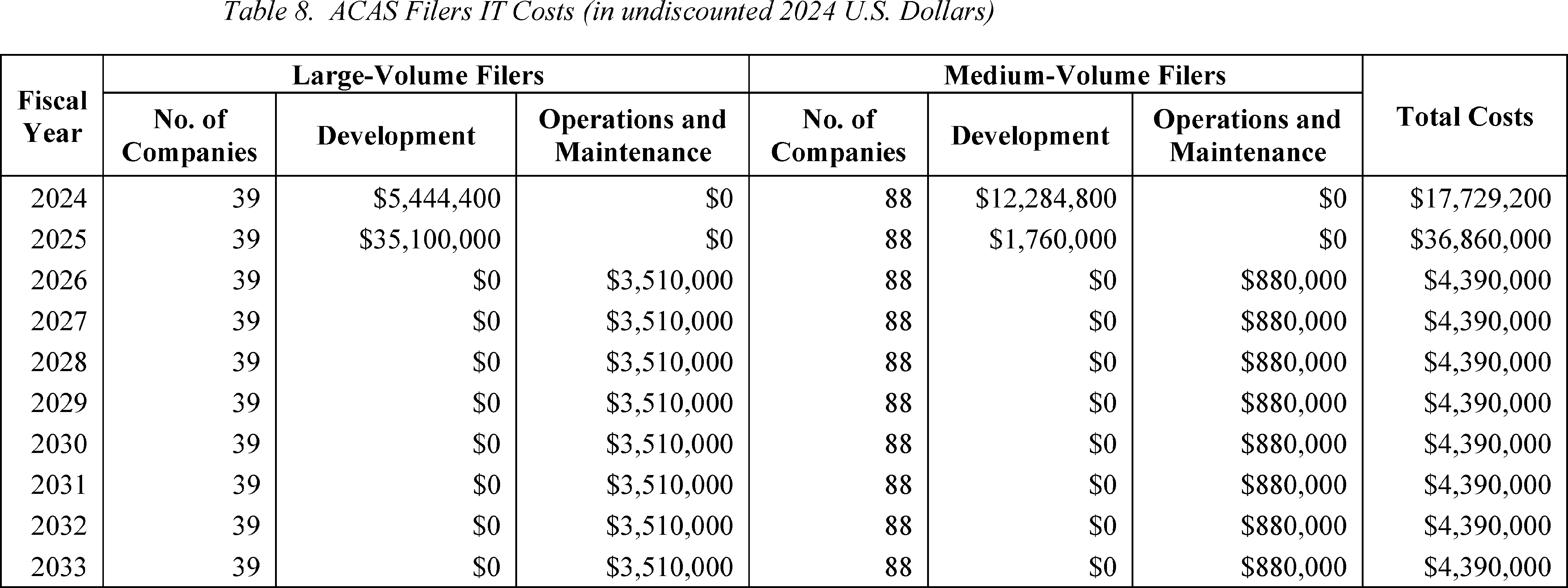
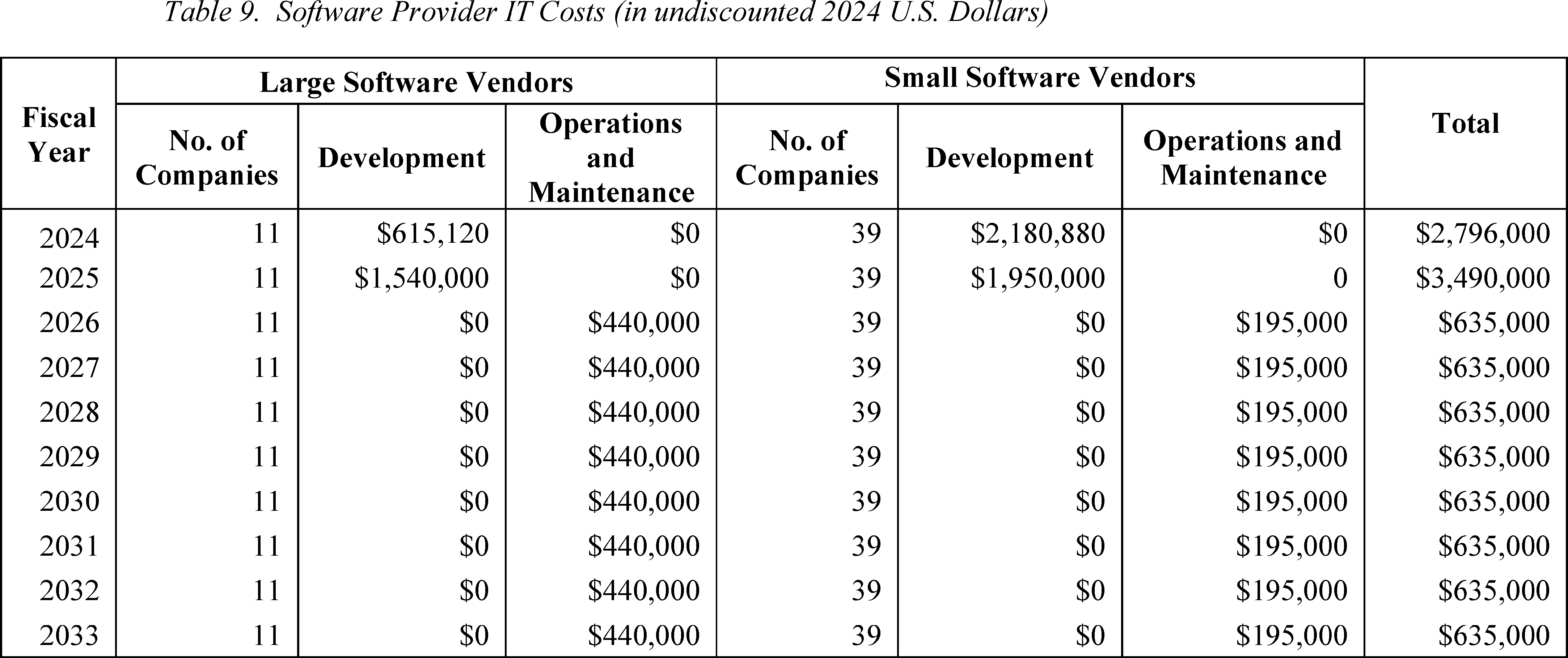
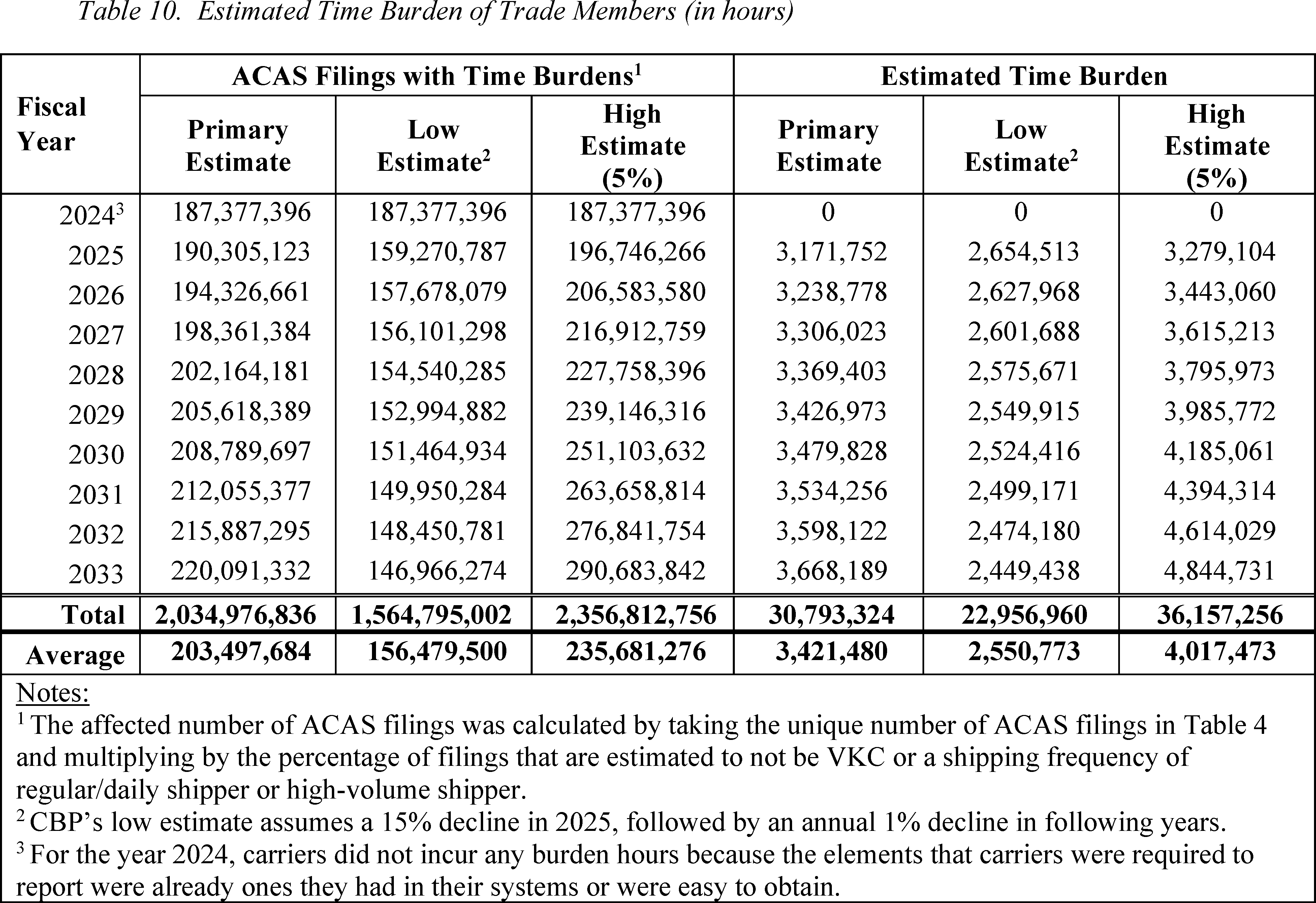
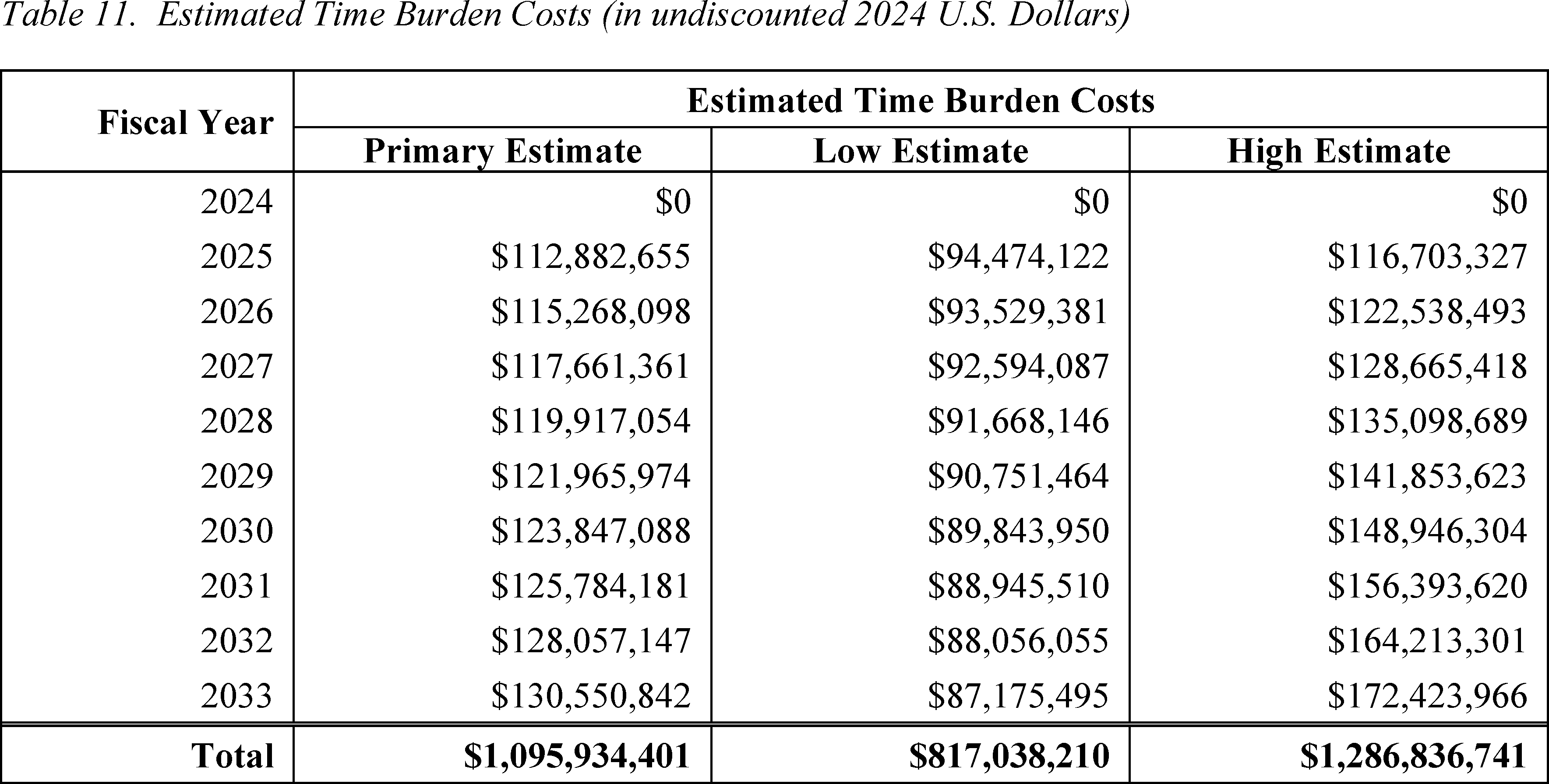
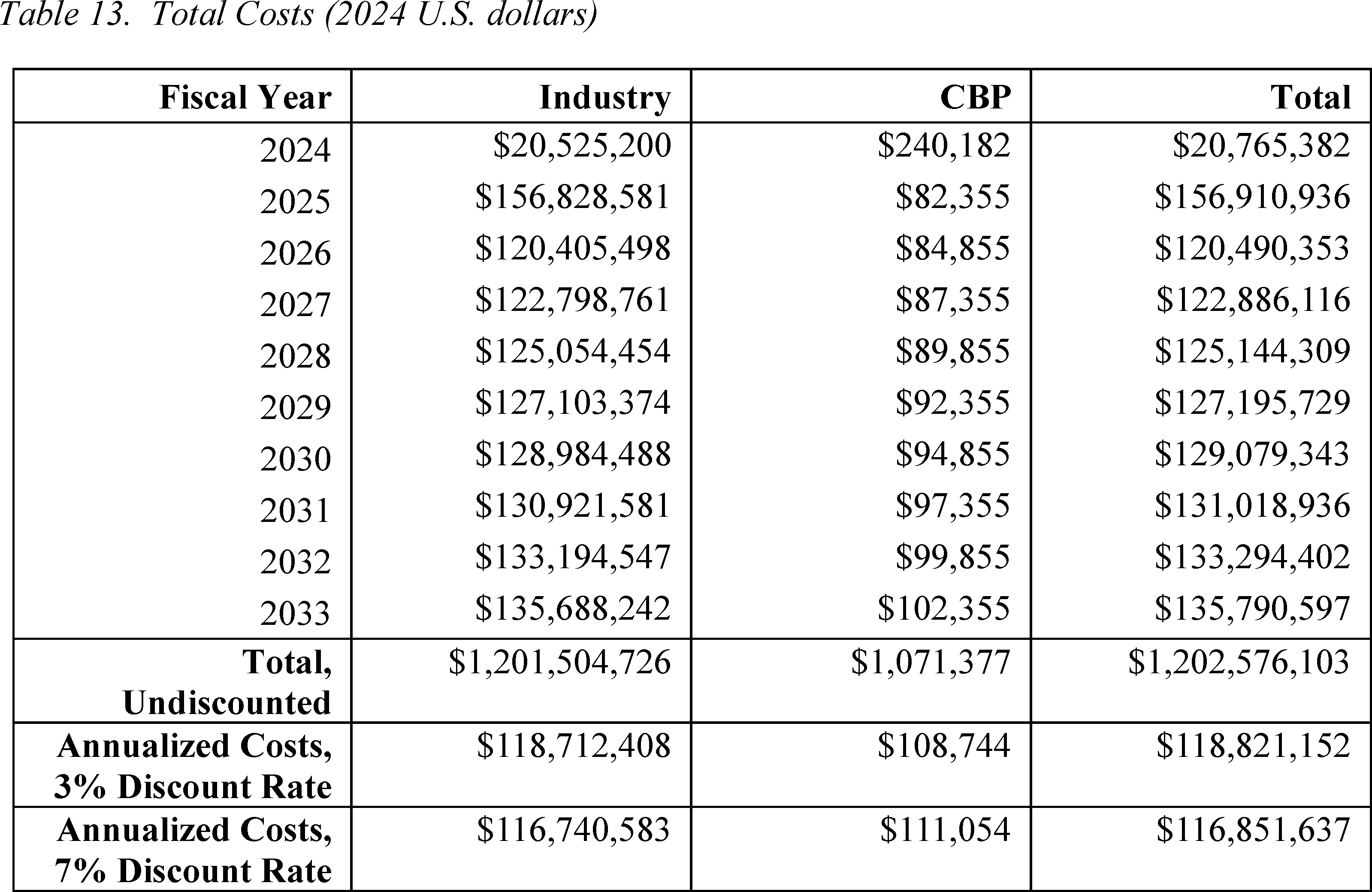

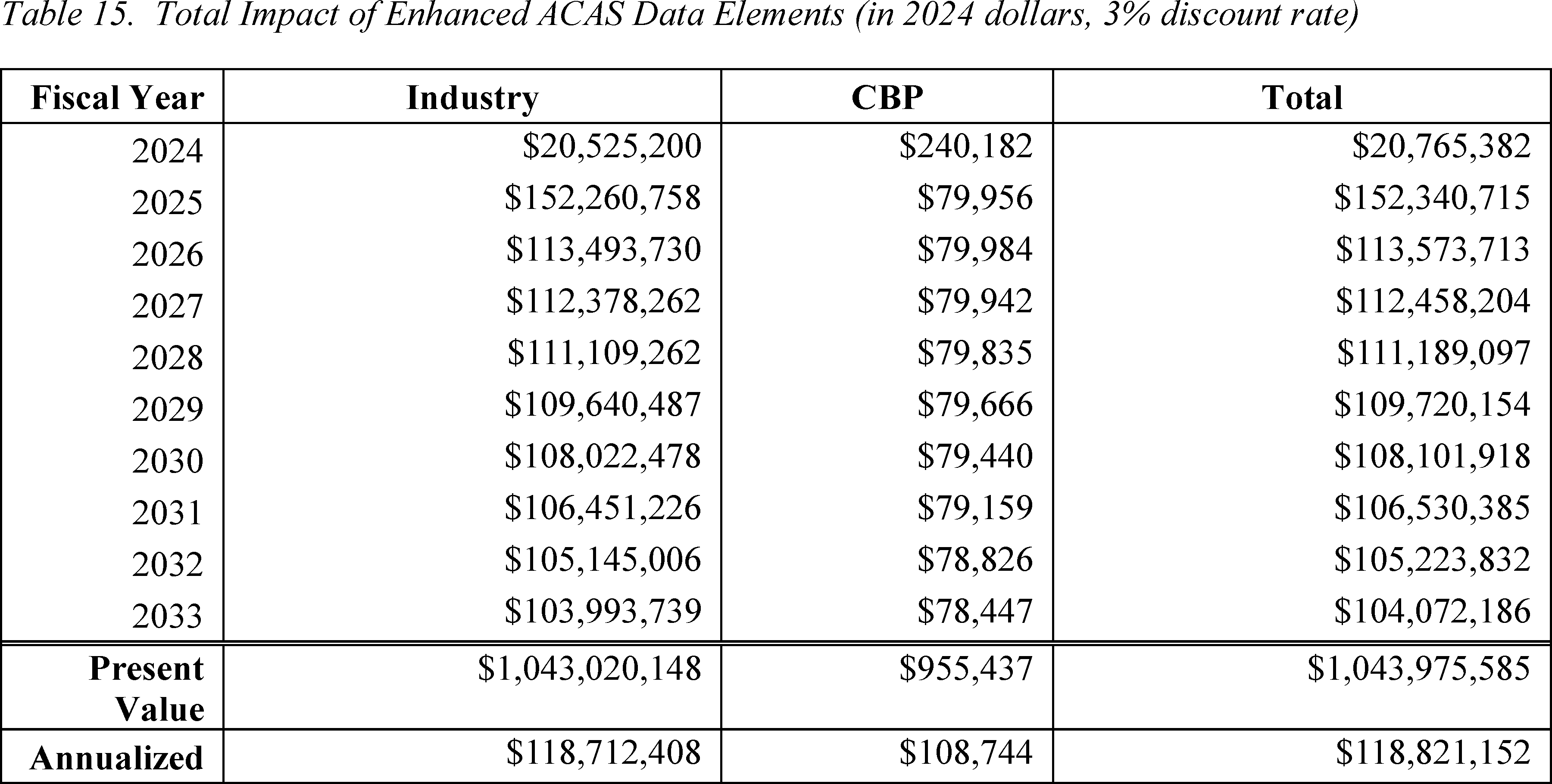
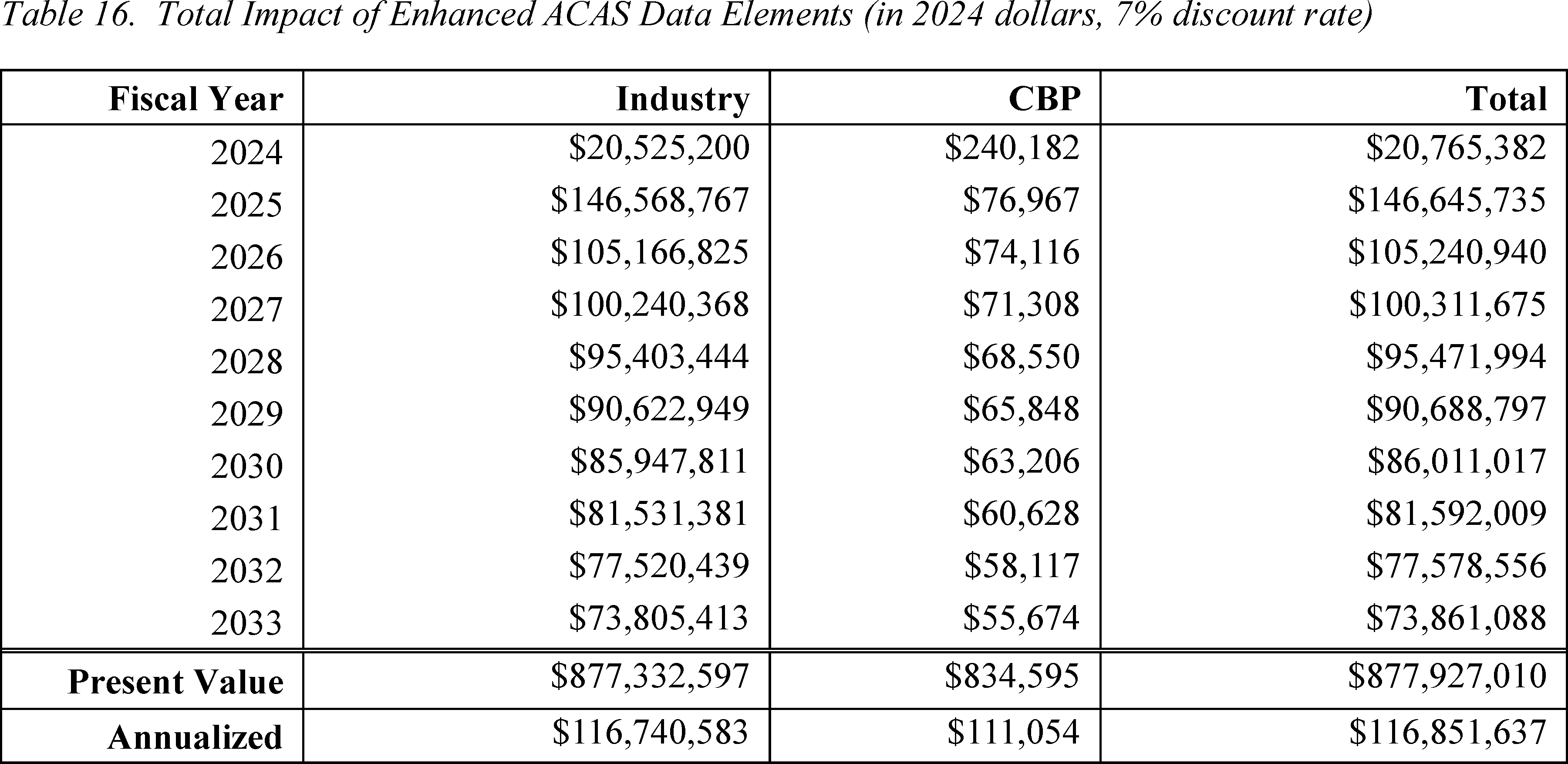
To address ongoing aviation security threats, U.S. Customs and Border Protection (CBP) is amending its regulations pertaining to the Air Cargo Advance Screening (ACAS) program t...
To address ongoing aviation security threats, U.S. Customs and Border Protection (CBP) is amending its regulations pertaining to the Air Cargo Advance Screening (ACAS) program to require the transmission of additional data elements. The ACAS program enhances the security of flights carrying cargo into the United States by requiring the transmission of certain air cargo data and performing targeted risk assessments based on the transmitted data prior to an aircraft's departure for the United States. These risk assessments identify and prevent high-risk air cargo from being loaded onto an aircraft that could pose a risk to an aircraft during flight.
DATES:
Effective Date:
This interim final rule is effective as of November 21, 2025.
Comment Date:
Comments must be received by January 20, 2026.
ADDRESSES:
Please submit any comments, identified by docket number USCBP-2025-0053, by the following method:
Instructions:
All submissions received must include the agency name and docket number for this rulemaking. All comments received will be posted without change to
https://www.regulations.gov,
including any personal information provided. For detailed instructions on submitting comments and additional information on the rulemaking process, see the “Public Participation” heading of the
SUPPLEMENTARY INFORMATION
section of this document.
Docket:
For access to the docket to read background documents or comments received, go to
https://www.regulations.gov.
FOR FURTHER INFORMATION CONTACT:
Joseph Martella, Cargo and Conveyance Security, Office of Field Operations, U.S. Customs & Border Protection, by telephone at 646-315-4330 or by email at
Joseph.Martella@cbp.dhs.gov.
SUPPLEMENTARY INFORMATION:
Table of Contents
I. Public Participation
II. Executive Summary
III. Background and Purpose
A. Regulatory History
B. Statutory Authority
C. CBP Regulatory Requirements
1. 19 CFR 122.48a—Electronic Information for Air Cargo Required in Advance of Arrival
C. Conditional Data Element: Master Air Waybill Number
D. Conditional Data Element: Verified Known Consignor Information
E. Conditional Data Elements That May Be Required When There Is Not a Verified Known Consignor
F. Optional Data Elements
G. Retention of Government-Issued Photo Identification Document Copies
H. Exemption of ACAS Data From Disclosure
I. Phased Enforcement
J. Severability
V. Statutory and Regulatory Reviews
A. Administrative Procedure Act
B. Executive Orders 12866, 13563, and 14192
C. Regulatory Flexibility Assessment
D. Unfunded Mandates Reform Act
E. Privacy Act of 1974 and E-Government Act of 2002
F. Paperwork Reduction Act
G. International Trade Impact Assessment
H. Congressional Review Act
Table of Abbreviations
ABI—Automated Broker Interface
ACAS—Air Cargo Advance Screening
APA—Administrative Procedure Act
ATS—Automated Targeting System
BLS—Bureau of Labor Statistics
CBP—U.S. Customs and Border Protection
CFR—Code of Federal Regulations
CRA—Congressional Review Act
DHS—Department of Homeland Security
DNL—Do-Not-Load
EIA—Energy Information Administration
E.O.—Executive Order
EU—European Union
FDM—Flight Departure Message
FR—Federal Register
GDP—Gross Domestic Product
HAWB—House Air Waybill
IFR—Interim Final Rule
IG—Implementation Guide
IP—Internet Protocol
IT—Information Technology
MAC—Media Access Control
MAWB—Master Air Waybill
NCSP—National Cargo Security Program
OMB—Office of Management and Budget
PNR—Passenger Name Record
PRA—Paperwork Reduction Act
RFA—Regulatory Flexibility Act
SBA—U.S. Small Business Administration
SKU—Stock Keeping Unit
SSI—Sensitive Security Information
TSA—Transportation Security Administration
UMRA—Unfunded Mandates Reform Act
URL—Uniform Resource Locator
U.S.—United States
U.S.C.—United States Code
VPN—Virtual Private Network
I. Public Participation
Interested persons are invited to participate in this rulemaking by submitting written data, views, or arguments on all aspects of this interim final rule (IFR). CBP also invites comments that relate to the economic, environmental, or federalism effects that might result from this IFR. Comments that will provide the most assistance to CBP will reference a specific portion of the IFR, explain the reason for any recommended change, and include data, information, or authority that support such recommended change.
II. Executive Summary
Intentional attacks on international aviation continue to pose a significant threat to the security of aircraft and individuals entering the United States. For example, in July 2024, incendiary devices caused fires at several air cargo facilities in Europe. If the devices had ignited mid-air, the resulting fires could have caused the catastrophic loss of an aircraft, threatening the safety and security of all individuals and property in the vicinity of the incident.
The Department of Homeland Security (DHS) was established, in part, to prevent such attacks, and to ensure aviation safety and security. Within DHS, U.S. Customs and Border Protection (CBP) and the Transportation Security Administration (TSA) have responsibilities for securing international air cargo bound for the United States. Working together, CBP and TSA employ a layered security approach to secure aircraft entering the United States, which includes risk assessment methods that identify high-risk cargo for further screening.
As part of this layered security approach, CBP's Air Cargo Advance Screening (ACAS) program requires inbound air carriers or other eligible filers to transmit specified air cargo data as early as practicable, but no later than prior to the loading of the cargo onto an aircraft. This data is analyzed as part of a joint CBP-TSA targeting operation that identifies high-risk cargo for further interventions before the cargo can be
( printed page 52797)
loaded onto an aircraft bound for the United States. In response to the July 2024 incidents, CBP, in coordination with TSA, determined that it is necessary to modify the ACAS program to more effectively identify high-risk air cargo.
CBP, in collaboration with TSA, established the ACAS program in response to an October 2010 attack in which terrorists placed concealed explosive devices in cargo on board two aircraft destined for the United States. The devices, disguised as printers, were designed to detonate mid-air over the continental United States with enough explosive potential to cause catastrophic damage to the two aircraft. The attack was ultimately thwarted when the devices were discovered through the combined efforts of multiple foreign and domestic intelligence agencies. If not discovered, the devices could have caused significant loss of life and damage to property on board any of the aircraft that the devices transited on, including passenger aircraft that carry air cargo. Despite the positive conclusion, the attack highlighted significant vulnerabilities in air cargo security as the devices had flown on board several flights prior to discovery.
To address vulnerabilities identified in CBP's analysis of the October 2010 attack, CBP, in collaboration with TSA, established the ACAS program to expedite the transmission of certain air cargo information used by CBP when conducting risk assessments. CBP and TSA also established a joint CBP-TSA targeting operation that analyzes transmitted air cargo data by utilizing CBP's Automated Targeting System (ATS) and other available intelligence as a risk targeting tool. This targeting operation enables CBP and TSA to address specific threat information in real time and identify high-risk cargo shipments that require further scrutiny. CBP's objective for the ACAS program is to obtain the most accurate data at the earliest time possible while minimizing any impact that the collection of data might have on the flow of commerce. The ACAS transmission timeline enables CBP and TSA to deter and disrupt threats faced by aircraft carrying cargo into the United States by identifying high-risk air cargo prior to an aircraft's departure for the United States. CBP and TSA requirements ensure that high-risk cargo shipments identified through this process receive appropriate screening and, if necessary, are prevented from transport in civil aviation. Following extensive discussions with members of industry and testing, CBP and TSA mandated participation in the ACAS program through the publication of CBP's ACAS IFR, effective June 12, 2018 (83 FR 27380) (“2018 IFR”), and through revisions to TSA's standard security programs.
Under section 122.48a of title 19 of the Code of Federal Regulations (19 CFR 122.48a), for any inbound aircraft required to make entry under 19 CFR 122.41 that will have commercial cargo aboard, CBP must receive air cargo information from the air carrier or other approved party no later than the time of departure (when the aircraft departs from certain foreign ports near the United States) or no later than four hours prior to arrival in the United States (when the aircraft departs from any other foreign area). Prior to the implementation of the ACAS program in 2018, the 19 CFR 122.48a timeline for the transmission of electronic information meant that an aircraft could depart from a foreign port and be airborne, enroute to the United States before any information regarding air cargo on board was transmitted to CBP. Without CBP's receipt of air cargo data and the completion of an effective risk assessment prior to an aircraft's departure from a foreign port, a threat actor could place dangerous cargo on board an aircraft, threatening the security of the aircraft and any persons or property in its vicinity.
CBP's ACAS requirements, 19 CFR 122.48b, apply to any inbound aircraft required to make entry under 19 CFR 122.41 that will have commercial cargo on board. The ACAS data transmission is in addition to the advance filing requirements for aircraft under 19 CFR 122.48a. Under the ACAS program, an inbound air carrier and/or other eligible ACAS filer must transmit specified air cargo data (hereafter referred to as “ACAS data”) to CBP as early as practicable, but not later than prior to the loading of the cargo onto the aircraft. This time frame allows CBP to analyze ACAS data, identify if the cargo has a nexus to a threat, and, with TSA, take the necessary action, such as preventing loading of the suspected high-risk cargo on aircraft, to thwart potential threats before an aircraft departs for the United States. A complete ACAS filing includes the transmission of all applicable ACAS data as required by 19 CFR 122.48b(d). The ACAS regulations refer to individual ACAS data requirements as data elements. In the 2018 IFR, CBP listed six mandatory data elements which must be transmitted for each ACAS filing and one conditional data element which must be transmitted only under certain circumstances. The regulation also provides that ACAS filers may choose to provide certain optional data elements.
Information received under the ACAS program enables the joint CBP-TSA targeting operation to identify high-risk cargo and CBP to issue Do-Not-Load (DNL) instructions or referrals for additional information or screening. When the available information points to an immediate or lethal threat to the aircraft and its vicinity, the ACAS regulations enable CBP to issue DNL instructions which prohibit the transportation of cargo. Referrals for information are issued if a risk assessment cannot be conducted due to non-descriptive, inaccurate, or insufficient information in the ACAS filing. Referrals for screening are issued pursuant to CBP authorities and resolved using the enhanced screening procedures required by TSA-approved or accepted security programs.
TSA enforces the implementation of enhanced screening methods through security program requirements under 49 CFR parts 1544 and 1546. In accordance with TSA regulations, inbound air carriers are required to comply with their respective TSA-approved or accepted security program, including any changes being implemented for purposes of the enhanced ACAS program.
The ACAS requirements and corresponding TSA-approved or accepted security program requirements enhance the ability of CBP and TSA to prevent air cargo that may contain a potential bomb, improvised explosive device, or other material that may pose an immediate, lethal threat to the aircraft or its vicinity from being loaded on board an aircraft and allows law enforcement authorities to coordinate with necessary parties.
Air cargo information received under the ACAS program has been an effective risk-assessment tool for CBP's ongoing efforts to ensure aviation safety and security including, but not limited to, combatting terrorist threats to the homeland. However, recent developments prompted CBP to review the ACAS program's requirements and announce revisions that provide CBP with a more complete understanding of the evolving threat environment. As explained under Section III.E. and Section V.A., the July 2024 incendiary incidents, in combination with specific, classified intelligence regarding the intent of threat actors to exploit similar vulnerabilities, informed CBP's decision to immediately revise the ACAS program in collaboration with TSA.
To address this new threat, CBP determined that it is necessary to modify the ACAS program to require
( printed page 52798)

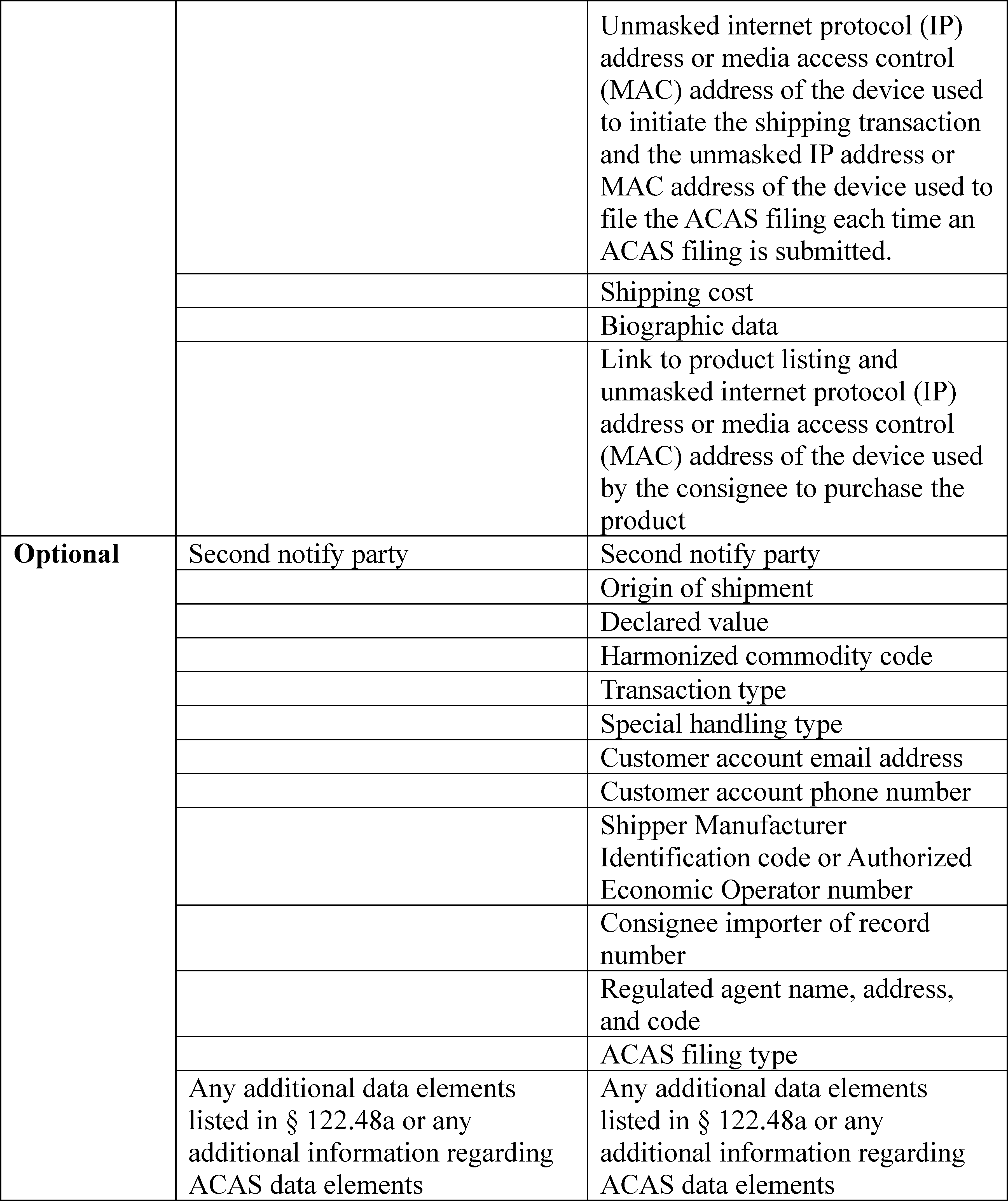
inbound air carriers and other eligible filers to submit additional ACAS data elements. As illustrated in Table 1, CBP is revising 19 CFR 122.48b(d) to include new mandatory, conditional, and optional data elements applicable to air carriers and other eligible ACAS filers. This IFR does not modify any existing substantive requirements under the ACAS regulations other than the addition of the new ACAS data elements. As such, CBP does not address any comments made or issues identified under the 2018 IFR.
Unlike the previous set of ACAS data elements which were entirely a subset of the data elements that must be submitted under 19 CFR 122.48a, the enhanced set of ACAS data elements combines the previous subset of 19 CFR 122.48a data elements with a new set of data elements unique to the ACAS program. The enhanced ACAS data elements will provide CBP and TSA with a more complete picture of the parties involved in cargo shipment transactions, the nature of the parties' relationships, financial data related to cargo shipments, and additional identifying information for certain online marketplaces and shipments originating from individuals with unknown risk profiles. The enhanced ACAS data elements were developed, in part, based on CBP's and TSA's understanding of various indicators of the relative risk of cargo shipments and will allow the joint CBP-TSA targeting operation to more effectively identify cargo shipments that require further scrutiny.
As discussed in Section III.F., CBP conducted an implementation period beginning in August 2024 to ensure the feasibility of sourcing and transmitting the enhanced ACAS data elements. The implementation period included extensive discussions with members of industry and government agencies to assess and reduce any potential complications associated with the new data elements. During the implementation period, members of industry initiated the development of the technological capabilities and business processes necessary to comply with the enhanced ACAS data element requirements. Based on industry feedback and CBP's own observations, CBP determined that it was necessary to promulgate regulations under CBP's authorities that could permanently mandate the transmission of the enhanced ACAS data elements.
The table below contains a list of the ACAS data elements previously required under 19 CFR 122.48b and the additional data elements introduced by this rulemaking.
( printed page 52799)
( printed page 52800)
III. Background and Purpose
1
Within DHS, CBP and TSA have responsibilities for securing air cargo bound for the United States from foreign ports. CBP, in consultation with TSA, established the mandatory ACAS program in 2018 to require the transmission of certain air cargo data prior to the departure of a U.S.-bound aircraft from a foreign port. The following subsections describe the regulatory history of the ACAS program, the statutory authorities for the ACAS program, existing CBP and TSA regulatory requirements, the security threat that prompted the publication of this IFR, and the development process for the enhanced ACAS data elements required by this IFR.
A. Regulatory History
On December 5, 2003, the Bureau of Customs and Border Protection (now CBP) published the Required Advance Electronic Presentation of Cargo Information final rule to require the transmission of electronic cargo information for cargo arriving in or departing from the United States by any mode of transportation.[2]
The 2003 final rule added 19 CFR 122.48a to require the electronic transmission of certain information pertaining to the commercial cargo on board aircraft entering the United States no later than the time of departure from certain ports near the United States or no later than
( printed page 52801)
four hours prior to arrival in the United States when the aircraft departs from any other foreign area.
In October 2010, a terrorist plot to place explosives on board cargo aircraft destined for the United States highlighted vulnerabilities in cargo aviation security. In response to this threat, CBP, in collaboration with TSA, established the Air Cargo Advance Screening (ACAS) pilot program in December 2010. The ACAS pilot required participants to provide certain information concerning air cargo at the earliest point practicable in the supply chain. Participation in the ACAS pilot was on a voluntary basis. CBP and TSA also established a joint CBP-TSA targeting operation that utilizes CBP's ATS as a dynamic risk targeting tool to analyze the ACAS data and other available intelligence to better identify cargo that poses a high security risk. The ACAS data transmission timeline allows the joint CBP-TSA targeting operation to identify high-risk cargo for further screening prior to the departure of an aircraft bound for the United States. The ACAS pilot was formalized and expanded in an October 2012
Federal Register
notice; however, participation was still on a voluntary basis.[3]
As the ACAS program developed, CBP determined that it was necessary to mandate the transmission of ACAS data.
On June 12, 2018, CBP published the ACAS interim final rule (IFR).[4]
The 2018 IFR implemented a mandatory ACAS program under 19 CFR 122.48b, which specifies the general ACAS requirements, the eligible filers, the ACAS data elements, the time frame for providing the data to CBP, the responsibilities of the filers, and the process regarding ACAS referrals and DNL instructions.
Through the 2018 IFR, CBP also amended 19 CFR 122.48a to reference the ACAS requirements and to incorporate a few additional changes. Specifically, CBP amended 19 CFR 122.48a to revise the definition of the consignee name and address data element to provide a more accurate and complete definition, and to add a new data element requirement, the flight departure message (FDM), to enable CBP to determine the timeliness of ACAS transmissions. CBP also amended the applicable bond provisions in 19 CFR part 113 to incorporate the ACAS requirements.
For a detailed discussion of the statutory and regulatory histories, the factors governing the development of the ACAS regulations, and the changes to the regulations prior to the issuance of this IFR, see the 2018 ACAS IFR.[5]
B. Statutory Authority
Section 343(a) of the Trade Act of 2002 (Trade Act), as amended, authorizes CBP to promulgate regulations providing for the mandatory transmission of electronic cargo information by way of a CBP-approved electronic data interchange (EDI) system before cargo is brought into or departs from the United States.[6]
Section 343(a)(2) of the Trade Act authorizes CBP to require the transmission of any cargo information that CBP “determines to be reasonably necessary to ensure cargo safety and security pursuant to those laws enforced and administered by [CBP].”
When developing regulations under CBP's section 343(a) Trade Act authority, CBP must adhere to parameters under section 343(a)(3) that require CBP to give due consideration to the concerns of the industry and the flow of commerce. These parameters include, among others, provisions requiring consultation with affected parties and the consideration of the differences in commercial and operational practices among the different parties. In addition, in determining the timing for transmittal of any information, the statute requires CBP to balance the likely impact of the data collection on the flow of commerce with the cargo safety and security benefits. The statute also requires CBP to protect the privacy of business proprietary and any other confidential cargo information provided to CBP and ensure that the information collected pursuant to the regulations be used for ensuring cargo safety and security, preventing smuggling, and commercial risk assessment targeting. Finally, the statute requires that the obligations imposed must generally be upon the party most likely to have direct knowledge of the required information, and if not, that the obligations imposed take into account ordinary commercial practices for receiving data and what the party transmitting the information reasonably believes to be true.
The FAA Reauthorization Act of 2018, Public Law 115-254 (FAA Act), was enacted on October 5, 2018, nearly four months after the publication of the 2018 ACAS IFR. Among other things, section 1951 of the FAA Act (codified at 49 U.S.C. 44901 note) requires the Commissioner of CBP and the Administrator of TSA to establish an air cargo advance screening program for the collection of advance electronic information from air carriers and other persons within the supply chain regarding cargo being transported to the United States by air in order to perform risk targeting to prevent the loading and transportation of high-risk cargo. Section 1951 also requires that CBP, in coordination with TSA, issue final regulations that implement the air cargo advance screening program within 180 days of enactment of the FAA Act, by April 5, 2019. Despite some minor differences in the terminology used in the 2018 IFR and the FAA Act regarding some of the specific requirements, the ACAS program established by CBP, as set forth in the 2018 IFR, is the type of program that Congress envisioned in the FAA Act and the 2018 IFR substantially fulfills the requirements of the FAA Act.
C. CBP Regulatory Requirements
Section 343(a) of the Trade Act authorizes CBP to promulgate regulations providing for the mandatory transmission of cargo information by way of a CBP-approved electronic data interchange (EDI) system before the cargo is brought into or departs from the United States by any mode of commercial transportation. Under section 343(a)(2) of the Trade Act, CBP may require cargo information that is reasonably necessary to ensure cargo safety and security pursuant to the laws enforced and administered by CBP. As described in Section III.A., CBP previously issued a 2003 final rule and a 2018 IFR to promulgate regulations requiring the transmission of advance air cargo information under the Trade Act.
For any inbound aircraft required to make entry under 19 CFR 122.41[7]
that will have commercial cargo aboard, the inbound air carrier or other eligible filer must transmit certain data regarding that cargo to CBP through a CBP-approved EDI system under two separate, but related, sets of requirements. The following two subsections detail CBP's transmission requirements for certain air cargo data under 19 CFR 122.48a (air manifest data) and 19 CFR 122.48b (ACAS). Section III.C.2. describes the ACAS program requirements that have existed prior to modification by this IFR. While the following summary is not inclusive of all of the differences between the two
( printed page 52802)
sets of requirements, the 19 CFR 122.48a filing requirements and the ACAS requirements can be most notably distinguished by the differing timelines for transmission of the data elements, the differing but overlapping lists of data elements, and the differing lists of eligible filers.
1. 19 CFR 122.48a—Electronic Information for Air Cargo Required in Advance of Arrival
Under 19 CFR 122.48a, for any inbound aircraft required to make entry that will have commercial cargo on board, air carriers or other eligible filers are required to transmit certain air cargo data to CBP. The data must be received by CBP no later than the time of departure (when the aircraft departs from specified foreign areas near the United States) or no later than four hours prior to arrival in the United States (when the aircraft departs from all other foreign areas). The individual data requirements are known as data elements.
(1) Air waybill number(s) (master and house, as applicable)
(2) Trip/flight number
(3) Carrier/ICAO (International Civil Aviation Organization) code
(4) Airport of arrival
(5) Airport of origin
(6) Scheduled date of arrival
(7) Total quantity based on the smallest external packing unit
(8) Total weight
(9) Precise cargo description
(10) Shipper name and address
(11) Consignee name and address
(12) Consolidation identifier (conditional)
(13) Split shipment indicator (conditional)
(14) Permit to proceed information (conditional)
(15) Identifier of other party which is to submit additional air waybill information (conditional)
(16) In-bond information (conditional)
(17) Local transfer facility (conditional)
(18) Flight departure message
Paragraph (d) of 19 CFR 122.48a specifies, based on the type of shipment, what data the inbound carrier must transmit to CBP and what data other eligible filers may elect to transmit to CBP. There are different requirements for consolidated and non-consolidated shipments. A consolidated shipment consists of a number of separate shipments that have been received and consolidated into one shipment by a party such as a freight forwarder for delivery as a single shipment to the inbound carrier. Generally speaking, a master air waybill (MAWB) is an air waybill that is generated by the inbound carrier for a consolidated shipment. In addition, each of the shipments in the consolidated shipment has its own air waybill, referred to as the house air waybill (HAWB). The HAWB provides the information specific to the individual shipment that CBP needs for targeting purposes. The HAWB does not include the flight and routing information for the consolidated shipment (which is included on the MAWB). For consolidated shipments, the inbound carrier must transmit to CBP the above cargo data that is applicable to the MAWB, and a subset of the above data for all associated HAWBs, unless another eligible filer transmits this data to CBP. For non-consolidated shipments, the inbound carrier must transmit to CBP all of the above cargo data for the air waybill record, as applicable. For split shipments,
i.e.,
shipments that have been divided into two or more smaller shipments, either sent together or separately, the inbound carrier must transmit an additional subset of this data for each HAWB.
Eligible filers under 19 CFR 122.48a include the inbound air carrier, whose participation is mandatory, Automated Broker Interface (ABI) filers, Container Freight Stations/deconsolidators, Express Consignment Carrier Facilities, and air carriers that arranged to have the incoming air carrier transport the cargo into the United States. Foreign indirect air carriers, which includes freight forwarders as defined under 19 CFR 122.48b, are notably not included in the list of potential 19 CFR 122.48a filers. This list of eligible filers contrasts with the list of eligible filers under the ACAS program, as described in the following subsection.
CBP's regulatory ACAS requirements can be found under 19 CFR 122.48b. The ACAS requirements are the only regulatory requirements amended through this IFR. CBP introduced the mandatory ACAS program in 2018 to require earlier transmission of ACAS data which, previous to this IFR, was entirely a subset of the data collected under 19 CFR 122.48a. CBP relies on the timely transmission of the ACAS data elements to create an informed assessment regarding the relative security risk a particular shipment poses. ACAS data must be transmitted as early as practicable, but no later than prior to the loading of cargo onto an aircraft, which is in contrast to the broader set of 19 CFR 122.48a data which may, in some cases, be transmitted after the departure of an aircraft from a foreign port. This timing requirement is one of the most significant operational differences between the requirements found under 19 CFR 122.48a and those found under 19 CFR 122.48b.
The inbound air carrier is ultimately responsible for ensuring that mandatory and applicable conditional ACAS data elements are transmitted to CBP. However, the ACAS regulations allow other entities to elect to be ACAS filers. The following types of entities can elect to be an ACAS filer, provided that the entities meet the ACAS filer requirements: ABI filer (importer or its customs broker) as identified by its ABI filer code; a Container Freight Station/deconsolidator as identified by its FIRMS (Facilities Information and Resources Management System) code; an Express Consignment Carrier Facility as identified by its FIRMS code; an air carrier as identified by its carrier IATA (International Air Transport Association) code, that arranged to have the inbound air carrier transport the cargo to the United States; or a foreign indirect air carrier (a term which encompasses freight forwarders). The inclusion of foreign indirect air carriers in the list of eligible filers for the ACAS program is different from the list of eligible filers found under 19 CFR 122.48a. If an eligible party other than the inbound air carrier files the ACAS data, the inbound air carrier may also choose to transmit its own ACAS filing.
If a party that is eligible to elect to file ACAS data does not participate in an ACAS filing, the party that arranges for and/or delivers the cargo to the inbound air carrier must fully disclose and present to the inbound air carrier any required ACAS data.
See19 CFR 122.48b(c)(4). If any third party that is not an eligible ACAS filer possesses required ACAS data, that party must fully disclose and present the required ACAS data to either the inbound air carrier or other eligible ACAS filer for transmission to CBP.
See19 CFR 122.48b(c)(5).
ACAS filers are responsible for the accuracy of any ACAS data they transmit. In accordance with Trade Act parameters, CBP recognizes that certain factors outside of an ACAS filer's control could affect the accuracy of ACAS data. Thus, ACAS data is accurate if it is the best available data at the time of filing which is determined by considering, in accordance with ordinary commercial practices, how the presenting party acquired the information and whether and how the presenting party is able to verify the
( printed page 52803)
information. When a presenting party is not reasonably able to verify the information, the standard of evaluation for accuracy is that which the presenting party reasonably believes to be true.
See
section 343(a)(3)(B) of the Trade Act (19 U.S.C. 1415(a)(3)(B)); 19 CFR 122.48b(c)(6). If any of the ACAS data changes or more accurate ACAS data becomes available after the initial ACAS filing, the ACAS filer must update the initial filing up until the deadline listed for 19 CFR 122.48a data.
See19 CFR 122.48b(b)(2).
Under the regulations promulgated through the 2018 IFR, CBP required ACAS filers to transmit six mandatory data elements in all circumstances, one data element on a conditional basis, and recommended the transmission of other data elements on an optional basis. The ACAS data elements, found under 19 CFR 122.48b(d), utilized the same definitions as the broader set of data elements found under 19 CFR 122.48a. The six mandatory data elements which must be transmitted in each ACAS filing at the lowest air waybill level are:
(1) Shipper name and address;
(2) Consignee name and address;
(3) Cargo description;
(4) Total quantity based on the smallest external packing unit;
(5) Total weight of cargo; and
(6) Air waybill number.
The 2018 IFR also required the transmission of one conditional ACAS data element, the master air waybill (MAWB) number. Conditional data elements are only required under certain circumstances. If a conditional data element is not required, transmission of the data element is optional, but encouraged. The conditional MAWB number data element provides the location of the high-risk cargo and allows CBP to associate the cargo with an ACAS transmission. The MAWB number data element is required (1) when the ACAS filer is a different party than the party that will file the 19 CFR 122.48a data; (2) when the ACAS filer transmits all the 19 CFR 122.48a data in the applicable ACAS time frame through a single filing; or (3) when the inbound air carrier would like to receive a status check from CBP on the ACAS assessment of specific cargo. If not required under one of the three circumstances listed above, transmission of the MAWB number is optional.
Under the 2018 IFR, CBP also created the optional category of data elements which means that transmission of those data elements is recommended, but not required. CBP specifically allowed for the optional designation of a “Second Notify Party” to receive shipment status messages from CBP. Additionally, CBP encouraged ACAS filers to transmit any additional data elements listed under 19 CFR 122.48a that are not required under 19 CFR 122.48b and any additional information regarding ACAS data elements.
If CBP issues a referral for information under 19 CFR 122.48b(e)(1)(i), the ACAS filer may be required to submit additional information beyond what is required under the ACAS data elements, such as flight numbers and routing information, to resolve the ACAS referral.
See19 CFR 122.48b(e)(2)(i). When necessary, this information will be requested in a referral message.
CBP may issue a referral for screening if the potential risk of the cargo is deemed high enough to warrant enhanced security screening. When CBP issues a referral for screening under 19 CFR 122.48b(e)(1)(ii), the ACAS filer may resolve the referral using TSA-approved enhanced screening methods if it is a party recognized by TSA to perform screening.
See19 CFR 122.48b(e)(2)(ii). TSA approves the use of enhanced screening methods pursuant to security programs issued under 49 CFR parts 1544 and 1546; thus, an ACAS filer is not recognized by TSA to perform the enhanced screening necessary to resolve a referral unless the ACAS filer is regulated by TSA under 49 CFR part 1544 or 1546.
See83 FR 27380, 27381, 27384-85 (Jun. 12, 2018). If the ACAS filer is a party other than the inbound air carrier and chooses not to address the referral or is not a party recognized by TSA to perform screening, the ACAS filer must notify the inbound air carrier of the referral for screening. The inbound air carrier is responsible for addressing referrals for screening unless another ACAS filer has addressed the referral by performing the required enhanced screening. Referrals for screening can only be resolved by parties recognized by TSA to perform screening.
See19 CFR 122.48b(e)(2)(ii). To resolve a referral for screening, the inbound air carrier and/or other eligible ACAS filer must respond to the referral with information on how the cargo was screened in accordance with TSA-approved or accepted enhanced screening methods.
CBP may also issue a DNL instruction if it is determined, based on the risk assessment and other intelligence, that the cargo may contain a potential bomb, improvised explosive device, or other material that may pose an immediate, lethal threat to aircraft, persons aboard, and/or the vicinity. If a DNL instruction is issued, the cargo must not be loaded onto the aircraft. The party in physical possession of the cargo at the time the DNL instruction is issued must adhere to the appropriate CBP and TSA protocols and the directions provided by the applicable law enforcement authority.
See19 CFR 122.48b(f).
The ACAS regulations also enable CBP to take appropriate enforcement action against ACAS filers who do not comply with the ACAS requirements. Through the transmission of an ACAS filing, the ACAS filer assumes certain responsibilities, including the responsibility to provide accurate data to CBP and update that data if necessary, the responsibility to transmit the ACAS data to CBP within the required time frame, and the responsibility to resolve ACAS referrals prior to the departure of an aircraft and respond to DNL instructions in an expedited manner.
See19 CFR 122.48b(b), 122.48b(c)(6), 122.48b(e), and 122.48b(f). An ACAS filer's failure to perform those responsibilities could result in CBP issuing liquidated damages and/or assessing penalties.
See83 FR 27392 (Jun. 12, 2018) (discussing amendments to the relevant bond conditions to account for enforcement of ACAS requirements). Furthermore, TSA may assess additional penalties for violations of TSA's regulations.
D. TSA Requirements
Under the Aviation and Transportation Security Act (ATSA) of November 2001, TSA is required to “provide for the screening of all passengers and property . . . that will be carried aboard a passenger aircraft operated by an air carrier or foreign air carrier in air transportation . . . .” 49 U.S.C. 44901(a). Additionally, TSA is required to ensure a system is in operation to “screen, inspect, or otherwise ensure the security of all cargo that is to be transported in all-cargo aircraft in air transportation . . . .” 49 U.S.C. 44901(f). Under the Implementing Recommendations of the 9/11 Commission Act of 2007, TSA was further required to “establish a system to screen 100 percent of cargo transported on passenger aircraft operated by an air carrier or foreign air carrier in air transportation . . . .” 49 U.S.C. 44901(g). To satisfy these statutory mandates, TSA is authorized to promulgate regulations and issue security requirements for U.S. and foreign air carriers at non-U.S. locations for flights departing a foreign port bound for the United States.[8]
( printed page 52804)
Under TSA's regulatory framework, air carriers are required to implement TSA-approved security programs that are tailored to each air carrier's security and operational needs. A security program may describe, among other things, screening requirements for air cargo departing from a foreign port bound for the United States. Details related to the security programs are considered Sensitive Security Information (SSI),[9]
and are made available to carriers as necessary. Alternatively, carriers may request TSA approval to follow National Cargo Security Program (NCSP) recognition procedures in lieu of TSA security program requirements.[10]
When the security environment or operational factors necessitate the modification of a security program, TSA or an air carrier may initiate a security program amendment.[11]
TSA also has the regulatory authority to issue Security Directives and Emergency Amendments which impose immediate security measures that supersede other requirements based on changing security environments, intelligence, and emergency situations.[12]
TSA regulations and security programs require carriers to perform screening procedures and security measures on all cargo inbound to the United States. These requirements are met through a risk-based combination of assessments, aided by data collected by CBP, and screening, as required by an air carrier's TSA-approved or -accepted security program.
TSA routinely inspects carriers' cargo facilities to ensure compliance with the required measures of the carriers' security programs. If TSA determines that violations of the requirements have occurred, appropriate measures will be taken and penalties may be levied.
E. Air Cargo Security Risks
Intentional attacks on international aviation continue to pose a significant threat to the security of international air cargo operations. In 2018, CBP published the ACAS IFR to address risks initially identified in response to the October 2010 incident in which explosive devices were concealed in two shipments of printers addressed for delivery to Chicago, Illinois. While that attack was successfully thwarted by the combined intelligence efforts of several foreign countries, CBP and TSA determined that a mandatory ACAS program was necessary to provide a systematic and targeted approach to identifying high-risk cargo prior to departure from a foreign port. Although the ACAS program has previously been successful in identifying high-risk cargo and continues to do so, threat actors have evolved to exploit additional vulnerabilities in air cargo security that necessitate modification of the ACAS program.
Recent events, such as the October 2023 HAMAS attack on Israel and ongoing conflicts in the Middle East, have inspired terrorists to renew calls for attacks against civil aviation.[13]
Certain state actors, such as Iran, also pose a threat to the safety and security of international aviation due to their support for international terrorist organizations and statements indicating an intent to harm the United States.[14]
Additionally, certain ongoing international conflicts have increased the threat of asymmetric attacks in neutral territories, the effects of which could be felt in the United States.[15]
In July 2024, incendiary devices caused fires at multiple air cargo facilities in Europe.[16]
While investigators continue to probe the sources and motives of the entities that introduced those devices into the air cargo supply chain, existing circumstances suggest that these incidents were intentional attacks. Had the devices activated during a flight, the resulting conflagration could have caused catastrophic damage to the aircraft, potentially resulting in the complete destruction of the aircraft and its cargo and loss of life for any crew or passengers on board. These attacks also pose risks to individuals and property on the ground due to the potential loss of an aircraft. Additionally, as demonstrated by the July 2024 incendiary attacks, attacks on the air cargo supply chain also threaten the security of air cargo infrastructure while a device is in transit prior to or following transportation by air.
In consideration of these recent attacks and classified information regarding a specific threat to air cargo security, CBP determined that it is necessary to modify the ACAS program to better address these evolving threats. With the increasing sophistication of attacks on air cargo infrastructure, CBP requires additional ACAS data to effectively identify and target high-risk shipments.
F. The Enhanced ACAS Program Development Process
In response to the threats discussed in Section III.E., CBP updated the ACAS Implementation Guide (IG) to version 2.3.1 on August 30, 2024.[17]
Version 2.3.1 contained a number of new data elements under section 3.3.2, Data Recommended Pre-Loading. These recommended data elements were introduced to provide immediate actionable steps members of industry could take to improve air cargo security.
In the period between the publication of the recommended data elements in
( printed page 52805)
August 2024 and the publication of this IFR, CBP conducted extensive outreach with members of the air cargo industry to determine the feasibility of permanently requiring the transmission of the recommended data elements through the revision of the ACAS regulations. During critical periods of the implementation process, CBP conducted regularly scheduled meetings with a broad range of interested parties including, but not limited to, trade associations, software providers, air carriers, and freight forwarders. Through this outreach, CBP worked to limit any potential burden on members of the air cargo industry by refining the list of recommended data elements. Additionally, prior to the publication of this IFR, CBP published several revised versions of the ACAS Implementation Guide and frequently asked questions and answers on CBP's website to reflect the results of CBP's discussions with members of the air cargo industry.[18]
The recommended data elements under the ACAS Implementation Guide provided the basis for the mandatory and conditional data elements included in this IFR. As a direct result of CBP's engagement with industry and the air cargo industry's active participation in securing air cargo infrastructure, a number of ACAS filers have been regularly transmitting many of the enhanced ACAS data elements prior to the publication of this IFR.
IV. ACAS Program Revisions
In accordance with CBP's Trade Act authority to promulgate regulations pertaining to the transmission of information for air cargo entering the United States, as well as CBP's authority under the FAA Act, CBP is revising the ACAS regulations to require the transmission of additional data elements that will enable CBP to counter new threats to air cargo security.
While the ACAS program, as originally implemented, has been successful in identifying high-risk cargo, threat actors have evolved to exploit additional vulnerabilities in air cargo security, including the security of cargo entering the United States. To counter these additional threats, CBP determined that it is necessary to modify the ACAS program. The revisions to the ACAS program under this IFR are limited to the addition of mandatory, conditional, and optional ACAS data elements under 19 CFR 122.48b(d) and the addition of a records retention requirement related to the new biographic data conditional data element. This IFR does not alter or remove any of the ACAS data elements required under the previous 19 CFR 122.48b(d); however, to accommodate additional conditional data elements, optional data elements, previously provided in 19 CFR 122.48b(d)(3), are now included in 19 CFR 122.48b(d)(5). A summary of the data element changes made to the CFR by this IFR can be found under Table 1.
The transmission of the enhanced ACAS data elements will allow CBP to gain a more complete understanding of the financial, business, and personal relationships between parties that are engaged in shipping air cargo. The transmission of all required existing and new ACAS data elements is essential for CBP to assess the risk associated with a cargo shipment because CBP analyzes ACAS data elements and other available intelligence in the aggregate. In other words, CBP's ATS combines multiple individual data elements which can then be compared against law enforcement, intelligence, or other enforcement data to identify ACAS filings that require additional review. Data elements that are innocuous when viewed in isolation may be suspect when viewed in the aggregate. Alternatively, a single data element could prompt additional review; however, the transmission of all required data elements is still necessary to build the aggregate and identify high-risk cargo because of the difficulty of predicting, prior to transmission, which data elements will or will not indicate a heightened level of risk.
The new data elements must be transmitted in accordance with the existing ACAS timeline, as soon as practicable, but no later than prior to the loading of cargo onto an aircraft. 19 CFR 122.48b(b)(1). This timeline enables CBP to target high-risk cargo prior to loading with the goal of preventing high-risk cargo from entering the United States or causing harm while enroute to the United States. A later timeline for some or all enhanced data elements would reduce the effectiveness of CBP's pre-loading aggregate analysis and nullify the security benefit of requiring additional data elements for the purposes of thwarting threats prior to arrival of the aircraft. Building on this understanding of why CBP collects a number of data elements prior to the loading of cargo onto an aircraft, the following subsections further detail CBP's rationale for requiring certain data elements.
CBP developed the enhanced ACAS data elements within the parameters defined by the Trade Act to balance the imposition of any burden on the public against the critical need for additional ACAS data. Consistent with FAA Act requirements, CBP also (1) considered that the content and timeliness of the available data may vary among entities in the air cargo industry and among countries, and (2) explored procedures to accommodate such variations while maximizing the contribution of such data to the risk assessment process under the ACAS program, among other requirements. Throughout the development of the enhanced ACAS data elements, CBP conducted extensive outreach with members of the air cargo industry to understand their business practices and to ensure that the new data elements will not place unrealistic or undue burdens on members of industry. CBP also considered the results of the implementation period discussed in Section III.F., during which, multiple ACAS filers transmitted many of the enhanced ACAS data elements prior to the requirements imposed through the publication of this IFR.
In developing these revisions, CBP considered international efforts to develop advance air cargo data targeting programs. CBP also coordinated with international trade associations and their members to understand requirements imposed by other countries and limit any potential conflicts. CBP will continue to engage with members of the international community to work toward enhancing international standards for the collection and analysis of air cargo data prior to loading.
A. Enhanced ACAS Data Element Definitions
The ACAS data elements introduced under the 2018 IFR are entirely a subset of the data elements that must be transmitted under 19 CFR 122.48a. Thus, the definitions for the initial ACAS data elements introduced under the 2018 IFR can be found under 19 CFR 122.48a. This definitional cross-reference is detailed in the introductory text of 19 CFR 122.48b(d). The new ACAS data elements introduced by this IFR are unique to the ACAS program. As such, the definitions for the new ACAS data elements can be found under the revised 19 CFR 122.48b(d) and are not referenced under 19 CFR 122.48a.
B. Mandatory Data Elements
Mandatory ACAS data elements must be transmitted to CBP in all circumstances. Through this IFR, CBP is
( printed page 52806)
revising 19 CFR 122.48b(d)(1) to include several new mandatory ACAS data elements. This revision of 19 CFR 122.48b(d)(1) does not remove or otherwise modify existing ACAS data element requirements. The additions to the list of mandatory ACAS data elements include consignee email address, consignee phone number, shipment packing location and/or scheduled shipment pickup location, and ship to party. The following paragraphs describe what CBP will require for each new data element and explain CBP's rationale for requiring the data elements.
(1)
Consignee email address.
This is the email address for the party identified as the consignee under the consignee name and address data element. The consignee name and address data element is currently required under 19 CFR 122.48b(d)(1)(ii).
(2)
Consignee phone number.
This is the phone number for the party identified as the consignee under the consignee name and address data element. The consignee name and address data element is currently required under 19 CFR 122.48b(d)(1)(ii).
These two new mandatory contact information data elements, consignee email address and consignee phone number, will allow CBP to improve its targeting of high-risk shipments by further identifying the parties involved in the shipping process, by comparing transmitted contact information with information in CBP databases, and by improving CBP's ability to directly contact parties in the event of an emergency involving a safety or security risk with the shipment.
The provision of additional contact information will allow CBP to gain a more complete understanding of the parties involved in a shipping transaction which can be compared against other data elements to identify potential threats. As stated previously, CBP assesses data elements in the aggregate; thus, seemingly mundane data elements such as email addresses and phone numbers may gain significance when a comparison against other transmitted data elements reveals ambiguities or patterns consistent with the existence of a threat.
Contact information can also be compared against existing contact information in CBP databases to identify threat actors. For example, CBP conducts similar targeting for individuals entering and exiting the United States through CBP's analysis of passenger name record (PNR) data. In 2010, a terrorist attempted to detonate a car bomb in New York's Times Square. The FBI quickly identified the terrorist's cell phone number but had little additional information. Through coordination between DHS and the FBI, CBP was able to compare the terrorist's cell phone number with PNR data to identify and detain the terrorist before the terrorist could flee the United States.[19]
The new requirements to provide additional consignee contact information also give CBP the ability to directly contact the relevant party in the event of an emergency which improves CBP's ability to respond to threat incidents and reduces impacts to the flow of commerce by expediting the resolution of any issue.
(3)
Shipment packing location and/or scheduled shipment pickup location.
The shipment packing location is the name and address of the foreign warehouse, factory, or other place the cargo was initially made ready for transportation before the cargo arrives at the location where the cargo will be loaded on the aircraft. The scheduled shipment pickup location is the name and address of the location where the cargo shipment is scheduled to transfer from the custody of the shipper to the custody of the inbound air carrier or other party arranging for and/or delivering the cargo to the inbound air carrier. At minimum, ACAS filers must transmit either the shipment packing location or the scheduled shipment pickup location. It is optional, but recommended, for ACAS filers to transmit both the shipment packing location and the scheduled shipment pickup location if available.
Receipt of the shipment packing location and/or scheduled shipment pickup location will allow CBP to better identify the location from which a cargo shipment originated. In the course of normal business practices, the shipper name and address, an existing mandatory ACAS data element, may differ from the location where cargo is prepared for shipment. For example, when a large corporation is listed as the shipper, an ACAS filer might list the corporate headquarters of the corporation in the address field. However, any cargo shipped by the corporation would likely originate from a different address, such as a warehouse or manufacturing center, that could be in a different city or country. By identifying the actual location a cargo shipment originated from, CBP will be able to identify locations that pose a heightened risk to air cargo security and more effectively target cargo shipments that originate from those locations.
CBP's early implementation guidance and discussions with members of industry focused on the provision of the shipment packing location; however, those discussions informed CBP that the collection and transmission of the shipment packing location could be difficult under certain business models. Thus, in recognition of Trade Act parameters which require consideration of differences in commercial practices, information availability, and operational characteristics, CBP developed the scheduled shipment pickup location as an alternative to the shipment packing location. The scheduled shipment pickup location is readily available in the ordinary course of business because a cargo shipment could not be collected by an inbound air carrier or party transporting the cargo to an air carrier without that information.
(4)
Ship to Party.
This is the name and address of the first deliver-to party scheduled to physically receive a shipment after the shipment is released from CBP custody. The information transmitted for the ship to party data element may be identical to the information transmitted for the consignee name and address data element. If this occurs, the ACAS filer should still transmit both data elements independently.
This data element will allow CBP to more accurately assess the risk of a shipment by further identifying the party that will physically receive a cargo shipment. As discussed previously, CBP will now require the transmission of both the shipper name and address and the shipment packing location and/or scheduled shipment pickup location to allow CBP to more completely identify the parties involved in preparing and shipping cargo. On the receiving side of a shipping transaction, a similar dynamic may occur under some business models where the consignee name and address data element does not reflect the name and/or location of the party that will physically receive a cargo shipment. Thus, to more accurately identify the party that will physically receive a cargo shipment, CBP will now require ACAS filers to transmit the ship to party information in addition to the consignee name and address data element.
When analyzed in conjunction with one another, the shipper name and address, shipment packing location and/or scheduled shipment pickup location, consignee name and address, and ship
( printed page 52807)
to party data elements improve CBP's targeting capabilities by providing a more complete understanding of supply chains and transactions that lead to the shipment of cargo. Additionally, CBP will be able to use these data elements to identify anomalous shipper and recipient relationships. For example, the terrorists in the 2010 printer attacks shipped the explosive devices from the Middle East to synagogues in the United States and addressed the packages to historical figures.[20]
C. Conditional Data Element: Master Air Waybill Number
The MAWB number for each leg of the flight is an existing conditional ACAS data element.
See19 CFR 122.48b(d)(2). Conditional data elements are only required under certain circumstances. If the circumstances listed for a particular data element do not exist, transmission of the data element is optional, but encouraged. This IFR does not make any substantive changes to the MAWB number conditional data element.
As discussed previously, this IFR requires the transmission of new data elements that are not required under 19 CFR 122.48a. The new data elements that are unique to the ACAS program are defined under 19 CFR 122.48b and the original ACAS data elements that are a subset of the 19 CFR 122.48a requirements are defined under 19 CFR 122.48a. To clarify that the MAWB number data element is one of the original ACAS data elements that is defined under 19 CFR 122.48a, this IFR revises the introductory text of 19 CFR 122.48b(d)(2) to state that the MAWB number is required “as defined under § 122.48a.”
D. Conditional Data Element: Verified Known Consignor Information
This IFR contains multiple new conditional ACAS data elements that are only required under certain circumstances. In this preamble and the corresponding regulatory text, new 19 CFR 122.48b(d)(3), the Verified Known Consignor data element is presented separately from the other new conditional ACAS data elements because the circumstances under which those data elements are required are first conditioned on the existence or absence of a shipper's Verified Known Consignor status.
The Verified Known Consignor data element is required if the shipper, identified under 19 CFR 122.48b(d)(1)(i), is designated as a known consignor by a CBP-recognized designating body.[21]
If a shipper is designated as a Verified Known Consignor by a CBP-recognized body, the ACAS filer must transmit the registration number associated with the shipper's Verified Known Consignor status and the CBP-specified code, as detailed in the CBP ACAS Implementation Guide, representing the designating body.
The known consignor designation indicates a designating body's level of trust in the security practices of a shipper that can assist CBP in assessing the risk that cargo shipments originating from a particular shipper carry. Verified Known Consignors meet rigorous standards and regulations for the transportation of cargo by air and are often subject to validation audits by the designating body. This data element is conditional because a shipper may not have a known consignor status; thus, the data element could not be transmitted in those instances. It is within CBP's sole discretion to recognize known consignor programs that could be used by an ACAS filer to complete this data element field. CBP reserves the right to not recognize a known consignor program or a particular shipper's known consignor status at any time.
At the time of publication for this IFR, CBP plans to recognize the known consignor program set forth under the European Union (EU) Commission Implementing Regulation 2015/1998 [22]
as requiring sufficiently rigorous status criteria and vetting standards. Thus, if recognized, an entity designated as a known consignor by the appropriate civil aviation authority of an EU member state would be noted in this data element field. CBP also plans to recognize known shippers, as designated under TSA's known shipper program at 49 CFR 1544.239, 1546.215, and 1548.17.
CBP encourages public comment on additional programs similar to the EU's known consignor program or TSA's known shipper program that could be used as a data point within the Verified Known Consignor conditional data element.
E. Conditional Data Elements That May Be Required When There Is Not a Verified Known Consignor
Conditional data elements are only required under certain circumstances. The following conditional data elements are only required if the shipper is not a Verified Known Consignor as described under Section IV.D. of this IFR. For some of the following data elements, the existence or absence of Verified Known Consignor status is the only condition applicable to whether or not the data element is required. The conditional data elements that are always required when the shipper is not a Verified Known Consignor are shipper email address, shipper phone number, the customer account shipping frequency/volume, and the customer account billing type.
For the remaining data elements that may be required when the shipper is not a Verified Known Consignor, the absence of a Verified Known Consignor is a precondition, meaning that if a Verified Known Consignor does not exist, additional conditions must then be considered to determine whether the data element is required for a particular ACAS filing. These data elements include shipping cost, unmasked IP address or MAC address of the device that initiated shipment and the device that filed the ACAS filing, biographic data, link to product listing, and certain customer account data elements, including customer account name, issuer, number, establishment date, and unmasked IP or MAC address of the device used during account creation.
If the shipper is a Verified Known Consignor or, when applicable, the shipper is not a Verified Known Consignor and the additional circumstances listed for a particular data element do not exist, transmission of the conditional data elements is recommended, but not required. The ACAS conditional data elements that may be required when there is not a Verified Known Consignor can be found under the new 19 CFR 122.48b(d)(4).
1. Customer Account Data Elements
Several of the new conditional ACAS data elements are prefaced with the customer account descriptor. The customer account data elements detail the business relationship between a customer and a logistics provider. Generally, a customer that has a business relationship with a logistics provider will have an account with that logistics provider, hence the customer account descriptor. If a customer does not have an account with a logistics provider, certain customer account data
( printed page 52808)
elements must still be provided because the absence of an existing account does not negate the role of the customer account data elements in detailing the business relationship between the parties involved in conducting a cargo shipment.
Under the new ACAS conditional data elements in 19 CFR 122.48b(d)(4), “customer” is defined as a party who has an ownership interest in cargo, as either a buyer or seller, who engages with a logistics provider to arrange transport of the cargo to the United States. A foreign entity that provides services that involve aggregating shipments from customers, in which the foreign entity acts as a facilitator and engages with a logistics provider for the importation of cargo into the United States, is not a customer for the purposes of this definition.
Under the new ACAS conditional data elements, “logistics provider” is defined as an entity that provides transportation, importation, and/or delivery services for the importation of cargo into the United States. The logistics provider could be, but is not limited to, an air carrier, a customs broker, freight forwarder, or other service provider.
CBP's definition of customer focuses on the party that engages with the logistics provider to transport cargo and recognizes that the customer may be a party other than the shipper. This definition and the related customer account data elements support CBP's interest in describing the account or business transaction that enabled the movement of cargo. The customer account data elements are not a replacement for data elements that provide information regarding aspects of the shipper's identity, such as the shipper name and address; however, transmitted data for certain customer account data elements and other party identification data elements may overlap depending on the business relationships involved in a particular ACAS filing.
The customer account data elements include the customer account name, customer account issuer, customer account number, customer account shipping frequency/volume, customer account establishment date, customer account billing type, and the unmasked internet protocol (IP) address or media access control (MAC) address of the device used during the creation of the customer account. The definitions for the customer account data elements are detailed in the following subsections.
The customer account data elements will assist CBP in analyzing the relative risk of a shipment because cargo shipments that occur within an existing business relationship between parties that are known to CBP may present a different risk profile compared to cargo shipments occurring between parties that do not have a history of prior dealings. The customer account data elements also assist CBP in identifying cargo shipments that are anomalous within the context of two or more known parties' previous shipments. Additionally, if high-risk cargo is identified and associated with a particular customer's account, CBP can readily identify other cargo shipments associated with that customer's account for further intervention as necessary.
2. Data Elements Required for Each ACAS Filing When There Is Not a Verified Known Consignor
The following data elements are required when the shipper is not a Verified Known Consignor. This is the only condition applicable to the following data elements. When the shipper is a Verified Known Consignor, transmission of the following data elements is optional, but recommended. The following data elements can be found under the new 19 CFR 122.48b(d)(4)(ii).
(i)
Shipper email address.
This is the email address for the party identified as the shipper under the shipper name and address data element. The shipper name and address data element is currently provided under 19 CFR 122.48b(d)(1)(i).
(ii)
Shipper phone number.
This is the phone number for the party identified as the shipper under the shipper name and address data element. The shipper name and address data element is currently provided under 19 CFR 122.48b(d)(1)(i).
Unlike the new consignee contact information data elements which must be transmitted in all circumstances, CBP determined that the two new shipper contact information data elements could be implemented as conditional data elements, thus not required in all circumstances. This decision was made, in part, by the introduction of the new Verified Known Consignor data element which, when a shipper is designated as such, provides CBP with information about the shipper that reduces the net gain of requiring additional shipper contact information. In the absence of a verified known consignor, the new conditional contact information data elements, shipper email address and shipper phone number, will allow CBP to improve its targeting of high-risk cargo shipments by obtaining additional information about the shipper. These data elements will also enable CBP to directly contact the shipper in the event of an emergency, which improves CBP's ability to respond to threat incidents and reduces impacts to the flow of commerce by expediting the resolution of any issue.
(iii)
Customer account shipping frequency/volume.
This data element describes the nature of the business relationship between the customer and the logistics provider that issued the lowest level air waybill in terms of the frequency and volume of shipments being conducted within that business relationship. The ACAS filer must assign the code that most accurately describes the frequency and volume of the customer's cargo shipment transactions with the logistics provider that issued the lowest level air waybill. CBP recognizes the following five codes: shipping outlet/walk-in; immediate transaction; occasional shipper; regular/daily shipper; and high-volume shipper. For each code, the shipping frequency/volume is determined by the number of ACAS filings that occurred in the course of a particular logistics provider's interactions with a particular customer. The customer's cargo shipments conducted with other logistics providers does not count toward the customer's shipping frequency with the logistics provider that issued the lowest level air waybill.
The shipping outlet/walk-in code should be assigned when a customer, who does not have an account with a logistics provider, enters a storefront and transfers physical custody of a cargo shipment to a party that arranges the importation of the cargo into the United States by air. An example of a scenario where the shipping outlet/walk-in code should be applied is when an individual brings cargo to a shipping outlet and the shipping outlet agrees to make all necessary shipping and handling arrangements for the importation of the cargo into the United States.
The immediate transaction code should be assigned when the logistics provider that issued the lowest level air waybill receives an isolated request for service from a customer who does not have an account with the logistics provider. Under the immediate transaction code, the party that would normally be identified as the customer account issuer directly interacts with the customer, unlike the shipping outlet/walk-in code where the customer account issuer interacts with an intermediary storefront. An example of an immediate transaction might be when a customer uses a guest account on a logistics provider's website to request transportation services, and some data, such as where to pick up the shipment, may have been collected.
( printed page 52809)
The occasional shipper code should be assigned when a customer who has an account with the logistics provider that issued the lowest level air waybill places requests for service on an as needed and/or infrequent basis. CBP recognizes that determinations of frequency can vary between different logistics providers and customers depending on the scale of their respective operations. A determination that a shipping frequency is occasional should be contextualized by the conditions defined for the regular/daily shipper code. The occasional shipper code should be assigned when a customer places requests for service on an “as needed” basis, in contrast to the regular/daily shipper code which should be assigned when there is a “standing request for pickups.” Generally, occasional shipper codes should be assigned when a customer places requests for service with a particular logistics provider on a less than daily and irregular basis.
The regular/daily shipper code should be assigned for a customer who has an account with the logistics provider that issued the lowest level air waybill and has a standing request for pickups.
The high-volume shipper code should be assigned for a customer that has an account with the logistics provider that issued the lowest level air waybill and regularly ships at high-volume, enterprise levels. For this type of customer, shipments are often delivered for transport from the shipper's warehouse directly to the courier or consolidator's facility.
The transmission of codes which identify the frequency and volume of a customer's interactions with a logistics provider will enable CBP to more effectively identify high-risk cargo by categorically assigning certain aspects of risk to shipments and by identifying the parties' importing relationships with the United States. For example, CBP estimates that high-volume shipments, as defined within the ACAS program, constitute approximately 80 percent of the total volume of ACAS filings to be reviewed and cleared by CBP. The customers that fall within the high-volume shipper code are often known to CBP; thus, they carry a more recognizable risk profile compared to a customer that is not known to CBP. Despite the likelihood that a customer is known to CBP when a high-volume shipper code is assigned, it is still necessary for ACAS filers to assign a customer account shipping frequency/volume code because the assigned code represents the volume of filings between the customer and the logistics provider that issued the lowest level air waybill, not the overall volume of ACAS filings attributable to a particular customer's shipments. This data element enables CBP to determine the extent of a business relationship between a customer and a logistics provider. Additionally, the assignment of shipping frequency/volume codes limits the applicability of requirements to provide other conditional data elements, such as the shipping cost data element.
This categorical assessment of risk will also affect an ACAS filer's obligation to file certain conditional ACAS data elements. CBP determined that certain code assignments reflect a lack of targetable information and heightened threat profiles which will necessitate the transmission of additional ACAS data for targeting purposes when those codes are assigned. To develop frequency codes that will best aid CBP's targeting efforts, CBP conducted extensive outreach with industry and reviewed internal data regarding filing frequencies. Additionally, CBP considered how the use of the frequency codes as a determining condition for other conditional data elements might affect regulated entities. For example, one of the new conditional ACAS data elements requires ACAS filers to transmit the unmasked IP or MAC address of the device used to initiate a shipping transaction and the unmasked IP or MAC address of the device used to file the ACAS filing. CBP considered the potential security benefits and burdens of the requirement and determined that, when a customer's shipments are assigned the regular/daily shipper and high-volume shipper codes, the security benefit of the requirement would be limited compared to the security benefit of the requirement when the customer ships at a lower frequency; thus, CBP will not require filers to transmit this particular data element when a regular/daily shipper or high-volume shipper code is assigned.
(iv)
Customer account billing type.
Under this data element, the ACAS filer must assign the code that most accurately describes the customer's method of payment in the shipping transaction. Possible account billing types include, but are not limited to, electronic funds transfers (EFTs); mobile and person to person payments; credit card or debit card transactions; cash payments; checks; cryptocurrency; and periodic billing.
3. Conditional Data Elements That Are Required When the Customer Account Shipping Frequency/Volume Data Element Is Assigned the Shipping Outlet/Walk-In, Occasional Shipper, Regular/Daily Shipper, or High-Volume Shipper Codes
In addition to the precondition of the absence of the shipper's Verified Known Consignor status, the transmission of the following data elements is required in all circumstances except for when an immediate transaction code is assigned under the customer account shipping frequency/volume data element. These data elements are related to the creation or existence of a customer's account with a logistics provider, a circumstance that does not exist when the immediate transaction code is assigned. The following data elements can be found under the new 19 CFR 122.48b(d)(4)(iii).
(i)
Customer account name.
When the customer account shipping frequency/volume is assigned the high-volume shipper, regular/daily shipper, or occasional shipper codes, this is the name of the customer. Generally, these codes occur when the customer interacts directly with the logistics provider that issued the lowest level air waybill.
If the customer account shipping frequency/volume data element is assigned the shipping outlet/walk-in code, the ACAS filer must transmit the name of the shipping outlet or other party that accepted the cargo from the customer. When the shipping outlet/walk-in code is assigned, the shipping outlet is the party that engages with the logistics provider for the transportation of the cargo; thus, the relevant account is between the shipping outlet and the customer account issuer.
The customer account name may be the same as the shipper name found under 19 CFR 122.48b(d)(1)(i). If the shipper name, or any other ACAS data element, and the customer account name are the same, the ACAS filer must still transmit the customer account name and the shipper name or other ACAS data element as separate entries. The combination of the customer account name and the following customer account issuer and customer account number data elements distinguishes the customer account information from other ACAS data elements.
(ii)
Customer account issuer.
The customer account issuer is the party that engaged with the party identified under the customer account name for the purposes of importing cargo into the United States by air. For most transactions, the customer account
( printed page 52810)
issuer is the same entity that files the ACAS data, and may be, but is not limited to, the freight forwarder, customs broker, air carrier, or service provider. For this data element, the ACAS filer must transmit the applicable code that identifies the customer account issuer. This data element may be satisfied by transmitting the Air Waybill Prefix (the three-digit code at the beginning of an air waybill number that identifies the air carrier), the CBP Filer Code (the three-character CBP filer code), or the ACAS Originator Code (the seven-character code used to identify the ACAS participant, identified under 19 CFR 122.48b(c)(3)(iii)).
In the ordinary course of business, customers and customer account issuers may have multiple accounts with other customers and customer account issuers. Additionally, separate customer account issuers may issue similar customer account numbers to customers that are otherwise unrelated. Thus, CBP collects the customer account issuer information as a code which can be combined with the following customer account number to create a uniquely identifiable customer account code. The combined code describes a specific customer and customer account issuer relationship.
(iii)
Customer account number.
The customer account number is the identifier assigned by the customer account issuer to represent the customer account name. In other words, this is the identifier that represents a customer's account with a logistics provider. When a customer does not have an account with a logistics provider, different requirements apply which vary depending on whether the customer account shipping frequency/volume data element is assigned the shipping outlet/walk-in code or the immediate transaction code.
The customer account number is linked to the customer account name; thus, the same principles that apply when determining the customer account name in the shipping outlet/walk-in context apply here in determining which party's customer account number should be transmitted. In the shipping outlet/walk-in context, the customer account name refers to the establishment where the customer delivered the cargo for shipment and not the identity of the customer. Since the customer account number definition is linked to the customer account name and not the identity of the customer, the customer account number will also describe a party other than the customer when the shipping outlet/walk-in code is transmitted under the customer account shipping frequency/volume data element.
When the customer account shipping frequency/volume data element is assigned the immediate transaction code, a customer account number is not required. When the immediate transaction code is assigned, the customer does not have an account number because an account does not exist, and, unlike shipping outlet/walk-in scenarios, there is no intermediate party that negotiates with the customer account issuer on the customer's behalf.
(iv)
Customer account establishment date.
This refers to the date the account was established between the parties identified under the customer account issuer and the customer account name data elements. For older accounts where only the year is known and the filer is identifying the account as a valid, known, and long-established account, an ACAS filer may fill in the month and date fields with a “01”, but must accurately list the year in the year field.
The customer account data element will identify when the parties involved in a shipping transaction originally entered into their business relationship. The degree to which the parties involved in a shipping transaction are known to each other and to CBP affects the degree of risk assigned during CBP's targeting of high-risk cargo.
Similar to the circumstances described under the customer account number data element, a customer account establishment date is not required when the customer account shipping frequency/volume is assigned the immediate transaction code. When a transaction frequency is described as immediate, the relevant parties do not have a previous course of dealing; thus, there is not an account establishment date.
(v)
Unmasked internet protocol (IP) address or media access control (MAC) address of the device used during account creation.
This data element collects the unmasked IP or MAC address of the device used to create the account between the parties identified under the customer account issuer and the customer account name data elements. The collection of an IP or MAC address assists CBP's targeting of high-risk air cargo by presenting an additional means of verifying the identity and location of the parties engaged in the importation of cargo into the United States by air.
The requirement to provide the IP or MAC address of the device used during account creation applies when the customer account establishment date, required under the new 19 CFR 122.48b(d)(4)(iii)(D), is dated after the effective date of this IFR, subject to the phased enforcement approach described in Section IV.I. CBP recommends, but does not require, that ACAS filers provide the IP or MAC address of the device used during account creation if the customer's account was created before the effective date of this IFR.
The language used here and in the regulatory text states that ACAS filers must transmit the “unmasked” IP or MAC address “of the device used” during account creation. This language specifies that the data element is not satisfied if the ACAS filer transmits an IP address or MAC address that is the result of using any technique or technology to mask or otherwise misrepresent IP or MAC addresses because that would not be the “unmasked” IP or MAC address “of the device used.” Examples of masking include, but are not limited to, the use of proxy servers and virtual private networks (VPNs).
CBP understands that some members of the air cargo industry may need to adjust their business practices to collect and transmit the unmasked IP or MAC addresses of devices used during account creation. However, CBP has determined that IP and MAC address monitoring is an important security feature given the significant consequences of attempted and successful attacks and the heightened potential for threat actors to obfuscate their identities when digitally interfacing with ACAS filers.
In accordance with section 1951 of the FAA Act (49 U.S.C. 44901 note) and section 343(a)(3) of the Trade Act (19 U.S.C. 1415(a)(3)), CBP considered how to best implement this requirement using an operationally feasible and practical approach that considers the application of the data element's requirements, the ability of filers to acquire information for transmittal, and differences in commercial practices, among other statutory requirements.
Using commercially available software, it is reasonably possible to log the IP address or MAC address, as applicable, of devices that interface with an ACAS filer's networks. Using commercially available software, it is also possible to determine if a device is utilizing IP or MAC address masking techniques when the device interacts with an ACAS filer's networks. When a party attempts to mask their IP or MAC address, it is within the discretion of each ACAS filer or the relevant third party to determine the unmasked IP or MAC address of the party and transmit that information, refuse to accept the cargo for shipment until the party provides their unmasked IP or MAC
( printed page 52811)
address for transmittal, or use some other reasonable means of acquiring the unmasked IP or MAC address.
ACAS filers are responsible for the accuracy of any information that filers transmit to CBP. However, when ACAS filers receive information from another party, CBP will take into consideration how, in accordance with ordinary commercial practices, the filer acquired the information, and whether and how the filer is able to verify the information.
See
section 343(a)(3)(B) of the Trade Act (19 U.S.C. 1415(a)(3)(B)); 19 CFR 122.48b(c)(6).
Given the commercial availability of technologies that can facilitate the logging of IP or MAC addresses and the detection of masking techniques, CBP anticipates that ACAS filers will be able to acquire unmasked IP or MAC addresses of the device used in account creation in most use cases. Additionally, ACAS filers may choose to transmit either an IP address or a MAC address to satisfy this data element. CBP allows this IP or MAC address choice in consideration of certain trade practices where the provision of an IP address may be impractical, such as when the ACAS filer is required to report the address of a device on their own network that is not connected to the internet. The option of providing an IP address or MAC address does not excuse ACAS filers from their obligation to provide accurate information for this data element. For example, if an ACAS filer or relevant third party can reasonably confirm that an IP address is unmasked, it would not be reasonable for the ACAS filer to report a MAC address that the ACAS filer does not know to be accurate or unmasked.
When an ACAS filer is not reasonably able to provide either an unmasked IP address or an unmasked MAC address of the device used during account creation, CBP will permit the ACAS filer to transmit data on the basis of what the filer reasonably believes to be true.
See
section 343(a)(3)(B) of the Trade Act (19 U.S.C. 1415(a)(3)(B)); 19 CFR 122.48b(c)(6).
Similar to the circumstances described under the customer account name, issuer, number, and establishment date data elements, this data element is not required when the customer account shipping frequency/volume is assigned the immediate transaction code. When a shipping frequency is described as immediate, the relevant parties do not have a previous course of dealing, thus an account does not exist, and an IP or MAC address would not have been logged in the creation of an account.
4. Conditional Data Elements That Are Required When the Customer Account Shipping Frequency/Volume Data Element Is Assigned the Shipping Outlet/Walk-In, Immediate Transaction, or Occasional Shipper Codes
The following data elements are conditioned on the ACAS filer's assignment of certain codes under the customer account shipping frequency/volume data element, specifically, the shipping outlet/walk-in, immediate transaction, or occasional shipper codes. These codes are associated with a low frequency of shipments conducted by the relevant parties or the use of an intermediary, such as a shipping outlet, which in turn, is correlated to an absence of data that could be used by CBP in targeting high-risk cargo. Thus, it is necessary to require additional data elements when these codes are assigned to improve CBP's targeting of low-frequency shipments. The following data elements can be found under the new 19 CFR 122.48b(d)(4)(iv).
(i)
Shipping cost.
The shipping cost is the total amount of charges assessed by the carrier, freight forwarder, or other logistics provider to deliver the cargo shipment. This amount must be reported in U.S. dollars and includes any applicable shipping costs, such as taxes and insurance. CBP will provide a “less than one U.S. dollar” option to capture small internet marketplace transactions. The shipping cost, as defined here, is generally negotiated between the customer and the logistics provider that issued the lowest level air waybill; however, circumstances may vary based on the details of a particular shipping contract or commercial practice.
For certain cargo shipments, the ACAS filer might not be the party that financially interacted with the customer, which could complicate the ACAS filer's ability to provide the shipping cost as defined here. For example, a freight forwarder might interact with a customer to coordinate and accept payment for a cargo shipment. The freight forwarder then contracts with parties such as an air carrier to transport the cargo. The freight forwarder may be hesitant to share the amount that the customer paid to the freight forwarder with the air carrier because of the freight forwarder's interest in maintaining a competitive business relationship with all involved parties. Section 343(a)(3)(C) of the Trade Act requires that CBP consider the existence of competitive relationships when imposing information requirements. In consideration of this parameter, CBP will accept an estimated shipping cost for a particular cargo shipment when (1) the total amount of charges will be assessed after the ACAS filing is transmitted; or (2) the ACAS filer is not the carrier, freight forwarder, or other logistics provider that assessed the total amount of charges to deliver the shipment. The ACAS filer must transmit the true shipping cost to CBP if it is known to the ACAS filer at the time of filing. If the ACAS filer is not the carrier, freight forwarder, or other logistics provider that assessed or will assess the total amount of charges to deliver the shipment, other ACAS filers or third parties, as described under 19 CFR 122.48b(c)(5), are not required to provide the shipping cost to the ACAS filer because the data element can be satisfied by transmitting an estimated shipping cost. When transmitted shipping cost data is non-descriptive, inaccurate, or insufficient, CBP may require ACAS filers to provide the contract of carriage as proof of the freight charges under a referral for information.
The shipping cost data element will help CBP identify financial information that, when combined with other data elements, will allow CBP to identify suspicious or high-risk shipments.
(ii)
Unmasked internet protocol (IP) address or media access control (MAC) address of the device used to initiate the shipping transaction and the unmasked IP address or MAC address of the device used to file the ACAS filing each time an ACAS filing is submitted.
This data element collects both the IP address or MAC address of the device used to initiate a shipping transaction and the IP address or MAC address of the device used by an ACAS filer when transmitting each ACAS filing.
As stated previously, shipping frequency/volume codes associated with a low number of shipments or the use of an intermediary, such as a shipping outlet, correlate to an absence of targetable data; thus, it is necessary to require additional information for CBP to determine whether those shipments present a threat to air cargo security. The collection of an IP address or MAC address assists CBP's targeting of high-risk air cargo by presenting an additional means of verifying the identity and location of an ACAS filer and the party that initiated the shipment.
Depending on the business models involved in a particular shipping transaction, the device used to initiate the shipping transaction could be the same device used to complete the ACAS filing. If this situation occurs, the ACAS filer must transmit IP or MAC addresses for both the initiating device and filing
( printed page 52812)
device fields, even if the addresses are identical.
The language used here and in the regulatory text states that ACAS filers must transmit the “unmasked” IP or MAC addresses “of the device used” to initiate a shipping transaction and the device used to complete an ACAS filing. This language specifies that the data element is not satisfied if the ACAS filer transmits an IP address or MAC address that is the result of using any technique or technology to mask or otherwise misrepresent IP or MAC addresses because that would not be the “unmasked” IP or MAC address “of the device used.” Examples of masking include, but are not limited to, the use of proxy servers and VPNs.
CBP understands that some members of the air cargo industry may need to adjust their business practices to collect and transmit the unmasked IP or MAC addresses of devices used to initiate shipping transactions and devices used to file ACAS filings. However, CBP has determined that IP and MAC address monitoring is an important security feature given the significant consequences of attempted and successful attacks and the heightened potential for threat actors to obfuscate their identities when digitally interfacing with ACAS filers and CBP.
In accordance with section 1951 of the FAA Act (49 U.S.C. 44901 note) and section 343(a)(3) of the Trade Act (19 U.S.C. 1415(a)(3)), CBP considered how to best implement this requirement using an operationally feasible and practical approach that considers the application of the data element's requirements, the ability of filers to acquire information for transmittal, and differences in commercial practices, among other statutory requirements.
Using commercially available software, it is reasonably possible to log the IP address or MAC address, as applicable, of devices that interface with an ACAS filer's networks. Using commercially available software, it is also possible to determine if a device is utilizing IP or MAC address masking techniques when the device interacts with an ACAS filer's networks. When a party attempts to mask their IP or MAC address, it is within the discretion of each ACAS filer or the relevant third party to determine the unmasked IP or MAC address of the party and transmit that information, refuse to accept the cargo for shipment until the party provides their unmasked IP or MAC address for transmittal, or use some other reasonable means of acquiring the unmasked IP or MAC address.
ACAS filers are responsible for the accuracy of any information that filers transmit to CBP. However, when ACAS filers receive information from another party, CBP will take into consideration how, in accordance with ordinary commercial practices, the filer acquired the information, and whether and how the filer is able to verify the information.
See
section 343(a)(3)(B) of the Trade Act (19 U.S.C. 1415(a)(3)(B)); 19 CFR 122.48b(c)(6).
Given the commercial availability of technologies that can facilitate the logging of IP or MAC addresses and the detection of masking techniques, CBP anticipates that ACAS filers will be able to acquire unmasked IP or MAC addresses in most use cases. Additionally, ACAS filers may choose to transmit either an IP address or a MAC address to satisfy this data element. CBP allows this IP or MAC address choice in consideration of certain trade practices where the provision of an IP address may be impractical, such as when the ACAS filer is required to report the address of a device on their own network that is not connected to the internet. The option of providing an IP address or MAC address does not excuse ACAS filers from their obligation to provide accurate information for this data element. For example, if an ACAS filer or relevant third party can reasonably confirm that an IP address is unmasked, it would not be reasonable for the ACAS filer to report a MAC address that the ACAS filer does not know to be accurate or unmasked.
When an ACAS filer is not reasonably able to provide either an unmasked IP address or an unmasked MAC address, CBP will permit the ACAS filer to transmit data on the basis of what the filer reasonably believes to be true.
See
section 343(a)(3)(B) of the Trade Act (19 U.S.C. 1415(a)(3)(B)); 19 CFR 122.48b(c)(6).
5. Conditional Data Elements Required Only in Certain Situations
(i)
Biographic data.
Biographic data is the data contained on a CBP-approved government-issued photo identification document. Biographic data also includes the date and time an individual presents a CBP-approved government-issued photo identification document for the collection of the text-based biographic data. The biographic data of an individual presenting cargo for shipment must be transmitted when the customer account shipping frequency/volume is assigned the shipping outlet/walk-in code or when a shipment contains household goods or personal effects.
When the conditions listed above occur, the individual presenting cargo for shipment must provide the party taking custody of the cargo for shipment with a CBP-approved government-issued photo identification document. At minimum, CBP will recognize a document as CBP-approved if it is a valid, unexpired government-issued driver's license or passport that lists the required text-based biographic data and includes a photo of the individual that the document is assigned to. CBP understands that these documents may not be readily available to all individuals; thus, CBP plans to list instructions for determining whether additional, alternative documents are CBP-approved in the ACAS Implementation Guide.[23]
The party accepting the cargo must verify that the document matches the individual presenting the document. At minimum, the biographic data transmitted to CBP must include the government-issued identification document type, the identifier that is uniquely associated with the identification document (
e.g.,
an alphanumeric passport number), the issuing government authority and country, the name of the individual, and the date of birth. This data must be transmitted to CBP in a text format. ACAS filers must also transmit the date and time when the individual presented the government-issued photo identification document.[24]
The government-issued photo identification document that is presented by an individual for purposes of compliance with the biographic data transmission requirement is subject to a copy retention requirement found under the new 19 CFR 122.48b(c)(7). The data collected under the biographic data date and time requirement will be used by CBP to ensure ACAS filers' compliance with notifications to obtain and retain copies of government-issued photo identification documents. The copy retention requirement and CBP's analysis of data collected under the biographic data date and time requirement are discussed in more detail under Section IV.G. of this IFR.
CBP can more effectively assess the risk of a particular shipment when the
( printed page 52813)
parties involved in a shipping transaction are known to CBP and regularly conduct similar transactions. Conversely, when a shipping transaction occurs between parties that are not known to CBP as having an ongoing business relationship, CBP's ability to accurately identify the risk of a shipment based on the identity of the parties involved diminishes. Thus, when the shipping outlet/walk-in code is assigned or a shipment contains household goods or personal effects, CBP will require the collection of biographic data to better identify the party shipping the item. The collection of biographic data will allow CBP to more effectively assess ACAS filings that contain cargo descriptions that are generally assigned to shipments between individuals and shipments between parties that are not known to CBP as having an ongoing business relationship.
(ii)
Link to product listing and unmasked IP address or MAC address of the device used by the consignee to purchase the product.
This data element is required when a consignee, who does not have an account with the logistics provider who issued the lowest level air waybill, initiates a shipment by conducting a transaction on any internet store or online marketplace platform (collectively, e-commerce platforms). When this data element is required, the ACAS filer must transmit the unmasked IP address or MAC address of the device used by the consignee to purchase the product and either the uniform resource locator (URL) or stock keeping unit (SKU) of the product.
As discussed below, e-commerce transactions present a special risk to aircraft, crewmembers, and passengers, in part, due to the relative anonymity associated with the transactions. To ensure that CBP receives adequate identity and location information for parties involved in e-commerce transactions, CBP determined that it is necessary to require, under this link to product listing data element, the unmasked IP or MAC address of certain consignees involved in e-commerce shipping transactions.
This IFR separately requires the transmission of the unmasked IP or MAC address of the device used to initiate the shipping transaction when the customer account shipping frequency/volume data element is assigned the shipping outlet/walk-in, immediate transaction, or occasional shipper codes, which provides identity and location information when there is a low frequency of shipments conducted by the relevant parties or when there is an intermediary, such as a shipping outlet. Under this low frequency condition set, ACAS filers would not be required to transmit IP or MAC addresses for devices that initiate shipping transactions on a regular/daily or high-volume basis. E-commerce shipments will typically be assigned regular/daily or high-volume frequency codes, thus, without a specific data element for e-commerce consignees' IP or MAC addresses, CBP would be limited in its ability to collect and analyze unmasked IP or MAC addresses for the majority of e-commerce transactions. Additionally, in the e-commerce context, the device that initiates the shipping transaction is likely a device operated by the e-commerce platform and not the device used to purchase the product; thus, the IP or MAC address of the device that initiated the shipping transaction has limited usefulness in resolving the anonymity issues associated with e-commerce transactions.
The language used here and in the regulatory text states that ACAS filers must transmit the “unmasked” IP or MAC address “of the device used” to purchase the product. This language specifies that the data element is not satisfied if the ACAS filer transmits an IP address or MAC address that is the result of using any technique or technology to mask or otherwise misrepresent IP or MAC addresses because that would not be the “unmasked” IP or MAC address “of the device used.” Examples of masking include, but are not limited to, the use of proxy servers and VPNs.
CBP understands that some members of the air cargo industry and third parties may need to adjust their business practices and incur additional costs to collect and transmit the unmasked IP or MAC addresses of the devices used by consignees to purchase products on e-commerce platforms. However, CBP has determined that IP and MAC address monitoring is an important security feature given the significant consequences of attempted and successful attacks and the heightened potential for threat actors to capitalize on the anonymity associated with e-commerce transactions.
In accordance with section 1951 of the FAA Act (49 U.S.C. 44901 note) and section 343(a)(3) of the Trade Act (19 U.S.C. 1415(a)(3)), CBP considered how to best implement this requirement using an operationally feasible and practical approach that considers the application of the data element's requirements, the ability of filers to acquire information for transmittal, and differences in commercial practices, among other statutory requirements.
Using commercially available software, it is reasonably possible to log the IP address or MAC address, as applicable, of devices that interface with a network. Using commercially available software, it is also possible to determine if a device is utilizing IP or MAC address masking techniques when a device interacts with a network. When a party attempts to mask their IP or MAC address, it is within the discretion of the ACAS filer or the relevant third party to determine the unmasked IP or MAC address of the party and transmit that information, refuse to complete an e-commerce transaction or accept the cargo for shipment until the party provides their unmasked IP or MAC address for transmittal, or use some other reasonable means of acquiring the unmasked IP or MAC address.
For most of the IP or MAC address transmission requirements introduced by this IFR, the IP or MAC address will be associated with a device that interfaces directly with an ACAS filer's networks. However, for this IP or MAC address of the e-commerce consignee requirement, the device used by a consignee to purchase a product from an e-commerce platform will likely interface with an e-commerce platform's networks to purchase the product and will likely not interface with an ACAS filer's networks. Thus, similar to how ACAS filers acquire information from e-commerce platforms to identify U.S.-based consignees for existing consignee data elements, such as the consignee name and address, ACAS filers will need to engage with third parties, such as e-commerce platforms, to ensure that the necessary information is collected and provided to the ACAS filer for transmission to CBP.
ACAS filers are responsible for the accuracy of any information that filers transmit to CBP. However, when ACAS filers receive information from another party, CBP will take into consideration how, in accordance with ordinary commercial practices, the filer acquired the information, and whether and how the filer is able to verify the information.
See
section 343(a)(3)(B) of the Trade Act (19 U.S.C. 1415(a)(3)(B)); 19 CFR 122.48b(c)(6).
Given the commercial availability of technologies that can facilitate the logging of IP or MAC addresses and the detection of masking techniques, CBP anticipates that ACAS filers will be able to acquire unmasked IP or MAC addresses in most use cases. Additionally, ACAS filers may choose to transmit either an IP address or a MAC address to satisfy this data element. CBP allows this IP or MAC address choice in consideration of
( printed page 52814)
certain trade practices where the provision of an IP address may be impractical, such as when the ACAS filer is required to report the address of a device on their own network that is not connected to the internet. The option of providing an IP address or MAC address does not excuse ACAS filers from their obligation to provide accurate information for this data element. For example, if an ACAS filer or relevant third party can reasonably confirm that an IP address is unmasked, it would not be reasonable for the ACAS filer to transmit a MAC address that the ACAS filer does not know to be accurate or unmasked.
When an ACAS filer is not reasonably able to provide either an unmasked IP address or an unmasked MAC address, CBP will permit the ACAS filer to transmit data on the basis of what the filer reasonably believes to be true.
See
section 343(a)(3)(B) of the Trade Act (19 U.S.C. 1415(a)(3)(B)); 19 CFR 122.48b(c)(6).
In addition to identifying the IP or MAC address of the device used to purchase a product from an e-commerce platform, ACAS filers are also required to transmit a URL or SKU that identifies the product. If an ACAS filer provides an inactive or defective URL, this data element is not satisfied because the regulatory text requires the transmission of the URL of the product, hence, an active link that CBP could use to reference the product. CBP recognizes that the business practices of e-commerce platforms may require the ongoing modification of a product's URL. Thus, the link to product listing data element also provides for the transmission of a SKU, so long as the ACAS filer provides the home page of the e-commerce platform and entry of the SKU into the search function of the website directs a user to the active product landing page.
The large volume of shipments conducted as a result of e-commerce transactions, the potential for the obfuscation of the true contents of a shipment, and the relative anonymity afforded to participants in e-commerce transactions presents a special risk to air cargo security.[25]
For example, many e-commerce platforms facilitate transactions between purchasers and third-party vendors that independently package and ship merchandise. The degrees of separation between the e-commerce platform and third-party vendors can make oversight and enforcement difficult or unattractive for e-commerce platforms. This anonymity and the relative ease of establishing a business relationship with an e-commerce platform, among other factors, can make e-commerce platforms effective distribution tools for manufacturers of counterfeit consumer products and other illicit items. As relevant to this emergency rulemaking, these factors of anonymity and ease-of-use also present a specific security vulnerability that threat actors can exploit to target aircraft, especially considering the high volume of e-commerce shipments that enter the United States as air cargo shipments.[26]
This data element will allow CBP to identify the item being imported into the United States, the marketplace that facilitated the creation of the shipment, and the location of the device that purchased the product. With this information, CBP can compare the cargo description, an existing mandatory ACAS data element, and the URL or SKU item description for discrepancies, identify online marketplaces that present abnormal risk profiles, and identify discrepancies between the location of the purchaser and the destination of the cargo shipment.
Based on feedback from industry, CBP believes that an unmasked IP or MAC address would only be required for a minority of ACAS filings because the majority of ACAS filings involve a shipper that is a Verified Known Consignor. In addition, even for those filings that do not involve a shipper that is a Verified Known Consignor, the filer would only be required to provide an individual's unmasked IP or MAC address in certain circumstances. At the same time, CBP recognizes that there may be privacy, security, or implementation cost concerns associated with the requirement to provide unmasked IP or MAC addresses in some circumstances, and that effects on companies could vary depending on their existing information technology (IT) infrastructure and business practices. Such concerns may arise from the requirement to provide an actual IP or MAC address that is linked to a specific device and not an address that is the result of using a masking technique, such as the use of a proxy server or VPN. Concerns may also be related to how parties might maintain, use, and disclose this information, specifically, the collection of unmasked IP or MAC addresses by ACAS filers and third parties that report information to ACAS filers, or CBP's receipt of this information. Additionally, CBP recognizes that the unmasked IP or MAC address requirements could create additional financial burdens for parties who provide information to ACAS filers (such as some e-commerce sites and their customers).
CBP recognizes that there are genuine, non-nefarious reasons for seeking privacy protections, such as the use of IP or MAC address masking techniques, when connected to the internet, including making it harder for hackers to target an individual's device or steal sensitive data. In addition, CBP recognizes that there are potential costs for requiring this information, including costs that may extend beyond ACAS filers. Similarly, CBP recognizes that there is a significant benefit to requiring unmasked IP or MAC addresses, such as a greater chance of averting an attack on international aviation that could result in a significant loss of life and disrupt global supply chains.
In analyzing the July 2024 incidents and other potential threats, CBP determined that the transmission of additional location or device identity information, including the transmission of unmasked IP or MAC addresses, would aid CBP's targeting of high-risk shipments in certain circumstances. While other ACAS data elements also provide CBP with location and identity information, such as the consignee name and address, unmasked IP and MAC addresses may offer technically verifiable location or device identity information that CBP believes is more difficult for threat actors to misrepresent compared to other ACAS data elements and generally provides an important additional point of comparison. CBP determined that the value of unmasked IP or MAC address information in conjunction with the significant and potentially life-threatening consequences of attacks on international aviation warranted the approach taken in this rule.
However, CBP has sought to limit the collection of these and other conditional data elements to the extent possible. In addition to other limiting conditions, unmasked IP or MAC addresses are only required if the shipper is not identified as a Verified Known Consignor. As noted above and as discussed in Section V.B., CBP believes that this condition will significantly limit the applicability of the unmasked IP or MAC address requirements, among other enhanced
( printed page 52815)
ACAS data elements. These conditions impose transmission requirements in scenarios associated with heightened threat levels, in which CBP believes the security benefit justifies requiring unmasked IP or MAC addresses in certain circumstances.
When unmasked IP or MAC addresses are transmitted to CBP, CBP will use the information in accordance with statutory requirements applicable to CBP's use of advance electronic information for cargo and ACAS information specifically.
See, e.g.,19 U.S.C. 1415(a)(3)(F), (G); section 1951(h) of the FAA Act (49 U.S.C. 44901 note). Section V.E. contains additional information regarding CBP's handling of information collected pursuant to the ACAS program.
F. Optional Data Elements
Under the existing ACAS program, CBP encourages ACAS filers to transmit data elements that are not required or additional information regarding ACAS data as optional data elements. The transmission of optional data elements is voluntary in all circumstances; however, CBP recommends the transmission of these data elements when available because these data elements improve CBP's targeting of high-risk cargo and may allow for a faster ACAS disposition. To accommodate the addition of new conditional data elements, the optional data elements previously listed under 19 CFR 122.48b(d)(3) can now be found under the new 19 CFR 122.48b(d)(5). These data elements provide additional points of comparison during CBP's targeting of high-risk shipments that complement or contrast against data elements that are required for transmission. To gain the greatest possible security benefit from these voluntary transmissions, CBP determined that it is necessary to provide additional guidance to standardize the transmission of certain optional data elements. Thus, CBP is revising the list of optional data elements currently provided by regulation as follows:
(i) Second Notify Party. This is an existing optional data element that allows the ACAS filer to voluntarily designate a second notify party to receive shipment status messages from CBP. This IFR does not modify the Second Notify Party optional data element.
(ii) Origin of Shipment. This is the International Standards Organization (ISO) country code that represents the country where the cargo was tendered for shipment. This data element can complement or contrast against information reported under the shipment packing location and/or scheduled shipment pickup location data element, among others.
(iii) Declared Value. This is the U.S. fair market value of the cargo in U.S. dollars.
(iv) Harmonized Commodity Code. This is the Harmonized Tariff Schedule (HTS) code at the 6-digit or 10-digit level that most accurately identifies the cargo. CBP's use of HTS refers to the Harmonized Tariff Schedule of the United States.[27]
The first six digits of a 10-digit HTS (HTS-10) code are identical to the digits contained in a 6-digit HTS (HTS-6) code, sometimes referred to as a Harmonized System code. The remaining four digits in an HTS-10 code further classify the cargo, and within the ACAS program, provide CBP with the most effective targeting information.
As a mandatory data element, ACAS filers are already required to transmit a precise cargo description, which is defined under 19 CFR 122.48a as a precise cargo description or HTS-6 code. CBP introduced this optional data element to clarify that ACAS filers are encouraged to transmit both a precise cargo description and an HTS-6 or HTS-10 code.
(v) Transaction Type. This is the CBP-specified code that best represents the transactional relationship between the shipper and the consignee. For example, if an individual in a foreign country is shipping cargo to a business in the United States, the ACAS filer should assign the Consumer to Business code. These codes can be found in the ACAS Implementation Guide.[28]
The list of transaction types also includes special categories, such as live animals or dangerous goods, which may complement the special handling type optional data element.
(vi) Special Handling Type. This is the CBP-specified special handling or dangerous goods code applicable to certain cargo shipments. A cargo shipment may have a special handling type to signify the presence of special or dangerous cargo that requires non-standard handling. These codes can be found in the CBP Export Manifest Implementation Guide and the CBP ACAS Implementation Guide.[29]
For example, a shipment of flowers could be assigned the “PEF” code. The voluntary reporting of special handling types in the ACAS filing alerts CBP to the presence of anomalous or unusual cargo which could benefit the filer by hastening the resolution of, or avoiding the issuance of, any potential referrals.
(vii) Customer Account Email Address. This is the email address associated with the account identified under the customer account name data element.
(viii) Customer Account Phone Number. This is the phone number associated with the account identified under the customer account name data element.
(ix) Shipper Manufacturer Identification (MID) Code or Authorized Economic Operator (AEO) Number. This is the MID code or AEO number and code representing the designating body for the party identified as the shipper. Instructions for deriving a MID code can be found under Customs Directive No. 3550-055.[30]
AEO numbers are issued by customs agencies to identify parties involved in international trade that meet certain security standards. If transmitting an AEO number, ACAS filers must also identify the designating body.
For purposes of satisfying the Verified Known Consignor conditional data elements, CBP plans to recognize certain MID codes or AEO numbers associated with programs that meet CBP's security requirements. CBP is introducing this optional data element to encourage the transmission of MID codes or AEO numbers that are not used to satisfy the Verified Known Consignor data element. MID codes and AEO numbers transmitted under this optional data element can improve CBP's identification of shippers and indicate the existence of certain risk factors.
(x) Consignee Importer of Record Number. This is the U.S. Social Security number, Internal Revenue Service number, Employer Identification Number (EIN), or CBP-assigned number used as the importer of record number by the party identified as the consignee. This data element will be used by CBP to identify the consignee that is the importer of record for a particular cargo shipment.
( printed page 52816)
(xi) Regulated Agent Name, Address, and Code. This is the name, address, and code associated with a party that ensures security controls for the transportation of cargo by air in accordance with standards established by a CBP-recognized body. Regulated agent status designates parties that undertake certain security controls in the handling of cargo that may limit the security risk posed by those shipments. It is within CBP's sole discretion to recognize regulated agent programs that could be used by an ACAS filer to complete this data element field. CBP reserves the right to not recognize a regulated agent program or a party's regulated agent status at any time.
CBP currently plans to recognize the regulated agent program specified under EU Commission Implementing Regulation 2015/1998 as imposing sufficiently rigorous security standards.[31]
CBP encourages public comment on additional programs similar to the EU's regulated agent program that could be used to satisfy this data element.
(xii) ACAS Filing Type. This is a CBP-specified code that represents the nature of the handling and transportation of the cargo. The regulatory text provides the examples of standard, express, and e-commerce; however, CBP may add additional filing types through further guidance. The express filing type represents delivery services that are offered to the public as door-to-door deliveries on a reliable and timely basis. The standard filing type represents the remainder of cargo shipments that are not advertised as an “express” option. E-commerce cargo shipments may be transported as standard or express, but are distinguished as a unique filing type by the presence of an online store or internet marketplace that facilitates the cargo shipment.
(xiii) CBP is also revising the regulatory text from the previous 19 CFR 122.48b(d)(3), which encourages ACAS filers to transmit data that is not required for a particular ACAS filing, to remove the references to telephone numbers, email addresses, and internet protocol addresses as examples of optional data elements. This revision clarifies that some previously optional data elements are now mandatory or conditional ACAS data elements. CBP continues to encourage ACAS filers to submit additional information regarding any of the ACAS data or any data listed in 19 CFR 122.48a that is not ACAS data, when available. The regulatory text encouraging the transmission of additional information regarding ACAS data or data listed in 19 CFR 122.48a can be found under the new 19 CFR 122.48b(d)(5)(xiii).
G. Retention of Government-Issued Photo Identification Document Copies
To support the new biographic data transmission requirement, detailed under Section IV.E.5., CBP is adding a records retention requirement under the new 19 CFR 122.48b(c)(7). When ACAS filers are required to transmit the biographic data conditional data element (
i.e.,
when (1) the customer account shipping frequency/volume, identified under 19 CFR 122.48b(d)(4)(ii)(C), is assigned the shipping outlet/walk-in code, or (2) when a shipment contains household goods or personal effects), CBP may, following prior notification from CBP to ACAS filers, require that ACAS filers obtain a copy of the government-issued photo identification document used to supply the text-based biographic data and retain the copy for 3 years. During the retention period, the ACAS filer must provide the copy to CBP if requested.
The language used here and in the regulatory text, new 19 CFR 122.48b(c)(7), specifies that ACAS filers are not required to retain document copies by default; however, CBP may require the retention of document copies at CBP's discretion. ACAS filers will not be required to obtain and retain copies unless prior notification is provided to ACAS filers by CBP. CBP will provide the notification to ACAS filers through an established, pre-existing means of communication. For example, CBP may send the notification to the email address provided by ACAS filers under 19 CFR 122.48b(c)(3)(iv), the 24 hours/7 days a week ACAS filer email address.
The biographic data transmission requirement found under the new 19 CFR 122.48b(d)(4)(v)(A) requires ACAS filers to transmit the date and time the individual shipping the cargo provided the government-issued photo identification document to supply the text-based biographic data. An ACAS filer's compliance with the document copy retention requirement will be determined by comparing the date and time CBP sent the copy retention notification to the ACAS filer and the date and time an individual presented a government-issued photo identification document for the collection of text-based biographic data under the new 19 CFR 122.48b(d)(4)(v)(A).
CBP retains discretion over the applicability of any requirement to retain copies, including, but not limited to, requirements to retain copies on a temporary or ongoing basis and the applicability of retention requirements to ACAS filings originating from certain ACAS filers, geographic regions, or countries.
CBP selected a 3-year copy retention period to identify individuals that present a risk to air cargo security, aid in the resolution of any questions regarding an individual's identity, and assist CBP in verifying the accuracy of transmitted biographic data under the new 19 CFR 122.48b(d)(4)(v)(A). As discussed previously, CBP will not require ACAS filers to provide document copies to CBP unless CBP requests a copy; thus, a 3-year copy retention period is also necessary to ensure that document copies remain available in the event that an enforcement action occurs.
See19 CFR 113.62(l), 113.63(h), 113.64(i).
H. Exemption of ACAS Data From Disclosure
Under section 343(a)(3)(G) of the Trade Act (19 U.S.C. 1415(a)(3)(G)), CBP is required to promulgate regulations that protect the privacy of business proprietary and any other confidential cargo information provided to CBP pursuant to the ACAS regulations. Data electronically presented to CBP in accordance with 19 CFR 122.48a is specifically exempt from disclosure as either trade secrets or privileged or confidential commercial or financial information under 19 CFR 103.31a, unless CBP receives a specific request for such records pursuant to 6 CFR 5.3, and the owner of the information expressly agrees in writing to its release. 19 CFR 122.48a(a) states that ACAS data is a subset of data required under 19 CFR 122.48a and notes that any data identified as ACAS data under 19 CFR 122.48a(d) is “subject to the requirements and time frame described in § 122.48b.”
The original ACAS data elements, delineated under the 2018 IFR, are exempt from disclosure under 19 CFR 103.31(a) because those data elements are entirely a subset of data required under 19 CFR 122.48a. However, the enhanced set of ACAS data elements, introduced in this IFR, combines the previous subset of 19 CFR 122.48a data elements with a new set of data elements unique to the ACAS program (19 CFR 122.48b). As such, information transmitted pursuant to the new ACAS data element requirements would not be explicitly exempt from disclosure
( printed page 52817)
unless 19 CFR 103.31a is revised to specifically exempt those data elements.
While the ACAS data elements delineated in the 2018 IFR would continue to be exempt from disclosure without revising 19 CFR 103.31a and the new ACAS data elements could be protected by applicable Freedom of Information Act (FOIA) exemptions (
see5 U.S.C. 552(b)), CBP determined that it is necessary to modify 19 CFR 103.31a(a) to per se exempt the new ACAS data elements introduced in this IFR from disclosure.
Information transmitted pursuant to the new data element requirements may contain trade secrets or privileged or confidential commercial or financial information; thus, it is immediately necessary to per se exempt information transmitted pursuant to those data element requirements to promote industry compliance with the enhanced ACAS requirements. If information transmitted pursuant to these data element requirements were not per se exempt from disclosure, ACAS filers, and parties who supply ACAS filers with information to complete ACAS filings, may be hesitant to provide information that could be disclosed. As discussed throughout this IFR, complete and accurate ACAS data is necessary to inform CBP's assessments of threats to aircraft, crewmembers, and passengers entering the United States. Thus, in accordance with Trade Act requirements, CBP is adding a specific reference to “§ 122.48b” in 19 CFR 103.31a(a) to ensure that the new enhanced ACAS data elements introduced in this IFR receive the same per se exemptions from disclosure that the original ACAS data elements presently receive.
I. Phased Enforcement
As required under section 343(a)(3)(J) of the Trade Act (19 U.S.C. 1415(a)(3)(J)), CBP considered whether it would be appropriate to provide a transition period between the promulgation of the new ACAS data elements and the effective date of the regulation. Given the immediate threat to aviation security discussed in Sections III.E. and V.A., CBP determined that a delayed effective date would be inappropriate because the immediate implementation of the new ACAS data elements is necessary to address a demonstrated, existing security vulnerability.
However, to provide members of industry sufficient time to adjust to the new requirements and in consideration of the business process changes that may be necessary to achieve full compliance, CBP will show restraint in enforcing the data transmission requirements introduced by this IFR for 12 months after the effective date, taking into account difficulties that inbound air carriers and other eligible ACAS filers may face in complying with the rule, so long as inbound air carriers and other eligible ACAS filers are making significant progress toward compliance and are making a good faith effort to comply with the rule to the extent of their current ability.
While full enforcement will be phased in over this 12-month period, willful and egregious violators will be subject to enforcement actions at all times. CBP welcomes comments on this phased enforcement.
As required under section 343(a)(3)(E) of the Trade Act (19 U.S.C. 1415(a)(3)(E)), CBP also considered whether interim requirements may be appropriate to the extent the technology necessary for parties to transmit ACAS data, and for CBP to receive and analyze the data, is available at the time of promulgation. Members of the air cargo industry have successfully transmitted ACAS data to CBP on a mandatory basis since 2018; thus, the technological framework for transmitting ACAS data to CBP currently exists. Although the addition of new data elements will likely require ACAS filers to modify their transmission software to accommodate the new requirements, some ACAS filers have already adapted their systems to source and transmit information for many of the new requirements, and for other ACAS filers, updated commercial software is available. CBP has developed the technical ability to receive and analyze the enhanced ACAS data elements.
Based on these observations and CBP's conversations with members of the air cargo industry, the technology necessary to implement the enhanced ACAS data element transmission requirements exists and is widely available. CBP recognizes that additional software development, technology acquisition, and coordination and negotiation among supply chain participants may be needed to implement the sourcing or transmission of information for specific requirements. However, CBP determined that the imposition of interim requirements would not be appropriate because the technology necessary to transmit and source information for the enhanced ACAS data elements presently exists. Instead, CBP determined that the previously discussed phased enforcement period would be most beneficial for ACAS filers in adapting existing systems to source and transmit information for the enhanced ACAS data element requirements. A phased enforcement period will immediately provide CBP with available enhanced ACAS data and enable ACAS filers to effectively allocate technology development resources toward adapting existing technology to comply with one set of requirements.
J. Severability
CBP intends for the decisions contained in this rule to be severable from each other and to be given effect to the maximum extent possible, such that if a court holds that any provision is invalid or unenforceable—whether in their entirety or as to a particular person or circumstance—the other provisions will remain in effect as to any other person or circumstance.[32]
The various decisions in this IFR are designed to function sensibly without the others, and CBP intends for them to be severable so that each can operate independently.
For example, CBP would intend to be able to implement as much of the rule as possible, even if it could not implement some of the rule (such as a conditional data element) due to a court order. This approach ensures that CBP can make necessary security improvements to the greatest extent possible.
Even if a court order were to render the requirement to transmit a particular data element invalid or unenforceable and ACAS filers' responses under that data element inform filers' responsibilities to transmit other data elements, CBP would intend that ACAS filers continue to provide the other data elements, using the preamble of this IFR as guidance for the applicability of any conditions to the extent this conditionality interpretation does not violate a court order. For example, if a court holds that the requirement to provide the customer account shipping frequency/volume data element is unenforceable, CBP intends that ACAS filers would continue to be required to transmit biographic data if the conditions described in the preamble for the shipping outlet/walk-in code exist.
If a stricken provision creates a question of whether or not a conditional data element should be transmitted, CBP intends that ACAS filers would interpret the stricken provision as satisfied such that transmission of the conditional data element is required.
( printed page 52818)
For example, if a court holds that the verified known consignor information data element is unenforceable, CBP would intend that ACAS filers be required to provide a customer account establishment date for all ACAS filings where the immediate transaction code was not assigned to the ACAS filing. In this example, the verified known consignor precondition under the new 19 CFR 122.48b(d)(4) would be considered satisfied, regardless of the existence of a known consignor.
V. Statutory and Regulatory Reviews
A. Administrative Procedure Act
The Administrative Procedure Act (APA), 5 U.S.C. 551et seq.,
generally requires agencies to publish a notice of proposed rulemaking in the
Federal Register
and provide interested persons the opportunity to submit comments prior to issuing a final rule. However, the APA provides an exception to these requirements “when the agency for good cause finds (and incorporates the finding and a brief statement of reasons therefor in the rules issued) that notice and public comment thereon are impracticable, unnecessary, or contrary to the public interest.” 5 U.S.C. 553(b)(B). The good cause exception “excuses notice and comment in emergency situations . . . or where delay could result in serious harm.” [33]
Notice and comment is impracticable when the due and required execution of agency functions would be unavoidably prevented by undertaking public rulemaking proceedings.[34]
Impracticability can occur when there is an imminent hazard to aircraft, persons, or property within the United States, or when immediate implementation of a rule might directly affect public safety.[35]
The public interest prong of the good cause exception applies when ordinary procedures of notice and comment, generally presumed to serve the public interest, would actually harm the public interest.[36]
This prong is distinct from the need for immediacy under the impracticability prong and is “appropriately invoked when the timing and disclosure requirements of the usual procedures would defeat the purpose of the proposal.” [37]
The implementation of this rule as an interim final rule, with provisions for post-promulgation public comments, is based on the APA's good cause exception. As explained below, delaying the publication of this IFR for purposes of providing public notice and comment and following the APA's 30-day waiting period would be impracticable and contrary to the public interest.
Delaying the publication of this IFR for purposes of conducting notice and comment would be impracticable because of the immediate need for CBP to address imminent threats to the security of aircraft and persons entering the United States. CBP issued the 2018 ACAS regulations as an IFR because of specific, classified intelligence that certain terrorist organizations sought to exploit vulnerabilities in international air cargo security to cause damage to infrastructure and to cause injury or loss of life in the United States. While the regulations introduced by the 2018 IFR addressed certain security risks, since then, CBP's ongoing review of the ACAS program and specific, classified intelligence regarding the evolving threat environment have identified additional vulnerabilities.
Recent incidents, such as the July 2024 incendiary attacks described in Section III.E., demonstrate the immediate risk that threat actors pose to the security of air cargo infrastructure and the safety of individuals. CBP's discussions with members of the air cargo industry during the implementation period, detailed in Section III.F., also highlighted the immediate need for CBP regulations that could mandate the provision of the enhanced ACAS data elements for both air carriers and other eligible ACAS filers. Given the demonstrated vulnerability within air cargo security and heightened global tensions that may result in further attempts to attack critical air cargo infrastructure, it would be impracticable to delay the publication of this IFR for the purposes of conducting notice and comment procedures.
Notice and comment procedures would be contrary to the public interest because advance public notice of these regulations would highlight a vulnerability that threat actors could leverage in the period between the provision of public notice and the effective date of the enhanced ACAS requirements. The abilities of threat actors vary significantly; thus, while a threat from certain sophisticated actors poses an imminent threat to air cargo security, other less sophisticated actors may not be aware of the existence or full scope of a vulnerability until public notice from a government entity alerts that threat actor. In this case, public notice and comment procedures would provide threat actors with the list of enhanced ACAS data elements with sufficient time prior to the effective date of the regulations to plan and act on any perceived vulnerabilities. In the current threat environment, attempted or unsuccessful attacks can still threaten the safety of the American public and have disruptive effects to the supply chain similar to those of a successful attack, such that any perceived actionable vulnerability significantly outweighs the public's interest in conducting notice and comment prior to implementation of the enhanced ACAS data elements.
For the reasons stated above, CBP has determined that it would be impracticable and contrary to the public interest to delay the implementation of this rule to provide for prior public notice and comment. While CBP has determined that this rule is exempt from the APA's notice and comment requirements, CBP is providing the public with the opportunity to comment without delaying implementation of this rule. CBP will accept public comments for 60 days following the publication of this IFR. CBP will respond to the comments received when it issues a final rule.
In addition to finding that this IFR meets the good cause exception from the APA's notice and comment procedures, CBP finds that good cause exists such that this rule is not subject to the 30-day delayed effective date requirement found under 5 U.S.C. 553(d)(3); thus, this rule is effective immediately upon publication. Delaying the effective date of this rule for 30 days after publication would be impracticable and contrary to the public interest for the same critical national security reasons that necessitated the publication of this rule without notice and comment procedures. Without an immediate effective date, the United States would be left unnecessarily vulnerable to a specific threat. Therefore, this rule is effective upon publication.
As such, CBP finds that this rule is exempt from the public notice and comment and delayed effective date requirements of the APA under the good cause exception.
B. Executive Orders 12866, 13563, and 14192
Executive Orders 12866 (Regulatory Planning and Review) and 13563 (Improving Regulation and Regulatory Review) direct agencies to assess the costs and benefits of available regulatory alternatives and, if regulation is
( printed page 52819)
necessary, to select regulatory approaches that maximize net benefits. Executive Order 13563 emphasizes the importance of quantifying costs and benefits, reducing costs, harmonizing rules, and promoting flexibility. Executive Order 14192 (Unleashing Prosperity Through Deregulation) directs agencies to significantly reduce the private expenditures required to comply with Federal regulations and provides that “any new incremental costs associated with new regulations shall, to the extent permitted by law, be offset by the elimination of existing costs associated with at least 10 prior regulations.”
The Office of Management and Budget (OMB) has designated this rule an economically significant regulatory action as defined under section 3(f)(1) of E.O. 12866. Accordingly, the rule has been reviewed by the Office of Management and Budget.
This rule is not an Executive Order 14192 regulatory action because it is being issued with respect to a national security or homeland security function of the United States. The benefit-cost analysis demonstrates that the regulation is anticipated to improve national or homeland security as its primary direct benefit and OIRA and the promulgating agency agree the regulation qualifies for a `good cause' exception under 5 U.S.C. 553(b)(B).
See
OMB Memorandum M-25-20, “Guidance Implementing Section 3 of Executive Order 14192, titled `Unleashing Prosperity Through Deregulation'” (Mar. 26, 2025). CBP conducted an economic analysis to assess the potential impacts of this IFR, which can be found in the following sections. Although this analysis attempts to mirror the terms and wording of the rule, readers are cautioned that the regulatory text, not the text of this assessment, is binding. In summary, CBP expects that during the period of analysis (from 2024 to 2033), the net cost of this IFR will range from $877 million (7% discount rate, 2024 U.S. dollars) to $1.04 billion (3% discount rate, 2024 U.S. dollars). The annualized costs will range from $116,754,193 to $118,721,545 (7% and 3% discount rate respectively). This IFR will affect CBP, air carriers, and other trade members engaging in the process of importing cargo into the United States by air. CBP anticipates that this IFR will also provide added benefits in the form of enhanced cargo safety and security measures that will reduce the potential for the loss of life, destruction of infrastructure, and the disruption of supply chains due to a threat. Due to data limitations, CBP is unable to monetize the benefits of this rule. Instead, CBP conducts a “break-even” analysis, which shows how often a terrorist event must be avoided due to the rule for the benefits to equal or exceed the costs of the enhanced ACAS program. As this rule has annualized costs of over $100 million, the rule is considered an economically significant rulemaking, and, in accordance with OMB Circular A-4 and Executive Order 12866, CBP has provided accounting statements in Table 2.
( printed page 52820)
1. Purpose, Background, and Baseline
Section 343(a) of the Trade Act authorizes CBP to promulgate regulations providing for the mandatory transmission of cargo information by way of a CBP-approved electronic data interchange (EDI) system before the cargo is brought into or departs from the United States by any mode of commercial transportation. The required cargo information is that which is reasonably necessary to enable high-risk cargo to be identified for purposes of ensuring cargo safety and security pursuant to the laws enforced and administered by CBP. Within DHS, CBP and TSA have responsibilities for securing inbound air cargo and work together to identify high-risk cargo prior to the aircraft's departure for the United States. CBP and TSA employ a layered security approach to secure inbound air cargo, including using various risk assessment methods to identify high-risk cargo and to mitigate any risks posed.
For any aircraft required to make entry under 19 CFR 122.41 that will have commercial cargo on board, an inbound air carrier or other eligible party must transmit specified advance air cargo data to CBP.
See19 CFR 122.48a. Under 19 CFR 122.48a, advance data pertaining to air cargo
( printed page 52821)
must be transmitted to CBP no later than the time of departure (when the aircraft departs from certain foreign ports near the United States) and four hours prior to arrival of the aircraft in the United States (when the aircraft departs from any other foreign area). Under this data transmission timeline, aircraft could depart from foreign ports and be enroute to the United States prior to the transmission of air cargo data or a risk assessment by CBP.
To address this issue, CBP published an IFR in 2018, establishing a mandatory ACAS program that requires the transmission of certain advance air cargo data earlier in the import process to the United States. CBP's objective for the ACAS program is to obtain the most accurate data at the earliest time possible with as little impact to the flow of commerce as possible. CBP requires that ACAS data be transmitted prior to the loading of cargo onto an aircraft departing for the United States. This timeline is required to enable the performance of a risk assessment for each cargo shipment and to conduct the required screening. The earlier in the import process ACAS data is transmitted, the sooner CBP can conduct risk assessments and determinations can be communicated to air carriers and other trade members, which minimizes the impact to operations. Obtaining this import data in advance enables CBP to identify high-risk cargo before the cargo is transported aboard an aircraft destined to the United States. These ACAS requirements, in conjunction with the existing 19 CFR 122.48a data requirements and TSA's updated security programs, enhance air cargo safety and security measures.
To provide added flexibility in the ACAS program, CBP allows for any eligible party that has the most direct information about the data elements to provide the information directly to CBP.[38]
However, the air carrier is required to file the ACAS data if no other eligible party elects to submit the data. The ACAS regulations divide the ACAS data requirements into data elements. Mandatory data elements must be transmitted in all circumstances. Conditional data elements must be transmitted only in certain circumstances. The transmission of optional data elements is recommended, but not required. CBP requires that ACAS data be transmitted at the lowest air waybill level by all ACAS filers. The ACAS data elements introduced through the publication of the 2018 IFR include (data elements are mandatory unless otherwise noted):
CBP also encourages ACAS filers to submit additional information regarding any of the ACAS data or any data listed in 19 CFR 122.48a that is not ACAS data. CBP and/or TSA may also require additional information such as flight numbers and routing information to address ACAS referrals for information. This information will be requested in a referral message, when necessary.
As stated previously, CBP's objective with the ACAS program is to obtain the most accurate data possible at the earliest point in the import process. Therefore, CBP allows multiple parties to submit the ACAS data and requires the ACAS data to be disclosed to the ACAS filer by parties in the supply chain. If any third party that is not an eligible ACAS filer possesses required ACAS data, that party must fully disclose and present the required ACAS data to either the inbound air carrier or other eligible ACAS filer for transmission to CBP.
See19 CFR 122.48b(c)(5). If no other eligible filer elects to submit the ACAS data, then it is the inbound air carrier's responsibility to provide the ACAS data to CBP. Even if another eligible party decides to submit the ACAS data directly to CBP, the inbound air carrier may also elect to file the ACAS data. The party that transmits the ACAS data to CBP (the ACAS filer) is the party responsible for updating the information if any data changes or more accurate information becomes available and this party is also responsible for responding to any CBP questions or referrals that may arise during the review of that ACAS data. CBP requires ACAS filers to provide CBP with a telephone number and email address that the filer must monitor 24 hours, 7 days a week to quickly address any instructions or referrals that CBP issues. After ACAS data is submitted to CBP, the ACAS filer receives a confirmation message.[45]
CBP's ATS reviews each ACAS filing and uses targeting strategies to identify filings that require additional review. ACAS filings that are identified by ATS are then manually reviewed by a CBP or TSA officer to determine if an ACAS referral or DNL instruction should be issued. Once the determination is made by the CBP or TSA officer, the ACAS filer is notified electronically.
There are two types of ACAS referrals that may be issued after an officer manually reviews the ACAS filing information, a referral for information and/or a referral for screening. The responsible party must address any ACAS referrals no later than prior to the departure of the aircraft to the United States. Until referrals are resolved, the inbound air carrier is prohibited from transporting that cargo on an aircraft destined to the United States. A referral for information is issued after the ACAS filing is manually reviewed and determined to have non-descriptive, inaccurate, or insufficient ACAS data, preventing CBP from conducting a proper risk assessment.[46]
For these referrals, the ACAS filer must resolve the referral by providing CBP with the requested clarifying data. The last party to file the ACAS data is responsible for addressing a referral for information because that party is generally in the best position, relative to earlier filers, to
( printed page 52822)
lead in correcting any data inconsistencies or errors.[47]
An ACAS referral for screening is issued after manual review of ACAS data and the risk assessment concludes that the cargo presents an elevated level of risk that warrants enhanced security screening. Once a referral for screening is issued, the ACAS filer and/or the inbound air carrier is required to respond with information on how the cargo was screened in accordance with TSA-approved or accepted enhanced screening methods.[48]
A referral for screening mandates that the ACAS filer implement a higher security screening before the cargo can be imported into the United States. The ACAS filer can perform the necessary screening provided that it is a party recognized by TSA to perform screening. If the ACAS filer is a party other than the inbound air carrier and chooses not to perform the screening, or is not a party recognized by TSA to perform screening, then that ACAS filer must notify the inbound air carrier of the referral for screening. Once the inbound air carrier is notified of the unresolved referral for screening, the inbound air carrier must perform the enhanced screening required, and/or provide the necessary information to TSA and/or CBP to resolve the referral for screening.[49]
The ultimate responsibility to resolve any outstanding referral for screening is placed on the inbound air carrier because that is the party with physical possession of the cargo prior to the departure of the aircraft.
If it is determined during a manual review of ACAS data that the cargo contains a potential immediate and lethal threat to an aircraft and/or its vicinity, CBP will issue a DNL instruction. If a DNL is issued, the cargo must not be loaded onto the aircraft. If a DNL were issued, it would pose significant costs to the airline and their customers. Since the implementation of the 2018 ACAS IFR, CBP has limited the issuance of DNL orders by working closely with carriers and other ACAS filers to resolve issues as they arise; however, CBP reserves the right to issue a DNL when necessary. Additionally, a DNL prohibits any party that currently has physical possession of that cargo from transporting that cargo until further guidance is received from law enforcement authorities. When a DNL is issued, the ACAS filer will be contacted by CBP and TSA using the 24/7 contact information that must be provided for all eligible filers. CBP has defined the process described above as the baseline scenario, the environment since the 2018 ACAS IFR was implemented. The analysis of this IFR attempts to measure any incremental costs, cost savings, or benefits compared to the baseline scenario.
Since 2018, the ACAS program has improved CBP's ability to ensure cargo safety and security; however, security concerns have expanded while the amount and quality of information mandated to be transmitted has remained static. As an example of expanding security concerns, in recent months, there have been heightened concerns about unconventional incendiary devices being sent in parcels which have avoided detection and have caught fire while in transit.[50]
Experience has shown that the existing ACAS regulations require further refinement for CBP to effectively identify high-risk cargo.[51]
CBP believes an expansion of the required ACAS data elements is needed to conduct effective pre-loading cargo screening and targeting measures. This rule will require inbound air carriers or other eligible filers to transmit this additional data in advance of loading so that appropriate security vetting can occur.
2. Enhanced ACAS Filing
Since 2018, air cargo imports to the United States have evolved and increased significantly in volume. CBP determined that additional ACAS data requirements are needed to ensure the safety and security of air cargo entering the United States. To enhance CBP's ability to identify high-risk cargo, prevent that cargo from being loaded onto aircraft destined for the United States, and prevent aircraft with high-risk cargo onboard from departing a foreign country and entering the United States, CBP is introducing the enhanced ACAS filing which contains additional data element requirements. CBP will continue to use ATS for screening and risk assessment. Based on targeting results, CBP and TSA officers will continue to review certain ACAS shipments and issue referrals for information, referrals for screening, and DNL instructions, as discussed above in the baseline. Additionally, ACAS filers and other parties involved in the supply chain must meet the same requirements as established in the 2018 ACAS IFR, and will continue to be subject to penalties and/or claims for liquidated damages of $5,000 for each violation up to a maximum of $100,000 per conveyance arrival for noncompliance with the enhanced ACAS filing.[52]
The enhanced ACAS filing will include new mandatory and conditional data elements, in addition to the existing ACAS data elements, which must be transmitted no later than prior to the loading of cargo onto an aircraft that is departing a foreign port bound for the United States. ACAS filers must transmit ACAS data elements at the lowest air waybill level. These data elements can be provided by any eligible ACAS filer; however, if any party in the supply chain does not elect to provide the enhanced ACAS filing data, then it must be provided by the air carrier within the ACAS time frames. CBP lists the new mandatory and conditional ACAS data elements below:
12. Customer account establishment date (conditional)
13. Customer account billing type (conditional)
14. Unmasked internet protocol (IP) address or media access control (MAC) address of the device used during account creation (conditional)
15. Unmasked internet protocol (IP) address or media access control (MAC) address of the device used to initiate the shipping transaction and the unmasked IP address or MAC address of the device used to
( printed page 52823)
file the ACAS filing each time an ACAS filing is submitted (conditional)
16. Shipping cost (conditional)
17. Biographic data (conditional)
18. Link to product listing (conditional)
In addition to the data elements listed above, CBP is also revising the list of optional data elements. Under the 2018 IFR, CBP encouraged ACAS filers to transmit data elements that are not required or additional information regarding data elements. CBP continues to encourage these transmissions; however, CBP determined that additional guidance was needed in the form of new optional data elements. CBP continues to encourage the transmission of additional optional data when available. CBP believes that filers will provide the optional information if it is collected already and poses no extra burden to collect. The additional information will further help CBP target high-risk shipments. Higher levels of security will benefit trade members who have valuable assets, such as aircraft, involved in the supply chain. CBP lists the new optional data elements below:
1. Origin of shipment
2. Declared value
3. Harmonized commodity code
4. Transaction type
5. Special handling type
6. Customer account email address
7. Customer account phone number
8. Shipper Manufacturer Identification (MID) code or Authorized Economic Operator (AEO) number
9. Consignee importer of record number
10. Regulated agent name, address, and code
11. ACAS filing type
This IFR will implement the addition of the enhanced data elements and the retention of biographic data as noted in the regulatory text. The process and requirements to complete an ACAS filing will continue in the same manner as the baseline scenario prior to this IFR, but now with the additional data elements.
3. Population Affected by Rule
CBP expects that this IFR will affect a number of different trade members that engage in importing cargo into the United States in the air environment. CBP expects that this IFR will affect all air carriers currently participating in importing cargo into the United States and a number of other trade members, such as freight forwarders, involved in the process of importing cargo into the United States in the air environment. In the regulatory impact analysis for the ACAS IFR published in 2018, CBP expected there would be 293 unique ACAS filers affected by the IFR, including passenger carriers, cargo carriers, express carriers, and freight forwarders. CBP was able to obtain the number of unique ACAS filers for fiscal years 2020 through 2024.[53]
The number of unique filers declined after the COVID-19 pandemic, but is now trending upward toward, and remaining close to, pre-pandemic levels. CBP anticipates that the number of unique ACAS filers will remain relatively constant in the future because trade members that will transmit enhanced ACAS data are already involved in transmitting ACAS data to CBP. The level of ACAS filers has reached pre-pandemic levels and CBP believes it will remain constant at this rate.[54]
CBP assumes that the number of filers will remain constant, and that this IFR will affect 281 trade members acting as ACAS filers, largely including passenger carriers, cargo carriers, express carriers, and freight forwarders. CBP anticipates that this IFR will also affect a large number of other trade members, including freight forwarders and customs brokers, that are involved in the process of importing cargo into the United States in the air environment.
CBP also anticipates that this IFR will affect a number of software vendors that provide data processing services to the trade community. These companies will need to adjust their systems to incorporate the additional enhanced ACAS data elements for their clients to provide the enhanced ACAS data elements to CBP. CBP expects that around 50 software vendors will be affected as a result of this IFR.[55]
4. Time Period of Analysis
To estimate the effects from this IFR, CBP examines costs and benefits to CBP, air carriers, and other trade members involved in the process of importing cargo into the United States in the air environment during a 10-year period of analysis from fiscal years 2024-2033 compared to the baseline scenario (prior to requiring the enhanced ACAS filing data elements). Though this rule was not in place in 2024, many of the affected parties incurred costs in 2024 in anticipation of this rulemaking, so we use 2024 as the first year of the analysis to capture all relevant costs. Moving forward in this analysis, all references to years are for fiscal years unless otherwise noted.
5. ACAS Filings, Referral Data, and Projections
CBP anticipates that this IFR will not affect the annual number of ACAS filings submitted to CBP but may increase the time burden incurred by trade members when submitting the additional data elements for each ACAS filing.[56]
To determine how many ACAS filings will be submitted in future years, CBP examined recent trends in the number of ACAS filings. CBP was able to identify the actual number of ACAS filings submitted to CBP by air carriers and other trade members from 2020-2024.[57]
Additionally, as an ACAS filing may be resubmitted several times prior to departure, we differentiate between the number of total ACAS filings and the number of unique ACAS filings. Total ACAS filings are the total number of submissions in a given year and unique ACAS filings are the total number minus any resubmissions. We make this differentiation to ensure that the time burden of submitting an ACAS filing is not double counted.[58]
First, we estimate the actual unique number of ACAS filings from 2020-2024 and CBP's estimates for the future number of unique ACAS filings in Table 4. According to CBP data, the number of ACAS filings have been increasing as e-commerce has increased significantly, resulting in a higher volume of shipments to the United States in the air environment. In 2020, there were a total of 237,778,028 unique ACAS filings and filings increased by 108 percent in 2021 to 493,447,602. Growth slowed in 2022 as unique ACAS filings only increased by 2 percent to 504,948,978, but ACAS filings increased by 53 percent in 2023, and by 62 percent in 2024 when there were 1,249,182,643 ACAS filings. CBP subject matter experts anticipate that the
( printed page 52824)
annual number of unique ACAS filings submitted will continue to increase in future years as e-commerce continues to grow; however, CBP does not expect unique ACAS filings to increase at the same rate as 2023 and 2024. The rapid growth of ACAS filings was tied to the increase of direct business to consumer shipments, the COVID-19 pandemic, and the increase in the administrative exemption limit from $200 to $800 (commonly referred to as the de minimis limit). CBP believes that consumers have already adjusted their behavior to these factors and that the rapid growth will not continue for the next 5 years. CBP also notes that ongoing policy developments, including recent Executive Order 14324 which eliminated the tariff exemption for de minimis shipments starting August 29, 2025, could have significant effects on the number of unique ACAS filings.[59]
Since it is too soon to determine the full impact of such factors affecting the volume of shipments, CBP presents a range of estimates for the possible number of future unique ACAS filings that will be submitted.
To estimate how many unique ACAS filings will be submitted in future years, CBP provides a primary, low, and high estimate. CBP acknowledges that currently there is significant uncertainty on how ongoing and future policy developments will affect the number of unique ACAS filings. Specifically, this uncertainty refers to the effects of changing tariff rates and the elimination of the de minimis tariff exemption. It is too early to know exactly how trade members will react, but CBP expects there could be a significant drop in the number of unique ACAS filings as a result of this policy change. Thus, CBP addresses this uncertainty by providing a wide range of estimates. As CBP's primary estimate for the number of unique ACAS filings that will be submitted in future years, CBP assumes the number of unique ACAS filings will mirror gross domestic product (GDP) growth each year in the future. CBP models growth in unique ACAS filings using the GDP projection developed by the Energy Information Administration (EIA) for its “Annual Energy Outlook 2023.” [60]
EIA projects real annual GDP growth ranging from 1.56 percent to 2.11 percent for years 2025 through 2033 (see Table 3). CBP acknowledges that due to uncertainty from ongoing policy developments, the actual number of unique ACAS filings submitted could be more or less than what CBP expects. CBP's high estimate shows how many unique ACAS filings would be submitted in future years if the number of ACAS filings increases by 5 percent annually (CBP's high estimate). CBP's low estimate assumes that the elimination of the tariff exemption in 2025 could result in a significant decrease (15%) in the number of unique ACAS filings in the first year as trade adjusts to policy changes. Then CBP assumes that the number of unique ACAS filings would continue slowing by 1 percent each year, as ongoing trade policy developments could decrease the overall number of unique ACAS filings despite increasing economic growth. According to CBP's primary estimate, in future years (2024-2033), trade members will submit a total of 12.3 billion unique ACAS filings or, on average, 1.4 billion annually. CBP's low and high estimates suggest that the number of unique ACAS filings in future years of the period of analysis could range from 9.2 billion to 14.5 billion or, on average, trade members will submit 1.0 billion to 1.6 billion unique ACAS filings annually. CBP acknowledges that it is too early to tell what the effect of ongoing policy decisions will be on the number of unique ACAS filings in future years, and CBP intends to revisit these estimates for the number of future unique ACAS filings in the final rule.
( printed page 52825)
Next, we estimate the total number of ACAS filings from 2020-2024 and CBP's estimates for the future number of total ACAS filings, including resubmissions, in Table 5. According to a sample of historical data, there are 12.5 resubmissions for every 100 unique ACAS filings.[62]
We use this estimate to calculate the estimated total number of ACAS filings from 2020-2024 by multiplying the unique number of filings by 1.125 (1+0.125). CBP subject matter experts anticipate that the total rate of resubmissions will remain constant in future years. This analysis will apply the rate of resubmissions to our predicted future unique ACAS filings and will keep the assumption that growth will mirror GDP growth each year in the future. CBP acknowledges that the actual number of total ACAS filings submitted could be more or less than what CBP expects, and therefore, to show how the number of total ACAS filings could vary in future years, CBP provides a range of estimates. CBP's low and high estimates show how many total ACAS filings would be submitted in future years if the number of ACAS filings decrease by 15 percent in 2025 and then decline by 1 percent annually (CBP's low estimate) and if total ACAS filings increase by 5 percent annually (CBP's high estimate). According to CBP's primary estimate, in future years (2024-2033), trade members will submit a total of 13.9 billion total ACAS submissions or, on average, 1.5 billion annually. CBP's low and high estimates suggest that the number of total ACAS filings in future years of the period of analysis could range from 10.3 billion to 16.2 billion or, on average, trade members will submit 1.1billion to 1.8 billion total ACAS filings annually. Trade members and CBP subject matter experts state that resubmissions are typically fully automated and updated based on a pre-set schedule (
i.e.,
12 hours before
( printed page 52826)
departure, 8 hours before departure, etc.). Therefore, CBP will use the unique number of ACAS filings for all future calculations unless otherwise stated.[63]
CBP acknowledges it may be possible that when ACAS filers submit the additional enhanced ACAS data elements, this could result in additional ACAS shipments being targeted and needing to be manually reviewed by a CBP or TSA officer compared to the baseline. However, CBP anticipates that the additional data elements will help CBP or TSA officers validate existing business relationships and patterns, assisting in the identification of legitimate shipments which could reduce the number of ACAS shipments that will be targeted for manual review.[64]
Therefore, CBP expects that this IFR will have a negligible effect on the overall percentage of ACAS shipments that need to be manually reviewed when compared to the baseline scenario. During future years of the period of analysis, CBP believes that this IFR will not result in a higher percentage of total ACAS filings being targeted for manual review, issued referrals for information, issued referrals for screening, or issued DNL instructions when compared to the baseline. Therefore, CBP does not include the time associated with manually reviewing filings, issuing referrals for information, issuing referrals for screening, or issuing DNL instructions as a cost.
6. Costs
CBP IT System Costs
Because the ACAS program is already fully operational and developed in a CBP IT system, CBP did not have to develop an entirely new IT system to implement the changes for this IFR. There was a one-time development cost for adjusting the ACAS program to include the new enhanced ACAS data elements in CBP's system. CBP's Office of Information Technology reports that this one-time development cost was $240,182 in 2024.[65]
Beyond the system costs incurred from developing and implementing the enhanced ACAS data elements into the ACAS program, CBP expects to experience ongoing system operation and maintenance costs each year associated with the enhanced ACAS filing data elements. According to CBP estimates, ongoing maintenance of the ACAS program related to the enhanced ACAS data elements will cost CBP a total of $831,195 during the period of analysis or, on average, $92,355 annually.[66]
Table 6 below displays CBP's system costs related to the development and maintenance of the enhanced ACAS filing data elements during the pilot period. CBP estimates
( printed page 52827)
that the total CBP IT system costs during the pilot period was approximately $1,071,377 or, on average, $107,138 annually.
CBP Opportunity Costs
As stated earlier, CBP believes that this IFR will not result in a higher percentage of total ACAS filings being targeted for manual review when compared to the baseline.[68]
CBP expects that the time burden to manually review an ACAS filing with the additional enhanced data elements would be the same as the time burden to manually review an ACAS filing before this IFR.[69]
Additionally, CBP does not anticipate that providing the enhanced ACAS data elements will result in more referrals for information, referrals for screening, and DNL instructions when compared to the baseline. This rule will not result in more targeting or more referrals, and instead, will improve the quality of the targeting and referrals that are made. As such, CBP does not expect that this rule will increase time spent by CBP and TSA.
However, if CBP's assumption is inaccurate and the submission of the enhanced ACAS data elements results in a higher percentage of ACAS filings being targeted for manual review, CBP and TSA officers would incur added costs to review and resolve those additional ACAS filings. CBP notes that the time burden to manually review an ACAS filing varies significantly based on the complexity of the ACAS filing. CBP estimates that the time burden to manually review an ACAS filing can range from 5 minutes for a simple filing to as much as 60 minutes for a complex filing. CBP assumes that the average time to manually review an ACAS filing will be around 10 minutes. Therefore, if submitting the enhanced ACAS data elements results in a higher percentage of ACAS filings being referred for manual review, then CBP assumes that each additional manual review above the baseline will result in a 10-minute time burden to CBP. CBP uses the average hourly wage rate for a CBP officer of $99.33, to estimate that the average added cost will be around $16.56 to review an additional ACAS filing.[70]
In summary, CBP does not expect that this rule will increase the number of manual reviews by CBP officers, but to the extent that it does, the additional opportunity cost will be about $16.56 per review.
Trade Member IT System Costs
Based on numerous conversations with trade members throughout the course of this analysis, CBP estimates that all ACAS filers and some other trade members involved in the process of importing goods into the United States in the air environment will incur IT system costs as a result of this IFR. Additionally, trade members have experienced costs to keep IT systems in line with CBP's ACAS Implementation Guide.[71]
CBP reports these costs because trade members have adjusted their systems to meet CBP's request for more information to improve targeting efficiency. The cost to adjust IT systems will vary significantly depending on the trade member. Most affected trade members have existing systems for completing ACAS filings and will not need to develop entirely new systems, and instead, would adjust their existing systems to meet the new requirements of the enhanced ACAS filing. Based on feedback from trade members, the investment needed will vary based on the size of the affected party. Larger trade members that manage their own integrated IT systems will have significantly higher costs than smaller to medium sized trade members. Additionally, many smaller trade
( printed page 52828)
members will have minimal IT system adjustments as they rely heavily on purchasing software packages from software vendors to provide ACAS data.
In order to estimate the total IT system costs to trade members as a result of this rule, CBP provides estimates for each category of trade member. First, CBP categorizes ACAS filers into small, medium, or large-volume filers based on how many ACAS filings the entity submitted in 2024. In 2024, there were approximately 1.2 billion ACAS filings and 281 unique filers. CBP analyzed the number of ACAS filings per company in 2024 to decide size categories. First, we calculated the average number of filings per company per day by dividing the total number of ACAS filings per company by 365 days. Based on feedback from trade members, CBP assumes that large companies file, on average, over 5,000 ACAS filings a day. Medium companies, on average, file between 101 and 5,000 filings a day, and small companies will file, on average, 100 or fewer filings a day. The resulting distribution is 39 large-volume, 88 medium-volume, and 154 small-volume filers. See Table 7. CBP assumes that the future number of filers will remain constant at 281.
First, we estimate the costs faced by large and medium trade members to reprogram their internal systems to match CBP's ACAS Implementation Guide published in August 2024.[72]
Representatives from trade members estimate that updating systems to match the latest guide cost $139,600 (undiscounted 2024 U.S. dollars) per firm. Due to limited feedback, this analysis assumes that large and medium firms faced similar costs to update their systems to match guidance. CBP requests public comment on this assumption. Additionally, CBP assumes this is a one-time cost that trade members experienced in 2024.
Next, we estimate the cost that large firms will pay to further reprogram their internal IT systems to match the data elements in this IFR. According to feedback from large trade members, each member will experience an initial cost of $900,000 (undiscounted 2024 U.S. dollars).[73]
After reprogramming their systems, each large-volume filer will experience an operating and maintenance cost of $90,000 per year. On average, a large-volume filer will pay $1,620,000 ($900,000 (cost to reprogram internal IT system) + ($90,000 (yearly cost of maintenance) × 8 (years in the regulatory period where maintenance is needed)) to further update its IT systems as a result of this IFR. Costs for large-volume filers are presented in Table 8. CBP requests comments on the cost of updating IT systems.
Medium-volume filers will also have to further reprogram their IT systems as a result of this IFR. According to trade members, the initial cost to these filers will be $20,000 (undiscounted 2024 U.S. dollars).[74]
After reprogramming their systems, each medium-volume filer will experience an operating and maintenance cost of $10,000 per year. On average, a medium-volume filer will pay $100,000 ($20,000 (cost to reprogram the system) + ($10,000 (yearly cost of maintenance) × 8 (years in the regulatory period where maintenance is needed)) = $100,000) to update its IT systems as a result of this IFR. Costs for medium-volume filers are presented in Table 8. CBP requests comments on the cost of updating IT systems.
( printed page 52829)
Small-volume ACAS filers generally do not program their own systems to file ACAS, but instead pay for access to software developed by vendors for that purpose. According to interviews with small-volume ACAS filers and software vendors, any changes to the software to comply with ACAS requirements are made at no cost to the customer. As such, this rule will have no software costs for small-volume filers. CBP requests public comment on this assumption.
Software vendors incurred costs to reprogram software to match CBP's ACAS Implementation Guide published in August 2024.[75]
Representatives from trade members estimate that updating systems to match the latest guide cost $55,920 per firm (undiscounted 2024 U.S. dollars). Due to limited feedback, this analysis assumes that large and small software vendors faced similar costs to update their systems to match the latest guidance. CBP requests public comment on this assumption. Additionally, CBP assumes this is a one-time cost that trade members experienced in 2024.
Software vendors will also incur costs to update their platforms to accept the enhanced data elements in this IFR. Small-volume filers rely on software vendors to update their software based on the latest regulations. Based on conversations with software vendors and their clients, CBP expects that in the situations where trade members purchase the software necessary to provide the ACAS data, the costs to update the software to comply with this rule will be incurred by the software vendors at no cost to the clients as the existing contract provides that the software will stay up to date with any changing filing requirements. Therefore, CBP assumes that the total costs to software vendors to adjust their systems accurately reflects the total costs to smaller trade members that rely on their software. There are 50 approved software providers and CBP finds that there are 11 large vendors and 39 small vendors.[76]
CBP assumes that each large vendor will have an upfront cost of $140,000 with operating and maintenance costs of $40,000 that they pay in 2025.[77]
On average, a large vendor will pay $460,000 ($140,000 (cost to reprogram the system) + ($40,000 (yearly cost of maintenance) × 8 (years in the regulatory period where maintenance is needed)) = $100,000) as a result of this IFR. Small vendors will have an upfront cost of $50,000, with operating and maintenance costs of $5,000 that they pay in 2025.[78]
On average, a small vendor will pay $90,000 ($50,000 (cost to reprogram the system) + ($5,000 (yearly cost of maintenance) × 8 (years in the regulatory period where maintenance is needed)) = $90,000) as a result of this IFR. Table 9 provides a breakdown by category of trade members. CBP requests public comment on the IT costs as a result of the rule.
( printed page 52830)
This IFR requires ACAS filers to submit biographic data elements of a customer and the date and time when this information was collected. Additionally, CBP may, following prior notification from CBP to ACAS filers, require ACAS filers to store a copy of a government-issued photo identification document for 3 years for potential inspection. There will be a cost to filers to store this information. Because of differing existing data storage capacities for different filers and privacy requirements in foreign countries, CBP notes that this could lead to significant variations in the costs of storing this information per ACAS filer. CBP does not know exactly how much this data storage will cost ACAS filers, but to illustrate the potential costs, CBP provides an estimate below. CBP assumes that, on average, an ACAS filer will incur costs of approximately $200 annually to secure sufficient space to store a copy of the photo identification documents.[79]
Therefore, CBP estimates that the total annual cost to the 281 ACAS filers would be around $56,200 (undiscounted 2024 U.S. dollars) each year. CBP requests public comment on the cost of storing copies of customers' government-issued photo identification.
Trade Member Opportunity Costs
In addition to costs associated with adjusting and maintaining IT systems, trade members may face an added time burden to submit the enhanced ACAS data elements. Based on feedback from trade members, most ACAS filers do not actually incur time burdens to compile the data for the ACAS filing as trade members submit the air waybills and ACAS data to the filer. In this situation, the ACAS filer acts as a conduit, accepting the ACAS data from the customer and transmitting the ACAS filing on the customer's behalf. In addition, with respect to the original set of ACAS data elements, these data elements are already needed for other purposes within the ordinary course of business, so there is not an additional time burden for gathering that information. ACAS filers have automated this process such that there is no time burden to the ACAS filers. This is also the case for the enhanced ACAS data as ACAS filers report that other than software costs, they do not anticipate an additional cost to submit the enhanced ACAS data.
Filers themselves do not have an opportunity cost to submit the enhanced ACAS data, as it is an automated transmission of information in their systems. However, CBP has learned through its interviews that other trade members will bear an opportunity cost to gather this data and provide it to the ACAS filer. While the basic ACAS data was already provided on a routine basis to the filer for other purposes, that is not the case for all of the enhanced ACAS data. CBP assumes the time burden to provide these additional data elements will be incurred across a number of companies engaging in the importation of air cargo into the United States, such as freight forwarders, exporters, importers, etc., and will vary depending on the business model used; thus, CBP provides these cost estimates to the trade as a whole.
CBP met with several trade members that engage in importing goods into the United States in the air environment and worked with them to develop a list of data elements that meets the security needs of CBP without creating undue burden to the public. Based on feedback from trade members, CBP acknowledges that, for certain trade members, some of the data elements may be difficult to obtain.[80]
Specifically, for foreign-based trade members, there are concerns about the changes that need to be made to obtain some of the data elements. Some trade members do not currently track the unmasked IP address from customers or other trade members. Another element of concern is the link to product description URL, as some trade members do not currently obtain that information from customers.[81]
CBP notes that trade members have the incentive to be efficient and CBP expects trade members to automate the processes of obtaining and providing the additional enhanced ACAS data elements, as much as possible. CBP nonetheless anticipates that there will
( printed page 52831)
be some added time burden for these trade members.
During the enhanced ACAS program development process, several trade members expressed concerns about the public burden imposed by the new information collection requirements. To reduce public burden, CBP has made certain data elements conditional which means that those data elements are only required under certain circumstances. The majority of the new conditional data elements are only required if the shipper is not a Verified Known Consignor. In addition to the existence or absence of a Verified Known Consignor, certain conditional data elements are only required if additional circumstances exist. These additional circumstances generally refer to the assignment of certain codes under the customer account shipping frequency/volume data element, with some exceptions. According to conversations with trade members and subject matter experts, CBP estimates that 85% of shipments will come from accounts with a Verified Known Consignor or from customers that have a shipping frequency code of regular/daily shipper or high-volume shipper and there will be no time burden to submit an ACAS filing.[82]
Feedback from industry indicates that the process to submit ACAS filings is fully automated and, if the above condition is met, has no time burden because the data elements they are required to provide already exist in their systems and the software modifications discussed above will seamlessly transmit that data to CBP. However, for accounts that are not from a Verified Known Consignor or from customers that have a shipping frequency of regular/daily shipper or high-volume shipper, there will be a time burden associated with submitting an ACAS filing. Due to the automated nature of ACAS filing, trade members will need to update systems to compile needed information or capture new information. CBP requests public comment on the percentage of customers who will have a Verified Known Consignor or have a shipping frequency of regular/daily shipper or high-volume shipper. Additionally, CBP requests comments on the assumption that shipments made by Verified Known Consignor or from customers that have a shipping frequency of regular/daily shipper or high-volume shipper will pose no additional time burden per ACAS filing.
CBP anticipates that trade members will incur an additional time burden of around 1 minute (0.017 hours) to submit the average enhanced ACAS filing if the customer is not a Verified Known Consignor or does not ship with a frequency of regular/daily shipper or high-volume shipper.[83]
Trade members believe that 85% of shipments have an associated Verified Known Consignor number or a shipping frequency of regular/daily shipper or high-volume shipper and will incur no time burden to submit an ACAS filing. To estimate the time burden costs to trade members from submitting enhanced ACAS filings, CBP multiplied the additional time burden per ACAS filing (.017 hours) by CBP's range of estimates for the future number of ACAS filings submitted each year that do not have a Verified Known Consignor number or a shipping frequency of regular/daily shipper or high-volume shipper (15%). According to CBP's primary estimate, from 2025-2033, trade members will incur an added time burden of 30,793,324 hours or, on average, 3.4 million hours annually. From 2024-2033, CBP's low and high estimates suggest that the time burden could range from 22,956,960 hours to 36,157,256 hours or, on average, 2.5 million hours to 4 million hours annually.[84]
Table 10 below displays the affected numbers of ACAS filings and CBP's range estimates for the total time burden to trade members to submit the additional enhanced ACAS data elements as required by this IFR. CBP requests public comments on the time burden incurred by shippers who are not a Verified Known Consignor or have a shipping frequency of regular/daily shipper or high-volume shipper.
( printed page 52832)
To calculate the cost to trade members from this additional time burden, CBP multiplied the time burden hours by the average loaded hourly wage rate for importers of $35.59.[85]
CBP calculated this loaded wage rate by first multiplying the Bureau of Labor Statistics' (BLS) 2023 median hourly wage rate for Cargo and Freight Agents ($23.24), which CBP assumes best represents the wage for importers, by the ratio of BLS' Q4 2023 total compensation to wages and salaries for Office and Administrative Support occupations (1.4774), the assumed occupational group for importers, to account for non-salary employee benefits.[86]
CBP assumes an annual growth rate of 3.64% based on the prior year's change in the implicit price deflator, published by the Bureau of Economic Analysis.[87]
According to CBP's primary estimate from 2024-2033, total opportunity costs to trade members from submitting the additional ACAS data elements will be around $1.095 billion. Additionally, CBP's low and high estimates for the number of ACAS filings that will be submitted show that from 2024-2033 the opportunity costs to trade members could range from $0.817 billion to $1.286 billion. Table 11 below shows CBP's estimates for the opportunity cost to trade members from providing the additional data elements required for the enhanced ACAS filing.
( printed page 52833)
Trade Member Miscellaneous Costs
CBP anticipates that some trade members will also incur time burden costs related to training their staff and becoming familiar with the process of providing data elements required in the enhanced ACAS filings. CBP expects that the training costs will vary depending on the trade member and larger companies will likely incur larger costs to train their staff and to become familiar with the new processes. CBP spoke with several trade members to determine the cost of training staff members and took the average of these costs. Based on feedback from the trade, CBP assumes that each filer will spend an average of $12,200 on training staff members and customers on the required elements. In 2025, this will cost the 281 trade members $3,428,200 (in undiscounted 2024 U.S. dollars). CBP requests public comment on the costs to train staff members for large and small trade members on the additional enhanced data element requirements. See Table 12 for summary of miscellaneous costs.
Requiring additional ACAS data elements will likely also result in other costs to trade members beyond IT systems, opportunity costs to provide the ACAS data, and training costs. Implementing new requirements for the ACAS filing can result in disruptions to supply chain and result in significant costs. Inbound air carriers are the responsible party for loading and transporting cargo into the United States, and those carriers are required to submit the ACAS filing if another trade member does not elect to do so, but the carriers may also submit an ACAS filing in addition to an ACAS filing submitted by another trade member. Because the loading of cargo onto aircraft is the responsibility of the carrier, the carriers have the right to decide whether or not the ACAS data provided by freight forwarders or other trade members is sufficient to load the cargo for import to the United States. When carriers begin transitioning to requiring additional ACAS data elements, trade members who provide the ACAS data to the carriers may not have access to all of the data elements that carriers are requiring, which could result in the cargo not being shipped or being delayed until data can be researched and provided to the carrier. This situation could be costly to trade members.[88]
CBP cannot accurately predict the frequency at which this is currently occurring or the frequency at which this will occur after the enhanced ACAS data requirements are implemented. In recognition of these challenges and to ensure trade members will have sufficient time to adjust to the new requirements, CBP will phase in full enforcement over a 12-month period following publication of the IFR. However, willful and egregious violators will be subject to enforcement actions at all times. CBP obtained feedback suggesting that the average carrier could lose up to $30,000 a day in lost revenue when shipments are rejected and not moved.[89]
The IFR could also cause significant disruptions to the supply chain, and depending on the time required to research and provide the necessary data to carriers, other trade members may decide to reroute their cargo shipment from the air environment to the sea environment.[90]
However, after speaking with trade members, CBP updated requirements to make certain data elements conditional. Trade members and CBP believe that this change will minimize the risk of shipping delays.[91]
Additionally, CBP will be flexible in implementing enforcement to allow time for trade members to update systems. CBP requests public comment on the costs of shipping delays and how often they may occur.
CBP received feedback from trade members about certain enhanced ACAS data elements not being readily available to foreign-based companies.[92]
The supply chain processes of foreign and U.S. carriers vary in operational structure and complexity. The time to collect ACAS data for foreign carriers
( printed page 52834)
may be significantly longer compared to U.S. carriers due to their varying operational practices. For U.S. carriers, the freight forwarders typically provide the ACAS data at the house air waybill level; however, under foreign carrier operations, the carriers typically submit the house air waybill, not the freight forwarder. Therefore, foreign carriers may not be able to rely on the freight forwarder to provide certain ACAS data, unlike the U.S. carriers. Additionally, feedback from some trade members suggests that they may need to adjust their business practices to start requiring new data elements from customers that they do not currently request that data from in order to obtain all the enhanced ACAS data elements.[93]
As a result, there could be some significant administrative costs to foreign companies to alter their export business practices so that foreign-based ACAS filers can obtain and transmit all the enhanced ACAS filing data elements in the appropriate time frame before loading cargo onto aircraft. CBP acknowledges that for some scenarios, some data elements may be difficult to obtain or may not exist. To mitigate issues with the existence of information and to add flexibility to the enhanced ACAS requirements, CBP developed alternative data transmission requirements, such as allowing ACAS filers to choose to transmit either the shipment packing location or the scheduled shipment pickup location, or both. Additionally, for certain conditional data elements, CBP structured the conditions such that the information would not be required if it does not exist under certain circumstances. For example, when the immediate transaction code is assigned under the customer account shipping frequency/volume data element, a customer account name would not exist and would not be required.[94]
CBP expects that trade members will attempt to automate this process through their IT systems as much as possible to streamline the process, and CBP notes that some of these costs may be captured in the IT systems development and operations and maintenance costs discussed above. However, the costs to adjust business practices could go beyond IT system adjustments. For example, companies may have to allocate staff to refine their current procedures to comply with new regulations. CBP does not know the extent of these administrative costs but recognizes that they could be significant, based on feedback from trade members.[95]
After speaking with trade members, CBP updated certain data elements to be conditional. Based on conversations with the trade while developing this rule and the economic analysis, CBP believes that this will minimize the burden on foreign businesses. CBP requests comments from trade members on these potential costs due to altering foreign business practices to comply with the requirements of the enhanced ACAS filing.
In the air environment, trade associations help trade members stay informed and compliant with air cargo regulations and help set standards throughout the industry. CBP anticipates that these associations will incur some costs related to adjusting the industry standards for air cargo as a result of increasing the number of data elements required for the ACAS filing. Based on feedback from trade members, CBP anticipates that trade associations will incur costs of around $50,000 to adjust standards to meet the new requirements of the enhanced ACAS filing regulation.[96]
Additionally, the trade associations will incur other time burdens to educate the industry through working groups, webinars, and in-person events to ensure industry compliance. CBP expects that the time burden to trade association staff from these tasks would be around 50 hours.[97]
In order to monetize the time burden of trade association staff, CBP multiplies the time burden of 50 hours by $106.51 (the fully loaded wage rate for in-house attorneys).[98]
CBP calculated this loaded wage rate by first multiplying the Bureau of Labor Statistics' (BLS) 2023 median hourly wage rate for Lawyers ($70.08), which CBP assumes best represents the wage for attorneys, by the ratio of BLS' Q4 2023 total compensation to wages and salaries for professionals and related occupations (1.4664), the assumed occupational group for attorneys, to account for non-salary employee benefits.[99]
CBP assumes an annual growth rate of 3.64% based on the prior year's change in the implicit price deflator, published by the Bureau of Economic Analysis.[100]
Trade associations will likely incur costs of $55,326 to educate members about changing requirements. See Table 12 for a summary of miscellaneous costs.
( printed page 52835)
Total Costs
According to CBP's primary estimates, the enhanced ACAS filing data requirements will result in total costs of around $1.2 billion. CBP will incur IT system costs of approximately $1,071,377, while trade members will experience costs of around $1,202,576,103. The total annualized costs will range from $116,851,637 (7% discount rate) to $118,821,152 (3% discount rate). Table 13 displays CBP's estimates for costs from enhanced ACAS filing data requirements.
7. Benefits
CBP anticipates that the enhanced ACAS filing will generate benefits after this IFR is implemented. However, CBP is unable to quantify those benefits in this analysis because of unknown risk factors and therefore discusses these benefits qualitatively. CBP expects the enhanced ACAS filing will improve lawful international trade by reducing the risk of terrorism and improving efforts to ensure cargo safety and security by providing CBP and TSA with more in-depth information about inbound shipments earlier in the import process. This section will discuss the potential threats to air cargo, the current vulnerabilities CBP faces, and the consequences of not addressing the threat.
CBP processes over a billion air cargo shipments per year, and because of the volume of shipments compared to operational resources, is limited in its ability to manually inspect all cargo shipments upon arrival. Compounding the vulnerability is that by the time the shipments get to the United States to be inspected, it is already too late, because if a dangerous package was on the plane, it may do little good to have it interdicted after the flight. For this reason, CBP relies on advance data to identify shipments before planes depart for the United States. Using a mix of computer-based targeting and the expertise of CBP officers, CBP identifies shipments needing additional data or a manual inspection before the aircraft takes flight.
The advance data provided under the original ACAS program has strengthened CBP's ability to ensure cargo safety and security. Security concerns have increased in recent years due in part to increased trade and the increased volume of shipments arriving in the United States by air. However, the amount and quality of information mandated for transmission has remained static. In 2024, packages containing unconventional incendiaries caught fire while in transit.[101]
Had these incendiaries activated during a flight, the resulting conflagration could have caused significant damage to the aircraft, potentially resulting in the complete destruction of the aircraft and its cargo and loss of life for any crew or passengers on board. Even the
( printed page 52836)
perception of this kind of vulnerability, let alone the reality that multiple such parcels entered the supply chain, creates a heightened threat to the United States air cargo sector, as this dangerous cargo poses a threat to aviation and the physical supply chain.
The new data elements introduced through the publication of this IFR will provide CBP with additional information that can help CBP identify the highest-risk and lowest-risk cargo prior to cargo being loaded on an aircraft. CBP believes that the enhanced ACAS filing will improve entity identification by leveraging business relationships that naturally exist between the actual shippers and their logistics providers. The new data elements will provide CBP with more information about the original party shipping cargo into the United States. For example, customer account frequency information will allow CBP to know if the original shipper frequently ships cargo to the United States or if the shipper is relatively unknown. For frequent shippers, this information will allow for analyses of shipping patterns to either clear shipments in less time or identify shipments for further review. Other new data elements, put together with existing information, will allow officers to identify suspicious inconsistencies. The additional information will help officers effectively target and screen air cargo.
CBP believes that improving entity identification is critical for CBP to conduct proper risk assessments, because it allows CBP to better identify legitimate shipments by validating established relationships and patterns. This important data would be one added piece to the overall information that CBP uses for targeting efforts, and in turn, will allow CBP officers to focus more time and effort on identifying other potentially illicit shipments. If a potential threat is loaded on an aircraft, there could be serious harm or loss of life to the public, air carrier staff, and CBP officers. Additionally, if a potential threat is able to destroy an airplane, airport facilities, or supply chain infrastructure, it can cause large economic losses through destroying infrastructure and disrupting supply chains. This rule will benefit the public, industry, and CBP through the mitigation of potential threats.
Additionally, while this rule is intended to address aviation safety and security risks, the enhanced data elements may also have the added benefit of preventing prohibited goods, such as narcotics, from entering the United States. In particular, CBP believes that these data elements may identify shipments of illicit synthetic drugs, synthetic drug raw materials, and related manufacturing equipment. Fentanyl, a synthetic opioid, continues to be prevalent in the air environment and poses a significant risk to the United States. In calendar year 2023, the Centers for Disease Control estimated that 107,543 individuals died in the United States from a drug overdose, and approximately 70% of these overdoses were caused by fentanyl.[102]
In fiscal year 2024, CBP seized 676.17 pounds of fentanyl and 349.66 pounds of precursor chemicals in the air environment.[103]
The additional data elements will enhance CBP's ability to assess air cargo risk and, by extension, could assist officers in identifying shipments that contain prohibited goods. Additionally, CBP anticipates that that the new data elements will allow CBP to segment risk and identify shipments that can move through without physical inspection which would allow CBP to focus on shipments that are more likely to contain fentanyl and other illicit goods. CBP believes that the enhanced ACAS data elements could improve enforcement actions against these goods.
Lastly, trade members will benefit from the improved security of their supply chains. As trade members identify entities earlier in the import process, it will help secure members' supply chains to protect their employees, customers, and sources of revenue.
Break-Even Analysis
Ideally, CBP would quantify and monetize the security benefit of the IFR through a two-step process. First, CBP would need to estimate the reduction in the probability of a successful attack on a flight carrying air cargo. CBP would also need to estimate the quantified consequences of an averted attack. However, due to unknown risk factors, it is not possible to estimate the likelihood of an attack and the probability that it would be successful. Instead, CBP presented the benefits of the analysis qualitatively above. Additionally, to explore the effects of the uncertainty surrounding the unknown risk factors, CBP prepared a break-even analysis. OMB Circular A-4 recommends conducting a threshold, or break-even analysis, if the non-monetized benefits are likely to be important and cannot be quantified. CBP believes that the non-monetized benefits in this analysis are important to capture. According to OMB, a “threshold” or “break-even” analysis answers the question, “How small could the value of the non-monetized benefits be (or how large would the value of the non-monetized costs need to be) before the regulation would yield zero net benefits (or before the most net-beneficial regulatory alternative changes)?” [104]
In this break-even analysis, CBP compares the estimated costs to implement the enhanced ACAS data elements with the estimated monetary value of the avoided consequences of a successful attack. The direct consequences of an attack (or averted costs) include the monetized value of avoided fatalities, non-fatal injuries, property damage, and rescue and cleanup costs. Dividing the averted costs of an attack by the annualized costs of the regulation results in the number of such attacks that must be avoided on an annual basis for benefits to equal costs.
In order to compare direct costs with direct benefits, CBP considers major direct costs of the attack scenarios. The analysis does not account for possible macroeconomic consequences of attacks, specifically the indirect benefits (in terms of avoided indirect costs), from preventing a successful attack. Indirect effects might include, for example, macroeconomic effects associated with temporary closures of airports or specific air routes, resulting in business interruption and cargo delays; broader reductions in air travel; and other follow-on effects. The omission of indirect effects, due to data limitation and uncertainty, leads to a likely understated total avoided cost.
To identify the types of attack scenarios that may be averted by the regulation, we rely on TSA's Transportation Sector Security Risk Assessment (TSSRA). TSA uses TSSRA to evaluate risk for hundreds of attack scenarios across aviation, mass transit, highway, freight rail, and pipeline transportation modes. The assessments are used to inform mitigation priorities, security strategy and program development, and resource allocation.[105]
( printed page 52837)
TSA provided CBP with data on the consequences of possible attack scenarios incorporated in TSSRA. These scenarios are characteristic of the types of events the ACAS rule is intended to prevent. In this analysis, we consider the range of potential outcomes for these scenarios.
For the value of reducing the risk of death and injuries, we apply the estimates used in TSSRA. To estimate the value of reducing the risk of deaths and injuries, DHS uses the U.S. Department of Transportation (DOT) recommended value of a statistical life (VSL) of $13.2 million dollars.[106]
DOT also recommends relative disutility factors that can be applied to the VSL to estimate the value of reducing the risk of non-fatal injuries of varying levels of severity. We apply DOT's factor of 26.6 percent to value avoided “severe” injuries and 4.7 percent to value avoided “moderate” injuries.[107]
In other words, we assume the value of avoiding one severe injury is equal to 26.6 percent of the VSL ($13.2 million × 0.266 = $3.5 million), and similarly, the value of avoiding one moderate injury is approximately 4.7 percent of the VSL ($13.2 million × 0.047 = $620,400).
For the value of private property losses and rescue and cleanup costs, we apply the estimates used in TSSRA. Private property losses generally include the depreciated value of the plane and the value of lost cargo, as appropriate, depending on the extent of damage to the plane(s). We use the GDP implicit price deflator of 1.024 (124.874/122.273) to update the costs from 2023 to 2024 dollars.[108]
Table 14 indicates what would need to occur for the costs of the interim final rule to equal its benefits, assuming the rule reduces the risk of a successful attack (based on the annualized costs of the regulation using a three or seven percent discount rate, see Table 14). For the low consequence estimate, CBP estimates the regulation must result in the avoidance of an attack event about every 0.6 years (or about every 7 months) for the benefits of the rule to equal the costs. For the higher consequence estimate, CBP estimates that the regulation must result in the avoidance of an attack event approximately once every 21.6 years. As a result, if the rule only reduces the risk of a single type of attack, the attack would need to be avoided once every 0.6 years to 21.6 years, depending on the scenario of attack, for the benefits of the rule to equal costs.
( printed page 52838)
The benefits of the rule and break-even analysis have limitations that may lead us to under- or overstate the potential benefits of the interim final rule. Notably, we are unable to quantify the incremental risk reduction likely to result from the regulation, providing a qualitative discussion instead. The break-even analysis is limited, as macroeconomic consequences and indirect consequences, such as closures of airports and air routes, are excluded from our analysis. As a result, the break-even analysis likely overstates the frequency at which an attack would need to be averted for the avoided consequences of a successful attack to equal the costs of the rule. Additionally, this analysis focuses on the consequences of a single attack. We compare these costs to the annualized costs of the IFR, which only identifies the critical event avoidance rate for one aircraft attack at a time. In reality, the rule reduces the risk for all aircrafts simultaneously and even if the rule only partially achieved each of the targets in Table 14, it might still break even if the sum of the monetized risk-reduction benefits across all events equals its cost. Finally, this analysis does not address other benefits of the rule. It does not address, for instance, the rule's potential to reduce the amount of fentanyl and other illicit goods that enter the United States and enrich bad actors.
8. Net Impact of Rule
CBP expects that the enhanced ACAS filing data requirements rule result in overall net quantified cost but will result in significant unquantified security benefits. CBP estimates that during the period of analysis, CBP and trade members will incur a total net present value cost between $820,717,002 (7% discount rate) and $1,016,568,529 (3% discount rate). The annualized costs of the rule are between $116,851,637 (7% discount rate) and $118,821,152 (3% discount rate). CBP notes that the net impact is largely driven by time burden costs. This time burden is largely faced by unknown or occasional shippers that pose the highest security risk. The total cost of the rule can be found in Table 15 and Table 16. We present the costs in 2024 dollars and discounted at a rate of three and seven percent.
Additionally, CBP anticipates that this IFR will result in added benefits, but CBP was unable to quantify these benefits. The enhanced ACAS filing will improve commercial risk assessment targeting, prevent smuggling, and increase cargo security by providing CBP and TSA with more in-depth information about inbound shipments earlier in the import process. It will also give CBP more information about business relationships between parties. This allows CBP officers to identify legitimate shipments and spend more time identifying potentially illicit shipments. Trade members will also benefit from added security and will have more confidence in their cargo. Table 17 displays CBP's primary estimate for costs to CBP and trade members during each year of the regulatory period and summarizes potential benefits. CBP believes that the increased risk to aviation security merits the collection of additional ACAS information. While the collection will result in significant costs to CBP and the public, CBP has worked with trade members to minimize those costs to the extent possible. During these conversations, trade members were focused on providing CBP the data needed in a way that did not overly burden industry, and trade members CBP interviewed generally understood the need to collect additional information due to the recent increased risk. CBP believes that the security benefits that will result from this collection of information will outweigh the costs. CBP requests public comment on this conclusion.
( printed page 52839)
( printed page 52840)
9. Alternatives
In accordance with E.O. 12866, the following alternatives were considered:
(1) Alternative 1 (the chosen alternative):
Submission of 4 new mandatory ACAS data elements, 14 new conditional elements, and 11 new optional elements in addition to the original ACAS data elements. In particular, copies of documents used to provide biographic data will only be required with prior notice from CBP and copies should be retained for 3 years. The transmission of these data elements is required no later than prior to loading the cargo onto any inbound aircraft required to make entry under 19 CFR 122.41 that will have commercial cargo aboard;
(2) Alternative 2:
Submission of 18 new mandatory ACAS data elements and 11 new optional elements in addition to the original ACAS data elements. Additionally, copies of documents used to provide biographic data would be required for all shipping outlet/walk-in transactions and copies should be retained for 3 years. The transmission of these data elements is required no later than prior to loading the cargo onto any inbound aircraft required to make entry under 19 CFR 122.41 that will have commercial cargo aboard;
(3) Alternative 3:
Same as Alternative 1, however, there would be no requirement to store a copy of the document used to provide biographic data. The ACAS filer would still be required to transmit text-based biographic data when the shipping outlet/walk-in code is assigned or when a shipment contains household goods or personal effects. The transmission of the data elements is required no later than prior to loading the cargo onto any inbound aircraft required to make entry under 19 CFR 122.41 that will have commercial cargo aboard;
(4) Alternative 4:
Same as Alternative 1, however, the portion of the link to product listing data element that requires transmission of the unmasked IP or MAC address of the device used by the consignee to purchase a product from an e-commerce platform would be optional. Required data elements must
( printed page 52841)
be transmitted no later than prior to loading the cargo onto any inbound aircraft required to make entry under 19 CFR 122.41 that will have commercial cargo aboard.
These alternatives represent how CBP adjusted conditional and mandatory elements to balance the anticipated security benefits and potential effects of the requirements on the air cargo industry. In comparison to Alternative 1, Alternative 2 requires more mandatory data elements that will pose a large burden on ACAS filers. CBP believes that making certain elements conditional will lessen the burden on trade members while still increasing security. In particular, CBP made the unmasked IP or MAC address and the shipping cost data elements conditional. Trade members expressed concern about the availability of these elements in certain cases. After speaking with trade members, CBP updated certain data elements to be conditional. Based on conversations with the trade while developing this rule and the economic analysis, CBP believes that this will minimize the burden on industry members. CBP's preferred alternative only requires these elements when the security risk outweighs the potential burden on trade members. Additionally, in Alternative 2, CBP would require all walk-in transactions to store a copy of the document used to provide biographic data for 3 years. The preferred alternative (Alternative 1) only requires copies of biographic data documents in select cases and with prior notice from CBP.
In comparison to Alternative 1, Alternative 3 does not require industry members to store copies of the identification documents used to provide text-based biographic data. This alternative would have a lower time burden and cost on industry. However, this alternative does not provide a way for CBP to verify that the information collected is accurate. The lack of an accountability mechanism could result in poor compliance which could consequently affect the quality of the data CBP receives and reduce the effectiveness of CBP's targeting of high-risk air cargo.
In comparison to Alternative 1, Alternative 4 makes the portion of the link to product listing data element that requires transmission of the unmasked IP or MAC address of the device used to purchase a product from an e-commerce platform optional. This would slightly lower the burden on trade members and the cost of this rule. However, the rise of B2C shipping and e-commerce platforms necessitates the transmission of these unmasked IP or MAC addresses. Shipments from e-commerce transactions present a special risk to aircraft, crewmembers, and passengers, in part, due to the relative anonymity associated with the transactions. To ensure that CBP receives adequate identity and location information for parties involved in e-commerce transactions, CBP determined that it is necessary to require the IP or MAC address of certain consignees involved in e-commerce shipping transactions.
After speaking with trade members, CBP set mandatory and conditional data elements that will minimize the burden on trade members while achieving the goal of minimizing threats in the air cargo space. CBP's preferred alternative requires data elements when the security risk outweighs the potential burden on trade members. In evaluating these three alternatives, CBP sought the most favorable balance between security outcomes and impacts to air transportation. Based on this analysis of alternatives, CBP determined that Alternative 1 provides the most favorable balance between security outcomes and impacts to air transportation.
C. Regulatory Flexibility Assessment
The Regulatory Flexibility Act of 1980 (RFA), 5 U.S.C. 601-12, as amended by the Small Business Regulatory Enforcement Fairness Act of 1996, Public Law 104-121, (Mar. 29, 1996), requires that agencies consider the impacts of their rules on small entities.[109]
For purposes of the RFA, small entities include small businesses, not-for-profit organizations, and small governmental jurisdictions. Individuals and States are not included in the definition of a small entity. The RFA's regulatory flexibility analysis requirements apply only to those rules for which an agency is required to publish a general notice of proposed rulemaking pursuant to 5 U.S.C. 553 or any other law.
See5 U.S.C. 604(a). As discussed previously, CBP did not issue a notice of proposed rulemaking for this action as exempted by 5 U.S.C. 553(b)(B). Therefore, a regulatory flexibility analysis is not required for this rule.
D. Unfunded Mandates Reform Act
Title II of the Unfunded Mandates Reform Act of 1995 (2 U.S.C. 1531-38, UMRA) requires each Federal agency to prepare a written statement assessing the effects of any Federal mandate in a proposed rule or final rule for which the agency published a proposed rule, which includes any Federal mandate that may result in a $100 million or more expenditure (adjusted annually for inflation) in any one year by State, local, and tribal governments, in the aggregate, or by the private sector.
A written statement under UMRA is not required unless an agency has published a notice of proposed rulemaking.
See2 U.S.C. 1532(a). In addition, an action is exempt from UMRA if it is necessary for the national security.
See2 U.S.C. 1503(5). As discussed under Section V.A., this rule is exempt from notice and comment rulemaking procedures and is necessary for the national security. Accordingly, CBP has not prepared a written statement in connection with this rule.
E. Privacy Act of 1974 and E-Government Act of 2002
CBP will ensure that all Privacy Act and E-Government Act requirements and policies are adhered to in the implementation of this rule and will issue or update any necessary Privacy Impact Assessment and/or Privacy Act System of Records notice (SORN) to fully outline processes that will ensure compliance with Privacy Act protections.
CBP has conducted an initial Privacy Threshold Analysis (PTA) for the Enhanced ACAS program and is in the process of updating the existing Privacy Impact Assessment (PIA) for the ACAS program, DHS/CBP/PIA-061 Air Cargo Advance Screening, to accommodate the requirements promulgated under this IFR.[110]
CBP maintains transmitted ACAS data in ATS which is covered by the DHS/CBP-006 Automated Targeting System SORN.[111]
CBP does not anticipate that this IFR will require any updates to the DHS/CBP-006 Automated Targeting System SORN. CBP will create new documents or update documents as needed to reflect the revisions to the ACAS program discussed in this IFR and will make any new or revised documents available at:
https://www.dhs.gov/compliance.
F. Paperwork Reduction Act
In accordance with the Paperwork Reduction Act of 1995, Public Law 104-13, 109 Stat. 163 (44 U.S.C. 3501et seq.) (PRA), an agency may not conduct, and a person is not required to respond to, a collection of information unless the
( printed page 52842)
collection of information displays a valid control number assigned by the Office of Management and Budget (OMB). The collection of information contained in this IFR was submitted to OMB for emergency review and authorization under section 3507(j) of the PRA.
In accordance with section 3507(j)(1)(A) of the PRA, CBP determined that the collection of information described in this IFR is needed prior to the expiration of the time periods established under the PRA and is essential to the mission of CBP. Additionally, in accordance with section 3507(j)(1)(B) of the PRA, CBP determined that it cannot reasonably comply with the provisions of the PRA because public harm is reasonably likely to result if normal clearance procedures are followed.
As discussed in Section III.E., CBP's analysis of recent incidents has identified significant ongoing threats to the security of international air cargo operations. To address those threats, CBP determined that it is necessary to expand the ACAS information collection by requiring air carriers and other eligible ACAS filers to transmit additional data elements, among other requirements. The collection of information described in this IFR will enable CBP to effectively identify and target high-risk shipments that could threaten the safety and security of individuals, cargo, and critical transportation infrastructure.
The time periods established under the PRA, such as the 60-day and 30-day comment periods found in sections 3506-07, would delay the implementation of the data elements described in this IFR. Given the immediate need for additional information that will bolster CBP's ability to identify and target high-risk shipments, the collection of information described in this IFR is needed prior to the expiration of the time periods established under the PRA.
Among other duties, CBP is responsible for ensuring the interdiction of goods illegally entering or exiting the United States, safeguarding the borders of the United States to protect against the entry of dangerous goods, and developing and implementing screening and targeting capabilities for cargo across all international modes of transportation.
See
Homeland Security Act of 2002, Public Law 107-296, sec. 411, 116 Stat. 2178, as amended (6 U.S.C. 211(c)). Given the parallels between these duties and the need for additional ACAS data that can aid CBP in identifying high-risk shipments, the collection of information is essential to CBP's mission.
In consideration of the potential consequences of successful or attempted attacks, such as injury, loss of life, and damage to critical transportation infrastructure, the ongoing nature of the threat, and the immediate need for information that can address the threat, public harm is reasonably likely to result if normal clearance procedures are followed.
For the reasons stated above, CBP has determined that it is necessary to request, under section 3507(j) of the PRA, an emergency authorization for the collection of information discussed in this IFR.
CBP is simultaneously inviting the general public and other Federal agencies to comment on the proposed and/or continuing information collections pursuant to section 3506(c)(2)(A) of the PRA. This process is conducted in accordance with 5 CFR 1320.8. Written comments and suggestions from the public and affected agencies should address one or more of the following four points: (1) whether the proposed collection of information is necessary for the proper performance of the functions of the agency, including whether the information will have practical utility; (2) the accuracy of the agency's estimate of the burden of the proposed collection of information, including the validity of the methodology and assumptions used; (3) suggestions to enhance the quality, utility, and clarity of the information to be collected; and (4) suggestions to minimize the burden of the collection of information on those who are to respond, including through the use of appropriate automated, electronic, mechanical, or other technological collection techniques or other forms of information technology,
e.g.,
permitting electronic submission of responses. The comments that are submitted will be summarized and included in the request for approval. All comments will become a matter of public record. Such comments can be submitted in the regulatory docket for this IFR or by email to
CBP_PRA@cbp.dhs.gov.
The Enhanced ACAS IFR will require air carriers, or other eligible filers, to transmit new enhanced data elements and add additional optional data elements, resulting in a change to OMB-approved collection 1651-0001. According to representatives from the trade, this IFR will not add a time burden for 85% of responses. A party that will not face a time burden is referred to as a “known party” for the purposes of this section. The remaining 15% will incur an average time burden of 1 minute. A party that will face a time burden is referred to as an “unknown party” for the purpose of this section. Additionally, the optional data elements will not add a time burden to the public. CBP assumes that parties will only provide these data elements if they already collect them internally and it does not create an additional burden to provide them to CBP. In addition to the time burden below, CBP estimates that some respondents will incur capital costs required to update their systems to collect and submit the requested information. The resulting estimated burden associated with the electronic information for air cargo required in advance of arrival under this rule is as follows:
Air Cargo Advance Screening (ACAS) Original and Optional Data
Estimated Number of Respondents:
281.
Estimated Number of Total Annual Responses:
1,249,182,643.
Estimated Time per Response:
0 minutes.
Estimated Total Annual Burden Hours:
0.
Enhanced ACAS Data (Known Party)
Estimated Number of Respondents:
281.
Estimated Number of Total Annual Responses:
1,061,805,247.
Estimated Time per Response:
0 minutes.
Estimated Total Annual Burden Hours:
0.
Enhanced ACAS Data (Unknown Party)
Estimated Number of Respondents:
281.
Estimated Number of Total Annual Responses:
187,377,396.
Estimated Time per Response:
1 minutes.
Estimated Total Annual Burden Hours:
3,122,957.
G. International Trade Impact Assessment
The Trade Agreements Act of 1979, 19 U.S.C. 2501-82, prohibits Federal agencies from establishing any standards or engaging in related activities that create unnecessary obstacles to the foreign commerce of the United States.
See19 U.S.C. 2532. Legitimate domestic objectives, such as essential security and legitimate safety interests, are exempted from classification as an unnecessary obstacle to foreign trade.
See19 U.S.C. 2531(b). The Act also requires consideration of international standards and, where appropriate, that the standards constitute the basis for U.S. standards.
( printed page 52843)
See19 U.S.C. 2532(2)(A). Some suggested standards exist for collecting and analyzing air cargo data, such as the World Customs Organization (WCO) SAFE Framework of Standards to Secure and Facilitate Global Trade (SAFE FoS); [112]
however, CBP determined that the 2021 WCO SAFE FoS, the most recent adaptation, does not adequately address CBP's immediate need for information that could address recent threats.
The publication of this IFR serves legitimate domestic objectives, such as the security of the air cargo industry; thus, is exempt from classification as an unnecessary obstacle to foreign trade. However, CBP assessed the potential effects of this IFR and determined that it will not create unnecessary obstacles to the foreign commerce of the United States. CBP conducted extensive outreach with international trade associations during the development of this IFR and incorporated international standards where applicable.
H. Congressional Review Act
Before a rule can take effect, 5 U.S.C. 801, the Congressional Review Act (CRA), requires agencies to submit the rule and a report indicating whether it is a major rule, to Congress and the Comptroller General. If a rule is deemed a “major rule” by OMB, the CRA generally provides that the rule may not take effect until at least 60 days following its publication. 5 U.S.C. 801(a)(3). However, the CRA provides that if an agency finds good cause that notice and public procedure are impracticable, unnecessary, or contrary to the public interest, the rule shall take effect at such time as the agency determines. 5 U.S.C. 808(2).
The Administrator of the Office of Information and Regulatory Affairs of OMB has determined that this IFR meets the criteria for a “major rule” in 5 U.S.C. 804(2). However, as indicated by the analysis under Section V.B., CBP determined, as explained in Section V.A., that there is good cause for this rule to become effective immediately upon publication. Thus, the delayed effective date requirements of the CRA are not applicable to this IFR.
VI. Signing Authority
The signing authority for this document falls under 19 CFR 0.2(a). Accordingly, this document is signed by the Secretary of Homeland Security.
Advance electronic information for air, truck, and rail cargo; Importer Security Filing information for vessel cargo.
* * * * *
(a) Advance cargo information that is electronically presented to Customs and Border Protection (CBP) for inbound or outbound air, rail, or truck cargo in accordance with § 122.48a, § 122.48b, § 123.91, § 123.92, or § 192.14 of this chapter;
* * * * *
PART 122—AIR COMMERCE REGULATIONS
3. The authority citation for part 122 is revised to read as follows:
(7)
Retention of government-issued photo identification document copies.
When biographic data is a required data element under paragraph (d)(4)(v)(A) of this section, CBP may, following prior notification from CBP to ACAS filers, require such filer(s) to obtain a copy of the government-issued photo identification documents presented by individuals for purposes of fulfilling the biographic data requirements and retain the copy for 3 years. During the retention period, such ACAS filers must provide the copy to CBP if requested.
(d)
ACAS data elements.
Some of the ACAS data elements are mandatory in all circumstances, some are conditional and are required only in certain circumstances, and others are optional.
(1)
Mandatory data elements.
The following data elements are required to be submitted at the lowest air waybill level (
i.e.,
at the house air waybill level if applicable) by all ACAS filers and are defined as set forth in § 122.48a unless otherwise provided in this paragraph (d)(1):
(i) Shipper name and address;
(ii) Consignee name and address;
(iii) Consignee email address (the email address for the party identified under paragraph (d)(1)(ii) of this section);
(iv) Consignee phone number (the phone number for the party identified under paragraph (d)(1)(ii) of this section);
(v) Cargo description;
(vi) Total quantity based on the smallest external packing unit;
(vii) Total weight of cargo;
(viii) Air waybill number (the air waybill number must be the same in the filing required by this section and the filing required by § 122.48a);
(ix) Shipment packing location and/or scheduled shipment pickup location (The shipment packing location is the name and address of the location where the cargo was initially made ready for transportation before the cargo arrives at the location where the cargo will be loaded on the aircraft. The scheduled shipment pickup location is the name and address of the location where the cargo is scheduled to transfer from the custody of the shipper to the custody of the inbound air carrier or other party arranging for and/or delivering the cargo to the inbound air carrier.); and
(x) Ship to party (the name and address of the first deliver-to party scheduled to physically receive a shipment after the shipment is released from CBP custody).
( printed page 52844)
(2)
Conditional data element: master air waybill number.
The master air waybill (MAWB) number, as defined under § 122.48a, for each leg of the flight is a conditional data element. The MAWB number is a required data element in the following circumstances; otherwise, the submission of the MAWB number is optional, but encouraged:
(i) When the ACAS filer is a different party than the party that will file the advance electronic air cargo data required by § 122.48a. To allow for earlier submission of the ACAS filing, the initial ACAS filing may be submitted without the MAWB number, as long as the MAWB number is later submitted by the ACAS filer or the inbound air carrier according to the applicable ACAS time frame for data submission in paragraph (b) of this section; or
(ii) When the ACAS filer is transmitting all the data elements required by § 122.48a according to the applicable ACAS time frame for data submission; or
(iii) When the inbound air carrier would like to receive from CBP a check on the ACAS status of a specific shipment. If the MAWB number is submitted, either by the ACAS filer or the inbound air carrier, CBP will provide this information to the inbound air carrier upon request.
(3)
Conditional data element: verified Known Consignor Information.
If the shipper, identified under paragraph (d)(1)(i) of this section, is designated as a Verified Known Consignor by a CBP-recognized body, the registration number associated with the shipper's Verified Known Consignor status and the CBP-specified code representing the designating body are required.
(4)
Conditional data elements that may be required when there is not a Verified Known Consignor.
The following data elements are required if the shipper, identified under paragraph (d)(1)(i) of this section, is not identified as a Verified Known Consignor under paragraph (d)(3) of this section and the additional circumstances listed in paragraph (d)(4)(ii), (iii), or (iv) or (d)(4)(v)(A) or (B) of this section exist. If the shipper is a Verified Known Consignor or the circumstances listed for a data element in this paragraph (d)(4) do not exist, the transmission of the data element is optional, but encouraged.
(i)
Definitions.
For the purposes of this paragraph (d)(4):
Customer
means a party who has an ownership interest in cargo, as either a buyer or seller, who engages with a logistics provider to arrange transport of the cargo to the United States. A foreign entity that provides services that involve aggregating shipments from customers, in which the foreign entity acts as a facilitator and engages with a logistics provider for the importation of cargo into the United States, is not a customer for the purposes of this paragraph (d)(4).
Logistics provider
means an entity that provides transportation, importation, and/or delivery services for the importation of cargo into the United States.
(ii)
Data elements required for each ACAS filing.
The following data elements are required for each ACAS filing under this paragraph (d)(4):
(A) Shipper email address (the email address for the party identified under paragraph (d)(1)(i) of this section);
(B) Shipper phone number (the phone number for the party identified under paragraph (d)(1)(i) of this section);
(C) Customer account shipping frequency/volume (the nature of the business relationship between the customer and the logistics provider that issued the lowest level air waybill, expressed as one of the following applicable codes representing the frequency and volume of shipments conducted within that business relationship: shipping outlet/walk-in, immediate transaction, occasional shipper, regular/daily shipper, or high-volume shipper); and
(D) Customer account billing type (the method of payment used by the customer to pay for the shipping transaction).
(iii)
Data elements required for customer account shipping frequency/volume assigned shipping outlet/walk-in, occasional shipper, regular/daily shipper, or high-volume shipper codes.
The following data elements are only required when the customer account shipping frequency/volume, under paragraph (d)(4)(ii)(C) of this section, is assigned the shipping outlet/walk-in, occasional shipper, regular/daily shipper, or high-volume shipper codes:
(A) Customer account name. When the customer account shipping frequency/volume, paragraph (d)(4)(ii)(C) of this section, is assigned the high-volume shipper, regular/daily shipper, or occasional shipper codes, this is the name of the customer. However, when the customer account shipping frequency/volume data element, paragraph (d)(4)(ii)(C) of this section, is assigned the shipping outlet/walk-in code, this is the name of the shipping outlet or other party that accepted the cargo from the customer;
(B) Customer account issuer. The customer account issuer is the party that engaged with the party identified under the customer account name, paragraph (d)(4)(iii)(A) of this section, for the purposes of importing cargo into the United States by air, identified by the applicable code: Air Waybill prefix, CBP Filer Code, or ACAS Originator Code;
(C) Customer account number. The customer account number is the identifier assigned by the customer account issuer, identified under paragraph (d)(4)(iii)(B) of this section, to represent the customer account name, identified under paragraph (d)(4)(iii)(A) of this section;
(D) Customer account establishment date. The customer account establishment date is the date the party identified as the customer account name, paragraph (d)(4)(iii)(A) of this section, established an account with the party identified as the customer account issuer, paragraph (d)(4)(iii)(B) of this section; and
(E) Unmasked internet protocol (IP) address or media access control (MAC) address of the device used during account creation (If the customer account establishment date under paragraph (d)(4)(iii)(D) of this section is after November 21, 2025, the ACAS filer must transmit the unmasked IP or MAC address of the device used during the creation of the account between the parties identified under the customer account name, paragraph (d)(4)(iii)(A) of this section, and customer account issuer, paragraph (d)(4)(iii)(B) of this section.).
(iv)
Data elements required for customer account shipping frequency/volume assigned shipping outlet/walk-in, immediate transaction, or occasional shipper codes.
The following data elements are only required when the customer account shipping frequency/volume, under paragraph (d)(4)(ii)(C) of this section, is assigned the shipping outlet/walk-in, immediate transaction, or occasional shipper codes:
(A) Shipping cost. The shipping cost is the total amount of charges, reported in U.S. dollars, assessed by the carrier, freight forwarder, or other logistics provider to deliver the cargo including, but not limited to, taxes, insurance, and other applicable costs. Alternatively, an estimated shipping cost is acceptable when the total amount of charges will be assessed after the ACAS filing is transmitted, or when the ACAS filer is not the carrier, freight forwarder, or other logistics provider that assessed the total amount of charges to deliver the shipment.
(B) Unmasked internet protocol (IP) address or media access control (MAC) address of the device used to initiate the shipping transaction and the unmasked IP address or MAC address of the device
( printed page 52845)
used to file the ACAS filing each time an ACAS filing is transmitted.
(v)
Data elements required only in certain situations.
(A) Biographic data. Biographic data (Biographic data is the data contained on a CBP-approved government-issued photo identification document verified to match the individual presenting cargo for shipment. Biographic data includes, but is not limited to, the government-issued identification document type, the identifier that is uniquely associated with the identification document, the issuing government authority and country, the name of the individual, and the date of birth of the individual. Biographic data also includes the date and time an individual presents a CBP-approved government-issued photo identification document for the collection of biographic data under this paragraph (d)(4)(v)(A). A copy of the document used to provide biographic data is subject to the retention requirement under paragraph (c)(7) of this section.) is a required data element:
(
1) When the customer account shipping frequency/volume, identified under paragraph (d)(4)(ii)(C) of this section, is assigned the shipping outlet/walk-in code; or
(
2) When a shipment contains household goods or personal effects.
(B) Link to product listing and unmasked internet protocol (IP) address or media access control (MAC) address of the device used by the consignee to purchase the product. This data element is required when a consignee, who does not have an account with the logistics provider that issued the lowest level air waybill, initiates a cargo shipment by conducting a transaction on any internet store or online marketplace platform. When this data element is required, the ACAS filer must transmit:
(
1) The unmasked IP address or MAC address of the device used by the consignee to purchase the product; and
(
2) The uniform resource locator (URL) of the product; or
(
3) The stock keeping unit (SKU) of the product so long as the home page URL of the website used to conduct the transaction is also transmitted and entry of the SKU into the search function of the website results in the display of the product landing page described under paragraph (d)(4)(v)(B)(
2) of this section.
(5)
Optional data elements.
The transmission of the following data elements is optional, but encouraged.
(i) Second Notify Party. The ACAS filer may choose to designate a Second Notify Party to receive shipment status messages from CBP.
(ii) Origin of shipment. The International Standards Organization (ISO) country code representing the country where the cargo was tendered for shipment.
(iii) Declared value. Declared value is the U.S. fair market value of the cargo in U.S. dollars.
(iv) Harmonized commodity code. The Harmonized commodity code is the applicable Harmonized Tariff Schedule (HTS) code at the 6-digit or 10-digit level.
(v) Transaction type. The CBP-specified code that best represents the transactional relationship between the shipper and the consignee (
e.g.,
C2B—Consumer to Business).
(vi) Special handling type. The CBP-specified special handling code or dangerous goods code applicable to certain cargo shipments.
(vii) Customer account email address. The email address associated with the account identified under paragraph (d)(4)(iii)(A) of this section.
(viii) Customer account phone number. The phone number associated with the account identified under paragraph (d)(4)(iii)(A) of this section.
(ix) Shipper Manufacturer Identification (MID) code or Authorized Economic Operator (AEO) information. The MID code or AEO number and code representing the designating body for the party identified as the shipper under paragraph (d)(1)(i) of this section.
(x) Consignee importer of record number. The consignee importer of record number is the U.S. Social Security number, the Internal Revenue Service number, the Employer Identification Number (EIN), or the CBP-assigned number used as the importer of record number by the party identified as the consignee under paragraph (d)(1)(ii) of this section.
(xi) Regulated agent name, address, and code. The name, address, and code associated with a party that ensures security controls for the transportation of cargo by air in accordance with standards established by a CBP-recognized body.
(xii) ACAS filing type. The CBP-specified filing code that represents the nature of the handling and transportation of the cargo shipment (
e.g.,
Standard, Express, E-Commerce).
(xiii) Any additional data elements listed in § 122.48a or any additional information regarding ACAS data elements may be provided and are encouraged.
* * * * *
Kristi L. Noem,
Secretary of Homeland Security.
Footnotes
1.
The revisions to the list of data elements under 19 CFR 122.48b are discussed in greater detail in Section IV.
7.
With certain limited exceptions, all aircraft coming into the United States from a foreign area must make entry under subpart E of 19 CFR part 122.
See 19 CFR 122.41.
8.
TSA is authorized to promulgate regulations that “are necessary to carry out the functions of the
Administration.” 49 U.S.C. 114(
l). TSA regulations are found under Title 49 CFR Chapter XII (parts 1500 through 1699). Parts 1544 and 1546 are specific to U.S. aircraft operators (
i.e.,
domestic or U.S. flagged air carriers) and foreign air carriers. Sections 1544.205(f) and 1546.205(f) provide that U.S. aircraft operators and foreign air carriers, respectively, must ensure that cargo loaded on board an aircraft inside the United States, or outside the United States and destined to the United States, is screened in accordance with the requirements in their security program. Sections 1544.101 and 1546.101 require that certain U.S. aircraft operators, and certain foreign air carriers landing or taking off in the United States, must adopt and implement a security program in the form and with the content approved or accepted by TSA pursuant to the provisions in §§ 1544.103 and 1546.103.
9.
“Sensitive Security Information” or “SSI” is information obtained or developed in the conduct of security activities, the disclosure of which would constitute an unwarranted invasion of privacy, reveal trade secrets or privileged or confidential information, or be detrimental to the security of transportation. The protection of SSI is governed by 49 CFR part 1520.
10.
To approve and officially recognize a foreign country's air cargo security program, the Administrator of TSA must make a determination that the foreign country's air cargo security program provides a level of security commensurate with the level of security required by United States air cargo security programs.
See
FAA Extension, Safety, and Security Act of 2016, Public Law 114-190, sec. 3205, 130 Stat. 615, 653.
12.
Security Directives based on TSA's regulatory authority impose mandatory security requirements on certain air carriers that are generally U.S.-based. Emergency Amendments impose mandatory security requirements on foreign air carriers.
See 49 CFR 1544.305, 1546.105(d).
19.
Intelligence Sharing and Terrorist Travel: Hearing Before the Subcomm. on Counterterrorism and Intelligence of the H. Comm. on Homeland Security,
112th Cong. 7-10 (2011) (joint prepared statement of David Heyman, Assistant Secretary for Policy, DHS, Mary Ellen Callahan, Chief Privacy Officer, DHS, and Thomas Bush, Executive Director of Automation and Targeting, CBP).
22.
See
Commission Implementing Regulation 2015/1998 of Nov. 5, 2015, Laying Down Detailed Measures for the Implementation of the Common Basic Standards on Aviation Security, annex, 2015 O.J. (L 299) 1,
https://data.europa.eu/eli/reg_impl/2015/1998/oj
(last visited Sept. 29, 2025).
31.
See
Commission Implementing Regulation 2015/1998 of Nov. 5, 2015, Laying Down Detailed Measures for the Implementation of the Common Basic Standards on Aviation Security, annex, 2015 O.J. (L 299) 1,
https://data.europa.eu/eli/reg_impl/2015/1998/oj
(last visited Sept. 29, 2025).
32.
Courts have uniformly held that the APA, 5 U.S.C. 706(2), authorizes courts to sever and set aside “only the offending parts of the rule.”
Carlson
v.
Postal Regulatory Comm'n,
938 F.3d 337, 351 (D.C. Cir. 2019);
see, e.g., K Mart Corp.
v.
Cartier, Inc.,
486 U.S. 281, 294 (1988).
38.
Eligible parties to provide ACAS data to CBP include freight forwarders, Automated Broker Interface (ABI) filers, Container Freight Station/deconsolidators, Express Consignment Carrier Facilities, or the air carrier. CBP requires all ACAS filers to meet the following requirements: establish the communication protocol to properly transmit ACAS data to CBP through a CBP-approved EDI system, possess the appropriate bond, have access to report all of the originator codes that will be used to file ACAS data, and provide 24 hours/7 days a week contact information including a telephone number and email address that CBP can use to notify and communicate as needed.
39.
The name and address of the foreign vendor, supplier, manufacturer, or other similar party is acceptable. The address of the foreign vendor, etc., must be a foreign address. The identity of a carrier, freight forwarder, or consolidator is not acceptable.
40.
This is the name and address of the party to whom the cargo will be delivered regardless of the location of the party; this party need not be located at the arrival or destination port.
42.
The air waybill number must be the same in the ACAS filing and the 19 CFR 122.48a filing. The air waybill number is the International Air Transport Association (IATA) standard 11-digit number, as provided in 19 CFR 122.48a(d)(1)(i).
44.
Any secondary stakeholder or interested party in the importation of goods to the United States, to receive shipment status messages from CBP. This party does not have to be the inbound air carrier or an eligible ACAS filer.
45.
If the ACAS filer designates a Second Notify Party, that party will also receive the status notification (and any subsequent status notifications).
47.
For instance, when the inbound air carrier retransmits an original ACAS filer's data and a referral for information is issued after this retransmission, the inbound air carrier is responsible for taking the necessary action to address the referral.
48.
All inbound cargo must be screened in accordance with the TSA-approved or accepted enhanced screening methods contained in the carrier's security program.
51.
Other countries, including Australia and Canada, have also taken steps to increase security measures on inbound air freight shipments in recent months.
53.
Data obtained from CBP, National Targeting Center, Cargo Division, subject matter expert on Oct. 3, 2024. Number of unique ACAS filers per fiscal year: 2020—295, 2021—204, 2022—227, 2023—244, 2024—281.
55.
CBP, ABI Software Vendors (Sept. 26, 2024),
https://www.cbp.gov/document/guidance/abi-software-vendors-list
(last visited Oct. 21, 2024). CBP assumes that ABI software vendors that act as Entry Vendors or Entry Service Bureaus would be affected by this IFR.
56.
CBP expects that this IFR will increase the number of data elements that need to be included in the ACAS filings. CBP does not expect that this IFR will result in additional or fewer ACAS filings when compared to the baseline scenario.
58.
Trade members have noted that they resubmit data at specific intervals regardless of new information being added to the filing. For example, an air carrier may submit the ACAS filing 12 hours before departure and then resubmit 8 hours before departure. In these cases, resubmitting the same data would not increase the time burden because the resubmission is automated. CBP filters data for unique filings to ensure that this time burden is not double counted.
59.
See, e.g.,E.O. 14256, Further Amendment to Duties Addressing the Synthetic Opioid Supply Chain in the People's Republic of China as Applied to Low-Value Imports, 90 FR 14899 (Apr. 7, 2025).
61.
The rapid growth of ACAS filings from 2020 to 2021 was primarily driven by the increase of direct business to consumer (B2C) shipments, the COVID-19 pandemic, and the increase in the administrative exemption limit from $200 to $800 (commonly referred to as the
de minimis
limit). This growth slowed in 2022 as businesses who were able to adapt quickly had already shifted their business models to ship directly to consumers. We see an increase in ACAS filings in the subsequent years as companies slower to change adapted and new companies entered the market that focused on B2C shipments.
62.
Information obtained from CBP, National Targeting Center, Cargo Division, subject matter expert on Nov. 26, 2024.
63.
Information obtained from CBP discussions with trade members on the impacts from implementing enhanced ACAS filing data requirements. Information obtained in October 2024.
65.
Data obtained from CBP's Office of Information Technology, Targeting and Analysis Systems Program Directorate, subject matter expert on Sept. 26, 2024.
66.
Data obtained from CBP's Office of Information Technology, Targeting and Analysis Systems Program Directorate, subject matter expert on Sept. 26, 2024.
67.
CBP estimates that the cost to maintain the system will increase each year as the technology ages.
68.
Information obtained from CBP, National Targeting Center, Cargo Division, subject matter expert on Oct. 3, 2024. Additional data could lead to more referrals, but the additional data also helps CBP identify legitimate shipments as the data could validate established relationships and patterns and reduce the number of referrals. Therefore, CBP assumes that the percentage of total ACAS filings that will result in a referral should remain relatively constant in future years compared to the baseline.
69.
Information obtained from CBP, National Targeting Center, Cargo Division, subject matter expert on Oct. 18, 2024. CBP expects that manual review of ACAS shipments targeted for review will not necessarily require the reviewing officers to review each data element or to resolve each data element. Instead, the data elements will assist the reviewing officer to better understand the totality of the circumstances.
70.
CBP bases this wage on the FY 2024 salary, benefits, premium pay and non-salary costs of the national average of CBP Officer Positions, which is equal to a GS-11, Step 10. Source: Email correspondence with CBP's Office of Finance on June 17, 2024.
73.
Information obtained from CBP discussions with trade members on the impacts from implementing enhanced ACAS filing data requirements. Information obtained in October 2024.
74.
Information obtained from CBP discussions with trade members on the impacts from implementing enhanced ACAS filing data requirements. During these discussions larger companies indicated that they were more willing to substantially change their IT systems to reduce time burden. Additionally, large companies have extremely complex IT systems. Whereas, medium filers mentioned they would not have to make as many changes. Information obtained in October 2024.
76.
CBP used Dun & Bradstreet Hoovers business database to obtain business level data on the software vendors identified by CBP to be affected by this IFR. CBP then compared the number of employees or revenue for each company with the U.S. Small Business Administration (SBA) size standards to determine if that company is a small entity. The SBA size standards can be found at
https://www.sba.gov/document/support-table-size-standards
(last visited Dec. 31, 2024). Sampling was conducted in 2024.
77.
Information obtained from CBP discussions with trade members on the impacts from implementing enhanced ACAS filing data requirements. Information obtained in October 2024.
78.
Information obtained from CBP discussions with trade members on the impacts from implementing enhanced ACAS filing data requirements. Information obtained in October 2024.
79.
CBP based this cost estimate on the average cost of cloud storage space across 10 cloud service products for around 1TB of cloud storage, which would allow for each ACAS filer to store around 300,000 photos annually. Sources: CloudZero: `The 2025 Cloud Storage Price Guide”, July 14, 2025,
https://www.cloudzero.com/blog/cloud-storage-pricing/.
Accessed August 11, 2025.
10StoredBits.com:
“Photo Storage Calculator: Estimated Storage Required for Photos”,
https://storedbits.com/photo-storage-calculator/.
Accessed August 8, 2025.
80.
CBP notes that most of the enhanced ACAS data elements are conditional, and in most situations, ACAS filers or their customers will not be providing all additional data elements.
81.
Information obtained from CBP discussions with trade members on the impacts from implementing enhanced ACAS filing data requirements. Information obtained in October 2024.
82.
Information obtained from CBP discussions with trade members on the impacts from implementing enhanced ACAS filing data requirements. Information obtained in November 2024.
83.
Information obtained from CBP discussions with trade members on the impacts from implementing enhanced ACAS filing data requirements. Information obtained in October 2024.
85.
CBP assumes that this is the most appropriate wage rate for the trade member personnel that actually compile and provide the ACAS data and information.
86.
Source of median wage rate: U.S. Bureau of Labor Statistics. Occupational Employment and Wage Statistics, “May 2023 National Occupational Employment and Wage Estimates United States.” Updated April 3, 2024. Available at
https://www.bls.gov/oes/2023/may/oes_nat.htm.
Accessed June 4, 2024. The total compensation to wages and salaries ratio is equal to the total compensation cost per hour worked for Office and Administrative Support occupations ($33.98) divided by the wages and salaries cost per hour worked for the same occupation category ($23.00).
See
“Table 2. Employer Costs for Employee Compensation for civilian workers by occupational and industry group.” Bureau of Labor Statistics, “Employer Costs for Employee Compensation—December 2023.” Released March 13, 2024. Available at
https://www.bls.gov/news.release/archives/ecec_03132024.pdf.
Accessed June 4, 2024.
88.
Information obtained from CBP discussions with trade members on the impacts from implementing enhanced ACAS filing data requirements. Information obtained in October 2024.
89.
Information obtained from CBP discussions with trade members on the impacts from implementing enhanced ACAS filing data requirements. Information obtained in October 2024.
90.
Importing cargo into the United States through the sea environment has different requirements for import data compared to the air environment. As a result of this rule, it may be possible that there could be a slight transfer in cargo movement from air to sea but CBP expects this will be negligible since moving cargo by sea can be significantly slower and not practicable in a company that engages in B2C shipments (which suggests that these modes of transport are not readily substitutable in many instances).
91.
Information obtained from CBP discussions with trade members on the impacts from implementing enhanced ACAS filing data requirements. Information obtained in October 2024.
92.
Information obtained from CBP discussions with trade members on the impacts from implementing enhanced ACAS filing data requirements. Information obtained in October 2024.
95.
Information obtained from CBP discussions with trade members on the impacts from implementing enhanced ACAS filing data requirements. Information obtained in October 2024.
96.
Information obtained from CBP discussions with Trade members on the impacts from implementing enhanced ACAS filing data requirements. Information obtained in October 2024.
97.
Information obtained from CBP discussions with Trade members on the impacts from implementing enhanced ACAS filing data requirements. Information obtained in October 2024.
98.
CBP assumes that this is the most appropriate wage rate for the trade association personnel who educate industry about the required information for ACAS filings.
99.
Source of median wage rate: U.S. Bureau of Labor Statistics. Occupational Employment and Wage Statistics, “May 2023 National Occupational Employment and Wage Estimates United States.” Updated April 3, 2024. Available at
https://www.bls.gov/oes/2023/may/oes_nat.htm.
Accessed June 4, 2024. The total compensation to wages and salaries ratio is equal to the total compensation cost per hour worked for Professional and related occupations ($67.50) divided by the wages and salaries cost per hour worked for the same occupation category ($46.03). See “Table 2. Employer Costs for Employee Compensation for civilian workers by occupational and industry group.” Bureau of Labor Statistics, “Employer Costs for Employee Compensation—December 2023.” Released March 13, 2024. Available at
https://www.bls.gov/news.release/archives/ecec_03132024.pdf.
Accessed June 4, 2024.
105.
General background on TSSRA is taken from Pekoske, David P., Administrator, Transportation Security Administration, “Biennial National Strategy for Transportation Security (NSTS)” April 18, 2023.
106.
Economists estimate VSL by measuring individual WTP for a defined change in his or her own mortality risk. This tradeoff between money and small changes in mortality risk is reported as the VSL, and is often estimated by dividing the value of a small risk reduction by the size of the risk change (for example, if an individual is willing to pay $1,320 for a 1 in 10,000 reduction in his or her risk of dying in the current year, then his or her VSL is calculated as $1,320 ÷ 1/10,000 annual risk change = $13.2 million VSL). Alternatively, this tradeoff can be multiplied by the population risk change to determine the value of a community-wide risk reduction (for example, if $1,320 is the average WTP for a 1 in 10,000 risk reduction across all affected individuals, and the number of affected individuals is 10,000, then aggregating these values leads to the same VSL: $1,320 average individual WTP × 10,000 affected individuals = $13.2 million). Therefore, VSL is not the value of an individual's life; it is simply the conventional way to express the value of small risk reductions.
The VSL terminology has led to substantial confusion. Therefore, agencies have begun to instead use the term “value of mortality risk reduction” (VMRR) to refer to WTP for a risk change of specific magnitude. For example, the estimates above reflect a VMRR of $1,320 for a 1 in 10,000 risk reduction. However, in this break-even analysis, we express this change as the VSL to clarify the relationship of the results to the expected number of deaths averted in each binned scenario and for consistency with DOT guidance.
107.
The selection of the DOT severity level that corresponds most closely to the types of injuries likely to result from the scenarios included in the TSSRA model is based on guidance provided by TSA. Source: U.S. Department of Transportation, “Departmental Guidance, Treatment of the Value of Preventing Fatalities and Injuries in Preparing Economic Analyses”, March 2021. Available at:
https://www.transportation.gov/resources/value-of-a-statistical-life-guidance.
Last accessed on Dec. 5, 2024.