National Primary Drinking Water Regulation for Perchlorate
The U.S. Environmental Protection Agency ("EPA" or the "Agency") is proposing a National Primary Drinking Water Regulation (NPDWR) for perchlorate and a health-based Maximum Con...
Proposed rule; request for public comment; notification of public hearing.
SUMMARY:
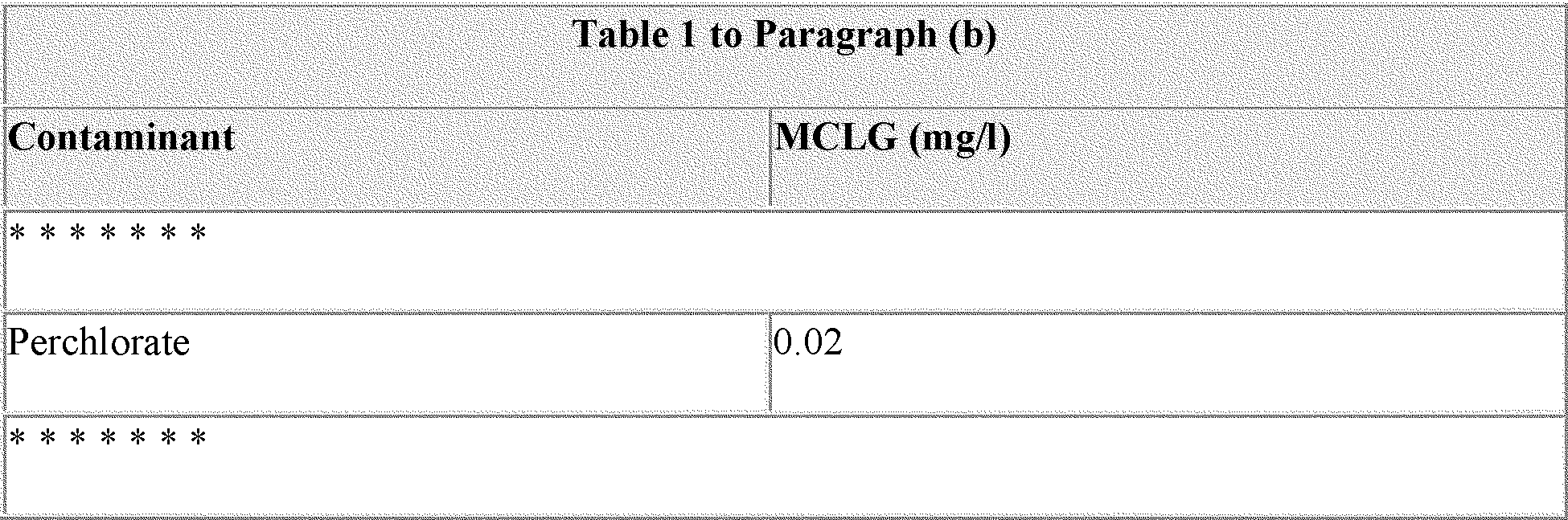
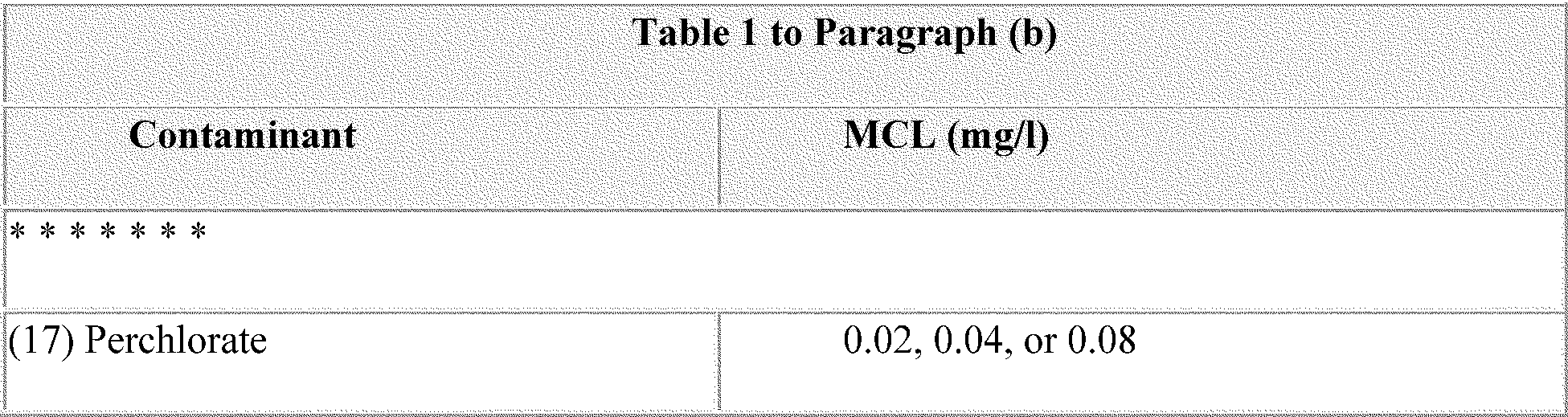
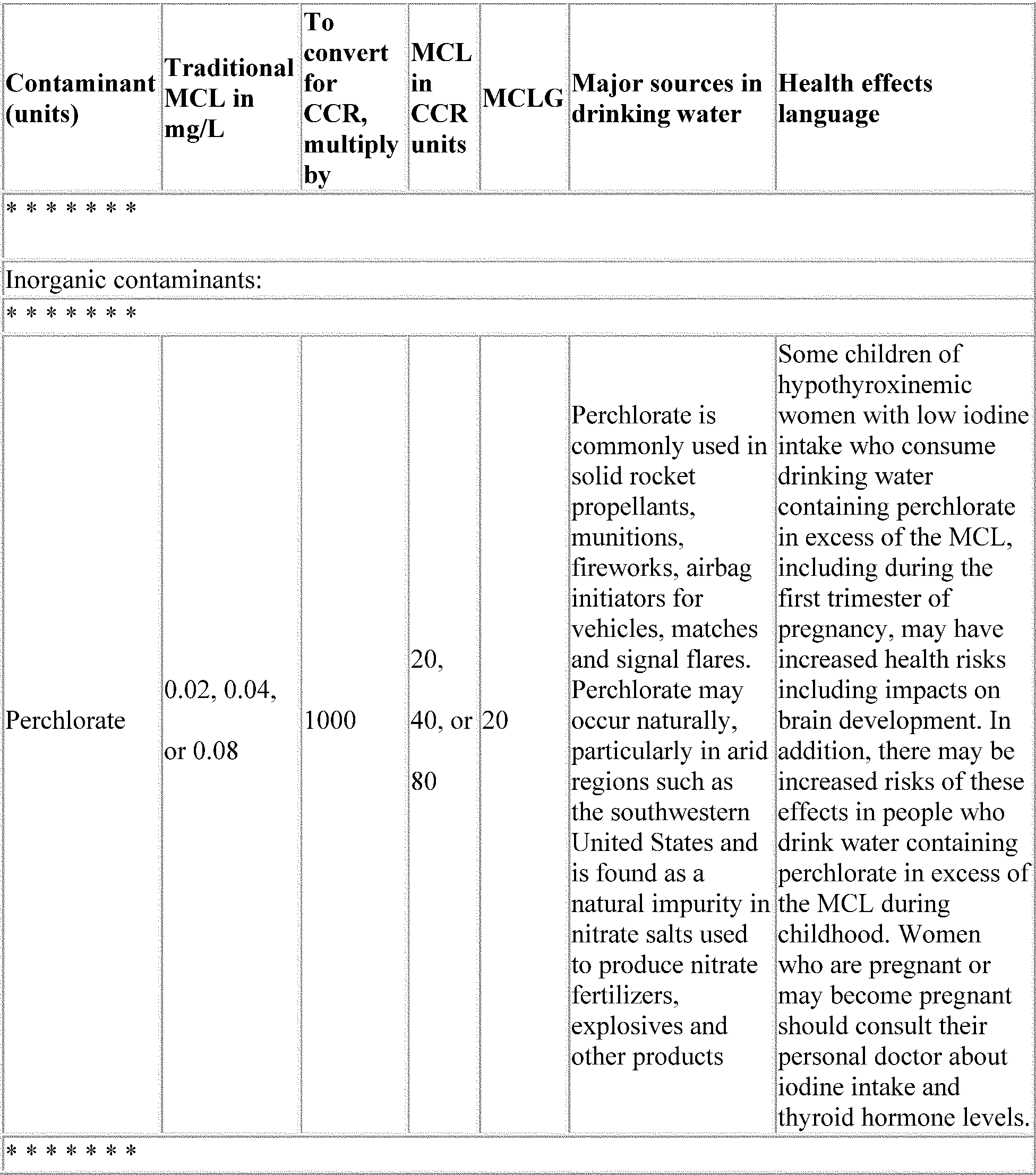
The U.S. Environmental Protection Agency (“EPA” or the “Agency”) is proposing a National Primary Drinking Water Regulation (NPDWR) for perchlorate and a health-based Maximum Contaminant Level Goal (MCLG) under the Safe Drinking Water Act (SDWA). In this action, the EPA is proposing to set the perchlorate MCLG at 0.02 mg/L (20 µg/L). The EPA is also proposing and taking comment on setting an enforceable Maximum Contaminant Level (MCL) for perchlorate at 0.02 mg/L (20 µg/L), 0.04 mg/L (40 µg/L), or 0.08 mg/L (80 µg/L). The EPA is also proposing requirements for water systems to conduct monitoring for perchlorate in drinking water, take mitigation actions if the level exceeds the MCL, provide information about perchlorate to their consumers through public notification and consumer confidence reports, and report to their respective primacy agency. The Administrator has determined that the benefits of this regulation would not justify the costs; however, the EPA is required to issue an NPDWR and MCLG for perchlorate in response to the D.C. Circuit's decision in
NRDC
v.
Regan.
DATES:
Comments must be received on or before March 9, 2026. Comments on the information collection provisions of the proposed rule under the Paperwork Reduction Act (PRA) must be received by the Office of Management and Budget's Office of Information and Regulatory Affairs (OMB-OIRA) on or before February 5, 2026. Please refer to the PRA section under “Statutory and Executive Order Reviews” in this preamble for specific instructions.
Public hearing:
The EPA will hold a virtual public hearing on February 19, 2026, at
https://www.epa.gov/sdwa/perchlorate-drinking-water.
Please refer to the
SUPPLEMENTARY INFORMATION
section for additional information on the public hearing.
ADDRESSES:
You may send comments, identified by Docket ID No. EPA-HQ-OW-2024-0592, by any of the following methods:
Federal eRulemaking Portal:https://www.regulations.gov/
(our preferred method). Follow the online instructions for submitting comments.
Mail:
U.S. Environmental Protection Agency, EPA Docket Center, Office of Water Docket, Mail Code 28221T, 1200 Pennsylvania Avenue NW, Washington, DC 20460.
Hand Delivery or Courier:
EPA Docket Center, WJC West Building, Room 3334, 1301 Constitution Avenue NW, Washington, DC 20004. The Docket Center's hours of operations are 8:30 a.m. to 4:30 p.m., Monday through Friday (except Federal Holidays).
Instructions:
All submissions received must include the Docket ID No. for this rulemaking. Comments received may be posted without change to
https://www.regulations.gov,
including personal information provided. For detailed instructions on sending comments and additional information on the rulemaking process, see the “Public Participation” heading of the
SUPPLEMENTARY INFORMATION
section of this document.
FOR FURTHER INFORMATION CONTACT:
Anne Lausier, Standards and Risk Management Division, Office of Ground Water and Drinking Water (4607M), Environmental Protection Agency, 1200 Pennsylvania Ave. NW; telephone number: (202) 564-0518; email address:
NPDWRperchlorate@epa.gov.
SUPPLEMENTARY INFORMATION:
I. Executive Summary
II. Public Participation
A. Written Comments
B. Participation in a Virtual Public Hearing
III. General Information
A. What is the EPA proposing?
B. Does this action apply to me?
C. What is the Agency's authority for taking this action?
D. What are the incremental costs and benefits of this action?
IV. Background
A. What is perchlorate?
B. Human Health Effects
C. Statutory Framework and Regulatory History
V. 2025 Health Effects Assessment for Perchlorate
A. Consistency of the EPA's Systematic Review Principles and Process for Developing Human Health Assessments With Executive Order 14303 Restoring Gold Standard Science
B. Systematic Reviews of the Perchlorate Health Effects Literature
C. Draft Oral Noncancer Reference Dose Derivation
VI. Maximum Contaminant Level Goal
VII. Maximum Contaminant Level
VIII. Occurrence
IX. Analytical Methods
X. Monitoring and Compliance Requirements
A. Proposed Monitoring Requirements
B. Can States grant monitoring waivers?
C. How are system MCL violations determined?
D. When must systems complete initial monitoring?
E. Can systems use previously collected data to satisfy the initial monitoring requirements?
F. Can systems composite samples?
XI. Safe Drinking Water Act (SDWA) Right To Know Requirements
A. What are the proposed consumer confidence report (CCR) requirements?
B. What are the proposed public notification (PN) requirements?
G. Executive Order 13175: Consultation and Coordination With Indian Tribal Governments
H. Executive Order 13045: Protection of Children From Environmental Health Risks and Safety Risks
I. Executive Order 132311: Actions That Significantly Affect Energy Supply, Distribution, or Use
J. National Technology Transfer and Advancement Act of 1995
K. Consultations With the Science Advisory Board, National Drinking Water Advisory Council, and the Secretary of Health and Human Services
XVII. References
I. Executive Summary
The EPA is proposing a NPDWR for perchlorate and a health-based MCLG under SDWA section 1412, 42 U.S.C. 300g-1, in response to the D.C. Circuit's decision in
NRDC
v.
Regan,
67 F.4th 397 (D.C. Cir. 2023). In that decision, the D.C. Circuit held that the EPA must proceed to regulate a contaminant after finalizing a determination to regulate even where the Agency later determines that the contaminant does not satisfy the statutory standard for regulation. To comply with that decision and a separate consent decree obligation
( printed page 399)
specifying the date by which the EPA must take final action, the EPA is proposing to set the perchlorate MCLG at 0.02 mg/L (20 µg/L). The EPA is also proposing and taking comment on setting an enforceable MCL for perchlorate at 0.02 mg/L (20 µg/L), 0.04 mg/L (40 µg/L), or 0.08 mg/L (80 µg/L). The EPA is also proposing requirements for water systems to conduct monitoring for perchlorate in drinking water, mitigate perchlorate where it is found in drinking water, provide information about perchlorate to customers through public notification and consumer confidence reports, and report to their respective primacy agency. The EPA's assessment of this proposed regulation (including less stringent alternatives) is that regulating perchlorate in this manner fails to satisfy the SDWA prerequisite that a nationwide regulation must present a meaningful opportunity for health risk reduction for persons served by public water systems. Further, the Administrator has determined that the benefits of this regulation would not justify the costs. However, the D.C. Circuit decision in
NRDC
v.
Regan
requires the Agency to promulgate a NPDWR based on a regulatory determination the EPA finalized in 2011, which was based on information and analyses regarding the health effects of perchlorate exposure and prevalence of perchlorate in drinking water that has since been updated and now suggest the statutory criteria for a determination to regulate are no longer met.
Perchlorate is an inorganic chemical compound that occurs naturally and can also be manufactured. It is commonly used in solid rocket propellants, munitions, fireworks, airbag initiators for vehicles, matches, signal flares, and may also be found in fertilizers and as a byproduct of improper handling of hypochlorite solutions used for drinking water treatment. Perchlorate exposure to humans occurs primarily through the ingestion of contaminated food and drinking water. Other routes of exposure may include tobacco products, household products such as bleach, dietary supplements, use of signal flares and fireworks, and occupational exposure to contaminated dust at perchlorate production facilities. Exposure to perchlorate can interfere with the function of a person's thyroid gland by inhibiting iodide uptake, thereby affecting thyroid hormone production. Thyroid hormones help regulate metabolism and are critical for development, including brain development. Changes in thyroid hormone levels in pregnant women are associated with adverse neurodevelopmental effects in their offspring. Additionally, changes in thyroid hormone levels at other life stages can lead to hypothyroidism, adverse reproductive and developmental outcomes, and impacts to the cardiovascular system.
Over the last two decades, the EPA has consistently found that perchlorate is present in a small percentage of U.S. public drinking water systems. As envisioned by the SDWA statutory framework, the EPA's understanding of the adverse human health effects from perchlorate exposure, and ability to accurately estimate the level at which those health effects would occur in the population at greater risk, has evolved over time. Consideration of these two factors—occurrence of perchlorate in drinking water and the health effects information from exposure to perchlorate—are critical in informing the Agency's determination regarding whether to regulate perchlorate under SDWA. Specifically, SDWA section 1412(b)(1)(A), 42 U.S.C. 300g-1(b)(1)(A), provides that the EPA shall proceed to regulate a contaminant if the Administrator finalizes a determination that a contaminant may have adverse effects on the health of persons, is known or substantially likely to occur in public water systems (PWSs) with a frequency and at levels of public health concern, and, in the sole judgement of the Administrator, regulation of the contaminant presents a meaningful opportunity for health risk reduction for persons served by PWSs.[1]
SDWA section 1412(b)(4), 42 U.S.C. 300g-1(b)(4), requires that each MCLG shall be set at the level that avoids adverse effects to human health, with an adequate margin of safety. Additionally, SDWA section 1412(b)(3)(C)(i)(V), 42 U.S.C. 300g-1(b)(3)(C)(i)(V), requires the EPA to consider effects on grounds “at greater risk of adverse health effects” from exposure than the general population. Accordingly, the EPA reviewed the available information to identify the population at greater risk to adverse health effects following perchlorate exposure,
i.e.,
the most sensitive population(s), to derive the MCLG. Deriving the MCLG based on the most sensitive population(s) ensures that the statutory definition for the MCLG is met and that the level of perchlorate in drinking water protects both the population at greatest risk of adverse health effects due to perchlorate exposure and the general population as well.
In 2008, the EPA issued a preliminary determination not to regulate perchlorate based on its finding that perchlorate was present in very few PWSs at levels that the available science indicated would adversely affect human health (73 FR 60262, USEPA, 2008a). At the time, the EPA estimated health effects from perchlorate exposure using a National Research Council (NRC) recommended reference dose for perchlorate exposure for pregnant women and their fetuses, which the NRC identified as the most sensitive population. In 2009, the EPA issued a supplemental request for public comment on the EPA's preliminary determination, noting the complexity of the scientific issues with determining the level of perchlorate exposure that caused adverse effects, and the lack of human data for relevant life stages (74 FR 41883, USEPA, 2009a). Given this lack of data and uncertainty, the EPA proposed using several alternative health reference levels for perchlorate exposure at sensitive life stages (
i.e.,
developing infants and children, in addition to pregnant women) which resulted in a much lower estimate of the level of perchlorate exposure that would correspond to health impacts. In February 2011, the EPA used these lower health reference levels, which were not based on a peer-reviewed model, to finalize a determination to regulate perchlorate (76 FR 7762, USEPA, 2011).[2]
Following this determination, as required by SDWA section 1412(e), 42 U.S.C. 300g-1(e), the EPA sought recommendations from the Agency's Science Advisory Board (SAB) in 2012. Specifically, the EPA sought guidance from the SAB on the modeling approach and health effects information that was available (and relied upon in the 2011 final regulatory determination) to derive a MCLG for perchlorate. In response, the SAB recommended fundamental changes to the approach that the EPA had used to identify the levels of public health concern in its 2011 determination. The EPA had followed
( printed page 400)
the NRC recommendation to use a precursor non-adverse effect, iodide uptake inhibition, as a “health protective and conservative point of departure” for developing a reference dose for perchlorate. When the EPA brought this approach to the SAB, the SAB recommended that the Agency appreciably expand the modeling approach beyond the precursor effect to also account for potential adverse effects in offspring of women exposed to perchlorate during pregnancy. The SAB noted this approach “offers the opportunity for much greater scientific rigor in establishing quantitative relationships between perchlorate exposure and adverse effects at sensitive life stages.” The SAB noted the previous approach, based on iodide uptake inhibition, “describes a precursor event and does not explicitly predict subsequent events or adverse outcomes” (USEPA, 2013). Responding to that recommendation, the EPA undertook a time-intensive effort to develop a biologically based dose-response model that estimates changes in thyroid hormone levels as a result of iodine intake and perchlorate exposure in women prior to pregnancy and early gestation. The new modeling approach allowed the EPA to estimate adverse neurodevelopmental outcomes from different levels of perchlorate exposure. To evaluate the scientific and technical merit of the modeling approach, the EPA submitted this new model to two independent and sequential peer reviews and revised it in response to the peer review panels' feedback.
In 2016, while the EPA was finalizing its model, the NRDC sued the Agency in Federal district court for failing to meet the statutory deadlines to propose and promulgate an NPDWR for perchlorate. The parties resolved the deadline suit by entering into a consent decree with deadlines to issue an NPDWR and MCLG for perchlorate. The consent decree initially required the Agency to propose an NPDWR and MCLG for perchlorate in 2018 and finalize an NPDWR and MCLG for perchlorate no later than December 19, 2019. Those deadlines were later extended to 2019 for proposal, with a final NPDWR and MCLG due by June 19, 2020.
In 2019, the EPA proposed an NPDWR and MCLG for perchlorate (84 FR at 30524, USEPA, 2019a). In the preamble to the proposed rule, the EPA sought comment on withdrawing the 2011 determination to regulate based on the updated health effects information developed as a result of the SAB recommendations and the EPA's updated analysis of the occurrence of perchlorate in PWSs. Despite proposing an MCLG and MCL, the EPA's analysis conducted in support of the 2019 proposal suggested that perchlorate did not occur in PWSs with a frequency and at levels of public health concern and that an NPDWR for perchlorate did not present a meaningful opportunity for health risk reduction in persons served by PWSs as required to regulate under SDWA section 1412(b)(1)(A), 42 U.S.C. 300g-1(b)(1)(A) (84 FR at 30557, USEPA, 2019a). This request for comment to withdraw the determination to regulate relied upon the best available science-based assessments of perchlorate in drinking water at that time as required by SDWA section 1412(b)(3), 42 U.S.C. 300g-1(b)(3), including the updated, peer-reviewed health effects assessment developed with the new SAB-recommended modeling approach and additional information showing that perchlorate was detected in relatively few PWSs and at relatively low concentrations.
The EPA reviewed all public comments on its 2019 proposal, including comments related to the health effects of perchlorate exposure and the occurrence of perchlorate in drinking water. In 2020, based on the best available, peer-reviewed science, as required by SDWA section 1412(b)(3), 42 U.S.C. 300g-1(b)(3), the EPA determined that finalizing an NPDWR for perchlorate would not present a meaningful opportunity for health risk reduction for persons served by PWSs, and therefore revised its determination that a national regulation of perchlorate was justified under the SDWA. The EPA took final action to withdraw the 2011 determination to regulate perchlorate and did not promulgate a final NPDWR (85 FR at 43990, USEPA, 2020a).
In the final action notice, the EPA recognized that a small number of systems may need to address perchlorate in drinking water. The EPA included a discussion on the ways in which the Agency would support States and PWSs in managing perchlorate risk, where applicable. Specifically, the EPA expressed its commitment to working with States and communities in addressing perchlorate contamination in drinking water, including through direct outreach, information, and technical assistance. After issuing the proposed rule in 2019, the EPA contacted the PWSs that the Agency had identified as having perchlorate levels above 18 µg/L and found that many systems had already taken actions to reduce perchlorate levels in their drinking water. The EPA released a report,
Reductions of Perchlorate in Drinking Water,
detailing how perchlorate levels in drinking water supplies have decreased since the EPA made a determination to regulate perchlorate in 2011 (USEPA, 2020b).
Additionally, the EPA released a fact sheet,
Steps Water Systems Can Take to Address Perchlorate in Drinking Water
(USEPA, 2020c), with recommendations and best practices for PWSs that may be concerned about levels of perchlorate in drinking water. This includes recommendations for voluntary sampling, treatment options, storage and handling of hypochlorite solutions which can contribute to perchlorate contamination, non-treatment options, and recommendations for communicating with customers about any voluntary sampling and actions taken.
Finally, the EPA stated in its 2020 final action notice that the Agency may consider updating the 2008 interim perchlorate health advisory in the future in the absence of an NPDWR. SDWA section 1412(b)(1)(F), 42 U.S.C. 300g-1(b)(1)(F), provides that the EPA may publish health advisories or take other appropriate actions for contaminants not subject to NPDWRs. The 2008 interim health advisory for perchlorate (15 µg/L) is non-regulatory and non-enforceable but provides technical information to State agencies on health effects, analytical methodologies, and treatment technologies associated with drinking water contamination.
In
NRDC
v.
Regan,
the D.C. Circuit subsequently vacated the EPA's withdrawal of its 2011 determination to regulate perchlorate. The panel majority held that the EPA lacked authority under the SDWA to withdraw a determination to regulate a contaminant and must proceed to regulate, despite new and additional data and analyses that changed the scientific underpinnings of the original regulatory determination. Specifically, the panel majority held that when the EPA issues a final determination to regulate a contaminant under the SDWA, the EPA must propose and finalize a NPDWR and MCLG regardless of new scientific information indicating that national regulation is not justified. 67 F.4th at 402. The D.C. Circuit's vacatur ultimately had the effect of reviving the EPA's separate consent decree obligation to propose and finalize an NPDWR and MCLG for perchlorate, and the district court entered revised deadlines for the EPA to do so. Currently, the EPA is required to sign a proposed NPDWR and MCLG for publication by January 2, 2026, and to sign a final rule and MCLG by May 21, 2027.
Since 2023, the EPA has conducted further review of the best available
( printed page 401)
science on perchlorate health effects and occurrence data to include new information that was not factored into its 2019 proposal or 2020 decision to withdraw the determination to regulate perchlorate. The additional information evaluated by the EPA reaffirms the science-based conclusions that perchlorate does not occur in public drinking water systems at levels of public health concern as required under SDWA section 1412(b)(1)(A), 42 U.S.C. 300g-1(b)(1)(A). Furthermore, the EPA has evaluated the best available information on benefits and costs of this proposed rule as required by SDWA section 1412(b)(3)(C), 42 U.S.C. 300g-1(b)(3)(C), including the benefits and costs of alternative regulatory options developed and considered. The EPA again finds, as in 2020, that the benefits do not justify the costs for this proposed rule or for the alternative regulatory options considered (see section XIV.C of this preamble for discussion of this finding and request for comment).
Despite the Agency's science-based conclusion that perchlorate does not occur in public drinking water systems across the nation “with a frequency and at levels of public health concern” and that issuing an NPDWR for perchlorate would not present a meaningful opportunity for health risk reduction for persons served by PWSs, see SDWA section 1412(b)(1)(A), 42 U.S.C. 300g-1(b)(1)(A), the EPA is compelled by the D.C. Circuit's decision in
NRDC
v.
Regan
to issue an NPDWR for perchlorate.[3]
Absent the D.C. Circuit's decision, the Agency would reject an NPDWR as an appropriate tool to address potential health risks from perchlorate. The Agency would instead update the 2008 Interim Health Advisory and take other appropriate actions similar to those conducted by the Agency in 2020. In this proposed rule, the Agency has attempted to reduce burdens to the many systems that do not have levels of perchlorate above the MCL but would nonetheless be required to monitor for perchlorate by a final NPDWR for perchlorate.
The EPA is proposing an MCLG for perchlorate in drinking water based on the best available science (USEPA, 2025b) following the Agency's current peer-reviewed systematic review methods (USEPA, 2022b), consistent with SDWA requirements, Executive Order 14303 Restoring Gold Standard Science (90 FR 22601) (see section V of this preamble), and the EPA's human health risk assessment guidance and best practices (
e.g.,
USEPA, 2012b; USEPA, 2002b; USEPA, 2022b). The EPA updated its 2019 health assessment to incorporate more recent health effects literature and the EPA's peer-reviewed systematic review methods (USEPA, 2022b), which were not available during the development of the 2019 health assessment. An MCLG is the maximum level of a contaminant in drinking water at which no known or anticipated adverse effect on the health of persons would occur, allowing an adequate margin of safety (SDWA section 1412(b)(4)(A), 42 U.S.C. 300g-1(b)(4)(A)).
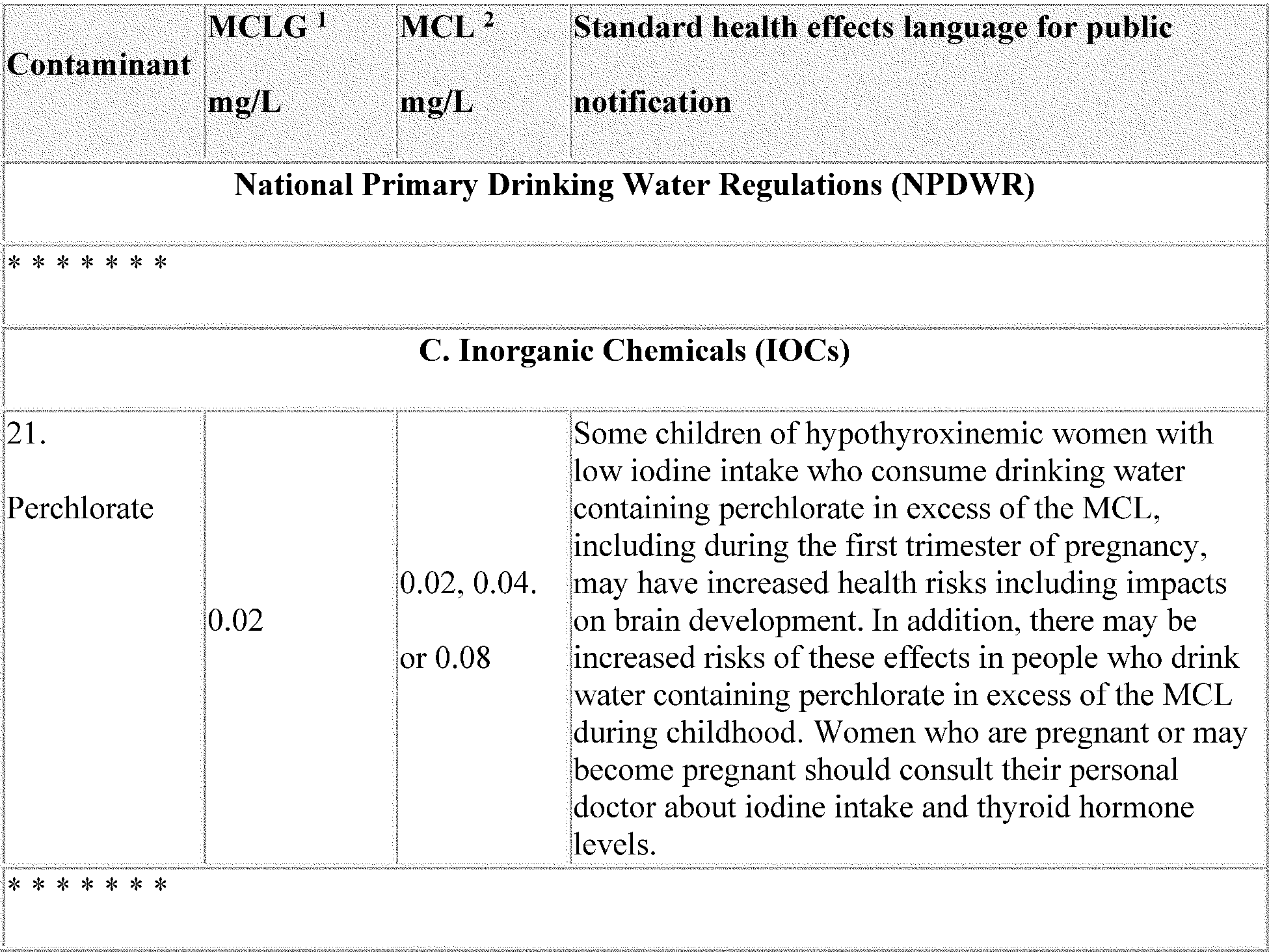
The EPA is proposing an MCLG of 20 µg/L derived from a draft reference dose of 1 μg/kg/day. The proposed MCLG is the level of perchlorate in drinking water expected to protect the population at greater risk for adverse health effects following perchlorate exposure. The population at greater risk is the offspring of iodine deficient, hypothyroxinemic women exposed to perchlorate during their first trimester of pregnancy. Hypothyroxinemia is characterized by normal thyroid stimulating hormone (TSH) levels and thyroid hormone (free thyroxine [fT4]) levels below the normal range. This MCLG protects against a one point decrease in the mean IQ in the population at greatest risk (the smallest IQ decrement that can be measured in an individual; as measured in children at approximately 6-8 years in the critical study). As this level is set for the population at greatest risk, it in turn protects against adverse health effects following perchlorate exposure in the general population, consistent with the statutory definition of an MCLG. The EPA is also proposing an enforceable MCL for perchlorate. An MCL is the maximum level allowed of a contaminant in water which is delivered to any user of a PWS (SDWA section 1401(3), 42 U.S.C. 300f(3)). The SDWA generally requires that the EPA set the MCL “as close to the maximum contaminant level goal as is feasible” (SDWA section 1412(b)(4)(B), 42 U.S.C. 300g-1(b)(4)(B)), or, if the Administrator determines the health benefits of the MCL do not justify the cost, at the level where the cost is justified by the benefits (SDWA section 1412(b)(6)(A), 42 U.S.C. 300g-1(b)(6)). The EPA is proposing to set an MCL of 20, 40, or 80 µg/L, and seeking comment on whether the Agency should consider any additional MCLs. As explained below, although the EPA proposes that any of the proposed MCLs would be feasible, the Administrator has determined that there is no MCL at which the benefits of treatment at a limited number of systems justify the costs of monitoring across systems where perchlorate is not expected to occur at levels of concern.
The EPA is also proposing monitoring, reporting, and other requirements for PWSs to meet the perchlorate MCL. Monitoring is a key component of the NPDWR and assures that water systems affected by perchlorate are identified and take action to be in compliance with the MCL (see section X of this preamble for discussion of the proposed monitoring and compliance requirements). The EPA is proposing requirements for community water systems (CWSs) and non-transient non-community water systems (NTNCWSs) to monitor for perchlorate in drinking water where the monitoring frequency of a PWS depends on the previous monitoring results. Because the EPA has determined that the vast majority of water systems are not likely to have perchlorate levels at the level of public health concern, the proposal includes provisions that would attempt to reduce burden on both systems and States compared to the standard monitoring requirements for other regulated inorganic compounds (IOCs). This includes provisions that would automatically reduce monitoring frequency for systems based on initial sampling results, thereby reducing burden on States to make individual system determinations. The EPA is also proposing the use of previously collected data to satisfy initial monitoring requirements to reduce burden on systems (see section X.A of this preamble for additional discussion on the requirements for initial and reduced monitoring).
Water systems with perchlorate levels that exceed the proposed MCL would need to take action to comply with the MCL. Under the EPA's proposal, these systems could install water treatment or
( printed page 402)
consider options such as using a new uncontaminated water source (
e.g.,
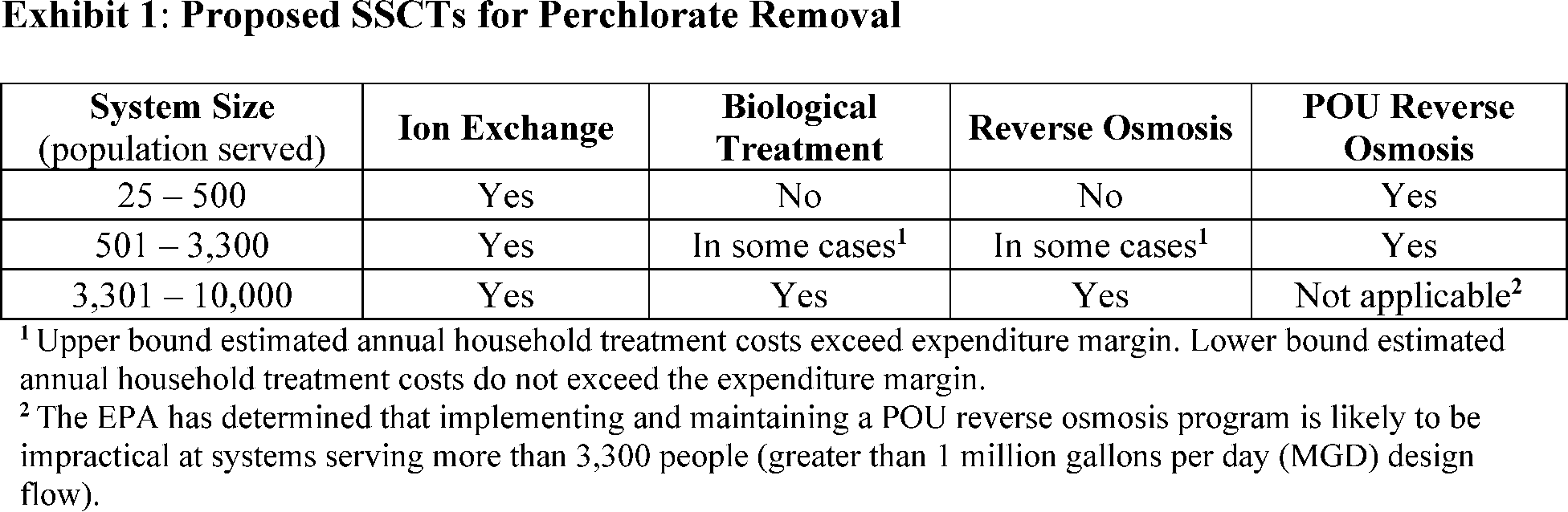
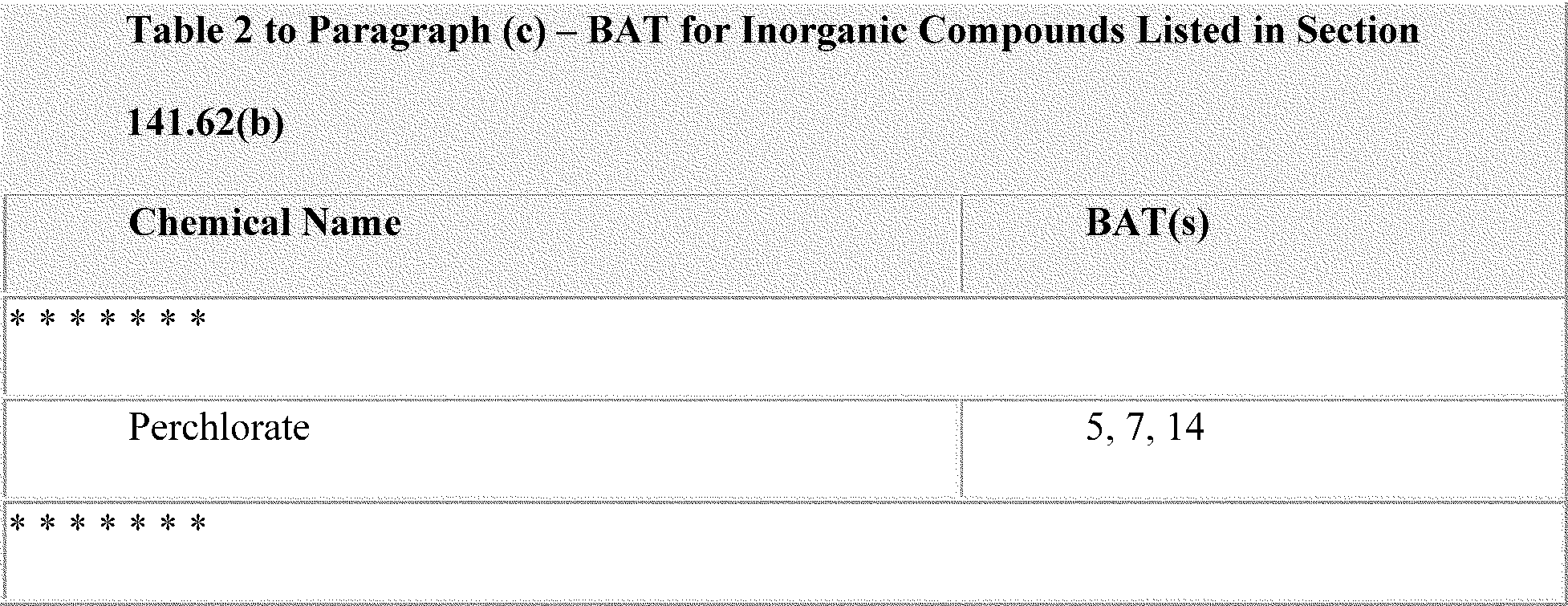
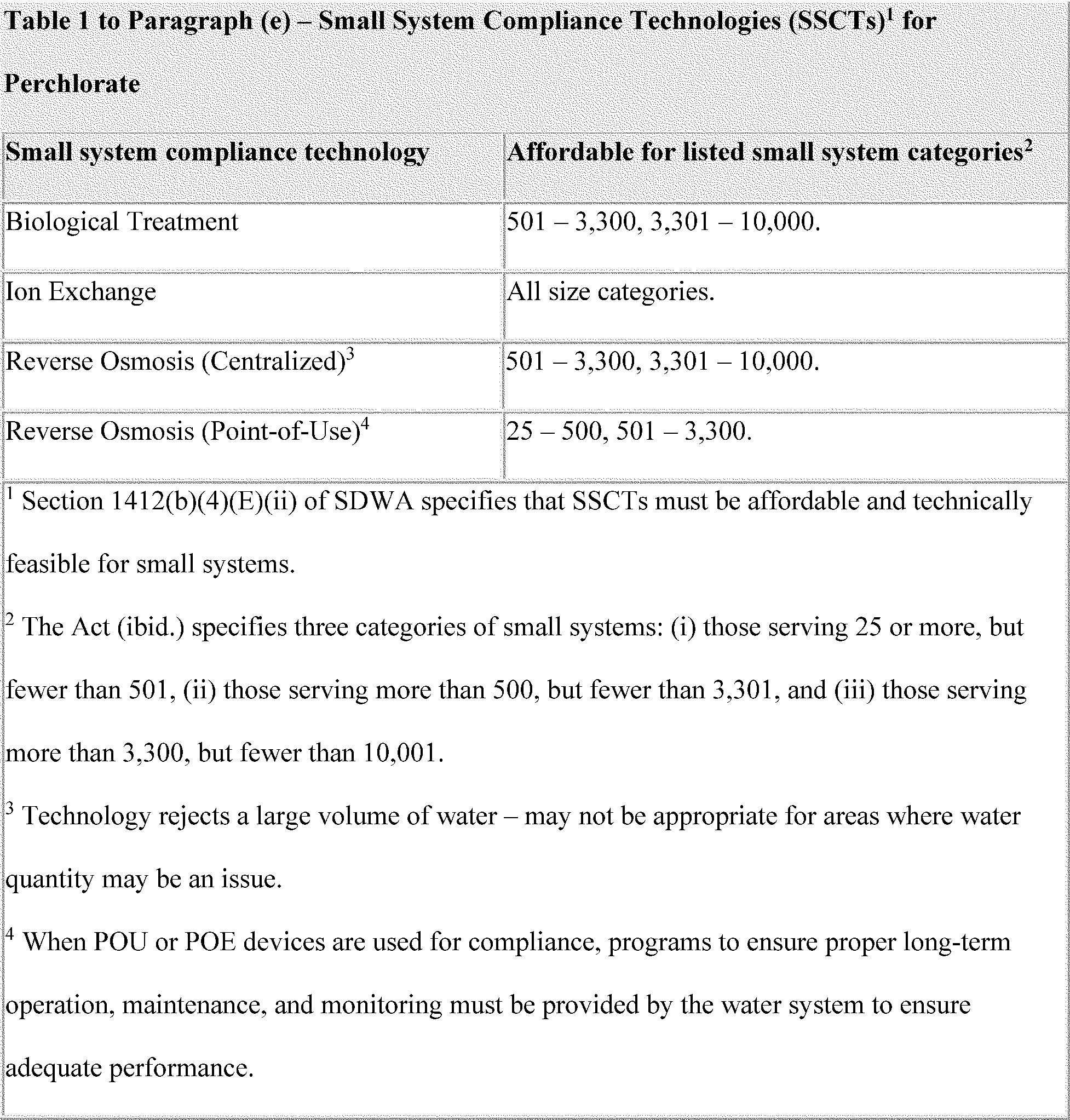
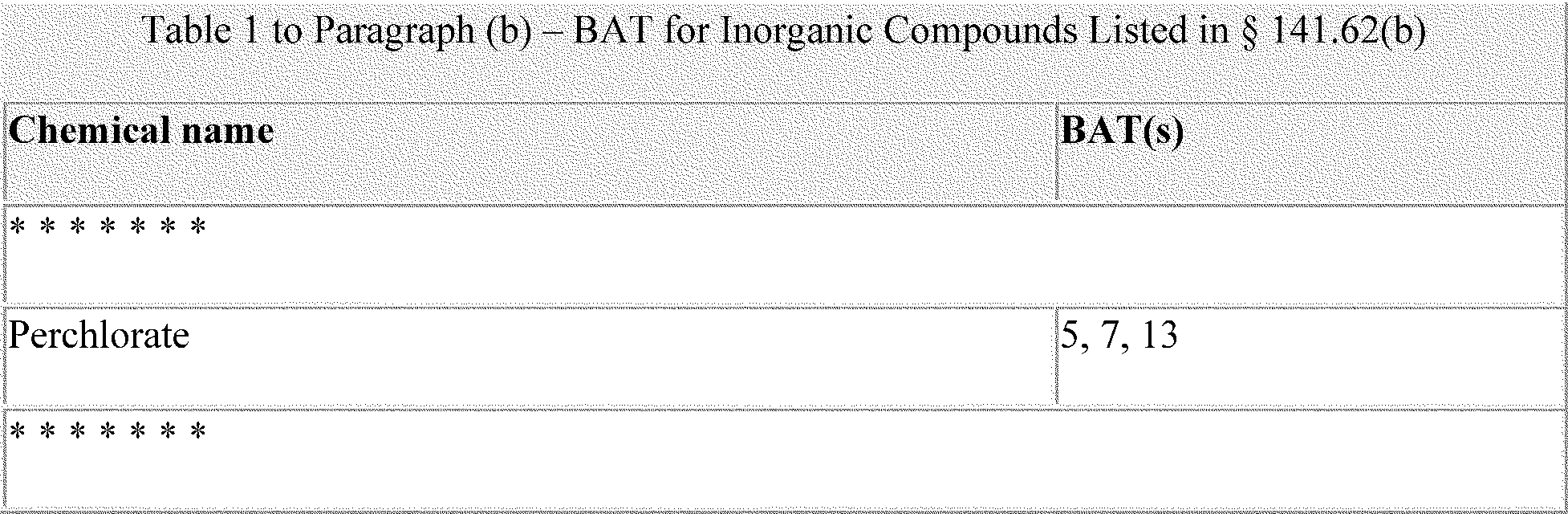
drilling a new well) or connecting to an uncontaminated water source. Ion exchange, reverse osmosis, and biological treatment technologies have been demonstrated to remove perchlorate from drinking water to levels that would comply with the proposed MCL. These treatment technologies can be installed at a water system's treatment plant. Certified reverse osmosis point-of-use (POU) devices are also available for small systems to reduce perchlorate levels below the MCL (see section XII of this preamble for discussion on available treatment technologies). See the
Economic Analysis of the Proposed Perchlorate National Primary Drinking Water Regulation
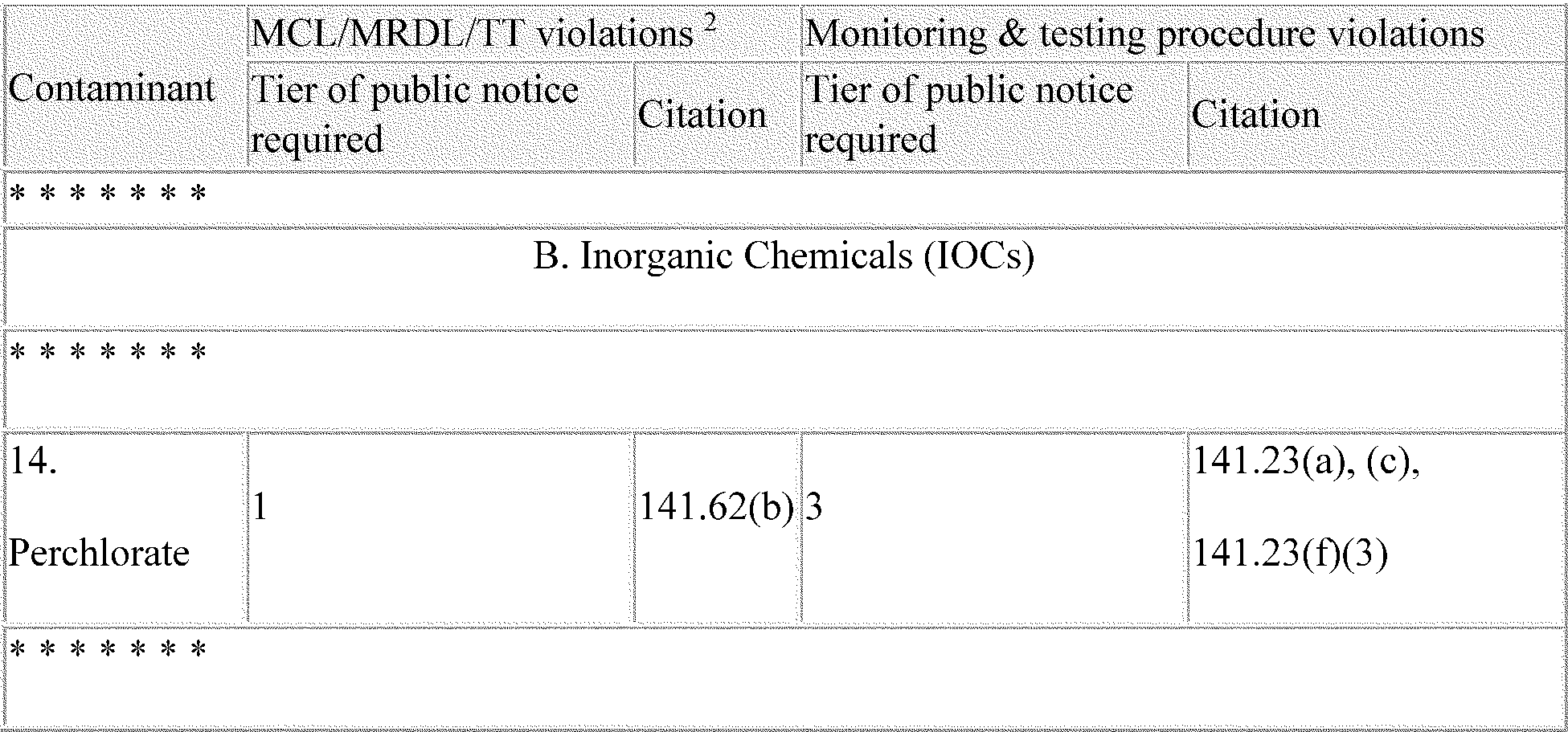
(section 4.3, USEPA, 2025i) for details on estimating water system costs. Water systems which exceed the proposed MCL would also be required to conduct public notification. The EPA is proposing that water systems issue Tier 1 public notification following an MCL exceedance based on the effect of short-term exposure on the most sensitive population (the fetuses of pregnant, hypothyroxinemic women with iodine deficiency in their first trimester of pregnancy) identified from review of the available data (see section XI.B of this preamble for more information on public notification requirements).
In proposing a rule under the SDWA, the EPA must evaluate quantifiable and nonquantifiable health risk reduction benefits and costs in accordance with the statute's health risk reduction and cost analysis (HRRCA) requirements (SDWA section 1412(b)(3)(C), 42 U.S.C. 300g-1(b)(3)(C)). This includes benefits and costs associated with monitoring, reporting, and mitigation actions. The SDWA also requires that the EPA determine whether the benefits of the proposed rule justify the costs (SDWA section 1412(b)(4)(C), 42 U.S.C. 300g-1(b)(4)(C)). In accordance with these requirements and considering the best available science-based assessments, the Administrator is making a determination in this preamble that the quantified and unquantifiable benefits of the proposed perchlorate NPDWR do not justify the costs (see section XIV of this preamble for additional discussion on the HRRCA). This finding is the same conclusion reached by the Administrator in the 2019 proposed drinking water rule for perchlorate (84 FR 30555, USEPA, 2019a). The EPA is proposing requirements that will attempt to reduce monitoring costs while identifying systems with levels of perchlorate at or above the MCL; however, due to infrequent perchlorate occurrence at levels of health concern, the vast majority of the approximately 66,000 water systems that would be subject to the rule will incur substantial administrative and monitoring costs with limited or no corresponding public health benefit as a whole. The EPA evaluated which entities would be affected by the rule, quantified costs using available data and statistical models, and described unquantifiable costs. The EPA also developed a qualitative summary of benefits expected to result from the monitoring for perchlorate, and the removal of perchlorate and potential co-occurring contaminants.
Public participation and consultations with key stakeholders are critical in developing an implementable drinking water rule. The EPA has engaged with stakeholders and consulted with entities such as the National Drinking Water Advisory Council (NDWAC), water systems, and State, Tribal, and local governments (see section XVI of this preamble on EPA's Statutory and Executive Order reviews). The EPA is requesting comment on this action, including the proposed NPDWR and MCLG and the Administrator's determination that the benefits do not justify the costs, and has identified specific areas where public input will be helpful for the EPA in developing the final rule (see section XV of this preamble for a discussion of topics highlighted by the EPA for public comment).
II. Public Participation
A. Written Comments
Submit your comments, identified by Docket ID No. EPA-HQ-OW-2024-0592, at
https://www.regulations.gov
(our preferred method), or the other methods identified in the
ADDRESSES
section. Once submitted, comments cannot be edited or removed from the docket. The EPA may publish any comment received to its public docket. Do not submit to the EPA's docket at
https://www.regulations.gov
any information you consider to be Confidential Business Information (CBI), Proprietary Business Information (PBI), or other information whose disclosure is restricted by statute. Multimedia submissions (audio, video, etc.) must be accompanied by a written comment. The written comment is considered the official comment and should include discussion of all points you wish to make. The EPA will generally not consider comments or comment contents located outside of the primary submission (
i.e.,
on the web, cloud, or other file sharing system). Please visit
https://www.epa.gov/dockets/commenting-epa-dockets
for additional submission methods; the full EPA public comment policy; information about CBI, PBI, or multimedia submissions; and general guidance on making effective comments.
B. Participation in Virtual Public Hearing
The EPA is hosting a virtual public hearing on February 19, 2026, to receive public comment on the proposed requirements of the proposed perchlorate NPDWR. The hearing will be held virtually from approximately 1 p.m. to 4 p.m. eastern time. The EPA will begin pre-registering speakers for the hearing upon publication of this document in the
Federal Register
. To attend and/or register to speak at the virtual hearing, please use the online registration form available at
https://www.epa.gov/sdwa/perchlorate-drinking-water.
The last day to pre-register to speak at the hearing will be February 12, 2026. On February 16, 2026, the EPA will post a general agenda for the hearing that will list pre-registered speakers in approximate, sequential order at
https://www.epa.gov/sdwa/perchlorate-drinking-water.
The number of online connections available for the hearing is limited and will be offered on a first-come, first-served basis. To submit visual aids to support your oral comment, please contact
NPDWRperchlorate@epa.gov
for guidelines and instructions by February 12, 2026.
Early registration is strongly encouraged to ensure proper accommodations and adequate timing. The EPA will make every effort to follow the schedule as closely as possible on the day of the hearing; however, please plan for the hearing to run either ahead of schedule or behind schedule. Please note that the public hearing may close early if all business is finished.
The EPA encourages commenters to provide a written copy of their oral testimony electronically by submitting it to the public docket at
https://www.regulations.gov,
Docket ID: EPA-HQ-OW-2024-0592. Oral comments will be time limited to maximize participation, which may result in the full statement not being given during the virtual hearing itself. Therefore, the EPA also recommends submitting the text of oral comments as written comments to the rulemaking docket. The EPA will also accept written comments submitted to the public docket, as provided above, from persons
( printed page 403)
not making an oral comment. Written statements and supporting information submitted during the comment period will be considered with the same weight as oral comments and supporting information presented at the public hearing.
Please note that any updates made to any aspect of the hearing are posted online at
https://www.epa.gov/sdwa/perchlorate-drinking-water.
While the EPA expects the hearing to go forward as set forth above, please monitor the Agency's website or contact
NPDWRperchlorate@epa.gov
to determine if there are any updates. The EPA does not intend to publish a document in the
Federal Register
announcing updates about the public virtual hearing.
If you require any accommodations for the day of the hearing, such as language translation, captioning, or special accommodations, please indicate this and describe your needs when you register. All requests for accommodations should be submitted by February 12, 2026. Without this one-week minimum advance notice, the EPA may not be able to arrange accommodations. Please contact
NPDWRperchlorate@epa.gov
with any questions related to the virtual public hearing.
III. General Information
A. What is the EPA proposing?
Pursuant to its consent decree obligations and the D.C. Circuit's decision in
NRDC
v.
Regan,
the EPA is proposing for public comment an MCLG and an NPDWR for perchlorate in public drinking water supplies. Specifically, the EPA is proposing a MCLG of 0.02 mg/L (20 µg/L) and is proposing and seeking comment on an enforceable MCL at 20, 40, or 80 µg/L, despite the Agency's science-based conclusion that perchlorate does not occur in public drinking water systems at levels of public health concern and that issuing an NPDWR for perchlorate would not present a meaningful opportunity for health risk reduction for persons served by PWSs, as required by the SDWA, and that there is no MCL at which the benefits of treatment in a limited number of systems justify the costs of monitoring nationwide. The EPA is also proposing monitoring requirements for perchlorate under 40 CFR 141 subpart C, public notification requirements under 40 CFR 141 subpart Q, and Consumer Confidence Report (CCR) requirements under 40 CFR 141 subpart O.
B. Does this action apply to me?
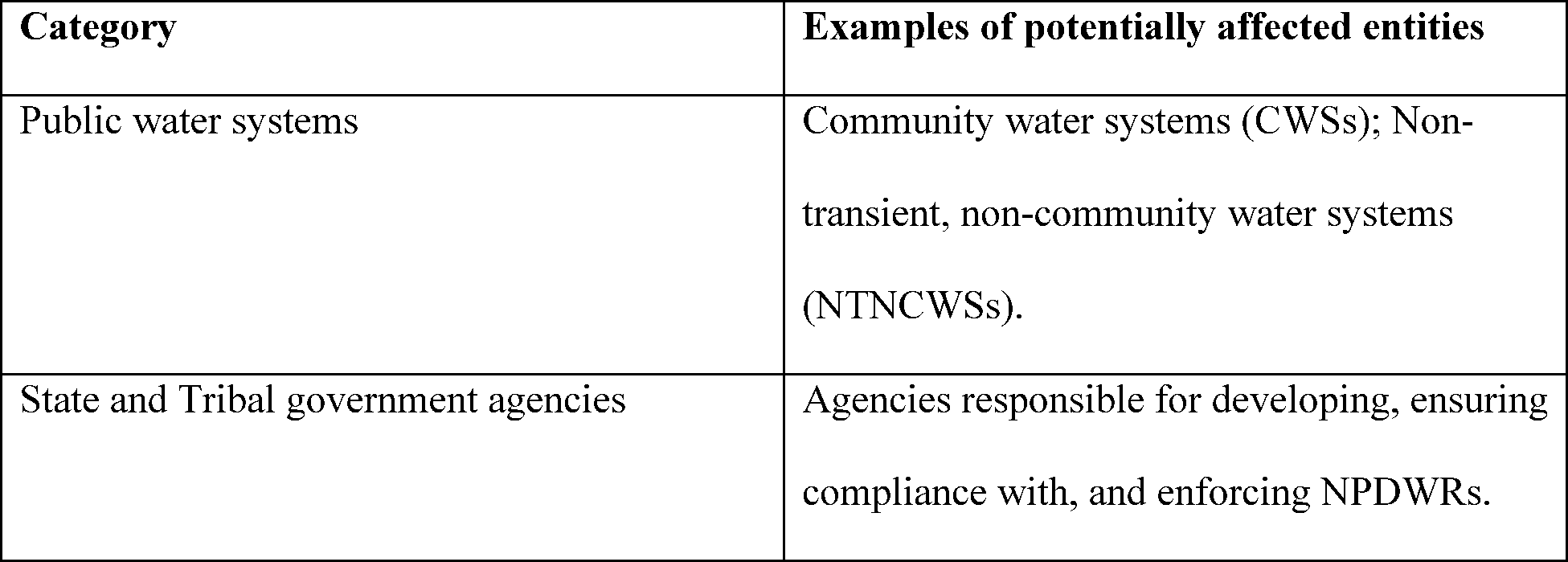
Entities that could potentially be affected by this proposed rule include the following:
This table is not intended to be exhaustive but rather provides a guide for readers regarding entities likely to be regulated by this action. Other types of entities not included could also be regulated. To determine whether your entity is regulated by this action, please read the full preamble and proposed rule.
As part of this notice for the proposed rule, “State” refers to the agency of the State, Tribal, or territorial government that has jurisdiction over PWSs consistent with the definition of “State” in 40 CFR 141.2. During any period when a State or Tribal government does not have primacy enforcement responsibility pursuant to section 1413 of SDWA, 42 U.S.C. 300g-2, the term “State” means the relevant Regional Administrator of EPA. For questions regarding the applicability of this action to a particular entity, consult the person listed in the
FOR FURTHER INFORMATION CONTACT
section.
C. What is the Agency's authority for taking this action?
Section 1412(b)(1)(A) of SDWA requires the EPA to establish an NPDWR for a contaminant when the Administrator has determined that the contaminant: (1) may have an adverse effect on the health of persons; (2) is known to occur or there is a substantial likelihood that the contaminant will occur in PWSs with a frequency and at levels of public health concern; and (3) where in the sole judgment of the Administrator, regulation of such a contaminant presents a meaningful opportunity for health risk reduction for persons served by PWSs. 42 U.S.C. 300g-1(b)(1)(A).
In 2020, based on the best available science regarding perchlorate health effects and occurrence data, the EPA withdrew its 2011 final determination to regulate perchlorate under SDWA section 1412(b)(1)(A), 42 U.S.C. 300g-1(b)(1)(A). In May 2023, the D.C. Circuit vacated the EPA's withdrawal of the 2011 determination to regulate perchlorate after holding that the EPA lacks authority under the SDWA to withdraw a determination to regulate a contaminant.
NRDC
v.
Regan,
67 F.4th 397. As explained in this preamble, the EPA's scientific analyses and data continue to indicate that perchlorate is not likely to occur with a frequency and at levels of public health concern and therefore does not meet the SDWA criteria for regulation. The EPA is nonetheless obligated to propose this NPDWR pursuant to its consent decree obligations and the D.C. Circuit's decision, which bars the Agency from finalizing an action other than a NPDWR and MCLG even when the Agency determines that the available
( printed page 404)
evidence, including the best available scientific data, does not support the statutory findings that are the prerequisite for regulation of a contaminant.
D. What are the incremental costs and benefits of this action?
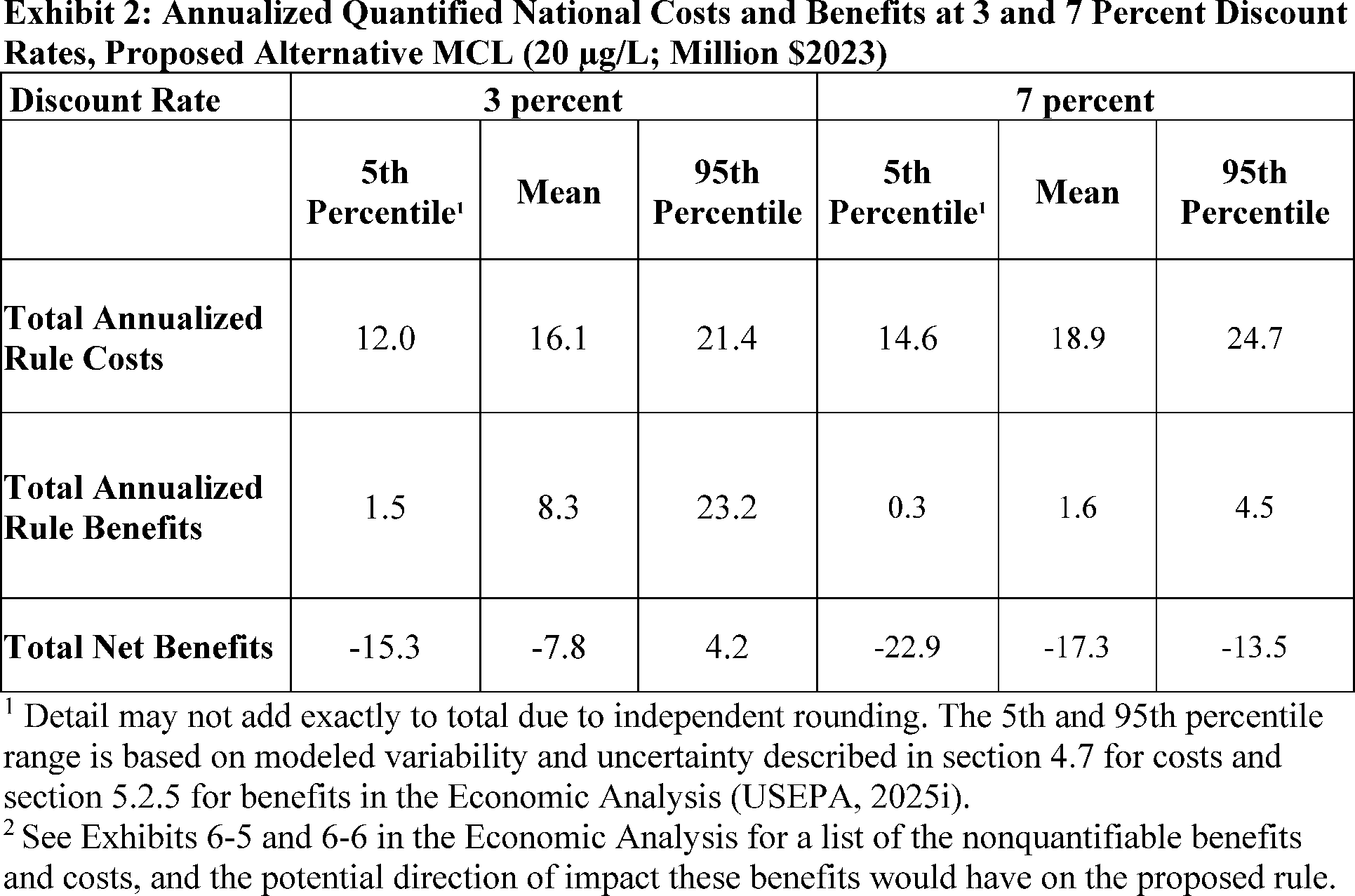
The incremental cost of this proposed rule is the difference between the quantified costs that would be incurred if the proposed rule were finalized and baseline conditions. The incremental benefits of this proposed rule reflect the avoided future adverse health outcomes attributable to perchlorate reduction due to actions undertaken to comply with the proposed rule. For the proposed MCL of 20 µg/L, the annualized incremental cost of the proposed rule in 2023 dollars is $16.1 million at a 3 percent discount rate and $18.9 million at a 7 percent discount rate. The monetized annualized incremental benefit of the proposed rule in 2023 dollars is $8.3 million at a 3 percent discount rate and $1.6 million at a 7 percent discount rate. Therefore, the monetized net annualized incremental benefit is −$7.8 million at a 3 percent discount rate and −$17.3 million at a 7 percent discount rate.
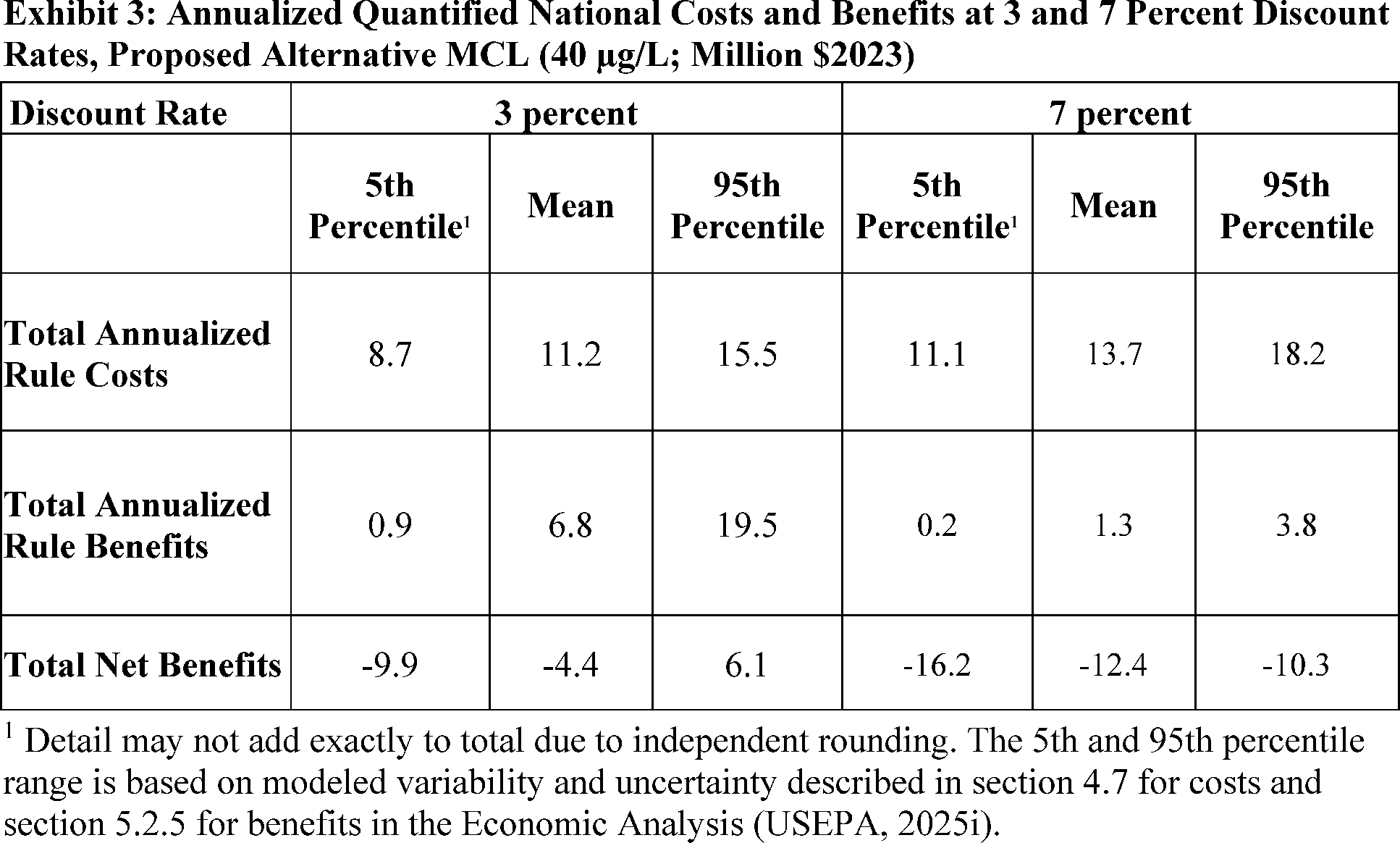
For the proposed MCL of 40 µg/L, the annualized incremental cost of the proposed rule in 2023 dollars is $11.2 million at a 3 percent discount rate and $13.7 million at a 7 percent discount rate. The monetized annualized incremental benefit of the proposed rule in 2023 dollars is $6.8 million at a 3 percent discount rate to $1.3 million at a 7 percent discount rate. Therefore, the monetized net annualized incremental benefit is −$4.4 million at a 3 percent discount rate to −$12.4 million at a 7 percent discount rate.
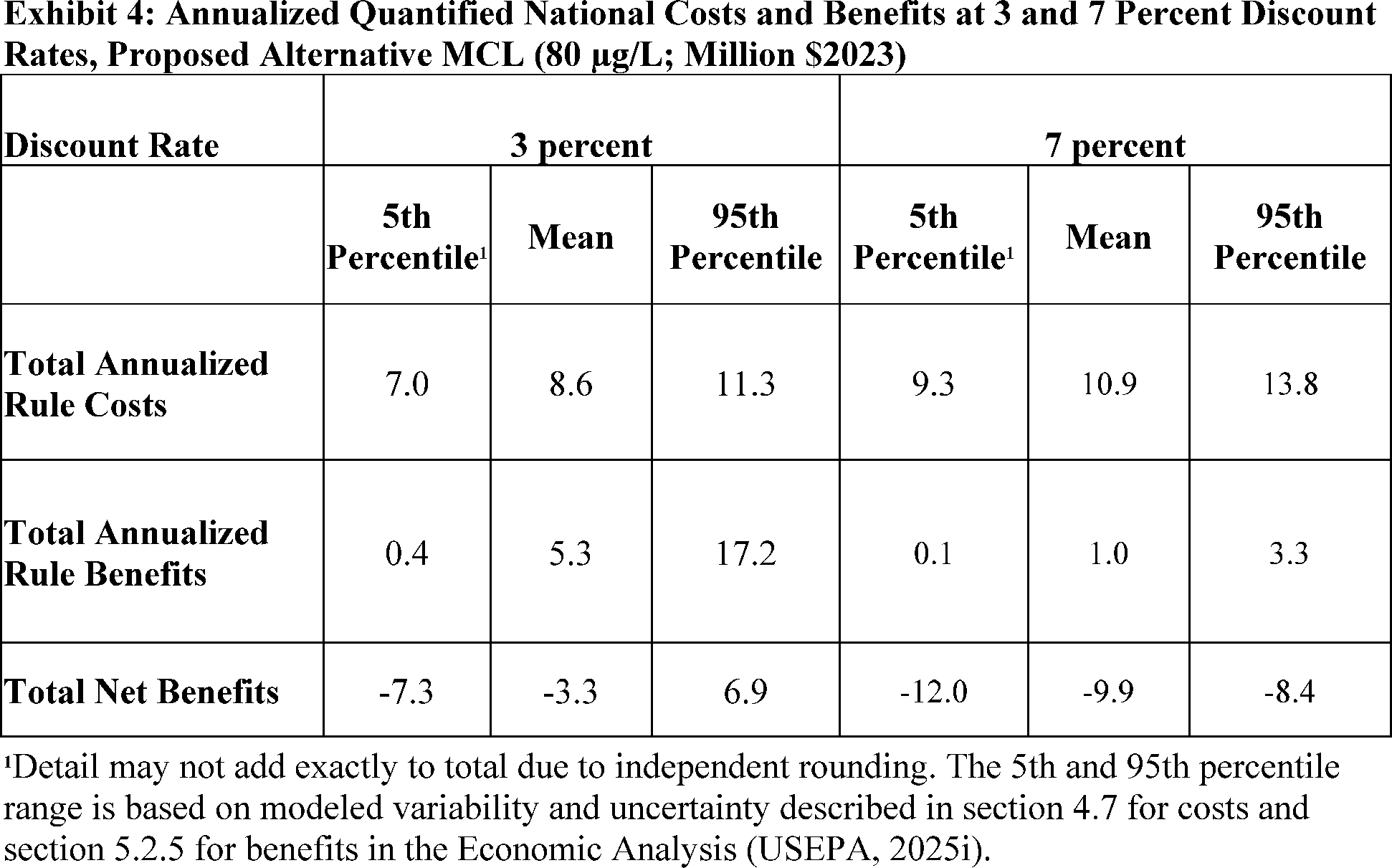
For the proposed MCL of 80 µg/L, the annualized incremental cost of the proposed rule in 2023 dollars is $8.6 million at a 3 percent discount rate and $10.9 million at a 7 percent discount rate. The monetized annualized incremental benefit of the proposed rule in 2023 dollars is $5.3 million at a 3 percent discount rate to $1.0 million at a 7 percent discount rate. Therefore, the monetized net annualized incremental benefit is −$3.3 million at a 3 percent discount rate to −$9.9 million at a 7 percent discount rate. In addition, the EPA expects there will be additional non-monetized benefits and costs that result from the proposed action. Please see section XIV of this preamble for details.
IV. Background
A. What is perchlorate?
Perchlorate is a negatively charged inorganic ion that is comprised of one chlorine atom bound to four oxygen atoms (ClO4−) and is both a naturally occurring and manufactured chemical. It is formed naturally by photochemical reactions with atmospheric ozone, after which it can be deposited in soils and found within mineral deposits in certain geographical areas (Bao and Gu, 2004; Michalski et al., 2004). In the United States, perchlorate can accumulate in arid and semi-arid areas (Rao et al., 2007). In the United States, perchlorate in the environment is also associated with commercial fertilizers from Chilean saltpeter (mined and imported from Chile's Atacama Desert), which are known to have naturally high levels of perchlorate (USEPA, 2001).
Perchlorate is also produced synthetically and used in military and industrial applications. It is primarily used as an oxidizer, in the form of ammonium perchlorate, in solid fuels used to power rockets, missiles, and fireworks (ATSDR, 2008). In 1994, U.S. production of ammonium perchlorate was estimated at 22 million pounds; more recent production data are not available (ATSDR, 2008). Historically, the majority of perchlorate production took place at facilities in Nevada and Utah (NDEP, 2013). Perchlorate salts are highly soluble in water, and because perchlorate adheres poorly to mineral surfaces and organic material, perchlorate is mobile in soil and aqueous environments (ATSDR, 2008; USEPA, 2002a). The perchlorate ion is very stable and inert to reduction (Urbansky, 2000). Under normal environmental conditions in ground water and surface water, the ion may persist for decades (Gullick et al., 2001). Additionally, trace amounts of perchlorate can enter drinking water through improper handling and degradation of hypochlorite solutions used for drinking water treatment (AWWA/WaterRF, 2009).
For the general population, perchlorate exposure occurs mainly through the ingestion of contaminated food and drinking water (USEPA, 2025b; ATSDR, 2008). Of the foods evaluated by the FDA total diet study, 74 percent had at least one sample with detectable levels of perchlorate (FDA, 2007; Murray et al., 2008). Perchlorate has also been detected in drinking water supplies and tap water which indicates that for those exposed in the general population, ingestion of water containing perchlorate may be a significant exposure pathway. Other potential perchlorate exposure sources include tobacco products (Ellington et al., 2001), common household products such as bleach (Gibbs et al., 1998), dietary supplements (Snyder et al., 2006), ingestion of contaminated soil by children, and the use of signal flares and fireworks. Occupational exposure at perchlorate production facilities may occur via perchlorate dusts via inhalation or oral routes (Gibbs et al., 1998).
B. Human Health Effects
The well-established mode of action (MOA) for perchlorate is inhibition of iodide [4]
uptake in the thyroid gland by competitively binding to the sodium-iodide symporter (NIS) (NRC, 2005; USEPA, 2013; USEPA, 2019b). This decrease in iodide uptake results in a decrease in the synthesis of two key thyroid hormones, triiodothyronine (T3) and thyroxine (T4) since iodide is necessary for the synthesis of thyroid hormones (NRC, 2005; USEPA, 2013; USEPA, 2019b; Blount et al., 2006; Steinmaus et al., 2007; Steinmaus et al., 2013; Steinmaus et al., 2016; McMullen et al., 2017; Knight et al., 2018). Decreased T3 and T4 levels result in an increase in TSH levels, the hormone that acts on the thyroid gland to stimulate iodide uptake to increase thyroid hormone production (Blount et al., 2006; NRC, 2005; Steinmaus et al., 2013; Steinmaus et al., 2016; USEPA, 2019). See the draft Health Effects TSD for more information about perchlorate's mode of action (USEPA, 2025b). Because thyroid hormones are essential for the development and differentiation of the brain, changes in thyroid hormone levels in pregnant women can cause permanent adverse neurodevelopmental effects in their offspring (USEPA, 2025b). (USEPA, 2013; USEPA, 2019b; Korevaar et al., 2016; Fan and Wu, 2016; Wang et al., 2016; Alexander et al., 2017; Thompson et al., 2018). For example, decreased maternal T4 levels during pregnancy, including in the hypothyroxinemic range, are associated with intelligence quotient (IQ) decrements in offspring (Alexander et al., 2017; Thompson et al., 2018; Wang et al., 2016; USEPA, 2013; USEPA, 2019b). See the draft Health Effects TSD (USEPA, 2025b) and the Economic Analysis (USEPA, 2025i) for more information about other potential health effects.
( printed page 405)
C. Statutory Framework and Regulatory History
1. Statutory Framework
The SDWA, the primary Federal law protecting tap water provided to consumers by water systems across the country, was enacted in 1974 in response to “accumulating evidence that our drinking water contains unsafe levels of a large variety of contaminants.”
Envtl. Def. Fund, Inc.
v.
Costle,
578 F.2d 337, 339 (D.C. Cir. 1978). In passing the SDWA, Congress intended to ensure “that water supply systems serving the public meet minimum national standards for protection of public health” (H.R. Rep. No. 93-1185, at 1 (1974)).
Congress amended the SDWA in 1996 to establish a stepwise process for the EPA to identify unregulated contaminants and assess whether they are appropriate for regulation under the Act (H.R. Rep. 104-632(l), at 8 (1996); S. Rep. 104-169, at 2 (1995)). In contrast to prior versions of the statute, which required the EPA to establish regulations for an enumerated list of contaminants, Congress established a “flexible” process to ensure that the EPA's regulations, and the burdens imposed by those rules on water systems nationwide, addressed contaminants that posed the most significant health risks.
See
H.R. Rep. 104-632(l) at 8 (1996); S. Rep. 104-169 at 2 (1995). In the 1996 amendments, Congress required that once every five years, the EPA must issue a list of no more than 30 unregulated contaminants to be monitored by PWSs (SDWA section 1445(a)(2), 42 U.S.C. 300j-4(a)(2)). The EPA implements such monitoring through the Unregulated Contaminant Monitoring Rule (UCMR), which collects data from CWSs and NTNCWSs. In addition to prescribing a 5-year cycle of monitoring to gather occurrence data on unregulated contaminants, Congress also required the EPA to, every five years, publish a list of contaminants that are known or anticipated to occur in PWSs and are not currently subject to proposed or promulgated NPDWRs, known as the Contaminant Candidate List (CCL) (SDWA section 1412(b)(1)(B)(i), 42 U.S.C. 300g-1(b)(1)(B)(i)). In accordance with Congress' revised statutory framework, the EPA uses the CCL to identify priority contaminants for regulatory decision-making and information collection. The EPA included perchlorate on the first three CCLs, published in 1998, 2005, and 2009, respectively. The most recent, CCL 5, released in November 2022 includes 81 contaminants and contaminant groups (87 FR 68060, USEPA, 2022a).
The EPA collects available data on a contaminant included on the CCL to better understand its potential health effects and to determine the levels at which it occurs in drinking water. SDWA section 1412(b)(1)(B)(ii), 42 U.S.C. 300g-1(b)(1)(B)(ii), requires that, every five years, after considering public comment on a “preliminary” regulatory determination, the EPA must issue a determination to regulate or not to regulate at least five contaminants on the CCL. 42 U.S.C. 300g-1(b)(1)(B)(ii). When making a determination to regulate a contaminant in drinking water, SDWA section 1412(b)(1)(A), 42 U.S.C. 300g-1(b)(1)(A), requires that the EPA determine whether: (1) the contaminant may have an adverse effect on the health of persons; (2) the contaminant is known to occur or there is substantial likelihood the contaminant will occur in public water systems with a frequency and at levels of public health concern; and (3) in the sole judgment of the Administrator, regulation of the contaminant presents a meaningful opportunity for health risk reductions for persons served by public water systems. 42 U.S.C. 300g-1(b)(1)(A). Pursuant to SDWA section 1412(b)(1)(B)(ii)(IV), a determination not to regulate is a reviewable agency action. 42 U.S.C. 300g-1(b)(1)(B)(ii)(IV).
When the EPA determines not to regulate a contaminant because all three statutory criteria at 1412(b)(1)(A) are not met, other non-regulatory options are available for both the EPA and States to address potential risks from unregulated contaminants. Such contaminants could be included in subsequent CCLs for possible reevaluation based on new data or included in future UCMRs. Further, SDWA section 1412(b)(1)(F), 42 U.S.C. 300g-1(b)(1)(F), expressly provides the EPA with authority to “publish health advisories (which are not regulations) or take other appropriate actions” for contaminants not subject to any NPDWR. In SDWA section 1414(e), 42 U.S.C. 300g-3(e), Congress also preserved States' authority to promulgate State drinking water laws, providing that nothing in the Act “shall diminish any authority of a State . . . to adopt or enforce any law . . . respecting drinking water regulations or public water systems, but no such law shall relieve any person of any requirement otherwise applicable under this [Act].”
A determination to regulate triggers a schedule for proposing and finalizing a regulation setting a drinking water standard for the contaminant. If the EPA finds that the contaminant meets the three statutory criteria and finalizes a determination to regulate, the EPA must issue a proposed NPDWR and MCLG within 24 months and publish and promulgate a final NPDWR and MCLG within 18 months of the proposal (SDWA section 1412(b)(1)(E), 42 U.S.C. 300g-1(b)(1)(E)) with the possibility of a 9-month extension. Once the EPA decides to regulate a contaminant, the statute lays out several steps that must be taken before proposing an NPDWR, including developing a Health Risk Reduction and Cost Analysis (HRRCA), which is an extensive cost, risk, and benefit analysis that is subject to public comment (SDWA section 1412(b)(3)(C), 42 U.S.C. 300g-1(b)(3)(C)) and consulting with the SAB (SDWA section 1412(e), 42 U.S.C. 300g-1(e)). Specifically, SDWA section 1412(e) requires that, “prior to proposal of a maximum contaminant level goal and national primary drinking water regulation,” the EPA must “request comments from the Science Advisory Board.”
Prior to the D.C. Circuit's 2023 decision in
NRDC
v.
Regan,
the EPA had long understood that the Agency could withdraw a section 1412(b)(1)(A), 42 U.S.C. 300g-1(b)(1)(A), final regulatory determination if, during the more-detailed analyses required by the statute during the subsequent development of a proposed NPDWR, the EPA determined that the potential for health-risk reduction was less beneficial than initially estimated. Based on the D.C. Circuit's decision holding that the EPA cannot reevaluate the basis for a final regulatory determination based on additional data obtained and analyzed following that determination, the Agency has been forced to change its approach to the regulatory determination process. As explained in the EPA's January 2025 preliminary regulatory determinations for nine contaminants on the CCL 5, the EPA will now “need to consider preliminary health benefits analysis information to support the finding that a positive determination would provide a meaningful opportunity for health risk reduction if the agency decides to regulate a contaminant under the SDWA” (90 FR at 3841, USEPA, 2025a). In other words, the EPA will need to ensure it can satisfy the statutory standards and prerequisite findings for a rulemaking before finalizing a regulatory determination.
The SDWA requires that a proposed and final NPDWR must be accompanied by the setting of an MCLG, which is a non-enforceable health objective set at a level at which “no known or anticipated adverse effects on the health of persons occur and which allows an adequate
( printed page 406)
margin of safety” (SDWA section 1412(b)(4)(A), 42 U.S.C. 300g-1(b)(4)(A)). If the EPA is establishing an enforceable MCL in its NPDWR, the SDWA generally requires that the EPA set the MCL “as close to the maximum contaminant level goal as is feasible” (SDWA section 1412(b)(4)(B), 42 U.S.C. 300g-1(b)(4)(B)) or, if the Administrator determines the benefits do not justify the cost, at the level where the cost is justified by the benefits (SDWA section 1412(b)(6)(A), 42 U.S.C. 300g-1(b)(6)(A)) or when “the Administrator finds that it is not economically or technologically feasible to ascertain the level of the contaminant” (SDWA section 1412(b)(7), 42 U.S.C. 300g-1(b)(7)). In those circumstances, the EPA may issue alternative standards (see sections VII and XIV.A of this preamble for the EPA's evaluation of alternative MCLs).
“Feasible” is defined in SDWA section 1412(b)(4)(D), 42 U.S.C. 300g-1(b)(4)(D) as “feasible with the use of the best technology, treatment techniques and other means which the Administrator finds, after examination for efficacy under field conditions and not solely under laboratory conditions, are available (taking cost into consideration).” The technology, treatment techniques, or other means, must have been tested beyond the laboratory under full-scale conditions, but need not necessarily be in widespread, full-scale use. Further, in selecting the best available technology, treatment techniques, and other means, the EPA evaluates the ability of the technology to reduce the level of the contaminant, and the technological and economic feasibility of the technologies being considered. The EPA has historically taken the position that “feasibility” is to be defined relative to what may reasonably be afforded by large metropolitan or regional public water systems. (H.R. Rep. No. 93-1185, at 6454, 6471(1974);
see also
S. Rep. No. 104-169, at 3 (1995) (feasibility is based on best available technology affordable to “large” systems);
City of Portland
v.
EPA,
507 F.3d 706 (D.C. Cir. 2007) (upholding the EPA's interpretation that “feasible” means technically possible and affordable). As a result, the EPA historically has not set different standards based solely on what is reasonably afforded by small and medium systems. However, if the EPA cannot identify any affordable technologies for a particular category of small systems, the EPA must identify variance technologies that “achieve the maximum reduction or inactivation efficiency that is affordable” and protect public health (SDWA section 1412(b)(15)(A) and (b)(15)(B), 42 U.S.C. 300g-1(b)(15)(A), (B)).
Once a final NPDWR is in effect and an MCL has been established for a contaminant, SDWA section 1414(c)(1)(A), 42 U.S.C. 300g-3(c)(1)(A), requires PWSs to provide notice to the public if the water system fails to comply with an applicable MCL. SDWA section 1414(c)(2), 42 U.S.C. 300g-3(c)(2), states that the Administrator “shall by regulation . . . prescribe the manner, frequency, form, and content for giving notice.” SDWA section 1414(c)(2)(C), 42 U.S.C. 300g-3(c)(2), specifies additional requirements related to public notice if the violation has the potential to have serious adverse effects on human health as a result of short-term exposure, including that it must “be distributed as soon as practicable, but not later than 24 hours” after the PWS learns of the violation or exceedance, and that the system must report the violation to both the State and the Administrator within that same time period.
SDWA section 1445(a), 42 U.S.C. 300j-4(a), provides that every person subject to a requirement of SDWA or grantee [5]
shall establish and maintain records, make reports, conduct monitoring, and provide information to the Administrator as reasonably required by regulation to assist the Administrator in establishing regulations under SDWA, determining compliance with SDWA, administering any program of financial assistance under SDWA, evaluating the health risks of unregulated contaminants, and advising the public of such risks.
2. National Research Council Evaluation of Perchlorate (2005)
In 2005, the EPA and other Federal agencies asked the National Research Council (NRC) to evaluate the human health effects of perchlorate ingestion and to derive an oral reference dose (RfD), an estimate of a daily exposure to humans that is likely to be without an appreciable risk of adverse health effects. The NRC concluded that perchlorate exposure inhibits the transport of iodide into the thyroid by a protein molecule known as the sodium/iodide symporter (NIS), which can lead to decreases in the two main thyroid hormone levels, triiodothyronine (T3) and thyroxine (T4), and corresponding increases in thyroid-stimulating hormone (TSH) levels (NRC, 2005). Additionally, the NRC concluded that the most sensitive population to perchlorate exposure is “the fetuses of pregnant women who might have hypothyroidism or iodide deficiency” (NRC, 2005; p. 178). Following the NRC's recommendations, the EPA issued an RfD of 0.7 μg/kg/day for perchlorate in 2005 (USEPA, 2005a). This value was based on a no-observed-effect level (NOEL) [6]
of 7 μg/kg/day, which was based on a level identified for perchlorate's inhibition of radioactive iodine uptake (RAIU), a measure of a precursor event which is considered “non-adverse” (USEPA, 2013), in a study (Greer et al., 2002) of healthy adults and the application of a total uncertainty factor (UF) of 10 to account for intraspecies variability.
3. Regulatory Determination for Perchlorate
In October 2008, pursuant to SDWA section 1412(b)(1)(B), 42 U.S.C. 300g-1(b)(1)(B), the EPA issued a preliminary determination not to regulate perchlorate in drinking water and requested public comment (73 FR 60262, USEPA, 2008a). Based on its evaluation of health and occurrence data on perchlorate against the criteria in SDWA section 1412(b)(1)(A), 42 U.S.C. 300g-1(b)(1)(A), the EPA tentatively concluded that, while perchlorate may have an adverse effect on the health of persons at sufficient levels of exposure, an NPDWR would not provide a meaningful opportunity to reduce health risk as required by the statute (73 FR at 60265, USEPA, 2008a). Using pregnant women as the most sensitive population for perchlorate exposure, the EPA derived and used a health reference level (HRL) of 15 µg/L using the Agency's RfD of 0.7 µg/kg/day as a level expected to be protective of all populations (73 FR at 60267, USEPA, 2008a). Primarily using occurrence data from UCMR 1, the EPA estimated that 0.8 percent of water systems (serving approximately 2 million persons, of which approximately 1 million were female “and thus might become pregnant at some point in their lives”) had one or more detections with perchlorate levels above the HRL (73 FR at 60267, USEPA, 2008a). The EPA further estimated that 900,000 people were served by the entry points (EPs) above the HRL within those systems. At any one time, an estimated 1.4 percent
( printed page 407)
of the general population served by the PWSs that detected perchlorate above the HRL were pregnant women, based on the number of live births as a percentage of the total U.S. population (73 FR at 60267, USEPA, 2008a). Thus, “a best estimate of about 16,000 pregnant women (with a high-end exposed estimate of 28,000 using the total system population) could be exposed at levels exceeding the HRL at any given time” (73 FR at 60267, USEPA, 2008a). Based on the small percentage of PWSs where drinking water detections were above the HRL, the EPA therefore concluded there was not a meaningful opportunity for health risk reduction through an NPDWR that would require monitoring and compliance actions by all CWSs and NTNCWSs (73 FR at 60267, USEPA, 2008a).
In the October 2008 proposal, the EPA explicitly sought public comment on the model that the Agency used to arrive at its HRL. The EPA noted that “[o]ne of the analyses that EPA considered for this preliminary determination is a physiologically-based pharmacokinetic (PBPK) model that predicts radioactive iodide uptake (RAIU) inhibition in the thyroid for various sub-populations and drinking water concentrations” (73 FR at 60265, USEPA, 2008a). The EPA noted that the Agency made adjustments to the model prior to considering it for the preliminary regulatory determination, and that it would be appropriate to have those adjustments peer-reviewed to ensure “the model is appropriate for use in assessing health outcomes associated with perchlorate exposure” (73 FR at 60265, USEPA, 2008a). The EPA stated its intent to complete this review before publishing a final regulatory determination.
In December 2008, the EPA issued an Interim Health Advisory for perchlorate of 15 µg/L, consistent with the derived HRL, to assist State and local officials in addressing local contamination of perchlorate in drinking water while the Agency conducted its evaluation of the opportunity to reduce risks through an NPDWR (USEPA, 2008b). Health advisories are non-enforceable and non-regulatory and provide technical information to State agencies and other public health officials on health effects, analytical methodologies, and treatment technologies associated with drinking water contamination. Health advisories help States, Tribes, and local governments inform the public and determine whether local actions are needed to address public health impacts in affected communities. For more details, see “
Interim Drinking Water Health Advisory for Perchlorate
” (USEPA, 2008b). Prior to the EPA issuing its Interim Health Advisory, two States established their own perchlorate drinking water standards based on their own state-level health effects evaluations. Massachusetts promulgated a drinking water standard for perchlorate in 2006 and California promulgated a drinking water standard for perchlorate in 2007.
In August 2009, the EPA published a supplemental request for public comment on additional approaches for analyzing the data related to the EPA's preliminary regulatory determination (74 FR 41883, USEPA, 2009a). This request for public comment included alternative approaches to deriving a level of health concern. In explaining the need for additional public comment following the close of the comment period on the 2008 preliminary regulatory determination, the EPA noted that the comments that the Agency received “underscore the complexity of the scientific issues regarding the regulatory determination for perchlorate in drinking water” (74 FR at 41884, USEPA, 2009a). The EPA noted that external peer reviewers of its PBPK model offered a number of recommendations, including “that the uncertainty inherent in the modeling exercise should be made more transparent to the public” (74 FR at 41885, USEPA, 2009a). Specifically, peer reviewers noted the uncertainty due to “the lack of human data for specific life stages including pregnant women and their fetuses, lactating women and their babies, and bottle-fed infants for which rat data were adapted” (74 FR at 41885, USEPA, 2009a). In the notice, the EPA requested comment on whether the Agency should not use the PBPK model to inform the selection of an HRL and should instead apply the NRC recommended RfD of 0.7 µg/kg/day directly to exposures of other sensitive life stages to derive potential alternative HRLs for 14 life stages, including infants and children (74 FR at 41886, USEPA, 2009a). This alternative approach responded to comments expressing concern about the adequacy of the HRL for all sensitive life stages, including concerns about higher exposure of infants to perchlorate and potential negative health effects (74 FR at 41887, USEPA, 2009a). The EPA noted that some of the life stage specific alternatives under consideration could result in an HRL much lower than what was identified in the October 2008 notice and requested comment on the “merits of the approach of . . . deriving HRLs based on the RfD combined with the life stage specific exposure data and whether there are other approaches that may be useful for deriving HRLs” (74 FR at 41889, USEPA, 2009a).
In February 2011, the EPA issued a final determination to regulate perchlorate in drinking water under SDWA section 1412(b)(1)(B), 42 U.S.C. 300g-1(b)(1)(B), reversing course from the 2008 preliminary determination not to regulate perchlorate (76 FR 7762, USEPA, 2011). This determination considered the public comments from the October 2008 and August 2009 notices. In arriving at this determination, the EPA assessed the public health impacts of perchlorate using the alternative HRLs proposed in the August 2009 notice. Each of these potential HRLs was much lower than the single HRL used to inform the 2008 preliminary determination—4 µg/L in the 2009 notice versus 15 µg/L in the 2008 notice—and, thus, the likelihood of perchlorate to occur at levels of health concern was significantly higher in comparison to the levels described in the October 2008 notice. The EPA explained that “[g]iven the range of potential alternative HRLs, EPA has reversed its October 2008 preliminary determination” (76 FR at 7765, USEPA, 2011). With respect to the PBPK model, the EPA “decided that the model does not directly bear on the current decision regarding the need for an NPDWR for perchlorate,” but stated that the EPA “is continuing to evaluate whether the model could be used in setting an NPDWR for perchlorate” (76 FR at 7767, USEPA, 2011).
In 2011, the EPA concluded that up to 16 million people could be at risk of exposure to perchlorate at levels of health concern, rather than the 2 million people described in the October 2008 notice. While the 2011 regulatory determination did not include an estimate of the number of pregnant women potentially affected, applying the 1.4 percent of live births per year used in the 2008 notice results in 224,000 pregnant women (the most sensitive population identified) affected compared to the 28,000 estimated in 2008. Based on the lower HRL and related greater occurrence estimates, the EPA determined that perchlorate met the three statutory criteria for regulating a contaminant, finding that perchlorate may have an adverse effect on the health of persons; that perchlorate is known to occur or there is a substantial likelihood that perchlorate will occur in PWSs with a frequency and at levels of public health concern; and that in the sole judgment of the Administrator, regulation of perchlorate in drinking water systems presents a meaningful
( printed page 408)
opportunity for health risk reduction for persons served by PWSs (76 FR 7762, USEPA, 2011).
4. Recommendations From the EPA's Science Advisory Board
Following the 2011 determination to regulate perchlorate, as required by SDWA section 1412(e), 42 U.S.C. 300g-1(e), the EPA requested comment from the SAB prior to the proposal of an NPDWR and MCLG (77 FR 31847, USEPA, 2012a). Specifically, the EPA asked for advice from the SAB on how to best consider and interpret life stage information and PBPK analyses, as well as data that post-dated the 2005 NRC health effects assessment for perchlorate which had informed the Agency's 2011 regulatory determination.
In response and based on the available science, in 2013 the SAB recommended that the EPA:
“. . . Derive an MCLG for perchlorate . . . us[ing] a mode of action approach and physiologically-based pharmacokinetic/pharmacodynamic iodide uptake inhibition (PBPK/PD-IUI) modeling to integrate this information . . . PBPK/PD-IUI modeling provides a more rigorous tool to integrate the totality of information available on perchlorate, and this approach may better address different life stage susceptibilities to perchlorate than the default MCLG approach” (USEPA, 2013, p. 1-2); and
“Extend the [BBDR] model expeditiously to . . . provide a key tool for linking early events with subsequent events as reported in the scientific and clinical literature on iodide deficiency, changes in thyroid hormone levels, and their relationship to neurodevelopmental outcomes during sensitive early life stages” (USEPA, 2013, p. 19).
The SAB's recommended framework incorporates the endpoint of iodide uptake inhibition that was the basis for the NRC and the EPA Integrated Risk Information System (IRIS) RfD (USEPA, 2005a) into a broader and more comprehensive framework that links perchlorate exposure to adverse neurodevelopmental outcomes. The framework also focuses on the decreases in fT4 levels associated with maternal hypothyroxinemia and subsequent adverse neurodevelopmental health effects rather than the changes in both fT4 and TSH associated with hypothyroidism. Specifically, the SAB noted that while the 2005 NRC assessment “concluded that the first adverse effect in the continuum of effects from perchlorate exposure would be hypothyroidism,” the SAB found that “hypothyroxinemia (
i.e.,
low levels of thyroid hormone) is a more appropriate indicator of the potential adverse health effects than the more pronounced decreases in thyroid hormone associated with hypothyroidism” (USEPA, 2013). Furthermore, the SAB recommended that the EPA consider the available data on potential adverse health effects (
i.e.,
neurodevelopmental outcomes) from thyroid hormone-level perturbations (USEPA, 2013) because such thyroid hormone perturbations do not need to be caused by perchlorate exposure to be relevant for inclusion in the model.
5. Implementing the SAB Recommendations—Biologically Based-Dose Response (BBDR) Modeling Approach (2017-2019)
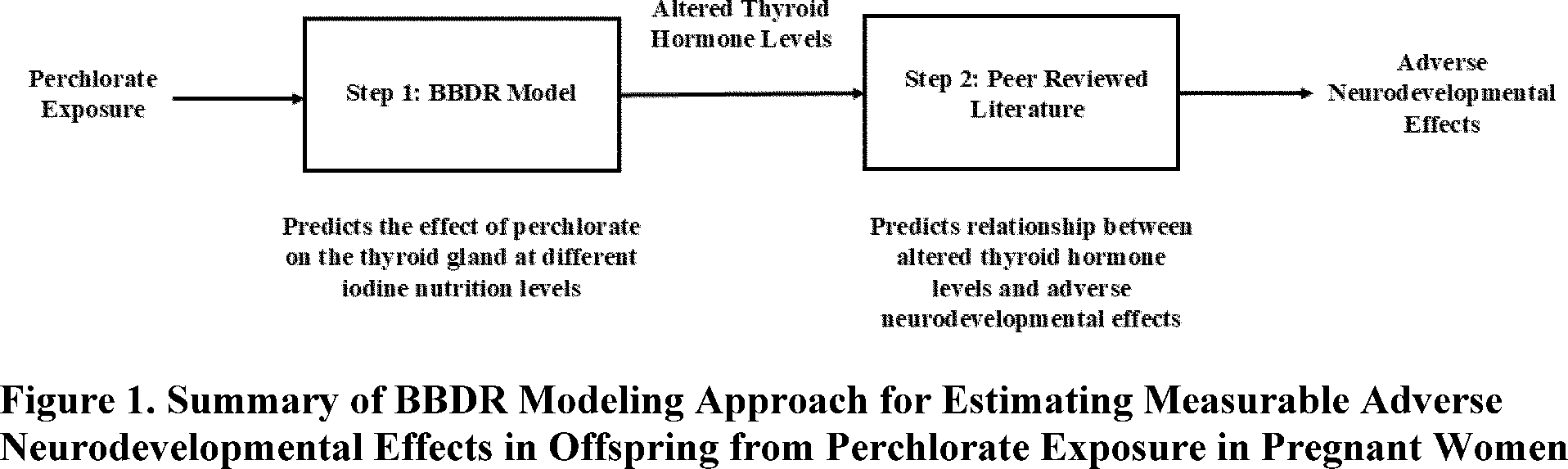
Based on the SAB's recommendations (USEPA, 2013) and input from two independent peer-review panels in 2017 (USEPA, 2017) and 2018 (USEPA, 2018), the EPA developed a two-step biologically based-dose response (BBDR) modeling approach that relates thyroid hormone effects, specifically fT4 levels, after perchlorate exposure in pregnant women to adverse neurodevelopmental outcomes in children (see Figure 1 below). The new model allowed the EPA to estimate adverse neurodevelopmental outcomes from different levels of perchlorate exposure, unlike the NRC reference dose relied upon in the EPA's 2011 regulatory determination, which measured a “precursor, non-adverse effect” for perchlorate based on iodide uptake inhibition (USEPA, 2013). In the first step of the BBDR modeling approach, the BBDR model estimates serum fT4 levels in iodine-deficient pregnant women in the first trimester. In the second step, the maternal ft4 levels are related to neurodevelopmental health effects in the offspring. Specifically, the BBDR model's serum fT4 results are integrated with data from an epidemiological study evaluating the impact of maternal thyroid hormone levels and offspring neurodevelopmental outcomes. This modeling approach was used to inform the MCLG for perchlorate in the 2019 rule proposal. Additional details on model development can be found in the EPA's
Technical Support Document: Deriving a Maximum Contaminant Level Goal for Perchlorate in Drinking Water
(hereafter referred to as the “2019 TSD”) (USEPA, 2019b) and the accompanying
Proposed Approaches to Inform the Derivation of a Maximum Contaminant Level Goal for Perchlorate in Drinking Water Volumes 1-3
(hereafter referred to as the “Approaches Report”) (USEPA, 2019c; USEPA, 2019d; USEPA, 2019e).
In the 2019 TSD, the EPA used this BBDR modeling approach to derive a noncancer toxicity value for perchlorate (USEPA, 2019b). To inform the second step of the BBDR model and consistent with the SAB recommendation that the EPA “consider available data on potential adverse health effects (neurodevelopmental outcomes) due to thyroid hormone level perturbations regardless of the cause of those perturbations” (USEPA, 2013), the EPA
( printed page 409)
evaluated 71 epidemiological studies that investigated the association between maternal thyroid hormone levels and neurodevelopmental outcomes. Given the well-established MOA (see section IV.B of this preamble), the recommendations of the SAB, and the large volume of scientific literature investigating this association, other health outcomes were not evaluated at that time (USEPA, 2019b). Of the studies evaluated in the 2019 TSD, five studies were selected for dose response assessment and ultimately data from Korevaar et al. (2016) was selected to inform the BBDR modeling approach because it had sufficient quantitative data for modeling (3,600 usable mother/child data pairs), appropriately addressed confounding variables, and assessed an adverse neurodevelopmental endpoint of decreased IQ in children (USEPA, 2019b). The other studies identified did not provide one or more of those features. The EPA solicited comments from external peer reviewers on its analysis of Korevaar et al. (2016) and whether better studies or strategies were available (no major changes were recommended). Additional details on study selection for the 2019 health assessment can be found in the 2019 TSD (USEPA, 2019b), the Approaches Report (USEPA, 2019c; USEPA, 2019d; USEPA, 2019e), and corresponding external peer review (USEPA, 2018).
6. 2019 Proposed Perchlorate NPDWR
In 2016, while the EPA was finalizing the BBDR model, the NRDC filed a complaint in the U.S. District Court for the Southern District of New York alleging that the EPA had failed to meet the statutory deadline for proposing and finalizing an NPDWR for perchlorate. The parties resolved the deadline suit by entering into a consent decree requiring the Agency propose an NPDWR and MCLG for perchlorate in 2018 and finalize an NPDWR and MCLG for perchlorate no later than December 19, 2019. Those deadlines were later extended to 2019 for proposal, with a final NPDWR and MCLG by June 19, 2020, to allow the Agency time to complete and incorporate feedback from the peer-review of the BBDR model as well as to complete the statutorily required health and risk reduction analysis.
On June 26, 2019, the EPA proposed an NPDWR and MCLG for perchlorate (84 FR 30524, USEPA, 2019a). The EPA proposed to establish an enforceable MCL and a MCLG at 56 µg/L and requested public comment on two alternative MCL and MCLG values of 18 µg/L and 90 µg/L.[7]
As part of the rulemaking, the EPA conducted a new analysis of health effects information from perchlorate exposure based on the SAB's recommendation and using the BBDR modeling approach explained above, as well as a new analysis of perchlorate occurrence in PWSs. Based on these new analyses, the EPA solicited comment on the alternative option of withdrawing the 2011 regulatory determination (84 FR at 30557, USEPA, 2019a). Specifically, the EPA explained that its recent findings on occurrence and health effects using the SAB-recommended BBDR modeling approach “suggest that perchlorate does not occur in public water systems with a frequency and at levels of public health concern” and further “suggest that the regulation of perchlorate does not present a meaningful opportunity for risk reduction for persons served by public water systems,” as required for a positive regulatory determination by SDWA section 1412(b)(1)(A), 42 U.S.C. 300g-1(b)(1)(A) (84 FR at 30557, USEPA, 2019a). The EPA found that, even at an MCL of 18 µg/L (the lowest alternative MCL), similar to the Agency's finding in the 2008 preliminary regulatory determination based on a health reference level of 15 µg/L, there would be very few PWSs that would exceed the regulatory threshold. The EPA noted examples of prior instances where the Agency had determined that there was not a meaningful opportunity for risk reduction from exposure to a contaminant that was more prevalent in systems than perchlorate.
7. 2020 Final Action on Perchlorate and Litigation
On July 21, 2020, after reviewing the public input received on the proposed perchlorate NPDWR as well as data obtained and analyses conducted since 2011, the EPA took final action to withdraw the 2011 determination to regulate (85 FR 43990, USEPA, 2020a). The EPA explained that its peer-reviewed health effects analysis indicated that the concentrations of perchlorate estimated to present levels of public health concern were higher than the health reference levels that the Agency considered in the 2011 regulatory determination. Re-evaluating occurrence data based on the 2019 proposed MCLG range (18-90 µg/L), the EPA also found that the occurrence of perchlorate in PWSs exceeding those levels was significantly lower than the frequency considered in the 2011 regulatory determination analysis (0.03%-0.002% in 2020 versus 4%-0.39% in 2011) (85 FR at 43993, USEPA, 2020a). Based on that information, the EPA determined that perchlorate does not occur in PWSs “with a frequency and at levels of public health concern” as required by SDWA section 1412(b)(1)(A)(ii), 42 U.S.C. 300g-1(b)(1)(A)(ii). The EPA further found that the national regulation of perchlorate did not present a “meaningful opportunity for health risk reduction for persons served by public water systems” within the meaning of SDWA section 1412(b)(1)(A)(iii), 42 U.S.C. 300g-1(b)(1)(A)(iii). Thus, because two of the three required statutory factors for a positive regulatory determination were not met, the EPA withdrew the determination to regulate rather than proceeding with a final NPDWR and MCLG.
In the preamble to the withdrawal action, the EPA explained that, while it had not previously had occasion to withdraw a regulatory determination under the 1996 amendments, its decision to do so was supported by the statutory text and structure of SDWA as well as relevant legislative history. Indeed, the perchlorate regulation determination was the first such determination to regulate a contaminant that the Agency had issued through the new regulatory determination process codified in 1996. The EPA explained that its decision to withdraw the 2011 regulatory determination was consistent with Congress' direction to apply its regulatory authorities and prioritize SDWA regulations based on the best available public health information, citing to SDWA section 1412(b)(1)(B)(ii)(II), 42 U.S.C. 300g-1(b)(1)(B)(ii)(II) (findings supporting a determination to regulate “shall be based on the best available public health information”) and SDWA section 1412(b)(3)(A), 42 U.S.C. 300g-1(b)(3)(A) (requiring the use of “the best available, peer-reviewed science and supporting studies conducted in accordance with sound and objective scientific practices” in taking actions, including regulatory determinations, under section 1412). The EPA explained that, while it recognized that SDWA does not include a provision explicitly authorizing the withdrawal of a regulatory determination, Congress could not have intended that the EPA's regulatory decision-making “be hamstrung by older data when newer, more accurate scientific and public health data . . . demonstrate that regulation of a new
( printed page 410)
contaminant would not present a meaningful opportunity for health risk reduction” (85 FR at 43992, USEPA, 2020a). Further, the EPA noted that SDWA section 1412(b)(1)(B)(ii)(IV), 42 U.S.C. 300g-1(b)(1)(B)(ii)(IV), specifically provides that a decision not to regulate a contaminant is a final Agency action subject to judicial review, but Congress did not specify the same with respect to determinations to regulate (85 FR at 43992, USEPA, 2020a).
With respect to SDWA's legislative history, the EPA noted that in 1996, Congress repealed the statutory requirement for the EPA to regulate an additional 25 contaminants every three years and replaced it with the current requirement for the EPA to determine whether regulation is warranted for five contaminants every five years. This change was animated by concerns heard by Congress that, under SDWA's initial 25 contaminant paradigm, the EPA's water quality experts were forced “to spend scarce resources searching for dangers that often do not exist rather than identifying and removing real health risks from our drinking water” (S. Rep. 104-169 at 12 (1995)).
In its 2020 action, the EPA concluded that “new data and analysis developed by the Agency as part of the 2019 proposal demonstrate that the occurrence and health effects information used as the basis for the 2011 determination no longer constitute `best available information' ” as required by SDWA section 1412, 42 U.S.C. 300g-1, and further, that the Agency's 2011 findings were “no longer accurate, and no longer support the Agency's prioritization of perchlorate for regulation” (85 FR at 43992). The Agency found that the EPA was thus no longer authorized by the statute to promulgate an NPDWR for perchlorate, and further, that it would not be in the public interest to do so.
NRDC filed a petition for review of the EPA's 2020 withdrawal action before the D.C. Circuit. In May 2023, the D.C. Circuit vacated and remanded the EPA's July 2020 withdrawal of its determination to issue a drinking water regulation for perchlorate in
NRDC
v.
Regan.
The panel majority held that SDWA requires that the EPA must proceed to regulate after making a determination to regulate a contaminant. Specifically, the panel majority focused on the language in SDWA section 1412(b)(1)(E), 42 U.S.C. 300g-1(b)(1)(E), providing that “[f]or each contaminant that the Administrator determines to regulate” the Administrator “
shall
publish” an NPDWR and MCLG in accordance with the statutory timelines. 67 F.4th at 401-02. Relying on the use of the term “shall” in this provision, the panel majority found that the Agency lacked authority to withdraw its determination to regulate.
Id.
at 402. The court rejected the EPA's argument that the statute and general principles of administrative law provided the EPA with implicit authority to revisit a positive regulatory determination, which the Agency noted is not a final, reviewable Agency action under the statute. Instead, the panel majority found that Congress had limited the EPA's discretion to reconsider positive determinations by providing that the EPA “shall publish” a proposed rule and MCLG after issuing a positive regulatory determination.
Id.
at 402-03.
The panel majority posited that, while new science between a determination to regulate and issuance of an NPDWR would not justify revisiting the regulatory determination, “EPA can—and must—account for those changes when setting the appropriate regulatory level.”
Id.
at 403.
One panel member concurred in the judgment only and disagreed with the majority's holding that the EPA cannot withdraw a regulatory determination based on new scientific evidence, noting her view that, where the “agency had not yet proposed and promulgated a final regulation when it made a new finding that the best available, peer reviewed science no longer supported its prior regulatory determination” the EPA “may appropriately reverse a decision to regulate based on a change in scientific evidence, after engaging in notice-and-comment procedures.”
Id.
at 410 (Pan, J., concurring in the judgment).
As explained in sections V and VIII of this preamble the EPA has accounted for the latest science and occurrence data in proposing this NPDWR and MCLG. However, despite the data continuing to show low perchlorate occurrence levels and the costs associated with establishing an NPDWR outweighing the anticipated public health benefits, the EPA is precluded by the D.C. Circuit's decision in
NRDC
v.
Regan
from reconsidering whether national regulation of perchlorate is supported by the statute.
Following the D.C. Circuit's vacatur of the 2020 withdrawal action, the parties modified the consent decree with new deadlines for the Agency to propose and finalize an NPDWR for perchlorate. Pursuant to the revised consent decree, as further revised in November 2025, the EPA is required to propose an NPDWR and MCLG for perchlorate by January 2, 2026, and sign a final NPDWR and MCLG for perchlorate by May 21, 2027 (
NRDC
v.
EPA,
No. 2:16-cv-01251 (S.D.N.Y.), Dkt. No. 110 (Nov. 21, 2025)). Today's action is in accordance with the revised consent decree.
V. 2025 Health Effects Assessment for Perchlorate
The EPA is requesting public comment on the 2025 draft health effects TSD for perchlorate (USEPA, 2025b), included in the docket for this rulemaking.
A. Consistency of the EPA's Systematic Review Principles and Process for Developing Human Health Assessments With Executive Order 14303 Restoring Gold Standard Science
The EPA's 2025 draft health effects TSD (USEPA, 2025b) for perchlorate was developed using the Agency's peer-reviewed systematic review methods to identify, evaluate, and use the best available science (USEPA, 2022b). Systematic review is a structured and documented process for identifying, selecting, assessing, and summarizing the findings of studies relevant to the human health assessment goals and scope. The health assessment development process based on systematic review is consistent with SDWA requirements, Executive Order 14303 Restoring Gold Standard Science (90 FR 22601, May 29, 2025), and the EPA's human health risk assessment guidance and best practices (
e.g.,
USEPA, 2012b; USEPA, 2002b; USEPA, 2022b). The EPA's 2025 draft health effects TSD for perchlorate is consistent with all nine tenets of Gold Standard Science (Section 3, 90 FR 22601).
1. Reproducible
Reproducibility is one of the key principles of systematic review. The thorough documentation required at all steps of systematic review enables reproducibility of the assessment conclusions by the scientific community and the public. The 2025 draft health effects TSD for perchlorate (USEPA, 2025b) followed the EPA's systematic review methods (USEPA, 2022b), ensuring reproducibility through extensive documentation of the methods and results (
e.g.,
see sections 4, 5, 6 in the 2025 draft TSD and sections A.1.3 to A.1.9 in Appendix A) (USEPA, 2025b).
2. Transparent
Like reproducibility, transparency is a core principle of systematic review. The 2025 draft health effects TSD (USEPA, 2025b) contains extensive documentation of every step in the
( printed page 411)
EPA's assessment development process. Examples include a description of literature search terms and the study relevancy screening criteria (section A.1.3; Tables A-3 and A-5) and study evaluation results, which are publicly available via the Health Assessment Workspace Collaborative (HAWC) perchlorate page (
https://hawc.epa.gov/assessment/100500419/).
3. Communicative of Error and Uncertainty
Transparent documentation of all systematic review and assessment development steps leads to clear communication of error and uncertainties. The 2025 draft health effects TSD includes lengthy discussions of potential errors and uncertainties related to reference dose derivation (section 5.2.5.1), the epidemiological evidence base (section 7.2.1), and other potentially sensitive populations (section 7.2.3) (USEPA, 2025b).
4. Collaborative and Interdisciplinary
The EPA systematic review process requires technical experts from multiple scientific fields, such as epidemiology and toxicology, to ensure a comprehensive evaluation of the health effects information and development of conclusions. This collaborative and interdisciplinary approach strengthens the scientific rigor of resulting health assessments. The 2025 draft health effects TSD was developed by a team of systematic review experts, epidemiologists, toxicologists, public health experts, and statistical modelers (see Acknowledgements section USEPA, 2025b).
5. Skeptical of its Findings and Assumptions
The EPA's systematic review steps of evaluating the potential bias of individual studies, following an evidence determination framework, and documenting uncertainties support this tenet. The in-depth evaluation of individual studies leads to a rigorous evidence determination/integration process and allows for robust characterization of data gaps and limitations, thus increasing confidence in overall assessment conclusions. For example, see methods outlined in section A.1.6 with results reported throughout section 4 (USEPA, 2025b).
6. Structured for Falsifiability of Hypotheses
Systematic review steps consistent with this tenet include the identification and use of studies agnostic of results, evaluation of studies for potential bias, evidence determination and integration, and clear documentation of uncertainties. Systematic review steps allow for falsifiability of hypotheses by first using criteria agnostic to study results to identify all relevant studies (
e.g.,
see section A.1.3 in USEPA, 2025b). All relevant studies were independently evaluated by multiple scientists for potential bias and received a confidence rating following a pre-defined study evaluation framework which was agnostic to study results (see section 3.4.1.3 and section A.1.6 in USEPA, 2025b).
7. Subject to Unbiased Peer Review
During the EPA's systematic review process, studies are identified from peer-reviewed literature databases agnostic of results. In the 2025 draft health effects TSD for perchlorate, the process for identifying and incorporating peer-reviewed studies into the assessment is transparently documented (see literature identification in section 3.4.1.1 and literature screening in section 3.4.1.2 (USEPA, 2025b)). The foundational science linking perchlorate exposure to neurodevelopmental effects,
i.e.,
the two-step modeling approach, is based on the peer-reviewed literature and underwent multiple independent external peer review processes, including by the SAB (USEPA, 2013) and two independent peer review panels in 2017 (USEPA, 2017) and 2018 (USEPA, 2018).
8. Accepting of Negative Results as Positive Outcomes
The EPA's systematic review method for identifying literature is agnostic to results. Specifically, the EPA identifies studies based on the analysis of health effects following exposure to a chemical of interest and not based on study results (
i.e.,
studies reporting null findings or significant findings are considered). In addition, negative results from studies are included during study evaluation, evidence determination and integration, and uncertainty characterization. In the 2025 draft health effects TSD, the evidence integration process (section A.1.9 in USEPA, 2025b) included consideration of negative or inconsistent results and applied the appropriate evidence determination in such cases (
i.e.,
evidence inadequate). Following this process, two of the three health outcomes (
i.e.,
cardiovascular and neurological effects) were determined to have inadequate evidence (USEPA, 2025b).
9. Without Conflicts of Interest
Throughout the EPA's structured systematic review process there are steps to ensure that the development of the health assessment is without conflicts of interest. Specific steps include study identification from peer-reviewed literature databases, transparent documentation of the systematic review process and results, use of studies agnostic of results, and evaluation of studies for potential bias. For example, the 2025 draft health effects TSD relied on publicly available peer-reviewed literature databases queried as part of systematic review (sections 3.4.1.1 and A.1.4.2 in USEPA, 2025b). The use of peer-reviewed literature minimizes the potential for conflicts of interest because peer-reviewed scientific journals require a conflict of interest (COI) statement by authors and reviewers to ensure research integrity, transparency, and to alert readers to potential biases. In unusual circumstances when journal articles have not met some COI requirements, the EPA may require additional independent peer review of scientific journal articles to meet Information Quality guideline requirements for COI (see Final Information Quality Bulletin for Peer Review) (OMB, 2005).
B. Systematic Reviews of the Perchlorate Health Effects Literature
The EPA must ensure that the MCLG is based on the best available science, and accordingly, must account for changes in science after it makes its determination to regulate but before it proposes the NPDWR (SDWA section 1412(b)(3)(A), 42 U.S.C. 300g-1(b)(3)(A)). Accordingly, the 2025 draft health effects TSD describes the results of two fit-for-purpose systematic reviews performed according to the Agency's peer-reviewed systematic review methods described above (USEPA, 2022b) to identify the best available science, including studies published since the 2019 TSD, to inform the perchlorate oral RfD and MCLG. The first systematic review was designed to identify human epidemiological and animal toxicological data relevant to oral perchlorate exposure and health effects in four major health outcome categories (endocrine, neurological, cardiovascular, and cancer). The second systematic review was designed to identify studies of the relationship between decreased maternal T4 levels, which reflect
in utero
thyroid levels, and neurodevelopmental health effects in offspring that had the potential to be used in the BBDR modeling approach
( printed page 412)
that was used in the 2019 TSD to derive the RfD (USEPA, 2019b; USEPA, 2019c), consistent with recommendations from the SAB (USEPA, 2013).
From the results of the first systematic review, the EPA concluded that the available
evidence indicates (likely)[8]
that oral perchlorate exposure is likely to cause adverse endocrine, including thyroid, effects in humans, consistent with the well-established MOA for perchlorate (NRC, 2005; USEPA, 2013; USEPA, 2019b). The EPA also concluded that the
evidence is inadequate
to assess whether perchlorate exposure may directly cause either nervous system or cardiovascular effects in humans. Based on the epidemiology and toxicology studies of cancer effects identified in the first literature search and systematic review and in accordance with the Guidelines for Carcinogen Risk Assessment (USEPA, 2005b), the EPA maintains the conclusion that perchlorate is
Not Likely to Be Carcinogenic to Humans.
As such, the EPA did not perform a cancer dose-response assessment for perchlorate and did not derive an MCLG based on cancer effects (see section 4.1.4 of the 2025 draft health effects TSD for information on the carcinogenicity assessment for perchlorate). Informed by these 2024 perchlorate health hazard systematic review results, the EPA maintained the 2-step BBDR modeling approach used in 2019 (see section IV of this preamble).
After evaluating the relevant literature identified in the second systematic review, Korevaar et al. (2016), the study that the EPA previously selected in 2019 (USEPA, 2019b), was selected as the critical study because it remains the best available study to inform the relationship between maternal fT4 levels and neurodevelopmental outcomes in children. See the 2025 draft health effects TSD (USEPA, 2025b) for more information about the systematic reviews.
C. Draft Oral Noncancer Reference Dose Derivation
In deriving an RfD in the 2019 proposed NPDWR, the EPA selected a 2 percent decrement in the mean population level IQ as the benchmark response (BMR), among evaluations of a 1 percent, 2 percent, and 3 percent BMR (USEPA, 2019b). IQ is on a 100-point scale; therefore, a 2 percent decrease in the mean population level IQ corresponds to a 2-point decrease in IQ. For this NPDWR, after considering BMRs of 1 percent and 2 percent for the adverse neurodevelopmental endpoint, the EPA is selecting a BMR of 1 percent decrement in the mean population IQ, consistent with the EPA's Benchmark Dose Technical Guidance (USEPA, 2012b) which describes several considerations. The selected BMR of 1 percent is supported by the biological significance and severity of the decreased IQ health effect, the observable range of the health effects data identified (
i.e.,
decreases in IQ scores), and the statistical power of the critical study selected (Korevaar et al., 2016). This decision to select a 1 percent BMR is consistent with the EPA's Benchmark Dose Modeling Technical Guidance regarding epidemiology data which states that “a BMR of 1% has typically been used for quantal human data from epidemiology studies” (USEPA, 2012b). While a BMR below 1 percent was considered, benchmark dose modeling was not performed because the EPA guidance (USEPA, 2012b; USEPA, 2002a) does not provide recommendations for modeling below a 1 percent BMR, IQ is measured and reported in integer/whole numbers (typically expressed in ranges of intellectual capacity), and a BMR below 1 percent is below the observable range of the data identified. See section 5.2.4 of the 2025 draft health effects TSD for more information (USEPA, 2025b).
Based on the 2-step BBDR model and the BMR of 1 percent decrease in the mean population level IQ, the EPA derived a point of departure (POD) of 3.1 μg/kg/day as described in the 2025 draft health effects TSD (USEPA, 2025b). Consistent with the recommendations presented in the EPA's peer-reviewed human health risk assessment methods for developing toxicity values (USEPA, 2002a), the Agency applied a total uncertainty factor (UF) of 3 to the human-equivalent POD to account for variation in sensitivity among the human population. The same total UF value of 3 was used in the 2019 TSD for perchlorate (USEPA, 2019b).
From this POD and total UF, the EPA derived a draft RfD of 1 μg/kg/day, after rounding to one significant figure according to Agency best practice (APHA, 1992; Brinker and Wolf, 1984; USEPA, 2000a). As the critical effect of perchlorate is a developmental endpoint that can result from a short-term exposure during critical periods of development, the overall draft RfD for perchlorate is applicable to both short-term and chronic exposure scenarios (USEPA, 1991).
VI. Maximum Contaminant Level Goal
Section 1412(a)(3) of the SDWA requires the EPA to propose an MCLG simultaneously with the NPDWR. The MCLG is defined in SDWA section 1412(b)(4)(A), 42 U.S.C. 300g-1(b)(4)(A), as “the level at which no known or anticipated adverse effects on the health of persons occurs and which allows an adequate margin of safety.” Consistent with SDWA section 1412(b)(3)(C)(i)(V), 42 U.S.C. 300g-1(b)(3)(C)(i)(V), in developing the MCLG, the EPA considers “the effects of the contaminant on the general population and on groups within the general population such as infants, children, pregnant women, the elderly, individuals with a history of serious illness, or other subpopulations that are identified as likely to be at greater risk of adverse health effects due to exposure to contaminants in drinking water than the general population.” Accordingly, the EPA reviewed the available information to identify the most sensitive population(s) to derive the MCLG. Consistent with SAB recommendations (USEPA 2013) and peer review, the EPA is proposing an MCLG that is based on protecting the offspring of hypothyroxinemic pregnant women in their first trimester with low-iodine intake levels. The inputs for a noncancer MCLG include an oral noncancer toxicity value (
i.e.,
an RfD), body weight-adjusted drinking water intake (DWI-BW), and a relative source contribution (RSC).
( printed page 413)
As described in section V of this preamble, the EPA derived a draft RfD of 1 μg/kg/day. Given the most sensitive life stage identified, fetuses of iodine-deficient, hypothyroxinemic pregnant women in their first trimester, the EPA selected the DWI-BW corresponding to females of reproductive age, 13 to <50 years (0.0354 L/kg/day), who may be pregnant or become pregnant, to calculate the proposed MCLG for perchlorate (USEPA, 2019f) (see section 6.1 of the 2025 draft health effects TSD for more information about exposure factor selection (USEPA, 2025b)). In alignment with the EPA guidance for substances with one non-water exposure route and no other standards, guidance, or criteria, the RSC was calculated as a proportion of the difference between the RfD and exposure to perchlorate attributable to food and other sources (USEPA, 2000b). The EPA calculated an RSC of 80 percent based on the draft RfD of 0.001 mg/kg/day (1 μg/kg/day) (see section 6.2 of the 2025 draft health effects TSD for more information about the RSC derivation (USEPA, 2025b)).
Calculating the MCLG based on these input values, described above, results in a proposed MCLG for perchlorate in drinking water of 0.02 mg/L, after rounding to one significant figure following Agency best practice (APHA, 1992; Brinker and Wolf, 1984; USEPA, 2000a).
Rounded to 1 significant figure:
Proposed MCLG
= 0.020
mg/L
The proposed MCLG of 0.02 mg/L (20 μg/L) is a level in drinking water expected to
protect against
the lowest IQ decrement that can be accurately estimated. Specifically, the EPA derived the proposed MCLG using an RfD that was based on a BMR of a 1-point IQ decrement in the population at greater risk to adverse health effects following perchlorate exposure (the offspring of iodine-deficient, hypothyroxinemic pregnant women in their first trimester), and which in turn protects against adverse health effects following perchlorate exposure in the general population.
In this notice, the EPA is clarifying the role the 1 percent, or 1-point, decrement in IQ plays in the derivation of the MCLG for perchlorate.
See NRDC
v.
Regan,
67 F.4th at 411, n.2 (Pan, J., concurring) (asserting that “[t]he proposed MCLGs are the levels of perchlorate
associated
with decreases in IQ of one” point) (emphasis in original). In deriving the reference dose, the EPA selected a 1 percent benchmark response for decreased IQ in the most sensitive life stage: the offspring of iodine-deficient, hypothyroxinemic mothers in their first trimester of pregnancy. Following EPA guidance for human health risk assessment, the EPA first calculated a POD dose of perchlorate to determine the level of perchlorate exposure at the BMR. Specifically, the POD is the level of perchlorate exposure in first trimester pregnant women associated with a BMR of 1-point decrement in offspring IQ. Here, the POD is 3.1 μg/kg/day. By applying uncertainty factors (UFs) to the POD, the EPA derived a draft RfD, which is “an estimate (with uncertainty spanning perhaps an order of magnitude) of a daily oral exposure to the human population (including sensitive subgroups) that is
likely to be without
an appreciable risk of deleterious effects during a lifetime” (USEPA, 2002b) (emphasis added). The proposed MCLG, the drinking water concentration, was then derived from the draft RfD, the oral dose, of 1 μg/kg/day, approximately three times lower than the POD dose of perchlorate. The SDWA requires that the MCLG be the level at which there are no known or anticipated adverse effects to human health with an adequate margin of safety. Therefore, perchlorate exposure via drinking water at or below the MCLG to iodine-deficient, hypothyroxinemic pregnant women in their first trimester should be understood as
protecting against
a 1-point IQ decrement in their offspring, which is expected to be protective of other life stages and populations as well.
As explained in this section, the proposed MCLG allows for an adequate margin of safety through the derivation of the RfD which included selection of the most sensitive endpoint in the most sensitive population, selection of the 1 percent BMR, and application of uncertainty factors and the RSC. The Agency seeks comment on the proposed MCLG value of 20 µg/L and the methodology used to derive the value as described in this section, including whether the Agency should instead consider using a BMR of 2 percent or 3 percent to derive the RfD (see section XV of this preamble for more information).
VII. Maximum Contaminant Level
Under section 1412(b)(4)(B) of the SDWA, the EPA generally must establish an MCL as close to the MCLG as feasible. The EPA evaluated available analytical methods to determine the lowest concentration at which perchlorate can be measured and evaluated the treatment technologies for perchlorate that have been examined under field conditions (USEPA, 2025c; USEPA, 2025d). These field studies, as discussed in section XII.A of this preamble, demonstrated that three different treatment technologies (ion exchange, biological treatment, and reverse osmosis) are capable of high removal efficiency of perchlorate at a reasonable cost basis for large systems. The EPA determined that setting an MCL equal to 20 µg/L, 40 µg/L, 80 µg/L, or higher values would be feasible given that the approved analytical method for perchlorate for UCMR 1 had a minimum reporting level (MRL) of 4.0 µg/L (USEPA, 1999; USEPA, 2000c) and that available, adequately tested, and reasonably cost-affordable treatment technologies can treat to concentrations below 20 µg/L (USEPA, 2025d). Additionally, more recently approved analytical methods for perchlorate have lower MRLs (see section IX of this preamble). Based on this evaluation of analytical methods and treatment technologies, the EPA determined that the proposed MCL of 20 µg/L is the closest feasible level to the MCLG.
When proposing an MCL, the EPA must publish and seek public comment on the HRRCA for the proposed MCL and each alternative MCL considered (SDWA section 1412(b)(3)(C)(i), 42 U.S.C. 300g-1(b)(3)(C)(i)), including: the quantifiable and nonquantifiable health risk reduction benefits attributable to MCL compliance; the quantifiable and nonquantifiable health risk reduction benefits of reduced exposure to co-occurring contaminants attributable to MCL compliance; the quantifiable and nonquantifiable costs of MCL compliance; the incremental costs and benefits of each alternative MCL; the effects of the contaminant on the general population and sensitive populations likely to be at greater risk of any adverse health risks posed by compliance; and other factors such as data quality and uncertainty. The EPA provides this
( printed page 414)
information in section XIV in this preamble and in more detail in the
Economic Analysis for the Proposed Perchlorate National Primary Drinking Water Regulation
(USEPA, 2025i) available in the docket for the proposed rule.
As the occurrence analysis in section VIII of this preamble demonstrates, there is infrequent occurrence of perchlorate at or above 20 µg/L. In addition to evaluating the benefits and costs of the proposed MCL of 20 µg/L (the level as close as feasible to the MCLG), the EPA evaluated benefits and costs of alternative proposed MCLs to determine whether a higher MCL (
i.e.,
40 µg/L or 80 µg/L) would maximize health risk reduction benefits at a cost that is justified by the benefits. These levels represent a doubling and quadrupling of the 20 µg/L level and are therefore reasonable levels at which to analyze the relationship between costs and benefits and trends in the relationship between costs and benefits. However, the EPA found that benefits did not justify the costs at any of these levels. The EPA found that costs decrease as the MCL increases because fewer water systems are expected to exceed the MCL and would not be required to incur treatment costs to reduce perchlorate drinking water concentrations. As a result, quantified benefits decrease, but not at the same rate as the costs, leading to quantified net benefits that grow closer to positive at 40 µg/L and 80 µg/L, respectively (see section XIV.C of this preamble for discussion). For this reason, notwithstanding the finding that no MCL would result in benefits that are justified by the costs under SDWA section 1412(b)(6)(A), 42 U.S.C. 300g-1(b)(6)(A), the Agency is proposing and seeking comment on setting the MCL at 20 µg/L, 40 µg/L, or 80 µg/L. The Agency is requesting comment on the three proposed MCLs and any other alternative MCL higher than the MCLG. See section XV of this preamble for more information. For the purposes of this proposal, the EPA is including the three proposed MCLs (
i.e.,
20 µg/L, 40 µg/L, or 80 µg/L) in the proposed regulatory text in Table 1 to paragraph (b) of 40 CFR 141.51, Table 1 to paragraph (b) of 40 CFR 141.62, and under the entries for “Perchlorate” in Appendix A to Subpart O of Part 141 and Appendix A to subpart Q of Part 141. Upon promulgation of a final rule, only one MCL will be included in the regulatory text.
In implementing SDWA section 1412, 42 U.S.C. 300g-1, the EPA must use the best available, peer-reviewed science and supporting studies, taking into consideration the quality of the information and the uncertainties in the benefit-cost analysis (SDWA section 1412(b)(3), 42 U.S.C. 300g-1(b)(3)). The following sections, as well as the health effects discussion in sections V and VI of this preamble and the 2025 draft health effects TSD (USEPA, 2025b), document the science and studies that the EPA relied upon to develop estimates of benefits and costs and to understand the impact of uncertainty on the Agency's analysis.
VIII. Occurrence
The EPA relied on data from UCMR 1 and compliance data from States that have elected to regulate perchlorate in drinking water to evaluate the occurrence of perchlorate. The EPA combined data from both UCMR 1 and State compliance monitoring into a Bayesian hierarchical model, which allows the utilization of all suitable observed data available, including quantifiable detections and non-detects (
i.e.,
samples with no reported value), to produce probabilistic exposure estimates for perchlorate. The EPA used a similar statistical approach to evaluating occurrence data in the per- and polyfluoroalkyl substances (PFAS) NPDWR rulemaking (89 FR 32532, USEPA, 2024a) as well as for arsenic and
Cryptosporidium parvum
(USEPA, 2000d; USEPA, 2006). The data and occurrence model informed estimates of the number of water systems and the associated population expected to be exposed to levels of perchlorate which would potentially exceed the proposed MCLs and require the water systems to take action under the proposed rule. The EPA estimates the mean number of systems that would exceed 20 µg/L in a single round of sampling to be 103 systems out of 66,320 community and non-transient non-community water systems. Please see the
Perchlorate Occurrence and Monitoring Report for the Perchlorate National Primary Drinking Water Regulation
(USEPA, 2025e) for a full analysis and discussion of perchlorate occurrence.
IX. Analytical Methods
The EPA is proposing analytical methods for water systems to comply with the MCL. SDWA section 1401(1)(D), 42 U.S.C. 300f(1)(D), requires that an NPDWR “contains criteria and procedures to assure a supply of drinking water which dependably complies with such [MCLs]; including accepted methods for quality control and testing procedures to ensure compliance with such levels.” SDWA section 1412(b)(4)(B), 42 U.S.C. 300g-1(b)(4)(B), also directs the EPA to set a contaminant's MCL as close to its MCLG as is “feasible”, the definition of which includes an evaluation of the feasibility of performing chemical analysis of the contaminant at standard drinking water laboratories.
To comply with these requirements, the EPA considers method performance under relevant laboratory conditions, their likelihood of utilization among certified drinking water laboratories, and the associated analytical costs. The EPA has developed five analytical methods for the identification and quantification of perchlorate in drinking water that meet these criteria. The proposed EPA methods for perchlorate are method numbers 314.0, 314.1, 314.2, 331.0, and 332.0. A detailed description of these methods is presented in section 6 of the
Perchlorate Occurrence and Monitoring Report for the Perchlorate National Primary Drinking Water Regulation
(USEPA, 2025e).
X. Monitoring and Compliance Requirements
A. Proposed Monitoring Requirements
The EPA is proposing to require all CWSs and NTNCWSs to monitor for perchlorate. The EPA is proposing to amend 40 CFR 141.23(c) to incorporate monitoring requirements for perchlorate with a monitoring protocol based on the EPA's Standardized Monitoring Framework (SMF) for IOCs. Under the SMF for IOCs, the monitoring frequency for a PWS is dependent on previous monitoring results, source water type, and whether a monitoring waiver has been granted. The SMF follows 9-year compliance cycles divided into three 3-year periods. Water systems are generally required to monitor for contaminants at least once every compliance cycle.
The EPA is proposing that all ground water systems serving greater than 10,000 persons and all surface water systems [9]
be initially required to monitor each entry point to the distribution system quarterly within a 12-month period for perchlorate prior to the rule compliance date. The EPA is proposing that ground water systems serving 10,000 people or fewer be initially required to monitor twice within a 12-month period, and that the second of these samples should be collected five to seven months after the first sample. Water systems would be required to complete this initial monitoring by the rule compliance date (see section XIII.A of this preamble for additional details about the rule
( printed page 415)
compliance date). The EPA is proposing that States may allow systems to use previously acquired monitoring data to satisfy the initial monitoring requirements (see section X.E of this preamble for discussion of historical data).
The monitoring requirements for IOCs under 40 CFR 141.23(c) provide that the State may reduce a system's monitoring frequency from quarterly to annually (surface water systems) or triennially (ground water systems) if the State determines the system is “reliably and consistently” below the MCL.[10]
The EPA is aware that there can be significant administrative burden on the State to make these determinations, particularly for many systems simultaneously (USEPA, 2025f). The analysis of perchlorate occurrence data indicates that virtually all systems would have initial perchlorate sample concentrations below any of the proposed MCLs (see section VIII of this preamble for information about perchlorate occurrence). Therefore, the EPA anticipates that, for most systems, rule implementation will only require monitoring and no other action, imposing costs and burden with limited public health benefit. While the EPA explored requirements to limit monitoring only to systems that are likely to have perchlorate, the Agency could not determine a reliable basis to support such an approach. Instead, the EPA is proposing requirements that would require all CWSs and NTNCWSs to monitor for perchlorate but would also reduce costs and burden compared to the monitoring requirements for other IOCs.
In response to stakeholder feedback (USEPA, 2025f) and in an effort to reduce burden on systems and States, the EPA is proposing a binning approach in 40 CFR 141.23(c)(10)(iii) based on the initial monitoring samples collected prior to the rule compliance date to reduce monitoring frequency without States making a “reliably and consistently” determination for each system. Based on the initial monitoring samples, if all sample concentrations at an entry point are at or below 4.0 µg/L, the system would automatically start at a monitoring frequency of once every nine years after the rule compliance date at that entry point. The EPA is proposing 4.0 µg/L as the level for automatic reduction to nine-year monitoring because it was the MRL for perchlorate established during UCMR 1. While the EPA is aware that capabilities have improved since UCMR 1 and that labs can quantify lower levels depending on the method used (see section IX of this preamble), the Agency is selecting 4.0 µg/L as the threshold for determining an automatic reduced monitoring frequency to ensure water systems nationally can reduce their monitoring frequency as appropriate. The EPA anticipates that a system with all initial monitoring results at or below 4.0 µg/L at an entry point is unlikely to exceed the perchlorate MCL and is proposing for the system to reduce to monitoring once a compliance cycle (nine years) at that entry point. This approach would allow a water system to reduce to nine-year monitoring sooner compared to the standard monitoring framework waiver process for IOCs. Additionally, the EPA is proposing that States may require more frequent sampling (40 CFR 141.23(c)(10)(iv)) to account for situations where automatic reduced monitoring to once every nine years may not be appropriate (
e.g.,
presence of known sources of perchlorate, high variability in initial sample results). If any of the sample concentrations are greater than 4.0 µg/L but all are below or equal to the MCL, the system would be required to sample at an annual (surface water system) or triennial (ground water system) frequency starting at the rule compliance date. If the system has any samples greater than the MCL, the system would be required to conduct quarterly monitoring starting at the rule compliance date. This approach would effectively stagger system monitoring frequencies at the compliance date and help reduce burden on both systems and States. The EPA is proposing that this automatic reduction be based only on the results of the initial monitoring samples collected prior to the rule compliance date (including samples collected between January 1, 2021, and the publication date of the final rule that satisfy initial monitoring requirements. See section X.E of this preamble for more information). At the compliance date, systems would continue to monitor at those established frequencies and could then reduce their monitoring frequency as applicable consistent with the SMF for IOCs. For example, a system that was required to remain on quarterly monitoring after the compliance date could reduce to annual or triennial monitoring if the State determines the system is “reliably and consistently” below the MCL and the system has collected at least two quarterly samples (ground water) or at least four quarterly samples (surface water) in accordance with 40 CFR 141.23(c)(8). Likewise, systems that automatically qualify for annual or triennial monitoring after initial sampling would be eligible to apply to the State for a monitoring waiver to reduce to sampling once every nine years following the procedures in 40 CFR 141.23(c)(3)-(6) as described in section X.B of this preamble. The EPA is requesting comment on this automatic monitoring approach, including the thresholds used for binning, in section XV of this preamble. The EPA is also requesting comment on whether a trigger value higher than 4 µg/L, such as one half of the MCL, should be used for an automatic reduction to nine year monitoring. Once compliance monitoring begins, any system on reduced monitoring that exceeds the MCL would be required to begin quarterly monitoring at that sampling point.
B. Can States grant monitoring waivers?
In addition to the proposed automatic monitoring frequency reduction based on initial sampling, the EPA is proposing to allow water systems to apply to the State for a monitoring waiver for perchlorate if the conditions described in 40 CFR 141.23(c)(3)-(6) are met. In contrast to the automatic reductions, a water system must apply to the State for a waiver based on several rounds of compliance sampling. If a State approves the waiver request, the State must provide the waiver in writing and the sampling frequency must be no less frequent than once every compliance cycle (
i.e.,
nine years). A State may grant a waiver for surface water systems after three rounds of annual monitoring with results less than the MCL and for ground water systems after conducting three rounds of triennial monitoring with results less than the MCL (40 CFR 141.23(c)(4)). Systems on quarterly monitoring must first reduce to annual or triennial sampling following a determination by the State that the system is “reliably and consistently” below the MCL and conduct at least three rounds of annual or triennial monitoring before applying for a waiver. At a minimum, one sample must be collected during the time that the waiver is effective, and the term during which the waiver is effective cannot exceed one compliance cycle (nine years) (40 CFR 141.23(c)(3)).
( printed page 416)
C. How are system MCL violations determined?
The EPA is proposing that violations of the perchlorate MCL be determined based on the average of a compliance sample and confirmation sample consistent with 40 CFR 141.23(i)(3). Compliance with the perchlorate MCL would be determined based on one sample if the sample is at or below the MCL. If a sample exceeds the perchlorate MCL, the water system would be required to collect a confirmation sample. Compliance with the MCL would then be determined based on the average value of the initial and confirmation samples. Because the MCLG has one significant figure and the proposed MCL is set equal to the MCLG, sample results would be rounded to one significant figure prior to being evaluated against the MCL. The EPA is proposing this compliance calculation instead of a running annual average approach used for many other IOCs because of the short period of time corresponding to the sensitive exposure window (
i.e.,
first trimester of pregnancy) for the selected critical health effect underlying the RfD and MCLG.
The EPA is proposing for water systems to collect the confirmation sample within five calendar days following the system's receipt of the notification of the analytical result of the first sample. The EPA considers that this timeframe is appropriate given the short period of time (
i.e.,
first trimester of pregnancy) associated with the critical health effect underlying the MCLG. The EPA is also seeking comment on whether the Agency should require a shorter timeframe for collecting a confirmation sample (
e.g.,
three days) or a longer time frame (
e.g.,
the two week timeframe States may require for other IOCs under 40 CFR 141.23(f)(1)) due to challenges systems may face challenges in reviewing results and collecting confirmation samples due to staff scheduling and resource availability (for more information, see section XV of this preamble).
D. When must systems complete initial monitoring?
The EPA is proposing that water systems complete initial monitoring in anticipation of the rule compliance date (see session XII.A of this preamble for a discussion on the compliance date). Under SDWA section 1412(b)(10), 42 U.S.C. 300g-1(b)(10), NPDWRs generally take effect three years after the date of promulgation of the final rule or any amendment thereto. The initial monitoring results would be used to determine the actions systems will need to take after the compliance date for the MCL is in effect. For a small percentage of systems, that data will inform whether the system needs to take actions to reduce perchlorate to levels below the MCL. The initial monitoring data will be used to determine the compliance monitoring frequency after the rule's compliance dates are in effect. The EPA estimates that after the initial monitoring period, the majority of systems would conduct monitoring once every nine years (40 CFR 141.23(c)(10)(iii)(A)). To satisfy initial monitoring requirements, ground water systems serving more than 10,000 persons and all surface water systems would be required to collect four samples at each entry point to the distribution system over four consecutive quarters before the rule compliance date goes into effect. Ground water systems serving 10,000 people or fewer would be required to collect two samples within a 12-month period five to seven months apart at each entry point before the rule compliance date goes into effect.
E. Can systems use previously collected data to satisfy the initial monitoring requirements?
The EPA is proposing that States can allow systems to use perchlorate data collected after January 1, 2021, to satisfy the initial monitoring requirements. To satisfy the initial monitoring requirements in 40 CFR 141.23(c)(10)(i)-(ii), a system with historical monitoring data for an entry point to the distribution system could use monitoring data obtained from between January 1, 2021, to the compliance date to comply with the initial monitoring requirements at that entry point. Systems would be required to either have collected the same number of samples as required for initial monitoring (
i.e.,
two or four depending on system size and type) or have data collected under a State monitoring requirement. The EPA is proposing this provision to account for systems that are already monitoring for perchlorate, including in States with perchlorate drinking water requirements. For example, some systems have years of annual or triennial perchlorate monitoring data demonstrating perchlorate levels far below the proposed MCL. The EPA does not intend for these systems to restart at quarterly monitoring provided the State approves the use of previously collected data. The EPA is proposing a cut-off date of approximately six years prior to the beginning of the initial monitoring period (January 1, 2021). This is to ensure that recent data are being used to determine if a system is required to conduct quarterly sampling during the initial monitoring period. While the EPA is aware of systems that may have conducted sampling earlier than the cut-off date, such as part of UCMR 1 sampling, the Agency is concerned that older data may not capture current conditions. The EPA is seeking comment in section XI of this preamble on alternative cut-off dates for application of previously collected data.
F. Can systems composite samples?
40 CFR 141.23(a)(4) provides that the State may reduce the total number of samples which must be analyzed by allowing the use of compositing. Composite sampling is an approach in which equal volumes of water from multiple samples (maximum of five) are combined and analyzed as a mixture. The reported concentration from the analysis reflects the average of the concentrations from the contributing entry points. Composite sampling can reduce costs because a single composite sample is analyzed instead of individual samples. However, if the concentration of the composite sample is greater than or equal to the MCL divided by the number of samples analyzed, the water system is required to take a follow-up sample at each sampling point included in the composite and analyze each sample separately. For example, at a proposed MCL of 20 µg/L, a five-sample composite would trigger follow-up sampling at each entry point included in the composite sample with a perchlorate concentration of 4 µg/L or greater. Under the proposal, the provisions in 40 CFR 141.23(a)(4) would apply to perchlorate. The EPA expects that many water systems will have perchlorate concentrations far below the MCL. Compositing is one potential method for systems to further reduce their monitoring and analytical costs.
XI. SDWA Right To Know Requirements
A. What are the proposed consumer confidence report requirements?
The 1996 Right to Know provisions of the SDWA (section 1414(c)(4)) require all community water systems (CWSs) to provide their customers at least once a year with a Consumer Confidence Report (CCR) in accordance with the CCR Rule requirements in 40 CFR 141 subpart O. The CCR is a drinking water quality report that summarizes the state of the water system's drinking water supply. The CCR must include information about the water system, sources of water, detected contaminants,
( printed page 417)
compliance with drinking water rules, as well as other information. The EPA revised the CCR Rule in 2024 (89 FR 45980, USEPA, 2024b) in response to the America's Water Infrastructure Act of 2018 in an effort to improve the readability, clarity, and understandability of CCRs as well as the accuracy of the information presented, improve risk communication in CCRs, incorporate electronic delivery options, provide supplemental information regarding lead levels and control efforts, and require systems who serve 10,000 or more persons to provide CCRs to customers biannually (twice per year). Under this proposal, CWSs would be required to report perchlorate information in their CCR. As with other detected regulated contaminants, this information would include the MCL, MCLG, range of detected levels, highest detected level used to determine compliance, and likely sources of the perchlorate. If there is a violation of the MCL, the report must also include information about the violation, potential adverse health effects of perchlorate, and actions taken by the system to address the violation. The EPA is proposing mandatory health effects language for perchlorate consistent with the Agency's health assessment of perchlorate (see sections IV.B and V of this preamble for details about perchlorate health effects and the EPA's health effects assessment). This proposed language for the CCR would be listed in appendix A to subpart O of part 141. This is the same health effects language that would be required in public notification, as specified in appendix B to subpart Q of part 141 (see section XI.B of this preamble for discussion). Please see the CCR Rule (40 CFR part 141, subpart O) for more information on what must be reported in the CCR.
B. What are the proposed public notification requirements?
The EPA promulgated a Public Notification (PN) Rule in 40 CFR part 141, subpart Q in 2000 (65 FR 26035, USEPA, 2000e). This PN Rule implements SDWA section 1414(c)(1) and (2), 42 U.S.C. 300g-3(c)(1), (2). The PN Rule ensures that consumers will know if there is an issue with their drinking water and alerts consumers if there is risk to public health. Under the PN Rule, water systems must notify customers of any failure of the water system to comply with an MCL, a prescribed treatment technique, or failure to perform required water quality monitoring, or testing procedures; any variance or exemption the system has been granted, or failure to comply with the requirements of any schedule set under a variance or exemption; or reporting and recordkeeping violations under subpart Y; and certain specified situations such as the occurrence of a waterborne disease outbreak or emergency and the availability of unregulated contaminant monitoring data (see 40 CFR 141.201, table 1). There are three tiers of PN defined in 40 CFR 141.201(b) to take into account the seriousness of the violation or situation and any potential adverse health effects that may be involved. The EPA is proposing revisions to 40 CFR 141.202 to comply with the PN requirements of the proposed perchlorate rulemaking. Additionally, the EPA is proposing mandatory health effects language in appendix A of subpart Q for perchlorate consistent with the Agency's health assessment of perchlorate (see section V of this preamble for details about the health effects assessment). This is the same health effects language that would be required in the CCR (see section XI.A of this preamble for discussion).
All PWSs must give public notice for all violations of NPDWRs and for other situations under the requirements of 40 CFR 141.201. Under this proposal, violations of the perchlorate MCL would be designated as Tier 1 and as such, PWSs would be required to comply with 40 CFR 141.202. Based on the available evidence, the most sensitive adverse health effect of perchlorate exposure is decreased IQ, a developmental health outcome that can result from short-term exposure during critical periods of development (described in section V of this preamble). The offspring of iodine-deficient pregnant women in their first trimester are the most sensitive population identified for the decreased IQ health outcome. The EPA is proposing Tier 1 PN for a perchlorate MCL exceedance. Because the first trimester of pregnancy is a short exposure window, the EPA finds it appropriate to require Tier 1 PN so that the most sensitive population identified can change behaviors to reduce the risk of exposure to perchlorate. Additionally, timely notification could benefit a larger portion of the water system population than just pregnant women with iodine deficiency in their first trimester. For example, public notification could benefit females of reproductive age (13 to <50 years of age) who may become pregnant, which make up a considerable proportion (24.6 percent) of the overall U.S. population (U.S. Census Bureau, 2024a; U.S. Census Bureau 2024b). Stakeholders have expressed the importance of timely notification and transparency in communicating with consumers due to the adverse health end point of perchlorate exposure (USEPA, 2025g). Conversely, the EPA is aware that water systems may face implementation challenges in complying with Tier 1 PN compared to complying with Tier 2 PN. Water systems have expressed capacity challenges with complying with Tier 1 PN, as well as the potential to erode public trust in drinking water due to a potential for increased notices on drinking water violations (USEPA, 2025g). The EPA requests public comment on the selection of Tier 1 PN rather than Tier 2 PN for an MCL exceedance for the proposed rulemaking. See section XV of this preamble for more information. The EPA is also proposing PN requirements for perchlorate monitoring and procedure violations. Specifically, the EPA is proposing to require Tier 3 PN for perchlorate monitoring and testing procedure violations, which is consistent with other IOCs.
XII. Treatment Technologies
Systems that exceed the proposed perchlorate MCL would need to adopt new treatment or another strategy to reduce perchlorate to a level that meets the MCL. When the EPA establishes an MCL for a drinking water contaminant, SDWA section 1412(b)(4)(E)(i), 42 U.S.C. 300g-1(b)(4)(E)(i), requires the Agency to “list the technology, treatment techniques, and other means which the Administrator finds to be feasible for purposes of meeting [the MCL],” which are referred to as best available technologies (BATs). Water systems are not required to implement BATs for rule compliance. Rather, these BATs are used by States to establish conditions for source water variances under SDWA section 1415(a), 42 U.S.C. 300g-4(a). Furthermore, SDWA section 1412(b)(4)(E)(ii), 42 U.S.C. 300g-1(b)(4)(E)(ii), requires the Agency to identify small system compliance technologies (SSCTs), which are more affordable treatment technologies, or other means that can achieve compliance with the MCL (or treatment technique, where applicable). The lack of an affordable SSCT for a contaminant triggers certain additional procedures which can result in States issuing small system variances under SDWA section 1412(e), 42 U.S.C. 300g-1(e). The Agency is requesting comment on the treatment technologies discussed in this section.
A. Best Available Technologies
The EPA identifies BATs as those meeting the following criteria: (1) capability of a high removal efficiency,
( printed page 418)
(2) history of full-scale operation, (3) general geographic applicability, (4) compatibility with other water treatment processes, (5) ability to bring all the water in a system into compliance, and (6) reasonable cost basis for large and medium water systems. The Agency is proposing to list the following technologies as BATs for removal of perchlorate from drinking water based on its review of the treatment and cost literature (USEPA, 2025c; USEPA, 2025d):
Ion exchange;
Biological treatment; and
Reverse osmosis.
Non-treatment options might also be used for compliance in lieu of installing and operating treatment technologies. These include blending existing water sources, replacing a perchlorate-contaminated source of drinking water with a new source (
e.g.,
a new well), and purchasing compliant water from another system. See the
Best Available Technologies and Small System Compliance Technologies for the Perchlorate National Primary Drinking Water Regulation
(USEPA, 2025c) for details on each proposed BAT and non-treatment option.
B. Small System Compliance Technologies
The EPA is proposing the SSCTs shown in Exhibit 1. The table shows which of the BATs listed in section XII.A of this preamble are also affordable for each small system size category listed in section 1412(b)(4)(E)(ii) of SDWA. The Agency identified these technologies based on an analysis of treatment effectiveness and affordability (USEPA, 2025c).
The SSCTs listed in Exhibit 1 include a point-of-use (POU) version of reverse osmosis in addition to ion exchange, biological treatment, and reverse osmosis. The POU reverse osmosis technology can be used by small systems to comply with the proposed MCL and, therefore, meets the effectiveness requirement for an SSCT. The EPA is not aware of any point-of-entry (POE) devices certified for perchlorate removal or any POU devices certified for perchlorate removal using technologies other than reverse osmosis (such as using ion exchange).
The EPA identified the SSCT using the affordability criteria methodology it developed for drinking water rules (USEPA, 1998b). The EPA also conducted supplemental analyses using alternative metrics used in recent drinking water regulations (89 FR 32532, USEPA, 2024a) and recommended by stakeholders, such as the SAB and NDWAC (88 FR 18688, USEPA, 2023), to demonstrate the potential affordability implications of the proposed rule on the determination of affordable technologies for small systems in a national-level analysis. See section 6 in
Best Available Technologies and Small System Compliance Technologies for the Perchlorate National Primary Drinking Water Regulation
(USEPA, 2025c) for discussion of the affordability analyses and the methodology used.
While the EPA has found that the proposed treatment technologies are affordable for small systems nationally, the Agency recognizes that individual water systems may face resource challenges. As discussed in section XIII.E of this preamble, States that have adopted the 1998
Variance and Exemptions Regulation
(USEPA, 1998e) may grant exemptions to individual water systems from any requirement respecting an MCL under SDWA section 1416(a), 42 U.S.C. 300g-5(a), including for reasons due to economic factors. The EPA is committed to providing technical assistance to water systems in complying with NPDWRs. A range of resources are available under the EPA's Water Technical Assistance (WaterTA) programs and initiatives, including for small systems (USEPA, 2025h) that may help alleviate some of the burden on small systems complying with the NPDWR for perchlorate.
XIII. Rule Implementation and Enforcement
A. Compliance Date
In accordance with SDWA section 1412(b)(10), 42 U.S.C. 300g-1(b)(10), the EPA is proposing setting the compliance date three years after the date of publication of the final rule. The EPA is proposing that water systems complete all initial monitoring by the compliance date as described in section X.D of this preamble. Water systems would start compliance monitoring on a schedule based on initial monitoring and comply with the MCL starting on the rule compliance date. Similarly, water systems exceeding the MCL after the rule compliance date would be required to take actions to reduce their perchlorate levels below the MCL and conduct public notification (see section XI.B of this preamble for discussion of PN requirements). The EPA is aware that the proposed compliance date falls in the middle of the first period of the fifth cycle of the SMF (USEPA, 2020c). The EPA acknowledges that this timing may pose logistical challenges for systems and States to align perchlorate monitoring frequencies with existing schedules for other IOCs. The EPA is seeking comment in section XV of this preamble on the compliance date for the proposed rule, including whether it is practicable for the EPA to require water systems to comply with the requirements sooner than three years after publication of the final rule. Please also see section XIII.E of this preamble
( printed page 419)
for a discussion of extensions and exemptions.
B. Primacy Requirements
While the EPA retains independent enforcement authority under the SDWA, the Agency may authorize States, Territories, and Tribes to assume primary enforcement responsibility (“primacy”; primacy agencies are also referred to as “States” in this preamble) to implement the NPDWRs under SDWA section 1413(a)(1), 42 U.S.C. 300g-2)(a)(1), when the EPA has determined, among other conditions, that the State has adopted regulations that are no less stringent than the promulgated NPDWR. This section describes the regulations and other procedures and policies primacy entities would be required to adopt, or have in place, to implement the proposed perchlorate rule, if finalized. States must continue to meet all other conditions of primacy in 40 CFR part 142. SDWA section 1413, 42 U.S.C. 300g-2, establishes requirements that primacy entities (States, territories, or Tribes) must meet to maintain primary enforcement responsibility (primacy) for its PWSs. These include: (1) Adopting drinking water regulations that are no less stringent than Federal NPDWRs in effect under SDWA section 1412(a) and (b), 42 U.S.C. 300g-1(a), (b); (2) adopting and implementing adequate procedures for enforcement; (3) keeping records and making reports available on activities that the EPA requires by regulation; (4) issuing variances and exemptions (if allowed by the State) under conditions no less stringent than allowed by SDWA sections 1415 and 1416, 42 U.S.C. 300g-4, 5; and (5) adopting and being capable of implementing an adequate plan for the provision of safe drinking water under emergency situations. 40 CFR part 142 sets out the specific program implementation requirements for States to obtain primacy for the Public Water Supply Supervision Program, as authorized under SDWA section 1413, 42 U.S.C. 300g-2.
To implement the perchlorate rule, States would be required to adopt revisions at least as stringent as the proposed provisions in 40 CFR 141.6 (Effective Dates); 40 CFR 141.23 (Inorganic chemical sampling and analytical requirements); 40 CFR 141.51 (Maximum contaminant level goals for inorganic contaminants); 40 CFR 141.60 (Effective Dates); 40 CFR 141.62 (Maximum contaminant levels for inorganic contaminants); appendix A to subpart O ([Consumer Confidence Report] Regulated contaminants); appendix A to subpart Q (NPDWR violations and other situations requiring public notice); appendix B to subpart Q (Standard health effects language for public notification); and 40 CFR 142.62 (Variances and exemptions from the maximum contaminant levels for organic and inorganic contaminants). Under 40 CFR 142.12(b), all primacy States/Territories/Tribes would be required to submit a revised program to the EPA for approval within two years of promulgation of any final perchlorate NPDWR and could request an extension of up to two years in certain circumstances. Existing special primacy requirements in 40 CFR 142.16(e) and (k) would also apply to States that adopt the perchlorate NPDWR. The EPA is not proposing updates to these provisions. These include requirements for States to submit as part of its primacy revision application package a monitoring plan enforceable under State law for the initial monitoring period by which the State will assure all systems complete the required initial monitoring within the regulatory deadlines (40 CFR142.16(e)(2)). If a State chooses to allow waivers for perchlorate in accordance with 40 CFR 141.23(c), the State shall also include in its primacy revision application package a description of the procedures and criteria it will use to review waiver applications and issue waiver determinations (40 CFR 142.16(e)(1)). Additionally, States must explain their initial monitoring schedules, how these monitoring schedules ensure that PWSs and sources comply with the MCL and monitoring requirements, and the time frame in which new systems will be required to demonstrate compliance with the MCL (40 CFR 142.16(k)).
The EPA must approve or deny State primacy applications within 90 days after determining that the State submission to the EPA is complete and final (40 CFR 142.12(d)(3)(i); SDWA section 1413(b)(2), 42 U.S.C. 300g-2(b)(2)). In some cases, a State submitting a primacy application to adopt an NPDWR has primary enforcement authority for a new regulation while the EPA's decision on the primacy application is pending (SDWA section 1413(c), 42 U.S.C. 300g-2(c)); this can occur when the State meets the criteria for interim primacy (see 40 CFR 142.12(e)).
C. State Recordkeeping Requirements
The current regulations in 40 CFR 142.14 require States with primary enforcement responsibility (
i.e.,
primacy) to keep records of analytical results to determine compliance, system inventories, sanitary surveys, State approvals, vulnerability and waiver determinations, monitoring requirements, monitoring frequency decisions, enforcement actions, and the issuance of variances and exemptions. The EPA is not proposing any changes to the State recordkeeping requirements and existing requirements would apply to perchlorate as with any other regulated contaminant.
D. State Reporting Requirements
Currently, States must report information under 40 CFR 142.15 regarding violations, variances and exemptions, enforcement actions and general operations of State public water supply programs to the EPA. The EPA is not proposing any changes to the State reporting requirements and existing requirements would apply to perchlorate as with any other regulated contaminant. However, the perchlorate MCL, when final, could result in a greater frequency of reporting by certain States. See discussion of Paperwork Reduction Act compliance in section XVI.C for more information.
E. Exemptions and Extensions
SDWA section 1412(b)(10), 42 U.S.C. 300g-1(b)(10), grants the EPA or the State (in the case of an individual water system) the authority to allow up to two additional years to comply with an MCL if the Administrator or State (in the case of an individual system) determines that additional time is necessary for capital improvements. As noted in section XIII.A of this preamble, the EPA is proposing to set the compliance date three years after the date of publication of the final rule. The EPA is not proposing a two-year extension nationwide because the EPA has not determined that an additional two years is necessary for water systems nationwide to make capital improvements to comply with the rule. While the EPA is aware that some systems may face challenges in complying with the proposed requirements, the EPA's analyses indicate that few systems nationwide would exceed the MCL and be required to take action under the rule. However, the EPA notes that SDWA section 1412(b)(10) allows States to make these extension determinations on an individual system basis.
In addition, under SDWA section 1416, 42 U.S.C. 300g-5, the EPA or States may grant an exemption for PWSs meeting specified criteria that provides an additional period for compliance not to exceed three years beyond the time period provided by SDWA section 1412(b)(10). Under SDWA section 1416(a), 42 U.S.C. 300g-5(a), a State may exempt any PWSs within the State's jurisdiction from any
( printed page 420)
requirement respecting an MCL. States may grant an exemption upon finding that: “(1) due to compelling factors (which may include economic factors, including qualification of the public water system as a system serving a disadvantaged community pursuant to section 1452(d)), the public water system is unable to comply with such contaminant level or treatment technique requirement, or to implement measures to develop an alternative source of water supply, (2) the public water system was in operation on the effective date of such contaminant level or treatment technique requirement, a system that was not in operation by that date, only if no reasonable alternative source of drinking water is available to such new system, (3) the granting of the exemption will not result in an unreasonable risk to health, and (4) management or restructuring changes (or both) cannot reasonably be made that will result in compliance with this title or, if compliance cannot be achieved, improve the quality of the drinking water.”
In addition, SDWA section 1416(b)(2)(C), 42 U.S.C. 300g-5(b)(2)(C), gives States the authority to grant up to three additional two-year period exemptions to systems serving 3,300 people or fewer that need financial assistance for necessary improvements, not to exceed a total of six years provided that the system establishes that it is taking all practicable steps to meet the requirements.
F. Funding and Technical Assistance Availability
As subject to appropriations, there are funding sources available to water systems and States to assist with complying with a final perchlorate NPDWR. Funding is available under the Drinking Water State Revolving Fund (DWSRF). These funds could be used to assist systems with completing initial monitoring and reduce perchlorate in drinking water. Additionally, there are EPA grant programs that provide technical assistance and funding to assist PWSs in meeting SDWA requirements (USEPA, 2025h). A range of resources are also available under the EPA's Water Technical Assistance (WaterTA) programs and initiatives (USEPA, 2025h) to help communities assess water challenges and implement solutions, build system capacity, and develop application materials to access water infrastructure funding.
XIV. Health Risk Reduction and Cost Analysis
Section 1412(b)(3)(C)(i), 42 U.S.C. 300g-1(b)(3)(C)(i), of the SDWA requires the EPA to prepare a Health Risk Reduction and Cost Analysis (HRRCA) in support of any NPDWR that includes an MCL. The prescribed HRRCA requirements include:
(I) Quantifiable and nonquantifiable health risk reduction benefits for which there is a factual basis in the rulemaking record to conclude that such benefits are likely to occur as the result of treatment to comply with each level;
(II) Quantifiable and nonquantifiable health risk reduction benefits for which there is a factual basis in the rulemaking record to conclude that such benefits are likely to occur from reductions in co-occurring contaminants that may be attributed solely to compliance with the MCL, excluding benefits resulting from compliance with other proposed or promulgated regulations;
(III) Quantifiable and nonquantifiable costs for which there is a factual basis in the rulemaking record to conclude that such costs are likely to occur solely as a result of compliance with the MCL, including monitoring, treatment, and other costs, and excluding costs resulting from compliance with other proposed or promulgated regulations;
(IV) Incremental costs and benefits associated with each alternative MCL considered;
(V) Effects of the contaminant on the general population and on groups within the general population, such as infants, children, pregnant women, the elderly, individuals with a history of serious illness, or other sub-populations that are identified as likely to be at greater risk of adverse health effects due to exposure to contaminants in drinking water than the general population;
(VI) Any increased health risk that may occur as the result of compliance, including risks associated with co-occurring contaminants; and
(VII) Other relevant factors, including the quality and extent of the information, the uncertainties in the analysis, and factors with respect to the degree and nature of the risk.
The complete HRRCA for the proposed NPDWR,
Economic Analysis for the Proposed Perchlorate National Primary Drinking Water Regulation
(USEPA, 2025i), is hereafter referred to as the “Economic Analysis” and can be found in the docket for the proposed rule.
In this analysis, the EPA assumes any final perchlorate NPDWR will be promulgated in 2027 consistent with the deadline in the consent decree. The Agency estimated the benefits and costs over a 35-year period of analysis. The 35-year window was selected to capture the discounted benefits and costs of the rule over multiple compliance cycles. Note in the regulatory analysis baseline, the EPA accounts for California and Massachusetts, which have promulgated perchlorate drinking water standards. Hence, the estimated proposed perchlorate NPDWR costs will not double count treatment and monitoring costs already required by California and Massachusetts. See section 3 of the Economic Analysis for a summary of the entities that would be affected by the proposed rule and a list of key data sources used to develop the EPA's baseline characterization of water systems.
Relying on data specific to the proposed rule, the EPA used SafeWater Cost Benefit Model (CBX) to estimate benefits and costs associated with the proposed perchlorate NPDWR. The EPA estimated the costs associated with monitoring, administrative requirements, and treatment compliance actions (USEPA, 2025i). The EPA calculated the incremental costs incurred by PWSs, which includes CWSs and NTNCWSs, and the costs to States to implement and enforce the proposed NPDWR. See section 4 in the Economic Analysis for the cost associated with the proposed rule.
The EPA quantitatively assesses and qualitatively discusses health endpoints associated with exposure to perchlorate. The monetized benefits evaluated include reductions in human health risks associated with IQ loss in offspring from reduced exposure by iodine deficient, hypothyroxinemic pregnant women in their first trimester to perchlorate in drinking water. The EPA was not able to quantify or monetize other potential benefits, including those related to other reported health effects associated with perchlorate exposure such as cardiovascular disease, hypothyroidism, additional neurodevelopmental endpoints such as ADHD, reduced iodine uptake, or benefits accruing from removal of co-occurring contaminants and the value of information. See section 5 in the Economic Analysis for the quantified and unquantifiable benefits.
A. Comparison of Benefits and Costs
Included here are estimates of total quantified annualized benefits and costs for the proposed option and regulatory alternatives considered as well as considerations for the nonquantifiable benefits and costs. The incremental cost is the difference between the quantified costs that will be incurred if the proposed rule is finalized and the baseline. Incremental benefits reflect the avoided future adverse health outcomes (
i.e.,
avoided total IQ point decrements) attributable to perchlorate reduction due
( printed page 421)
to actions undertaken to comply with the proposed rule.
Exhibit 2 provides the incremental quantified benefits and costs of the proposed rule at a 3 and 7 percent discount rate in 2023 dollars. The estimates are the expected (mean) values and the 5th and 95th percentile estimates from the uncertainty distribution produced by SafeWater CBX. These distributions reflect the joint effect of multiple sources of variability and uncertainty for quantified costs and benefits. See sections 4.2 and 5.2.5 in the Economic Analysis (USEPA, 2025i) for further discussion on how SafeWater CBX incorporates variability and uncertainty into model estimates. As shown in Exhibit 2, the annualized quantified incremental net benefits (benefits minus costs) are −$7.8 million at a 3 percent discount rate and −$17.3 million at a 7 percent discount rate. The uncertainty range for the net quantified benefits is −$15.3 million to $4.2 million at a 3 percent discount rate and −$22.9 million to −$13.5 million at a 7 percent discount rate. The EPA also evaluated the proposed MCLs that are higher than the proposed MCLG (
i.e.,
40 µg/L, 80 µg/L). The results are shown in Exhibits 3 and 4, respectively.
( printed page 422)
The Administrator has determined that the benefits do not justify the costs at any of the evaluated MCL options. The total net benefits are higher for the higher proposed MCLs evaluated, but remain negative. However, the improvement is not as significant as would generally be expected for a doubling and quadrupling of the MCL. This is because monitoring and administrative costs comprise a higher proportion of total rule costs than is typical for an NPDWR, amounting to about half of the total cost, given the low occurrence of perchlorate at levels of concern in PWSs. Because monitoring costs are a significant portion of the total cost and CWSs and NTNCWSs would be required to conduct initial monitoring regardless of the MCL, there
( printed page 423)
is limited opportunity to improve net benefits by increasing the MCL. Benefits accrue when systems are required to take actions to reduce perchlorate exposure (
i.e.,
installing and operating treatment, public notification, including information in the CCR). Increasing the MCL would decrease the number of systems required to take actions, thus reducing both treatment costs and benefits while monitoring and administrative costs would remain similar across the MCL options. Additionally, the uncertainty range for net benefits for 40 µg/L is −$9.9 million to $6.1 million at a 3 percent discount rate and −$16.2 million to −$10.3 million at a 7 percent discount rate. The uncertainty range for net benefits for 80 µg/L is −$7.3 million to $6.9 million at a 3 percent discount rate and −$12.0 million to −$8.4 at a 7 percent discount rate. Therefore, there is no significant difference between the uncertainty range at 20 µg/L and the higher evaluated levels. See section 6 in the Economic Analysis for a summary of the benefits and costs that are quantified and nonquantifiable under the proposed rule. The EPA notes there are uncertainties in the estimates, however there are no nonquantifiable costs associated with the analysis. Therefore, net benefits have a downward bias since benefits are underestimated when compared to costs.
B. Uncertainty Analysis
The EPA provides discussions regarding several sources of uncertainty. In the Economic Analysis the summary of limitations and uncertainties and their potential effects can be found in section 3.4 for the baseline, in section 4.8 for the cost analysis and section 5.2.4 for the benefit assessment (USEPA, 2025i). The EPA notes that in most cases it is not possible to judge the extent to which a particular limitation or uncertainty could affect the benefit or cost analysis. The EPA provides the potential direction of the impact on the estimates where possible but does not prioritize the entries with respect to the impact magnitude.
C. Benefit-Cost Determination
SDWA section 1412(b)(4)(C), 42 U.S.C. 300g-1(b)(4)(C), requires that, when proposing an NPDWR, the Administrator shall publish a determination as to whether the benefits of the MCL justify, or do not justify, the costs based on the analysis conducted under SDWA section 1412(b)(3)(C), 42 U.S.C. 300g-1(b)(3)(C). For the proposed perchlorate NPDWR, the Administrator has determined the quantified and nonquantifiable benefits do not justify the costs given the significant percentage of total costs due to monitoring and administrative costs that are not expected to yield any significant health benefits.
Sections 4 through 6 in the Economic Analysis summarize the quantified and nonquantifiable benefits and costs of this proposed rule analysis. As indicated in section I of this preamble, the proposed rule would impose significant monitoring and administrative cost burdens on PWSs and States. Due to the infrequent occurrence of perchlorate at levels of health concern, only a small subset of these systems is expected to exceed even an MCL as close to the MCLG as feasible (20 µg/L) and would be required to take action to reduce perchlorate levels in their drinking water. Therefore, few systems are expected to experience health benefits from reduced levels of perchlorate and the associated reduced health risk compared to the number of systems required to incur monitoring and administrative costs.
Under these circumstances, section 1412(b)(6)(A) of SDWA states “the Administrator may, after notice and opportunity for public comment, promulgate a maximum contaminant level for the contaminant that maximizes health risk reduction benefits at a cost that is justified by the benefits.” The EPA evaluated higher alternative proposed MCLs of 40 µg/L and 80 µg/L to determine whether there is a level where benefits were maximized at a cost justified by the benefits in accordance with SDWA section 1412(b)(6)(A), 42 U.S.C. 300g-1(b)(6)(A), (see Exhibits 3 and 4). Because fewer systems are expected to exceed the higher proposed MCLs, not many systems would need to treat for perchlorate. Therefore, the higher potential MCLs would result in lower treatment costs, but would also result in lower health benefits. In addition, raising the MCL does not significantly increase the number of systems that would be eligible to reduce their monitoring frequency and the associated monitoring costs (see section 4.1.1 of the Economic Analysis (USEPA, 2025i) for more details). Thus, monitoring and administrative costs remain consistent at the higher potential MCLs even with the proposed approach to monitoring, which is intended to promote flexibility and reduce costs within permissible bounds. Net benefits increase at the higher potential MCLs, but at a slow rate due to fewer systems being required to take action to reduce perchlorate levels in their drinking water yet remain negative overall. Therefore, based on the significant percentage of total cost due to monitoring, the consistent monitoring and administrative costs across MCLs, and fewer benefits at higher potential MCLs, the Administrator finds the benefits of an NPDWR at the higher potential MCLs evaluated also would not justify the rule costs.
The EPA is unable to estimate nonquantifiable benefits, however the EPA expects nonquantifiable benefits to follow the same pattern as quantified benefits—there are fewer benefits as the number of systems required to take action to reduce perchlorate in their drinking water decreases. The EPA is unable to estimate the magnitude of these benefits and at what levels they would occur. Thus, the EPA has determined the nonquantifiable benefits combined with the quantifiable benefits do not justify the costs at any of the MCLs evaluated.
Notwithstanding the Administrator's determination the benefits would not justify the cost at any of the MCLs evaluated, the EPA is proposing and seeking comment on MCLs of 20 µg/L, 40 µg/L, or 80 µg/L. As explained in section IV, the EPA is precluded from reconsidering whether a NPDWR and MCLG for perchlorate are supported by the statute and withdrawing the underlying regulatory determination in light of the D.C. Circuit's 2023 opinion in
NRDC
v.
Regan.
A proposed MCL of 20 µg/L is feasible and is equal to the proposed MCLG, there are no analytical or treatment feasibility constraints at that level, and the monitoring and administrative costs are largely unaffected by the MCL selected. The costs decrease at a faster rate than the benefits as the MCL increases, resulting in a smaller gap between benefits and costs at 40 µg/L and 80 µg/L as compared to 20 µg/L. This results in net benefits that are closer to positive at these higher levels. This may indicate that one of these proposed MCLs is more appropriate than the proposed MCL of 20 µg/L; however, the Administrator has determined the benefits are not justified by the costs at any of these levels, and the EPA is not aware of a level at which net benefits are close enough to positive to support an MCL under the relevant statutory provision. The EPA is seeking comment on the determination that benefits do not justify the costs for the proposed MCL as close to the MCLG as feasible (20 µg/L) made in accordance with SDWA section 1412(b)(4)(C), 42 U.S.C. 300g-1(b)(4)(C), and seeks comment and any supporting data or information on the proposed MCLs of 40 µg/L, 80 µg/L, and any other alternative MCL higher than the MCLG.
( printed page 424)
XV. Request for Comment on Proposed Rule
The EPA is requesting comment on all aspects of this proposed NPDWR for perchlorate. Comments are most helpful when accompanied by specific examples and supporting data. The EPA specifically requests comments, information, and data on the following topics:
General Matters
1. The EPA requests comment on ways that the proposed perchlorate NPDWR could be simplified and ways that burden, including paperwork and other administrative burden, could be reduced without affecting the ability of the rule to prevent known or anticipated adverse health effects.
2. The EPA requests comment on ways to further reduce burden on small water systems, including flexibilities for monitoring and compliance dates.
3. The EPA is seeking comment on the compliance date for the proposed rule, including whether it is practicable for the EPA to require water systems to comply with the requirements sooner than three years after publication of the final rule.
4. The EPA is seeking comment on whether the Agency should provide an additional two-year nationwide extension to the compliance date for water systems to make capital improvements to comply with the rule.
5. The EPA is seeking comment on potential implementation challenges associated with the proposed perchlorate regulation that the Agency should consider, specifically for small systems.
6. The EPA is seeking comment on the consistency of the proposed rule and all supporting documents with the Agency's guidelines on risk characterization and Executive Order 14303, “Restoring Gold Standard Science.”
Maximum Contaminant Level Goal
1. The EPA is seeking comment on the quality and rigor of the scientific review, evaluation, and use of epidemiological studies that investigated the association between maternal thyroid hormone level and neurodevelopmental outcomes.
2. The EPA is seeking comment on the adequacy and uncertainties of the derivation of the perchlorate reference dose, including on the health effects assessment and the BBDR model developed by the EPA to estimate thyroid hormone level decreases due to perchlorate exposure to hypothyroxinemic pregnant women in their first trimester with low iodine intake, and model parameters. Several input parameters are selected in the BBDR model to reflect a well-characterized sensitive population. These parameters include: a weak TSH feedback loop (pTSH=0.398), low iodine intake level (75 μg/d), low baseline maternal fT4 (10th percentile, 6.7 p.m.), and the first trimester of pregnancy (13th gestational week). The rationale for the inputs and underlying assumptions are described in section 5.2 of the 2025 draft health effects TSD (USEPA, 2025b) and also in the 2019 TSD (USEPA, 2019a) and the Approaches Report (USEPA,2019c, 2019d). The EPA seeks comment on the appropriateness of the selected model input values and the underlying assumptions and whether alternative values should be utilized for the purposes of deriving the MCLG. Specifically, the Agency seeks comment on whether a
weak
TSH feedback response constitutes a reasonable factor for the characterization of the sensitive population. The Agency also seeks comment on the appropriateness of the applied pTSH value of 0.398 to represent a significantly weakened TSH feedback response, as well as alternative pTSH values that could be selected instead (
e.g.,
1 to represent the median TSH feedback response), for deriving the MCLG.
3. The EPA is seeking comment on the proposed MCLG of 20 µg/L and the methodology and science policy choices used to derive the value, including whether the Agency should use a BMR of 2 or 3 percent instead of 1 percent.
Maximum Contaminant Level
1. The EPA seeks comment on the three proposed MCLs of 20 µg/L, 40 µg/L, 80 µg/L, and any other alternative MCL higher than the MCLG.
2. The EPA requests comment on the Agency's determination that the proposed MCL of 20 µg/L is the closest feasible level to the MCLG.
3. The EPA requests comment on whether the Agency should promulgate one of the other proposed MCLs of 40 µg/L or 80 µg/L, or any MCL higher than the MCLG and any data or information that support that any of the alternative proposed levels are the level at which the health risk reductions are maximized at a cost justified by the benefits.
4.The EPA specifically seeks comment on what MCL, if any, the Agency may appropriately set consistent with the statute where, as here, the low occurrence rate of a contaminant at levels of concern mean that benefits are not justified by the costs at any MCL, including when unquantifiable benefits and uncertainty are reasonably taken into account.
Occurrence
1. The EPA is seeking comment on additional data sources on the levels of perchlorate in drinking water.
2. The EPA is seeking comment on the adequacy of the underlying assumptions and analysis of occurrence information, including data and methods, used to estimate perchlorate concentrations at levels below quantified detection. (section VIII of this preamble and
Perchlorate Occurrence and Monitoring Report for the Perchlorate National Primary Drinking Water Regulation
(USEPA, 2025e)).
3. The EPA requests comment on the method used and the estimated number of systems likely to exceed the proposed MCL.
Monitoring
1. The EPA is seeking comment on potential implementation challenges associated with the proposed monitoring and compliance schedule (section X of this preamble), including the proposed monitoring framework and public notification.
2. The EPA is seeking comment on the proposed requirement for all CWSs and NTNCWSs to conduct initial monitoring prior to the rule compliance date and on the required number of samples. Specifically, the EPA is requesting comment on the proposed monitoring flexibility for ground water systems serving 10,000 or fewer people to collect two samples at each entry point to the distribution system instead of four samples to satisfy initial monitoring requirements.
3. The EPA is seeking comment on its proposal to allow water systems to use historical data to satisfy the initial monitoring requirements, whether the EPA should specify an earlier or later cut-off date than January 1, 2021, and whether the EPA should specify additional factors or conditions for water systems to use this provision.
4. The EPA is seeking comment on the proposed provision to allow water systems to automatically reduce monitoring frequency without State approval based on the results of the initial monitoring samples, including the thresholds used (
i.e.,
4.0 µg/L, proposed MCL) and allowable frequencies (
i.e.,
annual, triennial, nine-year). The EPA is also requesting comment on using a threshold of one half of the MCL to automatically reduce monitoring frequency. The EPA is also requesting comment on the proposed
( printed page 425)
provision allowing States to specify a more frequent monitoring schedule.
5. The EPA is seeking comment on its proposal for water systems to follow the monitoring frequencies and waiver provisions in 40 CFR 141.23 for IOCs after systems are binned into their monitoring frequencies based on initial monitoring.
6. The EPA is seeking comment on the proposed compliance calculation for an MCL exceedance. Specifically, whether the EPA should base an exceedance of the MCL on the average of an initial sample and confirmation sample instead of a running annual average. The EPA is also requesting comment on its proposal that water systems would be required to collect a follow-up sample within 5 days of the initial sample or whether the EPA should require a shorter (
e.g.,
three days) or longer (
e.g.,
10 days) timeframe.
Public Notification and CCR
1. The EPA is seeking comment on the proposed requirement for Tier 1 public notification (PN) following an exceedance of the perchlorate MCL as well as comment and supporting information on whether Tier 2 PN should be required instead (section XI.B of this preamble).
2. The EPA is seeking comment on the accuracy and clarity of the proposed mandatory health effects language for perchlorate proposed in appendix A to subpart Q.
3. The EPA is seeking comment on the accuracy and clarity of the proposed required language describing sources of perchlorate in appendix A to subpart O.
Treatment Technologies
1. The EPA is seeking comment on the costs and availability of the treatment technologies and non-treatment options for perchlorate removal, including comments on the WBS model assumptions (section XII of this preamble;
Technologies and Costs for Treating Perchlorate-Contaminated Waters for the Perchlorate National Primary Drinking Water Regulation
(USEPA, 2025d)). Specifically, the EPA seeks comment on the assumption that any system exceeding the MCL could design and operate systems to produce finished water concentrations that are 80 percent of the MCL as a safety factor to avoid future exceedances.
2. The EPA is seeking any relevant data or information about the effectiveness of the treatment technologies and non-treatment options for perchlorate removal, specifically any relevant data on the impact of competing ions on the bed life of perchlorate-selective resins (section XII of this preamble and
Best Available Technologies and Small System Compliance Technologies for the Perchlorate National Primary Drinking Water Regulation
(USEPA, 2025c)). Additionally, the EPA is seeking comment on the use of different measures of household income in the SSCT affordability analysis and supplemental analysis (section 7.12 of the
Economic Analysis of the Proposed Perchlorate National Primary Drinking Water Regulation
(USEPA, 2025i)).
3. The EPA is seeking comment on any additional information on treatment technologies to remove perchlorate that are not identified in the proposed rule and have been shown to reduce perchlorate levels to the proposed MCL (section XII of this preamble and
Best Available Technologies and Small System Compliance Technologies for the Perchlorate National Primary Drinking Water Regulation
(USEPA, 2025c) and
Technologies and Costs for Treating Perchlorate-Contaminated Waters for the Perchlorate National Primary Drinking Water Regulation
(USEPA, 2025d)).
Health Risk Reduction Cost Analysis
1. The EPA is seeking comment on the adequacy of the underlying estimates, assumptions, and analysis used to estimate costs and benefits and describe unquantified costs and benefits (section XIV of this preamble and
Economic Analysis of the Proposed Perchlorate National Primary Drinking Water Regulation
(USEPA, 2025i). Specifically, the EPA is seeking comment on additional data and approaches to quantify the unquantified benefits in this action, and on the unit costs used to estimate rule costs for PWSs and States. Additionally, the EPA is seeking comment on the cost estimates for small water systems (section XVI.D of this preamble and section 7.4 of the
Economic Analysis of the Proposed Perchlorate National Primary Drinking Water Regulation
(USEPA, 2025i)).
2. The EPA is seeking comment upon whether there are costs to PWSs and States that are not quantified in section 4 of the
Economic Analysis of the Proposed Perchlorate National Primary Drinking Water Regulation
(USEPA, 2025i).
3. The EPA is seeking comment on the Administrator's finding in accordance with SDWA section 1412(b)(4)(C), 42 U.S.C. 300g-1(b)(4)(C), that the benefits of setting the proposed MCL at 20 µg/L, 40 µg/L, or 80 µg/L for perchlorate do not justify the costs, the information that supports that determination as described in section XIV of this preamble, and the proposal to adopt one of these MCLs notwithstanding this finding.
4. The EPA is seeking comment and information on other approaches for identifying an MCL for which benefits justify the costs. The EPA is also seeking comment on the Agency's conclusion that no alternative MCL would “maximize health risk reduction benefits at a cost that is justified by the benefits” and the analysis used to arrive at that conclusion.
This action is an economically significant regulatory action under Executive Order 12866 that was submitted to the Office of Management and Budget (OMB) for review. Any changes made in response to E.O. 12866 review have been documented in the docket. The EPA prepared an analysis of the potential benefits and costs associated with this action. At the most stringent proposed MCL of 20 µg/L, the annualized national costs of the rule at a 3 percent discount rate ($2023) are $16.1 million and at a 7 percent discount rate ($2023) are $18.9 million. At the most stringent proposed MCL of 20 µg/L the annualized national benefits at a 3 percent discount rate ($2023) are $8.3 million and at a 7 percent discount rate ($2023) are $1.6 million. This analysis, the Economic Analysis (USEPA, 2025i), is available in the docket and is summarized in section XIV of this preamble. One year of the proposed rule period of analysis would result in an undiscounted impact greater than $100 million ($100.4 million).
This action is expected to be an Executive Order 14192 regulatory action. Details on the estimated costs of this proposed rule can be found in the EPA's analysis of the potential costs and benefits associated with this action.
C. Paperwork Reduction Act (PRA)
The information collection activities in this proposed rule have been submitted for approval to the OMB under the PRA. The Information Collection Request (ICR) document that the EPA prepared has been assigned
( printed page 426)
EPA ICR number XXXX.XX. You can find a copy of the ICR in the docket for this rule, and it is briefly summarized here.
The burden includes the time needed to conduct State and water system activities during the first three years after promulgation, as described in section 4 of the Economic Analysis (USEPA, 2025i). The paperwork burden associated with this proposed rule consists of the burden imposed on systems to read and understand the perchlorate rule as well as the burden associated with certain new collections of information. Specifically, PWSs will have to assign personnel and devote resources to implement the rule, including collecting or compiling initial water samples and submitting this monitoring data to the State. In addition, PWSs will need to attend training sessions and receive technical assistance from their State during implementation of the perchlorate rule.
Likewise, the paperwork burden for States include reading and understanding the perchlorate rule. States will have to adopt the NPDWR and develop programs to implement the rule. This may result in States modifying or updating their data systems while implementing the perchlorate rule. States will also have to provide staff with training and technical assistance as well as provide water systems with training and technical assistance for implementation of the perchlorate rule.
The information collected under this ICR is critical to States and other authorized entities that have been granted primacy (
i.e.,
primary enforcement authority) for the perchlorate rule. These authorized entities are responsible for overseeing the perchlorate rule implementation by certain PWSs within their jurisdiction. States would utilize these data to determine compliance. The collected information is also necessary for PWSs. PWSs would use these data to demonstrate compliance, communicate water quality information to consumers served by the water system and, if needed, assess treatment options, and operate and maintain installed treatment equipment. States would also be required to report a subset of these data to the EPA. The EPA would utilize the information to protect public health by ensuring compliance with the perchlorate rule, measuring progress toward meeting the perchlorate rule's goals, and evaluating the appropriateness of State implementation activities. No confidential information would be collected as a result of this ICR.
Respondents/affected entities:
Respondents would include owners and operators of public water systems who must report to their State, and States who must report to the Federal Government.
Respondent's obligation to respond:
The collection requirements are mandatory under sections 1401(1)(D), 1445(a)(1)(A), and 1413(a)(3) of SDWA.
Estimated number of respondents:
61,343; includes 56 primacy agencies and 61,287 public water systems.
Frequency of response:
For the first three years after the proposed rule is published, the majority of the responses are required once.
Total estimated burden:
650,564 hours (per year). Burden is defined at 5 CFR 1320.3(b).
Total estimated cost:
$36,282,282 (per year), includes $8,771,558 annualized capital and operation and maintenance costs.
An agency may not conduct or sponsor, and a person is not required to respond to, a collection of information unless it displays a currently valid OMB control number. The OMB control numbers for the EPA's regulations in 40 CFR are listed in 40 CFR part 9.
Submit your comments on the Agency's need for this information, the accuracy of the provided burden estimates, and any suggested methods for minimizing respondent burden to the EPA using the Docket ID (EPA-HQ-OW-2024-0592). The EPA will respond to any ICR-related comments in the final rule. You may also send your ICR-related comments to OMB's Office of Information and Regulatory Affairs using the interface at
www.reginfo.gov/public/do/PRAMain.
Find this particular information collection by selecting “Currently under Review—Open for Public Comments” or by using the search function. OMB must receive comments no later than February 5, 2026.
D. Regulatory Flexibility Act (RFA)
I certify that this action will not have a significant economic impact on a substantial number of small entities under the Regulatory Flexibility Act (RFA).
The small entities subject to the requirements of this action are water systems serving 10,000 persons or fewer. This is the threshold specified by Congress in the 1996 Amendments to SDWA for small water system flexibility provisions. As required by the RFA, the EPA proposed using this alternative definition in the
Federal Register
(63 FR at 7620, USEPA, 1998c), requested public comment, consulted with the Small Business Administration (SBA), and finalized the alternative definition in the Agency's CCR regulation (63 FR 44524, USEPA, 1998d). As stated in the 1998 CCR rule (USEPA, 1998d), the alternative definition would apply to all future drinking water regulations. The EPA used the Federal Safe Drinking Water Information System (SDWIS/Federal) data from the fourth quarter of 2023 to identify approximately 62,000 small PWSs that may be impacted by the proposed perchlorate rule. These water systems include approximately 45,000 CWSs that serve year-round residents and approximately 17,000 NTNCWSs that serve the same persons at least six months per year (
e.g.,
a water system that is an office park or church).
The Agency has determined that none of the proposed MCLs of 20 µg/L, 40 µg/L, or 80 µg/L would result in annual costs that exceed 1 percent of revenue for a substantial number of small systems affected by the proposed perchlorate rule. There are 61,721 CWSs and NTNCWSs serving 10,000 or fewer people that would be required to conduct perchlorate monitoring. The EPA estimates approximately 80 small systems would incur costs to reduce the levels of perchlorate in drinking water (see section 7.4.1 of the Economic Analysis, USEPA, 2025i). Impacts on small entities are described in more detail in section 7.4 of the Economic Analysis (USEPA, 2025i). Under the proposed rule, the EPA also estimates approximately 6,279 small CWSs (14 percent of small CWSs) could incur annual costs greater than 1 percent of annual revenue, and approximately 580 small CWSs (1 percent of small CWSs) could incur annual costs greater than 3 percent of annual revenue. The EPA estimated annual revenue using each system's average daily flow and the average revenue per thousand gallons delivered from the 2006 Community Water System Survey (USEPA, 2009b). These revenue estimates were then inflated to 2023 dollars using the Gross Domestic Product (GDP) implicit price deflator. See section 7.4.3 in the Economic Analysis (USEPA, 2025i) for further discussion.
E. Unfunded Mandates Reform Act (UMRA)
This action does not contain an unfunded mandate of $100 million (adjusted annually for inflation) or more (in 1995 dollars) as described in UMRA, 2 U.S.C. 1531-1538. The action imposes minimal enforceable duty on any State, local, or Tribal governments or the private sector. Based on the cost estimates in section XIV of this preamble, the EPA determined that the costs involved in this action are
( printed page 427)
estimated to not exceed $187 million in 2024 dollars ($100 million in 1995 dollars adjusted for inflation using the GDP implicit price deflator) or more in any one year. This action may significantly or uniquely affect small governments. The EPA consulted with small governments concerning the regulatory requirements that might significantly or uniquely affect them. See section XVI.F of this preamble for details of this consultation. The EPA encourages small entities to provide comment during the public comment period.
The EPA has concluded that this action does not have federalism implications. However, this proposed rule may be of significant interest to States and local governments. Consistent with the EPA's policy to promote communications between the EPA and state and local governments, the EPA consulted with representatives of state and local governments early in the process of developing the proposed perchlorate NPDWR to permit them to have meaningful and timely input into its development. Annual costs are estimated to range from $16.1 million at a 3 percent discount rate to $18.9 million at a 7 percent discount rate, with $11.1 million to $12.6 million annually accruing to public entities. On January 16, 2025, the EPA held a Federalism consultation through a virtual meeting. The EPA invited the following national organizations representing State and local officials to that meeting: the National Governor's Association, the National Conference of State Legislatures, the Council of State Governments, the National League of Cities, the U.S. Conference of Mayors, the National Association of Counties, the International City/County Management Association, the National Association of Towns and Townships, the Council of State Governments, County Executives of America, and the Environmental Council of the States. The EPA also invited the Association of State Drinking Water Administrators, the Association of Metropolitan Water Agencies, the National Rural Water Association, the American Water Works Association, the Association of State and Territorial Health Officials, the National Association of County and City Health Officials, the American Public Works Association, the Association of Clean Water Administrators, the Western States Water Council, the African American Mayors Association, the National Association of State Attorneys General, and the Western Governors' Association to participate in the meeting. Representatives from 10 organizations participated in the meeting. The EPA also provided the members of the various associations an opportunity to provide input during follow-up meetings. The EPA did not receive any requests for additional meetings.
In addition to input received during the meeting on January 16, 2025, the EPA provided an opportunity to receive written input within 60 days after the date of that meeting. A summary report of the views expressed during the federalism consultation meeting and written submissions is available in the Docket (EPA-HQ-OW-2024-0592).
G. Executive Order 13175: Consultation and Coordination With Indian Tribal Governments
The EPA has concluded that this proposed rule may have Tribal implications because it may impose substantial direct compliance costs on Tribal governments and the Federal Government will not provide the funds necessary to pay those costs. The EPA has identified 1,026 water systems serving Tribal communities, 91 Federally-owned, that may be subject to the proposed rule. They would bear an estimated total annualized cost of $122,000 at a 3 percent discount rate ($148,000 at 7 percent) to implement this rule as proposed. Estimated average annualized cost per system ranges from $119 at a 3 percent discount rate to $144 at a 7 percent discount rate.
The EPA consulted with Federally recognized Tribal officials early in the process of developing this action to permit them to have meaningful and timely input into its development. Between December 30, 2024, and February 28, 2025, the EPA conducted consultations with Federally recognized Tribes, which included two national webinars with interested Tribes on January 14 and 15, 2025, to request input and provide rulemaking information to interested parties. A meeting summary report is available on the docket for public inspection (USEPA, 2025j). The EPA notes that 996 of the 1,026 Tribal systems identified by the Agency as subject to the proposed rule are small systems. Due to the health risks associated with perchlorate, capital expenditures needed for compliance with the rule would be eligible for Federal funding sources, specifically the DWSRF. In the spirit of Executive Order 13175, and consistent with the EPA policy to promote communications between the EPA and Tribal governments, the EPA specifically solicits additional comment on this proposed rule from Tribal officials.
H. Executive Order 13045: Protection of Children From Environmental Health Risks and Safety Risks
Executive Order 13045 directs Federal agencies to include an evaluation of the health and safety effects of the planned regulation on children in Federal health and safety standards and explain why the regulation is preferable to potentially effective and reasonably feasible alternatives. This action is subject to Executive Order 13045 because it is a significant regulatory action under section 3(f)(1) of Executive Order 12866, and the EPA believes that the environmental health or safety risk addressed by this action may have a disproportionate effect on children. The EPA believes the environmental health or safety risks addressed by this action may have a disproportionate effect on children due to the most sensitive adverse health effect of perchlorate exposure being decreased IQ effects in the offspring of iodine-deficient, hypothyroxinemic pregnant women exposed to perchlorate during the first trimester. Accordingly, we have evaluated the environmental health or safety effects of perchlorate on children. The results of this evaluation are contained in the draft health effects support document for perchlorate (USEPA, 2025b).
The EPA is proposing setting the MCL at 20 µg/L, 40 µg/L, or 80 µg/L. The EPA recognizes that setting the MCL at 40 µg/L, 80 µg/L, or any higher level may result in lower implementation costs. Any MCL selected at or above the MCLG would tend to reduce adverse health effects in some children that had been exposed during their mother's first trimester of pregnancy through drinking water from PWSs that would be required to treat under a final NPDWR.
Furthermore, the EPA's
Policy on Children's Health
also applies to this action. Information on how the Policy was applied is available under section IV.B of this preamble.
I. Executive Order 132311: Actions Concerning Regulations That Significantly Affect Energy Supply, Distribution, or Use
This action is not a “significant energy action” because it is not likely to have significant adverse effect on the supply, distribution, or use of energy. This determination is based on the following analysis.
The first consideration is whether the proposed rule would adversely affect the supply of energy. The proposed rule does not regulate power generation,
( printed page 428)
either directly or indirectly. The public and private water systems that the proposed rule regulates do not generate power. Further, the cost increases borne by customers of water utilities as a result of the proposed rule are a low percentage of the total cost of water, except for a few water systems that might install treatment technologies and would likely spread that cost over their customer base. In sum, the proposed rule does not regulate the supply of energy, does not generally regulate the utilities that supply energy, and is unlikely to affect significantly the customer base of energy suppliers. Thus, the proposed rule would not translate into adverse effects on the supply of energy.
The second consideration is whether the proposed rule would adversely affect the distribution of energy. The proposed rule does not regulate any aspect of energy distribution. The water systems that are regulated by the proposed rule already have electrical service. At the proposed MCL of 20 µg/L, approximately 100 systems may require incremental power to operate new treatment processes. At the proposed MCLs of 40 µg/L and 80 µg/L, the number of systems decreases to approximately 60 systems and 20 systems, respectively, and the number would decrease further at any higher MCL. The increase in peak electricity demand at water utilities is negligible. Therefore, the EPA estimates that the existing connections are adequate and that the proposed rule has no discernable adverse effect on energy distribution.
The third consideration is whether the proposed rule would adversely affect the use of energy. Because only approxiately100 systems are expected to add treatment technologies that use electrical power at an MCL of 20 µg/L and fewer at MCLs of 40 µg/L, 80 µg/L, or any higher level, this potential impact on sector demand or overall national demand for power is negligible. Based on its analysis of these considerations, the EPA has concluded that the proposed rule is not likely to have a significant adverse effect on the supply, distribution, or use of energy.
J. National Technology Transfer and Advancement Act (NTTAA)
This action involves technical standards. The EPA proposes to use voluntary consensus standards that would require monitoring for perchlorate and analysis of the samples obtained from monitoring based on required methods. The EPA proposed five analytical methods for the identification and quantification of perchlorate in drinking water. EPA Methods 314.0, 314.1, 314.2, 331.0, and 332.0 incorporate quality control criteria which allow accurate quantitation of perchlorate. Additional information about the analytical methods is available in section IX of this preamble. The EPA has made, and will continue to make, these documents generally available through
www.regulations.gov
and at the U.S. Environmental Protection Agency Drinking Water Docket, William Jefferson Clinton West Building, 1301 Constitution Ave. NW, Room 3334, Washington, DC 20460. The EPA also maintains a Water Docket phone number available to call at (202) 566-2426, Monday-Friday, 8:30am-5:00pm.
The EPA's monitoring and sampling protocols generally include voluntary consensus standards developed by agencies such as ASTM International, Standard Methods and other such bodies wherever the EPA deems these methodologies appropriate for compliance monitoring. The EPA welcomes comments on this aspect of the proposed rulemaking and, specifically, invites the public to identify potentially applicable voluntary consensus standards and to explain why such standards should be used in this regulation. The Director of the Federal Register approved the voluntary consensus standards incorporated by reference in 40 CFR 141.23 of the proposed regulatory text as of April 11, 2007.
K. Consultations With the Science Advisory Board, National Drinking Water Advisory Council, and the Secretary of Health and Human Services
In accordance with sections 1412(d) and 1412(e) of the Safe Drinking Water Act (SDWA), the Agency consulted with the National Drinking Water Advisory Council (NDWAC or the Council); the Secretary of Health and Human Services (HHS); and with the EPA Science Advisory Board (SAB). The EPA consulted with NDWAC during the Council's January 10, 2025 meeting. A summary of the NDWAC recommendations is available in the National Drinking Water Advisory Council, Public Meeting on the
Proposed Perchlorate National Primary Drinking Water Regulation National Drinking Water Advisory Council (NDWAC) Summary
(USEPA, 2025g) and is in the docket for this proposed rule (EPA-HQ-OW-2024-0592). The EPA carefully considered NDWAC recommendations during the development of the proposed perchlorate NPDWR.
On May 29, 2012, the EPA sought guidance from the EPA's SAB on how best to consider and interpret life stage information, epidemiological and biomonitoring data since the publication of the National Research Council 2005 report, the Agency's physiologically-based pharmacokinetic (PBPK) analyses, and the totality of perchlorate health information to derive a Maximum Contaminant Level Goal (MCLG) for perchlorate (USEPA, 2012b; NRC, 2005). On May 29, 2013, the EPA received significant input from the SAB, summarized in the report,
SAB Advice on Approaches to Derive a Maximum Contaminant Level Goal for Perchlorate
(USEPA, 2013).
To address SAB recommendations, the EPA collaborated with Food and Drug Administration (FDA) scientists to develop PBPK/pharmacodynamic (PD), or biologically based dose-response (BBDR), models that incorporate all available health related information on perchlorate to estimate changes in thyroid hormones in sensitive life stages exposed to different dietary iodine and perchlorate levels (USEPA 2017). As recommended by the SAB, the EPA developed these models based upon perchlorate's mode of action (
i.e.,
iodide uptake inhibition by the thyroid) (USEPA, 2013). Additional details are in section IV.B of this preamble and in the 2025 draft health effects TSD located in the docket for this proposed rule (USEPA, 2025b).
In accordance with SAB recommendations, the EPA developed a two-step approach to integrate BBDR model results with data on neurodevelopmental outcomes from epidemiological studies, this approach allowed the Agency to link maternal thyroid hormone levels as a result of low iodine intake and perchlorate exposure, to derive an MCLG that directly addresses the most sensitive life stage identified (USEPA, 2013).
In August 2025, the EPA initiated a consultation with the Department of Health and Human Services (HHS) and the consultation was held November18, 2025. During the consultation the EPA provided information to HHS officials on the draft proposed perchlorate regulation and considered HHS input as part of interagency review described in section XVI.A of this preamble.
XVII. References
Agency for Toxic Substances and Disease Registry (ATSDR). (2008). Toxicological Profile for Perchlorates. U.S. Department of Health and Human Services, Public Health Service. Available on the internet at:
https://www.atsdr.cdc.gov/
( printed page 429)
toxprofiles/TP.asp?id=895&tid=181.
Accessed March 28, 2011.
Alexander, E.K., Pearce, E.N., Brent, G.A., et al. (2017). 2017 Guidelines of the American Thyroid Association for the diagnosis and management of thyroid disease during pregnancy and the postpartum.
Thyroid,
27: 315-389. 10.1089/thy.2016.0457.
American Public Health Association (APHA). (1992). Standard methods for the examination of water and wastewater. Washington, DC: American Public Health Association (APHA), American Water Works Association (AWWA) and Water Pollution Control Federation (WPCF).
Andersen, S.L., Andersen, S., Liew, Z., et al. (2018). Maternal Thyroid Function in Early Pregnancy and Neuropsychological Performance of the Child at 5 Years of Age.
J Clin Endocrinol Metab,
103: 660-670. 10.1210/jc.2017-02171.
Asvold, B., Bjoro, T., Platou, C., Vatten, L. (2012). Thyroid function and the risk of coronary heart disease: 12-year follow-up of the HUNT Study in Norway. Clinical Endocrinology. Vol. 77, 911-917
European Journal of Endocrinology,
156, 181-186.
Bao, H. and Gu, B., (2004). Natural perchlorate has a unique oxygen isotope signature.
Environmental Science & Technology, 38
(19): 5073-5077.
Blount, B.C., Pirkle, J.L., Osterloh, J.D., et al. (2006). Urinary perchlorate and thyroid hormone levels in adolescent and adult men and women living in the United States.
Environ Health Perspect,
114: 1865-1871. 10.1289/ehp.9466.
Brinker, R.C., and Wolf, P.R. (1984). Elementary surveying (7th ed.). New York, NY: Harper and Row Publishers, Inc.
Engel, S.M., Villanger, G.D., Herring, A., et al. (2023). Gestational thyroid hormone concentrations and risk of attention-deficit hyperactivity disorder in the Norwegian Mother, Father and Child Cohort Study.
Paediatr Perinat Epidemiol,
37: 218-228. 10.1111/ppe.12941
Ellington, J.J., Wolfe, N.L., Garrison, A.W., et al. (2001). Determination of perchlorate in tobacco plants and tobacco products.
Environ Sci Technol 35
(15):3213-3218.
Fan, X.G. and Wu, L.N. (2016). The impact of thyroid abnormalities during pregnancy on subsequent neuropsychological development of the offspring: A meta-analysis [Review].
J Matern Fetal Neonatal Med,
29: 3971-3976. 10.3109/14767058.2016.1152248.
Finken, M.J., van Eijsden, M., Loomans, E.M., et al. (2013). Maternal hypothyroxinemia in early pregnancy predicts reduced performance in reaction time tests in 5- to 6-year-old offspring.
J Clin Endocrinol Metab,
98: 1417-1426. 10.1210/jc.2012-3389.
Ghassabian, A., Bongers-Schokking, J.J., Henrichs, J, et al. (2011). Maternal thyroid function during pregnancy and behavioral problems in the offspring: the generation R study.
Pediatr Res,
69: 454-459. 10.1203/PDR.0b013e3182125b0c.
Ghassabian, A., El Marroun, H., Peeters, R.P., et al. (2014). Downstream effects of maternal hypothyroxinemia in early pregnancy: nonverbal IQ and brain morphology in school-age children.
J Clin Endocrinol Metab
99: 2383-2390. 10.1210/jc.2013-4281.
Gibbs, J.P., Ahmad, R., Crump, K.S., et al. (1998). Evaluation of a population with occupational exposure to airborne ammonium perchlorate for possible acute or chronic effects on thyroid function.
J Occup Environ Med
40:1072-1082.
Glinoer, D. and Delange, F. (2000). The potential repercussions of maternal, fetal, and neonatal hypothyroxinemia on the progeny [Review].
Thyroid,
10: 871-887. 10.1089/thy.2000.10.871.
Glinoer, D. and Rovet, J. (2009). Gestational hypothyroxinemia and the beneficial effects of early dietary iodine fortification [Editorial].
Thyroid,
19: 431-434. 10.1089/thy.2009.1572.
Greer, M.A., Goodman, G., Pleus, R.C., and Greer, SE (2002). Health effects assessment for environmental perchlorate contamination: The dose response for inhibition of thyroidal radioiodine uptake in humans.
Environ Health Perspect
110: 927-937. 10.1289/ehp.02110927.
Henrichs, J., Bongers-Schokking, J.J., Schenk, J.J., et al. (2010). Maternal thyroid function during early pregnancy and cognitive functioning in early childhood: The generation R study.
J Clin Endocrinol Metab,
95: 4227-4234. 10.1210/jc.2010-0415.
Hou, J., Yu, P., Zhu, H., et al. (2016). The impact of maternal hypothyroidism during pregnancy on neonatal outcomes: a systematic review and meta-analysis [Review].
Gynecol Endocrinol,
32: 9-13. 10.3109/09513590.2015.1104296.
Jansen, T.A.; Korevaar, T.I.M., Mulder, T.A., et al. (2019). Maternal thyroid function during pregnancy and child brain morphology: A time window-specific analysis of a prospective cohort.
Lancet Diabetes Endocrinol,
7: 629-637. 10.1016/s2213-8587(19)30153-6.
Knight, B.A., Shields, B.M., He, X., et al. (2018). Effect of perchlorate and thiocyanate exposure on thyroid function of pregnant women from South-West England: a cohort study.
Thyroid Res,
11: 9. 10.1186/s13044-018-0053-x.
Korevaar, T.I.M., Muetzel, R., Medici, M., et al. (2016). Association of maternal thyroid function during early pregnancy with offspring IQ and brain morphology in childhood: A population-based prospective cohort study.
Lancet Diabetes Endocrinol,
4: 35-43. 10.1016/s2213-8587(15)00327-7.
Maraka, S., Ospina, N.M., O'Keeffe, D.T., et al. (2016). Subclinical Hypothyroidism in Pregnancy: A Systematic Review and Meta-Analysis [Review].
Thyroid,
26: 580-590. 10.1089/thy.2015.0418.
McMullen, J., Ghassabian, A., Kohn, B., and Trasande, L. (2017). Identifying Subpopulations Vulnerable to the Thyroid-Blocking Effects of Perchlorate and Thiocyanate.
J Clin Endocrinol Metab,
102: 2637-2645. 10.1210/jc.2017-00046.
Michalski, G., Böhlke, J.K. and Thiemens, M., (2004). Long term atmospheric deposition as the source of nitrate and other salts in the Atacama Desert, Chile: New evidence from mass-independent oxygen isotopic compositions.
Geochimica et Cosmochimica Acta, 68
(20): 4023-4038.
Murray, C.W., Egan, S.K., Kim, H., et al. (2008). US Food and Drug Administration's Total Diet Study: Dietary intake of perchlorate and iodine.
J Expo Sci Environ Epidemiol
EPUB ahead of print (2 January 2008).
https://www.nature.com/jes.
February 14, 2008. doi:10.1038/sj.jes.7500648.
National Research Council (NRC). (2005). Health Implications of Perchlorate Ingestion. Washington, DC: National Academies Press. Retrieved from:
https://nap.nationalacademies.org/catalog/11202/health-implications-of-perchlorate-ingestion.
Nevada Division of Environmental Protection (NDEP). (2013). Overview of Las Vegas Valley Perchlorate Remediation Efforts. (Presentation for Lake Mead Ecosystem Monitoring Workgroup.)
Noten, A.M., Loomans, E.M., Vrijkotte, T.G., et al. (2015). Maternal hypothyroxinaemia in early pregnancy and school performance in 5-year-old offspring.
Eur J Endocrinol,
173: 563-571. 10.1530/eje-15-0397.
Office of Management and Budget (OMB). (2005). Final Information Quality Bulletin for Peer Review.
Federal Register
. 70 FR 2664. January 14, 2005.
Pop, V.J., Kuijpens, J.L., Van Baar, A.L., et al. (1999). Low maternal free thyroxine concentrations during early pregnancy are associated with impaired psychomotor development in infancy.
Clin Endocrinol,
50: 149-155. 10.1046/j.1365-2265.1999.00639.x.
Pop, V.J., Brouwers, E.P., Vader, H.L., et al. (2003). Maternal hypothyroxinaemia during early pregnancy and subsequent child development: a 3-year follow-up study.
Clin Endocrinol,
59: 282-288. 10.1046/j.1365-2265.2003.01822.x.
Rao, B., Anderson, T.A., Orris, G.J., Rainwater, K.A., Rajagopalan, S.,
( printed page 430)
Sandvig, R.M., Scanlon, B.R., Stonestrom, D.A., Walvoord, M.A., and Jackson, W.A. (2007). Widespread Natural Perchlorate in Unsaturated Zones of the Southwest United States,
Environmental Science and Technology.
41: 4522-4528.
Snyder, S.A., Pleus, R.C., Vanderford, B.J., et al. (2006). Perchlorate and chlorate in dietary supplements and flavor enhancing ingredients.
Anal Chim Acta
567:26-32.
Steinmaus, C., Miller, M.D., Howd, R. (2007). Impact of smoking and thiocyanate on perchlorate and thyroid hormone associations in the 2001-2002 national health and nutrition examination survey.
Environ Health Perspect,
115: 1333-1338. 10.1289/ehp.10300.
Steinmaus, C., Miller, M.D., Cushing, L., et al. (2013). Combined effects of perchlorate, thiocyanate, and iodine on thyroid function in the National Health and Nutrition Examination Survey 2007-08.
Environ Res,
123: 17-24. 10.1016/j.envres.2013.01.005.
Steinmaus, C., Pearl, M., Kharrazi, M., et al. (2016). Thyroid Hormones and Moderate Exposure to Perchlorate during Pregnancy in Women in Southern California.
Environ Health Perspect,
124: 861-867. 10.1289/ehp.1409614.
Sun, J., Yao, L., Fang, Y., Chen, Y., et al. (2017). Relationship between Subclinical Thyroid Dysfunction and the Risk of Cardiovascular Outcomes: A Systematic Review and Meta-Analysis of Prospective Cohort Studies.
Int J Endocrinol,
2017:8130796. PMID:29081800.
Thompson, W., Russell, G., Baragwanath, G., et al. (2018). Maternal thyroid hormone insufficiency during pregnancy and risk of neurodevelopmental disorders in offspring: A systematic review and meta-analysis.
Clin Endocrinol,
88: 575-584. 10.1111/cen.13550.
U.S. Environmental Protection Agency (USEPA). (1991). Guidelines for developmental toxicity risk assessment.
Federal Register
, 56 FR 63798. December 5, 1991.
USEPA. (1998b). Variance Technology Findings for Contaminants Regulated Before 1996. EPA 815-R-98-003. September 1998.
USEPA. (1998c). National Primary Drinking Water Regulations: Consumer Confidence Reports; Proposed rule and notice of alternative definition.
Federal Register
. 63 FR 7606. February 13, 1998.
USEPA. (1998d). National Primary Drinking Water Regulations: Consumer Confidence Reports; Final rule.
Federal Register
. 63 FR 44524. August 19, 1998.
USEPA. (1998e). Revision of Existing Variance and Exemption Regulations to Comply with Requirements of the Safe Drinking Water Act; Final Rule.
Federal Register
. 63 FR 43834. August 14, 1998.
USEPA. (1999). Revisions to the Unregulated Contaminant Monitoring Regulation for Public Water Systems; Final Rule. Final Register. 64 FR 50556. September 17, 1999.
USEPA. (2000a). National Primary Drinking Water Regulations; Radionuclides; Final Rule.
Federal Register
. 65 FR 76708. December 7, 2000.
USEPA. (2000b). Methodology for deriving ambient water quality criteria for the protection of human health (2000). EPA/822/B-00/004.
USEPA. (2000c). Unregulated Contaminant Monitoring Regulation Analytical Methods and Quality Control Manual. EPA 815-R-00-006.
USEPA. (2000d). Arsenic Occurrence in Public Drinking Water Supplies. EPA 815-R-00-023.USEPA.
USEPA. (2000e). National Primary Drinking Water Regulations: Public Notification Rule.
Federal Register
. 65 FR 25982. May 4, 2000.
USEPA. (2001). Survey of Fertilizers and Related Materials for Perchlorate (CLO4−): Final Report. EPA 600-R-01-047. May 2001.
USEPA. (2002a). Perchlorate Environmental Contamination: Toxicological Review and Risk Characterization. External Review Draft. NCEA-1-0503. Washington, DC: National Center for Environmental Assessment. Available for download from the internet at:
https://cfpub2.epa.gov/ncea/cfm/recordisplay.cfm?deid=24002.
Accessed August 1, 2025.
USEPA. (2002b). A review of the reference dose and reference concentration processes. Final Report. EPA/630/P-02/002F. Washington, DC: U.S. Environmental Protection Agency. Available for download from the internet at:
https://www.epa.gov/sites/production/files/2014-12/documents/rfd-final.pdf.
Accessed August 1, 2025.
USEPA. (2006). National Primary Drinking Water Regulations: Long Term 2 Enhanced Surface Water Treatment Rule.
Federal Register
. 71 FR 654. January 5, 2006.
USEPA. (2008a). Drinking Water: Preliminary Regulatory Determination on Perchlorate.
Federal Register
. 73 FR 60262. October 10, 2008.
USEPA. (2011). Drinking Water: Regulatory Determination on Perchlorate.
Federal Register
. 76 FR 7762. February 11, 2011.
USEPA. (2012a).
Notification of a Public Meeting and Public Teleconference of the Science Advisory Board (SAB);
Perchlorate Advisory Panel: Notice.
Federal Register
. 77 FR 31847. May 30, 2012.
USEPA. (2013).
SAB Advice on Approaches to Derive a Maximum Contaminant Level Goal for Perchlorate.
EPA-SAB-13-004.
USEPA. (2017).
External peer review for EPA's draft biologically based dose-response (BBDR) model and draft BBDR model report for perchlorate in drinking water.
Washington, DC: U.S. Environmental Protection Agency, Office of Ground Water and Drinking Water, Standards and Risk Management Division.
https://cfpub.epa.gov/si/si_public_record_report.cfm?Lab=OGWDW&dirEntryID=311220.
USEPA. (2018).
External peer review for EPA's proposed approaches to inform the derivation of a maximum contaminant level goal for perchlorate in drinking water.
Washington, DC: U.S. Environmental Protection Agency, Office of Ground Water and Drinking Water, Standards and Risk Management Division.
https://cfpub.epa.gov/si/si_public_record_report.cfm?dirEntryID=337787&Lab=OGWDW.
USEPA. (2019a). National Primary Drinking Water Regulations: Perchlorate.
Federal Register
. 84 FR 30524. June 26, 2019.
USEPA. (2019b).
Technical Support Document: Deriving a Maximum Contaminant Level Goal for Perchlorate in Drinking Water.
EPA 816-R-19-007.
USEPA. (2019c).
Proposed approaches to inform the derivation of a maximum contaminant level goal for perchlorate in drinking water. Volume I.
EPA 816-R-19-008.
USEPA. (2019d).
Proposed approaches to inform the derivation of a maximum contaminant level goal for perchlorate in drinking water—BBDR modeling. Volume II. Appendix A.
EPA 816-R-19-008B.
USEPA. (2019e).
Proposed approaches to inform the derivation of a maximum contaminant level goal for perchlorate in drinking water. Volume III. Appendices B-J.
EPA 816-R-19-008C.
( printed page 431)
USEPA. (2020c).
The Standardized Monitoring Framework: A Quick Reference Guide.
EPA 816-F-20-002. May 2020.
USEPA. (2022a). Drinking Water Contaminant Candidate List 5—Final.
Federal Register
. 87 FR 68060. November 14, 2022.
USEPA. (2022b).
ORD staff handbook for developing IRIS assessments.
EPA600R22268. Washington, DC: U.S. Environmental Protection Agency, Office of Research and Development, Center for Public Health and Environmental Assessment.
https://cfpub.epa.gov/ncea/iris_drafts/recordisplay.cfm?deid=356370.
USEPA. (2023). PFAS National Primary Drinking Water Regulation Rulemaking. Proposed Rule.
Federal Register
. 88 FR 18638. March 29, 2023.
USEPA. (2024a). PFAS National Primary Drinking Water Regulation. Final Rule.
Federal Register
. 89 FR 32532. April 26, 2024.
USEPA. (2024b). National Primary Drinking Water Regulations: Consumer Confidence Report. Final Rule.
Federal Register
. 89 FR 45980. May 24, 2024.
USEPA. (2025a). Announcement of Preliminary Regulatory Determinations for Contaminants on the Fifth Drinking Water Contaminant Candidate List.
Federal Register
. 90 FR 3830. January 15, 2025.
USEPA. (2025b).
Draft Health Effects Technical Support Document: Deriving a Reference Dose and Maximum Contaminant Level Goal for Perchlorate in Drinking Water.
EPA 815-D-25-001.
USEPA. (2025c).
Best Available Technologies and Small System Compliance Technologies for the Perchlorate National Primary Drinking Water Regulation.
EPA 815-R-25-005.
USEPA. (2025d).
Technologies and Costs for Treating Perchlorate-Contaminated Waters for the Perchlorate National Primary Drinking Water Regulation.
EPA 815-R-25-004.
USEPA. (2025e).
Perchlorate Occurrence and Monitoring Report for the Perchlorate National Primary Drinking Water Regulation.
EPA 815-R-25-006.
USEPA. (2025f). Federalism Consultation Report for the Perchlorate National Primary Drinking Water Regulation.
USEPA. (2025g) Proposed Perchlorate National Primary Drinking Water Regulation National Drinking Water Advisory Council (NDWAC) Meeting Summary.
USEPA. (2025h).
EPA Water TA: A Summary of Providers, Programs, and Initiatives.
EPA 830-F-25-001. January 2025.
USEPA. (2025i).
Economic Analysis for the Proposed Perchlorate National Primary Drinking Water Regulation.
EPA 815-R-25-007.
USEPA. (2025j). Tribal Consultation Report for the Perchlorate National Primary Drinking Water Regulation.
Urbansky, E.T. (2000). Quantitation of Perchlorate Ion: Practices and Advances Applied to the Analysis of Common Matrices.
Critical Reviews in Analytical Chemistry.
30(4): 311-343.
van Mil, N.H., Steegers-Theunissen, R.P., Bongers-Schokking, J.J., et al. (2012). Maternal hypothyroxinemia during pregnancy and growth of the fetal and infant head.
Reproductive Sciences,
19: 1315-1322. 10.1177/1933719112450338.
Wang, P., Gao, J., Zhao, S., et al. (2016). Maternal Thyroxine Levels During Pregnancy and Outcomes of Cognitive Development in Children.
Mol Neurobiol,
53: 2241-2248. 10.1007/s12035-015-9189-z.
(a) Except as provided in paragraphs (b) through (m) of this section the regulations set forth in this part take effect on June 24, 1977.
* * * * *
(m) The regulations contained in the revisions to §§ 141.23(a)(4)(i), 141.23(a)(5), 141.23(c), 141.23(f)(3)-(4), 141.23(i)(3) 141.23(k)(1)-(3), 141.23(k)(3)(ii), 141.51(b), 141.60(b)(5), 141.62(b), 141.62(c), 141.62(e), appendix A to subpart O (the consumer confidence rule) and appendices A and B to subpart Q (the public notification rule) are effective for the purposes of compliance on [INSERT DATE 3 YEARS AFTER DATE OF PUBLICATION OF FINAL RULE IN THE
FEDERAL REGISTER
].
* * * * *
3. Amend § 141.23 by:
a. Revising and republishing Table 1 to paragraph (a)(4)(i);
b. Revising and republishing paragraph (a)(5);
c. Revising and republishing the introductory text of paragraph (c);
d. Adding paragraph (c)(10);
e. Revising and republishing paragraph (f)(3);
f. Adding paragraph (f)(4); and
g. Revising and republishing paragraph (h)(3), Table 2 to paragraph (k)(1), Table 3 to paragraph (k)(2), and Table 4 to paragraph (k)(3)(ii).
Inorganic chemical sampling and analytical requirements.
* * * * *
(a) * * *
(4) * * *
(i) * * *
( printed page 432)
* * * * *
(5) The frequency of monitoring for asbestos shall be in accordance with paragraph (b) of this section: the frequency of monitoring for antimony, arsenic, barium, beryllium, cadmium, chromium, cyanide, fluoride, mercury, nickel, perchlorate, selenium and thallium shall be in accordance with paragraph (c) of this section; the frequency of monitoring for nitrate shall be in accordance with paragraph (d) of this section; and the frequency of monitoring for nitrite shall be in accordance with paragraph (e) of this section.
* * * * *
(c) The frequency of monitoring conducted to determine compliance with the maximum contaminant levels in § 141.62 for antimony, arsenic, barium, beryllium, cadmium, chromium, cyanide, fluoride, mercury, nickel, perchlorate, selenium and thallium shall be as follows:
* * * * *
(10) Community water systems and non-transient non-community water systems must conduct monitoring for perchlorate as follows:
(i) All ground water systems serving greater than 10,000 persons without acceptable historic data and all surface water systems without acceptable historic data, as defined in paragraph (c)(10)(v), must collect four initial consecutive quarterly samples at all sampling points by [INSERT DATE 3 YEARS AFTER DATE OF PUBLICATION OF FINAL RULE IN THE
FEDERAL REGISTER
].
(ii) Ground water systems serving 10,000 persons or fewer without acceptable historic data, as defined in paragraph (c)(10)(v), must collect two initial samples between five and seven months apart at all sampling points by [INSERT DATE 3 YEARS AFTER DATE OF PUBLICATION OF FINAL RULE IN THE
FEDERAL REGISTER
].
(iii) Based on the initial monitoring results in paragraphs (c)(10)(i) and (ii) of this section, at the start of the monitoring period that begins on [INSERT DATE 3 YEARS AFTER DATE OF PUBLICATION OF FINAL RULE IN THE
FEDERAL REGISTER
], systems must monitor at the following frequencies at sampling points approved by the State and any further increase or reduction in sampling frequency is in accordance with paragraphs (c)(1) through (9) of this section:
(A) Any system with all initial samples at or below 4.0 µg/L at a sampling point shall take one sample at that sampling point during each compliance cycle (
i.e.,
nine years).
(B) Surface water systems with all initial samples at or below the MCL and any above 4.0 µg/L at a sampling point, shall take one sample annually at the sampling point.
(C) Ground water systems with all initial samples at or below the MCL and any above 4.0 µg/L at a sampling point shall take one sample at that sampling point during each compliance period (
i.e.,
three years).
(D) Any system with an initial monitoring result above the MCL shall monitor quarterly at that sampling point.
(iv) States may increase the frequency of sampling in paragraph (c)(10)(iii) of this section.
(v) States may accept historical data by a water system to satisfy the initial monitoring requirements if systems use monitoring data for a sampling point using the same number of samples specified in paragraphs (c)(10)(i) and (ii) of this section, or data that was collected under a state monitoring requirement, collected between January 1, 2021 and [INSERT DATE OF PUBLICATION OF THE FINAL RULE IN THE
FEDERAL REGISTER
] to satisfy the initial monitoring requirements for that sampling point.
* * * * *
(f) * * *
(3) Where the results of sampling for perchlorate indicate an exceedance of the maximum contaminant level, the systems must take a confirmation sample within five days of the system's receipt of notification of the analytical results of the first sample.
(4) If a State-required confirmation sample is taken for any contaminant, then the results of the initial and
( printed page 433)
confirmation sample shall be averaged. The resulting average shall be used to determine the system's compliance in accordance with paragraph (i) of this section. States have the discretion to delete results of obvious sampling errors.
* * * * *
(i) * * *
(3) Compliance with the maximum contaminant levels for nitrate, nitrite, and perchlorate is determined based on one sample if the levels of these contaminants are below the MCLs. If the level of perchlorate exceeds the MCL in the initial sample, a confirmation sample is required in accordance with paragraph (f)(3) of this section, and compliance shall be based on the average of the initial and confirmation sample. If the levels of nitrate and/or nitrite exceed the MCLs in the initial sample, a confirmation sample is required in accordance with paragraph (f)(2) of this section, and compliance shall be determined based on the average of the initial and confirmation samples.
* * * * *
(k) * * *
(1) Analysis for the following contaminants shall be conducted in accordance with the methods in the following table, or the alternative methods listed in appendix A to subpart C of this part, or their equivalent as determined by EPA. Criteria for analyzing arsenic, barium, beryllium, cadmium, calcium, chromium, copper, lead, nickel, selenium, sodium, and thallium with digestion or directly without digestion, and other analytical test procedures are contained in
Technical Notes on Drinking Water Methods,
EPA-600/R-94-173, October 1994. This document is available from the National Service Center for Environmental Publications (NSCEP), P.O. Box 42419, Cincinnati, OH 45242-0419 or
https://www.epa.gov/nscep/.
( printed page 434)
( printed page 435)
( printed page 436)
The approved compliance methods for determining perchlorate in drinking water listed in table 1 to paragraph (k) of this section, are incorporated by reference. The Director of the Federal Register approves this incorporation by reference in accordance with 5 U.S.C. 552(a) and 1 CFR part 51. Copies of the material incorporated by reference in this paragraph (k) may be inspected at EPA's Drinking Water Docket, 1301 Constitution Avenue NW, EPA West, Room 3334, Washington, DC 20460 (Telephone: 202-566-2426); or at the National Archives and Records Administration (NARA). For information on the availability of this material at NARA, call 202-741-6030, or go to:
https://www.archives.gov/federal_register/code_of_federal_regulations/ibr_locations.html.
* * * * *
(2) Sample collection for antimony, arsenic, asbestos, barium, beryllium, cadmium, chromium, cyanide, fluoride, mercury, nickel, nitrate, nitrite, perchlorate, selenium, and thallium under this section shall be conducted using the sample preservation, container, and maximum holding time procedures specified in the table below:
( printed page 437)
(3) Analysis under this section shall only be conducted by laboratories that have been certified by EPA or the State. Laboratories may conduct sample analysis under provisional certification until January 1, 1996. To receive certification to conduct analyses for antimony, arsenic, asbestos, barium, beryllium, cadmium, chromium, cyanide, fluoride, mercury, nickel, nitrate, nitrite, perchlorate, selenium, and thallium, the laboratory must: * * *
(ii) * * *
( printed page 438)
* * * * *
4. Amend § 141.51 by revising table 1 to paragraph (b) by adding in alphabetical order, an entry for “Perchlorate”, to read as follows:
(5) The effective date for § 141.62(b)(17) is [DATE OF PUBLICATION OF FINAL RULE IN THE
Federal Register
].
* * * * *
6. Amend § 141.62 by:
a. In Table 1 to paragraph (b), adding in numerical order the entries for “(17)”;
b. In Table 1 to paragraph (c), adding an entry for “Perchlorate” in alphabetical order, and an entry “14 = Biological Treatment” under the undesignated heading entitled “Key to BATs”; and
Maximum contaminant levels for inorganic contaminants.
* * * * *
(b) * * *
(c) * * *
( printed page 439)
* * * * *
Key to BATs in Table
* * * * *
5 = Ion Exchange
* * * * *
7 = Reverse Osmosis
* * * * *
14 = Biological Treatment
* * * * *
(e) The Administrator, pursuant to section 1412 of the Act, hereby identifies in the following table the affordable technology, treatment technique, or other means available to systems serving 10,000 persons or fewer for achieving compliance with the maximum contaminant level for perchlorate:
( printed page 440)
7. Amend appendix A to subpart O of part 141 under the heading “Inorganic contaminants” by adding an entry for “Perchlorate” in alphabetical order to read as follows:
( printed page 441)
Appendix A to Subpart O of Part 141—Regulated Contaminants
* * * * *
8. Amend appendix A to subpart Q of part 141, under “B. Inorganic Chemicals (IOCs)”, by adding an entry for “Perchlorate” in alphabetical order to read as follows:
( printed page 442)
Appendix A to Subpart Q of Part 141—NPDWR Violations and Other Situations Requiring Public Notice 1
Appendix A—Endnotes
* * * * *
1. Violations and other situations not listed in this table (
e.g.,
failure to prepare Consumer Confidence Reports), do not require notice, unless otherwise determined by the primacy agency. Primacy agencies may, at their option, also require a more stringent public notice tier (
e.g.,
Tier 1 instead of Tier 2 or Tier 2 instead of Tier 3) for specific violations and situations listed in this Appendix, as authorized under § 141.202(a) and § 141.203(a).
9. Amend appendix B to subpart Q of part 141 by adding under “C. Inorganic Chemicals (IOCs)”, an entry for “Perchlorate” in alphabetical order to read as follows:
( printed page 443)
Appendix B to Subpart Q of Part 141—Standard Health Effects Language for Public Notification
Appendix B—Endnotes
* * * * *
1. MCLG—Maximum contaminant level goal.
2. MCL—Maximum contaminant level.
* * * * *
PART 142—NATIONAL PRIMARY DRINKING WATER REGULATIONS IMPLEMENTATION
10. The authority citation for part 142 continues to read as follows:
11. Amend table 1 to paragraph (b) in § 142.62 by adding an entry for “Perchlorate” in alphabetical order, and an entry “13 = Biological Treatment” under the undesignated heading entitled “Key to BATs” to read as follows:
Variances and exemptions from the maximum contaminant levels for organic and inorganic chemicals.
* * * * *
(b) * * *
( printed page 444)
* * * * *
Key to BATs in Table
* * * * *
5 = Ion Exchange
* * * * *
7 = Reverse Osmosis
* * * * *
13 = Biological Treatment
* * * * *
Footnotes
1.
SDWA section 1401(4), 42 U.S.C. 300f(4), defines “public water system” as “a system for the provision to the public of water for human consumption through pipes or other constructed conveyances, if such system has at least fifteen service connections or regularly serves at least twenty-five individuals.”
2.
When evaluating adverse health effects in support of the regulatory determination process, the EPA has historically derived health reference levels (HRLs) against which the EPA evaluates occurrence data to determine if contaminants occur at levels of potential health concern in drinking water. HRLs are not final values for establishing a protective level of a contaminant in drinking water; they are derived as part of the regulatory determination process prior to the development of more-detailed health analyses that are required under SDWA to support a proposed NPDWR.
3.
As the EPA recently explained in the Agency's announcement of preliminary regulatory determinations for contaminants on the fifth drinking water contaminant candidate list, the
NRDC
v.
Regan
D.C. Circuit ruling has led to changes in the Agency's approach to regulating contaminants. The EPA noted that the “ruling present[ed] a change to the EPA's understanding of the flexibilities afforded to the agency under the SDWA,” explaining that prior to the decision “the EPA had understood that the agency could withdraw a positive determination if, during the more-detailed analyses conducted during the development of the proposed rule . . . the EPA determined that the potential for health-risk reduction was less beneficial than initially predicted” (90 FR at 3820, USEPA, 2025a). In deciding whether to regulate a contaminant under SDWA, the Agency will “need to be more certain of the potential for health-risk reduction through regulation before making a determination to regulate a contaminant” and, to obtain that certainty, the Agency will need to develop and “consider preliminary health benefits analysis information to support the finding that a positive determination would provide a meaningful opportunity for health risk reduction if the agency decides to regulate a contaminant under the SDWA” (90 FR at 3837, USEPA, 2025a).
4.
For the purposes of this document, “iodine” will be used to refer to dietary intake before entering the body. Once in the body, “iodide” will be used to refer to the ionic form.
5.
SDWA section 1445(e), 42 U.S.C. 300j-4(e), defines “grantee” for purposes of section 1445 as “any person who applies for or receives financial assistance, by grant, contract, or loan guarantee under this subchapter,” and “person” is defined to include a Federal agency.
6.
In the Integrated Risk Information System (IRIS) assessment for perchlorate (2005a), the EPA used a NOEL (rather than a no-observed-adverse-effect level or NOAEL) as the point of departure because iodide uptake inhibition is not itself an adverse effect, but a biochemical precursor.
7.
These three different proposed MCLG values of 18, 56, and 90 µg/L corresponded, respectively, to the level of perchlorate in drinking water expected to protect against a one, two, and three-point IQ decrement in the most sensitive life stage identified.
8.
The EPA's Staff Handbook for Developing IRIS Assessments (USEPA, 2022b) describes terminology for evidence integration judgments based on reviewing the weight of evidence for each health outcome. The evidence integration judgement terms are either
evidence demonstrates, evidence indicates (likely), evidence suggests, evidence inadequate, or strong evidence supports no effect.
10.
The term “Reliably and Consistently below the MCL” means that the State has enough confidence that future sampling results will be sufficiently below the MCL to justify reducing the quarterly monitoring frequency. At a minimum, all individual samples should be below the MCL. Systems with widely varying analytical results or analytical results that are just below the MCL would not meet this criterion (USEPA, 1992).