Pipeline Safety: Class Location Change Requirements
PHMSA is updating its regulations to allow operators to apply modern risk management principles in addressing the safety of gas pipelines affected by class location changes. Rel...
Pipeline and Hazardous Materials Safety Administration
49 CFR Part 192
[Docket No. PHMSA-2017-0151; Amdt. No. 192-155]
RIN 2137-AF29
( printed page 1608)
AGENCY:
Pipeline and Hazardous Materials Safety Administration (PHMSA), Department of Transportation (DOT).
ACTION:
Final rule.
SUMMARY:
PHMSA is updating its regulations to allow operators to apply modern risk management principles in addressing the safety of gas pipelines affected by class location changes. Relying on an approach originally developed in the 1950s, PHMSA's regulations use class locations to provide an additional margin of safety in the design, construction, testing, operation, and maintenance of gas pipelines based on population density. When the class location of a pipeline changes due to an increase in population density, an operator may need to take certain actions to confirm or to revise the maximum allowable operating pressure of a segment. Because the methods traditionally used for that purpose do not account for modern risk management principles, PHMSA has granted special permits for more than two decades allowing operators to use an integrity-management-based alternative. This final rule adopts that `IM alternative' by regulation to provide operators with an additional method for confirming or restoring the maximum allowable operating pressure of certain eligible segments that experience class location changes.
DATES:
This rule is effective March 16, 2026. The incorporation by reference of certain material listed in this rule is approved by the Director of the Federal Register as of March 16, 2026. Comment related to the information collection may be submitted by March 16, 2026, as detailed in Section VII.H.
FOR FURTHER INFORMATION CONTACT:
Robert Jagger, Senior Transportation Specialist, at 202-557-6765 or
robert.jagger@dot.gov.
SUPPLEMENTARY INFORMATION:
I. Executive Summary
A. Purpose of the Regulatory Action
B. Summary of the Major Regulatory Provisions
C. Costs and Benefits
II. Background
A. Overview of Class Location Requirements
B. Origin of Class Location Requirements
C. Integrity Management Program Requirements
D. Class Location Special Permits
III. Summary of the NPRM
IV. Discussion of the Final Rule and Analysis of Comments
A. General
B. Definitions
C. Eligibility Criteria
i. General
ii. Original Class
iii. SMYS Limitations
iv. Subpart J Pressure Test
v. TVC Material Records
vi. Grandfathered or Alternative MAOP
vii. Wrinkle Bends and Geohazards
viii. Vintage Seam Types
ix. Pipe Coating for Cathodic Protection
x. Cracking
xi. Class Location Change Date—Special Permits
xii. Class Location Change Date—Prior Pressure Reductions
xiii. Previously Denied Special Permits
D. IM Program Requirements
i. Subpart O Incorporation
ii. Assessment Methods
iii. ILI Validation
iv. Baseline Assessment
v. Remediation Schedule
E. Additional Programmatic Requirements—One-Time and Recurring Obligations
i. General Programmatic Requirements
ii. Clear Shorted Casings
iii. Valve Requirements
iv. Notification Upon Use of the Program
v. Class Location Study
F. Adjustments to Class Locations Through Clustering
V. Section-by-Section Analysis
VI. Statutory Authority
VII. Regulatory Analysis and Notices
VIII. Regulatory Text
I. Executive Summary
A. Purpose of the Regulatory Action
The idea of using “class locations” to provide an additional, population-density-based margin of safety in the design, construction, and testing of gas pipelines dates to the second edition of the American Standard Code for Pressure Piping, Section 8, Gas Transmission and Distribution Piping Systems, ASA B31.1.8-1955.[1]
Published in 1955, B31.1.8-1955 directed operators to use one-mile and 10-mile population density indices to determine the appropriate class location of a pipeline at the time of construction. B31.1.8-1955 recognized four different class locations, ranging from Class 1 for areas with the lowest population density to Class 4 for areas with the highest population density.
B31.1.8-1955 also included provisions for operators to follow in determining the maximum allowable operating pressure (MAOP) of a pipeline. B31.1.8-1955 directed operators to select the lowest of three pressures in determining MAOP: (1) the design pressure, (2) the test pressure, and (3) the maximum safe operating pressure of the pipeline based on the information known about the strength and operating history. To provide an additional margin of safety, B31.1.8-1955 accounted for the class location of a pipeline in providing operators with more conservative design and test pressure factors to use in determining MAOP.[2]
The 1968 edition of the B31.8 added a new provision for addressing class location changes. The provision directed operators to conduct a study if an increase in the population density indicated that the class location of a pipeline had changed since the original installation. And, depending on the results of that study, the provision directed operators to confirm or to revise the MAOP of the pipeline, either by relying on a prior pressure test, by reducing the MAOP, or by conducting a new pressure test. Operators could also maintain the current MAOP by replacing the pipe in the affected segment.
Adopted by PHMSA [3]
in 1970, the original version of the Federal Gas Pipeline Safety Regulations incorporated the B31.8's class location concept, albeit with certain modifications.[4]
Rather than using population density indices, the 1970 final rule required operators to determine the class location of a pipeline based on the number of buildings intended for human occupancy in a “class location unit,” defined as an area extending 220 yards on either side of the centerline of any
( printed page 1609)
continuous one-mile length of pipeline. The final rule also required operators to follow more stringent operation and maintenance (O&M) requirements as the class location increased in value.
Of particular significance here, the 1970 final rule required operators to consider class location in establishing the MAOP of a pipeline segment as well. Like the B31.8, the final rule required operators to consider the design pressure, test pressure, and maximum safe operating pressure of a pipeline in determining MAOP, along with the highest actual operating pressure experienced during the preceding five years for existing lines. To provide an additional margin of safety based on population density, the final rule also accounted for the class location of a pipeline in the design and test pressure factors that operators had to use in determining MAOP.
Finally, as in the B31.8, the 1970 final rule included requirements for addressing class location changes. The final rule required operators to conduct a study and, if necessary, to confirm or to revise the MAOP of a segment, either by relying on the results of a prior pressure test, by reducing the MAOP, or by conducting a new pressure test. An operator could also maintain the current MAOP by replacing the pipe in the affected segment.
After adopting the integrity management (IM) program for gas transmission lines in the early 2000s, PHMSA established a new policy for granting special permits (or waivers) of the requirements for addressing class location changes.[5]
PHMSA adopted that policy on the grounds that IM principles could be used to manage effectively the integrity of class change segments, provided operators complied with a series of additional terms, conditions, and limitations. PHMSA has granted special permits to more than 45 operators in the two decades since issuing that policy, and no pipeline segment subject to a class location special permit has ever experienced a failure.
In this final rule, PHMSA is adopting an IM alternative as an additional option for addressing class location changes on gas transmission lines. Modeled on the successful class location special permit program, operators can use the IM alternative to confirm the MAOP of eligible Class 3 segments by complying with a comprehensive set of initial and recurring programmatic requirements. Operators can also use the IM alternative to restore the previously established MAOP of eligible Class 3 segments by complying with certain additional requirements. PHMSA concludes that the benefits and cost-savings of allowing operators to use the IM alternative justify their costs. PHMSA therefore adopts the IM alternative in this final rule.
B. Summary of the Major Regulatory Provisions
Subject
Final rule
Applicability
Section 192.611(a)(4) authorizes an IM alternative for managing class location changes that affect certain eligible gas transmission line segments in Class 3 locations.
Eligibility
Section 192.3 defines the eligible Class 3 segments that may use the IM alternative. That definition excludes segments that (1) contain bare pipe; (2) contain wrinkle bends; (3) have a longitudinal seam formed by lap welding or another method with a joint factor below 1.0; or (4) have experienced an in-service leak or rupture due to cracking on the segment or a pipe with similar characteristics within 5 miles.
A segment that experiences an in-service rupture or leak from the pipe body cannot continue using the IM alternative.
Subpart O Compliance
An eligible Class 3 segment applying the IM alternative must be designated as a high consequence area and comply with the requirements in Subpart O.
Initial Programmatic Requirements
An operator must comply with certain initial programmatic requirements within 24 months to use the IM alternative. Those requirements address: (1) integrity assessments and remediation, (2) pressure testing, (3) material records verification, (4) rupture mitigation valves, (5) cathodic protection and coating, and (6) depth of cover. An operator must also provide a notification to PHMSA.
Recurring Programmatic Requirements
An operator must comply with certain recurring programmatic requirements to use the IM alternative. Those requirements address: (1) gas quality, (2) close interval surveys, (3) patrolling, (4) leak surveys, (5) line markers, (6) class location studies, (7) shorted casings, and (8) exposed pipe and weld surface examinations.
Other Requirements
MAOP of a segment using the IM alternative may not exceed a hoop stress corresponding to 72 percent of specified minimum yield strength.
An operator of an eligible Class 3 segment may use the IM alternative to restore a previously established MAOP after complying with certain uprating and initial programmatic requirements.
C. Costs and Benefits
This final rule is expected to produce substantial cost-savings of $461 million annually, after accounting for the expected $61.5 million cost for operators to implement the IM alternative on segments that experience class location changes in a given year (both discounted at 7%). The final rule is also expected to avoid an estimated 1.3 billion cubic feet of gas losses per year from pipeline replacements. Other non-quantified benefits include reducing service disruptions and increasing regulatory certainty and flexibility. The Regulatory Impact Analysis (RIA) provided in the docket for this rulemaking includes additional information about the costs, benefits, and other impacts of the final rule.
II. Background
A. Overview of Class Location Requirements
Class locations use population density to provide an additional margin of safety for gas pipelines. Four class locations are used for that purpose, with Class 1 representing the areas with the least population density, Class 4 representing the areas with the highest population density, and Class 2 and Class 3 representing areas of
( printed page 1610)
intermediate population density. To account for the additional risk to public safety, more stringent safety standards apply as the class location of a gas pipeline increases in value.
That principle, which is commonly referred to as a safety factor, is reflected in the first instance in determining the design pressure of a pipeline. Design pressure is calculated using a modified version of Barlow's formula, the results of which specify the maximum internal pressure piping can withstand before failure. A class-location-based design factor is incorporated into that formula to provide more margin
—i.e.,
a lower safety factor—as population density increases.[6]
A similar concept applies in determining the test pressure of a pipeline.[7]
Design and test pressure are two of the factors that limit MAOP, which is the highest pressure that a pipeline is permitted to operate at while in service.[8]
Because Barlow's formula captures the relationship between maximum pressure, stress (
i.e.,
specified minimum yield strength (SMYS)), wall thickness, and diameter with the class safety factor, an increase in any one input will increase the other inputs.[9]
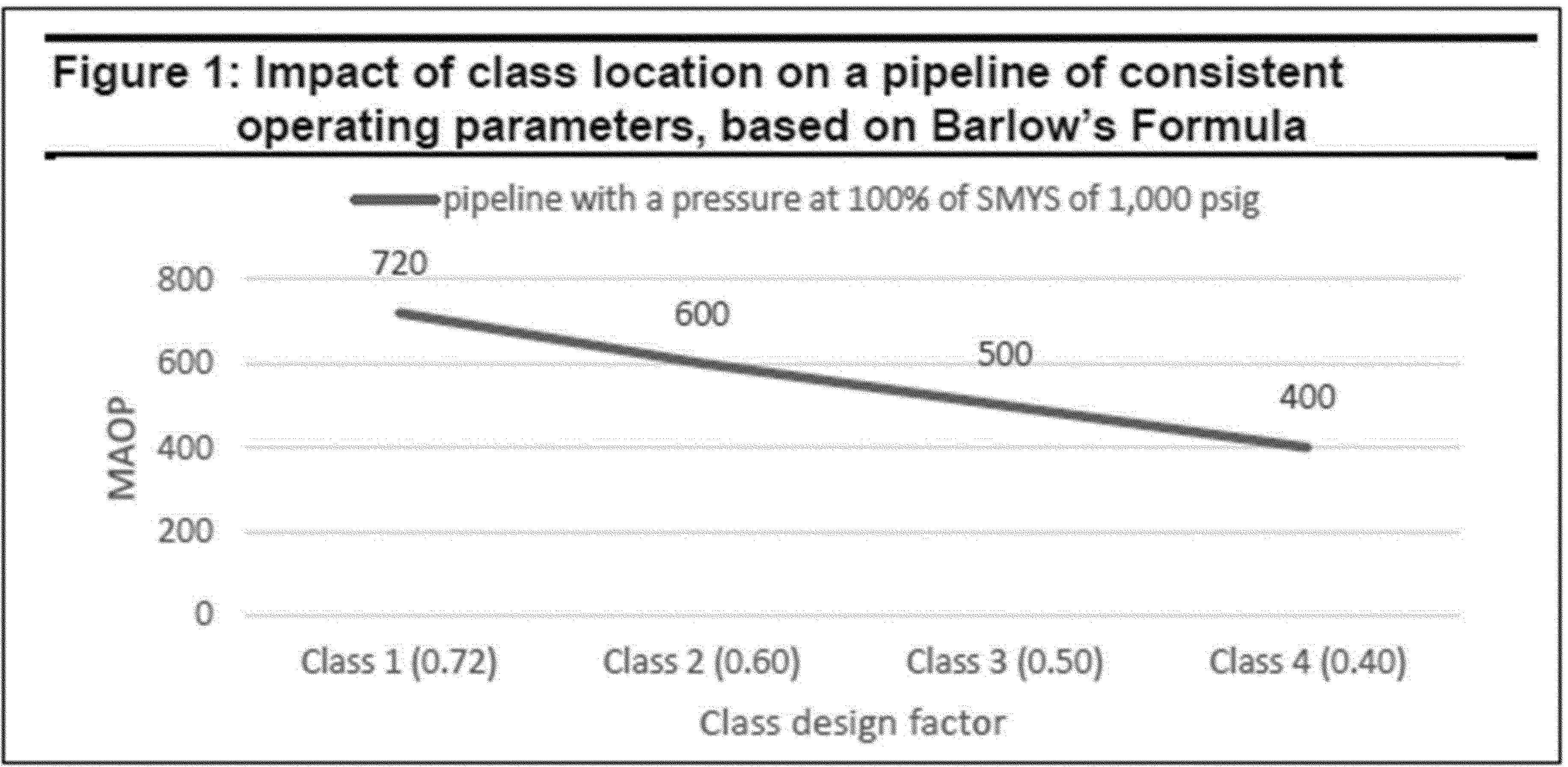
In practical terms, this means that pipe with additional strength or wall thickness must be installed to maintain the same design pressure in higher class locations. That is because, as Figure 1 shows, a higher class location will lead to a lower MAOP if the other variables used in the formula remain constant.
This phenomenon governs in applying Barlow's formula both at the time of installation and if the class location of a gas pipeline changes at a later point in time due to an increase in population density.[10]
Operators currently have three options for confirming or revising MAOP in response to class location changes. First, an operator may reduce the MAOP to reflect the design and test pressure factor applicable to the current class location. Second, an operator may confirm the MAOP through pressure testing, either based on the results of a previous test or by conducting a new test. Third, an operator may replace the pipeline with material of additional strength or wall thickness to maintain the current MAOP.
Each of these methods has drawbacks, particularly if a segment remains in satisfactory condition and can be safely operated at the current MAOP. Pipeline replacements cause construction-related impacts and can lead to service disruptions and natural gas emissions. Pressure testing requires a pipeline to be taken out of service—albeit for a shorter time—and results in similar service disruptions and natural gas emissions. MAOP reductions can affect all aspects of the supply chain, leading to service interruptions and higher costs for consumers.
These drawbacks can be avoided if operators are allowed to use modern risk management principles to confirm or restore the MAOP of class change segments. This final rule achieves that objective by adopting an IM alternative that operators can implement without resorting to unnecessary MAOP reductions, pressure testing, or pipeline replacements.
B. Origin of Class Location Requirements
In 1952, the American Society of Mechanical Engineers (ASME) released the American Standard Code for Gas Transmission and Distribution Piping Systems (B31.1.8-1952), the first industry safety standard specifically dedicated to gas transmission and distribution pipelines. In 1955, the second edition of that standard, B31.1.8-1955, introduced a new concept—using class locations to provide an additional margin of safety in the design, installation, and testing of
( printed page 1611)
gas transmission and distribution pipelines.[11]
B31.1.8-1955 directed operators to use two population density indices to classify the initial location of gas transmission and distribution lines at the time of construction.[12]
The first population density index, applicable to one-mile lengths of the pipeline, required operators to count the number of buildings intended for human occupancy within a half-mile-wide zone that ran along those lengths. The second population density index, applicable to 10-mile lengths of the pipeline, directed operators to add the one-mile lengths together into 10-mile sections and divide the sum by 10.
B31.1.8-1955 provided four class locations that could be assigned based on the results of the one-mile and 10-mile population density indices. The least populated areas, known as Class 1 locations, included “waste lands, deserts, rugged mountains, grazing land, and farm land” with a 10-mile population density index of 12 or less and a one-mile population density index of 20 or less. Class 2 locations included “areas where the degree of development [was] intermediate,” such as “[f]ringe areas around cities and towns, and farm or industrial areas,” with a 10-mile index of 12 or more and a one-mile index of 20 or more. Class 3 locations included “areas subdivided for residential or commercial purposes where, at the time of construction of the pipeline or piping system, 10 percent or more of the lots abutting on the street or right-of-way in which the pipe is to be located are built upon.” Class 4 locations included “areas where multistory buildings” with four or more floors aboveground were “prevalent, and where traffic [was] heavy or dense and where there may be numerous other utilities underground.” [13]
To account for the additional risk to public safety, B31.1.8-1955 directed operators to consider the class location at the time of construction in determining the design pressure of the pipeline. Operators had to use a prescribed formula in making design pressure determinations, and that formula accounted for the SMYS, nominal outside diameter, nominal wall thickness, construction type design factor, longitudinal joint factor, and temperature derating factor for the pipe.[14]
The construction type design factors used in the design pressure formula—0.72, 0.60, 0.50, and 0.40—were inversely proportional to the class location, which had the effect of lowering the MAOP of the pipeline as the population density increased. B31.1.8-1955 also directed operators to consider class location in testing the pipeline at the time of installation, generally requiring a progressively higher minimum test pressure to be achieved as the population density increased.[15]
ASME retained these provisions in subsequently published editions of that standard, which became known as B31.8.[16]
In 1968, ASME published an updated edition of the B31.8 that contained a new provision for addressing class location changes. The provision directed operators to conduct a study if an increase in the population density indicated that the class location of a pipeline had changed since the original installation. Depending on the results of that study, the provision directed operators to confirm or to revise the MAOP of the pipeline, either by relying on a prior pressure test, by reducing the MAOP, or by conducting a new pressure test. An operator could also maintain the current MAOP by replacing the pipe in the affected segment to provide the necessary design and test pressure.[17]
In 1970, PHMSA incorporated the class location concept in adopting the original version of the Federal Gas Pipeline Safety Regulations in part 192.[18]
But instead of requiring operators to use the one-mile and 10-mile population density indices as in B31.8, PHMSA required operators to count the number of buildings intended for human occupancy in a “class location unit,” defined as an area extending 220 yards on either side of the centerline of any continuous one-mile length of pipeline.[19]
In other words, PHMSA narrowed the width of the zone to be considered in making class location determinations and replaced the one-mile and 10-mile population density indices with a continuous, or sliding, mile approach.
PHMSA also used different criteria in defining the four class locations that could be assigned to each class location unit. PHMSA defined a Class 1 location as any class location unit that has “10 or less buildings intended for human occupancy,” and a Class 2 location as any class location unit that has “more than 10 but less than 46 buildings intended for human occupancy.” PHMSA defined a Class 3 location as any class location unit that has “46 or more buildings intended for human occupancy,” as well as an area where the pipeline lies within 100 yards of a “building that is occupied by 20 or more persons during normal use” or a “small, well-defined outside area that is occupied by 20 or more persons during normal use, such as a playground, recreation area, outdoor theater, or other place of public assembly.” PHMSA defined a Class 4 location as any class location unit “where buildings with four or more stories above ground are prevalent.” [20]
Like B31.8, PHMSA required operators to follow more stringent construction and initial testing practices as the class location increased. The design and test pressure factors used in determining the MAOP of a pipeline had the same inversely proportional relationship to the class location, resulting in a lower MAOP for segments in more populated areas. PHMSA also went beyond B31.8 in requiring operators to consider class location in determining O&M requirements that applied after a pipeline went into service. As a result, class locations played a much greater role in determining the standards applicable to a pipeline under part 192 than had been the case under the comparable provisions in B31.8.
Of particular significance here, PHMSA included requirements in the 1970 regulations for confirming or revising the MAOP of a segment that experienced a change in class location after installation. Operators had to perform a study “[w]henever an increase in population density indicates a change in class location for a segment of an existing steel pipeline operating at hoop stress that is more than 40 percent
( printed page 1612)
of SMYS, or indicates that the hoop stress corresponding to the established maximum allowable operating pressure for a segment of existing pipeline is not commensurate with the present class location.” [21]
After completing that study, operators had to take certain actions to confirm or to revise the MAOP of the segment to align with the new class location. Those actions included reducing the MAOP, relying on a previous pressure test, conducting a new pressure test, or replacing the pipe.[22]
In addition, to ensure that pipelines installed prior to the adoption of the part 192 regulations had an MAOP commensurate with the current location, PHMSA required operators to complete an initial study and, if necessary, to take action to confirm or to revise the MAOP of existing segments by certain deadlines.[23]
The framework established in the original part 192 regulations for addressing class location changes has remained largely unchanged.[24]
C. Integrity Management Program Requirements
In 2003, PHMSA issued a final rule establishing new IM program requirements for gas transmission lines (2003 Gas IM Rule). The 2003 Gas IM Rule required operators to apply modern risk management principles to ensure the integrity of pipeline segments located in high consequence areas (HCAs),
i.e.,
areas where an incident could cause more harm to people and property, such as Class 3 and Class 4 locations, areas containing facilities that house individuals who are confined, mobility impaired, or hard to evacuate, or places where people gather for recreational or other purposes.[25]
The ability to use inline inspection (ILI) tools to conduct integrity assessments of covered segments was a core feature of the 2003 Gas IM Rule.
By way of background, the use of ILI tools as an internal inspection technology for pipelines dates to the 1960s.[26]
Early generation ILI tools could only detect metal loss anomalies in the bottom quarter of a pipeline, and limitations in battery power capacity meant that inspections could extend for no more than 30 miles.[27]
However, as the technology advanced, ILI tools became capable of detecting more anomalies and inspecting greater lengths of pipeline. Modern ILI technology allows multiple types of tools to be attached together, permitting detection of different threats at once. Modern ILI tools are also equipped with improved sensor technology, enabling detection of a wider range of defects with greater accuracy. These advances have increased both the probability of detection and probability of identification of pipeline anomalies—commercially available ILI tools today can detect pipe body crack sizing with 90 percent certainty to 1 millimeter via an Electromagnetic Acoustic Transducer (EMAT) tool, and corrosion depth sizing with 80 percent certainty to 0.1 times the wall thickness via axial Magnetic Flux Leakage (MFL-A) tools.[28]
Dramatic improvements in ILI technology have occurred in the 20 years since the adoption of the 2003 Gas IM Rule, facilitated, in part, by PHMSA's other technology notification process that allows operators to deploy more modern tools for conducting integrity assessments.[29]
Tool manufacturers and operators have incorporated the experience gained by deploying ILI—which operators have expanded to a greater number of pipelines—to advance their ability to detect and model increasingly complex defect types.[30]
Innovation in data processing and machine learning algorithms have enabled real-time analysis and improved interpretation of complex signals and deformation shapes, expediting decision-making.[31]
Models can now overlay multiple data inputs involving different threats to provide a clearer understanding of the pipeline and greater knowledge about each possible anomaly. Compared with historical assessment practices like hydrostatic testing and direct assessment, modern ILI tools discover and identify more anomalies, offering greater proactive remediation.[32]
PHMSA has updated the IM regulations in Subpart O to capitalize on the recent advances in ILI technology. In 2022, PHMSA completed a multi-year process of strengthening its IM regulations to address congressional mandates and National Transportation Safety Board (NTSB) recommendations issued in response to a significant gas transmission line incident that occurred in San Bruno, California, in 2011.[33]
The
( printed page 1613)
enhancements to the IM regulations included new assessment procedures for ILI tools and updated requirements for the detection and remediation of anomalies. PHMSA's 2019 and 2022 Safety of Gas Transmission Rules also established a companion assessment and response schedule for other Class 3 and 4 pipelines.[34]
These changes have created a comprehensive, risk-based scheme for pipeline anomaly detection and remediation, driven in large part by continuing improvements in ILI technology.
D. Class Location Special Permits
PHMSA's experience administering a comprehensive class location special permit program demonstrates that IM principles can be used safely to confirm or to restore the MAOP of pipeline segments in Class 3 locations. When issuing the original IM program requirements for gas transmission lines in 2003, PHMSA acknowledged that “[e]xperience may lead to future changes in the [regulatory] requirements,” and that the waiver, or “special permit,” process authorized by 49 U.S.C. 60118 and codified in 49 CFR 190.341 could be used to review segments changing class location for suitability to leverage IM principles in place of pipe replacement.[35]
Specifically, PHMSA stated that:
[a] benefit to be realized from implementing this rule is reduced cost to the pipeline industry for assuring safety in areas along pipelines with relatively more population. The improved knowledge of pipeline integrity that will result from implementing this rule will provide a technical basis for providing relief to operators from current requirements to reduce operating stresses in pipelines when population near them increases. Regulations currently require that pipelines with higher local population density operate at lower pressures. This is intended to provide an extra safety margin in those areas. Operators typically replace pipeline when population increases, because reducing pressure to reduce stresses reduces the ability of the pipeline to carry gas. Areas with population growth typically require more, not less, gas. Replacing pipeline, however, is very costly. Providing safety assurance in another manner, such as by implementing this [integrity management] rule, could allow [the Agency] to waive some pipe replacement. [The Agency] estimates that such waivers could result in a reduction in costs to industry of $1 billion over the next 20 years, with no reduction in public safety.[36]
While special permits are considered on a case-by-case basis, PHMSA developed certain threshold requirements for segments to be considered as candidates for a special permit.[37]
As explained in the 2004 notice articulating those threshold requirements, PHMSA would only consider pipeline segments that operate below 72 percent of SMYS for a Class 3 location; underwent an eight-hour hydrostatic test to at least 1.25 times the MAOP; and did not have bare pipe, wrinkle bends, or significant anomalies. Older pipe and specific seam types would require further justification. PHMSA also explained that operators would be required to apply their IM program and assess the segment using ILI techniques for a distance upstream and downstream.
PHMSA has issued 46 class location special permits since 2004. Thirty-six are active. Each special permit application undergoes individual review by PHMSA, is subject to public notice and comment, includes operational conditions if issued, and must be renewed after 10 years. There has never been a leak or rupture reported on a segment managed by a class location special permit. PHMSA has denied approximately half of the requests submitted, generally for having unsuitable pipe characteristics based on design and operating parameters. Having spent the past twenty years reviewing data, detail, and pipe characteristics in administering the class location special permit program, PHMSA is confident that IM principles can be used to confirm or restore the MAOP of Class 1 to Class 3 and Class 2 to Class 3 change segments.[38]
III. Summary of the NPRM
On July 31, 2018, PHMSA published an advance notice of proposed rulemaking (ANPRM) seeking public comment on whether to amend the requirements in part 192 for addressing class location changes.[39]
PHMSA received 24 comments from a variety of stakeholders in response to the ANPRM, including operators such as Kinder Morgan, Inc. and the Williams Companies (Williams), the Pipeline Safety Trust (PST), the National Association of Pipeline Safety Representatives (NAPSR), the GPA Midstream Association, individual engineers and citizens, and a joint comment by the American Gas Association, American Petroleum Institute, American Public Gas Association, and Interstate Natural Gas Association of America. Many of the commenters reiterated concerns that had been raised in earlier proceedings, particularly from the industry perspective.[40]
PHMSA also received a similar submission from 4,831 commenters recommending that current class location change requirements “remain in place pending further review through proposed rulemaking protocols” and to consider recommendations of the NTSB in light of prominent gas pipeline safety incidents.[41]
After considering these comments, PHMSA issued a notice of proposed rulemaking (NPRM) on October 14, 2020.[42]
The NPRM proposed to add an IM alternative for confirming the MAOP of certain class change segments. The NPRM reflected the extensive back and forth on the topic that had occurred between PHMSA, Congress, the public, and the regulated community over the previous years.[43]
( printed page 1614)
PHMSA proposed a set of operating parameters and eligibility criteria in the NPRM for using an IM alternative. The segment would have to be changing from a Class 1 to a Class 3 location, be operating below a hoop stress corresponding to 72 percent SMYS, and be capable of assessment using ILI tools. Pipe with certain additional characteristics would be ineligible: bare pipe; pipe with wrinkle bends; pipe lacking traceable, verifiable, and complete material records; pipe without traceable, verifiable, and complete records of a pressure test to 1.25 times MAOP for at least eight hours; where the longitudinal seam had been formed by certain more vulnerable methods; poor external coating; pipe transporting gas not suitable for sale; pipelines with grandfathered MAOPs under § 192.619(c) or an alternative MAOP under § 192.619(d); or where the segment previously had a special permit denied. Many kinds of cracking found in or within five miles of the segment, or past experience of a leak or rupture due to cracking, would make a pipeline ineligible; cracking that may develop could subsequently remove a segment from eligibility. The NPRM proposed to also exclude pipe moving into Class 4 locations which are the areas of highest population density.
PHMSA further proposed that pipe coming into the program would need to follow the IM program in Subpart O and be assessed within 24 months of the change in class location by ILI tools validated to Level 3 under API Standard 1163.[44]
Along with a reassessment interval of at least every seven years, the NPRM included a detailed anomaly response schedule for repairs needed based on the results of these assessments. The proposal included several other preventive and mitigative measures as well, such as requirements to perform close interval surveys, install a cathodic protection test station, install line markers, perform interference surveys, have adequate depth of cover, perform patrols and leak surveys at more frequent intervals, and clear shorted casings. Operators would also have to notify PHMSA of a new segment using this method, install remote-control or automatic shutoff valves, and examine pipe when otherwise excavated or uncovered.
A 60-day public comment period followed publication of the NPRM. PHMSA received 14 initial comments from a variety of stakeholders, including pipeline industry trade associations, members of NAPSR, the NTSB, public advocacy groups such as the PST and Accufacts Inc. (Accufacts), and operators including TC Energy Corporation (TC Energy). The pipeline trade associations submitted a joint comment from the American Gas Association, American Petroleum Institute, American Public Gas Association, GPA Midstream Association, Interstate Natural Gas Association of America, and NACE International Institute (collectively, the “Associations”). Several other operators, including NiSource, Southwest Gas, and Paiute Pipeline Company, submitted comments supporting the Associations' comment. Commenters across the spectrum supported expanding a strong IM option to manage class location changes. Industry representatives noted the efficiencies it would provide without a drop in safety, while public advocates appreciated how the proposal balanced eligible pipe, the IM requirements, and other supplemental program requirements.
PHMSA held a public meeting of the Gas Pipeline Advisory Committee (GPAC) on March 27 to 29, 2024, to review the NPRM and supporting analyses.[45]
The meeting afforded time for additional public comments and discussion by members of the committee. Pursuant to 49 U.S.C. 60115, the GPAC assessed the technical feasibility, reasonableness, cost-effectiveness, and practicability of the standard proposed in the NPRM. The transcripts and the vote slides constitute the GPAC report for this rulemaking under 49 U.S.C. 60115; PHMSA acknowledged receipt of this report and responded.[46]
PHMSA provided an additional 150-day period for written public comment following the GPAC meeting.[47]
PHMSA received 10 additional comments during that period from the Associations, the PST, individual operators including Enbridge and Williams, several members of the general public, as well as two then-members of the Committee, Andy Drake and Chad Zamarin, acting in their individual capacity.
PHMSA considered all comments submitted in response to the NPRM in developing this final rule, including the initial written comments, the oral comments provided at the GPAC meeting, and the written comments filed after the GPAC meeting. Public comments to the NPRM are available on the docket for this rulemaking, PHMSA-2017-0151, while comments in response to the GPAC are available on the docket PHMSA-2024-0005. Both are accessible through
regulations.gov.
IV. Discussion of the Final Rule and Analysis of Comments
The following subsections summarize the proposals in the NPRM, the relevant issues raised by the commenters, and the discussions and recommendations of the GPAC. Subsections conclude by providing PHMSA's responses as developed in preparing and issuing the final rule.
A. General
1. Summary of Proposal
The NPRM proposed to allow operators to use an IM alternative to confirm the MAOP of certain segments that experience class location changes. Modeled on PHMSA's class location special permit program, the proposed IM alternative included a list of eligibility criteria and required compliance with an ongoing program of IM and supplemental O&M requirements.
2. Comments Received
The Associations supported the IM alternative, stating that the objective of class locations to ensure an appropriate safety margin when population growth occurs around an existing pipeline “can now be accomplished using modern integrity management programs, which are a more effective, efficient, environmentally sound and less disruptive means of managing pipeline safety.” [48]
The Associations suggested that the IM alternative in general will improve safety, is more cost effective, will reduce emissions, and reduce community impacts. Mr. Drake commented that the historical approach for addressing class changes is outdated and inefficient, observing that the
( printed page 1615)
approach fails to account for the diameter, strength, and operating pressure of a pipeline, and for recent advancements in threat detection and assessment technology.[49]
Williams, which operates approximately one third of the Nation's natural gas transmission and gathering infrastructure, commended the regulatory flexibility provided by the IM alternative, noting that technological and methodological improvements allow operators to “assess risk with a level of detail and certainty that was not available 10 years ago.” [50]
The proposed rule, Williams commented, would allow operators to benefit from these advancements in technology and improvements to IM in Subpart O through the 2022 Safety of Gas Transmission Rule and increase pipeline safety nationwide. Several private citizens similarly supported the proposal, noting that the IM alternative “offers solutions and incentives to improve” pipeline systems and provides benefits to consumers, as reductions in MAOP from population increases near pipelines would likely result in less reliable gas distribution.[51]
Members of NAPSR, an organization comprised of PHMSA's State pipeline safety partners, were divided on the proposal. Several members expressed support for the NPRM if each of the proposed requirements were accepted, noting that “it appears that adequate safeguards are in place to ensure safety is not compromised.” [52]
On the other hand, several NAPSR members were concerned about relaxing class-based design requirements and using IM to manage class location changes based on their experience observing operators “poor management and decision making in implementing [IM] requirements,” pointing to the 2010 Marshall, Michigan incident.[53]
Some of these NAPSR members feared that PHMSA would be sacrificing pipeline safety by adopting the proposed rule, stating that the issues of managing and implementing the IM alternative would be less reliable and effective than the design measures that would be replaced. Accufacts noted that though it had anticipated the implementation of IM would reduce the number of pipeline ruptures, several ruptures on pipelines operating at pressure below MAOP well before the times predicted by operators engineering assessments under IM had undercut that assumption. Accufacts stated that the number of ruptures occurring shortly after ILI tool runs is creating a “credibility gap” with the public that will only be compounded if ILI effectiveness continues to be “oversold and misrepresented as to its capability.” [54]
But, Accufacts found that the proposal addressed these concerns by an articulated response schedule for eligible segments.[55]
While the PST was “not convinced of the necessity of this rule, given the existing options for operators to manage their class location changes,” it appreciated the seriousness of PHMSA's proposal. The PST agreed that PHMSA's limitation on eligibility, plus O&M requirements added to the IM requirements, increased the likelihood that the rule will not decrease safety. However, the PST preferred the status quo of class location design requirements, plus special permits on a case-by-case basis, as a “safety backstop. . .to reduce the risk of a failure resulting from shortcomings in an IM plan.” [56]
NAPSR members agreed that, as proposed, the requirements for managing a class change without an improvement in design standards should exceed the IM requirements.[57]
The PST agreed that PHMSA's limitation on eligibility, plus O&M requirements added to the IM requirements, demonstrated a careful proposal to “maintain[] an equivalent level of safety” that is provided by the historical management options.[58]
Accufacts supported the proposal as written with the additional prescriptive requirements beyond the then-current IM regulations, noting that the additional requirements would help offset the limitations of ILI assessment methods. Accufacts noted how pipeline failures observed after operators perform ILI tool runs justified excluding certain pipe from eligibility and “the need to include a combination of additional prescriptive requirements to address shortcomings in many company applications of their IM approaches defined in Subpart O,” as did the proposal.[59]
In addition, Mr. Drake argued that PHMSA's final rule should incorporate the “standard of care based on the latest technology for inspection, assessment, and repair criteria” established under the 2019 and 2022 Safety of Gas Transmission Rules.[60]
An anonymous commenter viewed the GPAC recommendations for the rule (which are discussed in the ensuing sections) as “major changes” and suggested PHMSA “re-review the safety and integrity of changes proposed in the GPAC Voting Slides . . . and then re-notice the rule for public comment.” [61]
Another anonymous commenter suggested that an environmental, cost-benefit, and safety analysis on the overall effect of the GPAC recommendations to the public in the area around pipelines should be developed and publicly noticed.[62]
Many commenters lauded PHMSA's class location special permit program and noted the similarities between that program and the proposed rule. Highlighting how PHMSA stated in the 2003 Gas IM Rule that experience and data from special permits using IM may lead to future regulatory changes in the class change requirements, the Associations offered that decades of experience demonstrate the effectiveness of IM for managing class location changes.[63]
Mr. Drake noted the “excellent performance record” of pipelines in the special permit program—improving pipeline safety and reducing environmental impacts—demonstrating “the feasibility and effectiveness of IM as an alternative to class location change pipe replacements or pressure reductions.” [64]
The NTSB expressed concern with drawing conclusions from the operating history of special permit segments, based on the small sample size and small percentage of Class 3 gas transmission mileage. The NTSB noted how special permits are “rigorous by design” and encouraged PHMSA to “consider how [to] provide the same level of scrutiny and attention to detail on the larger scale of locations impacted by this regulation.” [65]
The PST expressed appreciation for the “hard look” PHMSA engages in when considering each special permit, noting that it allows PHMSA to impose prescriptive measures specific to an operator's past performance and the type of pipe and environment in which
( printed page 1616)
the pipe is located. In addition, the PST stated that the data and documents required for special permit applications, including National Environmental Policy Act compliance, benefit the public by providing notice of the application, the location of the waivers, material characteristics about the pipeline, and ensures PHMSA has the opportunity to review the details of each application before acting on it.[66]
While commending the record of special permits to date, the Associations raised several complications posed by the existing special permit process, including: the length of the review process, changing compliance conditions, an uncertain renewal process, and burdensome administrative work—all of which reduce operator participation. Codifying the IM alternative, the Associations argued, would provide more clarity, consistency, and alignment with other previously existing regulations.[67]
Commenters also noted the significant benefits of authorizing the IM alternative. Williams argued that the proposal would provide an additional benefit of lowering emissions by “avoiding [blowdowns and] the unnecessary replacement of perfectly good pipe.” [68]
The Associations likewise observed that “the environmental benefits of applying integrity management requirements instead of replacing. . .pipe are as compelling as the safety benefits,” estimating that class change pipe replacements under the former regulatory regime resulted in up to “800 million standard cubic feet of natural gas blowdown to the atmosphere each year,” which “could meet the [natural gas] needs of over 10,000 homes for a year.” [69]
The Associations estimated that “gas transmission pipeline operators spend $200-$300 million annually to replace pipe solely to satisfy the [historical] class location change regulations.” Instead of being allocated to replacing less than 75 miles of pipe per year, the Associations argued that this capital investment could be reallocated to “assess over 25,000 miles [of pipe] with in-line inspection, install [ILI tool] launchers and receivers to enable over 5,000 miles of pipeline to be assessed with in-line inspection tools for the first time, or conduct over 4,000 anomaly evaluation digs.” [70]
Focusing these resources on segments changing class and expanding the 2019 and 2022 revisions to Subpart O IM regulations to greater pipeline mileage, Williams suggested, will increase safety in these class change segments, improve the IM program, and “reduc[e] risk across natural gas pipelines [throughout] the United States.” [71]
3. PHMSA Response
PHMSA appreciates the strong public engagement that occurred throughout the rulemaking process. The NTSB, public advocates, and industry groups each commended the success of the class location special permit program, which provides two decades of data and real-world experience implementing the IM alternative. That data and experience, when combined with the significant improvements to the IM program that have occurred in recent years, strongly support adopting the requirements in this final rule.
PHMSA and operators have gained valuable experience applying the IM alternative through the class location special permit program. That program has led to the development of eligibility criteria and special permit conditions that have a proven track record of ensuring the safety and reliability of gas transmission lines. Rather than continuing to require the use of the special permit process to provide relief from outdated and unduly burdensome requirements, the final rule adopts the relevant eligibility criteria and conditions by regulation. This allows operators and PHMSA to direct their limited resources toward performing other critical safety functions.
As discussed in more detail in the ensuing subsections, the IM alternative that PHMSA is adopting in this final rule sets forth a standardized set of requirements to safely manage class location changes without requiring unnecessary MAOP reductions, pipe replacements, or pressure tests. The key features of the IM alternative include:
First, the final rule defines under eligibility those pipeline characteristics that can safely be managed by the program.
Second, to use the program, an eligible class change segment must be designated as an HCA and incorporated into an operator's IM program in Subpart O. The final rule also includes IM requirements for the baseline assessment, periodic reassessment, assessment methods, and remediation schedule specific to class change segments and their surrounding inspection area.
Third, the final rule includes supplemental O&M measures based on historical special permit conditions.
Fourth, the final rule requires maintaining an operating pressure no greater than the design factor corresponding to the original class location and retention of pipeline records. Any segment which experiences an in-service leak from the pipe itself cannot use the IM alternative.
Compliance with these requirements provides a margin of safety that meets or exceeds the historical approach for confirming the MAOP of segments that experience class location changes.
As multiple commenters favorably noted, the IM alternative proposed in the NPRM and adopted in this final rule retains the core elements of the successful class location special permit program. PHMSA agrees with commenters that each of these core elements is necessary to provide for the safety of the eligible Class 3 segments. PHMSA is incorporating the IM alternative directly into § 192.611 as a new paragraph (a)(4) instead of in an entirely new § 192.618 as proposed in the NPRM. For clarity, the program requirements are bifurcated into “one-time” programmatic requirements under § 192.611(a)(4)(i), which must be in place within a 24-month window, and “ongoing” programmatic requirements listed at § 192.611(a)(4)(ii) that must be carried out periodically. The requirements standardized in this final rule, based on years of success through the special permit program, no longer require the individual review of a special permit excepting regulatory requirements.
While several commenters expressed concerns with deficiencies or gaps identified in past incident investigations involving covered segments subject to Subpart O, PHMSA has taken significant actions to address those concerns in other recent rulemaking proceedings. As discussed in section II.C, PHMSA updated the Subpart O requirements in the 2022 Safety of Gas Transmission Rule in response to incidents that occurred after the original adoption of the IM program. PHMSA is confident in the strengthened IM framework that exists today, as were many participants at the GPAC and commenters following the meeting who encouraged PHMSA to incorporate those requirements into this rule.
Many of the requirements of the 2022 Safety of Gas Transmission Rule, such as the remediation criteria, were proposed in this NPRM and have historically been included in class location special permits. Those parts of the NPRM that have since been codified
( printed page 1617)
into Subpart O no longer need duplication in this final rule and are included in the IM alternative by cross-reference to Subpart O, as was recommended by commenters and during the GPAC meeting. This streamlines and clarifies the IM alternative without substantive change. By incorporating the amendments from the 2022 Safety of Gas Transmission Rule into the IM alternative, PHMSA is responding to the concerns expressed by some commenters about incidents that occurred in the early stages of the IM program. PHMSA is also aligning the IM alternative with the conditions developed during the class location special program, as recommended by the commenters.
PHMSA reiterates its appreciation for the input received throughout the rulemaking process, particularly the comments submitted in response to the ANRPM, the NPRM, and the GPAC's report. These comments have allowed PHMSA to develop a final rule that embodies the views of multiple stakeholders and is supported by a well-developed administrative record.
B. Definitions
1. Summary of Proposal
The NPRM proposed to add definitions for three new terms in § 192.3. First, the NPRM proposed to define the precise segment changing class as the “Class 1 to Class 3 location segment.” Second, the NPRM proposed to define the span of the pipeline from the nearest upstream ILI launcher and downstream ILI receiver containing the class change segment as the “in-line inspection segment.” That definition was proposed to align with the phrase “special permit inspection area” as used in the class location special permit program. Third, the NPRM proposed to define the term “predicted failure pressure” as used in the Federal Pipeline Safety Regulations for many years.
2. Comments Received
Several commenters found using the term “Class 1 to Class 3 segment” to be confusing and restrictive, and sought a simpler definitional term. Further substantive comments regarding this term are expanded on in section IV.C.ii. Editorially, the Gas Piping Technology Committee (GPTC) stated that the inclusion of the word “and” between the numbered list within the “Class 1 to Class 3 location segment” could imply that if an operator does not confirm or revise a pipeline segment's MAOP in accordance with § 192.611(a)(4), the operator does not come into the IM alternative program and therefore cannot be eligible.[72]
Oleksa and Associates suggested that the proposed changes to § 192.903 were “circular and confusing,” and that they seemed to imply that “an operator might not designate a Class 1 to Class 3 location segment as [an HCA] and that there might be some Class 1 to Class 3 location segments that are not [HCAs.]” [73]
They requested PHMSA clarify and provided editorial suggestions for doing so.
Regarding the proposed definition of “in-line inspection segment,” multiple commenters, including NAPSR, Sander Resources, and GPTC, recommended focusing on the IM alternative program only, since many operators already use that term to refer to any section of a pipeline between ILI launchers and receivers. In addition, commenters were concerned that the term could be misapplied or cause confusion because applicable segments may or may not contain segments using the IM alternative option.[74]
Further, Sander Resources stated that PHMSA used the word “adjacent” within the proposed definition of “in-line inspection segment” without guidance to what that word means. It noted that the historical 25-mile distance PHMSA references in the NPRM is “significant and appears to be arbitrary without further direction” and requested PHMSA clarify that operators need not assume “large segments of pipe are subject to the review and [MAOP reestablishment] process” but can instead establish and justify their own area of review as appropriate.[75]
Regarding the proposed definition of “predicted failure pressure,” NAPSR and GPTC recommended that PHMSA consider adding the phrase “as determined by the procedures in ASME/ANSI B31G or PRCI PR-3-805 (as incorporated by reference in § 192.7).” Each suggested that this addition would be consistent with similar language used in §§ 192.485 and 192.933(a) and would “provide the same limitations as currently found in [the] code.” [76]
NAPSR members also recommended changing the term “appropriate engineering evaluation” to “acceptable engineering evaluation,” which, they argued, might provide “a stronger basis from which to argue potentially subjective engineering evaluations.” [77]
The Associations suggested a minor change to the proposed definition clarifying that the safety factor is “added,” rather than “included.” [78]
Oleksa and Associates requested PHMSA clarify the definition to indicate that it “applies only to failure by rupture” by modifying it such “that it would not apply to low-pressure, low-stress steel transmission lines” and limit its application “to steel pipelines operating at pressures above 20 percent SMYS.” [79]
3. PHMSA Response
PHMSA has made clarifying edits to the definitions as suggested by commenters to simplify application of the IM alternative. This final rule does not finalize a definition of “predicted failure pressure” as proposed in the NPRM. PHMSA adopted new anomaly assessment and remediation criteria that use the predicted failure pressure concept in a final rule issued after publication of the NPRM and is not modifying those requirements in this proceeding. PHMSA concludes that the new anomaly assessment and remediation criteria render the proposed definition of predicted failure pressure definition unnecessary, and that the term has been consistently used in the regulations for many years without need for additional clarity.
This final rule adopts the term “eligible Class 3 segment” to define the specific segments changing class using this IM alternative option. This replaces the proposed term “Class 1 to Class 3 location segment,” which numerous commenters noted was unnecessary lengthy and confusing, and resolves other editorial comments by GPTC and Oleksa and Associates. This final rule explicitly includes the eligible Class 3 segment in the definition of an HCA at § 192.903. PHMSA has also included several eligibility factors into this definition as discussed in section IV.C.
This final rule adopts the term “eligible Class 3 inspection area” to define the eligible Class 3 segment and the portion of pipeline extending to the nearest upstream ILI launcher and downstream ILI receiver. This term includes the eligible Class 3 segment and the surrounding ILI inspection area. While conceptually equivalent to what PHMSA proposed as an “in-line inspection area” and the “special permit inspection area” in class location
( printed page 1618)
change special permits, this language avoids conflict with the oft used term “in-line inspection,” as commenters requested. Clearly defining the term also addresses concerns raised by Sander Resources regarding potential confusion with how pipelines outside of the class change area were handled in historical special permits. While the eligible Class 3 inspection area is not itself defined as an HCA under § 192.903, it is subject to certain IM requirements as specified in § 192.611(a)(4). These requirements are described in greater detail in section IV.D of this final rule.
The definitions of “eligible Class 3 segment” and “eligible Class 3 inspection area” are specifically limited to gas transmission lines. Section 192.611(a)(4)(vii) further clarifies that the IM alternative is not authorized for gas gathering or gas distribution lines. While the class location change requirements in § 192.611 apply broadly to all gas pipelines, PHMSA indicated in the NPRM and preliminary RIA that the proposed IM alternative would only apply to gas transmission lines. Having failed to address the applicability of that proposal to gas gathering or distribution lines in either document, PHMSA concludes that the IM alternative should be limited to gas transmission lines in the final rule.[80]
C. Eligibility Criteria
i. General
1. Summary of Proposal
The NPRM set out proposed eligibility criteria for use of the IM alternative. PHMSA developed these eligibility criteria from its experience applying the 2004 Special Permit Criteria, published following the initial 2003 Gas IM Rule. In the 2004 criteria and guidance, PHMSA established pipe criteria and conditions that would lead to “probable acceptance” of a special permit to manage a class location change consistent with pipeline safety.[81]
Each of the criteria are discussed in further detail in individual sections below.
2. Initial Comments
The NTSB supported the proposed eligibility criteria, observing how “[t]he majority of the restrictions . . . concur[red] with the NTSB's historical knowledge of higher risk pipelines.” [82]
The PST found the eligibility exclusions appropriate and “absolutely necessary to ensure that [the IM alternative does] not jeopardize pipeline safety in these newly-populous areas.” [83]
The PST was pleased the NPRM did not leave identification of eligible segments up to the operator. Accufacts similarly supported the eligibility criteria as technically sound and noted how the attributes reflect the strengths and weaknesses (or limitations) of various assessment approaches used in Subpart O and what pipe could suitably be assessed and managed by ILI.[84]
Operators, like TC Energy, also agreed with the majority of the eligibility criteria.[85]
Sander Resources requested clarification that an operator with a pipe segment that does not meet the eligibility requirements may still use the special permit process governing class location changes.[86]
Relatedly, the NTSB urged PHMSA to consider how to ensure operators will comply with the criteria without the extensive, individualized special permit process.[87]
3. GPAC Consideration
The GPAC discussed the NPRM's eligibility criteria during the public meeting on March 28 and March 29, 2024, with most members supporting the criteria establishing the types of pipe segments deemed suitable for the program, as discussed below in individual subsections.
4. Post-GPAC Comments
During the public comment period following the GPAC meeting, an anonymous commenter recommended PHMSA make no changes to the proposed eligibility criteria in consideration of the GPAC recommendations, stating they were not publicly noticed for comments and reviewed by the public for their impact on pipeline integrity, public safety, and environmental consequences.[88]
5. PHMSA Response
PHMSA is including eligibility criteria in the final rule to ensure that the IM alternative is only used to confirm or restore the MAOP of pipe or segments with appropriate characteristics. PHMSA has determined that segments with certain characteristics present an unacceptable risk to public safety and should not be eligible. That determination is supported by PHMSA's technical expertise and two decades of experience administering the class location special permit program. Operators of pipeline segments that do not meet the eligibility criteria may continue to seek special permits to manage class location changes. PHMSA may also consider modifying some of the eligibility criteria in subsequent rulemaking proceedings as additional information becomes available.
To eliminate unnecessary text and ensure consistency in the application of the IM alternative, the eligibility criteria are incorporated into the definition of an eligible Class 3 segment in § 192.3. Moreover, to more accurately account for their role as compliance obligations, several of the eligibility requirements proposed in the NPRM have been incorporated into the initial or ongoing programmatic requirements in the IM alternative. This better reflects that, for example, an operator can perform a pressure test on an eligible Class 3 segment to use the IM alternative, so that requirement is not
per se
a pipeline characteristic that dictates eligibility. The gas quality assurance is also an ongoing compliance requirement, not a criterion that needs to be satisfied beforehand to use the IM alternative. With those retained as compliance obligations, the eligibility criteria in § 192.3 are limited to immutable pipeline characteristics which define a segment as eligible to use the program.
Considering recommendations from the GPAC, public comments, and additional study by the Agency, PHMSA makes certain adjustments to the eligibility criteria in this final rule, as discussed throughout section IV.C below.
ii. Original Class
1. Summary of Proposal
The NPRM proposed an IM alternative to manage changes to Class
( printed page 1619)
3 locations and specifically excluded pipe moving to a Class 4 location. The NPRM referred to the segment applying the IM alternative as the “Class 1 to Class 3 location segment” and proposed defining that term in § 192.3. PHMSA's class location special permit criteria categorizes as “probable acceptance” Class 2 to 3 changes, and Class 1 to Class 3 changes as “possible acceptance.” [89]
2. Initial Comments
Many commenters questioned whether PHMSA intended to limit the IM alternative to Class 1 to Class 3 changes. TC Energy noted that the NPRM seemed to include all Class 1 design pipe, even if that pipe may first have changed to a Class 2 location before later changing into a Class 3 location.[90]
Several commenters, including TC Energy and Sander Resources, recommended a different term than “Class 1 to Class 3 location segment” to avoid uncertainty over whether this method could include Class 2 to Class 3 changes.[91]
The Associations suggested changing the term to “Class 3 location change segment.”
The Associations recommended that the IM alternative be available for Class 2 to Class 3 changes as well, explaining that “segments with a [C]lass 1 design factor that experienced a change to [C]lass 2 in prior years and then to [C]lass 3 . . . are no different than segments that jump” directly from Class 1 to Class 3. The Associations also observed that Class 2 pipe is required under § 192.619(a)(2) to be pressure tested to 1.25 times MAOP at the time of installation; while noting that “many operators `over test' [C]lass 2 segments today” to the Class 3 test pressure “to allow for the one-class bump provided under § 192.611,” the Associations stated that “this has not always been common practice” and there may be Class 2 segments with a 1.25 times MAOP pressure test that should be eligible for the IM alternative. Extending the IM alternative to Class 2 to Class 3 changes could avoid the higher 1.5 times MAOP pressure test required by § 192.611(a)(1) or (3) for a Class 2 design pipe “to continue operating at its original MAOP” after a change to a Class 3.[92]
3. GPAC Consideration
The GPAC voted 13-0 [93]
in favor of allowing operators to apply the IM alternative to Class 2 design pipe with a 1.25 times MAOP pressure. The GPAC also included the 1.25 times MAOP pressure test in its recommendations on grandfathered pipe and MAOP restoration.
4. Post-GPAC Comments
The Associations expressed support for the GPAC recommendation, observing that a 1.25 times MAOP pressure test provides an “acceptable safety factor to mitigate manufacturing and construction risks” for pipeline segments that experience Class 2 to Class 3 changes.[94]
The PST also agreed with the GPAC recommendation to expand eligibility to Class 2 design pipe, so long as the other eligibility criteria are met.[95]
5. PHMSA Response
PHMSA agrees that the IM alternative should be available for Class 2 to 3 changes. PHMSA's 2004 Special Permit Criteria provided Class 2 to 3 changes merited “probable acceptance,” even more likely to warrant a special permit than the Class 1 to 3 changes that were marked for “possible acceptance.” After beginning primarily with one class changes, PHMSA's successful history with operators managing class location changes from Class 2 to 3 under special permits issued since 2004 led to more regular issuance of special permits for Class 1 to 3 changes. As a result, special permits have been granted in about equal part between segments moving from Class 1 locations into Class 3 and those moving from Class 2 locations into Class 3. PHMSA finds it consistent with pipeline safety to extend the applicability of this final rule to segments that have changed from Class 2 to Class 3. As several commenters note, this also makes clear that pipelines of Class 1 original design that were in a Class 2 location until subsequently changing to Class 3 can use the IM alternative all the same as if they transitioned directly from Class 1 to 3.
Ultimately, PHMSA does not expect a significant number of Class 2 to 3 changes to apply the IM alternative. Operators of these segments are likely to use the “one-class bump” afforded by a pressure test in accordance with § 192.611(a)(1) or (3). A pipeline is generally designed to tolerate the test pressure required for the next highest class location, enabling Class 2 design pipe to conduct the “one-class bump” pressure test to Class 3 design standards and complete the obligations to manage the class change. Managing a class change by pressure test lacks the additional program management requirements of the IM alternative. Because Class 1 design pipe often cannot tolerate a test pressure to two classes higher, the IM alternative enables a lower (1.25 times MAOP) test pressure balanced with additional program management requirements. There is no reason to apply a different approach to Class 2 design pipe. For example, as the Associations note, there may be some Class 2 pipe where an operator already has a 1.25 times MAOP pressure test, does not have a higher pressure test to Class 3 standards, and prefers the IM alternative program rather than perform a new pressure test at a higher test pressure. There is no reasonable safety basis to prohibit providing this option to operators of these lesser included pipelines.
As discussed in section IV.B, PHMSA is replacing the proposed term “Class 1 to Class 3 location segment” with the defined term “eligible Class 3 segment” in the final rule. PHMSA agrees with the commenters that the use of the former term in the NPRM created uncertainty as to whether the IM alternative could be applied to Class 2 to Class 3 changes. PHMSA is eliminating that uncertainty by using the term “eligible Class 3 segment” as defined in § 192.3.
iii. SMYS Limitations
1. Summary of Proposal
The NPRM proposed that pipeline segments eligible for the IM alternative must operate with an MAOP producing a hoop stress of 72 percent or less of SMYS. SMYS is an indication of the minimum stress that a steel pipe may experience before becoming permanently deformed. A 72 percent of SMYS limitation corresponds to the general requirement for steel pipe in Class 1 locations to satisfy a design factor of 0.72. PHMSA's class location change special permit criteria lists as “probable acceptance” pipelines operated at “less than or equal to 72 percent of SMYS.” [96]
2. Initial Comments
Commenters generally agreed that 72 percent of SMYS threshold is
( printed page 1620)
appropriate. Some industry commenters sought clarification on how this requirement would apply to Class 2 design pipe. TC Energy observed that the NPRM seemed to permit use of the IM alternative for pipeline segments “operating at a hoop stress over 60 [percent] of the SMYS and up to and including 72 [percent] of the SMYS” that have moved to a “Class 3 [location], independent of whether the original class location area was Class 1 or 2.” [97]
3. GPAC Consideration
Public comment from members representing industry noted the long history of the 72 percent SMYS limit, dating back to industry standards adopted in the 1950s. Recognizing that this requirement is well established, the GPAC did not offer a direct recommendation on the merits of PHMSA's proposed SMYS limitations for the IM alternative. The Committee, through its debates and votes on restoration of MAOP (
see
section IV.C.xii), grandfathered pipe (
see
section IV.C.vi), and vintage seam types (
see
section IV.C.viii), implicitly endorsed this longstanding element as a fundamental requirement for use of the IM alternative.
4. Post-GPAC Comments
No significant additional comments on this issue were submitted after the GPAC.
5. PHMSA Response
The 72 percent of SMYS limitation in the IM alternative is consistent across part 192 as the maximum safety limit of operating steel gas pipelines.[98]
It corresponds to the 0.72 steel pipe design factor of Class 1 pipe under § 192.111. Without a design change, the SMYS limitation for a pipeline must remain consistent with the original design factor.
In addition to retaining the 72 percent SMYS requirement, PHMSA has added a hoop stress threshold to facilitate Class 2 design pipe applying the IM alternative. Where a Class 2 design pipe changes to a Class 3 location, the IM alternative requires that the operator maintain an MAOP corresponding to a hoop stress of no more than 60 percent of SMYS. The 60 percent of SMYS limit for Class 2 design pipe corresponds to the 0.60 steel pipe design factor of Class 2 pipe under § 192.111.
iv. Subpart J Pressure Test
1. Summary of Proposal
The NPRM proposed that an operator must have records documenting an 8-hour test in accordance with Subpart J to a minimum test pressure of 1.25 times MAOP, or that the operator perform such a pressure test within 24 months of the class location change, for a segment to be eligible for the IM alternative. PHMSA has consistently requested records of a 1.25 times MAOP pressure test during consideration of class location special permit applications.
2. Initial Comments
Commenters generally supported the proposed pressure testing requirements. TC Energy and the Associations both observed that Subpart J includes limited circumstances under § 192.505(d) where fabricated units and short section of pipe may be tested for four hours, not eight.[99]
TC Energy was also concerned that specifying the pressure test as Subpart J-compliant could, contrary to intent, exclude tests which meet the testing requirements but were conducted before Subpart J was adopted in 1970. NAPSR indicated that some of its members favored requiring a new Subpart J test within 24 months of the class change in all cases.[100]
3. GPAC Consideration
While not separately offering a recommendation as to this proposal, the GPAC voted 13-0 to extend the 1.25 times MAOP pressure test requirement to Class 2 design pipe during the public meeting on the NPRM.
4. Post-GPAC Comments
The Associations repeated similar points as before requesting allowance for those limited circumstances where Subpart J permits a 4-hour pressure test.[101]
5. PHMSA Response
A 1.25 times MAOP pressure test is required to use the IM alternative. This same test pressure requirement applies to Class 1 and Class 2 design pipe using the IM alternative. To meet this requirement, an operator may rely on a prior pressure test or conduct a new pressure test, consistent with the proposal in the NPRM.[102]
As PHMSA has stated previously, “the safety margin [provided by the test] rather than the act of retesting is the critical factor under § 192.611.” [103]
Operators must comply with the pressure testing requirement within the initial, 24-month compliance window.
The test hold time must meet the requirements of Subpart J. This addresses those limited circumstances where an 8-hour test is not required under § 192.505(d). In most cases, Subpart J will require at least an 8-hour test hold time. But this provides for, as noted by INGAA and TC Energy, use of the IM alternative for fabricated units and short sections of pipe where a shorter duration pressure test is permitted under § 192.505(d). PHMSA understands that tests using the hold time designated by Subpart J provide an equivalent and acceptable level of safety compared to the proposed requirement for an 8-hour post-installation strength test—a 4-hour test under § 192.505(d) applies only in narrow cases for “small valve and gate sites or any other small segments of pipeline that have been tested off-site.” [104]
Because fabricated units or short sections of pipe are aboveground during the preinstallation test, and operators can continuously and directly inspect them for leaks during the test, PHMSA sees no reason to disadvantage these tests against the application of § 192.611(c) or (d).
The pressure test must be for a duration consistent with the requirements in Subpart J, to a pressure of at least 1.25 times MAOP, to use the IM alternative. An operator may use a prior test, as PHMSA has previously clarified that the duration of the test is the key factor for a pressure test to manage a class change, rather than its date.[105]
A test performed after 1970 must meet the requirements in Subpart J. A test performed before 1970 must have been for a consistent duration as under Subpart J. An operator without
( printed page 1621)
such a test may successfully complete one during the initial 24-month compliance window and then benefit from this IM alternative.
Some commenters sought clarification regarding application to pre-1970 pressure tests. PHMSA addressed this very issue in a late 1980s rulemaking, noting that many pressure tests performed prior to the establishment of the Federal Pipeline Safety Regulations (and so before the Subpart J requirements were established) met the industry best practice or standard in place at the time and could provide an adequate level of safety to manage a class change.[106]
A pre-1970 pressure test for a hold time of 8 hours, except where a 4-hour duration would be permitted consistent with Subpart J, provides equivalent safety.
v. TVC Material Records
1. Summary of Proposal
The NPRM proposed requiring that a pipeline segment have traceable, verifiable, and complete (TVC) material records to be eligible for the IM alternative.[107]
The TVC records had to include the diameter, wall thickness, grade, seam type, yield strength, and tensile strength [108]
of the class change segment.
The TVC records requirement proposed in the NPRM is consistent with PHMSA's longstanding practice of requesting records related to, among other things, testing, in-line inspections, and cathodic protection when reviewing class location special permit applications. Class location special permits have previously required TVC pressure test records and imposed additional testing and examination requirements on pipeline segments lacking such records.
2. Initial Comments
Commenters supported the proposed TVC records requirement. The Associations suggested that segments without complete TVC material records should be allowed to obtain those records within the initial 24-month compliance window using the process prescribed in § 192.607.[109]
The Associations opposed requiring TVC records of tensile strength, which they characterized as a data point “without practical utility” that is “not required for anomaly evaluation or MAOP calculations, whereas diameter, wall thickness, grade, seam type, and yield strength are needed for those calculations.” [110]
3. GPAC Consideration
Industry representatives on the GPAC stressed that operators should be allowed to use the IM alternative so long as TVC records are collected within the initial 24-month compliance period. Industry GPAC members offered that TVC records of tensile strength are not necessary because, while yield strength plays a role in design and safety decisions, tensile strength is only used as a buffer or an extra measure of confidence. Public representatives on the GPAC noted that the specification API 5L [111]
sets limits for both yield strength and tensile strength for steel line pipe and suggested that having TVC records with information about each would likely be valuable.
The GPAC voted 12-0 in favor of allowing operators to use § 192.607 to obtain any necessary missing pipe properties within 24 months of the class change. The Committee also recommended that PHMSA consider not requiring the TVC records for tensile strength.
4. Post-GPAC Comments
The Associations repeated similar points as before the GPAC meeting.[112]
An anonymous commenter emphasized the importance of TVC records to include ultimate tensile strength, stating that operators cannot obtain an accurate value for pipe steel yield strength without that information. The anonymous commenter also noted that TVC records are required under §§ 192.619 and 192.624, and suggested barring use of the IM alternative if an operator lacks such records.[113]
5. PHMSA Response
PHMSA is retaining the TVC records requirement in the final rule. The IM alternative requires an operator to have or obtain TVC records for the diameter, wall thickness, grade, seam type, yield strength, and tensile strength of an eligible Class 3 segment. Consistent with the industry comments and GPAC's unanimous recommendation, an operator may obtain any necessary TVC records during the initial 24-month compliance window by following the requirements in § 192.607. Section 192.607 prescribes a comprehensive process for verifying and documenting the material properties and attributes of pipeline segments through the performance of nondestructive or destructive tests, examinations, and assessments.
The IM alternative imposes a more stringent deadline for completing the materials verification process. Section 192.607 itself only applies on an “opportunistic” or “as needed” basis,
i.e.,
operators may verify the material properties and attributes of pipeline segments on a continuous or rolling basis.[114]
Section 192.611(a)(4) requires that any necessary TVC records for an eligible Class 3 segment be obtained within the initial 24-month compliance window. This accelerates the collection of TVC records under § 192.607 and advances public safety.
In response to the GPAC's recommendation, PHMSA considered whether to exclude tensile strength from the TVC records requirement but decided to retain that provision. Many methodologies, including R-STRENG, B31G, and APTITUDE,[115]
use tensile
( printed page 1622)
strength to calculate the predicted failure pressure or remaining life of a pipeline in accordance with § 192.712, or require or use as an input the ultimate tensile strength of the pipe being modeled.[116]
Having TVC records of the tensile strength for eligible Class 3 segments facilitates compliance with these provisions. Operators also benefit from having information about low or variable ultimate tensile strength properties in high-strength steel pipelines, which presents integrity concerns.[117]
PHMSA does not expect that obtaining tensile strength information will impose an undue burden on pipeline operators. An operator typically will receive tensile strength data in conducting the tests, examinations, and assessments needed to verify other properties and attributes of the pipe.[118]
Only in the absence of TVC pipe grade records would an operator be required to obtain both yield strength and ultimate tensile strength information.[119]
An operator may also be able to use an assumed value where actual tensile strength information is lacking. Common practice, as illustrated by a special permit issued to Alliance Pipeline, indicates that, at least in the case of modern pipe, an operator can assume that the ultimate tensile strength is the SMYS plus an additional 10,000 pounds per square inch (psi).[120]
This assumption would need to be validated for older pipe vintages.[121]
vi. Grandfathered or Alternative MAOP
1. Summary of Proposal
The NPRM proposed that segments with an MAOP established under § 192.619(c) or (d) would not be eligible for the IM alternative. Section 192.619(c), commonly referred to as the “grandfather clause,” allows operators to establish the MAOP of pipeline segments in existence before the adoption of the original version of part 192 based solely on the highest actual operating pressure experienced during a five-year historical window that runs from July 1, 1965, to July 1, 1970. Section 192.619(d) refers to the alternative MAOP provisions in § 192.620, which permits a pipeline to operate with a less conservative design factor than would ordinarily be allowed in accordance with § 192.111 (
i.e.,
above 0.72 for Class 1 locations, above 0.67 for Class 2 locations, and 0.56 for Class 3 locations).
2. Initial Comments
While acknowledging that § 192.619(c) allows some grandfathered pipelines to operate at hoop stresses above 72 percent of SMYS, TC Energy stated that an operator should be permitted to use the IM alternative for these pipelines if adequate documentation is available to establish an MAOP under § 192.619(a) and the operator is willing to comply with the applicable requirements, including the 72 percent of SMYS limitation. Assuming those conditions are met, TC Energy argued that grandfathered pipelines “should be no less safe than [any other] pipelines that are currently operating at or below 72 [percent] of the SMYS that are eligible for” the IM alternative.[122]
3. GPAC Consideration
The GPAC recommended, with a unanimous 12-0 vote, that PHMSA consider whether to allow pipe segments operating in accordance with § 192.619(c) or (d) to be eligible for the IM alternative, provided the segment has an appropriate 1.25 times MAOP pressure test and an equivalent or greater level of pipeline safety can be maintained.
4. Post-GPAC Comments
The Associations and Enbridge agreed with the GPAC's unanimous recommendation. The Associations stated that “certain grandfathered pipe . . . with a pressure test greater than or equal to 1.25 [times] MAOP . . . can continue to be safely managed.” [123]
Mr. Zamarin agreed, adding that the 1.25 times MAOP pressure test to permit pipelines operated in accordance with § 192.619(c) or (d) would provide the same safety assurance as other qualifying pipeline segments.[124]
Mr. Drake did as well, noting that, “in many cases, [these grandfathered pipelines] have been pressure tested to at least 1.25 times the MAOP and, in some cases, for durations exceeding 24 hours,” which essentially meets or exceeds current Subpart J pressure testing requirements.[125]
An anonymous commenter was concerned that “[a]llowing pipeline MAOPs above 72 [percent] SMYS was not publicly noticed” so any allowance of pressure above that threshold on pipelines operated in accordance with § 192.619(c) or (d) should be “re-notice[d] . . . for public comment.” [126]
5. PHMSA Response
PHMSA is not retaining the broad § 192.619(c) and (d) exclusions in the final rule. Two primary concerns led to these exclusions in the NPRM: (1) that pipelines with MAOPs established under § 192.619(c) and (d) may be operating at design factors above those specified at § 192.111 and at a stress level exceeding 72 percent SMYS, and (2) that pipelines with MAOPs established under § 192.619(c) and (d) may lack appropriate pressure test records or records of materials to properly establish the design pressure of the pipeline. Because operators must address both concerns to use the IM alternative, the § 192.619(c) and (d) exclusions are unnecessary. The requirements in the final rule effectively prohibit pipelines with MAOPs established under § 192.619(c) and (d) from using the IM alternative, eliminating the need for the exclusion proposed in the NPRM.[127]
( printed page 1623)
As to the first concern, the IM alternative requires the MAOP of an eligible Class 3 segment to be confirmed or revised in accordance with the design limits in § 192.619(a), rather than the grandfather clause in § 192.619(c). Section 192.611(a)(4) explicitly recognizes that limitation and states that the MAOP of a segment confirmed under the IM alternative may not exceed 72 percent of SMYS. As to the second concern, the MAOP of an eligible Class 3 segment may only be confirmed or revised under the IM alternative if an operator satisfies the pressure testing and materials properties requirements, both of which are subject to recordkeeping provisions. These recordkeeping provisions directly address PHMSA's concerns about the potential absence of TVC design and test pressure records. For these reasons, there is no basis for retaining the proposed § 192.619(c) and (d) exclusions in the final rule.
vii. Wrinkle Bends and Geohazards
1. Summary of Proposal
The NPRM proposed to exclude pipeline segments with wrinkle bends from the IM alternative. Wrinkle bends are defined at § 192.3 as a bend formed in the field during construction that has ripples exceeding certain amplitude and length parameters. PHMSA has historically disfavored pipe segments with wrinkle bends when considering applications for class location special permits due to safety concerns.[128]
2. Initial Comments
TC Energy recommended a “case-by-case” ILI assessment of wrinkle bends, stating that “[w]rinkle bends are generally stable features and excluding them entirely would do little to benefit pipeline safety,” noting the low failure rates across approximately 230,000 wrinkle bends in service.[129]
The Associations suggested limiting this exclusion to those wrinkle bends presenting a geohazard threat.[130]
Given that “only about 1 in 8,000 wrinkle bends have failed over approximately seventy years of service,” they saw “little safety benefit” to broadly excluding all wrinkle bends. The Associations were also concerned that requiring pipe replacement could create new risk of failure by presenting outside force on wrinkle bends just outside the class change segment.[131]
The NTSB also encouraged PHMSA to consider excluding from the IM alternative pipe segments with a “known history of pipe movement,”
i.e.,
geohazards, noting the “significant risk to the integrity of natural gas pipelines” geohazards can pose.[132]
3. GPAC Consideration
Industry GPAC members noted that failures in segments containing wrinkle bends occur because those bends are not as strong as normal bends, which is why soil movement near a wrinkle bend can cause an incident. Public comments from industry representatives during the GPAC meeting added that while “there should be no wrinkle bends in geohazard areas,” wrinkle bends in non-geohazard areas should remain eligible for the IM alternative. GPAC members representing the public supported the eligibility criteria related to geohazards and recommended the identification and mitigation of geohazards under the IM alternative. GPAC members generally agreed that geohazards can constitute a threat to pipeline operations and safety and should be mitigated under the IM alternative. Members representing the public suggested that no pipe segment within 600 feet of a known geohazard should be eligible for the IM alternative, while members representing the industry disagreed with a blanket eligibility provision tied to the presence of geohazards near a pipeline segment.
The GPAC offered two recommendations that are relevant to the exclusion for wrinkle bends. First, with a 9-3 vote, the GPAC recommended that the IM alternative require operators to survey and assess a segment for an identified geohazard using procedures for pipe movement. This vote further recommended that, until PHMSA addresses geohazards in a future rulemaking, a pipeline segment should not be eligible for the IM alternative: (1) if an identified geohazard affects or could affect within 600 feet of the class change segment; or (2) if an identified geohazard affects or could affect pipe movement within 600 feet of the class change segment. Second, with a 12-0 vote, the GPAC recommended that where a geohazard is found on a segment using the IM alternative, PHMSA should require operators to develop procedures on how to evaluate and remediate the geohazard threat. This vote also recommended that the procedures operators develop address certain specified elements,
e.g.,
inspection tools, inspection intervals, patrols, employee and contractor training, finite element analysis, and girth weld repairs.
4. Post-GPAC Comments
Williams supported the recommendation that operators develop procedures to evaluate, remediate, and mitigate geohazard threats for a segment to be eligible for the IM alternative. Williams noted how “[i]n many circumstances, an operator can stabilize this threat. Where stabilization is adequately demonstrated, the segment should be eligible for inclusion into an operator's IM program.” [133]
An anonymous commenter agreed that PHMSA should require the assessments and procedures discussed at the GPAC meeting related to geohazards because the rule allows Class 1 design pipe to remain in a Class 3 location.[134]
The Associations opposed using geohazards as an independent eligibility factor, arguing that the GPAC recommendation to require operators to develop geohazard procedures was “duplicative and unnecessary.” “[G]eohazards can be extremely unique,” they argued, making a “blanket geohazard eligibility” exclusion unnecessary. The Associations further argued that “Subpart O already provides a rigorous and appropriate approach to manage geohazard threats,” noting that § 192.917 requires that “operators must evaluate potential weather related and outside force damage, including consideration of seismicity, geology, and soil stability.” [135]
The Associations also observed that “[i]dentification of weather-related and outside force damage threats trigger the same [IM] requirements to assess, monitor, remediate, and adopt preventative and mitigative measures as any other integrity-related threat.” The Associations noted that § 192.613(c) requires operators to assess their pipelines 72 hours after extreme weather events or natural disasters likely to damage pipeline facilities, and
( printed page 1624)
suggested that such measures already ensure “operators will quickly evaluate the safety of the pipeline and determine if further actions are necessary to address a geohazard or other impacts to the pipeline.” [136]
5. PHMSA Response
PHMSA is retaining the wrinkle bend exclusion. The GPAC's proposal to limit the exclusion to wrinkle bends on segments with an identified geohazard risk does not address all concerns associated with using the IM alternative, though an operator may seek a special permit from PHMSA to remove the exclusion on a case-by-case basis.
PHMSA has historically excluded pipe segments with wrinkle bends from consideration under the class location special permit program. Operators used obsolete construction practices in forming wrinkle bends on pipelines prior to emergence of more modern bending technologies. Wrinkle bends are generally prohibited in pipelines that operate at a hoop stress of 30 percent or more of SMYS under § 192.315(a); they are known to fail in response to movement from temperature changes and other factors.[137]
Wrinkle bends experience failures which may not be detectable using modern ILI technology. Suitability for assessment using ILI—or another appropriate integrity assessment method—is a fundamental element of the IM alternative. PHMSA's understanding is that ILI tools may not yet be able to conduct an effective integrity assessment of wrinkle bends. A study on ILI tools commissioned for PHMSA in 2004 supports that conclusion, noting that “[w]hile current ILI tools can accurately detect localized pitting and general metal loss in cylindrical pipe segments (
i.e.,
in sections without wrinkles or buckles) and standardized procedures are available to assess the pressure integrity of the pipe accounting for metal loss, it is unclear whether current ILI technology can accurately detect these same defects if they occur on or near a wrinkle or buckle because the effects of the pipe wall local curvature on the ILI tool signals can cause inaccuracies.” [138]
PHMSA acknowledges that ILI technology, data analysis, and understanding of wrinkle bends is improving, but failures in 2010 and 2024 following ILI tool runs suggest room for further improvement.[139]
Moreover, though the rate of rupture with wrinkle bends is low—most wrinkle bend failures are expressed as leaks—that may be aided by § 192.315 restricting pipe with wrinkle bends from being operated at or above 30 percent SMYS.
PHMSA disagrees with the Associations' concern that pipe replacement activity might introduce new outside forces that could cause more wrinkle bends failures. Excluding pipe segments with wrinkle bends from the IM alternative should not result in additional outside forces to nearby segments if operators exhibit due care in performing construction activities. PHMSA expects operators to install pipe consistent with the requirements at § 192.319 “so that the pipe fits the ditch so as to minimize stresses and protect the pipe coating” and backfilling prevents damage to the pipe.
For these reasons, the IM alternative excludes pipe segments with wrinkle bends regardless of whether the wrinkle bend is in an area with an identified geohazard threat, consistent with the proposal and PHMSA's longstanding practice not to issue special permits to these segments. PHMSA continues to find it inconsistent with historical leak and failure history, current state of assessment technology, and the safety of populations near pipeline segments that have experienced a change in class location, for pipeline segments with wrinkle bends to be eligible for the IM alternative.
The wrinkle bend exclusion cannot be effectively narrowed to only those associated with an identified geohazard threat as recommended by the GPAC. Wrinkle bends are vulnerable to cold-weather conditions [140]
and can fail more quickly due to geohazards, but that is not the only concern. While wrinkle bend failures sometimes involve areas of understood and studied geohazards,[141]
PHMSA's analysis of historical failures involving wrinkle bends shows that they do not always correspond with the threat of land or pipe movement. For example, a 2015 wrinkle bend failure was caused by tensile overload,[142]
and in 2023, a pipeline failed under a North Carolina highway due to corrosion in a wrinkle bend.[143]
Neither involved a geohazard. A wrinkle bend exclusion limited to geohazard interactions might allow this type of threat into the IM alternative program, which the program is not suited to manage at this time.
PHMSA finds that the wrinkle-bend-related geohazard concerns identified by GPAC members are captured under the wrinkle bend exclusion in the IM alternative. As several commenters noted, other current regulations and PHMSA guidance pertain to managing geohazard threats safely under the existing regulations. Section 192.917(a)(3) requires operators to identify “weather related and outside force damage, to include consideration of seismicity, geology, and soil stability of the area.” Section 192.613(c)(2) requires operators to assess their pipelines 72 hours after extreme weather events or natural disasters deemed likely to damage pipeline facilities via scouring, movement of the soil surrounding the pipeline, or movement of the pipeline. These geohazard mitigations occur on an ongoing basis.[144]
Additional, specific
( printed page 1625)
requirements for addressing geohazards near segments applying the IM alternative are not necessary at this time.
Accordingly, PHMSA disagrees with the GPAC's two recommendations regarding geohazards. While geohazards are a threat to the integrity of pipelines nationwide, the wrinkle-bend-related geohazard concerns identified by GPAC members are adequately addressed by the wrinkle bend exclusion in the IM alternative.
viii. Vintage Seam Types
1. Summary of Proposal
The NPRM proposed to exclude from the IM alternative pipe with seams manufactured by certain methods, including direct current (DC) electric resistance welding (ERW), low-frequency (LF) ERW, electric flash welding (EFW), or lap welding. PHMSA also proposed to exclude any pipe with a listed longitudinal joint factor at § 192.113 less than 1.0.
PHMSA has historically treated these vintage seam types as requiring a “substantial justification” to obtain a class location special permit.[145]
PHMSA has issued several special permits to segments containing LF-ERW and EFW seams after completing individualized technical reviews, subject to certain additional integrity conditions. The additional conditions included a requirement that the segment be subject to a pressure test of 100 percent SMYS or replaced. Some special permits have been issued without requiring replacement of the segment.
2. Initial Comments
Accufacts expressed that IM assessments and repairs using ILI tools are not sufficient to demonstrate that Class 1 design pipe with these seam types are fit for service in Class 3 locations, and that such pipe is, “at this time, not appropriate for ILI assessment” and the IM alternative.[146]
The PST generally lauded all proposed eligibility restrictions from the NPRM, including the seam type exclusion.[147]
The Associations and TC Energy opposed PHMSA's proposal to exclude all pipeline segments with the identified vintage seam types, arguing that the integrity of such segments could be managed effectively through an IM program because “weld flaws are generally considered stable if they have been successfully tested to 1.25 [times] MAOP.” [148]
The Associations referenced PHMSA research for seam threat management, including a 2013 Battelle report on longitudinal ERW seam failures and a 2007 Kiefner and Associates report evaluating the stability of manufacturing and construction defects in natural gas pipelines. The Associations also cited PHMSA data indicating that “manufacturing-related failures on onshore gas transmission pipelines have declined precipitously over the past two decades—including . . . a 75 [percent] decrease since the PG&E failure in San Bruno [California] in 2010,” and noted that incidents are rare on pipelines managed under Subpart O's IM program.[149]
TC Energy stated that they have “successfully managed risks associated with EFW and LF-ERW [seams] through continuous improvement utilizing [electromagnetic acoustic transducer ILI] inspections, proprietary crack assessment tools, risk analysis, and additional preventative and mitigative measures.” [150]
The Associations noted that the proposal in the NPRM would require operators to assess for the threat of hard spots on a class change segment, and that operators “could run a hard spot ILI tool or equivalent assessment method and remediate hard spots that do not meet API 5L requirements.” [151]
TC Energy also noted that “many existing class change special permits cover EFW and LF-ERW pipe” with no leaks or incidents reported “on these class change special permit segments[,] supporting that these threats can be safely managed.” [152]
In addition, both the Associations and TC Energy noted the lack of cyclic fatigue failures on natural gas transmission lines and, while “cyclic fatigue has caused failures of LF-ERW pipe,” such failures “generally [occur] on liquid pipelines.” [153]
Given the analysis required in accordance with § 192.917(e)(2), the Associations stated that they would support excluding any pipeline segments with the identified seam types where the threat of significant cyclic fatigue is also present.
3. GPAC Consideration
Industry GPAC members argued that the vintage seam type exclusion in the NPRM swept too broadly and that pipe manufactured with ERW and EFW seams should be eligible for the IM alternative.[154]
Specifically, Mr. Zamarin discussed how LF-ERW and EFW seams are considered a “stable threat” under the B31.8S standard.[155]
Unlike corrosion, Mr. Zamarin explained, a seam defect will not deteriorate over time and can be treated as stable following a 1.25 times MAOP pressure test. Noting that the IM alternative requires such a test, Mr. Zamarin argued that the safety of pipe with ERW and EFW pipe can be established at the outset of the program, and that seam integrity can be maintained over time by complying with the provisions in Subpart O. Mr. Drake noted that improved testing methods have decreased seam failure rates to a level consistent with other pipe failure mechanisms, and that seams which pass a 1.25 times MAOP pressure test can be managed consistent with other pipeline characteristics. Mr. Drake also recommended that PHMSA capitalize on the recent improvements to Subpart O in managing seam integrity under the IM alternative, given the “overlap in the regulatory development of this rule and Subpart O.” [156]
Mr. Weisker, another industry GPAC member, added that the IM requirements in Subpart O clearly recognize the principle that seam integrity can be established with a 1.25 times MAOP pressure test.
Ms. Murphy, a public member, acknowledged the point about seam stability following a 1.25 times MAOP pressure test, but recommended deferring to PHMSA's expertise as to whether these seam types present a sufficient concern to require continuing review under special permits. Ms. Gosman, another public member, also deferred to PHMSA's expertise while noting that a more protective approach may be appropriate because the IM alternative applies to thinner walled pipe that is non-commensurate with its
( printed page 1626)
current class location. Another public member asked PHMSA to review incident data. Mr. Danner, the Committee chair and a member representing government entities, preferred that PHMSA explore whether adequate testing procedures can be implemented to maintain safety and allow these seam types into the IM alternative.[157]
In an 11-1 vote, the GPAC recommended that the seam eligibility restriction was technically feasible, reasonable, cost-effective, and practicable, if PHMSA considered alternatives, including the potential removal of the exclusion for LF-ERW and EFW pipe segments (1) while maintaining an equivalent or greater level of pipeline safety and (2) if it can be shown that operators are effectively managing these segments through the IM alternative.
4. Post-GPAC comments
Enbridge added its opposition to the proposed seam eligibility restriction, as did Mr. Drake.[158]
The Associations expanded on their opposition, questioning the lack of “a specific rationale” from PHMSA “supporting this proposed exclusion.” The Associations argued that the identified seam features would be mitigated through the IM program by the crack repair criteria finalized in the 2022 Safety of Gas Transmission Rule, “especially the crack depth threshold of 50 percent [which] will help conservatively identify cracks before they result in an incident,” and § 192.917(e)(3)(i), which “provides an additional level of safety protection by requiring an integrity assessment if an incident occurs on selected vintage seam pipes.” [159]
The Associations also pointed to PHMSA's incident data as evidence that pipe with these seam types can be managed safely. The Associations identified 12 reported incidents over 15 years attributed to LF-ERW pipe seam failures out of 1,531 reportable incidents on about 298,000 miles of gas transmission lines, with none occurring in HCAs. In contrast, they cited 109 external corrosion and 90 internal corrosion incidents over that same period and stated that “[t]he comparison with corrosion is important because there are long-established practices of managing external and internal corrosion that integrity management enhances. If you apply the same logic to selected vintage seam pipe, then an equal or greater level of safety will be achieved by” placing these LF-ERW seams into the IM program.[160]
The Associations noted DC-ERW pipe came from a single manufacturer, Youngstown Steel and Tube, between 1930 to 1980 and, while “PHMSA proposed making all pipe from this mill ineligible,” process improvements at the mill in 1948 improved the quality of the pipe.[161]
EFW pipe similarly was made by a single manufacturer, AO Smith Corporation, starting from about 1927 through 1969. The Associations reviewed PHMSA's incident data, which indicated there were 6 incidents on EFW pipe over the past 15 years, one of which was seam-related, with five related to cracking in hard spots in the pipe body; the Associations pointed to studies on how hard spots could safely be managed by operators.
An anonymous comment urged PHMSA not to allow pipe with EFW seams to be eligible for the IM alternative, noting that EFW pipe manufactured by AO Smith from the 1950s through the mid-1960s had seam weld failure issues and hard spot issues (cracking) in the pipe steel for which ILI tools and IM programs “have not been perfected or may not have qualified personnel for identifying,” unlike with other anomalies. The anonymous commenter also pointed to an NTSB report “on an Enbridge 30-inch EFW pipeline hard spot failure in Kentucky” that caused one fatality, injured others, and burned down several homes. The commenter rhetorically asked what has been done to remedy these types of pipe body and weld seam issues for Class 1 EFW pipe operating in Class 3 locations. Referencing a 2004 INGAA pipe seam report showing a total of 276 incidents attributed to EFW pipe issues, with 242 of them being seam failures and 34 pipe body failures, the anonymous commenter concluded that “PHMSA must review the manufacturing and inline inspection results/records, pressure test, leak, and rupture history . . . of all EFW pipe prior to it being considered for [the IM alternative]. EFW pipe must not be allowed in this rulemaking, as noted in the draft rule shown to the public for comments.” [162]
5. PHMSA Response
PHMSA has conducted a comprehensive review and is removing the exclusion for LF-ERW, DC-ERW, and EFW seams. The 1.25 times MAOP pressure testing requirement and comprehensive integrity measures in the IM alternative provide an adequate basis for confirming the MAOP of eligible Class 3 segments with these vintage seam types. While PHMSA previously required a substantial justification for operators to obtain a class location special permit for pipe manufactured with LF-ERW, DC-ERW, and EFW seams, subsequent research, advances in ILI technology, and changes to the IM requirements, when combined with PHMSA's experience managing these class location special permits, demonstrate that such a justification is no longer needed. Accordingly, the final rule allows operators to use the IM alternative to confirm the MAOP of eligible Class 3 segments with LF-ERW, DC-ERW, and EFW seams.
Background
Historically, the manufacturing process for ERW and EFW pipe required the skelp (
i.e.,
metal before forming the pipe) to be cold rolled with current introduced to heat and bond the edges of the metal and weld the longitudinal seam—LF-ERW used low frequency alternating current induced at a frequency of around 120 (up to 360) cycles per second for that purpose, while DC-ERW and EFW used forms of direct current. The electrical current used in these manufacturing methods had a relatively wide heat affected zone, which coarsened more of the metal grain surrounding the seam.[163]
Along with the quality of skelp used and quality of the metal edges before welding, pipe formed by these methods tends to fail from cold welds where the skelp edges do not fully bond, hook cracks where a j-shaped imperfection is introduced in layers of the skelp edges when welded together, and selective seam weld corrosion where metal loss occurs in the heat-affected zone and bondline and can advance more quickly.[164]
( printed page 1627)
Commonly adopted in the 1970s, manufacturers began using higher frequency currents of around 450 kilocycles per second to complete welds more quickly and create a smaller heat-affected zone on the pipe, leaving intact more of original steel's microstructure. The prevalence of that high-frequency ERW method, along with improved quality control and the use of “fully-killed” steels with lower carbon content that are more resistant to brittle fracture transition temperature, generally improved line pipe manufactured after 1980.[165]
While prospective, these improvements did not affect pipe already manufactured with LF-ERW, DC-ERW, and EFW seams, which tended to experience failures at a disproportional rate.[166]
Acknowledging that trend, PHMSA issued a pair of pipeline safety alerts in the late 1980s advising operators of findings related to several recent failures of pipelines manufactured with ERW seams prior 1970. These notices advised operators that “hydrostatic testing of some ERW pipelines [have] reduc[ed] the risk of seam failures,” with pre-1970 ERW pipelines that operators have hydrotested largely operating safely since that test.[167]
PHMSA recommended all gas transmission and hazardous liquid pipeline operators consider testing to 1.25 times the MAOP pre-1970 ERW pipe for which they not yet done so, or alternatively reduce the operating pressure by 20 percent.[168]
PHMSA also advised operators to avoid increasing a pipeline's long-standing operating pressure, to assure effectiveness of the cathodic protection system, and to conduct metallurgical exams in the event of an ERW seam failure.
Following the 2009 rupture of a hazardous liquid pipeline with an LF-ERW seam in Carmichael, Mississippi, from which the NTSB found inspection and testing programs inadequate to identify reliably features associated with longitudinal seam failures of ERW pipe, PHMSA commissioned research into the potential integrity risks associated with vintage seamed pipe.[169]
The “Comprehensive Study to Understanding Longitudinal ERW Seam Failures” featured over two-dozen studies by leading engineering researchers from 2011 to 2017.[170]
Research conducted in the 2000s confirmed that a 1.25 times MAOP pressure test could remove any critical defects on ERW or EFW pipe, or prove none present.[171]
The Comprehensive Study in the 2010s found that pressure tests and ILI could be used in combination for effective integrity management, pending further anticipated ILI tool improvements.[172]
ILI technology had continued to improve in the 2010s, with higher probability of detection and an ability to detect smaller seam cracks, even compared to the decade prior, but ILI crack tools required further development in their ability to recognize seam anomalies and location.[173]
PHMSA amended the IM regulations in the 2019 and 2022 Safety of Gas Transmission Rules to address the potential integrity risks associated with older ERW pipe through two main additions. First, in 2019 PHMSA amended the § 192.917(e)(3) requirement that operators analyze pipe with manufacturing defects to require that an operator could only consider manufacturing defects (including seam defects) stable if an operator subjected them to a hydrostatic pressure test of at least 1.25 times the MAOP, with no subsequent reported incidents attributable to the defect. Second, for anomalies found to be preferentially affecting a longitudinal seam, § 192.933 as amended in 2022 accelerates the repair of DC-ERW, LF-ERW, and EFW seamed pipe by using a higher safety factor to more conservatively calculate the predicted failure pressure for preferential metal loss.[174]
The GPAC discussed each of these amendments in providing PHMSA with the recommendation to consider removing pipe with LF-ERW, DC-ERW, and EFW seams from the vintage seam exclusion in the IM alternative. Members discussed how a 1.25 times MAOP pressure test is an accepted method of stabilizing seam defects, and that the recent amendments to Subpart O should be considered in determining the appropriate means of assessing and, if necessary, remediating LF-ERW, DC-ERW, or EFW anomalies.[175]
All members agreed that PHMSA should apply its technical expertise to review research evidence and incident data to consider whether these seams could safely apply the IM alternative with these safeguards in place.
Analysis
PHMSA has conducted a comprehensive review consistent with the GPAC's recommendation and concludes that the requirements in the IM alternative provide an adequate basis for confirming the MAOP of eligible Class 3 segments with LF-ERW, DC-ERW, and EFW seams. Any manufacturing defects associated with these seams can be treated as stable by virtue of the 1.25 times MAOP testing requirement in the IM alternative.[176]
“Hydrostatic testing of the [pipe]line either removes any defects that have grown beyond critical size at the test pressure since the last test, or it proves
( printed page 1628)
that no defects of critical size exist”; [177]
the 1.25 times MAOP test required to use the IM alternative is the same as what is required under the IM program at § 192.917(e)(3). Several other interacting threats that might otherwise cause LF-ERW, DC-ERW, or EFW seam to become unstable are excluded from the IM alternative, like pipe with wrinkle bends or that is known to have stress corrosion cracking (SCC).[178]
Ongoing seam integrity can be maintained by the regular assessment using ILI tools appropriate for the threats as is required by the IM alternative, with PHMSA's recent amendments to Subpart O providing a comprehensive framework for capitalizing on modern ILI tool capabilities for pipe with LF-ERW, DC-ERW, and EFW seams.[179]
Improvements in tool probability of detection and sizing accuracy discussed in section II.C have been demonstrated in ILI tools on ERW and EFW seams, a marked development compared with a 2004 PHMSA study that previously questioned the use of ILI as an effective technology for managing pipe with these seam types.[180]
Advanced ILI tools can now detect even the smaller anomalies that may have gone undetected in an initial pressure test, as shown by research as recent as 2017.[181]
Though there are limits to current tools' ability to identify a seam crack's precise location and distinguish the type of anomaly feature as between,
e.g.,
cold welds, hook cracks, selective seam weld corrosion, this is mitigated by the heightened safety factor applied in the remediation criteria for these seam types in § 192.933(d).[182]
Applying an IM program to LF-ERW, DC-ERW, and EFW seams in HCA locations, there have been no reported incidents due to material failure of pipe or weld since 2010.[183]
Review of the decades of study and incident history indicate that, in PHMSA's expert judgment, LF-ERW, DC-ERW, and EFW seams can be safely managed under the IM alternative. Gas transmission lines are generally not subject to the heightened cyclic fatigue risk that applies to hazardous liquid pipelines.[184]
The IM alternative also requires gas transmission operators to follow more stringent IM requirements when conducting the initial 24-month assessment on pipe with ERW or EFW seams. Specifically, an operator must select an assessment technology or technologies with a proven application capable of assessing seam integrity and seam corrosion anomalies regardless of whether the additional criteria in § 192.917(e)(4) are met. The TVC records requirement in the IM alternative provides an additional margin of safety for pipe with ERW or EFW seams. Operators lacking TVC seam type records must obtain that information before conducting the initial ILI assessment, as failing to do so could lead to the selection of improper ILI tool for pipe with an ERW or EFW seam and invalidate the results of the assessment.
PHMSA concludes that the MAOP restoration provision in the IM alternative can be safely applied to LF-ERW, DC-ERW, and EFW seams as well. Studies indicate that pressure tests are not always effective to prevent failure where operating pressure surges, and that changes in operating pressure can destabilize a threat. To address these concerns, PHMSA is requiring operators to treat an MAOP restoration under § 192.611(d) as an MAOP increase under Subpart O, including for purposes of the seam susceptibility analysis and, more likely than not, prioritization of the ERW or EFW segment for reassessment under § 192.917(e)(3) and (4). These provisions ensure that the LF-ERW, DC-ERW, and EFW seams are properly assessed and remediated as part of an MAOP restoration.
In summary, PHMSA is removing LF-ERW, DC-ERW, and EFW seams from the vintage seam type exclusion. Having conducted a comprehensive review in response to the GPAC's recommendation, PHMSA concludes that the 1.25 times MAOP pressure testing requirement and other comprehensive integrity measures in the IM alternative provide an adequate basis for confirming or restoring the MAOP of eligible Class 3 segments with these seam types. As previously discussed, recent advances in ILI technology, particularly with respect to probability of detection and sizing accuracy, and changes to the IM requirements in Subpart O demonstrate that operators can safely manage the integrity of LF-ERW, DC-ERW, and EFW seams under the IM alternative. PHMSA has also included provisions in the IM alternative that exceed the IM requirements in Subpart O, such as for the selection of technologies capable of assessing seam integrity and seam corrosion anomalies during the initial 24-month assessment and the treatment of MAOP restorations as MAOP increases, which provide an additional margin of safety for LF-ERW, DC-ERW, and EFW seams.
The final rule retains the vintage seam type exclusion for lap welded pipe and pipe with a joint factor below 1.0.[185]
Operators must confirm or revise the MAOP of pipe manufactured with these vintage seam types using the other methods authorized in § 192.611 in the event of a class location change. Operators may also replace the pipe or apply for a class location special permit to maintain the current MAOP.
ix. Pipe Coating for Cathodic Protection
1. Summary of Proposal
The NPRM proposed to exclude bare pipe and pipe with poor external coating. Inadequate coating increases the risk of external corrosion, and a compromised protective barrier impairs the effectiveness of cathodic protection (CP). To address these concerns, the NPRM specified the IM alternative could not be used where CP was maintained by linear anodes spaced along the pipe, use of a minimum cathodic polarization shift of −100
( printed page 1629)
millivolts (mV), or segments containing tape wraps or shrink sleeves.
PHMSA has historically disfavored bare pipe in class location special permits, as described in the 2004
Federal Register
notice on class location special permit eligibility criteria.[186]
Class location special permits have also typically required additional measures, such as inspecting the condition of pipe coatings on excavated facilities and examining for SCC, on any pipe found to be suffering from poor coating.
2. Initial Comments
The Associations agreed with the need to ensure effective CP but questioned the appropriateness of the various mechanisms specified in the proposed eligibility criteria. Regarding the −100 mV polarization shift, the Associations noted that the Third Edition of A.W. Peabody's
Control of Pipeline Corrosion
“classif[ies] the cracking-related concern with potentials below −0.850 mV as a `caution,' instead of the `should not be used' recommendation from the Second Edition.” [187]
The relationship to cracking, they argued, could be assessed and managed using the “robust crack anomaly response requirements” in the IM alternative, along with the requirements to inspect exposed pipe for cracking and survey for and mitigate interference currents. As for linear anodes, the Associations noted that placing them “may be the most effective way to cathodically protect a segment or portion of a segment” where “good coating” is present but cautioned that “deep ground beds are impracticable because of bedrock” and that “right-of-way acquisition for conventional ground beds is impracticable because of permitting or congestion.” The Associations stated that operators use linear anodes to mitigate “significant alternating current (AC) interference from high voltage power lines.” [188]
The Associations recommended narrowing the exclusion to locations where there is a specific indication of inadequate CP, using “ineffective coating” per the standard in § 192.457, or a tape coating or shrink sleeve used by an operator that has experienced a history of coating disbondment or shielding. Disbondment, the Associations continued, “is less likely to occur with more modern applications, so a broad disqualification of tape coating and shrink sleeves is inappropriate.” The Associations further argued that shielding of CP can be managed under the IM alternative through the “proposed conservative metal loss response criteria, especially at girth welds, which will ensure that any disbondment/shielding-driven metal loss is addressed quickly.” [189]
3. GPAC Consideration
Industry GPAC members suggested that ILI could be used to manage these types of pipe coatings along with the enhanced corrosion anomaly remediation requirements established at Subpart O. Public GPAC members generally supported excluding pipe with ineffective CP but were open to PHMSA clarifying that operators could remain eligible if ILI assessments and subsequent data confirmed effective CP.
The GPAC voted 10-2 that the pipe coating eligibility restriction was technically feasible, reasonable, cost-effective, and practical, provided that PHMSA considered alternatives for ineffectively coated pipeline that would maintain an equivalent or greater level of pipeline safety and if an ILI program could demonstrate that operators are effectively managing corrosion. On a 7-5 vote, the Committee also recommended that PHMSA consider alternatives, such as the use of ILI data in conjunction with other measures, to ensure that ineffectively coated pipeline is not eligible for the IM alternative.
4. Post-GPAC Comments
The PST stated that PHMSA should ensure that poorly coated pipe is excluded from the IM alternative. The PST also disfavored using ILI as a tool for managing poor coating, stating that the seven-year assessment intervals is not frequent enough to take advantage of the advances in ILI technology to detect corrosion because environmental corrosion could quickly develop.[190]
The Associations supported the GPAC recommendations for PHMSA to consider alternatives, such as ILI assessments, to demonstrate that an operator can evaluate and manage corrosion effectively. The Associations noted that “Subpart O already requires operators to collect and integrate relevant data into their integrity management programs,” including information collected and integrated including information on the CP installed, coating type and condition, close interval survey results, and ILI results. The Associations reiterated that excluding pipe with tape coating or shrink sleeves would be “overly broad and arbitrary.” [191]
As evidence that IM can manage corrosion risks associated with tape coatings or shrink sleeves, the Associations pointed to PHMSA's 2016 Advisory Bulletin covering protection of poorly coated pipe, which recommended operators conduct additional assessments, coordinate data from appropriate ILI technologies, and apply more stringent repair criteria targeted at corrosion under disbonded coatings.[192]
5. PHMSA Response
PHMSA is retaining a modified version of the exclusion for bare pipe and pipe with poor external coating structured as an initial compliance obligation. Application of the IM alternative remains prohibited on pipe with external coating that is not adequate to provide necessary CP, but PHMSA is allowing operators to conduct a survey to confirm the presence of ineffective coating as suggested by commenters. This approach strikes a better balance than did the proposal, which unreasonably excluded all pipe with features that have tended to correlate with pipe that has poor coating regardless of whether the pipe itself has inadequate CP.[193]
Cathodic 100 mV polarization shift (or −100 mV shift), linear anodes, tape wrap, and shrink sleeves have been correlated with coating and corrosion issues in the past, and may be difficult to predict reliably with ILI alone, but do not universally indicate poor CP. PHMSA's review of technical evidence, its experience administering class location change special permits, and review of the comments confirms that the NPRM swept too broadly in proposing to exclude pipe with adequate CP.
If an eligible Class 3 segment uses the −100 mV shift, linear anodes, tape wrap, or shrink sleeves, operators may conduct a survey in accordance with § 192.461(f) through (h) to determine the condition of the coating. The IM alternative may be used if the results of
( printed page 1630)
that survey confirm that the coating is in good condition. Should the survey indicate remediation is required, the IM alternative may also be used if the coating is restored to good condition. The coating survey and any necessary remediation must be completed within the initial 24-month compliance period. This will permit pipe with coating and CP in good condition but prevent pipelines with coating, corrosion, and SCC issues from being eligible for the new compliance option.
PHMSA has determined that a coating survey is appropriate for pipe using the −100 mV polarization shift, linear anodes, tape wrap, or shrink sleeves. Bare pipe lacks any coating to provide CP and remains categorically excluded from the IM alternative due to its susceptibility for corrosion. Tape wrap and shrink sleeves are common types of shielding coatings, meaning they can “shield” (or prevent) CP currents from working effectively, raising the risk of corrosion incidents.[194]
PHMSA has not issued class location special permits on segments that use tape wrap or shrink sleeves. Linear anodes provide a path for current to get off at, and corrode, the anode instead of the pipe metal itself (
i.e.,
through coating holidays), and might be indicative of a CP issue.
While a valid compliance method, the −100 mV shift is commonly used on poorly coated or bare structures when the −0.850 mV criterion cannot be reached due to the need to mitigate some other threat (
e.g.,
hard spots). PHMSA's experience administering class location special permits supports that conclusion as segments have been withdrawn from consideration for containing widespread, systemic external corrosion on pipe being managed with the −100 mV minimum shift or linear anodes.[195]
Yet many modern pipelines either meet 850 mV polarized potential or can safely operate below that level using the −100 mV shift, as discussed by the Associations.[196]
Adding the coating survey requirement to the IM alternative is consistent with the GPAC's recommendation and comments, including from the PST who advocated to exclude pipe that is poorly coated. The requirement addresses concerns with CP management methods that correlate with increased risk, without excluding segments that are being effectively managed through the use of the −100 mV shift, linear anodes, tape wrap, or shrink sleeves. Conducting a coating survey under § 192.461 is an appropriate, reasonable, and effective means of ensuring that pipe enters the IM alternative with adequate CP. Section 192.461(f) requires the assessment for any coating damage using direct current voltage gradient (DCVG), alternating current voltage gradient (ACVG), or other technology which provides information about the coating integrity. Section 192.461(h) requires the repair of any severe coating damage using NACE SP0502 within six months of completing that assessment. The initial survey and remediation requirement, when combined the ongoing obligation to comply with the IM requirements in Subpart O, provides a sufficient margin of safety to mitigate the risk of external corrosion on eligible Class 3 segments.
x. Cracking
1. Summary of Proposal
The NPRM proposed to exclude segments with (1) cracking that exceeds 20 percent of the pipe wall thickness; (2) a crack with a predicted failure pressure of less than 100 percent of SMYS, or 1.50 times the MAOP; (3) a history of a leak or rupture caused by pipe cracking; or (4) where analysis indicates that the pipe could fail in brittle mode. These cracking concerns could not be located on the pipe body, seam, or girth weld of the segment or on a segment within five miles of the class change segment. Cracking for these purposes included SCC and selective seam weld corrosion, which are crack or crack-like defects in the pipe body or weld seam.
The NPRM also proposed that discovery of the above crack defects while a segment is managed under this new IM alternative would render the segment no longer eligible. The operator would need to comply with the requirements of § 192.611 within 24 months from the date the operator discovered the cracking.
PHMSA has not historically required a total absence of unremediated cracks or crack-like anomalies in class location special permit applications. Instead, PHMSA has analyzed applications to ensure successful crack monitoring and management, and that the operator was aware of the presence and risk profiles of any cracks or crack-like anomalies on the proposed special permit segment. That allowed an operator under a typical special permit to remediate cracks as necessary using a similar schedule to the one proposed in the NPRM.
2. Initial Comments
Industry commenters criticized the proposed cracking eligibility criteria as overly conservative, noting a disconnect between excluding the majority of cracks from the IM alternative and Subpart O's provisions for repairing cracks and maintaining safe operation. The Associations recommended that PHMSA allow for safe management and remediation of cracks by aligning the eligibility criteria with the scheduled response criteria for cracks as proposed in this NPRM and adopted for Subpart O in the 2022 Safety of Gas Transmission Rule. The Associations noted that Electromagnetic Acoustic Transducer (EMAT) ILI tools can be used for “segments susceptible to the threat of cracking” to ensure that “any identified cracks” are “remediated in accordance with conservative crack response criteria,” and that excluding so many cracks from the IM alternative was “unnecessary for safety.” [197]
Regarding the proposed applicability to cracking on pipe within five miles of the class change segment, the Associations found this “particularly problematic because the upstream/downstream pipe could be different pipe, with different coating, in a different environment, and cracking is often an isolated, environment-specific phenomenon.” [198]
The NTSB urged PHMSA to “thoroughly analyze the [five-mile] distance specified . . . to determine if it is appropriate or should be extended,” noting that the NPRM is unclear in its justification for that distance.[199]
The commenters were split on the proposal to exclude pipe based on
( printed page 1631)
subsequently discovered cracking defects. The Associations found it unreasonable, noting that the exclusion would disregard the number of years that the operator successfully managed the segment under the IM alternative, and remove the ability of operators to invest in the program with certainty, particularly given the low threshold to exclude many cracks. The Associations recommended that, if an operator discovers a crack, the operator should notify PHMSA and propose a crack remediation and management plan.[200]
NAPSR stated that PHMSA should require operators to assess for and manage cracking threats.[201]
On the other hand, the PST urged PHMSA to require compliance with § 192.611(a)(1)-(3) if an operator discovers a cracking feature on a pipeline segment while using the IM alternative. The PST expressed concern with continuing to allow an operator to use the IM alternative in those circumstances, noting that “if pipes with crack features are high enough risk to not be eligible for [the IM alternative], shouldn't they also be eliminated from [the IM alternative] once cracking features are found?” [202]
The PST also encouraged PHMSA to provide an exclusion from the IM alternative for any segment that experiences an “IM-related significant incident.” The PST argued that effective application of the IM program should prevent such an incident, so an incident would indicate that operator is unable to safely continue.[203]
3. GPAC Consideration
An industry GPAC member noted operators currently inspect and manage cracks under Subpart O and other industry GPAC members noted that PHMSA has allowed operators to manage and remediate cracks under class location special permits using a process similar to § 192.933. Public GPAC members suggested that a higher standard of care should be maintained for crack threats on eligible Class 3 segments, given that significant populations would be living near these pipelines. Because PHMSA initially determined the presence of cracking on segments would be disqualifying, the public GPAC members felt subsequent cracking should be disqualifying from the IM alternative as well. Multiple GPAC members, representing both the industry and government, felt that the five-mile radius in which operators would need to check for cracking was too broad and not reflective of how cracks manifest in pipe. The GPAC also discussed ongoing eligibility more broadly. The GPAC generally agreed that PHMSA could consider restricting eligibility for operators who experience failures due to IM violations.
The GPAC voted 10-2 to recommend that the crack eligibility requirement would be technically feasible, reasonable, cost-effective, and practicable if PHMSA considered allowing operators to inspect for and remediate cracks in accordance with Subpart O, rather than broadly excluding all pipe segments with cracks from eligibility. Similarly, the GPAC voted 8-4 to recommend that PHMSA allow an operator to continue to use the IM alternative after discovery a cracking defect. Finally, the GPAC voted 12-0 to recommend that PHMSA consider restricting eligibility for the IM alternative if an operator has a significant incident following the effective date of the rule, and PHMSA determines there has been a violation of a provision of Subpart O in an enforcement action brought as a result of the incident.
4. Post-GPAC Comments
The PST suggested that cracks which are easily remediated and non-recurring may be admissible, but that cracking based on certain causes, for example, pipes experiencing environmentally assisted cracking, should be excluded, while permitting pipes experiencing only mechanical cracking.[204]
Operators and industry representatives, including Williams, Enbridge, and the Associations, sought to use Subpart O to assess for and remediate cracks in lieu of a broad exclusion. Mr. Drake noted the “well-established methods for identifying, categorizing, mitigating, and monitoring cracking threats,” particularly in light of the significant advancements in EMAT ILI technology, should be utilized rather than having pipe entirely excluded.[205]
Williams recommended that PHMSA leverage recent amendments to the Subpart O remediation schedule to permit operators to assess cracks and apply the IM alternative.[206]
Echoing this, the Associations added that “[o]perators have demonstrated that they can successfully use Subpart O to manage cracking threats,” with but “one stress corrosion cracking-related incident in an HCA over the past 15 years.” Allowing remediation of cracks within the IM alternative program, the Associations argued, would encourage more assessment and remediation of cracks to increase pipeline safety, while adding mileage and data toward an operator's IM plan.[207]
The Associations also repeated their critique of the five-mile upstream and downstream range for these cracks as “a vestige from the special permit process without a clear technical basis,” noting that such pipe “may not share the same characteristics or materials as the [class change] segment” and they “may have different soil conditions, manufacturers, seam types, and external loads.” [208]
While Williams supported the GPAC's recommendation to restrict continuing eligibility upon finding of a significant incident,[209]
the Associations disagreed. The Associations felt that a violation of Subpart O should not preclude subsequent use of Subpart O. The Associations noted there is no provision of similar breadth in the Pipeline Safety Regulations, and that the public lacked adequate prior notice of the proposal, which was introduced by the GPAC for the first time during the meeting.[210]
An anonymous commenter concurred that an eligibility restriction based on a significant incident should be noticed for public comment given how central the IM measures are in this rulemaking.[211]
5. PHMSA Response
The IM alternative retains an exclusion for in service-leaks or ruptures due to cracking on the pipe or pipe with similar characteristics within five miles but allows operators to manage other cracks under Subpart O as recommended by the GPAC and numerous commenters. Cracks and crack-like anomalies present a significant risk to pipeline safety and PHMSA has prescribed detailed criteria in § 192.933(d) for remediating these anomalies.[212]
PHMSA adopted the criteria in the 2022 Safety of Gas Transmission Rule after completing an extensive, 10-year rulemaking process and is confident that requiring operators of eligible Class 3 segments to comply with the requirements in § 192.933(d)—which are comparable to the conditions that PHMSA has typically included in
( printed page 1632)
class location special permits, and proposed in the NPRM for this rulemaking—will generally provide an adequate margin of safety for the management of cracks and crack-like anomalies.
Many commenters agreed with this basic point, and even those who were more skeptical acknowledged that the requirements in Subpart O can be used to effectively manage certain cracks. The PST observed, for example, that the IM alternative could be safely applied to cracks caused by mechanical damage, which can be remediated without concern of a systemic or ongoing issue. The IM alternative includes other provisions that address the detection and prevention of cracks too, for example, the requirement to conduct girth weld cracking inspections (
see
discussion below in section IV.E.i).
Stress corrosion cracking, however, remains a concern. The point at which SCC coalesces together before rapid deterioration cannot be reliably predicted using ILI tools. SCC “growth rates should not be used to estimate remaining life up to a time point of failure, but to some point before failure where rapid mechanical growth . . . of the anomalies is not occurring.” [213]
SCC “remains a significant issue largely because the industry's understanding of this phenomenon is still evolving and practical methods of addressing SCC are not as mature as methods for addressing other failure causes.” [214]
These concerns are addressed in the IM alternative by excluding segments that have experienced an in-service leak or rupture due to cracking in the pipe body, seam, or girth weld on the segment or pipe within five miles.[215]
As SCC consists of small cracks which become problematic when they coalesce, and is shown to correlate to pipe vintage, cracking near the class change segment can indicate a serious risk to the segment. The same is true with other causes of cracking. PHMSA's experience shows that cracking is not an isolated defect and is generally found in pipe with similar material properties, coating type, age, operation and maintenance history, and environmental conditions. That cracking can affect or correlate with pipe of similar characteristics is well-recognized in Subpart O—§ 192.917(e)(5) and (6) require the evaluation of corrosion and cracking threats for segments with similar characteristics. To address this concern, the IM alternative places a five-mile limit on the evaluation required under § 192.917(e)(5) & (6). Five miles is an appropriate range within which it is likely if a crack occurs, similar conditions within the segment seeking management under the IM alternative will soon (or already have) lead to cracking. A five-mile radius has been used successfully for years in class location special permits, and no one offered a specific or reasonable alternative limit to use in this rulemaking proceeding.
Focusing the exclusion in the crack eligibility criteria on in-service leaks or ruptures strikes the proper balance that considers the recommendations by industry, the public, and the GPAC. An in-service leak or rupture of the pipe—which includes pipe body, seams, girth welds, and pipe to pipe connections, but does not include appurtenances—appropriately targets significant incidents caused by operational failures. The occurrence of such an incident on a segment subject to the IM alternative indicates that the operator has failed to properly implement the applicable program requirements and provides a reasonable basis for revoking eligibility. Accordingly, if an in-service leak or rupture due to cracking or any other cause occurs on an eligible Class 3 segment, the operator is no longer allowed to use the IM alternative and must either confirm or revise the MAOP in accordance with the requirements in § 192.611(a)(1) through (3) or replace the pipe within 24 months.
PHMSA does not agree that violations of Subpart O should be used as a basis for determining or revoking program eligibility. No other regulation in part 192 relies on the presence or absence of a violation in establishing the safety standards that apply to a particular pipeline facility, and there are no special circumstances that warrant the use of that criterion in the IM alternative. The decision as to whether to initiate an enforcement action against an operator for failing to comply with Subpart O is inherently discretionary, and the sanction that should be imposed for violating a specific regulation requires the careful consideration of various factors. Mandating that an operator be prohibited from using the IM alternative on a Class 3 segment if any violation of Subpart O is found in an enforcement proceeding is inconsistent with these basic principles. While that sanction may be appropriate in specific cases, PHMSA does not agree that a violation of Subpart O, even if established in an enforcement action resulting from an incident, should provide a
per se
basis for determining or revoking an operator's eligibility to use the IM alternative. The in-service leak or rupture adopted to exclude ongoing program eligibility discussed above more appropriately excludes program management failure with regard to cracking, meeting the aim of the Committee and commenters.
xi. Class Location Change Date—Special Permits
1. Summary of Proposal
The NPRM proposed that the IM alternative would only apply to pipe segments changing class location after the final rule effective date. The NPRM did not address whether the IM alternative should be applied to class change segments subject to active special permits.
2. Initial Comments
The PST agreed that the IM alternative should be limited to segments that have a class location change following the effective date of the final rule.[216]
The Associations disagreed, noting that the limitation artificially restricts the benefits of the IM alternative without a safety rationale having been provided in the NPRM.[217]
TC Energy recommended PHMSA allow class changes 24 months before the effective date to apply the IM
( printed page 1633)
alternative, because “restrict[ing] the applicability of [the IM alternative] to class changes after the effective date of the final rule would be capricious” and not add to pipeline safety. An arbitrary deadline “would require two class change segments with identical characteristics to be operated and maintained differently for no reason other than [class change] date,” TC Energy added.[218]
The Associations further commented that existing special permits which are otherwise eligible should be incorporated into the IM alternative, allowing any previous special permits to be withdrawn. The Associations argued this was consistent with PHMSA projections since the 2003 Gas IM rulemaking, and stated that “[r]equiring similarly-situated pipelines to comply with different operations and maintenance requirements based solely on when a class change occurred is arbitrary.” [219]
Requiring special permits to be maintained in perpetuity would create unnecessary administrative burdens for both PHMSA and operators, according to the Associations and TC Energy.
3. GPAC Consideration
The GPAC did not offer a specific recommendation as to this issue, though it is related to the discussion below in section IV.C.xii.
4. Post-GPAC Comments
No significant additional comments on this issue were submitted after the GPAC.
5. PHMSA Response
PHMSA is expanding the availability of the IM alternative to eligible Class 3 segments that experienced class location changes prior to the effective date of the final rule. Limiting the IM alternative to class location changes that occurred on or after that date would introduce unnecessary complexity into the regulations and draw unreasonable distinctions between similarly situated pipeline segments without providing a meaningful benefit to pipeline safety. Two adjacent segments originally installed in a Class 1 location on the same date should not be subject to different MAOP confirmation requirements simply because, for example, one became a Class 3 location in 2023, before the effective date of the rule, and the other became a Class 3 location in fall 2026, after the effective date of the rule.[220]
With the eligibility criteria and initial and recurring programmatic requirements in the IM alternative creating a comprehensive framework for ensuring the integrity of eligible Class 3 segments, PHMSA is allowing operators to apply the IM alternative regardless of when the class location change occurred.
Expanding the availability of the IM alternative to pre-effective date class location changes should only affect a relatively small number of pipelines. Section 192.611(a) obliges operators to confirm or to revise the MAOP of a class change segment within 24 months. Operators who elected to pressure test or replace their pipe—which PHMSA estimates in the associated RIA as 89 percent of Class 1 to Class 3 and 93.1 percent of Class 2 to Class 3 changes in past practice—have already complied with § 192.611(a) and should have no reason to use the IM alternative. However, operators who addressed a prior class change by reducing MAOP or obtaining a special permit may elect to use the IM alternative. In the case of the former, operators who implemented a pressure reduction may be able to restore a previously established MAOP by following the provisions in § 192.611(d), a topic discussed in greater detail in the ensuing section. As to the latter, operators who obtained a special permit have already been complying with conditions that are comparable to the requirements in the IM alternative. There is no reason in either scenario to deem these segments ineligible for the IM alternative solely on the basis of the date of the class location change.
Operators of eligible Class 3 segments who wish to terminate existing class location special permits and use the IM alternative should file a request with PHMSA. PHMSA encourages operators to submit such requests within one year of the publication of the final rule to avoid any unnecessary processing delays.
xii. Class Location Change Date—Prior Pressure Reductions
1. Summary of Proposal
Section 192.611(c) currently provides that an operator who confirms or revises the MAOP of a segment by relying on a prior 8-hour test, reducing the MAOP, or conducting a new test in accordance with Subpart J may increase the MAOP of the segment at a later date by complying with the uprating requirements in §§ 192.553 and 192.555. Section 192.611(d) similarly provides that an operator who reduces the MAOP of a segment may establish a new MAOP at a later date by conducting a test in accordance with Subpart J.
The NPRM proposed adding a reference in § 192.611(d) to acknowledge that an operator who previously reduced the MAOP of a segment could restore that MAOP at a later date by using the IM alternative. PHMSA noted that “an operator would need to implement [the IM alternative program] prior to any future increases of MAOP.” Though the text of the proposed amendments to § 192.611(d) would apply to any pressure reduction, the preamble text at one point noted that “operators will not be allowed to use pressure reduction taken prior to the effective date of the rule” because the NPRM proposed applying to future class changes.[221]
The NPRM also proposed that a pipe segment which had been previously uprated could apply the IM alternative with a new, Subpart J pressure test for a minimum of 8-hour pressure test at a minimum test pressure of 1.39 times MAOP within 24 months after the class change and prior to raising the MAOP. PHMSA mentioned that allowing MAOP increases without additional requirements for pipeline segments that have previously operated at a lower pressure would present undue risk.
2. Initial Comments
The Associations and TC Energy urged PHMSA to allow operators to use the IM alternative to restore a previously established MAOP, which “would safely unlock[ ] capacity on an existing pipeline without the requirement for any new construction,” benefit customers, and add more mileage into the IM program. The Associations noted that implementing the “rigorous requirements of [the IM alternative] and Subpart K to restore the original MAOP” would create “no new safety risk,” and asked PHMSA to clarify that an operator could restore a previously established MAOP at any time, not only within 24 months of a class location change.
The Associations supported the proposal to require an additional 1.39 times MAOP pressure test requirement in conjunction with the existing Subpart K uprating requirements, stating that doing so “provides a high bar that will ensure safety of class change segments at their original MAOP.” [222]
TC Energy agreed with the comments from the Associations, suggesting that “operators should be allowed to utilize [the IM alternative] to return previously de-
( printed page 1634)
rated pipeline segments to [their] prior MAOP,” as doing so “would be a benefit to consumers and operators to expand capacity on existing pipelines,” with safety assured by the “implementation of [the IM alternative program] in conjunction with the requirements of [S]ubpart K.” [223]
The PST did not comment specifically on the concept of MAOP restoration but asked PHMSA to limit the IM alternative to segments that undergo class location changes following the effective date of the final rule.[224]
3. GPAC Consideration
Industry GPAC members suggested that allowing MAOP restorations as part of the IM alternative would help to improve pipeline system capacity and reliability without compromising safety. Meanwhile, GPAC members representing the public and government expressed support for the expansion of pipeline infrastructure—noting that the installation of new pipelines has become increasingly difficult in many States—but voiced reluctance with reducing the safeguards proposed in the NPRM.
In a 10-2 vote, the GPAC recommended that PHMSA consider allowing operators who previously managed a class change by a pressure reduction to use the IM alternative and restore the original operating pressure of a pipeline segment. The recommendation specified that this would be technically feasible, reasonable, cost-effective, and practicable, so long as it (1) maintained an equivalent or greater level of pipeline safety and (2) operators are effectively managing these segments under the IM alternative. Specifically, the Committee recommended allowing the restoration of pressure up to the original MAOP, subject to the 0.72 design factor and 1.25 times MAOP pressure testing limitations in the IM alternative.
4. Post-GPAC Comments
The Associations agreed with the GPAC's recommendation and urged PHMSA to allow operators to “restore the previous pressure up to a 0.72 design factor, if the segments can meet the requirements of” the IM alternative. The Associations stated that with a sufficient pressure test, “there is not a risk-based or engineering reason to treat these segments differently than the lines that will undergo class changes after [the IM alternative] becomes available.” The Associations also observed that allowing operators to use the IM alternative for prior and future pressure reductions is “a safe and efficient way to increase [pipeline] capacity without new construction, alleviating the environmental and landowner concerns that can accompany new gas infrastructure construction.” [225]
Williams similarly “struggle[d] to find a compelling reason why PHMSA should” limit the pathway restoring capacity on pipelines that underwent a pressure reduction to only those class changes that occur following the effective date of the rule. Williams noted “that many of these pipe segments that [previously] underwent a voluntary, prior pressure reduction did so because executing a pressure test or replacing the pipe was impractical or not feasible at the time of the prior change in class location.” Williams also stated that allowing pipe segments which previously underwent pressure reductions to participate in the IM alternative will allow operators to meet continuing domestic energy demand “without having to put new pipe in the ground.” Williams emphasized the reasonableness of their proposal and encouraged PHMSA to “provide for this option utilizing the stringent requirements of pressure restoration in Subpart K as part of the Final Rule.” Williams stated that such a path would provide “an adequate level of safety” as “[t]he rigors of the integrity management standards can provide confirmation and validation of the pipe material and its condition, and the pressure test provide[s] confidence in a safe operating pressure for prior class location change segments.” [226]
An anonymous commenter argued that “PHMSA must not allow pipeline operators to raise the MAOP of the Class 1 [design] pipe that is located in a Class 3 location [as] [e]xisting Class 1 [design] pipe does not have the strength and integrity of new[,] modern Class 3 [design] pipe.” The anonymous commenter further noted that “raising the pipe MAOP for a Class 1 location to a Class 3 location [] may raise a 500 psig MAOP . . . to 720 psig MAOP[,] an increase of 44 [percent] in pressure. This would raise the [potential impact radius] in a highly populated area.” [227]
5. PHMSA Response
PHMSA agrees that MAOP restorations should be allowed under the IM alternative. Section 192.611(c) has long recognized that an operator may use the process in Subpart K to increase the MAOP of a segment or conduct a new test in accordance with Subpart J to establish a new MAOP and § 192.611(d) has permitted an operator to restore the MAOP upon electing a different compliance method. Consistent with these provisions and the GPAC's recommendation, PHMSA has determined that the IM alternative may be used to restore the previously established MAOP of an eligible Class 3 segment, provided the operator undertakes certain additional safety measures. These measures are drawn from the uprating requirements in Subpart K, which have been used for decades to safely increase the MAOP of pipeline segments.[228]
Before restoring a previously established MAOP, the operator must review the design, operating, and maintenance history of the segment to determine that the proposed increase in pressure is safe in accordance with § 192.555(b)(2). An operator must also complete each of the initial programmatic requirements in the IM alternative before restoring the previously established MAOP: the pipeline must be assessed, all anomalies remediated, and the § 192.611(a)(4)(i) initial programmatic requirements completed. Compliance with the threat identification and remedial action requirements in § 192.917(e)(3)-(4) is needed as well, and the final rule requires an operator to manage a restoration as an MAOP increase under Subpart O. With these steps complete, the operator may raise the pressure of a segment in the increments provided at § 192.555(e),
i.e.,
10 percent of the pressure, or 25 percent of the total pressure increase, whichever produces the fewer number of increments. While an operator may restore the pressure of an eligible Class 3 segment to a previously established MAOP, no pressure may be restored to greater than 72 percent SMYS for Class 1 design pipe, or 60 percent SMYS for Class 2 design pipe, as required by the IM alternative program itself.
These requirements provide the safeguards necessary to restore the previously MAOP of eligible Class 3 segments. The 1.25 times MAOP test pressure requirement, when combined with the prior history of successful operation at the previously established
( printed page 1635)
MAOP, provides sufficient assurance that the segment can be safely operated at the increased pressure.[229]
The IM alternative also requires compliance with a series of additional requirements to ensure the ongoing integrity of the segment, including the provision in § 192.917(e)(3)(ii) and (4) that requires the prioritization of segments that undergo MAOP increases for integrity assessments.
PHMSA is adopting the IM alternative because the methods traditionally authorized for confirming or revising the MAOP of class change segments—MAOP reductions, pressure testing, and pipe replacement—do not account for modern risk management principles and impose unnecessary burdens on the regulated community and consumers. The MAOP restoration requirements in the final rule provide a safe, efficient, and practicable approach for eliminating those burdens and increasing pipeline capacity.
xiii. Previously Denied Special Permits
1. Summary of Proposal
The NPRM proposed to exclude segments if PHMSA had previously denied a special permit application for another segment located between the nearest upstream ILI launcher and downstream ILI receiver.
2. Initial Comments
The Associations and TC Energy commented that a pipe segment should be eligible or ineligible for the IM alternative on its own right. The Association also noted that prior applications involved “inspection areas often span[ning] tens of miles upstream and downstream of special permit segments and could have [pipe] attributes and histories completely different than” the specific segment previously denied a special permit.[230]
TC Energy added that the “[r]ejection [or] revocation of a special permit may be based on a number of factors that should not factor into the application of” the IM alternative, noting, for example, that PHMSA broadly halted the issuance of special permits from 2008 to 2010.[231]
3. GPAC Consideration
The GPAC did not offer a specific recommendation as to this proposed eligibility restriction.
4. Post-GPAC Comments
No significant additional comments on this issue were submitted after the GPAC.
5. PHMSA Response
PHMSA is not finalizing a restriction for previously denied special permits. As discussed above, the definition of eligible Class 3 segment excludes segments with pipeline operating characteristics that are not appropriate for MAOP confirmation under the IM alternative, for example, severe cracking. The IM alternative also includes requirements for pressure testing and verification of material property records and imposes a 72 percent of SMYS limitation on MAOP confirmation. Segments with these characteristics overlap with those that PHMSA likely did, or would have, denied in prior special permit proceedings, making an additional exclusion predicated on that denial unnecessary. With these eligibility restrictions on use of the IM alternative program, it is unnecessary to further exclude a segment where its neighbor was previously denied a special permit.
In addition, it is likely that at least some operators previously decided not to apply for special permits for segments that PHMSA would have denied based on the eligibility criteria established in the 2004 policy. Those operators may now be able to use the IM alternative to confirm, revise, or restore the previously established MAOP of the segment. An operator who chose to apply for a special permit and received a denial for a segment with the same characteristics would not. Today, there is no reason to treat these two segments differently. Accordingly, PHMSA is not including the proposed eligibility restriction for previously denied special permits in the final rule.
D. IM Program Requirements
i. Subpart O Incorporation
1. Summary of Proposal
The NPRM proposed requiring operators treat the class change segment as an HCA subject to the IM requirements in part 192, subpart O. The proposal also set out specific assessment and remediation requirements from subpart O, as discussed in sections IV.D.ii through v below. Subpart O compliance has been a central feature of PHMSA's class location special permits.
2. Initial Comments
Commenters generally agreed that segments whose class change is managed under the IM alternative should be subject to the requirements in Subpart O. The NTSB commented that PHMSA should expand the Subpart O mileage to include such segments,[232]
and NAPSR and the PST each supported PHMSA requiring operators designate these as HCAs, while also providing that further safety requirements are needed.[233]
The Associations, Sander Resources, the GPTC, and NAPSR asked PHMSA to clarify whether the IM requirements are one-time actions performed when the class change occurs, and if any subsequent assessments, remediation, monitoring, and P&MMs would be subject to Subpart O.[234]
Rather than cross-reference Subpart O, the GPTC and Sander Resources recommended explicitly reiterating all applicable requirements of Subpart O. Sander Resources also requested that PHMSA clarify the proposed wording of this requirement, as the phrase “If the following [criteria] are met:” might imply that an operator could have an HCA in its IM program that the operator does not have to assess.
3. GPAC Consideration
The GPAC supported PHMSA's proposal to apply the Subpart O requirements to class change segments, and voted on individual implementation details discussed in sections IV.D.ii through v below. At the meeting, PHMSA explained that the requirements proposed in the NPRM had been subsequently incorporated into Subpart O by parallel rulemakings, and that those amendments could now be directly cross-referenced in this final rule.[235]
4. Post-GPAC Comments
Williams and Mr. Drake each characterized Subpart O as the “best standard of care . . . available for operators.” [236]
The Associations highlighted Subpart O's strong track record, and noted how adding more mileage into IM assessment will provide better data for risk assessment and encourage the use of modern
( printed page 1636)
technology.[237]
The Associations, Williams, Enbridge, Mr. Drake, and Mr. Zamarin asked PHMSA to incorporate the amendments to Subpart O adopted in the 2019 and 2022 Safety of Gas Transmission Rules into the IM alternative, noting that the new provisions are similar to those referenced in the NPRM.[238]
5. PHMSA Response
The IM alternative applies the requirements in Subpart O to eligible Class 3 segments. Section 192.611(a)(4) includes explicit language to that effect and amended § 192.903 includes these segments as HCAs. These provisions make clear that Subpart O compliance is required for each eligible Class 3 segment that uses the IM alternative.
Subpart O requirements—which include anomaly assessment and remediation, as well as risk assessment procedures—provide an appropriate foundation for the IM alternative. PHMSA has seen a significant decrease in failures and ruptures on transmission lines since Subpart O went into full effect.[239]
Before integrity management was in effect, yearly reported incidents on gas transmission lines were consistent or increasing from 2000 to 2012. Regression analysis projects that without intervention yearly incident counts would have continued increasing by a rate of 2.98 incidents per year. But after implementation of integrity management with the first round of baseline assessments, the trendline reversed, even just from applying IM to a relatively small portion of all gas transmission lines. In 2013, 107 gas transmission incidents were reported, while in 2024 only 94 such incidents were reported, with a consistent downward trend in this period. Using this time period under IM, a regression analysis predicts each subsequent year to experience 2.64 fewer incidents than the year before it. As assessments become more advanced, PHMSA expects this trend will continue and result in further declines in the frequency of incidents.
PHMSA's recent amendments to Subpart O are incorporated by reference into the IM alternative. Rather than restating existing regulatory requirements as suggested by some commenters, § 192.611(a)(4) simply refers directly to Subpart O. That approach eliminates a significant amount of duplicative text, avoids any uncertainty that might result from having parallel provisions addressing the same topic, and improves the clarity and concision of the regulation. These changes will not have any impact on the covered segments that are otherwise subject (
i.e.,
not under the IM alternative) to the IM requirements in Subpart O.
PHMSA expects that the IM alternative will add only an estimated 0.64 percent to the total HCA mileage nationwide.[240]
The addition of this mileage will not dilute the important data that PHMSA receives on total HCA mileage, and PHMSA sees no reason to omit these segments from the other IM data collection requirements, such as annual reports and IM performance measures at § 192.945, that apply to other covered segments under to Subpart O.
The final rule also applies certain Subpart O requirements, including the provisions for periodic assessment and remediation, from the nearest upstream launcher to downstream receiver surrounding the eligible Class 3 segment. This span of pipe is defined as the eligible Class 3 inspection area, and the measures taken there are important for providing safety to the eligible Class 3 segment. These requirements are discussed in the ensuing subsections.
ii. Assessment Methods
1. Summary of Proposal
The NPRM proposed that operators regularly assess and reassess eligible Class 3 segments, as well as the portion of pipe extending from the nearest upstream launcher to downstream receiver, using ILI as the primary integrity assessment method. Alternative assessment methods—such as pressure testing or other technology, excluding direct assessment—could be used by notifying PHMSA 90 days in advance in accordance with § 192.18. Operators could also notify PHMSA if it chose not to conduct the ILI as required on a pipeline segment with a history of pipe body or weld cracking or pipe movement.
Historically, class location special permits have required assessment using ILI tools tailored to all integrity threats identified on the pipeline. That requirement has applied to the entire “special permit inspection area,” which extends to the area between the upstream ILI launcher and downstream ILI receiver, or compressor stations, or 25 miles on either side of the segment, whichever is less, to ensure the class change segment is adequately protected.
2. Initial Comments
The Associations encouraged the use of ILI as the primary integrity assessment method for eligible Class 3 segments, noting that these assessments will encourage the development of more modern inspection technology, apply ILI to greater mileage, and provide operators with more information and data to integrate into their IM program. The Associations also requested PHMSA clarify that the ILI assessments should address only the threats to which the eligible Class 3 segment is susceptible.[241]
Regarding other integrity assessment methods, the GPTC recommended that PHMSA not require notification when assessing using a pressure test as that is allowed under Subpart O.[242]
3. GPAC Consideration
Two GPAC recommendations generally endorsed requiring assessment to use the IM alternative. By 10-2 and 12-0 votes, respectively, the GPAC recommended that it was technically feasible, reasonable, cost-effective, and practicable to require operators perform an initial assessment within 24 months of the class change, and that operators could use an assessment from the previous 24 months.
4. Post-GPAC Comments
While in their initial comments the Associations had suggested that direct assessment should be permitted so long as operators follow the 90-day-prior-notice-and-no-objection process prescribed in § 192.18, in their post-GPAC comments, the Associations offered draft regulatory text with the direct assessment exclusion reinstated. The Associations recommended PHMSA otherwise cross-reference assessment methods under § 192.921(a)(1).[243]
5. PHMSA Response
PHMSA agrees that ILI tools should be the primary integrity assessment for eligible Class 3 segments under the IM alternative. When compared to other integrity assessment methods, ILI tools provide operators with the most useful information and data about the current
( printed page 1637)
state of a pipeline, so long as the operator selects a tool that is appropriate for completing the assessment of a given threat. The IM alternative continues to incentivize the use of ILI tools as the primary integrity assessment method, which is consistent with PHMSA's historical practice of requirements for the selection and use of ILI tools for assessment and remediation in class location special permits, as well as NTSB Recommendation P-15-20.[244]
While Subpart O presents several viable assessment methods, direct assessment is not authorized under the IM alternative. Direct assessment identifies the most likely locations where external corrosion, internal corrosion, or SCC exist on an assessed pipeline segment. With in situ examinations limited to specific locations, direct examination is unable to identify and measure anomalies along the full length of the eligible Class 3 inspection area to provide assurance with non-commensurate pipe under the IM alternative. PHMSA has also not allowed operators to use direct assessment as an integrity assessment method in class location special permits. Allowing operators to use direct assessment in the IM alternative would be inconsistent with this historical practice.
The IM alternative otherwise incorporates the requirements for integrity assessment methods in Subpart O, including the provisions in §§ 192.921(a) and 192.937(c) for conducting baseline assessments and reassessments, respectively. Incorporating the approved assessment methods (other than direct assessment) in §§ 192.921(a) and 192.937(c) eliminates the need to relist the specific assessment methods in the IM alternative. This allows for the use of pressure testing, which has long been recognized as an appropriate assessment method. However, pressure testing rarely provides information about specific anomalies, and the result of a pressure test is generally a binary pass or fail result. As a result, PHMSA expects operators will likely find pressure testing is a less practicable integrity assessment method than ILI tools.
Incorporating §§ 192.921(a) and 192.937(c) obviates the need for notification when using an approved assessment method. Such a notification is not necessary for an assessment method that is already authorized under Subpart O. An operator intending to use an alternative method or “other technology” for conducting an integrity assessment is still required to comply with notification requirements at §§ 192.710(c)(7) or 192.921(a)(7), as applicable.
iii. ILI Validation
1. Summary of Proposal
The NPRM proposed requiring operators to validate the results of ILI assessments under the IM alternative to the Level 3 standard defined in the second edition of API Standard 1163,
In-line Inspection Systems Qualification Standard,
Second edition, April 2013, Reaffirmed August 2018 (API STD 1163), which PHMSA proposed to incorporate by reference. API STD 1163 defines Level 3 validation as being supported by “extensive validation measurements . . . that allow stating the as-run tool performance.” The proposal also included several specifications, such as conducting four validation digs.
2. Initial Comments
The NTSB supported PHMSA's proposal and was “hopeful the implementation of the more detailed requirements of API [STD] 1163 will lead to a greater level of validation of ILI data,” noting its research which shows the quality of such data currently varies from operator to operator. The NTSB encouraged PHMSA to consider applying this requirement to the entirety of the Federal Pipeline Safety Regulations. The NTSB agreed that validation digs were necessary to show the efficacy of the ILI tools but urged PHMSA to further scrutinize the “sufficient” number of digs “for data validation.” [245]
The PST also strongly supported PHMSA's proposal for tool validation as critical to confirm ILI tools are operating within specification, thus providing operators with the “meaningful data that is necessary to make . . . decisions about the remaining serviceability of a pipeline segment.” [246]
Observing that Level 2 validation does not ensure a given tool performance is within specification, the PST endorsed Level 3 validation. Accufacts echoed this last point and noted that ILI tool validation is necessary to close loopholes in Subpart O that have led to ineffective application of ILI.[247]
The Associations agreed with the value of ILI validation but questioned the need to require it to Level 3, which they stated is not practicable, unnecessary to ensure safety, and intended for use by ILI tool vendors. The Associations noted that Level 3 requires “extensive measurements” which are “often not possible” for segments in the best condition,
i.e.,
the best candidates for the IM alternative. This, the Associations argued, would inhibit ILI of segments not previously inspected and where few anomalies have been identified. Emphasizing that API STD 1163 “Level 1 and Level 2 validation . . . prove with a high degree of confidence that the tool performed in accordance with the tool vendor's specifications,” the Associations argued there is no reason to depart from Subpart O, which requires validation under API STD 1163 but does not specify a required level of validation.[248]
In addition, the Associations stated that the proposed four dig requirement is “not necessary to validate tool performance,” with “no technical basis for selecting four digs” provided in the proposal.
3. GPAC Consideration
Public comments from industry members similarly expressed that Level 3 validation was overly intensive when Levels 1 and 2 provided high confidence to validate tools. The GPAC offered no specific recommendation as to the level of validation.
4. Post-GPAC Comments
No significant additional comments on this issue were submitted after the GPAC.
5. PHMSA Response
The IM alternative requires validation of ILI assessments to at least Level 2, rather than Level 3 as proposed in the NPRM. Confirming that ILI measurements accurately reflect tool performance and anomaly characterization is essential for an operator to effectively use ILI data. Though Subpart O generally allows any appropriate level to be used to validate
( printed page 1638)
tools, Level 1 validation is for ILI tool use on pipelines “that represent low levels of risk in consideration of either consequence or probability of failure.” [249]
Level 1 validation is not appropriate for eligible Class 3 segments under the IM alternative, which relies heavily on the results of ILI assessments to provide the margin of safety that would otherwise be afforded by the class-based design and test factors in part 192.
Based on the comments submitted and PHMSA's subsequent technical review of the standard, the IM alternative requires validation of ILI results to at least Level 2 in accordance with API STD 1163, rather than Level 3 as proposed.[250]
Whereas Level 1 relies only on historical data, Level 2 validation provides appropriate validation and confidence level to verify that ILI tools are performing within stated specifications and have adequately indicated potential areas of the specified threat. By using field measurements to check tool performance against its specification, Level 2 establishes a minimum confidence level for assessments while avoiding unnecessary excavations and analyses that may be required in Level 3 where a tool is not performing according to specification.[251]
Use of Level 2 is bolstered with PHMSA's requirement to conduct anomaly digs necessary to achieve 80 percent confidence.
API STD 1163 also provides for the appropriate number of validation measurements (
i.e.,
digs) to establish confidence that the ILI is performing within specification.[252]
Having considered the various comments regarding the proposed validation measurements, PHMSA agrees it is not well-suited to a one-size-fits-all codified requirement. Instead, PHMSA is requiring operators to perform sufficient in-situ anomaly validation measurements to achieve an 80 percent confidence level for the tool run in accordance with API STD 1163. This may require more or less validation measurements to successfully validate the ILI tool performance than did the proposal, and is more technically based for the tool and pipeline, as the NTSB suggested PHMSA consider. As the third edition of API STD 1163 addresses validation measurement and validation levels in greater detail compared with the second edition, PHMSA will consider in a future rulemaking updating the incorporation by reference of newer editions of API STD 1163, which may allow for more tailored validation dig requirements.
iv. Baseline Assessment
1. Summary of Proposal
The NPRM proposed requiring a baseline integrity assessment within 24 months following a change in class location. This baseline assessment, similar to the reassessment mandated at least every seven years, would cover the class change segment and the surrounding area extending from the nearest upstream launcher to the downstream receiver.
2. Initial Comments
The Associations commented that PHMSA should allow assessments from a few years prior to satisfy as the baseline assessment requirement, provided the operator complete any outstanding remediation within 24 months of the class change.[253]
TC Energy also supported allowing assessments recently completed before the class change to count towards the initial assessment.[254]
The PST recommended that PHMSA accelerate the proposed baseline assessment requirement to require operators to both conduct a baseline assessment and to complete remediation of any identified anomalies within 24 months. Permitting operators to conduct only an initial assessment, the PST argued, “pretty much guarantees there will be segments that have changed classes . . . and are still subject to the higher risks of an older, weaker pipe, requiring additional time to plan for its replacement or to apply for a special permit.” [255]
Conversely, TC Energy sought more time, recommending 36 months from the class change to complete the baseline assessment to allow adequate time for proper assessment, giving sufficient time for an operator to identify and document susceptible threats; contract, schedule, and coordinate tool services; and integrate the data from multiple ILI tools.[256]
3. GPAC Consideration
GPAC members representing the government and the industry supported the use of prior assessments to satisfy the baseline assessment requirement. These members noted that data from a tool run could be valid for several years and that prohibiting operators from using prior assessments would create an arbitrary and artificial deadline centered around the date of the class location change.
In a 12-0 vote, the GPAC recommended that the timing of the baseline assessment was technically feasible, reasonable, cost-effective, and practicable, if PHMSA permitted a valid previous assessment performed within 24 months of the class location change to serve as the baseline assessment, so long as remediation is completed and the reassessment interval is maintained as detailed in the rule.
4. Post-GPAC Comments
The Associations reiterated their support for using prior assessments because “[m]odern technology permits operators to predict developments over time periods that far exceed 24 months” and provide “good data that is actionable for years.” [257]
The Associations also echoed the concerns of the GPAC members that requiring a new assessment within 24 months of a class change soon after having run a prior tool could be considered arbitrary and result in the deployment of unnecessary resources.
5. PHMSA Response
The IM alternative requires an operator to conduct a baseline assessment and complete any necessary remediation within 24 months of the class location change or effective date of the final rule. PHMSA agrees with the commenters and unanimous GPAC recommendation that operators should be allowed to use recently conducted integrity assessments to satisfy the baseline assessment requirement. A prior integrity assessment meeting the parameters required by IM alternative, conducted within 24 months of the class location change or effective date of the final rule, contains data that remains valid and is comparable to a new
( printed page 1639)
integrity assessment conducted in the 24-month period following these dates. Either can be used to satisfy the initial integrity assessment requirement in the IM alternative, an approach that PHMSA has applied in class location special permits.
PHMSA agrees with the PST that the timeline for remediating conditions discovered during an initial integrity assessment should be modified—PHMSA is requiring all repairs of immediate and scheduled conditions to be completed within a 24-month period. That time period, which runs either from the effective date of the final rule or the date of the class location change, aligns with the 24-month deadline that applies under § 192.611(d) for confirming or revising the MAOP of a non-commensurate segment. Requiring remediation of immediate and scheduled conditions within the 24-month period ensures that a segment will be of optimal condition to administer the IM alternative program from the outset. The 24-month period also provides operators with enough flexibility to complete the baseline assessment and scheduled remediation, while providing for pipeline safety with prompt remediation of time-sensitive conditions.[258]
v. Remediation Schedule
1. Summary of Proposal
The NPRM proposed an extensive remediation schedule for managing anomalies discovered during an integrity assessment. The proposed schedule identified the following three tiers of remediation timelines based on threat potential:
1. PHMSA proposed immediate repair of anomalies at or near the point of failure, including metal loss with a predicted failure pressure less than or equal to 1.1 times the MAOP, crack-like defects with a predicted failure pressure less than 1.25 times the MAOP, and additional specified criteria dependent on anomaly type and size.
2. PHMSA proposed requiring repair within one year for metal loss, denting, cracking, and other anomalies that are not an immediate threat to integrity but which require timely repair before they devolve into a more significant threat. Many of these criteria used engineering analysis, such as predicted failure pressure (PFP) using a safety factor based on the class location and dent repair criteria on an engineering critical assessment (ECA) using anomaly size and location.
3. Other less severe anomalies would require monitoring during subsequent integrity assessments.
PHMSA proposed to apply this remediation schedule to anomalies found throughout the eligible Class 3 inspection area (
i.e.,
the eligible Class 3 segment and the span of pipe from its nearest upstream launcher to downstream receiver). Within the eligible Class 3 segment specifically, PHMSA proposed an additional one-year remediation requirement for anomalies exhibiting crack depth or pipe wall thickness loss greater than 40 percent. PHMSA also proposed a two-year remediation requirement for anomalies throughout the eligible Class 3 inspection area exhibiting cracks with 40 percent or greater wall depth and a PFP greater than or equal to 1.39 times MAOP.
2. Initial Comments
The comments on this topic generally expressed (1) support for the expanded remediation schedule, (2) divergence on the timeline for remediation of various anomalies outside the segment, and (3) opposition to the two additional prescriptive crack remediation criteria as superfluous.
The PST and Accufacts appreciated PHMSA's proposed updated remediation criteria.[259]
The historical Subpart O remediation schedule provided too much “room for error,” according to Accufacts, while the proposal incorporated prudent ILI tool tolerances into predicted failure pressures to prevent anomalies with actual failure pressures below MAOP, which has caused some ruptures below MAOP. Accufacts lauded PHMSA's proposal and noted that the approach responded to early ruptures under Subpart O and would ensure “consistency across the industry.” [260]
TC Energy advocated for a risk-based remediation schedule, allowing operators to select the appropriate time to repair, rather than apply a fixed schedule. TC Energy also noted that “a repair is not always required to maintain pipeline safety. Often, remediation, such as a recoating, adequately address[es] a condition.” [261]
The Associations agreed that the remediation schedule should be updated and harmonized with the improved Subpart O remediation schedule in the then-in-progress 2022 Safety of Gas Transmission Rule.[262]
The GPTC also highlighted how the proposed remediation schedule was more stringent than the then-codified remediation schedule in Subpart O. The GPTC asked PHMSA to clarify that the additional requirements were applicable in particular to the eligible Class 3 segment and not all pipelines subject to Subpart O.[263]
As for the timing of scheduled remediation, TC Energy commented that pipelines in the eligible Class 3 inspection area should be treated the same as any other non-HCA segment, with two years to schedule repairs.[264]
The Associations agreed, offering that the broader inspection area was “no different than any other non-HCA” and should be treated to a two-year response for scheduled anomalies, while one year was appropriate for the eligible Class 3 segment given its HCA designation. The Associations commissioned a study from Blade Energy Partners to demonstrate how extending the remediation period for scheduled anomalies in the eligible Class 3 inspection area from a one-year timeline to a two-year timeline would still provide sufficient safety for the external corrosion and SCC threats.[265]
Given their support for using the then-proposed Subpart O remediation schedule from the 2022 Safety of Gas Transmission Rule, the Associations argued against the two additional crack related conditions, which were not contained in those in-progress amendments to Subpart O. Citing the Blade Report, the Associations suggested that equivalent safety would be provided regardless of whether the 40 percent crack or metal loss depth criteria were adopted. The Associations observed that “wall loss in and of itself is an incomplete measure of risk” while “PFP is a much more informed basis for categorizing anomalies, because PFP calculations consider anomaly depth, length, and pipe material properties to directly evaluate the extent to which an anomaly is impairing the pipeline's ability to safely operate at its MAOP.” The Associations argued that, because PHMSA's other proposed remediation criteria already ensure that anomalies which reduce the PFP of the class change segment below 1.39 times
( printed page 1640)
MAOP will be remediated within one year, “the additional depth-based criterion is unnecessary.” In addition, the Associations suggested removing the requirement in monitored conditions to consider anomaly growth because they found it “confusing and contradictory.” [266]
TC Energy also found this added criteria lacking in technical justification, even if consistent with some class location change special permit conditions. TC Energy echoed the Associations' observations about the insufficiency of wall loss as a measure of risk when compared to PFP and noted the improved quality of ILI tool accuracy.[267]
3. GPAC Consideration
PHMSA amended the Subpart O remediation schedule in the 2022 Safety of Gas Transmission Rule, which published prior to the GPAC meeting on the NPRM. Given the consistency between the two, PHMSA explained at the GPAC meeting that the final rule in this proceeding could simply cross-reference the new Subpart O remediation schedule.[268]
The GPAC members discussed the proposed remediation schedule, ultimately recommending, by a vote of 10-2, that PHMSA use the same assessment and repair criteria now in place under Subpart O. As discussed in section IV.C.x, the GPAC also voted 10-2 recommending for the remediation of crack anomalies in accordance with Subpart O.
4. Post-GPAC Comments
The Associations stated that using the newly updated Subpart O repair criteria “ensures that operators are repairing the highest risk pipe at the earliest time versus the use of an arbitrary repair timeline that would require an operator to repair a lower risk pipe earlier than pipe at a greater risk.” The Associations continued that there is “no clear reason why” separate remediation schedules are necessary for HCAs and the IM alternative.[269]
Williams added its support for the amended Subpart O standards, which “are backed up by years of research, scientific data analysis, and peer-reviewed, technical debate by numerous industry experts.” Williams offered that “buil[ding] upon these principles enhance[s] the level of certainty for operators” and that “operators and PHMSA have confidence in the ability of the ILI tools to correctly grade anomalies.” [270]
5. PHMSA Response
The IM alternative applies the recently amended Subpart O remediation schedule to protect pipeline integrity and provide for safety across the eligible Class 3 inspection area, consistent with the intent of the proposal, the suggestion of many commenters, and the recommendation of the GPAC. Since publication of the NPRM, PHMSA has enacted a modern, detailed remediation schedule for anomalies in Subpart O at § 192.933.[271]
The IM alternative applies that remediation schedule, which is analogous to the schedule proposed in the NPRM, to anomalies detected in the eligible Class 3 segment and eligible Class 3 inspection area. Applying the § 192.933 remediation schedule provides a more detailed, specific response schedule, as the PST and Accufacts advocated, and it provides a single remediation schedule operators are already becoming familiar with, as the Associations and operators like Williams sought.
Rather than prescribing a rigid or one-size-fits-all approach, § 192.933 uses calculations of remaining fatigue life and predicted failure pressure to determine the remediation schedule for anomalies. Each criterion grounded in a predicted failure pressure also includes a safety factor based on class design. Where the NPRM originally proposed to add to each individual criterion a 1.39 times MAOP factor for Class 1 design pipe in Class 3 location, the IM alternative provides at § 192.611(a)(4)(iii)(C) that same safety factor to use across § 192.933(d). A similar variance is not needed for Class 2 pipe, which has the same 1.5 times MAOP factor as Class 3 pipe for most criteria under § 192.933(d).
To facilitate fatigue life and predicted failure pressure, § 192.933 references the engineering calculations in § 192.712. That includes the dent ECA process in § 192.712(c), which PHMSA similarly proposed in this NPRM and adopted in the parallel 2022 Safety of Gas Transmission Rule. In response to a petition for judicial review filed by the Interstate Natural Gas Association of America, the U.S. Court of Appeals for the D.C. Circuit issued an order remanding § 192.712(c) to PHMSA for further consideration without vacating it.[272]
PHMSA intends to address the order on remand in the rulemaking “Pipeline Safety: Repair Criteria for Hazardous Liquid and Gas Transmission Pipelines” (RIN 2137-AF44), which focuses on the repair criteria for gas transmission lines, including anomaly thresholds for cracks, dents, and certain seam types. Section 192.712(c) remains in effect until that time.
The NPRM proposed two conditions not found in § 192.933 that PHMSA is omitting from the IM alternative. First, the NPRM proposed to require the repair within one year of metal loss or cracking exceeding 40 percent of the wall thickness found in the class change segment. Second, the NPRM proposed to require the repair within two years of a detected crack through 40 percent or more of the pipe wall thickness, which produces a predicted failure pressure of 1.39 times MAOP or more, in the eligible Class 3 inspection area. As the GPTC noted, both proposals conflicted with the HCA remediation requirements at § 192.933. And, as several commenters observed, supported by technical study, the anomaly response measures centered on predicted failure pressure contained in § 192.933 are more accurate measures of a pipeline safety threat than a default requirement to repair the proposed 40 percent anomalies. For example, a 40 percent wall thickness crack is not perceived as a safety threat warranting scheduled repair in all cases. The predicted failure pressure can more accurately calibrate anomaly response to threats, allowing operators to focus on risks to pipeline safety.
Finally, a one-year timeline for remediating scheduled conditions under § 192.933 applies to the eligible Class inspection area, consistent with the NPRM and as historically required under special permits. While some operators advocated applying the two-year remediation timeline for areas outside of the eligible Class 3 segment, similar to locations outside of HCAs in § 192.714, PHMSA concludes that applying a consistent assessment and remediation requirement across the entire inspection area is appropriate. Adopting consistent criteria and timelines simplifies the implementation and enforcement of integrity
( printed page 1641)
assessments and remediation, given that the entire eligible Class 3 inspection area will be assessed at the same time. Ensuring anomaly response between the nearest launcher and receiver of the segment also provides an additional margin of safety for the eligible Class 3 segment itself. Incorporating the remediation requirements of Subpart O is consistent with the various interests provided in comments to the NPRM and was emphasized repeatedly over the course of the GPAC meeting, including by members representing gas transmission operators.[273]
Since these pipelines are in areas experiencing population growth, extending the IM remediation criteria to the entire eligible Class 3 inspection area ensures the continued integrity of pipelines that become Class 3 segments in the future.
E. Additional Programmatic Requirements—One-Time and Recurring Obligations
i. General Programmatic Requirements
1. Summary of Proposal
PHMSA proposed in the NPRM that operators be required to perform preventative and mitigative measures (P&MM) that address threats not assessed or manageable by ILI. These included prescribed close interval surveys (CIS), interference surveys, and CP pipe-to-soil test station locations; the installation of line-of-sight markers; additional right-of-way patrols and leakage surveys; clarified depth-of-cover requirements to specify lowering pipe or adding cover where depth was too low; and rectifying shorted casings. In addition, as an eligibility provision, the NPRM proposed that a segment using the IM alternative must not transport gas whose composition is not suitable for sale. The NPRM also proposed to require pipe weld inspections for cracking on uncovered segments of pipe.
2. Initial Comments
This proposal garnered widespread approval. The Associations generally supported the proposal,[274]
while the PST and Accufacts applauded how PHMSA adequately maintained pipeline safety by combining these P&MMs with the IM requirements. The PST noted that these additional requirements are “necessary to assure the integrity of Class 1 [design] pipe” operating in Class 3 locations without replacement.[275]
Accufacts concurred that the additional activities proposed in the NPRM were necessary for pipeline safety and provided a level of safety consistent with the current MAOP confirmation options. Accufacts commended how these proposed requirements focused on “preventing the introduction or growth of injurious anomalies.” [276]
The Associations requested PHMSA “clarify that [the P&MM] requirements qualify as `additional measures' to meet the requirements of § 192.935(a),” which requires operators to implement additional measures beyond those already required by part 192.[277]
The Associations also recommended PHMSA allow an operator to use the results of CIS and interference surveys performed prior to the change in class location to meet the requirements.
Regarding depth-of-cover, the Associations commented that it could be impracticable on short segments to restore construction cover depths and suggested that lowering a short segment of pipe could introduce its own safety risks, such as additional strain or liquid buildup, or inhibit the ability to accommodate ILI tools. Both the Associations and NAPSR recommended that operators should be permitted to use all effective measures to mitigate the consequences of loss of cover, such as installing above-ground safety barriers or adding concrete over the pipe.[278]
3. GPAC Consideration
With a unanimous 12-0 vote the GPAC endorsed these measures as “necessary to maintain pipeline safety.” The Committee also recommended that PHMSA allow the P&MMs to count as “additional measures” for the purposes of operators complying with § 192.935.
4. Post-GPAC Comments
The Associations reiterated their general support for the P&MMs, noting that “many of the P&M[Ms] proposed under [the IM alternative] are already in place for special permits and used on HCA segments in accordance with [§ ] 192.935(a).” [279]
The Associations cautioned, however, that “the P&M[Ms] required in Subpart O already provide sufficient monitoring and risk reduction for pipeline safety,” and noted that adding requirements may be burdensome without commensurate benefit. Regarding depth-of-cover, the Associations requested revision to increase flexibility, without any loss of safety benefit, by “allow[ing] operators the option to install concrete pads over pipe with depth of cover less than 24 inches . . . similar to the protections allowed in [§ ] 192.327(c).” [280]
5. PHMSA Response
The IM alternative requires operators to comply with a series of additional O&M measures in addition to the IM provisions. These measures are intended to protect the pipe from threats of corrosion and excavation damage, and are consistent with conditions PHMSA has typically included in class location special permits and received broad support from commenters and the GPAC. While the IM program in Subpart O is foundational to the IM alternative, equally important for pipeline safety to further account for the pipe being not commensurate with class design—as commented by the NTSB, the PST, and others—are the other program management requirements proposed in the NPRM.
For regulatory clarity, PHMSA has broken the requirements into a list at § 192.611(a)(4)(i) for those that are initial, one-time requirements to be completed within 24 months of the class location change, and a second list at § 192.611(a)(4)(ii) for the ongoing, or recurring, requirements to be maintained. In response to comments from the Associations and the GPAC recommendations, PHMSA confirms that the P&MMs in the IM alternative can qualify as “additional measures” necessary for an operator to comply with Subpart O requirements. These programmatic requirements supplement an operator's determination to take additional P&MMs for each segment. PHMSA expects operators to evaluate the merits of additional P&MMs, above and beyond what is required by § 192.611(a)(4), for each segment as necessary and consistent with their IM program.
Corrosion and excavation damage are two leading causes of gas transmission incidents. While modern technology allows an operator to mitigate the risk of corrosion and other time-dependent threats through application of IM and use of ILI tools, additional provisions are necessary to ensure the safety of eligible Class 3 segments to account for the design factor reduction. The risk of excavation damage is not fully captured by preventative ILI assessment and is a particular issue in more densely populated Class 3 locations, warranting supplemental requirements under the IM alternative. While there are modest
( printed page 1642)
costs for operators to perform these activities, those costs are justified by safety benefits from managing corrosion and the potential cost savings for identifying coating or CP deficiencies before they result in corrosion anomalies that require remediation, as well as from avoided excavation damage.
The IM alternative provides a consistent level of safety over the life of the pipeline through more stringent corrosion requirements for performing CIS, spacing cathodic protection test stations, and ensuring that the concentration of certain corrosive materials in the gas stream is kept below specified levels.[281]
Close interval surveys assess the adequacy of CP on the pipeline and help to identify areas where current may be leaving the pipeline, which may cause corrosion. Monitoring and evaluating the effectiveness of CP, and identifying and remediating coating anomalies, are key components of preventing corrosion and predicting the growth rate of corrosion that has been discovered. Test stations assist in corrosion control as they are a direct connection to the pipe that check the adequacy of CP during annual inspections; these inspections ensure that operators catch issues with a pipeline's corrosion control system in a timely manner. Limiting the gas stream transported to gas quality reflected in FERC tariffs and ordinary operating conditions restricts excess constituents to ensure that pipelines transport gas that does not itself pose a pipeline safety risk from internal corrosion.
The IM alternative also includes damage prevention requirements (patrols, leakage surveys, line markers, and maintaining adequate depth of cover) that are an effective risk mitigation measure as shown through class location special permits. Patrols are a cost-effective way for operators to identify excavation or construction activity, along with other potential integrity threats such as earth movement. Leakage surveys can identify relatively minor gas releases that occur between integrity assessments, or on components that operators cannot evaluate with ILI tools, before they deteriorate into more significant problems. Line markers visible along the pipeline right of way provide a final reminder for excavators that there are gas pipelines in the vicinity, and the contact information on the markers can be useful for first responders or other members of the public in the case of an emergency.
In addition, adequate depth of cover can reduce the strain on the pipeline from surface earth movement and, to some extent, can reduce the risk that excavation activity results in damage to a pipeline. PHMSA's class location special permits have historically required a depth of cover survey within the first six months, along with appropriate remedial measures. PHMSA agrees with commenters that the risks addressed by depth of cover can be remediated through various engineered means, and the IM alternative allows operators to select the appropriate means of remediation, which may include markers, lowering pipe, adding cover, or adding safety barriers. This is similar in principle to existing exceptions to the depth of cover requirements at § 192.327(c). By preventing excavation damage, each of these measures prevents costly pipeline repairs and serious risk to life and property from pipeline punctures.
Further, the IM alternative requires operators to examine the pipeline and its welds whenever a pipeline is exposed and the coating is removed. This is a non-destructive opportunity for operators to verify they are mitigating cracks effectively. It is not a free-standing obligation and only occurs when the pipe is otherwise exposed, excluding for the purposes of § 192.614(c), and is capable of easy inspection.
Additional supplemental measure as discussed in the ensuing subsections.
ii. Clear Shorted Casings
1. Summary of Proposal
The NPRM proposed requiring operators to clear shorted casings within 1 year of discovery. Casings are typically installed at road and railway crossings. The pipeline carrying gas is surrounded by a casing pipe to protect it from outside forces. These pipes are electrically isolated from each other to prevent corrosion and ensure the effectiveness of CP. When the carrier pipe and casing come into metallic or electrolytic contact, a short can occur. Shorted casings increase the risk of active corrosion. PHMSA has historically included conditions aimed at detecting and remediating shorted casings in class location special permits, including requirements to clear a shorted casing within one year of discovery.
2. Initial Comments
The Associations and TC Energy argued that shorted casings could be managed with IM.[282]
Each noted that PHMSA issued an interpretation to Enstar in March 2019 allowing the operator to monitor and perform ILI inspections of shorted casings that were impractical or unsafe to clear.[283]
Similarly, TC Energy claimed that in certain class location change special permits PHMSA allows the management of shorted casings that are impractical to clear.[284]
3. GPAC Consideration
The GPAC briefly discussed the management of shorted casings, with members representing the industry referencing the 2019 Enstar interpretation and highlighting how operators could manage shorted casings that are impractical to clear using a monitoring approach with ILI tools. As part of the unanimous vote in favor of the P&MMs referenced in the preceding section, the Committee suggested that PHMSA consider allowing operators flexibility in managing shorted casings with approval from the appropriate PHMSA regional director.
4. Post-GPAC Comments
The Associations noted that removing a shorted casing is sometimes impractical and that the threat can be managed using other IM tools, such as ILI. They urged PHMSA to eliminate the requirement to clear a shorted casing or allow operators to demonstrate that the risk can be effectively managed through alternative methods.[285]
5. PHMSA Response
The final rule retains the requirement to clear shorted casings in the IM alternative but allows other measures to be implemented in certain circumstances. Clearing the shorted casings is a common-sense measure to eliminate an active threat and prevent what would otherwise lead to failure. Consistent with the GPAC recommendation, the IM alternative does not require operators to physically clear shorted casings in instances where that effort may be impractical or unsafe. As commenters suggested, the IM alternative allows an operator to “take equivalent preventive and mitigative corrosion control measures” with
( printed page 1643)
appropriate documentation. Recent improvements in ILI tools allow operators to adopt alternatives like an IM assessment of the short, if documented that clearing a given short is impractical or unsafe.[286]
PHMSA considered this recommendation and agrees that equivalent measures to manage a shorted casing in these circumstances are appropriate for pipeline safety. Because it is appropriate in cases where clearing a shorted casing may be impractical or unsafe, individual approval is not necessary for an operator to implement such measures.
iii. Valve Requirements
1. Summary of Proposal
The NPRM proposed requiring mainline valves on both sides of the class change segment, plus any isolation valves for any crossover or lateral pipe, be capable of remote control or automatic-shutoff valves. In the event of a rupture, these valves would need to be closed as soon as practicable but within 30 minutes after the rupture. The NPRM also proposed requiring these valves to be operational at all times, controlled by a supervisory control and data acquisition (SCADA) system, and monitored in accordance with § 192.631.
2. Initial Comments
The PST supported the proposal as “an important way to reduce the consequences of a failure,” while encouraging PHMSA to look at shortening the 30-minute maximum valve closure time.[287]
The NTSB noted that the proposed requirements for operators to install automatic shut off or remote control valves on both sides of pipe segments that use the IM alternative would be only partially responsive to Safety Recommendation P-11-11 as its recommendation extended to all Class 3, Class 4, and HCA locations.[288]
The NTSB also noted that the maximum valve spacing intervals and maximum valve closure time PHMSA provided may not be sufficient to mitigate the consequences of a pipeline failure.[289]
Multiple commenters, including the GPTC, requested PHMSA clarify that pipelines without a SCADA control room could use the IM alternative.[290]
The Associations noted how automatic shut-off or remote-control valves do not necessarily require a control room as activating these valves on local sensors can be a suitable alternative.[291]
3. GPAC Consideration
The GPAC voted 12-0 that the valve requirements proposed were technically feasible, reasonable, cost-effective, and practicable.
4. Post-GPAC Comments
The Associations agreed with the GPAC recommendation, supporting the valve requirements and encouraging PHMSA to align them with the provisions codified by the April 2022 Valve Rule.[292]
5. PHMSA Response
The IM alternative requires rupture-mitigation valves (RMVs) spaced at the original class design in accordance with recently codified provisions. Since the publication of the NPRM, PHMSA issued the April 2022 Valve Rule, which addressed the design, construction, initial inspection, testing, and maintenance of RMVs.[293]
The term RMV is defined at § 192.3 to include both automatic shutoff and remote-controlled valves. By referring to the modern valve standard now codified in § 192.634, the IM alternative retains the principle of operators installing (or automating) RMVs capable of isolating the class change segment. The proposal in the NPRM provided similar substantive requirements. Incorporating § 192.634, as recommended by commenters, addresses several of the comments: a SCADA system is not strictly required by the April 2022 Valve Rule so nor is it here.
RMVs and related rupture-response requirements mitigate the consequences of ruptures by reducing the duration and volume of gas escaping the pipeline. Reducing the duration of the release can reduce the extreme heat exposure to nearby structures and their occupants and result in benefits to firefighting and rescue operation, according to a PHMSA-commissioned study by the Oak Ridge National Laboratories.[294]
The protection against rupture provided by RMVs affords an additional margin of safety for eligible Class 3 segments.
While facilitating the upgrading of valves to modern RMV technology on either side of the class change segment, this final rule allows an operator to retain the original valve spacing requirement based on the pipeline's original class location. This corresponds to 20 miles for Class 1 and 15 miles for Class 2 locations. This means that any pipeline previously designed in accordance with the valve spacing design standards in § 192.179(a) will not be expected to install new valves to meet the RMV spacing requirement, as an operator could automate or install actuators on existing valves to meet the requirements of this rule. This is important for the IM alternative to be appropriate for Class 1 or Class 2 to Class 3 change segments which do not replace their pipelines, because changing valve spacing without pipeline replacement would not be practicable. In these cases, upgrading the valve to modern RMVs to protect the segment provides valuable pipeline safety benefit.
iv. Notification Upon Use of the Program
1. Summary of Proposal
The NPRM proposed that operators notify PHMSA within 60 days of choosing to use the IM alternative to manage a class location change in accordance with § 191.22(c)(2). This notification would include details of the specific pipeline segments for which operators intend to apply the IM alternative. Notification pursuant to § 192.18 was also required for use of certain assessment methods.
2. Initial Comments
The majority of NAPSR representatives and the PST agreed that operators should be required to notify PHMSA if implementing the IM alternative to manage a class change. Multiple commenters—including the Associations, the GPTC, NAPSR, and Sander Resources—requested PHMSA consolidate the notification
( printed page 1644)
requirements into a single provision, rather than spreading them between §§ 191.22(c) and 192.18, to simplify operators' compliance.[295]
NAPSR also recommended requiring operators to notify PHMSA of any changes to MAOP, including those resulting from class location changes.
The PST and Accufacts noted how the special permit process invites public comment prior to approval and recommended a similar public notification process in this rule, stressing the importance of making the public aware of segments using the IM alternative.[296]
The PST urged PHMSA to consider “making access to the National registry and information filed there available to the public on the PHMSA website.” [297]
The PST also suggested requiring operators to report use of the IM alternative as a safety related condition “for at least a decade after the rule goes into effect, providing both PHMSA and the public more information.” [298]
3. GPAC Consideration
GPAC members representing the public advocated for a robust public notification process as a part of this rulemaking, emphasizing the importance of the existing public notification and comment process for class location change special permits. These members also acknowledged the challenges operators face in producing and providing valuable, actionable information to the public. GPAC members representing the industry and other government agencies debated whether requiring operators to provide notification of intent to use the IM alternative to nearby residents would be an appropriate or meaningful requirement. Members representing the industry and other government entities noted that operators are typically not required to notify the public when following other parts of the Federal Pipeline Safety Regulations and questioned why operators should be required to do so here. Members representing the industry also referenced the existing public awareness and engagement standards incorporated into PHMSA's regulations, such as API RPs 1162 and 1185, plus other part 192 public notifications requirements like the alternate MAOP regulations. PHMSA staff clarified during the meeting that only one recent special permit had a specific public notification condition as a part of its requirements.
The GPAC voted 10-3 recommending that PHMSA consider incorporating a public notification process to people within the segment's potential impact radius (PIR) [299]
when implementing the proposed IM alternative.
4. Post-GPAC Comments
The Associations stated that a notification to individuals located within the PIR of a segment would be “unnecessary and overly burdensome” as “PHMSA already requires operators to develop and implement a public awareness program alerting the affected public of the existence of the pipeline, the commodity the pipeline transports, the possible hazards associated with an unintended release from the pipeline, and the steps to report a possible release.” Because “[o]perators are not required now to notify individual landowners when they are complying with the pipeline safety regulations,” they suggested this addition may require an additional information collection request under the Paperwork Reduction Act.[300]
The Associations further noted that “[p]ublic notice and comment is appropriate” in situations where, as with a special permit, the agency is “waiving compliance with certain specified regulations.” But, they argued, requiring the same here “would amount to operators notifying the affected public that they intend to follow the law.” [301]
Williams similarly disagreed with a direct notification and comment period to use this final rule, noting such a change would not be a logical outgrowth of the NPRM. Williams noted how “pipeline operators routinely notify the landowners around its pipe when there is a potential increase in risk based on” operator activity or if it planned to work near the property. But a notification to landowners should not be required, it argued, where “the operator successfully completes the rigors of the [IM alternative program] and the pipe is deemed safe and approved for Class 3 location operation at MAOP [as] the risk to the public is no greater than it would otherwise be at Class 1 operating conditions.” [302]
An anonymous commenter provided that “PHMSA must require . . . that operators notify landowners within the PIR of usage of the” IM alternative. This commenter further suggested that PHMSA make an operator's enforcement actions and integrity management activities publicly available, and solicit public comment, before permitting use of the IM alternative.[303]
5. PHMSA Response
Consistent with recommendations from commenters, the final rule consolidates the notification provisions into § 192.18. The Safety Related Condition report is not appropriate for this purpose, as compliance with § 192.611 does not meet its criteria, while § 192.18 is the notification process for part 192 compliance obligations. Under this final rule, an operator deciding to use this IM alternative must notify PHMSA and the appropriate State regulator under § 192.18(a) and (b) within the initial 24-month compliance period. This notification is for PHMSA's awareness, knowledge, and data-tracking purposes; it is not a review process before an operator can use the codified compliance method in part 192.
Some commenters representing the industry asked that PHMSA include in the list of provisions within § 192.18(c) those IM alternative requirements which reference § 192.18 for its notification process. However, § 192.18 itself provides the notification process, and the no-objection process contained in subordinate § 192.18(c) applies only in limited circumstances where specified, and not here. Section 192.18 provides the simple procedure by which an operator can notify Federal (paragraph (a)) and State (paragraph (b)) regulators for the variety of notifications called for throughout part 192. Where § 192.18 is referenced without further specification, it is this passive notification that an operator must follow. Paragraph (c) then provides for specifically incorporated provisions that require notification of plans and procedures that must obtain PHMSA's no-objection before the operator may continue with some alternative approach. In this rulemaking, PHMSA did not intend this no-objection review process for any of the notifications proposed and intentionally did (and does) not propose adding them into the incorporated
( printed page 1645)
references in § 192.18(c). For clarity however, in light of these comments, PHMSA has specified in the text of the IM alternative that the notifications must be submitted to PHMSA and the applicable State regulator as set out in § 192.18(a) and (b).
PHMSA considered the GPAC's recommendation to incorporate a process for operators to notify people within the PIR of each segment using the IM alternative but is not including such a provision in the final rule. PHMSA agrees with the commenters who said that it would be unusual—and in this case inappropriate—to require specific notification to individual residents each time an operator follows a codified regulation. Applications for special permits involve waivers to the requirements in the Pipeline Safety Regulations and must be publicly docketed; with the IM alternative being codified, it is now itself a regulatory compliance option and the procedures for an exception are not appropriate. The NPRM proposed one notification to the agency when an operator opted to use the IM alternative. Sending direct notifications to each person in the PIR is a materially different burden and one not foreseeable from the proposal. Individualized public notification is more onerous even than the public docketing conducted under the special permit process when operators seek exceptions to the class change requirements—special permit applications are individually docketed and available to be seen by interested members of the public, but not affirmatively sent to each person in the affected community. Turning that single notification to PHMSA into upwards of dozens of notifications to individual homes or businesses could not have been contemplated by commenters to the proposal.
While the GPAC recommended PHMSA consider setting up such a regime, no proposal—even skeletal—was discussed at the committee meeting to provide commenters insight into how this provision may develop. Absent that, no sufficiently concrete proposal was offered on which the public could comment during the period after the GPAC meeting. For similar reasons, PHMSA has not adopted recommendations from NAPSR to require notifications for other changes to MAOP that were not included in the proposal.
v. Class Location Study
1. Summary of Proposal
The NPRM proposed requiring operators to conduct an annual class location study in accordance with § 192.609 as part of the IM alternative option. PHMSA historically required annual class location studies as part of class location change special permits.
2. Initial Comments
As a one-time fitness for service assessment, the Associations suggested a class location study should not be required “until a class change has actually occurred.” [304]
3. GPAC Consideration
There was no GPAC recommendation provided on this specific provision.
4. Post-GPAC Comments
No significant additional comments on this issue were submitted in the docket for this rulemaking after the GPAC. But, in a May 2025 comment to a DOT request for information on reducing regulation, INGAA stated that “the Agency should update section 192.609 to codify an annual process to determine if changes in population density have occurred,” as the existing phrasing requiring “a class study `whenever an increase in population density indicates a change in class location' ” is “fairly subjective and has been interpreted differently over the decades since it was first codified.” [305]
5. PHMSA Response
The IM alternative requires annual class location studies in eligible Class 3 inspection areas. This ensures operators promptly find new Class 3 locations. Once a segment becomes Class 3, as has a segment applying this final rule, it is likely that population growth will continue among adjoining segments. Identifying the new class is important for appropriate class management. This is crucial for IM assessments, as baseline assessments on new HCAs must be prioritized and scheduled, with discovered anomalies remediated in a timely manner to address potential threats in a populated area. While commenters note that the standing requirement of § 192.609 prescribes no set interval to conduct such a study, this final rule requires an operator using the IM alternative to do so annually, same as the proposal. Annual class location studies are standard practice in class location special permits, where they have been successfully applied. By referencing an existing procedural requirement, it can be easily applied on a yearly basis, which INGAA recommends in their May 2025 comment.
PHMSA acknowledges that specific portions of the class location study generally do not change year-to-year, specifically concerning reviews of initial design, construction, and testing procedures in § 192.609(b) and the MAOP and operating stress level in § 192.609(e). PHMSA does not expect an operator will need to update these evaluations each year for its class location study, unless justified by a change in class location, change in MAOP, or replacement of the pipeline. Yet other important factors in § 192.609 may change over time and must be evaluated annually under this requirement: the current class location (§ 192.609(a)), the physical condition of the pipeline segment based on available records (§ 192.609(c)), the operating and maintenance history of the segment (§ 192.609(d)), and population density increases (§ 192.609(f)). In this way, the class location study feeds into the IM program by updating data on the segment, verifying continued operational safety of the eligible Class 3 segment (and other HCAs) as well as the rest of the eligible Class 3 inspection area, and directly informing an operator's risk-based procedures under its IM program.
F. Adjustments to Class Locations Through Clustering
Section 192.5(c) allows operators to adjust the endpoints of Class 2, 3, or 4 locations through a process commonly known as “clustering.” While not mentioned directly in the NPRM, several stakeholders discussed clustering in their comments and the topic also came up during the GPAC's public meeting on the NPRM.
Specifically, the Associations advocated for PHMSA to allow operators to continue their practices applying a variety of reasonable definitions currently used across industry, and encouraged a subsequent meeting to reevaluate class determination methodology in a new proceeding.[306]
TC Energy agreed that operators should continue to be allowed to use established practices which use reasonable, risk-based approaches to clustering.[307]
Mr. Zamarin sought the modernization of class location methodologies to newer analytical technologies,[308]
and the GPAC voted 12-1 recommending that PHMSA
( printed page 1646)
continue to review the class location change requirements for possible future rulemaking action and hold a subsequent GPAC meeting.
While the final rule does not amend the clustering requirements in § 192.5(c), PHMSA recognizes that it has given conflicting and inconsistent guidance in applying these requirements over time.[309]
PHMSA intends to take action regarding these conflicts and inconsistencies in the near future. Until that occurs, PHMSA encourages operators to continue applying reasonable programs in adjusting the endpoints of class locations under the cluster rule.
V. Section-by-Section Analysis
§ 192.3 Definitions
Section 192.3 provides definitions for various terms that are used in part 192. The final rule adds two new definitions to § 192.3: “Eligible Class 3 segment” and “Eligible Class 3 inspection area.” Both terms are used in the new integrity management alternative (IM alternative) method for addressing class location changes in § 192.611(a)(4).
Eligible Class 3 Segment
The final rule defines the term “Eligible Class 3 segment” in § 192.3 as a segment of a transmission line in a Class 3 location that is capable of being assessed with an instrumented in-line inspection tool which does not contain: bare pipe; wrinkle bends; pipe with a seam formed by lap welding; a seam with a longitudinal joint factor below 1.0; or a segment which has experienced an in-service leak or rupture due to cracking in the pipe body, seam, or girth weld on the segment or segments of similar characteristics in or within five miles. PHMSA is adding this definition to § 192.3 to prescribe the types of pipeline segments that are eligible to use the new IM alternative method in § 192.611(a)(4). The definition incorporates the requirements in § 192.5 for determining if a pipeline segment is in a Class 3 location, including the cluster rule in § 192.5(c), and provides exclusions for pipe and segments with certain characteristics. These exclusions are consistent with PHMSA's two decades of experience administering class location special permits.
Eligible Class 3 Inspection Area
The final rule defines the term “Eligible Class 3 inspection area” in § 192.3 as an eligible Class 3 segment and the upstream and downstream portion of the transmission line that is capable of being assessed with an ILI tool extending from the nearest upstream ILI tool launcher to the nearest downstream ILI tool receiver. The purpose of this definition is to delineate the boundaries of the inspection area that must be used in satisfying several of the new integrity management provisions in § 192.611(a)(4). These provisions include the initial programmatic requirements for conducting baseline assessments and remediating immediate and one-year conditions in § 192.611(a)(4)(i), the recurring programmatic requirements for conducting class location surveys and performing reassessments and remediation in § 192.611(a)(4)(ii), and the general requirements for validating ILI results and prohibiting the use of direct assessments in § 192.611(a)(4)(iii).
§ 192.7 What documents are incorporated by reference partly or wholly in this part?
Section 192.7 lists documents that are incorporated by reference in part 192. Section 192.7(b)(12) currently incorporates the second edition of API STD 1163 by reference into § 192.493, which prescribes the requirements for conducting ILI of gas pipelines. API STD 1163 is a comprehensive document that provides performance-based requirements for ILI systems, including procedures, personnel, equipment, and associated software, for both existing and developing technologies.
The final rule amends § 192.7(b)(12) by adding a new reference to § 192.611(a)(4) for addressing class location changes under the IM alternative. Specifically, § 192.611(a)(4)(iii)(A) requires operators to validate the results of any ILI conducted in an eligible Class 3 inspection area to Level 2 in accordance with API Standard 1163. Under API STD 1163, a Level 2 validation is one where “it is possible to state with a high degree of confidence whether the tool performance is worse than the specification.”
§ 192.611 Change in Class Location: Confirmation or Revision of Maximum Allowable Operating Pressure
Section 192.611 prescribes certain requirements that apply to pipeline segments that experience class location changes. If a change in class location occurs and the established MAOP of a segment produces a hoop stress that is not commensurate with the new class location, § 192.611(a) requires the operator to confirm or to revise the MAOP of that segment using certain methods. Three of those methods have been authorized under § 192.611(a)(1)-(3) since the adoption of the original Federal Pipeline Safety Regulations in 1970. The final rule adds a fourth method to § 192.611(a)(4) to allow operators to confirm the MAOP of certain eligible segments in Class 3 locations using a new IM alternative.
Operators may only use § 192.611(a)(4) to confirm the MAOP of an eligible Class 3 segment as defined in § 192.3. Operators must use one of the three other methods authorized in § 192.611(a)(1)-(3) to confirm or to revise the MAOP of a pipe or segment with an excluded characteristic. Operators may also replace the pipe or segment to establish an MAOP that is commensurate with the present class location.
Operators must comply with the integrity management requirements in Subpart O to confirm the MAOP of an eligible Class 3 segment under § 192.611(a)(4). That obligation is codified in the text of § 192.611(a)(4) and in a corresponding revision to the definition of “high consequence area” in § 192.903 of the integrity management regulations. In addition, operators must comply with the initial programmatic requirements in § 192.611(a)(4)(i), recurring programmatic requirements in § 192.611(a)(4)(ii), and general programmatic requirements in § 192.611(a)(4)(iii) to confirm the MAOP of an eligible Class 3 segment. Compliance with these requirements, which are largely based on PHMSA's two decades of experience administering class location special permits, will protect the public, property, and the environment without requiring the implementation of unnecessary or unduly burdensome
( printed page 1647)
remedial measures. Finally, operators must follow the remaining requirements in § 192.611(a)(4)(iv)-(vi), including provisions for in-service leaks or ruptures, lifetime recordkeeping, and limiting the confirmed MAOP based on the corresponding hoop stress and design factor of the pipe.
Initial Programmatic Requirements
Operators must comply with the initial programmatic requirements in § 192.611(a)(4)(i) to confirm the MAOP of an eligible Class 3 segment. These requirements are subject to a 24-month compliance deadline that runs from the effective date of the final rule or the date of the class location change, whichever is later. Depending on the provision, the initial programmatic requirements either apply to the eligible Class 3 inspection area or the eligible Class 3 segment as defined in § 192.3. Each of the initial programmatic requirements incorporates another provision in part 192 and imposes an additional or more stringent compliance obligation.
Operators must conduct a baseline integrity assessment of the eligible Class 3 inspection area and remediate all immediate and one-year repair conditions in accordance with the remediation schedules in Subpart O. Prior integrity assessments conducted within 24 months of the effective date of the final rule or the date of the class location change, whichever is later, may be used to satisfy this obligation. Moreover, if an eligible Class 3 segment contains pipe with a seam formed by direct current electric resistance welding, low-frequency electric resistance welding, or electric flash welding, the operator must select an assessment technology or technologies with a proven application capable of assessing seam integrity and seam corrosion anomalies.
Operators must also comply with other initial programmatic requirements that apply to the eligible Class 3 segment. Those requirements include provisions for pressure testing to a minimum of 1.25 times MAOP; installing rupture mitigation valves; confirming or obtaining traceable, verifiable, and complete materials property records; installing cathodic protection test stations and line markers; performing depth of cover and coating surveys; and providing notification to PHMSA.
Recurring Programmatic Requirements
Operators must comply with the recurring programmatic requirements in § 192.611(a)(4)(ii) to confirm the MAOP of an eligible Class 3 segment, beginning no later than 24 months after the effective date of the final rule or the date of the class location change, whichever is later. The recurring programmatic requirements include provisions for limiting the amount of carbon dioxide, water, and hydrogen sulfide that can be present in the gas stream in an eligible Class 3 segment; conducting close interval surveys, right-of-way patrols, and leakage surveys of the eligible Class 3 segment; clearing shorted casings in the eligible Class 3 segment; performing annual class location studies of the eligible Class 3 inspection area; examining and remediating exposed pipe in the eligible Class 3 segment; and conducting reassessments and remediation of the Class 3 inspection area in accordance with the integrity management requirements in Subpart O.
General Programmatic Requirements
Section 192.611(a)(4)(iii) prescribes three general requirements that operators must follow in conducting the initial and recurring programmatic requirements to confirm the MAOP of an eligible Class 3 segment. First, § 192.611(a)(4)(iii)(A) requires operators to validate the results of any ILI conducted in an eligible Class 3 inspection area to Level 2 in accordance with API Standard 1163. Second, § 192.611(a)(4)(iii)(B) prohibits operators from using direct assessments as an integrity method for an eligible Class 3 inspection area. Third, § 192.611(a)(4)(iii)(C) requires operators to use a factor of less than 1.39 times the MAOP when determining the predicted failure pressure for one-year conditions in accordance with § 192.933(d)(2)(iv) through (vii) and monitored conditions in accordance with § 192.933(d)(3)(v) through (vi) for any Class 1 design pipe in an eligible Class 3 segment.
Other Requirements
Operators must comply with three additional requirements in § 192.611(a)(4)(iv)-(vi). First, if an eligible Class 3 segment experiences an in-service leak or rupture, the MAOP of that segment may no longer be confirmed under § 192.611(a)(4). The operator must confirm or revise the MAOP of the segment using one of the other methods authorized in § 192.619(a)(1)-(3) within 24 months of the leak or rupture. The operator may also replace the pipe in the segment. Second, the operator of an eligible Class 3 segment must maintain a record of any action taken to comply with § 192.611(a)(4) for the life of the pipeline. Third, the MAOP of an eligible Class 3 segment confirmed under § 192.619(a)(4) may not produce a corresponding hoop stress that exceeds 72 percent of SMYS for pipe with a Class 1 design factor or 60 percent SMYS for pipe with a Class 2 design factor. Finally, § 192.611(a)(4)(vii) clarifies that the IM alternative is not authorized for gathering lines or distribution lines.
MAOP Restoration
The final rule amends § 192.611(d) to clarify that a prior pressure reduction taken to comply with a change in class location does not preclude an operator from restoring the previously established MAOP of an eligible Class 3 segment under § 192.611(a)(4). The final rule also adds new requirements to § 192.619(d)(1)-(3) that an operator must satisfy before restoring the MAOP of an eligible Class 3 segment. First, the operator must review the design, operating and maintenance history of the segment to determine if restoring the MAOP is safe, and make any repairs, replacements, or alterations necessary for safe operation at the previously established MAOP. Second, the operator must comply with the existing requirements in Subpart O applicable to MAOP increases. These measures are consistent with the uprating requirements in PHMSA's current regulations and can be used to facilitate the safe restoration of previously established MAOPs for eligible Class 3 segments. Finally, the operator must complete all baseline assessments, repairs, and initial programmatic requirements under this final rule before restoring the MAOP of the segment.
§ 192.903 What definitions apply to this subpart?
Section 192.903 provides definitions for terms used throughout part 192, subpart O. In this final rule, PHMSA is amending the definition of “high consequence area” to include any area containing an eligible Class 3 segment with an MAOP being confirmed in accordance with § 192.611(a)(4), as well as any area within a potential impact circle containing any portion of an eligible Class 3 segment with an MAOP being confirmed in accordance with § 192.611(a)(4). The purpose of the amendments is to ensure that operators incorporate any eligible Class 3 segments subject to the MAOP confirmation under § 192.611(a)(4) into their integrity management programs as HCAs.
VI. Statutory Authority
Pipeline Safety Laws
PHMSA is authorized to administer the Federal Pipeline Safety Laws (49 U.S.C. 60101et seq.) pursuant to a
( printed page 1648)
delegation of authority from the Secretary of Transportation. 49 CFR 1.97. Section 60102 authorizes PHMSA to prescribe minimum safety standards for the design, installation, inspection, emergency plans and procedures, testing, construction, extension, operation, replacement, and maintenance of pipeline facilities. Section 60109 further authorizes PHMSA to establish an integrity management program applicable to each gas pipeline facility located in high-density population areas and to require operators of these pipeline facilities to have and follow a written IM program.[310]
Section 60102(b) Practicability Factors
Section 60102(a) and (b)(2) require PHMSA to find that a safety standard prescribed pursuant to sections 60102 and 60109 is practicable and designed to meet the needs for gas pipeline safety and protecting the environment based on consideration of its appropriateness for the type of transportation, reasonableness, and upon a risk assessment of the costs and benefits. A gas pipeline safety standard proposed under sections 60102 and 60109 must also be submitted to the GPAC for review of its technical feasibility, reasonableness, cost-effectiveness, and practicability. 49 U.S.C. 60102(b)(2), (b)(4), 60115(c). The GPAC reviewed and provided recommendations on this rule in a public meeting held March 27-29, 2024, and issued a report [311]
which PHMSA reviewed and to which it provided a written response.[312]
PHMSA considered the GPAC's report throughout this final rule.
PHMSA has determined that the IM alternative adopted in this final rule is practicable, reasonable, cost-effective, technically feasible, and appropriate for gas transmission pipelines. IM programs are widely used by gas transmission operators and are the subject of mature consensus industry standards.[313]
IM programs have been applied by regulation to gas transmission pipelines in high consequence areas since 2003 and this now makes up more than half of all Class 3 mileage (approximately 52%), demonstrating widespread application of integrity management to pipe in such circumstances and operating conditions. With industry consolidation, the overwhelming majority of gas transmission operators, or their corporate affiliates, have in place an IM program and are familiar with the requirements being extended by the IM alternative to pipe experiencing a class change. More recently, the integrity management elements of assessment, data analysis, and repair have been extended to all Class 3 (and Class 4 and MCA) pipe pursuant to §§ 192.710 and 192.714; each segment that may qualify for this IM alternative is in a Class 3. For assessments under this final rule, PHMSA encourages operators to use ILI tools that operators have championed—including at the GPAC meetings—as robust improvements in technology, with at least Level 2 tool validation confirming these evolutions in technology are suitable.
In addition to integrity management requirements, the IM alternative requires the implementation of supplemental O&M practices. Patrols, leakage surveys, and line markers are each familiar to pipeline operators as they are longstanding PHMSA regulatory requirements and the subject of consensus industry standards.[314]
The final rule requires these activities to occur more regularly in the IM alternative program, a practice which PHMSA understands many operators already do on their pipeline systems for business and operational reasons in ordinary course.[315]
The IM alternative also includes provisions for material record verification, upgraded valves, and close interval surveys. While the IM alternative can only be used if operators have their records verified no later than two years after the change in class location, knowing the material in your pipeline system is a first-principle obligation for any reasonably prudent operator transporting a hazardous commodity under high pressure within a gas transmission pipeline, and all transmission lines are required by regulation to have or opportunistically obtain material record verifications.
See49 CFR 192.607. Upgraded rupture mitigation valves are now required for any substantially replaced pipe,
see49 CFR 192.179, 192.610, 192.634; that is what most qualifying pipe for this final rule may have to do but for the new IM alternative option. Under the IM alternative, close interval surveys are performed on a regular seven-year interval rather than on an `as needed' basis, which already exists for other transmission pipelines when annual test station readings indicate inadequate cathodic protection. 49 CFR 192.465(f)(2). This recitation is non-exhaustive, but as section IV shows in more detail, each compliance requirement should be well known by prudent operators who have been complying with PHMSA regulation.
By “piloting” through special permits over 20 years what PHMSA now codifies as the IM alternative option, PHMSA and operators have validated the program to reasonably provide for safety, to appropriately manage the safety risks on gas transmission lines, and to apply to operators in a practicable fashion. Those special permits have involved both Class 1 and Class 2 designed transmission segments changing into Class 3 locations for which the IM alternative is specifically designed, demonstrating that this amended standard for managing a gas transmission pipeline segment which changes class is “appropriate[ ] for the pipeline facilities”—gas transmission pipelines. PHMSA did not extend the amended standard to Class 4 locations because the current IM alternative program would not be appropriate for those facilities, based on current engineering understanding and a lack of experience and data. The combination of proven pipeline safety techniques in the IM alternative program, along with eligibility exclusions, use modern pipeline safety technology to reasonably provide for pipeline safety, as demonstrated by the record of those special permit segments and further shown by analysis in the RIA.[316]
In addition, at the proposed and final rule stage, PHMSA has conducted a risk assessment considering the costs and benefits of the rule. This final rule provides substantial cost-savings of approximately $461 million per year. The quantified and non-quantified safety benefits and quantified cost-savings of this rule justify its costs to codify the IM alternative option, as
( printed page 1649)
further discussed below and in the associated RIA available in the docket for this rulemaking.
Pursuant to section 60102(g), PHMSA has good cause to provide a 60-day effective date for this final rule as reasonably necessary for operators to comply. Given that the rule will begin applying as an option for all forthcoming class changes, upon which time an operator will have a limited window to implement compliance procedures, a 60-day effective date allows operators to familiarize themselves and develop IM alternative programs. As it also applies to some previous class changes, more than 30 days is reasonably necessary for operators to prepare orderly to process and convert past class changes, as well as for PHMSA to terminate existing special permits. This additional time is necessary due to resource constraints and to allow care in reviewing current pipeline inventory and procedures. At the same time, 60 days is the appropriate duration for an extended effective date because it does not deprive for too long the ability of operators to elect this new option for managing class changes, and operators are not required to select this option.
VII. Regulatory Analysis and Notices
A. Executive Orders 12866, 14192, and 14219; Regulatory Planning and Review
Executive Order (E.O.) 12866 (
Regulatory Planning and Review;58 FR 51735 (Oct. 4, 1993)), as implemented by DOT Order 2100.6B (
Policies and Procedures for Rulemaking), requires agencies to regulate in the “most cost-effective manner,” to make a “reasoned determination that the benefits of the intended regulation justify its costs,” and to develop regulations that “impose the least burden on society.” E.O. 12866 also requires that “agencies should assess all costs and benefits of available regulatory alternatives, including the alternative of not regulating.” DOT Order 2100.6B specifies that regulations should generally “not be issued unless their benefits are expected to exceed their costs” except where required by law or compelling safety need.
E.O. 12866 and DOT Order 2100.6B also require that PHMSA submit “significant regulatory actions” to the Office of Information and Regulatory Affairs (OIRA) within the Executive Office of the President's Office of Management and Budget (OMB) for review. OIRA has determined that this final rule is a significant regulatory action pursuant to E.O. 12866. OMB has also determined that this is a “major rule” as defined by the Congressional Review Act (5 U.S.C. 804(2)).[317]
This final rule is a deregulatory action under E.O. 14192 (
Unleashing Prosperity Through Deregulation;90 FR 9065 (Feb. 6, 2025)) and OMB guidance, including M-25-20.[318]
PHMSA expects this final rule will result in significant cost savings by reducing regulatory burdens and regulatory uncertainty for gas transmission pipeline operators by enabling an additional, generally available, non-invasive method to manage class location changes. At a 7 percent discount rate, PHMSA estimates that avoided pipe replacement under the final rule will save approximately $593.2 annually, while an additional $13.3 million annually is saved by reduced applications for special permits. Offset by the modest cost of applying the IM alternative program, PHMSA estimates total cost savings of approximately $461 million per year, based on its analysis at a 7 percent discount rate. PHMSA expects these cost savings will also result in reduced costs for the public to whom gas transmission pipeline operators generally transfer a portion of their compliance costs. Those reduced costs to pipeline operators and the public are consistent with E.O. 14192, which establishes a Federal policy of alleviating “unnecessary regulatory burdens” by reducing compliance costs and reducing the risks from non-compliance with burdensome regulations.
In addition to the quantified cost savings described above, PHMSA expects this final rule will have non-quantified benefits to public safety and the environment arising from reduced need for blowdowns and excavation activity, as well as to public safety and commercial and industrial operations due to reduced potential for class location change-related interruptions of gas transmission supply. The costs and benefits of the final rule are described in detail within the RIA available in the rulemaking docket. PHMSA has determined, as discussed in the immediately preceding section and the associated RIA, that the benefits of each of the final rule elements justifies any associated costs notwithstanding the uncertainties identified.
E.O. 12866 and DOT Order 2100.6B also require PHMSA to provide a meaningful opportunity for public participation, which reinforces requirements for notice and comment in the Administrative Procedure Act (APA, 5 U.S.C. 551et seq.). PHMSA's NPRM sought public comment on its proposed revisions to the Federal Pipeline Safety Regulations and the cost and benefit analyses in the preliminary RIA, as well as any information that could assist in quantifying the costs and benefits of this rulemaking. PHMSA again sought public comment in connection with the March 2024 meeting of the GPAC discussing this rulemaking. Those comments are addressed in this final rule.
B. Energy-Related Executive Orders 13211, 14154, and 14156
The President has declared in E.O. 14156 (
Declaring a National Energy Emergency;90 FR 8353 (Jan. 29, 2025)) a National emergency to address the United States's inadequate energy development production, transportation, refining, and generation capacity. Similarly, E.O. 14154 (
Unleashing American Energy; 90 FR 8353 (Jan. 29, 2025)) asserts a Federal policy to unleash American energy by ensuing access to abundant supplies of reliable, affordable energy from (inter alia) the removal of “undue burden[s]” on the identification, development, or use of domestic energy resources such as natural gas. PHMSA finds this final rule is consistent with each of E.O. 14156 and E.O. 14154. The final rule will give gas transmission pipeline operators regulatory flexibility in responding to class location changes, thereby avoiding constraints on their facilities' transportation capacity—including pressure reductions, interruptions of service, or onerous special permit conditions—contemplated by existing regulations. That increased regulatory flexibility will in turn increase natural gas transportation capacity Nation-wide and improve gas transmission pipeline operators' ability to provide abundant, reliable, affordable natural gas in response to residential, commercial, and industrial demand.
However, this final rule is not a “significant energy action” under E.O. 13211 (
Actions Concerning Regulations That Significantly Affect Energy Supply, Distribution, or Use; 66 FR 28355 (May 22, 2001)), which requires Federal agencies to prepare a Statement of Energy Effects for any “significant
( printed page 1650)
energy action.” While this final rule is a significant action under E.O. 12866, it will not have a significant adverse effect on supply, distribution, or energy use, as further discussed in the RIA.
PHMSA analyzed this final rule in accordance with the principles and criteria contained in E.O. 13132 (
Federalism; 64 FR 43255 (Aug. 10, 1999)) and the Presidential Memorandum (
Preemption; 74 FR 24693 (May 22, 2009)). E.O. 13132 requires agencies to ensure meaningful and timely input by State and local officials in the development of regulatory policies that may have “substantial direct effects on the States, on the relationship between the National Government and the States, or on the distribution of power and responsibilities among the various levels of government.”
While the final rule may operate to preempt some State requirements, it would not impose any regulation that has substantial direct effects on the States, the relationship between the National Government and the States, or the distribution of power and responsibilities among the various levels of government. Section 60104(c) of Federal Pipeline Safety Laws prohibits certain State safety regulation of interstate pipelines. Under Federal Pipeline Safety Laws, States that have submitted a current certification under section 60105(a) can augment Federal pipeline safety requirements for intrastate pipelines regulated by PHMSA but may not approve safety requirements less stringent than those required by Federal law. A State may also regulate an intrastate pipeline facility that PHMSA does not regulate. This final rule pertains to gas transmission pipelines and the preemptive effect of the regulatory amendments in this final rule is limited to the minimum level necessary to achieve the objectives of the Federal Pipeline Safety Laws. Therefore, the consultation and funding requirements of E.O. 13132 do not apply.
D. Regulatory Flexibility Act
The Regulatory Flexibility Act (5 U.S.C. 604) requires Federal agencies to conduct a Final Regulatory Flexibility Analysis for a final rule subject to notice-and-comment rulemaking under the APA unless the agency head certifies that the proposed rule will not have a significant economic impact on a substantial number of small entities. DOT's implementing guidance—established consistent with E.O. 13272 (
Proper Consideration of Small Entities in Agency Rulemaking; 67 FR 53461 (Aug. 16, 2002))—is available online at
https://www.transportation.gov/regulations/rulemaking-requirements-concerning-small-entities.
This final rule was developed in accordance with E.O. 13272 and DOT implementing guidance.
After conducting an Initial Regulatory Flexibility Analysis along with the proposed rule, PHMSA has further analyzed the final rule impact on small entities and prepared a Final Regulatory Flexibility Analysis contained in the RIA. The final rule will relieve regulatory burdens, resulting in cost-savings for small entities. The objectives of, and legal basis for, the final rule is described earlier this final rule preamble. No comments were raised regarding the Initial Regulatory Flexibility Analysis issued along with the proposed rule, nor did the Chief Counsel for Advocacy of the Small Business Administration (SBA) file any comments.
Description and Estimate of the Number of Small Entities to Which the Rule Will Apply
PHMSA analyzed privately owned entities (inclusive of investor-owned entities) that could be impacted by the final rule, which are gas transmission operators of current Class 1 and Class 2 pipelines that later experience a class location change.[319]
Based on SBA size standards under the North American Industry Classification System (NAICS) in effect as of March 17, 2023, small privately owned entities for companies in the pipeline transportation of natural gas sector are those with less than $41.5 million in annual revenue.[320]
Using operator Annual Report data, U.S. Energy Information Administration Operations Data, and Dun & Bradstreet databases, PHMSA identified small entities operating Class 1 and Class 2 pipelines under the applicable SBA threshold.
PHMSA estimated that approximately 11% of pipelines currently in each of Class 1 and Class 2 locations are operated by small entities. There are currently 878 Class 1 pipeline operators, which are owned by 634 parent entities. 449 of these are small entities. These small entities operate approximately 25,896 miles of Class 1 pipeline, which is about 11 percent of all Class 1 pipelines.
There are currently 502 operators of Class 2 pipelines, which are owned by 344 parent entities. 213 of these are small entities. These small entities operate approximately 3,256 miles of Class 2 pipelines, which is about 11 percent of all Class 2 pipelines.
Description of Projected Reporting, Recordkeeping, and Other Compliance Requirements of the Rule, Including an Estimate of the Classes of Small Entities Which Will Be Subject to the Requirement and the Type of Professional Skills Necessary for Preparation of the Report or Record
PHMSA analyzed the costs of compliance for the small gas transmission operators that may elect to use the IM alternative to manage a class change. For all class changes experienced across all operators in a given year, PHMSA calculated annualized estimated compliance costs with the IM alternative that ranged from $61.5 to $62.9 million depending on the discount rate. Small entities equally share in this. Offset by the significant cost savings compared with existing compliance options, this results in an estimated $460 to $461 million in cost savings per year. Class 1 to Class 3 changes make up $452.7 to $453.8 million in annual cost savings depending on discount rate, and Class 2 to Class 3 changes make up $7.2 million in annual cost savings.
PHMSA calculated cost savings by estimating the miles of Class 1 to Class 3 and Class 2 to Class 3 changes per year. This is because in any given year, only a subset of operators will encounter such a change in class location, though PHMSA is not able to develop an annual forecast describing specific pipeline segments changing classes or to what extent those changes will be managed by small versus large operators. PHMSA assumes that all Class 1 and Class 2 segments encounter a class change at the same rate regardless of operator size. PHMSA allocated annualized cost savings to small entities based on the proportion of total Class 1 or Class 2 miles that are operated by large and small entities. Applying the 11 percent of estimated Class 1 to Class 3 change mileage
( printed page 1651)
operated by small entities yields small entity annual cost savings of $50.2 to $50.3 million depending on discount rate. Applying the 11 percent of estimated Class 2 to Class 3 change mileage operated by small entities yields annual small entity costs savings of $0.8 million. Per small entity, this equates to cost savings of approximately $112,000 for each small operator of a Class 1 pipeline segment that changes to Class 3 and $3,600 for each small operator of a Class 2 pipeline segment that changes to Class 3.
PHMSA then calculated cost-to-revenue ratios using the calculated compliance costs of each small parent entity. PHMSA estimated that 73 percent of Class 1 small entities and 28 percent of Class 2 small operators may experience cost savings greater than 1 percent of their annual revenue. PHMSA estimated that 61 percent of Class 1 small entities and 19 percent of Class 2 small operators may experience cost savings greater than three percent of their annual revenue.
As to the impact on small entities, PHMSA notes that its calculations are for annual cost savings, however PHMSA expects that most entities will not manage a Class 1 to Class 3 or Class 2 to Class 3 change in any given year. For example, if operators only manage one segment per year, then roughly 40 small entities (or fewer if operators manage multiple segments in one year) may manage a Class 1 to Class 3 change per year, out of 449 total Class 1 small entities.
Steps PHMSA Has Taken To Minimize the Significant Economic Impact on Small Entities Consistent With the Stated Objectives
The impacts of the final rule are beneficial to small entities. The final rule enables a lower cost way safely to manage segments that transition from a lower class location to a Class 3 location, thereby creating cost savings for affected entities, large or small. While PHMSA analyzed a number of alternatives to the final rule, which are described in Section 6 of the RIA, PHMSA determined that each were not necessary for pipeline safety, would unnecessarily limit the benefit or cost-savings of this final rule, or both. None would reduce the impact on small entities. As costs savings of the final rule are beneficial rather than adverse, minimizing impacts for small entities would tend to disadvantage them in favor of larger entities, an outcome that is at odds with the goal of the Regulatory Flexibility Act. PHMSA therefore has not considered these alternatives.
E. Unfunded Mandates Reform Act of 1995
The Unfunded Mandates Reform Act (UMRA, 2 U.S.C. 1501et seq.) requires agencies to assess the effects of Federal regulatory actions on State, local, and Tribal governments, and the private sector. For any NPRM or final rule that includes a Federal mandate that may result in the expenditure by State, local, and Tribal governments, in the aggregate of $100 million or more in 1996 dollars ($203 million in 2024 dollars) in any given year, the agency must prepare, amongst other things, a written statement that qualitatively and quantitatively assesses the costs and benefits of the Federal mandate.
This final rule does not impose unfunded mandates under UMRA. As shown in the RIA located in the rulemaking docket, the final rule does not result in costs of $100 million or more in 1996 dollars per year for either State, local, or Tribal governments, or to the private sector.
F. National Environmental Policy Act
The National Environmental Policy Act (NEPA, 42 U.S.C. 4321et seq.) requires that Federal agencies assess and consider the impacts of major Federal Actions on the human and natural environment.
PHMSA analyzed this final rule in accordance with NEPA and prepared a final Environmental Assessment (EA) and an accompanying Finding of No Significant Impact (FONSI), determining that this action would not adversely affect safety and will not significantly affect the quality of the human and natural environment. A copy of the EA and FONSI for this action is available in the rulemaking docket.
PHMSA analyzed this final rule according to the principles and criteria in E.O. 13175 (
Consultation and Coordination with Indian Tribal Governments;65 FR 67249 (Nov. 9, 2000)) and DOT Order 5301.1A (
Department of Transportation Tribal Consultation Policies and Procedures). E.O. 13175 requires agencies to assure meaningful and timely input from Tribal government representatives in the development of rules that significantly or uniquely affect Tribal communities by imposing “substantial direct compliance costs” or “substantial direct effects” on such communities or the relationship or distribution of power between the Federal Government and Tribes.
PHMSA assessed the impact of the final rule and determined that it will not significantly or uniquely affect Tribal communities or Indian Tribal governments. The rulemaking's regulatory amendments have a broad, national scope; therefore, this final rule will not significantly or uniquely affect Tribal communities, much less impose substantial compliance costs on Native American Tribal governments or mandate Tribal action. Insofar as the rulemaking will improve safety and reduce public safety and environmental risks associated with class location changes on gas pipelines, it will not impose disproportionately high adverse risks for Tribal communities. For these reasons, PHMSA has concluded that the funding and consultation requirements of E.O. 13175 and DOT Order 5301.1A do not apply.
H. Paperwork Reduction Act
The Paperwork Reduction Act (44 U.S.C. 3501et seq.) and its implementing regulations at 5 CFR 1320.8(d) requires that PHMSA provide interested members of the public and affected agencies with an opportunity to comment on information collection and recordkeeping requests. Components of this rulemaking will trigger new notification and recordkeeping requirements for operators of gas transmission pipeline systems who experience a change in their class location. The provisions in this final rule include the following Paperwork Reduction Act impacts:
First, gas transmission pipeline operators are required to notify PHMSA, in accordance with § 192.18, within 24 months if they elect to use the IM alternative's protocols to manage pipeline segments that have changed to a Class 3 location. This prompt notification will provide PHMSA an opportunity to oversee the operator's implementation of the segment regulations. The notification for each segment is generally expected to include information such as: when the class location change occurred; the original class location; the current class location; the hoop stress corresponding to the MAOP; each state and county in which the segment operates; the length of the segment; a certification that the segment meets the eligibility criteria and will operate in accordance with the stipulated requirements; and, for those segments requesting to use the IM alternative that are actively under an active special permit, identification of the special permit and a request to void the special permit for specified segments or in its entirety.
Second, operators who elect to use the IM alternative must comply with various recordkeeping requirements.
( printed page 1652)
Operators must confirm that the pipe in the segment has been pressure tested to a minimum test pressure of 1.25 times the MAOP, with traceable, verifiable, and complete records. Operators must also confirm that the pipe in the segment has traceable, verifiable, and complete pipe material records for diameter, wall thickness, grade, seam type, yield strength, and tensile strength, or use § 192.607 to collect necessary material records. For these and the various other requirements to comply with this new compliance options, operators must maintain records of all actions implemented to meet the program for the life of the pipeline.
PHMSA will submit information collection requests to OMB for approval based on the requirements in this rule. The information collection requests are contained in the Pipeline Safety Regulations, 49 CFR parts 190-199. The following information is provided for each information collection request: (1) Title of the information collection; (2) OMB control number; (3) Current expiration date; (4) Type of request; (5) Abstract of the information collection activity; (6) Description of affected public; (7) Estimate of total annual reporting and recordkeeping burden; and (8) Frequency of collection. The information collection burden is estimated as follows:
1.
Title:
Class Location Change Notification Requirements.
OMB Control Number:
2137-0639.
Current Expiration Date:
TBD.
Abstract:
This mandatory information collection covers notification requirements for operators of gas transmission pipeline systems who experience a change in the class location of their pipelines. Operators are required to notify PHMSA if they elect to the IM alternative to manage pipeline segments that have changed to a Class 3 location. All notifications must be made in accordance with 49 CFR 192.18.
Affected Public:
Owners and operators of gas transmission pipelines.
Annual Reporting Burden:
Total Annual Responses:
364.
Total Annual Burden Hours:
719.
Frequency of Collection:
Once, when electing the compliance option.
2.
Title:
Class Location Change Records.
OMB Control Number:
Will Request from OMB.
Current Expiration Date:
TBD.
Abstract:
This mandatory information collection covers the collection of data by owners and operators of gas transmission pipeline systems in their compliance with the requirements of this rule. Gas transmission pipeline operators are required to make and maintain various records to comply with the Pipeline Safety Regulations pertaining to class location change requirements.
Affected Public:
Owners and operators of gas transmission pipeline systems.
Annual Reporting Burden:
Total Annual Responses:
496.
Total Annual Burden Hours:
13,114.
Frequency of Collection:
On occasion.
Requests for a copy of these information collection requests should be directed to Angela Hill by email at
angela.hill@dot.gov.
This document serves as a 60-day notice to invite comments on this second information collection pertaining to the recordkeeping an operator may conduct to comply with this new compliance option. Specifically, comment is sought regarding: (a) The need for the proposed collection of information for the proper performance of the functions of the agency, including whether the information will have practical utility; (b) The accuracy of the agency's estimate of the burden of the revised collection of information, including the validity of the methodology and assumptions used; (c) Ways to enhance the quality, utility, and clarity of the information to be collected; and (d) Ways to minimize the burden of the collection of information on those who are to respond, including the use of appropriate automated, electronic, mechanical, or other technological collection techniques.
Comments may be submitted in the following ways:
E-Gov Website: https://www.regulations.gov.
This site allows the public to submit comments on any
Federal Register
notice issued by any agency.
Fax:
1-202-493-2251.
Mail:
Docket Management Facility; U.S. Department of Transportation (DOT), 1200 New Jersey Avenue SE, West Building, Room W12-140, Washington, DC 20590-0001. Alternatively, hand delivery is available to this address between 9:00 a.m. and 5:00 p.m. ET, Monday through Friday, except Federal holidays.
Instructions:
Identify the docket number PHMSA-2017-0151 at the beginning of your comments. Note that all comments received will be posted without change to
https://www.regulations.gov,
including any personal information provided. If you submit your comments by mail, submit two copies and, if you wish to receive confirmation that PHMSA received your comments, include a self-addressed stamped postcard.
Privacy Act Statement:
DOT posts public comments, without edit, including any personal information the commenter provides, to our docket at
regulations.gov.
You may review DOT's complete Privacy Act Statement by visiting
dot.gov/privacy.
Confidential Business Information:
Confidential Business Information (CBI) is commercial or financial information that is both customarily and actually treated as private by its owner. Under the Freedom of Information Act (FOIA) (5 U.S.C. 552), CBI is exempt from public disclosure. It is important that you clearly designate the comments submitted as CBI if your comments responsive to this notice contain commercial or financial information that is customarily treated as private, that you actually treat as private, and is relevant or responsive to this notice. Pursuant to 49 CFR 190.343, you may ask PHMSA to give confidential treatment to information you give to the Agency by taking the following steps: (1) mark each page of the original document submission containing CBI as “Confidential;” (2) send PHMSA, along with the original document, a second copy of the original document with the CBI deleted; and (3) explain why the information you are submitting is CBI. Unless you are notified otherwise, PHMSA will treat such marked submissions as confidential under the FOIA, and they will not be placed in the public docket of this notice. Send submissions containing CBI to Angela Hill, DOT, PHMSA, 1200 New Jersey Avenue SE, PHP-30, Washington, DC 20590-0001. Any comment PHMSA receives that is not specifically designated as CBI will be placed in the public docket for this matter unaltered.
E.O. 13609 (
Promoting International Regulatory Cooperation;77 FR 26413 (May 4, 2012)) requires agencies consider whether the impacts associated with significant variations between domestic and international regulatory approaches are unnecessary or may impair the ability of American business to export and compete internationally. In meeting shared challenges involving health, safety, labor, security, environmental, and other issues, international regulatory cooperation can identify approaches that are at least as protective as those that are or would be adopted in the absence of such cooperation. International regulatory cooperation can also reduce, eliminate,
( printed page 1653)
or prevent unnecessary differences in regulatory requirements.
Similarly, the Trade Agreements Act of 1979 (Pub. L. 96-39), as amended by the Uruguay Round Agreements Act (Pub. L. 103-465), prohibits Federal agencies from establishing any standards or engaging in related activities that create unnecessary obstacles to the foreign commerce of the United States. For purposes of these requirements, Federal agencies may participate in the establishment of international standards, so long as the standards have a legitimate domestic objective, such as providing for safety, and do not operate to exclude imports that meet this objective. The statute also requires consideration of international standards and, where appropriate, that they be the basis for U.S. standards.
While the Agency engages with international standards setting bodies to protect the safety of the American public, PHMSA has assessed the effects of the final rule and has determined that its regulatory amendments will not cause unnecessary obstacles to foreign trade.
E.O. 14028 (
Improving the Nation's Cybersecurity;86 FR 26633 (May 17, 2021)) directed the Federal Government to improve its efforts to identify, deter, and respond to “persistent and increasingly sophisticated malicious cyber campaigns.” PHMSA has considered the effects of the final rule and has determined that its regulatory amendments would not materially affect the cybersecurity risk profile for pipeline facilities.
PHMSA's regulatory amendments would not require pipeline operators to generate new security-sensitive records. This rule provides an additional option pipeline operators may choose to manage a change in class location, an option which utilizes existing, proven IM and O&M provisions already used elsewhere in part 192. Ultimately operators can choose to adopt or decline this option. It is highly likely that operators electing it are already familiar with the IM and O&M requirements, have plans for each, and have evaluated their cybersecurity risks.
Operators affected by these requirements may also be subject to cybersecurity requirements and guidance under Transportation Security Administration (TSA) Security Directives, as well as any new requirements resulting from ongoing TSA efforts to strengthen cybersecurity and resiliency in the pipeline sector.[321]
The Cybersecurity & Infrastructure Security Agency (CISA) and the Pipeline Cybersecurity Initiative (PCI) of the U.S. Department of Homeland Security also conduct ongoing activities to address cybersecurity risks to U.S. pipeline infrastructure and may introduce other cybersecurity requirements and guidance for gas pipeline operators. These are available at
https://www.cisa.gov/uscert/ncas/alerts.
K. Severability
This final rule represents a considered decision by PHMSA, based in its pipeline safety expertise and upon review of the technical record, amending the class location change standard to add the IM alternative program as an additional option. The IM alternative may not operate as intended if one of the eligibility restrictions in § 192.3 or program elements set forth in § 192.611(a)(4) is severed. PHMSA has crafted a comprehensive program, contained within § 192.611(a)(4), to suit the safety needs of pipe with eligible integrity characteristics, as defined by § 192.3, upon a class location change. The programmatic requirements may need to be different should any eligibility requirement be removed (which would operate to make more pipelines eligible).[322]
Based on the administrative record in this proceeding, PHMSA cannot say it would have promulgated this IM alternative without each eligibility and programmatic element.
However, PHMSA intends the IM alternative option to be severable as applied to different classes and dates of class changes as these are different situations to which the program as a whole may apply. For example, the IM alternative as applied to Class 1 locations moving to Class 3 locations is severable from its application to Class 2 locations moving to Class 3 locations. In addition, the program is severable as applied to future class changes verse retrospective class changes; the provision in amended § 192.611(d) for MAOP restoration of past class changes is severable from the main of the program in § 192.611(a)(4) too. For each of these individual scenarios, the IM alternative option is practicable for pipeline safety and PHMSA has assessed that the IM alternative option is separately warranted and independently cost-justified for each category of pipeline facility. In other words, PHMSA could have promulgated each set of requirements independently. Yet, because each applies the same program as a whole, it can be severed and not applied to those additional circumstances while the IM alternative program can still function in the other circumstances.
2. Amend § 192.3 by adding the definition of “Eligible Class 3 inspection area” and “Eligible Class 3 segment” in alphabetical order to read as follows:
Eligible Class 3 inspection area
means an eligible Class 3 segment and the upstream and downstream portion of the transmission line that is capable of being assessed with an in-line inspection tool extending from the nearest in-line inspection tool launcher to the nearest in-line inspection tool receiver.
Eligible Class 3 segment
means a segment of a transmission line in a Class 3 location that is capable of being assessed with an instrumented in-line inspection tool which does not contain: bare pipe; wrinkle bends; pipe with a seam formed by lap welding; a seam with a longitudinal joint factor below 1.0; or a segment which has experienced an in-service leak or rupture due to cracking in the pipe body, seam, or girth weld on the segment or segments of similar characteristics in or within 5 miles.
* * * * *
3. Amend § 192.7 by revising paragraph (b)(12) to read as follows:
What documents are incorporated by reference partly or wholly in this part?
* * * * *
(b) * * *
( printed page 1654)
(12) API STANDARD 1163, In-Line Inspection Systems Qualification, Second edition, April 2013, Reaffirmed August 2018 (API STD 1163); IBR approved for §§ 192.493; 192.611(a).
* * * * *
4. Amend § 192.611 by adding paragraph (a)(4) and revising paragraph (d) to read as follows:
Change in class location: Confirmation or revision of maximum allowable operating pressure.
(a) * * *
(4) The maximum allowable operating pressure of an eligible Class 3 segment may be confirmed by complying with the integrity management requirements in subpart O of this part and the additional or more stringent requirements in paragraphs (a)(4)(i) and (ii) of this section:
(i) By no later than March 16, 2028, or within 24 months of the date of the class location change, whichever is later, the operator must complete the following initial programmatic requirements:
(A) Conduct a baseline assessment of the eligible Class 3 inspection area and remediate all immediate and one-year conditions in accordance with this section and subpart O of this part. A prior assessment conducted after March 16, 2024, or within 24 months of the class location change, whichever is later, may be used as the baseline assessment. In addition, if the eligible Class 3 segment contains pipe with a seam formed by direct current electric resistance welding, low-frequency electric resistance welding, or electric flash welding, the assessment technology or technologies selected must have a proven application capable of assessing seam integrity and seam corrosion anomalies.
(B) Test the eligible Class 3 segment in accordance with the requirements in subpart J of this part to a pressure of at least 1.25 times the maximum allowable operating pressure. The results of a prior test, conducted for a duration consistent with the requirements in subpart J to a pressure of at least 1.25 the maximum allowable operating pressure, may be used to satisfy this requirement.
(C) Confirm that the eligible Class 3 segment has traceable, verifiable, and complete records available for pipe diameter, wall thickness, grade, seam type, yield strength, and tensile strength; or obtain the necessary material records in accordance with § 192.607.
(D) Install, or use existing, valves such that rupture-mitigation valves are located on both sides of the eligible Class 3 segment. Isolation valves on any crossover or lateral pipe designed to isolate a leak or rupture within the eligible Class 3 segment consistent with the requirements of § 192.634(b)(3) and (4). Valves must be located at their original class design per § 192.179.
(E) Install, if not already present, at least one cathodic protection pipe-to-soil test station on the eligible Class 3 segment in accordance with § 192.469, with a maximum spacing of
1/2
mile between test stations. Where prevented by obstructions or restricted areas, the test station may be placed in the closest practical location.
(F) Perform a depth of cover survey of the eligible Class 3 segment and take appropriate action to remediate any locations that do not conform to the requirements in § 192.327 for the original class design.
(G) Perform a coating survey of the eligible Class 3 segment and remediate in accordance with the requirements in § 192.461(f) through (h) if any of the following in paragraphs (a)(4)(i)(
1) through (
5) are present:
(
1) Ineffective external coating, as defined in § 192.457;
(
2) Adequacy of cathodic protection is measured using a minimum negative (cathodic) polarization voltage shift of 100 millivolts in accordance with paragraph I.A.(3) of appendix D to this part;
(
3) Linear anodes are required to maintain cathodic protection in accordance with § 192.463;
(4) Tape wraps or shrink sleeves; or
(
5) A history of shielding pipe from cathodic protection.
(H) Notify PHMSA in accordance with § 192.18(a) and (b) that the maximum allowable operating pressure of the eligible Class 3 segment is being confirmed under paragraph (a)(4) of this section.
(ii) Beginning no later than March 16, 2028, or 24 months after the date of the class location change, whichever is later, the operator must comply with the following recurring programmatic requirements:
(A) Except during abnormal operations, the gas transported in the eligible Class 3 segment must not contain:
(
1) More than 3 percent carbon dioxide by volume;
(
2) More than seven pounds of water per million cubic feet of gas or any free water; and
(
3
) More than one grain of hydrogen sulfide (H2
S) per 100 cubic feet of gas.
(B) Perform close interval surveys of the eligible Class 3 segment using a maximum interval of 5 feet or less with the protected current interrupted at least once every 7 calendar years, with intervals not to exceed 90 months. Evaluate the close interval survey results in accordance with § 192.463 and complete any needed remedial actions in accordance with § 192.465 within 1 year of the survey.
(C) Perform right-of-way patrols of the eligible Class 3 segment in accordance with § 192.705(a) and (c) at least once per month, with intervals not exceeding 45 days.
(D) Perform leakage surveys of the eligible Class 3 segment in accordance with § 192.706 at least four times each calendar year, with intervals not exceeding 4
1/2
months.
(E) Install, if not already present, line markers on the eligible Class 3 segment in accordance with § 192.707. Each line marker must be visible from at least one other line marker. Replace any missing line markers within 30 days of discovery.
(F) Clear shorted casings in the eligible Class 3 segment within 1 year of identifying any metallic or electrolytic short. If clearing the short is impractical, take other measures to minimize corrosion inside the casing.
(G) Conduct a class location study of the eligible Class 3 inspection area in accordance with § 192.609 at least once each calendar year, with intervals not to exceed 15 months.
(H) Whenever the eligible Class 3 segment is exposed and the coating is removed, examine the pipe and weld surfaces for cracking using non-destructive examination methods and procedures that are appropriate for the pipe and integrity threat conditions. Analyze predicted failure pressure and critical strain level of any cracking in accordance with § 192.712 and remediate in accordance with the requirements in paragraph (a)(4) of this section.
(I) The eligible Class 3 inspection area must be reassessed and remediated in accordance with the requirements of paragraph (a)(4) of this section and subpart O of this part.
(iii) Whenever required to comply with the requirements in paragraphs (a)(4)(i) and (ii) of this section, the operator must:
(A) Validate the results of any in-line inspection of an eligible Class 3 inspection area in accordance with API Std 1163 (incorporated by reference, see § 192.7) to at least level 2 validation with sufficient in-situ anomaly validation measurements to achieve an 80 percent confidence level or 100 percent of anomalies, whichever results in fewer validation measurements.
(B) Not use direct assessment as an integrity assessment method for an eligible Class 3 inspection area.
( printed page 1655)
(C) Use a factor 1.39 times the maximum allowable operating pressure when determining the predicted failure pressure on any Class 1 design pipe in an eligible Class 3 segment for one-year conditions in accordance with § 192.933(d)(2)(iv) through (vii) and monitored conditions in accordance with § 192.933(d)(3)(v) through (vi).
(iv) Within 24 months of experiencing an in-service leak from the pipe (including pipe to pipe connections) or rupture, the operator must confirm or revise the maximum allowable operating pressure of an eligible Class 3 segment in accordance with the requirements in paragraph (a)(1), (2), or (3) of this section.
(v) The operator must keep for the life of the pipeline a record of any action taken to comply with the requirements in paragraph (a)(4) of this section.
(vi) The maximum allowable operating pressure of an eligible Class 3 segment confirmed under this paragraph may not produce a corresponding hoop stress that exceeds 72 percent of SMYS for pipe with a Class 1 design factor or 60 percent of SMYS for pipe with a Class 2 design factor.
(vii) Confirmation of maximum allowable operating pressure pursuant to § 192.611(a)(4) is not authorized for gathering lines or distribution lines.
* * * * *
(d) Confirmation or revision of maximum allowable operating pressure required as a result of a study under § 192.609 must be completed within 24 months of the change in class location. Pressure reduction under paragraph (a)(1) or (2) of this section within the 24-month period does not preclude establishing the maximum allowable operating pressure of a segment under paragraph (a)(3) of this section or restoring the maximum allowable operating pressure of a segment under paragraph (a)(4) of this section at a later date. Before restoring the maximum allowable operating pressure of an eligible Class 3 segment pursuant to paragraph (a)(4) of this section, an operator must:
(1) Comply with the requirements of § 192.555(b)(1) and (2), (e);
(2) Comply with the requirements in subpart O of this part for MAOP increases; and
(3) Complete all requirements of paragraph (a)(4)(i) of this section.
5. Amend § 192.903 by revising the definition of “High consequence area” to read as follows:
High consequence area
means an area established by one of the methods described in paragraph (1) or (2) of this definition as follows:
(1) An area defined as—
(i) A Class 3 location under § 192.5; or
(ii) A Class 4 location under § 192.5; or
(iii) Any area in a Class 1 or Class 2 location where the potential impact radius is greater than 660 feet (200 meters), and the area within a potential impact circle contains 20 or more buildings intended for human occupancy; or
(iv) Any area in a Class 1 or Class 2 location where the potential impact circle contains an identified site; or
(v) Any area containing an eligible Class 3 segment with a maximum allowable operating pressure confirmed in accordance with § 192.611(a)(4).
(2) The area within a potential impact circle containing—
(i) 20 or more buildings intended for human occupancy, unless the exception in paragraph (4) of this definition applies; or
(ii) An identified site; or
(iii) Any portion of an eligible Class 3 segment with a maximum allowable operating pressure confirmed in accordance with § 192.611(a)(4).
(3) Where a potential impact circle is calculated under either method in paragraph (1) or (2) of this definition to establish a high consequence area, the length of the high consequence area extends axially along the length of the pipeline from the outermost edge of the first potential impact circle that contains either an identified site or 20 or more buildings intended for human occupancy to the outermost edge of the last contiguous potential impact circle that contains either an identified site or 20 or more buildings intended for human occupancy. (See figure E.I.A. in appendix E.)
(4) If in identifying a high consequence area under paragraph (1)(iii) of this definition or paragraph (2)(i) of this definition, the radius of the potential impact circle is greater than 660 feet (200 meters), the operator may identify a high consequence area based on a prorated number of buildings intended for human occupancy with a distance of 660 feet (200 meters) from the centerline of the pipeline until December 17, 2006. If an operator chooses this approach, the operator must prorate the number of buildings intended for human occupancy based on the ratio of an area with a radius of 660 feet (200 meters) to the area of the potential impact circle (
i.e.,
the prorated number of buildings intended for human occupancy is equal to 20 × (660 feet) [or 200 meters]/potential impact radius in feet [or meters]2
).
* * * * *
Issued in Washington, DC, on January 12, 2026, under authority delegated in 49 CFR 1.97.
Linda Daugherty,
Acting Associate Administrator for Pipeline Safety.
Footnotes
1.
Am. Soc. of Mech. Eng'rs (ASME), American Standard Code for Pressure Piping, Section 8, ASA B31.1.8-1955,
Gas Transmission and Distribution Piping Systems
(1955).
2.
ASME retained these provisions in the ensuing editions of that standard, which became known as the B31.8. ASME, American Standard Code for Pressure Piping, Section 8, ASA B31.8-1958,
Gas Transmission and Distribution Piping Systems
(1959); ASME, American Standard Code for Pressure Piping, Section 8, ASA B31.8-1963,
Gas Transmission and Distribution Piping Systems
(1963); ASME, USA Standard Code for Pressure Piping, USAS B31.8-1967,
Gas Transmission and Distribution Piping Systems
(1967); ASME, USA Standard Code for Pressure Piping, USAS B31.8-1968,
Gas Transmission and Distribution Piping Systems
(1968).
3.
For ease of reference, PHMSA and its predecessor agencies at the U.S. Department of Transportation that have regulated pipeline safety are referred to as PHMSA throughout this document.
6.
See 49 CFR 192.105.
See also
ASME, Code for Pressure Piping, B31.8,
Gas Transmission and Distribution Piping Systems,
§ 805.2.3 (2018). This equation in full is: Design pressure = ((2*Yield Strength*wall thickness)/outside diameter) * class design factor * longitudinal joint factor * temperature factor.
7.
49 CFR 192.619(a) (test requirements for establishing MAOP at time of installation, incorporating a class-location-based test factor which lowers MAOP as the class location increases).
9.
See, e.g.,
Reid T. Stewart,
Strength of Steel Tubes, Pipes, and Cylinders under Internal Fluid Pressure,
34 J. Fluids Eng'g 312, 312-18 (1912);
Barlow's Formula,
Am. Piping Prods.,
https://amerpipe.com/reference/charts-calculators/barlows-formula/
(last accessed June 18, 2025).
10.
See, e.g., Confirmation or Revision of Maximum Allowable Operating Pressure; Alternative Method,54 FR 24173, 24173-74 (June 6, 1989) (“Section 192.611 requires that, when the class location (population density) of a pipeline segment increases, the maximum allowable operating pressure (MAOP) must be confirmed or revised to be compatible with the existing class location.”).
13.
ASA B31.1.8-1955, §§ 841.011, 841.012, 841.013, 841.014. For ease of reading and public accessibility, in this document a string of cited material may be cited by a footnote in the final sentence of the paragraph addressing all material from that source.
18.
See Minimum Standards,35 FR 13248.
See also
Natural Gas Pipeline Safety Act of 1968, Pub. L. 90-481, 82 Stat. 720 (Aug. 12, 1968) (authorizing PHMSA to prescribe and enforce minimum Federal safety standards for gas pipeline facilities and persons engaged in the transportation of gas). PHMSA discussed the full history of class locations in the notice of proposed rulemaking, 85 FR 65142, 65145-52 (proposed Oct. 14, 2020) (NPRM).
20.
Minimum Standards,
35 FR at 13259 (codifying § 192.5). For additional information about the treatment of Class 3 locations,
see
PHMSA, PI-81-001, Letter of Interpretation (Jan. 13, 1981), available at:
https://www.phmsa.dot.gov/regulations/title49/interp/pi-81-001.
22.
PHMSA originally required these actions to be completed within one year of the date of the class location change, but subsequently extended that deadline to two years.
See Extension of Time for Confirmation or Revision of Maximum Allowable Operating Pressure,36 FR 18194 (Sept. 10, 1971) (extending period to 18 months);
Pipeline Safety: Periodic Updates to Pipeline Safety Regulations (2001),69 FR 32886, 32890 (June 14, 2004) (extending period to 2 years).
23.
Minimum Standards, 35 FR at 13272 (codifying original version of § 192.607);
Regulatory Review; Gas Pipeline Safety Standards,61 FR 28770, 28785 (June 6, 1996) (repealing original version § 192.607 as obsolete).
24.
Slight modification extended the time to complete MAOP confirmation to two years,
see supra
note 23, repealing the class location study for pre-part 192 pipelines when that had completed,
see supra
note 24, and the specific test pressure,
see Confirmation or Revision of Maximum Allowable Operating Pressure; Alternative Method,54 FR 24173 (June 6, 1989) (allowing the MAOP to be confirmed or revised based on a past pressure test, with test pressure tied to class location, rather than requiring a test pressure to at least 90 percent SMYS).
25.
Pipeline Safety: Pipeline Integrity Management in High Consequence Areas,68 FR 69778 (Dec. 15, 2003) (2003 Gas IM Rule);
see
Pipeline Safety Improvement Act of 2002, 49 U.S.C. 60109.
29.
See
Rosen USA, Comments, Docket ID PHMSA-2017-0151-0025, at 1 (Sept. 28, 2018).
See also
The Williams Companies, Inc. (Williams), Comments, Docket ID PHMSA-2024-0005-0421 at 3, 5 (Aug. 27, 2024) (noting how study and application between industry and PHMSA “drives the vendors to constantly improve and refine their tools,” and today “[o]perators . . . who regularly deploy this [ILI] technology across its enterprise of pipeline systems[] can assess risk with a level of detail and certainty that was not available 10 years ago”).
30.
Just since 2012, operators have expanded the number of pipelines able to accommodate ILI from 60 percent to 74 percent of all gas transmission mileage in 2024.
See
PHMSA, Annual Reports. That number is likely to continue to increase in part as a result of continued PHMSA regulation driving inspection of these gas transmission pipelines.
See
Alisdair Blackley et. al., Argus,
Pigging Previously Unpiggable Pipelines,
Pipeline Pigging and Integrity Management Conference (Feb. 12-16, 2024), available at:
https://www.argusinnovates.com/public/download/files/244219.
32.
See
NTSB, SS-15-01,
Integrity Management of Gas Transmission Pipelines in High Consequence Areas
at 58 (Jan 27, 2015), available at:
https://www.ntsb.gov/safety/safety-studies/documents/ss1501.pdf
(finding 663 repairs per 1,000 miles assessed for ILI, compared to 264 for direct assessment, 35 for pressure tests, and 26 for other assessment techniques).
See also
Williams, Docket ID PHMSA-2024-0005-0421 at 5 (noting how “the data provided by the current generation of [ILI] tools gives [an operator] certainty and clarity around the risk assessment decisions . . . regarding potential threats”).
33.
Safety of Gas Transmission Pipelines: Repair Criteria, Integrity Management Improvements,
Cathodic Protection, Management of Change, and Other Related Amendments,
87 FR 52224 (Aug. 24, 2022) (2022 Safety of Gas Transmission Rule);
Safety of Gas Transmission Pipelines: MAOP Reconfirmation, Expansion of Assessment Requirements, and Other Related Amendments,84 FR 52180 (Oct. 1, 2019) (2019 Safety of Gas Transmission Rule).
34.
For these non-high consequence segments, the assessment is every 10 years and scheduled repair is designated to occur within 2 years of detection, highlighting the different safety factor found in high consequence areas.
See 49 CFR 192.710(b)(2); 192.714(d)(2).
40.
This included feedback from a Notice of Inquiry in 2013,
Class Location Requirements,78 FR 46560 (Aug. 1, 2013); public meetings in 2014; comments on the gas transmission NPRM in 2016; and comments to a DOT notice of regulatory review in 2017,
Notification of Regulatory Review,82 FR 45750 (Oct. 2, 2017).
41.
Comments, Docket ID PHMSA-2017-0151-0028 (Sept. 25, 2018). These NTSB recommendations were addressed in the 2019 Safety of Gas Transmission Rule.
See
84 FR at 52189.
45.
See
GPAC,
Minutes for GPAC March 2024 Meeting,
Docket ID PHMSA-2024-0005-0408; GPAC,
Voting Slides,
Docket ID PHMSA-2017-0151-0068. The transcript for each day is available via docket number PHMSA-2024-0005 accessible through regulations.gov. GPAC members also reviewed comments received on the NPRM.
47.
Meeting Notice,89 FR 26118 (Apr. 15, 2024). PHMSA extended the period for submitting written comments after the GPAC meeting to 150 days at the request of several industry associations.
70.
Id.
at 5. The Associations note that this mileage figure equates to a replacement of less than 0.05 percent of the gas transmission pipeline network.
74.
See, e.g.,
GPTC, Docket ID PHMSA-2017-0151-0065 at 3-4; Sander Resources, Comments, Docket ID PHMSA-2017-0151-0064 at 3 (Dec. 14, 2020); NAPSR, Docket ID PHMSA-2017-0151-0059 at 4.
80.
PHMSA recognizes that some regulated gas gathering lines may experience class location changes that are subject to the requirements in § 192.611.
See 49 CFR 192.8, 192.9. However, PHMSA is not aware of any regulated gas gathering line operator ever filing an application for a class location special permit and does not have the information necessary to determine whether and to what extent the use of the IM alternative should be extended to gas gathering lines.
85.
See
TC Energy, Comments, Docket ID PHMSA-2017-0151-0062 at 4-5 (Dec. 14, 2020). Oleksa and Associates, observing how the rule was aimed at protecting against pipeline incidents, noted that steel pipe operating at low stress levels cannot rupture and recommended that PHMSA make clear several eligibility criteria and other provisions do not apply to “pipe that operates at 100 psig or more,” or “pipelines that operate with an MAOP less than 20 percent of SMYS.” Docket ID PHMSA-2017-0151-0067 at 2. As this 20 percent of SMYS limit corresponds to the threshold at which a pipeline is a gas transmission line under § 192.3, and given this rule applies only to gas transmission lines, further clarification is not needed.
88.
Docket ID PHMSA-2024-0005-0422 at 1-2 (Aug. 28, 2024).
But see
GPAC,
Class Location NPRM GPAC Voting Slides,
Docket ID PHMSA-2024-0005-0275 (Apr. 5, 2024).
93.
Two votes occurred with this language, following extended discussions. First, a vote combining this recommendation and consideration of a public notification requirement passed 10-3. Second, a vote isolated just to this Class 2 pressure test passed 13-0.
98.
It is also consistent in the prevailing industry consensus standard, ASME B31.8-2022, §§ 840.2.2, 841.1.1(c). A design factor of up to 0.80 is authorized for Class 1 locations in limited circumstances in accordance with § 192.620 or with a special permit for waiving certain requirements at §§ 192.111 and 192.201; such segments would be ineligible for the IM alternative to class location changes.
101.
See
Docket ID PHMSA-2024-0005-0423 at 15. INGAA provided similar comments in a May 2025 response to a DOT request for information,
see
INGAA, Comments, Docket ID DOT-OST-2025-0026-0872, 6-7 (May 5, 2025), regarding
Ensuring Lawful Regulation; Reducing Regulation and Controlling Regulatory Costs,90 FR 14593 (Apr. 4, 2025).
102.
See
NPRM, 85 FR at 65175 (proposed § 192.618(a)(4)(v)) (“Pipe that has not been pressure tested in accordance with subpart J for 8 hours at a minimum test pressure of 1.25 times MAOP (
unless the segment passes a subpart J pressure test for a minimum of 8 hours at a minimum pressure of 1.25 times MAOP within 24 months after the Class 1 to Class 3 location segment change
” (emphasis added)).
106.
See
53 FR at 1044; 54 FR at 24174 (permitting “any prior test pressure held for at least 8 hours”).
See also Minimum Federal Safety Standards for Gas Pipelines,35 FR 5724 (proposed Apr. 8, 1970) (noting wide similarity between the Minimum Standards for pressure testing with pre-1970 industry standards).
108.
Ultimate tensile strength, or tensile strength as used in this final rule, is defined as the maximum stress that a material can withstand while being stretched or pulled before breaking. This is compared to yield strength, which is the stress at which a material starts to deform permanently.
114.
Section 192.607(c) requires operators without adequate documentation of pipeline material properties and characteristics to “develop and implement procedures for conducting nondestructive or destructive tests, examinations, and assessments in order to verify the material properties of aboveground line pipe and components, and of buried line pipe and components.” As explained in FAQs, “[m]aterial properties, when unknown, must the gathered wherever the pipeline is excavated as defined in § 192.607(c). The data collection process for material properties must be completed however prior to completing the reconfirmation method [in § 192.624] if that method requires material properties.” PHMSA,
First Batch of FAQs for the 2019 Safety of Gas Transmission Rule,
FAQ-17 (Sept. 15, 2020).
115.
Y.S. Wang, Pipeline Research Committee Project, PRCI PR-3-805 (R-STRENG),
A Modified Criterion for Evaluating the Remaining Strength of Corroded Pipe,
(Dec. 22, 1989), available at:
https://doi.org/10.55274/R0012046
(software for evaluating the remaining strength of corroded pipe); ASME, American Standard Code for Pressure Piping, ASME/ANSI B31G-1991,
Manual for Determining the Remaining Strength of Corroded Pipelines
(June 27, 1991, Reaffirmed 2004) (evaluation of pipeline metal loss); APTITUDE: Crack Evaluation For Pressurized Cylinders,
Calculate A Predicted Failure Pressure And Remaining Life,
Structural Integrity Assocs. (Aug. 2022) available at:
https://www.structint.com/wp-content/uploads/2022/08/
APTITUDE-Crack-Evaluation-for-Pressurized-Cylinders.pdf
(model that calculates predicted failure pressure of crack or crack-like anomalies and “incorporates . . . if available, measured material properties such as material fracture toughness, yield strength, and ultimate tensile strength”).
117.
See
PHMSA, ADB-09-01,
Pipeline Safety: Potential Low and Variable Yield and Tensile Strength and Chemical Composition Properties in High Strength Line Pipe,74 FR 23930, 23931 (May 21, 2009).
118.
Common destructive tests will provide measurements of the yield strength, tensile strength, and other material properties of the specimen at the same time.
See
ASTM Intl'l, E8/E8M-22,
Standard Test Methods for Tension Testing of Metallic Materials,
§§ 7.7, 7.10 (2022). Note that destructive testing is not the only method to determine material properties under § 192.607.
119.
See
PHMSA,
Second Batch of FAQs for the 2019 Safety of Gas Transmission Rule,
FAQ-62 (“If an operator does not have TVC records demonstrating the grade, the operator must conduct future testing for
both
minimum yield strength and ultimate tensile strength per § 192.607(c)(1) and (2).” (emphasis in original)).
121.
See
Barry Oland, Mark Lower & Simon Rose, Oak Ridge Nat'l Lab.,
Review of Methods for Determining the Strength of Corroded Natural Gas Pipelines Based on Actual Remaining Wall Thickness
(May 2019), available at:
https://info.ornl.gov/sites/publications/Files/Pub126720.pdf.
127.
See
NPRM, 85 FR at 65159 (“PHMSA proposes that operators of pipelines that were previously operating in accordance with § 192.619(c) that
operate at or below 72 percent SMYS be eligible for the IM alternative only if the operator pressure tests any of those pipelines that do not have a record of a previous pressure test within 24 months after the class location change and have pipe material records for the segment.”).
130.
“Geohazard threats” are also known as geological hazards, geophysical hazards, or geo-technical hazards. PHMSA refers to these phenomena as “geohazards.” Geohazards include soil movement from natural causes—
e.g.,
earthquakes, landslides, sinkholes, erosion, and ground subsistence—and man-made causes—
e.g.,
construction activities. These hazards can occur independent of the product transported and have been observed in all 50 U.S. States and territories.
See
Stephen L. Slaughter,
Landslide Basics,
U.S. Geological Survey, available at:
https://www.usgs.gov/programs/landslide-hazards/landslide-basics
(last visited Aug. 18, 2025).
139.
PHMSA,
Pipeline Incident Flagged Files, Gas Transmission & Gathering 2010 to Present,
Incident Rep. No. 20100106-15588 (Dec. 21, 2010) and Incident Rep. No. 20240029-39272 (Mar. 1, 2024) (Pipeline Incident Files).
See also id.
Incident Rep. No. 20240029-41286 (Feb. 03, 2024) (wrinkle-bend related failure in Mississippi). In this case, the failure analysis found that ILI plus remediation criteria would not have prevented the incident, though the improved remediation criteria may have prevented nearby wrinkle bend failure that occurred in 2011, one year after an MFL ILI survey had been conducted. In the Matter of Tennessee Gas Pipeline Co., LLC, CPF No. 2-2024-009-CAO, 2024 WL 664786 (PHMSA Feb. 9, 2024), available at:
https://primis.phmsa.dot.gov/enforcement-documents/22024009CAO/22024009CAO_Corrective%20Action%20Order%20(Amended)_02092024_(24-298988)_text.pdf.
The failure analysis further found that the 2024 failure mechanism was different than the 2011 failure, and the 2024 failure was not associated with a previous repair.
140.
See, e.g.,
PHMSA,
Pipeline Incident Files,
Incident Rep. No. 20210024-35593 (Feb. 20, 2021) (observing that “the temperature drop during the polar vortex in the [prior] week could have contributed to the failure in the wrinkle bend”).
141.
Between 2009 and 2024, 9 of 10 reported incidents involving wrinkle bend failures occurred between November and March when soil temperatures are at their seasonal lows, causing pipe to be at its most brittle.
142.
PHMSA,
Pipeline Incident Files,
Incident Rep. No. 20150040-17403 (Mar. 30, 2015) (noting operator was “unable to determine the source . . . of the tensile forces, but the tensile overload does not appear to be a result of third-party damage or observable land movement”).
144.
In 2022, PHMSA issued an updated advisory bulletin addressing geohazard identification and mitigation, and encouraged operators to “enhance
their preparations and procedures beyond the minimum Federal standards and to address the unique threats, vulnerabilities, and challenges of each individual pipeline facility.” PHMSA, ADB-2022-01,
Pipeline Safety: Potential for Damage to Pipeline Facilities Caused by Earth Movement and Other Geological Hazards, 87 FR 33576, 33579 (June 2, 2022).
154.
Industry GPAC members endorsed the continued exclusion from the IM alternative of lap welded seams or any seam with a longitudinal joint factor below 1.0.
See
GPAC,
Class Location Requirements Transcript March 29, 2024,
Docket ID PHMSA-2024-0005-0308, at 148 (Apr. 11, 2024).
163.
J.F. Kiefner & K.M. Kolovich, Battelle, Task 1.4 Final Report No. 12-139,
ERW and Flash Weld Seam Failure,
in
The Comprehensive Study to Understand Longitudinal ERW Seam Failures,
at 2>-6 (Sept. 24, 2012) (noting that direct current tended to create a wider heat affected zone than low-frequency current). The
Comprehensive Study
can be accessed at:
https://primis.phmsa.dot.gov/rd/projects/390/.
164.
See
Kiefner & Kolovich, Task 1.4, at 13, 39, 63-65; B.N. Leis et al., Battelle, Task 4.5,
Final Summary Report & Recommendations—Phase One,
in
The Comprehensive Study to Understand
Longitudinal ERW Seam Failures,
at 15 (Oct. 23, 2013).
166.
See
Michael Baker Jr., Inc, Kiefner & Assoc., TTO No. 5 Final Report,
Low Frequency ERW and Lap Welded Longitudinal Seam Evaluation,
at 7 (Apr. 2004), available at:
https://www.phmsa.dot.gov/sites/phmsa.dot.gov/files/docs/technical-resources/pipeline/gas-transmission-integrity-management/65266/tto05lowfrequencyerwfinalreportrev3april2004.pdf
(“Recent ERW line pipe manufactured by the better pipe mills is of high-quality and offer one of the best choices of materials for pipeline construction. The concern relevant to seam-integrity assessment arises because this was not necessarily the case prior to about 1980. . . . Both good and poor-quality lots have been made by most of the manufacturers in the time period of interest (roughly 1930 through 1980).”); Kiefner & Kolovich, Task 1.4, at 139 (“[T]he track record of failures involving pipe of pre-1970 vintage is clearly not as good as that of pipe manufactured after 1970.”).
167.
PHMSA, ALN-88-01,
Recent findings relative to factors contributing to operational failures of pipelines constructed with ERW prior to 1970
(Jan. 28, 1988).
172.
See
Leis, Task 4.5, at 20; J.F. Kiefner, et al., Battelle, Task 1.3 Final Report 12-180,
Track Record of In-Line Inspection as a Means of ERW Seam Integrity Assessment,
in
The Comprehensive Study to Understand Longitudinal ERW Seam Failures,
at 120 (Nov. 15, 2012) (noting the combination may not be necessary upon expected improvements in ILI crack detection).
173.
See, e.g.,
Leis, Task 4.5, at 33.
See also
Baker, TTO No. 5, at 6, 47, 60 (finding ILI tools in 2004 unreliable to identify longitudinal seam anomalies).
176.
See
NTSB, Safety Recommendation, at 10 (Sept. 26, 2011), available at:
https://www.ntsb.gov/safety/safety-recs/recletters/P-11-008-020.pdf;
Kiefner,
Evaluating the Stability of Manufacturing and Construction Defects,
at 18 (“Any manufacturing defect or imperfection that survives a pre-service hydrostatic test to 1.25 times the [MAOP] is stable immediately after the test. . . . [E]xperience with gas pipelines tested to levels of 1.25 times their operating pressures validates the effectiveness of a test-pressure-to-operating-pressure ration of 1.25.”).
See also
ASME, B31.8S-2018, § 6.3.2.
179.
See
Leis, Task 4.5, at 18 (noting “it is important to have the ILI option for seam-integrity assessment . . . via a reliable ILI tool” to “find and eliminate injurious defects on a scheduled basis” after a pressure test).
180.
Compare
Leis, Task 4.5, at 33 (Oct. 23, 2013) (“ILI done using SMFL and EMAT tools focused in part on crack-like features associated with stress-corrosion cracking (SCC) over almost 1500 miles of liquid, highly volatile liquid, and natural gas pipelines made using low as well as high frequency ERW processes showed the technology to detect cracking has recently improved significantly.”),
with
Baker, TTO No. 5, at 6, 60 (finding in 2004 that “the probability of detecting seam problems varied among the types of ILI tools used,” and recommending to not use it to evaluate the failure pressures of specific defects affecting pipe with these seam types).
181.
Jennifer M. O'Brien & Bruce Young, Battelle,
Phase II Task 2—Pipe Inventory, Inspection by In-The-Ditch Methods and In-Line Inspection, and Hydrostatic Tests—a Continuation of Phase 1, Task 2,
in
The Comprehensive Study to Understand Longitudinal ERW Seam Failures,
at 57 (Aug. 2017).
182.
Kiefner, Task 1.3, at 121 (advising added conservativism in the repair criteria and calculating predicted failure pressure in light of these deficiencies). ILI tools are expected to improve in this regard with further innovation and application.
See id.
at 120; Leis, Task 4.5, at 20 (“[T]he fact that the tools find some defects is encouraging, and further use of the tools will undoubtedly lead to better understanding of the capabilities.”); O'Brien & Young,
Pipe Inventory, Inspection by In-The-Ditch Methods and ILI, and Hydrostatic Tests,
at 41.
184.
See
Leis, Task 4.5, at 15. While the 1988 and 1989 advisories called to alarm 20 hazardous liquid pipeline failures (with 12 announced in January 1988, and an addition 8 in the March 1989 advisory) involving pipe seams manufactured by ERW, they noted but one such failure on a gas transmission pipeline.
See
ALN-89-01.
187.
Docket ID PHMSA-2017-0151-0061 at 17-19.
Compare
NPRM, 85 FR at 65158 n.89 (citing A.W. Peabody,
Control of Pipeline Corrosion
(Ronald L. Bianchetti ed., 2d. ed., 2001)),
with
A.W. Peabody,
Control of Pipeline Corrosion
47 (Ronald L. Bianchetti ed., 3d ed., 2018).
193.
While they can be used to mitigate against inadequate coating,
see
§ 192.463 and 49 CFR part 192, App'x D, that is not their universal cause. The decision to use these corrosion control tools may have nothing to do with coating effectiveness. For example, use of these tools could be driven by soil characteristics or to reduce CP interference on foreign pipelines, etc. As evidence of that point, operators currently use both −100mV polarization shifts and linear anodes with new, FBE-coated pipe.
194.
See, e.g.,
PHMSA,
Pipeline Incident Files,
Incident Rep. No. 20220135-38004 (Dec. 27, 2022) (rupture on 16” steel pipeline “result[ing] in an approx[imately] 40 [foot] length of pipe opening circumferentially and longitudinally (not seam oriented) [with] both ends folding up and coming out of the ground,” causing $635,000 in property damage, which metallurgical analysis “determined . . . the apparent cause of the failure” was “external corrosion where disbonded polyethylene coating was shielding”).
PHMSA defined a “non-shielding” coating in the Alternative MAOP rule as a coating that allows CP currents to pass through the coating and along the outside surface of pipe and which is an oxygen barrier, even if the coating has disbonded from the pipe surface.
See Pipeline Safety: Standards for Increasing the Maximum Allowable Operating Pressure for Gas Transmission Pipelines,73 FR 62148, 62156-57 (Oct. 17, 2008) (Alternative MAOP Rule) (codifying § 192.112(f)(1)).
195.
The limited instances of class location special permits issued to segments using the −100 mV shift have historically only for a limited time until the pipe can be recoated or another class location change compliance option is adopted (replacement or pressure reduction).
213.
ADV Integrity, Inc.,
Technical Guidance: Integrity Assessment for Stress Corrosion Cracking (SCC) Using Electromagnetic Acoustic Transducer (EMAT) In-Line Inspection,
21 (INGAA Found. ed., May 2023), available at:
https://www.ingaa.org/wp-content/uploads/2023/11/Integrity_Assessment_for_SCC_using_EMAT_Final.pdf.
Stress corrosion cracking is understood to behave according to a “bathtub model” in four stages: Stage 1 “Condition for SCC have not yet occurred;” Stage 2 “SCC initiates. Initially high SCC velocity decreases. Few coalesced cracks;” Stage 3 “Initiation continues. SCC grows through an environmental mechanism. Coalescence continues;” and Stage 4 “Large cracks coalesce. Transition to mechanical growth.”
Id.
at 21, fig. 8.
215.
This restriction should be primarily limited to older vintages of pipe, as SCC is generally limited to pipe vintages “with years of installation between 1947 and 1968,” before pipeline manufacturers accounted for gas-discharge-temperature in manufacturing methods. John Kiefner & Michael Rosenfield, Final Report No. 2012.04,
The Role of Pipeline Age in Pipeline Safety
at 22-23 (INGAA Found. Nov. 8, 2012), available at:
https://ingaa.org/wp-content/uploads/2012/11/19307.pdf.
Kiefner and Rosenfield found that 18 percent of reported SCC incidents occurred in the approximately 12 percent of pipe in the Nation's gas transmission pipeline network installed prior to 1950, another 18 percent occurred in the approximately 25 percent of pipe installed between 1950 and 1959, and the remaining 64 percent occurred in the approximately 23 percent of pipe installed between 1960 and 1969.
Ibid.
220.
The risk profile of both segments should be the same, and each of the methods for confirming or revising MAOP under § 192.619(a) is designed to provide a comparable level of safety, so long as the operator complies with the applicable requirements.
228.
NPRM, 85 FR at 65157. While several uprating requirements can also provide safety when restoring MAOP, PHMSA has been clear that returning pressure previously reduced in response to a class location change is not considered an “uprate,” which the NPRM disclaimed for the IM alternative as it raises pressure to a new level not previously qualified.
See Transportation of Natural and Other Gas by Pipeline; Period for Confirmation or Revision of Maximum Allowable Operating Pressure,51 FR 34987, 34988 (Oct. 1, 1986).
234.
See
Docket ID PHMSA-2017-0151-0061 at 26-27; Docket ID PHMSA-2017-0151-0064 at 4; Docket ID PHMSA-2017-0151-0065 at 3; Docket ID PHMSA-2017-0151-0059 at 7.
235.
GPAC,
Class Location Requirements Transcript March 28, 2024,
Docket ID PHMSA-2024-0005-0309, at 128 (Apr. 11, 2024) (Mary McDaniel, PHMSA) (“[S]ome of these provisions in here may have been included since we've adopted those other regulations. But still we are saying that Subpart O requirements do apply.”).
239.
Plotting a trendline on incidents from 2000 to 2012 produces an equation of y = 2.9835x + 84.962, while the trendline for 2013 to 2024 produces an equation of y = −2.6364x + 127.47. This shows a significant change in the linear relationship of incidents per year under Subpart O's influence.
240.
In 2023, operators reported approximately 21,381 miles of onshore transmission HCAs. The RIA estimates that 120 miles of gas transmission pipeline would take advantage of the IM alternative to manage class changes.
244.
NTSB,
Safety Recommendation P-15-20
(Feb. 10, 2015), available at:
https://www.ntsb.gov/safety/safety-recs/recletters/P-15-001-022.pdf
(“Identify all operational complications that limit the use of in-line inspection tools in piggable pipelines, develop methods to eliminate the operational complications, and require operators to use these methods to increase the use of in-line inspection tools.”).
248.
Docket ID PHMSA-2017-0151-0061 at 21-22. Sanders Resources questioned whether this rulemaking vehicle was the proper one in which to incorporate by reference API STD 1163.
See
Docket ID PHMSA-2017-0151-0064 at 3. However, API STD 1163 was originally incorporated by reference, for § 192.493, in the 2019 Safety of Gas Transmission Rule.
See
84 FR at 52210, 52243. This rulemaking merely extends it to § 192.611(a)(4).
250.
Under API STD 1163, Level 2 validation may require an operator to conduct Level 3 validation in certain situations requiring additional measurements. For example, if a Level 2 validation indicates that ILI tool performance is worse than specified, API STD 1163 provides that the operator should consider performing more field measurements, rejecting the ILI tool, or confirming the as-run performance of the ILI assessment with a Level 3 validation.
See, e.g.,
API STD 163, Fig. 6. API STD 1163 provides that operators or equipment manufacturers should also consider performing Level 3 validation when evaluating new technologies or new applications of technologies.
252.
PHMSA notes that the IM alternative uses the term “validation measurement,” rather than “validation dig,” to minimize ambiguity. The term validation measurement is defined separately from calibration dig in API STD 1163, since multiple anomalies can be measured in a single dig, referring to measurements is more accurate.
258.
This deadline does not supersede (or extend) remediation timelines in § 192.933. Anomalies discovered during a baseline assessment must be remediated in accordance with the requirements of that section or within 24 months of the change in class location, whichever is earlier.
268.
GPAC,
Class Location Requirements Transcript March 28, 2024,
Docket ID PHMSA-2024-0005-0309, at 128 (Apr. 11, 2024) (Mary McDaniel, PHMSA) (“[S]ome of these provisions in here may have been included since we've adopted those other regulations. But still we are saying that Subpart O requirements do apply.”).
272.
Order on Pet'r's Pet. for Panel Reh'g at 1,
INGAA
v.
PHMSA,
No. 23-1173 (D.C. Cir. Dec. 10, 2024);
see Pipeline Safety: Safety of Gas Transmission Pipelines: Repair Criteria, Integrity Management Improvements, Cathodic Protection, Management of Change, and Other Related Amendments: Corrections to Conform to Judicial Review,90 FR 3713, 3714 (Jan. 15, 2025).
273.
See, e.g., GPAC, Class Location Requirements Transcript March 27, 2024,
Docket ID PHMSA-2024-0005-0307, at 105-06 (comment of Member Andy Drake) (summarizing a discussion of class location and IM).
281.
The proposed requirement for operators to perform interference surveys has been adopted at § 192.473(c) and is no longer necessary as part of this final rule.
See 2022 Safety of Gas Transmission Rule,
87 FR at 52269-70.
288.
This final rule is not intended to apply to all pipelines, only the limited subset of pipe which a) experiences a change to a Class 3 location and b) meets the eligibility requirements. PHMSA did not include this rulemaking among its planned responses to P-11-11 in its January 14, 2022 response to the NTSB.
295.
See
Docket ID PHMSA-2017-0151-0061 at 28; Docket ID PHMSA-2017-0151-0065 at 2-3; Docket ID PHMSA-2017-0151-0059 at 3; Docket ID PHMSA-2017-0151-0064 at 5.
299.
The potential impact radius, or “PIR,” is defined in § 192.903 as “the radius of a circle within which the potential failure of a pipeline could have significant impact on people or property. PIR is determined by the formula r = 0.69* (square root of (p*d2)), where `r' is the radius of a circular area in feet surrounding the point of failure, `p' is the [MAOP] in the pipeline segment in pounds per square inch and `d' is the nominal diameter of the pipeline in inches.”
301.
Id.
The Associations also disagreed with PHMSA's proposal to create a notification requirement to PHMSA for operators planning to use the IM alternative.
309.
In a 2003 notice of proposed rulemaking, for example, PHMSA stated that it did “not believe that . . . isolated buildings are commonly included as Class 3 clusters,” and that it did “not intend this proposed rule to result in a change of existing practice in this regard.”
Pipeline Safety: Pipeline Integrity Management in High Consequence Areas (Gas Transmission Pipelines),68 FR 4278, 4283-84 (proposed Jan. 28, 2003). Yet PHMSA offered an entirely different view of the clustering requirements in 2018, stating “that even a single house could form the basis of a . . . cluster under this requirement, as all buildings within a specified class location unit must be protected by the maximum class location level that was determined for the entire class location unit.” ANPRM, 83 FR at 36862-63.
310.
In addition, section 5 of the Pipeline Safety, Regulatory Certainty, and Job Creation Act of 2011 required PHMSA to evaluate applying IM principles to mitigate the need for class location requirements on gas transmission lines. Public Law 112-90, 5(a)(2), 125 Stat. 1904, 1907 (Jan. 3, 2012). PHMSA did so in a 2016 Report to Congress.
See
PHMSA,
Report to Congress: Evaluation of Expanding Pipeline Integrity Management beyond High-Consequence Areas and Whether Such expansion Would Mitigate the Need for Gas Pipeline Class Location Requirements
(June 6, 2016), available at:
https://www.phmsa.dot.gov/sites/phmsa.dot.gov/files/docs/news/55521/report-congress-evaluation-expanding-pipeline-imp-hcas-full.pdf.
316.
See
113 Cong. Reg. 32041, 32043 (Nov. 9, 1967) (Senate) (“In determining reasonableness, safety, which is the purpose of this act, shall be the overriding consideration.”).
317.
This final rule does not implicate any of the factors identified in section 2(a) of E.O. 14219 (“Ensuring Lawful Governance and Implementing the President's `Department of Government Efficiency' Deregulatory Initiative;” 90 FR 10583 (Feb. 25, 2025)) indicative that a regulation is “unlawful” or “. . . undermine[s] the national interest.”