Magnuson-Stevens Fishery Conservation and Management Act Provisions; Fisheries of the Northeastern United States; Northeast Multispecies Fishery; Amendment 25 (Revised)
NMFS proposes to incorporate revised Atlantic cod stock units into the Northeast Multispecies Fishery Management Plan (FMP), and set status determination criteria (SDCs), specif...
National Marine Fisheries Service (NMFS), National Oceanic and Atmospheric Administration (NOAA), Commerce.
ACTION:
Proposed rule; request for comments.
SUMMARY:
NMFS proposes to incorporate revised Atlantic cod stock units into the Northeast Multispecies Fishery Management Plan (FMP), and set status determination criteria (SDCs), specifications, and commercial and recreational management measures, for the four new cod stocks, as recommended by the New England Fishery Management Council (Council). This action also proposes other recreational groundfish measures necessary for the fishery. The purpose of this proposed action is to prevent overfishing, ensure rebuilding, and help achieve optimum yield in the groundfish fisheries consistent with the status of the stocks and requirements of the Magnuson-Stevens Fishery Conservation and Management Act (Magnuson-Stevens Act).
Electronic Submission:
Submit all electronic public comments via the Federal e-Rulemaking Portal. Go to
https://www.regulations.gov
and type NOAA-NMFS-2025-1230 in the Search box (
note:
copying and pasting the FDMS Docket Number directly from this document may not yield search results). Click on the “Comment” icon, complete the required fields, and enter or attach your comments.
Instructions:
Comments sent by any other method, to any other address or individual, or received after the end of the comment period, may not be considered. All comments received are a part of the public record and will generally be posted for public viewing on
https://www.regulations.gov
without change. All personal identifying information (
e.g.,
name, address), confidential business information, or otherwise sensitive information submitted voluntarily by the sender will be publicly accessible. You may submit anonymous comments by entering “N/A” in the required fields if you wish to remain anonymous.
Copies of Amendment 25, including the draft Environmental Assessment (EA), the Regulatory Impact Review, and the Regulatory Flexibility Act Analysis prepared by the Council in support of this action, are available from Dr. Cate O'Keefe, Executive Director, New England Fishery Management Council, 50 Water Street, Mill 2, Newburyport, MA 01950. The supporting documents are also accessible via the internet at:
https://www.nefmc.org/management-plans/northeast-multispecies
or
https://www.regulations.gov.
The Northeast Multispecies FMP specifies the management measures for 13 groundfish species, both target and non-target. The Northeast Multispecies FMP was prepared by the Council and is implemented by NMFS through regulations at 50 CFR part 648, consistent with the requirements of the Magnuson-Stevens Act. The groundfish fishery includes recreational and commercial components, and the members of the commercial fishery choose whether to fish as part of the sector program or the common pool. Annually, the commercial groundfish fishery has a value of approximately $40 million (ex-vessel revenue from the most recent complete fishing year). Recreational fisheries, including the recreational groundfish fishery, contribute substantial value to the regional and national economies.
Background
Under the provisions of the Magnuson-Stevens Act, on behalf of the Secretary of Commerce, NMFS approves, disapproves, or partially approves measures that the Council proposes, based on consistency with the Act and other applicable law. Relying on the research and management track assessments; other scientific, commercial, and fishery data; economic, social, and ecological information and expertise; and public comments from numerous public meetings, the Council developed Amendment 25 to specify Status Determination Criteria (SDC), overfishing limits (OFL), acceptable biological catches (ABC), and annual catch limits (ACL), and set other management measures for all four cod stocks that are necessary to achieve optimum yield, prevent overfishing, and ensure accountability. NMFS has published a Notice of Availability (NOA) for Amendment 25 (91 FR 1257; January 12, 2026) that seeks public comment on the amendment through March 16, 2026. NMFS will consider comments received during the comment period for the Amendment 25 NOA in its decision to approve, partially approve, or disapprove Amendment 25, and will notify the Council by letter, pursuant to section 304(a)(3) of the Magnuson-Stevens Act.
NMFS also reviews proposed regulations for consistency with the fishery management plan, plan amendments, the Magnuson-Stevens Act and other applicable law. NMFS is seeking comments on these proposed regulations and, if Amendment 25 is approved in whole or in part, intends to promulgate the final regulations after careful consideration of any submitted comments. This proposed rule would incorporate revised Atlantic cod stock unites and associated requirements into the Northeast Multispecies FMP, as described in Amendment 25. This proposed rule also includes measures not specifically in Amendment 25, but which would be necessary for the management of the new stocks of cod, if approved, pursuant to section 305(d) of the Magnuson-Stevens Act. The Council reviewed the proposed regulations for Amendment 25 and deemed them consistent with, and necessary to implement, Amendment 25 in a December 5, 2025, letter from Council Chairman Daniel Salerno to Greater Atlantic Regional Administrator Michael Pentony, pursuant to section 303(c) of the Magnuson-Stevens Act. NMFS may consider comments submitted in response to this proposed rule in making a final decision to approve, partially approve, or disapprove Amendment 25 to the extent those comments are received during the NOA comment period. Consistent with Magnuson-Stevens Act requirements, NMFS will consult with the Council before making any revisions to the proposed regulations, if necessary, and will publish an explanation of any differences between the proposed and final regulations.
Under Magnuson-Stevens Act section 304(b)(1)(A), NMFS is required to publish proposed regulations consistent
( printed page 12994)
with the Council's recommendations, with such legal changes as may be necessary for clarity and an explanation of those changes for public comment). Therefore, through Amendment 25, and based on Council recommendations on transitioning the FMP from two stocks of cod to four stocks, NMFS proposes to:
Incorporate the revised Atlantic cod stock unit definitions for Georges Bank (GB) cod, Eastern Gulf of Maine (EGOM) cod, Western GOM (WGOM) cod, and Southern New England (SNE) Atlantic cod into the Northeast Multispecies FMP;
Set status determination criteria (SDC) for the Atlantic cod stocks;
Set specifications including catch limits for four cod stocks: GB cod for fishing year 2026; and EGOM cod, WGOM cod, SNE cod for fishing year 2026-2027;
Define the apportionment method for setting the WGOM cod commercial sub-annual catch level (ACL);
Establish the management uncertainty buffers for the Atlantic cod stocks;
Set recreational sub-ACLs for WGOM cod and SNE cod;
Establish common pool trimester total allowable catch (TAC) distributions, TAC closure areas, and baseline common pool trip limits for the Atlantic cod stocks;
Set recreational measures for SNE cod; and
Establish a regulatory process for the Regional Administrator to set recreational measures for GB and EGOM cod for fishing year 2026.
In addition to the measures recommended by the Council in Amendment 25, this action also proposes measures that are not part of Amendment 25, but that may be considered and implemented under section 305(d) authority in the Magnuson-Stevens Act to make changes necessary to carry out the FMP. Through this rulemaking, NMFS proposes to set recreational management measures for WGOM, EGOM, and GB cod. Proposing these measures concurrently with Amendment 25 is intended to streamline the implementation because the measures are dependent on the proposed new stocks of cod being incorporated into the FMP.
The regulatory changes proposed in this rulemaking build upon the regulatory changes proposed in Framework Adjustment 69 to the FMP (90 FR 56836; December 8, 2025). The proposed regulatory changes below presume the implementation of the Framework 69 regulatory changes, rather than the current regulatory text.
Atlantic Cod Stock Unit Definitions
Since the initial development of the Northeast Multispecies FMP in 1985, the fishery has been managed based on two Atlantic cod biological stock units: Gulf of Maine (GOM) cod and GB cod. Amendment 25 would revise the FMP to reflect four cod biological stock units as defined in the 2023 Research Track Assessment of Atlantic Cod: EGOM cod; WGOM cod; GB cod; and SNE cod. A peer review of the 2023 research track assessment accepted the outcomes of that assessment and its determination on the four-stock unit structure for cod, and this represents the best scientific information available. A copy of the Summary Report of the Atlantic Cod Research Track Stock Assessment Peer Review is available at:
https://www.fisheries.noaa.gov/s3//2023-08/PanelSummaryReportoftheAtlanticCodRTPeerReviewAugust172023-mlt-508-8-23-23ajd-508gw.pdf.
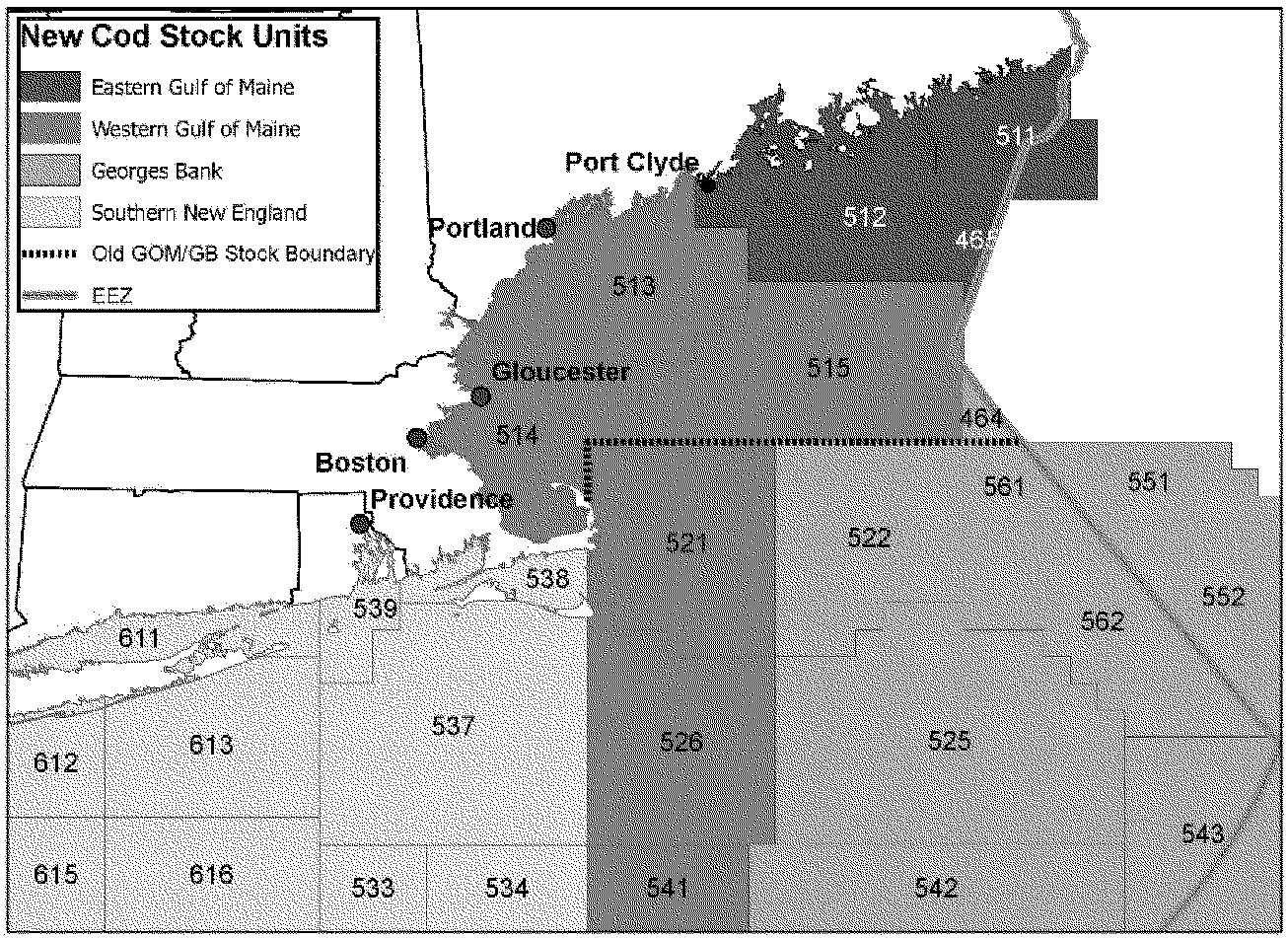
In order to implement the management areas for the four new cod stocks, which are used for possession limits, minimum sizes, sector quotas, and other programs that are part of the Northeast Multispecies FMP, this action would define the geographical areas for the four cod stocks and management units (see figure 1). These areas would be codified in the Code of Federal Regulations (CFR) (see the proposed regulatory text below).
( printed page 12995)
Figure 1—Map of New Atlantic Cod Stock Units
Status Determination Criteria
Section 303(a)(10) of the Magnuson-Stevens Act requires FMPs to specify objective and measurable criteria,
i.e.,
SDCs, for identifying when a stock is overfished or is experiencing overfishing. Amendment 25 proposes to establish SDCs for EGOM, WGOM, GB, and SNE cod, and provide numerical estimates of these criteria, in order to incorporate the results of the 2024 stock assessments and based on the peer review recommendations from the 2024 stock assessments. Table 1 provides the proposed SDCs for EGOM, WGOM, GB and SNE cod, and table 2 provides the resulting numerical estimates of the SDCs. These numerical estimates would be updated in subsequent stock assessments, as needed.
Table 1—Proposed Status Determination Criteria
Stock
Biomass target
(SSB
MSY
or proxy)
Minimum biomass threshold
Maximum fishing
mortality threshold
(F
MSY
or proxy)
EGOM cod
SSB
MSY
proxy
1/2
B
MSY
F-40 percent of proxy.
WGOM cod
SSB
MSY
proxy
1/2
B
MSY
F-40 percent of proxy.
GB cod
SSB
MSY
proxy
1/2
B
MSY
F-40 percent of proxy.
SNE cod
SSB
MSY
proxy
1/2
B
MSY
F-40 percent of proxy.
SSB = spawning stock biomass; MSY = maximum sustainable yield; B = biomass; F = fishing mortality.
Table 2—Numerical Estimates of Status Determination Criteria
Overfishing Limits and Acceptable Biological Catches
A stock's OFL is calculated to set the maximum amount of fish that can be caught in a year without constituting overfishing. The ABC is typically set lower than the OFL to account for scientific uncertainty, although it may be set up to the OFL. For GB cod, because the stock unit extends into the Canadian EEZ, the ABC available to the U.S. must account for Canadian catch in the Canadian EEZ; therefore, the stock-wide ABC is reduced to account for Canadian catch, and the amount remaining after the adjustment for Canadian catch is the U.S. ABC. The proposed GB cod ABC may be revised through Framework 72 to the FMP, on which the Council voted on December 3, 2025, to submit to NMFS for approval. If approved, the Framework 72 GB cod ABC would replace and increase the GB cod ABC proposed here.
Through Amendment 25, the Council recommends catch limits for GB cod for the 2026 fishing year and EGOM cod, WGOM cod, SNE cod for the 2026-2027 fishing years, based on stock assessments completed in 2024 (see table 3). Specifications for fishing year 2027 are projections that would be considered and reaffirmed or adjusted in the annual framework adjustment for 2027. A brief summary of how these catch limits were developed is provided below. More details on the proposed catch limits for each groundfish stock can be found in appendix II (Calculation of Northeast Multispecies Annual Catch Limits, FY 2026-FY 2027) of the Amendment 25 draft EA (see
ADDRESSES
for information on how to access this document).
Table 3—Proposed Fishing Years 2026-2027 Overfishing Limits and Acceptable Biological Catches for Atlantic Cod Stocks
[mt, live weight]
Stock
2026
2027
OFL
U.S. ABC
OFL
U.S. ABC
EGOM Cod
50
39
39
30
WGOM Cod
603
460
769
586
GB Cod *
433
106
SNE Cod
47
36
65
36
Note:
An empty cell indicates no OFL/ABC is adopted for that year. These catch limits would be set in a future action.
* If approved, Framework 72 would replace these specifications with an OFL of 473 mt and a U.S. ABC of 151 mt.
( printed page 12996)
Annual Catch Limits
Development of Annual Catch Limits
The U.S. ABC for each stock in the Northeast Multispecies FMP is divided among the various fishery components to account for all sources of fishing mortality. For stocks with a recreational allocation, the U.S. ABC is first divided between the commercial and recreational fisheries, before being further divided into sub-components and sub-ACLs. An estimate of catch expected from State waters and the other sub-component (
e.g.,
Federal commercial non-groundfish fisheries and some recreational groundfish fisheries, if there is not a recreational allocation) is deducted from the U.S. ABC. The remaining portion of the U.S. ABC is distributed to the fishery components that receive an allocation for the stock. Components of the fishery that receive an allocation have a sub-ACL set by reducing their portion of the ABC (the sub-ABC) to account for management uncertainty and are subject to accountability measures (AM) if they exceed their respective catch limit during the fishing year. This process is described fully in appendix II of the Amendment 25 draft EA (see
ADDRESSES
).
For each stock allocated to sectors, the commercial groundfish sub-ACL is further divided into the non-sector (common pool) sub-ACL and the sector sub-ACL, based on the total vessel enrollment in sectors and the cumulative potential sector contributions (PSC) associated with those sectors. This action does not change an individual's qualifying fishing history or the manner in which an individual vessel's PSC contributes to a sector's cumulative PSC. The preliminary sector and common pool sub-ACLs proposed in this action are based on fishing year 2025 PSCs and fishing year 2025 sector rosters; final allocations to reflect 2026 PSCs and rosters would be provided in a future action. Tables 4 and 5 provide the proposed catch limits for the 2026 and 2027 fishing years.
Amendment 25's proposal to implement the transition from two to four stocks of Atlantic cod would require updates to the current system of setting catch limits for the cod stocks, including setting recreational sub-ACLs as needed, developing a method for applying a sector's PSCs to the new cod stocks, and establishing management uncertainty buffers for the new cod stocks. Measures separate from specification setting, such as establishing common pool AMs and possession limits, are described in the relevant sections later in this preamble.
Recreational Allocations
Amendment 25 proposes to create a recreational sub-ACL for WGOM cod, and allocate 27.5 percent of the WGOM cod ABC to the recreational fishery. The remaining 72.5 percent of the ABC would be distributed between commercial fisheries, including commercial groundfish, State, and other Federal fisheries. This recreational allocation would reflect the 2001 through 2006 catch data from the new WGOM cod stock area. Previously, Amendment 16 (75 FR 18262; April 9, 2010) established a recreational sub-ACL for GOM cod based on the proportional amount of recreational and commercial catch from 2001 through 2006 for the old GOM cod stock area. While most recreational catch within the WGOM cod stock area comes from the northern portion (previously the GOM stock area), recalculating the proportional catch for the full WGOM stock area reflects a better representation of the historical catch levels for the WGOM stock area when determining the appropriate proportion of the overall WGOM cod ABC to allocate to the recreational fishery.
Amendment 25 also proposes a recreational sub-ACL for SNE cod, and allocates 73.5 percent of the SNE cod ABC to the recreational fishery, after first reducing the ABC to account for catch from State and other Federal fisheries. The remaining 26.5 percent would be allocated to the commercial groundfish fishery. This recreational allocation was developed by the Council to fairly balance the proportion of catch from the SNE cod stock area from recreational and commercial fisheries, using the most recent 5 years of catch data, and the estimated amount of catch that the commercial fishery is expected to achieve in the upcoming fishing year. Both commercial and recreational catch are evaluated using the same time period, a period during which both fisheries were subject to restrictions on catch, to determine the amount of these stocks caught by each fishery. A recreational allocation of SNE cod is necessary to provide accountability to every segment of the fishery that catches this stock, and to develop more segment-specific management measures that more effectively reduce fishing mortality for such segments.
The use of a SNE cod recreational sub-ACL is intended to be reasonably calculated to promote conservation. If an overage of a sub-ACL or ACL occurs, AMs help to correct operational issues that cause overages and biological consequences resulting from overages. Because the existing reactive and proactive recreational AMs (that provide a regulatory process for the Regional Administrator to adjust recreational measures on an annual basis) are applicable to any groundfish stock with a recreational sub-ACL, the establishment of a recreational sub-ACL for SNE cod would apply these AMs to the SNE cod stock, if the sub-ACL is exceeded. These AMs are expected to help correct operational issues and better ensure sub-ACLs are not exceeded. Without a recreational sub-ACL, excessive catch by the recreational fishery that contributes to an ACL overage would require pound-for-pound payback by the commercial fishery.
Commercial Allocations
For the purpose of allocating to sectors and common pool vessels, Amendment 25 proposes to continue to use the existing PSCs for the previous GOM and GB cod stocks, and apply them to the commercial groundfish sub-ACL to calculate the sector and common pool sub-ACLs as follows. For EGOM cod, the GOM cod PSCs would be used. For the revised GB cod and SNE cod, the GB cod PSCs would be used. This is because, for each of these stocks, the new stock area falls completely within the old stock area on which the PSC is based.
Unlike the other three new stock areas, the WGOM cod stock area is made up of three statistical areas (513, 514, 515) that were in the GOM cod stock area and three statistical areas (521, 526, 541) that were in the old GB cod stock area (see figure 1). Therefore, it was necessary to develop an apportionment approach that applies existing sector cumulative PSCs to the new stock area to approximate sector vessels' catch performances in the old stock areas as closely as practicable, while facilitating effective conservation and management of the new stocks. Amendment 25 proposes to divide the commercial groundfish sub-ACL for WGOM cod into a northern and southern portion, which correspond to the areas previously within the GOM cod and old GB cod stock areas, respectively, using a proportion of historic commercial groundfish fishery catch that came from the two areas.
In order to balance the historic catch levels with the differences in quotas and fishing opportunities between the two stock areas, Amendment 25 proposes to include a sub-set of the fishing years for the historic catch. Specifically, based on input from the fishing industry, catch from fishing years 2010-2012, 2017, and 2022-2023 were considered to best
( printed page 12997)
account for differences between the GOM and old GB cod stocks, differences in ACLs over the time period, and differences in fishing opportunities, practices, and equities between vessels operating in the north and south portions of the WGOM stock area. The potential for the historical commercial sub-ACL to have an outsized effect on the relative catch in the two old stock areas is minimized by limiting the criteria to fishing years where the commercial sub-ACL of one stock was less than twice the other stock and by averaging multiple years of catch performance covering an extended period of sector system operations. The result is 68 percent from the northern portion and 32 percent from the southern portion. More information regarding the analyses conducted to support this decision is included in appendix III (Development of Phase I Cod Transition—Sector Allocation Bridge Approach) of the Amendment 25 draft EA.
The WGOM cod commercial groundfish sub-ACL would be divided based on these percentages, and the GOM cod and GB cod PSCs would be applied to the northern and southern portions, respectively, before being recombined to calculate total WGOM cod sector and common pool sub-ACLs. Therefore, a sector would be allocated WGOM cod on the basis of its GOM cod and GB cod PSC, and could fish that quota throughout the WGOM cod stock area. These measures are expected to facilitate catch accounting and accountability that would help achieve biological conservation, manage stocks at sustainable levels, and achieve OY while maintaining historic fishing opportunities.
Management Uncertainty Buffers
Amendment 16 set management uncertainty buffers for each of the groundfish stocks. For the new cod stocks, Amendment 25 proposes to use the same approach established by Amendment 16. Recreational sub-ACLs have a 7-percent buffer applied; commercial sub-ACLs generally have a 5-percent buffer. Although Amendment 16 set a lower buffer for certain stocks that do not have a state waters component, Amendment 25 proposes to set the fishing year 2025 GB cod management uncertainty buffer at 5 percent given the increased uncertainty caused by the lack of agreement on the shared United States/Canada quota. Amendment 25 also proposes that for SNE cod, the sector management uncertainty buffer should be left in place even under a 100-percent at-sea monitoring (ASM) coverage target. The annual framework will provide more information regarding the ASM target coverage level ahead of the 2026 fishing year, and explain how sector allocations could change based on that target and any associated buffer changes.
Sector Allocations
NMFS calculates the sector's allocation for each stock by summing its members' PSCs for a stock and then multiplying that total percentage by the available commercial sub-ACL for that stock. Table 6 shows the total GOM cod and GB cod PSCs for each sector, by stock, for fishing year 2025 based on 2025 sector rosters. It also provides the proposed allocations of EGOM, WGOM, GB, and SNE cod that each sector would be allocated, in metric tons (mt) and thousands of pounds (lb), for fishing year 2026, under the specifications proposed in this action. The proposed common pool sub-ACLs are also included in table 6 for comparison.
Common Pool Total Allowable Catches
The common pool sub-ACL for each allocated stock (except for SNE/MA winter flounder) is further divided into trimester TACs. The Trimester TAC AM for the common pool fishery requires that, once NMFS projects that 90 percent of the trimester TAC is caught for a stock, the trimester TAC area for that stock will be closed for the remainder of the trimester. These closures apply to all common pool vessels fishing on a groundfish trip with gear capable of catching the pertinent stock. Any uncaught portion of the TAC in Trimester 1 or Trimester 2 is carried forward to the next trimester. Overages of the Trimester 1 or Trimester 2 TAC are deducted from the Trimester 3 TAC. Any overages of the total common pool sub-ACL are deducted from the following fishing year's common pool sub-ACL for that stock. Uncaught portions of any trimester TAC may not be carried over into the following fishing year.
The distribution of the common pool sub-ACLs into trimesters was adopted in Amendment 16 to the FMP and was based on landing patterns at that time. Framework Adjustment 57 to the FMP (83 FR 18985; May 1, 2018) subsequently updated the trimester TAC distributions for GB cod and GOM cod, as well as other groundfish stocks, to reflect changes in landing patterns and to prevent early trimester closures.
Amendment 25 proposes trimester TAC distributions for the EGOM cod, WGOM cod, SNE cod, and GB cod common pool sub-ACLs. Table 7 includes proposed trimester TAC distributions for these four stocks. For WGOM cod and SNE cod, these distributions were developed following the process outlined in Amendment 16, using common pool catch by trimester over the most recent 5-year period for which data are available, fishing years 2019 through 2023. For EGOM cod and GB cod, landings and trips were low during this time period. As a result, the proposed trimester TAC distribution for these stocks were modified from the Amendment 16 process to more evenly distribute the common pool sub-ACL for these stocks and ensure a minimum amount in each trimester. Table 8 summarizes the Atlantic cod common pool trimester TACs proposed in this action, based on fishing year 2026 rosters.
Incidental catch TACs are also specified for certain stocks of concern (
i.e.,
stocks that are overfished or subject to overfishing) for common pool vessels fishing in the special management programs (
i.e.,
special access programs (SAP) and the Regular B Days-at-Sea (DAS) Program), in order to limit the catch of these stocks under each program. To reflect the transition from two to four cod stocks, this action proposes to specify incidental TACs for the four new cod stocks (tables 9-11).
Table 4—Proposed Catch Limits for the 2026 Fishing Year
[mt, live weight]
Stock
Total
ACL
Groundfish
sub-ACL
Sector
sub-ACL
Common
pool
sub-ACL
Recreational
sub-ACL
Midwater
trawl
fishery
Scallop
fishery
Small-
mesh
fisheries
State
waters
sub-
component
Other
sub-
component
A to H
A + B + C
A
B
C
D
E
F
G
H
EGOM Cod
37
37
35
1.4
0.2
0.4
WGOM Cod
436
407
279
11
118
23
5
GB Cod
101
93
89
3.2
0
8.5
( printed page 12998)
SNE Cod
34
25
6.5
0.2
18
6.1
3.2
Table 5—Proposed Catch Limits for the 2027 Fishing Year *
[mt, live weight]
Stock
Total
ACL
Groundfish
sub-ACL
Sector
sub-ACL
Common
pool
sub-ACL
Recreational
sub-ACL
Midwater
trawl
fishery
Scallop
fishery
Small-
mesh
fisheries
State
waters
sub-
component
Other
sub-
component
A to H
A + B + C
A
B
C
D
E
F
G
H
EGOM Cod
29
28
27
1.1
0.2
0.3
WGOM Cod
555
519
355
14
150
30
6.4
SNE Cod
34
25
6.5
0.2
18
6.1
3.2
* GB cod does not have catch limits proposed for fishing year 2027, and is therefore not included in table 5.
Table 6—Cumulative PSC
(Percentage),
Estimated ACE
(in mt)
and Estimated ACE
(in 1,000 lb)
for Each Sector by Cod Stock for Fishing Year 2026 *#
Sector name
MRI count
PSC
ACE in mt
ACE in 1,000 lb
GOM cod
GB cod
EGOM
cod
WGOM
cod
GB
cod
SNE
cod
EGOM
cod
WGOM
cod
GB
cod
SNE
cod
Fixed Gear Sector
58
0.621182828
10.2421232
0
11
9
1
0
24
21
2
Maine Coast Community Sector
107
16.04726033
2.14381876
6
34
2
0
13
74
4
0
Maine Permit Bank
11
1.161689606
0.134391577
0
2
0
0
1
5
0
0
Mooncusser Sector
51
7.219127919
11.7507685
3
25
11
1
6
55
24
2
NEFS 2
128
25.72844012
10.06043816
9
60
9
1
21
132
21
1
NEFS 4
58
11.18238598
8.630642562
4
30
8
1
9
66
18
1
NEFS 5
14
0.328819005
0.354727202
0
1
0
0
0
2
1
0
NEFS 6
3
0.169006172
0.532779632
0
1
0
0
0
2
1
0
NEFS 8
114
6.450874228
34.51388651
2
45
32
2
5
99
70
5
NEFS 10
20
1.677842528
0.171299148
1
3
0
0
1
8
0
0
NEFS 11
38
10.53615357
0.398248397
4
21
0
0
8
47
1
0
NEFS 12
25
3.840403876
0.871446785
1
8
1
0
3
18
2
0
NEFS 13
49
0.338573624
7.53239015
0
8
7
1
0
17
15
1
New Hampshire Permit Bank
4
1.151880562
0.000826964
0
2
0
0
1
5
0
0
Sustainable Harvest Sector 1
41
4.502129382
5.053437132
2
14
5
0
4
30
10
1
Sustainable Harvest Sector 2
14
1.137391277
1.297760061
0
3
1
0
1
8
3
0
Sustainable Harvest Sector 3
29
3.980217806
2.855176067
1
10
3
0
3
23
6
0
Common Pool
495
3.926621182
3.455839183
1
11
3
0
3
24
7
1
All Sectors
764
96.07337882
96.54416082
35
279
89
7
77
615
197
14
* The data in this table are based on sector rosters for fishing year 2025 and may change based on final fishing year 2026 sector enrollment.
#
Numbers are rounded to the nearest thousand pounds and nearest metric ton. In some cases, this table shows an allocation of 0, but that sector may be allocated a small amount of that stock in pounds.
Table 7—Proposed Trimester TAC Distributions
(percent)
for Atlantic Cod Stocks
Stock
Trimester 1
Trimester 2
Trimester 3
EGOM Cod
80
10
10
WGOM Cod
55
22
23
GB Cod
33
33
34
SNE Cod
36
31
33
Table 8—Proposed Fishing Years 2026-2027 Common Pool Trimester TACs
[mt, live weight] *
Stock
2026
2027
Trimester 1
Trimester 2
Trimester 3
Trimester 1
Trimester 2
Trimester 3
EGOM Cod
1.1
0.1
0.1
0.9
0.1
0.1
WGOM Cod
6.0
2.4
2.5
7.6
3.1
3.2
GB Cod
1.1
1.1
1.1
( printed page 12999)
SNE Cod
0.083
0.071
0.076
0.072
0.062
0.066
* The data in this table are based on sector rosters for fishing year 2025 and may change based on final fishing year 2026 sector enrollment.
Table 9—Proposed Common Pool Incidental Catch TACs for the 2026-2027 Fishing Years
[mt, live weight]
Stock
Percentage of
common pool sub-ACL
2026
2027
EGOM Cod
1
0.01
0.01
WGOM Cod
1
0.11
0.14
GB Cod
1.68
0.05
SNE Cod
1
0.00
0.00
Table 10—Percentage of Incidental Catch TACs Distributed to Each Special Management Program
Stock
Regular B DAS
program
(percent)
Eastern U.S./Canada
haddock SAP
(percent)
EGOM Cod
100
n/a
WGOM Cod
100
n/a
GB Cod
60
40
SNE Cod
100
n/a
Table 11—Proposed Fishing Years 2026-2027 Incidental Catch TACs for Each Special Management Program
[mt, live weight]
Stock
Regular B DAS Program
Eastern U.S./Canada Haddock SAP
2026
2027
2026
2027
EGOM Cod
0.01
0.01
n/a
n/a
WGOM Cod
0.11
0.14
n/a
n/a
GB Cod
0.03
0.02
SNE Cod
0.00
0.00
n/a
n/a
Common Pool AMs and Other Management Measures
Common Pool Trimester Total Allowable Catch Areas for Cod Stocks
As previously described in Common Pool Total Allowable Catches, the Trimester TAC AM requires closure of a stock's Trimester TAC Area for common pool vessels fishing when common pool catch is projected to reach 90 percent of the Trimester TAC for that stock. For the cod stocks, these closures would apply to common pool vessels fishing with trawl, gillnet, or longline/hook gear. Amendment 25 proposes Trimester TAC Areas for each of the four cod stocks (table 12). These areas were developed via the process outlined in Amendment 16, which established trimester TAC closure areas based on the statistical areas that made up 90 percent of the total commercial catches using the most recent 5-year period of data. For the four new cod stocks, Amendment 25 used commercial catch data from fishing years 2019 through 2023.
Table 12—Proposed Trimester TAC Areas for Atlantic Cod Stocks, by Statistical Area
Stock
Trimester TAC area, by statistical area
EGOM Cod
512.
WGOM Cod
513, 514, 521.
GB Cod
522, 561.
SNE Cod
537, 539, 613.
( printed page 13000)
Common Pool Baseline Trip Limits for Cod Stocks
Amendment 25 proposes common pool trip limits for each of the revised cod stocks. Common pool trip limits for DAS vessels would be established as in table 13. The DAS trip limit for WGOM cod was developed via a trip limit analysis that used historical fishing effort and landings to estimate potential landings of the stock in fishing year 2026. For EGOM cod and GB cod, landings and effort for these stocks has been limited in recent years. The common pool trip limits proposed in this action are intended to provide for a limited amount of bycatch of cod that may result from fishing for other stocks in the common pool. For SNE cod, the proposed common pool sub-ACL is insufficient to support any amount of landings, even as bycatch, and so Amendment 25 proposes prohibiting common pool vessels' possession of this stock.
This action also proposes common pool trip limits for each of the revised cod stocks for the non-DAS Northeast multispecies permits (Handgear A, Handgear B, and the Small Vessel Category permit) (table 13).
Table 13—Proposed 2026 common pool daily and trip possession limits
Stock
Proposed 2026 Common Pool Daily and Trip Possession Limits
DAS permits
Handgear A
Handgear B
Small vessel category
EGOM Cod
25 lb (11 kg) per DAS, up to 50 lb (23 kg) per trip
25 lb (11 kg) per trip.
WGOM Cod
50 lb (23 kg) per DAS, up to 100 lb (45 kg) per trip
50 lb (23 kg) per trip
25 lb (11 kg) per trip
50 lb (23 kg) per trip.
GB Cod
25 lb (11 kg) per DAS, up to 50 lb (23 kg) per trip
25 lb (11 kg) per trip.
SNE Cod
0 lb (0 kg) per trip; possession prohibited.
Recreational Management Measures
Under the provisions at § 648.89(f)(3), Northeast multispecies fishery regulations include proactive recreational AMs to ensure that the recreational sub-ACL for recreational stocks with a sub-ACL is achieved, but not exceeded. For the proactive AMs, the Regional Administrator, in consultation with the Council, develops and implements recreational management measures for the upcoming fishing year, including minimum fish size, bag limit, season, and/or other measures. The FMP also includes reactive AMs to correct the cause or mitigate the effects of an overage, if one occurs.
WGOM Cod
This rule proposes setting WGOM cod recreational measures, specifically a minimum size of 23 inches (58.4 cm), with a possession limit of one fish and open seasons of May 1-May 31 and September 1-October 31 (see table 14). These measures are based on the proposed Amendment 25 WGOM cod sub-ACL and the Council's recommended management measures provided in a February 6, 2025, letter to the Regional Administrator, originally intended for fishing year 2025. The Council is expected to provide recommendations for recreational measures in January 2026, and any changes to these proposed measures could be made in a future action.
The proposed measures are expected to adequately constrain recreational catch of WGOM cod based on the bio-economic model estimates. To develop its recommendations for fishing year 2025, the Council considered projected recreational GOM haddock and WGOM cod removals based on several management measure scenarios. The scenarios included combinations of minimum fish sizes, possession limits, and closed seasons for GOM haddock and WGOM cod using a newly developed Decision Support Tool created by the Northeast Fisheries Science Center.
GB and EGOM Cod
Amendment 25 proposes to establish a temporary regulatory process for the Regional Administrator to set EGOM cod and GB cod recreational measures for fishing year 2026 to maintain consistency with the other cod stocks, to the extent practicable. Following the consultation with the Council, NMFS would set recreational measures for EGOM cod and GB cod. Any measures set would remain in place unless changed in a future framework action.
As recommended by the Council, this action proposes to set EGOM cod and GB cod recreational measures consistent with WGOM cod measures, specifically a minimum size of 23 inches (58.4 cm), with a possession limit of one fish and open seasons of May 1-May 31 and September 1-October 31 (see table 14).
SNE Cod
As discussed in Specifications for Fishing Years 2026-2027, Amendment 25 includes a very small recreational sub-ACL for SNE cod. While the regulations provide procedures for the Regional Administrator to set the recreational measures for a stock with a sub-ACL, in this case the Council included the recreational measures for SNE cod as part of Amendment 25 for fishing year 2026. Amendment 25 proposes to establish a zero fish possession limit for SNE cod for all recreational fishermen (charter/party and private anglers) (see table 14). Given the very low ABC and recreational sub-ACL proposed for fishing year 2026, these are the only measures that would be expected to reduce mortality sufficiently. The Regional Administrator will evaluate the SNE cod recreational management measures annually as long as the stock has an associated recreational sub-ACL.
n/a: No minimum size proposed for SNE cod, because it is zero retention.
Classification
Pursuant to section 304(b)(1)(A) of the Magnuson-Stevens Act, the NMFS Assistant Administrator has made a preliminary determination that this proposed rule is consistent with Amendment 25, other provisions of the Magnuson-Stevens Act, and other applicable law, subject to further consideration after public comment. In making the final determination, the Regional Administrator will consider the data, views, and comments received during the public comment period for this action.
This proposed rule has been determined to be not significant for purposes of Executive Order (E.O.) 12866. This proposed rule is not an Executive Order 14192 regulatory action because this rule is not significant under Executive Order 12866.
An Initial Regulatory Flexibility Analysis (IRFA) was prepared for this proposed rule, as required by section 603 of the Regulatory Flexibility Act, 5 U.S.C. 603. The IRFA describes the economic impact that this proposed rule would have on small entities, including small businesses, and also determines ways to minimize these impacts. The IRFA includes this CLASSIFICATION and the Summary of Proposed Measures sections of this proposed rule and analyses contained in Amendment 25 and its accompanying EA/Regulatory Impact Review/IRFA. A copy of the full analysis is available from the Council (see
ADDRESSES
). A summary of the IRFA follows.
Description of the Reasons Why Action by the Agency Is Being Considered and Statement of the Objectives of, and Legal Basis for, This Proposed Rule
This action proposes management measures, including ACLs, for the Atlantic cod stocks that are part of the Northeast multispecies fishery in order to prevent overfishing, rebuild overfished groundfish stocks, and achieve optimum yield in the fishery, as required by the Magnuson-Stevens Act. A complete description of the action, why it is being considered, and the legal basis for this action are contained in Amendment 25, and in the
SUPPLEMENTARY INFORMATION
section of this proposed rule under the Summary of Proposed Measures heading, and are not repeated here.
Description and Estimate of the Number of Small Entities to Which This Proposed Rule Would Apply
This proposed rule would apply to the commercial and recreational fisheries for groundfish, as well as the Atlantic sea scallop, small-mesh multispecies, Atlantic herring, and large-mesh non-groundfish fisheries that overlap with the groundfish fishery. Individually permitted vessels may hold permits for several fisheries, harvesting species of fish that are regulated by several different FMPs, beyond those directly affected by the proposed action. Furthermore, multiple-permitted vessels and/or permits may be owned by entities affiliated by stock ownership, common management, identity of interest, contractual relationships, or economic dependency. For the purposes of the RFA analysis, the ownership entities, not the individual vessels, are considered to be the regulated entities.
As of June 1, 2024, NMFS had issued 669 commercial limited-access groundfish permits associated with vessels (including those in confirmation of permit history (CPH)), 719 party/charter groundfish permits, 696 limited access and general category Atlantic sea scallop permits, 761 small-mesh multispecies permits, 71 Atlantic herring permits, and 743 large-mesh non-groundfish permits (
i.e.,
limited access summer flounder and scup permits). Therefore, this action potentially applies to 3,659 permits. When accounting for overlaps between fisheries, this number reduces to 2,144 permitted vessels. Each vessel may be individually owned or part of a larger corporate ownership structure and, for RFA purposes, it is the ownership entity that is ultimately regulated by the proposed action. Ownership entities are identified on June 1st of each year based on the list of all permit numbers, for the most recent complete calendar year, that have applied for any type of Greater Atlantic Region Federal fishing permit. The current ownership data set is based on calendar year 2023 permits and contains gross sales associated with those permits for calendar years 2019 through 2023.
For RFA purposes only, NMFS has established a small business size standard for businesses, including their affiliates, whose primary industry is commercial fishing (see § 200.2). A business primarily engaged in commercial fishing (NAICS code 11411) is classified as a small business if it is independently owned and operated, is not dominant in its field of operation (including its affiliates), and has combined annual receipts not in excess of $11 million for all its affiliated operations worldwide. The determination as to whether the entity is large or small is based on the average annual revenue for the five years from 2019 through 2023. The Small Business Administration (SBA) has established size standards for all other major industry sectors in the U.S., including for-hire fishing (NAICS code 487210). These entities are classified as small businesses if combined annual receipts are not in excess of $8.0 million for all of an entity's affiliated operations. As with commercial fishing businesses, the annual average of the three most recent years (2019-2023) is utilized in determining annual receipts for businesses primarily engaged in for-hire fishing.
Based on the ownership data, 1,648 distinct business entities hold at least one permit that the proposed action potentially regulates. All 1,648 business entities identified could be directly regulated by this proposed action. Of these 1,648 entities, 891 are commercial fishing entities, 326 are for-hire entities, and 431 did not have revenues (
i.e.,
were inactive in 2023). Of the 891 commercial fishing entities, 881 are categorized as small entities and 10 are categorized as large entities, per the NMFS guidelines. Furthermore, 412 of these commercial fishing entities held limited access groundfish permits, with 408 of these entities being classified as small businesses and 4 of these entities being classified as large businesses. All 326 for-hire entities are categorized as small businesses.
( printed page 13002)
Description of the Projected Reporting, Record-Keeping, and Other Compliance Requirements of This Proposed Rule
The proposed action contains no information requirements under the Paperwork Reduction Act of 1995 (PRA).
Federal Rules Which May Duplicate, Overlap, or Conflict With This Proposed Rule
The proposed action does not duplicate, overlap, or conflict with any other Federal rules.
Description of Significant Alternatives to the Proposed Action Which Accomplish the Stated Objectives of Applicable Statutes and Which Minimize Any Significant Economic Impact on Small Entities
The economic impacts of each proposed measure are discussed in more detail in sections 6.5 and 7.11 of the draft Amendment 25 EA (see
ADDRESSES
) and are not repeated here. These considerations include the status determination criteria, the updated groundfish specifications, and other measures in this proposed rule, and the No Action alternative. An alternative approach to dividing the northern and southern portions of the WGOM cod stock area for allocating to the commercial fishery was considered by the Council, but was moved to “considered but rejected.” The proposed action is predicted to generate $34.7 million in gross revenues for the sector portion of the commercial groundfish trips. Under the No Action alternative, sector revenue could not be estimated due to the lack of specifications for the new Atlantic cod stocks for the upcoming fishing year. Small entities engaged in the commercial groundfish fishery, including both the sector component and the common pool component, will be positively impacted by the proposed action relative to No Action. However, the proposed action is predicted to result in $7.0 million less than the amount of gross revenues generated in fishing year 2023. Small entities engaged in common pool groundfish fishing are expected to be positively impacted by the proposed action, relative to the No Action alternative.
The recreational sub-ACLs for WGOM cod and SNE cod would be defined under the proposed action, and because these sub-ACLs would not be defined under the No Action, the proposed action is expected to positively impact the recreational fishery relative to the No Action. However, relative to fishing year 2023, the zero-possession recreational limit for SNE cod is expected to negatively impact the recreational fishery. The proposed recreational measures for WGOM cod are expected to have a positive effect on small entities, because they are expected to increase opportunity to harvest WGOM cod.
WGOM cod northern portion
means the geographical area of the WGOM cod stock area, as defined in § 648.88(a)(2), that overlaps the GOM Stock Area 1, as described in § 648.10(k)(3)(i).
WGOM cod southern portion
means the geographical area of the WGOM cod stock area, as defined in § 648.88(a)(2), that overlaps the Inshore GB Stock Area 2 and SNE/MA Stock Area 4, as described in § 648.10(k)(3)(ii) and (iv).
3. Amend § 648.82 as follows:
a. Revise paragraphs (n)(2)(i)(A), (n)(2)(ii) introductory text, and (n)(2)(ii)(A) and (B);
b. Redesignate paragraphs (n)(2)(ii)(C) through (N) as paragraphs (n)(2)(ii)(E) through (P); and
Effort-control program for NE multispecies vessels.
* * * * *
(n) * * *
(2) * * *
(i) * * *
(A)
Trimester TAC distribution.
With the exception of SNE/MA winter flounder, any sub-ACLs specified for common pool vessels pursuant to § 648.90(a)(4) shall be apportioned into 4-month trimesters, beginning at the start of the fishing year (
i.e.,
Trimester 1: May 1-August 31; Trimester 2: September 1-December 31; Trimester 3: January 1-April 30), as follows:
Table 1 to Paragraph
(n)(2)(i)(A)
—Portion of Common Pool Sub-ACLs Apportioned to Each Stock for Each Trimester
Stock
Trimester 1
(percent)
Trimester 2
(percent)
Trimester 3
(percent)
EGOM cod
80
10
10
WGOM cod
55
22
23
GB cod
33
33
34
SNE Cod
36
31
33
GB haddock
27
33
40
GOM haddock
27
26
47
GB yellowtail flounder
19
30
51
SNE/MA yellowtail flounder
21
28
51
CC/GOM yellowtail flounder
57
26
17
American plaice
74
8
18
Witch flounder
55
20
25
GB winter flounder
8
24
68
GOM winter flounder
37
38
25
Redfish
25
31
44
White hake
38
31
31
( printed page 13003)
Pollock
28
35
37
* * * * *
(ii)
Stock area closures.
Unless otherwise specified in this paragraph (n)(2)(ii), if the Regional Administrator projects that 90 percent of the trimester TACs specified in paragraph (n)(2)(i) of this section will be caught based upon available information, the Regional Administrator shall close the area where 90 percent of the catch for each such stock occurred to all common pool vessels on a NE multispecies DAS using gear capable of catching such stocks for the remainder of that trimester, as specified in paragraphs (n)(2)(ii)(A) through (P) of this section, in a manner consistent with the Administrative Procedure Act. For example, if the Regional Administrator projects that 90 percent of the CC/GOM yellowtail flounder Trimester 1 TAC will be caught, common pool vessels using trawl and gillnet gear shall be prohibited from fishing in the CC/GOM Yellowtail Flounder Closure Area specified in paragraph (n)(2)(ii)(I) of this section until the beginning of Trimester 2 on September 1 of that fishing year. Based upon all available information, the Regional Administrator is authorized to expand or narrow the areas closed under this paragraph (n)(2)(ii) in a manner consistent with the Administrative Procedure Act. If it is not possible to identify an area where only 90 percent of the catch occurred, the Regional Administrator shall close the smallest area possible where greater than 90 percent of the catch occurred. Common pool vessels holding either a Handgear A or B permit and fishing with handgear or tub trawls are exempt from stock area closures for white hake. The Regional Administrator may exempt Handgear A and B permitted vessels from stock area closures for other stocks pursuant to this paragraph (n)(2)(ii) if it is determined that catches of the respective species or stock by these vessels are less than 1 percent of the common pool catch of that species or stock. The Regional Administrator shall make such determination prior to the start of the fishing year through a notice published in the
Federal Register
, consistent with the Administrative Procedure Act, and any such determination shall remain in effect until modified.
(A)
EGOM Cod Trimester TAC Area.
For the purposes of the trimester TAC AM closure specified in paragraph (n)(2)(ii) of this section, the EGOM Cod Trimester TAC Area shall apply to common pool vessels using trawl gear, sink gillnet gear, and longline/hook gear within the area bounded by the coastline of the United States and by straight lines connecting the following points in the order stated:
Table 2 to Paragraph
(n)(2)(ii)(A)
—EGOM Cod Trimester TAC Area
Point
N latitude
W longitude
EGOM1
44°23′58″
67°57′35″
EGOM2
44°10′
67°50′
EGOM3
44°00′
67°50′
EGOM4
44°00′
67°40′
EGOM5
43°20′
67°40′
EGOM6
43°20′
69°00′
EGOM7
43°40′
69°00′
EGOM8
43°40′
69°20′
(B)
WGOM Cod Trimester TAC Area.
For the purposes of the trimester TAC AM closure specified in paragraph (n)(2)(ii) of this section, the WGOM Cod Trimester TAC Area shall apply to common pool vessels using trawl gear, sink gillnet gear, and longline/hook gear within the area bounded by the coastline of the United States and by the straight lines connecting the following points in the order stated:
Table 3 to Paragraph
(n)(2)(ii)(B)
—WGOM Cod Trimester TAC Area
Point
N latitude
W longitude
WGOM1
(1
)
69°20′
WGOM2
43°40′
69°20′
WGOM3
43°40′
69°00′
WGOM4
43°10′
69°00′
WGOM5
43°10′
69°10′
WGOM6
43°00′
69°10′
WGOM7
43°00′
69°20′
WGOM8
42°50′
69°20′
WGOM9
42°50′
69°40′
WGOM10
42°20′
69°40′
WGOM11
42°20′
68°50′
WGOM12
41°00′
68°50′
WGOM13
41°00′
69°30′
WGOM14
41°10′
69°30′
WGOM15
41°10′
69°50′
WGOM16
41°20′
69°50′
WGOM17
(2
)
70°00′
WGOM18
(3
)
70°00′
1
Intersection of south-facing ME coastline and 69°20″; W Long.
2
Northeast-facing coastline of Nantucket, MA.
3
South-facing coastline of Cape Cod, MA.
(C)
GB Cod Trimester TAC Area.
For the purposes of the trimester TAC AM closure specified in paragraph (n)(2)(ii) of this section, the GB Cod Trimester TAC Area shall apply to common pool vessels using trawl gear, sink gillnet gear, and longline/hook gear within the area bounded by straight lines connecting the following points in the order stated:
Table 4 to Paragraph
(n)(2)(ii)(C)
—GB Cod Trimester TAC Area
Point
N latitude
W longitude
GB1
42°20′
68°50′
GB2
42°20′
(1
)
GB3
41°50′
(1
)
GB4
41°50′
67°40′
GB5
41°20′
67°40′
GB6
41°20′
68°10′
GB7
41°10′
68°10′
GB8
41°10′
68°20′
GB9
41°00′
68°20′
GB10
41°00′
68°50′
GB1
42°20′
68°50′
1
U.S./Canada maritime boundary.
(D)
SNE Cod Trimester TAC Area.
For the purposes of the trimester TAC AM closure specified in paragraph (n)(2)(ii) of this section, the SNE Cod Trimester TAC Area shall apply to common pool vessels using trawl gear, sink gillnet gear, and longline/hook gear within the area bounded by the coastline of the United States and by straight lines connecting the following points in the order stated and bounded by the coastline:
Table 5 to Paragraph
(n)(2)(ii)(D)
—SNE Cod Trimester TAC Area
Point
N latitude
W longitude
SNE1
(1
)
71°10′
SNE2
41°20′
71°10′
( printed page 13004)
SNE3
41°20′
(2
)
SNE4
(3
)
70°00′
SNE5
39°50′
70°00′
SNE6
39°50′
71°40′
SNE7
40°00′
71°40′
SNE8
40°00′
73°00′
SNE9
(4
)
73°00′
SNE10
41°00′
(5
)
SNE11
41°00′
71°40′
SNE12
(1
)
71°40′
1
South-facing coastline of Rhode Island.
2
West-facing coastline of Martha's Vineyard, MA.
3
South-facing coastline of Nantucket, MA.
4
South-facing coastline of Long Island, NY.
5
Southeast-facing coastline of Long Island, NY.
* * * * *
4. Amend § 648.85 by revising paragraph (b)(5) introductory text and paragraph (b)(6)(iv)(D) to read as follows:
(5)
Incidental Catch TACs.
Unless otherwise specified in this paragraph (b)(5), Incidental Catch TACs shall be based upon the portion of the ACL for a stock specified for common pool vessels pursuant to § 648.90(a)(4), and allocated as described in this paragraph (b)(5), for each of the following stocks: WGOM cod, EGOM cod, GB cod, SNE cod, GB yellowtail flounder, CC/GOM yellowtail flounder, American plaice, SNE/MA winter flounder, and witch flounder. Because GB yellowtail flounder and GB cod are transboundary stocks, the incidental catch TACs for these stocks shall be based upon the common pool portion of the ACL available to U.S. vessels. NMFS shall send letters to limited access NE multispecies permit holders notifying them of such TACs.
* * * * *
(6) * * *
(iv) * * *
(D)
Landing limits.
Unless otherwise specified in this paragraph (b)(6)(iv)(D), or restricted pursuant to § 648.86, a NE multispecies vessel fishing in the Regular B DAS Program described in this paragraph (b)(6), and fishing under a Regular B DAS, may not land more than 100 lb (45.5 kg) per DAS, or any part of a DAS, up to a maximum of 1,000 lb (454 kg) per trip, of any of the following species/stocks from the areas specified in § 648.88: Cod (EGOM, WGOM, GB, and SNE), American plaice, witch flounder, SNE/MA winter flounder, and GB yellowtail flounder; and may not land more than 25 lb (11.3 kg) per DAS, or any part of a DAS, up to a maximum of 250 lb (113 kg) per trip of CC/GOM yellowtail flounder. In addition, trawl vessels, which are required to fish with a haddock separator trawl, as specified in paragraph (a)(3)(iii)(A) of this section, or a Ruhle trawl, as specified in paragraph (b)(6)(iv)(J) of this section, and other gear that may be required in order to reduce catches of stocks of concern as described in paragraph (b)(6)(iv)(J) of this section, are restricted to the trip limits specified in paragraph (e) of this section.
* * * * *
5. Amend § 648.86 by revising Table 1 to Paragraph (a)(1) to read as follows:
(
1)
Maximum carryover.
With the exception of GB yellowtail flounder, and unless otherwise specified in (b)(1)(i)(C)(
1)(
iii) of this section a sector may carryover an amount of ACE equal to 10 percent of its original ACE for each stock that is unused at the end of one fishing year into the following fishing year, provided that the total unused
( printed page 13005)
sector ACE plus the overall ACL for the following fishing year does not exceed the ABC for the fishing year in which the carryover may be harvested. If this total exceeds the ABC, NMFS shall adjust the maximum amount of unused ACE that a sector may carryover (down from 10 percent) to an amount equal to the ABC of the following fishing year. Any adjustments made would be applied to each sector based on its total unused ACE and proportional to the cumulative PSCs of vessels/permits participating in the sector for the particular fishing year, as described in paragraph (b)(1)(i)(E) of this section.
* * * * *
(
iii)
Atlantic cod stocks carryover for fishing year 2026.
Unused fishing year 2025 ACE for the Atlantic cod stocks will not carryover to a sector's fishing year 2026 ACE for the Atlantic cod stocks. For the 2027 fishing year and onward, carryover for the Atlantic cod stocks will return to the processes described in (b)(1)(i)(C)(
1) and (
2) of this section.
* * * * *
(E)
Potential sector contribution (PSC).
For the purposes of allocating a share of the available ACL for each NE multispecies stock to approved sectors pursuant to § 648.90(a)(4), the landings history of all limited access NE multispecies permits shall be evaluated to determine each permit's share of the overall landings for each NE multispecies stock as specified in paragraphs (b)(1)(i)(E)(
1) and (
2) of this section. For the purposes of allocating a share of the available ACL for the four Atlantic cod stocks (
i.e.,
EGOM, WGOM, GB, and SNE cod) to approved sectors pursuant to § 648.90(a)(4), the PSCs will continue to be calculated for GOM cod and GB cod according to the method specified in Amendment 16, in accordance with paragraphs (b)(1)(i)(E)(
1) and (
2) of this section. When calculating an individual permit's share of the overall landings for a particular regulated species or ocean pout stock, landed weight shall be converted to live weight to maintain consistency with the way ACLs are calculated pursuant to § 648.90(a)(4) and the way ACEs are allocated to sectors pursuant to this paragraph (b)(1)(i). This calculation shall be performed on July 1 of each year, unless another date is specified by the Regional Administrator, to redistribute the landings history associated with permits that have been voluntarily relinquished or otherwise canceled among all remaining valid limited access NE multispecies permits as of that date during the following fishing year. The PSC calculated pursuant to this paragraph (b)(1)(i)(E) shall remain with the permit indefinitely, but may be permanently reduced or eliminated due to a permit sanction or other enforcement action.
* * * * *
(
2)
Calculation of PSC for GB cod.
* * *
* * * * *
7. Amend § 648.88 by revising paragraphs (a)(1) and (2) and adding paragraphs (a)(3) and (4) to read as follows:
(1)
EGOM cod stock area.
The EGOM cod stock is the area defined by straight lines connecting the following points in the order stated and bounded by the coastline of the United States:
Table 1 to Paragraph (
a
)(1)—EGOM Cod Stock Area
Point
N latitude
W longitude
EGOM1
(1
)
69°20′
EGOM2
(2
)
67°00′
EGOM3
(2
)
67°40′
EGOM4
43°20′
67°40′
EGOM5
43°20′
69°00′
EGOM6
43°40′
69°00′
EGOM7
43°40′
69°20′
1
Intersection of south-facing ME coastline and 69°20′ W long.
2
U.S./Canada maritime boundary.
(2)
WGOM cod stock area.
The WGOM cod stock is the area defined by straight lines connecting the following points in the order stated and bounded by the coastline of the United States:
Table 2 to Paragraph (
a
)(2)—WGOM Cod Stock Area
Point
N latitude
W longitude
WGOM1
(1
)
69°20′
WGOM2
43°40′
69°20′
WGOM3
43°40′
69°00′
WGOM4
43°20′
69°00′
WGOM5
43°20′
67°40′
WGOM6
(2
)
67°40′
WGOM7
(3
)
67°40′
WGOM8
42°20′
67°40′
WGOM9
42°20′
68°50′
WGOM10
39°50′
68°50′
WGOM11
39°50′
69°00′
WGOM12
39°00′
69°00′
WGOM13
39°00′
70°00′
WGOM14
(4
)
70°00′
1
Intersection of south-facing ME coastline and 69°20′ W long.
2
U.S./Canada maritime boundary (northern intersection with 67°40′ W long).
3
U.S./Canada maritime boundary (southern intersection with 67°40′ W long).
4
Intersection of south-facing coastline of Cape Cod and 70°00′ W long.
(3)
GB cod stock area.
The GB cod stock area is the area defined by straight lines connecting the following points in the order stated:
Table 3 to Paragraph (
a
)(3)—GB Cod Stock Area
Point
N latitude
W longitude
GB1
42°20′
68°50′
GB2
42°20′
67°40′
GB3
(1
)
67°40′
GB4
39°00′
(2
)
GB5
39°00′
69°00′
GB6
39°50′
69°00′
GB7
39°50′
68°50′
GB1
42°20′
68°50′
1
U.S./Canada maritime boundary (northern intersection with 67°40′ W long).
2
U.S./Canada maritime boundary (intersection with 39°00′ N latitude).
(4)
SNE cod stock area.
The SNE cod stock area is the area defined by straight lines connecting the following points in the order stated and bounded by the coastline of the United States:
Table 4 to Paragraph (
a
)(4)—SNE Cod Stock Area
Point
N latitude
W longitude
SNE1
(1
)
70°00′
SNE2
39°00′
69°00′
SNE3
39°00′
(2
)
SNE4
35°00′
(2
)
SNE5
35°00′
(3
)
1
Intersection of south-facing coastline of Cape Cod and 70°00′ W long.
2
U.S./Canada maritime boundary.
3
Intersection of east-facing coastline of Outer Banks, NC, and 35°00′ N lat.
* * * * *
8. Amend § 648.89 as follows:
a. Revise Table 1 to Paragraph (b)(1), Table 2 to Paragraph (c)(1), and Table 3 to Paragraph (c)(2); and
Recreational and charter/party vessel restrictions.
* * * * *
(b) * * *
(1) * * *
( printed page 13006)
Table 1 to Paragraph (
b
)(1)
Species
Charter/party
minimum size
Private
minimum size
Maximum
size
inches
cm
inches
cm
inches
cm
Cod:
EGOM cod stock area 1
23
58.4
23
58.4
N/A
N/A
WGOM cod stock area 1
23
58.4
23
58.4
N/A
N/A
GB cod stock area 1
23
58.4
23
58.4
N/A
N/A
SNE cod stock area 1
N/A
N/A
N/A
N/A
N/A
N/A
Haddock:
Inside GOM Regulated Mesh Area 2
17
43.2
17
43.2
N/A
N/A
Outside GOM Regulated Mesh Area 2
18
45.7
18
45.7
N/A
N/A
Pollock
19
48.3
19
48.3
N/A
N/A
Witch Flounder (gray sole)
14
35.6
14
35.6
N/A
N/A
Yellowtail Flounder
13
33.0
13
33.0
N/A
N/A
American Plaice (dab)
14
35.6
14
35.6
N/A
N/A
Atlantic Halibut
41
104.1
41
104.1
N/A
N/A
Winter Flounder (black back)
12
30.5
12
30.5
N/A
N/A
Redfish
9
22.9
9
22.9
N/A
N/A
1
Cod stock areas specified in § 648.88
2
GOM Regulated Mesh Area specified in § 648.80(a).
* * * * *
(c) * * *
(1) * * *
Table 2 to Paragraph (
c
)(1)
Stock
Open season
Possession
limit
Closed season
EGOM Cod
May 1-May 31; September 1-October 31
1
June 1-August 31; November 1-April 30.
WGOM Cod
May 1-May 31; September 1-October 31
1
June 1-August 31; November 1-April 30.
GB Cod
May 1-May 31; September 1-October 31
1
June 1-August 31; November 1-April 30.
SNE Cod
CLOSED
No Retention
All Year.
GB Haddock
All Year
Unlimited
N/A.
GOM Haddock
May 1-February 28 (or 29); April 1-30
15
March 1-March 31.
GB Yellowtail Flounder
All Year
Unlimited
N/A.
SNE/MA Yellowtail Flounder
All Year
Unlimited
N/A.
CC/GOM Yellowtail Flounder
All Year
Unlimited
N/A.
American Plaice
All Year
Unlimited
N/A.
Witch Flounder
All Year
Unlimited
N/A.
GB Winter Flounder
All Year
Unlimited
N/A.
GOM Winter Flounder
All Year
Unlimited
N/A.
SNE/MA Winter Flounder
All Year
Unlimited
N/A.
Redfish
All Year
Unlimited
N/A.
White Hake
All Year
Unlimited
N/A.
Pollock
All Year
Unlimited
N/A.
Northern Windowpane Flounder
CLOSED
No retention
All Year.
Southern Windowpane Flounder
CLOSED
No retention
All Year.
Ocean Pout
CLOSED
No retention
All Year.
Atlantic Halibut
See paragraph (c)(3) of this section.
Atlantic Wolffish
CLOSED
No retention
All Year.
(2) * * *
Table 3 to Paragraph (
c
)(2)
Stock
Open season
Possession
limit
Closed season
EGOM Cod
May 1-May 31; September 1-October 31
1
June 1-August 31; November 1-April 30.
WGOM Cod
May 1-May 31; September 1-October 31
1
June 1-August 31; November 1-April 30.
GB Cod
May 1-May 31; September 1-October 31
1
June 1-August 31; November 1-April 30.
SNE Cod
CLOSED
No Retention
All Year.
GB Haddock
All Year
Unlimited
N/A.
GOM Haddock
May 1-February 28 (or 29) April 1-30
15
March 1-March 31.
GB Yellowtail Flounder
All Year
Unlimited
N/A.
( printed page 13007)
SNE/MA Yellowtail Flounder
All Year
Unlimited
N/A.
CC/GOM Yellowtail Flounder
All Year
Unlimited
N/A.
American Plaice
All Year
Unlimited
N/A.
Witch Flounder
All Year
Unlimited
N/A.
GB Winter Flounder
All Year
Unlimited
N/A.
GOM Winter Flounder
All Year
Unlimited
N/A.
SNE/MA Winter Flounder
All Year
Unlimited
N/A.
Redfish
All Year
Unlimited
N/A.
White Hake
All Year
Unlimited
N/A.
Pollock
All Year
Unlimited
N/A.
N Windowpane Flounder
CLOSED
No retention
All Year.
S Windowpane Flounder
CLOSED
No retention
All Year.
Ocean Pout
CLOSED
No retention
All Year.
Atlantic Halibut
See paragraph (c)(3) of this section.
Atlantic Wolffish
CLOSED
No retention
All Year.
* * * * *
(g)
Regional Administrator authority for GB cod and EGOM cod recreational measures.
For the 2026 fishing year, the Regional Administrator, after consultation with the NEFMC, may adjust recreational measures for GB cod and EGOM cod to set consistent measures with other stock areas, as appropriate. Appropriate measures, including adjustments to fishing seasons, minimum fish sizes, or possession limits, may be implemented in a manner consistent with the Administrative Procedure Act, with the final measures published in the
Federal Register
prior to the start of the fishing year when possible. Separate measures may be implemented for the private and charter/party components of the recreational fishery. Measures in place in fishing year 2026 will be in effect beginning in fishing year 2027, and will remain in effect until they are changed by a Framework Adjustment or Amendment to the FMP, or through an emergency action.
* * * * *
9. Amend § 648.90 by revising paragraphs (a)(4)(iii)(A)( 1), (a)(4)(iii)(I)(
2), and (a)(4)(iii)(I)(
3) to read as follows:
NE multispecies assessment, framework procedures and specifications, and flexible area action system.
* * * * *
(a) * * *
(4) * * *
(iii) * * *
(A) * * *
(
1)
Stocks allocated.
Unless otherwise specified in this paragraph (a)(4)(iii)(A), the ABCs/ACLs for WGOM cod and GOM haddock set pursuant to paragraph (a)(4) of this section shall be divided between commercial and recreational components, based upon the average proportional catch of each component for each stock during fishing years 2001 through 2006. The ABCs/ACLs for SNE cod set pursuant to paragraph (a)(4) of this section shall first have the state and other non-specified fisheries deducted as specified in paragraphs (a)(4)(iii)(B) and (C) of this section, and then divided between commercial and recreational components, as specified in a framework adjustment.
* * * * *
(I) * * *
(
2)
WGOM cod.
For the purposes of allocating to the commercial NE multispecies fishery, the remaining ABC for WGOM cod shall first be apportioned between the WGOM cod northern and southern portions as follows: 68 percent of the remaining ABC to the northern portion and 32 percent of the remaining ABC to the southern portion. The share of the northern portion of WGOM cod allocated to a sector will be based on the cumulative GOM cod PSCs of vessels participating in sectors calculated pursuant to § 648.87(b)(1)(i)(E). The share of the southern portion of WGOM cod allocated to a sector will be based on the cumulative GB cod PSCs of vessels participating in sectors. The northern and southern portions shall then be summed for a final allocation to each sector and to vessels operating under the provisions of the common pool. The WGOM cod allocation may be fished throughout the entire geographic area of the WGOM cod stock area, as defined at § 648.88(a)(2).
(
3)
Atlantic cod stocks except WGOM cod.
For the purpose of allocating EGOM cod to the commercial NE multispecies fishery, the cumulative GOM cod PSCs of vessels participating in sectors calculated pursuant to § 648.87(b)(1)(i)(E) shall be applied to the remaining ABC for EGOM cod. For the purposes of allocating GB cod and SNE cod to the commercial NE multispecies fishery, the cumulative GB cod PSCs of vessels participating in sectors calculated pursuant to § 648.87(b)(1)(i)(E) shall be applied to the remaining ABC for GB cod and SNE cod.