The FAA proposes to supersede Airworthiness Directive (AD) 2025-11-02, which applies to certain Airbus SAS Model A319-151N, -153N, -171N, and -173N airplanes; A320-251N, -252N, ...
The FAA proposes to supersede Airworthiness Directive (AD) 2025-11-02, which applies to certain Airbus SAS Model A319-151N, -153N, -171N, and -173N airplanes; A320-251N, -252N, -253N, -271N, -272N, and -273N airplanes; A321-251N, -251NX, -252N, -252NX, -253N, -253NX, -253NY, -271N, -271NX, -272N, and -272NX airplanes. AD 2025-11-02 requires revising the existing airplane flight manual (AFM) by providing instructions to address dual loss of radio management panel (RMP) data synchronization. Since the FAA issued AD 2025-11-02, a software modification for the digital radio and audio integrating management system (DRAIMS) has been developed to address the unsafe condition. This proposed AD would continue to require the actions in AD 2025-11-02 and would require modification of the DRAIMS and add Model A321-271NY airplanes to the applicability. This proposed AD would also prohibit the installation of affected parts. The FAA is proposing this AD to address the unsafe condition on these products.
DATES:
The FAA must receive comments on this proposed AD by May 28, 2026.
ADDRESSES:
You may send comments, using the procedures found in 14 CFR 11.43 and 11.45, by any of the following methods:
Federal eRulemaking Portal:
Go to
regulations.gov.
Follow the instructions for submitting comments.
Fax:
202-493-2251.
Mail:
U.S. Department of Transportation, Docket Operations, M-30, West Building Ground Floor, Room W12-140, 1200 New Jersey Avenue SE, Washington, DC 20590.
Hand Delivery:
Deliver to Mail address above between 9 a.m. and 5 p.m., Monday through Friday, except Federal holidays.
AD Docket:
You may examine the AD docket at
regulations.gov
under Docket No. FAA-2026-3481; or in person at Docket Operations between 9 a.m. and 5 p.m., Monday through Friday, except Federal holidays. The AD docket contains this NPRM, the mandatory continuing airworthiness information (MCAI), any comments received, and other information. The street address for Docket Operations is listed above.
Material Incorporated by Reference:
For European Union Aviation Safety Agency (EASA) material identified in this proposed AD, contact EASA, Konrad-Adenauer-Ufer 3, 50668 Cologne, Germany; telephone +49 221 8999 000; emailADs@easa.europa.eu.
You may find this material on the EASA website at
ad.easa.europa.eu.
It is also available at
regulations.gov
under Docket No. FAA-2026-3481.
You may view this material at the FAA, Airworthiness Products Section, Operational Safety Branch, 2200 South 216th St., Des Moines, WA. For information on the availability of this material at the FAA, call 206-231-3195.
FOR FURTHER INFORMATION CONTACT:
Frank Carreras, Aviation Safety Engineer, FAA, 2200 South 216th St., Des Moines, WA 98198; phone: 206-231-3539; email:
Frank.Carreras@faa.gov.
( printed page 18793)
SUPPLEMENTARY INFORMATION:
Comments Invited
The FAA invites you to send any written relevant data, views, or arguments about this proposal. Send your comments using a method listed under the
ADDRESSES
section. Include “Docket No. FAA-2026-3481; Project Identifier MCAI-2025-00970-T” at the beginning of your comments. The most helpful comments reference a specific portion of the proposal, explain the reason for any recommended change, and include supporting data. The FAA will consider all comments received by the closing date and may amend this proposal because of those comments.
Except for Confidential Business Information (CBI) as described in the following paragraph, and other information as described in 14 CFR 11.35, the FAA will post all comments received, without change, to
regulations.gov,
including any personal information you provide. The agency will also post a report summarizing each substantive verbal contact received about this NPRM.
Confidential Business Information
CBI is commercial or financial information that is both customarily and actually treated as private by its owner. Under the Freedom of Information Act (FOIA) (5 U.S.C. 552), CBI is exempt from public disclosure. If your comments responsive to this NPRM contain commercial or financial information that is customarily treated as private, that you actually treat as private, and that is relevant or responsive to this NPRM, it is important that you clearly designate the submitted comments as CBI. Please mark each page of your submission containing CBI as “PROPIN.” The FAA will treat such marked submissions as confidential under the FOIA, and they will not be placed in the public docket of this NPRM. Submissions containing CBI should be sent to Frank Carreras, Aviation Safety Engineer, FAA, 2200 South 216th St., Des Moines, WA 98198; phone: 206-231-3539; email:
Frank.Carreras@faa.gov.
Any commentary that the FAA receives which is not specifically designated as CBI will be placed in the public docket for this rulemaking.
Background
The FAA issued AD 2025-11-02, Amendment 39-23048 (90 FR 22199, May 27, 2025) (AD 2025-11-02), for Airbus SAS Model A319-151N, -153N, -171N, and -173N airplanes; A320-251N, -252N, -253N, -271N, -272N, and -273N airplanes; A321-251N, -251NX, -252N, -252NX, -253N, -253NX, -253NY, -271N, -271NX, -272N, and -272NX airplanes having Airbus modification 162344 or 168460, except those having Airbus modification 165670 installed in production. AD 2025-11-02 was prompted by an MCAI originated by EASA, which is the Technical Agent for the Member States of the European Union. EASA issued AD 2025-0037, dated February 12, 2025 (EASA AD 2025-0037), to correct an unsafe condition. EASA AD 2025-0037 stated that occurrences of lost synchronization between RMPs were reported, and that these occurrences led to loss of communications means (RMP data synchronization and very high frequency (VHF) communications) on the DRAIMS. Airbus issued instructions for regaining communication and transponder means in certain failure conditions. EASA AD 2025-0037 also stated the AD was considered an interim action and that further AD action might follow.
AD 2025-11-02 requires revising the existing AFM by providing instructions to address dual loss of RMP data synchronization. The FAA issued AD 2025-11-02 to address loss of communications means (RMP data synchronization and VHF communications) on the DRAIMS. This condition, if not corrected, could result in total loss of radio communications, including transponder functionality and standby navigation.
Actions Since AD 2025-11-02 Was Issued
Since the FAA issued AD 2025-11-02, EASA superseded EASA AD 2025-0037 with EASA AD 2025-0118, dated February 12, 2025, which in turn was revised by EASA AD 2025-0118R1, dated July 15, 2025 (EASA AD 2025-0118R1) (also referred to as the MCAI), to correct an unsafe condition for all Airbus SAS Model A319-151N, -153N, -171N, and -173N airplanes; A320-251N, -252N, -253N, -271N, -272N, and -273N airplanes; A321-251N, -251NX, -252N, -252NX, -253N, -253NX, -253NY, -271N, -271NX, -271NY, -272N, and -272NX airplanes. The MCAI states that Airbus issued service information to upgrade DRAIMS to the software L4.3 standard.
The preamble to AD 2025-11-02 explains that the FAA considers that AD an interim action and that the FAA might consider further rulemaking once the modification is developed, approved, and available. The DRAIMS software L4.3 standard would address the unsafe condition and would terminate the AFM revision required by AD 2025-11-02. Therefore, the FAA has determined this modification should be required.
The FAA is proposing this AD to address the unsafe condition on these products. You may examine the MCAI in the AD docket at
regulations.gov
under Docket No. FAA-2026-3481.
Material Incorporated by Reference Under 1 CFR Part 51
EASA AD 2025-0118R1 specifies procedures for revising the existing AFM by providing instructions to address dual loss of RMP data synchronization; and modifying the airplane by upgrading DRAIMS to the software L4.3 standard, which includes upgrading the audio management and RMP software and modifying the wiring at the 3rd occupant human-machine interface input. EASA AD 2025-0118R1 also prohibits the installation of affected parts.
This material is reasonably available because the interested parties have access to it through their normal course of business or by the means identified in the
ADDRESSES
section.
FAA's Determination
These products have been approved by the civil aviation authority of another country and are approved for operation in the United States. Pursuant to the FAA's bilateral agreement with this State of Design Authority, that authority has notified the FAA of the unsafe condition described in the MCAI referenced above. The FAA is issuing this NPRM after determining that the unsafe condition described previously is likely to exist or develop in other products of the same type design.
Proposed AD Requirements in This NPRM
This proposed AD would retain all requirements of AD 2025-11-02. This proposed AD would require accomplishing the actions specified in EASA AD 2025-0118R1 described previously, except for any differences identified as exceptions in the regulatory text of this proposed AD.
Compliance With AFM Revisions
EASA AD 2025-0118R1 requires operators to “inform all flight crews” of revisions to the AFM, and thereafter to “operate the aeroplane accordingly.” However, this proposed AD would not specifically require those actions as those actions are already required by FAA regulations. FAA regulations require operators furnish to pilots any changes to the AFM (for example, 14 CFR 121.137), and to ensure the pilots are familiar with the AFM (for example, 14 CFR 91.505). As with any other
( printed page 18794)
flightcrew training requirement, training on the updated AFM content is tracked by the operators and recorded in each pilot's training record, which is available for the FAA to review. FAA regulations also require pilots to follow the procedures in the existing AFM including all updates. Section 91.9 requires that any person operating a civil aircraft must comply with the operating limitations specified in the AFM. Therefore, including a requirement in this proposed AD to operate the airplane according to the revised AFM would be redundant and unnecessary.
Explanation of Required Compliance Information
In the FAA's ongoing efforts to improve the efficiency of the AD process, the FAA developed a process to use some civil aviation authority (CAA) ADs as the primary source of information for compliance with requirements for corresponding FAA ADs. The FAA has been coordinating this process with manufacturers and CAAs. As a result, the FAA proposes to incorporate EASA AD 2025-0118R1 by reference in the FAA final rule. This proposed AD would, therefore, require compliance with EASA AD 2025-0118R1 in its entirety through that incorporation, except for any differences identified as exceptions in the regulatory text of this proposed AD. Using common terms that are the same as the heading of a particular section in EASA AD 2025-0118R1 does not mean that operators need comply only with that section. For example, where the AD requirement refers to “all required actions and compliance times,” compliance with this AD requirement is not limited to the section titled “Required Action(s) and Compliance Time(s)” in EASA AD 2025-0118R1. Material required by EASA AD 2025-0118R1 for compliance will be available at
regulations.gov
under Docket No. FAA-2026-3481 after the FAA final rule is published.
Costs of Compliance
The FAA estimates that this AD, if adopted as proposed, would affect 544 airplanes of U.S. registry. The FAA estimates the following costs to comply with this proposed AD:
Estimated Costs for Required Actions
Action
Labor cost
Parts cost
Cost per
product
Cost on U.S.
operators
Retained actions from AD 2025-11-02
1 work-hour × $85 per hour = $85
$0
$85
$46,240
New proposed action
Up to 7 work-hours × $85 per hour = $595
774
1,369
744,736
Authority for This Rulemaking
Title 49 of the United States Code specifies the FAA's authority to issue rules on aviation safety. Subtitle I, section 106, describes the authority of the FAA Administrator. Subtitle VII: Aviation Programs, describes in more detail the scope of the Agency's authority.
The FAA is issuing this rulemaking under the authority described in Subtitle VII, Part A, Subpart III, Section 44701: General requirements. Under that section, Congress charges the FAA with promoting safe flight of civil aircraft in air commerce by prescribing regulations for practices, methods, and procedures the Administrator finds necessary for safety in air commerce. This regulation is within the scope of that authority because it addresses an unsafe condition that is likely to exist or develop on products identified in this rulemaking action.
Regulatory Findings
The FAA determined that this proposed AD would not have federalism implications under Executive Order 13132. This proposed AD would not have a substantial direct effect on the States, on the relationship between the national government and the States, or on the distribution of power and responsibilities among the various levels of government.
For the reasons discussed above, I certify this proposed regulation:
(2) Would not affect intrastate aviation in Alaska, and
(3) Would not have a significant economic impact, positive or negative, on a substantial number of small entities under the criteria of the Regulatory Flexibility Act.
a. Removing Airworthiness Directive (AD) 2025-11-02, Amendment 39-23048 ( 90 FR 22199, May 27, 2025); and
b. Adding the following new AD:
Airbus SAS:
Docket No. FAA-2026-3481; Project Identifier MCAI-2025-00970-T.
(a) Comments Due Date
The FAA must receive comments on this airworthiness directive (AD) by May 28, 2026.
(b) Affected ADs
This AD replaces AD 2025-11-02, Amendment 39-23048 (90 FR 22199, May 27, 2025) (AD 2025-11-02).
(c) Applicability
This AD applies to all Airbus SAS airplanes identified in paragraphs (c)(1) through (3) of this AD, certificated in any category.
(1) Model A319-151N, -153N, -171N, and -173N airplanes.
(2) Model A320-251N, -252N, -253N, -271N, -272N, and -273N airplanes.
(3) Model A321-251N, -251NX, -252N, -252NX, -253N, -253NX, -253NY, -271N, -271NX, -271NY, -272N, and -272NX airplanes.
(d) Subject
Air Transport Association (ATA) of America Code 23, Communications.
(e) Unsafe Condition
This AD was prompted by reports of lost synchronization between radio management panels (RMPs). The FAA is issuing this AD to address loss of communication means (RMP data synchronization and very high frequency communications) on the digital radio and audio integrating management system (DRAIMS). This condition, if not corrected, could result in total loss of radio communications, including transponder functionality and standby navigation.
( printed page 18795)
(f) Compliance
Comply with this AD within the compliance times specified, unless already done.
(g) Retained Revision of the Airplane Flight Manual (AFM), With a New Terminating Action
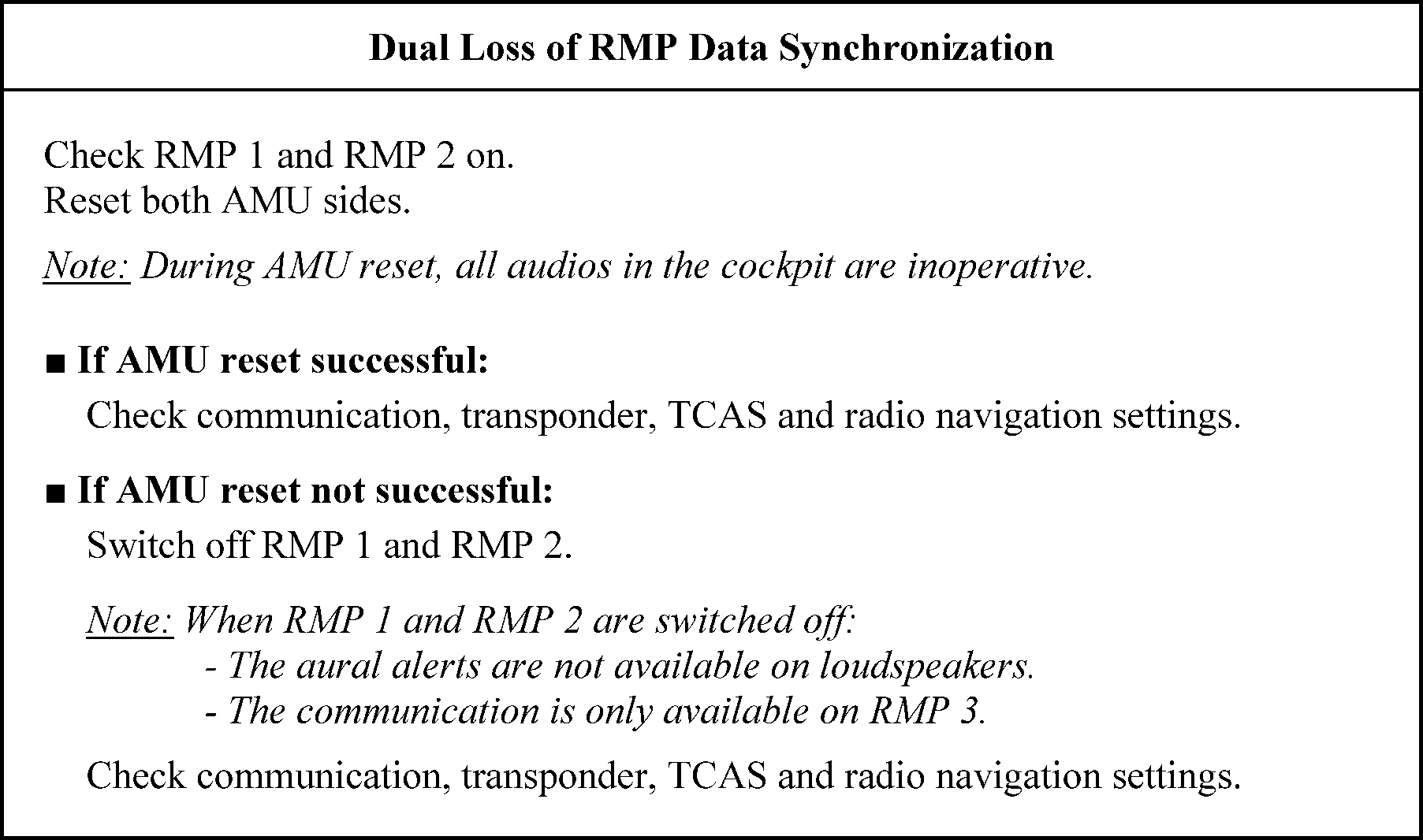
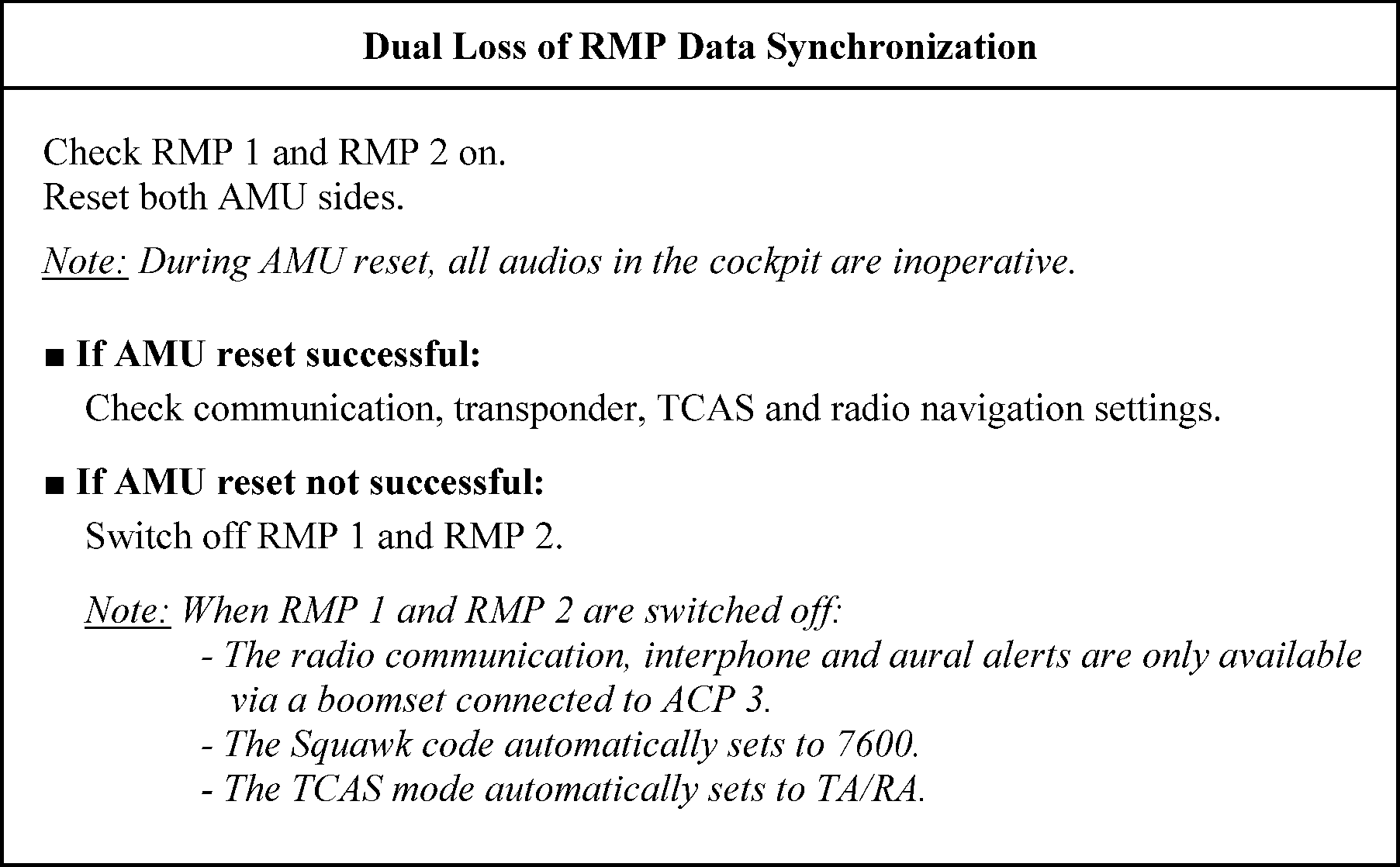
This paragraph restates the requirements of paragraph (g) of AD 2025-11-02, with a new terminating action. For Airbus SAS Model A319-151N, -153N, -171N, and -173N airplanes; Model A320-251N, -252N, -253N, -271N, -272N, and -273N airplanes; Model A321-251N, -251NX, -252N, -252NX, -253N, -253NX, -253NY, -271N, -271NX, -272N, and -272NX airplanes having Airbus modification 162344 or 168460, except for airplanes having Airbus modification 165670 installed in production: Within 7 days after June 11, 2025 (the effective date of AD 2025-11-02), revise the Emergency Procedures section of the existing AFM to include the information in figure 1 or figure 2 to paragraph (g) of this AD, as applicable. This may be done by inserting a copy of figure 1 or figure 2 to paragraph (g) of this AD, as applicable, into the existing AFM. Using a different document with information identical to that contained in figure 1 or figure 2 to paragraph (g) of this AD, as applicable, is acceptable for compliance with the requirements of this paragraph. Accomplishing the modification required by paragraph (j) of this AD terminates the requirements of this paragraph.
Figure 1 to Paragraph (g)—AFM Procedure for Airplanes With Airbus Modification 162344 and Modification 162367
Figure 2 to Paragraph (g)—AFM Procedure for Airplanes With Airbus Modification 162344 and Not Modification 162367
( printed page 18796)
(h) Retained Credit for Previous Actions, With No Change
This paragraph restates the requirements of paragraph (h) of AD 2025-11-02, with no change.
(1) This paragraph provides credit for the AFM revision required by paragraph (g) of this AD, if the revision was performed before June 11, 2025 (the effective date of AD 2025-11-02) using Airbus A318/A319/A320/A321 Operations Engineering Bulletin (OEB) 63, issue 1.0, dated February 7, 2025.
(2) This paragraph provides credit for the AFM revision required by paragraph (g) of this AD, if the revision was performed before June 11, 2025 (the effective date of this AD 2025-11-02) using Airbus A318/A319/A320/A321 Airplane Flight Manual Temporary Revision TR816, Issue 1, dated February 19, 2025; or Airbus A318/A319/A320/A321 Airplane Flight Manual Temporary Revision TR817, Issue 1, dated February 19, 2025, as applicable.
(i) New AFM Revision for Certain Airplanes
For Airbus SAS Model A321-271NY airplanes identified as Group 1 airplanes in European Union Aviation Safety Agency (EASA) AD 2025-0118R1, dated July 15, 2025 (EASA AD 2025-0118R1): Within 7 days after the effective date of this AD, revise the Emergency Procedures section of the existing AFM to include the information in figure 1 or figure 2 to paragraph (g) of this AD, as applicable. This may be done by inserting a copy of figure 1 or figure 2 to paragraph (g) of this AD, as applicable, into the existing AFM. Using a different document with information identical to that contained in figure 1 or figure 2 to paragraph (g) of this AD, as applicable, is acceptable for compliance with the requirements of this paragraph. Accomplishing the modification required by paragraph (j) of this AD terminates the requirements of this paragraph.
(j) New Requirements
Except as specified in paragraph (k) of this AD: Comply with all required actions and compliance times specified in, and in accordance with, EASA AD 2025-0118R1. Accomplishing the modification required by this paragraph terminates the requirements of paragraphs (g) and (i) of this AD, as applicable.
(k) Exceptions to EASA AD 2025-0118R1
(1) Where EASA AD 2025-0118R1 refers to June 4, 2025 (the effective date of EASA AD 2025-0118, dated May 21, 2025), this AD requires using the effective date of this AD.
(2) This AD does not adopt paragraphs (1) through (3) and paragraph (5) of EASA AD 2025-0118R1.
(3) This AD does not adopt the “Remarks” section of EASA AD 2025-0118R1.
(l) Additional AD Provisions
The following provisions also apply to this AD:
(1)
Alternative Methods of Compliance (AMOCs):
The Manager, AIR-520, Continued Operational Safety Branch, FAA, has the authority to approve AMOCs for this AD, if requested using the procedures found in 14 CFR 39.19. In accordance with 14 CFR 39.19, send your request to your principal inspector or responsible Flight Standards Office, as appropriate. If sending information directly to the manager of the Continued Operational Safety Branch, send it to the attention of the person identified in paragraph (m)(1) of this AD and email to:
AMOC@faa.gov.
(i) Before using any approved AMOC, notify your appropriate principal inspector, or lacking a principal inspector, the manager of the responsible Flight Standards Office.
(ii) AMOCs approved previously for AD 2025-11-02 are approved as AMOCs for the corresponding provisions of paragraph (g) of this AD.
(2)
Contacting the Manufacturer:
For any requirement in this AD to obtain instructions from a manufacturer, the instructions must be accomplished using a method approved by the Manager, AIR-520, Continued Operational Safety Branch, FAA; or EASA; or Airbus SAS's EASA Design Organization Approval (DOA). If approved by the DOA, the approval must include the DOA-authorized signature.
(3)
Required for Compliance (RC):
Except as required by paragraph (l)(2) of this AD, if any material contains procedures or tests that are identified as RC, those procedures and tests must be done to comply with this AD; any procedures or tests that are not identified as RC are recommended. Those procedures and tests that are not identified as RC may be deviated from using accepted methods in accordance with the operator's maintenance or inspection program without obtaining approval of an AMOC, provided the procedures and tests identified as RC can be done and the airplane can be put back in an airworthy condition. Any substitutions or changes to procedures or tests identified as RC require approval of an AMOC.
(m) Additional Information
(1) For more information about this AD, contact Frank Carreras, Aviation Safety Engineer, FAA, 2200 South 216th St., Des Moines, WA 98198; phone: 206-231-3539; email:
Frank.Carreras@faa.gov.
(2) For Airbus material identified in this AD that is not incorporated by reference, contact Airbus SAS, Airworthiness Office—EIAS, Rond-Point Emile Dewoitine No: 2, 31700 Blagnac Cedex, France; telephone +33 5 61 93 36 96; fax +33 5 61 93 44 51; email
( printed page 18797)
account.airworth-eas@airbus.com;
website
airbus.com.
(n) Material Incorporated by Reference
(1) The Director of the Federal Register approved the incorporation by reference of the material listed in this paragraph under 5 U.S.C. 552(a) and 1 CFR part 51.
(2) You must use this material as applicable to do the actions required by this AD, unless this AD specifies otherwise.
(i) European Union Aviation Safety Agency (EASA) AD 2025-0118R1, dated July 15, 2025.
(ii) [Reserved]
(3) For EASA material identified in this AD, contact EASA, Konrad-Adenauer-Ufer 3, 50668 Cologne, Germany; telephone +49 221 8999 000; email
ADs@easa.europa.eu.
You may find this material on the EASA website at
ad.easa.europa.eu.
(4) You may view this material at the FAA, Airworthiness Products Section, Operational Safety Branch, 2200 South 216th St., Des Moines, WA. For information on the availability of this material at the FAA, call 206-231-3195.
Use this for formal legal and research references to the published document.
91 FR 18792
Web Citation
Suggested Web Citation
Use this when citing the archival web version of the document.
“Airworthiness Directives; Airbus SAS Airplanes,” thefederalregister.org (April 13, 2026), https://thefederalregister.org/documents/2026-07052/airworthiness-directives-airbus-sas-airplanes.