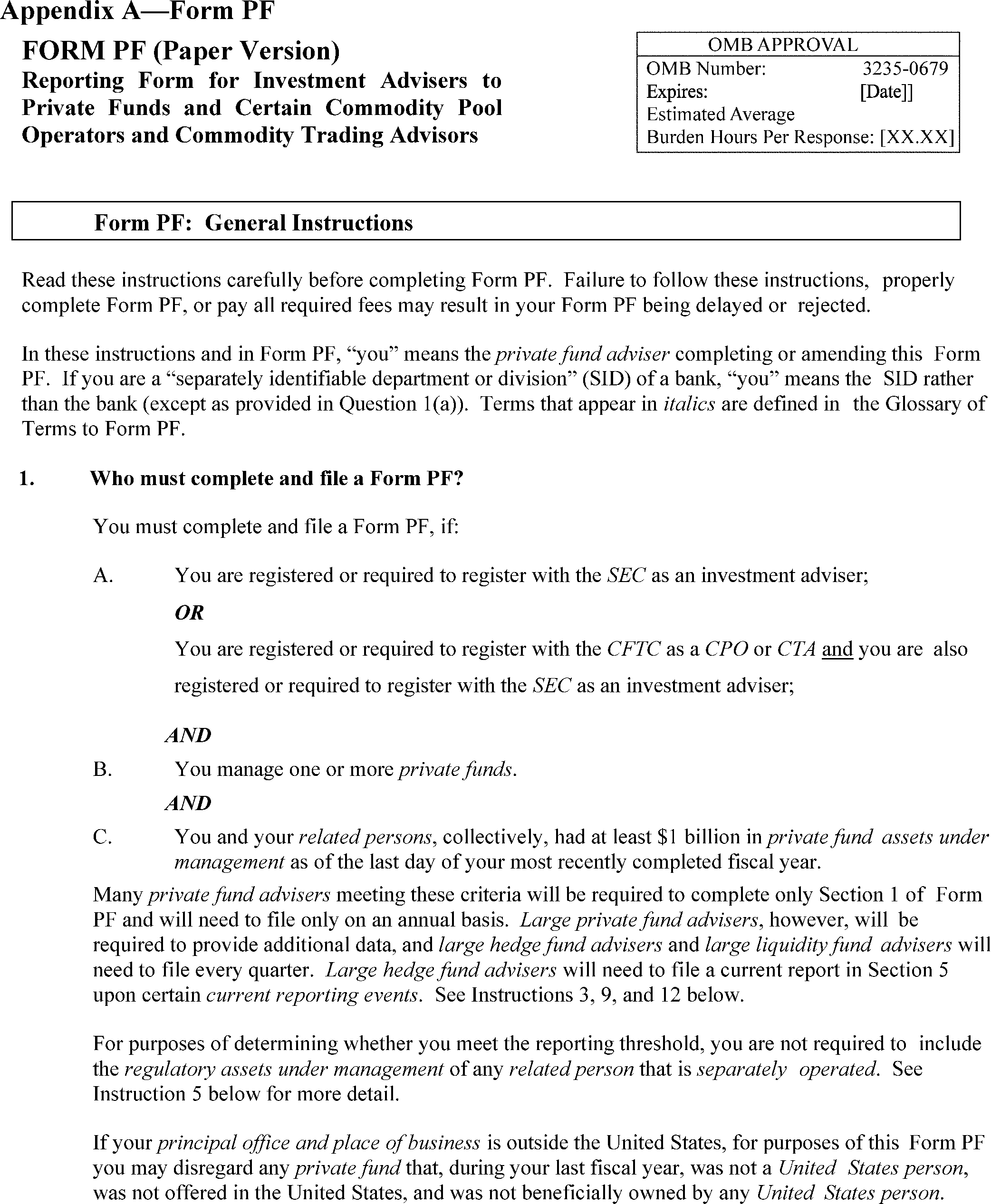
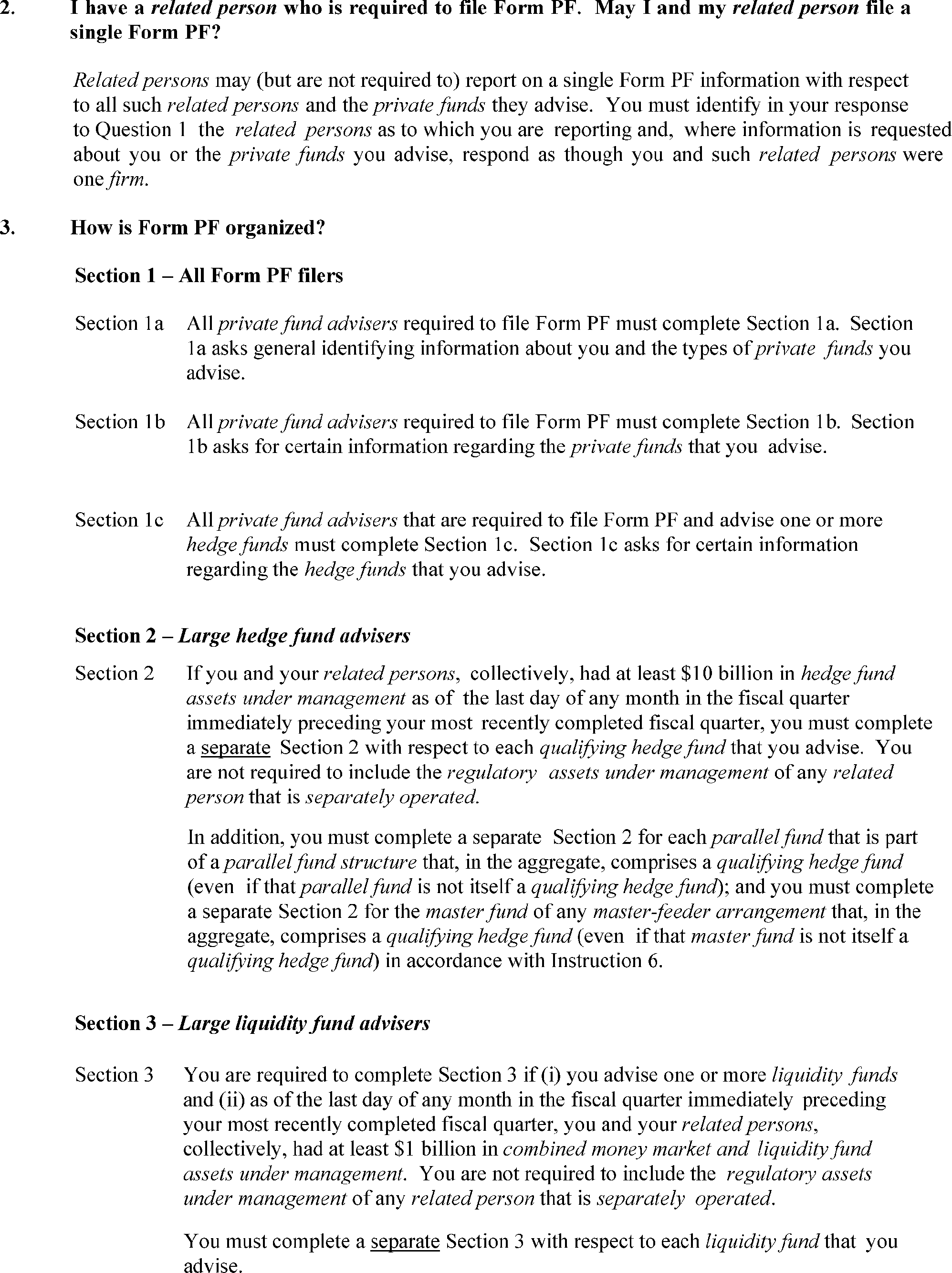
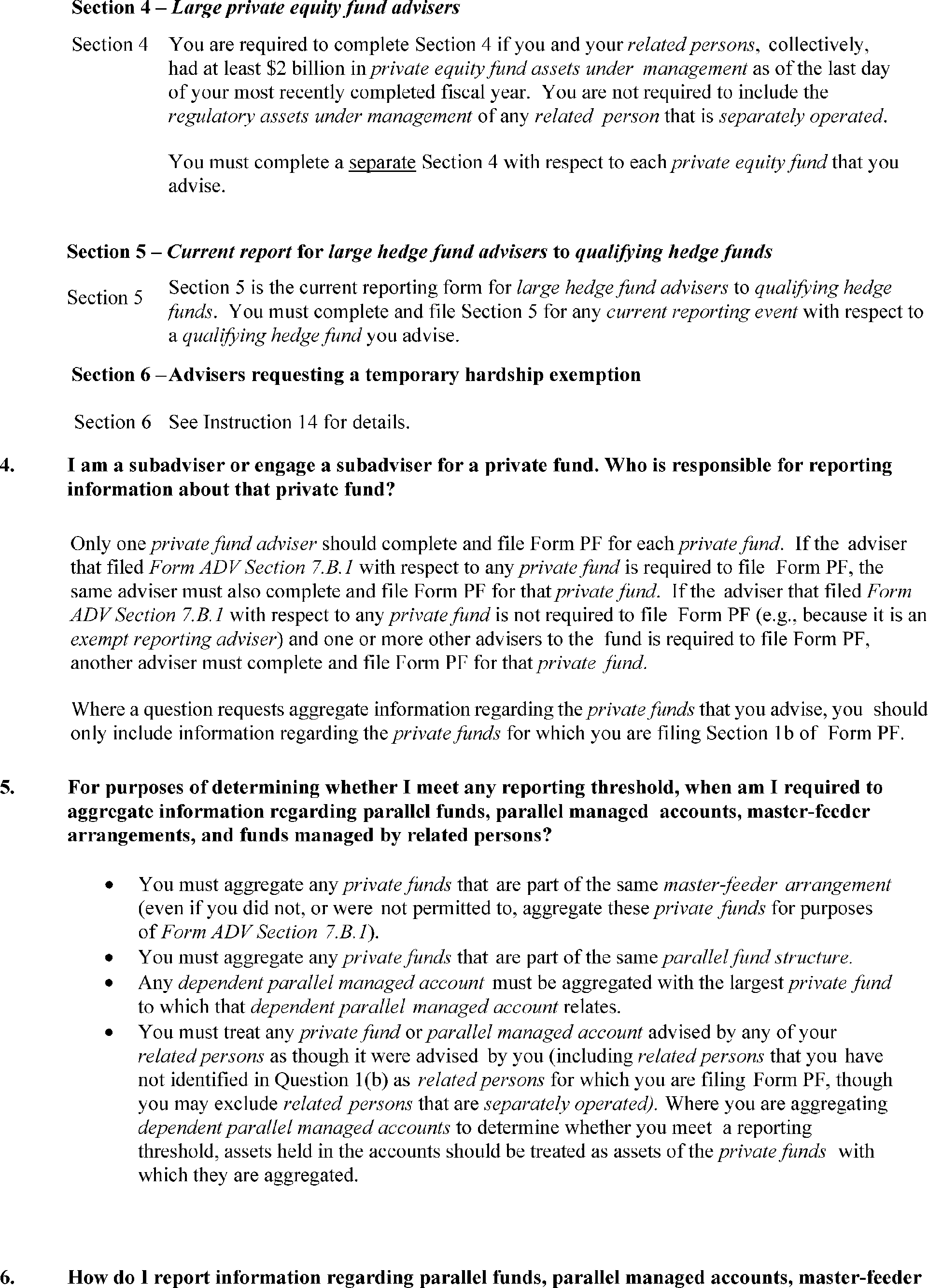
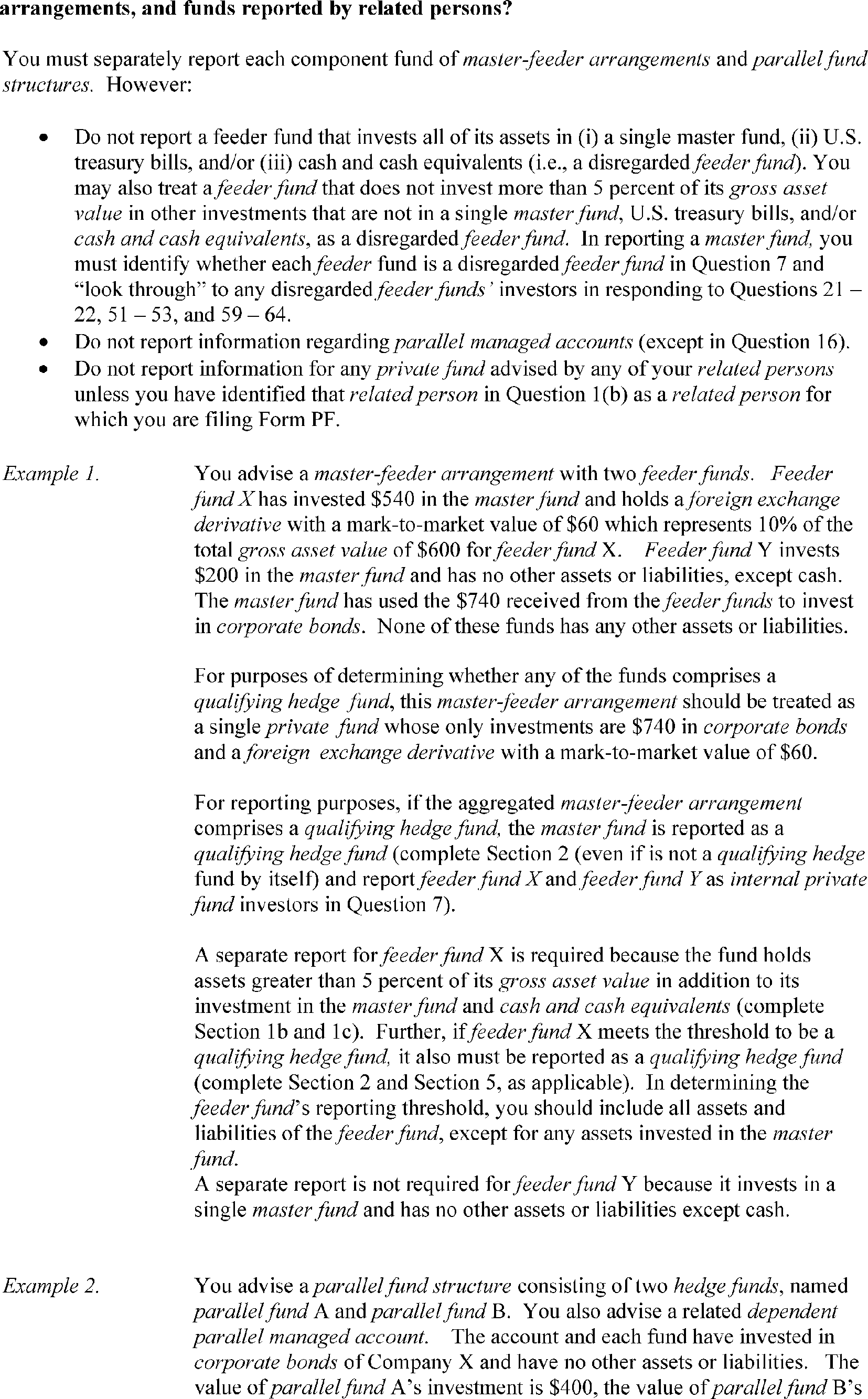
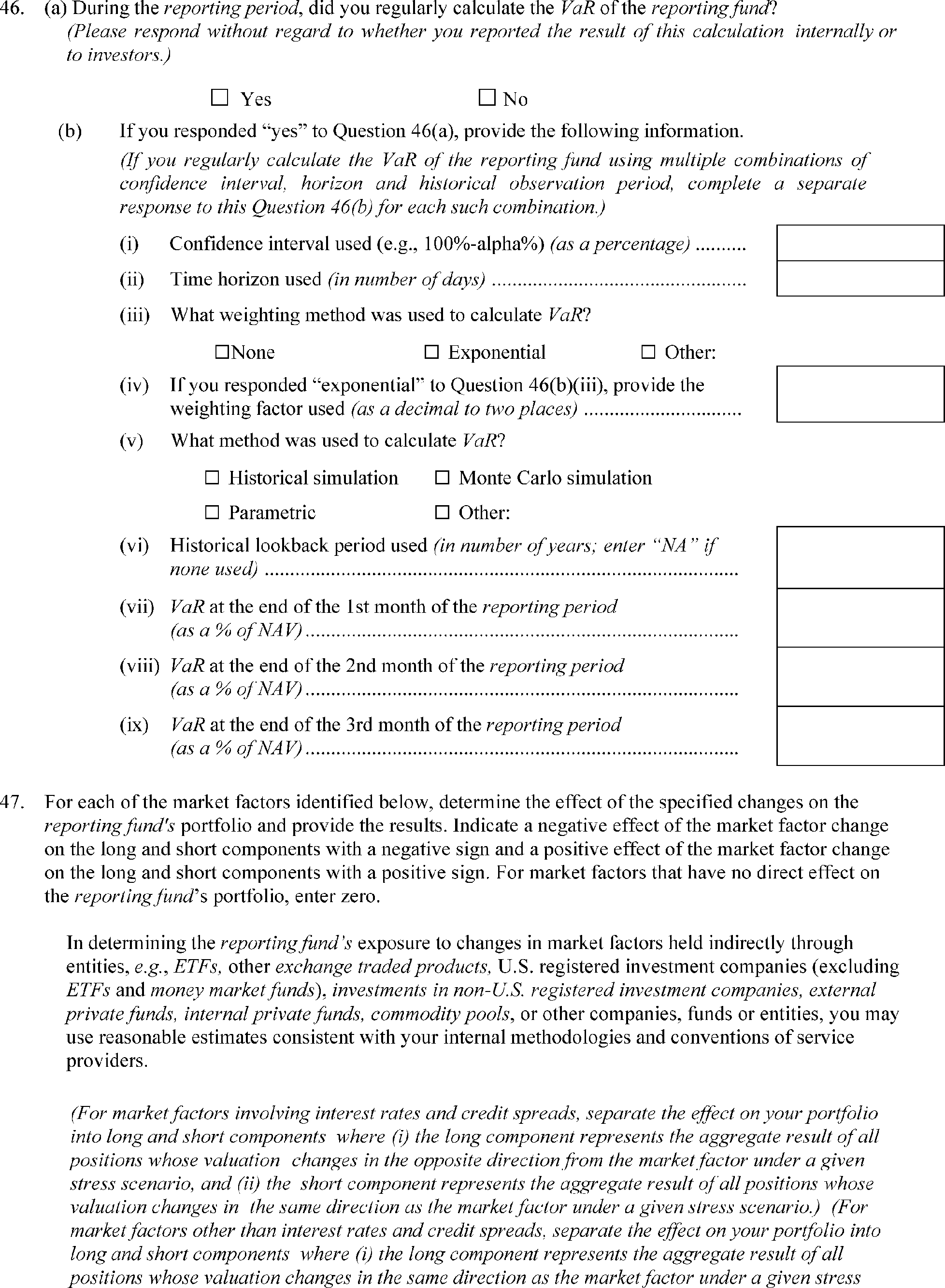
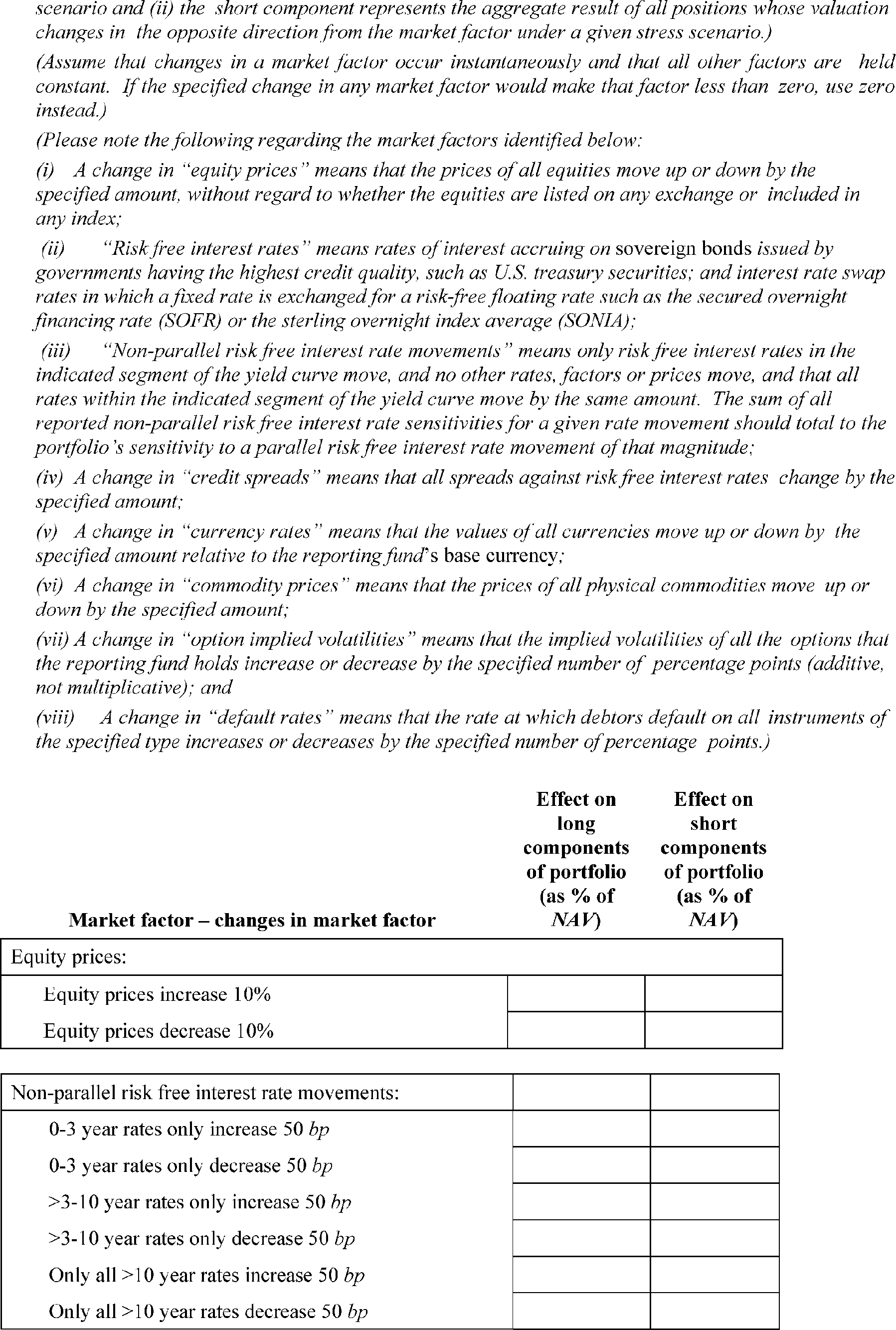
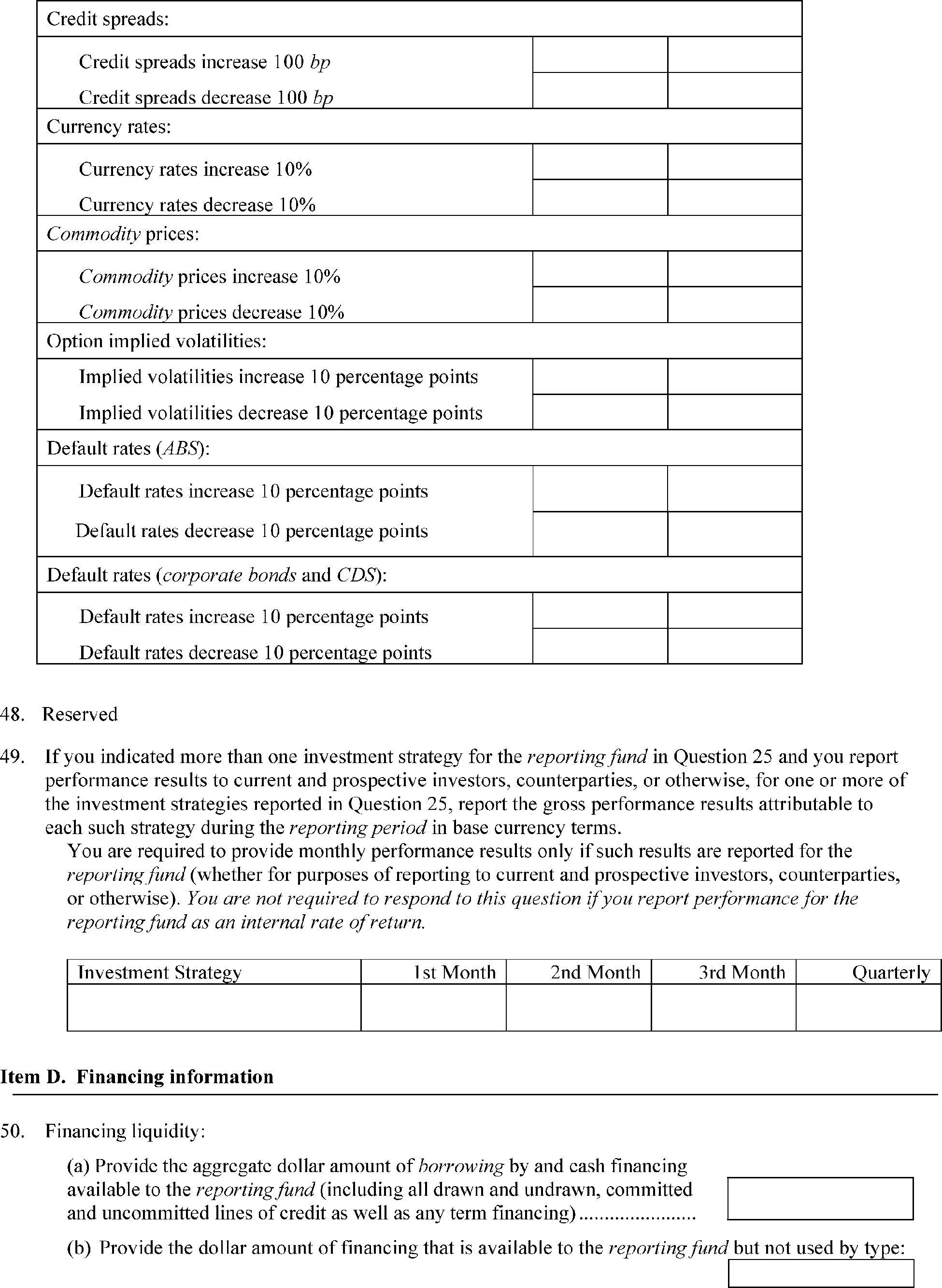
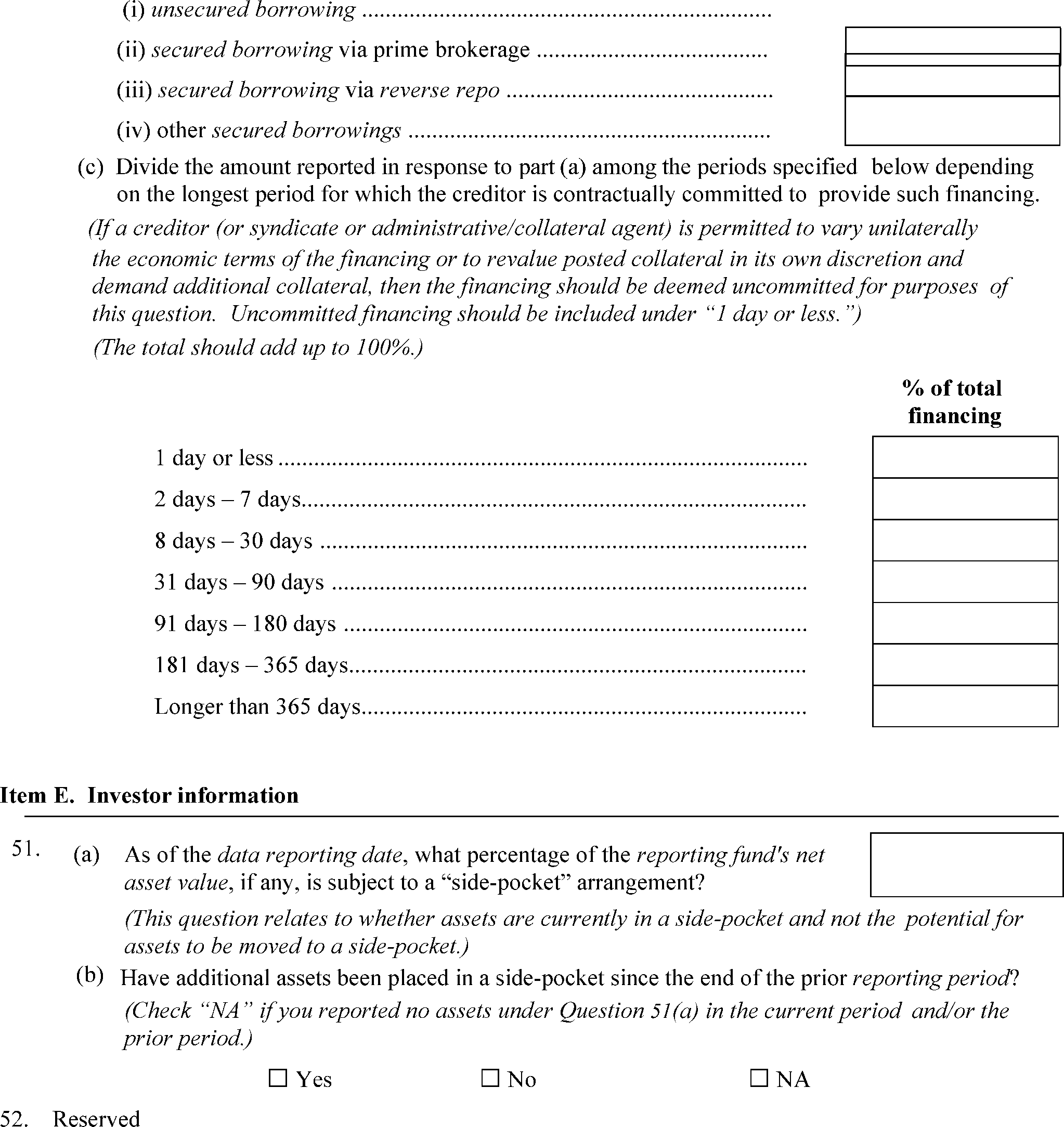
The Commodity Futures Trading Commission (the "CFTC") and the Securities and Exchange Commission (the "SEC") (collectively, "we" or the "Commissions") are proposing to amend For...
Commodity Futures Trading Commission and Securities and Exchange Commission.
ACTION:
Joint proposed rules.
SUMMARY:
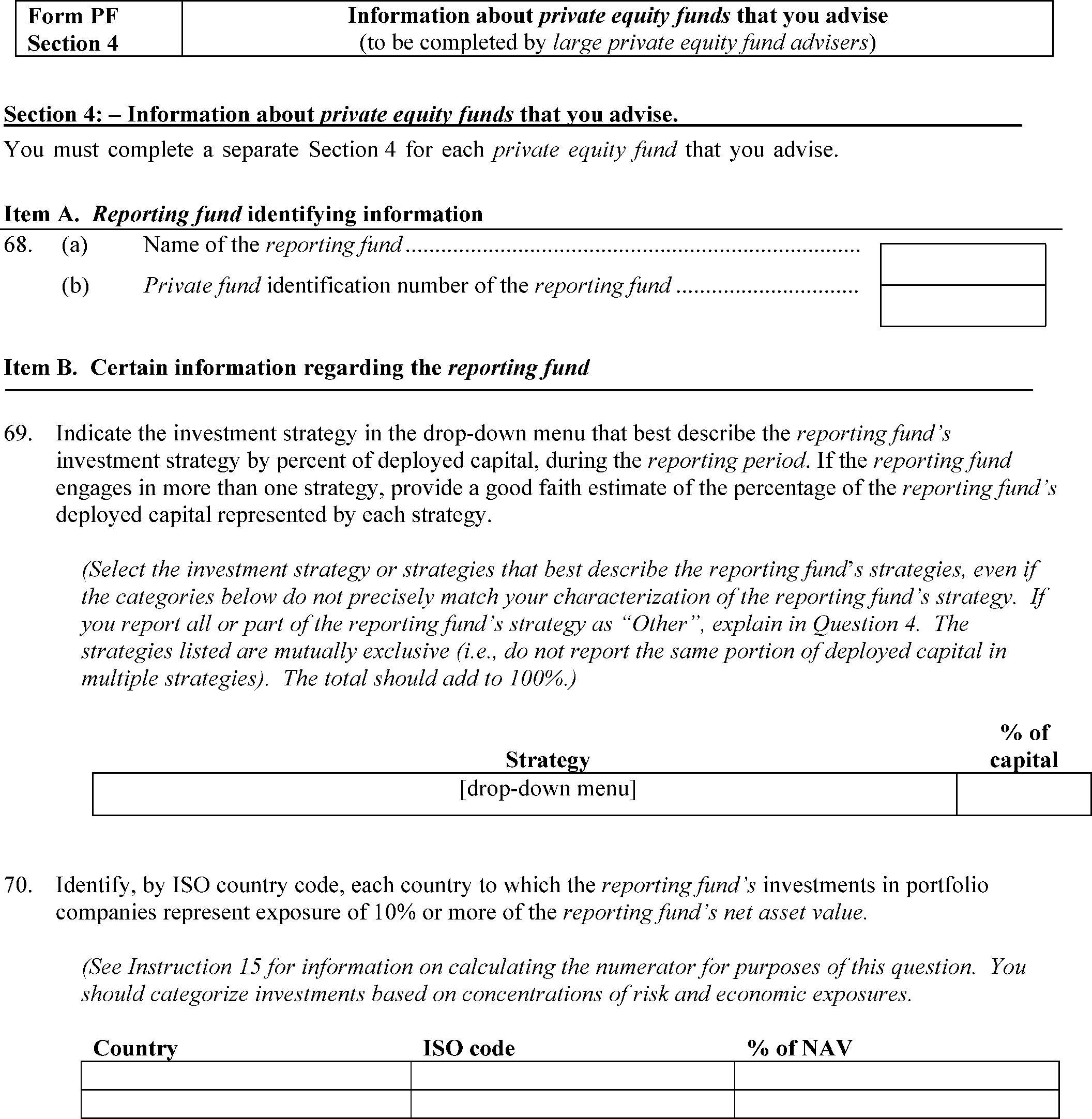
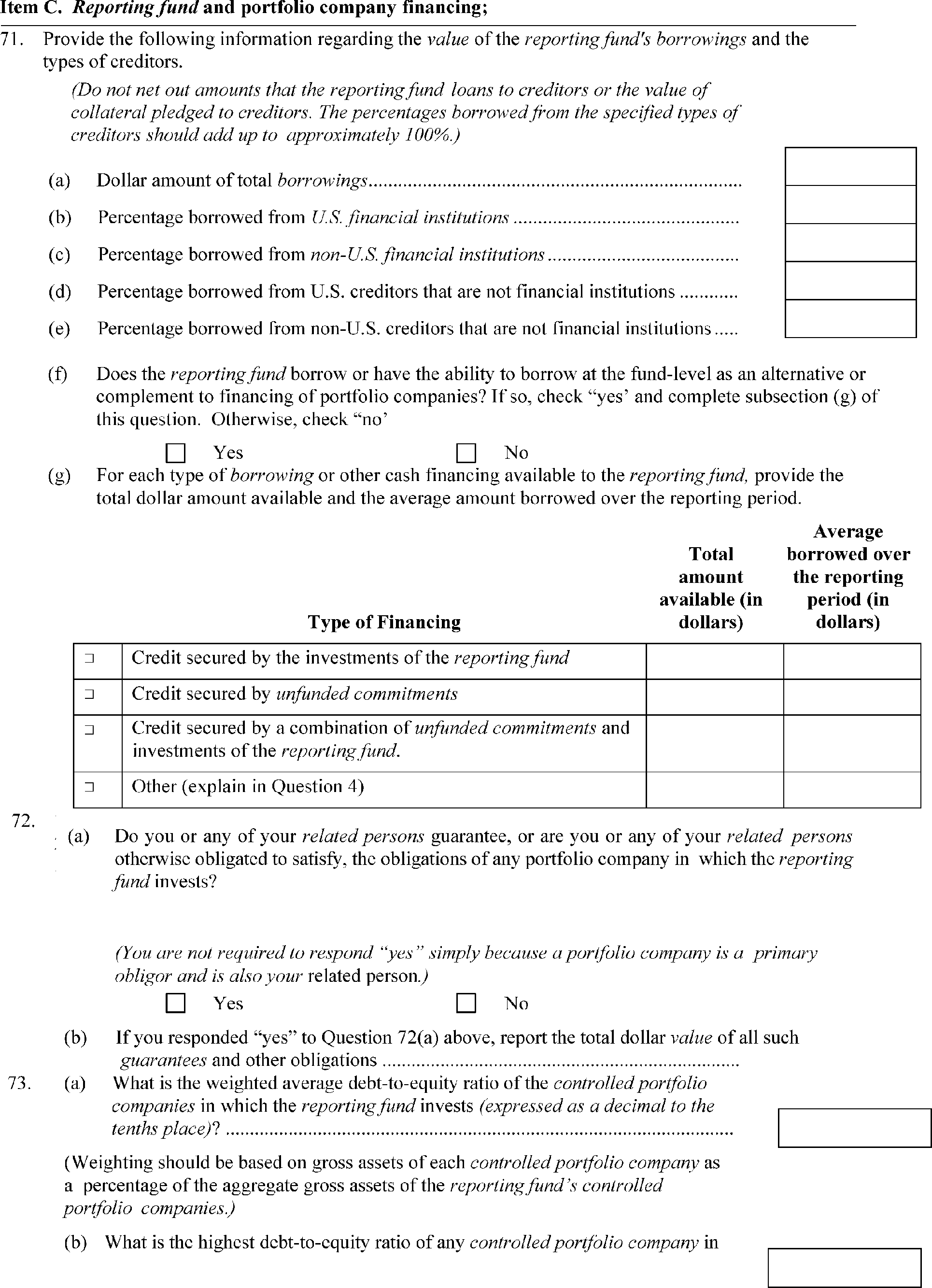
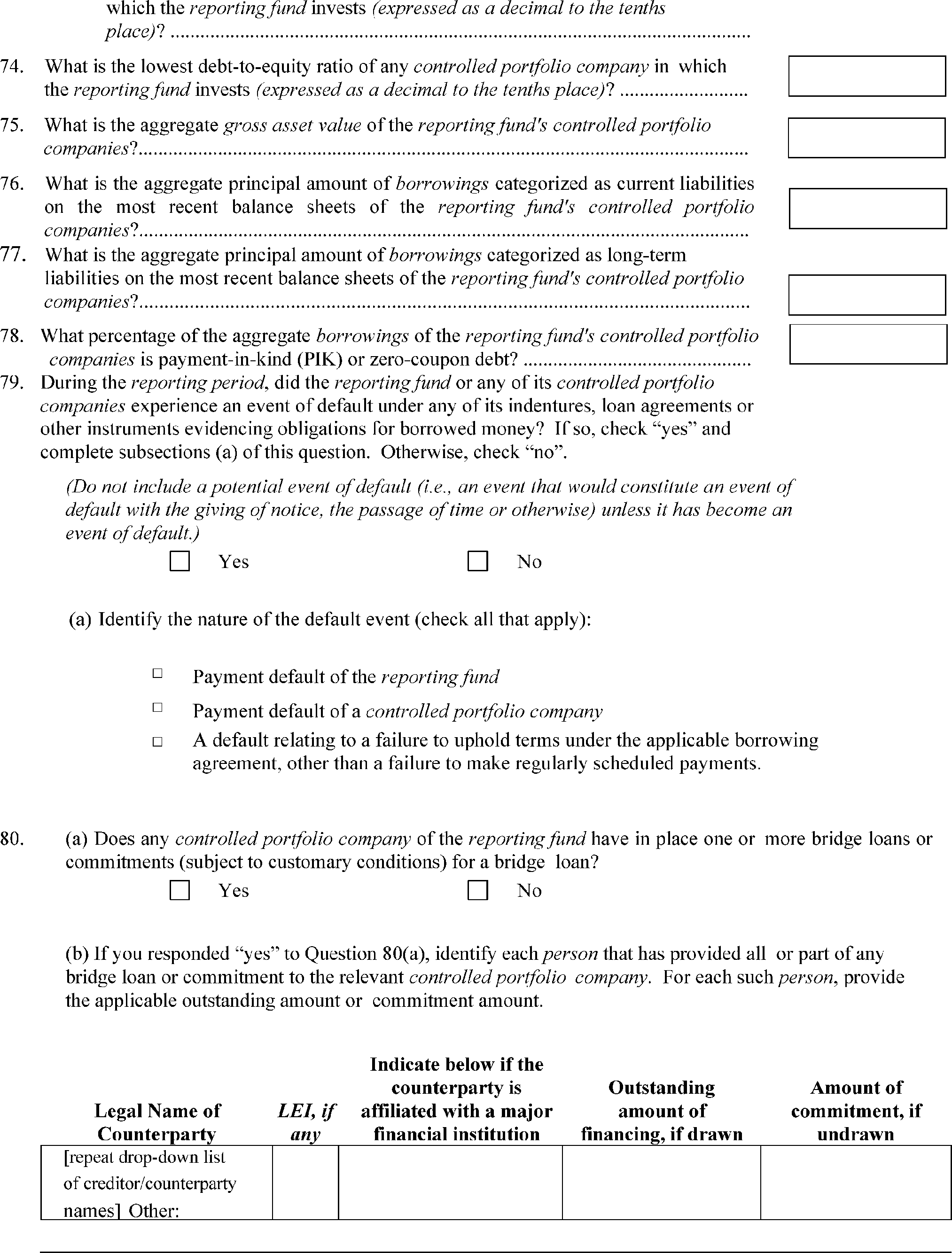
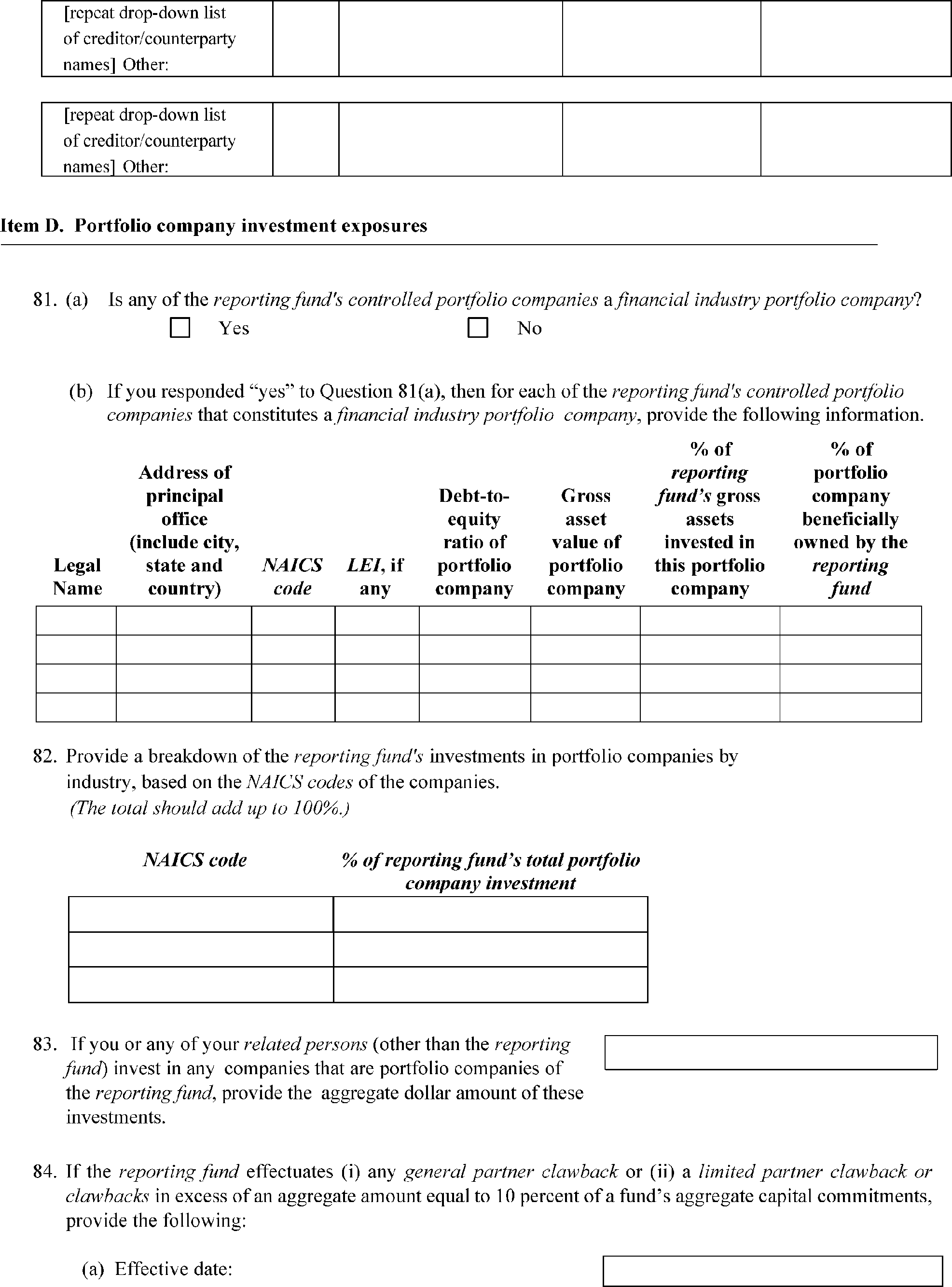
The Commodity Futures Trading Commission (the “CFTC”) and the Securities and Exchange Commission (the “SEC”) (collectively, “we” or the “Commissions”) are proposing to amend Form PF, the confidential reporting form for certain SEC-registered investment advisers to private funds, including those that also are registered with the CFTC as a commodity pool operator (a “CPO”) or a commodity trading advisor (a “CTA”). The proposed amendments would eliminate certain filing and reporting obligations, streamline certain requirements, and make corrections and other revisions. The proposed amendments are designed to eliminate certain burdens, among other things.
DATES:
This proposal was published in the
Federal Register
on April 24, 2026. Comments should be received on or before June 23, 2026.
ADDRESSES:
Comments may be submitted by any of the following methods.
CFTC:
Comments may be submitted to the CFTC by any of the following methods.
CFTC Comments Portal: https://comments.cftc.gov.
Follow the instructions for submitting comments through the website.
Mail:
Christopher Kirkpatrick, Secretary of the Commission, Commodity Futures Trading Commission, Three Lafayette Centre, 1155 21st Street NW, Washington, DC 20581.
Hand Delivery/Courier:
Follow the same instructions as for Mail above.
Please submit your comments using only one method. To avoid possible delays with mail or in-person deliveries, submissions through the CFTC website are encouraged. “Form PF” must be in the subject field of comments submitted via email, and clearly indicated on written submissions. All comments must be submitted in English, or if not, accompanied by an English translation. Comments will be posted as received to
www.cftc.gov.
You should submit only information that you wish to make available publicly. If you wish the CFTC to consider information that may be exempt from disclosure under the Freedom of Information Act, a petition for confidential treatment of the exempt information may be submitted according to the established procedures in 17 CFR 145.9.
The CFTC reserves the right, but shall have no obligation, to review, prescreen, filter, redact, refuse, or remove any or all of your submission from
www.cftc.gov
that it may deem to be inappropriate for publication, including, but not limited to, obscene language. All submissions that have been redacted or removed that contain comments on the merits of the rulemaking will be retained in the public comment file and will be considered as required under the Administrative Procedure Act and other applicable laws, and may be accessible under the Freedom of Information Act, 5 U.S.C. 552,
et seq.
(“FOIA”).
SEC:
Comments may be submitted by any of the following methods:
Send an email torule-comments@sec.gov.
Please include File Number S7-2026-13 on the subject line.
Paper Comments
Send paper comments to Secretary, Securities and Exchange Commission, 100 F Street NE, Washington, DC 20549-1090.
All submissions should refer to File Number S7-2026-13. This file number should be included on the subject line if email is used. To help the Commission process and review your comments more efficiently, please use only one method of submission. The Commission will post all comments on the Commission's website (
https://www.sec.gov/rules-regulations/rulemaking-activity). Do not include personal identifiable information in submissions; you should submit only information that you wish to make available publicly. We may redact in part or withhold entirely from publication submitted material that is obscene or subject to copyright protection.
Studies, memoranda, or other substantive items may be added by the Commission or staff to the comment file during this rulemaking. A notification of the inclusion in the comment file of any such materials will be made available on the Commission's website. To ensure direct electronic receipt of such notifications, sign up through the “Stay Connected” option at
www.sec.gov
to receive notifications by email.
CFTC:
Michael Ehrstein or Elizabeth Groover, Special Counsels, at (202) 418-6700, Commodity Futures Trading Commission, Three Lafayette Centre, 1155 21st Street NW, Washington, DC 20581.
SEC:
Alexis Palascak, Janet Jun, and Daniel Levine, Senior Counsels; Adele Kittredge Murray, Private Funds Attorney Fellow; or Robert Holowka, Acting Assistant Director, Investment Adviser Regulation Office, at (202) 551-6787, Division of Investment Management, Securities and Exchange Commission, 100 F Street NE, Washington, DC 20549-8549.
SUPPLEMENTARY INFORMATION:
The CFTC and SEC are requesting public comment on the following under the Investment Advisers Act of 1940 [15 U.S.C. 80b] (“Advisers Act”).[1]
A. Increase the Filing Threshold for All Form PF Filers
B. Increase the Reporting Threshold for Large Hedge Fund Advisers
C. Disregarded Feeder Funds
D. Eliminate the Look Through Requirement
E. Trading Vehicles
F. Eliminate Form PF Question 23(c) Volatility Reporting
G. Eliminate Certain Trading and Clearing Reporting
( printed page 22233)
H. Eliminate Form PF Question 32(b)(2) Adjusted Exposure Reporting Based on Internal Methodology
I. Eliminate Form PF Question 34 Monthly Asset Turnover Reporting
J. Simplify Industry Concentration Reporting in Form PF Question 36
K. Eliminate Certain Questions Concerning Qualifying Hedge Funds' Exposures to Reference Assets
L. Simplify Large Hedge Fund Adviser Counterparty Exposure Reporting
M. Eliminate Rehypothecation Reporting
N. Amendments to Large Hedge Fund Adviser Current Reporting
1. Modify the Current Reporting Filing Deadline
2. Eliminate Current Reporting for Notice of Margin Default or Determination of Inability To Meet a Call for Margin, Collateral or Equivalents
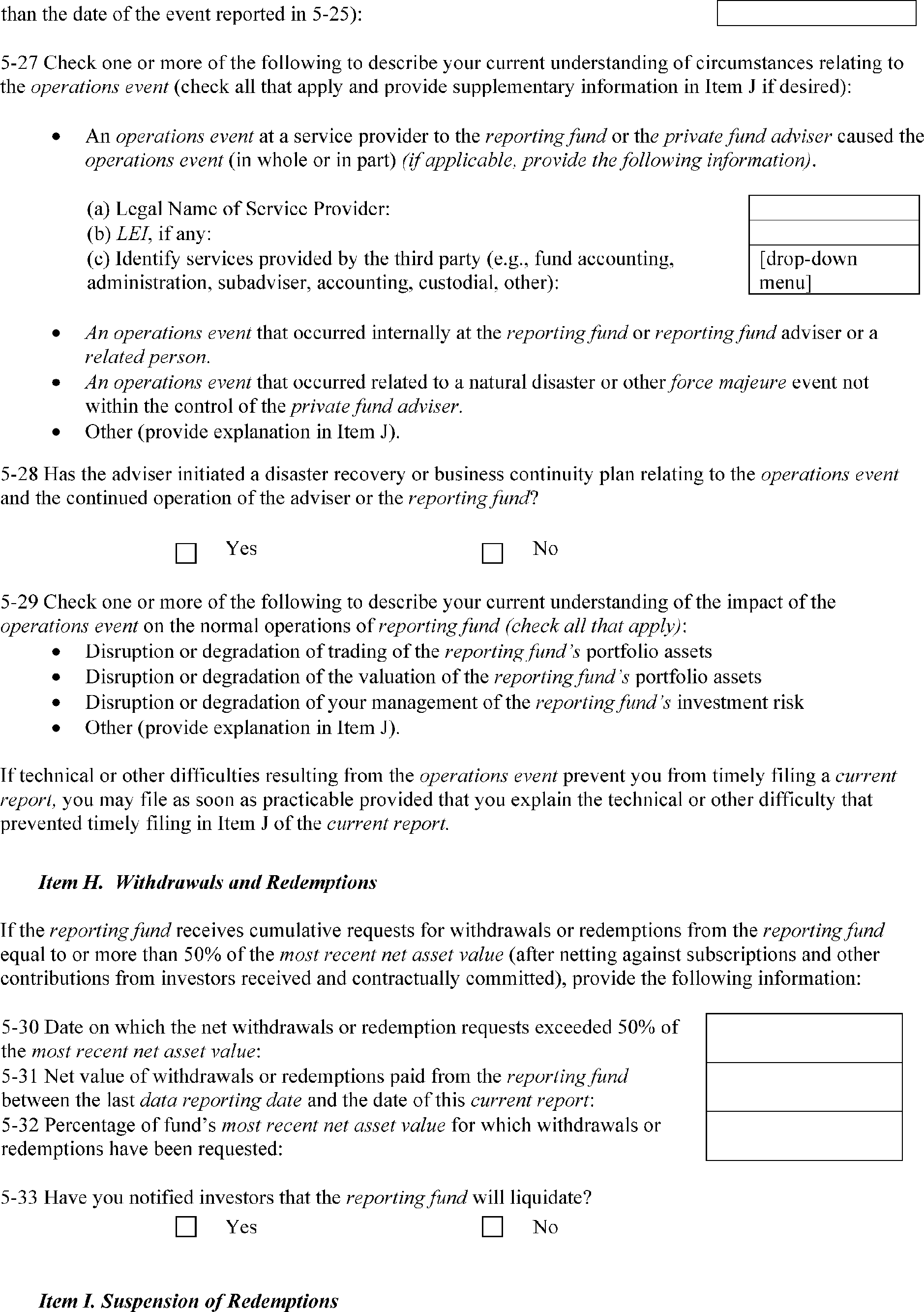
3. Streamline Reporting of “Operations Events”
4. Eliminate Current Reporting for Inability To Satisfy Redemption Requests
O. Eliminate Form PF Private Equity Quarterly Reporting in Section 6
P. Other Corrections and Revisions
Q. Request for Comments on Private Credit Reporting
R. Proposed Transition Period
III. Economic Analysis
A. Introduction
B. Baseline
1. Regulatory Baseline
2. Affected Parties
C. Benefits and Costs
1. General Considerations
2. Increase the Filing Threshold for All Form PF Filers
3. Increase the Reporting Threshold for Large Hedge Fund Advisers
4. Disregarded Feeder Funds
5. Eliminate the Look Through Requirement
6. Trading Vehicles
7. Eliminate Form PF Question 23(c) Volatility Reporting
8. Eliminate Certain Trading and Clearing Reporting
9. Eliminate Form PF Question 32(b)(2) Adjusted Exposure Netting Based on Internal Methodologies
10. Eliminate Form PF Question 34 Monthly Asset Turnover Reporting
11. Simplify Industry Concentration Reporting in Form PF Question 36
12. Eliminate Certain Questions Concerning Qualifying Hedge Funds' Exposures To Reference Assets
13. Simplify Large Hedge Fund Adviser Counterparty Exposure Reporting
14. Eliminate Rehypothecation Reporting
15. Amendments to Large Hedge Fund Adviser Current Reporting
16. Eliminate Form PF Private Equity Quarterly Reporting in Section 6
17. Other Corrections and Revisions
18. Quantification of Benefits
D. Present Values and Annualized Values of Monetized Benefits and Costs
E. Effects on Efficiency, Competition, and Capital Formation
F. Reasonable Alternatives
1. Filing Threshold
2. Reporting Threshold for Large Hedge Fund Advisers
3. Disregarded Feeder Fund
4. Industry Concentration Reporting
5. Hedge Fund Adviser Counterparty Exposure Reporting
6. Private Equity Quarterly Event Reporting
7. Private Credit Reporting
G. Request for Comment
IV. Paperwork Reduction Act
A. Form PF
1. Purpose and Use of the Information Collection
2. Confidentiality
3. Burden Estimates
B. Request for Comments
V. Regulatory Flexibility Act Certification
VI. Congressional Review Act
VII. Other Matters
VIII. Statutory Authority
I. Introduction
The Commissions are proposing to amend Form PF, the confidential reporting form that certain SEC-registered investment advisers, including those that also are registered with the CFTC as a CPO or a CTA, use to report information about the private funds they advise.[2]
Form PF is a joint form between the SEC and the CFTC with regard to sections 1 and 2. Sections 3, 4, 5 and 6 were adopted solely by the SEC. For this proposal, the SEC and the CFTC are jointly amending the joint sections of the form and the SEC is amending the SEC-only sections of the form. The proposed amendments would eliminate filing obligations for certain advisers, eliminate and streamline certain reporting requirements, and make corrections as well as other revisions. The proposed amendments are designed to eliminate certain burdens, among other things, while ensuring Form PF continues to collect information necessary and appropriate in the public interest and for the protection of investors, or for the assessment of systemic risk in the U.S. financial system by the Financial Stability Oversight Council (“FSOC”).[3]
In 2010, the Dodd-Frank Wall Street Reform and Consumer Protection Act of 2010 (the “Dodd-Frank Act”) mandated that the SEC and the CFTC, after consultation with FSOC, jointly promulgate rules to establish the form and content of private fund reports required to be filed with the SEC under the Advisers Act, and with the CFTC by investment advisers that are registered both under the Advisers Act and the Commodity Exchange Act.[4]
The Advisers Act further mandates that an adviser must maintain records and reports for each private fund it advises, that include a description of the following: (1) the amount of assets under management and use of leverage, including off-balance-sheet leverage; (2) counterparty credit risk exposure; (3) trading and investment positions; (4) valuation policies and practices of the fund; (5) types of assets held; (6) side arrangements or side letters, whereby certain investors in a fund obtain more favorable rights or entitlements than other investors; (7) trading practices; and (8) such other information as the SEC, in consultation with FSOC, determines is necessary and appropriate in the public interest and for the protection of investors or for the assessment of systemic risk, which may include the establishment of different reporting requirements for different classes of fund advisers, based on the type or size of private fund being advised.[5]
In response to these mandates, the Commissions adopted Form PF in 2011 and have amended Form PF multiple times, including substantively in 2023 and 2024.[6]
In 2023, among other things, the SEC added requirements for (1) large hedge fund advisers to submit current reports about certain events at their qualifying hedge funds, and (2) private equity fund advisers to submit certain quarterly reports.[7]
In 2024, the Commissions comprehensively amended Form PF (the “2024 amendments”), but delayed the compliance date several times, including most recently until October 1, 2026.[8]
As a result, advisers have been
( printed page 22234)
allowed to continue to file the version of Form PF in effect before the adoption of the 2024 amendments. The Commissions delayed the compliance date to (1) address certain challenges associated with the reporting cycle timing, (2) provide the industry more time to comply with the 2024 amendments, and (3) provide the Commissions time to complete a review in accordance with a Presidential Memorandum issued by President Donald J. Trump.[9]
Specifically, on January 20, 2025, the President issued a Presidential Memorandum directing agencies to consider postponing the effective date of any rules that had been published in the
Federal Register
, or that were issued but had not yet taken effect, for the purpose of reviewing any questions of fact, law, and policy that the rules may raise. The Presidential Memorandum further provides that, for those rules that raise substantial questions of fact, law, or policy, agencies should provide notice and take further appropriate action.
In accordance with the Presidential Memorandum, the Commissions determined to conduct a comprehensive review that extended to the entire form. As a result of this comprehensive review, we are proposing several changes to Form PF that are designed to eliminate certain burdens, streamline certain requirements, and make corrections, as well as other revisions:
First, we propose to eliminate filing requirements for smaller advisers, irrespective of the categories of private funds they advise. Specifically, we propose to raise the filing threshold for all filers, from $150 million in private fund assets under management to $1 billion.[10]
We estimate that this proposed change would eliminate filing obligations for almost half of the advisers that currently must file Form PF.[11]
We further estimate that with this proposed filing threshold, Form PF would continue to obtain information on over 90 percent of private fund gross asset value that advisers report.[12]
Therefore, this proposed change is designed to eliminate filing burdens for smaller advisers, while continuing to collect data on a significant percentage of private fund assets.
Second, we propose to eliminate certain reporting requirements for smaller hedge fund advisers. Specifically, we propose to raise the reporting threshold for large hedge fund advisers from $1.5 billion in hedge fund assets under management to $10 billion.[13]
We estimate that this proposed change would eliminate certain reporting obligations for almost two-thirds of advisers that currently must report as large hedge fund advisers.[14]
We estimate that with this proposed reporting threshold, Form PF would continue to obtain information quarterly on over 80 percent of hedge fund gross asset value that advisers report.[15]
Therefore, this proposed change is designed to eliminate certain reporting burdens for smaller hedge fund advisers, while continuing to obtain information on a substantial portion of the assets of the hedge fund industry.
Third, we propose to eliminate certain requirements, including quarterly event reporting, certain current reporting, and other requirements, as well as streamline certain requirements, and make corrections and other revisions.
Table 1a summarizes the proposed changes to the filing threshold for all Form PF filers and the reporting threshold for large hedge fund advisers:
Table 1
a
—Proposal To Increase Certain Thresholds
Eliminate filing requirements for smaller advisers
We propose to increase the filing threshold for all filers from $150 million in private fund assets under management to $1 billion. (Rule 204(b)-1(a) and General Instruction 1.)
Eliminate certain reporting requirements for smaller hedge fund advisers
We propose to increase the reporting threshold for large hedge fund advisers from $1.5 billion in hedge fund assets under management to $10 billion. (General Instruction 3.)
Table 1b summarizes the proposed changes to the reporting obligations:
Table 1
b
—Proposed Changes To Reporting Obligations
Eliminate separate reporting for certain feeder funds
Currently, filers must separately report each component fund of master-feeder arrangements and parallel fund structures, except under certain limited circumstances.
We propose to eliminate this separate reporting requirement for any feeder fund that has
de minimis
holdings outside a single master fund, U.S. treasury bills, and/or cash and cash equivalents. (General Instruction 6.)
Eliminate “look through” requirements
Currently, Form PF provides instructions for where a filer should “look through” a reporting fund's investments in other private funds and entities.
We propose to eliminate the prescriptive “look through” requirements and allow filers to report indirect exposures based on reasonable estimates that are consistent with their internal methodologies and the conventions of service providers. (General Instructions 7 and 8, and conforming amendments to certain questions and asset classes in the Glossary of Terms.)
Eliminate identification requirements for certain trading vehicles
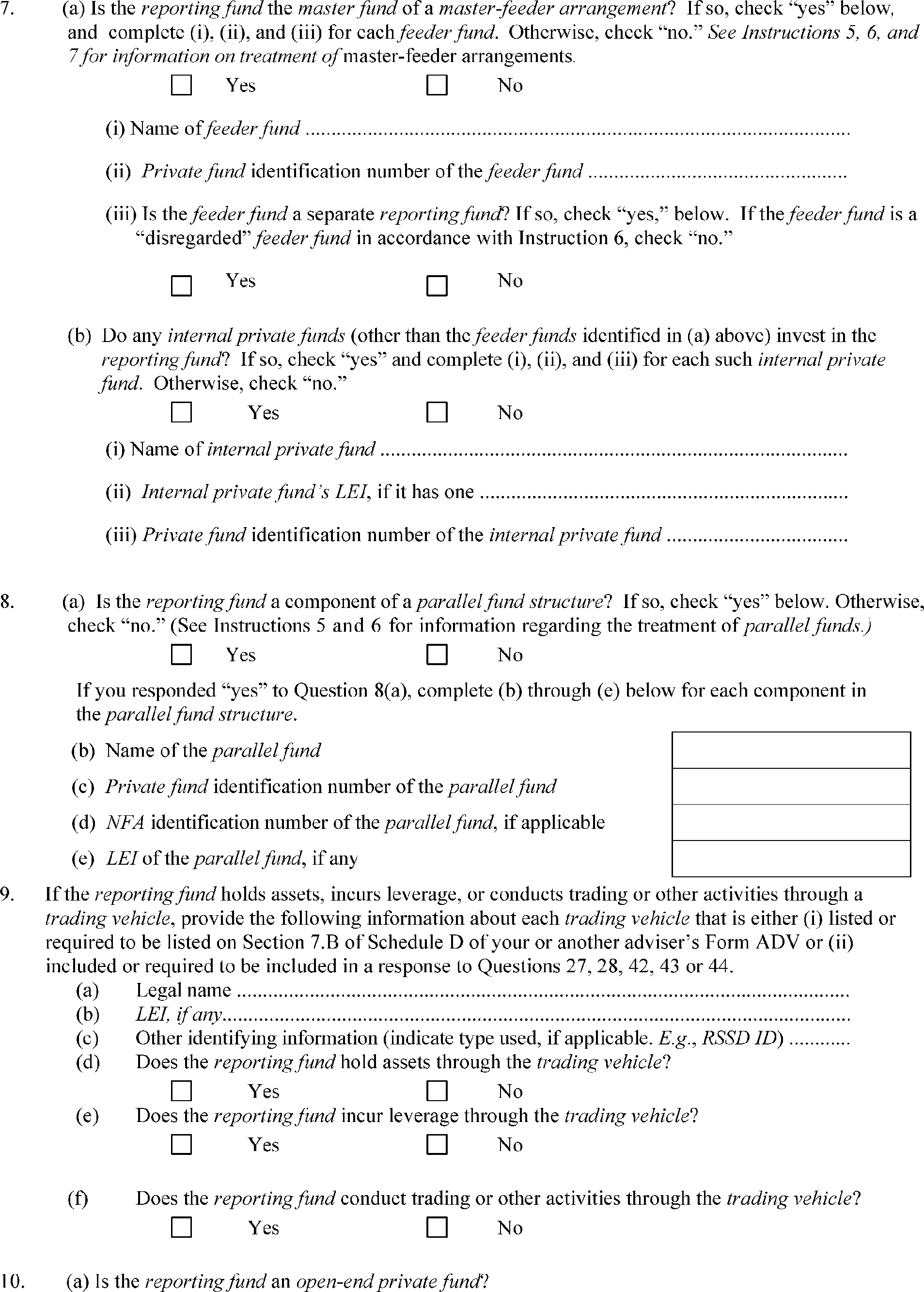
Currently, if a reporting fund holds assets, incurs leverage, or conducts trading or other activities through a trading vehicle, the adviser must provide identifying information about each such trading vehicle.
We propose to narrow the universe of trading vehicles that advisers must identify. (Question 9.)
( printed page 22235)
Eliminate certain performance volatility reporting requirements
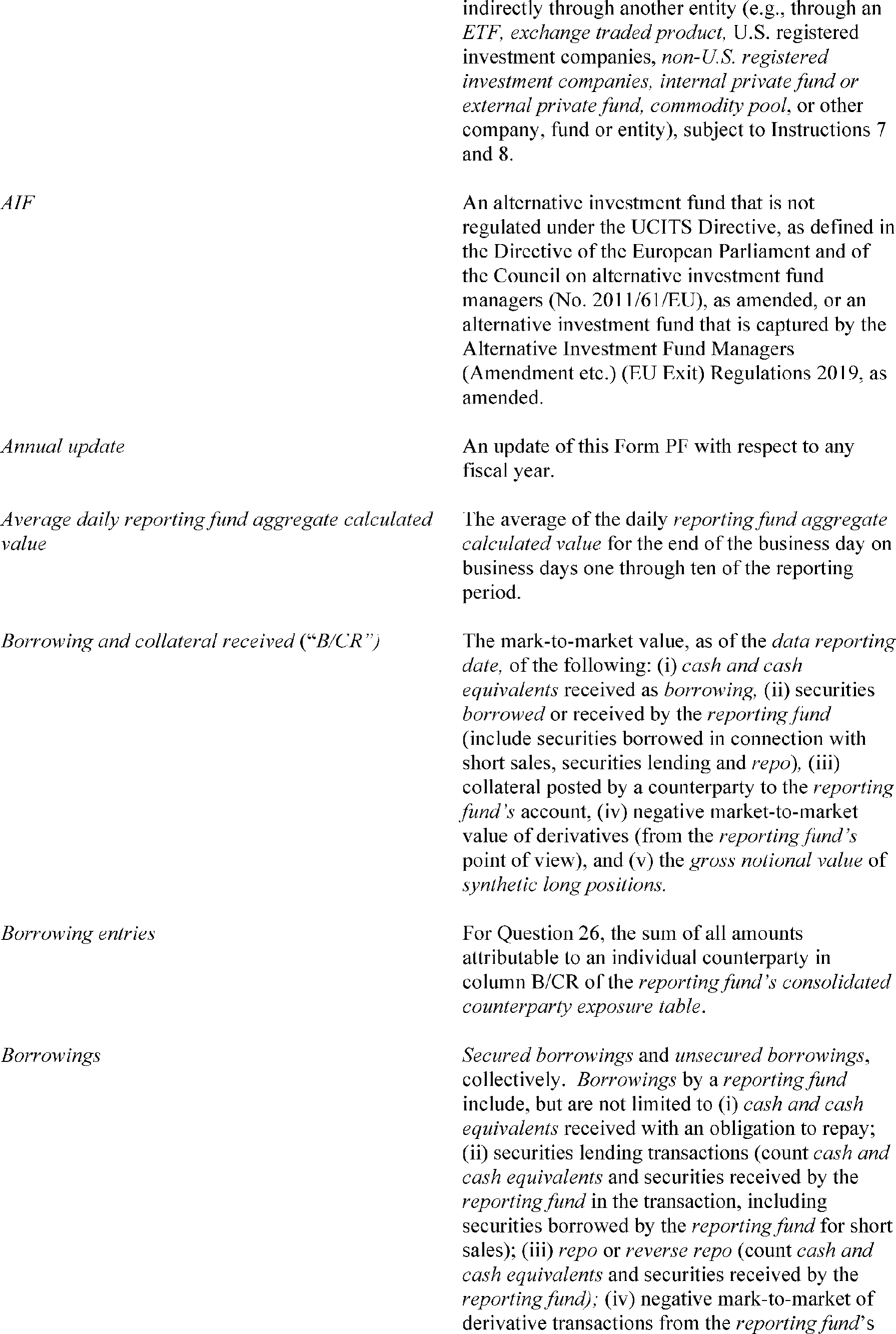
Currently, if an adviser calculates a market value on a daily basis for any position in the reporting fund's portfolio, it must report certain volatility information including aggregated calculated values, monthly annualized volatility of returns, and other data associated with the daily rates-of-return.
We propose to eliminate these requirements. (Question 23(c).)
Eliminate certain trading and clearing reporting requirements
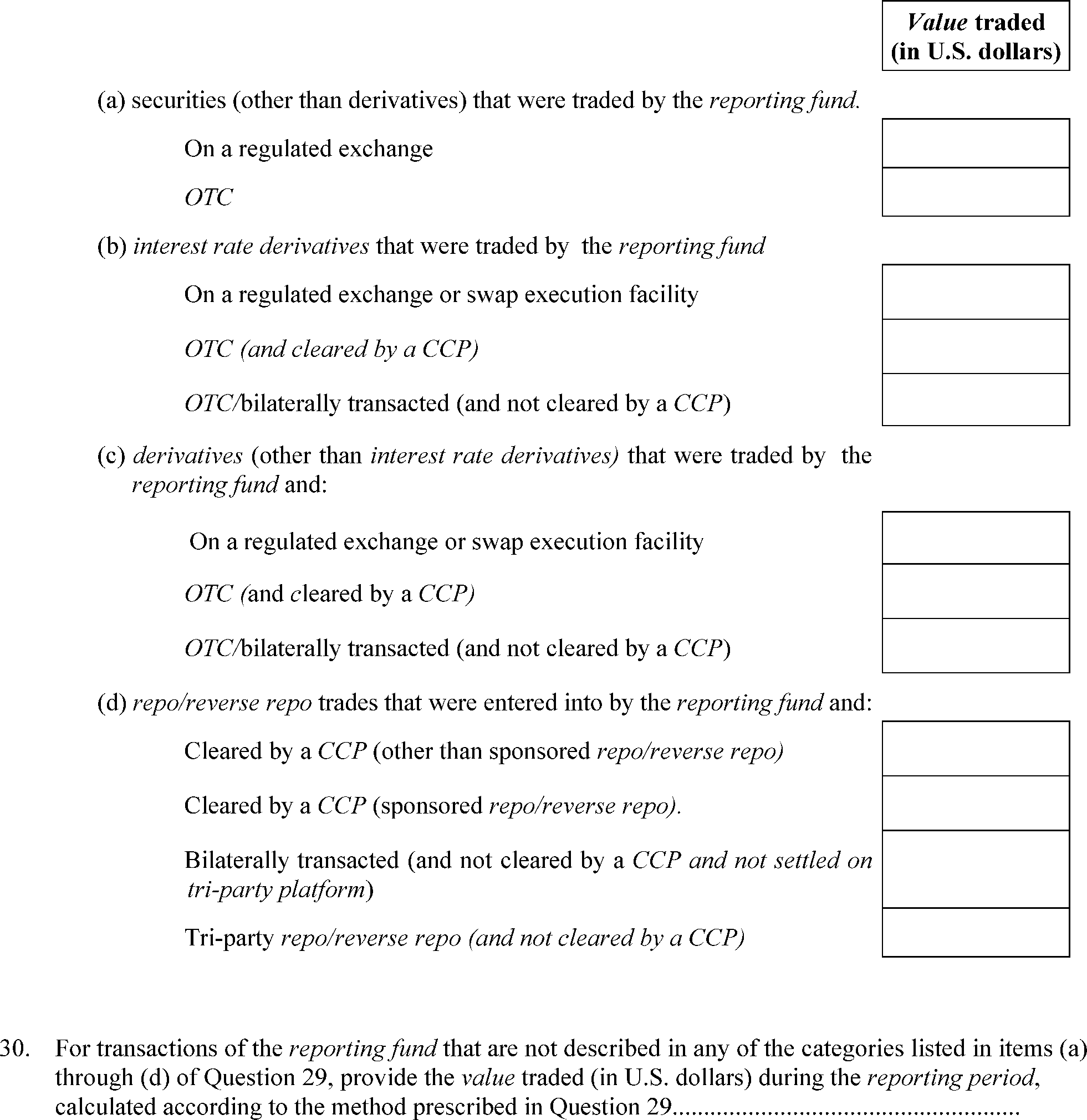
Currently, filers must report how they use trading and clearing mechanisms, including the value traded over the reporting period and the value of positions at the end of the reporting period.
We propose to eliminate the requirement to report the value of positions at the end of the reporting period. (Questions 29 and 30.)
Streamline adjusted exposure reporting
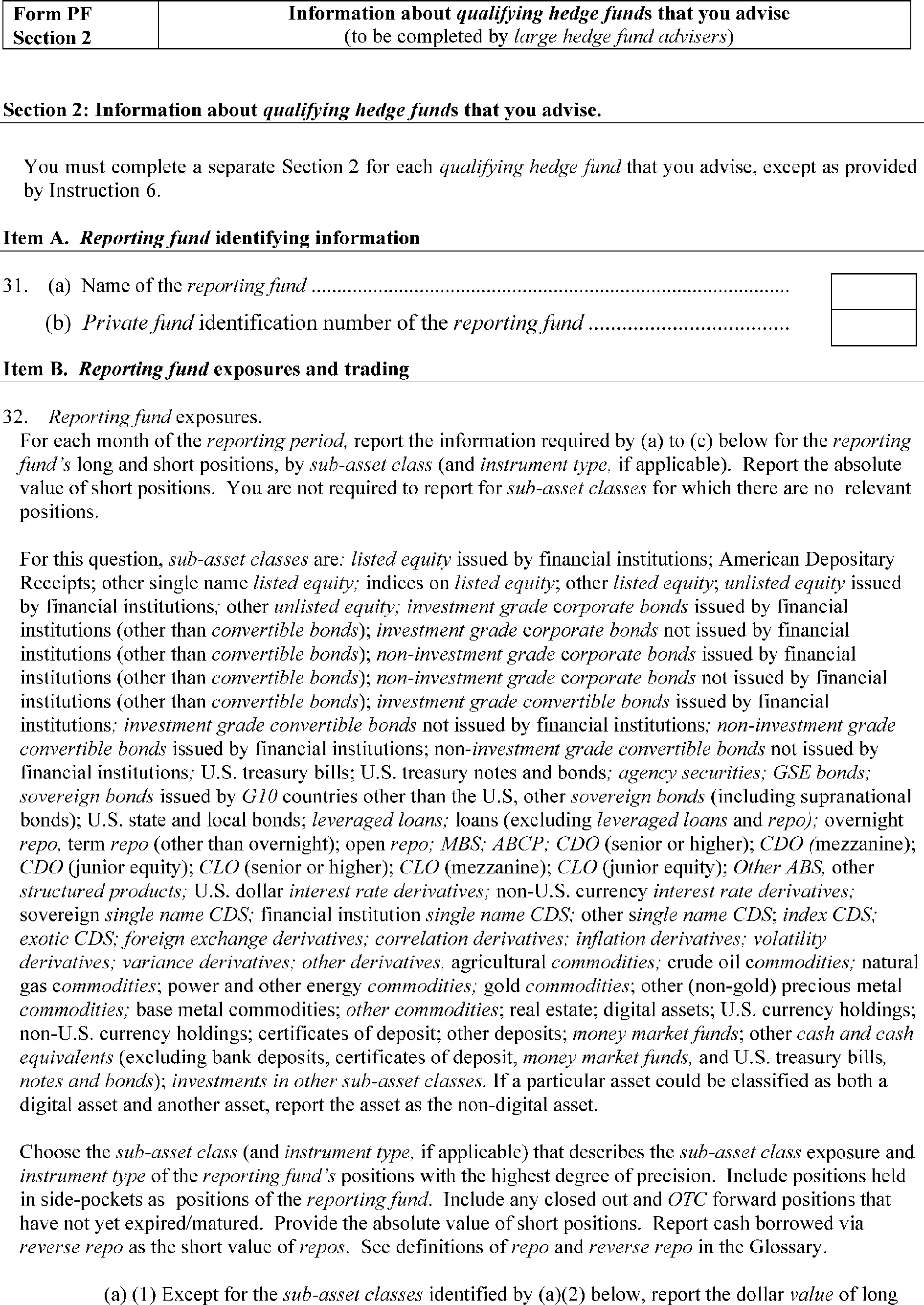
Currently, large hedge fund advisers must report their qualifying hedge funds' monthly adjusted exposures using multiple methods.
We propose to eliminate one of the methods, so advisers would no longer be required to report additional adjusted exposure based on the adviser's internal methodologies. (Question 32.)
Eliminate portfolio turnover reporting
Currently, large hedge fund advisers must report the value of their qualifying hedge funds' monthly turnover by asset class.
We propose to eliminate this question. (Question 34.)
Reduce burdens associated with reporting North American Industry Classification System (“NAICS”) codes
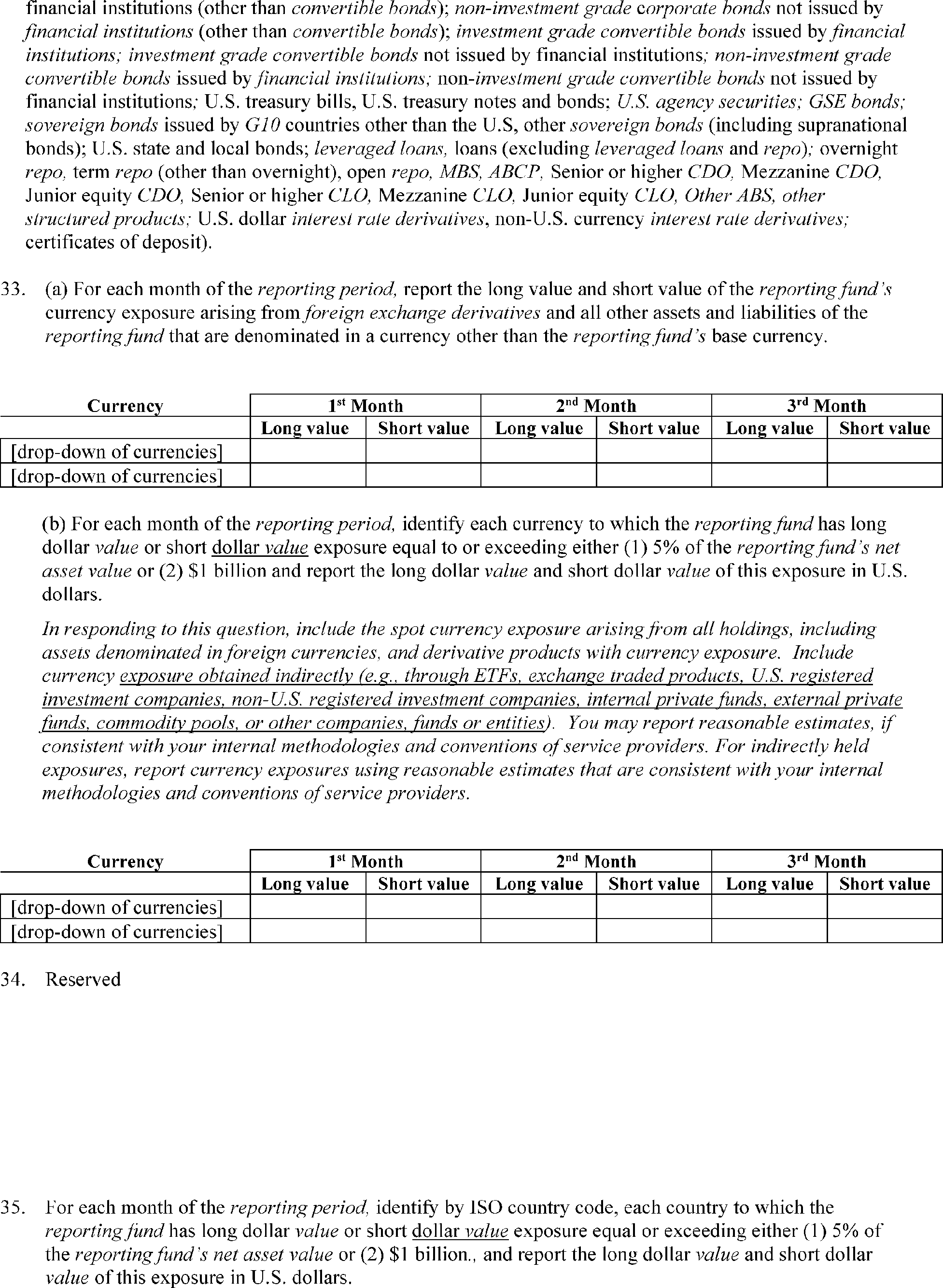
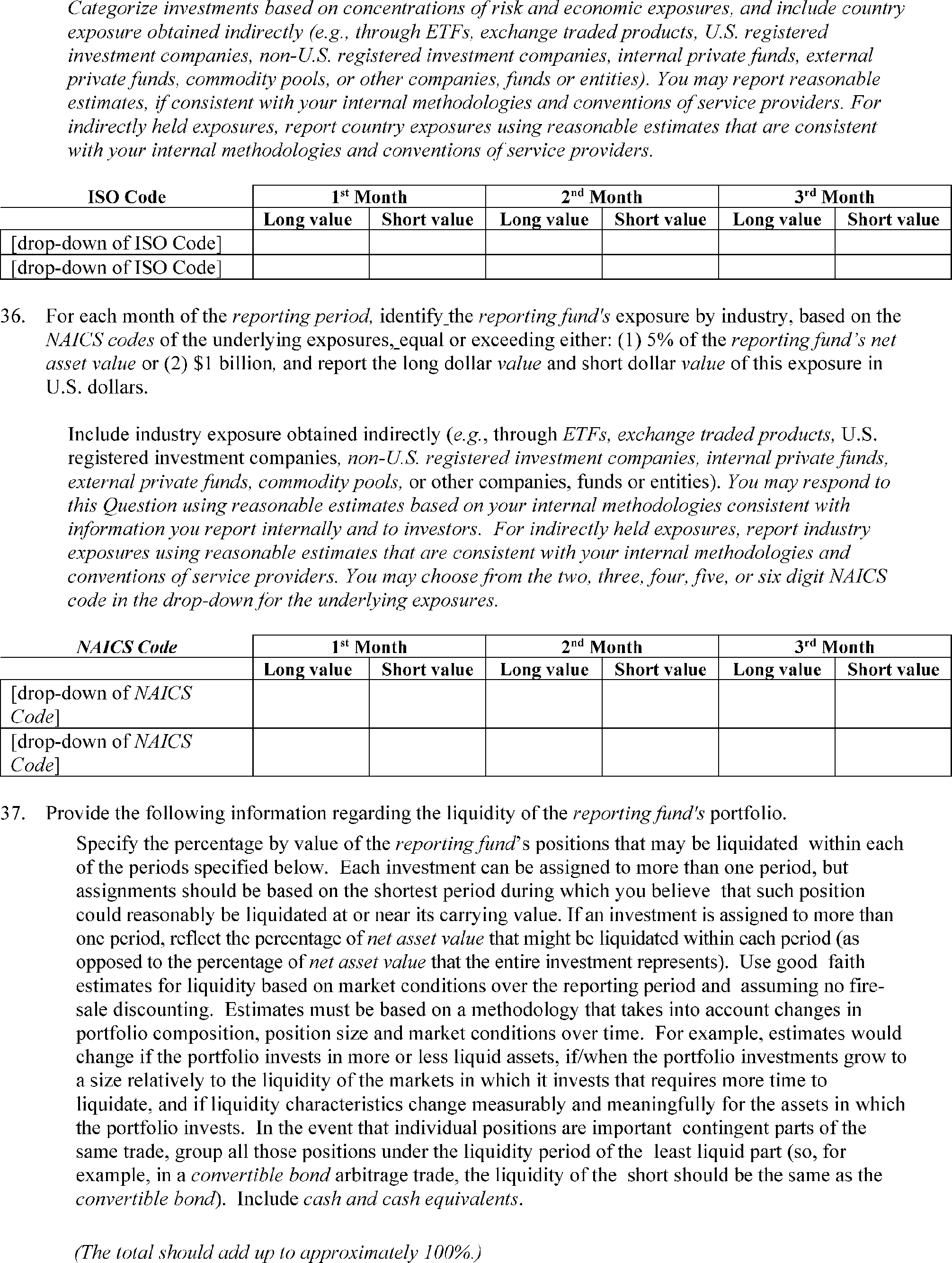
Currently, large hedge fund advisers must report their qualifying hedge funds' monthly industry exposures when they exceed a certain amount, using the six-digit NAICS code that best describes a company's primary business activity and principal source of revenue.
We propose to provide flexibility to allow filers to report fewer digits of the NAICS codes for industry exposures. (Question 36;
see
the Glossary of Terms (defining “NAICS code.”)
Eliminate certain reporting concerning qualifying hedge funds' monthly exposures to reference assets and, instead, include streamlined exposure reporting under an existing extraordinary loss current report trigger
Currently, large hedge fund advisers must report details about their qualifying hedge funds' monthly concentrated exposure to specific, position-level reference assets.
We propose to eliminate those questions. Instead, if large hedge fund advisers file a current report about their qualifying hedge funds' extraordinary investment losses, they would include a description of the largest exposure contributing to the loss. (Questions 39 and 40, and section 5, Item B.)
Simplify certain large hedge fund counterparty exposure reporting
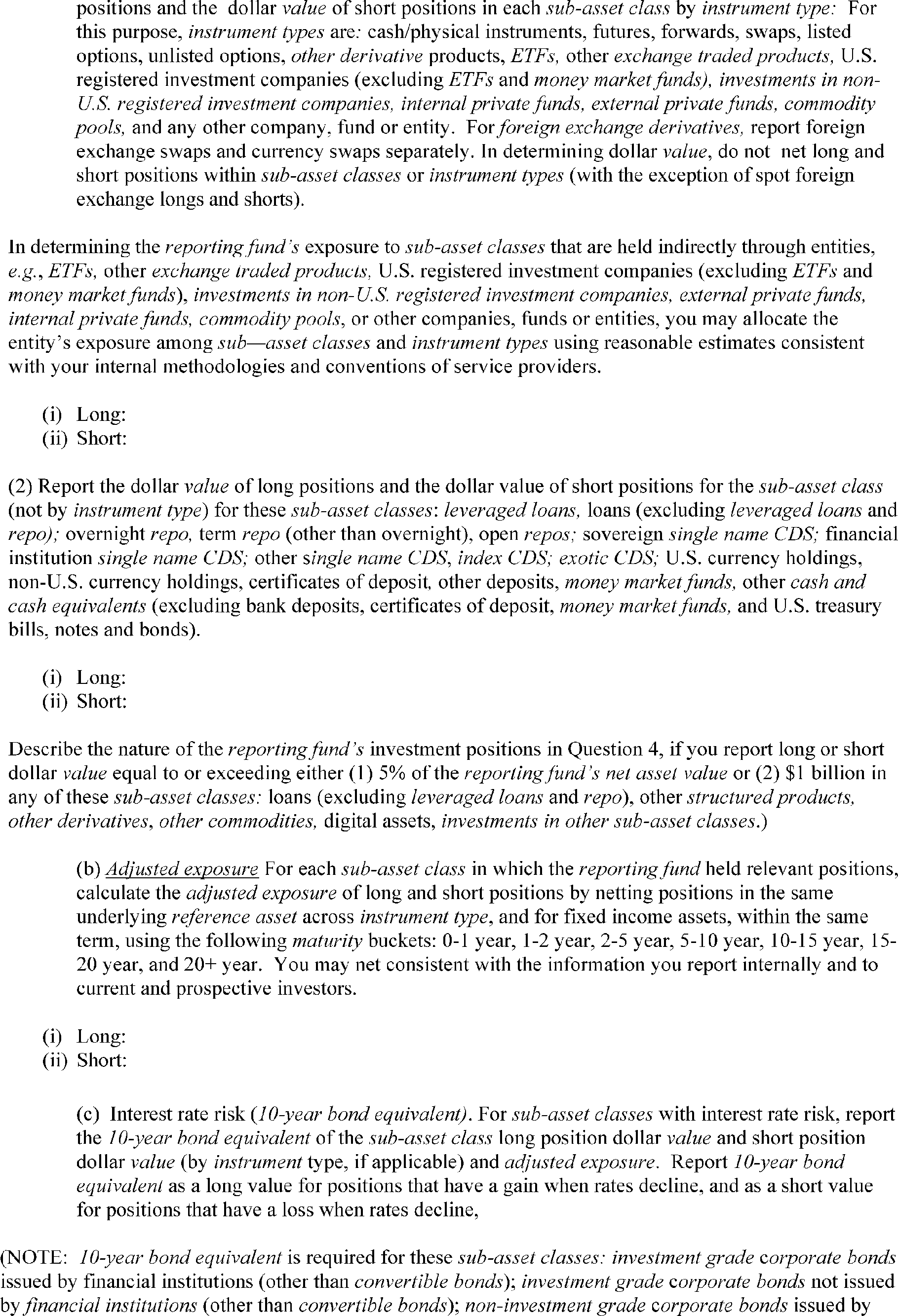
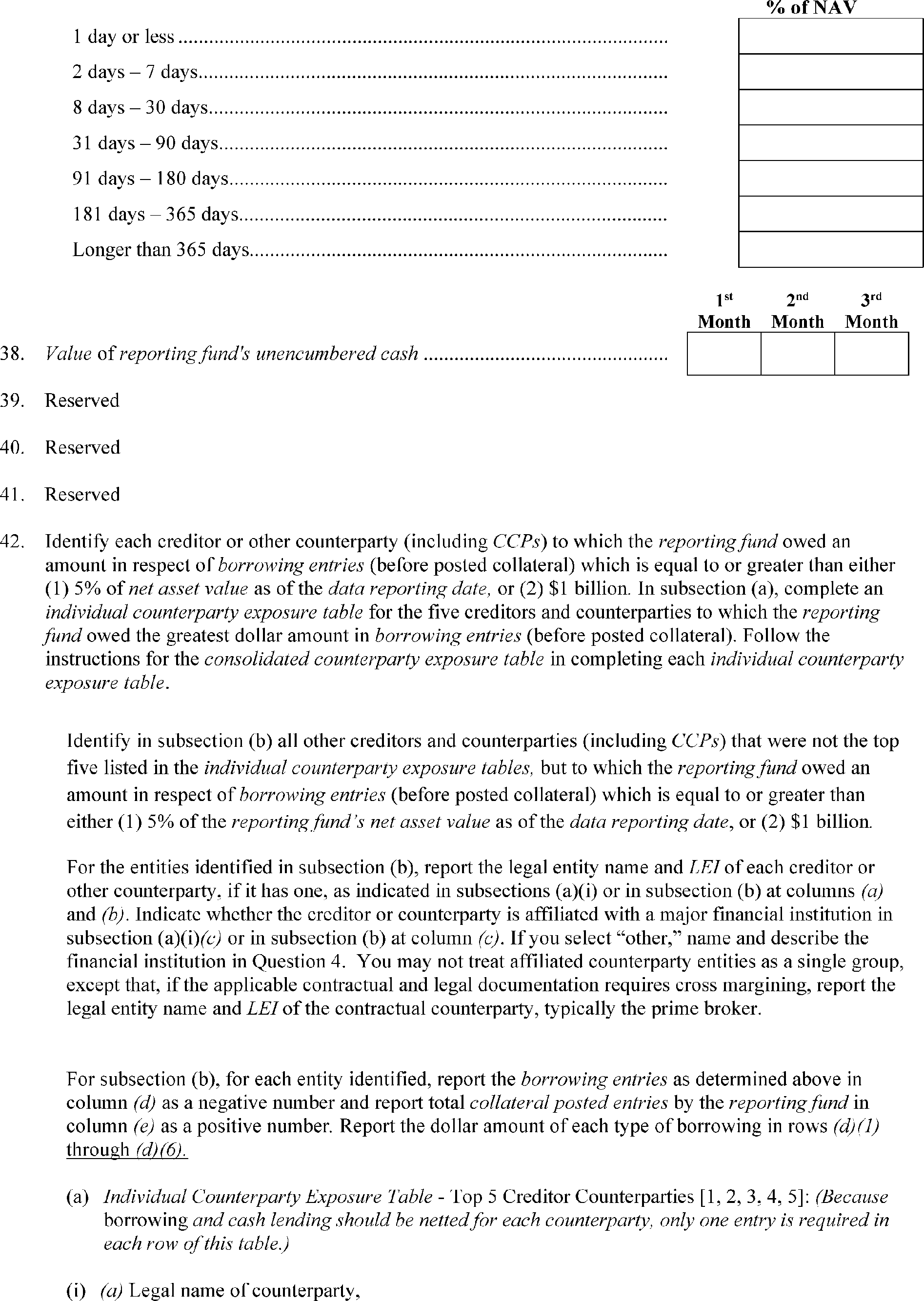
Currently, large hedge fund advisers must report in a consolidated counterparty exposure table their qualifying hedge funds' borrowing, collateral received, lending, and posted collateral, all aggregated across all counterparties as of the end of each month.
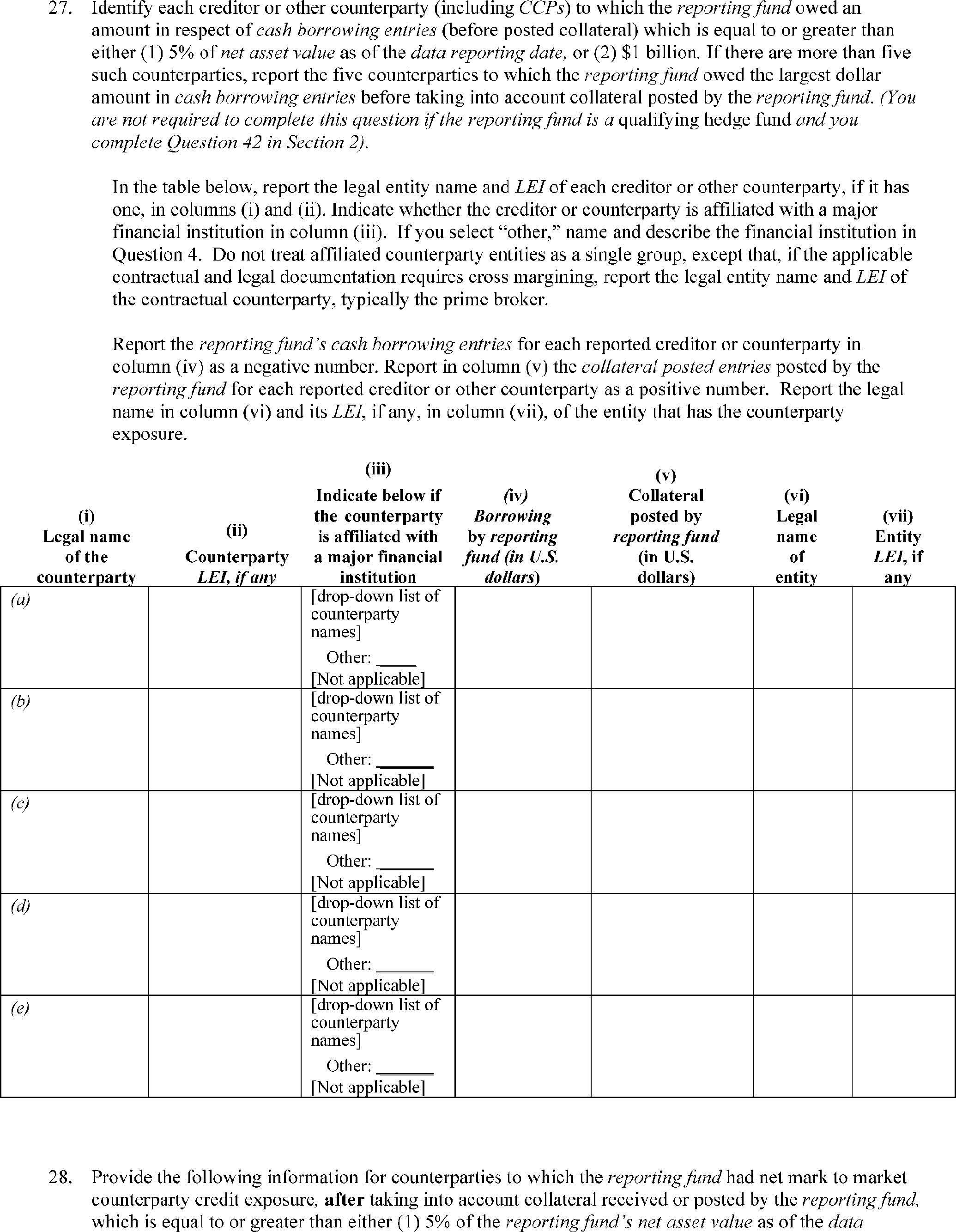
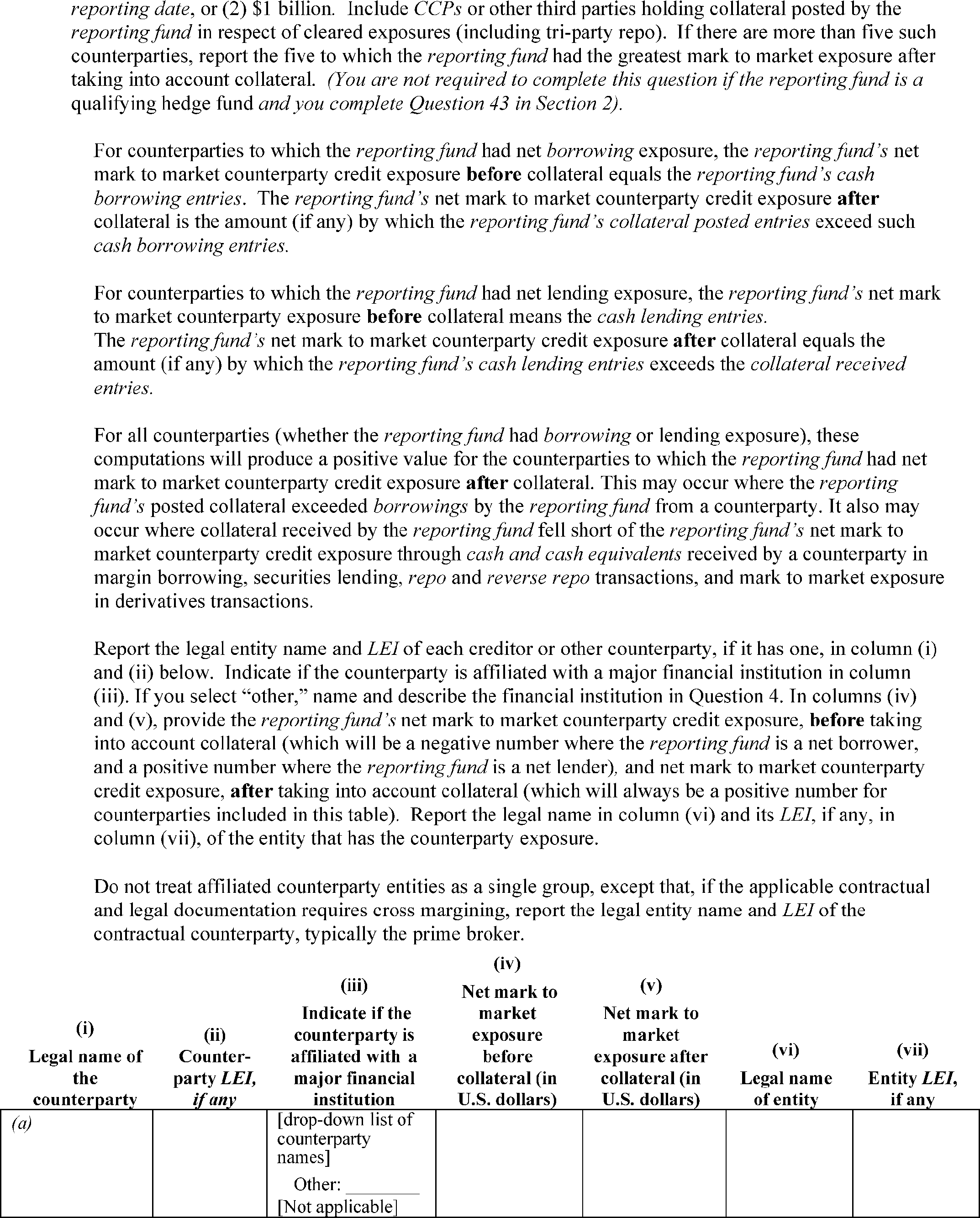
We propose to eliminate this table and direct large hedge fund advisers to: (1) complete the more simplified table in Question 26 for their qualifying hedge funds; and (2) report all borrowings to significant counterparties under Questions 42 and 43, and (3) categorize significant borrowing entries in Question 42. (Questions 41 and 42, and conforming amendments to Questions 18, 26, 43, and the Glossary of Terms.)
Eliminate rehypothecation reporting
Currently, large hedge fund advisers must report the total amount of collateral posted by counterparties to the qualifying hedge fund that may be and has been rehypothecated by the qualifying hedge fund.
We propose to eliminate these questions. (Question 45.)
Modify the current reporting trigger for all current reports
Currently, section 5 requires large hedge fund advisers to file a current report “as soon as practicable, but no later than 72 hours” upon the occurrence of certain events at their qualifying hedge fund.
The SEC proposes to modify the reporting trigger by removing the requirement to report as soon as practicable. Under the proposal, large hedge fund advisers would have the full 72 hours to file a current report. (Section 5.)
Eliminate current reporting for large hedge fund advisers concerning certain margin defaults
Currently, large hedge fund advisers are required to report within 72 hours if their qualifying hedge fund is in margin default or is unable to meet a call for margin, collateral, or equivalents.
The SEC proposes to eliminate this requirement. (Section 5, Item D.)
Eliminate current reporting for certain operations events
Currently, large hedge fund advisers are required to report within 72 hours if their qualifying hedge fund client experiences an operations event (
i.e.,
a significant disruption or degradation of the fund's “critical operations”). Form PF defines “critical operations” as operations necessary for (1) the investment, trading, valuation, reporting, and risk management of the reporting fund; or (2) the operation of the reporting fund in accordance with the Federal securities laws and regulations.
The SEC proposes to eliminate the second element. (Section 5, Item G, and the Glossary of Terms.)
Eliminate current reporting related to the inability to satisfy redemption requests
Currently, large hedge fund advisers are required to report within 72 hours if their qualifying hedge fund (1) is unable to pay redemption requests or (2) has suspended redemptions and the suspension lasts for more than five consecutive business days.
The SEC proposes to eliminate the first element. (Section 5, Item I.)
Eliminate quarterly event reporting for all private equity fund advisers
Currently, all private equity fund advisers must submit quarterly reports about adviser-led secondary transactions, general partner removals, termination of investment periods, and fund terminations.
The SEC proposes to eliminate this requirement. (Section 6.)
Corrections and other revisions
We propose to make corrections and other revisions to help ensure filers clearly understand Form PF requirements.
Request for comments on private credit reporting
We are requesting comment on whether to modify the information that advisers must report about private credit funds.
The Commissions have consulted with FSOC to gain input on this proposal, and to help ensure that Form PF continues to provide FSOC with information it needs to carry out its monitoring obligations and its assessment of systemic risk while also not requiring the reporting of information that is not useful to FSOC in carrying out these responsibilities.
II. Discussion
A. Increase the Filing Threshold for All Form PF Filers
The Commissions propose to increase Form PF's filing threshold for all filers. Currently, SEC-registered advisers must
( printed page 22236)
file Form PF if they and their related persons, collectively, had at least $150 million in private fund assets under management as of the last day of their most recently completed fiscal year.[16]
We propose to increase this filing threshold from $150 million to $1 billion.[17]
When the Commissions adopted Form PF in 2011, the Commissions set a filing threshold of $150 million in private fund assets under management, which aligned with the private fund adviser registration exemption that the Dodd-Frank Act created.[18]
The Commissions stated that the filing threshold, based on an adviser's private fund assets under management, would adequately differentiate between advisers with only smaller funds and those with significant fund assets.[19]
Since then, Form PF has provided the Commissions with a greater ability to analyze and understand data on private fund advisers. With over a decade of experience reviewing Form PF data, we can more accurately determine an appropriate filing threshold for assessing systemic risk. Indeed, Form PF data show that the private fund industry has grown dramatically. For example, from 2013 to the first quarter of 2025, the aggregated private fund gross asset value that advisers reported on Form PF more than tripled, from $8 trillion to over $25 trillion.[20]
As Table 2 shows, we estimate that the proposed filing threshold would continue to allow Form PF to obtain information on approximately 94 percent of the most recent aggregate private fund gross asset value reported, while reducing the percentage of advisers that are required to file by almost half. Therefore, this proposed change is designed to better differentiate those advisers with significant private fund assets, consistent with the Commissions' original intent for the filing threshold.[21]
Table 2—Comparing the Current Filing Threshold to the Proposed Filing Threshold 1
Current
$150 million
threshold
(%)
Proposed
$1 billion
threshold
(%)
Impact 2
Percent of All SEC-Registered Advisers to Private Funds
70
40
43% fewer advisers would file.
Percent of All Private Funds Reported by SEC-Registered Advisers 3
83
68
18% fewer private funds' data would be reported.
Percent of Private Fund Gross Assets Reported by SEC-Registered Advisers 3
96
94
2% less gross asset value would be reported.
Notes:
1. Form PF data as of the first quarter of 2025 and Form ADV data as of December 2024.
3. Denominators for the Current Threshold Column and the Proposed Threshold Column calculations include private funds reported on Form PF and Form ADV by SEC-Registered Advisers.
In determining how to propose re-calibrating the filing threshold, the Commissions considered the alternatives outlined in Table 3 and the distribution of private fund assets across advisers with the goal of ensuring coverage of a significant percentage of private fund industry managed assets, while at the same time minimizing filing burdens on private fund advisers where their smaller size may both disproportionately increase the burdens of reporting and reduce their likelihood of having a meaningful effect on the assessment of systemic risk.[22]
As evidenced by Table 3, the percentage of private fund gross assets reported by SEC-registered advisers is concentrated with the largest private fund advisers (measured by assets) of the private fund industry as a whole, which would allow us to raise the reporting threshold while maintaining substantial reporting coverage of the private fund industry by assets. However, setting the threshold too high has the potential to narrow the field of reporting advisers to a degree that they skew or fail to represent the range of private fund strategies and activities that may materially inform systemic risk assessment and investor protection efforts. Therefore, as Table 3 highlights, the proposed filing threshold is designed to strike a balance between reducing the percentage of advisers that would be required to file, and the associated burdens, while helping ensure that Form PF would continue to collect information about a significant percentage of private fund gross assets appropriately to inform the assessment of systemic risk.
By increasing the Form PF filing threshold as proposed, the burdens of Form PF's section 1 collection of information would be more focused on advisers that manage private fund assets representing a significant percentage of the private fund industry and, thus, providing a diverse and representative view of private fund advisers for systemic risk assessment, while recognizing that Form PF can be burdensome for smaller advisers that the Commissions understand generally have fewer resources available to fulfil the reporting requirements of Form PF and who are less likely to have systemic risk impact.
As Table 3 indicates, by raising the filing threshold to $1 billion, we would be able to maintain insight into the potential systemic risk implications of private funds while eliminating filing burdens for many advisers.
( printed page 22237)
Table 3—Alternative Filing Thresholds 1
Filing threshold
Percent of all SEC-registered advisers to private funds
Percent of all private funds reported by SEC-registered
advisers 2
Percent of private fund gross assets reported by SEC-
registered advisers 2
Current $150 Million
70
83
96
Alternative $250 Million
64
83
96
Alternative $500 Million
53
76
95
Proposed $1 Billion
40
68
94
Alternative $2 Billion
30
60
91
Alternative $3 Billion
25
55
89
Alternative $4 Billion
22
51
87
Notes
1
Form PF Data as of the First Quarter of 2025 and Form ADV data as of December 2024.
2
Denominators for the calculations include private funds reported on Form PF and Form ADV by SEC-Registered Advisers.
SEC-registered advisers that would no longer meet the Form PF filing threshold, and as a result, would no longer be required to report on Form PF, would nonetheless continue to publicly report certain information about their private funds on 17 CFR 279.1 (Form ADV), as all SEC-registered advisers of such funds are required to do. Form ADV, which is publicly available, provides the SEC and investors with information about advisers (including private fund advisers) and the funds they manage, and is designed to provide the SEC with information necessary to its investor protection efforts. In contrast, Form PF is primarily designed to facilitate FSOC's assessment of systemic risk, although it is available to assist the Commissions in their regulatory programs for the protection of investors.[23]
Accordingly, the proposed changes would not eliminate all private fund data reporting for the affected advisers. Any SEC-registered adviser that would no longer be required to file Form PF would nonetheless continue to report information about its private funds on Form ADV.[24]
We request comment on the proposed change to the filing threshold:
1. Should the Commissions increase the filing threshold for all private fund advisers as proposed? If not, should the current filing threshold be kept constant, increased less than the proposed threshold, or increased more than the proposed threshold? Should the Commissions adopt any of the alternative thresholds presented in Table 3? For example, should the Commissions adopt a filing threshold of $250 million, $500 million, $2 billion, or $3 billion? If the threshold should be changed, what is the appropriate threshold and why?
2. Would the proposal to increase the filing threshold sufficiently alleviate burdens on private fund advisers? Please provide quantitative and qualitative data to support your conclusion.
3. Would the proposed filing threshold result in Form PF collecting information about the private fund industry necessary and appropriate in the public interest and for the protection of investors, or for the assessment of systemic risk?
4. Should the Commissions also adopt a filing threshold that adjusts for inflation? If the Commissions should adopt an inflation adjustment for the filing threshold, how should the Commissions measure the inflation adjustment? For example, should the Commissions measure the inflation adjustment from the time of the filing threshold's original adoption in 2011, or from the date the inflation adjustment would be adopted, or from another date? Is there a price index, such as the Personal Consumption Expenditures Chain-Type Price Index, the Consumer Price Index for All Urban Consumers, the Producer Price Index, or the GDP Price Deflator, that would be best suited for this adjustment? Would using a securities market index such as the S&P 500 or the NYSE Composite Index, which is not based on inflation, be a better way to adjust the filing threshold on an ongoing basis? At what cadence should the inflation be adjusted? For example, yearly, or every ten years, or any other cadence?
B. Increase the Reporting Threshold for Large Hedge Fund Advisers
The Commissions also propose to increase Form PF's reporting threshold for large hedge fund advisers. Currently, to qualify as a large hedge fund adviser, a Form PF filer and its related persons must have, collectively, at least $1.5 billion in hedge fund assets under management as of the last day of any month in the fiscal quarter immediately preceding their most recently completed fiscal quarter and manage a qualifying hedge fund.[25]
We propose to increase the large hedge fund reporting threshold from $1.5 billion to $10 billion.[26]
If an adviser qualifies as a large hedge fund adviser, it must file section 1 quarterly, instead of annually as it would if it were a hedge fund adviser that did not qualify as a large hedge fund adviser.[27]
Section 1a requires all advisers to report general identifying information about themselves and the private funds they advise, including a breakdown of regulatory assets under management and net assets under management. Section 1b requires all advisers to report information about each private fund they advise, including the following: (1) the private fund type; (2) assets, financing, and investor concentration; and (3) performance. Section 1c requires all advisers to report information about each hedge fund they advise, including the following: (1) investment strategies; (2) exposures; (3) counterparties; and (4) trading and clearing mechanisms.
If an adviser qualifies as a large hedge fund adviser, it also must file Form PF section 2 quarterly with respect to each qualifying hedge fund that it advises, including the following: (1) identifying information; (2) exposures and trading; (3) risk metrics and performance; (4) financing information; and (5) investor information.[28]
If an adviser qualifies as a large hedge fund adviser, it is also subject to Form PF Section 5 reporting, which requires a large hedge fund adviser to report information as soon as practicable, but no later than 72 hours upon the occurrence of certain events at qualifying hedge funds it advises,
( printed page 22238)
including the following: (1) extraordinary investment losses; (2) margin, collateral, or equivalent increases; (3) notice of margin default or determination of inability to meet a call for margin, collateral, or equivalents; (4) counterparty defaults; (5) prime broker relationships that have been terminated or materially restricted; (6) operations events; (7) withdrawals and redemptions; and (8) if the qualifying hedge fund is unable to satisfy redemptions or suspends redemptions.
Therefore, an adviser that would no longer qualify as a large hedge fund adviser under the proposed threshold would file section 1 annually, instead of quarterly, and would not file section 2 or be subject to section 5 current reporting, absent any other requirements.[29]
While the quarterly section 1, quarterly section 2, and section 5 current reporting are important for the largest hedge fund advisers that are more likely to be systemically important, they can impose disproportionate burdens on smaller advisers that are less likely to be systemically important.[30]
Any SEC-registered adviser would continue to report information about its private funds on Form ADV.[31]
When Form PF was originally adopted, the Commissions stated that the reporting thresholds were designed so that the group of large private fund advisers (including large hedge fund advisers) filing Form PF would be relatively small in number but would represent a substantial portion of the assets of their respective industries.[32]
At that time, the Commissions estimated that advisers each managing at least $1.5 billion in hedge fund assets represented over 80 percent of the U.S. hedge fund industry based on assets under management.[33]
As Table 4 shows, we estimate that the proposed higher threshold would still result in Form PF obtaining information quarterly on over 80 percent of hedge fund gross asset value that advisers report, while reducing the percentage of advisers that are required to file as large hedge fund advisers by almost two-thirds. Therefore, the proposed change is designed to continue to obtain information on a substantial portion of the assets of the hedge fund industry, consistent with the Commission's original intent for the large hedge fund reporting threshold, while reducing burdens on hedge fund advisers.
Table 4—Comparing the Current Large Hedge Fund Reporting Threshold to the Proposed Reporting Threshold 1
Current
$1.5 billion
threshold
(%)
Proposed
$10 billion
threshold
(%)
Impact 2
Percent of SEC-registered advisers reporting as large hedge fund advisers
26
9
65% fewer advisers would be required to report as large hedge fund advisers.
Percent of hedge funds reported by large hedge fund advisers related to those reported by all SEC-registered advisers 3
49
34
Data on 31% fewer hedge funds would be reported under the large hedge fund adviser requirements, and instead would be reported under other requirements, as applicable.
Percent of hedge fund gross assets reported by large hedge fund advisers related to those reported by all SEC-registered advisers 3
92
81
12% less of hedge fund gross asset value would be reported under the large hedge fund adviser requirements, and instead would be reported under other requirements, as applicable.
Notes:
1. Form PF data as of the first quarter of 2025 and Form ADV data as of December 2024.
3. Denominators for the Current Threshold Column and the Proposed Threshold Column calculations include hedge funds reported on Form PF and Form ADV by SEC-Registered Advisers.
We chose the proposed reporting threshold in light of the alternatives outlined below in Table 5, with the goal of helping ensure that Form PF would continue to collect information necessary and appropriate in the public interest and for the protection of investors, or for the assessment of systemic risk, while reducing burdens on hedge fund advisers.[34]
As in the past, the proposed amended reporting threshold is designed so that the group of large hedge fund advisers filing Form PF would be relatively small in number but represent a substantial portion of hedge fund assets.[35]
In determining where to propose re-calibrating the reporting threshold, the Commissions considered the alternatives outlined in Table 5 and the distribution of hedge fund assets with the goal of ensuring coverage of a substantial portion of hedge fund assets, while at the same time minimizing filing burdens on hedge fund advisers where their smaller size may both increase the burdens of reporting and reduce their likelihood of having a meaningful effect on the assessment of systemic risk.
As evidenced by Table 5, the percent of hedge fund gross assets reported by SEC-registered hedge fund advisers is concentrated at the largest hedge fund advisers, which would allow us to raise the reporting threshold while maintaining substantial reporting coverage of the hedge fund industry assets. However, setting the threshold too high has the potential to narrow the field of large hedge fund advisers to a degree that they skew or fail to represent the range of hedge fund strategies and activities that may materially inform systemic risk assessment. As a result, FSOC and the Commissions could miss emerging trends in the hedge fund industry. Furthermore, too few hedge fund advisers subject to quarterly reporting, instead of annual reporting, as well as enhanced Form PF reporting in sections 2 and 5, could result in
( printed page 22239)
FSOC and the Commissions being alerted in a less timely manner to certain events that may indicate significant stress at a hedge fund that could signal risk in the broader financial system. Therefore, as Table 5 highlights, the proposed reporting threshold is designed to strike the appropriate balance between reducing the percentage of hedge fund advisers that would be required to file as large hedge fund advisers, while helping ensure that Form PF would continue to collect information on a substantial portion of the assets of the hedge fund industry.
In addition, the SEC is proposing to require its staff to report to the SEC on each filing and reporting threshold in the form, assessing whether any should be adjusted, approximately five years after the compliance date for the amendments to the form and approximately every five years thereafter.[36]
These staff reports would help the SEC periodically evaluate the continued appropriateness of the filing and reporting thresholds in all respects, including whether proposing revisions to the thresholds would be appropriate. In producing this report, the staff would be directed to consider data collected by the SEC pursuant to Form PF, as well as any other applicable information as the staff may determine to be appropriate for its analysis. As the private fund adviser industry grows and changes, such a report and related review would be designed to ensure that the form continues to impose minimal filing burdens for small advisers, while continuing to collect data on a significant percentage of private fund assets.[37]
Table 5—Alternative Large Hedge Fund Reporting Thresholds 1
Reporting threshold
Percent of all
SEC-registered
advisers to
hedge funds
Percent of all
hedge funds
reported by
SEC-registered
advisers 2
Percent of
hedge fund
gross assets
reported
quarterly by
SEC-registered
advisers 2
Percent of hedge
fund gross
assets reported
as QHFs by
SEC-registered
advisers 23
Current $1.5 Billion
26
49
92
84
Alternative $2 Billion
22
47
91
83
Alternative $3 Billion
19
44
90
82
Alternative $5 Billion
14
41
86
79
Alternative $7.5 Billion
11
37
83
76
Proposed $10 Billion
9
34
81
74
Alternative $15 Billion
7
29
77
70
Alternative $20 Billion
6
27
74
68
Notes:
1. Form PF Data as of the First Quarter of 2025 and Form ADV data as of December 2024.
2. Denominators for the calculations include hedge funds reported on Form PF and Form ADV by SEC-Registered Advisers.
3. Reported by SEC-registered advisers for qualifying hedge funds (QHFs) on Form PF section 2.
We request comment on the proposed change to the large hedge fund reporting threshold:
5. Should the Commissions increase the large hedge fund adviser reporting threshold, as proposed? If not, should the current reporting threshold be kept constant, increased less than the proposed threshold, or increased more than the proposed threshold? Instead of the proposed reporting threshold, should the Commissions adopt one of the alternative thresholds listed in Table 5? For example, should the Commissions adopt a reporting threshold of $2 billion, $3 billion, $15 billion, or $20 billion? If the threshold should be changed, what is the appropriate threshold and why?
6. Would the proposal to increase the reporting threshold sufficiently alleviate burdens on hedge fund advisers? Please provide quantitative and qualitative data.
7. Would the proposed reporting threshold result in Form PF collecting information about the hedge fund industry necessary and appropriate in the public interest and for the protection of investors, or for the assessment of systemic risk?
8. The SEC is proposing to require its staff to report to the SEC on each filing and reporting threshold in the form, assessing whether any should be adjusted, approximately five years after the compliance date for the amendments to the form and approximately every five years thereafter. Alternatively, should the Commissions adopt a large hedge fund adviser reporting threshold that adjusts for inflation? If so, should the Commissions adopt the same inflation adjustment for all or just certain reporting thresholds in Form PF, or only for the large hedge fund adviser threshold? If the Commissions should adopt an inflation adjustment for any reporting threshold on Form PF, how should the Commissions measure the inflation adjustment? For example, should the Commissions measure the inflation adjustment from the time of the reporting threshold's original adoption in 2011, or from the date the inflation adjustment would be adopted, or from another date? Is there a price index, such as the Personal Consumption Expenditures Chain-Type Price Index, the Consumer Price Index for All Urban Consumers, the Producer Price Index, or the GDP Price Deflator, that would be best suited for this adjustment? Would using a securities market index such as the S&P 500 or the NYSE Composite Index, which is not based on inflation, be a better way to adjust the reporting threshold on an ongoing basis? At what cadence should the inflation be adjusted? For example, yearly, or every ten years, or any other cadence?
9. Should the Commissions increase the qualifying hedge fund threshold? Why or why not? What is the appropriate qualifying hedge fund threshold (
e.g.,
a net asset value of $750 million or $1 billion)? The qualifying hedge fund threshold is based on net asset value, while the large hedge fund adviser threshold is based on gross asset
( printed page 22240)
value. Under the proposed amendments this construction would have two results: (1) it identifies and requires more detailed and frequent reporting for hedge fund advisers that manage several large hedge funds and (2) it identifies and requires more detailed and frequent reporting for hedge fund advisers that manage hedge funds with significant use of leverage. Is there an alternative approach to ensure hedge funds using significant leverage are reporting in the more detailed section 2 on a quarterly basis? If we increased the qualifying hedge fund threshold, should we change the threshold to measure on a gross asset value basis so that it does not disproportionately eliminate more frequent and detailed reporting from more leveraged hedge funds?
10. Should the Commissions increase the large liquidity fund adviser threshold? Why or why not? If so, what is the appropriate threshold for large liquidity fund advisers (
e.g.,
$2 billion, $3 billion, $5 billion)?
11. Should the Commissions increase the large private equity fund adviser threshold? Why or why not? If so, what is the appropriate threshold for large private equity fund advisers (
e.g.,
$3 billion, $5 billion)?
C. Disregarded Feeder Funds
The Commissions propose to allow advisers not to separately report feeder funds with minimal holdings outside of a feeder fund's interest in a master fund. Specifically, the Commissions propose to revise General Instruction 6 to permit advisers to treat a feeder fund as “disregarded” if it invests not more than five percent of its gross asset value in investments that are not in a single master fund, U.S. treasury bills, and/or cash and cash equivalents.[38]
This proposed change is designed to reduce filing burdens on advisers and better balance against the need for the Commissions and FSOC to understand the reporting fund's structure and the risk exposure of its component funds.[39]
Prior to the 2024 amendments, Form PF provided advisers with flexibility to respond to questions regarding master-feeder arrangements and parallel fund structures, either in the aggregate or separately, as long as they did so consistently throughout Form PF. This resulted in some advisers reporting in aggregate and some advisers reporting separately, and consequently, obscured risk profiles (
e.g.,
with respect to leverage, counterparty exposure, investor liquidity) and created difficulties when comparing complex structures.[40]
In 2024, the Commissions adopted amendments to Form PF that generally require separate reporting for every component fund of a master-feeder arrangement and parallel fund structure.[41]
By prescribing the way advisers report master-feeder arrangements and parallel fund structures, the 2024 amendments were intended to provide the Commissions and FSOC with better insight into the risks and exposures of these arrangements. The 2024 amendments, however, required disregarded feeder funds to be aggregated in the reporting about master-feeder arrangements and parallel fund structures. Defined in General Instruction 6 as a feeder fund that invests all of its assets in a single master fund, U.S. treasury bills,[42]
and/or cash and cash equivalents, a “disregarded feeder fund” effectively invests only through its associated master fund, and the Commissions stated that separate reporting of these funds is not necessary for data analysis purposes because it would not convey additional information about their exposures.[43]
Since the adoption of the 2024 amendments, industry members have highlighted the significance of the burdens associated with disaggregating feeder funds in their reporting.[44]
In communications with the SEC staff, several filers have stated that many private funds utilize complex master-feeder arrangements, and that separate reporting of feeder funds without additional exceptions would cause substantial burdens because it requires the collection of many more data points about many more fund entities in these private fund structures.[45]
Some filers said feeders that hold minimal holdings outside of the master fund should be disregarded, as the
de minimis
amount of these outside assets do not alter the risk picture of the feeder. These filers stated that disaggregated reporting does not reflect how advisers typically manage risk and liquidity for these funds, and that reporting instructions should align with advisers' typical risk management practices in order to result in meaningful and accurate data.[46]
In response to these concerns, we are proposing to change General Instruction 6 to allow advisers to aggregate in their reporting about master-feeder arrangements feeder funds that hold a
de minimis
amount of investments outside of the master fund.[47]
Under the proposed change to General Instruction 6, advisers would be able to treat a feeder fund that invests not more than five percent of its gross asset value [48]
in other investments that are not in a single master fund, U.S. treasury bills, and/or cash and cash equivalents, as a disregarded feeder fund. Accordingly, advisers would be permitted to aggregate such feeder funds in their reporting about master-feeder arrangements on Form PF. In our view, five percent is an appropriate threshold because it parallels the threshold used in other parts of Form PF to represent a fund's material exposure and a level of exposure that could be significant enough to present broader systemic risk and contagion risk.[49]
The proposed change seeks to better align the Form PF reporting requirements with the way advisers typically track and manage the risk profile of feeder funds while preserving the Commissions and FSOC's ability to obtain a clear understanding of fund structures and the risk exposure of their component funds.[50]
We request comment on the proposed change to General Instruction 6:
( printed page 22241)
12. Would the proposed change to General Instructions 6 sufficiently alleviate burdens on private fund advisers?
13. Would the proposed change to General Instruction 6 result in the collection of information about private fund structures and the risk exposure of their component funds necessary and appropriate in the public interest and for the protection of investors, or for the assessment of systemic risk?
14. Would the proposed change to General Instruction 6 result in certain feeder funds that are necessary to assess systemic risk not being identified in the form? If so, how?
15. Is five percent the appropriate threshold for disregarding feeder funds with minimal holdings outside of the master fund? Why or why not? What other percentages (
e.g.,
three percent, ten percent) or methods should the Commissions consider for purposes of identifying disregarded feeder funds that are not necessary and appropriate for the assessment of systemic risk? For example, should we allow filers to treat any feeder fund as disregarded if the filer does not separately consider the feeder fund and its exposures for its risk management purposes? Should we allow, as was the case prior to the 2024 amendments, filers to choose whether to respond to questions in the aggregate or separately, as long as they did so consistently through Form PF? Why or why not?
16. Is “gross asset value,” as defined in the Form PF Glossary of Terms, the appropriate denominator for disregarding feeder funds with minimal holdings outside of the master fund? Why or why not? What alternatives should the Commissions consider as the denominator for purposes of disregarding feeder funds that are not necessary and appropriate for the assessment of systemic risk?
17. Are there types of investments or features of feeder funds that should be considered in permitting aggregation?
18. Is the proposed change to the definition of disregarded feeder fund in General Instruction 6 sufficiently clear? Would this raise any questions about how to determine which feeder funds should be disregarded for purposes of General Instruction 6? Should we provide any additional clarification regarding which feeder funds should be disregarded for purposes of General Instruction 6?
D. Eliminate the Look Through Requirement
The Commissions propose changes to Form PF that would allow advisers to report indirect exposures based on reasonable estimates that are consistent with their internal methodologies and the conventions of service providers when responding to certain questions that currently require looking through the reporting fund's investments. Specifically, the Commissions propose to eliminate from General Instructions 7 and 8 the prescriptive requirement that advisers “look through” the reporting fund's investments when reporting indirect exposures and to instead allow advisers to rely on reasonable estimates consistent with their internal methodologies and conventions of service providers when reporting indirect exposures.[51]
The Commissions also propose conforming amendments to the instructions for Questions 32, 33, 35, 36, and 47, and to amend the definitions of certain asset classes in the Glossary of Terms, to allow advisers to report indirect exposures consistent with the amended General Instructions 7 and 8. These changes are intended to reduce and better balance the filing burdens on advisers against the need to obtain clear and comparable data across advisers.
In 2024, the Commissions adopted amendments to General Instructions 7 and 8 to provide that, when responding to questions, advisers generally must not “look through” a reporting fund's investments in other funds or entities (other than a trading vehicle), unless the question instructs the adviser to report exposure obtained indirectly through the reporting fund's positions in such other funds or entities. In reporting indirect exposures of the reporting fund in response to certain questions (Questions 32, 33, 35, 36 and 47), General Instruction 7 requires advisers to “look through” the reporting fund's investments in internal private funds and external private funds. Likewise, General Instruction 8 requires advisers to “look through” the reporting fund's investments in other funds or entities when reporting indirect exposures in response to those same questions.
Prior to the 2024 amendments, Form PF generally did not address how to report indirect exposures resulting from positions held through other entities, and advisers were not required to (although they had the option to) look through a reporting fund's investments in another entity, unless the form specifically requested information regarding that entity.[52]
As a result, some advisers were reporting indirect exposures, while others were not, leading to incomplete and unclear data, inconsistent comparisons, and less precise analysis across advisers. The 2024 amendments changed General Instructions 7 and 8 to direct advisers to report indirect exposures in response to certain questions by mandatorily looking through the reporting fund's investments in private funds and other entities. These changes were designed to promote FSOC's effective systemic risk assessments and the Commissions' investor protection efforts by reducing issues of data quality and incomparability with respect to data regarding indirect exposures of private funds.
After the adoption of the 2024 amendments, however, industry members reported that the rigid and granular reporting required via this mandatory look-through would create significant burdens and in many cases would be operationally difficult.[53]
For example, several filers noted that looking through a reporting fund's investment in an exchange-traded fund (an “ETF”) to calculate the reporting fund's indirect exposure to each underlying investment in the ETF could be particularly burdensome in instances where the ETF tracks and continuously rebalances a broad index comprising potentially hundreds of underlying investments. Other filers stated that the methodology for determining the exact composition of an index may be proprietary and not controlled by the adviser.
We also heard concerns that looking through the reporting fund's investments in other entities, such as investments in another private fund that in turn invests in portfolio companies, private credit instruments, or securitized assets, could be operationally challenging, if the adviser does not control those entities and therefore has limited access to information regarding the underlying investments, or the data that the adviser does obtain does not align with the timing and reporting requirements of Form PF.
In consideration of these concerns, we are now proposing changes to General Instructions 7 and 8 to eliminate the prescriptive requirement that advisers “look through” the reporting fund's investments when reporting indirect exposures and to instead allow advisers to report required indirect exposures based on reasonable estimates that are consistent with the adviser's internal
( printed page 22242)
methodologies and conventions of service providers. We are also proposing amendments to Questions 32, 33, 35, 36 and 47 to remove instructions that reasonable estimates used to report indirect exposures, and that indirectly held entity positions in a sub-asset class and instrument type, must “best represent” the exposure of the entity [54]
or the sub-asset class exposure of the indirectly held entity.[55]
The prescriptive look-through requirement in General Instructions 7 and 8 as well as the “best represent” standard in the specific questions' instructions for reporting indirect exposures would create burdens for advisers to conduct look-through for assessing indirect exposures even though they may reasonably and more efficiently estimate such indirect exposures in their own portfolio and risk management processes. The proposed changes are intended to provide advisers the ability to rely on reasonable estimates to report indirect exposures, provided they are consistent with their internal methodologies and the conventions of service providers.[56]
For example, with respect to a reporting fund's investment in a gold ETF, the proposed changes would allow advisers to estimate the reporting fund's exposure through an ETF more broadly (
e.g.,
“gold commodities” sub-asset class) to the extent consistent with their own portfolio and risk management processes.
Relatedly, the Commissions propose conforming amendments to align other parts of the form with the proposed General Instructions 7 and 8. The proposed changes would include conforming amendments to Question 32 and Question 47 to remove certain references to indirectly held “positions.” [57]
The Commissions also propose to revise definitions of certain asset classes in the Form PF's Glossary of Terms to explicitly subject those definitions to proposed General Instructions 7 and 8.[58]
As part of the 2024 amendments, Form PF defined these asset classes also requiring the reporting fund to look through to indirect exposures to such assets held through another entity. The proposed definitional changes are intended to allow advisers, consistent with General Instructions 7 and 8, to use their reasonable estimates that are consistent with the adviser's internal methodologies and conventions of service providers for such indirect exposures. These proposed changes would also help to resolve any inconsistencies between the instructions in the definitions of these terms and General Instructions 7 and 8.
Furthermore, the Commissions propose to make a conforming change to the definition of “reference asset” in the Form PF Glossary of Terms by removing the phrase “and do not conflict with any instructions or guidance relating to this Form,” which would be unnecessary with the proposed changes to General Instructions 7 and 8 that would allow for the use of reasonable estimates consistent with internal methodologies to report indirect exposures.[59]
Although the proposed changes to General Instructions 7 and 8 (and related conforming changes) would lead to more filers using their internal practices to report indirect exposures and to do so less precisely, thus potentially reducing the level of specificity and comparability of indirect exposures through fund or entity holdings reported by advisers on Form PF,[60]
we anticipate that these changes would not undermine FSOC's systemic risk assessment and the Commission's investor protection efforts. Based on input received from filers, we understand that the operational challenges posed by the strict look-through requirement, such as lack of the advisers' control of or access to granular position data of underlying fund or entity investments from third party entities or third party data that comports with the reporting requirements of Form PF, would likely, in practice, result in advisers having to rely on internal assumptions to comply with Form PF's requirements. As such, the prescriptive look-through requirements in General Instructions 7 and 8 would likely not achieve the intended outcome, making any greater granularity and comparability unjustified in light of the apparent significant filing burdens on advisers.[61]
Our proposal, however, would retain questions mandating the reporting of indirect exposures and thus preserve the objective of the 2024 amendments to address issues of data quality and comparability that had resulted from some advisers providing indirect exposures while others did not.
Moreover, the proposed changes would preserve FSOC's ability to assess systemic risk and the Commissions' ability to protect investors by collecting data based on advisers' portfolio risk management processes, which themselves are designed to capture material risk exposures from investments.
We request comment on the proposed changes to General Instructions 7 and 8, the definitions of certain asset classes in the Form PF Glossary of Terms, and other conforming changes:
19. Would the proposed changes to General Instructions 7 and 8, the definitions of asset classes including “reference asset,” and other conforming changes sufficiently alleviate burdens on private fund advisers?
20. Would the proposed changes to General Instructions 7 and 8 and the definitions of asset classes including “reference asset” result in the collection of information about the reporting fund's indirect exposure necessary and appropriate for investor protection and the assessment of systemic risk?
21. Should the “look through” requirement for certain, or all, questions be eliminated entirely, as proposed, and allow advisers to instead rely on reasonable estimates that are consistent with their internal methodologies and conventions of service providers? If not, why not?
22. Are certain questions easy to “look through” funds, entities and investments than others? If so, which ones and why?
23. Are there certain types of funds or entities that are easy to “look through”? If so, which ones and why?
24. Are there certain types of reference assets that are easy to report on a “look through” basis? If so, which ones and why?
25. Should the form require a “look through” for certain, or all, types of funds, entities or reference assets? If so, which ones and why?
( printed page 22243)
E. Trading Vehicles
The Commissions propose to amend Question 9 under section 1b of the Form PF to reduce the scope of trading vehicles that advisers must specifically identify. The proposed new scope focuses solely on trading vehicles that face counterparties and creditors or are reported on Form ADV as a private fund. This proposed change is intended to reduce the burdens on advisers with respect to identifying trading vehicles while still supporting the need for the Commissions and FSOC to understand the reporting fund's use of trading vehicles relevant to identifying systemic risk and investor protection efforts.[62]
Before the 2024 amendments, Form PF did not require advisers to identify trading vehicles, even though private funds often use trading vehicles to trade, incur leverage, and bear counterparty and credit exposures as part of their investment strategy.[63]
In 2024, the Commissions adopted amendments to section 1b to obtain a clear view of the reporting fund's use of trading vehicles in this manner and therefore to enhance FSOC's ability to monitor systemic risk and the Commissions' ability to protect investors by better assessing the scope of the reporting fund's position sizes and counterparty exposures that are attributable to the trading vehicle and identifying areas in need of outreach, examination or investigation. The broad definition of “trading vehicle” in the final form was intended to ensure that such trading vehicles were captured,[64]
and Question 9 was designed to obtain identifying information about any trading vehicle used by the reporting fund that met this definition.[65]
Since the adoption of the 2024 amendments, filers have highlighted the broad scope of trading vehicles that would need to be identified on the form and the significance of the burden on advisers of having to meet this requirement.[66]
Private funds may use trading vehicles for a wide variety of purposes other than trading and bearing counterparty exposure. Consequently, the broad definition of “trading vehicle,” which includes an entity that “holds assets” and conducts “other activities” as part of the reporting fund's investment activities, potentially captures passive entities (
e.g.,
tax blockers, liability blockers, aggregator vehicles used to consolidate investments from investors in private funds, passive holding companies formed to hold portfolio investments) that are commonly used by private funds for structuring, tax and/or other operational efficiencies. Many of these passive entities, however, may not otherwise actively trade nor engage in other activities directly related to the fund's counterparty or credit exposures in a manner that creates interconnectedness of the trading vehicle to the broader financial services industry, a critical part of systemic risk assessment and investor protection efforts. Some filers have expressed concern that under the current “trading vehicle” definition, they would have to report hundreds of entities in certain private fund structures, imposing significant burdens on those advisers.[67]
After considering the scope of trading vehicles that must be reported under Question 9 in light of systemic risk assessment and investor protection efforts, as well as the significance of the burdens on advisers raised by the current instructions, we propose to reduce the scope of trading vehicles that must be reported under Question 9 to focus on trading vehicles that face counterparties and creditors or are reported on Form ADV as a private fund.
Specifically, the proposed changes to Question 9 would limit trading vehicles that must be identified by name and legal entity identifier (“LEI”), if any, to those that are (i) listed or required to be listed on Section 7.B. of Schedule D of the adviser's or another adviser's Form ADV,[68]
or (ii) included or required to be included in a response to Questions 27, 28, 42, 43, or 44 of the Form PF,[69]
which require advisers to identify the relevant party (including any trading vehicles) that bears counterparty and credit exposures.[70]
The proposed changes would entail a conforming amendment to General Instruction 7 with the same instruction limiting the scope of trading vehicles that must be identified in response to Question 9 to those that are listed on the adviser's Form ADV or in response to Questions 27, 28, 42, 43 or 44. As discussed above, the broad definition of “trading vehicle” may cover passive entities commonly used in private fund structures but do not directly interact with the market in a manner that may pose systemic risk such as by trading, taking on leverage, or bearing counterparty and credit exposures. Furthermore, as emphasized by some filers, the burden on advisers of having to identify each passive entity in the reporting fund's structure that meets the broad definition of “trading vehicle” may be significant.
Although the current instructions would have provided a more comprehensive visibility into the wide variety of ways trading vehicles are incorporated into private fund structures, they would have primarily captured passive trading vehicles, and reducing the scope of trading vehicles would not materially affect the Commissions' and FSOC's systemic risk oversight and investor protection efforts. The proposed changes to Question 9 would reduce the scope of trading vehicles that advisers must identify to those that are more directly relevant and meaningful to the Commissions' and FSOC's oversight and investor protection efforts. Section 7.B. of Schedule D of Form ADV requests important information about the private funds managed by advisers but does not specify whether the private funds
( printed page 22244)
reported therein are trading vehicles. The proposed changes would therefore facilitate our staff's ability to identify trading vehicles reported on Form ADV and the scope of trading vehicles' potential effects on systemic risk and investor protection.
Furthermore, the revised Question 9 would require advisers to identify those trading vehicles that they have included in response to questions on the form that address how the reporting fund uses trading vehicles to bear counterparty and credit exposures (Questions 27, 28, 42, 43, or 44). Hence, any trading vehicle that incurs leverage or conducts trading or other activities as part of a hedge fund's investment activities resulting in significant exposure to creditors or counterparties is currently identified by advisers in those questions and would therefore continue to be included in Question 9 under the proposed change.
Trading vehicles included in response to these questions (which may overlap with those reported on Form ADV) would provide the Commissions and FSOC with transparency into the reporting fund's risk profile and interconnectedness of private funds with the broader financial services industry. Moreover, although we propose to limit the scope of trading vehicles that must be specifically identified, General Instructions 7 and 8 would continue to require advisers to look through certain trading vehicles and to their specific holdings, which would capture their counterparty and creditor exposures.[71]
These proposed changes would therefore not have a significant effect on the Commissions' and FSOC's ability to assess relevant information for purposes of their risk assessment and investor protection efforts, as the form would continue to obtain relevant information about operationally active trading vehicles that do engage in activities that could impact the broader financial services industry.[72]
We request comment on the proposed changes to Question 9 of Section 1b:
26. Would the proposed changes to Question 9 sufficiently alleviate burdens on private fund advisers?
27. Do you agree that the current definition of “trading vehicle” covers entities that do not directly interact with the market in a manner that may pose systemic risk such as by trading, taking on leverage, or bearing counterparty and credit exposures? Would the proposed changes to Question 9 result in the collection of information about trading vehicles necessary and appropriate in the public interest and for the protection of investors, or for the assessment of systemic risk?
28. Would the proposed changes to Question 9 result in certain trading vehicles that are necessary to assess systemic risk not being identified in the form? Should such trading vehicles continue to be identified in the form? If so, which ones?
29. Should we instead amend Form PF so that private fund advisers are not required to identify any trading vehicles? Is the identification of trading vehicles relevant to the assessment of systemic risk? Why or why not?
F. Eliminate Form PF Question 23(c) Volatility Reporting
The Commissions propose to eliminate Question 23(c) in its entirety for all private fund filers.[73]
Question 23(c) requires private funds to report additional performance-related information if the adviser calculates a market value on a daily basis for any position in the reporting fund's portfolio. Such information includes: (1) the “reporting fund aggregate calculated value” at the end of the reporting period; (2) the reporting fund's volatility of the natural log of the “daily rate-of-return” for each month of the reporting period; (3) whether the daily return rates are reported to current or prospective investors; and (4) whether the reporting fund had one or more days with a negative daily rate of return during the reporting period and related information.
We added Question 23(c) in the 2024 amendments to allow the Commissions and FSOC to compare return volatility more accurately across different private fund types to identify market trends, for systemic risk assessment, and for investor protection efforts.[74]
This measure quantifies the degree to which a portfolio's logarithmic returns fluctuate around their average, with higher values indicating greater risk of large gains or losses and uncertainty in an investment's value.
However, during implementation of this new question, it is our understanding that numerous advisers encountered challenges and significant costs in preparing to respond to this question. Some advisers calculate this information in the ordinary course of their business for certain funds but not all private funds, or only at the level of the master fund. Other advisers use an internal methodology that does not necessarily align with what we ask under Question 23(c), so they have had to design complicated and bespoke calculations based on approximations of the same data points. Industry members have further pointed out that there are many investing strategies involving less liquid or illiquid assets that have less volatility and could mute or otherwise skew volatility data, so capturing intra-month volatility about them is less valuable but more burdensome, even if they can be reported.
We now propose to delete Question 23(c). Based on our review, the data captured by other questions in the form can assist in contextualizing performance-related volatility, such as the monthly performance reporting in Question 23(a) and (b) or extraordinary losses reported in current reports.[75]
Although deleting Question 23(c) would result in less detailed performance-related volatility information, such that the Commissions and FSOC may lose insight into significant performance volatility swings occurring on an intra-month basis, intra-month performance-related data for less liquid or illiquid investment strategies can have limited utility when evaluating performance volatility.[76]
Further, we understand that funds are making assumptions in calculating this information, which undermines its comparability.
Given the burdens associated with calculating this information, and that information related to performance-related volatility can be gathered from other existing parts of the form, we propose to eliminate Question 23(c) from Form PF.
We request comment on the proposed removal of Question 23(c):
30. Should the Commissions eliminate Question 23(c)? Why or why not?
31. Would the proposed deletion of Question 23(c) impede our ability to appropriately collect information necessary and appropriate in the public interest and for the protection of investors, or for the assessment of systemic risk? Why or why not?
32. Alternatively, should we move Question 23(c) to section 2? Is it important to capture this information regarding qualifying hedge funds? Why
( printed page 22245)
or why not? Do you agree that data captured by other questions in the form can assist in contextualizing performance-related volatility?
33. Do advisers calculate a daily market value for certain fund portfolios or strategies? If yes, is it an estimated market value?
34. Do advisers calculate the volatility of the natural log of the daily rate-of-return for a reporting fund, computed as the standard deviation of the natural log of one plus each of the daily rates-of return, on either a monthly or quarterly basis? If not, what are the challenges encountered by advisers in calculating this information for a reporting fund?
35. Is it easier to track this information for certain types of funds or fund strategies compared to others?
36. Would removing Question 23(c) sufficiently alleviate burdens on private fund advisers?
37. Alternatively, should we move Question 23(c) to section 2 so that only large hedge fund advisers must complete it? Why or why not?
G. Eliminate Certain Trading and Clearing Reporting
We propose to eliminate certain trading and clearing reporting. Specifically, we propose to eliminate the requirements to report the value of positions at the end of the reporting period in Question 29(ii) and Question 30(b). Currently, all filers that advise hedge funds must report how they use trading and clearing mechanisms in Questions 29 and 30 for each hedge fund they advise, including the value of their reporting fund's positions at the end of the reporting period. The Commissions adopted this requirement in an effort to provide the Commissions and FSOC with data that can be more efficiently compared and aggregated among advisers and other data sources.[77]
However, filers have expressed concern that they do not otherwise calculate the value of positions at the end of the reporting period by trading mode for each position using the calculations Form PF requires, and it is burdensome to track, calculate, and report such data solely for purposes of Questions 29(ii) and 30(b). If we remove Questions 29(ii) and 30(b), Questions 29 and 30, nonetheless, would continue to require all filers to report the value the reporting fund traded during the reporting period, specified by instrument category and trading mode, which should be sufficient for purposes of evaluating use of trading and clearing mechanisms across hedge fund advisers. Furthermore, FSOC and the Commissions could infer the value of the positions at the end of the reporting period requested in Questions 29(ii) and 30(b) from Question 32. For example, Question 32(a) requires reporting of various sub-asset classes related to listed and unlisted equity which gives FSOC and the Commissions an indication as to whether the securities were traded on an exchange or over the counter. Accordingly, we are proposing to remove the requirements to report the value of positions at the end of the reporting period in Question 29(ii) and Question 30(b) because we are concerned that the data aggregation and comparison benefits of this reporting may not be justified by the burdens.[78]
The Commissions also propose to remove erroneous and unnecessary instructions in Questions 29. The current instructions in Question 29 provide that the “value traded” for certain instruments is the total value, but then erroneously require filers to calculate the total value by using a weighted average. We propose to remove this instruction, which would remove the error.[79]
With this correction, the specific instructions about how to calculate value traded for proposed Questions 29 and 30 would be unnecessary because General Instruction 15 and the table would sufficiently instruct advisers on how to report the value traded. Therefore, this proposed change would simplify the form, by not repeating the instructions. We also propose to remove the specific instructions for column (ii). These instructions would be no longer relevant because we propose to remove column (ii).
We request comment on the proposal to revise Questions 29 and 30:
38. Should we revise Questions 29 and 30, as proposed?
39. Should we eliminate the requirement for advisers to report the value of positions at the end of the reporting period in Questions 29 and 30, as proposed? Do you agree that the information reported in other requirements in Questions 29 and 30 is sufficient to analyze data on trading and clearing mechanisms?
40. Do you agree with our characterization of the benefits and burdens that Questions 29 and 30 present? Are there more, less, or additional types of benefits or burdens? Please quantify the burdens.
41. Should we remove the specific instructions for calculating “value traded,” as proposed? Does General Instruction 15 and the table itself sufficiently instruct filers about how to report value traded? Is there a clearer way to instruct filers about how to calculate value traded? Or is there a more appropriate calculation that the instructions should use? For example, should the instructions to Question 29 direct filers to use the gross notional values for options and interest rate derivatives in addition to other derivatives, rather than the calculations that General Instruction 15 specifies?
42. Is there a clearer way to instruct filers about how to categorize each trade into the value traded column? For example, if a bond is traded through a registered alternative trading system, should that be included in the regulated exchange category or over the counter?
H. Eliminate Form PF Question 32(b)(2) Adjusted Exposure Reporting Based on Internal Methodology
The Commissions propose to eliminate Question 32(b)(2) for large hedge fund advisers.[80]
The Commissions added Question 32(b) to Form PF in 2024 to require advisers to report the adjusted exposure of long and short positions for each sub-asset class in which a fund has a reportable position.[81]
At that time, the Commissions explained that gross exposure reporting by itself presents an incomplete picture that poses a significant data gap for systemic risk analysis. Question 32(b) requires large hedge fund advisers to report adjusted exposures in two ways. In Question 32(b)(1), advisers have to calculate and report adjusted exposure of long and short positions for each sub-asset class by netting positions that have the same underlying reference asset across instrument type and, for fixed income positions, within the same term using the following maturity buckets: 0-1 year, 1-2 years, 2-5 years, 5-10 years, 10-15 years, 15-20 years, and 20+ years.
In Question 32(b)(2), if, under its methodologies for internal reporting and reporting to investors, an adviser does not net all positions across all instrument types in monitoring the economic exposure of the reporting fund's investment positions, then the adviser must report adjusted exposure based on its internal methodology; the adviser must also describe in Question 4 how its internal methodology differs
( printed page 22246)
from the calculations required in Question 32(b)(1). At the time, the Commissions explained that this additional information in Question 32(b)(2) would provide better insight into how these advisers assess the economic exposure of their reporting fund's portfolio, while still ensuring an adviser provides information that supports the Commissions' and FSOC's ability to aggregate and compare the data across funds.[82]
After the adoption of the 2024 amendments, filers raised concerns that Question 32(b)(2) is substantially duplicative of Question 32(b)(1) and therefore unnecessarily burdensome to produce. They stated that these two sub-questions require them to calculate and report adjusted exposure for each sub-asset class in which the fund holds positions twice with non-meaningful differences in risk information conveyed.
Upon review, we agree that Question 32(b)(2), given its similarity to what funds will likely report under Question 32(b)(1), does not appear sufficiently necessary to justify the burdens associated with this additional reporting. While adjusted exposure reporting continues to be important for FSOC's assessment of systemic risk, eliminating Question 32(b)(2) in consideration of the concerns raised by filers, as proposed, would help further alleviate burdens on large hedge fund filers by removing duplicative reporting that does not materially build upon the quality or usefulness of data already received from Question 32(b)(1).[83]
Relatedly, we propose to delete the word “counterparties” from the last sentence in Question 32(b)(1). This instructional sentence provides that, in reporting adjusted exposure under Question 32(b)(1), the fund may net counterparties consistent with the information it reports internally and to current and prospective investors. Based on discussions with filers, we understand that the inclusion of “counterparties” in this sentence has created confusion because netting in this section is intended to be associated with exposures rather than limiting netting specifically to counterparties. Moreover, combined with the elimination of Question 32(b)(2), this deletion would be a conforming change to simplify the adjusted exposure calculations.
We request comment on the proposal to eliminate Question 32(b)(2):
43. Should the Commissions eliminate Question 32(b)(2)? Why or why not?
44. Would the proposed deletion of Question 32(b)(2) impede our ability to appropriately collect information about adjusted exposure in qualifying hedge funds necessary and appropriate in the public interest and for the protection of investors, or for the assessment of systemic risk? Why or why not?
45. Would removing Question 32(b)(2) meaningfully alleviate burdens on large hedge fund advisers?
46. If Question 32(b)(2) is retained, should it be modified? If so, how?
47. Should the format of Question 32(b)(1) (and Question 32(b)(2) if it is retained) be revised for clarity (for example, by using charts instead of sentences, or putting instructions and responses in different colors like the PQR form)?
I. Eliminate Form PF Question 34 Monthly Asset Turnover Reporting
The Commissions propose to eliminate Question 34 for large hedge fund advisers.[84]
Question 34 requires advisers to report the value of turnover in certain asset classes (including listed equities, corporate bonds, sovereign bonds, as well as various types of derivatives and consolidated foreign exchange and currency swaps) in their hedge funds' portfolios for each month during the quarterly reporting period.
The Commissions included this question on the original 2011 Form PF (then Question 27) to provide an indication of a large hedge fund adviser's frequency of trading in particular asset class markets and the amount of liquidity hedge funds contribute to those markets.[85]
We then amended Question 34 in 2024 in two ways. First, in connection with the move to disaggregate reporting, we required reporting turnover on a per fund basis explaining that this change would provide more detailed information to the Commissions and FSOC while simplifying reporting because advisers do not generally aggregate turnover-related information among funds.[86]
Second, we added new categories to better capture turnover of potentially relevant securities. We referenced how, during the March 2020 COVID-19-related market turmoil, we were unable to obtain a complete picture of market activity relating to treasuries and treasury futures given that turnover reporting was highly aggregated across funds.
While the turnover of specific asset classes can be helpful to identify the frequency of hedge fund trading activity in those asset classes, we have observed from our review that turnover data can be an imprecise signal of systemic risk or market turmoil.[87]
Asset turnover might simply reflect that many large hedge funds make frequent trades as part of an investment strategy rather than suggesting issues in a given market. Conversely, a reduction in asset turnover could reflect a strategy responding to normal market conditions as opposed to an episode of stress in a market where a reduction in liquidity constrains a fund's trading. Additionally, ensuing discussions with industry members have revealed unanticipatedly high burdens in monitoring and producing the data to complete Question 34. For example, because a large hedge fund can complete upwards of ten thousand trades in a single day, tracking so many transactions and breaking them down on a per-fund basis is time- and labor-intensive.
Furthermore, we are also able to approximate the data collected in Question 34 based on filers' responses to other questions, such as the asset class exposure table in Question 32, which while not providing the frequency of trading in particular asset class markets, does provide the size of their exposures in those markets, combined with the information about investment strategies reported in Question 25,[88]
as some hedge fund strategies inherently involve higher trading activity. In addition, certain information relating to trading activity is still provided in Question 29.[89]
Therefore, removing Question 34 should reduce the burdens for filers while the Commissions can rely on other questions for information relating to hedge funds with significant exposures in various asset classes where there may be significant trading and liquidity provision.
We request comment on the proposal to eliminate Question 34:
48. Should the Commissions eliminate Question 34 on monthly asset turnover information? Why or why not?
49. Would the proposed deletion of Question 34 impede our ability to
( printed page 22247)
collect information necessary and appropriate in the public interest and for the protection of investors, or for the assessment of systemic risk? Why or why not?
50. Would removing Question 34 meaningfully alleviate burdens on large hedge fund advisers?
51. Do you agree that information from Questions 25, 29, and 32 would help FSOC assess and monitor turnover or trading activity and liquidity provision of qualifying hedge funds for systemic risk implications? Are there any other alternative ways?
J. Simplify Industry Concentration Reporting in Form PF Question 36
The Commissions propose to amend Form PF Question 36 by permitting filers to report at a simpler level of classification within the NAICS code system.[90]
Form PF Question 36 requires filers to report the relevant industry exposures of their reporting funds using NAICS codes. The Commissions added Question 36 in 2024 to “allow for identification of industry concentrations and help assess the potential impact of market events on industries.” [91]
NAICS codes are used to describe a company's primary business activity and principal source of revenue and generally can be specified up to six digits. The full set of NAICS code options is free to access online. However, some investment instruments may not have codes readily available, as discussed below. NAICS codes are often the standard used by certain Federal agencies for classifying entities by industry.[92]
Currently filers responding to Question 36 are required to report at the six-digit level, national industry, NAICS code.
The purpose of requiring advisers to respond to this question based on the NAICS codes is to provide insight into hedge funds' industry exposures in a standardized way to allow for comparability among funds and meaningful aggregation of data to assess overall industry-specific concentrations. In adopting this question, we stated that NAICS codes would be useful for monitoring systemic risk, particularly if multiple funds have significant concentrations in industries that are experiencing periods of stress or disruption.[93]
However, through subsequent discussions with industry members, we have come to understand certain difficulties in reporting the NAICS codes, particularly at the six-digit national industry level. The industry generally does not use NAICS codes for reporting industry concentration to investors or counterparties. In addition, certain instruments, including foreign instruments, do not have a NAICS code. We heard from multiple industry members who more commonly use the Bloomberg Industry Classification Standard (“BICS”) or Global Industry Classification Standard (“GICS”), though the BICS and GICS codes are not publicly available and involve license fees and other costs and expenses to access them. As a result, in order to comply with the NAICS code requirement, advisers would need to assign a NAICS code to an instrument that does not have one, which generally would require advisers to develop data systems or pay third parties to supply or track this information and could lead to inconsistent reporting across filers. However, Form PF already requires the use of NAICS codes in Questions 81 and 82, so some filers already use NAICS codes. Additionally, we understand that allowing advisers to report NAICS industry codes at less granular levels would reduce burdens for filers because less specific options would result in less time and precision needed to assign a code. For example, this proposed change would significantly streamline filers' options by allowing them to select from approximately twenty two-digit sector NAICS codes instead of the more than one thousand six-digit national industry codes as currently required. The proposed change would continue to maintain the Commissions' and FSOC's ability to gain insight into hedge fund industry exposures, including concentrated exposures, at a level that would facilitate the assessment of systemic risk, while meaningfully reducing reporting burdens for filers.[94]
Therefore, the Commissions propose to amend Question 36 by giving filers the flexibility to choose any level of classification within the NAICS hierarchal code system. We believe that this change would allow us to continue receiving important industry-specific exposure data while reducing the burdens and costs filers face in responding to this question.
We request comment on the proposed change to the NAICS code reporting requirement:
52. Should the Commissions allow filers to use their preferred specificity of NAICS codes between two and six digits? Why or why not?
53. Would two-digit NAICS codes sufficiently allow FSOC to monitor for industry exposure to systemic risk?
54. Would allowing for additional NAICS code levels sufficiently alleviate burdens on private fund advisers?
55. Is there an alternate classification standard, such as BICS or GICS, that would be easier or less expensive for filers to use in providing this information? Why or why not? If we were to switch to a different classification system, should we also do so for Questions 81 and 82?
56. Should the Commissions create a list of categories from which filers can select their most appropriate industry, similar to how commodity pool operators file Form PQR? [95]
If so, what categories should we use?
57. Is it more difficult to obtain NAICS code information for certain instruments (
e.g.
broadly syndicated loans) as compared to others? If yes, please describe.
58. Should this question be deleted entirely? Why or why not?
K. Eliminate Certain Questions Concerning Qualifying Hedge Funds' Exposures to Reference Assets
We propose to remove Questions 39 and 40, which require large hedge fund advisers to report detailed information about their qualifying hedge funds' monthly portfolio exposure to reference assets.[96]
To mitigate the impact of losing this data, the SEC proposes to add streamlined exposure reporting to section 5, Item B.
Question 32(b)(1) requires large hedge fund advisers to report, for each qualifying hedge fund they advise except as otherwise instructed, the reporting fund's exposure to specified sub-asset classes for each month of the reporting period adjusted by netting
( printed page 22248)
positions in the same underlying reference asset across instrument type, among other things. In addition, Question 39 requires large hedge fund advisers to report certain information about their qualifying hedge funds' long and short netted exposure to reference assets at the end of each month in the reporting period. In particular, it requires the following reporting:
(1) the total number of reference assets to which the reporting fund holds long and short netted exposure;
(2) the percent of net asset value represented by the aggregated netted exposures of reference assets with the top five long and short netted exposures; and
(3) the percent of net asset value represented by the aggregate netted exposures of reference assets representing the top ten long and short netted exposures.
Question 40 requires large hedge fund advisers to report certain detailed information about their qualifying hedge funds' monthly gross exposure, among other things, to reference assets that equal or exceed any of the following thresholds: [97]
(1) One percent of the net asset value, if the reference asset is a debt security and the fund's gross exposure to it exceeds 20 percent of the size of the overall debt security issuance;
(2) One percent of the net asset value, if the reference asset is a listed equity and the fund's gross exposure to it exceeds 20 percent of average daily trading volume measured over 90 days preceding the reporting date; or
(3) Either five percent of the fund's net asset value or $1 billion.
The Commissions adopted Question 39 to provide a holistic view of a reporting fund's portfolio concentration and provide insight into the extent of a reporting fund's portfolio concentration and large exposures to any reference assets.[98]
The Commissions adopted Question 40 to improve their ability to assess the magnitude of hedge fund portfolio concentration, as well as to identify directional exposure. The Commissions also stated that Question 40 was designed to allow the Commissions and FSOC to link the information reported in Question 40 to exposure reporting in Question 32, which is designed to give the reported data added context and facilitate understanding of a fund's investment portfolio and assessment of any implications for systemic risk and investor protection purposes. The Commissions stated that the combination of information reported in Question 32 and Question 40 is designed to, among other things, provide better insight into a qualifying hedge fund's investment approach and whether it is taking on concentrated positions, potentially with leverage, and assess whether or not a qualifying hedge fund's activities may have systemic risk or investor protection implications.
Based on filer feedback, however, we are concerned about the burdens associated with collecting the information for Questions 39 and 40. Both Questions 39 and 40 require advisers to use specific methodologies to calculate and report monthly exposures to reference assets, and Question 40 includes three separate reporting thresholds that can be difficult to assess in practice due to the multiple steps embedded in each threshold and multiple data inputs required for each step. Filers have expressed concern that they do not otherwise create and maintain data using the specific calculations set forth in Questions 39 and 40, and it is burdensome to calculate the multiple data points necessary to determine the population of reportable reference assets, and report such data solely for purposes of Form PF. For example, some hedge funds may have dozens of positions that must be analyzed both collectively when calculating the thresholds and separately if the reference asset is reportable under Questions 40. Specifically, the first and second threshold require multiple calculations for a potentially significant number of positions and the calculations require inputs such as total issuance size and an average daily trading volume metric that may not be tracked or collected in the ordinary course of the filer's management of the portfolio. We are also concerned that these calculation challenges could create reliability and comparability challenges that could undermine the utility of the data.
Questions 39 and 40 were intended to provide a holistic view of a reporting fund's portfolio concentration based on commonly used industry metrics for assessing portfolio concentration levels.[99]
However, other data reported on the form, combined with the SEC's proposed enhanced current reporting, should sufficiently allow the Commissions and FSOC to assess portfolio concentration in furtherance of systemic risk assessment and investor protection efforts, as applicable. We will still receive information through responses to Question 32 on adjusted investment exposures netted across instrument type representing the same reference asset by sub-asset class, which provides information on concentrated exposures.
In addition, the SEC proposes to add an additional reporting field to section 5, Item B, which requires large hedge funds to file a current report no later than 72 hours after their qualifying hedge fund experiences an extraordinary investment loss.[100]
Under the SEC's proposal, if a large hedge fund adviser files such a current report, it would be required to describe the largest exposure contributing to the reported loss, including the dollar amount and certain identifying information.[101]
This proposed change is tailored to help ensure Form PF collects sufficient information to assess systemic risk and further investor protection efforts related to qualifying hedge funds' concentrated portfolio exposures without the significant burdens associated with completing Questions 39 and 40.[102]
Therefore, Questions 32, along with proposed section 5, Item B, should help ensure Form PF collects information sufficient to assess systemic risk of exposures and further investor protection efforts.
We request comment on the proposal to remove Questions 39 and 40, and the SEC requests comment on the proposal
( printed page 22249)
to add the proposed requirement to section 5, Item B:
59. Should we remove Questions 39 and 40, as proposed?
60. Do you agree with our characterization of the benefits and burdens that Questions 39 and 40 present? Are there more, less, or additional types of benefits or burdens? Please quantify the benefits and burdens.
61. Instead, should we keep either Question 39 or 40, but revise them to make them less burdensome? For example, should we keep Question 40, but simplify or raise the reporting thresholds? Please provide example language. Should we reduce the reporting frequency from monthly to quarterly?
62. Is there an alternative way to collect information on concentration at the portfolio level and market level? Which is more important for systemic risk assessment? Is there an alternative way to collect information on position-level exposures to reference assets that would aid FSOC in assessing systemic risk and the SEC's investor protection efforts, but would be less burdensome than Questions 39 and 40, and better than our proposed approach of relying on adjusted exposure information reported under Question 32 combined with current reporting with the proposed revision to extraordinary investment loss event question?
63. Should the SEC add a requirement to the current report in section 5, Item B, as proposed? If the Commissions do not eliminate Questions 39 or 40, should the SEC nonetheless adopt the proposed requirements in section 5, Item B? Should the SEC add more or modify any proposed requirements to the current report in section 5, Item B?
64. Do you agree that proposed section 5, Item B, together with Question 32 would provide sufficient information to assess systemic risk of exposures? Would Question 32 alone, without proposed section 5, Item B provide sufficient information to assess systemic risk of exposures? If so, should the Commissions eliminate Questions 39 and 40 without amending section 5, Item B?
L. Simplify Large Hedge Fund Adviser Counterparty Exposure Reporting
The Commissions propose to simplify the reporting on counterparty exposures for large hedge fund advisers.
Specifically, the Commissions propose to remove Question 41 from section 2 and to require advisers to qualifying hedge funds to complete the simpler consolidated counterparty exposure table in Question 26, which all filers complete for hedge funds they advise, except qualifying hedge funds would provide monthly data points. For more detailed information on counterparty exposures, the Commissions would instead rely on the data filed in response to Questions 42 and 43, which provide information on borrowing arrangements with significant counterparties and creditors of large hedge funds.
To retain important information relating to counterparty exposure for all borrowings to significant counterparties and creditors of qualifying hedge funds, which is relevant to monitoring and assessing systemic risk, the Commissions propose to amend Question 42 to require large hedge fund advisers to report on all borrowings from significant counterparties and creditors of qualifying hedge funds rather than only cash borrowings and to categorize those borrowing entries by type.
Furthermore, the Commissions request comment on ways to alleviate burdens on advisers with respect to netting counterparty exposures in response to certain questions.[103]
Through these actions, the Commissions seek to better balance filing burdens on advisers against the Commissions' and FSOC's need to obtain clear and comparable data regarding hedge funds' use of collateral and credit exposure to counterparties.
The Commissions also propose the following minor revisions to the instructions in Question 42, none of which will substantively change the form: (1) correcting a reference to a column (from column (c) to column (b)) in subsection (b) where the LEI for a counterparty should be provided, and (2) removing a sentence that instructs filers to provide a counterparty's legal name and LEI in subsection (b) in columns (vi) and (vii), which do not exist in subsection (b).
In 2024, the Commissions adopted amendments to Form PF that included the new consolidated counterparty exposure tables, which were designed to collect specific data on hedge funds' borrowing and financing arrangements with central clearing counterparties (“CCPs”) and other counterparties.[104]
The new tables require advisers to report a hedge fund's borrowing, lending, and similar transactions with creditors and other counterparties by type of borrowing, lending or transaction (
e.g.,
unsecured, secured borrowing and lending under a prime brokerage agreement, secured borrowing and lending via repo or reverse repo, other secured borrowing and lending, derivatives cleared by a CCP, and uncleared derivatives),[105]
and the collateral posted or received by a reporting fund in connection with each type of borrowing, lending or other transaction. The consolidated counterparty tables were designed to enhance the Commissions' and FSOC's understanding of hedge funds' counterparty risk exposure, which is needed for systemic risk assessment because of the potential contagion risks of both the reporting fund and counterparty failure.[106]
For hedge funds other than qualifying hedge funds, the consolidated counterparty exposure table in section 1c (Question 26) collects the reporting fund's borrowing and collateral received and lending and posted collateral aggregated across all creditors and counterparties as of the end of the reporting period.[107]
Qualifying hedge funds must complete a separate consolidated counterparty exposure table in section 2 (Question 41), which requires additional detail. Specifically, unlike the table in Question 26, the table in Question 41 directs advisers to qualifying hedge funds to classify each type of borrowing by creditor type (
i.e.,
U.S. depository institution, U.S. creditors that are not depository institutions, and non-U.S. creditors) and to provide additional classifications of collateral by type (
e.g.,
by breaking out government securities from other securities, and identifying other types of collateral or credit support (including the face amount of letters of credit and similar third party credit support)).[108]
The table in Question 41 also requires reporting of the qualifying hedge fund's aggregated borrowing and collateral received and lending and posted collateral as of the end of each month of its reporting period, as opposed to as of the end of the reporting period required in Question 26 for smaller hedge funds. Furthermore, advisers to
( printed page 22250)
qualifying hedge funds must report in this table the expected increase in collateral required to be posted by the reporting fund if the margin increases by one percent of position size for each type of borrowing or other transaction.[109]
The Commissions adopted this requirement to allow for an assessment of qualifying hedge funds' vulnerability to changes in financing costs and identification of funds that are most sensitive to potential margin changes.[110]
The requirement was also designed to provide a standardized way to obtain data on funds' vulnerability to margin increases that is easy to scale up for analysis purposes and allows for uniform comparisons across hedge funds to see which funds have lockup agreements and which funds do not.[111]
Since the adoption of the 2024 amendments, filers have highlighted significant challenges associated with completing the new consolidated counterparty exposure tables, particularly the table in Question 41 which requires more granular reporting by collateral type (
e.g.
government securities, securities and other collateral) for each type of borrowing, lending or transaction (
e.g.
borrowing via prime brokerage or repo and reverse repo) than Question 26. Several filers voiced concerns that prime brokers report collateral on a pooled basis to funds and do not generally unbundle classifications of collateral by asset type.[112]
For example, prime brokers may not break out government securities from other types of securities when reporting collateral, as required by Question 41. As such, the operational burdens of providing classifications of collateral for each type of borrowing, lending or transaction may be particularly pronounced for Question 41 because it requires additional unbundling and tracing of collateral in a manner that does not align with the typical practices of prime brokers. Filers also expressed that it is burdensome to report the expected increase in collateral from the one percent margin increase, because it necessitates hundreds or potentially even thousands of calculations. Furthermore, filers emphasized the significant difficulty of interpreting and responding with granular accuracy to the detailed sub-parts of Question 41.
In responding to these concerns, the Commissions propose to remove Question 41 from section 2 and to instead require qualifying hedge funds to complete the simpler consolidated counterparty exposure table in Question 26. By completing the table in Question 26, large hedge fund advisers to qualifying hedge funds would report each type of collateral based on fewer classifications within each borrowing, lending or transaction type in the consolidated counterparty exposure table.[113]
Moreover, qualifying hedge funds would not be required to report the expected increase in collateral from the one percent margin increase that is currently required to be reported in Question 41.[114]
Unlike other hedge funds, however, qualifying hedge funds would be required to report in Question 26 collateral posted and received as of the end of each month of their reporting period, consistent with the reporting intervals in the table in the current Question 41. We propose to retain the monthly reporting of collateral obligations for qualifying hedge funds because the size of large hedge funds and therefore their broader interconnectedness to the financial markets merit more regular reporting to aid the FSOC's ability to monitor interim changes in exposures that may be relevant to systemic risk assessment that are not visible from less than monthly data.
The elimination of Question 41 would not significantly diminish the Commissions' and FSOC's ability to monitor systemic risk and protect investors because Questions 26, 42 and 43 along with other questions on Form PF, would continue to facilitate the tracking of large hedge funds' collateral practices and their credit exposure to counterparties as well as the exposure that creditors and other counterparties have to large hedge funds.[115]
For more detailed information on counterparty exposures, the Commissions and FSOC would instead rely on the data filed in response to Questions 42 and 43, which, with certain proposed amendments specified below, would provide information on borrowing arrangements with significant counterparties and creditors of large hedge funds while reducing reporting burdens associated with Question 41.[116]
In connection with the proposal to remove Question 41, we propose a conforming amendment to Question 18 in section 1b, which is required for all hedge funds, so that advisers to large hedge funds must report there information regarding the value of the reporting fund's total borrowings and classify creditors by type (
i.e.,
U.S. depository institutions, U.S. creditors that are not U.S. depository institutions, and non-U.S. creditors).[117]
We also propose amendments to conform Question 42 and Question 43 to the table in Question 26, as responses to these questions are based on calculations performed to complete the consolidated counterparty exposure table.[118]
The conforming changes to subsection (a) of Question 42 would result in less burdensome breakdown of
( printed page 22251)
collateral required of the top five counterparties of the reporting fund in response to both Questions 42 and 43.
Relatedly, we propose conforming amendments to amend instructions for Questions 42 and 43 as a result of the proposed elimination of the consolidated counterparty exposure table under Question 41 as well as conforming amendments to certain definitions in the Form PF Glossary of Terms to remove references to Question 41.[119]
In addition to the removal of Question 41 and related conforming amendments discussed above, the Commissions propose amendments to Question 42 and conforming changes to Question 43 in order to retain detailed information on counterparty exposures relevant to monitoring and assessing systemic risk.[120]
To retain information on the type of counterparty exposure for all borrowings to significant counterparties and creditors of qualifying hedge funds, which is important to monitoring and assessing systemic risk, the Commissions propose to amend Question 42 to require large hedge fund advisers to report on all borrowings [121]
rather than only cash borrowings, and to categorize in subsection (b) of Question 42 the borrowing entries by type (
i.e.,
unsecured borrowing, secured borrowing (prime brokerage or other brokerage agreement), secured borrowing via repo and reverse repo, other secured borrowing, derivative positions cleared and uncleared by a CCP) [122]
from all significant counterparties and creditors of qualifying hedge funds.[123]
Relatedly, we propose conforming changes to the instructions for calculating the reporting fund's net mark to market counterparty credit exposure in Question 43 to revise references to “cash borrowing entries” to “borrowing entries” and “cash lending entries” to “lending entries”.[124]
Information on all borrowings and borrowing types are requested on a consolidated basis under current Question 41, which would be removed under this proposal. Because this information provides critical insight into large hedge funds' interconnectedness to the broader financial system and is often integrated with other data sets that enhance systemic risk assessment, we propose to retain this information for qualifying hedge funds' significant counterparty exposures. Proposed Question 42 would provide reporting that corresponds to Question 41, but only for significant counterparties of the qualifying hedge fund, without the margin increase reporting, and with the less burdensome collateral breakdown required only for the top five counterparties of the qualifying hedge fund. As a result, the proposed counterparty reporting would provide the information the Commissions and FSOC should need to assess systemic risk or investor protection concerns relating to counterparty exposures and borrowing but with substantially limited reporting burdens.
We do not expect any significant impacts from these proposed changes to simplify large hedge fund reporting on the Commissions' and the FSOC's ability to monitor and identify systemic risk and to protect investors because the Commissions and FSOC have alternative means by which information is collected on large hedge funds' counterparty exposures.[125]
For example, the information Question 26 collects would facilitate the Commissions' and FSOC's understanding of large hedge funds' borrowing and financial relationships, counterparty exposures, collateral practices, and the interconnectedness of large hedge funds within the broader financial services industry. Importantly, the table in Question 26 would obtain information regarding both borrowing and lending practices of large hedge funds and their collateral obligations on a monthly basis. This information would provide the Commissions and FSOC with a bilateral picture of large hedge funds' borrowing and financing arrangements and sufficiently granular data to be able to monitor potential contagion risks of any particular counterparty failure in rapidly changing markets and portfolios, to assess who may be impacted by a reporting fund's failure. Although we recognize that the classifications of collateral within each borrowing, lending or transaction category as required in Question 26 may be challenging in some instances for advisers to the extent counterparties do not track this information, the burdens should be mitigated by the simplification of consolidated counterparty exposure reporting by eliminating Question 41. To the extent Question 26 may nevertheless continue to pose challenges for advisers, we request comment on ways to alleviate burdens while retaining the information necessary to fulfill the Commissions' and the FSOC's systemic risk assessment and investor protection objectives.
The Commissions and FSOC would also receive, through proposed Question 18, information on large hedge funds' total borrowings and creditor types broken out into the same categories that the table in Question 41 had requested (
i.e.,
U.S. depository institutions, U.S. creditors that are not U.S. depository institutions, and non-U.S. creditors).[126]
Moreover, as discussed above, the proposed changes to Question 42 would collect more detailed information such as types of borrowing from significant counterparties and creditors of large hedge funds. In the absence of Question 41, the aggregate reporting under Question 18 combined with reporting under Question 26 and proposed Question 42 would still be appropriate and sufficient for purposes of the Commissions' and FSOC's ability to monitor borrowing practices across the private fund industry and the level of
( printed page 22252)
interconnectedness of large hedge funds to banks and the broader financial system. Moreover, Question 42 and Question 43 would continue to obtain other detailed information about qualifying hedge funds' significant individual counterparties,[127]
which should help the Commissions and FSOC to localize accurately a large hedge fund's risk exposure in the event of a particular counterparty failure.[128]
We also have alternative means through which we can sufficiently determine a reporting fund's sensitivity to margin increases from other questions on Form PF.[129]
These alternate means afford FSOC the ability to collect and determine information relevant to monitoring systemic risk. For example, the following questions concerning liquidity would help identify funds that are sensitive to potential margin changes: Question 20, which requires advisers to report assets and liabilities categorized by the fair valuation hierarchy, and Question 37, which requires advisers to report the percentage by value of the reporting fund's positions that may be liquidated within certain specified periods. Together these questions help identify funds that are sensitive to potential margin changes because they help identify the ability of a reporting fund to meet a margin call by selling liquid assets. These alternative ways provide FSOC with sufficient information to monitor and assess systemic risk.
The Commissions also seek comment on the burdens on advisers with respect to netting counterparty exposures and cross-margining in response to Question 26, Question 27, Question 28, Question 42 and Question 43. Question 26 directs advisers to net the reporting fund's exposure to each counterparty and among affiliated entities of a counterparty and associated collateral. Hedge fund advisers that are not large hedge fund advisers are required to report certain significant individual counterparty exposures including borrowing and collateral posted by the reporting fund in response to Question 27 and Question 28, whereas large hedge fund advisers to qualifying hedge funds must report on the fund's significant individual counterparty exposures in response to Question 42 and Question 43. These questions also include detailed instructions on netting the exposure to each counterparty, which were designed to help ensure data quality and comparability.[130]
For example, in Question 26, netting must be used to reflect net cash borrowed from or lent to a counterparty but must not be used to offset securities borrowed and lent against one another, when reporting prime brokerage and repo/reverse repo transactions.[131]
Since the adoption of the 2024 amendments, however, several members of the industry highlighted the significant burdens of answering these questions and continued interpretive challenges with the netting instructions in the form. In particular, reporting netted individual counterparty exposure may be operationally challenging with respect to blended margin arrangements (
e.g.,
cross-margining agreements). Although Form PF provides instructions on how to net exposures and account for cross-margining agreements,[132]
these instructions have not alleviated interpretive challenges because advisers cannot necessarily align associated collateral with the borrowing, lending or transaction categories in the counterparty exposure tables (
e.g.,
breaking out netted counterparty exposures by different transaction type and type of collateral as requested by Question 26 and the following questions on individual counterparty exposures in Question 27, Question 28, Question 42 and Question 43). Filers have also expressed difficulty with interpreting the netting instruction in Question 26 mentioned above as it relates to reporting prime brokerage and repo/reverse repo transactions.
The concerns raised by members of the industry indicate that adjustments to the instructions may be needed to better align them with how counterparty balances are reported to advisers in practice and to better balance the filing burdens on advisers and the need for the Commissions and FSOC to collect information necessary to monitor hedge funds' borrowings and counterparty credit exposures.
We request comment on the proposal to eliminate Question 41, as well as the proposed changes to Question 42 and Question 43, and to the conforming amendments to certain terms in the Form PF Glossary of Terms and to Question 42 and Question 43 to align them with Question 26; we also request comment on reporting netted consolidated and individual counterparty exposures in response to Question 26, Question 27, Question 28, Question 42 and Question 43:
65. Should the Commissions eliminate Question 41? Why or why not?
66. Would the proposed deletion of Question 41 impede our ability to appropriately collect information about counterparty exposures in the large hedge fund industry necessary and appropriate for the assessment of systemic risk? Why or why not?
67. Would removing Question 41 meaningfully alleviate burdens on large hedge fund advisers? Why or why not? Should any adjustments be made to Question 26 to alleviate burdens on large hedge fund advisers?
68. Are any additional amendments or clarifications needed for Question 42, Question 43 and certain definitions in the Form PF Glossary of Terms discussed above, in light of the proposed removal of Question 41?
69. Should the Commissions amend Question 42 as proposed? Why or why not?
70. Are any clarifications or adjustments needed to the definitions of “borrowing entries” and “lending entries” added to the Form PF Glossary of Terms in light of the proposed changes to Question 42?
71. Would the proposed changes to Question 42 help our ability to appropriately collect information about counterparty exposures in the large hedge fund industry necessary and appropriate for the assessment of systemic risk? Why or why not?
72. Would the proposed changes to Question 42 increase burdens on large hedge fund advisers? Why or why not? Should any adjustments be made to Question 42 to alleviate burdens on large hedge fund advisers?
73. Should the proposed changes to the borrowing column in subsection (b) of Question 42 include classifications for derivatives positions? Why or why not? Would requiring classifications for derivatives positions increase burdens on large hedge fund advisers? Why or why not? Should advisers instead be allowed to include derivatives positions under “other secured borrowing” or alternatively under a new category “other borrowing”?
( printed page 22253)
74. Should the proposed changes to subsection (b) of Question 42 include a requirement to provide lending (in U.S. dollars) by the reporting fund to other creditors and counterparties identified therein and classifications of such lending (in U.S. dollars) (
e.g.,
secured lending (prime brokerage or other brokerage agreement), secured lending via repo and reverse repo, other secured lending, derivative positions cleared by a CCP, and derivative positions not cleared by a CCP)? Why or why not?
75. Should the data reported in column (d), subsection (b) of Question 43 be amended to categorize the type of borrowings (
e.g.,
via repo/reverse repo, prime brokerage,
etc.) from all significant counterparties and creditors of qualifying hedge funds? Why or why not?
76. Should any of the types of borrowing, lending or transactions (
e.g.,
unsecured, secured borrowing and lending under a prime brokerage agreement, secured borrowing and lending via repo or reverse repo, other secured borrowing and lending, derivatives cleared by a CCP, and uncleared derivatives) be eliminated, separated or consolidated in Question 26, Question 27, Question 28, Question 42 and Question 43? Why or why not?
77. Should any of the classifications of collateral (
e.g.,
cash and cash equivalents, government securities and other securities) be eliminated or consolidated in Question 26, Question 27, Question 28, Question 42 and Question 43? Why or why not?
78. Are the instructions around netting counterparty exposures in Question 26, Question 27, Question 28, Question 42 and Question 43 burdensome and/or unclear? If so, how should the Commissions modify these instructions to alleviate burdens on large hedge fund advisers or provide greater clarity? Are the instructions around netting counterparty exposures inconsistent with respect to affiliates? If so, how?
79. In light of the information required to be reported in response to Questions 18, 26, 27, and 28, should qualifying hedge funds respond to Questions 27 and 28 instead of Questions 42 and 43? Do the benefits of the requested information in Questions 42 and 43 outweigh their costs, taking into account the information provided in response to Questions 18, 26, 27, and 28?
80. Alternatively, should the Commissions eliminate Question 27 and Question 28 to focus significant counterparty exposure reporting on large hedge fund advisers? As another alternative, should the Commissions eliminate Question 28 to focus the more complicated netted significant counterparty exposure reporting on large hedge fund advisers? Why or why not?
81. Do cross-margining agreements make it difficult for an adviser to trace what collateral has been posted or received for certain transactions? Why or why not?
82. Should counterparty exposure reporting be based on net exposures as proposed, or instead gross exposures? Why or why not?
83. Instead of the current netting and cross-margining instructions, should filers be permitted to use their own internal methodologies with respect to netting and cross-margining agreements? If filers would be permitted to use their own such internal methodologies, would that provide better or worse insight into counterparty exposures and counterparty interconnectedness than the proposed instructions? If filers were permitted to use their own internal methodologies, would that provide better or worse ability to compare and aggregate counterparty exposures across advisers?
84. Is there a better way to determine whether the reporting fund and its counterparties are either overcollateralized or undercollateralized? If so, please describe how and provide example language.
85. When reporting prime brokerage and repo/reverse repo transactions, do the instructions in Question 26 that require netting to reflect net cash borrowed from or lent to a counterparty but do not require filers to offset securities borrowed and lent against one lead to inconsistent, inaccurate or misleading information necessary to monitor for the assessment of systemic risk? Why or why not?
86. Would these netting instructions in Question 26 lead to inconsistent, inaccurate or misleading information when comparing reported data across Question 26, Question 42 or 43?
87. Do the netting instructions in Question 26 lead to the accurate identification of material counterparties reported in Question 42 and 43? Why or why not?
88. Should the netting instructions in Question 26 require netting of both cash and securities in order to identify counterparty credit risk? Why or why not?
89. Proposed instructions for completing subsection (a) of Question 42 would direct advisers to complete the individual counterparty exposure table for the five creditors and counterparties to which the reporting fund owed the greatest dollar amount in borrowing entries (before posted collateral). Instructions in proposed Question 43 would direct advisers to provide the information required by the individual counterparty exposure table at subsection (a) for the five counterparties to which the reporting fund had the greatest dollar net mark to market counterparty credit exposure after collateral, calculated using borrowing entries and lending entries. Will amending the instructions in Question 42 and Question 43 from identifying each creditor or other counterparty to which the reporting fund owed an amount in respect of cash borrowing entries to all borrowing entries, and amending the instructions for calculating net mark to market counterparty exposure for purposes of Question 43(a) to refer to borrowing entries (as opposed to cash borrowing entries) and lending entries (as opposed to cash lending entries), result in a different set of top five counterparties required to be reported in subsection (a) of Question 42 and top five counterparties required to be reported in subsection (a) of Question 43? If so, please describe how.
90. Should the instructions to Question 27, Question 28, Question 42, and Question 43 reference only cash borrowing entries, or all borrowings of the reporting fund (both cash and non-cash)? Why or why not?
91. Should the definition of “collateral posted entries” [133]
be amended to include additional entries or to remove certain entries from the reporting fund's consolidated counterparty exposure table? For example, should all cash collateral entries be included in “collateral posted entries”? Why or why not?
M. Eliminate Rehypothecation Reporting
The Commissions propose to remove Question 45 of Form PF, eliminating the requirement that advisers to qualifying hedge funds report the percentage of the total amount of collateral and other credit support that counterparties have posted to the reporting fund that may be rehypothecated and that the reporting fund has rehypothecated. To date, the reporting for Question 45 has not resulted in reliable data, and it continues to be operationally challenging and burdensome for advisers to obtain the required information.
Since 2011, Form PF has required advisers to qualifying hedge funds to
( printed page 22254)
report certain information regarding rehypothecation of the reporting fund's aggregate collateral. Specifically, Question 38 of Form PF prior to the 2024 amendments required qualifying hedge funds to provide the percentage of the total amount of collateral and other credit support that counterparties had posted to the reporting fund that may be rehypothecated and that the reporting fund had rehypothecated.[134]
Qualifying hedge funds were also required to provide the percentage of the total amount of collateral and other credit support that the reporting fund had posted to counterparties that may be rehypothecated.[135]
This information was designed to assist FSOC in, among other things, monitoring the liquidity of hedge fund exposures as well as hedge funds' ability to respond to market stresses and their interconnectedness to counterparties.[136]
As part of the 2024 amendments (which redesignated Question 38 as Question 45), the Commissions eliminated the requirement for large hedge fund advisers to report the percentage of the total amount of collateral and other credit support that the reporting fund had posted to counterparties that may be re-hypothecated. The Commissions adopted this change because such reporting was burdensome for advisers, and the data that was obtained was generally not reliable.[137]
This was because advisers could not easily collect and report the required information as re-hypothecation commonly occurs from omnibus accounts into which advisers generally do not have visibility.[138]
The 2024 amendments, however, retained the requirement that large hedge fund advisers report information regarding the rehypothecation of collateral and other credit support that counterparties have posted to the reporting fund.[139]
Although the burdens on advisers were expected to be reduced by the elimination of rehypothecation reporting with respect to collateral posted by the reporting fund, filers continued to identify data challenges as they prepared to implement reporting under Question 45. Filers have highlighted the operational challenges of identifying the exact percentages of rehypothecated collateral after disregarding cash collateral per SEC staff FAQs, and due to the fact that agreements with counterparties typically do not stipulate the exact percentages at which posted collateral may be rehypothecated (for example, counterparty agreements may have a rehypothecation limit stated as a maximum percentage of the reporting fund's total indebtedness to a counterparty, rather than as a percentage of the total collateral posted). Moreover, data received in response to Question 38 (redesignated as Question 45 as part of the 2024 amendments) have generally been imprecise and not comparable, as advisers have typically answered with rough estimates,
e.g.,
“0%” or “100%”, with accompanying assumptions based on the parameters set by their counterparty agreements. The operational challenges in responding to Question 38 (currently Question 45 after the 2024 amendments) has resulted in data that does not provide an accurate picture of hedge funds' counterparty exposures in a manner that is meaningful to monitoring the level of their interconnectedness to the financial markets.
The Commissions therefore believe the question is unnecessary and that removing this question would not significantly impact FSOC's ability to monitor systemic risk and financial stability.[140]
We request comment on the proposal to eliminate Question 45:
92. Should the Commissions, as proposed, eliminate Question 45 in its entirety? If not, what information should be retained? If Question 45 is retained, should the Commissions alter the type of information required in this question?
93. Would removing Question 45 meaningfully alleviate burdens on private fund advisers?
94. Would the proposed elimination of Question 45 impede our ability to appropriately collect information about the private fund industry necessary and appropriate in the public interest and for the protection of investors, or for the assessment of systemic risk?
95. Is there an alternative way that the SEC should identify the amount of rehypothecation that occurs with respect to collateral posted to the reporting fund?
N. Amendments to Large Hedge Fund Adviser Current Reporting
The SEC proposes to amend certain items within section 5, the section of Form PF that requires large hedge fund adviser current reporting. Currently, section 5 requires large hedge fund advisers to report the occurrence of extraordinary investment losses, certain margin events, counterparty defaults, material changes in prime broker relationships, operations events, and certain events associated with redemptions “as soon as practicable, but no later than 72 hours” after the occurrence of the event or when the adviser reasonably believes the event occurred.
The SEC is proposing to (1) remove the requirement to file a current report “as soon as practicable” so that large hedge fund advisers are afforded a full 72 hours to file a current report; (2) remove Item D, the current reporting obligation for margin default or determination of inability to meet a call for margin, collateral or equivalents; (3) amend Item G to narrow the meaning of an “operations event” by deleting the second prong of the definition of “critical operations;” and (4) remove the requirement to file a current report if a qualifying hedge fund is unable to pay a redemption request under Item I. The SEC is also requesting comment on whether the agency should revise the reporting trigger for section 5 Item I or remove this question.
1. Modify the Current Reporting Filing Deadline
The SEC proposes to remove the requirement to file a section 5 current report “as soon as practicable” after a reportable event so that large hedge fund advisers would only be required to file no later than 72 hours after the reportable event.[141]
Currently, upon the occurrence of any event specified in section 5, a large hedge fund adviser to a qualifying hedge fund must file a current report “as soon as practicable,
( printed page 22255)
but no later than 72 hours” after the reportable event.
The SEC added section 5 current reporting in 2023 to receive timely notice of certain critical hedge fund events to better allow the SEC and FSOC to assess the need for potential regulatory action in response to any harm to investors or potential risks to financial stability on an expedited basis before they worsen.[142]
The SEC adopted the “as soon as practicable, but no later than 72 hours” timing standard in a change from its proposal to require filing within one business day, explaining that the extended window would provide advisers with sufficient time to identify events and conduct sufficient analysis to review and file timely current reports.[143]
However, since current reporting has come into effect, industry members have noted that this standard is inconsistent with the filing deadline used on other SEC forms. Such forms also have similar time-based filing deadlines, but they do not include an additional obligation to file “as soon as practicable.” [144]
Industry members have explained that the “as soon as practicable” standard creates unnecessary burdens around the determination of when to file a current report while the adviser is already under time-sensitive and potentially stressed circumstances. An adviser might need to expend additional resources on internal and external counsel for guidance regarding when it is required to file a current report. Practically, such adviser might need to weigh the risk of filing a potentially inaccurate current report in advance of 72 hours because it is “practicable” against the risk of taking more time to file a more accurate report and have it deemed late even though it was filed with 72 hours. A definite 72-hour deadline would reduce the need for an adviser, already under potentially stressed conditions, to expend resources on counsel to help guide it through this analysis.
While the removal of the “as soon as practicable” standard may result in some current reports being filed later than under the existing standard (but still no later than 72 hours after a reportable event), the SEC expects that any difference in filing time between “as soon as practicable” and 72 hours would not significantly hinder its ability to respond.[145]
The SEC anticipates that the improvement in the completeness and quality of information in the current reports would further support FSOC's assessment of systemic risk and the SEC's investor protection efforts, while reducing filers' burdens.
The SEC requests comment on the proposed change to the current reporting filing deadline:
96. Should the SEC delete the language “as soon as practicable” from the filing deadline? Why or why not?
97. Is the SEC's description of how filers attempt to comply with the “as soon as practicable” standard accurate? Why or why not? Do filers in fact expend meaningful resources on internal and external counsel for guidance to help determine the appropriate time to file a current report?
98. Is the 72-hour filing deadline too short or too long? Why or why not? Should the filing deadline instead be expressed in business days, such as three business days? Why or why not?
99. Should the Commissions eliminate the current reporting requirements?
2. Eliminate Current Reporting for Notice of Margin Default or Determination of Inability To Meet a Call for Margin, Collateral or Equivalents
The SEC proposes to eliminate from section 5 the obligation for an adviser to report a qualifying hedge fund's margin default or inability to meet a call for margin, collateral, or an equivalent (“Item D”).[146]
The SEC adopted this item in 2023 because qualifying hedge funds that default or that are unable to meet a call for margin are at risk of the counterparty liquidating that fund's assets, which to the SEC presents serious risks to the fund's investors, its counterparties, and potentially the broader financial system.[147]
At that time, the SEC declined to limit the reporting trigger only to “large” margin defaults or to certain trades, strategies, or positions based on an understanding that such limits could hinder the SEC's or FSOC's ability to receive sufficiently early or fulsome information to identify and help prevent potential contagion.[148]
Since the 2023 adoption, the SEC has observed that reporting of material margin default events are likely to overlap with other triggers that large hedge fund advisers also report, such as extraordinary investment losses or margin increases, in Items B and C, respectively. For example, a fund's inability to meet margin calls due to an adverse market move against a concentrated position may trigger extraordinary investment losses reporting under Item B in section 5, margin increase reporting under Item C in section 5, or potentially both. Additionally, the SEC understands that some large hedge fund advisers have found it operationally burdensome to monitor for Item D on a continuous basis due to the lack of a materiality threshold and the difficulty in determining what constitutes the inability to meet a call for margin, collateral, or equivalents.[149]
Therefore, to the extent a margin default would be captured by other requirements of Form PF, removing Item D would result in reduced burdens for filers while still retaining an alternative route to obtaining information about a material margin event from qualifying hedge funds.
The SEC requests comment on the proposed change to eliminate the current reporting obligation for a fund's margin default or inability to meet a call for margin, collateral, or an equivalent:
100. Should the SEC remove Item D in its entirety? Why or why not?
101. If Item D should not be removed in its entirety, should it be revised? If so, how? For example, should the SEC add a threshold to narrow the reporting requirement to material margin defaults? If so, how should that threshold be calculated? Or could the SEC include a trigger, such as limiting reporting only to written notices of default as per an adviser's counterparty agreements?
102. Are the reporting requirements in Item B and C of section 5 sufficient to identify qualifying hedge funds that are experiencing stress relating to margin or collateral?
3. Streamline Reporting of “Operations Events”
The SEC proposes to amend section 5 Item G (“Item G”) by narrowing what constitutes an “operations event” that triggers current reporting.[150]
Currently, large hedge fund advisers to qualifying hedge funds must file Item G if an “operations event” occurs. An “operations event” occurs when “a reporting fund or private fund adviser experiences a significant disruption or
( printed page 22256)
degradation of the reporting fund's critical operations.” The current form defines “critical operations” to mean the “operations necessary for (i) the investment, trading, valuation, reporting, and risk management of the reporting fund; or (ii) the operation of the reporting fund in accordance with the Federal securities laws and regulations.”
The SEC proposes to streamline the definition of an “operations event” by incorporating the first prong of “critical operations” directly into the definition of an “operations event” while eliminating the second prong of “critical operations,” and removing all other references to “critical operations,” including in the Glossary of Terms. As a result, the proposed definition of an “operations event” would capture when the reporting fund or private fund adviser experiences a significant disruption or degradation of the operations necessary for the investment, trading, valuation, reporting, and risk management of the reporting fund, whether as a result of an event at a service provider to the reporting fund, the reporting fund, or the adviser.
The SEC added Item G in 2023 because an operations event involving a qualifying hedge fund can have systemic risk implications if the fund is not able to trade as a result of such an event, or notice of operation events from multiple advisers could provide an early indicator of market-wide operations events.[151]
While the first prong of the “critical operations” definition captures specific “key operations” that could be critical, the second prong is a broader catchall for other situations that might directly or indirectly cause a fund or adviser to be unable to comply with laws and regulations such as an adviser's fiduciary duty. In the 2022 proposal, the SEC explained that the definition implied that both prongs must be met to trigger a reportable event, but the final amendments changed the conjunction between the two prongs from “and” in the proposal to “or” in the 2023 release to specify that the SEC “intended for each provision of the definition to be considered a key operation.” [152]
However, since current reporting came into effect, large hedge fund advisers have had difficulty interpreting the scope of the second prong and therefore whether certain types of operations events would require them to file a current report for Item G. For example, it is unclear if a large hedge fund adviser is required to report under the second prong if it experiences an outage that may have an indirect effect on the advisers' ongoing compliance program. Deleting the second prong while keeping the first prong—operations necessary for the investment, trading, valuation, reporting, and risk management of the reporting fund—would focus the scope of the reporting trigger and help large hedge fund advisers to understand exactly what is included in the definition of an “operations event.”
Removing the second prong and retaining the items delineated in the first prong is sufficient to identify systemic risk that may be triggered by an operations event at an adviser relative to the burden of retaining the second prong.[153]
Therefore, the SEC proposes to delete “or (ii) the operation of the reporting fund in accordance with the Federal securities laws and regulations” from the definition of “critical operations” and fold the simpler definition into the “operations event” trigger definition to help reduce burdens and confusion for filers when determining if an operations event has occurred that triggers a filing. In addition, the SEC proposes to delete the bulleted item “Disruption or degradation of your ability to comply with applicable laws, rules, and regulations” from the options listed in Question 5-29. This change would align Question 5-29 with the proposed change to the definition of “operations event.”
The SEC requests comment on the proposed change to the definition of an “operations event”:
103. Should the SEC delete the second prong of “critical operations” and remove references to “critical operations” entirely? Why or why not?
104. Should the SEC delete the operations event current reporting trigger entirely? Why or why not?
105. If this second prong language is deleted, would the definition of “operations event” become focused enough for advisers to understand if one has occurred and sufficiently lessen the burden to monitor for such operations event? If not, how should the definition of “operations event” be modified?
106. Are there other terms or situations that the SEC should address to further specify what constitutes an “operations event”?
107. Would the proposed change to the definition of “operations event” unduly weaken investor protection or systemic risk monitoring efforts?
4. Eliminate Current Reporting for Inability To Satisfy Redemption Requests
The SEC proposes to amend section 5 Item I (“Item I”) to remove the requirement to file a current report if a qualifying hedge fund is unable to pay a redemption request.[154]
Currently, Item I requires a current report to be filed if a reporting fund (1) is unable to pay redemption requests, or (2) has suspended redemptions and the suspension lasts for more than 5 consecutive business days.
The SEC added Item I in 2023 to allow it and FSOC to identify stress at a reporting fund and evaluate the effects of these circumstances on fund investors and the markets more broadly.[155]
The SEC stated that the inability to satisfy redemptions or a prolonged suspension of redemptions would provide a potential early warning of a fund's liquidation and potentially allow the SEC or FSOC to analyze or respond to any perceived harm to investors or systemic risks on an expedited basis before they worsen.[156]
Filers have raised concerns, in particular, around interpreting and applying the first prong of this trigger,
i.e.,
determining when a reporting fund is “unable to pay a redemption request.” Some filers have asked whether the intent of this prong is to capture all circumstances in which a fund does not fulfill a redemption request in cash. Other filers have stated that it is unclear whether a current report is required to be filed if a fund redeems an investor by providing securities (including limited partnership interests in other funds) as a matter of course or at investor request to avoid negative tax consequences. Other investors have stated that this reporting trigger, as currently worded, does not align with industry practice because an “in-kind redemption” generally is not considered a failure to satisfy a redemption request under fund partnership agreements or similar types of contractual arrangements.
Relatedly, in the SEC's experience, reporting under the first prong of Item I has been inconsistent across large hedge fund advisers. Some filers have interpreted this reporting trigger broadly while others have interpreted it
( printed page 22257)
narrowly, leading to inconsistent information that can be difficult to compare across large hedge fund advisers. Furthermore, certain other current reporting requirements—including for extraordinary investments losses in Item B and for redemption suspensions lasting more than 5 consecutive business days in the second prong of Item I—already assist the SEC and FSOC with identifying liquidity stress at a qualifying hedge fund. As a result, the filings received under the first prong of Item I generally have not been beneficial to the SEC or FSOC's investor protection efforts or systemic risk assessment. Deleting the first prong of Item I would reduce burdens for filers without significant impact to the SEC or FSOC's investor protection efforts or assessment of systemic risk.
The SEC requests comment on the proposed deletion of the first prong of Item I:
108. Should the first prong of Item I be removed? Why or why not?
109. Does the first prong of Item I, as currently worded, align with industry practice and understanding? Why or why not? Are there certain industry practices that the first prong of Item I should be revised to better reflect?
110. Instead of removing the first prong of Item I, should it be modified to explicitly require reporting if a reporting fund is unable to pay redemption requests in cash? If the first prong of Item I were so modified, should an exception be made if a reporting fund's partnership agreement explicitly permits non-cash redemptions?
111. If the first prong of Item I is not removed, should a reporting adviser be required to make an Item I current report filing automatically in the event that a redemption request is paid in-kind?
112. Should Item I in its entirety by removed?
O. Eliminate Form PF Private Equity Quarterly Reporting in Section 6
The SEC proposes to eliminate Form PF private equity quarterly reporting (“section 6”) in its entirety.[157]
Currently, advisers to private equity funds that undergo an adviser-led secondary transaction, general partner removal, termination of the investment period, or termination of fund (a “private equity event”) must report in section 6 information about such private equity event within sixty calendar days after the end of each calendar quarter. If a private equity event did not occur within the quarter, then the adviser does not need to file under section 6.
The SEC added section 6 to Form PF in 2023 based on the expectation that receiving these reports on a quarterly basis would provide timely notice of these private equity events and important information in connection with the SEC's regulatory programs, including examinations, investigations, investor protection efforts, and policy relating to private fund advisers.[158]
At that time, the SEC stated that it expected this section to improve the SEC's and FSOC's ability to evaluate material changes in market trends at the reporting funds by providing information about certain events that could significantly affect both investors and markets more broadly.
The SEC has now received these private equity quarterly reports for more than two years. In that time, we have observed that the events reported in section 6 have proven less impactful for investor protection efforts and monitoring systemic risk in the private equity markets than anticipated. The events reported in section 6 have reflected more idiosyncratic, firm-specific events that are not necessarily an indicator of broader urgent harm. For example, continuation funds have become increasingly common as an industry trend, but an adviser might raise one for any number of reasons, many of which do not signal systemic risk, such as continuing to maximize the value of a high performing asset or providing existing investors liquidity while attracting new investors.
Based on the relatively infrequent number of section 6 filings received to date—combined with the reasons discussed above—the information lost in section 6 for investor protection or the assessment of systemic risk is likely to be small.[159]
Meanwhile, section 6 must be filed on a timeframe outside of the regular Form PF reporting frequency for private equity funds, which can be burdensome on affected advisers relative to the reports' low observed relationship in contributing towards investor protection and identifying systemic risk in the private equity markets. Our proposed change to eliminate section 6 would streamline the form by removing information that is not as critical to investor protection or identifying systemic risk as initially expected, further reducing unnecessary burdens on private equity fund advisers.
We request comment on the proposal to eliminate section 6:
113. Should the Commissions, as proposed, remove section 6 in its entirety? If not, what information should be retained? If section 6 is retained, should the Commissions alter the type of information required in the section or the frequency of reporting?
114. Would removing section 6 meaningfully alleviate burdens on private equity fund advisers?
115. Would the proposed elimination of section 6 result in appropriately collecting information about the private equity fund industry necessary and appropriate in the public interest and for the protection of investors, or for the assessment of systemic risk?
116. Is there an alternative way that the SEC should identify the private equity events in section 6 such as by requiring reporting of these events annually rather than quarterly? In particular, general partner removals are rare but can raise investor protection concerns. If the SEC were to eliminate section 6, should the SEC move this specific question to section 1 and make it applicable to any type of filing adviser to be reported on an annual basis? Why or why not? What would be the additional burden of responding to this question annually?
P. Other Corrections and Revisions
The Commissions, and the SEC separately, as applicable, propose to make the following corrections and other revisions in Form PF: [160]
The Commissions and the SEC, as applicable, propose to revise certain section headings to ensure they follow a consistent format.[161]
Specifically, each section heading would specify which types of advisers are required to complete the section, in a consistent format. This proposed change is not intended to alter the substance of which advisers complete the relevant sections of the form.
The SEC proposes to correct instructions in sections 3 and 4, and the Commissions propose to simplify the instructions in section 2. Instructions in sections 3 and 4 mistakenly state that, with respect to master-feeder arrangements and parallel fund structures, filers may report collectively or separately about the component funds as provided in the General
( printed page 22258)
Instructions. However, General Instruction 6 requires filers to report such component funds separately, subject to specified exceptions.[162]
The SEC proposes to correct this mistake by removing the erroneous instruction in sections 3 and 4, and instead relying on General Instruction 6 to instruct filers about how to report component funds. The Commissions also propose to remove the instructions in section 2 about how to report component funds, and instead rely on General Instruction 6 to instruct filers about how to report component funds, to ensure that instructions in sections 2, 3, and 4 follow a consistent format.
The Commissions propose to simplify instructions for Question 25, by moving certain instructions from General Instruction 15 directly to Question 25. Currently, General Instruction 15 provides that for Question 25 in particular, the numerator that advisers use to determine the percentage of net asset value should be measured on the same basis as gross asset value. General Instruction 15 further provides that responses to Question 25 may total more than 100 percent. We propose to move these instructions, which are specific to Question 25, directly to Question 25, to help ensure that instructions to Question 25 are presented in an efficient manner that helps reduce the amount of cross-referencing filers must do to understand the instructions to Question 25.[163]
This proposed change does not alter the substance of any instructions.
The Commissions propose to correct current Questions 27 and 42. These two questions, along with current Questions 28 and 43, instruct filers not to treat affiliated counterparty entities as a single group, except that, if the applicable contractual and legal documentation requires cross margining, filers must report certain identifying information. While the instructions in current Questions 28 and 43 specify that filers must report the legal entity name, the instructions in current Questions 27 and 42 mistakenly do not. To correct this mistake, the Commissions propose to include the instruction to report a legal entity name.[164]
These proposed amendments are designed to help identify counterparties.
The Commissions propose to correct current Question 33(a).[165]
Current Question 33(a)'s table and instructions appear to be inconsistent, because the table requires filers to report both the “long value” and “short value” of certain currency exposures, while the instructions require filers to report the “net long value” and “net short value” of certain currency exposures. To solve this inconsistency, the Commissions propose to correct the instructions to help ensure filers understand that they must report the long value and short value separately, without netting the two values together.[166]
This proposed change would be consistent with General Instruction 15, which requires filers not to net long and short positions, unless otherwise specifically indicated.
The Commissions propose to add an instruction to current Question 47.[167]
Current Question 47 requires filers to separate the effects of certain market factors on their portfolio into long and short components. Filers have questioned how to report such components either (1) by indicating the long and short components with positive and negative signs, respectively; or (2) by reporting the absolute value of each of the long and short components. To help ensure advisers understand the instructions and help ensure data is consistent and comparable, we propose to instruct filers to indicate a negative effect of the market factor change on the long and short components with a negative sign and a positive effect of the market factor change on the long and short components with a positive sign.[168]
The Commissions propose to correct an error in the definition of “large private equity fund adviser” in the Glossary of Terms. The 2024 amendments inadvertently included an “a” after “section 4,” and as a result, this definition appears to direct filers to a section 4a, instead of section 4. There is no section 4a; therefore, we propose to correct the error so the term “large private equity fund adviser” correctly references section 4.
The Commissions and the SEC, as applicable, request comment on the proposed corrections and other revisions.
117. Should the Commissions, and the SEC, as applicable, adopt the proposed corrections and other revisions, as proposed?
118. Is there an alternative way to correct the mistakes or help ensure filers understand the questions?
119. Are there additional mistakes or clarifications that we should consider? For example, for Question 25, should the numerator or denominator change?
Q. Request for Comments on Private Credit Reporting
We are requesting comment on whether to modify the information that advisers report about private credit funds on Form PF. Currently, the Form PF Glossary of Terms does not specifically define “private credit” or “private credit fund.” Private credit is an available strategy option listed in the drop-down menu in Question 25, but otherwise private credit fund advisers must follow the same instructions as any other private fund when determining which sections of the form must be completed for a particular private credit fund.
The private credit industry has grown significantly since the form was adopted in 2011 and has grown quickly even since the 2024 Amendments.[169]
Some industry members have suggested that private credit funds should report in a new section that is tailored to the risk profile and investor protection concerns of private credit strategies and assets. Others have suggested that new or modified questions should be developed specifically for private credit fund filers.
We request comment on all aspects of private credit reporting on Form PF, including the following items:
120. Should a new private credit Form PF section be added? If so, what should the reporting threshold be? What data should be collected on the fund? What data should be collected on the investments of the fund? How, if at all, should the data collected address (a) credit strategy, (b) gross and net assets under management, (c) leverage, (d) financing counterparties, (e) loan maturity, (f) investor liquidity, (g) liquidity management framework, (h) credit quality, and (i) credit loan exposures? Are there other areas for which data should be collected to better capture the operation and strategies of private credit funds? Relatedly, should the section focus on funds making only
( printed page 22259)
private credit investments or on any fund that has an investment that is deemed to be private credit?
121. Should a new private credit subsection be added to an existing section? If so, which section? If private credit is added as a subsection to an existing section, should private funds that invest in broadly syndicated loans be required to report in this new subsection? Why or why not? If a private credit subsection is added to an existing section, should it include both open-end and closed-end private funds that invest in private credit? Why or why not? Should private funds that invest in private credit be required to submit current reports under section 5?
122. Where should private funds that employ short selling as part of a private credit strategy report? Should such private funds report in an existing section? Why or why not? Or, should such private funds report in a new section or subsection? Why or why not?
123. Should we specifically define “private credit”? Why or why not? What should the definition be? Should any specific types of loans be excluded from the definition? Why or why not?
124. Should we specifically define “private credit fund”? Why or why not? What should the definition be? Should securitized asset funds that invest in private credit be included in the definition of a private credit fund? Why or why not? Should any of the definitions of the current types of funds, including the definitions for hedge funds and private equity funds, be modified to include or exclude funds that invest in private credit? Should a definition of a private credit fund include funds that use or may use leverage? If yes, how should leverage be calculated? Should the definition include funds that are not permitted to use leverage?
125. If a new section for private credit is not created, should we add new questions for private credit-related filers? If so, in which section should additional questions be added? Or should we exempt them from certain existing questions? Should such questions focus on funds making only private credit investments or on any fund that has an investment that is deemed to be private credit? Should we require advisers to private credit funds to report under only certain questions from each of sections 3 and 4 if they meet the size thresholds for those sections and if so which ones?
126. What are the greatest risks from private credit or private credit funds from a systemic risk perspective?
R. Proposed Transition Period
We propose to provide a minimum 12-month transition period from the date of publication in the
Federal Register
for filers to comply with the proposed amendments, if adopted, with some filers having longer to accommodate their reporting cycle.[170]
Given the nature of the proposed amendments, such as eliminating many requirements, a 12-month transition period should provide filers with sufficient time to implement system changes, test them, and come into compliance with the proposed requirements. We are mindful that the compliance date for the 2024 amendments is October 1, 2026, and the Commissions will consider how the timing of any amendments that the Commissions may adopt will relate to that timing.[171]
We request comment on the proposed transition period:
127. Would the proposed transition period provide filers with enough time to comply with the proposed amendments? Should it be longer or shorter? For example, should it be six months or 18 months, instead of 12 months?
128. Instead of the proposed transition period, should the transition period differ for certain proposed amendments? For example, should the SEC's proposed amendments have a longer or shorter transition period from the jointly proposed amendments? Should either or both of the proposed threshold amendments have a shorter or longer transition period than the other proposed amendments? For example, should the proposed filing threshold have a compliance date that is the same as the adopting release's publication in the
Federal Register
, while the other proposed amendments would have a 12-month transition period?
III. Economic Analysis
A. Introduction
The SEC is mindful of the economic effects, including the costs and benefits, of the proposed amendments. Section 202(c) of the Advisers Act provides that when the SEC is engaging in rulemaking under the Advisers Act and is required to consider or determine whether an action is necessary or appropriate in the public interest, the SEC shall also consider whether the action will promote efficiency, competition, and capital formation, in addition to the protection of investors.[172]
The analysis below addresses the likely economic effects of the proposed amendments, including the anticipated and estimated benefits and costs of the amendments and their likely effects on efficiency, competition, and capital formation. The SEC also discusses the potential economic effects of certain alternatives to the approaches taken in this proposal.
The Commissions are proposing amendments that would:
1. eliminate filing obligations for smaller advisers, irrespective of the categories of private funds they advise;
2. eliminate certain reporting obligations for smaller hedge fund advisers;
3. eliminate certain other requirements, including quarterly event reporting, certain current reporting, and other requirements; and
4. streamline certain requirements and make corrections as well as other revisions.
The proposed amendments are designed to eliminate certain burdens, among other things, while ensuring Form PF continues to collect information necessary and appropriate in the public interest and for the protection of investors or for the assessment of systemic risk in the U.S. financial system by FSOC.[173]
The compliance date for the 2024 Form PF amendments has been postponed multiple times.[174]
Since the adoption of the 2024 amendments, industry members have provided feedback regarding some of these requirements, stating that some have been particularly challenging to implement.[175]
Many of the benefits and costs discussed below are difficult to quantify. In some cases, data needed to quantify these economic effects are not currently available and the SEC does not have information or data that would allow such quantification. For example, while we anticipate that the quantified cost-savings estimates would apply broadly for each category of private fund adviser, these estimates depend on many factors that could differ across reporting persons, including advisers' existing systems and the nature and degree of advisers' efforts to prepare for the postponed compliance dates for the 2024 amendments, and for which we do not have data.[176]
Further, we are unable
( printed page 22260)
to quantify costs arising from any increase in systemic risk that could result from the proposed amendments, although we are able to describe mitigating factors and expect that the practical effects of the amendments on systemic risk monitoring would be small.[177]
While the SEC has attempted to quantify economic effects where possible, much of the discussion of economic effects is thus qualitative in nature. Accordingly, the SEC seeks comment on all aspects of the economic analysis, especially any data or information that would enable a quantification of the proposal's economic effects.[178]
B. Baseline
The baseline against which the costs, benefits, and the effects on efficiency, competition, and capital formation of the proposed amendments are measured consists of the current state of the market, Form PF filers' current practices, and the current regulatory framework.[179]
1. Regulatory Baseline
General Background.
Form PF is filed by investment advisers to provide the Commissions and FSOC with information on the private funds they advise. Investment advisers registered (or required to be registered) with the SEC with at least $150 million in private fund assets under management must file Form PF.[180]
Advisers generally file at quarterly or annual frequencies and fill out different sections of the form depending on their assets under management and the types of private funds they manage. All private fund advisers that are required to file Form PF must complete sections 1a and 1b.[181]
In addition, all private fund advisers that are required to file Form PF and that advise one or more hedge funds must complete section 1c.[182]
Large hedge fund advisers, defined as any private fund advisers that are required to file Section 2 of Form PF for a qualifying hedge fund, must file at a quarterly frequency and complete section 2 for each qualifying hedge fund that they advise.[183]
Similarly, large liquidity fund advisers, defined as any private fund advisers that are required to file section 3 of Form PF, must file at a quarterly frequency and complete section 3 for each liquidity fund they advise.[184]
Large private equity fund advisers, defined as any private fund advisers that are required to file section 4 of Form PF, file at an annual frequency and are required to complete section 4 for each private equity fund they advise.[185]
In sections 2, 3, and 4, advisers generally provide more granular information about the qualifying hedge funds, liquidity funds, and private equity funds that they advise, respectively.[186]
In addition, as discussed below, large hedge fund advisers and advisers to private equity funds must file sections 5 and 6, respectively, upon the occurrence of certain events.[187]
Lastly, smaller private fund advisers are considered to be all other advisers required to file Form PF that do not meet the definition of large hedge fund adviser, large liquidity fund adviser, or large private equity fund adviser. Smaller private fund advisers must file Form PF annually.[188]
The thresholds used to define the different categories of advisers were introduced when Form PF was initially adopted in 2011.
All private fund advisers required to file Form PF are investment advisers registered or required to be registered with the SEC. As such, they are also required to file Form ADV.[189]
In addition to providing information about themselves, investment advisers to private funds report on Form ADV general information about the private funds that they advise, including organizational and operational information, as well as information about the funds' key service providers. Hence, Form ADV provides the SEC and investors with information about advisers (including private fund advisers) and the funds they manage. It is designed to provide the SEC with information necessary for its investor protection efforts. In contrast, Form PF is primarily designed to facilitate FSOC's assessment of systemic risk, although it is available to assist the Commissions in their regulatory programs for the protection of investors.[190]
Past Form PF Amendments.
Since its adoption in 2011 pursuant to the Dodd-Frank Act,[191]
Form PF has been amended several times, including in 2023 and 2024.[192]
The 2023
( printed page 22261)
amendments added sections 5 and 6 to Form PF requiring, respectively, large hedge fund advisers and all private equity fund advisers to report the occurrence of certain events to the SEC. Section 5 requires large hedge fund advisers to report as soon as practicable (but no later than 72 hours) the occurrence of extraordinary investment losses, certain margin events, counterparty defaults, material changes in prime broker relationships, operations events, and certain events associated with redemptions.[193]
Section 6 directs advisers to private equity funds to report on adviser-led secondary transactions, general partner removal, termination of the investment period, or termination of the fund within 60 days of the end of each calendar quarter.[194]
The 2024 amendments, the compliance date of which has been extended multiple times since their adoption,[195]
added new questions and modified existing questions to collect more granular data.[196]
The following subsections describe questions that constitute a relevant baseline to the proposed amendments to Form PF.
Form PF Instructions.
The 2024 amendments changed Form PF's General Instructions, which are applicable to all filers. General Instruction 6 requires advisers to report separately each component fund of master-feeder arrangements, except for feeder funds that invest all of their assets in (i) a single master fund, (ii) U.S. treasury bills, and/or (iii) cash and cash equivalent.[197]
General Instruction 7 indicates that advisers must identify any trading vehicles for which the reporting fund holds assets, incurs leverage, or conducts trading or other activities.[198]
Additionally, General Instructions 7 and 8 describe when and how an adviser must “look through” a reporting fund's investments in other entities for the purpose of completing various Form PF questions. General Instructions 7 and 8 direct advisers to not look through the reporting fund's investments in other funds or entities (not including trading vehicles) when answering questions, unless the question instructions direct the adviser to do so.[199]
Counterparties.
The 2024 amendments introduced new requirements for hedge fund counterparty exposure reporting.[200]
Specifically, the amendments added requirements for advisers of hedge funds to complete a consolidated counterparty exposure table where they must detail a fund's borrowing, collateral received, lending, and posted collateral for different types of borrowing, lending, and similar transactions, aggregated across all of the fund's counterparties. Question 26 requires a version of this consolidated counterparty exposure table for all hedge fund advisers, except for qualifying hedge funds advised by large hedge fund advisers. Question 41 contains a consolidated counterparty exposure table with more granular requirements than Question 26 and is required to be completed only by large hedge fund advisers for each qualifying hedge fund they advise.[201]
Additional questions ask for more detailed information on hedge funds' most important “debtor” and “creditor” counterparties. Question 42 requires advisers to identify and provide information on counterparties to which reporting funds owed an amount in respect of cash borrowing entries (before posted collateral) equal to or greater than certain thresholds.[202]
Question 43 requires advisers to identify and provide information on counterparties to which reporting funds had net mark to market counterparty credit exposure, after taking into account collateral received or posted by the reporting fund, equal to or greater than certain thresholds.
Moreover, Form PF requires large hedge fund advisers to report the percentages of the total amount of collateral and other credit support that counterparties have posted to each of their qualifying hedge funds that (i) may be rehypothecated and (ii) that the reporting fund has rehypothecated.[203]
Gross and Netted Investment Exposure.
The 2024 amendments increased the amount of information that is required to be reported by advisers to hedge funds regarding their investment exposures. Amendments to section 1c require all hedge fund advisers to report both value traded (in U.S. dollars) and value as of the end of the reporting period for different types of instruments, categorized by trading mode where applicable.[204]
For large hedge fund advisers, the 2024 amendments require additional information about each qualifying hedge fund's long and short positions by sub-asset class and instrument type.[205]
Large hedge fund advisers must report the dollar value of the qualifying hedge fund's long and short positions as well as its adjusted (or netted) exposure of long and short positions. The 2024 amendments also require large hedge fund advisers to report industry exposure information via six-digit NAICS codes at the level of each qualifying hedge fund's investment instruments,[206]
as well as information on the fund's netted and gross exposure to reference assets for each month of the reporting period.[207]
Turnover and Volatility.
The 2024 amendments also require large hedge fund advisers to report turnover information by asset class at a monthly frequency for each qualifying hedge fund they advise.[208]
The 2024 amendments also augmented the collection of performance data for all reporting funds by requiring aggregated calculated value and monthly volatility of daily log returns if an adviser calculates a market value on a daily basis for any position in the reporting fund's portfolio.[209]
This new question also asks whether the daily return rates are reported to current or prospective investors and requires information about drawdowns for the reporting fund.
Miscellaneous Instructions.
Form PF includes instances of errors or inconsistencies between the General Instructions and individual questions.
( printed page 22262)
Filers have also indicated certain elements of Form PF that they believe do not provide adequate instruction. These instances constitute part of the relevant baseline to the proposed amendments to Form PF, as described below.
For example, the header for some (but not all) of the sections includes a parenthetical statement indicating the type of filer required to complete the section. Currently, the headings for sections 2 and 3 do not specify who must complete these sections, while the heading for section 4 erroneously indicates that it must be completed by all large private fund advisers. In addition, the instructions for sections 3 and 4 of Form PF mistakenly state that filers may report collectively or separately about the component funds of master-feeder fund structures, as provided in the General Instructions,[210]
while General Instruction 6 requires filers to report such component funds separately, subject to some exceptions. Further, the definition of large private equity fund adviser in the Glossary of Terms erroneously refers to section 4a of Form PF, which does not exist.
General Instruction 15 states that, for Question 25, the numerator used to determine the percentage of net asset value should be measured in the same basis as gross asset value. The placement of this instruction inadvertently creates potentially error-inducing cross references between the Question 25 instructions and the General Instructions. Separately, the instructions in Questions 27 and 42 mention the LEI, but not the legal entity name, of the entities in connection with affiliated counterparties, in contrast to the instructions to Questions 28 and 43. The omission of the legal entity name in these instructions is inconsistent with the inclusion of counterparty legal entity name in the tables included in Questions 27 and 42. In addition, Question 33 asks large hedge fund advisers to report monthly information on the qualifying hedge funds' currency exposure arising from foreign exchange derivatives and all other assets and liabilities of the funds that are denominated in a currency other than the reporting fund's base currency. However, the table in Question 33(a) requires advisers to report both the “long value” and the “short value,” while the question text mistakenly requires advisers to report the “net long value” and the “net short value.” Finally, Question 47, which requires large hedge fund advisers to separate the effects of certain market factors on their qualifying hedge funds' portfolios into long and short components, does not include an instruction on appropriate mathematical signage. Some advisers have questioned whether to report short values with a negative value or as an absolute value.[211]
2. Affected Parties
The proposed amendments would amend reporting requirements for advisers to private funds and could also affect service providers engaged by private funds or their advisers.
Private fund advisers would be directly affected by the proposed amendments. Advisers that are registered or required to be registered with the SEC and have private fund assets under management of at least $150 million file Form PF. The filing cadence and the sections completed depend both on the type of funds advised by an adviser and the adviser's assets under management.[212]
All private fund advisers that file Form PF submit more general information in sections 1a and 1b of the form about the private funds they advise.[213]
Advisers to hedge funds complete section 1c for each hedge fund they advise.[214]
Form PF solicits more detailed information on qualifying hedge funds managed by large hedge fund advisers,[215]
liquidity funds managed by large liquidity fund advisers,[216]
and private equity funds managed by large private equity fund advisers.[217]
Advisers manage assets on behalf of the private funds they advise and typically cover fund operating costs out of these assets. Fees charged to the fund lower the net return that investors receive from the fund. Investors in private funds are thus affected by any regulatory changes, including the reporting requirements of Form PF, affecting the fund adviser's costs to the extent that cost savings or increases are passed through to the funds.[218]
As of the first quarter of 2025,[219]
the universe of Form PF filers consists of 3,999 advisers that advise 54,039 private funds with approximately $25.49 trillion in gross asset value (“GAV”) and $16.43 trillion in net assets value (“NAV”).[220]
Among the private funds managed by advisers registered with the SEC and filing Form PF, hedge funds are the largest category by GAV: hedge fund assets total $12.59 trillion in aggregate GAV and $5.42 trillion in aggregate NAV.[221]
These totals are aggregated over 9,822 funds advised by 1,830 advisers.[222]
Of those, 2,076 are qualifying hedge funds advised by large hedge fund advisers and have an aggregate GAV (NAV) of $10.76 trillion ($4.33 trillion) managed by 617 advisers.[223]
Private equity funds are the largest category when measured by the number of funds, with 24,986 funds advised by 1,935 advisers.[224]
Private equity funds also constitute a sizable portion of private fund assets under management, with an aggregate GAV (NAV) of $7.94 trillion ($7.28 trillion).[225]
Among these advisers, 541 meet the definition of large private equity fund advisers, managing 10,349 private equity funds with an aggregate GAV (NAV) of $6.46 trillion ($6.01 trillion).[226]
The remaining categories of funds reported on Form PF are real estate funds, securitized asset funds, liquidity funds, venture capital funds, and other private funds. There are 19,231 such funds.[227]
These funds have $4.96 trillion ($3.73 trillion) in aggregate GAV (NAV).[228]
( printed page 22263)
The proposed amendments to Form PF may also affect service providers that private funds or their advisers hire to perform functions related to completing and filing Form PF. These service providers may assist advisers in populating the form, provide software to compute certain statistics required by the form, or may provide data solutions, among other possible services. Advisers generally choose to retain the services of a service provider when it is more cost effective for the adviser than performing a particular function themselves. Some advisers may reevaluate their choice to retain service providers to assist in filing Form PF in light of the lower expected burdens of the proposed amendments.
C. Benefits and Costs
1. General Considerations
The benefits and costs relative to the baseline are discussed for each of the proposed amendments in the subsections below.[229]
In general, the amendments would reduce costs for advisers to private funds that file Form PF, which could ultimately lead to lower fees for investors in these funds. Specifically, the proposed amendments would reduce the set of advisers that would be required to file Form PF, reduce the set of advisers that would be required to complete certain sections of Form PF, and reduce the burden of filing Form PF for advisers that would continue to file the form. Any portion of the associated cost savings of filing Form PF that would not be absorbed by advisers would be passed on to investors via reductions in expenses.[230]
The proposed amendments would bring cost reductions to private fund advisers. These benefits would result from (1) fewer advisers that would have Form PF reporting obligations and (2) reduced burdens for advisers that would continue to file Form PF. Burden reduction for private fund advisers would take the form of fewer resources that would be devoted to monitoring, collecting, and reporting information to meet Form PF reporting obligations. This burden reduction is quantified later in this section.[231]
The extent of the reduction in costs resulting from the proposed amendments for a specific adviser would also be affected by the number of private funds managed by the adviser.[232]
Advisers managing many funds are likely to spend more time and resources on filing Form PF, particularly if many of the funds have characteristics that require individualized attention to file accurate reports. At the same time, advisers managing multiple funds are likely to spread some of the costs associated with filing Form PF across multiple funds. Hence, the reduction in costs per adviser that could result from the proposed amendments may not be proportional to the number of private funds that an adviser manages.[233]
The proposed amendments would reduce the number of advisers that would file Form PF and would eliminate certain questions that would be reported under the baseline.[234]
These changes would thus result in less data being available to the regulators that use Form PF.[235]
In principle, the loss of this data could affect the monitoring of potential systemic risk and investor protection efforts relating to activities in the private fund industry to the extent that information relevant for such purposes would not be collected under the proposed amendments. However, we expect that the practical effects of the amendments on systemic risk monitoring and investor protection efforts would be small. This is because the vast majority of private fund assets under management are held in private funds advised by advisers that would continue to file Form PF under the proposed $1 billion threshold.[236]
Similarly, the proposed large hedge fund adviser reporting threshold of $10 billion would have a limited effect on Form PF's coverage of hedge fund assets held in funds advised by large hedge fund advisers.[237]
Lastly, the responses to many of the questions that would be eliminated under the proposed amendments carry limited information relevant for systemic risk monitoring,[238]
or could partially be inferred from responses to other Form PF questions.[239]
Hence, we do not expect that systemic risk monitoring and investor protection efforts would be significantly affected by the proposed amendments.
In the analysis below, we assume that advisers have already incurred the one-time costs necessary to comply with the 2024 amendments.[240]
However, we recognize that this may not fully be the case for all advisers and that the cost savings associated with the proposed modifications of certain questions may depend on the specific steps an individual adviser has taken in preparation for these amendments ahead of the compliance date.[241]
We also recognize that there might be one-time costs for existing filers of Form PF associated with modifying their systems to reflect the reduced granularity or outright removal of certain information to be reported under the proposed amendments. However, we anticipate that these costs would be insignificant,
( printed page 22264)
particularly compared to the cost savings that would ultimately result from these changes.
2. Increase the Filing Threshold for All Form PF Filers
Currently, advisers that are registered or required to be registered with the SEC and that manage one or more private funds must file Form PF if they, collectively with their related persons, have at least $150 million in private fund assets under management as of the last day of their most recently completed fiscal year.[242]
The proposed amendments would increase this threshold to $1 billion.[243]
As a result, a number of advisers required to file Form PF under the current Form PF instructions would not be required to file Form PF under the proposed change in filing threshold. Based on Form PF data for the first quarter of 2025, we estimate that the number of Form PF filers would decrease from 3,999 to approximately 2,280.[244]
The corresponding percentage of private fund gross assets managed by investment advisers registered with the SEC that would be reported on Form PF would decrease from approximately 96 percent to approximately 94 percent.
Benefits
The main benefit of this proposed increase to the Form PF filing threshold would be to eliminate the burden for advisers that would not have to file Form PF under the proposed threshold but who must file Form PF under the current threshold.[245]
The increased filing threshold would reduce the set of advisers that incur the compliance costs associated with filing Form PF.[246]
All advisers with private fund assets under management between $150 million and $1 billion would save on the costs associated with the ongoing filing of Form PF.[247]
In addition, advisers that are not currently required to file Form PF because their private fund assets under management are below $150 million would avoid the one-time costs associated with filing Form PF for the first time when their private fund assets under management reach this threshold, if this were to occur.[248]
Advisers below this threshold would also avoid ongoing costs associated with monitoring their private fund assets under management to the extent they keep this amount beneath the current $150 million filing threshold so that they are not required to file Form PF.[249]
Costs
The proposed change in the Form PF filing threshold would result in advisers with private fund assets under management below the proposed threshold no longer submitting information on Form PF to the SEC.[250]
As a result, the proposed amendments could, in theory, affect the understanding and monitoring of systemic risk relating to the private fund industry. However, we expect that this effect would be minimal since the advisers that would no longer be required to file Form PF under the proposed threshold are relatively small and do not manage a significant percentage of private fund assets. We estimate that the percentage of private fund gross assets managed by registered investment advisers reported on Form PF would decrease from approximately 96 percent to approximately 94 percent, or by $510 million.[251]
A reduction of two percentage points of private fund gross assets reported on Form PF appears to be
de minimis
in the context of monitoring for systemic risk.
The proposed increase in the filing threshold would reduce the number of advisers that would file Form PF.[252]
We anticipate that any cost to investor protection efforts resulting from this reduction would be small. This is because each adviser that currently files Form PF but would not do so under the proposed threshold would continue to report information about its private funds on Form ADV.[253]
Additionally, advisers that would no longer file Form PF would continue to be required under the Adviser's Act to maintain certain enumerated records and reports for each private fund they advise.[254]
Any adviser that is currently filing Form PF but would not be required to under the proposed amendments would have to make a final filing with the SEC indicating that it would no longer be subject to Form PF's reporting requirements. These final filings are not subject to Form PF requirements, do not carry a filing fee, and entail a small hour burden.[255]
3. Increase the Reporting Threshold for Large Hedge Fund Advisers
Currently, advisers that have at least $1.5 billion in hedge fund assets under management on the last day of any month in the fiscal quarter immediately preceding their most recently completed fiscal quarter and that advise at least one qualifying hedge fund (
i.e.,
large hedge fund advisers) must file Form PF on a quarterly basis. Additionally, they must complete section 2 for each qualifying hedge fund that they advise.[256]
They must also complete
( printed page 22265)
section 5 upon certain current reporting events with respect to the qualifying hedge funds that they advise.[257]
The proposed amendments would increase this threshold to $10 billion.[258]
As a result, a number of advisers required to file Form PF quarterly and to complete section 2 under the current Form PF instructions would instead be required to file Form PF annually, as applicable, and would not be required to complete section 2. Additionally, these advisers would no longer be subject to section 5 current reporting. Based on data for the first quarter of 2025, we estimate that the number of large hedge fund advisers would decrease from 617 to 227. The percentage of all hedge fund assets managed by registered investment advisers that would be held in hedge funds managed by large hedge fund advisers would decrease from 92 percent to 81 percent.[259]
The percentage of hedge fund assets managed by registered investment advisers that would be reported in section 2 would decrease from 84 percent to 74 percent.[260]
The proposed increase in the reporting threshold would also likely decrease the number of section 5 reports filed with the SEC. The exact decrease would depend on the number of reportable events and how these are distributed across large hedge fund advisers by size.[261]
Benefits
The proposed increase in the large hedge fund adviser reporting threshold would reduce the set of advisers that are subject to the additional requirements accompanying that designation. Advisers that would no longer meet the large hedge fund adviser threshold would file annually instead of quarterly and would no longer complete section 2 or be subject to section 5 current event reporting. The cost savings resulting from each of these filing changes that would result from the proposed increase in large hedge fund reporting threshold would be substantial.
We estimate that 390 advisers with hedge fund assets under management between $1.5 billion and $10 billion would no longer incur the costs associated with the ongoing filing of section 2 of Form PF for any qualifying hedge funds they advise.[262]
While approximately one in every three hedge funds advised by a large hedge fund adviser is a qualifying hedge fund,[263]
the requirements associated with completing section 2 are substantially higher than those associated with completing section 1.[264]
We therefore anticipate that a substantial portion of the cost savings that would result from increasing the large hedge fund adviser threshold would be due to the reduction in the number of section 2 filings.
In addition, hedge fund advisers that are not currently required to complete section 2 because their hedge fund assets under management are below $1.5 billion would avoid the one-time and ongoing costs associated with completing section 2 if their hedge fund assets under management reach this threshold. Similarly, large hedge fund advisers with less than $10 billion in hedge fund assets under management that do not advise any qualifying hedge funds would avoid the one-time and ongoing costs associated with completing section 2 if any of their hedge funds become qualifying hedge funds.[265]
Finally, advisers below the current $1.5 billion threshold would also avoid ongoing costs associated with monitoring their hedge fund assets under management to the extent they keep this amount beneath the current $1.5 billion filing threshold so that they are not required to complete section 2 (and section 5, when applicable) of Form PF or to file Form PF quarterly.
Hedge fund advisers that are classified as large hedge fund advisers under the current threshold would also benefit from the proposed threshold increase by lowering the frequency with which they file Form PF to the extent such advisers would not fall into the category of large hedge fund advisers under the proposed threshold. Specifically, large hedge fund advisers must file Form PF quarterly for each private fund they advise.[266]
The burden reductions that would result from no longer filing section 1 on a quarterly basis would be substantial for large hedge fund advisers that manage multiple non-qualifying hedge funds or private funds that are not hedge funds.[267]
Lastly, large hedge fund advisers are required to submit section 5 reports following the occurrence of certain events at their qualifying hedge funds, including extraordinary investment losses, certain margin events, counterparty defaults, material changes in prime broker relationships, operations events, and certain events associated with redemptions.[268]
Increasing the threshold which defines a large hedge fund adviser would result in fewer advisers being subject to section 5 reporting. As a result, advisers with hedge fund assets under management between $1.5 billion and $10 billion and advising at least one qualifying hedge fund would save on the ongoing costs of collecting and reporting information on these events.[269]
In total, we estimate that the reduction in per-adviser compliance costs of filing Form PF for advisers that currently meet the definition of large hedge fund advisers but that would not
( printed page 22266)
under the proposed amendments would be $49,875 per filing.[270]
Costs
The proposed amendments would reduce the set of large hedge fund advisers.[271]
Private fund advisers with hedge fund assets under management that exceed the current large hedge fund adviser threshold but are below the proposed threshold would no longer be required to complete section 2,[272]
which requires more granular information for each of their qualifying hedge funds.[273]
In addition, the Commissions and FSOC would receive information annually rather than quarterly for approximately 1,124 non-qualifying hedge funds that are managed by advisers that would no longer be considered large hedge fund advisers under the proposal.[274]
Both of these reductions would reduce the information available to monitor risks in the hedge fund industry, which could, in principle, affect the monitoring of systemic risk. For example, hedge funds advised by smaller private fund advisers may, in some cases, experience liquidity stress sooner than the hedge funds advised by advisers that would continue to meet the definition of large hedge fund advisers,[275]
or they could have returns that are sufficiently correlated with each other to collectively carry systemic risk concerns.[276]
However, we expect that the potential effect on systemic risk monitoring would be mitigated by the fact that the section 2 filings would still cover a large percentage of hedge fund assets reported by registered investment advisers.[277]
A still larger percentage of those assets would continue to be reported quarterly on section 1 of Form PF as they would be advised by advisers with hedge fund assets under management of at least $10 billion.[278]
In addition, filing advisers with hedge fund assets under management that are less than $10 billion would continue to provide information in section 1c about the hedge funds they advise on an annual basis.[279]
Additionally, under the proposed large hedge fund adviser threshold, advisers with hedge fund assets under management between $1.5 billion and $10 billion would not submit section 5 reports. Visibility into the events that trigger these reports and that may have implications for systemic risk monitoring would thus be reduced. For instance, a qualifying hedge fund that experiences a margin increase of 20 percent of its average daily aggregate calculated value would not be visible via Item C of section 5 if its adviser manages less than $10 billion in hedge fund assets. As a result, regulators could, in principle, miss an early signal of a broader trend or circumstance affecting multiple hedge funds and which could ultimately contribute to systemic events.[280]
However, we expect this effect would be mitigated due to the relatively modest drop in aggregate hedge fund assets managed by advisers that would be affected by the proposed increased threshold.[281]
For instance, in the example given above, if the margin increase is the result of market factors that affect other qualifying hedge funds, it is more likely that the event would be captured by current event reports filed by hedge funds managed by advisers with private fund assets under management above the proposed reporting threshold.
Lastly, any adviser that is currently filing Form PF as a large hedge fund adviser but would not meet the definition of large hedge fund adviser under the proposed amendments would have to make a transition filing with the SEC indicating that it would no longer be obligated to report on a quarterly basis. These transition filings are not subject to Form PF requirements, do not carry a filing fee, and entail a small hour burden.[282]
We anticipate that any adverse effect to investor protection resulting from the proposed increase in the large hedge fund adviser threshold would be small. This is because advisers with hedge fund assets under management above the current $1.5 billion threshold and below the proposed $10 billion threshold would file section 1 of Form PF annually, providing information about the hedge funds they advise. These advisers would also continue to report on Form ADV information about the private funds they advise. Hence the SEC would continue to receive
( printed page 22267)
information supporting its investor protection efforts.
4. Disregarded Feeder Funds
The Commissions are proposing to amend General Instruction 6 to include a
de minimis
threshold when determining whether a feeder fund is separately reportable or could be disregarded. Currently, advisers to funds structured as master-feeder arrangements must separately report each component fund except for feeder funds that invest only in (i) a single master fund, (ii) U.S. treasury bills, and/or (iii) cash and cash equivalents (a disregarded feeder fund). The proposed amendments to General Instruction 6 would permit an adviser to apply the exception from separate reporting if the feeder fund does not invest more than five percent of its gross asset value in investments that are not in a single master fund, U.S. treasury bills, and/or cash and cash equivalents.[283]
Benefits
The proposed amendments to General Instruction 6 could decrease the number of feeder funds that would be reported separately on Form PF, which would decrease the burden for advisers that would no longer need to report their master funds' feeders separately.[284]
The extent of this reduction would depend on the number of feeder funds that make non-zero but no more than five percent of their gross asset value in investments outside of a single master fund, U.S. treasury bills, and/or cash and cash equivalents and on the number of advisers that would choose to not report separately these feeder funds as a result of the proposed amendment. For instance, the decrease in the number of feeder funds that would be reported separately would be limited if most feeder funds invest either entirely in the current categories for disregarded funds or do not fall within the proposed
de minimis
category. However, the cost savings for advisers to feeder funds that are not disregarded feeder funds under the current requirements but that would fall within the proposed
de minimis
category could be substantial as these advisers would no longer need to disaggregate these feeder funds in their reporting and would no longer need to complete their applicable Form PF sections in their entirety for these funds.[285]
The cost savings that would accrue from reducing the number of feeder funds that would be reported separately would be partially mitigated by the “look through” requirements associated with reporting at the level of the master fund. Specifically, General Instruction 6 requires that advisers “look through” to any disregarded feeder funds' investors in responding to several Form PF questions.[286]
For instance, even if a feeder fund falls within the
de minimis
category and would not have to be reported separately under the proposed amendments to General Instruction 6, the adviser would still need to look through to the disregarded feeder's investors when specifying the approximate percentage of the master fund's equity that is beneficially owned by various categories of investors.[287]
Costs
The proposed amendments would permit advisers of feeder funds with investments of no more than five percent of the feeder fund's gross asset value in assets other than a single master fund, U.S. treasury bills, and/or cash and cash equivalents to aggregate their reporting in the master fund's reporting rather than reporting separately. As a result, there would be reduced visibility into the exposures of feeder funds that would be aggregated under the proposed amendments, which could, in principle, limit access to information potentially relevant to systemic risk monitoring. For instance, current Form PF includes certain counterparty exposure information for any feeder fund that makes investments outside of a single master fund, U.S. treasury bills, and/or cash and cash equivalents.[288]
Under the proposed amendments, if these investments account for no more than five percent of the feeder fund's gross asset value, the adviser could choose to aggregate the feeder fund's investments with the master fund's investments for the purpose of reporting this counterparty exposure information. Such aggregation could, in principle, obscure visibility into the risk profiles of certain complex fund structures and thus could affect systemic risk monitoring.[289]
However, the proposed five percent threshold is
de minimis,
and therefore it is unlikely that aggregation would meaningfully obscure counterparty or other types of risk in master-feeder fund structures, particularly given the requirement that advisers “look through” to any disregarded feeder funds' investors in responding to several Form PF questions.[290]
Additionally, since the adoption of the 2024 amendments, filers have indicated that disaggregated reporting of master-feeder funds in these de minimis cases would not reflect how advisers to these structures manage risk internally, which could affect the accuracy of the reported data.[291]
Accordingly, the value of disaggregated reporting for systemic risk monitoring may be muted, particularly for investment exposures of less than five percent of the feeder fund's gross asset value. Hence, we do not expect that the cost of the proposed amendment to allow greater aggregation would be significant.
5. Eliminate the Look Through Requirement
The Commissions are proposing to amend General Instructions 7 and 8, the instructions to Questions 32, 33, 35, 36, and 47, and certain definitions in the Glossary of Terms that refer to positions held indirectly.[292]
In reporting indirect exposures of the reporting fund in response to Questions 32, 33, 35, 36, and 47, General Instructions 7 and 8 require advisers to “look through” the reporting fund's investments in certain entities.[293]
By contrast, the instructions under each of these questions indicate that reasonable estimates that “best represent” the exposures reported in these questions are permissible.[294]
Additionally, the Glossary of Terms includes definitions that direct advisers to look through to indirect exposures to such assets held through another entity.[295]
Moreover, the Glossary of
( printed page 22268)
Terms defines a reference asset as a security or other investment asset to which a fund is exposed, for example through direct ownership, synthetically, or through indirect ownership. Advisers can identify reference assets based on their internal methodologies and the conventions of service providers, as long as the methodologies and conventions are consistently applied and do not conflict with any instructions or guidance relating to Form PF and reported information is consistent with information reported internally and to investors and counterparties.
Under the proposed amendments to General Instructions 7 and 8, where selected questions require advisers to report indirect exposure resulting from positions held in other entities (including other private funds), advisers would be permitted to provide indirect exposures based on reasonable estimates that are consistent with their internal methodologies and conventions of service providers.[296]
The Commissions also propose conforming amendments to the instructions on reporting indirectly held exposure under these questions. Specifically, the Commissions propose to remove the instructions that reasonable estimates used to report indirect exposures and that an indirectly held entity position in a sub-asset class and instrument type must “best represent” the exposure of the entity or the sub-asset class exposure of the indirectly held entity.[297]
Additionally, the Commissions propose to revise definitions of certain asset classes in the Form PF Glossary of Terms to explicitly subject those definitions to the proposed General Instructions 7 and 8.[298]
The Commissions also propose to amend the Form PF Glossary of Terms to remove the words “and do not conflict with any instructions or guidance relating to this Form” in the definition of reference asset.[299]
Benefits
Removing the requirement in the instructions to Questions 32, 33, 35, 36, and 47 that reasonable estimates of indirect exposures “best represent” the exposure of the entity would result in cost savings for large hedge fund advisers.[300]
Specifically, an estimate that “best represents” a fund's indirect exposure for the purposes of these questions is likely to be more costly for the fund's adviser to compute than would be an estimate not requiring this standard. Therefore, eliminating the “best represent” standard in the specific questions could decrease the cost burden of completing Form PF.[301]
More generally, Form PF General Instructions 7 and 8 currently indicate that advisers must look through the fund or entity (as applicable) when answering these questions. Accordingly, some advisers have expressed concern that looking through a position in another entity to identify and calculate a particular exposure is costly and not always feasible.[302]
For instance, Question 32(b)(1) asks for information on adjusted exposure to fixed income reference assets grouped by maturity buckets, where the definition of a reference asset includes assets owned indirectly.[303]
Advisers have indicated that assessing indirect exposure to each underlying investment of an ETF that tracks a broad index could require analyzing dozens or hundreds of assets.[304]
Aside from the burdens of this analysis, some advisers have indicated that the information required to complete these questions is outside of the adviser's control, and that they have limited access to information about underlying investments of third party entities that a reporting fund may be invested in.[305]
Therefore, specifying in General Instructions 7 and 8 that advisers may provide reasonable estimates of indirect exposures that are consistent with their existing internal methodologies and the conventions of their service providers would substantially reduce large hedge fund advisers' cost burden associated with completing these questions. The proposed amendments to certain asset definitions and the definition of “reference asset” would likewise apply the reasonable estimates that would be permitted by General Instructions 7 and 8 with respect to these definitions as well.[306]
The Commissions also propose to amend the Form PF Glossary of Terms to remove the words “and do not conflict with any instructions or guidance relating to this Form” in the definition of reference asset. We expect that this proposed amendment would help filers understand the requirements, which could decrease their compliance costs associated with the relevant questions.
Costs
The proposed changes to General Instructions 7 and 8 and to various question instructions and definitions relating to reference assets or indirectly held positions in the Glossary of Terms would permit advisers to report indirect exposures in response to certain questions based on reasonable estimates that are consistent with the adviser's internal methodologies and conventions of service providers. The proposed changes therefore would likely result in less granular reporting relative to the baseline. This change could, in principle, result in a decrease in the level of specificity and comparability of indirect exposures reported by advisers on Form PF, which in turn could reduce the utility of this information in some cases. For instance, if an adviser used a reasonable estimate under the proposed changes to the Form instructions that would result in substantially less granular information being reported relative to what it would have reported under the current instructions, that information could be less useful for systemic risk analysis. However, based on input received from filers, we understand that the operational
( printed page 22269)
challenges posed by the current look-through instructions would likely, in practice, result in advisers relying on internal assumptions and estimates to comply with Form PF's requirements.[307]
As a result, the current look-through requirements in General Instructions 7 and 8 and the instructions to Questions 32, 33, 35, 36, and 47 may not in practice result in greater granularity and comparability of the resulting data, limiting its incremental value for systemic risk analysis. Hence, we do not expect that these proposed changes would adversely limit the utility of these questions for systemic risk monitoring. For the same reason, we likewise anticipate that the proposed changes to the “look through” instructions would not adversely affect investor protection.
6. Trading Vehicles
Question 9 must be completed by all Form PF filers and it must be completed separately for each private fund that an adviser advises. It was added to Form PF as part of the 2024 amendments.[308]
The question requires advisers to provide information about each trading vehicle through which a fund holds assets, incurs leverage, or conducts trading or other activities.[309]
The information required includes identifying information such as legal name, as well as information on the type of activity performed by the fund through the trading vehicle. The proposed amendments would reduce the scope of trading vehicles for which advisers must complete Question 9. Specifically, the proposed amendments would require advisers to identify only trading vehicles that are (1) listed or required to be listed in section 7.B. of Schedule D of Form ADV (either the adviser's or another adviser's) or (2) included or required to be included in a response to Questions 27, 28, 42, 43, or 44 of Form PF.[310]
Benefits
The proposed change to Question 9 would reduce the burden for advisers by narrowing the set of trading vehicles that would need to be identified on this question.[311]
In general, the cost savings to each adviser from this amendment to Question 9 would depend on the number of trading vehicles used by each fund it advises. We understand that some funds have structures that involve multiple trading vehicles, including potentially several hundred of them.[312]
This could result in significant compliance costs for advisers as Question 9 requires advisers to enter individualized information about each trading vehicle. We also understand that many of these trading vehicles are passive entities, and that, as such, they are unlikely to be reported either on Form ADV or elsewhere on Form PF.[313]
Hence, we expect that the decrease in the cost for advisers of completing Question 9 resulting from the proposed change would be most significant for those advisers that advise funds with a large number of trading vehicles that are not listed (or required to be listed) in section 7.B. of Schedule D of Form ADV or included (or required to be included) in a response to Questions 27, 28, 42, 43, or 44 of Form PF. Conversely, the decrease in cost would be least significant or non-existent for advisers that advise funds with only a few or no such trading vehicles.[314]
Costs
The proposed change to Question 9 would result in no information being reported by private fund advisers on some trading vehicles they use to hold assets, incur leverage, or conduct trading or other activities. It would therefore result in reduced visibility into private funds' structure and reliance on trading vehicles. Because more fulsome visibility can enhance systemic risk assessment and investor protection efforts, the decrease in information could impact these activities.
However, we expect that this cost would be substantially mitigated by the fact that advisers would still provide information on trading vehicles that also appear (or are required to appear) in Questions 27, 28, 42, 43, or 44 of Form PF.[315]
Questions 27 and 28 of Form PF must be completed separately for each hedge fund that an adviser advises. Questions 42, 43, and 44 must be completed separately by large hedge fund advisers for each qualifying hedge fund that they advise. These questions require the adviser to identify significant creditors or counterparties to which a fund is exposed.[316]
The questions also require the adviser to indicate the name and the LEI of the entity that has direct exposure to the creditor or counterparty. Hence, any trading vehicle that incurs leverage or conducts trading or other activities as part of a hedge fund's investment activities resulting in significant exposure to creditors or counterparties is currently required to be identified by advisers in those questions and would therefore continue to be included in Question 9 under the proposed change.
We also anticipate that the reduced scope resulting from the proposed amendment to Question 9 would exclude trading vehicles whose reporting provides limited utility to systemic risk monitoring and investor protection efforts. Private funds are typically structured using various legal entities to limit liability of fund advisers and investors, enhance tax efficiency for the fund's varied investor base, and for other purposes.[317]
The details of these structures may not be beneficial for a complete understanding of a fund's exposures or other considerations pertinent to an analysis of systemic risk or as a signal of potential investor harm.[318]
Hence, we do not expect that this proposed change would significantly affect the assessment and monitoring of systemic risk or investor protection.
7. Eliminate Form PF Question 23(c) Volatility Reporting
Question 23(c) is in section 1b of Form PF, which applies to all filing private fund advisers and must be completed separately for each private fund that an adviser advises. Question
( printed page 22270)
23(c) more specifically must be completed by advisers that calculate a market value on a daily basis for any position in a private fund's portfolio.[319]
The question, which was adopted in the 2024 Form PF amendments, requires advisers to report (1) the “reporting fund aggregate calculated value” at the end of the reporting period and (2) the reporting fund's volatility of the natural log of its daily rate-of-return for each month of the reporting period.[320]
The question also asks for other statistics derived from the fund's daily rate-of-return. The proposed amendments would eliminate Question 23(c) of Form PF.[321]
Benefits
All filing advisers that calculate market values for any of their funds' portfolio positions daily would benefit from this proposed change via lower costs.[322]
The proposed elimination of Question 23(c) would reduce the costs associated with completing Question 23(c). These costs include the time and resources spent by advisers to compute a prescribed value for the positions of the fund's portfolio. Question 23(c) requires the calculation of the reporting fund's aggregate calculated value, which is the value of every position in the portfolio, including the value of cash and cash equivalents, short positions, and any fund-level borrowing. For the positions that are valued less frequently than daily, advisers are instructed to carry forward the last price. For positions that are not valued in U.S. dollars, a daily foreign exchange rate can be applied to the carried-forward price.[323]
The costs also include the time and resources to calculate the aggregated value of the portfolio from the individual position values and to compute the daily rate-of-return and other statistics to be reported in the question. Industry members have indicated that completing Question 23(c) can be burdensome for advisers, especially for those that calculate this information for master-feeder structures at the master fund level or have to translate the information from an internal methodology to comport with the methodology prescribed in this question.[324]
We expect that the decrease in costs resulting from the proposed elimination of Question 23(c) would be most significant for such advisers.[325]
We expect that there would be no decrease in costs for advisers that do not calculate a market value on a daily basis for any position in their funds, since these advisers are not required to complete Question 23(c).[326]
The cost savings that would accrue from the proposed elimination of Question 23(c) could be mitigated for some advisers by some of the requirements in section 5 of Form PF. Large hedge fund advisers to qualifying hedge funds are required to file a current report with the SEC when their qualifying hedge funds experience certain stress events.[327]
One such stress event is an extraordinary investment loss. If, on any business day, the 10-business day holding period return of a fund is less than or equal to negative 20 percent, the fund's adviser is required to file a current report.[328]
The holding period return is calculated from the daily rate-of-return, which is itself calculated from the aggregate calculated value of the reporting fund.[329]
Hence, to the extent that large hedge fund advisers to qualifying hedge funds would use identical or similar calculations when monitoring extraordinary investment losses requiring the filing of section 5 and for completing Question 23(c), the decrease in costs resulting from the proposed elimination of Question 23(c) would not be as significant for these advisers as for other advisers.
Costs
The proposed elimination of Question 23(c) would result in advisers submitting less information about private funds' performance compared to the current requirements. Under the baseline, Question 23(c) would give insight into significant volatility swings occurring over a period of a month. Under the proposed amendments, volatility would be observed over longer time frames. As a result, these swings could be masked, obscuring the assessment of systemic risk. Under the baseline, the information reported in Question 23(c) would also provide context to the monthly return values reported in Question 23(a), providing information on fund returns on a risk-adjusted basis. In addition, it would allow for the comparison of volatility across fund types for systemic risk assessment.[330]
Because more detailed information on the volatility of funds' performance can enhance systemic risk assessment efforts, the reduction in information collected that would result from the proposed elimination of Question 23(c) could impact systemic risk monitoring.
However, the utility of the data obtained from Question 23(c), and therefore the potential cost of eliminating it, is limited by the quality and comparability of the responses submitted by advisers. Industry members have indicated that different advisers could answer this question using different methodologies that do not necessarily align with what is required under Question 23.[331]
In addition, because Question 23(c) is not required in the case where the adviser does not calculate market value on a daily basis for any of the positions in the fund, the coverage of the question across funds could be incomplete.[332]
These challenges could reduce the ability to infer volatility of returns on a wider scale and affect systemic risk monitoring. The costs of eliminating this question could thus be lower than they would be in the absence of these challenges.
We anticipate that any remaining costs of the proposed elimination of Question 23(c) would be substantially mitigated by two factors. First, advisers would submit information on monthly or quarterly performance reporting in Questions 23(a) and 23(b), which would help with the assessment, over longer timeframes than under the baseline, of performance-related volatility that can
( printed page 22271)
contribute to systemic risk. Second, large hedge fund advisers are required to file a current report with the SEC if the return on a qualifying hedge fund's portfolio is less than or equal to negative 20 percent.[333]
Hence, for qualifying hedge funds, there would continue to be information available about periods of large negative returns even if Question 23(c) were to be eliminated. Even though the current reporting does not apply to other types of funds, we expect that qualifying hedge funds, by their size and investment strategies, are the most likely to see volatility of returns of a magnitude that could contribute to systemic risk.[334]
However, to the extent that other types of funds or hedge funds that do not meet the definition of qualifying hedge funds also show volatility that could contribute to systemic risk, or to the extent that periods of high volatility in daily rate-of-return that do not result in the filing of current reports could contribute to systemic risk, the ability to assess systemic risk could be reduced under the proposed change compared to the current requirements.
We expect that any effect on investor protection from the proposed elimination of Question 23(c) would be minimal. As with systemic risk monitoring, information relevant to investor protection resulting from this question would likely be limited due to data quality and comparability concerns.
8. Eliminate Certain Trading and Clearing Reporting
Questions 29 and 30 must be completed by all filing advisers that advise hedge funds and must be completed separately for each hedge fund that such advisers advise. Question 29 requires advisers to report values for securities (other than derivatives), interest rate derivatives, derivatives (other than interest rate derivatives), and repo/reverse repos trades, categorized by trading mode (
e.g.,
“on a regulated exchange”). In column (i), advisers must report the value traded during the reporting period (in U.S. dollars). In column (ii), advisers must report the value of positions as of the end of the reporting period. Question 30 requires advisers to report values for transactions that are not described in any of the categories listed in Question 29. As with Question 29, advisers must report the value traded during the reporting period in U.S. dollars (in Question 30(a)) and the value of positions as of the end of the reporting period (in Question 30(b)). The proposed amendments would remove column (ii) of Question 29 and item (b) of Question 30.[335]
Currently, Question 29 includes an instruction on how filers must calculate the value traded of transactions in different transaction categories and trading modes. The current instruction in Question 29 provides that the value traded is the total value in U.S. dollars of the reporting fund's transactions in the instrument category and trading mode during the reporting period. It also specifies how filers must determine this value for different types of derivatives trades. For derivatives trades other than options and interest rate derivatives, it erroneously requires filers to calculate the total value by using a weighted average. General Instruction 15 also includes instructions on how filers are required to calculate the value of different types of derivatives trades, unless otherwise specifically indicated. For derivatives other than options and interest rate derivatives, it requires filers to use the gross notional value. The proposed amendments would remove the specific instruction in Question 29 concerning how to calculate the value traded, which would remove the error. Without these specific instructions, advisers would rely on General Instruction 15 and the table to calculate the value traded for proposed Questions 29 and 30.[336]
Benefits
The proposed elimination of column (ii) of Question 29 and item (b) of Question 30 would lower the burden on all investment advisers required to complete Questions 29 and 30.[337]
Since these questions were added as part of the 2024 amendments to Form PF, some industry participants have expressed that they do not otherwise calculate the value of positions at the end of the reporting period by trading mode for each position using the calculations Form PF requires and that it is burdensome to track, calculate, and report such data solely for purposes of completing column (ii) in Question 29 and Questions 30(b).[338]
Thus, advisers would likely benefit from cost savings associated with removing this reporting requirement.[339]
Advisers would also benefit from the elimination of the specific instruction in Question 29 concerning how to calculate the value traded. The current instruction for derivatives that are not options or interest rate derivatives specifies erroneously that the value traded should be calculated using the weighted average notional amount of the reporting fund's aggregate derivatives transactions during the reporting period. However, the same instruction also specifies that the value traded is the total value of the reporting fund's transactions during the report period. The proposed removal of the specific instructions in Question 29 about how to calculate value traded would therefore reduce confusion for advisers.[340]
In addition, because the current error in the instructions could result in different advisers calculating these values using different methodologies based on their understanding of the requirements, the proposed removal of the instruction in Question 29 could result in improved data quality, which would support systemic risk monitoring by improving the information available on the use of different types of trading and clearing mechanisms by hedge funds.
( printed page 22272)
Costs
Eliminating column (ii) of Question 29 and Question 30(b) would reduce the amount of information that advisers report regarding hedge funds' positions by investment category compared to the current requirements. These questions provide a snapshot of hedge funds' gross market footprint across varying trading modes. Removing these questions could, in principle, reduce visibility into large positions in certain categories and venues that may implicate systemic risk. For instance, information on end-of-period repo/reverse repo positions that are not centrally cleared would not be reported,[341]
which could limit the effectiveness of systemic risk monitoring.
Two factors would mitigate this potential cost of eliminating these items. First, the data reported in column (ii) of Question 29 and in Question 30(b) may have limited utility for systemic risk assessment as the snapshot provided as of the end of the period may not provide a representative picture of a fund's use of trading and clearing mechanisms. Second, the form would continue to collect related relevant information. For example, Question 32(a) requires monthly long and short position values by more granular sub-asset class for each qualifying hedge fund advised by a large hedge fund adviser.[342]
The instructions to Question 29 indicate that for filers that also complete section 2 for a reporting fund, the sum of the fund's end-of-period position value by category should be consistent with the sum of the long and short positions across the fund's sub-asset classes in Question 32. Thus, while Question 32 does not directly include information on trading mode, it retains end-of-period category position values for qualifying hedge funds advised by large hedge fund advisers, which could provide an indication as to whether the securities were traded on an exchange or over the counter. In addition, column (i) of Question 29 and Question 30(a) require the total U.S. dollar value of the reporting fund's transactions by investment category and trading mode (for column (i) of Question 29) during the fund's reporting period. This information offers a more relevant measure of hedge funds' use of trading and clearing mechanisms. Hence, we expect that the effect of the proposed elimination of column (ii) of Question 29 and of Question 30(b) on systemic risk monitoring would be minimal.
We do not expect that the elimination of the instruction in Question 29 on how to calculate the value traded would impose costs on advisers. Advisers would be able to rely on the table in Question 29 and on General Instruction 15 to understand how to complete the proposed table in Question 29. The required information would be no more burdensome to report than what is currently erroneously specified in the instruction to Question 29.[343]
9. Eliminate Form PF Question 32(b)(2) Adjusted Exposure Netting Based on Internal Methodologies
Question 32 must be completed by large hedge fund advisers and separately for each qualifying hedge fund that such advisers advise. It was amended as part of the 2024 amendments.[344]
The question requires advisers to report information on a fund's long and short positions, by sub-asset class and instrument type, where applicable. In section (a), advisers must report the dollar value of the fund's long and short positions. In section (b), advisers must report the fund's adjusted exposure of long and short positions. In subsection (b)(1), advisers are instructed to calculate adjusted exposure by netting positions in the same underlying reference asset across instrument types. For fixed income assets, advisers are instructed to net positions within the same term, using the listed maturity buckets.[345]
Advisers must also complete subsection (b)(2) if, under their methodologies for internal reporting and reporting to investors, they do not net all positions across all instrument types. Subsection (b)(2) requires advisers to (i) report adjusted exposure for each sub-asset class calculated using the adviser's internal methodologies and (ii) describe in Question 4 how their internal methodologies differ from the calculations required in subsection (b)(1). Under the proposed amendments, subsection (b)(2) would be eliminated.[346]
Benefits
All large hedge fund advisers that would have completed Question 32(b)(2) under the current requirements would benefit from the proposed elimination of this question via lower compliance costs.[347]
These costs include the time and resources spent by advisers to compute the adjusted exposure for each sub-asset class using their own methodologies and to describe in Question 4 how their internal methodologies differ from the calculations required by Question 32(b)(1). Among the advisers that would have to complete Question 32(b)(2) under the current requirements, these costs are likely to be higher for advisers of funds that have a large number of positions in a large number of sub-asset classes.[348]
We expect that the decrease in costs resulting from the proposed elimination of Question 32(b)(2) would be most significant for such advisers.[349]
We expect that there would be no decrease in costs for advisers with internal methodologies that align with the requirements in Question 32(b)(1), since these advisers are not required to complete Question 32(b)(2).
( printed page 22273)
Costs
The proposed elimination of Question 32(b)(2) would result in FSOC receiving less information on how large hedge fund advisers to qualifying hedge funds report economic exposure of the funds' investment positions internally and to investors. This change could reduce FSOC's understanding of how advisers internally categorize their economic exposure to sub-asset classes across instrument types to the extent that this information differs from the prescriptive approach required in 32(b)(1). We do not expect that this would lead to a significant reduction in FSOC's ability to monitor systemic risk since it would still collect relevant information in Question 32(b)(1). Moreover, based on feedback received from filers following the adoption of the 2024 amendments to Form PF, the additional information required by Question 32(b)(2) would likely yield non-meaningful differences in risk information conveyed.[350]
Therefore, we anticipate the costs of eliminating this question would be minimal.
10. Eliminate Form PF Question 34 Monthly Asset Turnover Reporting
Question 34 appears in section 2 of Form PF and must be completed by large hedge fund advisers and separately for each qualifying hedge fund that such advisers advise. It was amended as part of the 2024 amendments and was previously numbered as Question 27.[351]
The question requires advisers to report turnover information by asset class for each month during the quarterly reporting period.[352]
Under the proposed amendments, Question 34 would be eliminated.[353]
Benefits
Eliminating Question 34 would benefit large hedge fund advisers by reducing the amount of turnover information they must collect and report for each of their qualifying hedge funds.[354]
Currently, this information is reportable at the asset class level for each month, requiring large hedge fund advisers to compute up to 90 data points for each quarterly filing for each of their qualifying hedge funds.[355]
Industry participants have indicated that these data points are particularly burdensome to monitor and produce in order to complete Question 34.[356]
The burden of completing the question is likely highest for advisers to funds that make hundreds or even thousands of trades each day. Thus, the cost savings are likely to be the largest for such advisers.[357]
Costs
The proposed elimination of Question 34 would result in advisers reporting less information on qualifying hedge funds' asset turnover. As a result, regulators could have diminished visibility into the role of private funds' trading activity and contribution of trading liquidity in certain market events. To the extent that the granular turnover data required in Question 34 would support analyses that improve regulators' ability to evaluate market risk and industry trends in future crises, its removal could affect systemic risk assessment. However, asset turnover may be an imprecise signal of market turmoil. A high level of trading could primarily reflect a fund's investment strategy and not a particular issue in a given market.[358]
In addition, a reduction in trading could reflect a fund's strategy in response to normal market conditions or could instead reflect an episode of stress in a given market where a reduction in liquidity constrains a fund's trading. These factors may limit the utility of this item to monitor systemic risk.
To the degree that visibility into asset turnover is useful to monitor systemic risk, two factors could mitigate the potential costs of eliminating Question 34. First, large hedge fund advisers would still report long and short positions by sub-asset class (and instrument type, if applicable) at a monthly frequency for their qualifying hedge funds.[359]
This information, combined with the information about investment strategies reported in Question 25, would continue to provide visibility into qualifying hedge funds' exposure by sub-asset class at a monthly frequency and may serve as a substitute for trading volume data that would be removed from Form PF. In addition, certain information relating to trading activity would still be provided in Question 29. Second, large hedge fund advisers to qualifying hedge funds would still need to file section 5 current reports upon extraordinary investment losses or substantial increases in margin, collateral, or equivalent.[360]
While these reports do not provide specific data on trading or turnover, they may still provide information that may be used to ascertain a timeline following instances of severe market turmoil involving hedge funds.
11. Simplify Industry Concentration Reporting in Form PF Question 36
Question 36 must be completed by large hedge fund advisers and separately for each qualifying hedge fund that such advisers advise. It was added to Form PF as part of the 2024 amendments.[361]
The question requires advisers to identify the fund's exposure by industry, based on the NAICS code of the underlying exposures, if the exposure is equal to or exceeds either (1) five percent of the reporting fund's net asset value or (2) $1 billion. The adviser must also report the long and short dollar value of these exposures in U.S. dollars. Currently, advisers are required to report the NAICS code at the six-digit level.[362]
The proposed amendments would give advisers the flexibility to choose any level of classification within the NAICS hierarchical code system. That is, advisers would be able to choose any NAICS code with between two and six digits.
Benefits
The main benefit of the proposed change to Question 36 would be to reduce the burden for advisers.[363]
The proposed amendment to Question 36 would reduce the different types of costs associated with completing Question 36. These costs include the time and resources spent by the adviser
( printed page 22274)
to assign a NAICS code to a fund's assets that meet the specified threshold and to keep track of such assignment over time. We understand that, while a six-digit NAICS code may be readily available for many assets from third parties, for other assets, such as those issued outside of North America, a NAICS code is not readily available. In these cases, the adviser must either develop an internal system or find a third party that would be able to assign NAICS codes. Hence, the cost to the adviser to perform this task is significantly higher. Under the proposed amendments, a NAICS code would still need to be assigned. However, the adviser would have the possibility to choose between, for example, approximately twenty two-digit industry codes instead of more than one thousand six-digit industry codes. We expect that this would significantly reduce the burden to advisers to qualifying hedge funds of assigning a NAICS code for those assets that do not have a six-digit NAICS code readily available.[364]
This reduction in costs would apply to large hedge fund advisers to qualifying hedge funds.
The proposed change to Question 36 could also reduce the occurrence of instruments being assigned inconsistent NAICS codes. Industry members have indicated that assigning a six-digit NAICS code to an instrument can be challenging or infeasible.[365]
This can result in different advisers assigning different NAICS codes to the same instrument, which could affect FSOC's assessment of the exposure of qualifying hedge funds to specific industries, and consequently its ability to monitor systemic risk. Fewer and broader industry categories would likely lead to fewer inconsistent NAICS code assignments, which would increase the reliability of the information reported in this question and thus its utility for systemic risk monitoring.
Costs
The proposed change to Question 36 would result in FSOC receiving less precise information on qualifying hedge funds' exposure by industry, which could, in principle, impact its monitoring of systemic risk. For instance, if a significant event affecting a specific industry were to occur, less granular reporting on industry exposures could, in principle, result in FSOC obtaining a less precise estimate of the number of qualifying hedge funds that could be affected or of the magnitude of the potential effects, which in turn could reduce its ability to assess systemic risk. This effect is mitigated by a number of factors, however. For example, industry members have indicated that complying with the current NAICS code requirement would necessitate assigning NAICS codes to instruments that do not have them, which could lead to inconsistent reporting across filers.[366]
This inconsistency may lower the value of this information, and hence the cost of the proposed lower granularity, to FSOC's monitoring of systemic risk. Additionally, we expect that any effect would be mitigated by the fact that FSOC would still have access to qualifying hedge funds' exposures to industry, as more broadly defined in the two-digit NAICS code classification, which could be sufficient for systemic risk monitoring. Further, to the extent that advisers continue to provide six-digit NAICS code for the assets for which such a code is readily available,[367]
the effective decrease in information available to FSOC would be limited. Hence, we expect that the effect of the proposed amendment to Question 36 on FSOC's ability to monitor systemic risk would be limited.
12. Eliminate Certain Questions Concerning Qualifying Hedge Funds' Exposures to Reference Assets
The proposed amendments to Form PF would eliminate Questions 39 and 40.[368]
These questions require large hedge fund advisers to provide information about each of their qualifying hedge funds' netted and gross exposure to reference assets for each month of the reporting period. Question 39 requires monthly long and short entries of: (i) the total number of reference assets to which the reporting fund holds netted exposure; (ii) the percent of net asset value represented by the aggregated netted exposures of reference assets with the top five long and short netted exposures; and (iii) the percent of net asset value represented by the aggregate netted exposures of reference assets representing the top ten long and short netted exposures. Question 40 requires identifying and descriptive information for each of the reporting fund's reference assets whose gross exposure equals or exceeds certain thresholds for each month of the reporting period.
Benefits
Removing Questions 39 and 40 would substantially lower the reporting burden for large hedge fund advisers.[369]
Both questions require a multi-step analysis of the reference assets in a reporting fund's portfolio at a monthly frequency. These exercises may be especially costly for advisers to qualifying hedge funds with large, complex portfolios in which exposure to reference assets is achieved via direct and indirect ownership and across various instruments.
As a preliminary step, Question 39 requires advisers to account for all of a reporting fund's reference assets with net long or net short exposure which may contribute to the fund's portfolio directly or indirectly across multiple financial instruments.[370]
Answering parts (b) and (c) of Question 39 requires the adviser to determine the top five and top ten reference assets by both long and short netted exposure for each month of the reporting period. We thus anticipate that eliminating this question would result in substantial cost savings to advisers to qualifying hedge funds.
Question 40 requires detailed information by month for reference assets which account for exposure exceeding any of three thresholds.[371]
Industry participants have indicated that this question requires specific and numerous calculations that are both particularly burdensome and not otherwise used by the funds.[372]
We anticipate that substantial burden reductions would result from removing this question, due in part to the operational complexity of monitoring whether exposures to each reference asset exceeds these thresholds. This
( printed page 22275)
complexity, and thus the gains from the question's removal, is further elevated to the extent a fund obtains exposure to a reference asset indirectly through one or more entities. Removing Question 40 would decrease the burden associated with estimating exposures to reference assets obtained through entities that the adviser does not control. Moreover, advisers would not have to report for these reference assets the dollar value of long and short exposures, netted exposure, sub-asset class and instrument type, title or description, unique identifier, size of issuance of debt securities, and listed equity average daily trading volume. We expect there would be substantial burden reduction to advisers to qualifying hedge funds associated with discontinuing the collection of this information.[373]
Costs
Removing Questions 39 and 40 would eliminate a source of data on concentrated netted exposure and material gross exposures to reference assets, respectively. The loss of this data could impact FSOC in monitoring systemic risk. In particular, removing Question 39 could affect FSOC's ability to obtain information on concentration in fund net positions, while removing Question 40 could reduce its visibility into the overall market footprint of large positions. Removing Questions 39 and 40 could also therefore impact regulators' ability to prepare retrospective analyses into the causes of instances of major market turmoil.
Two factors could mitigate the potential costs of eliminating Questions 39 and 40. First, the substantial burden associated with completing these questions could reduce the reported data's reliability and comparability across advisers, which could reduce its utility for systemic risk monitoring.[374]
Second, other information reported on Form PF could mitigate the reduction in efficacy of systemic risk monitoring that could result from removing Questions 39 and 40. Question 32 requires large hedge fund advisers to qualifying hedge funds to report certain information on their reporting fund's long and short positions by sub-asset class and instrument type.[375]
The required information includes the dollar value of long and short positions, the adjusted exposure for fixed income assets binned by reference asset maturity, and 10-year bond equivalent long and short position dollar values for each sub-asset class with interest rate risk. While the information reported in Question 32 is less granular than the information required in Questions 39 and 40, it nonetheless provides insight into the risk exposure and footprint of qualifying hedge funds at the sub-asset level. Finally, the proposed addition of requirements in Item B of section 5 would recover identifying information and investment sizes of the asset with the largest contribution to a qualifying hedge fund's loss of 20 percent or more in a rolling 10-day business-day period.[376]
We thus expect the effect of the removal of Questions 39 and 40 on systemic risk monitoring to be limited.
We do not expect a cost to investor protection resulting from the proposed elimination of these questions. As discussed, issues with data reliability and comparability may result from the substantial burden associated with these questions under the baseline. As such, any signal relevant for investor protection that these questions provide may likewise be unreliable. Also as discussed, other information reported on Form PF would be available for investor protection efforts.
13. Simplify Large Hedge Fund Adviser Counterparty Exposure Reporting
Questions 26 and 41 contain consolidated counterparty exposure tables where advisers are required to report their funds' borrowing (and collateral received) as well as lending (and posted collateral) for different types of borrowing, lending, and similar transactions with creditors and other counterparties, aggregated across all counterparties. Both questions were added to Form PF as part of the 2024 amendments.[377]
All private fund advisers must complete Question 26 for each hedge fund that they advise that is not a qualifying hedge fund.[378]
It must be completed as of the end of the reporting period.[379]
Question 41 must be completed by large hedge fund advisers for each qualifying hedge fund that they advise and it must be completed as of the end of each month of the reporting period.[380]
It requires more granular detail and more information than Question 26. First, for several types of borrowing, lending, and similar transactions, Question 41 requires advisers to provide details on a larger number of categories of collateral types associated with each type of borrowing, lending, or other transactions than Question 26.[381]
Second, Question 41 requires advisers to break down different types of borrowing across different types of creditors (U.S. depository institutions, U.S. creditors that are not U.S. depository institutions, and non-U.S. creditors).[382]
Third, for several types of borrowing, lending, and similar transactions, Question 41 requires advisers to specify the expected increase in collateral required to be posted by the fund if the required margin increases by one percent of position size.[383]
Question 26 does not include these last two requirements. The proposed amendments would eliminate Question 41 and require that advisers complete Question 26 for all hedge funds, including qualifying hedge funds.
384
( printed page 22276)
The proposed amendments would also require large hedge fund advisers to report in Question 26 as of the end of each month of the reporting period for the qualifying hedge funds that they advise.
Separately, Question 42 must be completed by large hedge fund advisers for each qualifying hedge fund that they advise. It was added to Form PF as part of the 2024 amendments.[385]
The question requires advisers to identify and provide information on each creditor or other counterparty (including CCPs) to which reporting funds owed an amount in respect of cash borrowing entries (before posted collateral) which is equal to or greater than either (1) five percent of net asset value as of the data reporting date, or (2) $1 billion. For the top five creditors or counterparties that meet this threshold, the adviser is required to provide details on the amount of borrowing or lending for different types of borrowing or lending positions and for different types of collateral in Question 42(a). The different types of collateral categories for each type of borrowing or other transaction are aligned with the requirements in Question 41. In Question 42(b), the adviser must identify all other creditors or counterparties (including CCPs) that meet the specified threshold but that are not the top five listed in Question 42(a). For each of these creditors or counterparties, the adviser must report, among other things, the cash borrowing entries and the collateral posted entries of the reporting fund,[386]
but is not required to provide information as granular as in Question 42(a). The proposed amendments to Question 42 would require advisers to identify each creditor or other counterparty (including CCPs) to which reporting funds owed an amount in respect of borrowing entries (instead of in respect of cash borrowing entries) that is equal to or above the specified threshold.[387]
The proposed amendments would also modify Question 42(a) to align it with the less granular reporting categories in Question 26. Finally, the proposed amendments would modify Question 42(b) to require advisers to categorize borrowings reported in column (d) by type: unsecured borrowing, secured borrowing (prime brokerage or other brokerage agreement), secured borrowing via repo and reverse repo (including tri-party repo), other secured borrowing, derivative positions cleared by a CCP, and derivative positions that are not cleared by a CCP.[388]
In addition, Question 43 must be completed by large hedge fund advisers for each qualifying hedge fund that they advise. It was added to Form PF as part of the 2024 amendments.[389]
The question requires advisers to identify and provide information on each counterparty to which reporting funds had net mark to market counterparty credit exposure, after taking into account collateral received or posted by the reporting fund, which is equal to or greater than either (1) five percent of net asset value as of the data reporting date, or (2) $1 billion. For this question, the counterparty credit exposure relates to cash borrowing entries or cash lending entries.[390]
For the top five counterparties that meet this threshold, the adviser is required to provide details on the amount of borrowing or lending for different types of borrowing or lending positions and for different types of collateral in Question 43(a). The different types of collateral categories for each type of borrowing, lending, or other transaction are aligned with the requirements in Question 41. In Question 43(b), the adviser must identify all other counterparties that meet the specified threshold but that are not the top five listed in Question 43(a). For each counterparty identified, the adviser must report, among other things, the net mark to market exposure before collateral and the net mark to market exposure after collateral but is not required to provide information as granular as in Question 43(a). Under the proposed amendments, counterparty credit exposure would relate to all borrowing entries or all lending entries,[391]
instead of only cash borrowing entries or cash lending entries.[392]
The proposed amendments would also modify Question 43(a) to align it with the less granular reporting categories in Question 26.[393]
Finally, Question 18 requires filing advisers to provide information on each of their funds' borrowings and types of creditors. Large hedge fund advisers are not currently required to complete Question 18 for their qualifying hedge funds. Applicable advisers must report the dollar amount of a fund's total borrowing, as well as the percentage of this borrowing that is borrowed from (i) U.S. depository institutions, (ii) U.S. creditors that are not U.S. depository institutions, and (iii) non-U.S. creditors. Under the proposed amendments, large hedge fund advisers would be required
( printed page 22277)
to complete Question 18 for their qualifying hedge funds.[394]
Benefits
The main benefit of these proposed changes would be to reduce the burden for large hedge fund advisers.[395]
The proposed amendments would reduce the costs associated with completing the parts of Question 41 that are not required in Question 26. They would also reduce the costs associated with completing Questions 42(a) and 43(a) for the different categories of collateral, since the granularity of these categories would decrease to align with those in Question 26. These cost savings would include those related to the time and resources spent by advisers to compute the required information. We expect that these would be higher for the advisers of qualifying hedge funds that utilize several types of borrowing, lending, and similar transactions with creditors or other counterparties that correspond to the different subsections of Questions 41. We also expect that they would be higher for the advisers of qualifying hedge funds that have a larger number of counterparties, since advisers are required to aggregate their responses across all counterparties in Question 41.[396]
We understand that some advisers find the requirements in Questions 41 burdensome.[397]
Hence, we expect that the proposed changes to these questions would result in a significant reduction in costs for large hedge fund advisers.[398]
These cost reductions could be mitigated by the proposed changes to Questions 18, 42, and 43. The proposed requirements to make Question 18 required for qualifying hedge funds could result in higher costs for their advisers since this question is not currently required for these funds. However, Question 41 requires advisers to break out different types of borrowings by type of creditor (U.S. depository institutions, U.S. creditors that are not U.S. depository institutions, and non-U.S. creditors) and on a monthly basis. Question 18 requires this information in aggregated form across all of the fund's borrowings and on a quarterly basis for large hedge fund advisers. Hence, advisers are likely to have this information, or to have systems in place to collect this information. Aggregating it to complete Question 18 is unlikely to result in significant costs.
Similarly, the proposed change to Question 42(a) to include the requirement to report amounts for different types of borrowings reported in column (d) could increase costs to advisers since they would have to break out the individual counterparty exposure by the type of the borrowing exposure, whereas this question currently requires exposure aggregated across all borrowing types within a counterparty. However, Question 41 (and Question 26, which would be required instead of Question 41 under the proposed amendments) requires this information aggregated across all counterparties. To complete Question 41, advisers would have to collect information for each counterparty to be able to aggregate it. Hence, we expect that advisers already collect or already have systems in place to collect the information at the counterparty level. If not, advisers would have to collect this information in order to be able to complete Question 26 under the proposed amendments. Overall, we do not expect that the increase in costs that could result from this proposed change to Question 42(a) would be significant.
Finally, the proposed change to require advisers to consider all borrowing entries and lending entries when determining which counterparties meet the materiality thresholds in Questions 42 and 43, instead of considering only cash borrowing entries and cash lending entries, as is currently required, could lead to advisers having to complete Questions 42(b) and 43(b) for a larger number of counterparties, thereby increasing their costs.[399]
However, as with the proposed change to Question 42(a), advisers should already collect this information or have systems in place to collect this information at the counterparty level for Question 41. If not, they would have to collect it to be able to complete Question 26 under the proposed amendments. Nevertheless, completing Questions 42 and 43 could still be more costly than under the baseline, as advisers could be required to complete more line items depending on their fund's borrowing entries.
Despite these potential mitigating factors, we expect that the reduction in costs that would result from the proposed amendments to Questions 18, 26, 41, 42, and 43 for advisers of qualifying hedge funds would be significant. This is because advisers would need to collect less information under the proposed amendments than under the current requirements. In addition, the elements that they would no longer be required to collect under the proposed changes include elements that filers have identified as being particularly burdensome to collect and report.[400]
Costs
Taken together, these proposed changes would result in advisers reporting less information on qualifying hedge funds' exposure to counterparties, which could affect systemic risk monitoring and investor protection efforts. The proposed reduction in the number of categories of collateral for which advisers must provide details within several types of borrowing or other transaction would result in advisers reporting less granular information on qualifying hedge funds' collateral with different types of counterparties.[401]
This could reduce the SEC's and FSOC's ability to assess qualifying hedge funds' vulnerability to certain types of risk, including contagion risk that could result from a counterparty's failure, which could reduce FSOC's ability to assess systemic risk compared to the current requirements. However, we do not expect that these effects would be significant. Advisers would report detailed information on qualifying hedge funds' most important counterparties and associated collateral in Questions 42 and 43. In addition, they would report information on these funds' consolidated exposure in Questions 18 and 26. Therefore, we expect that FSOC would be able to have visibility into potential counterparty
( printed page 22278)
risk, including contagion risk, to support its monitoring of systemic risk.
The proposed elimination of the requirement for advisers to specify the expected increase in collateral required to be posted by the fund if required margin increases by one percent of position size could reduce regulators' ability to assess qualifying hedge funds' vulnerability to changes in financing costs and sensitivity to margin changes, which could impact FSOC's ability to assess systemic risk. We expect that this effect would be mitigated by the possibility to assess qualifying hedge funds' sensitivity to market conditions by considering the liquidity of the assets held by the funds. For example, Question 37 requires large hedge fund advisers to report the percentage (by value) of a qualifying hedge fund's positions that could be liquidated within specific periods.[402]
A fund able to liquidate assets in shorter periods is likely to be better able to meet an increase in required margin on short notice, making it more resistant to market conditions. Hence, we expect that regulators would continue to be able to assess qualifying hedge funds' sensitivity to changes in required margins under the proposed change.
The proposed elimination of the requirement for advisers to break down different types of borrowing across different types of counterparties (U.S. depository institutions, U.S. creditors that are not U.S. depository institutions, and non-U.S. creditors) would result in less information being reported on the type of creditors used by qualifying hedge funds for different types of borrowing. This could affect the assessment of qualifying hedge funds' vulnerability to certain types of risk, which could impact the assessment of systemic risk. For example, regulators would have less visibility into the amount of different types of borrowings that is obtained from non-U.S. creditors by qualifying hedge funds. This could affect their ability to assess whether certain events affecting hedge funds could destabilize financial markets.[403]
We expect that this potential cost would be mitigated by two factors. First, under the proposed amendments, large hedge fund advisers would be required to complete Question 18 for their qualifying hedge funds.[404]
Hence, the SEC and FSOC would have information on a fund's total borrowings broken down by the same three types of counterparties.[405]
However, this mitigation would be partial. While the information from Question 18 would be available from large hedge fund advisers for the reporting period (that is, for a quarter), Question 41 must be completed as of the end of each of the months of the reporting period. In addition, this information would only be available for funds' total borrowings and would not be available by type of borrowing.
Second, this cost would be mitigated by the proposed amendments to Question 42(b) under which, for the creditors or other counterparties to which reporting funds owed amounts above certain thresholds, advisers would be required to indicate the type of borrowing or other transaction.[406]
In addition, when identifying these creditors or other counterparties, funds would have to consider all of their borrowing entries instead of only cash borrowing entries, resulting in potentially more creditors or other counterparties being identified and reported on. The SEC and FSOC would be able to use other information reported in Question 42(b), such as legal entity name and LEI, to classify identified creditors and other counterparties by type (U.S. depository institutions, U.S. creditors that are not U.S. depository institutions, and non-U.S. creditors). Hence, while the SEC and FSOC would lose access to monthly data on qualifying hedge funds' total borrowing broken down by type of borrowing and type of creditor or other counterparty under the proposed amendments, they would receive this information at a disaggregated level at a quarterly frequency and for creditors or other counterparties reaching materiality thresholds. As a result, while FSOC's ability to monitor systemic risk could be affected by these proposed amendments, we do not expect that this effect would be significant.
Overall, the proposed elimination of Question 41 would result in the SEC and FSOC receiving less granular data on each qualifying hedge fund's aggregated exposure to counterparties. This could affect systemic risk assessment and monitoring. However, the proposed amendments to Questions 42 and 43 would result in additional and potentially more relevant data on individual counterparties that reach certain materiality thresholds. The proposed amendments to require advisers to consider all borrowing entries (for Question 42) and all borrowing or lending entries, as relevant, (for Question 43) instead of only cash borrowing entries and cash lending entries when determining which counterparties reach the materiality thresholds would result in the SEC and FSOC having a more complete picture of qualifying hedge funds' exposures to individual counterparties. While cash borrowing and lending entries are likely to capture unsecured borrowing and lending, which may represent higher counterparty risk for funds, other types of borrowing and lending also entail risk and are therefore important to analyze. For example, these proposed amendments would allow an easier assessment of whether a specific fund is under- or over-collateralized. In addition, these amendments would preserve the alignment between Questions 42 and 43,[407]
which allows the SEC and FSOC to have a more complete picture of a fund's exposure to counterparties. Hence, these amendments would support FSOC's assessment of systemic risk and mitigate the potential impact of the proposed elimination of Question 41.
For these reasons, we expect that any effect on the SEC's investor protection efforts that could result from the proposed amendments to large hedge fund adviser counterparty exposure reporting would be minimal. While the
( printed page 22279)
proposed elimination of Question 41 would result in some information being unavailable, the proposed amendments to other questions would ensure the SEC retains access to information on counterparty exposure that is necessary for investor protection efforts.
14. Eliminate Rehypothecation Reporting
Question 45 must be completed by large hedge fund advisers and separately for each qualifying hedge fund that such advisers advise. The question requires advisers to report the percentages of the total amount of collateral and other credit support that counterparties have posted to the reporting fund that may be rehypothecated (subsection (a)(i)) and that the reporting fund has rehypothecated (subsection (a)(ii)). Under the proposed amendments, Question 45 would be eliminated.[408]
Benefits
All large hedge fund advisers to qualifying hedge funds would benefit from this proposed change via lower costs.[409]
The proposed elimination of Question 45 would reduce the costs associated with completing Question 45. These costs include the time and resources spent by advisers to keep track of the portion of the collateral and other credit support that their funds' counterparties have posted to the funds that may be rehypothecated and that have been rehypothecated. We understand from industry members that computing this data is operationally challenging.[410]
The costs of computing the required data are likely to be higher for advisers of funds that have collateral or other types of credit support posted by a large number of counterparties. Hence, we expect that the decrease in cost is likely to be larger for such advisers.[411]
Costs
The proposed elimination of Question 45 would result in FSOC receiving no information on the amount of collateral and other credit support that counterparties have posted to qualifying hedge funds and that can be or have been rehypothecated. However, the data received for this question so far has proven unreliable,[412]
likely because of the challenges faced by advisers to fulfill the requirements.[413]
Hence, we do not expect that this proposed amendment would have significant effects on FSOC's ability to monitor systemic risk.
15. Amendments to Large Hedge Fund Adviser Current Reporting
Since December 2023, large hedge fund advisers have had to file a current report with the SEC when their qualifying hedge funds experience certain stress events: (1) extraordinary investment losses, (2) significant margin events and default events, (3) a prime broker relationship being terminated or materially restricted, (4) operations events, and (5) certain events associated with withdrawals and redemptions at the reporting hedge fund. The report must be filed as soon as reasonably practicable, but no later than 72 hours after a reportable event.[414]
The proposed amendments would instead simply allow for the report to be submitted no later than 72 hours after a reportable event.[415]
Furthermore, the proposed amendments would revise the section 5 filing triggers in three ways. First, the amendments would eliminate section 5 Item D—the obligation for an adviser to report a fund's margin default or inability to meet a call for margin, collateral, or equivalent.[416]
Second, the amendments would modify the reporting trigger related to operations events.[417]
Currently, section 5 Item G specifies that an “operations event” occurs when “a reporting fund or private fund adviser experiences a significant disruption or degradation of the reporting fund's critical operations” and that “critical operations” means “operations necessary for (i) the investment, trading, valuation, reporting, and risk management of the reporting fund; or (ii) the operation of the reporting fund in accordance with the Federal securities laws and regulations.” The proposed amendments would remove “(ii) the operation of the reporting fund in accordance with the Federal securities laws and regulations” from the definition of “operations events” and would make other streamlining changes including removing references to “critical operations” in the form.[418]
Third, the proposed amendments would modify the reporting trigger related to the inability to satisfy redemptions. Currently, section 5 Item I requires large hedge fund advisers to submit a current report when a qualifying hedge fund it advises (1) is unable to pay redemption requests, or (2) has suspended redemptions and the suspension lasts for more than five consecutive business days. The proposed amendments would eliminate the first prong requiring advisers to file section 5 if the fund is unable to pay redemption requests.[419]
Separately, in connection with the proposed removal of Questions 39 and 40, which require large hedge fund advisers to report detailed information about their qualifying hedge funds' monthly portfolio exposure to reference assets,[420]
the SEC proposes including additional information to Item B of section 5. Large hedge fund advisers would provide asset-level details regarding the largest exposure contributing to an extraordinary investment loss.
Benefits
The main benefit of these proposed amendments to Items D, G, and I of Form PF section 5 would be to reduce the burden for advisers that would have to file section 5 absent the proposed changes.[421]
Separately, the proposed amendments to Item B would provide FSOC with targeted information regarding qualifying hedge funds' extraordinary investment losses, which would give timely notice of events that could potentially indicate broader market stress, supporting FSOC's monitoring of systemic risk.
The proposed amendments would remove the requirement that section 5 reports be filed with the SEC as soon as practicable, but no later than 72 hours upon the occurrence of the event, and would instead give a deadline of 72 hours after the triggering event.[422]
This change would benefit large hedge fund advisers to the extent that they would otherwise divert additional resources to determine when to file a current report within the 72-hour period or to report the event sooner than the maximum
( printed page 22280)
deadline. For instance, under the baseline, an adviser whose qualifying hedge fund experiences a holding period return of less than negative 20 percent may opt to utilize resources and personnel to file the current report within a short period after the loss. The proposed amendments would benefit the adviser by allowing more flexibility to report the loss. The additional flexibility that would be afforded by the amendments could also improve the quality of the data contained in the reports,[423]
which would improve its utility for FSOC's monitoring of systemic risk and the SEC's investor protection efforts.
Additionally, the proposed amendments to section 5 would reduce the costs associated with monitoring for occurrences that trigger current reporting requirements for large hedge fund advisers to qualifying hedge funds. For the purposes of section 5 current reporting, these advisers would not need to continuously monitor occurrences that trigger Item D reporting or constitute an operations event in Item G solely via the second prong of the definition. Large hedge fund advisers would likely still monitor for significant events in the absence of the current reporting requirement, which would mitigate the cost-savings benefit associated with the proposed amendments to section 5.[424]
However, some large hedge fund advisers have indicated since the requirement was adopted that monitoring for Item D continuously is operationally burdensome due to its lack of a materiality threshold.[425]
Hence, some large hedge fund advisers may realize larger ongoing cost savings from the proposed elimination of this Item. Similarly, some large hedge fund advisers have had difficulty interpreting the scope of the second prong of the definition of “operations event” in Item G, which refers to the reporting fund's operation in accordance with Federal securities laws and regulations in the definition of “critical operations.” [426]
This difficulty may increase the current burden associated with determining whether an incident meets the definition of an operations event, which would further contribute to the ongoing costs of large hedge fund advisers. Thus, we anticipate meaningful ongoing cost savings from the proposed amendments to Items D and G of Form PF section 5.
In addition to monitoring for specific events, the compliance costs associated with section 5 reporting also include the costs to complete the report when reportable events occur.[427]
The extent to which these compliance costs would decrease under the proposed changes depends on the occurrence of reporting events that would result in advisers filing section 5 under the current version of Form PF but not under the proposed changes. Under the proposed changes, the SEC would not receive any Item D filings and potentially fewer Item G filings. Given that there have been relatively few section 5 filings related to Item D or Item G,[428]
the aggregate reduction in costs associated with these proposed changes to section 5 is likely to be small.
Eliminating the inability to pay redemption requests as a reporting trigger for Item I would modestly lower the number of current reports filed by large hedge fund advisers for this item.[429]
Advisers with qualifying hedge funds that cannot pay redemption requests but do not need to suspend redemptions for more than five consecutive business days would save on the costs associated with submitting a current report for Item I. Additionally, some filers have raised concerns regarding the interpretation and application of this prong of the Item I trigger.[430]
Some filers have asked whether the trigger includes all circumstances in which a fund does not fulfill a redemption request in cash. For instance, some hedge funds currently meet investor redemption requests with in-kind payments of underlying portfolio securities, sometimes at the request of fund investors to avoid negative tax consequences or as a matter of course. Some large hedge fund advisers may conservatively interpret the scope of this trigger as including some or all of these circumstances, leading to additional compliance burdens for these advisers. Eliminating this element of the Item I trigger could therefore modestly lower ongoing costs, including in cases when the fund is able to fulfill redemption requests in kind.[431]
The proposed amendments would also require that large hedge fund advisers provide specific information in conjunction with a section 5 Item B filing indicating a qualifying hedge fund's holding period return of less than or equal to negative 20 percent. The new sub-question would request identifying and descriptive information for the largest exposure contributing to the reported loss, including the dollar amount of the exposure, sub-asset class, instrument type, a title or description of the asset, and identifying information about the asset's issuer. The information introduced by this proposed amendment overlaps with reference asset information that would not be received due to the proposed elimination of Question 40.[432]
In contrast with Question 40, which applies to any of the reporting fund's reference assets with gross exposure equal to or exceeding certain thresholds, the proposed additional information in section 5, Item B would only be reported by large hedge fund advisers for a single asset contributing to their qualifying hedge fund's extraordinary investment loss. Thus, while these filings would be less frequent and comprehensive than the information currently reported in Question 40, they would provide FSOC with more timely indicia of acute market stress, substantially mitigating the cost of eliminating Question 40.[433]
Costs
The proposed amendment to modify the requirement that section 5 reports be filed with the SEC as soon as practicable, but no later than 72 hours upon the occurrence of the event to instead give a deadline of 72 hours after the triggering event could delay the SEC's receipt of section 5 reports. We expect that any such delay would not significantly affect FSOC's ability to monitor systemic risk or the SEC's investor protection efforts given that the deadline would still be limited to 72 hours.
The proposed elimination of Item D could, in principle, result in less information available to the SEC and FSOC on funds' events of margin default or inability to meet a call for margin, collateral, or equivalent, to the extent that these events would not be captured by other requirements of Form PF. However, given the potential overlap in the information provided by Items B, C, and D,[434]
we do not anticipate that the
( printed page 22281)
removal of Item D would significantly hinder detection of margin stress in qualifying hedge funds which could contribute to systemic risk. In particular, if a fund is unable to meet a margin call, there is a higher probability that the fund has suffered a large investment loss or has faced a large margin, collateral, or equivalent increase. On the other hand, a fund can experience a large investment loss or face a large margin, collateral, or equivalent increase without defaulting on the margin call. That is, Items B and C are likely to be more sensitive triggers with respect to margin stress at a hedge fund. Therefore, it is unlikely that the proposed elimination of Item D would affect systemic risk monitoring or investor protection.
Removing the second prong from Item G would narrow the scope of what constitutes “critical operations.” However, we expect that this proposed change would only modestly decrease the number of reports filed, which the SEC already receives only infrequently.[435]
Compared to the first prong, the second prong is a broader catchall for other situations that might cause a fund or adviser to be unable to comply with rules or violate a fiduciary duty. Therefore, we do not expect that its elimination would lead to a significant reduction in the number of reports relevant for systemic risk assessment or investor protection received by the SEC and FSOC because most situations would likely be captured by the first prong.
Removing the first prong from Item I would narrow the scope of events that would require a section 5 filing under Item I. Temporary events in which funds are unable to meet certain redemption requests but do not suspend redemption requests for more than five consecutive days would not be reported. Thus, the removal of this prong could, in principle, eliminate an early indicator of stress in broader market liquidity that could support FSOC's monitoring of systemic risk. For the same reasons, the proposed change could also affect the SEC's investor protection efforts. However, filers have indicated that it is unclear whether a current report is required to be filed if a fund redeems an investor by providing securities as a matter of course or at investor request to avoid negative tax consequences.[436]
Filers have also stated that the first prong of Item I, as currently worded, does not align with industry practice because an “in-kind redemption” generally is not considered a failure to satisfy a redemption request under fund partnership agreements or similar types of contractual arrangements. Relatedly, reporting under the first prong of Item I has been inconsistent across large hedge fund advisers, limiting its use for systemic risk monitoring and investor protection efforts. Current reporting under the second prong of item I as well as other current reporting requirements such as those related to extraordinary investment losses in Item B could be stronger signals of systemic events or investor harm, mitigating the costs of removing the first prong.
Finally, the proposed amendments to Item B of section 5 would impose some costs on large hedge fund advisers. Proposed Item B would require specific identifying and descriptive information regarding the largest exposure contributing to an extraordinary investment loss. We do not anticipate that these costs would be significant, as the new question would not change whether a large hedge fund adviser must file section 5. Moreover, fund managers are likely aware of the identity and dollar size of the largest exposure which contributes to substantial fund losses. We therefore do not expect that identifying and reporting the new information that would be required in this Item would lead to a substantial new burden for large hedge fund advisers.[437]
16. Eliminate Form PF Private Equity Quarterly Reporting in Section 6
Since December 2023, advisers to private equity funds have had to file quarterly reports with the SEC within 60 days of the end of each calendar quarter during which a private equity reporting event occurs.[438]
The events that trigger section 6 reporting are the occurrence of an adviser-led secondary transaction, general partner removal, termination of the investment period, or termination of fund.[439]
The proposed amendments would eliminate section 6 from Form PF.[440]
The SEC has received approximately 176 section 6 filings per year since December 2023.
Benefits
This proposed amendment would result in advisers to private equity funds no longer submitting quarterly reports to the SEC indicating the occurrence of a private equity reporting event.[441]
Benefits would accrue to advisers to private equity funds in the form of cost savings. The proposed removal of section 6 would eliminate the ongoing costs associated with filing section 6 quarterly reports. These ongoing costs include the costs associated with monitoring private equity reporting events during each calendar quarter and compliance costs associated with actual filings. The cost of monitoring for section 6 reporting is likely to be small, as private equity fund advisers would be aware of the occurrence of an adviser-led secondary transaction, general partner removal, termination of the investment period, or termination of fund even in the absence of the reporting requirement. The main cost saving that would result from the proposed elimination of section 6 would therefore come from the elimination of filing costs due to the time required to complete the relevant item.[442]
Given that there have been relatively few section 6 quarterly reports filed with the SEC,[443]
the aggregate cost savings to eliminating section 6 is also likely to be small.[444]
Costs
Section 6 of Form PF informs the SEC and FSOC of the removal of a private equity fund's general partner, the termination of a private equity fund or its investment period, or the occurrence of an adviser-led secondary transaction. Eliminating section 6 could reduce the efficiency with which the SEC and FSOC identify significant changes in some types of private equity market trends and potential growing risks to
( printed page 22282)
investors and broader financial markets, to the extent that these relevant market trends and risks are not captured by answers to questions in section 1 and section 4 of Form PF. For instance, without the information on a private equity fund's adviser-led secondary transaction, the SEC and FSOC would have limited visibility into changes in the prevalence of private equity continuation funds, which may carry investor protection as well as systemic risk concerns.[445]
We anticipate the impact of eliminating section 6 reports on market risks monitoring and investor protection efforts would likely be limited due to two factors. First, section 6 reports may be an imprecise signal of systemic risk, which could limit their efficacy for systemic risk monitoring efforts. An adviser-led secondary transaction in some instances may indicate an attempt to restructure a struggling investment portfolio, but alternatively it may indicate strength in a particular investment or simply be an adviser providing investors a chance to get liquidity while attracting new investors.[446]
Second, section 6 reports have occurred relatively infrequently since the reporting requirement was implemented.[447]
Combined with the imprecision of the reports as a signal for systemic risk, this infrequency suggests that the amount of information loss relevant for this purpose that would result from the proposed elimination of section 6 is likely to be small. Overall, we therefore anticipate that the loss of information relevant to systemic risk monitoring and investor protection efforts that would result from the proposed elimination of section 6 would be minimal.
17. Other Corrections and Revisions
The proposed amendments include additional changes to make corrections and other small revisions to Form PF.[448]
These changes include (1) revising some of the section headings; (2) correcting the instructions in sections 3 and 4 and simplify the instructions in section 2; (3) simplifying instructions about Question 25; (4) correcting Questions 27 and 42; (5) correcting Question 33(a); (6) adding an instruction to Question 47; and (7) correcting an error in the definition of “large private equity fund adviser” in the Glossary of Terms.
Under the proposed amendments, the heading of section 2 would be modified to specify that section 2 must be completed by large hedge funds advisers, the heading of section 3 would be modified to specify that section 3 must be completed by large liquidity fund advisers, and the heading of section 4 would be modify to specify that section 4 must be completed by large private equity fund advisers.[449]
We expect that these changes would have minimal economic effect, since General Instruction 9 describes clearly the types of advisers that are required to complete each section of Form PF. Hence, we do not expect that this change would result in fewer or additional sections of Form PF being completed.
Under the proposed amendments, instructions to sections 2, 3, and 4 would be modified. Currently, the instructions for sections 3 and 4 erroneously state that, with respect to master-feeder arrangements and parallel fund structures, filers may report collectively or separately about the component funds, as provided in the General Instructions.[450]
However, General Instruction 6 requires filers to report such component funds separately, subject to some exceptions. Under the proposed amendments, the instructions to sections 3 and 4 would be modified to be consistent with General Instruction 6. The proposed amendments would remove instructions in section 2 about how to report component funds and instead rely on General Instruction 6 to instruct filers about how to report component funds, to ensure that the instructions for sections 2, 3, and 4 follow a consistent format. We do not expect that these changes would have significant economic effects since current General Instruction 6 indicates that each component fund of a master-feeder structure or parallel fund structure must be reported separately. However, the proposed change could result in reduced compliance costs for advisers by facilitating their understanding of how to report the components of such structures in Form PF. In addition, to the extent that some advisers concluded that the component funds could be reported on collectively in sections 3 and 4, the proposed changes could result in improved data quality and finer granularity of information available, as all component funds would be reported on consistently across advisers, which could improve systemic risk monitoring and investor protection efforts. However, this could also result in additional costs for advisers, to the extent that reporting for each component separately is more costly than reporting collectively for all components.
Under the proposed amendments, General Instruction 15 and the instructions to Question 25 would be modified. Currently, General Instruction 15 states that for Question 25, the numerator used to determine the percentage of net asset value should be measured in the same basis as gross asset value. It also states that the response to this question may total more than 100 percent.[451]
Under the proposed amendments, the section of General Instruction 15 that is specific to Question 25 would be moved to Question 25.[452]
We do not expect that this change would have significant economic effect as it does not alter the substance of any instructions. However, the proposed change could result in reduced costs for advisers by facilitating their understanding of the requirements for Question 25.
Under the proposed amendments, the instructions in Questions 27 and 42 would be modified to state that advisers report a legal entity name for certain affiliated counterparty entities of qualifying hedge funds. Currently, the instructions to these questions mention the LEI of the entities, but not the legal entity name. The tables to be filled in those questions include columns for “legal entity name,” and so we expect that filers already understand the requirement and would most likely fill the legal entity name under the current instructions. Hence, we expect the effect of this proposed change would be minimal.
Question 33 asks large hedge fund advisers to report monthly information on their qualifying hedge funds' currency exposure arising from foreign
( printed page 22283)
exchange derivatives and all other assets and liabilities of the funds that are denominated in a currency other than the reporting fund's base currency. The table in Question 33(a) requires advisers to report both the “long value” and the “short value,” while the question text erroneously requires advisers to report the “net long value” and the “net short value.” Under the proposed change, the question text would be corrected to ask for the “long value” and “short value,” consistent with the table. The proposed change could result in reduced costs for advisers by facilitating their understanding of the requirements. However, we expect the reduced costs to be minimal as we expect most advisers already understand the correct requirement. To the extent that it would result in different data being reported by advisers, the proposed change would also improve data quality compared to the current requirements by ensuring consistent responses across filers. This would improve the SEC's and FSOC's understanding of qualifying hedge funds' currency exposure and support the identification of sources of systemic risk. To the extent that this proposed change would result in advisers reporting different data, we do not expect that the corrected data point would be more costly for advisers to compute since long and short values are required to calculate net values.
Question 47 requires large hedge fund advisers to separate the effects of certain market factors on their qualifying hedge funds' portfolios into long and short components. The proposed change would add an instruction to require filers to indicate a negative effect of the market factor change on the long and short components with a negative sign and a positive effect of the market factor change on the long and short components with a positive sign.[453]
We expect that this proposed change would result in benefits for advisers and improve the quality of information submitted. Under the current question, some advisers have questioned whether to report short values with a negative value or as an absolute value.[454]
The proposed change would result in advisers not having to spend time and compliance resources determining how to answer the question, including by contacting the SEC. The proposed change would also result in improved data quality by helping ensure that all advisers report the effect of market factor changes on the long and short components of their portfolio consistently, which would help with data interpretation and aggregation. This would facilitate regulators' assessment of the sensitivity of qualifying hedge funds to certain market factors, which would help systemic risk monitoring and assessment. We do not expect that this proposed change would result in additional costs for advisers of qualifying hedge funds as the information to be computed to answer the questions would remain unchanged. Only the way to report them in the form could change, depending on how advisers currently understand the question.
Lastly, the proposed amendments would correct an error in the definition of “large private equity fund adviser” in the Glossary of Terms.[455]
Specifically, the definition would be amended to refer to section 4 rather than section 4a, as there is no section 4a on Form PF. We expect that this change would have negligible economic effect, as General Instruction 3 correctly directs large private equity fund advisers to complete section 4. We therefore do not believe the current erroneous reference is causing meaningful confusion and do not expect the change would result in fewer or additional sections of Form PF being completed.
18. Quantification of Benefits
We quantify the reductions in costs that would result from the proposed amendments.[456]
These analyses are structured based on the analysis in the Paperwork Reduction Act section in this release and the corresponding previously approved estimates described in the 2024 Form PF Adopting Release or the May 2023 Form PF Adopting Release, as relevant. Estimates for initial filings represent effects for new filers of Form PF, whereas estimates for ongoing filings represent effects for existing filers of the form.
We provide estimates of the cost reductions for each type of adviser, since different types of advisers complete different sections of Form PF and would therefore experience different cost reductions under the proposed amendments.[457]
We also distinguish between regular filings (those including sections 1 to 4 of Form PF, as relevant for each adviser),[458]
the filings for sections 5 and 6,[459]
as well as transition and final filings and temporary hardship requests.[460]
For regular filings, we distinguish between initial and ongoing filings since we expect that initial filings are and would continue to be more costly for advisers to complete.[461]
( printed page 22284)
Tables 6 and 7 below provide separate estimates of the annual cost reductions that would result from (1) the proposed changes in the general filing threshold and the large hedge fund adviser reporting threshold and (2) the other proposed amendments, respectively.[462]
Table 8 presents the aggregate annual cost savings for initial and ongoing filings by adviser type and is obtained by summing the aggregate effects in Tables 6 and 7.[463]
Table 6—Threshold Effect (Sections 1-4)
Type of adviser
Type of filing
Number of
filers under
current
thresholds 1
Number of
filers under
proposed
thresholds 2
Decrease in
number of
filers under
proposed
amendments 3
Decrease in
number of
filings per
year under
proposed
amendments 4
Cost per
filing under
current
form 5
Aggregate
effect 6
Smaller private fund advisers
Initial
Ongoing
466
2,429
244
8
1,272
222
1,157
222
1,157
7
$41,308
9
10,600
($9,170,265)
(12,264,200)
Large hedge fund advisers
Initial
Ongoing
14
603
5
222
9
381
9
11
1,524
10
260,796
12
83,750
(2,347,164)
(127,635,000)
Large liquidity fund advisers
Initial
Ongoing
1
19
1
19
13
165,039
14
41,000
0
0
Large private equity fund advisers
Initial
Ongoing
30
511
30
511
15
191,128
16
69,025
0
0
Notes:
1. These estimates are based on Form PF data as of the first quarter of 2025.
2.
See infra
section IV.A.3, Tables 2 and 3.
3. This column is calculated as the difference between the preceding two columns.
4. Large hedge fund advisers and large liquidity fund advisers file Form PF quarterly. Smaller private fund advisers and large private equity fund advisers file Form PF annually.
See
Form PF General Instruction 9.
5. This cost is calculated as the previously approved estimate of burden hours monetized using the new methodology. Previously approved estimates of burden hours are described in the 2024 Form PF Adopting Release, section V.
See infra
footnotes 533 and 534.
6. The aggregate effect is obtained by multiplying the cost per filing under the current Form by the decrease in number of filings per year under the proposed amendments.
7. This includes $31,158 in internal costs, $10,000 in external costs, and a $150 filing fee. For internal costs, the hour burden is 55 hours, which is divided equally between a financial manager at $731 per hour and a financial risk specialist at $402 per hour (0.5 × 55 × 731 + 0.5 × 55 × 402 = 31,158).
8. This number includes the 390 hedge fund advisers that are currently large hedge fund advisers but that would not be under the proposed amendment to the reporting threshold for large hedge fund advisers.
See supra
section III.C.3.
9. This includes $10,450 in internal costs and a $150 filing fee. For internal costs, the hour burden is 22 hours, which is divided between a financial manager (25%) at $731 per hour, a financial examiner (25%) at $365 per hour, and a financial risk specialist (50%) at $402 per hour (0.25 × 22 × 731 + 0.25 × 22 × 365 + 0.5 × 55 × 402 = 10,450).
10. This includes $190,646 in internal costs, $70,000 in external costs, and a $150 filing fee. For internal costs, the hour burden is 380 hours, which is divided between a financial manager (30%) at $731 per hour, a financial risk specialist (30%) at $402 per hour, a software developer (20%) at $462 per hour, and a computer systems analyst (20%) at $347 per hour (0.3 × 380 × 731 + 0.3 × 380 × 402 + 0.2 × 380 × 462 + 0.2 × 380 × 347 = 190,646).
11. This is calculated as the decrease in the number of filers in the preceding column times 4 to reflect the quarterly filing requirement for large hedge fund advisers.
12. This includes $83,600 in internal costs and a $150 filing fee. For internal costs, the hour burden is 176 hours, which is divided between a financial manager (25%) at $731 per hour, a financial examiner (25%) at $365 per hour, and a financial risk specialist (50%) at $402 per hour (0.25 × 176 × 731 + 0.25 × 176 × 365 + 0.5 × 176 × 402 = 83,600).
13. This includes $114,889 in internal costs, $50,000 in external costs, and a $150 filing fee. For internal costs, the hour burden is 229 hours, which is divided between a financial manager (30%) at $731 per hour, a financial risk specialist (30%) at $402 per hour, a software developer (20%) at $462 per hour, and a computer systems analyst (20%) at $347 per hour (0.3 × 229 × 731 + 0.3 × 229 × 402 + 0.2 × 229 × 462 + 0.2 × 229 × 347 = 114,889).
14. This includes $40,850 in internal costs and a $150 filing fee. For internal costs, the hour burden is 86 hours, which is divided between a financial manager (25%) at $731 per hour, a financial examiner (25%) at $365 per hour, and a financial risk specialist (50%) at $402 per hour (0.25 × 86 × 731 + 0.25 × 86 × 365 + 0.5 × 86 × 402 = 40,850).
15. This includes $140,978 in internal costs, $50,000 in external costs, and a $150 filing fee. For internal costs, the hour burden is 281 hours, which is divided between a financial manager (30%) at $731 per hour, a financial risk specialist (30%) at $402 per hour, a software developer (20%) at $462 per hour, and a computer systems analyst (20%) at $347 per hour (0.3 × 281 × 731 + 0.3 × 281 × 402 + 0.2 × 281 × 462 + 0.2 × 281 × 347 = 140,978).
16. This includes $68,875 in internal costs and a $150 filing fee. For internal costs, the hour burden is 145 hours, which is divided between a financial manager (25%) at $731 per hour, a financial examiner (25%) at $365 per hour, and a financial risk specialist (50%) at $402 per hour (0.25 × 145 × 731 + 0.25 × 145 × 365 + 0.5 × 145 × 402 = 68,875).
Table 7—Threshold Effect (Sections 1-4)
Type of adviser
Type of filing
Number of
filers under
current
thresholds 1
Number of
filers under
proposed
thresholds 2
Decrease in
number of
filers under
proposed
amendments 3
Decrease in
number of
filings per
year under
proposed
amendments 4
Cost per
filing under
current
form 5
Aggregate
effect 6
Smaller private fund advisers
Initial
Ongoing
244
1,272
244
1,272
$41,308
10,600
$31,677
8,700
$9,631
1,900
($2,349,842)
(2,416,800)
Large hedge fund advisers
Initial
Ongoing
5
222
5
888
260,796
83,750
205,609
58,575
55,187
25,175
(275,935)
(22,355,400)
( printed page 22285)
Large liquidity fund advisers
Initial
Ongoing
1
19
1
76
165,039
41,000
156,478
39,100
8,561
1,900
(8,561)
(144,400)
Large private equity fund advisers
Initial
Ongoing
30
511
30
511
191,128
69,025
182,534
67,125
8,594
1,900
(257,811)
(970,900)
Notes:
1.
See infra
section IV.A.3, Tables 2 and 3.
2. Large hedge fund advisers and large liquidity fund advisers file Form PF quarterly. Smaller private fund advisers and large private equity fund advisers file Form PF annually.
See
Form PF General Instruction 9.
3.
See
notes 7-16 in Table 6.
4. This is the sum of internal costs, external costs, and a $150 filing fee.
See infra
section IV.A.3 at Tables 6, 7, and 10.
5. This column is calculated as the difference between the preceding two columns.
6. The aggregate effect is obtained by multiplying the decrease in cost per filing under the proposed amendments by the number of filings per year under the proposed thresholds.
Table 8—Total Effect (Sections 1-4)
Type of adviser
Type of filing
Aggregate effect
Smaller private fund advisers
Initial
Ongoing
($11,520,107)
(14,681,000)
Large hedge fund advisers
Initial
Ongoing
(2,623,099)
(149,990,400)
Large liquidity fund advisers
Initial
Ongoing
(8,561)
(144,400)
Large private equity fund advisers
Initial
Ongoing
(257,811)
(970,900)
Tables 9 and 10 below present estimates of annual cost reductions that would result from the proposed amendments to section 5 of Form PF and from the proposed elimination of section 6 of Form PF, respectively. The estimated cost reductions in Table 9 are due to the estimated decrease in the number of section 5 reports that would be filed by advisers under the proposed amendments.[464]
The estimated cost reductions in Table 10 would result from smaller private fund advisers that advise private equity funds and large private equity fund advisers no longer submitting section 6 filings during fiscal quarters in which private equity reporting events occur.[465]
Table 9—Total Effect (Section 5)
Type of adviser
Number of
reports under
current Form 1
Number of
reports under
proposed
amendments 2
Cost per report
under current
Form 3
Cost per
report under
proposed
amendments 4
Aggregate
effect 5
Large hedge fund advisers
258
94
$8,873
$8,873
($1,445,213)
Notes:
1. These estimates are based on Form PF data as of the first quarter of 2025.
2.
See infra
section IV.A.3 at Table 4.
3. This cost is calculated as the previously approved estimate of burden hours monetized using the new methodology. Previously approved estimates of burden hours are described in the May 2023 Form PF Adopting Release, section V.
See infra
footnotes 533 and 534. This cost captures an internal burden of ten hours, which is divided between a legal professional (5.5 hours) at $744 per hour, a financial risk specialist (2.25 hours) at $402 per hour, and a financial manager (2.25 hours) at $731 per hour (5.5 × 744 + 2.25 × 402 + 2.25 × 731 = 6,641).
4. This is the sum of internal costs and external costs.
See infra
section IV.A.3 at Tables 8 and 11.
5. The aggregate effect is obtained by calculating the difference between (1) the number of reports under the current Form multiplied by the cost per report under the current Form and (2) the number of reports under the proposed amendments multiplied by the cost per report under the proposed amendments.
Table 10—Total Effect (Section 6)
Type of adviser
Number of
reports under
current Form 1
Number of
reports under
proposed
amendments
Decrease in
number of reports
under proposed
amendments 2
Cost per
report under
current Form 3
Aggregate
effect 4
Smaller private fund advisers
132
0
132
$5,508
($727,089)
( printed page 22286)
Large private equity fund advisers
44
0
44
5,508
(242,363)
Notes:
1. These estimates are based on Form PF data as of the first quarter of 2025.
2. This column is calculated as the difference between the preceding two columns.
3. This cost is calculated as the previously approved estimate of burden hours monetized using the new methodology. Previously approved estimates of burden hours are described in the May 2023 Form PF Adopting Release, section V.
See infra
footnotes 533 and 534. For both types of advisers, this cost captures an internal burden of five hours, which is divided between a legal professional (2.5 hours) at $744 per hour, a financial risk specialist (1.25 hour) at $402 per hour, and a financial manager (1.25 hour) at $731 per hour (2.5 × 744 + 1.25 × 402 + 1.25 × 731 = 3,276).
4. The aggregate effect is obtained by multiplying the decrease in number of reports under the proposed amendments by the cost per report under the current Form.
Table 11 below presents estimates of annual cost reductions related to transition filings, final filings, and temporary hardship requests that would result from the proposed changes in the filing threshold and in the large hedge fund adviser reporting threshold. The estimated cost reductions are due to the estimated decrease in the number of these types of filings that would be filed by advisers under the proposed amendments.[466]
Table 11—Transitional and Final Filings; Temporary Hardship Requests
Type of filing
Number of
filings under
current
thresholds 1
Number of
filings under
proposed
thresholds 2
Decrease in
number of
filings under
proposed
amendments 3
Cost per
filing 4
Aggregate
effect 5
Transition Filings (Quarterly to Annual)
6
43
7
16
27
$41
($1,107)
Final Filings
8
276
9
157
119
41
(4,879)
Temporary Hardship Requests
10
4
11
2
2
511
(1,022)
Notes:
1. These estimates are based on Form PF data as of the first quarter of 2025.
2.
See infra
section IV.A.3.b) at Table 5.
3. This column is calculated as the difference between the two preceding columns.
4. This is composed of internal costs.
See infra
section IV.A.3.c) at Table 9. Transition filings, final filings, and temporary hardship requests would not be amended under the proposed amendments, Hence, the cost per filing would remain the same.
5. The aggregate effect is obtained by multiplying the decrease in the number of filings under the proposed amendments by the cost per filing.
6. This is computed as 617 large hedge fund advisers times an estimated 7% incidence of transition filings.
See infra
note 4 of Table 5 in section IV.A.3.b).
7. This is computed as 227 large hedge fund advisers times an estimated 7% incidence of transition filings.
See supra
footnote 260;
infra
note 4 of Table 5 in section IV.A.3.b).
8. This is computed as 3,999 private fund advisers times an estimated 6.9% incidence of final filings.
See infra
note 5 of Table 5 in section IV.A.3.b).
9. This is computed as 2,280 private fund advisers times an estimated 6.9% incidence of final filings.
See supra
footnote 244;
infra
note 5 of Table 5 in section IV.A.3.b).
10. This is computed as 3,999 private fund advisers times an estimated 0.1% incidence of temporary hardship exemption requests.
See infra
note 6 of Table 5 in section IV.A.3.b).
11. This is computed as 2,280 private fund advisers times an estimated 0.1% incidence of temporary hardship exemption requests.
See supra
footnote 244;
infra
note 6 of Table 5 in section IV.A.3.b).
D. Present Values and Annualized Values of Monetized Benefits and Costs
In addition to discussing the benefits, costs, and reasonable alternatives in the Economic Analysis in Section III, consistent with the requirements of Executive Order 12866, and estimating burdens under the PRA in Section V, the Commission estimates total monetized benefits and costs for all affected entities in two ways specified in OMB Circular A-4.[467]
These additional analyses include only benefits and costs that are monetized in the Economic Analysis and thus do not encompass all of the proposed amendments' benefits and costs. The two presentations are intended to address the fact that the various benefits and costs of the proposed amendments would not accrue at the same point in time; rather, benefits and costs that accrue sooner are generally more valuable than those that occur later in time.[468]
We report below (1) the present values of expected benefits and costs that are monetized in our Economic Analysis, aggregated across all affected entities, over a 10-year time horizon, starting in 2026, as well as (2) the annualized values over the same time horizon that are derived from the present values. This time horizon represents the period over which the
( printed page 22287)
principal benefits and costs that are monetized in the Economic Analysis are expected to accrue.[469]
The present values and annualized values account for the timing of benefits and costs through discounting, which is a procedure that accounts for the time value of money.[470]
The present values and annualized values are computed for total monetized benefits and costs, combining one-time and recurring monetized benefits and costs, across all affected entities over the time horizon.
Table 12 reports the present values of monetized benefits and costs using annual real discount rates of 3 percent and 7 percent over a 10-year time horizon, starting in 2026.[471]
Estimates of monetized benefits are derived from ongoing cost savings aggregated across all private fund advisers and reflect reduced costs per filing and fewer filers that would result from the proposed amendments.[472]
The resulting present value of monetized benefits is approximately $1.4 billion under a 3 percent real discount rate, and approximately $1.2 billion under a 7 percent real discount rate. Estimates of monetized costs reflect one-time transitional filings and final filings that would result from the proposed increases to the reporting threshold for large hedge fund adviser and the filing threshold for all Form PF filers, respectively.[473]
The present value of monetized costs is approximately $86 thousand and is invariant to the discount rate because the monetized costs are one-time in nature and assumed to be incurred immediately.
Table 12—Present Value of Monetized Benefits and Costs Over a 10-Year Time Horizon
[2025] Dollars 1
Estimated effects 2
3% Real discount rate
7% Real discount rate
Benefits
$1,401,099,925
$1,150,284,480
Costs
86,469
86,469
Notes:
1. This Table includes only benefits and costs that are monetized. As discussed in the Economic Analysis in Section III, there are other benefits and costs that we are not able to monetize.
2. For each discount rate, the present value of monetized benefits or costs is calculated assuming that: (i) all one-time monetized implementation benefits and costs are immediately incurred (
i.e.,
these costs are not discounted); (ii) recurring annual monetized benefits and costs start to be incurred as of the year in which affected entities first comply; (iii) recurring annual monetized benefits and costs accrue mid-year, and we use a mid-year discount rate. We are proposing a 12-month transition period. Correspondingly, for the purposes of this calculation, we assume that filers would start complying with the proposed amendments in 2027.
Table 13 reports annualized monetized benefits and costs using real discount rates of 3 percent and 7 percent over a 10-year horizon.[474]
The lump sum present values of aggregated monetized benefits and costs reported in Table 12 are converted in Table 13 into a constant stream of annualized benefits and costs over a 10-year time horizon, starting in 2026.[475]
Annualized benefits and costs may differ from an aggregation of the recurring annual benefits and costs discussed in the Economic Analysis in Section III because they incorporate the timing of benefits and costs, through discounting, and combine one-time and recurring benefits and costs.[476]
Annualized monetized benefits are approximately $161 million under a 3 percent real discount rate, and approximately $158 million under a 7 percent real discount rate.[477]
Annualized monetized costs are approximately $10 thousand under a 3 percent discount rate and $12 thousand under a 7 percent discount rate.
Table 13—Annualized Monetized Benefits and Costs Over a
10-Year Time Horizon
[2025] Dollars 1
Estimated effects 2
3% Real discount rate
7% Real discount rate
Benefits
$161,841,964
$158,326,912
( printed page 22288)
Costs
9,988
11,902
Notes:
1. This Table includes only benefits and costs that are monetized. As discussed in the Economic Analysis in Section III, there are other benefits and costs that we are not able to monetize.
2. For each discount rate, the annualized values are calculated by dividing the corresponding present values in Table 12 by the sum of discount factors over the time horizon. The discount factor in yeart
of the time horizon is equal to 1/(1 +
discount rate
)(t-0.5)
.
In sum, Tables 12 and 13 report in two alternative ways the expected total benefits and costs across all affected entities, which are monetized in our Economic Analysis in Section III, using real discount rates of 3% and 7% over a 10-year time horizon.
E. Effects on Efficiency, Competition, and Capital Formation
We expect that the proposed amendments to Form PF would have a net positive effect on market efficiency. On the one hand, the anticipated burden reduction to private fund advisers that would result from the proposed Form PF amendments would allow these advisers to more efficiently use their resources to advise private funds. On the other hand, Form PF provides the SEC and FSOC with information on concentration, counterparty exposure, and other potential indicia of systemic risk or investor protection concerns stemming from or flowing through private funds. Regulatory oversight facilitated by Form PF may serve to increase the stability of both private and public markets and, in turn, the efficiency with which they operate. A reduction in both the Form's granularity and coverage may therefore reduce the utility of the data for assessing and attempting to mitigate systemic risk and for responding to events that may have adverse market-wide effects or raise investor protection concerns. However, the proposed amendments are tailored to preserve the Form's utility for these purposes in three ways. First, certain questions and sub-questions we propose to delete are likely to have limited effect on efforts to assess systemic risk and protect investors.[478]
Second, information reported in other questions that we propose to remove could be inferred from responses to other Form PF questions.[479]
Finally, the proposed filing and reporting threshold changes would result in relatively modest declines in Form PF's coverage of private fund assets under management and large hedge fund assets under management, such that the SEC and FSOC would continue to obtain information on a substantial portion of the U.S. private funds and hedge fund industry.[480]
We expect that the proposed amendments to the filing and large hedge fund adviser reporting thresholds would result in increased competition between private fund advisers. The compliance costs associated with filing Form PF or with completing Form PF as a large hedge fund adviser are likely to represent fixed costs for advisers, which could result in smaller margins for advisers that are relatively smaller in size. Removing these fixed costs for the advisers that either would not have to file Form PF at all or would have to complete a smaller portion of it and at a lower frequency as a result of the proposed amendments would free up resources for these advisers. These resources could be spent on activities that would increase returns for investors,[481]
thereby making smaller advisers more competitive.
With regard to the amendments to specific questions of the form, we are unable to predict whether or in which direction they would affect competition across advisers.[482]
Advisers of different sizes may advise different numbers of private funds and, as such, spread the costs associated with filing Form PF differently across funds.[483]
This could affect the fees charged by advisers to investors in these funds and therefore affect competition between funds and, as a result, between advisers.[484]
For example, during the process leading to the adoption of the 2024 amendments, some industry commenters noted that the Form PF amendments proposed in 2022 would have imposed compliance costs that would have disproportionately affected smaller private fund advisers, and thus put them at a competitive disadvantage.[485]
However, some private fund advisers have indicated since the adoption of the 2024 amendments that the cost of completing certain questions as amended in 2024 would be higher than anticipated for larger advisers and those with more complex operations.[486]
Therefore, the effect of the proposed amendments to specific questions of Form PF, which mostly scale back some of the 2024 amendments, on competition between advisers of different sizes is uncertain.
Lastly, the proposed amendments to Form PF could result in improvements to capital formation. Specifically, we anticipate that the cost burden to Form PF filers would be lower under the proposed amendments. To the extent that these cost savings are passed through to investors in private funds, lower fees to investors could attract additional investment capital and facilitate capital formation.[487]
( printed page 22289)
F. Reasonable Alternatives
1. Filing Threshold
The proposed amendments would increase the threshold at which advisers to private funds must file Form PF from $150 million to $1 billion. As an alternative, the Commissions could increase this threshold by a smaller or a larger amount. We have considered the percentage of SEC-registered advisers to private funds, the percentage of all private funds reported by SEC-registered advisers, and the percentage of private fund gross assets reported by SEC-registered advisers that would be captured on Form PF at various filing thresholds between $250 million and $4 billion.[488]
Increasing the filing threshold to a level below the proposed level of $1 billion would result in a smaller decrease in the number of SEC-registered advisers to private funds that would be required to file Form PF. Consequently, the percentage of private funds and private fund gross assets reportable by SEC-registered advisers on Form PF would decrease by a smaller amount. For instance, if the filing threshold were instead increased from $150 million to $250 million, coverage of SEC-registered advisers to private funds would decline from 70 percent to 64 percent as opposed to 40 percent under the proposed $1 billion threshold. Under this alternative, there would be no discernable decrease in the percentage of private funds or their gross assets reported by SEC-registered advisers on Form PF.[489]
On the other hand, increasing the filing threshold to $2 billion would lower the percentage of SEC-registered private fund advisers required to file Form PF to 30 percent, resulting in a decline in the percentage of private funds and private fund gross assets covered by Form PF from 83 percent and 96 percent to 60 percent and 91 percent, respectively. While this alternative would lead to larger aggregate cost-savings to private fund advisers that would otherwise have to file Form PF,[490]
this additional decline in the burden would come at the cost of reducing regulatory visibility of private fund assets, which could affect systemic risk monitoring and investor protection efforts.
2. Reporting Threshold for Large Hedge Fund Advisers
Advisers that meet the definition of large hedge fund advisers file Form PF quarterly, and they are required to complete section 2 and section 5 (as applicable) of Form PF for each of the qualifying hedge funds that they advise.[491]
The proposed amendments would increase Form PF's reporting threshold for large hedge fund advisers from $1.5 billion to $10 billion. As an alternative, the Commissions could increase this threshold by a smaller or a larger amount. We have considered the percentage of SEC-registered advisers to hedge funds, the percentage of all hedge funds managed by SEC-registered advisers, the percentage of hedge fund gross assets reported by SEC-registered advisers that would be captured in sections 1 and 2 of Form PF reporting by large hedge fund advisers, and the percentage of hedge fund gross assets reported by SEC-registered advisers on section 2 of Form PF at various filing thresholds between $2 billion and $20 billion.[492]
Increasing the reporting threshold for large hedge fund advisers to a level below the proposed level of $10 billion would result in a smaller decrease in the number of SEC-registered advisers to private funds that would qualify as large hedge fund advisers. The percentage of hedge funds and hedge fund gross assets reported by SEC-registered advisers that would be covered by Form PF reporting by large hedge fund advisers would decrease by a smaller amount. For instance, if the reporting threshold for large hedge fund advisers were instead increased from $1.5 billion to $5 billion, the fraction of SEC-registered hedge fund advisers that would meet the definition of large hedge fund advisers would decline from 26 percent to 14 percent as opposed to 9 percent under the proposed $10 billion threshold. Under this alternative, the percentage of all hedge funds reported by SEC-registered advisers that would be reported in Form PF by large hedge fund advisers would decline from 49 percent to 41 percent as opposed to 34 percent under the proposed threshold of $10 billion. Similarly, hedge fund assets that would be reported by large hedge fund advisers as a percentage of all hedge fund gross assets managed by SEC-registered advisers would decline from 92 percent to 86 percent instead of 81 percent. Finally, hedge fund assets that would be reported by large hedge fund advisers on section 2 as a percentage of all hedge fund gross assets managed by SEC-registered advisers would decline from 84 percent to 79 percent instead of 74 percent. While this alternative would lead to a smaller aggregate loss in visibility, and therefore to a smaller effect on systemic risk monitoring and investor protection efforts, cost savings for SEC-registered advisers to hedge funds that would otherwise qualify as large hedge fund advisers would be lower than under the proposed threshold.[493]
On the other hand, further increasing the reporting threshold for large hedge fund advisers to $15 billion would result in larger cost savings for advisers that would not need to complete Form PF as large hedge fund advisers, but it would also further decrease visibility into the percentage of qualifying hedge funds advised by large hedge fund advisers (to 29 percent of all hedge funds reported by SEC-registered advisers instead of 34 percent), the aggregate quantity of gross assets they hold (77 percent of hedge fund gross assets reported by SEC-registered advisers instead of 81 percent) and the aggregate quantity of gross assets they hold that would be reported on section 2 of Form PF (70 percent of hedge fund gross assets reported by SEC-registered advisers instead of 74 percent). These decreases could further reduce the utility of the resulting data for systemic risk monitoring and investor protection efforts.
3. Disregarded Feeder Fund
The Commissions considered different thresholds for the proposed
de minimis
exception in General Instruction 6.[494]
A higher threshold, such as ten percent instead of five percent, would result in a larger reduction in burden for advisers, since fewer feeder funds would have to be reported separately. This burden reduction would result in reduced visibility into feeder funds that invest in assets other than a single master fund, U.S. treasury bills, and/or cash or cash equivalents, as the information from such feeder funds would be aggregated in the master fund's filing. This reduced visibility could affect systemic risk monitoring. For instance, at a ten percent
de minimis
threshold, larger counterparty exposure at the level of the feeder fund could be obscured compared to the proposed five percent
de minimis
threshold.[495]
On the other hand, a lower threshold (such as one
( printed page 22290)
percent) would result in more feeder funds with investments outside of a single master fund, U.S. treasury bills, and/or cash or cash equivalents being separately reportable. This would result in higher visibility for the purpose of systemic risk monitoring compared to the proposed five percent
de minimis
threshold, but the burden reduction for advisers to funds with master-feeder structures would be lower.
4. Industry Concentration Reporting
The Commissions considered modifying the industry concentration reporting in Question 36 by requiring that advisers identify funds' exposure by industry based on an alternative classification, such as the BICS or GICS classifications, instead of the NAICS code classification.[496]
We have heard from industry members that the BICS and GICS are classifications that are more commonly used than the NAICS code classification.[497]
Amending the requirement to use one of these two alternatives could benefit advisers by reducing the cost of assigning a code to each of the fund's investment instruments, since advisers may already have performed or acquired these assignments using the BICS or the GICS from a vendor, or they may be able to more easily find a third party to perform these assignments.[498]
This could lead to increased consistency across filers in how certain assets are assigned to industries. However, NAICS codes are already used in Questions 81 and 82.[499]
Hence, some advisers already use this classification. Also, obtaining industry concentration that is similarly classified across fund types would increase the usefulness of the data for the monitoring of systemic risk by allowing a better understanding of the potential consequences of events affecting specific industries.[500]
In addition, we expect that giving advisers more flexibility in choosing the NAICS industry code level they report in Question 36, as we are proposing, would reduce the cost to advisers of assigning a NAICS code to their funds' assets and would reduce the possibility of inconsistency of reporting across filers.[501]
Furthermore, unlike NAICS codes, the GICS and BICS classification standards are privately developed and maintained. Requiring advisers to use a particular commercial standard may increase the cost to these advisers of acquiring licensing and associated services from the providers.[502]
The Commissions also considered giving the option to advisers to report their funds' exposure by industry based on their choice among multiple classifications, such as the NAICS, GICS, and BICS classifications. This additional flexibility could reduce costs to advisers as they would be able to use a classification that they are already using or that may be available to them at the lowest cost. However, this benefit may result in information that is difficult to aggregate or compare, making it more difficult to predict and understand the potential consequences of significant events affecting specific industries.
5. Hedge Fund Adviser Counterparty Exposure Reporting
The Commissions considered eliminating only certain sections of the consolidated counterparty exposure for qualifying hedge funds in Question 41. The question requires advisers to report funds' borrowing and collateral received as well as lending and posted collateral for different types of borrowings and other transactions with creditors and other counterparties, aggregated across all counterparties as of the end of each month of the reporting period. For several types of borrowings or other transactions, advisers are required to indicate the expected increase in collateral required to be posted by the reporting fund if the required margin increases by one percent of the position size.[503]
The Commissions considered conserving the table but eliminating this last requirement. This would have resulted in a smaller reduction in costs for advisers, since the proposed amendments eliminate this requirement as well as other requirements.[504]
It would also have resulted in less information loss for the SEC and FSOC and therefore smaller potential effects on systemic risk monitoring and investor protection efforts. Requiring large hedge fund advisers to qualifying hedge funds to complete the consolidated counterparty exposure table in Question 26 instead of in Question 41, together with continuing to require these advisers to complete Questions 42 and 43 along with the proposed modifications to those questions, should provide sufficient information for systemic risk monitoring and investor protection efforts.
The Commissions also considered amendments with respect to netting counterparty exposures and cross-margining in response to Questions 26, 27, 28, 42, and 43. Question 26 directs hedge fund advisers to net the reporting fund's exposure to each counterparty and among affiliated entities of a counterparty and associated collateral.[505]
It also specifies that netting must be used to reflect net cash borrowed from or lent to a counterparty but must not be used to offset securities borrowed and lent against one another, when reporting prime brokerage and repo/reverse repo transactions. The netting methodology prescribed in Question 26 would affect the information reported by hedge fund advisers in Question 26 by affecting the dollar amounts that advisers report as borrowing (and collateral received) and as lending (and posted collateral) in the different sub-questions. The netting methodology would also affect the counterparties reported in Questions 27 and 28 (for hedge funds that are not qualifying hedge funds) and in Questions 42 and 43 (for qualifying hedge funds). In these questions, advisers would be required to identify and provide information on each creditor or other counterparty (including CCPs) to which a fund had an exposure above certain thresholds.[506]
The Commissions considered amending the netting methodology prescribed in
( printed page 22291)
Question 26, which would apply to all hedge fund advisers.[507]
For example, the Commissions considered requiring advisers to net neither cash nor securities, that is, to report the gross exposure to counterparties. This would have the benefit of potentially reducing costs for advisers, as we have heard from filers that netting counterparty exposure can be particularly burdensome.[508]
However, this could also result in FSOC having a less clear view of hedge funds' counterparty exposure risk, which could affect its ability to monitor systemic risk. As a second example, the Commissions considered requiring advisers to net both cash and securities borrowed or lent instead of only cash. This would have the benefit of potentially reducing costs for advisers, as this could align more closely with how counterparty balances are reported to advisers in practice. However, this alternative could also result in FSOC having a less clear view of hedge funds' counterparty exposure risk, which could affect its ability to monitor systemic risk. As a third example, the Commissions considered permitting advisers to use their own internal methodologies regarding the netting of their exposure to counterparties. This alternative would have the benefit of reducing costs for advisers as it would allow them to report values that they are likely to already report internally instead of requiring them to calculate values solely for the purpose of reporting on Form PF.[509]
It would also likely result in advisers reporting counterparty exposure that is the most relevant to monitor for their specific funds. However, the type of counterparty risk that is the most relevant for hedge fund advisers when monitoring their own funds may not be the most useful for FSOC's monitoring of systemic risk. In addition, allowing advisers to use their own methodology would result in the SEC and FSOC receiving data that is difficult to compare and aggregate across funds, which could affect their systemic risk monitoring and investor protection efforts.
6. Private Equity Quarterly Event Reporting
The proposed amendments would eliminate section 6 of Form PF, which requires advisers to private equity funds to file quarterly reports with the SEC within 60 days of the end of each calendar quarter during which a private equity reporting event occurs.[510]
As an alternative, the SEC could have proposed to modify section 6 to reduce its burden to private equity fund advisers without entirely eliminating the section. For instance, the SEC could have proposed that only certain events that currently trigger section 6 reporting be eliminated. As a specific example, the SEC could have proposed that current event reports be required upon the occurrence of an adviser-led secondary transaction, but not upon general partner removal, termination of the investment period, or termination of the fund. In this case, the cost savings to advisers to private equity funds would not be as large as they would be under the proposed elimination of section 6. However, the SEC and FSOC would still become aware of an adviser-led secondary transaction within 60 calendar days after the end of the quarter in which the event takes place. As a result, they would retain a signal that may be useful for systemic risk monitoring and investor protection efforts.
The SEC alternatively could have proposed that section 6 be reported annually instead of quarterly during years in which a private equity fund experiences a reporting event. This approach would lower the burden of section 6 reporting on private equity fund advisers by allowing advisers more time to consolidate information to report following an adviser-led secondary transaction, general partner removal, termination of the fund's investment period, or termination of the fund. The reduction in burden under this alternative would not be as large as it would be under the proposed elimination of section 6. However, this alternative would retain for the SEC and FSOC visibility into the occurrence of reporting events at private equity funds managed by registered investment advisers. While the timeliness of section 6 filings would decrease under this alternative relative to the baseline, the total number of reporting events captured by these filings would not, preserving for the SEC and FSOC information that could be used to monitor systemic risk and for investor protection efforts.
Finally, in connection with eliminating section 6, the SEC could have proposed to include a question relating to the removal of the fund's general partner in section 4 of Form PF. Under this alternative, rather than requiring private equity fund advisers to periodically file section 6 if fund investors have removed the adviser or its affiliate as the general partner or similar control person of the reporting fund, Form PF would require all large private equity fund advisers filing Form PF to provide this information annually in section 4. Relative to the proposed elimination of section 6, this alternative would have the benefit of providing information on a salient reporting event to the SEC and FSOC, which could aid in systemic risk monitoring and investor protection efforts.[511]
However, large private equity fund advisers would experience lower cost savings for the private equity funds they advise relative to the proposed elimination of section 6.[512]
7. Private Credit Reporting
Currently, the Form PF Glossary of Terms does not define “private credit fund,” and advisers to private funds with private credit strategies must follow the same instructions as other advisers when determining which sections of the form must be completed for the reporting funds they advise.[513]
The Commissions considered modifying the information that advisers report on Form PF about the private credit funds they advise. Specifically, the Commissions considered defining “private credit fund” in the Form PF Glossary of Terms and requiring information on private credit funds, for example by creating new questions or a new section that would be required to be completed by advisers of private credit funds.[514]
This alternative would have the benefit of providing information that would allow the identification of potential risks and challenges that are specific to private
( printed page 22292)
credit strategies.[515]
This information would support the SEC's and FSOC's understanding and monitoring of potential systemic and investor protection risks relating to activities in the private credit fund industry. However, requiring this new information would add new compliance costs to advisers that advise funds that would meet the definition of private credit funds. In addition, as this is a newer investment strategy, the Commissions may benefit from additional development to determine the nature and scope of appropriate data to collect to inform systemic risk assessment for these particular funds.
G. Request for Comment
The SEC requests comment on all aspects of our economic analysis, including the potential costs and benefits of the proposed amendments and alternatives thereto, and whether the amendments, if the SEC were to adopt them, would promote efficiency, competition, and capital formation. In addition, the SEC requests comments on our selection of data sources, empirical methodology, and the assumptions the SEC has made throughout the analysis. Commenters are requested to provide empirical data, estimation methodologies, and other factual support for their views, in particular, on costs and benefits estimates. In addition, the SEC requests comment on:
129. Whether there are any additional benefits and costs associated with the proposed amendments to Form PF that we should include in our analysis. What additional materials and data should the SEC consider for estimating these benefits and costs?
130. Whether our assumptions about the benefits and costs associated with the proposal are accurate. For example, is it accurate to assume that any sunk costs advisers have incurred to prepare for previous compliance dates of the 2024 Form PF amendments can be ignored for the purposes of assessing the cost-savings to advisers that would result from the proposed amendments? Is it accurate to assume that certain costs may be mitigated as a result of other questions in the form?
131. Whether there are any unintended consequences to systemic risk or investor protection that could result from the proposed changes in the filing thresholds and in the reporting threshold for large hedge fund advisers.
132. Whether our description of the effects on efficiency, competition, and capital formation that would result from the proposed amendments is accurate. For example, would the proposed changes to specific questions of the Form result in an increase or decrease in competition between advisers?
133. Whether there are any additional benefits or costs associated with the reasonable alternatives considered that should be included.
134. The likely cost ranges for assigning industry codes using a different standard (such as BICS or GICS), and the extent to which these cost ranges vary with adviser size or other factors.
IV. Paperwork Reduction Act
CFTC
The information collection titled “Form PF and Rule 204(b)-1” (OMB Control No. 3235-0679) was issued to the SEC and implements sections 404 and 406 of the Dodd-Frank Act by requiring private fund advisers that have at least $150 million in private fund assets under management to report certain information regarding the private funds they advise on Form PF. The SEC makes information on Form PF available to the CFTC, subject to the confidentiality provisions of the Dodd-Frank Act, and the CFTC may use information collected on Form PF in its regulatory programs, including examinations, investigations and investor protection efforts relating to private fund advisers.
CFTC rule 4.27 [516]
does not impose any additional burden upon registered CPOs and CTAs that are dually registered as investment advisers with the SEC (“dual registrants”). There is no requirement to file Form PF with the CFTC, and any filings made by dual registrants with the SEC are made pursuant to the Advisers Act. While CFTC rule 4.27(d) states that dually registered CPOs and CTAs that file Form PF with the SEC will be deemed to have filed Form PF with the CFTC for purposes of any enforcement action regarding any false or misleading statement of material fact in Form PF, the CFTC is not imposing any additional burdens herein. Therefore, any burden imposed by Form PF on entities registered with both the CFTC and the SEC has been fully accounted for within the SEC's calculations regarding the impact of this collection of information under the Paperwork Reduction Act of 1995 (“PRA”), as set forth below.[517]
SEC
The proposal would revise an existing “collection of information” within the meaning of the Paperwork Reduction Act of 1995 (“PRA”).[518]
The SEC is submitting the collection of information to the Office of Management and Budget (“OMB”) for review and approval in accordance with the PRA.[519]
The title for the collection of information we propose to amend is “Form PF and Rule 204(b)-1” (OMB Control Number 3235-0679). An agency may not conduct or sponsor, and a person is not required to respond to, a collection of information unless it displays a currently valid OMB control number.
Compliance with the information collection titled “Form PF and Rule 204(b)-1” is mandatory. The respondents are investment advisers that (1) are registered or required to be registered under Advisers Act section 203, (2) advise one or more private funds, and (3) managed private fund assets of at least $150 million at the end of their most recently completed fiscal year (collectively, with their related persons).[520]
Form PF divides respondents into groups based on their size and types of private funds they manage, requiring some groups to file more information more frequently than others. The types of respondents are (1) smaller private fund advisers, that report annually (
i.e.,
private fund advisers that do not qualify as large private fund advisers), (2) large hedge fund advisers, that report more information quarterly (
i.e.,
advisers with at least $1.5 billion in hedge fund assets under management), (3) large liquidity fund advisers, that report more information quarterly (
i.e.,
advisers that manage liquidity funds and have at least $1 billion in combined money market and liquidity fund assets under management), and (4) large private equity fund advisers, that report more information annually (
i.e.,
advisers with at least $2 billion in private equity fund assets under management). As discussed more fully in section II above and as summarized in sections IV.A.1 and IV.A.3 below, the proposal would eliminate certain burdens and revise how respondents report certain information on Form PF.
( printed page 22293)
A. Form PF
1. Purpose and Use of the Information Collection
The rules implement provisions of Title IV of the Dodd-Frank Act, which amended the Advisers Act to require the SEC to, among other things, establish reporting requirements for advisers to private funds.[521]
The information collected on Form PF is designed to facilitate FSOC's obligations under the Dodd-Frank Act to monitor systemic risk in the private fund industry and to assist FSOC in determining whether and how to deploy its regulatory tools with respect to nonbank financial companies.[522]
The SEC also may use information collected on Form PF in its regulatory programs, including examinations, investigations, and investor protection efforts relating to private fund advisers.[523]
The proposed amendments would (1) eliminate filing obligations for smaller advisers; (2) eliminate certain reporting obligations for smaller hedge fund advisers; (3) eliminate certain other requirements, including quarterly event reporting, certain current reporting, and other requirements; and (4) streamline certain requirements and make corrections as well as other revisions.[524]
The proposed amendments are designed to eliminate certain burdens, among other things, while ensuring Form PF continues to collect information necessary and appropriate in the public interest and for the protection of investors, or for the assessment of systemic risk in the U.S. financial system by FSOC.
2. Confidentiality
Responses to the information collection will be kept confidential to the extent permitted by law.[525]
Form PF elicits non-public information about private funds and their trading strategies, the public disclosure of which could adversely affect the funds and their investors. The SEC does not intend to make public Form PF information that is identifiable to any particular adviser or private fund, although the SEC may use Form PF information in an enforcement action and FSOC may use it to assess potential systemic risk.[526]
SEC staff issues certain publications designed to inform the public of the private funds industry, all of which use only aggregated or masked information to avoid potentially disclosing any proprietary information.[527]
The Advisers Act precludes the SEC from being compelled to reveal Form PF information except (1) to Congress, upon an agreement of confidentiality, (2) to comply with a request for information from any other Federal department or agency or self-regulatory organization for purposes within the scope of its jurisdiction, or (3) to comply with an order of a court of the United States in an action brought by the United States or the SEC.[528]
Any department, agency, or self-regulatory organization that receives Form PF information must maintain its confidentiality consistent with the level of confidentiality established for the SEC.[529]
The Advisers Act requires the SEC to make Form PF information available to FSOC.[530]
For advisers that are also commodity pool operators or commodity trading advisers, filing Form PF through the Form PF filing system is a filing with both the SEC and CFTC.[531]
Therefore, the SEC makes Form PF information available to FSOC and the CFTC, pursuant to Advisers Act section 204(b), making the information subject to the confidentiality protections applicable to information required to be filed under that section. Before sharing any Form PF information, the SEC requires that any such department, agency, or self-regulatory organization represent to the SEC that it has in place controls designed to ensure the use and handling of Form PF information in a manner consistent with the protections required by the Advisers Act. The SEC has instituted procedures to protect the confidentiality of Form PF information in a manner consistent with the protections required in the Advisers Act.[532]
3. Burden Estimates
We are revising our total burden estimates to reflect the proposed amendments, updated data, and new methodology for calculating occupational hourly rates.[533]
The tables below map out the Form PF requirements as they apply to each group of respondents and detail our burden estimates.
(a) Proposed Form PF Requirements by Respondent
PRA Table 1—Proposed Form PF Requirements by Respondent
Form PF
Smaller private fund advisers 1
Large hedge fund advisers
Large liquidity fund advisers
Large private equity fund
advisers
Section 1a and section 1b (basic information about the adviser and the private funds it advises)
Proposed revisions
Annually
Quarterly
Quarterly
Annually.
Section 1c (additional information concerning hedge funds)
Proposed revisions
Annually, if they advise hedge funds
Quarterly
Quarterly, if they advise hedge funds
Annually, if they advise hedge funds.
Section 2 (additional information concerning qualifying hedge funds)
Proposed revisions
No
Quarterly
No
No.
Section 3 (additional information concerning liquidity funds)
No proposed substantive revisions
No
No
Quarterly
No.
( printed page 22294)
Section 4 (additional information concerning private equity funds)
No proposed substantive revisions
No
No
No
Annually.
Section 5 (current reporting concerning qualifying hedge funds)
Proposed revisions
No
No later than 72 hours
No
No.
Section 6 (event reporting for private equity fund advisers)
Proposed deletion
N/A
N/A
N/A
N/A.
Section 7 (temporary hardship request)
No proposed revisions
Optional, if they qualify
Optional, if they qualify
Optional, if they qualify
Optional, if they qualify.
Transition Filings (indicating the adviser is no longer obligated to file on a quarterly basis)
No proposed revisions
Not applicable
If they cease to qualify as a large hedge fund adviser
If they cease to qualify as a large liquidity fund adviser
Not applicable.
Final Filings (indicating the adviser is no longer subject to the rules)
No proposed revisions
If they qualify
If they qualify
If they qualify
If they qualify.
Notes:
1. Smaller private fund advisers are considered all other advisers required to file Form PF that do not meet the definition of large hedge fund adviser, large liquidity fund adviser, or large private equity fund adviser.
(b) Annual Hour Burden Proposed Estimates
Below are tables with annual hour burden estimates for (1) initial filings, (2) ongoing annual and quarterly filings, (3) current reporting and private equity event reporting, and (4) transition filings, final filings, and temporary hardship requests.
PRA Table 2—Annual Hour Burden Estimates for Initial Filings
Respondent 1
Number of
respondents
=
aggregate number of responses 2
Hours per
response 3
Hours per
response
amortized
over 3 years 4
Aggregate
hours
amortized
over 3 years 5
Smaller Private Fund Advisers:
Requested
6
244
38
÷ 3 =
13
3,172
Previously Approved
374
55
÷ 3 =
18
6,732
Change
(130)
(17)
(5)
(3,560)
Large Hedge Fund Advisers:
Requested
7
5
270
÷ 3 =
90
450
Previously Approved
14
380
÷ 3 =
127
1,778
Change
(9)
(110)
(37)
(1,328)
Large Liquidity Fund Advisers:
Requested
8
1
212
÷ 3 =
71
71
Previously Approved
1
229
÷ 3 =
76
76
Change
No change
(17)
(5)
(5)
Large Private Equity Advisers:
Requested
9
30
264
÷ 3 =
88
2,640
Previously Approved
18
281
÷ 3 =
94
1,692
Change
12
(17)
(6)
948
Notes:
1. We expect that the hourly burden will be most significant for the initial report because the adviser will need to familiarize itself with the new reporting form and may need to configure its systems in order to efficiently gather the required information. In addition, we expect that some large private fund advisers will find it efficient to automate some portion of the reporting process, which will increase the burden of the initial filing but reduce the burden of subsequent filings.
2. This concerns the initial filing; therefore, we estimate one response per respondent. The proposed changes are due to using updated data to estimate the number of advisers.
3. Hours per response changes are due to the proposed amendments.
4. We propose to amortize the initial time burden over three years because we believe that most of the burden will be incurred in the initial filing.
5. (Number of responses) × (hours per response amortized over three years) = aggregate hours amortized over three years. Changes are due to (1) using updated data to estimate the number of advisers and responses and (2) the proposed amendments.
6. We estimate based on Form PF data that 1,516 smaller private fund advisers would have filed Form PF in the first quarter of 2025 if the proposed revised reporting thresholds were in effect. Based on filing data from the last five years, an average of 16.1 percent of them would not have filed for the previous due date. (1,516 × 0.161 = 244 advisers.)
7. We estimate based on Form PF data that 227 large hedge fund advisers would have filed Form PF in the first quarter of 2025 if the proposed revised reporting thresholds were in effect. Based on filing data from the last five years, an average of 2.3 percent of them would not have filed for the previous year. (227 × 0.023 = 5 advisers.)
8. We estimate based on Form PF data that 20 large liquidity fund advisers would have filed Form PF in the first quarter of 2025 if the proposed revised reporting thresholds were in effect. Based on filing data from the last five years, an average of 1.5 percent of them would not have filed for the previous year. (20 × 0.015 = 0.3 advisers, rounded up to 1 adviser.)
( printed page 22295)
9. We estimate based on Form PF data that 541 large private equity advisers would have filed Form PF in the first quarter of 2025 if the proposed revised reporting thresholds were in effect. Based on filing data from the last five years, an average of 5.6 percent of them would not have filed for the previous due date. (541 × 0.056 = 30 advisers.)
PRA Table 3—Annual Hour Burden Estimates for Ongoing Annual and Quarterly Filings
Respondent 1
Number of
respondents 2
(advisers)
Number of
responses 3
Hours per
response 4
Aggregate hours 5
Smaller Private Fund Advisers:
Requested
6
1,272
×
1
×
18
=
22,896
Previously Approved
2,376
×
1
×
22
=
52,272
Change
(1,104)
No change
(4)
(29,376)
Large Hedge Fund Advisers:
Requested
7
222
×
4
×
123
=
109,224
Previously Approved
556
×
4
×
176
=
391,424
Change
(334)
No change
(53)
(282,200)
Large Liquidity Fund Advisers:
Requested
8
19
×
4
×
82
=
6,232
Previously Approved
20
×
4
×
86
=
6,880
Change
(1)
No change
(4)
(648)
Large Private Equity Advisers:
Requested
9
511
×
1
×
141
=
72,051
Previously Approved
432
×
1
×
145
=
62,640
Change
79
No change
(4)
9,411
Notes:
1. We estimate that after an adviser files its initial report, it will incur significantly lower costs to file ongoing annual and quarterly reports, because much of the work for the initial report is non-recurring and likely created system configuration and reporting efficiencies.
2. Changes to the number of respondents are due to using updated data to estimate the number of advisers.
3. Smaller private fund advisers and large private equity advisers file annually. Large hedge fund advisers and large liquidity fund advisers file quarterly.
4. Hours per response changes are due to the proposed amendments.
5. Changes to the aggregated hours are due to (1) using updated data to estimate the number of advisers and (2) the proposed amendments.
6. We estimate based on Form PF data that 1,516smaller private fund advisers would have filed Form PF in the first quarter of 2025 if the proposed revised reporting thresholds were in effect. We estimated that 244 of them would have filed an initial filing, as discussed in PRA Table 2: Annual Hour Burden Estimates for Initial Filings. (1,516 total smaller advisers−244 advisers that made an initial filing = 1,272 advisers that make ongoing filings.)
7. We estimate based on Form PF data that 227 large hedge fund advisers would have filed Form PF in the first quarter of 2025. We estimated that 5 of them would have filed an initial filing, as discussed in PRA Table 2: Annual Hour Burden Estimates for Initial Filings. (227 total large hedge fund advisers−5 advisers that made an initial filing = 222 advisers that make ongoing filings.)
8. We estimate based on Form PF data that 20 large liquidity fund advisers would have filed Form PF in the first quarter of 2025. We estimated that one of them would have filed an initial filing, as discussed in PRA Table 2: Annual Hour Burden Estimates for Initial Filings. (20 total large liquidity fund advisers−1 adviser that made an initial filing = 19 advisers that make ongoing filings.)
9. We estimate based on Form PF data that 541 large private equity advisers would have filed Form PF in the first quarter of 2025. We estimated that 30 of them would have filed an initial filing, as discussed in PRA Table 2: Annual Hour Burden Estimates for Initial Filings. (541 total large private equity advisers−30 advisers that made an initial filing = 511 advisers that make ongoing filings.)
PRA Table 4—Annual Hour Burden Estimates for Current Reporting and Private Equity Event Reporting
Respondent 1
Aggregate number
of responses
Hours per
response
Aggregate
hours
Smaller Private Fund Advisers:
Requested
0
×
0
=
0
Previously Approved
20
×
5
=
100
Change
(20)
(5)
(100)
Large Hedge Fund Advisers:
Requested
2
94
×
10
=
940
Previously Approved
60
×
10
=
600
Change
34
No change
3
340
Large Private Equity Advisers:
Requested
0
×
0
=
0
Previously Approved
20
×
5
=
100
Change
(20)
(5)
(100)
Notes:
1. Under our proposal, section 6 (private equity event reporting) would be eliminated, removing this filing obligation for private fund advisers that advise private equity funds. Large hedge fund advisers would still file current reports in section 5.
2. We estimate based on Form PF data from the last two years that large hedge fund advisers would have filed an average of 94 current reports annually if the proposed revised reporting thresholds were in effect.
3. Changes are due to using updated data to estimate the number of advisers and number of responses.
( printed page 22296)
PRA Table 5—Annual Hour Burden Estimates for Transition Filings, Final Filings, and Temporary Hardship Requests
Filing type 1
Aggregate
number of
responses 2
Hours per
response
Aggregate
hours 3
Transition Filing from Quarterly to Annual:
Proposed Estimate
4
16
×
0.25
=
4
Previously Approved
69
×
0.25
=
17
Change
(53)
No change
(13)
Final Filings:
Proposed Estimate
5
157
×
0.25
=
39
Previously Approved
243
×
0.25
=
61
Change
(86)
No change
(22)
Temporary Hardship Requests:
Proposed Estimate
6
2
×
1
=
2
Previously Approved
4
×
1
=
4
Change
(2)
No change
(2)
Notes:
1. Advisers make limited Form PF filings in three situations. First, any adviser that transitions from filing quarterly to annually because it has ceased to qualify as a large hedge fund adviser or large liquidity fund adviser must file a Form PF indicating that it is no longer obligated to report on a quarterly basis. Second, any adviser that is no longer subject to Form PF's reporting requirements must file a final filing indicating this. Third, an adviser may request a temporary hardship exemption if it encounters unanticipated technical difficulties that prevent it from making a timely electronic filing. A temporary hardship exemption extends the deadline for an electronic filing for seven business days. To request a temporary hardship exemption, the adviser must file a request on Form PF.
2. Changes to the aggregate number of responses are due to using updated data.
3. Changes to the aggregate hours are due to the changes in the aggregate number of responses.
4. In the case of the proposed estimates, we estimate based on Form PF data that 227 advisers would have filed quarterly reports in the first quarter of 2025. Based on filing data from the last five years, we estimate an average of 7% would have filed a transition filing. (227 × 0.07 = 16 responses.)
5. In the case of the proposed estimates, we estimate based on Form PF data that 2,280 advisers would have filed Form PF in the first quarter of 2025. Based on filing data from the last five years, an average of 6.9% of them would have filed a final filing. (2,280 × 0.069 = approximately 157 responses.)
6. In the case of the proposed estimates, based on experience receiving temporary hardship requests, we estimate that 1 out of 1,000 advisers would have filed a temporary hardship exemption annually. We estimate based on Form PF data that 2,280 advisers would have filed Form PF in the first quarter of 2025. (2,280/1,000 = approximately 2 responses.)
(c) Annual Monetized Time Burden Estimates
Below
are tables with annual monetized time burden estimates for (1) initial filings, (2) ongoing annual and quarterly filings, (3) current reporting and private equity event reporting, and (4) transition filings, final filings, and temporary hardship requests.534
PRA Table 6—Annual Monetized Time Burden of Initial Filings
Respondent 1
Per
response 2
Per response
amortized
over 3 years 3
Aggregate
number of
responses 4
Aggregate
monetized
time burden
amortized
over 3 years
Smaller Private Fund Advisers:
Requested
5
$21,527
÷ 3 =
$7,176
×
244
=
$1,750,944
Previously Approved
21,340
÷ 3 =
7,113
×
374
=
2,660,262
Change
187
63
(130)
(909,318)
Large Hedge Fund Advisers:
Requested
6
135,459
÷ 3 =
45,153
×
5
=
225,765
Previously Approved
139,080
÷ 3 =
46,360
×
14
=
649,040
Change
(3,621)
(1,207)
(9)
(423,275)
Large Liquidity Fund Advisers:
Requested
7
106,329
÷ 3 =
35,443
×
1
=
35,443
( printed page 22297)
Previously Approved
83,792
÷ 3 =
27,931
×
1
=
27,931
Change
22,537
7,512
No change
7,512
Large Private Equity Advisers:
Requested
8
132,384
÷ 3 =
44,128
×
30
=
1,323,840
Previously Approved
102,868
÷ 3 =
34,289
×
18
=
617,202
Change
29,516
9,839
12
706,638
Notes:
1. We expect that the monetized time burden will be most significant for the initial report, for the same reasons discussed in PRA Table 2: Annual Hour Burden Estimates for Initial Filings. Accordingly, we anticipate that the initial report will require more attention from senior personnel, including financial managers and financial risk specialists, than will ongoing annual and quarterly filings. Changes are due to using (1) updated hours per response estimates, as discussed in PRA Table 2: Annual Hour Burden Estimates for Initial Filings, (2) updated aggregate number of responses, as discussed in PRA Table 2: Annual Hour Burden Estimates for Initial Filings, and (3) updated wage estimates.
2. For the hours per response in each calculation,
see
PRA Table 2: Annual Hour Burden Estimates for Initial Filings.
3. We propose to amortize the monetized time burden for initial filings over three years, as we do with other initial burdens in this PRA, because we believe that most of the burden would be incurred in the initial filing. The previously approved burden estimates did not calculate this.
4.
See
PRA Table 2: Annual Hour Burden Estimates for Initial Filings.
5. For smaller private fund advisers, we estimate that the initial report will most likely be completed equally by a financial manager at a cost of $731 per hour and a financial risk specialist at a cost of $402 per hour. (($731 per hour × 0.5) + ($402 per hour × 0.5)) × 38 hours per response = $21,527.
6. For large hedge fund advisers, we estimate that for the initial report, of a total estimated burden of 270 hours, approximately 60 percent will most likely be performed by compliance professionals and 40 percent will most likely be performed by programmers working on system configuration and reporting automation (that is approximately 162 hours for compliance professionals and approximately 108 hours for programmers). Of the work performed by compliance professionals, we anticipate that it will be performed equally by a financial manager at a cost of $731 per hour and a financial risk specialist at a cost of $402 per hour. Of the work performed by programmers, we anticipate that it will be performed equally by a software developer at a cost of $462 per hour and a computer systems analyst at a cost of $347 per hour. (($731 per hour × 0.5) + ($402 per hour × 0.5)) × 162 hours = $91,773. (($462 per hour × 0.5) + ($347 per hour × 0.5)) × 108 hours = $43,686. $91,773 + $43,686 = $135,459.
7. For large liquidity fund advisers, we estimate that for the initial report, of a total estimated burden of 212 hours, approximately 60 percent will most likely be performed by compliance professionals and approximately 40 percent will most likely be performed by programmers working on system configuration and reporting automation (that is approximately 127 hours for compliance professionals and 85 hours for programmers). Of the work performed by compliance professionals, we anticipate that it will be performed equally by a financial manager at a cost of $731 per hour and a financial risk specialist at a cost of $402 per hour. Of the work performed by programmers, we anticipate that it will be performed equally by a software developer at a cost of $462 per hour and a computer systems analyst at a cost of $347 per hour. (($731 per hour × 0.5) + ($402 per hour × 0.5)) × 127 hours = $71,946. (($462 per hour × 0.5) + ($347 per hour × 0.5)) × 85 hours = $34,383. $71,946 + $34,383 = $106,329.
8. For large private equity advisers, we expect that for the initial report, of a total estimated burden of 264 hours, approximately 60 percent will most likely be performed by compliance professionals and approximately 40 percent will most likely be performed by programmers working on system configuration and reporting automation (that is approximately 158 hours for compliance professionals and 106 hours for programmers). Of the work performed by compliance professionals, we anticipate that it will be performed equally by a financial manager at a cost of $731 per hour and a financial risk specialist at a cost of $402 per hour. Of the work performed by programmers, we anticipate that it will be performed equally by a software developer at a cost of $462 per hour and a computer systems analyst at a cost of $347 per hour. (($731 per hour × 0.5) + ($402 per hour × 0.5)) × 158 hours = $89,507. (($462 per hour × 0.5) + ($347 per hour × 0.5)) × 106 hours = $42,877. $89,507 + $42,877 = $132,384.
PRA Table 7—Annual Monetized Time Burden of Ongoing Annual and Quarterly Filings
Respondent 1
Per
response 2
Aggregate
number of
responses
Aggregate
monetized
time burden
Smaller Private Fund Advisers:
Requested
3
$8,550
×
4
1,272
=
$10,875,600
Previously Approved
7,062
×
2,376
=
16,779,312
Change
1,488
(1,104)
(5,903,712)
Large Hedge Fund Advisers:
Requested
5
58,425
×
6
888
=
51,881,400
Previously Approved
56,496
×
2,224
=
125,647,104
Change
1,929
(1,336)
(73,765,704)
Large Liquidity Fund Advisers:
Requested
7
38,950
×
8
76
=
2,960,200
Previously Approved
27,606
×
80
=
2,208,480
Change
11,344
(4)
751,720
Large Private Equity Advisers:
Requested
9
66,975
×
10
511
=
34,224,225
Previously Approved
46,545
×
432
=
20,107,440
Change
20,430
79
14,116,785
Notes:
( printed page 22298)
1. We expect that the monetized time burden will be less costly for ongoing annual and quarterly reports than for initial reports, for the same reasons discussed in PRA Table 3: Annual Hour Burden Estimates for Ongoing Annual and Quarterly Filings. Accordingly, we anticipate that senior personnel will bear less of the reporting burden than they would for the initial report. Changes are due to using (1) updated wage estimates, (2) updated hours per response estimates, as discussed in PRA Table 3: Annual Hour Burden Estimates for Ongoing Annual and Quarterly Filings, and (3) updated number of respondents, as discussed in PRA Table 3: Annual Hour Burden Estimates for Ongoing Annual and Quarterly Filings.
2. For all types of respondents, we estimate that both annual and quarterly reports would be completed (1) 25 percent by a financial manager at a cost of $731 per hour, (2) 25 percent by a financial examiner at a cost of $365, and (3) 50 percent by a financial risk specialist at a cost of $402 per hour. ($731 × 0.25 = $182.75) + ($365 × 0.25 = $91.25) + ($402 × 0.5 = $201) = $54.50) = $475. To calculate the cost per response for each respondent, we used the hours per response from PRA Table 3: Annual Hour Burden Estimates for Ongoing Annual and Quarterly Filings.
3. Cost per response for smaller private fund advisers: ($475 per hour × 18 hours per response = $8,550 per response.)
PRA Table 8—Annual Monetized Time Burden of Current Reporting and Private Equity Event Reporting
Respondent 1
Per
response
Aggregate
number of
responses 2
Aggregate
monetized
time burden
Smaller Private Fund Advisers:
Requested
$0
×
0
=
$0
Previously Approved
2,024
×
20
=
40,480
Change
(2,024)
(20)
(40,480)
Large Hedge Fund Advisers:
Requested
3
6,644
×
94
=
624,536
Previously Approved
5,160
×
60
=
309,600
Change
1,484
34
314,936
Large Private Equity Advisers:
Requested
0
×
0
=
0
Previously Approved
2,024
×
20
=
40,480
Change
(2,024)
(20)
(40,480)
Notes:
1. Under our proposal, section 6 (private equity event reporting) would be eliminated, removing any filing obligations for advisers that advise private equity funds. Large hedge fund advisers would still file current reports under section 5.
2.
See
PRA Table 4: Annual Hour Burden Estimates for Current Reporting.
3. For the cost per response for large hedge fund advisers, we estimate that, depending on the circumstances, different legal professionals and financial professionals at the advisers would work on the section 5 current report because the reporting events may require both legal and quantitative analysis. We estimate that the time costs for a legal professional to be approximately $744. We estimate that the time costs for a financial professional to be approximately $567, which is a blended average hourly rate for a financial risk specialist ($402) and a financial manager ($731). Of the total 10 hours that a section 5 current report would take, we estimate that an adviser would spend on average 5.5 hours of lawyer time and 4.5 hours of financial professional time to prepare, review, and submit a current report pursuant to section 5. (5.5 hours × $744 per hour for a legal professional = $4,092) + (4.5 hours × $567 per hour for a financial professional = $2,552) = $6,644.
PRA Table 9—Annual Monetized Time Burden for Transition Filings, Final Filings, and Temporary Hardship Requests
Filing type 1
Per
response
Aggregate
number of
responses 2
Aggregate
monetized
time burden
Transition Filing from Quarterly to Annual:
Proposed Estimate
3
$41
×
16
=
$656
Previously Approved
21
×
69
=
1,415
Change
20
(53)
(759)
Final Filings:
Proposed Estimate
4
41
×
157
=
6,437
Previously Approved
21
×
243
=
5,103
Change
20
(86)
1,334
Temporary Hardship Requests:
Proposed Estimate
5
511
×
2
=
1,022
Previously Approved
252
×
4
=
1,008
Change
259
(2)
14
Notes:
1. Advisers make limited Form PF filings in three situations. First, any adviser that transitions from filing quarterly to annually because it has ceased to qualify as a large hedge fund adviser or large liquidity fund adviser, must file a Form PF indicating that it is no longer obligated to report on a quarterly basis. Second, any adviser that is no longer subject to Form PF's reporting requirements, must file a final filing indicating this. Third, an adviser may request a temporary hardship exemption if it encounters unanticipated technical difficulties that prevent it from making a timely electronic filing. A temporary hardship exemption extends the deadline for an electronic filing for seven business days. To request a temporary hardship exemption, the adviser must file a request on Form PF.
2.
See
PRA Table 5: Annual Hour Burden Estimates for Transition Filings, Final Filings, and Temporary Hardship Requests.
3. In the case of the proposed estimates, we estimate that each transition filing will take 0.25 hours and that a bookkeeping, accounting, and auditing clerk would perform this work at a cost of $164 an hour. (0.25 hours × $164 = $41).
( printed page 22299)
4. In the case of the proposed estimates, we estimate that each final filing will take 0.25 hours and that a bookkeeping, accounting, and auditing clerk would perform this work at a cost of $164 an hour. (0.25 hours × $164 = $41).
5. In the case of the proposed estimates, we estimate that each temporary hardship request will take 1 hour. We estimate that a financial manager would perform five-eighths of the work at a cost of $731 and a general clerk would perform three-eighths of the work at a cost of $144. (1 hour × ((
5/8
of an hour × $731 = $457) + (
3/8
of an hour × $144 = $54)) = $511 per response.
(d) Annual External Cost Burden Estimates
Below are tables with annual external cost burden estimates for (1) initial filings, (2) ongoing annual and quarterly filings, and (3) current reporting and private equity event reporting. There are no filing fees for transition filings, final filings, or temporary hardship requests and we continue to estimate there would be no external costs for those filings, as previously approved.
PRA Table 10—Annual External Cost Burden for Ongoing Annual and Quarterly Filings as well as Initial Filings
Respondent 1
Number of
responses per
respondent2
Filing
fee per
filing 3
Total
filing
fees
External
cost of
initial
filing 4
External
cost of
initial filing
amortized
over
3 years 5
Number
of initial
filings6
Aggregate
external
cost of
initial filing
amortized
over 3 years 7
Total
aggregate
external
cost 8
Smaller Private Fund Advisers:
Proposed Estimate
1
×
$150
=
$150
$10,000
÷ 3 =
$3,333
×
244
=
$813,252
9
$1,040,652
Previously Approved
1
×
150
=
150
10,000
÷ 3 =
3,333
×
374
=
1,246,542
1,659,042
Change
N/A
N/A
N/A
N/A
N/A
(130)
(433,290)
(618,390)
Large Hedge Fund Advisers:
Proposed Estimate
4
×
150
=
600
70,000
÷ 3 =
23,333
×
5
=
116,665
10
252,865
Previously Approved
4
×
150
=
600
70,000
÷ 3 =
23,333
×
14
=
326,662
668,662
Change
N/A
N/A
N/A
N/A
N/A
(9)
(209,997)
(415,797)
Large Liquidity Fund Advisers:
Proposed Estimate
4
×
150
=
600
50,000
÷ 3 =
16,667
×
1
=
16,667
11
28,667
Previously Approved
4
×
150
=
600
50,000
÷ 3 =
16,667
×
1
=
16,667
29,267
Change
N/A
N/A
N/A
N/A
N/A
N/A
N/A
(600)
Large Private Equity Fund Advisers:
Proposed Estimate
1
×
150
=
150
50,000
÷ 3 =
16,667
×
30
=
500,010
12
581,160
Previously Approved
1
×
150
=
150
50,000
÷ 3 =
16,667
×
18
=
300,006
367,656
Change
N/A
N/A
N/A
N/A
N/A
12
200,004
213,504
Notes:
1. We estimate that advisers would incur the cost of filing fees for each filing. For initial filings, advisers may incur costs to modify existing systems or deploy new systems to support Form PF reporting, acquire or use hardware to perform computations, or otherwise process data that Form PF requires.
2. Smaller private fund advisers and large private equity fund advisers file annually. Large hedge fund advisers and large liquidity fund advisers file quarterly.
3. The SEC established Form PF filing fees in a separate order. Since 2011, filing fees have been and continue to be $150 per annual filing and $150 per quarterly filing.
See
Order Approving Filing Fees for Exempt Reporting Advisers and Private Fund Advisers, Advisers Act Release No. 3305 (Oct. 24, 2011) [76 FR 67004 (Oct. 28, 2011)].
4. In the previous PRA submission for the rules, staff estimated that the external cost burden for initial filings would range from $0 to $50,000 per adviser. This range reflected the fact that the cost to any adviser may depend on how many funds or the types of funds it manages, the state of its existing systems, the complexity of its business, the frequency of Form PF filings, the deadlines for completion, and the amount of information the adviser must disclose on Form PF. Staff also estimated that smaller private fund advisers would be unlikely to bear such costs because the information they must provide is limited and will, in many cases, already be maintained in the ordinary course of business. Given the proposed amendments, we estimate that the external cost burden for smaller private fund advisers would range from $0 to $10,000, per smaller private fund adviser. This range reflects the amendments and is designed to reflect that the cost to any smaller private fund adviser may depend on how many funds or the type of funds it manages, the state of its existing systems, and the complexity of its business. We use the upper range to calculate the estimate for smaller private fund advisers: $10,000. Also, given the amendments, in our proposed estimates, we estimate that the external cost burden for initial filings for large liquidity fund advisers, and large private equity fund advisers would continue to range from $0 to $50,000 for the same reasons as the current estimates for those types of advisers. We used the upper range to calculate the estimates: $50,000. Additionally, given the amendments, in our proposed estimates, we estimate that the external cost burden for initial filings for large hedge fund advisers would continue to range from $0 to $70,000 for the same reasons as the current estimates for those types of advisers. We used the upper range to calculate the estimates: $70,000.
5. We amortize the external cost burden of initial filings over three years, as we do with other initial burdens in this PRA, because we believe that most of the burden will be incurred in the initial filing.
6.
See
PRA Table 2: Annual Hour Burden Estimates for Initial Filings.
7. Changes to the aggregate external cost of initial filings, amortized over three years are due to (1) the proposed amendments and (2) using updated data.
8. Changes to the total aggregate external cost are due to (1) the proposed amendments and (2) using updated data.
9. We estimate based on Form PF data that 1,516 smaller private fund advisers would have filed Form PF in the first quarter of 2025. (1,516 smaller private fund advisers × $150 total filing fees) + $813,252 aggregate external cost of initial filing amortized over three years = $1,040,652 total aggregate external cost.
10. We estimate based on Form PF data that 227 large hedge fund advisers would have filed Form PF in the first quarter of 2025. (227 large hedge fund advisers × $600 total filing fees) + $116,665 aggregate external cost of initial filing amortized over three years = $252,865 total aggregate external cost.
11. We estimate based on Form PF data that 20 large liquidity fund advisers would have filed Form PF in the first quarter of 2025. (20 large liquidity fund advisers × $600 total filing fees) + $16,667 aggregate external cost of initial filing amortized over three years = $28,667 total aggregate external cost.
12. We estimate based on Form PF data that 541 large private equity advisers would have filed Form PF in the first quarter of 2025. (541 large private equity fund advisers × $150 total filing fees) + $500,010 aggregate external cost of initial filing amortized over three years = $581,160 total aggregate external cost.
PRA Table 11—Annual External Cost Burden for Current Reporting and Private Equity Event Reporting 1
Respondent
Aggregate
number of
responses
Cost of outside
counsel per
current report
Total aggregate
external cost 2
Smaller Private Fund Advisers:
Proposed Estimate
0
×
0
=
0
Previously Approved
20
×
$1,695
=
$33,900
Change
(20)
(1,695)
(33,900)
Large Hedge Fund Advisers:
Proposed Estimate
94
×
3
2,232
=
209,808
Previously Approved
60
×
1,695
=
101,700
( printed page 22300)
Change
34
537
108,108
Large Private Equity Fund Advisers:
Proposed Estimate
0
×
0
=
0
Previously Approved
20
×
1,695
=
33,900
Change
(20)
(1,695)
(33,900)
Advisers pay filing fees, the amount of which will be determined in a separate action.
Notes:
1. Under our proposal, section 6 (private equity event reporting) would be eliminated, removing this filing obligation for advisers that advise private equity funds. Large hedge fund advisers would still file current reports in section 5.
2. (Aggregate number of responses) + (aggregate cost of outside counsel) = total aggregate external cost.
3. We estimate the cost for a lawyer is $744. We estimate that approximately 3 hours of the total legal professional time that would otherwise be spent on current reporting would be shifted from in-house legal professionals to outside lawyers. The hour estimate reflects our decreased hour burden for current reporting. (3 hours × $744 for outside legal services = $2,232.)
(e) Summary of Estimates and Change in Burden
PRA Table 12—Aggregate Annual Estimates
Description 1
Requested
Previously approved
Change
Respondents
2,280 respondents 2
3,791 respondents
(1,511) respondents.
Responses
3,296 responses 3
5,935 responses
(2,639) responses.
Time Burden
217,721 hours 4
524,376 hours
(306,655) hours.
Monetized Time Burden (Dollars)
$103,911,068 5
$169,094,737
($65,183,669).
External Cost Burden (Dollars)
$2,113,152 6
$2,938,977
($825,825).
Notes:
1. Changes are due to (1) the proposed amendments, (2) using updated data, and (3) using different methodologies to calculate certain estimates, as described in this PRA.
2. We estimate based on Form PF data that the following advisers would have filed Form PF in the first quarter of 2025: 1,516 smaller private fund advisers + 227 large hedge fund advisers + 20 large liquidity fund advisers + 541 large private equity advisers − 34 advisers in overlapping categories = 2,280 advisers.
3. Under our proposal, for initial filings (PRA Table 2): (244 smaller private fund adviser responses + 5 large hedge fund adviser responses + 1 large liquidity fund adviser response + 30 large private equity adviser responses = 280 responses.) For ongoing annual and quarterly filings (PRA Table 3): (1,272 smaller private fund adviser responses + 888 large hedge fund adviser responses + 76 large liquidity fund adviser responses + 511 large private equity adviser responses = 2,747 responses.) For current reporting (PRA Table 4): (94 large hedge fund adviser responses). (280 responses for initial filings + 2,747 responses for ongoing annual and quarterly filings + 94 responses for current reports + 16 responses for transition filings + 157 responses for final filings + 2 responses for temporary hardship requests = 3,296 responses.)
4. Under our proposal, for initial filings: (3,172 hours for smaller private fund advisers + 450 hours for large hedge fund advisers + 71 hours for large liquidity fund advisers + 2,640 hours for large private equity advisers = 6,333 hours). For ongoing annual and quarterly filings: (22,896 hours for smaller private fund advisers + 109,224 hours for large hedge fund advisers + 6,232 for hours large liquidity fund advisers + 72,051 hours for large private equity advisers = 210,403). For current reporting: (940 hours for large hedge fund advisers). (6,333 hours for initial filings + 210,403 for ongoing annual and quarterly filings + 940 hours for current reporting + 4 hours for transition filings + 39 hours for final filings + 2 hours for temporary hardship requests = 217,721 hours.
5. Under our proposal, for initial filings: ($1,750,944 for smaller private fund advisers + $225,765 for large hedge fund advisers + $35,443 for large liquidity fund advisers + $1,323,840 for large private equity advisers = $3,335,992). For ongoing annual and quarterly filings: ($10,875,600 for smaller private fund advisers + $51,881,400 for large hedge fund advisers + $2,960,200 for large liquidity fund advisers + $34,224,225 for large private equity advisers = $99,941,425). For current reports: ($624,536for large hedge fund advisers). ($3,335,992 for initial filings + $99,941,425 for ongoing annual and quarterly filings + $624,536 for current reports + $1,656 for transition filings + $6,437 for final filings + $1,022 for temporary hardship requests = $103,911,068.
6. Under our proposal, for the external cost burden for annual, quarterly, and initial filings: ($1,040,652 for smaller private fund advisers + $252,865 for large hedge fund advisers + $28,667 for large liquidity fund advisers + $581,160 for large private equity advisers = $1,903,344). For current reporting: ($209,808 for large hedge fund advisers). $1,903,344 + $209,808 = $2,113,152.
B. Request for Comments
We request comment on whether our estimates for burden hours and external costs as described above are reasonable. Pursuant to 44 U.S.C. 3506(c)(2)(B), the SEC solicits comments in order to (1) evaluate whether the proposed collection of information is necessary for the proper performance of the functions of the SEC, including whether the information will have practical utility; (2) evaluate the accuracy of the SEC's estimate of the burden of the proposed collection of information; (3) determine whether there are ways to enhance the quality, utility, and clarity of the information to be collected; and (4) determine whether there are ways to minimize the burden of the collection of information on those who are to respond, including through the use of automated collection techniques or other forms of information technology.
Persons wishing to submit comments on the collection of information requirements of the proposed amendments should direct them to the OMB Desk Officer for the Securities and Exchange Commission,
MBX.OMB.OIRA.SEC_desk_officer@omb.eop.gov,
and should send a copy to Secretary, Securities and Exchange Commission, 100 F Street NE, Washington, DC 20549-1090, with reference to File No. S7-2026-13. OMB
( printed page 22301)
is required to make a decision concerning the collections of information between 30 and 60 days after publication of this release; therefore a comment to OMB is best assured of having its full effect if OMB receives it within 30 days after publication of this release. Requests for materials submitted to OMB by the Commission with regard to these collections of information should be in writing, refer to File No. S7-2026-13, and be submitted to the Securities and Exchange Commission, Office of FOIA Services, 100 F Street NE, Washington, DC 20549-2736.
V. Regulatory Flexibility Act Certification
CFTC
The Regulatory Flexibility Act (“RFA”) requires that when Federal agencies publish a proposed rulemaking pursuant to section 553 of the Administrative Procedure Act, they consider whether the proposed rule will have a significant economic impact on a substantial number of “small entities.” [535]
Registered CPOs and CTAs that are dually registered as investment advisers with the SEC are only required to file Form PF with the SEC pursuant to the Advisers Act. While CFTC rule 4.27(d) provides that dually registered CPOs and CTAs that file Form PF with the SEC will be deemed to have filed Form PF with the CFTC, for purposes of any enforcement action regarding any false or misleading statement of material fact in Form PF, the CFTC is not imposing any additional obligation herein beyond what is already required of these entities when filing Form PF with the SEC.
Entities impacted by the Form PF are the SEC's regulated entities and no small entity on its own would meet the Form PF's minimum reporting threshold of $150 million in regulatory assets under management attributable to private funds. Also, any economic impact imposed by Form PF on small entities registered with both the CFTC and the SEC has been accounted for within the SEC's regulatory flexibility analysis regarding the impact of this collection of information under the RFA. Accordingly, the Chairman, on behalf of the CFTC, hereby certifies pursuant to 5 U.S.C. 605(b) that the proposed rules will not have a significant economic impact on a substantial number of small entities.
SEC
The Regulatory Flexibility Act of 1980 (“Regulatory Flexibility Act”) [536]
requires the SEC to prepare and make available for public comment an initial regulatory flexibility analysis that describes the impact of the proposed rules on small entities, unless the SEC certifies that the rules, if adopted, would not have a significant economic impact on a substantial number of small entities.[537]
For the purposes of the Advisers Act and the Regulatory Flexibility Act, an investment adviser generally is a small entity if it (1) has assets under management having a total value of less than $25 million, (2) did not have total assets of $5 million or more on the last day of the most recent fiscal year, and (3) does not control, is not controlled by, and is not under common control with another investment adviser that has assets under management of $25 million or more, or any person (other than a natural person) that had total assets of $5 million or more on the last day of its most recent fiscal year.[538]
Pursuant to section 605(b) of the Regulatory Flexibility Act, the SEC hereby certifies that the proposed amendments to Advisers Act rule 204(b)-1 and Form PF would not, if adopted, have a significant economic impact on a substantial number of small entities. By definition, no small entity on its own would meet the current minimum filing threshold of $150 million in private fund assets under management, nor the proposed minimum filing threshold of $1 billion in private fund assets under management. Based on Form PF and Form ADV data as of the first quarter of 2025, the SEC estimates that no small entity advisers are required to file current Form PF, and no small entity advisers would be required to file Form PF under the proposed amendments. The SEC does not have evidence to suggest that any small entities are required to file Form PF but are not filing Form PF. Therefore, there would be no significant economic impact on a substantial number of small entities.
The SEC encourages written comments on the certification. Commentators are asked to describe the nature of any impact on small entities and provide empirical data to support the extent of the impact.
VI. Congressional Review Act
For purposes of Subtitle E of the Small Business Regulatory Enforcement Fairness Act of 1996 (also known as the Congressional Review Act),[539]
the SEC must seek OMB's determination as to whether a final regulation constitutes a “major” rule. Under the Congressional Review Act, a rule is considered “major” where, if adopted, it results in or is likely to result in the following:
An annual effect on the economy of $100 million or more;
A major increase in costs or prices for consumers or individual industries; or
Significant adverse effects on competition, investment, or innovation.[540]
To help inform OMB's determination whether any final rule that results from the proposal would be a “major rule,” we solicit comment and data on the following:
The potential effect on the U.S. economy on an annual basis;
Any potential increase in costs or prices for consumers or individual industries; and
Any potential effect on competition, investment, or innovation.
Commenters are requested to provide empirical data and other factual support for their views to the extent possible.
VII. Other Matters
This action is an economically significant regulatory action under section 3(f)(1) of Executive Order 12866, as amended, and has been reviewed by the Office of Management and Budget. This action, if finalized as proposed, is expected to be an Executive Order 14192 deregulatory action.
( printed page 22302)
VIII. Statutory Authority
CFTC
The CFTC authority for this rulemaking is provided by 15 U.S.C. 80b-11.
The SEC is proposing to amend 17 CFR 279.9 pursuant to its authority set forth in sections 204(b) and 211(e) of the Advisers Act [15 U.S.C. 80b-4 and 15 U.S.C. 80b-11], respectively.
2. Amend § 275.204(b)-1, paragraph (a), by removing the phrase “$150 million” and adding in its place “$1 billion”.
3. Amend § 275.204(b)-1 by redesignating paragraph (g) as paragraph (h).
4. Amend § 275.204(b)-1 by adding a new paragraph (g) as follows:
(g) Approximately five years after [insert date that is the compliance date for the proposed amendments to Form PF], and approximately every five years thereafter, Commission staff shall report to the Commission on the filing threshold and each reporting threshold in Form PF, assessing whether any should be adjusted. The Commission intends to consider this report in reviewing the continued appropriateness of the filing threshold and reporting thresholds and it may be informative as to potential proposals to adjust them in Form PF. In producing this report, the staff shall consider data collected by the Commission pursuant to Form PF, as well as any other applicable information as the staff may determine to be appropriate for its analysis.
PART 279—FORMS PRESCRIBED UNDER THE INVESTMENT ADVISERS ACT OF 1940
3. The authority citation for part 279 continues to read as follows:
Form PF, reporting by investment advisers to private funds.
4. Revise Form PF (referenced in § 279.9).
Note:
Form PF is attached as Appendix A to this document. Form PF will not appear in the Code of Federal Regulations.
By the Commissions.
Dated: April 20, 2026
Christopher Kirkpatrick,
Secretary, Commodity Futures Trading Commission.
Vanessa A. Countryman,
Secretary, Securities and Exchange Commission.
Note:
The following appendix will not appear in the Code of Federal Regulations.
( printed page 22303)
( printed page 22304)
( printed page 22305)
( printed page 22306)
( printed page 22307)
( printed page 22308)
( printed page 22309)
( printed page 22310)
( printed page 22311)
( printed page 22312)
( printed page 22313)
( printed page 22314)
( printed page 22315)
( printed page 22316)
( printed page 22317)
( printed page 22318)
( printed page 22319)
( printed page 22320)
( printed page 22321)
( printed page 22322)
( printed page 22323)
( printed page 22324)
( printed page 22325)
( printed page 22326)
( printed page 22327)
( printed page 22328)
( printed page 22329)
( printed page 22330)
( printed page 22331)
( printed page 22332)
( printed page 22333)
( printed page 22334)
( printed page 22335)
( printed page 22336)
( printed page 22337)
( printed page 22338)
( printed page 22339)
( printed page 22340)
( printed page 22341)
( printed page 22342)
( printed page 22343)
( printed page 22344)
( printed page 22345)
( printed page 22346)
( printed page 22347)
( printed page 22348)
( printed page 22349)
( printed page 22350)
( printed page 22351)
( printed page 22352)
( printed page 22353)
( printed page 22354)
( printed page 22355)
( printed page 22356)
( printed page 22357)
( printed page 22358)
( printed page 22359)
( printed page 22360)
( printed page 22361)
( printed page 22362)
( printed page 22363)
( printed page 22364)
( printed page 22365)
( printed page 22366)
( printed page 22367)
( printed page 22368)
( printed page 22369)
( printed page 22370)
( printed page 22371)
( printed page 22372)
( printed page 22373)
( printed page 22374)
( printed page 22375)
( printed page 22376)
( printed page 22377)
( printed page 22378)
( printed page 22379)
( printed page 22380)
( printed page 22381)
( printed page 22382)
( printed page 22383)
( printed page 22384)
( printed page 22385)
( printed page 22386)
( printed page 22387)
( printed page 22388)
( printed page 22389)
( printed page 22390)
( printed page 22391)
NOTE:
The following Commodity Futures Trading Commission (CFTC) appendix will not appear in the Code of Federal Regulations.
CFTC Appendix to Form PF; Reporting Requirements for All Filers—CFTC Voting Summary
On this matter, Chairman Selig voted in the affirmative. No Commissioner voted in the negative.
Footnotes
1.
15 U.S.C. 80b. Unless otherwise noted, when we refer to the Advisers Act, or any section of the Advisers Act, we are referring to 15 U.S.C. 80b, at which the Advisers Act is codified, and when we refer to rules under the Advisers Act, or any section of these rules, we are referring to title 17, part 275 of the Code of Federal Regulations [17 CFR 275], and when we refer to forms under the Advisers Act, we are referring to title 17, part 279 of the Code of Federal Regulations [17 CFR 279], in which these rules and forms are published.
6.
Reporting by Investment Advisers to Private Funds and Certain Commodity Pool Operators and Commodity Trading Advisors on Form PF, Release No. IA-3308 (Oct. 31, 2011), [76 FR 71128 (Nov. 16, 2011)] (“2011 Form PF Adopting Release”); Form PF; Reporting Requirements for All Filers and Large Hedge Fund Advisers, Release No. IA-6546 (Feb. 8, 2024), [89 FR 17984 (Mar. 12, 2024)] (“2024 Form PF Adopting Release”); Form PF; Reporting Requirements for All Filers and Large Hedge Fund Advisers, IA-6865 (Mar. 19, 2025), [90 FR 15394 (Apr. 11, 2025)]; Money Market Fund Reforms; Form PF Reporting Requirements for Large Liquidity Fund Advisers; Technical Amendments to Form N-CSR and Form N-1A, Release No. IA-6344 (Jul. 12, 2023), [88 FR 51404 (Aug. 3, 2023)]; Form PF; Event Reporting for Large Hedge Fund Advisers and Private Equity Fund Advisers; Requirements for Large Private Equity Fund Adviser Reporting, Release No. IA-6297 (May 3, 2023), [88 FR 38146 (Jun. 12, 2023)] (“May 2023 Form PF Adopting Release”); Money Market Fund Reform; Amendments to Form PF, Release No. IA-3879 (Jul. 23, 2014), [79 FR 47736 (Aug. 14, 2014)].
8.
2024 Form PF Adopting Release; Form PF; Reporting Requirements for All Filers and Large Hedge Fund Advisers; Further Extension of Compliance Date, Release No. IA-6919 (Sept. 17, 2025), [90 FR 45131 (Sept. 19, 2025)];
see also,
Form PF; Reporting Requirements for All Filers and Large Hedge Fund Advisers; Further Extension of Compliance Date, Release No. IA-6883 (June 11, 2025), [90 FR 25140 (June 16, 2025)]; Form PF; Reporting Requirements for All Filers and Large Hedge Fund Advisers; Extension of Compliance Date, Release No. IA-6838 (Jan. 29, 2025), [90 FR 9007 (Feb. 5, 2025)] (“January 2025 Form PF Extension Release”).
20.
SEC staff Private Fund Statistics (Dec. 15, 2015) and SEC staff Private Fund Statistics (First Calendar Quarter 2025),
available at https://www.sec.gov/data-research/statistics-data-visualizations/private-fund-statistics.
Staff reports, statistics, and other staff documents (including those cited herein) represent the views of SEC staff and are not a rule, regulation, or statement of the SEC. The SEC has neither approved nor disapproved the content of these documents and, like all staff statements, they have no legal force or effect, do not alter or amend applicable law, and create no new or additional obligations for any person.
24.
These advisers also must continue to comply with the Adviser Act's mandate to maintain certain enumerated records and reports for each private fund.
See 15 U.S.C. 80b-4(b)(3).
30.
See infra
section III.C.3 for a more detailed discussion of benefits and costs of increasing the reporting threshold for large hedge fund advisers.
37.
See also15 U.S.C. 80b-4(b)(3)(H) (providing that the reports required by an investment adviser for each private fund advised by the investment adviser, among other matters, may include the establishment of different reporting requirements for different classes of fund advisers, based on the type or size of private fund being advised).
42.
See
2024 Form PF Adopting Release at n.25 (explaining that U.S. treasury bills, which are direct obligations of the U.S. Government with a maturity of one year or less, are “sufficiently cash-like” for purposes of the Commissions' reporting and data analysis).
48.
Form PF instructs advisers to calculate gross asset value in accordance with Part 1A, Instruction 6.e(3) of Form ADV, which requires using regulatory assets under management. Instructions for calculating regulatory assets under management are found in Part 1A, Instruction 5.b of Form ADV.
See
“gross asset value” and “regulatory assets under management” as defined in Form PF Glossary of Terms; Form ADV: Instructions for Part 1A, Instruction 5.b and Instruction 6.e(3). An adviser must calculate its regulatory assets under management on a gross basis, that is, without deduction of any outstanding indebtedness or other accrued but unpaid liabilities. In addition, an adviser must include the amount of any uncalled capital commitments made to a private fund managed by the adviser.
49.
See, e.g.,
current Questions 27, 28, 32, 33, 35, 36, 42, 43, 44, 57 of Form PF; 2024 Form PF Adopting Release at section II.B.3 and section II.C.2.
See also
infra section III.F.3for a discussion of reasonable alternatives to this threshold and
infra
section III.C.4 for further discussion of the benefits and costs of the proposed
de minimis
exception.
50.
See also infra
section III.C.4 (explaining that the impact of the proposed change would be mitigated by the “look through” requirements we are retaining for reporting at the master fund level).
51.
This proposal, however, would retain the instruction in current General Instruction 7 that advisers must include (look through to) the trading vehicle's holdings for all questions answered by the reporting fund.
56.
See infra
section III.C.5 for further discussion of the anticipated cost savings to advisers that would result from the proposed changes to General Instructions 7 and 8.
59.
See
proposed Form PF Glossary of Terms (definition of “reference asset”). The Commissions also propose to revise the definition of “reference asset” to add “
e.g.,”
in front of “through direct ownership (
i.e.,
a physical or cash position), synthetically (
i.e.,
the subject of a derivative or similar instrument held by the
reporting fund), or indirect ownership (
e.g.,
through
ETFs,
other
exchange traded products,
U.S. registered investment companies,
non-U.S. registered investment companies, internal private funds,external private funds, commodity pools,
or other companies, fund or entities))” in order to help filers understand that these are examples, not a prescriptive nor comprehensive list, of ways a reporting fund may have exposure to a reference asset.
63.
See
2024 Form PF Adopting Release at section II.A.2 (discussing the various ways private funds may use trading vehicles for their investment activities).
64.
A trading vehicle is defined as a separate legal entity, wholly or partially owned by one or more reporting funds, that holds assets, incurs leverage, or conducts trading or other activities as part of a reporting fund's investment activities but does not operate a business.
See
Form PF Glossary of Terms (definition of “trading vehicle”).
65.
See
current Question 9 of Form PF. Questions 9(d) through (f) ask the reporting fund to identify the vehicle's activities that results in it being a “trading vehicle,” as defined in the Form PF Glossary of Terms.
68.
Because trading vehicles may be partially owned by the filing adviser with another adviser, the proposed changes would require the identification of any partially-owned trading vehicles reported on another adviser's Form ADV.
69.
Questions 27 and 28 of Form PF must be completed separately for each hedge fund that an adviser advises. Questions 42, 43, and 44 must be completed separately by large hedge fund advisers for each qualifying hedge fund that they advise. These questions require the adviser to identify significant creditors or counterparties to which a fund is exposed. For example, Question 42 requires the adviser to identify and provide information about each creditor or other counterparty to which the reporting qualifying hedge fund owed an amount in respect of cash borrowing entries which is equal to or greater than either (1) 5 percent of net asset value or (2) $1 billion. The proposed amendments would modify Questions 42 and 43.
See infra
section II.L. Amended Questions 42 and 43 would still require advisers to identify significant creditors or counterparties to which a fund is exposed.
See infra
section III.C.6.
70.
The proposed change would not impact General Instructions 7 and 8 that direct advisers to look through trading vehicles and to their holdings when responding to certain questions (
e.g.,
Question 26, which requires advisers to provided consolidated counterparty exposures of the reporting fund aggregated across all creditors and counterparties).
73.
See
Form PF section 1(b), Item C, Question 23(c)(i), (ii), (iii), and (iv) (“Question 23(c)”). We also propose to remove any other references to Question 23(c) throughout the form.
90.
See
Form PF Question 36 and Form PF Glossary of Terms. The five NAICS code classification levels are: (1) sector two-digit code, (2) subsector three-digit code, (3) industry group four-digit code, (4) NAICS industry five-digit code, (5) national industry six-digit code.
96.
To accommodate this proposed change, we also propose to remove “netted exposure” from the Glossary of Terms because Form PF would no longer use that term without Questions 39 and 40. We also propose to remove any other references to Questions 39 and 40 throughout the form.
97.
Large hedge fund advisers must report the following: (1) the dollar value (in U.S. dollars) of all long positions with legal and contractual rights that provide exposure to the reference asset; (2) the dollar value (in U.S. dollars) of all short positions with legal and contractual rights that provide exposure to the reference asset; (3) the netted exposure to the reference asset (as defined by current Question 39 Instructions); (4) the sub-asset class and instrument type; (5) the title or description of the reference asset; (6) the reference asset issuer (if any) name and LEI; (7) the CUSIP (if any), and at least one of the following other identifiers: ISIN, Ticker if ISIN is not available, other unique identifier (if ticker and ISIN are not available); (8) for reference assets with no CUSIP or other identifier, advisers must describe the reference asset; (9) if the reference asset is a debt security, size of issue; (10) if the reference asset is a listed equity, average daily trading volume, measured over 90 days preceding the reporting date; and (11) the FIGI (optional).
100.
See
proposed section 5, Item B. In connection with this proposed change, the SEC proposes to redesignate Questions 5-4 through 5-7 to accommodate the additional reporting field.
101.
Identifying information would include a subset of information that advisers would have reported in Question 40, including the sub-asset class, instrument type, title or description of the asset, issuer name, LEI (if any), CUSIP (if any), if no CUSIP, then at least one of the following other identifiers: ISIN, Ticker if ISIN is not available, other unique identifier.
104.
See
Question 26 and Question 41 of Form PF;
see generally
2024 Form PF Adopting Release at section II.B.3 and section II.C.2 for a discussion of the Commissions' rationale for the new consolidated counterparty exposure tables.
107.
See
General Instruction 9 of Form PF for applicable reporting periods for large hedge fund advisers and all other advisers. Large hedge fund advisers must update the Form PF within 60 calendar days after the end of each calendar quarter. All other advisers must file annual updates to their Form PF within 120 days after the end of their fiscal year.
109.
See
Form PF Question 41, subsections (b)(vii), (c)(vi), (d)(vi), (e)(vi), and (f)(viii). In some subsections, the instructions appear to mistakenly require advisers to report the expected change in collateral if the required margin increases by one percent, rather than by one percent of the position size.
113.
But see
proposed Question 18 of Form PF which requires all reporting funds to report the value of the reporting fund's total borrowings and to classify creditors by type (
i.e.,
U.S. depository institutions, U.S. creditors that are not U.S. depository institutions, and non-U.S. creditors).
115.
See infra
section III.C.13 for a more detailed discussion of the benefits and costs of the proposed changes to counterparty exposure reporting by large hedge fund advisers, and
infra
section III.F.5 for the reasonable alternatives considered.
116.
See
current Questions 42 and 43 of Form PF. Question 42 currently requires advisers, for each of their qualifying hedge funds, to identify significant creditors and counterparties. In current subsection (a) of Question 42, advisers must complete a detailed individual counterparty exposure table, which includes a break out of borrowings and lending by type, for the top five creditors and counterparties to which the reporting fund owed the greatest dollar amount in cash borrowing entries. In current subsection (b) of Question 42, advisers must identify and provide less detailed information (for example, unlike subsection (a), current subsection (b) does not require advisers to categorize borrowings by type) about creditors and counterparties (including CCPs) that were not the top five listed in the individual counterparty exposure tables, but to which the reporting fund owed an amount in respect of cash borrowing entries which is equal to or greater than either (1) 5% of the reporting fund's net asset value as of the data reporting date, or (2) $1 billion. As discussed below, the proposed changes to Question 42 would direct advisers to report on all borrowings (as opposed to cash borrowing entries) from significant counterparties and creditors of qualifying hedge funds.
See
proposed Question 42 of Form PF. In current Question 43, advisers are required, for each of their qualifying hedge funds, to identify all counterparties (including CCPs) to which a fund has net mark-to-market counterparty credit exposure after collateral that equals or is greater than either (1) five percent of the fund's net asset value or (2) $1 billion. As discussed below, proposed changes to Question 43 would direct advisers to calculate net mark-to-market counterparty credit exposure using borrowing entries (as opposed to cash borrowing entries) and lending entries (as opposed to cash lending entries).
See
proposed Question 43 of Form PF and
infra
footnote 123.
118.
See
proposed Question 42 of Form PF. The individual counterparty exposure table in proposed Question 42 would remove references to the additional classifications of collateral that the consolidated counterparty exposure table in Question 26 does not have. Revisions to Question 43, which flows from the individual counterparty exposure table in Question 42, would be reflected in the schema for Question 43.
119.
See
proposed Form PF Glossary of Terms (definitions of “cash borrowing entries,” “cash lending entries,” “consolidated counterparty exposure table”, “collateral posted entries” and “collateral received entries”). In addition, the definition of “individual counterparty exposure table” would be amended to correct an error. The definition currently mistakenly refers to Question 41 in addition to Question 42. Under the proposed amendments, this error would be corrected to refer to Questions 42 and 43.
121.
See
proposed Form PF Glossary of Terms (definition of “borrowing entries”). In current Question 42 of Form PF, the instructions for completing subsection (b) state that advisers must report “cash borrowing entries” in column (d), whereas column (d) of the table in subsection (b) refers to “Borrowing”. The proposed change would reconcile this difference by amending the instructions for completing subsection (b) of Question 42 to instruct filers to report all borrowings (
i.e.,
“borrowing entries” as defined in the proposed Form PF Glossary of Terms) in column (d) of subsection (b).
122.
Instructions for completing subsection (b) of Question 42 would be amended to direct advisers to report “the dollar amount of each type of borrowing in rows
(d)(1)
through
(d)(6).” See
proposed Question 42 of Form PF.
123.
A counterparty or creditor is significant if the reporting fund borrows from such counterparty an amount that is equal to or greater than either five percent of its net asset value as of the data reporting date or $1 billion.
See
proposed Question 42 of Form PF.
124.
See
proposed Question 43 of Form PF; proposed Form PF Glossary of Terms (definition of “lending entries”). Under proposed Question 43, for counterparties to which the reporting fund had net borrowing exposure, the reporting fund's net mark to market counterparty credit exposure before collateral would equal the reporting fund's borrowing entries, and the reporting fund's net mark to market counterparty credit exposure after collateral would be the amount (if any) by which the collateral posted entries exceed such borrowing entries.
See supra
footnote 120. For counterparties to which the reporting fund had net lending exposure, the reporting fund's net mark to market counterparty credit exposure before collateral would mean the lending entries. The reporting fund's net mark to market counterparty credit exposure after collateral would equal the amount (if any) by which the reporting fund's lending entries exceed the collateral received entries.
125.
See infra
section III.C.13 for a more detailed discussion of the benefits and costs of these proposed changes to counterparty exposure reporting by large hedge fund advisers.
127.
See
proposed Question 42 and Question 43 of Form PF.
See also infra
III.C.13 for a more detailed discussion of the benefits and costs of the proposed changes to counterparty exposure reporting by large hedge fund advisers.
129.
See also infra
section III.C.13 for a more detailed discussion of the benefits and costs of the proposed changes to counterparty exposure reporting by large hedge fund advisers.
132.
For example, Question 42(a)(iii) instructs as follows: “check this box if one or more prime brokerage agreements provide for cross-margining of derivatives and secured financing transactions. If you have checked this box, and collateral does not clearly pertain to secured financing vs. derivatives transactions, report exposures and collateral as follows: . . . enter any additional collateral gathered by the prime broker under a cross margining agreement on lines (iii)(B),(C), (D), and (E).”
See also
2024 Form PF Adopting Release at n.402 and accompanying text.
136.
See
Reporting by Investment Advisers to Private Funds and Certain Commodity Pool Operators and Commodity Trading Advisors on Form PF, Investment Advisers Act Release No. 3145 (Jan. 26, 2011), 76 FR 8068 (Febr. 11, 2011) at section II.C.2.b.
154.
See
Form PF section 5, Item I. In addition, the SEC proposes to delete “was unable to pay or” in Question 5-34 and “and not yet paid” in Question 5-35 to align with this proposed change to the reporting requirement in Item I.
157.
See
Form PF General Instruction 3. We also propose to remove any other references to section 6 throughout the form as well as the definitions of “adviser-led secondary transaction,” “private equity event reports,” and “private equity reporting event” from the Glossary.
158.
See generally
May 2023 Form PF Adopting Release at section II.B for a discussion of the SEC's rationale for this section and its reporting events.
169.
See, e.g.,
2025 Private Credit Market Outlook—Part I, Private Credit Market Trends: From Originations to Bank Partnerships and Insurance, Paul Weiss, Mar. 10, 2025,
https://www.paulweiss.com/media/oejpsdor/part-i-private-credit-market-trends_-from-originations-to-bank-partnerships-and-insurance.pdf
(“Private credit is a rapidly expanding sector that has grown nearly tenfold to reach $1.5 trillion in 2024 and this remarkable growth trajectory is expected to continue, reaching an estimated US$3.5 trillion by 2028.”).
See also
Understanding Private Credit's Rapid Growth, Morgan Stanley, Oct. 3, 2025,
https://www.morganstanley.com/ideas/private-credit-outlook-considerations
(“The size of private credit at the start of 2025 was $3 trillion, compared to about $2 trillion in 2020, and it is estimated to grow to approximately $5 trillion by 2029.”).
179.
See, e.g., Nasdaq
v.
SEC,
34 F.4th 1105, 1111-14 (D.C. Cir. 2022). This approach also follows SEC staff guidance on economic analysis for rulemaking.
See
SEC Staff, Current Guidance on Economic Analysis in SEC Rulemaking (Mar. 16, 2012),
available at https://www.sec.gov/divisions/riskfin/rsfi_guidance_econ_analy_secrulemaking.pdf
(“The economic consequences of proposed rules (potential costs and benefits including effects on efficiency, competition, and capital formation) should be measured against a baseline, which is the best assessment of how the world would look in the absence of the proposed action.”);
id.
at 7 (“The baseline includes both the economic attributes of the relevant market and the existing regulatory structure.”).
180.
Private fund assets under management are the portion of an adviser's regulatory assets under management that are attributable to private funds it advises. A private fund is any issuer that would be an investment company as defined in section 3 of the Investment Company Act of 1940 but for section 3(c)(1) or 3(c)(7) of that Act.
See
Form PF Glossary of Terms (definitions of “private fund assets under management” and “private fund”).
183.
A private fund adviser is required to file section 2 of Form PF for each qualifying hedge fund it advises if (collectively with its related persons) it had at least $1.5 billion in hedge fund assets under management as of the last day of any month in the fiscal quarter immediately preceding its most recently completed fiscal quarter. A qualifying hedge fund is any hedge fund with a net asset value (individually or in combination with any feeder funds, parallel funds, and/or dependent parallel managed accounts) of at least $500 million as of the last day of any month in the adviser's fiscal quarter immediately preceding its most recently completed fiscal quarter.
See
Form PF General Instructions 3 and 9; Form PF Glossary of Terms (definitions of “large hedge fund adviser” and “qualifying hedge fund”).
184.
A private fund adviser is required to file section 3 of Form PF if it advises one or more liquidity funds and it (collectively with its related persons) had at least $1 billion in combined money market and liquidity fund assets under management as of the last day of any month in the fiscal quarter immediately preceding its most recently completed fiscal quarter,
See
Form PF General Instructions 3 and 9; Form PF Glossary of Terms (definition of “large liquidity fund adviser”).
185.
A private fund adviser is required to file section 4 of Form PF if it (collectively with its related persons) had at least $2 billion in private equity fund assets under management as of the last day of its most recently completed fiscal year.
See
Form PF General Instructions 3 and 9; Form PF Glossary of Terms (definition of “large private equity fund adviser”).
See also
infra section III.C.17.
192.
In May 2023, the SEC amended Form PF section 4, added new sections 5 and 6, and redesignated prior section 5 as section 7 in connection with certain amendments to require event reporting for large hedge fund advisers and all private equity fund advisers and to revise certain reporting requirements for large private equity fund advisers.
See
May 2023 SEC Form PF Adopting Release. In July 2023, the SEC amended Form PF section 3 in connection with certain money market fund reforms.
See
July 2023 Form PF Amending Release. In February 2024, the SEC and CFTC jointly adopted amendments to Form PF to enhance information advisers file on Form PF and to improve data quality.
See
2024 Form PF Adopting Release. In addition, in July 2014, the SEC amended Form PF section 3 in connection with certain money market fund reforms.
See
Money Market Fund Reform; Amendments to Form PF, Release No. IA-3879 (Jul. 23, 2014), [79 FR 47736 (Aug. 14, 2014)].
194.
Advisers are not required to file a section 6 quarterly report if a private equity reporting event did not occur during that calendar quarter.
See
Form PF section 6.
196.
These unimplemented amendments should be considered as part of the regulatory baseline as they are set to be implemented on October 1, 2026 in the absence of the adoption of the proposed amendments. The effective date for the 2024 amendments was March 12, 2025.
199.
See
Form PF General Instructions 7 and 8. The questions for which advisers must look through are explicitly identified in General Instructions 7 and 8 as Questions 32, 33, 35, 36, and 47. The instructions to these questions indicate that reasonable estimates used to report indirect exposures reported in these questions are permissible. The Glossary of Terms includes certain asset class definitions (
e.g.,
“commodities”), as well as the definition of a reference asset, which also pertain to indirect exposures.
See infra
footnote 295.
200.
The 2024 amendments also amended Question 18 (then Question 12), which requires filing advisers to provide information on their funds' total borrowing and the types of creditors from which this borrowing is obtained. Large hedge fund advisers are not currently required to complete Question 18 for their qualifying hedge funds.
202.
Questions 42 and 43 are required for qualifying hedge funds advised by large hedge fund advisers. Questions 27 and 28 are similar to Questions 42 and 43 and are required for all hedge fund advisers, except for qualifying hedge funds advised by large hedge fund advisers.
210.
See
Form PF sections 3 and 4. The instructions for section 2 specify that for such arrangements and structures that comprise qualifying hedge funds, filers must report the component funds as provided in General Instructions 3, 5, and 6.
See
Form PF section 2.
215.
Id.
A qualifying hedge fund is a hedge fund that has a net asset value of at least $500 million.
See
Form PF Glossary of Terms (definition of “qualifying hedge fund”). Large hedge fund advisers are also subject to current event reporting under section 5.
219.
Here and throughout this economic analysis, Form PF statistics account for filers whose fiscal year (quarter) does not align with calendar year (quarter) and filers with different reporting cadences (annual vs quarterly). For a description of how these filers are handled,
see
Private Fund Statistics as of calendar quarter 1 of 2025,
https://www.sec.gov/files/investment/private-funds-statistics-2025-q1.pdf
at Appendix 11.2.
227.
Id.
at Table 1.1 (obtained by summing across these remaining categories). As many advisers manage assets for more than one type of private fund reported on Form PF, the number of advisers to these remaining categories cannot be obtained by summing across fund types in Table 1.3.
229.
While the proposed amendments could also affect the usefulness of this data for the CFTC, this economic analysis does not include the benefits and costs associated with the CFTC's use of Form PF reporting.
230.
Depending on the agreement between the fund's general partner and limited partners, the way a fund's costs are reflected in its expenses may be direct or indirect. To the extent that the proposed amendments would lower costs to advisers of filing Form PF, including the costs associated with hiring service providers to perform functions related to completing and filing Form PF, these cost-savings could be passed on to investors.
232.
While advisers managing many private funds generally have more private assets under management than advisers managing fewer private funds, the scale and complexity considerations discussed here are distinct from the advisers' Form PF filing obligations that would result from the proposed filing and reporting thresholds.
See infra
section III.C.18 for quantification of cost reductions resulting from the proposed threshold changes.
233.
For example, if an adviser manages several funds that share service providers and infrastructure, the compliance costs of filing Form PF may be better shared among these funds. The cost savings associated with the proposed amendments would likely be smaller for such funds.
234.
As noted above, the SEC is also proposing to require its staff to report to the SEC on each filing and reporting threshold in the form, assessing whether any should be adjusted, approximately five years after the compliance date for the amendments to the form and approximately every five years thereafter.
See supra
footnote 36. These staff reports would help the SEC periodically evaluate the continued appropriateness of the filing and reporting thresholds in all respects, including whether proposing revisions to the thresholds would be appropriate. This report and related review would be designed to ensure that the form continues to impose minimal filing burdens for small advisers, while continuing to collect data on a significant percentage of private fund assets.
235.
To the extent that SEC staff currently use information on Form PF that would no longer be reported under the proposed amendments to assist with regulatory programs for the protection of investors, the loss of this information could impact staff's ability to implement such activities efficiently.
See supra
text accompanying footnote 190. If staff are unable to substitute other sources of information, including from Form ADV, this could ultimately affect advisers and investors.
240.
See
2024 Form PF Adopting Release at section IV.C.2. One exception is in the analysis of cost savings from the proposed amendments to industry concentration reporting in Question 36. For this question, we understand that many large hedge fund advisers have been unable to map some assets to 6-digit NAICS codes.
See infra
section III.C.11.
241.
For example, an adviser that had fully prepared to report question 23(c) would not avoid the one-time costs associated with its preparation. Except for the proposed increases in filing and large hedge fund adviser reporting thresholds, this analysis does not explicitly consider the likely effects of proposed amendments on future one-time cost savings of advisers that are not currently subject to the requirements being amended.
244.
Based on data for the first quarter of 2025, 3,999 advisers reported 54,039 private funds on Form PF. These funds collectively held $25,491 billion in gross assets, representing approximately 96 percent of the private fund gross assets reported by registered investment advisers. We estimate that under the proposed increase in filing threshold, 2,280 advisers would have reported 44,312 private funds on Form PF. These funds collectively held $24,981 billion in gross assets, representing 94 percent of the private fund gross assets reported by registered investment advisers.
246.
See infra
section III.C.18 at Table 7. Under the proposed amendments, we estimate that the compliance costs of filing Form PF for smaller private fund advisers would be $31,677 per adviser for initial filings and $8,700 per adviser for ongoing filings. These costs, and therefore the estimated cost savings per adviser attributable to the proposed filing threshold increase, are averages for smaller private fund advisers and would generally scale with the number of private funds managed. Cost savings would also be higher for smaller private fund advisers that advise more hedge funds relative to those that advise fewer, as advisers must complete section 1c for each hedge fund they advise.
See also infra
section IV.A.3.
247.
Additionally, the SEC anticipates receiving fewer final filings and temporary hardship requests on an ongoing basis due to the reduced set of advisers that would file Form PF under the proposed filing threshold. The cost savings that would be associated with this decrease are estimated to be $5,901 (calculated as $4,879 saved in final filing costs plus $1,022 saved in temporary hardship costs).
See infra
section III.C.18 at Table 11.
But see infra
footnote 255 and accompanying text.
248.
For advisers with private assets under management that would eventually exceed the proposed $1 billion filing threshold, these one-time costs associated with filing Form PF for the first time would be delayed rather than eliminated.
250.
In the first quarter of 2025, the SEC received Form PF filings covering 54,039 funds managed by 3,999 advisers. This represents approximately 83 percent of private funds managed by registered investment advisers and 70 percent of registered private fund advisers, respectively. We estimate that under the proposed filing threshold, the SEC would have received Form PF filings covering 44,312 funds managed by 2,280 advisers. This represents 68 percent of private funds managed by registered investment advisers and 40 percent of registered private fund advisers.
See supra
section II.A.
255.
We estimate that the compliance cost associated with final filings is approximately $41 per filing.
See infra
section IV.A.3.c) at Table 9. As this cost would be incurred by the approximately 1,719 advisers with private fund assets under management of at least $150 million and less than $1 billion, the aggregate cost of these final filings is estimated to be $41 × 1,719 = $70,479.
256.
Hedge fund assets under management are the portion of an adviser's regulatory assets under management that are attributable to hedge funds that it advises.
See
Form PF General Instruction 3; Form PF Glossary of Terms (definitions of “hedge fund assets under management” and “qualifying hedge fund”).
259.
See supra
section II.B at Table 4. This represents a decrease in hedge fund gross assets managed by large hedge fund advisers from $11,801 billion to $10,435 billion. The corresponding number of hedge funds advised by large hedge fund advisers would decrease from 6,087 to 4,265. Each fund affected by this change would be reported on Form PF annually rather than quarterly. Additionally, affected hedge funds that are also qualifying hedge funds would no longer be reported on section 2 of Form PF.
See infra
footnote 260.
260.
See supra
section II.B at Table 5. In the first quarter of 2025, 617 advisers reported 2,076 qualifying hedge funds on Form PF. These funds collectively held $10,759 billion in gross assets, representing approximately 84 percent of the hedge fund gross assets reported by registered investment advisers. We estimate that under the proposed increase in threshold, 227 advisers would have reported 1,378 qualifying hedge funds on Form PF. These funds collectively held $9,493 billion in gross assets, representing approximately 74 percent of the hedge fund gross assets reported by registered investment advisers.
261.
We estimate that increasing the reporting threshold would reduce the number of section 5 reports from approximately 258 to approximately 94 per year.
See infra
section III.C.18 at Table 9.
262.
390 is obtained as the difference between 617 and 227.
See supra
footnote 260 and accompanying text. Additionally, the SEC anticipates receiving fewer transition filings on an ongoing basis due to the reduced set of advisers that would be classified as large hedge fund advisers under the proposed reporting threshold. The cost savings that would be associated with this decrease are estimated to be $1,230.
See infra
section III.C.18 at Table 11.
But see infra
footnote 282 and accompanying text.
263.
This would be true under both the baseline and the proposed reporting threshold. Under the baseline, large hedge fund advisers complete section 2 of Form PF for 2,076 of the 6,087 hedge funds they advise. Under the proposed amendments, we estimate that large hedge fund advisers would complete section 2 for 1,378 of the 4,265 hedge funds they advise.
See supra
footnotes 259 and 260.
264.
For instance, large hedge fund advisers must provide the effect of several market factor changes on the long and short components of the portfolio net asset value for each qualifying hedge fund they advise.
See
Form PF Question 47. No analogous information is required about non-qualifying hedge funds in section 1c.
See also infra
footnote 273.
267.
See infra
section III.C.18 at Table 6. Under the proposed amendments, we estimate that the compliance cost of an ongoing filing for smaller private fund advisers, that is, for advisers that are required to complete only section 1 of Form PF, would be $8,700.
269.
See infra
section III.C.18 at Table 9. Advisers with between $1.5 billion and $10 billion in hedge fund assets under management would save approximately $8,873 each time one of their qualifying hedge funds experiences an event that would require them to file a section 5 report under the baseline but not under the proposed amendments.
270.
See infra
section III.C.18 at Tables 6 and 7. We estimate that the reduction in compliance costs of filing Form PF for advisers that currently meet the definition of large hedge fund advisers but that would not under the proposed amendments would be $49,875 ($58,575 minus $8,700) per adviser for ongoing filings. These estimated cost savings are derived from averages for large hedge fund advisers as well as smaller private fund advisers and would generally scale with the number of private funds managed.
See also infra
section IV.A.3.
271.
As of the first quarter of 2025, the SEC received Form PF filings from 617 large hedge fund advisers, representing 26 percent of registered investment advisers that advise hedge funds. We estimate that under the proposed reporting threshold for large hedge fund advisers, the SEC would have received 227 filings from large hedge fund advisers, representing 9 percent of registered investment advisers that advise hedge funds.
272.
As of the first quarter of 2025, the SEC received Form PF filings for 2,076 qualifying hedge funds. This represents 17 percent of hedge funds advised by registered investment advisers. We estimate that under the proposed reporting threshold for large hedge fund advisers, the SEC would have received filings for 1,378 qualifying hedge funds. This represents 11 percent of hedge funds advised by registered investment advisers.
273.
For instance, while some information on counterparty exposure is collected from all hedge funds managed by private fund advisers that file Form PF (Questions 26 and 27), a large hedge fund adviser reports more granular counterparty information in section 2 (Questions 42 and 43) for each counterparty to which the adviser's qualifying hedge funds face exposures exceeding certain levels. While the questions relating to counterparty exposures would be modified under the proposed amendments, this would continue to be true. Additionally, large hedge fund advisers report exposure to various sub-asset classes on section 2 (Question 32) by instrument type for each of their qualifying hedge funds, while section 1c contains only information on how hedge fund exposures are financed (Questions 18, 19, and 26).
274.
Under the current large hedge fund adviser threshold, of the 6,087 hedge funds advised by large hedge fund advisers, 2,076 are qualifying hedge funds and 4,011 are not qualifying hedge funds. Under the proposed large hedge fund adviser reporting threshold, there would be 4,265 hedge funds advised by large hedge fund advisers, of which 1,378 would be qualifying hedge funds and 2,887 would not be qualifying hedge funds. The number of hedge funds for which large hedge fund advisers currently file quarterly for section 1 only but would be reported annually under the proposed threshold increase is therefore 1,124 (4,011 minus 2,887).
275.
See, e.g.,
Mathis S. Kruttli et al.,
The Life of the Counterparty: Shock Propagation in Hedge Fund-Prime Broker Credit Networks
(Off. Fin. Rsch., Working Paper No. 19-03, 2019
), available at https://www.financialresearch.gov/working-papers/files/OFRwp-19-03_the-life-of-the-counterparty.pdf
(finding that large hedge funds can more easily obtain borrowing from alternate prime brokers following a prime broker liquidity shock). Large hedge fund advisers' hedge funds are generally larger than smaller private fund advisers' hedge funds (averaging $0.9 billion in GAV for advisers with hedge fund assets under management between $1.5 billion and $10 billion and advising at least one qualifying hedge fund vs $2.1 billion in GAV for advisers with hedge fund assets under management above $10 billion and advising at least one qualifying hedge fund).
276.
Large hedge fund advisers that complete Form PF for qualifying hedge funds implementing equity strategies (equity long/short and/or equity market neutral) for more than 50% of their assets would be disproportionately affected by the proposed increase in threshold compared to funds that follow other strategies. While the total number of funds reported on section 2 would decrease by 34%, from 2,076 to 1,378, under the proposed increase in the large hedge fund adviser reporting threshold, the number of equity funds reported on section 2 would decrease by 56%, from 530 to 234. To the extent that these funds hold similar positions, their returns may be sufficiently correlated to collectively carry systemic risk concerns.
282.
We estimate that the compliance cost associated with transition filings is approximately $41 per filing.
See infra
section IV.A.3.c) at Table 9. As this cost would be incurred by the approximately 390 advisers with hedge fund assets under management of at least $1.5 billion and less than $10 billion and advising at least one qualifying hedge fund, the aggregate cost of these transition filings is estimated to be $41 × 390 = $15,990.
See supra
footnote 262 and accompanying text.
284.
General Instruction 6 applies to all private fund advisers filing Form PF. Under the proposed amendments, we estimate that there would be approximately 2,280 such advisers, advising approximately 44,312 private funds.
See supra
sections III.B.2 and III.C.2. We estimate that approximately 19 percent of private funds advised by registered investment advisers are either a master or a feeder in a master-feeder structure.
285.
Industry members have highlighted that the burdens of disaggregating feeder funds in their reporting can be significant.
See supra
section II.C. In addition,
see infra
section III.C.18 for estimates of cost savings associated with no longer filing Form PF.
293.
The look through requirement in General Instruction 7 pertains to a fund's investments in private funds and trading vehicles, while the look through requirement in General Instruction 8 pertains to a fund's investments in funds or other entities that are not private funds or trading vehicles. Before the 2024 amendments, advisers were not required to but had the option to “look through” a reporting fund's investments in other entities.
See supra
section II.D.
296.
These questions are Questions 32, 33, 35, 36, and 47.
See
proposed Form PF General Instructions 7 and 8. The proposed amendments would eliminate Question 32(b)(2) of Form PF, but the amendments to the “look through” requirements would still apply to the remaining part of Question 32.
See supra
section II.H;
infra
section III.C.9. In addition, Questions 39 and 40 require reporting of exposure to reference assets, which are defined to include exposure obtained indirectly.
See
Form PF Glossary of Terms (definition of “reference asset”). These two questions would be eliminated under the proposed amendments.
See supra
section II.K;
infra
section III.C.12. This proposal, however, would retain the instruction in current General Instruction 7 that advisers must include (look through to) the trading vehicle's holdings for all questions answered by the reporting fund.
298.
See
proposed Form PF Glossary of Terms (definitions of “agency securities,” “commodities,” “convertible bonds,” “corporate bonds,” “GSE bonds,” “leveraged loans,” “listed equity,” “other commodities,” “sovereign bonds,” “unlisted equity,” and “US treasury securities”). Relatedly, the Commissions propose conforming amendments to Questions 32 and 47 to align them with the proposed General Instructions 7 and 8.
See supra
footnote 57 and accompanying text.
299.
In addition, the Commissions propose to further amend the definition of reference asset in order to help filers understand that the list given in the definition contains examples, and not a prescriptive or comprehensive list, of ways a reporting fund may have exposure to a reference asset.
See supra
footnote 59.
300.
Instruction on “look through” apply to all private fund advisers filing Form PF. Under the proposed amendments, we estimate that there would be approximately 2,280 such advisers, advising approximately 44,312 private funds.
See supra
sections III.B.2 and III.C.2.
See also infra
section III.C.18 for estimates of cost savings associated with the proposed amendments.
310.
See supra
section II.E. Under the proposed amendments, General Instruction 7 would also be amended to conform with the amended instruction to Question 9.
311.
Question 9 applies to all private funds advisers that are required to file Form PF. Under the proposed amendments, we expect that there would be approximately 2,280 such advisers, advising approximately 44,312 private funds.
See supra
sections III.B.2 and III.C.2.
315.
Advisers would also continue to report information on trading vehicles that also appear in section 7.B of Schedule D of Form ADV. This information is useful to determine whether a fund identified by an adviser as a private fund in Form ADV is the trading vehicle of a private fund for which Form PF has been filed.
316.
For example, Question 42 requires the adviser to identify and provide information about each creditor or other counterparty to which the reporting qualifying hedge fund owed an amount in respect of cash borrowing entries which is equal to or greater than either (1) 5 percent of net asset value or (2) $1 billion. The proposed amendments would modify Questions 42 and 43. Amended Questions 42 and 43 would still require advisers to identify significant creditors or counterparties to which a fund is exposed.
See supra
section II.L
; infra
section III.C.13.
318.
For instance, a master fund in a master-feeder structure would typically be the counterparty for its trading activity and associated use of leverage. Any trading vehicles in which the master fund holds assets for an ancillary purpose (
e.g.,
for tax efficiency) is less likely to be pertinent to analyzing systemic risk or for investor protection. If, on the other hand, the master fund uses a trading vehicle to actively trade and incur leverage, that trading vehicle would potentially be relevant to analyzing systemic risk.
319.
Advisers that do not calculate a market value on a daily basis for any of the positions in a fund's portfolio are not required to complete Question 23(c) for this fund.
322.
Question 23(c) applies to all private fund advisers filing Form PF. Under the proposed amendments, we estimate that there would be approximately 2,280 such advisers, advising approximately 44,312 private funds.
See supra
sections III.B.2 and III.C.2. Because the compliance date of the 2024 amendments has been extended to October 1, 2026, we do not have data on the number of advisers that calculate market values for any of their funds' portfolio positions daily, which would necessitate their completion of Question 23(c) under the baseline.
See supra
footnote 8.
330.
For example, comparing volatility across different fund types allows for the identification of market trends and of strategies that are the most volatile and therefore pose the greatest risk to counterparties.
331.
Form PF allows for the aggregate calculated value of a fund to be calculated using the adviser's own internal methodologies and conventions of the adviser's service providers, provided that these are consistent with information reported internally.
See
Form PF Glossary of Terms (definition of “reported fund aggregate calculated value”).
See also supra
section II.F.
332.
Because the compliance date for the 2024 amendments has been delayed to October 1, 2026, we do not have an estimate of the number of funds for which Question 23(c) would not be completed even if it were to be kept in Form PF.
See supra
footnote 322.
334.
Hedge funds often conduct large, highly leveraged trades to attempt to profit from small price discrepancies in certain markets. Adverse market movements can lead to hedge funds facing margin calls or having to rapidly unwind their positions. Many also offer liquidity to fund investors, which can lead to forced sales in response to sustained redemption pressures.
See, e.g.,
John Kambhu, Til Schuermann & Kevin J. Stiroh,
Hedge Funds, Financial Intermediation, and Systemic Risk,
13 Fed. Res. Bank of N.Y. Econ. Pol'y Rev. 1 (Dec. 2007),
available at https://www.newyorkfed.org/medialibrary/media/research/epr/07v13n3/0712kamb.pdf. These scenarios can affect market liquidity and prices more broadly, particularly if many hedge funds are concentrated in the same or similar positions.
See, e.g., Crowded trades and consequences,
Macrosynergy Rsch. Blog (Jan. 4, 2025),
https://macrosynergy.com/research/crowded-trades-and-consequences/#crowded-trades-and-consequences. By contrast, private equity funds typically require investor capital to be committed for the duration of the fund's life. In addition, their investments are often infrequently appraised. Similarly, liquidity funds invest in lower-risk assets and employ minimal leverage. Hedge funds are also the largest category of private fund by both NAV and GAV, at $5.42 trillion and $12.59 trillion, respectively.
See supra
section III.B.2.
335.
Relatedly, the proposed amendments would also remove the specific instructions for the column (ii) that are given in Question 29.
See supra
section II.G.
337.
Questions 29 and 30 apply to all private fund advisers filing Form PF and advising hedge funds. Under the proposed amendments, we estimate that there would be approximately 1,048 such advisers, advising approximately 7,977 hedge funds.
See supra
sections III.B.2 and III.C.2.
342.
Question 29 is in section 1c of Form PF, while Question 32 is in section 2. We estimate that under the proposed amendments, 1,048 advisers would be required to complete section 1c but not section 2 for 6,599 hedge funds (with aggregate gross assets of $2,816 billion) and that 227 large hedge fund advisers would complete both section 1c and section 2 for 1,378 hedge funds (with aggregate gross assets of $9,493 billion).
343.
Advisers that would be reporting derivatives trades in Question 29 would also report them in Question 32. Since General Instruction 15 on the calculation of the value of derivatives trades applies to Question 32, we expect that these advisers would already be familiar with this part of General Instruction 15.
345.
The question specifies that advisers “may net counterparties consistent with the information [they] report internally and to current and prospective investors.”
See
Form PF Question 32(b)(1). The proposed amendments would remove the word “counterparties” from this sentence.
See supra
section II.H. We do not expect that this change would have significant economic effects.
346.
See supra
section II.H. In addition, the responses submitted by advisers to Question 32(b)(1) may be impacted by the proposed changes to how advisers are required to “look through” a fund's investments when considering positions held indirectly.
See supra
sections II.D and III.C.5.
347.
Question 32(b)(2) is in section 2 of Form PF and applies to all qualifying hedge funds advised by large hedge fund advisers. Under the proposed amendments, we estimate that there would be approximately 227 such advisers advising approximately 1,378 qualifying hedge funds.
See supra
sections III.B.2 and III.C.3. Because the compliance date of the 2024 amendments has been extended to October 1, 2026, we do not have data on the number of large hedge fund advisers to qualifying hedge funds whose internal methodology makes them required to complete Question 32(b)(2) under the baseline.
See supra
footnote 8.
348.
While data from Question 32(b)(2) is not available due to the extension of the 2024 amendments to October 1, 2026, Questions 30 and 34 of the version of Form PF that advisers are currently required to file inform the number of positions and unique sub-asset classes, respectively, held by qualifying hedge funds. We estimate that under the proposed reporting threshold for large hedge fund advisers, 304 qualifying hedge funds (representing 22.1% of qualifying hedge funds) advised by 108 large hedge fund advisers (representing 47.6% of large hedge fund advisers) would hold at least 500 open positions across 10 or more unique sub-asset classes, while 278 qualifying hedge funds (representing 20.2% of qualifying hedge funds) advised by 77 large hedge fund advisers (representing 33.9% of large hedge fund advisers) would hold less than 100 open positions across fewer than 5 unique sub-asset classes.
352.
The categories of assets listed in Question 34 include equity, corporate bonds, convertible bonds, sovereign bonds and municipal bonds, listed equity derivatives, interest rate derivatives, foreign exchange derivatives, derivative exposure to U.S. treasury securities, derivative exposure to sovereign bonds issued by G10 countries other than U.S., derivative exposure to other sovereign bonds, and other derivatives. Some of these categories contain more narrowly defined asset classes.
354.
Under the proposed amendments, we estimate that there would be approximately 227 large hedge fund advisers advising approximately 1,378 qualifying hedge funds.
See supra
sections III.B.2 and III.C.3.
359.
See
Form PF Question 32. While under the proposed amendments some parts of Question 32 would be eliminated, this requirement would remain.
See supra
section II.H;
supra
section III.C.9.
362.
See
Form PF Glossary of Terms (definition of “NAICS code”).
See also supra
footnote 90 and accompanying paragraph for a description of the NAICS code classification. The proposed amendments would also modify the definition of “NAICS code” in the Glossary of Terms to specify that advisers must report at the six-digit level unless otherwise specifically indicated.
363.
Question 36 appears in section 2 of Form PF and applies to qualifying hedge funds advised by large hedge fund advisers. Under the proposed amendments, we estimate that there would be approximately 227 large hedge fund advisers advising approximately 1,378 qualifying hedge funds.
See supra
sections III.B.2 and III.C.3.
367.
A six-digit NAICS code could be readily available for a specific asset because the adviser has already paid a service provider to obtain it or because the adviser has developed an internal methodology to assign one, for example.
368.
See supra
section II.K. In addition, the proposed amendments would remove the definition of “netted exposure” from the Glossary of Terms since this term would not appear in Form PF. We do not expect this propose change to the Glossary of Terms to have economic effects.
369.
Questions 39 and 40 appear in section 2 of Form PF and apply to all qualifying hedge funds advised by large hedge fund advisers. Under the proposed amendments, we estimate that there would be approximately 227 large hedge fund advisers advising approximately 1,378 qualifying hedge funds.
See supra
sections III.B.2 and III.C.3.
370.
For instance, a fund may have economic exposure to a particular listed equity via direct ownership, futures contract, options, or other derivatives.
371.
These thresholds are: (i) 1% of net asset value, if the reference asset is a debt security and the reporting fund's gross exposure to the reference asset exceeds 20% of the size of the overall debt security issuance; (ii) 1% of net asset value, if the reference asset is a listed equity and the reporting fund's gross exposure to the reference asset exceeds 20% of average daily trading volume measured over 90 days preceding the reporting date; or (iii) either (1) five percent of the reporting fund's net asset value or (2) $1 billion.
378.
Large hedge fund advisers are not currently required to complete Question 26 for their qualifying hedge funds, for which they are required to complete Question 41 instead.
379.
For large hedge fund advisers, the reporting period is the fund's calendar quarter. For hedge fund advisers that do not meet the definition of large hedge fund advisers, the reporting period is the fund's fiscal year.
See supra
section III.B.1;
see also
Form PF General Instruction 9; Form PF Glossary of Terms (definition of “reporting period”).
380.
For large hedge fund advisers, the reporting period is the fund's calendar quarter.
See supra
section III.B.1;
see also
Form PF General Instruction 9; Form PF Glossary of Terms (definition of “reporting period”).
381.
For example, for secured borrowing and lending via prime brokerage or other brokerage agreement, Question 26 asks the amount of borrowing (and collateral received) and lending (and collateral posted) for the following types of collateral: (i) cash and cash equivalents received in cash margin borrowing, or received or paid by the reporting fund in securities lending and short sale transactions; (ii) cash and cash equivalents received or posted by the reporting fund as collateral for derivatives under any cross-margining agreement; and (iii) government securities and other securities received and posted by the reporting fund. For the same category of lending and borrowing, Question 41 asks for the amounts for the following categories: (i) cash and cash equivalents received in cash margin borrowing, or received or paid by the reporting fund in securities lending and short sale transactions; (ii) cash and cash equivalents received or posted by the reporting fund as collateral for derivatives under any cross-margining agreement; (iii) government securities (other than cash and cash equivalents) received and posted by the reporting fund; (iv) securities (other than cash and cash equivalents and government securities) received and posted by the reporting fund; and (v) other collateral or credit support (including face amount of letters of credit and similar third party credit support) received and posted by the reporting fund.
383.
See
Form PF Question 41, subsections (b)(vii). (c)(vi), (d)(vi), (e)(vi), and (f)(viii). In some subsections, the instructions appear to mistakenly require advisers to report the expected change in collateral if the required margin increases by one percent, rather than by one percent of the position size.
384.
The definitions of “cash borrowing entries,” “cash lending entries,” and “consolidated counterparty exposure table” in the Glossary of
Terms would also be amended to remove references to Question 41. In addition, the definition of “individual counterparty exposure table” would be amended to correct an error. The definition currently mistakenly refers to Question 41 in addition to Question 42. Under the proposed amendments, this error would be corrected to refer to Questions 42 and 43.
See supra
footnote 119 and accompanying text; Form PF Glossary of Terms (definition of “individual counterparty exposure table”).
386.
See
proposed Form PF Glossary of Terms (definition of “borrowing entries”). In current Question 42 of Form PF, the instructions for completing subsection (b) state that advisers must report “cash borrowing entries” in column (d), whereas column (d) of the table in subsection (b) refers to “Borrowing.” The proposed amendments would reconcile this difference by amending the instructions for completing subsection (b) of Question 42 to instruct filers to report all borrowings (
i.e.,
“borrowing entries” as defined in the proposed Form PF Glossary of Terms) in column (d) of subsection (b).
See supra
footnote 121;
infra
footnote 387 and accompanying text.
387.
The proposed amendments would also include “borrowing entries” as a defined term in the Glossary of Terms.
See
proposed Form PF Glossary of Terms (definition of “borrowing entries”).
388.
See
proposed Form PF Question 42(b);
supra
section II.L. Instructions for completing subsection (b) of Question 42 would be amended to direct advisers to report “the dollar amount of each type of borrowing in rows (d)(1) through (d)(6).”
See
proposed Form PF Question 42;
supra
footnote 122. In addition, the proposed amendments would correct two minor revisions to the instructions to Question 42.
See supra
section II.L. We do not expect that these corrections would have economic effects as we expect that advisers already understand the correct current requirements.
390.
For counterparties to which the reporting fund had net borrowing exposures, the reporting fund's net mark to market counterparty credit exposure before collateral equals the reporting fund's cash borrowing entries and the reporting fund's net mark to market counterparty credit exposure after collateral equals the amount (if any) by which the collateral posted entries exceed such cash borrowing entries. For counterparties to which the reporting fund had net lending exposure, the reporting fund's net mark to market counterparty credit exposure before collateral means the cash lending entries and the reporting fund's net mark to market counterparty credit exposure after collateral equals the amount (if any) by which the reporting fund's cash lending entries exceed the collateral received entries.
391.
The proposed amendments would also include “lending entries” as a defined term in the Glossary of Terms.
See
proposed Form PF Glossary of Terms (definition of “lending entries”).
392.
Under the proposed amendments, for counterparties to which the reporting fund had net borrowing exposures, the reporting fund's net mark to market counterparty credit exposure before collateral would equal the reporting fund's borrowings and the reporting fund's net mark to market counterparty credit exposure after collateral would equal the amount (if any) by which the collateral posted entries exceed such borrowings. For counterparties to which the reporting fund had net lending exposure, the reporting fund's net mark to market counterparty credit exposure before collateral would mean the lending entries and the reporting fund's net mark to market counterparty credit exposure after collateral would equal the amount (if any) by which the reporting fund's lending entries exceed the collateral received entries.
See
proposed Form PF Question 43.
393.
The definitions of “collateral posted entries” and “collateral received entries” in the Glossary of Terms would also be amended to reflect the amended requirements for Questions 42 and 43.
See supra
footnote 119 and accompanying text.
394.
All filing advisers would therefore be required to complete Question 18 for all of their funds, except for the funds for which they complete Question 71.
395.
Questions 41, 42, and 43 appear in section 2 of Form PF and apply to qualifying hedge funds advised by large hedge fund advisers. Under the proposed amendments, we estimate that there would be approximately 227 large hedge fund advisers advising approximately 1,378 qualifying hedge funds.
See supra
sections III.B.2 and III.C.3.
399.
This proposed change could also result in some advisers having to complete Questions 42(a) and 43(a) for additional counterparties, to the extent that they do not have five counterparties meeting the current specified thresholds (which relate to cash entries only).
400.
For example, filers have expressed that prime brokers report to funds collateral on a pooled basis and do not generally unbundle classification of collateral by asset type. This makes it challenging for them to complete Question 41.
See supra
footnote 112 and accompanying text. Filers have also expressed that reporting the expected increase in collateral from a one percent margin increase, also required in Question 41, is particularly burdensome.
See supra
section II.L. Under the proposed amendments, both of these requirements would be eliminated.
401.
For example, with respect to consolidated counterparty exposures, the SEC and FSOC would not be able to distinguish between government securities and other securities received and posted as collateral by qualifying hedge funds.
402.
In addition, Question 20, which must be completed by all filing advisers and separately for all private funds that such advisers advise, requires an adviser to classify a fund's assets and liabilities into different categories capturing different valuation methods. Regulators can infer from this question the liquidity of a fund's assets. For example, assets that are valued with quoted prices in active markets (“Level 1” assets) are likely to be more liquid than assets valued using an adviser's own assumptions (“Level 3” assets). Relatedly, under the current Form PF, large hedge fund advisers are required to report to the SEC a qualifying hedge fund's margin default or inability to meet a call for margin, collateral, or equivalent.
See
Form PF section 5 Item D. Under the proposed amendments, this requirement would be eliminated.
See supra
section II.N.1
infra
section III.C.15.
403.
For example, certain events can affect some hedge funds' ability to borrow abroad, which could result in these funds resorting to selling assets in a short time frame.
404.
See supra
footnote 394 and accompanying text. We do not expect that the amendment to Question 18 would result in additional costs for large hedge fund advisers since they are likely to already have collected the required data for their qualifying hedge funds, or to already have set up a system to collect such data, to be able to complete Question 41.
See supra
text accompanying footnote 240.
405.
Question 18 requires advisers to report a fund's total borrowings in dollars as well as the percentage that is borrowed from U.S. depository institutions, U.S. creditors that are not U.S. depository institutions, and non-U.S. creditors.
406.
For the top five creditors identified in Queston 42(a), indicating the type of borrowing or other transaction is currently required and would continue to be under the proposed amendments.
407.
As opposed to, for example, amending Question 42 to require advisers to consider all borrowing entries while leaving the current requirement in Question 43 that advisers consider only cash borrowing and lending entries, as relevant.
409.
Under the proposed amendments, we estimate that there would be approximately 227 large hedge fund advisers advising approximately 1,378 qualifying hedge funds.
See supra
sections III.B.2 and III.C.3.
418.
Relatedly, the bulleted item “Disruption or degradation of your ability to comply with applicable laws, rules, and regulations” would also be removed from Question 5-29 in section 5 of Form PF under the proposed amendments.
See supra
section II.N.3.
421.
Section 5 applies to qualifying hedge funds advised by large hedge fund advisers. Under the proposed amendments, we estimate that there would be approximately 227 such advisers advising approximately 1,378 qualifying hedge funds.
See supra
sections III.B.2 and III.C.3.
427.
See infra
section III.C.18. We estimate that the reduction in compliance costs associated with the elimination of Item D and the modification of Item G would be $8,873 per filing that would be submitted under the current requirements but not under the proposed amendments.
See also infra
section IV.A.3. The additional proposed amendments to section 5, relating to Item B, are discussed below.
434.
Large hedge fund advisers must file an Item B report when one of their qualifying hedge funds
experiences an extraordinary loss and an Item C report when one of their qualifying hedge funds experiences a significant margin, collateral, or equivalent increase.
See
Form PF section 5.
437.
In addition, advisers are likely to already have in place systems to collect at least some of this information in order to be able to complete Question 40.
See supra
section III.C.12;
see also supra
text accompanying footnote 240.
441.
Section 6 applies to private equity fund advisers that are required to file Form PF. Under the proposed amendments, we estimate that there would be approximately 1,143 such advisers, advising approximately 19,620 private equity funds.
See supra
sections III.B.2 and III.C.2.
442.
Section 6 filings must be filed on a timeframe outside of the regular Form PF reporting frequency for private equity funds, which can add to the burden for filing advisers.
443.
There have been approximately 176 section 6 reports filed with the SEC per year since the December 2023 compliance date of the 2023 Form PF amendments. Dividing 176 reports per year by 24,986 private equity funds as reported on Form PF as of the first quarter of 2025 corresponds to fewer than 1% of private equity funds filing reports per year.
444.
See infra
section III.C.18. We estimate that the reduction in compliance costs associated with the elimination of section 6 would be $5,508 per report that would be submitted under the current requirements but not under the proposed amendments.
See also infra
section IV.A.3.
445.
A continuation fund is raised by a private fund adviser to provide exit liquidity to limited partners in an existing private fund by purchasing some of the fund's portfolio companies.
See, e.g.,
Antoine Guera & Ivan Levingston, “
Private equity firms flip assets to themselves in record numbers
”, Fin. Times, July 23, 2025,
available at https://www.ft.com/content/88a4e3e3-cefb-48d8-ab81-75cf85039b83.
This may raise investor protection concerns as the same private fund adviser is party to both sides of the transaction, and the adviser's carry in both funds may be influenced by the terms of the transaction. An increase in the use of continuation funds in private equity may also signal underlying stress in the market.
449.
The current headings for sections 2 and 3 do not specify who must complete these sections. The heading for section 4 currently erroneously indicates that it must be completed by all large private fund advisers.
See
Form PF sections 2, 3, and 4.
450.
See
Form PF sections 3 and 4. The instructions for section 2 specify that for such arrangements and structures that comprise qualifying hedge funds, filers must report the component funds as provided in General Instructions 3, 5, and 6.
See
Form PF section 2.
456.
These reductions in cost are obtained by comparing the cost of filing the current version of Form PF with the estimated cost of filing the version of Form PF under the proposed amendments. For both versions, we use the methodology described in section IV.A.3 below.
See infra
footnote 534. In all tables in this section, negative numbers are indicated in parentheses and capture reductions in costs. In addition, we quantify some costs of the proposed amendments above. Specifically, any adviser that is currently filing Form PF but would not be required to under the proposed amendments would have to make a final filing with the SEC indicating that it would no longer be subject to Form PF's reporting requirements. The cost of these final filings is estimated to be $70,479 ($41 per filing multiplied by 1,719 advisers).
See supra
footnote 255 and accompanying text. Similarly, any adviser that is currently filing Form PF as a large hedge fund adviser but would not meet the definition of large hedge fund adviser under the proposed amendments would have to make a transition filing with the SEC indicating that it would no longer be obligated to report on a quarterly basis. The cost of these transition filings is estimated to be $15,990 ($41 per filing multiplied by 390 advisers).
See supra
footnote 282 and accompanying text. These quantified costs total $86,469 ($70,479 + $15,990).
461.
An adviser filing Form PF for the first time has to familiarize itself with the form and may need to configure its systems in order to efficiently gather the required information, which is likely to result in higher costs.
462.
Advisers that would no longer be required to file Form PF due to the proposed filing threshold increase would experience cost savings equal to their baseline cost of filing the form. Advisers that would continue to be required to file the same sections at the same frequency (notwithstanding the higher proposed thresholds) would experience cost savings due to the other proposed amendments to Form PF. Advisers that meet the current definition of large hedge fund advisers but would be smaller private fund advisers under the proposed amendments would experience cost savings due to the difference between the baseline cost of filing for large hedge fund advisers and the baseline cost for smaller private fund advisers, as well as cost savings due to the estimated reduction in the cost of filing section 1 that would result from the proposal. Table 6 reports the aggregate cost savings due to threshold effects by type of adviser and accounts for changes in type that some large hedge fund advisers would experience due to the proposed large hedge fund adviser threshold increase. Table 7 reports the aggregate cost savings that advisers would experience due to amendments to sections 1 and 2 of Form PF.
See also infra
note 8 in Table 6.
463.
The total reduction in costs for a particular type of adviser and a particular type of filing that would result from the proposed amendments is the difference between (1) the cost per filing the current version of Form PF times the number of filings that would be made under the current requirements (denoted
CostBaseline
×
NBaseline) and (2) the estimated cost per filing under the proposed amendments times the number of filings that would be made under the proposed amendments (
CostProposal
×
NProposal). This difference can be expressed as the sum of (1) the reduction in costs that would result from the proposed threshold changes,
CostBaseline
× (
NBaseline
−
NProposal), and (2) the estimated reduction in costs that would result from the other proposed amendments for filers unaffected by the proposed threshold increases,
NProposal
× (
CostBaseline
−
CostProposal).
464.
This would result from both the decrease in the number of filers required to file section 5 under the proposed amendments as well as proposed changes to the requirements within section 5. As discussed above, we do not expect that the proposed amendments to Item B of section 5 and to the current reporting filing deadline would result in significantly different costs for advisers.
See supra
sections III.C.3 and III.C.15.
467.
See E.O. 12866 (Sept. 30, 1993), 58 FR 51735, 51741 (Oct. 4, 1993) (requiring agencies to provide an analysis of benefits, costs, and regulatory alternatives to OIRA for significant regulatory actions); OMB, Circular A-4, at 31-34, 45 (Sept. 17, 2003) (providing guidance to agencies regarding compliance with Executive Order 12866);
see alsoE.O. 14215 (Feb. 18, 2025), 90 FR 10447, 10448 (Feb. 24, 2025) (requiring independent agencies to comply with E.O. 12866). In addition, Executive Order 14192 requires agencies to provide their best approximation of the total costs or savings associated with each new regulation or repealed regulation consistent with the analyses required by Executive Order 12866.
See E.O. 14192 (Jan. 31, 2025), 90 FR 9065, 9066 (Feb. 6, 2025).
469.
See id.
at 31 (stating that “[t]he ending point should be far enough in the future to encompass all the significant benefits and costs likely to result from the rule”). For the purposes of this analysis, we assume the effective date of the amendments, as well as the start year for the analysis's time horizon, is the present year. The analysis uses calendar years and also accounts for the compliance periods included in the release (
see infra
note 2 in Table 12).
470.
See id.
at 32 (“The Rationale for Discounting”) and 45 (“Treatment of Benefits and Costs over Time”);
see
also OIRA, Regulatory Impact Analysis: A Primer, at 11 (Aug. 15, 2011),
available at https://www.reginfo.gov/public/jsp/Utilities/circular-a-4_regulatory-impact-analysis-a-primer.pdf
(“To provide an accurate assessment of benefits and costs that occur at different points in time or over different time horizons, an agency should use discounting. Agencies should provide benefit and cost estimates using both 3 percent and 7 percent annual discount rates expressed as a present value as well as annualized.”); Harvey S. Rosen & Ted Gayer, Public Finance 151 (McGraw Hill/Irwin 8th ed. 2008) (defining present value as “the value today of a given amount of money to be paid or received in the future”).
471.
This approach is consistent with OMB Circular A-4.
See
Circular A-4, at 31-34 (stating that “[f]or regulatory analysis, [agencies] should provide estimates of net benefits using both 3 percent and 7 percent” discount rates and discussing why those rates are reasonable default rates). Also, we use a mid-year discount rate.
See
OMB, Circular A-94, at 21-22 (Oct. 19, 1992) (stating that, “When costs and benefits occur in a steady stream, applying mid-year discount factors is more appropriate.”).
472.
Real aggregate annual benefits are estimated to be $182,627,951 and would start in 2027 after the proposed 12-month transition period. This estimate of annual benefits is computed as the sum of the entries in the aggregate effects columns of Tables 8-11. There are no one-time monetized benefits.
474.
This approach is consistent with the recommended treatment of benefits and costs over time in Circular A-4.
See
Circular A-4, at 45 (“You should present annualized benefits and costs using real discount rates of 3 and 7 percent”).
475.
For each discount rate, the annualized monetized benefits (costs, respectively) in Table 13 represent the constant annual stream of benefits (costs, respectively) whose present value over the time horizon equates the corresponding present value in Table 12.
See infra
note 2, Table 13 for additional calculation details.
476.
The annualized benefits and costs present these values over the 10-year time horizon, starting in 2026, even if recurring annual benefits and costs would actually start to be incurred at a later date due to compliance periods.
477.
The annualized monetized benefit is smaller than the annual aggregate benefit (
see supra
footnote 472) because the annuity calculation for the former assumes a constant stream of benefits starting in 2026, while the lump sum present value of benefits accounts for the 12-month transition period by assuming benefits are equal to zero in 2026.
481.
For example, these resources could be spent on researching investment opportunities. Alternatively, the freed resources could be passed on to investors via lower fees.
See supra
footnote 230.
482.
In the 2024 Form PF Adopting Release, we stated that we did not anticipate significant benefits on competition in the private fund industry resulting from the additional information being provided by advisers as a result the 2024 amendments because the additional information to be reported would have been generally nonpublic.
See
2024 Form PF Adopting Release at section IV.C.1. For the same reasons, we do not expect that the reduction in information received by the SEC under the proposed amendments would result in a decrease in competition.
485.
See, e.g.,
Comment Letter of Managed Funds Association, Investment Adviser Association (Dec. 7, 2022); Comment Letter of Alternative Investment Management Association Limited & Alternative Credit Council (Oct. 11, 2022). In the 2024 Form PF Adopting Release, we stated that the comments were made in the context of the proposal, and the amendments made by the adopting release reduced many of the costs of compliance relative to the proposal.
See
2024 Form PF Adopting Release, at section IV.C.2.
See also
Form PF; Reporting Requirements for All Filers and Large Hedge Fund Advisers, Release No. IA-6083 (Aug. 10, 2022) [87 FR 53832 (Sept. 1, 2022)].
490.
See supra
section III.C.18. Under the proposed amendments, we estimate that the compliance costs of filing Form PF for smaller private fund advisers would be $31,677 per adviser for initial filings and $8,700 per adviser for ongoing filings.
See also infra
section IV.A.3.
498.
For example, BICS codes are assigned to individual securities for different asset classes including equities, corporates, governments, loans, and preferred debt by the company that has developed the classification.
See Classification data,
Bloomberg Pro. Servs.,
https://data.bloomberglp.com/professional/sites/10/Classification-Data-Fact-Sheet.pdf
(last visited Jan. 13, 2026). On the other hand, the NAICS classification was developed by North American government statistical agencies, with a focus on North American industries.
See North American Industry Classification System,
U.S. Census Bureau (Jan. 13, 2026),
https://www.census.gov/naics/.
These government agencies do not assign NAICS codes to individual companies or securities.
500.
Requiring the NAICS code classification instead of an alternative classification could also support FSOC's monitoring of systemic risk since it is also the standard used by other U.S. government agencies.
See supra
footnote 92 and accompanying text.
502.
For example, these providers could increase their prices as a result of the competitive advantage they would gain from being required for large hedge fund advisers advising qualifying hedge funds.
503.
See
Form PF Question 41, subsections (b)(vii), (c)(vi), (d)(vi), (e)(vi), and (f)(viii). In some subsections, the instructions appear to mistakenly require advisers to report the expected change in collateral if the required margin increases by one percent, rather than by one percent of the position size.
505.
Under the proposed amendments, Question 26 would be required to be completed by all hedge fund advisers and separately for each hedge fund that they advise.
See supra
sections II.L and III.C.13.
506.
See supra
sections II.L and III.C.13. For example, under the proposed amendments, a fund's exposure to a given counterparty may reach the specified threshold. This may not be the case under a different netting methodology.
507.
Under the proposed amendments, Question 41 would be eliminated, and Question 26 would be required for all filing advisers that advise hedge funds.
See supra
sections II.L and III.C.13.
508.
Filers have indicated that completing the questions on counterparty exposure, including interpreting and satisfying the netting instructions, is challenging and burdensome.
See supra
section II.L.
511.
Compared to the baseline, however, this alternative would result in less information being available to the SEC and FSOC since it would apply only to large private equity fund advisers and not all filing advisers that advise private equity funds. It would also result in less timely information as section 4 of Form PF is submitted annually by advisers to large private equity funds.
See supra
section III.B.1
512.
For private equity fund advisers that do not meet the definition of large private equity fund advisers, and therefore are not required to complete section 4, this alternative would result in the same cost savings as the proposed elimination of section 6.
516.
CFTC rule 4.27, 17 CFR 4.27, was adopted pursuant to the CFTC's authority set forth in section 4n of the Commodity Exchange Act, 7 U.S.C. 6n. CFTC regulations are found at Title 17 Chapter I of the Code of Federal Regulations.
524.
The proposal would: (1) amend the form's general instructions; (2) amend section 1 of Form PF, which would apply to all Form PF filers; (3) amend section 2 of Form PF, which would apply to large hedge fund advisers that advise qualifying hedge funds; (4) amend section 5 of Form PF, which would apply to large hedge fund advisers to qualifying hedge funds; (5) remove section 6 of Form PF, which would eliminate quarterly event reporting for advisers to private equity funds; and (6) amend the form's Glossary of Terms.
534.
To calculate the occupational hourly rates used in this release, the Commission uses occupation-specific mean hourly wage data from the Occupational Employment and Wage Statistics (OEWS) program of the Bureau of Labor Statistics (BLS) for the securities industry (NAICS 523).
See Occupational Employment and Wage Statistics,
U.S. Bureau of Labor Statistics,
https://www.bls.gov/oes/; see also Standard Occupational Classification,
U.S. Bureau of Labor Statistics,
https://www.bls.gov/soc/
(describing occupational classification system used by BLS); Exec. Off. of the President, Off. of Mgmt. & Budget, North American Industry Classification System (2022),
available athttps://www.census.gov/naics/reference_files_tools/2022_NAICS_Manual.pdf
(describing the industry classification system used by BLS and other agencies). To account for any changes in wages between the data reference period and when the data is released, the mean hourly wage for each occupation is multiplied by the seasonally adjusted employment cost index for private wages and salaries.
See Employment Cost Index,
U.S. Bureau of Labor Statistics,
https://www.bls.gov/eci/.
The adjusted mean hourly wage is then multiplied by a factor that accounts for nonwage costs, such as bonuses, benefits, and overhead. The nonwage cost adjustment factor is calculated as an average over the 10 most recently available years of data of the ratio of the Bureau of Economic Analysis's annual gross output data for the securities industry to total annual wages across all occupations for the securities industry's OEWS data.
See Gross Output by Industry,
U.S. Bureau of Economic Analysis,
https://www.bea.gov/data/industries/gross-output-by-industry; Occupational Employment and Wage Statistics,
U.S. Bureau of Labor Statistics,
https://www.bls.gov/oes/.
The final product is the occupational hourly rate.
See generally
Updated Methodology for Calculating Occupational Hourly Rates (Dec. 19, 2025),
available at https://www.sec.gov/files/method-occupational-hourly-rates.pdf.
538.
17 CFR 275.0-7. In separate rulemaking, the SEC is proposing to increase the thresholds for an investment adviser to qualify as a small entity (the “Small Entity Proposal”). Under the Small Entity Proposal, an investment adviser would generally be a small entity for purposes of the Advisers Act and the Regulatory Flexibility Act if the adviser (1) has assets under management of less than $1 billion, (2) did not have total assets of $5 million or more on the last day of the most recent fiscal year, and (3) does not control, is not controlled by, and is not under common control with another investment adviser that has assets under management of $1 billion or more, or any person (other than a natural person) that had total assets of $5 million or more on the last day of the most recent fiscal year, all thresholds of which would have a mechanism for future inflation adjustments. Therefore, no small entity, as defined by the Small Entity Proposal, would meet the proposed minimum filing threshold of $1 billion in private fund assets under management if the Small Entity Proposal is adopted, as proposed, prior to this rulemaking.
See
Amendments to the “Small Business” and “Small Organization” Definitions for Investment Companies and Investment Advisers for Purposes of the Regulatory Flexibility Act, Release No. IA-6935 (Jan. 7, 2026) and proposed 17 CFR 275.0-7.