Pipeline Safety: Property Damage Definition for Reporting Incidents on Gas Pipelines and Accidents on Hazardous Liquid and Carbon Dioxide Pipelines
PHMSA proposes to revise the definition of property damage for determining when a release from a gas, hazardous liquid, or carbon dioxide pipeline facility meets the definition ...
Pipeline and Hazardous Materials Safety Administration
49 CFR Parts 191 and 195
[Docket No. PHMSA-2025-0109]
RIN 2137-AF78
AGENCY:
Pipeline and Hazardous Materials Safety Administration (PHMSA), Department of Transportation (DOT).
ACTION:
Notice of proposed rulemaking (NPRM).
SUMMARY:
PHMSA proposes to revise the definition of property damage for determining when a release from a gas, hazardous liquid, or carbon dioxide pipeline facility meets the definition of a reportable incident or accident, including for immediate notifications to the National Response Center. This NPRM addresses comments received in response to a now-withdrawn direct final rule covering the same topic.
DATES:
Comments must be received on or before June 23, 2026.
ADDRESSES:
You may submit comments identified by the Docket Number PHMSA-2025-0109 using any of the following methods:
E-Gov Web: https://www.regulations.gov.
This site allows the public to enter comments on any
Federal Register
notice issued by any agency. Follow the online instructions for submitting comments.
Mail:
Docket Management System: U.S. Department of Transportation, 1200 New Jersey Avenue SE, West Building Ground Floor, Room W12-140, Washington, DC 20590-0001.
Hand Delivery:
U.S. DOT Docket Management System: West Building Ground Floor, Room W12-140, 1200 New Jersey Avenue SE, between 9 a.m. and 5 p.m., Monday through Friday, except Federal holidays.
Fax:
1-202-493-2251.
For commenting instructions and additional information about commenting, see
SUPPLEMENTARY INFORMATION
.
FOR FURTHER INFORMATION CONTACT:
Sayler Palabrica, Transportation Specialist, 1200 New Jersey Avenue SE, Washington, DC 20590, 202-744-0825,
sayler.palabrica@dot.gov.
SUPPLEMENTARY INFORMATION:
I. General Discussion
On July 1, 2025, PHMSA published a direct final rule (DFR) clarifying the property damage thresholds that apply in determining whether a release is a reportable incident pursuant to 49 CFR 191.9 or 191.15 or reportable accident pursuant to 49 CFR 195.50(e) to exclude certain indirect costs associated with accessing the facility to perform repairs (90 FR 28050 (July 1, 2025)). The DFR would have also adopted for hazardous liquid and carbon dioxide pipeline accident reporting under Part 195 the inflation adjustment methodology that was previously adopted for reporting gas pipeline incidents in § 191.3 and Appendix A to Part 191. PHMSA received four comments from the public in response to the DFR, including adverse comments as defined in 49 CFR 190.339(b). PHMSA therefore withdrew the DFR in accordance with the Agency's DFR procedures in § 190.339. For the reasons described in the DFR and this NPRM, PHMSA reproposes the amendments in the DFR with revisions to address public comments.
The American Petroleum Institute, the Liquid Energy Pipeline Association, and Enbridge submitted comments noting that the DFR creates a misalignment between the property damage criterion for submitting 30-day reports of accidents under § 195.50 and the immediate notifications to the National Response Center (NRC) under § 195.52.[1 2]
In comparison, the requirements for NRC notifications for gas pipeline incidents in § 191.5 cross-reference the incident definition in § 191.3 and, therefore, the criteria remain aligned. Enbridge also recommended an editorial correction to a cross-reference in Appendix D to Part 195. PHMSA notes that the omission of updates for the NRC reporting criteria in § 195.52 was not intended.
The Pipeline Safety Trust (PST) and the Environmental Defense Fund (EDF) submitted comments objecting to the DFR on procedural grounds.[3 4]
These commenters also raised concern that the revised property damage threshold for reporting accidents and other clarifications to the property damage definition would reduce the amount of safety data available to the public and to PHMSA. PST commented that it was unclear whether the DFR applied to carbon dioxide pipelines and raised concerns that that the accident criteria already filter out “many large and potentially dangerous safety-related
( printed page 22097)
events.” Both PST and EDF commented that reducing the number of accident reports submitted to PHMSA reduces the value of the database, particularly for trend analysis, and undermines Federal and public oversight.
PHMSA is addressing procedural concerns raised by public comments by publishing this NPRM with a risk assessment (preliminary regulatory impact analysis (PRIA)). PHMSA also emphasizes that accident report and immediate notice requirements in §§ 195.50 and 195.52, and therefore any revisions to those requirements, apply to both hazardous liquid and carbon dioxide pipelines. PHMSA maintains that, under the proposed accident definition, consequential releases remain reportable. The other criteria for fire or explosion, a release of five gallons or more (or five barrels (210 gallons) for certain contained releases), and injury resulting in death or hospitalization remain reportable regardless of a change in the property damage definition. Accidents with between $50,000 and $149,700 of property damage that do not meet the other criteria are definitionally the least-consequential releases reported to PHMSA and would likely not have been reported when the accident definition was put into place. Incidents and accidents where the sole consequences are temporary removal of pavement, permit acquisition, and repair costs are even less significant and likely do not warrant the urgent, detailed reporting required for incident and annual reports.
In addition, PHMSA disagrees with the comments it received that revising the property damage definition upsets trend analysis. In fact, a static property damage criteria results in the incident or accident definition changing over time in inflation-adjusted terms; PHMSA has historically accounted for this fact in trend analysis of “significant incidents” that filter out incidents and accidents with less than $50,000 in costs in 1984 dollars.[5]
Finally, regarding the cost of lost product in hazardous liquid and carbon dioxide pipeline accident reports, operators are required to report estimated release volumes. The total cost of lost product can be derived from this information using current or historical price information from sources such as the U.S. Energy Information Administration. Requiring this information from the operator is not necessary.
For the reasons described above and set forth in the DFR, PHMSA reproposes the amendments it proposed in the DFR with revisions to ensure the property damage criterion for NRC reporting in § 195.52 are consistent with accident reporting requirements in § 195.50. This proposal is consistent with historical practice and avoids unnecessarily complicated reporting procedures. As an alternative, PHMSA requests comment on replacing the immediate notice criteria in § 195.52(a)(1) through (a)(3) and (a)(4) with a cross-reference to the accident criteria in § 195.50. PHMSA proposes to retain the water pollution criteria for NRC reporting because it supports the implementation of oil spill response plan requirements in Part 194. The NPRM also proposes editorial amendments to Appendix D to Part 195 to correct the cross-reference to § 195.50(e) and to include the cross-reference to the amended § 195.52(a)(3). The proposals to adopt inflation-adjusted incident and accident definitions in parts 191 and 195 are otherwise unchanged.
This NPRM also includes the proposal to address National Association of Pipeline Safety Representatives Resolution 2021-01, “A Resolution Seeking a Modification of PHMSA's Instructions for Incident Reporting for Gas Distribution, Gas Transmission, and Gas Gathering Systems,” described in the DFR. Specifically, PHMSA proposes to revise the definitions of the terms incident and accident to clarify that the costs associated with obtaining permits and removing or replacing infrastructure undamaged by an event (
e.g.,
the cost to temporarily remove pavement needed for access and repair activity) do not need to be included when calculating the property damage reporting threshold. Though operators would still report indirect impacts as consequences on the incident and accident report forms, those impacts do not determine if an event is reportable.
Finally, PHMSA proposes to revise the property damage criterion for gas pipelines to $149,700 in both § 191.3 and Appendix A to Part 191 to align it with the proposed criterion for hazardous liquid pipelines. This property damage criterion value is currently published on PHMSA's website and proposing to republish it in the regulations has no substantive effect other than making it clearer that the property damage criteria in parts 191 and 195 are the same.
PHMSA, in a parallel action titled “Pipeline Safety: Adjustment to OPID Notifications for Construction,” is proposing to adopt a similar inflation adjustment procedure to construction notifications based on year-on-year change in the Producer Price Index (PPI) for construction materials.[6]
PHMSA repeats the proposed Appendix D language in both NPRMs.[7]
Commenting Instructions:
Please include the docket number PHMSA-2025-0109 at the beginning of your comments. If you submit your comments by mail, submit two copies. If you wish to receive confirmation that PHMSA received your comments, include a self-addressed stamped postcard. Internet users may submit comments at
https://www.regulations.gov.
Privacy Act:
In accordance with 5 U.S.C. 553(c), DOT solicits comments from the public to inform its rulemaking process. DOT posts these comments, without edit, including any personal information the commenter provides, to
https://www.regulations.gov,
as described in the system of records notice (DOT/ALL-14 FDMS), which can be reviewed at
https://www.dot.gov/privacy.
Confidential Business Information:
Confidential Business Information (CBI) is commercial or financial information that is both customarily and actually treated as private by its owner. Under the Freedom of Information Act (FOIA, 5 U.S.C. 552), CBI is exempt from public disclosure. It is important that you clearly designate the comments submitted as CBI if: your comments responsive to this document contain commercial or financial information that is customarily treated as private; you actually treat such information as private; and your comment is relevant or responsive to this notice. Pursuant to 49 CFR 190.343, you may ask PHMSA to provide confidential treatment to information you give to the agency by taking the following steps: (1) mark each page of the original document submission containing CBI as “Confidential;” (2) send PHMSA, along with the original document, a second copy of the original document with the CBI deleted; and (3) explain why the information that you are submitting is
( printed page 22098)
CBI. Submissions containing CBI should be sent to Sayler Palabrica, Office of Pipeline Safety Standards and Rulemaking Division, Pipeline and Hazardous Materials Safety Administration (PHMSA), 2nd Floor, 1200 New Jersey Avenue SE, Washington, DC 20590-0001, or by email at
sayler.palabrica@dot.gov.
Any materials PHMSA receives that is not specifically designated as CBI will be placed in the public docket.
Docket:
For access to the docket to read background documents or comments received, go to
https://www.regulations.gov.
Follow the online instructions for accessing the docket. Alternatively, you may review the documents in person at the street address listed above.
II. Regulatory Analysis and Notices:
A. Legal Authority
This proposed rule is published under the authority of the Secretary of Transportation set forth in the Federal Pipeline Safety Laws (49 U.S.C. 60101et seq.) and delegated to the PHMSA Administrator pursuant to 49 CFR 1.97.
The Federal Pipeline Safety Laws (49 U.S.C. 60102(b)) require that PHMSA prepare a risk assessment that identifies the costs and benefits associated with a proposed regulatory change. E.O. 12866,
Regulatory Planning and Review,
as implemented by DOT Order 2100.6B (“Policies and Procedures for Rulemaking”) and DOT Order 2100.7 (“Ensuring Reliance upon Sound Economic Analysis in Department of Transportation Policies, Programs, and Activities”), requires agencies to regulate in the “most cost-effective manner,” to make a “reasoned determination that the benefits of the intended regulation justify its costs,” and to develop regulations that “impose the least burden on society.” In arriving at those conclusions, E.O. 12866 requires that agencies should consider “both quantifiable measures . . . and qualitative measures of costs and benefits that are difficult to quantify” and “maximize net benefits . . . unless a statute requires another regulatory approach.” E.O. 12866 also requires that “agencies should assess all costs and benefits of available regulatory alternatives, including the alternative of not regulating.” DOT Order 2100.6B directs that PHMSA and other Operating Administrations must generally choose the “least costly regulatory alternative that achieves the relevant objectives” unless required by law or compelling safety need. DOT Order 2100.6B also specifies that regulations should generally “not be issued unless their benefits are expected to exceed their costs.” DOT Order 2100.7 requires that “all rulemaking activities shall be based on sound economic principles and analysis supported by rigorous cost-benefit requirement.”
E.O. 12866 and DOT Order 2100.6B also require that PHMSA submit “significant regulatory actions” to the Office of Information and Regulatory Affairs (OIRA) within the Executive Office of the President's Office of Management and Budget (OMB) for review. This proposed rule is a not significant regulatory action pursuant to E.O. 12866; OMB also has not designated this rule as a “major rule” as defined by the Congressional Review Act (5 U.S.C. 801et seq.).
PHMSA has complied with the procedural and analytical requirements in E.O. 12866 as implemented by DOT Order 2100.6B and DOT Order 2100.7, as well as the requirements in 49 U.S.C. 60102(b) and preliminarily determined that this NPRM will result in some cost savings by reducing regulatory burdens associated with submitting urgent, detailed reports of low-consequence releases from hazardous liquid and carbon dioxide pipelines. Based on historical incident data, PHMSA estimates that approximately five incidents per year would meet the current reporting requirements but not the proposed requirements, out of an average of over 370 incidents per year. The accompanying PRIA provides detailed estimates of the cost savings to operators from the reduced reporting burden. PHMSA estimates that the changes in the proposed rule would result in cost savings of $5,235 annually. PHMSA expects these cost savings may also result in reduced costs for the public to whom pipeline operators generally transfer a portion of their compliance costs. PHMSA has also preliminarily determined that the NPRM will not have any adverse safety and environmental effects since the average release of those incidents that would have been exempted was less than four gallons.
C. Executive Orders 14192 and 14219
This proposed rule, if finalized as proposed, is expected to be a deregulatory action pursuant to E.O. 14192,
Unleashing Prosperity Through Deregulation.
PHMSA estimates that the total costs of the NPRM on the regulated community will be less than zero. Nor does this rulemaking implicate any of the factors identified in section 2(a) of E.O. 14219,
Ensuring Lawful Governance and Implementing the President's “Department of Government Efficiency” Deregulatory Initiative,
indicative that a regulation is “unlawful . . . [or] that undermine[s] the national interest.”
D. Energy-Related Executive Orders 13211, 14154, and 14156
The President has declared in E.O. 14156,
Declaring a National Energy Emergency,
a National emergency to address America's inadequate energy development production, transportation, refining, and generation capacity. Similarly, E.O. 14154,
Unleashing American Energy,
asserts a Federal policy to unleash American energy by ensuing access to abundant supplies of reliable, affordable energy from (inter alia) the removal of “undue burden[s]” on the identification, development, or use of domestic energy resources such as PHMSA-jurisdictional gases and hazardous liquids. PHMSA preliminarily finds this NPRM is consistent with each of E.O. 14156 and E.O. 14154. The NPRM will give affected pipeline operators relief from submitting detailed reports for relatively minor releases.
However, this NPRM is not a “significant energy action” under E.O. 13211,
Actions Concerning Regulations That Significantly Affect Energy Supply, Distribution, or Use,
which requires Federal agencies to prepare a Statement of Energy Effects for any “significant energy action.” Because this NPRM is not a significant action under E.O. 12866, it will not have a significant adverse effect on supply, distribution, or energy use; OIRA has therefore not designated this NPRM as a significant energy action.
PHMSA analyzed this NPRM in accordance with the principles and criteria contained in E.O. 13132,
Federalism,
and the Presidential Memorandum (“Preemption”) published in the
Federal Register
on May 22, 2009. E.O. 13132 requires agencies to assure meaningful and timely input by State and local officials in the development of regulatory policies that may have “substantial direct effects on the States, on the relationship between the National Government and the States, or on the distribution of power and responsibilities among the various levels of government.”
Though the NPRM may (when finalized) operate to preempt some State requirements, it would not impose any regulation that has substantial direct effects on the States, the relationship
( printed page 22099)
between the National Government and the States, or the distribution of power and responsibilities among the various levels of government. Section 60104(c) of the Federal Pipeline Safety Laws prohibits certain State safety regulation of interstate pipelines. Under the Federal Pipeline Safety Laws, States that have submitted a current certification under section 60105(a) can augment Federal pipeline safety requirements for intrastate pipelines regulated by PHMSA but may not approve safety requirements less stringent than those required by Federal law. A State may also regulate an intrastate pipeline facility that PHMSA does not regulate. The preemptive effect of the regulatory amendments in this NPRM is limited to the minimum level necessary to achieve the objectives of the Federal Pipeline Safety Laws. Therefore, the consultation and funding requirements of E.O. 13132 do not apply.
F. Regulatory Flexibility Act
The Regulatory Flexibility Act (RFA, 5 U.S.C. 601et seq.) requires Federal agencies to conduct an Initial Regulatory Flexibility Analysis (IRFA) for a NPRM subject to notice-and-comment rulemaking unless the agency head certifies that the NPRM in the rulemaking will not have a significant economic impact on a substantial number of small entities. E.O. 13272,
Proper Consideration of Small Entities in Agency Rulemaking,
obliges agencies to establish procedures promoting compliance with the RFA. DOT posts its implementing guidance on a dedicated web page.[8]
This NPRM was developed in accordance with E.O. 13272 and DOT implementing guidance to ensure compliance with the RFA. The NPRM is expected to reduce regulatory burdens by raising the monetary threshold for incidents to qualify as reportable, and by clarifying which costs contribute to that threshold for operators who would otherwise be unaware. Further, the changes proposed here are not expected to impose additional burdens on any operator. Therefore, PHMSA certifies this proposed rule (if finalized) will not have a significant impact on a substantial number of small entities.
G. Unfunded Mandates Reform Act of 1995
The Unfunded Mandates Reform Act (UMRA, 2 U.S.C. 1501et seq.) requires agencies to assess the effects of Federal regulatory actions on State, local, and Tribal governments, and the private sector. For any proposed or final rule that includes a Federal mandate that may result in the expenditure by State, local, and Tribal governments, in the aggregate of $100 million or more in 1996 dollars ($203 million in 2024 dollars) in any given year, the agency must prepare, amongst other things, a written statement that qualitatively and quantitatively assesses the costs and benefits of the Federal mandate.
This NPRM does not impose unfunded mandates under UMRA. PHMSA does not expect the NPRM will result in costs of $100 million or more (in 1996 dollars) per year for either State, local, or Tribal governments, or to the private sector.
H. National Environmental Policy Act
The National Environmental Policy Act (NEPA, 42 U.S.C. 4321et seq.) requires that Federal agencies assess and consider the impact of major Federal actions on the human and natural environment.
PHMSA analyzed this NPRM in accordance with NEPA and issues this draft Finding of No Significant Impact (FONSI). PHMSA maintains that under the proposed accident definition, consequential releases remain reportable. The other criteria for fire or explosion, release of five gallons or more (or five barrels (210 gallons) for certain contained releases), and injury resulting in death or hospitalization remain reportable regardless of a change in the property damage definition. In addition, because changing the reportability threshold does not change the way operators respond to incidents, the environmental impacts do not change. Therefore, PHMSA has preliminarily determined that the rulemaking will not adversely affect safety and will not significantly affect the quality of the human and natural environment. The public is invited to comment on the impact of the proposed action.
PHMSA analyzed this NPRM according to the principles and criteria in E.O. 13175,
Consultation and Coordination with Indian Tribal Governments,
and DOT Order 5301.1A (“Department of Transportation Tribal Consultation Policies and Procedures”). E.O. 13175 requires agencies to assure meaningful and timely input from Tribal government representatives in the development of rules that significantly or uniquely affect Tribal communities by imposing “substantial direct compliance costs” or “substantial direct effects” on such communities or the relationship or distribution of power between the Federal Government and Tribes.
PHMSA assessed the impact of the NPRM and determined that it will not significantly or uniquely affect Tribal communities or Indian Tribal governments. The rulemaking's regulatory amendments have a broad, national scope; therefore, this NPRM will not significantly or uniquely affect Tribal communities, much less impose substantial compliance costs on Native American Tribal governments or mandate Tribal action. For these reasons, PHMSA has concluded that the funding and consultation requirements of E.O. 13175 and DOT Order 5301.1A do not apply.
J. Paperwork Reduction Act
The Paperwork Reduction Act (44 U.S.C. 3501et seq.) and its implementing regulations at 5 CFR 1320.8(d) requires that PHMSA provide interested members of the public and affected agencies with an opportunity to comment on information collection and recordkeeping requests.
PHMSA will submit an information collection revision request to OMB for approval based on the requirements in this NPRM. The information collection is contained in the Federal Pipeline Safety Regulations. The following information is provided for each information collection: (1) Title of the information collection; (2) OMB control number; (3) Current expiration date; (4) Type of request; (5) Abstract of the information collection activity; (6) Description of affected public; (7) Estimate of total annual reporting and recordkeeping burden; and (8) Frequency of collection. The information collection burdens for the following information collections are estimated to be revised as follows:
1. Title:
Transportation of Hazardous Liquids by Pipeline: Record keeping and Accident Reporting.
OMB Control Number:
2137-0047.
Current Expiration Date:
04/30/2026.
Abstract:
This information collection covers general recordkeeping and the collection of information from hazardous liquid pipeline operators for accident reports. PHMSA estimates that, due to the revised monetary damage threshold for reporting accidents, operators will submit five fewer hazardous liquid accident reports per year. Therefore, PHMSA expects to eliminate five responses and 60 hours from this information collection per year as a result of the provisions in the rule.
E.O. 13609,
Promoting International Regulatory Cooperation,
requires agencies to consider whether the impacts associated with significant variations between domestic and international regulatory approaches are unnecessary or may impair the ability of American business to export and compete internationally. In meeting shared challenges involving health, safety, labor, security, environmental, and other issues, international regulatory cooperation can identify approaches that are at least as protective as those that are or would be adopted in the absence of such cooperation. International regulatory cooperation can also reduce, eliminate, or prevent unnecessary differences in regulatory requirements.
Similarly, the Trade Agreements Act of 1979 (Pub. L. 96-39), as amended by the Uruguay Round Agreements Act (Pub. L. 103-465), prohibits Federal agencies from establishing any standards or engaging in related activities that create unnecessary obstacles to the foreign commerce of the United States. For purposes of these requirements, Federal agencies may participate in the establishment of international standards, so long as the standards have a legitimate domestic objective, such as providing for safety, and do not operate to exclude imports that meet this objective. The statute also requires consideration of international standards and, where appropriate, that they be the basis for U.S. standards.
PHMSA engages with international standards setting bodies to protect the safety of the American public. PHMSA has assessed the effects of the NPRM and has determined that its regulatory amendments will not cause unnecessary obstacles to foreign trade.
E.O. 14028,
Improving the Nation's Cybersecurity,
directs the Federal Government to improve its efforts to identify, deter, and respond to “persistent and increasingly sophisticated malicious cyber campaigns.” PHMSA has considered the effects of the NPRM and has determined that its regulatory amendments would not materially affect the cybersecurity risk profile for pipeline facilities.
(ii) Estimated property damage of $149,700 or more, including loss to the operator and others, or both, but excluding each of the cost of gas lost, the cost to acquire permits, and the cost to remove and replace non-operator infrastructure that was not damaged by the release. For adjustments for inflation observed in calendar year 2026 onwards, changes to the reporting threshold will be posted on PHMSA's website. These changes will be determined in accordance with the procedures in Appendix A to Part 191.
* * * * *
PART 195—TRANSPORTATION OF HAZARDOUS LIQUIDS BY PIPELINE
3. The authority citation for Part 195 continues to read as follows:
(e) Estimated property damage, including cost of clean-up and recovery and damage to the property of the operator or others—but excluding each of the cost of lost product, the cost to acquire permits, and the cost to remove and replace non-operator infrastructure that was not damaged by the release—exceeding $149,700. For adjustments for inflation observed in calendar year 2026 onwards, changes to the reporting threshold will be posted on PHMSA's website. These changes will be determined in accordance with the procedures in Appendix D to Part 195.
(3) Caused estimated property damage meeting the criteria in § 195.50(e).
* * * * *
6. In Part 195, add Appendix D to read as follows:
Appendix D to Part 195—Procedure for Determining Reporting Threshold
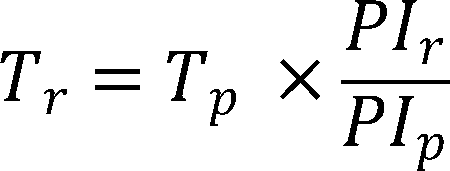
Each year after calendar year 2026, the Administrator will publish a notice on PHMSA's website announcing the updates to property damage threshold criteria for accident reporting, National Response Center (NRC) notification, and construction notifications that will take effect on July 1 of that year and will remain in effect until June 30 of the next year. The reporting threshold used in this Part shall be determined in accordance with the following formula:
Where:
Tr
is the revised reporting threshold,
Tp
is the previous reporting threshold,
PIr
is the average price index published by the Bureau of Labor Statistics each month during the most recent complete calendar year. PHMSA will use the Consumer Price Indices for all Urban Consumers for accident reporting and NRC notifications and the Producer Price Index for construction materials for OPID construction notifications.
PIp
is the average price index for the calendar year used to establish the previous property damage criteria for accident reporting, NRC notification, or construction notification, as appropriate.
Issued in Washington, DC, on April 22, 2026, under the authority delegated in 49 CFR 1.97.
Paul J. Roberti,
Administrator.
Footnotes
1.
American Petroleum Institute and Liquid Energy Pipeline Association, “Comment on Pipeline Safety: Property Damage Definition for Incident Reporting on Gas Pipelines and Accidents on Hazardous Liquid Pipelines” at 2 (Sep. 2, 2025),
https://www.regulations.gov/comment/PHMSA-2025-0109-0004.
2.
Enbridge, “Comment on Pipeline Safety: Property Damage Definition for Incident Reporting on Gas Pipelines and Accidents on Hazardous Liquid Pipelines” at 1 (July 25, 2025),
https://www.regulations.gov/comment/PHMSA-2025-0109-0002.
3.
Pipeline Safety Trust, “Comment on Pipeline Safety: Property Damage Definition for Incident Reporting on Gas Pipelines and Accidents on Hazardous Liquid Pipelines” (Sept. 2, 2025),
https://www.regulations.gov/comment/PHMSA-2025-0109-0003.
4.
Environmental Defense Fund, “Comment on Pipeline Safety: Property Damage Definition for Incident Reporting on Gas Pipelines and Accidents on Hazardous Liquid Pipelines” (Sept. 2, 2025),
https://www.regulations.gov/comment/PHMSA-2025-0109-0005.
6.
Federal Reserve Bank of St. Louis,
Producer Price Index by Commodity: Special Indexes: Construction Materials
(last accessed Jan. 23, 2026), available at:
https://fred.stlouisfed.org/series/WPUSI012011.
7.
See
Docket No. PHMSA-2026-1551, RIN 2137-AG55 (proposing inflation adjustment of the construction notification requirements in subpart B to part 195).
Use this for formal legal and research references to the published document.
91 FR 22096
Web Citation
Suggested Web Citation
Use this when citing the archival web version of the document.
“Pipeline Safety: Property Damage Definition for Reporting Incidents on Gas Pipelines and Accidents on Hazardous Liquid and Carbon Dioxide Pipelines,” thefederalregister.org (April 24, 2026), https://thefederalregister.org/documents/2026-08079/pipeline-safety-property-damage-definition-for-reporting-incidents-on-gas-pipelines-and-accidents-on-hazardous-liquid-an.