Department of Justice
Antitrust Division
Notice is hereby given pursuant to the Antitrust Procedures and Penalties Act, 15 U.S.C. 16(b)-(h), that the Response of Plaintiff United States to Public Comment on the Proposed Final Judgment has been filed with the United States District Court for the District of Columbia in United States of America et al. v. Constellation Energy Corporation, Inc. et al., Civil Action No. 1:25-cv-04235.
The United States' Response and the public comment received are reprinted below. Copies of the public comment ( printed page 22168) and the United States' Response are available for inspection on the Antitrust Division's website at https://www.justice.gov/atr.
Suzanne Morris,
Deputy Director Civil Enforcement Operations, Antitrust Division.
UNITED STATES DISTRICT COURT FOR THE DISTRICT OF COLUMBIA
United States of America, and State of Texas, Plaintiffs, v. Constellation Energy Corporation, Calpine Corporation, and CPN CS Holdco Corp. Defendants.
Case No. 1:25-cv-04235-ABJ
Response of Plaintiff United States to Public Comment on the Proposed Final Judgment
Pursuant to the Antitrust Procedures and Penalties Act (the “Tunney Act”), 15 U.S.C. 16(b)-(h), the United States submits this response to the one public comment received regarding the proposed Final Judgment in this case. After careful consideration of the only submitted comment, the United States continues to believe that the proposed Final Judgment is in the public interest because it will provide an effective and appropriate remedy for the antitrust violation the Complaint alleged. The proposed Final Judgment remedies the lost competition that the Complaint alleged was otherwise likely to have resulted from the acquisition of Calpine Corporation (“Calpine”) by Constellation Energy Corporation (“Constellation”) (the “Transaction”).
Specifically, the proposed Final Judgment will protect competition by requiring Defendants to divest seven electric generating facilities (the “Divestiture Assets”) in two of the nation's major electricity grids—The Electric Reliability Council of Texas (“ERCOT”) [1] and PJM Interconnection LLC (“PJM”) [2] to acquirers acceptable to the United States.
After this Response has been published in the Federal Register , pursuant to 15 U.S.C. 16(d), the United States will move that the Court enter the proposed Final Judgment.
I. Procedural History
On December 5, 2025, the United States, along with the State of Texas, filed a civil antitrust Complaint seeking to enjoin the Transaction. Dkt. 1. The Complaint alleges that Constellation's acquisition of Calpine threatens to substantially lessen competition in wholesale electricity markets in ERCOT and PJM Coastal Mid-Atlantic (a distinct area within the PJM region that includes southeastern Pennsylvania, New Jersey, Delaware, and the eastern shores of Maryland and Virginia), in violation of Section 7 of the Clayton Act, 15 U.S.C. 18.
Concurrent with the filing of the Complaint, Plaintiffs filed the proposed Final Judgment, as well as an Asset Preservation and Hold Separate Stipulation and Order (“Stipulation and Order”) signed by all parties consenting to entry of the proposed Final Judgment after compliance with the requirements of the Tunney Act. Dkt. 2-1 and 2-2. On December 12, 2025, the United States filed a Competitive Impact Statement describing the proposed Final Judgment. Dkt. 20.
The United States arranged for the publication of the Complaint, the proposed Final Judgment, and the Competitive Impact Statement in the Federal Register on December 18, 2025, and caused notice regarding the same, together with directions for the submission of written comments relating to the proposed Final Judgment, to be published in The Washington Post and the Houston Chronicle from December 20 to December 26, 2025. See Dkt. 22. The single public comment received in response is described below and attached as Exhibit A. The 60-day period for public comment has now ended.
II. Standard of Judicial Review
The Clayton Act, as amended by the Tunney Act, requires that proposed consent judgments in antitrust cases brought by the United States are subject to a 60-day comment period, after which the Court shall determine whether entry of the proposed Final Judgment “is in the public interest.” 15 U.S.C. 16(e)(1). In making that determination, the Court, in accordance with the Tunney Act, as amended in 2004, is required to consider:
(A) the competitive impact of such judgment, including termination of alleged violations, provisions for enforcement and modification, duration of relief sought, anticipated effects of alternative remedies actually considered, whether its terms are ambiguous, and any other competitive considerations bearing upon the adequacy of such judgment that the court deems necessary to a determination of whether the consent judgment is in the public interest; and
(B) the impact of entry of such judgment upon competition in the relevant market or markets, upon the public generally and individuals alleging specific injury from the violations set forth in the complaint including consideration of the public benefit, if any, to be derived from a determination of the issues at trial.
15 U.S.C. 16(e)(1)(A), (B).
In considering these statutory factors, the Court's inquiry is necessarily a limited one, as the government is entitled to “broad discretion to settle with the defendant within the reaches of the public interest.” United States v. Microsoft Corp., 56 F.3d 1448, 1461 (D.C. Cir. 1995); United States v. U.S. Airways Grp., Inc., 38 F. Supp. 3d 69, 75 (D.D.C. 2014) (explaining that the “court's inquiry is limited” in Tunney Act settlements); United States v. InBev N.V./S.A., No. 08-1965 (JR), 2009 U.S. Dist. LEXIS 84787, at *3 (D.D.C. Aug. 11, 2009) (noting that a court's review of a proposed Final Judgment is limited and inquires only “into whether the government's determination that the proposed remedies will cure the antitrust violations alleged in the complaint [is] reasonable, and whether the mechanisms to enforce the final judgment are clear and manageable”); United States v. Charleston Area Med. Ctr., Inc., No. 2:16-3664, 2016 U.S. Dist. LEXIS 145963, at *5 (S.D.W. Va. Oct. 21, 2016) (“In evaluating whether the proposed final judgment is in the public interest, the inquiry is `a narrow one'” (quoting Massachusetts v. Microsoft Corp., 373 F.3d 1199, 1236 (D.C. Cir. 2004))).
As the U.S. Court of Appeals for the District of Columbia Circuit has held, under the Tunney Act, a court considers, among other things, the relationship between the remedy secured and the specific allegations in the government's complaint, whether the proposed Final Judgment is sufficiently clear, whether its enforcement mechanisms are sufficient, and whether it may positively harm third parties. See Microsoft, 56 F.3d at 1458-62. With respect to the adequacy of the relief secured by the proposed Final Judgment, a court may not “make de novo determination of facts and issues.” United States v. Western Elec. Co., 993 F.2d 1572, 1577 (D.C. Cir. 1993) (quotation marks omitted); see also Microsoft, 56 F.3d at 1460-62; United States v. Alcoa, Inc., 152 F. Supp. 2d 37, 40 (D.D.C. 2001); United States v. Enova Corp., 107 F. Supp. 2d 10, 16 (D.D.C. 2000); InBev, 2009 U.S. Dist. LEXIS 84787, at *3. Instead, “[t]he balancing of competing social and political interests affected by a proposed antitrust [judgment] must be left, in the first instance, to the discretion of the Attorney General.” Western Elec. Co., 993 F.2d at 1577 (quotation marks omitted). “The court should also bear in mind the flexibility of the public ( printed page 22169) interest inquiry: the court's function is not to determine whether the resulting array of rights and liabilities is the one that will best serve society, but only to confirm that the resulting settlement is within the reaches of the public interest.” Microsoft, 56 F.3d at 1460 (internal quotation marks omitted); see also United States v. Deutsche Telekom AG, No. 19-2232 (TJK), 2020 U.S. Dist. LEXIS 65096, at *12 (D.D.C. Apr. 14, 2020). More demanding requirements would “have enormous practical consequences for the government's ability to negotiate future settlements,” contrary to congressional intent. Microsoft, 56 F.3d at 1456. “The Tunney Act was not intended to create a disincentive to the use of the consent [judgment].” Id.
The United States' predictions about the efficacy of the remedy are to be afforded deference by the Court. See, e.g., Microsoft, 56 F.3d at 1461 (recognizing courts should give “due respect to the Justice Department's . . . view of the nature of its case”); United States v. Republic Servs., Inc., 723 F. Supp. 2d 157, 160 (D.D.C. 2010) (noting “the deferential review to which the government's proposed remedy is accorded”); United States v. Archer-Daniels-Midland Co., 272 F. Supp. 2d 1, 6 (D.D.C. 2003) (“A district court must accord due respect to the government's prediction as to the effect of proposed remedies, its perception of the market structure, and its view of the nature of the case.”). The ultimate question is whether “the remedies [obtained by the Final Judgment are] so inconsonant with the allegations charged as to fall outside of the `reaches of the public interest.' ” Microsoft, 56 F.3d at 1461.
Moreover, the Court's role under the Tunney Act is limited to reviewing the remedy in relationship to the violations that the United States has alleged in its Complaint and does not authorize the Court to “construct [its] own hypothetical case and then evaluate the decree against that case.” Microsoft, 56 F.3d at 1459; see also U.S. Airways, 38 F. Supp. 3d at 75 (noting that the court must simply determine whether there is a factual foundation for the government's decisions such that its conclusions regarding the proposed settlements are reasonable); InBev, 2009 U.S. Dist. LEXIS 84787, at *20 (“[T]he `public interest' is not to be measured by comparing the violations alleged in the complaint against those the court believes could have, or even should have, been alleged.”). Because the “court's authority to review the decree depends entirely on the government's exercising its prosecutorial discretion by bringing a case in the first place,” it follows that “the court is only authorized to review the decree itself,” and not to “effectively redraft the complaint” to inquire into other matters that the United States did not pursue. Microsoft, 56 F.3d at 1459-60. Further, “[i]n evaluating objections to settlement agreements under the Tunney Act, a court must be mindful that [t]he government need not prove that the settlements will perfectly remedy the alleged antitrust harms[;] it need only provide a factual basis for concluding that the settlements are reasonably adequate remedies for the alleged harms.” United States v. Iron Mountain, Inc., 217 F. Supp. 3d 146, 152-53 (D.D.C. 2016) (internal citations omitted). The Court's authority is essentially binary: it may approve a proposed final judgment that falls within the “reaches of the public interest,” or it may reject one that does not. Microsoft, 56 F.3d at 1461-62. “Short of that eventuality, the Tunney Act cannot be interpreted as an authorization for a district judge to assume the role of Attorney General.” Id. at 1462.[3]
In its 2004 amendments to the Tunney Act, Congress made clear its intent to preserve the practical benefits of using judgments proposed by the United States in antitrust enforcement and added the unambiguous instruction that “[n]othing in this section shall be construed to require the court to conduct an evidentiary hearing or to require the court to permit anyone to intervene.” Public Law 108-237, 221, 118 Stat. 668-69 (codified as amended at 15 U.S.C. 16(e)(2)); see also U.S. Airways, 38 F. Supp. 3d at 76 (indicating that a court is not required to hold an evidentiary hearing or to permit intervenors as part of its review under the Tunney Act). This language explicitly wrote into the statute what Congress intended when it first enacted the Tunney Act in 1974. As Senator Tunney explained: “The court is nowhere compelled to go to trial or to engage in extended proceedings which might have the effect of vitiating the benefits of prompt and less costly settlement through the consent [judgment] process.” 119 Cong. Rec. 24,598 (1973) (statement of Sen. Tunney). “A court can make its public interest determination based on the competitive impact statement and response to public comments alone.” U.S. Airways, 38 F. Supp. 3d at 76 (citing Enova Corp., 107 F. Supp. 2d at 17).
III. The Complaint and the Proposed Final Judgment
The Complaint alleges that Constellation's proposed acquisition of Calpine was likely to substantially lessen competition for wholesale electricity in ERCOT and PJM Coastal Mid-Atlantic, in violation of 15 U.S.C. 18.
Constellation is a Pennsylvania corporation headquartered in Baltimore, Maryland, and is one of the largest electric generation companies in the nation, as measured by owned and contracted megawatts. Dkt. 7-1 at ¶ 9. Calpine is a Delaware corporation headquartered in Houston, Texas, and is the largest generator of electricity from natural gas and geothermal resources in the United States. Id. at ¶ 12.
Constellation's acquisition of Calpine would have eliminated the direct competition between Constellation and Calpine and enhanced Constellation's post-Transaction ability and incentive to withhold electricity to raise wholesale electricity price anticompetitively in those markets. Id. at ¶ 36.
The proposed Final Judgment provides an effective and appropriate remedy for the likely competitive harms arising from the Transaction. The proposed Final Judgment has several components, which the parties agreed to abide by during the pendency of the Tunney Act proceeding, and which the Court ordered in entering the Stipulation and Order on January 2, 2026. Dkt. 25.
First, Defendants must divest the Divestiture Assets to acquirers acceptable to the United States in its sole discretion, after consultation with Texas. Dkt. 2-2 at 10-12.
Second, the proposed Final Judgment contains provisions intended to facilitate the acquirers' efforts to hire certain employees. The Defendants must cooperate with and assist any Acquirer(s) in identifying the “Relevant Personnel,” who are full-time, part time, or contract employees of the Defendants who are stationed at or assigned to a specific Divestiture Asset and are involved in its operations. Id. at 13-14. The Defendants must make such Relevant Personnel available for interview and must not interfere with any effort by an Acquirer to employ any Relevant Personnel. Id. at 14-15.
Third, the proposed Final Judgment requires Defendants to warrant that the Divestiture Assets are operational and without material defect on the date of their transfer and to use best efforts to assist an Acquirer to obtain all ( printed page 22170) necessary licenses, registrations, and permits. Id. at 15-16.
The proposed Final Judgment also includes robust mechanisms that will allow the United States and the Court to monitor the effectiveness of the relief and to enforce compliance. For example, the proposed Final Judgment provides that the United States may apply to this Court for the appointment of divestiture trustee if the Defendants have not divested all of the Divesture Assets within a 240-day period set out in the proposed Final Judgment. Id. at 16. Upon appointment, that divestiture trustee will have the sole right to sell the Divestiture Assets to an acquirer or acquirers acceptable to the United States, in its sole discretion, after consultation with Texas. Id. at 16-17.
In addition, the proposed Final Judgment provides the United States with the ability to investigate Defendants' compliance with the Final Judgment and expressly retains and reserves all rights for the United States to enforce the provisions of the proposed Final Judgment, including its rights to seek an order of contempt from the Court. Id. at 22-25.
Together, these requirements of the proposed Final Judgment will preserve competition for wholesale electricity in the ERCOT and PJM Coastal Mid-Atlantic markets.
IV. Summary of Public Comment and the United States' Response
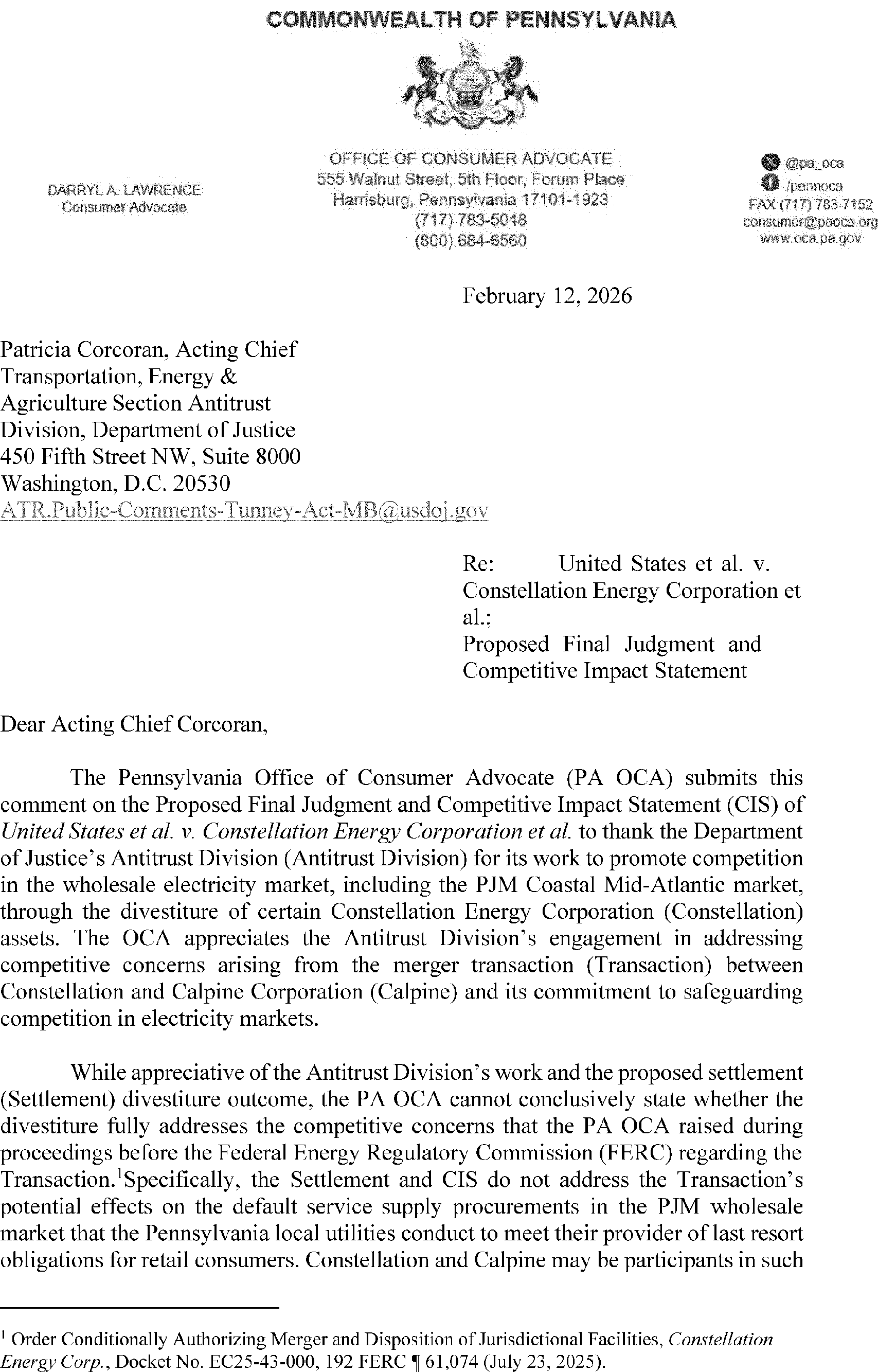
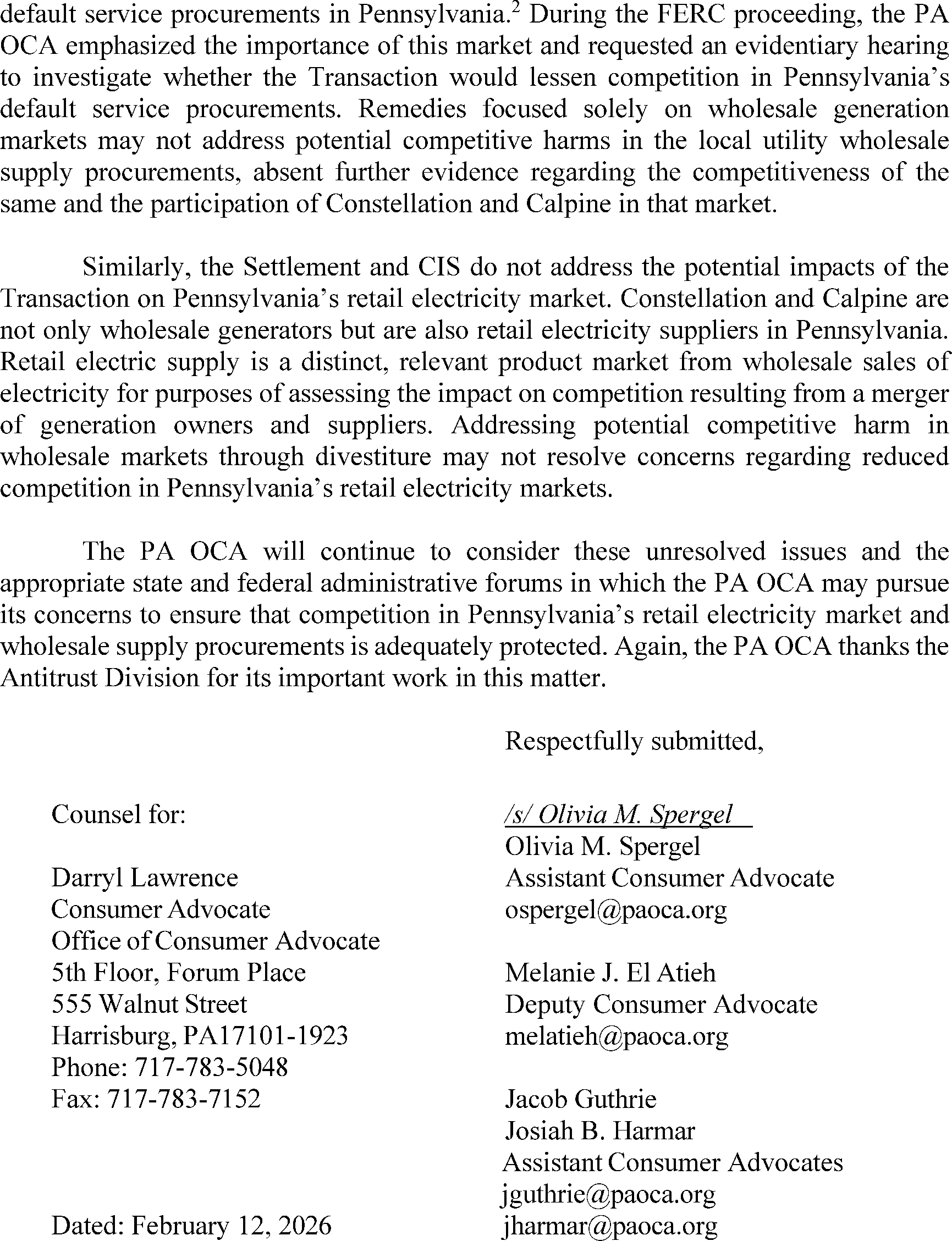
The United States received a single public comment about the proposed Final Judgment. This comment was submitted by the Pennsylvania Office of Consumer Advocate (the “PA OCA”), an entity established by the Pennsylvania General Assembly in 1976 to represent Pennsylvania consumers in matters involving their utility service.[4] In its comment, the PA OCA begins by “appreciat[ing] the Antitrust Division's engagement in addressing competitive concerns” arising from the Transaction and the Division's “commitment to safeguarding competition in electricity markets.” Exhibit A at 1. The PA OCA then raises two state-specific Pennsylvania issues. First, the PA OCA notes that the proposed Final Judgment does not address the Transaction's potential effects on the default service supply procurements in the PJM wholesale market that the Pennsylvania local utilities conduct to meet their provider of last resort obligations for retail electricity consumers. Id. at 1-2. Second, the PA OCA notes that the proposed Final Judgment does not address the potential impacts of the Transaction on Pennsylvania's retail electricity market. Id. at 2. The PA OCA notes that it is considering these issues “and the appropriate state and federal administrative forums” in which these might be addressed. Id. The PA OCA concludes by “thank[ing] the Antitrust Division for its important work in this matter.” Id.
The issues raised by the PA OCA's comment relate to retail electricity markets, not the wholesale electricity markets alleged in the Complaint, and do not suggest that the proposed remedy obtained by the Division is inadequate to resolve the competitive harm the Transaction would create in those wholesale electricity markets. Accordingly, because the PA OCA's comment does not relate to whether the proposed Final Judgment reasonably addresses the harms alleged in the Complaint, it falls outside the scope of this Tunney Act proceeding and does not provide a basis for rejecting the proposed Final Judgment. See U.S. Airways, 38 F. Supp. 3d at 76 (“[T]he Court's role under the [Tunney Act] is limited to reviewing the remedy in relationship to the violations that the United States has alleged in its Complaint.”) (internal citation omitted).
V. Conclusion
After careful consideration of the one public comment received, the United States continues to believe the proposed Final Judgment provides an effective and appropriate remedy for the antitrust violations alleged in the Complaint and is therefore in the public interest. The public comment and this response will be published in the Federal Register , as required by 15 U.S.C. 16(d).
After publication of the comment, the United States will move this Court to enter the proposed Final Judgment.
Dated: April 9, 2026
Respectfully Submitted,
Joseph Chandra Mazumdar
Joseph Chandra Mazumdar, Jeremy Evans (DC Bar #478097), United States Department of Justice, Antitrust Division, 450 Fifth Street, NW, Suite 8000, Washington, DC 20530, Tel: (202) 353-1560, Email: chan.mazumdar@usdoj.gov, Counsel for Plaintiff United States.
EXHIBIT A
( printed page 22171)