Staff Report on the Definitions of “Security-Based Swap Dealer” and “Major Security-Based Swap Participant”
The Securities and Exchange Commission directed staff to prepare and is now publishing a report examining the effect and application of the definitions of "security-based swap d...
The Securities and Exchange Commission directed staff to prepare and is now publishing a report examining the effect and application of the definitions of “security-based swap dealer” and “major security-based swap participant.” Those definitions include an exception from designation as a security-based swap dealer for an entity that engages in a de minimis quantity of security-based swap dealing, as well as separate thresholds below which an entity would not become a major security-based swap participant. As provided in the Commission's rules, nine months after publication of this report and after considering any public comments received, the Commission may by order either terminate the phase-in period for the de minimis thresholds, thereby allowing thresholds of $3 billion for credit default swaps that constitute security-based swaps and $150 million for non-credit default swaps that constitute security-based swaps to take effect and replace the current phase-in thresholds of $8 billion and $400 million, respectively, or propose different thresholds through rulemaking; however, the Commission has issued an order providing a temporary exemption that has the effect of continuing to apply the phase-in thresholds of $8 billion and $400 million until May 8, 2028. The public is invited to comment on all aspects of this report, which may inform the Commission's consideration of potential changes to the de minimis exception and the rules further defining the terms “security-based swap dealer” and “major security-based swap participant.”
DATES:
Comments should be submitted on or before July 6, 2026.
ADDRESSES:
Comments may be submitted by any of the following methods:
Send an email torule-comments@sec.gov.
Please include file number S7-2026-14 on the subject line.
Paper Comments
Send paper comments in triplicate to Secretary, Securities and Exchange Commission, 100 F Street NE, Washington, DC 20549-1090.
All submissions should refer to File Number S7-2026-14. This file number should be included on the subject line if email is used. To help the Commission process and review your comments more efficiently, please use only one method of submission. The Commission will post all comments on the Commission's website (
https://www.sec.gov/comments/s7-2026-14/staff-report-definitions-security-based-swap-dealer-major-security-based-swap-participant). Do not include personal identifiable information in submissions; you should submit only information that you wish to make available publicly. We may redact in part or withhold entirely from publication submitted material that is obscene or subject to copyright protection.
FOR FURTHER INFORMATION CONTACT:
Laura Compton, Senior Special Counsel, Amy Butler, Financial Analyst, or Alexandra Oprea, Special Counsel, Office of Derivatives Policy, Division of Trading and Markets, at (202) 551-5870 or
derivativespolicy@sec.gov,
Securities and Exchange Commission, 100 F Street NE, Washington, DC 20549-8549.
SUPPLEMENTARY INFORMATION:
Pursuant to Rule 3a71-2A(c) [1]
under the Securities Exchange Act of 1934,[2]
the Commission is publishing for public comment the staff report on the definitions of “security-based swap dealer” and “major security-based swap participant.”
By the Commission.
Dated: April 29, 2026.
J. Matthew DeLesDernier,
Deputy Secretary.
Appendix A
Definitions of “Security-Based Swap Dealer” and “Major Security-Based Swap Participant”: A Report by Staff of the Securities and Exchange Commission
Table of Contents
I. Table of Citations
II. Introduction
III. SBS Transaction Reports
IV. Staff Findings and Requests for Comment
A. Security-Based Swap Dealers
1. Definition of “Security-Based Swap Dealer”
2. Methodology for Identifying New Trade Activity
3. Analysis of the Definition of “Security-Based Swap Dealer”
a. Overall SBS Market Activity
i. SBS Market Activity Reviews in 2024 and 2011
ii. Estimates of Potential SBS Dealing Activity in 2024 and 2011
b. CDS De Minimis Threshold
i. CDS Market Participants' Activity
ii. Impact of Exclusions on CDS Activity
iii. $8 Billion Phase-In CDS De Minimis Threshold
iv. $3 Billion Scheduled CDS De Minimis Threshold
v. Alternative CDS De Minimis Thresholds
c. Non-CDS De Minimis Threshold
i. Non-CDS Market Participants' Activity
ii. Impact of Exclusions on Non-CDS Activity
iii. $400 Million Phase-In Non-CDS De Minimis Threshold
iv. $150 Million Scheduled Non-CDS De Minimis Threshold
v. Alternative Non-CDS De Minimis Thresholds
d. Hypothetical Total CDS and Non-CDS SBS De Minimis Thresholds
e. Special Entity SBS De Minimis Threshold
i. Market Participants' Activity With Likely Special Entities
ii. Impact of Exclusions on Activity With Likely Special Entities
iii. $25 Million Special Entity SBS De Minimis Threshold
iv. Alternative De Minimis Thresholds for Special Entity SBS
f. Retrospective Impact Analysis
i. Effects on Competition and Market Access
ii. Effects on Investor Protection
4. Requests for Comment
B. Major Security-Based Swap Participants
1. Definition of “Major Security-Based Swap Participant”
a. Major SBS Categories
b. Substantial Position and Substantial Counterparty Exposure
c. Hedging or Mitigating Commercial Risk
d. Financial Entity
e. Highly Leveraged
f. Attribution Rules for SBS Positions
2. Methodology for Identifying Potential MSBSP Status
a. Estimates of Open SBS Positions
b. Comparison to Safe Harbors
3. Analysis of the Definition of “Major Security-Based Swap Participant”
a. Characteristics of SBS Positions
b. Retrospective Impact Analysis
4. Requests for Comment
C. Scope and Quality of SBS Transaction Reports
1. Gaps in Data Elements of SBS Transaction Reports
2. Data Quality Observations Regarding SBS Transaction Reporting
3. Requests for Comment
Annex
I. Additional Methodology for Analysis of New Trade Activity
A. Identifying New Trade Activity Events
B. Determining the Notional Amount for Each New Trade Activity Event
( printed page 24039)
II. Additional Methodology for Analysis of Open SBS Positions
A. Identifying Open SBS Positions
B. Determining the Notional Amount of Each Open SBS Position
I. Table of Citations
Below is a table of citations to the Securities Exchange Act of 1934 (“Exchange Act”) [3]
rules referenced in this staff report:
Commission reference
CFR citation
(17 CFR)
Rule 3a67-1
§ 240.3a67-1
Rule 3a67-1(a)(1)
§ 240.3a67-1(a)(1)
Rule 3a67-1(a)(2)
§ 240.3a67-1(a)(2)
Rule 3a67-1(a)(2)(i)
§ 240.3a67-1(a)(2)(i)
Rule 3a67-1(a)(2)(ii)
§ 240.3a67-1(a)(2)(ii)
Rule 3a67-1(a)(2)(iii)
§ 240.3a67-1(a)(2)(iii)
Rule 3a67-1(b)
§ 240.3a67-1(b)
Rule 3a67-2(a)
§ 240.3a67-2(a)
Rule 3a67-2(b)
§ 240.3a67-2(b)
Rule 3a67-3(a)
§ 240.3a67-3(a)
Rule 3a67-3(b)
§ 240.3a67-3(b)
Rule 3a67-3(b)(1)
§ 240.3a67-3(b)(1)
Rule 3a67-3(b)(2)
§ 240.3a67-3(b)(2)
Rule 3a67-3(b)(3)
§ 240.3a67-3(b)(3)
Rule 3a67-3(b)(4)
§ 240.3a67-3(b)(4)
Rule 3a67-3(c)
§ 240.3a67-3(c)
Rule 3a67-3(c)(1)
§ 240.3a67-3(c)(1)
Rule 3a67-3(c)(2)
§ 240.3a67-3(c)(2)
Rule 3a67-3(c)(2)(i)(A)(1)
§ 240.3a67-3(c)(2)(i)(A)(1)
Rule 3a67-3(c)(2)(i)(A)(2)
§ 240.3a67-3(c)(2)(i)(A)(2)
Rule 3a67-3(c)(2)(i)(B)
§ 240.3a67-3(c)(2)(i)(B)
Rule 3a67-3(c)(2)(i)(C)
§ 240.3a67-3(c)(2)(i)(C)
Rule 3a67-3(c)(2)(i)(D)
§ 240.3a67-3(c)(2)(i)(D)
Rule 3a67-3(c)(2)(ii)
§ 240.3a67-3(c)(2)(ii)
Rule 3a67-3(c)(3)(i)(A)
§ 240.3a67-3(c)(3)(i)(A)
Rule 3a67-3(c)(3)(i)(B)
§ 240.3a67-3(c)(3)(i)(B)
Rule 3a67-3(c)(3)(ii)
§ 240.3a67-3(c)(3)(ii)
Rule 3a67-3(d)
§ 240.3a67-3(d)
Rule 3a67-3(e)
§ 240.3a67-3(e)
Rule 3a67-4(a)(1)
§ 240.3a67-4(a)(1)
Rule 3a67-4(a)(2)
§ 240.3a67-4(a)(2)
Rule 3a67-4(b)(1)
§ 240.3a67-4(b)(1)
Rule 3a67-4(b)(2)
§ 240.3a67-4(b)(2)
Rule 3a67-5
§ 240.3a67-5
Rule 3a67-5(a)
§ 240.3a67-5(a)
Rule 3a67-6
§ 240.3a67-6
Rule 3a67-6(a)
§ 240.3a67-6(a)
Rule 3a67-6(b)
§ 240.3a67-6(b)
Rule 3a67-7
§ 240.3a67-7
Rule 3a67-7(a)
§ 240.3a67-7(a)
Rule 3a67-7(b)
§ 240.3a67-7(b)
Rule 3a67-8(b)
§ 240.3a67-8(b)
Rule 3a67-9
§ 240.3a67-9
Rule 3a67-9(a)(1)
§ 240.3a67-9(a)(1)
Rule 3a67-9(a)(1)(i)
§ 240.3a67-9(a)(1)(i)
Rule 3a67-9(a)(2)
§ 240.3a67-9(a)(2)
Rule 3a67-9(a)(2)(i)
§ 240.3a67-9(a)(2)(i)
Rule 3a67-9(a)(3)(i)(A)
§ 240.3a67-9(a)(3)(i)(A)
Rule 3a67-9(a)(3)(i)(B)
§ 240.3a67-9(a)(3)(i)(B)
Rule 3a67-9(b)
§ 240.3a67-9(b)
Rule 3a67-10(a)(1)
§ 240.3a67-10(a)(1)
Rule 3a67-10(a)(2)
§ 240.3a67-10(a)(2)
Rule 3a67-10(a)(3)
§ 240.3a67-10(a)(3)
Rule 3a67-10(a)(4)
§ 240.3a67-10(a)(4)
Rule 3a67-10(b)(1)
§ 240.3a67-10(b)(1)
Rule 3a67-10(b)(2)
§ 240.3a67-10(b)(2)
Rule 3a67-10(b)(3)
§ 240.3a67-10(b)(3)
Rule 3a67-10(b)(3)(i)(A)
§ 240.3a67-10(b)(3)(i)(A)
Rule 3a67-10(b)(3)(ii)
§ 240.3a67-10(b)(3)(ii)
Rule 3a67-10(c)
§ 240.3a67-10(c)
Rule 3a67-10(c)(1)(i)
§ 240.3a67-10(c)(1)(i)
Rule 3a67-10(c)(1)(ii)
§ 240.3a67-10(c)(1)(ii)
Rule 3a67-10(c)(2)
§ 240.3a67-10(c)(2)
Rule 3a71-1
§ 240.3a71-1
Rule 3a71-1(a)
§ 240.3a71-1(a)
Rule 3a71-1(b)
§ 240.3a71-1(b)
Rule 3a71-1(c)
§ 240.3a71-1(c)
Rule 3a71-1(d)
§ 240.3a71-1(d)
Rule 3a71-1(d)(1)
§ 240.3a71-1(d)(1)
Rule 3a71-1(d)(2)
§ 240.3a71-1(d)(2)
Rule 3a71-2
§ 240.3a71-2
Rule 3a71-2(a)
§ 240.3a71-2(a)
Rule 3a71-2(a)(1)
§ 240.3a71-2(a)(1)
Rule 3a71-2(a)(1)(i)
§ 240.3a71-2(a)(1)(i)
Rule 3a71-2(a)(1)(ii)
§ 240.3a71-2(a)(1)(ii)
Rule 3a71-2(a)(1)(iii)
§ 240.3a71-2(a)(1)(iii)
Rule 3a71-2(a)(2)
§ 240.3a71-2(a)(2)
Rule 3a71-2(a)(2)(i)
§ 240.3a71-2(a)(2)(i)
Rule 3a71-2(a)(2)(ii)
§ 240.3a71-2(a)(2)(ii)
Rule 3a71-2(a)(2)(ii)(B)
§ 240.3a71-2(a)(2)(ii)(B)
Rule 3a71-2(a)(2)(iii)
§ 240.3a71-2(a)(2)(iii)
Rule 3a71-2(a)(3)
§ 240.3a71-2(a)(3)
Rule 3a71-2A
§ 240.3a71-2A
Rule 3a71-2A(a)(1)
§ 240.3a71-2A(a)(1)
Rule 3a71-2A(a)(2)
§ 240.3a71-2A(a)(2)
Rule 3a71-2A(a)(3)
§ 240.3a71-2A(a)(3)
Rule 3a71-2A(a)(4)
§ 240.3a71-2A(a)(4)
Rule 3a71-2A(a)(5)
§ 240.3a71-2A(a)(5)
Rule 3a71-2A(a)(6)
§ 240.3a71-2A(a)(6)
Rule 3a71-2A(b)
§ 240.3a71-2A(b)
Rule 3a71-2A(c)
§ 240.3a71-2A(c)
Rule 3a71-3(a)(1)
§ 240.3a71-3(a)(1)
Rule 3a71-3(a)(2)
§ 240.3a71-3(a)(2)
Rule 3a71-3(a)(3)
§ 240.3a71-3(a)(3)
Rule 3a71-3(a)(4)
§ 240.3a71-3(a)(4)
Rule 3a71-3(b)
§ 240.3a71-3(b)
Rule 3a71-3(b)(1)
§ 240.3a71-3(b)(1)
Rule 3a71-3(b)(1)(i)
§ 240.3a71-3(b)(1)(i)
Rule 3a71-3(b)(1)(ii)
§ 240.3a71-3(b)(1)(ii)
Rule 3a71-3(b)(1)(iii)
§ 240.3a71-3(b)(1)(iii)
Rule 3a71-3(b)(1)(iii)(A)(
1)
§ 240.3a71-3(b)(1)(iii)(A)(
1)
Rule 3a71-3(b)(1)(iii)(B)
§ 240.3a71-3(b)(1)(iii)(B)
Rule 3a71-3(b)(2)
§ 240.3a71-3(b)(2)
Rule 3a71-3(b)(2)(i)
§ 240.3a71-3(b)(2)(i)
Rule 3a71-3(b)(2)(ii)
§ 240.3a71-3(b)(2)(ii)
Rule 3a71-3(b)(2)(iii)
§ 240.3a71-3(b)(2)(iii)
Rule 3a71-3(d)
§ 240.3a71-3(d)
Rule 3a71-4
§ 240.3a71-4
Rule 3a71-5
§ 240.3a71-5
Regulation SBSR
§§ 242.900 through 242.909
Rule 901(c)(1)
§ 242.901(c)(1)
Rule 901(d)(2)
§ 242.901(d)(2)
Rule 901(d)(5)
§ 242.901(d)(5)
II. Introduction
Staff of the Securities and Exchange Commission (“Commission”) prepared this report to examine the effect and application of the definitions of “security-based swap dealer” and “major security-based swap participant,” as directed in Rule 3a71-2A.[4]
Title VII of the Dodd-Frank Wall Street Reform and Consumer Protection Act of 2010 (“Title VII” and the “Dodd-Frank Act”) [5]
provided the Commission with regulatory authority over security-based swaps (“SBS”), the Commodity Futures Trading Commission (the “CFTC”) with regulatory authority over swaps, and the Commission and the CFTC (together, the “Commissions”) jointly with regulatory authority over mixed swaps.[6]
As a result, security-based swap dealers (“SBSDs”) and major security-based swap participants (“MSBSPs,” and together with SBSDs, “SBS Entities”) became subject to regulation by the Commission.
In 2012, as directed by the Dodd-Frank Act, the Commissions jointly adopted rules further defining the terms “security-based swap dealer” and “major security-based swap participant.” [7]
Those rules provided an exception from designation as an SBSD for an entity that engages in a de minimis quantity of SBS dealing, which the rules defined as $3 billion, subject to a phase-in level of $8 billion, with regard to credit default swaps (“CDS”) that constitute SBS; $150 million, subject to a phase-in level of $400 million, with regard to non-CDS that constitute SBS; and $25 million with regard to all SBS in which the counterparty is a special entity to whom the Dodd-Frank Act extends additional protections.[8]
Those rules also defined separate thresholds below which an entity would not become an MSBSP, requiring a daily average aggregate uncollateralized outward exposure of less than $1 billion in any major SBS category (with some market participants able to deduct from this exposure certain positions held for hedging or mitigating risk) and less than $2 billion for all SBS positions and a daily average aggregate uncollateralized outward exposure plus daily average aggregate potential outward exposure of less than $2 billion in any major SBS category
( printed page 24040)
(again, with some market participants able to deduct from this exposure certain positions held for hedging or mitigating risk) and less than $4 billion for all SBS positions.[9]
The Commissions adopted those rules after considering available 2011 transaction and position data for single-name CDS transactions and estimates for non-CDS markets based on more limited 2011 position data.[10]
This available 2011 data did not yet include information from the SBS transaction reporting that would later be required under the Title VII regulatory framework. To help the Commission evaluate the practical implications and effects of the definitions of “security-based swap dealer” and “major security-based swap participant” following implementation of the Title VII regulatory framework, the Commission in Rule 3a71-2A directed staff to complete and publish for public comment a report on these definitions after additional SBS data became available pursuant to other Title VII rules.[11]
That additional data began to become available when market participants commenced reporting information about their SBS transactions (the “SBS transaction reports”) on November 8, 2021,[12]
known as the data collection initiation date, and in the initial phase of reporting that followed became more consistent as market participants and the Commission implemented this new reporting requirement.
As directed in Rule 3a71-2A, staff prepared this report to inform the Commission's review of the effect and application of the rules further defining the terms “security-based swap dealer” and “major security-based swap participant,” including the SBSD de minimis exception and the MSBSP thresholds, and to inform the Commission's consideration of any changes to those rules.[13]
To accomplish those goals, this report leverages the SBS market data that has emerged from the SBS transaction reports, focusing on SBS market activity during calendar year 2024 in analysis of the definition of “security-based swap dealer” and on SBS positions as of the end of that year in analysis of the definition of “major security-based swap participant.”
Section III of this report describes the SBS transaction reports that staff analyzed to prepare this report. Section IV presents staff's findings from its analysis of the SBS transaction reports.
This report includes several observations for consideration, including:
Staff estimates that in 2024 trading activity in non-CDS was much larger, both in absolute value and as compared to trading activity in CDS, than anticipated when the Commissions adopted the joint definitional rules and that there may have been less notional amount of trading activity in CDS and more notional amount of trading activity in non-CDS in 2024 than in 2011, with the caveat that these estimates are limited by significant differences in the scope of data available in 2011 as compared to 2024, as well as by issues with data quality.
○ In 2011, 1,084 single-name CDS market participants had approximately $12.6 trillion in aggregate gross notional amount of trading activity. Based on the limited information about non-CDS available to the Commission at that time, the Commission estimated that non-CDS trading activity would constitute approximately 1/20th of the aggregate gross notional amount of all SBS trading activity.
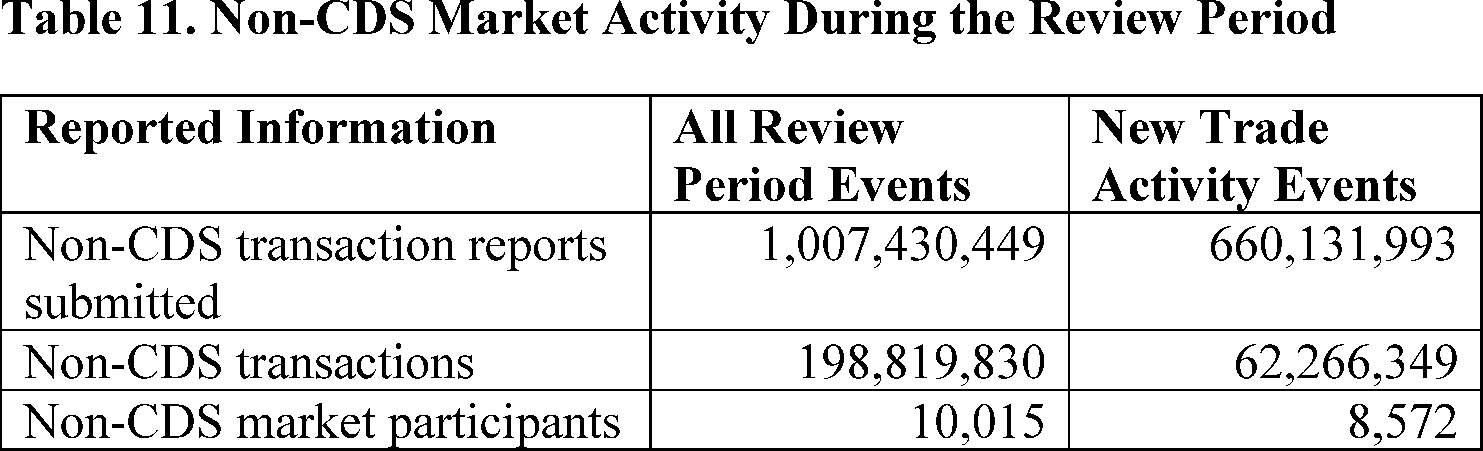
○ In 2024, 10,962 SBS market participants had a total of $4,621.4 trillion in notional amount of “new trade activity,” including 3,603 CDS market participants with approximately $8.6 trillion and 8,572 non-CDS market participants with approximately $4,612.8 trillion.
○ “New trade activity” refers to a reported event that appeared to be consistent with a new or modified investment agreement or decision between the counterparties (including reports of new trades, amendments,[14]
and terminations), as opposed to changes reflecting predetermined criteria or predetermined self-executing formulas, risk management or recordkeeping tasks, or duplicates of other reports. New trade activity includes activity that may be SBS dealing as well as activity that may not be SBS dealing and therefore should not be measured against the de minimis thresholds.[15]
Because each new trade activity event has two counterparties, attributing new trade activity to market participants doubles [16]
the total transacted notional amount of all new trade activity events.
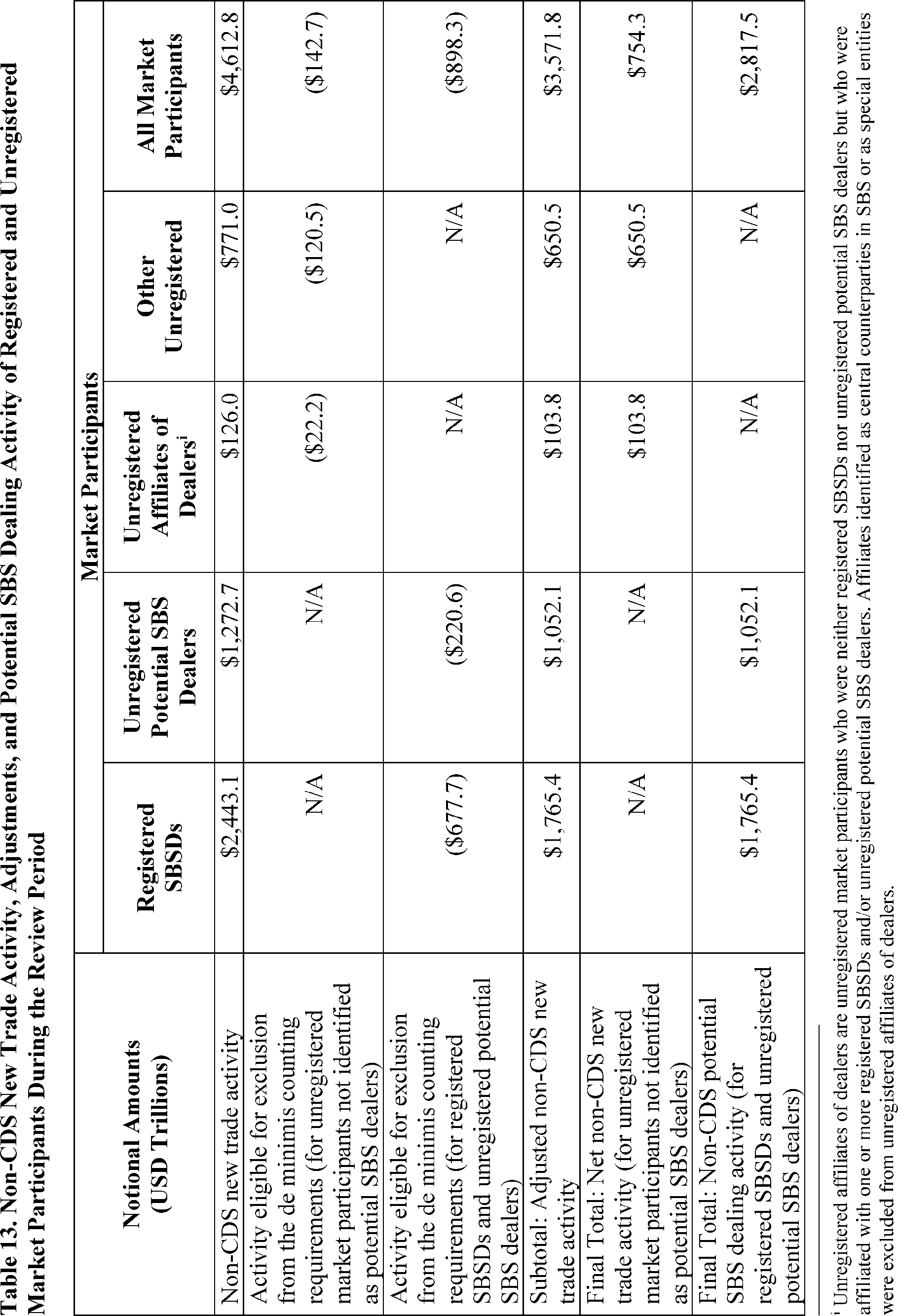
○ Staff compared each de minimis threshold to market participants' “potential SBS dealing activity,” which refers to new trade activity, minus excluded items, of market participants that staff identified as having sufficient indicia of SBS dealing. Because the SBS transaction reports did not include definitive information about a market participant's engagement in the business of SBS dealing for a particular transaction, staff could apply criteria for these indicia of potential SBS dealing activity only at the counterparty level and not at the level of individual transactions or events. Estimates of market participants' potential SBS dealing activity thus may be exclusively SBS dealing activity, exclusively non-dealing activity, or a combination of the two. Estimates that any particular market participant engaged in potential SBS dealing activity above a de minimis threshold might reflect these limitations of available data.
○ Staff observed that market participants overall submitted significantly more substantive amendments to the terms of non-CDS transactions included in new trade activity (approximately $4,468.6 trillion, with some market participants regularly submitting multiple amendments of the same transaction each day) than they did substantive amendments to the terms of CDS transactions, and, pursuant to the methodology to measure new trade activity, each reported amendment counted as a separate new trade activity event.[17]
These substantial differences in reporting may reflect a higher volume of trading in non-CDS compared to CDS markets, a higher or lower volume of trading by individual market participants, reporting errors or inconsistencies, or a combination of these factors. To better understand the reports of
( printed page 24041)
non-CDS amendments, staff confirmed through discussion with multiple large market participants, together accounting for approximately $2,699.9 trillion in notional amount, that their reported amendments accurately reflected bona fide changes to the non-CDS trade consistent with a new or modified investment agreement or decision between the counterparties.
○ Even apart from events reported as amendments to trade terms, non-CDS events reported as new trades and early terminations consistent with a new or modified investment agreement or decision also far outpaced comparable CDS new trade activity and accounted for approximately $105.3 trillion and approximately $38.9 trillion, respectively, in notional amount of non-CDS new trade activity, compared to approximately $5.3 trillion and approximately $2.5 trillion, respectively, in notional amount of CDS new trade activity.
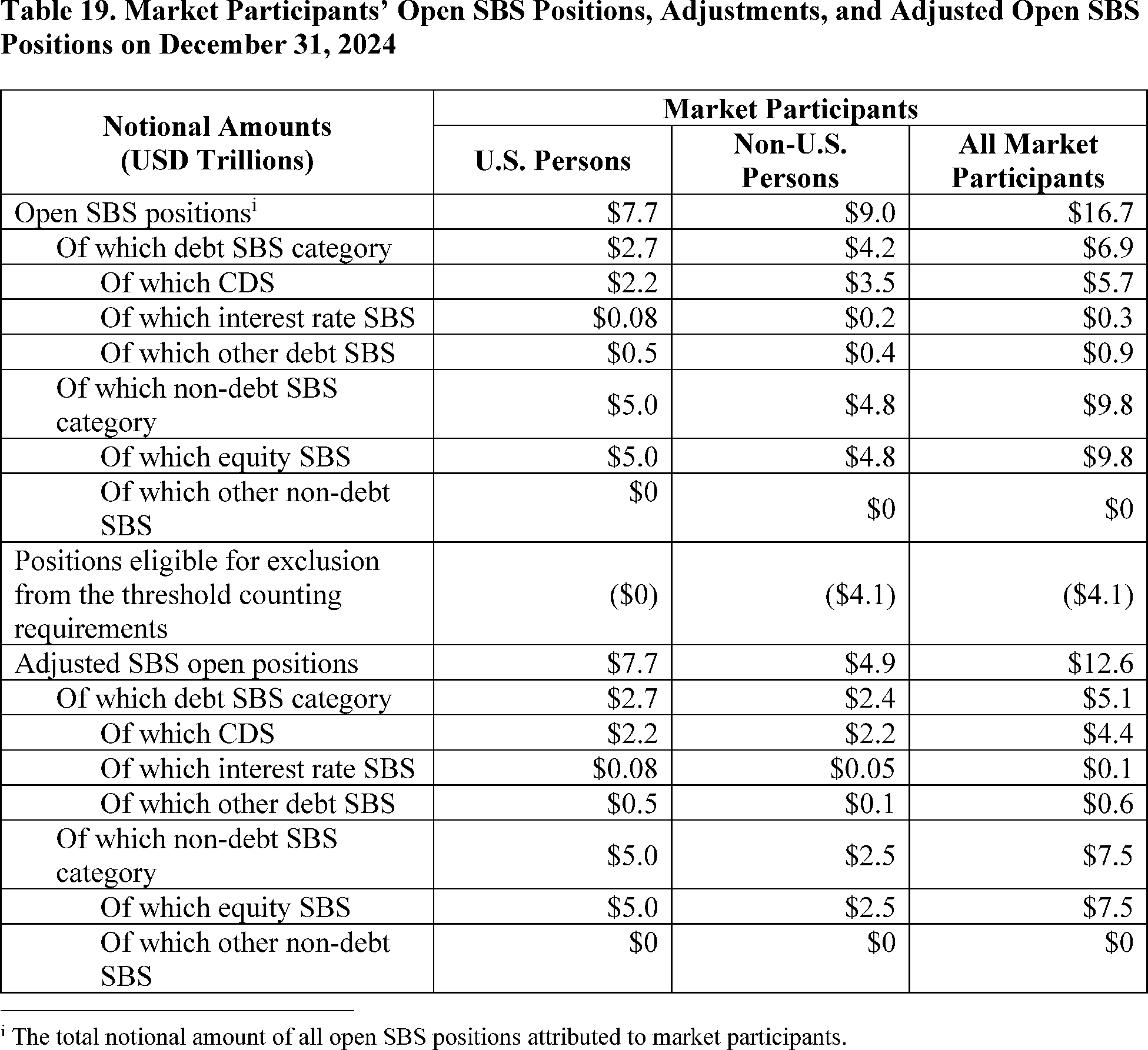
○ In contrast with this transaction-based new trade activity, the total notional amount of all open SBS positions attributed to market participants on December 31, 2024, was approximately $16.7 trillion, including approximately $5.7 trillion (34%) in CDS positions, approximately $1.2 trillion (7%) in interest rate and other non-CDS debt SBS, and approximately $9.8 trillion (59%) in equity SBS.
○ Recognizing the limitations of data scope and quality, the SBS transaction reports nevertheless suggest that non-CDS markets have become a far more significant part of the SBS market activity than previously anticipated. Over 99% of 2024 new trade activity in SBS was non-CDS, with CDS representing less than 1% of 2024 new trade activity.
See sections IV.A.3.a “Overall SBS Market Activity,” IV.B.3.a “Characteristics of SBS Positions,” and IV.C “Scope and Quality of SBS Transaction Reports” for further discussion.
Both CDS and non-CDS SBS markets appeared to be somewhat less concentrated in 2024 compared to 2011, based on 2024 CDS and non-CDS data and 2011 CDS data and non-CDS estimates.
○ In 2011, 28 single-name CDS market participants that appeared to be engaged in SBS dealing had $11.18 trillion (89%) of the $12.6 trillion in aggregate gross notional amount of trading activity by all 1,084 market participants that voluntarily reported such activity.[18]
○ In 2024, 53 registered SBSDs and 853 unregistered potential SBS dealers [19]
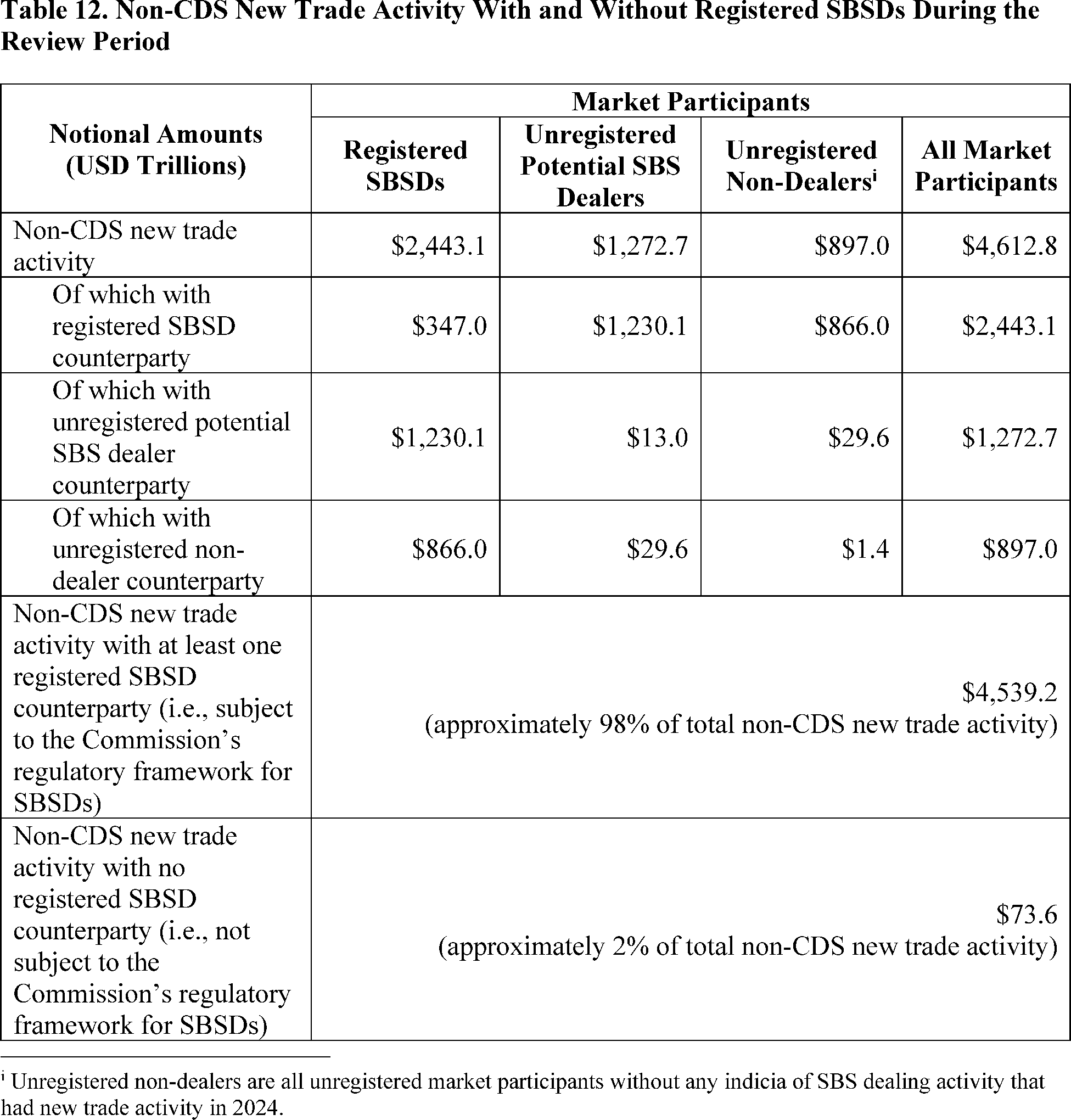
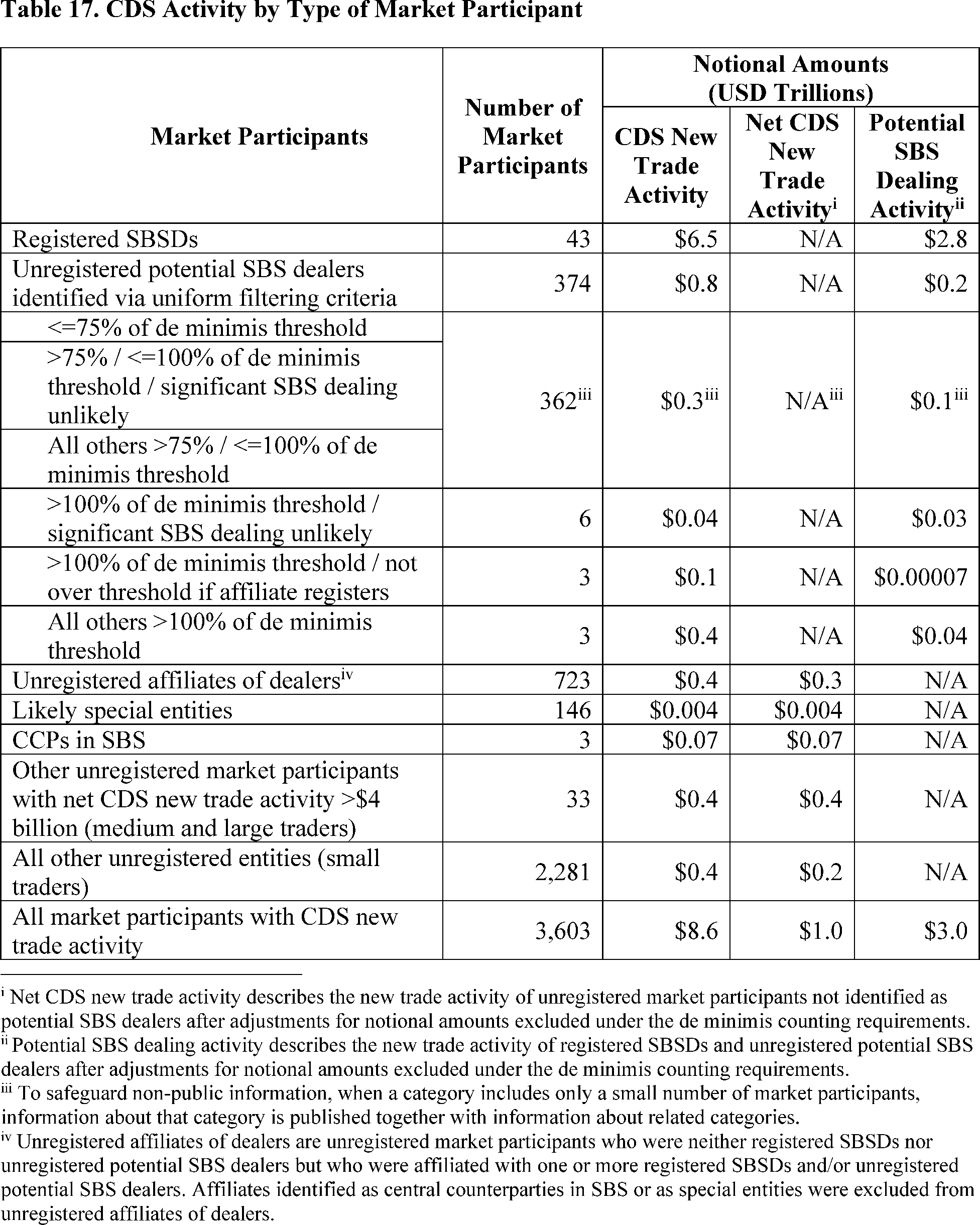
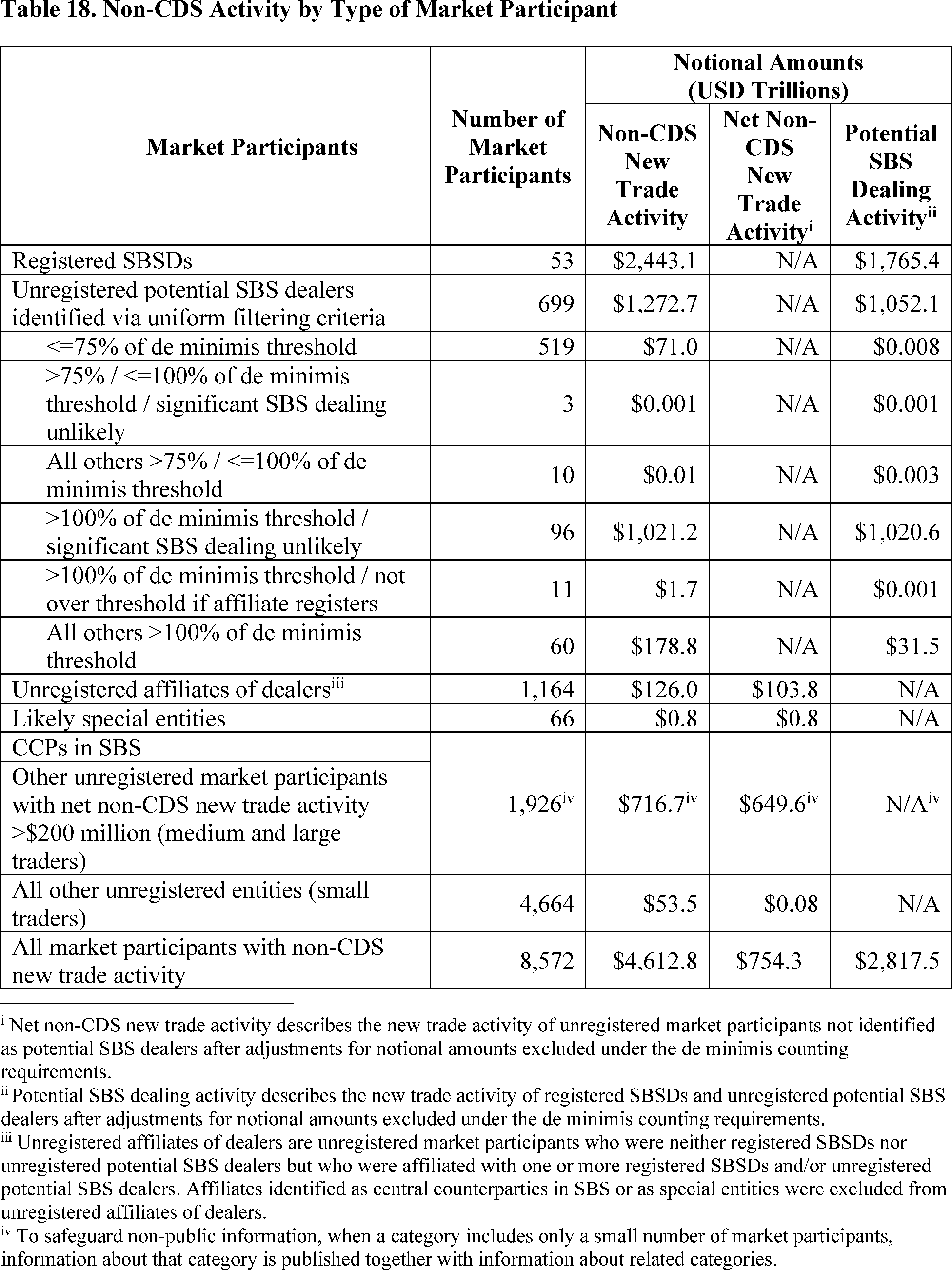
were among the 10,962 SBS market participants with new trade activity. Registered SBSDs ($2,443.1 trillion) and unregistered potential SBS dealers ($1,272.7 trillion) had a total of approximately $3,715.8 trillion (81%) of the $4,612.8 trillion in notional amount of non-CDS new trade activity. Registered SBSDs ($6.5 trillion) and unregistered potential SBS dealers ($0.8 trillion) had a total of approximately $7.3 trillion (85%) of the $8.6 trillion in notional amount of CDS new trade activity.
See sections IV.A.3.a “Overall SBS Market Activity,” IV.A.3.b.i “CDS Market Participants' Activity,” 0 “Non-CDS Market Participants' Activity,” and III.A.3.f.i “Effects on Competition and Market Access” for further discussion.
SBS markets are cross-border, with a significant number of non-U.S. market participants engaged in reported transactions.
○ Among the 53 entities registered as SBSDs on December 31, 2024, 23 (43%) were estimated to be U.S. persons and 30 (57%) were estimated to be non-U.S. persons.
○ Among 853 unregistered market participants identified (using uniform filtering criteria) as potentially engaged in SBS dealing, 325 (38%) were estimated to be U.S. persons and 528 (62%) were estimated to be non-U.S. persons.
See section IV.A.3.a “Overall SBS Market Activity” for further discussion.
The exclusions from the definition of “security-based swap dealer” [20]
are meaningful to the de minimis thresholds for CDS and non-CDS SBS but not to the de minimis threshold for SBS with special entities.
○ $4.6 trillion (54%) out of $8.6 trillion in notional amount of 2024 CDS new trade activity appeared to be eligible for one or more exclusions from potential SBS dealing activity counted toward the de minimis threshold for CDS.
○ $1,041.0 trillion (23%) out of $4,612.8 trillion in notional amount of 2024 non-CDS new trade activity appeared to be eligible for one or more exclusions from potential SBS dealing activity counted toward the de minimis threshold for non-CDS.
○ The exclusions appeared to have no impact on market participants' need to register or remain registered with the Commission as SBSDs due to SBS dealing activity with special entities.
See sections IV.A.3.b.ii “Impact of Exclusions on CDS Activity,” IV.A.3.c.ii “Impact of Exclusions on Non-CDS Activity,” and IV.A.3.e.ii “Impact of Exclusions on Activity with Likely Special Entities” for further discussion.
Although there appeared to be less concentration among market participants engaged in SBS dealing in 2024 compared to 2011, registered SBSDs nevertheless evidenced strong market participation in 2024.
○ Approximately 99% of the aggregate notional amount of all CDS new trade activity included at least one registered SBSD and thus was subject to the Commission's regulatory framework for SBSDs.
○ Approximately 98% of the aggregate notional amount of all non-CDS new trade activity included at least one registered SBSD and thus was subject to the Commission's regulatory framework for SBSDs.
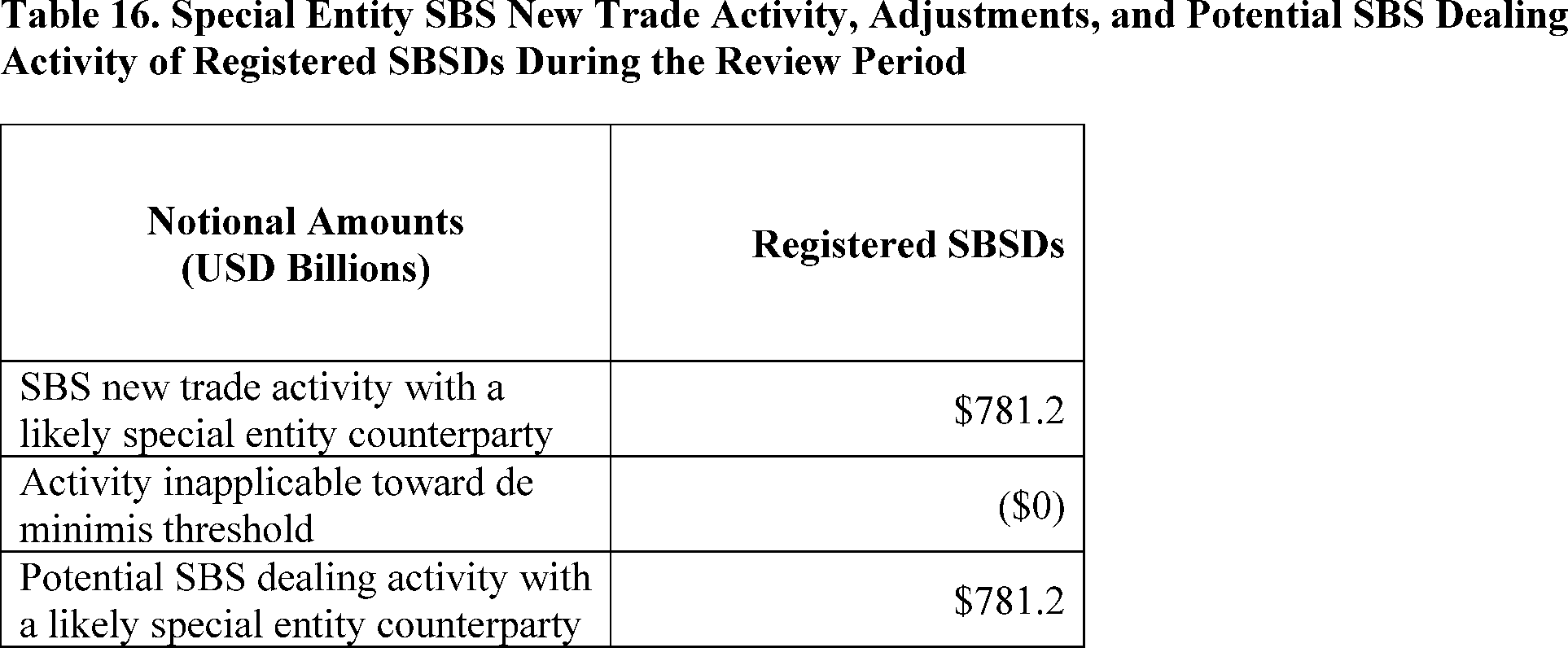
○ Nearly all of the aggregate notional amount of SBS new trade activity with a market participant likely to be a special entity had a registered SBSD on the other side of the trade.
See sections IV.A.3.b “CDS De Minimis Threshold,” IV.A.3.c “Non-CDS De Minimis Threshold,” and IV.A.3.e “Special Entity SBS De Minimis Threshold” for further discussion.
Unregistered market participants appeared to make use of the de minimis exception to the definition of “security-based swap dealer” and the majority, though possibly not all, of those market participants appeared to have managed their SBS dealing to remain below the de minimis thresholds.
○ Unregistered potential SBS dealers identified through uniform filtering criteria accounted for approximately $0.2 trillion (6%) of the notional amount of potential SBS dealing activity [21]
in CDS. After excluding those below the de minimis threshold and market participants that appeared unlikely to be engaged in significant SBS dealing after manual review of additional publicly available information, staff identified three of these market participants, with potential SBS dealing activity in CDS totaling approximately $39.0 billion in notional amount, that may have surpassed the $8 billion de minimis threshold. If these three market participants had been registered as SBSDs throughout 2024, all CDS new trade activity with at least one registered SBSD counterparty would have increased by approximately $65.6 billion to approximately $8,567.1 billion.
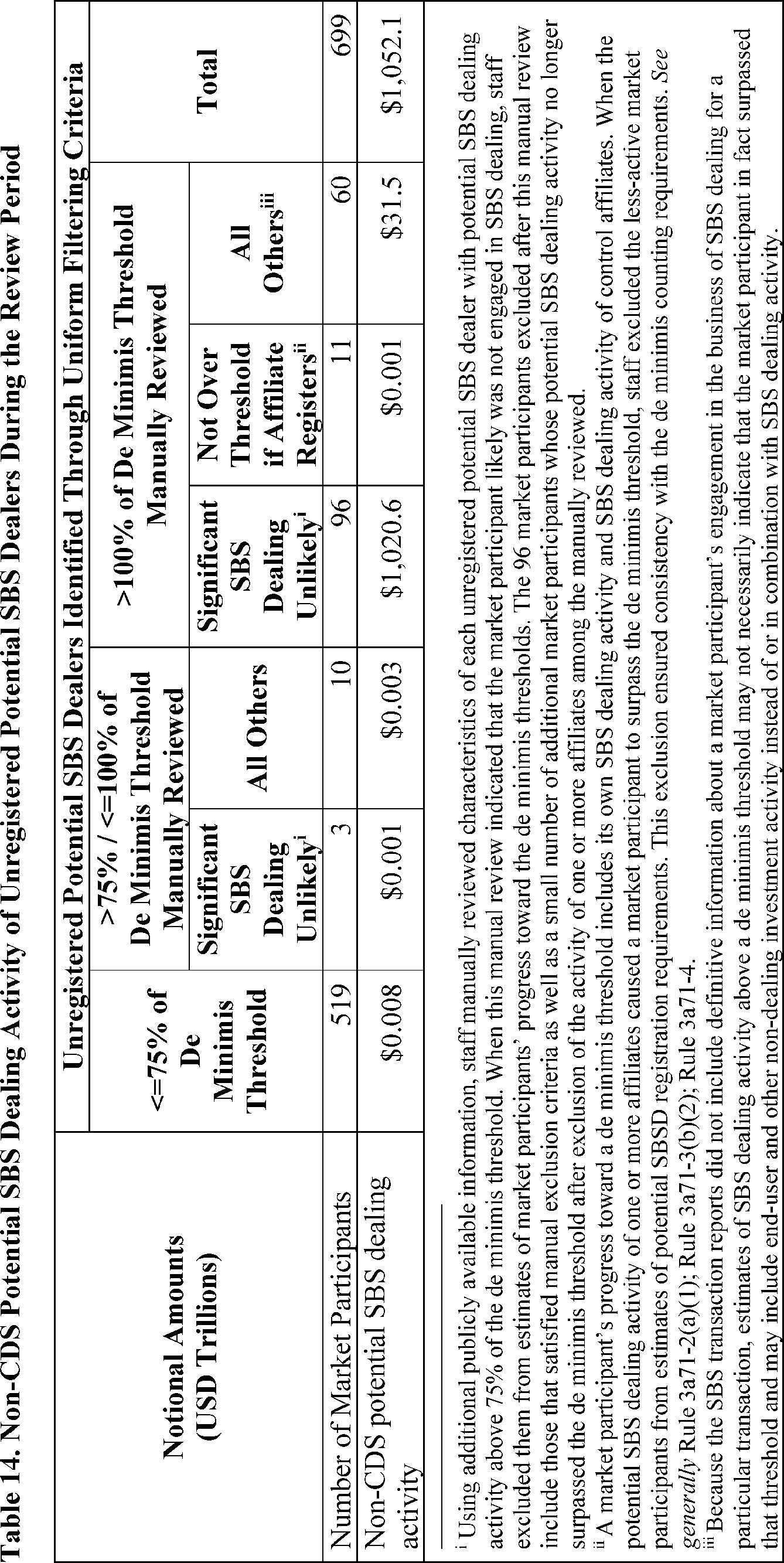
○ Unregistered potential SBS dealers identified through uniform filtering criteria accounted for approximately $1,052.1 trillion (37%) of the notional amount of potential SBS dealing activity in non-CDS. After excluding those below the de minimis threshold and market participants that appeared unlikely to be engaged in significant SBS dealing after manual review of additional publicly available information, staff identified 60 of these market participants, with potential SBS dealing activity in non-CDS totaling approximately $31.5 trillion in notional amount, that may have surpassed the $400 million de minimis threshold. If these 60 market participants had been registered as SBSDs throughout 2024, all non-CDS new trade activity with at least one registered SBSD counterparty would have increased by approximately $57.4 trillion to approximately $4,596.6 trillion.
○ Because the SBS transaction reports did not include definitive information about a market participant's engagement in the business of SBS dealing for a particular transaction, however, estimates of SBS dealing activity above a de minimis threshold may not necessarily indicate that a market participant in fact surpassed that threshold and indeed may include end-user and other non-dealing investment activity. In particular, as the uniform filtering criteria for potential SBS dealing activity could be
( printed page 24042)
applied only at the counterparty level and not at the level of individual transactions or events, all of a market participant's new trade activity net of exclusions, plus that of affiliates estimated to be engaged in SBS dealing, counted toward the de minimis thresholds. The activity of unregistered potential SBS dealers may have been exclusively SBS dealing activity, exclusively non-dealing activity, or a combination of the two.
See sections IV.A.3.b “CDS De Minimis Threshold,” IV.A.3.c “Non-CDS De Minimis Threshold,” and IV.A.3.e “Special Entity SBS De Minimis Threshold” for further discussion.
If the phase-in de minimis thresholds expire as scheduled, additional market participants may be required to register as SBSDs.
○ If the $3 billion scheduled CDS de minimis threshold had applied to the twelve-month period ended on December 31, 2024, four market participants with potential SBS dealing activity in CDS more than $3 billion and up to $8 billion, plus the three additional market participants with potential SBS dealing activity in CDS above $8 billion, may have been required to register as SBSDs.
○ If the $150 million scheduled non-CDS de minimis threshold had applied to the twelve-month period ended on December 31, 2024, 21 market participants with potential SBS dealing activity in non-CDS more than $150 million and up to $400 million, plus the 60 additional market participants with potential SBS dealing activity in non-CDS above $400 million, may have been required to register as SBSDs.
See sections IV.A.3.b.iv “$3 Billion Scheduled CDS De Minimis Threshold” and IV.A.3.c.iv “$150 Million Scheduled Non-CDS De Minimis Threshold” for further discussion.
Only limited information relevant to the MSBSP thresholds is available to the Commission.
○ Information about valuation and collateral, although reported for swap transactions, is not reported for SBS transactions and was not available to staff.[22]
That information may have allowed staff to estimate more of market participants' progress toward the MSBSP thresholds.
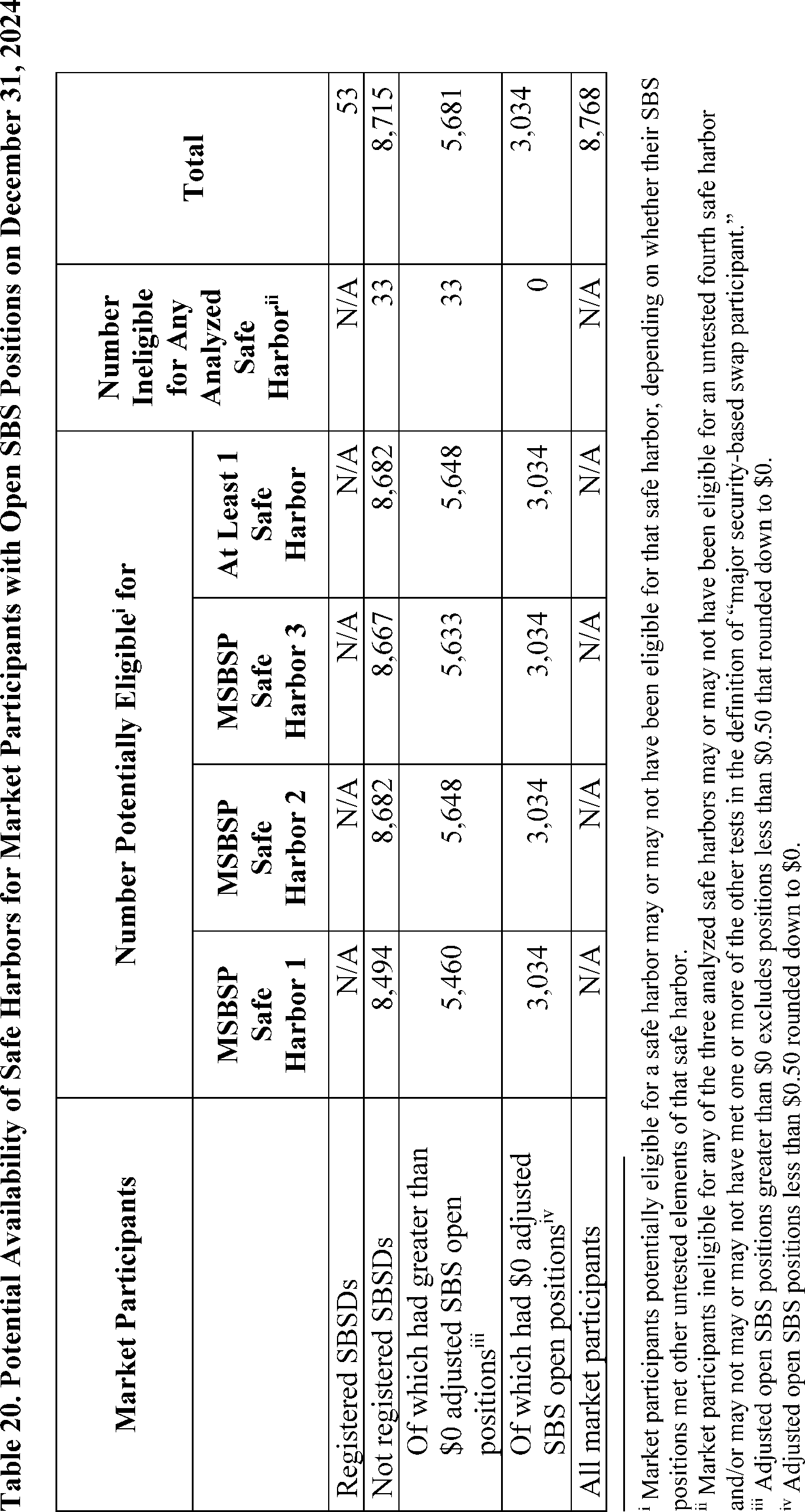
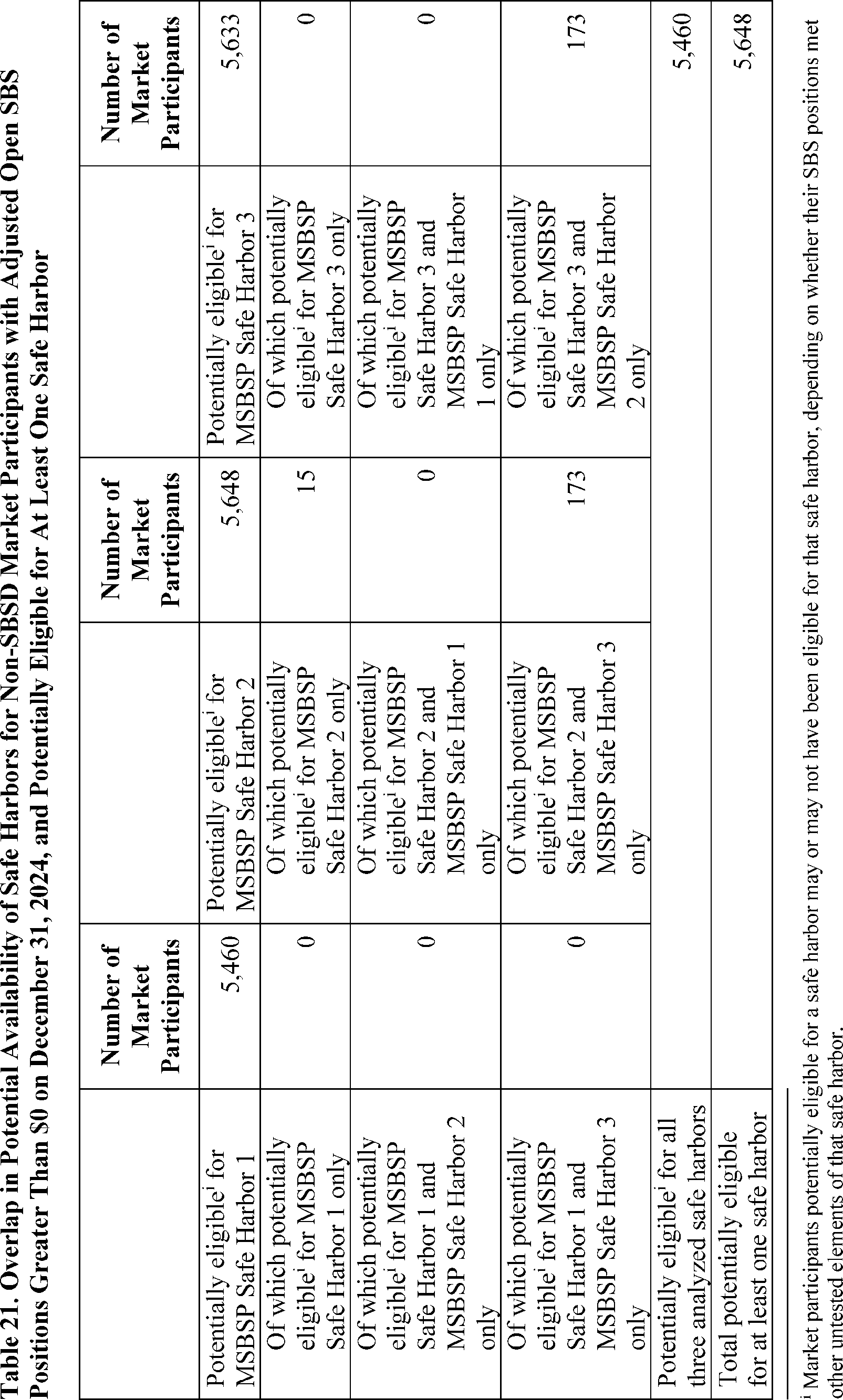
○ Thirty-three out of 8,715 unregistered market participants with open positions on December 31, 2024, did not appear to be eligible for any of the three analyzed safe harbors from the definition of “major security-based swap participant” because their positions were too large for those safe harbors, though SBS transaction report data is insufficient to determine whether those market participants should have registered as MSBSPs. These 33 market participants had a total of approximately $1.9 trillion in open positions that counted toward the MSBSP thresholds.
○ The remaining 8,682 unregistered market participants with open positions on that date did not appear to be ineligible for all three analyzed safe harbors. Additional information would be required to complete estimates of these market participants' status as MSBSPs.
○ Available data about SBS positions on December 31, 2024, did not reveal trends suggesting that market participants are managing their SBS positions in relation to the MSBSP thresholds, but available data also did not address significant aspects of those thresholds.
See section IV.B.3 “Analysis of the Definition of 'Major Security-Based Swap Participant' ” for further discussion.
Staff observed recurrent data quality issues, as well as gaps between the scope of data elements that comprise the SBS transaction reports and the definitions of “security-based swap dealer” and “major security-based swap participant,” that could have affected the accuracy of estimates of SBS dealing and MSBSP activity.
See section IV.C “Scope and Quality of SBS Transaction Reports” for further discussion.
This report is intended to inform the Commission's consideration of the definitions of “security-based swap dealer” and “major security-based swap participant.” Nine months after publication of this report and after considering any public comments received, the Commission may by order either terminate the phase-in period for the de minimis thresholds, thereby allowing thresholds of $3 billion for CDS that constitute SBS and $150 million for non-CDS that constitute SBS to take effect and replace the current phase-in thresholds of $8 billion and $400 million, respectively, or propose different thresholds through rulemaking.[23]
Rule 3a71-2 set a phase-in termination date after which the scheduled thresholds of $3 billion and $150 million would take effect, which had been November 6, 2026; however, the Commission subsequently issued an order providing a temporary conditional exemption that has the effect of continuing to apply the phase-in thresholds of $8 billion and $400 million until May 8, 2028.[24]
The public is invited to comment on all aspects of this report, which may inform the Commission's consideration of potential changes to the de minimis exception and the rules further defining the terms “security-based swap dealer” and “major security-based swap participant.”
III. SBS Transaction Reports
Regulation SBSR implements Title VII's requirement that market participants report to a security-based swap data repository (“SBSDR”) information about their SBS transactions, some of which is publicly disseminated.[25]
On November 8, 2021, market participants began to report information about their SBS transactions to SBSDRs under Regulation SBSR. Pursuant to the Commission's 2019 and 2025 compliance statements regarding these SBS transaction reports (“compliance statements”), market participants temporarily are generally able to choose not to report an SBS transaction or data element required by Regulation SBSR if the CFTC's swap reporting requirements would not require a comparable swap transaction or data element to be reported.[26]
Accordingly, the SBSDRs have prepared technical specifications for SBS transaction reports, and these SBSDR technical specifications are consistent with CFTC swap reporting requirements,[27]
including the CFTC's technical specification for swap reporting (the “CFTC Technical Specification”).[28]
Market participants prepare reports of SBS transactions pursuant to an SBSDR technical specification and submit those reports to an SBSDR. Each report typically consists of a message containing information about an event related to the SBS transaction; an SBS
( printed page 24043)
transaction could be the subject of multiple event messages.
IV. Staff Findings and Requests for Comment
A. Security-Based Swap Dealers
1. Definition of “Security-Based Swap Dealer”
Section 3(a)(71)(A) of the Exchange Act and Rule 3a71-1 define the term “security-based swap dealer” as any person who: (1) holds itself out as a dealer in SBS; (2) makes a market in SBS; (3) regularly enters into SBS with counterparties as an ordinary course of business for its own account; or (4) engages in any activity causing it to be commonly known in the trade as a dealer or market maker in SBS.[29]
The term “security-based swap dealer” does not include a person that enters into SBS for such person's own account, either individually or in a fiduciary capacity, but not as a part of regular business.[30]
An entity that meets one of the tests in the definition of “security-based swap dealer” nevertheless is excepted from that definition if it engages in a de minimis quantity of SBS dealing.[31]
Pursuant to thresholds the Commission has adopted, a person shall be deemed not to be an SBSD, and therefore is not required to register with the Commission or comply with the regulatory framework for SBSDs, if the positions connected with the person's SBS dealing activity, together with the positions connected with any SBS dealing activity of control affiliates,[32]
over the immediately preceding twelve months do not exceed an aggregate gross notional amount of:
(1) $3 billion, subject to a phase-in level [33]
of $8 billion, with regard to CDS that constitute SBS;
(2) $150 million, subject to a phase-in level of $400 million, with regard to non-CDS that constitute SBS; and
(3) $25 million with regard to all SBS in which the counterparty is a special entity to whom the Dodd-Frank Act extends additional protections.[34]
When adopting the definition of the term “security-based swap dealer,” the Commission stated that whether a person is an SBSD would depend on the relevant facts and circumstances.[35]
The Commission considered the following factors relevant for identifying SBSDs and distinguishing them from other market participants: (1) providing liquidity to market professionals or other persons in connection with SBS; (2) seeking to profit by providing liquidity in connection with SBS; (3) providing advice in connection with SBS or structuring SBS; (4) presence of regular clientele and actively soliciting clients; (5) use of inter-dealer brokers; and (6) acting as a market maker on an organized SBS exchange or trading system.[36]
In determining whether a person is an SBSD, certain SBS are not considered and thus are not “counted” toward the de minimis thresholds. These non-countable SBS include any of the person's SBS with majority-owned affiliates [37]
and the SBS of any control affiliate that is already or soon will be required to be registered with the Commission as an SBSD.[38]
U.S. persons, as well as non-U.S. persons that qualify as conduit affiliates, must otherwise count toward the de minimis thresholds all their own SBS dealing activity and any SBS dealing activity of their control affiliates.[39]
Non-U.S. persons that are not conduit affiliates, on the other hand, count only their and their control affiliates' (1) SBS entered into with a U.S. person, except for some SBS conducted through a registered SBSD's foreign branch; (2) SBS guaranteed by a U.S.-person control affiliate of the non-U.S. person; and (3) SBS that are arranged, negotiated, or executed by U.S.-located personnel of the non-U.S. person or its agent (each, an “ANE transaction”), except for certain SBS that qualify for an exception to counting these ANE transactions.[40]
However, non-U.S. persons that are not conduit affiliates do not count certain anonymous centrally cleared transactions that are platform-traded, even if they fall into one of these three countable categories.[41]
The de minimis exception strikes a balance between regulatory goals and burdens [42]
and reflects an intention to identify persons for whom regulation is warranted either “[d]ue to the nature of their interactions with counterparties” or “to promote market stability and transparency, in light of the role those persons occupy within the [SBS] markets.” [43]
The Commission crafted the de minimis exception to: (1) allow persons to accommodate existing clients that have a need for SBS in conjunction with other financial services or commercial activities without the costs of registering as an SBSD or establishing separate relationships with registered SBSDs; (2) promote competition in SBS dealing activity for persons beginning to engage in SBS dealing; (3) provide an objective test for market participants; and (4) further the interest of regulatory efficiency when the amount of a person's SBS dealing activity does not warrant regulation in comparison to the overall market for SBS.[44]
2. Methodology for Identifying New Trade Activity
Staff analyzed SBS transaction events [45]
that occurred [46]
between January 1, 2024, and December 31, 2024 (the “review period”), and were received by an SBSDR through a
( printed page 24044)
cutoff date [47]
of February 28, 2025.[48]
Any events associated with an SBS transaction [49]
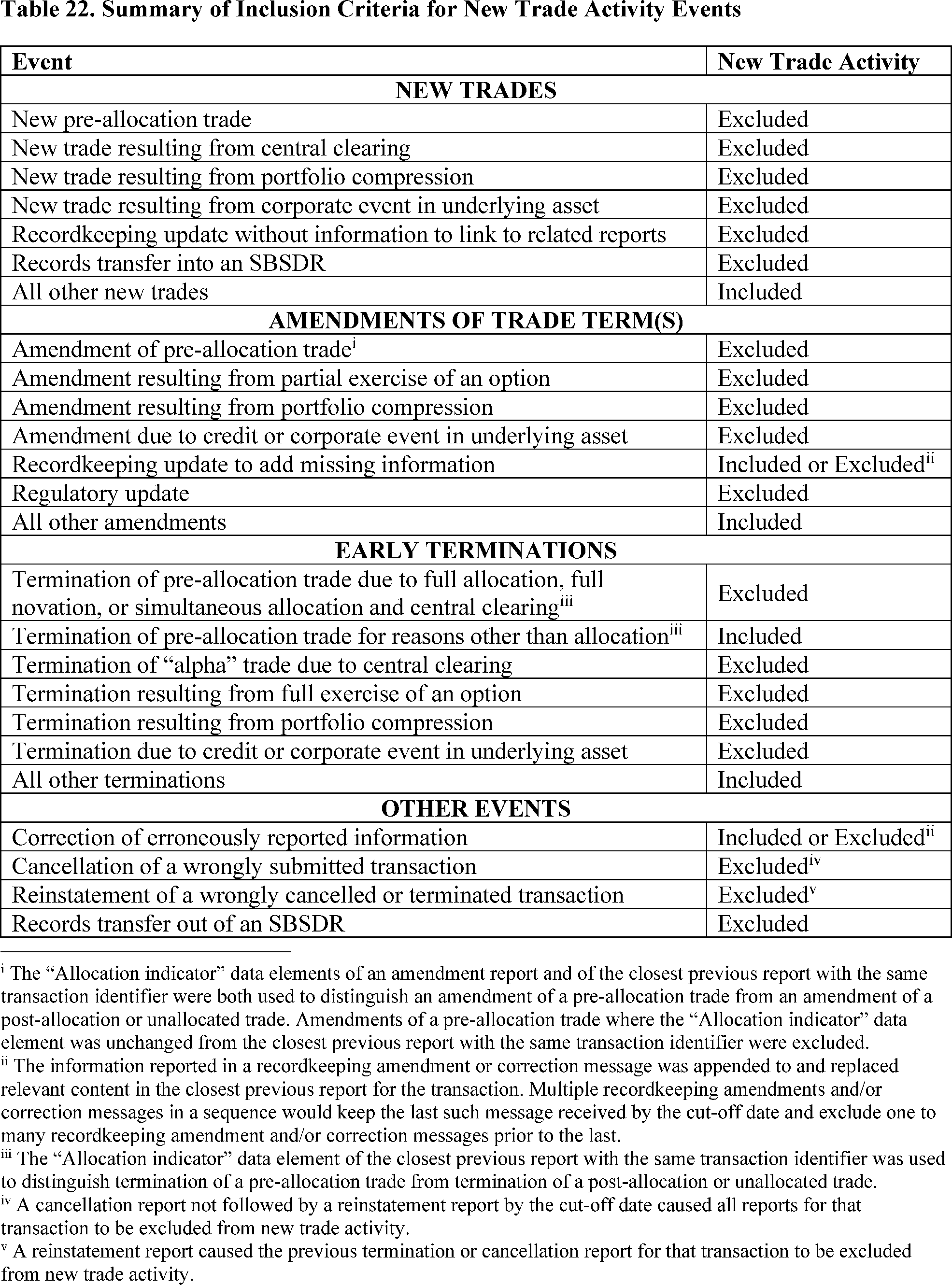
that was subsequently cancelled and not reinstated by the cutoff date were excluded. Staff then identified reported events that represented new trade activity (“new trade activity”) [50]
and determined the gross notional amount [51]
associated with each new trade activity event.
Next, staff determined which of the three de minimis thresholds applied to the SBS reported in each new trade activity event. New trade activity events with a product identifier [52]
consistent with CDS were classified as CDS to which the de minimis thresholds in Rule 3a71-2(a)(1)(i) apply. New trade activity events with a product identifier consistent with any other SBS were classified as non-CDS to which the de minimis thresholds in Rule 3a71-2(a)(1)(ii) apply. SBS transaction reports do not contain information sufficient to distinguish special entity counterparties from other counterparties.[53]
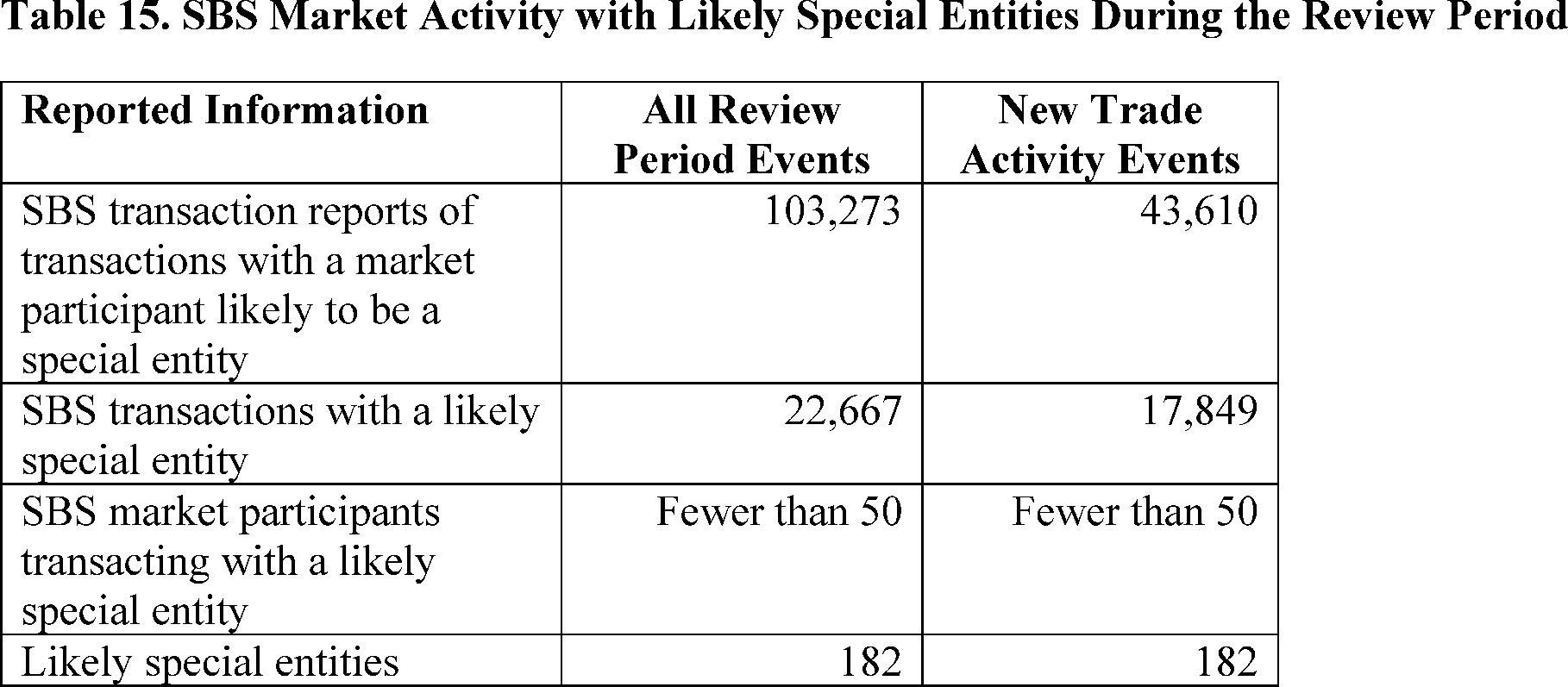
Using third-party data sources, however, staff was able to identify certain counterparties as more likely than others to be special entities. New trade activity events with a counterparty that appeared likely to be a special entity were classified as the other counterparty's SBS with a special entity, to which the de minimis threshold in Rule 3a71-2(a)(1)(iii) applies.[54]
Staff used these estimates of new trade activity to review overall SBS market activity and as a starting point to identify potential SBS dealing activity over the twelve months of the review period ending on December 31, 2024 (the “measurement date”). A description of staff's methodology for identifying new trade activity events and determining their notional amounts appears in Annex section I.
3. Analysis of the Definition of “Security-Based Swap Dealer”
Staff prepared descriptive analytics of SBS market activity overall and of activity in the CDS, non-CDS and special entity SBS markets. As directed by the Commission, these descriptive analytics include staff's analysis of each significant element [55]
of the definition of “security-based swap dealer” for which data was available.[56]
The Commission also directed staff to assess whether the de minimis thresholds should be increased or decreased,[57]
and these descriptive analytics include staff's assessment of hypothetical alternative de minimis thresholds. Finally, staff retrospectively analyzed the impacts of the definition on competition, market access, and investor protection.[58]
a. Overall SBS Market Activity
i. SBS Market Activity Reviews in 2024 and 2011
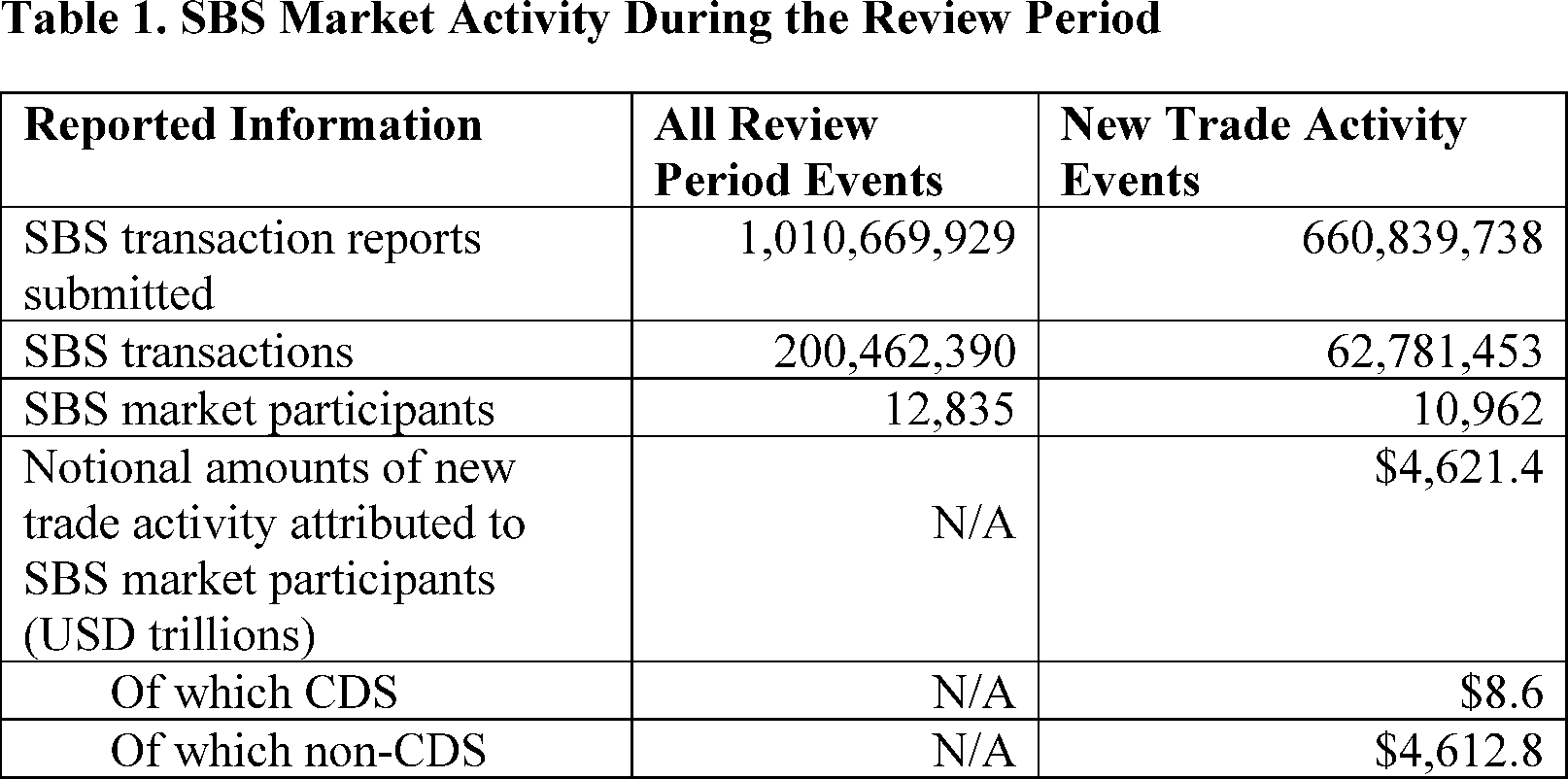
As shown in Table 1, market participants submitted to SBSDRs before the cut-off date 1,010,669,929 SBS transaction reports about events that occurred during the 2024 review period. These review period events related to 200,462,390 unique SBS transactions that involved 12,835 unique market participants and 9,191 affiliated groups.[59]
Among these were 660,839,738 unique new trade activity events related to 62,781,453 unique SBS transactions involving 10,962 unique market participants. These 10,962 unique SBS market participants included 7,736 affiliated groups of one or more market participants as of the measurement date.[60]
There was a total notional amount of approximately $2,310.7 trillion in new trade activity events during the review period. This total reflects the transacted notional amounts of the reported new trade activity events, providing a snapshot of the volume of new trade activity transactions in the SBS market at large. By contrast, when measuring market participants' progress toward the de minimis thresholds, staff took an individualized approach, analyzing each market participant's total notional amount of new trade activity. Because each new trade activity event has two counterparties, attributing new trade activity to market
( printed page 24045)
participants doubles [61]
the total transacted notional amount of all new trade activity events during the review period, resulting in approximately $4,621.4 trillion of new trade activity attributed to market participants.
The information in the 2024 SBS transaction reports differs in scope, in some cases substantially, from the 2011 data that the Commission reviewed in 2012. For SBS that are CDS, the 2011 data included a sample of “all new, risk transfer, dollar-adjusted, gold record transactions in both corporate and sovereign single-name [CDS]” submitted to the Depository Trust and Clearing Corporation's Trade Information Warehouse (“DTCC-TIW”) in 2011, as well as 2011 monthly single-name CDS position data provided by DTCC-TIW.[62]
Market participants submitted this transaction and end-of-week position data to DTCC-TIW on a voluntary basis. The transactions and positions provided to the Commission were those where at least one of the counterparties and/or the reference entity was a U.S. entity, with status as a U.S. entity determined by DTCC-TIW. The 2011 CDS data reviewed by the Commission in 2012 thus did not include transactions or positions between two non-U.S.-entity counterparties if the reference entity also was not a U.S. entity and did not provide any intra-weekly position information nor any information on the underlying security holdings of reference entities. For non-CDS SBS, available 2011 data was limited to publicly disseminated information about aggregate positions in credit and equity derivatives; transaction-level non-CDS data was unavailable.[63]
By contrast, the 2024 SBS transaction reports included all SBS reported to an SBSDR, including both CDS and non-CDS. The scope of SBS transaction reports submitted to SBSDRs may have been broader in some cases and/or narrower in other cases than the scope of the Commission's access to DTCC-TIW reports, for example because (1) the SBS transaction reports include CDS and non-CDS SBS that are subject to Title VII reporting requirements, whereas the reports to DTCC-TIW are voluntary and the DTCC-TIW SBS transaction and position data includes only single-name CDS; (2) the DTCC-TIW reports available to the Commission are those with at least one U.S.-entity counterparty or reference entity, whereas the Title VII reporting requirements apply to a different set of SBS, including SBS with a U.S.-person counterparty, SBS with a non-U.S.-person counterparty registered as an SBSD, and SBS with other U.S. jurisdictional characteristics, but not including SBS solely because of the U.S. character of the reference entity; and (3) the definition of “U.S. person” for purposes of the Title VII reporting requirements may differ from DTCC-TIW's criteria for identifying U.S. entities.
Both the number of SBS market participants and the notional amount of SBS transactions available for review were larger in 2024 compared to 2011. In 2012, the Commission reviewed 2011 trading activity of 1,084 single-name CDS market participants with approximately $12.6 trillion in aggregate gross notional amount.[64]
By contrast, the non-CDS data available to the Commission in 2011 did not include trading activity. Rather, the Commission had available to it only two limited data points about non-CDS positions: Bank for International Settlement estimates comparing the global notional amounts outstanding in equity forwards and swaps compared to credit default swaps as of June 2011 and U.S. Office of the Comptroller of the Currency data showing the notional amounts outstanding of credit and equity derivatives as of June 30, 2011, held by U.S. commercial banks and trust companies.[65]
Based on this limited non-CDS position data, the Commission estimated that non-CDS trading activity would constitute approximately 1/20th of the aggregate gross notional amount of all SBS trading activity.[66]
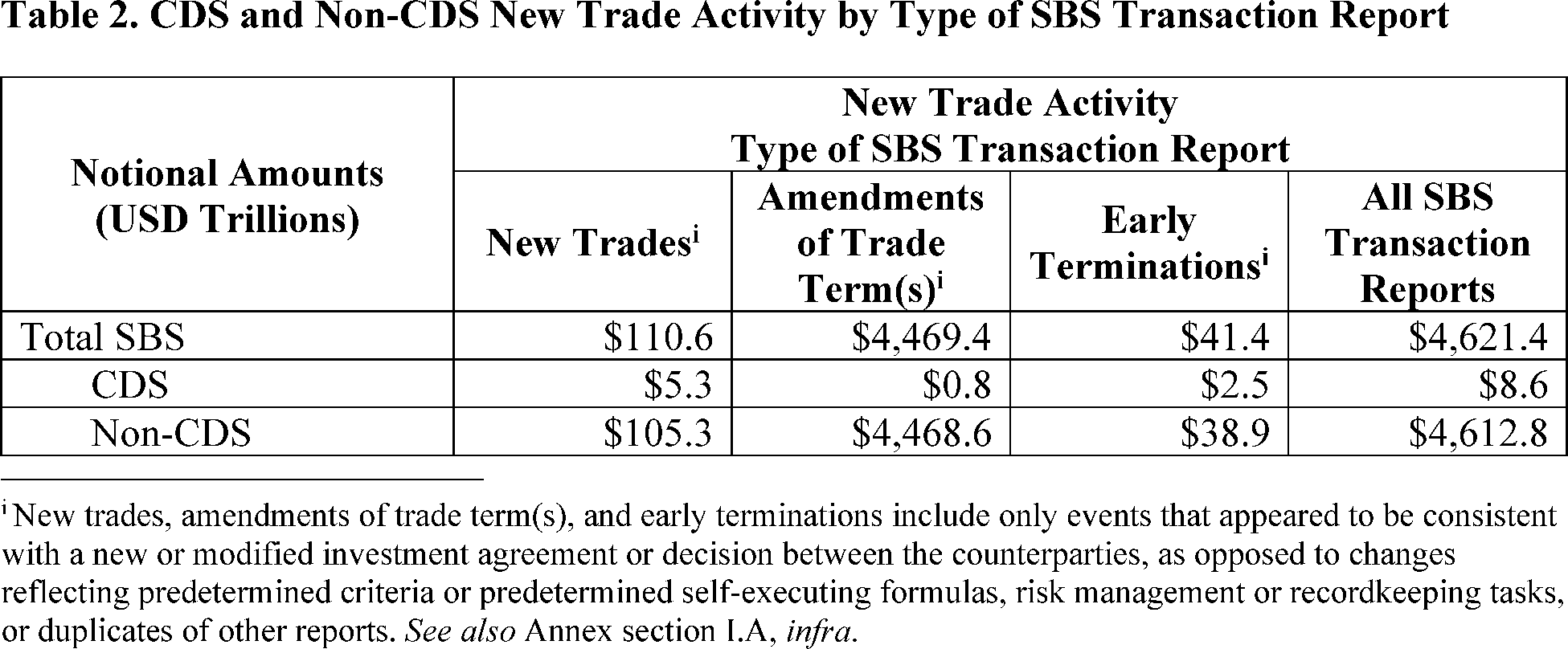
For the current analysis, staff reviewed 2024 new trade activity of 10,962 market participants with a total of approximately $4,621.4 trillion in notional amount, as reported to SBSDRs. This amount comprised $8.6 trillion in CDS new trade activity and $4,612.8 trillion in non-CDS new trade activity, including products such as equity, non-CDS debt, interest rate, and other SBS. As shown in Table 2, approximately $5.3 trillion in notional amount of 2024 CDS new trade activity (approximately 61% of all CDS new trade activity) represented events reported as new trades, compared to approximately $0.8 trillion (10%) in notional amount representing events reported as amendments to trade terms consistent with a new or modified investment agreement or decision and approximately $2.5 trillion (29%) in notional amount representing events reported as early terminations consistent with a new or modified investment agreement or decision. By contrast, a significantly larger portion of non-CDS new trade activity, approximately
( printed page 24046)
$4,468.6 trillion in notional amount (approximately 97% of all non-CDS new trade activity), represented events reported as amendments to trade terms consistent with a new or modified investment agreement or decision, with some market participants regularly submitting multiple amendments of the same transaction each day. Information in the SBS transaction reports does not indicate whether this difference may reflect actual variances in CDS and non-CDS new trade activity; inconsistencies in reporting practices across market participants, products, or scenarios; or a combination of factors.
To better understand these non-CDS amendment reports, staff discussed them with multiple market participants that had reported among the highest total notional amounts of amendments to trade terms of non-CDS transactions. The market participants with whom staff discussed these reports together accounted for approximately $2,699.9 trillion of the approximately $4,468.6 trillion in notional amount of non-CDS new trade activity representing events reported as amendments to trade terms consistent with a new or modified investment agreement or decision. Each of these market participants confirmed that their reported amendments accurately reflected bona fide changes to the non-CDS trade consistent with a new or modified investment agreement or decision between the counterparties. Moreover, even apart from events reported as amendments to trade terms, non-CDS events reported as new trades and early terminations consistent with a new or modified investment agreement or decision also far outpaced comparable CDS new trade activity and accounted for approximately $105.3 trillion and approximately $38.9 trillion, respectively, in notional amount of non-CDS new trade activity, compared to approximately $5.3 trillion and approximately $2.5 trillion, respectively, in notional amount of CDS new trade activity.
Staff thus estimates that trading activity in non-CDS was more significant compared to trading activity in CDS in 2024 than anticipated when the Commissions adopted the joint definitional rules. In addition, there may have been less notional amount of trading activity in CDS in 2024 than in 2011 based on comparison of 2011 and 2024 transaction data,[67]
while there may have been more notional amount of trading activity in non-CDS in 2024 than in 2011 based on comparison of the 2011 estimate to 2024 transaction data. Though each of these estimates is limited by the significant differences in the scope of data available in 2011 as compared to 2024 and by the 2024 data quality issues described below, the magnitude of the differences between 2024 CDS and non-CDS new trade activity suggests that non-CDS trading activity is much larger, both in absolute value and as compared to CDS trading activity, than the limited 2011 data could have predicted at the time the Commission adopted the de minimis thresholds.
ii. Estimates of Potential SBS Dealing Activity in 2024 and 2011
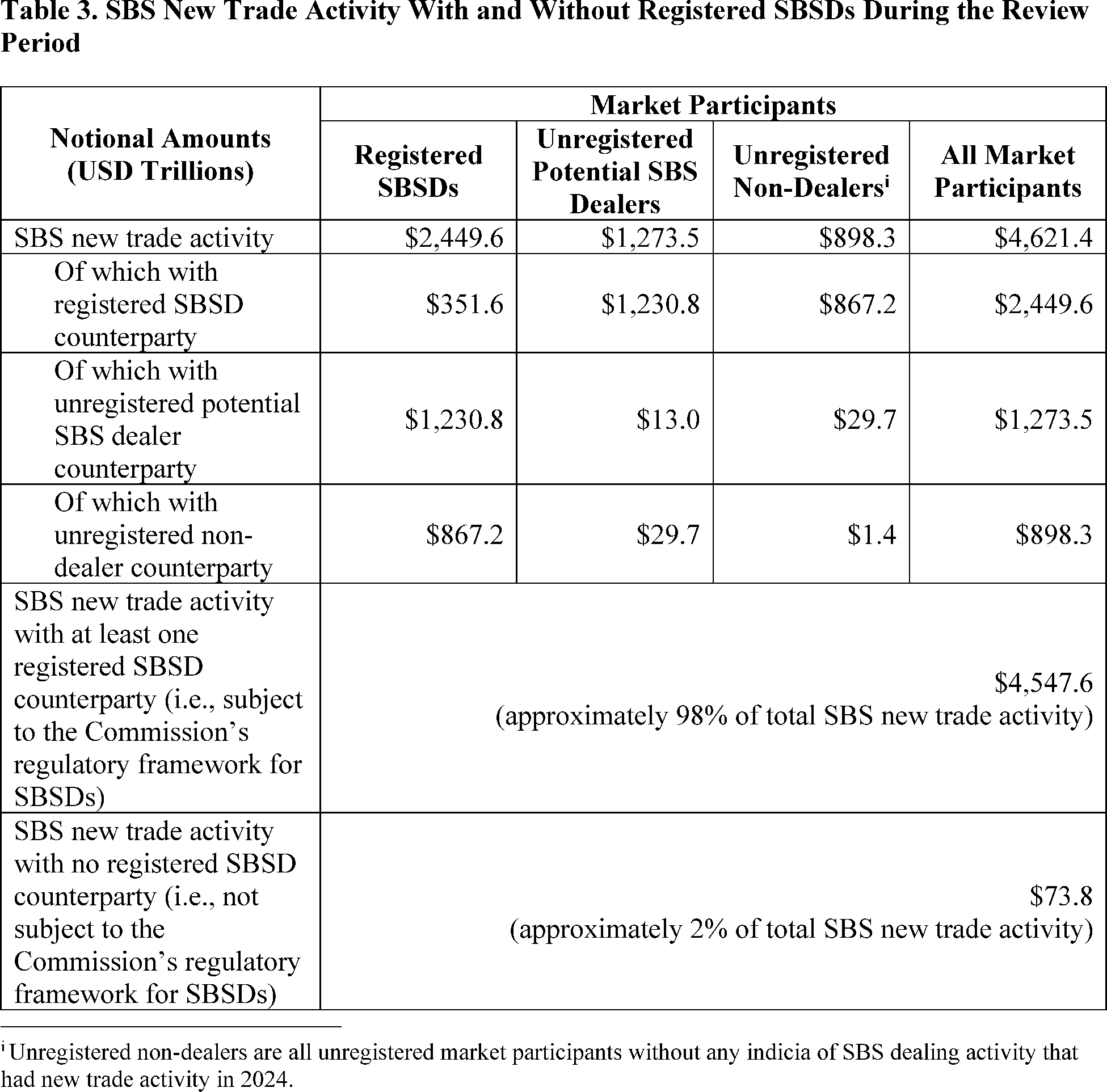
As shown in Table 3, the approximately $4,621.4 trillion in notional amount of 2024 SBS new trade activity included approximately $2,449.6 trillion in new trade activity attributed to 53 SBSDs registered with the Commission [68]
and thus subject to the Commission's regulatory framework for SBSDs. There was approximately $2,171.8 trillion [69]
in notional amount of new trade activity by unregistered market participants, including approximately $2,098.0 trillion [70]
in new trade activity with a registered SBSD. Accordingly, approximately 98% of all new trade activity events included at least one registered SBSD counterparty and thus was subject to the Commission's regulatory framework for SBSDs.
( printed page 24047)
The Commission's analysis of the 2011 trade activity of 1,084 participants in the single-name CDS market indicated a high degree of concentration among those apparently engaged in SBS dealing. From among those 1,084 market participants, 28, or approximately 3%, had three or more non-dealer counterparties; the Commission identified these 28 market participants as potential SBS dealers.[71]
In 2011, the 28 potential SBS dealers engaged in single-name CDS transactions with a total of $11.18 trillion in notional amount,[72]
or approximately 89%, out of a total of $12.6 trillion in aggregate gross notional amount of all single-name CDS transactions that the Commission reviewed.[73]
Similarly, based on available 2011 position data about other non-CDS types of SBS such as equity swaps, the Commission estimated that the 2011 non-CDS SBS markets also had a high degree of concentration among market participants apparently engaged in SBS dealing.[74]
De minimis thresholds of $8 billion [75]
and $3 billion [76]
for CDS that are SBS would have covered 99.9% and over 99.9%, respectively, of that $11.18 trillion, and would have required 23 and 25, respectively, of the 28 potential SBS dealers to register as SBSDs. The Commission expected the equity and other non-CDS SBS markets to be approximately 1/20th of the overall SBS market and set the permanent and phase-in
( printed page 24048)
de minimis thresholds at 1/20th of the CDS thresholds.[77]
Market data available today—including SBS transaction reports and third-party commercial sources—provides additional information about SBS market participants that the Commission did not have in 2012. SBS transaction reports in 2024 did not, however, include information about a market participant's engagement in the business of SBS dealing for a particular transaction or event. Though new trade activity events exclude activity particularly unlikely to be SBS dealing, they may still include non-dealing activity. A market participant's new trade activity thus may include SBS dealing transactions and/or non-dealing transactions. For purposes of this report, staff used the 2024 SBS transaction reports and third-party commercial sources [78]
to identify market participants with indicia of SBS dealing activity. Rather than limit indicia of SBS dealing activity to the number of counterparties with which a market participant transacted, staff used information about market participant characteristics, independent of the number or identity of counterparties, to identify market participants with indicia of SBS dealing. These uniform filtering criteria allowed staff to analyze a broader subset of market participants either known to be engaged or potentially engaged in SBS dealing in 2024 than was possible in 2011. Market participants with indicia of SBS dealing activity included both registered SBSDs and unregistered market participants, and staff refers to the latter as unregistered “potential SBS dealers.” Staff classified the new trade activity of registered SBSDs and unregistered potential SBS dealers (minus adjustments for activity that appeared to fit within exclusions from the de minimis counting requirements, as described below) as potential SBS dealing [79]
and thus counted that activity toward the de minimis thresholds.
As discussed above, using the 2011 single-name CDS transaction data, the Commission identified 28 potential dealers with three or more non-dealer counterparties. Based on the 2024 filtering criteria, among the 10,962 total SBS market participants with new trade activity events during the review period, 906 had indicia of SBS dealing, including 53 registered SBSDs and 853 unregistered potential SBS dealers. For broad comparison with the 2011 findings, staff reviewed the activity of these 906 market participants and found that during the review period 57 of them had three or more counterparties that were not among the 906 (that is, counterparties that were neither registered SBSDs nor unregistered potential SBS dealers).[80]
To ensure this report's broad coverage of potential SBS dealing activity, particularly by market participants who may be dealing under the de minimis thresholds, staff analyzed the activity of all 906 market participants identified as having indicia of SBS dealing.
Comparing the 2011 CDS transaction data and non-CDS estimates to 2024 CDS and non-CDS transaction data, both CDS and non-CDS SBS markets appeared to be somewhat less concentrated in 2024. In 2011, 28 of 1,084 single-name CDS market participants appeared to be engaged in SBS dealing, and these 28 potential SBS dealers accounted for approximately 89% of the aggregate gross notional amount of trading activity that the Commission reviewed. By contrast, the 53 registered SBSDs as of December 31, 2024, had approximately 53% and 853 unregistered potential SBS dealers had approximately 28% of all SBS new trade activity, for a total of approximately 81% of all SBS new trade activity in 2024. Similarly, in 2024 registered SBSDs had approximately 76% and unregistered potential SBS dealers had approximately 9% of CDS new trade activity, for a total of approximately 85% of all CDS new trade activity in 2024. Registered SBSDs had approximately 53% and unregistered potential SBS dealers had approximately 28% of non-CDS new trade activity, for a total of approximately 81% of all non-CDS new trade activity in 2024.
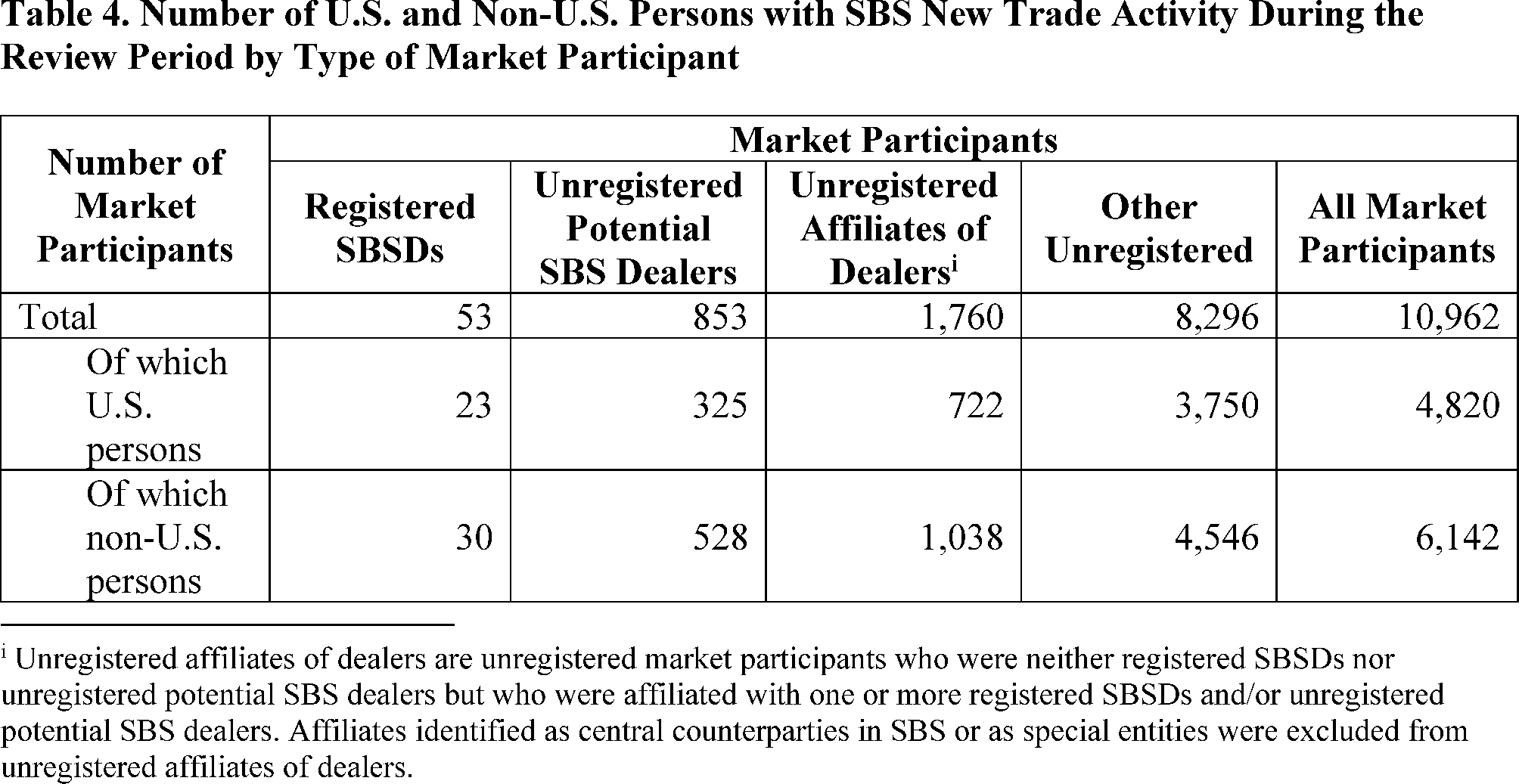
As shown in Table 4, SBS markets are cross-border, with a significant number of market participants that did not appear to be U.S. persons [81]
engaged in new trade activity during the 2024 review period. Among the 53 registered SBSDs on December 31, 2024, 23 appeared to be U.S. persons and 30 appeared to be non-U.S. persons.[82]
Among 853 unregistered potential SBS dealers, 325 appeared to be U.S. persons and 528 appeared to be non-U.S. persons. The 10,962 SBS market participants with new trade activity events during the review period also included 1,760 market participants who were neither registered SBSDs nor unregistered potential SBS dealers but who were affiliated with one or more registered SBSDs and/or unregistered potential SBS dealers (“unregistered affiliates of dealers”).[83]
Though staff did not classify unregistered affiliates of dealers as potential SBS dealers (unless an affiliate independently had indicia of SBS dealing), staff reviewed their activity separately from that of other unregistered market participants. These unregistered affiliates of dealers included 722 that appeared to be U.S. persons and 1,038 that appeared to be non-U.S. persons. Market participants that were not registered SBSDs, unregistered potential SBS dealers, or unregistered affiliates of dealers accounted for the remaining 8,296 market participants with new trade activity events during the review period and may have been end users and other investors.[84]
Among these 8,296 other unregistered market participants, 3,750 appeared to be U.S. persons and the remaining 4,546 appeared to be non-U.S. persons.
( printed page 24049)
To estimate potential SBS dealing activity, staff adjusted new trade activity of each of the 906 market participants with indicia of SBS dealing (
i.e.,
the 853 unregistered potential SBS dealers and the 53 registered SBSDs), consistent with the de minimis threshold counting requirements in Rule 3a71-3(b)(1). Starting with a market participant's new trade activity, staff subtracted any events where its counterparty was either the same person or an affiliate of the market participant on the date of the event, approximating the inter-affiliate exclusion from the de minimis counting requirements.[85]
For non-U.S.-person market participants only, staff further subtracted any events where the market participant's counterparty was also a non-U.S. person [86]
on the last day of the review period,[87]
and any events related to a transaction that was both traded on a platform and either actually or intended to be centrally cleared,[88]
approximating the additional exclusions from the de minimis counting requirements for non-U.S. persons. The result after these adjustments was the market participant's potential SBS dealing activity before aggregation with any potential SBS dealing activity of its affiliates.[89]
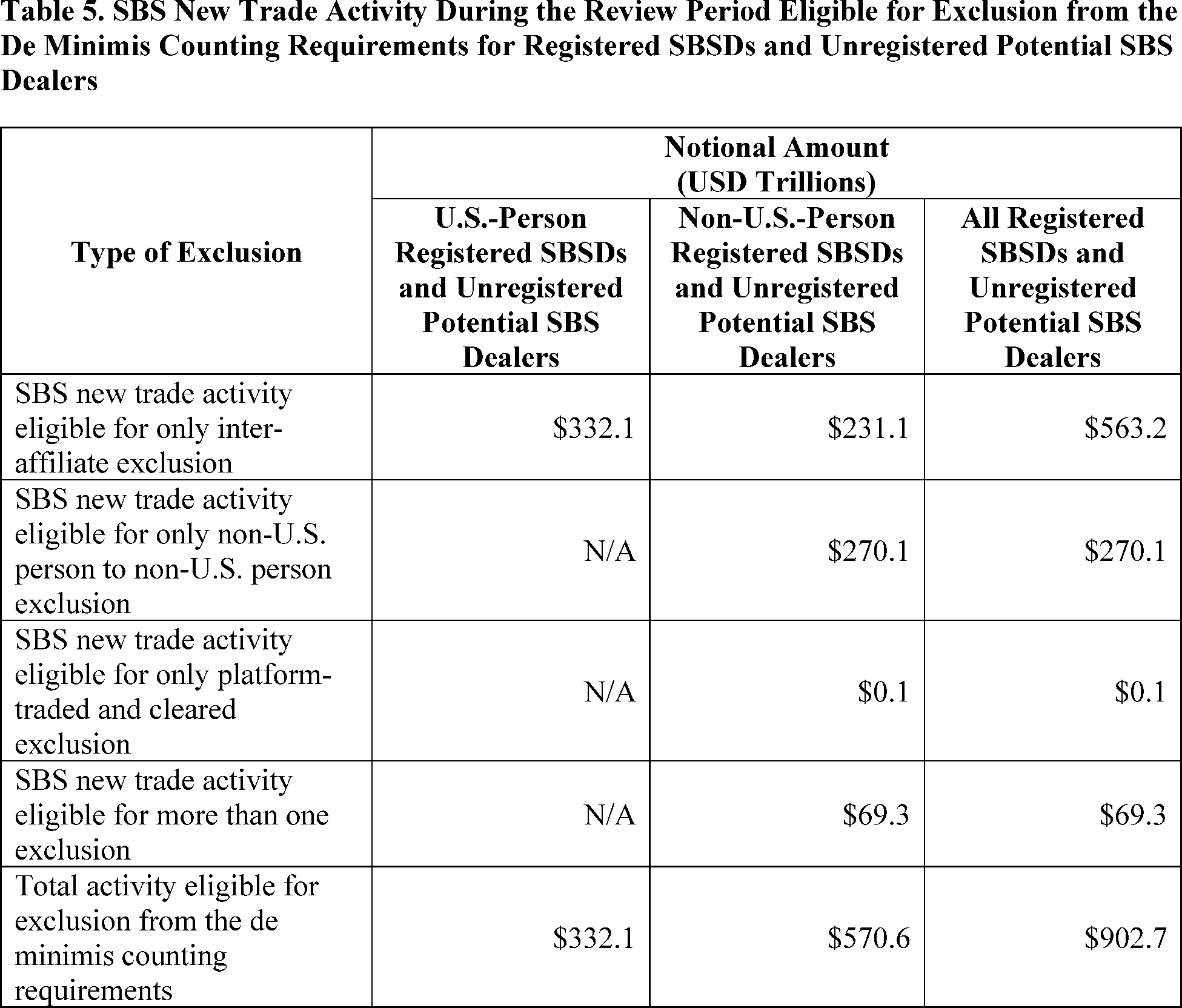
As shown in Table 5, the 23 U.S.-person registered SBSDs and 325 U.S.-person unregistered potential SBS dealers together had approximately $332.1 trillion in notional amount that appeared to be eligible for exclusion from the de minimis counting requirements. By comparison, the 30 non-U.S. person registered SBSDs and the 528 non-U.S.-person unregistered potential SBS dealers together had approximately $570.6 trillion in notional amount that appeared to be eligible for exclusion from the de minimis counting requirements. Some new trade activity events of these non-U.S. persons appeared to be eligible for more than one exclusion from these counting requirements. Of the approximately $570.6 trillion in notional amount of these market participants' new trade activity eligible for exclusion, approximately $69.3 trillion in notional amount appeared to be eligible for more than one exclusion.
( printed page 24050)
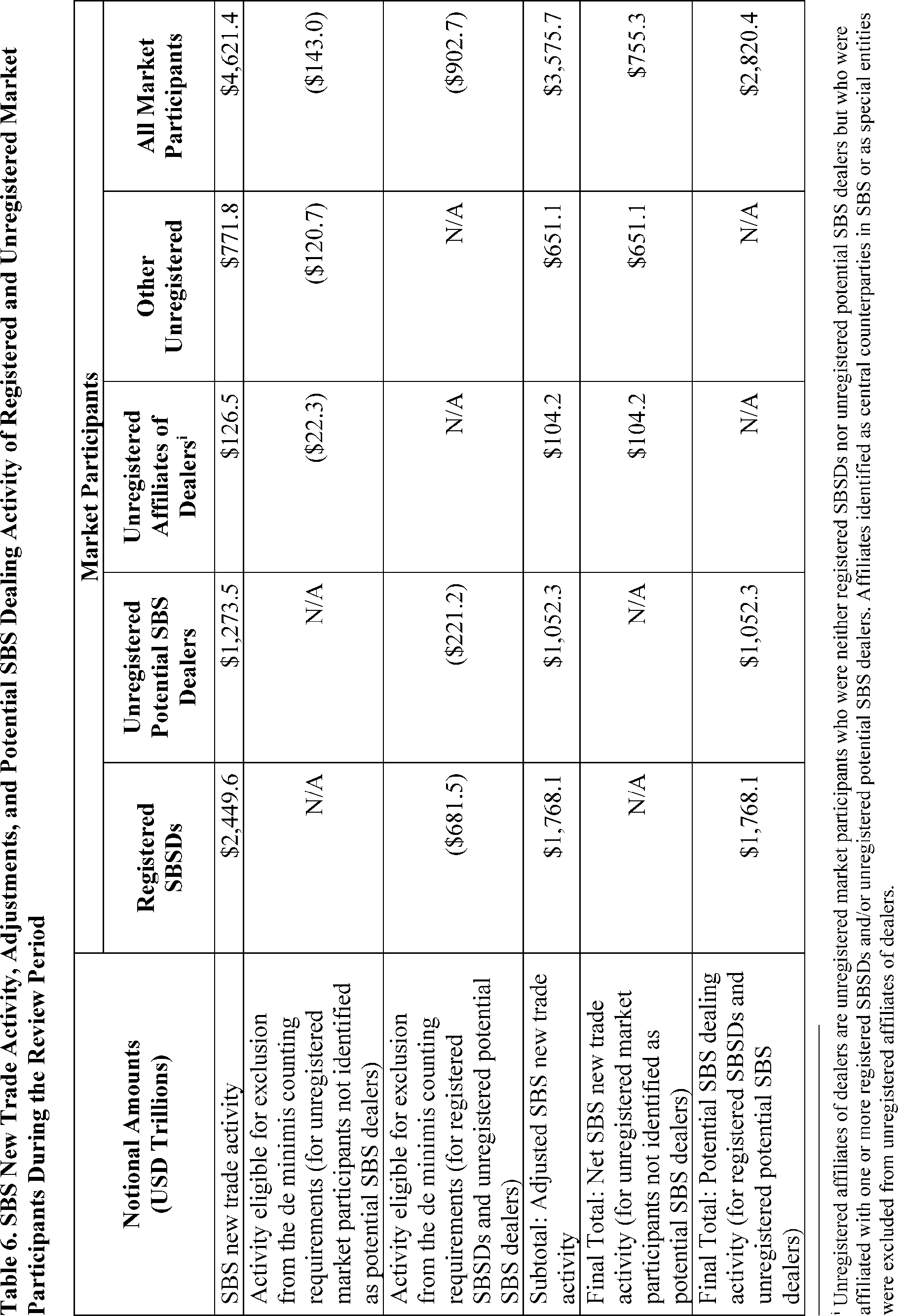
To aid comparison across all market participants, staff also adjusted the new trade activity of market participants that did not appear to be engaged in SBS dealing to exclude activity that appeared to be eligible for exclusion from the de minimis counting requirements. As shown in Table 6, after excluding $1,045.7 trillion [90]
in notional amount from new trade activity, all SBS market participants had $3,575.7 trillion in adjusted new trade activity during the review period that counted toward the de minimis thresholds. Approximately 49% of that adjusted new trade activity, or approximately $1,768.1 trillion, belonged to registered SBSDs and thus appeared to be SBS dealing activity. Of the approximately $1,807.6 trillion [91]
of adjusted new trade activity belonging to unregistered market participants during the review period, approximately $1,052.3 trillion belonged to unregistered potential SBS dealers and appeared to be SBS dealing activity. The remaining approximately $755.3 trillion [92]
belonged to market participants that did not appear to be engaged in SBS dealing and thus may have been non-dealing activity by end users and other investors. All potential SBS dealing activity during the review period totaled
( printed page 24051)
$2,820.4 trillion in notional amount. Registered SBSDs accounted for approximately 63% of this potential SBS dealing activity, while unregistered potential SBS dealers accounted for approximately 37%.
( printed page 24052)
The de minimis counting requirements also direct any person that engages in its own SBS dealing activity to count toward the de minimis thresholds certain SBS dealing
( printed page 24053)
activity of the person's control affiliates.[93]
For market participants identified as registered SBSDs or unregistered potential SBS dealers, staff estimated aggregate SBS dealing activity of that market participant and any of its affiliates that were also identified as registered SBSDs or unregistered potential SBS dealers. Staff used this estimate of aggregate SBS dealing activity to compare each of these market participants' progress toward the de minimis thresholds.
b. CDS De Minimis Threshold
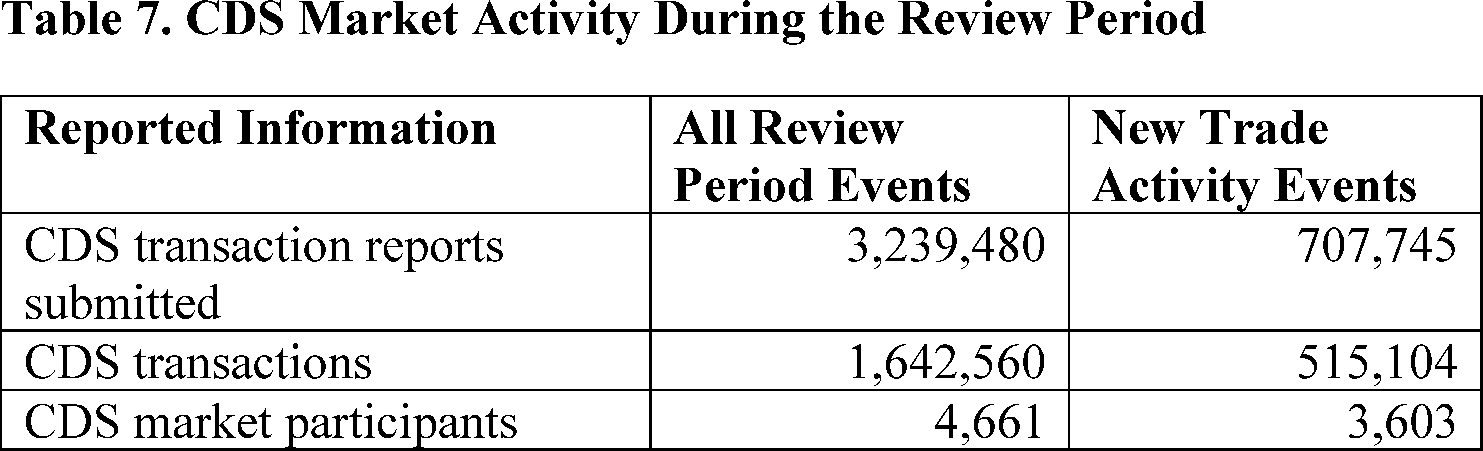
As shown in Table 7, market participants submitted to SBSDRs before the cut-off date SBS transaction reports on 707,745 unique new trade activity events related to 515,104 unique CDS transactions involving 3,603 unique CDS market participants.[94]
Staff evaluated the impact of the current $8 billion and scheduled $3 billion CDS de minimis thresholds on market participants' CDS new trade activity and potential SBS dealing activity in CDS and also assessed hypothetical alternative de minimis thresholds in the amounts of $1 billion, $5 billion, and $15 billion.[95]
Analysis of SBS transaction reports revealed that market participants are using the exclusions from the definition of “security-based swap dealer” and that, at the current $8 billion de minimis threshold, 43 market participants registered as SBSDs on the measurement date were on at least one side of 99% of CDS new trade activity in 2024. A lower de minimis threshold of $1 billion, $3 billion, or $5 billion could add additional registered SBSDs, while a higher $15 billion de minimis threshold may create eligibility for some currently registered SBSDs to de-register.
i. CDS Market Participants' Activity
There was approximately $4.3 trillion in total notional amount of CDS new trade activity events during the review period. This total reflects the transacted notional amounts of the reported CDS new trade activity events, providing a snapshot of the volume of new trade activity transactions in the CDS market at large. After attributing the notional amounts of these CDS new trade activity events to market participants to measure their progress toward the de minimis thresholds, the total notional amount of CDS new trade activity during the review period was approximately $8.6 trillion.
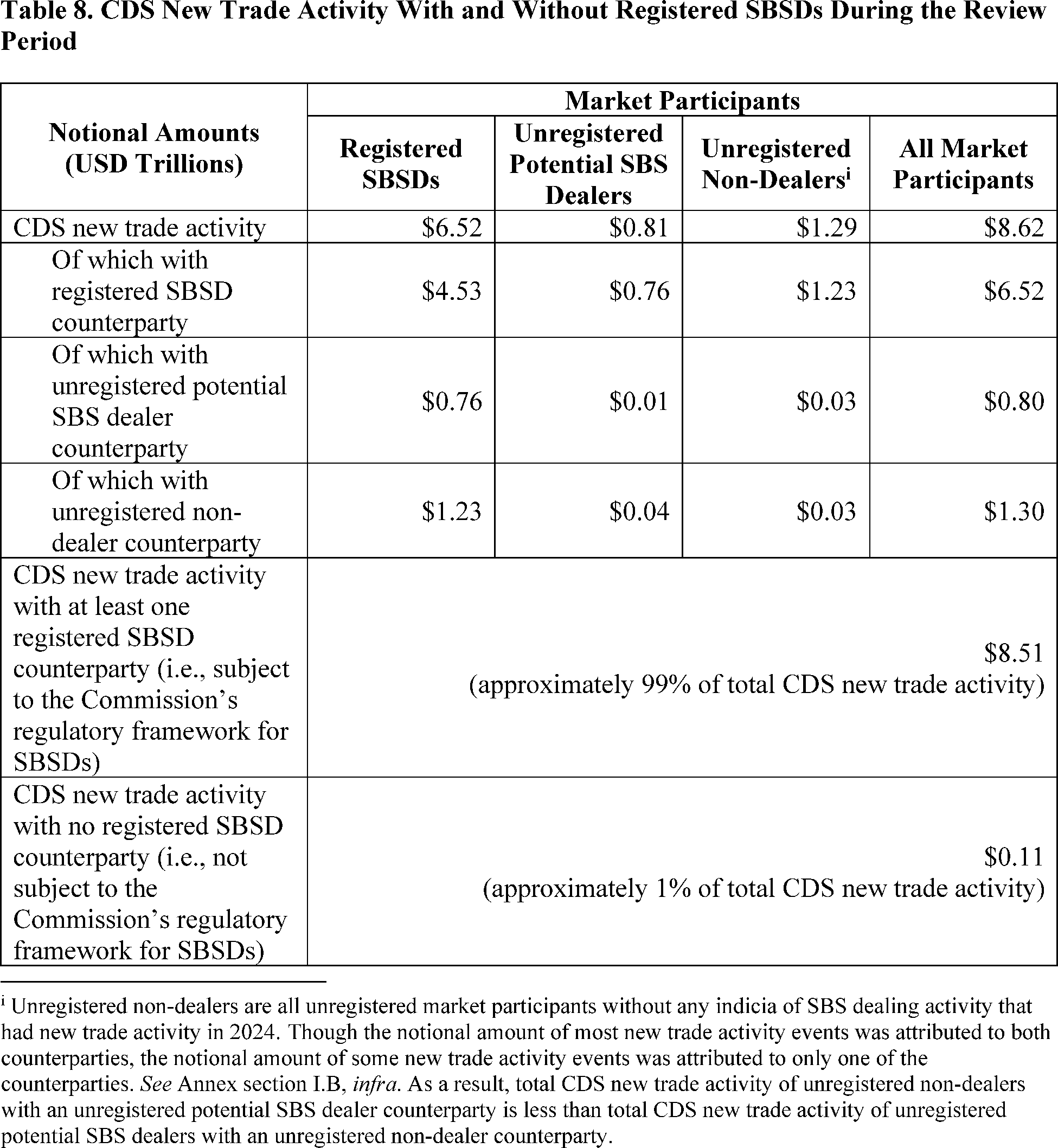
As shown in Table 8, this $8.6 trillion included approximately $6.5 trillion in notional amount of CDS new trade activity by 43 registered SBSDs and thus was subject to the Commission's regulatory framework for SBSDs. There was approximately $2.1 trillion [96]
in notional amount of CDS new trade activity by unregistered market participants, including approximately $2 trillion [97]
of CDS new trade activity with a registered SBSD and approximately $115 billion [98]
of CDS new trade activity with another unregistered market participant. Accordingly, approximately 99% of CDS new trade activity events included at least one registered SBSD counterparty and thus was subject to the Commission's regulatory framework for SBSDs.
( printed page 24054)
ii. Impact of Exclusions on CDS Activity
Staff adjusted CDS new trade activity to remove activity that appeared to be eligible for an exclusion from the de minimis counting requirements.[99]
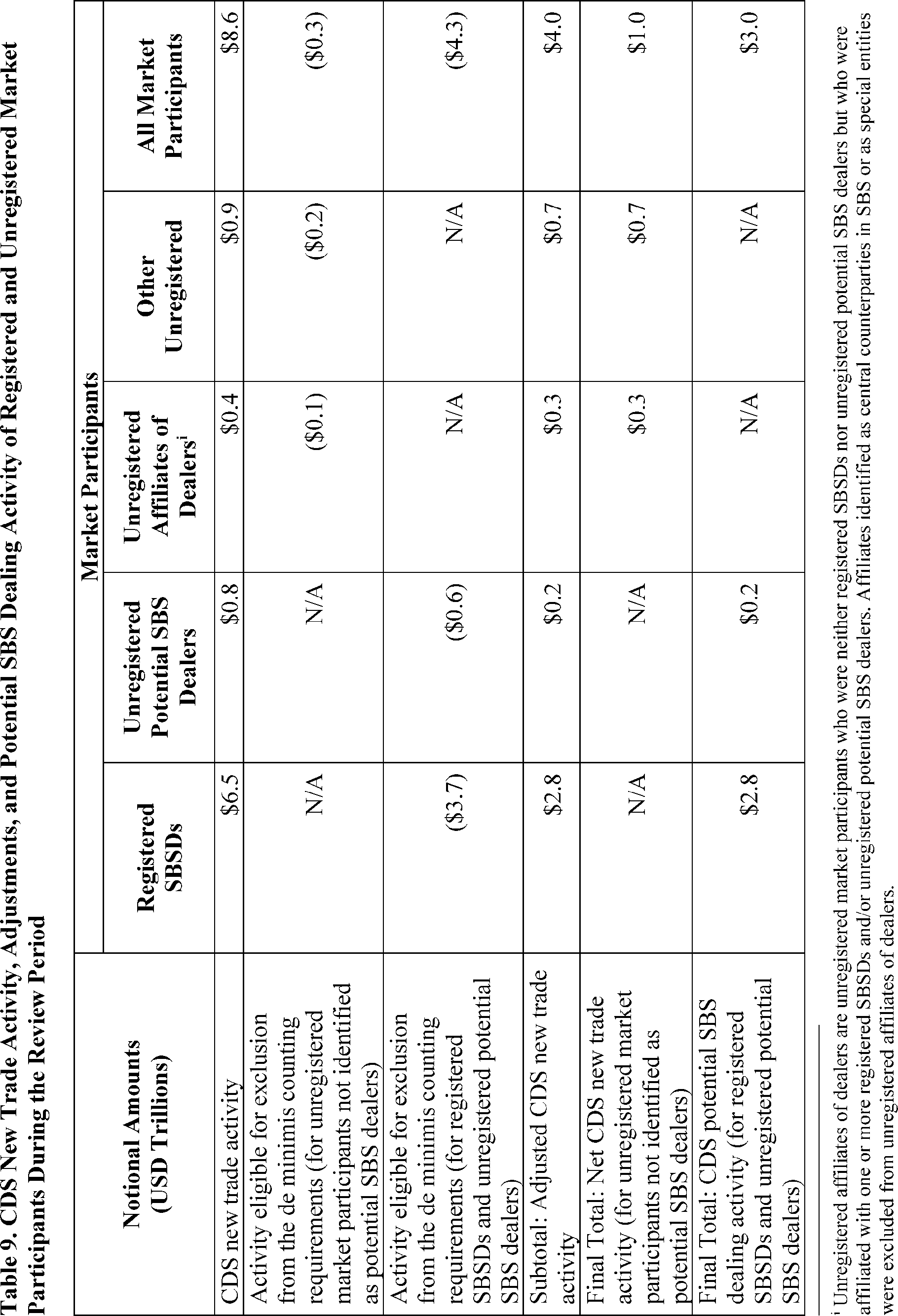
As shown in Table 9, of the approximately $8.6 trillion in notional amount of CDS new trade activity during the review period, approximately $4.6 trillion [100]
represented activity that appeared to be eligible for exclusion from the de minimis counting requirements.[101]
This excluded activity accounted for a higher proportion of CDS new trade activity of unregistered potential SBS dealers than of
( printed page 24055)
other market participants. Unregistered potential SBS dealers had approximately $619 billion in notional amount of excluded activity, or 77% of their approximately $809 billion total notional amount of CDS new trade activity. Meanwhile, approximately 57% of registered SBSDs' CDS new trade activity and 26% of all other unregistered market participants' CDS new trade activity was excluded. These results suggest that the exclusions from the definition of “security-based swap dealer” had a significant impact on CDS market participants' need to register or remain registered as SBSDs with the Commission during the review period.
After subtracting activity that appeared to be eligible for exclusion from the de minimis counting requirements, approximately $4 trillion in notional amount remained as adjusted CDS new trade activity during the review period, as shown in Table 9. Nearly three-quarters of this adjusted CDS new trade activity, or approximately $2.8 trillion, belonged to registered SBSDs and thus appeared to be SBS dealing activity. Of the approximately $1.2 trillion [102]
in notional amount of adjusted CDS new trade activity belonging to unregistered market participants, approximately $1 trillion [103]
belonged to market participants that did not appear to be engaged in SBS dealing and thus may have been non-dealing trading activity by end users and other investors. Unregistered potential SBS dealers had the remaining $190 billion, and this amount appeared to be SBS dealing activity. Registered SBSDs thus accounted for approximately 94%, or approximately $2.8 trillion, of the approximately $3 trillion total potential SBS dealing activity in CDS during the review period, while unregistered potential SBS dealers accounted for approximately 6%, or approximately $190 billion, of that total.
( printed page 24056)
( printed page 24057)
iii. $8 Billion Phase-In CDS De Minimis Threshold
Forty-three out of a total of 53 registered SBSDs had CDS new trade activity during the review period, meaning ten registered SBSDs did not have any CDS new trade activity during the review period. Twenty-seven of these 43 registered SBSDs had potential SBS dealing activity in CDS above the $8 billion de minimis threshold, while the remaining sixteen of these 43 registered SBSDs had potential SBS dealing activity in CDS at or below $8 billion. However, all 16 of these registered SBSDs had potential SBS dealing activity in non-CDS and/or SBS with counterparties likely to be special entities that surpassed one or both of the other de minimis thresholds for those transactions.
Among the 853 unregistered potential SBS dealers identified through staff's uniform filtering criteria, 374 [104]
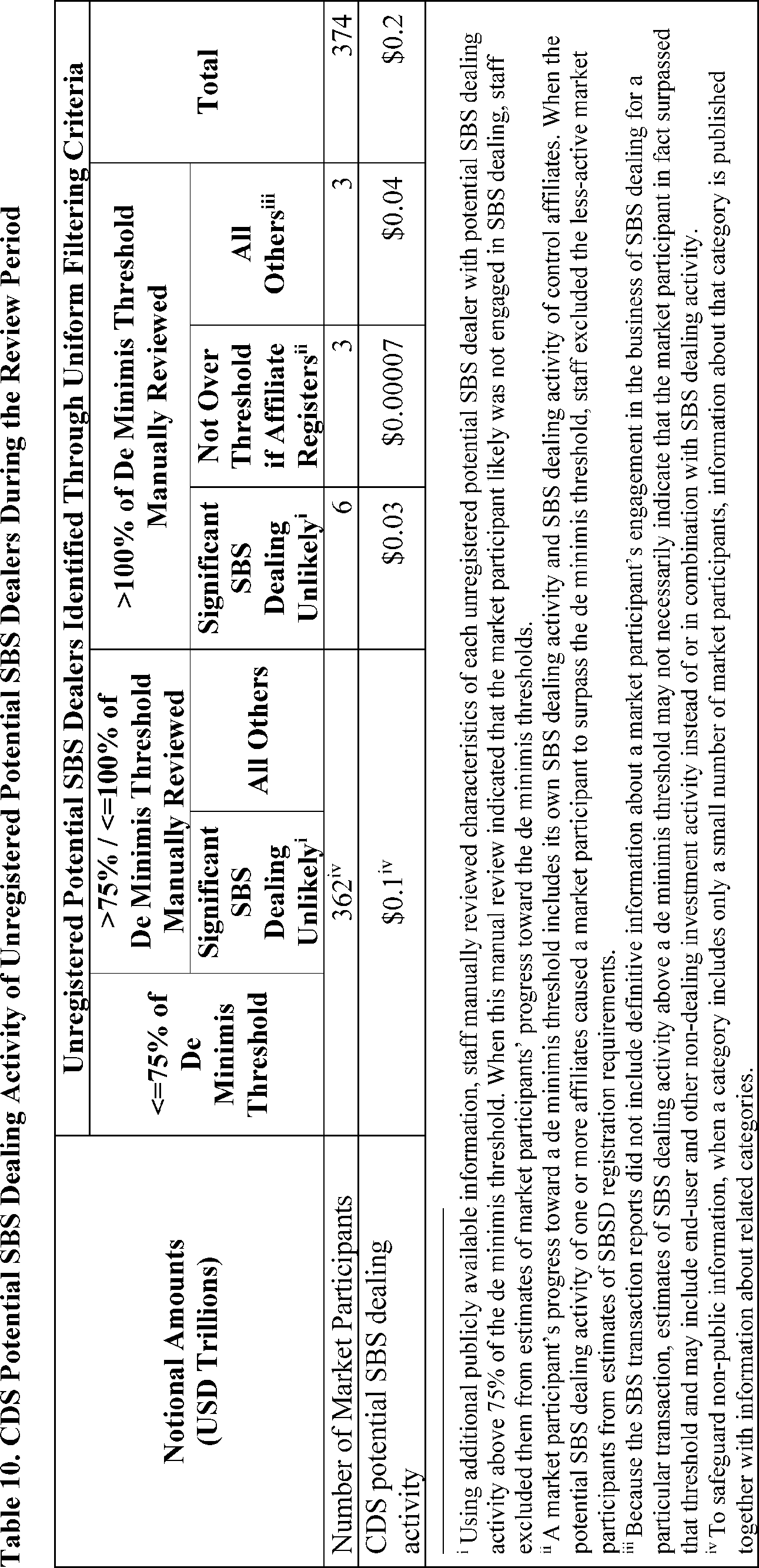
of them, who together were members of 279 groups of one or more affiliated market participants, had CDS new trade activity and together had approximately $190 billion in potential SBS dealing activity in CDS. As shown in Table 10, twelve of these 374 unregistered potential SBS dealers initially appeared to have potential SBS dealing activity above the $8 billion threshold. Of these twelve, six were market participants that staff excluded after manual review of additional publicly available information suggested they were unlikely to be engaged in significant SBS dealing, three were market participants that would not have been required to register as SBSDs if an affiliate had done so,[105]
and three were market participants that may have been required to register as SBSDs. The six manually excluded market participants accounted for approximately $33.5 billion of the total approximately $190 billion in notional amount of potential SBS dealing in CDS by unregistered potential SBS dealers. Because the SBS transaction reports did not include sufficient information to support transaction-level estimates of SBS dealing activity, staff could estimate that these six market participants were unlikely to be engaged in significant SBS dealing activity but could not estimate the notional amount of SBS dealing activity, if any, in which they may have engaged alongside non-dealing activity. The three market participants that would not have been required to register as SBSDs if an affiliate had done so accounted for approximately $65 million in notional amount of potential SBS dealing activity in CDS. Finally, the remaining three market participants that did not meet any of these exclusion criteria had a total of approximately $39.0 billion in notional amount of potential SBS dealing activity in CDS.
Because the SBS transaction reports did not include definitive information about a market participant's engagement in the business of SBS dealing for a particular transaction, estimates of SBS dealing activity above a de minimis threshold may not necessarily indicate that a market participant in fact surpassed that threshold and indeed may include end-user and other non-dealing investment activity. In particular, as the criteria for indicia of potential SBS dealing activity could be applied only at the counterparty level and not at the level of individual transactions or events, all of these three unregistered potential SBS dealers' new trade activity net of exclusions, plus that of affiliates estimated to be engaged in SBS dealing, counted as progress toward de minimis threshold. These market participants' activity may in fact be exclusively SBS dealing activity, exclusively non-dealing activity, or a combination of the two, but the SBS transaction reports did not include sufficient information to support more granular estimates. If these three unregistered potential SBS dealers did surpass the $8 billion de minimis threshold, they would have been required to register as SBSDs or shift SBS dealing to a control affiliate [106]
that is a registered SBSD. If the three had been registered as SBSDs during the review period, all CDS new trade activity subject to the Commission's regulatory framework for SBSDs (that is, all CDS new trade activity with at least one registered SBSD counterparty) would have increased by approximately $65.6 billion, to $8,567.1 billion, and CDS new trade activity outside of that regulatory framework (that is, all CDS new trade activity with no registered SBSD) would have decreased by the same amount, to $49.4 billion.
A small number of unregistered potential SBS dealers appeared to have progressed more than 75% (more than $6 billion) toward the $8 billion threshold while remaining below that threshold. The remaining unregistered potential SBS dealers had potential SBS dealing activity at or below 75% of the $8 billion de minimis threshold.
( printed page 24058)
( printed page 24059)
These results suggest that a small but significant minority [107]
of unregistered CDS market participants may have engaged in SBS dealing activity and thus relied on the de minimis exception to the definition of “security-based swap dealer.” The vast majority, though possibly not all, of those market participants appeared to have kept their SBS dealing below the de minimis threshold, though the data do not contain information about market participants' intent in this regard.[108]
A significant portion of registered SBSDs did not participate in the CDS markets during the review period, but those that did together were counterparties to approximately 99% of CDS new trade activity.
iv. $3 Billion Scheduled CDS De Minimis Threshold
Among the 16 registered SBSDs with potential SBS dealing activity in CDS at or below the current $8 billion de minimis threshold, three surpassed the scheduled $3 billion de minimis threshold. These three registered SBSDs thus may have lost any eligibility to de-register if a $3 billion threshold had applied during the review period. The remaining 13 of those 16 registered SBSDs had potential SBS dealing activity in CDS at or below $3 billion. An additional 10 registered SBSDs did not have any CDS new trade activity during the review period. Each of these 13 registered SBSDs, as well as the 10 registered SBSDs with no CDS new trade activity during the review period, may already have been eligible to de-register on the measurement date under the current $8 billion threshold, provided that their aggregate SBS dealing activity also fell below the other applicable de minimis thresholds. Based on their estimated potential SBS dealing activity, any of these 23 registered SBSDs that were eligible to de-register under an $8 billion threshold also would have been eligible to de-register under a $3 billion threshold. None of these registered SBSDs, however, did de-register on or after the measurement date, even with a higher $8 billion threshold. Though the scheduled $3 billion de minimis threshold would not be expected to create eligibility for any registered SBSDs to de-register, the lower threshold would leave less room for de minimis SBS dealing activity and thus may make it less likely that these registered SBSDs choose to de-register.
Fifteen unregistered potential SBS dealers initially appeared to have more than $3 billion but not more than $8 billion in potential SBS dealing activity in CDS. Of those 15 unregistered potential SBS dealers, nine were market participants that staff excluded after manual review of additional publicly available information suggested they were unlikely to be engaged in significant SBS dealing, two were market participants that would not have surpassed a $3 billion de minimis threshold if an affiliate had registered as an SBSD,[109]
and four were market participants that may have been required to register as SBSDs if a $3 billion de minimis threshold had applied during the review period. The nine manually excluded market participants accounted for approximately $33 billion of the total approximately $190 billion in notional amount of potential SBS dealing in CDS by unregistered potential SBS dealers. Because the SBS transaction reports did not include sufficient information to support transaction-level estimates of SBS dealing activity, staff could estimate that these nine market participants were unlikely to be engaged in significant SBS dealing activity but could not estimate the notional amount of SBS dealing activity, if any, in which they may have engaged. The two market participants that would not have surpassed a $3 billion de minimis threshold if an affiliate had registered as an SBSD accounted for approximately $34 million in notional amount of potential SBS dealing activity in CDS. Finally, the remaining four market participants that did not meet any of these exclusion criteria had a total of approximately $19.3 billion in notional amount of potential SBS dealing activity in CDS.
As with staff's analysis of potential SBS dealing activity above the $8 billion de minimis threshold, estimates of SBS dealing activity above the scheduled $3 billion de minimis threshold may not necessarily indicate that a market participant in fact surpassed that threshold. If those four unregistered potential SBS dealers did surpass $3 billion in SBS dealing activity in CDS, and if a $3 billion de minimis threshold had applied during the review period, they would have been required to register as SBSDs or shift SBS dealing to a control affiliate [110]
that is a registered SBSD. If those four market participants had been registered as SBSDs during the review period, all CDS new trade activity subject to the Commission's regulatory framework for SBSDs (that is, all CDS new trade activity with at least one registered SBSD counterparty) would have increased by approximately $7.6 billion, to approximately $8,509.1 billion, and CDS new trade activity outside of that regulatory framework (that is, all CDS new trade activity with no registered SBSD) would have decreased by the same amount, to approximately $107.4 billion.
v. Alternative CDS De Minimis Thresholds
Staff also assessed hypothetical alternative de minimis thresholds of $1 billion, $5 billion, and $15 billion as applied to potential SBS dealing activity in CDS. Though the alternative $1 billion and $5 billion thresholds would not be expected to create eligibility for any registered SBSDs to de-register, a $15 billion threshold may create eligibility for some currently registered SBSDs to de-register and could modestly increase CDS new trade activity.
Among the 16 registered SBSDs with potential SBS dealing activity in CDS at or below the current $8 billion de minimis threshold, 10 surpassed $1 billion in potential SBS dealing activity. These 10 registered SBSDs thus may have lost any eligibility to de-register if a $1 billion threshold had applied during the review period. The remaining six of these 16 registered SBSDs had potential SBS dealing activity in CDS at or below $1 billion. Each of these six registered SBSDs may have retained eligibility to de-register if a $1 billion threshold had applied and their aggregate SBS dealing activity also fell below the other applicable de minimis thresholds, but none of them did de-register during the review period despite a higher $8 billion threshold. Though a hypothetical $1 billion de minimis threshold would not be expected to create eligibility for any registered SBSDs to de-register, the lower threshold would leave less room for de minimis SBS dealing activity and thus may make it less likely that these registered SBSDs choose to de-register.
Among the 16 registered SBSDs with potential SBS dealing activity in CDS at or below the current $8 billion de minimis threshold, three surpassed $5 billion in potential SBS dealing activity. These three registered SBSDs thus may have lost any eligibility to de-register if a $5 billion threshold had applied during the review period. The remaining 13 of these 16 registered SBSDs had potential SBS dealing activity in CDS at or below $5 billion. Each of these 13 registered SBSDs may have retained eligibility to de-register if a $5 billion threshold had applied and their aggregate SBS dealing activity also fell below the other applicable de minimis thresholds, but none of them did de-register during the review period despite a higher $8 billion threshold. Like the hypothetical $1 billion de minimis threshold, a hypothetical $5 billion de minimis threshold would not be expected to create eligibility for any registered SBSDs to de-register and may make it less likely that these registered SBSDs choose to de-register.
Among the 27 registered SBSDs with potential SBS dealing activity in CDS above the current $8 billion de minimis threshold, 24 surpassed $15 billion in potential SBS dealing activity and may have been required to remain registered as SBSDs during the review period even with a higher $15 billion de minimis threshold. The remaining three of these 27 registered SBSDs had potential SBS dealing activity in CDS above $8 billion and at or below $15 billion. Those three registered SBSDs may have become eligible to de-register if a $15 billion de minimis
( printed page 24060)
threshold had applied and their aggregate SBS dealing activity also fell below the other applicable de minimis thresholds. If those three registered SBSDs had not been registered during the review period, approximately $30.1 billion less CDS new trade activity would have been subject to the Commission's regulatory framework for SBSDs (that is, CDS new trade activity with at least one registered SBSD counterparty).
Staff extended to the hypothetical $15 billion threshold an assumption based on the results of its analysis of unregistered potential SBS dealing near the $8 billion de minimis threshold during the review period. Staff estimated that the small number of unregistered potential SBS dealers with potential SBS dealing activity in CDS between 75% and 100% of the $8 billion de minimis threshold would adjust their total new trade activity in CDS so that their potential SBS dealing activity in CDS would be at least 75% (at least $11.25 billion) of the $15 billion threshold. This adjustment could have added less than 1% (less than $86 billion) in additional CDS new trade activity to the market during the review period.
c. Non-CDS De Minimis Threshold
As shown in Table 11, market participants submitted SBS transaction reports on 660,131,993 unique new trade activity events related to 62,266,349 unique non-CDS transactions involving 8,572 unique non-CDS market participants.[111]
Staff evaluated the impact of the current $400 million and scheduled $150 million non-CDS de minimis thresholds on market participants' non-CDS new trade activity and potential SBS dealing activity in non-CDS and also assessed hypothetical alternative de minimis thresholds in the amounts of $1 billion, $3 billion, $5 billion, $8 billion, and $15 billion.[112]
Analysis of the SBS transaction reports revealed that non-CDS new trade activity was much larger, both in absolute value and as compared to CDS new trade activity,[113]
and thus suggests that non-CDS markets have become a far more significant part of SBS market activity than anticipated when the Commission adopted the non-CDS de minimis thresholds. Moreover, though the current $400 million de minimis threshold for SBS dealing activity in non-CDS is lower than the current $8 billion de minimis threshold for SBS dealing activity in CDS, and though 53 registered SBSDs had non-CDS new trade activity compared to 43 registered SBSDs with CDS new trade activity, non-CDS new trade activity was slightly less likely than CDS new trade activity to include at least one registered SBSD. A higher de minimis threshold of $1 billion would not be expected to create eligibility for any currently registered SBSDs to de-register. Higher $3 billion, $5 billion, $8 billion, or $15 billion de minimis thresholds may create eligibility for some currently registered SBSDs to de-register.
i. Non-CDS Market Participants' Activity
There was approximately $2,306.4 trillion in total notional amount of non-CDS new trade activity events during the review period. This total reflects the transacted notional amounts of the reported non-CDS new trade activity events, providing a snapshot of the volume of new trade activity transactions in the non-CDS market at large. After attributing the notional amounts of these non-CDS new trade activity events to market participants to measure their progress toward the de minimis thresholds, the total notional amount of non-CDS new trade activity during the review period was approximately $4,612.8 trillion.
As shown in Table 12, this $4,612.8 trillion included approximately $2,443.1 trillion in notional amount of non-CDS new trade activity by 53 registered SBSDs and thus was subject to the Commission's regulatory framework for SBSDs. Though more SBSDs participated in the non-CDS markets than in the CDS markets, registered SBSDs accounted for a smaller proportion of non-CDS new trade activity (approximately 53%) than of CDS new trade activity (approximately 76%).[114]
There was approximately $2,169.7 trillion [115]
in notional amount of non-CDS new trade activity by unregistered market participants, including approximately $2,096.1 trillion [116]
in non-CDS new trade activity with a registered SBSD and approximately $73.6 trillion [117]
in non-CDS new trade activity with another unregistered market participant. Accordingly, approximately 98% of non-CDS new trade activity events included at least one registered SBSD counterparty and thus was subject to the Commission's regulatory framework for SBSDs.
( printed page 24061)
ii. Impact of Exclusions on Non-CDS Activity
Staff adjusted non-CDS new trade activity to remove activity that appeared to be eligible for an exclusion from the de minimis counting requirements.[118]
As shown in Table 13, of the approximately $4,612.8 trillion in notional amount of non-CDS new trade activity during the review period, approximately $1,041.0 trillion,[119]
or approximately 23%, represented activity that appeared to be eligible for exclusion from the de minimis counting requirements.[120]
This same activity accounted for more than twice the share (approximately 54%) of CDS new trade activity.[121]
This lower significance of excluded activity in non-CDS markets was
( printed page 24062)
evident for registered SBSDs [122]
and unregistered potential SBS dealers,[123]
as well as for all other unregistered market participants.[124]
These results suggest that the exclusions from the definition of “security-based swap dealer” had a less-significant—albeit still material—impact on non-CDS market participants' need to register or remain registered with the Commission as SBSDs during the review period.
After subtracting activity that appeared to be eligible for exclusion from the de minimis counting requirements, $3,571.8 trillion in notional amount remained as adjusted non-CDS new trade activity during the review period, as shown in Table 13. Approximately $1,765.4 trillion of this adjusted non-CDS new trade activity, or approximately 49%, belonged to registered SBSDs and thus appeared to be SBS dealing activity. Of the approximately $1,806.4 trillion [125]
in notional amount of adjusted non-CDS new trade activity belonging to unregistered market participants, approximately $754.3 trillion [126]
belonged to market participants that did not appear to be engaged in SBS dealing and thus may have been non-dealing activity by end users and other investors. The remaining $1,052.1 trillion belonged to unregistered potential SBS dealers and appeared to be SBS dealing activity. Registered SBSDs thus accounted for approximately 63%, or approximately $1,765.4 trillion, of the approximately $2,817.5 trillion total potential SBS dealing activity in non-CDS during the review period (compared to 94% of total potential SBS dealing activity in CDS), while unregistered potential SBS dealers accounted for approximately 37%, or approximately $1,052.1 trillion, of that total (compared to 6% of total potential SBS dealing activity in CDS).[127]
( printed page 24063)
The SBS transaction reports revealed that during the review period non-CDS new trade activity, at approximately $4,612.8 trillion, was significantly larger than CDS new trade
( printed page 24064)
activity, at approximately $8.6 trillion.[128]
This significant size differential persisted across registered SBSDs, unregistered potential SBS dealers, and other unregistered market participants. Staff observed, however, that market participants overall submitted significantly more substantive amendments to the terms of non-CDS transactions than they did substantive amendments to the terms of CDS transactions,[129]
and each reported amendment counted as a separate new trade activity event. Nevertheless, both CDS and non-CDS markets included market participants whose substantive amendments constituted a small proportion of their total new trade activity and market participants whose substantive amendments constituted a large proportion of their new trade activity. These substantial differences in reporting may reflect a higher volume of trading in non-CDS compared to CDS markets, a higher or lower volume of trading by individual market participants, reporting errors or inconsistencies, or a combination of these factors.
In 2012, the Commission expected the non-CDS markets would constitute approximately 1/20th of the aggregate gross notional amount of all SBS trading activity.[130]
Recognizing the limitations of data scope and quality, the SBS transaction reports nevertheless suggest that non-CDS markets have become a more significant part of SBS market activity than anticipated when the Commissions adopted the joint definitional rules. Over 99% of all new trade activity in SBS during the review period was non-CDS new trade activity, with CDS new trade activity representing less than 1% of all SBS new trade activity.
iii. $400 Million Phase-In Non-CDS De Minimis Threshold
All 53 registered SBSDs had non-CDS new trade activity during the review period. All but a small number of these 53 registered SBSDs had potential SBS dealing activity in non-CDS above the $400 million de minimis threshold.
Among the 853 unregistered potential SBS dealers identified through staff's uniform filtering criteria, 699 [131]
of them, who together were members of 543 groups of one or more affiliated market participants, had non-CDS new trade activity and together had approximately $1,052.1 trillion in potential SBS dealing activity in non-CDS. As shown in Table 14, 167 of these 699 unregistered potential SBS dealers initially appeared to have potential SBS dealing activity above the $400 million threshold. Of those 167 unregistered potential SBS dealers, 96 were market participants that staff excluded after manual review of additional publicly available information suggested they were unlikely to be engaged in significant SBS dealing, 11 were market participants that would not have been required to register as SBSDs if an affiliate had done so,[132]
and 60 were market participants that may have been required to register as SBSDs. The 96 manually excluded market participants accounted for approximately $1,020.6 trillion of the total approximately $1,052.1 trillion in notional amount of potential SBS dealing in non-CDS by unregistered potential SBS dealers. Because the SBS transaction reports did not include sufficient information to support transaction-level estimates of SBS dealing activity, staff could estimate that these 96 market participants were unlikely to be engaged in significant SBS dealing activity but could not estimate the notional amount of SBS dealing activity, if any, in which they may have engaged. The 11 market participants that would not have been required to register as SBSDs if an affiliate had done so accounted for approximately $1.3 billion in notional amount of potential SBS dealing activity in non-CDS. Finally, the remaining 60 market participants that did not meet any of these exclusion criteria had a total of approximately $31.5 trillion in notional amount of potential SBS dealing activity in non-CDS.
Although the number of potential unregistered SBS dealers engaged in potential SBS dealing activity above the de minimis threshold appears to be high, this result might reflect limitations of available data. Because the SBS transaction reports did not include definitive information about a market participant's engagement in the business of SBS dealing for a particular transaction, estimates of SBS dealing activity above a de minimis threshold may not necessarily indicate that a market participant in fact surpassed the threshold and indeed may include end-user and other non-dealing investment activity. In particular, as the criteria for indicia of potential SBS dealing activity could be applied only at the counterparty level and not at the level of individual transactions or events, all of these 60 unregistered potential SBS dealers' new trade activity net of exclusions, plus that of affiliates estimated to be engaged in SBS dealing, counted toward the de minimis threshold. These market participants' activity may in fact be exclusively SBS dealing activity, exclusively non-dealing activity, or a combination of the two, but the SBS transaction reports did not include sufficient information to support more granular estimates. If these 60 unregistered potential SBS dealers did surpass the $400 million de minimis threshold, they would have been required to register as SBSDs or shift SBS dealing to a control affiliate [133]
that is a registered SBSD. If those 60 market participants had been registered as SBSDs during the review period, all non-CDS new trade activity subject to the Commission's regulatory framework for SBSDs (that is, all non-CDS new trade activity with at least one registered SBSD counterparty) would have increased by approximately $57.4 trillion, to approximately $4,596.6 trillion, and non-CDS new trade activity outside of that regulatory framework (that is, all non-CDS new trade activity with no registered SBSD) would have decreased by approximately the same amount, to approximately $16.2 trillion.
Also as shown in Table 14, ten unregistered potential SBS dealers appeared to have progressed more than 75% (more than $300 million) toward the $400 million de minimis threshold while remaining below that threshold.[134]
The remaining unregistered potential SBS dealers had potential SBS dealing activity at or below 75% of the $400 million de minimis threshold.
( printed page 24065)
( printed page 24066)
As in the CDS markets, these results suggest that a small but significant minority [135]
of unregistered non-CDS market participants may have engaged in SBS dealing activity and thus relied on the de minimis exception to the definition of “security-based swap dealer.” The majority, though possibly not all, of those market participants appeared to have managed their SBS dealing to remain below the de minimis threshold.[136]
All 53 registered SBSDs participated in the non-CDS markets during the review period and together they were counterparties to approximately 98% of non-CDS new trade activity.
iv. $150 Million Scheduled Non-CDS De Minimis Threshold
The small number of registered SBSDs with potential SBS dealing activity in non-CDS at or below the current $400 million de minimis threshold also did not surpass the scheduled $150 million de minimis threshold. Based on their estimated potential SBS dealing activity, these registered SBSDs could have been eligible to de-register under both a $400 million and a $150 million non-CDS de minimis threshold, provided that their aggregate SBS dealing activity also fell below the other applicable de minimis thresholds. These registered SBSDs did not, however, de-register on or after the measurement date, even with a higher $400 million threshold. The scheduled $150 million de minimis threshold thus would not be expected to create eligibility for any registered SBSDs to de-register, though the lower threshold would leave less room for de minimis SBS dealing activity and thus may make it less likely that these registered SBSDs choose to de-register.
Thirty-five unregistered potential SBS dealers initially appeared to have more than $150 million but not more than $400 million in potential SBS dealing activity in non-CDS. Of those 35 unregistered potential SBS dealers, 10 were market participants that staff excluded after manual review of additional publicly available information suggested they were unlikely to be engaged in significant SBS dealing, four were market participants that would not have surpassed a $150 million de minimis threshold if an affiliate had registered as an SBSD,[137]
and 21 were market participants that may have been required to register as SBSDs if a $150 million de minimis threshold had applied during the review period. The 10 manually excluded market participants accounted for approximately $2.3 billion of the total approximately $1,052.1 trillion in notional amount of potential SBS dealing in non-CDS by unregistered potential SBS dealers. Because the SBS transaction reports did not include sufficient information to support transaction-level estimates of SBS dealing activity, staff could estimate that these 10 market participants were unlikely to be engaged in significant SBS dealing activity but could not estimate the notional amount of SBS dealing activity, if any, in which they may have engaged. The four market participants that would not have surpassed a $150 million de minimis threshold if an affiliate had registered as an SBSD accounted for approximately $128.0 million in notional amount of potential SBS dealing activity in non-CDS. Finally, the remaining 21 market participants that did not meet any of these exclusion criteria had a total of approximately $5.7 billion in notional amount of potential SBS dealing activity in non-CDS.
As with staff's analysis of potential SBS dealing activity above the $400 million de minimis threshold, estimates of SBS dealing activity above the scheduled $150 million de minimis threshold may not necessarily indicate that a market participant in fact surpassed that threshold. If these 21 unregistered potential SBS dealers did surpass $150 million in SBS dealing activity in non-CDS, and if a $150 million de minimis threshold had applied during the review period, they would have been required to register as SBSDs or shift SBS dealing to a control affiliate [138]
that is a registered SBSD. If those 21 market participants had been registered as SBSDs during the review period, all non-CDS new trade activity subject to the Commission's regulatory framework for SBSDs (that is, all non-CDS new trade activity with at least one registered SBSD counterparty) would have increased by approximately $2.9 billion and non-CDS new trade activity outside of that regulatory framework (that is, all non-CDS new trade activity with no registered SBSD counterparty) would have decreased by approximately the same amount.
v. Alternative Non-CDS De Minimis Thresholds
Staff also assessed hypothetical de minimis thresholds of $1 billion, $3 billion, $5 billion, $8 billion, and $15 billion as applied to potential SBS dealing activity in non-CDS. The alternative $1 billion threshold would not be expected to create eligibility for any registered SBSDs to de-register, while a $3 billion, $5 billion, $8 billion, or $15 billion threshold may create eligibility for some currently registered SBSDs to de-register and could moderately increase non-CDS new trade activity.
Among the registered SBSDs with potential SBS dealing activity in non-CDS above the current $400 million de minimis threshold, all also surpassed $1 billion in potential SBS dealing activity and may have been required to remain registered as SBSDs during the review period even with a higher $1 billion de minimis threshold.
Among the registered SBSDs with potential SBS dealing activity in non-CDS above the current $400 million de minimis threshold, all but a small number surpassed $15 billion in potential SBS dealing activity and may have been required to remain registered as SBSDs during the review period even with a higher $1 billion, $3 billion, $5 billion, $8 billion, or $15 billion de minimis threshold. A small number of these registered SBSDs had potential SBS dealing activity in non-CDS above $400 million and at or below $15 billion. Some or all of those registered SBSDs may have become eligible to de-register if a $1 billion, $3 billion, $5 billion, $8 billion, or $15 billion de minimis threshold had applied and their aggregate SBS dealing activity also fell below the other applicable de minimis thresholds. If those registered SBSDs had not been registered during the review period, less than 0.001% (less than $46 billion) of all non-CDS new trade activity would have moved from inside to outside the Commission's regulatory framework for SBSDs.
Staff extended to the hypothetical $1 billion, $3 billion, $5 billion, $8 billion, and $15 billion thresholds an assumption based on the results of its analysis of unregistered potential SBS dealing near the $400 million de minimis threshold during the review period. Staff estimated that the 10 unregistered potential SBS dealers with potential SBS dealing activity in non-CDS between 75% and 100% of the $400 million de minimis threshold would adjust their SBS dealing activity in non-CDS to an average of at least 75% of the higher hypothetical threshold. If one of the higher, hypothetical de minimis thresholds had applied during the review period, this adjustment could have added new trade activity to the non-CDS market in the amounts of approximately $13.6 billion at a $1 billion threshold, $62.6 billion at a $3 billion threshold, $111.6 billion at a $5 billion threshold, $185.2 billion at an $8 billion threshold, and $356.7 billion at a $15 billion threshold.
d. Hypothetical Total CDS and Non-CDS SBS De Minimis Thresholds
Staff also analyzed the total SBS market to assess hypothetical combined CDS and non-CDS de minimis thresholds of $1 billion, $3 billion, $5 billion, $8 billion, and $15 billion. Each of these alternative combined thresholds may create eligibility for some currently registered SBSDs to de-register. A combined $1 billion threshold could modestly reduce combined CDS and non-CDS new trade activity, while the other four analyzed thresholds could modestly increase combined CDS and non-CDS new trade activity.
Three registered SBSDs had potential SBS dealing activity of $15 billion or less. Had a hypothetical $1 billion, $3 billion, $5 billion, $8 billion, or $15 billion combined CDS and non-CDS de minimis threshold been in place
( printed page 24067)
during the review period, some or all of those registered SBSDs may have become eligible to de-register, provided that their aggregate SBS dealing activity also fell below the separate de minimis threshold for SBS with special entities. If some or all of those registered SBSDs had not been registered during the review period, less than 0.001% (less than $46 billion) of all new trade activity would have moved from inside to outside the Commission's regulatory framework for SBSDs.
Fifty registered SBSDs had potential SBS dealing activity above $15 billion, suggesting that they may have been required to remain registered as SBSDs during the review period even with a $15 billion combined CDS and non-CDS de minimis threshold.
Staff extended to the hypothetical $1 billion, $3 billion, $5 billion, $8 billion, and $15 billion combined CDS and non-CDS de minimis thresholds an assumption based on the results of its analysis of unregistered potential SBS dealing near the $8 billion CDS de minimis threshold and the $400 million non-CDS de minimis threshold during the review period. Staff estimated that the 10 unregistered potential SBS dealers with potential SBS dealing activity between 75% and 100% of the $400 million non-CDS de minimis threshold and that the small number of unregistered potential SBS dealers with potential SBS dealing activity between 75% and 100% of the $8 billion CDS de minimis threshold would adjust their SBS dealing activity up or down to an average of at least 75% of the hypothetical combined threshold. A hypothetical $1 billion combined CDS and non-CDS de minimis threshold thus could have subtracted approximately $4.9 billion in new trade activity from the combined CDS and non-CDS markets during the review period, while the higher hypothetical combined CDS and non-CDS de minimis thresholds could have added new trade activity of approximately $23.9 billion at a $3 billion threshold, $52.6 billion at a $5 billion threshold, $95.6 billion at an $8 billion threshold, and $196.1 billion at a $15 billion threshold.
There were 178 unregistered potential SBS dealers that had an affiliated registered SBSD. Of these 178 unregistered potential SBS dealers, 107 had no potential SBS dealing activity during the review period, 50 had combined CDS and non-CDS potential SBS dealing activity up to $15 billion, and 21 had above $15 billion.
There were 675 unregistered potential SBS dealers that had no affiliated registered SBSD. Of these 675 unregistered potential SBS dealers, 275 had no potential SBS dealing activity during the review period, 360 had combined CDS and non-CDS potential SBS dealing activity up to $15 billion, and 40 had above $15 billion.
Though these unregistered market participants were identified as potential SBS dealers using staff's uniform filtering criteria for indicia of SBS dealing, additional publicly available information suggested that many of them were unlikely to be engaged in SBS dealing. It is unclear how many of them might be required to register as SBSDs if a combined CDS and non-CDS de minimis threshold applied. Moreover, even if engaged in SBS dealing, these market participants might respond to a combined CDS and non-CDS de minimis threshold by shifting a portion of their SBS dealing activity to an affiliate that either already is registered as an SBSD or would do so, or they could exit the U.S. SBS market. This shifting of activity might result in no change to the number of registered SBSDs or in fewer additional registered SBSDs than the number of unregistered potential SBS dealers affected by the hypothetical combined CDS and non-CDS de minimis threshold.
e. Special Entity SBS De Minimis Threshold
As shown in Table 15, market participants submitted SBS transaction reports on 43,610 unique new trade activity events related to 17,849 unique SBS transactions involving fewer than 50 unique counterparties to 182 unique market participants that staff identified as likely to be special entities.
Staff evaluated the impact of the current $25 million de minimis threshold on market participants' new trade activity and potential SBS dealing activity with counterparties that appeared likely to be special entities and also assessed hypothetical alternative de minimis thresholds in the amounts of $1 billion, $3 billion, $5 billion, $8 billion, and $15 billion. Analysis of the SBS transaction reports showed that 19 of the counterparties to likely special entities were registered SBSDs, and the hypothetical alternative de minimis thresholds may create eligibility for some currently registered SBSDs to de-register.
i. Market Participants' Activity With Likely Special Entities
During the review period, there was approximately $781.5 billion in total notional amount of new trade activity events involving a counterparty likely to be a special entity. This total reflects the transacted notional amounts of the reported new trade activity events, providing a snapshot of the volume of new trade activity transactions with likely special entities in the SBS market at large. When measuring market participants' progress toward the de minimis threshold for SBS with a special entity counterparty, staff analyzed the notional amounts of new trade activity attributed to each counterparty to a likely special entity. The notional amount of new trade activity events involving a likely special entity was attributed only to the counterparty of the likely special entity. Staff adjusted this attributed new trade activity with likely special entities to remove approximately $0.3 billion of activity where the other counterparty was an unregistered market participant, as none of those unregistered market participants appeared to be engaged in SBS dealing. Because there also were no reports of new trade activity events in which both counterparties appeared likely to be special entities, attributing new trade activity to market participants did not double any portion of the transacted notional amounts of new trade activity during the review period. After this $0.3 billion deduction, the remaining approximately $781.2 billion
( printed page 24068)
represented the total notional amount of new trade activity attributed to registered SBSDs that transacted with likely special entities during the review period. Given the small volume of new trade activity between likely special entities and unregistered market participants during the review period, this report does not publish analysis of that activity.
ii. Impact of Exclusions on Activity With Likely Special Entities
As shown in Table 16, no new trade activity with a likely special entity appeared to be eligible for an exclusion from the de minimis counting requirements. These results suggest that new trade activity between registered SBSDs and likely special entities was at arm's length rather than inter-affiliate trading. Likewise, the other exclusions for activity between two non-U.S.-person counterparties and for certain platform-traded and cleared transactions were not relevant to trading with likely special entities during the review period. The exclusion for activity between two non-U.S. persons was not available to the non-U.S.-person SBSDs that transacted with likely special entities because all of the likely special entities appeared to be U.S. persons. The exclusion for certain platform-traded and cleared transactions was available to these non-U.S. person SBSDs but staff observed no new trade activity with likely special entities that met these criteria. Thus, the exclusions from the definition of “security-based swap dealer” appeared to have no impact during the review period on market participants' need to register or remain registered with the Commission as SBSDs due to SBS dealing activity with special entities.
iii. $25 Million Special Entity SBS De Minimis Threshold
Nineteen out of a total of 53 registered SBSDs had new trade activity and potential SBS dealing activity with likely special entities during the review period. All but a small number of these 19 registered SBSDs had potential SBS dealing activity with likely special entities above the $25 million de minimis threshold.
No unregistered potential SBS dealers had potential SBS dealing activity with likely special entities during the review period. Nearly all of the aggregate notional amount of SBS new trade activity with a market participant likely to be a special entity had a registered SBSD on the other side of the trade. This concentration of activity with likely special entities appears to be due to the comparatively lower $25 million de minimis threshold for SBS dealing with special entities, though a small number of the 19 registered SBSDs that transacted new trade activity with likely special entities had less than $25 million in potential SBS dealing activity with such entities. These results suggest that unregistered potential SBS dealers may have been aware that their SBS market activity could be SBS dealing and abstained from transacting with likely special entities to avoid breaching the $25 million de minimis threshold. It is unclear why these results contrast with other results showing that several unregistered potential SBS dealers appeared to have surpassed one of the other, higher de minimis thresholds during the review period. The observed avoidance by unregistered potential SBS dealers of the $25 million de minimis threshold, particularly compared with these other results, may signal meaningful gaps in available information about unregistered SBS market activity.
iv. Alternative De Minimis Thresholds for Special Entity SBS
Staff also assessed hypothetical alternative de minimis thresholds of $1 billion, $3 billion, $5 billion, $8 billion, and $15 billion as applied to potential SBS dealing activity with likely special entities. Each of these alternative de minimis thresholds may create eligibility for some currently registered SBSDs to de-register and could modestly decrease new trade activity with likely special entities.
Among the 19 registered SBSDs with potential SBS dealing activity with likely special entities during the review period, eight had potential SBS dealing activity with likely special entities above $25 million and at or below $15 billion. Of the remaining 11 registered SBSDs, a small number had potential SBS dealing activity with likely special entities at or below $25 million, while the rest surpassed $15 billion and may have been required to remain registered as SBSDs during the review period even with a higher $15 billion de minimis threshold. Some or all of the eight registered SBSDs with potential SBS dealing activity above $25 million and at or below $15 billion may have become eligible to de-register if a $1 billion, $3 billion, $5 billion, $8 billion, or $15 billion de minimis threshold had applied and their aggregate SBS dealing activity also fell below the other applicable de minimis thresholds. If all of those eight registered SBSDs had not been registered during the review period, approximately $19.6 billion [139]
less new trade activity with likely special entities would have been subject to the Commission's regulatory framework for SBSDs (that is, new trade activity with at least one registered SBSD counterparty).
f. Retrospective Impact Analysis
When it adopted Rule 3a71-2(a)(2), the Commission directed staff to address in this report, to the extent practicable, the nature and extent of the impact that the final Title VII rules and interpretations implementing the definition of “security-based swap dealer” have had on certain aspects of the SBS market. Since the Commission's 2012 adoption of that rule, economic, regulatory, and other exogeneous factors—both related and unrelated to the implementation of Title VII—have affected the SBS markets. In completing this report, staff considered the effects of the rules and interpretations on competition, market access, and investor protection.
i. Effects on Competition and Market Access
Staff considered the extent to which a market participant's activity in the SBS
( printed page 24069)
market during the review period correlated with its registration status or with its approaching or crossing the de minimis thresholds in the definition of “security-based swap dealer.”
As shown in Table 17 and Table 18, registered SBSDs constituted a significant portion of both CDS and non-CDS market activity during the review period, though they played a greater role in CDS markets. Registered SBSDs accounted for approximately 76% of CDS new trade activity and approximately 53% of non-CDS new trade activity. Registered SBSDs represented approximately 94% of potential SBS dealing activity in CDS and approximately 63% of potential SBS dealing activity in non-CDS.
Staff reviewed the activity of all unregistered potential SBS dealers identified via staff's uniform filtering criteria that had potential SBS dealing activity greater than 75% of the relevant de minimis threshold. This sub-group of unregistered potential SBS dealers represented a greater percentage of new trade activity in proportion to their share of total market participants during the review period. In CDS markets, these unregistered potential SBS dealers accounted for less than 1% of market participants but approximately 6% of new trade activity. In non-CDS markets, they accounted for approximately 2% of market participants and approximately 26% of new trade activity. Most unregistered potential SBS dealers at greater than 75% of the relevant de minimis threshold had potential SBS dealing activity over the relevant thresholds rather than just under them, but this result might reflect limitations of available data. Because the SBS transaction reports did not include definitive information about a market participant's engagement in the business of SBS dealing for a particular transaction, estimates of SBS dealing activity above a de minimis threshold may not necessarily indicate that a market participant in fact surpassed the threshold and indeed may include end-user and other non-dealing investment activity. Nevertheless, at a minimum, these results suggest that unregistered potential SBS dealers at greater than 75% of the relevant de minimis threshold participated in a larger proportion of the SBS markets relative to their numbers during the review period, whether through SBS dealing, non-dealing, or a mixture of both. The Commission crafted the de minimis exception in part to: (1) allow persons to accommodate existing clients that have a need for SBS in conjunction with other financial services or commercial activities without the costs of registering as an SBSD or establishing separate relationships with registered SBSDs; (2) promote competition in SBS dealing activity for persons beginning to engage in SBS dealing; (3) provide an objective test for market participants; and (4) further the interest of regulatory efficiency when the amount of a person's SBS dealing activity does not warrant regulation in comparison to the overall market for SBS.[140]
To the extent that these unregistered potential SBS dealers were engaged in SBS dealing, their activity during the review period as observed in the SBS transaction reports could be consistent with the goals that the Commission identified when adopting the de minimis thresholds.
Unregistered potential SBS dealers with potential SBS dealing activity at 75% or less of the relevant de minimis threshold accounted for a smaller proportion of new trade activity relative to their numbers during the review period. These less-active unregistered potential SBS dealers accounted for approximately 10% of CDS market participants, approximately 3% of CDS new trade activity, approximately 6% of non-CDS market participants, and approximately 2% of non-CDS new trade activity.
Finally, Table 17 and Table 18 show that the overwhelming majority of SBS market participants during the review period were unregistered entities that appeared to be engaged in minimal or no SBS dealing. These unregistered entities included unregistered potential SBS dealers with potential SBS dealing activity below the relevant de minimis thresholds; unregistered potential SBS dealers that, after manual review, either appeared unlikely to be engaged in significant SBS dealing or would not have surpassed the relevant de minimis threshold if an affiliate had registered; unregistered affiliates of dealers; likely special entities; CCPs in SBS; and all other unregistered market participants without the indicia of SBS dealing in staff's uniform filtering criteria. These end users and other investors represented approximately 99% of CDS market participants and approximately 99% of non-CDS market participants. Unsurprisingly, they accounted for a significantly smaller share of new trade activity relative to their numbers, entering into approximately 20% of all CDS new trade activity and approximately 43% of all non-CDS new trade activity during the review period. It is unclear whether this relatively smaller share of new trade activity signals that these market participants were limited in their ability to transact in SBS or, alternatively, that they received all the liquidity that they sought.
( printed page 24070)
( printed page 24071)
ii. Effects on Investor Protection
Providing regulatory protections to certain classes of counterparties such as special entities, natural persons, small businesses, and commercial entities, is a fundamental policy goal advanced by the Title VII regulatory framework for the SBS market. To meet Title VII's requirement of heightened
( printed page 24072)
protection for special entities,[141]
Rule 3a71-2 includes a lower notional threshold of $25 million for SBS dealing activity with counterparties that are special entities.[142]
When the Commission adopted the rules further defining the term “security-based swap dealer,” it estimated that in 2011 special entities were counterparties to over $40 billion in single-name CDS transactions.[143]
Data regarding transactions in non-CDS was not available at that time.[144]
In 2024, market participants likely to be special entities had total new trade activity of approximately $782 billion,[145]
including $4 billion in CDS and $778 billion in non-CDS. The significantly higher total notional amounts of likely special entities' 2024 new trade activity in non-CDS compared to CDS thus was consistent with the same pattern in the SBS market as a whole.
During the review period, almost exclusively registered SBSDs engaged in new trade activity with market participants likely to be special entities. The population of 53 registered SBSDs as of December 31, 2024, was close to the Commission's 2012 estimate that approximately 50 SBS market participants would register.[146]
All but a small number of registered SBSDs had potential SBS dealing activity above one or more de minimis thresholds during the review period.
Unregistered potential SBS dealers did not engage in new trade activity with special entities during the review period. This result suggests that special entities may have been generally unable and/or unwilling to transact in SBS with market participants who were not registered SBSDs. The relatively lower $25 million de minimis threshold, which reflects Title VII's goal of providing special entities with heightened SBS market protections, may explain any absence of unregistered potential SBS dealers willing to transact with special entities. A lower de minimis threshold for SBS dealing with special entities thus may have little effect on the availability of counterparties to special entities, while a higher threshold may or may not increase available counterparties. It remains unclear, however, whether special entities sought but were unable to find SBS transactions with unregistered potential SBS dealers or, alternatively, whether they preferred transacting with registered SBSDs given their organizational responsibilities and the special duties that registered SBSDs owe to them.[147]
4. Requests for Comment
Comments are invited on all aspects of this report's analysis of SBS transaction reports and its assessment of the effects of the definition of “security-based swap dealer.” Please provide any supporting evidence that the Commission should consider. In particular:
1. Are the methods for estimating new trade activity, potential SBS dealing activity, and special entity status reasonable? Why or why not? Would any alternative approaches to these estimates be more appropriate for one or more asset classes? If yes, what are the alternative approaches and why would they be more appropriate?
2. What information should the Commission use to identify market participants more likely to be engaged in SBS dealing? Which data elements of the SBS transaction reports, with or without supplemental information from third-party commercial sources, contain that information? Would different approaches be more appropriate for different asset classes? If yes, which approaches and which asset classes and why would they be more appropriate?
3. Are the findings in this report regarding the current de minimis thresholds to the definition of “security-based swap dealer” consistent with market participants' experience? Why or why not? Are these thresholds affecting SBS market activity in ways that this report does not address? If yes, what effect are they having and why?
4. Are the findings in this report regarding the scheduled or hypothetical alternative de minimis thresholds addressed in this report consistent with market participants' experience? Why or why not? Would these thresholds affect SBS market activity in ways that this report does not address? If yes, what effect would they have and why?
5. Should the Commission consider any other de minimis thresholds not addressed in this report?
6. Is the exclusion from the definition of “security-based swap dealer” for inter-affiliate transactions affecting SBS market activity? If yes, what effect is it having and why? If not, why not?
7. Is the exclusion from the definition of “security-based swap dealer” for non-U.S. persons' platform-traded and cleared transactions affecting SBS market activity? If yes, what effect is it having and why? If not, why not?
8. Are the other de minimis counting requirements in the definition of “security-based swap dealer,” including the different requirements for U.S. persons, conduit affiliates, and non-U.S. persons other than conduit affiliates, affecting SBS market activity? If yes, what effect are they having and why? If not, why not?
9. Do any characteristics of the non-CDS and/or CDS markets help to explain the substantially larger number of SBS transaction reports of substantive amendments to the terms of non-CDS transactions compared to CDS transactions? If yes, which characteristics and why?
10. Do any characteristics of the SBS markets help explain why likely special entities transacted almost exclusively with registered SBSDs? If yes, which characteristics and why?
11. Are the findings in this report regarding the effects of the definition of “security-based swap dealer” on competition, market access, and investor protection consistent with market participants' experience? Why or why not? Should the Commission consider any other effects of the definition on competition, market access, investor protection, or any other aspect of the SBS markets?
B. Major Security-Based Swap Participants
1. Definition of “Major Security-Based Swap Participant”
The Exchange Act [148]
and Rule 3a67-1, as jointly adopted by the Commissions, define the term “major security-based swap participant” as any person who is not an SBSD and: (1) maintains a “substantial position” in SBS for any of the “major SBS categories,” after excluding positions held for “hedging or mitigating commercial risk” and certain employee benefit plan positions maintained for the primary purpose of hedging or mitigating any risk directly associated with the operation of the plan (“MSBSP Test 1”); [149]
(2) whose outstanding SBS create “substantial counterparty exposure” that could have serious adverse effects on the financial stability of the U.S. banking system or financial markets (“MSBSP Test 2”); [150]
or (3) is a “financial entity” that is “highly leveraged” relative to its capital, is not subject to capital requirements of certain U.S. Federal banking agencies, and maintains a “substantial position” in outstanding SBS in any of the “major SBS categories” (“MSBSP Test 3”).
[151]
( printed page 24073)
Safe harbors are available to market participants whose SBS positions are unlikely to surpass the MSBSP thresholds.[152]
This definition relies on several key terms—“major SBS categories,” “substantial position,” “substantial counterparty exposure,” “hedging or mitigating commercial risk,” “financial entity,” and “highly leveraged”—as well as on attribution rules for SBS positions, each discussed below.
a. Major SBS Categories
MSBSP Test 1 and MSBSP Test 3 reference a person's positions in any of the “major SBS categories.” [153]
The Commissions jointly adopted a rule dividing SBS into two major categories: (1) debt SBS, which are any SBS based, in whole or in part, on one or more instruments of indebtedness (including loans), or on a credit event relating to one or more issuers or securities, including but not limited to any SBS that is a CDS, total return swap on one or more debt instruments, debt swap, debt index swap, or credit spread,[154]
and (2) all other SBS,[155]
including SBS based on equity instruments. A person that is an MSBSP in general shall be deemed to be an MSBSP with respect to each SBS it enters into, regardless of the category of the SBS or the person's activities in connection with the SBS, unless the Commission limits the person's designation as an MSBSP to specified categories of SBS.[156]
b. Substantial Position and Substantial Counterparty Exposure
MSBSP Test 1 and MSBSP Test 3 measure whether a person has a “substantial position.” [157]
A substantial position means SBS positions that equal or exceed either of the following thresholds in any major SBS category:
(1) $1 billion in daily average aggregate uncollateralized outward exposure; or
(2) $2 billion in daily average aggregate uncollateralized outward exposure plus daily average aggregate potential outward exposure.[158]
MSBSP Test 2 measures whether a person has “substantial counterparty exposure.” [159]
Substantial counterparty exposure means all of the person's SBS positions equal or exceed either of the following thresholds:
(1) $2 billion in daily average aggregate uncollateralized outward exposure; or
(2) $4 billion in daily average aggregate uncollateralized outward exposure plus daily average aggregate potential outward exposure.[160]
These daily averages are calculated quarterly.[161]
A person that meets the criteria to be an MSBSP in a quarter but does not exceed any of these thresholds by more than 20 percent in that quarter is not an MSBSP unless it also exceeds any of the thresholds in the next fiscal quarter.[162]
A person's aggregate uncollateralized outward exposure is the sum of the current exposure of each SBS position with negative value in a major SBS category less the value of the person's posted collateral in connection with those positions.[163]
If a person has one or more master netting agreements with a counterparty, the person may measure current exposure on a net basis applying the terms of those agreements, including taking into account offsetting positions with that counterparty in SBS, swaps, securities financing transactions and certain other financial instruments in accordance with applicable bankruptcy law.[164]
A person's aggregate potential outward exposure is the sum of the aggregate potential outward exposure for each of the person's SBS positions in a major SBS category.[165]
The potential outward exposure of a position is the total effective notional principal amount of that position, multiplied on a position-by-position basis by a factor reflecting the type of SBS and its residual maturity (the “conversion calculation”),[166]
subject to five exceptions. First, for positions that are centrally cleared by a Commission-registered or exempt clearing agency, the potential outward exposure is the result of the conversion calculation, further multiplied by a factor of 0.1.[167]
Second, for positions that are subject to daily mark-to-market margining [168]
but not centrally cleared by a Commission-registered or exempt clearing agency, the potential outward exposure is the result of the conversion calculation, further multiplied by a factor of 0.2.[169]
Third, for a position by which a person buys either credit protection using a CDS or an option for which the person retains additional payment obligations under the position, the potential outward exposure is capped at the net present value of the unpaid premiums.[170]
Fourth, for positions subject to master netting agreements with a counterparty, the potential outward exposure is a weighted average reflecting inputs from gross potential outward exposure, gross current exposure and net current exposure.[171]
Finally, potential outward exposure excludes certain positions whose effective outward exposure is zero.[172]
When calculating aggregate uncollateralized outward exposure and aggregate potential outward exposure, a person need not consider its SBS positions with majority-owned affiliates.[173]
c. Hedging or Mitigating Commercial Risk
MSBSP Test 1 excludes positions held for “hedging or mitigating” commercial risk.[174]
An SBS position is deemed to be held for the purpose of hedging or mitigating commercial risk if it: (1) is economically appropriate to the reduction of risks associated with the present conduct and management of a commercial enterprise (or its majority owned affiliate), or are reasonably expected to arise in the future conduct and management of the commercial enterprise, where the risks arise from the potential change in the value of certain assets, liabilities or services
( printed page 24074)
connected to the enterprise; [175]
(2) is not held for a purpose that is in the nature of speculation or trading; [176]
and (3) is not held to hedge or mitigate the risk of another SBS position or swap position, unless that other position itself is held for the purpose of hedging or mitigating commercial risk.[177]
d. Financial Entity
MSBSP Test 3 applies to a person that is a “financial entity.” [178]
A financial entity is a swap dealer, major swap participant, commodity pool, private fund, employee benefit plan or person predominantly engaged in activities that are in the business of banking or financial in nature.[179]
A financial entity does not include a person that would be a financial entity solely as a result of the person's activities that facilitate hedging and/or treasury functions on behalf of one or more majority-owned affiliates that themselves are not financial entities.[180]
e. Highly Leveraged
MSBSP Test 3 applies to a financial entity that is “highly leveraged.” [181]
A financial entity is highly leveraged if the ratio of its total liabilities to equity exceeds 12 to 1, measured at the close of business on the last business day of the applicable fiscal quarter.[182]
f. Attribution Rules for SBS Positions
When determining a person's status as an MSBSP, special counting rules apply to cross-border SBS positions. U.S. persons, as well as non-U.S. persons that qualify as conduit affiliates, must count all their SBS positions.[183]
Non-U.S. persons that are not conduit affiliates, on the other hand, need count toward these thresholds only certain of their SBS positions. These countable SBS positions of non-U.S. persons include (1) SBS positions with a U.S. person other than SBS positions conducted through a foreign branch of a counterparty that is a registered SBSD; and (2) SBS positions for which the counterparty is given certain guarantees from a U.S. person.[184]
In addition to counting its own SBS positions, a person also must count certain SBS positions of others for which a counterparty is given certain guarantees from the person. If the person is a U.S. person, the person must include any SBS position of a non-U.S. person for which the non-U.S. person's counterparty is given certain guarantees from that U.S. person.[185]
If the person is a non-U.S. person, the person must include (1) any SBS position of a U.S. person for which that person's counterparty is given certain guarantees from that non-U.S. person; and (2) any SBS position of another non-U.S. person entered into with a U.S.-person counterparty who is given certain guarantees from the first non-U.S. person, other than SBS positions conducted through a foreign branch of a counterparty that is a registered SBSD.[186]
These additional SBS positions, however, need not be included if the person whose performance is guaranteed is subject to capital regulation by the Commission or the CFTC, regulated as a bank in the United States, subject to certain foreign capital standards, or soon will be required to be registered with the Commission as an MSBSP.[187]
2. Methodology for Identifying Potential MSBSP Status
To evaluate MSBSP activity, staff analyzed SBS position data derived by each SBSDR from the SBS transaction reports made to the SBSDR. The SBS transaction reports did not include [188]
information necessary to determine whether a person's SBS constituted a substantial position,[189]
were held or maintained for hedging or mitigating risk,[190]
created substantial counterparty exposure,[191]
included certain guarantees from other parties,[192]
or whether a counterparty was a highly leveraged financial entity.[193]
As a result, staff could not use the SBS position data to identify counterparties who approached or surpassed any of the three tests in the definition of “major security-based swap participant.”
By contrast, however, the SBS transaction reports did include information that allowed staff to identify SBS positions open on December 31, 2024,[194]
as well information about the notional amounts, currencies, and expiration dates of each open SBS position.[195]
These data elements were not sufficient to determine whether any counterparties may have satisfied the definition of “major security-based swap participant,” but they could provide information about whether some safe harbors from that definition may have been, or, alternatively, definitely were not, available to those counterparties.
a. Estimates of Open SBS Positions
For each SBS position open on December 31, 2024, staff determined the notional amount [196]
and which of the two major categories of SBS applied. To the extent permitted by available data and consistent with the attribution rules in the definition of “major security-based swap participant,” staff then adjusted the open SBS positions of each market participant to exclude positions that do not count toward the thresholds in that definition. Starting with the notional amount of each market participant's open SBS positions, staff thus subtracted any positions between two non-U.S.-persons.[197]
The result was each market participant's [198]
adjusted open SBS positions on December 31, 2024.
Staff also estimated the residual maturity of each debt SBS position as of December 31, 2024. SBS with a product identifier consistent with a debt SBS [199]
were classified as debt SBS and SBS with a product identifier consistent with any other SBS [200]
were classified as non-debt SBS. Among the debt SBS positions, staff identified three sub-groups—CDS, SBS whose product identifier indicated that the SBS referenced an interest rate, and SBS whose product identifier indicated that the SBS referenced a debt instrument or other measurement of indebtedness. Among the non-debt SBS positions, staff sought to identify two sub-groups—SBS whose product identifier indicated the SBS referenced an equity instrument or other measurement of equity, and any other SBS. Non-debt SBS with an expiration date on or before December 31, 2025, had a residual maturity of one year or less. Non-debt SBS with an expiration date after December 31, 2025, and on or before December 31, 2029, had a residual maturity
( printed page 24075)
of over one year to five years. Non-debt SBS with an expiration date after December 31, 2029, or with a blank expiration date, had a residual maturity of over five years.
A description of staff's methodology for identifying open SBS positions and determining their notional amounts appears in Annex section II.
b. Comparison to Safe Harbors
Four safe harbors from the definition of “major security-based swap participant” are available to market participants whose SBS positions are unlikely to surpass the MSBSP thresholds.[201]
Three of these safe harbors rely in part on the effective notional amounts of a counterparty's SBS positions, in addition to information regarding (1) the terms of a person's SBS agreements or arrangements and/or (2) uncollateralized exposure,[202]
neither of which are available in the SBS transaction reports (each, an “unmeasured criterion”).[203]
The fourth safe harbor relies exclusively on unmeasured criteria about which information is absent from the SBS transaction reports.[204]
First, a person would not be deemed to be an MSBSP if, in addition to meeting an unmeasured criterion, the effective notional amounts of its SBS positions total $2 billion or less for debt SBS, $2 billion or less for non-debt SBS, and $4 billion or less for all SBS (“MSBSP Safe Harbor 1”).[205]
A person who meets these effective notional amount criteria may or may not be eligible for MSBSP Safe Harbor 1, depending on whether it is able to meet the other unmeasured criterion. MSBSP Safe Harbor 1, however, is not available to any person whose SBS positions exceed one or more of the effective notional amount thresholds.
Second, a person would not be deemed to be an MSBSP if, in addition to meeting an unmeasured criterion, (1) on the last day of each month, the effective notional amount of its debt SBS positions, multiplied on a position-by-position basis by a factor reflecting the type of SBS and its residual maturity,[206]
plus another unmeasured criterion, totals less than $1 billion; and (2) on the last day of each month, the effective notional amount of its non-debt SBS positions, multiplied on a position-by-position basis by a factor reflecting the type of SBS and its residual maturity, plus another unmeasured criterion, totals less than $1 billion (“MSBSP Safe Harbor 2”).[207]
A person whose adjusted effective notional amounts of debt SBS total less than $1 billion and whose adjusted effective notional amounts of non-debt SBS total less than $1 billion may or may not be eligible for MSBSP Safe Harbor 2, depending on whether the person is able to meet the other unmeasured criteria. MSBSP Safe Harbor 2, however, clearly is not available to any person whose debt or non-debt SBS positions have an adjusted effective notional amount of $1 billion or more.
Third, a person also would not be deemed to be an MSBSP if, in addition to meeting an unmeasured criterion, on the last day of each month, the effective notional amount of all of its SBS positions multiplied by a factor of 0.10, plus another unmeasured criterion, totals less than $1 billion (“MSBSP Safe Harbor 3”).[208]
A person whose effective notional amounts total less than $10 billion [209]
may or may not be eligible for MSBSP Safe Harbor 3, depending on whether the person is able to meet the other unmeasured criteria. MSBSP Safe Harbor 3, however, clearly is not available to any person whose SBS positions have an effective notional amount of $10 billion or more.
Staff used estimates of adjusted open SBS positions on December 31, 2024, to assess whether these three safe harbors may have been potentially available to market participants.
3. Analysis of the Definition of “Major Security-Based Swap Participant”
To estimate SBS markets participants' potential eligibility for three safe harbors from the definition of “major security-based swap participant,” staff prepared descriptive analytics of SBS positions open on December 31, 2024. These descriptive analytics include staff's analysis of the characteristics of SBS positions open on that date and the potential availability of three of the four safe harbors from the definition of “major security-based swap participant,” using each significant element [210]
of the definition for which data was available.[211]
Staff also used available data to retrospectively analyze the impacts of the definition on competition, market access, and investor protection.[212]
a. Characteristics of SBS Positions
On December 31, 2024, 8,768 market participants had open SBS positions with a total notional amount of approximately $9.2 trillion. This total reflects the notional amounts of all SBS reported to be outstanding on that date, providing a snapshot of the size of the SBS market at large.[213]
( printed page 24076)
By contrast, when measuring market participants' progress toward the thresholds in the definition of “major security-based swap participant,” staff took an individualized approach, analyzing each market participant's total notional amount of open SBS positions on December 31, 2024. Because each SBS has two counterparties, attributing open positions to market participants increases [214]
the total notional amount of all open SBS positions attributed to market participants to approximately $16.7 trillion. As shown in Table 19, this $16.7 trillion included approximately $5.7 trillion in CDS positions, approximately $1.2 trillion in interest rate and other non-CDS debt SBS, and approximately $9.8 trillion in non-debt SBS comprised of equity SBS. After removing positions between two non-U.S. persons to approximate the exclusion for positions that do not count toward the thresholds in the definition of “major security-based swap participant,” the open SBS positions with at least one U.S.-person counterparty on that date totaled approximately $12.6 trillion, including approximately $4.4 trillion in CDS positions, approximately $726 billion in interest rate and other non-CDS debt SBS, and approximately $7.5 trillion in non-debt SBS positions.
Though staff could not use the SBS transaction reports to identify market participants that approached or surpassed any of the three tests in the definition of “major security-based swap participant,” information in the SBS transaction reports allowed staff to assess whether three of the four safe harbors from the definition may have been, or alternatively definitely were not, available to market participants with SBS positions open on December 31, 2024. Because registered SBSDs are not MSBSPs,[215]
staff excluded the 53 registered SBSDs, leaving 8,715 market participants with open positions on December 31, 2024, as shown in Table 20. After excluding positions between two non-U.S. persons, 3,034 unregistered market participants had adjusted open SBS positions that were equal or rounded to $0. Of the remaining 5,681 unregistered market participants, 5,648 may have been eligible for at least one of the safe harbors analyzed. Staff was able to analyze only some aspects of three of the four safe harbors; the ultimate
( printed page 24077)
availability of all four safe harbors relies on factors that could not be analyzed based on information in SBS transaction reports.
( printed page 24078)
The remaining 33 market participants did not appear to be eligible for any of the three analyzed safe harbors because their positions were too large for those safe harbors. Their total adjusted open positions on that date were approximately $1.9 trillion, with total adjusted debt SBS positions of approximately $686 billion and total adjusted non-debt SBS positions of approximately $1.2 trillion.[216]
These 33 market participants may or may not have been eligible for the fourth untested safe harbor and/or may or may not have met one or more of the other tests in the definition of “major security-based swap participant.” Information regarding those matters is not available in the SBS transaction reports.
As shown in Table 21, the three analyzed safe harbors appear to overlap substantially with each other, at least with respect to the tested elements of those safe harbors. Market participants' adjusted open SBS positions on December 31, 2024, show that more market participants may be eligible for MSBSP Safe Harbor 2 than for the other two analyzed safe harbors and that more market participants may be eligible for MSBSP Safe Harbor 3 than for MSBSP Safe Harbor 1. Among the 5,648 non-registered SBSDs with adjusted SBS open positions greater than $0 and potentially eligible for at least one safe harbor, all were potentially eligible for at least MSBSP Safe Harbor 2. Approximately 97% of these 5,648 market participants were potentially eligible for all three analyzed safe harbors. Untested elements of these three safe harbors, however, may cause different outcomes for market participants under these safe harbors in practice.
( printed page 24079)
( printed page 24080)
b. Retrospective Impact Analysis
More than 99% of SBS market participants with open SBS positions on December 31, 2024, were either registered SBSDs or market participants that potentially may qualify for a safe harbor from the definition of “major security-based swap participant.” No market participant has registered with the Commission as an MSBSP. Available data thus does not suggest that the MSBSP thresholds are constraining SBS markets, though additional information would be required to determine how market participants are managing their SBS positions in relation to the MSBSP thresholds and how those thresholds may support competition, market access, and investor protection.
4. Requests for Comment
Comments are invited on all aspects of this report's analysis of SBS transaction reports and its assessment of the effects of the definition of “major security-based swap participant.” Please provide any supporting evidence that the Commission should consider. In particular:
12. Are the methods for estimating MSBSP activity and progress toward the safe harbor thresholds reasonable? Why or why not? Would any alternative approaches to these estimates be more appropriate for one or more asset classes? If yes, what are the alternative approaches and why would they be more appropriate?
13. Are the findings in this report regarding the safe harbor thresholds to the definition of “major security-based swap participant” consistent with market participants' experience? Why or why not? Are these thresholds affecting SBS market activity in ways that this report does not address? If yes, what effect are they having and why?
14. Does each of the four safe harbors from the definition of “major security-based swap participant” affect SBS market activity and/or SBS market participants in unique ways not addressed in the other safe harbors? If yes, what effect does the safe harbor have and why? If not, which safe harbors overlap and why?
15. Should the Commission consider any other thresholds not addressed in this report? If yes, which specific thresholds and/or which direction of change should the Commission consider and why? If not, how do the thresholds addressed in this report meet the needs of market participants?
16. Is the exclusion from the definition of “major security-based swap participant” for inter-affiliate transactions affecting SBS market activity? If yes, what effect is it having and why? If not, why not?
17. Are the exclusions from the definition of “major security-based swap participant” for SBS positions hedging or mitigating risk affecting SBS market activity? If yes, what effect are they having and why? If not, why not?
18. Are the definitions of “substantial position,” “substantial counterparty exposure,” “highly leveraged,” and “financial entity” affecting SBS market activity? If yes, what effect are they having and why? If not, why not?
19. Are the two major categories of SBS—debt SBS and non-debt SBS—referenced in the rules further defining the term “major security-based swap participant” affecting SBS market activity? If yes, what effect are they having and why? If not, why not?
20. Are the other SBS position counting and attribution requirements in the definition of “major security-based swap participant” affecting SBS market activity? If yes, what effect are they having and why? If not, why not?
21. Are the findings in this report regarding the effects of the definition of “major security-based swap participant” on competition, market access, and investor protection consistent with market participants' experience? Why or why not? Should the Commission consider any other effects of the definition on competition, market access, investor protection, or any other aspect of the SBS markets?
C. Scope and Quality of SBS Transaction Reports
The Commission directed staff to address in this report certain elements of the definitions of “security-based swap dealer” and “major security-based swap participant.” The SBS transaction reports, however, ultimately did not include sufficient information about many of these definitional elements.[217]
This missing information stemmed from gaps in SBS transaction reports' data elements as well as data quality issues related to SBS transaction reporting practices.
1. Gaps in Data Elements of SBS Transaction Reports
The definitions of “security-based swap dealer” and “major security-based swap participant” include several elements for which there are no corresponding data elements in SBS transaction reports. These gaps in data elements may have caused undercounts and/or overcounts in estimates of SBS dealing activity and MSBSP activity in three ways.
First, where possible, staff used data from third-party sources to supplement missing information, but these sources mitigated rather than eliminated the impact of the gaps in the SBS transaction reports. For example, the SBS transaction reports do not include data elements indicating that a counterparty is or is not, for purposes of these definitions, a U.S. person,[218]
a conduit affiliate,[219]
a special entity,[220]
or a majority-owned
( printed page 24081)
affiliate or control affiliate [221]
of another market participant. Likewise, the SBS transaction reports also do not include data elements definitively indicating whether a counterparty engaged in SBS dealing for that transaction. Third-party sources provided some of this information for a subset of market participants, but coverage was incomplete. Even where coverage was available, this third-party information was not designed to identify these missing data elements and thus provided only estimates of a market participant's status as U.S. person, conduit affiliate, special entity, majority-owned affiliate, or control affiliate and of its likelihood of engaging in SBS dealing activity.
Second, third-party sources were unavailable to estimate some missing information. For example, neither SBS transaction reports nor available third-party sources included counterparty information sufficient to estimate a market participant's status as a foreign branch [222]
or highly leveraged financial entity; [223]
the location of personnel that arranged, negotiated, or executed the transaction; [224]
or whether an SBS position was held for hedging or mitigating risk.[225]
Information about some transactional terms key to measuring SBS dealing activity and/or MSBSP activity likewise was unavailable, such as whether an SBS transaction was guaranteed and, if so, the identity of the guarantor; [226]
any leverage or enhancement of stated notional amounts into effective notional amounts; [227]
whether a transaction was entered into anonymously; [228]
and terms relevant to the calculation of a substantial position or substantial counterparty exposure in SBS.
[229]
( printed page 24082)
Further, though market participants report valuations of, and collateral posted in connection with, swap positions, Regulation SBSR does not require market participants to report this information about SBS.[230]
The absence of this valuation and collateral information impeded staff's ability to estimate whether market participants had a substantial position or substantial counterparty exposure in SBS. Staff's estimates of SBS dealing activity and MSBSP activity did not take these elements of the definitions into account.
Finally, staff's estimates of SBS dealing activity and MSBSP activity included only those transactions that were reported to an SBSDR. Market participants prepare reports of their SBS transactions consistent with a CFTC swap reporting requirement that allows [231]
some non-U.S. market participants [232]
not to report swap transactions with some non-U.S. counterparties [233]
until December 1, 2025.[234]
As a result, covered non-U.S. market participants may not have reported some or all of their SBS transactions with covered non-U.S. persons during the review period.[235]
Moreover, because the Commission's SBS transaction reporting requirements apply only to SBS, staff treated as SBS all transactions that the reporting party reported to an SBSDR. If these reports included transactions that were not SBS, or alternatively omitted reportable transactions that were SBS, estimates of SBS dealing activity and MSBSP positions may overcount or undercount, respectively, such activity and positions.
2. Data Quality Observations Regarding SBS Transaction Reporting
In preparing this report, staff observed multiple data quality issues related to SBS transaction reporting practices that could result in the under- or over-counting of notional amounts.[236]
Staff noted a variety of data quality issues regarding the reporting of data elements [237]
describing the type,[238]
timing,[239]
and notional amount [240]
of a trade event or SBS position. Staff omitted from its estimates of SBS dealing activity and MSBSP activity trade records with U.S. dollar or U.S. dollar-equivalent notional amounts greater than $100 billion because notional amounts of such a magnitude are atypical even for large trades. Staff's ability to accurately estimate a market participant's status as an SBSD or MSBSP depended upon the accuracy and completeness of these SBS transaction reports generally, and upon the scope of the aforementioned data elements in particular. Consequently, events that were misreported,[241]
mischaracterized, or subject to divergent characterizations [242]
by market
( printed page 24083)
participants could have affected analyses throughout this report and potentially could have led to an incorrect estimate of a market participant's new trade activity and/or open SBS positions.
3. Requests for Comment
Comments are invited on all aspects of this report's analysis of gaps in data elements of SBS transaction reports and data quality observations regarding SBS transaction reporting. Please provide any supporting evidence that the Commission should consider. In particular:
22. Should the Commission consider any alternative approaches to estimating effective notional amounts of a reported SBS transaction?
23. Should the Commission consider any alternative approaches to distinguishing U.S.-person from non-U.S.-person market participants reported as counterparties to an SBS transaction?
24. Should the Commission consider any alternative approaches to distinguishing conduit affiliates from other non-U.S.-person market participants reported as counterparties to an SBS transaction?
25. Should the Commission consider any alternative approaches to distinguishing foreign branches from other U.S.-person market participants reported as counterparties to an SBS transaction?
26. Should the Commission consider any alternative approaches to identifying a U.S. guarantee of a reported SBS transaction?
27. Should the Commission consider any alternative approaches to identifying the location of personnel that arranged, negotiated, and executed a reported SBS transaction?
28. Should the Commission consider any alternative approaches to identifying majority-owned affiliate and control affiliate relationships among counterparties to reported SBS transactions?
29. Are the Commission's 2019 and 2025 compliance statements regarding reporting and public dissemination of SBS transactions pursuant to Regulation SBSR affecting SBS market activity? If yes, what effect are they having and why? If not, why not?
30. Should the Commission consider any alternative approaches to identifying an anonymous platform-traded and cleared transaction in an SBS transaction report?
31. Should the Commission consider any alternative approaches to distinguishing special entities from other market participants reported as counterparties to an SBS transaction?
32. Should the Commission consider any alternative approaches to estimating whether a reported SBS position is a substantial position, creates substantial counterparty exposure, and/or is held for hedging or mitigating risk? Would collateral and valuation information similar to that reported to the CFTC in swap transaction reports assist the Commission in these estimates?
33. Should the Commission consider any alternative approaches to distinguishing highly leveraged financial entities from other market participants reported as counterparties to an SBS transaction?
Should the Commission consider any guidance to market participants that would improve the quality of SBS transaction reports and/or reduce the compliance costs of reporting?
Annex
I. Additional Methodology for Analysis of New Trade Activity
A. Identifying New Trade Activity Events
As shown in Table 22, staff identified new trade activity from among three types of SBS transaction reports: new trades, amendments of trade term(s), and early terminations. All three types of reports appeared to be consistent with a new or modified investment agreement or decision between the counterparties, rather than changes reflecting predetermined criteria or a predetermined self-executing formula.[243]
After following the pattern of transaction reporting for each trade to apply recordkeeping updates and correction messages, staff included these three types of reports in new trade activity unless they appeared to duplicate another report, such as reports of certain allocation-related, central clearing, and novation events. Staff further mitigated opportunities for duplication by excluding from new trade activity any events that appeared to reflect risk management or recordkeeping tasks rather than an investment agreement or decision between the counterparties, such as events related to portfolio compression, exercise of options, credit or corporate events in underlying assets, and recordkeeping matters. Staff excluded new trade activity events with U.S. dollar or U.S. dollar-equivalent notional amounts greater than $100 billion.
( printed page 24084)
( printed page 24085)
B. Determining the Notional Amount for Each New Trade Activity Event
The notional amount of each new trade activity event generally was attributed to each counterparty to that event.[244]
For each new trade activity event, the notional amount was the largest absolute value among the notional amount and any scheduled notional amounts [245]
reported for that event. All notional amounts were gross notional amounts.
To ensure that notional amounts could be aggregated across transactions, counterparties, and time periods, staff converted the reported notional amounts of each new trade activity event to U.S. dollars [246]
using prevailing market exchange rates [247]
as of the date [248]
of the new trade activity event.
II. Additional Methodology for Analysis of Open SBS Positions
A. Identifying Open SBS Positions
Open SBS positions as of a given date are those that have neither been terminated nor reached their scheduled maturity. SBS are considered to be market-facing when they are executed at arms-length between third parties. Non-market-facing inter-affiliate SBS are required to be reported and included in the SBS transaction reports. This report provided information about the size of SBS, including both market-facing and non-market-facing SBS.
For purposes of staff's analysis of potential MSBSP status, information about open positions provided by the SBSDRs was filtered to exclude the following:
Termination messages;
Records with duplicate composite identifiers, created by combining the unique swap identifier and unique transaction identifier (to avoid double-counting, only the most recently reported duplicate was kept);
Trade records with U.S. dollar or U.S. dollar-equivalent notional amounts greater than $100 billion; and
Pre-allocation trades, which are expected to terminate soon after execution and which may not include the counterparty or counterparties who receive some or all of the allocation.
Open positions data with active SBS trades was further adjusted where the reporting counterparty confirmed corrections, inclusions, and/or exclusions applicable to December 31, 2024.
B. Determining the Notional Amount of Each Open SBS Position
The notional amount of each open SBS position generally was attributed to each counterparty to that position.[249]
For each open position, the notional amount was the absolute value notional amount or the scheduled notional amount in effect on December 31, 2024.[250]
All notional amounts were gross notional amounts.
To ensure that notional amounts could be aggregated across open positions and counterparties, staff converted to U.S. dollars any notional amounts reported in a currency other than U.S. dollars. Staff converted the reported notional amounts of each open position to U.S. dollars [251]
using prevailing market exchange rates [252]
as of December 31, 2024.
4.
See
Rule 3a71-2A. This is a report of the staff of the U.S. Securities and Exchange Commission. This report represents the views of Commission staff. It is not a rule, regulation, or statement of the Commission. The Commission has neither approved nor disapproved of its content. This report, like all staff statements, has no legal force or effect: it does not alter or amend applicable law, and it creates no new or additional obligations for any person.
6.
The Commission also has anti-fraud authority over “security-based swap agreements,” which do not fall within the definition of “security-based swap.” The Commission also has authority to access information relating to security-based swap agreements in the possession of the CFTC and certain CFTC-regulated entities.
See
Exchange Act Sections 3(a)(78), 3A, 9(a)(2) through (5), 9(j), 10, 15(c)(1), 15(j), 16(a) and (b), 16(g), 20(d), 20(f), 21A(a)(1), and 21A(f), 15 U.S.C. 78c(a)(78), 78c-1, 78j(a)(2) through (5), 78i(j), 78j, 78o(c)(1), 78o(j), 78p(a) and (b), 78p(g), 78t(d), 78t(f)78u-1(a)(1), and 78u-1(f); Dodd-Frank Act Section 712(d)(2), 15 U.S.C. 8302(d)(2); Commodity Exchange Act Section 5b(k)(3), 7 U.S.C. 7a-1(k)(3);
see also15 U.S.C. 77b-1, 77q; Further Definition of “Swap,” “Security-Based Swap,” and “Security-Based Swap Agreement”; Mixed Swaps; Security-Based Swap Agreement Recordkeeping, Exchange Act Release No. 67453 (July 18, 2012), 77 FR 48208, 48210 & n.11 (Aug. 13, 2012),
available at https://www.govinfo.gov/content/pkg/FR-2012-08-13/pdf/2012-18003.pdf
(“Product Definitions Adopting Release”).
12.
See
Rule 3a71-2(a)(2)(iii);
see also
Data Collection Initiation Date and Contingent Phase-In Termination Date for the De Minimis Notional Thresholds of Security-Based Dealing, Exchange Act Release No. 94896 (May 11, 2022), 87 FR 29986, 29987 (May 17, 2022),
available at https://www.govinfo.gov/content/pkg/FR-2022-05-17/pdf/2022-10511.pdf.
The first compliance date for Regulation SBSR with respect to an SBS asset class was the first Monday that was the later of: (1) six months after the date on which the first security-based swap data repository (“SBSDR”) that can accept transaction reports in that asset class registers with the Commission; or (2) one month after the compliance date for registration and regulatory requirements for SBS Entities.
See
Cross-Border Application of Certain Security-Based Swap Requirements, Exchange Act Release No. 87780 (Dec. 18, 2019), 85 FR 6270, 6346 (Feb. 4, 2020),
available at https://www.govinfo.gov/content/pkg/FR-2020-02-04/pdf/2019-27760.pdf
(“Cross-Border Adopting Release”). DTCC Data Repository (U.S.), LLC (“DTCC SBSDR”) registered as an SBSDR for the credit, equity, and interest rate derivatives asset classes on May 7, 2021.
See
Security-Based Swap Data Repositories; DTCC Data Repository (U.S.), LLC; Order Approving Application for Registration as a Security-Based Swap Data Repository, Exchange Act Release No. 91798 (May 7, 2021), 86 FR 26115 (May 12, 2021),
available at https://www.govinfo.gov/content/pkg/FR-2021-05-12/pdf/2021-10065.pdf.
November 8, 2021, was both the first Monday that was six months after May 7, 2021, and the first Monday that was one month after the October 6, 2021, compliance date for registration and regulatory requirements for SBS Entities.
See also
SEC Approves Registration of First Security-Based Swap Data Repository; Sets the First Compliance Date for Regulation SBSR (May 7, 2021),
available at https://www.sec.gov/news/press-release/2021-80
(stating that November 8, 2021, is the first compliance date for Regulation SBSR).
13.
See
Rule 3a71-2A. This report was to be completed no later than three years following the data collection initiation date established pursuant to Rule 3a71-2(a)(2)(iii). Rule 3a71-2A(b).
14.
Staff distinguished between reports of amendments to the substantive terms of a transaction, which were included in new trade activity, and reports of corrections and recordkeeping updates, which were excluded from new trade activity.
See also
Annex section I.A,
infra.
16.
Though the notional amount of most new trade activity events was attributed to both counterparties, the notional amount of some new trade activity events was attributed to only one of the counterparties.
See
Annex section I.B,
infra.
19.
Unregistered potential SBS dealers are market participants not registered as SBSDs and that staff identified, using uniform filtering criteria, as having indicia of SBS dealing activity.
20.
Rules 3a71-1(d), 3a71-3(b) and 3a71-5 describe the exclusions from the definition of “security-based swap dealer.” For a discussion of how staff estimated the impact of these exclusions given limitations on the scope of available data, see notes 85 through 88 and accompanying text.
21.
Potential SBS dealing activity is the notional amount of new trade activity of registered SBSDs and unregistered potential SBS dealers, minus any notional amounts that appeared to be eligible for exclusion from the de minimis counting requirements of the definition of “security-based swap dealer.”
24.
See
Rule 3a71-2(a)(2)(ii) and (iii). Pursuant to Rule 3a71-2(a)(2)(ii)(B), the phase-in termination date is November 8, 2026, which is five years after the data collection initiation date of November 8, 2021. On January 9, 2026, the Commission issued an order providing a temporary exemption from certain aspects of Rule 3a71-2(a)(1) that has the effect of continuing to apply the phase-in thresholds of $8 billion for CDS that constitute SBS and $400 million for non-CDS that constitute SBS until May 8, 2028.
See
Order Granting Temporary Exemptive Relief, Pursuant to Section 36(a)(1) of the Securities Exchange Act of 1934, from Certain Aspects of Rule 3a71-2(a)(1), Exchange Act Release No. 104573 (Jan. 9, 2026), 91 FR 1576 (Jan. 14, 2026),
available at https://www.govinfo.gov/content/pkg/FR-2026-01-14/pdf/2026-00523.pdf.
26.
See
Cross-Border Adopting Release, 85 FR 6347. The Commission stated that it provided this reporting flexibility “in light of the Commission's efforts to promote harmonization [between SBS and swap reporting rules], the CFTC's announced reconsideration of its swap reporting rules, and ongoing concerns among market participants about incurring unnecessary burdens” to comply with SBS reporting rules “that have no analog in, or are not wholly consistent with, swap reporting rules.” Cross-Border Adopting Release, 85 FR 6347;
see also
Regulation SBSR (Reporting and Dissemination of Security-Based Swap Information) and Security-Based Swap Data Repository Rules; Extension, Exchange Act Release No. 102886 (Apr. 17, 2025), 90 FR 17225 (Apr. 24, 2025),
available at https://www.govinfo.gov/content/pkg/FR-2025-04-24/pdf/2025-06920.pdf.
Some elements of SBS transaction reports, however, are not addressed in CFTC swap reporting requirements. For example, market participants must report the product ID of an SBS pursuant to Regulation SBSR rather than pursuant to the CFTC's swap reporting rules, which do not address SBS product IDs.
See
Rule 901(c)(1).
27.
SBS reporting does not include some trade information that is required for swap reporting but not required under Regulation SBSR. Where relevant, this report discusses any such differences in SBS and swap reporting.
28.
Version 3.1 of the CFTC Technical Specification applied to swap transaction reports made before January 29, 2024, and Version 3.2 of the CFTC Technical Specification applied to swap transaction reports made on or after that date.
See
Commodity Futures Trading Commission, “CFTC Technical Specification: Parts 43 and 45 Swap Data Reporting and Public Dissemination Requirements,” Version 3.1 (Aug. 30, 2022),
available at https://www.cftc.gov/media/7626/Part43_45Technical Specification083022CLEAN/download
(“CFTC Technical Specification Version 3.1”); Commodity Futures Trading Commission, “CFTC Technical Specification: Parts 43 and 45 Swap Data Reporting and Public Dissemination Requirements,” Version 3.2 (Mar. 1, 2023),
available at https://www.cftc.gov/media/8261/Part43_45TechnicalSpecification 03012023CLEAN/download
(“CFTC Technical Specification Version 3.2”).
29.
Exchange Act Section 3(a)(71)(A), 15 U.S.C. 78c(a)(71)(A); Rule 3a71-1(a). An SBSD is deemed to be an SBSD with respect to each SBS it enters into, though the Commission may designate an SBSD as such for a single type, class, or category of SBS. Rule 3a71-1(c);
see also
Exchange Act Section 3(a)(71)(B), 15 U.S.C. 78c(a)(71)(B).
32.
Any person that engages in its own SBS dealing activity must also count toward the de minimis thresholds any SBS dealing activity of its control affiliates (other than those registered or in the process of registering as SBSDs).
See
Rule 3a71-3(b)(2); Rule 3a71-4. For this purpose, a control affiliate of a person is any other entity controlling, controlled by, or under common control with the person.
See
Rule 3a71-2(a)(1); Rule 3a71-3(b)(2).
33.
The higher phase-in de minimis thresholds are not available to persons that engage in SBS dealing activity with counterparties that are natural persons, other than natural persons who qualify as eligible contract participants under Section 1a(18)(A)(xi)(II) of the Commodity Exchange Act, 7 U.S.C. 1a(18)(A)(xi)(II). Rule 3a71-2(a)(2)(i). Persons that engage in SBS dealing activity with natural persons who qualify as eligible contract participants under a different provision of the Commodity Exchange Act and/or with natural persons who are not eligible contract participants are subject to the lower, non-phase-in de minimis thresholds.
34.
Rule 3a71-2(a). The Exchange Act defines special entity counterparties to whom SBS Entities owe additional duties.
See
Exchange Act Section 15F(h)(2)(C), 15 U.S.C. 78o-10(h)(2)(C) (definition of “special entity” for purposes of the $25 million de minimis threshold); Exchange Act Section 15F(h)(2), (4), and (5), 15 U.S.C. 78o-10(h)(2), (4), and (5) (additional requirements for SBS Entities advising or entering into SBS transactions with special entities).
36.
Entity Definitions Adopting Release, 77 FR 30617-18. In addition, the Commission stated that the statutory provisions suggested the need for the Commission to apply the dealer-trader distinction to interpret the definition of “security-based swap dealer” in a way that “identifies those persons for which regulation is warranted either: (i) [d]ue to the nature of their interactions with counterparties; or (ii) to promote market stability and transparency, in light of the role those persons occupy within the [SBS] markets.” Entity Definitions Adopting Release, 77 FR 30617. As a result, the Commission identified several principles for applying the dealer-trader distinction that took into account the unique nature of the SBS markets. For example, the Commission stated that an entity could engage in market making by only offering SBS on one side of the market. Entity Definitions Adopting Release, 77 FR 30617 & n.267.
37.
Rule 3a71-1(d)(1);
see also
Rule 3a71-1(d)(2) (“[T]he counterparties to a security-based swap are majority-owned affiliates if one counterparty directly or indirectly owns a majority interest in the other, or if a third party directly or indirectly owns a majority interest in both counterparties to the security-based swap, where `majority interest' is the right to vote or direct the vote of a majority of a class of voting securities of an entity, the power to sell or direct the sale of a majority of a class of voting securities of an entity, or the right to receive upon dissolution or the contribution of a majority of the capital of a partnership.”).
45.
The “Action type,” “Event type,” “Amendment indicator,” and “Allocation indicator” data elements of a message together identified the type of and reason for the event reported in that message.
See
CFTC Technical Specification Version 3.1 at 8-10 & 27; CFTC Technical Specification Version 3.2 at 8-10 & 27.
46.
The “Event timestamp” data element of a message indicated the time of the event in that message.
See
CFTC Technical Specification Version 3.1 at 11; CFTC Technical Specification Version 3.2 at 11.
47.
Each SBSDR records a timestamp denoting when it received a particular message. This timestamp may differ from the “Reporting timestamp” data element of the message, which indicates the time that the message was sent to the SBSDR, as reported by the submitting entity.
See
CFTC Technical Specification Version 3.1 at 29; CFTC Technical Specification Version 3.2 at 28.
48.
The February 28, 2025, cutoff date allowed staff to account for SBS transaction events that occurred in 2024 but may have been reported late, updated, or corrected (
e.g.,
correction of a notional amount or product identifier that was incorrectly reported in the initial SBS transaction report). SBS transaction reports during the review period were made to two registered SBSDRs: DTCC SBSDR and ICE Trade Vault LLC (“ICE SBSDR”). The Commission granted a registration application to a third SBSDR, KOR Reporting, Inc. (“KOR SBSDR”), on November 4, 2024, but KOR SBSDR did not begin accepting SBS transaction reports during the review period.
49.
Each SBS transaction is identified by either a unique transaction identifier (“UTI”) or by a unique swap identifier (“USI”).
See
CFTC Technical Specification Version 3.1 at 30; CFTC Technical Specification Version 3.2 at 30. Before December 5, 2022, new SBS transactions were permitted to be reported with either a UTI or a USI; after that date, new transactions were required to be reported with a UTI rather than a USI.
See
Swap Data Recordkeeping and Reporting Requirements, 85 FR 75503, 75545 (Nov. 25, 2020) (requiring the replacement of USIs with UTIs by May 25, 2022),
available at https://www.govinfo.gov/content/pkg/FR-2020-11-25/pdf/2020-21569.pdf; CFTC, Letter No. 22-03, 3 (Jan. 31, 2022),
available at https://www.cftc.gov/csl/22-03/download
(extending the compliance date to December 5, 2022). The SBS transaction reports in-scope of staff's review included reports of lifecycle events during the review period that relate to transactions first reported with a USI; these lifecycle events were reported with the original transaction's USI rather than a UTI.
50.
In this report, new trade activity refers to a reported event that appeared to be consistent with a new or modified investment agreement or decision between the counterparties, as opposed to changes reflecting predetermined criteria or predetermined self-executing formulas, risk management or recordkeeping tasks, or duplicates of other reports.
See
Annex section I.A,
infra.
52.
Reporting of product identifier data elements changed during the review period. From January 1, 2024, to January 26, 2024, market participants reported product classifications consistent with each SBSDR's technical specification for reporting. On January 27, 2024, market participants began reporting transactions with a standardized unique product identifier (“UPI”).
See generally
Order Designating the Unique Product Identifier and Product Classification System to Be Used in Recordkeeping and Swap Data Reporting, 88 FR 11790, 11793 (Feb. 24, 2023),
available at https://www.govinfo.gov/content/pkg/FR-2023-02-24/pdf/2023-03661.pdf
(CFTC order requiring UPIs in swap reporting no later than Jan. 29, 2024). Product information for all UPIs is provided to the Commission by the ANNA Derivatives Service Bureau.
55.
Rule 3a71-2A(a)(2) and (6) direct staff to consider “the factors that are useful for identifying [SBS] dealing activity, including the application of the dealer-trader distinction for that purpose, and the potential use of more objective tests or safe harbors as part of the analysis,” as well as the impact of the inter-affiliate exclusion. When adopting Rule 3a71-2A, the Commission stated that staff's report should address, as practicable with available data, a “range of descriptive analytics that may be helpful in characterizing the nature of the [SBS] market, as well as entities within that market and those entities' activities.”
See
Entity Definitions Adopting Release, 77 FR 30698. The Commission also stated that staff's report should review “each significant aspect” of the definition of “security-based swap dealer,” including “the factors associated with the definition,” the inter-affiliate exclusion, and “the tests and thresholds used to implement the de minimis exception.”
See
Entity Definitions Adopting Release, 77 FR 30698.
56.
For more information about elements of the definition for which data was not available, as well as staff's observations about data quality, see section IV.C.
58.
When adopting Rule 3a71-2A, the Commission stated that staff's report should address, as may be practicable, the “nature and extent of the impact” of the definition on certain aspects of the SBS market.
See
Entity Definitions Adopting Release, 77 FR 30699.
59.
Standard & Poor's Global Market Intelligence Business Entity Cross Reference Service, Ultimate Parent Point-in-Time package was used to determine affiliated market participants.
60.
Of the 10,962 unique market participants, information about affiliate relationships on the measurement date was available for 9,087 market participants, among whom were 5,861 groups of one or more affiliated market participants. Each of the remaining 1,875 market participants without information about affiliate relationships on the measurement date was counted as an affiliated group of one, bringing the total number of affiliated groups of SBS market participants as of the measurement date to 7,736. Among these 7,736 affiliated groups, 37 groups included at least one member that was registered as an SBSD on the measurement date and 7,699 included no registered SBSD. Affiliate relationships change over time, and the 10,962 market participants with new trade activity during the review period were part of 7,978 different groups in existence during the review period.
61.
Though the notional amount of most new trade activity events was attributed to both counterparties, the notional amount of some new trade activity events was attributed to only one of the counterparties.
See
Annex section I.B,
infra.
62.
See
Securities and Exchange Commission Division of Risk, Strategy, and Financial Innovation, Information Regarding Activities and Positions of Participants in the Single-Name Credit Default Swap Market (Mar. 15, 2012),
available at https://www.sec.gov/comments/s7-39-10/s73910-154.pdf
(cited in Entity Definitions Adopting Release, 77 FR 30635-40).
63.
See
Entity Definitions Adopting Release, 77 FR 30636 n.476 (review of Bank for International Settlements data regarding the global notional amount outstanding as of June 2011 in equity forwards and swaps compared to CDS and U.S. Office of the Comptroller data regarding U.S. commercial banks' and U.S. trust companies' notional outstanding as of June 30, 2011, in equity derivatives compared to credit derivatives).
67.
This estimate is consistent with public market data showing declines in European Union single-name CDS trading activity between 2010 and 2023.
See
European Systemic Risk Board, Credit Default Swaps—Analysis and Policies (Nov. 2025) 26-27,
available at https://www.esrb.europa.eu/pub/pdf/reports/esrb.report250411_creditdefaultswaps.en.pdf
(among single-name CDS transactions reported to or accessed by EU authorities, average daily traded notional of CDS referencing a large EU bank decreased from $1 billion in the fourth quarter of 2010 to $500 million in the fourth quarter of 2023 and average daily traded notional of CDS referencing EU sovereigns decreased from $3 billion in the fourth quarter of 2010 to $300 million in the fourth quarter of 2023). Because many single-name CDS markets are illiquid, changes in trading volume may in part reflect the broader financial market trends that affect the underlying reference entity.
See, e.g.,
Board of the International Organization of Securities Commissions, Single-Name Credit Default Swaps Market (Nov. 2025) 13, 20,
available at https://www.iosco.org/library/pubdocs/pdf/IOSCOPD806.pdf.
69.
The approximately $2,171.8 trillion in new trade activity by unregistered market participants comprised approximately $1,273.5 trillion attributed to unregistered potential SBS dealers and approximately $898.3 trillion attributed to other unregistered market participants.
70.
Unregistered potential SBS dealers had approximately $1,230.8 trillion in new trade activity with registered SBSDs, while all other unregistered market participants had approximately $867.2 trillion in new trade activity with registered SBSDs, for a total of approximately $2,098.0 trillion in unregistered market participants' new trade activity with registered SBSDs.
73.
See
Entity Definitions Adopting Release, 77 FR 30636 (identification of 28 out of 1,084 single-name CDS market participants that might have transacted as dealers in 2011), 30636 n.479 (estimating that these 28 potential single-name CDS dealers had a total of $11.18 trillion in notional amount of transactions in 2011), 30639 n.504 (estimating that all 1,084 single-name CDS market participants had a total of $12.6 trillion in notional amount of transactions in 2011).
74.
See
Entity Definitions Adopting Release, 77 FR 30637 & n.485, 30642 & n.529 (identification of four market participants that accounted for $630 billion, or approximately 93%, in notional equity derivative positions out of $677 billion total of such positions held by all U.S. commercial banks and trust companies as of June 30, 2011, and 9 of the 50 largest U.S. bank holding companies that had 99.5% of the total equity swap positions held by such companies as of December 2011).
78.
These third-party commercial data sources included Standard & Poor's Global Market Intelligence Industry Sector Cross Reference Service and LSEG Data & Analytics.
79.
Registered SBSDs and unregistered market participants identified as potential SBS dealers may have engaged in a combination of SBS dealing and non-dealing activity. Because the scope and size of the data set did not allow for transaction-by-transaction analysis of indicia of SBS dealing, staff classified as potential SBS dealing activity all new trade activity, minus adjustments for exclusions from the de minimis counting requirements, of registered SBSDs and unregistered potential SBS dealers.
80.
Of these 57 market participants, 49 were registered SBSDs. The remaining eight market participants either appeared to be affiliated with a registered SBSD and/or had potential SBS dealing activity during the review period below the relevant de minimis thresholds.
81.
SBS transaction reports do not include a data element indicating that a market participant is or is not a U.S. person for purposes of the definition of “security-based swap dealer,” so staff estimated each market participant's U.S.-person status using Level 1 data from the Global Legal Entity Identifier Foundation. This Level 1 data is core reference data associated with a legal entity identifier (“LEI”) that answers the question “Who is who?”; it includes an entity's name, addresses, and entity type, among other data elements.
See
Global Legal Entity Identifier Foundation, Level 1 Data: LEI-CDF Format 3.1,
available at https://www.gleif.org/en/about-lei/common-data-file-format/current-versions/level-1-data-lei-cdf-3-1-format.
U.S. persons, as used in this report, were market participants about whom sufficient information was available to estimate that they were U.S. persons. Non-U.S. persons, as used in this report, included market participants about whom sufficient information was available to estimate that they were non-U.S. persons, as well as market participants about whom sufficient information was not available.
See also
section IV.C.1,
infra.
82.
The information reported in these 53 registered SBSDs' applications for registration filed with the Commission was consistent with staff's estimates, using this report's methodology for determining a market participant's U.S.-person status, that 23 appeared to be U.S. persons and 30 appeared to be non-U.S. persons.
83.
Affiliates identified as central counterparties in SBS or as special entities were excluded from unregistered affiliates of dealers. Available data indicated that unregistered affiliates of dealers engaged in a wide variety of industries and business functions.
84.
SBS transaction reports do not include a data element indicating a market participant's industry or business activity. Available data from third-party commercial sources indicated that these other unregistered market participants engaged in a wide variety of industries and business functions.
86.
New trade activity events between two non-U.S. persons were assumed to be eligible for exclusion from both non-U.S. persons' potential SBS dealing activity counted toward the de minimis thresholds. New trade activity events between a non-U.S. person and a U.S. person were assumed not to be eligible for exclusion. SBS transaction reports did not include several data elements relevant to determining whether new trade activity events between two non-U.S. persons may not have been eligible for exclusion and, conversely, whether new trade activity events between a non-U.S. person and a U.S. person may have been eligible for exclusion from the non-U.S. person's potential SBS dealing activity counted toward the de minimis thresholds. These gaps in the data elements of SBS transaction reports may have caused undercounts and/or overcounts in estimates of SBS dealing activity.
See also
section IV.C.1,
infra.
88.
See
Rule 3a71-5. Staff estimated that a transaction was platform-traded if it was reported with a value associated with a trading facility in the “Platform identifier” data element.
See
CFTC Technical Specification Version 3.1 at 29; CFTC Technical Specification Version 3.2 at 28-29. Values associated with trading facilities were any non-null values other than “XOFF,” “XXXX,” or “BILT.”
See
CFTC Technical Specification Version 3.1 at 29; CFTC Technical Specification Version 3.2 at 29. Staff identified transactions that were actually or intended to be centrally cleared as those reported with a value of “Y” or “I” in the “Cleared” data element.
See
CFTC Technical Specification Version 3.1 at 1; CFTC Technical Specification Version 3.2 at 1. Most reports of centrally cleared transactions were excluded from new trade activity, to avoid duplication of reports of related “alpha” transactions that were included in new trade activity. However, some reports of simultaneous allocation and central clearing were included in new trade activity (in lieu of the related “alpha” transaction) for consistency with the treatment of similar post-allocation trades.
See
Annex section I.A,
infra.
89.
Of the 906 market participants with indicia of SBS dealing, 558 were non-U.S. persons (30 registered SBSDs and 528 unregistered potential SBS dealers). Though the de minimis counting requirements for non-U.S. persons vary depending on whether the non-U.S. person meets the definition of a “conduit affiliate,” Rule 3a71-3(b)(1), the SBS transaction reports do not contain information sufficient to distinguish conduit affiliates from other non-U.S. persons. Staff therefore applied the de minimis counting requirements to all non-U.S.-person market participants as if they were not conduit affiliates. Treating these market participants as non-U.S. persons instead of conduit affiliates caused the notional amount of their potential SBS dealing activity to be reduced by the notional amounts of any new trade activity events where the market participant's counterparty was also a non-U.S. person and any new trade activity events related to a transaction that was both traded on a platform and either actually or intended to be centrally cleared. After those adjustments, the potential SBS dealing activity of those 558 non-U.S. persons during the review period totaled $1,609.7 trillion. Staff was, however, able to identify 79 of these non-U.S. persons as more likely than others to be conduit affiliates because they may have been majority-owned by a U.S. person and thus may have met one element of the definition of “conduit affiliate.” When treated as non-U.S. persons, those 79 potential conduit affiliates had potential SBS dealing activity totaling approximately $214.9 trillion. If staff instead had treated those 79 as conduit affiliates, their total potential SBS dealing activity would have increased by approximately $101.4 trillion to approximately $316.3 trillion.
90.
New trade activity eligible for exclusion from the de minimis counting requirements was comprised of approximately $143.0 trillion in notional amount of new trade activity of unregistered market participants not identified as potential SBS dealers plus approximately $902.7 trillion in notional amount of new trade activity of registered SBSDs and unregistered potential SBS dealers, for a total of approximately $1,045.7 trillion.
91.
Unregistered potential SBS dealers had approximately $1,052.3 trillion in adjusted new trade activity. Approximately $104.2 trillion in adjusted new trade activity was attributed to unregistered affiliates of dealers.
See
note 83 and accompanying text. All other unregistered market participants had approximately $651.1 trillion in adjusted new trade activity. These amounts together totaled approximately $1,807.6 trillion.
92.
Approximately $104.2 trillion in adjusted new trade activity was attributed to unregistered affiliates of dealers.
See
note 83 and accompanying text. Other unregistered market participants who were not identified as potential SBS dealers had approximately $651.1 trillion in adjusted new trade activity. These amounts together totaled approximately $755.3 trillion.
94.
Of the 3,603 unique CDS market participants, information about affiliate relationships on the measurement date was available for 2,842 market participants, among whom were 1,635 groups of one or more affiliated market participants. Each of the remaining 761 market participants without information about affiliate relationships on the measurement date was counted as an affiliated group of one, bringing the total number of affiliated groups of CDS market participants as of the measurement date to 2,396. Affiliate relationships change over time, and the 3,603 market participants with CDS new trade activity during the review period were part of 2,462 different groups in existence during the review period.
95.
Staff chose these three hypothetical alternative de minimis thresholds to allow assessment of CDS activity below, between, and above the current $8 billion and scheduled $3 billion CDS de minimis thresholds.
96.
The approximately $2.1 trillion in CDS new trade activity by unregistered market participants comprised approximately $0.81 trillion attributed to unregistered potential SBS dealers and approximately $1.29 trillion attributed to other unregistered market participants.
97.
Unregistered potential SBS dealers had approximately $0.76 trillion in CDS new trade activity with registered SBSDs, while all other unregistered market participants had approximately $1.23 trillion in CDS new trade activity with registered SBSDs, for a total of approximately $2 trillion in unregistered market participants' CDS new trade activity with registered SBSDs.
98.
Unregistered potential SBS dealers had approximately $0.01 trillion in CDS new trade activity with other unregistered potential SBS dealers and approximately $0.04 trillion in CDS new trade activity with all other unregistered market participants. Unregistered market participants that were not potential SBS dealers had approximately $0.03 trillion in CDS new trade activity with unregistered potential SBS dealers and approximately $0.03 trillion in CDS new trade activity with all other unregistered market participants. These amounts together totaled approximately $115 billion. For an explanation of the difference between CDS new trade activity of unregistered potential SBS dealers and other unregistered market participants, see note i to Table 12,
infra.
100.
CDS new trade activity eligible for exclusion from the de minimis counting requirements was comprised of approximately $0.3 trillion in notional amount of CDS new trade activity of unregistered market participants not identified as potential SBS dealers plus approximately $4.3 trillion in notional amount of CDS new trade activity of registered SBSDs and unregistered potential SBS dealers, for a total of approximately $4.6 trillion.
101.
Approximately $1.7 trillion in CDS new trade activity was excluded from the de minimis counting requirements because it appeared to be trades between two non-U.S. persons and did not appear to be eligible for any other exclusion. This $1.7 trillion in trades between two non-U.S. persons included approximately $1.3 trillion in CDS new trade activity by registered SBSDs, $164.1 billion in CDS new trade activity by unregistered potential SBS dealers, and $238.2 billion in CDS new trade activity by other unregistered market participants that did not appear to be engaged in SBS dealing. Due to unavailable and/or incomplete information, staff was unable to remove from these excluded trades any activity involving ANE transactions and/or U.S. guarantees not eligible for exclusion or to add to these excluded trades any activity with a U.S.-person foreign branch that was eligible for exclusion. Estimates of trades between two non-U.S. persons, particularly those that did not appear to be eligible for any other exclusion, thus relied on multiple estimates and assumptions and may have overcounted and/or undercounted the activity eligible for exclusion from the de minimis counting requirements.
See
notes 85, 86, 87 & 88,
supra,
and accompanying text;
see also
section IV.C.1,
infra.
102.
Unregistered potential SBS dealers had approximately $0.2 trillion in adjusted CDS new trade activity. Approximately $0.3 trillion in adjusted CDS new trade activity was attributed to unregistered affiliates of dealers.
See
note 83 and accompanying text. All other unregistered market participants had approximately $0.7 trillion in adjusted CDS new trade activity. These amounts together totaled approximately $1.2 trillion.
103.
Approximately $0.3 trillion in adjusted CDS new trade activity was attributed to unregistered affiliates of dealers.
See
note 83 and accompanying text. Other unregistered market participants who were not identified as potential SBS dealers had approximately $0.7 trillion in adjusted CDS new trade activity. These amounts together totaled approximately $1 trillion.
104.
Staff did not have sufficient information to determine whether these 374 market participants in fact were engaged in SBS dealing activity and, if so, whether SBS dealing constituted all or only a portion of their adjusted new trade activity.
105.
A market participant's progress toward a de minimis threshold includes its own SBS dealing activity and SBS dealing activity of control affiliates. When the potential SBS dealing activity of one or more affiliates caused a market participant to surpass the de minimis threshold, staff excluded the less-active market participants from estimates of potential SBSD registration requirements. This exclusion ensured consistency with the de minimis counting requirements.
See generally
Rule 3a71-2(a)(1); Rule 3a71-3(b)(2); Rule 3a71-4.
107.
The 374 unregistered potential SBS dealers represented approximately 10% of the 3,603 CDS market participants with new trade activity during the review period.
108.
There was, however, a substantial amount of CDS new trade activity between two non-U.S. persons that staff did not include in potential SBS dealing activity because of the absence of sufficient information to identify sub-categories of this activity involving ANE transactions and U.S. guarantees not eligible for exclusion. The absence of information about ANE transactions and U.S. guarantees thus limited staff's ability to draw definitive conclusions.
See also
note 101,
supra.
109.
A market participant's progress toward a de minimis threshold includes its own SBS dealing activity and SBS dealing activity of control affiliates. When the potential SBS dealing activity of one or more affiliates caused a market participant to surpass the de minimis threshold, staff excluded the less-active market participants from estimates of potential SBSD registration requirements. This exclusion ensured consistency with the de minimis counting requirements.
See generally
Rule 3a71-2(a)(1); Rule 3a71-3(b)(2); Rule 3a71-4.
111.
Of the 8,572 unique non-CDS market participants, information about affiliate relationships on the measurement date was available for 7,281 market participants, among whom were 4,968 groups of one or more affiliated market participants. Each of the remaining 1,291 market participants without information about affiliate relationships on the measurement date was counted as an affiliated group of one, bringing the total number of affiliated groups of non-CDS market participants as of the measurement date to 6,259. Affiliate relationships change over time, and the 8,572 market participants with non-CDS new trade activity during the review period were part of 6,450 different groups in existence during the review period.
112.
Staff chose these five hypothetical alternative de minimis thresholds to allow assessment of non-CDS activity at the same five thresholds against which CDS activity was assessed.
115.
The approximately $2,169.7 trillion in non-CDS new trade activity by unregistered market participants comprised approximately $1,272.7 trillion attributed to unregistered potential SBS dealers and approximately $897.0 trillion attributed to other unregistered market participants.
116.
Unregistered potential SBS dealers had approximately $1,230.1 trillion in non-CDS new trade activity with registered SBSDs, while all other unregistered market participants had approximately $866.0 trillion in non-CDS new trade activity with registered SBSDs, for a total of approximately $2,096.1 trillion in unregistered market participants' non-CDS new trade activity with registered SBSDs.
117.
Unregistered potential SBS dealers had approximately $13.0 trillion in non-CDS new trade activity with other unregistered potential SBS dealers and approximately $29.6 trillion in non-CDS new trade activity with all other unregistered market participants. Unregistered market participants that were not potential SBS dealers had approximately $29.6 trillion in non-CDS new trade activity with unregistered potential SBS dealers and approximately $1.4 trillion in non-CDS new trade activity with all other unregistered market participants. These amounts together totaled approximately $73.6 trillion.
119.
Non-CDS new trade activity eligible for exclusion from the de minimis counting requirements was comprised of approximately $142.7 trillion in notional amount of non-CDS new trade activity of unregistered market participants not identified as potential SBS dealers plus approximately $898.3 trillion in notional amount of non-CDS new trade activity of registered SBSDs and unregistered potential SBS dealers, for a total of approximately $1,041.0 trillion.
120.
Approximately $400.5 trillion in non-CDS new trade activity was excluded from the de minimis counting requirements because it appeared to be trades between two non-U.S. persons and did not appear to be eligible for any other exclusion. This $400.5 trillion in trades between two non-U.S. persons included approximately $205.7 trillion in non-CDS new trade activity by registered SBSDs, $62.9 trillion in non-CDS new trade activity by unregistered potential SBS dealers, and $131.9 trillion in non-CDS new trade activity by other unregistered market participants that did not appear to be engaged in SBS dealing. Due to unavailable and/or incomplete information, staff was unable to remove from these excluded trades any activity involving ANE transactions and/or U.S. guarantees not eligible for exclusion or to add to these excluded trades any activity with a U.S.-person foreign branch that was eligible for exclusion. Estimates of trades between two non-U.S. persons, particularly those that did not appear to be eligible for any other exclusion, thus relied on multiple estimates and assumptions and may have overcounted and/or undercounted the activity eligible for exclusion from the de minimis counting requirements.
See
notes 85, 86, 87 & 88,
supra,
and accompanying text;
see also
section IV.C.1,
infra.
122.
Approximately 57% of CDS new trade activity and 28% of non-CDS new trade activity of registered SBSDs during the review period was excluded from the de minimis counting requirements.
123.
Approximately 77% of CDS new trade activity and 17% of non-CDS new trade activity of unregistered potential SBS dealers during the review period was excluded from the de minimis counting requirements.
124.
Approximately 26% of CDS new trade activity and 16% of non-CDS new trade activity of all other unregistered market participants during the review period was excluded from the de minimis counting requirements.
125.
Unregistered potential SBS dealers had approximately $1,052.1 trillion in adjusted non-CDS new trade activity. Approximately $103.8 trillion in adjusted non-CDS new trade activity was attributed to unregistered affiliates of dealers.
See
note 83 and accompanying text. All other unregistered market participants had approximately $650.5 trillion in adjusted non-CDS new trade activity. These amounts together totaled approximately $1,806.4 trillion.
126.
Approximately $103.8 trillion in adjusted non-CDS new trade activity was attributed to unregistered affiliates of dealers.
See
note 83 and accompanying text. Other unregistered market participants who were not identified as potential SBS dealers had approximately $650.5 trillion in adjusted non-CDS new trade activity. These amounts together totaled approximately $754.3 trillion.
129.
Staff distinguished between reports of amendments to the substantive terms of a transaction, which were included in new trade activity, and reports of corrections and recordkeeping updates, which were excluded from new trade activity.
See also
Annex section I.A,
infra.
131.
Staff did not have sufficient information to determine whether these 699 market participants in fact were engaged in SBS dealing activity and, if so, whether SBS dealing constituted all or only a portion of their adjusted new trade activity.
132.
A market participant's progress toward a de minimis threshold includes its own SBS dealing activity and SBS dealing activity of control affiliates. When the potential SBS dealing activity of one or more affiliates caused a market participant to surpass the de minimis threshold, staff excluded the less-active market participants from estimates of potential SBSD registration requirements. This exclusion ensured consistency with the de minimis counting requirements.
See generally
Rule 3a71-2(a)(1); Rule 3a71-3(b)(2); Rule 3a71-4.
134.
Three additional unregistered potential SBS dealers, identified using staff's uniform filtering criteria for indicia of SBS dealing, had potential SBS dealing activity above $300 million but additional publicly available information suggested that they were unlikely to be engaged in SBS dealing.
135.
The 699 unregistered potential SBS dealers represented approximately 8% of the 8,572 non-CDS market participants with new trade activity during the review period.
136.
There was, however, a substantial amount of non-CDS new trade activity between two non-U.S. persons that staff did not include in potential SBS dealing activity because of the absence of sufficient information to identify sub-categories of this activity involving ANE transactions and U.S. guarantees not eligible for exclusion. The absence of information about ANE transactions and U.S. guarantees thus limited staff's ability to draw definitive conclusions.
See also
note 120,
supra.
137.
A market participant's progress toward a de minimis threshold includes its own SBS dealing activity and SBS dealing activity of control affiliates. When the potential SBS dealing activity of one or more affiliates caused a market participant to surpass the de minimis threshold, staff excluded the less-active market participants from estimates of potential SBSD registration requirements. This exclusion ensured consistency with the de minimis counting requirements.
See generally
Rule 3a71-2(a)(1); Rule 3a71-3(b)(2); Rule 3a71-4.
139.
This amount includes only the notional amount of new trade activity events attributed to a registered SBSD that was a counterparty to a likely special entity.
141.
See
Entity Definitions Adopting Release, 77 FR 30630. For these purposes, “special entity” means: (i) A Federal agency; (ii) a State, State agency, city, county, municipality, or other political subdivision of a State; (iii) any employee benefit plan, as defined in Section 3 of the Employee Retirement Income Security Act of 1974, 29 U.S.C. 1002 (“ERISA”); (iv) any governmental plan, as defined in Section 3 of ERISA; or (v) any endowment, including an endowment that is an organization described in Section 501(c)(3) of the Internal Revenue Code of 1986.
See
Exchange Act Section 15F(h)(2)(C), 15 U.S.C. 78o-10(h)(2)(C).
145.
The approximately $782 billion in new trade activity attributed to likely special entities was slightly more than the approximately $781.2 billion in new trade activity attributed to their counterparties because the notional amounts of new trade activity events that did not appear to be SBS dealing were not included in the $781.2 billion attributed to counterparties of likely special entities.
149.
Exchange Act Section 3(a)(67)(A)(ii)(I), 15 U.S.C. 78c(a)(67)(A)(ii)(I); Rule 3a67-1(a)(2)(i). MSBSP Test 1 specifically excludes: (i) positions held for “hedging or mitigating commercial risk,” and (ii) positions maintained by any employee benefit plan as defined in paragraphs (3) and (32) of Section 3 of ERISA, for the primary purpose of “hedging or mitigating any risk directly associated with the operation of the plan.”
150.
Exchange Act Section 3(a)(67)(A)(ii)(II), 15 U.S.C. 78c(a)(67)(A)(ii)(II); Rule 3a67-1(a)(2)(ii). Unlike MSBSP Test 1, MSBSP Test 2 is not limited to SBS positions in a single category of SBS and does not exclude positions held for hedging or mitigating commercial risk or positions maintained for the primary purpose of hedging or mitigating risk directly associated with the operation of an employee benefit plan.
151.
Exchange Act Section 3(a)(67)(A)(ii)(III), 15 U.S.C. 78c(a)(67)(A)(ii)(III); Rule 3a67-1(a)(2)(iii). Unlike MSBSP Test 1, MSBSP Test 3 does not exclude positions held for hedging or mitigating
commercial risk or positions maintained for the primary purpose of hedging or mitigating risk directly associated with the operation of an employee benefit plan.
156.
Rule 3a67-1(b). A person may apply for a limited designation when it submits a registration application or later.
See
Entity Definitions Adopting Release, 77 FR 30696-97 (discussing the requirements to overcome the presumption of full designation as an MSBSP);
see also
Exchange Act Section 3(a)(67)(C), 15 U.S.C. 78c(a)(67)(C) (a person may be designated as an MSBSP for one or more categories of SBS without being classified as an MSBSP for all classes of SBS).
161.
The daily average aggregate uncollateralized outward exposure and the daily average aggregate potential outward exposure are the arithmetic mean of the relevant measure of exposure at the close of each business day, beginning the first business day of each calendar quarter and continuing through the last business day of that quarter. Rule 3a67-3(d).
164.
Rule 3a67-3(b)(3). The amount of net uncollateralized exposure that is attributable to a particular major category of swap or security-based swap is allocated pro rata in a manner that compares the amount of the entity's out-of-the-money positions in that major category to its total out-of-the-money positions in all categories that are subject to the netting arrangements with that counterparty.
See
Rule 3a67-3(b)(4).
166.
Rule 3a67-3(c)(2). For debt SBS, the factor is 0.10 regardless of residual maturity. For equity and other non-debt SBS, the factor is 0.06 for a residual maturity of one year or less, 0.08 for a residual maturity of over one to five years and 0.10 for a residual maturity of over five years. Rule 3a67-3(c)(2)(i)(A)(1). If an SBS is structured such that on specified dates any outstanding exposure is settled and the terms are reset so that the market value of the SBS is zero, the remaining maturity is the time until the next reset date. Rule 3a67-3(c)(2)(i)(A)(2).
168.
Whether an SBS is subject to daily mark-to-market margining depends on factors determined by the terms of the agreement between the counterparties.
See
Rule 3a67-3(c)(3)(ii).
172.
Potential outward exposure excludes (1) positions that constitute the purchase of an option for which the purchaser has no additional payment obligations under the position; (2) other positions for which the person has prepaid or otherwise satisfied all of its payment obligations; and (3) positions for which, pursuant to regulatory requirement, the person has assigned an amount of cash or U.S. Treasury securities that is sufficient to pay the person's maximum possible liability under the position, and the person may not use that cash or those Treasury securities for other purposes. Rule 3a67-3(c)(2)(i)(C).
173.
Rule 3a67-3(e). The counterparties are majority-owned affiliates if one counterparty directly or indirectly owns a majority interest in the other, or if a third party directly or indirectly owns a majority interest in both counterparties to the SBS, where “majority interest” is the right to vote or direct the vote of a majority of a class of voting securities of an entity, the power to sell or direct the sale of a majority of a class of voting securities of an entity, or the right to receive upon dissolution or the contribution of a majority of the capital of a partnership. Rule 3a67-3(e).
175.
Rule 3a67-4(a)(1);
see also
Rule 3a67-4(a)(2) (examples of SBS positions that, depending on the facts and circumstances, may be expected to be hedging or mitigating commercial risk).
182.
Rule 3a67-7(a). Liabilities and equity are determined in accordance with U.S. generally accepted accounting principles, except that ERISA employee benefit plans may exclude from liabilities obligations to pay benefits to plan participants and may substitute the total value of plan assets for equity. Rule 3a67-7(b).
197.
SBS transaction reports do not include a data element indicating that a market participant is or is not a U.S. person for purposes of the definition of “major security-based swap participant,” so staff estimated each market participant's U.S.-person status. U.S. persons, as used in this report, were market participants about whom sufficient information was available to estimate that they were U.S. persons. Non-U.S. persons, as used in this report, included market participants about whom sufficient information was available to estimate that they were non-U.S. persons, as well as market participants about whom sufficient information was not available. Open SBS positions that were cleared with a U.S.-person central counterparty were considered for the purpose of this analysis not to be positions with a non-U.S.-person counterparty, even if the original counterparty to the pre-clearing transaction was a non-U.S. person. These and all other open SBS positions between a non-U.S. person and a U.S. person were assumed not to be eligible for exclusion from the thresholds in the definition of “major security-based swap participant.” Open SBS positions between two non-U.S. persons were assumed to be eligible for exclusion from both non-U.S. persons' positions counted toward the thresholds. SBS transaction reports did not include several data elements relevant to determining whether SBS positions between two non-U.S. persons may not have been eligible for exclusion from the thresholds and, conversely, whether open SBS positions between a non-U.S. person and a U.S. person may have been eligible for exclusion from the non-U.S. person's positions counted toward the thresholds. These gaps in the data elements of SBS transaction reports may have caused undercounts and/or overcounts in estimates of MSBSP activity.
See also
section IV.C.1,
infra.
201.
See
Rule 3a67-9. If a person is unable to take advantage of a safe harbor, “that fact by itself will not lead to a presumption that [the] person is required to perform the calculations required to determine if it is [an MSBSP].”
See
Entity Definitions Adopting Release, 77 FR 30696.
203.
The term “unmeasured criterion” refers to an element of a safe harbor about which information is not available in the SBS transaction reports. For a discussion of gaps in data elements of SBS transaction reports, see section IV.C.1.
204.
This fourth safe harbor is available to a person if: (1) the express terms of the person's SBS agreements or arrangements at no time would permit the person to maintain more than $200 million in total uncollateralized exposure to all SBS counterparties, including SBS and any other instruments by which the person may have exposure to those counterparties; (2) on the last day of each month, the person's SBS positions in any major category of SBS (with or without hedging positions consistent with MSBSP Test 1 and MSBSP Test 3) are no more than $1 billion in aggregate uncollateralized outward exposure plus aggregate potential outward exposure (equal to one-half of the same threshold in MSBSP Test 1 and MSBSP Test 3); and (3) on the last day of each month, the person's SBS positions in any major category of SBS (without any adjustment for hedging positions consistent with MSBSP Test 2) are no more than $2 billion in aggregate uncollateralized outward exposure plus aggregate potential outward exposure (equal to one-half of the same threshold in MSBSP Test 2).
See
Rule 3a67-9(a)(2). Each of these elements relies on information not included in the SBS transaction reports.
205.
MSBSP Safe Harbor 1 is available to a person if: (1) the express terms of the person's SBS agreements or arrangements at no time would permit the person to maintain more than $100 million in total uncollateralized exposure to all SBS counterparties; and (2) the person does not maintain SBS positions with an effective notional amount of more than $2 billion in any major SBS category or more than $4 billion in aggregate. Rule 3a67-9(a)(1). The SBS transaction reports do not include: (1) information on the terms of a person's SBS agreements or arrangements, and (2) information regarding uncollateralized exposure.
206.
See
Rule 3a67-3(c)(2). For debt SBS, the factor is 0.10 regardless of residual maturity. For equity and other non-debt SBS, the factor is 0.06 for a residual maturity of one year or less, 0.08 for a residual maturity of over one to five years and 0.10 for a residual maturity of over five years. Rule 3a67-3(c)(2)(i)(A)(1). If an SBS is structured such that on specified dates any outstanding exposure is settled and the terms are reset so that the market value of the SBS is zero, the remaining maturity is the time until the next reset date. Rule 3a67-3(c)(2)(i)(A)(2).
207.
MSBSP Safe Harbor 2 is available to a person if: (1) on the last day of each month, the person's SBS positions have an aggregate uncollateralized outward exposure of less than $500 million with respect to each major SBS category; and (2) on the last day of each month, the sum of the aggregate uncollateralized outward exposure, plus the product of the total effective notional principal amount multiplied on a position-by-position basis by a factor reflecting the type of SBS and its residual maturity, is less than $1 billion with respect to each of the major SBS categories. Rule 3a67-9(a)(3)(i)(A).
208.
MSBSP Safe Harbor 3 is available to a person if: (1) on the last day of each month, all of the person's SBS positions are less than $500 million in aggregate uncollateralized outward exposure; and (2) on the last day of each month, for all of the person's SBS positions the sum of the aggregate uncollateralized outward exposure plus the product of the total effective notional principal amount multiplied by a factor of 0.10 is less than $1 billion. Rule 3a67-9(a)(3)(i)(B).
210.
Rule 3a71-2A(a)(3) through (6) directs staff to consider several elements of the definition of “major security-based swap participant.” When adopting Rule 3a71-2A, the Commission stated that staff's report should address, as practicable with available data, a “range of descriptive analytics that may be helpful in characterizing the nature of the [SBS] market, as well as entities within that market and those entities' activities.”
See
Entity Definitions Adopting Release, 77 FR 30698. The Commission also stated that staff's report should review “each significant aspect” of the definition of “major security-based swap participant,” including related tests and thresholds and the inter-affiliate exclusion.
See
Entity Definitions Adopting Release, 77 FR 30698.
211.
For more information about elements of the definition for which data was not available, as well as staff's observations about data quality, see section IV.C.
212.
When adopting Rule 3a71-2A, the Commission stated that staff's report should address, as may be practicable, the “nature and extent of the impact” of the definition on certain aspects of the SBS market.
See
Entity Definitions Adopting Release, 77 FR 30699.
213.
To avoid double-counting cleared SBS, the total DTCC SBSDR cleared SBS notional amount
was divided by two. The total ICE SBSDR cleared SBS notional amount was not divided by two because of compression adjustments made by market participants before the Commission received the ICE SBSDR SBS open position reports.
214.
Staff attributed the effective notional amount of a non-centrally cleared SBS position to each counterparty. For centrally cleared SBS positions, staff attributed the effective notional amount of the position only to the non-clearing agency counterparty.
216.
Of the 5,681 market participants with adjusted open SBS positions on December 31, 2024, that did not equal or round to $0, 1,715 were non-U.S. persons. Though the SBS position attribution rules for non-U.S. persons vary depending on whether the non-U.S. person meets the definition of a “conduit affiliate,” Rule 3a67-10(a)(1), the SBS transaction reports do not contain information sufficient to distinguish conduit affiliates from other non-U.S. persons. Staff therefore applied the attribution rules to all non-U.S.-person market participants as if they were not conduit affiliates. Treating these market participants as non-U.S. persons instead of conduit affiliates caused the notional amount of their adjusted open SBS positions to be reduced by the notional amount of any open SBS positions with a non-U.S.-person counterparty. Those 1,715 non-U.S. persons' adjusted open SBS positions on December 31, 2024, totaled approximately $1.2 trillion. Staff was, however, able to identify 38 of these non-U.S. persons as more likely than others to be conduit affiliates because they may have been majority-owned by a U.S. person and thus may have met one element of the definition of “conduit affiliate.” When treated as non-U.S. persons, those 38 potential conduit affiliates had adjusted open SBS positions totaling approximately $747 billion. If staff instead had treated those 38 as conduit affiliates, their total adjusted open SBS positions would have increased by approximately $165 billion to approximately $912 billion.
218.
Elements of both the definitions of “security-based swap dealer” and “major security-based swap participant” differ based on whether the person, or its affiliate, is a U.S. person. For purposes of these definitions, a U.S. person includes a legal person, such as a partnership, corporation, trust, or investment vehicle, that is established under the laws of a U.S. jurisdiction and/or that has its principal place of business in the United States.
See
Rule 3a71-3(a)(4); Rule 3a67-10(a)(4). Though SBS transaction reports do not contain information sufficient to identify U.S.-person counterparties, they do typically include an LEI for each counterparty to a reported SBS transaction. Using information connected to the counterparty's LEI, staff estimated the U.S. person status of each counterparty and its affiliates. If no information was available about a market participant's U.S. person status, staff estimated that the market participant was a non-U.S. person. Any incorrect estimates of U.S.-person or non-U.S.-person status may have caused undercounts and/or overcounts in estimates of SBS dealing activity and MSBSP activity.
219.
Elements of both the definitions of “security-based swap dealer” and “major security-based swap participant” differ based on whether the person, or its affiliate, is a conduit affiliate. For purposes of these definitions, a person is a conduit affiliate if it (1) is a non-U.S. person; (2) in the regular course of business enters into certain SBS on behalf of one or more of the person's U.S.-person control affiliates that are not registered as SBS Entities and enters into offsetting arrangements with those control affiliates to transfer risks and benefits of those SBS; and (3) is directly or indirectly majority-owned by one or more U.S. persons other than a U.S. natural person, account, or estate.
See
Rule 3a71-3(a)(1); Rule 3a67-10(a)(1). Though SBS transaction reports do not contain information sufficient to distinguish conduit affiliates from other non-U.S. persons, staff was able to identify certain non-U.S.-person market participants as more likely than others to be conduit affiliates. Using third-party data sources to identify market participants' ultimate parent as of December 31, 2024, and the U.S.-person status of that ultimate parent, staff approximated the majority ownership relationship required in the definition of “conduit affiliate.” These non-U.S.-person market participants with a U.S.-person ultimate parent thus were more likely to be conduit affiliates because they may have met one element of the definition. They may or may not have satisfied the other, unmeasured elements of the definition of “conduit affiliate.” Staff estimated the total effect that conduit affiliate status may have on these market participants' potential SBS dealing activity during the review period (for purposes of the definition of “security-based swap dealer”),
see
note 89,
supra,
and on their open SBS positions on December 31, 2024 (for purposes of the definition of “major security-based swap participant”),
see
note 216,
supra,
but otherwise treated these market participants as non-U.S. persons other than conduit affiliates. If one or more of these market participants were in fact conduit affiliates, estimates may have undercounted SBS dealing activity and/or MSBSP activity.
220.
SBS dealing activity with special entity counterparties is subject to a de minimis threshold of $25 million in aggregate gross notional amount, with no higher phase-in level and without regard to the separate, higher de minimis thresholds based on the asset class of the SBS.
See
Rule 3a71-2(a)(1)(iii). For purposes of the de minimis counting requirements, special entities are U.S. Federal, State, and local government entities (together, “government entities”); certain plans subject to the Employee Retirement Income Security Act of 1974 (together, “pension plans”); and endowments.
See
Exchange Act Section 15F(h)(2)(C), 15 U.S.C. 78o-10(h)(2)(C). Using third-party data sources, staff estimated market participants' special entity status
as of December 31, 2024, with an aim to identify market participants as likely special entities only if they possessed characteristics strongly indicative of special entity status. This low tolerance for incorrectly identified special entities also reflected staff's understanding that erroneously classifying even a small number of counterparties as special entities could affect the accuracy of estimates of SBS dealing activity above and below the $25 million de minimis threshold. This approach, however, also may have caused undercounts in estimates of SBS dealing activity with special entities.
221.
Elements of both the definitions of “security-based swap dealer” and “major security-based swap participant” differ based on the person's relationships with affiliates in the SBS market. A control affiliate of a person is any other entity controlling, controlled by or under common control with the person.
See
Rule 3a71-2(a)(1); Rule 3a71-3(b)(2). By contrast, the counterparties to an SBS are majority-owned affiliates only if one counterparty directly or indirectly owns a majority interest in the other, or if a third party directly or indirectly owns a majority interest in both counterparties to the SBS. Rule 3a71-1(d)(2); Rule 3a67-3(e). Using third-party sources, staff estimated (1) affiliate relationships between counterparties to an SBS transaction as of the date of each new trade activity event (for purposes of estimating potential SBS dealing activity) and (2) affiliate relationships among counterparties on December 31, 2024 (for purposes of estimating the need for SBS dealer registration at different thresholds). Where SBS transaction reports indicated that the same counterparty had entered into both sides of the transaction, staff treated the transaction as between affiliates. These third-party sources did not contain sufficient detail to distinguish reliably between the different types of affiliate relationships. Any incorrect identifications of affiliate relationships may have caused undercounts and/or overcounts in estimates of SBS dealing activity. Because other data limitations prevented staff from estimating the elements of MSBSP activity that rely on affiliate relationships, the limitations on affiliate information did not affect staff's estimates of MSBSP activity.
222.
Elements of both the definitions of “security-based swap dealer” and “major security-based swap participant” differ based on whether the person's counterparty is a foreign branch of a U.S. person and whether the transaction is conducted through that foreign branch. For purposes of these definitions, a foreign branch is a U.S. bank branch located outside the United States, operated for valid business reasons, and engaged in the business of banking and subject to banking regulation in its non-U.S. location. Rule 3a71-3(a)(2); Rule 3a67-10(a)(2). The counterparty of which the branch is a part also must be registered with the Commission as an SBSD.
See
Rule 3a71-3(b)(1)(iii)(A)(
1); Rule 3a67-10(b)(3)(i)(A). A transaction is conducted through a foreign branch if solely non-U.S.-located personnel arrange, negotiate, and execute the transaction on behalf of the foreign branch.
See
Rule 3a71-3(a)(3); Rule 3a67-10(a)(3). Regulation SBSR includes provisions requiring the reporting counterparty to provide its branch ID and trading desk ID where applicable,
see
Rule 901(d)(2), which would have offered at least partial information about one of the two counterparties' status as a foreign branch and, if the foreign branch were the reporting counterparty, the location of at least some relevant personnel. Pursuant to the Commission's compliance statements, however, market participants do not report those data elements because they are not required to be reported under the CFTC's swap reporting rules.
See
Cross-Border Adopting Release, 85 FR 6347. SBS transaction reports do include each counterparty's LEI. The GLEIF allows, but does not require, market participants to obtain a separate LEI for foreign branches.
See, e.g.,
Regulatory Oversight Committee for the Global Legal Entity Identifier System, Including Data on International/Foreign Branches in the Global LEI System (July 11, 2016),
available at https://www.leiroc.org/publications/gls/roc_20160711-1.pdf
(describing the conditions under which foreign branches may obtain an LEI separate from the LEI issued to an entity's head office). Market participants have not consistently elected to do so, with many instead using one LEI to report transactions without regard to whether the counterparty to a particular transaction is a foreign branch. The inability to identify foreign branches may have caused undercounts and/or overcounts in estimates of SBS dealing activity and MSBSP activity.
223.
Elements of the definition of “major security-based swap participant” differ based on whether a person is a highly leveraged financial entity. A financial entity is a swap dealer, major swap participant, commodity pool, private fund, employee benefit plan, or other person predominantly engaged in activities that are in the business of banking or financial in nature but excludes centralized hedging facilities.
See
Rule 3a67-6. Determining whether a financial entity is highly leveraged requires information from the entity's balance sheet prepared in accordance with U.S. generally accepted accounting principles.
See
Rule 3a67-7. Market participants do report whether swap counterparties meet a similar financial entity standard under the Commodity Exchange Act, but Regulation SBSR does not require market participants to report this information about SBS. The inability to determine whether market participants may have been highly leveraged financial entities may have caused undercounts in estimates of MSBSP activity.
224.
Elements of both the definitions of “security-based swap dealer” and “major security-based swap participant” differ based on the location of personnel that arranged, negotiated, and executed an SBS transaction. Though SBS transaction reports typically include each counterparty's LEI, the information connected to the counterparty's LEI describes characteristics of the legal entity rather than those of a particular transaction. Moreover, market participants have not consistently elected to obtain a separate LEI for foreign branches, further limiting location data that could be inferred from a particular LEI. The inability to identify the location of personnel that arranged, negotiated, and executed an SBS transaction may have caused undercounts and/or overcounts in estimates of SBS dealing activity and MSBSP activity.
225.
Elements of the definition of “major security-based swap participant” differ based on whether SBS positions are held for hedging or mitigating commercial risk or are maintained by certain employee benefit plans for the primary purpose of hedging or mitigating any risk directly associated with the operation of the plan.
See
Rule 3a67-1(a)(2)(i). If staff had sufficient information to estimate market participants' uncollateralized outward exposure and potential outward exposure, staff may have been able to use those estimates, together with other elements of the SBS transaction reports, to infer whether a particular SBS position was more likely or less likely to serve a purpose of hedging or mitigating risk. Because staff was unable to estimate these other factors, the inability to determine whether an SBS position was held for hedging or mitigating risk did not impact estimates of MSBSP activity.
226.
Elements of both the definitions of “security-based swap dealer” and “major security-based swap participant” differ based on whether an SBS includes certain guarantees given by or to a U.S. person. For purposes of these definitions, a guarantee includes a counterparty's conditional or unconditional legally enforceable right, in whole or in part, to receive payments from, or otherwise collect from, the guarantor in connection with the SBS.
See
Rule 3a71-3(b)(1)(iii)(B); Rule 3a67-10(b)(3)(ii). The inability to identify guarantees and guarantors may have caused undercounts in estimates of SBS dealing activity and MSBSP activity.
227.
Elements of both the definitions of “security-based swap dealer” and “major security-based swap participant” rely on an SBS's effective notional amounts reflecting any leverage or enhancement in the structure of the SBS. Rule 3a71-2(a)(3); Rule 3a67-3(c)(2)(i)(B); Rule 3a67-9(b). Staff referenced stated notional amounts as reported by market participants and did not adjust those amounts for any leverage or enhancement. The inability to identify leverage or enhancement of stated notional amounts may have caused undercounts in estimates of SBS dealing activity and MSBSP activity.
228.
The definition of “security-based swap dealer” includes an exception for certain anonymous platform-traded and cleared transactions. SBS dealing activity of a non-U.S. person that is not a conduit affiliate does not include transactions that are entered into anonymously on an execution facility or national securities exchange; are cleared through a clearing agency; and are not ANE transactions (
i.e.,
are arranged, negotiated, and executed by the non-U.S. person's personnel located outside of a U.S. branch or office).
See
Rule 3a71-5. Staff identified any SBS transactions reported as executed on any trading facility and intended to be cleared as an approximation for the exception for platform-traded and cleared transactions. The inability to narrow that pool of transactions to only those that were entered into anonymously may have caused undercounts in estimates of SBS dealing activity.
229.
Elements of the definition of “major security-based swap participant” differ based on whether a person has a substantial position or substantial counterparty exposure in SBS. These calculations
require several pieces of information about the position, such as the mark-to-market value of each SBS position, the value and type of collateral posted in connection with the position, and the terms of netting and other arrangements in respect of the position.
See
Rule 3a67-3(a) through (c); Rule 3a67-5(a); Rule 3a67-9(a)(1)(i); Rule 3a67-9(a)(2)(i). The inability to estimate market participants' substantial positions and substantial counterparty exposures may have caused undercounts in estimates of MSBSP activity.
230.
Regarding valuation-related data elements, Regulation SBSR does require reporting parties to report all data elements included in the agreement between the counterparties that are necessary for a person to determine the market value of the SBS transaction, but it does not require reporting of a separate data element containing that valuation.
See
Rule 901(d)(5). Regarding collateral-related data elements, when the Commission adopted Regulation SBSR, it “[agreed] that it is important for regulatory authorities to have access to information concerning the collateral and margin associated with [SBS] transactions.” Regulation SBSR—Reporting and Dissemination of Security-Based Swap Information, Exchange Act Release No. 74244 (Feb. 11, 2015), 80 FR 14564, 14585 (Mar. 19, 2015) (“Regulation SBSR Adopting Release”),
available at https://www.govinfo.gov/content/pkg/FR-2015-03-19/pdf/2015-03124.pdf.
The Commission also was mindful, however, that “requiring the reporting of detailed information concerning the master agreement and other documents governing [SBS] could impose significant burdens on market participants” and, indeed, posed practical challenges for collateral that is “calculated, managed, and processed at the portfolio level rather than at the level of individual transactions.” Regulation SBSR Adopting Release, 80 FR 14586. The Commission anticipated that, “if a situation arose where the Commission or another relevant authority needed to consult information about a transaction contained in [a collateral agreement], the Commission could request the agreement from one of the [SBS] counterparties.” Regulation SBSR Adopting Release, 80 FR 14586.
231.
CFTC Staff Letter 22-14, Extension of Time-Limited No-Action Position from Certain Requirements of Part 45 and Part 46 of the Commission's Regulations, for Certain Swap Dealers and Major Swap Participants Established under the Laws of Australia, Canada, the European Union, Japan, Switzerland or the United Kingdom (Oct. 28, 2022) (“CFTC 2022 No-Action Letter”).
232.
The CFTC's no-action relief addressed swaps of non-U.S. swap dealers and non-U.S. major swap participants established in Australia, Canada, the European Union, Japan, Switzerland, or the United Kingdom, in each case that are not part of an affiliated group in which the ultimate parent entity is a U.S. swap dealer, U.S. major swap participant, U.S. bank, U.S. financial holding company, or U.S. bank holding company.
See
CFTC 2022 No-Action Letter, 3.
233.
The CFTC's no-action relief addressed non-U.S. counterparties that are not guaranteed affiliates or conduit affiliates of U.S. persons, as those terms are defined in the CFTC's cross-border guidance for swap dealers and major swap participants.
See
CFTC 2022 No-Action Letter, 3 (citing Interpretive Guidance and Policy Statement Regarding Compliance with Certain Swap Regulations, 78 FR 45292 (July 26, 2013),
available at https://www.govinfo.gov/content/pkg/FR-2013-07-26/pdf/2013-17958.pdf
(“CFTC 2013 Cross-Border Guidance”)). Those terms as defined in the CFTC 2013 Cross-Border Guidance and used in the CFTC 2022 No-Action Letter differ (in some respects substantially) from similar terms and concepts in both the Commission's and the CFTC's rules.
Compare
CFTC 2013 Cross-Border Guidance, 78 FR 45316-18, 45359 (definitions of the terms “U.S. person,” “conduit affiliate,” and “guaranteed affiliate” as used in the CFTC 2013 Cross-Border Guidance and the CFTC 2022 No-Action Letter),
with
Rule 3a71-3(a)(1), (a)(4), and (b)(1)(iii)(B), (the Commission's definitions of the terms “conduit affiliate” and “U.S. person” and de minimis counting requirements for SBS dealing transactions guaranteed by a U.S. affiliate)
and
Cross-Border Application of the Registration Thresholds and Certain Requirements Applicable to Swap dealers and Major Swap Participants, 85 FR 56924, 56932, 56941-42 (Sept. 14, 2020),
available at https://www.govinfo.gov/content/pkg/FR-2020-09-14/pdf/2020-16489.pdf
(description of the CFTC's amendments to the definition of the term “U.S. person” and replacement of the terms “conduit affiliate” and “guaranteed affiliate” with the terms “significant risk subsidiary” and “guaranteed entity,” respectively).
234.
The CFTC's no-action relief provided for termination before December 1, 2025, if the CFTC issued a comparability determination with respect to the swap reporting requirements for the jurisdiction in which the non-U.S. swap dealer or non-U.S. major swap participant was established.
See
CFTC 2022 No-Action Letter, 3. The CFTC did not issue any such comparability determination before the end of the review period.
235.
Limited reporting of SBS transactions between non-U.S. persons could have reduced countable reports of SBS involving U.S. guarantees or U.S.-located personnel, but other data limitations prevented staff from identifying SBS with U.S. guarantees and SBS transactions arranged, negotiated, or executed by U.S.-located personnel. As a result, the limited reporting of SBS transactions between non-U.S. persons may have affected staff's estimates of the impact of exclusions from the definitions of “security-based swap dealer” and “major security-based swap participant,” but may not have significantly affected staff's estimates of SBS dealing activity and MSBSP activity.
236.
This section briefly discusses a small subset of data quality issues; specifically, it focuses on those that were identified multiple times and which, owing to their repeated occurrence, could have impacted the calculations underlying this report. Staff observed other data integrity issues that were previously identified in Commission reports and are thus not discussed here.
See, e.g.,
Securities and Exchange Commission, Report on Security-Based Swaps (June 20, 2024) at 13-14,
available at https://www.sec.gov/files/report-security-based-swaps-062024.pdf;
Staff of the Securities and Exchange Commission Division of Examinations, Risk Alert: Observations Related to Security-Based Swap Dealers (Jan. 10, 2024) at 4-5,
available at https://www.sec.gov/files/risk-alert-sbsd-011023.pdf.
237.
Each SBS transaction report typically consists of a message containing information about an event related to the SBS transaction; one SBS transaction could be the subject of multiple event messages.
238.
Data elements describing a trade event include the “Action type,” “Event type,” “Amendment indicator,” and “Allocation indicator” data elements of a message, which together identify the type of and reason for the event reported in that message.
See
CFTC Technical Specification Version 3.1 at 8-10 & 27; CFTC Technical Specification Version 3.2 at 8-10 & 27.
239.
The “Event timestamp” data element represents the date and time of occurrence of the reported event.
See
CFTC Technical Specification Version 3.1 at 11; CFTC Technical Specification Version 3.2 at 11.
240.
Estimates of a market participant's status as an SBSD relied on the notional amounts of the market participant's new trade activity. Estimates of a market participant's status as an MSBSP relied on the notional amounts of the market participant's open SBS positions.
241.
Misreporting could be due to, for example, duplicative reporting or an incorrectly or ambiguously reported data element or sequence of events indicated by event timestamps.
242.
Staff observed that different market participants took different approaches to reporting changes to trade terms. This variance in market participants' reporting methods caused inconsistency in the notional amounts associated with reports of what appeared to be economically similar activity. Similarly, staff observed that market participants took different approaches to reporting terminations. Some terminations appear
to have been reported as amendments, and, even for those terminations reported as such, it is unclear whether the notional amounts reported reflect terminated or outstanding notional amounts. Staff's approach used reported notional amounts to determine the notional amount of each new trade activity event, without adjustment for these reporting inconsistencies.
243.
See
Prohibition Against Fraud, Manipulation, or Deception in Connection with Security-Based Swaps; Prohibition Against Undue Influence Over Chief Compliance Officers, 88 FR 42546, 42554 & n.100 (June 30, 2023) (“The Commission reiterates that `[i]f the material terms of a' security-based swap `are amended or modified during its life based on an exercise of discretion and not through predetermined criteria or a predetermined self-executing formula,' then `the amended or modified' security-based swap is a `new' security-based swap.”)
; see also
Product Definitions Adopting Release, 77 FR 48285-86.
244.
For new trade activity events that created a new trade through simultaneous allocation and central clearing, the notional amount attributed to the clearing agency counterparty was $0. Certain reports of simultaneous allocation and central clearing were included in new trade activity for consistency with the treatment of similar post-allocation trades, but all other reports of central clearing events were excluded from new trade activity. For consistency with the treatment of these other reports, staff attributed the notional amounts in reports of simultaneous allocation and central clearing only to the non-clearing agency counterparty.
245.
The “Notional amount” data element of a message indicated the constant or initial notional amount for each leg of the transaction.
See
CFTC Technical Specification Version 3.1 at 11; CFTC Technical Specification Version 3.2 at 11. The “Notional amount schedule—notional amount in effect on associated effective date” data element of a message indicated all scheduled notional amounts for each leg of the transaction.
See
CFTC Technical Specification Version 3.1 at 11-12; CFTC Technical Specification Version 3.2 at 11-12.
246.
The “Notional currency” data element of a message indicated the currency of the notional amount.
See
CFTC Technical Specification Version 3.1 at 11; CFTC Technical Specification Version 3.2 at 11.
248.
The “Event timestamp” data element of a message indicated the time of the new trade activity event reported in that message.
See
CFTC Technical Specification Version 3.1 at 11; CFTC Technical Specification Version 3.2 at 11.
249.
Staff attributed the effective notional amount of a non-centrally cleared SBS position to each counterparty. For centrally cleared SBS positions, staff attributed the effective notional amount of the position only to the non-clearing agency counterparty.
250.
The “Notional amount” data element of a message indicated the constant or initial notional amount for each leg of the transaction.
See
CFTC Technical Specification Version 3.1 at 11; CFTC Technical Specification Version 3.2 at 11. The “Notional amount schedule—notional amount in effect on associated effective date” data element of a message indicated all scheduled notional amounts for each leg of the transaction.
See
CFTC Technical Specification Version 3.1 at 11-12; CFTC Technical Specification Version 3.2 at 11-12.
251.
The “Notional currency” data element of a message indicated the currency of the notional amount.
See
CFTC Technical Specification Version 3.1 at 11; CFTC Technical Specification Version 3.2 at 11.
Use this for formal legal and research references to the published document.
91 FR 24038
Web Citation
Suggested Web Citation
Use this when citing the archival web version of the document.
“Staff Report on the Definitions of “Security-Based Swap Dealer” and “Major Security-Based Swap Participant”,” thefederalregister.org (May 4, 2026), https://thefederalregister.org/documents/2026-08558/staff-report-on-the-definitions-of-security-based-swap-dealer-and-major-security-based-swap-participant.