Marine Mammal Protection Act List of Fisheries for 2026
NMFS is publishing its proposed changes to the List of Fisheries (LOF) for 2026, as required by the Marine Mammal Protection Act (MMPA). The proposed changes to the LOF for 2026...
National Marine Fisheries Service (NMFS), National Oceanic and Atmospheric Administration (NOAA), Commerce.
ACTION:
Notice; request for comment.
SUMMARY:
NMFS is publishing its proposed changes to the List of Fisheries (LOF) for 2026, as required by the Marine Mammal Protection Act (MMPA). The proposed changes to the LOF for 2026 reflects new information on interactions between commercial fisheries and marine mammals. Under the MMPA, NMFS must classify each commercial fishery on the LOF into one of three categories based on the level of mortality and serious injury (M/SI) of marine mammals that occurs incidental to each fishery. The classification of a fishery on the LOF determines whether participants in that fishery are subject to certain provisions of the MMPA, such as those regarding registration, observer coverage, and take reduction plan (TRP) requirements.
DATES:
Comments must be received by June 4, 2026.
ADDRESSES:
You may submit comments on this document, identified by NOAA-NMFS-2025-0044, by either of the following methods:
Electronic Submission:
Submit all electronic public comments via the Federal e-Rulemaking Portal. Go to
https://www.regulations.gov
and enter NOAA-NMFS-2025-0044 in the Search box. Click on the “Comment” icon, complete the required fields, and enter or attach your comments.
Instructions:
Comments sent by any other method, to any other address or individual, or received after the end of the comment period may not be considered by NMFS. All comments received are a part of the public record and will generally be posted for public viewing on
https://www.regulations.gov
without change. All personal identifying information (
e.g.,
name, address), confidential business information, or otherwise sensitive information submitted voluntarily by the sender will be publicly accessible. NMFS will accept anonymous comments (enter N/A in the required fields if you wish to remain anonymous).
FOR FURTHER INFORMATION CONTACT:
Jaclyn Taylor, Office of Protected Resources, 301-427-8402; Cheryl Cross, Greater Atlantic Region, 978-281-9100; Jessica Powell, Southeast Region, 727-824-5312; Meghan Roberts, West Coast Region, 206-526-4048; Suzie Teerlink, Alaska Region, 907-586-7240; Charlotte Frank, Pacific Islands Region, 808-725-5156. Individuals who use a telecommunications device for the hearing impaired may call the Federal Information Relay Service at 1-800-877-8339 between 8 a.m. and 4 p.m. Eastern time, Monday through Friday, excluding Federal holidays.
SUPPLEMENTARY INFORMATION:
What is the List of Fisheries?
Section 118 of the MMPA requires NMFS to place all U.S. commercial fisheries into one of three categories based on the level of incidental M/SI of marine mammals occurring in each fishery (16 U.S.C. 1387(c)(1)). The classification of a fishery on the LOF determines whether participants in that fishery may be required to comply with certain provisions of the MMPA, such as those regarding registration, observer coverage, and TRP requirements. NMFS must reexamine the LOF annually, considering new information in the Marine Mammal Stock Assessment Reports (SARs) and other relevant sources, and publish in the
Federal Register
any necessary changes to the LOF after notice and opportunity for public comment (16 U.S.C. 1387(c)(1)(C)).
How does NMFS determine in which category a fishery is placed?
The definitions for the fishery classification criteria can be found in the implementing regulations for section 118 of the MMPA (50 CFR 229.2). The criteria are also summarized here.
Fishery Classification Criteria
The fishery classification criteria consist of a two-tiered, stock-specific approach that first addresses the total impact of all fisheries on each marine mammal stock and then addresses the impact of individual fisheries on each stock. This approach is based on consideration of the rate, in numbers of animals per year, of incidental mortalities and serious injuries of marine mammals due to commercial fishing operations relative to the potential biological removal (PBR) level for each marine mammal stock. The MMPA (16 U.S.C. 1362(20)) defines the PBR level as the maximum number of animals, not including natural mortalities, that may be removed from a marine mammal stock, while allowing that stock to reach or maintain its optimum sustainable population. This definition can also be found in the implementing regulations for section 118 of the MMPA (50 CFR 229.2).
Tier 1:
Tier 1 considers the cumulative fishery M/SI for a particular stock. If the total annual M/SI of a marine mammal stock across all fisheries is less than or equal to 10 percent of the PBR level of the stock, all fisheries interacting with the stock will
( printed page 24177)
be placed in Category III (unless those fisheries interact with other stock(s) for which total annual M/SI is greater than 10 percent of PBR). Otherwise, these fisheries are subject to the next tier of analysis (Tier 2) to determine their classification.
Tier 2:
Tier 2 considers fishery-specific M/SI for a particular stock.
Category I:
Annual M/SI of a stock in a given fishery is greater than or equal to 50 percent of the PBR level (
i.e.,
frequent incidental M/SI of marine mammals).
Category II:
Annual M/SI of a stock in a given fishery is greater than 1 percent and less than 50 percent of the PBR level (
i.e.,
occasional incidental M/SI of marine mammals).
Category III:
Annual M/SI of a stock in a given fishery is less than or equal to 1 percent of the PBR level (
i.e.,
a remote likelihood of or no known incidental M/SI of marine mammals).
Additional details regarding how the categories were determined are provided in the preamble to the final rule implementing section 118 of the MMPA (60 FR 45086, August 30, 1995).
Because fisheries are classified on a per-stock basis, a fishery may qualify as one category for one marine mammal stock and another category for a different marine mammal stock. A fishery is classified on the LOF at its highest level of classification (
e.g.,
a fishery qualifying for Category III for one marine mammal stock and for Category II for another marine mammal stock will be listed under Category II). The superscript “1” in tables 1 and 2 identifies stocks whose incidental M/SI determines a fishery's higher classification.
Other Criteria That May Be Considered
The tier analysis requires a minimum amount of data, and NMFS does not have sufficient data to perform a tier analysis on certain fisheries. Therefore, NMFS has classified certain fisheries by analogy to other fisheries that use similar fishing techniques or gear that are known to cause mortality or serious injury of marine mammals or according to factors discussed in the final LOF for 1996 (60 FR 67063, December 28, 1995) and listed in the regulatory definition of Category II and III fisheries (50 CFR 229.2). In the absence of reliable information indicating the frequency of incidental M/SI of marine mammals by a commercial fishery, NMFS will determine the level of incidental mortality or serious injury by evaluating other factors such as fishing techniques, gear used, methods used to deter marine mammals, target species, seasons and areas fished, qualitative data from logbooks or fishermen reports, stranding data, and the species and distribution of marine mammals in the area, or at the discretion of the Assistant Administrator for Fisheries.
Further, eligible commercial fisheries not specifically identified on the LOF are deemed to be Category II fisheries until the next LOF is published (50 CFR 229.2).
How does NMFS determine which species or stocks are included as incidentally killed or injured in a fishery?
The LOF includes a list of marine mammal species and/or stocks incidentally killed or injured in each commercial fishery. The list of species and/or stocks incidentally killed or injured includes serious and non-serious documented injuries as described below in the
List of Species and/or Stocks Incidentally Killed or Injured in the Pacific Ocean
and
List of Species and/or Stocks Incidentally Killed or Injured in the Atlantic Ocean, Gulf of America, and Caribbean
sections. To determine which species or stocks are included as incidentally killed or injured in a fishery, NMFS annually reviews the information presented in the current SARs and injury determination reports. SARs are brief reports summarizing the status of each stock of marine mammals occurring in waters under U.S. jurisdiction. Information includes the identity and geographic range of the stock, population statistics related to abundance, trend, and annual productivity, notable habitat concerns, and estimates of human-caused M/SI by source. The SARs are based upon the best available scientific information at the time of their publication and generally provide the most current and inclusive information on each stock's PBR level and level of interaction with commercial fishing operations. The best available scientific information used in the SARs and reviewed for the 2026 LOF generally summarizes data from 2017 through 2022. NMFS also reviews other sources of more recent information, including injury determination reports, bycatch estimation reports, observer data, logbook data, stranding data, disentanglement network data, fishermen self-reports (
i.e.,
MMPA mortality/injury reports), and anecdotal reports from that time period. In some cases, more recent information may be available outside of the SAR and used in the LOF because NMFS determined it was the best scientific information available.
For fisheries with observer coverage, species or stocks are generally removed from the list of marine mammal species and/or stocks incidentally killed or injured if no interactions are documented in the 5-year timeframe summarized in that year's LOF. For fisheries with no observer coverage and for observed fisheries with evidence indicating that undocumented interactions may be occurring (
e.g.,
fishery has low observer coverage and stranding network data include evidence of fisheries interactions that cannot be attributed to a specific fishery), species and stocks may be retained for longer than 5 years. For these fisheries, NMFS will review the other sources of information listed above and use its discretion to decide when it is appropriate to remove a species or stock.
Where does NMFS obtain information on the level of observer coverage and resulting data in a fishery on the LOF?
The best available information on the level of observer coverage and the spatial and temporal distribution of observed marine mammal interactions is typically presented in the SARs. Data obtained from the observer program and observer coverage levels are important tools in estimating the level of marine mammal M/SI in commercial fishing operations. Starting with the 2005 SARs, each Pacific and Alaska SAR includes an appendix with detailed descriptions of each Category I and II fishery on the LOF, including the observer coverage in those fisheries. The SARs do not provide detailed information on observer coverage in Category III fisheries because under the MMPA, Category III fisheries are not required to accommodate observers aboard vessels due to the remote likelihood of M/SI of marine mammals. Fishery information presented in the SARs' appendices and other resources referenced during the tier analysis may include the level of observer coverage, target species, levels of fishing effort, spatial and temporal distribution of fishing effort, characteristics of fishing gear and operations, management and regulations, and interactions with marine mammals. The SARs are available on NMFS' website at
https://www.fisheries.noaa.gov/national/marine-mammal-protection/marine-mammal-stock-assessment-reports-region.
Information on observer coverage levels in Category I, II, and III fisheries and detailed descriptions of each Category I and II fishery on the LOF can be found in the fishery fact sheets on NMFS' website:
https://www.fisheries.noaa.gov/national/
( printed page 24178)
marine-mammal-protection/list-fisheries-summary-tables.
Additional information on observer programs in commercial fisheries can be found on NMFS' website:
https://www.fisheries.noaa.gov/national/fisheries-observers/national-observer-program.
How do I find out if a specific fishery is in Category I, II, or III?
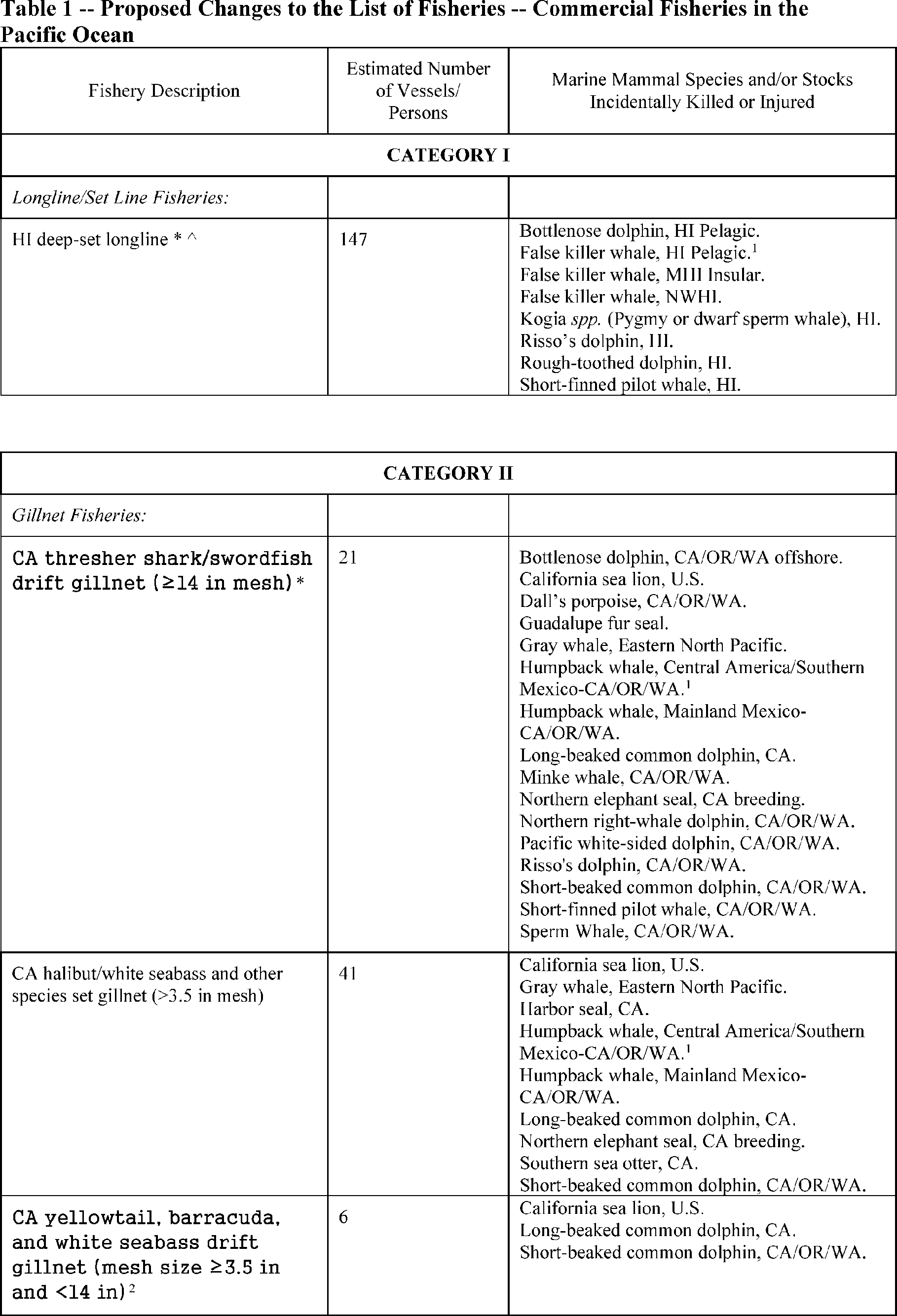
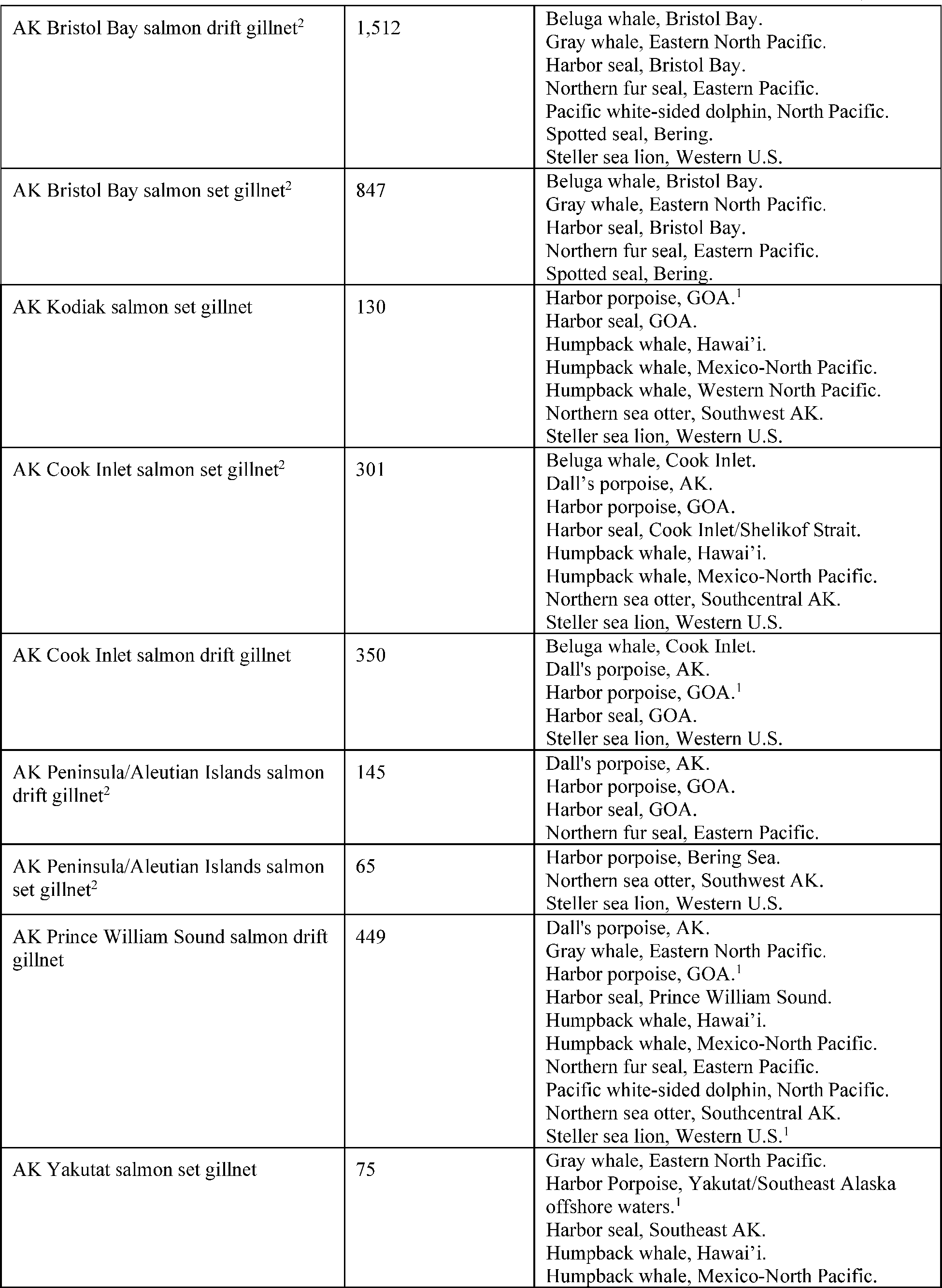
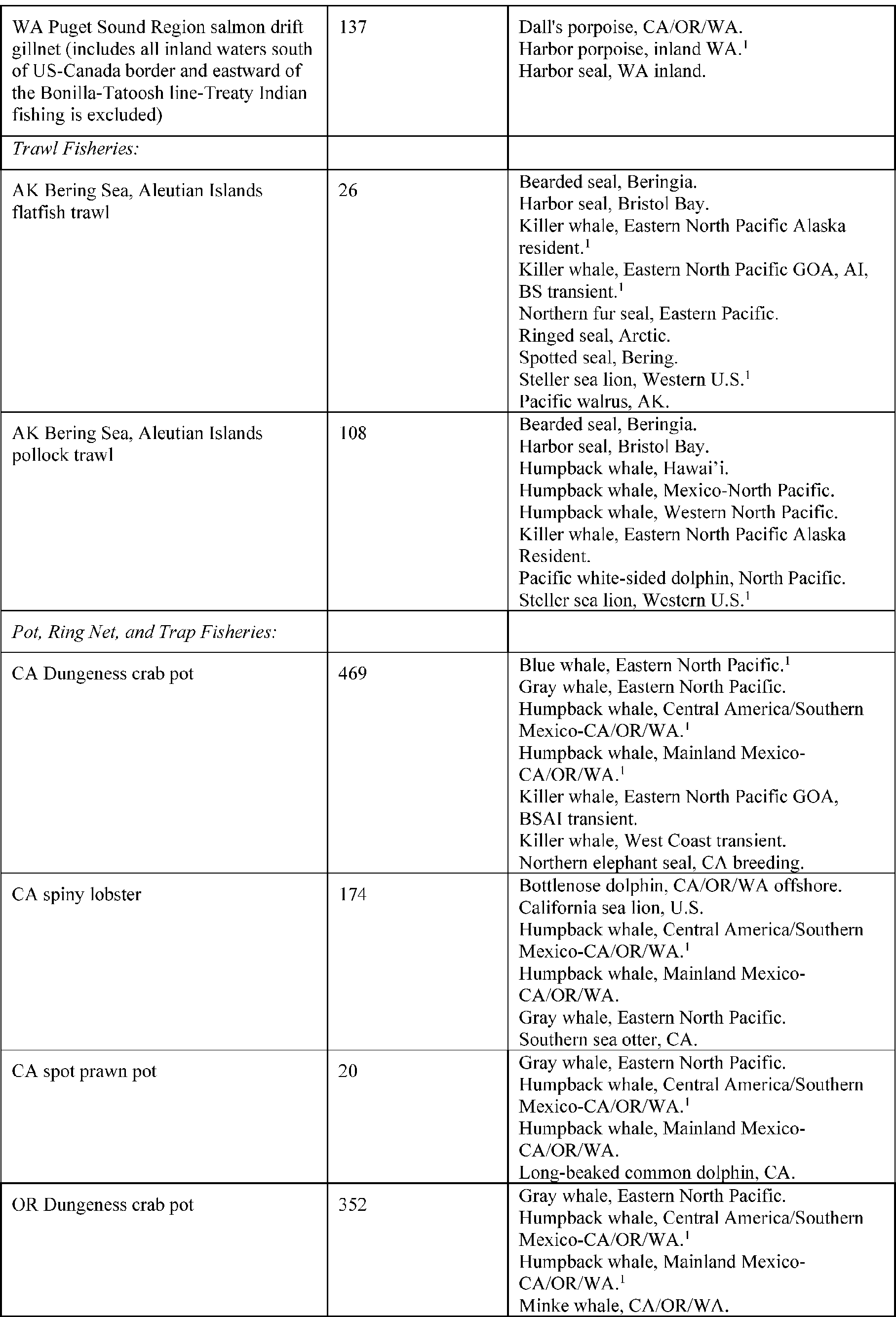
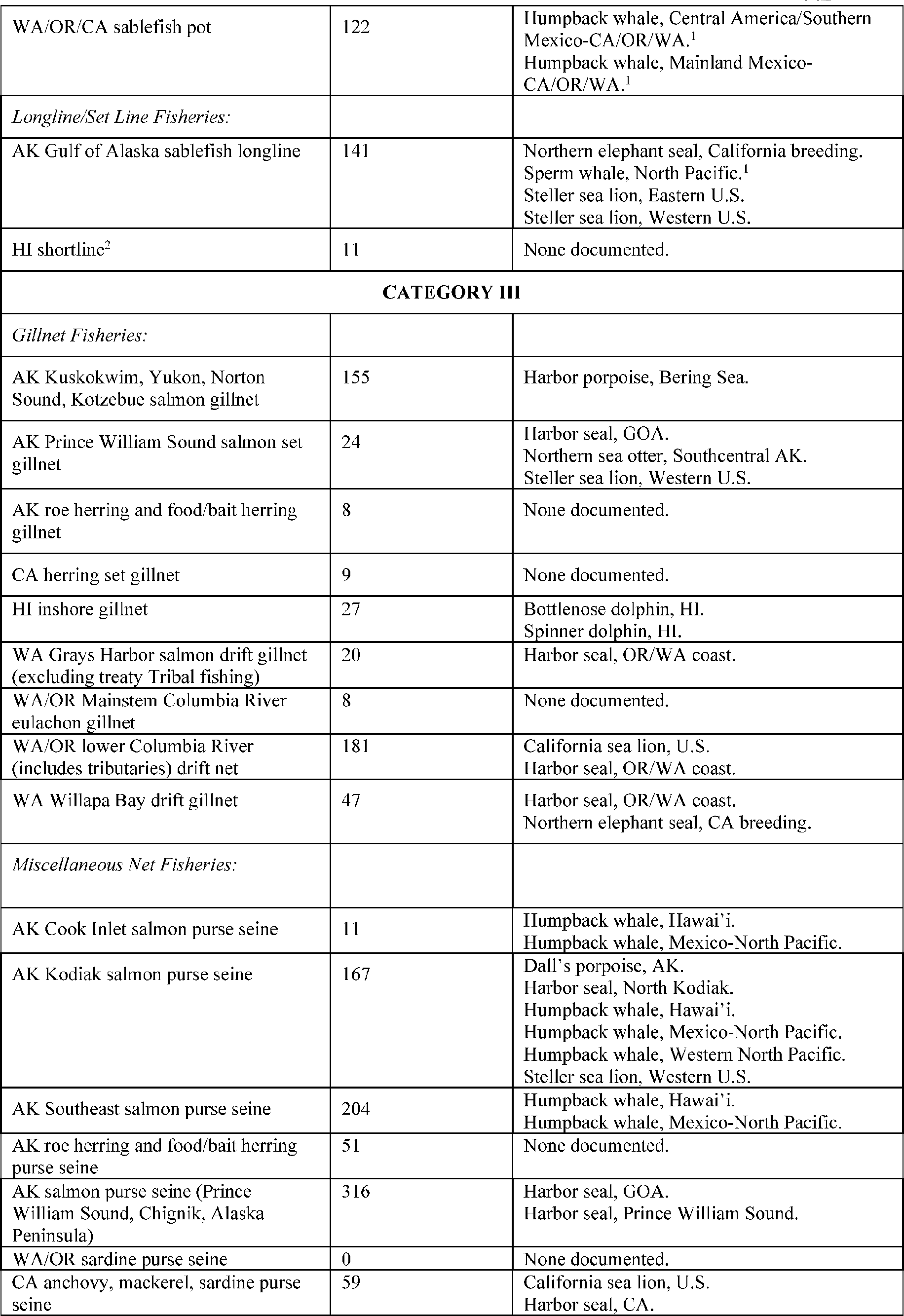
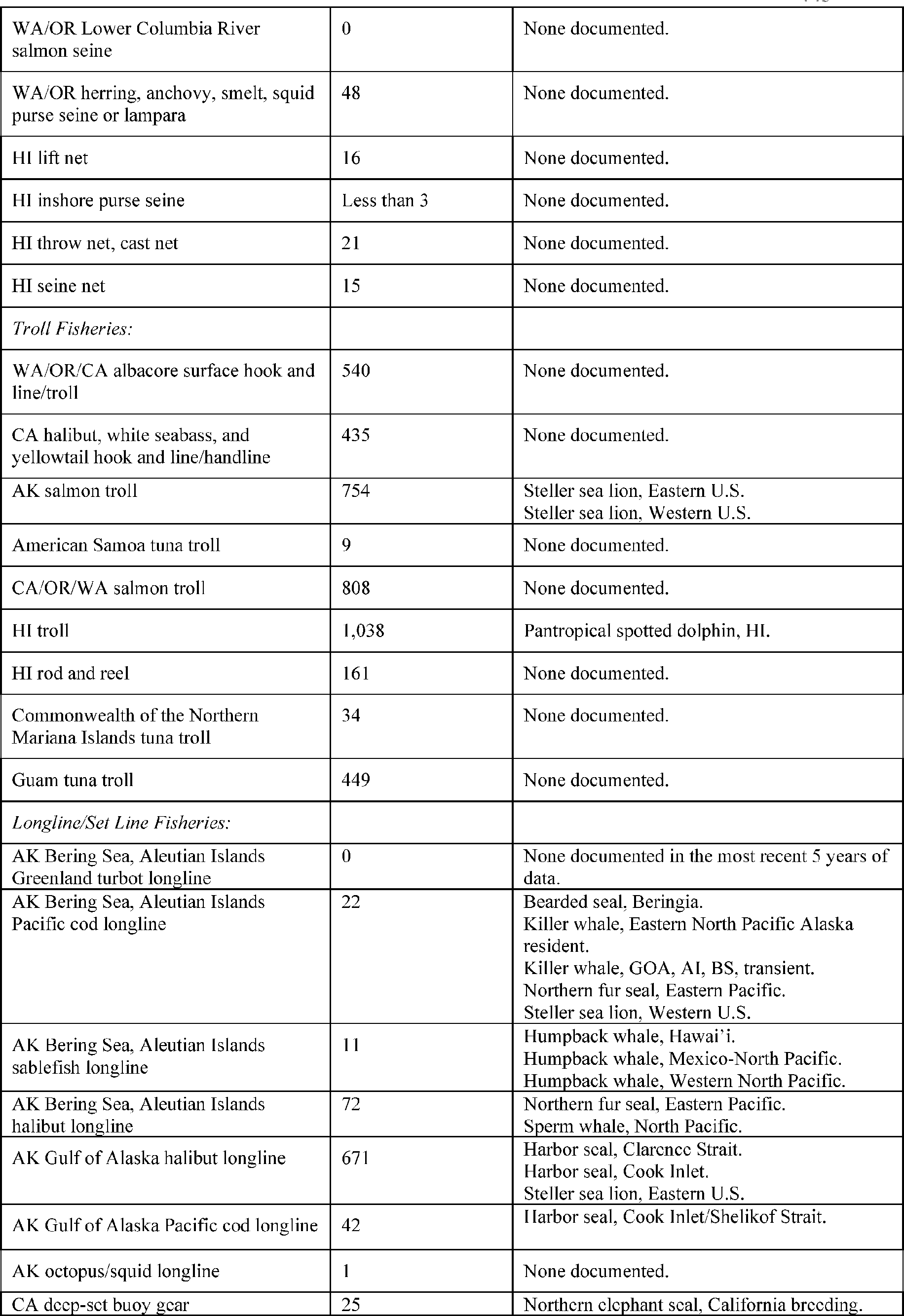
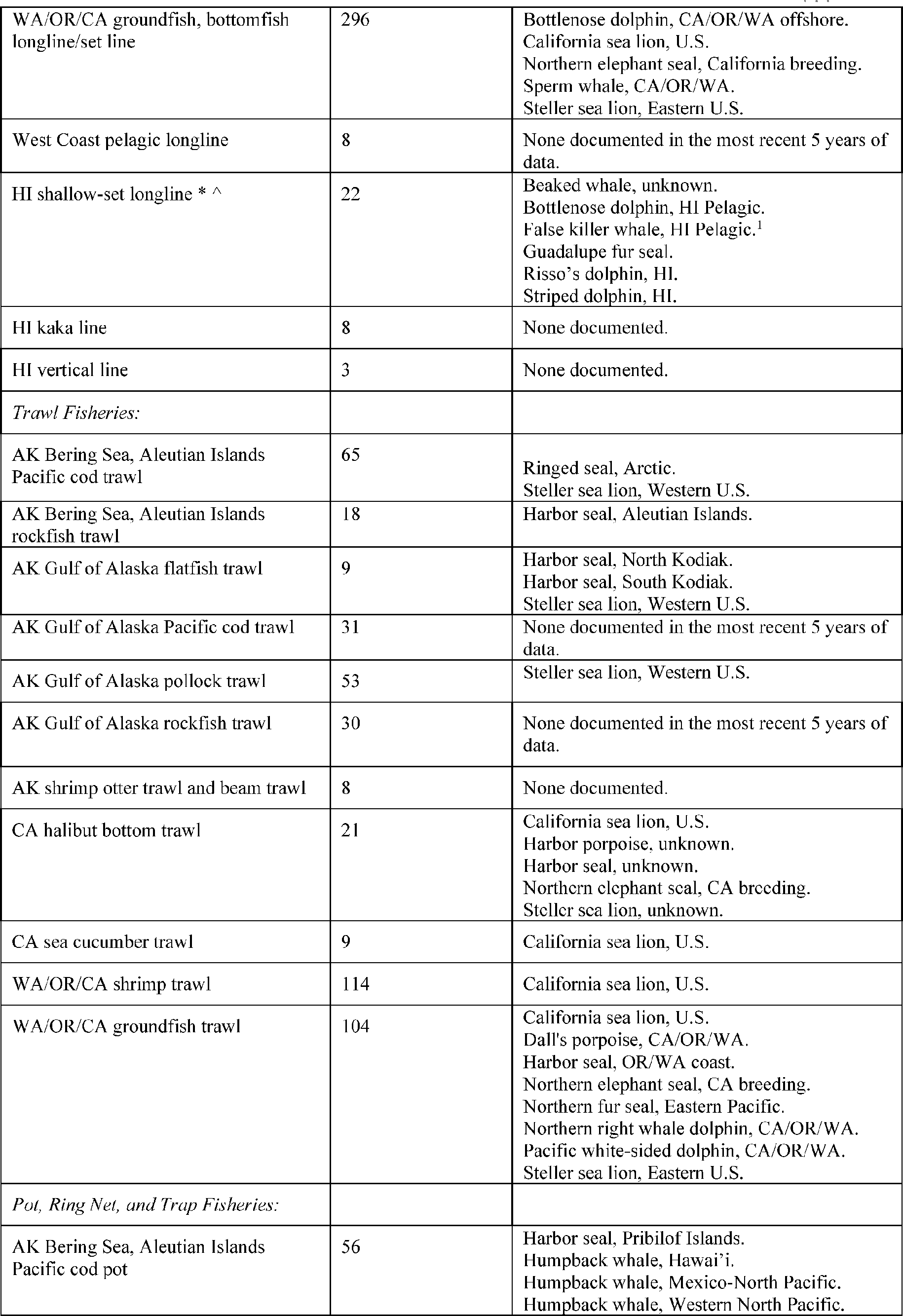
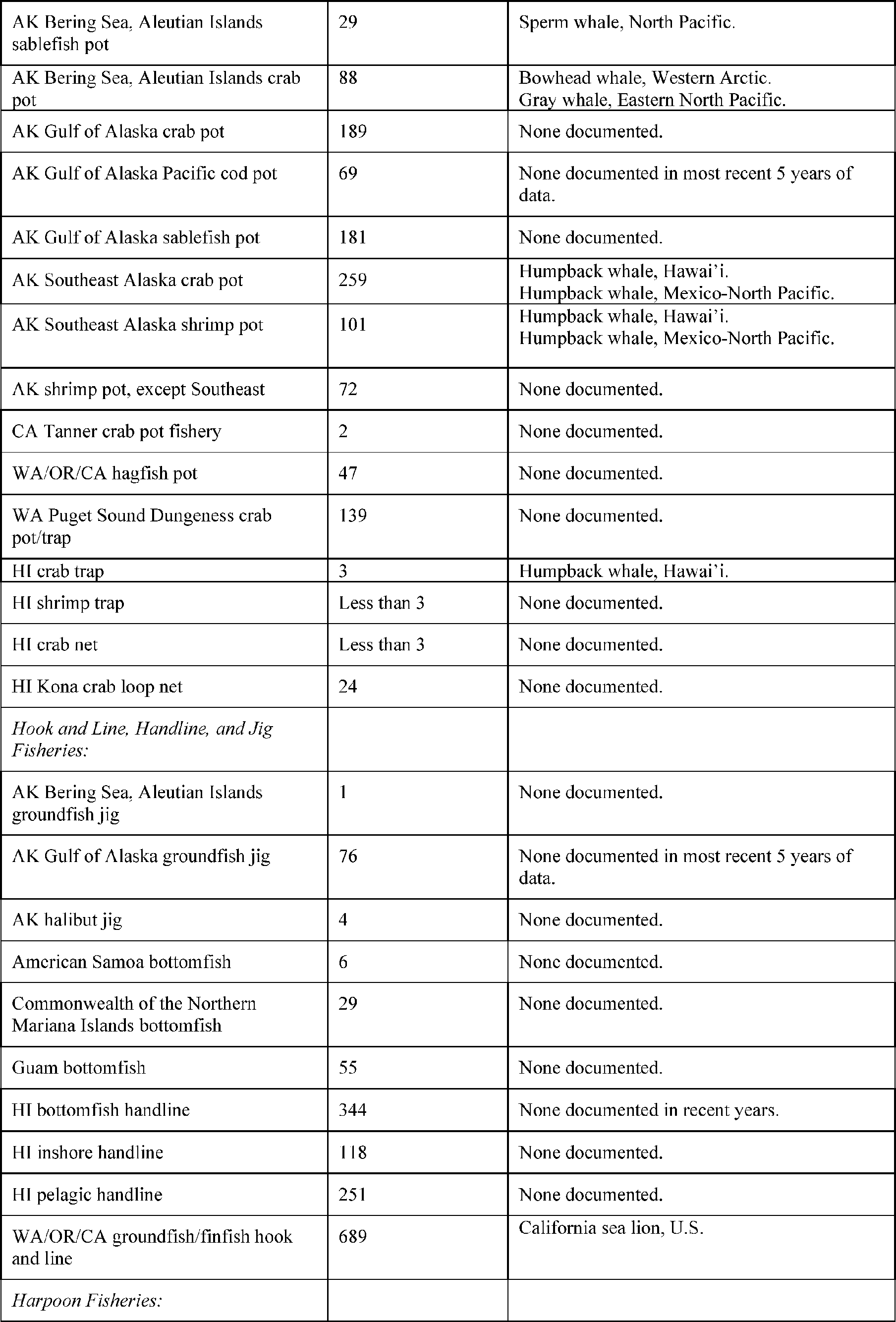
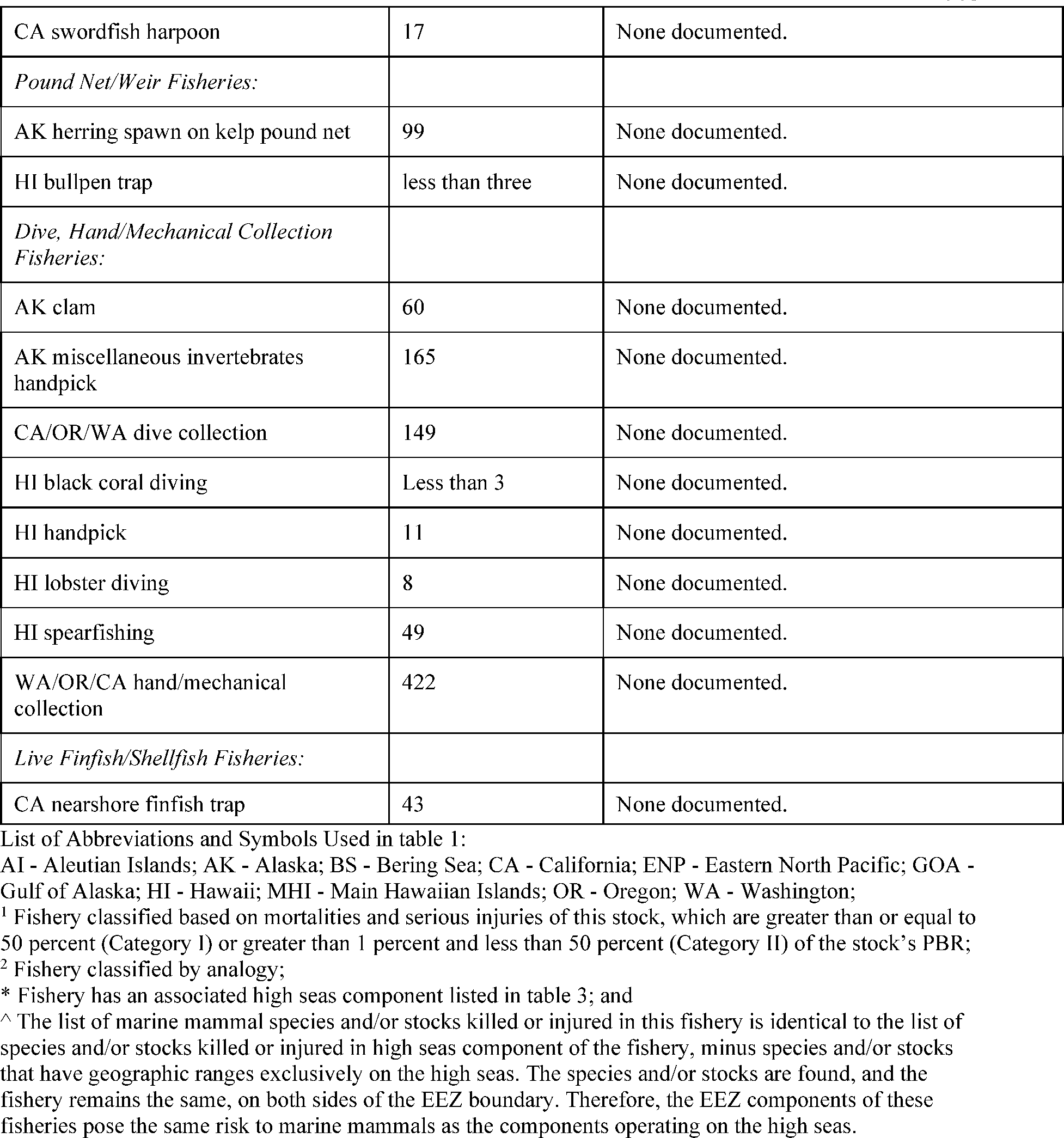
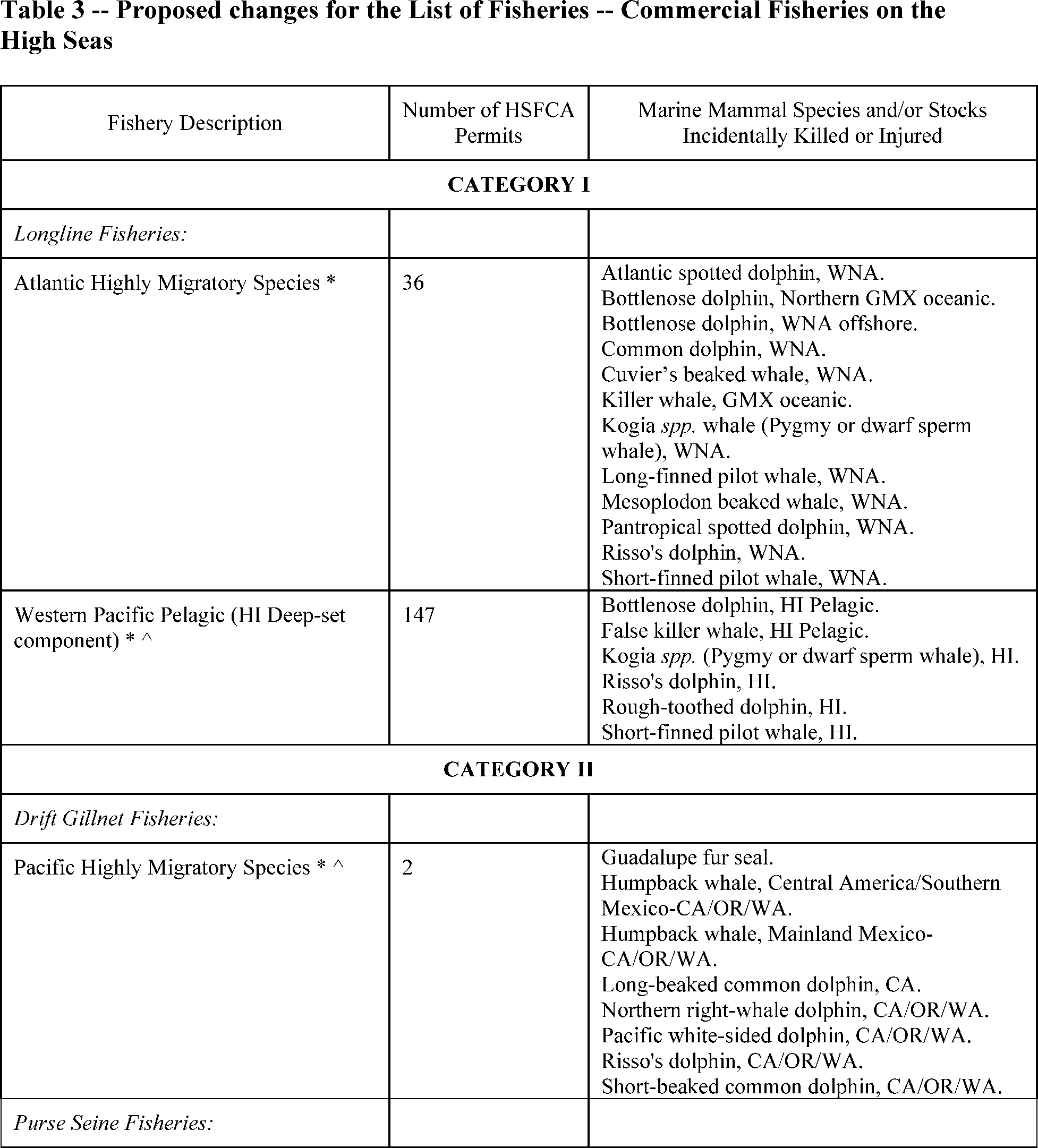
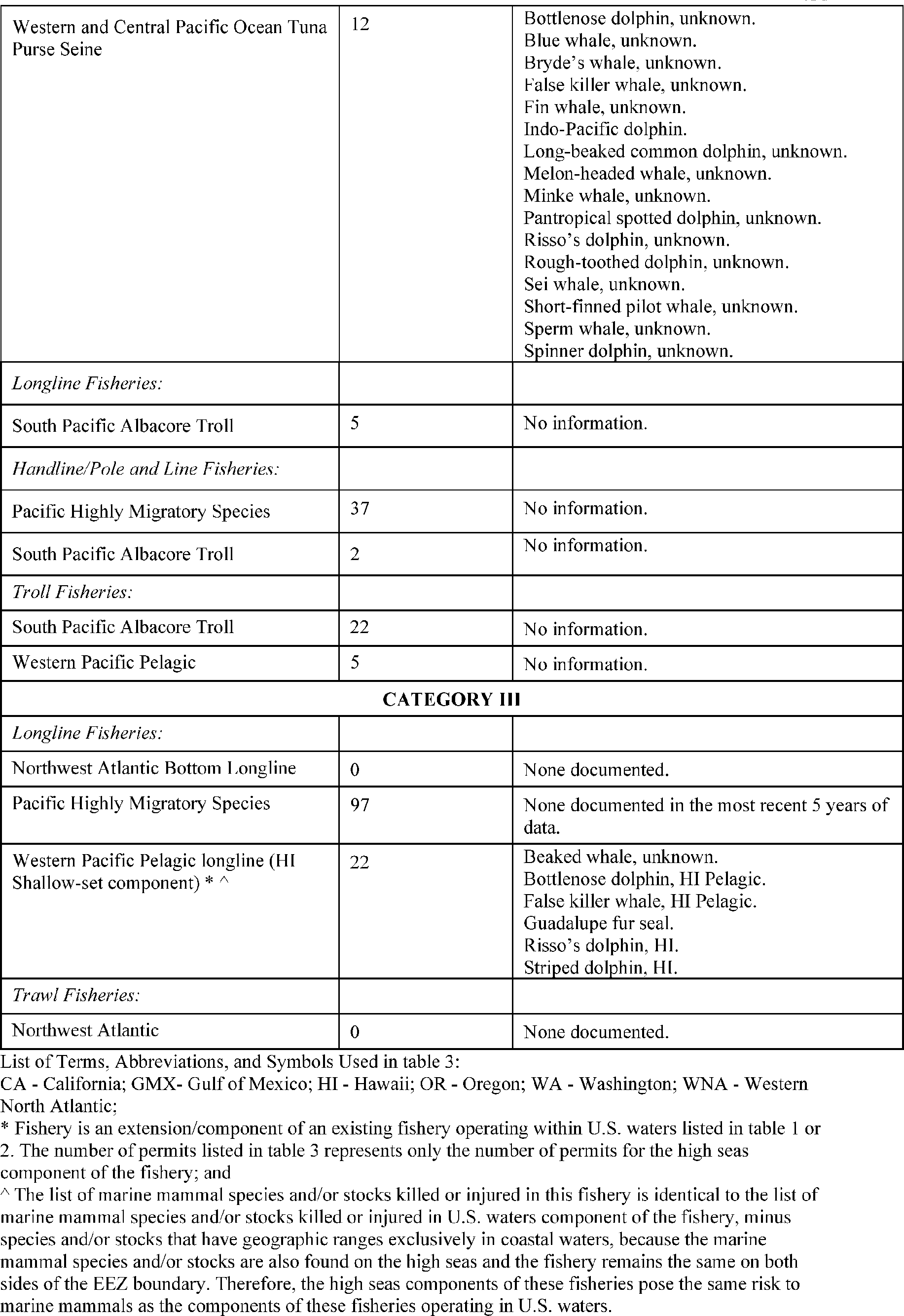
The LOF includes three tables that list all U.S. commercial fisheries by Category. Table 1 lists all of the commercial fisheries in the Pacific Ocean (including Alaska), table 2 lists all of the commercial fisheries in the Atlantic Ocean, Gulf of America, and Caribbean, and table 3 lists all U.S. authorized commercial fisheries on the high seas. The full LOF tables are available on our website at
https://www.fisheries.noaa.gov/national/marine-mammal-protection/list-fisheries-summary-tables.
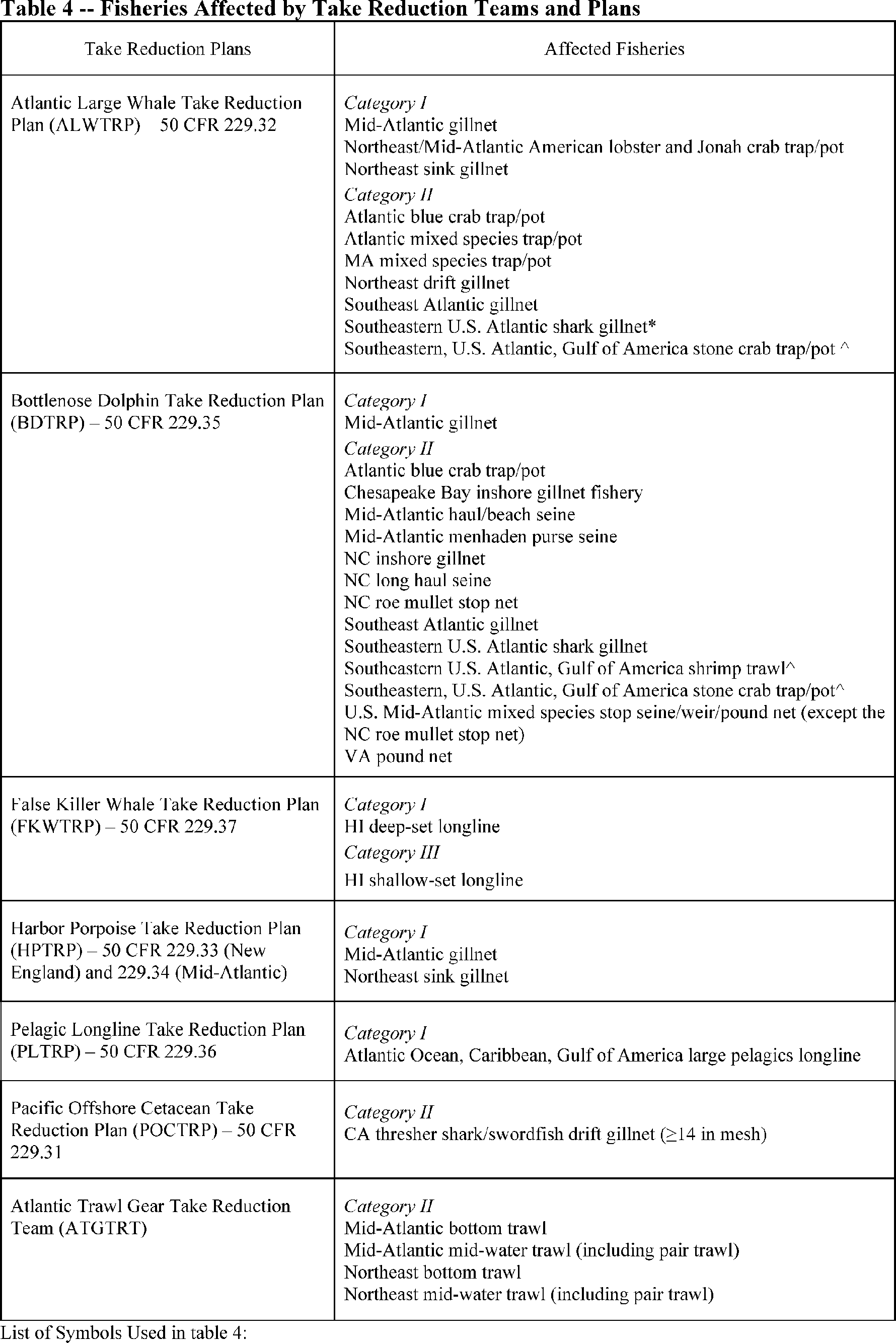
A fourth table, table 4, lists all commercial fisheries managed under applicable TRPs or take reduction teams (TRT).
Are high seas fisheries included on the LOF?
NMFS includes high seas fisheries in table 3 of the LOF along with the number of valid High Seas Fishing Compliance Act (HSFCA) permits in each fishery. Many fisheries operate in both U.S. waters and on the high seas, creating some overlap between the fisheries listed in tables 1 and 2 and those in table 3. In these cases, the high seas component of the fishery is not considered a separate fishery but an extension of a fishery operating within U.S. waters (listed in table 1 or 2). NMFS designates those fisheries in tables 1, 2, and 3 with an asterisk (*) after the fishery's name. The number of HSFCA permits listed in table 3 for the high seas components of these fisheries operating in U.S. waters does not necessarily represent additional effort not accounted for in tables 1 and 2. Many vessels/participants holding HSFCA permits also fish within U.S. waters and are included in the number of vessels and participants operating within those fisheries in tables 1 and 2. For more information on how NMFS classifies high seas fisheries on the LOF, see the preamble text in the final 2009 LOF (73 FR 73032, December 1, 2008). Additional information about HSFCA permits can be found at
https://www.fisheries.noaa.gov/permit/high-seas-fishing-permits.
Where can I find specific information on fisheries listed on the LOF?
Starting with the 2010 LOF, NMFS developed summary documents or fishery fact sheets for each Category I and II fishery on the LOF. These fishery fact sheets provide the full history of each Category I and II fishery, including: (1) when the fishery was added to the LOF; (2) the basis for the fishery's initial classification; (3) classification changes to the fishery; (4) changes to the list of species and/or stocks incidentally killed or injured in the fishery; (5) fishery gear and methods used; (6) observer coverage levels; (7) fishery management and regulation; and (8) applicable TRPs or TRTs, if any. These fishery fact sheets are updated after each final LOF and can be found under “How Do I Find Out if a Specific Fishery is in Category I, II, or III?” on NMFS' website:
https://www.fisheries.noaa.gov/national/marine-mammal-protection/marine-mammal-protection-act-list-fisheries,
linked to the “List of Fisheries Summary” table. NMFS is developing similar fishery fact sheets for each Category III fishery on the LOF. However, due to the large number of Category III fisheries on the LOF and the lack of accessible and detailed information on many of these fisheries, the development of these fishery fact sheets is taking significant time to complete. NMFS began posting Category III fishery fact sheets online with the LOF for 2016.
Am I required to register under the MMPA?
Owners of vessels or gear engaging in a Category I or II fishery are required under the MMPA (16 U.S.C. 1387(c)(2)), as described in 50 CFR 229.4, to register with NMFS and obtain a marine mammal authorization to lawfully take marine mammals incidental to commercial fishing operations. The take of threatened or endangered marine mammals requires additional authorization. Owners of vessels or gear engaged in a Category III fishery are not required to register with NMFS or obtain a marine mammal authorization certificate.
How do I register, renew, and receive my Marine Mammal Authorization Program (MMAP) authorization certificate?
NMFS has integrated the MMPA registration process, implemented through the MMAP, with existing state and Federal fishery license, registration, or permit systems for Category I and II fisheries on the LOF. Participants in these fisheries are automatically registered under the MMAP and are not required to submit registration or renewal materials.
The authorization certificate or a copy (physical or electronic) must be on board the vessel while it is operating in a Category I or II fishery or for non-vessel fisheries, in the possession of the person in charge of the fishing operation (50 CFR 229.4(e)). Although efforts are made to limit the issuance of authorization certificates to only those vessel or gear owners that participate in Category I or II fisheries, not all state and Federal license or permit systems distinguish between fisheries as classified by the LOF. Therefore, some vessel or gear owners in Category III fisheries may receive authorization certificates even though they are not required for Category III fisheries.
Individuals fishing in Category I and II fisheries for which no state or Federal license or permit is required must register with NMFS by contacting their appropriate Regional Office (see
ADDRESSES
).
Am I required to submit reports when I kill or injure a marine mammal during the course of commercial fishing operations?
In accordance with the MMPA (16 U.S.C. 1387(e)) and 50 CFR 229.6, any vessel owner or operator or gear owner
( printed page 24179)
or operator (in the case of non-vessel fisheries) participating in a fishery listed on the LOF must report to NMFS all incidental mortalities and injuries of marine mammals that occur during commercial fishing operations, regardless of the category in which the fishery is placed (
i.e.,
Category I, Category II, or Category III) within 48 hours of the end of the fishing trip or, in the case of non-vessel fisheries, fishing activity. “Injury” is defined in 50 CFR 229.2 as a wound or other physical harm. In addition, any animal that ingests fishing gear or any animal that is released with fishing gear entangling, trailing, or perforating any part of the body is considered injured regardless of the presence of any wound or other evidence of injury and must be reported.
Am I required to take an observer aboard my vessel?
Individuals participating in a Category I or II fishery are required to accommodate an observer aboard their vessel(s) upon request from NMFS. MMPA section 118 states that the Secretary is not required to place an observer on a vessel if the facilities for quartering an observer or performing observer functions are so inadequate or unsafe that the health or safety of the observer or the safe operation of the vessel would be jeopardized, thereby authorizing the exemption of vessels too small to safely accommodate an observer from this requirement. Observer requirements are found in 50 CFR 229.7.
Am I required to comply with any marine mammal TRP regulations?
Where can I find more information about the LOF and the MMAP?
Information regarding the LOF and the MMAP including registration procedures and forms, current and past LOFs, descriptions of each Category I and II fishery and some Category III fisheries, observer requirements, and marine mammal mortality/injury reporting forms and submittal procedures may be obtained at
https://www.fisheries.noaa.gov/national/marine-mammal-protection/marine-mammal-protection-act-list-fisheries
or from any NMFS Regional Office at the addresses listed below:
NMFS, Greater Atlantic Regional Fisheries Office, 55 Great Republic Drive, Gloucester, MA 01930-2298, Attn: Cheryl Cross;
NMFS, West Coast Region, Long Beach Office, 501 W Ocean Blvd., Suite 4200, Long Beach, CA 90802-4213, Attn: Meghan Roberts;
NMFS, Alaska Region, Protected Resources, P.O. Box 22668, 709 West 9th Street, Juneau, AK 99802, Attn: Suzie Teerlink; or
NMFS, Pacific Islands Regional Office, Protected Resources Division, 1845 Wasp Blvd., Building 176, Honolulu, HI 96818, Attn: Charlotte Frank.
Sources of Information Reviewed for the 2026 LOF
NMFS reviewed the marine mammal incidental M/SI information presented in the SARs for all fisheries to determine whether changes in fishery classification were warranted. The SARs are based on the best scientific information available at the time of preparation, including the level of M/SI of marine mammals that occurs incidental to commercial fishery operations and the PBR levels of marine mammal stocks. The information contained in the SARs is reviewed by regional Scientific Review Groups (SRGs) representing Alaska, the Pacific (including Hawaii), and the U.S. Atlantic, Gulf of America, and Caribbean. The SRGs were established by the MMPA to review the science that informs the SARs and to advise NMFS on marine mammal population status, trends, and stock structure, as well as on uncertainties in the science, research needs, and other issues (see 16 U.S.C. 1386(d)).
NMFS also reviewed other sources of new information, including marine mammal stranding and entanglement data, injury determination reports, observer program data, fishermen self-reports, reports to the SRGs, conference papers, Fishery Management Plans (FMPs), and Endangered Species Act (ESA) documents.
The proposed changes to the LOF for 2026 are based on, among other things, stranding data, fishermen self-reports, and SARs (primarily the final 2023 SARs, which are based on data from 2017 through 2021, and final 2024 SARs, which are based on data from 2018 through 2022). The SARs referenced in this notice include 2022 (88 FR 54592, August 11, 2023), 2023 (89 FR 5495, January 29, 2024) and 2024 (90 FR 13344, March 21, 2025). The SARs are available at
https://www.fisheries.noaa.gov/national/marine-mammal-protection/marine-mammal-stock-assessment-reports-region.
We expect that the 2024 SARs will be finalized before the 2026 changes to the LOF are published.
Summary of Changes to the LOF for 2026
NMFS has withdrawn the proposed MMPA LOF for 2025 (89 FR 77789, Sept. 24, 2024) because it has determined the annual LOF has been historically misclassified as a “rule”. The annual LOF does not meet the definition of a “rule” under the Administrative Procedure Act (see 5 U.S.C. 551(4)) because it is not an agency statement designed to implement, interpret, or prescribe law or policy. Rather, the LOF announces the statutory and regulatory category (
i.e.,
frequent (Category I), occasional (Category II), or remote (Category III) incidental mortality and serious injury) each fishery belongs to based on the best available scientific information. At this time, the 2024 LOF (89 FR 12257, Feb. 16, 2024) remains in effect until the proposed changes to the LOF are finalized and is available on our website at
https://www.fisheries.noaa.gov/national/marine-mammal-protection/list-fisheries-summary-tables.
The following summarizes proposed changes to the LOF for 2026, including the classification of fisheries, fisheries listed, the estimated number of vessels/persons in a particular fishery, and the species and/or stocks that are incidentally killed or injured in a particular fishery. NMFS proposes to add two fisheries, remove one fishery
( printed page 24180)
and reclassify three fisheries in the LOF for 2026. NMFS also proposes changes to the estimated number of vessels/persons and list of species and/or stocks killed or injured in certain fisheries. The classifications and definitions of U.S. commercial fisheries for 2026 are identical to those provided in the LOF for 2024, except for the changes discussed below.
Pursuant to Executive Order 14172 (“Restoring Names to Honor American Greatness”) (January 20, 2025), the Gulf of Mexico is renamed as the Gulf of America. For purposes of the LOF, this proposed notice updates names and fishery descriptions of 19 fisheries consistent with the renaming of the Gulf. The name change does not result in any changes to, and has no effect on the applicability or enforceability of, any existing regulations. Marine Mammal stock names that include “Gulf of Mexico” will be revised to “Gulf of America” in a future LOF, consistent with the updates to the stock names in the SARs.
State and regional abbreviations used in the following paragraphs include: AI (Aleutian Islands), AK (Alaska), BS (Bering Sea), CA (California), FL (Florida), GA (Georgia), GOA (Gulf of Alaska), HI (Hawaii), MA (Massachusetts), NC (North Carolina), OR (Oregon), SC (South Carolina) and WA (Washington).
Commercial Fisheries in the Pacific Ocean
Classification of Fisheries
NMFS proposes to reclassify the Category I CA Dungeness crab pot fishery to a Category II fishery. The most recent estimate of annual M/SI of the Central America/Southern Mexico—CA/OR/WA stock of humpback whales from 2018 through 2022 is 1.25, which is 35.7 percent of this stock's PBR of 3.5 (Carretta
et al.,
2024a; Carretta
et al.,
2024b). Because the estimated M/SI is between 1 and 50 percent of the stock's PBR, NMFS proposes to reclassify the CA Dungeness crab pot fishery from a Category I to a Category II fishery.
NMFS proposes to reclassify the Category II HI shallow-set longline fishery to a Category III fishery. The Category II classification of this fishery was based on the mean annual estimated M/SI of the Hawaii pelagic stock of false killer whales. The mean annual estimated M/SI of the Hawaii pelagic stock of false killer whales from 2017 through 2021 is 0.2, which is 0.56 percent of the stock's PBR (36 whales) (Carretta
et al.,
2024b). Because the estimated M/SI is less than 1 percent of the stock's PBR, NMFS proposes to reclassify the HI shallow-set longline fishery from a Category II to a Category III fishery.
There are several fisheries on the LOF for which a portion of the fishing vessels cross the Exclusive Economic Zone (EEZ) boundary and therefore, operate both within U.S. waters and on the high seas. These fisheries, though listed separately, are considered the same fisheries on either side of the EEZ boundary. The Category II Western Pacific Pelagic longline fishery (HI shallow-set component) is the corresponding high seas component of the HI shallow-set longline fishery. Therefore, NMFS proposes to also reclassify the corresponding high seas component Category II Western Pacific Pelagic longline fishery (HI shallow-set component) to a Category III fishery.
Addition of Fisheries
NMFS proposes to add the CA deep-set buoy gear fishery as a Category III fishery. The fishery operates in federal waters along the U.S. West Coast from the U.S./Mexico border to the WA/OR boundary line. The fishery targets swordfish and bluefin tuna and has 25 participants.
The CA deep-set buoy gear fishery is a year-round fishery with most effort occurring during the late summer, fall, and winter months. Effort is based on fish availability, which can highly fluctuate during El Niño and La Niña years. To date, the majority of effort has occurred in federal waters in the Southern California Bight around the Channel Islands. Effort seldom extends farther than 30 nautical miles (nm) (55.56 kilometers (km)) offshore and vessels are required to stay beyond state boundary lines, 3 nm (5.56 km) from the mainland and 1 nm (1.852 km) from Channel Islands. Some vessels may fish within state waters for exploratory purposes. Most fishing occurs during the day, but a limited number of vessels are approved to fish at night for exploratory purposes. Additionally, fishing using the linked buoy gear configuration (described below) is prohibited in depths shallower than 400 meters (m).
Deep-set buoy gear employs a hook and line system where a floatation device is deployed on the surface from which a single weighted line hangs with baited hooks attached. The gear can be fished in two distinct configurations, standard deep-set buoy gear and linked deep-set buoy gear, both of which must be actively tended. Standard buoy gear and linked buoy gear can be fished at the same time so long as no more than 10 pieces of gear are deployed at any 1 time.
Standard buoy gear:
An individual piece (section) of standard buoy gear consists of a vertical monofilament mainline suspended from a buoy-array of three buoys with a terminal weight. This typically includes one 46-pound non-compressible float, one soft buoy, and one hard bullet indicator buoy, which is connected directly to a monofilament vertical mainline (typically 300 m long and 2.8-3.5 millimeters thick) attached to a minimum 8 pound (3.6 kg) weight at the bottom. Up to three gangions with baited hooks may be attached to the mainline at a minimum depth of 90 m. An illumination source (
e.g.,
cyalume or power light) may be used near each gangion, if desired. All gear must remain within a radius of no more than 5 nm (9.26 km) and the vessel may be no more than 3 nm (5.56 kilometers) from the nearest piece of gear.
Linked buoy gear:
An individual piece (section) of linked buoy gear consists of a monofilament mainline which extends vertically from a buoy-array (either directly or from a minimum 50-foot extender) to a weight; then horizontally to a second weight; then vertically to a minimum 50-foot extender attached to a second buoy-array. Up to three gangions with hooks may be connected to each horizontal section of the mainline, all of which must be fished below 90 meters. The pieces may be linked together by the mainline, which is serviceable between each piece of linked buoy gear and must be suspended between links below a depth of 50 feet.
The Federal deep-set buoy gear fishery is managed by the Pacific Fishery Management Council under the Fishery Management Plan for West Coast Highly Migratory Species (HMS) Fisheries. State-based exploratory fishing is managed by the California Department of Fish and Wildlife (CDFW). The Federal fishery currently consists of two permit types. Limited entry permits are required to fish deep-set buoy gear south of Point Conception while deep-set buoy gear is permitted on an open access basis north of Point Conception for any vessels with a General HMS permit and deep-set buoy gear endorsement. All West Coast vessels targeting HMS species require a Federal HMS permit, a CDFW swordfish permit in order to land swordfish in California, and a deep-set buoy gear limited entry permit to fish deep-set buoy gear south of Point Conception. Under the current, authorized fishery, operators are required to submit pre-trip notifications to NMFS before fishing, and NMFS places observers aboard deep-set buoy gear boats at its discretion
( printed page 24181)
(subject to available funding and Agency priorities).
NMFS proposes to add the CA deep-set buoy gear fishery as a Category III fishery based on observed bycatch of four Northern elephant seals between 2015 and 2019 (NMFS 2023a). All four seals were released alive and injury determinations were not conducted for the events. The most recent estimate of total annual fishery M/SI of the CA breeding stock of elephant seal is 6.8 and PBR is 5,328 (Carretta
et al.,
2026), which is 0.1 percent of the stock's PBR. Because injury determinations were not conducted for the four elephant seals released alive, the injuries are not counted against PBR in the 2024 SAR. However, if the injuries were determined to be serious, the addition of these four injuries total annual fishery M/SI would continue to be less than one percent of PBR. Therefore, using the Tier 1 analysis, NMFS proposes to classify the CA deep-set buoy gear fishery as a Category III fishery because total annual M/SI of the CA breeding stock of Northern elephant seals across all fisheries is less than or equal to 10 percent of the stock's PBR. NMFS also proposes to add the CA breeding stock of elephant seal to the list of species/stocks incidentally killed or injured in this fishery.
Fishery Name and Organizational Changes and Clarifications
NMFS proposes to revise the fishery description for the Category III West Coast pelagic longline fishery as follows. The West Coast pelagic longline fishery targets bigeye, yellowfin, Pacific bluefin, and skipjack tuna along with opah and other HMS in the Eastern Pacific Ocean. Fishing occurs primarily outside of the U.S. EEZ (3 to 200 nm (5.6-370.4 km) off the coast) unless such activities are approved to occur in federal waters for exploratory purposes. The offshore fishery generally extends south to 20° north latitude and west to 140° west longitude and commonly targets bigeye tuna at depths from anywhere between 250 and 400 meters (820.2-1312.3 ft) during the daytime. Nearer to shore fishing activities target swordfish at night at depths below 30 m and typically target swordfish, tunas and other marketable HMS at depths below 100 meters during the day.
Gear consists of a monofilament main line approximately 3.2-3.5 mm (0.1 inch (in)) thick that is set, retrieved and stored on large hydraulic reels, except when using braided line with basket gear. The length of the mainline varies with the number of hooks set (from 150 to 2,500+). Fewer hooks are set on configurations fished nearshore and within federal waters than in sets occurring on the high seas. The horizontal mainline is suspended at the target fishing depth by inflatable floats attached via float lines made of monofilament or braided line. Part of the array used to suspend the mainline includes radio buoys, used to show the location and footprint of the gear on the radar of the fishing vessel. Attached to the mainline are monofilament branch lines (usually 5-30 between each float, depending on the configuration), and vary in length to reach target depths. These lines culminate in a swivel weight from which a leader line extends to a large hook (typically an offset circle hook larger than 14/0). Bait used in these fisheries consists of mackerel-type fish, squid, or artificial baits.
The fishery is managed under the HMS FMP by the Pacific Fishery Management Council. All U.S. West Coast vessels targeting tunas require a Federal HMS permit and registration with the Inter-American Tropical Tuna Commission (IATTC). Use of either shallow-set or deep-set pelagic longline gear within the U.S. EEZ of the U.S. West Coast is prohibited unless such activities are approved to occur in Federal waters for exploratory purposes. The HMS FMP does not permit shallow-set longline fishing, although shallow-set longline vessels fishing under a Hawaii longline permit (under the Pelagics FMP) do make landings into California. Use of a vessel monitoring system, attendance at protected species workshops, and the possession/use of sea turtle, seabird, marine mammal and shark mitigation gear and safe handling techniques are required.
The IATTC specifies trip limits (for certain vessel classes/sizes) and yearly catch limits each year for all tuna species in the Convention Area. Federal logbooks are required for all authorized fisheries targeting HMS. Observers are required but the level of coverage varies depending on monitoring needs and funding availability.
NMFS proposes to clarify the fishery description for the Category II WA/OR/CA sablefish pot fishery to specify that this fishery operates in both state and federal waters.
NMFS proposes to remove the Category III HI aquarium collecting fishery from the LOF. There are no participants in the fishery and commercial aquarium fishing is inactive in Hawaii.
NMFS proposes to add the superscript “1” to the Central America/Southern Mexico—CA/OR/WA stocks of humpback whale to indicate that M/SI of the stock is determining the Category II classification of the CA thresher shark/swordfish drift gillnet (≥14 in mesh) fishery. NMFS also proposes to remove the superscript “1” from the CA/OR/WA stocks of short-finned pilot whale and sperm whale to indicate that M/SI of the stocks are no longer determining the Category II classification of the CA thresher shark/swordfish drift gillnet (≥14 in mesh) fishery.
NMFS proposes to add the superscript “1” to the Eastern North Pacific stock of blue whale and Mainland Mexico-CA/OR/WA stock of humpback whale to indicate that M/SI of the stocks are determining the Category II classification of the CA Dungeness crab pot fishery.
NMFS proposes to add the superscript “1” to the Mainland Mexico-CA/OR/WA stock of humpback whale to indicate that M/SI of the stock is determining the Category II classification of the OR Dungeness crab pot fishery.
Number of Vessels/Persons
NMFS proposes to update the estimated number of vessels/persons in the Pacific Ocean as follows:
Category I
HI deep-set longline fishery from 146 to 147 vessels/persons.
Category II
CA Dungeness crab pot fishery from 471 to 469 vessels/persons;
CA halibut/white seabass and other species set gillnet (>3.5 in mesh) fishery from 39 to 41 vessels/persons;
CA yellowtail, barracuda, and white seabass drift gillnet (mesh size >3.5 in and <14 in) fishery from 20 to 6 vessels/persons;
AK Bristol Bay salmon drift gillnet fishery from 1,521 to 1,512 vessels/persons;
AK Bristol Bay salmon set gillnet fishery from 855 to 847 vessels/persons;
AK Kodiak salmon set gillnet fishery from 128 to 130 vessels/persons;
AK Cook Inlet salmon set gillnet fishery from 479 to 301 vessels/persons;
AK Cook Inlet salmon drift gillnet fishery from 355 to 350 vessels/persons;
AK Peninsula/Aleutian Islands salmon drift gillnet from 148 to 145 vessels/persons;
AK Peninsula/Aleutian Islands salmon set gillnet fishery from 75 to 65 vessels/persons;
AK Prince William Sound salmon drift gillnet fishery from 483 to 449 vessels/persons;
AK Yakutat salmon set gillnet fishery from 95 to 75 vessels/persons;
WA Puget Sound Region salmon drift gillnet (includes all inland waters
( printed page 24182)
south of US-Canada border and eastward of the Bonilla-Tatoosh line—Treaty Indian fishing is excluded) fishery from 136 to 137 vessels/persons;
AK Bering Sea, Aleutian Islands flatfish trawl from 29 to 26 vessels/persons;
AK Bering Sea, Aleutian Islands pollock trawl from 116 to 108 vessels/persons;
CA spiny lobster fishery from 189 to 174 vessels/persons;
CA spot prawn pot fishery from 22 to 20 vessels/persons;
OR Dungeness crab pot fishery from 323 to 352 vessels/persons;
WA/OR/CA sablefish pot fishery from 144 to 122 vessels/persons;
AK Gulf of Alaska sablefish longline fishery from 177 to 141 vessels/persons; and
HI shortline fishery from 8 to 11 vessels/persons.
Category III
AK Kuskokwim, Yukon, Norton Sound, Kotzebue salmon gillnet fishery from 360 to 155 vessels/persons;
AK Prince William Sound salmon set gillnet fishery from 25 to 24 vessels/persons;
AK roe herring and food/bait herring gillnet fishery from 15 to 8 vessels/persons;
CA herring set gillnet fishery from 11 to 9 vessels/persons;
HI inshore gillnet fishery from 26 to 27 vessels/persons;
WA Grays Harbor salmon drift gillnet (excluding treaty Tribal fishing) fishery from 19 to 20 vessels/persons;
WA/OR Mainstem Columbia River eulachon gillnet fishery from 10 to 8 vessels/persons;
WA/OR lower Columbia River (includes tributaries) drift net fishery from 244 to 181 vessels/persons;
WA Willapa Bay drift gillnet fishery from 57 to 47 vessels/persons;
AK Cook Inlet salmon purse seine fishery from 16 to 11 vessels/persons;
AK Kodiak salmon purse seine fishery from 159 to 167 vessels/persons;
AK Southeast salmon purse seine fishery from 206 to 204 vessels/persons;
AK roe herring and food/bait herring purse seine fishery from 31 to 51 vessels/persons;
AK salmon purse seine (Prince William Sound, Chignik, Alaska Peninsula) fishery from 298 to 316 vessels/persons;
WA/OR sardine purse seine fishery from six to zero vessels/persons;
CA anchovy, mackerel, sardine purse seine fishery from 53 to 59 vessels/persons;
WA/OR Lower Columbia River salmon seine fishery from one to zero vessels/persons;
WA/OR herring, anchovy, smelt, squid purse seine or lampara fishery from 41 to 48 vessels/persons;
HI lift net fishery from 14 to 16 vessels/persons;
HI inshore purse seine from none recorded to less than three;
HI throw net, cast net fishery from 13 to 21 vessels/persons;
HI seine net fishery from 17 to 15 vessels/persons;
WA/OR/CA albacore surface hook and line/troll fishery from 556 to 540 vessels/persons;
CA halibut, white seabass, and yellowtail hook and line/handline fishery from 388 to 435 vessels/persons;
AK salmon troll fishery from 850 to 754 vessels/persons;
American Samoa tuna troll fishery from six to nine vessels/persons;
CA/OR/WA salmon troll fishery from 1,030 to 808 vessels/persons;
HI troll fishery from 1,124 to 1,038 vessels/persons;
HI rod and reel fishery from 235 to 161 vessels/persons;
Commonwealth of the Northern Mariana Islands tuna troll fishery from 9 to 34;
Guam tuna troll fishery from 450 to 449 vessels/persons;
AK Bering Sea, Aleutian Islands Greenland turbot longline fishery from four to zero vessels/persons;
AK Bering Sea, Aleutian Islands Pacific cod longline fishery from 26 to 22 vessels/persons;
AK Bering Sea, Aleutian Islands sablefish longline fishery from 18 to 11 vessels/persons;
AK Bering Sea, Aleutian Islands halibut longline fishery from 84 to 72 vessels/persons;
AK Gulf of Alaska halibut longline fishery from 689 to 671 vessels/persons;
AK Gulf of Alaska Pacific cod longline fishery from 23 to 42 vessels/persons;
AK octopus/squid longline fishery from zero to one vessels/persons;
West Coast pelagic longline fishery from four to eight vessels/persons;
HI shallow-set longline fishery from 14 to 22 vessels/persons;
WA/OR/CA groundfish, bottomfish longline/set line fishery from 314 to 296 vessels/persons;
HI kaka line fishery from 17 to 8 vessels/persons;
HI vertical line fishery from six to three vessels/persons;
AK Bering Sea, Aleutian Islands Pacific cod trawl fishery from 64 to 65 vessels/persons;
AK Bering Sea, Aleutian Islands rockfish trawl fishery from 22 to 18 vessels/persons;
AK Gulf of Alaska flatfish trawl fishery from 16 to 9 vessels/persons;
AK Gulf of Alaska Pacific cod trawl fishery from 12 to 31 vessels/persons;
AK Gulf of Alaska pollock trawl fishery from 60 to 53 vessels/persons;
AK Gulf of Alaska rockfish trawl fishery from 35 to 30 vessels/persons;
AK shrimp otter trawl and beam trawl fishery from 12 to 8 vessels/persons;
CA halibut bottom trawl fishery from 23 to 21 vessels/persons;
CA sea cucumber trawl fishery from 11 to 9 vessels/persons;
WA/OR/CA shrimp trawl fishery from 130 to 114 vessels/persons;
WA/OR/CA groundfish trawl fishery from 118 to 104 vessels/persons;
AK Bering Sea, Aleutian Islands Pacific cod pot fishery from 80 to 56 vessels/persons;
AK Bering Sea, Aleutian Islands sablefish pot fishery from 15 to 29 vessels/persons;
AK Bering Sea, Aleutian Islands Pacific crab pot fishery from 73 to 88 vessels/persons;
AK Gulf of Alaska crab pot fishery from 186 to 189 vessels/persons;
AK Gulf of Alaska Pacific cod pot fishery from 48 to 69 vessels/persons;
AK Gulf of Alaska sablefish pot fishery from 129 to 181 vessels/persons;
AK Southeast Alaska crab pot fishery from 375 to 259 vessels/persons;
AK Southeast Alaska shrimp pot fishery from 104 to 101 vessels/persons;
AK shrimp pot, except Southeast fishery from 77 to 72 vessels/persons;
CA Tanner crab pot fishery from one to two vessels/persons;
WA/OR/CA hagfish pot fishery from 63 to 47 vessels/persons;
WA Puget Sound Dungeness crab pot/trap fishery from 145 to 139 vessels/persons;
HI crab trap from four to three vessels/persons;
HI shrimp trap from three to less than three vessels/persons;
HI crab net fishery from four to less than three vessels/persons;
HI Kona crab loop net fishery from 13 to 24 vessels/persons;
AK Bering Sea, Aleutian Islands groundfish jig fishery from two to one vessels/persons;
AK Gulf of Alaska groundfish jig fishery from 68 to 76 vessels/persons;
AK halibut jig fishery from five to four vessels/persons;
American Samoa bottomfish fishery from 44 to 6 vessels/persons;
Commonwealth of the Northern Mariana Islands bottomfish fishery from 7 to 29 vessels/persons;
Guam bottomfish fishery from 63 to 55 vessels/persons;
HI bottomfish handline fishery from 392 to 344 vessels/persons;
( printed page 24183)
HI inshore handline fishery from 158 to 118 vessels/persons;
HI pelagic handline from 271 to 251 vessels/persons;
CA swordfish harpoon fishery from 21 to 17 vessels/persons;
AK herring spawn on kelp pound net fishery from 143 to 99 vessels/persons;
AK clam fishery from 57 to 60 vessels/persons;
AK miscellaneous invertebrates handpick fishery from 188 to 165 vessels/persons;
CA/OR/WA dive collection fishery from 186 to 149 vessels/persons;
HI black coral diving fishery from none recorded to less than three;
HI handpick fishery from 25 to 11 vessels/persons;
HI lobster diving fishery from 12 to 8 vessels/persons;
HI spearfishing fishery from 67 to 49 vessels/persons;
WA/OR/CA hand/mechanical collection fishery from 320 to 422 vessels/persons; and
CA nearshore finfish trap fishery from 42 to 43 vessels/persons.
List of Species and/or Stocks Incidentally Killed or Injured in the Pacific Ocean
NMFS proposes to correct an administrative error for the Category III WA/OR/CA groundfish/finfish hook and line fishery. Based on public comment, NMFS added the Central America/Southern Mexico-CA/OR/WA and Mainland Mexico-CA/OR/WA stocks of humpback whale to the list of species/stocks incidentally killed or injured in this fishery in the final 2024 LOF (89 FR 12257, February 16, 2024) based on a 2021 humpback whale entanglement (Carretta
et al.,
2023a). Upon further review of the entanglement report, NMFS determined the 2021 humpback whale entanglement was not a confirmed entanglement. Because the entanglement was not confirmed, following NMFS' Process for Distinguishing Serious from Non-Serious Injury of Marine Mammals, an injury determination was not conducted for this event (NMFS 2023). Therefore, NMFS proposes to remove the Central America/Southern Mexico-CA/OR/WA and Mainland Mexico-CA/OR/WA stocks of humpback whale from the list of species/stocks incidentally killed or injured in the Category III WA/OR/CA groundfish/finfish hook and line fishery.
NMFS proposes to add Guadalupe fur seals to the list of species/stocks incidentally killed or injured in the Category II CA thresher shark/swordfish drift gillnet (≥14 in mesh) fishery based on an observed mortality in 2023 (Carretta 2024).
NMFS proposes to add the CA/OR/WA stock of minke whale to the list of species/stocks incidentally killed or injured in the Category II OR Dungeness crab pot fishery. In 2021, a minke whale was reported entangled in OR Dungeness crab pot gear off the coast of San Diego, CA, with line bridled through the mouth and trailing buoys (Carretta
et al.,
2024a).
NMFS proposes to add three stocks to the list of species/stocks incidentally killed or injured in the Category III AK Bering Sea, Aleutian Islands Pacific cod longline fishery. NMFS proposes to add the Beringia stock of bearded seal based on an observed mortality in 2021 (Freed
et al.,
2023). NMFS also proposes to add both the Eastern North Pacific Alaska resident and GOA, AI, BS transient stocks of killer whales based on an observed mortality in 2022 (Brower
et al.,
2024). The mortality was assigned to the Eastern North Pacific Alaska resident and GOA, AI, BS transient stocks of killer whales because the stock is unknown and these two stocks overlap in the area where the mortality occurred.
NMFS proposes to add one stock and remove two stocks from the list of species/stocks incidentally killed or injured in the Category II AK Bering Sea, Aleutian Islands pollock trawl fishery. NMFS proposes to add the Eastern North Pacific Alaska resident stock of killer whales based on a self-reported mortality in 2021 (Brower
et al.,
2024). NMFS proposes to remove both the Arctic stock of ringed seal and ribbon seal because this fishery has 100 percent observer coverage and there were no reported or observed M/SI of ribbon or ringed seals in the AK Bering Sea, Aleutian Islands pollock trawl fishery from 2018 to 2022 (Brower
et al.,
2024).
NMFS proposes to add the Hawai'i, Mexico-North Pacific, and Western North Pacific stocks of humpback whales to the list of species/stocks incidentally killed or injured in the Category III AK Bering Sea, Aleutian Islands sablefish longline fishery based on a serious injury in 2022 (Brower
et al.,
2024). The serious injury was assigned to the three humpback whale stocks because the stock is unknown and these three stocks overlap in the area where the serious injury occurred.
NMFS proposes to add the unknown stock of beaked whale to the list of species/stocks incidentally killed or injured in the Category III HI shallow-set longline fishery based on an observed serious injury in 2021 (McCracken and Cooper 2022).
NMFS proposes to add the Arctic stock of ringed seal to the list of species/stocks incidentally killed or injured in the Category III AK Bering Sea, Aleutian Islands Pacific cod trawl fishery based on an observed mortality in 2021 (Brower
et al.,
2024). NMFS also proposes to remove the Alaska stock of bearded seal and ribbon seal from the list of species/stocks incidentally killed or injured in the fishery. Observer coverage for this fishery is between 67 and 80 percent, and from 2016-2022 there have been no reported or observed M/SI of these stocks in the AK Bering Sea, Aleutian Islands Pacific cod trawl fishery (Freed
et al.,
2023 and Brower
et al.,
2024).
NMFS proposes to add the Pribilof Islands stock of harbor seal to the list of species/stocks incidentally killed or injured in the Category III AK Bering Sea, Aleutian Islands Pacific cod pot fishery based on a self-reported mortality in 2022 (Brower
et al.,
2024). NMFS also proposes to remove the Bristol Bay stock of harbor seal from the list of species/stocks incidentally killed or injured in the Category III AK Bering Sea, Aleutian Islands Pacific cod pot fishery. Observer coverage for this fishery is between 9.7 and 35 percent and from 2018 through 2022 there were no reported or observed M/SI of this stock in the AK Bering Sea, Aleutian Islands Pacific cod pot fishery (Young
et al.,
2026).
NMFS proposes to remove four stocks from the list of species/stocks incidentally killed or injured in the Category II AK Bering Sea, Aleutian Islands flatfish trawl fishery: (1) Bering Sea stock of harbor porpoise, (2) Western North Pacific stock of humpback whale, (3) Eastern North Pacific stock of gray whale and (4) ribbon seal. This fishery has 100 percent observer coverage, and from 2016 through 2022, there were no reported or observed M/SI of these four stocks in the AK Bering Sea, Aleutian Islands flatfish trawl fishery (Brower
et al.,
2024, Freed
et al.,
2023 and Young
et al.,
2023).
NMFS proposes to remove the GOA, AI, BS transient stock of killer whale from the list of species/stocks incidentally killed or injured in the Category III AK Bering Sea, Aleutian Islands Greenland turbot longline fishery. Observer coverage is between 52 and 62 percent when the fishery is active, and from 2018 through 2020, there were no reported or observed M/SI of this stock in the AK Bering Sea, Aleutian Islands Greenland turbot longline fishery (Brower
et al.,
2024). More recently, in 2021-2022, there has been zero participation in this fishery.
( printed page 24184)
The list of species/stocks incidentally killed or injured in this fishery is proposed to be updated to state that none have been documented in the most recent 5 years of data.
NMFS proposes to remove the Western U.S. stock of Steller sea lion from the list of species/stocks incidentally killed or injured in the Category III AK Gulf of Alaska Pacific cod longline fishery. Observer coverage for this fishery is between 0 and 39 percent, and from 2017 through 2021, there were no reported or observed M/SI of this stock in the AK Gulf of Alaska Pacific cod longline fishery (Young
et al.,
2024).
NMFS proposes to remove the Western U.S. stock of Steller sea lion from the list of species/stocks incidentally killed or injured in the Category III AK Gulf of Alaska Pacific cod trawl fishery. Observer coverage for this fishery is between 11 and 100 percent, and from 2017 through 2021 there were no reported or observed M/SI of this stock in the AK Gulf of Alaska Pacific cod trawl fishery (Young
et al.,
2024). The list of species/stocks incidentally killed or injured in this fishery is proposed to be updated to state that none have been documented in the most recent 5 years of data.
NMFS proposes to remove the Western U.S. stock of Steller sea lion from the list of species/stocks incidentally killed or injured in the Category III AK Gulf of Alaska rockfish trawl fishery. Observer coverage for this fishery is between 94 and 96 percent, and from 2018 through 2022 there were no reported or observed M/SI of this stock in the AK Gulf of Alaska rockfish trawl fishery (Young
et al.,
2024 and Young
et al.,
2026). The list of species/stocks incidentally killed or injured in this fishery is proposed to be updated to state that none have been documented in the most recent 5 years of data.
NMFS proposes to remove the Cook Inlet/Shelikof Strait stock of harbor seal from the list of species/stocks incidentally killed or injured in the Category III AK Gulf of Alaska flatfish trawl fishery. Observer coverage for this fishery is between 35 and 94 percent, and from 2018 through 2022 there were no reported or observed M/SI of this stock in the AK Gulf of Alaska flatfish trawl (Brower
et al.,
2024).
NMFS proposes to remove ribbon seal from the list of species/stocks incidentally killed or injured in the Category III AK Bering Sea, Aleutian Islands rockfish trawl fishery. Observer coverage for this fishery is between 95 and 96 percent, and from 2018 through 2022, there were no reported or observed M/SI of this stock in the AK Bering Sea, Aleutian Islands rockfish trawl fishery (Brower
et al.,
2024).
Commercial Fisheries in the Atlantic Ocean, Gulf of America, and Caribbean
Addition of Fisheries
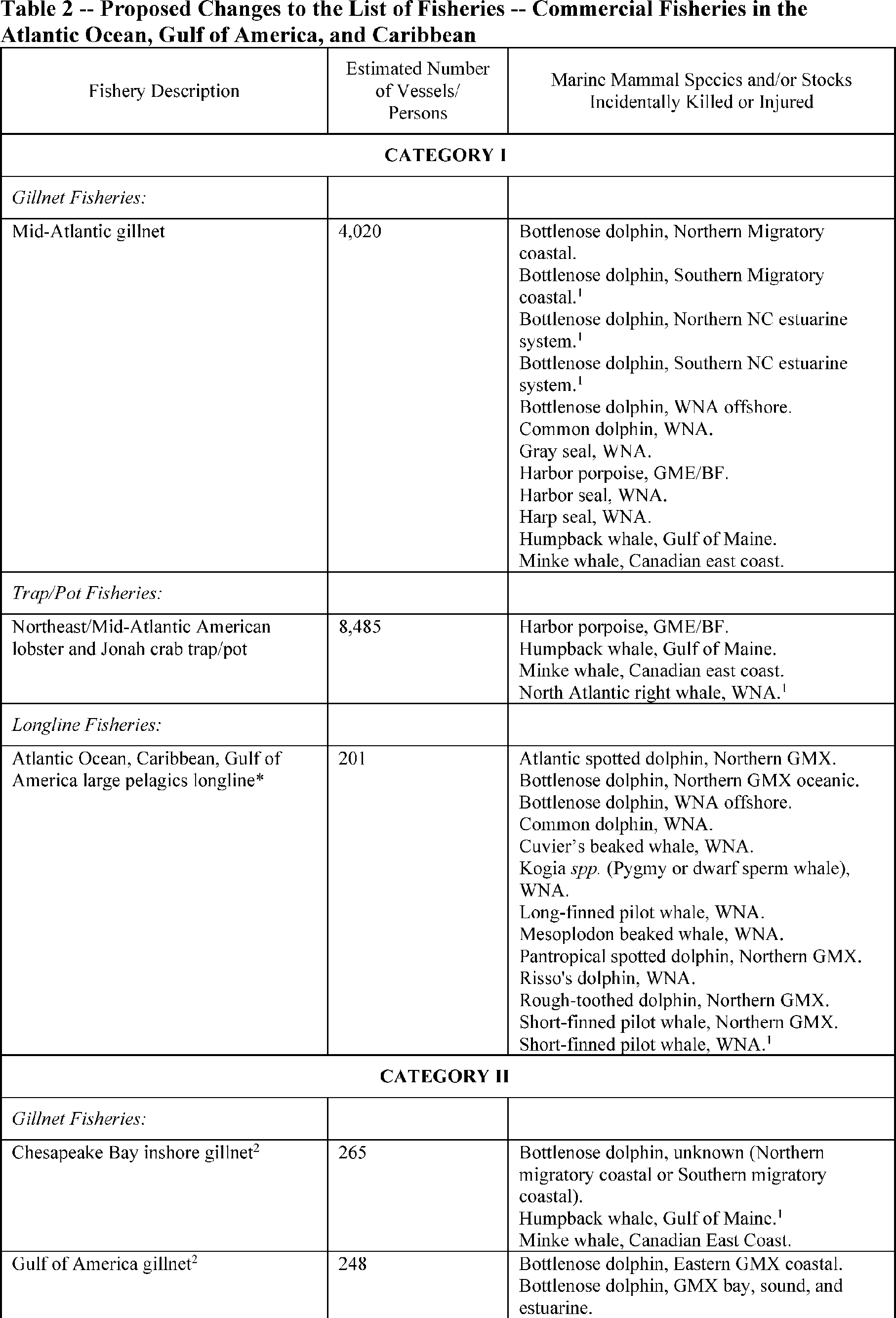
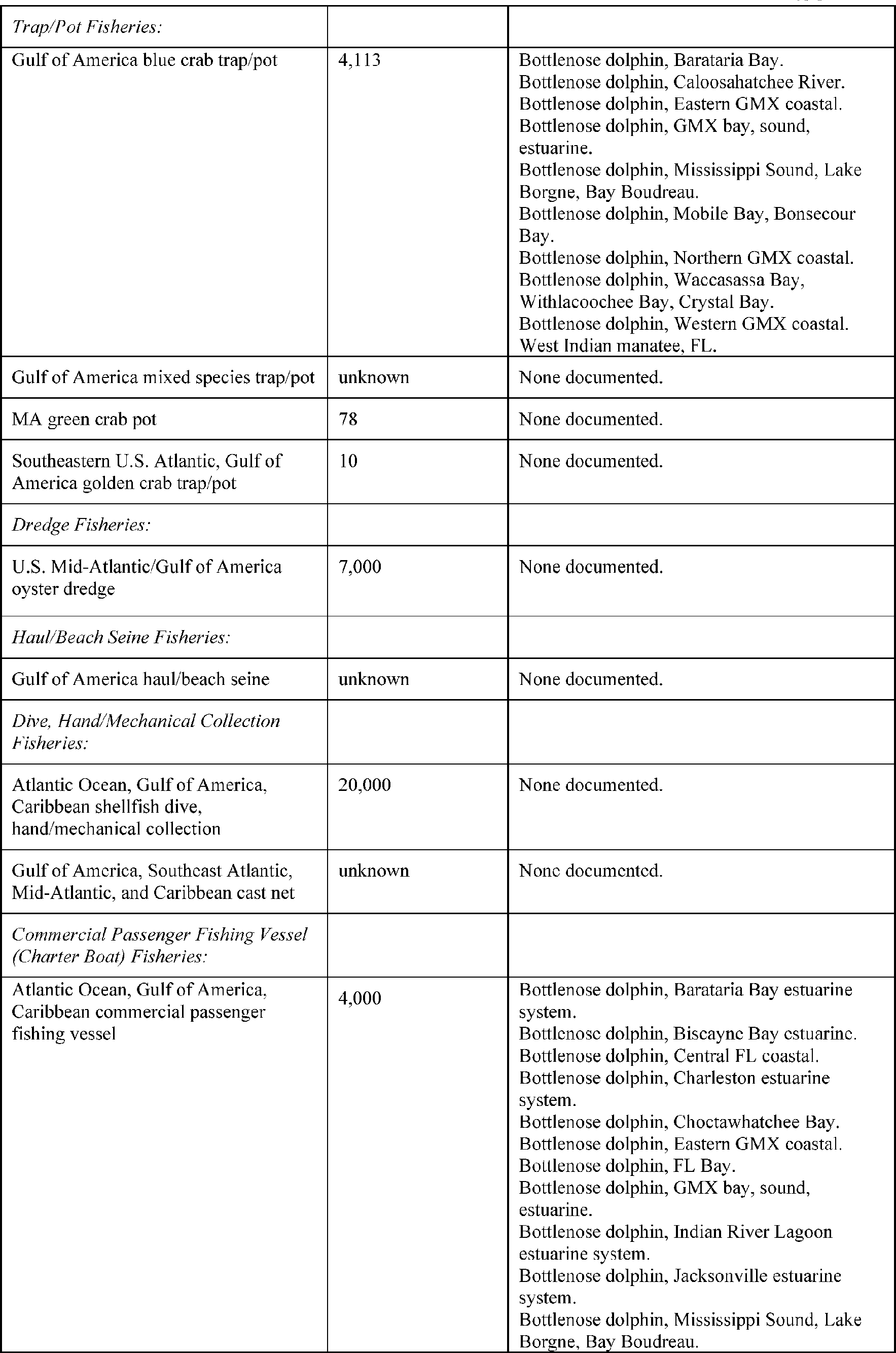
NMFS proposes to add the Massachusetts (MA) green crab pot fishery as a Category III fishery. This fishery is managed by the state of Massachusetts. It operates entirely in shallow (4 to 15 feet (1.22 to 4.57 m), inshore Massachusetts state waters in estuaries, harbors, tidal creeks and salt marshes from April to November and targets green crab (
Carcinus maenas). This fishery uses wire mesh pots that are discernible from other crab pot gear because the pots have a top entry design and are often homemade. Because the green crab is an invasive species, permits are not required to participate in the fishery; however, letters of authorization are currently issued to 78 commercial participants.
This fishery has been operating and regulated in Massachusetts for over 60 years (Annotated Laws of Massachusetts, GL ch. 130, section 37A, 2024) and there have been no documented marine mammal M/SI incidental to this fishery. Therefore, NMFS proposes to classify the MA green crab pot fishery as a Category III fishery with no marine mammal species/stocks identified as incidentally killed or injured in the fishery.
Fishery Name and Organizational Changes and Clarifications
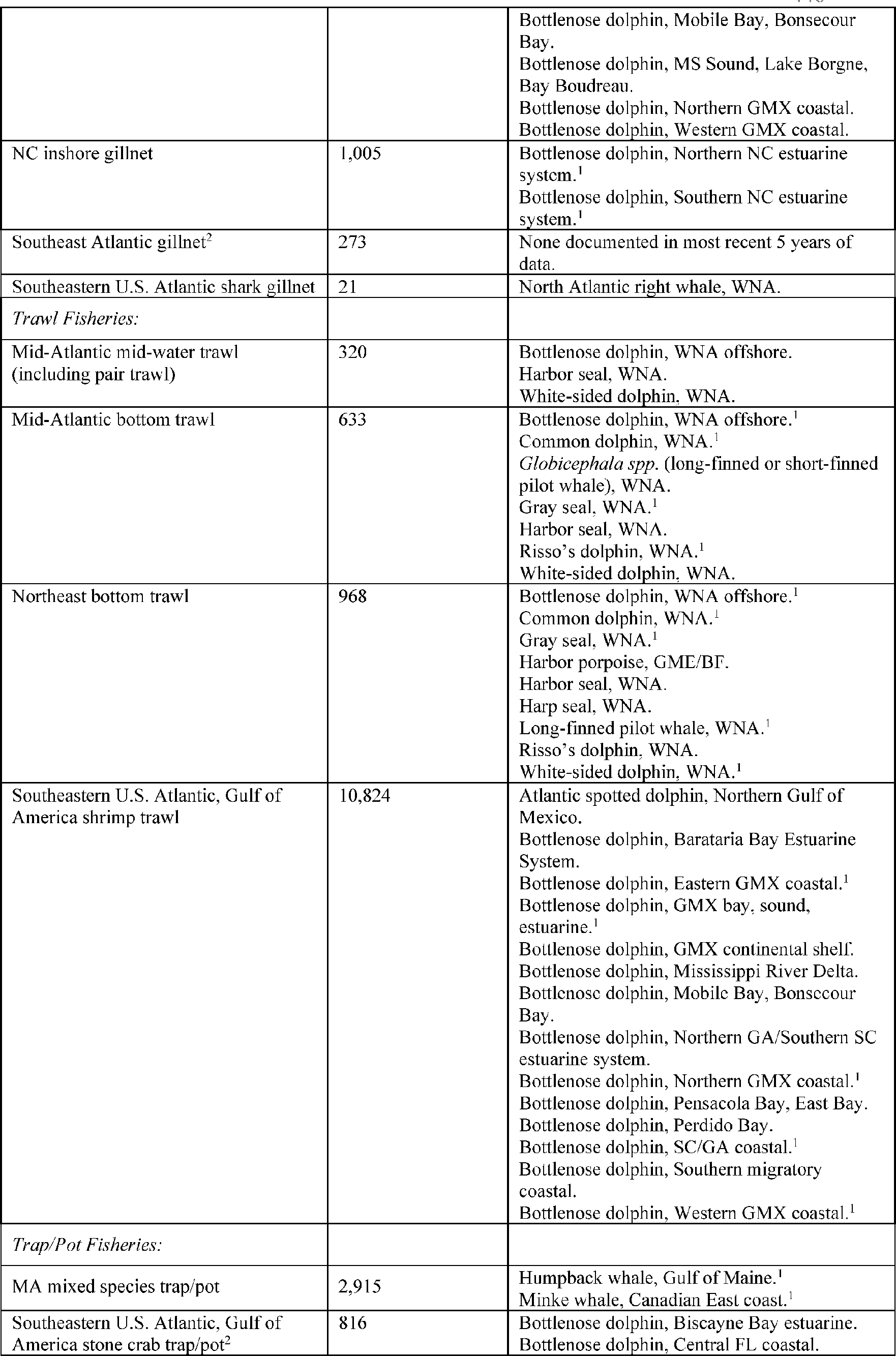
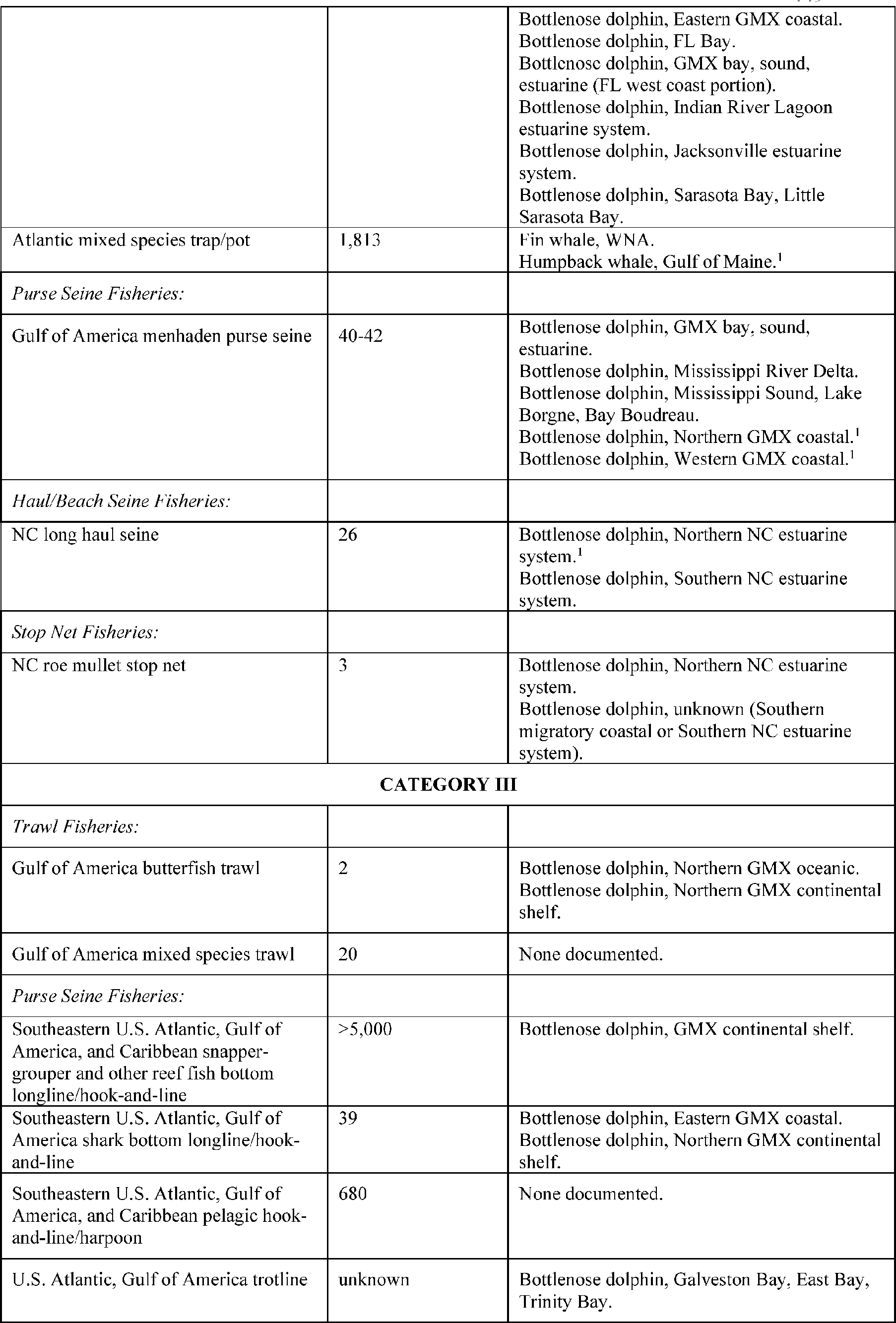
Consistent with Executive Order 14172 (Restoring Names to Honor American Greatness), for purposes of the LOF, this proposed notice updates the following fishery names and associated fishery descriptions to reflect the renaming of the “Gulf of Mexico” to “Gulf of America”.
Category I
Atlantic Ocean, Caribbean, Gulf of Mexico large pelagics longline to Atlantic Ocean, Caribbean, Gulf of America large pelagics longline.
Category II
Gulf of Mexico gillnet to Gulf of America gillnet;
Southeastern U.S. Atlantic, Gulf of Mexico shrimp trawl to Southeastern U.S. Atlantic, Gulf of America shrimp trawl;
Southeastern U.S. Atlantic, Gulf of Mexico stone crab trap/pot to Southeastern U.S. Atlantic, Gulf of America stone crab trap/pot; and
Gulf of Mexico menhaden purse seine to Gulf of America menhaden purse seine.
Category III
Gulf of Mexico butterfish trawl to Gulf of America butterfish trawl;
Gulf of Mexico mixed species trawl to Gulf of America mixed species trawl;
Southeastern U.S. Atlantic, Gulf of Mexico, and Caribbean snapper-grouper and other reef fish bottom longline/hook-and-line to Southeastern U.S. Atlantic, Gulf of America, and Caribbean snapper-grouper and other reef fish bottom longline/hook-and-line;
Southeastern U.S. Atlantic, Gulf of Mexico shark bottom longline/hook-and-line to Southeastern U.S. Atlantic, Gulf of America shark bottom longline/hook-and-line;
Southeastern U.S. Atlantic, Gulf of Mexico, and Caribbean pelagic hook-and-line/harpoon to Southeastern U.S. Atlantic, Gulf of America, and Caribbean pelagic hook-and-line/harpoon;
U.S. Atlantic, Gulf of Mexico trotline to U.S. Atlantic, Gulf of America trotline;
Gulf of Mexico blue crab trap/pot to Gulf of America blue crab trap/pot;
Gulf of Mexico mixed species trap/pot to Gulf of America mixed species trap/pot;
Southeastern U.S. Atlantic, Gulf of Mexico golden crab trap/pot to Southeastern U.S. Atlantic, Gulf of America golden crab trap/pot;
U.S. Mid-Atlantic/Gulf of Mexico oyster dredge to U.S. Mid-Atlantic/Gulf of America oyster dredge;
Gulf of Mexico haul/beach seine to Gulf of America haul/beach seine;
Atlantic Ocean, Gulf of Mexico, Caribbean shellfish dive, hand/mechanical collection to Atlantic Ocean, Gulf of America, Caribbean shellfish dive, hand/mechanical collection;
Gulf of Mexico, Southeast Atlantic, Mid-Atlantic, and Caribbean cast net to Gulf of America, Southeast Atlantic, Mid-Atlantic, and Caribbean cast net; and
Atlantic Ocean, Gulf of Mexico, Caribbean commercial passenger fishing vessel to Atlantic Ocean, Gulf of America, Caribbean commercial passenger fishing vessel.
NMFS proposes to add the superscript “1” to the Gulf of Maine stock of humpback whale to indicate that M/SI of the stock is determining the Category II classification of the Chesapeake Bay inshore gillnet fishery.
NMFS proposes to add the superscript “1” to the Western North Atlantic stock of common dolphin to indicate that M/SI of the stock is determining the Category II classification of the Northeast bottom trawl fishery. NMFS
( printed page 24185)
also proposes to remove the superscript “1” from the Western North Atlantic stock of Risso's dolphin to indicate that M/SI of the stock is no longer determining the Category II classification of the Northeast bottom trawl fishery.
NMFS proposes to add the superscript “1” to the Gulf of Maine stock of humpback whale and Canadian East coast stock of minke whale to indicate that M/SI of these stocks are determining the Category II classification of the MA mixed species trap/pot fishery.
NMFS proposes to remove the superscript “2” from the Category II Atlantic mixed species trap/pot fishery to indicate this fishery is not classified by analogy to other Category II trap/pot fisheries. Instead, NMFS proposes to add the superscript “1” to the Gulf of Maine stock of humpback whale to indicate that M/SI of the stock is determining the Category II classification of the Atlantic mixed species trap/pot fishery (Henry
et al.,
2023).
Number of Vessels/Persons
NMFS proposes to update the estimated number of vessels/persons in the Atlantic Ocean, Gulf of America, and Caribbean (Table 2) as follows:
Category II
MA mixed species trap/pot fishery from 1,240 to 2,915 vessels/persons;
Southeastern U.S. Atlantic, Gulf of America stone crab trap/pot fishery from 1,101 to 816 vessels/persons;
Atlantic mixed species trap/pot fishery from 3,493 to 1,813 vessels/persons;
NC inshore gillnet fishery from 1,157 to 1,005 vessels/persons;
NC long haul seine fishery from 10 to 26 vessels/persons; and
NC roe mullet stop net fishery from one to three vessels/persons.
List of Species and/or Stocks Incidentally Killed or Injured in the Atlantic Ocean, Gulf of America, and Caribbean
NMFS proposes to add the Gulf of Maine, Bay of Fundy stock of harbor porpoise to the list of species/stocks incidentally killed or injured in the Category I Northeast/mid- Atlantic American lobster and Jonah crab trap/pot fishery based on a self-reported mortality in 2023.
NMFS proposes to add the Gulf of Maine stock of humpback whale and Canadian East Coast stock of minke whale to the list of species/stocks incidentally killed or injured in the Category II Chesapeake Bay inshore gillnet fishery. In January 2020, a dead humpback whale was reported in Virginia heavily entangled in gillnet gear (Henry
et al.,
2023). Also in February 2020, a minke whale was reported in Virginia entangled in gillnet gear resulting in a mortality (Hayes
et al.,
2024).
NMFS proposes to add the Western North Atlantic stock of white-sided dolphin to the list of species/stocks incidentally killed or injured in the Category II mid-Atlantic mid-water trawl (including pair trawl) fishery based on a self-reported mortality in 2020.
NMFS proposes to add the Western North Atlantic stock of
Globicephala spp.
(long-finned or short-finned pilot whale) to the list of species/stocks incidentally killed or injured in the Category II mid-Atlantic bottom trawl fishery based on an observed injury in 2021 (Precoda and Lyssikatos 2023).
NMFS proposes to add the Northern Georgia/Southern South Carolina estuarine system stock of bottlenose dolphin to the list of species/stocks incidentally killed or injured in the Category II Southeastern U.S. Atlantic, Gulf of America shrimp trawl fishery based on a self-reported injury in 2023. Based on the location of the self-report, this take was assigned to only this stock (
i.e.,
there are no overlapping stocks at this location).
NMFS proposes to add the Gulf of Maine stock of humpback whale and the Canadian East coast stock of minke whale to the list of species/stocks incidentally killed or injured in the Category II MA mixed species trap/pot fishery. In June 2020, a humpback whale was reported entangled off Chatham, MA. The whale was partially disentangled and determined to be a serious injury, prorated to 0.75 (Henry
et al.,
2023). In June 2022, a minke whale was entangled in lobster pot gear set in MA state waters (Moise
et al.,
2025)
NMFS proposes to remove the Western North Atlantic stock of hooded seal from the list of species/stocks incidentally killed or injured in the Category I mid-Atlantic gillnet fishery. This fishery was observed between 1 and 13 percent from 2017 through 2021 and there were no reported or observed M/SI of this stock in this fishery.
NMFS proposes to remove the Central Florida coastal and Northern Florida coastal stocks of bottlenose dolphin from the list of species/stocks incidentally killed or injured in the Category II Southeast Atlantic gillnet fishery. This fishery is observed and there have been no reported or observed M/SI of these stocks in this fishery in over 5 years (Hayes
et al.,
2026). The fishery was observed at a range of 0.6 to 5.8 percent (mean of 2.9 percent) from 2020 through 2024. The list of species/stocks incidentally killed or injured in this fishery is proposed to be updated to state that none documented in the most recent 5 years of data.
NMFS proposes to remove six stocks from the list of species/stocks incidentally killed or injured in the Category I Atlantic Ocean, Caribbean, Gulf of America large pelagics longline fishery. The six stocks are (1) Western North Atlantic stock of false killer whale; (2) Gulf of Maine, Bay of Fundy stock of harbor porpoise; (3) Canadian East coast stock of minke whale; (4) Gulf of Mexico stock of pygmy sperm whale; (5) Northern Gulf of Mexico stock of Risso's dolphin; and (6) Northern Gulf of Mexico stock of sperm whale. This fishery was observed between 8.7 and 13.3 percent from 2017 through 2021 and there were no reported or observed M/SI of these stocks in this fishery (Hayes
et al.,
2024; Garrison and Stokes 2023).
NMFS proposes to remove the unknown stock (Central FL, Northern FL, SC/GA Coastal or Southern Migratory Coastal) of bottlenose dolphin from the list of species/stocks incidentally killed or injured in the Category II Southeastern U.S. Atlantic shark gillnet fishery. This fishery was observed between 5 and 8 percent from 2018 through 2022, and there were no reported or observed M/SI of this stock in the fishery (Hayes
et al.,
2026).
NMFS proposes to remove the Western North Atlantic stock of short-finned pilot whales from the list of species/stocks incidentally killed or injured in the Category III Atlantic Ocean, Gulf of America, Caribbean commercial passenger fishing vessel fishery. From 2017 through 2021, there were no reported M/SI of these stocks in this fishery (Hayes
et al.,
2024).
Commercial Fisheries on the High Seas
Classification of Fisheries
As described in the Commercial Fisheries in the Pacific Ocean section, NMFS proposes to reclassify the Category II Western Pacific Pelagic longline fishery (HI shallow-set component) to a Category III fishery.
Number of Vessels/Persons
NMFS proposes to update the estimated number of HSFCA permits for high seas fisheries as follows:
Category I
Atlantic Highly Migratory Species longline fishery from 30 to 36 HSFCA permits; and
( printed page 24186)
Western Pacific Pelagic (HI deep-set component) longline fishery from 146 to 147 HSFCA permits.
Category II
Western and Central Pacific Ocean tuna purse seine fishery from 14 to 12 HSFCA permits;
South Pacific albacore troll longline fishery from six to five HSFCA permits;
Pacific highly migratory species handline/pole and line fishery from 36 to 37 HSFCA permits;
South Pacific albacore troll handline/pole and line fishery from one to two HSFCA permits;
South Pacific albacore troll fishery from 23 to 22 HSFCA permits; and
Western Pacific Pelagic troll fishery from six to five HSFCA permits.
Category III
Northwest Atlantic bottom longline fishery from one to zero HSFCA permits;
Pacific highly migratory species longline fishery from 119 to 97 HSFCA permits;
Western Pacific Pelagic longline (HI Shallow-set component) fishery from 14 to 22 HSFCA permits; and
Northwest Atlantic trawl fishery from one to zero HSFCA permits.
List of Species and/or Stocks Incidentally Killed or Injured on the High Seas
NMFS proposes to remove three stocks from the list of species/stocks incidentally killed or injured in the Category I Atlantic Highly Migratory Species longline fishery: (1) Western North Atlantic stock of false killer whale, (2) Canadian East coast stock of minke whale and (3) Gulf of Mexico stock of Risso's dolphin. The list of marine mammal species and/or stocks killed or injured in this fishery is identical to the list of marine mammal species and/or stocks killed or injured in the U.S. waters component of the fishery minus species and/or stocks that have geographic ranges exclusively in coastal waters.
NMFS proposes to update the humpback whale stocks on the list of species/stocks incidentally killed or injured in the Category II Pacific highly migratory species drift gillnet fishery from humpback whale, CA/OR/WA to humpback whale, Central America/Southern Mexico-CA/OR/WA and humpback whale, Mainland Mexico-CA/OR/WA stock based on the revised stock structure in the 2022 SAR (Carretta
et al.,
2023).
NMFS also proposes to add Guadalupe fur seal to the list of species/stocks incidentally killed or injured in the Category II Pacific highly migratory species drift gillnet fishery based on an observed mortality in 2023 (Carretta 2024). The list of marine mammal species and/or stocks killed or injured in this fishery is identical to the list of marine mammal species and/or stocks killed or injured in the U.S. waters component of the fishery minus species and/or stocks that have geographic ranges exclusively in coastal waters.
NMFS proposes to add the unknown stock of beaked whale to the list of species/stocks incidentally killed or injured in the Category III Western Pacific Pelagic longline fishery (HI shallow-set component) based on an observed serious injury in 2021 (McCracken and Cooper, 2022). The list of marine mammal species and/or stocks killed or injured in this fishery is identical to the list of marine mammal species and/or stocks killed or injured in the U.S. waters component of the fishery minus species and/or stocks that have geographic ranges exclusively in coastal waters.
List of Fisheries
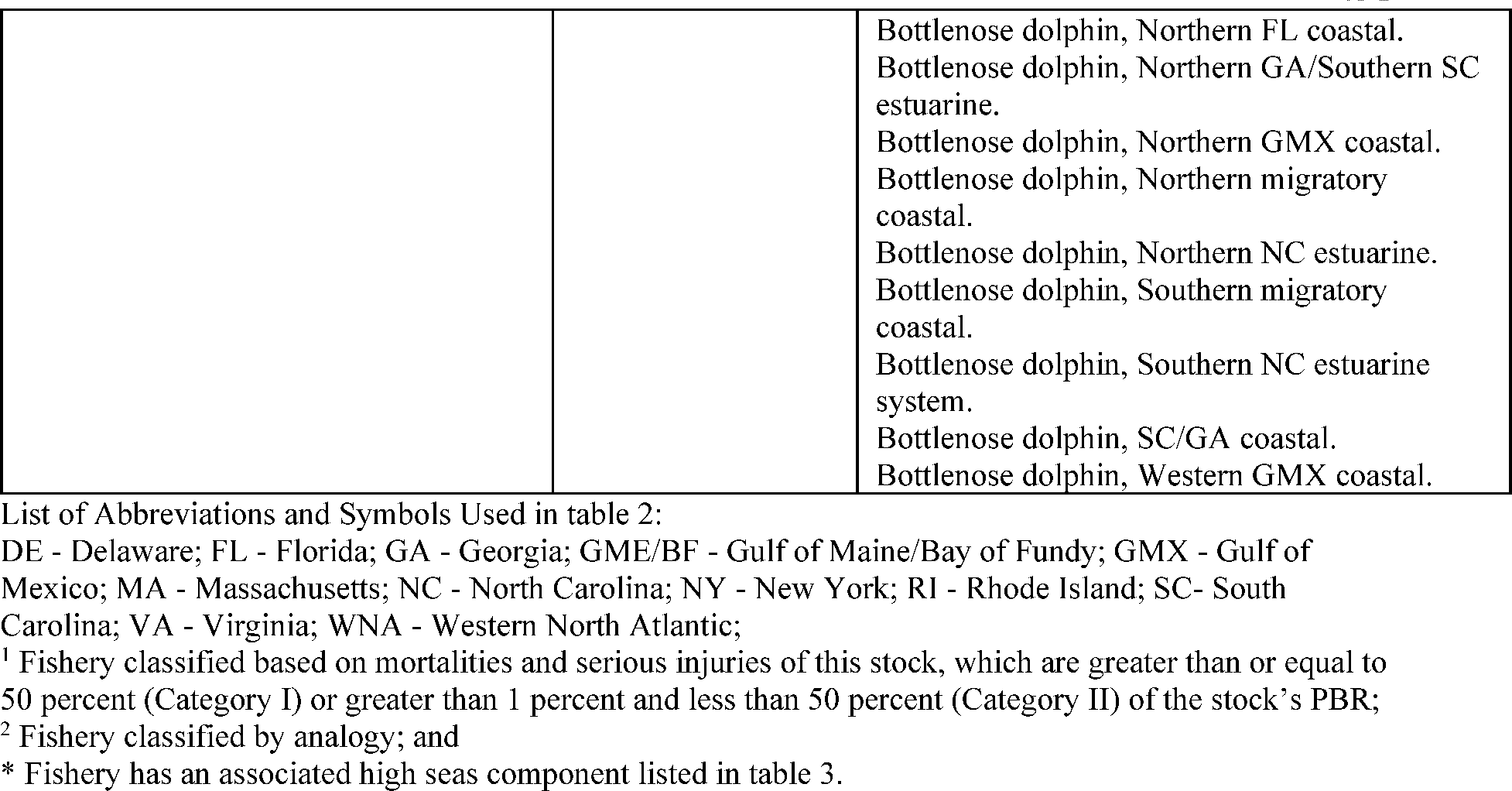
The following tables set forth the proposed changes to the list of U.S. commercial fisheries according to their classification under section 118 of the MMPA. Table 1 lists proposed changes for commercial fisheries in the Pacific Ocean (including Alaska); table 2 lists proposed changes for commercial fisheries in the Atlantic Ocean, Gulf of America, and Caribbean; table 3 lists proposed changes for commercial fisheries on the high seas; and table 4 lists fisheries affected by TRPs or TRTs.
In tables 1 and 2 of the LOF, the estimated number of vessels or persons participating in fisheries operating within U.S. waters is expressed in terms of the number of active participants in the fishery, when possible. If this information is not available, the estimated number of vessels or persons licensed for a particular fishery is provided. If no recent information is available on the number of participants, vessels, or persons licensed in a fishery, then the number from the most recent LOF is used for the estimated number of vessels or persons in the fishery. NMFS acknowledges that, in some cases, these estimates may be inflations of actual effort. For example, the State of Hawaii does not issue fishery-specific licenses, and the number of participants reported in the LOF represents the number of commercial marine license holders who reported using a particular fishing gear type/method at least once in a given year without considering how many times the gear was used. For these fisheries, effort by a single participant is counted the same whether the fisherman used the gear only once or every day. In the Mid-Atlantic and New England fisheries, the numbers represent the potential effort for each fishery, given the multiple gear types for which several state permits may allow. Changes made to Mid-Atlantic and New England fishery participants will not affect observer coverage or bycatch estimates as observer coverage and bycatch estimates are based on vessel trip reports and landings data. The LOF provides a description of the fishery's potential effort (state and Federal). If NMFS is able to gather more accurate information on the gear types used by state permit holders in the future, the numbers will be updated to reflect this change. For additional information on fishing effort in fisheries found on the LOF, contact the relevant regional office (contact information included above in the section:
Where can I find more information about the LOF and the MMAP?)
For high seas fisheries, table 3 of the LOF lists the number of valid HSFCA permits currently held. Although this likely overestimates the number of active participants in many of these fisheries, the number of valid HSFCA permits is the most reliable data on the potential effort in high seas fisheries at this time. As noted previously, the number of HSFCA permits listed on the LOF for the high seas components of fisheries that also operate within U.S. waters does not necessarily represent additional effort beyond that in U.S. waters because many vessels holding HSFCA permits fish both within and outside U.S. waters and so may be counted twice. Fisheries that operate both within and outside of the U.S. EEZ boundary are denoted in the tables below with an asterisk (*) after the fisheries' names.
Tables 1, 2, and 3 below also list proposed changes to the marine mammal species and/or stocks incidentally killed or injured (seriously or non-seriously) in each fishery based on SARs, injury determination reports, bycatch estimation reports, observer data, logbook data, stranding data, disentanglement network data, fishermen self-reports (
i.e.,
MMAP reports), and anecdotal reports. The best available scientific information included in these reports is based on data through 2022. In tables 1 and 2 below, NMFS has designated the species/stocks for which M/SI are determining a fishery's classification (
i.e.,
the fishery is classified based on mortalities and serious injuries of a marine mammal stock that are greater
( printed page 24187)
than or equal to 50 percent (Category I) or greater than 1 percent and less than 50 percent (Category II) of a stock's PBR) by including a superscript “1” after the stock's name.
In tables 1 and 2 below, there are several fisheries classified as Category II that have no recent documented M/SI of marine mammals or fisheries that did not result in a M/SI rate greater than 1 percent of a stock's PBR level based on known dead or seriously injured marine mammals. NMFS has classified these fisheries by analogy to other Category I or II fisheries that use similar fishing techniques or gear that are known to cause M/SI of marine mammals, as discussed in the final LOF for 1996 (60 FR 67063, December 28, 1995) and according to factors listed in the definition of Category II and III fisheries in 50 CFR 229.2 (
i.e.,
fishing techniques, gear types, methods used to deter marine mammals, target species, seasons and areas fished, qualitative data from logbooks or fishermen reports, stranding data, and the species and distribution of marine mammals in the area). NMFS has designated those fisheries listed by analogy in tables 1 and 2 below by adding a superscript “2” after the fishery's name.
( printed page 24188)
( printed page 24189)
( printed page 24190)
( printed page 24191)
( printed page 24192)
( printed page 24193)
( printed page 24194)
( printed page 24195)
( printed page 24196)
( printed page 24197)
( printed page 24198)
( printed page 24199)
( printed page 24200)
( printed page 24201)
( printed page 24202)
( printed page 24203)
( printed page 24204)
Classification
Paperwork Reduction Act
This notice contains existing collection-of-information (COI) requirements subject to the Paperwork Reduction Act but would not impose additional or new COI requirements. The COI for the registration of individuals under the MMPA has been approved by the OMB under OMB Control Number 0648-0293 (0.15 hours per report for new registrants). The requirement for reporting marine mammal mortalities or injuries has been approved by OMB under OMB Control Number 0648-0292 (0.15 hours per report). These estimates include the time for reviewing instructions, searching existing data sources, gathering and maintaining the data needed, and completing and reviewing the COI. Send comments regarding these reporting burden estimates or any other aspect of the COI, including suggestions for reducing burden, to NMFS (see
ADDRESSES
). You may also submit comments on these or any other aspects of the collection of information at
https://www.reginfo.gov/public/do/PRAMain.
Notwithstanding any other provision of law, no person is required to respond to nor shall a person be subject to a penalty for failure to comply with a COI, subject to the requirements of the Paperwork Reduction Act, unless that COI displays a currently valid OMB control number.
National Environmental Policy Act
In accordance with the Companion Manual for NOAA Administrative Order (NAO) 216-6A, NMFS determined that the publishing these proposed changes to the LOF qualifies to be categorically excluded from further National Environmental Policy Act (NEPA) review, consistent with categories of activities identified in Categorical Exclusion G7 (“Preparation of policy directives, rules, regulations, and guidelines of an administrative, financial, legal, technical, or procedural nature, or for which the environmental effects are too broad, speculative or conjectural to lend themselves to meaningful analysis and will be subject later to the NEPA process, either collectively or on a case-by-case basis”) of the Companion Manual, and we have not identified any extraordinary circumstances listed in Chapter 4 of the Companion Manual for NAO 216-6A that would preclude application of this categorical exclusion. If NMFS takes additional management action (for example, through the development of a TRP), NMFS would first prepare an Environmental Impact Statement or Environmental Assessment, as required under NEPA, specific to that action.
Carretta, J.W., E.M. Oleson, K.A. Forney, A.L. Bradford, K. Yano, D.W. Weller, A.R. Lang, J. Baker, A.J. Orr, B. Hanson, J.E. Moore, M. Wallen and R.L. Brownell. 2026. U.S. Pacific Marine Mammal Stock Assessments: 2024. U.S. Department of Commerce. NOAA Technical Memorandum PIFSC-182, 72 p.
Carretta, James V. 2024. Estimates of Marine Mammal, Sea Turtle, and Seabird Bycatch in the California Large-Mesh Drift Gillnet Fishery: 1990-2023. U.S. Department of Commerce, NOAA Technical Memorandum NMFS-SWFSC-700. 68 p.
Carretta, J.W., J. Greenman, K. Wilkinson, L. Saez, D. Lawson and J. Viezbicke. 2024a. Sources of Human-Related Injury and Mortality for U.S. Pacific West coast Marine Mammal Stock Assessments, 2018-2022. U.S. Department of Commerce. NOAA Technical Memorandum NMFS-SWFSC-705. 243 p.
Carretta, J.W., E.M. Oleson, K.A. Forney, A.L. Bradford, K. Yano, D.W. Weller, A.R. Lang, J. Baker, B. Hanson, A.J. Orr, J.E. Moore, M. Wallen and R.L. Brownell. 2024b. U.S. Pacific Marine Mammal Stock Assessments: 2023. U.S. Department of Commerce. NOAA Technical Memorandum NMFS-SWFSC-704. 420 p.
Carretta, J.W., E.M. Oleson, K.A. Forney, M.M. Muto, D.W. Weller, A.R. Lang, J. Baker, B. Hanson, A.J. Orr, J. Barlow, J.E. Moore, and R.L. Brownell. 2023. U.S. Pacific Marine Mammal Stock Assessments: 2022. U.S. Department of Commerce. NOAA Technical Memorandum NMFS-SWFSC-684. 409 p.
Carretta, J.W., J. Greenman, K. Wilkinson, L. Saez, D. Lawson and J. Viezbicke. 2023a. Sources of Human-Related Injury and Mortality for U.S. Pacific West coast Marine Mammal Stock Assessments, 2017-2021. U.S. Department of Commerce. NOAA Technical Memorandum NMFS-SWFSC-690. 225 p.
Garrison, L.P. and L.W. Stokes. 2023. Estimated Bycatch of Marine Mammals and Sea Turtles in the U.S. Atlantic Pelagic Longline Fleet During 2021. NOAA Technical Memorandum NMFS-SEFSC-765. 65 p.
Hayes, S.A., E. Josephson, K. Maze-Foley, P.E. Rosel and J. Wallace. Editors. 2026. U.S. Atlantic and Gulf of Mexico Marine Mammal Stock Assessments 2024. U.S. Department of Commerce. NOAA Technical Memorandum NMFS-NE-336, 221 p.
Hayes, S.A., E. Josephson, K. Maze-Foley, P.E. Rosel and J. Wallace. Editors. 2024. U.S. Atlantic and Gulf of Mexico Marine Mammal Stock Assessments 2023. U.S. Department of Commerce. NOAA Technical Memorandum NMFS-NE-321, 375 p.
Henry, A., M. Garron, D. Morin, A. Smith, A. Reid, W. Ledwell and T. Cole. 2023. Serious Injury and Mortality Determinations for Baleen Whale Stocks along the Gulf of Mexico, United States East Coast, and Atlantic Canadian Provinces, 2017-2021. U.S. Department of Commerce, Northeast Fisheries Science Center Reference Doc. 23-09; 59 p.
McCracken, M. and B. Cooper. 2022. Assessment of Incidental Interactions with Marine Mammals in the Hawaii Longline Deep and Shallow-set Fisheries from 2017 through 2021. Pacific Islands Fisheries Science Center, PIFSC Data Report, DR-22-032.
McCracken M, Cooper B. 2022. Assessment of Incidental Interactions with Marine Mammals in the American Samoa Permitted Longline Fishery from 2017 through 2023. Pacific Islands Fisheries Science Center, PIFSC Data Report, DR-22-031.
Moise, M.D. Morin, R. Martin and J. Higgins. 2025. 2022 Atlantic Large Whale Entanglement Report. Greater Atlantic Region Policy Series 25-01; 86p.
NMFS. 2023. Process for Distinguishing Serious from Non-Serious Injury of Marine Mammals. National Marine Fisheries Service Procedure 02-238-01. 55 p.
NMFS. 2023a. Amendment 6 to the Fishery Management Plan for West Coast Highly Migratory Species Fisheries: Authorization of Deep-set Buoy Gear. U.S. Department of Commerce, NOAA Final Environmental Impact Statement.
Precoda K. and M. Lyssikatos. 2023. Summary of the 2020 New England and Mid-Atlantic Gillnet and Bottom Trawl Observer Data. U.S. Department of Commerce, Northeast Fisheries Science Center Reference Doc. 23-01; 16 p.
( printed page 24205)
Use this for formal legal and research references to the published document.
91 FR 24176
Web Citation
Suggested Web Citation
Use this when citing the archival web version of the document.
“Marine Mammal Protection Act List of Fisheries for 2026,” thefederalregister.org (May 5, 2026), https://thefederalregister.org/documents/2026-08717/marine-mammal-protection-act-list-of-fisheries-for-2026.