Safety Zones; Rocket Launches in the Gulf of America and South Bay, Boca Chica Beach, TX
The Coast Guard is establishing two permanent safety zones to protect personnel, vessels, and the marine environment from potential hazards created by commercial spaceflight act...
The Coast Guard is establishing two permanent safety zones to protect personnel, vessels, and the marine environment from potential hazards created by commercial spaceflight activities. The permanent safety zones are located in navigable waters of South Bay, TX and in navigable waters of the Gulf of America. This rule prohibits persons and vessels from being in the safety zones during scheduled launches, unless authorized by the Captain of the Port, Sector Corpus Christi (COTP) or a designated representative.
DATES:
This rule is effective June 4, 2026.
ADDRESSES:
To view documents mentioned in this preamble as being available in the docket, go to
https://www.regulations.gov,
type USCG-2022-0332 in the search box and click “Search.” Next, in the Document Type column, select “Supporting & Related Material.”
FOR FURTHER INFORMATION CONTACT:
If you have questions on this rule, call or email Sector Corpus Christi Waterways Management Division (dpw), U.S. Coast Guard; telephone 361-244-4784, email
CCWaterways@uscg.mil.
SUPPLEMENTARY INFORMATION:
I. Table of Abbreviations
AOR Area of responsibility
BNM Broadcast Notice to Mariners
CFR Code of Federal Regulations
COTP Captain of the Port
DHS Department of Homeland Security
FAA Federal Aviation Administration
FR Federal Register
MSIB Marine Safety Information Bulletin
NASA National Aeronautics and Space Administration
NOE Notification of Enforcement
NPRM Notice of proposed rulemaking
NM Nautical Mile
§ Section
SpaceX Space Exploration Technologies Corporation
TX Texas
U.S. United States
U.S.C. United States Code
( printed page 24127)
II. Background Information and Regulatory History
The Coast Guard has long monitored space activities impacting the maritime domain and taken actions to ensure the safety of vessels, persons, and the marine environment during space launch operations. In conducting this activity, the Coast Guard engages with other government agencies, including the Federal Aviation Administration (FAA) and the National Aeronautics and Space Administration (NASA), and private space operators, including Space Exploration Technologies Corporation (SpaceX). This engagement is necessary to ensure the safety of waterway users during launch operations. During this engagement, SpaceX, a U.S. company, informed the Coast Guard that future launch activities may be hazardous and impact U.S. navigable waters in the Coast Guard Heartland District's (formerly the Eighth District) area of responsibility (AOR). Specifically, the launches will create potential hazards in South Bay, TX and offshore of Boca Chica Beach, TX in the Gulf of America.
In response to previous SpaceX activities, the Coast Guard published temporary final rules in the
Federal Register
(such as 87 FR 23441) for anticipated rocket launching operations within the Coast Guard Heartland District's AOR offshore of Boca Chica Beach, TX. Based on the dates the Coast Guard was informed of rocket launching operations and the immediate need to establish safety zones, the Coast Guard did not have sufficient time to publish a notice of proposed rulemaking (NPRM) for those rules. The Coast Guard has determined that these activities will be ongoing, and regularly recurring, and therefore permanent safety zones are required. These permanent safety zones will be enforced only during launch activities. Vessels and people may enter these areas when the zones are not being enforced.
On May 15, 2025, the Coast Guard published a notice of proposed rulemaking (NPRM) in the
Federal Register
titled, “Safety Zones; Rocket Launches in the Gulf of America and South Bay, Boca Chica, TX. In the NPRM (90 FR 20572). we stated the purpose of the rulemaking was to create two permanent safety zones in the Gulf of America and South Bay, Boca Chica, TX, for the protection of vessels, persons, and the marine environment in navigable waters of the U.S. from the potential hazards created by rocket launch activities. The NPRM invited comments on the proposed rule. During the comment period that ended June 16, 2025, we received four comments.
This final rule creates two permanent safety zones for the safety of vessels, persons, and the marine environment from ongoing, and regularly recurring rocket launch activities. The safety zones will only be enforced during actual launches, which will be announced by the Coast Guard via Broadcast Notice to Mariners on VHF-FM channel 16 and Marine Safety Information Bulletin (MSIB). The Coast Guard will also publish a Notification of Enforcement (NOE) in the
Federal Register
if we receive sufficient advance notice of the launch activity.
III. Legal Authority and Need for Rule
The Coast Guard is issuing this rule under section 46 U.S.C. 70034. The Sector Commander, Coast Guard Sector Corpus Christi has determined there are potential safety hazards associated with the launch of spacecraft over the waters of South Bay, TX and the Gulf of America. The purpose of this rule is to ensure the protection of vessels, persons, and the marine environment from rocket launch activities.
IV. Discussion of Comments and Changes
As noted above, we received four comments on the NPRM that was published on May 15, 2025. The comments covered a variety of topics which have been grouped below.
Hazards:
One commenter requested to know what specific types of hazards are associated with commercial spaceflight activities that necessitate establishment of the safety zones and how the Coast Guard will effectively mitigate those specific risks to vessels and the marine environment. The Starbase launch site is a non-military commercial range. Access to Boca Chica Beach from the land during launch activities is controlled by SpaceX and local Cameron County Law Enforcement. Current and forecasted access to Boca Chica Beach may be found at
cityofstarbase-texas.com. The safety zones created by this rule only control access to water areas around the launch facility, in the Gulf of America, and in South Bay. The Captain of the Port Corpus Christi has determined that potential hazards associated with rocket launches from Starbase City, TX include a risk of explosion, falling debris, and release of hazardous materials. The safety zone will only be activated at a reasonable time before a launch and deactivated once the area is no longer hazardous. The purpose of this rule is to ensure the safety of vessels, mariners, and the navigable waters in the safety zone before, during, and after the scheduled event.
Activation and enforcement:
Two commenters requested that the Coast Guard clarify when the safety zone will be activated and enforced. The Coast Guard has modified paragraph (a) of the regulatory text to further clarify that the safety zones will only be enforced around the times that rocket launches are scheduled to occur at the SpaceX facility in Boca Chica, TX. We expect the safety zones will only be enforced for 4 to 8 hours each day that launch activities are occurring.
Notice:
Two commenters wanted to ensure that the Coast Guard will provide adequate notice when the safety zone will be activated. One was concerned about whether the notices would occur and how far in advance the notice would be given. Two had concerns about whether multilingual communications were needed, and whether standard Coast Guard communications would reach certain communities, such as beachgoers, local and subsistence fishers, and tribal communications. One commenter suggested additional methods of notification for beachgoers. The Coast Guard is reliant on the commercial company responsible for the rocket launches to notify us that a launch will be occurring. If the Coast Guard is notified that a launch will occur, we will activate and enforce the safety zones and will provide notice through our standard methods of notification and communication. We will issue Broadcast Notice to Mariners on VHF-FM channel 16 and Marine Safety Information Safety Bulletin (MSIB) as soon as practicable after receiving notice. In addition, if we receive notice far enough in advance, we will issue a Notification of Enforcement (NOE) in the
Federal Register
. Sector Corpus Christi often issues broadcasts in Spanish as well as in English. The Coast Guard has determined that these methods provide appropriate and sufficient notice of the launches.
Public Meetings:
One commenter asked that we consider holding public meetings regarding this rule. We considered holding public meetings but determined that they are not warranted for a rule that establishes routine safety zones for confined and infrequent activity. In addition, to the extent that the commenters may have been seeking a public meeting to discuss the rocket launches themselves, that is outside the purview of the Coast Guard. This rule is limited to creating safety zones to ensure maritime safety during the launches.
Beaches:
One commenter expressed that it is hard to tell whether the safety zones include beaches. The regulation
( printed page 24128)
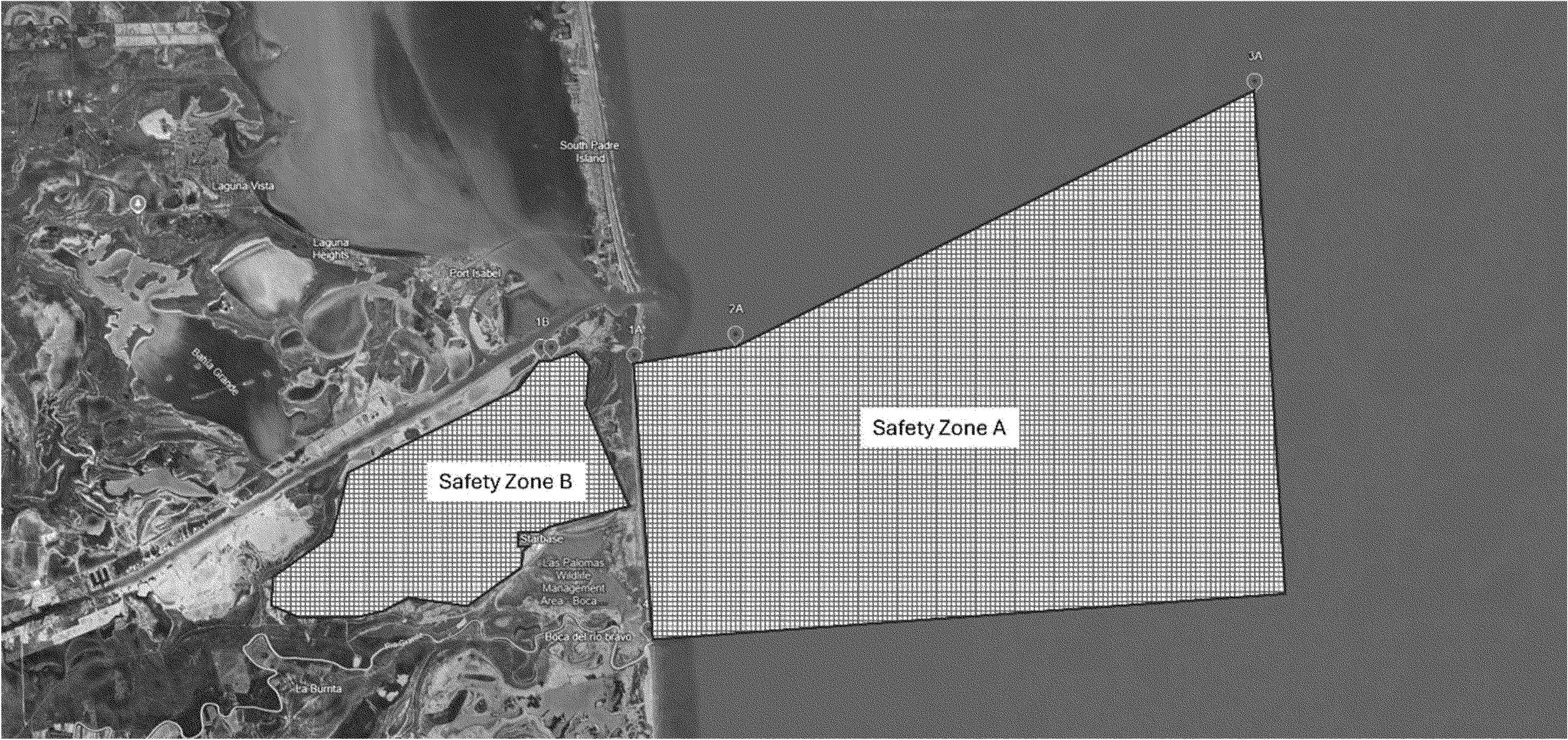
does not include the beaches. We have revised the description of the safety zone areas and added a chart to make this more clear.
Small businesses, commercial fishers, subsistence harvesters, and eco-tourism operators:
One commenter was concerned that the safety zone closures will adversely impact small businesses such as commercial fishing, subsistence harvesters, and eco-tourism operators. This commenter recommended the Coast Guard implement a plan for compensation or mitigation. The Coast Guard considered these possible adverse impacts, and fully considered public comments on this issue, but has determined that the risk to life and property of permitting people and vessels in the safety zones during rocket launches outweighs the potential economic harm of excluding small businesses for a few hours during a launch activity. The potential impact on business is factored into the regulation, in that it will only be enforced during rocket launches, and because vessels can transit in areas around the safety zones.
Indigenous peoples and Native American tribes:
Another commenter requested that the Coast Guard consult with local tribes and Indigenous peoples, including Texas coastal tribes, on potential impacts to cultural and fishing rights, in accordance with Executive Order 13175, and include a public record of such consultations in the docket. This rule relates only to the establishment of the water-side safety zone and does not regulate or control activity at the SpaceX facility, including launch approvals, frequency, or environmental impact related to those launches. This rule does not have tribal implications under Executive Order 13175, Consultation and Coordination with Indian Tribal Governments, because it does not have a substantial direct effect on one or more Indian tribes, on the relationship between the Federal Government and Indian tribes, or on the distribution of power and responsibilities between the Federal Government and Indian tribes.
Environmental impact:
Some commenters were concerned with the environmental impact of the rule. One commenter requested an environmental justice analysis. Another commenter recommended evaluating the cumulative environmental impact of the rocket launches. The Coast Guard has completed the environmental analysis required for this rule, which will be available in the docket. That document sets forth the Coast Guard's environmental considerations required by law. One commenter requested that the Coast Guard mandate continuous environmental monitoring before, during, and after launches to assess impacts on endangered species, water quality, and habitats, and require public release of these data, with input from independent scientists and local community representatives. As discussed with respect to the comment above, this rule relates only to the establishment of the off-shore safety zone. The Coast Guard does not regulate or oversee launch activity itself, including potential environmental or other impacts related to launches. The Coast Guard has undertaken all environmental analysis required by law for the purposes of establishing these maritime safety zones. The impact of the rocket launches themselves is beyond the scope of this rule, because the Coast Guard is not responsible for regulating these rocket launches.
Local emergency response:
One commenter suggested that we require investment in local emergency response capability. The Coast Guard does not have authority over state and local emergency response procedures and equipment, nor can we require them to expend funds in a particular manner. Concerns regarding state and local response capabilities should be directed towards those entities.
Stakeholder advisory panel:
One commenter suggested forming a formal stakeholder advisory panel to review and provide input. The Coast Guard has determined that a formal advisory panel is not necessary; persons wishing to provide input have had an opportunity to do so through this rulemaking process, and the Coast Guard has thoroughly considered all public comments.
Adaptive management:
One commenter suggested implementing an adaptive management process for “annual, data-driven reviews” that would have “automatic triggers for revision or rollback.” The Coast Guard has followed all legal requirements in proposing, reviewing, and finalizing this rule. We find that formal annual reviews are not necessary. If we determine that adjustments to the rule are necessary, we will follow standard rulemaking procedures.
Data:
One commenter requested that “all environmental, safety, and economic data related to these safety zones” be posted online. Any data collected and maintained by the Coast Guard may be made available upon request, pursuant to the Freedom of Information Act, 5 U.S.C. 552.
Expansion of this rule:
One commenter expressed concern that a Navy or Air Force base could be built in this area, and the safety zones would be permanently activated, prohibiting people from ever entering these areas. The Coast Guard has no knowledge of plans to build a Navy or Air Force base in this area.
Stop the launches:
One commenter asked the Coast Guard to stop allowing the rocket launches, stating that they are harmful to local land and ocean-dwelling wildlife. As discussed above, the Coast Guard does not regulate, permit, nor oversee the launch activity, and so does not make determinations regarding whether launches should or should not occur. Rather, when the Coast Guard is notified that a launch will be occurring, we create a safety zone near the launch site to avoid injury and damage to people, vessels, and the marine environment, as much as possible. Decisions regarding whether to permit rocket launches are outside the scope of the Coast Guard's authority and the scope of this rule.
V. Discussion of the Rule
The Coast Guard has analyzed this rule establishing safety zone areas under Department of Homeland Security Directive 023-01, Rev. 1, associated implementing instructions, and Environmental Planning COMDTINST 5090.1 (series), which guide the Coast Guard in complying with the National Environmental Policy Act of 1969 (42 U.S.C. 4321-4370f), and have determined that this action is one of a category of actions that do not individually or cumulatively have a significant effect on the human environment. The activation of the safety zone is expected to be four to eight hours total per occurrence. It is categorically excluded from further review under paragraph L60(a) of Appendix A, Table 1 of DHS Instruction Manual 023-01-001-01, Rev. 1. A Record of Environmental Consideration supporting this determination is available in the docket. For instructions on locating the docket, see the
ADDRESSES
section of this preamble.
The permanent safety zones established by the Final Rule are located within the Coast Guard Heartland District AOR in South Bay, TX and offshore of Boca Chica Beach, TX in the Gulf of America. The rule prohibits persons and vessels from being in the safety zones during limited times around scheduled rocket launches, unless authorized by the Captain of the Port, Sector Corpus Christi (COTP) or a designated representative.
The safety zones cover an area of the South Bay, TX approximately 4.5 square miles in size, and an area of the Gulf of America offshore of Boca Chica Beach,
( printed page 24129)
TX approximately 115 square miles in size. The approximate coordinates for the two safety zones are presented in the regulatory text at the end of this document.
To the extent feasible, the COTP or a designated representative will inform the public of the activation of the two safety zones by a Notification of Enforcement (NOE) published in the
Federal Register
at least 2 days before rocket launching activities. The NOE will identify the approximate date(s) and timeframes during which rocket launching activities will occur.
To the extent possible, twenty-four hours before rocket launching activities, the COTP or designated representative will inform the public of the activated safety zones (subject to enforcement) via Broadcast Notice to Mariners on VHF-FM channel 16, and/or MSIB (as appropriate). The BNM and MSIB will include the geographic coordinates of the activated safety zones, a map identifying the location of the activated safety zones, and information related to potential hazards associated with rocket launching activities.
When the safety zone is activated, the COTP or a designated representative will be able to restrict vessel movement including but not limited to transiting, anchoring, or mooring within the safety zone to protect vessels from hazards associated with rocket launching activities. Once rocket launching activities have concluded, the COTP or designated representative will issue a Broadcast Notice to Mariners on VHF-FM channel 16 announcing the activated safety zones are no longer subject to enforcement.
VI. Regulatory Analyses
We developed this rule after considering numerous statutes and Executive orders related to rulemaking. Below we summarize our analyses based on a number of these statutes and Executive orders.
A. Impact on Small Entities
The Coast Guard certifies that, although some small entities may intend to transit the safety zone above, this rule will not have a significant economic impact on a substantial number of small entities, as mandated by the Regulatory Flexibility Act of 1980, 5 U.S.C. 601-612 for the following reasons. Vessel traffic will be able to safely transit around this safety zone. This safety zone will only be enforced for a few hours a few times per month. In addition, the Coast Guard will issue a Broadcast Notice to Marines via VHF FM marine channel 16, which will allow small entities to adjust their transit plans, and the rule allows vessels to request permission to enter the zone from the COTP.
Under section 213(a) of the Small Business Regulatory Enforcement Fairness Act of 1996 (Pub. L. 104-121), if this rule will affect your small business, organization, or governmental jurisdiction and you have questions, contact the person listed in the
FOR FURTHER INFORMATION CONTACT
section.
Under section 213(a) of the Small Business Regulatory Enforcement Fairness Act of 1996 (Pub. L. 104-121), we want to assist small entities in understanding this rule. If the rule would affect your small business, organization, or governmental jurisdiction and you have questions concerning its provisions or options for compliance, please call or email the person listed in the
FOR FURTHER INFORMATION CONTACT
section.
Small businesses may send comments to the Small Business and Agriculture Regulatory Enforcement Ombudsman and the Regional Small Business Regulatory Fairness Boards by calling 1-888-REG-FAIR (1-888-734-3247).
C. Collection of Information
This rule would not call for a new collection of information under the Paperwork Reduction Act of 1995 (44 U.S.C. 3501-3520).
D. Federalism and Indian Tribal Governments
We have analyzed this rule under Executive Order 13132, Federalism, and have determined that it is consistent with the fundamental federalism principles and preemption requirements described in that Order.
Also, this rule does not have tribal implications under Executive Order 13175, Consultation and Coordination with Indian Tribal Governments, because it does not have a substantial direct effect on one or more Indian tribes, on the relationship between the Federal Government and Indian tribes, or on the distribution of power and responsibilities between the Federal Government and Indian tribes.
E. Unfunded Mandates Reform Act
As required by The Unfunded Mandates Reform Act of 1995 (2 U.S.C. 1531-1538), the Coast Guard certifies that this rule will not result in an annual expenditure of $100,000,000 or more (adjusted for inflation) by a State, local, or tribal government, in the aggregate, or by the private sector.
F. Environment
We have analyzed this rule under Department of Homeland Security Directive 023-01, Rev. 1, associated implementing instructions, and Environmental Planning COMDTINST 5090.1 (series), which guide the Coast Guard in complying with the National Environmental Policy Act of 1969 (42 U.S.C. 4321-4370f), and have determined that this action is one of a category of actions that do not individually or cumulatively have a significant effect on the human environment. This rule involves the establishment of two temporary safety zones for navigable waters in the Gulf of America and South Bay, TX. The safety zones are needed to protect personnel, vessels, and the marine environment from potential hazards created by rocket launching activity that may include free falling debris and/or descending vehicles or vehicle components under various means of control. It is categorically excluded from further review under paragraph L60(a), in Appendix A, Table 1 of DHS Instruction Manual 023-01-001-01, Rev. 1. A Record of Environmental Consideration supporting this determination is available in the docket. For instructions on locating the docket, see the
ADDRESSES
section of this preamble.
Safety Zones; Rocket Launches in the Gulf of America and South Bay, Boca Chica Beach, TX.
(a)
Location.
The safety zone areas are described in paragraphs (a)(1) and (2) of this section and the approximate locations are displayed in figure 1 to this paragraph (a). All coordinates are based on World Geodetic System (WGS) 84.
(1) Safety Zone A consists of all navigable waters of the Gulf of America from the surface to bottom, encompassed by a line connecting the following points beginning at Point 1A: 26°2′36″ N, 097°9′8″ W; thence to Point 2A: 26°3′0″ N, 097°7′0″ W; thence to
( printed page 24130)
Point 3A: 26°7′48″ N, 096°56′2.2″ W; thence south following the 12NM line to the Maritime Boundary Line between the United States of America and Mexico; thence west along the Maritime Boundary Line to Point 4A: 25°57′24.2″ N, 097°8′49″ W; thence returning north along the coast to Point 1. The area of Boca Chica Beach shoreward of the Territorial Sea Baseline is not included in this safety zone, however beach access during launches may be restricted by local authorities.
(2) Safety Zone B consists of all navigable waters of South Bay, from the surface to bottom, encompassed by a line connecting the following points beginning at Point 1B: 26°2′45″ N, 097°11′6.3″ W; thence to Point 2B: 26°2′45″ N, 097°10′53.4″ W; thence clockwise along the coastline of South Bay until returning back to Point 1B.
Figure 1 to Paragraph (a)—Approximate Safety Zone Locations (Refer to GPS Coordinates for Specific Locations)
(b)
Definitions.
As used in this section,
designated representative
means a Coast Guard coxswain, petty officer, or other officer operating a Coast Guard vessel and Federal, State, and local officer designated by the Captain of the Port, Sector Corpus Christi (COTP) in the enforcement of the safety zones.
(c)
Regulations.
(1) Under the general safety zone regulations in subpart C of this part, you may not enter the safety zones described in paragraph (a) of this section unless authorized by the COTP or a designated representative. They may be contacted on Channel 16 VHF-FM or by telephone at 1-800-874-2143.
(2) If permission is granted, all persons and vessels shall comply with the instructions of the COTP or designated representative.
(d)
Notification of enforcement.
(1) When time permits, the COTP or a designated representative will inform the public of the activation of the safety zones by Notification of Enforcement (NOE) published in the
Federal Register
. The NOE will identify the approximate date(s) and time(s) during which rocket launching activities would occur. Rocket launch activities are often weather-dependent, and therefore alternate dates and times may also be provided.
(2) The COTP or designated representative will inform the public each time the safety zones are being activated via Broadcast Notice to Mariners on VHF-FM channel 16 and by Marine Safety Information Safety Bulletin (MSIB). The Coast Guard intends to provide this notice at least twenty-four hours before rocket launching activities.
(3) Once rocket launching activities have concluded, the COTP or designated representative will issue a Broadcast Notice to Mariners on VHF-FM channel 16 announcing the safety zones are no longer subject to enforcement.
Torrey Bertheau,
Captain, U.S. Coast Guard, Captain of the Port, Sector Corpus Christi.
Use this for formal legal and research references to the published document.
91 FR 24126
Web Citation
Suggested Web Citation
Use this when citing the archival web version of the document.
“Safety Zones; Rocket Launches in the Gulf of America and South Bay, Boca Chica Beach, TX,” thefederalregister.org (May 5, 2026), https://thefederalregister.org/documents/2026-08732/safety-zones-rocket-launches-in-the-gulf-of-america-and-south-bay-boca-chica-beach-tx.