The Securities and Exchange Commission ("Commission") is proposing amendments to allow companies to file semiannual reports on new Form 10-S in lieu of quarterly reports on Form...
The Securities and Exchange Commission (“Commission”) is proposing amendments to allow companies to file semiannual reports on new Form 10-S in lieu of quarterly reports on Form 10-Q to meet their interim reporting obligations under the Securities Exchange Act of 1934 (“Exchange Act”). The Commission is also proposing changes to the financial statement requirements of Regulation S-X to facilitate semiannual reporting and to simplify rules regarding the age of financial statements.
DATES:
Comments should be received on or before July 6, 2026.
ADDRESSES:
Comments may be submitted by any of the following methods:
Send an email torule-comment@sec.gov.
Please include File Number S7-2026-15 on the subject line.
Paper Comments
Send paper comments to Vanessa A. Countryman, Secretary, Securities and Exchange Commission, 100 F Street NE, Washington, DC 20549-1090.
All submissions should refer to File Number S7-2026-15. This file number should be included on the subject line if email is used. To help the Commission process and review your comments more efficiently, please use only one method of submission. The Commission will post all comments on the Commission's website
https://www.sec.gov/comments/s7-2026-15/semiannual-reporting#no-back.
Do not include personally identifiable information in submissions; you should submit only information that you wish to make available publicly. The Commission may redact in part or withhold entirely from publication submitted material that is obscene or subject to copyright protection.
Studies, memoranda, or other substantive items may be added by the Commission or staff to the comment file during this rulemaking. A notification of the inclusion in the comment file of any such materials will be made available on the Commission's website. To ensure direct electronic receipt of such notifications, sign up through the “Stay Connected” option at
www.sec.gov
to receive notifications by email.
Mark Saltzburg, Senior Special Counsel, Office of Rulemaking, Division of Corporation Finance, at (202) 551-3430, or Ryan Milne, Associate Chief Accountant, Office of Chief Accountant, Division of Corporation Finance, at (202) 551-3400, U.S. Securities and Exchange Commission, 100 F Street NE, Washington, DC 20549.
SUPPLEMENTARY INFORMATION:
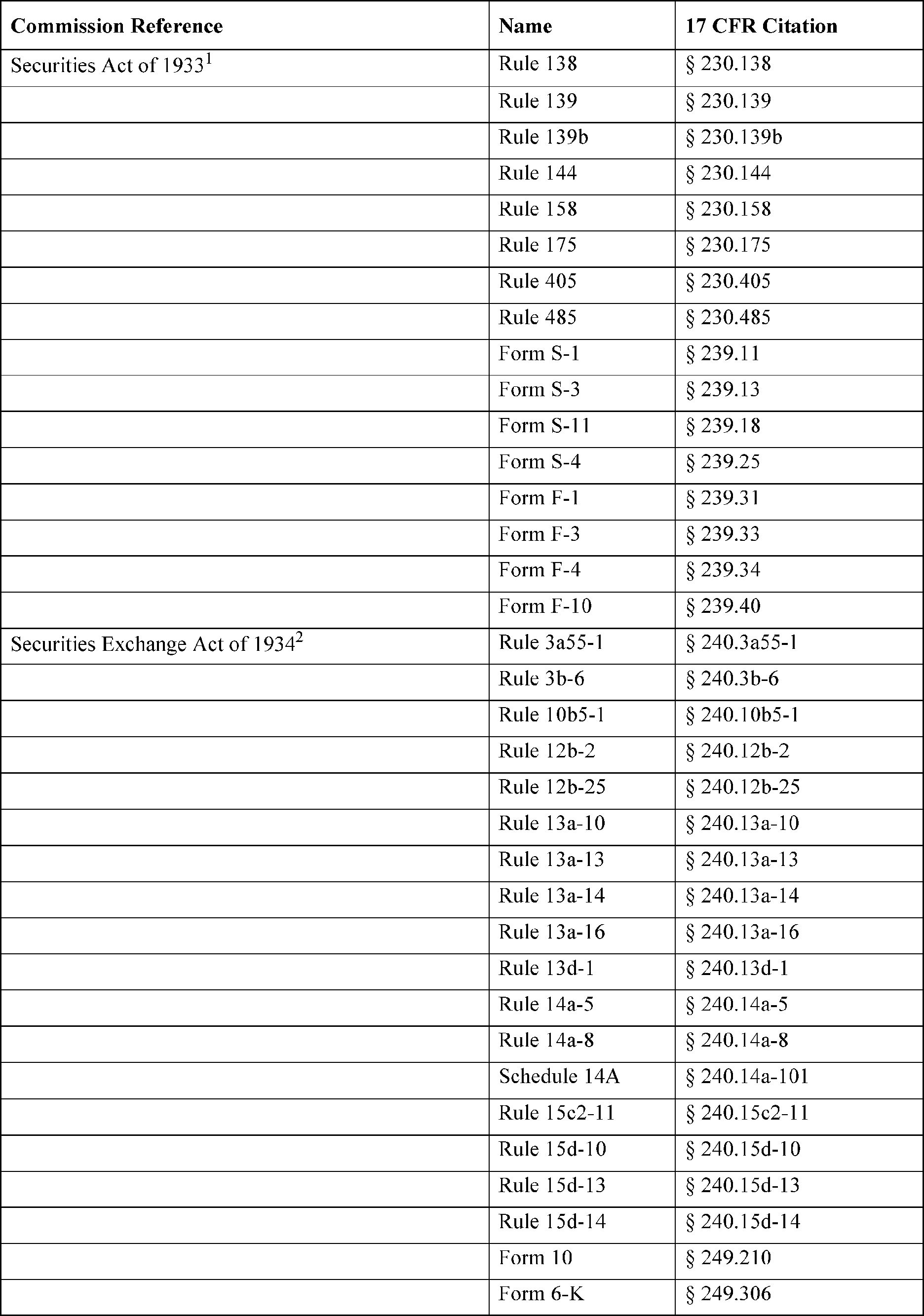
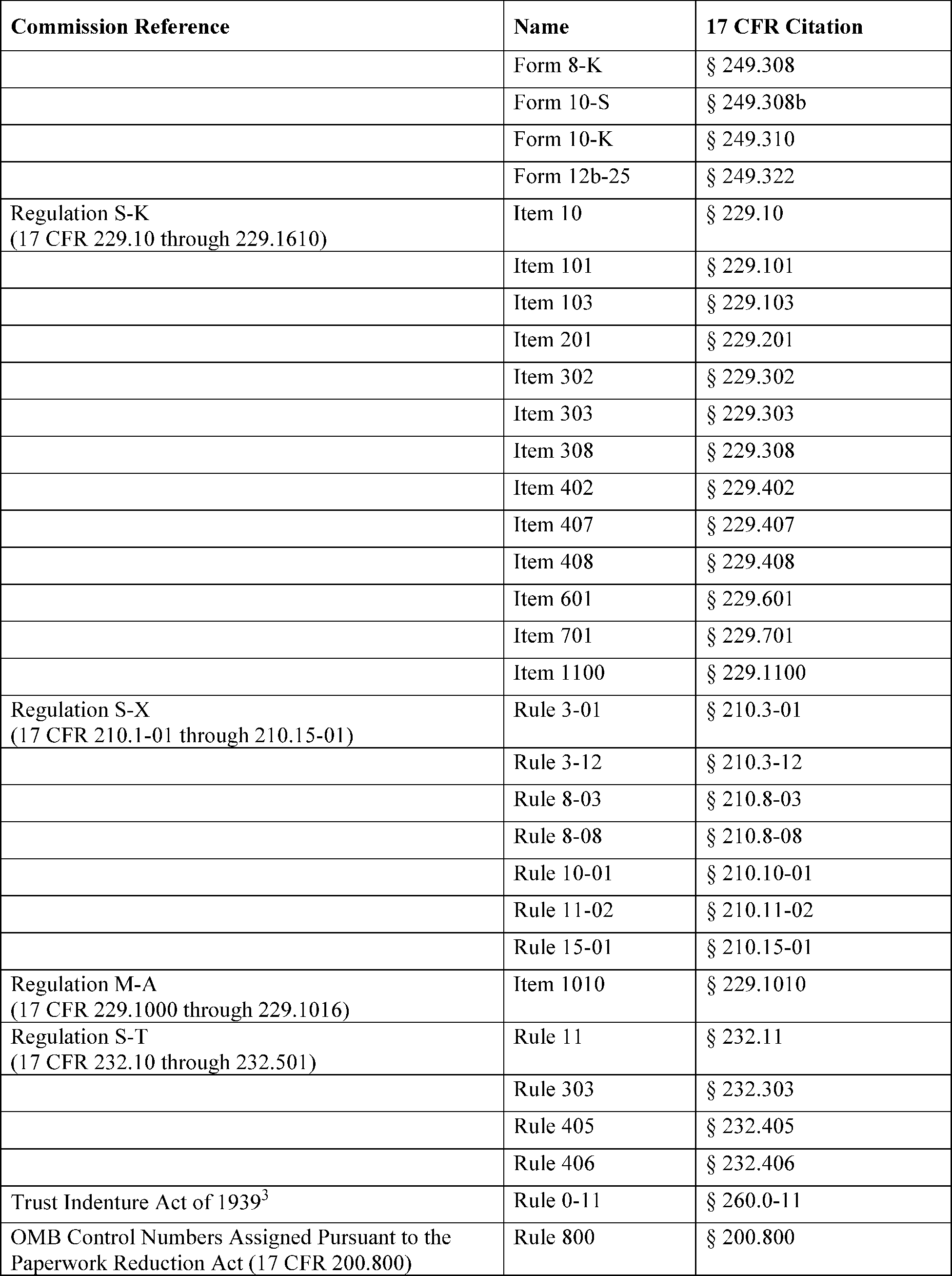
The Commission is proposing to amend or add the following rules and forms:
( printed page 24969)
( printed page 24970)
Table of Contents
I. Introduction
II. Background
III. Discussion of Proposed Amendments
A. Proposed Amendments for Semiannual Reporting
B. Proposed Amendments to Regulation S-X
C. Proposed Amendments Regarding Transition Reports
D. Proposed Technical Amendments
E. General Request for Comment
IV. Other Matters
V. Economic Analysis
A. Introduction
B. Broad Economic Considerations
C. Baseline
D. Benefits and Costs
E. Anticipated Effects on Efficiency, Competition, and Capital Formation
F. Reasonable Alternatives
G. Request for Comment
VI. Paperwork Reduction Act Analysis
A. Summary of the Collections of Information
B. Estimated Paperwork Burden Effects of the Proposed Amendments
C. Incremental and Aggregate Burden and Cost Estimates
D. Request for Comment
VII. Congressional Review Act
VIII. Initial Regulatory Flexibility Act Analysis
A. Reasons for, and Objectives of, the Proposed Action
B. Legal Basis
C. Small Entities Subject to the Proposed Rules and Amendments
D. Reporting, Recordkeeping, and Other Compliance Requirements
E. Duplicative, Overlapping or Conflicting Federal Rules
F. Significant Alternatives
G. Request for Comment
Statutory Authority
I. Introduction
We are proposing amendments to provide all companies subject to reporting obligations under Exchange Act Section 13(a) or 15(d) (“Exchange Act reporting companies”) [4]
that file
( printed page 24971)
quarterly reports the option of filing interim reports on a semiannual basis. Currently, Exchange Act reporting companies must file quarterly reports on Form 10-Q pursuant to 17 CFR 240.13a-13 (“Exchange Act Rule 13a-13”) or 17 CFR 240.15d-13 (“Exchange Act Rule 15d-13”), with certain exceptions.[5]
Pursuant to these rules, Exchange Act reporting companies file with the Commission three quarterly reports on Form 10-Q each fiscal year, with the fourth fiscal quarter subsumed within the reporting company's annual report on Form 10-K. The proposed amendments to Exchange Act Rules 13a-13 and 15d-13, if adopted, would allow Exchange Act reporting companies electing to do so to file semiannual reports on new Form 10-S in lieu of quarterly reports on Form 10-Q. Our proposal would provide an Exchange Act reporting company with the flexibility to determine the frequency of interim reporting that best suits its particular circumstances, such as its ability to bear the costs of preparing the quarterly reports, the stage of its business development, and the expectations of its investors, without undermining fundamental investor protections. Providing such regulatory flexibility could reduce the regulatory burden of being a reporting company, which could potentially influence a company's decision to become or remain a reporting company and encourage more companies to go or remain public. These proposed amendments would not substantively affect investment companies except for business development companies and face-amount certificate companies.[6]
We are also proposing amendments to the financial statement requirements of 17 CFR part 210 (“Regulation S-X”)—including to 17 CFR 210.3-01 (“Rule 3-01”), 17 CFR 210.3-12 (“Rule 3-12”), and 17 CFR 210.8-08 (“Rule 8-08”)—to facilitate semiannual reporting and to simplify rules regarding the age of financial statements in registration statements and other Commission filings.
II. Background
Companies subject to Exchange Act Sections 13(a) and 15(d) must file periodic and other reports as prescribed in Commission rules. Exchange Act reporting companies have been required to file annual reports on Form 10-K since 1935 [7]
as well as current reports on Form 8-K for certain material events since 1936.[8]
In 1946, the Commission required certain reporting companies to file quarterly reports on Form 8-K to disclose, among other things, the dollar amount of gross sales (less discounts, returns, and allowances) and operating revenue.[9]
In 1953, the Commission ended this quarterly reporting requirement,[10]
and, in 1955, it adopted rules requiring semiannual interim reports pursuant to Rules X-13A-13 and X-15D-13.[11]
These rules required one semiannual report to be filed each fiscal year by Exchange Act reporting companies on a new Form 9-K.[12]
Semiannual reports on Form 9-K, which were due 45 days after the end of the reporting period, did not require the narrative disclosures mandated by Form 10-Q and provided only limited disclosures typically associated with an income statement.[13]
After 15 years of this semiannual reporting system, the Commission rescinded semiannual reports on Form 9-K in 1970 and instead required quarterly reporting pursuant to amended Rules 13a-13 and 15d-13.[14]
The rules required Exchange Act reporting companies to file three quarterly reports on Form 10-Q each fiscal year.[15]
When it proposed the quarterly report on Form 10-Q, the Commission explained that the new report would “provide detailed information as a back-up to information released pursuant to timely disclosure policies” and would provide “uniform standards” for all Exchange Act reporting companies.[16]
The Commission's move towards a quarterly reporting requirement was also consistent with the recommendation of the 1969 Wheat Report, which
( printed page 24972)
concluded “that a regular, quarterly report would be more useful than the present, irregular 8-K report.” [17]
Although the Commission has amended Form 10-Q and requirements in connection with quarterly reporting over time,[18]
the Commission has not changed this cadence of quarterly interim reporting since it was adopted in 1970.
Form 10-Q today requires more detailed information than the rescinded semiannual report on Form 9-K. Form 10-Q requires financial statements (inclusive of footnote disclosures) for the covered quarterly period that are prepared in accordance with United States (“U.S.”) generally accepted accounting principles (“U.S. GAAP”),[19]
have been reviewed by an independent public accountant (but are not required to be audited),[20]
and are data tagged using inline XBRL.[21]
It also requires narrative disclosures regarding:
Management's discussion and analysis of financial condition and results of operations (“MD&A”); [22]
Material changes to the procedures by which security holders may recommend nominees to the registrant's board of directors; [29]
Disclosure of director or officer adoptions or terminations of certain plans for the purchase or sale of registrant securities; [30]
Exhibits required under Item 601 of Regulation S-K; [31]
and
Certifications by the principal executive and financial officers as exhibits.[32]
Form 10-Q reports are filed electronically with the Commission through its EDGAR system. The deadline for filing Form 10-Q with the Commission is 40 or 45 days after the end of a fiscal quarter, depending on the filer status of the reporting company.[33]
Finally, securities exchange listing standards generally do not mandate a particular frequency of interim reporting. Instead, they refer generally to compliance with Commission rules requiring interim reports (with at least one exchange making specific reference to quarterly reports on Form 10-Q),[34]
require availability of interim reports,[35]
or require quick dissemination of quarterly earnings information to the market.[36]
Certain companies that are not subject to Section 13(a) or Section 15(d) already report on a semiannual basis under the Commission's rules,[37]
and certain other
( printed page 24973)
companies are exempt from quarterly reporting but furnish semiannual information pursuant to other requirements such as exchange listing standards.[38]
Several foreign jurisdictions also require semiannual reporting of financial information (but not quarterly reporting).[39]
Over the years, the Commission at times has reassessed the current periodic reporting system, its impact on Exchange Act reporting companies, and potential alternatives including semiannual reporting. Most recently, as part of the Commission's disclosure effectiveness review, the Commission issued two releases that addressed and requested public comment on the frequency of interim reporting.[40]
In July 2019, the Commission also held a roundtable that discussed issues including the frequency of periodic reporting.[41]
The Commission received significant public feedback as a result of these recent efforts, including from companies and their representative organizations, asset managers and institutional investors, investor groups and individual investors, accounting firms, law firms, and other market participants.[42]
Commenters expressed a wide variety of views about the frequency of interim reporting requirements,[43]
with some supporting the current frequency but others recommending less-frequent interim reporting, such as semiannual reports, due to concerns about compliance costs and short-termism.[44]
Finally, the concept of semiannual reporting was recently discussed at: a meeting of the Commission's Investor Advisory Committee; [45]
the Commission's
45th Annual Small Business Forum
(and the prior year's forum); [46]
and the Commission's 2025
Small Cap Policy Roundtable.[47]
III. Discussion of Proposed Amendments
Interim reports provide investors with material information about the financial performance of their companies during a fiscal year. Yet quarterly reporting may not be the ideal interim reporting frequency for every Exchange Act reporting company, given the varied circumstances each company faces. We are proposing rule and form amendments to provide all Exchange Act reporting companies with the
( printed page 24974)
option of filing semiannual reports on new Form 10-S in lieu of quarterly reports on Form 10-Q. The flexibility provided under our proposed amendments would enable all Exchange Act reporting companies to choose the reporting frequency that would best serve the company and its investors. Companies that elect semiannual interim reporting may see a reduction in compliance costs of time and money, as they would incur these interim reporting costs only one time in connection with each fiscal year instead of three times in connection with each fiscal year pursuant to quarterly reporting.[48]
These companies could then choose to dedicate any compliance cost and resource savings to their business growth. Other potential benefits of semiannual reporting include: less distraction from running the day-to-day business; reallocation of attention from interim reporting to company strategy; additional time spent on new product development; and ability to engage in transactions that might not be possible when management is focused on preparing interim reports.[49]
To the extent that companies could not previously do so due to quarterly reporting, companies electing semiannual reporting may employ business strategies that may help ensure these companies' long-term viability. In particular, emerging growth companies [50]
and smaller reporting companies [51]
may value having the flexibility to select the interim reporting requirement that is most appropriate for them and their investors.[52]
Additionally, reducing the compliance costs associated with quarterly reporting may contribute to more private companies deciding to enter the public markets and more companies deciding to remain public. Further, the flexibility provided in the proposal may appeal to companies in certain industries where investors may focus more on certain business, product, or regulatory developments than interim financial results.[53]
Under the proposal, companies would have the option to elect on an annual basis to comply with the semiannual reporting requirements. Exchange Act reporting companies could continue to file quarterly reports on Form 10-Q under the proposal. Companies might continue to report quarterly, for example, where they determine that quarterly frequency is best for the company and its investors or due to factors such as expectations of investors and securities analysts, disclosure practices in a particular industry, contractual obligations, or other regulatory requirements.[54]
It is also possible some companies may view semiannual reporting as increasing the length of time that the company's directors or employees possess non-public information that may be subject to the company's closed trading windows and see quarterly reporting as a better approach for the company, because it may provide more frequent open trading windows for the company's directors and employees.
Although one result of the proposal will be a reduction in the frequency of interim reports for some Exchange Act reporting companies, we expect certain material information about these companies between interim semiannual reports and annual reports will continue to be disclosed either voluntarily or as a result of other requirements. Significant regulatory enhancements have occurred since 1970 with regard to disclosure of certain material events during interim periods. Investors currently have access to information through the current reporting system on Form 8-K regarding certain material events that is far more robust and timely than in 1970 when semiannual reports on Form 9-K were last required. Since that time, the Commission significantly accelerated that era's Form 8-K filing deadline of 10 days after the end of the month in which the applicable event occurred to the current general deadline of within four business days of the event.[55]
In addition to shortening the filing deadlines, the Commission over time significantly expanded the list of events that would trigger a filing obligation under Form 8-K and prescribed standardized disclosures that must be provided upon the occurrence of the material event, including through amendments in 2003 and 2004.[56]
In fact, several of the Form 10-Q disclosure requirements largely duplicate the Form 8-K requirements.[57]
Importantly, in 2003, the Commission added Item 2.02 as a Form 8-K filing trigger event for the furnishing of earnings releases and other material information about companies'
( printed page 24975)
results of operations and financial condition for a completed interim period.[58]
Current Item 2.02 requires reporting companies generally to furnish their quarterly earnings releases as an exhibit to Form 8-K on the Commission's EDGAR system.[59]
Many Exchange Act reporting companies hold a conference call in connection with their earnings releases. Item 2.02 provides the conference call does not need to be furnished with Form 8-K subject to certain conditions, including that the call occur within 48 hours of the earnings release, the call be accessible to the public, and the call and dial-in information be announced in advance to the public.[60]
In practice, many public companies make recordings of the call freely available on their website. Recordings of the calls are also commonly freely available on third-party platforms.
We believe that the requirements of Form 8-K elicit important disclosures about material events on a more timely basis than quarterly reports on Form 10-Q. We acknowledge, however, that quarterly earnings releases furnished with an Item 2.02 Form 8-K differ from Form 10-Q financial information because they are not required to be reviewed by an independent public accountant or to comply with the Commission's interim financial statement requirements or certain other requirements in Form 10-Q.[61]
We also acknowledge that, if a company elects to take advantage of semiannual reporting and stops reporting quarterly earnings or having quarterly earnings release conference calls, then the disclosures elicited by Item 2.02 of Form 8-K would not be available. We expect that a company's individual characteristics, facts, and circumstances will determine whether it would make quarterly earnings releases or announcements after electing to report semiannually.[62]
Regulation FD, adopted in 2000, was another significant development in the evolution of disclosure requirements for Exchange Act reporting companies. Regulation FD requires that any material non-public information selectively shared with certain enumerated persons be promptly (in the case of unintentional disclosure) or simultaneously (in the case of intentional disclosure) disclosed to the market by either furnishing or filing a Form 8-K report or disseminating the information through another method that is reasonably designed to provide broad, non-exclusionary distribution.[63]
In connection with Regulation FD, Exchange Act reporting companies may disclose material information during a fiscal year through Item 7.01 of Form 8-K.[64]
Regulation FD seeks to promote full and fair disclosure and may cause a company to disclose material information—whether on Form 8-K or through other means—at various points during a fiscal year, depending on the company and its circumstances (such as whether the company seeks to communicate previously material non-public information to analysts or other persons covered by Regulation FD). Such disclosure results in greater investor access to material information disclosed outside quarterly reports on Form 10-Q. Regulation FD and current Form 8-K disclosure requirements were either not present or less robust when the Commission last required the limited form of semiannual reporting during the period from 1955 to 1970.
Although we are proposing to amend our rules regarding frequency of interim reporting, our proposal does not include any general changes to the current regulatory requirements governing: (1) earnings releases, other than proposed technical amendments to Item 2.02 of Form 8-K to include references to semiannual periods, or (2) earnings guidance practices. Federal securities laws do not impose general duties upon Exchange Act reporting companies to announce or publish earnings, conduct earnings calls, or issue earnings guidance.[65]
We received public feedback on earnings releases and earnings guidance practice in connection with the Commission's 2016 Regulation S-K Concept Release and 2018 Request for Comment on Quarterly Earnings and Reporting, with commenters expressing a variety of views on these practices and on a wide range of related topics. Our proposal is focused on the more specific issue of the frequency of interim reporting as mandated by the Federal securities laws, with the goal of providing more flexibility with respect to this mandated disclosure. Although the proposal is not intended to change the regulatory framework for voluntary practices regarding earnings releases and guidance, we welcome comments on the impact of our proposal on these voluntary practices.
We believe our proposal represents a balanced approach of maintaining a reporting system that elicits material, timely, and regular disclosures in a manner that best suits the needs of both the company and its investors,
( printed page 24976)
promoting efficiency by reducing compliance costs, and maintaining robust investor protections. The proposal is one step in a broader Commission effort to encourage more companies to go and remain public by reducing the costs and burdens associated with Exchange Act reporting. A robust public capital market—with more emerging companies and small businesses choosing to become public companies through initial public offerings or other paths—benefits companies and investors alike. Becoming a public company provides companies with access to the public markets that allows them to raise capital to grow their businesses, a broader set of potential investors who may purchase their securities in the secondary trading market, and the benefits of transparent valuations by public markets and of a market following. For investors, public companies represent opportunities to participate in the future growth of promising companies. Initial public offerings represent liquidity opportunities for early-stage investors. Investors in public companies are protected by mandated disclosures and by liability provisions of the Federal securities laws that apply to public companies' disclosures, such as Securities Act Section 11 and Exchange Act Section 18.[66]
We are also proposing amendments to Regulation S-X. Our proposed amendments would incorporate provisions applicable to registrants that elect semiannual reporting frequency into the financial statement requirements for periodic reports. We are also proposing changes to the age of financial statement requirements in Regulation S-X to ensure that financial statements in registration statements filed by semiannual filers would not be considered “stale” under existing rules, which were built along a quarterly reporting framework, and to revise those age requirements for semiannual filers to fit with their reporting schedule. The proposed changes to the age of financial statement rules would also simplify existing rules, including by consolidating the age requirements into a single rule.
Finally, we recognize that, if the proposal is adopted, in order to comport with semiannual reporting by public companies, it is possible that changes may be necessary or appropriate to the rules of securities exchanges [67]
or to various accounting or auditing standards.[68]
If the proposal is adopted, to facilitate any such changes, we expect the Commission staff would coordinate with accounting and auditing standard-setters, securities exchanges, and other market participants. To help inform those efforts, we are soliciting comment in this release on what changes to accounting or auditing standards or rules of securities exchanges should be made to comport with semiannual reporting.[69]
Our proposal is discussed in greater detail below. We welcome interested parties to submit comments on any aspects of the proposed rule and form amendments. When commenting, please include the reasoning in support of your position or recommendation and provide any supporting documentation or data.
A. Proposed Amendments for Semiannual Reporting
We are proposing amendments to Exchange Act Rules 13a-13 and 15d-13 (and other relevant rules and forms that we discuss below) to change the current quarterly reporting requirements for Exchange Act reporting companies to a more flexible system that permits Exchange Act reporting companies to elect to file semiannual reports instead of quarterly reports.[70]
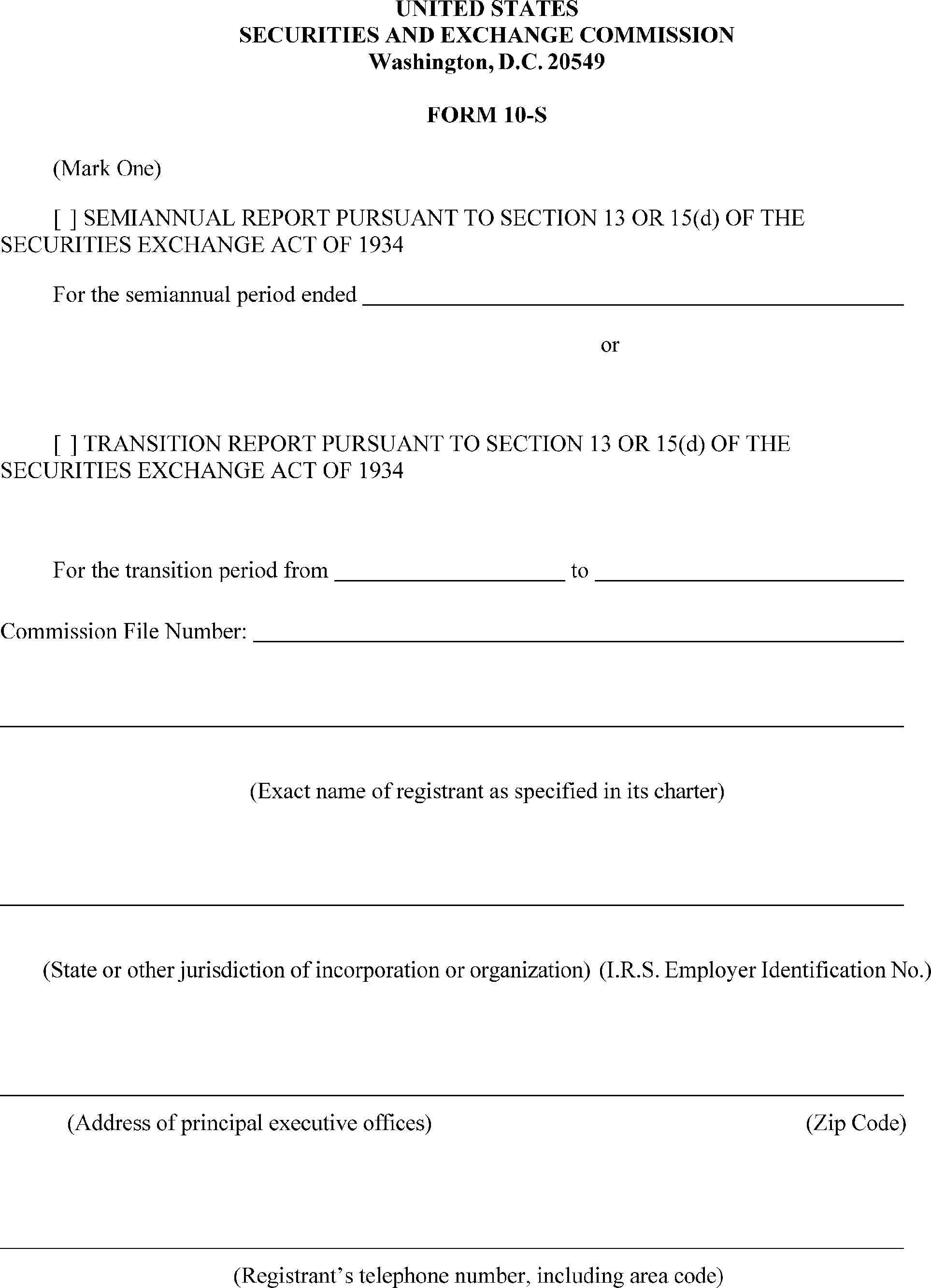
Under the proposal, an Exchange Act reporting company that elects semiannual reporting would be required to file one semiannual report and one annual report for each fiscal year. Semiannual filers would file their interim report on new Form 10-S. This form would require the same narrative disclosures and financial information as existing Form 10-Q but would cover a six-month period (rather than a fiscal quarter). The deadline for filing Form 10-S would be 40 or 45 days (depending on the company's filer status) after the fiscal year's first semiannual period end—the same as with current Form 10-Q's fiscal quarter end deadline, which would not change—while the second semiannual period would be subsumed in the annual period presented in the annual report on Form 10-K.[71]
Reporting companies that do not elect to report on a semiannual basis—thereby effectively opting to report on a quarterly basis under the default rules that would apply—would continue to be required to file three quarterly reports on Form 10-Q and one annual report on Form 10-K for each fiscal year as under the current system for reporting companies. We are proposing to add a check box to the cover page of Form 10-K as the sole means by which a reporting company would indicate annually whether it is selecting a semiannual interim reporting frequency (by checking the semiannual box) or quarterly reporting (by not checking the semiannual box) and by which the reporting company would disclose the selected frequency to investors and other market participants.
( printed page 24977)
We are also proposing amendments to add a similar check box concerning the semiannual reporting election to the cover page of Securities Act registration statements on Forms S-1, S-3, S-4, and S-11 and Exchange Act registration statements on Form 10. Companies that have yet to file Exchange Act reports, such as private companies conducting initial public offerings, would make initial elections to use semiannual reporting by checking the box on the cover page of the registration statement filed.[72]
This election would determine what financial statements are required in the registration statement [73]
and indicate the company's planned interim reporting frequency to investors and other market participants.[74]
Similar to current requirements for the first quarterly report for companies that have newly become Exchange Act reporting companies,[75]
the first semiannual report on Form 10-S would be due the later of 45 days after the effective date of the registration statement or the date that Form 10-S would otherwise have been due had the company been an Exchange Act reporting company.[76]
In connection with our proposed optional semiannual reporting approach, we are proposing to add two new definitions—“quarterly filer” and “semiannual filer”—to 17 CFR 240.12b-2 (and to add two identical definitions to 17 CFR 230.405) to facilitate a number of amendments we are proposing, including a number of technical amendments to insert references to semiannual reporting in rules that currently refer to quarterly-reporting-related concepts. A “quarterly filer” would be defined as a registrant that is required to file quarterly reports on Form 10-Q, pursuant to 17 CFR 240.13a-13(a). A “semiannual filer” would be defined as a registrant that is required to file semiannual reports on Form 10-S, pursuant to 17 CFR 240.13a-13(b).
Under our proposed optional semiannual reporting approach, we are proposing to permit a change in interim reporting frequency—either from quarterly to semiannually or vice versa—to be indicated on a Form 10-K by checking the box on the cover page to file semiannually or leaving the box unchecked to file quarterly. As proposed, the determination to report semiannually or quarterly would therefore be made on an annual basis and may not be changed until the next Form 10-K annual report is filed.[77]
Companies would then be required to file interim reports based on the chosen frequency, beginning with the report for the first interim period (semiannual or quarterly) of the fiscal year in which the Form 10-K with the election was filed.[78]
For example, an Exchange Act reporting company reporting quarterly with a December 31 fiscal year-end wants to file semiannual reports on Form 10-S for the next fiscal year. The company would file its Form 10-K for fiscal year 2026 in March 2027. Under the proposal, the company would have to make its election to switch to semiannual reporting for fiscal year 2027 by checking the box for semiannual reporting on the cover page of its Form 10-K for fiscal year 2026. With this election made in fiscal year 2027 (i.e.,
when the Form 10-K for fiscal year 2026 was filed), the company would be required to report semiannually and would begin semiannual reporting by filing in August 2027 its Form 10-S for the first six-month period (ended June 30, 2027) of fiscal year 2027.[79]
Similarly, for example, an Exchange Act reporting company with a December 31 fiscal year-end that previously chose to file semiannual reports on Form 10-S as indicated in its Form 10-K for the fiscal year ended December 31, 2026 wishes to switch to quarterly reporting. The company will file its Form 10-K for fiscal year 2027 in March 2028. The reporting company would change its interim reporting frequency by leaving the box unchecked for semiannual reporting on the cover page of its Form 10-K for fiscal year 2027. With this election made in fiscal year 2028 (i.e.,
when the Form 10-K for 2027 was filed), the company would be required to report quarterly and would begin quarterly reporting by filing in May 2028 its Form 10-Q for the first quarter (ended March 31, 2028) of fiscal year 2028. In its Form 10-Q for the first quarter of fiscal year 2028, the company would be required to present statements of comprehensive income, cash flows, and changes in stockholders' equity for the first quarter of the preceding fiscal year (2027).[80]
These first quarter 2027 financial statements would have been subsumed within (but would not have been required to be separately presented in) the semiannual financial statements included in the previously filed Form 10-S covering January to June 2027. Therefore, in changing the election by leaving the box unchecked (thereby choosing to file quarterly reports on Form 10-Q for fiscal year 2028), the reporting company may need to take additional steps to prepare the financial statements for the comparable 2027 quarterly periods, including ensuring that an independent public accountant
( printed page 24978)
has reviewed the comparable quarterly periods for fiscal year 2027.[81]
Once an Exchange Act reporting company has elected its interim reporting frequency, it would be committed to that reporting frequency for the remainder of that fiscal year. This proposed approach would avoid potential investor confusion that could result if Exchange Act reporting companies were permitted to switch interim reporting frequency in the midst of a fiscal year, such as confusion over when the companies would file interim reports.
We recognize the possibility that a company may mistakenly leave the check box unmarked or incorrectly mark the check box (for example, a company mistakenly checking the box for semiannual reporting when it intended to be a quarterly filer or a company mistakenly leaving the check box unmarked when it intended to be a semiannual filer). We therefore propose to amend Rule 13a-13(b) and Rule 15d-13(b) to permit companies to amend their Form 10-K to correct any such inadvertent mistakes. Such corrective amendments would be required to be filed as soon as practicable after discovery of the mistake but no later than the due date by which the company's first Form 10-Q report would be required to be filed for the fiscal year in which the initial Form 10-K with the erroneous election was filed.[82]
For example, a quarterly filer with a December 31 fiscal year-end wants to continue filing quarterly reports on Form 10-Q. The company filed its Form 10-K for fiscal year 2026 in March 2027. It mistakenly marked the check box on the cover page of its Form 10-K for fiscal year 2026, thereby electing to switch to semiannual reporting for fiscal year 2027. The company would be able to correct this error by amending its Form 10-K no later than the due date for its Form 10-Q for the first quarter of fiscal year 2027.[83]
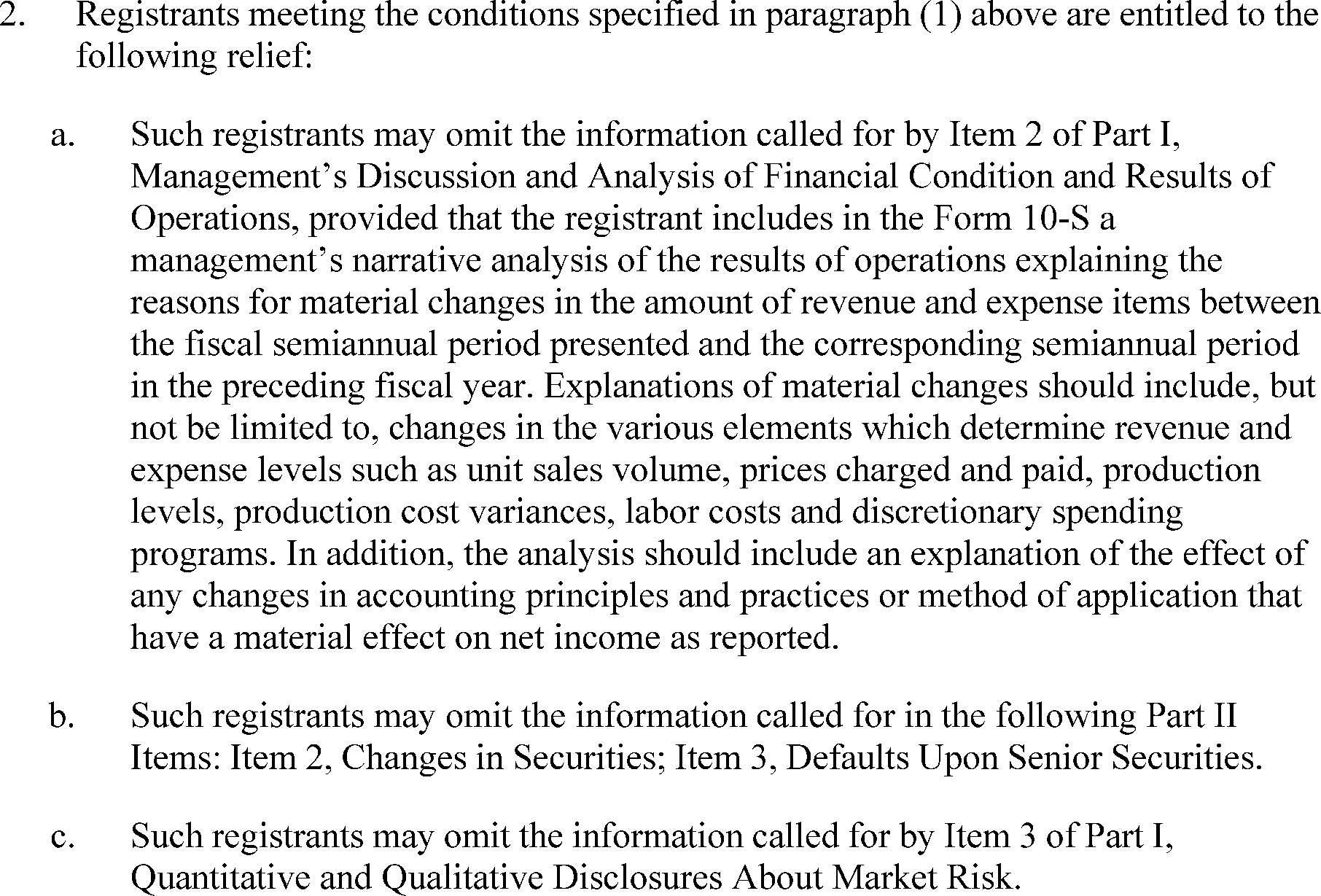
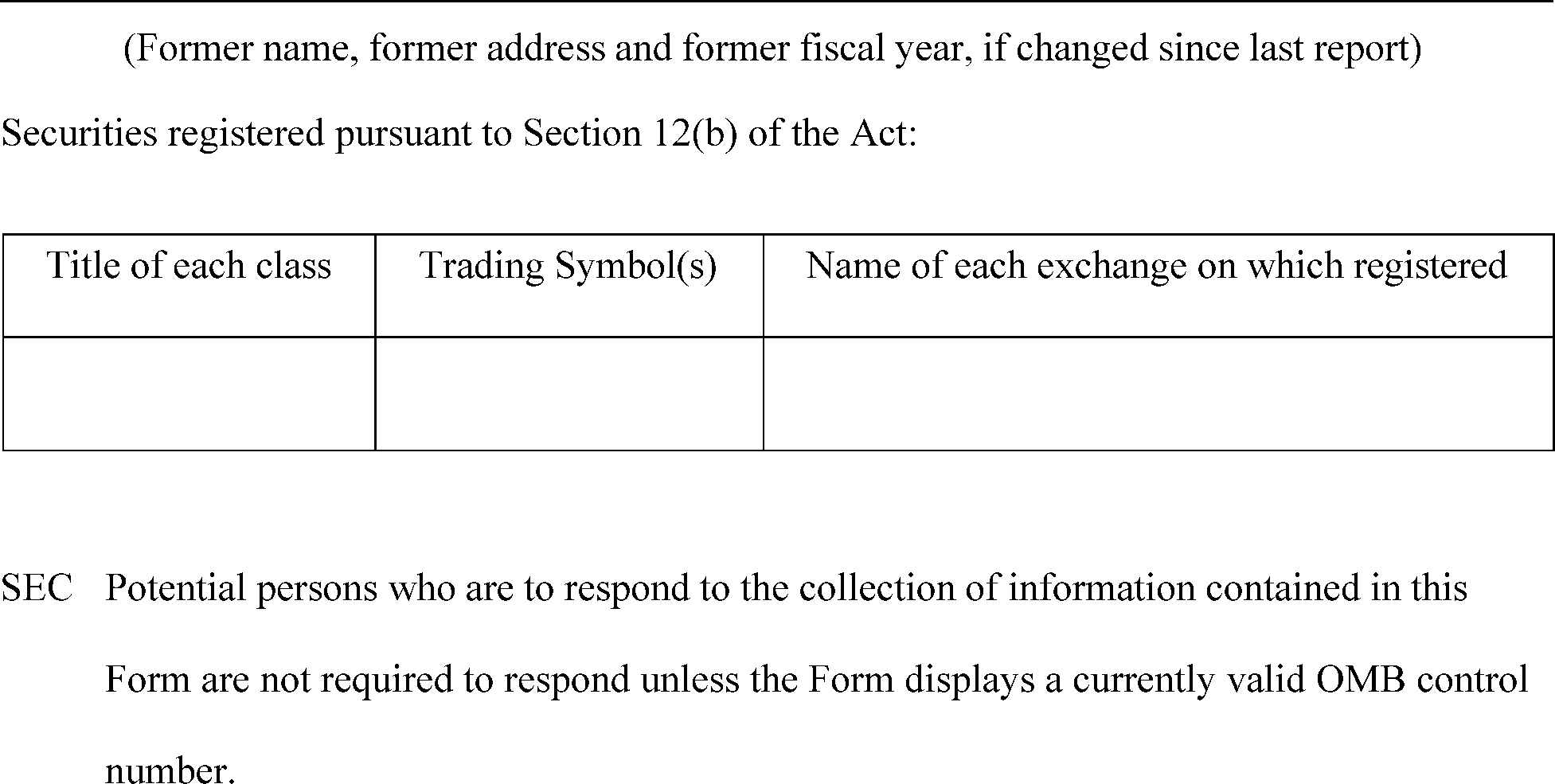
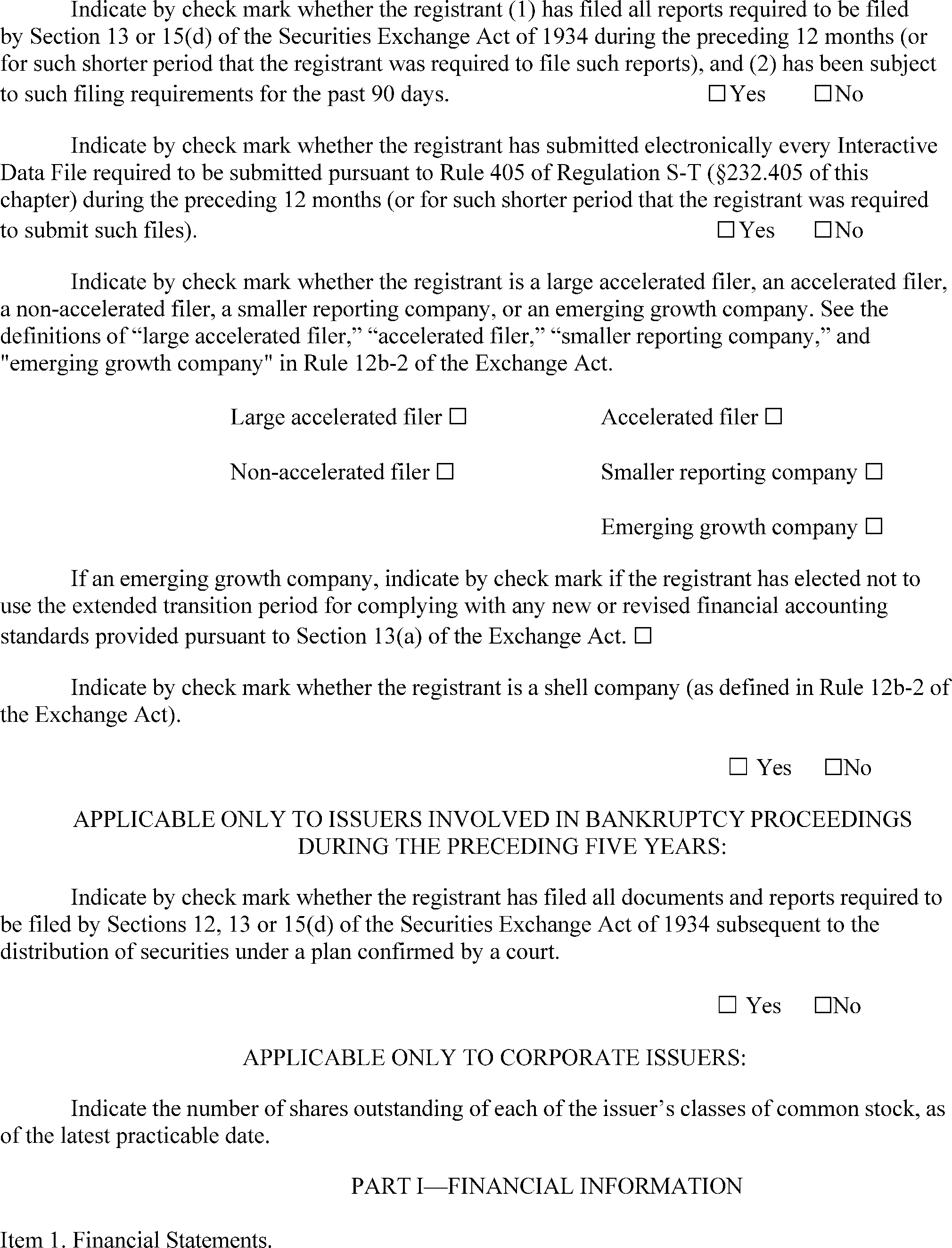
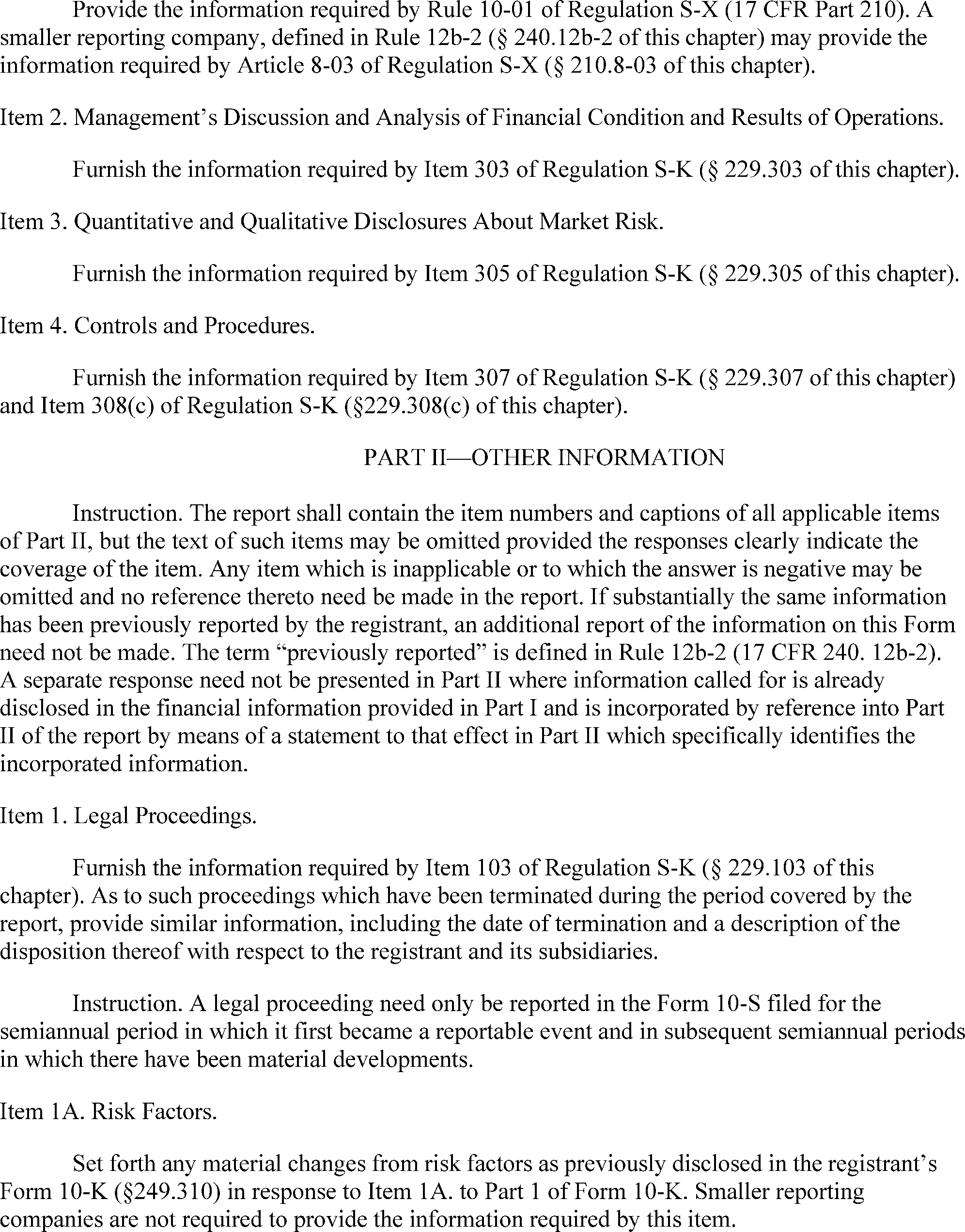
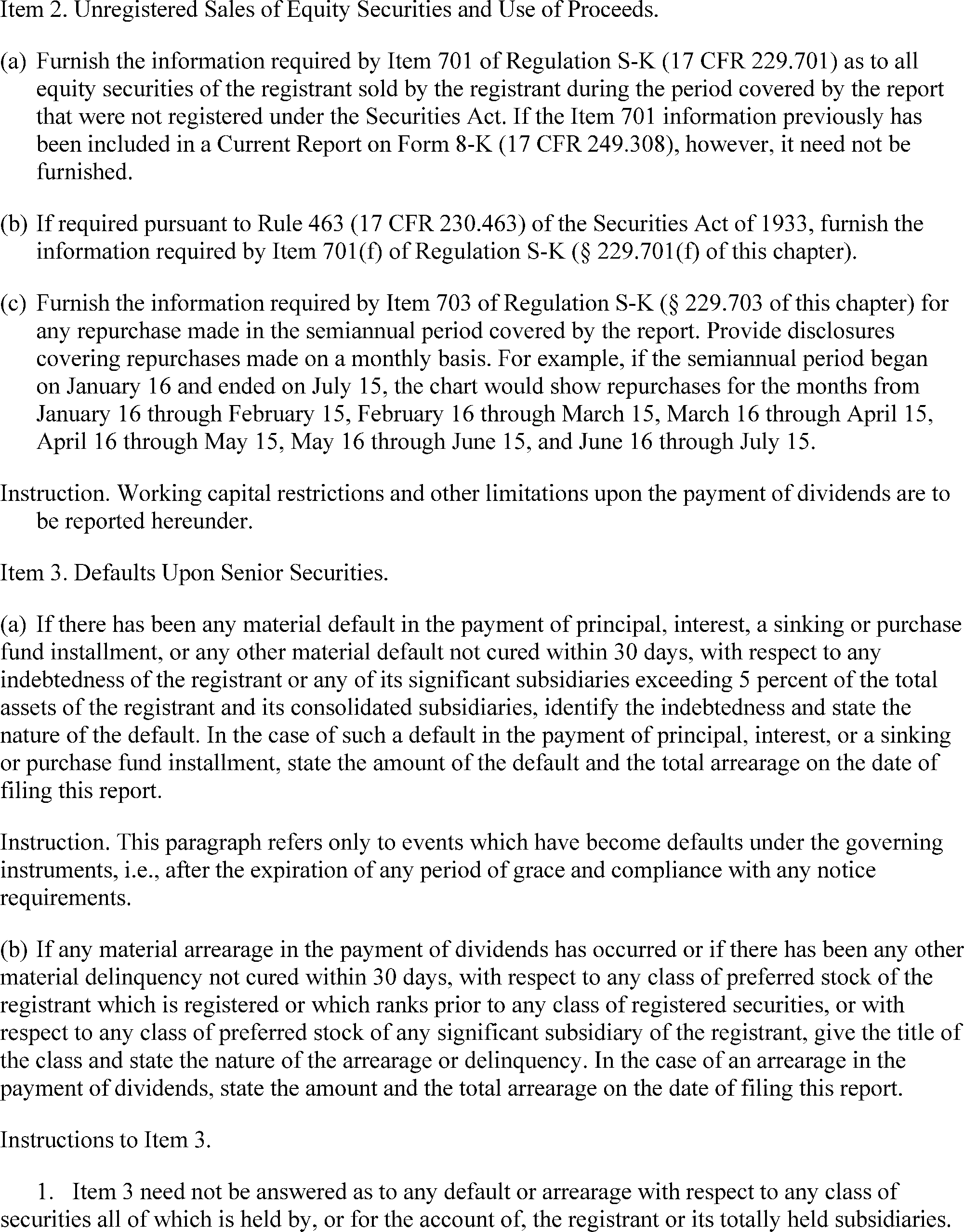
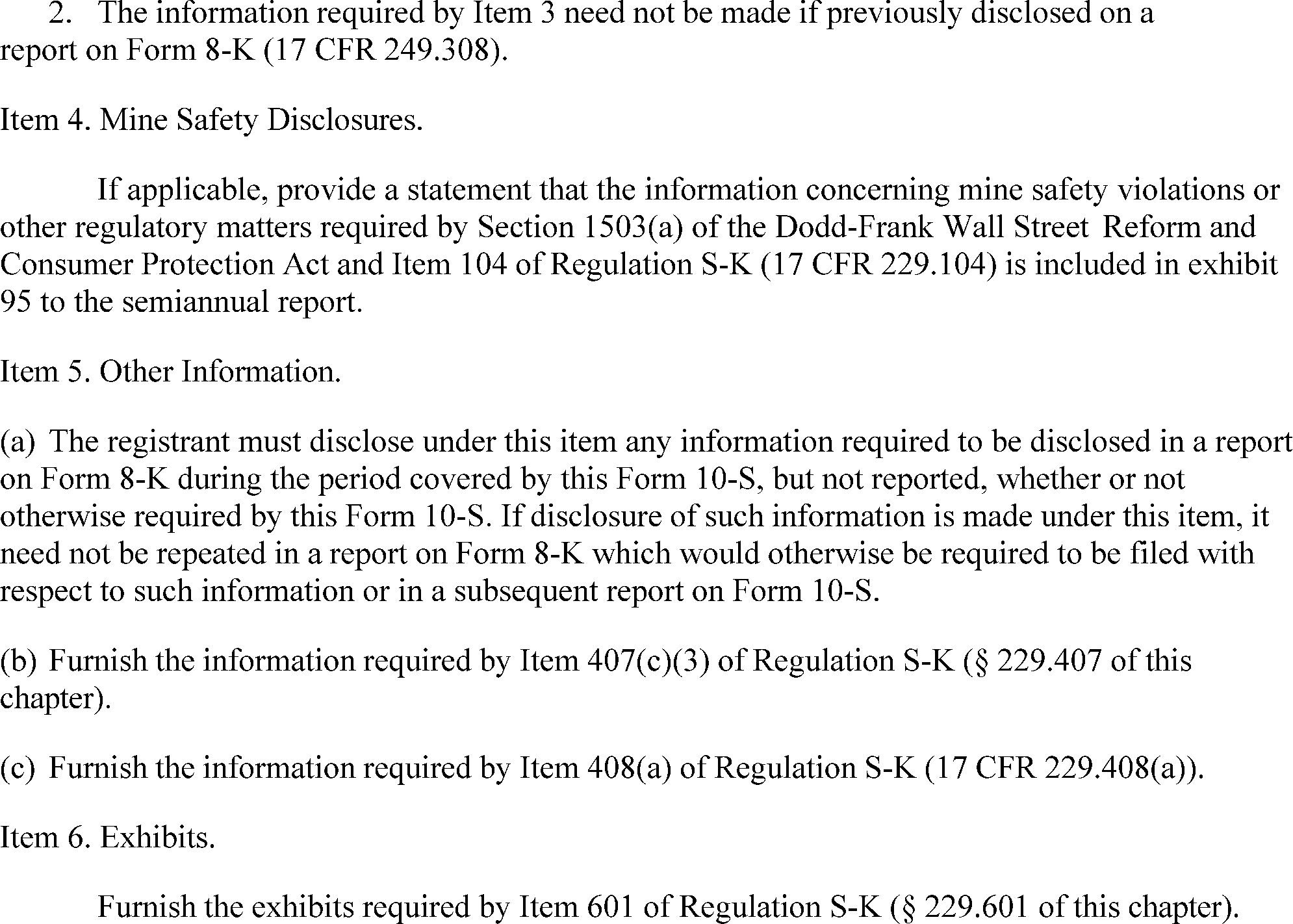
Proposed Form 10-S would require the same information as currently required by Form 10-Q but for the covered six-month period instead of a quarter.[84]
Required disclosures would include, among other things, MD&A, legal proceedings, material changes in risk factors, unregistered equity security sales and use of proceeds, defaults on senior securities, director nomination procedures, disclosure of director or officer adoptions or terminations of certain plans for the purchase or sale of registrant securities, and exhibits required under Item 601 of Regulation S-K. The financial statements for the covered semiannual period would be required to be prepared in accordance with U.S. GAAP [85]
and reviewed by an auditor (but not required to be audited).[86]
They would also be required to be data tagged using Inline XBRL. The current disclosure and certifications requirements for disclosure controls and procedures, as well as for internal control over financial reporting, would apply to proposed Form 10-S.[87]
Non-GAAP financial measures presented in proposed Form 10-S would be subject to the current requirements of Regulation G and Item 10(e) of Regulation S-K.
Request for Comment
1. The proposed amendments would allow Exchange Act reporting companies to elect to file interim reports on a semiannual basis in lieu of quarterly reports on Form 10-Q. Should companies have this option, or should all companies continue to be required to file Form 10-Q? What types of companies are likely to elect the option to file semiannual reports? Are companies in certain industries more likely than those in other industries to elect to file semiannual reports?
2. We are proposing amendments that would permit, but not require, all Exchange Act reporting companies that file Form 10-Q today to file semiannual reports. Should we instead require all companies to file semiannual reports? What would be the benefits and costs of such a mandatory approach? Would mandatory semiannual reporting, with the option to file quarterly reports, lead to more companies electing to forgo quarterly reporting?
3. Our proposal would permit semiannual reports for all Exchange Act reporting companies that file Form 10-Q today, regardless of filer status, revenues, market capitalization, or other criteria. Should the option for semiannual reporting be available only for Exchange Act reporting companies that satisfy certain criteria? If so, what criteria should be imposed and why? For example, should only emerging growth companies or smaller reporting companies be allowed to report semiannually? [88]
Should only companies below alternative quantitative or monetary thresholds be allowed to report semiannually? Should the Commission consider a pilot program to permit optional semiannual reporting for a subset of reporting companies and, if so, what would be the benefits of such a pilot program? What types of companies should be included in the pilot program?
4. Under the proposal, reporting companies currently required to file Form 10-Q would have the option
( printed page 24979)
instead to file semiannual reports on Form 10-S. Should any types of companies that currently file Form 10-Q be excluded from the option of electing semiannual reporting, such as business development companies?
5. We are proposing that the filing deadlines for semiannual reports on Form 10-S be the same as for quarterly reports on Form 10-Q. Should the filing deadline for semiannual reports on Form 10-S be longer or shorter than proposed? If so, what would be an appropriate filing deadline? Do companies need more time to prepare semiannual reports than quarterly reports and if so, why? Should smaller public companies, newly public companies, or emerging growth companies be afforded a longer filing deadline for Form 10-S to allow for additional time to consult with their accountants and advisers?
6. If adopted, would semiannual reporting have an impact on investors' ability to compare same-company performance over time? Why or why not?
7. What effect would our proposal have on investors' ability to compare the relative peer company financial performance of a quarterly filer to a semiannual filer? For example, can an investor reasonably compare a quarterly filer to a semiannual filer where the companies have the same fiscal year and the comparison is sought to be made in the second quarter (when first quarter information that would be subsumed in the semiannual filer's semiannual report on Form 10-S is not yet available) or made in the fourth quarter (when third quarter information that would be subsumed in the semiannual filer's annual report on Form 10-K is not yet available)?
8. Should the check box that indicates a company has elected semiannual reporting be added to registration statements on Forms 10, S-1, S-3, S-4, and S-11 and annual reports on Form 10-K as proposed? Should we add a similar check box to any other forms, including Forms 1-A or 8-A? If so, why?
9. Under our proposal, companies that want to file semiannual reports instead of quarterly reports would make their election by checking a box on the cover page of their annual report on Form 10-K for the most recently completed fiscal year. For investors and other market participants, this would mean that the first indication that a company will file only semiannual reports going forward will be when the company files its most recent Form 10-K. For example, under our proposal, a December 31 fiscal year-end company that files its Form 10-K for fiscal year 2026 in March 2027 would be able to cease filing quarterly reports immediately, with its next interim report being its first Form 10-S for the first six months of fiscal year 2027. Would investors and other market participants benefit from earlier notice of a company's intent to file semiannual reports instead of quarterly reports? If so, how would investors and others benefit and what would be the magnitude of any benefit? If so, what should the mechanism be for a company to provide earlier notice of intent to file semiannual reports?
10. Our proposal would require Exchange Act reporting companies that elect to file semiannual reports to continue with that interim reporting frequency for the rest of the fiscal year in which the election was made. Therefore, companies would not be allowed to file a semiannual report on Form 10-S for the first six months of a fiscal year and then file a quarterly report for the third quarter for that fiscal year. Likewise, companies would not be allowed to file a quarterly report on Form 10-Q for the first quarter of a fiscal year, file a semiannual report on Form 10-S for the first six months for that fiscal year, and not file a quarterly report on Form 10-Q for the third fiscal quarter. Would this proposed approach help avoid potential confusion that could be caused by changes in interim reporting frequency during a fiscal year? Is it necessary to add any language to the proposed rules to make more explicit the requirement to maintain the selected frequency for the full fiscal year? Rather than the proposed approach, should we allow: (1) semiannual filers and quarterly filers to make a change in interim reporting frequency during the fiscal year, or (2) only semiannual filers to switch to filing quarterly reports during the fiscal year? Should issuers that elect semiannual reporting be required to commit to that disclosure frequency for a certain period of time? Why or why not?
11. Do companies that have newly become a public company (
e.g.,
through an initial public offering, de-SPAC transaction, or direct listing) need to have greater flexibility for switching interim reporting frequency within a fiscal year? For example, a private company that elected semiannual reporting in a Form S-1 for an initial public offering could subsequently decide that quarterly reporting is preferable (
e.g.,
to promote greater trading liquidity by increasing the frequency of its interim reporting) and wish to switch to quarterly reporting for the rest of the fiscal year. Should we allow such newly public companies to switch the interim reporting frequency within a fiscal year?
12. Should correction of errors with respect to the Form 10-K check box related to semiannual reporting be permitted as we propose? Are the proposed time limits on when an error correction may be made appropriate? In addition to allowing error correction in an amended Form 10-K—or in lieu thereof—should we allow check box error correction through a Form 8-K filing?
13. We are proposing a new Form 10-S for companies that elect to file semiannual reports. Is the proposed new form needed? Should there be one form for all interim reports, regardless of whether they are for a fiscal quarter or a semiannual period? If so, why?
14. Proposed Form 10-S would mandate the same narrative and financial information as Form 10-Q, albeit for semiannual periods rather than quarterly periods. Should Form 10-S require narrative or financial information that differs from what is required in Form 10-Q? If so, please specify what information should be different and why this information is or is not needed in Form 10-S. Are there any disclosure items, such as mine safety violations, in proposed Form 10-S that should be required instead to be disclosed in other forms, such as Form 10-K, Form 8-K, or Form SD?
15. As an alternative to the proposal for optional semiannual reporting, should we instead revise the disclosure requirements of Form 10-Q to reduce the burden on reporting companies of filing this form, such as amending the current rules for the required interim financial statement review by an independent public accountant, XBRL data tagging, MD&A, information about unregistered sales of registrant securities pursuant to 17 CFR 229.701 (Item 701 of Regulation S-K), or year-to-date comparisons involving financial statements and MD&A? How should these requirements, or any other requirements of Form 10-Q, be revised? What aspects of Form 10-Q's current reporting framework are most burdensome for reporting companies?
16. What impact would the flexibility to file semiannual reports on Form 10-S, instead of quarterly reports on Form 10-Q, have on a private company's decision to become an Exchange Act reporting company? Would more companies choose to go public under the proposed flexible approach to interim reporting? What impact would the proposed flexible approach have on existing Exchange Act reporting companies' desire to remain public companies?
( printed page 24980)
17. What impact would the proposed option to file semiannual reports on Form 10-S have on Exchange Act reporting companies' ability to focus on: (1) business operations, (2) growth, or (3) long-term business strategies? Please provide any data on the amount of employee and director time spent on preparing a quarterly report on Form 10-Q.
18. What is the likelihood that companies that elect semiannual reporting will continue to issue quarterly earnings releases (to the extent they did so previously when they reported quarterly)? Why would semiannual filers still issue earnings releases on a quarterly basis? Would this practice create any new or heightened investor protection concerns? For example, would there be any new investor protection concerns if an Exchange Act reporting company with a December 31 year-end elects to file semiannual reports and issues an earnings release for the first quarter of the fiscal year, with the semiannual report for the first six months of the fiscal year (which includes that first quarter) not due until months later (
e.g.,
in August of that fiscal year)? Would companies that currently issue quarterly earnings releases but elect to become semiannual filers change their earnings release practices either: (1) to issue earnings releases semiannually, or (2) to cease issuing earnings releases? Please provide any data or analysis regarding any experience with earnings releases in foreign jurisdictions where issuers report semiannually.
19. Our proposal generally would not change the current Item 2.02 Form 8-K furnishing requirement for earnings releases (but we are proposing technical amendments to include references to semiannual periods). Should we change these requirements generally for semiannual filers? For example, should we amend the Form 8-K requirements so that Item 2.02 Form 8-K submissions are “filed,” not “furnished,” for semiannual filers thereby subjecting the earnings release to additional liability provisions, such as Exchange Act Section 18 (and Securities Act Section 11 if incorporated into a Securities Act registration statement), given that investors could rely more heavily on earnings releases by semiannual filers due to the less frequent interim reporting by such filers as compared to quarterly filers? If we require the filing (not furnishing) of earnings releases for semiannual filers, should we require the incorporation by reference of earnings releases into Securities Act registration statements of those semiannual filers? Would requirements for semiannual filers to file (not furnish) earnings releases discourage semiannual filers from issuing earnings releases? Would requirements for semiannual filers to file (not furnish) earnings releases have an impact on companies' decisions about whether to elect quarterly or semiannual reporting? Are there particular reasons or need for the information provided in an Item 2.02 Form 8-K submission by a semiannual filer to be treated differently than a similar Item 2.02 Form 8-K submission by a quarterly filer?
20. In connection with any adoption of the proposal, should there be a new requirement for semiannual filers that announce or release earnings for the first or third quarters of their fiscal year (
i.e.,
the periods that would later be subsumed in Forms 10-S and 10-K but for which there would be no quarterly report filed with the Commission)—that financial information in any first or third quarter earnings releases be reviewed by an independent public accountant? If so, would any changes to current auditing standards (
e.g.,
governing reviews) be required?
21. For companies that issue earnings releases, would the proposed flexible approach to interim reporting have any effect on how quickly these releases would be issued after the end of the reporting period?
22. Would the option for semiannual reporting result in an overall reduction in material information for investors? Or would other regulatory requirements, such as Form 8-K filing requirements and Regulation FD, elicit sufficient information to offset the less-frequent interim reports and address any investor protection concerns? Would market forces or demands on a company's business—such as contractual obligations, investor expectations, and potential for shareholder activism—encourage semiannual filers to: (1) voluntarily disclose more information than required, (2) disclose information more frequently than is required, or (3) opt not to become semiannual filers at all?
23. With semiannual reporting, would there be an impact on investors or other market participants as a result of less frequent certifications by management relating to internal control over financial reporting and disclosure controls and procedures, as well as less frequent disclosures of changes in such controls? [89]
24. Would the nature and extent of procedures that an independent public accountant performs during a review change depending upon whether the independent public accountant is performing a review over a fiscal semiannual period or a fiscal quarterly period? Would independent public accountants conducting reviews do the same amount of work for a fiscal semiannual period as they currently do for two quarterly fiscal periods on a combined basis? Would an independent public accountant experience any impact on efficiency or economies of scale when conducting reviews and annual audits under semiannual reporting versus under quarterly reporting for the same company? Would any changes to independent public accountants' review or audit procedures or any impact on efficiency or economies of scale result in changes in costs to companies? If so, describe the impact and whether the impact could vary depending upon the size of the registrant subject to the review.
25. Would companies that elect semiannual reporting retain their independent public accountant to perform a review of their financial statements at the end of each quarter either to: (1) support financial information that is used for purposes of a quarterly earnings release (notwithstanding that, as noted above, there is no Commission requirement for a quarterly earnings release to be reviewed by an independent public accountant), or (2) guard against the possible need for a quarterly review to be performed should the company decide to change back to quarterly reporting in a future period (where that period would require comparative quarterly data for the prior year)?
26. For semiannual filers, what impact would a shift to semiannual reporting have on: (1) companies' disclosure controls and procedures, (2) companies' internal control over financial reporting, and (3) independent public accountants' strategy and approach for the annual audit of companies' internal control over financial reporting or financial statements? With semiannual reporting, is there a potential for a material increase in the risk that material misstatements (either due to error or fraud) or control deficiencies are not timely detected by or communicated to the independent public accountant thereby limiting potential remediation of these issues by the issuer? Please provide any data related to these questions.
27. Would there be reduced securities analyst coverage of Exchange Act
( printed page 24981)
reporting companies that elect the semiannual reporting option as compared to quarterly filers? Would underwriters' requests for independent public accountants to provide “comfort letters” [90]
in securities offerings (to support potential due diligence defenses) [91]
lead semiannual filers to continue to retain independent public accountants to conduct quarterly financial statement reviews? If so, are changes needed to PCAOB Auditing Standards (regarding reviews by independent public accountants)? [92]
For example, to comport with semiannual reporting, are changes needed to PCAOB Auditing Standard 6101,
Letters for Underwriters and Certain Other Requesting Parties,
to permit independent public accountants to provide comfort letters expressing negative assurance on changes subsequent to the date and period of the latest financial statements included (or incorporated by reference) in the registration statement? [93]
If semiannual filers would continue to prepare quarterly financial information or to retain independent public accountants to conduct quarterly reviews, should the Commission make any rule changes or take any other steps to address this issue?
28. Would our proposal have any impact on a semiannual filer's application of relevant accounting standards to prepare financial statements in accordance with U.S. GAAP, IFRS, or home-country GAAP? How? Are any changes to accounting standards, including U.S. GAAP or IFRS, necessary or appropriate to effectuate semiannual reporting (
e.g.,
changes to the guidance on annual impairment testing, lag reporting, earnings per share, or other topics of authoritative guidance)?
29. Are any changes to rules of securities exchanges necessary or appropriate to effectuate semiannual reporting?
30. Should we require the second semiannual period financial information (for semiannual filers) or the fourth quarter financial information (for quarterly filers) to be included in Form 10-K so investors do not need to back out this information if companies do not voluntarily provide it? Would having a longer period (six months for semiannual reports versus three months for quarterly reports) make it more difficult for investors to back out this information? Relatedly, should we require semiannual filers to break out financial statement information for the six-month period covered by Form 10-S into two three-month periods and provide similarly broken-out three-month information for the fiscal year covered by Form 10-K?
31. Many public companies have standalone insider trading policies or insider trading policies that are part of the company's code of ethics,[94]
and these policies may provide for trading windows.[95]
What impact would optional semiannual reporting have on company insider trading policies, including trading windows? For example, would companies impose longer trading blackout periods at the beginning of a semiannual period or towards the end of a semiannual period than they would impose if reporting quarterly? Even if these periods are longer, would the total number of blackout days be fewer each fiscal year for semiannual filers compared to quarterly filers given that semiannual filers would report less frequently? To the extent that there are longer blackout periods or fewer total blackout period days each year, what effects would these changes have on semiannual filers? Under our proposal, semiannual filers are allowed to voluntarily issue quarterly earnings releases. How would this affect current trading windows practices, if at all? Where a company elects to be a semiannual filer, would this be likely to have an effect on trading plans that may be adopted by companies or insiders (
e.g.,
company directors, officers, or employees) for purposes of 17 CFR 240.10b5-1 (Exchange Act Rule 10b5-1)? If so, what are the effects?
32. Would there be an increased risk of insider trading at companies that elect to report on a semiannual basis? If so, please provide the basis for this view, as well as data. Could companies enhance their insider trading policies or improve their self-enforcement of these policies to help address this concern? What other actions could companies or the Commission take to mitigate any increase in the risk of insider trading?
33. How would the proposed flexible approach to semiannual reporting affect the competitiveness of U.S. reporting companies vis-a-vis foreign competitors? For Exchange Act reporting foreign companies that would
( printed page 24982)
not be foreign private issuers (which report semiannually as discussed above) and that would report quarterly under the current system, would the proposed option to report semiannually make these foreign companies more likely to list on a U.S. exchange? What would be the competitive implications of the proposed optional semiannual reporting approach between U.S. reporting companies (which report quarterly under the current system) and foreign private issuers (which report semiannually under the current system as a practical matter)? Should there be different periodic reporting for foreign private issuers compared to domestic issuers? Why or why not?
34. If the proposal is adopted, what should be the compliance date for the proposed amendments? If the proposal is adopted, is there a need for a transition period and, if so, what should be the length of the period?
B. Proposed Amendments to Regulation S-X
We are proposing amendments to various rules in Regulation S-X that would incorporate semiannual reporting and simplify the rules with respect to the age of financial statements. Specifically, the proposed amendments would:
simplify Rule 3-01 and Rule 8-08 by reorganizing each and consolidating the requirements of Rule 3-12 regarding the age of financial statements in a registration or proxy statement into the balance sheet requirements of Rule 3-01;
revise the age requirements to incorporate semiannual reporting through the introduction of a revised model for determining the age of interim financial statements; and
revise other rules in Regulation S-X to incorporate semiannual reporting.
1. Streamlining Age of Financial Statements Requirements
To simplify our rules and effectuate our proposed optional semiannual reporting approach, we are proposing amendments to Rules 3-01 and 8-08 of Regulation S-X so that each amended rule clearly sets forth the requirements for annual financial statements and interim financial statements. The proposed amendments would consolidate the requirements of Rule 3-12 into Rule 3-01 and eliminate Rule 3-12.
Currently, Rule 3-01 governs the date of audited and interim balance sheets required to be included in filings as of the filing date.[96]
The requirements for statements of comprehensive income, cash flows, and changes in stockholders' equity—set out in current 17 CFR 210.3-02 (Rule 3-02 of Regulation S-X) and 17 CFR 210.3-04 (Rule 3-04 of Regulation S-X)—are derived from dates of annual and interim balance sheets required by Rule 3-01.[97]
While current Rule 3-01 addresses the dates of the balance sheets as of the filing date, current Rule 3-12 addresses the age of financial statements as of the effective date of a registration statement or mailing of a proxy statement.[98]
Notwithstanding this difference, application of the two rules currently results in age requirements that are aligned: if a registrant were to apply current Rule 3-01's filing date age requirements to a registration statement at the date of effectiveness (or a proxy statement at the mailing date), the resulting financial statement requirements would be no different than if Rule 3-12 were applied. Our proposed consolidation of Rules 3-01 and 3-12 would streamline Regulation S-X, making the age of financial statement requirements easier to apply. To clarify the dual purpose of Rule 3-01 as proposed to be revised, we are proposing new Rule 3-01(a), which would provide that the date of the most recent balance sheet included in a registration or proxy statement must be updated to comply with that section's requirements as if the effective date of the registration statement, or proposed mailing date in the case of a proxy statement, were the filing date.
Further, we are proposing several amendments to streamline and reorganize Rule 3-01 as well as integrate Rule 3-12 into Rule 3-01.
We are proposing to place the rules regardingannual
balance sheets in Rule 3-01(b). We do not propose any substantive amendments to the rules regarding annual balance sheets. Proposed Rule 3-01(b) would require audited balance sheets as of the end of the two most recently completed fiscal years, which would be the same as current Rule 3-01(a).
The current exceptions to current Rule 3-01(a) applicable to filings other than on Form 10-K would be included in proposed Rules 3-01(b)(1) and (b)(2).
○ Proposed Rule 3-01(b)(1), which would be the same as current Rules 3-01(b) and 3-12(b), would permit that if the filing is made no more than 45 days after the end of the registrant's fiscal year, the audited balance sheets may be as of the end of the two fiscal years preceding the most recently completed fiscal year and must include an additional balance sheet as of an interim date specified in proposed paragraph (c)(1), as described further below.
○ Proposed Rule 3-01(b)(2), which would be the same as current Rules 3-01(c) and 3-12(b), would permit that—if the filing is made more than 45 days but no more than 59 days (for large accelerated filers, as defined in § 240.12b-2 of this chapter), 74 days (for accelerated filers, as defined in § 240.12b-2 of this chapter), or 89 days (for all other registrants) after the end of the registrant's most recently completed fiscal year—so long as three conditions are met, the registrant may apply proposed paragraph (b)(1), which means that, in this situation, the audited balance sheets may also be as of the end of the two fiscal years preceding the most recently completed fiscal year and the filing must include an additional balance sheet as of an interim date specified in proposed paragraph (c)(1).[99]
We do not propose any changes to the three conditions.
Proposed Rule 3-01(b)(3), which would be similar to the second sentence of current Rule 3-01(a), would require the filing of an audited balance sheet dated as of a date not more than 134 days before the date of the filing if the
( printed page 24983)
registrant was not in existence as of the end of its fiscal year.
Proposed Rule 3-01(b)(4), which would be the same as Rules 3-01(b) and 3-12(c),[100]
would require that, notwithstanding the requirements of this section, the filing must be updated with audited financial statements for the most recently completed fiscal year if they become available prior to the filing date.
The proposed amendments to Rules 3-01 and 8-08 reflect the replacement of references to filing dates from the current text of “within” a certain number of days after a milestone (
e.g.,
filing date or end of the fiscal year or quarter) to “more than” or “no more than” a certain number of days.[101]
We believe this change will clarify the filing requirements and ensure alignment of financial statement updating dates with the Forms 10-K, 10-Q, and 10-S filing deadlines. A registration or proxy statement filed on the same date a periodic report is due would be required to include the financial statements required in that periodic report. We are making similar clarifying amendments to Exchange Act Rules 13a-13 and 15d-13.
We are proposing to place the rules regarding an
interim
balance sheet in Rule 3-01(c).
Proposed Rule 3-01(c)(1) would require that, when an audited balance sheet for the most recently completed fiscal yearis not included in
the filing, the interim balance sheet must be as of the end of the third fiscal quarter of the most recently completed fiscal year for quarterly filers or as of the end of the first fiscal semiannual period of the most recently completed fiscal year for semiannual filers. This proposed rule would be similar to current Rule 3-01(b) and Rule 3-12(b), except that it would require a semiannual filer to file an interim balance sheet as of the end of its semiannual period.
Proposed Rule 3-01(c)(2) would set forth requirements for an interim balance sheet when an audited balance sheet for the most recently completed fiscal yearis included in
the filing. We discuss proposed Rule 3-01(c)(2)'s requirements for an interim balance sheet for the current fiscal year in detail in Section III.B.2 below on determining the age of interim financial statements.
Proposed Rule 3-01(c)(3) would be substantively unchanged from current requirements in Rules 3-01(f) and 3-12(a) and would provide that an interim balance sheet provided in accordance with proposed Rule 3-01(c) need not be audited and need not be presented in greater detail than is required by § 210.10-01.
We are proposing to renumber current Rule 3-01(g), regarding registered management investment companies, as Rule 3-01(d). Likewise, we are proposing to renumber current Rule 3-01(h), regarding foreign private issuers, as Rule 3-01(e)(1). We are proposing to incorporate current Rule 3-12(f) regarding financial statements of a foreign business into proposed Rule 3-01(e)(2).
We are proposing to delete current Rule 3-01(d), which requires—when filings are made after 45 days but within a number of days of the end of the registrant's fiscal year based on its filer status and the three conditions in Rule 3-01(c) are not met—that balance sheets for the two most recently completed fiscal years must be included. We believe current Rule 3-01(d) is redundant with current Rule 3-01(a) and is unnecessary to include in Rule 3-01 as proposed to be revised, because we believe it is clear if the required conditions in current Rule 3-01(c) are not met, then the registrant must provide the balance sheet for the two most recently completed fiscal years as required by current Rule 3-01(a) and as would be required by proposed Rule 3-01(b)(2).
We do not propose to integrate current Rule 3-12(d) into Rule 3-01 as proposed to be revised, as we believe it would be redundant with proposed Rule 3-01(b). Current Rule 3-12(d) requires the age of the registrant's most recent audited financial statements included in a registration statement filed under the Securities Act or filed on Form 10 under the Exchange Act to be no more than one year and 45 days old at the date the registration statement becomes effective if the registration statement relates to the security of an issuer that was not subject, immediately before the time of filing the registration statement, to the reporting requirements of Exchange Act Section 13 or 15(d). Because a registrant in this situation would not satisfy the first of the three conditions in proposed Rule 3-01(b)(2), it would be required to file an annual balance sheet for the most recently completed fiscal year, which would be as of a date more current than one year and 45 days.
Because proposed Rule 3-01 would integrate current Rule 3-12, as described above, we are proposing to eliminate Rule 3-12. We are also proposing technical amendments to rules that currently refer to Rule 3-12 to reflect its integration into Rule 3-01.[102]
Smaller reporting companies apply Rule 8-08 to determine the age of financial statements. We are proposing amendments to Rule 8-08 to conform its organization to proposed Rule 3-01, as described above.
With respect to
annual
financial statements, we are proposing to eliminate the introductory text of Rule 8-08 and revise paragraph (a) to address annual financial statements. Consistent with proposed Rule 3-01(b), proposed paragraph (a) of Rule 8-08 would require a registrant to file, in filings other than on Form 10-K, audited annual financial statements for the registrant and its predecessors, as required by Rule 8-02. We are also proposing to move current paragraph (a) to paragraph (a)(1) of Rule 8-08 and revise the rule to require that if the effective date of a registration statement or anticipated mailing date of a proxy statement is no more than 45 days after the end of the most recently completed fiscal year, the filing may include financial statements as of the end of the two fiscal years preceding the most recently completed fiscal year and for the years then ended and must include interim financial statements, the requirements for which we propose to move to a revised paragraph (b). We are proposing to move the requirements in current paragraph (b) of Rule 8-08, that address the requirements when the effective date of a registration statement or mailing date of a proxy statement is more than 45 days but not more than 90 days after the end of the most recently completed fiscal year, to a new proposed paragraph (a)(2) of Rule 8-08. The proposed amendments would not change the age of
annual
financial statements requirements for a smaller reporting company.
With respect to
interim
financial statements, we are proposing to revise paragraph (b) of Rule 8-08 to include the interim financial statement requirements. Proposed paragraph (b)(1) of Rule 8-08 would require that, if
( printed page 24984)
audited financial statements for the most recently completed fiscal year
are not included in
the filing, a quarterly filer must file interim financial statements as of the end of the third fiscal quarter of the most recently completed fiscal year and for the nine months then ended and a semiannual filer must file interim financial statements as of the end of the first fiscal semiannual period of the most recently completed fiscal year and for the semiannual period then ended. Proposed paragraph (b)(2) of Rule 8-08 would require that, if audited financial statements for the most recently completed fiscal year
are included in
a filing, the registrant must file interim financial statements as of the end of the most recently completed fiscal quarter (for quarterly filers) or semiannual period (for semiannual filers) and for the year-to-date interim period then ended that has been filed, or is required to be filed on or before the filing date, in a Form 10-Q or Form 10-S. A registrant that is not subject to Exchange Act Section 13(a) or 15(d) would apply this rule as if it were required to file Form 10-Q or Form 10-S.
These proposed interim requirements in Rule 8-08 would replicate the requirements in proposed Rules 3-01(c)(1) and (2). Proposed paragraph (b)(3) of Rule 8-08 would require that interim financial statements must be prepared and presented in accordance with Rule 8-03, which would replicate proposed Rule 3-01(c)(3).
2. Determining Age of Interim Financial Statements
As noted in Section III.B.1 above, proposed Rule 3-01(c)(2) would address age requirements for interim financial statements (and proposed Rule 8-08(b)(2) would address age requirements for smaller reporting companies). These proposed amendments would revise how the date of an interim balance sheet is determined in registration or proxy statements. Currently, Rule 3-01(e) requires that, for filings made after 129 days or 134 days (depending on filer status) after fiscal year end, the filing must include a balance sheet as of an interim date within 130 days or 135 days of the date of filing (depending on filer status). Rule 3-12 similarly requires that, if the financial statements in a filing are as of a date 130 days or 135 days (depending on filer status) or more before the date the filing is expected to become effective, or the proposed mailing date in the case of a proxy statement, the financial statements must be updated with a balance sheet as of an interim date within 130 days or 135 days (depending on filer status). Rule 8-08 contains a similar age requirement for the filing of interim financial statements in a registration or proxy statement.
Under the proposed amendments, a registrant would no longer assess the number of days from the filing date or from the effective date of the registration statement (or mailing date of a proxy statement) to the date of the most recent balance sheet to determine if the balance sheet falls within 130 days or 135 days, as applicable. Rather, under the proposed amendments to Rules 3-01(c)(2) and 8-08(b)(2), a registrant, in determining if interim financial statements are required when audited financial statements for the most recently completed fiscal year are included in the filing, would include the interim financial statements as of the end of the most recently completed fiscal quarter (for quarterly filers) or semiannual period (for semiannual filers) that has been filed, or is required to be filed on or before the filing date, in a Form 10-Q or Form 10-S.[103]
A registrant that is not subject to Exchange Act Section 13(a) or 15(d) would apply this rule as if it were required to file Form 10-Q or Form 10-S. In this regard, for a non-reporting company that filed a registration statement that has not yet become effective, these provisions of proposed Rules 3-01(c)(2) and 8-08(b)(2) (regarding the interim financial statements that would have been required in a Form 10-Q or Form 10-S) would mean that the non-reporting company must file in a registration statement the interim financial statements that would have been required in periodic reports if that non-reporting company were an Exchange Act reporting company.[104]
For example, the Form 10-Q or proposed Form 10-S for a company that is a large accelerated filer or accelerated filer would be due 40 days after the end of the interim period (or 45 days for all other registrants). For an interim period ending on June 30, the Form 10-Q or proposed Form 10-S would be due by August 10 for a large accelerated or accelerated filer (August 14 for all other registrants). Under the proposed amendments, a registration statement filed by a large accelerated or accelerated filer on August 10 (or August 14 for all other registrants) would be required to include financial statements for the interim period ended June 30.
We are proposing this change to simplify the updating requirements in current rules and to align the date upon which the interim financial statements of a quarterly filer's second quarter would be required to be updated with that of a semiannual filer's first semiannual period. In this regard, with respect to semiannual filers, if we were to simply add 90 days to the existing 135-day window, based on the application of current Rule 3-12 of Regulation S-X, the date upon which a semiannual filer would have to update its interim financial statements for the semiannual financial statements could differ by one or two days compared to the date upon which a quarterly filer would have to update its second quarter financial statements.[105]
The proposed amendments to Rule 3-01(c)(2) and 8-08(b)(2) would avoid disparate treatment between semiannual filers and quarterly filers with respect to the age of the interim financial statements requirements.
The 1980 Regulation S-X Adopting Release stated that Rule 3-12 would result in requirements for the age of financial statements in registration statements that “correspond with the requirements for quarterly data under the 1934 Act on Form 10-Q.” [106]
While the requirements correspond, they are not identical: Rule 3-12 requires updated financial statements to be as of a date within 130 days or 135 days of effectiveness (depending on filer status); while a Form 10-Q is due 40 days or 45 days after the end of the fiscal quarter (depending on filer status). As a result of this difference, under current rules, the financial statements in a registration statement or proxy statement may be
( printed page 24985)
required to be updated one or two days before those same financial statements are required to be filed on Form 10-Q. Such a difference results from the number of days in a quarter that exceeds 90 days.[107]
Our proposed rule would align the financial statement age requirements of registration statements (and proxy statements) with the filing deadlines of Form 10-Q and Form 10-S, eliminating such one- or two-day differences. Proposed Rule 3-01(c)(2) results in both quarterly filers and semiannual filers having the same date on which the financial statements would be required to be updated because both filers would determine the date from the end of their most recently completed interim period as opposed to, for example, the quarterly filer's determination being from the end of the first quarter and the semiannual filer's determination being from the end of the fiscal year.
Under the proposed amendments to Rule 3-01(c), the interim financial statement period required in a registration or proxy statement would be as of the end of a registrant's fiscal quarterly or semiannual period, as applicable. This would differ from current Rule 3-12, which permits interim financial statements as of any date so long as they cover a period within the prescribed number of days from the date of effectiveness or mailing date. We observe that virtually all registrants file interim financial statements as of the end of a quarter, since those financial statements would be filed in future Exchange Act reports on Form 10-Q. Further, registrants who wish to file interim financial statements as of a date that does not align with a quarterly or semiannual period may request a substitution of financial statements under 17 CFR 210.3-13 (Rule 3-13 of Regulation S-X). As a result, we do not expect that this aspect of the proposed amendments would result in any change in today's practice.[108]
When interim financial statements for a semiannual filer are required in a registration or proxy statement, proposed Rule 3-01(c)(2) would require those interim financial statements to be for a semiannual period. Under the proposed rules, depending on when the registration statement becomes effective or the proxy statement is mailed, an investor in a registrant that is a semiannual filer may not receive interim financial statements that are as current as would be required today. For example, if a non-reporting registrant with a calendar fiscal year that elects semiannual reporting files a registration statement as late as August 13, proposed Rule 3-01(c)(2) would not require any interim financial statements to be included in the registration statement. In contrast, under the current requirements and under the proposal for those registrants that continue to report quarterly, the filing would include interim financial statements for the first fiscal quarter. As discussed in Section I, we are proposing these amendments that may result in less current interim financial statements in a registration statement to reduce regulatory burden and align the requirements for updating interim financial statements with the requirements for periodic reporting under the Exchange Act, including the proposed semiannual reporting option.
3. Other Proposed Amendments to Regulation S-X
We are proposing amendments to Rules 10-01 and 8-03 of Regulation S-X to reflect that registrants would have the option to report semiannually on Form 10-S. Specifically, we are proposing to amend Rules 10-01(c) and 8-03 to clarify that “interim” for quarterly filers represents a fiscal quarterly period (except when the rule addresses a year-to-date interim period) and that “interim” for semiannual filers represents a fiscal semiannual period. To facilitate these changes, the proposed revisions to Rules 10-01 and 8-03 would refer to the new proposed definitions of quarterly filer and semiannual filer discussed above.
Under the proposed amendments to Rule 10-01, where required, a semiannual filer would provide an interim balance sheet as of the end of the first semiannual period and a balance sheet as of the end of the preceding fiscal year. A balance sheet as of the end of the first semiannual period from the preceding fiscal year would not be required unless necessary for an understanding of the impact of seasonal fluctuations on the registrant's financial condition. Under the proposed amendments to Rule 10-01, where required, a semiannual filer would provide interim statements of comprehensive income and cash flows for the first semiannual period and the corresponding period of the preceding fiscal year; a semiannual filer would also have the option to present these statements for the cumulative twelve-month period ending as of the end of the semiannual period.[109]
Under the proposed amendments to Rule 8-03,[110]
where required, a semiannual filer would provide in Form 10-S a balance sheet as of the end of the issuer's first semiannual period, a balance sheet as of the end of the preceding fiscal year, and statements of comprehensive income and statements of cash flows for the interim period up to the date of the interim balance sheet date and the comparable period of the preceding fiscal year.
We are also proposing related technical amendments to Rules 10-01(b)(6), 10-01(d), and 8-03(b)(5) (which as renumbered would become 8-03(c)(5)) to indicate that the rules apply to Form 10-S, in addition to Form 10-Q. We are proposing amendments to Rules 8-03(a)(5) (which as renumbered would become Rule 8-03(b)(5)) and 10-01(a)(7) to change “interim” to “quarterly” and clarify that the requirement to disclose subtotals in the statement of changes in stockholders' equity for each quarterly period applies only to quarterly filers. We are proposing to relocate current Instruction 1 to Rule 8-03, which requires that statements of comprehensive income for the most recent quarter and the comparable quarter of the preceding fiscal year be provided when the year-to-date interim period is more than one quarter, to Rule 8-03(a)(2) to enhance its prominence.
Lastly, we are proposing a technical amendment to reinsert Instruction 2 to Rule 8-03 concerning management adjustments to financial statements that was inadvertently deleted in a 2018 adopting release, except this provision would be reinserted as paragraph (c)(2) of Rule 8-03.[111]
Request for Comment
35. Should the Commission adopt the proposed amendments to Regulation S-X to effectuate semiannual reporting? Are there any other changes beyond
( printed page 24986)
those proposed that the Commission should make to Regulation S-X to effectuate semiannual reporting?
36. In connection with registration and proxy statements, are the proposed changes to Regulation S-X necessary to take into account semiannual reporting? If the proposed changes to Regulation S-X were not made and the relevant rules remained structured around quarterly reporting, would this have a negative impact on semiannual filers seeking to raise capital or solicit proxies?
37. What impact would the proposal have on the ability of semiannual filers to conduct public offerings? Would reporting companies that elect to become semiannual filers nonetheless decide to include quarterly or more recent financial information in Securities Act registration statements or prospectuses based on market practices or liability concerns and, if so, would that reduce the cost savings that would otherwise be generated by less frequent interim reporting? For example, would semiannual filers continue to retain independent public accountants to review their financial statements on a quarterly basis to facilitate capital-raising by the company in offerings registered under the Securities Act?
38. Should we change how the age of financial statements in a registration statement is determined in order to precisely align with the deadlines of Exchange Act reporting requirements as proposed? Would our proposed changes to consolidate Rule 3-12 into Rule 3-01 help to streamline Regulation S-X's requirements so that they are easier for registrants to apply?
39. Should we have the deadlines that apply at the time of filing and that apply at the time of effectiveness (for registration statements) or mailing (for proxy statements) centrally located in the same rule as we propose? Why or why not? With respect to this dual role the revised Rule 3-01 would serve, does new paragraph (a) make clear to registrants that—in considering what age requirements apply with respect to effectiveness or mailing—they should substitute effectiveness or mailing dates for the filing dates explicitly mentioned in the rule?
40. Instead of the amendments we propose, should we retain the current 135-day age requirement for quarterly filers and adopt a 225-day age requirement for semiannual filers—even if that means semiannual filers may have to update one or two days sooner than quarterly filers? [112]
Why or why not?
41. As discussed above, the proposed elimination of the 135-day provisions of the current rules would mean that registrants could no longer provide a mid-period dated financial statement but would need to provide financial statements that coincide with fiscal interim period ends or annual fiscal year end. Are there any registrants who employ the 135-day provision to provide mid-period financial statements today? If so, why and under what circumstances do registrants do this? Does providing this ability for some registrants justify the added complexity these provisions may create for other registrants?
42. Are there any other changes needed to simplify the age of financial statement requirements? Are there any other changes we should make to reduce the compliance burdens associated with Regulation S-X's requirements in connection with proposed optional semiannual reporting?
43. Should we adopt changes to Rule 10-01 and Rule 8-03 regarding the contents of interim financial statements as proposed? Do the proposed amendments appropriately incorporate the reporting of semiannual periods on Form 10-S without changing how the interim financial statement rules apply to a registrant reporting on Form 10-Q?
44. When a registrant acquires a significant business, financial statements of that business are required to be filed on Form 8-K and must comply with the age requirements of Rule 3-01 at the date the initial Form 8-K reporting the acquisition is filed. Depending on the timing of the acquisition, pre-acquisition interim financial information for upwards of six to nine months may never be required to be filed by semiannual filers. Should we require other financial information (
e.g.,
summarized financial information) to inform investors of pre-acquisition results of operations, financial condition, and cash flows of the acquiree beyond the information that would be required under Rule 3-01 as proposed to be amended?
C. Proposed Amendments Regarding Transition Reports
We are proposing amendments to Exchange Act Rules 13a-10 and 15d-10, which set forth the Commission's requirements with respect to transition reports upon a change in fiscal year, to incorporate the proposed semiannual reporting option. Specifically, we are proposing to amend Rule 13a-10(e) and Rule 15d-10(e) to place the requirements applicable to quarterly filers, which are unchanged, in a new subparagraph (1) and place the requirements applicable to semiannual filers in a new subparagraph (2). New proposed Rule 13a-10(e)(2)) and Rule 15d-10(e)(2) for semiannual filers would mirror the rules applicable to quarterly filers.
We do not propose to replicate current Rule 13a-10(e)(4), which addresses the reporting of a “gap period” by quarterly filers who change their fiscal year closing date. A “gap period” is the period of one or two months between the latest quarter end under the old fiscal year and the start of the quarterly reporting period under the new fiscal year. Because such a “gap period” would not arise due to a change in fiscal year by a semiannual filer, we are not proposing an analog for semiannual filers.
We are also proposing related technical changes to Rules 13a-10 and 15d-10 to indicate that the relevant rules apply to Form 10-S in addition to Form 10-Q.[113]
Request for Comment
45. Should the Commission make any other changes to transition reports under Rules 13a-10 and 15d-10 to effectuate semiannual reporting?
D. Proposed Technical Amendments
We are proposing a number of technical amendments to conform existing rules and forms to the proposed flexible approach to interim reporting by inserting references to semiannual reporting or new Form 10-S and to make corrective deletions of references to previously rescinded forms. These proposed amendments include:
changes to several items in Regulation S-K,[114]
an item in
( printed page 24987)
Regulation M-A,[115]
and several proxy rules; [116]
changes to rules regarding determination of market capitalization, among other things,[117]
and rules providing definitions; [118]
and
changes to rules regarding research reports,[119]
underwriter status,[120]
and liability under the securities laws.[121]
We are proposing the same types of technical amendments to rules related to several aspects of the process of filing forms and schedules with the Commission regarding incorporation by reference; [122]
data tagging; [123]
definitions; [124]
late filing; [125]
certifications; [126]
disclosure controls and internal control over financial reporting; [127]
foreign private issuers; [128]
and beneficial ownership schedules.[129]
We are also proposing such technical amendments to a rule regarding Office of Management and Budget (“OMB”) control numbers.[130]
Finally, we are proposing such technical amendments to several Commission forms.[131]
Request for Comment
46. Should the Commission make any other technical, conforming, clarifying, or implementing changes to effectuate semiannual reporting?
47. We are not proposing any technical amendments to references to “quarter” in Forms F-8 and F-80 (related to the calculation of U.S. holders), because companies that use those forms are foreign private issuers, which do not report quarterly currently. Is there any need for technical amendments to those forms to include references to semiannual reporting?
E. General Request for Comment
We request and encourage any interested person to submit comments on any aspect of our proposal, other matters that might have an impact on the proposed amendments, and any suggestions for additional changes. With respect to any comments, we note that they are of greatest assistance to our rulemaking initiative if accompanied by supporting data and analysis of the issues addressed in those comments and by alternatives to our proposal where appropriate.
IV. Other Matters
This proposing release is an economically significant regulatory action under Section 3(f)(1) of Executive Order 12866, as amended, and has been reviewed by OMB. This action, if finalized as proposed, is expected to be an Executive Order 14192 deregulatory action.
V. Economic Analysis
We are attentive to the costs that would be imposed by and the benefits that would be obtained from the proposed amendments.[132]
The discussion below addresses the potential economic effects of the proposed amendments, including the likely benefits and costs, as well as the likely effects on efficiency, competition, and capital formation. We also analyze the potential costs and benefits of reasonable alternatives to the amendments.
A. Introduction
As discussed in Section III, the proposed amendments would provide companies subject to reporting obligations under Exchange Act Section 13(a) or 15(d) with the option of filing interim reports on a semiannual basis rather than on a quarterly basis. This flexibility would allow reporting companies to choose the reporting frequency that best aligns with their business needs and investor expectations.
Currently, Exchange Act reporting companies must file quarterly reports on Form 10-Q. These interim reports can be costly to prepare and provide. Reporting companies dedicate time and resources for preparing quarterly reports and associated voluntary disclosures (
i.e.,
earnings announcements and management guidance), for independent public accountant's reviews of quarterly financial statements, and for related investor engagements such as earnings conference calls. Further, more frequent disclosure increases the risk of disclosing proprietary information that could benefit competitors to the detriment of the reporting company.[133]
Reporting companies that reduce their reporting frequency could potentially redirect resources towards strategic priorities and other business needs while reducing the risk of disclosing proprietary information.
Conversely, the efficiency of financial markets rests on material information becoming public in a timely fashion. In addition to protecting investors, greater availability of material information allows securities prices to better reflect their issuers' fundamental value and ultimately promotes capital formation as issuers have access to lower cost of capital and investors in those issuers' securities have access to higher liquidity, as discussed in detail below. A reduction in the frequency of interim reporting could result in delayed disclosure of material information,
( printed page 24988)
reduced comparability, and some lost information. Therefore, there exists a tradeoff between reducing regulatory burdens so that reporting companies can reallocate their resources to potentially more value enhancing activities, which would ultimately benefit investors, and promoting efficient financial markets through timely disclosure. The optimal reporting frequency may differ across reporting companies and industries, depending on their size, business model, investor base, and other factors. Under the proposed rules, reporting companies could choose the frequency of reporting that best fits their circumstances. This flexibility is intended to allow reporting companies to make firm-specific choices that reflect the unique needs and preferences of their investors. Barring significant agency costs, this could lead to a more efficient, firm specific choice for reporting frequency that would benefit both issuers and investors.
Reporting companies that would choose to report on a semiannual basis could also decide whether to supplement with voluntary information on a quarterly basis. For instance, these companies may still voluntarily provide earnings announcements or similar disclosures during the first or third quarter or both.[134]
Reporting companies that would be impacted by the proposed rules would fall into three broad groups: (1) companies that would file a Form 10-S semiannual report and choose not to voluntarily provide information for the first and third quarters; (2) companies that would continue to file Form 10-Q quarterly reports; and (3) companies that would file a Form 10-S semiannual report and choose to voluntarily provide information for the first or third quarter or both.[135]
For purposes of our analyses, we discuss these groups separately and refer to the first group of issuers as semiannual reporters, the second group of issuers as quarterly reporters, and the third group of issuers as hybrid reporters.
Overall, the impact of the proposed rules would depend on the number and type of reporting companies that decide to provide interim reports on a semiannual basis instead of a quarterly basis and the extent to which those companies supplement with voluntary disclosure. Because the decision to switch reporting frequency is voluntary and firm-specific, the aggregate effects will reflect a range of company and investor preferences. While we are unable to quantify the number of companies that would switch to semiannual reporting, we discuss factors that likely would influence reporting frequency decisions in Section V.D.4 below.
B. Broad Economic Considerations
This section summarizes a number of broad economic considerations regarding the frequency of periodic disclosures to provide context for the more detailed analysis of potential outcomes and the associated economic costs and benefits that follow.
The production of financial reports and disclosures on a periodic basis is a significant undertaking by reporting companies, involving internal staff time as well as the use of external service providers and requiring the attention of management. Additional voluntary efforts to engage with investors on some or all of the content of the disclosures, such as through earnings releases and conference calls,[136]
may increase the burden of periodic reporting on company resources and, in particular, on management time. Periodic disclosures may also affect a company's value by increasing proprietary costs of revealing information that has competitive value to rival companies.[137]
Reducing the frequency of periodic disclosures can, for some companies, provide savings of time and cash flow for other purposes. For companies that face financing constraints or limited managerial capacity, such savings may be directed to potentially more productive uses, such as strategic planning or capital investments. In other cases, savings may be returned to shareholders. A reduced burden of periodic disclosures on reporting issuers could also be a positive factor in encouraging additional companies to raise capital through registered securities offerings or to become or remain a public company.[138]
On the other hand, reducing the frequency of periodic disclosures may delay the public disclosure of material information about a company. Such decreased transparency may make it more difficult for investors to make well-informed decisions and may increase the expected return (
i.e.,
the cost of capital) that they demand for holding a company's securities. In particular, less frequent disclosures may result in a higher cost of capital if investors receive less precise information about a company's cash flows and how they covary with other companies' cash flows [139]
and/or if there
( printed page 24989)
is an increased risk of information asymmetry across investors as a result of the increased time gaps between public disclosures.[140]
A higher cost of capital, in turn, may discourage companies from raising funds for new investments.
It is unclear what frequency of periodic reporting would strike the best balance between the potential benefits related to lower company reporting burdens and reduced disclosure of competitive sensitive information on the one hand, and the potential costs related to a reduction or delay of information to investors on the other hand, and such an optimal frequency may vary across issuers. Fundamentally, in a discounted cash flow valuation framework, both the savings from reduced reporting costs and potential productivity gains from reallocating managerial and other resources would have a positive effect on an issuer's valuation by increasing the expected cash flows it is able to generate from its business and new investments. In contrast, any resulting increase in the cost of capital would negatively affect the valuation by increasing the discount factor that would apply to produce the total value investors are willing to place on those expected cash flows today.
Allowing issuers to choose their own frequency of interim reporting would mitigate some of the risk of a suboptimal tradeoff between the opposing economic effects discussed above by allowing individual issuers to weigh which effects are likely to dominate in their unique situation. An issuer whose quarterly reports would not tend to reflect any material changes beyond those already made public in current reports may determine that the costs of producing quarterly reports would outweigh the benefit of providing these reports to investors and thus choose to report semiannually. For example, commenters have noted that pre-revenue biotechnology companies' securities may trade more based on the outcome of clinical developments and regulatory events than their quarterly financial reporting.[141]
Conversely, companies in other industries or with different investor bases may find that more frequent reporting better serves their needs. Issuers can best estimate their own costs of more frequent reporting and should be incentivized to evaluate the impact of more frequent reporting on investors and other market participants. For instance, if investors demand more frequent interim reporting and issuers fail to meet that demand, the issuers could experience negative market effects such as higher cost of capital or lower liquidity.[142]
Under the proposed optional semiannual reporting approach, individual issuers would be able to make a more tailored trade-off between the costs and the benefits of reporting frequency for interim reports, which they do not have the ability to do under the current system of mandated quarterly reporting. Because issuers are incentivized to consider how their frequency of interim reports would impact investors, having the option to choose between quarterly reporting and semiannual reporting could lead to a more optimal reporting frequency for both the issuers and investors.
That said, there are various reasons why issuers may be likely to provide less disclosure when given optionality in their reporting frequency than would be optimal for investors and the market as a whole. For example, there is substantial literature discussing circumstances in which the incentives of managers are not perfectly aligned with those of their shareholders.[143]
There may also be numerous additional costs and benefits for investors and issuers associated with the frequency of periodic reporting and also associated with any variation in this frequency across issuers, many of which may not be fully accounted for by managers when making these tradeoffs for a particular issuer.
For example, researchers have found that longer gaps between issuer disclosures increase information asymmetry between investors, because some investors are more able than others to access or process information from alternative, often third-party, channels that provide indirect insight into an issuer's financial status or performance.[144]
Recent advancements in alternative data collection, surveillance, and data processing technologies may exacerbate such information asymmetry.[145]
Information asymmetry, in turn, is associated with reduced liquidity and increased transactions costs for investors.[146]
Widespread information asymmetry can also diminish perceptions of fairness, which can erode trust in markets and reduce capital market participation.[147]
To the extent these potential negative externalities borne by market participants from increased information asymmetry may not be fully internalized
( printed page 24990)
by individual companies when choosing semiannual reporting under the proposed amendments, it could result in less disclosure than optimal for the market.
Less frequent periodic disclosures may also result in securities prices that deviate for longer periods of time from their issuers' fundamental value.[148]
Reduced information about an issuer can result in deviations not only in the market prices of its own securities but also in the prices of other issuers' securities and other traded assets, given the interdependence of asset valuations on the risk and return profiles of other investible assets.[149]
Increasing the delay before information is released thereby risks obscuring the attractiveness of investment opportunities and impeding the direction of capital to its most productive uses. In effect, the delayed incorporation of information into pricing can result in suboptimal investor portfolios and a misallocation of capital at the market level. These pricing effects may also result in increased “jump” volatility (given that prices may update by larger amounts under a less frequent periodic disclosure schedule, rather than more incrementally across multiple shorter disclosure cycles) which may reduce liquidity.[150]
Less frequent financial reporting by an issuer may also reduce the efficiency of production if managers of that issuer or of other issuers thereby have access to less data (
i.e.,
less informative market prices and less frequent information from peer companies) on which to base their operating and investing decisions.[151]
The aforementioned negative effects on market dynamics from less frequent reporting are additional examples of potential negative externalities borne by market participants that may not be internalized by an individual issuer when choosing its reporting frequency under the proposed amendments.
These asymmetric information effects and market pricing and volatility effects may be mitigated by the presence of alternative sources of information,[152]
including private information collection and analysis or by market discipline. Such mitigation is most likely in situations where alternate data is available, significant incentives for private collection of such data are present, and the market is efficient at incorporating such information into prices.[153]
For example, with large companies, investors may have abundant and lucrative opportunities for private data collection and analysis, which creates opportunities to trade on the basis of the resulting information, which may result in the incorporation of significant amounts of information into these issuers' security prices even in the absence of public disclosure. Even in such cases, however, the extent of price discovery may be less complete than in the case of public disclosure [154]
and the process of price discovery may be less efficient (
e.g.,
because of the resources directed towards information collection rather than other productive purposes).[155]
Less frequent periodic disclosures may also have implications for the ability of investors and other market participants to hold corporate management accountable. For example, less frequent disclosures may reduce the ability of investors and other market participants to monitor the issuer and its management because they would receive less frequent signals about issuer performance and managerial decision-making. Such a reduced frequency of information revelation can delay investors from intervening when they are concerned with management's choices, whether through direct engagement with management or by making their views known through their trading activity and thus market prices.[156]
These delays can result in poor management decisions compounding into bigger issues (
e.g.,
poor investments, deficient business strategies, or inefficient operations) before investors can react. Reduced disclosure also could reduce the incentives of analysts to cover an issuer and thus reduce this source of scrutiny and its associated benefits,[157]
such as enhanced liquidity for the issuer's securities.[158]
To the extent a reduced
( printed page 24991)
frequency of interim disclosure is accompanied by fewer interim reviews and less interim testing by independent public accountants to support their annual financial statement or integrated audit, the independent auditors may be slower to identify certain accounting misstatements and deficiencies in internal control, which could negatively impact the timeliness and reliability of the audited annual financial statements.[159]
This impact could be more prevalent for smaller reporting companies, particularly for those with fewer qualified accounting staff or other resources available to them.
Less frequent periodic disclosures may affect management incentives. If less frequent disclosure reduces scrutiny of issuers as discussed above, then this could reduce potential managerial incentives to overly focus on short-term outcomes to the detriment of long-term performance.[160]
Survey evidence has found that management feels pressure to meet short-term earnings benchmarks, with a majority reporting a willingness to make corporate investment or operating decisions that smooth earnings (
i.e.,
reduce their volatility), even if such decisions would reduce long-term value by a small amount.[161]
Still, reductions in the reporting frequency are less likely to affect decision-making regarding long-horizon outcomes, such as investment decisions that are intended to generate profits five or ten years down the road. Further, other factors may play a larger role in short-termism concerns than the periodic disclosure cycle, such as executive compensation design or messaging to investors through, for example, earnings guidance.
Overall, the economic tradeoffs involved in the choice of interim disclosure frequency are complex and difficult to measure,[162]
and the ideal frequency may differ across companies and industries. Allowing issuers the flexibility to report either semiannually or quarterly may help to better balance certain issuer-specific benefits against the issuer-specific costs of interim disclosure. The discussion above, however, identifies externalities borne by investors, other issuers, and the economy resulting from interim disclosure frequency that an individual issuer is unlikely to consider when selecting its own frequency of interim disclosure.[163]
The existence of flexibility in interim disclosure frequency may itself result in additional concerns. For example, such flexibility may reduce the efficiency by which investors digest and use disclosures, because issuers disclosing at different frequencies may complicate comparative evaluations and analyses. The ability of an issuer to change its interim disclosure frequency in the future may also make it difficult for issuers who select a more frequent disclosure frequency to credibly convey to the market that they will continue to disclose at that frequency. This lack of a commitment device could reduce the benefits of an issuer choosing greater transparency because of uncertainty about their future transparency. That said, investor pressure and the development of market norms could help to address some of these concerns.
Ultimately, the costs and benefits of the proposed amendments will depend on how issuers use the accorded flexibility, and the potential outcomes and their effects are explored in depth in the more detailed sections that follow.
C. Baseline
The baseline against which the costs, benefits, and the effects on efficiency, competition, and capital formation of the proposed amendments are measured consists of the current state of the market, Form 10-Q filers' current practices, and the current regulatory framework.[164]
1. Regulatory Baseline
(a) Commission Regulations
Requirements for Quarterly and Transition Reporting
Companies subject to Exchange Act Sections 13(a) and 15(d) must file periodic and other reports in accordance with such rules and regulations as the Commission may prescribe as necessary or appropriate in the public interest or for the protection of investors.[165]
The Commission has prescribed Form 10-Q for issuers to use for quarterly reports under Exchange Act Sections 13 and 15(d),[166]
and to use for certain transition and quarterly reports when they change their fiscal closing dates.[167]
Pursuant to Regulation S-X, Form 10-Q must include interim financial statements (inclusive of footnote disclosures) prepared in accordance with U.S. GAAP [168]
and must be reviewed by (but are not required to be audited by) an independent public accountant.[169]
Parts I and II of Form 10-Q require narrative disclosures regarding certain information, including MD&A and market risk.[170]
Form 10-Q must be filed with exhibits required under Item 601 of Regulation S-K,[171]
including certifications by principal executive and financial officers.[172]
Certain registrants have scaled reporting obligations. Smaller reporting companies, as defined in Exchange Act Rule 12b-2,[173]
can elect to apply the form and content requirements in Article 8 of Regulation S-X and need not apply the form and content required by Regulation S-X for other reporting
( printed page 24992)
companies with certain enumerated exceptions.[174]
Smaller reporting companies may omit reporting material changes from risk factors previously disclosed.[175]
Certain wholly-owned subsidiaries that do not have a history of material defaults may substitute the MD&A analysis with a more streamlined analysis of the results of operations and may omit reporting changes in securities, defaults on senior securities, and quantitative and qualitative disclosures about market risk.[176]
Form 10-Q reports are filed electronically with the Commission through its EDGAR system,[177]
and reporting companies must structure certain portions of Form 10-Q, including the financial statements and cover page information, in Inline XBRL.[178]
The deadline for filing Form 10-Q with the Commission is within 40 or 45 days after the end of a fiscal quarter, depending on the filer status of the reporting company.[179]
Age of Financial Statements Requirements
Registrants are also subject to age of financial statements requirements, under which they must update the financial statements provided in their registration and proxy statements. In general, the most recent balance sheet in a registration or proxy statement must be as of a date no more than 134 days for nonaccelerated filers (or 129 days for accelerated and large accelerated filers) before the effective date of the registration statement (or date the proxy statement is mailed).[180]
The audited annual financial statements for the most recently completed fiscal year, however, are not required to be included in a registration statement that goes effective (or proxy statement that is mailed) no more than 45 days after the end of the most recently completed fiscal year, provided interim financial statements as of the end of the third quarter of the most recently completed fiscal year are included.[181]
Further, if the registrant meets certain conditions,[182]
then those interim financial statements would be timely through the 59th day, 74th day, or 89th day (depending on filer status) after the most recently completed fiscal year end.[183]
Other Commission Rules and Information Collections
Requirements for quarterly reporting on Form 10-Q are referenced in other Commission rules and information collections. For example, registration statements on Form S-1 or S-3 require the issuer's prospectus to describe material changes which have occurred since the end of the latest fiscal year for which certified financial statements were included in the latest annual report to security holders and which have not been described in a Form 10-Q or Form 8-K.[184]
(b) National Securities Exchanges and PCAOB Standards
National securities exchanges and the PCAOB have rules and standards that incorporate or otherwise reflect the requirement to file quarterly reports on Form 10-Q and would not be amended by the proposed amendments.[185]
The standards may affect entities' incentives to continue filing quarterly reports on Form 10-Q instead of semiannual reports on proposed Form 10-S.
The exchanges' listing standards generally do not mandate a particular frequency of interim reporting.[186]
In some cases, however, the exchanges' listing standards explicitly reference Commission requirements for quarterly reporting on Form 10-Q, for example by requiring listed companies to make quarterly reports available to shareholders prior to or as soon as practicable after filing Form 10-Q or by subjecting listed companies to delinquency procedures for filing Form 10-Q late.[187]
The regulatory baseline of the proposed amendments also includes PCAOB Auditing Standard 4105,[188]
which addresses the requirement in Regulation S-X Rules 10-01(d) [189]
and 8-03 [190]
for a registrant to engage an independent public accountant to review the registrant's interim financial statements before the registrant files its quarterly report on Form 10-Q. Under PCAOB Auditing Standard 6101, less frequent periodic reviews performed in accordance with Auditing Standard 4105 affect auditors' ability to furnish comfort letters to underwriters expressing negative assurance without performing additional interim reviews under AS 4105.[191]
(c) Other Federal Agency Regulations
Other Federal agencies have incorporated Form 10-Q filing requirements into their own regulatory requirements affecting discrete sectors of the economy. The proposed amendments would not revise these other requirements.
For example, the Federal Deposit Insurance Corporation (“FDIC”) requires State nonmember banks and State savings associations with one or more classes of securities subject to the registration provisions of Section 12(b) or 12(g) of the Exchange Act to file, with the FDIC, “[t]he applicable forms for annual,
quarterly,
current, and other reports . . . codified in 17 CFR part 249. . . . titled with the name of the FDIC instead of the SEC” (emphasis supplied).[192]
The Federal Housing Finance Administration requires a Federal housing enterprise to make certain public disclosures “no later than 10 business days after an Enterprise files its corresponding Annual Report on SEC Form 10-K at the end of a fiscal year or its corresponding Quarterly Report on SEC Form 10-Q at the end of other calendar quarters.” [193]
The Office of the
( printed page 24993)
Comptroller of the Currency [194]
will deem offers or sales of national bank or Federal savings association issued nonconvertible debt to be in compliance with certain regulations if a number of requirements are met, including that each purchaser receives an offering document that contains, among other things, the national bank's, the Federal savings association's, or the holding company's (where the national bank or Federal savings association is a subsidiary of a holding company with securities registered under the Exchange Act) Forms 10-K, 10-Q, and 8-K filed under the Exchange Act.
Outside of regulations specific to the financial services industry, the Department of Commerce requires a firm petitioning for certification of eligibility for trade adjustment assistance to submit information, including its most recent Forms 10-Q or 10-K, as appropriate, for the entire period covered by the petition.[195]
The Nuclear Regulatory Commission provides that certain licensees and permit holders that submit Form 10-Q are not subject to other filing requirements.[196]
(d) State Law
Several states have adopted laws (statutes or administrative regulations) referring to Form 10-Q. In some cases, Form 10-Q is listed as one of a number of forms that must be submitted to the state, if required to be filed with the Commission,[197]
or the law requires submission of either the 10-Q or substitute information.[198]
In other cases, State laws permit entities to submit Form 10-Q to avoid other State financial reporting requirements,[199]
or the timing of State law requirements or exemptions is linked to the timing of entities' Form 10-Q filings.[200]
Other State laws categorize entities based on the contents of their Form 10-Q filings,[201]
affirmatively require entities to submit Form 10-Q in connection with State approvals (or to submit the more recent of Form 10-Q or 10-K),[202]
or make the submission of Form 10-Q a condition for obtaining a regulatory exemption or safe harbor.[203]
These provisions of State law might affect reporting companies' incentives to continue filing quarterly reports on Form 10-Q instead of semiannual reports on proposed Form 10-S. Over time, however, states may revise their corporate law requirements to accommodate for semiannual reporting.
2. Affected Parties
The proposed amendments would directly affect Exchange Act reporting companies that currently must file quarterly reports on Form 10-Q pursuant to Exchange Act Rule 13a-13 or Exchange Act Rule 15d-13,[204]
which excludes investment companies other than business development companies and face-amount certificate companies, foreign private issuers filing annual reports on Form 20-F or Form 40-F, and asset-backed issuers.[205]
We estimate that 5,976 Exchange Act reporting companies, including 133 business development companies and 2 face-amount certificate companies, filed on domestic forms during calendar year 2024 (“CY2024”) and are required to file quarterly reports on Form 10-Q.[206]
Affected parties also include independent public accountants that review the financial statements in connection with quarterly report filings; investors that use the information in the quarterly reports to inform investment decisions; and other market participants and intermediaries (
e.g.,
financial analysts, investment advisers, underwriters, government agencies) that process and analyze quarterly reports to produce research reports, ratings, or other datasets used by issuers or investors. The proposed amendments could also affect other parties, such as companies who are competitors of Exchange Act reporting companies currently required to file Form 10-Q. In addition, the proposed amendments would directly affect filers of certain Securities Act and Exchange Act registration statements as they would be required to check a box to indicate whether they have elected to file semiannual reports. In CY 2024, we estimate that 933 Forms S-1 were filed, 1,574 Forms S-3 were filed, 193 Forms S-4 were filed, 13 Forms S-11 were filed, and 87 Forms 10 were filed.[207]
Among the affected Exchange Act reporting companies, we expect there is heterogeneity in terms of both costs of and demand for quarterly financial information due to, for example, differences in regulatory environment, exchange listing status, industry, or other company characteristics. For
( printed page 24994)
example, if there is a significant fixed cost component of quarterly reporting costs, smaller companies, such as smaller reporting companies,[208]
may face a disproportionate compliance burden compared to larger companies. On the other hand, due to the smaller size of operations, smaller companies may face lower costs associated with gathering, processing, verifying, and integrating information from across their operations as compared to the costs for larger companies. Smaller reporting companies can also take advantage of certain scaled disclosure requirements when filing Form 10-Q, which incrementally could reduce the costs of Form 10-Q reporting for smaller reporting companies compared to other reporting companies.[209]
Because of differences in regulation and other market characteristics (such as investor composition), Exchange Act reporting companies that are listed on a national securities exchange may be differentially affected compared to reporting companies whose securities trade only over-the-counter (or, in some cases, are not traded at all). For example, exchange-listed companies are likely to have more widespread professionally managed fund ownership and greater coverage by financial analysts, and, as result, may face greater demand by financial professionals for the quarterly information currently provided in Form 10-Q, even though the proposal would permit these companies to elect to report semiannually on Form 10-S.[210]
We estimate that around 4,300 (72%) of the CY2024 Exchange Act reporting companies had securities listed on either Nasdaq or NYSE exchanges. In addition, current Nasdaq and NYSE listing standards explicitly reference quarterly financial reporting.[211]
Currently, a company raising external capital in a securities offering (whether registered or exempt) may face demand for quarterly financial information from underwriters and other requesting parties.[212]
Underwriters or other requesting parties also frequently request a comfort letter from an independent public accountant prior to offers or sales of securities.[213]
Under current PCAOB standards, the independent public accountant is required to have performed an audit or interim review in order to provide negative assurance in the comfort letter regarding the interim financial information, and the independent public accountant can only provide negative assurance level of comfort on other subsequent period information that is as of a date less than 135 days from the end of the most recent period audited or reviewed.[214]
Given this practice, even if only semiannual reporting is required, depending on the timing of the offering during the fiscal year, an underwriter may request a review of more recent interim financial statements than those included in the last semiannual or annual report in order to obtain negative assurance comfort in a timely manner (or delay the offering until negative assurance can be obtained from the next set of financial statements scheduled to be filed under the periodic reporting requirements).[215]
Thus, companies needing to raise external capital in a securities offering may have incentives to continue to file Form 10-Q under the proposed amendments to meet underwriting process demands, as discussed in more detail below.
In addition, companies issuing notes or bonds or raising other types of debt may face a contractual demand for quarterly financial information during the lifetime of the bond or loan,[216]
and such demand may persist also under the proposed amendments. Syndicated loans almost invariably include loan covenants based on financial information and may require firms to submit Commission filings to the lenders. Recent evidence suggests that financial information is becoming more informative to debt markets. Specifically, one study finds that financial numbers (
e.g.,
earnings, liabilities, etc.) are increasingly capable of predicting bond valuation and returns, and concludes that this greater association implies greater relevance of financial disclosures for lenders in recent years.[217]
Some studies, however, have found that lender reliance on financial information declines when the quality of information declines, and, when this happens, debt contract design shifts to rely on other sources of risk mitigation, such as external credit ratings over which managers have less direct control.[218]
Thus, reporting companies with significant debt financing needs may have incentives to provide quarterly financial statements, even if not mandated under the Exchange Act.
As discussed above, other Federal agency regulations or State laws may reduce the incentives to switch to semiannual reporting under the proposed amendments for companies for which those specific provisions are applicable unless conforming changes are made.[219]
For example, we estimate that 143 CY2024 Exchange Act reporting companies are national banks or Federal savings institutions chartered and regulated by the Office of the
( printed page 24995)
Comptroller of the Currency (“OCC”),[220]
and, therefore OCC regulations that deem certain information to be provided when Form 10-Q filings are included in offering documents in connection with sales of non-convertible debt are relevant to these firms.[221]
In addition, Exchange Act reporting companies in different industries could be differentially affected by the proposed amendments due to differences in industry characteristics that may affect the propensity to continue to provide disclosures of quarterly financial information on Form 10-Q. For example, commenters have noted that pre-revenue biotechnology companies' securities may trade more based on the outcome of clinical developments and regulatory events than their quarterly financial reporting.[222]
Conversely, companies in other industries or with different investor bases may find that more frequent reporting better serves their needs.
3. Compliance Costs of Form 10-Q Requirement
Commenters have highlighted several categories of costs of complying with the current Form 10-Q requirement, such as: (1) overall internal resources expended on interim report preparation (including time spent by employees and board members and employment of dedicated staff for reporting),[223]
(2) specific timing issues and burdens of closing the accounting books for the period,[224]
(3) legal counsel fees,[225]
(4) external accounting advice fees,[226]
(5) auditor review fees,[227]
(6) costs for XBRL data tagging,[228]
and (7) distraction and opportunity costs (
i.e.,
valuable actions forgone because of time and money spent on interim reports).[229]
Commenters have also provided specific cost estimates. In particular, one stock exchange provided cost estimates from a survey of a sample of listed companies as of March 2019.[230]
In terms of time spent by the survey respondents' employees on complying with quarterly reporting requirements each quarter, the survey results indicated an average of 853 hours and median of 300 hours spent, with a maximum of 20,000 hours spent.[231]
In terms of monetary costs, the survey results indicated average monetary compliance costs (direct and indirect costs) each quarter of $334,698 and median of $75,000, with a maximum cost of $7,000,000.[232]
Adjusting these cost estimates for inflation would be equivalent to average (median) costs of approximately $426,700 ($95,600) and the maximum cost reported would be
( printed page 24996)
approximately $8,923,500, as of December 2025.[233]
The survey also provided monetary cost estimates specifically for XBRL data tagging. The survey respondents reported average (median) XBRL tagging costs of $20,412 ($7,500), with a maximum reported cost of $350,000, as of March 2019. Adjusted for inflation the average (median) reported XBRL tagging cost would be approximately $26,000 ($9,600) and the maximum reported cost would be approximately $446,200, as of December 2025.[234]
To our knowledge, there are no readily available estimates of the incremental cost of the mandated auditor review of Form 10-Q.[235]
One academic study, however, using data from Canada, where auditor review of interim financial statements of public companies is voluntary, compared total disclosed annual audit fees between companies providing quarterly reviews and those that did not, and estimated that audit fees were 18 percent higher for firms with interim reviews, controlling for the decision to purchase interim reviews and for variables associated with annual audit fees.[236]
Taking this finding at face value, that difference implies that each quarterly review on average cost 6% (18% divided over three quarters) of the cost of the annual audit, which means a company on average could potentially save a monetary amount equivalent to 12% of the cost of the annual audit by switching to semiannual reporting. Such cost savings would be reduced to the extent that review costs for fiscal quarters one and three would transfer to the semiannual review or annual audit.
4. Earnings Release Practices and Prevalence
Exchange Act reporting companies required to file Form 10-Q may also voluntarily communicate certain quarterly financial results through earnings releases. Many academic studies have found that markets react strongly to the information released in these voluntary disclosures, even more so when the releases also contain other information such as managerial forecasts or guidance, or when accompanied by an earnings related conference call.[237]
Some studies have compared the market responses around earnings releases with those around the filing of the associated interim reports for the same period, finding that markets generally react to the information when it is first disclosed, but less so when it is subsequently repeated.[238]
For example, there might be a significant reaction to news in the earnings release but not to the Form 10-Q filed a week later, even though they both reflect the same financial information. As discussed in more detail in Section II above, current Item 2.02 of Form 8-K requires earnings releases to be furnished to the Commission under the cover of Form 8-K.
Table 1 below shows statistics on the frequency of such earnings releases associated with Form 10-Q and Form 10-K filings for the sub-sample of CY2024 Exchange Act reporting companies that had a complete set of quarterly filings for their latest reported fiscal year in CY2024 (
i.e.,
those who filed a Form 10-Q for the first through third fiscal quarters prior to their CY2024 10-K filing). As shown in Table 1, reporting companies issue earnings releases in association with almost three quarters of all quarterly or annual reports. The data also shows that there is not a significant difference in propensity to issue earnings releases across quarters. Comparing smaller reporting companies to other (larger) reporting companies, Table 1 shows that smaller reporting companies issue earnings releases in conjunction with around 56% of Form 10-Q filings, whereas other (larger) reporting companies' issue earnings releases in conjunction with over 90% of their Form 10-Q filings. This difference may indicate that there is less demand from investors for these voluntary earnings releases for smaller companies. It could also indicate that smaller reporting companies face greater costs of such disclosures compared to their larger peers.
( printed page 24997)
5. Empirical Evidence on the Informational Value of Form 10-Q Disclosures
The informational value of quarterly filings has been broadly studied, with results generally suggesting that the quantitative financial information and qualitative descriptive information contained in Form 10-Q filings are both informative but are often preceded by other disclosures, such as earnings releases. Earnings releases will vary in how much information they contain relative to Form 10-Q filings. Further, earnings releases do not always reflect information in the same manner as quarterly filings, for example, by conveying the information in a more optimistic tone.[240]
Consequently, assessing the informational role that quarterly filings provide requires differentiating between the types and timing of information contained therein.
Quarterly filings have been found to provide markets with novel information in certain circumstances. For example, studies find that investors react strongly to abnormally high levels of “discretionary” accruals in quarterly financial information, to firms updating their quarterly disclosure of risk factors, and to quarterly reports that contain specific financial information (
e.g.,
a specific GAAP measure) that is not included in their associated earnings release.[241]
Together, this suggests that whether quarterly filings are perceived by markets to contain novel information likely depends on the specific firms' facts and circumstances.
Most of these studies find that the filing of quarterly reports is on average associated with a significant market return, which suggests that the market is reacting, on average, to novel information in the filing. Given the common firm practice of reporting earnings separately, in many cases before the quarterly report is filed, one study, however, cautions against drawing conclusions about the information in the quarterly report broadly without separating out specific financial information disclosed in earnings announcements.[242]
This study finds that markets only react to filed quarterly reports when no earnings announcement is disclosed previously. This suggests that the average market response to quarterly report filings that studies have observed may be primarily a reaction to the first disclosure of financial information (typically the primary content of earnings announcements) rather than a reaction to the totality of the information that a quarterly report comprises, both quantitative and qualitative. Overall, this evidence suggests that, on average, quarterly filings may not provide markets with novel information, except to the extent they are the first report of financial performance.
6. Empirical Evidence on Interim Reporting Frequency
The evidence on the informational value of Form 10-Qs and associated earnings releases we discussed in the previous sections does not directly speak to the issue of what reporting frequency would be optimal for investors and companies. Even if Form 10-Q disclosures have incremental informational value per se, investors and the reporting companies they own could still be better off with semiannual reporting. Because all Exchange Act reporting companies have been mandated to file Form 10-Q quarterly interim reports for more than five decades, it is difficult to empirically estimate the counterfactual value of semiannual reporting.[243]
Some studies have attempted to address this issue by examining historical U.S. disclosures prior to and around the time that mandatory quarterly interim reports took effect in 1970. When considering the evidence from these studies, we consider that there are limitations to
( printed page 24998)
inferences that can be drawn from such historical U.S. studies due to dramatic changes in institutional investor participation, technology, market structure, and market competition that have occurred since then—together, composing a potentially different information environment for reporting companies today.
Using the U.S. historical setting, one study examined whether increasing reporting frequency improves earnings timeliness (
i.e.,
the speed with which accounting information is reflected in security prices).[244]
Differentiating between voluntary changes (firms switching from semiannual to quarterly reporting) and mandatory changes (Commission mandates), the study found that firms that voluntarily increased reporting frequency experienced improved earnings timeliness, whereas there was no significant evidence of improved earnings timeliness for those companies that were obligated to move to quarterly reporting following the 1970 Commission mandate of quarterly interim reports. By contrast, another study using a similar historical sample (1951-1973) covering voluntary and mandatory shifts in U.S. reporting frequency, found that higher reporting frequency is significantly associated with lower information asymmetry (measured by bid-ask spread and price impact) and a lower cost of equity capital (measured using realized returns and factor models), which supports the informational benefits hypothesized for more frequent disclosure, even when mandated.[245]
Other studies have used the same historical U.S. setting to analyze the relationship between reporting frequency and corporate investment and innovation and have found that higher reporting frequency is negatively associated with both investments and innovation and found that this result is consistent with higher frequency financial reporting inducing myopic corporate behavior.[246]
Other studies provide evidence on how reporting frequency affects firms' information environments, market outcomes, and managerial behavior by examining international jurisdictions that have experienced regulatory changes in the frequency of interim financial reporting. These studies provide evidence from more recent regulatory changes, but there are limitations to consider when making inferences from these studies. There are significant regulatory and institutional differences between the U.S. and the countries examined in these studies that may alter how companies and market participants respond to changes in reporting requirements.[247]
One of these regulatory differences is that there are significant differences in the level of information provided in the interim reports across jurisdictions. For example, the type of quarterly reports that were required in the UK (Interim Management Statements) differed significantly from Form 10-Qs. In contrast to the requirements of Form 10-Q described above in Section II, the Interim Management Statements only needed to provide an explanation of material events and transactions that took place during the period and to give a general description of a firm's financial position and performance. In fact, one study reported that many UK firms failed to disclose any sales or earnings figures in their quarterly reports.[248]
While regulatory differences and institutional differences limit direct comparisons to U.S. markets, the international experience may still highlight potential economic mechanisms relevant to changes in reporting frequency. Evidence from the EU suggests that reductions in the mandated frequency of interim reporting can weaken the information environment, for example, by leading to more selective disclosures.[249]
Related research shows lower financial reporting frequency may increase investors' reliance on alternative sources of information (
e.g.,
third party information intermediaries and peer companies), but those sources may not fully offset the informational loss associated with less frequent reporting.[250]
International evidence also indicates that reporting frequency affects analyst behavior. Leveraging the UK's introduction and subsequent relaxation of mandatory quarterly reporting in 2007 and 2014, respectively, studies find that higher frequency of mandatory interim reporting is associated with increased analyst coverage.[251]
Similarly, another study examines firms in Taiwan and finds that firms that voluntarily disclose monthly earnings attract more analysts and have more accurate and less dispersed analyst earnings forecasts.[252]
One study that uses evidence across numerous countries shows that mandatory quarterly reporting is associated with lower analyst forecast errors and lower analyst forecast dispersion relative to semiannual regimes, particularly in settings with higher information acquisition costs.[253]
( printed page 24999)
There is some evidence that decreasing reporting frequency could reduce short termism. Overall, however, the effects of reporting frequency on real corporate decisions are mixed. Evidence from the EU suggests that increasing reporting frequency can exacerbate managerial short-termism by increasing their manipulation of real business activities.[254]
In contrast, studies using data from the UK and Singapore find little evidence that changes in reporting frequency materially affect firms' investment decisions.[255]
D. Benefits and Costs
The proposed amendments would provide Exchange Act reporting companies with flexibility regarding the frequency of mandatory periodic reporting by permitting issuers to elect whether to continue filing quarterly reports on Form 10-Q or to shift to a semiannual reporting cadence using a new Form 10-S.[256]
We do not expect issuers to respond homogeneously to this flexibility, since they will make reporting decisions based on how they assess the relative costs and benefits of more or less frequent periodic reporting in their particular circumstances, such as size, industry, stage of business development, financing needs, contractual obligations, investor expectations, and other regulatory requirements.[257]
For purposes of our analyses, we distinguish among three categories of issuers based on how they could respond to the proposed rules. This categorization is intended to facilitate a clearer assessment of how the incidence and magnitude of costs and benefits may vary across issuers and market participants.
Some issuers may elect to provide mandatory periodic disclosures on a semiannual basis, without systematically providing voluntary disclosure for the first and third quarters. We refer to these issuers as semiannual reporters. For these issuers, the proposed amendments would meaningfully alter both the frequency and timing of mandatory and likely voluntary disclosures relative to the baseline.
Other issuers may elect to continue filing quarterly reports notwithstanding the availability of semiannual reporting. These issuers, referred to as quarterly reporters, may do so because they perceive limited compliance cost savings from reducing reporting frequency or because they face investor, contractual, or regulatory expectations favoring quarterly disclosure. They may also view more frequent reporting as improving the liquidity of their stock, the valuation of their stock, or their access to capital and not worth the cost savings associated with less frequent reporting.[258]
Finally, some issuers may elect semiannual reporting for purposes of mandatory periodic disclosure while continuing to provide voluntary disclosure of information on a quarterly basis through other channels, such as earnings releases, earnings guidance, or conference calls. They could even voluntarily provide quarterly financial information in a Form 10-S.[259]
These issuers, referred to as hybrid reporters, occupy an intermediate position between the first two groups. For these issuers, the proposed amendments may reduce some regulatory compliance costs while preserving aspects of the quarterly information environment through voluntary disclosures.
This section discusses the potential economic benefits and costs of the proposed amendments relative to the baseline of mandatory quarterly reporting for all affected issuers. The economic effects of the proposed amendments depend in part on issuer reporting choices. As such, this analysis is organized by issuer reporting category to reflect heterogeneity in issuer responses as well as to clarify how costs and benefits may accrue differently to issuers, investors, and other market participants. It is important to note that reporting companies would likely choose the reporting category (
i.e.,
semiannual reporter, quarterly reporter, or hybrid reporter) that is optimal for them after weighing the perceived benefits and costs that they would experience as a result of their decision.
While it is difficult to predict which reporting category particular issuers will choose, we discuss factors that could potentially affect issuers' choice of reporting frequency in Section V.D.4 below. With that in mind, on average, for each issuer that switches to semiannual reporting, we estimate annual direct compliance costs per issuer associated with filing three Form 10-Q's to be $330,000 [260]
and the
( printed page 25000)
annual compliance costs per issuer associated with filing one Form 10-S to be $132,000.[261]
Hence, for issuers that choose to provide semiannual reports in lieu of quarterly reports, we estimate a net reduction in direct compliance costs equal to $198,000 per fiscal year. As discussed below, there are additional cost savings that could not reasonably be quantified. In addition to these cost savings, all filers of certain Securities Act and Exchange Act registration statements and of Form 10-K would incur the cost of either checking or not checking the semiannual box on the associated forms. We estimate that the direct compliance cost per filing of completing the semiannual box when filing Securities Act registration statements on Forms S-1, S-3, S-4, and S-11, Exchange Act registration statements on Form 10, and annual reports on Form 10-K to be $123.[262]
1. Semiannual Reporters
(a) Potential Benefits
Issuers that elect to shift from quarterly to semiannual reporting are expected to realize direct compliance cost savings from forgoing the preparation, review, and filing of quarterly reports on Form 10-Q for the first and third quarters. These savings may include reductions in internal staff time (including time spent by employees and board members) devoted to gathering, processing, and presenting interim financial information, as well as investor relations and post-earnings release events such as quarterly earnings conference calls. The savings may also include lower expenditures on external legal counsel, accounting advisors, and other professional service providers. Semiannual reporters may also avoid certain costs associated with auditor reviews of interim financial statements and with structured data tagging requirements applicable to Form 10-Q filings. A detailed discussion of costs of complying with the current Form 10-Q requirement, and therefore potential direct compliance cost savings for issuers that elect to shift from quarterly to semiannual reporting can be found in Section V.C.3 above.
In response to the Commission's 2018 Request for Comment on Quarterly Earnings and Reporting, several commenters expressed the view that smaller issuers should be able to provide disclosure less frequently.[263]
To the extent that ongoing compliance costs include a fixed component, the relative impact of these savings may be greater for smaller issuers and issuers with simpler operations. Other commenters, however, argued that more frequent reporting is critical for smaller companies as well as emerging growth companies given that their information environment is generally more opaque.[264]
Semiannual reporters may also realize indirect benefits. Reducing the frequency of mandatory periodic reporting may lessen managerial distraction associated with quarterly reporting cycles and investor engagement activities that are closely tied to Form 10-Q filings. To the extent that quarterly reporting contributes to managerial focus on short-term financial metrics at the expense of long-term value creation,[265]
reduced reporting frequency could mitigate this behavior and associated resource misallocation, although the academic literature is mixed on whether quarterly reporting is a primary driver of such behavior.[266]
( printed page 25001)
In addition, to the extent there is proprietary information that companies are required to or have an incentive to disclose in quarterly reporting, less frequent mandatory reporting may reduce or at least delay the disclosure of competitively sensitive information and lead to a better competitive environment from the perspective of the reporting firms.[267]
The proposed amendments would not change what is required to be disclosed in the interim reports, simply the frequency of those reports. Still, instead of providing financial information for each quarter, semiannual reports would likely aggregate the financial information over six-month periods, which could potentially obfuscate information that would have been useful to competitors if disclosed for each quarter.[268]
Thus, the impact of the proposed amendments on reducing proprietary costs would be limited to instances where aggregating financial information over six months reduces the amount of competitively sensitive information that could have been gleaned if financial information were presented for each quarter as well as instances where delaying the disclosure of interim reports by three months would reduce its usefulness to competitors. Moreover, some semiannual reporters may voluntarily provide quarterly financial information in a Form 10-S which could further limit the impact of the proposed amendments on reducing the disclosure of competitively sensitive information.[269]
For some issuers, however, the magnitude of realized compliance cost savings may be attenuated by private contractual reporting obligations. Debt agreements, lending arrangements, and other creditor contracts frequently require the provision of quarterly or even monthly financial information to the lender, often irrespective of the frequency of mandatory reporting under the Federal securities laws. As a result, some issuers that elect semiannual reporting for purposes of reports under Exchange Act Sections 13(a) and 15(d) may nonetheless continue to prepare quarterly financial information internally or obtain interim auditor reviews to satisfy creditor monitoring, covenant compliance, or to facilitate raising capital (at least until contracts or agreements are renegotiated to reflect different reporting frequencies). In such cases, reductions in Form 10-Q filing obligations may not translate into commensurate reductions in overall reporting-related costs.[270]
(b) Potential Costs
Potential costs for semiannual reporters and investors arise primarily from a reduction in the frequency and timeliness of standardized public disclosures. Longer intervals between mandatory reports may delay the dissemination of material information about an issuer's financial condition and operating performance, including through other market participants and intermediaries, increasing information asymmetry among market participants.[271]
Such effects may disproportionately affect less sophisticated or less resourced investors who may rely more heavily on periodic reports for their investment decisions.
Increases in information asymmetry resulting from a reduction in reporting frequency could be mitigated or exacerbated based on whether and how information intermediaries respond to changes in reporting frequency. On the one hand, some information intermediaries (
e.g.,
financial analysts) could provide information that substitutes for at least some of the information that would have been included in the interim quarterly reports (
i.e.,
Q1 and Q3), which could mitigate potential increases in information asymmetry. On the other hand, studies of foreign markets have found a positive correlation between reporting frequency and analyst following.[272]
To the extent that a reduction in reporting frequency reduces analyst following for an issuer, the incremental information that would have been provided by the discontinuing analysts would be lost as well, further increasing information asymmetry.[273]
Increased information asymmetry may, in turn, adversely affect market outcomes. Academic literature and commenters have linked higher information asymmetry to lower liquidity, higher transaction costs, reduced price informativeness, and a higher cost of capital.[274]
Some commenters also expressed concern that less frequent reporting could impair investors' ability to identify trends,[275]
value securities,[276]
and detect emerging problems in a timely manner,[277]
particularly for smaller or less followed issuers. Some commenters argued that the elimination of quarterly reporting may increase stock price volatility, particularly around earnings announcements.[278]
Less frequent
( printed page 25002)
interim reports could also increase the degree to which investors rely on other required disclosures (
e.g.,
Form 8-K, Form 4, etc.) that are issued during the quarters without quarterly interim reports, resulting in greater price movements following those disclosures and a potentially higher cost of processing information for investors.[279]
Beyond delaying the dissemination of information, a reduction in reporting frequency could also result in an overall loss in information provided to the public. Specifically, for semiannual reporters, there would be a loss in the granularity of financial information across time. Financial statements would no longer provide accounting information at the quarterly level, instead aggregating two quarters into a single semiannual number. Investors may value information on how companies change quarter over quarter and how certain quarters compare across issuers. Such information would likely be more relevant to issuers with more seasonal business operations and performance.[280]
To the extent that more granular quarterly information is valuable for investors' decision-making, losing such granularity could exacerbate the issues related to information asymmetry discussed above.
The proposed rules could also reduce comparability of financial statements both across issuers and across time. It may be difficult to compare semiannual reports to quarterly reports and even to certain semiannual reports that have different fiscal periods. For instance, a semiannual report with a fiscal year end in December would cover different periods from a semiannual report with a fiscal year end in March. The first would report financial information for January through June and for July through December while the other would report financial information for April through September and for October through March.[281]
Such lack of comparability would be more severe for semiannual reporters with seasonal variation in operations. Academic studies that examine other aspects of comparability provide evidence that reductions in comparability could lead to lower liquidity, lower investor engagement, larger analyst forecast errors, greater analyst forecast dispersion, and less institutional ownership.[282]
Of the 5,976 Exchange Act reporting companies that filed a domestic annual report during calendar year 2024, 4,813 (81%) ended their fiscal year in December (calendar quarter 4); 236 (4%) ended their fiscal year in September (calendar quarter 3); 253 (4%) ended their fiscal year in June (calendar quarter 2); 179 (3%) ended their fiscal year in March (calendar quarter 1); and 495 (8%) ended their fiscal year in a month that did not coincide with the end of a calendar quarter. Reduced comparability between semiannual reporters will be limited to issuers that do not have the same fiscal period and have fiscal end dates that are more or less than six months apart. For example, roughly 85% of the reporting companies have a fiscal end date in December or June. Comparability between any of these issuers that move to semiannual reporting should not be impacted by the proposed rules. Potential impacts of reduced comparability between semiannual reports should be mitigated further to the extent that companies that are more likely to be compared to each other (
e.g.,
firms in the same industry or sector) are more likely to have similar fiscal reporting periods.[283]
Reduced reporting frequency may also affect corporate accountability and financial reporting quality. Several commenters noted that interim auditor reviews associated with quarterly reporting can facilitate the early identification of accounting issues and internal control deficiencies and that less frequent reviews could delay the resolution of such issues.[284]
The information asymmetry between insiders and outside investors generally decreases following the disclosure of interim reports or associated earnings announcements.[285]
A move to semiannual reporting would generally delay the disclosure of information that would have been contained in interim reports for the first and third quarters and therefore increase the length of time for which information asymmetry between corporate insiders and outside investors is higher. A potential additional cost may arise if insiders engage in trading on the information that has not yet been released or if investors perceive that to be more likely [286]
—even though trading on the
( printed page 25003)
basis of material non-public information would be, among other things, a violation of Exchange Act Section 10(b) and a violation of Rule 10b-5. Moreover, as part of internal compliance, many companies monitor insider transactions as well as voluntarily implement “blackout periods” or windows during which corporate insiders are prohibited from purchasing or selling shares of the company.[287]
One study documents that that the mean (median) window for a blackout period begins roughly 46 (47) days before an earnings announcement and extends until one day after the announcement.[288]
Companies that move to semiannual reporting could choose to incorporate, preserve, or extend such blackout periods to alleviate the potential concerns described above. Some research, however, has found that companies may need to compensate corporate insiders for restricting their trading activities.[289]
Finally, companies choosing to become semiannual reporters would incur switching costs as they transition from quarterly reporting to semiannual reporting. Issuers generally have systems, procedures, and controls in place to gather, process, review, and disclose information in a Form 10-Q and relevant voluntary disclosures. Semiannual reporters would therefore incur initial switching costs to update their systems, procedures, and controls. Such costs are likely to be higher for larger firms with complex operations. Additionally, some semiannual reporters would need to expend time and resources to renegotiate contracts or other agreements that relied, at least to some degree, on quarterly reports. These could include, among other things, debt contracts that rely on quarterly financial metrics for maintenance covenants as well as incentive-based executive compensation contracts that rely on quarterly performance metrics.
2. Quarterly Reporters
(a) Potential Benefits
Issuers that elect to continue filing quarterly reports are not expected to experience material changes in their direct reporting costs or disclosure practices as a result of the proposed amendments. For these issuers, a potential benefit of the proposal is the availability of flexibility should their circumstances change in the future. The option to adjust reporting frequency may have value even if it is not exercised immediately.
Quarterly reporters may also benefit indirectly from market-level effects if the proposal alters competitive dynamics or reporting norms among peer firms. For example, if some competitors reduce reporting frequency, issuers that continue quarterly reporting may differentiate themselves by signaling a commitment to transparency, which could be valued by investors.[290]
Additionally, maintaining quarterly reporting may help these issuers meet the expectations of certain investors, analysts, or contractual partners who prefer or require more frequent disclosure.
(b) Potential Costs
The proposed rules could also alter competitive dynamics in a way that increases the relative costs for quarterly reporters. Quarterly reporters would continue to bear the direct and indirect costs associated with quarterly reporting, including internal preparation costs, external professional fees, auditor review costs, and investor relations activities while peer firms that move to semiannual reporting would experience these costs less frequently. In addition, peer firms who report semiannually could benefit from spillover effects of information provided by the quarterly reporters. Such factors could result in a competitive disadvantage for quarterly reporters as they bear the cost of certain disclosures that could inadvertently benefit their competitors. Still, these issuers may view such costs as justified by the potential benefits of more frequent disclosure, including enhanced liquidity, lower cost of capital, and alignment with investor and analyst expectations. Some issuers, however, may effectively be constrained to continue quarterly reporting due to contractual obligations, debt covenants, bank regulatory requirements, or listing standards imposed by self-regulatory organizations.[291]
The proposed rules could reduce comparability of quarterly reporters as well. It may be difficult to compare quarterly financial statements from quarterly reporters to semiannual financial statements. For example, investors would have to aggregate quarterly reports to compare with semiannual reports and may have difficulty extracting quarter-level information from the semiannual reports, depending on how the reports are structured.[292]
This lack of comparability could increase the cost of acquiring information, which could negatively impact market factors such as liquidity, analyst following, and forecast accuracy.[293]
3. Hybrid Reporters
(a) Potential Benefits
Hybrid reporters—issuers that elect semiannual mandatory reporting while continuing to provide certain quarterly voluntary disclosures—would benefit from the same compliance costs savings as semiannual reporters as they would have the same reporting obligations. The effective overall cost savings for hybrid reporters would be mitigated, however, to the extent that they choose to prepare and provide additional voluntary disclosure. By forgoing Form 10-Q filings for the first and third quarters, these issuers would reduce costs and time associated with the preparation and review of full interim financial statements, but may incur (or continue to incur) costs associated with voluntarily engaging in quarterly
( printed page 25004)
earnings communications that meet investor expectations. Practically, the impact on this group of moving to semiannual reporting under the proposed amendments while continuing to provide voluntary interim disclosures would range somewhere between the impact on the quarterly reporters and the semiannual reporters (both discussed above) depending on the amount of voluntary information provided and the degree to which the perceived reliability of the voluntary disclosure matches that of mandatory disclosure.[294]
Such issuers may preserve aspects of the quarterly information environment, potentially mitigating increases in information asymmetry relative to semiannual reporters. The hybrid approach may therefore represent a middle ground for issuers seeking to balance cost savings with market demand for more frequent information.
(b) Potential Costs
At the same time, the hybrid reporting approach may introduce distinct costs. Voluntary quarterly disclosures may differ from Form 10-Q filings in scope, standardization, structured data requirements, and associated litigation risk. For example, earnings releases are typically furnished rather than filed and are not subject to the same liability provisions as Form 10-Q filings, which some commenters suggested could affect their credibility and informational value.[295]
Like semiannual reporters, hybrid reporters would have less frequent interim auditor reviews. An independent public accountant's review of a registrant's interim financial statements required as part of quarterly reporting can facilitate the early identification of accounting misstatements and internal control deficiencies, especially for smaller firms. Less frequent reviews could delay the identification and resolution of such issues. Relative to semiannual reporters, however, this concern could be mitigated to the extent that hybrid reporters' voluntary quarterly financial disclosures are reviewed by their independent public accountants.
Hybrid reporting may also increase processing and comparability costs for investors and information intermediaries. If quarterly voluntary information is provided in less standardized formats or on varying timelines across issuers, then analysts and investors may incur additional costs to retrieve, standardize, and compare such information. To the extent that hybrid practices become prevalent, these effects could reduce comparability across firms and over time. This cost could be mitigated if issuers establish and follow common practices with standardized voluntary disclosure across peers.
The voluntary disclosure would not be subject to XBRL requirements and therefore, unless voluntarily tagged, would not provide the benefits that derive from structured data. Research has shown XBRL requirements improve the information environment for market participants by increasing disclosure processing efficiency.[296]
Such research indicates this has led to benefits for individual companies and for the market as a whole, such as reduced information asymmetry,[297]
greater stock price reflectiveness of public disclosures,[298]
enhanced market competition,[299]
increased liquidity,[300]
decreased cost of capital,[301]
more accurate financial analysis,[302]
enhanced artificial intelligence capabilities,[303]
and others.[304]
To the extent the magnitude of these effects varies with the frequency of XBRL data availability, these benefits may be reduced as a whole given the lack of quarterly XBRL-tagged financial data from semiannual and hybrid reporters.
Hybrid reporters that disclose voluntary quarterly information may not gain the same value from their disclosures as quarterly reporters gain, because markets assess the value of voluntary and mandated disclosures differently. For example, studies have argued that certain voluntary disclosures are believed by markets because they are subsequently confirmed by mandatory disclosures covering materially the same information, and thus voluntary disclosure becomes less valuable in the absence of such mandatory disclosures.[305]
Mandatory semiannual reports could serve this function, but the information provided in these mandatory reports would be delayed and potentially less precise relative to
( printed page 25005)
mandatory quarterly reports. To the extent that hybrid reporters provide voluntary disclosures that are of a higher frequency than their mandatory reporting, it could be the case that the market's ability to confirm those disclosures is diminished, thereby reducing the market's perceived value of those voluntary disclosures.
Finally, hybrid reporters would likely incur switching costs similar to those of semiannual reporters as they transition from quarterly reporting to semiannual reporting. For example, hybrid reporters may also incur initial switching costs to update their systems, procedures, and controls as well as costs to renegotiate certain contracts. The changes, however, and their respective costs may be more limited, relative to semiannual reporters, to the extent that hybrid reporters preserve existing systems and procedures for the voluntary quarterly disclosure that they provide.
To the extent that hybrid reporters voluntarily provide quarterly financial information in a Form 10-S filing, some of the costs discussed above, such as reduced comparability of information, reduced credibility of information, and less structured data, could be mitigated.
4. Factors Affecting Issuers' Decisions on Their Reporting Frequency
Issuers' reporting choices under the proposed amendments are likely to reflect a combination of firm-specific, market-based, and institutional considerations. Firm size, operating complexity, growth stage, and seasonality of business operations may influence both the perceived costs of quarterly reporting and the perceived benefits of more frequent disclosure. For instance, to the extent that the costs of providing interim reports are fixed, smaller issuers may face relatively higher compliance burdens (in a relative sense compared to larger issuers as a percentage of the issuer's revenue) and be more motivated to switch to semiannual reporting from a cost savings perspective. Conversely, investors may demand more frequent reporting from such firms as there tends to be less available public information about smaller firms and therefore higher information asymmetry.[306]
Investors' expectations for more frequent reporting may also be driven by poorer prior performance and more uncertain operating environments.[307]
Investor base composition and analyst coverage are also expected to play an important role. Issuers with substantial institutional ownership or active analyst following may face stronger market expectations for quarterly information, whether through Form 10-Q filings or other disclosures.[308]
In contrast, issuers with more concentrated or long-term-oriented ownership may perceive less pressure to maintain quarterly reporting.
Contractual and regulatory constraints may further shape issuer decisions.[309]
Debt agreements, bank regulatory requirements, exchange listing standards, or foreign legal obligations may effectively necessitate continued quarterly reporting for certain issuers, limiting their ability to rely on the proposed flexibility, unless these agreements and requirements are modified.
Issuers may also consider how reporting frequency interacts with capital raising activities and liability frameworks. As discussed above in Section V.C.2, underwriters and investors may expect reviewed interim financial information in registered offerings, which could lead issuers that access capital markets frequently to continue quarterly reporting or to obtain voluntary auditor reviews of their quarterly financials even under a semiannual reporting regime. The proposed amendments to Rule 3-01, Rule 3-12, and Rule 8-08 of Regulation S-X would alter the age of financial statements requirements so that semiannual filers would not be required to include or incorporate by reference quarterly financial statements in a registration statement (or a proxy statement).[310]
Nonetheless, investors and underwriters may still demand quarterly financial disclosure to have more recent or granular information. Likewise, issuers participating in or planning to participate in a merger or acquisition could face similar pressures.
Finally, strategic and competitive considerations (including peer behavior and evolving market norms) may influence issuer decisions. Issuers may weigh potential reductions in disclosure of proprietary information against concerns that reduced reporting frequency could be perceived negatively by investors or analysts. Given these interacting factors, issuer responses to the proposed amendments are likely to be heterogenous and may evolve over time as market practices adjust.
5. Aggregate Monetized Benefits and Costs
Throughout this economic analysis, we have estimated monetized benefits and costs per response. In this section, we present aggregate measures of these monetized effects. These totals include only benefits and costs that are monetized in the economic analysis [311]
and thus do not encompass all of the proposed amendments' benefits and costs.
(a) Annual Aggregate Monetized Benefits and Costs
We report the annual aggregate monetized benefits and costs, respectively, of the proposed amendments, which are aggregated across all affected entities and instances of reporting each year. To aggregate these monetized effects, we use estimates of the number of affected filings [312]
and estimated burdens per filing under the Paperwork Reduction Act in Section VI. Consistent with these estimated burdens, there are no initial monetized costs or benefits that would accrue immediately upon adoption of the proposed rules (
i.e.,
at Time 0). Under the proposed amendments, these benefits and costs are incurred by reporting companies that elect to report on a semiannual basis and by all
( printed page 25006)
companies that file certain registration and reporting forms.
Because the decision to switch to semiannual reporting is voluntary and firm-specific, we are unable to predict with certainty how many reporting companies would make this change. For the purpose of computing annual aggregate monetized effects, we assume that 20 percent of all affected issuers would switch to semiannual reporting, which represents 1,195 issuers (
i.e.,
20% of 5,976 affected issuers = 1,195 issuers).[313]
As shown in Table 2, these issuers would save the annual direct compliance costs associated with filing three Form 10-Q's, which we estimated earlier to be $330,000 per issuer on average.[314]
Multiplying the number of affected issuers that would switch by this cost saving per issuer, we estimate aggregate monetized cost savings (
i.e.,
benefits) across all affected issuers and filings of $394,350,000 per year (
i.e.,
1,195 issuers × $330,000 per issuer = $394,350,000). The same 1,195 issuers would instead file Form 10-S. As shown in Table 3, these issuers would thus incur annual direct compliance costs associated with filing Form 10-S, which we estimated earlier to be $132,000 per issuer on average.[315]
Multiplying the number of affected issuers that would switch by this cost per issuer, we estimate aggregate monetized costs across all affected issuers of $157,740,000 (
i.e.,
1,195 issuers × $132,000 per issuer = $157,740,000). The estimated aggregated annual monetized costs and benefits would increase or decrease depending on whether more or fewer issuers decide to report on a semiannual basis than we assumed. In addition, as shown in Table 3, all filers of Securities Act registration statements on Forms S-1, S-3, S-4, and S-11, and Exchange Act registration statements on Form 10, and annual reports on Form 10-K would incur a per filing cost of $123 associated with completing the semiannual box. The aggregate annual costs for each form are calculated by multiplying $123 by the estimate for the number of affected filings of each form each year.[316]
Adding each of those aggregate monetized costs for each form to the aggregate monetized costs associated with filing Form 10-S results in a total estimate of $158,821,000 aggregate annual monetized costs across all affected parties (
i.e.,
$157,740,000 aggregate annual monetized costs for Form 10-S + $1,081,000 total aggregate annual monetized costs for semiannual check boxes = $158,821,000).
( printed page 25007)
(b) Present Values and Annualized Values of Aggregate Monetized Benefits and Costs
Consistent with the requirements of Executive Order 12866, the Commission reports estimated total monetized benefits and costs for all affected entities in two additional ways specified in OMB Circular A-4.[317]
The two presentations are intended to address the fact that the various benefits and costs of the proposed amendments would not accrue at the same point in time; rather, benefits and costs that accrue sooner are generally more valuable than those that occur later in time.[318]
We report (1) the present values of expected benefits and costs that are monetized in our Economic Analysis, aggregated across all affected entities, over a 10-year time horizon, starting in 2026, as well as (2) the annualized values over the same time horizon that are derived from the present values. This time horizon represents the period over which the principal benefits and costs that are monetized in the Economic Analysis are expected to accrue.[319]
The present values and annualized values account for the timing of benefits and costs through discounting, which is a procedure that accounts for the time value of money.[320]
Under the proposed amendments, these benefits and costs are only incurred by reporting companies that elect to report on a semiannual basis.
Table 4 reports the present values of the aggregated monetized benefits and costs. The analysis uses annual real discount rates of 3 percent and 7 percent over a 10-year time horizon, starting in 2026.[321]
We assume that affected issuers would switch to semiannual reporting in the first year of the 10-year time horizon. We further assume that the number of affected issuers would remain constant over that period. We estimated in Table 2 that aggregated monetized benefits across affected issuers are $394,350,000 per year. Over a 10-year time horizon, the present value of aggregated monetized benefits is thus $3,413,970,906 using a 3 percent discount rate and $2,865,051,037 using a 7 percent discount rate. For the same affected issuers, we estimated in Table 3 that aggregated monetized costs are $158,821,000 per year. Over a 10-year time horizon, the present value of aggregated monetized costs is thus $1,374,946,807 using a 3 percent discount rate and $1,153,874,149 using a 7 percent discount rate.
Table 5 reports annualized monetized benefits and costs using real discount rates of 3 percent and 7 percent over a 10-year horizon.[322]
The lump sum present values of monetized benefits and costs reported in Table 4 are converted in Table 5 into a constant stream of annualized benefits and costs over a 10-year time horizon, starting in 2026.[323]
Because the annual aggregated monetized benefits and costs reported in Tables 2 and 3 are identical in every year of the 10-year time horizon and because there are no initial benefits or costs at Time 0, the annualized
( printed page 25008)
aggregate monetized benefits and costs in Table 5 are the same as the annual aggregate monetized benefits and costs in Table 3. Hence, across all affected issuers, we estimate that annualized total monetized benefits are $394,350,000 per year using a 3 percent discount rate and $394,350,000 per year using a 7 percent discount rate. For those same affected issuers, we estimate that annualized total monetized costs are $158,821,000 per year using a 3 percent discount rate and $158,821,000 per year using a 7 percent discount rate.
E. Anticipated Effects on Efficiency, Competition, and Capital Formation
Based on our discussion above, we expect that Exchange Act reporting companies that would switch to becoming semiannual or hybrid reporters under the proposed amendments could incur some cost savings in terms of both time and cash flows by not having to prepare and disclose Form 10-Qs for the first and third fiscal quarters. We expect these savings would be greater for those companies that would become semiannual reporters, rather than hybrid reporters, depending on the extent of voluntary quarterly disclosure provided by the hybrid reporters. To the extent any future semiannual or hybrid reporters currently face limited managerial capacity or financing constraints, some or all of the time and cash flows saved may be redirected to more productive use, thereby increasing the allocative efficiency of the companies' resources. In addition, to the extent that companies moving to semiannual reporting would feel less pressure to focus on shorter term earnings at the possible expense of long-term value creation, there could be further efficiency gains through improved managerial incentives.
The proposed amendments, however, could also lead to efficiency reductions. As discussed above,[324]
a switch to semiannual (or hybrid) reporting would likely increase information asymmetries, thereby reducing the informational efficiency of share prices and reducing stock market liquidity for the companies that move away from quarterly reporting. The magnitude of this effect would likely vary based on company characteristics and the degree to which the delayed disclosure would impact investor decision-making. For instance, as discussed above, for some companies or industries, investors may mainly base their investment decisions on information that is provided in current reports, in which case a switch to semiannual reporting may only have a limited impact on information asymmetry.
To the extent there would be an increase in information asymmetries for companies choosing semiannual reporting, there could also be related spillover effects, including on the companies that would continue to report at a quarterly frequency. In particular, as discussed above, to the extent there would be a reduction in the frequency of interim financial reports under the proposal for a significant number of reporting companies, it would make it more difficult for investors and information intermediaries, such as financial analysts, to compare disclosures over time and across companies and arrive at accurate company valuations in a timely fashion, which could decrease the informational efficiency of share prices even for companies that would continue to file quarterly reports.[325]
To the extent a switch by companies to semiannual reporting would reduce liquidity and reduce the informational efficiency of share prices, it would, in turn, reduce investors' ability to make informed investment and voting decisions and could have adverse effects on their ability to make efficient capital allocation decisions within their portfolios.[326]
The proposed amendments could also potentially affect competition. To the extent required quarterly reporting currently makes companies disclose time-sensitive proprietary business information useful to competitors earlier than they would otherwise do, or the quarterly reporting frequency gives competitors greater insight into a company's business dynamics than semiannual reporting would give, there could be competitive benefits to a company that adopts semiannual reporting. In addition, to the extent a reporting company's competitors are privately held domestic companies or foreign companies (including foreign private issuers) without mandated quarterly reporting, companies may improve their competitive position by switching to semiannual reporting if the current compliance costs of the required quarterly reporting are a competitive disadvantage. To the extent there is a fixed cost component to the quarterly reporting requirements, smaller companies may benefit disproportionately more from any cost savings associated with switching to semiannual reporting relative to larger
( printed page 25009)
industry peers (because these fixed costs represent a larger percentage of their revenues) and thereby may also get a comparatively larger competitive benefit from switching. We note that any competitive benefits from cost savings or a reduction in the frequency of disclosures of proprietary information could be mitigated if less frequent reporting leads to a higher cost of capital, as discussed above.
The proposed amendments may also have effects on capital formation. On the one hand, to the extent that companies adopt semiannual (or hybrid) reporting and the cost savings from switching from quarterly reporting can be redeployed to a more productive use such as new investments, there could be an increase in net capital formation. In addition, a reduced burden of periodic disclosures on reporting companies may encourage additional companies to raise capital through registered securities offerings in public markets. An increase in the number of companies who access public capital markets could increase capital formation to the extent it facilitates the raising of more capital than would be available to these issuers outside of public markets, for example, due to an enhancement of investor protections and a broadening of the investor base.
On the other hand, less frequent disclosures may result in a higher cost of capital if investors receive less precise information about an issuer's cash flows and how they covary with other issuers' cash flows or if there is an increased risk of information asymmetry across investors because of the increased time gaps between public disclosures. A higher cost of capital could, in turn, reduce corporate investment and thereby negatively impact capital formation. Thus, to the extent the proposed amendment would lead to higher cost of capital for semiannual or hybrid reporters, it could negatively affect capital formation. Capital formation could be further impaired to the extent companies' choice of switching to semiannual reporting would lead to the negative externalities on the broader information environment discussed above, thereby also potentially raising the cost of capital for quarterly reporters as well. Such a negative spillover effect on quarterly reporters' cost of capital could be mitigated, however, if continued quarterly reporting is viewed by investors as a credible signal of company quality, and therefore quarterly reporters may benefit from a comparatively higher degree of investor confidence compared to those companies that would choose to become semiannual or hybrid reporters.
The aggregate effects on efficiency, competition, and capital formation will depend on how many reporting companies choose to report on a semiannual basis and how investors respond to that choice. It also depends on which types of reporting companies choose to report on a semiannual basis as the importance of more frequent periodic disclosure to investors and market participants would vary across reporting companies.
F. Reasonable Alternatives
In this section, we present certain significant alternatives and a discussion of their benefits and costs relative to the proposed rules.
1. Mandatory Semiannual Reporting; Elimination of Quarterly Reporting
As an alternative to the proposed optional semiannual reporting approach, we considered retaining the existing Form 10-Q disclosure requirements but requiring interim reporting on a semiannual rather than quarterly basis for all reporting companies.[327]
Compared to the proposed optional semiannual reporting approach, this alternative would provide no flexibility for reporting companies to elect the reporting frequency option—either semiannual or quarterly—that may best serve the company and its investors. This lack of flexibility could run counter to what some companies may view as the better reporting frequency to serve the company and its investors. For example, if a reporting company believed the best way to manage investor or analyst expectations or obligations under an agreement would be to report quarterly to the Commission, this ability could be frustrated under the alternative proposal consisting of mandated semiannual reporting.
Because mandated semiannual reporting would force companies to become either semiannual or hybrid reporters, with no choice of filing reports on Form 10-Q, we expect the potential costs to be larger under this alternative than under the proposal. To the extent those companies that would have incentives to remain as quarterly reporters under the proposal would have incentives to become hybrid reporters under this alternative, the expected larger costs of this alternative relative to the proposal would be mitigated to some extent.
We expect that the benefits associated with reporting cost savings, as discussed above, would be larger under this alternative than under the proposal since no company would incur the costs associated with filing interim reports with the Commission for the company's first and third fiscal quarters. These larger benefits, however, would be reduced for those companies that would choose to become hybrid reporters under this alternative, as they may continue to provide voluntary quarterly information.
In terms of the effects on efficiency, competition, and capital formation, we expect the potential negative market externalities from less frequent reporting, as discussed in Section V.F above, to be greater under this alternative than under the proposal, because we expect a greater potential loss of information (compared to the baseline) under this alternative than under the proposal.
2. Semiannual Reporting Only for Certain Registrant Categories
As an alternative, we considered an optional semiannual reporting approach that would be available only to reporting companies in certain smaller size categories, for example reporting companies that are: (1) within one of the existing categories under Commission rules, which generally base the criteria for the category on company size—including (A) emerging growth companies, (B) smaller reporting companies, or (C) companies that are not accelerated filers or large accelerated filers—or (2) companies that meet the criteria of a new size-based category the Commission could create. Or such an alternative could consist of one or more combinations of those categories.
As compared to the proposal, an alternative that limited optional semiannual reporting to one category or a combination of categories of companies that generally indicate small company size would result in the exclusion of larger companies from optional semiannual reporting. Thus, under that alternative, larger companies would have less flexibility to opt for the reporting frequency that best serves those companies and their shareholders and would not be able to avail themselves of the benefits of cost savings and time savings that could accrue under the proposal. Even though the alternative would reduce the aggregate potential benefits from reporting cost savings compared to the proposal (by precluding large
( printed page 25010)
companies from filing semiannual reports), it would still provide the flexibility of reporting frequency choice and the associated potential cost savings for smaller sized reporting companies that may currently face a disproportionate cost burden of the quarterly reporting requirement, as discussed above.
The potential informational costs of the proposal stem from those companies that choose to switch to semiannual reporting, as discussed above. As compared to the proposal, an alternative that does not allow this option for larger companies would have the potential informational costs limited to smaller, potentially less economically influential companies. This difference in costs is limited by the extent to which we would expect large companies to opt to continue filing quarterly under the proposal. To the extent that larger companies may convey more information about market fundamentals, this alternative could result in less expected informational costs, compared to the proposal, because there would still be potentially valuable information spillovers from the large quarterly filers to smaller semiannual filers.
3. Form 8-K Filing Requirement When Company Decides To Change Reporting Frequency for Next Fiscal Year
Another alternative would be a requirement that a reporting company must file a report on Form 8-K within four business days of a decision that the company intends to change its frequency of reporting in connection with periodic reports that cover the next fiscal year.
As compared to the proposal, this alternative could add complexity to Commission rules as we expect that under such an alternative the Commission would need to provide for requirements concerning when a decision is considered to have been made that triggers the Form 8-K filing obligation. Once a decision to change the frequency of interim reporting has been disclosed in a Form 8-K, companies may have less flexibility to change their minds before filing the next Form 10-K as doing so would likely confuse investors or be interpreted negatively.
To the extent uncertainty about what interim reporting frequency to expect from a company for the upcoming fiscal year imposes costs on investors or other market participants,[328]
they may benefit from the alternative of a Form 8-K filing obligation by receiving an earlier notice of what the company intends to do.
The alternative of a Form 8-K filing obligation would impose Form 8-K filing costs not present under the proposal that could marginally offset time and money savings for semiannual filers under the proposal.
4. Longer Filing Deadline for Form 10-S Than for Form 10-Q
Another alternative would be a longer filing deadline for Form 10-S than for Form 10-Q. Under this alternative, the disclosure requirements of Form 10-S would be the same as those of Form 10-Q (except that Form 10-S would cover a longer six-month period). One factor relevant to this alternative is whether it would take the independent public accountant a longer period of time to review financial statements covering a six-month period than a three-month period because of the longer period of time covered or because less frequent auditor review would involve a loss of economies of scale that could slow down the independent public accountant's review process.
Extending the reporting deadline for semiannual interim reports could grant semiannual reporters and independent public accountants that conduct reviews more time to effectively manage their resources. This could potentially reduce the overall cost of preparing the interim reports, reduce the likelihood of delinquent filings, and potentially reduce the risk of errors in the interim financial statements. Conversely, extending the deadline to file Form 10-S could delay the disclosure of Form 10-S even further which could incrementally increase information asymmetry and costs to investors.
5. Revisions to Form 10-Q
As another alternative to the proposed semiannual reporting, we considered revising Form 10-Q to reduce the burden on reporting companies of filing this form. Potential changes to Form 10-Q could include changes related to one of the following items or a combination of these items: required interim financial statement review by an independent public accountant, XBRL data tagging, MD&A, certain items disclosed in Part II of Form 10-Q such as Item 2 information required by Item 701 of Regulation S-K and associated referencing to any previously filed Form 8-K containing Item 701 disclosures, or year-to-date comparisons involving financial statements and MD&A.
Relative to the baseline, such revisions to Form 10-Q could reduce reporting companies' compliance costs in terms of both time and money, thereby potentially enabling the companies to improve the allocative efficiency of their resources. Private companies could be more inclined to enter public markets if they expect lower compliance costs under this alternative, and more companies could decide to remain public for the same reason. To the extent the reduced disclosure requirements would result in less information provided publicly, however, such compliance cost savings could be offset by increased costs associated with higher information asymmetry, such as less liquidity and a higher cost of capital. There could also be other costs depending on the specific type of revisions that would be made to Form 10-Q under this alternative. For example, if the revisions would remove the requirement of financial statement review by an independent public accountant it could increase the likelihood of errors in the interim financial statements, which could be costly to both issuers and investors.
Fundamentally, the difference in benefits between this alternative and the proposal is that the alternative would lower reporting costs by reducing mandated reporting requirements, whereas the proposal would lower reporting costs by reducing mandated reporting frequency. The difference in costs would primarily be costs associated with less information disclosed to investors (and potentially also reliability of quarterly reports depending on type of revisions to Form 10-Q) under the alternative versus the costs associated with investors receiving existing disclosures less frequently under the proposal. The optionality of semiannual reporting would allow issuers to tailor reporting frequency to their own specific situation, whereas the Form 10-Q revisions under the alternative would apply to all issuers, which could make the proposal more beneficial to both issuers and investors than this alternative, all else equal. The comparative cost and benefits of this alternative versus the proposal would ultimately depend on the extent of the potential changes to Form 10-Q under the alternative and how many and what type of companies would elect semiannual reporting under the proposal. It would also depend on how many and what type of companies would choose to voluntarily provide disclosure that would no longer be required under the alternative. For example, depending on the specific type of revisions that would be done to Form 10-Q under this alternative, such a reduction in information could increase the likelihood that errors in financial
( printed page 25011)
statements go unnoticed by investors, reduce investors' understanding of changes in the business over time, or increase information asymmetry and related costs to investors, potentially resulting in less liquidity and a higher cost of capital.
G. Request for Comment
We request comment on all aspects of our economic analysis, including the potential costs and benefits of the proposed amendments and alternatives, and whether the amendments, if adopted, would promote efficiency, competition, and capital formation. Commenters are requested to provide empirical data, estimation methodologies, and other factual support for their views, in particular, on costs and benefits estimates. In addition, we request comment on the following:
48. What would be the benefits to investors from reporting companies' flexibility to file semiannual reports on Form 10-S, instead of quarterly reports on Form 10-Q? Are there certain types of companies or industries for which such benefits would be greater than for others? Would the benefits to investors be limited to the pass-through of cost savings, or would there be other kinds of benefits, such as improved managerial incentives or reallocation of company resources to potentially more productive corporate activities?
49. What would be the costs to investors from providing reporting companies with flexibility to file semiannual reports on Form 10-S, instead of quarterly reports on Form 10-Q? Would the option for semiannual reporting increase information asymmetries in ways that impair investors' abilities to make investment and voting decisions? To the extent there are such costs or information is reduced, would other regulatory requirements (beyond those requiring interim reports) or market forces mitigate such factors?
50. What compliance cost savings would be realized by companies that would elect the proposed semiannual reporting option? Please provide any data regarding the cost of preparing quarterly reports, including employee and director time, legal counsel fees, external accounting advice or independent public accountant review fees, costs for XBRL data tagging, and other costs associated with filing Form 10-Q. To what extent would the option to file one semiannual report, rather than two quarterly reports for the same period, result in lower costs, such as independent public accountant review fees? Would semiannual filers' audit fees paid—in connection with an annual audit of their financial statements or management's assessment of the effectiveness of internal control over financial reporting—be materially different in any way compared to the fees that would have been paid if the same company were a quarterly filer?
51. If the proposal were adopted and a reporting company were to switch from quarterly to semiannual reporting as a result, what would be the initial costs of the switch? What would be the recurring costs, if any? In connection with such a switch, would there be costs associated with procuring, developing, and testing new information technology, engaging service providers, or updating policies, procedures, and compliance systems and, if so, what would be the amount of those costs? Would there be potential costs associated with adjusting or renegotiating contracts and agreements that may rely on quarterly financial information, such as loan agreements or managerial compensation contracts, and, if so, what would be the amount of those costs?
52. What percentage of companies currently required to report quarterly on Form 10-Q would likely switch to semiannual reporting? Please provide an explanation of any percentage estimate(s), including assumptions and methodology used.
53. What general economic consequences would result from companies electing to report semiannually under the proposed flexible approach? Would semiannual filers reallocate any resources freed up from a potentially lower reporting burden to alternative uses, such as capital expenditure or other business needs?
54. Are there capital market factors that would limit a reporting company's ability to switch to semiannual reporting if the proposal were adopted? For example, is creditor demand for quarterly financial information one such potential limiting factor?
55. For semiannual filers who would not voluntarily release earnings quarterly, would stock price movements around the release of semiannual financial information be more volatile compared to movements around quarterly releases? If so, what are the reasons this would occur? If so, how would this affect investors, companies, and markets?
56. If the proposal were to reduce securities analyst coverage of Exchange Act reporting companies that elect the semiannual reporting option, what effect would this have on investors and companies? How would such a reduction in analyst coverage affect stock market price efficiency? How would such a reduction affect liquidity of semiannual filers' securities?
57. What impact would the proposal—including the proposed option to file interim reports on a semiannual basis and the proposed financial statement rule changes, including to age of financial statement rules—have on the ability of semiannual filers to conduct public offerings? Would any cost savings generated by the less frequent interim reporting be offset by a potential perceived need to include quarterly or more recent financial information in Securities Act registration statements or prospectuses based on market practices or liability concerns? For example, would semiannual filers continue to retain independent public accountants to review their financial statements on a quarterly basis to facilitate capital-raising by the company in offerings registered under the Securities Act?
58. Would a company's valuation or cost of capital differ based on whether the company is a quarterly filer or a semiannual filer? Please explain the reasons why there would be a difference and provide any specific data. Would less frequent interim reporting negatively affect the ability of investors or other market participants to value the company's securities? If cost of capital would increase for semiannual filers, would this result from an increase in the cost of equity or cost of debt (or both)? How?
VI. Paperwork Reduction Act Analysis
A. Summary of the Collections of Information
Certain provisions of our rules and forms that would be affected by the proposed amendments contain “collection of information” requirements within the meaning of the Paperwork Reduction Act (“PRA”).[329]
We are submitting the proposed amendments to OMB for review and approval in accordance with the PRA.[330]
The hours and costs associated with preparing, filing, and sending the forms and retaining records constitute reporting and cost burdens imposed by each collection of information. An agency may not conduct or sponsor, and a person is not required to comply with, a collection of information requirement unless it displays a currently valid OMB control number. The titles for the collections of information are:
Form S-1 (OMB Control No. 3235-0065);
Form S-3 (OMB Control No. 3235-0073);
( printed page 25012)
Form S-4 (OMB Control No. 3235-0324);
Form S-11 (OMB Control No. 3235-0067);
Form 10-K (OMB Control No. 3235-0063);
Form 10-Q (OMB Control No. 3235-0070);
Form 10 (OMB Control No. 3235-0064); and
Form 10-S (a proposed new collection of information).
We are applying for an OMB control number for the proposed new collection of information in accordance with 44 U.S.C. 3507(j) and 5 CFR 1320.13, and OMB has not yet assigned a control number to this new collection. The forms listed above were adopted or, in the case of proposed Form 10-S, would be adopted under the Securities Act or the Exchange Act. These forms set forth the disclosure requirements for registration statements, annual reports, quarterly reports, and proposed semiannual reports filed by registrants to provide investors with information to make informed investment decisions.[331]
Responses to these collections of information are mandatory. Responses to these information collections are not kept confidential, and there is no mandatory retention period for the information disclosed.
A description of the proposed amendments, including the need for the information and its use, as well as a description of the likely respondents, can be found in Section III above, and a discussion of the economic effects of the proposed amendments can be found in Section V above.
B. Estimated Paperwork Burden Effects of the Proposed Amendments
The following PRA Table 1 summarizes the estimated effects of the proposed amendments on the paperwork burdens associated with the affected forms.
C. Incremental and Aggregate Burden and Cost Estimates
We estimate below the incremental and aggregate increase in paperwork burden as a result of the proposed amendments. These estimates represent the average burden for all respondents, both large and small. In deriving our estimates, we recognize that the burdens will likely vary among individual respondents based on a number of factors, including the size and complexity of their business. These estimates include the time and the cost of preparing and reviewing disclosure, filing documents, and retaining records. We believe that some registrants would experience costs in excess of this average and some registrants would experience less than the average costs. Our methodologies for deriving these estimates are discussed below.
For purposes of the PRA, the burden is generally allocated between burden hours and costs. The cost burden generally reflects the portion of the burden carried by outside professionals, while the burden hours generally reflect the portion of the burden carried by the company internally. With respect to the changes related to the inclusion of a check box on Forms S-1, S-3, S-4, S-11, 10, and 10-K, we believe the burden would typically be assumed entirely by the registrant internally and reflected as burden hours and, therefore, we have not reflected an increased cost burden associated with those proposed amendments. The following PRA Table 2 summarizes the estimated effects of the proposed amendments on the paperwork burdens associated with
( printed page 25013)
these affected collections of information:
With respect to Form 10-Q, we expect the proposed amendments would reduce the number of annual responses proportionate to the number of registrants that elect to report semiannually. For purposes of the PRA, taking a conservative approach, we estimate that approximately 20% of reporting companies would change their reporting frequency from quarterly reporting to semiannual reporting if the proposed rules are adopted.[332]
As a result, we estimate that this would result in a reduction of approximately 3,585 Form 10-Q filings per year.
The following PRA Table 3 summarizes the requested paperwork burden changes to existing information collections, including the estimated total reporting burdens and costs, under the proposed amendments.
( printed page 25014)
For purposes of the proposed new Form 10-S, we estimate the number of annual responses based on the conservative estimate noted above that approximately 20% of reporting companies will elect to report
( printed page 25015)
semiannually. Additionally, while the disclosure requirements of proposed new Form 10-S for semiannual reporting would be substantially the same as the disclosure requirements in current Form 10-Q, we believe the burden of Form 10-S would be incrementally greater than Form 10-Q because it will cover a longer period.[333]
Accordingly, we estimated the burden hour and cost burden for Form 10-S by using the current burden inventory for Form 10-Q as the starting point and have estimated that the burdens would be approximately 20% higher for Form 10-S. We specifically request comment on the reasonableness of these estimates.
The following PRA Table 4 summarizes the requested paperwork burden for the collection of information for proposed new Form 10-S, including the estimated total reporting burdens and costs.
Evaluate whether the proposed changes to the collections of information are necessary for the proper performance of the functions of the Commission, including whether the information will have practical utility;
Evaluate the accuracy of our estimates of the additional burden hours that would result from adoption of the proposed amendments and new Form 10-S;
Determine whether there are ways to enhance the quality, utility, and clarity of the information to be collected;
Evaluate whether there are ways to minimize the burden of the collections of information on those who respond, including through the use of automated collection techniques or other forms of information technology; and
Evaluate whether the proposed amendments and new Form 10-S would have any effects on any other collection of information not previously identified in this section.
Any member of the public may direct to us any comments concerning the accuracy of these burden estimates and any suggestions for reducing these burdens. Persons submitting comments on the collection of information requirements should direct their comments to the OMB Desk Officer for the Securities and Exchange Commission,
MBX.OMB.OIRA.SEC_desk_officer@omb.eop.gov,
and should send a copy to, Vanessa A. Countryman, Secretary, U.S. Securities and Exchange Commission, 100 F Street NE, Washington, DC 20549-1090, with reference to File No. S7-2026-15. Requests for materials submitted to OMB by the Commission with regard to the collection of information should be in writing, refer to File No. S7-2026-15 and be submitted to the U.S. Securities and Exchange Commission, Office of FOIA Services, 100 F Street NE, Washington DC 20549-2736. OMB is required to make a decision concerning the collections of information between 30 and 60 days after publication of this release. Consequently, a comment to OMB is best assured of having its full effect if OMB receives it within 30 days of publication.
VII. Congressional Review Act
For purposes of Subtitle E of the Small Business Regulatory Enforcement Fairness Act of 1996 (also known as the Congressional Review Act),[334]
the Commission must seek OMB's determination as to whether a final regulation constitutes a “major” rule. Under the Congressional Review Act, a rule is considered “major” where, if adopted, it results or is likely to result in:
( printed page 25016)
An annual effect on the economy of $100 million or more;
A major increase in costs or prices for consumers or individual industries; or
Significant adverse effects on competition, investment, or innovation.[335]
To help inform OMB's determination whether any final rule that results from the proposal would be a “major rule,” we solicit comment and data on:
The potential effect on the U.S. economy on an annual basis;
Any potential increase in costs or prices for consumers or individual industries; and
Any potential effect on competition, investment, or innovation.
We request those submitting comments to provide data and other factual support for their views to the extent possible.
VIII. Initial Regulatory Flexibility Act Analysis
The Regulatory Flexibility Act [336]
requires an agency, when issuing a rulemaking proposal, to prepare and make available for public comment an Initial Regulatory Flexibility
Analysis (“IRFA”) that describes the impact of the proposal on small entities, unless the Commission certifies that the proposal, if adopted, would not have a significant economic impact on a substantial number of small entities.[337]
This IRFA has been prepared in accordance with the Regulatory Flexibility Act. It relates to the proposed amendments and new Form 10-S described in Section III above.
A. Reasons for, and Objectives of, the Proposed Action
The proposed amendments and new Form 10-S would provide Exchange Act reporting companies with the option of filing interim reports on a semiannual basis rather than on a quarterly basis. Semiannual reports would be filed on new Form 10-S in lieu of quarterly reports on Form 10-Q. We are also proposing various amendments to Regulation S-X, including age of financial statement requirements, that will help enable the proposed option to report semiannually and simplify these requirements. We are also proposing to add a check box to indicate whether the registrant has elected to file semiannual reports pursuant to Exchange Act Rule 13a-13(b) or 15d-13(b) to the cover page of Forms S-1, S-3, S-4, S-11, 10, and 10-K. We are also proposing technical changes, including to various rules that currently refer to quarterly reporting to refer to semiannual reporting or to Form 10-S and to correct references to rescinded forms.
The proposal, if adopted, would provide an Exchange Act reporting company with the flexibility to determine the frequency of interim reporting that best suits its particular circumstances. Companies that decide to report on a semiannual basis may reduce interim reporting compliance costs of time and money. Companies that elect semiannual interim reporting would incur these interim reporting costs only one time in connection with each fiscal year instead of three times in connection with each fiscal year pursuant to quarterly reporting. Providing such regulatory flexibility could reduce the regulatory burden of being a public company, which could potentially influence a company's decision to become a public company and encourage more companies to become public companies.
The proposed changes to Regulation S-X will conform the financial statement requirements in periodic reports to the semiannual reporting frequency of semiannual filers. The proposed changes to Regulation S-X concerning age of financial statement requirements would also help ensure that, among other things, when semiannual filers file registration statements, their financial statements in those registration statements are not considered “stale” under existing rules built along a quarterly framework and would revise those age requirements for registrants that would be semiannual filers to fit with their reporting schedule. The proposed changes to the age of financial statement rules would also simplify existing rules, including by combining and centralizing the age requirements in a single rule and by using plain wording and plain methods of counting the age of financial statements in order to reduce the complexity of existing rules.
The reasons for, and objectives of, the proposed amendments are discussed in more detail in Section III above.
B. Legal Basis
We are proposing amendments and new Form 10-S under the authority set forth in Sections 2(a), 4(a), 7, 10, 19(a), and 28 of the Securities Act; Sections 3, 12, 13, 14, 15, 23(a), and 36 of the Exchange Act; and Section 319(a) of the Trust Indenture Act of 1939.
C. Small Entities Subject to the Proposed Rules and Amendments
The proposed amendments and new Form 10-S would apply to registrants that are small entities. The Regulatory Flexibility Act defines “small entity” to mean “small business,” “small organization,” or “small governmental jurisdiction.” [338]
The regulation at 17 CFR 240.0-10(a) (Rule 0-10(a) under the Exchange Act) defines a registrant, other than an investment company, to be a “small business” or “small organization” for purposes of the Regulatory Flexibility Act if it had total assets of $5 million or less on the last day of its most recent fiscal year. The regulation at 17 CFR 270.0-10(a) (Rule 0-10(a) under the Investment Company Act of 1940 (“Investment Company Act”)) defines the terms “small business” or “small organization” for purposes of the Regulatory Flexibility Act as an investment company that, together with other investment companies in the same group of related investment companies, had net assets of $50 million or less as of the end of its most recent fiscal year.[339]
The regulation at 17 CFR 230.157 (Rule 157 under the Securities Act) defines a registrant, other than an investment company, to be a “small business” or “small organization” for purposes of the Regulatory Flexibility Act if it had total assets of $5 million or less on the last day of its most recent fiscal year and is engaged or proposing to engage in an offering of securities not exceeding $5 million.
In connection with Exchange Act Rule 0-10(a), we estimate that there are approximately 705 registrants with a class of securities registered under Section 12 of the Exchange Act that file reports on Form 10-Q and on Form 10-K that are small entities.[340]
We expect that the proposed amendments that provide the option to report semiannually on Form 10-S in lieu of quarterly on Form 10-Q and the related proposed amendments to Regulation S-X will affect some reporting companies
( printed page 25017)
that elect to report semiannually and are small entities under the definitions of small entity under the Exchange Act for purposes of the Regulatory Flexibility Act. In addition, we are proposing to add a check box to indicate whether the registrant has elected to file semiannual reports pursuant to Exchange Act Rules 13a-13(b) or 15d-13(b) to the cover page of Form 10 and 10-K. The proposed amendments to Forms 10 and 10-K to provide this check box will affect registrants that file registration statements on Form 10 or annual reports on Form 10-K, including registrants that are small entities under the definition of small entity under the Exchange Act for purposes of the Regulatory Flexibility Act.
In connection with Investment Company Act Rule 0-10(a), we estimate that there are approximately seven business development companies and one face-amount certificate company that file reports on Form 10-Q and Form 10-K that are small entities. We expect that the proposed amendments that provide the option to report semiannually on Form 10-S in lieu of quarterly on Form 10-Q and the related proposed amendments to Regulation S-X will affect some of these entities that elect to report semiannually and are small entities under the definition of small entity under the Investment Company Act for purposes of the Regulatory Flexibility Act. In addition, we are proposing to add a check box to indicate whether the registrant has elected to file semiannual reports pursuant to Exchange Act Rules 13a-13(b) or 15d-13(b) to Forms 10 and 10-K. The proposed amendments to Forms 10 and 10-K to provide this check box will affect entities that file registration statements on Form 10 and annual reports on Form 10-K, including registrants that are small entities under the definition under the Investment Company Act for purposes of the Regulatory Flexibility Act.
We estimate that there are 137 registrants that are small entities for purposes of Securities Act Rule 157.[341]
We are proposing amendments to Regulation S-X to facilitate semiannual reporting (which would affect financial statements in registration and proxy statements as described above). We are proposing to add a check box to indicate whether the registrant has elected to file semiannual reports pursuant to Exchange Act Rules 13a-13(b) or 15d-13(b) to the cover page of Forms S-1, S-3, S-4, and S-11. The proposed amendments to Regulation S-X and to these forms will affect registrants filing registration statements on these forms, including registrants that are small entities under the definition of small entity under the Securities Act for purposes of the Regulatory Flexibility Act.
D. Reporting, Recordkeeping, and Other Compliance Requirements
We expect that the proposal, which would provide Exchange Act reporting companies with the option of filing interim reports on a semiannual basis on new Form 10-S rather than filing Form 10-Q on a quarterly basis and would provide for related amendments to Regulation S-X, will have a significant effect on reporting, recordkeeping, and other compliance burdens for registrants, including small entities, if adopted. To comply with existing Form 10-Q filing obligations, registrants commonly incur costs, including those related to the retention of professional advisors such as lawyers and accountants, who would provide some of the types of professional skills necessary for the preparation of the report. If the proposal is adopted, Exchange Act reporting companies will have the option to file one semiannual report on Form 10-S for each fiscal year in lieu of filing three quarterly reports on Form 10-Q each fiscal year. As a result, if the proposal is adopted, we expect interim reporting compliance costs for registrants that are Exchange Act reporting companies that elect to file interim reports semiannually (instead of quarterly) will be significantly reduced. We generally expect that the cost reduction and benefit would be greater in absolute terms for larger companies than for smaller companies, because larger companies may spend more time preparing their Form 10-Q reports currently than smaller companies due to larger companies' scope of operations and because larger companies may incur greater costs to retain outside professionals for similar reasons. We generally expect, however, that the cost reduction and benefit would be greater in a relative sense for smaller companies than for larger companies, because the fixed costs of preparing periodic reports for smaller companies represent a greater percentage of revenue than for larger companies.
The proposed changes to Regulation S-X would revise the age of financial statement requirements for registrants that would be semiannual filers to fit with their reporting schedule. We expect that these proposed Regulation S-X amendments would reduce registrant costs compared to the absence of such amendments, because, in connection with registration and proxy statements, in the absence of such amendments, semiannual filers would be required to file quarterly financial statements in the registration or proxy statement that they would not be required to file otherwise under the current Exchange Act periodic reporting system. For the same reasons discussed above in connection with proposed optional semiannual reporting, we believe the cost reduction and benefit would be greater in an absolute sense for larger companies than for smaller companies but that the cost reduction and benefit in a relative sense would be greater for smaller companies than for larger companies.
We are also proposing to add a check box to indicate whether the registrant has elected to file semiannual reports pursuant to Exchange Act Rules 13a-13(b) or 15d-13(b) to the cover page of Forms S-1, S-3, S-4, S-11, 10, and 10-K. If the proposal is adopted, we expect the addition of these form check boxes will result in an incremental increase in the time all registrants, including small entities, spend on preparing these forms for filing with the Commission. We generally expect that this incremental increase will be the same for larger companies and for smaller companies.
Among small entities, we expect that the economic benefits and costs of the proposal may be based on factors including the nature of their business, which makes it difficult to project the economic impact on small entities with precision. The proposed amendments and new Form 10-S are discussed in detail in Section III above. We discuss the economic effects, including the estimated costs and burdens, of the proposed amendments and new Form 10-S on all registrants, including small entities, in Section V above and discuss the paperwork burden on all registrants, including small entities, in Section VI above.
E. Duplicative, Overlapping or Conflicting Federal Rules
We do not believe the proposed amendments and new Form 10-S would duplicate, overlap, or conflict with other existing Federal rules. Proposed Form 10-S for semiannual reports would be
( printed page 25018)
substantially similar to existing Form 10-Q, as discussed in Section III above, but reporting companies would file only one form or the other for purposes of interim reporting, depending on whether they elect to file interim reports semiannually or file quarterly.
F. Significant Alternatives
The Regulatory Flexibility Act directs us to consider alternatives that would accomplish our stated objectives, while minimizing any significant adverse impact on small entities. In connection with the proposal, we considered the following alternatives:
Establishing different compliance or reporting requirements or timetables that take into account the resources available to small entities;
Clarifying, consolidating, or simplifying compliance and reporting requirements under the rules for small entities;
Using performance rather than design standards; and
Exempting small entities from all or part of the requirements.
The proposal would provide Exchange Act reporting companies with the option of filing interim reports on a semiannual basis on new Form 10-S rather than filing Form 10-Q on a quarterly basis and make related changes to financial statement requirements in Regulation S-X. As discussed above, if the proposal is adopted, we expect interim reporting compliance costs for registrants that are Exchange Act reporting companies that elect to file interim reports semiannually (instead of quarterly) will be significantly reduced. We have not proposed to apply different compliance and reporting requirements or timetables for small entities or to exempt small entities from the proposal, because we believe small entities, as with all reporting companies, should be able to avail themselves of the benefits of the proposal in terms of cost reduction. The proposed option to report semiannually would consolidate existing reporting requirements (by replacing three quarterly reports with one semiannual report for semiannual filers). The proposed option to report semiannually may add incremental complexity to existing rules by allowing for a choice of options. We believe this complexity is minimal and is a necessary part of the beneficial flexibility we propose providing to all registrants, including small entities, with respect to interim reporting. While the proposal would result in this marginal increase in complexity, we have proposed creating the optional semiannual reporting system in a manner we believe will be simple for registrants to understand. In particular the proposed approach would feature simplicity by: (1) maintaining existing quarterly reporting rules as the default approach but adding an option to report semiannually in lieu thereof, and (2) requiring the same disclosure in semiannual Form 10-S as in quarterly Form 10-Q (except Form 10-S would cover a six-month period). This simplicity would mean registrants would not need to adapt to an entirely different reporting system (although they would need to become familiar with the potential new semiannual reporting option). We do not believe further simplification, clarification, or consolidation for small entities is needed.
Filing interim reports semiannually on Form 10-S with the Commission through its EDGAR system is a design standard that provides uniformity that enables comparison across registrants and centralizes the information in a way that makes it readily and freely accessible to the investing public. The alternative of a performance standard would not result in uniform, comparable information across registrants and, therefore, in this case, would not accomplish our objective of allowing for more flexibility while still providing information necessary for the protection of investors.
As described in detail above, the proposed changes to Regulation S-X would conform the financial statement requirements in periodic reports to the semiannual reporting frequency of semiannual filers and change the age of financial statement requirements for semiannual filers in connection with registration and proxy statements to fit with their reporting schedule. We have not proposed to apply different compliance and reporting requirements or timetables for small entities or to exempt small entities from the proposed changes to Regulation S-X, because we believe small entities, as with all reporting companies, should be able to avail themselves of the benefits of the proposal in terms of cost reduction. The proposed changes to Regulation S-X age of financial statement rules would clarify, consolidate, and simplify existing rules, including by combining and centralizing the age requirements in a single rule and by using plain wording and plain methods of counting the age of financial statements in order to reduce the complexity of existing rules. We believe these design standards are appropriate for all registrants, including small entities, because this required financial information provides uniformity that enables comparison across registrants and enables the investing public to understand the financial position and performance of the registrant based on consistent principles.
The proposed changes to registrant forms would add a check box to indicate whether the registrant has elected to file semiannual reports pursuant to Exchange Act Rule 13a-13(b) or 15d-13(b) to the cover page of Forms S-1, S-3, S-4, S-11, 10, and 10-K. We have not proposed different compliance or reporting requirements or different timetables, proposed provisions that would consolidate compliance and reporting requirements, or proposed exemptions related to these check boxes for small entities, because we believe uniformity across all registrants is necessary to inform investors about the frequency of the company's disclosure, which may affect their investment decisions. We believe these check boxes will be simple and will be clear for all registrants, including small entities: these proposed form amendments are limited to one, short sentence asking whether the registrant has elected to report semiannually and a check box that the registrant would be required to check if the registrant has so elected.
We do not believe there are existing requirements in other rules or forms that could be consolidated in connection with the addition of the proposed new check box. We believe the check box is a design standard that is appropriate for all registrants, including small entities, because it is a simple, clear, and minimally burdensome method to convey the information in a way that can be easily stored and retrieved by the Commission and the public and is simple to find on the cover of the filed form. Unlike a performance standard, the check box would provide a consistent approach at minimal cost.
G. Request for Comment
We encourage the submission of comments with respect to any aspect of this IRFA. In particular, we request comments regarding:
The number of small entities that may be affected by the proposal;
The existence or nature of the potential impact of the proposal on small entities discussed in the analysis;
How the proposal could further lower the burden on small entities; and
How to quantify the impact of the proposal.
We request that commenters describe the nature of any impact and provide empirical data supporting the extent of the impact. Comments will be considered in the preparation of the Final Regulatory Flexibility Analysis if
( printed page 25019)
the proposal is adopted and will be placed in the same public file as other comments on the proposal.
Statutory Authority
We are proposing the rule and form amendments contained in this document under the authority set forth in Sections 2(a), 4(a), 7, 10, 19(a), and 28 of the Securities Act; Sections 3, 12, 13, 14, 15, 23(a), and 36 of the Exchange Act; and Section 319(a) of the Trust Indenture Act of 1939.
a. Adding “Form 10-S” after “Form 10-Q” in the “Information collection requirement” column in the table; and
b. Adding “249.308b” after “249.308a” in the column for “17 CFR part or section where identified and described” in the table.
PART 210—FORM AND CONTENT OF AND REQUIREMENTS FOR FINANCIAL STATEMENTS, SECURITIES ACT OF 1933, SECURITIES EXCHANGE ACT OF 1934, INVESTMENT COMPANY ACT OF 1940, INVESTMENT ADVISERS ACT OF 1940, AND ENERGY POLICY AND CONSERVATION ACT OF 1975
3. The authority citation for part 210 continues to read as follows:
(a) This section sets forth requirements for the registrant and its predecessors for the balance sheets and the ages of annual balance sheets and of any interim balance sheet based on the filing date. In a registration or proxy statement, the date of the most recent balance sheet must be updated to comply with this section's requirements as if the effective date of the registration statement, or proposed mailing date in the case of a proxy statement, were the filing date. The periods for which consolidated statements of comprehensive income and cash flows and changes in stockholders' equity and noncontrolling interests are to be provided are prescribed elsewhere in this part (see § 210.3-02 and § 210.3-04).
(b)
Annual balance sheets.
File audited balance sheets as of the end of each of the two most recently completed fiscal years, except that, for filings other than Form 10-K:
(1) If the filing is made no more than 45 days after the end of the registrant's most recently completed fiscal year, the audited balance sheets may be as of the end of the two fiscal years preceding the most recently completed fiscal year and the filing must include an additional balance sheet as of an interim date specified in paragraph (c)(1) of this section.
(2) If the filing is made more than 45 days but no more than 59 days (for large accelerated filers, as defined in § 240.12b-2 of this chapter), 74 days (for accelerated filers, as defined in § 240.12b-2 of this chapter), or 89 days (for all other registrants) after the end of the registrant's most recently completed fiscal year, the registrant may apply paragraph (b)(1) of this section if the following conditions are met:
(i) The registrant files annual reports, quarterly or semiannual reports, and other reports pursuant to section 13 or 15(d) of the Securities Exchange Act of 1934 and all reports due have been filed;
(ii) For the most recently completed fiscal year, for which audited financial statements are not yet available the registrant reasonably and in good faith expects to report income attributable to the registrant after income taxes; and
(iii) For at least one of the two fiscal years immediately preceding the most recently completed fiscal year, the registrant reported income attributable to the registrant after income taxes.
(3) If the registrant was not in existence as of the end of its fiscal year, file an audited balance sheet dated as of a date not more than 134 days before the date of filing.
(4) Notwithstanding the requirements of this section, the filing must be updated with audited financial statements for the most recently completed fiscal year if they become available prior to the filing date.
(c)
Interim balance sheet.
In filings other than on Form 10-K, file a balance sheet as of an interim date:
(1) If an audited balance sheet as of the end of the most recently completed fiscal year is not included in the filing:
(i) As of the end of the third fiscal quarter of the most recently completed fiscal year for quarterly filers (as defined in § 240.12b-2 of this chapter); or
(ii) As of the end of the first fiscal semiannual period of the most recently completed fiscal year for semiannual
( printed page 25020)
filers (as defined in § 240.12b-2 of this chapter).
(2) If an audited balance sheet as of the end of the most recently completed fiscal year is included in a filing, as of the end of the registrant's most recently completed fiscal quarter or semiannual period for which a Form 10-Q or Form 10-S has been filed or is required to be filed on or before the filing date. A registrant that is not subject to Exchange Act Section 13(a) or 15(d) must apply this paragraph as if it were required to file Form 10-Q or Form 10-S.
(3) Any interim balance sheet provided in accordance with the requirements of this section may be unaudited and need not be presented in greater detail than is required by § 210.10-01.
(d) For filings by registered management investment companies, the requirements of § 210.3-18 shall apply in lieu of the requirements of this section.
(e)
(1) Any foreign private issuer, other than a registered management investment company or an employee plan, may file the financial statements required by Item 8.A of Form 20-F (§ 249.220 of this chapter) in lieu of the financial statements specified in this rule.
(2) Financial statements of a foreign business which are furnished pursuant to § 210.3-05 or § 210.3-09 because it is an acquired business or a 50 percent or less owned person may be of the age specified in Item 8.A of Form 20-F.
5. Remove and reserve § 210.3-12.
6. Amend § 210.8-03 by:
a. Redesignating paragraph (b) as paragraph (c) and revising newly redesignated paragraphs (c)(2) and (c)(5);
b. Redesignating paragraph (a) as paragraph (b) and revising newly redesignated paragraph (b)(5);
c. Redesignating the introductory text as paragraph (a) and revising the newly redesignated paragraph (a); and
d. Removing Instruction 1.
The renumbered and revised paragraphs read as follows:
(1) Interim financial statements may be unaudited; however, before filing, interim financial statements included in quarterly reports on Form 10-Q (§ 249.308a of this chapter) or semiannual reports on Form 10-S (§ 249.308b of this chapter) must be reviewed by an independent public accountant using applicable professional standards and procedures for conducting such reviews, as may be modified or supplemented by the Commission. If, in any filing, the issuer states that interim financial statements have been reviewed by an independent public accountant, a report of the accountant on the review must be filed with the interim financial statements.
(2) For quarterly filers, as defined in § 240.12b-2 of this chapter, interim represents a fiscal quarterly period, except when the section addresses a year-to-date interim period. Interim financial statements in a Form 10-Q must include a balance sheet as of the end of the issuer's most recently completed fiscal quarter for which the report is being filed, a balance sheet as of the end of the most recently completed fiscal year, and statements of comprehensive income and statements of cash flows for the interim period up to the date of such balance sheet and the comparable period of the preceding fiscal year. For quarterly filers, as defined in § 240.12b-2 of this chapter, where §§ 210.8-01 through 210.8-08 (Article 8 of this part) are applicable to a Form 10-Q (§ 249.308a of this chapter) and the interim period is for the second or third fiscal quarter, statements of comprehensive income must also be provided for the most recent interim quarter and the comparable quarter of the preceding fiscal year.
(3) For semiannual filers, as defined in § 240.12b-2 of this chapter, interim represents a fiscal semiannual period. Interim financial statements in a Form 10-S must include a balance sheet as of the end of the issuer's first fiscal semiannual period, balance sheet as of the end of the preceding fiscal year, and statements of comprehensive income and statements of cash flows for the interim period up to the date of such balance sheet and the comparable period of the preceding fiscal year.
(b) * * *
(5) Provide the information required by § 210.3-04 for the current and comparative year-to-date periods, with subtotals for each quarterly period when the registrant is a quarterly filer (as defined in § 240.12b-2).
(c) * * *
(2)
Adjustments.
Interim financial statements must include all adjustments that, in the opinion of management, are necessary in order to make the financial statements not misleading. An affirmative statement that the financial statements have been so adjusted must be included with the interim financial statements.
* * * * *
(5)
Material accounting changes.
The registrant's independent accountant must provide a letter in the first Form 10-Q (§ 249.308a of this chapter) or Form 10-S (§ 249.308b of this chapter) filed after the change indicating whether or not the change is to a preferable method. Disclosure must be provided of any retroactive change to prior period financial statements, including the effect of any such change on income and income per share.
(a)
Annual financial statements.
In filings other than on Form 10-K, file audited annual financial statements for the registrant and its predecessors required by § 210.8-02, except that:
(1) If the effective date of a registration statement or mailing date of a proxy statement is no more than 45 days after the end of the most recently completed fiscal year, the filing may include audited financial statements as of the end of the two fiscal years preceding the most recently completed fiscal year and for the years then ended and interim financial statements required by paragraph (b)(1) of this section.
(2) If the effective date of a registration statement or mailing date of a proxy statement is more than 45 days but not more than 89 days after the end of the most recently completed fiscal year, the registrant may apply paragraph (a)(1) of this section if the following conditions are met:
(i) If the smaller reporting company is a reporting company, all reports due must have been filed;
(ii) For the most recently completed fiscal year, for which audited financial statements are not yet available, the smaller reporting company reasonably and in good faith expects to report income from continuing operations attributable to the registrant before income taxes; and
(iii) For at least one of the two fiscal years immediately preceding the most recently completed fiscal year, the smaller reporting company reported income from continuing operations attributable to the registrant before income taxes.
(3) Notwithstanding the requirements of this section, the filing must be updated with audited financial statements for the most recently completed fiscal year if they become available prior to the date of effectiveness of a registration statement or mailing of a proxy statement.
(1) In filings other than on Form 10-Q or Form 10-S, if audited financial statements for the most recently completed fiscal year are not included in the filing:
(i) file interim financial statements as of the end of the third fiscal quarter of the most recently completed fiscal year and for the nine months then ended for quarterly filers (as defined in § 240.12b-2 of this chapter),
(ii) file interim financial statements as of the end of the first fiscal semiannual period of the most recently completed fiscal year and for the semiannual period then ended for semiannual filers (as defined in § 240.12b-2 of this chapter).
(2) If audited financial statements for the most recently completed fiscal year are included in a filing other than on Form 10-K, file interim financial statements for the end of the most recently completed fiscal quarter (for quarterly filers) or semiannual period (for semiannual filers) and for the year-to-date interim period then ended for which a Form 10-Q or Form 10-S has been filed, or is required to be filed on or before the filing date. A registrant that is not subject to Exchange Act Section13(a) or 15(d) must apply this paragraph as if it were required to file Form 10-Q or Form 10-S.
(3) Interim financial statements must be prepared and presented in accordance with § 210.8-03 of this part.
8. Amend § 210.10-01 by revising paragraphs (a)(7) and (b)(1) and (6), the introductory text to paragraph (c), and paragraphs (c)(1) through (4) and (d).
(7) Provide the information required by § 210.3-04 for the current and comparative year-to-date periods, with subtotals for each quarterly period when the registrant is a quarterly filer (as defined in § 240.12b-2).
(b) * * *
(1) Summarized statement of comprehensive income information shall be given separately as to each subsidiary not consolidated or 50 percent or less owned persons or as to each group of such subsidiaries or 50 percent or less owned persons for which separate individual or group statements would otherwise be required for annual periods. Such summarized information, however, need not be furnished for any such unconsolidated subsidiary or person which would not be required pursuant to § 240.13a-13 or § 240.15d-13 of this chapter to file quarterly or semiannual financial information with the Commission if it were a registrant.
* * * * *
(6) For filings on Form 10-Q (§ 249.308a of this chapter) or Form 10-S (§ 249.308b of this chapter), a letter from the registrant's independent accountant shall be filed as an exhibit (in accordance with the provisions of 17 CFR 229.601 (Item 601 of Regulation S-K)) in the first Form 10-Q or Form 10-S after the date of an accounting change indicating whether or not the change is to an alternative principle which, in the accountant's judgment, is preferable under the circumstances; except that no letter from the accountant need be filed when the change is made in response to a standard adopted by the Financial Accounting Standards Board that requires such change.
* * * * *
(c)
Periods to be covered.
The periods for which interim financial statements are to be provided in registration statements are prescribed elsewhere in this part (see,
e.g.,
§ 210.3-01 and § 210.3-02). For quarterly filers, as defined in § 240.12b-2 of this chapter, interim represents a fiscal quarterly period, except when the section addresses a year-to-date interim period, and, for semiannual filers, as defined in § 240.12b-2 of this chapter, interim represents a fiscal semiannual period.
(1) Provide an interim balance sheet as of the end of the most recently completed fiscal quarter and a balance sheet as of the end of the most recently completed fiscal year for Form 10-Q. Provide an interim balance sheet as of the end of the first fiscal semiannual period and a balance sheet as of the end of the preceding fiscal year for Form 10-S. The balance sheet as of the end of the preceding fiscal year may be condensed to the same degree as the interim balance sheet provided. An interim balance sheet as of the end of the corresponding fiscal quarter of the preceding fiscal year for quarterly filers, or as of the end of the first fiscal semiannual period from the preceding fiscal year for semiannual filers, need not be provided unless necessary for an understanding of the impact of seasonal fluctuations on the registrant's financial condition.
(2) Provide interim statements of comprehensive income:
(i) For the most recent fiscal quarter, for the period between the end of the preceding fiscal year and the end of the most recent fiscal quarter, and for the corresponding periods of the preceding fiscal year for Form 10-Q; or
(ii) For the first fiscal semiannual period and the corresponding period of the preceding fiscal year for Form 10-S.
(iii) Such statements may also be presented for the cumulative twelve-month period ended as of the end of the most recent fiscal quarter for Form 10-Q, or first fiscal semiannual period for Form 10-S, and for the corresponding preceding period.
(3) Provide interim statements of cash flows:
(i) For the period between the end of the preceding fiscal year and the end of the most recent fiscal quarter, and for the corresponding period of the preceding fiscal year for Form 10-Q; or
(ii) For the period between the end of the preceding fiscal year and the end of the first fiscal semiannual period and for the corresponding period of the preceding fiscal year for Form 10-S.
(iii) Such statements may also be presented for the cumulative twelve-month period ended as of the last day of the most recent fiscal quarter for Form 10-Q, or first fiscal semiannual period for Form 10-S, and for the corresponding preceding period.
(4) Registrants engaged in seasonal production and sale of a single-crop agricultural commodity may provide interim statements of comprehensive income and cash flows for the twelve-month period ended as of the last day of the most recent fiscal quarter or semiannual period and for the corresponding preceding period in lieu of the year-to-date statements specified in paragraphs (c)(2) and (3) of this section.
(d)
Interim review by independent public accountant.
Prior to filing, interim financial statements included in quarterly reports on Form 10-Q or semiannual reports on Form 10-S must be reviewed by an independent public accountant using applicable professional standards and procedures for conducting such reviews, as may be modified or supplemented by the Commission. If, in any filing, the company states that interim financial statements have been reviewed by an independent public accountant, a report of the accountant on the review must be filed with the interim financial statements.
* * * * *
9. Amend § 210.11-02 by revising paragraph (c)(3) and Instruction 1 to paragraph (c)(3) to read as follows:
Instruction 1 to paragraph (c)(3):
In circumstances where different fiscal year ends exist, § 210.3-01 may require
( printed page 25022)
a registrant to include in the pro forma financial information an acquired or to be acquired foreign business historical period that would be more current than the periods included in the required historical financial statements of the foreign business.
* * * * *
10. Amend § 210.15-01 by revising paragraphs (b) and (c) to read as follows:
Acquisitions of businesses by a shell company (other than a business combination related shell company).
* * * * *
(b)
Financial statements.
When a registrant is a shell company (other than a business combination related shell company) and the financial statements of a business that will be combining with such registrant are required in a registration statement or proxy statement, such registrant must file financial statements of the business in accordance with §§ 210.3-01 through 210.3-20 and 210.10-01 (Articles 3 and 10 of Regulation S-X) as if the filing were a Securities Act registration statement for the initial public offering of the business's equity securities. The financial statements of the business may be filed pursuant to §§ 210.8-01 through 210.8-08 (Article 8) when that business would qualify to be a smaller reporting company based on its annual revenues as of the most recently completed fiscal year for which audited financial statements are available, if it were filing a registration statement alone.
(c)
Age of financial statements.
The financial statements of a business that will be acquired by a shell company (other than a business combination related shell company) must comply with the requirements in § 210.3-01 (§ 210.8-08 when that business would qualify to be a smaller reporting company based on its annual revenues as of the most recently completed fiscal year for which audited financial statements are available, if it were filing a registration statement alone) as if the financial statements were included in an initial registration statement in determining the age of financial statements of the business in the registration statement or proxy statement of the registrant.
* * * * *
PART 229—STANDARD INSTRUCTIONS FOR FILING FORMS UNDER SECURITIES ACT OF 1933, SECURITIES EXCHANGE ACT OF 1934 AND ENERGY POLICY AND CONSERVATION ACT OF 1975—REGULATION S-K
11. The authority citation for part 229 continues to read as follows:
(A) Public float is measured as of the last business day of the issuer's most recently completed second fiscal quarter for a quarterly filer (as defined in § 240.12b-2 of this chapter) or first fiscal semiannual period for a semiannual filer (as defined in § 240.12b-2 of this chapter) and computed by multiplying the aggregate worldwide number of shares of its voting and non-voting common equity held by non-affiliates by the price at which the common equity was last sold, or the average of the bid and asked prices of common equity, in the principal market for the common equity;
* * * * *
(C) An issuer must reflect the determination of whether it came within the definition of smaller reporting company in its quarterly report on Form 10-Q for the first fiscal quarter of the next year for a quarterly filer or its semiannual report on Form 10-S for the next year for a semiannual filer, indicating on the cover page of that filing, and in subsequent filings for that fiscal year, whether it is a smaller reporting company, except that, if a determination based on public float indicates that the issuer is newly eligible to be a smaller reporting company, the issuer may choose to reflect this determination beginning with its third quarterly report on Form 10-Q for a quarterly filer or its annual report on Form 10-K for a semiannual filer, rather than waiting until the quarterly report for the first fiscal quarter of the next fiscal year for a quarterly filer or the semiannual report for the first fiscal semiannual period of the next fiscal year for a semiannual filer.
* * * * *
(ii) * * *
(C) The issuer must reflect the determination of whether it came within the definition of smaller reporting company in the registration statement and must appropriately indicate on the cover page of the filing, and subsequent filings for the fiscal year in which the filing is made, whether it is a smaller reporting company. The issuer must re-determine its status at the end of its second fiscal quarter for a quarterly filer or first fiscal semiannual period for a semiannual filer and then reflect any change in status as provided in paragraph (f)(2)(i)(C) of this section. In the case of a determination based on an initial Securities Act registration statement, an issuer that was not determined to be a smaller reporting company has the option to re-determine its status at the conclusion of the offering covered by the registration statement based on the actual offering price and number of shares sold.
13. Amend § 229.101 by revising paragraph (a)(3)(iii)(A) and (B) and (e)(4)(i) to read as follows:
(A) If the registration statement is filed prior to the end of the registrant's second fiscal quarter for a quarterly filer (as defined in § 240.12b-2 of this chapter) or the end of the registrant first fiscal semiannual period for a semiannual filer (as defined in § 240.12b-2 of this chapter), a description of the registrant's plan of operation for the remainder of the fiscal year; or
(B) If the registration statement is filed subsequent to the end of the registrant's second fiscal quarter for a quarterly filer (as defined in § 240.12b-2 of this chapter) or the end of the registrant first fiscal semiannual period for a semiannual filer (as defined in § 240.12b-2 of this chapter), a description of the registrant's plan of operation for the remainder of the fiscal year and for the first six months of the next fiscal year. If such information is not available, the reasons for its not being available shall be stated. Disclosure relating to any plan shall include such matters as:
* * * * *
(e) * * *
( printed page 25023)
(4)
(i) Whether you make available free of charge on or through your internet website, if you have one, your annual report on Form 10-K, quarterly reports on Form 10-Q (§ 249.308a of this chapter), semiannual reports on Form 10-S (§ 249.308b of this chapter), current reports on Form 8-K (§ 249.308 of this chapter), and amendments to those reports filed or furnished pursuant to Section 13(a) or 15(d) of the Exchange Act (15 U.S.C. 78m(a) or 78o(d)) as soon as reasonably practicable after you electronically file such material with, or furnish it to, the SEC;
* * * * *
14. Amend § 229.103 by revising paragraph (c)(3)(iii)(B) to read as follows:
(Item 201) Market price of and dividends on the registrant's common equity and related stockholder matters.
(a) * * *
(1) * * *
(iii) Where there is no established public trading market for a class of common equity, furnish a statement to that effect and, if applicable, state the range of high and low bid information for each full quarterly period for a quarterly filer (as defined in § 240.12b-2 of this chapter) or semiannual period for a semiannual filer (as defined in § 240.12b-2 of this chapter) within the two most recent fiscal years and any subsequent interim period for which financial statements are included, or are required to be included by 17 CFR 210.3-01 through 210.3-20 (Article 3 of Regulation S-X), indicating the source of such quotations. Reference to quotations shall be qualified by appropriate explanation. For purposes of this Item the existence of limited or sporadic quotations should not of itself be deemed to constitute an “established public trading market.”
* * * * *
16. Amend § 229.302 by revising paragraph (a) to read as follows:
(a)
Disclosure of material quarterly or semiannual changes.
When there are one or more retrospective changes to the statements of comprehensive income for any of the quarters or semiannual periods within the two most recent fiscal years or any subsequent interim period for which financial statements are included or are required to be included by §§ 210.3-01 through 210.3-20 of this chapter (Article 3 of Regulation S-X) that individually or in the aggregate are material, provide an explanation of the reasons for such material changes and disclose, for each affected fiscal quarterly period or fiscal semiannual period and the fourth fiscal quarter or second fiscal semiannual period in the affected year, summarized financial information related to the statements of comprehensive income as specified in § 210.1-02(bb)(1)(ii) of this chapter (Rule 1-02(bb)(1)(ii) of Regulation S-X) and earnings per share reflecting such changes.
* * * * *
17. Amend § 229.303 by revising paragraph (c)(2)(ii) to read as follows:
(Item 303) Management's discussion and analysis of financial condition and results of operations.
* * * * *
(c) * * *
(2) * * *
(ii) For quarterly filers (as defined in § 240.12b-2 of this chapter), discuss any material changes in the registrant's results of operations with respect to either the most recent fiscal quarter for which a statement of comprehensive income is provided and the corresponding fiscal quarter for the preceding fiscal year or, in the alternative, the most recent fiscal quarter for which a statement of comprehensive income is provided and the immediately preceding sequential fiscal quarter. For semiannual filers (as defined in § 240.12b-2 of this chapter), discuss any material changes in the registrant's results of operations with respect to the most recent fiscal semiannual period for which a statement of comprehensive income is provided and the corresponding fiscal semiannual period for the preceding fiscal year or, in the alternative, the most recent fiscal semiannual period for which a statement of comprehensive income is provided and the immediately preceding fiscal semiannual period. If the immediately preceding sequential fiscal quarter or semiannual period is discussed, then provide in summary form the financial information for that immediately preceding sequential fiscal quarter or semiannual period that is the subject of the discussion or identify the registrant's prior filings on EDGAR that present such information. If there is a change in the form of presentation from fiscal period to fiscal period that forms the basis of comparison from previous fiscal periods provided pursuant to this paragraph, the registrant must discuss the reasons for changing the basis of comparison and provide both comparisons in the first filing in which the change is made.
* * * * *
18. Amend § 229.308 by revising paragraph (c) to read as follows:
(Item 308) Internal control over financial reporting.
* * * * *
(c) Changes in internal control over financial reporting. Disclose any change in the registrant's internal control over financial reporting identified in connection with the evaluation required by paragraph (d) of § 240.13a-15 or 240.15d-15 of this chapter that, for quarterly filers (as defined in § 240.12b-2 of this chapter), occurred during the registrant's last fiscal quarter (the registrant's fourth fiscal quarter in the case of an annual report) or that, for semiannual filers (as defined in § 240.12b-2 of this chapter), occurred during the registrant's first fiscal semiannual period (the registrant's second fiscal semiannual period in the case of an annual report) that has materially affected, or is reasonably likely to materially affect, the registrant's internal control over financial reporting.
* * * * *
19. Amend § 229.402 by revising paragraph (x)(2)(i) to read as follows:
(i) If, during the last completed fiscal year, the registrant awarded options to a named executive officer in the period beginning four business days before the filing of a periodic report on Form 10-Q (§ 249.308a of this chapter), Form 10-S (§ 249.308b of this chapter), or Form 10-K (§ 249.310 of this chapter), or the filing or furnishing of a current report on Form 8-K (§ 249.308 of this chapter) that discloses material nonpublic information (other than a current report on Form 8-K disclosing a material new option award grant under Item 5.02(e) of that form), and ending one business day after the filing or furnishing of such report provide the information specified in paragraph (x)(2)(ii) of this section, concerning each such award for each of the named executive officers in the following tabular format:
* * * * *
( printed page 25024)
20. Amend § 229.407 by revising the instructions to paragraphs (c)(2)(ix) and (c)(3) to read as follows:
Instructions to Item 407(c)(2)(ix).
1. For purposes of paragraph (c)(2)(ix) of this Item, the percentage of securities held by a nominating security holder may be determined using information set forth in the registrant's most recent quarterly, semiannual, or annual report, and any current report subsequent thereto, filed with the Commission pursuant to the Exchange Act (or, in the case of a registrant that is an investment company registered under the Investment Company Act of 1940, the registrant's most recent report on Form N-CSR (§§ 249.331 and 274.128 of this chapter)), unless the party relying on such report knows or has reason to believe that the information contained therein is inaccurate.
* * * * *
(3) * * *
Instructions to Item 407(c)(3).
1. The disclosure required in paragraph (c)(3) of this Item need only be provided in a registrant's quarterly, semiannual, or annual reports.
* * * * *
21. Amend § 229.408 by revising the instructions to paragraph (a)(1) to read as follows:
(Item 408) Insider trading arrangements and policies.
(a) * * *
(1) Disclose whether, for quarterly filers (as defined in § 240.12b-2 of this chapter), during the registrant's last fiscal quarter (the registrant's fourth fiscal quarter in the case of an annual report), or for semiannual filers (as defined in § 240.12b-2 of this chapter), during the registrant's first fiscal semiannual period (the registrant's second fiscal semiannual period in the case of an annual report), any director or officer (as defined in § 240.16a-1(f) of this chapter) adopted or terminated:
* * * * *
22. Amend § 229.601 by:
a. Adding a column for “10-S” between the column for “10-Q” and the column for “10-K” and revising the entries for rows (2), (3)(i) and (ii), (4), (6), (10), (13), (15), (18), (22), (23), (24), (31), (37) through (94), (95), (99), (101) and (104) and footnote 6 to the exhibit table in paragraph (a);
b. Revising paragraph (a)(4), Instruction 3 to paragraph (b)(10), and paragraph (b)(4), (13), (15), (95), (99), and (101); and
c. Revising paragraph (b)(31)(i) to add the words “or most recent fiscal semiannual period for registrants that report semiannually (the registrant's second fiscal semiannual period in the case of an annual report)” after the words “Disclosed in this report any change in the registrant's internal control over financial reporting that occurred during the registrant's most recent fiscal quarter (the registrant's fourth fiscal quarter in the case of an annual report)”;
Other than the revisions to paragraph (b)(31)(i), the additions and revisions read as follows:
(4) If a material contract or plan of acquisition, reorganization, arrangement, liquidation or succession is executed or becomes effective during the reporting period reflected by a Form 10-Q, Form 10-S, or Form 10-K, it must be filed as an exhibit to the Form 10-Q, Form 10-S, or Form 10-K filed for the corresponding period. Any amendment or modification to a previously filed exhibit to a Form 10, 10-K, 10-Q, or 10-S document must be filed as an exhibit to a Form 10-Q or Form 10-S and to the Form 10-K. Such amendment or modification need not be filed where such previously filed exhibit would not be currently required.
* * * * *
Exhibit Table
( printed page 25025)
* * * * *
* * *
6
Pursuant to §§ 240.13a-13(c)(3) and 240.15d-13(c)(3) of this chapter, asset-backed issuers are not required to file reports on Form 10-Q or Form 10-S.
* * * * *
(b) * * *
(4) * * *
(v) With respect to Forms 8-K, 10-Q, and 10-S under the Exchange Act that are filed and that disclose, in the text of the Forms 10-Q or 10-S, the interim financial statements, or the footnotes thereto the creation of a new class of securities or indebtedness or the modification of existing rights of security holders, file all instruments defining the rights of holders of these securities or indebtedness. However, there need not be filed any instrument with respect to long-term debt not being registered which meets the exclusion set forth in paragraph (b)(4)(iii)(A) of this Item.
* * * * *
(10) * * *
Instruction 3 to paragraph (b)(10):
If a material contract is executed or becomes effective during the reporting period reflected by a Form 10-Q, Form 10-S, or Form 10-K, it must be filed as an exhibit to the Form 10-Q, Form 10-S, or Form 10-K filed for the corresponding period. See paragraph
( printed page 25026)
(a)(4) of this Item. With respect to quarterly reports on Form 10-Q or semiannual reports on Form 10-S, only those contracts executed or becoming effective during the most recent period reflected in the report must be filed.
* * * * *
(13)
Annual, semiannual, or quarterly report to security holders.
(i) The registrant's annual report to security holders for its last fiscal year or its semiannual or quarterly report to security holders, if all or a portion thereof is incorporated by reference in the filing. Such report, except for those portions thereof that are expressly incorporated by reference in the filing, is to be furnished for the information of the Commission and is not to be deemed “filed” as part of the filing. If the financial statements in the report have been incorporated by reference in the filing, the accountant's certificate must be manually signed in one copy.
See
Rule 439 (§ 230.439 of this chapter).
(ii)
Electronic filings.
If all, or any portion, of the annual, semiannual, or quarterly report to security holders is incorporated by reference into any electronic filing, all, or such portion of the annual, semiannual, or quarterly report to security holders so incorporated, must be filed in electronic format as an exhibit to the filing.
* * * * *
(15)
Letter re unaudited interim financial information.
A letter, where applicable, from the independent accountant that acknowledges awareness of the use in a registration statement of a report on unaudited interim financial information that pursuant to Rule 436(c) under the Securities Act (§ 230.436(c) of this chapter) is not considered a part of a registration statement prepared or certified by an accountant or a report prepared or certified by an accountant within the meaning of sections 7 and 11 of that Act. Such letter may be filed with the registration statement, an amendment thereto, or a report on Form 10-Q or a report on Form 10-S which is incorporated by reference into the registration statement.
* * * * *
(95)
Mine Safety Disclosure Exhibit.
A registrant that is an operator, or that has a subsidiary that is an operator, of a coal or other mine must provide the information required by Item 104 of Regulation S-K (§ 229.104 of this chapter) in an exhibit to its Exchange Act annual, semiannual, or quarterly report. For purposes of this Item:
* * * * *
(99) * * *
(ii) If pursuant to Section 11(a) of the Securities Act (15 U.S.C. 77k(a)) an issuer makes generally available to its security holders an earnings statement covering a period of at least 12 months beginning after the effective date of the registration statement, and if such earnings statement is made available by “other methods” than those specified in paragraphs (a) or (b) of § 230.158 of this chapter, it must be filed as an exhibit to the Form 10-Q, Form 10-S, or the Form 10-K, as appropriate, covering the period in which the earnings statement was released.
* * * * *
(101) * * *
(i) * * *
(A) First is required for a periodic report on Form 10-Q (§ 249.308a of this chapter), Form 10-S (§ 249.308b of this chapter), Form 20-F (§ 249.220f of this chapter), or Form 40-F (§ 249.240f of this chapter), as applicable;
* * * * *
23. Amend § 229.701 by revising paragraph (e) to read as follows:
(Item 701) Recent sales of unregistered securities; use of proceeds from registered securities.
* * * * *
(e)
Terms of conversion or exercise.
If the information called for by this paragraph (e) is being presented on Form 8-K, Form 10-Q, Form 10-S, Form 10-K, or Form 10-D under the Exchange Act (§ 249.308, § 249.308a, § 249.308b, § 240.310 or § 249.312 of this chapter), and where the securities sold by the registrant are convertible or exchangeable into equity securities, or are warrants or options representing equity securities, disclose the terms of conversion or exercise of the securities.
* * * * *
24. Amend § 229.1010 by revising paragraph (a)(2) to read as follows:
(2) Unaudited balance sheets, comparative year-to-date statements of comprehensive income (as defined in § 210.1-02 of this chapter) and related earnings per share data, and statements of cash flows required to be included in the company's most recent quarterly or semiannual report filed under the Exchange Act; and
* * * * *
25. Amend § 229.1100 by revising paragraph (c)(2)(ii)(F) to read as follows:
(F) The third party is a U.S. Government-sponsored enterprise, has outstanding securities held by non-affiliates with an aggregate market value of $75 million or more, and makes information publicly available on an annual and semiannual basis (for semiannual filers, as defined in § 240.12b-2 of this chapter) or quarterly basis (for quarterly filers, as defined in § 240.12b-2 of this chapter), including audited financial statements prepared in accordance with generally accepted accounting principles covering the same periods that would be required for audited financial statements under §§ 210.1-01 through 210.13-02 (Regulation S-X) of this chapter and non-financial information consistent with that required by this part (Regulation S-K).
* * * * *
PART 230—GENERAL RULES AND REGULATIONS, SECURITIES ACT OF 1933
26. The general authority citation for part 230 continues to read, in part, as follows:
Publications or distributions of research reports by brokers or dealers about securities other than those they are distributing.
(a) * * *
(2) * * *
(i) * * *
(A) The issuer as of the date of reliance on this section: Is required to file reports, and has filed all periodic reports required during the preceding 12 months (or such shorter time that the issuer was required to file such reports) on Forms 10-K (§ 249.310 of this chapter), 10-S (§ 249.308b of this chapter), 10-Q (§ 249.308a of this chapter), and 20-F (§ 249.220f of this chapter) pursuant to Section 13 or Section 15(d) of the Securities Exchange Act of 1934 (15 U.S.C. 78m or 78o(d)); or
* * * * *
28. Amend § 230.139 by revising paragraph (a)(1)(i)(A)(2) to read as follows:
Publications or distributions of research reports by brokers or dealers distributing securities.
(a) * * *
(1) * * *
(i) * * *
(A) * * *
(2) As of the date of reliance on this section, has filed all periodic reports required during the preceding 12 months on Forms 10-K (§ 249.310 of this chapter), 10-S (§ 249.308b of this chapter), 10-Q (§ 249.308a of this chapter), and 20-F (§ 249.220f of this chapter) pursuant to section 13 or section 15(d) of the Securities Exchange Act of 1934 (15 U.S.C. 78m or 78o(d)); or
* * * * *
29. Amend § 230.139b by revising paragraph (a)(1)(i)(A)(2) to read as follows:
Publications or distributions of covered investment fund research reports by brokers or dealers distributing securities.
(a) * * *
(1) * * *
(i) * * *
(A) * * *
(2) If the covered investment fund is not a registered investment company under the Investment Company Act, has been subject to the reporting requirements of section 13 or section 15(d) of the Securities Exchange Act of 1934 (the “Exchange Act”) (15 U.S.C. 78m or 78o(d)) for a period of at least 12 calendar months and has filed in a timely manner all of the reports required to be filed for the immediately preceding 12 calendar months on Forms 10-K (§ 249.310 of this chapter), 10-S (§ 249.308b of this chapter), and 10-Q (§ 249.308a of this chapter), or 20-F (§ 249.220f of this chapter) pursuant to section 13 or section 15(d) of the Exchange Act; and
Persons deemed not to be engaged in a distribution and therefore not underwriters.
* * * * *
(c) * * *
Note to § 230.144(c):
With respect to paragraph (c)(1), the person can rely upon:
1. A statement in whichever is the most recent report, quarterly, semiannual, or annual, required to be filed and filed by the issuer that such issuer has:
* * * * *
31. Amend § 230.158 by revising paragraph (a)(1)(i), (a)(2)(i), and (b)(2) to read as follows:
Definitions of certain terms in the last paragraph of section 11(a).
(a) * * *
(1)
(i): In Item 8 of Form 10-K (§ 239.310 of this chapter), Item 1 of Part I of Form 10-S (§ 240.308b of this chapter), Item 1 of Part I of Form 10-Q (§ 240.308a of this chapter), or Rule 14a-3(b) (§ 240.14a-3(b) of this chapter) under the Securities Exchange Act of 1934;
* * * * *
(2) * * *
(i) On Form 10-K, Form 10-S, Form 10-Q, Form 8-K (§ 249.308 of this chapter), or in the annual report to security holders pursuant to Rule 14a-3 under the Securities Exchange Act of 1934 (§ 240.14a-3 of this chapter); or
* * * * *
(b) * * *
(2) Has filed its report or reports on Form 10-K, Form 10-S, Form 10-Q, Form 8-K, Form 20-F, Form 40-F, or Form 6-K, or has submitted to the Commission in electronic format, in accordance with the EDGAR Filer Manual, its annual report sent to security holders pursuant to Rule 14a-3(c) (§ 240.14a-3(c) of this chapter) containing such information. A registrant may use other methods to make an earning statement “generally available to its security holders” for purposes of the last paragraph of section 11(a).
* * * * *
32. Amend § 230.175 by revising paragraph (b)(1) and (2) to read as follows:
(1) A forward-looking statement (as defined in paragraph (c) of this section) made in a document filed with the Commission, in Part I of a quarterly report on Form 10-Q (§ 249.308a of this chapter), Part I of a semiannual report on Form 10-S (§ 249.308b of this chapter) or in an annual report to security holders meeting the requirements of Rule 14a-3(b) and (c) or 14c-3(a) and (b) under the Securities Exchange Act of 1934 (§§ 240.14a-3(b) and (c) or 240.14c-3(a) and (b) of this chapter), a statement reaffirming such forward-looking statement after the date the document was filed or the annual report was made publicly available, or a forward-looking statement made before the date the document was filed or the date the annual report was publicly available if such statement is reaffirmed in a filed document, in Part I of a quarterly report on Form 10-Q, in Part I of a semiannual report on Form 10-S, or in an annual report made publicly available within a reasonable time after the making of such forward-looking statement;
Provided,
that
* * * * *
(2) Information that is disclosed in a document filed with the Commission, in Part I of a quarterly report on Form 10-Q (§ 249.308a of this chapter), in Part I of a semiannual report on Form 10-S, or in an annual report to shareholders meeting the requirements of Rules 14a-3(b) and (c) or 14c-3(a) and (b) under the Securities Exchange Act of 1934 (§§ 240.14a-3(b) and (c) or 240.14c-3(a) and (b) of this chapter) and that relates to:
* * * * *
33. Amend § 230.405 by:
a. Adding in alphabetical order a definition for the terms “quarterly filer” and “semiannual filer”; and
b. Revising paragraph (3)(i)(A) and (C) and (ii)(C) of the definition of “smaller reporting company”.
Quarterly filer.
A registrant that is required to file quarterly reports on Form 10-Q, pursuant to § 240.13a-13(a) of this part.
* * * * *
Semiannual filer.
A registrant that is required to file semiannual reports on Form 10-S, pursuant to § 240.13a-13(b) of this part.
* * * * *
Smaller reporting company.
* * * * *
(3) * * *
(i) * * *
(A) Public float is measured as of the last business day of the issuer's most recently completed second fiscal quarter for a quarterly filer or first fiscal semiannual period for a semiannual filer and computed by multiplying the aggregate worldwide number of shares of its voting and non-voting common equity held by non-affiliates by the price at which the common equity was last sold, or the average of the bid and asked prices of common equity, in the principal market for the common equity;
(C) An issuer must reflect the determination of whether it came within the definition of smaller reporting company in its quarterly report on Form 10-Q for the first fiscal quarter of the next year for a quarterly filer or its semiannual report on Form 10-S for the next year for a semiannual filer, indicating on the cover page of that filing, and in subsequent filings for that
( printed page 25028)
fiscal year, whether it is a smaller reporting company, except that, if a determination based on public float indicates that the issuer is newly eligible to be a smaller reporting company, the issuer may choose to reflect this determination beginning with its third quarterly report on Form 10-Q for a quarterly filer or its annual report on Form 10-K for a semiannual filer, rather than waiting until the quarterly report for the first fiscal quarter of the next fiscal year for a quarterly filer or the semiannual report for the first fiscal semiannual period of the next fiscal year for a semiannual filer.
* * * * *
(ii) * * *
(C) The issuer must reflect the determination of whether it came within the definition of smaller reporting company in the registration statement and must appropriately indicate on the cover page of the filing, and subsequent filings for the fiscal year in which the filing is made, whether it is a smaller reporting company. The issuer must re-determine its status at the end of its second fiscal quarter for a quarterly filer or at the end of its first fiscal semiannual period for a semiannual filer and then reflect any change in status as provided in paragraph (3)(i)(C) of this definition. In the case of a determination based on an initial Securities Act registration statement, an issuer that was not determined to be a smaller reporting company has the option to re-determine its status at the conclusion of the offering covered by the registration statement based on the actual offering price and number of shares sold.
* * * * *
34. Amend § 230.485 by revising paragraph (b)(i)(1) to read as follows:
Effective date of post-effective amendments filed by certain registered investment companies or issuers offering registered non-variable annuities.
* * * * *
(b) * * *
(1) * * *
(i) Bringing the financial statements up to date under section 10(a)(3) of the Securities Act of 1933 [15 U.S.C. 77j(a)(3)] or Rules 3-01 or 3-18 of Regulation S-X [17 CFR 210.3-01 and 210.3-18];
* * * * *
PART 232—REGULATION S-T—GENERAL RULES AND REGULATIONS FOR ELECTRONIC FILINGS
35. The general authority citation for part 232 continues to read, in part, as follows:
36. Amend § 232.11 by deleting both the first and second definitions of “related official filing” and, in their place, adding a single revised definition of “related official filing” to read as follows:
Related Official Filing.
The term
Related Official Filing
means the ASCII or HTML format part of the official filing with which all or part of an Interactive Data File appears as an exhibit or, in the case of a filing on Form N-1A (§§ 239.15A and 274.11A of this chapter), Form N-2 (§§ 239.14 and 274.11a-1 of this chapter), Form N-3 (§§ 239.17a and 274.11b of this chapter), Form N-4 (§§ 239.17b and 274.11c of this chapter), Form N-6 (§§ 239.17c and 274.11d of this chapter), Form N-8B-2 (§ 274.12 of this chapter), Form S-6 (§ 239.16 of this chapter), and Form N-CSR (§ 274.128 of this chapter), and, to the extent required by § 232.405 (Rule 405 of Regulation S-T) for a business development company as defined in Section 2(a)(48) of the Investment Company Act of 1940 (15 U.S.C. 80a-2(a)(48)), Form 10-K (§ 249.310 of this chapter), Form 10-S (§ 249.308b of this chapter), Form 10-Q (§ 249.308a of this chapter), and Form 8-K (§ 249.308 of this chapter), the ASCII or HTML format part of an official filing that contains the information to which an Interactive Data File corresponds.
* * * * *
37. Amend § 232.303 by revising paragraph (b) to read as follows:
(b) If a filer incorporates by reference into an electronic filing any portion of an annual, semiannual, or quarterly report to security holders, it must also file the portion of the annual, semiannual, or quarterly report to security holders in electronic format as an exhibit to the filing, as required by Regulation S-K Item 601(b)(13) (§ 229.601(b)(13) of this chapter). If a foreign private issuer incorporates by reference into an electronic filing any portion of an annual or other report to security holders, or of a Form 6-K report (§ 249.306 of this chapter) filed or submitted in paper, it also must file the incorporated portion in electronic format as an exhibit to the filing. The requirements of this paragraph do not apply to incorporation by reference by an investment company from an annual, semiannual, or quarterly report to security holders.
38. Amend § 232.405 by revising Note 1 to read as follows:
Note 1 to § 232.405: Section 229.601(b)(101) of this chapter (Item 601(b)(101) of Regulation S-K) specifies the circumstances under which an Interactive Data File must be submitted and the circumstances under which it is permitted to be submitted, with respect to §§ 239.11 of this chapter (Form S-1), 239.13 of this chapter (Form S-3), 239.25 of this chapter (Form S-4), 239.18 of this chapter (Form S-11), 239.31 of this chapter (Form F-1), 239.33 of this chapter (Form F-3), 239.34 of this chapter (Form F-4), 249.310 of this chapter (Form 10-K), 249.308b of this chapter (Form 10-S), 249.308a of this chapter (Form 10-Q) and 249.308 of this chapter (Form 8-K). General Instruction F of § 249.311 of this chapter (Form 11-K) specifies the circumstances under which an Interactive Data File must be submitted, and the circumstances under which it is permitted to be submitted, with respect to Form 11-K. Paragraph (101) of Part II—Information not Required to be Delivered to Offerees or Purchasers of § 239.40 of this chapter (Form F-10) specifies the circumstances under which an Interactive Data File must be submitted and the circumstances under which it is permitted to be submitted, with respect to Form F-10. Paragraph 101 of the Instructions as to Exhibits of § 249.220f of this chapter (Form 20-F) specifies the circumstances under which an Interactive Data File must be submitted and the circumstances under which it is permitted to be submitted, with respect to Form 20-F. Paragraph B.(15) of the General Instructions to § 249.240f of this chapter (Form 40-F) and Paragraph C.(6) of the General Instructions to § 249.306 of this chapter (Form 6-K) specify the circumstances under which an Interactive Data File must be submitted and the circumstances under which it is permitted to be submitted, with respect to §§ 249.240f (Form 40-F) and 249.306 (Form 6-K) of this chapter. Note D.5 of
( printed page 25029)
§ 240.14a-101 of this chapter (Schedule 14A) and Item 1 of § 240.14c-101 of this chapter (Schedule 14C) specify the circumstances under which an Interactive Data File must be submitted with respect to Schedules 14A and 14C. General Instruction L of § 240.14d-100 of this chapter (Schedule TO) specifies the circumstances under which an Interactive Data File must be submitted with respect to Schedule TO. Section 240.13a-21 of this chapter (Rule 13a-21 under the Exchange Act) and General Instruction I to § 249.333 of this chapter (Form F-SR) specify the circumstances under which an Interactive Data File must be submitted, with respect to Form F-SR. §§ 242.829 and 242.831 of this chapter (Rules 829 and 831 of Regulation SE) and the Registration Instructions to § 249.1701 of this chapter (Form SBSEF), as applicable, specify the circumstances under which an Interactive Data File must be submitted with respect to filings made under Regulation SE. Item 601(b)(101) of Regulation S-K, paragraph (101) of Part II—Information not Required to be Delivered to Offerees or Purchasers of Form F-10, paragraph 101 of the Instructions as to Exhibits of Form 20-F, paragraph B.(15) of the General Instructions to Form 40-F, and paragraph C.(6) of the General Instructions to Form 6-K all prohibit submission of an Interactive Data File by an issuer that prepares its financial statements in accordance with 17 CFR 210.6-01 through 210.6-11 (Article 6 of Regulation S-X). For an issuer that is a management investment company or separate account registered under the Investment Company Act of 1940 (15 U.S.C. 80aet seq.), a registered non-variable annuity issuer as defined in Rule 405 under the Securities Act (17 CFR 230.405), a business development company as defined in Section 2(a)(48) of the Investment Company Act of 1940 (15 U.S.C. 80a-2(a)(48)), or a unit investment trust as defined in Section 4(2) of the Investment Company Act of 1940 (15 U.S.C. 80a-4), General Instruction C.3.(g) of Form N-1A (§§ 239.15A and 274.11A of this chapter), General Instruction I of Form N-2 (§§ 239.14 and 274.11a-1 of this chapter), General Instruction C.3.(h) of Form N-3 (§§ 239.17a and 274.11b of this chapter), General Instruction C.3.(h) of Form N-4 (§§ 239.17b and 274.11c of this chapter), General Instruction C.3.(h) of Form N-6 (§§ 239.17c and 274.11d of this chapter), General Instruction 2.(l) of Form N-8B-2 (§ 274.12 of this chapter), General Instruction 5 of § 239.16 of this chapter (Form S-6), and General Instruction C.4 of Form N-CSR (§§ 249.331 and 274.128 of this chapter), as applicable, specifies the circumstances under which an Interactive Data File must be submitted. For entities subject to §§ 240.15fk-1, 240.17a-5, 240.17a-12, 240.17h-2T, or 240.18a-7 of this chapter (Rule 15fk-1, 17a-5, 17a-12, 17h-2T, or 18a-7 under the Exchange Act), §§ 240.15fk-1(c)(2)(ii)(A), 240.17a-5(d)(6)(i), 240.17a-5(k)(2), 240.17a-12(b)(6), 240.17a-12(k), 240.17a-12(l), 240.17a-12(m), 240.17h-2T(a)(2), and 240.18a-7(c)(6) of this chapter (Rules 15fk-1(c)(2)(ii)(A), 17a-5(d)(6)(i), 17a-5(k)(2), 17a-12(b)(6), 17a-12(k), 17a-12(l), 17a-12(m), 17h-2T(a)(2), and 18a-7(c)(6) under the Exchange Act), as applicable, specify the circumstances under which an Interactive Data File must be submitted. For an exchange as defined in 15 U.S.C. 78c(a)(1) (Section 3(a)(1) of the Exchange Act), General Instruction A of § 249.1 of this chapter (Form 1) specifies the circumstances under which an Interactive Data File must be submitted. For a clearing agency as defined in 15 U.S.C. 78c(a)(23)(A) (Section 3(a)(23)(A) of the Exchange Act), General Instruction A of § 249.200b of this chapter (Form CA-1) specifies the circumstances under which an Interactive Data File must be submitted with respect to § 249.200b of this chapter (Form CA-1), and § 240.17ad-27(d) of this chapter (Rule 17ad-27(d) under the Exchange Act) specify the circumstances under which an Interactive Data File must be submitted with respect to the reports required under § 249.200b of this chapter (Form CA-1) and § 240.17ad-27 of this chapter (Rule 17ad-27 under the Exchange Act).
Electronic filers submitting Forms 10-K (§ 249.310 of this chapter), 10-S (§ 249.308b of this chapter), 10-Q (§ 249.308a of this chapter), 8-K (§ 249.308 of this chapter), 20-F (§ 249.220f of this chapter) or 40-F (§ 249.240f of this chapter) who are required to submit Interactive Data Files (§ 232.11) in Inline XBRL format in accordance with this Regulation S-T must tag in Inline XBRL electronic format, in the manner provided by the EDGAR Filer Manual, all of the information provided by the electronic filer that is required on the cover page of these forms.
PART 239—FORMS PRESCRIBED UNDER THE SECURITIES ACT OF 1933
40. The general authority citation for part 239 continues to read, in part, as follows:
a. Adding on the form cover page the text “Indicate by check mark if the registrant has elected to file semiannual reports pursuant to Rule 13a-13(b) or Rule 15d-13(b) of the Act. ☐;”; and
b. Revising Item 11A.
Note:
The additions and revisions to Form S-1 read as shown in Appendix A to this document. The text of Form S-1 does not, and the text of the amendments to Form S-1 will not, appear in the Code of Federal Regulations.
42. Amend Form S-3 (referenced in § 239.13) by:
a. Adding on the form cover page the text “Indicate by check mark if the registrant has elected to file semiannual reports pursuant to Rule 13a-13(b) or Rule 15d-13(b) of the Act. ☐;”; and
b. Revising Item 11(a).
Note:
The additions and revisions to Form S-3 read as shown in Appendix B to this document. The text of Form S-3 does not, and the text of the amendments to Form S-3 will not, appear in the Code of Federal Regulations.
43. Amend Form S-11 (referenced in § 239.18) by:
a. Adding on the form cover page the text “Indicate by check mark if the registrant has elected to file semiannual reports pursuant to Rule 13a-13(b) or Rule 15d-13(b) of the Act. ;”; and
b. Revising Item 28A.
Note:
The additions and revisions to Form S-11 read as shown in Appendix C to this document. The text of Form S-11 does not, and the text of the amendments to Form S-11 will not, appear in the Code of Federal Regulations.
44. Amend Form S-4 (referenced in § 239.25) by:
a. Adding on the form cover page the text “Indicate by check mark if the registrant has elected to file semiannual reports pursuant to Rule 13a-13(b) or Rule 15d-13(b) of the Act. ☐;”; and
b. Revising Item 10, 12, 13, 16, and 17.
Note:
The additions and revisions to Form S-4 read as shown in Appendix D to this document. The text of Form S-4 does not,
( printed page 25030)
and the text of the amendments to Form S-4 will not, appear in the Code of Federal Regulations.
45. Amend Form F-1 (referenced in § 239.31) by revising Item 4A and 5.
Note:
The revisions to Form F-1 read as shown in Appendix E to this document. The text of Form F-1 does not, and the text of the amendments to Form F-1 will not, appear in the Code of Federal Regulations.
46. Amend Form F-3 (referenced in § 239.33) by revising Item 5 and 6.
Note:
The revisions to Form F-3 read as shown in Appendix F to this document. The text of Form F-3 does not, and the text of the amendments to Form F-3 will not, appear in the Code of Federal Regulations.
47. Amend Form F-4 (referenced in § 239.34) by revising Item 10, 11, 12, 13, and 17.
Note:
The revisions to Form F-4 read as shown in Appendix G to this document. The text of Form F-4 does not, and the text of the amendments to Form F-4 will not, appear in the Code of Federal Regulations.
48. Amend Form F-10 (referenced in § 239.40) by revising Part II.
Note:
The revisions to Form F-10 read as shown in Appendix H to this document. The text of Form F-10 does not, and the text of the amendments to Form F-10 will not, appear in the Code of Federal Regulations.
PART 240—GENERAL RULES AND REGULATIONS, SECURITIES EXCHANGE ACT OF 1934
49. The general authority citation for part 240 continues to read, in part, as follows:
Method for determining market capitalization and dollar value of average daily trading volume; application of the definition of narrow-based security index.
* * * * *
(d) * * *
(7) Outstanding shares of a security means the number of outstanding shares of such security as reported on the most recent Form 10-K, Form 10-Q, Form 10-S, or Form 20-F (17 CFR 249.310, 249.308a, 249.308b, or 249.220f) filed with the Commission by the issuer of such security, including any change to such number of outstanding shares subsequently reported by the issuer on a Form 8-K (17 CFR 249.308).
* * * * *
51. Amend § 240.3b-6 by revising paragraph (b)(1) and (2) to read as follows:
(1) A forward-looking statement (as defined in paragraph (c) of this section) made in a document filed with the Commission, in Part I of a quarterly report on Form 10-Q (§ 249.308a of this chapter), in Part I of a semiannual report on Form 10-S (§ 249.308b of this chapter), or in an annual report to security holders meeting the requirements of Rules 14a-3(b) and (c) or 14c-3(a) and (b) (§ 240.14a-3(b) and (c) or § 240.14c-3(a) and (b)), a statement reaffirming such forward-looking statement after the date the document was filed or the annual report was made publicly available, or a forward-looking statement made before the date the document was filed or the date the annual report was made publicly available if such statement is reaffirmed in a filed document, in Part I of a quarterly report on Form 10-Q, in Part I of a semiannual report on Form 10-S, or in an annual report made publicly available within a reasonable time after the making of such forward-looking statement;
Provided,
that:
* * * * *
(2) Information that is disclosed in a document filed with the Commission in Part I of a quarterly report on Form 10-Q (§ 249.308a of this chapter), in Part I of a semiannual report on Form 10-S (§ 249.308b of this chapter), or in an annual report to security holders meeting the requirements of Rules 14a-3(b) and (c) or 14c-3(a) and (b) under the Act (§ 240.14a-3(b) and (c) or § 240.14c-3(a) and (b) of this chapter) and that relates to:
* * * * *
52. Amend § 240.10b5-1 by revising paragraph (c)(1)(ii)(B) (1)(ii)
to read as follows:
Trading “on the basis of” material nonpublic information in insider trading cases.
* * * * *
(c)
(1) * * *
(ii) * * *
(B) * * *
(1) * * *
(ii) Two business days following the disclosure of the issuer's financial results in a Form 10-Q (§ 249.308a of this chapter), Form 10-S (§ 249.308b of this chapter), or Form 10-K (§ 249.310 of this chapter) for the completed fiscal quarter in which the plan was adopted or, for foreign private issuers, in a Form 20-F (§ 249.220f of this chapter) or Form 6-K (§ 249.306 of this chapter) that discloses the issuer's financial results (but, in any event, this required cooling-off period is subject to a maximum of 120 days after adoption of the contract, instruction, or plan); or
* * * * *
53. Amend § 240.12b-2 by:
a. Revising paragraph (1)(i), 2(i), and (3)(i) through (iv) of the definition of “accelerated filer and large accelerated filer”;
b. Adding definitions in alphabetical order for “quarterly filer” and “semiannual filer”; and
c. Revising paragraph (3)(i)(A) and (C) and (ii)(C) of the definition “smaller reporting company”.
(i) The issuer had an aggregate worldwide market value of the voting and non-voting common equity held by its non-affiliates of $75 million or more, but less than $700 million, as of the last business day of the issuer's most recently completed second fiscal quarter for quarterly filers or first fiscal semiannual period for semiannual filers;
* * * * *
(2)
Large accelerated filer.
* * *
(i) The issuer had an aggregate worldwide market value of the voting and non-voting common equity held by its non-affiliates of $700 million or more, as of the last business day of the issuer's most recently completed second fiscal quarter for quarterly filers or first fiscal semiannual period for semiannual filers;
* * * * *
(3)
Entering and exiting accelerated filer and large accelerated filer status.
(i) The determination at the end of the issuer's fiscal year for whether a non-accelerated filer becomes an accelerated filer, or whether a non-accelerated filer or accelerated filer becomes a large accelerated filer, governs the deadlines for the annual report to be filed for that fiscal year, the quarterly or semiannual
( printed page 25031)
reports, as applicable, and annual reports to be filed for the subsequent fiscal year and all annual reports and quarterly or semiannual reports, as applicable, to be filed thereafter while the issuer remains an accelerated filer or large accelerated filer.
(ii) Once an issuer becomes an accelerated filer, it will remain an accelerated filer unless: The issuer determines, at the end of a fiscal year, that the aggregate worldwide market value of the voting and non-voting common equity held by its non-affiliates was less than $60 million, as of the last business day of the issuer's most recently completed second fiscal quarter for quarterly filers or first fiscal semiannual period for semiannual filers; or it determines that it is eligible to use the requirements for smaller reporting companies under the revenue test in paragraph (2) or (3)(iii)(B) of the “smaller reporting company” definition in this section, as applicable. An issuer that makes either of these determinations becomes a non-accelerated filer. The issuer will not become an accelerated filer again unless it subsequently meets the conditions in paragraph (1) of this definition.
(iii) Once an issuer becomes a large accelerated filer, it will remain a large accelerated filer unless: It determines, at the end of a fiscal year, that the aggregate worldwide market value of the voting and non-voting common equity held by its non-affiliates (“aggregate worldwide market value”) was less than $560 million, as of the last business day of the issuer's most recently completed second fiscal quarter for quarterly filers or first semiannual period for semiannual filers or it determines that it is eligible to use the requirements for smaller reporting companies under the revenue test in paragraph (2) or (3)(iii)(B) of the “smaller reporting company” definition in this section, as applicable. If the issuer's aggregate worldwide market value was $60 million or more, but less than $560 million, as of the last business day of the issuer's most recently completed second fiscal quarter for quarterly filers or first fiscal semiannual period for semiannual filers, and it is not eligible to use the requirements for smaller reporting companies under the revenue test in paragraph (2) or (3)(iii)(B) of the “smaller reporting company” definition in this section, as applicable, it becomes an accelerated filer. If the issuer's aggregate worldwide market value was less than $60 million, as of the last business day of the issuer's most recently completed second fiscal quarter for quarterly filers or first fiscal semiannual period for semiannual filers, or it is eligible to use the requirements for smaller reporting companies under the revenue test in paragraph (2) or (3)(iii)(B) of the “smaller reporting company” definition in this section, it becomes a non-accelerated filer. An issuer will not become a large accelerated filer again unless it subsequently meets the conditions in paragraph (2) of this definition.
(iv) The determination at the end of the issuer's fiscal year for whether an accelerated filer becomes a non-accelerated filer, or a large accelerated filer becomes an accelerated filer or a non-accelerated filer, governs the deadlines for the annual report to be filed for that fiscal year, the quarterly or semiannual and annual reports to be filed for the subsequent fiscal year and all annual and quarterly or semiannual reports to be filed thereafter while the issuer remains an accelerated filer or non-accelerated filer.
* * * * *
Quarterly filer.
A registrant that is required to file quarterly reports on Form 10-Q, pursuant to § 240.13a-13(a) of this part.
* * * * *
Semiannual filer.
A registrant that is required to file semiannual reports on Form 10-S, pursuant to § 240.13a-13(b) of this part.
* * * * *
Smaller reporting company.
* * * * *
(3) * * *
(i) * * *
(A) Public float is measured as of the last business day of the issuer's most recently completed second fiscal quarter for a quarterly filer or first fiscal semiannual period for a semiannual filer and computed by multiplying the aggregate worldwide number of shares of its voting and non-voting common equity held by non-affiliates by the price at which the common equity was last sold, or the average of the bid and asked prices of common equity, in the principal market for the common equity;
* * * * *
(C) An issuer must reflect the determination of whether it came within the definition of smaller reporting company in its quarterly report on Form 10-Q for the first fiscal quarter of the next year for a quarterly filer or semiannual report on Form 10-S for the next year for a semiannual filer, indicating on the cover page of that filing, and in subsequent filings for that fiscal year, whether it is a smaller reporting company, except that, if a determination based on public float indicates that the issuer is newly eligible to be a smaller reporting company, the issuer may choose to reflect this determination beginning with its third quarterly report on Form 10-Q for a quarterly filer or its annual report on Form 10-K for a semiannual filer, rather than waiting until the quarterly report for the first fiscal quarter of the next fiscal year for a quarterly filer or the semiannual report for the first fiscal semiannual period of the next fiscal year for a semiannual filer.
* * * * *
(ii) * * *
(C) The issuer must reflect the determination of whether it came within the definition of smaller reporting company in the registration statement and must appropriately indicate on the cover page of the filing, and subsequent filings for the fiscal year in which the filing is made, whether it is a smaller reporting company. The issuer must re-determine its status at the end of its second fiscal quarter for a quarterly filer or at the end of its first fiscal semiannual period for a semiannual filer and then reflect any change in status as provided in paragraph (3)(i)(C) of this definition. In the case of a determination based on an initial Securities Act registration statement, an issuer that was not determined to be a smaller reporting company has the option to re-determine its status at the conclusion of the offering covered by the registration statement based on the actual offering price and number of shares sold.
54. Amend § 240.12b-25 by revising paragraph (a) and (b)(2)(ii) to read as follows:
Notification of inability to timely file all or any required portion of a Form 10-K, 20-F, 11-K, N-CEN, N-CSR, 10-S, 10-Q, or 10-D.
(a) If all or any required portion of an annual or transition report on Form 10-K, 20-F or 11-K (17 CFR 249.310, 249.220f or 249.311), a semiannual or transition report on Form 10-S (17 CFR 249.308b), a quarterly or transition report on Form 10-Q (17 CFR 249.308a), or a distribution report on Form 10-D (17 CFR 249.312) required to be filed pursuant to Section 13 or 15(d) of the Act (15 U.S.C. 78m or 78o(d)) and rules thereunder, or if all or any required portion of a semi-annual, annual or transition report on Form N-CSR (17 CFR 249.331; 17 CFR 274.128) or Form N-CEN (17 CFR 249.330; 17 CFR 274.101) required to be filed pursuant to Section 13 or 15(d) of the Act or section 30 of the Investment Company Act of 1940 (15 U.S.C. 80a-29) and the rules thereunder, is not filed within the time period prescribed for such report, the
( printed page 25032)
registrant, no later than one business day after the due date for such report, shall file a Form 12b-25 (17 CFR 249.322) with the Commission which shall contain disclosure of its inability to file the report timely and the reasons therefore in reasonable detail.
(b) * * *
(2) * * *
(ii) The subject annual report, semiannual report or transition report on Form 10-K, 20-F, 11-K, N-CEN, or N-CSR, or portion thereof, will be filed no later than the fifteenth calendar day following the prescribed due date; or the subject quarterly report or transition report on Form 10-Q, subject semiannual report or transition report on Form 10-S or distribution report on Form 10-D, or portion thereof, will be filed no later than the fifth calendar day following the prescribed due date; and
* * * * *
55. Amend § 240.13a-10 by revising paragraph (c), (d), (e), (f) and (j) to read as follows:
(c) If the transition period covers a period of less than six months, in lieu of the report required by paragraph (b) of this section, a quarterly filer (as defined in § 240.12b-2 of this chapter) may file a report for the transition period on Form 10-Q (§ 249.308a of this chapter) and a semiannual filer (as defined in § 240.12b-2 of this chapter) may file a report for the transition period on Form 10-S (§ 249.308b of this chapter) not more than the number of days specified in paragraph (j) of this section after either the close of the transition period or the date of the determination to change the fiscal closing date, whichever is later. The report on Form 10-Q or Form 10-S shall cover the period from the close of the last fiscal year end and shall indicate clearly the period covered. The financial statements filed therewith need not be audited but, if they are not audited, the issuer shall file with the first annual report for the newly adopted fiscal year separate audited statements of income and cash flows covering the transition period. The notes to financial statements for the transition period included in such first annual report may be integrated with the notes to financial statements for the full fiscal period. A separate audited balance sheet as of the end of the transition period shall be filed in the annual report only if the audited balance sheet as of the end of the fiscal year prior to the transition period is not filed. Schedules need not be filed in transition reports on Form 10-Q or Form 10-S.
(d) * * *
(2) * * *
(ii) The first report required to be filed by the issuer for the newly adopted fiscal year after the date of the determination to change the fiscal year end is a quarterly report on Form 10-Q or semiannual report on Form 10-S; and
(iii) Information on the transition period is included in the quarterly filer's report on Form 10-Q for the first quarterly period (except the fourth quarter) of the newly adopted fiscal year that ends after the date of the determination to change the fiscal year or in the semiannual filer's report on Form 10-S for the first semiannual period of the newly adopted fiscal year after the date of the determination to change the fiscal year. The information covering the transition period required by Part II and Item 2 of Part I may be combined with the information regarding the quarter or semiannual period. However, the financial statements required by Part I, which may be unaudited, shall be furnished separately for the transition period.
(e) A quarterly filer that changes its fiscal year end shall apply paragraph (e)(1) of this section. A semiannual filer that changes its fiscal year end shall apply paragraph (e)(2) of this section.
(1) A quarterly filer shall:
(i) File a quarterly report on Form 10-Q within the time period specified in General Instruction A.1. to that form for any quarterly period (except the fourth quarter) of the old fiscal year that ends before the date on which the issuer determined to change its fiscal year end, except that the issuer need not file such quarterly report if the date on which the quarterly period ends also is the date on which the transition period ends;
(ii) File a quarterly report on Form 10-Q within the time specified in General Instruction A.1. to that form for each quarterly period of the old fiscal year within the transition period. In lieu of a quarterly report for any quarter of the old fiscal year within the transition period, the issuer may file a quarterly report on Form 10-Q for any period of three months within the transition period that coincides with a quarter of the newly adopted fiscal year if the quarterly report is filed within the number of days specified in paragraph (j) of this section after the end of such three-month period, provided the issuer thereafter continues filing quarterly reports on the basis of the quarters of the newly adopted fiscal year;
(iii) Commence filing quarterly reports for the quarters of the new fiscal year no later than the quarterly report for the first quarter of the new fiscal year that ends after the date on which the issuer determined to change the fiscal year end; and
(iv) Unless such information is or will be included in the transition report, or the first annual report on Form 10-K for the newly adopted fiscal year, include in the initial quarterly report on Form 10-Q for the newly adopted fiscal year information on any period beginning on the first day subsequent to the period covered by the issuer's final quarterly report on Form 10-Q or annual report on Form 10-K for the old fiscal year. The information covering such period required by Part II and Item 2 of Part I may be combined with the information regarding the quarter. However, the financial statements required by Part I, which may be unaudited, shall be furnished separately for such period.
(2) A semiannual filer shall:
(i) File a semiannual report on Form 10-S within the time period specified in General Instruction A.1. to that form for its first fiscal semiannual period of the old fiscal year that ends before the date on which the issuer determined to change its fiscal year end, except that the issuer need not file such semiannual report if the date on which the fiscal semiannual period ends also is the date on which the transition period ends;
(ii) File a semiannual report on Form 10-S within the time specified in General Instruction A.1. to that form for the first fiscal semiannual period of the old fiscal year within the transition period. In lieu of a semiannual report for the first fiscal semiannual period of the old fiscal year within the transition period, the issuer may file a semiannual report on Form 10-S for the first fiscal semiannual period within the transition period that coincides with the first fiscal semiannual period of the newly adopted fiscal year if the semiannual report is filed within the number of days specified in paragraph (j) of this section after the end of such semiannual period, provided the issuer thereafter continues filing semiannual reports on the basis of the fiscal semiannual periods of the newly adopted fiscal year;
(iii) Commence filing semiannual reports for the first fiscal semiannual period of the new fiscal year no later than the semiannual report for the first fiscal semiannual period of the new fiscal year that ends after the date on which the issuer determined to change the fiscal year end.
Note to paragraphs (c) and (e):
If it is not practicable or cannot be cost-justified to furnish in a transition report on Form 10-Q or Form 10-S or a quarterly or semiannual report for the newly adopted fiscal year financial statements for corresponding periods of
( printed page 25033)
the prior year where required, financial statements may be furnished for the quarters or semiannual period of the preceding fiscal year that most nearly are comparable if the issuer furnishes an adequate discussion of seasonal and other factors that could affect the comparability of information or trends reflected, an assessment of the comparability of the data, and a representation as to the reason recasting has not been undertaken.
(f) Every successor issuer with securities registered under Section 12 of this Act that has a different fiscal year from that of its predecessor(s) shall file a transition report pursuant to this section, containing the required information about each predecessor, for the transition period, if any, between the close of the fiscal year covered by the last annual report of each predecessor and the date of succession. The report shall be filed for the transition period on the form appropriate for annual reports of the issuer not more than the number of days specified in paragraph (j) of this section after the date of the succession, with financial statements in conformity with the requirements set forth in paragraph (b) of this section. If the transition period covers a period of less than six months, in lieu of a transition report on the form appropriate for the issuer's annual reports, the report may be filed for the transition period on Form 10-Q and Form 10-S not more than the number of days specified in paragraph (j) of this section after the date of the succession, with financial statements in conformity with the requirements set forth in paragraph (c) of this section. Notwithstanding the foregoing, if the transition period covers a period of one month or less, the successor issuer need not file a separate transition report if the information is reported by the successor issuer in conformity with the requirements set forth in paragraph (d) of this section.
* * * * *
(j)
(1) For transition reports to be filed on the form appropriate for annual reports of the issuer, the number of days shall be:
(i) 60 days for large accelerated filers (as defined in § 240.12b-2);
(ii) 75 days for accelerated filers (as defined in § 240.12b-2); and
(iii) 90 days for all other issuers; and
(2) For transition reports to be filed on Form 10-Q (§ 249.308a of this chapter) or Form 10-S (§ 249.308b of this chapter) the number of days shall be:
(i) 40 days for large accelerated filers and accelerated filers (as defined in § 240.12b-2); and
Quarterly reports on Form 10-Q (§ 249.308a of this chapter) or semiannual reports on Form 10-S (§ 249.308b of this chapter).
(a) Except as provided in paragraphs (b), (c), and (d) of this section, every issuer that has securities registered pursuant to section 12 of the Act and is required to file annual reports pursuant to section 13 of the Act on Form 10-K (§ 249.310 of this chapter) shall file a quarterly report on Form 10-Q (§ 249.308a of this chapter) within the period specified in General Instruction A.1. to that form for each of the first three quarters of each fiscal year of the issuer, commencing with the first fiscal quarter following the most recent fiscal year for which full financial statements were included in an initial registration statement, or, if the initial registration statement included financial statements for an interim period after the most recent fiscal year end meeting the requirements of Article 10 of Regulation S-X or Rule 8-03 of Regulation S-X for smaller reporting companies, for the first fiscal quarter after the quarter reported upon in the initial registration statement. The first quarterly report of the issuer shall be filed on or before either the 45th day after the effective date of the initial registration statement or the date on which such report would have been required to be filed if the issuer had been required to file reports on Form 10-Q as of its last fiscal quarter, whichever is later.
(b) Issuers that are obligated under paragraph (a) of this section to file quarterly reports on Form 10-Q, may, in lieu thereof, file a semiannual report on Form 10-S (§ 249.308b of this chapter) by marking the semiannual reporting box on the cover page of Form 10-K or initial registration statement, as applicable. Issuers must file the Form 10-S within the period specified in General Instruction A.1. to that form for the first fiscal semiannual period of the fiscal year of the issuer, commencing with the first fiscal semiannual period following the most recent fiscal year for which full financial statements were included in the initial registration statement with the marked semiannual reporting box, or, if the initial registration statement with the marked semiannual reporting box included financial statements for a fiscal semiannual period subsequent to the most recent fiscal year end meeting the requirements of Article 10 of Regulation S-X or Rule 8-03 of Regulation S-X for smaller reporting companies, commencing with the first fiscal semiannual period of the fiscal year that immediately follows the fiscal year reported upon in the registration statement.
(1) The first semiannual report of the issuer shall be filed on or before either the 45th day after the effective date of an initial registration statement or the date on which such report would have been required to be filed if the issuer had been required to file reports on Form 10-S as of its last fiscal semiannual period, whichever is later.
(2) Issuers that elected to file semiannual reports on Form 10-S in reliance on paragraph (b) of this section by marking the semiannual reporting box on the cover page of Form 10-K shall file a semiannual report on Form 10-S for the first fiscal semiannual period of the fiscal year in which the Form 10-K with the election was filed.
(3) Issuers that elected to no longer file semiannual reports on Form 10-S in reliance on paragraph (b) of this section by unmarking the semiannual reporting box on the cover page of the Form 10-K shall commence filing quarterly reports on Form 10-Q for the first quarter of the fiscal year in which the Form 10-K was filed.
(4) Issuers may correct an error with respect to the semiannual reporting box on the cover page of a Form 10-K by amending the Form 10-K as soon as practicable after discovery of the error, provided, however, issuers may not correct such errors after the deadline by which, if the issuer were a quarterly filer, the issuer's first quarterly report would be required to be filed for the fiscal year in which the Form 10-K with the error was filed.
(c) This section shall not apply to the following issuers:
(1) Investment companies required to file reports pursuant to § 270.30a-1;
(2) Foreign private issuers required to file reports pursuant to § 240.13a-16; and
(3) Asset-backed issuers required to file reports pursuant to § 240.13a-17.
(d) Part I of the quarterly reports on Form 10-Q or Part I of the semiannual reports on Form 10-S, as applicable, need not be filed by:
(1) Mutual life insurance companies; or
(2) Mining companies not in the production stage but engaged primarily in the exploration for the development of mineral deposits other than oil, gas, or coal, if all of the following conditions are met:
(i) The issuer has not been in production during the current fiscal year or the two years immediately prior
( printed page 25034)
thereto; except that being in production for an aggregate period of not more than eight months over the three-year period shall not be a violation of this condition.
(ii) Receipts from the sale of mineral products or from the operations of mineral producing properties by the issuer and its subsidiaries combined have not exceeded $500,000 in any of the most recent six years and have not aggregated more than $1,500,000 in the most recent six fiscal years.
(e) Notwithstanding the foregoing provisions of this section, the financial information required by Part I of Form 10-Q or Part I of Form 10-S, as applicable, shall not be deemed to be “filed” for the purpose of Section 18 of the Act or otherwise subject to the liabilities of that section of the Act, but shall be subject to all other provisions of the Act.
57. Amend § 240.13a-14 by revising paragraph (a) to read as follows:
Certification of disclosure in annual, semiannual, and quarterly reports.
(a) Each report, including transition reports, filed on Form 10-Q, Form 10-S, Form 10-K, Form 20-F or Form 40-F (§ 249.308a, § 249.308b, § 249.310, § 249.220f, or § 249.240f of this chapter) under Section 13(a) of the Act (15 U.S.C. 78m(a)), other than a report filed by an Asset-Backed Issuer (as defined in § 229.1101 of this chapter) or a report on Form 20-F filed under § 240.13a-19, must include certifications in the form specified in the applicable exhibit filing requirements of such report and such certifications must be filed as an exhibit to such report. Each principal executive and principal financial officer of the issuer, or persons performing similar functions, at the time of filing of the report must sign a certification. The principal executive and principal financial officers of an issuer may omit the portion of the introductory language in paragraph 4 as well as language in paragraph 4(b) of the certification that refers to the certifying officers' responsibility for designing, establishing and maintaining internal control over financial reporting for the issuer until the issuer becomes subject to the internal control over financial reporting requirements in § 240.13a-15 or § 240.15d-15.
* * * * *
58. Amend § 240.13a-15 by revising paragraphs (b) and (d) to read as follows:
(b) Each such issuer's management must evaluate, with the participation of the issuer's principal executive and principal financial officers, or persons performing similar functions, the effectiveness of the issuer's disclosure controls and procedures, as of the end of each fiscal quarter for a quarterly filer (as defined in § 240.12b-2 of this chapter) or the end of each fiscal semiannual period for a semiannual filer (as defined in § 240.12b-2 of this chapter), except that management must perform this evaluation:
* * * * *
(d) The management of each such issuer that either had been required to file an annual report pursuant to section 13(a) or 15(d) of the Act (15 U.S.C. 78m(a) or 78o(d) for the prior fiscal year or had filed an annual report with the Commission for the prior fiscal year, other than an investment company registered under section 8 of the Investment Company Act of 1940 (15 U.S.C. 80a-8), must evaluate, with the participation of the issuer's principal executive and principal financial officers, or persons performing similar functions, any change in the issuer's internal control over financial reporting, that occurred during each of the issuer's fiscal quarters for a quarterly filer or fiscal semiannual periods for a semiannual filer, or fiscal year in the case of a foreign private issuer, that has materially affected, or is reasonably likely to materially affect, the issuer's internal control over financial reporting.
* * * * *
59. Amend § 240.13a-16 by revising paragraph (a)(3) to read as follows:
(j) For the purpose of sections 13(d) and 13(g) of the Act, any person, in determining the amount of outstanding securities of a class of equity securities, may rely upon information set forth in the issuer's most recent quarterly, semiannual, or annual report, and any current report subsequent thereto, filed with the Commission pursuant to the Act, unless such person knows or has reason to believe that the information contained therein is inaccurate.
* * * * *
61. Amend § 240.14a-5 by revising paragraph (f) to read as follows:
(f) If the date of the next annual meeting is subsequently advanced or delayed by more than 30 calendar days from the date of the annual meeting to which the proxy statement relates, the registrant shall, in a timely manner, inform shareholders of such change, and the new dates referred to in paragraphs (e)(1) and (e)(2) of this section, by including a notice, under Item 5, in its earliest possible quarterly report on Form 10-Q (§ 249.308a of this chapter) or semiannual report on Form 10-S (§ 249.308b of this chapter), in the case of investment companies, in a shareholder report under § 270.30d-1 of this chapter under the Investment Company Act of 1940, or, if impracticable, any means reasonably calculated to inform shareholders.
62. Amend § 240.14a-8 by revising paragraph (e)(1):
(1) If you are submitting your proposal for the company's annual meeting, you can in most cases find the deadline in last year's proxy statement. However, if the company did not hold an annual meeting last year, or has changed the date of its meeting for this year more than 30 days from last year's meeting, you can usually find the deadline in one of the company's quarterly reports on Form 10-Q (§ 249.308a of this chapter) or semiannual reports on Form 10-S (§ 249.308b of this chapter), or in shareholder reports of investment companies under § 270.30d-1 of this chapter of the Investment Company Act of 1940. In order to avoid controversy, shareholders should submit their proposals by means, including electronic means, that permit them to prove the date of delivery.
* * * * *
63. Amend § 240.14a-101 by revising NOTES D.4. and Item 9. (e)(1) to read as follows:
Schedule 14A. Information required in proxy statement.
* * * * *
NOTES * * *
D. * * *
4.
Electronic filings.
If any of the information required by Items 13 or 14 of this Schedule is incorporated by reference from an annual, semiannual, or quarterly report, such report, or any portion thereof incorporated by reference, shall be filed in electronic format with the proxy statement. This
( printed page 25035)
provision shall not apply to registered investment companies.
* * * * *
Item 9.
* * *
(e)
(1) Disclose, under the caption
Audit Fees,
the aggregate fees billed for each of the last two fiscal years for professional services rendered by the principal accountant for the audit of the registrant's annual financial statements and review of financial statements included in the registrant's Form 10-Q (17 CFR 249.308a) or Form 10-S (17 CFR 249.308b), or services that are normally provided by the accountant in connection with statutory and regulatory filings or engagements for those fiscal years.
* * * * *
64. Amend § 240.15c2-11 by revising paragraph (f)(3)(i)(C)(1):
Publication or submission of quotations without specified information.
* * * * *
(f) * * *
(3) * * *
(i) * * *
(C) * * *
(1) Paragraph (b)(3)(i), (iv), or (v) of this section are filed within 180 calendar days from the end of the issuer's most recent fiscal year, fiscal semiannual period, or fiscal quarterly reporting period that is covered by a report required by section 13 or 15(d) of the Act, as applicable;
* * * * *
65. Amend § 240.15d-10 by revising paragraph (c), (d), (e), (f), and (j) to read as follows:
(c) If the transition period covers a period of less than six months, in lieu of the report required by paragraph (b) of this section, a quarterly filer (as defined in § 240.12b-2 of this chapter) may file a report for the transition period on Form 10-Q (§ 249.308 of this chapter) and a semiannual filer (as defined in § 240.12b-2 of this chapter) may file a report for the transition period on Form 10-S (§ 249.308b of this chapter) not more than the number of days specified in paragraph (j) of this section after either the close of the transition period or the date of the determination to change the fiscal closing date, whichever is later. The report on Form 10-Q or 10-S shall cover the period from the close of the last fiscal year end and shall indicate clearly the period covered. The financial statements filed therewith need not be audited but, if they are not audited, the issuer shall file with the first annual report for the newly adopted fiscal year separate audited statements of income and cash flows covering the transition period. The notes to financial statements for the transition period included in such first annual report may be integrated with the notes to financial statements for the full fiscal period. A separate audited balance sheet as of the end of the transition period shall be filed in the annual report only if the audited balance sheet as of the end of the fiscal year before the transition period is not filed. Schedules need not be filed in transition reports on Form 10-Q or Form 10-S.
(d) Notwithstanding the foregoing in paragraphs (a), (b), and (c) of this section, if the transition period covers a period of one month or less, the issuer need not file a separate transition report if either:
(1) The first report required to be filed by the issuer for the newly adopted fiscal year after the date of the determination to change the fiscal year end is an annual report, and that report covers the transition period as well as the fiscal year; or
(2)
(i) The issuer files with the first annual report for the newly adopted fiscal year separate audited statements of income and cash flows covering the transition period; and
(ii) The first report required to be filed by the issuer for the newly adopted fiscal year after the date of the determination to change the fiscal year end is a quarterly report on Form 10-Q or semiannual report on Form 10-S; and
(iii) Information on the transition period is included in the quarterly filer's report on Form 10-Q for the first quarterly period (except the fourth quarter) of the newly adopted fiscal year that ends after the date of the determination to change the fiscal year or the semiannual filer's report on Form 10-S for the first semiannual period of the newly adopted fiscal year after the date of the determination to change the fiscal year. The information covering the transition period required by Part II and Item 2 of Part I may be combined with the information regarding the quarter or semiannual period. However, the financial statements required by Part I, which may be unaudited, shall be furnished separately for the transition period.
(e) A quarterly filer that changes its fiscal year end shall apply paragraph (e)(1) of this section. A semiannual filer that changes its fiscal year end shall apply paragraph (e)(2) of this section:
(1) A quarterly filer shall:
(i) File a quarterly report on Form 10-Q within the time period specified in General Instruction A.1. to that form for any quarterly period (except the fourth quarter) of the old fiscal year that ends before the date on which the issuer determined to change its fiscal year end, except that the issuer need not file such quarterly report if the date on which the quarterly period ends also is the date on which the transition period ends;
(ii) File a quarterly report on Form 10-Q within the time specified in General Instruction A.1 to that form for each quarterly period of the old fiscal year within the transition period. In lieu of a quarterly report for any quarter of the old fiscal year within the transition period, the issuer may file a quarterly report on Form 10-Q for any period of three months within the transition period that coincides with a quarter of the newly adopted fiscal year if the quarterly report is filed within the number of days specified in paragraph (j) of this section after the end of such three month period, provided the issuer thereafter continues filing quarterly reports on the basis of the quarters of the newly adopted fiscal year;
(iii) Commence filing quarterly reports for the quarters of the new fiscal year no later than the quarterly report for the first quarter of the new fiscal year that ends after the date on which the issuer determined to change the fiscal year end; and
(iv) Unless such information is or will be included in the transition report, or the first annual report on Form 10-K for the newly adopted fiscal year, include in the initial quarterly report on Form 10-Q for the newly adopted fiscal year information on any period beginning on the first day after the period covered by the issuer's final quarterly report on Form 10-Q or annual report on Form 10-K for the old fiscal year. The information covering such period required by Part II and Item 2 of Part I may be combined with the information regarding the quarter. However, the financial statements required by Part I, which may be unaudited, shall be furnished separately for such period.
(2) A semiannual filer shall:
(i) File a semiannual report on Form 10-S within the time period specified in General Instruction A.1. to that form for its first fiscal semiannual period of the old fiscal year that ends before the date on which the issuer determined to change its fiscal year end, except that the issuer need not file such semiannual report if the date on which the fiscal semiannual period ends also is the date on which the transition period ends;
(ii) File a semiannual report on Form 10-S within the time specified in
( printed page 25036)
General Instruction A.1. to that form for the first fiscal semiannual period of the old fiscal year within the transition period. In lieu of a semiannual report for the first fiscal semiannual period of the old fiscal year within the transition period, the issuer may file a semiannual report on Form 10-S for the first fiscal semiannual period within the transition period that coincides with the first fiscal semiannual period of the newly adopted fiscal year if the semiannual report is filed within the number of days specified in paragraph (j) of this section after the end of such semiannual period, provided the issuer thereafter continues filing semiannual reports on the basis of the fiscal semiannual periods of the newly adopted fiscal year;
(iii) Commence filing semiannual reports for the first fiscal semiannual period of the new fiscal year no later than the semiannual report for the first fiscal semiannual period of the new fiscal year that ends after the date on which the issuer determined to change the fiscal year end.
Note to paragraphs (c) and (e):
If it is not practicable or cannot be cost-justified to furnish in a transition report on Form 10-Q or 10-S or a quarterly or semiannual report for the newly adopted fiscal year financial statements for corresponding periods of the prior year where required, financial statements may be furnished for the quarters or semiannual period of the preceding fiscal year that most nearly are comparable if the issuer furnishes an adequate discussion of seasonal and other factors that could affect the comparability of information or trends reflected, an assessment of the comparability of the data, and a representation as to the reason recasting has not been undertaken.
(f) Every successor issuer that has a different fiscal year from that of its predecessor(s) shall file a transition report pursuant to this section, containing the required information about each predecessor, for the transition period, if any, between the close of the fiscal year covered by the last annual report of each predecessor and the date of succession. The report shall be filed for the transition period on the form appropriate for annual reports of the issuer not more than the number of days specified in paragraph (j) of this section after the date of the succession, with financial statements in conformity with the requirements set forth in paragraph (b) of this section. If the transition period covers a period of less than six months, in lieu of a transition report on the form appropriate for the issuer's annual reports, the report may be filed for the transition period on Form 10-Q or Form 10-S not more than the number of days specified in paragraph (j) of this section after the date of the succession, with financial statements in conformity with the requirements set forth in paragraph (c) of this section. Notwithstanding the foregoing, if the transition period covers a period of one month or less, the successor issuer need not file a separate transition report if the information is reported by the successor issuer in conformity with the requirements set forth in paragraph (d) of this section.
* * * * *
(j)
(1) For transition reports to be filed on the form appropriate for annual reports of the issuer, the number of days shall be:
(i) 60 days for large accelerated filers (as defined in § 240.12b-2);
(ii) 75 days for accelerated filers (as defined in § 240.12b-2); and
(iii) 90 days for all other issuers; and
(2) For transition reports to be filed on Form 10-Q (§ 249.308 of this chapter) or Form 10-S (§ 249.308b of this chapter), the number of days shall be:
(i) 40 days for large accelerated filers and accelerated filers (as defined in § 240.12b-2); and
Quarterly reports on Form 10-Q (§ 249.308 of this chapter) or semiannual reports on Form 10-S (§ 249.308b of this chapter).
(a) Except as provided in paragraphs (b), (c) and (d) of this section, every issuer that has securities registered pursuant to the Securities Act and is required to file annual reports pursuant to section 15(d) of the Act on Form 10-K (§ 249.310 of this chapter) shall file a quarterly report on Form 10-Q (§ 249.308a of this chapter) within the period specified in General Instruction A.1 to that form for each of the first three quarters of each fiscal year of the issuer, commencing with the first fiscal quarter following the most recent fiscal year for which full financial statements were included in an initial registration statement, or, if the initial registration statement included financial statements for an interim period after the most recent fiscal year end meeting the requirements of Article 10 of Regulation S-X or Rule 8-03 of Regulation S-X for smaller reporting companies, for the first fiscal quarter after the quarter reported upon in the initial registration statement. The first quarterly report of the issuer shall be filed on or before either the 45th day after the effective date of the initial registration statement or the date on which such report would have been required to be filed if the issuer had been required to file reports on Form 10-Q as of its last fiscal quarter, whichever is later.
(b) Issuers that are obligated under paragraph (a) of this section to file quarterly reports on Form 10-Q, may, in lieu thereof, file a semiannual report on Form 10-S (§ 249.308b of this chapter) by marking the semiannual reporting box on the cover page of Form 10-K or initial registration statement, as applicable. Issuers must file the Form 10-S within the period specified in General Instruction A.1. to that form for the first fiscal semiannual period of the fiscal year of the issuer, commencing with the first fiscal semiannual period following the most recent fiscal year for which full financial statements were included in the initial registration statement with the marked semiannual reporting box, or, if the initial registration statement with the marked semiannual reporting box included financial statements for a fiscal semiannual period subsequent to the most recent fiscal year end meeting the requirements of Article 10 of Regulation S-X or Rule 8-03 of Regulation S-X for smaller reporting companies, commencing with the first fiscal semiannual period of the fiscal year that immediately follows the fiscal year reported upon in the registration statement.
(1) The first semiannual report of the issuer shall be filed on or before either the 45th day after the effective date of an initial registration statement or the date on which such report would have been required to be filed if the issuer had been required to file reports on Form 10-S as of its last fiscal semiannual period, whichever is later.
(2) Issuers that elected to file semiannual reports on Form 10-S in reliance on paragraph (b) of this section by marking the semiannual reporting box on the cover page of Form 10-K shall file a semiannual report on Form 10-S for the first fiscal semiannual period of the fiscal year in which the Form 10-K with the election was filed.
(3) Issuers that elected to no longer file semiannual reports on Form 10-S in reliance on paragraph (b) of this section by unmarking the semiannual reporting box on the cover page of the Form 10-K shall commence filing quarterly reports on Form 10-Q for the first quarter of the fiscal year in which the Form 10-K was filed.
(4) Issuers may correct an error with respect to the semiannual reporting box on the cover page of a Form 10-K by amending the Form 10-K as soon as
( printed page 25037)
practicable after discovery of the error, provided, however, issuers may not correct such errors after the deadline by which, if the issuer were a quarterly filer, the issuer's first quarterly report would be required to be filed for the fiscal year in which the Form 10-K with the error was filed.
(c) This section shall not apply to the following issuers:
(1) Investment companies required to file reports pursuant to § 270.30a-1;
(2) Foreign private issuers required to file reports pursuant to § 240.15d-16; and
(3) Asset-backed issuers required to file reports pursuant to § 240.15d-17.
(d) Part I of the quarterly reports on Form 10-Q or Part I of the semiannual reports on Form 10-S, as applicable, need not be filed by:
(1) Mutual life insurance companies; or
(2) Mining companies not in the production stage but engaged primarily in the exploration for the development of mineral deposits other than oil, gas, or coal, if all of the following conditions are met:
(i) The issuer has not been in production during the current fiscal year or the two years immediately prior thereto; except that being in production for an aggregate period of not more than eight months over the three-year period shall not be a violation of this condition.
(ii) Receipts from the sale of mineral products or from the operations of mineral producing properties by the issuer and its subsidiaries combined have not exceeded $500,000 in any of the most recent six years and have not aggregated more than $1,500,000 in the most recent six fiscal years.
(e) Notwithstanding the foregoing provisions of this section, the financial information required by Part I of Form 10-Q or Part I of Form 10-S, as applicable, shall not be deemed to be “filed” for the purpose of section 18 of the Act or otherwise subject to the liabilities of that section of the Act, but shall be subject to all other provisions of the Act.
67. Amend § 240.15d-14 by revising paragraph (a) to read as follows:
Certification of disclosure in annual, semiannual, and quarterly reports.
(a) Each report, including transition reports, filed on Form 10-Q, Form 10-S, Form 10-K, Form 20-F or Form 40-F (§ 249.308a, § 249.308b, § 249.310, § 249.220f or § 249.240f of this chapter) under section 15(d) of the Act (15 U.S.C. 78o(d)), other than a report filed by an Asset-Backed Issuer (as defined in § 229.1101 of this chapter) or a report on Form 20-F filed under § 240.15d-19, must include certifications in the form specified in the applicable exhibit filing requirements of such report, and such certifications must be filed as an exhibit to such report. Each principal executive and principal financial officer of the issuer, or persons performing similar functions, at the time of filing of the report must sign a certification. The principal executive and principal financial officers of an issuer may omit the portion of the introductory language in paragraph 4 as well as language in paragraph 4(b) of the certification that refers to the certifying officers' responsibility for designing, establishing and maintaining internal control over financial reporting for the issuer until the issuer becomes subject to the internal control over financial reporting requirements in § 240.13a-15 or § 240.15d-15.
* * * * *
68. Amend § 240.15d-15 by revising paragraphs (b) and (d) to read as follows:
(b) Each such issuer's management must evaluate, with the participation of the issuer's principal executive and principal financial officers, or persons performing similar functions, the effectiveness of the issuer's disclosure controls and procedures, as of the end of each fiscal quarter for a quarterly filer (as defined in § 240.12b-2 of this chapter) or the end of each fiscal semiannual period for a semiannual filer (as defined in § 240.12b-2 of this chapter), except that management must perform this evaluation:
* * * * *
(d) The management of each such issuer that previously either had been required to file an annual report pursuant to section 13(a) or 15(d) of the Act (15 U.S.C. 78m(a) or 78o(d)) for the prior fiscal year or previously had filed an annual report with the Commission for the prior fiscal year, other than an investment company registered under section 8 of the Investment Company Act of 1940 (15 U.S.C. 80a-8), must evaluate, with the participation of the issuer's principal executive and principal financial officers, or persons performing similar functions, any change in the issuer's internal control over financial reporting, that occurred during each of the issuer's fiscal quarters for a quarterly filer or fiscal semiannual periods for a semiannual filer, or fiscal year in the case of a foreign private issuer, that has materially affected, or is reasonably likely to materially affect, the issuer's internal control over financial reporting.
* * * * *
69. Amend § 240.15d-16 by revising paragraphs (a)(2) and (3) and adding new paragraph (a)(4) to read as follows:
(a) This form shall be filed pursuant to § 240.12b-25 of this chapter by issuers who are unable to file timely all or any required portion of an annual or transition report on Form 10-K, 20-F, or 11-K (§ 249.310, 249.220f, or 249.311), a quarterly or transition report on Form 10-Q (§ 249.308a), a semiannual or transition report on Form 10-S (§ 249.308b), or a distribution report on Form 10-D (§ 249.312) pursuant to section 13 or 15(d) of the Act (15 U.S.C. 78m or 78o(d)) or an annual report on Form N-CEN (§ 249.330; 274.101) or a semi-annual or annual report on Form N-CSR (§ 249.331; 274.128) pursuant to section 13 or 15(d) of the Act or section 30 of the Investment Company Act of 1940 (15 U.S.C. 80a-29). The filing shall consist of a signed original and three conformed copies, and shall be filed with the Commission at Washington, DC 20549, no later than one business day after the due date for the periodic report in question. Copies of this form may be obtained from “Publications,” Securities and Exchange Commission, 100 F Street NE, Washington, DC 20549 and at our website at
https://www.sec.gov.
* * * * *
PART 249—FORMS, SECURITIES EXCHANGE ACT OF 1934
71. The authority citation for part 249 continues to read, in part, as follows:
72. Amend Form 10 (referenced in § 249.210) by adding on the form cover page the text “Indicate by check mark if the registrant has elected to file semiannual reports pursuant to Rule 13a-13(b) or Rule 15d-13(b) of the Act. ☐ ”;
Note:
The additions to Form 10 read as shown in Appendix I to this document. The text of Form 10 does not, and the text of the amendments to Form 10 will not, appear in the Code of Federal Regulations.
73. Amend Form 6-K (referenced in § 249.306) by revising General Instruction (C)(6)(a)(i).
Note:
The revisions to Form 6-K read as shown in Appendix J to this document. The text of Form 6-K does not, and the text of the amendments to Form 6-K will not, appear in the Code of Federal Regulations.
74. Amend Form 8-K (referenced in § 249.308) by revising Item 2.02.
Note:
The revisions to Form 8-K read as shown in Appendix K to this document. The text of Form 8-K does not, and the text of the amendments to Form 8-K will not, appear in the Code of Federal Regulations.
75. Add new Form 10-S (to be referenced in § 249.308b).
Note:
Proposed Form 10-S is attached as Appendix L to this document. The text of Form 10-S will not appear in the Code of Federal Regulations.
76. Amend Form 10-K (referenced in § 249.310) by:
a. Adding on the form cover page the text: “Indicate by check mark if the registrant has elected to file semiannual reports pursuant to Rule 13a-13(b) or Rule 15d-13(b) of the Act.☐”;
b. Revising the cover page sentence: “State the aggregate market value of the voting and non-voting common equity held by non-affiliates computed by reference to the price at which the common equity was last sold, or the average bid and asked price of such common equity, as of the last business day of the registrant's most recently completed second fiscal quarter.”; and
c. Revising Item 3, 5, 9B, and 14.
Note:
The additions and revisions to Form 10-K read as shown in Appendix M to this document. The text of Form 10-K does not, and the text of the amendments to Form 10-K will not, appear in the Code of Federal Regulations.
77. Amend Form 12b-25 (referenced in § 249.322) by revising the cover page, Part II, and Part III.
Note:
The revisions to Form 12b-25 read as shown in Appendix N to this document. The text of Form 12b-25 does not, and the text of the amendments to Form 12b-25 will not, appear in the Code of Federal Regulations.
PART 260—GENERAL RULES AND REGULATIONS, TRUST INDENTURE ACT OF 1939
78. The authority citation for part 260 continues to read as follows:
(1) A forward-looking statement (as defined in paragraph (c) of this section) made in a document filed with the Commission, in Part I of a quarterly report on Form 10-Q, § 249.308a of this chapter, in Part I of a semiannual report on Form 10-S, § 249.308b of this chapter, or in an annual report to security holders meeting the requirements of Rules 14a-3(b) and (c) or 14c-3(a) and (b) under the Securities Exchange Act of 1934 (§ 240.14a-3(b) and (c) or § 240.14c-3(a) and (b) of this chapter), a statement reaffirming such forward-looking statement after the date the document was filed or the annual report was made publicly available, or a forward-looking statement made before the date the document was filed or the date the annual report was made publicly available if such statement is reaffirmed in a filed document, in Part I of a quarterly report on Form 10-Q, in Part I of a semiannual report on Form 10-S, or in an annual report made publicly available within a reasonable time after the making of such forward-looking statement;
Provided, that:
* * * * *
(2) Information relating to the effects of changing prices on the business enterprise presented voluntarily or pursuant to Item 303 of Regulation S-K (§ 229.303 of this chapter), Item 5 of Form 20-F (§ 249.220f of this chapter), “Operating and Financial Review and Prospects,” Item 302 of Regulation S-K (§ 229.302 of this chapter), “Supplementary Financial Information,” or Rule 3-20(c) of Regulation S-X (§ 210.3-20(c) of this chapter), and disclosed in a document filed with the Commission, in Part I of a quarterly report on Form 10-Q, in Part I of a semiannual report on Form 10-S, or in an annual report to shareholders meeting the requirements of Rules 14a-3(b) and (c) or 14c-3(a) and (b) (§ 240.14a-3(b) and (c) or § 240.14c-3(a) and (b)) under the Securities Exchange Act of 1934.
* * * * *
By the Commission.
Dated: May 5, 2026.
Vanessa A. Countryman,
Secretary.
Appendix A—Form S-1
* * * * *
Form S-1
* * * * *
Indicate by check mark if the registrant has elected to file semiannual reports pursuant to Rule 13a-13(b) or Rule 15d-13(b) of the Act. ☐
* * * * *
Item 11A. Material Changes
If the registrant elects to incorporate information by reference pursuant to General Instruction VII., describe any and all material changes in the registrant's affairs which have occurred since the end of the latest fiscal year for which audited financial statements were included in the latest Form 10-K and that have not been described in a Form 10-Q, Form 10-S, or Form 8-K filed under the Exchange Act.
* * * * *
Appendix B—Form S-3
* * * * *
Form S-3
* * * * *
Indicate by check mark if the registrant has elected to file semiannual reports pursuant to Rule 13a-13(b) or Rule 15d-13(b) of the Act. ☐
* * * * *
Item 11. Material Changes
(a) Describe any and all material changes in the registrant's affairs which have occurred since the end of the latest fiscal year for which certified financial statements were included in the latest annual report to security holders and which have not been described in a report on Form 10-Q (§ 249.308a of this chapter), Form 10-S (§ 249.308b of this chapter), or Form 8-K (§ 249.308 of this chapter) filed under the Exchange Act.
* * * * *
Appendix C—Form S-11
* * * * *
Form S-11
* * * * *
Indicate by check mark if the registrant has elected to file semiannual reports pursuant to Rule 13a-13(b) or Rule 15d-13(b) of the Act. ☐
* * * * *
Item 28A. Material Changes
If the registrant elects to incorporate information by reference puruant to General Instruction H, describe any and all material changes in the registrant's affairs which have
( printed page 25039)
occurred since the end of the latest fiscal year for which audited financial statements were included in the latest Form 10-K and which have not been described in a Form 10-Q, Form 10-S, or Form 8-K filed under the Exchange Act.
* * * * *
Appendix D—Form S-4
* * * * *
Form S-4
* * * * *
Indicate by check mark if the registrant has elected to file semiannual reports pursuant to Rule 13a-13(b) or Rule 15d-13(b) of the Act. ☐
* * * * *
Item 10. Information With Respect to S-3 Registrants
If the registrant meets the requirements for use of Form S-3 and elects to furnish information in accordance with the provisions of this Item, furnish information as required below:
(a) Describe any and all material changes in the registrant's affairs that have occurred since the end of the latest fiscal year for which audited financial statements were included in the latest annual report to security holders and that have not been described in a report on Form 10-Q (§ 249.308a of this chapter), Form 10-S (§ 249.308a of this chapter), or Form 8-K (§ 249.308 of this chapter) filed under the Exchange Act.
* * * * *
Item 12. Information With Respect to S-3 Registrants
* * * * *
(a) * * *
(2) Provide financial and other information with respect to the registrant in the form required by Part I of Form 10-Q as of the end of the most recent fiscal quarter (or, if applicable, required by Part I of Form 10-S as of the end of the most recent fiscal semiannual period) which ended after the end of the latest fiscal year for which certified financial statements were included in the latest Form 10-K or the latest report to security holders (whichever the registrant elects to deliver pursuant to paragraph (a) of this Item), and more than forty-five days prior to the effective date of this registration statement (or as of a more recent date) by one of the following means:
(i) including such information in the prospectus;
(ii) providing without charge to each person to whom a prospectus is delivered a copy of the registrant's latest Form 10-Q or latest Form 10-S; or
(iii) providing without charge to each person to whom a prospectus is delivered a copy of the registrant's latest quarterly report or semiannual report that was delivered to its security holders and which included the required financial information.
* * * * *
(4) Describe any and all material changes in the registrant's affairs which have occurred since the end of the latest fiscal year for which audited financial statements were included in the latest Form 10-K or the latest annual report to security holders (whichever the registrant elects to deliver pursuant to paragraph of this Item) and that were not described in a Form 10-Q, Form 10-S, or quarterly report or semiannual report delivered with the prospectus in accordance with paragraphs (a)(2)(ii) or (iii) of this Item.
Instruction.
Where the registrant elects to deliver the documents identified in paragraph (a) with a preliminary prospectus, such documents need not be redelivered with the final prospectus.
(b) * * *
(2) * * *
(i) the interim financial information required by Rule 10-01 of Regulation S-X (§ 210.10-01 of this chapter) for a filing on Form 10-Q or Form 10-S;
* * * * *
Item 13. Incorporation of Certain Information by Reference
* * * * *
(a) * * *
(4) If the registrant elects, pursuant to Item 12(a)(2)(iii) of this Form, to provide a copy of its latest quarterly report or latest semiannual report, as applicable, which was delivered to security holders, financial information equivalent to that required to be presented in Part I of Form 10-Q or Part I of Form 10-S.
Instruction.
Attention is directed to Rule 439 regarding consent to the use of material incorporated by reference.
(b) The registrant also may state, if it so chooses, that specifically described portions of its annual, semiannual, or quarterly report to security holders, other than those portions required to be incorporated by reference pursuant to paragraphs (a)(3) and (4) of this Item, are not part of the registration statement. In such case, the description of portions that are not incorporated by reference or that are excluded shall be made with clarity and in reasonable detail.
(c) Electronic filings. Electronic filers electing to deliver and incorporate by reference all, or any portion, of the quarterly, semiannual, or annual report to security holders pursuant to this Item shall file as an exhibit such quarterly, semiannual, or annual report to security holders, or such portion thereof that is incorporated by reference, in electronic format.
* * * * *
Item 16. Information With Respect to S-3 Companies
* * * * *
(b) Electronic filings. In addition to satisfying the requirements of paragraph (a) of this Item, electronic filers that elect to deliver and incorporate by reference all, or any portion, of the quarterly, semiannual, or annual report to security holders of a company being acquired pursuant to this Item shall file as an exhibit such quarterly, semiannual, or annual report to security holders, or such portion thereof that is incorporated by reference, in electronic format.
Item 17. Information With Respect to Companies Other Than S-3 Companies
* * * * *
(b) * * *
(8)
(i) the quarterly financial and other information as would have been required had the company being acquired been required to file Part I of Form 10-Q (§ 249.308a) for the most recent quarter for which such a report would have been on file at the time the registration statement becomes effective or for a period ending as of a more recent date; or
(ii) the semiannual financial and other information as would have been required had the company being acquired been required to file Part I of Form 10-S (§ 249.308b) for the most recent semiannual period for which such a report would have been on file at the time the registration statement becomes effective or for a period ending as of a more recent date.
* * * * *
Appendix E—Form F-1
* * * * *
Form F-1
* * * * *
Item 4A. Material Changes
If the registrant elects to incorporate information by reference pursuant to General Instruction VI., describe any and all material changes in the registrant's affairs which have occurred since the end of the latest fiscal year for which audited financial statements were included in accordance with Item 5 of this Form and which have not been described in a report on Form 6-K, Form 10-Q, Form 10-S, or Form 8-K filed under the Exchange Act and incorporated by reference pursuant to Item 5 of this Form.
* * * * *
Item 5. Incorporation of Certain Information by Reference
* * * * *
(a) * * *
2. Any report on Form 10-Q, Form 10-S, or Form 8-K filed since the date of filing of the annual report. The registrant may also incorporate by reference any Form 6-K meeting the requirements of this Form.
* * * * *
Appendix F—Form F-3
* * * * *
Form F-3
* * * * *
Item 5. Material Changes
(a) Describe any and all material changes in the registrant's affairs that have occurred since the end of the latest fiscal year for which certified financial statements are included in this registration statement in accordance with Item 6 of this Form and that have not been described in a report on Form 6-K (§ 249.306 of this chapter), Form 10-Q (§ 249.308a of this chapter), Form 10-S (§ 249.308b of this chapter), or Form 8-K (§ 249.308 of this chapter) filed under the
( printed page 25040)
Exchange Act and incorporated by reference pursuant to Item 6 of this Form.
* * * * *
Item 6. Incorporation of Certain Information by Reference
(a) The registrant's latest Form 20-F, Form 40-F, Form 10-K or Form 10 filed pursuant to the Exchange Act shall be incorporated by reference. Any report on Form 10-Q, Form 10-S, or Form 8-K filed since the date of filing of the annual report incorporated by reference also shall be incorporated by reference. If capital stock is to be registered and securities of the same class are registered under Section 12 of the Exchange Act, the description of such class of securities which is contained in a registration statement filed under the Exchange Act, including any amendment or reports filed for the purpose of updating such description, shall be incorporated by reference.
Instruction
If the registrant's latest filing on Form 20-F, Form 40-F or Form 10-K is amended to include the information specified in Item 18 of Form 20-F, the prospectus shall state that the Form 20-F, Form 40-F or Form 10-K has been so amended. Reference is made to the Transaction Requirements in General Instruction I.B. that, in some cases, require the financial statements in the Form 20-F, Form 40-F or Form 10-K to comply with Item 18 of Form 20-F as a condition for eligibility to use Form F-3.
(b) The prospectus shall also state that all subsequent annual reports filed on Form 20-F, Form 40-F or Form 10-K, and all subsequent filings on Forms 10-Q, 10-S, and 8-K filed by the registrant pursuant to the Exchange Act, prior to the termination of the offering, shall be deemed to be incorporated by reference into the prospectus.
* * * * *
Appendix G—Form F-4
* * * * *
Form F-4
* * * * *
Item 10. Information With Respect to F-3 Companies
If the registrant meets the requirements for use of Form F-3 and elects to furnish information in accordance with the provisions of this Item, furnish information as required below:
(a) Describe any and all material changes in the registrant's affairs that have occurred since the end of the latest fiscal year for which audited financial statements are incorporated by reference in accordance with Item 11 of this Form and that have not been described in a report on Form 6-K (§ 249.306 of this chapter), Form 10-Q (§ 249.308a of this chapter), Form 10-S (§ 249.308b of this chapter), or Form 8-K (§ 249.308 of this chapter) filed under the Exchange Act;
(b) If the financial statements incorporated by reference in accordance with Item 11 of this Form are not sufficiently current to comply with Item 8.A of Form 20-F, financial statements necessary to comply with that rule shall be presented either in the prospectus, in an amended Form 20-F, 40-F or 10-K (in which case the prospectus shall disclose that such form has been so amended), or in a Form 6-K, Form 10-Q, Form 10-S, or Form 8-K; and
* * * * *
Item 11. Incorporation of Certain Information by Reference
If the registrant furnishes information in accordance with the provisions of Item 10 of this Form:
(a) * * *
Instructions
* * * * *
2. Where common equity securities are being issued, the information required by Item 9.A.4 of Form 20-F, nature of trading markets, should be updated, to cover any subsequent interim periods for which interim financial statements are required to be included to comply with Item 8.A of Form 20-F. Such updating may be made in the prospectus, in an amended Form 20-F, Form 10-K or, in the case of registrants described in General Instruction A.(2) of Form 40-F, Form 40-F, or in a Form 6-K, Form 10-Q, Form 10-S, or Form 8-K, as applicable.
* * * * *
(b) The prospectus also shall state that all annual reports on Form 20-F, on Form 10-K or, in the case of registrants described in General Instruction A.(2) of Form 40-F, on Form 40-F and all Forms 10-Q, Form 10-S, and 8-K, and any Form 6-K so designated, subsequently filed by the registrant pursuant to sections 31(a), 13(c) or 15(d) of the Exchange Act, prior to one of the following dates, whichever is applicable, shall be deemed to be incorporated by reference into the prospectus:
* * * * *
Item 12. Information With Respect to F-3 Registrants
* * * * *
(a) * * *
(2) * * *
(ii) providing without charge to whom a prospectus is delivered a copy of the registrant's Form 10-Q, Form 10-S, Form 8-K or Form 6-K report that contains such later information; or
* * * * *
(4) Describe any and all material changes in the registrant's affairs that have occurred since the end of the latest fiscal year for which audited financial statements are incorporated by reference in accordance with Item 13 of this Form and that have not been described in a report on Form 6-K, Form 10-Q, Form 10-S, or Form 8-K delivered with the prospectus in accordance with paragraph (2)(ii) of this Item.
(5) Where common equity securities are being issued, the information required by Item 9.A.4 of Form 20-F, nature of trading markets, should be updated to cover any subsequent interim periods for which interim financial statements are required to be included to comply with Item 8.A of Form 20-F. Such updating may be made in the prospectus, in an amended Form 20-F, Form 10-K or Form 40-F, or in a Form 6-K, Form 10-Q, Form 10-S, or Form 8-K.
* * * * *
Item 13. Incorporation of Certain Information by Reference
* * * * *
Instructions
* * * * *
2. Where common equity securities are being issued, the information required by Item 9.A.4. of Form 20-F, nature of trading markets, should be updated to cover any subsequent interim periods for which interim financial statements are required to be included to comply with Item 8-A of Form 20-F. Such updating may be made in the prospectus, in an amended Form 20-F, Form 10-K or Form 40-F or in a Form 6-K, Form 10-Q, Form 10-S, or Form 8-K.
3. The registrant may incorporate by reference and deliver with the prospectus any Form 6-K, Form 10-Q, Form 10-S, or Form 8-K containing information eligible to be incorporated by reference into Form F-1. See Rules 4-01(a)(2) and 10-01 of Regulation S-X and Item 18 of Form 20-F.
* * * * *
Item 17. Information With Respect to Foreign Companies Other Than F-3 Companies
* * * * *
(b) * * *
(2) Where common equity securities are being issued, the information required by Item 9.A.4 of Form 20-F, nature of trading markets, updated to cover any subsequent interim periods for which interim financial statements are required to be included to comply with Item 8.A of Form 20-F. Such updating may be made in the prospectus, in an amended Form 20-F, Form 10-K or, in the case of registrants described in General Instruction A.(2) of Form 40-F, Form 40-F, or in a Form 6-K, Form 10-Q, Form 10-S, or Form 8-K;
* * * * *
Appendix H—Form F-10
* * * * *
Form F-10
* * * * *
PART II—INFORMATION NOT REQUIRED TO BE DELIVERED TO OFFEREES OR PURCHASERS
* * * * *
(101) * * *
(a) * * *
(i) First is required for a periodic report on Form 10-Q (§ 249.308a of this chapter), Form 10-S (§ 249.308b of this chapter), Form 20-F (§ 249.220f of this chapter), or Form 40-F (§ 249.240f of this chapter), as applicable; and
* * * * *
Appendix I—Form 10
* * * * *
Form 10
* * * * *
( printed page 25041)
Indicate by check mark if the registrant has elected to file semiannual reports pursuant to Rule 13a-13(b) or Rule 15d-13(b) of the Act.
* * * * *
Appendix J—Form 6-K
* * * * *
Form 6-K
* * * * *
General Instructions
* * * * *
(C) * * *
(6) * * *
(a) * * *
(i) First is required for a periodic report on Form 10-Q (§ 249.308a of this chapter), Form 10-S (§ 249.308b of this chapter), Form 20-F (§ 249.220f of this chapter), or Form 40-F (§ 249.240f of this chapter), as applicable; and
* * * * *
Appendix K—Form 8-K
* * * * *
Form 8-K
* * * * *
Item 2.02 Results of Operations and Financial Condition
(a) If a registrant, or any person acting on its behalf, makes any public announcement or release (including any update of an earlier announcement or release) disclosing material non-public information regarding the registrant's results of operations or financial condition for a completed quarterly, semiannual, or annual fiscal period, the registrant shall disclose the date of the announcement or release, briefly identify the announcement or release and include the text of that announcement or release as an exhibit.
(b) * * *
Instructions
1. The requirements of this Item 2.02 are triggered by the disclosure of material non-public information regarding a completed fiscal year, semiannual period, or quarter. Release of additional or updated material non-public information regarding a completed fiscal year, semiannual period, or quarter would trigger an additional Item 2.02 requirement.
* * * * *
3. Issuers that make earnings announcements or other disclosures of material non-public information regarding a completed fiscal year, semiannual period, or quarter in an interim or annual report to shareholders are permitted to specify which portion of the report contains the information required to be furnished under this Item 2.02.
4. This Item 2.02 does not apply in the case of a disclosure that is made in a quarterly report filed with the Commission on Form 10-Q (17 CFR 249.308a), semiannual report on Form 10-S (17 CFR 249.308b), or an annual report filed with the Commission on Form 10-K (17 CFR 249.310).
4.
For purposes of this release, with respect to the terms “Exchange Act reporting company” or “Exchange Act reporting companies” (or, where the context is clear, abbreviated terms “reporting company” and “reporting companies”): (A) unless otherwise noted, we use these terms interchangeably with the terms “registrant” or “registrants” in the context of registrants with a reporting obligation under Exchange Act Section 13(a) or 15(d) but, in the context of companies that are “in registration” (
i.e.,
have filed a registration statement that has not yet become effective), we use the term “registrant” to include these companies as well, and (B) we generally limit the use of these
terms in this release to those companies that are subject to a requirement to file Form 10-Q quarterly reports, unless the context clearly indicates all Exchange Act reporting companies are referred to.
See infra
note 5 for discussion of Exchange Act reporting companies that are excluded from Form 10-Q reporting requirements.
5.
Exchange Act Rules 13a-13 and 15d-13 exempt investment companies that are required to file reports pursuant to 17 CFR 270.30a-1 (which includes open-end management investment companies, closed-end management investment companies other than business development companies, and unit investment trusts), foreign private issuers, and asset-backed issuers (as defined in Item 1101 of Regulation AB) from the quarterly reporting obligations imposed by these rules.
6.
See 17 CFR 240.13a-13(b)(3) and 17 CFR 270.30a-1 (together exempting registered investment companies that file Investment Company Act annual reports from the requirement to file a quarterly Form 10-Q). Business development companies currently file Form 10-Q quarterly reports and Form 10-K annual reports.
See 17 CFR 240.13a-1 (requiring Exchange Act Section 12 registrants to file annual reports); 15 U.S.C. 80a-2(a)(48) (defining business development company); 15 U.S.C. 80a-53 (making the election to be subject to certain provisions of the Investment Company Act conditional on registration under Exchange Act Section 12). Face-amount certificate companies are a type of registered investment company that is not required to file reports pursuant to 17 CFR 270.30a-1 and thus is required to file periodic reports pursuant to Exchange Act Section 13.
See Investment Company Reporting Modernization,
Investment Company Act Release No. 32314 (Oct. 13, 2016) [81 FR 81870 (Nov. 18, 2016)], at n.757.
7.
Rule Adopting Form 10-K,
Release No. 34-445 (Dec. 20, 1935) [not published in the
Federal Register
]. An annual report requirement for Section 12 registrants remains in place today pursuant to 17 CFR 240.13a-1.
See also17 CFR 240.15d-1 (annual report requirement for Securities Act registrants).
9.
See, e.g., Current Reports to be Filed and Requirements of Quarterly Reports by Certain Companies,11 FR 3393 (Apr. 2, 1946) and
Current Reports and Instructions for Use Thereof,11 FR 3394 (Apr. 2, 1946) (together requiring quarterly reports pursuant to Item 11 of Form 8-K to be filed not more than 45 days after the close of a quarter by certain issuers, including those that file annual reports on Form 10-K, but exempting insurance companies, investment companies, common-carriers, and public utility companies).
See also Adoption of New and Revised Forms,
Release No. 34-4340 (Nov. 2, 1949), 1949 SEC LEXIS 71 (adopting new quarterly report form, Form 9-K, to replace Item 11 of Form 8-K but not making any substantial change in the quarterly reporting requirements).
10.
See Rescission of Form 9-K and Rules X-13A-13 and X-15D-13,
Release No. 34-4949 (Oct. 9, 1953), 1953 SEC LEXIS 30 (rescinding the quarterly reporting requirements and Form 9-K);
Notice of Proposed Adoption of Form 9-K and Rules X-13A-13 and X-15D-13,
Release No. 34-5129 (Jan. 27, 1955) [20 FR 771 (Feb. 4, 1955)] (“In October 1952, the Commission proposed revised rules calling for quarterly statements of profit and loss and earned surplus. These rules were not adopted and about a year later the requirement of quarterly reports of sales and revenues was discontinued.”).
12.
Certain issuers were excepted from these requirements. The rules provided exemptions from required semiannual reporting for: (1) banks and bank holding companies, (2) investment companies, (3) certain insurance companies, (4) certain public utilities and common carriers filing reports with certain Federal agencies, (5) certain single-crop agricultural commodity producers, (6) certain promotional or development stage companies, and (7) foreign issuers other than private issuers domiciled in a North American country or Cuba.
13.
Specifically, semiannual Form 9-K required items including: (i) gross sales (less discounts, returns, and allowances), (ii) operating revenues, (iii) extraordinary items and special items, (iv) net income before tax, (v) provision for tax, (vi) net income, and (vii) earned surplus. Semiannual Form 9-K did not require a detailed balance sheet, statement of stockholders' equity, or statement of cash flows.
14.
Adoption of Form 10-Q, Rescission of Form 9-K and Amendment of Rules 13a-13 and 15d-13,
Release No. 34-9004 (Oct. 28, 1970) [35 FR 17537 (Nov. 14, 1970)].
15.
Certain exemptions were provided for: (1) certain investment companies, (2) certain real estate companies, (3) certain foreign private issuers, (4) certain life insurance companies, (5) certain public utilities, common carriers, and pipeline carriers filing reports with certain Federal agencies, and (6) certain promotional or development stage companies.
16.
Proposal to Adopt Form 10-Q Report Pursuant to Section 13 or 15(d) of the Securities Exchange Act of 1934 and to Rescind Forms 8-K and 9-K Under That Act,
Release No. 34-8683 (Sept. 15, 1969) [34 FR 14239, 14239 (Sept. 10, 1969)].
17.
Disclosure to Investors—A Reappraisal of Federal Administrative Policies Under the '33 and '34 Acts (The Wheat Report)
332 (1969). The Wheat Report was a product of a review of the periodic reporting system from 1967 to 1969 conducted by Commissioner Francis Wheat and staff members of the Commission.
18.
See, e.g., Audit Committee Disclosure,
Release No. 34-42266 (Dec. 22, 1999) [64 FR 73389 (Dec. 30, 1999)] (requiring interim financial statements included in Form 10-Q to be reviewed by an independent public accountant).
19.
Foreign private issuers may voluntarily file on domestic forms, including Form 10-Q, and include financial statements for the covered quarterly period that are prepared in accordance with: (a) International Financial Reporting Standards (IFRS) as issued by the International Accounting Standards Board (IASB) without reconciliation to U.S. GAAP or (b) home-country GAAP with reconciliation to U.S. GAAP.
20.
The regulation at 17 CFR 210.10-01(d) (Rule 10-01(d) of Regulation S-X) requires that, prior to filing, interim financial statements included in quarterly reports on Form 10-Q “must be reviewed by an independent public accountant using applicable professional standards and procedures for conducting such reviews, as may be modified or supplemented by the Commission.”
See also17 CFR 210.8-03. Public Company Accounting Oversight Board (“PCAOB”) Auditing Standard 4105 sets forth the auditing standard that currently applies to an independent public accountant conducting a review of interim financial statements and explains that “the objective of a review of interim financial information pursuant to this section is to provide the accountant with a basis for communicating whether he or she is aware of any material modifications that should be made to the interim financial information for it to conform with generally accepted accounting principles.”
See
PCAOB Auditing Standard 4105,
Reviews of Interim Financial Information,
¶ .07. That standard further explains that the objective of such review “differs significantly from that of an audit conducted in accordance with the standards of the PCAOB” because “[a] review of interim financial information does not provide a basis for expressing an opinion about whether the financial statements are presented fairly, in all material respects, in conformity with generally accepted accounting principles” as an auditor would do when expressing an unqualified opinion in an audit of the financial statements.
Id. See also
PCAOB Auditing Standard 1000,
General Responsibilities of the Auditor in Conducting an Audit,
¶ .18 (setting forth the standard for an auditor to express an unqualified opinion in an audit of the financial statements).
32.
See
Sarbanes-Oxley Act of 2002, Public Law 107-204, 302, 116 Stat. 745, 777 (2002); 17 CFR 240.13a-14; 17 CFR 240.15d-14; 17 CFR 229.601(b)(31) (Regulation S-K Item 601(b)(31)) (exhibits regarding certifications that include those related to internal controls, untrue statements of material facts, and material omissions); Sarbanes-Oxley Act of 2002, Public Law 107-204, 906, 116 Stat. 745, 806 (2002), 17 CFR 229.601(b)(32) (Regulation S-K Item 601(b)(32)) (exhibits regarding certifications related to financial condition and results of operations).
33.
Large accelerated filers and accelerated filers, as defined in 17 CFR 240.12b-2 (“Exchange Act Rule 12b-2”), must file Form 10-Q within 40 days after the end of a fiscal quarter and all other Exchange Act reporting companies must file Form 10-Q within 45 days after the end of a fiscal quarter.
See
Form 10-Q, General Instruction A.
34.
See, e.g.,
Nasdaq Stock Market Rule 5250(c)(1) (providing that a company shall timely file all required periodic financial reports with the Commission through the EDGAR system); NYSE Listed Company Manual § 802.01ESEC (providing that, for purposes of remaining listed on the exchange, a company will incur a late filing delinquency and be subject to the procedures set forth in Section 802.01E on the date on which any of several events occurs, including where the company fails to file its annual report (Forms 10-K, 20-F, 40-F or N-CSR) or its quarterly report on Form 10-Q with the SEC by the date such report was required to be filed by the applicable form).
35.
See, e.g.,
Nasdaq Stock Market Rule 5250(d)(3)(A) (providing that each company that is not a limited partnership and is subject to Rule 13a-13 under the Exchange Act shall make available copies of quarterly reports including statements of operating results to shareholders either prior to or as soon as practicable following the company's filing of its Form 10-Q with the Commission).
36.
See, e.g.,
NYSE Listed Company Manual § 202.05 (providing that a listed company is expected to release quickly to the public any news or information which might reasonably be expected to materially affect the market for its securities); NYSE Listed Company Manual § 203.02 (providing that any company with voting or non-voting common securities listed on the exchange that is required to file interim financial statements with the Commission is required to disseminate in a manner consistent with the exchange's immediate release policy an interim earnings release as soon as its interim financial statements are available and citing Section 202.06 for the exchange's immediate release policy); NYSE Listed Company Manual § 202.06 (providing that annual and quarterly earnings are examples of news items that should be handled on an immediate release basis).
37.
For example, issuers that sell up to $75 million of securities within a 12-month period under the Regulation A exemption (“Tier 2 issuers”) are required to file a Form 1-SA semiannual report with the Commission within 90 days after the end of the first semiannual period of the issuer's fiscal year and an annual report on Form 1-K within 120 days after fiscal year end. 17 CFR 230.257(b)(3). Semiannual reports on Form 1-SA require interim financial statements and MD&A disclosures. The financial statements are not required to be reviewed (which differs from the requirement that Form 10-Q financial statements be reviewed by an independent public accountant). In adopting the semiannual reporting requirement for Tier 2 issuers, the Commission found that a semiannual, rather than a quarterly, reporting requirement strikes an appropriate balance between the need to provide
information to the market and the cost of compliance for smaller issuers.
Amendments for Small and Additional Issues Exemption under the Securities Act,
Release No. 33-9741 (Mar. 25, 2015) [80 FR 21806, 21847 (Apr. 20, 2015)]. Based on our analysis of Tier 2 issuer filings on Form 1-SA and amendments thereto on the Commission's EDGAR system, we estimate that there were 470 unique filers of such forms in calendar year 2024 and 448 unique filers of such forms in calendar year 2025.
38.
Foreign private issuers, as defined in 17 CFR 230.405 (“Securities Act Rule 405”) and 17 CFR 240.3b-4(c), are effectively required by a combination of Commission and securities exchange rules to file with the Commission one semiannual report on Form 6-K (due no later than six months following second fiscal quarter end) for each fiscal year.
See 17 CFR 240.13a-16 (requiring every foreign private issuer which is subject to 17 CFR 240.13a-1 to make reports on Form 6-K, with certain exceptions); 17 CFR 15d-16 (requiring every foreign private issuer which is subject to 17 CFR 240.15d-1 to make reports on Form 6-K, with certain exceptions); General Instruction B of Form 6-K (requiring foreign private issuers to furnish to the Commission whatever reports that: they make public pursuant to the law of their jurisdiction of domicile or organization; they file or are required to file with a stock exchange on which their securities are traded and that are made public by that exchange; or they distribute or are required to distribute to security holders); NYSE Listed Company Manual § 203.03 (requiring that an NYSE-listed foreign private issuer file with the Commission a Form 6-K that includes (i) an interim balance sheet as of the end of its second fiscal quarter and (ii) a semiannual income statement that covers its first two fiscal quarters);
Notice of Filing and Immediate Effectiveness of Proposed Rule Change Amending the NYSE Listed Company Manual to Adopt a Requirement that Listed Foreign Private Issuers Must, at a Minimum, Submit a Form 6-K to the Securities and Exchange Commission Containing Semi-Annual Unaudited Financial Information,
Release No. 34-77198 (Feb. 19, 2016) [81 FR 9563 (Feb. 25, 2016)]; Nasdaq Stock Market Rule 5250(c)(2) (providing for similar semiannual report requirements for foreign private issuers as in NYSE Listed Company Manual § 203.03);
Self-Regulatory Organizations; National Association of Securities Dealers, Inc.; Order Approving Proposed Rule Change and Amendments Nos. 1 and 2 Thereto to Require Semi-annual Financial Reporting by Foreign Private Issuers,
Release No. 34-52192 (Aug. 2, 2005) [70 FR 46241 (Aug. 9, 2005)].
39.
For example, the securities regulations in the European Union (“EU”), the United Kingdom (“UK”), Hong Kong, and Japan provide for such semiannual reporting. Both the EU and the UK transitioned from quarterly to semiannual reporting in the 2010s.
See, e.g., Directive 2013/50/EU Amending Directive 2004/109/EC on the Harmonisation of Transparency Requirements in Relation to Information About Issuers Whose Securities are Admitted to Trading on a Regulated Market
(Oct. 22, 2013),
available at https://eur-lex.europa.eu/eli/dir/2013/50/oj/eng;Removing the Transparency Directive's Requirement to Publish Interim Management Statements,
Financial Conduct Authority (Nov. 2014),
available at https://www.fca.org.uk/publication/policy/ps14-15.pdf.See also
Section 13.46 to 13.50B of the Listing Rules and Guidance of the Hong Kong Exchange Main Board,
available at https://en-rules.hkex.com.hk/rulebook/main-board-listing-rules
and Article 24-5 and the changes to the Japanese securities regulations in the Financial Instruments and Exchange Act (Act No. 25 of 1948),
available at https://www.japaneselawtranslation.go.jp/en/laws/view/4633#je_ch2at48
(the revision from quarterly to semiannual reporting was enacted in 2024).
42.
Additionally, separate from public comments on these releases and the roundtable, the Commission received a petition for rulemaking in 2025 that requested the Commission provide public companies the option to file interim reports semiannually instead of quarterly and that the Commission: issue a notice of proposed rulemaking to amend Rule 13a-13, Rule 15d-13, and Form 10-Q; consider additional conforming amendments to related rules as necessary; and “take such other action as the Commission deems appropriate to address the harmful effects of mandatory quarterly reporting on long-term value creation.”
See
Long Term Stock Exchange, Inc.,
Petition for Rulemaking to Amend Quarterly Reporting Requirements Under the Securities Exchange Act of 1934,
File No. 4-872 (Sept. 30, 2025),
available at https://www.sec.gov/files/rules/petitions/2025/petn4-872.pdf.
43.
See
comments on 2016 Regulation S-K Concept Release,
available at https://www.sec.gov/comments/s7-06-16/s70616.htm;
comments on 2018 Request for Comment on Quarterly Earnings and Reporting,
available at https://www.sec.gov/comments/s7-26-18/s72618.htm.
One commenter provided survey data from 183 listed public companies that indicated 75% of those companies supported a move to semiannual reporting. Letter from Nasdaq, Inc. (Mar. 21, 2019) (“Nasdaq 2019”) (responses by 183 listed companies to the question “Do you believe that your company and/or your investors would benefit from moving to a semi-annual reporting model?” indicated: Yes: 75%; No: 25%). In this release, generally comment letters cited that are dated 2018 or 2019 are comments received in response to the 2018 Request for Comment on Quarterly Earnings and Reporting and comment letters cited that are dated 2016 are comments received in response to the 2016 Regulation S-K Concept Release; we generally do not provide individual hypertext links for each comment but the comment letters can be found at the links provided above. Comment letters in response to the 2019 Periodic Reporting Roundtable are found at the same link above as the comments in response to the 2018 Request for Comment on Quarterly Earnings and Reporting.
44.
Short-termism is an expression commonly used to refer generally to a focus on short-term results instead of long-term business strategies and short-term actions by a company that can have a negative long-term impact on the company; such actions can include: reducing capital expenditure (including investment in intangible assets and research and development); deferring needed maintenance; forgoing opportunities with long-term net present value; reducing advertising; delaying new hires; and earnings management. For examples of comments regarding short-termism, see generally comments on the 2018 Request for Comment on Quarterly Earnings and Reporting,
supra
note 43.
45.
U.S. Sec. & Exch. Comm'n,
Panel Discussion: Public Company Disclosure Reform,
in Meeting of the Inv. Advisory Comm.,
2026 03 12 Investor Advisory Committee Part 01,
YouTube (Mar. 12, 2026),
available at https://www.youtube.com/watch?v=y0ZrTZ-uUg0.
50.
In 2012, the Jumpstart Our Business Startups Act (Pub. L. 112-106, 126 Stat. 306 (2012)) amended the Securities Act and Exchange Act to add provisions regarding and to define an “emerging growth company.” Commission rules also define an “emerging growth company.” Pursuant to Securities Act Rule 405 and Exchange Act Rule 12b-2, the term “emerging growth company” means an issuer that had total annual gross revenues of less than $1.235 billion during its most recently completed fiscal year. Pursuant to these rules, if an issuer qualifies as an “emerging growth company” on the first day of its fiscal year, it maintains that status until the earliest of: (i) the last day of the fiscal year of the issuer during which it had total annual gross revenues of $1.235 billion or more; (ii) the last day of its fiscal year following the fifth anniversary of the first sale of its common equity securities pursuant to an effective registration statement under the Securities Act; (iii) the date on which the issuer has, during the previous three-year period, issued more than $1 billion in nonconvertible debt; or (iv) the date on which the issuer is deemed to be a “large accelerated filer” (as defined in Exchange Act Rule 12b-2).
51.
For the definition of smaller reporting company, see 17 CFR 229.10(f)(1); 17 CFR 230.405; and 17 CFR 240.12b-2. Under these rules, “smaller reporting company” is defined as an issuer that is not an investment company, an asset-backed issuer, or a majority-owned subsidiary of a parent that is not a smaller reporting company and that: (1) had a public float of less than $250 million; or (2) had annual revenues of less than $100 million and either: (i) no public float; or (ii) a public float of less than $700 million.
52.
Letter from Society for Corporate Governance (Apr. 19, 2019) (survey of 130 public companies who responded to the question “Regardless of any other proposed changes to the reporting scheme, do you think that emerging growth companies or smaller reporting companies should be permitted to elect a semi-annual reporting frequency?” indicated the following results: Yes: 45%; No: 22%; Unsure: 34%).
53.
For example, a pre-revenue biotechnology company could find semiannual reporting best serves the company and its investors where investors' primary focus is on progress in product development and applicable regulatory approvals and where investors find semiannual reports to be sufficient.
See, e.g.,
Remarks of Charles Baltic, Member, Advisory Comm. on Small & Emerging Cos., in Meeting of the Advisory Comm. on Small and Emerging Cos., U.S. Sec. & Exch. Comm'n 64-65 (Sept. 23, 2015),
available at https://www.sec.gov/info/smallbus/acsec/acsec-transcript-092315.pdf
(remarking that emerging-growth, small capitalization biotechnology companies do not trade on their financial quarterly reporting but trade on their fundamental clinical development events and regulatory events, that these events follow their own non-quarterly cycle and are captured in Form 8-K filings, and that most capital-intensive companies (in technology generally as well as biotechnology) trade most significantly on basic business developments such as new products as opposed to incremental revenues or earnings on a quarterly basis).
See also infra
note 141 and accompanying text.
54.
For additional discussion of factors that may provide incentives for companies to elect to continue to file quarterly reports, see the economic analysis in this release,
infra
Section V.D.
55.
Release No. 34-13156 (Jan. 13, 1977) [43 FR 4424 (Jan. 25, 1977)] (adopting the general Form 8-K filing deadline of 15 calendar days after the event);
Additional Form 8-K Disclosure Requirements and Acceleration of Filing Date,
Exchange Act Release No. 49424 (Mar. 16, 2004) [69 FR 15594 (Mar. 30, 2004)] (“2004 Amended Form 8-K Adopting Release”) (adopting the general Form 8-K filing deadline of four business days after the event).
56.
See Conditions for Use of Non-GAAP Financial Measures,
Release No 34-47226 (Jan. 22, 2003) [68 FR 4820 (Jan. 30, 2003)] (“2003 Amended Form 8-K Adopting Release”); 2004 Amended Form 8-K Adopting Release.
57.
For example, both Form 8-K and Form 10-Q require disclosures of recent sales of unregistered securities, mine safety, and defaults on debt securities.
59.
The term “earnings release” as used in this release means a public announcement or release by a company, or person acting on its behalf, of material non-public information regarding a company's results of operations or financial condition for a completed fiscal year or interim period. The requirements of Item 2.02 of Form 8-K are triggered by the disclosure of this information, with the earnings releases furnished under the cover of Form 8-K. Forward-looking information provided by a company to its investors on a quarterly basis in a method other than Form 8-K or Form 10-Q is referred to as “forward-looking earnings guidance” or “earnings guidance.” The non-GAAP financial measure rules in 17 CFR 244.100 through 17 CFR 244.102 (“Regulation G”) and 17 CFR 229.10, along with the antifraud provisions of the Federal securities laws (such as Exchange Act Section 10(b) and 17 CFR 240.10b-5 (Exchange Act Rule 10b-5)), apply to earnings releases and earnings guidance.
61.
In addition, the information furnished under Item 2.02 of Form 8-K is not required to be prepared in accordance with GAAP (although it is subject to requirements concerning non-GAAP financial measures in Regulation G and 17 CFR 229.10(e)(i)), is not required to be data tagged, and is not required to include disclosures or certifications related to disclosure controls and procedures or internal control over financial reporting.
62.
While specific registrants may base decisions on their specific circumstances, the experience in foreign jurisdictions may be broadly illustrative. A 2017 CFA Research Institute study said, “When quarterly reporting was no longer required of UK companies in 2014, less than 10% stopped issuing quarterly reports (as of the end of 2015).” Robert Pozen, Suresh Nallareddy & Shivaram Rajgopal,
The Impact on Reporting Frequency on UK Public Companies
(Mar. 2017) (“2017 CFA Study of UK”),
available at https://rpc.cfainstitute.org/sites/default/files/-/media/documents/article/rf-brief/rfbr-v3-n1-1-pdf.pdf.
Our interpretation of the 2017 CFA Study of UK is that where the study refers to “issuing quarterly reports,” the study is referring to voluntary earnings releases, because companies no longer file quarterly reports with the UK Financial Conduct Authority.
See
2018 Request for Comment on Quarterly Earnings and Reporting, at 65602-65603 (discussing required UK semiannual reporting and the elimination of quarterly reporting). For additional discussion of semiannual filers that may voluntarily release quarterly earnings if the proposal is adopted, see the economic analysis in this release,
infra
Section V.D.
63.
17 CFR 243.100(b)(1); 17 CFR 243.101(e). Regulation FD restricts selective disclosure of material, non-public information to persons including: broker-dealers; investment advisers; investment companies; and securityholders if it is reasonably foreseeable they will trade on the information. If a company or person covered by the rule intentionally discloses material nonpublic information to a covered recipient, then the company must make simultaneous public disclosure and, if the disclosure to a covered recipient is unintentional, then public disclosure must be prompt.
See also Selective Disclosure and Insider Trading,
Release No. 34-43154 (Aug. 15, 2000) [65 FR 51715 (Aug. 24, 2000)].
64.
A study in 2021 that took a sample of 2,108 public companies found that a public company, on average, files six to eight Form 8-K reports per year, and, among those filings, files one Item 7.01 (Regulation FD disclosure) Form 8-K filing per year. Azi Ben-Rephael et al.,
Who Pays Attention to SEC Form 8-K?,
at 14 (Aug. 20, 2021),
available at https://academicweb.nd.edu/~zda/8k.pdf.
65.
Certain regulatory requirements that apply to Form 10-Q, however, do not apply to earnings releases.
See supra
note 61 and accompanying text. When earnings information is selectively disclosed to certain covered persons, however, Regulation FD requires disclosure in a Form 8-K filing or another method that is reasonably designed to provide broad, non-exclusionary distribution.
66.
Securities Act Section 11 provides for liability for an untrue statement of a material fact in a Securities Act registration statement and for an omission to state a material fact required to be stated therein or necessary to make the statements therein not misleading. Many public companies commonly make registered offerings of securities and thus are subject to potential Section 11 liability. Exchange Act Section 18 provides for liability for a false or misleading statement with respect to a material fact in an Exchange Act report. Interim reports on Form 10-Q are not subject to Section 18 liability with respect to Items 1, 2, and 3 of Part I of Form 10-Q (respectively relating to financial statements, management's discussion and analysis of financial condition and results of operations, and quantitative and qualitative disclosures about market risk).
See
Form 10-Q, General Instruction F.1. Proposed semiannual reporting Form 10-S would similarly provide that Items 1, 2, and 3 of Part I of the form are not subject to Section 18 liability.
See
proposed Form 10-S, General Instruction F.1.
67.
See, e.g.,
letter from NYSE Group, Inc. (Mar. 21, 2019) (“If the Commission elected to make reporting requirements less frequent, giving public issuers the option to report two or three times a year, the NYSE Exchanges believe we could comply with our regulatory duties by adapting our rules and practices accordingly.”).
68.
See supra
note 20 and
infra
notes 92, 93, 188, 191, 214 and accompanying text for discussion of certain auditing standards relevant to quarterly and proposed optional semiannual reporting.
69.
We are also aware that the regulations of some Federal agencies contain references to quarterly reports filed with the Commission. These agencies may wish to consider whether they should revise their law to reflect semiannual reporting if the proposal is adopted.
See, e.g.,12 CFR 16.6 (providing the Comptroller of the Currency will deem offers or sales of national bank or Federal savings association issued nonconvertible debt to be in compliance with certain regulations if a number of requirements are met, including that each purchaser receives an offering document that contains, among other things, the national bank's, Federal savings association's, or the holding company's (where the national bank or Federal savings association is a subsidiary of a holding company with securities registered under the Exchange Act) Forms 10-K, 10-Q, and 8-K filed under the Exchange Act); 13 CFR 315.7 (requiring companies petitioning the Economic Development Administration, which is part of the U.S. Department of Commerce, for eligibility for trade adjustment assistance to provide information, including the most recent Form 10-K annual reports (or Form 10-Q quarterly reports, as appropriate) filed with the Commission for the entire period covered by the petition); 10 CFR 50.71 (creating an exemption for companies licensed by the U.S. Nuclear Regulatory Commission from providing an annual financial report if they submit a Form 10-Q filed with the Commission).
See also
Section VI.C (discussing Federal agency regulations and discussing State law that refers to quarterly filings with the Commission).
71.
We are not proposing to require that semiannual filers present separately the second semiannual period interim financial information in Form 10-K but request comment on whether we should require semiannual filers to break out the second semiannual period in their annual reports on Form 10-K and similarly require quarterly filers to break out their fourth fiscal quarter in their annual report on Form 10-K.
72.
While the check box on the registration statement forms would be the method by which private companies in registration indicate their planned reporting frequency, there may be other situations where registration statement forms that would contain the new check box are filed by a reporting company. In those other situations, the reporting company would check or leave unchecked the box consistent with the reporting company's prior election on its most recent Form 10-K or, in the case of a newly public reporting company that has not yet filed a Form 10-K, on its registration statement form where it made its election in connection with becoming a public company. A reporting company filing a registration statement form would not be able to respond differently to this check box than it has indicated in such most recent Form 10-K or, for a newly public company, such registration statement, because, as we discuss below, mid-fiscal-year changes in reporting frequency would not be permitted.
73.
An election to use semiannual reporting made in an initial registration statement would not preclude a registrant from providing financial statements more current than otherwise required.
74.
A company that is not a reporting company and that is in registration in connection with an initial registration statement may change its check box answer with respect to semiannual reporting until the initial registration statement becomes effective. Once the initial registration statement becomes effective, the company becomes a reporting company and, as with existing reporting companies, can change its interim reporting frequency in accordance with the proposed amendments to Rules 13a-13 and 15d-13.
77.
Companies that leave an unmarked box on Form 10-K would be deemed to have opted for quarterly reporting and therefore be required to file quarterly reports on Form 10-Q for the next fiscal year (
i.e.,
the fiscal year for which the election is being made which, for the avoidance of doubt, is the fiscal year that follows the fiscal year covered by that Form 10-K). This means that semiannual filers that wish to continue to file on a semiannual basis in future fiscal years must make the election again each year on their Form 10-K. Otherwise, if these companies do not make the election on Form 10-K, they would be required to resume filing quarterly reports beginning with the first quarter of the fiscal year in which the Form 10-K with the election is filed.
79.
In this example, in its Form 10-S for fiscal year 2027, the reporting company would be required to present statements of comprehensive income, cash flows, and changes in stockholders' equity for the first six months of the preceding fiscal year (2026)—in addition to these statements for the first six months of 2027. The company would have previously filed a first quarter Form 10-Q covering January to March 2026 and a second quarter Form 10-Q covering April to June 2026. In the second quarter 2026 Form 10-Q, the company would have been required to file year-to-date (
i.e.,
January to June 2026) statements of comprehensive income, cash flows, and changes in stockholders' equity. Therefore, a reporting company would not need to take extra steps to prepare those preceding year financial statements (covering January to June 2026) when changing its reporting frequency from quarterly reporting to semiannual reporting (in contrast to the situation discussed below where a company changes from semiannual reporting to quarterly reporting, where extra steps may be required).
81.
Registrants must provide MD&A disclosure pursuant to Part I, Item 2 of Form 10-Q. With respect to results of operations, 17 CFR 229.303(c)(2)(ii) requires registrants to compare the most recent quarter to either: (1) the corresponding quarter for the preceding fiscal year or (2) the immediately preceding sequential quarter. That regulation also requires, where the comparison is made to the preceding sequential quarter, that financial information for such sequential quarter be presented in summary form or identified in prior EDGAR filings. In this example, if the company chose to compare results of operations for the first quarter of fiscal year 2028 to the results for the fourth quarter of fiscal year 2027, then the company would need to take further additional steps to include information for the fourth quarter of fiscal year 2027 in summary form in its Form 10-Q for the first quarter of fiscal year 2028.
82.
Proposed Rules 13a-13(b)(4) and 15d-13(b)(4). If a company were to amend Form 10-K for the sole purpose of correcting a check box error under the proposal, we would not expect the company to refile the certifications required under Sections 302 and 906 of the Sarbanes-Oxley Act of 2002 (discussed
supra
note 32).
See also17 CFR 240.12b-15. Where such an error was made and is being timely corrected, a company would file a Form 10-K/A indicating the number of the amendment and provide the amended cover page, an explanatory note, the exhibit list, and signatures. Electing to file semiannual reports in compliance with this rule and the filing of this corrective amendment would not impact the company's timeliness for the purposes of determining eligibility to file short form registration statements (
e.g.
Form S-3).
83.
The filing of Form 12b-25 in accordance with 17 CFR 240.12b-25 to provide notification of an inability to timely file a Form 10-Q would not affect a company's error correction deadline, which would remain the original due date for the company's Form 10-Q.
84.
Form 10-S is not proposed to be substantively different from Form 10-Q (other than the reporting period covered). Scaled disclosure would be available to smaller reporting companies on proposed Form 10-S as with Form 10-Q.
See, e.g.,
proposed Form 10-S, Item 1 (permitting smaller reporting companies to provide financial information required by 17 CFR 210.8-03); Item 3 (which requires quantitative and qualitative disclosures of market risk pursuant to 17 CFR 229.305, which provides that smaller reporting companies are not required to provide the information otherwise required).
85.
But see supra
note 19 regarding a foreign private issuer's election to voluntarily file on domestic forms and ability to apply accounting standards other than U.S. GAAP in its financial statements.
86.
A semiannual filer would not be precluded from voluntarily providing quarterly financial information in a Form 10-S in addition to the required semiannual financial information. If the quarterly financial information is presented in the financial statements, the quarterly financial information would be subject to review by an auditor.
88.
See
definition of “emerging growth company”
supra
note 50 (containing a total annual gross revenue threshold of $1.235 billion) and definition of “smaller reporting company”
supra
note 51 (containing a public float threshold of less than $250 million under one prong of the definition and a public float threshold of less than $700 million under the second prong of the definition).
89.
See 17 CFR 229.308(c) (requiring disclosure of any change in the registrant's internal control over financial reporting during the period that has materially affected, or is reasonably likely to materially affect, the registrant's internal control over financial reporting).
90.
“Comfort letters” (which provide negative assurance) commonly state that: (1) the auditor's review of unaudited financial statements found nothing indicating information is not presented fairly in all material respects in accordance with U.S. GAAP, (2) certain specified auditor procedures found nothing in the information derived from the financial statements (
e.g.,
MD&A) indicating the information is not in agreement in all material respects with the financial statements, and (3) certain auditor procedures found nothing indicating certain financial items changed (
e.g.,
increases in net sales, increases in long-term debt) from the end of the last audited or reviewed period to an established cut-off date in a manner that is inconsistent with the disclosure in the registration statement (
i.e.,
“subsequent change” comfort).
91.
Underwriters may seek to defend against potential registration statement-based Securities Act Section 11 liability claims by: (1) with respect to the unexpertized portions of the registration statement, relying on the comfort letter to show they conducted a reasonable investigation to form a reasonable belief the unexpertized portions are not inaccurate or misleading, and (2) with respect to the expertized portions of the registration statement, that they relied on the expert (
e.g.,
an auditor) and had no reasonable grounds to believe the expertized portions were inaccurate or misleading. Underwriters may also seek to defend against potential prospectus-based Securities Act Section 12(a)(2) liability by relying on the comfort letter to show they did not know and, in the exercise of reasonable care, could not have known of any misstatement or omission. The degree to which comfort letters help to establish these defenses depends on the particular facts and circumstances.
92.
See
PCAOB Auditing Standard 4105,
Reviews of Interim Financial Information;
PCAOB Auditing Standard 6101,
Letters for Underwriters and Certain Other Requesting Parties,
¶ .37 (providing that, when accountants have not conducted a review in accordance with AS 4105, they may not comment in the form of negative assurance and are, therefore, limited to reporting the procedures performed and findings obtained).
See also
PCAOB Auditing Standard 4101,
Responsibilities Regarding Filings Under Federal Securities Statutes.
For additional discussion of PCAOB Auditing Standards, see the discussion of baseline conditions in the economic analysis in this release,
infra
notes 188 through 191 and accompanying text.
93.
See
PCAOB Auditing Standard 6101,
Letters for Underwriters and Certain Other Requesting Parties,
¶ .46 (permitting negative assurance as to subsequent changes in specified financial statement items as of a date less than 135 days from the end of the most recent period for which the accountants have performed an audit or a review).
94.
The regulations found at 17 CFR 229.406 and 17 CFR 229.408(b) require registrants to disclose whether they have adopted a code of ethics and whether they have adopted an insider trading policy, respectively, and are both incorporated into Form 10-K.
See
Item 10 of Form 10-K. For foreign private issuers, similar requirements are incorporated into Form 20-F.
See
Items 16B and 16J of Form 20-F. The rules of securities exchanges require listed companies to adopt a code of ethics.
See, e.g.,
NYSE Listed Company Manual § 303A.10 (Code of Business Conduct and Ethics); Nasdaq Stock Market Rule 5610.
95.
Generally, trading windows are periods under company insider trading policies when there are no blackout periods in effect and covered persons (such as company directors, employees, and consultants) are permitted to transact in the securities of the company if they do not possess material non-public information. Company policies often use fixed blackout periods to reduce the risk that covered persons may trade while in possession of material non-public information at times when it is more likely that a covered person may possess it. Many company policies impose these fixed blackout periods that prohibit trading around the close of a fiscal quarter until after earnings for a fiscal quarter or year are released. Collectively, these fixed blackout periods can mean that at many public companies, trading windows each fiscal quarter are only open for two or three weeks around the middle of that fiscal quarter. In addition to these fixed blackout periods, companies also may impose event-specific blackout periods, such as around product developments or major company transactions.
96.
Registered management investment companies apply the requirements of Rule 3-18 of Regulation S-X instead of Rule 3-01. Foreign private issuers are not necessarily subject to Rule 3-01. Rather, they may apply the requirements in Form 20-F.
See
current Rules 3-01(g) and (h), which we are proposing to reorder as paragraphs (h) and (i).
97.
Rule 3-02 requires that the filing include audited statements of comprehensive income and cash flows for two or three fiscal years preceding the date of the most recent audited balance sheet being filed as well as interim statements for the period between the latest audited balance sheet and the date of the most recent interim balance sheet and for the corresponding period of the preceding fiscal year. Rule 3-04 requires that the filing include an analysis of changes in stockholders' equity and noncontrolling interests in the form of a reconciliation of the beginning balance to the ending balance for each period for which a statement of comprehensive income is required to be filed.
98.
The Commission, in connection with the adoption of Rule 3-12, stated that the rule ensures “that interim data provided in registration statements under the Securities Act is at least as current as the data already filed under the Exchange Act.”
See Uniform Instructions as to Financial Statements—Regulation S-X,
Release No. 33-6234 (Sept. 2, 1980) [45 FR 63682, 63684 (Sept. 25, 1980)] (“1980 Regulation S-X Adopting Release”).
99.
The three conditions would be set out in proposed Rules 3-01(b)(2)(i) through (iii) and continue to provide: (i) the registrant is subject to Exchange Act reporting and has filed all required reports; (ii) for the most recently completed fiscal year for which audited financial statements are not yet available, the registrant reasonably and in good faith expects to report income attributable to the registrant after income taxes; and (iii) for at least one of the two fiscal years immediately preceding the most recently completed fiscal year, the registrant reported income attributable to the registrant after income taxes.
100.
While current Rule 3-01(b) does not explicitly state this requirement as Rule 3-12(c) does and as proposed Rule 3-01(b)(4) would do, this requirement is implicit in current Rule 3-01(b). We believe it is clearer to registrants to set this requirement out explicitly.
101.
See proposed Rule 3-01(b)(1), (2), and (3) and Rule 8-08(a)(1) and (2). For example, current Rule 3-01(c)(1) references filings “made after 45 days but within the number of days of the end of the registrant's fiscal year specified in paragraph (i) of this section.” Instead, proposed rule 3-01(b)(2) references filings “made more than 45 days but no more than 59 days (for large accelerated filers, as defined in § 240.12b-2 of this chapter), 74 days (for accelerated filers, as defined in § 240.12b-2 of this chapter), or 89 days (for all other registrants).”
103.
The filing of Form 12b-25 in accordance with 17 CFR 240.12b-25 to provide notification of an inability to timely file a Form 10-K, 10-S, or 10-Q would not impact when financial statements are required to be updated in a registration or proxy statement.
104.
This simplified approach in the proposed rules is similar to the approach in current Rule 8-08's introductory text, which requires that financial statements not be less current than the financial statements that would be required in Forms 10-K and 10-Q if such reports were required to be filed. In this manner, Rule 8-08 would continue to use this same approach except, in connection with our proposed revisions of Rule 8-08, the introductory text would be eliminated and this requirement would be found in Rule 8-08(b)(2). Current Rule 3-01 does not use this approach, so the proposed revisions to Rule 3-01 would differ compared to that current rule and instead employ the approach currently found in Rule 8-08.
105.
For example, a quarterly filer with a February 28 fiscal year would be required to update a registration statement with interim financial statements as of the end of the second quarter of August 31 on October 13 (or 135 days from the end of the first quarter of May 31). If we were to instead add 90 days to the 135-day interval, then a semiannual filer with the same February 28 fiscal year end would be required to update a registration statement with semiannual financial statements as of October 11 (or 225 days from the Feb 28 fiscal year end), two days earlier than October 13 for the quarterly filer.
107.
For example, assume a calendar year registrant that is a non-accelerated filer that files a registration statement on August 13. The second quarter Form 10-Q would be due on August 14. However, a registration statement filed on August 13 would require updated financial statements, for the quarter ended June 30, in order to comply with current Rule 3-12. This difference of one day between August 14 and August 13 is due to April, May, and June containing 91 days instead of the 90-day quarterly period implicit in the 135 days.
108.
The proposed amendments would not have any effect on the accommodations available for issuers that submit draft registration statements for nonpublic review.
109.
We are also proposing technical amendments to Rules 10-01(c)(2) through (4) to change “twelve month period ended during . . .” to “twelve-month period ending as of the end of . . .”
110.
For Rule 8-03, we are proposing to renumber the introductory text as paragraph (a), renumber paragraph (a) as paragraph (b), and renumber paragraph (b) as paragraph (c).
111.
Disclosure Update and Simplification,
Release No 34-83875 (Aug. 17, 2018) [83 FR 50148 Oct. 4, 2018)] (adopting amendments to Rule 8-03, including to Instruction 1, and indicating through the use of five asterisks at the end of Instruction 1 that Instruction 2 was not amended).
113.
See
proposed amendments to Rule 13a-10(c), Rule 13a-10(d)(2)(ii), Rule 13a-10(d)(2)(iii), Note to Rule 13a-10(c) and (e), Rule 13a-10(f), Rule 13a-10(j)(2), Rule 15d-10(c), Rule 15d-10(d)(2)(ii) and (iii), Note to Rule 15d-10(c) and (e), and Rule 15d-10(f).
117.
17 CFR 240.3a55-1 (Method for determining market capitalization and dollar value of average daily trading volume; application of the definition of narrow-based security index).
118.
17 CFR 230.158 (Definitions of certain terms in the last paragraph of section 11(a)); 17 CFR 230.405 (Definitions of terms); 17 CFR 232.11 (Definition of terms used in this part).
119.
17 CFR 230.138 (Publications or distributions of research reports by brokers or dealers about securities other than those they are distributing); 17 CFR 230.139 (Publications or distributions of research reports by brokers or dealers distributing securities); 17 CFR 230.139b (Publications or distributions of covered investment fund research reports by brokers or dealers distributing securities).
121.
17 CFR 230.175 (Liability for certain statements by issuers); 17 CFR 240.3b-6 (Liability for certain statements by issuers); 17 CFR 240.10b5-1 (Trading “on the basis of” material nonpublic information in insider trading cases); 17 CFR 260.0-11 (Liability for certain statements by issuers).
126.
17 CFR 240.13a-14 (Certification of disclosure in annual and quarterly reports); 17 CFR 240.15d-14 (Certification of disclosure in annual and quarterly reports).
132.
Securities Act Section 2(b) and Exchange Act Section 3(f) require us, when engaging in rulemaking that requires us to consider or determine whether an action is necessary or appropriate in the public interest, to consider, in addition to the protection of investors, whether the action will promote efficiency, competition, and capital formation. 15 U.S.C. 77b(b), 78c(f). Exchange Act Section 23(a)(2) requires us, when making rules under the Exchange Act, to consider the impact that the rules would have on competition and prohibits the Commission from adopting any rules that would impose a burden on competition not necessary or appropriate in furtherance of the purposes of the Exchange Act. 15 U.S.C. 78w(a)(2).
133.
The proposed amendments would not change what is required to be disclosed in the interim reports, simply the frequency. The impact of the proposed rules on the disclosure of proprietary information would be limited to instances where delaying competitively sensitive information contained in the interim reports or aggregating quarterly information into semiannual information decreases the value of the information to competitors.
134.
See supra
note 61 and accompanying text for a discussion of quarterly earnings releases and the fact that there is no requirement that they be reviewed by an independent public accountant or prepared in accordance with U.S. GAAP, among other regulatory requirements that apply to quarterly reports filed with the Commission on Form 10-Q.
135.
There is a wide range of information that these issuers could choose to disclose voluntarily for the first or third quarter or both. The economic effects of the proposed rules would therefore vary based on the amount of information these issuers provide and the costs of producing this information. Specifically, both the benefits and costs for an issuer would generally be reduced as more information is voluntarily disclosed.
136.
These disclosures generally exist because of the interim reports. While the proposed rules would not directly impact such voluntary disclosure, the proposed rules would have an indirect impact, at least to the extent that semiannual filers would forgo providing such voluntary disclosure for quarters for which they would no longer file interim reports.
137.
See, e.g.,
Robert E. Verrecchia,
Discretionary Disclosure,
5 J. Acct. & Econ. 179 (1983) (showing, theoretically, how proprietary costs can result in a manager withholding information when disclosure is discretionary).
138.
Studies have found that costs associated with mandated reporting may affect companies' going public decision as well as the decision to exit public markets. For example, there is some evidence of favorable effects of emerging growth company accommodations on IPO activity,
see, e.g.,
Michael Dambra et al.,
The JOBS Act and IPO Volume: Evidence that Disclosure Costs Affect the IPO Decision,
116 J. Fin. Econ. 121 (2015). There is also evidence suggesting that costs associated with the Sarbanes-Oxley Act regulations encouraged companies to exit U.S. public stock markets.
See, e.g.,
Francesco Bova et al.,
The Sarbanes-Oxley Act and Exit Strategies of Private Firms,
31 Contemp. Acct. Rsch. 818 (2014) (finding that “SOX appears to have shifted the preferences of private firms from going public to exiting the private market via acquisition by a public acquirer”); Ellen Engel et al.,
The Sarbanes-Oxley Act and Firms' Going-Private Decisions,
44 J. Acct. & Econ. 116 (2007) (finding that “the quarterly frequency of going-private transactions has increased after the passage of SOX”); Christian Leuz et al.,
Why do Firms Go Dark? Causes and Economic Consequences of Voluntary SEC Deregistrations,
45 J. Acct. & Econ. 181 (2008), (“document[ing] a spike in going dark that is largely attributable to the Sarbanes-Oxley Act. Firms experience large negative abnormal returns when going dark. We find that many firms go dark due to poor future prospects, distress and increased compliance costs after SOX”). While savings associated with the proposed amendments may be one factor in a company's decision to go public (or to stay public), we also acknowledge that non-regulatory factors may play a more significant role in driving initial public offering activity. Some academic research has found that regulatory costs have likely played only a limited role in the decrease in the number of public companies in the U.S. after the 1990s.
See, e.g.,
Michael Ewens et al.,
Regulatory Costs of Being Public: Evidence from Bunching Estimation,
153 J. Fin. Econ. 103775 (2024) (estimating that regulatory costs may explain about 7% of the decline in the likelihood of initial public offerings after 2000, and stating that non-regulatory factors, such as abundant private equity financing, changing economies of scale and scope, and changing acquisition behavior, are likely to have played a more important role); Xiaohui Gao et al.,
Where Have All the IPOs Gone?
48 J. Fin. & Quantitative Econ. 1663 (2013) (documenting various patterns in initial public offering activity, small firm profitability, mergers and acquisitions activity, and other trends that the authors find to be inconsistent with a regulatory costs explanation for the decline in initial public offerings after 2000 but consistent with increases in the importance of economies of scope over time).
139.
See, e.g.,
Richard Lambert et al.,
Accounting Information, Disclosure, and the Cost of Capital,
45
J. Acct. Rsch. 385 (2007) (“Lambert et al. 2007 Study”) (finding that higher quality disclosures reduce investors' assessed covariances of the firm's cash flows with other firms' cash flows, thereby reducing the proportion of non-diversifiable risk in these cash flows and, thereby, the firm's cost of capital); Puneet Handa & Scott C. Linn,
Arbitrage Pricing with Estimation Risk,
28 J. Fin. & Quantitative Analysis 81 (1993) (finding that assets for which a greater amount of information is available should,
ceteris paribus,
trade at higher prices,
i.e.,
reflect a lower cost of capital, due to the reduction in estimation risk borne by investors); Xiaofei Zhao,
Does Information Intensity Matter for Stock Returns? Evidence from Form 8-K Filings,
63 Mgmt. Sci. 1382 (2017) (finding that a greater frequency of current reports on Form 8-K is associated with a lower cost of capital and attributing this reduced return demanded by investors to reduced uncertainty). The Lambert et al. 2007 Study also identifies indirect effects on the cost of capital to the extent that the quality of disclosures affect decisions made by management, which in turn affect the distribution (and covariances) of the issuer's cash flows.
140.
See, e.g.,
Douglas W. Diamond & Robert E. Verrecchia,
Disclosure, Liquidity, and the Cost of Capital,
46 J. Fin. 1325 (1991); David Easley & Maureen O'Hara,
Information and the Cost of Capital,
59 J. Fin. 1553 (2004). These articles, however, also describe limited theoretical circumstances under which greater disclosure could lead to a higher cost of capital, such as in the case where public disclosures are so extensive that they reduce incentives for market making.
143.
See, e.g.,
Michael C. Jensen & William H. Meckling,
Theory of the Firm: Managerial Behavior, Agency Costs and Ownership Structure,
3 J. Fin. Econ. 305 (1976). More specifically, career concerns or certain compensation arrangements may incentivize managers to conceal bad news, particularly when facing limited litigation risk.
See, e.g.,
S.P. Kothari, et al.,
Do Managers Withhold Bad News?
47 J. Acct. Rsch. 241 (2009); Iván Marinovic & Felipe Varas,
No News is Good News: Voluntary Disclosure in the Face of Litigation,
47 Rand J. Econ. 822 (2016).
144.
See, e.g.,
Robert Stoumbos,
The Growth of Information Asymmetry Between Earnings Announcements and Its Implications for Reporting Frequency,
69 Mgmt. Sci. 1901 (2023) (“Robert Stoumbos 2023”) (finding that information asymmetry grows steadily between earnings announcements, until a new earnings announcement causes it to fall, and that semiannual reporting is associated with greater information asymmetry than quarterly reporting in the second half of each semiannual period). For theoretical work in this area, see,
e.g.,
Nils H. Hakansson,
Interim Disclosure and Public Forecasts: An Economic Analysis and a Framework for Choice,
52 Acct. Rev. 396 (1977) (“Hakansson 1977 Study”) and Baruch Lev,
Toward a Theory of Equitable and Efficient Accounting Policy,
63 Acct. Rev. 1 (1988).
See also17 CFR 243.100 through 17 CFR 243.103 (Regulation FD) (generally prohibiting public companies from disclosing nonpublic, material information to selected parties unless the information is distributed to the public first or simultaneously).
145.
See, e.g.,
Zsolt Katona et al.,
On the Capital Market Consequences of Big Data: Evidence from Outer Space,
60 J. Fin. & Quantitative Analysis 551 (2025) (“Katona et al. 2025 Study”) (studying the introduction of access to satellite imagery data for certain sophisticated investors and finding that such access led to increased information asymmetry and lower stock liquidity around the reports of retailers with satellite coverage).
146.
See, e.g.,
Lawrence R. Glosten & Paul R. Milgrom,
Bid, Ask, and Transaction Prices in a Specialist Market with Heterogeneously Informed Investors,
14 J. Fin. Econ. 71 (1985). (As noted above, increased information asymmetry can also increase an issuer's cost of capital.)
See supra
note 140 (discussing studies by Douglas W. Diamond & Robert E. Verrecchia and David Easley & Maureen O'Hara) and accompanying text.
148.
See, e.g.,
Jeff L. McMullin et al.,
Increased Mandated Disclosure Frequency and Price Formation: Evidence from the 8-K Expansion Regulation,
24 Rev. Acct. Stud. 1 (2019).
151.
See, e.g.,
Shane Heitzman & Mengjie Huang,
Internal Information Quality and the Sensitivity of Investment to Market Prices and Accounting Profits,
36 Contemp. Acct. Rsch. 1699 (2019); Darren Bernard et al.,
Information Flows Among Rivals and Corporate Investment,
136 J. Fin. Econ. 760 (2020); Brad Badertscher et al.,
Externalities of Public Firm Presence: Evidence from Private Firms' Investment Decisions,
109 J. Fin. Econ. 682 (2013); Thierry Foucault & Laurent Fresard,
Learning from Peers' Stock Prices and Corporate Investment,
111 J. Fin. Econ. 554 (2014).
152.
See, e.g.,
Dan Givoly & Dan Palmon,
Timeliness of Annual Earnings Announcements: Some Empirical Evidence,
57 Acct. Rev. 486 (1982) (finding a reduction in the market reaction to annual earnings announcements when the reporting lag between the end of the period in question and the disclosure date is lengthy and suggesting this implies that the information in more lagged disclosures becomes partially available through other channels, including possible leaks or the disclosures of other issuers in the same industry).
153.
Under some circumstances, reduced public disclosures could increase the incentives for private information collection sufficiently that price discovery could even be improved rather than impaired.
See, e.g.,
Itav Goldstein & Liyan Yang,
Information Disclosure in Financial Markets,
9 Ann. Rev. Fin. Econ. 101 (2017),
available at https://doi.org/10.1146/annurev-financial-110716-032355.
154.
Private information collection may not fully replicate the information that the issuer could disclose publicly.
See, e.g.,
Jack Hirshleifer,
The Private and Social Value of Information and the Reward to Inventive Activity,
61 Amer. Econ. Rev. 561 (1971) (demonstrating that relying on private, individual incentives to collect information can result in a level of information collection that diverges significantly from the optimal level of public information for the economy). Further, the availability of information to selected market participants and their strategic trading on the basis of that information does not guarantee that it is incorporated into prices in a timely manner.
See, e.g.,
Katona et al. 2025 Study (studying the introduction of access to satellite imagery data for certain sophisticated investors and finding limited evidence of any acceleration of price discovery as a result of the availability of this data to select investors).
155.
See, e.g.,
Douglas W. Diamond,
Optimal Release of Information by Firms,
40 J. Fin. 1071 (1985) (discussing the “savings of real resources which would be devoted to private information acquisition if public information were not released”); Hakansson 1977 Study (discussing the “social disutility of having a subset of investors forego `productive' employment in favor of time-consuming but profitable private search for information”).
156.
See, e.g.,
Benedikt Downar et al.,
The Monitoring Effect of More Frequent Disclosure,
35 Contemp. Acct. Rsch. 2058 (2018) (finding evidence consistent with the argument that more frequent disclosure provides shareholders with the opportunity for timelier monitoring and the ability to better constrain managers from misusing corporate resources); Frank Gigler et al.,
How Frequent Financial Reporting Can Cause Managerial Short-Termism: An Analysis of the Costs and Benefits of Increasing Reporting Frequency,
52 J. Acct. Rsch. 357 (2014) (“Gigler et al. 2014 Study”) (showing, theoretically, that periodic disclosures enable market prices to impose discipline on the firm's choices, thereby limiting the initiation of negative net present value projects, and that greater reporting frequency provides more effective discipline).
157.
See, e.g.,
Mark H. Lang & Russell J. Lundholm,
Corporate Disclosure Policy and Analyst Behavior,
71 Acct. Rev. 467 (1996); Alexander Dyck, et al.,
Who Blows the Whistle on Corporate Fraud?,
65 J. Fin. 2213 (2010); Bryan Kelly & Alexander Ljungqvist,
Testing Asymmetric-Information Asset Pricing Models,
25 Rev. Fin. Stud, 1366 (2012); Tao Chen, et al.,
Do Analysts Matter for Governance? Evidence from Natural Experiments,
115 J. Fin. Econ. 383 (2015); François Derrien et al.,
The Real Effects of Financial Shocks: Evidence from Exogenous Changes in Analyst Coverage,
68 J. Fin. 1407 (2013); Jeong-Bon Kim et al.,
Analyst Coverage and Expected Crash Risk: Evidence from Exogenous Changes in Analyst Coverage,
94 Acct. Rev. 345 (2019).
158.
See, e.g.,
Darren. T. Roulstone,
Analyst Following and Market Liquidity,
20 Contemp. Acct. Rsch. 552 (2003); Karthik Balakrishnan et al.,
Shaping Liquidity: On the Causal Effects of Voluntary Disclosure,
69 J. Fin. 2237 (2014).
159.
See, e.g.,
Brant. E. Christensen et al.,
Archival Evidence on the Audit Process: Determinants and Consequences of Interim Effort,
38 Contemp. Acct. Rsch. 942 (2021).
160.
See, e.g.,
Gigler et al., 2014 Study (showing, theoretically, that more frequent reporting can increase the probability of inducing managerial short-termism).
161.
See, e.g.,
John R. Graham et al.,
The Economic Implications of Corporate Financial Reporting,
40 J. Acct. & Econ. 3 (2005) (finding, based on a survey of 400 executives, that managers place a great deal of importance on meeting earnings benchmarks, with 78% of the surveyed executives indicating a willingness to sacrifice at least a small amount of long-term value to smooth earnings).
162.
See, e.g.,
Christian Leuz & Peter D. Wysocki,
The Economics of Disclosure and Financial Reporting Regulation: Evidence and Suggestions for Future Research,
54 J. Acct. Rsch. 525 (2016) (stating that researchers “generally lack evidence on market-wide effects and externalities from regulation, yet such evidence is central to the economic justification of regulation” and acknowledging that “the identification of such market-wide effects and externalities is even more difficult than the identification of direct economic consequences on individual firms”).
163.
See, e.g.,
Anat R. Admati & Paul Pfleiderer,
Forcing Firms to Talk: Financial Disclosure Regulation and Externalities,
13 Rev. Fin. Stud. 479 (2000).
164.
See, e.g., Nasdaq
v.
SEC,
34 F.4th 1105, 1111-14 (D.C. Cir. 2022). This baseline approach also follows Commission staff guidance on economic analysis for rulemaking.
See Current Guidance on Economic Analysis in SEC Rulemaking
6 (Mar. 16, 2012),
available at https://www.sec.gov/divisions/riskfin/rsfi_guidance_econ_analy_secrulemaking.pdf
(“The economic consequences of proposed rules (potential costs and benefits including effects on efficiency, competition, and capital formation) should be measured against a baseline, which is the best assessment of how the world would look in the absence of the proposed action.”);
id.
at 7 (“The baseline includes both the economic attributes of the relevant market and the existing regulatory structure.”).
168.
As an exception, foreign private issuers that voluntarily file on domestic forms, including Form 10-Q, may include financial statements prepared in accordance with either IFRS (without reconciliation to U.S. GAAP) or home-country GAAP (with reconciliation to U.S. GAAP).
See supra
note 19.
185.
National securities exchanges establish and amend their listing standards by filing proposed rule changes, pursuant to Section 19(b) of the Exchange Act and Rule 19b-4 thereunder, for Commission review, and certain proposed rule changes must be approved by the Commission before they can go into effect.
See
Exchange Act Section 19(b), 15 U.S.C. 78s(b). The Commission's approval is also required before the PCAOB may promulgate or amend a rule or standard.
See
Sarbanes-Oxley Act of 2002, Public Law 107-204, 107(b), 15 U.S.C. 7217(b).
191.
See
PCAOB Auditing Standard 6101,
Letters for Underwriters and Certain Other Requesting Parties, supra
note 93, at ¶ .37 (“[w]hen the accountants have not conducted a review in accordance with AS 4105, the accountants may not comment in the form of negative assurance and are, therefore, limited to reporting procedures performed and findings obtained”);
id.
at ¶ .46 (permitting negative assurance “as to subsequent changes in specified financial statement items as of a date less than 135 days from the end of the most recent period for which the accountants have performed an audit or a review”).
See also
letters from BDO USA, LLC (Mar. 21, 2019) (“BDO 2019”); Marcum LLP (Mar. 21, 2019) (“Marcum 2019”).
197.
See, e.g.,
239 Mass. Code Regs. 239.04 (operator must maintain records of “any securities filings . . . including, but not limited to . . . forms S-1, 8-K, 10-Q, and 10-K, proxy or information statements and all registration statements”); 26 Del. Admin. Code § 1002D-3.0 (applicant for approval to issue securities must file most recent Form 10-K and 10-Q “if the applicant is required to make such filings by the Securities and Exchange Commission”).
198.
See, e.g.,
Va. Code Ann. § 56-539 (applicant for certificate of authority must provide Forms 10-K and 10-Q or “other financial information demonstrating . . . financial fitness”); Conn. Agencies Regs. § 16-47-2 (application must include most recent Forms 10-K and 10-Q “or comparable information if the applicant is not required to submit the identified document” to the Commission).
199.
See, e.g.,
N.H. Rev. Stat. § 361-A19 (retail sales finance company or retail seller may submit Form 10-Q and 10-K “in lieu of” prescribed financial statements); Fla. Admin. Code r. 25-8.003 (public utility may provide,
inter alia,
financial statements and accompanying footnotes from most recent Form 10-Q “in lieu of” prescribed financial statements).
200.
See, e.g.,
Mo. Code Regs. Ann. tit. 15, § 30-54.220 (exemption from certain State securities law requirements where the issuer makes available quarterly reports “prior to or as soon as practicable following the company's filing of its Form 10-Q with the SEC”).
201.
See, e.g.,
Del. Code Ann. tit. 30, § 1901 (for State law purposes, a “worldwide headquarters corporation” is one that has recorded the site of its principal executive office within the state on Form 10-Q).
202.
See, e.g.,
30 Tex. Admin. Code § 305.50 (applicant for permit, if a publicly traded entity, shall submit “a copy of . . . Form 10-Q for the most recent quarter”); La. Admin. Code tit. 42, pt. III, § 2525 (shelf application based on a publicly traded company's stock equity “as reported in its most recent report on Form 10-K or Form 10-Q” filed with the Commission); Nev. Gaming Reg. § 16.115 (application for approval of a continuous or delayed public offering based on stockholder's equity as reported in entity's “most recent report on Form 10-K or Form 10-Q”); 02-031 Me. Code R. Ch. 730, § 8 (insurer must submit its “most recent Form 10-K (and Forms 10-Q since the date of the 10-K) and proxy statement” if registered with the Commission).
203.
See, e.g.,
Ga. Code Ann. § 7-1-1001 (exemption from mortgage lender licensing requirements based, in part, on market capitalization “disclosed in the most recent Form 10-Q” filed with the Commission); Tex. Admin. Code § 25.271 (safe harbor for certain investments where a holding company adheres to a covenant to file a quarterly report of aggregate investments “from the company's most recent SEC form 10-Q”).
204.
We note that, because Exchange Act reporting companies are owned by investors, any effects on reporting companies as a result of the proposed amendments would ultimately accrue to investors.
205.
Besides current reporting companies, non-reporting companies that are planning or considering registered securities offerings and thereby would become Exchange Act reporting companies upon effectiveness of the registration statement would also be affected by the proposed amendments.
206.
This number of registrants is estimated as the number of unique registrants, identified by Central Index Key (CIK), that filed a Form 10-K, or an amendment thereto during calendar year 2024, which we see as an appropriate estimate of the companies with ongoing reporting duties that would be required to file interim reports on either Form 10-Q or the proposed Form 10-S. We recognize that registrants that have filed effective registration statements but not yet filed a Form 10-K would also have interim reporting duties and that registrants that have deregistered following their Form 10-K filing would cease to have interim reporting duties, but, because the inflow and outflow of companies with reporting duties is a continuous process, we view the number of companies that have filed a 10-K as a reasonable estimate of the number of companies that would be affected by the proposed amendments.
208.
We estimate that 2,933 (49.1%) of the CY2024 Exchange Act reporting companies required to file quarterly reports are smaller reporting companies. This estimate is based on reporting companies' self-reported smaller reporting company status on the cover pages of their CY2024 annual filings. There were five reporting companies for which there was not sufficient information provided on the cover page of their CY2024 annual filings to determine their smaller reporting company status.
210.
Consistent with demand among institutional asset managers and analysts for the information disclosed in Form 10-Q, even in the presence of earning releases, a 2019 CFA Institute survey of its global membership found that 50% of respondents (N=705) strongly agreed or agreed that “quarterly reports are more important to investors than earnings releases” (while 37% strongly disagreed or disagreed and 13% had no opinion) and 91% of respondents strongly agreed or agreed that “quarterly reports are important to investors because they include incremental financial statement disclosures and management discussion and analysis.”
See
Mohini Singh & Sandra Peters, The Case for Quarterly and Environmental, Social, and Governance Reporting (2019) (“2019 CFA Survey”),
available at https://rpc.cfainstitute.org/sites/default/files/-/media/documents/survey/financial-reporting-quarterly-and-esg-2019.pdf.
211.
See supra
section V.C.1. We estimate that more than 1,750 (29%) of the CY2024 Exchange Act reporting companies had securities listed on NYSE. Some of these companies may decide not to switch to semiannual reporting under the proposed amendments until NYSE makes conforming changes to its listing standards by filing a proposed rule change, pursuant to Section 19(b) of the Exchange Act and Rule 19b-4 thereunder, for Commission review.
212.
See, e.g.,
letter from New York City Bar (Apr. 10, 2019) (“NY Bar 2019”) (“[W]e suspect that investors would continue to demand quarterly reporting, even if the Commission's rules allowed for semi-annual reporting. We note by way of analogy that the Rule 144A debt markets generally require quarterly financial reporting as a contractual matter, even though many debt issuers are not subject to the periodic reporting requirements of the Securities Exchange Act of 1934, as amended.”).
216.
See, e.g.,
letter from CIT Group Inc. (Mar. 21, 2019) (stating, “In our view, benefits of quarterly reporting in comparison to semi-annual reporting include: . . . (iii) the provision of financial data for quarterly updates required by certain private and public debt facility agreements.”).
217.
See, e.g.,
Dan Givoly et al.,
The Changing Relevance of Accounting Information to Debt Holders over Time,
22 Rev. Acct. Stud. 64 (2017) (finding R2.
values of accounting based bond valuation models increase significantly from 1975 through 2013, and that this increase in association is likely related to accounting standards becoming more conservative and shifting towards more fair value emphasis on the balance sheet).
218.
See, e.g.,
Anna M. Costello & Regina Wittenberg-Moerman,
The Impact of Financial Reporting Quality on Debt Contracting: Evidence from Internal Control Weakness Reports,
49 J. Acct. Rsch. 97 (2011).
220.
This estimation is based on the reporting companies' self-reported SIC codes provided in their annual filings,
i.e.,
whether they report having SIC codes of 6021 (National Commercial Banks) or 6035 (Savings Institution, Federally Chartered).
223.
See, e.g.,
letters from Arthur Gallagher & Co. (Mar. 14, 2019) (“the most significant cost, which is more difficult to quantify, is the time and effort expended by our colleagues, management team, and Board members.”); Society for Corporate Governance (Apr. 19, 2019) (“Society for Corporate Governance 2019”) (member survey responses to a question asking how quarterly reporting may be burdensome or complex said: (1) “Each quarter, the quarterly earnings process consumes a significant amount of our company's legal and accounting resources.”; (2) “It takes a large team of accountants a long time to put together all the financial statements, notes, MD&A. . .”; (3) “Time consuming; involving lots of companies/functions/departments.”; (4) “Finance team takes several weeks to draft and finalize the 10Q, facilitate auditors' review, circulate draft to Audit Committee, etc.”; (5) “Requires significant manhours and coordination amongst various internal groups (segment finance, corporate finance, tax, legal, [investor relations]).”; (6) “Requires a dedicated team of five full time employees, plus an internal review team of eight employees, plus the review time of the Disclosure Committee (13 employees).”; (7) “Substantial data collection and analysis requires headcount that is not productive (doesn't add to revenues and represents cost without concomitant value)”); U.S. Chamber of Commerce Center for Capital Markets Competitiveness (Mar. 21, 2019) (“Chamber of Commerce 2019”) (“Assembling a Form 10-Q is an arduous task, even at the largest public companies. Time and attention of senior management and the board of directors that could be devoted to other pursuits are instead diverted to the preparation and review of the filing.”).
224.
See, e.g.,
Society for Corporate Governance 2019 (member survey responses to a question asking how quarterly reporting may be burdensome or complex said: (1) “Struggles of very short period to close books to produce the information to report both earnings and file 10-Q”; (2) “Consumes a large amount of resources to close books . . .”; (3) “Constant pressure to promptly close books to prepare the releases and 10-Q”).
225.
See, e.g.,
letters from Biotechnology Innovation Organization (Mar. 21, 2019) (“Biotechnology Innovation 2019”); James Angel (Mar. 22, 2019); Society for Corporate Governance 2019.
227.
See, e.g.,
letters from Biotechnology Innovation 2019 (quarterly reporting costs include “significant costs for external legal and independent auditor reviews”); Pacira Pharmaceuticals, Inc. (Mar. 18, 2019) (“Pacira Pharmaceuticals 2019”) (noting that auditor review costs include “significant supporting documentation required by the PCAOB and in turn by our auditors” and that there are “significant costs for the review of the 10-Q by the Company's independent accounting firm on a quarterly basis”); Society for Corporate Governance 2019.
228.
Letters from Biotechnology Innovation 2019 (“XBRL data is little-used by biotech investors, yet the costs of preparing the data remain significant for smaller registrants. Thus, the cost of XBRL requirements are high for small and emerging biotech companies, while the benefits are low for investors.”); Chamber of Commerce 2019 (suggesting the Commission should “reevaluate the entities it requires to report using eXtensible Business Reporting Language (XBRL),” noting that “the cost-benefit of this requirement hasn't been fully realized, particularly for smaller and newly public companies who bear the reporting burden in this technical format more disproportionately,” and noting that burdens associated with XBRL include “cost, personnel, additional liability, and increased time and documentation to conduct extensive reviews” before submitting filings); Nasdaq 2019; SIFMA (Mar. 21, 2019) (“SIFMA 2019”) (suggesting that “the Commission should eliminate its XBRL requirements, including its recently adopted Inline XBRL [iXBRL] requirements” and noting that “we do not believe that iXBRL sufficiently addresses concerns that the time and expense of preparing XBRL data may outweigh its benefit to investors”).
229.
See, e.g.,
letters from Ball Corporation (Feb. 25, 2019) (“The cycle of preparing quarterly 10-Q filings . . . distracts management from activities that would generate returns for investors.”); Biotechnology Innovation 2019 (“Investors, companies, and other market participants would benefit from management teams and company personnel to focus their attention on strategic efforts to grow the business rather than administering frequent reporting obligations. In addition, companies would incur reduced costs in preparing and obtaining legal and auditor review of those quarterly filings, which would enable them to repurpose funds into other strategic investments to grow the company and improve outcomes for investors.”); Chamber of Commerce 2019 (“Semi-annual reporting would afford more time for the organization, especially its financial and management teams, to spend on value adding activities and projects.”); Pacira Pharmaceuticals 2019 (discussing that the costs of preparing interim financial statements and of auditor review are “both a financial cost and an opportunity cost in the time and dollars which could be directed towards other value‐added activities.”); Society for Corporate Governance 2019 (member survey responses to a question asking how quarterly reporting may be burdensome or complex said: (1) “The quarterly close/filing process requires the attention/focus on too many employees. It makes it difficult to do any other transaction during the same period.”; (2) “Imposition [on] Board of Directors who could otherwise use the time to support company's strategic development”; (3) “Management focus/distraction from running the business”; (4) “Time consuming, diverts time from management of operations and strategy planning and execution.”).
230.
See
study provided in Nasdaq 2019. The study is based on responses from a sample of up to 187 companies (the number or respondents varied across questions) that responded to the commenter's solicitation of feedback on topics relating to the quarterly disclosure process. The study did not provide any characteristics of the companies that provided survey responses.
231.
See
Nasdaq 2019 (responses by 164 listed companies to a question “approximately how many hours would you estimate your employees spend each quarter in total to comply with quarterly reporting requirements”).
See also
letters from Daktronics (March 19, 2019) (“Daktronics 2019”) (“Daktronics expends over 1,000 hours . . . per quarter complying with quarterly 10-Q requirements.” (emphasis omitted)); Arthur Gallagher 2019 (“Every three months, our company spends thousands of hours gathering, analyzing, and preparing information for our mandatory periodic disclosures.”).
232.
See
Nasdaq 2019 (estimates based on responses by 151 listed companies to a question “approximately how much money (direct and indirect costs) do you estimate your company spends each quarter to comply with quarterly reporting requirements (
i.e.
outside counsel, vendors, etc.)”).
See also
Daktronics 2019 (“Daktronics expends. . . approximately $100,000 dollars per quarter complying with quarterly 10-Q requirements.” (emphasis omitted)).
233.
We adjust the estimates for inflation by inflating the originally reported estimates by the proportional increase in the Consumer Price Index for All Urban Consumers from March 2019 (the month of release of the NASDAQ survey) through December 2025 (the latest available data point at the time of this calculation). The Consumer Price Index for All Urban Consumers is the statistical metric developed by the Bureau of Labor Statistics of the Department of Labor to monitor the change in the price of a set list of products. This index represents changes in prices of all goods and services purchased for consumption by urban households.
See
U.S. Bureau Lab. Stat.,
Consumer Price Index
(Feb. 9, 2026),
available at https://www.bls.gov/cpi.
The actual change in the compliance costs over this time period may be different and these inflation adjusted estimates are provided solely for illustrative purposes.
235.
In connection with the solicitation of proxies related to the election of directors and the election, approval or ratification of a registrant's accountant, a registrant's proxy statement must include, among other things, the disclosure of the “aggregate fees” billed for each of the last two fiscal years for the audit of the registrant's financial statements and the review of interim financial statements included in Form 10-Q (or services that are normally provided in connection with statutory and regulatory filings).
See
Schedule 14A, Item 9(e)(1). There is no requirement to separately disclose the fees billed for the review of the interim financial statements. The fees related to the review of interim financial statements included in Form 10-Q typically do not make up a significant portion of a registrant's total audit fees, however, there may be some variation in proportion depending upon the size of the registrant.
236.
See
Jean Bédard & Lucie Courteau,
Benefits and Costs of Auditor's Assurance: Evidence from the Review of Quarterly Financial Statements
32 Contemp. Acct. Rsch. 308 (2015).
See also
Keren Bar-Hava,
Switching to Semi-annual Financial Statement Reports—Market Reaction, Audit Fee and Corporate Governance Quality,
9 J. Fin. & Acct. 249 (2021),
available at https://doi.org/10.11648/j.jfa.20210906.15
(finding a significant decrease of 19.8% in the number of external auditing hours and a significant decrease of 16% in the annual external total audit fee for small cap firms publicly traded on the Tel-Aviv stock exchange that switched to semiannual reporting following a rule change allowing a switch from quarterly to semiannual reporting).
237.
See, e.g.,
Linda Smith Bamber,
Unexpected Earnings, Firm Size, and Trading Volume around Quarterly Earnings Announcements,
62 Acct. Rev. 510 (1987) (finding that significant abnormal trading volume around quarterly earnings announcements is positively related to the magnitude of unexpected earnings, implying markets react to the novel financial information disclosed); Wayne Landsman & Edward Maydew,
Has the Information Content of Quarterly Earnings Announcements Declined in the Past Three Decades?
40 J. Acct. Rsch. 797 (2002) (finding that information content in quarterly earnings announcements, as measured by both abnormal trading volume and return volatility, has increased over the latter half of the 20th century); William H. Beaver et al.,
Increased Market Response to Earnings Announcements in the 21st Century: An Empirical Investigation,
69 J. Acct. & Econ. 101244 (2020) (finding that market responses to earnings announcements have increased over the 2001 to 2016 period, and attributing this to the concomitant increase in the practice of firms including management guidance, analyst forecasts, and disaggregated financial statement line items with their announcements); Dawn Matsumoto et al.,
What Makes Conference Calls Useful? The Information Content of Managers' Presentations and Analysts' Discussion Sessions,
86 Acct. Rev. 1383 (2011) (finding that markets react to the increasingly common practice of firms hosting a conference call in conjunction with their earnings announcement, and that both the prepared remarks and Q&A sections of such calls contain novel information to which markets respond).
238.
See, e.g.,
Edward Xuejun Li & K. Ramesh,
Market Reaction Surrounding the Filing of Periodic SEC Reports,
84 Acct. Rev. 1171 (2009) (“Edward Xuejun Li & K. Ramesh 2009”) (finding that markets do not significantly react to Form 10-Q filings when those filings are preceded by an earnings release, implying that earnings releases convey sufficient information to markets such that there is no average remaining reaction when the interim report is filed later).
240.
See
Angela K. Davis & Isho Tama-Sweet,
Managers' Use of Language Across Alternative Disclosure Outlets: Earnings Press Releases Versus MD&A,
29 Contemp. Acct. Rsch. 804 (2012).
241.
See, e.g.,
Steven Balsam et al.,
Accruals Management, Investor Sophistication, and Equity Valuation: Evidence from 10-Q Filings,
40 J. Acct. Rsch. 987 (2002) (finding that firms with higher levels of unexpected discretionary accruals, calculated from Form 10-Q financial information, experience lower abnormal stock returns, implying that markets react to the novel information in those filings); Joshua J. Filzen,
The Information Content of Risk Factor Disclosures in Quarterly Reports,
29 Acct. Horizons 887 (2015) (finding firms that update the set of risk factors disclosed in their Form 10-Q filings experience lower abnormal stock returns when forms are filed, implying that markets react to the novel information in those filings); Raluca Chiorean et al.,
Investor Reaction to Information Generated Over the Reporting Cycle
(Dec. 8, 2025),
available at https://ssrn.com/abstract=5885082
(retrieved from SSRN Elsevier database) (finding that firms with more significant changes to the text of their Form 10-Q filings experience lower stock returns both around the time of the filing and over the subsequent quarter. The study concludes that Form 10-Q filings “convey valuable information . . . yet investors often ignore it.”); Yifan Li et al.,
Opportunity Knocks But Once: Delayed Disclosure of Financial Items in Earnings Announcements and Neglect of Earnings News,
25 Rev. Acct. Stud. 159 (2020) (finding that firms with proportionately more financial statement items disclosed in Form 10-Q filings that are not also disclosed in a separate earnings announcement have relatively larger market reactions to the filings of those forms compared to the reaction of those earnings announcements). We view the Yifan Li et al. findings as implying that markets are reacting to the financial information when it is learned, whether that be in an earnings announcement or a Form 10-Q filing.
244.
See
Marty Butler et al.,
The Effect of Reporting Frequency on the Timeliness of Earnings: The Cases of Voluntary and Mandatory Interim Reports,
43 J. Acct & Econ. 181 (2007) (examining “a [US] sample of 28,824 reporting-frequency observations from 1950 to 1973”).
245.
See
Renhui Fu et al.,
Financial Reporting Frequency, Information Asymmetry, and the Cost of Equity,
54 J. Acct. & Econ. 132 (2012) (“[u]sing hand-collected data on [US] firms' interim reporting frequency from 1951 to 1973” and finding that “higher reporting frequency reduces information asymmetry and the cost of equity, and they are robust towards considerations of the endogenous nature of firms' reporting frequency choice. We obtain similar results when we focus on mandatory changes in reporting frequency. Our results suggest the benefits of increased reporting frequency.”)
246.
Regarding investments, see Arthur G. Kraft et al.,
Frequent Financial Reporting and Managerial Myopia,
93 Acct. Rev. 249 (2018) (“[u]sing the transition of U.S. firms from annual reporting to semiannual reporting and then to quarterly reporting over the period 1950-1970” and finding that “increased reporting frequency is associated with an economically large decline in investments” and that “the decline in investments is most consistent with frequent financial reporting inducing myopic management behavior”). Regarding innovation, see Renhui Fu et al.,
Financial Reporting Frequency and Corporate Innovation,
63 J. Law & Econ. 501 (2020) (finding that higher reporting frequency significantly reduces innovation output, consistent with the hypothesis that frequent reporting induces managerial myopia).
247.
We refer to “institutional differences” to encompass those differences that do not directly stem from differences in regulatory form or functions. Examples of such differences include general market practices, investor preferences and behaviors, and levels of engagement.
249.
See, e.g.,
Tobias Bornemann et al.,
The Consequences of Abandoning the Quarterly Reporting Mandate in the Prime Market Segment,
34 Eur. Acct. Rev. 89 (2025) (finding in the Austrian sample that while only a few firms terminated quarterly reporting entirely following the deregulation of quarterly reporting, most firms reduced the content of quarterly reports by omitting the notes disclosures).
250.
See, e.g.,
Salman Arif & Emmanuel De George,
The Dark Side of Low Financial Reporting Frequency: Investors' Reliance on Alternative Sources of Earnings News and Excessive Information Spillovers,
95 Acct. Rev. 6 (2020) (concluding that “investors are unable to successfully offset the information loss arising from low reporting frequency, thus impairing their ability to value firms and adversely affecting the quality of financial markets”).
251.
See, e.g.,
letter from CFA Institute (Mar. 28, 2019) (“CFA Institute 2019”) (noting that a CFA Research Institute Report—the 2017 CFA Study of UK,
supra
note 62—found that analyst following increased after imposition of mandatory quarterly reporting in 2007, and that companies that moved to semiannual reporting after 2014 without supplementing with voluntary quarterly reports experienced a reduction in analyst coverage).
253.
See, e.g.,
Andrei Filip et al.,
Shaping the Information Environment: International Evidence on Financial Reporting Frequency and Analysts' Earnings Forecast Errors,
39 J. Acct., Auditing & Fin. 754 (2024). This study uses data from 49
countries to show that a mandatory quarterly reporting regime (as compared to semiannual) is associated with lower analysts' annual earnings forecast errors. Consistent with an improvement in the information environment, this study's findings are more pronounced for firms and analysts subject to higher information acquisition costs and in countries where the institutional setting is less able to meet analysts' information needs.
254.
See, e.g.,
Jürgen Ernstberger et al.,
The Real Effects of Mandatory Quarterly Reporting,
92 Acct. Rev. 33 (2017) (finding an increase in real activities manipulations—a measure capturing over-production and a reduction of discretionary expenses—for firms mandated to switch from semiannual to quarterly reporting. They conclude “this finding is in line with the notion of higher managerial short-termism resulting from increased reporting frequency requirements”).
255.
See, e.g.,
CFA 2017 Study of UK (finding that the imposition of mandatory quarterly reporting had no statistically significant impact on firms' investment decisions); Peter Kajüter et al.,
The Effect of Mandatory Quarterly Reporting on Firm Value,
94 Acct. Rev. 251 (2019) (exploiting a regression discontinuity in Singapore, finding that mandatory quarterly reporting reduced firm value for smaller firms but did not generate clear informational benefits or induce myopic investment behavior around the reporting threshold).
256.
The proposed amendments to Regulation S-X would conform the financial statement requirements in periodic reports to the semiannual reporting frequency of semiannual filers and help ensure that, among other things, when semiannual filers file registration statements, their financial statements in those registration statements are not considered “stale” under existing rules built along a quarterly framework and would revise those age requirements for registrants that would be semiannual filers to fit with their reporting schedule. We do not expect the proposed amendments to Regulation S-X to have an economic impact beyond removing frictions that otherwise would have limited the ability of certain reporting companies to transition to semiannual reporting.
257.
See, e.g.,
Peter Kajüter et al.,
Consequences of Interim Reporting: A Literature Review and Future Research Directions,
31 Eur. Acct. Rev. 209 (2022) (surveying the literature on interim reporting including reporting frequency and concluding that while investors perceive interim reports to be useful, there is no clear evidence for strong capital market-based benefits of higher reporting frequency, such as increases in liquidity).
260.
The $330,000 estimate is calculated by multiplying the compliance costs associated with filing a single Form 10-Q by 3. We estimate that direct compliance costs associated with filing each Form 10-Q is $110,000 rounded to the nearest thousand and is based on the following calculations: 135.14 burden hours per response (Form 10-Q Current Burden Hours (2,624,187) divided by Form 10-Q Current Annual Responses (19,419), rounded to the second decimal place) × $616 per hour + $27,027 external costs per response (Form 10-Q Current Cost Burden ($524,837,313) divided by Form 10-Q Current Annual Responses (19,419)). For additional details on estimates of burden hours, see
infra
Section VI (Paperwork Reduction Act analysis). The $616 per hour rate reflects our current estimate of the blended hourly rate for lawyers ($744), accountants and auditors ($348), financial managers ($731), and general and operations managers ($666). We expect that the types of individuals, the rates for those individuals, and the proportion of each individual's contributions would vary among issuers and could differ depending on which specific form an issuer is completing. Nonetheless, for purposes of this economic analysis, we believe the $616 per hour rate is a reasonable estimate of the hourly cost of completing Form 10-Q and Form 10-S. To calculate the occupational hourly rates used in this release, we used occupational mean hourly wage data from the Occupational Employment and Wage Statistics (OEWS) program of the U.S. Bureau of Labor Statistics (BLS) for the private sector.
See
Occupational Employment and Wage Statistics, U.S. Bureau of Labor Statistics,
available at https://www.bls.gov/oes/.See also
Standard Occupational Classification, U.S. Bureau of Labor Statistics,
available at https://www.bls.gov/soc/
(describing occupational classification system used by BLS); OMB, North American Industry Classification System (2022),
available at https://www.census.gov/
naics/reference_files_tools/2022_NAICS_Manual.pdf
(describing the industry classification system used by BLS and other agencies). The mean hourly wage for each occupation is adjusted for changes in the seasonally adjusted employment cost index for private wages and salaries between the data reference period and when the data are released by BLS.
See
Employment Cost Index, U.S. Bureau of Labor Statistics,
available at https://www.bls.gov/eci/.
The adjusted mean hourly wage is then multiplied by a factor that accounts for nonwage costs borne by employers, such as bonuses, benefits, and overhead. This factor is calculated as an average over the 10 most recently available years of data of the ratio of the Bureau of Economic Analysis's annual gross output data for the private sector to total annual wages across all occupations for the private sector in the OEWS data.
See
Gross Output by Industry, U.S. Bureau of Economic Analysis,
available at https://www.bea.gov/data/industries/gross-output-by-industry;
Occupational Employment and Wage Statistics,
supra.
The final product is the occupational hourly rate.
See generally
U.S. Securities and Exchange Commission Staff, Updated Methodology for Calculating Occupational Hourly Rates (Dec. 19, 2025),
available at https://www.sec.gov/files/method-occupational-hourly-rates.pdf.
261.
The $132,000 estimate is rounded to the nearest thousand and is based on the following calculations: 162.18 burden hours per response (Requested Form 10-S Burden Hours (193,808) divided by Requested Annual Responses (1,195), rounded to the second decimal place) × $616 per hour + $32,432 external costs per response (calculated as: $27,027 (the cost burden number per Form 10-Q—which is calculated as the Form 10-Q Current Cost Burden ($524,837,313) divided by Form 10-Q Current Annual Responses (19,419)) times 1.2 (representing the incrementally greater burden of Form 10-S we estimate as compared to Form 10-Q). For additional details on estimates of burden hours,
see infra
Section VI (Paperwork Reduction Act analysis). For additional details on occupations involved,
see supra
note 260.
262.
The $123 estimate is rounded to the nearest dollar and is based on the following calculation: 0.2 burden hours per response × $616 per hour. For additional details on estimates of burden hours,
see infra
Section VI (Paperwork Reduction Act analysis). For additional details on occupations involved,
see supra
note 260.
263.
See, e.g.,
letters from Ernst & Young LLP (Mar. 21, 2019) (“Ernst & Young 2019”) (smaller reporting companies that are not listed on an exchange should be required to file semiannual interim reports, not quarterly); KPMG 2019 (“We believe the Commission could include a scalable frequency model in its regulatory framework where periodic information required to be filed by a registrant is commensurate with its issuer status. This could be accomplished using the existing issuer categories and provide [emerging growth companies] and [smaller reporting companies] an option to furnish interim disclosures on a less frequent basis.”); Davis Polk 2019 (“it would make sense to reduce the quarterly reporting requirement to a semi-annual requirement for pre-commercial enterprises that do not yet have significant product revenue, such as young biotech companies”).
264.
See, e.g.,
letters from Bloomberg LP (July 21, 2016) (“Quarterly reporting is as important for smaller reporting companies as for market leaders, if not more so given that small companies receive less attention from analysts. Problems in [smaller reporting companies] are likely to elude attention for longer periods of time than highly liquid companies that receive a lot of market attention.”); Investment Company Institute (Mar. 21, 2019) (“ICI 2019”) (opposing semiannual reporting for smaller companies as it “would frustrate . . . comparisons and even create disincentives for investors to invest their capital in smaller companies” and stating “investors are likely to want more frequent reporting by smaller companies because their business prospects are less certain and likely to change more quickly over time as compared to larger companies”); Marcum 2019 (“[Smaller reporting companies] tend to have less robust internal controls over financial reporting, as they have less resources. The same often holds true for [emerging growth companies], as they are newly reporting entities that are still establishing effective, consistent financial reporting routines. For these reasons, [smaller reporting companies and emerging growth companies] require more discipline, rigor and accountability, not less. Reducing required auditor involvement from four-times to two-times per year will likely reduce the emphasis many [smaller reporting companies and emerging growth companies] will place on the financial reporting process. Quarterly reporting requires finance departments to maintain a constant vigilance. Six month gaps between financial reporting will likely cause them to take their focus off of the external financial reporting process, negatively impacting quality, and increasing the likelihood of financial reporting errors or fraud”).
265.
See, e.g.,
Ernstberger et al.,
supra
note 254 (finding higher managerial short-termism resulting from increased reporting frequency requirements in a EU setting); John R. Graham et al.,
Value Destruction and Financial Reporting Decisions,
62 Fin. Analysts J. 27, (2006) (finding, based on a survey of 401 senior U.S. financial executives, that executives may be willing “to routinely sacrifice shareholder value to meet earnings expectations or to smooth reported earnings”); Jeremy C. Stein,
Efficient Capital Markets, Inefficient Firms: A Model of Myopic Corporate Behavior, 104 Q. J.
Econ. 665 (1989) (modeling managerial myopia and linking it to stock market pressure arising from short-term performance evaluation when the market cannot perfectly observe managerial decisions).
266.
See, e.g.,
CFA 2017 Study of UK (found that the imposition of mandatory quarterly reporting had virtually no impact on firms' investment decisions and that it “did not change the time horizon that UK public company management considers when making long-term investment decisions”); Peter Kajüter, et al.,
supra
note 246 (exploiting a regression discontinuity in Singapore, finding that mandatory quarterly reporting reduced firm value for smaller firms but did not generate clear informational benefits or induce myopic investment behavior around the reporting threshold); Frank Gigler et al.,
How Frequent
Financial Reporting Can Cause Managerial Short-Termism: An Analysis of the Costs and Benefits of Increasing Reporting Frequency,
52 J. Acct. Rsch. 357 (2014).
267.
See, e.g.,
Robert E. Verrecchia,
supra
note 137; Rachel M. Hayes & Russell Lundholm,
Segment Reporting to the Capital Market in the Presence of a Competitor,
34 J. Acct. Rsch. 261 (1996); Jesse A. Ellis et al.,
Proprietary Costs and the Disclosure of Information About Customers,
50 J. Acct. Rsch. 685 (2012); Yinghua Li et al.,
Trade Secrets Law and Corporate Disclosure: Causal Evidence on the Proprietary Cost Hypothesis,
56 J. Acct. Rsch. 265 (2018).
270.
See, e.g.,
Crowe 2019 (noting that lending and regulatory regimes applicable to certain issuers may continue to require quarterly financial information notwithstanding changes to Commission reporting requirements); NY Bar 2019,
supra
note 212.
271.
See, e.g.,
Robert Stoumbos 2023,
supra
note 144 (finding that information asymmetry grows steadily between earnings announcements and that semiannual reporting is associated with greater information asymmetry than quarterly reporting in the second half of each semiannual period).
273.
But see
Jie (Jack) He & Xuan Tian,
The Dark Side of Analyst Coverage: The Case of Innovation,
109 J. Fin. Econ. 856 (2013) (finding that firms covered by a larger number of analysts generate fewer patents and patents with lower impact, consistent with the hypothesis that analysts exert too much pressure on managers to meet short-term goals, impeding firms' investment in long-term innovative projects).
274.
See, e.g.,
Easley and O'Hara (2004); Christine A. Botosan,
Disclosure and the Cost of Capital: What Do We Know?,
36 Acct. Bus. Rsch. 31 (2006 Special Issue) (stating that greater disclosure reduces cost of capital); Douglas W. Diamond & Robert E. Verrecchia,
Disclosure, Liquidity and the Cost of Capital,
46 J. Fin. 1325 (1991) (showing that revealing public information to reduce information asymmetry can reduce a firm's cost of capital by attracting increased demand from large investors due to increased liquidity of its securities); Richard Lambert, et al.,
Accounting Information, Disclosure and the Cost of Capital,
45 J. Acct. Rsch. 385 (2007) (showing, in a conceptual framework, that “increasing the quality of mandated disclosures should in general move the cost of capital closer to the risk-free rate” and should “generally reduce the cost of capital for each firm in the economy” and further noting that “the benefits of mandatory disclosures are likely to differ across firms.”).
275.
See, e.g.,
letters from Hank Mishima (Jan. 20, 2019) (“Trends in performance can be discovered more easily [with quarterly statements] than reports with less frequency. Less frequent statements are potentially detrimental to the interests of stakeholders outside the organization like vendors and debt and equity holders to make decisions that may impact the relationship with the entity.”); XBRL US (Mar. 21, 2019) (“Quantitative analysis, which relies on time series data and analyzes trends, would be negatively affected by a move to semi-annual reporting.”).
276.
See, e.g.,
letters from Better Markets (Mar. 21, 2019) (“[quarterly financial] reports allow for more sophisticated investors to create forecast and valuation models and make informed decisions regarding allocation of capital across their portfolios.”); ICI 2019 (“Semi-annual reporting would diminish the amount and timeliness of information available to investors and inhibit their ability [to] assess the fundamental value of securities.”).
277.
See, e.g.,
Ernst & Young 2019 (quarterly reporting “also helps reduce risks in the corporate financial reporting system by facilitating timely identification and resolution of potential accounting and reporting issues.”).
278.
See, e.g.,
letters from ICI 2019 (expressing concern that “semi-annual reporting would impede price discovery and contribute to increased volatility in security prices”); R.G. Associates, Inc. (Feb. 24, 2019) (“security prices would become
more volatile and incorporate a larger premium for uncertainty if interim reporting were reduced”); T. Rowe Price Associates, Inc. (Mar. 20, 2019) (expressing concern that a flexible system that allows registrants to report less frequently would produce negative effects that include “potential adverse impacts on price formation and increased volatility”).
279.
See
Elizabeth Blankespoor et. al.,
Disclosure Processing Costs, Investors' Information Choice and Equity Market Outcomes,
70 J. Acct. Econ. 101344 (2020) (surveying the literature on disclosure processing costs, including costs of monitoring for, acquiring, and analyzing firm disclosure).
280.
More technically, reducing the frequency of periodic reporting to twice in a fiscal year would result in the loss of ability to observe quarterly seasonality. For firms opting not to voluntarily provide quarterly information, this would mean it would not be possible to differentiate between quarterly and half-yearly performance (
e.g.,
six months of strong sales or just a holiday surge). This inability to differentiate is formalized in the Nyquist-Shannon Sampling Theorem, which states that in order to measure a periodic event, one must measure at least twice per period. For example, to detect a high/low sales pattern that occurs twice per year (
i.e.,
a half-year period), semiannual reporting would not be sufficient, because it could not capture both the high and low portions of the period; to do so would require at least quarterly reporting.
281.
Such lack of comparability currently exists to the extent that companies have fiscal quarters that end in different months within a given calendar quarter. For companies that lack comparability in the timing of their quarterly interim reports, the periods covered in their reports should only be off by one month. In contrast, companies that lack comparability in the timing of their semiannual interim reports could cover periods that differ by up to 3 months. Further, roughly 92% of our population of affected reporting companies ended their fiscal year at the end of a calendar quarter (
i.e.,
March, June, September, or December).
282.
See, e.g.,
Gus De Franco et al.,
The Benefits of Financial Statement Comparability,
49 J. Acct. Rsch. 895 (2011); Donal Byard et al.,
The Effect of Mandatory IFRS Adoption on Financial Analysts' Information Environment,
49 J. Acct. Rsch. 69 (2011); Mark Lang & Lorien Stice-Lawrence,
Textual Analysis and International Financial Reporting: Large Sample Evidence,
60 J. Acct. Econ. 110 (2015); Kyle Peterson et al.,
The Earnings Quality and Information Processing Effects of Accounting Consistency,
90 Acct. Rev. 2483 (2015); Holger Daske et al.,
Mandatory IFRS Reporting Around the World: Early Evidence on the Economic Consequences,
46 J. Acct. Rsch. 1085 (2008); Hongping Tan et al.,
Analyst Following and Forecast Accuracy After Mandated IFRS Adoptions,
49 J. Acct. Rsch. 1307 (2011); Gwen Yu & Aida Sijamic Wahid,
Accounting Standards and International Portfolio Holdings,
89 Acct. Rev. 1895 (2014).
283.
For example, companies in the retail industry may favor a January 31 year-end to better capture holiday sales and returns in their annual reports.
284.
See, e.g.,
letters from Marcum 2019 (“An auditor's quarterly review procedures increase the likelihood that investors will receive timely information about material changes in [internal control over financial reporting]”); Center for Audit Quality (Mar. 20, 2019) (“There is a risk that a change in frequency of interim reporting could result in certain controls (
e.g.,
financial closing and reporting controls) being performed less frequently. In addition, in instances where relevant controls fail and there are no compensating controls in place, there may be fewer opportunities to timely identify or remediate control deficiencies if these controls are performed less frequently.”).
285.
Paul M. Healy & Krishna G. Palepu,
Information Asymmetry, Corporate Disclosure and the Capital Markets: A Review of the Empirical Disclosure Literature,
31 J. Acct. Econ. 405 (2001); Richard Frankel & Xu Li,
Characteristics of a Firm's Information Environment and the Information Asymmetry Between Insiders and Outsiders,
37 J. Acct. & Econ. 229 (2004); Steven Huddart, et al.,
Jeopardy, Non-Public Information, and Insider Trading Around SEC 10-K and 10-Q Filings,
43 J. Acct. Econ. 3 (2007).
286.
See,
e.g.,
Steven J. Huddart & Bin Ke,
Informational Asymmetry and Cross-sectional Variation in Insider Trading,
24 Contemp. Acct. Rsch. 195 (2007) (finding that the presence of better informed insiders that trade on the basis of material non-public information may lead to adverse selection problems; decrease investor confidence in the issuer, the willingness of investors to trade the issuer's shares, the liquidity of the issuer's shares, and the overall market efficiency; have negative
effects on capital formation (including increased cost of capital and decreased ability to raise capital) and the issuer's ability to fund investments; and potentially distort the incentives of insiders (resulting in a loss of shareholder value)). For a comprehensive discussion of the economics of trading on the basis of material non-public information and the evidence on its implications for investors and the capital markets, see
Insider Trading Arrangements and Related Disclosures,
Release No. 33-11138, at 118-27 (Dec. 14, 2022) [87 FR 80362, 80394-97 (Dec. 29, 2022)].
287.
J.C. Bettis, et al.,
Corporate Policies Restricting Trading by Insiders,
57 J. Fin. Econ. 191 (2000); Darren T. Roulstone,
The Relation Between Insider-Trading Restrictions and Executive Compensation,
41 J. Acct. Rsch. 525 (2003); Inmoo Lee, et al.,
Do Voluntary Corporate Restrictions on Insider Trading Eliminate Informed Insider Trading?,
29 J. Corp. Fin. 158 (2014); Alan D. Jagolinzer, et al.,
Corporate Governance and the Information Content of Insider Trades,
49 J. Acct. Rsch. 1249 (2011); Wayne R. Guay, et al.,
Determinants of Insider Trading Windows,
(Apr. 17, 2023) (unpublished manuscript),
available at https://ssrn.com/abstract=3844986
(retrieved from SSRN Elsevier database).
289.
See, e.g.,
Roulstone (2003) (finding that companies that implement blackout periods pay a premium in executive compensation relative to companies that do not have similar restrictions).
291.
See, e.g.,
Crowe 2019 (noting depository institutions may be required to file quarterly financial information under other law and may not see a reduced administrative burden from a Commission change to reporting frequency); BDO 2019 (“Certain stock exchanges and regulated industries also require quarterly reporting. Accordingly, the compliance and administrative relief intended by reducing the frequency of reporting for SEC rules may not be realized, or as significant, for all registrants.”); SIFMA 2019 (“The reporting requirements of other applicable regulatory authorities (
e.g.,
banking regulators, stock exchanges, other SROs) currently require quarterly reporting of much of the same information that is included in a Form 10-Q. Failure to harmonize these requirements would at best effectively maintain the status quo and at worst increase costs to reporting companies or create conflicting requirements.”).
295.
See, e.g.,
ICI 2019 (noting that “earnings releases typically are considered to be ‘furnished’ to the SEC and thus are not subject to liability under Section 18 of the Securities Exchange Act of 1934,” that “Form 10-Q filings, on the other hand, are ‘filed’ with the SEC and subject to Section 18 liability,” that “[a]lthough earnings releases are subject to the antifraud provisions of the securities laws, the Commission does not regulate their content or structure,” and that “unlike with Form 10-Q, the information presented in earnings releases varies from issuer to issuer.”).
But see supra
note 66 (discussing the parts of Form 10-Q that are not subject to Section 18 liability, including financial statements).
296.
See
U.S. Sec. & Exch. Comm'n,
Semi-Annual Report to Congress Regarding Public and Internal Use of Machine-Readable Data for Corporate Disclosures
(Dec. 2025),
available at https://www.sec.gov/files/fdta-report-1-2026.pdf.
298.
See, e.g.,
Yuyun Huang et al.,
Information Processing Costs and Stock Price Informativeness: Evidence from the XBRL Mandate,
46 Austl. J. Mgmt. 110 (2021); Ju-Chun Yen & Tawei Wang,
The Association Between XBRL Adoption and Market Reactions to Earnings Surprises,
29 J. Info. Sys. 51 (2015); Yi Dong et al.,
Does Information-Processing Cost Affect Firm-Specific Information Acquisition? Evidence from XBRL Adoption,
51 J. Fin. & Quant. Analysis 435 (2016); Yanan Zhang et al.,
XBRL Adoption and Expected Crash Risk,
38 J. Acct. & Pub. Pol'y 31 (2019); Jap Efendi et al.,
Do XBRL Filings Enhance Informational Efficiency? Early Evidence from Post-earnings Announcement Drift,
67 J. Bus. Rsch. 1099 (2014).
300.
See, e.g.,
Wafa Sassi et al.,
The Impact of Mandatory Adoption of XBRL on Firm's Stock Liquidity: A Cross-Country Study,
19 J. Fin. Reporting & Acct. 299 (2021).
301.
See
Chae-Won Ra & Ho-Young Lee,
XBRL Adoption, Information Asymmetry, Cost of Capital, and Reporting Lags,
10 iBusiness, 93 (2018); Syou-Ching Lai et al.,
XBRL Adoption and Cost of Debt,
Int'l. J. Acct. & Info. Mgmt. 199 (2015); Tienshih Hsieh & Jean C. Bedard,
Impact of XBRL on Voluntary Adopters' Financial Reporting Quality and Cost of Equity Capital,
15 J. Emerging Tech. Acct. 45 (2018); Marcin Jaskowski & Daniel Rettl,
Information Acquisition Costs and Credit Spreads,
149 J. Banking Fin. 106775 (2023).
302.
See, e.g.,
Andrew J. Felo et al.,
Can XBRL Detailed Tagging of Footnotes Improve Financial Analysts' Information Environment?,
28 Int'l. J. Acct. Info. Sys. 45 (2018); Marcus Kirk et al.,
From Print to Practice: XBRL Extension Use and Analyst Forecast Properties
(Aug. 18, 2016),
available at https://papers.ssrn.com/sol3/papers.cfm?abstract_id=2826159
(retrieved from SSRN Elsevier database); Chunhui Liu et al.,
XBRL's Impact on Analyst Forecast Behavior: An Empirical Study,
33 J. Acct. & Pub. Pol'y 69 (2014);
but see
Sherwood Lane Lambert et al.,
Analysts' Forecasts Timeliness and Accuracy Post-XBRL,
27 Int'l J. Acct. & Info. Mgmt. 151 (2019).
304.
See, e.g.
Jeong-Bon Kim et al.,
Does XBRL Adoption Constrain Earnings Management? Early Evidence from Mandated U.S. Filers,
36 Contemp. Acct. Res., 4 (2019); Jung Min Kim,
Economics of Information Search and Financial Misreporting,
62 J. Acct. Res. 1007 (2024).
305.
See, e.g.,
Frank Gigler & Thomas Hemmer,
On the Frequency, Quality, and Informational Role of Mandatory Financial Reports,
36 J. Acct. Rsch. 117 (1998) (arguing that mandatory disclosures are valuable because they can confirm previously made voluntary disclosures, facilitating market trust in otherwise unverifiable voluntary disclosures), Lin Cheng et al.,
The Commitment Effect Versus Information Effect of Disclosure—Evidence from Smaller Reporting Companies,
88 Acct. Rev. 1239 (2013) (finding that when firms no longer have mandatory reporting requirements but continue voluntarily disclosing, they see a decrease in liquidity, consistent with the loss of mandatory confirmation resulting in less valuable voluntary disclosures).
306.
“Research suggests that size proxies for the amount of prior information available about a firm.” Frankel & Li,
supra
note 285 (surveying prior literature). Further, “Elliot et al. (1984) hypothesize that because fewer analysts follow smaller firms, small firms' prices do not `completely reflect information,' and insiders can more successfully use private information.”
Id.
(quoting John Elliott et al.,
The Association Between Insider Trading and Information Announcements,
15 Rand J. Econ. 521 (1984)).
See also
Mark Lang & Russell Lundholm,
Cross-Sectional Determinants of Analyst Ratings of Corporate Disclosures,
31 J. Acct. Rsch. 246 (1993) (providing evidence consistent with firm size being positively correlated with the amount and quality of information provided).
307.
See, e.g.
Shuping Chen et al.,
Is Silence Golden? An Empirical Analysis of Firms that Stop Giving Quarterly Earnings Guidance,
51 J. Acct. & Econ. 134 (2011) (studying firms that stop providing earnings guidance and showing relative to firms that continue guiding, stoppers have poorer prior performance and more uncertain operating environments. The paper also finds that stock market reacts negatively to the announcement of stopping guidance, and that stoppers subsequently experience increases in analyst forecast dispersion and decreases in analyst forecast accuracy).
310.
The impact of the proposed amendments to Rules 3-01, 3-12, and 8-08 of Regulation S-X on issuers of semiannual reports will depend on the timing of registration statements and proxy statements relative to the most recently filed financial statements. For instance, for semiannual filers, registration statements filed by reporting companies in the first (or third) fiscal quarter would simply need to include or incorporate by reference financial statements from the most recent annual report on Form 10-K (or semiannual report on Form 10-S).
316.
The estimates for affected filings per year are based on the number of filings in CY 2024. These estimates differ from the estimates provided in Section VI (Paperwork Reduction Act analysis), which are based on the number of annual responses for these forms reflected in the OMB inventory of currently approved information collections.
317.
See E.O. 12866 (Sept. 30, 1993), 58 FR 51735, 51741 (Oct. 4, 1993) (requiring agencies to provide an analysis of benefits, costs, and regulatory alternatives to OIRA for significant regulatory actions); OMB, Circular A-4, at 31-34, 45 (Sept. 17, 2003) (providing guidance to agencies regarding compliance with E.O. 12866);
see alsoE.O. 14215 (Feb. 18, 2025), 90 FR 10447, 10448 (Feb. 24, 2025) (requiring independent agencies to comply with E.O. 12866). In addition, E.O. 14192 requires agencies to provide their best approximation of the total costs or savings associated with each new regulation or repealed regulation consistent with the analyses required by E.O. 12866.
See E.O. 14192 (Jan. 31, 2025), 90 FR 9065, 9066 (Feb. 6, 2025). For purposes of approximating the total cost savings and costs under E.O. 14192, the Commission uses the annualized monetized benefits and costs using a real discount rate of 7 percent.
See
Table 5 and accompanying discussion.
319.
See id.
at 31 (stating that “[t]he ending point should be far enough in the future to encompass all the significant benefits and costs likely to result from the rule”). For the purposes of this analysis, we assume the effective date of the amendments, as well as the start year for the analysis's time horizon, is the present year. The analysis uses calendar years and accounts for the compliance periods included in the release (
see
note a in Table 4).
320.
See id.
at 32 (“The Rationale for Discounting”) & 45 (“Treatment of Benefits and Costs over Time”);
see also
OIRA, Regulatory Impact Analysis: A Primer, at 11 (Aug. 15, 2011),
available at https://www.reginfo.gov/public/jsp/Utilities/circular-a-4_regulatory-impact-analysis-a-primer.pdf
(“To provide an accurate assessment of benefits and costs that occur at different points in time or over different time horizons, an agency should use discounting. Agencies should provide benefit and cost estimates using both 3 percent and 7 percent annual discount rates expressed as a present value as well as annualized.”); Harvey S. Rosen & Ted Gayer, Public Finance 151 (8th ed. 2008) (defining present value as “the value today of a given amount of money to be paid or received in the future”).
321.
This approach is consistent with OMB Circular A-4.
See
Circular A-4, at 31-34 (stating that, “[f]or regulatory analysis, [agencies] should provide estimates of net benefits using both 3 percent and 7 percent” discount rates and discussing why those rates are reasonable default rates). Also, we use a mid-year discount rate.
See
OMB, Circular A-94, at 21-22 (Oct. 19, 1992) (stating that, “When costs and benefits occur in a steady stream, applying mid-year discount factors is more appropriate.”).
322.
This approach is consistent with the recommended treatment of benefits and costs over time in Circular A-4.
See id.
at 45 (“You should present annualized benefits and costs using real discount rates of 3 and 7 percent”).
323.
For each discount rate, the annualized monetized benefits (costs, respectively) in Table 5 represent the constant annual stream of benefits (costs, respectively) whose present value over the time horizon equates the corresponding present value in Table 4.
See
note a, Table 5 for additional calculation details.
325.
Financial analysts and other investment professionals, as well as non-professional investors, may try to substitute for the reduction in reporting frequency by searching for alternative financial data to use for their company valuations but would most likely incur greater search and information processing costs. Such substitute data may also not be as reliable or comparable across companies or time as the financial information disclosed in a Form 10-Q. In addition, to the extent reduced timeliness and comparability of interim reports increases processing and other costs to financial analysts, they may stop covering certain companies altogether.
See supra
notes 251 and 252.
326.
There are other potential negative externalities in terms of reduced allocative efficiency to the extent companies would adopt semiannual reporting under the proposed amendments. For example, to the extent other market participants (such as peer companies, whether publicly traded or privately held, customers, and suppliers) use and compare the information contained in the current quarterly reports made by a large number of public companies as an input for their own capital investment or other business decisions, the efficiency of these market participants' resource allocations may also be reduced if a significant number of reporting companies would adopt semiannual reporting under the proposed amendments.
328.
One such cost could be potentially increased volatility of share prices before the uncertainty about issuers' upcoming interim reporting frequency is resolved.
331.
We are also proposing technical amendments to Form 8-K, Form 6-K, Form 12b-25, and Schedule 14A to include references to semiannual reporting. We have not included these filings among the affected collections of information because we do not believe the paperwork burden for these filings would change as a result of these technical amendments.
332.
We derived our estimate that 20% of reporting companies would change their reporting frequency from quarterly reporting to semiannual reporting based on an analysis that took into account and synthesized the anticipated effects of several factors, including: (1) responses answering “Yes” by 75% of 183 listed companies that responded to the survey question, “Do you believe that your company and/or your investors would benefit from moving to a semi-annual reporting model?” (Nasdaq 2019); (2) evaluation of the potential impact of the factors we discuss in Section III on companies that may be inclined to switch to semiannual reporting but may determine to continue to report quarterly, including: expectations of investors and securities analysts, disclosure practices that may be prevalent in a company's industry, contractual obligations, and companies' insider trading-related concerns; and (3) the possibility there will be long-run effects of the proposal if adopted whereby some reporting companies switch to semiannual reporting a significant period of time after adoption after observing effects on and experiences of other companies that report semiannually. Our estimate that 20% of reporting companies would change their reporting frequency from quarterly reporting to semiannual reporting does not include these potential long-run effects noted above, because we believed there is a level of uncertainty around such potential long-run effects that is too great to include in our estimate for paperwork burden purposes.
333.
Because Form 10-S would cover a six-month period while Form 10-Q covers a three-month period, a semiannual filer may take more time to review the applicable period for any disclosure required to be made in Form 10-S (than for Form 10-Q). Also, the longer period covered in Form 10-S may mean, depending on a semiannual filer's facts and circumstances—with respect to the same line items that might otherwise be disclosed in Form 10-Q if the registrant were a quarterly filer—that there are more instances of these line items to disclose in a Form 10-S, requiring the semiannual filer to spend more time preparing these disclosures in a Form 10-S than would be spent to prepare similar disclosures in a single Form 10-Q.
340.
Our estimate is based on the number of registrants (excluding business development companies, face-amount certificate companies, and asset-backed securities issuers) that filed a Form 10-K in calendar year 2024 and had total assets of $5 million or less on the last day of the fiscal year covered in that Form 10-K filing. We provide an estimate for business development companies and face-amount certificate companies that would be small entities under the Commission's Investment Company Act small entity definitions below. We excluded asset-backed securities issuers because, although they file Form 10-K, they do not file Form 10-Q.
341.
Our estimate is based on—out of the universe of registrants that have filed on Form 10-K for the calendar year 2024 and had total assets of $5 million or less on the last day of the fiscal year covered by the Form 10-K—the number of those registrants that filed a registration statement on Form S-1, S-3, or S-11 in calendar year 2024. For our estimate, we have assumed the number of issuers that actually filed such registration statements in 2024 provides a good estimate of affected registrants who would be required to complete the check box on the cover page of these forms and that, depending on the capital needs of the registrant, it is possible that any future offerings using such forms could be for $5 million or less.