Restoring Flexibility To Support Head Start Program Access
In this notice of proposed rulemaking (NPRM), the Administration for Children and Families (ACF) proposes to remove requirements from the Head Start Program Performance Standard...
Office of Head Start (OHS), Administration for Children and Families (ACF), Department of Health and Human Services (HHS).
ACTION:
Notice of proposed rulemaking.
SUMMARY:
In this notice of proposed rulemaking (NPRM), the Administration for Children and Families (ACF) proposes to remove requirements from the Head Start Program Performance Standards (Performance Standards) to restore local flexibility to Head Start programs and improve access to quality services. Specifically, this NPRM proposes to remove requirements related to wages and benefits that the Administration believes are not in line with the plain language of the Head Start Act and are costly and overly prescriptive for Head Start programs and staff. ACF estimates these proposed changes, if finalized, will result in over $2 billion in future cost savings for Head Start programs. The proposed rescissions in this NPRM, if finalized, would impact the costliest parts of the final rule published by the Office of Head Start (OHS) in 2024,
Supporting the Head Start Workforce and Consistent Quality Programming.[1]
DATES:
Consideration will be given to comments received on or before June 11, 2026.
ADDRESSES:
You may submit comments, identified by ACF-2026-0364 by any of the following methods:
Mail:
Office of Head Start, Attention: Director of Policy and Planning, 330 C Street SW, 4th Floor, Washington, DC 20201.
Instructions:
All submissions received must include the agency name and docket number (ACF-2026-0364) or Regulatory Information Number (RIN) for this rulemaking. All comments received will be posted without change to
https://www.regulations.gov,
including any personal information provided. As required by the Administrative Procedure Act at 553(b)(4), a plain language summary of the rule is available on the Federal eRulemaking Portal at
https://www.regulations.gov.
Treasury and General Government Appropriations Act of 1999
Paperwork Reduction Act of 1995
V. Regulatory Impact Analysis
I. Background
The federal Head Start program provides early education and other comprehensive services to low-income pregnant women and children prenatal to age 5 in center- and home-based settings across the country. Since its inception in 1965 as part of the War on Poverty, Head Start has been a leader in providing high-quality services that support the development of children from low-income families, helping them enter kindergarten more prepared to succeed in school and in life. Research shows that the first five years of a child's life are pivotal for brain development, laying the foundation for all future learning, behavior, and health.[2]
For children in poverty, this period is even more crucial, as they often face additional stressors—such as inadequate nutrition or limited access to educational resources—that can hinder brain development.[3]
Research demonstrates that early intervention,
( printed page 25843)
including quality early education, is key to disrupting the cycle of poverty and supporting the development of young children so they are more prepared to succeed in school and in life. Indeed, a wealth of evidence supports the positive outcomes for low-income children and their families who participate in and graduate from Head Start programs.[4]
The Head Start Program Performance Standards (Performance Standards), first published in the 1970s, are the foundation on which Head Start programs design and deliver high-quality, comprehensive services to children and their families. They set forth the requirements local grant recipients must meet to support the cognitive, social, emotional, and healthy development of children enrolled in the program. They include requirements to provide education, health, mental health, nutrition, and family and community engagement services, as well as requirements for local program governance and federal administration of the program.
The
Improving Head Start for School Readiness Act of 2007
(the 2007 Reauthorization), which amended the Head Start Act (the Act), required the Department of Health and Human Services (HHS) to ensure children and families receive quality Head Start services. The 2007 Reauthorization also required the Secretary of HHS to revise the Performance Standards, as needed. This authority has provided a basis for updates and changes made to the Performance Standards since 2007. HHS conducted a major revision of the Performance Standards through a final rule published in 2016 to implement the statutory changes in the 2007 Reauthorization and to enhance program requirements to reflect the latest science on child development. Subsequently, HHS published a final rule in 2024 [5]
that added a number of specific and costly requirements for programs related to supports for the Head Start workforce, among other changes. This NPRM proposes necessary changes to bring the Head Start regulations in line with the Head Start Act. It restores flexibility to local Head Start programs and improves access for children and families by removing the costly requirements added in 2024. These proposed changes are explained in greater detail in the sections that follow. There were several additional changes to the Performance Standards through the 2024 final rule. At this time, ACF is not proposing additional rescissions or modifications of other changes from the 2024 final rule. However, ACF invites public comment on other changes from the 2024 final rule that ACF should consider for rescission or modification in a future NPRM, particularly changes that were burdensome for programs.
II. Statutory Authority To Issue NPRM
ACF publishes this NPRM under the authority granted to the Secretary of Health and Human Services by sections 641A, 645A, and 653 of the Act (42 U.S.C. 9836a, 9840a, and 9848), as amended by the Improving Head Start for School Readiness Act of 2007 (Pub. L. 110-134). Under these sections, the Secretary is required to establish performance standards and other regulations for Head Start and Early Head Start programs. Specifically, sections 641A(a)(1) and (2) of the Act require the Secretary to “modify, as necessary, program performance standards by regulation applicable to Head Start agencies and programs.” [6]
This proposed rule meets the statutory requirements Congress put forth in its 2007 bipartisan reauthorization of the Head Start program and addresses Congress's mandate that called for the Secretary to review and revise the Performance Standards. The Secretary has determined that the modifications to the Performance Standards contained in this proposed regulation are appropriate and needed to effectuate the goals of the Performance Standards and the purposes of the Act.
III. Section-by-Section Discussion of Proposed Changes
Restoring Flexibilty To Support the Workforce (§ 1302.90)
Sections 1302.90(e) and 1302.90(f) outline specific requirements for programs to provide wages and benefits, respectively, for the Head Start workforce. These requirements were newly added to the Performance Standards through the publication of a final rule in 2024,
Supporting the Head Start Workforce and Consistent Quality Programming.[7]
More specifically, the wage standards in § 1302.90(e) require, by August 1, 2031, that programs: develop or update a pay scale for all staff; provide education staff with wages comparable to public preschool teachers; provide all staff a salary sufficient to cover basic costs of living; and promote wage comparability across Head Start Preschool and Early Head Start. Additional standards in § 1302.90(e) describe exemptions and a waiver under certain conditions.
The benefits standards in § 1302.90(f) require, by August 1, 2028, that programs: provide full-time staff with health care coverage, paid leave, and behavioral health services; facilitate access to health care coverage for part-time staff; and facilitate access to child care subsidies and student loan forgiveness for eligible staff. Additional standards in § 1302.90(f) require programs to reassess their benefits package every five years and describe exemptions. Without this proposed regulatory action, programs will be required to comply with these requirements by August 2028 (for benefits) and August 2031 (for wages).
ACF has determined that the wage and benefit requirements exceed the Head Start Act's statutory requirements by restricting program flexibility and imposing a federal minimum wage that would likely exceed the Fair Labor Standards Act level.
The 2024 final rule asserted that the Head Start statute directs the Secretary to “assure the comparability of wages” as justification for imposing new wage requirements. A plain reading of the statute at 42 U.S.C. 9848(a) demonstrates that this is not the case.
First, 42 U.S.C. 9848(a) sets a cap on wages to ensure Head Start educators are not compensated above a certain threshold. The statute directs the Secretary to “take such action . . . to assure” that Head Start personnel “shall not receive compensation . . . in excess of . . . the average rate of compensation paid in the area where the program is carried out . . . or in excess of the average rate of compensation paid to a substantial number of persons providing substantially comparable services[.]” The 2024 final rule redefined “in excess of” to mean “not less than.” A plain reading of the statute demonstrates that OHS lacks the authority to impose these wage mandates on Head Start programs.
Second, 42 U.S.C. 9848(a) sets the federal minimum wage as the floor Head Start programs must meet or exceed. The role of the Secretary is to ensure Head Start staff are not paid less than the federal minimum wage, as established under the Fair Labor
( printed page 25844)
Standards Act of 1938 (29 U.S.C. 206(a)(1)). Nowhere in the Head Start statute does Congress provide HHS authority to selectively implement a higher minimum wage or redefine the federal minimum wage.
Third, with the 2024 final rule, HHS reinterpreted the Head Start statute to require agencies to implement salary scales. The statute does not, however, allow the Secretary to impose wage scales on employers and instead says that HHS “shall encourage Head Start agencies to provide compensation according to salary scale.” Again, the proposed rule redefines plain language in statute to impose a preferred policy objective that ACF believes is better left for Congress, this time unilaterally deciding that “encourage” means “require,” demanding Head Start programs “implement a salary scale, salary schedule, wage ladder, or other similar pay structure.” ACF's belief is that Congress intentionally did not prescribe strict wage scales in statute, ensuring that programs have needed flexibility to serve children, which HHS flagrantly ignored in its 2024 final rule.
As outlined above, ACF has determined that the requirements in the 2024 final rule are beyond statutory authority, in addition to being overly prescriptive and costly. A core principle of the Head Start model is local flexibility for individual programs to design services that are responsive to the individual needs of the communities in which they operate. Many Head Start programs across the country continue to face staffing shortages; [8]
however, ACF believes a plain reading of the statute requires the federal government to offer programs more discretion and flexibility to determine how to best address staff recruitment and retention challenges based on their state and local contexts. Since the publication of the final rule in 2024, ACF is aware that external groups representing Head Start programs have expressed similar concerns regarding needed flexibility for programs, as well as concerns about the wage and benefit requirements going into effect without additional appropriations from Congress to support their implementation.[9]
In the 2024 final rule,[10]
ACF estimated the costs of these requirements to be approximately $1.2 billion for the wage standards and $877 million for the benefits standards, by the time of full implementation in 2031. In the absence of additional Congressional appropriations to support these requirements, ACF estimates in this NPRM that full implementation of these standards by 2031 would require programs to cut approximately 106,000 Head Start slots (see the Regulatory Impact Analysis [11]
for additional details). Hundreds of thousands of families—including working parents—rely on Head Start as a safe, high quality early care and education (ECE) option for their children. The Head Start program's two-generation approach with comprehensive services supporting all domains of development ensures children are ready for entry into formal schooling and helps move families out of poverty. It is critically important that programs maintain services for as many Head Start children and families that are eligible as possible.
For these reasons, in this NPRM, ACF proposes to remove from the Performance Standards all the wages and benefits requirements in § 1302.90(e) and (f). The proposed rescission of the wage and benefit requirements will align with a plain reading of the statute, restore needed flexibility and autonomy to local programs, and reduce unnecessary regulatory burden, so that local programs may determine the best path forward for their communities. ACF estimates that these proposed changes will yield approximately $2.1 billion in future annual cost savings for programs (see the Regulatory Impact Analysis for further details).
It is in the best interest of Head Start programs, children, and families for these proposed changes to become effective, in order to ensure Head Start services can continue for as many children and families as possible.
ACF believes that the benefits of these proposed rescissions will be significant for Head Start programs as well as the children and families they serve. Overall, these proposed rescissions are supported by the plain language of the Head Start Act and, if finalized, will give programs greater flexibility to determine how best to achieve their goals and administer a high-quality Head Start program while maximizing enrollment for children and families.
Effective Dates
The current Performance Standards remain in effect until this NPRM becomes final. We propose for all changes in this NPRM to become effective 60 days after it is published as a final rule in the
Federal Register
.
Compliance With Sec. 641A(a)(2) of the Act
In developing proposed modifications to the Performance Standards, ACF considered feedback from the field on the 2024 final rule, including from Office of Head Start (OHS) staff, from external organizations that represent Head Start programs, and from Head Start grant recipients. OHS regional staff directly support Head Start grants and program operations as their primary job responsibility, and regional staff regularly share feedback and implementation challenges from grant recipients. ACF also received feedback related to ongoing concerns from external organizations about the implications of the wages and benefits requirements on access to Head Start services.[12]
ACF requests feedback on the proposals in this NPRM from experts in the fields of child development, early childhood education, child health care, family services, administration, and financial management, and from persons with experience in the operation of Head Start programs. ACF also specifically requests feedback from Indian Tribes. This feedback, submitted through the public comment process on the NPRM, is an integral part of the development of the final rule.
Severability
HHS intends that, once the proposed rule becomes final, the changes arising from this rule to remove the provisions in § 1302.90(e) are severable from the removal of the provisions in § 1302.90(f). To the extent that any portion of either of these changes are declared invalid by a court, HHS intends that the remaining change remain in effect.
IV. Regulatory Process Matters
ACF has examined the impacts of the proposed rule under Executive Order 12866, Executive Order 13563, Executive Order 13132, the Regulatory
( printed page 25845)
Flexibility Act (5 U.S.C. 601-612), and the Unfunded Mandates Reform Act of 1995 (Pub. L. 104-4). Executive Orders 12866 and 13563 direct us to assess all benefits, costs, and transfers of available regulatory alternatives and, when regulation is necessary, to select regulatory approaches that maximize net benefits.
Section 3(f) of Executive Order 12866 defines a “significant regulatory action” as an action that is likely to result in a rule: (1) Having an annual effect on the economy of $100 million or more, or adversely affecting in a material way the economy, a sector of the economy, productivity, competition, jobs, the environment, public health or safety, or State, local, or Tribal governments or communities; (2) creating a serious inconsistency or otherwise interfering with an action taken or planned by another agency; (3) materially altering the budgetary impacts of entitlements, grants, user fees, or loan programs or the rights and obligations of recipients thereof; or (4) raising novel legal or policy issues arising out of legal mandates, the President's priorities, or the principles set forth in Executive Order 12866. This proposed rule, if finalized, would be a significant rule and the Regulatory Impact Analysis (RIA) for this proposed rule identifies economic impacts that exceed the threshold for significance under Section 3(f)(1) of Executive Order 12866. This proposed rule, if finalized as proposed, is expected to be a deregulatory action under Executive Order 14192.
Regulatory Flexibility Act
The Regulatory Flexibility Act (RFA), see 5 U.S.C. 605(b), as amended by the Small Business Regulatory Enforcement Fairness Act, requires federal agencies to determine, to the extent feasible, a rule's impact on small entities, explore regulatory options for reducing any significant impact on a substantial number of such entities, and explain their regulatory approach. The term “small entities,” as defined in the RFA, comprises small businesses, not-for-profit organizations that are independently owned and operated and are not dominant in their fields, and governmental jurisdictions with populations of less than 50,000. Under this definition, some Head Start grant recipients may be small entities. A rule is considered to have a significant impact on a substantial number of small entities if it has at least a three percent impact on revenue on at least five percent of small entities. However, the Secretary certifies, under 5 U.S.C. 605(b), as enacted by the Regulatory Flexibility Act (Pub. L. 96-354), that this proposed rule, if finalized, will not have a significant impact on a substantial number of small entities.
Unfunded Mandates Reform Act of 1995
The Unfunded Mandates Reform Act of 1995 (Pub. L. 104-4, section 202(a)) requires us to prepare a written statement, which includes estimates of anticipated impacts, before publishing “any rule that includes any Federal mandate that may result in the expenditure by State, local, and Tribal governments, in the aggregate, or by the private sector, of $100,000,000 or more (adjusted annually for inflation) in any one year.” The current threshold after adjustment for inflation is $193 million, using the most current (2025) Implicit Price Deflator for the Gross Domestic Product. This proposed rule, if finalized, would not result in unfunded mandates that meet or exceed this amount. Head Start grant recipients receive over $12 billion annually in federal funding to implement the requirements of the program, including policy changes as a result of this proposed rule.
Executive Order 13132 requires federal agencies to consult with State and local government officials if they develop regulatory policies with federalism implications. Federalism is rooted in the belief that issues that are not national in scope or significance are most appropriately addressed by the level of government close to the people. This proposed rule, if finalized, does not have substantial direct impact on the states, on the relationship between the federal government and the states, or on the distribution of power and responsibilities among the various levels of government. Therefore, in accordance with section 6 of Executive Order 13132, it is determined that this action does not have sufficient federalism implications to warrant the preparation of a federalism summary impact statement.
Treasury and General Government Appropriations Act of 1999
Section 654 of the Treasury and General Government Appropriations Act of 1999 requires federal agencies to determine whether a policy or regulation may negatively affect family well-being. If the agency determines a policy or regulation negatively affects family well-being, then the agency must prepare an impact assessment addressing seven criteria specified in the law. ACF believes it is not necessary to prepare a family policymaking assessment (see Public Law 105-277) because the action it takes in this proposed rule does not have any impact on the autonomy or integrity of the family as an institution.
Paperwork Reduction Act of 1995
The Paperwork Reduction Act (PRA) of 1995, 44 U.S.C. 3501et seq.,
minimizes government-imposed burden on the public. In keeping with the notion that government information is a valuable asset, it also is intended to improve the practical utility, quality, and clarity of information collected, maintained, and disclosed.
The PRA requires that agencies obtain OMB approval, which includes issuing an OMB number and expiration date, before requesting most types of information from the public. Regulations at 5 CFR part 1320 implemented the provisions of the PRA and § 1320.3 defines a “collection of information,” “information,” and “burden.” PRA defines “information” as any statement or estimate of fact or opinion, regardless of form or format, whether numerical, graphic, or narrative form, and whether oral or maintained on paper, electronic, or other media (5 CFR 1320.3(h)). This includes requests for information to be sent to the Government, such as forms, written reports and surveys, recordkeeping requirements, and third-party or public disclosures (5 CFR 1320.3(c)). “Burden” means the total time, effort, or financial resources expended by persons to collect, maintain, or disclose information.
In the 2024 final rule, ACF estimated a paperwork burden of 5 hours per respondent [13]
to track wages for Head Start staff and school district staff. This paperwork burden would be removed as a result of this proposed rule, if finalized. This change would impact the existing information collection approved under OMB control number 0970-0148. The proposed removal of the wage and benefit requirements would reduce the overall estimated burden on respondents to adhere to the information collection and recordkeeping requirements subject to the PRA.
The following table outlines the recordkeeping requirement that would be removed.
( printed page 25846)
Recordkeeping standard
Annual
number of
respondents
Average
burden hours
per response
Annual
burden
hours
Tracking wages for Head Start staff and staff in local school districts
2,900
5
14,500
V. Regulatory Impact Analysis
A. Need for Regulatory Action
The Performance Standards, established and updated as needed through regulation, are the foundation on which Head Start programs design and deliver high-quality, comprehensive services to children and families. The Performance Standards set forth the requirements that local grant recipients must meet to support the cognitive, social, emotional, and healthy development of children enrolled in the program. In August 2024, ACF published in the
Federal Register
a final rule that revised and updated the Performance Standards.
Most notably, OHS added a series of new requirements in the 2024 final rule related to staff wages and benefits in an attempt to support and stabilize the Head Start workforce. However, these requirements were too prescriptive for all communities that Head Start programs serve according to feedback received from stakeholders. Therefore, this NPRM proposes to remove these wage and benefit requirements from the Performance Standards. Once finalized, these changes will restore more local flexibility to grant recipients and provide them the ability to determine the compensation packages that best meet the unique needs of their workforce. Furthermore, without additional appropriations from Congress, approximately 106,000 funded Head Start slots would need to be cut in order for programs to meet these requirements by the specified deadline. While it is clear that competitive wages and benefits are important for attracting and retaining a qualified Head Start workforce, establishing one-size-fits-all wage and benefit requirements at the expense of reducing access to high-quality program services may not be most beneficial, especially at a time when access to child care is already lacking.[14]
Furthermore, both underenrollment and classroom teacher turnover across Head Start programs nationally have decreased since the 2024 final rule. More specifically, underenrollment was approximately 8 percent nationally in 2025, as compared to 13 percent nationally in the 2024 final rule. Similarly, classroom teacher turnover decreased from 19 percent in the 2024 final rule to 17 percent by 2025. As a result, ACF believes rescinding the staff wage and benefit requirements is the best option to restore local flexibility to Head Start service providers, improve access to Head Start program services, and eliminate unnecessary regulatory burden.
B. Transfer Analysis
The Performance Standards as revised through a final rule [15]
published in August 2024 include new requirements for Head Start programs to provide competitive wages and benefits for staff to address staff recruitment and retention challenges. Specifically, the 2024 final rule established four interrelated requirements related to staff wages—programs must establish a pay scale for all staff; demonstrate progress to pay parity with public preschool teachers for Head Start education staff; increase the minimum pay for all staff; and demonstrate wage comparability between preschool and infant and toddler education staff. The 2024 final rule also established requirements for staff benefits, including requirements for programs to provide staff with access to health insurance; paid leave; behavioral health benefits; and connections to child care subsidies and public service loan forgiveness. Without additional regulatory action, programs will be required to comply with these requirements by August 2028 (for benefits) and August 2031 (for wages). For the purposes of this analysis, we adopt the assumptions contained in the Regulatory Impact Analysis (RIA) of the 2024 final rule as the baseline scenario. This NPRM proposes to remove the wage and benefit requirements from the Performance Standards due to their excessive fiscal impacts and prescriptiveness. Thus, we report the economic impact of this NPRM as the reversal of the benefits, costs, and transfers of the 2024 final rule.
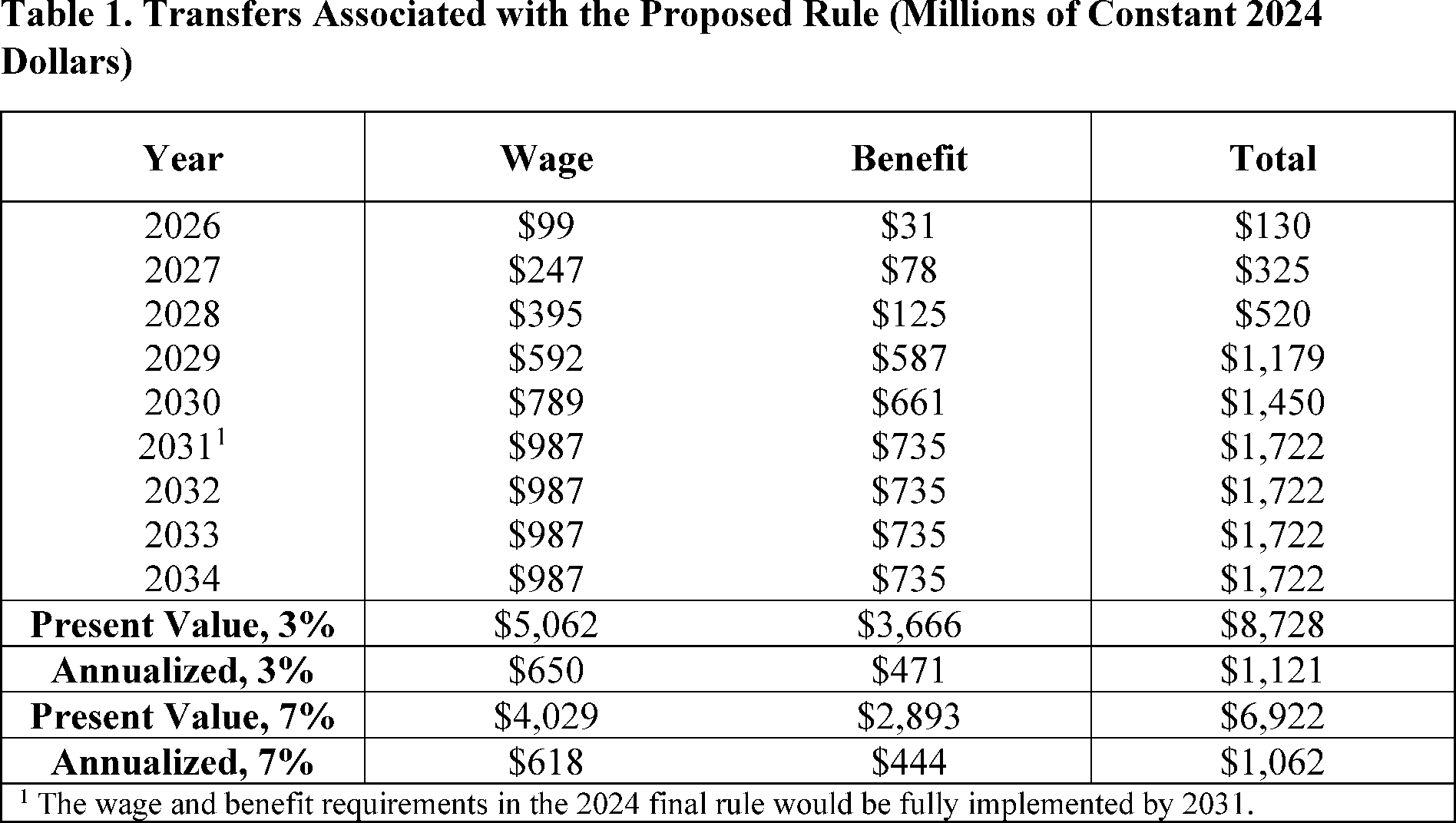
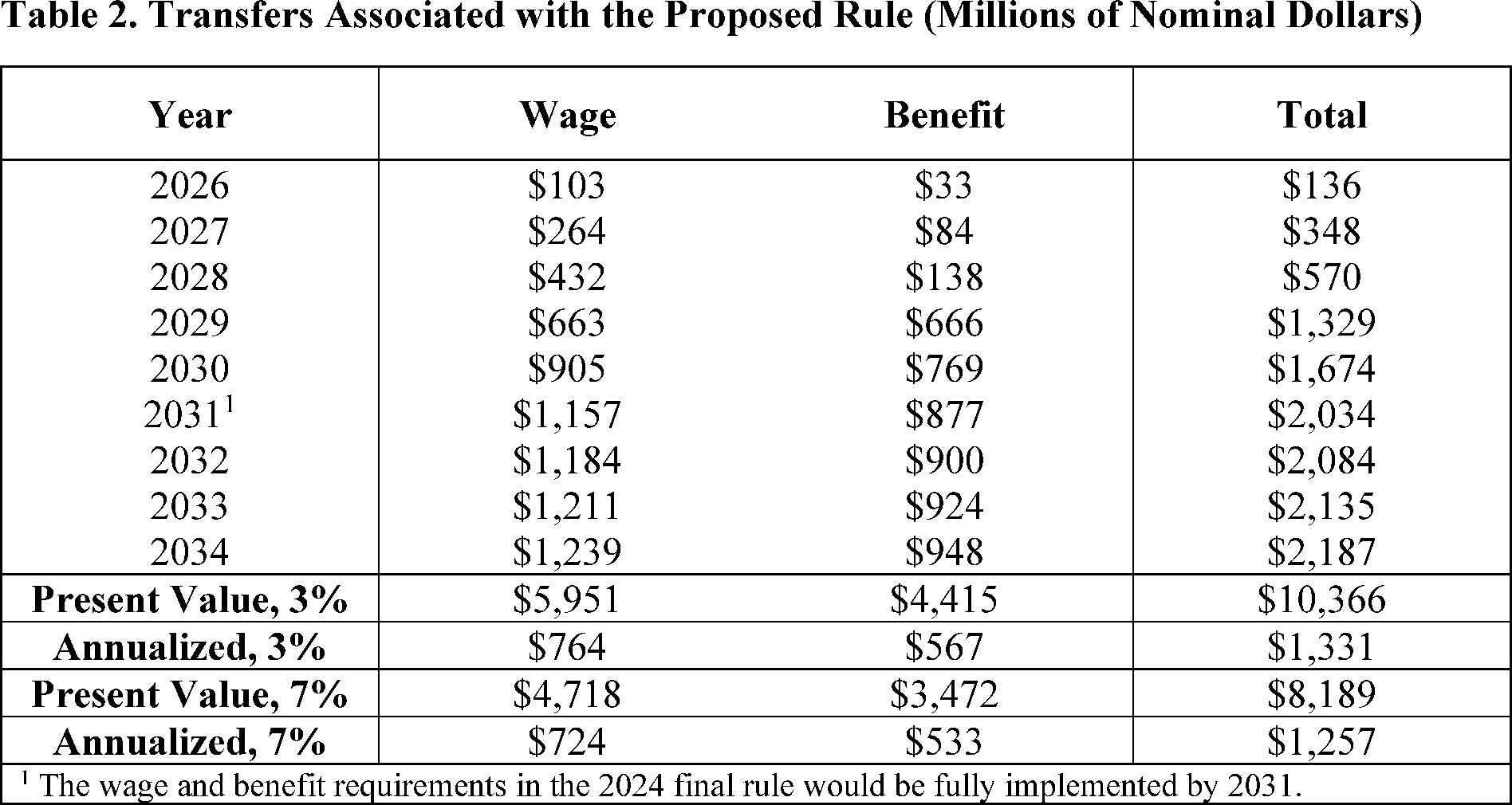
With the wage and benefit requirements rescinded, programs will no longer have to implement them by the compliance dates described above. This ultimately results in averting the anticipated expenditures needed to implement the wage and benefit requirements for Head Start staff; or, alternatively, averting the loss of services to children under the requirements of the 2024 final rule. The 2024 final rule RIA estimated that the four wage requirements would cost approximately $1.2 billion in nominal dollars when fully implemented in 2031. The RIA estimated that the staff benefit requirements would cost approximately $877 million in nominal dollars in 2031. ACF combines these figures to estimate the total transfers associated with removing these wage and benefit requirements—resulting in the reduction of $2.1 billion in expenditures.
In order to estimate the number of Head Start slots that will be saved by removing these staff wage and benefit requirements, ACF determined the proportion of FY 2024 funded enrollment that are Head Start Preschool slots (73.7 percent), and Early Head Start slots (26.3 percent), respectively. Next, ACF applied this proportion to the total monetary cost associated with this rule in FY 2024 dollars ($1.7 billion) and divided the cost that would be borne by the average cost per slot for Head Start Preschool in FY 2024 ($15,187) and the cost that will be borne in Early Head Start by the average cost per slot for Early Head Start in FY 2024 ($20,460). ACF uses cost per child because it is the best indicator for the number of slots programs would be able to retain if the staff wages and benefits requirements are removed from the Performance Standards through in this NPRM.
These calculations result in $1.3 billion in transfers attributed to Head Start Preschool slots and $452 million in transfers attributed to Early Head Start slots (in FY 2024 dollars). When divided by average cost per slot, this results in approximately 84,000 Head Start Preschool slots and 22,000 Early Head Start slots saved. Collectively, the net transfers associated with this proposed rule, if finalized, reflect a retention of approximately 106,000 Head Start slots (number of children served) nationally. In other words, by removing the wage and benefit requirements from the Performance Standards, and in the absence of additional appropriation increases for
( printed page 25847)
Head Start, programs will save as many as 106,000 slots that would otherwise have been cut in order to implement these wage and benefit requirements in the future.
Transfers Summary
Table 1 summarizes the quantified transfers with this proposed rule and the present value and annualized values corresponding to a 3% and 7% discount rate, with all monetary estimates reported in millions of constant 2024 dollars. Table 2 reports the same impacts in nominal dollars.
C. Non-Quantified Impacts of Certain Elements for the Proposed Rule
In addition to the transfers quantified in this RIA, removing staff wage and benefit requirements will restore local flexibility for individual programs to design services that are responsive to the individual needs of the communities in which they operate. Many programs continue to face staffing shortages that impact their ability to serve as many children as possible; [16]
however, the changes in this proposed rule, if finalized, provide programs more discretion to determine how to best
( printed page 25848)
address staff recruitment and retention challenges based on their local contexts. The rescission of the wage and benefit requirements as proposed in this NPRM will restore needed flexibility and autonomy to local programs so they may determine the best path forward for their program. By proposing to remove several costly requirements related to staff wages and benefits, these changes, if finalized, will alleviate unnecessary regulatory burden placed on Head Start programs.
D. Alternatives to the Proposed Rule
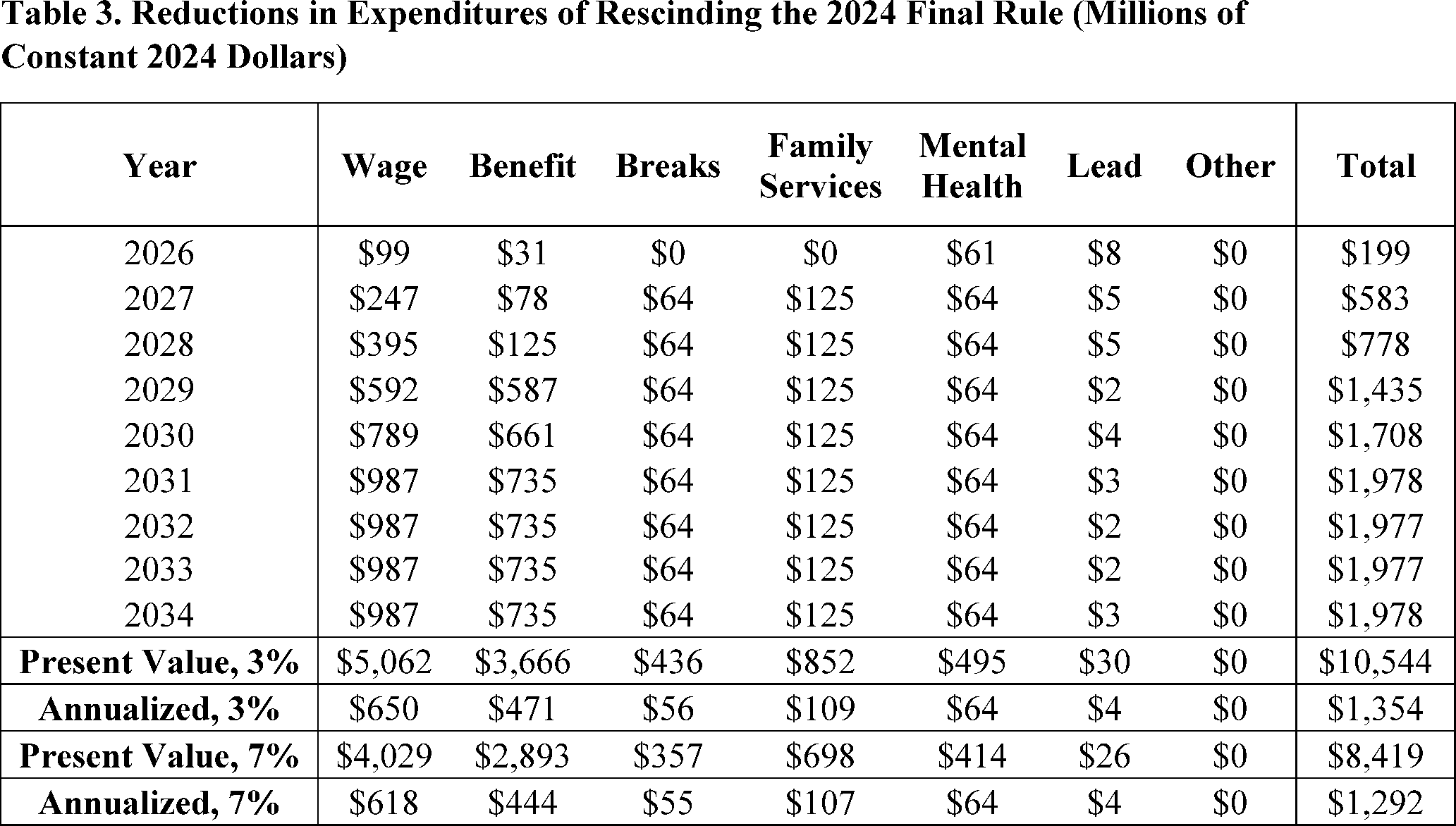
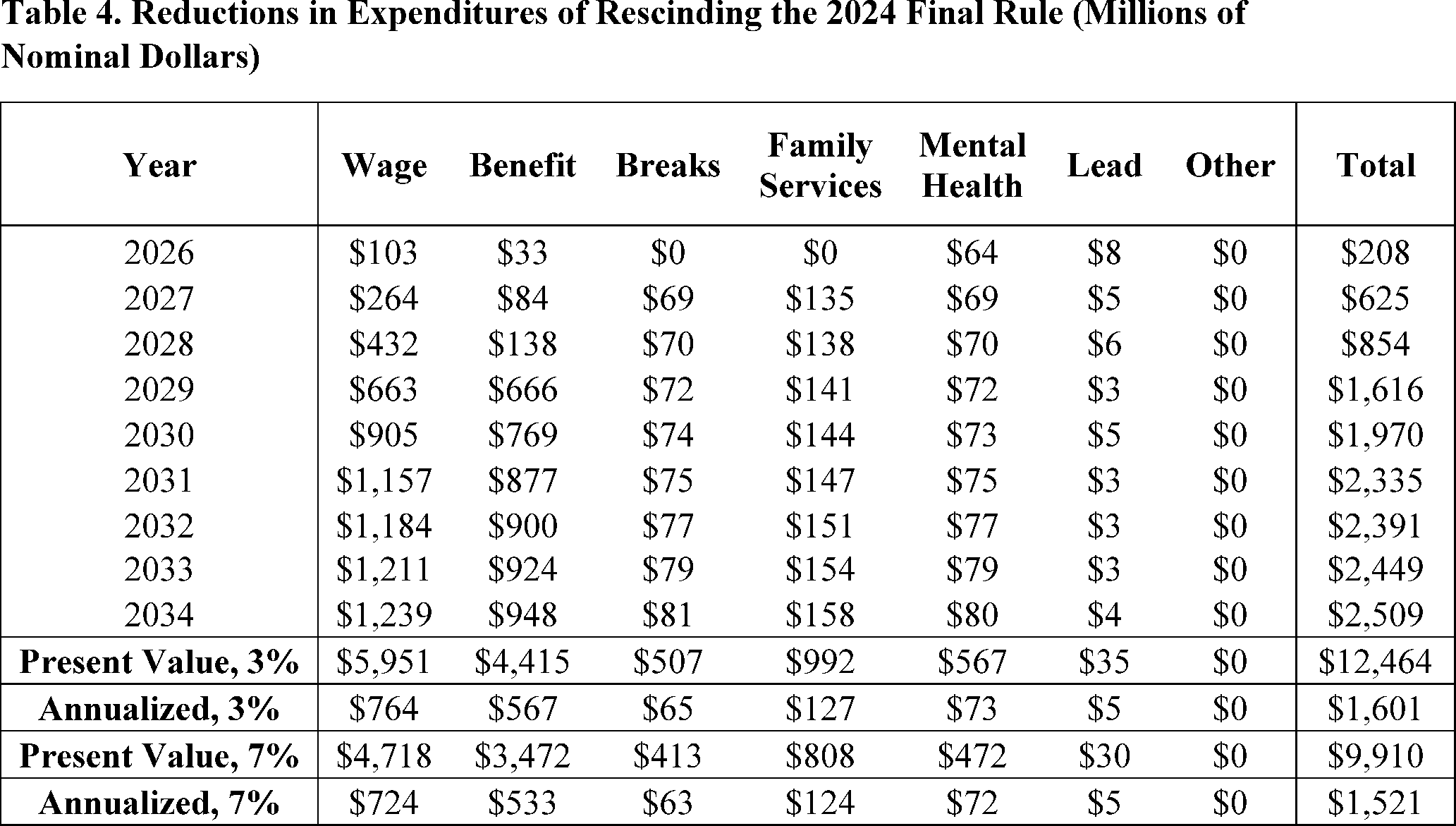
ACF considered and assessed several policy alternatives to the proposed rule. In the analysis below, we model a full rescission of the 2024 final rule, which included the following policies with quantified economic impacts: staff wages, staff benefits, staff breaks, family service worker family assignments, mental health supports, and preventing and addressing lead exposure, as well as associated administrative costs. Our modeling approach of separately estimating and reporting the costs associated with each of these policies enabled ACF to assess additional policy alternatives, such as rescinding subsets of policies included with the 2024 final rule. As noted in our main analysis, ACF is proposing to rescind a particular subset of those policies, rather than a full rescission. All other policies beyond these from the 2024 final rule were not associated with quantified effects. Table 3 and Table 4 summarize the total expenditures needed to implement the 2024 final rule that would represent reductions in expenditures if the 2024 final rule were rescinded, reporting yearly estimates, and present value and annualized values corresponding to a 3% and 7% discount rate (updated from a 2% discount rate applied in the 2024 final rule RIA) for each of the policies. Collectively, the net reduction in expenditures associated with a full rescission of the 2024 final rule reflects a retention of approximately 96,000 Head Start Preschool slots and 25,000 Early Head Start slots nationally. In other words, by rescinding the 2024 final rule, Head Start programs would retain approximately 121,000 slots that would otherwise have been cut in order to implement these policies. This represents an additional 15,000 slots saved beyond the 106,000 retained by rescinding the staff wage and benefit policies. The tables below, as well as the additional analyses documented in this RIA, enabled ACF to appropriately consider a range of feasible policy alternatives.
2.
Institute of Medicine and National Research Council. (2000).
From Neurons to Neighborhoods: The Science of Early Childhood Development.
Washington, DC: The National Academies Press.
https://doi.org/10.17226/9824.;
Tierney A.L. & Nelson, C.A. (2009).
Brain Development and the Role of Experience in the Early Years.
Zero Three. 30(2):9-13.
3.
Blair, C. & Raver, CC. (2016). Poverty, Stress, and Brain Development: New Directions for Prevention and Intervention.
Academic Pediatrics,
16(3 Suppl):S30-6.; Robinson L.R., Bitsko, R.H., & Thompson, R.A., et al. (2017).
CDC Grand Rounds: Addressing Health Disparities in Early Childhood.
MMWR Morb Mortal Wkly Rep 2017; 66:769-772. DOI:
https://dx.doi.org/10.15585/mmwr.mm6629a1.
4.
Deming, D. (2009). Early Childhood Intervention and Life-Cycle Skill Development: Evidence from Head Start. American Economic Journal: Applied Economics, 1:3, 111-134.; Lipscomb, S.T., Pratt, M.E., Schmitt, S.A., Pears, K.C., and Kim, H.K. (2013). School readiness is children living in non-parental care: Impacts of Head Start. Journal of Applied Developmental Psychology, 31 (1), 28-37.
13.
See section
VII. Regulatory Process Matters
of Supporting the Head Start Workforce and Consistent Quality Programming, 89 FR 67720 (August 21, 2024).
14.
Friedman-Krauss, A.H., Barnett, W.S., Hodges, K.S., Garver, K.A., Duer, J., Weisenfeld, G., & Siegel, J. (2025). The State of Preschool 2024: State Preschool Yearbook. New Brunswick, NJ: National Institute for Early Education Research.
Use this for formal legal and research references to the published document.
91 FR 25842
Web Citation
Suggested Web Citation
Use this when citing the archival web version of the document.
“Restoring Flexibility To Support Head Start Program Access,” thefederalregister.org (May 12, 2026), https://thefederalregister.org/documents/2026-09383/restoring-flexibility-to-support-head-start-program-access.