Takes of Marine Mammals Incidental to Specified Activities; Taking Marine Mammals Incidental to the Interstate Bridge Replacement Project on Interstate 5 between Portland, OR, and Vancouver, WA
NMFS, upon request from the Interstate Bridge Replacement Program (IBRP), issues this final rule and associated 5-year letter of authorization (LOA) pursuant to the Marine Mamma...
National Marine Fisheries Service (NMFS), National Oceanic and Atmospheric Administration (NOAA), Commerce.
ACTION:
Final rule; notice of issuance of letter of authorization.
SUMMARY:
NMFS, upon request from the Interstate Bridge Replacement Program (IBRP), issues this final rule and associated 5-year letter of authorization (LOA) pursuant to the Marine Mammal Protection Act (MMPA), to govern the taking of marine mammals incidental to construction activities conducted in support of the Interstate Bridge Replacement Project (IBR Project) on Interstate 5 (I-5) between Portland, Oregon, and Vancouver, Washington, over the course of 5 years. This final rule prescribes the permissible methods of taking and other means of effecting the least practicable adverse impact on marine mammal species and their habitat and establishes requirements pertaining to the monitoring and reporting of such taking.
DATES:
This final rule and LOA are effective from September 15, 2027, through September 14, 2032.
Cara Hotchkin, Office of Protected Resources, NMFS, (301) 427-8401.
SUPPLEMENTARY INFORMATION:
Background
The MMPA prohibits the “take” of marine mammals, with certain exceptions. Sections 101(a)(5)(A) and (D) of the MMPA (16 U.S.C. 1361et seq.) direct the Secretary of Commerce
( printed page 28444)
(as delegated to NMFS) to allow, upon request, the incidental, but not intentional, taking of small numbers of marine mammals by U.S. citizens who engage in a specified activity (other than commercial fishing) within a specified geographical region if certain findings are made and either regulations are promulgated and a LOA is issued or an incidental harassment authorization (IHA) is issued.
Authorization for incidental takings shall be granted if NMFS finds that the taking will have a negligible impact on the species or stock(s) and will not have an unmitigable adverse impact on the availability of the species or stock(s) for taking for subsistence uses (where relevant). If such findings are made, NMFS must prescribe the permissible methods of taking and other “means of effecting the least practicable adverse impact” on the affected species or stocks and their habitat, paying particular attention to rookeries, mating grounds, and areas of similar significance, and on the availability of the species or stocks for taking for certain subsistence uses (referred to in shorthand as “mitigation”); and set forth requirements pertaining to the monitoring and reporting of the takings. The definitions of applicable MMPA statutory terms are provided directly below or included in the relevant sections of this rule.
U.S. citizen
—individual U.S. citizens or any corporation or similar entity if it is organized under the laws of the United States or any governmental unit defined in 16 U.S.C. 1362(13); 50 CFR 216.103;
Take
—to harass, hunt, capture, or kill, or attempt to harass, hunt, capture, or kill any marine mammal (16 U.S.C. 1362(13));
Incidental harassment, incidental taking, and incidental, but not intentional, taking
—an accidental taking. This does not mean that the taking is unexpected, but rather it includes those takings that are infrequent, unavoidable or accidental (50 CFR 216.103);
Level A harassment
—any act of pursuit, torment, or annoyance which has the potential to injure a marine mammal or marine mammal stock in the wild (16 U.S.C. 1362(18); 50 CFR 216.3); and
Level B harassment
—any act of pursuit, torment, or annoyance which has the potential to disturb a marine mammal or marine mammal stock in the wild by causing disruption of behavioral patterns, including, but not limited to, migration, breathing, nursing, breeding, feeding, or sheltering (16 U.S.C. 1362(18); 50 CFR 216.3).
Purpose of Regulatory Action
NMFS received an application from the IBRP requesting 5-year regulations and a LOA issued thereunder to take individuals of three species (California sea lion, Steller sea lion, and harbor seal), comprising three stocks of marine mammals, by Level A harassment and Level B harassment incidental to the IBRP's activities. No serious injury or mortality is anticipated or authorized. Please see the Background section for definitions of harassment.
These regulations, promulgated under the authority of the MMPA (16 U.S.C. 1361et seq.), provide a framework for authorizing the take of marine mammals incidental to construction activities associated with the IBR Project, including impact and vibratory pile driving. The regulations include mitigation, monitoring, and reporting requirements. These requirements, which were proposed by IBRP, are expected to minimize the number and/or intensity of incidents of marine mammal take, as well as to provide information to better understand the impacts of the action and document compliance. IBRP has agreed that all of the mitigation measures are practicable. As required by the MMPA, NMFS concurred that these measures are sufficient to achieve the least practicable adverse impact on the affected marine mammal species or stocks and their habitat.
Legal Authority for the Action
Section 101(a)(5)(A) of the MMPA (16 U.S.C. 1371(a)(5)(A)) directs the Secretary of Commerce to allow, upon request, the incidental, but not intentional taking of small numbers of marine mammals by U.S. citizens who engage in a specified activity (other than commercial fishing) within a specified geographical region for up to 5 years if, after notice and public comment, the agency makes certain findings and promulgates regulations that set forth permissible methods of taking pursuant to that activity and other means of effecting the “least practicable adverse impact” on the affected species or stocks and their habitat (see the discussion below in the Mitigation section), as well as monitoring and reporting requirements. Section 101(a)(5)(A) of the MMPA and the implementing regulations at 50 CFR part 216, subpart I provide the legal basis for issuing this rule containing 5-year regulations and a 5-year LOA.
Summary of Major Provisions Within the Rule
Following is a summary of the major provisions of this rule regarding the IBRP's activities. These measures include:
Prescribing permissible methods of taking of small numbers of marine mammals by Level A harassment and/or Level B harassment incidental to the IBR Project;
Required monitoring of the construction areas to detect the presence of marine mammals before beginning construction activities;
Establishment of shutdown zones;
Bubble curtains required for impact driving of steel piles except as necessary to verify bubble curtain effectiveness during hydroacoustic monitoring;
Soft start for impact pile driving to allow marine mammals the opportunity to leave the area prior to beginning impact pile driving at full power;
Submittal of monitoring reports including a summary of marine mammal species and behavioral observations, construction shutdowns or delays, and construction work completed; and
Hydroacoustic monitoring to verify effectiveness of noise attenuation devices and sound source level assumptions for modeling.
Through adaptive management, the regulations allow NMFS Office of Protected Resources to modify (
e.g.,
remove, revise, or add to) the existing mitigation, monitoring, or reporting measures summarized above and required by the LOA.
Summary of Request
On July 18, 2024, NMFS received an application from the IBRP requesting authorization for take of marine mammals incidental to construction activities related to the IBR Project on I-5 between Portland, OR, and Vancouver, WA. After the IBRP responded to our questions on October 12, 2024, and January 14, 2025, we determined the application was adequate and complete on January 16, 2025. We published a notice of receipt in the
Federal Register
on March 13, 2025 (90 FR 11950, March 13, 2025) and received 38 comments. Of these, 37 were opposed to the IBR Project; most suggested an alternative project design unrelated to IBRP's request for incidental take authorization, and which are outside the scope of NMFS' action in promulgating regulations under the MMPA because the design of the project is at the discretion of the IBRP. One comment letter expressed support for the IBR Project and the potential associated
( printed page 28445)
increases in employment and training opportunities for ironworkers. NMFS determined that these comments did not provide information relevant to our decision under the MMPA. On August 19, 2025, NMFS published a proposed rule (90 FR 40492) (Proposed Rule) and a request for public comments in the
Federal Register
; we received three total comments on the proposed rule, none of which were relevant to our findings due to a lack of substantive information provided or because the comments were on issues outside the scope of NMFS' action (
i.e.,
on the project's design).
Changes From the Proposed to Final Rule
There have been several changes from the proposed rule in this final rule. First, in the Estimated Take of Marine Mammals section (table 10 of the Proposed Rule; table 3 of this final rule), the proxy source levels for vibratory driving have been adjusted. This minor change was made to account for the discrepancy between measured and assumed values noted in footnote 4 of table 10 in the Proposed Rule. Specifically, single-hammer vibratory driving proxy source levels have been revised from 175 decibels (dB) root mean square (RMS) re 1 micropascal (µPa) to 170 dB RMS re 1 µPa and associated proxy sound levels (for simultaneous vibratory driving of two piles) have been adjusted from 178 dB RMS to 173 dB RMS, following the methodology outlined in the Proposed Rule for additive sources. The associated Level A and Level B harassment isopleths have been recalculated and are shown in table 4 of this final rule. These changes are small and result in no impact to the estimated take of marine mammals because of the curvature of the river restricting the propagation of sound up and downstream. There were small reductions to the AUD INJ harassment zone isopleths and ensonified areas that are shown in table 3 of this rule.
Secondly, proxy sound levels (dB peak) for simultaneous impact driving of two 24-inch (in) piles and for two 48-in piles were incorrectly calculated in the proposed rule. They have been corrected; these are now 201 dB peak and 210 dB peak, respectively. The RMS and single-strike sound exposure level (SELss) values shown in the proposed rule were correct and have not changed, and no changes were made to the resulting Level A or Level B harassment zone isopleths and associated estimates of exposures.
Thirdly, the Proposed Monitoring and Reporting section of the Proposed Rule and section 217.146(e)(v) of the proposed regulatory text incorrectly included hydroacoustic monitoring of vibratory pile driving; this language has been removed from the final rule. The inclusion of hydroacoustic monitoring for vibratory pile driving was purely a clerical error; monitoring of impact driving is required under the applicant's U.S. Army Corps of Engineers consultation due to potential injurious take of endangered salmonid fishes. Vibratory driving has no potential for injurious take of fishes, and thus no hydroacoustic monitoring is required under that consultation. Hydroacoustic monitoring of impact driving is planned and remains included in this final rule.
Finally, in the regulatory text, the following changes were made: all of section 217.145(a)(4)(ii), and part of section 217.145(a)(6)(iii) were deleted to remove confusion about whether the shutdown zone must be fully visible in order to be effectively monitored during short periods of adverse weather conditions; section 217.145(a)(6)(v) was deleted to reduce redundancy in the regulatory text with section 217.145(a)(3); and section 217.147(c) was deleted because the LOA as issued is valid for the duration of the effective dates. Additionally, § 217.146(d)(4) of the proposed rule was missing a standard requirement to report the number of marine mammals detected within the harassment zones, by species. This language has been added to the regulatory text (§ 217.146(d)(4)(ix)) and the associated LOA. Other clerical errors such as numbering were corrected and clerical changes corresponding to the substantive changes described above were made as needed.
Description of Specified Activity
Overview
The IBR Project will improve I-5 corridor mobility by addressing present and future travel demand and mobility needs in the IBR Project area. The project consists of multiple components and interchanges, extending from approximately Columbia Boulevard in the south to State Route (SR) 500 in the north; one component of the project is to replace the existing bridges over the Columbia River and North Portland Harbor to accommodate increasing travel demand and congestion, improve safety related to traffic accidents, and reduce vulnerability to seismic events. The existing bridges do not meet current seismic standards and are vulnerable to failure in an earthquake. The IBR Project is anticipated to take approximately 9 to 15 years to complete and will require in-water work in up to 9 construction seasons. These regulations are effective for the first 5 construction years (2027-2032). IBRP anticipates requesting additional future incidental take authorizations as necessary in association with subsequent years of construction.
Exact project sequencing is still in development; however, it is currently anticipated that work to be conducted during the first 5 years of the IBR Project will include construction of the new Columbia River Bridge and associated approaches, and construction of the transit bridge crossing the North Portland Harbor. In-water pile driving for the first 5 construction years will include both impact and vibratory driving of temporary steel pipe (24- in (0.61 meters (m)) and 48-in (1.2 m) diameter) and steel sheet piles. Permanent bridge foundations will be constructed using 10-foot (ft) (3-m) diameter steel casings installed with an oscillator, analogous to a rotary drill. Impact driving would be conducted primarily with the use of a bubble curtain, with a minimal amount of unattenuated driving to confirm bubble curtain effectiveness. In-water pile driving associated with the project will include installation and potential removal of approximately 1,560 temporary steel pipe piles, and 1,500 linear ft (457 m) of steel sheet piles over the 5-year period.
Dates and Duration
IBRP anticipates that in-water construction activities associated with this project will begin on September 15, 2027, and extend through September 14, 2032. In-water pile installation for the first 5 years of the IBR Project is expected to occur on approximately 1,725 non-consecutive days. While the exact project design and sequence of construction are not yet finalized, in-water project elements and estimated durations are shown in table 1. Land-based project elements do not have the potential to cause take of marine mammals; for a description and information on the duration of land-based elements, please see the Proposed Rule. Construction timing, sequencing, and duration are dependent on funding, design assumptions, contractor schedules and equipment, and weather, among other factors. The duration estimates shown are based on the best available information at the time of publication of this final rule; however, the schedule may shift such that actual activities occur in different years than specified below.
Impact driving will be restricted to an in-water work window between September 15 and April 15 of each year.
( printed page 28446)
This window was determined via coordination with state (Oregon Department of Fish and Wildlife (ODFW) and Washington Department of Fish and Wildlife (WDFW)) and Federal (U.S. Army Corps of Engineers, Federal Highway Administration, Federal Transit Administration, and NMFS) agencies, Tribal parties, and public input to reduce potential impacts to Endangered Species Act (ESA)-listed fishes. Vibratory pile driving will occur year-round.
Table 1—In-Water Project Elements, Locations and Estimated Durations for the IBR Project
Project element
Estimated duration
Element location
Notes
Columbia River Bridges
4 to 7 years
In-water
Years 1-5: Construction is likely to begin with the main river bridges. General sequence will include initial preparation and installation of foundation piles, shaft caps, pier columns, superstructure, and deck.
North Portland Harbor Bridges
4 to 10 years
In-water
Years 1-5: Existing North Portland Harbor bridge will be demolished in phases to accommodate traffic during construction of the new bridges.
Demolition of the existing Interstate Bridge
1.5 to 3 years
In-water
Years 6-15: Demolition of the existing Interstate Bridge could begin only after traffic is rerouted to the new Columbia River bridges.
Specified Geographical Region
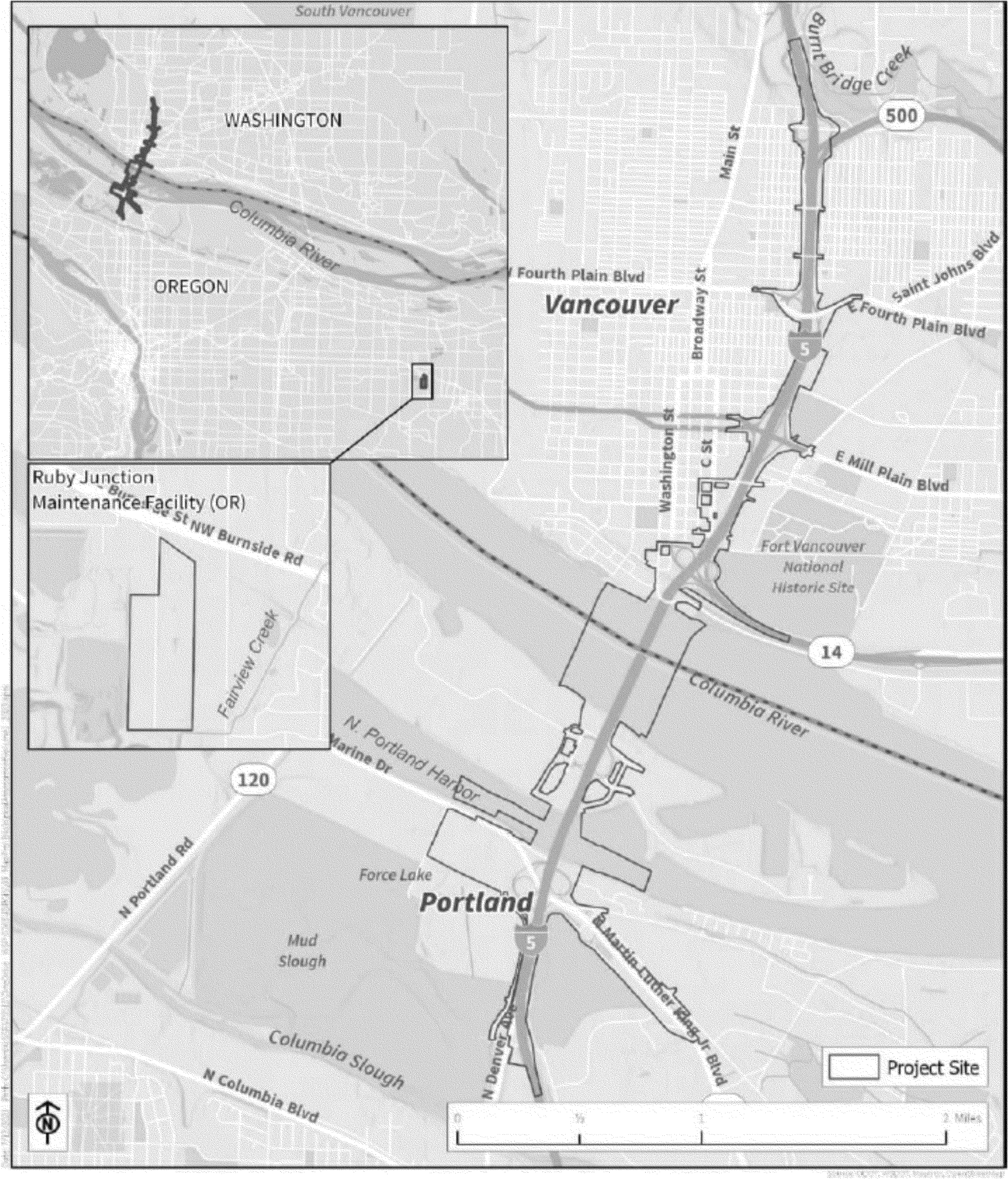
The IBR Project will replace the bridge spans across the Columbia River and North Portland Harbor and the associated highway interchanges on an approximately 5-mile (mi) (8 kilometer (km)) stretch of I-5 between Portland, OR, and Vancouver, WA (figure 1). In-water work will occur in the subset of the IBR Project area between the north bank of the Columbia River in Washington and the south shore of the North Portland Harbor in Oregon, between river miles 106 and 107. The widths of the Columbia River and North Portland Harbor at this location are approximately 0.5 mi (841 m) and 0.18 mi (295 m), respectively.
( printed page 28447)
Figure 1—Overview of IBR Project Location along I-5 between Portland, OR, and Vancouver, WA
Detailed Description of the Specified Activity
A detailed description of IBRP's planned activities are provided in the Proposed Rule. Since publication of the proposed rule, IBRP has not made any modifications to their activities; therefore, we direct the reader to the proposed rule for a detailed description. Similar to the proposed rule, mitigation, monitoring, and reporting measures proposed by IBRP, and included in this final rule are, described in detail later in this document (please see Mitigation and Monitoring and Reporting).
Description of Marine Mammals in the Area of Specified Activities
Three species of marine mammals, comprising three stocks, may be taken by harassment incidental to IBRP's specified activities. A complete description of marine mammal status and trends, life history, habitat use, and threats is included in IBRP's application and NMFS' Proposed Rule. These details are not repeated here except for the reference table containing status, stock abundance, potential biological removal levels, and annual rates of mortality and serious injury (table 2).
( printed page 28448)
Table 2—Species With Estimated Take From the Specified Activities
Common name
Scientific name
MMPA Stock
ESA/
MMPA
status;
strategic
(Y/N) 1
Stock abundance N
best
, (CV, N
min
, most recent abundance survey) 2
Potential
Biological
Removal
(PBR)
Annual
Mortality/
Serious
Injury
(M/SI) 3
Order Carnivora—Superfamily Pinnipedia
Family Otariidae (eared seals and sea lions):
California sea lion
Zalophus californianus
U.S
-, -, N
257,606 (N/A, 233,515, 2014)
14,011
>321
Steller sea lion
Eumetopias jubatus
Eastern
-, -, N
36,308 (N/A, 36,308, 2022) 4
2,178
93.2
Family Phocidae (earless seals):
Harbor seal
Phoca vitulina
OR/WA Coastal
-, -, N
22,549 (UND, 19,561, 2022) 5
UND 6
10.6
1
ESA status: endangered (E), threatened (T)/MMPA status: depleted (D). A dash (-) indicates that the species is not listed under the ESA or designated as depleted under the MMPA. Under the MMPA, a strategic stock is one for which the level of direct human-caused mortality exceeds PBR or which is determined to be declining and likely to be listed under the ESA within the foreseeable future. Any species or stock listed under the ESA is automatically designated under the MMPA as depleted and as a strategic stock.
3
These values, found in NMFS' SARs, represent annual levels of human-caused mortality plus serious injury from all sources combined (
e.g.,
commercial fisheries, ship strike). Annual M/SI often cannot be determined precisely and is in some cases presented as a minimum value or range.
4
Nest is best estimate of counts, which have not been corrected for animals at sea during abundance surveys. Estimates provided are for the United States only.
5
Most recent SAR does not include an abundance estimate for this stock. These data are for the Washington coast and thus underestimate the size of the OR/WA Coastal stock; estimates are from Pearson
et al.
(2024).
6
UND means undetermined.
Potential Effects of Specified Activities on Marine Mammals and Their Habitat
The effects of underwater noise from the IBRP's construction activities have the potential to result in harassment of marine mammals in the Columbia River. We refer the reader to the Proposed Rule for a full discussion of the effects of anthropogenic noise on marine mammals in general and the potential effects of the specified activities on marine mammals and their habitat. There is no newly available relevant information that would change our analyses or the results thereof.
Estimated Take of Marine Mammals
Harassment is the only type of take expected to result from these activities. Except with respect to certain activities not pertinent here, section 3(18) of the MMPA defines “harassment” as any act of pursuit, torment, or annoyance which: (i) has the potential to injure a marine mammal or marine mammal stock in the wild (Level A harassment); or (ii) has the potential to disturb a marine mammal or marine mammal stock in the wild by causing disruption of behavioral patterns, including, but not limited to, migration, breathing, nursing, breeding, feeding, or sheltering (Level B harassment).
Authorized takes would primarily be by Level B harassment, as use of the acoustic sources (
i.e.,
pile driving activities) have the potential to result in disruption of behavioral patterns for individual marine mammals. There is also some potential for auditory injury (AUD INJ) (Level A harassment) to result, primarily for phocids because predicted AUD INJ zones are larger than for otariids. The required mitigation and monitoring measures are expected to minimize the potential for take and, if take were to occur, the severity of the taking to the extent practicable. As described previously, no serious injury or mortality is anticipated or proposed to be authorized for this activity.
This final rule incorporates the harassment thresholds used in the proposed rule to estimate the manner and number of takes analyzed in this final rule and LOA. In summary, IBRP's proposed activity includes the use of continuous (vibratory pile driving and extraction) and impulsive (impact pile driving) sources, and therefore the RMS sound pressure level (SPL) thresholds of 120 and 160 dB re 1µPa are applicable. NMFS also applied the Updated Acoustic Technical Guidance (NMFS, 2024) to determine the potential for Level A harassment, as described in the proposed rule.
Since publication of the proposed rule, NMFS has revised our consideration of the proposed source values for vibratory pile driving to account for the discrepancy between measured and assumed values noted in footnote 4 of table 10 in the Proposed Rule. Specifically, we made the following modifications:
Single-hammer vibratory driving proxy source levels have been revised from 175 dB RMS to 170 dB RMS. Sound pressure levels above 170 dB RMS have not been measured for 24- to 48-in piles at any location; however, 170 dB RMS at 10 m from the incident pile is characteristic of the average measured values across locations;
Proxy sound levels (dB RMS) for simultaneous vibratory driving of two piles have been adjusted from 178 dB RMS to 173 dB RMS, following the methodology outlined in the Proposed Rule for additive sources; and
Proxy sound levels (dB peak) for simultaneous impact driving of two 24-in piles and for two 48-in piles have been adjusted due to an error in the proposed rule. The peak values were not correctly adjusted; these are now 201 dB peak and 210 dB peak, respectively. The RMS and SELss
values shown in table 10 of Proposed Rule were correct and have not changed, and no changes were made to the resulting Level A or Level B harassment zone isopleths and associated estimates of exposures.
As a result, straight-line distances to Level B harassment thresholds for vibratory pile driving decreased, but the ensonified area did not change due to the river curvature and site geography limiting sound propagation. Table 3 contains updated distances to thresholds and corresponding areas for vibratory pile driving activities in both the Columbia River and North Portland Harbor sites.
( printed page 28449)
Table 3—Updated Calculated Level A and B Harassment Isopleths in the Columbia River and North Portland Harbor for Vibratory Pile Driving
Pile size and type
Level A harassment zone (m/km2
)—Phocids & Otariids a
Level B harassment zone
(m/km2
) b
Proposed
Final
Proposed
Final
Columbia River
24-in steel pipe (Unattenuated, single)
236.3; 0.18
219; 0.15
46,414; 17.63
21,544; 17.63
48-in steel pipe (Unattenuated, single)
Steel sheet (Unattenuated, single)
24-in and or 48-in and or sheet (Unattenuated, concurrent)
374.5; 0.58
348; 0.53
73,564; 17.63
34,145; 17.63
North Portland Harbor
24-in steel pipe (Unattenuated, single)
236.3; 0.12
219; 0.11
46,414; 2.25
21,544; 2.25
48-in steel pipe (Unattenuated, single)
Steel sheet (Unattenuated, single)
24-in and or 48-in and or sheet (Unattenuated, concurrent)
374.5; 0.22
348; 0.20
73,564; 2.25
34,145; 2.25
a
Level A harassment zones for phocids have been applied to both phocids and otariids in this analysis. The calculated Level A isopleths for otariids are 73.8 and 117.0 m for single and concurrent scenarios, respectively.
b
Level B harassment ensonified areas are limited by the river curvature and geography of the two locations.
The Proposed Rule included a description of the methodology IBRP used to estimate exposures from the specified activities. Potential take, by Level A and Level B harassment, was quantified for all three species as a guild based on recent surveys done by ODFW and WDFW (15.2 in September through April; 6.7 in May through August), the likelihood of exposure during each construction activity, and the number of days estimated for each activity. The estimated exposures for each activity in a given year were then summed to estimate total annual exposures. None of the changes in this final rule resulted in changes to the proposed estimates of take by Level A or Level B harassment (table 4).
Table 4—Calculated Annual and 5-Year Total Estimated Take per Activity by Level A and Level B Harassment
Activity
Year
Annual Level
A harassment
Annual Level
B harassment
Total
annual take
Impact—Unattenuated
1
8
76
84
2
4
38
42
3
4
38
42
4
4
38
42
5
4
38
42
5-year estimate
24
228
252
Impact—Attenuated
1
182
912
1,094
2
152
760
912
3
114
570
684
4
114
570
684
5
114
570
684
5-year estimate
676
3,382
4,058
Vibratory
1
0
2,713
2,713
2
0
2,713
2,713
3
0
2,713
2,713
4
0
2,713
2,713
5
0
2,713
2,713
5-year estimate
0
13,365
13,365
All Activities
Maximum Annual
190
3,701
3,891
5-year estimate
700
17,175
17,785
The percentages of take estimated by Level A harassment shown in the Proposed Pule (0 percent for vibratory pile installation and extraction; 5 percent for unattenuated impact piling; 10 percent for attenuated impact piling) were based on the activity duration in a typical day, the estimated Level A harassment isopleths, and the ability of pinnipeds to avoid the areas with highest sound exposure levels by swimming through other areas of the river or harbor. The maximum average travel speed of California sea lions in the Columbia River moving between the Bonneville Dam and the river mouth has been calculated at approximately 5.4 km per hour (hr) (Wright
et al.,
2010). For animals traveling at half of the maximum speed (2.7 km/hr) to traverse the entirety of the largest predicted Level A harassment zone (from 0.52 km downstream to 0.52 km upstream during concurrent impact driving) would take approximately 22 minutes, and approximately 1 hour for animals traveling at 1 km/hr. The largest Level
( printed page 28450)
A harassment zone calculated for 10 continuous hours of vibratory driving is 0.35 km (total of 0.7 km diameter) and would take an estimated 16 or 42 minutes for an animal to transit at 2.7 km/hr or 1 km/hr, respectively. The widths of the Columbia River and North Portland Harbor at the project site are approximately 841 m and 295 m, respectively. Therefore, animals in the Columbia River could potentially avoid the Level A harassment area entirely by increasing their distance from the relevant sound source. Animals in the North Portland Harbor would not be able to avoid the Level A harassment zone during transit.
NMFS considers it unlikely that an individual animal would remain in the 1 km zone immediately adjacent to the project site for more than 2 hours as there are no known resting or foraging areas in this urban, industrialized portion of the river. However, given the lack of site-specific observational data, the conservative proportions of take by Level A harassment presented in table 15 of the Proposed Rule and repeated in table 4 of this rule remain appropriate. Table 5 shows the maximum annual amount of take authorized in the LOA by species and stock, and the percentages of each stock that could be affected.
Table 5—Calculated Maximum Annual Take Authorized by Level A and Level B Harassment including percentage of Stocks Taken
Species
Stock
Maximum
annual
Level A
take
Maximum
annual
Level B
take
Total
maximum
annual
take
Percentage
of stock
taken
Harbor seal
OR/WA Coastal
190
3,701
3,891
17.3
Steller sea lion
Eastern
1.5
California sea lion
U.S.
10.7
Mitigation
The MMPA requires NMFS set forth in regulations the permissible methods of taking pursuant to the activity and other means of effecting the least practicable adverse impact on the species or stock and its habitat, paying particular attention to rookeries, mating grounds, and areas of similar significance, and on the availability of the species or stock for taking for certain subsistence uses (referred to in shorthand as mitigation). NMFS regulations require applicants for incidental take authorizations to include information about the availability and feasibility (economic and technological) of equipment, methods, and manner of conducting the activity or other means of effecting the least practicable adverse impact upon the affected species or stocks and their habitat (50 CFR 216.104(a)(11)).
In evaluating how mitigation may or may not be appropriate to effect the least practicable adverse impact on species or stocks and their habitat, as well as subsistence uses where applicable, NMFS considers two primary factors which are described below. For a full discussion of NMFS' implementation of the least practicable adverse impact standard, see 89 FR 31488, 31517 (April 24, 2024) as an example.
(1) The manner in which, and the degree to which, the successful implementation of the measure(s) is expected to reduce impacts to marine mammals, marine mammal species or stocks, and their habitat, as well as subsistence uses. This considers the nature of the potential adverse impact being mitigated (
e.g.,
likelihood, scope, range). It further considers the likelihood that the measure will be effective if implemented (probability of accomplishing the mitigating result if implemented as planned), the likelihood of effective implementation (probability of implementation as planned); and
(2) The practicability of the measures for applicant implementation, which may consider such things as cost and impact on operations.
This final rule incorporates all mitigation measures contained within the proposed rule without change. We refer the reader to the Proposed Rule on those measures and the expected benefit to marine mammals. In summary, the mitigation measures in this final rule include providing training of the protocols and operating procedures to all relevant personnel before the start of all pile driving, soft starts and bubble curtain use during impact driving, as well as standard shutdown zones to avoid physical interaction of marine mammals and construction equipment. IBRP would utilize NMFS-approved protected species observers (PSOs) during all activities that have the potential to result in take. As fully described in the Proposed Rule, NMFS has determined that the mitigation measures proposed by IBRP and contained within this final rule result in the least practicable adverse impact on marine mammals.
PSOs
The IBRP must employ PSOs and establish monitoring locations as described in a NMFS-approved Marine Mammal Monitoring and Mitigation Plan. For all pile driving activities, land-based PSOs must be stationed at the best vantage points practicable to monitor for marine mammals and implement mitigation procedures. A minimum of two locations must be used to monitor the harassment zones to the maximum extent possible based on positioning and daily visibility conditions. PSOs must be able to implement shutdown or delay procedures when applicable through communication with the equipment operator. Pre-start clearance monitoring must take place 30 minutes prior to initiation of pile driving activity (
i.e.,
pre-start clearance monitoring) through 30 minutes post-completion of pile driving activity during periods of visibility sufficient for the lead PSO to determine that the shutdown zones are clear of marine mammals. Pile driving may commence only if, following 30 minutes of observation, it is determined by the lead PSO that the shutdown zones are clear of marine mammals.
Shutdown Zones
For all pile driving activity, the IBRP must implement shutdown zones with radial distances shown in table 6. The IBRP, construction supervisors and crews, PSOs, and relevant IBRP staff must prevent direct physical interaction with marine mammals during construction activity. If a marine mammal comes within 10 m of such activity, operations must cease and vessels must reduce speed to the minimum level required to maintain steerage and safe working conditions, as necessary to prevent direct physical interaction.
( printed page 28451)
If a marine mammal is observed entering or within the shutdown zone, all pile driving activities at that location must be halted. If pile driving is halted or delayed due to the presence of a marine mammal, the activity may not commence or resume until either the animal has voluntarily left and has been visually confirmed beyond the shutdown zone or 15 minutes have passed without re-detection of the animal. In the event of a delay or shutdown of activity resulting from marine mammals in the shutdown zone, animal behavior must be monitored and documented. If work ceases for more than 30 minutes, the shutdown zones must be cleared again for 30 minutes prior to reinitiating pile driving.
Table 6—Shutdown Zones During Project Activities
Activity
Pile type/size
Shutdown zone
(m)
Monitoring zones
(m)
Level A
Level B
Impact—Unattenuated (Single Hammer)
24-in
10
46
1,000
48-in
184
5,412
Impact—Attenuated (Single Hammer)
24-in
10
83
341
48-in
328
1,848
Impact—Attenuated (Two Hammers)
24-in
10
131
541
48-in
521
2,929
Vibratory (Single Hammer)
24-in, 48-in, and sheet
10
a
18,593 (upstream) b
8,230 (downstream) b
Vibratory (Two Hammers)
24-in, 48-in, and sheet
a
Notes:
m = meter(s).
a
While the results of the underwater noise modeling indicate Level A harassment isopleths exist for cumulative exposure to underwater noise during vibratory pile driving, take by Level A harassment is not anticipated, and no Level A harassment Monitoring Zone is proposed for vibratory pile driving.
b
PSOs will monitor the Level B harassment zone to the extent possible based on positioning and environmental conditions.
Soft Start
The IBRP will use soft start techniques when impact pile driving. Soft start requires contractors to provide an initial set of three strikes at reduced energy, followed by a 30-second waiting period, then two subsequent reduced-energy strike sets. A soft start would be implemented at the start of each day's impact pile driving and at any time following cessation of impact pile driving for a period of 30 minutes or longer. Soft start procedures are used to provide additional protection to marine mammals by providing warning and/or giving marine mammals a chance to leave the area prior to the hammer operating at full capacity.
Noise Attenuation System
The IBRP will use a bubble curtain during impact pile driving in water depths greater than 0.67 m. The bubble curtain would be operated as necessary to achieve optimal performance. At a minimum, the bubble curtain will distribute air bubbles around 100 percent of the piling circumference for the full depth of the water column, the lowest bubble ring will be in contact with the substrate for the full circumference of the ring, and the weights attached to the bottom ring will ensure 100 percent substrate contact. No parts of the ring or other objects would prevent full substrate contact. In addition, air flow to the bubblers would be balanced around the circumference of the pile.
A hydroacoustic monitoring plan will be implemented during impact pile driving to confirm the attenuation device is installed and functioning as designed. This monitoring program will require some unattenuated pile strikes to confirm the amount of attenuation provided by the system. An estimated number of unattenuated pile strikes are also factored in to account for periods when the bubble curtain may not be providing sufficient attenuation. IBRP estimates that up to 75 unattenuated strikes may be required for a period of approximately 10 minutes approximately 1 day per week. Testing will occur for up to approximately 30 days during the 5-year period covered under this LOA, and on approximately 40 days total over the course of the in-water construction period.
Monitoring and Reporting
In order to issue take authorization for an activity, section 101(a)(5)(A) of the MMPA states that NMFS must set forth requirements pertaining to the monitoring and reporting of such taking. The MMPA implementing regulations at 50 CFR 216.104(a)(13) indicate that requests for authorizations must include the suggested means of accomplishing the necessary monitoring and reporting that will result in increased knowledge of the species and of the level of taking or impacts on populations of marine mammals that are expected to be present while conducting the activities. Effective reporting is critical both to compliance as well as ensuring that the most value is obtained from the required monitoring.
Monitoring and reporting requirements prescribed by NMFS should contribute to improved understanding of one or more of the following:
Occurrence of marine mammal species or stocks in the area in which take is anticipated (e.g.,
presence, abundance, distribution, density);
Nature, scope, or context of likely marine mammal exposure to potential stressors/impacts (individual or cumulative, acute or chronic), through better understanding of: (1) action or environment (e.g.,
source characterization, propagation, ambient noise); (2) affected species (
e.g.,
life history, dive patterns); (3) co-occurrence of marine mammal species with the activity; or (4) biological or behavioral context of exposure (
e.g.,
age, calving or feeding areas);
Individual marine mammal responses (behavioral or physiological) to acoustic stressors (acute, chronic, or cumulative), other stressors, or cumulative impacts from multiple stressors;
How anticipated responses to stressors impact either: (1) long-term fitness and survival of individual marine mammals; or (2) populations, species, or stocks;
Effects on marine mammal habitat (e.g.,
marine mammal prey species, acoustic habitat, or other important
( printed page 28452)
physical components of marine mammal habitat); and
Mitigation and monitoring effectiveness.
IBRP will abide by all monitoring and reporting measures contained within this final rule and LOA, and a NMFS-approved Marine Mammal Monitoring and Mitigation Plan. This final rule incorporates all monitoring measures contained within the Proposed Rule, without change. We refer the reader to the Proposed Rule for details regarding those measures and provide a summary of those measures below.
In summary, IBRP will utilize PSOs at least 30 minutes prior to, during, and 30 minutes after all activities that may result in take of marine mammals. PSOs will be independent of the activity contractor (
e.g.,
employed by a subcontractor) and have no other assigned tasks during monitoring periods. At least one PSO must have prior experience performing the duties of a PSO during an activity pursuant to a NMFS-issued ITA or Letter of Concurrence. Other PSOs may substitute other relevant experience, education (degree in biological science or related field), or training for prior experience performing the duties of a PSO.
PSOs should also have the following additional qualifications:
(a) The ability to conduct field observations and collect data according to assigned protocols;
(b) Experience or training in the field identification of marine mammals, including the identification of behaviors;
(c) Sufficient training, orientation, or experience with the construction operation to provide for personal safety during observations;
(d) Sufficient writing skills to record required information including but not limited to the number and species of marine mammals observed; dates and times when in-water construction activities were conducted; dates, times, and reason for implementation of mitigation (or why mitigation was not implemented when required); and marine mammal behavior; and
(e) The ability to communicate orally, by radio or in person with project personnel to provide real-time information on marine mammals observed in the area as necessary.
IBRP will also conduct hydroacoustic monitoring of both attenuated and unattenuated impact pile installation. Although hydroacoustic monitoring of vibratory pile driving was inadvertently included in the proposed rule, no hydroacoustic monitoring of vibratory driving is planned and none is required. Acoustic monitoring must consist of multiple hydrophones deployed at 10 m and in the far field with a direct, unobstructed path between the sound source and the hydrophones. System design and calibration must be appropriate for the expected sound levels to be recorded, with a frequency response between 20 hertz (Hz) and 20 kilohertz (kHz). Environmental data must also be collected, as well as information on the substrate composition, hammer model and size, hammer energy settings, and any other relevant information. Further details of the acoustic monitoring are discussed in the Proposed Rule and are not repeated here.
The reporting measures contained with the Proposed Rule are included in this final rule with two minor changes. First, references to reporting requirements for hydroacoustic monitoring of vibratory pile driving have been removed from the regulatory text. Secondly, in the regulatory text of the Proposed Rule, § 217.146(d)(4) omitted standard language requiring the reporting of the number of marine mammals detected within the harassment zones, by species. This standard language has been included in § 217.146(d)(4)(ix) of the regulatory text and section 6(b)(x) of the associated LOA.
The reports must contain dates and times of all marine mammal monitoring and the construction activities occurring during each daily observation period, the total duration of driving time for each pile (vibratory driving), and number of strikes for each pile (impact driving); environmental conditions during monitoring periods (at beginning and end of PSO shift and whenever conditions change significantly). Upon observation of a marine mammal, PSOs must record the name of the PSO who sighted the animal, observer location, and construction activity at time of sighting; identification of the animal to the lowest possible taxonomic level, PSO confidence in identification, and the composition of the group if there is a mix of species; distances and bearings of each marine mammal observed in relation to the pile being driven for each sighting; estimated number of animals by species and age class; closest point of approach and estimated time spent within the harassment zone. PSOs must also provide a description of any marine mammal behavioral observations, including an assessment of behavioral responses to the activity, the number of marine mammals detected within the harassment zones, by species, and detailed information about any implementation of any mitigation, a description of specific actions that ensued, and resulting changes in the behavior of the animal, if any. All PSO data must be submitted in an electronic format that can be queried such as a spreadsheet or database (
i.e.,
digital images of data sheets are not sufficient).
IBRP will submit interim monthly reports as well as a draft annual report within 90 calendar days of completion of marine mammal monitoring each year and a draft 5-year comprehensive summary to NMFS 90 days after the expiration of the regulations. Revised annual and 5-year reports must be prepared and submitted to NMFS within 30 days following receipt of any NMFS comments on the draft reports. Details on how monitoring reports will be submitted to NMFS and the information required in each report are detailed in the proposed rule and included in the associated LOA.
Acoustic monitoring report(s) must be submitted on the same schedule as visual monitoring reports (
i.e.,
within 90 days following the completion of construction). The acoustic monitoring report must contain the informational elements described in the acoustic monitoring plan and, at minimum, must include:
Hydrophone equipment and methods: (1) recording device, sampling rate, calibration details, distance (m) from the pile where recordings were made; and (2) the depth of water and recording device(s);
Location, identifier, orientation (e.g.,
vertical, battered), material, and geometry (shape, diameter, thickness, length) of pile being driven, substrate type, method of driving during recordings (
e.g.,
hammer model and energy), and total pile driving duration;
Whether a sound attenuation device is used and, if so, a detailed description of the device used, its distance from the pile and hydrophone, and the duration of its use per pile; and
For impact pile driving: (1) number of strikes per day and per pile and strike rate; (2) depth of substrate to penetrate; (3) decidecade (one-third octave) band spectra in tabular and figure formats computed on a per-pulse basis, including the arithmetic mean or median for all computed spectra; (4) pulse duration and median, mean, maximum, minimum, and number of samples (where relevant) of the following sound level metrics: (5) RMS SPL; (6) 24-hour sound exposure level (SEL24), peak (PK) SPL, and SELss.
If no comments are received from NMFS within 30 days after the submission of the draft report, the draft report would constitute the final report. If the IBRP received comments from
( printed page 28453)
NMFS, a final report addressing NMFS' comments would be submitted within 30 days after receipt of comments. The estimated harassment and shutdown zones may be modified with NMFS' approval following NMFS' acceptance of an acoustic monitoring report.
As described in the Proposed Rule, in the event that personnel involved in IBRP's activities discover an injured or dead marine mammal, IBRP would report the incident to the Office of Protected Resources, NMFS (
PR.ITP.MonitoringReports@noaa.gov), and to the West Coast Regional Stranding Coordinator as soon as feasible. If the death or injury was clearly caused by the specified activity, IBRP would be required to immediately cease the specified activities until NMFS is able to review the circumstances of the incident and determine what, if any, additional measures are appropriate to ensure compliance with this final rule. IBRP would not resume their activities until notified by NMFS. The report must include the time, date, and location (latitude/longitude) of the first discovery (and updated location information if known and applicable), the species identification (if known) or description of the animal(s) involved, the condition of the animal(s) (including carcass condition if the animal is dead), and the observed behaviors of the animal(s), if alive. Additionally, the report should include photographs or video footage of the animal(s), if available, and the general circumstances under which the animal was discovered.
Negligible Impact Analysis and Determination
NMFS has defined negligible impact as an impact resulting from the specified activity that cannot be reasonably expected to, and is not reasonably likely to, adversely affect the species or stock through effects on annual rates of recruitment or survival (50 CFR 216.103). A negligible impact finding is based on the lack of likely adverse effects on annual rates of recruitment or survival (
i.e.,
population-level effects). An estimate of the number of takes alone is not enough information on which to base an impact determination. In addition to considering estimates of the number of marine mammals that might be “taken” through harassment, NMFS considers other factors, such as the likely nature of any impacts or responses (
e.g.,
intensity, duration), the context of any impacts or responses (
e.g.,
critical reproductive time or location, foraging impacts affecting energetics), as well as effects on habitat, and the likely effectiveness of the mitigation. We also assess the number, intensity, and context of estimated takes by evaluating this information relative to population status. Consistent with the 1989 preamble for NMFS' implementing regulations (54 FR 40338, September 29, 1989), the impacts from other past and ongoing anthropogenic activities are incorporated into this analysis via their impacts on the baseline (
e.g.,
as reflected in the regulatory status of the species, population size and growth rate where known, ongoing sources of human-caused mortality, or ambient noise levels).
As described in the Proposed Rule, there are several key factors to assess whether potential impacts associated with a specified activity should be considered negligible. These include (but are not limited to) the type and magnitude of taking, the amount and importance of the available habitat for the species or stock that is affected, the duration of the anticipated effect on the individuals, and the status of the species or stock.
As described in the Changes from Proposed to Final Rule section and Estimated Take section of this final rule, NMFS identified minor adjustments to the proxy source level assumptions and methodology that resulted in small decreases to the ensonified areas within the Level A harassment zones. However, there was no associated change to the proposed amount of take by Level A harassment for any species anticipated to occur incidental to the specified activities. Given these limited, minor adjustments, NMFS has determined that this new information does not change any of the preliminary analyses, conclusions, or determinations in the Proposed Rule. Therefore, the preliminary analyses, conclusions, and determinations included in the Proposed Rule for all three species and stocks remain the same for this final rule. A summary of the expected effects of the taking allowed for in this final rule, the primary factors considered, and those findings as provided in the Proposed Rule are described below.
In summary, exposures to elevated sound levels produced during IBRP's activities may cause behavioral disturbance of some individuals within the vicinity of the sound source and have the potential to cause a small amount of slight auditory injury. The amount of annual take authorized is less than 18 percent of all stocks. NMFS notes that behavioral responses (
e.g.,
increased swimming speeds, changing directions of travel and diving and surfacing behaviors, increased respiration rates, or decreased foraging (if such activity were occurring) of marine mammals to construction noises are expected to be mild, short term, and temporary. Marine mammals may not present any visual cues they are disturbed by activities, or they could become alert, avoid the area, leave the area, or have other mild responses that are not observable such as increased stress levels (
e.g.,
Rolland
et al.,
2012; Bejder
et al.,
2006; Rako
et al.,
2013; Pirotta
et al.,
2015; Pérez-Jorge
et al.,
2016). They may also exhibit increased vocalization rates (
e.g.,
Dahlheim, 1987; Dahlheim and Castellote, 2016), louder vocalizations (
e.g.,
Frankel and Gabriele, 2017; Fournet
et al.,
2018), alterations in the spectral features of vocalizations (
e.g.,
Castellote
et al.,
2012), or a cessation of communication signals (
e.g.,
Tsujii
et al.,
2018).
All three marine mammal species present in the region will only be present temporarily based on seasonal patterns or during transit between other habitats. Thus, individuals present will be exposed to only transient periods of noise-generating activity as they move up- or down-river past the project site. Most likely, individual animals will either be temporarily deterred from swimming past the construction activities and will pass by when no pile driving is occurring or will swim through the area more quickly. Takes may also occur during important foraging seasons, when anadromous fishes are migrating past the IBR Project and marine mammals follow. However, the IBR Project area represents a small portion of available foraging habitat and impacts on marine mammal feeding for all species are expected to be minimal. No marine mammal species or individuals are known or expected to be resident in the IBR Project area, and impacts are unlikely to be more than temporary and low-intensity.
The intensity of harassment events would be minimized through use of mitigation measures described herein, which were not quantitatively factored into the take estimates. As stated in the Mitigation section, the IBRP will implement shutdown zones (table 6). Take by Level A harassment will be authorized for all three marine mammal species to account for the potential that an animal could enter and remain unobserved within the estimated Level A harassment zone for a duration long enough to incur AUD INJ. Any take by Level A harassment is expected to arise from, at most, a small degree of AUD INJ because animals would need to be exposed to higher levels and/or longer duration than are expected to occur here in order to incur any more than a small degree of AUD INJ.
( printed page 28454)
In summary, the following factors primarily support our negligible impact determinations for the affected stocks of California sea lions, Steller sea lions, and harbor seals:
No takes by mortality or serious injury are anticipated or authorized;
Any acoustic impacts to marine mammal habitat from pile driving are expected to be temporary and minimal;
Take will not occur in places and/or times where take would be more likely to accrue impacts on reproduction or survival, such as within habitats critical to recruitment or survival (e.g.,
rookery);
The IBR Project area represents a very small portion of the available foraging area for all potentially impacted marine mammal species and does not contain any habitat of particular importance;
Take will occur only within the Columbia River and North Portland Harbor, which is a limited, confined area of any given stock's home range;
Monitoring reports from similar work have documented little to no observable effect on individuals of the same species impacted by the specified activities;
The required mitigation measures (i.e.,
soft starts, pre-clearance monitoring, shutdown zones, bubble curtains) are expected to be effective in reducing the effects of the specified activity by minimizing the numbers of marine mammals exposed to injurious levels of sound and by ensuring that any take by Level A harassment is, at most, a small degree of AUD INJ and of a lower degree that would not impact the fitness of any animals; and
The intensity of anticipated takes by Level B harassment is low for all stocks consisting of, at worst, temporary modifications in behavior, and would not be of a duration or intensity expected to result in impacts on reproduction or survival.
Based on the analysis contained herein of the likely effects of the specified activity on marine mammals and their habitat, and taking into consideration the implementation of the required monitoring and mitigation measures, NMFS finds that the total marine mammal take from the planned specified activity would have a negligible impact on all affected marine mammal species or stocks.
Small Numbers
As noted previously, only take of small numbers of marine mammals may be authorized under section 101(a)(5)(A) and (D) of the MMPA for specified activities other than military readiness activities. The MMPA does not define small numbers and so, in practice, where estimated numbers are available, NMFS compares the maximum number of individuals taken in any year to the most appropriate estimation of abundance of the relevant species or stock in our determination of whether an authorization is limited to small numbers of marine mammals. When the predicted maximum annual number of individuals to be taken is fewer than one-third of the species or stock abundance, the take is considered to be of small numbers (see 86 FR 5322, January 19, 2021). Additionally, other qualitative factors may be considered in the analysis, such as the temporal or spatial scale of the activities.
As in the proposed rule, the maximum annual amount of take allowed under the final rule is less than one-third of the population abundance estimates for all stocks (table 5). The numbers of animals authorized to be taken are small relative to the relevant species or stock abundances even if each estimated take occurred to a new individual, and even if all take accrued to a single stock.
Given there is no substantive change to the small numbers analysis described in the proposed rule, it is herein incorporated by reference. Based on the analysis contained herein of the proposed activity (including the proposed mitigation and monitoring measures) and the anticipated take of marine mammals, NMFS finds that small numbers of marine mammals would be taken relative to the population size of the affected species or stocks.
Unmitigable Adverse Impact Analysis and Determination
There are no relevant subsistence uses of the affected marine mammal stocks or species implicated by this action. Therefore, NMFS has determined that the total taking of affected species or stocks would not have an unmitigable adverse impact on the availability of such species or stocks for taking for subsistence purposes.
Adaptive Management
The regulations governing the take of marine mammals incidental to IBRP's proposed construction activities would contain an adaptive management component.
The reporting requirements associated with this final rule are designed to provide NMFS with monitoring data from the previous year to allow consideration of whether any changes are appropriate. The use of adaptive management allows NMFS to consider new information from different sources to determine (with input from IBRP regarding practicability) on an annual basis if mitigation or monitoring measures should be modified (including additions or deletions). Mitigation or monitoring measures could be modified if new data suggests that such modifications would have a reasonable likelihood more effectively achieving the goals of the mitigation and monitoring and if the measures are practicable.
The following are examples of the possible sources of applicable data to be considered through the adaptive management process: (1) results from monitoring reports, as required by MMPA authorizations; (2) results from general marine mammal and sound research; and (3) any information which reveals that marine mammals may have been taken in a manner, extent, or number not authorized by these regulations or subsequent LOA.
Endangered Species Act
Section 7(a)(2) of the ESA of 1973 (16 U.S.C. 1531et seq.) requires that each Federal agency ensure that any action it authorizes, funds, or carries out is not likely to jeopardize the continued existence of any endangered or threatened species or result in the destruction or adverse modification of designated critical habitat. To ensure ESA compliance with its issuance of ITAs, NMFS consults internally whenever we propose to authorize take for endangered or threatened species, in this case with the NMFS West Coast Regional Office.
No incidental take of ESA-listed species is proposed for authorization or expected to result from this activity. Therefore, NMFS has determined that formal consultation under section 7 of the ESA is not required for this action.
National Environmental Policy Act
To comply with the National Environmental Policy Act of 1969 (NEPA; 42 U.S.C. 4321et seq.) and NOAA Administrative Order (NAO) 216-6A, NMFS must review our proposed action (
i.e.,
promulgation of regulations and subsequent issuance of an LOA thereunder) with respect to potential impacts on the human environment.
This action is consistent with categories of activities identified in Categorical Exclusion B4 (ITAs with no anticipated serious injury or mortality) of the Companion Manual for NAO 216-6A, which do not individually or cumulatively have the potential for significant impacts on the quality of the human environment and for which we have not identified any extraordinary
( printed page 28455)
circumstances that would preclude this categorical exclusion. Accordingly, NMFS has determined that the issuance of the incidental take regulations and LOA qualifies to be categorically excluded from further NEPA review.
Promulgation
As a result of these determinations, NMFS is promulgating these regulations that: (1) allow for take of three marine mammal species, comprising three stocks, by Level A and Level B harassment, incidental to construction activities associated with the IBR Project for a 5-year period from September 15, 2027, through September 14, 2032; and (2) prescribe mitigation, monitoring and reporting measures.
This final rule is not an E.O. 14192 regulatory action because this action is not significant under E.O. 12866.
Regulatory Flexibility Act (RFA)
Pursuant to section 605(b) of the Regulatory Flexibility Act (5 U.S.C. 601et seq.), the Chief Counsel for Regulation of the Department of Commerce has certified to the Chief Counsel for Advocacy of the Small Business Administration during the proposed rule stage that this action would not have a significant economic impact on a substantial number of small entities. The IBRP is a bi-state governmental program focused on improving the transit corridor between Washington and Oregon. The IBRP is the sole entity that would be subject to the requirements of this final rule, and the IBRP is not a small governmental jurisdiction, small organization, or small business, as defined by the RFA, because it is a department of the two state governments. Because of this certification, a final regulatory flexibility analysis is not required and none has been prepared.
Paperwork Reduction Act (PRA)
This final rule contains a collection-of-information requirement subject to the provisions of the PRA. Notwithstanding any other provision of law, no person is required to respond to nor shall a person be subject to a penalty for failure to comply with a collection of information subject to the requirements of the PRA unless that collection of information displays a currently valid OMB control number. These requirements have been approved by OMB under control number 0648-0151 and include applications for regulations, subsequent LOAs, and reports.
Specified activity and specified geographical region.
(a) The incidental taking of marine mammals by the Interstate Bridge Replacement Program (IBRP) may be authorized in a letter of authorization (LOA) only if it occurs at or around the Interstate 5 bridges over the Columbia River and North Portland Harbor between Portland, OR, and Vancouver, WA, incidental to the specified activities outlined in paragraph (b) of this section. Requirements imposed on the IBRP in this subpart must be implemented by those persons it authorizes or funds to conduct activities on its behalf.
(b) The specified activities are construction and demolition activities associated with the Interstate Bridge Replacement Project between Portland, OR, and Vancouver, WA.
Under a LOA issued pursuant to § 216.106 of this chapter and this subpart, the IBRP and those persons it authorizes or funds to conduct activities on its behalf may incidentally, but not intentionally, take marine mammals within the specified geographical region by harassment associated with the specified activities provided they are in compliance with all terms, conditions, and requirements of the regulations in this subpart and the applicable LOA.
(a) Except for the takings permitted in § 217.143 and authorized by a LOA issued under § 216.106 of this chapter and this subpart, it is unlawful for any person to do any of the following in connection with the specified activities:
(1) Violate or fail to comply with the terms, conditions, and requirements of this subpart or a LOA issued under this subpart;
(2) Take any marine mammal not specified in such LOA;
(3) Take any marine mammal specified in such LOA in any manner other than as specified;
(4) Take a marine mammal specified in such LOA after NMFS determines such taking results in more than a negligible impact on the species or stocks of such marine mammal; or
(5) Take a marine mammal specified in such LOA after NMFS determines such taking results in an unmitigable adverse impact on the species or stock of such marine mammal for taking for subsistence uses.
(a) When conducting the specified activities identified in § 217.141(b), IBRP must implement the mitigation measures contained in this section and any LOA issued under § 216.106 of this chapter and this subpart. These mitigation measures include, but are not limited to:
(1) A copy of any issued LOA must be in the possession of the IBRP, its
( printed page 28456)
designees, and work crew personnel operating under the authority of the issued LOA;
(2) The IBRP must ensure that construction supervisors and crews, the monitoring team and relevant IBRP staff are trained prior to the start of all pile driving so that responsibilities, communication procedures, monitoring protocols, and operational procedures are clearly understood. New personnel joining during the project must be trained prior to commencing work; and
(3) The IBRP, construction supervisors and crews, Protected Species Observers (PSOs), and relevant IBRP staff must prevent direct physical interaction with marine mammals during construction activity. If a marine mammal comes within 10 m of such activity, operations must cease and vessels must reduce speed to the minimum level required to maintain steerage and safe working conditions, as necessary to prevent direct physical interaction;
(4) The IBRP must employ PSOs and establish monitoring locations pursuant to § 217.146 and as described in a NMFS-approved Marine Mammal Monitoring and Mitigation Plan;
(i) For all pile driving activities, land-based PSOs must be stationed at the best vantage points practicable to monitor for marine mammals and implement shutdown/delay procedures. A minimum of two locations must be used to monitor the harassment zones specified in any LOA issued under § 216.106 of this chapter to the maximum extent possible based on positioning and daily visibility conditions. PSOs must be able to implement shutdown or delay procedures when applicable through communication with the equipment operator;
(ii) [Reserved];
(5) Pre-start clearance monitoring must take place from 30 minutes prior to initiation of pile driving activity (
i.e.,
pre-start clearance monitoring) through 30 minutes post-completion of pile driving activity;
(i) Pre-start clearance monitoring must be conducted during periods of visibility sufficient for the lead PSO to determine that the shutdown zones are clear of marine mammals;
(ii) Pile driving may commence only if, following 30 minutes of observation, it is determined by the lead PSO that the shutdown zones are clear of marine mammals;
(6) For all pile driving activity, the IBRP must implement shutdown zones with radial distances as identified in a LOA issued under § 216.106 of this chapter;
(i) If a marine mammal is observed entering or within the shutdown zone, all pile driving activities, including soft starts, at that location must be halted. If pile driving is halted or delayed due to the presence of a marine mammal, the activity may not commence or resume until either the animal has voluntarily left and has been visually confirmed beyond the shutdown zone or 15 minutes have passed without re-detection of the animal;
(ii) In the event of a delay or shutdown of activity resulting from marine mammals in the shutdown zone, animal behavior must be monitored and documented;
(iii) If work ceases for more than 30 minutes, the shutdown zones must be cleared again for 30 minutes prior to reinitiating pile driving;
(7) The IBRP must use soft start techniques when impact pile driving. Soft start requires the IBRP to conduct three sets of strikes (three strikes per set) at reduced hammer energy with a 30-second waiting period between each set. A soft start must be implemented at the start of each day's impact pile driving and at any time following cessation of impact pile driving for a period of 30 minutes or longer;
(8) The IBRP must use bubble curtains for impact pile driving in waters deeper than 0.67 m, except when necessary for testing of bubble curtain effectiveness during hydroacoustic monitoring. The bubble curtain must be operated to achieve optimal performance. At a minimum, the bubble curtain must comply with the following:
(i) The bubble curtain must distribute air bubbles around 100 percent of the piling perimeter for the full depth of the water column;
(ii) The lowest bubble ring must be in contact with the mudline and/or rock bottom for the full circumference of the ring, and the weights attached to the bottom ring shall ensure 100 percent mudline and/or rock bottom contact. No parts of the ring or other objects shall prevent full mudline and/or rock bottom contact;
(iii) Air flow to the bubblers must be balanced around the circumference of the pile;
(9) Pile driving activity must be halted upon observation of a species entering or within the harassment zone for either a species for which incidental take is not authorized or a species for which incidental take has been authorized but the authorized number of takes has been met;
(a) The IBRP must submit a marine mammal monitoring plan to NMFS for approval at least 90 days before the start of construction and abide by the approved plan.
(b) The IBRP must submit a hydroacoustic monitoring plan to NMFS for approval at least 60 days before the start of impact pile driving and abide by the approved plan.
(c) Monitoring must be conducted by qualified, NMFS-approved PSOs, in accordance with the following conditions:
(1) PSOs must be independent of the activity contractor (
e.g.,
employed by a subcontractor) and have no other assigned tasks during monitoring duties;
(2) PSOs must be approved by NMFS prior to beginning work on the specified activities;
(3) PSOs must be trained in marine mammal identification and behavior;
(i) A designated project lead PSO must be on site when more than two PSOs are on duty. The project lead PSO must have prior experience performing the duties of a PSO during in-water construction activities pursuant to a NMFS-issued ITA or letter of concurrence;
(ii) Other PSOs may substitute other relevant experience, education (degree in biological science or related field), or training for prior experience performing the duties of a PSO during construction activity pursuant to a NMFS-issued incidental take authorization;
(d) The IBRP must submit a draft annual summary monitoring report on all marine mammal monitoring conducted during each construction season which includes final electronic data sheets in a searchable format within 90 calendar days after the completion of each construction season or 60 days prior to a requested date of issuance of any future incidental take authorization for projects at the same location, whichever comes first. A draft comprehensive 5-year summary report must also be submitted to NMFS within 90 days of the end of year 5 of the project. The reports must detail the monitoring protocol and summarize the data recorded during monitoring. If no comments are received from NMFS within 30 days of receipt of the draft report, the report may be considered final. If comments are received, a final report addressing NMFS comments must be submitted within 30 days after receipt. At a minimum, the reports must contain:
(1) Dates and times (begin and end) of all marine mammal monitoring;
( printed page 28457)
(2) Construction activities occurring during each daily observation period, including how many and what type of piles were driven or removed, by what method (
i.e.,
impact or vibratory), the total duration of driving time for each pile (vibratory driving), and number of strikes for each pile (impact driving);
(3) Environmental conditions during monitoring periods (at beginning and end of PSO shift and whenever conditions change significantly), Beaufort sea state, and any other relevant weather conditions including cloud cover, fog, sun glare, and overall visibility to the horizon, and estimated observable distance (if less than the harassment zone distance);
(4) Upon observation of a marine mammal, the following information must be collected:
(i) Name of the PSO who sighted the animal, observer location, and activity at time of sighting;
(ii) Time of sighting;
(iii) Identification of the animal (
e.g.,
genus/species, lowest possible taxonomic level, or unidentified), PSO confidence in identification, and the composition of the group if there is a mix of species;
(iv) Distances and bearings of each marine mammal observed in relation to the pile being driven for each sighting (if pile driving was occurring at time of sighting);
(v) Estimated number of animals (min/max/best);
(vi) Estimated number of animals by cohort (adults, juveniles, neonates, group composition,
etc.);
(vii) Animal's closest point of approach and estimated time spent within the harassment zone;
(viii) Description of any marine mammal behavioral observations (
e.g.,
observed behaviors such as feeding or traveling), including an assessment of behavioral responses to the activity (
e.g.,
no response or changes in behavioral state such as ceasing feeding, changing direction, flushing, or breaching);
(ix) Number of marine mammals detected within the harassment zones, by species;
(x) Detailed information about any implementation of any mitigation (
e.g.,
shutdowns and delays), a description of specific actions that ensued, and resulting changes in the behavior of the animal, if any; and
(xi) All PSO data in an electronic format that can be queried such as a spreadsheet or database (
i.e.,
digital images of data sheets are not sufficient).
(e) Acoustic monitoring reports must be submitted on the same schedule as visual monitoring reports (
i.e.,
within 90 days following the completion of construction). The acoustic monitoring report must contain the informational elements described in the acoustic monitoring plan and, at minimum, must include:
(1) Hydrophone equipment and methods: recording device, sampling rate, calibration details, distance (m) from the pile where recordings were made; and the depth of water and recording device(s);
(2) Location, identifier, orientation (
e.g.,
vertical, battered), material, and geometry (shape, diameter, thickness, length) of pile being driven, substrate type, method of driving during recordings (
e.g.,
hammer model and energy), and total pile driving duration;
(3) Whether a sound attenuation device is used and, if so, a detailed description of the device used, its distance from the pile and hydrophone, and the duration of its use per pile;
(4) For impact pile driving: number of strikes per day and per pile and strike rate; depth of substrate to penetrate; decidecade (one-third octave) band spectra in tabular and figure formats computed on a per-pulse basis, including the arithmetic mean or median for all computed spectra; and pulse duration and median, mean, maximum, minimum, and number of samples (where relevant) of the following sound level metrics: RMS SPL; SEL24; peak (PK) SPL; and SELss.
(f) In the event that personnel involved in the construction activities discover an injured or dead marine mammal, the IBRP must report the incident to NMFS Office of Protected Resources (OPR) and to the West Coast Regional Stranding Coordinator no later than 24 hours after the initial observation. If the death or injury was caused by the specified activity, the IBRP must immediately cease the specified activities described in § 217.141(b) until NMFS OPR is able to review the circumstances of the incident. The IBRP must not resume their activities until notified by NMFS. The report must include the following information:
(1) Time, date, and location (latitude/longitude) of the first discovery (and updated location information if known and applicable);
(2) Species identification (if known) or description of the animal(s) involved;
(3) Condition of the animal(s) (including carcass condition if the animal is dead);
(4) Observed behaviors of the animal(s), if alive;
(5) If available, photographs or video footage of the animal(s); and
(6) General circumstances under which the animal was discovered.
(a) To incidentally take marine mammals pursuant to these regulations, the IBRP must apply for and obtain an LOA.
(b) An LOA, unless suspended or revoked, may be effective for a period of time not to exceed the effective dates of this subpart.
(c) In the event of projected changes to the activity or to mitigation and monitoring measures required by an LOA, the IBRP must apply for and obtain a modification of the LOA as described in § 217.148.
(d) The LOA must set forth the following information:
(1) Permissible methods of incidental taking;
(2) Means of effecting the least practicable adverse impact (
i.e.,
mitigation) on the species, its habitat, and on the availability of the species for subsistence uses; and
(3) Requirements for monitoring and reporting.
(e) Issuance of the LOA must be based on a determination that the level of taking will be consistent with the findings made for the total taking allowable under this subpart.
(f) Notice of issuance or denial of an LOA must be published in the
Federal Register
within 30 days of a determination.
(a) A LOA issued under §§ 216.106 of this chapter and 217.147 for the specified activities may be modified upon request by the IBRP, provided that:
(1) The specified activity and mitigation, monitoring, and reporting measures, as well as the anticipated impacts, are the same as those described and analyzed for this subpart; and
(2) NMFS determines that the mitigation, monitoring, and reporting measures required by the previous LOA were implemented.
(b) For LOA modification by the IBRP that includes changes to the specified activity or the mitigation, monitoring, or reporting measures that do not change the findings made for the regulations in this subpart or result in no more than a minor change in the total estimated number of takes (or distribution by species or years), NMFS may publish a notice of proposed LOA in the
Federal Register
, including the associated analysis of the change and solicit public comment before issuing the LOA.
(c) A LOA issued under § 216.106 of this chapter and § 217.147 for the specified activity may be modified by NMFS under the following circumstances:
( printed page 28458)
(1) NMFS may modify the existing mitigation, monitoring, or reporting measures, after consulting with the IBRP regarding the practicability of the modifications, if doing so creates a reasonable likelihood of more effectively accomplishing the goals of the mitigation and monitoring measures;
(i) Possible sources of data that could contribute to the decision to modify the mitigation, monitoring, or reporting measures in an LOA include, but are not limited to:
(A) Results from the IBRP's monitoring;
(B) Results from other marine mammal and/or sound research or studies; and
(C) Any information that reveals marine mammals may have been taken in a manner, extent or number not authorized by this subpart or subsequent LOAs; and
(ii) If, through adaptive management, the modifications to the mitigation, monitoring, or reporting measures are substantial, NMFS shall publish a notice of proposed LOA in the
Federal Register
and solicit public comment;
(2) If NMFS determines that an emergency exists that poses a significant risk to the well-being of the species or stocks of marine mammals specified in a LOA issued pursuant to §§ 216.106 of this chapter and 217.147, a LOA may be modified without prior notice or opportunity for public comment. Notification will be published in the
Federal Register
within 30 days of the action.
Use this for formal legal and research references to the published document.
91 FR 28443
Web Citation
Suggested Web Citation
Use this when citing the archival web version of the document.
“Takes of Marine Mammals Incidental to Specified Activities; Taking Marine Mammals Incidental to the Interstate Bridge Replacement Project on Interstate 5 between Portland, OR, and Vancouver, WA,” thefederalregister.org (May 18, 2026), https://thefederalregister.org/documents/2026-09884/takes-of-marine-mammals-incidental-to-specified-activities-taking-marine-mammals-incidental-to-the-interstate-bridge-rep.