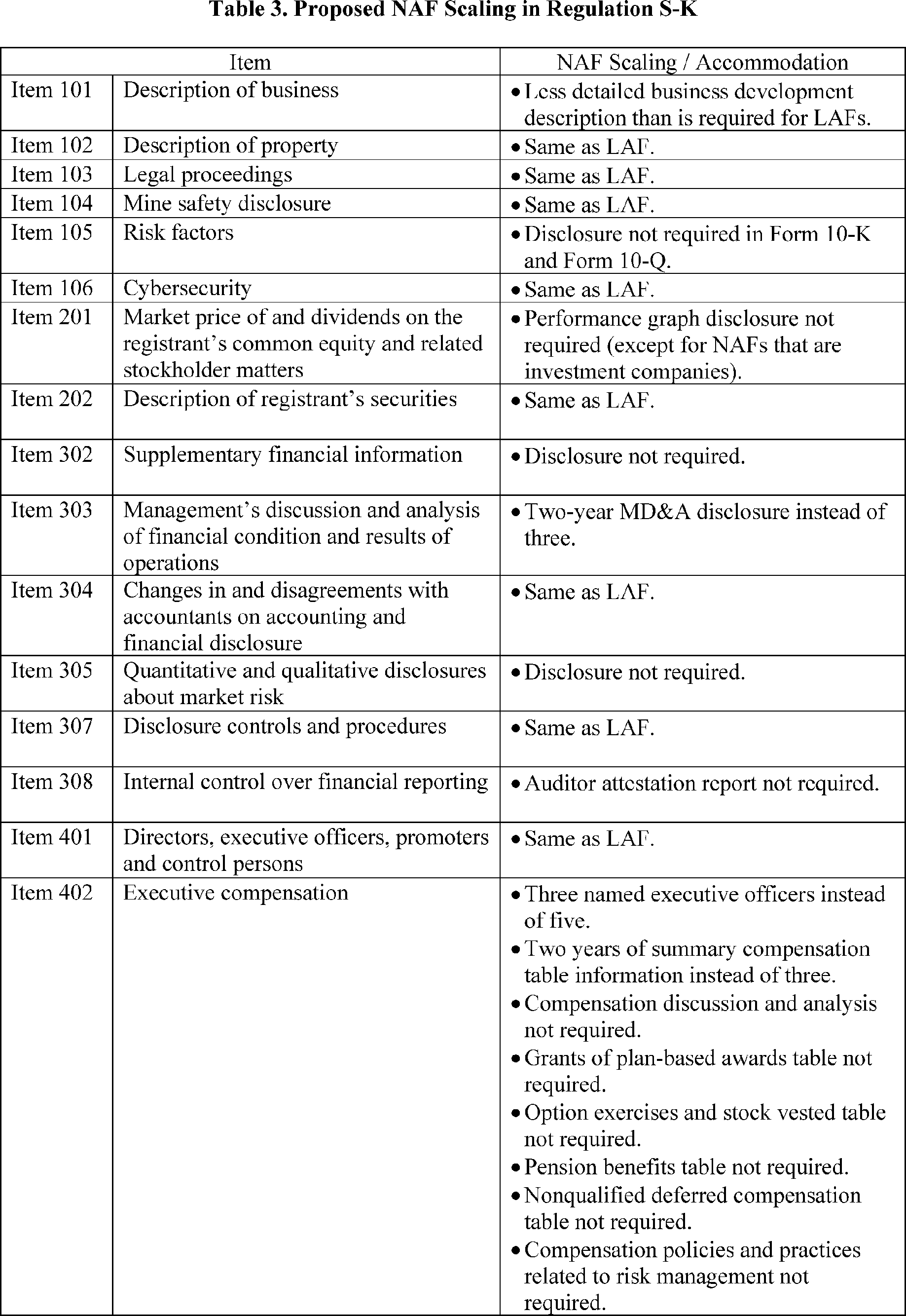
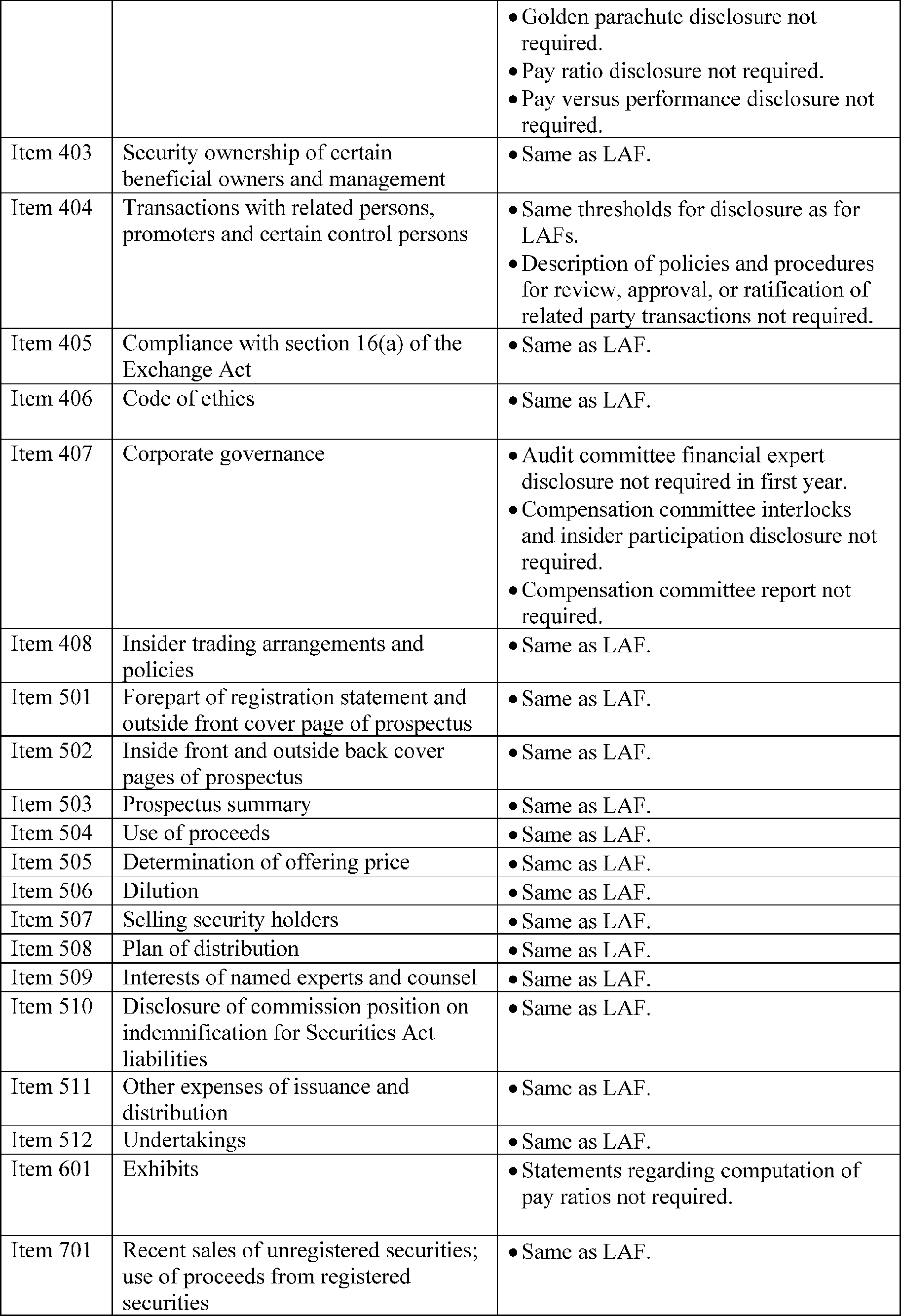
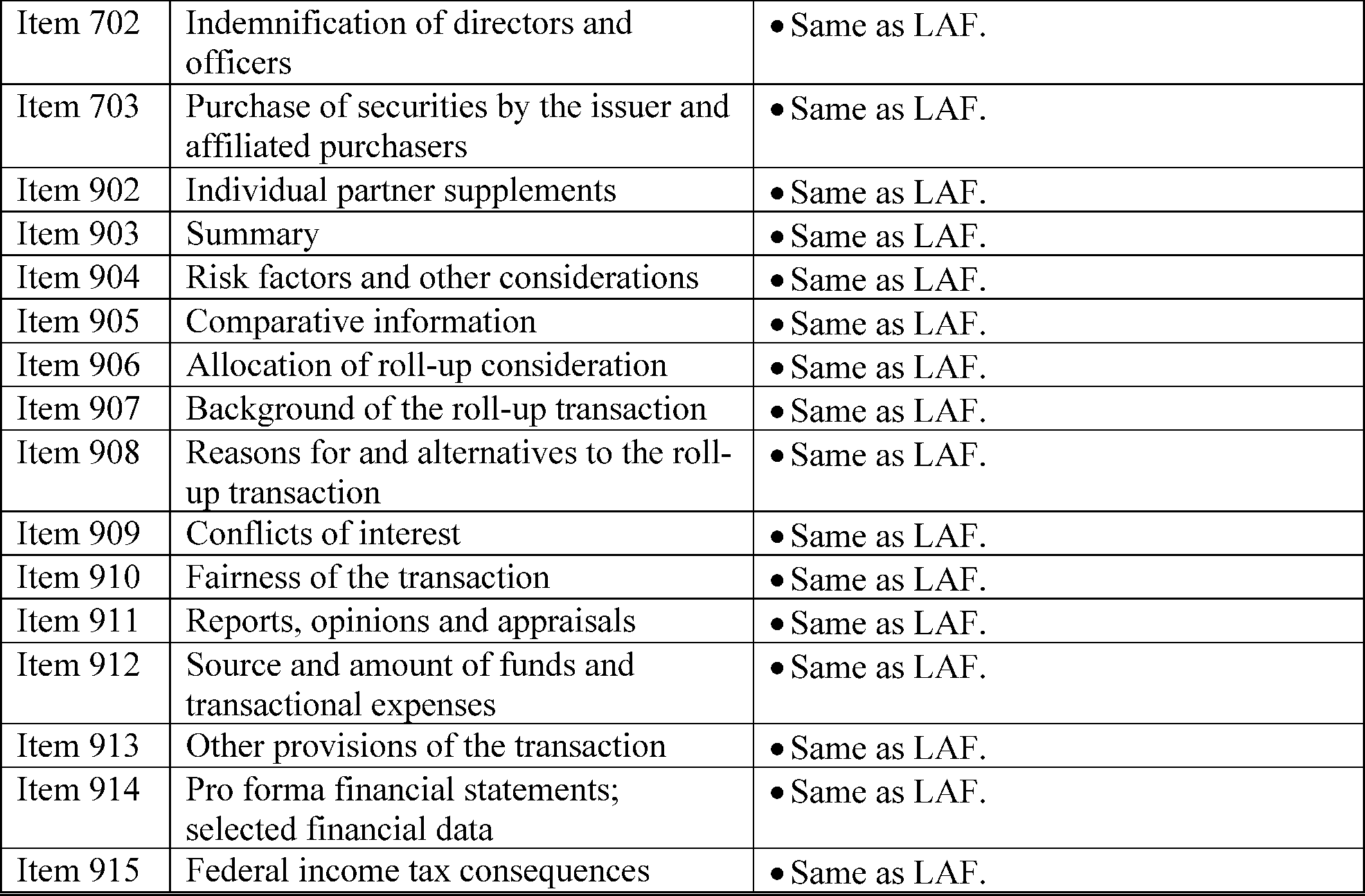
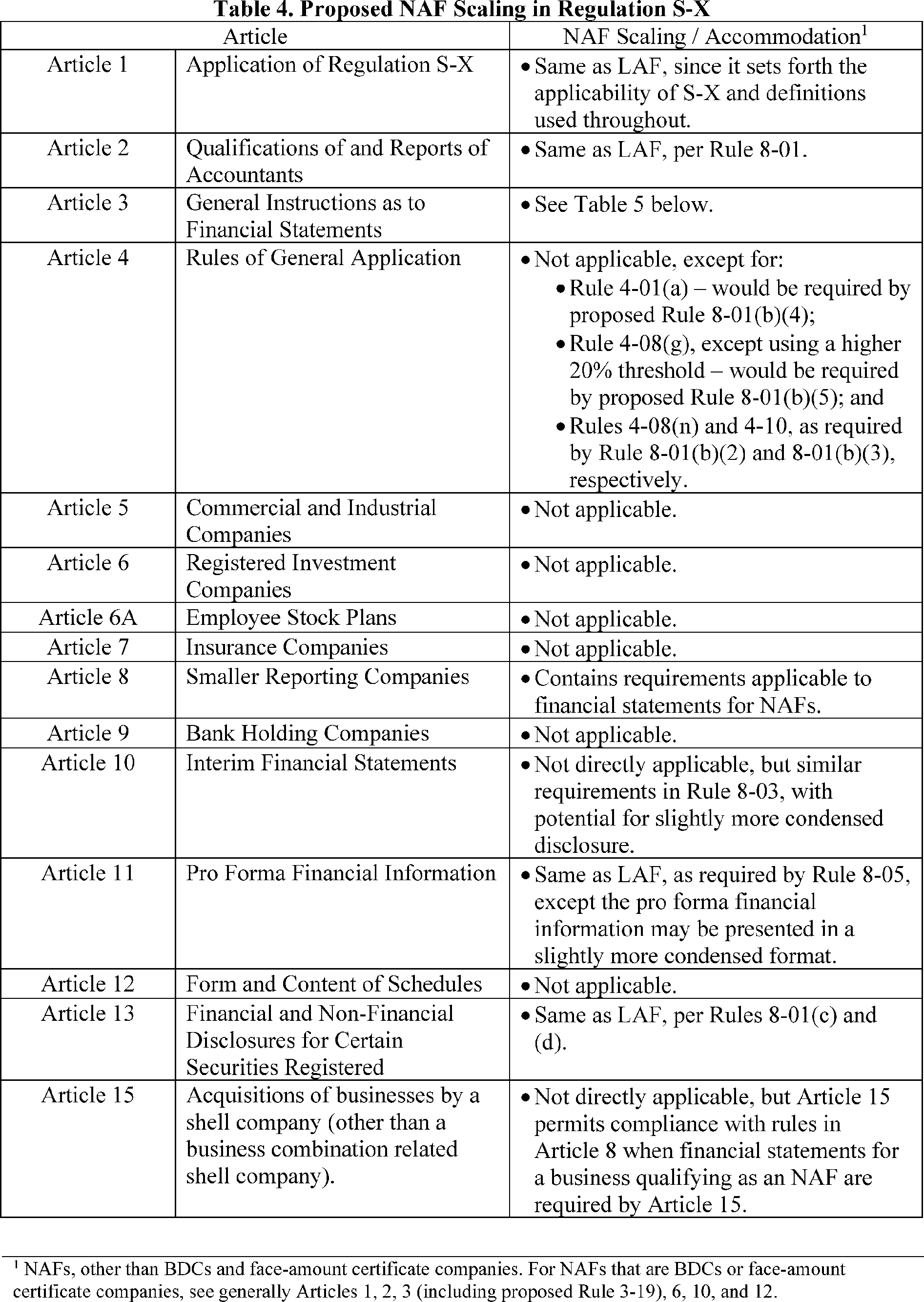
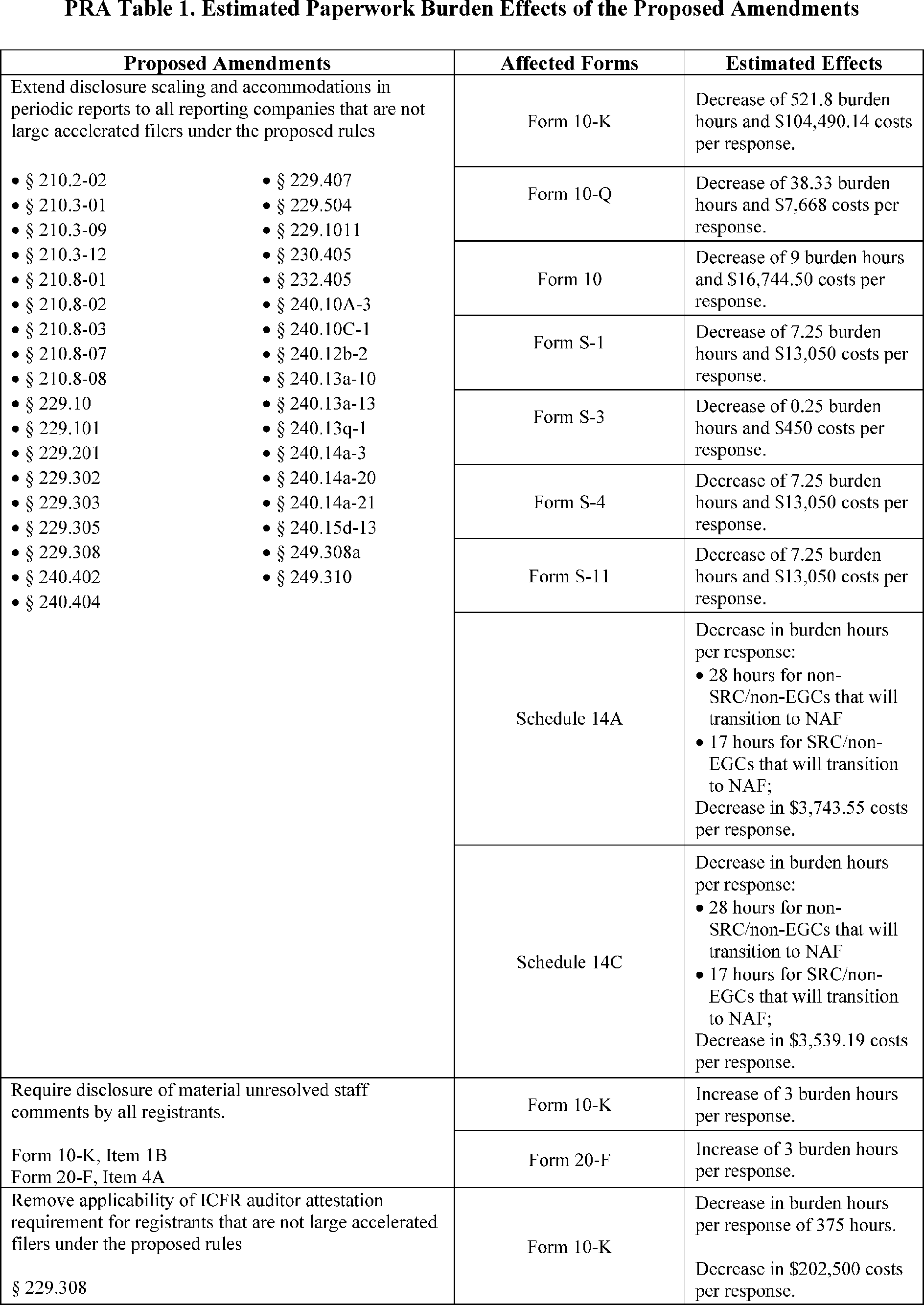
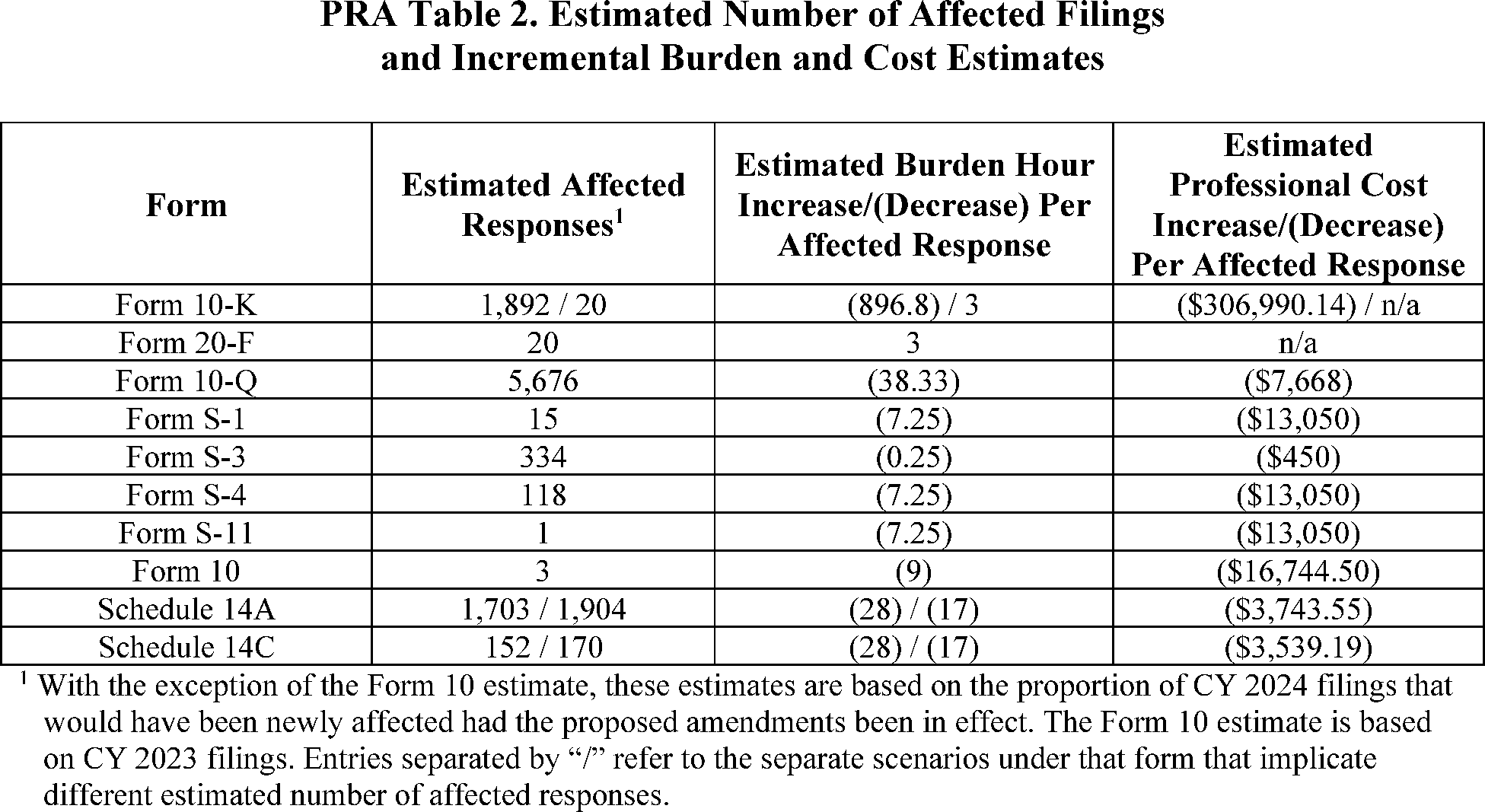
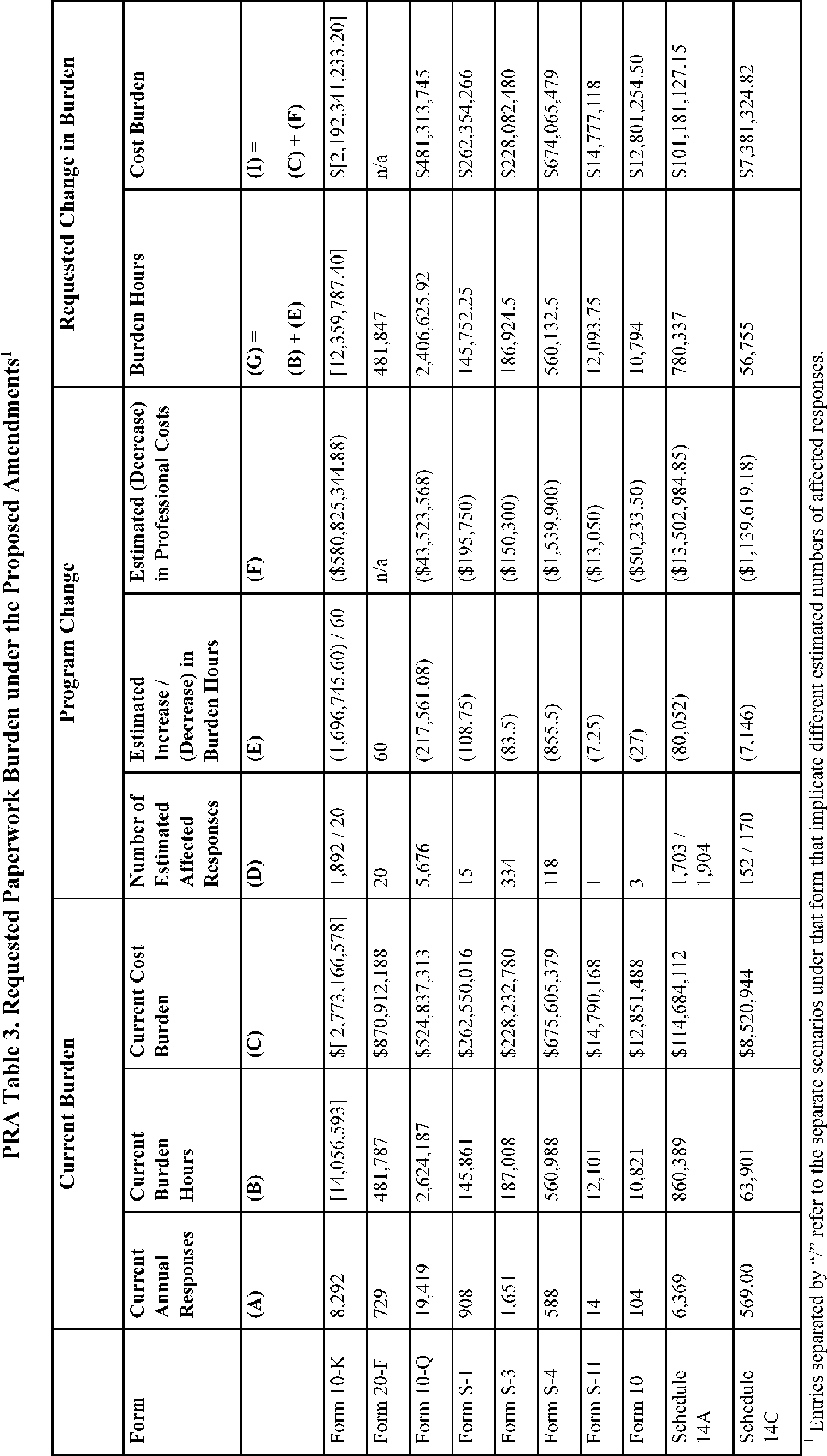
Enhancement of Emerging Growth Company Accommodations and Simplification of Filer Status for Reporting Companies
The Securities and Exchange Commission ("Commission") proposes amendments to streamline filer statuses for Securities Exchange Act of 1934 ("Exchange Act") reporting companies i...
The Securities and Exchange Commission (“Commission”) proposes amendments to streamline filer statuses for Securities Exchange Act of 1934 (“Exchange Act”) reporting companies into two primary categories: large accelerated filers and non-accelerated filers. The Commission further proposes to raise the threshold and seasoning requirements for large accelerated filer status and extend certain existing accommodations and scaled disclosures, including those for smaller reporting companies and emerging growth companies, to all non-accelerated filers, while continuing to require compliance with non-scaled disclosure from large accelerated filers. The Commission also proposes to extend the deadlines to file periodic reports for the smallest non-accelerated filers, as measured by total assets. Finally, the Commission also proposes to update the rules that define which issuers are considered small entities for purposes of the Regulatory Flexibility Act (“RFA”).
DATES:
Comments should be received on or before July 20, 2026.
ADDRESSES:
Comments may be submitted by any of the following methods:
○ Send an email to
rule-comment@sec.gov.
Please include File Number S7-2026-18 on the subject line.
Paper Comments
○ Send paper comments to Vanessa A. Countryman, Secretary, Securities and Exchange Commission, 100 F Street NE, Washington, DC 20549-1090.
All submissions should refer to File Number S7-2026-18. This file number should be included on the subject line if email is used. To help the Commission process and review your comments more efficiently, please use only one method of submission. The Commission will post all comments on the Commission's website (
https://www.sec.gov/comments/s7-2026-18/enhancement-emerging-growth-company-accommodations-simplification-filer-statusreporting-companies). Do not include personally identifiable information in submissions; you should submit only information that you wish to make available publicly. The Commission may redact in part or withhold entirely from publication submitted material that is obscene or subject to copyright protection.
Studies, memoranda, or other substantive items may be added by the Commission or staff to the comment file during this rulemaking. A notification of the inclusion in the comment file of any such materials will be made available on the Commission's website. To ensure direct electronic receipt of such notifications, sign up through the “Stay Connected” option at
www.sec.gov
to receive notifications by email.
Nabeel Cheema, Special Counsel, and Stephanie Sullivan, Associate Chief Accountant, Division of Corporation Finance, at (202) 551-3430, and Angela Mokodean, Senior Special Counsel, Division of Investment Management, at (202) 551-6792, U.S. Securities and Exchange Commission, 100 F Street NE, Washington, DC 20549.
SUPPLEMENTARY INFORMATION:
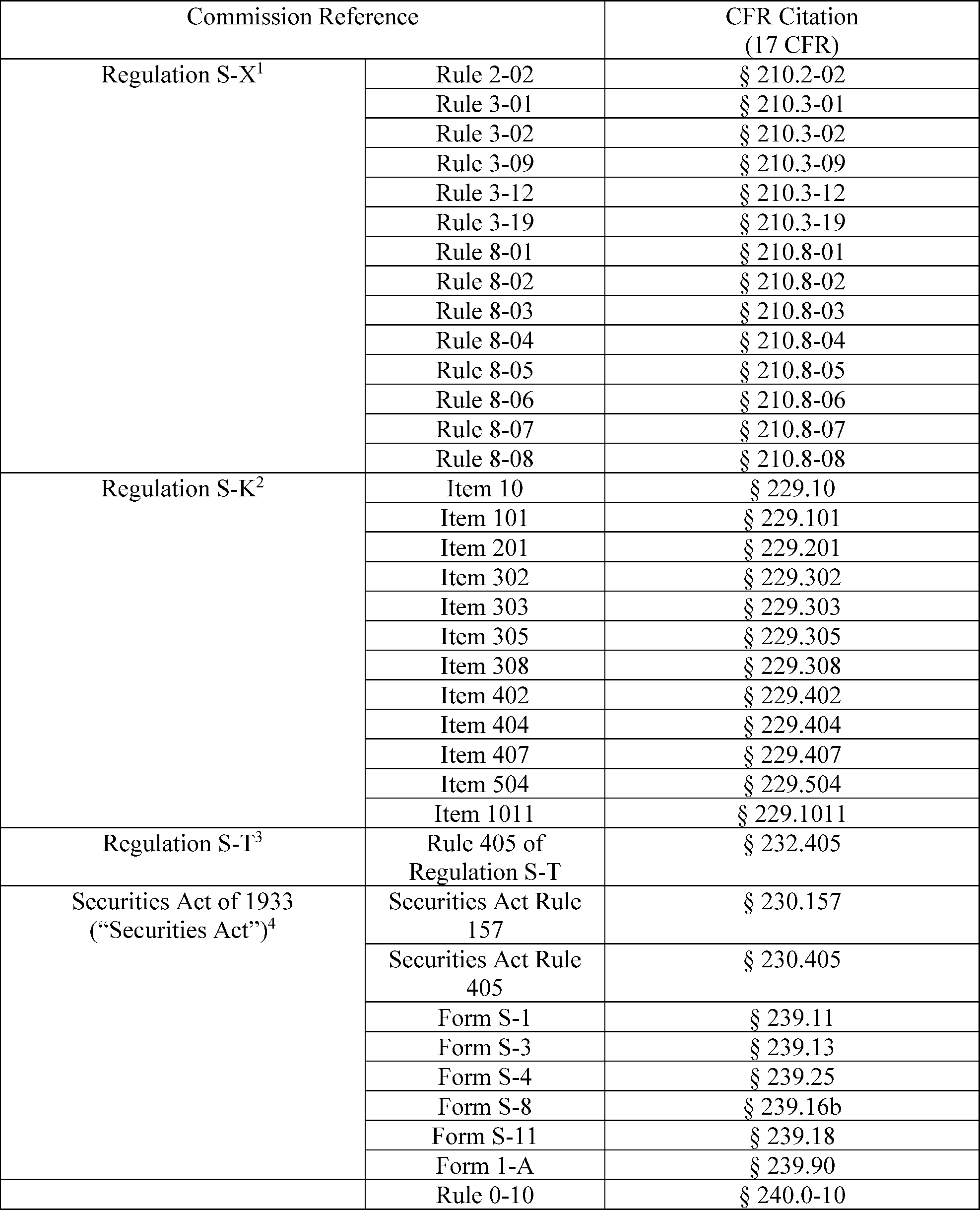
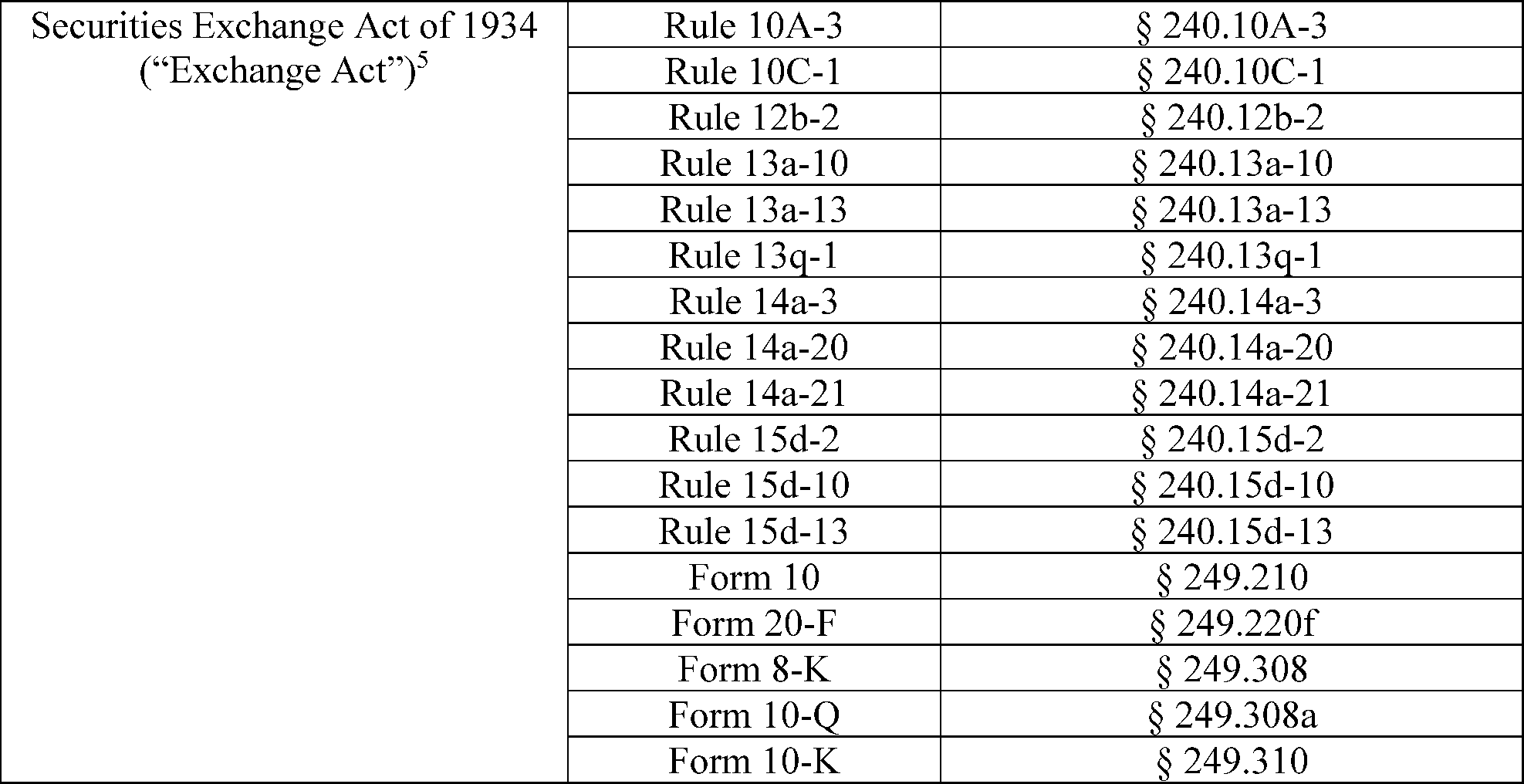
The Commission is proposing to amend or add the following rules and forms:
( printed page 30087)
( printed page 30088)
Table of Contents
I. Introduction
A. Exchange Act Reporting Prior to 2002
B. Accelerated Filer Status; Sarbanes-Oxley Act
C. ICFR Requirements
D. Actions Related to Smaller Reporting and Emerging Growth Companies
1. Establishment of SRC Status
2. The JOBS Act and EGC Status
3. Recent Amendments and Filer Status Complexity
II. Discussion of Proposed Rules
A. Large Accelerated Filer Status Amendments
1. Public Float Threshold
2. Public Float Determination
3. Seasoning
B. Non-Accelerated Filer Amendments
1. Non-Accelerated Filer Definition
2. ICFR and the Auditor Attestation Requirement
3. Extension of SRC and EGC Accommodations and Disclosure Requirements
4. Application to Other Filer Types
5. Summary of Requirements for LAFs and NAFs Under the Proposal
C. Small Non-Accelerated Filers
D. Proposed Transition Period
E. Updating Small Entity Definitions
F. Other Amendments
III. Other Matters
IV. Economic Analysis
A. Baseline and Affected Parties
1. Regulatory Baseline
2. Affected Parties
3. Registrant Characteristics
B. Economic Benefits and Costs
1. General Economic Effects of the Proposed Amendments
2. Amendments to LAF Definition
3. Exemption From ICFR Auditor Attestation
4. The Expansion of the Subset of Registrants Eligible for Extended Periodic Report Filing Deadlines
5. Extending SRC and Certain EGC Accommodations to All NAFs
6. Extending Filing Deadlines for the Smallest NAFs
7. Updating Small Entity Definition
8. Additional Considerations
9. Aggregate Monetized Benefits and Costs
C. Anticipated Effects on Efficiency, Competition, and Capital Formation
D. Reasonable Alternatives
1. LAF Public Float Threshold
2. Seasoning Requirement
3. Regulatory Accommodations for NAFs
4. SNFs
E. Request for Comment
V. Paperwork Reduction Act
A. Summary of the Collections of Information
B. Estimated Paperwork Burden Effects of the Proposed Amendments
C. Incremental and Aggregate Burden and Cost Estimates
D. Request for Comment
VI. Congressional Review Act
VII. Initial Regulatory Flexibility Act Analysis
A. Reasons for, and Objectives of, the Proposed Action
B. Legal Basis
C. Small Entities Subject to the Proposed Amendments
D. Projected Reporting, Recordkeeping, and Other Compliance Requirements
E. Duplicative, Overlapping, or Conflicting Federal Rules
F. Significant Alternatives
Statutory Authority
I. Introduction
From their inception, the U.S. securities laws have sought to require full and fair disclosure by companies seeking to raise capital from investors and access the public markets.[6]
In enacting broad investor protections and disclosure requirements under the securities laws, Congress also recognized the need to take into account the burdens of registration.[7]
A core function of the Exchange Act is to extend disclosure-based investor protections that are provided for public offerings of securities under the Securities Act to post-distribution trading in the secondary markets. This is accomplished primarily by sections 12,[8]
13(a),[9]
and 15(d) [10]
of the Exchange Act, which impose periodic and current reporting requirements on companies:
( printed page 30089)
with exchange-listed securities (section 12(b)); with widely held classes of equity securities (section 12(g)); or that have completed a public offering registered under the Securities Act (section 15(d)).[11]
These registrants [12]
must file reports prescribed by the Commission, which generally include annual reports on Form 10-K and quarterly reports on Form 10-Q.[13]
With respect to investment companies, business development companies (“BDCs”) and face-amount certificate companies are also subject to these reporting requirements.[14]
Over time, the Commission and Congress have adopted various “filer statuses” to establish tiers of registrants and offer certain accommodations by tier, including as to the timing and content of this periodic reporting. Current filer statuses include:
Large accelerated filer
(“LAF”),
accelerated filer[15]
(“AF”), and
non-accelerated filer
(“NAF”).
○ Filing deadlines for periodic reports depend on whether a registrant is classified as an LAF, an AF, or neither of these, which we refer to as an NAF.[16]
○ Only LAFs and AFs are required to have the registered public accounting firm that prepares or issues their financial statement audit report attest to, and report on, management's assessment of the effectiveness of internal control over financial reporting (“ICFR”) (“ICFR auditor attestation”) under section 404(b) of the Sarbanes-Oxley Act of 2002 (“Sarbanes-Oxley Act”).[17]
Smaller reporting company[18]
(“SRC”) is a regulatory status that applies to smaller registrants permitting those registrants to comply with a number of scaled disclosure requirements, discussed in detail below,[19]
which notably include scaled financial statement disclosure and scaled executive compensation disclosure, among other accommodations.
Emerging growth company
(“EGC”) is a statutorily-defined status that applies to registrants for the first five years after their initial public offering so long as they do not become an LAF or surpass revenue and debt issuance limitations.[20]
The EGC accommodations are described more fully below [21]
and notably include scaled financial statement disclosure in an EGC's initial public equity offering registration statement, deferred adoption of certain new or revised financial accounting standards, scaled executive compensation disclosure, and an exemption from the ICFR auditor attestation requirement.[22]
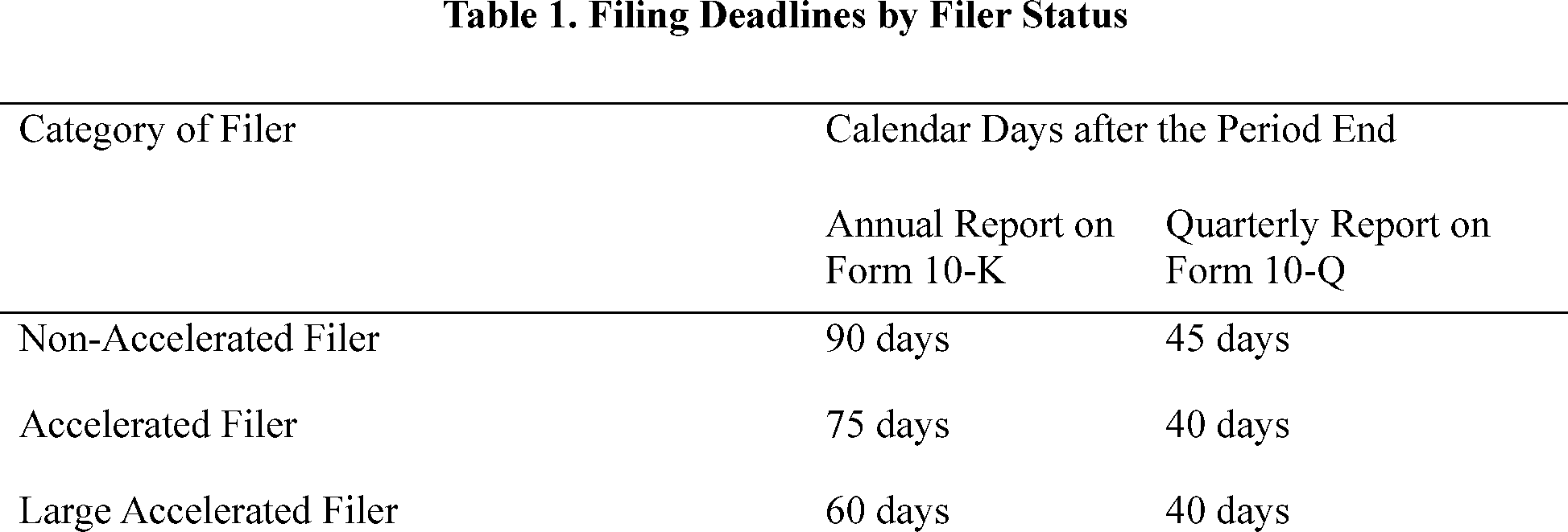
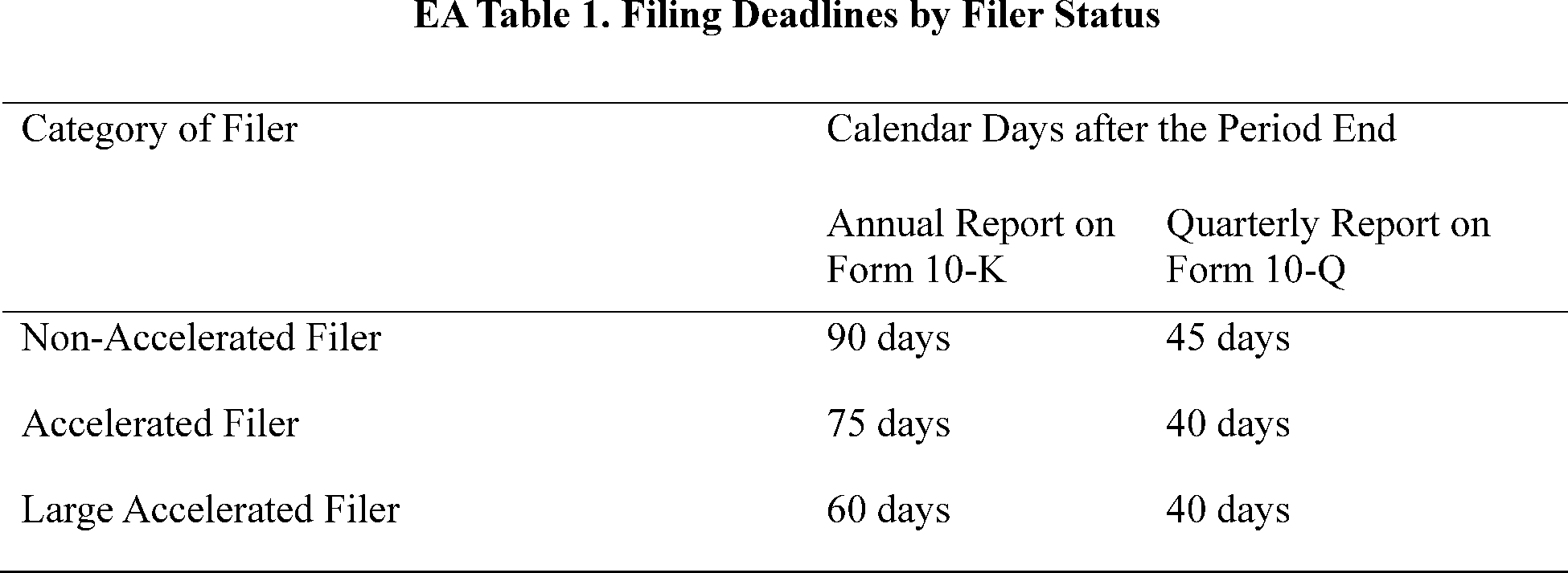
The table below lists the periodic reporting deadlines that currently apply to LAFs, AFs, and NAFs.[23]
( printed page 30090)
The filer status framework that has developed is layered and complex.[24]
Under the current system, registrants must annually reevaluate their filer status at the end of their fiscal year. To do so, they consider both their public float [25]
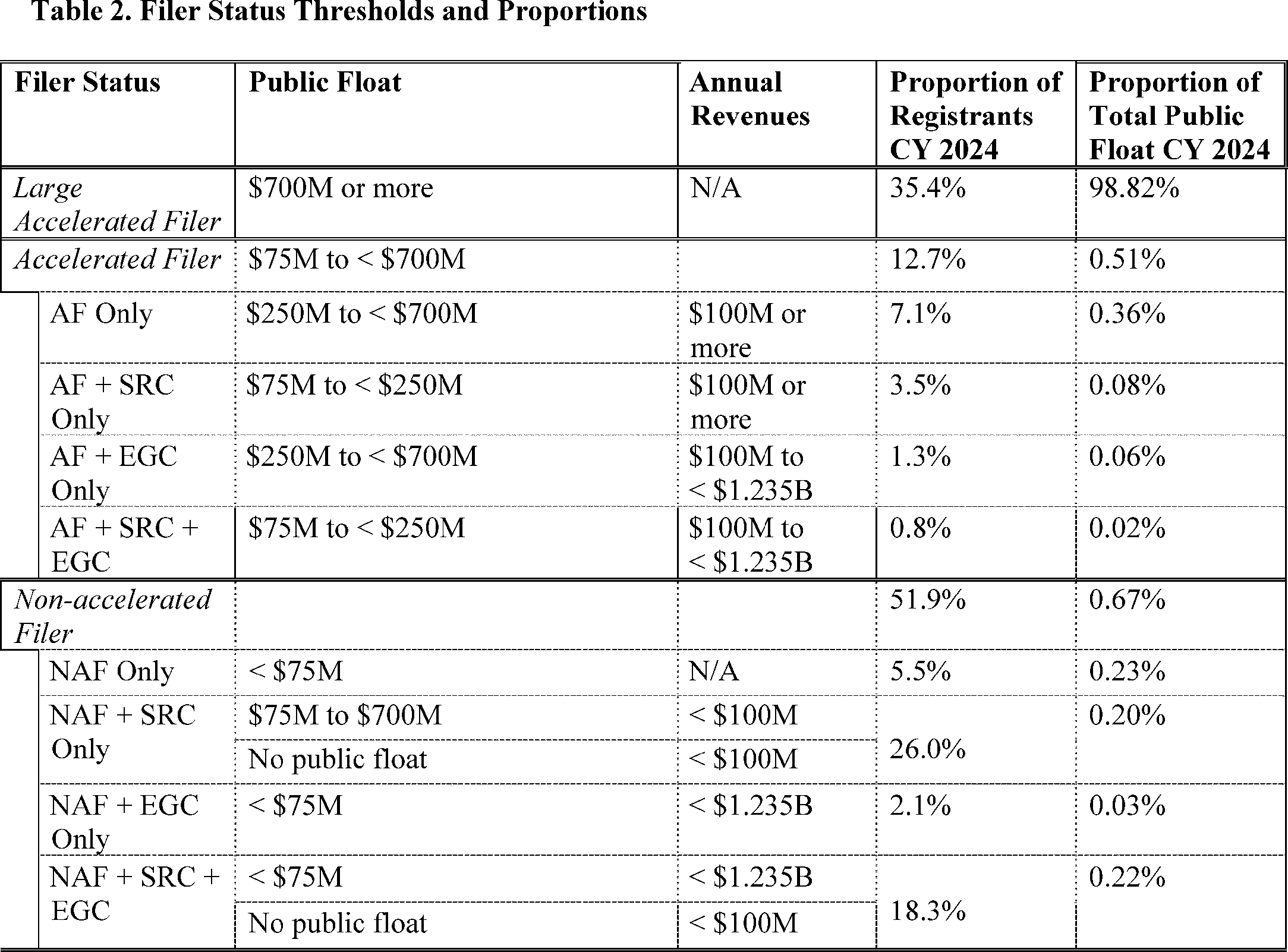
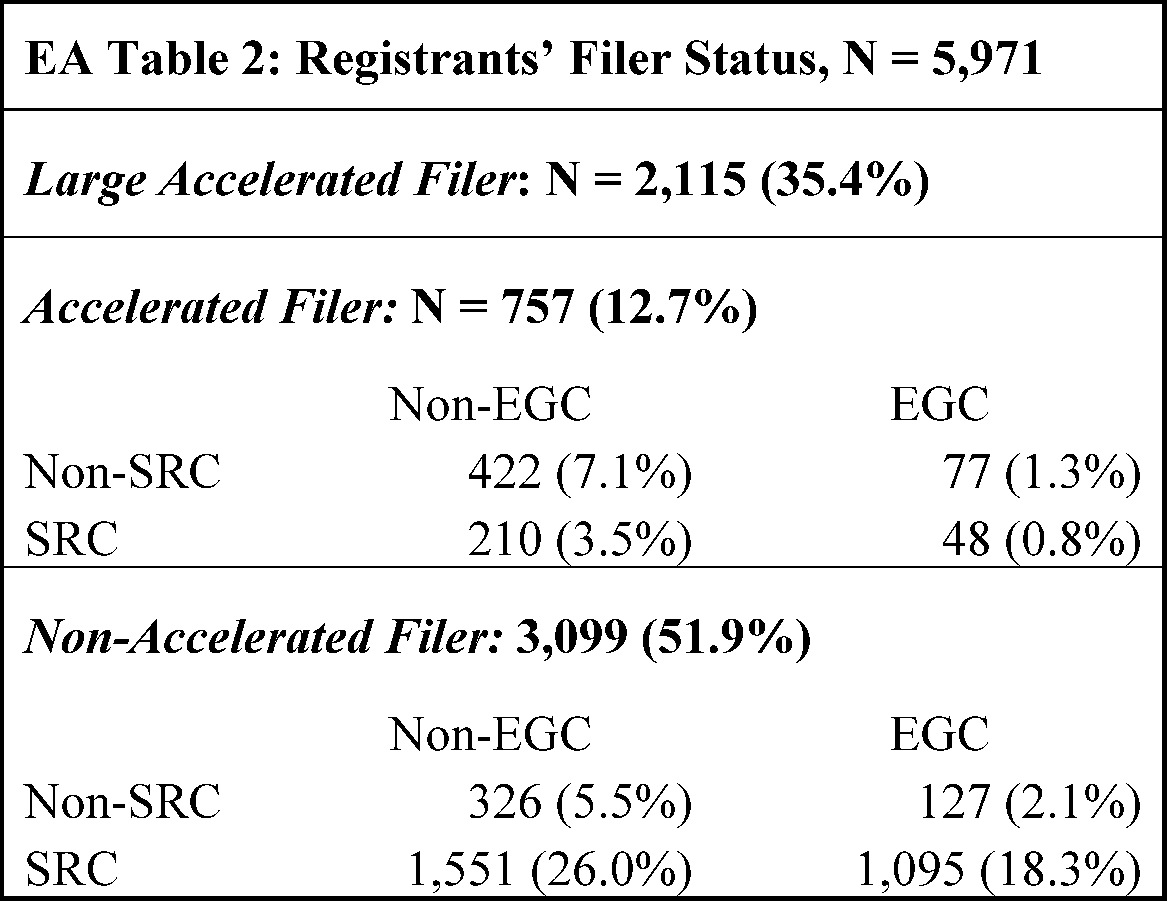
as of the end of their second fiscal quarter and their annual revenue, and compare those figures to thresholds that vary based on whether a registrant is entering or exiting a particular filer status. Additionally, registrants qualifying as EGCs must evaluate whether they met any of the disqualifying provisions of an EGC throughout the year. The table below illustrates the combinations of filer statuses that are possible today, highlights the overlap that can occur among filer statuses, and provides the entry thresholds for each status and the proportion of registrants in each permutation:[26]
The table reflects the current thresholds for initially entering into a particular status, but, under existing rules, the thresholds are often different for determining when a registrant transitions out of that status. Under current rules, LAFs transition to AF status when their public float falls below $560 million, and AFs and LAFs transition out of either such status when their public float falls below $60 million or they determine that they are eligible to use the requirements for SRCs under the revenue test in paragraph (2) or (3)(iii)(B) of the smaller reporting company definitions in 17 CFR 230.405 and 17 CFR 240.12b-2. Similarly, once a registrant exits SRC status, the registrant will only transition back into SRC status if its public float falls below $200 million, or its public float falls
( printed page 30091)
below $560 million and its revenues fall below $80 million.[27]
In addition, because the definitions for the accelerated filer statuses rely in part on SRC status, these transition thresholds also affect accelerated filer status determinations.
In addition to the complexity of the current filer status framework, we note that the number of Exchange Act reporting companies filing on domestic forms fell from 6,996 in 2004 to 5,976 in 2024.[28]
Unsurprisingly, a similar time period (2009-2017) saw significant growth in private markets, with private markets regularly outpacing public markets in capital raised.[29]
Recent studies point to a variety of conditions influencing companies that might previously have gone public to remain private, with the regulatory burdens and costs of being a public company consistently considered to be among the factors that have led to this trend.[30]
The Commission's two most recent Small Business Forums explored the obstacles facing smaller companies trying to go public. In 2025, the issues discussed included having to produce three years of audited financial statements, having to produce reports on a quarterly basis, the volume of disclosure requirements, and the complexity of the filer status framework.[31]
In 2026, many of the same themes were explored, with notable discussion on the cost of compliance with section 404(b) of the Sarbanes-Oxley Act, the impact on a registrant's ability to plan for those costs in light of an AF public float threshold that is based on a single measurement date, and the limited personnel and resources small companies can devote to such costs.[32]
Similar recommendations came out of prior years' forums and other roundtables.[33]
We are also aware of continued concerns regarding the cost of compliance with the ICFR auditor attestation requirement under section 404(b) of the Sarbanes-Oxley Act.[34]
Some comments on the 2019 Accelerated Filer Release stated that the ICFR auditor attestation requirement is the most costly aspect of being an AF and indicated that, in relative terms, it is particularly costly for low-revenue registrants.[35]
In addition, a recent Government Accountability Office (“GAO”) study found that Section 404(a) and (b) compliance costs are more burdensome in relative terms for smaller companies.[36]
At the same time, the ICFR auditor attestation requirement has benefits for investors, including that it enhances the reliability of management's disclosure related to ICFR and may help a registrant identify a significant deficiency or identify and disclose a material weakness in ICFR that had not been identified or properly characterized by management.[37]
While registration and entry into the public capital markets is not always necessary or appropriate for smaller or emerging companies,[38]
a robust pipeline of companies joining the public markets benefits investors by providing them with a more diverse set of investment opportunities and greater transparency.
( printed page 30092)
It also benefits companies in various ways, including by providing them new sources of capital at a potentially lower cost. The Commission has long considered the regulatory burdens of public company registration and ongoing compliance with the regulations that apply to public companies. Indeed, the Commission has previously taken steps with the aim of increasing the viability of entry into the public markets to more companies, by adopting simplified registration rules and processes for issuers while carefully balancing investors' need for timely and appropriate disclosure. For example, in a series of actions spanning decades, the Commission has routinely simplified and tailored smaller issuers' disclosure obligations.[39]
In 2005, the Commission reformed the securities offering process by, among other actions, liberalizing permitted offering communications, updating prospectus delivery requirements, and modernizing the shelf registration provisions.[40]
Nonetheless, changes in the securities laws have resulted in an increasingly complicated regulatory framework that warrants reconsideration, including a reassessment of whether the disclosure burdens faced by registrants are properly balanced with the corresponding benefits to investors and markets.
We are therefore proposing amendments to our regulations to rationalize the existing Exchange Act filer status framework, which will simplify reporting and disclosure requirements and reduce burdens on most reporting companies, while continuing to seek full and fair disclosure for investors. To provide context to our proposed amendments, we briefly trace the evolution of the current filer status framework below.
A. Exchange Act Reporting Prior to 2002
The Commission adopted the “integrated disclosure system” in 1982 following several years of analysis of the disclosure rules under the Securities Act and the Exchange Act.[41]
Prior to the adoption of the integrated disclosure system, separate disclosure regimes applied to Securities Act registration statements and Exchange Act registration and periodic reporting, which often resulted in overlapping and duplicative requirements. At the time the integrated disclosure system was adopted, the Commission stated that the “goal of the Commission's integrated disclosure program has been to revise or eliminate overlapping or unnecessary disclosure and dissemination requirements wherever possible, thereby reducing burdens on registrants while at the same time ensuring that security holders, investors and the marketplace have been provided with meaningful nonduplicative information upon which to base investment decisions.” [42]
Under the integrated disclosure system, most registration and reporting forms under the Securities Act and the Exchange Act refer to common disclosure requirements codified in Regulation S-K and Regulation S-X. In recognition of the difficulties that smaller issuers were facing in accessing the capital markets, the Commission adopted Regulation S-B in 1992, an integrated disclosure system tailored specifically to a set of “small business issuers,” as defined by revenues and public float, and provided specialized forms under the Securities Act and Exchange Act that referenced simplified disclosure requirements for these issuers.[43]
As a result of these accommodations, prior to 2002, there were effectively two Exchange Act filer statuses: a “default” category of issuers that filed periodic reports on Forms 10-K and 10-Q under Regulation S-K, and a small business issuer category that filed periodic reports on Forms 10-KSB and 10-QSB under Regulation S-B. Commission rules applied uniform filing deadlines to all Exchange Act reporting companies' periodic reports: 90 days after fiscal year end for annual reports, and 45 days after quarter end for quarterly reports.
B. Accelerated Filer Status; Sarbanes-Oxley Act
Following a series of corporate and accounting scandals in the early 2000s that led to financial restatements and bankruptcies and resulted in significant adverse effects on shareholders, the Commission established “accelerated filer” status by adopting accelerated filing deadlines for certain registrants. Congress subsequently enacted the Sarbanes-Oxley Act,[44]
which included ICFR requirements intended to improve the accuracy and reliability of corporate disclosures.
The Commission's adoption of AF status was motivated in part by advances in communication technology and companies' growing practice of releasing quarterly earnings well before the Form 10-Q deadline.[45]
The new “accelerated filer” status therefore accelerated the periodic report filing deadlines for registrants with a public float of $75 million or more, who had been subject to Exchange Act reporting requirements for at least 12 months, and had previously filed at least one annual report.[46]
In acting to further categorize the filer statuses in this way, the Commission sought to “balance the market's need for information with the time companies need to prepare that information without undue burden.” [47]
The Commission again amended the filer status rules in 2005 by introducing the LAF status.[48]
The Commission sought to avoid applying the shortest filing deadlines to registrants with less than $700 million in public float by further dividing filers into LAFs
( printed page 30093)
(registrants with $700 million or more in public float) and AFs (registrants with at least $75 million in public float but less than $700 million). All remaining registrants with less than $75 million in public float have become known as NAFs. While the Commission acknowledged the incremental benefit of more timely accessibility to periodic reports, it was concerned with the added burdens associated with the increased acceleration of the deadlines.[49]
The Commission determined to limit the shortest deadlines to the largest registrants, reasoning that LAFs, “are more likely than smaller companies to have a well-developed infrastructure and financial reporting resources to support further acceleration of the annual report deadline.” [50]
As a result of this and later developments,[51]
under the current definition in Rule 12b-2, an LAF is a registrant that: (1) has a public float of $700 million or more, as of the last business day of its most recently completed second fiscal quarter, calculated using either the closing price or the average of the bid and ask prices that day; (2) has been subject to the requirements of Exchange Act section 13(a) or 15(d) for at least 12 calendar months; (3) has filed at least one annual report pursuant to the Exchange Act; and (4) is not eligible to be an SRC under the SRC revenue test. LAFs' periodic reporting deadlines are 60 days for Form 10-K, and 40 days for Form 10-Q, while AFs' deadlines are 75 and 40 days, respectively; and the deadlines for NAFs remain at 90 and 45 days, respectively.[52]
C. ICFR Requirements
In 2002, less than two months before the Commission adopted the rules for AFs, Congress enacted the Sarbanes-Oxley Act.[53]
One aspect of the Sarbanes-Oxley Act's reforms was the adoption of section 404. Section 404(a) mandates Commission rules requiring Exchange Act reporting companies to include in their annual reports an internal control report that states the responsibility of management for establishing and maintaining ICFR and that contains an assessment of the effectiveness of the registrant's ICFR as of the end of each fiscal year.[54]
Section 404(b) requires that each registered public accounting firm that prepares or issues the registrant's financial statement audit report attest to, and report on, management's assessment of the effectiveness of the ICFR.[55]
As discussed below, Congress took further action in the Dodd-Frank Wall Street Reform and Consumer Protection Act of 2010 (“Dodd-Frank Act”) [56]
and the Jumpstart Our Business Startups (“JOBS”) Act,[57]
to exempt from section 404(b): (1) any registrant that is not an LAF or an AF and (2) any registrant that is an EGC, respectively.
As mandated by section 404, the Commission adopted rules in 2003 requiring registrants that are subject to Exchange Act reporting requirements to include in their annual reports a report of management on the registrant's ICFR and an attestation report by the registrant's auditors on management's assessment of the internal controls.[58]
Although section 404 generally requires and directs the Commission to adopt rules regarding ICFR that apply to every issuer that is required to file reports pursuant to Exchange Act section 13(a) or 15(d), registered investment companies (“RICs”) under section 8 of the Investment Company Act [59]
are specifically exempted from section 404 by section 405.[60]
In addition, the Commission's rules implementing section 404 exempted other types of issuers, such as asset-backed issuers, from the ICFR obligations.[61]
The Commission also determined that FPIs and Canadian multijurisdictional disclosure system (“MJDS”) issuers must have their management assess and report annually on the effectiveness of their ICFR as of the end of their fiscal year and include an auditor attestation report on ICFR in their annual report form if the FPI or MJDS issuer is an AF or LAF, other than an EGC.[62]
BDCs, however, are subject to the rules adopted by the Commission to implement section 404.[63]
Through a series of actions from 2003 through 2009, the Commission delayed compliance with section 404 for NAFs, acknowledging that “non-accelerated filers, including smaller companies and foreign private issuers, may have greater difficulty in preparing the management report on internal control over financial reporting.” [64]
Ultimately, Congress
( printed page 30094)
enacted section 989G of the Dodd-Frank Act, which added section 404(c) to the Sarbanes-Oxley Act to exempt issuers that are neither LAFs nor AFs, as defined by the Commission, from the ICFR auditor attestation requirement of section 404(b).[65]
Section 404(c) also directed the Commission to conduct a study to determine how the Commission could reduce the burden of complying with the section 404(b) ICFR auditor attestation requirement for companies with public float between $75 million and $250 million. Congress further extended relief from section 404(b) in the JOBS Act when it exempted EGCs from the requirement.[66]
In April 2011, the Commission staff published the required study and recommendations relating to section 404(b).[67]
The study found that, while initial implementation of section 404 resulted in a steep increase in audit fees, there was a statistically significant decrease in compliance costs (including audit fees) for registrants subsequent to the issuance of PCAOB Auditing Standard No. 5 [68]
and related Commission guidance [69]
on management's report on ICFR. Based on the study's findings, the staff did not recommend changing the scope of the ICFR auditor attestation requirement at that time, but encouraged activities to further improve the effectiveness and efficiency of implementation of the ICFR requirements.[70]
As discussed in more detail below, the Commission modified the definition of AF in 2020 to exclude a registrant that is eligible to be an SRC and has annual revenues of less than $100 million.[71]
In excluding low-revenue SRCs from AF status, the Commission also exempted those registrants from the ICFR auditor attestation requirement. In the adopting release, the Commission found that the ICFR auditor attestation requirement is disproportionately costly to small issuers, noting that the fixed costs of compliance are not scalable for smaller issuers and that low-revenue issuers have limited access to internally generated capital such that the costs may more directly constrain their ability to invest and hire.[72]
Commentators and registrants continue to express concerns regarding the costs of implementation of section 404 and the disproportionate effect on smaller issuers.[73]
D. Actions Related to Smaller Reporting and Emerging Growth Companies
1. Establishment of SRC Status
Through the course of implementing the enhanced disclosure and other requirements of the Sarbanes-Oxley Act, the Commission recognized the increased regulatory burden faced by registrants.[74]
This eventually led in 2007 to the Commission reworking its regulatory framework for smaller registrants by establishing the “smaller reporting company” filer status.[75]
As part of the revisions, the Commission rescinded Regulation S-B and the “small business issuer” definition.[76]
Under the 2007 rules, all filers that were not AFs or LAFs—
i.e.,
those with less than $75 million in public float [77]
—were designated as SRCs, and granted most of the scaled disclosure accommodations that had previously been provided to “small business issuers.” [78]
The SRC definition excludes asset-backed issuers, RICs, BDCs, and majority-owned subsidiaries of issuers that do not qualify as an SRC. Additionally, FPIs are not eligible to use the requirements for SRCs unless they use the forms and rules designated for domestic issuers and provide financial statements prepared in accordance with U.S. Generally Accepted Accounting Principles (“U.S. GAAP”).[79]
The revised streamlined regulatory framework moved all disclosure requirements back into Regulation S-K and Regulation S-X, consolidated smaller issuers and NAFs into the same filer status, and expanded the number of registrants eligible to use scaled disclosure requirements.[80]
The
( printed page 30095)
amendments effectively established a three-tier filer status framework:
LAFs having a public float of $700 million or more, subject to the most accelerated filing deadlines and the most comprehensive disclosure requirements;
AFs having a public float of $75 million or more, but less than $700 million, subject to less accelerated filing deadlines and the most comprehensive disclosure requirements; and
SRCs having a public float of less than $75 million (or, if without a calculable public float, annual revenues below $50 million), subject to non-accelerated filing deadlines and scaled disclosure requirements.
At the time of initial adoption of SRC status, LAFs and AFs were generally subject to the same disclosure requirements as each other. SRCs, however, were (and currently remain) permitted to avail themselves of certain scaled disclosure accommodations, which currently include:
To provide two (instead of three) years of audited financial statements, and prepare their financial statements in accordance with Article 8 of Regulation S-X; [81]
To provide two (instead of three) years of summary compensation table information and tabular and other compensation disclosure for three (instead of five) named executive officers;
To omit the compensation discussion and analysis, compensation policies and practices related to risk management, pay ratio disclosure, grants of plan-based awards table, pension benefits table, option exercises and stock vested table, and nonqualified deferred compensation table; [82]
To provide scaled golden parachute and pay versus performance disclosure; [83]
To omit disclosure relating to risk factors in periodic reports; [84]
a stock performance graph; [85]
quantitative and qualitative disclosure about market risk; [86]
supplementary financial information relating to the disclosure of material quarterly changes and information about oil and gas activities; [87]
policies and procedures for the review, approval, or ratification of related party transactions; [88]
and certain payments made by resource extraction issuers; [89]
and
To provide a simplified description of business.[90]
By contrast, Item 404 of Regulation S-K, which addresses related-party transaction disclosure, includes in Item 404(d) certain requirements for SRCs that are more rigorous than those for other filers,[91]
namely:
Rather than a flat $120,000 threshold for the disclosure of related-party transactions, the threshold is the lesser of $120,000 or one percent of total assets;
Disclosures are required about underwriting discounts and commissions where a related person is a principal underwriter or a controlling person or member of a firm that was or is going to be a principal underwriter;
Disclosures are required about the issuer's parent(s) and their basis of control; and
An additional year of disclosures is required regarding transactions with related persons.[92]
2. The JOBS Act and EGC Status
In 2012, Congress enacted the JOBS Act, which established a new “emerging growth company,” or EGC, filer status and provided disclosure and other accommodations to EGCs.[93]
Currently, a company qualifies as an EGC if it has total gross revenues of less than $1.235 billion during its most recently completed fiscal year and continues to qualify as an EGC until the earliest of: (1) the last day of the fiscal year of the issuer during which it has total annual gross revenues of $1.235 billion or more; (2) the last day of its fiscal year following the fifth anniversary of the first sale of its common equity securities pursuant to an effective registration statement; (3) the date on which the issuer has, during the previous three-year period, issued more than $1 billion in nonconvertible debt; or (4) the date on which the issuer is deemed to be an LAF (as defined in Exchange Act Rule 12b-2).[94]
Congress supplemented the JOBS Act by enacting the Fixing America's Surface Transportation (“FAST”) Act,[95]
which provided for targeted additional accommodations for EGCs and required the Commission “to further scale or eliminate requirements of Regulation S-K, in order to reduce the burden on emerging growth companies, accelerated filers, smaller reporting companies, and other smaller issuers, while still providing all material information to investors.” [96]
EGC status provides a registrant with accommodations that lower the costs and burdens of registration and reporting and is generally seen as an “on-ramp” for newly public companies to ease the burdens of transitioning from a private to a public company.[97]
While there are overlaps between the EGC and SRC populations and their respective accommodations, EGCs are entitled to a similar but distinct set of accommodations. EGCs are:
( printed page 30096)
Exempt from the ICFR auditor attestation requirement,[98]
the requirement to hold shareholder advisory votes on executive compensation,[99]
pay ratio disclosure,[100]
and pay versus performance disclosure; [101]
Permitted to provide two (instead of three) years of audited financial statements in the registration statement for an initial public offering of common equity securities, and to defer compliance with new or revised financial accounting standards until a company that is not an issuer is required to comply with such standards, if such standard applies to private companies; [102]
Permitted to provide executive compensation disclosure to match the information required from issuers with less than $75 million in public float (the SRC threshold at the time of adoption of the JOBS Act); [103]
and
Permitted to submit certain draft registration statements to the Commission on a confidential basis.[104]
3. Recent Amendments and Filer Status Complexity
While a registrant cannot be both an EGC and an LAF,[105]
as shown in the table in section I above, a registrant can be both an EGC and an SRC, or both an EGC and an AF. When the Commission updated the SRC, AF, and LAF thresholds in 2018, the SRC public float threshold was raised to $250 million, and the SRC revenue threshold was raised to $100 million.[106]
Along with the increase of these thresholds, the Commission removed the automatic exclusion of SRCs from the definition of AF and LAF. As a result of these changes, SRCs went from being exclusively NAFs to a separate, additional status (like EGC status) that could attach to either NAFs or AFs. Further, SRCs can also be EGCs, and these statuses involve largely overlapping but distinct obligations and accommodations.
When adopting the 2018 amendments to the SRC definition, the Commission acknowledged the “regulatory complexity” created by this potential overlap between the SRC and AF definitions.[107]
Subsequently, in 2020, the Commission adopted amendments to the definitions of AF and LAF seeking to tailor the types of issuers included in those filer statuses.[108]
The rules, as amended, now exclude low-revenue SRCs (those with under $100 million in annual revenues and either no public float or a public float of less than $700 million) from the definitions of AF and LAF, increasing the number of registrants that qualify as NAFs.[109]
As NAFs, these registrants, among other things, are not required to obtain an ICFR auditor attestation. The amendments were intended to thereby reduce compliance costs for these registrants while maintaining investor protections by more appropriately tailoring the types of registrants that are included in the categories of AF and LAF.[110]
While the amendments increased the number of SRCs that qualify as NAFs, the Commission determined not to fully align the statuses.[111]
The Commission acknowledged that such alignment would promote greater regulatory simplicity and reduce friction or confusion associated with registrants' determination of their filer status or reporting regime.[112]
It expressed concerns, however, that such alignment could result in adverse effects on the reliability of the financial statements and the ability of investors to make informed investment decisions about those issuers.[113]
Thus, the amendments reduced the overlap between AF status and SRC status by including low-revenue SRCs as NAFs (
i.e.,
those with a public float of $75 million or more but less than $250 million, regardless of annual revenues, and those with public float of less than $700 million and annual revenues of less than $100 million), but added an additional determination for SRC status.
We are proposing to revise the current rules to streamline and further scale disclosure and reporting requirements. Among our objectives is to reduce compliance costs and create a more attractive on-ramp for newly public companies, thereby reducing regulatory impediments that may be deterring companies from participating in the public market and encouraging more companies to go and stay public, while ensuring that investors have the information necessary to inform their investment and voting decisions.
II. Discussion of Proposed Rules
As detailed above, the Commission's rules currently set forth five filer statuses that correspond to varying levels of disclosure and other requirements, which are sometimes overlapping and often complex for issuers to determine.[114]
LAFs are subject to the most stringent requirements, and NAFs that are also both SRCs and EGCs are afforded the most accommodations. LAFs in 2024 accounted for 35.4 percent of registrants and 98.8 percent of total market public float.[115]
In contrast, in 2024, while NAFs, including NAFs that are also SRCs or EGCs (or both), accounted for 51.9 percent of registrants, they accounted for only 1.2 percent of total market public float.[116]
We are proposing amendments with the goal of streamlining the overlapping Exchange Act filer statuses and further
( printed page 30097)
scaling disclosures and other accommodations while ensuring that investors continue to receive timely and material information. To do so, the proposed amendments seek to align disclosure and other reporting requirements and reporting deadlines with registrants' public float. As a result of the proposed amendments, companies that collectively make up the majority of the U.S. equity market capitalization would be subject to the most comprehensive requirements and earliest filing deadlines, while all other issuers would be afforded the proposed scaled disclosure and other accommodations. The proposed amendments would provide for simplified compliance and reduced costs for a majority of registrants. Additionally, we are proposing to extend the filing deadlines for the smallest companies in order to reduce the burden on these companies and further accommodate their ability to efficiently comply with Exchange Act reporting. As described in more detail below, the proposed amendments would:
Revise the LAF filer status to:
○ Raise the threshold for becoming an LAF from the current $700 million to $2 billion in public float, which would represent 93.5 percent of the current total market public float; [117]
○ Establish a new, more stable, public float calculation window that provides for the determination of public float based on the average price of the registrant's voting and non-voting common equity held by non-affiliates over the last 10 trading days of the second quarter of a registrant's fiscal year; [118]
○ Establish that a registrant will only transition into or out of a status after the registrant has been above or below the public float threshold for two consecutive years; [119]
and
○ Increase the seasoning threshold for becoming an LAF to 60 consecutive calendar months.[120]
Establish the NAF filer status and consolidate and extend to NAFs currently available scaled disclosure and other accommodations by:
○ Establishing an NAF definition that encompasses all registrants that are not LAFs; [121]
and
○ Applying to NAFs the current disclosure requirements applicable to SRCs and EGCs, including not requiring an ICFR auditor attestation.[122]
Extend to NAFs the requirement currently applicable to LAFs and AFs to disclose on Form 10-K or Form 20-F the substance of material unresolved staff comments regarding the registrant's periodic or current reports received at least 180 days before a registrant's fiscal year end.[123]
Eliminate AF and SRC filer statuses as unnecessary in light of the amendments described above.[124]
Create a sub-category consisting of the smallest NAFs (“SNFs”), comprising NAFs reporting total assets of $35 million or less as of the end of an issuer's two most recent second fiscal quarters, that would be eligible for extended deadlines for filing their Form 10-K and Form 10-Q periodic reports.[125]
Consistent with the Commission's history of considering how its regulatory regime can serve investors while avoiding unnecessary regulatory burdens to registrants, we believe the time is ripe to again rebalance the disclosure and other requirements applicable to issuers of given sizes. Evidence shows that regulatory changes over the last two decades, which increased the costs of public company reporting, have contributed to a decline in the number of public companies in the United States.[126]
We believe the proposed amendments are a meaningful step in making the public markets more attractive, which would encourage more companies to go and stay public while ensuring that investors remain equipped to make informed investment and voting decisions, which would in turn improve investment opportunities and the information available to investors in such companies.
In this regard, the proposed scaling and accommodations would in many cases apply to disclosures, such as in the area of executive compensation and corporate governance matters, where the associated potential benefits may not be commensurate with their costs to registrants. Further, we believe any loss of information and assurance or increased costs to investors in registrants that would newly receive certain accommodations would be justified by the expected reduction in costs to those registrants, as well as by effects that may encourage more companies to go and stay public, which ultimately would benefit investors in those companies.[127]
Finally, to the extent that these accommodations contribute to a company choosing to go or stay public, we also believe that is ultimately a benefit to investors, including through the resulting greater diversification and more efficient capital allocation within investor portfolios.[128]
A. Large Accelerated Filer Status Amendments
We are proposing to revise the definition of LAF to mean an issuer that as of the end of each of the issuer's two most recent second fiscal quarters, had an aggregate worldwide market value of the voting and non-voting common equity held by non-affiliates of $2 billion or more. In addition, we are proposing to extend the seasoning requirement for LAF status such that an issuer would be an NAF until it has been subject to the requirements of section 13(a) or 15(d) of the Exchange Act for a period of at least the preceding 60 consecutive calendar months.[129]
Consistent with our current rules, an issuer would be required to assess its filer status annually, as of the last day of its fiscal year.[130]
These proposed amendments would apply the LAF requirements to only the largest registrants, which comprise the vast majority of the equity market capitalization in the U.S. public
( printed page 30098)
markets, with those companies currently representing approximately 93.5 percent of total market public float.[131]
We believe that registrants with the largest U.S. equity market capitalization have a heightened investor demand for more comprehensive information sooner, and these registrants are likewise the most capable of bearing the costs and burdens of compliance with shorter disclosure deadlines and non-scaled disclosure and other requirements. We estimate these proposed conditions would result in 19.2 percent of existing Exchange Act reporting companies being LAFs, as compared to 35.4 percent today.[132]
1. Public Float Threshold
We are proposing to raise the public float threshold for purposes of determination of LAF status from $700 million to $2 billion. The Commission has historically looked to public float as a proxy for demonstrated market following [133]
and used public float in determining filer status and appropriate disclosure requirements and accommodations. When the Commission created the LAF filer status in 2005, it emphasized that “companies with a public float of $700 million or more represent nearly 95 percent of the U.S. equity market capitalization and are more closely followed by the markets and by securities analysts than other issuers,” and that “larger issuers generally have sufficient financial reporting resources and sufficiently robust infrastructures to comply with the [accelerated filing deadlines].” [134]
We continue to believe that public float is a reasonable indicator of which companies the markets follow most closely.[135]
We further believe that it is most appropriate to subject registrants with the higher public float to non-scaled disclosure requirements. In addition, we believe that companies with a public float of $2 billion or more should be sufficiently resourced to be able to comply with the highest level of burden associated with registration and the obligations of being a public company.
At the time the Commission adopted LAF filer status in 2005, it was estimated that “companies with a public float of over $700 million represent approximately 18 percent of the total number of companies on these markets and nearly 95 percent of the total public float on these markets.” [136]
We note that since the adoption of the LAF filer status, the $700 million threshold has not been updated. Today, we estimate that the current threshold captures 98.8 percent of total market public float and 35.4 percent of registrants.[137]
We are proposing to raise the threshold to continue to cover the largest registrants and reestablish the relationship to the number of companies covered and total market public float that existed when the filer status was adopted.[138]
We therefore propose to reestablish a public float requirement that would capture nearly 95 percent of total market public float and estimate that setting the threshold at $2 billion would capture approximately 93.5 percent of total market public float, and cover approximately 20 percent of the total number of existing registrants.
Other than the proposed single public float threshold, we are not proposing additional or alternative LAF status determination thresholds, as we believe doing so could complicate the regulatory framework without commensurate benefits.
2. Public Float Determination
We are proposing amendments to the way a registrant determines its public float for purposes of the LAF definition. Under the current rules, a registrant assesses whether it meets LAF status as of the end of each fiscal year based on its public float as of the last business day of an issuer's most recently completed second fiscal quarter, using either the closing price or the average of the bid and ask prices on that day. As a result, a registrant may become an LAF at the end of its fiscal year based on a single day of volatility, even if the registrant's overall public float may quickly stabilize below the threshold. While we recognize that the circumstances in which such swings can cause a shift in filer status may be limited or relatively rare, to the extent they do occur, the consequences can be significant in terms of regulatory burden on affected registrants. To minimize the impact of swings in share price in a limited period or on a single day, the proposed amendments would require that, before a registrant would transition either into or out of LAF status as of the end of its fiscal year, the registrant's public float, calculated based on the average of the registrant's stock price over the last 10 trading days of each of the second quarter of such fiscal year and the immediately prior fiscal year, multiplied respectively by the aggregate worldwide number of shares of the issuer's voting and non-voting common equity held by non-affiliates as of the last day of the issuer's second fiscal quarter of such fiscal year, remain either at or above, or below, the public float threshold.
By requiring that the public float threshold be met (or not met) for two consecutive years, a registrant would change filer status as of the end of its fiscal year only if its public float has been relatively stable consistently either above or below the threshold. This would mean that a registrant, and investors, would always have at least one year of visibility regarding the
( printed page 30099)
possibility of a status transition before any transition could occur. The proposed rules also clarify that meeting or not meeting the conditions of LAF status for a single year would not suffice to change filer status from NAF to LAF or vice versa. Thus, once a registrant enters a status, it would remain in that status for at least two years.
The proposed rules also base the calculation each year on the average of the closing prices over the last 10 trading days of the second quarter of the registrant's fiscal year (or, if there is no closing price on a day, the average of the bid and ask prices that day), using the number of shares on the last day of the second quarter of the registrant's fiscal year, in order to address the risk that a single day's market volatility could result in unexpected changes to filer status. An average over 10 trading days would provide at least two calendar weeks of data, which we believe would mitigate the impact of short-term volatility, including spikes and drops in stock price that may be temporary, such as those based on short-term news and events. We are proposing that the number of shares be based on a single date in an effort to simplify the calculation.
Additionally, we believe the proposed transition criteria, by accounting for the potential for volatility, would eliminate the need for distinct criteria for transitioning out of a particular filer status as provided for in the current rules. As the Commission stated when adopting separate transition thresholds for exiting AF or LAF status, the purpose of the transition thresholds “is to avoid situations in which an issuer frequently enters and exits accelerated and large accelerated filer status due to small fluctuations in public float” which could cause confusion for issuers and investors as to the issuer's status.[139]
While we agree that addressing volatility in setting a market price-based threshold should remain an important consideration, the Commission's existing separate thresholds for exiting a filer status have contributed to the complexity of the current rules. Accordingly, we are also proposing to eliminate the separate, lower threshold for exiting LAF status in favor of a definition with a single public float criterion and a two-year lookback determination (
i.e.,
public float of $2 billion or more for two consecutive fiscal years). While the lower exit threshold was intended to maintain stability in status so that registrants with public floats near the entry threshold do not frequently move in and out of a filer status, we believe requiring the threshold be met in two consecutive years based in each year on a longer calculation window would more meaningfully address these concerns while being easier for registrants to implement and providing earlier notice of a possible change in filer status.
A potential drawback of the two-year lookback is that some registrants that would become LAFs would have to provide non-scaled disclosure even if their public float falls below the LAF threshold for a year. Conversely, a potential drawback for investors is that they would not receive the benefits of non-scaled disclosure following an NAF's single-year increase in public float, as they would with a one-year lookback. However, a registrant remaining “in status” for at least two years before potentially changing to a new filer status could provide more consistency to the disclosure regime and more comparable period-to-period information, to the benefit of both registrants and investors.
To demonstrate how these proposed changes would work in practice, consider a hypothetical NAF that is assessing its annual filer status as of the last day of its fiscal year, or December 31, 2026, for a calendar-year end registrant. Assuming the proposed rules were in effect, if an NAF's public float, as determined by the average stock price over the last 10 trading days of the second quarter of each fiscal year being measured (
i.e.,
the 10 trading days ending on or before June 30), for fiscal year 2025 was $1.9 billion and for fiscal year 2026 is $2.3 billion, the registrant would remain an NAF for purposes of its December 31, 2026 Form 10-K (filed in 2027) because it crossed the LAF threshold in only one year of the two-year lookback period. That is, when performing the test as of the last day of its fiscal year, the registrant looks back to the last 10 trading days of the second quarter of the fiscal year for each of fiscal year 2026 and 2025, and in the example, it only exceeded the threshold in fiscal 2026. If the registrant then determines that its public float as of the measurement period of the second quarter for fiscal year 2027 is $1.9 billion (dropping back below the LAF threshold), the registrant would remain an NAF as of the end of fiscal 2027. The earliest it could become an LAF would be at the end of its fiscal year 2029 (assuming its public float crosses the LAF threshold for the relevant measurement period of the second quarter for both fiscal years 2028 and 2029), and if so it would be required to comply with the requirements of LAF status beginning with its Form 10-K for fiscal year 2029 filed in 2030.
On the other hand, if that registrant determines its public float for fiscal year 2027 is $2.5 billion (while the fiscal year 2026 public float remains at $2.3 billion as in the example above), it would become an LAF as of the last day of its fiscal year 2027, and would be required to comply with the requirements of LAF status beginning with its Form 10-K for fiscal year 2027 (filed in 2028). If the registrant's public float falls to $1.9 billion as of the relevant measurement period in the second quarter of fiscal year 2028, the registrant would remain an LAF for purposes of its Form 10-K for fiscal year 2028 because its public float will have been below the LAF threshold for only one fiscal year. The earliest it could become an NAF would be as of the end of its fiscal year 2029 (assuming its public float is below the LAF threshold in the relevant measurement period in the second quarters of both fiscal years 2028 and 2029), and if so would be able to transition to NAF status beginning with its Form 10-K for fiscal year 2029, filed in 2030.
As proposed, once a registrant qualifies for a change in filer status, the requirements and any applicable accommodations of the new filer status would apply beginning with the filing of its annual report on Form 10-K for the fiscal year in which the filer status was determined. As a result, the possibility of both entering LAF status and transitioning to NAF status are foreseeable further in advance than is the case currently, allowing companies to more predictably plan their disclosure controls and procedures and associated costs. Similarly, the first time an LAF's public float falls below the LAF threshold (or an NAF's public float rises above the threshold) as of one of its second fiscal quarter ends, investors would know that, even if that trend were to continue, the registrant would be required to file at least one more Form 10-K subject to the LAF disclosure requirements and deadlines (or subject to the NAF disclosure requirements and deadlines, as the case may be).
3. Seasoning
We are proposing to expand the seasoning period for LAFs—
i.e.,
the requisite period after which registrants could potentially qualify as LAFs—to 60 consecutive calendar months from when the registrant became subject to the Exchange Act reporting requirements,
( printed page 30100)
with the assessment made as of the last day of its fiscal year.[140]
Under current rules, a registrant must be an Exchange Act reporting company for at least 12 calendar months before it can be classified as an LAF.[141]
In adopting the current 12-calendar month seasoning period, the Commission noted that, along with the public float requirement, the seasoning period was “designed to include the companies that are least likely to find [accelerated deadlines] overly burdensome and where investor interest in accelerated filing is likely to be highest.” [142]
When the Commission adopted the 12-calendar month seasoning period, it was focused on existing registrants that would become subject to accelerated filing deadlines and recognized that there would be an increased burden for these issuers. Since the adoption of the acceleration of periodic reporting in 2002, Congress and the Commission have expanded the disclosure requirements for registrants, especially for LAFs. Given the additional requirements that apply to LAFs, we believe that a longer seasoning period would be appropriate before a registrant should be required to comply with non-scaled ongoing disclosure and timing requirements.
This change would effectively create a minimum five-year on-ramp for every new registrant, regardless of public float. While we recognize that this five-year on-ramp would, for a small subset of registrants,[143]
delay compliance with respect to non-scaled disclosure requirements, accelerated reporting deadlines, and ICFR auditor attestation as compared to the current rules, we believe allowing all newer registrants ample time to adjust to the disclosure and filing requirements of a public company may encourage more companies to go public and stay public, which may ultimately improve overall market transparency and provide investors with more investment opportunities with the greater transparency afforded by Exchange Act reporting. In addition, even if a particular requirement does not apply to a registrant, that registrant may elect to voluntarily comply, such as by obtaining an ICFR auditor attestation, if the registrant believes it would benefit the registrant to do so, such as if doing so were viewed favorably by investors.
When Congress enacted the JOBS Act, in order to encourage more companies to go and stay public, it created an on-ramp of up to five years in EGC status, reducing registrants' compliance burdens in their early years as public companies. In our experience, this on-ramp has been a meaningful accommodation to newer public companies and generally has not resulted in investor protection concerns.[144]
A similar on-ramp before a registrant would potentially enter LAF status would be consistent with and effectively expand the benefits of EGC status, and would provide all newer registrants ample time to, among other things, prepare for the increased costs and reporting burdens on company staff and enlist third party advisors or service providers needed to satisfy the non-scaled disclosure requirements and accelerated reporting timelines. Finally, providing a sixty calendar month on-ramp complements Congress' intent with its establishment of EGC status and would help to simplify filer status determinations by ensuring that all registrants that meet the statutory definition of EGCs will necessarily qualify as NAFs when making their filer status determinations.[145]
Request for Comment
(1) Does public float continue to be a reasonable indicator of which companies the markets follow most closely? Does public float continue to be a good indicator of the most significant need for more extensive public disclosure? Why or why not? As an alternative, in view of the increasing prevalence of dual class share structures, should non-publicly traded common equity securities held by non-affiliates through dual class share or other multi-class share structures be included in determining whether the threshold is met? If so, how should registrants determine the value of those securities for purposes of the determination?
(2) Does public float provide a reasonable indicator of a registrant's ability to sustain the burdens associated with LAF status under the proposed rules, including non-scaled disclosure requirements, accelerated reporting timelines, and compliance with the ICFR auditor attestation requirement in section 404(b)? If not, are alternative thresholds or other measures more appropriate to evaluate a registrant's ability to sustain the burdens of being an LAF?
(3) Is the proposed LAF threshold of $2 billion in public float, which would capture approximately 93.5 percent of the total market public float and would result in approximately 20 percent of existing public companies being classified as LAFs, appropriate? If not, what other threshold should the Commission consider and why? For example, should the Commission update the threshold to $3.85 billion to mirror the increase in the S&P 500 Index? Do the proposed changes to the LAF status public float threshold and calculation methodology appropriately balance the goals of capital formation and investor protection? Should the Commission instead adopt a different threshold, and if so, what? Would the proposed approach result in any impacts to investors and the public market, including benefits or burdens that might result from the proposed scaling of disclosure associated with the revisions to the filer status categories? Would the proposed approach impact investors' ability to make informed investment and voting decisions?
(4) We have proposed to adjust the public float threshold not based on inflation, but rather to cover the registrants that comprise the vast majority of the total market public float and that are most able to comply with the highest level of burden associated with registration. Should the Commission instead update the current threshold for inflation? Alternatively, should the Commission establish a mechanism to update the proposed $2 billion public float threshold for inflation? For example, the JOBS Act requires that the revenue threshold in definition of EGC be indexed to inflation at five-year intervals. Should the proposed public float threshold be similarly indexed to inflation? Are there alternative methodologies for updating the threshold that would be preferable?
( printed page 30101)
(5) Would the proposed average public float calculation period (consisting of the registrant's stock price over the last 10 trading days of the second quarter of each relevant fiscal year) and the proposed use of the number of shares held by non-affiliates as of the last day of the second fiscal quarter achieve the intended goal of avoiding a result where a company's public float determination is anomalous due to short-term volatility? Why or why not? Should it be more or fewer than 10 trading days? Should the number of shares be based on the average number of shares during the same 10 trading day period instead of at the last day of the second fiscal quarter or should the number of shares be based on the number of shares as of a date selected by the registrant within a given period (such as any date within the last 10 trading days of the second fiscal quarter)? Why or why not? Are there costs or benefits associated with extending the public float calculation methodology to 10 trading days?
(6) We considered multiple calculation windows for the public float calculation, including: retaining the existing calculation date of the last trading day of the second fiscal quarter; allowing a registrant to choose a date within a given period (such as any date within the last 10 trading days of the second fiscal quarter); or reducing the number of days comprising the average to, for example, the last five trading days of the second fiscal quarter. Are any of these or other alternatives preferable to the proposed 10-day average methodology, and if so, why?
(7) Is the proposed LAF threshold effective for all types of issuers, or should the threshold differ for certain types of issuers? For example, should LAF status for investment companies (
i.e.,
BDCs and face-amount certificate companies) use a different public float threshold, a different seasoning period, or a different approach altogether (
e.g.,
a threshold based on assets or annual investment income)? If so, what threshold would be appropriate for investment companies?
(8) Is a 60-calendar month on-ramp (seasoning period) before LAF status can attach to a registrant appropriate? Would this create a beneficial on-ramp for newer public companies before they could be subject to LAF status? Would a shorter period, such as 24 calendar months, or no seasoning period at all, be more appropriate considering that public companies that meet the proposed public float threshold to be an LAF likely have the resources to comply with the more extensive requirements? Do the very largest new registrants need a 60-calendar month seasoning period, or should certain registrants be required to comply with LAF requirements sooner? If a seasoning period is adopted, should the largest new registrants nevertheless be required to comply sooner with certain of the LAF requirements, such as auditor attestation on ICFR? If so, what would be an appropriate time period for such registrants? Are the proposed mechanics around assessment of the seasoning period sufficiently clear, or would any modification to the proposed amendments or any clarifying guidance be needed?
(9) In order to minimize variation in disclosure obligations and ensure a level of predictability, the proposal contemplates a two-year period after transitioning into or out of LAF status during which a registrant's filer status cannot change. Should we adopt this two-year minimum period, as proposed? Would this have the intended effect of providing registrants and investors with some consistency and predictability as to the disclosure and other requirements a registrant is subject to? Is comparability with respect to a registrant's disclosure over a two-year (or longer) period an important consideration for investors? Would another period be more appropriate? Alternatively, should we consider other ways of addressing these concerns? For example, under the current rules a registrant must fall below a separate, lower threshold to exit AF status than to enter that status; should we retain this approach? If so, why and what lower threshold would be appropriate for exiting LAF status?
(10) Are there any other issues relating to filer status transitioning that the Commission should clarify or address in any final rules? For example, if a registrant deregisters its securities and later re-enters the reporting system, should that registrant be considered a new registrant for purposes of the 60-calendar month seasoning period?
(11) When an issuer qualifies for a new filer status, which under the proposal would only happen at the end of a fiscal year, should the requirements and/or accommodations of that new status apply to the issuer beginning with the annual report for the fiscal year in which the change in filer status occurred, as proposed? Should issuers have the option to apply a change in filer status earlier than as proposed?
B. Non-Accelerated Filer Amendments
We are proposing to define “non-accelerated filer” to mean an issuer [146]
that is not an LAF. As proposed, every registrant would be an NAF beginning at the time of its initial public offering or registration and for at least five years following, as a result of the proposed 60 consecutive calendar months on-ramp requirement before a registrant could become an LAF. An issuer would then remain an NAF unless and until it had an aggregate worldwide market value of the voting and non-voting common equity held by its non-affiliates, or public float, of at least $2 billion for two consecutive years. After an NAF qualifies as an LAF and thereby loses its NAF status, it could regain its NAF status if its public float is less than $2 billion for two consecutive years.
We also propose to extend to NAFs the disclosure requirements and other accommodations currently applicable to SRCs and EGCs.[147]
While we estimate that the proposed NAF filer status would account for approximately 81 percent of reporting companies currently, they would account for only 6.5 percent of total market public float. We therefore believe it is appropriate and in the public interest to leverage the accommodations and requirements that have been effective for registrants that are currently SRCs and/or EGCs, which compose over 52 percent of current registrants, in resetting our disclosure framework to be better tailored to market following. We anticipate that this change will help rebalance the costs and benefits associated with public company status with the intention of facilitating more companies going and staying public, which will ultimately increase transparency in the market to the benefit of investors, while still maintaining investor protections. We further anticipate that reducing the burdens of periodic disclosure may enable management teams to better focus on business operations.[148]
We recognize that this approach will result in the loss of some information, loss of auditor attestation of ICFR, and longer reporting deadlines for certain registrants that currently qualify as
( printed page 30102)
LAFs or AFs but would qualify as NAFs under the proposed rules. However, we believe that the material information necessary for investors to make sound investment and voting decisions will continue to be required from and provided by NAFs under the proposed rules. NAFs would also continue to be subject to annual, other periodic and current reporting requirements, including required disclosure of audited financial statements as well as MD&A of the registrant's financial condition and results of operations, and management's assessment of and report on the effectiveness of the registrant's ICFR, which would continue to provide transparency to investors and assist them in making informed investment and voting decisions.
1. Non-Accelerated Filer Definition
Under the current rules, the term “non-accelerated filer” is not defined. The term is used informally and widely to refer to a registrant that is neither an LAF nor an AF, which typically means a registrant with under $75 million in public float.[149]
Currently, an NAF can also be an SRC, an EGC, or both. We are proposing to define a new regulatory category termed “non-accelerated filer,” which we propose to define in Securities Act Rule 405 and Exchange Act Rule 12b-2 as “an issuer that is not a large accelerated filer.” As a result, the default status for any Exchange Act reporting company (other than asset-backed issuers, pursuant to an exception we are proposing in Rule 405 and Rule 12b-2) would be an NAF; until a company meets the proposed new conditions for becoming an LAF, it would remain an NAF.[150]
In addition, under the proposed rules, NAFs would be subject to essentially the same requirements and accommodations that are applicable to SRCs and EGCs under the current rules.[151]
By expanding NAF filer status under the proposed amendments, more registrants would qualify as NAFs and therefore would not be required to comply with the ICFR auditor attestation requirement.[152]
With these amendments, we further propose to eliminate the “accelerated filer” [153]
and “smaller reporting company” [154]
categories, and the corresponding definitions in Item 10 of Regulation S-K,[155]
Rule 405,[156]
and Rule 12b-2,[157]
since they will no longer be necessary given the expansion of NAF status.[158]
Because the proposed amendments would extend to NAFs the disclosure accommodations currently available to EGCs, the proposed amendments would generally make separate reliance on those JOBS Act provisions [159]
for EGCs unnecessary.[160]
The proposed changes would establish a clearly demarcated on-ramp for registrants to grow and gain experience as reporting companies before becoming subject to the more detailed and expansive disclosure obligations applicable to LAFs. As noted above, the Commission has long considered how best to apply a disclosure regulation framework to companies that vary widely in size and resources to comply with complex securities laws and rules. During its history, the Commission has established various categories, such as “small business issuers,” “smaller reporting companies,” and “accelerated filers,” in tailoring disclosure and reporting requirements based on the needs of investors with an awareness of the potential burdens associated with registrants' ability to comply with those requirements. In the JOBS Act, Congress similarly sought to address some of these concerns for newly public companies by establishing the EGC filer status and reaffirmed the need for the Commission to consider ways to further streamline the requirements for the benefit of new and smaller companies in the FAST Act.[161]
Accordingly, we believe that the consolidation of SRC and EGC accommodations into a single regulatory filer status and the elimination of the AF status as a standalone status is in the public interest and consistent with the protection of investors.
The proposed amendments would transform what is currently a layered and complex set of filer statuses into a more streamlined structure, with the
( printed page 30103)
intent of simplifying the regulatory scheme. Registrants would no longer need to assess each year multiple filer status entry and exit thresholds, many of which are overlapping and often have inconsistent lines distinguishing one set of requirements from the next.
In addition, the expanded category of NAFs would be subject to fewer of the costly requirements that currently apply to LAFs and AFs. As discussed in more detail in the sections that follow, for example, NAFs would be permitted to rely on Article 8 of Regulation S-X for scaled financial disclosure and provide only two (instead of three) years of audited financial statements in their annual reports and registration statements, would be permitted to comply with scaled executive compensation disclosure requirements, and would not be subject to the ICFR auditor attestation requirement.[162]
As a result, we expect that NAFs would have reduced costs of compliance compared to LAFs and would have ample notice to prepare for accelerated filing, additional disclosure, and required auditor attestation of ICFR should they transition to LAF status.
We recognize that the proposed expansion of NAF status and application of EGC and SRC disclosure requirements would result in reduced disclosure for many registrants and their investors. While that reduction in disclosure may result in costs to investors, both investors and registrants may also benefit from more companies choosing to register their securities or to continue as public companies. This would provide more public market investment opportunities that would be subject to robust disclosure requirements, which provide greater transparency as compared to private markets. In addition, and as discussed in more detail in sections IV and V below, we believe investors and registrants would benefit from a more easily understandable filer status framework that imposes fewer compliance costs, the ultimate burdens of which are borne by a registrant's shareholders. Moreover, as discussed in more detail in section IV below, we estimate that the proposed changes would apply to registrants representing approximately 6.5 percent of total market public float, while registrants representing approximately 93.5 percent of total market public float would remain subject to LAF reporting requirements. We believe this focus on ensuring that the registrants that represent the vast majority of the market continue to comply with the most extensive requirements mitigates investor protection concerns with the proposed amendments.
2. ICFR and the Auditor Attestation Requirement
One significant effect of the proposed amendments would be a decrease in the number of registrants required to obtain an auditor attestation of management's assessment of the effectiveness of the company's ICFR. Sarbanes-Oxley Act section 404(b) requires the auditor that prepares or issues the issuer's audit report (other than for EGCs) to attest and report on management's assessment of the effectiveness of ICFR; however section 404(c) exempts registrants that are not LAFs or AFs from the ICFR auditor attestation requirement. By increasing the upper bound of NAF status from less than $75 million (or less than $700 million if revenues are less than $100 million) to less than $2 billion, the proposed amendments would expand by 26.7 percent the number of current registrants that would qualify as NAFs and would therefore not be subject to an ICFR auditor attestation requirement.[163]
Additionally, with respect to newly public companies, the proposed minimum five-year on-ramp (60 calendar months) before entering LAF status would allow these companies additional time to adjust to being a public company before potentially being exposed to ICFR auditor attestation costs. This in turn may incentivize some companies to go public sooner, which could open to investors additional opportunities for investments that might otherwise have stayed in the private market or which some investors may not have otherwise been able to access.
As noted, under the proposal, NAFs would remain subject to the Commission's rules under section 404(a), which require management to establish, state its responsibility to establish and maintain, and provide its assessment of, the registrant's ICFR.[164]
NAFs would also continue to be required to obtain a financial statement audit by a registered public accounting firm [165]
in which the auditor is required to obtain an understanding of ICFR as part of its risk assessment procedures.[166]
Obtaining an understanding of ICFR includes evaluating the design of controls that are relevant to the financial statement audit and determining whether the controls have been implemented.[167]
Additionally, the auditor may test the operating effectiveness of certain internal controls in connection with the financial statement audit.[168]
These procedures to obtain an understanding of ICFR and test the operating effectiveness of controls in connection with the financial statement audit may identify deficiencies in the registrant's ICFR. Moreover, the auditor may identify such deficiencies when performing substantive procedures in a financial statement audit. The auditor is required to communicate in writing to management and the audit committee all significant deficiencies and material weaknesses identified during the financial statement audit,[169]
which may in turn require consideration by management in connection with management's assessment of ICFR under section 404(a).
The Commission has recognized the benefits of ICFR auditor attestation in enhancing the reliability of management's assessment of ICFR and the registrant's financial statements.
[170]
( printed page 30104)
The auditor's attestation can help registrants identify and disclose, on a timely basis, material weaknesses in ICFR, maintain their focus on effective internal controls, and, ultimately, mitigate the need for subsequent restatements of financial statements due to misstatements that were not prevented or detected, on a timely basis, by the registrant's internal controls.[171]
Any resulting increase in the effectiveness of ICFR enhances the quality of the registrant's financial statements which investors rely upon to make informed investment and voting decisions. The Commission has also remained cognizant of the significant costs and burdens that are associated with section 404(b) compliance.[172]
Some commenters on the 2019 Accelerated Filer Release stated to the Commission that the ICFR auditor attestation is the most costly aspect of being an AF.[173]
Supporting these assertions, in a June 2025 report to Congress the GAO found that section 404 compliance costs are more burdensome in relative terms for smaller companies.[174]
In proposing to increase the LAF public float threshold, we recognize that many issuers would no longer be subject to the ICFR auditor attestation requirement of section 404(b) and that this would likely result in a loss of the benefits of auditor attestation in enhancing the reliability of management's assessment of ICFR and improving the reliability of financial statements. For example, a number of commenters to the 2019 Accelerated Filer Release indicated that ICFR auditor attestation requirement promotes effective ICFR and more accurate disclosures related to ICFR.[175]
Additionally, investors may factor in whether a company voluntarily obtains ICFR auditor attestation in weighing their investment and voting decisions with respect to individual companies.
On balance, we believe increasing the LAF threshold and the resulting change in the number of companies subject to the ICFR auditor attestation requirement are appropriate given the significant relative cost burden of this requirement, particularly to smaller registrants. The expected reduction in costs to those registrants, as well as related effects of the proposal that may encourage more companies to go and stay public, ultimately would benefit investors in those companies. However, the proposed amendments would also allow registrants flexibility to decide to obtain and disclose the results of such auditor attestation, even if not required, for example if the registrant believes the benefits it would derive from such auditor attestation would justify its costs. We believe that the ICFR auditor attestation requirement change, along with the other changes we are proposing, would incentivize companies to access the public markets, register their securities offerings, and continue as public companies, which in turn would expand investment opportunities benefiting investors and the public markets.[176]
Accordingly, we believe these factors weigh in favor of the proposed amendments, which we find to be in the public interest and consistent with the protection of investors.
3. Extension of SRC and EGC Accommodations and Disclosure Requirements
a. Application of SRC Accommodations
The Commission has long been cognizant of the burdens of registration and reporting under the securities laws, particularly as those burdens apply to smaller registrants. In the 1990s, the Commission developed an integrated disclosure system tailored specifically to smaller issuers,[177]
and in the 2000s, the Commission replaced that system with a series of accommodations for SRCs.[178]
As part of our effort to simplify and further rationalize disclosure responsibilities for registrants, we are proposing to permit registrants that meet the proposed NAF status to comply with the disclosure requirements and accommodations currently applicable to SRCs.[179]
The current SRC-level disclosures would become the default disclosure requirements for most registrants.
While we are proposing to increase the number of registrants permitted to provide SRC scaled disclosure from approximately 44 percent of registrants to approximately 81 percent,[180]
the proportion of total market public float represented by this population of registrants would remain relatively small (approximately 6.5 percent). The proposal would reduce the compliance burdens of regulation for all of these small- to mid-capitalization registrants. This would benefit those registrants and their investors by lowering expenses and thereby freeing up capital that could be used to invest in the registrant's business. Further, the lower expenses associated with registration may further encourage such registrants to seek access to the public markets and remain public, which also benefits investors by providing more investment opportunities with the greater transparency afforded by Exchange Act reporting.
i. Scaled Disclosures Under Regulation S-K and Other Accommodations
Under the proposal, registrants that qualify as NAFs would be permitted to follow the current SRC disclosure requirements, which is scaled disclosure compared to that required of LAFs, to include: [181]
Two (instead of three) years of MD&A pursuant to17 CFR 229.303 (“Item 303 of Regulation S-K”); [183]
Two (instead of three) years of summary compensation table information pursuant to17 CFR 229.402 (“Item 402 of Regulation S-K”); and
Executive compensation disclosure regarding three (instead of five) named executive officers pursuant to Item 402 of Regulation S-K.[184]
Registrants that qualify as NAFs would also be permitted to forgo the following disclosures that are not currently applicable to SRCs:
Risk factor disclosure in Forms 10-K and 10-Q pursuant to Item 1A of Form 10-K and Item 1A of Form 10-Q;
Performance graph disclosure pursuant to17 CFR 229.201(e) (“Item 201(e) of Regulation S-K”), except in the case of NAFs that are investment companies; [185]
Supplementary financial information pursuant to17 CFR 229.302(a) (“Item 302(a) of Regulation S-K”); [186]
Quantitative and qualitative disclosures about market risk pursuant to17 CFR 229.305 (“Item 305 of Regulation S-K”); [187]
Compensation discussion and analysis, compensation policies and practices related to risk management,[188]
pay ratio disclosure,[189]
and specified executive compensation disclosure tables, including grants of plan-based awards table, pension benefits table, option exercises and stock vested table, and nonqualified deferred compensation table pursuant to Item 402 of Regulation S-K; [190]
Policies and procedures for the review, approval, or ratification of related party transactions pursuant to17 CFR 229.404(b) (“Item 404(b) of Regulation S-K”); [191]
Compensation Committee Interlocks and Insider Participation disclosure, and Compensation Committee Report disclosure pursuant to17 CFR 229.407(e)(4) and (e)(5); [192]
Audit committee financial expert disclosure in a registrant's first annual report; [193]
and
Certain payments made by resource extraction issuers pursuant to17 CFR 240.13q-1.
By contrast, while current Item 404 includes an accommodation permitting SRCs to exclude disclosure relating to the review, approval, or ratification of related party transactions in accordance with Item 404(b) as noted above, it also includes several requirements that are more rigorous for SRCs. Among other things, Item 404(d) provides a different, more rigorous threshold for disclosure by SRCs of the lesser of $120,000 or one percent of the average total assets at year-end for the last two fiscal years when determining reportable transactions with related persons under Item 404(a). Non-SRC registrants are only required to look to whether the amount of the transaction exceeds $120,000. In addition, SRCs are required to disclose a list of all parent companies showing the basis of control and as to each parent, the percentage of voting securities owned or other basis of control by its immediate parent pursuant to Item 404(d)(3). Rather than apply such requirements to NAFs, we are proposing to remove Item 404(d) and would not apply the additional requirements that currently apply to SRCs to all NAFs.
We are proposing to require disclosure of material unresolved staff comments by all issuers. Currently, if a registrant that is an AF, LAF, or well-known seasoned issuer has received written comments from the Commission staff regarding its periodic or current reports and these comments remain unresolved, the registrant is required to disclose the substance of any material unresolved comments on Form 10-K or Form 20-F.[194]
Staff review and comment could serve an important investor protection function. As a result, we believe it is appropriate to require NAFs to also provide this disclosure to investors.
Additionally, as noted above, in conjunction with this release, the Commission is proposing reforms to the securities offering process to make Form S-3 and the ability to conduct shelf offerings, including automatic shelf offerings, available to significantly more issuers.[195]
Because these offerings, which often incorporate by reference information from a registrant's current and periodic reports, would be available to more issuers, including NAFs, we believe that investors in those issuers should be made aware of the substance of any material unresolved comments. Accordingly, we are proposing to amend Item 1B. of Form 10-K and Item 4A of Form 20-F [196]
to require all registrants to disclose material unresolved comments received at least 180 days before a registrant's fiscal year end.[197]
Under the proposal, in any Form 10-K or 20-F filing, if a registrant has
( printed page 30106)
received written comments from the Commission staff regarding its periodic or current reports under the Exchange Act (
e.g.,
Form 10-K, 10-Q, or 8-K for domestic filers, or Form 20-F or 6-K for FPIs) not less than 180 days before the end of its fiscal year to which the Form 10-K or 20-F relates, and the comments remain unresolved, the registrant would be required to disclose the substance of any unresolved comments that the registrant believes are material and may provide other information including the position of the registrant with respect to any unresolved comment.
ii. Scaled Financial Statement Requirements Under Regulation S-X
Under the current rules, Article 8 provides the form and content requirements of financial statements of SRCs. We propose to provide that NAFs may prepare their financial statements in accordance with Article 8 of Regulation S-X,[198]
except for NAFs that are BDCs or face-amount certificate companies, which would receive certain of the same accommodations under proposed Rule 3-19 of Regulation S-X. NAFs that are not investment companies would be permitted to:
Apply the form and content requirements of Article 8, with a few limited exceptions as specified in Rule 8-01,[199]
permitting registrants to not comply with certain form and presentation requirements related to the financial statements,[200]
and to not disclose certain financial statement schedules and certain general notes to the financial statements, and to not provide separate financial statements of majority-owned subsidiaries not consolidated and 50 percent or less owned persons accounted for by the equity method of accounting otherwise required by Regulation S-X; [201]
Provide two rather than three years of audited statements of comprehensive income, cash flows, and changes in stockholders' equity pursuant to Rule 8-02;
Provide a slightly more condensed format for interim financial statements, financial statements for businesses and real estate operations acquired or to be acquired, and pro forma financial statements pursuant to Rules 8-02 through 8-06; and
Apply less stringent age of financial statements requirements pursuant to Rule 8-08.
We are proposing the following additional changes to Article 8 in connection with these amendments in order to clarify or streamline certain of the requirements.[202]
First, we are proposing to revise Rule 8-01(b) to require NAFs to comply with 17 CFR 210.4-01(a), which, among other things, requires that a registrant provide “such further material information as is necessary to make the required statements, in light of the circumstances under which they are made, not misleading.” We believe this proposal is necessary as we recognize that every NAF's circumstance is unique and therefore there may be certain aspects of an NAF's business that are material, but are not addressed by a disclosure requirement explicitly contemplated by Article 8, and this proposal would require that disclosure.
We are also proposing to revise Article 8 to clarify the applicability of requirements for NAFs to disclose summarized financial information of subsidiaries not consolidated and 50 percent or less owned persons accounted for by the equity method of accounting, which we refer to as “equity investees.” [203]
Currently, Rule 8-03(b)(3) requires disclosure of summarized statement of comprehensive income information in an SRC's interim financial statements for equity investees that constitute 20 percent or more of a registrant's consolidated assets, equity, or income from continuing operations attributable to the registrant. Article 8 does not explicitly include a requirement for SRCs to disclose summarized information on an annual basis, while 17 CFR 210.4-08(g) (“Rule 4-08(g)”) does require annual period summarized financial information to be disclosed for equity investees of registrants other than SRCs. Commission staff have historically analogized to Rule 8-03(b)(3) and requested disclosure of annual summarized information from SRCs if it is not otherwise included. We are proposing to clarify the applicability of the annual period disclosure requirement by revising Rule 8-01 to require that NAFs provide summarized financial information required by Rule 4-08(g). As proposed, an NAF would be required to disclose, in the notes to audited annual financial statements, summarized balance sheet and statement of comprehensive income information of equity investees.[204]
( printed page 30107)
We are also proposing to align the tests and thresholds used to determine when disclosure would be required by NAFs to reflect current practice and staff guidance for SRCs. Currently, disclosure is required when the conditions (
i.e.,
significance tests) specified in the investment, income, and asset tests in the definition of “significant subsidiary” in 17 CFR 210.1-02(w) (“Rule 1-02(w)”) are met for any individual equity investee or combination of equity investees,[205]
using the higher 20 percent threshold currently required under Article 8.[206]
We believe revising Rule 8-01 to provide that NAFs are required to provide summarized financial information in annual periods in accordance with Rule 4-08(g), but applying the existing 20 percent threshold in Article 8, would provide for appropriate disclosure from NAFs, codify certain existing SRC practice and staff guidance for registrants that rely on Article 8, and help to clarify the disclosure requirements.[207]
Further, we do not believe these proposed revisions would represent a significant change in practice from that currently applied by SRCs.
We are further proposing to revise Rule 8-03(b)(3) to align the significance tests used to determine when disclosure of summarized statement of comprehensive income information by NAFs is required in interim periods with those used by LAFs under 17 CFR 210.10-01(b)(1) (“Rule 10-01(b)(1)”). Currently, three significance tests are used to determine whether disclosure of summarized information regarding a 50 percent or less owned person accounted for by the equity method of accounting is required in an interim period by an SRC under Rule 8-03(b)(3) as compared to only two tests applicable to a non-SRC under Rule 10-01(b)(1).[208]
As a result disclosure is more likely to be required under Rule 8-03(b)(3) for SRCs than under Rule 10-01(b)(1) for non-SRCs. We do not believe NAFs should be required to disclose such summarized information in more instances than LAFs and are proposing to treat NAFs and LAFs consistently.[209]
Finally, we are proposing to remove and reserve 17 CFR 210.8-07 (“Rule 8-07”) relating to Limited Partnerships. This disclosure is not required by LAFs and does not appear to be necessary for NAFs. We do not believe that the disclosure requirements for NAFs should be more rigorous than those for registrants that are not NAFs, unless there is specific need for the material disclosure to be provided to investors. The disclosure required by Rule 8-07 has been required for over 30 years by different rules, but we do not believe that a dedicated disclosure requirement for NAFs continues to be necessary because the currently applicable disclosure requirements for all registrants result in sufficient disclosure about limited partnerships to investors.[210]
Furthermore, to the extent considered necessary or appropriate for the protection of investors, the Commission could require the filing of other financial statements, including the audited balance sheet of the general partner.[211]
In proposing to apply the SRC disclosure requirements to NAFs, we considered the current use and efficacy of the SRC disclosure requirements and the overall impact of expanding the use of such disclosure requirements to more registrants. Currently, SRCs compose a significant portion of the number of all Exchange Act filers, 48.6 percent in calendar year 2024.[212]
Since adoption of the SRC rules in 2007, and expansion of the SRC public float threshold to $250 million in 2018 and revising the revenue test to include issuers with annual revenues of less than $100 million and public float of less than $700 million, we are not aware of any significant concerns regarding the scaled disclosure requirements or that the disclosure made by SRCs falls short of the informational needs of investors. We also note that while SRCs are only required to provide two years of financial statements in their periodic reports and registration statements, for
( printed page 30108)
any registrant that has been providing disclosure for more than one year, historical financial information concerning prior years is readily available on the Commission's Electronic Data Gathering, Analysis, and Retrieval system (“EDGAR”).
We are not proposing to permit investment companies that are NAFs to rely on Article 8. Investment companies historically have been excluded from the SRC definition and, therefore, Article 8 has not been available to them. For financial reporting purposes, investment companies are subject to the rules set forth in Articles 6 and 12 that are specifically designed for RICs and BDCs and that recognize differences between investment company registrants and non-investment company registrants. For example, investment companies invest in securities principally for returns from capital appreciation and/or investment income. Investment companies also are required to value their portfolio investments, with changes in value recognized in the statement of operations for each reporting period. The Commission has previously taken steps to tailor financial reporting for investment companies, including BDCs.[213]
Permitting BDCs and face-amount certificate companies that are NAFs to prepare their financial statements in accordance with the same Article 8 provisions that apply to other NAFs would reduce the availability of information that is important for understanding these investment companies' activities and investments, such as the schedules of investments that they currently prepare under Article 12 of Regulation S-X. This approach would also create disparities between financial reporting by BDCs and face-amount certificate companies and financial reporting by other similarly-situated RICs. For these reasons, we are not proposing to permit BDCs and face-amount certificate companies that are NAFs to rely on Article 8, which includes provisions allowing more condensed financial statements without financial statement schedules (
e.g.,
the schedule of investments) or certain general notes to the financial statements.
We are, however, proposing to allow BDCs and face-amount certificate companies that are NAFs to have certain of the same accommodations included in Article 8 under proposed Rule 3-19. This proposed rule would allow BDCs and face-amount certificate companies that are NAFs to elect to provide, for their annual financial statements, two rather than three years of statements of operations and cash flows similar to provisions available to other NAFs under proposed Rule 8-02. Extending this provision to BDCs and face-amount certificate companies that are NAFs would not create disparities with reporting by other RICs, as other RICs similarly are not required to provide financial statements covering a three-year period. In addition, as discussed below, the proposed rule would allow BDCs and face-amount certificate companies that are NAFs to defer adoption of certain new or revised financial accounting standards to the same extent as other NAFs. This option to defer compliance is currently available to BDCs that are EGCs, so this proposed change would extend the accommodation to defer compliance to additional BDCs and to face-amount certificate companies.[214]
Finally, proposed Rule 3-19 would extend certain time periods in Article 3 for BDCs and face-amount certificate companies that are SNFs to account for the additional time that SNFs would have to file periodic reports, consistent with similar provisions under Article 8 for SNFs. Overall, proposed Rule 3-19 for BDCs and face-amount certificate companies that are NAFs is designed to mitigate regulatory burden for BDCs and face-amount certificate companies that qualify as NAFs under the proposal, while recognizing differences in the operations and structures of these investment companies in comparison to other NAF issuers.
b. Application of Certain EGC Accommodations
While the Commission has reevaluated its regulatory regime and adopted rules in the past to address the burdens of registration and reporting on smaller registrants, Congress has also acted to direct the Commission to further consider and address regulatory burdens, as discussed in more detail in section I above. In 2012, the JOBS Act established “emerging growth companies” as a filer category entitled to substantial regulatory relief. In establishing EGC conditions permitting eligibility for that status for up to the first five years after the registrant completes an initial public offering of common equity securities, until the registrant reaches $1 billion in total annual gross revenues (indexed for inflation), issues $1 billion in non-convertible debt over a three-year period, or becomes an LAF,[215]
Congress significantly raised the company size at which disclosure and other accommodations are provided to smaller and emerging registrants.
While there are overlaps between the EGC and SRC accommodations, EGCs are entitled to a similar but distinct set of accommodations as compared to SRCs. Under existing rules, EGCs are exempt from the ICFR auditor attestation requirement, and are permitted to provide executive compensation disclosure using the rules applicable to SRCs and to provide two (instead of three) years of financial statement disclosure in an initial public equity offering. An EGC that also qualifies for SRC status [216]
would therefore receive certain incremental additional benefits from its EGC status.
As part of our effort to simplify and further rationalize disclosure responsibilities for registrants, we are proposing to permit NAFs to apply the disclosure requirements and accommodations currently applicable to EGCs (except as described below with regard to section 6(e)(2) of the Securities Act), in addition to those currently applicable to SRCs. Under the proposed rules registrants that qualify as NAFs would receive the incremental accommodation of being permitted to forgo the following disclosures and other requirements currently available to EGCs:
Provision of a registered public accounting firm's attestation report on the registrant's ICFR (“Item 308(b) of Regulation S-K”); [217]
Payversus performance disclosure pursuant to 17 CFR 229.402(v); and
( printed page 30109)
Shareholder advisory votes [218]
on executive compensation (“say-on-pay”),[219]
the frequency of say-on-pay votes,[220]
and golden parachute compensation in connection with mergers and acquisitions
and related disclosure.[221]
In addition to these disclosure and other accommodations, the JOBS Act amended the Securities Act by adding section 6(e) [222]
to provide EGCs with: (1) the ability to submit to the Commission a draft registration statement (“DRS”) for confidential review prior to an EGC's initial public offering; [223]
and (2) confidentiality regarding an EGC's nonpublic DRSs submitted prior to its initial public offering date from being produced by the Commission in response to a FOIA request.[224]
The staff of the Division of Corporation Finance have accepted draft registration statements for non-public review for all issuers since 2017 [225]
and subsequently further expanded the availability of the non-public review process.[226]
We are not proposing to codify this process but we request comment on whether doing so would provide additional clarity and certainty. With respect to the provision of confidentiality under section 6(e)(2) of the Securities Act, the Commission lacks the authority to extend this confidentiality to non-EGC companies and therefore only statutory EGCs will remain eligible for this accommodation. Non-EGC registrants would continue to be able to use the Commission's confidential treatment procedures regarding FOIA requests pursuant to 17 CFR 200.83 (“Rule 83”), when submitting draft registration statements for nonpublic review. The Commission's Rule 83 confidential treatment procedures allow Commission staff to determine whether, in response to a FOIA request, nonpublic draft registration statements and related correspondence are subject to a FOIA exemption and consequently would not be disclosed in response to a FOIA request.[227]
EGCs are additionally permitted to elect to defer compliance with new or revised financial accounting standards issued by the Financial Accounting Standards Board (“FASB”) until such time as a company that is not an issuer (as defined under section 2(a) of the Sarbanes-Oxley Act) is required to comply with such standards, if such standard applies to companies that are not issuers.[228]
We believe that all newly public companies should benefit from this accommodation as part of an on-ramp for public companies.[229]
We are therefore proposing to accord all NAFs the option to elect this deferred compliance, but only for their first five years after initial registration with the Commission.[230]
This means that for an NAF that elects this accommodation, for its first five years after initial registration with the Commission, the NAF would defer compliance until such time as a company that is not an issuer (as defined under section 2(a) of the Sarbanes-Oxley Act) is required to comply with such standards. We are not proposing to provide NAFs with the ability to make this election more than five years after their initial registration with the Commission because doing so would limit the effectiveness of the FASB's bifurcation of public company and private company compliance dates.[231]
( printed page 30110)
As proposed, the election would be irrevocable; NAFs electing not to use this accommodation would be required to forgo this accommodation for all financial accounting standards and would not be permitted to rely on this accommodation in any future filings. As proposed, this accommodation would cease on the last day of the fiscal year of the NAF in which the fifth anniversary of the NAF's initial registration effective date occurs. The annual report for that fiscal year would be required to reflect the adoption of all new or revised financial accounting standards that are effective for issuers as of that date. For example, an issuer with a calendar year-end whose initial public offering registration statement became effective on April 10, 2026 would cease to be able to rely on this accommodation on December 31, 2031, and the Form 10-K for that fiscal year, filed in 2032, would be required to include audited financial statements reflecting the adoption of all financial accounting standards that are effective for issuers as of that date. In proposing to permit NAFs to use the disclosure requirements and accommodations currently available to EGCs, we considered the potential costs to investors from the loss of information and of certain shareholder advisory votes with respect to these registrants. Similar to our analysis relating to the extension of SRC accommodations,[232]
we believe that extending certain EGC accommodations to NAFs would provide a significant benefit to registrants and investors by simplifying the current complex filer status framework and reducing the costs of being or becoming a public company. We believe reducing such costs would free up capital that could be invested in the registrant's business, potentially enhancing shareholder value, and could encourage companies to seek access to the public markets and remain public, which overall would provide investors more investment opportunities with the greater transparency afforded by Exchange Act reporting.
We acknowledge that investors in non-EGC NAFs, for at least the initial five years after the registrant's IPO, would not have disclosure about pay ratio and pay versus performance and would not be accorded the right to participate in certain advisory votes on executive compensation. However, we believe that extending these accommodations to non-EGC NAFs is an appropriate means of providing a meaningful on-ramp before the full burden of compliance with such requirements is borne by the registrant, which may further encourage those companies to go public sooner, which would be to the benefit of investors. As discussed above, we have not heard concerns from investors or other market participants over the SRC- and EGC-levels of disclosure, and accordingly we believe the disclosure provided to investors under the proposed amendments would allow investors in NAFs to make informed investment and voting decisions.
We acknowledge, as we have in the past,[233]
that the smallest issuers tend to be disproportionately represented among issuers with restatements and allegations of fraud. Such issuers generally already receive SRC accommodations and are exempt from the ICFR auditor attestation requirement, so the only change made by this proposal for such issuers is to make permanent for them most of the EGC accommodations. On balance, investors in smaller companies are better protected if those companies are subject to the requirements of the Exchange Act with scaled disclosure rather than in the private markets where there is often less disclosure. Because reporting companies provide audited financial information and other disclosure that is publicly available to investors and other market participants to review, fraud should also be easier to detect in reporting companies than in private companies. Therefore, we believe that investors would be better protected overall under the proposal because streamlining the complex filer status framework and providing disclosure and other accommodations may encourage more companies to go and stay public. In addition, the proposed changes could further benefit investors by providing them with a broader array of investment options in the public markets.
4. Application to Other Filer Types
We are proposing to exclude asset-backed issuers (as defined in Item 1101(b) of Regulation AB [234]
) and certain FPIs from the determination and application of LAF and NAF filer status.
Asset-backed issuers have a separate disclosure regime under Regulation AB and do not use Regulation S-K for their disclosure requirements, except in limited circumstances as directed by Regulation AB. As a result, the scaling and disclosure accommodations available to SRCs and EGCs are largely inapplicable to asset-backed issuers. We are therefore proposing to exclude asset-backed issuers from the proposed changes relating to LAF and NAF filer status. The Commission used a similar rationale to exclude asset-backed issuers from the prior “small business issuer” disclosure system [235]
and the current definition of “smaller reporting company” under Exchange Act Rule 12b-2.[236]
Likewise, since asset-backed issuers are subject to an entirely separate disclosure and reporting regime under Regulation AB that is designed to address their particular structure and operations, asset-backed issuers do not qualify as EGCs (and the disclosure requirements and accommodations benefitting EGCs are not applicable to asset-backed issuers). We propose, however, to revise Form 10-K (17 CFR 249.310) to add a check box requiring a registrant to indicate whether it is an asset-backed issuer and to continue to require the 90-day reporting timeline for annual reports on Form 10-K for asset-backed issuers.
Additionally, we are proposing to exclude certain FPIs from the determination and application of LAF and NAF filer status. FPIs are permitted to use specialized forms and rules designated for FPIs.[237]
Because of the accommodations already provided on these forms, FPIs filing on Form 20-F and Form 40-F are currently not generally eligible for the scaled disclosure requirements available to SRCs.[238]
We are proposing to continue this treatment for FPIs by providing that the LAF and NAF definitions would not apply to FPIs that elect to comply with
( printed page 30111)
the rules and use the forms designated for foreign private issuers.239
We are additionally proposing to revise Form 20-F to continue to require a registered public accounting firm's attestation report on ICFR for filers that had an aggregate worldwide market value of the voting and non-voting common equity held by its non-affiliates of $75 million or more as of the last business day of the issuer's most recently completed second fiscal quarter unless they qualify as an emerging growth company (as defined in 17 CFR 240.12b-2).240
We are not proposing to revise the way an FPI filing on Form 20-F performs the public float determination for purposes of this assessment to align with how we are proposing amendments to the way a registrant determines its public float for purposes of the LAF definition (
i.e.,
based on average of the stock price over the last 10 trading days of the second quarter). As a result, there will be differences between the two public float determinations. However, we believe retaining the current approach is preferable as it is consistent with the way FPIs filing on Form 20-F perform the public float assessment under existing rules, and as proposed, these FPIs that elect to comply with the rules and use the forms designated for foreign private issuers would not be otherwise eligible to use the requirements for NAFs.
We are also proposing
retaining this treatment for FPIs in light of the Commission's 2025 concept release soliciting public comment on the definition of FPI, which seeks input on whether the definition appropriately balances the protection of investors with the promotion of capital formation.[241]
Given
our ongoing evaluation in this area, we believe it is prudent to limit the effects of the proposed amendments on FPIs at this time, prior to completion of our more comprehensive review of the FPI framework.
5. Summary of Requirements for LAFs and NAFs Under the Proposal
Table 3 below summarizes the availability of scaling and accommodations to NAFs under Regulations S-K, as it is proposed to be amended:
( printed page 30112)
( printed page 30113)
( printed page 30114)
Tables 4 and 5 below summarize the availability of accommodations to NAFs within Regulation S-X, as it it proposed to be amended:
( printed page 30115)
( printed page 30116)
( printed page 30117)
Table 6 below summarizes the availability of scaling and accommodations to NAFs under other rules, as proposed to be amended:
Request for Comment
(12) Should we adopt as proposed the definition of “non-accelerated filer” that creates a single demarcation between LAF and NAF status based on public float?
(13) Should we extend, as proposed, the SRC and/or EGC accommodations to NAFs? Would the proposed reporting requirements for NAFs, including
( printed page 30118)
proposed accommodations and disclosure scaling, promote investor protection and permit investors in these filers to make informed investment and voting decisions? As proposed, should BDCs and face-amount certificate companies that are NAFs continue to be required to provide performance graph disclosures to maintain parity with other RICs, and is this parity beneficial for investors? In other cases, are there certain accommodations or disclosure scaling that we should not apply to all NAFs and if so, which ones and why? For example, should we require banks and other financial institutions that will qualify as NAFs to comply with the requirements of Item 305 of Regulation S-K (Quantitative and qualitative disclosures about market risk) given the nature of their operations? Alternatively, are there other or new disclosure scaling or other regulatory accommodations that should be made available to NAFs?
(14) Because the proposed amendments would extend to NAFs the disclosure accommodations currently available to EGCs, the proposed amendments would generally make separate reliance on those JOBS Act provisions for EGCs unnecessary. In proposing this expansive treatment of NAFs that will generally provide EGC accommodations to NAFs, we are generally proposing to revise our rules to refer to NAFs and to remove references to EGCs and to add a new provision in Regulation S-K that details EGC statutory accommodations. Since EGC status was statutorily created and provides reference to certain rules through statute, should we remove all references in our rules and add a new provision in Item 10 of Regulation S-K as proposed, or retain references to EGCs in addition to references to NAFs in the rules?
(15) Should we codify in our rules the current process for non-public staff review of draft registration statements submitted by non-EGC issuers? If the current process is codified, what should be the approach included in the new rule? Would codifying the current review process unnecessarily “lock in” the current practice or would doing so provide regulatory certainty and clarity on the availability of non-public staff review?
(16) We have proposed excluding asset-backed issuers from the LAF and NAF filer status definitions. Should these issuers be included in the filer status definitions? Should any other issuers be excluded from the filer status definitions? Why or why not?
(17) Should we require disclosure in annual reports on Form 10-K or Form 20-F of material unresolved staff comments, as proposed? Why or why not?
(18) Given our ongoing evaluation relating to FPIs, we are proposing to limit the effects of the proposed amendments on FPIs prior to completion of our more comprehensive review of the FPI framework. Specifically, we are proposing to limit the application of the proposed changes as to FPIs by providing that the LAF and NAF definitions do not apply to a foreign private issuer that elects to comply with the rules and use the forms designated for foreign private issuers and revising Form 20-F to continue to use the $75 million public float threshold for the ICFR auditor attestation requirement. As a result, FPIs would continue to be required to include a registered public accounting firm's attestation on ICFR in annual reports on Form 20-F and Form 40-F as they do today, beginning at the current AF public float threshold of $75 million (unless they otherwise qualify as an EGC). Given the ongoing evaluation of the FPI rules by the Commission, is the proposed treatment appropriate? If not, how should we apply the proposed filer status amendments to FPIs? Should we consider revisions to Form 20-F and Form 40-F to apply the higher proposed LAF threshold to the ICFR auditor attestation requirement for these issuers? What other changes should we consider? How would this impact FPIs and their investors in the United States, including any costs and benefits?
(19) We have not proposed any accommodations specific to special purpose acquisition companies (“SPACs”) or other business combinations. As proposed, a SPAC would determine its filer status as an operating company would. As a result, the 60-month seasoning period would begin when the SPAC makes its initial public offering. Should we consider an accommodation for SPACs that would permit a new seasoning period to begin when a business combination between a SPAC and a private operating company occurs? Why or why not? Should a SPAC's 60-month seasoning period begin at some other time? Should the period start at different times for companies that incur Exchange Act reporting obligations in other ways, such as spin-offs? Are there other accommodations we should consider for SPACs or other business combinations?
(20) Would the proposal not to subject NAFs to the ICFR auditor attestation requirement result in cost savings for NAFs, even though management would continue to be required to provide their own assessment of the effectiveness of ICFR and the registered public accounting firm would continue to be required to consider and, in some instances, test internal controls in its audit of the NAF's financial statements? Would there be other impacts to the nature, timing, or extent of the auditor's testing and procedures that might offset any potential cost savings from not requiring ICFR auditor attestation? Please quantify, even if such estimates are provided as ranges or with caveats.
(21) Are there market or other reasons why registrants, in particular those that are currently AF or LAF but would become NAF under the proposed rules, would continue to or begin to obtain and disclose the results of an ICFR auditor attestation, even if not required? Should we require disclosure of the results of such voluntarily obtained attestation? What would the costs and benefits be of requiring such disclosure of a voluntarily-obtained attestation?
(22) Would the proposal not to subject NAFs to the ICFR auditor attestation requirement affect the reliability of financial statements? Would it affect the ability of investors to make informed investment and voting decisions based on the financial reporting of those issuers? Would investors factor the lack of attestation in their investment and voting decisions, pricing of securities, and/or in their consideration of a registrant's financial reporting? Would it result in any adverse consequences to NAFs in the capital markets or otherwise (such as the increased risk of restatement) due to not obtaining an auditor attestation of ICFR?
(23) Under the proposed rules, an NAF (other than an NAF that is an investment company) would be able to elect between compliance with Article 8 of Regulation S-X or all the other form and other content requirements in Regulation S-X. Should we retain this flexibility, or should all NAFs (other than those that are investment companies) be required to comply with either Article 8 or all the other form and content requirements in Regulation S-X?
(24) Under the proposed rules, an NAF that is a BDC or face-amount certificate company could not rely on Article 8 but would receive some of the same accommodations under proposed Rule 3-19. As proposed, should NAFs that are BDCs or face-amount certificate companies be unable to rely on Article 8? Are there other Article 8 accommodations that should be available to BDCs or face-amount certificate companies that are NAFs? If so, which ones, and why? Are there any changes to Article 8 accommodations that we should make for BDCs and face-
( printed page 30119)
amount certificate companies to better recognize their activities and characteristics? For any different recommended approaches, please also explain if such approaches would create any disparities with similarly-situated RICs.
(25) We are proposing to revise Article 8 of Regulation S-X as it pertains to disclosure of summarized information of subsidiaries not consolidated and 50 percent or less owned persons to require annual summarized financial information and to require significance tests be performed consistent with Rule 1-02(w), substituting 20 percent for 10 percent. How would these proposed revisions to Article 8 affect financial statement disclosures? Do these proposed changes help to improve how Article 8 applies to disclosures of subsidiaries not consolidated and 50 percent or less owned persons? If not, why not?
(26) We are proposing to remove specific limited partnership disclosure requirements in Regulation S-X Rule 8-07. Should we retain Rule 8-07 relating to limited partnership disclosure for NAFs? If so, what information is the most useful to investors from that requirement? If that information is useful to investors in NAFs, should we consider applying the requirements more broadly to all issuers? Is there a reason that we should apply these requirements to NAFs, but not to LAFs?
(27) Under the proposed rules, NAFs would not be required to comply with Articles 5, 7, or 9 of Regulation S-X containing financial statement presentation requirements and related disclosures for commercial and industrial companies, insurance companies and bank holding companies, respectively. Would NAFs look to the form and presentation requirements in the applicable Article of S-X appropriate for their business anyway for purposes of preparing their consolidated balance sheets and statements of comprehensive income? If not, would investors and other market participants be able to evaluate the financial statements of NAFs given that NAFs may choose to use different formats for their consolidated balance sheets and statements of comprehensive income? Additionally, if the NAF didn't originally look to and comply with the presentation and related disclosure requirements in the applicable Article of S-X before it was required to upon becoming a LAF, would it create confusion for investors when the requirement to apply the applicable guidance results in a change in presentation and disclosures (for example to income statement line items) and/or would investors potentially lose information they were previously relying on? Should we require that NAFs comply with Articles 5, 7, or 9? Why? If so, what information is the most useful to investors from those requirements?
(28) Are there other changes that we should consider to Article 8 of Regulation S-X?
(29) As discussed above, we propose that newly public NAFs be able, in their first five years as public companies, to elect to defer compliance with new or revised financial accounting standards issued by the FASB that apply to all entities until such time as a company that is not an issuer is required to comply with such standards. This proposal would not affect the scenario where a new financial accounting standard issued by the FASB applies only to issuers (
i.e.,
it is not required to be adopted by private companies). In that case, newly public NAFs would be required to follow the adoption timeline in the FASB accounting standard, just as EGCs are required to do currently. Should we extend this deferral beyond five years for all newly public NAFs? Is the transition mechanism in the proposed rule amendments clear on how and when an NAF would be required to comply with all financial accounting standards applicable to issuers after the end of the five-year period? Should we additionally allow newly public NAFs, in their first five years as public companies, a one-year deferral option for adoption of new financial accounting standards issued by the FASB that apply only to issuers? Alternatively, should we permit all NAFs to defer compliance until such time as a company that is not an issuer is required to comply with such standards?
(30) The rules for listing standards relating to compensation committees (17 CFR 240.10C-1) provide a general exemption from those rules for SRCs and an admonition to consider the impacts of the rules on SRCs. As proposed, this general exemption would apply to NAFs. Should we consider any modification to this exemption in connection with the proposed amendments?
C. Small Non-Accelerated Filers
We are proposing to create a subcategory of the smallest NAFs, termed small non-accelerated filers or SNFs, and extend the deadlines for them to file their periodic reports.[242]
To qualify as an SNF under the proposed rules, a registrant would have to:
Be an NAF; and
Reporttotal assets of $35 million or less in its financial statements as of the end of each of its two most recent second fiscal quarters.
SNFs would be granted an additional 30 days to file their Form 10-K, extending their filing deadline from the 90 days applicable to NAFs to 120 days after fiscal year end. For the Form 10-Q, SNFs would be granted an additional five days, extending their filing deadline from the 45 days applicable to NAFs to 50 days after fiscal quarter end.[243]
A registrant would determine its filer status annually, as of the last day of its fiscal year. If a registrant reports total assets of $35 million or less as of the end of each of its two most recent second fiscal quarters (
e.g.,
June 30 for a calendar year end registrant), the extended SNF deadlines would apply beginning with the annual report on Form 10-K for the year for which filer status was determined. As proposed, a new registrant reporting total assets at or below the threshold would be an SNF upon registration if, in its initial registration statement, it reported total assets of $35 million or less in its financial statements in each of its two most recent fiscal year balance sheets. The total assets testing date would be different in its initial registration statement because that registration statement would not be required to have two balance sheets as of the end of its two most recent second fiscal quarters, and may potentially not have any interim balance sheet depending on the filing date of the registration statement.
Once a registrant becomes an SNF, it would remain in SNF status until it becomes an LAF or reports more than $35 million in total assets as of the end of each of its two most recent second
( printed page 30120)
fiscal quarters.[244]
Consistent with the approach to thresholds that we are proposing for LAF and NAF status, requiring the threshold be met in two consecutive years would address concerns about registrants frequently moving in and out of a given status, would be relatively easy for registrants to implement, and would provide registrants and investors with early notice of a possible change in filer status.
We are proposing to permit SNFs additional time to file their periodic reports in order to reduce compliance burdens for the smallest registrants, to thereby encourage them to continue as public companies providing audited financial information and other disclosures to their investors, and potentially to incentivize other companies to enter the public markets. In formulating this proposal, we are responding to concerns regarding the burdens that periodic reporting puts on the smallest public companies. At the Commission's 2025 Small Business Forum, one panelist noted that reporting requirements are “almost like an endless loop for small companies,” and that this burden is shouldered by “limited accounting financial personnel.” [245]
We have sought to target the proposed accommodation to the registrants for which additional time would be most beneficial. In order to do so, we considered the number of companies that filed a Form 12b-25 Notice of Late Filing.[246]
We believe that these registrants are generally working to comply with the requirements, based on their compliance with the requirements of 17 CFR 240.12b-25 notification of an inability to timely file, and generally do ultimately file their annual reports. Based on a review of Form 12b-25 filings in 2024, Commission staff found that 39.7 percent of registrants at or below the $35 million total asset threshold failed to file their Form 10-K annual report by the initial reporting deadline. In contrast, only 11 percent of larger NAFs (those with total assets above $35 million) failed to file their Form 10-K by the initial reporting deadline. Similarly, these smaller filers disproportionately filed their Forms 10-K over 15 days late, with 18 percent filing over 15 days late, compared with only 4.3 percent of larger NAFs. These data indicate that many smaller NAFs have difficulty filing their reports in time to meet the current deadlines.[247]
This may be because the smallest registrants are able to afford fewer staff dedicated to preparing public disclosure.[248]
In addition, Commission staff understand from ongoing engagement with market participants that it is harder for these registrants to engage PCAOB registered accounting firms and to receive focused attention from such firms during the busy filing season when larger registrants have retained the firms' audit services.
We believe a $35 million total asset threshold would target this accommodation on the population of registrants that would find the accommodation most useful. We estimate that setting the SNF asset threshold at $35 million or less would result in 1,072 registrants qualifying for the SNF subcategory, representing 22.2 percent of NAFs and 17.9 percent of all registrants (
i.e.,
all NAFs and LAFs combined, under the proposed definitions).[249]
As discussed above, the core rationale of our proposal to provide disclosure scaling and accommodations to NAFs is to reduce the burdens of registration for smaller registrants and thereby encourage those registrants to go and stay public. Similarly, the proposed extra time to file periodic reports for SNFs would provide an additional targeted accommodation easing the burdens of registered status for the companies for which those burdens may be heaviest.
We alternatively considered proposing a public float threshold or revenue threshold for determining SNF status. The table below shows, alongside the total asset figures discussed above, the public float and revenue thresholds that would capture similar proportions of NAFs, and, for each threshold, the percentage of filers in the new subcategory that filed a late Form 10-K in 2024.
( printed page 30121)
As shown above, there is a statistically significant difference in the proportions of NAFs that would qualify as SNFs under the proposed total assets threshold and the alternative public float threshold. The proposed total assets threshold also results in more NAFs qualifying as SNFs than would be the case under the alternative revenue threshold. Further, the proposed total assets threshold better encompasses the registrants that have recently faced difficulty in meeting the current reporting deadlines.
In addition, the consistency across registrants and industries in how assets are determined and presented in the financial statements may provide advantages over revenue, which may be less consistent for registrants in certain industries, such as BDCs, face-amount certificate companies, banks, and certain other financial institutions which do not typically have a traditional “total revenue” amount on their consolidated statement of operations,[250]
and public float, which can be inconsistent among registrants with smaller public float. Accordingly, we are proposing the SNF threshold be based on total assets.
We considered public float as an alternative to total assets for the SNF threshold test, and solicit comment on that alternative below. Using a public float threshold would make the entire filer status framework simpler and easier to understand as there would be one public float threshold for the largest filer tier (LAFs), and another public float threshold for the smallest filer tier (SNFs). Registrants and investors would also not have to track two separate metrics. Also, as noted in section II.A.1. above, the Commission has historically looked to public float in determining filer status and appropriate disclosure requirements and accommodations. However, we also recognize that public float may not be as meaningful a measure for the smallest of issuers because the share price for these issuers tends to fluctuate more significantly
( printed page 30122)
than for other exchange-traded securities, which may affect the suitability of such number as a threshold for whether a registrant should be eligible for SNF accommodations.
We also considered revenue as an alternative for the SNF threshold test. We acknowledge that the Commission selected a revenue test for SRC status and, as the Commission did in 2018, that there may be filers who have relatively substantial public floats but lack the revenue flows needed to easily shoulder the expenses of periodic reporting.[251]
On the other hand, revenue alone may not be a reliable indicator of a company's ability to absorb the costs of periodic reporting. For example, some low margin companies may have high revenues, but those revenues may be offset by high expenses, leaving such companies less able to absorb reporting costs as compared to certain low revenue companies with relatively low expenses. Also, as stated above, there can be industry-specific considerations that impact the calculation of revenue.
We anticipate that, by providing the smallest registrants extra time that is not provided to other filers, there may be a reduction in the auditor and legal counsel fees the smallest filers incur in producing their periodic reports. Assuming similar fiscal year and quarter ends across registrants, service providers would presumably have less overlapping work for multiple registrants if the deadline to complete their work for larger filers is different than for the smallest filers. As one study on audit services found, given the difference in demand for busy season and off-season audits, audit service providers charge different prices to different clients for similar services, based on timing.[252]
The study further found that the capacity constraint during audit busy season “results in a relatively inelastic supply, raising the marginal cost of production and thus justifying higher audit fees.” [253]
We believe that extending the deadlines for SNFs may ease some of the capacity constraints permitting SNFs to more readily engage audit and legal service providers at potentially lower costs.
We acknowledge that later reporting by SNFs could lead to some reduction in the utility that investors obtain from the reported information, as the information would be older upon disclosure, and would be delayed relative to larger registrants' periodic reports, thus delaying investors' ability to compare companies in making investment and voting decisions. The resulting negative effect on investors and the informational landscape may be made more acute by the fact that smaller registrants are less likely to receive analyst coverage.[254]
However, given the burden that periodic reporting imposes on the already-limited resources of smaller filers, we believe any reduction in reporting expenses resulting from the longer deadlines would have beneficial financial effects on the registrants, and that such financial effects may ultimately accrue to the benefit of investors. The additional time may also permit the registrant and its outside professional advisors to improve the disclosures, to the benefit of investors. In addition, registrants would still be permitted to voluntarily file their periodic reports earlier than the deadlines, and some may choose to do so, such as if they believe doing so would place them in a more favorable position in the informational landscape investors use to make investment and voting decisions or for other reasons.
To demonstrate how SNF status would work in practice assuming the proposed rules were in effect, consider a hypothetical registrant that is determining its annual filer status as of December 31, 2026 for a calendar year end registrant. The registrant has determined it does not qualify as an LAF, and so is an NAF. If the registrant's total assets, as of the end of the second quarter of the fiscal year (
i.e.,
June 30), in fiscal year 2025 were $30 million and in fiscal year 2026 were $33 million, the registrant would be an SNF for purposes of its fiscal year 2026 Form 10-K (filed in 2027).[255]
The earliest the registrant could cease qualifying for SNF status is on December 31, 2028, which would be reflected in its fiscal year 2028 Form 10-K (filed in 2029).
If the registrant remains an NAF and its total assets as of June 30, 2027 were $36 million, and its total assets as of June 30, 2028 were $37 million, it would cease to qualify for SNF status as of December 31, 2028, which would be reflected in its fiscal year 2028 Form 10-K (filed in 2029). In contrast, if its total assets as of June 30, 2027 were $36 million, but its total assets as of June 30, 2028 were $34 million, it would remain an SNF, and the earliest it could cease to qualify for SNF status due to its total assets is December 31, 2030.
Importantly, regardless of the registrant's total assets as of the end of the second quarters of fiscal years 2027 and 2028, if the registrant at any time becomes an LAF, it would lose NAF status, and thereby also no longer qualify as an SNF.
Request for Comment
(31) Would creating a subcategory within NAFs of the smallest registrants and reducing their compliance burdens by extending the deadline for them to file their periodic reports appropriately balance the goals of investor protection and capital formation? Would the creation of this subcategory help incentivize companies to go and stay public?
(32) We are proposing to provide extended periodic reporting deadlines to NAFs that meet a threshold of $35 million or less in total assets as of the end of their two most recent second fiscal quarters for existing registrants. Are NAF status and total assets as of the end of a registrant's two most recent second fiscal quarters the best measures for identifying the population that would most benefit from these accommodations? We are proposing that companies filing an initial registration statement perform the total assets test as of the end of the two annual periods presented in the initial registration statement. Is this the appropriate measure for identifying the population of SNFs, until such time as the company has the reporting history to perform the test based on total assets as of the end of its two most recent second fiscal quarters? If not, what measures should the Commission use to identify eligible registrants? Are there any risks of basing the test on total assets as of the end of a fiscal quarter for existing registrants given the total asset amounts will not be audited?
(33) We are proposing a $35 million asset threshold for determining SNF status. Should the asset threshold be set at a different number? If so, what number would be more appropriate and why? We are considering in the alternative using a public float or a revenue threshold for determining SNF status, as discussed above. Would either
( printed page 30123)
of these other thresholds better identify a population that would benefit from the additional time proposed to be afforded to SNFs? If so, which measures would better identify these populations and at what threshold should such accommodations be provided? While we are not proposing any additional accommodations for SNFs at this time, recognizing that the Commission may add additional accommodations for SNFs in future rulemakings, would that weigh in favor of an asset or a public float test?
(34) As an alternative to an asset threshold test to determine SNF qualification, should we consider—other criteria? For example, should we consider providing the reporting deadline accommodations and potentially other accommodations to all registrants that are not listed on an exchange? Do investors in registrants that have chosen not to list their securities on an exchange, and the markets for those securities, have the same expectations or need for information on the same cadence as exchange-listed registrants? Should the Commission consider providing the reporting deadline accommodations or other accommodations to registrants that are not registered under section 12(b)? Registrants that are not registered under section 12(b) currently account for 1,256 of the 4,825 registrants that would be NAFs under the proposed rule. Alternatively, should the Commission consider providing these accommodations to registrants that do not have a class of common equity securities listed for trading on a national securities exchange? Such registrants currently account for 1,490 of the 4,825 registrants that would be NAFs under the proposed rule.
(35) Would the proposed extended periodic reporting deadlines have the intended effect of increasing the availability and reducing the costs to SNFs of accounting and legal service providers? If so, how?
(36) While this proposal would expand the number of registrants eligible to be NAFs and provide disclosure and other accommodation to all of these registrants, we are proposing a more limited additional accommodation relating to filing timelines to the proposed category of SNFs that have total assets of $35 million or less at this time. Should the Commission establish any disclosure or other accommodations specifically for SNFs, or are the accommodations provided to all NAFs (in addition to the filing accommodations for SNFs) at this time sufficient and appropriate? If there are other or alternative accommodations we should make available to SNFs, what accommodations should we consider and how would those accommodations appropriately balance capital formation and investor protection? For example, should we exempt SNFs from XBRL filing requirements in some, or all of their Exchange Act reports?
D. Proposed Transition Period
We propose that existing registrants as of the effective date of the rules would be required to assess their LAF or NAF status as of the end of their fiscal year prior to the effectiveness of the final rules. As discussed in section II.A.2, a registrant's status would be based on its public float and, if applicable, total assets, for such fiscal year and the immediately prior fiscal year. We propose that registrants be allowed to assess their status at any time after effectiveness of the final rules, but no later than the day prior to the last day of their fiscal year in which the final rules go into effect. If an existing registrant does not make this initial assessment by the deadline, then it would be deemed to be either (1) an LAF until the next assessment date, if it was an LAF prior the final rules' effectiveness or (2) an NAF until the next assessment date, in each other case. An existing registrant that does not make its initial assessment by the deadline and is therefore deemed to be an NAF would not be deemed to be an SNF even if its total assets would otherwise qualify it to be an SNF.
For example, if we adopt final rules that become effective on January 15, 2027, then existing calendar year end registrants would be required to assess their filer status as of December 31, 2026 no later than December 30, 2027, but would be permitted to complete such assessment as of any date between January 15 and December 30, 2027.
A registrant that qualifies as an NAF after its initial filer status assessment can avail itself of the scaling and other accommodations available to NAFs in its next Securities Act or Exchange Act filing made after the assessment is completed. A registrant that meets the proposed SNF requirements could avail itself of the filing deadlines available to SNFs in its next Form 10-Q or Form 10-K filing made after the initial filer status assessment is completed.
For purposes of their initial assessment after effectiveness of the final rules, existing registrants should not consider their filer status prior to effectiveness. For example, a registrant that is an LAF prior the amendments would treat itself as “not currently a large accelerated filer” in applying the definitions in Securities Act Rule 405 or Exchange Act Rule 12b-2. Accordingly, a registrant that is an LAF prior to the amendments would be an NAF after the effectiveness of the final rules if, as of the end of its fiscal year of the year prior to effectiveness, it (1) has not been subject to the reporting requirements of section 13(a) or 15(d) of the Exchange Act for the preceding sixty consecutive calendar months, or (2) did not have a public float of $2 billion or more for such fiscal year and the immediately prior fiscal year.
For example, assuming an August 1, 2027 effective date, if a calendar year end registrant had public float of $2 billion or more for 2026 and 2025 (determined at the end of each of its second fiscal quarters for 2026 and 2025, respectively), and if it had been a reporting company for at least 60 consecutive calendar months as of December 31, 2026, then it would continue as an LAF, and would continue to be required to comply with the reporting requirements for LAFs in its next Securities Act or Exchange Act filing after the initial filer status assessment was performed.[256]
On the other hand, if the calendar year end registrant were an LAF prior to effectiveness of final rules on August 1, 2027 but would not meet either the proposed public float or the seasoning requirement for LAF status as of December 31, 2026 (
i.e.,
because its public float at the end of either of its two most recent second fiscal quarters was less than $2 billion and/or it had not met the 60-calendar month seasoning requirement), the reporting company could conduct its assessment as early as August 1, 2027, at which point it would become an NAF and could begin scaling its disclosure and availing itself of the other accommodations available to NAFs beginning with its next Securities Act or Exchange Act filing made after the initial filer status assessment was completed.[257]
If this registrant had total
( printed page 30124)
assets of $35 million or less as of the end of each of its two most recent second fiscal quarters prior to December 31, 2026 (
i.e.,
June 30, 2026 and June 30, 2025), then it would be an SNF, and could begin availing itself of the longer reporting deadlines for SNFs with its next periodic filing (
i.e.,
the Form 10-Q for the fiscal quarter ended September 30, 2027).
Request for Comment
(37) Is the proposed transition mechanism of assessing filer status no later than the end of the issuer's fiscal year in the year prior to adoption of any final rules appropriate? If not, as of what date should filer status be assessed under the new rules? For example, would it limit complexity if all registrants were required to assess filer status as of the last day of the fiscal year in which the amendments are effective, instead of giving the option to assess sooner? As of what date should registrants be able to avail themselves of the scaling and other accommodations available to NAFs and SNFs?
E. Updating Small Entity Definitions
We are also proposing to update our rules that define which issuers are considered small entities for purposes of the RFA.[258]
The RFA requires an agency engaged in rulemaking to publish for public comment its analyses of the impact of proposed and final rules on small entities.[259]
While the RFA includes its own definitions of small entities, it also provides that an agency may, through rulemaking, and after consultation with the Office of Advocacy of the Small Business Administration (“SBA”), adopt a small entity definition that is “appropriate to the activities of the agency.” [260]
The Commission has adopted multiple such definitions, including at 17 CFR 230.157 (“Rule 157”) for purposes of the Securities Act, and 17 CFR 240.0-10 (“Rule 0-10”) for purposes of the Exchange Act.[261]
Rule 157(a) defines an issuer (other than an investment company) as a small entity if it has $5 million or less in total assets at fiscal year-end and engages in an offering of $5 million or less.[262]
Rule 0-10(a) provides that an issuer (other than an investment company) is a small entity if it has $5 million or less in total assets at fiscal year-end.
We have heard from small business advocates, including at the 2024 Small Business Forum, that the Commission should consider updating these thresholds.[263]
The Commission last updated the $5 million thresholds in Rules 157(a) and 0-10(a) in 1986.[264]
When the asset threshold was set to $5 million, it was based on the regulatory threshold for triggering section 12(g) registration.[265]
Today, the section 12(g) registration threshold is $10 million.[266]
Further, if the small entity thresholds in Rules 157(a) and 0-10(a) were adjusted to account for the inflation that has accrued since 1986, they would now be approximately $15.1 million.[267]
We are proposing to revise Rule 157(a) and Rule 0-10(a) to raise the total asset threshold in the definition of a small entity issuer (other than an investment company) from $5 million to $35 million. The proposed amendments will also harmonize the Commission's small entity definitions for purposes of the Securities Act and the Exchange Act by eliminating the additional offering size condition that is a part of the existing small entity definition for purposes of the Securities Act (but is not for purposes of the Exchange Act). The proposed change would streamline and modernize the definition relative to the current definition, facilitate more meaningful analysis by the Commission and other regulators of the impacts of securities market regulations for purposes of the RFA, and align the thresholds with the proposed SNF threshold discussed above.
The Commission is required to determine if a rulemaking is likely to have a “significant economic impact on a substantial number of small entities” under the RFA.[268]
We believe that the proposed thresholds would better tailor the Commission's analyses of the specific regulatory challenges faced by small entities by expanding the scope of the analyses that the Commission conducts under the RFA and better inform the Commission of the regulatory impacts faced by smaller registrants. We believe that raising the threshold to $35 million, to match the proposed $35 million SNF threshold, would appropriately link the proposed category that provides accommodations to the smallest registrants with the new thresholds at which the Commission would be required to provide the RFA analysis of regulatory impacts. Based on calendar year 2024 data, under the proposed issuer small entity thresholds in Rules 157(a) and 0-10(a) 1,419 registrants (excluding issuers of asset-backed securities, investment companies, and BDCs) would be small entities.
Request for Comment
(38) Should we amend Rules 157(a) and 0-10(a) to update the thresholds, as proposed?
(39) If we update the thresholds, should we align them with the $35 million SNF threshold, as proposed? If not, what other threshold or thresholds should we use? For example, should we update the threshold to $10 million to link it to section 12(g) or alternatively to $15 million to adjust for inflation? Should we otherwise implement an ongoing inflation adjustment? If so, how?
F. Other Amendments
As part of our ongoing efforts to update and simplify reporting and disclosure requirements, we are proposing revisions to remove outdated requirements or phase-in periods that are no longer applicable, eliminate certain requirements that overlap with U.S. GAAP, and make additional technical amendments.[269]
In addition, when adopting reporting requirements, the Commission has at times provided for phase-ins or other transitions in its rules and adopted some rules to implement statutory mandates that are no longer applicable to current registrants. We are proposing to remove the following provisions that we believe are no longer necessary or generally applicable:
17 CFR 240.10A-3(a)(5)—The implementation provision for the rules
( printed page 30125)
regarding listing standards relating to audit committees required compliance by July 31, 2005 at the latest and appears to be no longer necessary.[270]
17 CFR 240.14a-20—This rule was adopted to implement section 111(e) of the Emergency Economic Stabilization Act of 2008 (“EESA”) (12 U.S.C. 5221(e)).[271]
The EESA established that companies that received financial assistance under the Troubled Asset Relief Program must provide a shareholder advisory vote to approve the compensation of executive officers during the period that any obligation arising from that assistance remains outstanding. We believe that registrants no longer have these obligations outstanding making the rule unnecessary.
17 CFR 232.405(f)—This rule provision provided phase-in periods for Inline XBRL submissions through September 17, 2021.[272]
Since the phase-in periods were completed in 2021, the rule provision is no longer necessary.
17 CFR 210.4-08(h)—This rule provision requires disclosure of the components of income (loss) before income tax expense (benefit) and income taxes as either domestic or foreign as well as disclosure of a reconciliation of reported income taxes to an amount computed by multiplying income before tax by the applicable federal tax rate. Because required income tax-related disclosures are addressed in ASU 2023-09,
Improvements to Income Tax Disclosures,
we propose removal of this requirement.
In addition, we propose to eliminate certain requirements the Commission identified in the 2016
Disclosure Update and Simplification
proposing release as overlapping with, but requiring information incremental to, U.S. GAAP.[273]
In the subsequent adopting release, the Commission determined to defer eliminating the overlapping requirements, and instead referred them to FASB for incorporation into U.S. GAAP through its standard setting process.[274]
These requirements were adopted by the FASB in 2023.[275]
We believe the requirements can therefore now be eliminated from our rules. Specifically, we propose to eliminate the following:
17 CFR 210.3-15(c)—This rule provision requires a real estate investment trust to disclose the tax status of distributions per unit.17 CFR 210.4-08(b)—This rule provision requires disclosure of amounts of assets mortgaged, pledged, or otherwise subject to lien, and identification of obligations collateralized.
17 CFR 210.4-08(d)—This rule provision requires entities that issue preferred stock to disclose preferences on involuntary liquidation, if other than par or stated value. We propose also to eliminate the reference to this provision in 17 CFR 210.5-02.27(c).
17 CFR 210.4-08(m)—This rule provision requires disclosure of certain amounts associated with repurchase agreements and reverse repurchase agreements in specified circumstances.
17 CFR 210.4-08(n)—This rule provision requires disclosure of an entity's accounting policy for the cash flow presentation of certain derivative instruments.
17 CFR 210.5-02—This rule provision, at paragraphs 19 and 22, requires disclosure of the amounts and terms of unused lines of credit for short-term and long-term financing, including the weighted-average interest rate on short-term borrowings.
17 CFR 210.10-01(b)(2)—This rule provision requires, in interim financial statements, that the basis of the diluted earnings per share computation be stated together with the number of shares used in the computation.
17 CFR 210.10-01(b)(7)—This rule provision requires, in interim financial statements, disclosure of any material retroactive prior period adjustment related to changes in reporting entities and the effect of the adjustment on net income and retained earnings. We propose also to remove the last sentence of current 17 CFR 210.8-03(b)(5), as that sentence relates to the same requirement.
17 CFR 229.302(b)—This rule provision requires disclosure of supplemental oil and gas information.
Further, we propose two other technical amendments:
17 CFR 210.5-02.20—This rule provision requires disclosure of the current portion of deferred taxes. Because ASU 2015-17, Balance Sheet Classification of Deferred Taxes (November 2015), changed the classification of deferred taxes to noncurrent only, we propose to remove the reference to the current portion of deferred taxes.
17 CFR 229.914(c)(2)—This rule provision requires disclosure of the ratio of earnings to fixed charges. Similar required disclosure was eliminated by the Commission elsewhere in our rules in 2018,[276]
and should be removed here as well.
Request for Comment
(40) Should we eliminate the rule provisions, and make the other technical amendments, identified above? Why or why not? Should we consider eliminating any other rule provisions or making any other technical amendments?
III. Other Matters
This proposing release is an economically significant regulatory action under section 3(f)(1) of Executive Order 12866 and has been reviewed by the Office of Management and Budget. This action, if finalized as proposed, is expected to be an Executive Order 14192 deregulatory action.
IV. Economic Analysis
We are mindful of the economic effects that may result from the proposed rules, including the benefits, costs, and the effects on efficiency, competition and capital formation.[277]
This section analyzes the expected economic effects of the proposed amendments relative to the current baseline, which consists of the regulatory framework of disclosure requirements in existence today, the current disclosure practices of registrants, and the use of such
( printed page 30126)
disclosures by investors and other market participants.
The Commission has long sought to optimize the application of public disclosure requirements so that those requirements are appropriately calibrated to reduce the costs of disclosure for different categories of issuers. Over time, the Commission and Congress have adopted various “filer statuses” to establish tiers of registrants and offer to certain tiers various accommodations, which bear on the timing and content of registrants' periodic reporting. The filer status framework that has developed is layered and complex, with multiple thresholds for the determination of a registrant's tier and levels of disclosure and other differentiated requirements. Additionally, since the adoption of the LAF filer status in 2005, the $700 million public float threshold for this status has not been amended. Since 2005, the share of registrants meeting this threshold has grown from 18 percent to 35 percent, and registrants classified as LAFs now represent 99 percent of total market public float, up from 95 percent in 2005, which subjects a broader set of registrants to the requirements originally intended for the largest market participants.[278]
Another 13 percent of all registrants are currently classified as AFs.[279]
Registrants classified as LAFs or AFs incur higher public reporting and disclosure costs due to tier-specific requirements, such as the ICFR auditor attestation requirement, which is disproportionately costly for smaller companies. Data show that the number of Exchange Act reporting companies filing on domestic forms fell from 6,996 in 2004 to 5,976 in 2024.[280]
The proposed amendments would streamline the filer status categories and align disclosure and other reporting requirements and deadlines with registrants' market capitalization. The proposed amendments would raise the public float threshold for LAF status to $2 billion, which would capture the largest approximately 20 percent of registrants, which represent approximately 93.5 percent of total market public float.[281]
Under the proposed amendments, all issuers that do not qualify as LAFs would be classified as NAFs. These latter registrants, who collectively represent about 6.5 percent of total market public float, would be afforded the proposed scaled disclosure requirements and other accommodations, which are comparable to current SRC and EGC disclosure standards. The proposed amendments are expected to reduce required disclosure and reporting costs for the affected registrants, principally for those currently classified as LAFs or AFs that would qualify as NAFs under the proposal. Further, the proposed amendments would create a subcategory of the smallest NAFs, termed SNFs, and extend the deadlines for them to file their periodic reports. The objective of the proposed amendments includes streamlining the filer categories and reducing compliance burdens for registrants, which could encourage them to continue as public companies providing audited financial information and other disclosures to their investors and potentially incentivize other companies to enter the public markets.
We consider below the potential benefits and costs of the proposed rules and their likely effects on efficiency, competition, and capital formation. Many of the benefits and costs are difficult to quantify or estimate with any degree of certainty. These difficulties are exacerbated by the limited public data that would inform predictions about how market participants may respond to the proposed rules.[282]
Where we are unable to quantify the economic effects of the proposal, we provide a qualitative assessment of the potential effects and encourage commenters to provide data and information that would help quantify the benefits and costs of the proposed rules, and the potential impacts of the proposed rules on efficiency, competition, and capital formation.
A. Baseline and Affected Parties
The baseline against which the costs, benefits, and the effects on efficiency, competition, and capital formation of the proposed rule amendments are measured consists of the current state of the markets, the current regulatory framework with respect to registrant reporting obligations, and registrant characteristics.[283]
1. Regulatory Baseline
Our baseline includes existing statutes and Commission rules that govern the responsibilities of registrants with respect to financial reporting, as well as PCAOB auditing standards.
a. Filer Statuses
Every registrant that has an Exchange Act reporting obligation must file reports, including annual and quarterly reports, with the Commission.[284]
As discussed in section I above, registrants with these reporting obligations are currently classified into one or more filer statuses, including AFs, LAFs, SRCs, and EGCs.[285]
Registrants' disclosure requirements, including requirements as to the timing and content of periodic reports, vary according to their filer status, as discussed in more detail below.
b. Reporting Requirements; Scaled Disclosures and Other Accommodations
LAFs, AFs, and NAFs must file periodic (quarterly and annual) reports.[286]
AFs and LAFs are subject to accelerated filing deadlines for their periodic reports, relative to NAFs. These current deadlines are summarized in EA Table 1 below. All registrants are permitted to file Form 112b-25 (Notification of Late Filing) (“Form NT”) to avail themselves of an additional 15 calendar days to file an annual report, or an additional five calendar days to file a quarterly report, and still have their report deemed to have been timely filed.[287]
( printed page 30127)
SRCs and EGCs currently may avail themselves of certain scaled disclosure and other accommodations.[288]
SRCs are permitted to, among other things: (i) prepare financial statements in accordance either with Regulation S-X provisions for larger filers or Article 8 of Regulation S-X (scaled financial disclosure); (ii) provide two (instead of three) years of audited financial statements in their registration statements and annual reports; (iii) not provide the supplementary financial information required by Item 302 of Regulation S-K; and (iv) provide scaled executive compensation and other Regulation S-K disclosures.[289]
EGCs are, among other things: (i) permitted to provide two years of audited financial statements in their initial equity public offering registration statement; (ii) permitted to provide scaled executive compensation disclosures and other Regulation S-K disclosures on the same basis as SRCs; and (iii) exempt from the ICFR auditor attestation requirement.[290]
To the extent a registrant qualifies for both statuses, it may avail itself of both the EGC and SRC scaled disclosure accommodations.
Section 404(a) of the Sarbanes-Oxley Act mandates Commission rules requiring all registrants subject to Exchange Act reporting requirements to include in their annual reports an internal control report that states the responsibility of management for establishing and maintaining ICFR and that contains an assessment of the effectiveness of the registrant's ICFR as of the end of each fiscal year.[291]
Section 404(b) of the Sarbanes-Oxley Act requires that each registered public accounting firm that prepares or issues a registrant's financial statement audit report (other than that of a registrant that is an EGC) attest to, and report on, management's assessment of the effectiveness of ICFR.[292]
Registrants that are not LAFs or AFs are exempted from the ICFR auditor attestation requirement under section 404(c) of the Sarbanes-Oxley Act.[293]
Audits of ICFR, and the associated ICFR auditor attestation reports, are made in accordance with AS 2201.[294]
While the ICFR auditor attestation requirement is intended to enhance the reliability of management's assessment and conclusion regarding the effectiveness of ICFR, the ICFR auditor attestation requirement is associated with certain costs that may be significant, particularly to smaller registrants.[295]
c. Proposed Rules
Recently, the Commission proposed to amend the rules related to periodic reporting under the Exchange Act to allow certain reporting companies to meet their interim reporting obligations either by filing quarterly reports or semiannual reports at the election of the company.[296]
If adopted as proposed, a reporting company that elects semiannual reporting would file one semiannual report and one annual report for each fiscal year, filing its interim report on a new semiannual form within 40 or 45 days (depending on filer status) after the fiscal year's first semiannual period end.[297]
Registrants that elect to report quarterly would continue to file quarterly and annual reports, as under the current regime for reporting companies.[298]
2. Affected Parties
The parties that are likely to be affected by the proposed amendments include registrants subject to reporting obligations under section 13(a) or 15(d) of the Exchange Act,[299]
which include both domestic registrants and FPIs that file on domestic forms, as well as investors and other market participants that use information in these registrants' filings (
e.g.,
financial analysts, investment advisers, lenders, and asset managers). We also note that, because registrants' equity securities are owned by investors, any effects on registrants as a result of the proposed amendments will ultimately accrue to investors. The proposed amendments could also have secondary effects on other parties, such
( printed page 30128)
as FPIs that file on FPI forms [300]
and audit firms.[301]
We estimate that 5,976 registrants filed on domestic forms during calendar year 2024.[302]
Each of these registrants falls into one of the filing status categories listed in EA Table 2 below under current rules.[303]
The registrants in the listed categories in EA Table 2 would be affected differently by the proposed amendments, and we discuss these effects in detail below in section IV.B. Around half of the registrants that currently have LAF filer status would not be affected by the proposal and would remain LAFs under the proposed amendments. The proposed amendments would affect, to varying degrees, the disclosure requirements and other accommodations and in some cases reporting timelines for all other registrants.
3. Registrant Characteristics
a. Public Float
Per EA Table 2, there were approximately 2,115 LAFs in total in 2024. Figure 1 presents the distribution of public float across these LAFs, as well as for the subset of these LAFs that would be “seasoned” LAFs under the proposed rules, those that have been subject to financial reporting under section 13(a) or 15(d) of the Exchange Act for a period of 60 consecutive months or longer.[304]
Because LAFs' reported public float values span an extensive range, with some reporting public float values in the trillions of dollars, we limit the range of public float values for purposes of displaying them in this figure at $25 billion. We gather public float data from the front page of registrants' Form 10-K filings, which is reported as of the last day of their second fiscal quarter under the current rules.[305]
The overall distribution of LAFs' reported public float values is skewed, with a median of approximately $3.4 billion and a mean of $21.2 billion. “Seasoned” LAFs tend to report larger public float values, with a median of approximately $4.0 billion and a mean of $23.7 billion.
( printed page 30129)
We also find that registrants' reported public float values are fairly persistent over time. Figure 2 plots each individual LAF's reported public float from its Form 10-K filings in calendar year 2024 (
y
-axis) against its reported public float from its Form 10-K filings in the immediately preceding fiscal year (
x
-axis).[306]
As demonstrated by the proximity of the observations to the 45-degree line in the figure, registrants' reported public float values in calendar year 2024 are significantly positively correlated with reported public float values from the prior year.[307]
To the extent that reported public float values for an individual LAF vary across years, we observe that more observations lie above the 45-degree line, signifying that LAFs' reported public float values were more likely to grow over the sample period than shrink (broadly consistent with the aggregate market trends during that period). For example, we estimate that public float grew from the prior year for 1,264 observations (70 percent of all observations in Figure 2) and grew 20 percent or more for 801 observations (44 percent of all observations in this figure).
( printed page 30130)
b. Assets
EA Table 3 presents summary statistics on the distribution of assets across registrants with Form 10-K filings in calendar year 2024.[308]
Registrants' assets are significantly varied and skewed by registrants with very high reported total assets, with median reported total assets of approximately $597 million but mean total assets of approximately $12.7 billion. Some registrants (less than one percent) reported zero total assets in their last fiscal year, while more than 22 percent of registrants reported total assets of greater than $5 billion. We interpret the estimates in the lower panel of EA Table 3 as lower bounds for the percentages of registrants that have total assets below each threshold as we do not have total data for all registrants.[309]
( printed page 30131)
We also find that registrants' reported total assets tend to persist over time, but this persistence varies noticeably by registrant size (as measured by their reported total assets). Smaller registrants' assets from the fiscal year preceding the year referenced in calendar year 2024 filings are only slightly correlated to their assets from the year that is two fiscal years prior, while the correlation is much higher for those registrants reporting higher values of total assets.[310]
c. Timing of Filings
As discussed above, currently NAFs, AFs, and LAFs are subject to different filing deadlines for their periodic reports. In EA Table 4, we present the timing in calendar year 2024 of filings of annual reports on Form 10-K and quarterly reports on Form 10-Q by current NAFs, AFs, and LAFs relative to their corresponding deadlines.[311]
EA Table 4 shows that AFs and LAFs file their annual reports, on average, six or seven days before the applicable deadline. Seven percent and two percent, respectively, of AFs and LAFs submit their annual reports after the initial deadline, with approximately one quarter of these late-filing registrants equaling or surpassing the 15-day grace period for an annual report on Form 10-K that is obtained by filing Form NT. NAFs are significantly less likely to meet their initial deadline or extended deadline, with 26 percent of NAFs filing after their initial deadline and 11 percent of NAFs filing after the 15-day grace period for an annual report on Form 10-K obtained by filing Form NT (over 40 percent of late-filing NAFs). The timing of quarterly report filings displays patterns across filer status that are similar to those described for annual report filings above.
( printed page 30132)
d. Internal Controls and Restatements
We next consider the current rates of ineffective ICFR and restatements across registrants of varying filing statuses, as classified under current rules. As discussed in section IV.A.1.b, NAFs and EGCs are statutorily exempted from the ICFR auditor attestation requirement. EA Table 5 presents the percentage of registrants reporting ineffective ICFR in recent years by filer type.[312]
Based on management's assessment of ICFR under section 404(a) of the Sarbanes-Oxley Act from recent years, LAFs were least likely to report at least one material weakness in ICFR in a given fiscal year (approximately five percent, on average), followed by AFs (approximately 16 percent, on average) and NAFs (approximately 42 percent, on average). It is important to note that a material weakness that is identified and remediated within the same period may not be reported in management's year-end assessment of ICFR under section 404(a) of the Sarbanes-Oxley Act.[313]
The ineffective ICFR percentages for LAFs and AFs in Table 5, compiled from filings, therefore may underestimate the likelihoods of having had at least one material weakness prior to or absent ICFR auditor attestation. For registrants subject to the ICFR auditor attestation requirement, the rates of ineffective ICFR reported by management and by auditors are nearly identical.[314]
This may not be surprising, as management and the audit committee will be made aware of any material weaknesses discovered by the auditor and vice versa.[315]
We next consider the persistence of material weaknesses in ICFR across these registrant categories as classified under current rules. EA Table 6 presents the percentage of registrants that reported two, three, or four consecutive years of ineffective ICFR culminating in 2024, by filer type.[316]
Compared to NAFs, we find that a smaller percentage of AFs and LAFs report material weaknesses that persist for multiple years, with about four percent of AFs and about 0.4 percent of LAFs reporting ineffective ICFR for four consecutive years, representing about 30 percent of the AFs and about 11 percent of the LAFs that reported ineffective ICFR in 2024. A larger percentage of NAFs persistently report material weaknesses, with about 25 percent of these registrants, or more than two-thirds of those reporting ineffective ICFR in 2024, having reported material weaknesses for four consecutive years.
( printed page 30133)
EA Table 7 presents the percentage of registrants that made at least one “Big R” [317]
restatement (among NAFs, AFs, and LAFs, excluding EGCs, and for EGCs separately) in each case as classified under the current rules.[318]
For each year, we consider the percentage of registrants that eventually restated the financial statements for a Big R restatement for that fiscal year. The reporting lag before restatements are filed results in a lower observed rate in the later years of our sample, particularly for 2023 (and even more so for 2024, which we do not report for this reason), as registrants may not yet have restated their results from recent years. We find that EGCs, which are not subject to the ICFR auditor attestation requirement and generally are also younger registrants than those in the other filer categories, restate their financial statements for a Big R restatement at higher rates than other registrants.[319]
For NAFs, which also are not subject to the ICFR auditor attestation requirement, we find that the percentage of registrants reporting Big R restatements is only slightly higher than that for AFs, which are subject to the ICFR auditor attestation requirement. We note that there is a greater proportion of low- or zero-revenue issuers in the NAF category, and these types of issuers have been found to have lower rates of Big R restatements than other issuers.[320]
( printed page 30134)
e. Regulatory Burden
Multiple commenters and studies speak to the burden of compliance costs.[321]
Some studies cite the regulatory burden of SEC reporting and the requirements imposed by the Sarbanes-Oxley Act as a deterrent to going public.[322]
Some academic research has found significant and meaningful increases in auditing costs and lower stock returns for small registrants required to obtain an ICFR auditor attestation, relative to similarly sized registrants exempt from this requirement.[323]
Some studies have argued that, to the extent that public company disclosure requirements can result in competitors obtaining key information about the company (a “proprietary cost” of disclosure), information-driven companies may increasingly decide not to seek funding through public markets.[324]
Conversely, other studies conclude that regulatory burden is not a significant driver of the going public decision [325]
and attribute the declining number of public companies to other causes. One explanation offered for this decline is that U.S. public companies have engaged in more acquisitions since the passage of the Sarbanes-Oxley Act, including of private companies.[326]
Consistent with this proposed explanation, the increase in the average size of a listed company paralleled the decline in the count of U.S. public companies.[327]
Some other studies have cited growth in the availability of private capital as displacing the role of an initial public offering.[328]
Other
( printed page 30135)
studies point to changes in institutional investor preferences to favor late-stage private companies over initial public offerings.[329]
B. Economic Benefits and Costs
In this section, we discuss the potential economic effects of the proposed amendments. As detailed in section II, the proposed amendments would simplify the current filer status definitions by: (i) eliminating the AF and SRC statuses and focusing the filer status framework on two filer categories—LAF and NAF (any filer that does not qualify as an LAF); (ii) raising the threshold for qualifying as an LAF (
i.e.,
requiring the registrant to have public float of at least $2 billion instead of the current $700 million and to have been a reporting company for 60, instead of the current 12, consecutive months); and (iii) providing an additional extension of periodic report filing deadlines for a new subcategory of NAFs called SNFs. As a consequence of the proposed amendments, an expanded subset of filers would be afforded various disclosure and other regulatory relief accommodations that currently are applicable to the more narrowly defined subset of filers qualifying as SRCs, EGC, and/or filers that are NAFs. While EGC status will remain as it is established by statute, functionally, the proposed amendments will extend virtually all [330]
of the accommodations currently exclusive to EGCs to all NAFs.
The discussion below addresses the economic benefits and costs of the proposed amendments. Much of the discussion in this section is qualitative in nature because we lack data needed to estimate many of the benefits and costs of the proposed amendments.[331]
We encourage market participants to submit data that would help quantitatively assess the benefits and costs of the proposed amendments.
1. General Economic Effects of the Proposed Amendments
The proposed amendments, when considered in their entirety, would simplify the existing framework of filer status categories and scale the scope of affected registrants' disclosure obligations under the Exchange Act. The proposed amendments would raise the public float threshold for LAFs from $700 million to $2 billion.[332]
The proposed threshold would capture close to 20 percent of registrants based on public float, which represent approximately 93.5 percent of total market public float. The remaining approximately 80 percent of all registrants which would not qualify for a filer status of LAF would be classified as NAFs under the proposed amendments (about 28.8 percent of all registrants that are not NAFs today but would be newly classified as NAFs under the proposed amendments and about 51.9 percent of all registrants that are NAFs today and that would remain NAFs). All NAFs would be afforded the proposed scaled disclosure requirements and other accommodations. The smallest registrants with NAF filer status (based on total assets), SNFs, would also be granted extended deadlines to file their periodic reports. In accordance with the proposed $35 million asset threshold for SNFs, 22.2 percent of registrants that would be classified as NAFs (under the proposal) and 17.9 percent of all registrants (
i.e.,
all NAFs and LAFs under the proposed amendments) would qualify for the filer status of SNF.
The proposed amendments would be expected to reduce public disclosure and reporting compliance costs for affected registrants, principally for those that are currently classified as LAFs or AFs but would be NAFs under the proposal. Generally, lower compliance costs reduce a registrant's operating expenses and improve its net income and free cash flow. Increased internal cash flows may allow registrants to redeploy freed up resources toward productive investment and growth opportunities,[333]
thus improving capital allocation and enhancing expected future cash flows. Higher sustained profitability increases shareholder value, provided that the potential impact from regulatory accommodations on transparency or investor protections does not offset the lowered operating expenses. We estimate that the proposed amendments would reduce compliance costs in net terms for all affected registrants by approximately $1.9 billion on an annualized basis per year over 10 years.[334]
Under the proposed amendments, the information that registrants newly classified as NAFs (about 28.8 percent of all registrants) would be required to provide in their public disclosures would be reduced (as discussed in section IV.B.3). Also, both newly eligible NAFs and existing NAFs that currently do not qualify as SRCs and/or EGCs would be afforded additional disclosure relief presently reserved for SRCs and/or EGCs (as discussed in section IV.B.5) and registrants newly classified as SNFs would have extended deadlines to file their periodic reports
( printed page 30136)
(as discussed in section IV.B.6). Generally, investors' costs to access reliable information increase when that information is not included in public disclosures because investors incur search costs to gather and evaluate the information from other sources. Generally, a loss of information from public disclosure can increase investors' costs to access reliable information, or when information becomes inaccessible, information asymmetries between registrants (and their managers) and investors, as well as amongst investors, increase. This potentially makes it more difficult and costly for investors to make informed investment and voting decisions, resulting in potentially less informative share prices. However, the registrants that would be eligible for scaled disclosure and other accommodations represent only around six percent of total market public float.
2. Amendments to LAF Definition
We estimate that the proposed amendments would result in 1,721 additional registrants (28.8 percent of all registrants) being newly eligible to qualify as NAFs, for an estimated total of 4,825 NAFs (80.7 percent of all registrants) under the proposal.[335]
Of these 1,721 additional registrants, 964 registrants are currently reporting as LAFs and 757 registrants are currently reporting as AFs.[336]
In addition, of these 1,721 additional registrants, 16 are BDCs.[337]
We estimate that the proposed amendments would result in 1,146 registrants (19.2 percent of all registrants) continuing to be LAFs,[338]
and that these registrants would account for approximately 93.5 percent of the total market public float reported by all registrants.[339]
In comparison, the 2,115 registrants under the baseline in 2024 that meet the current definition for LAF status accounted for approximately 98.8 percent of the total market public float.
As part of these estimates, we account for the proposed extension of the seasoning period for LAFs from 12 months to 60 months.[340]
This would result in fewer registrants being LAFs—and thus, in more registrants qualifying for NAF status—under the proposed amendments than if the seasoning period were to remain at 12 months. The proposed amendments also would amend the timing and methodology of the calculation of public float for purposes of determining a filer's status.[341]
This may provide a more stable, public float calculation window for registrants nearing the LAF threshold, particularly, in periods of significant short-term stock volatility.
The estimates of the number of registrants that would be affected by the proposed amendments to the definition of LAF filer status may overstate the actual number of affected filers because of potential “bunching,” a term which refers to an unusually high number of companies just below a threshold that triggers additional disclosure requirements. Some studies have found the existence of such bunching in other contexts.[342]
For purposes of our analysis, any existing bunching is incorporated in the baseline estimates. However, if new bunching were similarly to emerge around the proposed $2 billion threshold, the estimates based on the existing data may underestimate the number of registrants that would newly qualify as NAFs, and thus, the aggregate economic effects of the proposed amendments.
The proposed amendment would also expand the subset of registrants eligible for NAF status, and thus eligible for scaled compliance requirements, which would reduce costs for those registrants
( printed page 30137)
and would generally decrease the information available to investors, to the extent the investors do not obtain information through other means. The costs and benefits of these scaled compliance requirements are discussed in greater detail in the sections below.
3. Exemption From ICFR Auditor Attestation
We estimate the proposed amendments would result in 1,596 registrants (26.7 percent of all registrants) being newly exempt from the ICFR auditor attestation requirement under section 404(b) of the Sarbanes-Oxley Act, representing approximately 60 percent of all registrants that are currently subject to the ICFR auditor attestation requirement.[343]
Of these 1,596 registrants, 964 are currently reporting as LAFs and 632 are currently reporting as AFs.
The intention of the ICFR auditor attestation requirement is to attest to the accuracy of management's ICFR assessment which should lead to more complete identification and disclosure of material weaknesses in ICFR. As management is likely to want to avoid negative ICFR conclusions, attestation should lead to more effective ICFR and hence more reliable financial reporting. This requirement, however, has also been associated with significant compliance costs.
To evaluate the benefits and costs of ICFR auditor attestation, and hence the benefits and costs of providing an attestation exemption, we rely primarily on academic research studies. Much of this research was conducted shortly after the implementation and delayed compliance of section 404 of the Sarbanes-Oxley Act in the 2000s.[344]
These studies examined the impact of requiring section 404(b) compliance for registrants, which provides the most natural setting for understanding its potential exemption. There have been significant changes over time, however, in the implementation of the ICFR auditor attestation requirement, the standards applying to a financial statement audit even in the absence of an audit of ICFR, and the use of technology in the execution of audits of financial statements and of ICFR.[345]
In addition, auditors have had many years of experience with integrated audits, as well as risk assessment standards that require the consideration of ICFR even in the absence of ICFR auditor attestation.[346]
These factors may have the effect of reducing both the incremental costs and incremental benefits of an ICFR auditor attestation today relative to the periods studied in much of the existing research. We therefore acknowledge that these factors may limit our ability to rely on the findings of past research to predict how the proposed amendments would affect the issuers implicated by this rulemaking.
a. Potential Benefits of Eliminating the ICFR Auditor Attestation Requirement for Affected Registrants
The proposed amendments would relieve affected registrants' aggregate compliance costs related to ICFR auditor attestation by decreasing the number of registrants who are subject to the ICFR auditor attestation requirement. Estimating the magnitude of the reduction in annual audit fees is difficult because while registrants disclose total audit fees, they do not break out fees for section 404(b) compliance separately.[347]
In 2019, the Commission estimated total costs associated with ICFR auditor attestation to be $210,000 per issuer per year.[348]
In 2025, the GAO analyzed the change in audit fees for a sample of 98 registrants that transitioned from being exempt from section 404(b) to non-exempt.[349]
The GAO study found that companies that transitioned from exempt to non-exempt status experienced an increase in audit fees in the year of the transition and concluded that the increase in audit fees was likely partially attributable to section 404(b) compliance costs, with a median increase of around $219,000.[350]
A 2017 study estimated section 404(b) compliance led to an increase in audit fees of 8.8 percent which translated to about $100,000 per year.[351]
The study caveated that section 404(b) compliance requires more than direct auditor fees, and the use of outside vendors and internal labor could increase their estimate significantly.[352]
These two studies focused on registrants impacted by thresholds governing existing NAF, SRC, and EGC statuses. The affected parties under the proposed rule, however, namely newly eligible NAFs, are larger on average than those registrants, including some that are LAFs today. Evidence suggests that audit fees increase with registrant size, and thus we expect that section 404(b) compliance costs could be higher than those estimated above for the existing LAFs and AFs that would be newly eligible for NAF status under the proposed rule and thus no longer required to incur those costs.[353]
The relative burden of these costs, however,
( printed page 30138)
could be smaller.[354]
Registrants exempt from section 404(b) compliance may choose to voluntarily obtain an ICFR auditor attestation. The rate of voluntary compliance with ICFR auditor attestation has generally been low. Up to about seven percent of exempt issuers voluntarily provided an ICFR auditor attestation from 2005 through 2011.[355]
In 2024, we estimate less than six percent of exempt registrants voluntarily complied.[356]
Low voluntary compliance indicates that most, but not all, exempt issuers deemed their net cost of compliance to outweigh the benefits. We caution, however, that registrants may not take into account all the benefits of attestation, in particular market-level benefits that accrue to parties outside the company, such as increases to investors' confidence.[357]
This caution aside, allowing companies to tailor their use of ICFR auditor attestation may allow them to make the optimal value-enhancing choice, as managers should be in the best position to assess their company's unique costs and benefits of compliance. The alleviation of these ICFR auditor attestation costs could positively influence additional companies to enter the public markets, creating additional transparency for investors, as well as investment opportunities for investors that would include additional investor protections than would otherwise be available if these companies chose to remain private.[358]
Under current rules, newly public companies have an exemption from the ICFR auditor attestation requirement for up to five years if they remain an EGC.[359]
After leaving EGC status, currently, registrants continue to receive this exemption as long as they remain an NAF. To the extent private companies that would qualify for EGC status under the current rules, and that are considering going public, consider potential compliance costs six years after their initial public offering and beyond when making a decision as to whether or not to go public, the proposed amendments could increase the attractiveness of the decision to go public.[360]
To the extent these private companies focus more on the compliance costs that would be incurred in their first few years after becoming publicly traded, the impact of the proposed rules on that company's decision to go public may be limited. For relatively large companies considering going public (
i.e.,
companies that would not currently qualify for EGC or NAF status after an initial public offering but would, under the proposed amendments, be NAFs after an initial public offering), the potential savings relative to the baseline from eliminating the ICFR auditor attestation requirement would accrue immediately upon going public. Registrants that are currently required to comply with the ICFR auditor attestation requirement but would be NAFs under the proposed amendments would likely consider the attestation accommodation positively in their decision whether to stay public.
b. Potential Costs of Eliminating the ICFR Auditor Attestation Requirement for Affected Registrants
Exempting affected registrants from the ICFR auditor attestation requirement may result in less effective ICFR over time. Some studies suggest that this could decrease the reliability of financial statements and the information available about their reliability, thus possibly resulting in a higher cost of capital and other operational effects. The 2011 Staff Study summarizes evidence on the benefits of auditor attestation of ICFR, concluding that “auditor testing of accelerated filers' controls has generally resulted in the disclosure of internal control deficiencies (“ICDs”) that were not previously disclosed by management, and the external auditor attestation appears to have a positive impact on the informativeness of internal control disclosures and financial reporting quality.” [361]
Further, issuers that were not required to obtain an ICFR auditor attestation disclosed ineffective ICFR at a greater rate than those that were subject to such requirement, and newer studies demonstrate that this difference has remained consistent in recent years.[362]
Studies have found lack of effective ICFR to lead to more restatements, lower earnings quality, a higher rate of future fraud, more insider trading, and less accurate analyst forecasts.[363]
These factors, resulting in higher information asymmetry between investors and registrants, have been associated with higher cost of capital.
[364]
( printed page 30139)
More effective ICFR and more reliable financial reporting can also improve operations, such as investment efficiency and inventory tracking.[365]
To the extent registrants newly exempt from section 404(b) requirements forgo auditor attestation of ICFR, leading to less effective ICFR, negative impacts on financial controls, reporting quality, risk of fraud,[366]
and operations could occur. One study surveyed corporate insiders on section 404 compliance in 2008-2009. Respondents found section 404(b) compliance benefits to outweigh the costs, especially as they gained experience with section 404(b).[367]
A recent study that examined the Commission amendment of Exchange Act Rule 12b-2 in 2020 presents a contrasting view.[368]
It found that exempting registrants from section 404(b) compliance did not result in a decline in ICFR quality or financial reporting quality. The amendment exempted issuers eligible to be an SRC that had less than $100 million in annual revenue. ICFR auditor attestation rates dropped significantly for issuers that were no longer required to comply with section 404(b), yet the study did not find significant differences in material weakness disclosures in section 404(a) management reports, nor in financial reporting quality, between issuers still required to comply with section 404(b) and those newly exempt.
To the extent forgoing ICFR auditor attestation leads to less reliable financial statements for some issuers, the proposed amendments could result in less efficient capital allocation across investment opportunities by investors or a less effective market for corporate control.[369]
Relatedly, section 404(b) compliance may play a role in improving overall investor confidence, encouraging investment in public markets, and thus exemptions could diminish investor confidence.[370]
Section IV.C provides additional discussion of these market-level factors. Any such market-level effects may be limited by the small percentage of the total value of traded securities that is represented by the affected issuers.
Importantly, the effects of an exemption from section 404(b) compliance likely vary across issuers of different types. For example, smaller, younger, loss-incurring issuers are more likely to have internal control deficiencies.[371]
The registrants, all current AFs or LAFs, that would be exempt from the ICFR auditor attestation requirement under the proposed rules would generally be larger and more established than the registrants currently receiving an exemption, and thus auditor testing of internal financial controls for these registrants may have fewer benefits with respect to detecting weak internal controls.[372]
Many of the registrants that would be newly eligible to receive the proposed accommodation are likely to have greater analyst and media coverage and institutional ownership, and thus less information asymmetry, than the segment of registrants that are currently subject to the exemptions, which could act as a source of discipline to maintain the reliability of financial statements and explain their lower incidence (as indicated in some studies) of internal control deficiencies.[373]
The potential costs described above from the absence of section 404(b) compliance could thus be mitigated (at least in part) by the scrutiny provided by these additional monitors.
In addition, newly exempt registrants will generally have had recent ICFR auditor attestations prior to the proposed reclassification, which could have two effects. First, any effects of the proposed amendments on company controls would be expected to be gradual (over the course of the fiscal periods following the registrant's transition to an NAF), as internal financial controls would have been subject to a recent auditor attestation. Second, some affected registrants may continue to voluntarily obtain ICFR auditor attestations to the extent they determine that its benefits are worth it to them. Some costs associated with section 404(b) compliance are one-time startup costs, and research has suggested ongoing compliance costs decline with experience.[374]
Thus the costs to continue compliance may be lower than the costs to begin compliance, resulting in more companies continuing to comply than it may appear from the discussion of benefits and costs in this economic analysis.[375]
This could, in turn, mitigate information loss for investors.
( printed page 30140)
4. The Expansion of the Subset of Registrants Eligible for Extended Periodic Report Filing Deadlines
The proposed amendments would expand the subset of registrants eligible for non-accelerated filing deadlines for periodic reports (90 days for Form 10-K and 45 days for Form 10-Q). For newly eligible NAFs that qualify as AFs (or LAFs) today, this would represent a 15-day (or 30-day) extension of the Form 10-K filing deadline. For newly eligible NAFs that qualify as either AFs or LAFs today, this would also represent a five-day extension of the Form 10-Q filing deadline.
We estimate the proposed amendments would result in 1,721 additional registrants (28.8 percent of all registrants) newly qualifying for NAF status and becoming subject to longer filing deadlines than they are currently.[376]
Extending the filing deadlines for the affected registrants would provide these filers with additional timing flexibility in filing their periodic reports. The additional time to prepare and file periodic reports that would be afforded to the eligible registrants under the proposed amendments could be useful to some registrants in helping balance and prioritize other obligations on the management and finance teams, and may enable such registrants to prepare higher quality disclosures.[377]
The smallest among the newly eligible NAFs, in particular, are most likely to benefit from this additional flexibility. While smaller registrants tend to be more likely to exhibit difficulty in meeting the filing deadlines today,[378]
non-timely filing is generally perceived negatively by the market,[379]
so registrants attempt to prepare and file the periodic reports by the deadline, even if it entails significant cost. It is possible that some of the newly eligible NAFs already have disclosure management systems and processes in place structured around the existing filing deadlines and some of the newly eligible NAFs may decide to continue filing in accordance with those deadlines for different reasons, such as in anticipation of investor expectations of earlier reporting. Similar to the baseline, newly eligible NAFs would remain able to file periodic reports earlier than the filing deadline under the proposed amendments.[380]
In turn, the extension of the filing deadlines for newly eligible NAFs could delay the availability of periodic disclosures to investors and other market participants. If a registrant were to continue to release earnings around the same time relative to year end or quarter end but file the periodic report at the newly applicable filing deadline, or cease releasing earnings altogether, more time would elapse until investors could obtain complete information about the registrant's financial condition. To the extent that investors derive value-relevant information from periodic reports (whether on their own or as information that complements the earnings release), the delayed availability of those reports could lead to less informed investment and voting decisions, and potentially less informative share prices, over the extension period. Importantly, while the proposed amendments would make longer filing deadlines for Forms 10-K and 10-Q available to newly eligible NAFs, they would not change the existing filing deadlines for Form 8-K, which would help ensure that investors would retain timely access to information about significant developments and changes affecting a registrant, potentially mitigating some of the effects of the proposed amendments on investors' ability to make informed investment and voting decisions.
As a gauge of the value of disclosures in periodic reports to investors, some research has examined share prices around the filing of periodic reports and found that share prices react to Form 10-K and Form 10-Q filings.[381]
At the
( printed page 30141)
same time, it is reasonable to assume that the disclosures in periodic reports become incrementally less important to the extent that key information filters into the marketplace through other channels over time [382]
(
e.g.,
earnings releases,[383]
current reports on Form 8-K, and information production by institutional investors, analysts, and other intermediaries). Nonetheless, some research has indicated that information intermediaries actively rely on Commission-required disclosures in their information production efforts.[384]
Further, smaller NAFs may lack extensive institutional ownership or research coverage, resulting in less information production about such registrants by third-party intermediaries. While the extended filing deadlines will result in some loss of information about newly eligible NAFs and the increase in information asymmetry about such registrants, the magnitude of the effect is difficult to predict.
5. Extending SRC and Certain EGC Accommodations to All NAFs
The proposed amendments would extend certain disclosure accommodations to NAFs. As discussed in sections I and II.B.3 above, SRCs and EGCs today are afforded a number of disclosure and other accommodations that simplify reporting and disclosure requirements, and thus reduce burdens for smaller or emerging company filers. Under the proposed amendments, some filers that do not qualify as SRCs or EGCs under the existing requirements would be newly eligible for NAF status and could avail themselves of the scaled disclosure and other accommodations discussed below. We estimate that the proposed amendments would result in 204 registrants that are EGCs but not SRCs today (3.4 percent of all registrants), 1,787 registrants that are SRCs but not EGCs today (29.9 percent of all registrants), and 1,688 registrants that are neither EGCs nor SRCs today (28.2 percent of all registrants) being afforded the relief due to being classified as NAFs under the proposed amendments.[385]
The proposed amendments are expected to benefit the newly eligible NAFs through a decrease in compliance costs.[386]
As discussed in detail in section II above, the proposed amendments would extend various disclosure accommodations pertaining to financial statements, executive compensation disclosures, and other disclosures outside the financial statements that are presently only available to SRCs and/or EGCs to all NAFs eligible under the expanded definition.[387]
The scaled disclosure accommodations may also provide indirect benefits to the affected registrants. One potential indirect benefit could be a reduction in the proprietary costs of disclosure, to the extent that the disclosure required under the baseline could potentially reveal information about their business to competitors (insofar as that information is not already required to be disclosed in other filings, such as current reports on Form 8-K or registration statements). Another potential indirect benefit to the affected registrants may include increased ability of eligible filers' management teams to focus on business operations with incrementally less focus on investor relations issues related to more extensive periodic disclosures.
The proposed amendments to expand the number of registrants that would be eligible to qualify for scaled disclosure accommodations also are expected to decrease the amount of information available through public disclosures to investors and other market participants about eligible filers, which could result in costs of information loss to investors and the potential increase in the risk of less informed investment and voting decisions.[388]
Some registrants that would be eligible as NAFs under the proposal might elect to continue to provide existing disclosures, based, for example, on their assessment of the costs and benefits for their company, which would result in more modest aggregate impacts (costs and benefits) of all of the proposed amendments. For instance, some may do so for continuity with existing reporting and disclosure management processes, out of concern over the capital market implications of scaled disclosure or in response to market pressures and investor expectations as a signal of their
( printed page 30142)
commitment to transparency,[389]
or to manage legal risk concerns.[390]
The costs and benefits specific to the individual scaled disclosure accommodations being proposed to be extended to newly eligible NAFs are discussed below.[391]
a. Scaled Financial Disclosures
The proposed amendments would permit NAFs to rely on the financial statement disclosure requirements currently applicable to SRCs (with a few limited exceptions).[392]
These provisions are expected to reduce the costs of compliance with the financial statement requirements for newly eligible NAFs by reducing the scope and amount of financial statement disclosure required to be prepared by the registrant for periodic reports. Conversely, providing less granular financial statement disclosures may reduce the amount of information available to investors and other market participants (including securities analysts, lenders, suppliers, customers, etc.) to assess the company's financial condition and price the registrant's securities, potentially making it more difficult and costly for investors to make informed investment and voting decisions.
To the extent that the majority of filers pursuing a common equity initial public offering qualify for EGC status under the baseline,[393]
even if they do not qualify for SRC status, they already would be able to provide two years of financial statements in the registration statement under the current rules, which would reduce the economic effects of the proposed accommodation for NAFs of providing two, instead of three years of financial statements. For other filers, to the extent that a filer has been a reporting company for at least a year, and would have been required to prepare financial statements covering the additional historical year for a previously filed periodic report, which can be omitted in the subsequent report under the proposed amendments, the economic effects of the accommodation are also expected to be modest.
Today, if there are retrospective material changes to the statements of comprehensive income for any quarters within the two most recent fiscal years or any subsequent interim period for which financial statements are included or are required to be included, Item 302(a) requires non-SRC filers to provide an explanation of the reasons for such material changes and disclose summarized financial information related to the statements of comprehensive income.[394]
In contrast, SRC filers are not required to provide the information required by Item 302,[395]
and that accommodation would be extended to all NAFs under the proposal. To the extent that some of the numerical information that would be omitted can be inferred from comparing restated financials and prior filings (and for some restatements, Form 8-K disclosures as well), the incremental effect (cost) for investors of scaling this disclosure for the larger subset of newly eligible NAFs may be attenuated. Also, some disclosure content, including a qualitative explanation by the registrant about the restatement, would no longer be required for NAFs under the proposal.
The proposed amendments also would permit NAFs to apply the form and content requirements of Article 8 of Regulation S-X (with a few limited exceptions), permitting registrants to not comply with certain form and presentation requirements related to the financial statements, and to not disclose certain financial statement schedules and certain general notes to the financial statements, and to not provide separate financial statements of equity investees, as discussed in greater detail in section II above.[396]
To the extent that the described disclosures would be omitted from the periodic reports, the proposed amendments could both lead
( printed page 30143)
to compliance cost savings for registrants and to a reduction in the information available to the investors. Also, some registrants may choose to continue to include such discussion in their periodic reports, for example, out of concerns over legal risk or investor scrutiny.
In addition, the proposed amendments also would permit NAFs to defer compliance with new or revised financial accounting standards until such time as a company that is not an issuer is required to comply with the standards, if such standard applies to companies that are not issuers, for a period of five years from initial registration, effectively extending the relief currently available to EGCs to all NAFs. This may decrease (or at least delay) compliance costs for NAFs that are newly eligible for this accommodation, but also potentially decrease the level of comparability of financial statements among reporting companies due to the expansion of the subset of filers that will have additional time to comply with new or revised financial accounting standards, which could result in the loss of information for, or costs to, investors. For purposes of both benefits and costs of this proposed provision, the subset of affected registrants is relatively limited, consisting of issuers that are NAFs under the proposed amendments and that either (i) went public as an EGC but lost the EGC status before the end of the five-year period (
e.g.,
due to fast revenue growth or debt issuance) or (ii) went public as a non-EGC.[397]
b. Scaled Non-Financial and Business Disclosures
The proposed amendments also would allow NAFs, similarly to the scaled disclosure applicable to SRCs today,[398]
to, among other things, provide a more limited description of business disclosure; provide two (instead of three) years of MD&A; omit risk factor disclosure from periodic reports, omit the performance graph disclosure (except in the case of NAFs that are investment companies), and omit Item 305 of Regulation S-K; and forgo disclosure of certain payments made by resource extraction registrants.[399]
The accommodations involving scaled non-financial disclosures are expected to decrease the compliance costs for newly eligible NAFs through less management time dedicated to preparing periodic reports and lower costs of outside service professionals. In addition to the compliance cost savings, the non-financial disclosure accommodations may reduce the risk of proprietary information loss from competitors inferring potentially valuable information about the registrant's business (insofar as that information is not already required to be disclosed in other filings).
The proposed scaled disclosure accommodations would decrease the information available in public disclosures to investors in evaluating companies newly eligible for scaled disclosures, and their securities, and making investment and could make such evaluation and decision-making more costly. The economic effects would be lower to the extent that the information being omitted is provided in other filings or may be readily obtained elsewhere, which would mitigate both the costs and the effects on information availability. For instance, the effects of omitting the risk factor disclosure in periodic reports may be lower for NAFs that have recently filed registration statements, in which such disclosures would remain required. Relatedly, the economic effects of omitting the third year of MD&A discussion may be small to the extent that filers have been public for at least a year and have already provided in a prior filing the MD&A discussion for the year that can now be omitted, which today can be cross-referenced in the MD&A discussion. In a similar vein, the economic effects of most NAFs being able to omit the performance graph may be small given the relative ease, for registrants and investors, of compiling that information from outside market data sources, should it affect investor decision making.
While the individual cost savings associated with the accommodations may be modest, the overall impact could be to provide a simpler and more streamlined framework for periodic reporting disclosure which may in aggregate reduce the costs of disclosure preparation for NAFs. Conversely, the cumulative effects of scaling the overall amount of disclosure provided to investors under the proposed amendments may have some net adverse effects on the availability of information for investor decisions.
c. Scaled Executive Compensation and Corporate Governance Disclosures and Related Accommodations
As discussed in detail in section II.B.3 above, the proposed amendments would extend the option to provide scaled executive compensation, corporate governance, and related disclosures currently available to SRCs (and, generally, EGCs) to the broader subset of filers that would be newly eligible as NAFs.
Providing these proposed accommodations relating to the executive compensation disclosure requirements of Item 402 of Regulation S-K and certain corporate governance disclosure requirements to NAFs could result in direct benefits to the affected registrants in the form of reduced compliance costs. These disclosure accommodations also may result in indirect benefits for the affected registrants, by decreasing the risk of sharing sensitive information about executive retention and compensation strategies with competitors; by decreasing investor relations costs and time dedicated to addressing market participants' questions about these disclosures; [400]
and by decreasing the risk of potentially inefficient compensation decisions driven by concerns over perceptions of executive pay (for instance, on the part of employees, media, shareholder activists, or proxy advisors). These benefits may be attenuated to the extent that certain numerical and narrative information about executive pay would remain disclosed in periodic reports, and to the extent that third-party sources gather a variety of market and peer information about executive compensation.
The proposed disclosure accommodations may impose costs on investors. To the extent that insider and shareholder incentives are not fully aligned (
e.g.,
moral hazard and agency problems are present), scaled executive compensation disclosures could make it more difficult to observe managerial incentives and potentially increase moral hazard.[401]
The proposed
( printed page 30144)
amendments may also affect shareholder ability to make informed investment and voting decisions. The proposed elimination of the requirement to conduct say-on-pay votes, say-on-pay frequency votes, and say-on-golden-parachute votes (henceforth, collectively, the “SOP votes”) [402]
for NAFs is expected to decrease the effect of the proposed scaled disclosures on voting decisions to the extent that shareholders view current executive compensation disclosures as informative for SOP votes under the baseline (although shareholders' ability to make informed voting decisions with respect to other votes, such as votes on director elections or shareholder or management proposals, may still be affected). The continued availability of other executive compensation and governance-related disclosures in registrant filings (such as annual reports on Form 10-K and proxy and information statements) under the proposal could mitigate some of these effects. Further, some of the information that would no longer be required to be disclosed may be obtained or approximately estimated from other disclosures by the registrant or third-party sources.[403]
The proposed amendments may also indirectly result in decreased engagement with shareholders.
Some NAFs may opt to continue providing existing disclosures (for instance, for continuity with their existing reporting processes or in anticipation of potential scrutiny from shareholders,[404]
other market participants, or proxy advisory firms), in which case the economic effects on investors described above may be lessened.
The economic effects discussed above are expected to apply to all of the proposed executive compensation and corporate governance disclosure accommodations. Below we discuss additional cost-benefit considerations specific to individual provisions.
Eliminating the requirement to provide the pay versus performance disclosure under Item 402(v) of Regulation S-K may reduce the amount of information available to investors about the extent of alignment of named executive officers' compensation incentives.[405]
Investors in companies that no longer provide the pay versus performance disclosure may instead evaluate compensation information in the summary compensation table in conjunction with performance metrics based on financial statements and/or return data available from market sources for the company and its peers, to evaluate the relation between executive pay and the company's performance, which can limit the economic effects of the proposed exemption.[406]
Shareholders would incur the costs of gathering or accessing such information, however.
Under the proposal, NAFs would also be permitted to omit disclosure of policies and procedures for the review, approval, or ratification of related party transactions (“RPTs”), currently required of all non-SRC filers under Item 404 of Regulation S-K.[407]
This is similarly expected to decrease some costs for registrants, including small direct cost savings related to compiling the disclosure and the potentially greater indirect cost reductions (
e.g.,
reputational or investor relations costs for registrants that have fewer policies and procedures related to the review of RPTs). In turn, the loss of this disclosure may make it incrementally harder for shareholders to infer the extent of governance safeguards with respect to RPTs for affected registrants. However, the continued application of the Item 404 requirement to disclose RPTs that meet the disclosure threshold [408]
may enable market participants to perform their own analysis of RPTs,[409]
which may alleviate some of these economic effects; however, under the proposal, investors would incur the costs of analyzing the implications of these transactions and the registrant's corporate governance.
In addition, the proposed amendments would apply a single threshold for RPT disclosure to all filers and eliminate the multiple RPT disclosure thresholds currently applicable to SRCs under Item 404 [410]
(the lesser of $120,000 or one percent of total assets). The harmonization of this requirement would simplify reporting and disclosure requirements and potentially make filing disclosures more comparable across filers. The proposed amendment also would mean that RPTs of filers that are SRCs today and have total assets below $12 million (such that
( printed page 30145)
the one percent of total assets would fall below $120,000, the RPT reporting threshold applicable today to non-SRCs) would no longer meet the RPT disclosure threshold. While this change is unlikely to affect RPT disclosure for most NAFs, it may incrementally decrease compliance costs for some low-asset SRCs.
Under the proposal, NAFs also would be permitted to omit disclosure of compensation committee interlocks and insider participation, which is currently required for non-SRCs in Item 407(e)(4).[411]
This proposed amendment may reduce direct compliance costs as well as some indirect costs of the disclosure (such as revealing potentially valuable competitive information about internal governance of the company and top personnel and making director appointment decisions in anticipation of the market scrutiny of the disclosure that might differ from the registrant's optimal board composition). The loss of this disclosure might in turn make it harder for shareholders to weigh the extent of incentive alignment of compensation committee members with the interests of the registrant's shareholders in their setting of executive compensation, as well as potential agency conflicts due to these committee members being insiders or affiliated directors of other companies or having apparent quid-pro-quo relationships through seats on other companies' boards.[412]
Some of these costs and benefits may not be applicable to registrants listed on major U.S. exchanges, for which the 2012 Commission rule implementing the Dodd-Frank Act requirements, and accordingly, corporate governance listing standards of individual exchanges, require compensation committee independence.[413]
These effects may also be smaller to the extent that investors can refer to third-party sources that compile profile information about board members (including information about their current and historical employment and affiliations); Item 401 disclosures regarding the background of directors and executive officers; company websites; or online postings by individual directors, which may enable a fairly comprehensive picture of the compensation committee composition. Under the proposal, shareholders would incur a potential additional cost of gathering or accessing such information, which may be less standardized across filers than the existing disclosure.
The proposed amendments also would exempt NAFs from the pay ratio disclosure requirement in Item 402(u) of Regulation S-K.[414]
When adopting this disclosure rule, the Commission stated that it believed that Congress intended section 953(b) of the Dodd-Frank Act to enhance the executive compensation information available to shareholders that they might find relevant and useful when exercising their say-on-pay voting rights under section 951 of the Dodd-Frank Act.[415]
However, as the proposed amendments also would exempt NAFs from the SOP vote requirement, to the extent shareholders review pay ratio information when making their SOP vote decisions, the resulting cost to shareholders from the information loss may be limited.[416]
Investors in companies that no longer provide the pay ratio disclosure or the disclosure of median worker pay may analyze the company's executive compensation (available in other disclosures) in conjunction with data on average worker pay in the registrant's industry (potentially available in industry sources), which can limit the economic effects of the proposed exemption, although investors would incur costs to gather and analyze this information.[417]
The costs to investors of eliminating the pay ratio disclosure requirement for NAFs under the proposed amendments would be smaller if pay ratio information is not used to value shares of a company, in which case the information loss would be incremental.
The proposed amendments also would exempt NAFs from the requirement to conduct SOP votes and to provide related disclosure.[418]
The
( printed page 30146)
proposed amendments are expected to benefit the affected registrants through cost savings. Direct costs of the SOP votes to registrants include the costs of preparation of proxy statement disclosure and opportunity costs of managerial time to interpret and discuss voting results and potentially manage additional investor relations concerns arising from such votes. The proposed amendments may also have indirect economic effects. Although SOP votes are non-binding, boards face market scrutiny following SOP votes.[419]
To the extent that shareholders participating in SOP votes are less informed than compensation committees, and the scrutiny associated with SOP votes leads to inefficient executive compensation decisions, the proposed accommodation could benefit shareholder value. On the other hand, to the extent that SOP votes are well-informed and strengthen the alignment between executive compensation incentives and shareholder value and serve as a check on moral hazard and agency problems at some companies,[420]
the proposed accommodation could decrease shareholder value. The proposed amendments may also result in decreased engagement with shareholders. Academic studies have found somewhat mixed results as to the impact of the Dodd-Frank requirement to conduct SOP votes on company value.[421]
Overall, the economic effects of the proposed accommodation with respect to SOP votes may be limited. Shareholder views (
e.g.,
in the form of investment decisions [422]
or votes on director elections or on shareholder proposals related to executive pay) may prompt some registrants to continue to hold SOP votes even when no longer required, or to maintain existing shareholder engagement and executive pay practices even absent the requirement to conduct SOP votes.
6. Extending Filing Deadlines for the Smallest NAFs
The proposed amendments would also establish a new filer subcategory, SNFs, which is composed of NAFs with total assets not exceeding $35 million as of the end of each of their two most recent second fiscal quarters. These filers would be afforded additional time to file periodic reports on Forms 10-K and 10-Q (30 days and five days, respectively). We estimate that 1,072 registrants (17.9 percent of all registrants and 22.2 percent of NAFs under the proposed amendments) would qualify as SNFs under the proposed amendments.[423]
The additional time to file periodic reports is expected to enhance an SNF's ability to meet reporting and disclosure requirements and provide additional time for preparing their disclosures. While such filers still would incur the costs of preparing the same periodic reports as required under the baseline, additional time to file may incrementally ease the challenges, and thus reduce the costs incurred, due to the time pressures of filing deadlines, particularly to the extent that their executive and finance teams may be smaller than those of larger registrants. Additional time to file may also allow these smaller registrants to more easily engage auditors without being crowded out by larger issuers during busy periods around the current reporting deadlines.[424]
In turn, extending the filing deadlines as proposed would allow these registrants to take more time to file the required periodic disclosures, which may accordingly increase the extent of information asymmetry and costs to investors. This difference may be smaller to the extent that filers that would qualify as SNFs today are disproportionately more likely to file non-timely periodic reports, potentially indicating difficulties for some categories of registrants in complying
( printed page 30147)
with the existing filing deadlines.[425]
To the extent that some SNFs are concerned about the potential capital market implications of extended time to file reports or seek to respond to market pressures and investor expectations, or to manage legal risk concerns,[426]
they may elect to voluntarily file periodic reports earlier than the extended deadline available to SNFs. Importantly, while the proposed amendments would make longer filing deadlines for Forms 10-K and 10-Q available to SNFs, they would not change the existing filing deadlines for Form 8-K, which would help ensure that investors retain timely access to information about specified significant developments and changes affecting an issuer, potentially mitigating some of the effects of the proposed amendments on investors' ability to make informed investment and voting decisions.
7. Updating Small Entity Definition
As discussed in section II.E, the Commission is also proposing to update its small entity definitions under 17 CFR 230.157(a) and 17 CFR 240.0-10(a) for purposes of the RFA. The proposed amendments would raise the total asset threshold in each of the definitions of a small entity (other than an investment company) from $5 million to $35 million, as well as harmonize the small entity definitions for purposes of the Securities Act and the Exchange Act by conditioning the amended definitions only on the level of assets in both instances and eliminating the additional offering size condition that is a part of the existing small entity definition for purposes of the Securities Act (but not for purposes of the Exchange Act).[427]
The proposed changes would streamline and modernize the definitions relative to the current definition and facilitate more meaningful analysis by the Commission and other regulators of the impacts of securities market regulations for purposes of the RFA.
The Commission is required to determine if a rulemaking is likely to have a “significant economic impact on a substantial number of small entities” under the RFA.[428]
Accordingly, in applicable rulemakings, the Commission's definitions of small entities determine the scope of the Initial Regulatory Flexibility Analysis (“IRFA”) and Final Regulatory Flexibility Analysis (“FRFA”). The proposed definitions are expected to enhance the Commission's analyses of the specific regulatory challenges faced by small entities by expanding the scope of the analyses that the Commission conducts under the RFA. These analyses would, in turn, better inform the Commission of the regulatory impacts faced by small entities so that it may consider adapting its rulemaking accordingly. To the extent such adaptations would occur in future rulemakings, the use of the amended definitions of small entities in RFA analyses could result in different benefits and costs of such rulemakings. For example, if the Commission, informed by the enhanced RFA analyses, determined to scope fewer small entities into future rulemakings or tailor obligations imposed by such rulemakings differently for small entities, there could be fewer compliance costs imposed on such entities. However, the proposed amendments would not have any direct economic benefits or costs to affected parties since the small entity definition for purposes of the RFA would not entail any differences in reporting requirements, or exemptions from such requirements, under either the Securities Act or the Exchange Act. Relatedly, we do not anticipate that the proposed amendments would have any direct effects on efficiency, competition, or capital formation because, as discussed above, they would have minimal direct economic impact.
Based on calendar year 2024 data, if we were to set the small entity threshold at $35 million in total assets, we estimate that 1,419 registrants (excluding issuers of asset-backed securities, investment companies, and BDCs) would be small entities. The number of small entities as determined by the proposed threshold would be smaller (larger) if the asset threshold were decreased (increased) to a level below (above) the proposed $35 million.[429]
The number of small entities as determined by the proposed threshold of $35 million is expected to gradually fall over time due to the effects of inflation.
8. Additional Considerations
a. Differential Impacts Across Industries
EA Table 8 provides a breakdown of the potential impact of the proposed rules by industry. Listed are the industries in the Fama-French 49 classification.[430]
Column 1 gives the number of registrants in each industry that are LAFs under the baseline. Column 2 estimates the number of these registrants that would become NAFs under the proposed rules. Column 3 divides column 2 by column 1, resulting in the percentage of current LAFs in each industry that would become NAFs under the proposed rules. The industries are sorted from highest to lowest percentage change.
( printed page 30148)
( printed page 30149)
Some industries are relatively more commonly represented than others among the population of newly eligible NAFs, potentially as a function of the distribution of filer sizes across industries. It is possible that the proposed amendments would therefore have differential effects on various sectors, and ascertaining the effects on competition would require more precise definition of markets than provided in EA Table 8. As a caveat, the categorization of registrants by industry codes may be imprecise because registrants are categorized by their primary business models without accounting for ancillary business. In addition, emerging and small companies may still have evolving business models so their proper categorization may be in flux. It is also possible that the industry distribution would evolve over time subsequent to the proposed amendments as a function of industry economic cycles, which affect valuations, and in turn, public float.
Subject to these same caveats, EA Table 9 provides an industry breakdown of the registrants potentially eligible for the new SNF subcategory.[431]
As with newly eligible NAFs, some industries are relatively more commonly represented than others among the population of SNFs, potentially as a function of the distribution of filer sizes across industries. It is possible that the proposed extended filing deadlines afforded to SNFs would therefore have differential effects on various sectors.
( printed page 30150)
( printed page 30151)
b. Other Commission Proposals
The Commission recently proposed to make quarterly periodic reports voluntary, irrespective of registrants' filer status.[432]
The Semiannual Proposing Release would permit registrants to provide a single semiannual report instead of three quarterly reports each year and could potentially interact with some of the economic costs and benefits of this proposal, specifically, in the context of the filing deadline extension and scaled disclosure for quarterly periodic reports. On the one hand, the Semiannual Proposing Release could partly reduce the economic effects of this proposal. From the benefit perspective, the decrease in the required number of quarterly reports, if adopted in accordance with the Semiannual Proposing Release, would potentially decrease the projected benefits of the current proposal to newly eligible NAFs in terms of greater flexibility or compliance cost savings from the filing deadline extension [433]
and scaled disclosures because the accommodations would apply to only a single semiannual report and one annual report instead of three quarterly reports and one annual report. In turn, from the cost perspective, if the Semiannual Reporting proposal is adopted and filers would be required to file fewer periodic reports, and provide less information overall, it could lessen some of the economic cost of information delay and/or loss that is incremental to this proposal, which narrows the scope of certain disclosures and extends the filing deadlines for periodic reports for affected filers. However, the Semiannual Reporting Proposal would not affect those impacts of the proposed amendments that stem from the scaling, and filing deadline extension, with respect to annual reports.
On the other hand, the economic effects of regulatory relief in the two proposals may amplify each other. From the benefit perspective, the disclosure relief accommodations in this proposal and in the Semiannual Proposing Release could complement each other by increasing the attractiveness of becoming or remaining a public company, to the extent that overall regulatory burden is a factor in these decisions.[434]
From the cost perspective, the effects of disclosure relief accommodations in this proposal and in the Semiannual Proposing Release could similarly combine to amplify information asymmetries faced by investors, who would receive less extensive, more delayed, and less frequent periodic disclosures if both proposals are adopted.
c. Auditing Industry Impact
Under the proposed amendments, fewer registrants (roughly 1,596 registrants) would be required to obtain an ICFR auditor attestation. To the extent this change impacts the scope and timing of audit procedures at newly identified NAFs, auditors could experience a decline in revenues. This effect could be amplified by the Semiannual Proposing Release that would reduce the number of quarterly reviews each fiscal year from 1 review for each of the first three fiscal quarters (3 in total) to only 1 review for the first 6 months of each fiscal year, but only for registrants that choose to file on a semiannual basis. Further, the reduction in work related to ICFR attestation could encourage larger audit firms to pursue audit engagements that they otherwise might have forgone under the baseline, for example, because of resource constraints that are diminished with the reduction in work related to ICFR. This could result in larger audit firms out-competing smaller firms for the audits of certain new NAFs. Thus, the proposed amendments could increase concentration in the auditing industry by increasing the market share of the largest audit firms.
9. Aggregate Monetized Benefits and Costs
Throughout this economic analysis, we have estimated monetized benefits and costs per filing. In this section, we present aggregate measures of these monetized effects. These totals include only benefits and costs that are monetized in the economic analysis and thus do not encompass all of the proposed amendments' benefits and costs.
a. Annual Monetized Benefits and Costs
EA Tables 9 and 10 report the benefits and costs, respectively, that are monetized in this economic analysis, on a per-filing basis and in the aggregate across all affected filings each year. We are able to quantify the direct benefits and costs of the rule that are due to the compliance cost savings and increases, respectively. To aggregate these monetized effects we use estimates of the number of affected filings and burdens under the Paperwork Reduction Act in section V. As a caveat, these are averages, and individual registrants' costs and benefits may differ, depending on their current status and relief already available to them, the extent to which they elect to avail themselves of the proposed compliance accommodations, and their existing compliance and reporting practices and service providers and costs associated with them.
We estimate that the total aggregate annual monetized benefit is $1,874,534,145.
( printed page 30152)
( printed page 30153)
b. Present Values and Annualized Values of Monetized Benefits and Costs
Consistent with the requirements of Executive Order 12866, the Commission reports estimated total monetized benefits and costs for all affected entities in two additional ways specified in OMB Circular A-4.[435]
The two presentations are intended to address the fact that the various benefits and costs of the proposed amendments would not accrue at the same point in time; rather, benefits and costs that accrue sooner are generally more valuable than those that occur later in time.[436]
We report (1) the present values of expected benefits and costs that are monetized in our Economic Analysis, aggregated across all affected entities, over a 10-year time horizon, starting in 2026, as well as (2) the annualized values over the same time horizon that are derived from the present values. This time horizon represents the period over which the principal benefits and costs that are monetized in the Economic Analysis are expected to accrue.[437]
The present values and annualized values account for the timing of benefits and costs through discounting, which is a procedure that accounts for the time value of money.[438]
EA Table 11 reports the present values of the aggregate monetized benefits and costs from EA Tables 9 and 10, respectively. The analysis uses annual real discount rates of 3 percent and 7 percent over a 10-year time horizon, starting in 2026.[439]
We estimate that the present value of total monetized benefits is $16,228,236,426 using a three percent discount rate and $13,618,957,772 using a seven percent discount rate. We estimate that the present value of total monetized cost is $639,941 using a three percent discount rate and $537,047 using a seven percent discount rate.
( printed page 30154)
EA Table 12 reports annualized aggregate monetized benefits and costs using real discount rates of three percent and seven percent over a 10-year horizon.[440]
The lump sum present values of aggregate monetized benefits and costs reported in EA Table 11 are converted in EA Table 12 into a constant stream of annualized benefits and costs over a 10-year time horizon, starting in 2026.[441]
Because the annual aggregated monetized benefits and costs reported in EA Tables 9 and 10, respectively, are identical in every year of the 10-year time horizon and because there are no initial benefits or costs at Time 0, the annualized aggregate monetized benefits and costs in EA Table 12 are the same as the annual aggregate monetized benefits and costs in EA Tables 9 and 10, respectively.[442]
We estimate that annualized total monetized benefits are $1,874,534,145 per year using both a three percent discount rate and a seven percent discount rate. We estimate that annualized total monetized costs are $73,960 per year using both a three percent discount rate and a seven percent discount rate.
C. Anticipated Effects on Efficiency, Competition, and Capital Formation
The proposed amendments and associated cost savings for affected registrants [443]
are expected to enhance shareholder value and improve economic efficiency. The anticipated decrease in compliance costs, as well as the reduction in indirect costs, would decrease such registrants' operating expenses and increase their cash flows realized per dollar invested by the registrant in its business. The registrants may choose to redeploy increased internal cash flows toward productive investment and growth opportunities, improving allocative efficiency.[444]
Increased profitability is also expected to increase shareholder value. Increases in shareholder value (which accrue to
( printed page 30155)
shareholders in those registrants) could encourage additional investor interest in such registrants, thus improving liquidity and capital formation.[445]
Under the proposed amendments, the information required to be provided by NAFs in their public disclosures would be reduced. Information asymmetries and agency costs generally are more prevalent where investors have reduced transparency about managerial actions or the registrant's investment opportunities.[446]
To the extent that investors and other market participants use the disclosures proposed to be scaled and cannot obtain comparable information from other sources (including other disclosures in periodic and current reports or third-party sources), information asymmetry between investors and company insiders (and companies) could increase. Information asymmetries limit investors' ability to value registrants' securities, decreasing the informational efficiency of prices and weakening investor protection.[447]
If the proposed amendments increase the level of information asymmetry or agency costs at some registrants, then investors may discount the price they are willing to pay for a registrant's shares, increasing the cost of capital for the registrant.[448]
These registrants could also have more difficulty gaining investor confidence when raising new financing, thus incurring a higher cost of capital.[449]
This could cause these registrants to forgo valuable investment opportunities.[450]
A registrant in such a situation and/or other NAFs could potentially decide to voluntarily continue to provide existing disclosures.[451]
In addition, at the market level, the use of scaled disclosure may decrease aggregate information benefits that can accrue to investors and other market participants (including peer companies, and information intermediaries that may use disclosures about other companies for valuations, research coverage, and comparing investment options).[452]
The scope of the proposed amendments should limit such effects, however. Together the affected registrants account for around six percent of total market public float, and those registrants would remain subject to SRC and EGC levels of disclosure. Also, to the extent that, but for the proposed amendments, some issuers would have remained private (and been subject to no, or very few, disclosure requirements), these issuers would become subject to Commission public reporting requirements under the proposed amendments.
The proposed rules are expected to increase competition by leveling the regulatory burden and improving comparability across more issuers. Currently, there are many different combinations of filer status with different regulatory burdens. For example, registrants classified as AFs or NAFs could also be SRCs, EGCs, both, or neither.[453]
Under the proposed amendments, affected issuers would only be LAFs or NAFs, where some NAFs would be SNFs. Fewer categories of filer status mean that more issuers would share the same regulatory requirements and lower regulatory burden, especially since most (roughly 80 percent) of the issuers would be NAFs. This could help promote competition by reducing the degree to which regulation may shift the competitive balance towards firms with lighter regulatory burdens. Further, a lower regulatory burden could benefit affected registrants where they compete with private companies and certain FPIs with lighter regulatory burdens.
Smaller registrants that currently benefit from scaled regulatory requirements (
e.g.,
SRCs and EGCs) would no longer have scaled regulatory requirements compared to many other (typically larger) companies. These smaller registrants are thus expected to be subject to heightened competition. Also, the regulatory burdens on registrants with LAF filer status under the proposed amendments would remain unchanged, and higher than on other registrants. This could disadvantage them competitively and also encourage registrants to stay below the $2 billion threshold for the LAF filer status to avoid higher costs, thus potentially distorting investment and
( printed page 30156)
financing incentives.[454]
However, LAFs are larger, more established companies that disclose more information to investors in their public disclosures. These factors may make these registrants attractive to investors as investment opportunities, which would lower their cost of capital and thereby provide them with competitive advantages.
The proposed amendments would apply to—and thus, reduce the compliance costs for—BDCs,[455]
but not registered closed-end funds (“CEFs”). To the extent that BDCs and some registered CEFs compete in the same markets (for the same investors, or for the same portfolio company investment opportunities), the proposed amendments, if adopted as proposed, could result in competitive advantages for BDCs (particularly, smaller BDCs) relative to comparable registered funds.
The proposed amendments would apply to domestic issuers and FPIs that file on domestic forms but not to FPIs that file on forms designated for FPIs.[456]
FPIs that file on FPI forms would continue to follow existing reporting requirements. To the extent that some FPIs that file on FPI forms compete in the same markets as domestic form filers but would not obtain additional relief under the proposed amendments, the proposed amendments could result in competitive disadvantages for such FPIs. This effect is likely to be more pronounced for those FPIs filing on FPI forms that are similar in size to the domestic filers that become eligible for NAF relief under the amendments. Some FPIs that file on FPI forms such as Form 20-F and that would otherwise qualify as NAFs under the amended definition may in turn elect to file on Form 10-K to avail themselves of the NAF relief, to the extent that the compliance cost savings from NAF status outweigh the additional compliance obligations of filing on domestic forms.
The proposed amendments may also have effects on capital formation. While lower compliance costs are one of several factors in the initial public offering decision, if the proposed amendments incentivize some companies to enter, or remain in, public capital markets, they would reduce the cost of access to registered initial and follow-on offerings, improving access to capital and/or the ability to optimize the cost of capital, although the magnitude and direction of the effect is difficult to predict. To the extent the number of reporting companies grows, investors would be offered a broader array of publicly traded investment options with greater disclosure and transparency, which also tend to be more liquid (compared to exempt private securities offerings by issuers that are not reporting companies), potentially enabling greater diversification and more efficient capital allocation within investor portfolios. The proposed amendments may have a greater impact on registrants (newly qualified NAFs) that would not qualify for SRC or EGC status under the baseline. Thus, some potential new public companies incentivized by the proposed amendments could be larger than typical initial public offering candidates, which historically have tended to be EGCs.[457]
D. Reasonable Alternatives
1. LAF Public Float Threshold
As an alternative, we considered raising or lowering the threshold for the definition of LAF relative to the proposed $2 billion public float threshold. Raising (or lowering) the LAF public float threshold under this alternative, relative to the proposed threshold, would result in larger (or smaller) aggregate economic effects of the rule, including costs and benefits, compared to the proposal, in proportion to the larger (smaller) population of filers eligible for scaled disclosure and other proposed regulatory relief. EA Table 13 below provides the number of LAFs and share of public float they would represent, each as calculated under alternative thresholds.
2. Seasoning Requirement
The proposed amendments would both amend the threshold (as discussed above) and expand the seasoning period to qualify as an LAF from 12 months to 60 months, thus filers that exceed the $2 billion proposed public float threshold but that have not been reporting for at least the preceding 60 calendar months
( printed page 30157)
would remain as NAFs. As an alternative, we considered amending the LAF threshold without changing the seasoning requirement for LAF status. Under this alternative, the number of registrants continuing to be subject to the requirements associated with LAF reporting would increase, compared to the proposal, from approximately 1,146 (19.2 percent of all registrants) to 1,234 (20.6 percent of all registrants), since new reporting companies that experience quick increases in public float since going public would not qualify as NAFs under the alternative, whereas they would qualify as NAFs, regardless of the size of their public float, for at least 60 calendar months under the proposal. This alternative would have extended the benefits of the proposed regulatory relief to a smaller subset of filers during a crucial stage of their growth as public companies, compared to the proposal. This alternative also would have reduced the subset of filers filing scaled and/or delayed disclosures, which may have accordingly reduced the information asymmetry and costs to investors, compared to the proposal.
3. Regulatory Accommodations for NAFs
The proposed amendments extend a number of regulatory accommodations to NAFs. As an alternative, we considered providing only a subset of accommodations (for example, only disclosure accommodations, or only periodic report timing accommodations) to NAFs. This alternative would result in smaller cost savings, both for individual filers and for filers in the aggregate, and potentially smaller costs to investors and capital markets, compared to the proposal. The respective costs and benefits of the proposed accommodations are discussed in detail in section IV.B above.
The proposed amendments do not further extend periodic report filing deadlines (from current NAF deadlines) for all newly-eligible NAFs, only for SNFs. As an alternative, we considered extending the filing deadlines for all NAFs. Compared to the proposal, such an alternative would likely result in greater compliance cost savings and gains in flexibility for affected NAFs, and correspondingly, in larger costs to investors and capital markets from the changes in timing for filing of such filers' periodic reports.
4. SNFs
The proposed amendments define SNFs as NAFs with assets not exceeding $35 million. As an alternative, we considered other measures (such as public float or revenues), or other (lower or higher) asset thresholds for the SNF definition, as discussed in greater detail in section II.C and the accompanying table.[458]
Depending on whether the number of SNFs under the alternative definition is higher or lower, the number of filers that would be afforded greater flexibility in the preparation of financial statements and other disclosures required in periodic reports and the potential cost savings for such filers would be higher or lower, respectively, relative to the proposal. In turn, a potentially higher (lower) number of SNFs would result in more (fewer) registrants whose investors will face delays in the availability of periodic reports, relative to the proposal.
As another alternative, as discussed in section II.C, we could have defined SNFs as NAFs that are not registered under section 12(b) (1,256 registrants) or as NAFs that do not have a class of common equity securities listed for trading on a national securities exchange (1,490 registrants). Such alternative definitions could be less sensitive to fluctuations in a registrant's assets than the proposed definition. They also would tailor longer filing deadlines to issuers that are either traded on marketplaces where other factors already contribute to lower liquidity and market efficiency, or that are not traded on any marketplace. Compared to the proposal, the alternative definitions would provide additional time to file for unlisted registrants with somewhat larger assets but at the same time would not provide additional time to file for low-asset filers with higher valuations that attained an exchange listing.
The proposed amendments would extend the deadlines for SNFs to file their periodic reports, giving SNFs an additional 30 days to file their Form 10-Ks and an additional five days to file their Form 10-Qs. As discussed above, recently, the Commission proposed to amend the rules related to periodic reporting under the Exchange Act to allow certain reporting companies to meet their interim reporting obligations either by filing quarterly reports or semiannual reports at the election of the company.[459]
To the extent the amendments proposed in the Semiannual Proposing Release are not adopted as proposed, as an alternative, we considered allowing SNFs to meet their interim reporting obligations either by filing quarterly reports or semiannual reports at the election of the company.[460]
This alternative would extend additional flexibility and compliance cost savings to SNFs, compared to the proposal. Conversely, a reduction in the frequency of interim reporting could result in delayed disclosure of material information, reduced comparability, and some lost information. Under this alternative, SNFs could potentially consider the tradeoffs between the cost savings of providing less frequent interim reporting and the market benefits of providing more frequent interim reporting and choose the frequency of reporting that best fits their circumstances.[461]
E. Request for Comment
We request comments on all aspects of our economic analysis, including the potential costs and benefits of the proposed amendments and alternatives, and whether the proposed amendments, if adopted, would promote efficiency, competition, and capital formation. Commenters are requested to provide empirical data, estimation methodologies, and other factual support for their views, in particular, on the estimates of costs and benefits. In addition, we request comments on the following:
(41) Would the proposed regulatory relief reduce direct compliance costs for registrants? What would be the largest driver(s) of the reduction in compliance costs under the proposal? For example, would the proposed amendments result in a reduction of auditing costs and if so, what would the amount of cost savings be? Would the proposed regulatory relief reduce indirect costs of reporting obligations for registrants? What specific costs? What would be the effects of the proposed regulatory relief on efficiency, competition, capital formation, and investor protection? Would the affected registrants redeploy the funds freed up from compliance costs in their businesses?
(42) Would the proposed amendments and the anticipated decreases in direct and indirect cost of reporting obligations have an effect on companies' decisions to become, or remain, reporting companies? Why or why not?
( printed page 30158)
Are there any modifications to the proposed amendments, or additional accommodations not currently proposed, that could help to encourage companies to enter or remain in the public markets?
(43) What would be the effects of the proposed amendments to filer status definitions on investors, market participants and other parties, including the auditing industry and the capital markets? What would be the costs to investors of the reduction in information disclosed under the proposal and in assurance with regard to ICFR of registrants that avail themselves of the proposed exemption from the auditor attestation requirement?
(44) Are registrants that would be eligible for the accommodations under the proposed amendments likely to take advantage of the accommodations, or are they likely to continue to provide existing disclosures, obtain ICFR auditor attestation, and/or comply with non-NAF filing deadlines, on a voluntary basis? What specific accommodations and why?
(45) Does the increasing complexity in financial reporting, due in part to the increasing volume of electronic data and greater reliance on IT systems, enhance the relevance of ICFR to reliable financial reporting? If so, does this trend have any impact on the costs and benefits from the proposed exclusion of NAFs from the ICFR auditor attestation requirement?
(46) Are SNFs likely to benefit from the proposed extended filing deadlines? Are there alternatives to approaching regulatory simplifications and relief for the smallest NAFs that we should consider, and what would be their benefits and costs? Are there alternative SNF definitions or thresholds we should consider? What would be the effects of the proposed extended filing deadlines on investors in SNFs, other market participants, and the capital markets, particularly with respect to the timing of disclosure of information in connection with the proposed extension to filing deadlines?
(47) Should we consider alternative size thresholds and/or size measures for filer statuses to better tailor the disclosure requirements and regulatory relief for smaller versus larger registrants?
(48) Would the proposed amendments have significantly different economic effects for some types of issuers as compared to others? For example, would the proposed amendments have different effect on BDCs, face-amount certificate companies, etc.? Would the proposed amendments have different impacts on FPIs, and would there be potential implications for US listings?
V. Paperwork Reduction Act
A. Summary of the Collections of Information
Certain provisions of our rules and forms that would be affected by the proposed amendments contain “collection of information” requirements within the meaning of the Paperwork Reduction Act (“PRA”).[462]
We are submitting the proposed amendments to the Office of Management and Budget (“OMB”) for review and approval in accordance with the PRA.[463]
The hours and costs associated with preparing, filing, and sending the forms and retaining records constitute reporting and cost burdens imposed by each collection of information. An agency may not conduct or sponsor, and a person is not required to comply with, a collection of information requirement unless it displays a currently valid OMB control number. The titles for the collections of information are:
Form 10-K (OMB Control No. 3235-0063);
Form 10-Q (OMB Control No. 3235-0070);
Form 10 (OMB Control No. 3235-0064);
Form S-1 (OMB Control No. 3235-0065);
Form S-3 (OMB Control No. 3235-0073);
Form S-4 (OMB Control No. 3235-0324);
Form S-11 (OMB Control No. 3235-0067);
Regulation 14A and Schedule 14A (OMB Control No. 3235-0059);
Regulation 14C and Schedule 14C (OMB Control No. 3235-0057); and
Form 20-F (OMB Control No. 3235-0288).
The forms and schedules listed above were adopted under the Securities Act or Exchange Act, and set forth the disclosure requirements for securities registration statements, annual and quarterly reports, and current reports, and set forth the requirements for proxy statements and information statements provided in connection with shareholder meetings and corporate actions. Responses to these collections of information are mandatory. Responses to these information collections are not kept confidential, and there is no mandatory retention period for the information disclosed.
A description of the proposed amendments, including the need for the information and its use, as well as a description of the likely respondents, can be found in section II above, and a discussion of the economic effects of the proposed amendments can be found in section IV above.
B. Estimated Paperwork Burden Effects of the Proposed Amendments
The following PRA Table 1 summarizes the estimated effects of the proposed amendments on the paperwork burdens associated with the affected forms.
( printed page 30159)
( printed page 30160)
C. Incremental and Aggregate Burden and Cost Estimates
We estimate below the incremental increase and decreases and aggregate decrease in paperwork burden as a result of the proposed amendments. These estimates represent the average burden for all respondents, both large and small. In deriving our estimates, we recognize that the burdens will likely vary among individual respondents based on a number of factors in addition to the respondent's filer status, including the size and complexity of their business. These estimates include the time and the cost of preparing and reviewing disclosure, filing documents, and retaining records. We believe that some registrants will experience costs in excess of this average and some registrants will experience less than the average costs. Our methodologies for deriving these estimates are discussed below.
For purposes of the PRA, the burden is generally allocated between burden hours, which reflect the portion of the burden that is performed by a registrant internally, and costs, which typically reflect the cost of outside professionals retained by the registrant in connection with the information collection. The collection of information burden change reflected in this PRA analysis are the result of: (1) the reduction in burden from more registrants becoming eligible for disclosure scaling; and (2) the reduction in burden from more registrants no longer being covered by the ICFR auditor attestation requirement.
We note that a number of collections of information are also being amended to reflect changes to the check boxes that relate to a registrant's filer status or status as an asset-backed issuer; [464]
however, we believe the incremental burden increase associated with the added check boxes would be offset by the incremental burden decrease associated with the removed check boxes; accordingly, we are not requesting a change in our PRA inventory associated with those proposed amendments.
With respect to disclosure scaling, we considered the reduction in compliance hours and cost burden estimated for companies newly eligible for the scaling and accommodations from SRC status in connection with the PRA analysis in the 2018 SRC Adopting Release and adjusted such costs for inflation.[465]
We then adjusted this number to account for additional changes to the rules and forms adopted since 2018, to the extent such changes affected SRCs and/or EGCs differently than other registrants.[466]
With respect to the proposed amendments to Item 1B of Form 10-K and Item 4A of Form 20-F relating to disclosure of material unresolved staff comments we assume that the burden associated with Item 1B is incurred internally by the issuer. Since the requirements for disclosure of material unresolved staff comments currently only apply to LAFs and AFs, any current NAFs would, under the proposal, be newly subject to this disclosure requirement. As discussed in sections I and IV, we estimate that currently 51.9% of registrants are NAFs, or slightly more than half. Accordingly, we believe it is an appropriate assumption that the average number of affected filings per year (
i.e.,
the number of current NAFs newly subject to the requirements that will have disclosure to provide) would be consistent with the average number of responses per year that include the disclosure for LAFs and AFs. The average number of filings that include this disclosure for the three year period we observed is 11 for Form 10-K and three for Form 20-F.[467]
However, recognizing that the number of annual responses that may include this disclosure could fluctuate significantly, we estimate up to 20 additional filings per year would be affected for each of Form 10-K and Form 20-F.[468]
We also estimate that complying with Item 1B or Item 4A requires three burden hours annually for each issuer potentially subject to the requirement.
With respect to the ICFR auditor attestation requirement, we considered the Commission's estimate in 2020 that companies no longer subject to the ICFR auditor attestation requirement would see an average per response burden reduction for Form 10-K of 375 hours and $135,000 in costs.[469]
We believe these estimates reflect current practices and so we have applied them to the further reduction in the number of issuers that will be required to provide ICFR auditor attestation, and adjusted the cost burden estimate to account for inflation,[470]
resulting in updated professional costs of $202,500.
The following PRA Table 2 summarizes the estimated per response burden change set out in PRA Table 1 that is attributable to the proposed rules for each affected collection of information based on the above methodologies.
( printed page 30161)
The following PRA Table 3 summarizes the requested paperwork burden changes to existing information collections, including the estimated total reporting burdens and costs, under the proposed amendments.
Evaluate whether the proposed changes to the collections of information are necessary for the proper performance of the functions of the Commission, including whether the information will have practical utility;
Evaluate the accuracy of our estimates of the additional burden hours that would result from adoption of the proposed amendments;
Determine whether there are ways to enhance the quality, utility, and clarity of the information to be collected;
Evaluate whether there are ways to minimize the burden of the collections of information on those who respond, including through the use of automated collection techniques or other forms of information technology; and
Evaluate whether the proposed amendments would have any effects on any other collection of information not previously identified in this section.
Any member of the public may direct to us any comments concerning the accuracy of these burden estimates and any suggestions for reducing these burdens. Persons submitting comments on the collection of information requirements should direct them to the OMB Desk Officer for the U.S. Securities and Exchange Commission,
MBX.OMB.OIRA.SEC_desk_officer@omp.eop.gov,
and should send a copy to Vanessa A. Countryman, Secretary, U.S. Securities and Exchange Commission, using any of the methods in the
ADDRESSES
section, with reference to File No. S7-2026-18. Requests for materials submitted to OMB by the Commission with regard to the collection of information should be in writing, refer to File No. S7-2026-18 and be submitted to the U.S. Securities and Exchange Commission, Office of FOIA Services, 100 F Street NE, Washington, DC 20549-2736. OMB is required to make a decision concerning the collections of information between 30 and 60 days after publication of this release. Consequently, a comment to OMB is best assured of having its full effect if OMB receives it within 30 days of publication.
VI. Congressional Review Act
For purposes of Subtitle E of the Small Business Regulatory Enforcement Fairness Act of 1996 (also known as the Congressional Review Act),[471]
the Commission must seek OMB's determination as to whether a final regulation constitutes a “major rule.” Under the Congressional Review Act, a rule is considered “major” where, if adopted, it results in or is likely to result in:
An annual effect on the U.S. economy of $100 million or more;
A major increase in costs or prices for consumers or individual industries; or
Significant adverse effects on competition, investment, or innovation.[472]
To help inform OMB's determination as to whether any final rule that results from our proposal would be a “major rule,” we solicit comment and data on:
The potential effect on the U.S. economy on an annual basis;
Any potential increase in costs or prices for consumers or individual industries; and
Any potential adverse effect on competition, investment, or innovation.
Commenters are requested to provide empirical data and other factual support for their views to the extent possible.
VII. Initial Regulatory Flexibility Act Analysis
As noted above, when an agency issues a rulemaking proposal, the RFA [473]
requires the agency to prepare and make available for public comment an IRFA that describes the impact of the proposed rule on small entities.[474]
This IRFA relates to the proposed amendments to rules and forms described in section II above.
A. Reasons for, and Objectives of, the Proposed Action
The proposed amendments would streamline the filer status framework for Exchange Act reporting companies and extend certain accommodations and scaled disclosures to the majority of filers, with the smallest filers additionally being granted longer deadlines for their periodic reports. The proposed amendments are discussed in more detail in section II above. We discuss the economic impact and potential alternatives to the amendments in section IV, the estimated compliance costs and burdens of the amendments under the PRA in section V, and the present values and annualized values of monetized benefits and costs in section VI, above.
B. Legal Basis
The amendments contained in this release are proposed under the authority set forth in sections 6, 7, 10, 19(a), and 28 of the Securities Act, as amended, and sections 3(b), 12, 13, 14(a), 15(d), 23(a), and 36 of the Exchange Act, as amended.
C. Small Entities Subject to the Proposed Amendments
The proposed amendments to the filer status framework, including to the filer status categories and their associated disclosure requirements, would apply to registrants that are small entities, either as issuers or as investment companies. The RFA defines “small entity” to mean “small business,” “small organization,” or “small governmental jurisdiction.” [475]
For purposes of the Regulatory Flexibility Act, currently under our rules, an issuer, other than an investment company, is a “small business” or “small organization” if it had total assets of $5 million or less on the last day of its most recent fiscal year and is engaged or proposing to engage in an offering of securities that does not exceed $5 million.[476]
An investment company, including a BDC or face-amount certificate company that is a registrant under the Securities Act or the Exchange Act, is considered to be a small entity if it, together with other investment companies in the same group of related investment companies, has net assets of $50 million or less as of the end of its most recent fiscal year.[477]
We estimate that, based on calendar year 2024 data, there were 702 issuers, seven BDCs, and one face-amount certificate company that may be considered small entities under the current rules definitions that would be subject to the proposed amendments.[478]
D. Projected Reporting, Recordkeeping, and Other Compliance Requirements
The proposed amendments would categorize Exchange Act reporting
( printed page 30164)
companies into LAFs and NAFs based on public float.[479]
We expect that all small entities would be NAFs under the proposed rules. NAFs would receive disclosure scaling and other accommodations. In addition, the proposed amendments would create a subcategory of NAFs called SNFs, based on a $35 million asset threshold. All small entities that are currently NAFs would also qualify as SNFs.
Under the proposed rules, SNFs would have extended deadlines for filing their periodic reports. As noted in section IV above, we have found that the smallest registrants, including small entities, face more difficulty in meeting the existing periodic reporting deadlines than do other registrants. We have therefore targeted the proposed reporting deadlines extensions at the smallest registrants, including small entities. We request comment on how the proposed amendments would affect small entities.
E. Duplicative, Overlapping, or Conflicting Federal Rules
We do not expect the proposed rules, if adopted, to duplicate, overlap, or conflict with other rules.
F. Significant Alternatives
The RFA directs us to consider alternatives that would accomplish our stated objectives, while minimizing any significant adverse impact on small entities. In connection with the proposed amendments, we considered the following alternatives:
Establishing different compliance or reporting requirements or timetables that take into account the resources available to small entities;
Clarifying, consolidating, or simplifying compliance and reporting requirements under the rules for small entities;
Using performance rather than design standards; and
Exempting small entities from all or part of the requirements.
As noted, we expect that all or nearly all small entities would be NAFs under the proposed rules. Because the proposal is expected to reduce compliance burdens, with enhanced scaled disclosure and reporting accommodations being provided to the smallest registrants, small entities should largely experience only benefits from the proposed rules. Therefore, we do not anticipate that small entities would experience any significant adverse impact from the proposal.
With regard to different compliance or reporting requirements or timetables that take into account the resources available to small entities and clarifying, consolidating, or simplifying compliance and reporting requirements under the rules for small entities, the proposal would create a sub-category of the smallest NAFs, or SNFs, comprising NAFs reporting total assets of $35 million or less as of the end of an issuer's two most recent second fiscal quarters, that would have extended deadlines for filing their Form 10-K and Form 10-Q periodic reports. Additionally, we considered providing the smallest registrants with alternative accommodations centered on reducing their accounting costs, such as requiring fewer years of audited financial statements. However, given the importance of audited financial statements to investor decision-making, we did not propose that change, and instead proposed the extended reporting deadline accommodation.
Because the proposed amendments extend almost all existing scaling and accommodations to registrants that would not be LAFs under the proposal, and given that the Commission has issued a separate proposal to allow reporting companies to report on a semiannual basis,[480]
we do not believe there are additional accommodations or exemptions that should be applied to small entities before reporting companies transition to the proposed filer status framework. Additionally, although we are proposing to eliminate the SRC filer status, this will not negatively affect small entities since, under the proposed amendments, all the same disclosure and other accommodations would be made available to small entities under NAF filer status, and additional periodic report filing deadline accommodations would be made available to small entities under the SNF status. To the extent that a small entity is currently an SRC but not an EGC, it would also benefit from the additional EGC accommodations being extended to NAFs.
We have used design standards rather than performance standards in connection with the proposed amendments to promote clarity and comparability. With regard to exempting small entities from all or part of the requirements, exempting small entities from the amendments we are proposing would not be appropriate as the amendments provide scaled disclosure and other reporting accommodations to small entities.
Request for Comment
We encourage the submission of comments with respect to any aspect of this IRFA. In particular, we request comments regarding:
The number of small entities that may be affected by the proposed amendments;
The existence or nature of the potential impact of the proposed amendments on small entities discussed in the analysis;
Whether and to what extent the creation of the proposed SNF status and accompanying accommodations would benefit small entities, and whether additional accommodations should be made available to SNFs;
Whether there are modifications to the proposed amendments that could further lower the burden on small entities; and
How to quantify the impact of the proposed amendments.
Commenters are asked to describe the nature of any impact and provide empirical data supporting the extent of the impact. Comments will be considered in the preparation of the Final Regulatory Flexibility Analysis, if the proposed amendments are adopted, and will be placed in the same public file as comments on the proposed amendments themselves.
Statutory Authority
The rule amendments contained in this release are being proposed under the authority set forth in sections 6, 7, 10, 19(a), and 28 of the Securities Act, as amended, and sections 3(b), 12, 13, 14(a), 14A, 15(d), 23(a), and 36 of the Exchange Act, as amended.
For the reasons set forth in the preamble, the Commission proposes to amend Title 17, Chapter II of the Code of Federal Regulations as follows:
PART 210—FORM AND CONTENT OF AND REQUIREMENTS FOR FINANCIAL STATEMENTS, SECURITIES ACT OF 1933, SECURITIES EXCHANGE ACT OF 1934, INVESTMENT COMPANY ACT OF 1940, INVESTMENT ADVISERS ACT OF 1940, AND ENERGY POLICY AND CONSERVATION ACT OF 1975
1. The authority citation for part 210 continues to read as follows:
(f)
Attestation report on internal control over financial reporting.
(1) Every registered public accounting firm that issues or prepares an accountant's report for a large accelerated filer (as defined in § 240.12b-2 of this chapter) that is included in an annual report required by section 13(a) or 15(d) of the Securities Exchange Act of 1934 (15 U.S.C. 78aet seq.) containing an assessment by management of the effectiveness of the registrant's internal control over financial reporting must include an attestation report on internal control over financial reporting.
* * * * *
3. Amend § 210.3-01 by revising paragraphs (e) and (i) to read as follows:
(e) For filings made after the number of days specified in paragraph (i)(2) of this section, the filing must also include a balance sheet as of an interim date within the following number of days of the date of filing:
(1) 130 days for large accelerated filers (as defined in § 240.12b-2 of this chapter); and
(2) 135 days for non-accelerated filers (as defined in § 240.12b-2 of this chapter)
* * * * *
(i)
(1) For purposes of paragraphs (c) and (d) of this section, the number of days is:
(i) 60 days for large accelerated filers (as defined in § 240.12b-2 of this chapter); and
(ii) 90 days for non-accelerated filers (as defined in § 240.12b-2 of this chapter);
(2) For purposes of paragraph (e) of this section, the number of days is:
(i) 129 days subsequent to the end of the registrant's most recent fiscal year for large accelerated filers (as defined in § 240.12b-2 of this chapter); and
(ii) 134 days subsequent to the end of the registrant's most recent fiscal year for non-accelerated filers (as defined in § 240.12b-2 of this chapter).
Consolidated statements of comprehensive income and cash flows.
(a) Audited statements of comprehensive income and cash flows must be filed for the large accelerated filer (as defined in § 240.12b-2 of this chapter) and its subsidiaries consolidated and for its predecessors for each of the three fiscal years preceding the date of the most recent audited balance sheet being filed or such shorter period as the registrant (including predecessors) has been in existence.
Separate financial statements of subsidiaries not consolidated and 50 percent or less owned persons.
* * * * *
(b) Insofar as practicable, the separate financial statements required by this section must be as of the same dates and for the same periods as the audited consolidated financial statements required by §§ 210.3-01 and 3-02. However, these separate financial statements are required to be audited only for those fiscal years in which either the first or third condition set forth in § 210.1-02(w), substituting 20 percent for 10 percent, is met. For purposes of a filing on Form 10-K (§ 249.310 of this chapter):
(1) If the 50 percent or less owned person is not a large accelerated filer (as defined in § 240.12b-2 of this chapter), the required financial statements may be filed as an amendment to the report no more than the subsidiary's number of filing days, or no more than six months if the 50 percent or less owned person is a foreign business, after the end of the registrant's fiscal year.
(2) If the fiscal year of any 50 percent or less owned person ends no more than 60 days before the date of the registrant's filing, or if the fiscal year ends after the date of the filing, the required financial statements may be filed as an amendment to the report no more than the subsidiary's number of filing days, or no more than six months if the 50 percent or less owned person is a foreign business, after the end of such subsidiary's or person's fiscal year.
(3) The term
subsidiary's number of filing days
means:
(i) 60 days if the 50 percent or less owned person is a large accelerated filer;
(ii) 90 days if the 50 percent or less owned person is a non-accelerated filer or is a private company that would not otherwise meet the definition of a small non-accelerated filer; and
(iii) 120 days if the 50 percent or less owned person is a small non-accelerated filer or is a private company that would otherwise meet the definition of a small non-accelerated filer.
Special provisions as to business development companies and face-amount certificate companies that are non-accelerated filers.
(a) A non-accelerated filer (as defined in § 240.12b-2 of this chapter) that is a business development company or face-amount certificate company must comply with the requirements of § 210.3-02 as if it were a large accelerated filer, except that for purposes of paragraph (a) of § 210.3-02, the company may file audited statements of operations and cash flows for the company and its subsidiaries and for its predecessors for each of the two fiscal years preceding the date of the most recent audited balance sheet being filed or such shorter period as the company (including any predecessors) has been in existence.
(b) For purposes of reporting separate financial statements of subsidiaries not consolidated and 50 percent or less owned persons under § 210.3-09, a non-accelerated filer that is a business development company or face-amount certificate company may apply paragraph (b)(2) of § 210.3-09 if the fiscal year of any 50 percent or less owned person ends no more than 90 days before the date of the company's filing (or 120 days before the date of the company's filing if the company is a small non-accelerated filer, as defined in § 240.12b-2 of this chapter).
( printed page 30166)
(c) Notwithstanding other requirements in Regulation S-X, time periods for a small non-accelerated filer that is a business development company or face-amount certificate company are:
(1) 140 days for purposes of paragraphs (a) and (e) of § 210.3-01 and paragraph (g)(1) of § 210.3-12;
(2) 120 days for purposes of paragraph (i)(1) of § 210.3-01 and paragraph (g)(2) of § 210.3-12; and
(3) 139 days for purposes of paragraph (i)(2) of § 210.3-01.
(d) Notwithstanding other form and content requirements in Regulation S-X, a non-accelerated filer that is a business development company or face-amount certificate company may elect to, for the first five years after an initial registration with the Commission, defer complying with any new or revised financial accounting standard until the date that a company that is not an issuer (as defined under Section 2(a) of the Sarbanes Oxley Act of 2002 (15 U.S.C. 7201(a)) is required to comply with such new or revised financial accounting standard, if such standard applies to companies that are not issuers, provided that:
(1) For a business development company or face-amount certificate company electing this accommodation for this five-year period:
(i) The company must disclose the election at the time the company files its initial registration statement and apply the election to all standards; and
(ii) The accommodation will cease on the last day of the fiscal year in which the fifth anniversary of the company's initial registration effective date occurs. The annual report of the company for that fiscal year must reflect the adoption of all new or revised financial accounting standards that are effective for issuers as of that date; and
(2) A business development company or face-amount certificate company electing not to use this accommodation must forgo this accommodation for all financial accounting standards and may not elect to rely on this accommodation in any future filings.
9. Amend § 210.4-08 by removing and reserving paragraphs (b), (d), (h), (m), and (n).
10. Amend § 210.5-02 by:
a. In paragraph 19, removing paragraph (b) and removing the paragraph (a) designation;
b. In paragraph 20, removing the words “indicating the current portion of deferred income taxes,”;
c. In paragraph 22, removing paragraph (b) and removing the paragraph (a) designation; and
d. In paragraph 27(c), removing the words “(See also § 210.4-08(d).)”.
11. Revise and republish § 210.8-01 through 210.8-08 and the undesignated center heading “Article 8 Financial Statements of Smaller Reporting Companies” to read as follows:
Article 8 Financial Statements of Non-Accelerated Filers
(a) Sections 210.8-01 through 210.8-08 (Article 8):
(1) May be applied to financial statements filed for non-accelerated filers, including small non-accelerated filers (as defined in § 240.12b-2 of this chapter);
(2) Are not applicable to financial statements prepared for the purposes of Item 17 or Item 18 of Form 20-F;
(3) Are not applicable to financial statements prepared for investment companies; and
(4) Financial statements of a non-accelerated filer, its predecessors or any businesses to which the registrant is a successor must be prepared in accordance with generally accepted accounting principles in the United States.
(b) Non-accelerated filers electing to prepare their financial statements with the form and content required in Article 8 need not apply the other form and content requirements in Regulation S-X with the exception of the following:
(1) The report and qualifications of the independent accountant must comply with the requirements of §§ 210.2-01 through 210.2-07 (Article 2);
(2) The description of accounting policies must comply with § 210.4-08(n);
(3) Non-accelerated filers engaged in oil and gas producing activities must follow the financial accounting and reporting standards specified in § 210.4-10 with respect to such activities;
(4) The form, order, and terminology of the financial statements must comply with the requirements of § 210.4-01(a); and
(5) Summarized financial information of subsidiaries not consolidated and 50 percent or less owned persons accounted for by the equity method by the registrant or a subsidiary of the registrant must be presented in the notes to the financial statements as required by § 210.4-08(g), substituting 20 percent for 10 percent when the criteria in § 210.1-02(w) are applied.
(c) The requirements of § 210.3-10 are applicable to financial statements for a subsidiary of a non-accelerated filer that issues securities guaranteed by the non-accelerated filer or guarantees securities issued by the non-accelerated filer. Disclosures about guarantors and issuers of guaranteed securities registered or being registered must be presented as required by § 210.13-01.
(d) The requirements of § 210.3-16 or § 210.13-02 are applicable if a non-accelerated filer's securities registered or being registered are collateralized by the securities of the non-accelerated filer's affiliates. Section 210.13-02 must be followed unless § 210.3-16 applies. The periods presented for purposes of compliance with § 210.3-16 are those required by § 210.8-02.
(e) The Commission, where consistent with the protection of investors, may permit the omission of one or more of the financial statements or the substitution of appropriate statements of comparable character. The Commission by informal written notice may require the filing of other financial statements where necessary or appropriate.
(f) Section 210.3-06 applies to the preparation of financial statements of non-accelerated filers.
(g) For the first five years after an initial registration with the Commission, non-accelerated filers may elect to defer complying with any new or revised financial accounting standard until the date that a company that is not an issuer (as defined under Section 2(a) of the Sarbanes Oxley Act of 2002 (15 U.S.C. 7201(a)) is required to comply with such new or revised financial accounting standard, if such standard applies to companies that are not issuers. Non-accelerated filers electing this accommodation for this five-year period must disclose the election at the time the non-accelerated filer files its initial registration statement and apply the election to all standards. This accommodation will cease on the last day of the fiscal year in which the fifth anniversary of the non-accelerated filer's initial registration effective date occurs. The annual report for that fiscal year must reflect the adoption of all new or revised financial accounting standards that are effective for issuers as of that date. Non-accelerated filers electing not to use this accommodation must forgo this accommodation for all financial accounting standards and may not elect to rely on this accommodation in any future filings.
Non-accelerated filers (as defined in § 240.12b-2 of this chapter) must file an audited balance sheet for the registrant and its subsidiaries consolidated and for its predecessors as of the end of each of the most recent two fiscal years, or as of a date within 135 days (or 140 days if a small non-accelerated filer) if the
( printed page 30167)
issuer has existed for a period of less than one fiscal year, and audited statements of comprehensive income, cash flows, and changes in stockholders' equity for each of the two fiscal years preceding the date of the most recent audited balance sheet (or such shorter period as the registrant has been in business).
(a) Interim financial statements must include a balance sheet as of the end of the issuer's most recent fiscal quarter, a balance sheet as of the end of the preceding fiscal year, and statements of comprehensive income and statements of cash flows for the interim period up to the date of the interim balance sheet and the comparable period of the preceding fiscal year. Interim financial statements may be unaudited; however, before filing, interim financial statements included in quarterly reports on Form 10-Q (§ 249.308(a) of this chapter) must be reviewed by an independent public accountant using applicable professional standards and procedures for conducting such reviews, as may be modified or supplemented by the Commission. If, in any filing, the issuer states that interim financial statements have been reviewed by an independent public accountant, a report of the accountant on the review must be filed with the interim financial statements.
(b)
Condensed format.
Interim financial statements may be condensed as follows:
(1) Include separate captions for each balance sheet component presented in the annual financial statements that represents 10% or more of total assets. Present cash and retained earnings regardless of relative significance to total assets. Present totals for current assets and current liabilities when a registrant presents a classified balance sheet in its annual financial statements.
(2) Include net sales or gross revenue, each cost and expense category presented in the annual financial statements that exceeds 20% of sales or gross revenues, provision for income taxes, and discontinued operations in statements of comprehensive income (or the statement of net income if comprehensive income is presented in two separate but consecutive financial statements). Substitute net interest income for sales for purposes of determining items to be disclosed for financial institutions.
(3) Include cash flows from operating, investing, and financing activities as well as cash at the beginning and end of each period and the increase or decrease in such balance in cash flow statements.
(4) Additional line items may be presented to facilitate the usefulness of the interim financial statements, including their comparability with annual financial statements.
(5) Provide the information required by § 210.3-04 for the current and comparative year-to-date periods, with subtotals for each interim period.
(c)
Disclosure required and additional instructions as to content.
(1)
Footnotes.
Provide footnote and other disclosures as needed for fair presentation and to ensure that the financial statements are not misleading.
(2)
Summarized financial information of subsidiaries not consolidated and 50 percent or less owned persons
(i) Disclose the summarized statement of comprehensive income information specified in § 210.1-02(bb)(1)(ii) on an individual or group basis for each:
(A) majority-owned subsidiary not consolidated by the registrant or by a subsidiary of the registrant that meets any of the conditions specified in the definition of significant subsidiary in § 210.1-02(w), substituting 20 percent for 10 percent; and
(B) 50 percent or less owned person accounted for by the equity method by either the registrant or a subsidiary of the registrant that meets either the investment test or income test specified in the definition of significant subsidiary in § 210.1-02(w)(1), substituting 20 percent for 10 percent.
(ii) The summarized statement of comprehensive income information required by paragraph (c)(2)(i) of this section need not be provided for any unconsolidated subsidiary or person that would not be required pursuant to § 240.13a-13 or § 240.15d-13 of this chapter to file quarterly financial information with the Commission if it were a registrant.
(3)
Material accounting changes.
The registrant's independent accountant must provide a letter in the first Form 10-Q (§ 249.308a of this chapter) filed after the change indicating whether or not the change is to a preferable method.
(4)
Financial statements of and disclosures about guarantors and issuers of guaranteed securities.
The requirements of § 210.3-10 are applicable to financial statements for a subsidiary of a non-accelerated filer that issues securities guaranteed by the non-accelerated filer or guarantees securities issued by the non-accelerated filer. Present disclosures about guarantors and issuers of guaranteed securities registered or being registered as required by § 210.13-01.
(5)
Disclosures about affiliates whose securities collateralize an issuance.
Present disclosures about a non-accelerated filer's affiliates whose securities collateralize any class of securities registered or being registered and the related collateral arrangement as required by § 210.13-02.
Instruction to
§ 210.8-03. Where §§ 210.8-01 through 210.8-08 (Article 8 of this part) are applicable to quarterly reports on a Form 10-Q (§ 249.308a of this chapter) and the interim period is more than one quarter, statements of comprehensive income must also be provided for the most recent interim quarter and the comparable quarter of the preceding fiscal year.
(a) Pro forma financial information must be disclosed when any of the conditions in § 210.11-01 exist.
(b) The preparation, presentation, and disclosure of pro forma financial information must comply with §§ 210.11-01 through 210.11-03 (Article 11), except that the pro forma financial information may be condensed pursuant to § 210.8-03(a).
(a) At the date of filing, financial statements included in filings other than filings on Form 10-K must be not less current than the financial statements that would be required in Forms 10-K and 10-Q if such reports were required to be filed. If required financial statements are as of a date 135 days (or within 140 days for a small non-accelerated filer) or more before the date a registration statement becomes effective or proxy material is expected to be mailed, update the financial statements to include financial statements for an interim period ending within 135 days (or 140 days for a small non-accelerated filer) of the effective or expected mailing date. Interim financial statements must be prepared and presented in accordance with paragraph (b) of this section.
( printed page 30168)
(b) When the anticipated effective or mailing date falls within 45 days after the end of the non-accelerated filer's fiscal year, the filing may include financial statements only as current as of the end of the third fiscal quarter;
Provided, however,
that if the audited financial statements for the recently completed fiscal year are available or become available before effectiveness or mailing, they must be included in the filing; and
(c) For interim financial statements, if the effective date or anticipated mailing date falls after 45 days but within 90 days of the end of the non-accelerated filer's fiscal year (or after 45 days but within 120 days of the end of the small non-accelerated filer's fiscal year), the non-accelerated filer (or small non-accelerated filer) is not required to provide the audited financial statements for such year end provided that the following conditions are met:
(1) All reports due have been filed;
(2) For the most recent fiscal year for which audited financial statements are not yet available, the non-accelerated filer reasonably and in good faith expects to report income from continuing operations attributable to the registrant before taxes; and
(3) For at least one of the two fiscal years immediately preceding the most recent fiscal year the non-accelerated filer reported income from continuing operations attributable to the registrant before taxes.
12. Amend § 210.10-01 by:
a. Removing and reserving paragraph (b)(2).
b. Removing and reserving paragraph (b)(7).
13. Amend § 210.15-01 by removing the words “smaller reporting company based on its annual revenues as of the most recently completed fiscal year for which audited financial statements are available,” and adding, in their place, the words “non-accelerated filer” in the following places:
a. Paragraph (b);
b. Paragraph (c); and
c. Paragraph (d).
PART 229—STANDARD INSTRUCTIONS FOR FILING FORMS UNDER SECURITIES ACT OF 1933, SECURITIES EXCHANGE ACT OF 1934 AND ENERGY POLICY AND CONSERVATION ACT OF 1975—REGULATION S-K
14. The authority citation for part 229 continues to read as follows:
(i) When management chooses to include its projections in a Commission filing, the disclosures accompanying the projections should facilitate investor understanding of the basis for and limitations of projections. In this regard investors should be cautioned against attributing undue certainty to management's assessment, and the Commission believes that investors would be aided by a statement indicating management's intention regarding the furnishing of updated projections. The Commission also believes that investor understanding would be enhanced by disclosure of the assumptions which in management's opinion are most significant to the projections or are the key factors upon which the financial results of the enterprise depend and encourages disclosure of assumptions in a manner that will provide a framework for analysis of the projection.
(ii) Management also should consider whether disclosure of the accuracy or inaccuracy of previous projections would provide investors with important insights into the limitations of projections. In this regard, consideration should be given to presenting the projections in a format that will facilitate subsequent analysis of the reasons for differences between actual and forecast results. An important benefit may arise from the systematic analysis of variances between projected and actual results on a continuing basis, since such disclosure may highlight for investors the most significant risk and profit-sensitive areas in a business operation.
(iii) With respect to previously issued projections, registrants are reminded of their responsibility to make full and prompt disclosure of material facts, both favorable and unfavorable, regarding their financial condition. This responsibility may extend to situations where management knows or has reason to know that its previously disclosed projections no longer have a reasonable basis.
(iv) Since a registrant's ability to make projections with relative confidence may vary with all the facts and circumstances, the responsibility for determining whether to discontinue or to resume making projections is best left to management. However, the Commission encourages registrants not to discontinue or to resume projections in Commission filings without a reasonable basis.
* * * * *
(f)
Emerging Growth Companies.
An emerging growth company, as defined in 17 CFR 230.405 and 17 CFR 240.12b-2 of this chapter, is:
(1) Exempt from the requirement to:
(i) Provide a registered public accounting firm's attestation report on the registrant's internal control over financial reporting (§ 229.308(b) and § 210.2-02 of this chapter);
(ii) Provide pay ratio disclosure (§ 229.402(u));
(iii) Provide pay versus performance disclosure (§ 229.402(v));
(iv) Provide a compensation committee report (§ 229.407(e));
(v) Provide disclosure of payments by resource extraction issuers (§ 240.13q-1 of this chapter);
(vi) Conduct shareholder advisory votes to approve executive compensation (§ 240.14a-21(a) of this chapter);
(vii) Conduct shareholder advisory votes on frequency of say-on-pay (§ 240.14a-21(b) of this chapter); and
(viii) Conduct shareholder advisory votes on golden parachute compensation (§ 240.14a-21(c) of this chapter) and provide disclosure on golden parachute compensation (§ 229.402(t) and § 229.1011(b)).
(2) Permitted to:
(i) Provide audited statements of comprehensive income, cash flows, and changes in stockholders' equity, and management's discussion and analysis related to such statements, for each of the two fiscal years preceding the date of the most recent audited balance sheet in an initial registration statement for an offering of common equity securities (§ 229.303, § 210.3-02, and § 210.3-04 of this chapter); and
(ii) Disclose the same scaled executive compensation information as an issuer with a market value of outstanding voting and nonvoting common equity held by non-affiliates of less than $75,000,000 (§ 229.402).
16. Revise and republish § 229.101 to read as follows:
(1) Describe the general development of the business of the registrant, its
( printed page 30169)
subsidiaries, and any predecessor(s). A registrant must describe the development of its business for the period of time that is material to an understanding of the general development of the business. In describing developments, only information material to an understanding of the general development of the business is required. If a registrant seeks to incorporate by reference a description of the development of its business in reliance on § 230.411(b) or § 240.12b-23(a) of this chapter as applicable, the registrant must provide an update to the general development of its business disclosing all of the material developments that have occurred since the most recent registration statement or report that includes a full discussion of the general development of its business. In addition, the registrant must incorporate by reference, and include one active hyperlink to one registration statement or report that includes, the full discussion of the general development of the registrant's business. If the registrant has not been in business for three years, provide the same information for predecessor(s) of the registrant if there are any. This business development description must include:
(i) Form and year of organization.
(ii) Any bankruptcy, receivership or similar proceeding.
(iii) Any material reclassification, merger, consolidation, or purchase or sale of a significant amount of assets not in the ordinary course of business.
(iv) A brief description of the business that includes a discussion, to the extent material to an understanding of the registrant, of:
(A) Principal products or services and their markets;
(B) Distribution methods of the products or services;
(C) Status of any publicly announced new product or service;
(D) Competitive business conditions and the registrant's competitive position in the industry and methods of competition;
(E) Sources and availability of raw materials and the names of principal suppliers;
(F) Dependence on one or a few major customers;
(G) Patents, trademarks, licenses, franchises, concessions, royalty agreements or labor contracts, including duration;
(H) Need for any government approval of principal products or services, and if government approval is necessary and the registrant has not yet received that approval, discuss the status of the approval within the government approval process;
(I) Effect of existing or probable governmental regulations on the business;
(J) Costs and effects of compliance with environmental laws (Federal, State and local); and
(K) Number of total employees and number of full-time employees.
(v) The following disclosure in any registration statement filed under the Securities Act of 1933:
(A) Whether the registrant will voluntarily send an annual report to security holders if it is not required to do so and whether the report will include audited financial statements;
(B) Whether the registrant files reports with the Securities and Exchange Commission, identifying those reports and other information the registrant files with the Commission; and
(C) A statement that the Commission maintains an internet site that contains reports, proxy and information statements, and other information regarding issuers that file electronically with the Commission, including the address of that site (
https://www.sec.gov) and the registrant's internet address, if available.
(vi) Disclosure regarding the enforceability of civil liabilities against foreign persons if the registrant is a foreign private issuer filing a registration statement under the Securities Act. The disclosure must address the following matters:
(A) Whether or not investors may bring actions under the civil liability provisions of the U.S. Federal securities laws against the foreign private issuer, any of its officers and directors who are residents of a foreign country, any underwriters or experts named in the registration statement that are residents of a foreign country, and whether investors may enforce these civil liability provisions when the assets of the issuer or these other persons are located outside of the United States;
(B) The investor's ability to effect service of process within the United States on the foreign private issuer or any person;
(C) The investor's ability to enforce judgments obtained in U.S. courts against foreign persons based upon the civil liability provisions of the U.S. Federal securities laws;
(D) The investor's ability to enforce, in an appropriate foreign court, judgments of U.S. courts based upon the civil liability provisions of the U.S. Federal securities laws;
(E) The investor's ability to bring an original action in an appropriate foreign court to enforce liabilities against the foreign private issuer or any person based upon the U.S. Federal securities laws; and
(F) The name of counsel if the disclosure is based on an opinion of counsel included in the prospectus and filed as an exhibit to the registration statement a signed consent of counsel to the use of its name and opinion.
(2) Registrants that are not subject to the reporting requirements of section 13(a) or 15(d) of the Exchange Act prior to the filing of a registration statement on Form S-1 (§ 239.11 of this chapter) or on Form 10 (§ 249.210 of this chapter) and that (including predecessors) have not received revenue from operations during the last three fiscal years must provide the following information:
(i) A description of the plan of operation for:
(A) The remainder of the fiscal year if the registration statement is filed prior to the end of the registrant's second fiscal quarter;
(B) The remainder of the fiscal year and for the first six months of the next fiscal year if the registration statement is filed subsequent to the end of the registrant's second fiscal quarter; or
(C) If a description of the registrant's plan of operation is not available, the reasons for its not being available.
(ii) Disclosure relating to such matters as:
(A) In the case of a registration statement on Form S-1, a statement in narrative form indicating:
(
1) The registrant's opinion as to the period of time that the proceeds from the offering will satisfy cash requirements and whether in the next six months it will be necessary to raise additional funds to meet the expenditures required for operating the business of the registrant;
(
2) The specific reasons for such opinion, including identifying categories of expenditures and sources of cash resources; however, amounts of expenditures and cash resources need not be provided; and
(
3) If the narrative statement is based on a cash budget, furnish such budget to the Commission as supplemental information, but not as part of the registration statement;
(B) An explanation of material product research and development to be performed during the period covered in the plan;
(C) Any anticipated material acquisition of plant and equipment and the capacity thereof;
(D) Any anticipated material changes in number of employees in the various departments such as research and development, production, sales or administration; and
( printed page 30170)
(E) Other material areas which may be peculiar to the registrant's business.
b. General development of business for large accelerated filers.
A registrant that is a large accelerated filer, as defined in § 230.405 and 240.12b-2 of this chapter, must additionally consider:
(1) In describing the general development of the business of the registrant, its subsidiaries, and any predecessor(s) this disclosure may include, but is not limited to:
(i) Any material changes to a previously disclosed business strategy;
(ii) The nature and effects of any material bankruptcy, receivership, or any similar proceeding with respect to the registrant or any of its significant subsidiaries;
(iii) The nature and effects of any material reclassification, merger or consolidation of the registrant or any of its significant subsidiaries; and
(iv) The acquisition or disposition of any material amount of assets otherwise than in the ordinary course of business.
(2) In describing the business done and intended to be done by the registrant and its subsidiaries, this disclosure should focus on the registrant's dominant segment or each reportable segment about which financial information is presented in the financial statements. When describing each segment, only information material to an understanding of the business taken as a whole is required.
(i) Disclosure may include, but should not be limited to:
(A) Revenue-generating activities, products and/or services, and any dependence on revenue-generating activities, key products, services, product families or customers, including governmental customers;
(B) Status of development efforts for new or enhanced products, trends in market demand and competitive conditions;
(C) Resources material to a registrant's business, such as:
(
1) Sources and availability of raw materials; and
(
2) The duration and effect of all patents, trademarks, licenses, franchises, and concessions held;
(D) A description of any material portion of the business that may be subject to renegotiation of profits or termination of contracts or subcontracts at the election of the Government; and
(E) The extent to which the business is or may be seasonal.
(ii) Discuss the following with respect to, and to the extent material to an understanding of, the registrant's business taken as a whole, except that, if the information is material to a particular segment, additionally identify that segment.
(A) The material effects that compliance with government regulations, including environmental regulations, may have upon the capital expenditures, earnings and competitive position of the registrant and its subsidiaries, including the estimated capital expenditures for environmental control facilities for the current fiscal year and any other material subsequent period; and
(B) A description of the registrant's human capital resources, including the number of persons employed by the registrant, and any human capital measures or objectives that the registrant focuses on in managing the business (such as, depending on the nature of the registrant's business and workforce, measures or objectives that address the development, attraction and retention of personnel).
(c)
Available information.
Disclose the information in paragraphs (c)(1), (c)(2) and (c)(3) of this section in any registration statement the registrant files under the Securities Act (15 U.S.C. 77aet seq.), and disclose the information in paragraph (c)(3) of this section in the registrant's annual report on Form 10-K (§ 249.310 of this chapter). Further disclose the information in paragraph (c)(4) of this section if the registrant is a large accelerated filer (as defined in § 240.12b-2 of this chapter) filing an annual report on Form 10-K (§ 249.310 of this chapter):
(1) Whether the registrant files reports with the Securities and Exchange Commission. If the registrant is a reporting company, identify the reports and other information the registrant files with the Commission.
(2) State that the Commission maintains an internet site that contains reports, proxy and information statements, and other information regarding issuers that file electronically with the Commission and state the address of that site (
https://www.sec.gov).
(3) Disclose the registrant's internet address, if the registrant has one.
(4)
(i) Whether the registrant makes available free of charge on or through its internet website, the registrant's annual report on Form 10-K, quarterly reports on Form 10-Q (§ 249.308a of this chapter), current reports on Form 8-K (§ 249.308 of this chapter), and amendments to those reports filed or furnished pursuant to Section 13(a) or 15(d) of the Exchange Act (15 U.S.C. 78m(a) or 78o(d)) as soon as reasonably practicable after the registrant electronically files such material with, or furnishes it to, the Commission;
(ii) If the registrant does not make its filings available in this manner, the reasons the registrant does not do so (including, where applicable, that the registrant does not have an internet website); and
(iii) If the registrant does not make its filings available in this manner, whether the registrant voluntarily will provide electronic or paper copies of its filings free of charge upon request.
(d)
Reports to security holders.
Disclose the following information in any registration statement the registrant files under the Securities Act:
(1) If the Commission's proxy rules or regulations, or stock exchange requirements, do not require the registrant to send an annual report to security holders or to holders of American depository receipts, describe briefly the nature and frequency of reports that the registrant will provide to security holders. Specify whether the reports that the registrant provides will contain financial information that has been examined and reported on, with an opinion expressed “by” an independent public or certified public accountant.
(2) For a foreign private issuer, if the report will not contain financial information prepared in accordance with U.S. generally accepted accounting principles, the registrant must state whether the report will include a reconciliation of this information with U.S. generally accepted accounting principles.
Instruction 1 to Item 101:
In determining what information about the segments is material to an understanding of the registrant's business taken as a whole and therefore required to be disclosed, the registrant should take into account both quantitative and qualitative factors such as the significance of the matter to the registrant (
e.g.,
whether a matter with a relatively minor impact on the registrant's business is represented by management to be important to its future profitability), the pervasiveness of the matter (
e.g.,
whether it affects or may affect numerous items in the segment information), and the impact of the matter (
e.g.,
whether it distorts the trends reflected in the segment information). Situations may arise when information should be disclosed about a segment, although the information in quantitative terms may not appear significant to the registrant's business taken as a whole.
Instruction 2 to Item 101:
Base the determination of whether information about segments is required for a particular year upon an evaluation of interperiod comparability. For instance, interperiod comparability would require
( printed page 30171)
a registrant to report segment information in the current period even if not material under the criteria for reportability of FASB ASC Topic 280,
Segment Reporting,
if a segment has been significant in the immediately preceding period and the registrant expects it to be significant in the future.
Instruction 3 to Item 101:
The Commission, upon written request of the registrant and where consistent with the protection of investors, may permit the omission of any of the information required by this Item or the furnishing in substitution thereof of appropriate information of comparable character.
17. Amend § 229.201 by
a. Revising paragraph (a)(1)(iii);
b. Revising paragraph (e)(1); and
c. Removing and reserving Instruction 6 to paragraph (e).
(Item 201) Market price of and dividends on the registrant's common equity and related stockholder matters.
* * * * *
(a) * * *
(1) * * *
(iii) Where there is no established public trading market for a class of common equity, furnish a statement to that effect and, if applicable, state the range of high and low bid information for each full quarterly period within the two most recent fiscal years and any subsequent interim period for which financial statements are included, or are required to be included by 17 CFR 210.3-01 through 210.3-20 (Article 3 of Regulation S-X) or 17 CFR 210.8-01 through 8-08 (Article 8 of Regulation S-X), indicating the source of such quotations. Qualify reference to quotations by appropriate explanation. For purposes of this Item the existence of limited or sporadic quotations should not of itself be deemed to constitute an “established public trading market.”
* * * * *
(e)
Performance Graph.
(1) For a registrant that is a large accelerated filer (as defined in § 230.405 and § 240.12b-2 of this chapter) or an investment company, provide a line graph comparing the yearly percentage change in the registrant's cumulative total shareholder return on a class of common stock registered under section 12 of the Exchange Act (as measured by dividing the sum of the cumulative amount of dividends for the measurement period, assuming dividend reinvestment, and the difference between the registrant's share price at the end and the beginning of the measurement period; by the share price at the beginning of the measurement period) with:
* * * * *
Instructions to Item 201(e):
* * *
6.
[Reserved].
* * * * *
18. Revise and republish § 229.302 to read as follows:
When there are one or more retrospective changes to the statements of comprehensive income for any of the quarters within the two most recent fiscal years or any subsequent interim period for which financial statements are included or are required to be included by §§ 210.3-01 through 210.3-20 of this chapter (Article 3 of Regulation S-X) that individually or in the aggregate are material, a registrant that is a large accelerated filer (as defined in § 230.405 and § 240.12b-2 of this chapter), except a foreign private issuer or mutual life insurance company, must provide an explanation of the reasons for such material changes and disclose, for each affected quarterly period and the fourth quarter in the affected year, summarized financial information related to the statements of comprehensive income as specified in § 210.1-02(bb)(1)(ii) of this chapter (Rule 1-02(bb)(1)(ii) of Regulation S-X) and earnings per share reflecting such changes.
Instruction to 17 CFR 229.302:
If the financial statements to which this information relates have been reported on by an accountant, appropriate professional standards and procedures, as enumerated in Auditing Standards issued by the Public Company Accounting Oversight Board, must be followed by the reporting accountant with regard to this disclosure.
19. Amend § 229.303 by:
a. Revising “ Instruction to paragraph (b):
1.”; and
(Item 303) Management's discussion and analysis of financial condition and results of operations.
* * * * *
(b) Full fiscal years.
* * *
Instructions to paragraph (b):
1. Generally, the discussion must cover the periods covered by the financial statements included in the filing and the registrant may use any presentation that in the registrant's judgment enhances a reader's understanding. For registrants providing financial statements covering three years in a filing, discussion about the earliest of the three years may be omitted if such discussion was already included in the registrant's prior filings on EDGAR that required disclosure in compliance with § 229.303 (Item 303 of Regulation S-K), provided that registrants electing not to include a discussion of the earliest year must include a statement that identifies the location in the prior filing where the omitted discussion may be found.
* * * * *
(c)
Interim periods.
If interim period financial statements are included or are required to be included by 17 CFR 210.3 [Article 3 of Regulation S-X] or 17 CFR 210.8 [Article 8 of Regulation S-X], a management's discussion and analysis of the financial condition and results of operations must be provided so as to enable the reader to assess material changes in financial condition and results of operations between the periods specified in paragraphs (c)(1) and (2) of this section. The discussion and analysis must include a discussion of material changes in those items specifically listed in paragraph (b) of this section.
Quantitative and qualitative disclosures about market risk.
(a)
Quantitative information about market risk.
Registrants that are large accelerated filers (as defined in § 230.405 and § 240.12b-2 of this chapter) must:
(1) Provide, in their reporting currency, quantitative information about market risk as of the end of the latest fiscal year, in accordance with one of the following three disclosure alternatives. In preparing this quantitative information, registrants must categorize market risk sensitive instruments into instruments entered into for trading purposes and instruments entered into for purposes other than trading purposes. Within both the trading and other than trading portfolios, separate quantitative information must be presented, to the extent material, for each market risk exposure category (
i.e.,
interest rate risk, foreign currency exchange rate risk, commodity price risk, and other relevant market risks, such as equity price risk). A registrant may use one of the three alternatives set forth in this
( printed page 30172)
section for all of the required quantitative disclosures about market risk. A registrant also may choose, from among the three alternatives, one disclosure alternative for market risk sensitive instruments entered into for trading purposes and another disclosure alternative for market risk sensitive instruments entered into for other than trading purposes. Alternatively, a registrant may choose any disclosure alternative, from among the three alternatives, for each risk exposure category within the trading and other than trading portfolios. The three disclosure alternatives are:
* * * * *
(2) Discuss material limitations that cause the information required under paragraph (a)(1) of this Item 305 not to reflect fully the net market risk exposures of the entity. This discussion must include summarized descriptions of instruments, positions, and transactions omitted from the quantitative market risk disclosure information or the features of instruments, positions, and transactions that are included, but not reflected fully in the quantitative market risk disclosure information.
(3) Present summarized market risk information for the preceding fiscal year. In addition, registrants must discuss the reasons for material quantitative changes in market risk exposures between the current and preceding fiscal years. Information required by this paragraph (a)(3), however, is not required if disclosure is not required under paragraph (a)(1) of this Item 305 for the current fiscal year. Information required by this paragraph (a)(3) is not required for the first fiscal year end in which a registrant must present Item 305 information.
(4) If there is a change to disclosure alternatives or key model characteristics, assumptions, and parameters used in providing quantitative information about market risk (
e.g.,
changing from tabular presentation to value at risk, changing the scope of instruments included in the model, or changing the definition of loss from fair values to earnings), and if the effects of any such change is material:
(i) Explain the reasons for the change; and
(ii) Either provide summarized comparable information, under the new disclosure method, for the year preceding the current year or, in addition to providing disclosure for the current year under the new method, provide disclosures for the current year and preceding fiscal year under the method used in the preceding year.
* * * * *
(b)
Qualitative information about market risk.
Registrants that are large accelerated filers (as defined in § 230.405 and § 240.12b-2 of this chapter) must:
(1) To the extent material, describe:
* * * * *
(2) Present qualitative information about market risk separately for market risk sensitive instruments entered into for trading purposes and those entered into for purposes other than trading.
(Item 308) Internal control over financial reporting.
(a) * * *
(4) If the registrant is a large accelerated filer (as defined in § 240.12b-2 of this chapter), or otherwise includes in its annual report a registered public accounting firm's attestation report on internal control over financial reporting, a statement that the registered public accounting firm that audited the financial statements included in the annual report containing the disclosure required by this Item has issued an attestation report on the registrant's internal control over financial reporting.
(b)
Attestation report of the registered public accounting firm.
If the registrant is a large accelerated filer (as defined in § 240.12b-2 of this chapter), provide the registered public accounting firm's attestation report on the registrant's internal control over financial reporting in the registrant's annual report containing the disclosure required by this Item.
* * * * *
Instructions to Item 308:
1. A registrant need not comply with paragraph (a) of this Item until it either had been required to file an annual report pursuant to section 13(a) or 15(d) of the Exchange Act (15 U.S.C. 78m or 78o(d)) for the prior fiscal year or had filed an annual report with the Commission for the prior fiscal year. A registrant that does not comply must include a statement in its annual report in substantially the following form: “This annual report does not include a report of management's assessment regarding internal control over financial reporting or an attestation report of the company's registered public accounting firm due to a transition period established by rules of the Securities and Exchange Commission for newly public companies.”
2. The registrant must maintain evidential matter, including documentation, to provide reasonable support for management's assessment of the effectiveness of the registrant's internal control over financial reporting.
22. Amend § 229.402 by:
a. Adding paragraph (a)(7);
b. Removing and reserving paragraph ( l);
c. Revising paragraph (t)(1);
d. Revising the Instructions to Item 402(t);
e. Removing and reserving Instruction 7.3 to Item 402(u) and Instruction 8 to Item 402(u);
f. Revising the introductory text to paragraph (v) and paragraph (v)(2);
(7)
Treatment of non-accelerated filers.
A non-accelerated filer (as defined in § 230.405 and § 240.12b-2 of this chapter):
(i) May provide the disclosure in paragraphs (m) through (r) in lieu of the disclosure required in paragraphs (a) through (k); and
(ii) Is exempt from providing the disclosure required in paragraphs (s) through (v).
* * * * *
(l) [Reserved]
(t)
Golden parachute compensation.
(1) In connection with any proxy or consent solicitation material providing the disclosure required by section 14A(b)(1) of the Exchange Act (15 U.S.C. 78n-1(b)(1)) or any proxy or consent solicitation that includes disclosure under Item 14 of Schedule 14A (§ 240.14a-101 of this chapter) pursuant to Note A of Schedule 14A, with respect to each named executive officer of the acquiring company and the target company, provide the information specified in paragraphs (t)(2) and (3) of this section regarding any agreement or understanding, whether written or unwritten, between such named executive officer and the acquiring company or target company, concerning any type of compensation, whether present, deferred or contingent, that is based on or otherwise relates to an acquisition, merger, consolidation, sale or other disposition of all or
( printed page 30173)
substantially all assets of the issuer, as follows: * * *
* * * * *
Instruction to Item 402(t).
The obligation to provide the information in this Item 402(t) does not apply to agreements and understandings described in paragraph (t)(1) of this section with senior management of foreign private issuers, as defined in § 240.3b-4 of this chapter.
(u)
Pay ratio disclosure
—
* * * * *
Instruction 7 to Item 402(u)
—
Transition periods for registrants.
* * *
3. [Reserved]
Instruction 8 to Item 402(u)
—[Reserved]
* * * * *
(v)
Pay versus performance.
In connection with any proxy or information statement for which the rules of the Commission require executive compensation disclosure pursuant to this section:
* * * * *
(2) * * *
(ii) The PEO's (as defined in paragraph (a)(3) of this section) total compensation for the covered fiscal year as reported in the Summary Compensation Table pursuant to paragraph (c)(2)(x) of this section, and the average total compensation reported for the remaining named executive officers collectively reported pursuant to such applicable paragraph (column (d)). If more than one person served as the registrant's PEO during the covered fiscal year, provide the total compensation, as reported in accordance with the immediately preceding sentence, for each person who served as the PEO during that period separately in an additional column (b) for each such person.
(iii) The executive compensation actually paid to the PEO (column (c)) and the average executive compensation actually paid to the remaining named executive officers collectively (column (e)). If more than one person served as the registrant's PEO during the covered fiscal year, provide the compensation actually paid to each person who served as PEO during that period separately in an additional column (c) for each such person. For purposes of columns (c) and (e) of the table required by paragraph (v)(1) of this section, executive compensation actually paid must be the total compensation for the covered fiscal year for each named executive officer as provided in paragraph (c)(2)(x) of this section, adjusted to: * * *
* * * * *
(8) [Reserved]
* * * * *
(x)
Disclosure of the registrant's policies and practices related to the grant of certain equity awards close in time to the release of material nonpublic information.
* * * * *
Instruction to paragraph (x)(2).
A registrant that is a non-accelerated filer may limit the disclosures in the table to its PEO, the two most highly compensated executive officers other than the PEO who were serving as executive officers at the end of the last completed fiscal year, and up to two additional individuals who would have been the most highly compensated but for the fact that the individual was not serving as an executive officer at the end of the last completed fiscal year.
* * * * *
23. In addition to the amendments set forth above, in 17 CFR 229.402, remove the words “smaller reporting company” and add, in their place, the words “non-accelerated filer” in the following places:
a. Paragraph (m)(1), (m)(2)(i), (m)(2)(ii), (m)(2)(iii), Instruction 2 to Item 402(m)(2), Instruction 2 to Item 402(m)(2),
402(m)(3), 402(m)(5)(i), 402(m)(5)(ii), 402(m)(5)(iii), and 402(m)(5)(v);
b. Paragraph (n)(1), Instruction 1 to Item 402(n)(2)(v) and (n)(2)(vi), Instruction 2 to Item 402(n)(2)(v) and (n)(2)(vi),Instruction to Item 402(n)(2)(viii),
(n)(2)(ix), (n)(2)(ix)(C), (n)(2)(ix)(D)(1), (n)(2)(ix)(D)(2), (n)(2)(ix)(E), (n)(2)(ix)(F),
Instruction 4 to Item 402(n)(2)(ix),
and
Instruction1 to Item 402(n);
c. Paragraph (p)(1) and Instruction 3 to Item 402(p)(2);
d. Paragraph (q)(2); and
e. Paragraph (r)(1), (r)(2)(vii), (r)(2)(vii)(C), (r)(2)(vii)(D), (r)(2)(vii)(E), (r)(2)(vii)(F), (r)(2)(vii)(H), Instruction to Item 402(r)(2)(vii).
24. In addition to the amendments set forth above, in 17 CFR 229.402, remove the words “smaller reporting companies” and add, in their place, the words “non-accelerated filers” in the following places:
a. The heading to paragraph (m), and (m)(5);
b. The heading to paragraph (n), and instruction 2 to Instructions to Item 402(n)(2)(iii) and (iv);
c. The heading to paragraph (o);
d. The heading to paragraph (p), and instruction 3 to Instructions to Item 402(p)(2);
e. The heading to paragraph (q); and
f. The heading to paragraph (r) and Instruction to Item 402(r)(2)(vii).
25. Revise and republish § 229.404 to read as follows:
(Item 404) Transactions with related persons, promoters and certain control persons.
(a)
Transactions with related persons.
Describe any transaction, since the beginning of the registrant's last fiscal year, or any currently proposed transaction, in which the registrant was or is to be a participant and the amount involved exceeds $120,000, and in which any related person had or will have a direct or indirect material interest.
(1) Disclose the following information regarding the transaction:
(i) The name of the related person and the basis on which the person is a related person.
(ii) The related person's interest in the transaction with the registrant, including the related person's position(s) or relationship(s) with, or ownership in, a firm, corporation, or other entity that is a party to, or has an interest in, the transaction.
(iii) The approximate dollar value of the amount involved in the transaction.
(iv) The approximate dollar value of the amount of the related person's interest in the transaction, computed without regard to the amount of profit or loss.
(v) In the case of indebtedness, disclosure of the amount involved in the transaction must include the largest aggregate amount of principal outstanding during the period for which disclosure is provided, the amount thereof outstanding as of the latest practicable date, the amount of principal paid during the periods for which disclosure is provided, the amount of interest paid during the period for which disclosure is provided, and the rate or amount of interest payable on the indebtedness.
(vi) Any other information regarding the transaction or the related person in the context of the transaction that is material to investors in light of the circumstances of the particular transaction.
(2) For the purposes of paragraph (a) of this section, the term related person means:
(i) Any person who was in any of the following categories at any time during the specified period for which disclosure under paragraph (a) of this Item is required:
(A) Any director or executive officer of the registrant;
(B) Any nominee for director, when the information called for by paragraph (a) of this Item is being presented in a proxy or information statement relating to the election of that nominee for director; or
( printed page 30174)
(C) Any immediate family member of a director or executive officer of the registrant, or of any nominee for director when the information called for by paragraph (a) of this Item is being presented in a proxy or information statement relating to the election of that nominee for director, which means any child, stepchild, parent, stepparent, spouse, sibling, mother-in-law, father-in-law, son-in-law, daughter-in-law, brother-in-law, or sister-in-law of such director, executive officer or nominee for director, and any person (other than a tenant or employee) sharing the household of such director, executive officer or nominee for director; and
(ii) Any person who was in any of the following categories when a transaction in which such person had a direct or indirect material interest occurred or existed:
(A) A security holder covered by Item 403(a) (§ 229.403(a)); or
(B) Any immediate family member of any such security holder, which means any child, stepchild, parent, stepparent, spouse, sibling, mother-in-law, father-in-law, son-in-law, daughter-in-law, brother-in-law, or sister-in-law of such security holder, and any person (other than a tenant or employee) sharing the household of such security holder.
(3) For purposes of paragraph (a) of this section, a transaction includes, but is not limited to, any financial transaction, arrangement or relationship (including any indebtedness or guarantee of indebtedness) or any series of similar transactions, arrangements or relationships.
(4) The amount involved in the transaction is computed by determining the dollar value of the amount involved in the transaction in question, including:
(i) In the case of any lease or other transaction providing for periodic payments or installments, the aggregate amount of all periodic payments or installments due on or after the beginning of the registrant's last fiscal year, including any required or optional payments due during or at the conclusion of the lease or other transaction providing for periodic payments or installments; and
(ii) In the case of indebtedness, the largest aggregate amount of all indebtedness outstanding at any time since the beginning of the registrant's last fiscal year and all amounts of interest payable on it during the last fiscal year.
(5) In the case of a transaction involving indebtedness:
(i) Amounts due from the related person for purchases of goods and services subject to usual trade terms, for ordinary business travel and expense payments and for other transactions in the ordinary course of business may be excluded from the calculation of the amount of indebtedness and need not be disclosed;
(ii) Disclosure need not be provided of any indebtedness transaction for the related persons specified in paragraph (a)(2)(ii) of this section; and
(iii) If the lender is a bank, savings and loan association, or broker-dealer extending credit under Federal Reserve Regulation T (12 CFR part 220) and the loans are not disclosed as past due, nonaccrual or troubled debt restructurings in the consolidated financial statements, disclosure under the paragraph (a) may consist of a statement, if such is the case, that the loans to such persons:
(A) Were made in the ordinary course of business;
(B) Were made on substantially the same terms, including interest rates and collateral, as those prevailing at the time for comparable loans with persons not related to the lender; and
(C) Did not involve more than the normal risk of collectibility or present other unfavorable features.
(6)(i) Disclosure of an employment relationship or transaction involving an executive officer and any related compensation solely resulting from that employment relationship or transaction need not be provided pursuant to this paragraph (a) if:
(A) The compensation arising from the relationship or transaction is reported pursuant to Item 402 (§ 229.402);
(B) The executive officer is not an immediate family member (as specified in Instruction 1 to paragraph (a) of this Item) and such compensation would have been reported under Item 402 (§ 229.402) as compensation earned for services to the registrant if the executive officer was a named executive officer as that term is defined in Item 402(a)(3) (§ 229.402(a)(3)), and such compensation had been approved, or recommended to the board of directors of the registrant for approval, by the compensation committee of the board of directors (or group of independent directors performing a similar function) of the registrant; or
(C) The transaction involves the recovery of erroneously awarded compensation computed as provided in 17 CFR 240.10D-1(b)(1)(iii) and the applicable listing standards for the registrant's securities, that is disclosed pursuant to Item 402(w) (§ 229.402(w)).
(ii) Disclosure of compensation to a director need not be provided pursuant to this paragraph (a) if the compensation is reported pursuant to Item 402(k) (§ 229.402(k)).
(7) A person who has a position or relationship with a firm, corporation, or other entity that engages in a transaction with the registrant will not be deemed to have an indirect material interest within the meaning of this paragraph (a) where:
(i) The interest arises only:
(A) From such person's position as a director of another corporation or organization that is a party to the transaction; or
(B) From the direct or indirect ownership by such person and all other persons specified in Instruction 1 to paragraph (a) of this Item, in the aggregate, of less than a ten percent equity interest in another person (other than a partnership) which is a party to the transaction; or
(C) From both such position and ownership; or
(ii) The interest arises only from such person's position as a limited partner in a partnership in which the person and all other persons specified in Instruction 1 to paragraph (a) of this Item, have an interest of less than ten percent, and the person is not a general partner of and does not hold another position in the partnership.
(8) Disclosure need not be provided pursuant to paragraph (a) of this Item if:
(i) The transaction is one where the rates or charges involved in the transaction are determined by competitive bids, or the transaction involves the rendering of services as a common or contract carrier, or public utility, at rates or charges fixed in conformity with law or governmental authority;
(ii) The transaction involves services as a bank depositary of funds, transfer agent, registrar, trustee under a trust indenture, or similar services; or
(iii) The interest of the related person arises solely from the ownership of a class of equity securities of the registrant and all holders of that class of equity securities of the registrant received the same benefit on a pro rata basis.
(b)
Review, approval or ratification of transactions with related persons.
A registrant that is a large accelerated filer (as defined in § 230.405 and § 240.12b-2 of this chapter) must:
(1) Describe the registrant's policies and procedures for the review, approval, or ratification of any transaction required to be reported under paragraph (a) of this Item. While the material features of such policies and procedures will vary depending on the particular circumstances, examples of such
( printed page 30175)
features may include, in given cases, among other things:
(i) The types of transactions that are covered by such policies and procedures;
(ii) The standards to be applied pursuant to such policies and procedures;
(iii) The persons or groups of persons on the board of directors or otherwise who are responsible for applying such policies and procedures; and
(iv) A statement of whether such policies and procedures are in writing and, if not, how such policies and procedures are evidenced.
(2) Identify any transaction required to be reported under paragraph (a) of this Item since the beginning of the registrant's last fiscal year where such policies and procedures did not require review, approval or ratification or where such policies and procedures were not followed.
Instruction to Item 404(b).
Disclosure need not be provided pursuant to this paragraph regarding any transaction that occurred at a time before the related person became one of the enumerated persons in paragraph (a)(2)(i)(A), (B), or (C) of this section if such transaction did not continue after the related person became one of such enumerated persons.
(c)
Promoters and certain control persons.
(1) A registrant that is filing a registration statement on Form S-1 under the Securities Act (§ 239.11 of this chapter) or on Form 10 under the Exchange Act (§ 249.210 of this chapter) and that had a promoter at any time during the past five fiscal years must:
(i) State the names of the promoter(s), the nature and amount of anything of value (including money, property, contracts, options or rights of any kind) received or to be received by each promoter, directly or indirectly, from the registrant and the nature and amount of any assets, services or other consideration therefore received or to be received by the registrant; and
(ii) As to any assets acquired or to be acquired by the registrant from a promoter, state the amount at which the assets were acquired or are to be acquired and the principle followed or to be followed in determining such amount, and identify the persons making the determination and their relationship, if any, with the registrant or any promoter. If the assets were acquired by the promoter within two years prior to their transfer to the registrant, also state the cost thereof to the promoter.
(2) A registrant must provide the disclosure required by paragraphs (c)(1)(i) and (c)(1)(ii) of this Item as to any person who acquired control of a registrant that is a shell company (as defined in § 230.405 and § 240.12b-2 of this chapter), or any person that is part of a group, consisting of two or more persons that agree to act together for the purpose of acquiring, holding, voting or disposing of equity securities of a registrant, that acquired control of a registrant that is a shell company.
Instructions to Item 404.
1. If the information called for by this Item is being presented in a registration statement filed pursuant to the Securities Act or the Exchange Act, information must be given for the periods specified in the Item and, in addition, for the two fiscal years preceding the registrant's last fiscal year, unless the information is being incorporated by reference into a registration statement on Form S-4 (17 CFR 239.25), in which case, information must be given for the periods specified in the Item.
2. A foreign private issuer will be deemed to comply with this Item if it provides the information required by Item 7.B. of Form 20-F (17 CFR 249.220f) with more detailed information provided if otherwise made publicly available or required to be disclosed by the issuer's home jurisdiction or a market in which its securities are listed or traded.
(i) For a registrant, except in its first annual report following the effective date of its first registration statement filed under the Securities Act (15 U.S.C. 77aet seq.) or Exchange Act (15 U.S.C. 78aet seq.):
(A) Disclose that the registrant's board of directors has determined that the registrant either:
(
1) Has at least one audit committee financial expert serving on its audit committee; or
(
2) Does not have an audit committee financial expert serving on its audit committee.
(B) Disclose the name of any identified audit committee financial expert and whether that person is independent, as
independence
for audit committee members is defined in the listing standards applicable to the listed issuer.
(C) If the registrant does not have an audit committee financial expert, explain why.
Instruction to Item 407(d)(5)(i).
If the registrant's board of directors has determined that the registrant has more than one audit committee financial expert serving on its audit committee, the registrant may, but is not required to, disclose the names of those additional persons. A registrant choosing to identify such persons must indicate whether they are independent pursuant to paragraph (d)(5)(i)(B) of this Item.
* * * * *
(e)
Compensation committee.
* * *
(4) Under the caption “Compensation Committee Interlocks and Insider Participation” a large accelerated filer (as defined in § 230.405 and § 240.12b-2 of this chapter) must:
(i) * * *
(C) Had any relationship requiring disclosure by the registrant under any paragraph of Item 404 (§ 229.404). In this event, the disclosure required by Item 404 (§ 229.404) must accompany such identification.
(ii) If the registrant has no compensation committee (or other board committee performing equivalent functions), identify each officer and employee of the registrant, and any former officer of the registrant, who, during the last completed fiscal year, participated in deliberations of the registrant's board of directors concerning executive officer compensation.
* * * * *
(iv) Accompany the disclosure required under paragraph (e)(4)(iii) of this section regarding a compensation committee member or other director of the registrant who also served as an executive officer of another entity with the disclosure called for by 17 CFR 229.404 with respect to that person.
Instruction to Item 407(e)(4).
For purposes of paragraph (e)(4) of this section, the term
entity
must not include an entity exempt from tax under section 501(c)(3) of the Internal Revenue Code (26 U.S.C. 501(c)(3)).
(5) For a large accelerated filer (as defined in § 230.405 and § 240.12b-2 of this chapter) under the caption “Compensation Committee Report”:
* * * * *
(g) [Reserved]
* * * * *
27. Revise Instruction 6 of the Instructions to Item 504
in § 229.504 to read as follows:
6. Where the registrant indicates that the proceeds may, or will, be used to finance acquisitions of other businesses, include the identity of such businesses, if known, or, if not known, the nature of the businesses to be sought, the status of any negotiations with respect to the acquisition, and a brief description of such business. Where, however, pro forma financial statements reflecting such acquisition are not required by §§ 210.1-01 through 210.13-02 (Regulation S-X) of this chapter, including § 210.8-05 (Rule 8-05 of Regulation S-X) of this chapter for non-accelerated filers, to be included in the registration statement, the possible terms of any transaction, the identification of the parties thereto or the nature of the business sought need not be disclosed, to the extent that the registrant reasonably determines that public disclosure of such information would jeopardize the acquisition. Where Regulation S-X, including § 210.8-04 (Rule 8-04 of Regulation S-X) of this chapter for non-accelerated filers, as applicable, would require financial statements of the business to be acquired to be included, the description of the business to be acquired must be more detailed.
* * * * *
28. Amend 17 CFR 229.914 by, in paragraph (c)(2), removing the words “, earnings per share amounts, and ratio of earnings to fixed charges” and adding, in their place, “and earnings per share amounts”.
29. Revise Instruction 1 of the Instructions to Item 1011(b)
in § 229.1011 to read as follows:
1. The obligation to provide the information in paragraph (b) of this section does not apply where the issuer whose securities are the subject of the Rule 13e-3 transaction or tender offer is a foreign private issuer, as defined in § 240.3b-4 of this chapter, or a non-accelerated filer, as defined in Rule 12b-2 of the Exchange Act (§ 240.12b-2 of this chapter).
* * * * *
PART 230—GENERAL RULES AND REGULATIONS, SECURITIES ACT OF 1933
30. The authority citation for part 230 continues to read in part as follows:
a. In paragraph (a), removing the words “were $5 million or less and that is engaged or proposing to engage in small business financing” and adding, in their place, “were $35 million or less”;
b. In paragraph (a), removing the second sentence.
32. Amend § 230.405 by:
a. Removing the definition of smaller reporting company;
and
b. Adding the definition of Large accelerated filer, non-accelerated filer, and small non-accelerated filer.
Unless the context otherwise requires, all terms used in Regulation C (§§ 230.400 to 230.499), or in the forms for registration have the same meanings as in the Act and in the general rules and regulations. In addition, the following definitions apply, unless the context otherwise requires:
* * * * *
Large accelerated filer, non-accelerated filer, and small non-accelerated filer
—An issuer must assess its filer status annually, as of the last day of its fiscal year, applying the following terms. This requirement and the definitions in this part do not apply to asset-backed issuers (as defined in Item 1101(b) of Regulation AB (§ 229.1101(b) of this chapter)).
(1)
Large accelerated filer.
The term
large accelerated filer
means:
(i) For an issuer that is not currently a large accelerated filer:
(A) Has been subject to the reporting requirements of section 13(a) or 15(d) of the Act (15 U.S.C. 78m or 78o(d)) for a period of at least the preceding sixty consecutive calendar months; and
(B) Had a public float of $2 billion or more for the current and immediately prior fiscal years.
(ii) An issuer that is currently a large accelerated filer will remain a large accelerated filer until its public float is less than $2 billion for each of two consecutive fiscal years.
(iii) Public float for purposes of this section is computed for each fiscal year by multiplying:
(
1) The aggregate worldwide number of shares of the issuer's voting and non-voting common equity held by non-affiliates as of the last day of the issuer's second fiscal quarter; by
(
2) The average price at which the common equity was last sold, or the average of the bid and asked prices of such common equity, in the principal market for such common equity, over the last ten trading days of the issuer's second fiscal quarter.
(2)
Non-accelerated filer.
The term
non-accelerated filer
means an issuer that is not a large accelerated filer.
(3)
Small non-accelerated filer.
The term
small non-accelerated filer
means an issuer that:
(i) For an issuer that is not currently a small non-accelerated filer:
(A) Is a non-accelerated filer; and
(B) As of the end of each of its two most recent second fiscal quarters had total assets of $35 million or less.
(ii) An issuer that is currently a small non-accelerated filer will remain a small non-accelerated filer until:
(A) It qualifies as a large accelerated filer; or
(B) Its total assets exceed $35 million as of the end of each of its two most recent second fiscal quarters.
Note to paragraph (3):
For an issuer filing an initial registration statement, a non-accelerated filer must assess total assets as of the end of the two annual periods presented in the initial registration statement.
(4)
Transition.
When an issuer qualifies for a new filer status, the requirements and accommodations of that status apply to the issuer beginning with the annual report on Form 10-K for the fiscal year in which such filer status was determined.
Instruction to Definition of “Large accelerated filer, non-accelerated filer, and small non-accelerated filer”:
These definitions do not apply to a foreign private issuer that elects to comply with the rules and use the forms designated for foreign private issuers.
* * * * *
PART 232—REGULATION S-T—GENERAL RULES AND REGULATIONS FOR ELECTRONIC FILINGS
33. The authority citation for part 232 continues to read in part as follows:
PART 239—FORMS PRESCRIBED UNDER THE SECURITIES ACT OF 1933
35. The authority citation for part 239 continues to read in part as follows:
Authority:15 U.S.C. 77c, 77f, 77g, 77h, 77j, 77s, 77z-2, 77z-3, 77sss, 78c, 78l,
78m, 78n,
( printed page 30177)
78
o
(d), 78
o
-7 note, 78u-5, 78w(a), 78
ll,
78mm, 80a-2(a), 80a-3, 80a-8, 80a-9, 80a-10, 80a-13, 80a-24, 80a-26, 80a-29, 80a-30, and 80a-37; and sec. 107, Pub. L. 112-106, 126 Stat. 312, unless otherwise noted.
* * * * *
36. Amend Form S-1 (referenced in § 239.11) by:
a. On the cover, removing the words “Indicate by check mark whether the registrant is a large accelerated filer, an accelerated filer, a non-accelerated filer, a smaller reporting company, or an emerging growth company” and adding, in their place, the words “Indicate by check mark whether the registrant is a large accelerated filer, a non-accelerated filer, a small non-accelerated filer, or an emerging growth company.”
b. On the cover, removing the words “See the definitions of `large accelerated filer,' `accelerated filer,' `smaller reporting company' and `emerging growth company' in Rule 12b-2 of the Exchange Act,” and adding, in their place, the words “See the definitions of `large accelerated filer,' `non-accelerated filer,' `small non-accelerated filer,' and `emerging growth company' in Rule 12b-2 of the Exchange Act.”
c. On the cover, removing the check box with the words “Accelerated filer” and adding, in its place, a check box with the words “Small non-accelerated filer”.
d. On the cover, removing the check box with the words “Smaller reporting company”.
e. On the cover, removing the words “If an emerging growth company, indicate by check mark if the registrant has elected not to use the extended transition period for complying with any new or revised financial accounting standards provided pursuant to Section 7(a)(2)(B) of Securities Act.” and adding, in their place, the words “If a non-accelerated filer that is no more than five years after its initial registration, indicate by check mark if the registrant has elected to use the extended transition period for complying with certain new or revised financial accounting standards.”
f. In Item 11, paragraph (e), removing the words “smaller reporting company” and adding, in their place, “non-accelerated filer”.
g. In Item 12, paragraph (b), removing the words “smaller reporting company, as defined in Rule 405 ( 17 CFR 230.405)” and adding, in their place, “non-accelerated filer, as defined in 17 CFR 240.12b-2 of this chapter”.
h. In Item 12, paragraph (b), removing the words “smaller reporting company making this election” and adding, in their place, “non-accelerated filer making this election”.
Note:
The text of Form S-1 does not, and these amendments will not, appear in the Code of Federal Regulations.
37. Amend Form S-3 (referenced in § 239.13) by:
a. On the cover, removing the words “Indicate by check mark whether the registrant is a large accelerated filer, an accelerated filer, a non-accelerated filer, a smaller reporting company, or an emerging growth company” and adding, in their place, the words “Indicate by check mark whether the registrant is a large accelerated filer, a non-accelerated filer, a small non-accelerated filer, or an emerging growth company.”
b. On the cover, removing the words “See the definitions of `large accelerated filer,' `accelerated filer,' `smaller reporting company' and `emerging growth company' in Rule 12b-2 of the Exchange Act.” and adding, in their place, the words “See the definitions of `large accelerated filer,' `non-accelerated filer,' `small non-accelerated filer,' and `emerging growth company' in Rule 12b-2 of the Exchange Act.”
c. On the cover, removing the check box with the words “Accelerated filer” and adding, in its place, a check box with the words “Small non-accelerated filer”.
d. On the cover, removing the check box with the words “Smaller reporting company”.
e. On the cover, removing the words “If an emerging growth company, indicate by check mark if the registrant has elected not to use the extended transition period for complying with any new or revised financial accounting standards provided pursuant to Section 7(a)(2)(B) of Securities Act.” and adding, in their place, the words “If a non-accelerated filer that is no more than five years after its initial registration, indicate by check mark if the registrant has elected to use the extended transition period for complying with certain new or revised financial accounting standards.”
f. In General Instruction II.C., removing the words “A smaller reporting company, defined in Rule 405 ( 17 CFR 230.405), that is eligible to use Form S-3 shall use the disclosure items in Regulation S-K (17 CFR 229.10et seq.) with specific attention to the scaled disclosure provided for smaller reporting companies, if any. Smaller reporting companies may provide the financial information called for by Article 8 of Regulation S-X in lieu of the financial information called for by Item 11 in this Form.” and adding, in their place, “For a non-accelerated filer, defined in Rule 405 (17 CFR 230.405), that is eligible to use Form S-3 use the disclosure items in Regulation S-K (17 CFR 229.10et seq.) with specific attention to the scaled disclosure provided for non-accelerated filers, if any. Non-accelerated filers may provide the financial information called for by Article 8 of Regulation S-X in lieu of the financial information called for by Item 11 in this Form.
Note:
The text of Form S-3 does not, and these amendments will not, appear in the Code of Federal Regulations.
38. Amend Form S-4 (referenced in § 239.25) by:
a. On the cover, removing the words “Indicate by check mark whether the registrant is a large accelerated filer, an accelerated filer, a non-accelerated filer, a smaller reporting company, or an emerging growth company.” and adding, in their place, “Indicate by check mark whether the registrant is a large accelerated filer, a non-accelerated filer, a small non-accelerated filer, or an emerging growth company.”
b. On the cover, removing the words “See the definitions of `large accelerated filer,' `accelerated filer,' `smaller reporting company,' and `emerging growth company' in Rule 12b-2 of the Exchange Act.” and adding, in their place, “See the definitions of `large accelerated filer,' `non-accelerated filer,' `small non-accelerated filer,' and `emerging growth company' in Rule 12b-2 of the Exchange Act.”
c. On the cover, removing the check box with the words “Accelerated filer” and adding, in its place, a check box with the words “Small non-accelerated filer”.
d. On the cover, removing the check box with the words “Smaller reporting company”.
e. On the cover, removing the words “If an emerging growth company, indicate by check mark if the registrant has elected not to use the extended transition period for company with any new or revised financial accounting standards provided pursuant to Section 7(a)(2)(B) of Securities Act.” and adding, in their place, “If a non-accelerated filer that is no more than five years after its initial registration, indicate by check mark if the registrant has elected to use the extended transition period for complying with certain new or revised financial accounting standards.”
f. In General Instruction I, paragraph 1, removing the words “A smaller reporting company” and adding, in their place, “A non-accelerated filer”.
g. In Part I, Item 5, removing the words “A smaller reporting company” and adding, in their place, “A non-accelerated filer”.
h. In Part I, Item 12, paragraph (a)(3), removing the words “Smaller reporting
( printed page 30178)
companies” and adding, in their place, “Non-accelerated filers”.
Note:
The text of Form S-4 does not, and these amendments will not, appear in the Code of Federal Regulations.
39. Amend Form S-8 (referenced in § 239.16b) by:
a. On the cover, removing the words “Indicate by check mark whether the registrant is a large accelerated filer, an accelerated filer, a non-accelerated filer, a smaller reporting company, or an emerging growth company” and adding, in their place, the words “Indicate by check mark whether the registrant is a large accelerated filer, a non-accelerated filer, a small non-accelerated filer, or an emerging growth company.”
b. On the cover, removing the words “See the definitions of `large accelerated filer,' `accelerated filer,' `smaller reporting company' and `emerging growth company' in Rule 12b-2 of the Exchange Act.” and adding, in their place, the words “See the definitions of `large accelerated filer,' `non-accelerated filer,' `small non-accelerated filer,' and `emerging growth company' in Rule 12b-2 of the Exchange Act.”
c. On the cover, removing the check box with the words “Accelerated filer” and adding, in its place, a check box with the words “Small non-accelerated filer”.
d. On the cover, removing the check box with the words “Smaller reporting company”.
e. On the cover, removing the words “If an emerging growth company, indicate by check mark if the registrant has elected not to use the extended transition period for complying with any new or revised financial accounting standards provided pursuant to Section 7(a)(2)(B) of Securities Act.” and adding, in their place, the words “If a non-accelerated filer that is no more than five years after its initial registration, indicate by check mark if the registrant has elected to use the extended transition period for complying with certain new or revised financial accounting standards.”
f. In General Instructions B.3., removing the words “A 'small reporting company,' defined in § 230.405, shall refer to the disclosure items in Regulation S-K ( 17 CFR 229.10et seq.) with specific attention to the scaled disclosure provided for smaller reporting companies, if any.” and adding, in their place, “For a 'non-accelerated filer,' defined in § 230.405, refer to the disclosure items in Regulation S-K (17 CFR 229.10et seq.) with specific attention to the scaled disclosure provided for non-accelerated filers, if any.”
Note:
The text of Form S-8 does not, and these amendments will not, appear in the Code of Federal Regulations.
40. Amend Form S-11 (referenced in § 239.18) by:
a. On the cover, removing the words “Indicate by check mark whether the registrant is a large accelerated filer, an accelerated filer, a non-accelerated filer, a smaller reporting company, or an emerging growth company” and adding, in their place, the words “Indicate by check mark whether the registrant is a large accelerated filer, a non-accelerated filer, a small non-accelerated filer, or an emerging growth company.”
b. On the cover, removing the words “See the definitions of `large accelerated filer,' `accelerated filer,' `smaller reporting company' and `emerging growth company' in Rule 12b-2 of the Exchange Act.” and adding, in their place, the words “See the definitions of `large accelerated filer,' `non-accelerated filer,' `small non-accelerated filer,' and `emerging growth company' in Rule 12b-2 of the Exchange Act.”
c. On the cover, removing the check box with the words “Accelerated filer” and adding, in its place, a check box with the words “Small non-accelerated filer”.
d. On the cover, removing the check box with the words “Smaller reporting company”.
e. On the cover, removing the words “If an emerging growth company, indicate by check mark if the registrant has elected not to use the extended transition period for complying with any new or revised financial accounting standards provided pursuant to Section 7(a)(2)(B) of Securities Act.” and adding, in their place, the words “If a non-accelerated filer that is no more than five years after its initial registration, indicate by check mark if the registrant has elected to use the extended transition period for complying with certain new or revised financial accounting standards.”
f. In Part I., Item 27, removing the words “A small reporting company” and adding, in their place, “A non-accelerated filer”.
Note:
The text of Form S-11 does not, and these amendments will not, appear in the Code of Federal Regulations.
41. Amend Form 1-A (referenced in § 239.90) in Part II(a)(1)(ii) by removing the words “smaller reporting companies” and adding, in their place, “non-accelerated filers”.
Note:
The text of Form 1-A does not, and these amendments will not, appear in the Code of Federal Regulations.
PART 240—GENERAL RULES AND REGULATIONS, SECURITIES EXCHANGE ACT OF 1934
42. The authority citation for part 240 continues to read in part as follows:
Listing standards relating to compensation committees.
* * * * *
(b)
Required standards.
* * *
(5)
General exemptions.
(i) The national securities exchanges and national securities associations, pursuant to section 19(b) of the Act (15 U.S.C. 78s(b)) and the rules thereunder, may exempt from the requirements of this section certain categories of issuers, as the national securities exchange or national securities association determines is appropriate, taking into consideration, among other relevant factors, the potential impact of such requirements on non-accelerated filers (as defined in § 240.12b-2 of this chapter).
(ii) The requirements of this section do not apply to any controlled company or to any non-accelerated filer (as defined in § 240.12b-2 of this chapter).
* * * * *
46. Amend § 240.12b-2 by:
a. Revising the introductory text;
b. Removing the definition Accelerated filer and large accelerated filer;
c. Removing the definition Smaller reporting company;
and
d. Adding the definition Large accelerated filer, non-accelerated filer, and small non-accelerated filer.
Unless the context otherwise requires, the following terms, when used in the rules contained in this regulation or in
( printed page 30179)
Regulation 13A or 15D or in the forms for statements and reports filed pursuant to sections 12, 13 or 15(d) of the Act, have the respective meanings indicated in this rule:
* * * * *
Large accelerated filer, non-accelerated filer, and small non-accelerated filer
—An issuer must assess its filer status annually, as of the last day of its fiscal year, applying the following terms. This requirement and the definitions in this part do not apply to asset-backed issuers (as defined in Item 1101(b) of Regulation AB (§ 229.1101(b) of this chapter)).
(1)
Large accelerated filer.
The term
large accelerated filer
means:
(i) For an issuer that is not currently a large accelerated filer:
(A) Has been subject to the reporting requirements of section 13(a) or 15(d) of the Act (15 U.S.C. 78m or 78o(d)) for a period of at least the preceding sixty consecutive calendar months; and
(B) Had a public float of $2 billion or more for the current and immediately prior fiscal years.
(ii) An issuer that is currently a large accelerated filer will remain a large accelerated filer until its public float is less than $2 billion for each of two consecutive fiscal years.
(iii) Public float for purposes of this section is computed for each fiscal year by multiplying:
(
1) The aggregate worldwide number of shares of the issuer's voting and non-voting common equity held by non-affiliates as of the last day of the issuer's second fiscal quarter; by
(
2) The average price at which the common equity was last sold, or the average of the bid and asked prices of such common equity, in the principal market for such common equity, over the last ten trading days of the issuer's second fiscal quarter.
(2)
Non-accelerated filer.
The term
non-accelerated filer
means an issuer that is not a large accelerated filer.
(3)
Small non-accelerated filer.
The term
small non-accelerated filer
means an issuer that:
(i) For an issuer that is not currently a small non-accelerated filer:
(A) Is a non-accelerated filer; and
(B) As of the end of each of its two most recent second fiscal quarters had total assets of $35 million or less.
(ii) An issuer that is currently a small non-accelerated filer will remain a small non-accelerated filer until:
(A) It qualifies as a large accelerated filer; or
(B) Its total assets exceed $35 million as of the end of each of its two most recent second fiscal quarters.
Note to paragraph (3):
For an issuer filing an initial registration statement, a non-accelerated filer must assess total assets as of the end of the two annual periods presented in the initial registration statement.
(4)
Transition.
When an issuer qualifies for a new filer status, the requirements and accommodations of that status apply to the issuer beginning with the annual report on Form 10-K for the fiscal year in which such filer status was determined.
Instruction to Definition of “Large accelerated filer, non-accelerated filer, and small non-accelerated filer”:
These definitions do not apply to a foreign private issuer that elects to comply with the rules and use the forms designated for foreign private issuers.
Quarterly reports on Form 10-Q (§ 249.308a of this chapter).
(a) Except as provided in paragraphs (b) and (c) of this section, every issuer that has securities registered pursuant to section 12 of the Act and is required to file annual reports pursuant to section 13 of the Act, and has filed or intends to file such reports on Form 10-K (§ 249.310 of this chapter), must file a quarterly report on Form 10-Q (§ 249.308a of this chapter) within the period specified in General Instruction A.1. to that form for each of the first three quarters of each fiscal year of the issuer, commencing with the first fiscal quarter following the most recent fiscal year for which full financial statements were included in the registration statement, or, if the registration statement included financial statements for an interim period subsequent to the most recent fiscal year end meeting the requirements of Article 10 of Regulation S-X, or Rule 8-03 of Regulation S-X for non-accelerated filers, for the first fiscal quarter subsequent to the quarter reported upon in the registration statement. The first quarterly report of the issuer must be filed either within 45 days after the effective date of the registration statement, 50 days after the effective date of the registration statement of a small non-accelerated filer, or on or before the date on which such report would have been required to be filed if the issuer has been required to file reports on Form 10-Q as of its last fiscal quarter, whichever is later.
Disclosure of payments made by resource extraction issuers.
* * * * *
(d)
Exemptions
—* * *
(3)
Non-accelerated filers and emerging growth companies.
An issuer that is a non-accelerated filer or an emerging growth company, each as defined under § 240.12b-2, is exempt from, and need not comply with, the requirements of this section, unless it is subject to the resource extraction payment disclosure requirements of an alternative reporting regime, which has been deemed by the Commission to require disclosure that satisfies the transparency objectives of Section 13(q) (15 U.S.C. 78m(q)), pursuant to § 240.13q-1(c).
(1) The report must include, for the registrant and its subsidiaries, consolidated and audited balance sheets as of the end of the two most recent fiscal years and audited statements of income and cash flows for each of the three most recent fiscal years prepared in accordance with Regulation S-X (part 210 of this chapter), except that the provisions of Article 3 (other than §§ 210.3-03(e), 210.3-04 and 210.3-20) and Article 11 do not apply. Any financial statement schedules or exhibits or separate financial statements which may otherwise be required in filings with the Commission may be omitted. If the financial statements of
( printed page 30180)
the registrant and its subsidiaries consolidated in the annual report filed or to be filed with the Commission are not required to be audited, the financial statements required by this paragraph may be unaudited. A non-accelerated filer may provide the information in Article 8 of Regulation S-X (§ 210.8 of this chapter) in lieu of the financial information required by this paragraph (b)(1).
* * * * *
51. Remove and reserve § 240.14a-20.
52. Revise and republish § 240.14a-21 to read as follows:
Shareholder approval of executive compensation, frequency of votes for approval of executive compensation and shareholder approval of golden parachute compensation.
(a) Not less frequently than once every three years, in a solicitation made by a registrant, other than an emerging growth company as defined in Rule 12b-2 (§ 240.12b-1), that relates to an annual or other meeting of shareholders at which directors will be elected and for which the rules of the Commission require executive compensation disclosure pursuant to Item 402 of Regulation S-K (§ 229.402 of this chapter), the registrant must include a separate resolution subject to shareholder advisory vote to approve the compensation of its named executive officers, as disclosed pursuant to Item 402 of Regulation S-K.
Instruction to paragraph (a):
The registrant's resolution must indicate that the shareholder advisory vote under this subsection is to approve the compensation of the registrant's named executive officers as disclosed pursuant to Item 402 of Regulation S-K (§ 229.402 of this chapter). The following is a non-exclusive example of a resolution that would satisfy the requirements of this subsection: “RESOLVED, that the compensation paid to the company's named executive officers, as disclosed pursuant to Item 402 of Regulation S-K, including the Compensation Discussion and Analysis, compensation tables and narrative discussion is hereby APPROVED.”
(b) Not less frequently than once every six years, in a solicitation made by a registrant, other than an emerging growth company as defined in Rule 12b-2 (§ 240.12b-1), that relates to an annual or other meeting of shareholders at which directors will be elected and for which the rules of the Commission require executive compensation disclosure pursuant to Item 402 of Regulation S-K (§ 229.402 of this chapter), the registrant must include a separate resolution subject to shareholder advisory vote as to whether the shareholder vote required by paragraph (a) of this section should occur every 1, 2, or 3 years.
(c) In a solicitation made by a registrant, other than an emerging growth company as defined in Rule 12b-2 (§ 240.12b-1), for a meeting of shareholders at which shareholders are asked to approve an acquisition, merger, consolidation or proposed sale or other disposition of all or substantially all the assets of the registrant, the registrant must include a separate resolution subject to shareholder advisory vote to approve any agreements or understandings and compensation disclosed pursuant to Item 402(t) of Regulation S-K (§ 229.402(t) of this chapter), unless such agreements or understandings have been subject to a shareholder advisory vote under paragraph (a) of this section. Consistent with section 14A(b) of the Exchange Act (15 U.S.C. 78n-1(b)), any agreements or understandings between an acquiring company and the named executive officers of the registrant, where the registrant is not the acquiring company, are not required to be subject to the separate shareholder advisory vote under this paragraph.
(d) Non-accelerated filers, as defined in Rule 12b-2 (§ 240.12b-2), are exempt from the requirements of this section.
Instruction 1 to
§ 240.14a-21: Disclosure relating to the compensation of directors required by Item 402(k) (§ 229.402(k) of this chapter) is not subject to the shareholder vote required by paragraph (a) of this section. If a registrant includes disclosure pursuant to Item 402(s) of Regulation S-K (§ 229.402(s) of this chapter) about the registrant's compensation policies and practices as they relate to risk management and risk-taking incentives, these policies and practices would not be subject to the shareholder vote required by paragraph (a) of this section. To the extent that risk considerations are a material aspect of the registrant's compensation policies or decisions for named executive officers, the registrant is required to discuss them as part of its Compensation Discussion and Analysis under § 229.402(b) of this chapter, and therefore such disclosure would be considered by shareholders when voting on executive compensation.
Instruction 2 to
§ 240.14a-21: If a registrant includes disclosure of golden parachute compensation arrangements pursuant to Item 402(t) (§ 229.402(t) of this chapter) in an annual meeting proxy statement, such disclosure would be subject to the shareholder advisory vote required by paragraph (a) of this section.
Instruction 3 to
§ 240.14a-21: A registrant that becomes a large accelerated filer as defined in in Rule 12b-2 (§ 240.12b-2) must include the separate resolutions described under § 240.14a-21(a) and § 240.14a-21(b) in connection with the first solicitation subject to § 240.14a-21(a) and § 240.14a-21(b), respectively, that the registrant conducts after becoming a large accelerated filer.
(a) If the registration statement under the Securities Act of 1933 did not contain certified financial statements for the registrant's last full fiscal year (or for the life of the registrant if less than a full fiscal year) preceding the fiscal year in which the registration statement became effective, the registrant must, within 90 days after the effective date of the registration statement, or within 120 days after the effective date of the registration statement of a small non-accelerated filer, file a special report furnishing certified financial statements for the last full fiscal year or other period, as the case may be, meeting the requirements of the form appropriate for annual reports of the registrant. If the registrant is a foreign private issuer as defined in § 230.405 of this chapter, then the special financial report must be filed on the appropriate form for annual reports of the registrant and be filed by the later of 90 days after the date on which the registration statement became effective, or four months following the end of the registrant's last full fiscal year.
Quarterly reports on Form 10-Q (§ 249.308 of this chapter).
(a) Except as provided in paragraphs (b) and (c) of this section, every issuer that has securities registered pursuant to the Securities Act and is required to file annual reports pursuant to section 15(d) of the Act on Form 10-K (§ 249.310 of this chapter) must file a quarterly report on Form 10-Q (§ 249.308 of this chapter) within the period specified in General Instruction A.1 to that form for each of the first three quarters of each fiscal year of the issuer, commencing with the first fiscal quarter following the most recent fiscal year for which full financial statements were included in the registration statement, or, if the registration statement included financial statements for an interim period after the most recent fiscal year end meeting the requirements of Article 10 of Regulation S-X, or Rule 8-03 of Regulation S-X for non-accelerated filers, for the first fiscal quarter after the quarter reported upon in the registration statement. The first quarterly report of the issuer must be filed either within 45 days after the effective date of the registration statement, 50 days after the effective date of the registration statement of a small non-accelerated filer, or on or before the date on which such report would have been required to be filed if the issuer had been required to file reports on Form 10-Q as of its last fiscal quarter, whichever is later.
(b) The provisions of this rule do not apply to the following issuers:
(1) Investment companies required to file reports pursuant to § 270.30a-1;
(2) Foreign private issuers required to file reports pursuant to § 240.15d-16; and
(3) Asset-backed issuers required to file reports pursuant to § 240.15d-17.
(c) Part I of the quarterly reports on Form 10-Q need not be filed by:
(1) Mutual life insurance companies; or
(2) Mining companies not in the production stage but engaged primarily in the exploration for the development of mineral deposits other than oil, gas or coal, if all of the following conditions are met:
(i) The registrant has not been in production during the current fiscal year or the two years immediately prior thereto; except that being in production for an aggregate period of not more than eight months over the three-year period is not a violation of this condition.
(ii) Receipts from the sale of mineral products or from the operations of mineral producing properties by the registrant and its subsidiaries combined have not exceeded $500,000 in any of the most recent six years and have not aggregated more than $1,500,000 in the most recent six fiscal years.
(d) Notwithstanding the foregoing provisions of this section, the financial information required by Part I of Form 10-Q will not be deemed to be “filed” for the purpose of section 18 of the Act or otherwise subject to the liabilities of that section of the Act, but is subject to all other provisions of the Act.
PART 249—FORMS, SECURITIES EXCHANGE ACT OF 1934
56. The authority citation for part 249 continues to read in part as follows:
a. On the cover, removing the words “Indicate by check mark whether the registrant is a large accelerated filer, an accelerated filer, a non-accelerated filer, a smaller reporting company, or an emerging growth company. See the definitions of `large accelerated filer,' `accelerated filer,' `smaller reporting company,' and `emerging growth company' in Rule 12b-2 of the Exchange Act.” and adding, in their place, “Indicate by check mark whether the registrant is a large accelerated filer, a non-accelerated filer, a small non-accelerated filer, an asset-backed issuer, or an emerging growth company. See the definitions of `large accelerated filer,' `non-accelerated filer,' `small non-accelerated filer,' and `emerging growth company' in Rule 12b-2 of the Exchange Act, and `asset-backed issuer' in Item 1101(b) of Regulation AB.”
b. On the cover, removing the check box labeled “Accelerated filer” and adding, in its place, a check box labeled “Small non-accelerated filer”.
c. On the cover, removing the check box labeled “Smaller reporting company” and adding, in its place, a check box labeled “Asset-backed issuer”.
d. On the cover, removing the words “If an emerging growth company, indicate by check mark if the registrant has elected not to use the extended transition period for complying with any new or revised financial accounting standards pursuant to Section 13(a) of the Exchange Act.” and adding, in their place, the words “If a non-accelerated filer that is no more than five years after its initial registration, indicate by check mark if the registrant has elected to use the extended transition period for complying with certain new or revised financial accounting standards.”
e. In Item 1A., removing the words “Smaller reporting company” and adding, in their place, “Non-accelerated filer”.
f. In Item 13., removing the words “Smaller reporting companies” and adding, in their place, “Non-accelerated filers”.
g. In the Signatures section, removing the words “Print the name and title of the signing officer under his signature” and adding, in their place, “Print the name and title of the signing officer under his or her signature”.
Note:
The text of Form 10 does not, and these amendments will not, appear in the Code of Federal Regulations.
58. Amend Form 20-F (referenced in § 249.220f) by:
a. On the cover, removing the words “Indicate by check mark whether the registrant is a large accelerated filer, an accelerated filer, a smaller reporting company, or an emerging growth company. See the definitions of `large accelerated filer,' `accelerated filer,' `smaller reporting company' and `emerging growth company' in Rule 12b-2 of the Exchange Act.” and adding, in their place, “Indicate by check mark whether the registrant is an emerging growth company. See the definition of `emerging growth company' in Rule 12b-2 of the Exchange Act.”
b. On the cover, removing the check boxes for “Large accelerated filer”, “accelerated filer”, and “Non-accelerated filer”.
c. In General Instruction B, paragraph (f), removing the words “A foreign private issuer that is a smaller reporting company, as defined in Rule 12b-2 under the Exchange Act ( 17 CFR 240.12b-2), may not use the scaled disclosure requirements in Regulation S-X and Regulation S-K available to smaller reporting companies for the purposes of preparing this Form” and adding, in their place ”A foreign private issuer may not use the scaled disclosure requirements in Regulation S-X and Regulation S-K available to non-accelerated filers, as defined in Rule 12b-2 under the Exchange Act (17 CFR 240.12b-2), for the purposes of preparing this Form”
d. In Part I, revising Item 4A.
( printed page 30182)
e. In Part I, Item 11, revising paragraph (e).
f. In Part II, Item 15, revising paragraph (b)(4).
g. In Part II, Item 15, revising paragraph (c).
Note:
Form 20-F is attached as Appendix A to this document. Form 20-F will not appear in the Code of Federal Regulations.
59. Amend Form 8-K (referenced in § 249.308) by:
a. On the cover, removing the words “If an emerging growth company, indicate by check mark if the registrant has elected not to use the extended transition period for complying with any new or revised financial accounting standards provided pursuant to Section 13(a) of the Exchange Act” and adding, in their place, the words “If a non-accelerated filer that is no more than five years after its initial registration, indicate by check mark if the registrant has elected to use the extended transition period for complying with certain new or revised financial accounting standards”.
b. In Item 3.02(b), removing the words “smaller reporting company” and adding, in their place, “non-accelerated filer (as defined in 17 CFR 240.12b-2)”.
c. In the Instructions to Item 3.02, removing Instruction 2.
d. In Item 9.01(a), removing the words “smaller reporting companies” and adding, in their place, “non-accelerated filers”.
e. In Item 9.01(b), removing the words “smaller reporting companies” and adding, in their place, “non-accelerated filers”.
Note:
The text of Form 8-K does not, and these amendments will not, appear in the Code of Federal Regulations.
Form 10-Q, for quarterly and transition reports under sections 13 or 15(d) of the Securities Exchange Act of 1934.
(a) Use Form 10-Q for quarterly reports under section 13 or 15(d) of the Securities Exchange Act of 1934 (15 U.S.C. 78m or 78o(d)), required to be filed pursuant to § 240.13a-13 or § 240.15d-13 of this chapter. A quarterly report on this form pursuant to § 240.13a-13 or § 240.15d-13 of this chapter must be filed within the following period after the end of the first three fiscal quarters of each fiscal year, but no quarterly report need be filed for the fourth quarter of any fiscal year:
(1) 40 days after the end of the fiscal quarter for large accelerated filers (as defined in § 240.12b-2 of this chapter);
(2) 45 days after the end of the fiscal quarter for non-accelerated filers (as defined in § 240.12b-2 of this chapter); and
(3) 50 days after the end of the fiscal quarter for small non-accelerated filers (as defined in § 240.12b-2 of this chapter).
(b) Use Form 10-Q for transition and quarterly reports filed pursuant to § 240.13a-10 or § 240.15d-10 of this chapter. Such transition or quarterly reports must be filed in accordance with the requirements set forth in § 240.13a-10 or § 240.15d-10 of this chapter applicable when the registrant changes its fiscal year end.
61. Amend Form 10-Q (referenced in § 249.308a) by:
a. Revising General Instruction A.
b. On the cover, removing the words “Indicate by check mark whether the registrant is a large accelerated filer, an accelerated filer, a non-accelerated filer, a smaller reporting company, or an emerging growth company. See the definitions of `large accelerated filer,' `accelerated filer,' `smaller reporting company,' and `emerging growth company' in Rule 12b-2 of the Exchange Act” and adding, in their place, “Indicate by check mark whether the registrant is a large accelerated filer, a non-accelerated filer, a small non-accelerated filer, or an emerging growth company. See the definitions of `large accelerated filer,' `non-accelerated filer,' `small non-accelerated filer,' and `emerging growth company' in Rule 12b-2 of the Exchange Act”.
c. On the cover, removing the check box labeled “Accelerated filer” and adding, in its place, a check box labeled “Small non-accelerated filer”.
d. On the cover, removing the check box labeled “Smaller reporting company”.
e. On the cover, removing the words “If an emerging growth company, indicate by check mark if the registrant has elected not to use the extended transition period for complying with any new or revised financial accounting standards pursuant to Section 13(a) of the Exchange Act.” and adding, in their place, the words “If a non-accelerated filer that is no more than five years after its initial registration, indicate by check mark if the registrant has elected to use the extended transition period for complying with certain new or revised financial accounting standards.”
f. In Part I, Item 1, removing the words “smaller reporting company” and adding, in their place, “non-accelerated filer”.
g. In Part II, revising Item 1A.
h. In the Signatures section, removing the words “Print the name and title of the signing officer under his signature” and adding, in their place, “Print the name and title of the signing officer under his or her signature”.
Note:
Form 10-Q is attached as Appendix B to this document. Form 10-Q will not appear in the Code of Federal Regulations.
62. Revise § 249.310(a) and (b) to read as follows:
Form 10-K, for annual and transition reports pursuant to sections 13 or 15(d) of the Securities Exchange Act of 1934.
(a) Use this form for annual reports pursuant to sections 13 or 15(d) of the Securities Exchange Act of 1934 (15 U.S.C. 78m or 78o(d)) for which no other form is prescribed and for transition reports filed pursuant to section 13 or 15(d) of the Securities Exchange Act of 1934.
(b) File annual reports on this form within the following period:
(1) 60 days after the end of the fiscal year covered by the report for large accelerated filers (as defined in § 240.12b-2 of this chapter);
(2) 90 days after the end of the fiscal year covered by the report for non-accelerated filers (as defined in § 240.12b-2 of this chapter) and asset-backed issuers (as defined in § 229.1101(b) of this chapter); and
(3) 120 days after the end of the fiscal year covered by the report for small non-accelerated filers (as defined in § 240.12b-2 of this chapter).
* * * * *
63. Amend Form 10-K (referenced in § 249.310) by:
a. Revising General Instruction A.
b. On the cover, removing the words “Indicate by check mark whether the registrant is a large accelerated filer, an accelerated filer, a non-accelerated filer, a smaller reporting company, or an emerging growth company. See the definitions of `large accelerated filer,' `accelerated filer,' `smaller reporting company' and `emerging growth company' in Rule 12b-2 of the Exchange Act.” and adding, in their place, “Indicate by check mark whether the registrant is a large accelerated filer, a non-accelerated filer, a small non-accelerated filer, an asset-backed issuer, or an emerging growth company. See the definitions of `large accelerated filer,' `non-accelerated filer,' `small non-accelerated filer,' and `emerging growth company' in Rule 12b-2 of the Exchange Act, and `asset-backed issuer' in Item 1101(b) of Regulation AB.”
c. On the cover, removing the check box labeled “Accelerated filer” and adding, in its place, a check box labeled “Small non-accelerated filer”.
d. On the cover, removing the check box labeled “Smaller reporting
( printed page 30183)
company” and adding, in its place, a check box labeled “Asset-backed issuer”.
e. On the cover, removing the words “If an emerging growth company, indicate by check mark if the registrant has elected not to use the extended transition period for complying with any new or revised financial accounting standards pursuant to Section 13(a) of the Exchange Act.” and adding, in their place, the words “If a non-accelerated filer that is no more than five years after its initial registration, indicate by check mark if the registrant has elected to use the extended transition period for complying with certain new or revised financial accounting standards.”
f. In Part I, revising Item 1A.
g. In Part I, revising Item 1B.
h. In the Signatures section, removing the words “Print the name and title of each signing officer under his signature” and adding, in their place, “Print the name and title of each signing officer under his or her signature”.
Note:
Form 10-K is attached as Appendix C to this document. Form 10-K will not appear in the Code of Federal Regulations.
By the Commission.
Dated: May 19, 2026.
Vanessa A. Countryman,
Secretary.
Note:
The following appendices will not appear in the Code of Federal Regulations.
Appendix A—Form 20-F
Form 20-F
* * * * *
Indicate by check mark whether the registrant is an emerging growth company. See the definition “emerging growth company” in Rule 12b-2 of the Exchange Act. ☐
If an emerging growth company is no more than five years after its initial registration and prepares its financial statements in accordance with U.S. GAAP, indicate by check mark if the registrant has elected to use the extended transition period for complying with certain new or revised financial accounting standards. ☐
* * * * *
General Instructions
* * * * *
B. General Rules and Regulations That Apply to This Form
* * * * *
(f) A foreign private issuer may not use the scaled disclosure requirements in Regulation S-X and Regulation S-K available to non-accelerated filers, as defined in Rule 12b-2 under the Exchange Act (17 CFR 240.12b-2), for the purposes of preparing this Form.
* * * * *
Part I
* * * * *
Item 4A. Unresolved Staff Comments
In an annual report, if the registrant has received written comments from the Commission staff regarding its periodic reports under the Exchange Act not less than 180 days before the end of its fiscal year to which the annual report relates, and such comments remain unresolved, disclose the substance of any such unresolved comments that the registrant believes are material. Such disclosure may provide other information including the position of the registrant with respect to any such comment.
* * * * *
Item 11. Quantitative and Qualitative Disclosures About Market Risk
* * * * *
(e) Exemption. Registrants that would otherwise not meet the requirements to be large accelerated filers, as defined in § 230.405 of this chapter and § 240.12b-2 of this chapter, need not provide the information required by this Item 11.
* * * * *
Part II
* * * * *
Item 15. Controls and Procedures
* * * * *
(b) * * *
(4) If an issuer, other than an emerging growth company (as defined in 17 CFR 240.12b-2), had an aggregate worldwide market value of the voting and non-voting common equity held by its non-affiliates of $75 million or more as of the last business day of the issuer's most recently completed second fiscal quarter, or otherwise includes in its annual report a registered public accounting firm's attestation report on internal control over financial reporting, a statement that the registered public accounting firm that audited the financial statements included in the annual report containing the disclosure required by this Item has issued an attestation report on management's assessment of the issuer's internal control over financial reporting.
(c)
Attestation report of the registered public accounting firm.
If an issuer, other than an emerging growth company (as defined in 17 CFR 240.12b-2), had an aggregate worldwide market value of the voting and non-voting common equity held by its non-affiliates of $75 million or more as of the last business day of the issuer's most recently completed second fiscal quarter, and where the Form is being used as an annual report filed under Section 13(a) or 15(d) of the Exchange Act by an issuer, other than an emerging growth company (as defined in 17 CFR 240.12b-2), provide the registered public accounting firm's attestation report on management's assessment of the issuer's internal control over financial reporting in the issuer's annual report containing the disclosure required by this Item.
* * * * *
Appendix B—Form 10-Q
Form 10-Q
General Instructions
A. Rule as to Use of Form 10-Q
1. Use Form 10-Q for quarterly reports under Section 13 or 15(d) of the Securities Exchange Act of 1934 ( 15 U.S.C. 78m or 78o(d)), filed pursuant to Rule 13a-13 (17 CFR 240.13a-13) or Rule 15d-13 (17 CFR 240.15d-13). File a quarterly report on this Form pursuant to Rule 13a-13 or Rule 15d-13 within the following period after the end of each of the first three fiscal quarters of each fiscal year, but no report need be filed for the fourth quarter of any fiscal year:
a. 40 days after the end of the fiscal quarter for large accelerated filers (as defined in 17 CFR 240.12b-2);
b. 45 days after the end of the fiscal quarter for non-accelerated filers (as defined in 17 CFR 240.12b-2); and
c. 50 days after the end of the fiscal quarter for small non-accelerated filers (as defined in 17 CFR 240.12b-2).
6.
See, e.g.,
the preamble of the Securities Act, which sets forth the purpose of the Act: “[t]o provide full and fair disclosure of the character of securities sold in interstate and foreign commerce and through the mails, and to prevent frauds in the sale thereof, and for other purposes.” The antifraud provisions of the Securities Act necessitate application of a materiality standard to disclosure.
See Basic Inc.
v.
Levinson,
485 U.S. 224 (1988). Information is material “if there is a substantial likelihood its disclosure would have been considered significant by a reasonable investor.”
Id.
(citing
TSC Industries, Inc.
v.
Northway, Inc.,
426 U.S. 438 (1976)).
7.
See, e.g.,
Securities Act section 28, 15 U.S.C. 77z-3 (providing general exemptive authority to the extent that such exemption is necessary or appropriate in the public interest); Jumpstart Our Business Startups Act, Public Law 112-106, 126 Stat. 306 (2012) (easing the compliance burden for newly registered companies).
11.
In addition, any company that has voluntarily registered a class of equity securities under section 12(g) of the Exchange Act and any company that has succeeded to the obligation of another reporting company (17 CFR 240.12g-3 and 240.15d-5) are subject to the reporting requirements of the Exchange Act.
12.
We use the terms “public companies,” “registrants,” and “issuers” interchangeably in this release. Unless explained in the text, the use of different terms in different places is not meant to connote a substantive difference.
13.
The Exchange Act and related rules impose additional requirements on registrants that are not foreign private issuers (“FPIs”), including obligations to provide current reports (on Form 8-K pursuant to section 13 or 15(d)) and certain proxy information and soliciting materials in connection with a shareholder meeting (on Schedule 14A or 14C pursuant to section 14). The Commission has recently proposed to allow all registrants the option to report semiannually rather than quarterly on Form 10-Q.
See Semiannual Reporting,
Release No. 33-11414 (May 5, 2026) [91 FR 24968 (May 7, 2026)] (“Semiannual Proposing Release”). FPIs, by contrast, already have more limited filing requirements, unless they elect to file on domestic issuer forms.
See Concept Release on Foreign Private Issuer Eligibility,
Release No. 33-11376 (June 4, 2025) [90 FR 24232 (June 9, 2025)]. FPIs are defined in 17 CFR 240.3b-4. While FPIs may file annual reports on Form 20-F or Form 40-F, FPIs are exempt from the proxy rules, and their obligation to file current reports on Form 6-K is largely limited to circumstances in which FPIs have already made a public filing or disclosure in their home country jurisdiction.
14.
BDCs are a type of closed-end investment company that is not registered under the Investment Company Act of 1940 (“Investment Company Act”). Face-amount certificate companies are a type of registered investment company that are engaged or propose to engage in the business of issuing face-amount certificates of the installment type, or that have been engaged in such business and have any such certificate outstanding. In general, other registered investment companies are subject to separate reporting requirements under the Investment Company Act and are not affected by the filer statuses or other provisions discussed in this release.
20.
Section 101(a) of the JOBS Act amended section 2(a) of the Securities Act and section 3(a) of the Exchange Act to define an “emerging growth company.” The JOBS Act initially defined “emerging growth company” as an issuer with less than $1 billion in total annual gross revenues, indexed to inflation. Pursuant to the statutory requirements, the current threshold is $1,235,000,000.
See Inflation Adjustments Under Titles I and III of the JOBS Act,
Release No. 33-11098 (Sept. 9, 2022) [87 FR 57394 (Sept. 20, 2022)] (adopting amendments to adjust the threshold to account for inflation).
24.
See, e.g., Fun in the Summer—Navigating the Filer Status Maze,
The Corporate Counsel (May-June 2021), at 1-10 (suggesting that “the SEC and Congress have created what is often a bewildering maze of filer status tests that are used to determine when a company files its reports with the SEC and the content of those reports”).
See also
Transcript, U.S. Securities and Exchange Commission,
Small Business Forum
(Apr. 10, 2025), at 139-49,
https://www.sec.gov/files/2025-SBF-508-Transcript.pdf
(counsel panelist noting that “when I have to sit there and explain to somebody how to navigate . . . whether you're an emerging growth company or a smaller reporting company or an [accelerated] filer, their eyes glaze over and they're just like, `what are you talking about?' And I think that sort of complexity just adds to the compliance costs, it adds to the concern, and then sometimes I think it adds to the inability to access the market and report and do things in a way that is most effective for those companies”).
25.
As used herein, “public float” is the aggregate worldwide market value of the voting and non-voting common equity held by the issuer's non-affiliates. 17 CFR 240.12b-2(i).
26.
The data used in preparing this table is based on registrants' self-reported filer statuses on the cover page of their calendar year (“CY”) 2024 annual filings and excludes asset-backed issuers and FPIs not filing on domestic forms. While current NAFs may qualify as SRCs, registrants with no public float and annual revenues of $100 million or more do not qualify as SRCs. The SRC definition also excludes any registrant that is an investment company, an asset-backed issuer, or a majority-owned subsidiary of a parent that is not an SRC.
See 17 CFR 229.10(f)(1).
27.
For an SRC whose prior annual revenues were less than $100 million, the SRC may transition as long as it meets the public float requirement and its current annual revenues are less than $100 million.
See 17 CFR 230.405 and 17 CFR 240.12b-2.
28.
This number of registrants is estimated as the number of unique registrants, identified by Central Index Key (“CIK”), that filed a Form 10-K, or an amendment thereto, during each year. This estimate excludes registrants that have not filed a Form 10-K and FPIs filing on Forms 20-F and 40-F. The estimate also excludes asset-backed issuers, because the disclosure and other accommodations addressed in the proposed amendments do not apply to these issuers.
29.
See
Scott Bauguess, Rachita Gullapalli & Vladimir Ivanov,
Capital Raising in the U.S.: An Analysis of the Market for Unregistered Securities Offerings, 2009-2017,
Division of Economic and Risk Analysis, U.S. Securities and Exchange Commission (Aug. 2018),
https://www.sec.gov/files/dera-white-paper_regulation-d_082018.pdf.
30.
See
Rongbing Huang & Donghang Zhang,
Initial Public Offerings: Motives, Mechanisms, and Pricing
The Oxford Rsch. Encyclopedia of Econ. & Fin. (Feb. 5, 2022) (surveying prior research on companies' decisions on whether and how to go public citing conditions including: cash flow considerations and economies of scope that favor mergers with larger companies, particularly in globalized industries; the centrality of intellectual property to many new companies, which attracts venture capital; alternative exit strategies and private capital availability more generally; and regulatory burden).
See also
Marshall Lux & Jack Pead,
Hunting High and Low; The Decline of the Small IPO and What to Do About It,
(M-RCBG Associate Working Paper Series No. 86), Mossavar-Rahmani Ctr. for Bus. and Gov't (Apr. 2018) (exploring the factors causing the decline in small company IPOs and finding motivating causes may include: reduced sell-side coverage; the growth of institutional investors on the buy-side; the shift from active to passive investing; growth in private capital; and increased regulatory pressures).
33.
See, e.g.,
U.S. Securities and Exchange Commission,
Report on the 43rd Annual Small Business Forum
(Apr. 2024), at 27,
https://www.sec.gov/files/2024-oasb-annual-forum-report.pdf
(recommendation to increase AF public float threshold “so that only larger filers are required to provide an auditor attestation”); U.S. Securities and Exchange Commission,
Report on the 40th Annual Small Business Forum
(May 2021), at 25,
https://www.sec.gov/files/2021_OASB_Annual_Forum_Report_FINAL_508.pdf
(recommendation to increase SRC and AF public float thresholds); U.S. Securities and Exchange Commission,
Report on the 39th Annual Small Business Forum
(Jun 2020), at 30,
https://www.sec.gov/files/2020-oasb-forum-report-final_0.pdf
(recommendation to align the SRC and NAF definitions); U.S. Securities and Exchange Commission, Office of the Advocate for Small Business Capital Formation,
Small Cap Policy Roundtable: Reassessing the Framework for Small Public Companies
(July 2025), at 9-15,
https://www.sec.gov/files/small-cap-policy-roundtable-transcript.pdf
(discussion of the complexities of filer status designations with one participant suggesting, among other things, to increase the LAF threshold up to “a $2 billion market cap” and to “eliminate the accelerated filer status completely”); U.S. Securities and Exchange Commission, Office of the Advocate for Small Business Capital Formation,
IPO Policy Roundtable: Reexamining the IPO On-Ramp
(July 2025), at 42,
https://www.sec.gov/files/ipo-roundtable-transcript.pdf
(discussion about trying to “keep the costs of accessing public markets proportionate for smaller companies”); U.S. Securities and Exchange Commission,
Investor Advisory Committee Meeting
(Mar. 12, 2026), at 56:18-59:12,
https://www.youtube.com/watch?v=y0ZrTZ-uUg0
(discussion related to reforming the categories of companies that are afforded the ability to provide scaled disclosure). The Commission's Office of the Advocate for Small Business Capital Formation has made similar observations and recommended that the Commission “consider ways to harmonize the frameworks governing Smaller Reporting Company (SRC) and Accelerated Filer definitions.”
See
U.S. Securities and Exchange Commission, Office of the Advocate for Small Business Capital Formation,
Annual Report Fiscal Year 2023
at 84,
https://www.sec.gov/files/2023-oasb-annual-report.pdf.
Additionally, the Commission's Small Business Capital Formation Advisory Committee has written that the Commission should “[e]nsure public company rules are mindful of the unique circumstances of small public companies, so that these small companies can attract capital, spur innovation, and create jobs.” Letter from U.S. Securities and Exchange Commission, Small Business Capital Formation Advisory Committee (Feb. 28, 2023), at 2,
https://www.sec.gov/files/committee-perspectives-letter-022823.pdf.
35.
See Accelerated Filer and Large Accelerated Filer Definitions,
Release No. 34-88365 (Mar. 12, 2020) [85 FR 17178, 17183 (Mar. 26, 2020)].
See also
comments on the SRC Proposing Release described in the 2019 proposing release suggesting that these costs can divert capital from core business needs.
Amendments to the Accelerated Filer and Large Accelerated Filer Definitions,
Release No. 34-85814 (May 9, 2019) [84 FR 24876, 24880 (May 29, 2019)] (“2019 Accelerated Filer Release”).
36.
U.S. Gov't Accountability Off.,
Sarbanes-Oxley Act: Compliance Costs are Higher for Larger Companies but More Burdensome for Smaller Ones
(June 2025),
https://www.gao.gov/assets/gao-25-107500.pdf.
38.
See, e.g., Facilitating Capital Formation and Expanding Investment Opportunities by Improving Access to Capital in Private Markets,
Release No. 33-10763 (Mar. 4, 2020) [85 FR 17956, 17957 (Mar. 31, 2020)] (“In various circumstances, registration is not necessary, nor is it the most effective means, to achieve the objectives of the Securities Act or the Commission's mission more broadly. In recognition of the fact that registration is not always necessary or appropriate, the Securities Act contains a number of exemptions from its registration requirement and the Commission is authorized to adopt additional exemptions.”).
43.
See Small Business Initiatives,
Release No. 33-6949 (July 30, 1992) [57 FR 36442 (Aug. 13, 1992)]. Note that in 2007 the Commission adopted amendments that moved the scaled disclosure requirements for smaller issuers from Regulation S-B into Regulation S-K, as discussed below.
See
SRC Adopting Release.
45.
See Acceleration of Periodic Report Filing Dates and Disclosure Concerning website Access to Reports,
Release No. 33-8089 (Apr. 12, 2002) [67 FR 19896, 19897 (Apr. 23, 2002)] (“[A]dvances in communications and information technology have made it easier for companies to process and disseminate information swiftly. Many large seasoned reporting companies capture and evaluate information and announce their quarterly and annual financial results well before they file their formal reports with the Commission. These earnings announcements are generally less complete in their disclosure than quarterly or annual reports and can emphasize information that is less prominent in quarterly or annual reports. Investors also process, evaluate and react to information on a much shorter timeframe. The delayed filing of reports, however, means investors often make decisions without access to the more extensive disclosure in the company's Exchange Act reports.”).
47.
Id.
The Commission did not propose to accelerate the filing deadlines for newly public companies and smaller issuers, recognizing that such companies need to develop experience with the preparation and filing of periodic reports or may not have the resources or infrastructure to prepare their reports on a shorter timeframe without undue burden or expense.
51.
The LAF definition was amended in 2020 to exclude certain low revenue registrants.
Accelerated Filer and Large Accelerated Filer Definitions,
Release No. 34-88365 (Mar. 12, 2020) [85 FR 17178 (Mar. 26, 2020)].
See
discussion
infra
notes 108,109, and 110 and accompanying text.
52.
See
Accelerated Filer Revisions Adopting Release. Also in 2005, the Commission adopted a requirement that AFs (and well-known seasoned issuers, as that term is defined in Securities Act Rule 405) disclose on Form 10-K or Form 20-F material outstanding staff comments that were issued more than 180 days before the end of the fiscal year covered by the report.
See
Offering Reform Adopting Release. The Commission subsequently extended that disclosure requirement to LAFs as well.
See
Accelerated Filer Revisions Adopting Release.
56.
Public Law 111-203, 124 Stat. 1376 (2010), sec. 989G(a). Section 404(c), codified at 15 U.S.C. 7262(c), provides that section 404(b) does not apply with respect to an audit report prepared for an issuer that is neither an LAF nor an AF as defined by the Commission.
58.
17 CFR 229.308.
See also Management's Report on Internal Control over Financial Reporting and Certification of Disclosure in Exchange Act Periodic Reporting,
Release No. 33-8238 (June 5, 2003) [68 FR 36636 (June 18, 2003)] (“ICFR Adopting Release”).
60.
15 U.S.C. 7263. RICs are subject to Sarbanes-Oxley Act section 302, which requires management certifications, including with respect to management's responsibility for establishing and maintaining ICFR.
See 17 CFR 270.30a-2 and 270.30a-3;
see also
ICFR Adopting Release. RICs that are management companies, other than small business investment companies, are also required to file a copy of their independent public accountant's report on internal controls.
See
Form N-CEN (17 CFR 274.101);
see also Investment Company Reporting Modernization,
Release No. IC-32314 (Oct. 13, 2016) [81 FR 81870, n.879-81 and accompanying text (Nov. 18, 2016)].
61.
See Asset-Backed Securities,
Release No. 33-8518 (Dec. 22, 2004) [70 FR 1506, 1510 n. 41. (Jan. 7, 2005)] (“Regulation AB Adopting Release”).
See also17 CFR 240.13a-15(a) and 17 CFR 240.15d-15(a) and General Instruction J to Form 10-K.
63.
BDCs are not registered under the Investment Company Act and, therefore, not within the exemption provided by Sarbanes-Oxley Act section 405.
See 17 CFR 230.405.
64.
See
ICFR Adopting Release. As initially adopted, AFs were to comply with the requirements for their first fiscal year ending on or after June 15, 2004, and issuers that were not AFs on or after Apr. 15, 2005. Through a series of releases the Commission extended compliance for accelerated and non-accelerated filers.
See, e.g., Management's Report on Internal Control over Financial Reporting and Certification of Disclosure in Exchange Act Periodic Reports,
Release No. 33- 8392 (Feb. 24, 2004) [69 FR 9722 (Mar. 1, 2004)] (extending compliance dates for accelerated and non-accelerated filers);
Management's Report on Internal Control over Financial Reporting and Certification of Disclosure in Exchange Act Periodic Reports of Non-Accelerated Filers and Foreign Private Issuers; Extension of Compliance Dates,
Release No. 33-8545 (Mar. 2, 2005) [70 FR 11528 (Mar. 8, 2005)];
Management's Report on Internal Control Over Financial Reporting and Certification of Disclosure in Exchange Act Periodic Reports of Companies that Are Not Accelerated Filers,
Release No. 33-8618 (Sept. 22, 2005) [70 FR 56825 (Sept. 29, 2005)] (further postponing compliance dates for NAFs);
Internal Control over Financial Reporting in Exchange Act Periodic Reports of Foreign Private Issuers that Are Accelerated Filers,
Release No. 33-8730A (Aug. 9, 2006) [71 FR 47056 (Aug. 15, 2006)] (postponing compliance dates for FPIs and NAFs).
See also Internal Control over Financial Reporting in Exchange Act Reports of Non-Accelerated Filers and Newly Public Companies,
Release No. 33-8760
(Dec. 15, 2006) [71 FR 76580 (Dec. 21. 2006];
Internal Control over Financial Reporting in Exchange Act Periodic Reports of Non-Accelerated Filers,
Release No. 33-8934 (June 26, 2008) [73 FR 38094 (July 2, 2008)]; and
Internal Control over Financial Reporting in Exchange Act Reports of Non-Accelerated Filers,
Release No. 33-9072 (Oct. 13, 2009) [74 FR 53628 (Oct. 19, 2009)] (further postponing compliance dates for NAFs).
67.
See
Staff of the Office of the Chief Accountant, U.S. Securities and Exchange Commission,
Study and Recommendations on Section 404(b) of the Sarbanes-Oxley Act of 2002 for Issuers with Public Float Between $75 and $250 Million
(Apr. 2011),
https://www.sec.gov/news/studies/2011/404bfloat-study.pdf
(“Staff Study”).
69.
See Commission Guidance Regarding Management`s Report on Internal Control over Financial Reporting Under Section 13(a) and 15(d) of the Securities Exchange Act of 1934,
Release No. 33-8810 (June 20, 2007) [72 FR 35324 (June 27, 2007)].
70.
The staff noted that section 404(c) exempted approximately 60% of reporting issuers at that time and found strong evidence that the auditor's role in auditing the effectiveness of ICFR improves the reliability of internal control disclosures and financial reporting overall and is useful to investors.
See
Staff Study.
71.
Accelerated Filer and Large Accelerated Filer Definitions,
Release No. 34-88365 (Mar. 12, 2020) [85 FR 17178 (Mar. 26, 2020)]. In expanding this exclusion, the Commission suggested, as a general matter, there may be greater costs and relatively lower benefits in including these issuers as accelerated filers, in part because these issuers may, on average, be less susceptible to certain types of restatements, such as those related to revenue recognition.
72.
Id.
at 17188. However, the release also acknowledged concerns that eliminating the requirement for these registrants may adversely affect the effectiveness of ICFR and the reliability of the financial statements of the affected issuers with data showing that, among low-revenue issuers, accelerated filers other than EGCs (filers that are required to obtain an auditor's attestation of ICFR) have fewer Item 4.02 restatements than non-accelerated filers that are not required to comply with section 404(b).
73.
See, e.g.,
Stephen M. Bainbridge,
Sarbanes-Oxley § 404 at Twenty,
Law-Econ Research Paper No. 22-05, UCLA School of Law (2022).
See also
Peter Iliev,
The Effect of SOX Section 404: Costs, Earnings Quality, and Stock Prices,
65 J. Fin. 1163 (2010) (seeking to measure the costs, benefits, and overall value impact of Sarbanes-Oxley Act requirements on small firms and finding the ICFR auditor attestation requirement imposes significant costs for small firms and suggesting that the costs associated with section 404 compliance outweigh the benefits for small firms).
See also
Transcript, U.S. Securities and Exchange Commission,
Small Business Forum
(Mar. 9, 2026),
https://www.sec.gov/files/transcript-45th-sb-forum.pdf,
at 141-143, 154 (participants identified section 404(b) costs as an obstacle to companies going and staying public, and observed that, in practice, the public float trigger for becoming subject to the ICFR auditor attestation requirement can be unpredictable).
74.
See, e.g., Revisions to Accelerated Filer Definition and Accelerated Deadlines for Filing Periodic Reports,
Release No. 33-8617 (Sept. 22, 2005) [70 FR 56862, 56863-64 (Sept. 29, 2005)] (acknowledging the burdens registrants faced in complying with the section 404 requirements and recounting the compliance postponements the Commission instituted in response).
79.
The Commission has solicited comments on the definition of FPIs and is considering whether the current FPI definition should be revised so that it better represents the issuers that the Commission intended to benefit from current FPI accommodations while continuing to protect investors and promote capital formation.
See Concept Release on Foreign Private Issuer Eligibility,
Release No. 33-11376 (June 4, 2025) [90 FR 24232 (June 9, 2025)] (“FPI Concept Release”). Further, concurrently with the proposed amendments outlined in this release, the Commission separately is proposing amendments to revise, among other things, the eligibility requirements for Forms S-3 and S-1.
See
Registration Offering Reform Proposal. Pursuant to the ongoing evaluation of the issues raised in the FPI Concept Release, the Commission is proposing to prohibit FPIs from using Forms S-3 and S-1.
See id.
80.
Id.
at 935. At the time of adoption, the Commission estimated that approximately 42% of registrants would be eligible to use the scaled disclosure requirements (4,976 out of 11,898 reporting companies).
Id.
The amendments also moved certain scaled financial statement requirements from Regulation S-B into Regulation S-X.
Id.
81.
In conjunction with the two years of audited financial statements registrants are also permitted to provide a two-year (instead of three-year) comparison in their Management's Discussion and Analysis of Financial Condition and Results of Operations (“MD&A”).
See 17 CFR 240.14a-3(b)(1), 17 CFR 210.8-01et seq.,
and 17 CFR 229.303.
82.
See 17 CFR 229.402. In addition, SRCs are only required to provide three (instead of five) years of pay versus performance disclosure.
See 17 CFR 229.402(v).
83.
SRCs are only required to provide golden parachute disclosure generally for three executive officers (instead of five).
See 17 CFR 229.402(t).
See also infra
note 221 regarding golden parachute votes. SRCs are only required to provide three (instead of five) years of pay versus performance disclosure and are permitted to omit peer group total shareholder return and company selected measure disclosure.
See 17 CFR 229.402(v).
91.
See
SRC Adopting Release at 941 (noting that one percent of an SRC's total assets may not exceed $120,000 to justify the lower threshold for SRCs).
93.
Public Law 112-106, 126 Stat. 306 (2012). The EGC provisions of the JOBS Act were informed by a report containing recommendations made by the IPO Task Force to the U.S. Department of the Treasury.
See
IPO Task Force, Rebuilding the IPO On-Ramp: Putting Emerging Companies and the Job Market Back on the Road to Growth (Oct. 20, 2011). The task force was formed after a 2011 Department of the Treasury conference on Access to Capital. The task force members spanned the emerging growth company ecosystem, including venture capitalists, executives, investors, securities lawyers, accountants, academics, and investment bankers. Its purpose was to examine the challenges facing emerging companies and develop recommendations to improve their access to capital, with a goal of generating jobs and growth.
94.
See 15 U.S.C. 77b(a)(19) and 15 U.S.C. 78c(a)(80). Section 101(a) of the JOBS Act amended section 2(a) of the Securities Act and section 3(a) of the Exchange Act to define an “emerging growth company.” Section 101(a) initially defined “emerging growth company” as an issuer with less than $1 billion in total annual gross revenues. Pursuant to the statutory definition, the Commission is required every five years to index to inflation the annual gross revenue amount used to determine EGC status to reflect the change in the Consumer Price Index for All Urban Consumers published by the Bureau of Labor Statistics. In 2017, the Commission increased the annual gross revenue amount from $1,000,000,000 to $1,070,000,000.
Inflation Adjustments and Other Technical Amendments Under Titles I and III of the Jobs Act,
Release No. 33-10332 (Mar. 31, 2017) [82 FR 17545 (Apr. 12, 2017)]. In 2022, the Commission increased it to $1,235,000,000.
Inflation Adjustments Under Titles I and III of the JOBS Act,
Release No. 33-11098 (Sept. 9, 2022) [87 FR 57394 (Sept. 20, 2022)].
96.
Id.,
secs. 72002 and 72003. The Commission adopted amendments to modernize and simplify disclosure requirements in Regulation S-K in 2019.
FAST Act Modernization and Simplification of Regulation S-K,
Release No. 33-10618 (Mar. 20, 2019) [84 FR 12674 (Apr. 2, 2019)].
99.
EGCs are exempt from the requirement to hold shareholder advisory votes to approve executive compensation (“say-on-pay”), frequency of say-on-pay voting, and “golden parachute” compensation arrangements.
See 15 U.S.C. 78n-1(e); Jumpstart Our Business Startups Act, Public Law 112-106, 126 Stat. 306 (2012), sec. 102(a)(1). See
infra
notes 219-221 for a discussion of these shareholder advisory votes.
100.
Investor Protection and Securities Reform Act of 2010, Public Law 111-203, 124 Stat. 1904, sec. 953(b)(1); Public Law 112-106, 126 Stat. 306 (2012), sec. 102(a)(3).
106.
Smaller Reporting Company Definition,
Release No. 33-10513 (June 28, 2018) [83 FR 31992 (July 10, 2018)] (“2018 SRC Adopting Release”). Additionally, qualification via the revenue test was extended to registrants with a public float of less than $700 million, rather than only applying in the case of no public float.
107.
Id.
The adopting release noted that the Chairman had directed the staff to consider, among other things, the historical and current relationship between the SRC and AF definitions as part of its consideration of possible changes to the AF definition.
109.
Id.
The Commission also set the transition thresholds for exiting LAF and AF status at $560 million and $60 million, respectively (80% of the initial public float thresholds matching the 80% exit threshold for SRC status), and added the SRC revenue test to the LAF and AF transition thresholds.
110.
Id.
at 17193. In making its determination the Commission noted that imposition of the ICFR auditor attestation requirement has been associated with benefits to issuers and investors, such as reduced rates of ineffective ICFR and more reliable financial statements, but also acknowledged that the affected registrants may find the costs of these requirements to be particularly burdensome given certain fixed costs and limited access to internally-generated capital. Although exempting low-revenue registrants may result in an increased prevalence of ineffective ICFR and restatements, in mitigation of these concerns the Commission noted the relatively low rates of restatements for low-revenue registrants and provided evidence that the market value of low-revenue registrants was not as associated with contemporary financial statements as for higher-revenue registrants (potentially implying that low-revenue registrants' valuations are driven to a greater degree by future prospects).
Id.
at 17193-94.
118.
As noted above, the Commission has recently proposed to allow registrants to report semiannually rather than quarterly on Form 10-Q.
See
Semiannual Proposing Release. If that rule is adopted, semiannual filers would determine public float over the last 10 trading days of the first semiannual period.
See also infra
note 296 and accompanying text.
124.
EGC filer status was created by the JOBS Act. As this is a statutory status, the Commission is not proposing to eliminate the EGC filer status. We are proposing to permit NAFs to apply the disclosure requirements that currently apply to EGCs, which we believe would practically make reliance on EGC status unnecessary in most circumstances. We note, and discuss below, that we are not proposing to extend to NAFs the accommodation available to EGCs to exclude a nonpublic draft registration statements from being produced in response to a Freedom of Information Act (“FOIA”) request.
See
section II.B.3.b.
129.
As part of these revisions, we are proposing to eliminate the SRC filer status (see section II.B.1) and as a result are also proposing to eliminate the provision in 17 CFR 240.12b-2 that provides an exclusion from LAF status for a registrant that is eligible to be an SRC under the SRC revenue test.
130.
As proposed, a registrant's filer status would only change on the date of assessment (
i.e.,
the last day of its fiscal year), regardless of when the registrant chooses to calculate its public float. As discussed below, under the proposed rules, once a registrant enters a status, it would remain in that status for at least two years as meeting or not meeting the conditions of LAF. See section II.A.2.
132.
See
section IV.B.2. As proposed, registrants who no longer meet the conditions for LAF status would be permitted to continue to voluntarily comply with the reporting rules as they apply to LAFs.
133.
See, e.g.,
Offering Reform Adopting Release at 44727 (“[T]he `public float[ ]' of a reporting issuer can be used as a proxy for whether the issuer has a demonstrated market following”).
See also Small Business Initiatives,
Release No. 33-6949 (July 30, 1992) [57 FR 36442 (Aug. 13, 1992)]; and SRC Adopting Release.
134.
See
Accelerated Filer Revisions Adopting Release at 76629-30.
See also Acceleration of Periodic Report Filing Dates and Disclosure Concerning website Access to Reports,
Release No. 33-8128 (Sept. 5, 2002) [67 FR 58480, 58482 (Sept. 16, 2002)] (“[A] public float test serves as a reasonable measure of size and market interest.”).
135.
As noted in the Registered Offering Reform Proposal, our proposed elimination in that release of the minimum public float requirement in Form S-3 and with respect to eligibility for the Enhanced Registration and Communication Benefits (as defined in that release) is consistent with our proposed retention of public float in this proposal.
See supra
note 40. Our proposed elimination of a minimum public float requirement in the Registered Offering Reform Proposal is based on our belief that that eligibility to use Form S-3 and the Enhanced Registration and Communication Benefits should not depend on the extent of an issuer's market following, including analyst coverage (
e.g.,
by reference to its public float or initial Exchange Act seasoning). That proposal is not intended to suggest that public float is an inappropriate indicator of an issuer's market following.
See id.
at n. 230 (“We continue to believe that public float is relevant for determining an issuer's filer status and deadlines for filing Exchange Act reports. As we have previously stated, public float can serve as a reasonable measure of a company's size and market interest and, in turn, where investor interest in accelerated filing is likely to be highest” (citation omitted)).
136.
See
Accelerated Filer Revisions Adopting Release at 76636 (using data for companies listed on NYSE, Amex, NASDAQ, the Over-the-Counter Bulletin Board, and Pink Sheets LLC).
137.
See
section IV.C.2. Over the period from the open of trading on Jan. 3, 2006 to the close of trading on Jan. 2, 2026, the S&P 500 Index increased from 1,248 to 6,858, an approximately 450% increase. A proportionate increase to the $700 million threshold would result in a $3.85 billion threshold. Alternatively, adjusting for inflation would result in a $1.15 billion threshold.
See
CPI Inflation Calculator,
https://www.bls.gov/data/inflation_calculator.htm
(measuring from Jan. 2006 to Jan. 2026, retrieved Apr. 15, 2026).
138.
When adopting the LAF filer status, the Commission indicated that “companies with a public float of $700 million or more . . . are more closely followed by the markets and by securities analysts than other issuers” and that, “[b]ased on our experience with the accelerated filing deadlines, we continue to believe that larger issuers generally have sufficient financial reporting resources and sufficiently robust infrastructures to comply with the 60-day deadlines . . . .”
See
Accelerated Filer Revisions Adopting Release at 76629-30.
139.
See Accelerated Filer and Large Accelerated Filer Definitions,
Release No. 34-88365 (Mar. 12, 2020) [85 FR 17178, 17191 (Mar. 26, 2020)]. The Commission set the threshold for AFs and LAFs becoming NAFs at $60 million, and the threshold for exiting LAF status at $560 million.
Id.
140.
The proposed 60-calendar month seasoning period means 60 full, consecutive calendar months and any portion of a month immediately preceding the relevant measurement date. For example, a registrant that became subject to the Exchange Act's reporting requirements on July 19, 2025 would satisfy the seasoning requirement for purposes of assessing whether it is an LAF on Aug. 1, 2030.
141.
17 CFR 240.12b-2. In connection with these proposed changes, we are also proposing to eliminate paragraph (iii) of the “large accelerated filer” definition, which requires that the issuer have filed at least one annual report pursuant to section 13(a) or 15(d) of the Exchange Act, as unnecessary because a registrant would have filed several annual reports before becoming an LAF under the proposed 60 consecutive month seasoning requirement.
143.
As noted in section IV below, absent the proposed five-year on-ramp, the percentage of current registrants continuing on as LAFs under the proposal would increase from 19.2% to 20.7%.
144.
For evidence of the favorable effects of EGC accommodations on IPOs, s
ee, e.g.,
Michael Dambra, Laura Casares Field & Matthew T. Gustafson,
The JOBS Act and IPO Volume: Evidence that Disclosure Costs Affect the IPO Decision,
116 J. Fin. Econ. 121 (2015) (“Dambra et al. (2015)”).
145.
Under the proposed rules, an EGC that has lost its EGC status in less than five years would continue to be considered an NAF until the proposed LAF 60 consecutive calendar month on-ramp ends for that registrant.
146.
As proposed, asset-backed issuers would be excluded from the filer status definitions.
See
section II.B.4 for further discussion of the applicability of the proposal to asset-backed issuers.
147.
But see
section II.B.3.b. In addition, we note that the current rules applicable to SRCs and EGCs are not applicable to asset-backed issuers. Further, as discussed below, we are proposing to extend a limited set of these accommodations to NAFs that are BDCs or face-amount certificate companies, to recognize differences in the activities and characteristics of these investment companies relative to other NAF issuers.
149.
Under the current rules, an NAF can have more than $75 million in public float if it qualifies as an SRC with annual revenues less than $100 million and public float less than $700 million.
See 17 CFR 240.12b-2.
150.
The proposed amendments would not include any changes to the filing deadlines for NAFs, which under the current rules require such registrants to file their quarterly reports 45 days after fiscal quarter end, and their annual reports 90 days after fiscal year end.
But see
section II.C regarding small NAFs.
151.
But see
section II.B.3.b. and
supra
note 147. To ensure that the NAF accommodations apply to Securities Act registration statements, we are proposing to define “large accelerated filer,” “non-accelerated filer,” and “small non-accelerated filer” in Securities Act Rule 405.
153.
In proposing to eliminate the use of the term “accelerated filer”, we are proposing to revise the definitions in Exchange Act Rule 12b-2 to remove “accelerated filer” and to revise Forms S-1, S-3, S-4, S-8, S-11, 10, 10-K, 10-Q, and 20-F to refer to NAF instead. We are also proposing to similarly revise 17 CFR 210.2-02, 17 CFR 210.3-01, 17 CFR 210.3-09, 17 CFR 210.3-12, 17 CFR 229.101, 17 CFR 229.308, 17 CFR 232.405, and 17 CFR 240.13a-10 to refer to NAF instead of “accelerated filer”.
154.
In proposing to eliminate the use of the term “smaller reporting company,” we are proposing to revise the definitions in Exchange Act Rule 12b-2 and Securities Act Rule 405 to remove “smaller reporting company.” We are similarly proposing to revise Forms S-1, S-3, S-4, S-8, S-11, 10, 10-K, 10-Q, 8-K, 20-F, and Form 1-A to refer to NAF instead of SRC. We are also proposing to similarly revise Articles 8 and 15 of Regulation S-X, Regulation S-K, Exchange Act Rules 10C-1 13a-13, 13q-1, 14a-3, 14a-21, and 15d-13 to refer to NAF instead of “smaller reporting company.” We are also proposing a technical amendment to remove 17 CFR 240.15d-13(e) because paragraph (e) of Rule 15d-13 essentially repeats the language in current Rule 15d-13(d) for purposes of alternative financial reports for public utilities in a historical provision of Rule 15d-13.
See Adoption of Amendments of Certain Forms and Related Rules,
Release No. 34-13156 (Jan. 13, 1977) [42 FR 4424, 4429 (Jan. 25, 1977)].
155.
17 CFR 229.10(f) currently provides a definition of “smaller reporting company” and describes the requirements of Regulation S-K that apply to SRCs. Because we are proposing to eliminate the SRC category, we are proposing to remove Item 10(f) in its entirety. In addition, we are proposing to make a technical correction to Item 10(b). When the Commission adopted rule revisions to Item 10(b)(2) in 2024, Item 10(b)(3) was inadvertently deleted.
See Special Purpose Acquisition Companies, Shell Companies, and Projections,
Release No. 33-11265 (Jan. 24, 2024) [89 FR 14158 (Feb. 26, 2024)]. We are proposing to add back the inadvertently deleted Item 10(b)(3).
156.
17 CFR 230.405 currently provides a definition of “smaller reporting company.” Because we are proposing to eliminate the “smaller reporting company” category, we are proposing to remove the definition in Rule 405.
157.
17 CFR 240.12b-2 currently provides definitions of “accelerated filer” and “smaller reporting company.” Because we are proposing to eliminate these, we are proposing to remove the definitions in Rule 12b-2.
158.
In order to apply the NAF accommodations under the Securities Act rules we are proposing to add the definitions of “large accelerated filer,” “non-accelerated filer,” and “small non-accelerated filer” to Rule 405. In conjunction with these changes, we are proposing amendments to Forms S-1, S-3, S-4, S-8, S-11, on the cover page, and elsewhere as appropriate, to refer to the proposed categories of issuers. We are also proposing to update check box disclosures on the cover page of certain registration statements and periodic reports under which, currently, a registrant is required to identify itself as an LAF, AF, NAF, SRC, and/or EGC by replacing this with language under which a registrant would be required to identify itself as an LAF, NAF, SNF, and/or EGC. As is currently the case, a registrant would check each box that applies. For example, a registrant that is an EGC, NAF, and SNF would check all three boxes.
160.
We are proposing to remove references to EGCs and refer instead to NAFs in Rules 2-02 and 3-02 of Regulation S-X; Items 303, 308, 402, 407, and 1011 of Regulation S-K. In their place, we propose to replace Item 10(f)
Smaller reporting companies
with a revised Item 10(f)
Emerging growth companies
that enumerates the statutory exemptions and accommodations provided to EGCs. Additionally we propose to retain the definition of “emerging growth company” in Exchange Act Rule 12b-2 and Securities Act Rule 405 and to continue to require the check boxes for EGC status in certain periodic reports and registration statements because that information may continue to be useful to investors as registrants would statutorily remain EGCs.
162.
As discussed below, BDCs and face-amount certificate companies that are NAFs would not be permitted to rely on Article 8 of Regulation S-X, but we propose to provide certain of the accommodations in Article 8 to these entities by separate rule.
164.
See
17 CFR 229.308. A registrant is not required to provide a report of management on the registrant's ICFR until it has either been required to file an annual report pursuant to section 13(a) or 15(d) of the Exchange Act for the prior fiscal year or has filed an annual report with the Commission for the prior fiscal year.
166.
See
PCAOB AS 2110,
Identifying and Assessing Risks of Material Misstatement,
paragraph 18,
https://pcaobus.org/oversight/standards/auditing-standards/details/AS2110.
Pursuant to AS 2110, the auditor is required to obtain a sufficient understanding of each component of internal control over financial reporting to (a) identify the types of potential misstatements, (b) assess the factors that affect the risk of material misstatement, and (c) design further audit procedures.
168.
See
PCAOB AS 2301,
The Auditor's Responses to the Risks of Material Misstatement,
paragraph 16,
https://pcaobus.org/oversight/standards/auditing-standards/details/AS2301.
Also, tests of controls must be performed in the audit of financial statements for each relevant assertion for which substantive procedures alone cannot provide sufficient appropriate audit evidence and when necessary to support the auditor's reliance on the accuracy and completeness of financial information used in performing other audit procedures.
See id.,
paragraph 17.
170.
See, e.g., Study of the Sarbanes-Oxley Act of 2002 Section 404 Internal Control over Financial Reporting Requirements,
Office of Economic Analysis, U.S. Securities and Exchange Commission (Sept. 2009), at 56-67 (detailing a survey of financial executives of publicly traded companies finding benefits to section 404 compliance, but also finding that net benefits were negative); Staff Study
at 112 (“There is strong evidence that the auditor's role in auditing the effectiveness of ICFR improves the reliability of internal control disclosures and financial reporting overall and is useful to investors.”).
171.
See
Staff Study at 85-87 (identifying benefits to the auditor's attestation including the disclosure of internal control deficiencies that were not previously disclosed by management and citing studies indicating that issuers that are required to comply with section 404(a) and (b) are less likely to issue materially misstated financial statements than issuers not subject to these requirements).
174.
U.S. Gov't Accountability Off.,
Sarbanes-Oxley Act: Compliance Costs Are Higher for Larger Companies but More Burdensome for Smaller Ones
(June 2025),
https://www.gao.gov/assets/gao-25-107500.pdf.
175.
See Accelerated Filer and Large Accelerated Filer Definitions,
Release No. 34-88365 (Mar. 12, 2020) [85 FR 17178, n. 88 (Mar. 26, 2020)]. Commenters also indicated that effective ICFR, generally, and the ICFR auditor attestation requirement, more specifically, enhances transparency; increases the quality and reliability of issuers' financial statements, corporate governance, audits, and analyst forecasts; and reduces the number of issuers' restatements, misstatements, the instances of fraud, and occurrences of insider trading.
Id.
at notes 90 through 97 and accompanying text.
178.
See
the discussion relating to “SRC” in section I.D. The SRC filer status was initially linked to NAF status, but subsequently the public float threshold was increased to $250 million.
179.
For NAFs that are BDCs or face-amount certificate companies, we are proposing to extend most of the disclosure requirements and accommodations currently applicable to SRCs, with the exception of some financial statement provisions and performance graph disclosure.
180.
As proposed NAF status would include registrants currently designated as SRCs and EGCs and all registrants that meet the new, higher threshold for NAF status, which would include many registrants that are currently are AFs or LAFs.
182.
As proposed, Item 101 would be revised and renumbered. Proposed Item 101(a) would include all of the requirements generally applicable to registrants, reflecting all of the requirements of current 17 CFR 229.101(h) (“Item 101(h) of Regulation S-K”) that currently apply to SRCs, and proposed Item 101(b) would provide the further requirements specific to LAFs. The proposed changes would remove any references to “smaller reporting companies” and move other disclosure requirements and renumber paragraphs in Item 101 as appropriate.
183.
Specifically, we are proposing to revise Instruction 1 of the Instructions to paragraph (b) of Item 303 of Regulation S-K to remove references to SRCs and EGCs and simply instruct registrants to include a discussion that covers the period covered by the financial statements included in the filing. We are additionally proposing to add a reference to Article 8 of Regulation S-X in paragraph (c) of Item 303 of Regulation S-K.
184.
SRCs and EGCs are permitted to provide disclosure related to the grant of certain equity awards close in time to the release of material nonpublic information for three, instead of five, NEOs pursuant to 17 CFR 229.402(x). With respect to pay versus performance disclosure required by 17 CFR 229.402(v), among other accommodations, an SRC is permitted to provide three (instead of five) years of pay versus performance disclosure. As described below, an EGC is exempt from pay versus performance disclosure and we are proposing to exempt NAFs from pay versus performance disclosure.
185.
Specifically, we are proposing to revise Item 201(e) of Regulation S-K by explicitly applying the rule only to LAFs and investment companies and removing Instruction 6 of
Instructions to Item 201(e)
that exempts SRCs. We are not proposing to permit investment companies that are NAFs to forgo the performance graph disclosure pursuant to Item 201(e) of Regulation S-K to maintain parity with other RICs, which are subject to similar performance graph requirements.
See
Instruction 4.g to Item 24 of Form N-2; Item 27A(d)(2) of Form N-1A. Because BDCs and RICs share similar characteristics, we believe it is beneficial to investors to maintain the existing parity in performance graph disclosure requirements. In addition, we are proposing to add a reference in Item 201(a)(1)(iii) of Regulation S-K to Article 8 of Regulation S-X because as proposed Article 3 would not necessarily apply to NAFs.
186.
Specifically, we are proposing to simplify Item 302 of Regulation S-K by revising Item 302(a) to refer only to LAFs, while retaining the requirements relating to FPIs. We are also proposing to remove Item 302(b).
See
section II.E below.
187.
We are proposing to amend Item 305 of Regulation S-K to only apply to LAFs by adding a reference to LAFs in proposed revised Item 305(a) and 305(b) introductory text.
190.
We are proposing to amend Item 402 of Regulation S-K to replace the references to SRC with references to NAF, to remove references to EGCs, and to add a new Item 402(a)(7) in place of Item 402(
l) to provide guidance relating to NAFs.
191.
17 CFR 229.404(d) currently provides that SRCs are not required to provide Item 404(b) disclosure. We are proposing to limit Item 404(b) disclosure to LAFs. We are additionally proposing to make non-substantive changes to Item 404 to renumber and incorporate the
Instructions to Item 404(a)
into Item 404(a) and to revise Item 404 to remove use of the term “shall”.
192.
SRCs and EGCs are currently permitted to forgo these disclosures pursuant to 17 CFR 229.407(g)(1)(ii) and (g)(2). Consistent with this, we are proposing to revise these rules to limit their application solely to LAFs.
196.
We are proposing that all registrants be required to disclose material unresolved comments. We are not proposing to provide an accommodation to FPIs that would differ from what is available to registrants that file on domestic forms. While we recognize that FPIs are not eligible for the accommodations relating to shelf offerings, we believe that disclosure of material unresolved matters is important information for investors.
197.
We are not proposing comparable changes to Item 4A of Form 20-F at this time in light of the Commission's ongoing evaluation of the definition of FPI.
See
further discussion of this issue in section II.B.4.
198.
Specifically, we propose to revise 17 CFR 240.14a-3(b)(1) to permit NAFs to prepare their financial statements in accordance with Article 8 and to amend Article 8 to specify that the Article may be applied to financial statements of NAFs.
199.
Rule 8-01(b) allows SRCs to comply with the form and content required by Article 8 and not the other form and content requirements in Regulation S-X, with the exception of the following: (1) the report and qualifications of the independent accountant requirements in 17 CFR 210.2-01 through 210.2-07; (2) the description of accounting policies in 17 CFR 210.4-08(n); and (3) the financial accounting and reporting standards specified in 17 CFR 210.4-10 with respect to oil and gas producing activities. Additionally, there are other rules in Article 8 that direct SRCs to other requirements in Regulation S-X that must be complied with, including: Rule 8-01(c) (the requirements of 17 CFR 210.3-10, for periods required by Rule 8-02, are applicable to financial statements for a subsidiary of an SRC that issues securities guaranteed by the SRC or guarantees securities issued by the SRC, and disclosures about guarantors and issuers of guaranteed securities registered or being registered must be presented as required by 17 CFR 210.13-01); Rule 8-01(d) (the requirements of 17 CFR.210.3-16, for periods required by Rule 8-02, or 17 CFR 210.13-02 are applicable if an SRC's securities registered or being registered are collateralized by the securities of the SRC's affiliates, relying on 17 CFR 210.13-02 unless 17 CFR 210.3-16 applies.); Rule 8-01(f) (specifying that 17 CFR 210.3-06 applies to the preparation of financial statements of SRCs); Rule 8-03(b)(5) (requires the information required by 17 CFR 210.3-04 related to changes in stockholders' equity and noncontrolling interests to be presented for the current and comparative year-to-date periods, with subtotals for each interim period); Rule 8-04 (requires SRCs to apply 17 CFR 210.3-05 related to financial statements of businesses acquired or to be acquired, substituting Rule 8-02 and Rule 8-03 for Rule 3-01 and Rule 3-02); Rule 8-05 (requires SRCs to provide pro forma financial information complying with 17 CFR 210.11-01 through 17 CFR 210.11-03 when any conditions in 17 CFR 210.11-01 exist, except it may be condensed pursuant to Rule 8-03(a)); Rule 8-06 (requires SRCs to apply 17 CFR 210.3-14 related to real estate operations acquired or to be acquired, substituting Rule 8-02 and Rule 8-03, for Rule 3-01 and Rule 3-02).
200.
NAFs would not be required to comply with: (1) 17 CFR 210.5-01 through 210.5-07 (Article 6) applicable to financial statements of commercial and industrial companies; (2) 17 CFR 210.7-01 through 210.7-05 (Article 7) applicable to financial statements of insurance companies; and (3) 17 CFR 9-01 through 210.9-07 (Article 9) applicable to financial statements of bank holding companies, savings and loan holding companies, and banks and savings and loan associations.
201.
There is no equivalent to Rule 3-09 in Article 8 requiring separate financial statements of significant majority-owned subsidiaries not consolidated and 50% or less owned persons accounted for by the equity method of accounting. Such separate financial statements, however, should be provided if they are material to investors.
202.
In addition to these substantive changes, we are proposing some additional non-substantive revisions to Article 8, including moving unnumbered text in 17 CFR 210.8-01 into Rule 8-01 and renumbering Rule 8-01(a). Further, where our rules reference SRCs in relation to Article 8, we are proposing to replace such references with a reference to NAFs.
See, e.g.,
Instruction 6 of
Instructions to Item 504
(where we additionally make non-substantive revisions to remove the use of “shall”).
203.
Each of Rule 3-09 and 4-08(g) refers to “50% or less-owned persons”, which Commission staff have interpreted as referring to an investment accounted for using the equity method, even if voting ownership exceeds 50%.
204.
See 17 CFR 210.1-02(bb) (“Rule 1-02(bb)”). Currently, under the Commission staff's view analogizing Rule 8-03(b)(3) to annual periods, an SRC would quantify the equity investees' revenues, gross profit, income from continuing operations, and net income, whereas non-SRCs complying with Rule 4-08(g) would disclose the summarized balance sheet and income statement items specified in Rule 1-02(bb). U.S. Securities and Exchange Commission, Division of Corporation Finance,
Financial Reporting Manual
(“FRM”), at §§ 2400.3, 2420.9. The statements in the FRM and any other
staff statements or guidance referenced in this release represent the views of Commission staff. Any such staff statements are not a rule, regulation, or statement of the Commission. Further, the Commission has neither approved nor disapproved their content. These statements, like all staff statements, have no legal force or effect; they do not alter or amend applicable law, and they create no new or additional obligations for any person. As proposed, an NAF that is currently an SRC would be required to disclose certain items specified in Rule 1-02(bb) that are not currently required for annual periods. We do not believe the proposed change would add a significant burden because SRC registrants may already have been disclosing some of this information, such as select balance sheet information, pursuant to existing disclosure requirements of U.S. GAAP (
e.g.,
FASB ASC 323-10-50-3(c)).
205.
Rule 8-03(b)(3) states that significance should be determined based on a registrant's consolidated assets, equity or income from continuing operations. Comparing an SRC's investment to its equity, rather than its total assets as required in Rule 4-08(g) and 17 CFR 210.10-01(b)(1) for non-SRCs, would likely have the unintended consequence of requiring an SRC to disclose summarized information more often than a registrant that is not an SRC. As such, Commission staff have historically taken the view that it would be appropriate for SRCs to determine whether disclosure of summarized information under Rule 8-03(b)(3) is required by performing the significance tests consistent with Rule 1-02(w), substituting 20% for 10%. We are proposing to codify the practice of performing the significance tests consistent with Rule 1-02(w) for NAFs.
206.
Currently, under the Commission staff's view analogizing Rule 8-03(b)(3) to annual periods, disclosure by SRCs of summarized information for annual periods would be made at a 20% threshold, whereas disclosure by non-SRCs of summarized financial information required by Rule 4-08(g) would be made at a 10% threshold. FRM, at § 2420.9. Statements in the FRM represent the views of Commission staff only;
see supra
note 204.We are proposing to apply a 20% disclosure threshold to NAFs, consistent with Commission staff's interpretation of Rule 8-03(b)(3). As proposed, an NAF that was not previously an SRC would only be required to provide disclosure of summarized financial information under Rule 8-01 at the 20% level as opposed to the 10% level, potentially decreasing the instances when disclosure of summarized financial information is required as compared to current requirements. Disclosure obligations related to summarized financial information will remain unchanged for current SRCs.
207.
Rule 8-03(b)(3) refers to significant equity investees, in contrast to other similar Commission rules, such as Rules 3-09 and 4-08(g), which require separate statements or summarized financial information for subsidiaries not consolidated and 50% or less owned persons accounted for by the equity method. We are proposing for consistency to revise each of Rule 8-01 and Rule 8-03(b)(3) to refer to subsidiaries not consolidated and 50% or less owned persons accounted for by the equity method, which are the types of entities to which the Commission expects the disclosure requirements to apply.
208.
Rule 10-01(b)(1) requires disclosure of interim summarized information separately as to each subsidiary not consolidated or 50% or less owned persons or as to each group of such subsidiaries or 50% or less owned persons for which separate individual or group statements would otherwise be required for annual periods. In this regard, disclosure is required for subsidiaries not consolidated if any of the tests in Rule 1-02(w) are met, and for a 50% or less owned person accounted for by the equity method if either the investment test in Rule 1-02(w)(1)(i) or income test in Rule 1-02(w)(1)(iii) is met. We are proposing to revise Rule 8-03(b)(3) to require disclosure of interim summarized information in a manner consistent with 17 CFR 210.10-01(b)(1).
209.
The Commission is also proposing other changes to Rule 8-03(b)(3) to clarify certain requirements applicable to NAFs and to align other requirements with those applicable to LAFs. As proposed, the summarized statement of comprehensive income information that would be required includes, at a minimum, the items specified in Rule 1-02(bb)(1)(ii), rather than separately stating the minimum items of financial information as currently specified in Rule 8-03(b)(3), aligning with requirements applicable to LAFs. Additionally, as proposed, the requirements would clarify that the interim summarized information could be presented on an individual or group basis for each subsidiary not consolidated or 50% or less owned persons, consistent with current Rule 10-01(b)(1). Finally, under current rules, disclosure of interim summarized information under Rule 10-01(b)(1) need not be provided if the investee would not be required to file quarterly financial information with the Commission if it were a registrant. We are proposing to make a conforming change to Rule 8-03(b)(3).
210.
We note that these disclosures were required in Form S-18 and brought forward when adopting the SRC rules in 2007. However, disclosure pursuant to the requirement is rarely elicited.
214.
We recognize that, unlike our proposal to extend the ability to provide financial statements for a two-year period to BDCs and face-amount certificate companies that are NAFs, the proposal to extend the ability to defer compliance with certain new or revised financial accounting standards to all BDCs and face-amount certificate companies that are NAFs would increase disparity with other RICs, which are not permitted to elect this deferral. However, because BDCs that are EGCs currently can elect to defer compliance, in our view, the more appropriate point of comparison for assessing regulatory parity in this case is between BDCs that are EGCs and BDCs that are NAFs.
217.
17 CFR 229.308(b).We are proposing to amend Item 308(b) of Regulation S-K to clarify that only LAFs would be required to provide an attestation report of a registered public accounting firm. We are additionally proposing to remove references to “accelerated filer” from the rule and to revise Instruction 1 to the
Instructions to Item 308
to remove the reference to paragraph (b), because all registrants would be NAFs in their first annual report under the proposal, making reference to paragraph (b) unnecessary.
218.
In proposing to limit the shareholder advisory votes required by 15 U.S.C. 78n-1 to LAFs, we considered the specific exemption for EGCs provided in 15 U.S.C. 78n-1(e)(2), the exemptive authority provided in 15 U.S.C. 78n-1(e), and the further admonition in 15 U.S.C. 78n-1(e)(1) that the Commission consider whether the requirements disproportionately burden small issuers. We are proposing to exempt NAFs from these requirements to reduce the burden of compliance on these issuers pursuant to our exemptive authority.
219.
Say-on-pay is a non-binding shareholder vote on executive compensation in proxy and information statements at least once every three years.
See 17 CFR 240.14a-21(a) and 15 U.S.C. 78n-1(a) and (c). In addition to proposing to exempt NAFs in proposed Rule 14a-21(d) and remove references to SRC, we are proposing revisions to Rule 14a-21(a) to simplify the requirement and remove the transition provisions.
220.
Say-on-pay frequency is a non-binding shareholder vote on the frequency of the say-on-pay vote at least once every six years.
See 17 CFR 240.14a-21(b) and 15 U.S.C. 78n-1(a) and (c). In addition to proposing to exempt NAFs in proposed Rule 14a-21(d) and remove references to SRC, we are proposing revisions to Rule 14a-21(b) to simplify the requirement and remove the transition provisions.
221.
The golden parachute vote refers to the requirement for issuers to include a separate resolution, subject to non-binding shareholder vote, to approve certain golden parachute arrangements in connection with certain merger or related change-in-control transactions.
See 17 CFR 240.14a-21(c). In addition to proposing to exempt NAFs in proposed Rule 14a-21(d) and remove references to SRC, we are proposing revisions to Rule 14a-21(c) to simplify the requirement and remove the transition provisions. In addition, we are proposing to revise Instructions 3 and 4 to
Instructions to § 240.14a-21
because those instructions relate specifically to SRC and EGC accommodations. We are proposing to replace those instructions with a new Instruction 3 providing that a registrant must include the say-on-pay and say-on-pay frequency resolutions in connection with the first solicitation after becoming an LAF. A registrant is required to provide certain disclosure on the golden parachute arrangements in accordance with 17 CFR 229.402(t). In addition, Item 1011 of Regulation S-K expressly permits EGCs to exclude Item 402(t) disclosure from Regulation M-A disclosure. We are proposing to revise Item 1011 to provide that exclusion to NAFs.
227.
See, e.g.,5 U.S.C. 552(b)(4) (Exemption 4 of the Freedom of Information Act provides an exemption for “trade secrets and commercial or financial information obtained from a person and privileged or confidential.”)
228.
15 U.S.C. 77g(a)(2)(B); 15 U.S.C. 78m(a). Currently, an EGC must indicate by check mark on the cover page of registration statements and periodic reports whether it has elected to use this extended compliance period. An EGC's decision to opt out of deferred compliance is irrevocable. Public Law 112-106, 126 Stat. 306 (2012), sec. 107(b).
229.
We note that the majority of companies registering an initial public offering are currently EGCs. We estimate that approximately 88% of IPOs during calendar year 2024 (excluding funds and direct listings) were by EGCs, based on data from Audit Analytics data (retrieved Jan. 3, 2025).
230.
See
proposed amendments to Rule 8-01(g) and Rule 3-19 (making this deferred compliance available to all NAF issuers, including those that are BDCs or face-amount certificate companies). The proposed amendment would not be affected by the scenario where a new financial accounting standard issued by the FASB applies only to issuers (
i.e.,
it is not required to be adopted by private companies). In that case, newly public NAFs would be required to follow the adoption timeline in the FASB accounting standard, just as EGCs are required to do currently. We are also proposing to replace the current language on the cover page of certain registration statements and periodic reports under which an EGC is required to indicate by check mark if it has elected not to use the extended transition period for complying with new or revised financial accounting standards (see
supra
note 190) with language under which an NAF that is no more than five years after its initial registration would be required to indicate by check mark if it has elected to use the extended transition period.
231.
Certain PCAOB standards, by statute or by rule, do not apply to EGCs. For example, the PCAOB auditing standard requiring the communication of “critical audit matters” does not apply to the audits of EGCs.
See
PCAOB AS 3101.05b,
The Auditor's Report on an Audit of Financial Statements When the Auditor Expresses an Unqualified Opinion,
available at
https://pcaobus.org/oversight/standards/auditing-standards/details/AS3101.15 U.S.C. 7213(a)(3)(C) prohibits any rules of the PCAOB requiring “mandatory audit firm rotation or a supplement to the auditor's report in which the auditor would be required to provide additional information about the audit and the financial statements of the issuer (auditor discussion and analysis)” from applying to the audit of an EGC. 15 U.S.C. 7213 (a)(3)(C) also provides that any new rules adopted by the PCAOB do not apply to the audit of an EGC “unless the Commission determines that the application of such additional requirements is necessary or appropriate in the public interest, after considering the protection of investors and whether the action will promote efficiency, competition, and capital formation.” We are not proposing to extend these EGC accommodations beyond statutory EGCs at this time.
233.
See, e.g., Accelerated Filer and Large Accelerated Filer Definitions,
Release No. 34-88365 (Mar. 12, 2020) [85 FR 17178, 17216 (Mar. 26, 2020)] (“Small, loss-incurring issuers are also disproportionately represented among issuers that have allegedly engaged in financial disclosure frauds, indicating that any benefits in terms of investor protection and investor confidence may be particularly important for this population of issuers”).
235.
See, e.g.,
Regulation AB Adopting Release at notes 565-67 (indicating that, with respect to asset-backed securities, that disclosure system, like most of the basic Regulation S-K disclosure system, is not applicable to asset-backed securities).
237.
See
Form 20-F.
See also International Disclosure Standards,
Release No. 33-7745 (Sept. 28, 1999) [64 FR 53900 (Oct. 5, 1999)] (amending Form 20-F disclosure requirements to conform to international disclosure standards) and
Multijurisdictional Disclosure and Modifications to the Current Registration and Reporting System for Canadian Issuers,
Release No. 33-6902 (June 21, 1991) [56 FR 30036 (July 1, 1991)] (establishing a multijurisdictional disclosure system with Canada establishing Form 40-F for the reporting of certain home jurisdiction periodic disclosure documents).
238.
See
General Instruction B.(f) of Form 20-F. Note, however, that SRCs that are FPIs are not required to provide quantitative and qualitative disclosures about market risk.
See
Item 11 for Form 20-F.
239.
We are proposing to continue this treatment for FPIs that file on Form 20-F and Form 40-F. We are not proposing changes to Form 40-F at this time as the form does not reference the terms “accelerated filer” or “smaller reporting company,” however we are proposing that Form 40-F filers would continue to evaluate whether they are required to provide a registered public accounting firm's attestation report on management's assessment of ICFR as they do today, similar to what we are proposing for Form 20-F filers.
240.
We are additionally proposing revisions to Form 20-F to no longer refer to “accelerated filer” and provide for the limited accommodation on the form to not require registrants that would otherwise qualify for NAF status to provide the information regarding quantitative and qualitative disclosure about market risk that is currently provided to SRCs.
242.
The Commission has proposed permitting registrants to file semiannual reports in lieu of quarterly reports on Form 10-Q.
See
Semiannual Proposing Release and related discussion at notes 13, 118, and 296. If the Commission were to adopt the proposed semiannual filing provisions, SNFs would be provided the same amount of additional time (five days) to file their semiannual reports as we are proposing for their quarterly reports in this proposal.
243.
In connection with proposing to provide these extended deadlines, we are proposing to revise Exchange Act Rules 13a-10, 13a-13, 15d-2, 15d-10 and 15d-13 to reflect the additional 30 days to file their 10-K (to 120 days) and the additional 5 days (to 50 days) to file their 10-Q and to revise Forms 10-K and 10-Q to reflect these deadlines. We are also proposing to similarly revise 17 CFR 210.3-09 and 17 CFR 210.8-08, and add 17 CFR 210.3-19 to reflect the additional time for SNFs to file. If the Commission were to adopt the proposed semiannual filing provisions, SNFs would be provided the same amount of additional time (five days) to file their semiannual reports as we are proposing for their quarterly reports in this proposal.
244.
As proposed, asset-backed issuers would be excluded from the definition of NAF. Because SNF is a subset of NAF, such issuers would similarly be excluded from the definition of SNFs.
245.
Transcript, U.S. Securities and Exchange Commission,
Small Business Forum
(Apr. 10, 2025), at 137,
https://www.sec.gov/files/2025-SBF-508-Transcript.pdf
(comment of Dr. Yunhao Chen). The panelist further noted the panoply of associated costs, including auditor fees and legal counsel fees.
247.
The late filing percentages provided here include filings made after the applicable deadline but within the extension period granted upon the timely filing of a Form 12b-25 as late. 17 CFR 240.12b-25 provides, upon the filing of Form 12b-25, a 15-day extension for Form 10-K and five-day extension for Form 10-Q. As shown in the table below, the staff have found some evidence that registrants that would qualify as SNFs under the proposal are more likely to be unable to meet the current timeliness requirements, even with the use of the Rule 12b-25 accommodations.
251.
See
2018 SRC Adopting Release. The Commission went on to say that a revenue test may “enable some additional capital-intensive, low-revenue registrants to benefit from the cost-savings of scaled reporting.”
Id.
at 31997.
252.
Hooi Ying Ng, Per Christen Tronnes & Leon Wong,
Audit Seasonality and Pricing of Audit Services: Theory and Evidence from a Meta-Analysis,
40 J. Acct. Lit. 16 (June 2018).
254.
U.S. Gov't Accountability Off.,
Sarbanes-Oxley Act: Compliance Costs Are Higher for Larger Companies but More Burdensome for Smaller Ones
(June 2025),
https://www.gao.gov/assets/gao-25-107500.pdf,
at 19 (“Investors also assess various dimensions of company quality, including profitability, growth, and stability of earnings. To make these assessments, investors need firm-specific information. But the basis for such information may depend on financial analysts' coverage, which could be at a reduced level for smaller companies”).
256.
A registrant that was an LAF prior to the proposed amendments and would continue as an LAF after the initial assessment after effectiveness of the final rules would be permitted to continue to conduct? say-on-pay and say-on-pay frequency votes on its existing schedule, notwithstanding proposed Instruction 3 to Rule 14a-21 that would require such votes in the first solicitation subject to Rule 14a-21 that a registrant conducts after becoming an LAF.
257.
As proposed, there are no circumstances we are aware of where a reporting company that is currently an NAF would transition to an LAF upon application of this transition period. The earliest an NAF could be required to transition to LAF status under the proposed amendments would be if that reporting company had a public float of $2 billion or more at the end of each of its last two second fiscal quarters at the end of the fiscal year after any adoption of the proposed amendments.
263.
For example, in 2024, the SEC's Office of the Advocate for Small Business Capital Formation published a policy recommendation from 2024 Small Business Forum to “revise the `small entity' definition under the Regulatory Flexibility Act to better assess the regulatory costs of compliance for small and growing businesses.” U.S. Securities and Exchange Commission,
Report on the 43rd Annual Small Business Forum
(Apr. 16-18, 2024),
https://www.sec.gov/files/2024-oasb-annual-forum-report.pdf,
at 28.
269.
Throughout this release, where we are amending rules and forms we have additionally taken the opportunity to simplify and clarify language, such as by proposing non-substantive revisions to use more active voice and direct language, including by replacing the use of the word “shall” with the word “must” where appropriate.
275.
ASU 2023-06,
Codification Amendments in Response to the SEC's Disclosure Update and Simplification Initiative
(Oct. 2023). We note the ASU specifies: “the effective date [for SEC filers] for each amendment will be the date on which the SEC's removal of that related disclosure from Regulation S-X or Regulation S-K becomes effective” and “if by June 30, 2027, the SEC has not removed the applicable requirement from Regulation S-X or Regulation S-K, the pending content of the related amendment will be removed from the Codification and will not become effective for any entity.”
277.
Section 2(b) of the Securities Act, 15 U.S.C. 77b(b), and section 3(f) of the Exchange Act, 17 U.S.C. 78c(f), require the Commission, when engaging in rulemaking where it is required to consider or determine whether an action is necessary or appropriate in the public interest, to consider, in addition to the protection of investors, whether the action will promote efficiency, competition, and capital formation. Further, section 23(a)(2) of the Exchange Act, 17 U.S.C. 78w(a)(2), requires the Commission, when making rules under the Exchange Act, to consider the impact those rules would have on competition, and prohibits the Commission from adopting any rule that would impose a burden on competition not necessary or appropriate in furtherance of the Exchange Act.
283.
See, e.g., Nasdaq Stock Mkt., LLC
v.
SEC,
34 F.4th 1105, 1111-14 (D.C. Cir. 2022). This approach also follows SEC staff guidance on economic analysis for rulemaking.
See
SEC Staff,
Current Guidance on Economic Analysis in SEC Rulemaking
(Mar. 16, 2012),
https://www.sec.gov/divisions/riskfin/rsfi_guidance_econ_analy_secrulemaking.pdf
(“The economic consequences of proposed rules (potential costs and benefits including effects on efficiency, competition, and capital formation) should be measured against a baseline, which is the best assessment of how the world would look in the absence of the proposed action.”);
id.
at 7 (“The baseline includes both the economic attributes of the relevant market and the existing regulatory structure.”).
293.
Certain banks, even if they are NAFs, are required under the Federal Deposit Insurance Corporation (“FDIC”) rules to have their auditor attest to, and report on, management's assessment of the effectiveness of the bank's ICFR.
See
FDIC regulations, at 12 CFR pt. 363.
295.
U.S. Gov't Accountability Off.,
Sarbanes-Oxley Act: Compliance Costs Are Higher for Larger Companies but More Burdensome for Smaller Ones,
at 2 (June 2025),
https://www.gao.gov/assets/gao-25-107500.pdf.
296.
See
Semiannual Proposing Release. In addition, the Commission is concurrently proposing amendments that would increase the population of issuers eligible to conduct offerings on Form S-3, extend certain benefits currently reserved for “well-known seasoned issuers” to a broader set of issuers, and modernize Form S-1 with respect to the ability to incorporate information by reference into that form, among other things.
See
the Registered Offering Reform Proposal. We do not expect the amendments proposed in the Registered Offering Reform Proposal to have a meaningful impact on the proposal except to potentially provide companies with an additional incentive to go or remain public (by making follow-on financing in public markets less costly and more flexible for public companies).
302.
This number of registrants is estimated as the number of unique registrants, identified by CIK, that filed a Form 10-K, or an amendment thereto during calendar year 2024. This estimate excludes registrants that have not filed a Form 10-K and FPIs filing on Forms 20-F and 40-F. The estimate also excludes asset-backed issuers because the disclosure and other accommodations addressed in the proposed amendments do not apply to these issuers. Of the registrants used in our analysis, we identify 133 as BDCs and 1 as a face-amount certificate company.
303.
The counts in EA Table 2 are based on registrants' self-reported AF, SRC, and EGC status on the cover pages of their CY 2024 annual filings. This data excludes asset-backed issuers and FPIs not filing on domestic forms.
See supra
note 302. This table excludes five registrants for which AF, SRC, or EGC status is missing from CY 2024 annual filings. The total resulting population of registrants in this table is 5,971. Of these 5,971 unique registrants, we identify 244 registrants as co-filers on 100 unique Forms 10-K. In the case of co-filers, we classify each unique CIK by their individual self-reported status, but recognize that in practice, co-registrants' reporting behavior may primarily be a function of the lead filer's reporting status. In our data, there are 24 registrants that self-report as being both LAF and SRC, which can occur when registrants just met the thresholds for LAF status in the second quarter of their current fiscal year but are eligible to continue to report as SRCs until their next fiscal year. These are counted as LAFs in the table.
304.
We are missing public float data for 16 registrants, of which one is an LAF, because these registrants did not report public float information in their CY 2024 Form 10-K filing. We additionally exclude from this figure 15 LAF registrants that reported having a public float that is lower than $560 million, which is the regulatory lower-bound cutoff for LAF status. The majority of these cases represent instances of co-filers adopting the lead filers' reporting designation on the same filing despite not having independent public float that would meet the LAF threshold. The remaining cases could represent public float reporting errors. We estimate that approximately 280 current LAF registrants (13.2% of all LAF registrants) have not been subject to financial reporting under section 13(a) or 15(d) of the Exchange Act for a period of 60 months or longer.
305.
Not shown in Figure 1 are 307 LAF registrants (14.6% of all LAFs with public float data) that reported public float values equal to or above $25 billion. Similarly, we estimate that 295 “seasoned” LAF registrants (16.2% of all “seasoned” LAFs with public float data) reported public float values equal to or above $25 billion.
306.
Figure 2 plots public float value observations for 1,806 LAFs. Of the 2,115 self-reported LAFs in CY 2024, seven did not have a Form 10-K filing for the preceding fiscal year and five did not report public float values in their preceding fiscal years' filing. We additionally exclude from this figure the same observations excluded from Figure 1.
See supra
note 304. Lastly, we exclude 281 observations, in which reported public float value in the prior year exceeded $25 billion but note that reported public float values for these registrants demonstrate similar patterns as the ones described above.
308.
For each registrant with Form 10-K filings in CY 2024, we collect data on total assets for the preceding fiscal year. Assets data primarily comes from Calcbench. In cases where assets data is missing in Calcbench, we supplement assets data with data from Compustat, LSEG/Refinitiv, Audit Analytics and Capital IQ in instances where the assets values agree across at least two of these datasets. In the resulting data in EA Table 3, assets data is missing for 119 registrants (2% of all registrants).
310.
In the resulting data used for this analysis, assets data is missing for either last fiscal year or two fiscal years prior for 249 registrants (4.2% of all registrants), so we estimate the correlations based on assets data from the remaining 5,727 registrants. We estimate that the correlation between last year's total assets and the total assets from the year prior for registrants reporting total assets of $5 million or less is only 0.19. The correlation between last year's total assets and the total assets from the year prior for registrants reporting between $5 million and $100 million in total assets is 0.46, and the correlation for registrants reporting more than $100 million in total assets is 0.93.
311.
We exclude registrants that are co-registrants from this analysis because co-registrants' accelerated filing status could differ.
See supra
note 303 for identification of co-registrants and filer status. We collect filing timing data for quarterly reports for the fiscal year immediately following the fiscal year of each registrant's Form 10-K filing to ensure that the filing status that each registrant reports in its Form 10-K continues to apply to the quarterly filings used in this analysis. Given the effect of weekends and holidays, we consider filings to be on time if within two calendar days after the original deadline. We similarly adjust the “5 days early”, “over 15 days late” (for annual filings) and “over 5 days late” (for quarterly filings) categories to account for the possible effect of weekends and holidays.
312.
The estimates in this table are based on staff analysis of Audit Analytics data. ICFR effectiveness is based on the last amended management or auditor attestation report for the fiscal year. Percentages are computed out of all registrants of a given filer type with the specified type of report available in the Audit Analytics database.
313.
The requirement that an auditor assess management's assessment of ICFR may also incentivize management to strengthen ICFR even without the auditor identifying any weaknesses.
314.
We noted only two instances of disagreement between management's and the auditor's assessments of ICFR across all registrants and years where both assessments of ICFR were available in the database.
315.
PCAOB Auditing Standard 2201.91 requires an auditor to make certain disclosures in the auditor's report and notify the audit committee in writing if the auditor has identified a material weakness that has not been included in management's ICFR assessment. PCAOB AS 2201,
An Audit of Internal Control Over Financial Reporting that is Integrated with an Audit of Financial Statements,
para. 91,
https://pcaobus.org/oversight/standards/auditing-standards/details/AS2201.
316.
The estimates in this table are based on staff analysis of Audit Analytics data. ICFR effectiveness is based on the last amended management report for the fiscal year. Percentages in the first panel are computed out of all issuers of a given filer type in 2024 with Sarbanes-Oxley Act section 404(a) management reports available in Audit Analytics for the number of years corresponding to each row, while percentages in the second panel are computed out of issuers of a given filer type reporting ineffective ICFR in their Sarbanes-Oxley Act section 404(a) management report for 2024 who did not have missing ICFR effectiveness data for any of the years corresponding to each row.
318.
The estimates in this table are based on staff analysis of Audit Analytics data. Percentages are computed out of all issuers of a given filer type with a Sarbanes-Oxley Act section 404(a) management report available in the Audit Analytics database. Accelerated and non-accelerated categories exclude EGCs that are in these filer categories.
320.
See supra
note 35, 2019 Accelerated Filer Release, Table 14.
See also
Craig Lewis & Joshua White,
Deregulating Innovation Capital: The Effects of the JOBS Act on Biotech Startups,
12 Rev. Corp. Fin. Stud. 240 (2023) (“Lewis & White (2023)”), who find biotech EGCs have lower instances of restatements than pre-JOBS Act issuers that had to have an attestation. They attribute this to biotech EGCs' “absence of product revenue” and “relatively simple nature of their accounting systems.”
322.
See, e.g.,
Francesco Bova, Miguel Minutti-Meza, Gordon Richardson & Dushyantkumar Vyas,
The Sarbanes-Oxley Act and Exit Strategies of Private Firms,
31 Cont. Acct. Rsch. 818 (2014) (finding that “SOX appears to have shifted the preferences of private firms from going public to exiting the private market via acquisition by a public acquirer”); Ellen Engel, Rachel M. Hayes & Xue Wang,
The Sarbanes-Oxley Act and firms' going-private decisions,
44 J. Acct. Econ. 116 (2007) (finding that “the quarterly frequency of going-private transactions has increased after the passage of SOX”); András Marosi & Nadia Massoud,
Why Do Firms Go Dark?,
42 J. Fin. Quant. Analysis 421 (2007) (finding that various factors predict firms `going dark' and adding that “the cost of regulatory compliance is a driving force behind the going dark phenomenon”); Christian Leuz & Alexander Triantis,
Why Do Firms Go Dark? Causes and Economic Consequences of Voluntary SEC Deregistrations,
45 J. Acct. Econ. 181 (2008) (“document[ing] a spike in going dark that is largely attributable to the Sarbanes-Oxley Act. Firms experience large negative abnormal returns when going dark. We find that many firms go dark due to poor future prospects, distress and increased compliance costs after SOX”); Gabrielle Lattanzio, William L. Megginson & Ali Sanati,
Dissecting the Listings Gap: Mergers, Private Equity, or Regulation?, 65 J. Fin. Markets
100836 (2023) (finding “that the high level of M&A activity characterizing the U.S. economy and the regulatory changes during the early 2000s have played major roles in causing the decline in the number of public firms”).
324.
See, e.g.,
Kathleen Kahle & Rene Stulz,
Is the US Public Corporation in Trouble?,
31 J. Econ. Perspectives 67 (2017), for a discussion of the shift in corporate investment towards R&D and its impact on the going-public decision; Dambra et al. (2015),
supra
note 144. The authors found that the “de-risking” provisions of the 2012 JOBS Act, which allowed confidential initial public offering filing and the ability to test-the-waters with qualified investors before a road show, reduced proprietary costs and led to an increase in initial public offerings. As a caveat, the accommodations afforded under Title I of the JOBS Act are already available to the majority of new initial public offerings under the baseline.
See supra
note 229.
See also
Cyrus Aghamolla & Richard T. Thakor,
Do Mandatory Disclosure Requirements for Private Firms Increase the Propensity of Going Public?,
60 J. Acct. Rsch. 755 (2021). These authors found that following a legal reform requiring firms to publicly disclose clinical trial information regardless of public or private listing status, the affected private firms increased their propensity to go public. Their conclusion was that pre-reform, more robust required disclosure of proprietary information accompanying public status was holding these firms back from going public.
325.
See, e.g.,
Michael Ewens, Kairon Xiao & Ting Xu
Regulatory, Costs of Being Public: Evidence from Bunching Estimation,
153 J. Fin. Econ. 103775 (2024) (“Ewens et al. (2024)”) (finding that “[r]egulatory costs have a greater impact on private firms' IPO decisions than on public firms' going private decisions, but such costs only explain a small part of the decline in the number of public firms.) However, there is some evidence of the favorable effects of EGC accommodations provided under the JOBS Act, on initial public offerings,
see, e.g.,
Dambra et al. (2015),
supra
note 144.
326.
See, e.g.,
Xiaohui Gao, Jay R. Ritter & Zhongyan Zhu,
Where Have All the IPOs gone?,
48 J. Fin. Quant. Analysis 1663 (2013) (documenting an initial public offering decline and attributing it primarily to a structural decline in small-firm profitability, which increased the importance of economies of scale and scope); Jay R. Ritter,
Equilibrium in the Initial Public Offerings Market,
3 Annual Rev. Fin. Econ. 347 (2011); Jay R. Ritter,
Re-energizing the IPO Market,
1 J. Applied Fin. 1(2014); B. Espen Eckbo and Markus Lithell,
Merger-Driven Listing Dynamics,
60 J. Fin. Quant. Analysis 209 (2025) (finding no evidence of a listing gap when listed companies are viewed as a “portfolio of itself and the public and private target firms it has acquired over time.”)
But see
Francesco Bova, Miguel Minutti-Meza, Gordon Richardson, Dushyantkumar Vyas,
The Sarbanes-Oxley Act and Exit Strategies of Private Firms,
31 Cont. Acct. Rsch. 818 (2014) (finding that “SOX appears to have shifted the preferences of private firms from going public to exiting the private market via acquisition by a public acquirer,” which suggests that regulation may have a role in leading small companies to seek an acquisition instead of an initial public offering).
327.
See
Craig Doidge, G. Andrew Karolyi & Rene M. Stulz,
The U.S. Listing Gap,
123 J. Fin. Econ 464 (2017) (noting that “the evolution in the number of listed firms is not accompanied by a similar evolution in the capital in the U.S. stock market;” and noting that “[l]isted firms become steadily larger after the listing peak in 1996 across all size percentiles. In other words, the entire size distribution for listed firms shifts to the right”).
328.
See, e.g.,
Michael Ewens & Joan Farre-Mensa,
The Deregulation of the Private Equity Markets and
the Decline in IPOs,
33 Rev. Fin. Stud. 5463 (2020). In addition, the JOBS Act of 2012 has also expanded options for securities offerings exempt from registration, and venture capital and private equity funds that invest in pre-initial public offering companies also saw significant growth in the last two decades. For a discussion of these trends,
see
Michael Ewens & Joan Farre-Mensa,
Private or Public Equity? The Evolving Entrepreneurial Finance Landscape,
14 Annual Rev. Fin. Econ. 271 (2022).
329.
See
Robert P. Bartlett III, Paul Rose & Steven D. Solomon,
The Small IPO and the Investing Preferences of Mutual Funds,
47 J. Corp. Fin. 151 (2017) (finding that “both heightened concerns about small IPO illiquidity and about their return contribution have deterred small IPO investing by the largest mutual funds since the late 1990s”).
See supra
note 328 for a discussion of increased funding to late-stage private firms.
331.
Some of the evidence cited is based on unpublished working papers, due to the recent nature of the implementation of certain disclosure requirements and in some instances a dearth of recent published evidence. As a caveat, such evidence has not undergone peer review and is subject to revision.
332.
When adopting the LAF filer status, the Commission indicated that “companies with a public float of $700 million or more . . . are more closely followed by the markets and by securities analysts than other issuers.” And that, “[b]ased on our experience with the accelerated filing deadlines, we continue to believe that larger issuers generally have sufficient financial reporting resources and sufficiently robust infrastructures to comply with the 60-day deadlines . . .”
See
Accelerated Filer Revisions Adopting Release at 76629-30.
333.
See, e.g.,
Lewis & White (2023),
supra
note 320.
See also
Huasheng Gao & Jin Zhang,
SOX Section 404 and Corporate Innovation,
54 J. Fin. Quant. Analysis 759 (2019) (finding that “a significant decrease in the number of patents and patent citations for firms that are subject to section 404 compliance relative to firms that are not.”); Michael Dambra & Matthew Gustafson,
Do the Burdens to Being Public Affect the Investment and Innovation of Newly Public Firms?,
67 Mgmt. Sci. 594 (2021) (“Dambra & Gustafson (2021)”) (finding that newly public firms afforded JOBS Act relief “invest more and more efficiently after going public,” with the findings “concentrated in innovative investments” and concluding that “the burdens to being public exacerbate agency frictions, which lead managers to take on fewer risky projects”).
334.
See
section IV.B.9 & EA Table 12. The annualized benefit net of annualized cost is $1,874,460,225 ($1,874,534,145−$73,920). This figure does not take into account any cost savings associated with the impact of the proposed amendments on registrants that would have to comply with rules adopted by the Commission in Mar. 2024 requiring registrants to provide certain climate-related information in their registration statements and annual reports (the “Climate Rules”). Those rules were stayed by the Commission pending legal challenge in the Eighth Circuit.
See
Sec. & Exch. Comm'n, Order Issuing Stay, In the Matter of the Enhancement and Standardization of Climate-Related Disclosures for Investors, Release No. 33-11280 (Apr. 4, 2024) (order staying the Climate Rules). Notably, only LAFs and AFs would be required to provide disclosure of material greenhouse gas emissions under the Climate Rules.
See The Enhancement and Standardization of Climate-Related Disclosures for Investors,
Release Nos. 33-11275; 34-99678 (Mar. 6, 2024) [89 FR 21668 (Mar. 28, 2024)]. If the Climate Rules were to go into effect, existing LAFs and AFs that would be newly eligible for NAF status under the proposed amendments would receive an additional benefit because they would not be subject to the compliance costs they would otherwise incur under the Climate Rules.
335.
EA Table 2 counted 3,099 NAFs under the baseline (that all would be NAFs under the proposed amendments). There is one additional NAF currently that was excluded from the 3,099 because its EGC status was not listed in the filing. The 1,721 newly eligible NAFs and 3,099 current NAFs both exclude four registrants who would be NAFs under the proposed amendments but whose filer status is unknown today, and thus it cannot be determined whether these four are most appropriately considered newly eligible NAFs or current NAFs. The 3,099 current plus 1,721 newly eligible plus four unknown today plus one with missing EGC status sum to the total of 4,825 NAFs. This total of 4,825 NAFs includes 91 that would be NAFs co-filing with an LAF under the proposed amendments and excludes five registrants that are LAFs under the baseline with indeterminate filer status under the proposed amendments.
337.
Based on calendar year 2024 filings, 127 of the 4,825 registrants that would be classified as NAFs under the amended definition are BDCs and 1 of 4,825 registrants that would be classified as NAFs under the amended definition is a face-amount certificate company. BDC and face-amount certificate company status is identified based on information as reported by registrants.
338.
We determine LAF status under the proposed amendments based on two years of data on registrants' public float reported on their annual filings, as well as data on how long each registrant has been an Exchange Act reporting company.
See supra
note 207. We exclude from this estimate four registrants that currently file as NAFs but also report public float values that would exceed the threshold under the proposed amendments because these registrants' equity securities are not publicly traded. These estimates do not include five registrants with indeterminate status under the baseline, but these five do not report public float sufficient to meet the threshold to qualify as LAF under the proposed amendments. The actual number of registrants that would be categorized as LAFs under the proposed amendments may differ from the estimate above. For example, our estimate relies on public float values from registrants' last day of the second fiscal quarter which may differ from values computed by taking the average of the last 10 trading days in the same quarter. In addition, the actual number of registrants that could be effectively subject to LAF reporting requirements and deadlines may exceed our estimate due to the following three reasons. First, we are unable to determine LAF status of five registrants under the proposed amendments because data on public float is missing from their annual filings. Second, our estimate represents an initial number of LAFs at the onset of the proposed amendments and only includes those registrants for which both of the past two years of public float exceed the $2 billion threshold. However, in all future years, an LAF registrant will continue to be an LAF even with one, but not two, years of public float below the threshold, since a registrant would change status only if public float crosses the threshold in two consecutive years, leading to a greater number of LAFs that fall into that group initially. Third, we estimate that 91 registrants (1.5% of all registrants) that will be NAFs are currently co-filing with registrants that will continue to be LAFs under the proposed amendments and may therefore be implicitly subject to the requirements and deadlines that accompany LAF status.
339.
Note that total market public float is calculated by first collecting this registrant-reported data item from various sources and then manually cleaning where data was missing, disagreed among sources, or was otherwise anomalous. The timing of registrants' reported public float also varies as their fiscal year ends vary, and thus the summation of these float values does not reflect total public float at a precise point in time.
340.
Specifically, in estimating the number of LAFs and NAFs that would meet the amended definitions under the proposal, we classify as LAFs only those registrants that meet both the amended $2 billion public float threshold and the amended (60-month) seasoning requirement. Registrants that do not meet both of those proposed requirements are classified as NAFs or indeterminate for the five registrants for which public float data are incomplete.
341.
The proposed amendments would condition the transition to an LAF on having reached the public float threshold of $2 billion calculated based on the average of the registrant's stock price over 10 trading days ending on the last day of the registrant's second fiscal quarter, multiplied by the aggregate worldwide number of shares of the issuer's voting and non-voting common equity held by non-affiliates as of the last day of the issuer's second fiscal quarter for each of the last two consecutive fiscal years, rather than only considering public float on the last trading day of the registrant's most recent second fiscal quarter.
342.
For a more detailed discussion of bunching,
see Accelerated Filer and Large Accelerated Filer Definitions,
Release No. 34-88365 (Mar. 12, 2020) [85 FR 17178, 17207 (Mar. 26, 2020)].
See, e.g.,
Peter Iliev,
The Effect of SOX Section 404: Costs, Earnings Quality, and Stock Prices,
45 J. Fin. 1163 (2010); Feng Gao, Joanna Shuang Wu & Jerold Zimmerman,
Unintended Consequences of Granting Small Firms Exemptions from Securities Regulation: Evidence from the Sarbanes-Oxley Act,
47 J. Acct. Rsch. 459 (2009).
But see
Dhammika Dharmapala,
Estimating Firms' Responses to Securities Regulation Using a Bunching Approach,
24 Am. L. Econ. Rev. 449 (2022) (finding that bunching of registrants just below the $75 million threshold appears to have been more prevalent immediately following the passage of the Sarbanes-Oxley Act (2003-2009) but virtually absent afterwards (2010-2015)). A recent study analyzing the 1992-2018 sample period found bunching around three separate public float thresholds, achieved primarily through substitution of debt for equity.
See
Ewens et al. (2024),
supra
note 325. The actions taken by registrants to stay below such thresholds may suggest that they viewed the costs of complying with the more stringent disclosure requirements to outweigh the benefits.
343.
This number (1,596) is smaller than the number of LAF and AF registrants newly eligible as NAFs (1,721) because, per EA Table 2, there are 125 registrants that currently report as AFs but are already not subject to the ICFR auditor attestation requirement because they are also EGCs. This estimate includes three registrants (two current LAFs and one current AF) that are co-filing with registrants that will continue to be subject to auditor attestation requirement under the proposed amendments because they will retain their LAF status. In addition, there are 21 NAFs that may lose an implicit auditor attestation requirement because they are currently co-filing with LAFs or AFs subject to this requirement but that will switch to NAF status under the proposed amendments. Lastly, this total includes banks which, even if they are NAFs, are required under the FDIC rules to have their auditor attest to, and report on, management's assessment of the effectiveness of the bank's ICFR.
See supra
note 293.
349.
This transition occurs when a registrant is no longer an NAF or EGC.
See
sections I.C and II.B.2.
See also
U.S. Gov't Accountability Off.,
Sarbanes-Oxley Act: Compliance Costs Are Higher for Larger Companies but More Burdensome for Smaller Ones
(June 2025),
https://www.gao.gov/assets/gao-25-107500.pdf.
350.
We note that the companies in their sample of 98 that transitioned to non-exempt status are smaller than the companies that would no longer be subject to section 404(b) compliance under the proposed rules. The costs the GAO found may thus be smaller than the costs for registrants affected by the proposed rules, as the GAO study found that “audit fees increased with revenue.” We also note that a registrant moving in the reverse direction from non-exempt to exempt may not experience a corresponding decrease in fees to the extent the initial costs incurred were one-time fixed or if they choose to continue voluntarily with section 404(b) compliance.
351.
See
Susan Chaplinsky, Kathleen Weiss Hanley, & S. Katie Moon,
The JOBS Act and the Costs of Going Public,
55 J. Acct. Rsch. 795 (2017) (“Chaplinsky et al. (2017)”).
See also
Weili Ge, Allison Koester & Sarah McVay,
Benefits and Costs of Sarbanes-Oxley Section 404(b) Exemption: Evidence From Small Firms' Internal Control Disclosures,
63 J. Acct. Econ. 358 (2017). They estimated the increase in audit fees for firms non-exempt from section 404(b) compliance with market capitalization less than $300 million relative to audit fees for firms newly exempt starting in 2004, finding an average annual increase in audit fees for the non-exempt of $73,165 which they attribute to direct audit costs of section 404(b) compliance.
352.
See
Chaplinsky et al. (2017),
supra id.
The authors cite the SEC staff
Study of the Sarbanes-Oxley Act of 2002 Section 404 Internal Control over Financial Reporting
which finds total costs of section 404(b) compliance (including audit, outside vendors, and internal labor) amount to $759,000 in the first year based on self-reported data from public firms generally. As some of this is startup costs, it represents an upper bound for annual costs of compliance. They combine this result with the analysis in their study to conclude that the annual cost savings from the 404(b) exemption to be between $100,000 and $759,000.
See also
Lewis & White (2023),
supra
note 320, which finds a similar cost of 404(b) compliance including audit fees, external consultants, and internal labor of approximately $800,000 using survey data from a sample of between four and seven (depending on cost component) biotech firms that lost EGC status and thus began 404(b) compliance.
354.
See supra
note 35, at 24902 (noting that, “because of the fixed costs component of compliance costs, smaller issuers generally bear proportionately higher compliance costs than larger issuers)”.
See also
Ivy Xiying Zhang,
Economic consequences of the Sarbanes-Oxley Act of 2002,
44 J. Acct. Econ. 74 (2007). This study looked at Commission announcements of deferring compliance with section 404(b), comparing otherwise similar firms that obtained different extension periods due to having different fiscal year ends. Stock market reaction of affected U.S. registrants relative to unaffected foreign firms was used to infer the impact of section 404(b) compliance. They found that NAFs, the full sample of which had median market capitalization of $22 million, who received longer extension periods for compliance increased in market value by 1.3% versus NAFs who received shorter extension periods, suggesting significant cost savings and/or value creation from delaying compliance. However, for AFs, the full sample of which had median market capitalization of $509 million, there was not a significant difference in market value between those that received shorter versus longer extension periods, although longer extension periods were also directionally associated with increased market value. These results are consistent with section 404(b) attestation becoming a smaller relative burden as registrants get larger.
355.
See
U.S. Gov't Accountability Off., GAO-13-582, Internal Controls: SEC Should Consider Requiring Companies to Disclose Whether They Obtained an Auditor Attestation (July 2013),
https://www.gao.gov/products/gao-13-582.
356.
We compiled data on whether NAFs and EGCs indicated by check mark whether they filed a report on and attestation of management's assessment of the effectiveness of ICFR under section 404(b) of the Sarbanes-Oxley Act by the registered public accounting firm that prepared or issued its audit report.
358.
We note that a PCAOB audit (required for issuers) for a particular company will almost always be more expensive than a non-PCAOB audit (
e.g.,
an AICPA audit) regardless of whether an ICFR auditor attestation is required. Therefore, there is still an incremental regulatory cost that would exist for private companies that could deter them from going public even if they did not have to obtain an ICFR auditor attestation.
360.
These firms would likely have an exemption from ICFR auditor attestation for at least five years under the baseline, and thus the proposed rules would not offer an incremental auditor attestation exemption benefit for these years.
363.
See
John Coates & Suraj Srinivasan,
SOX after Ten Years: A Multidisciplinary Review,
28 Acct. Horizons 627 at 643-645 (2014).
See also
2019 Accelerated Filer Release. Both provide a discussion of the relevant literature on these effects. Notably, some of these effects may deter managers from voluntary compliance with ICFR auditor attestation despite other benefits of attestation to the firm and its shareholders; there is substantial literature describing the fact that in certain circumstances the incentives of managers are not well-aligned with those of shareholders, also known as “agency costs.”
See, e.g.,
Michael Jensen & William Meckling,
Theory of the Firm: Managerial Behavior, Agency Costs and Ownership Structure,
3 J. Fin. Econ. 305 (1976).
364.
Id. See also
Hollis Ashbaugh‐Skaife, Daniel W. Collins, William R. Kinney Jr & Ryan LaFond,
The Effect of SOX Internal Control Deficiencies on Firm Risk and Cost of Equity,
47 J. Acct. Rsch. 1 (2009). They find firms reporting internal control deficiencies that subsequently receive an unqualified opinion from their auditor with respect to the section 404(b) attestation exhibit an average decrease in market-adjusted cost of equity of 151 basis points around the disclosure of that opinion, suggesting a direct link between having an auditor attestation of ICFR and a lower cost of capital.
See also
Chaplinsky et al. (2017),
supra
note 351. They found that initial public offerings newly eligible for scaled disclosure (those below the $1 billion revenue EGC cutoff) experienced greater underpricing, and thus higher cost of capital, than firms that went public before the JOBS Act and
were subject to fuller disclosure. The authors, note, however, that “despite the potential for underpricing, most issuers eligible for EGC status adopt it, and therefore, they must believe that the expected benefits of the [JOBS] Act exceed its costs.”
366.
See supra
note 174 (citing evidence associating weak internal control with fraud.
See also
Association of CFEs and the Anti-Fraud Collaboration,
The Impact of Fraud at U.S. Public Companies
(2025). Their survey results suggest quality of external audits and overall internal control environment are important factors that contribute to the level of corporate fraud).
367.
See
Cindy Alexander, Scott Bauguess, Genarro Bernile, Yoon-Ho Alex Lee & Jennifer Marietta-Westberg,
Economic Effects of SOX Section 404 Compliance: A Corporate Insider Perspective,
56 J. Acct. Econ. 267 (2013). The study finds that “there is a steady decline in compliance costs as firms gain experience with section 404(b), and this is ultimately accompanied by an increase in the perceived net benefit of compliance.” We note that the rate of responses to the question about net benefits was lower than for other questions.
368.
See
Jennifer McCallen, Roy Schmardebeck, Jonathan Shipman & Robert Whited,
Financial Reporting Consequences of Exempting Low-Revenue Issuers from the Internal Control Audit Requirement
(Working Paper 2024).
See also Accelerated Filer and Large Accelerated Filer Definitions,
Release No. 34-88365 (Mar. 12, 2020) [85 FR 17178 (Mar. 26, 2020)].
369.
See
Amir Amel-Zadeh & Yuan Zhang,
The Economic Consequences of Financial Restatements: Evidence from the Market for Corporate Control,
90 Acct. Rev. 1 (2015). They find that “firms that recently filed financial restatements are significantly less likely to become takeover targets than a propensity score-matched sample of non-restating firms.”
See also
Vidhi Chhaochharia, Clemens Otto & Vikrant Vig,
The Unintended Effects of the Sarbanes-Oxley Act,
167 J. Institutional & Theoretical Econ. 149 (2011). They find that “exempting nonaccelerated filers . . . from compliance with Section 404 has lowered the takeover activity involving such firms.” We note that this could potentially leave these firms as standalone public firms.
370.
See
U.S. Gov't Accountability Off.,
Sarbanes-Oxley Act: Compliance Costs Are Higher for Larger Companies but More Burdensome for Smaller Ones
(June 2025),
https://www.gao.gov/assets/gao-25-107500.pdf,
which summarizes various studies on the impact of ICFR auditor attestation on investor confidence.
371.
See
2019 Accelerated Filer Release,
supra
note 35. We note that to the extent these issuers have minimal revenue, internal control deficiencies may not manifest as often as financial statement restatements.
See
section IV.A.3.d., EA Table 7, and related discussion.
372.
To the extent the stronger internal control environment of larger, more established companies may be partially because they have been subject to ICFR auditor attestation, we may underestimate the impact of an exemption on their internal controls. We also caveat that the 2019 Accelerated Filer Release argued that the usefulness and relevance of reliable financial statements could be higher for larger companies.
See also
Millie Hutton & Quinn Swanquist,
An Evaluation of Size-Based Exemption Thresholds from Accounting Regulation
(Working Paper 2025), who make a similar point.
375.
The cost estimates for section 404(b) compliance reported by studies discussed in section IV.B.3.b. generally examined companies transitioning from exempt to non-exempt status; AFs and LAFs receiving accommodations in the proposed rule would transition in the opposite direction.
376.
See supra
note 336 and accompanying text. In addition to the estimate above, there are 21 NAFs that may face longer effective filing deadlines because they are currently co-filing with LAFs or AFs subject to shorter deadlines than they will be under the proposed amendments once they switch to NAF status.
377.
Some evidence can be inferred from the studies analyzing the 2003 acceleration of filing deadlines. One study found that the 2003 acceleration of filing deadlines was associated with a decrease in the market reaction to the disclosure of annual reports for accelerated filers.
See
Jeffrey Doyle & Matthew Magilke,
Decision Usefulness and Accelerated Filing Deadlines,
51 J. Acct. Rsch. 549 (2013). We note that this study found the reverse to be true for LAFs. Based on this result and supplementary tests regarding the change in disclosure quality and change in timeliness after the acceleration of deadlines, the authors concluded that the negative effect of the shorter deadline on the quality of disclosure appeared to dominate the beneficial effect on the timeliness of the disclosure for these issuers. As a caveat, this finding might not be directly applicable today, as another study suggests that that some of these effects were temporary.
See, e.g.,
Colleen Boland, Scott Bronson & Chris Hogan,
Accelerated Filing Deadlines, Internal Controls, and Financial Statement Quality: The Case of Originating Misstatements,
29 Acct. Horizons 551 (2015) (finding a temporary increase in the likelihood of an originating misstatement following the acceleration of filing deadlines for accelerated filers, but not for LAFs).
See also
Lisa Bryant-Kutcher, Emma Yan Peng & David Weber,
Regulating the Timing of Disclosure: Insights from the Acceleration of 10-K Filing Deadlines,
32 J. Acct. & Public Policy 475 (2013) (finding that the likelihood of issuing financial statements that are later restated increases for firms that are required to file more quickly, relative to firms whose filing practices are not affected by the regulatory change). As an additional caveat, it is unclear if the converse (the extension of filing deadlines) would have similar-magnitude, but opposite-sign, effects, given the likely existence of established disclosure management practices and processes and expectations from industry service providers around meeting existing filing deadlines, as well as whether the studies can be extrapolated to the much broader range of larger public float levels up to the proposed $2 billion threshold. However, the existing evidence would be consistent with the net effect of the extended filing deadlines being beneficial but likely small overall.
379.
Various studies have examined non-timely (late filers).
See, e.g.,
an older study of late Form 10-K filings by Andrew Alford, Jennifer Jones & Mark Zmijewski,
Extensions and Violations of the Statutory SEC Form 10-K Filing Requirements,
17 J. Acct. Econ. 229 (1994); Jian Cao, Feng Chen, & Julia Higgs,
Late for a Very Important Date: Financial Reporting and Audit Implications of Late 10-K Filings,
21 Rev. Acct. Stud. 633 (2016) (“Cao et al. (2016)”); Eli Bartov & Yaniv Konchitchki,
SEC Filings, Regulatory Deadlines, and Capital Market Consequences,
31 Acct. Horizons 109 (2017) (“Bartov & Konchitchki (2017)”) (finding negative abnormal returns after late filing announcements).
380.
One older study finds that most companies tend to file 10-Ks around the statutory filing deadlines.
See, e.g.,
Peter Easton & Mark Zmijewski,
SEC Form 10K/10Q Reports and Annual Reports to Shareholders: Reporting Lags and Squared Market Model Prediction Errors,
31 J. Acct. Rsch. 113 (1993). Conversely, some studies point to nonrandom selection of early filers.
See, e.g.,
in the Form 10-K context, study by Li Brooks, Yun Cheng, Linxiao Liu & Michael D. Yu,
The Timeliness of 10-K Filings, Financial Performance, and Stock Returns,
35 J. Corp. Acct. Fin. 277 (2024) (finding that firms with better earnings news are more likely to file their 10-Ks early and that such firms are more likely to have better earnings and higher stock returns in future years); Li Brooks, Yun Cheng, Linxiao Liu & Michael D. Yu,
The Timeliness of 10-K Filings, Early Filers, and Effects of Filing Deadline Changes,
32 J. Corp. Acct. & Fin. 169 (2021) (finding during 1997-2018 that firms tend to file around the statutory filing deadlines, but that 10-K filings have become timelier over time, especially after the statutory filing deadline changes, and early filers have become a more nonrandom sample in recent years); Preeti Choudhary, Kenneth J. Merkley & Jason D. Schloetzer,
Early Annual Reports
(Working Paper 2015),
https://papers.ssrn.com/sol3/papers.cfm?abstract_id=1436538.
381.
In a large analysis spanning 1996-2001, Griffin (2003) finds that “the absolute value of excess return is reliably greater on the day of and on the one or two days immediately following the filing date. The response is stronger around a 10-K date than a 10-Q date, more elevated for late filers, and increases significantly over the study period for both filing types.”
See
Paul Griffin,
Got Information? Investor Response to Form 10-K and Form 10-Q EDGAR Filings,
8 Rev. Acct. Stud. 433 (2003).
See also
Haifeng You, & Xiao-jun Zhang, F
inancial Reporting Complexity and Investor Underreaction to 10-K Information,
14 Rev. Acct. Stud. 559 (2009) (finding a price and volume reaction to Form 10-K filings and also noting underreaction, particularly for firms with more complex 10-K reports).
382.
Some studies have found a reduction in the market reaction to disclosure when the reporting lag between the end of the period in question and the disclosure date is lengthy, as more of the information becomes available through other public channels.
See, e.g.,
Dan Givoly & Dan Palmon,
Timeliness of Annual Earnings Announcements: Some Empirical Evidence,
57 Acct. Rev. 486 (1982). Some older studies have also questioned whether such lags increase information asymmetries, because some investors are more able to access or process information that could provide indirect insight into an issuer's financial status or performance through alternative channels.
See, e.g.,
Nils Hakansson,
Interim Disclosure and Public Forecasts: An Economic Analysis and a Framework for Choice,
52 Acct. Rev. 396 (1977) and Baruch Lev,
Toward a Theory of Equitable and Efficient Accounting Policy,
63 Acct. Rev. 1 (1988). However, these studies pre-date the adoption of Regulation FD, which generally prohibits public companies from disclosing nonpublic, material information to selected parties unless the information is distributed to the public first or simultaneously.
383.
Some studies have analyzed quarterly filings specifically in conjunction with the market's response to earnings releases (typically announced a couple of days earlier).
See, e.g.,
Edward X. Li & K. Ramesh,
Market Reaction Surrounding the Filing of Periodic SEC Reports,
84 Acct. Rev. 1171 (2009) (finding “a significant market reaction surrounding quarterly periodic reports only when their filing coincides with the first public disclosure of earnings, although that for 10-K reports is not subsumed by earnings releases. However, after eliminating incidence of concurrent earnings releases, the 10‐K market reaction is restricted to a quarter of the reports that are filed around calendar quarter‐ends.” However, an unpublished working paper shows that “market reactions around SEC filings are positively and significantly associated with the preliminary earnings surprise,
i.e.
that information in SEC filings confirms, on average, the preliminary earnings surprise.”
See
Joshua Livnat, Daqing Qi & Woody Wu,
The Post Earnings Announcement Drift, Market Reactions to SEC Filings and the Information Environment,
(Working Paper 2005) (“Livnat et al. (2005)”),
https://www.researchgate.net/profile/Joshua-Livnat/publication/228431046_The_Post_Earnings_Announcement_Drift_Market_Reactions_to_SEC_Filings_and_the_Information_Environment/links/00b49518d225bd236d000000/The-Post-Earnings-Announcement-Drift-Market-Reactions-to-SEC-Filings-and-the-Information-Environment.pdf
(retrieved Feb. 18, 2026).
384.
While information intermediaries may be able to produce additional information even when mandatory disclosure is limited, some work has shown that analysts and other information intermediaries that provide information to investors often rely on Commission-required disclosures of the company and peer firms in their research coverage.
See, e.g.,
Mark H. Lang & Russell J. Lundholm,
Corporate Disclosure Policy and Analyst Behavior,
71 Acct. Rev. 467 (1996).
See also
Livnat et al. (2005),
supra
note 383 (showing that “analysts revise their earnings forecasts for the subsequent quarter based on information in SEC filings that confirm the preliminary earnings surprises, and that their forecast accuracy improves after the SEC filings.”).
385.
This estimate would include new and existing NAFs that are not currently eligible for SRC/EGC status and therefore are not afforded the discussed disclosure accommodations today.
See supra
notes 303 and 335 for the description of methodology.
See supra
note 338 for a discussion on how the estimates of new NAFs might differ from the final resulting number of NAFs. These estimates include one SRC but non-EGC registrant and 90 registrants that are neither EGCs nor SRCs today being classified as NAFs under the proposed definition but co-filing with registrants that would continue to be classified as LAFs under the proposed amendments. To sum to the estimated total of 4,825 NAFs under the proposed rule, we additionally estimate that there are 1,145 registrants that are already both SRCs and EGCs, and one registrant with unknown EGC status.
388.
See
section IV.B.1. for a more detailed discussion;
see also
2018 SRC Adopting Release at 32008-09. The proposed amendments may also indirectly result in decreased engagement with shareholders.
389.
See, e.g.,
Lin Cheng, Scott Liao & Haiwen Zhang,
Commitment Effect versus Information Effect of Disclosure: Evidence from Smaller Reporting Companies,
88 Acct. Rev. 1239 (2013) (documenting newly eligible SRCs that are able to scale their disclosure but that voluntarily maintain the existing disclosure level); Dambra et al. (2015),
supra
note 144, at Table 8; Chaplinsky et al. (2017),
supra
note 351, at Table 6; Tiffany J. Westfall & Thomas C. Omer,
The Emerging Growth Company Status on IPO: Auditor Effort, Valuation, and Underpricing,
37 J. Acct. Public Policy 315 (2018) at Table 2; Aleksandra B. Zimmerman,
The JOBS Act Disclosure Exemptions: Some Early Evidence, 27 Rsch. Acct. Regulation
73 (2015) (documenting, among other findings, differences in the rate of adoption of EGC accommodations).
See also, e.g.,
Scott Bronson, Joseph Carcello & K. Raghunandan,
Firm Characteristics and Voluntary Management Reports on Internal Control,
25 Auditing: A J. of Practice & Theory 25 (2006) (documenting firms that provide voluntary management reports on internal control before the Sarbanes‐Oxley Act mandate). Some issuers that actively participate in the markets may seek to mitigate information asymmetry in order to improve the liquidity of their shares and potentially lower the cost of capital by providing more voluntary disclosure.
See also, e.g.,
Nemit Shroff, Amy X. Sun, Hal D. White & Weining Zhang,
Voluntary Disclosure and Information Asymmetry: Evidence from the 2005 Securities Offering Reform,
51 J. Acct. Rsch. 1299 (2013) (finding that “firms provide significantly more preoffering disclosures after the [2005 Securities Offering] Reform” and that “these preoffering disclosures are associated with a decrease in information asymmetry and a reduction in the cost of raising equity capital”).
390.
See, e.g.,
James P. Naughton, Tjomme O. Rusticus, Clare Wang, & Ira Yeung,
Private Litigation Costs and Voluntary Disclosure: Evidence from the Morrison Ruling,
94 Acct. Rev. 303 (2019) (finding in a difference-in-difference setting a decrease in voluntary disclosure following a decrease in expected private litigation costs); Joel F. Houston, Chen Lin, Sibo Liu, & Lai Wei,
Litigation Risk and Voluntary Disclosure: Evidence from Legal Changes,
94 Acct. Rev. 247, 272 (2019) (finding that firms make fewer (more) management earnings forecasts when they expect litigation risk to be lower (higher) following a legal event, concentrated in the sample of earnings forecasts conveying negative news); Zhiyan Cao & Ganapathi Narayanamoorthy,
The Effect of Litigation Risk on Management Earnings Forecasts,
28 Cont. Acct. Rsch. 125 (2011) (finding that managers with bad news, facing higher litigation risk, are more likely to issue a bad news earnings forecast).
But see
Marilyn F. Johnson, Ron Kasznik & Karen K. Nelson,
The Impact of Securities Litigation Reform on the Disclosure of Forward-Looking Information by High Technology Firms,
39 J. Acct. Rsch. 297 (2001) (finding an increase in management earnings forecasts following a decrease in litigation risk). As a caveat, the cited studies and analyses are more general in nature and are not specific to the scaled disclosure accommodations being considered here.
391.
In addition to scaling certain disclosure requirements, as discussed in section II.B.3 above, the Commission is proposing to amend Item 1B of Form 10-K and Item 4A of Form 20-F, which currently require all LAFs and AFs to disclose material unresolved comments on Exchange Act filings. The proposed amendment would extend this requirement to all registrants, including NAFs under the proposal that are not currently subject to this requirement. We estimate that, for calendar year 2024, under the existing definition, there were 3,099 NAFs among filers of Form 10-K and 530 NAFs among filers of Form 20-F.
See
section IV.A.2, EA Table 2, and
infra
note 456. The proposed requirement would provide additional information to investors in affected issuers with material unresolved staff comments. The informational benefit may be limited, as investors currently have the ability to review staff comment letters and the annual report filings and gauge whether comments were likely resolved (although such an assessment would require additional investor time and would be subject to the lags in public availability of correspondence on EDGAR). In turn, the proposed requirement would impose incremental compliance costs on issuers to incorporate the discussion of material unresolved staff comments, as discussed in section V below, PRA Table 2 and section IV.B.9 below, EA Table 10. However, these economic effects, including both costs and benefits, are likely to be modest given the very low incidence of unresolved staff comment disclosures in periodic report filings today. Based on staff's review of Intelligize data on filings from calendar year 2024, we estimate that there were 11 registrants with disclosures of material unresolved staff comments in Item 1B of Form 10-K and three registrants with disclosures of material unresolved staff comments in Item 4A of Form 20-F; combining data from calendar years 2022-2024 yields an average of 11 Form 10-K and two Form 20-F filers per year providing such disclosures. The estimates are subject to the caveats about (i) the reliability of classification of unstructured text extracts and (ii) completeness of the text extracts from the respective section of the filing in the database.
396.
We are proposing a separate rule for BDCs and face-amount certificate companies that are NAFs. Under the proposed amendments, these investment companies' financial statements generally would be required to follow the same form and content requirements that currently apply to BDCs and face-amount certificate companies under Regulation S-X, with some tailored exceptions.
See
section II.
398.
See
section II.B.3 for a detailed discussion of accommodations applicable to SRCs today that are being extended to all NAFs under the proposed amendments.
399.
For a discussion of the economic costs and benefits associated with the resource extraction disclosure implementing section 1504 of the Dodd-Frank Act, for which the first set of filings was due in 2024,
see Disclosure of Payments by Resource Extraction Issuers,
Release No. 34-90679 (Dec. 16, 2020) [86 FR 4662 (Jan. 15, 2021)].
400.
It is also possible, however, that in some instances, a lack of mandatory disclosure would prompt investors to engage more and ask more questions about compensation, resulting in additional investor relations time and/or companies electing to provide similar disclosures voluntarily.
401.
See, e.g.,
Chandra Kanodia & Deokheon Lee,
Investment and Disclosure: The Disciplinary Role of Periodic Performance Reports,
36 J. Acct. Rsch. 33 (1998); Benedikt Downar, Jürgen Ernstberger & Benedikt Link,
The Monitoring Effect of More Frequent Disclosure,
35 Cont. Acct. Rsch. 2058 (2018); Itay Goldstein, Shijie Yang & Luo Zuo,
The Real Effects of Modern Information Technologies: Evidence from the EDGAR Implementation,
61 J.
Acct. Rsch. 1699 (2023) (noting the monitoring benefits from a decrease in disclosure processing costs around EDGAR implementation).
403.
For example, investors in registrants that no longer provide the third year of summary compensation table but have been a reporting company for at least one year can refer to the prior year's reports to obtain that information.
See also, e.g., infra
notes 406 and 417 and accompanying text.
404.
See, e.g.,
Heidi A. Packard, Andrea Pawliczek & A. Nicole Skinner,
Voluntary Performance Disclosures in the CD&A,
98 Acct. Rev. 435 (2023) (finding that “firms voluntarily increase discussion of their performance within their CD&A disclosures when peer-benchmarked compensation relative to performance is high. In contrast, we do not find a similar increase in performance discussion in the corresponding MD&A disclosures, which suggests that the effect is not driven by firms' general disclosure practices. We also find that the relation between relatively high compensation and CD&A performance disclosure strengthens following the implementation of mandatory Say-on-Pay, which increased costs associated with investor criticism of pay.”). Given the elimination of the requirement to conduct SOP votes for newly eligible NAFs, it is unclear if the findings of this study may continue to apply, but it is possible that registrants may remain sensitive to shareholder scrutiny even in the absence of the requirement to conduct SOP votes.
405.
This rule was adopted in 2022 to implement the mandate in section 953(a) of the Dodd-Frank Act. Public Law 111-203, 124 Stat. 1376 (2010), sec. 953(a). Section 102(a)(2) of the JOBS Act excluded EGCs from the pay versus performance disclosure requirement. For a more detailed discussion of the costs and benefits of the pay versus performance disclosure requirement,
see Pay Versus Performance,
Release No. 34-95607 (Aug. 25, 2022) [87 FR 551334 (Sept. 8, 2022)].
See also
Ira T. Kay & John Sinkular, Pay Governance LLC,
Pay for Performance Mandated SEC Proxy Disclosures—Role of PVP and CAP,
Harv. L. Sch. Forum on Corp. Governance (2025),
https://corpgov.law.harvard.edu/2025/09/29/pay-for-performance-mandated-sec-proxy-disclosures-role-of-pvp-and-cap
(concluding that “[t]he use of CAP, which is sensitive to financial and stock price fluctuations, is a significant improvement in evaluating pay for performance relative to using SCT total compensation”).
But see
Transcript, U.S. Securities and Exchange Commission,
SEC Roundtable on Executive Compensation Disclosure Requirements Panel
(July 26, 2025), at 84,
https://www.sec.gov/files/sec-roundtable-executive-compensation-disclosure-requirements-2025-06-26-transcript.pdf
(panelist noting that “[n]o one has ever asked me once about the CEO pay ratio on the investor side, nor about the pay versus performance table. . . a lot of effort goes into this, and I'm just not sure what the utility of a lot of the information is”).
409.
For examples of such analysis,
see, e.g.,
Mark Kohlbeck & Brian W. Mayhew,
Are Related Party Transactions Red Flags?,
34 Cont. Acct. Rsch. 900 (2017) (the study “hand-collect[s] related party transactions for S&P 1500 firms in 2001, 2004, and 2007 and find[s] a positive correlation between these transactions and future restatements, suggesting restatements are more likely when a firm engages in related party transactions. The association is concentrated among transactions that appear to reflect `tone at the top' rather than arguably more necessary business transactions.”).
See also
Michael Ryngaert, Shawn Thomas,
Not All Related Party Transactions (RPTs) Are the Same: Ex Ante Versus Ex Post RPTs,
50 J. Acct. Rsch. 845 (2012) (the study “find[s] that the overall volume of disclosed RPTs is generally not significantly associated with shareholder wealth as measured by operating profitability or Tobin's Q . . . whereas ex post RPTs, transactions initiated after a counterparty becomes a related party, are significantly negatively associated with operating profitability. Ex post RPTs also result in significant share price declines when first disclosed and are associated with an increased likelihood that a firm will enter financial distress or deregister its securities.” and concludes that the “results are consistent with ex post RPTs serving as means for insiders to expropriate outside shareholders.”).
412.
See, e.g.,
David F. Larcker, Scott A. Richardson, Andrew J. Seary, & Irem Tuna,
Back Door Links Between Directors and Executive Compensation,
(Working Paper 2005),
https://users.nber.org/~confer/2005/cgs05/tuna.pdf
(taking a broader look at links between CEO and director connections through seats on other firms' boards beyond the narrow definition in Item 407 and showing that “CEOs at firms where there is a relatively short back door distance between inside and outside directors or between the CEO and the members of the compensation committee earn substantially higher levels of total compensation (after controlling for standard economic determinants and other personal characteristics of the CEO and the structure for board of directors) . . . ” consistent with the possibility that “the monitoring ability of the board is hampered by `cozy' and possibly difficult to observe relationships between directors.” (As an important caveat, the paper defined relationships significantly more broadly than the Item 407 disclosure of interlocks to capture instances of potential indirect influence and constructed those measures from publicly available information on the list of executive and non-executive directors on boards and board committees, rather than focusing on the information required in Item 407.) Nevertheless, the broader point may apply to the types of interlocks addressed by Item 407 disclosures, which may generate the most salient conflicts of interest related to setting efficient executive compensation.)
See also
(not specific to the Item 407 compensation committee interlocks context): Erik Devos, Andrew Prevost & John Puthenpurackal,
Are Interlocked Directors Effective Monitors?,
38 Fin. Mgmt. 861 (2009) (finding that “firms with lower industry-adjusted firm performance are more likely to have interlocked directors. We document that shareholders react negatively to the formation of director interlocks and find that the presence of interlocked directors is associated with lower than optimal pay-performance sensitivity of CEO incentive compensation and reduced sensitivity of CEO turnover to firm performance”).
414.
See Pay Ratio Disclosure,
Release No, 34-75610 (Aug. 5, 2015) [80 FR 50103 (Aug. 18, 2015)] (“Pay Ratio Adopting Release”). The rule was adopted in 2015 to implement the mandate in section 953(b) of the Dodd-Frank Act. Public Law 111-203, 124 Stat. 1376 (2010), sec. 953(b).
416.
For a more detailed discussion of the costs and benefits of the pay ratio disclosure, including potential ancillary benefits of the pay ratio disclosure (which would be eliminated under the proposal),
see id.
For more recent research on the pay ratio disclosure,
see, e.g.,
Yihui Pan, Elena S. Pikulina, Stephan Siegel, & Tracy Yue Wang,
Do Equity Markets Care about Income Inequality? Evidence from Pay Ratio Disclosure,
77 J. Fin. 1371 (2022) (finding that “firms disclosing higher pay ratios experience significantly lower abnormal announcement returns,” particularly “[f]irms whose shareholders are more inequality-averse”); Zhaofeng Xu,
Unintended Consequences of CEO-Employee Pay Ratio Disclosure Mandate: Evidence from Shareholder Proposals,
(Working Paper 2024),
https://papers.ssrn.com/sol3/papers.cfm?abstract_id=4807244
(finding that “shareholders selectively submit fewer governance proposals but pass more,” particularly at firms with a higher expected pay ratio and greater media coverage); Tristan B. Johnson,
The Effects of the Mandated Disclosure of CEO-to-Employee Pay Ratios on CEO Pay,
19 Intl. J. Disclosure & Governance 67 (2022) (finding that “[a]lthough there is no evidence of a curb on residual CEO pay in response to the SEC's proposal (or adoption) at the average firm, there is evidence of a curb in response to the proposal (but not adoption) at firms that are more susceptible to public scrutiny of or adverse stakeholder reactions to pay ratios.”); Mei Cheng &Yuan Zhang,
Corporate Stakeholders and CEO-Worker Pay Gap: Evidence from CEO Pay Ratio Disclosure,
29 Rev. Acct. Stud. 3713 (2024) (finding that “firms significantly decrease (increase) their CEO-worker pay ratios when their prior pay ratios are high (low) relative to peers” and that “the decrease in pay ratio among high pay ratio firms is significantly more pronounced with stronger stakeholder influences, proxied by employees with greater bargaining power, communities with higher social capital, and states with more stringent minimum wage legislation”).
417.
See, e.g.,
Olubunmi Faleye, Ebru Reis & Anand Venkateswaran,
The Determinants and Effects of CEO-Employee Pay Ratios,
37 J. Banking & Fin. 3258 (2013).
418.
The requirement to conduct SOP votes is in accordance with section 14A of the Exchange Act, as added by section 951 of the Dodd-Frank Act 17 U.S.C. 78n-1; Public Law 111-203, 124 Stat. 1376 (2010), sec. 951. The Commission adopted rules implementing the mandate in 2011.
See
17 CFR
240.14a-21. Title I of the JOBS Act exempted EGCs from the requirement to conduct SOP votes. Public Law 112-106, 126 Stat. 306 (2012), sec. 102(a)(1). Upon adoption of the Commission rules, SRCs were subject to the requirement but received a two-year initial compliance delay. For a more detailed discussion of the costs and benefits of the SOP requirement,
see Shareholder Approval of Executive Compensation and Golden Parachute Compensation,
Release No. 33-9178 (Jan. 25, 2011) [76 FR 6009 (Feb. 2, 2011)].
419.
See, e.g.,
Mary Elizabeth Badgett, Kelly R. Brunarski, T. Colin Campbell & Yvette S. Harman,
Director Reputational Penalties when Shareholders Disapprove of Executive Compensation,
45 J. Fin. Rsch. 759 (2022) (examining “directors of firms that receive a low-support Say-on-Pay (SOP) vote” and finding that “[t]hese affected directors face a significantly greater likelihood of losing board seats, both at the voting firm and in the external labor market.”)
421.
See, e.g.,
Yonca Ertimur, Fabrizio Ferri, & David Oesch,
Shareholder Votes and Proxy Advisors: Evidence from Say on Pay,
51 J. Acct. Rsch. 951 (2013) (examining the role of proxy advisors in mandatory SOP votes and also finding that “[m]ore than half of the firms respond to the adverse shareholder vote triggered by a negative recommendation by engaging with investors and making changes to their compensation plan”); Peter Iliev & Svetla Vitanova,
The Effect of the Say-on-Pay Vote in the United States,
65 Mgt. Sci. 4451 (2019) (finding that “the market reacted negatively to the exemption from the Say-on-Pay rule” and also that “the regulation increased the level of CEO pay and the fraction of performance-linked pay in the companies that had to comply with the new rule”); Jie Cai & Ralph A. Walkling,
Shareholders' Say on Pay: Does It Create Value?,
46 J. Fin. Quant. Analysis 299 (2011) (finding “when the House passed the Say-on-Pay Bill, the market reaction was significantly positive for firms with high abnormal chief executive officer (CEO) compensation, with low pay-for-performance sensitivity, and responsive to shareholder pressure” and also noting that “say-on-pay creates value for companies with inefficient compensation but can destroy value for others”); Kelly R. Brunarski, T. Colin Campbell & Yvette S. Harman,
Evidence on the outcome of Say-On-Pay votes: How managers, directors, and shareholders respond,
30 J. Corp. Fin. 132 (2015) (finding that “overcompensated” managers with low SOP support increase dividends, decrease leverage and increase investment, but that it does not affect subsequent vote outcomes or firm value, and also finding that “excess compensation increases for managers that were substantially overpaid prior to the SOP vote, regardless of the outcome of the vote”). There is limited research on Dodd-Frank Say-on-Golden-Parachutes (“SOGP”) votes.
See, e.g.,
Albert H. Choi, Andrew C.W. Lund, & Robert Schonlau,
Golden Parachutes and the Limits of Shareholder Voting,
73 Vand. L. Rev. 223, 266 (2020) (finding that “the size of golden parachutes appears to be increasing in the years since the adoption of the Dodd-Frank Act in 2010, and the golden parachutes that are amended immediately prior to SOGP votes tend to grow rather than shrink”); Stuart L. Gillan & Nga Q. Nguyen,
Shareholder Voting on Golden Parachutes: Effective Governance or Too Little Too Late
? 51 J. Bus. Fin. Acct. 2279 (2024).
422.
See, e.g.,
Anat Admati & Paul Pfleiderer,
The “Wall Street Walk” and Shareholder Activism: Exit as a Form of Voice,
22 Rev. Fin. Stud. 2645 (2009); Marco Becht & Julian R. Franks, Hannes F. Wagner,
Corporate Governance Through Voice and Exit
(Working Paper 2019),
https://papers.ssrn.com/sol3/Papers.cfm?abstract_id=3456626.
423.
The number of registrants that would qualify as SNFs in practice might differ from the estimate above for several reasons. First, our estimate does not include 184 registrants because we are missing data on assets for either of the two years required to make the status determination. Second, our estimate represents an initial number of SNFs at the onset of the proposed amendments and only includes those registrants for which both of the past two years of assets were equal to or lower than the $35 million threshold. However, in all future years, an SNF registrant would continue to be an SNF even with one, but not two, years where assets exceed the threshold, since a registrant would change status only if assets cross the threshold in two consecutive years, leading to a greater number of SNFs than those that fall into that group initially.
424.
See, e.g.,
Bei Dong, Stefanie Tate & Le Xu,
Unexpected Consequences: The Effects on Non-Accelerated Filers of an Accelerated Filing Deadline and SOX Section 404,
34 Acct. Horizons 87 (2020). They find when 2003/2004 SEC rules shortened financial statement filing deadlines and increased preparation time for AFs, NAFs with auditors with a high proportion of AF clients had longer audit delays, suggesting binding constraints on auditor resources.
425.
There is some evidence on the causes of non-timely filings for individual registrants. One study evaluates a small historical sample of late filings (192 notices of late filings of Form 10-K from the first or second quarter of 2002) and reports that 26.0% were classified as having no attribution; 20.3% cited a reorganization, acquisition or another event; 17.2%—financial distress or bankruptcy; 13.5%—audit-related delays; 8.9%—data not being available from outside source; 7%—difficulty applying accounting principles; 6.8%—labor/employee related/staff reductions causes.
See
Carol Callaway Dee, William Hillison & Carl Pacini,
No News is Bad News: Market Reaction to Reasons Given for Late Filing of Form 10-K,
22 Rsch. Acct. Regulation 121 (2010) (examining 2000-2010 data on late Form 10-K filings, noting that “[d]elays in Securities and Exchange Commission (SEC) filings often reflect issues related to period-end financial reporting and audit processes,” and finding that “late filing firms are associated with lower financial reporting quality compared to timely filers”).
See also
Cao et al. (2016),
supra
note 379. As a caveat, the causes cited are based on reporting by companies, and there may be additional factors contributing to the late filing. For instance, a different study (which evaluates late filings of quarterly and annual reports from the 2000-2008 sample period), notes that “investors do not take managements' announcements at face value and instead appear to use other information to infer the accuracy of managements' announcements.”
See
Bartov & Konchitchki (2017),
supra
note 379. For some filers, the acceleration of filing deadlines after the Sarbanes-Oxley Act appears to have contributed to the decreased timeliness of filings for some categories of registrants.
See, e.g.,
Joost Impink, Martien Lubberink, Bart van Praag & David Veenman,
Did Accelerated Filing Requirements and SOX Section 404 Affect the Timeliness of 10-K Filings?,
17 Rev. Acct. Stud. 227 (2012) (finding a decrease in timely Form 10-K filings only for registrants with weaknesses in internal controls following the acceleration of filing deadlines after the Sarbanes-Oxley Act).
430.
This information is based on primary Standard Industry Classification (“SIC”) codes as reported by registrants. The SIC codes are then assigned to one of Fama-French 49 industries, a common industry classification in finance research.
See
Eugene F. Fama & Kenneth R. French, 49 Industry Portfolios,
https://mba.tuck.dartmouth.edu/pages/faculty/ken.french/Data_Library/det_49_ind_port.html.
Some registrants have missing information, thus the total in EA Table 8 is less than the total number of LAFs under the existing definition and in the total number of current LAFs that would become NAFs. For instance, SIC information is missing for BDCs (including 19 LAF BDCs, of which 13 are expected to become eligible as NAFs under the proposed amendments).
431.
See
section IV.B.6. Some registrants have missing information, thus the total number of SNFs in EA Table 9 is less than the total number of SNFs (1,072) anticipated under the proposed rules.
433.
Similarly, the decrease in the required number of quarterly reports, if adopted, would potentially decrease the projected benefits of the current proposal to extend the periodic report filing deadlines for SNFs.
434.
See
discussion in section IV.A above.
See also supra
note 296 discussing how the amendments proposed under the Registered Offering Reform Proposal could also complement this proposal by increasing the attractiveness of becoming or remaining a public company.
435.
See E.O. No. 12866 (Sept. 30, 1993), 58 FR 51735, 51741 (Oct. 4, 1993) (requiring agencies to provide an analysis of benefits, costs, and regulatory alternatives to OIRA for significant regulatory actions); OMB, Circular A-4, at 31-34, 45 (Sept. 17, 2003) (providing guidance to agencies regarding compliance with E.O. 12866);
see alsoE.O. No. 14215 (Feb. 18, 2025), 90 FR 10447, 10448 (Feb. 24, 2025) (requiring independent agencies to comply with E.O. No. 12866). In addition, E.O. 14192 requires agencies to provide their best approximation of the total costs or savings associated with each new regulation or repealed regulation consistent with the analyses required by E.O. 12866.
See E.O. No. 14192 (Jan. 31, 2025), 90 FR 9065, 9066 (Feb. 6, 2025).
437.
See id.
at 31 (stating that “[t]he ending point should be far enough in the future to encompass all the significant benefits and costs likely to result from the rule”). For the purposes of this analysis, we assume the effective date of the proposed amendments, as well as the start year for the analysis's time horizon, is the present year.
438.
See id.
at 32 (“The Rationale for Discounting”) and 45 (“Treatment of Benefits and Costs over Time”);
see also
OIRA, Regulatory Impact Analysis: A Primer, at 11 (Aug. 15, 2011),
available at https://www.reginfo.gov/public/jsp/Utilities/circular-a-4_regulatory-impact-analysis-a-primer.pdf
(“To provide an accurate assessment of benefits and costs that occur at different points in time or over different time horizons, an agency should use discounting. Agencies should provide benefit and cost estimates using both 3% and 7% annual discount rates expressed as a present value as well as annualized.”); Harvey S. Rosen & Ted Gayer, Public Finance 151 (8th ed. 2008) (defining present value as “the value today of a given amount of money to be paid or received in the future”).
439.
This approach is consistent with OMB Circular A-4.
See
Circular A-4, at 31-34 (stating that, “[f]or regulatory analysis, [agencies] should provide estimates of net benefits using both 3% and 7%” discount rates and discussing why those rates are reasonable default rates). Also, we use a mid-year discount rate.
See OMB, Circular
A-94, at 21-22 (Oct. 19, 1992) (stating that, “When costs and benefits occur in a steady stream, applying mid-year discount factors is more appropriate.”).
440.
This approach is consistent with the recommended treatment of benefits and costs over time in Circular A-4.
See id.
at 45 (“You should present annualized benefits and costs using real discount rates of 3 and 7%”).
441.
For each discount rate, the annualized monetized benefits (costs, respectively) in EA Table 11 represent the constant annual stream of benefits (costs, respectively) whose present value over the time horizon equates the corresponding present value in EA Table 10.
See
note 1, EA Table 11 for additional calculation details.
445.
The aggregate magnitude of the effect of gains from reduced compliance costs on shareholder value across the affected registrants is moderated by the modest share of the affected registrants as a whole in the overall market float (although this share would increase to the extent the valuation of the affected registrants grows following the amendments).
447.
See, e.g.,
D. Diamond & Robert E. Verrecchia,
Disclosure, Liquidity, and the Cost of Capital,
46 J. Fin. 1325 (1991); Michael Welker,
Disclosure Policy, Information Asymmetry, and Liquidity in Equity Markets,
11 Cont. Acct. Rsch. 801 (1995); Brian J. Bushee & Christian Leuz,
Economic consequences of SEC disclosure regulation: Evidence from the OTC bulletin board,
39 J. Acct. Econ. 233 (2005) (finding improved liquidity at companies that chose to comply with Exchange Act reporting requirements in order to remain eligible for quotation on OTCBB); Ulf Brüggemann, Aditya Kaul, Christian Leuz & Ingrid M. Werner,
The Twilight Zone: OTC Regulatory Regimes and Market Quality,
31 Rev. Fin. Stud. 898 (2018) (finding that OTC firms subject to stricter regulatory regimes and disclosure requirements have higher market quality, higher liquidity, and lower crash risk); Goldstein et al. (2023),
supra
note 401 (finding an increase in a firm's stock liquidity, a decrease in the cost of equity capital, and an increase in the level of equity financing around EDGAR implementation, which the paper relates to a decrease in disclosure processing costs). As a caveat, the cited examples examine a variety of disclosure contexts.
But see
2018 SRC Adopting Release, at Table 6 (looking at the original adoption of SRC status and not finding a significant effect on earnings quality or liquidity and finding a small increase in the incidence of restatements).
448.
See, e.g.,
David Easley & Maureen O'Hara,
Information and the Cost of Capital,
59 J. Fin. 1553 (2004); Christine A. Botosan,
Disclosure and the Cost of Capital: What Do We Know?,
36 Acct. & Bus. Rsch. 31 (2006) (stating that greater disclosure reduces cost of capital); D. Diamond & R. Verrecchia,
Disclosure, Liquidity, and the Cost of Capital,
46 J. Fin. 1325 (1991) (showing that revealing public information to reduce information asymmetry can reduce a firm's cost of capital by attracting increased demand from large investors due to increased liquidity of its securities); Richard Lambert, Christian Leuz & Robert E. Verrecchia,
Accounting Information, Disclosure, and the Cost of Capital,
45 J. Acct. Rsch. 385 (2007) (showing, in a conceptual framework, that “increasing the quality of mandated disclosures should in general move the cost of capital closer to the risk-free rate” and “generally reduce the cost of capital for each firm in the economy,” and further noting that “the benefits of mandatory disclosures are likely to differ across firms”).
See Accelerated Filer and Large Accelerated Filer Definitions,
Release No. 34-88365 (Mar. 12, 2020) [85 FR 17178, 17215 at note 477 (Mar. 26, 2020)]. As a caveat, while the cited examples relate to disclosure and cost of capital, they examine a variety of disclosure contexts.
449.
See, e.g.,
survey in Paul M. Healy & Krishna Palepu,
Information Asymmetry, Corporate Disclosure, and the Capital Markets: A Review of the Empirical Disclosure,
31 J. Acct. Econ. 405 (2001).
450.
See
Hayne E. Leland & David H. Pyle,
Informational Asymmetries, Financial Structure, and Financial Innovation,
32 J. Fin. 371 (1977).
See also
Stewart C. Myers & Nicholas S. Maljuf,
Corporate Financing and Investment Decisions When Firms Have Information that Investors Do Not Have,
13 J. Fin. Econ. 187 (1984), showing that managers may be unwilling to fund investment projects with new equity, since the discount new investors require imposes a cost on existing shareholders.
452.
Several studies have shown that because the registrants, which incur the costs of disclosure, do not obtain all such benefits the disclosure provides to the markets at large, a voluntary disclosure regime may result in a suboptimally low amount of disclosure.
See, e.g.,
Robert E. Verrecchia,
Discretionary Disclosure,
5 J. Acct. Econ. 179 (1983); Anne Beyer, Daniel A. Cohen, Thomas Z. Lys, & Beverly R. Walther,
The Financial Reporting Environment: Review of the Recent Literature,
50 J. Acct. & Econ. 296 (2010); Anat R. Admati & Paul Pfleiderer,
Forcing Firms to Talk: Financial Disclosure Regulation and Externalities,
13 Rev. Fin. Stud. 479 (2000) (showing in a theoretical framework that the equilibrium of a voluntary disclosure game is often socially inefficient in the presence of information externalities); Jinji Hao,
Disclosure Regulation, Cost of Capital, and Firm Value,
77 J. Acct. Econ. 101605 (2024). Agency conflicts may also affect the level of disclosure.
See, e.g.,
S.P. Kothari, Susan Shu, & Peter Wysocki,
Do Managers Withhold Bad News?,
47 J. Acct. Rsch. 241 (2009).
454.
This is because the two subsets of registrants may share similar economic characteristics and a minimal difference in the scale of operations, but the subset of registrants just below the threshold (that would be treated as NAFs) would incur nonlinearly lower compliance costs. To the extent such registrants can allocate these compliance cost savings into growing their business, they may realize a competitive advantage.
See also supra
note 342 for discussion of such bunching.
456.
Based on staff analysis of EDGAR filings from calendar year 2024, we estimate that there were 1,144 filers on Form 20-F or 40-F (including 998 filers on Form 20-F and 146 filers on Form 40-F). Under the existing definition, among those 998 Form 20-F filers, there were 293 LAFs, 193 AFs, 530 NAFs, and one filer with missing filer status information. Due to the different reporting requirements, we are not able to obtain a breakdown of filer status under the existing definition for Form 40-F filers or information on public float of Form 20-F or 40-F filers to provide a comparable breakdown of filers that would be NAFs vs. LAFs under the amended definition as was provided for domestic filers above. Among all Form 20-F and 40-F filers, we estimate that there were 498 EGC filers. SRC relief is not applicable to Form 20-F and 40-F filers.
457.
See supra
note 229. However, as such issuers tend to be larger, the compliance cost savings from the proposed rule may be relatively less impactful for them, compared to SRCs and EGCs.
458.
Such alternative thresholds could also be used as the total asset threshold in the definition of a small entity (other than an investment company).
See
section IV.B.7.
460.
We also considered the less flexible alternative of mandating semiannual reporting for all SNFs, but we would expect the potential costs of a mandatory alternative to be higher than the costs of an optional alternative would be.
See
Semiannual Proposing Release at 25009.
464.
Specifically, this includes: Form S-1 (OMB Control No. 3235-0065); Form S-4 (OMB Control No. 3235-0324); Form S-3 (OMB Control No. 3235-0073); Form S-8 (OMB Control No. 3235-0066) Form S-11 (OMB Control No. 3235-0067); Form 10-K (OMB Control No. 3235-0063); Form 10-Q (OMB Control No. 3235-0070); Form 10 (OMB Control No. 3235-0064).
465.
We are adjusting the reduced costs estimate from the 2018 SRC Adopting Release by a factor of 1.5 to reflect the Commission's determination in 2022 to update for inflation the OMB cost inventory for its collections of information.
See, e.g., Listing Standards for Recovery of Erroneously Awarded Compensation,
Release No. 33-11126 (Oct. 26, 2022) [87 FR 73076 (Nov. 28, 2022)], at n. 549.
476.
See 17 CFR 240.0-10(a);
see also17 CFR 230.157 (providing that an issuer, other than an investment company, is a “small business” or “small organization” if it had $5 million or less in total assets on the last day of its most recent fiscal year).
478.
As discussed in section II.E,
supra,
we are proposing to revise to $35 million the current $5 million threshold in our small business and small organization definitions for issuers for purposes of the RFA under the Securities Act and Exchange Act. The Commission also has a pending proposal addressing the definition under the Investment Company Act of small organization and small business for purposes of the RFA.
See Amendments to the “Small Business” and “Small Organization” Definitions for Investment Companies and Investment Advisers for Purposes of the Regulatory Flexibility Act,
Release No. IC-35864 (Jan. 7, 2026) [91 FR 1107 (Jan. 12, 2026)]. We encourage commenters to review that proposal to determine whether it might affect their comments on this IRFA.
Use this for formal legal and research references to the published document.
91 FR 30086
Web Citation
Suggested Web Citation
Use this when citing the archival web version of the document.
“Enhancement of Emerging Growth Company Accommodations and Simplification of Filer Status for Reporting Companies,” thefederalregister.org (May 21, 2026), https://thefederalregister.org/documents/2026-10222/enhancement-of-emerging-growth-company-accommodations-and-simplification-of-filer-status-for-reporting-companies.