Energy Conservation Program: Notification of Petition for Waiver of Zhuhai Samyou Environmental Technology Co., Ltd. From the Department of Energy Walk-In Coolers and Walk-In Freezers Test Procedure and Notification of Grant of Interim Waiver
This notification announces receipt of and publishes a petition for waiver and interim waiver from Zhuhai Samyou Environmental Technology Co., Ltd. ("Samyou"), which seeks a wai...
Office of Critical Minerals and Energy Innovation, Department of Energy.
ACTION:
Notification of petition for waiver and grant of an interim waiver; request for comments.
SUMMARY:
This notification announces receipt of and publishes a petition for waiver and interim waiver from Zhuhai Samyou Environmental Technology Co., Ltd. (“Samyou”), which seeks a waiver for specified walk-in cooler and walk-in freezer (“WICF”) basic models from the U.S. Department of Energy (“DOE”) test procedure used for determining the efficiency of WICFs. Through this document, DOE also gives notification of its grant of an Interim Waiver Order that requires Samyou to test and rate the specified WICF basic models in accordance with the alternate test procedure set forth in the Interim Waiver Order. DOE solicits comments, data, and information concerning Samyou's petition and its suggested alternate test procedure to inform DOE's final decision on Samyou's waiver request.
DATES:
Written comments, data, and information are requested and will be accepted on or before June 26, 2026.
ADDRESSES:
Interested persons are encouraged to submit comments using the Federal eRulemaking Portal at
www.regulations.gov
under docket number EERE-2025-BT-WAV-0139. Follow the instructions for submitting comments. Alternatively, interested persons may submit comments, identified by case number “2025-001” and docket number EERE-2025-BT-WAV-0139, by any of the following methods:
(2) Postal Mail:
Appliance and Equipment Standards Program, U.S. Department of Energy, Building Technologies Office, Mailstop CM-5B, Petition for Waiver Case No. 2025-001, 1000 Independence Avenue SW, Washington, DC 20585-0121. If possible, please submit all items on a compact disc (“CD”), in which case it is not necessary to include printed copies.
(3) Hand Delivery/Courier:
Appliance and Equipment Standards Program, U.S. Department of Energy, Building Technologies Office, 1000 Independence Avenue SW, Washington, DC 20585-0121. Telephone: (202) 287-1445. If possible, please submit all items on a CD, in which case it is not necessary to include printed copies.
No telefacsimiles (“faxes”) will be accepted. For detailed instructions on submitting comments and additional information on this process, see the
SUPPLEMENTARY INFORMATION
section of this document.
Docket:
The docket for this activity, which includes
Federal Register
notices, comments, and other supporting documents/materials, is available for review at
www.regulations.gov.
All documents in the docket are listed in the
www.regulations.gov
index. However, not all documents listed in the index may be publicly available, such as information that is exempt from public disclosure.
The docket web page can be found at
www.regulations.gov/docket/EERE-2025-BT-WAV-0139.
The docket web page contains instructions on how to access all documents, including public comments, in the docket. See the
SUPPLEMENTARY INFORMATION
section of this document for information on how to submit comments through
www.regulations.gov.
FOR FURTHER INFORMATION CONTACT:
Mr. Jeremy Dommu, U.S. Department of Energy, Office of Critical Minerals and Energy Innovation, Building Technologies Office, Mailstop CM-5B, 1000 Independence Avenue SW, Washington, DC 20585-0121. Email:
AS_Waiver_Request@ee.doe.gov.
Mr. Eric Stas, U.S. Department of Energy, Office of the General Counsel, Mail Stop GC-33, Forrestal Building, 1000 Independence Avenue SW, Washington, DC 20585-0103. Telephone: (202) 586-4798. Email:
Eric.Stas@hq.doe.gov.
SUPPLEMENTARY INFORMATION:
Table of Contents
I. Request for Comments
II. Authority and Background
III. Samyou's Petition for Waiver and Application for Interim Waiver
IV. Requested Alternative Test Procedure
V. Interim Waiver Order
VI. Approval of the Office of the Secretary
I. Request for Comments
DOE is publishing Samyou's petition for waiver in its entirety, pursuant to 10 CFR 431.401(b)(1)(iv).[1]
The petition includes a suggested alternate test procedure to determine the efficiency of Samyou's WICF systems. DOE is also publishing the Interim Waiver Order granted to Samyou, which serves as notification of DOE's determination regarding Samyou's petition for an interim waiver, pursuant to 10 CFR 431.401(e)(3). DOE may consider including the alternate procedure specified in the Interim Waiver Order in a subsequent Decision and Order.
DOE invites all interested parties to submit in writing by June 26, 2026, comments and information on all aspects of the petition, including the alternate test procedure. Pursuant to 10 CFR 431.401(d), any person submitting written comments to DOE must also send a copy of such comments to the petitioner. The contact information for the petitioner is Yang Bo, Unit 3-B-2, Building 4, No.1, 7th Technology Road, Tangjiawan Town, HighTech Zone, Zhuhai, China, 519080. Email:
ken.zhong@live.cn.
( printed page 31436)
Submitting comments via www.regulations.gov.
The
www.regulations.gov
web page will require you to provide your name and contact information. Your contact information will be viewable to DOE Building Technologies staff only. Your contact information will not be publicly viewable except for your first and last names, organization name (if any), and submitter representative name (if any). If your comment is not processed properly because of technical difficulties, DOE will use this information to contact you. If DOE cannot read your comment due to technical difficulties and cannot contact you for clarification, DOE may not be able to consider your comment.
However, your contact information will be publicly viewable if you include it in the comment or in any documents attached to your comment. Any information that you do not want to be publicly viewable should not be included in your comment, nor in any document attached to your comment. If this instruction is followed, persons viewing comments will see only first and last names, organization names, correspondence containing comments, and any documents submitted with the comments.
Do not submit to
www.regulations.gov
information for which disclosure is restricted by statute, such as trade secrets and commercial or financial information (hereinafter referred to as Confidential Business Information (“CBI”)). Comments submitted through
www.regulations.gov
cannot be claimed as CBI. Comments received through the website will waive any CBI claims for the information submitted. For information on submitting CBI, see the Confidential Business Information section.
DOE processes submissions made through
www.regulations.gov
before posting. Normally, comments will be posted within a few days of being submitted. However, if large volumes of comments are being processed simultaneously, your comment may not be viewable for up to several weeks. Please keep the comment tracking number that
www.regulations.gov
provides after you have successfully uploaded your comment.
Submitting comments via email, hand delivery/courier, or postal mail.
Comments and documents submitted via email, hand delivery/courier, or postal mail also will be posted to
www.regulations.gov.
If you do not want your personal contact information to be publicly viewable, do not include it in your comment or any accompanying documents. Instead, provide your contact information in a cover letter. Include your first and last names, email address, telephone number, and optional mailing address. The cover letter will not be publicly viewable as long as it does not include any comments.
Include contact information each time you submit comments, data, documents, and other information to DOE. If you submit via postal mail or hand delivery/courier, please provide all items on a CD, if feasible, in which case it is not necessary to submit printed copies. No telefacsimiles (faxes) will be accepted.
Comments, data, and other information submitted to DOE electronically should be provided in PDF (preferred), Microsoft Word or Excel, WordPerfect, or text (ASCII) file format. Provide documents that are not secured, written in English, and free of any defects or viruses. Documents should not contain special characters or any form of encryption, and, if possible, they should carry the electronic signature of the author.
Campaign form letters.
Please submit campaign form letters by the originating organization in batches of between 50 to 500 form letters per PDF or as one form letter with a list of supporters' names compiled into one or more PDFs. This reduces comment processing and posting time.
Confidential Business Information.
Pursuant to 10 CFR 1004.11, any person submitting information that he or she believes to be confidential and exempt by law from public disclosure should submit via email, postal mail, or hand delivery/courier two well-marked copies: one copy of the document marked “confidential” including all the information believed to be confidential, and one copy of the document marked “non-confidential” with the information believed to be confidential deleted. DOE will make its own determination about the confidential status of the information and treat it according to its determination.
It is DOE's policy that all comments may be included in the public docket, without change and as received, including any personal information provided in the comments (except information deemed to be exempt from public disclosure).
Case Number 2025-001
Interim Waiver Order
II. Authority and Background
The Energy Policy and Conservation Act, as amended (“EPCA”),[2]
among other things, authorizes the U.S. Department of Energy (“DOE”) to regulate the energy efficiency of a number of consumer products and certain industrial equipment. (42 U.S.C. 6291-6317, as codified) Title III, Part C [3]
of EPCA established the Energy Conservation Program for Certain Industrial Equipment, which sets forth a variety of provisions designed to improve energy efficiency for certain types of industrial equipment. This equipment includes Walk-in Coolers and Walk-in Freezers, the focus of this document. (42 U.S.C. 6311(1)(G))
The energy conservation program under EPCA consists essentially of four parts: (1) testing, (2) labeling, (3) Federal energy conservation standards, and (4) certification and enforcement procedures. Relevant provisions of EPCA include definitions (42 U.S.C. 6311), energy conservation standards (42 U.S.C. 6313), test procedures (42 U.S.C. 6314), labeling provisions (42 U.S.C. 6315), and the authority to require information and reports from manufacturers (42 U.S.C. 6316).
The Federal testing requirements consist of test procedures that manufacturers of covered equipment must use as the basis for: (1) certifying to DOE that their equipment complies with the applicable energy conservation standards adopted pursuant to EPCA (42 U.S.C. 6316(a); 42 U.S.C. 6295(s)), and (2) making representations about the efficiency of that equipment (42 U.S.C. 6314(d)). Similarly, DOE must use these test procedures to determine whether the equipment complies with relevant standards promulgated under EPCA. (42 U.S.C. 6316(a); 42 U.S.C. 6295(s))
Under 42 U.S.C. 6314, EPCA sets forth the criteria and procedures DOE is required to follow when prescribing or amending test procedures for covered equipment. EPCA requires that any test procedures prescribed or amended under this section must be reasonably designed to produce test results which reflect the energy efficiency, energy use, or estimated annual operating cost of covered equipment during a representative average use cycle and requires that test procedures not be unduly burdensome to conduct. (42 U.S.C. 6314(a)(2)) The current test procedure for walk-in coolers and walk-in freezers is contained in the Code of Federal Regulations (“CFR”) at 10 CFR part 431, subpart R, appendix C,
Uniform Test Method for the
( printed page 31437)
Measurement of Net Capacity and AWEF of Walk-In Cooler and Walk-In Freezer Refrigeration Systems.
Under 10 CFR 431.401, any interested person may submit a petition for waiver from DOE's test procedure requirements. DOE will grant a waiver from the test procedure requirements if DOE determines either that the basic model for which the waiver was requested contains a design characteristic that prevents testing of the basic model according to the prescribed test procedures, or that the prescribed test procedures evaluate the basic model in a manner so unrepresentative of its true energy consumption characteristics as to provide materially inaccurate comparative data. 10 CFR 431.401(f)(2). A petitioner must include in its petition any alternate test procedures known to the petitioner to evaluate the basic model in a manner representative of its energy consumption characteristics. 10 CFR 431.401(b)(1)(iii). DOE may grant the waiver subject to conditions, including adherence to alternate test procedures. 10 CFR 431.401(f)(2).
As soon as practicable after the granting of any waiver, DOE will publish in the
Federal Register
a notice of proposed rulemaking to amend its regulations so as to eliminate any need for the continuation of such waiver. 10 CFR 431.401(l). As soon thereafter as practicable, DOE will publish in the
Federal Register
a final rule to that effect.
Id.
The waiver process also provides that DOE may grant an interim waiver if it appears likely that the underlying petition for waiver will be granted and/or if DOE determines that it would be desirable for public policy reasons to grant immediate relief pending a determination on the underlying petition for waiver. 10 CFR 431.401(e)(3). Within one year of issuance of an interim waiver, DOE will either: (i) publish in the
Federal Register
a determination on the petition for waiver; or (ii) publish in the
Federal Register
a new or amended test procedure that addresses the issues presented in the waiver. 10 CFR 431.401(h)(1).
If the interim waiver test procedure methodology is different than the decision and order test procedure methodology, certification reports to DOE required under 10 CFR 429.12 and any representations must be based on either of the two methodologies until 180-360 days after the publication date of the decision and order, as specified by DOE in the decision and order. Thereafter, certification reports and any representations must be based on the decision and order test procedure methodology, unless otherwise specified by DOE. 10 CFR 431.401(i)(1). When DOE amends the test procedure to address the issues presented in a waiver, the waiver or interim waiver will automatically terminate on the date on which use of that test procedure is required to demonstrate compliance. 10 CFR 431.401(h)(3).
III. Samyou's Petition for Waiver and Application for Interim Waiver
On November 23, 2025, DOE received from Samyou a petition for waiver and interim waiver from the test procedure for walk-in coolers and walk-in freezers set forth at 10 CFR part 431, subpart R, appendix C.[4]
(Samyou, No. 1 at p. 10) [5]
Pursuant to 10 CFR 431.401(e)(1), DOE posted the petition on the DOE website at:
www.regulations.gov/document/EERE-2025-BT-WAV-0139-0001.
The petition did not identify any of the information contained therein as confidential business information.
The American Heating and Refrigeration Institute (AHRI) Standard 1250P (I-P)-2009, titled “Standard for Performance Rating of Walk-in Coolers and Freezers” (“AHRI 1250-2009”), is incorporated by reference in the test procedure for walk-in cooler refrigeration systems with certain modifications enumerated in 10 CFR part 431, subpart R, appendix C. Referencing AHRI 1250-2009, 10 CFR part 431, subpart R, appendix C provides two possible methods for measuring the refrigeration capacity of single-package dedicated systems: [6]
the DX Dual Instrumentation method and the DX Calibrated Box method (see section C5.1 through C5.1.2 of AHRI 1250-2009). For both methods, the refrigeration capacity is determined by measuring the enthalpy change and mass flow rate of the refrigerant (“refrigerant enthalpy method”).
Samyou's petition for waiver and interim waiver asserts that their single-package systems with compact internal configuration and densely packed components require less space for installation; however, there is insufficient physical space within the unit to install all temperature and airflow sensors required by AHRI 1250-2009 without compromising the integrity of the refrigeration circuit. Samyou further asserts that retrofitting the models for testing by drilling into the units or rerouting refrigerant lines would alter the unit's thermal performance, thereby invalidating results. Samyou asserts that their single-package system design constitutes a technical barrier that prevents following the DOE test procedure as currently prescribed, and, therefore, these models require an alternative test method that yields accurate, representative, and repeatable energy consumption data without physically modifying the unit.
Samyou also requested an interim waiver from the existing DOE test procedure, explaining that absent an interim waiver, it would be unable to certify and distribute these models in the U.S. market, resulting in loss of revenue, inability to fulfill existing contracts, competitive disadvantage to manufacturers who have already been granted similar waivers, and potential inventory obsolescence and supply chain disruption.
Id.
DOE will grant an interim waiver if it appears likely that the petition for waiver will be granted, and/or if DOE determines that it would be desirable for public policy reasons to grant immediate relief pending a determination of the petition for waiver. 10 CFR 431.401(e)(3).
IV. Requested Alternate Test Procedure
EPCA requires that manufacturers use DOE test procedures when making representations about the energy consumption and energy consumption costs of covered equipment. (42 U.S.C. 6314(d)) Consistency is important when making representations about the energy efficiency of covered equipment, including when demonstrating compliance with applicable DOE energy conservation standards. Pursuant to 10 CFR 431.401, and after consideration of public comments on the petition, DOE may establish in a subsequent Decision and Order an alternate test procedure for the Samyou basic models addressed by the Interim Waiver Order.
Samyou seeks to use an alternate test procedure to test and rate specific WICF basic models. Samyou suggested that the specified basic models be tested according to the test procedure in 10 CFR part 431, subpart R, appendix C, except that instead of using the refrigerant enthalpy method to
( printed page 31438)
determine capacity, the specified basic units be tested using the indoor air enthalpy and outdoor air enthalpy test methods to determine capacity.
V. Interim Waiver Order
DOE has reviewed Samyou's application for an interim waiver and the alternate test procedure requested by Samyou.
As described by Samyou, the subject basic models are unable to be tested according to the prescribed DOE test procedure without making significant modifications to the units that would alter their performance. The alternative test method submitted by Samyou would not require modifications to the units under test. Additionally, DOE notes that the alternate test procedure requested by Samyou follows the same approach as the test procedure waiver previously granted to Store It Cold [7]
for a unit with similar space constraints.
DOE has initially determined that the alternate test procedure appears to allow for the accurate measurement of the energy efficiency of the specified basic models, while alleviating the testing problems cited by Samyou in implementing the DOE test procedure for these WICF basic models. Consequently, DOE has determined that Samyou's petition for waiver likely will be granted. Furthermore, DOE has determined that it is desirable for public policy reasons to grant Samyou immediate relief pending a determination of the petition for waiver.
For the reasons stated, it is
ordered
that:
(1) Samyou must test and rate the following WICF basic models with the alternate test procedure set forth in paragraph (2).
Brand
Basic model 8
SAMYOU
VLD-02ZFCLVX3H
MRCOOL
MEFDW12D
(2) The alternate test procedure for the Samyou basic models identified in paragraph (1) of this Interim Waiver Order is the test procedure for WICFs prescribed by DOE at 10 CFR part 431, subpart R, appendix C,[9]
except that the indoor air enthalpy and outdoor air enthalpy methods are used instead of the DX Dual Instrumentation method or the DX Calibrated Box method, as detailed below. All other requirements of appendix C and DOE's regulations remain applicable.
In 10 CFR part 431, subpart R, appendix C, section 3.1.
General modifications: Test Conditions and Tolerances,
revise sections 3.1.1. and 3.1.4, and add instructions in a new section 3.1.8. regarding Tables 3 and 4 of AHRI 1250-2009, to read:
3.1.1. In Table 1, Instrumentation Accuracy, refrigerant temperature measurements shall have a tolerance of ±0.5 F for unit cooler in/out. Temperature measurements used to determine water vapor content of the air shall be accurate to within ±0.4 F, ±1.0 F for all other temperature measurements.
3.1.4. In Tables 2 through 14, the Test Condition Outdoor Wet Bulb Temperature requirement and its associated tolerance apply only to units with evaporative cooling and single-packaged dedicated systems. The condenser-side condensate pan must be dry during performance measurement test periods.
3.1.8. Tables 3 and 4 shall be modified to read as follows:
Table 3—Fixed Capacity Matched Refrigerator System and Single-Packaged Dedicated System, Condensing Unit Located Indoors
Test description
Unit cooler
air entering
dry-bulb
(°F)
Unit cooler
air entering
relative
humidity
(%)
Condenser air
entering
dry-bulb
(°F)
Condenser air
entering
wet-bulb
(°F)
Compressor
capacity
Test objective
Off-Cycle Fan Power
35
<50
Compressor Off
Measure fan input wattage during compressor off cycle.
Refrigeration Capacity
35
<50
90
1
75,2
65
Compressor On
Determine Net Refrigeration Capacity of Unit Cooler, input power, and EER at Rating Condition.
Note:
1
Required only for evaporative Dedicated Condensing Units.
2
Maximum allowable value for Single-Packaged Dedicated Systems that do not use evaporative Dedicated Condensing Units, where all or part of the equipment is located in the outdoor room.
Table 4—Fixed Capacity Matched Refrigerator System and Single-Packaged Dedicated System, Condensing Unit Located Outdoors
Test description
Unit cooler
air entering
dry-bulb
(°F)
Unit cooler
air entering
relative
humidity
(%)
Condenser air
entering
dry-bulb
(°F)
Condenser air
entering
wet-bulb
(°F)
Compressor
capacity
Test objective
Off-Cycle Fan Power
35
<50
Compressor Off
Measure fan input wattage during compressor off cycle.
( printed page 31439)
Refrigeration Capacity A
35
<50
95
1
75,2
68
Compressor On
Determine Net Refrigeration Capacity of Unit Cooler, input power, and EER at Rating Condition.
Refrigeration Capacity B
35
<50
59
1
54,2
46
Compressor On
Determine Net Refrigeration Capacity of Unit Cooler and system input power at moderate condition.
Refrigeration Capacity C
35
<50
35
1
34,2
29
Compressor On
Determine Net Refrigeration Capacity of Unit Cooler and system input power at cold condition.
Note:
1
Required only for evaporative Dedicated Condensing Units.
2
Maximum allowable value for Single-Packaged Dedicated Systems that do not use evaporative Dedicated Condensing Units, where all or part of the equipment is located in the outdoor room.
In 10 CFR part 431, subpart R, appendix C, section 3.2,
General Modifications: Methods of Testing,
add the following instructions regarding additional modifications to the test method prescribed in appendix C of AHRI 1250-2009:
3.2.9 In appendix C, section C1 reads:
Purpose.
The purpose of this appendix is to provide a method of testing for Matched-pair, Single-packaged Dedicated Systems, as well as unit coolers and Dedicated Condensing Units tested alone.
3.2.10 In appendix C, section C5 and C5.1 read as follows:
3.2.10.1 C5 reads: C5,
Methods of Testing for walk-in cooler and freezer systems that have matched unit coolers and condensing units.
The testing of the walk-in cooler and freezer systems include a steady-state test, defrost test, and off-cycle fan power test. For single-packaged dedicated systems, calculate the refrigeration capacity and power consumption using the Indoor Air Enthalpy test method and the Outdoor Air Enthalpy test method. The Indoor Air Enthalpy test method shall be considered the primary measurement and used to report capacity. The Outdoor Air Enthalpy test method shall be considered the secondary measurement and used to calculate the Refrigeration Capacity Heat Balance. See Section C10 of this appendix for complete details on each test method.
3.2.10.2 C5.1 reads: The Gross Total Refrigeration Capacity of Unit Coolers for matched-pairs (not including single-packaged dedicated systems) from steady-state test shall be determined by either one of the following methods.
3.2.11 In appendix C, section C7.1 reads: Refer to the standard rating conditions for a particular application listed in Section 5 of this standard. Test acceptance criteria listed in Table 2 in section 4 of this standard apply to the Dual Instrumentation and Calibrated Box methods of test. Single-packaged dedicated system test tolerances are listed in each applicable Method of Test outlined in section C10.
3.2.12 In appendix C, section C7.2 reads: Data that need to be recorded during the test are listed in Table C2. For single-packaged dedicated systems tested in accordance with ASHRAE 37-2009, data that need to be recorded during the test are listed in ASHRAE 37-2009.
3.2.13 In appendix C, section C6,
Test Chambers Requirements,
add C6.3 to read as follows:
C6.3 For all system constructions (Split Systems, Single-packaged Dedicated Systems, Unit Cooler tested alone, and Dedicated Condensing Unit tested alone), the Unit Cooler under test may be used to aid in achieving the required test chamber ambient temperatures prior to beginning any steady-state test. However, the unit under test must be free from frost before initiating any steady-state testing.
For single-packaged dedicated systems, refer to the applicable methods of test for single-packaged dedicated systems listed in section C10 of this appendix.
In 10 CFR part 431, subpart R, appendix C, section 3.3,
Matched systems, single-packaged dedicated systems, and unit coolers tested alone,
revise the language to read:
3.3
Matched systems, single-packaged dedicated systems, and unit coolers tested alone:
Use the test method in AHRI 1250-2009 (incorporated by reference; see § 431.303), appendix C as the method of test for matched refrigeration systems, single-packaged dedicated systems, or unit coolers tested alone, with the modifications listed below in sections 3.3.1 through 3.3.7.3.2:
In appendix C of AHRI 1250-2009, renumber the following sections and equations, and references to the following sections and equations, as follows:
Section C10 to Section C11;
Section C11 to C12;
Section C11.1 to C12.1;
Section C11.1.1 to C12.1.1;
Equation C11 to C12;
Equation C12 to C13;
Section C11.2 to C12.2;
Section C11.3 to C12.3;
Equation C13 to C14;
Equation C14 to C15;
Equation C15 to C16;
Equation C16 to C17;
Section C12 to C13; and
Section C13 to C14.
Insert the following as sections C10 through C10.2.3, and equation C11:
C10.
Single-packaged Test Methods and Allowable Refrigeration Capacity Heat Balance.
C10.1.1
Indoor Air Enthalpy Method.
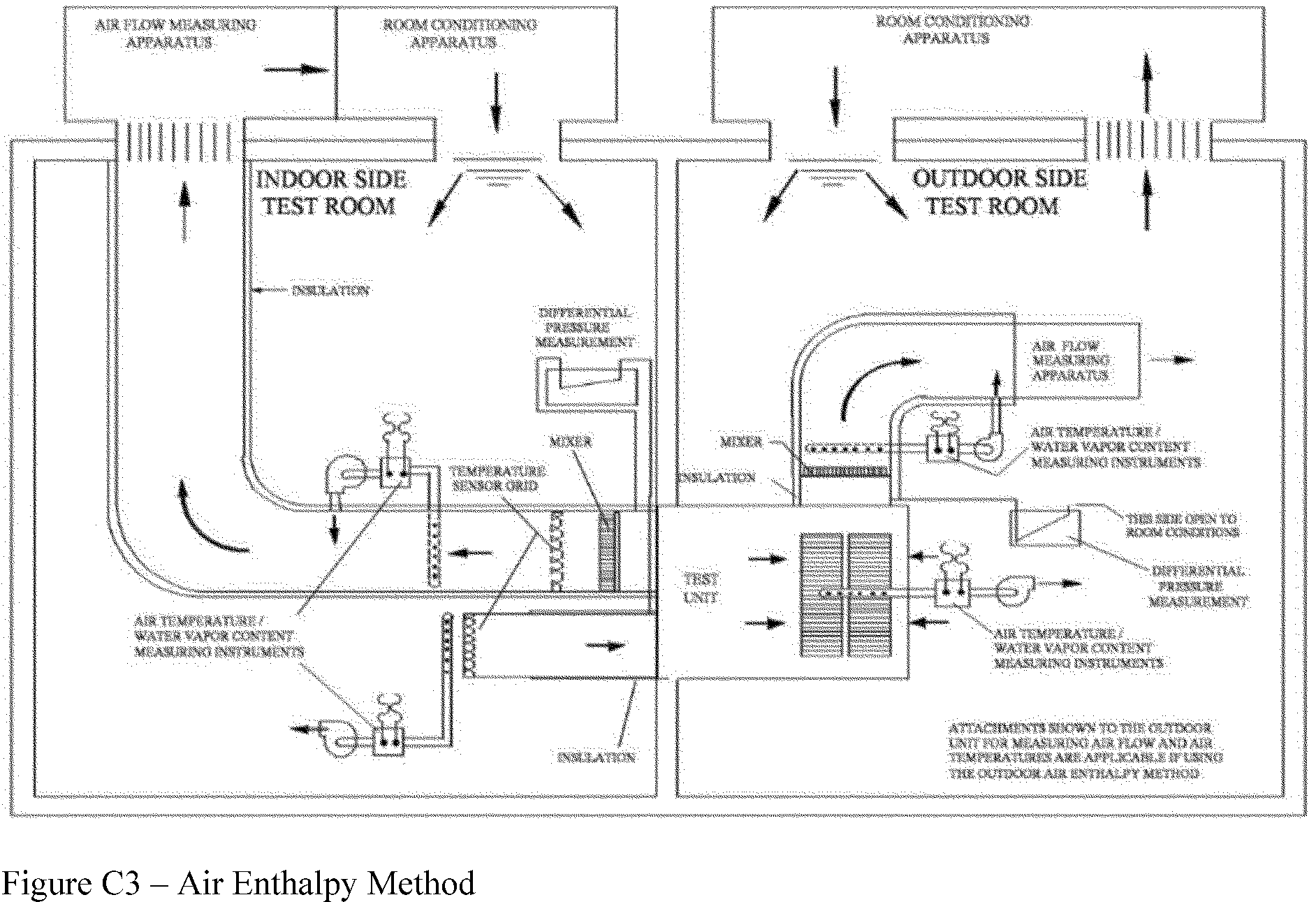
Determine Net Refrigeration Capacity of Unit Cooler and input power in accordance with ASHRAE 37-2009, Figure C3, and the following modifications.
C10.1.1.1 Space conditioning capacity is determined by measuring airflow rate and the dry-bub temperature and water vapor content of the air that enters and leaves the coil. Air enthalpies shall be determined in accordance with ANSI/ASHRAE 41.6. Entering air is to be sufficiently dry as to not produce frost on the Unit Cooler coil. Therefore, only sensible capacity measured by dry bulb change shall be used to calculate capacity.
C10.1.1.2 Test Setup for Non-Ducted Unit Coolers. A single outlet plenum box shall be constructed in a cubic arrangement. The length of the longest dimension of the Unit Cooler outlet shall be used to determine the dimension of the cube outlet plenum. Four static pressure taps shall be installed in the center of each face. A 6″ inlet plenum skirt shall be installed with four static pressure taps at each center face as well. Airflow shall be adjusted by the exhaust fan on the airflow plenum to achieve 0.00″WC (± 0.02″ WC).
C10.1.2
Outdoor Air Enthalpy Method.
Determine Net Refrigeration Capacity of Unit Cooler and input power in accordance with ASHRAE 37-2009, Figure C3, and the following modifications.
C10.1.2.1 Outdoor Air Enthalpy is only applicable on Dedicated Condensing Units for which the leaving air can be fully captured. Space conditioning capacity is determined by measuring airflow rate and the dry-bub temperature and water vapor content of the air that enters and leaves the coil. Air enthalpies shall be determined in accordance with ANSI/ASHRAE 41.6. Line loss adjustments in section 7.3.3.4 of ASHRAE 37-2009 are not applicable to package units.
C10.2.1 Following the completion of the steady-state capacity test, for each rating condition, the measured net capacities of the primary and secondary test methods must balance within 6%, per Equation C11.
C10.2.2 If measured net capacities do not balance per Equation C11, investigate all potential test facility leaks and/or non-conformances. If no leaks or non-conformances are detected, proceed to section C10.2.3. If any leaks or non-conformances are detected, remedy the concerns and rerun the steady-state test at all applicable rating condition(s). If the measured net capacities balance per Equation C11, then the test is considered valid, and capacity and power measurements from the primary method of the second test will be used. If the measured net capacities still do not balance per Equation C11, proceed to section C10.2.3.
C10.2.3 To achieve a capacity heat balance, the test lab may modify the exterior of the unit under test to reduce
( printed page 31441)
leakage and surface losses. Specifically, the lab may add insulation to the outside surface of the single-packaged dedicated system and/or tape and seal sheet metal edges to minimize outdoor ambient air intrusion to the Unit Cooler. After the unit is insulated, rerun the steady-state test at all applicable rating condition(s). If the measured net capacities balance per Equation C11, then the lab facility and instrumentation are verified as complying with the applicable method of test. However, capacity, power, and all downstream calculations will be based on the results of the primary method from the first test, which occurred before the unit was altered. If the measured net capacities still do not balance per Equation C11, then the lab facility and instrumentation are considered non-compliant, must be remedied, and all prior tests for the unit under test are considered invalid.
In 10 CFR part 431, subpart R, appendix C, sections 3.3 through 3.3.7.3.2 replace references to AHRI-1250-2009 sections C10, C11, C11.1, C11.1.1, C11.2, and C11.3, with C11, C12, C12.1, C12.1.1, C12.2, and C12.3, respectively; and replace references to AHRI-1250-2009 equations C13 and C14 with equations C14 and C15, respectively.
(3)
Representations.
Samyou may not make representations about the efficiency of a basic model listed in paragraph (1) of this Interim Waiver Order for compliance, marketing, or other purposes unless that basic model has been tested in accordance with the provisions set forth in this alternate test procedure and such representations fairly disclose the results of such testing.
(4) This Interim Waiver Order shall remain in effect according to the provisions of 10 CFR 431.401.
(5) This Interim Waiver Order is issued to Samyou on the condition that the statements, representations, test data, and documentary materials provided by Samyou are valid. If Samyou makes any modifications to the controls or configurations of a basic model subject to this Interim Waiver Order, such modifications will render the waiver invalid with respect to that basic model, and Samyou will either be required to use the current Federal test method or submit a new application for a test procedure waiver. DOE may rescind or modify this waiver at any time if it determines the factual basis underlying the petition for the Interim Waiver Order is incorrect, or the results from the alternate test procedure are unrepresentative of the basic model's true energy consumption characteristics. 10 CFR 431.401(k)(1). Likewise, Samyou may request that DOE rescind or modify the Interim Waiver Order if Samyou discovers an error in the information provided to DOE as part of its petition, determines that the interim waiver is no longer needed, or for other appropriate reasons. 10 CFR 431.401(k)(2).
(6) Issuance of this Interim Waiver Order does not release Samyou from the applicable requirements set forth at 10 CFR part 429.
DOE makes decisions on waivers and interim waivers for only those basic models specifically set out in the petition, not future models that may be manufactured by the petitioner. Samyou may submit a new or amended petition for waiver and request for grant of interim waiver, as appropriate, for additional basic models of WICFs. Alternatively, if appropriate, Samyou may request that DOE extend the scope of a waiver or an interim waiver to include additional basic models employing the same technology as the basic model(s) set forth in the original petition consistent with 10 CFR 431.401(g).
VI. Approval of the Office of the Secretary
The Secretary of Energy has approved publication of this notification of petition for waiver, grant of interim waiver, and request for comments.
Signing Authority
This document of the Department of Energy was signed on May 20, 2026, by Audrey Robertson, Assistant Secretary (EERE) for Critical Minerals and Energy Innovation, pursuant to delegated authority from the Secretary of Energy. That document with the original signature and date is maintained by DOE. For administrative purposes only, and in compliance with requirements of the Office of the Federal Register, the undersigned DOE Federal Register Liaison Officer has been authorized to sign and submit the document in electronic format for publication, as an official document of the Department of Energy. This administrative process in no way alters the legal effect of this document upon publication in the
Federal Register
.
Signed in Washington, DC, on May 22, 2026.
Jennifer Hartzell,
Alternate Federal Register Liaison Officer, U.S. Department of Energy.
Petition of Zhuhai Samyou Environmental Technology Co., Ltd.
For Waiver and Application for Interim Waiver of Test Procedure for the Measurement of Net Capacity and AWEF of Walk-In Cooler and Walk-In Freezer Refrigeration Systems
Address:
Unit 3-B-2, Building 4, No. 1, 7th Technology Road, Tangjiawan Town, HighTech Zone, Zhuhai, China 519080.
Contact:
Yang Bo.
Date:
November 20, 2025.
Basic Modl(s) Subject to Waiver:
Model
Brand
Product type
VLD-02ZFCLVX3H
SAMYOU
DC Inverter Compact Refrigeration Unit.
MEFDW12D
MRCOOL
DC Inverter Compact Refrigeration Unit.
I. Grounds for the Waiver Request
The petitioner seeks a waiver from the test procedures prescribed in Appendix C to Subpart R of 10 CFR part 431 for the above-referenced basic model(s) because a unique design characteristic of these models prevents compliance with the standard test methodology.
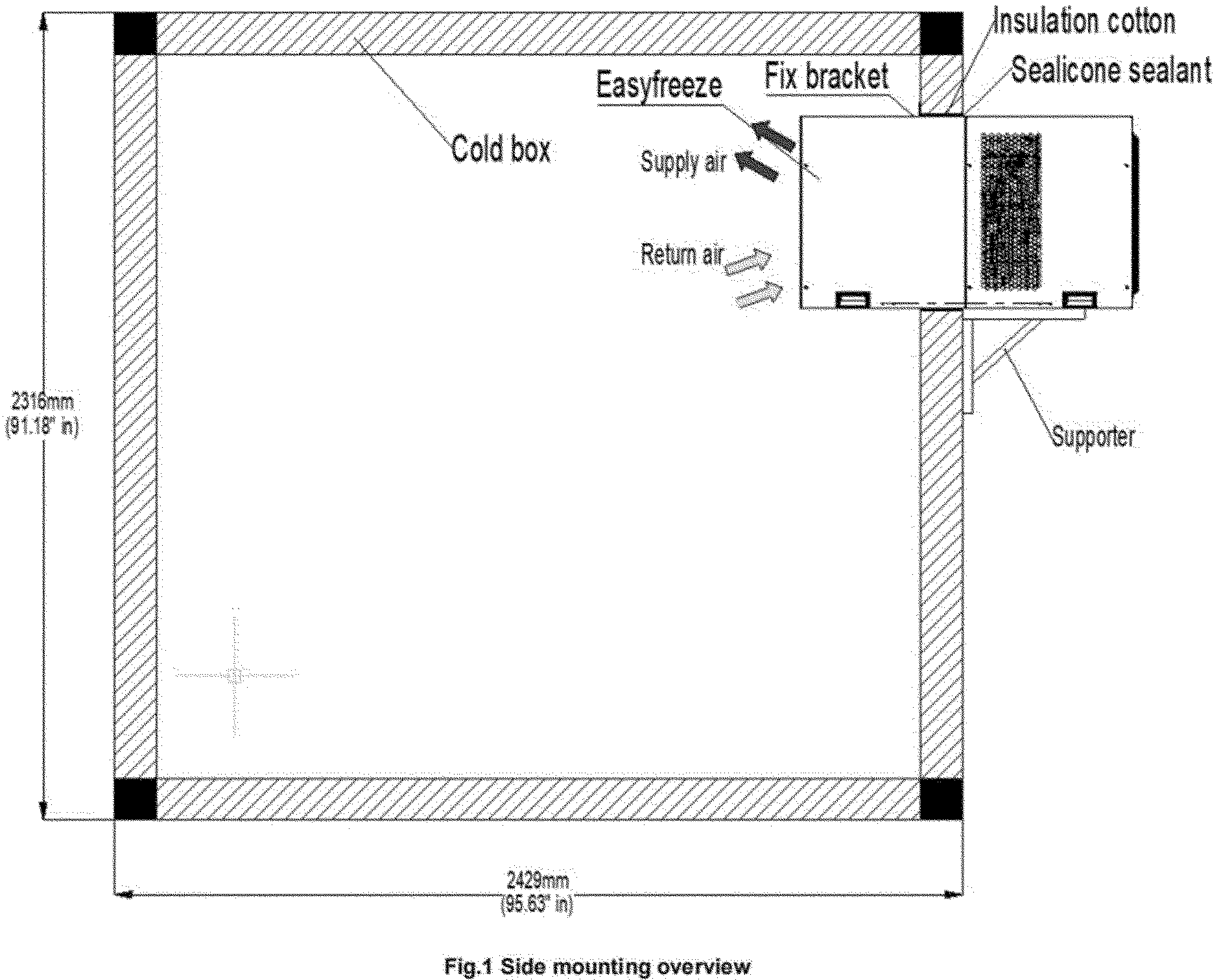
Specifically, the refrigerated merchandiser units incorporate an extremely compact internal configuration with densely packed components. The product picture and installation figure as below.
( printed page 31442)
The compact configuration requires less space for installation and easy to install on site. But there is insufficient physical space within the unit to install all temperature and airflow sensors required by Appendix C to Subpart R of 10 CFR part 431 without compromising the integrity of the refrigeration circuitry. Any attempt to retrofit the necessary instrumentation would necessitate drilling into or rerouting refrigerant lines, which would alter the unit's thermal performance and invalidate test results.
This design constraint constitutes a legitimate technical barrier that renders strict adherence to the DOE-prescribed test procedure impracticable. Therefore, a waiver is necessary to permit the use of an alternative test method that yields accurate, representative, and repeatable energy consumption data without physically modifying the unit's core architecture.
II. Identification of Other Manufacturers With Similar Design Characteristics
To the best of the petitioner's knowledge, the following manufacturer distributes basic models in U.S. commerce that incorporate similarly space-constrained designs, which may also present challenges in applying the standard Appendix C test procedure:
Store It Cold, LLC—Models: CBLW08, Models: CBLW10, Models: CBLW12, Models: CBLW15, Models: CBLW18, Models: CBLW25
The petitioner acknowledges that definitive public information on internal design configurations is limited, but based on industry experience and product teardowns, these manufacturers produce units with comparable spatial constraints that could impede full sensor installation per Appendix C.
We also glad to see that DOE has noticed the compact configuration trend for the product and granted the similar waiver to a manufacturer.
III. Proposed Alternative Test Method
The test procedure for the VLD-02ZFCLVX3H with brand name SAMYOU and MEFDW12D with brand name MRCOOL is the test procedure for walk-in cooler refrigeration systems prescribed by DOE at 10 CFR part 431, subpart R, appendix C[1]
except as detailed below. All other requirements of 10 CFR part 431, subpart R, appendix C, and DOE's regulations remain applicable.
In 10 CFR part 431, subpart R, appendix C, section 3.1.
General modifications: Test Conditions and Tolerances
revise sections 3.1.1. and 3.1.4., and add instructions in a new section 3.1.8. regarding Tables 3 and 4 of AHRI 1250-2009, to read:
3.1.1. In Table 1, Instrumentation Accuracy, refrigerant temperature measurements shall have a tolerance of ±0.5 F for unit cooler in/out. Temperature measurements used to determine water vapor content of the air shall be accurate to within ±0.4 F, ±1.0 F for all other temperature measurements.
3.1.4. In Tables 2 through 14, the Test Condition Outdoor Wet Bulb Temperature requirement and its
( printed page 31443)
associated tolerance apply only to units with evaporative cooling and single-packaged dedicated systems. The condenser-side condensate pan must be dry during performance measurement test periods.
3.1.8. Tables 3 and 4 shall be modified to read as follows:
Table 3—Fixed Capacity Matched Refrigerator System and Single-Packaged Dedicated System, Condensing Unit Located Indoor
Test description
Unit cooler
air entering
dry-bulb,
(° F)
Unit cooler
air entering
relative
humidity
(%)
Condenser air
entering
dry-bulb
(° F)
Condenser air
entering
wet-bulb
(° F)
Compressor
capacity
Test objective
Off-cycle Fan Power
35
<50
Compressor Off
Measure fan input wattage during compressor off cycle.
Refrigeration Capacity
35
<50
90
1
75,2
65
Compressor On
Determine Net Refrigeration Capacity of Unit Cooler, input power, and EER at Rating Condition.
Note:
1
Required only for evaporative Dedicated Condensing Units.
2
Maximum allowable value for Single-packaged Systems that do not use evaporative Dedicated Condensing Units, where all or part of the equipment is located in the outdoor room.
Table 4—Fixed Capacity Matched Refrigerator System and Single-Packaged Dedicated System, Condensing Unit Located Outdoor
Test description
Unit cooler
air entering
dry-bulb,
(° F)
Unit cooler
air entering
relative
humidity
(%)
Condenser air
entering
dry-bulb
(° F)
Condenser air
entering
wet-bulb
(° F)
Compressor
capacity
Test objective
Off Cycle Fan Power
35
<50
Compressor Off
Measure fan input wattage during compressor off cycle.
Refrigeration Capacity A
35
<50
95
1
75,2
68
Compressor On
Determine Net Refrigeration Capacity of Unit Cooler, input power, and EER at Rating Condition.
Refrigeration Capacity B
35
<50
59
1
54,2
46
Compressor On
Determine Net Refrigeration Capacity of Unit Cooler and system input power at moderate condition.
Refrigeration Capacity C
35
<50
35
1
34,2
29
Compressor On
Determine Net Refrigeration Capacity of Unit Cooler and system input power at cold condition.
Note:
1
Required only for evaporative Dedicated Condensing Units.
2
Maximum allowable value for Single-packaged Dedicated Systems that do not use evaporative Dedicated Condensing Units, where all or part of the equipment is located in the outdoor room.
In 10 CFR part 431, subpart R, appendix C, section 3.2.
General Modifications: Methods of Testing
add the following instructions regarding additional modifications to appendix C of AHRI 1250-2009:
3.2.9 In appendix C, section C1. reads: Purpose. The purpose of this appendix is to provide a method of testing for Matched-pair, Single packaged Dedicated Systems, as well as unit coolers and Dedicated Condensing Units tested alone.
3.2.10 In appendix C, section C5. and C5.1 read as follows:
3.2.10.1 C5 reads: C5. Methods of Testing for walk-in cooler and freezer systems that have matched unit coolers and condensing units. The testing of the walk-in cooler and freezer systems include a steady state test, defrost test and off-cycle fan power test. For single-packaged dedicated systems, calculate the refrigeration capacity and power consumption using the Indoor Air Enthalpy test method and the Outdoor Air Enthalpy test method. The Indoor Air Enthalpy test method shall be considered the primary measurement and used to report capacity. The Outdoor Air Enthalpy test method shall be considered the secondary measurement and used to calculate the Refrigeration Capacity Heat Balance. See Section C10 of this appendix for complete details on each test method.
3.2.10.2 C5.1 reads: The Gross Total Refrigeration Capacity of Unit Coolers for matched-pairs (not including single-packaged dedicated systems) from steady state test shall be determined by either one of the following methods.
3.2.11 In appendix C, section C7.1 reads: Refer to the standard rating conditions for a particular application listed in Section 5 of this standard. Test acceptance criteria listed in Table 2 in section 4 of this standard apply to the Dual Instrumentation and Calibrated Box methods of test. Single-packaged dedicated system test tolerances are listed in each applicable Method of Test outlined in section C10.
( printed page 31444)
3.2.12 In appendix C, section C7.2 reads: Data that need to be recorded during the test are listed in Table C2. For single-packaged dedicated systems tested in accordance with ASHRAE 37-2009, data that need to be recorded during the test are listed in ASHRAE 37-2009.
3.2.13 In appendix C, section C6. Test Chambers Requirements, add C6.3 to read as follows:
C6.3 For all system constructions (Split systems, Single-packaged dedicated systems, Unit Cooler tested alone, and Dedicated Condensing Unit tested alone), the Unit Cooler under test may be used to aid in achieving the required test chamber ambient temperatures prior to beginning any Steady-state test. However, the unit under test must be free from frost before initiating any Steady-state testing.
For single-packaged dedicated systems, refer to the applicable methods of test for single-packaged dedicated systems listed in section C10 of this appendix.
In 10 CFR part 431, subpart R, appendix C, section 3.3.
Matched systems, single-packaged dedicated systems, and unit coolers tested alone,
revise the language to read:
3.3
Matched systems, single-packaged dedicated systems, and unit coolers tested alone:
Use the test method in AHRI 1250-2009 (incorporated by reference; see § 431.303), appendix C as the method of test for matched refrigeration systems, single-packaged dedicated systems, or unit coolers tested alone, with the modifications listed below in sections 3.3.1 through 3.3.7.3.2.:
In appendix C of AHRI 1250-2009, renumber the following sections and equations, and references to the following sections and equations, as follows: Section C10 to Section C11; Section C11 to C12; Section C11.1 to C12.1; Section C11.1.1 to C12.1.1; Equation C11 to C12; Equation C12 to C13; Section C11.2 to C12.2; Section C11.3 to C12.3; Equation C13 to C14; Equation C14 to C15; Equation C15 to C16; Equation C16 to C17; Section C12 to C13; and Section C13 to C14.
Insert the following as sections C10 through C10.2.3, and equation C11:
C10. Single-packaged Test Methods and Allowable Refrigeration Capacity Heat Balance.
C10.1.1
Indoor Air Enthalpy Method.
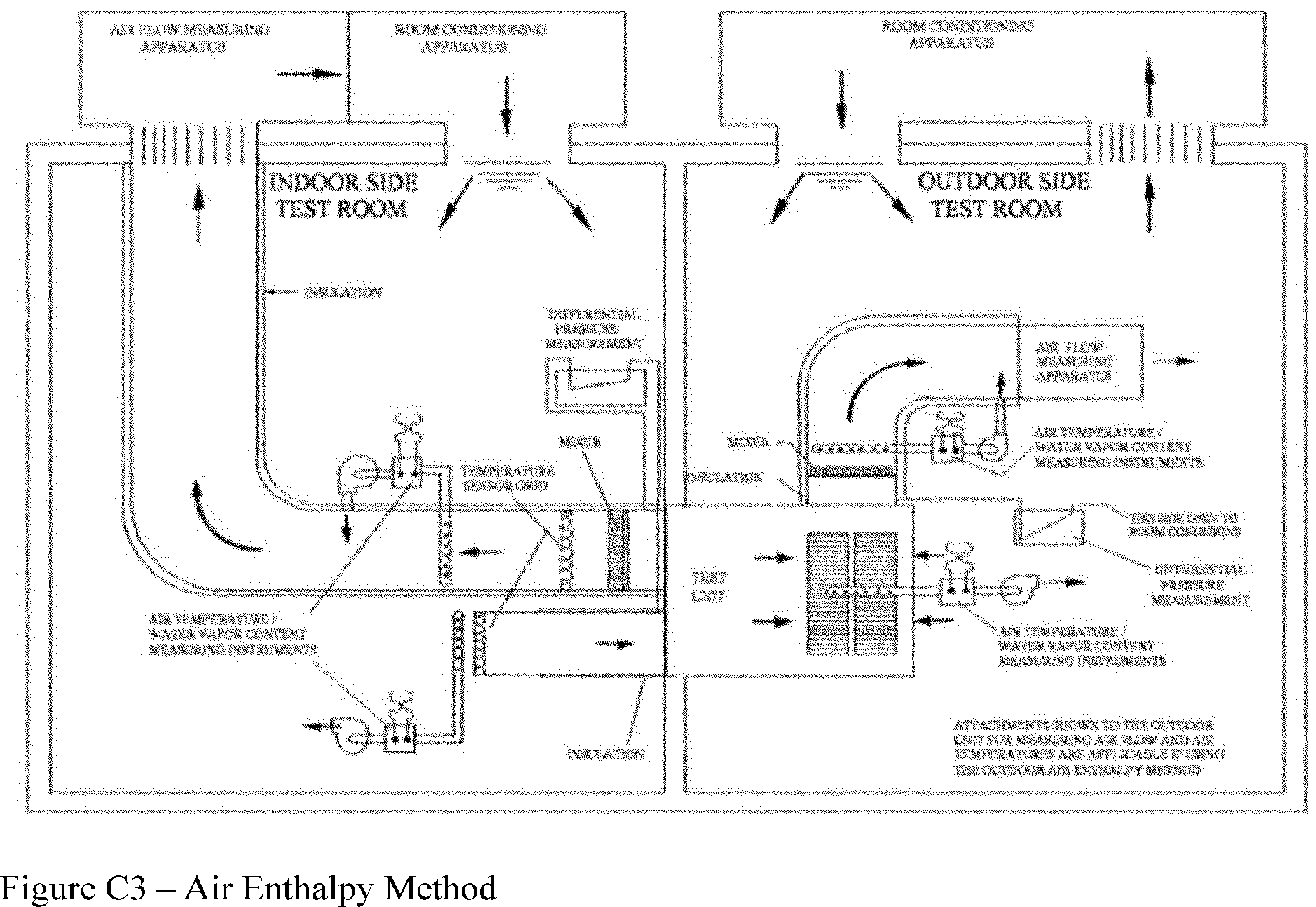
Determine Net Refrigeration Capacity of Unit Cooler and input power in accordance with ASHRAE 37-2009, Figure C3, and the following modifications.
C10.1.1.1 Space conditioning capacity is determined by measuring airflow rate and the dry-bub temperature and water vapor content of the air that enters and leaves the coil. Air enthalpies shall be determined in accordance with ANSI ASHRAE 41.6.
Entering air is to be sufficiently dry as to not produce frost on the Unit Cooler coil. Therefore, only sensible capacity measured by dry bulb change shall be used to calculate capacity.
C10.1.1.2 Test Setup for Non-Ducted Unit Coolers. A single outlet plenum box shall be constructed in a cubic arrangement. The length of the longest dimension of the Unit Cooler outlet shall be used to determine the dimension of the cube outlet plenum. Four static pressure taps shall be installed in the center of each face. A 6″ inlet plenum skirt shall be installed with four static pressure taps at each center face as well. Airflow shall be adjusted by the exhaust fan on the
( printed page 31445)
airflow plenum to achieve 0.00″ WC (± 0.02″ WC).
C10.1.2
Outdoor Air Enthalpy Method.
Determine Net Refrigeration Capacity of Unit Cooler and input power in accordance with ASHRAE 37-2009, Figure C3, and the following modifications.
C10.1.2.1 Outdoor Air Enthalpy is only applicable on Dedicated Condensing Units for which the leaving air can be fully captured. Space conditioning capacity is determined by measuring airflow rate and the dry-bub temperature and water vapor content of the air that enters and leaves the coil. Air enthalpies shall be determined in accordance with ANSI ASHRAE 41.6. Line loss adjustments in section 7.3.3.4 of ASHRAE 37-2009 are not applicable to package units.
C10.2.1 Following the completion of the Steady-state capacity test, for each rating condition, the measured net capacities of the primary and secondary test methods must balance within 6%, per Equation C11.
C10.2.2 If measured net capacities do not balance per Equation C11, investigate all potential test facility leaks and/or non-conformances. If no leaks or non-conformances are detected, proceed to Section C10.2.3. If any leaks or non-conformances are detected, remedy the concerns and rerun the Steady-state test at all applicable rating condition(s). If the measured net capacities balance per Equation C11, then the test is considered valid and capacity and power measurements from the primary method of the second test will be used. If the measured net capacities still do not balance per Equation C11, proceed to Section C10.2.3.
C10.2.3 To achieve a capacity heat balance, the test lab may modify the exterior of the unit under test to reduce leakage and surface losses. Specifically, the lab may add insulation to the outside surface of the single-packaged dedicated system and/or tape and seal sheet metal edges to minimize outdoor ambient air intrusion to the Unit Cooler. After the unit is insulated, rerun the Steady-state test at all applicable rating condition(s). If the measured net capacities balance per Equation C11, then the lab facility and instrumentation are verified as complying with the applicable method of test. However, capacity, power, and all downstream calculations will be based on the results of the primary method from the first test, which occurred before the unit was altered. If the measured net capacities still do not balance per Equation C11, then the lab facility and instrumentation are considered non-compliant, must be remedied, and all prior tests for the unit under test are considered invalid.
In 10 CFR part 431, subpart R, appendix C, sections 3.3 through 3.3.7.3.2 replace references to AHRI-1250-2009 sections C10, C11, C11.1, C11.1.1, C11.2, and C11.3, with C11, C12, C12.1, C12.1.1, C12.2, and C12.3, respectively; and replace references to AHRI-1250-2009 equations C13 and C14 with equations C14 and C15, respectively.
IV. Request for Interim Waiver
In addition to the permanent waiver, the petitioner respectfully requests an interim waiver pursuant to 10 CFR 431.401(b)(2), pending final DOE determination on this petition.
Likelihood of Success:
The grounds for waiver are well-supported by engineering evidence and consistent with precedent (
e.g.,
Store It Cold). The proposed alternative method is technically sound, reproducible, and aligned with DOE's objective of obtaining accurate energy use data.
Economic Hardship & Competitive Disadvantage:
Absent an interim waiver, the petitioner will be unable to certify and distribute these models in the U.S. market. This would result in:
Loss of significant sales revenue during the review period (estimated at $2-5 million annually),
Inability to fulfill existing customer contracts and retailer commitments,
Competitive disadvantage relative to manufacturers who have already secured similar waivers,
Potential inventory obsolescence and supply chain disruption.
Granting an interim waiver is essential to maintain market access and ensure fair competition while DOE evaluates the full petition.
V. Certification and Signature
I, the undersigned, am authorized to represent the petitioner in this matter. I have reviewed this petition and confirm that all statements herein are true, accurate, and complete to the best of my knowledge and belief.
2.
All references to EPCA in this document refer to the statute as amended through the Energy Act of 2020, Public Law 116-260 (Dec. 27, 2020), which reflect the last statutory amendments that impact Parts A and A-1 of EPCA.
4.
The specific basic models for which the petition applies are Samyou VLD-02ZFCLVX3H and MRCOOL MEFDW12D. These basic model names were provided by Samyou in its November 23, 2025 petition.
5.
A notation in this form provides a reference for information that is in the docket for this test procedure waiver (Docket No. EERE-2025-BT-WAV-0139) (available at:
www.regulations.gov/docket/EERE-2025-BT-WAV-0139). This notation indicates that the statement preceding the reference is document number 1 in the docket and appears at page 10 of that document.
6.
“Single-packaged dedicated system” means a refrigeration system (as defined in 10 CFR 431.302) that is a single-package assembly that includes one or more compressors, a condenser, a means for forced circulation of refrigerated air, and elements by which heat is transferred from air to refrigerant, without any element external to the system imposing resistance to flow of the refrigerated air. 10 CFR 431.302.
8.
The Interim Waiver Order applies only to the WICF system basic models manufactured by Samyou specified in the petition and Interim Waiver Order. The Interim Waiver Order does not cover any other WICF system basic models manufactured by Samyou or any other manufacturer.
9.
AHRI 1250-2009 is incorporated by reference in the Federal test procedure at 10 CFR 431.303(b)(2). The alternate test procedure provides amendments to 10 CFR part 431, subpart R, appendix C that include required modifications to the test method prescribed in AHRI 1250-2009.
1.
AHRI Standard 1250P (I-P)-2009 (“AHRI 1250-2009”) titled “Standard for Performance Rating of Walk-in Coolers and Freezers” is incorporated by reference in the federal test procedure at 10 CFR 431.303(b)(2). The alternate test procedure provides amendments 10 CFR part 431, subpart R, appendix C that include required modifications to AHRI 1250-2009.
Use this for formal legal and research references to the published document.
91 FR 31435
Web Citation
Suggested Web Citation
Use this when citing the archival web version of the document.
“Energy Conservation Program: Notification of Petition for Waiver of Zhuhai Samyou Environmental Technology Co., Ltd. From the Department of Energy Walk-In Coolers and Walk-In Freezers Test Procedure and Notification of Grant of Interim Waiver,” thefederalregister.org (May 27, 2026), https://thefederalregister.org/documents/2026-10483/energy-conservation-program-notification-of-petition-for-waiver-of-zhuhai-samyou-environmental-technology-co-ltd-from-th.