This notice requests comment on a proposal to update the NHTSA's New Car Assessment Program (NCAP) by adding rear automatic braking (RAB) systems with pedestrian avoidance abili...
National Highway Traffic Safety Administration (NHTSA), Department of Transportation (Department or DOT).
ACTION:
Request for comments (RFC).
SUMMARY:
This notice requests comment on a proposal to update the NHTSA's New Car Assessment Program (NCAP) by adding rear automatic braking (RAB) systems with pedestrian avoidance ability to the advanced driver assistance systems (ADAS) technologies NHTSA currently recommends. NHTSA proposes to identify and evaluate vehicles in the marketplace that offer systems that pass NCAP performance test criteria for RAB. The proposed updates to NCAP would give consumers important safety information about technologies designed to prevent crashes with pedestrians when the vehicle is moving in reverse.
DATES:
Comments should be submitted no later than July 27, 2026.
ADDRESSES:
You may submit comments to the docket number identified in the heading of this document by one of the following methods:
Federal Rulemaking Portal: https://www.regulations.gov.
Follow the online instructions for submitting comments.
Mail:
Docket Management Facility, U.S. Department of Transportation, 1200 New Jersey Avenue SE, West Building Ground Floor, Room W12-140, Washington, DC 20590-0001.
Hand Delivery:
1200 New Jersey Avenue SE, West Building Ground Floor, Room W12-140, Washington, DC, between 9 a.m. and 5 p.m. ET, Monday through Friday, except Federal Holidays. To be sure someone is there to help you, please call 202-366-9332 before coming.
Instructions:
For detailed instructions on submitting comments and additional information on the rulemaking process, see the Public Participation heading of the Supplementary Information section of this document. Note that all comments received will be posted without change to
https://www.regulations.gov,
including any personal information provided.
Docket:
For access to the docket to read background documents or comments received, go to
www.regulations.gov,
or the street address listed above. Follow the online instructions for accessing the dockets.
Privacy Act:
Anyone can search the electronic form of all comments received in any of our dockets by the name of the individual submitting the comment (or signing the comment, if submitted on behalf of an association, business, labor union, or other entity). For information on DOT's compliance with the Privacy Act, see
https://www.transportation.gov/privacy.
FOR FURTHER INFORMATION CONTACT:
For technical issues, you may contact Ian MacIntire, Office of Crashworthiness Standards by email at
ian.macintire@dot.gov,
or by phone at 202-366-1810. Address: National Highway Traffic Safety Administration, 1200 New Jersey Avenue SE, West Building, Washington, DC 20590-0001.
SUPPLEMENTARY INFORMATION:
Table of Contents
I. Executive Summary
II. Background
A. Rear Automatic Braking Systems
B. 2015 NCAP RFC
C. NCAP Roadmap
D. Euro NCAP
E. NHTSA Research
III. Purpose and Rationale
IV. Rear Automatic Braking Testing Program
A. Safety Need
B. Countermeasures Exist
C. Potential Safety Benefits
D. Objective Test Procedure Exists
V. NHTSA Research
A. Overview
B. NHTSA's 2026 Report
( printed page 31835)
C. Research Conclusions
VI. Proposal in Detail
A. Test Objects
B. Test Scenarios and Test Conditions
C. Pass-Fail Criteria
D. Number of Trials per Test Condition
E. Awarding Credit for RAB Systems
VII. Conclusion
VIII. Economic Analysis
IX. Public Participation
X. Appendices
A. Requests for Comment
I. Executive Summary
NCAP provides comparative information on the safety performance of new vehicles and the availability of new vehicle safety features to assist consumers with vehicle purchasing decisions. NCAP is one of several programs that NHTSA uses to fulfill its mission of reducing fatalities, injuries, and economic losses that occur on U.S. roadways. This RFC focuses on the inclusion of RAB systems with pedestrian avoidance capability in NCAP.
RAB is an advanced driver assistance technology designed to apply a vehicle's brakes automatically when reversing if an obstacle is detected in its path. The technology complements existing rear visibility systems such as mirrors and cameras by intervening automatically to prevent or mitigate backover crashes. Backover crashes are crashes where non-occupants of vehicles (such as pedestrians or cyclists) are struck by vehicles moving in reverse. While most current RAB systems are not designed to detect and avoid pedestrians, NHTSA's testing of RAB systems has shown the potential for pedestrian detection and avoidance of backover crashes.
Backover crashes often occur in parking lots or driveways where pedestrians are more likely to be present and vehicles are making backing maneuvers. Vehicle blind spots limit what drivers can see behind a vehicle, making backing maneuvers particularly dangerous for children who may be too small to be seen. According to data from the Fatality Analysis Reporting System (FARS) and the Crash Report Sampling System (CRSS) for the years 2017 through 2022, approximately 111,000 crashes occurred annually that involved a passenger vehicle backing into a pedestrian, cyclist, fixed object, parked vehicle, or moving object. These backing crashes resulted in an average of 69 fatalities each year, 36 of which involved pedestrians, and with a disproportionate number of small child victims.
In support of this proposal, NHTSA conducted research to evaluate various vehicles' RAB system performance in different test scenarios and test conditions. The testing demonstrated that while current RAB systems can prevent some backover crashes, their performance varies across vehicle models and test conditions. The research developed a standardized, objective procedure to assess RAB performance in scenarios involving pedestrians.
NHTSA proposes to assess RAB system performance in two test scenarios: (1) Reversing Vehicle—Stationary Pedestrian Test Mannequin and (2) Reversing Vehicle—Moving Pedestrian Test Mannequin. In each of these test scenarios, the vehicle is reversing at a speed of four km/h (2.5 mph) or eight km/h (5 mph).[1]
All test scenarios are conducted in daylight conditions. Two test mannequins are utilized for each speed condition—the 4activePA-adult articulated pedestrian test mannequin (adult mannequin) and the 4activePS-child static two-year-old pedestrian test mannequin with posable but fixed arms and legs (two-year-old mannequin).[2]
In the stationary pedestrian scenario, the pedestrian test mannequin is stationary with articulation (if available) switched off, facing sideways (towards the driver's side of the test vehicle), and located at a 25, 50, or 75 percent “overlap” as the vehicle travels rearward at four km/h or eight km/h. The term “overlap” in the context of RAB testing is the location of the point on the rear of the vehicle that would make contact with the test mannequin if no braking occurred. For the stationary pedestrian scenario, overlap is expressed as a percentage of the subject vehicle's overall width measured from the vehicle's driver side outer edge.
In the moving pedestrian scenario, the pedestrian test mannequin moves perpendicular to the rearward motion of the vehicle. In this test scenario, the adult mannequin, moving at five km/h (3.1 mph), or the two-year-old mannequin, moving at 3.2 km/h (two mph), approaches the vehicle traveling rearward, from either the left or right side such that the potential point of impact is in the middle of the vehicle rear (
i.e.,
50 percent overlap).
Collectively, the proposed two scenarios result in a total of 20 test conditions (12 test conditions in stationary pedestrian scenario and eight test conditions in moving pedestrian scenario) for evaluating RAB system performance in a vehicle. The proposed test matrix is presented in Table 1 below:
Table 1—Proposed Test Matrix for the NCAP RAB Evaluation
Test scenario
Approach direction
Test object and related speed
Test object overlap
Vehicle speed in reverse
4 km/h
(2.5 mph)
8 km/h
(5 mph)
Stationary Pedestrian in Resting Position 3
with Articulation (if any) Switched Off
Facing Left
Adult
25 percent
50 percent
75 percent
1
1
1
1
1
1
2-year-old child
25 percent
50 percent
75 percent
1
1
1
1
1
1
Test Conditions—Stationary Pedestrian Scenario
12
Moving Pedestrian
From Right
Adult, 5 km/h (3.1 mph)
2-year-old child, 3.2 km/h (2 mph)
50 percent
50 percent
1
1
1
1
( printed page 31836)
From Left
Adult, 5 km/h (3.1 mph)
2-year-old child, 3.2 km/h (2 mph)
50 percent
50 percent
1
1
1
1
# Test Conditions—Moving Pedestrian Scenario
8
# Total Test Conditions for RAB Evaluation
20
The
proposed performance criteria assessed in the tests for evaluating RAB performance are: (1) the vehicle shall not contact the test mannequin; (2) an auditory warning shall be provided prior to RAB system brake application onset; (3) the RAB system shall default to “ON” after each ignition/key cycle; and (4) after the vehicle comes to a complete stop, its brakes shall not be released unless test mannequin is no longer in the vehicle's path or the driver performs a deliberate override action.
NHTSA proposes to conduct only one trial per test condition, which results in a total of 20 tests for evaluating a vehicle's RAB system. NHTSA proposes that vehicles must pass (
i.e.,
meet the four proposed performance criteria) all 20 tests to receive RAB credit. NHTSA proposes to identify vehicles with RAB systems that receive RAB credit by way of a check mark on the NHTSA website. Until a crash avoidance rating system is developed and implemented, the check mark on the NHTSA website will remain the primary method of notifying consumers of available RAB systems meeting NHTSA's performance criteria.
This proposal aligns with NHTSA's NCAP Roadmap, which outlines mid-term and long-term updates to the program. RAB has been identified as a mid-term addition to NCAP's crash avoidance testing. The proposed tests and evaluation criteria for RAB are similar to those utilized in the 2023 European New Car Assessment Program protocol (2023 Euro NCAP protocol),[4]
with some modifications to address better the safety concern in the United States. Specifically, while the 2023 Euro NCAP protocol utilizes a seven-year-old child test mannequin, NHTSA proposes to use the 4active-PS static two-year-old pedestrian test mannequin (two-year-old mannequin) because a large percentage of the pedestrian fatalities stemming from impacts with the rear of vehicles while they are backing are associated with children one to two years of age.
The implementation of this proposal would expand NCAP's consumer information offerings to cover a feature that addresses directly pedestrian and child safety in backing scenarios. Through this RFC, NHTSA seeks public comment on its proposal to include RAB in NCAP, including the test procedures and performance criteria under consideration. NHTSA includes requests for public comment in this notice on specific topics that are also numbered and compiled for the reader's convenience in Appendix A. To ensure that NHTSA addresses all comments, NHTSA requests that commenters provide the corresponding request for comment number(s) in their responses.
II. Background
A. Rear Automatic Braking Systems
RAB is an advanced driver assistance technology designed to apply brakes automatically when a vehicle is traveling in reverse and an object or person is detected in its path. Unlike traditional rear visibility systems such as mirrors or rearview cameras, which rely on the driver to observe and react, RAB intervenes directly by applying the vehicle's brakes. This is done automatically, independent of driver input, with the intent to prevent or mitigate a rearward collision. Manufacturers employ sensors or cameras to identify potential obstacles behind the vehicle and activate braking when needed. The rear automatic braking action is generally preceded by a warning to the driver notifying them of an impending collision with object(s) to the rear of the vehicle.
Though many RAB systems in current vehicles are intended mainly to prevent vehicle damage due to impact with inanimate objects while the vehicle is reversing, there is potential for RAB systems to enhance the protection of adult and child pedestrians, who are at risk in backover crashes. Backover crashes often occur at low speeds in residential driveways, parking lots, and other non-roadway environments where young children may be difficult for drivers to see. While technologies such as rear visibility cameras have improved driver awareness of their surroundings, this safety feature remains dependent on driver vigilance and reaction time. RAB extends protection beyond the driver's capability by providing automatic intervention when an adult or child pedestrian is present in a moving vehicle's rearward path.
B. 2015 NCAP RFC
In a 2015 RFC, NHTSA proposed including RAB as part of the NCAP program.[5]
However, RAB systems and the test procedure [6]
proposed were different at that time from what is now being considered. The 2015 RFC proposed a feature confirmation test in which the vehicle under test was placed in reverse and allowed to roll backward from rest by simply releasing the brake pedal. The RAB system was expected to detect a static child-sized mannequin behind the vehicle and automatically stop the vehicle before making contact. The test object in that draft procedure was limited to a stationary pedestrian test mannequin placed at three different degrees of overlap behind the vehicle, and the test ended either when the RAB system stopped the vehicle or when the vehicle contacted the mannequin. The system would need to avoid contacting the mannequin in all three overlap percentages (25 percent, 50 percent, and 75 percent) to receive credit for passing performance.
( printed page 31837)
In the 2015 RFC, NHTSA proposed to assess RAB performance using a rudimentary test procedure developed to reflect the state of RAB technology at the time. Then-current RAB systems were generally designed for object detection and were not widely capable of pedestrian detection. In contrast, modern RAB technology has expanded functionality and can be assessed under much more robust and realistic conditions. Accordingly, current procedures specify controlled reverse speeds rather than having the vehicle idle rearward, incorporate both stationary and moving pedestrian test mannequins, and require testing at different overlap percentages.
Because of the expanded capabilities of RAB systems in recent years, modifications and additions to the associated test procedures, and fundamental differences in system performance expectations since NHTSA first introduced the concept of RAB in its 2015 RFC notice, comments submitted in response to that notice are no longer considered relevant and are not addressed herein. NHTSA invites comment on the current RAB systems being considered for inclusion in NCAP.
C. NCAP Roadmap
The NCAP roadmap sets forth NHTSA's phased strategy for advancing the program over the coming years by incorporating new crash avoidance, crashworthiness, and vulnerable road user protection measures.[7]
The roadmap is intended to provide transparency about how NCAP will evolve, giving consumers access to clearer information on vehicle safety and encouraging manufacturers to integrate emerging safety technologies into their new vehicle models. NHTSA explained that goals listed on the roadmap aim to protect both occupants and vulnerable road users.[8]
Within this framework, RAB has been identified as a mid-term addition to NCAP. Its inclusion reflects NHTSA's recognition of the safety technologies designed to prevent backover crashes, particularly those involving pedestrians of all sizes, including children.
D. Euro NCAP
Euro NCAP has developed a protocol for evaluating RAB systems and has been testing RAB systems since January 2020.[9]
Euro NCAP treats RAB as part of its vulnerable road user protection efforts. The Euro NCAP, “TEST PROTOCOL—AEB/LSS VRU systems Implementation 2023, Version 4.5.1,” [10]
referred to in this RFC as the 2023 Euro NCAP protocol, contains test conditions for evaluating a vehicle's RAB system's ability to avoid contact with either a stationary or moving pedestrian test mannequin when reversing at low speeds. The vehicle test speeds are four km/h and eight km/h, representing common reversing speeds in parking areas. All test scenarios are conducted in daylight conditions. The evaluation uses two articulating pedestrian test mannequins: an adult male and a seven-year-old child. These adult and child pedestrian test mannequins used in the 2023 Euro NCAP protocol RAB tests are in accordance with the performance requirements, dimensions, and reflection properties for pedestrian test mannequins specified in the International Organization for Standardization (ISO) 19206-2.[11]
In the tests with a stationary pedestrian test mannequin, the vehicle travels rearwards at four km/h or eight km/h towards the pedestrian test mannequin (adult or child articulating pedestrian test mannequin with articulation switched off) facing sideways (left or right direction, selected by testing facility). In these tests, the stationary pedestrian test mannequin is positioned such that the rear of the vehicle could potentially strike the pedestrian at a location from the driver's side vehicle edge that is 25, 50, or 75 percent of the vehicle's width (25 percent, 50 percent, or 75 percent overlap).
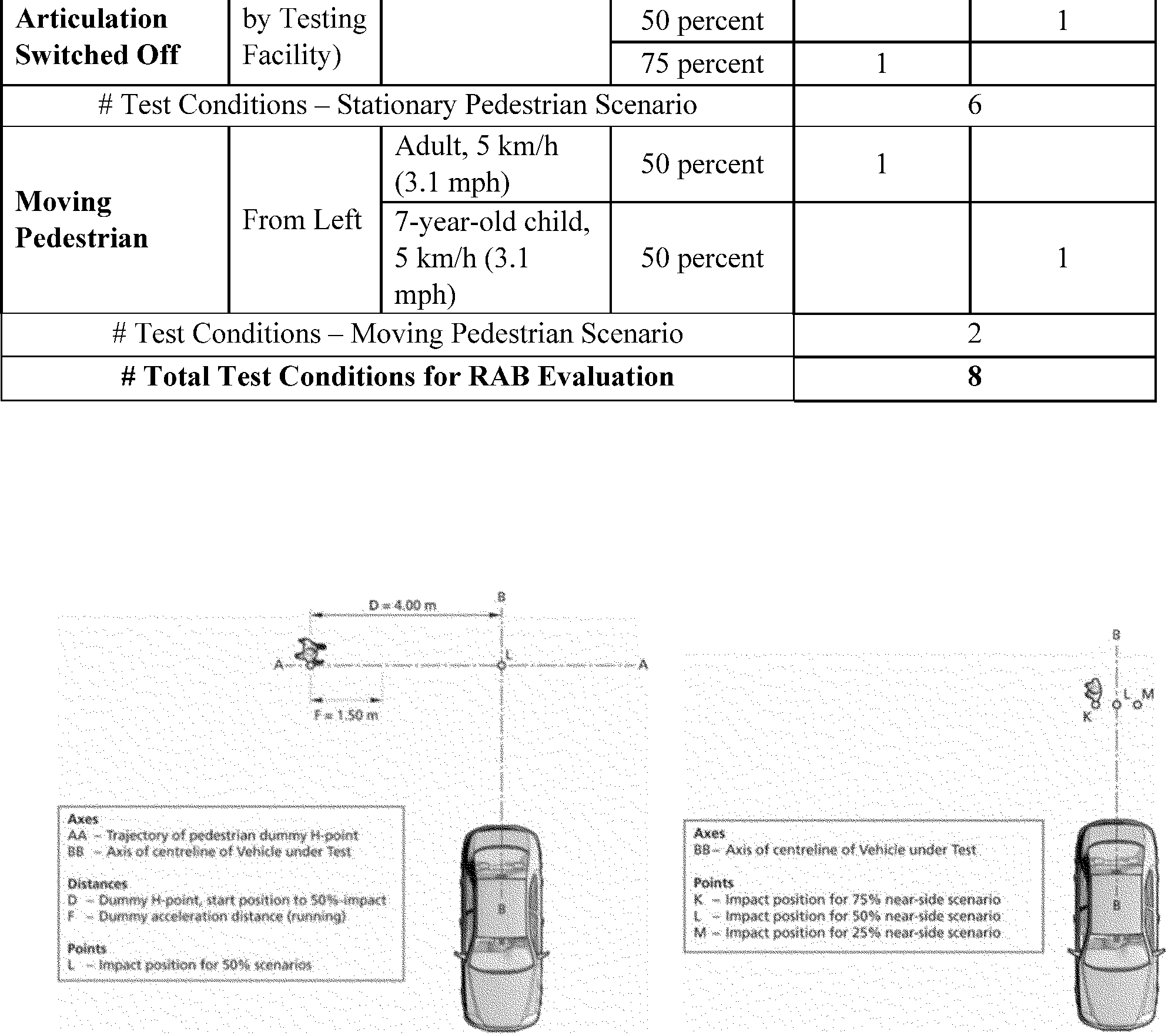
In the tests with a moving pedestrian test mannequin, the articulating pedestrian test mannequin is initially located four meters left of the test vehicle's longitudinal centerline and travels at a speed of km/h perpendicular to the test vehicle's line of travel such that potential impact with the rear of the vehicle occurs when the mannequin is located at the vehicle's longitudinal centerline (50 percent overlap). The test matrix for evaluating RAB in the 2023 Euro NCAP protocol is shown in Table 2, and a schematic of the RAB test procedure with stationary pedestrian test mannequins and moving pedestrian test mannequins is shown in Figure 1. As shown in Table 2, EuroNCAP assessment of RAB system performance involves a total of 8 test conditions.
Table 2—2023 Euro NCAP Protocol Test Matrix for RAB Evaluation
Test scenario
Approach direction
Test object
Test object
overlap
Vehicle speed in reverse
4 km/h
(2.5 mph)
8 km/h
(5 mph)
Stationary Pedestrian in Resting Position with Articulation Switched Off
Facing Left or Right (Selected by Testing Facility)
Adult
25 percent
50 percent
75 percent
1
1
1
7-year-old child
25 percent
50 percent
75 percent
1
1
1
# Test Conditions—Stationary Pedestrian Scenario
6
Moving Pedestrian
From Left
Adult, 5 km/h (3.1 mph)
50 percent
1
7-year-old child, 5 km/h (3.1 mph)
50 percent
1
# Test Conditions—Moving Pedestrian Scenario
2
# Total Test Conditions for RAB Evaluation
8
( printed page 31838)
Figure 1. Schematic of the RAB Test Procedure in the 2023 Euro NCAP Protocol (adult and child pedestrian scenario: moving pedestrian (left) and stationary pedestrian (right).[12]
( printed page 31839)
The performance criteria are that the vehicle must not contact the pedestrian test mannequin, and once the brakes are engaged, they must remain applied until the pedestrian is no longer in the vehicle's path. The 2023 Euro NCAP protocol also requires that the RAB system default to “ON” at each ignition cycle so drivers cannot disable the system by default. These procedures and performance criteria have become an important benchmark for evaluating RAB systems worldwide.
In October 2025, Euro NCAP released a new protocol, “Crash Avoidance Low Speed Collisions Protocol, Version 1.1,” [13]
that contains updated RAB test procedures, which differ in multiple ways from the 2023 Euro NCAP protocol for evaluating RAB and from NHTSA's proposed RAB test protocol. NHTSA seeks information regarding the motivation for the changes in RAB test scenarios between the 2023 Euro NCAP Protocol (Test Protocol-AEB/LSS VRU Systems; Implementation 2023, Version 4.5.1, February 2024) and the October 2025 Euro NCAP Protocol, “Crash Avoidance Low Speed Conditions Protocol, Version 1.1 October 2025, Implementation January 2026.”
E. NHTSA Research
NHTSA completed a research program to evaluate the performance of modern RAB systems and to develop an objective and repeatable test procedure suitable for use in NCAP.[14]
This effort built upon a draft procedure first proposed in the Agency's 2015 RFC [15]
and incorporated advancements to address current vehicle technologies and real-world crash concerns, as well as comments received from manufacturers. The revised procedure accounts for both stationary and moving pedestrian scenarios, includes defined reversing speeds, and uses robotic steering and pedal controllers to ensure consistency. The revised procedure also considered the procedures established by the 2023 Euro NCAP protocol and sought to harmonize where possible.
Testing was conducted at NHTSA's Vehicle Research and Test Center on four RAB-equipped 2022 model year (MY) vehicles: Cadillac XT4, Ford Mustang Mach-E, Jeep Grand Cherokee L, and Subaru Outback Touring. Each vehicle was evaluated across a structured test matrix that included a wide range of pedestrian and obstacle conditions. In total, the program carried out roughly 24 distinct test conditions, using both adult and child pedestrian test mannequins in stationary pedestrian scenario and moving pedestrian scenario, with overlap of 25, 50, and 75 percent, and reversing speeds of four and eight km/h. The addition of a test object programmable platform for moving pedestrian test mannequins and robotic vehicle controls allowed for repeatable testing of moving pedestrian encounters that more closely reflect real-world backover risks.
The research, presented in a 2026 report titled “Rear Automatic Braking Feature Confirmation Test Procedure Refinement” (NHTSA's 2026 Report),[16]
found that RAB system performance was not consistent across vehicle models. Though all systems demonstrated the potential to prevent certain backover crash scenarios, none of the vehicles consistently avoided collisions with moving pedestrian test mannequins. Performance was generally better at lower test speeds, with shorter test objects, and with stationary test objects. These findings indicate that while RAB can contribute important safety benefits, especially for vulnerable populations such as children, there is potential for further refinement of the technology.
III. Purpose and Rationale
Establishing an NCAP evaluation program for RAB would encourage manufacturers to equip new vehicles with RAB systems having the ability consistently to detect and avoid pedestrians in the path of a reversing vehicle. Backover crashes, while a small subset of total crashes, disproportionately affect young children and older adults, who are often struck by vehicles reversing. NHTSA's analysis of crash data indicates that these incidents present a significant safety concern due to their severity and the demographics of the victims. Incorporating RAB into NCAP promotes the advancement of technologies that protect these vulnerable road users.
This notice seeks comment on NHTSA's proposal to add RAB evaluations to NCAP's crash avoidance program. NHTSA believes that RAB system performance and test procedures have improved to such an extent that inclusion of such testing in NCAP has the potential to reduce fatalities and injuries associated with backover crashes, not simply to prevent vehicle damage due to impact with inanimate objects. Research conducted by NHTSA has demonstrated that RAB systems are technologically feasible but currently vary widely in their performance, particularly when detecting and responding to pedestrians, including small children. By establishing objective NCAP test procedures, NHTSA will provide consumers with clear, comparable information on RAB performance, while encouraging manufacturers to design more effective systems with pedestrian detection and avoidance capability.
NHTSA notes that the inclusion of RAB in NCAP is consistent with NHTSA's established prerequisites for adding new technologies to the program: (1) the technology addresses a demonstrated safety need; (2) system designs for countermeasures exist to mitigate the safety problem; (3) those designs have safety benefit potential; and (4) a performance-based objective test procedure exists to assess system performance. These four prerequisites are discussed in detail below in the following section. By implementing the inclusion of RAB in NCAP, NHTSA seeks to promote the development and adoption of more robust RAB systems, improve consumer awareness of their function and importance, and reduce injuries and fatalities resulting from backover crashes.
IV. Rear Automatic Braking Testing Program
A. Safety Need
NHTSA analyzed 2017 to 2022 data files from the Fatality Analysis Reporting System (FARS) and the Crash Reporting Sampling System (CRSS). For this time period, there were an average of 5.82 million police-reported crashes involving passenger vehicles (PV) [17]
per year, including 31,018 fatal crashes per year.
Backing safety technologies such as RAB are designed to mitigate or prevent only a subset of these crashes. These “target backing crashes” encompass cases where a PV backed into (1) pedestrians, (2) cyclists, (3) parked vehicles, (4) fixed objects, and (5)
( printed page 31840)
moving vehicles and objects. Annually, between 2017 and 2022, approximately 111,000 target backing crashes occurred, including 66 fatal crashes. These crashes resulted in an annual average of 69 fatalities and 28,034 MAIS [18]
1-5 injuries. Table 3 summarizes key crash statistics for target backing crashes.[19]
The values in Table 3 have been annualized and rounded to the nearest whole number, so the listed totals may not match the respective column summations exactly.
Table 3—Annualized Target Backing Safety Population by Crash Scenario 19
Crash scenario
Total crashes
Fatal crashes
Fatalities
MAIS 1-5
Injuries
PV backed into Pedestrian
1,709
36
36
1,449
PV backed into Cyclist
381
2
2
300
PV backed into Parked Vehicle
14,557
1
1
2,199
PV backed into Fixed Object
943
1
1
84
PV backed into Vehicle/Moving Object
93,486
27
30
24,001
Total
111,075
66
69
28,034
In April 2014, NHTSA published a final rule [20]
amending Federal Motor Vehicle Safety Standard (FMVSS) No. 111 “Rear visibility,” to expand the required field of view of passenger vehicles when placed into reverse gear. Specifically, NHTSA required that vehicles display a rearview image covering a specific area behind the vehicle. Automakers complied with this final rule by installing rearview cameras and in-vehicle visual displays to aid the driver's visibility when backing. The rear visibility final rule established a phase-in schedule for compliance that allowed manufacturers to implement rear visibility systems from May 2016 through May 2018.[21]
To establish the target population that would benefit from RAB systems, NHTSA analyzed FARS and CRSS data from 2017-2022, which reflects a time period when many older model year (MY) vehicles were not yet equipped with the specified rearview cameras. NHTSA estimated an adjustment factor to account for the full effects of the rear visibility final rule on the target backing safety population for RAB. This adjustment factor was estimated using information on: (1) annual passenger vehicle sales, (2) vehicle survivability, (3) rearview camera equipage rates,[22]
and (4) rearview camera system effectiveness.[23]
The resulting target population adjustment factor ranges from 76.3-80.3 percent, which accounts for the range of effectiveness (28 percent to 33 percent) of rearview camera systems. The resulting target population for RAB system consideration is summarized in Table 4. The details of NHTSA's analysis for determining the target population for RAB systems is included in the docket of this RFC.
Table 4—Annual Backover Crashes and Resulting Fatalities and Injuries After Adjusting for the Effect of Rearview Camera Systems
Crash scenario
Total crashes
Fatal crashes
Fatalities
MAIS 1-5
MAIS 2-5
PV backed into Pedestrian (76.3 percent adjustment)
1,304
27
27
1,106
223
PV backed into Pedestrian (80.3 percent adjustment)
1,372
29
29
1,163
234
Previous evaluations examining target crashes for different advanced driver assistance systems indicated that rear-end collisions represented only 0.2 percent of fatalities and 1.3 percent of injuries resulting from vehicle crashes.[24]
However, as presented in a later section of this notice, a large percentage of the target population of fatalities and injuries associated with RAB include children. NHTSA seeks comment on whether the inclusion of RAB technology in NCAP is appropriate.
B. Countermeasures Exist
Automotive manufacturers began equipping vehicles with rear automatic braking systems voluntarily as early as model year 2013. However, for the two MY 2013 vehicle models examined by NHTSA, neither owner's manual characterized the rearward detection and collision avoidance system as being able to detect pedestrians. Since 2013, RAB systems have been implemented by an increasing number of manufacturers throughout their vehicle fleets. Table 5 below shows the increase in market penetration of RAB systems from MY 2022 to MY 2025 based on data submitted to NCAP by manufacturers. However, of the 18 manufacturers that offered RAB systems for MY 2025 vehicles, only 12 specified that the system was designed to detect pedestrians.
Table 5—Market Penetration Rates of Projected Sales Volume
MY 2022
MY 2025
Number of Manufacturers that Offered RAB
14
18.
Percent of Vehicle Fleet with Standard RAB
14.8 percent.
31.6 percent.
( printed page 31841)
Percent of Vehicle Fleet with Optional RAB
14.3 percent.
23.3 percent.
Total Percent of Vehicle Fleet with RAB
29.1 percent.
54.9 percent.
Manufacturers utilize a range of sensor types for their RAB systems, including radar, sonar (ultrasonic), and cameras. Many manufacturers utilize a combination of these technologies to optimize safety system performance. NHTSA has conducted experimental testing with vehicles using each of these sensor types and determined that they have the ability to detect pedestrians, to some extent. This testing is described in detail later in this notice.
C. Potential Safety Benefits
In July 2019, NHTSA published a report [25]
on the assessment of a draft test procedure for confirming the presence of an RAB system capable of detecting stationary objects behind a reversing vehicle, warning the driver of the presence of the objects, and automatically engaging the available braking system to stop the vehicle. This draft test procedure, using a stationary and non-articulating child pedestrian test mannequin, was similar to the approach outlined in the 2015 NCAP RFC for RAB systems, The assessment included testing of a 2014 Cadillac ATS, 2014 Infiniti Q50, and a 2015 Chrysler 200C, each of which was equipped with a safety system designed to detect objects rearward of the vehicle and apply the brakes to avoid contact. Results of this testing effort showed that each vehicle had a rear automatic braking feature that could effectively detect the pedestrian test mannequin, provide visual and auditory warnings to the driver, and apply the brakes in response to object detection. However, none of the systems were 100 percent effective at meeting the test procedure's performance criteria, which required that the vehicle stop before reaching the location of the test object such that there would be no physical contact with the test object for each of the three test object locations assessed.
NHTSA's 2026 Report outlined testing done to assess a revised version of the draft test procedure for assessing the performance of vehicle RAB systems.
26
The revised test procedure accounted for multiple factors such as additional test conditions involving moving pedestrians of different sizes and configurations, as well as recommendations received in response to the 2015 RFC relating to accommodating different types of vehicle transmission and propulsion systems, and the use of robotic test equipment. This research assessed the RAB systems equipped on a 2022 Cadillac XT4, 2022 Ford Mustang Mach-E, 2022 Jeep Grand Cherokee L, and a 2022 Subaru Outback Touring. The test results showed inconsistent performance across all RAB systems. None of the RAB systems tested were able to avoid contacting the test objects for all testing speeds when the test object was in motion. However, when the test object was not in motion, one RAB system was able to avoid contact for 100 percent of tests with two test object types. Findings from these test results indicate there is potential to enhance pedestrian safety from technological advancements of RAB systems. Including RAB evaluation in NCAP could incentivize manufacturers to design more effective RAB systems to mitigate backover crashes.
D. Objective Test Procedures Exist
The last guiding principle comprising NHTSA's four prerequisites when considering a new safety technology for inclusion in NCAP is whether there is an objective test procedure to assess system performance. NHTSA has developed a test procedure to confirm the presence of a rear automatic braking feature having the ability to detect and avoid pedestrians. This feature is defined as installed vehicle equipment that has the ability to sense the presence of objects, including stationary and moving pedestrians, behind a reversing vehicle, warn the driver of the presence of the objects, and automatically engage the available braking system(s) to stop the vehicle. NHTSA's draft RAB test procedure is similar to that in the 2023 Euro NCAP protocol, but with several notable differences that will be discussed later in this notice. The most recent draft of the Agency's test procedure, used in NHTSA's 2026 report, is included in the docket of this RFC.
V. NHTSA Research
A. Overview
NHTSA's July 2019 report [27]
documented the testing results of a draft test procedure for assessing vehicle rear automatic braking systems. For this test procedure, a rear automatic braking feature was defined as installed vehicle equipment that has the ability to sense the presence of objects behind a reversing vehicle, warn the driver of the presence of the objects, and automatically engage the available braking system(s) to stop the vehicle. The purpose of this research was to evaluate the draft test procedure's repeatability and effectiveness in evaluating an RAB system's ability to warn the driver of the presence of a rear obstacle and automatically engage the vehicle's brake system(s) to avoid striking the object.
NHTSA's 2019 draft RAB test procedure assessed the ability of a test vehicle's RAB system to detect a child mannequin located behind the vehicle while the vehicle was reversing. For this testing, the child mannequin was placed 20 feet rearward of the stationary test vehicle at one of three lateral locations on a grid (along the vehicle centerline and two feet left and right of center). The test driver initiated each test trial by depressing the vehicle's brake pedal, shifting the vehicle's automatic transmission from park to reverse gear, and then quickly fully releasing the brake pedal to allow the vehicle to roll rearward. The vehicle was allowed to roll rearward without accelerator pedal application until either the RAB system intervened by automatically engaging the vehicle's brakes to bring the vehicle to a stop, or until the vehicle struck the test object. Once either of these two outcomes occurred, the driver depressed the vehicle's brake pedal to ensure the vehicle came safely to a stop and the test trial ended. This procedure was repeated for each of the three test object positions (25 percent, 50 percent, and 75 percent overlap). To pass the test, the vehicle was not permitted to contact the test object for any of the three test object locations.
Overall, the test procedure was found to be repeatable and effective in evaluating the ability of a rear automatic braking feature to warn the driver of the presence of a rear obstacle and automatically engage the vehicle brake system(s) to attempt to avoid striking the object. However, some areas for
( printed page 31842)
improvement were identified. This test procedure did not account for variations in pedestrian size, pedestrians in motion, or manual-transmission vehicles or electric vehicles that may not accelerate when the brake pedal is released. In addition, NHTSA recognized that each vehicle may have a slightly different “idle” speed.
In NHTSA's 2026 Report, the Agency outlined its effort further to refine and develop a draft RAB test procedure for use in NCAP.28
This effort sought to investigate, implement, and confirm through testing of RAB-equipped vehicles ways to revise the rear automatic braking system test procedure to account for the following: (1) vehicles that do not roll backwards when their transmission is in neutral gear and on a level surface, such as electric vehicles, (2) test scenario involving a moving, articulated pedestrian, (3) use of a robotic pedal controller to achieve a specific constant reversing speed for all test vehicles and throughout all test trials for a given vehicle, and (4) use of a robotic steering controller-based mannequin propulsion system.
For this testing, NHTSA conducted two types of test scenarios: Reversing Vehicle—Stationary Test Object and Reversing Vehicle—Moving Test Object. Test procedure improvements were also implemented. These included use of a robotic steering and pedal controller in the test vehicles, which helped to achieve consistent and repeatable reversing speeds and positions. In addition, the use of a robotic steering controller-based mannequin propulsion system for controlling pedestrian test mannequin motion provided increased consistency of motion and speed control. Scenarios were tested with a variety of test objects and test speeds to permit further characterization of system performance.
The test procedure was confirmed through testing of four MY 2022 vehicles equipped with RAB systems. Multiple candidate pedestrian test conditions were found to be viable indicators of system performance. A more in-depth discussion of this research is presented in the next section.
B. NHTSA's 2026 Report
As discussed in NHTSA's 2026 Report, testing was conducted further to improve NHTSA's draft RAB test procedure as well as to characterize the performance of the latest RAB systems.
1. Vehicles Tested
NHTSA's testing evaluated four passenger vehicles equipped with RAB systems: the 2022 Cadillac XT4, 2022 Ford Mustang Mach-E, 2022 Jeep Grand Cherokee L, and 2022 Subaru Outback Touring. These vehicles were selected to represent a broad range of current market offerings, encompassing different propulsion systems, vehicle sizes, and design segments. The Cadillac XT4 and Jeep Grand Cherokee L are conventional sport utility vehicles with internal combustion engine propulsion system, the Mustang Mach-E is a fully electric crossover, and the Subaru Outback Touring is a midsize wagon-style SUV with internal combustion engine propulsion system. The owner's manual for each of these vehicles stated that RAB is operational when the vehicle's transmission is in reverse gear. Together, these vehicles provided a cross-section of the modern fleet, allowing NHTSA to examine how rear automatic braking performance varies across manufacturers and vehicle architectures.
2. RAB Systems Tested
Rear automatic braking systems use a combination of sensing technologies to detect objects or pedestrians behind a vehicle while reversing. The most common sensor types include ultrasonic sensors and cameras. Some vehicles may also utilize radar. Ultrasonic sensors measure distance to nearby objects at very short ranges. Cameras provide visual detection and have the potential for classification of pedestrians or other obstacles. Radar sensors detect larger or moving objects at greater distances. Some modern RAB systems combine these sensor types to improve detection reliability.
Among the vehicles tested, the Cadillac XT4 uses a combination of cameras and ultrasonic sensing as part of its rear automatic braking system. The Ford Mustang Mach-E also utilizes camera and ultrasonic inputs. The Jeep Grand Cherokee L and Subaru Outback Touring utilize only ultrasonic sensors. This range of configurations reflects a sample of the technical approaches manufacturers may use to achieve similar RAB functions. Table 6 provides a summary of the vehicles and RAB systems tested.
Table 6—Vehicles and RAB Systems Tested
Vehicle make/model/trim
RAB system name
RAB sensor technology
RAB operating
Sensor detection
Warning signal
modality
2022 Cadillac XT4 Premium Luxury
Reverse Automatic Braking
Camera, Ultrasonic
0.5-20 mph (1-32 km/h)
0-8 ft (0-2.5 m)
1. Auditory/Haptic.
2. Haptic.
2022 Ford Mustang Mach-E 29
Reverse Braking Assist
Camera, Ultrasonic
1-7 mph (1.5-12 km/h)
0-6 ft (0-1.8 m)
1. Auditory.
2. Visual.
2022 Jeep Grand Cherokee L Limited 4x4
ParkSense Park Assist
Ultrasonic
0-6 mph (0-9 km/h)
1-6.5 ft (0.3 m-2 m)
1. Auditory.
2. Visual.
2022 Subaru Outback Touring
Reverse Automatic Braking
Ultrasonic
1-9 mph (1.5-15 km/h)
0-2.3 ft or more (0-0.7 m or more)
1. Auditory.
2. Visual.
As shown in Table 6, most of the tested RAB systems provided both auditory and visual warning signals, while the Cadillac allowed the driver to select from “alert type” options consisting of either an auditory signal or a haptic signal presented via the driver's seat pan. The Cadillac's other backing crash avoidance features also could provide visual signals consisting of either a warning triangle symbol or a pedestrian symbol presented in the “infotainment display.”
The RAB systems for these four vehicles were evaluated in different test scenarios and test conditions, including different reverse speeds, with stationary and moving pedestrian test mannequins of different sizes, different overlap percentages, and pedestrian approach direction. Three trials were conducted for each test condition.
3. Evaluation Criteria
A vehicle had to satisfy all four evaluation criteria listed below to receive a “pass” for a particular test
( printed page 31843)
trial. The evaluation criteria were as follows:
Auditory warning before braking—The vehicle had to emit a clear auditory warning signal before the RAB system applied the brakes automatically, ensuring the driver was warned to provide the opportunity for manual intervention.
No contact with the pedestrian test mannequin—The vehicle had to stop fully before impact, indicating the system could successfully detect and respond to pedestrians.
Brakes remain applied—Once braking began, the system had to keep the brakes engaged until the pedestrian was no longer in the vehicle's path or until the driver deliberately overrode it.
System default-on behavior—The RAB system had to be configured to be active at the start of every ignition cycle, ensuring it cannot be disabled by default.
4. Vehicle Speeds
In NHTSA's 2019 report, the test speed was determined by each vehicle's idle speed. The idle speed was the speed obtained when the driver's foot was released from the brake pedal while the transmission was in the reverse gear. NHTSA's 2026 Report presents the Agency's testing of vehicles using not only the idle speed, but also a set speed of four and eight km/h. For the four vehicles tested, each had an idle speed between 6.00 and 6.84 km/h, as shown in Table 7.
Table 7—Average Backing Speeds Without Accelerator Application
Vehicle
Average idle backing speed
2022 Cadillac XT4
4.25 mph (6.84 km/h).
2022 Ford Mustang Mach-E
3.73 mph (6.00 km/h).
2022 Jeep Grand Cherokee L
4.14 mph (6.66 km/h).
2022 Subaru Outback Touring
4.11 mph (6.61 km/h).
For tests at idle speed, the vehicle was positioned 6.1 meters away from the test object and allowed to roll backwards without brake or accelerator input from the driver. For the tests conducted at a reversing speed of four km/h and eight km/h, the vehicle started at a distance far enough from the test object so that the test speed could be achieved and maintained at a minimum time of two seconds before 6.1 meters from the test object was reached. The vehicle then continued moving rearwards until the RAB system brought the vehicle to a stop, or the vehicle struck the test object.
The test vehicle speeds of four and eight km/h were selected because they correspond to common real-world backing speeds in residential driveways and parking environments 30 31
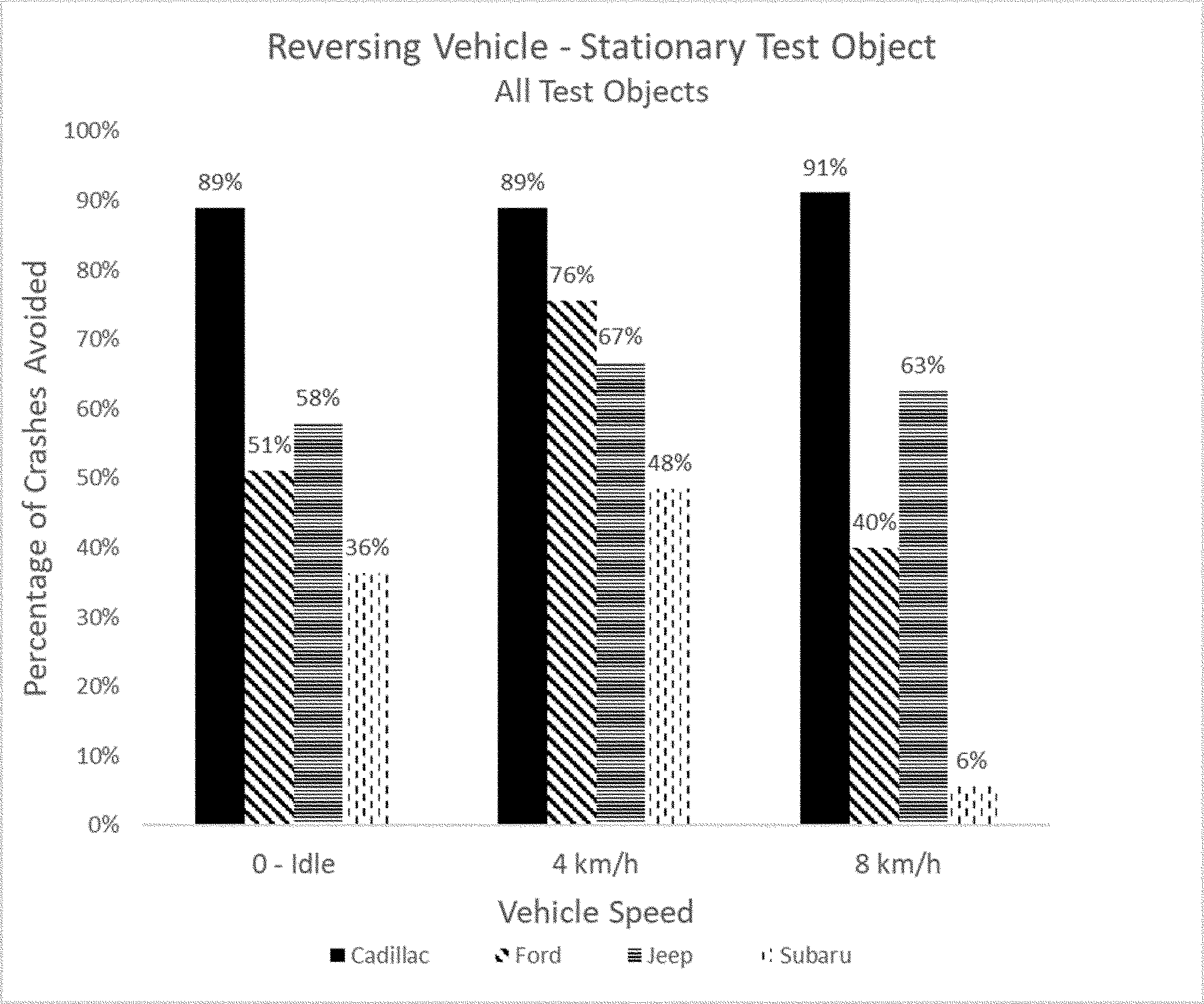
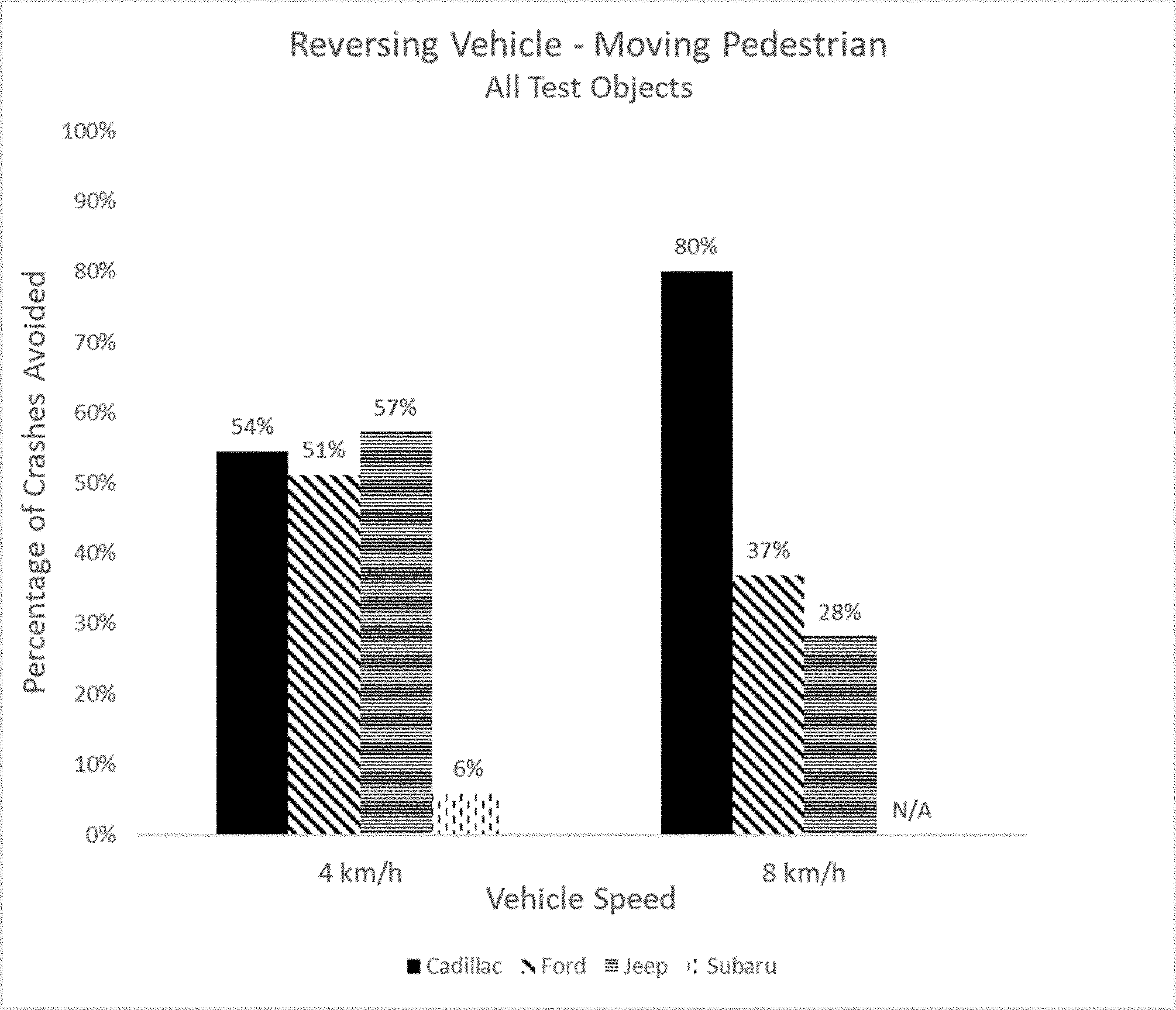
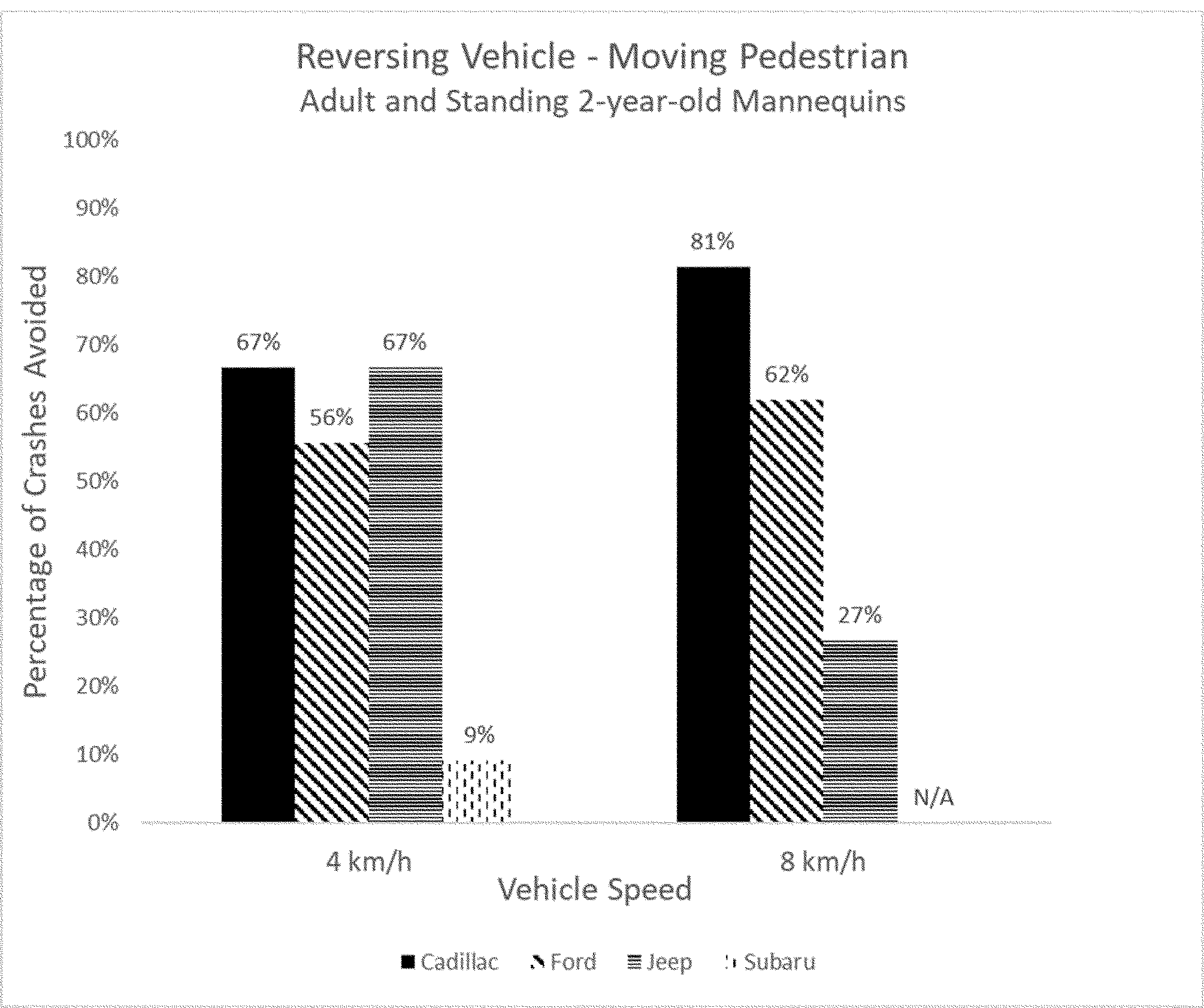
and they align with the testing speeds used in the 2023 Euro NCAP protocol for Car-to-Pedestrian Reverse tests. The proposed test vehicle speeds of four and eight km/h also cover a range above and below the typical idle backing speed. Figures 2 and 3 present the percentage of crashes avoided in all the test conditions evaluated for each vehicle model by the vehicle's reversing speed. The test results show that one vehicle's RAB system avoided more crashes at the higher speeds, but most avoided more crashes at the lower speeds.
( printed page 31844)
Figure 2.
Effect of Vehicle Speed in Stationary Test Objects 32
Figure 3. Effect of Vehicle Speed in Moving Pedestrian Scenario [33]
5. Test Objects
A variety of test objects were selected for the testing presented in NHTSA's 2026 Report to aid in characterizing RAB system performance capability. Test objects represented objects that are typically found in real-world backing scenarios, including pedestrian test mannequins and stationary objects such as a pillar, bollard, and shopping carts. For travel speeds of four to eight km/h in reverse, it is unlikely that occupants in the vehicle will sustain injuries when the vehicle's rear impacts a pillar or bollard. On the other hand, a child or adult impacted and subsequently run over by a vehicle that is backing at speeds four to eight km/h could sustain serious injuries. Since NHTSA's focus on including RAB in NCAP is to enhance safety, only the pedestrian test mannequins and associated test results are further discussed in this document. Details of the tests with stationary inanimate objects are provided in the NHTSA's 2026 Report [34]
added in the docket of this request for comment notice.
The following three pedestrian test mannequins were included in the testing of the RAB systems for the four selected vehicles: 4activePA-adult (adult articulated pedestrian),[35]
4activePA-child (six- to seven-year-old child articulated pedestrian),[36]
4activePS-child (two-year-old child static pedestrian) [37]
in standing position. Unlike the 4activePA-adult and the 4activePA-child that are articulating, the 4activePS-child is not articulating; however, the arms and legs are posable.
In the stationary pedestrian test scenario, the 4activePA-adult, 4activePA-child, and the 4activePS-child were positioned standing upright with relaxed arms positioned vertically along the sides of the mannequin.
NHTSA also conducted testing with the 4activePS-2YO (two-year-old child sitting on a “Bobby Car” toy),[38]
the 4activePS-1YO (one-year-old child static pedestrian) [39]
positioned in standing, sitting, and crawling positions, and the Messring Playing Child Target (PCT—representing a two-year-old toddler sitting on a ride-on toy car). NHTSA evaluated the RAB system of only the Jeep Grand Cherokee L using these pedestrian test mannequins and conditions for research purposes. Because of the limited testing of these
( printed page 31845)
pedestrian test mannequins and test conditions, they are not further discussed in this request for comment notice. Details are provided in the report added to the docket for this notice.
For the moving pedestrian test scenario, the 4activePA-adult and the 4activePA-child were moving at a rate of five km/h perpendicular to the backing vehicle. These test object speeds align with the testing outlined in the 2023 Euro NCAP protocol and are representative of real-world pedestrian walking speeds.[40]
The 4activePS-child was moving at a rate of 3.2 km/h perpendicular to the reversing path of the vehicle. This test object speed represents a possible real-world walking speed of a two-year-old child.[41]
Additional test objects included a two-year-old mannequin seated on a small ride-on “Bobby Car” toy, moving laterally across the vehicle path at 3.2 km/h, and a one-year-old child mannequin that simulated a newly mobile toddler walking or crawling at 3.2 km/h. These configurations were selected to represent realistic backover crash scenarios involving very young children who may be playing or moving behind a reversing vehicle.
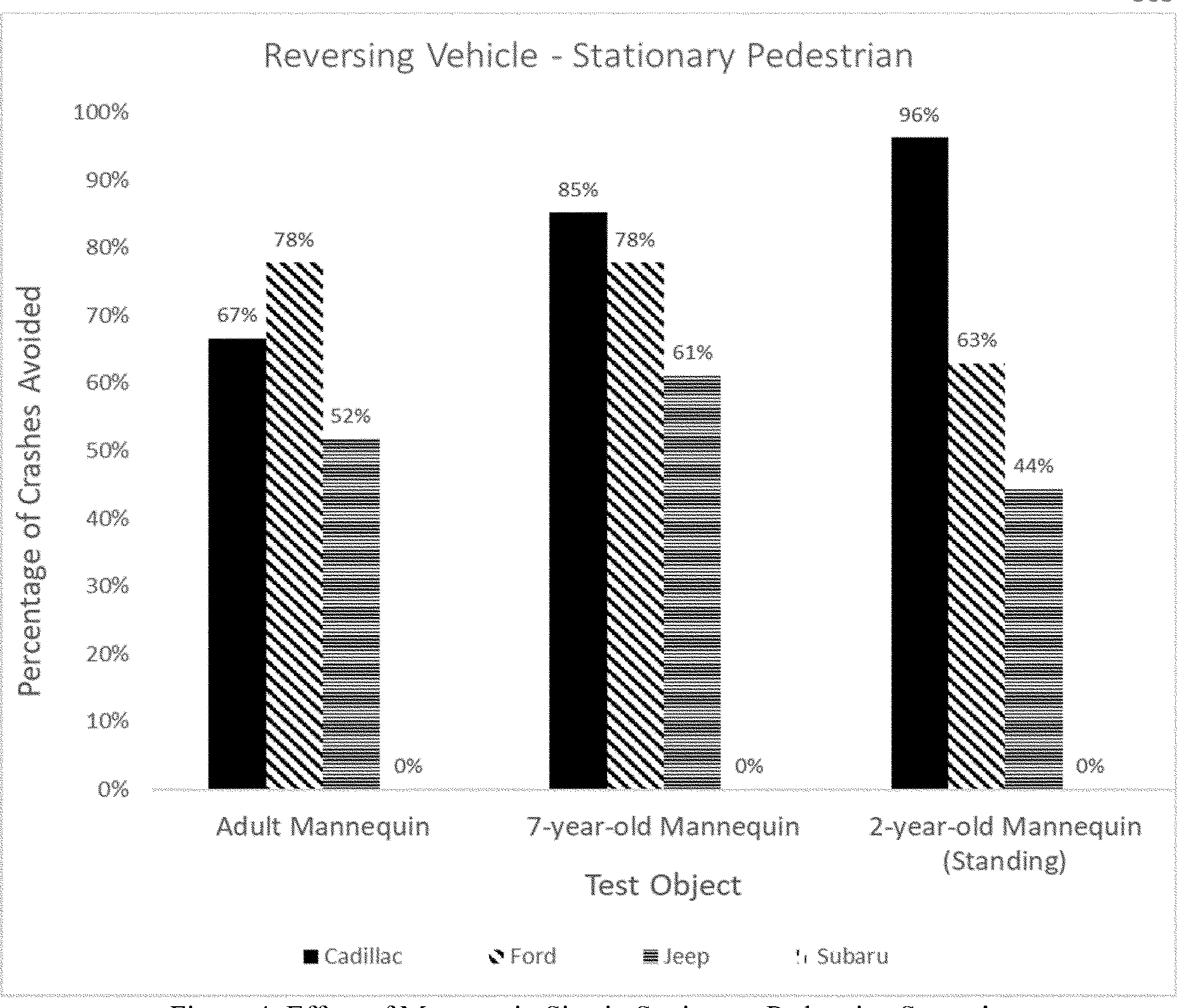
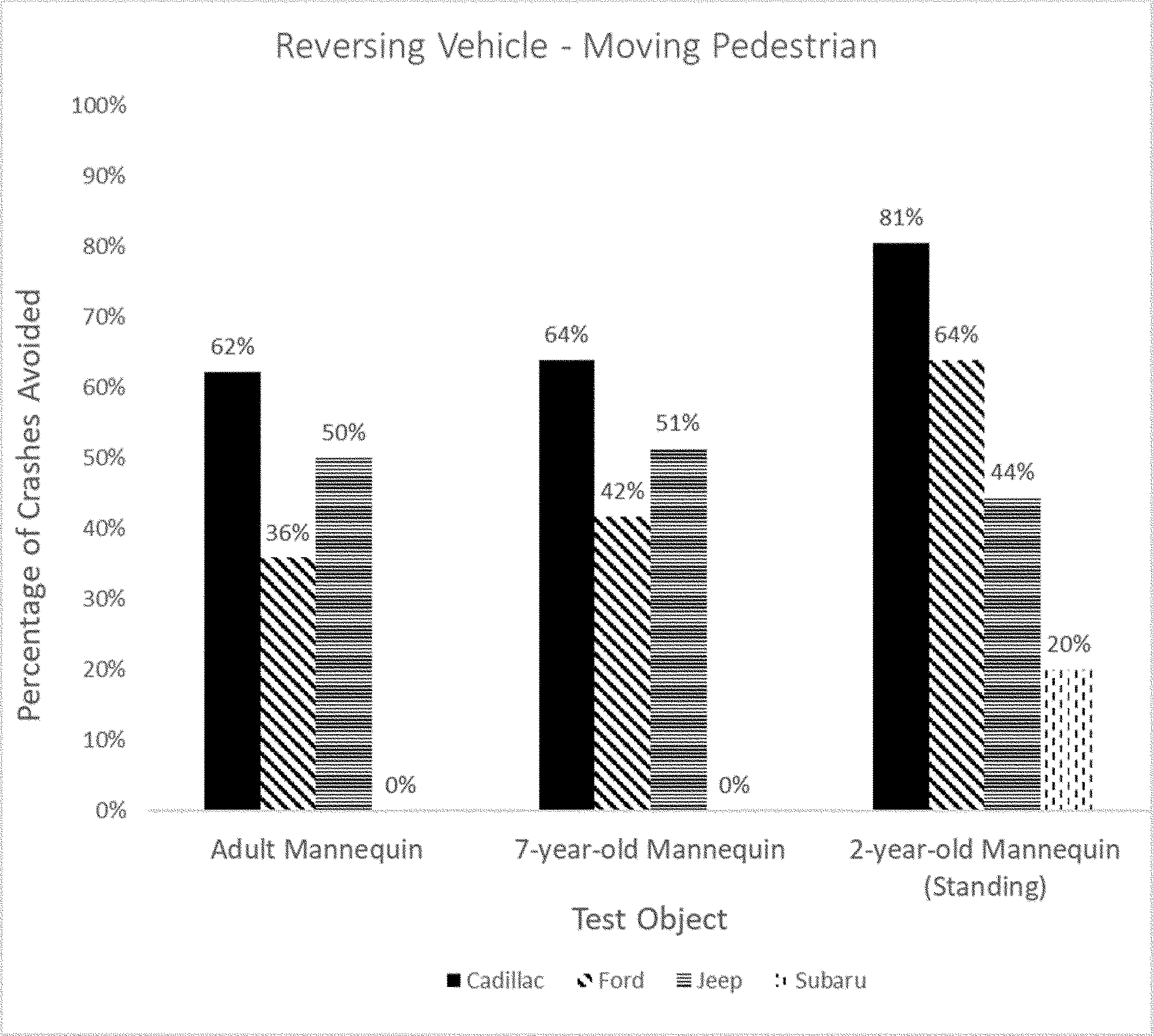
The test results presented in NHTSA's 2026 Report do not show any clear correlation between test object size and RAB system performance. As shown below in Figure 4 and Figure 5, some vehicle RAB systems avoided more crashes with the adult mannequin while others avoided more crashes with the two-year-old mannequin. Figure 4 shows the results with each mannequin for the stationary pedestrian scenario and Figure 5 shows the results with each mannequin for the moving pedestrian scenario.
Figure 4. Effect of Mannequin Size in Stationary Pedestrian Scenario
( printed page 31846)
Figure 5. Effect of Mannequin Size in Moving Pedestrian Scenario
6. Test Object Overlap
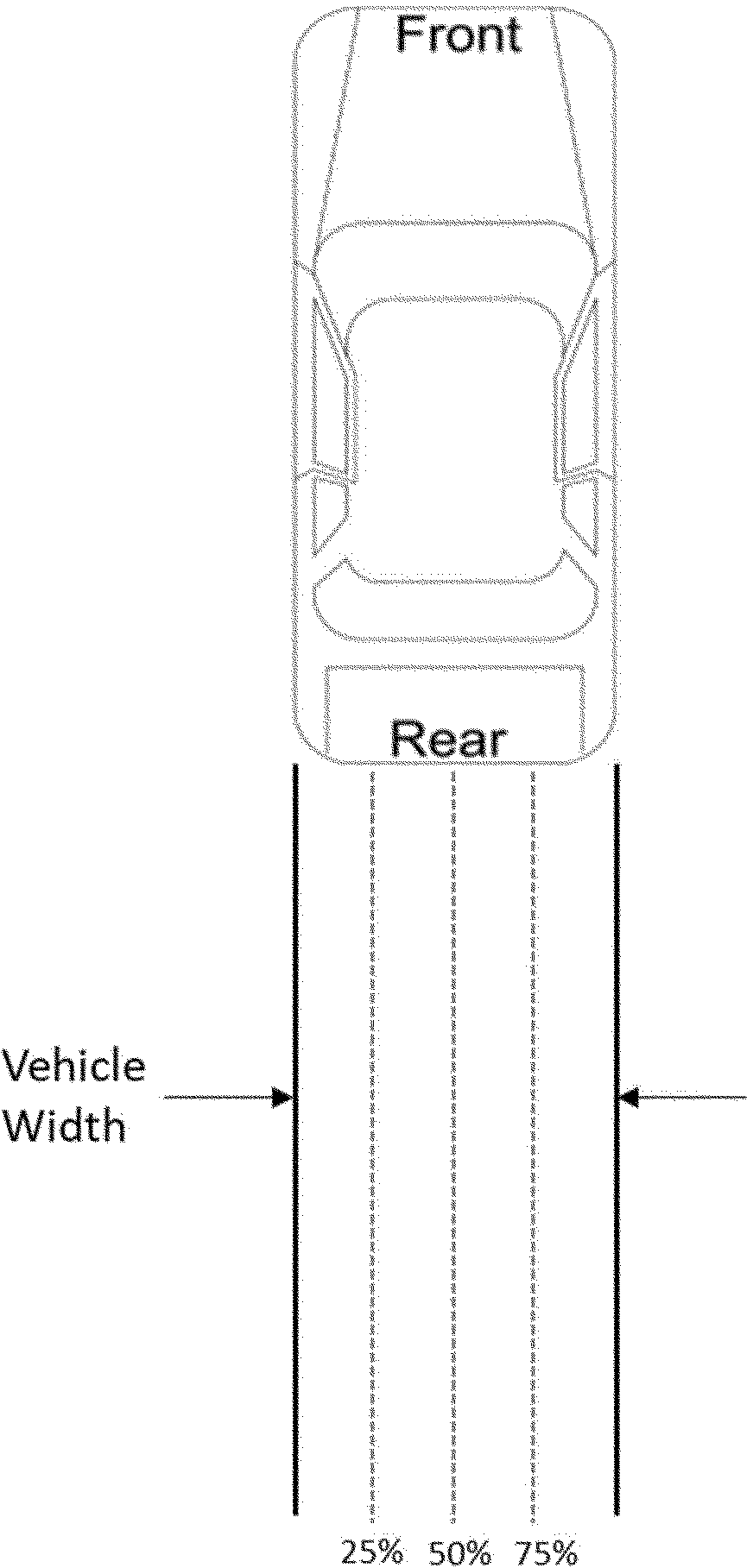
NHTSA performed the Reversing Vehicle—Stationary Test Object scenario with the test objects located at three overlap percentages: 25 percent, 50 percent, and 75 percent. The percent overlap corresponds to the location on the rear of the vehicle from the outer edge of the vehicle's driver's door as a percentage of the vehicle's overall width. For example, if the vehicle is 72 inches wide, the 25 percent overlap would correspond to a point 18 inches (72 × 0.25) inboard from the outer edge of the vehicle's driver's side. Figure 6 below shows the overlaps graphically for an example vehicle.
( printed page 31847)
Figure 6. Overlap Percentages
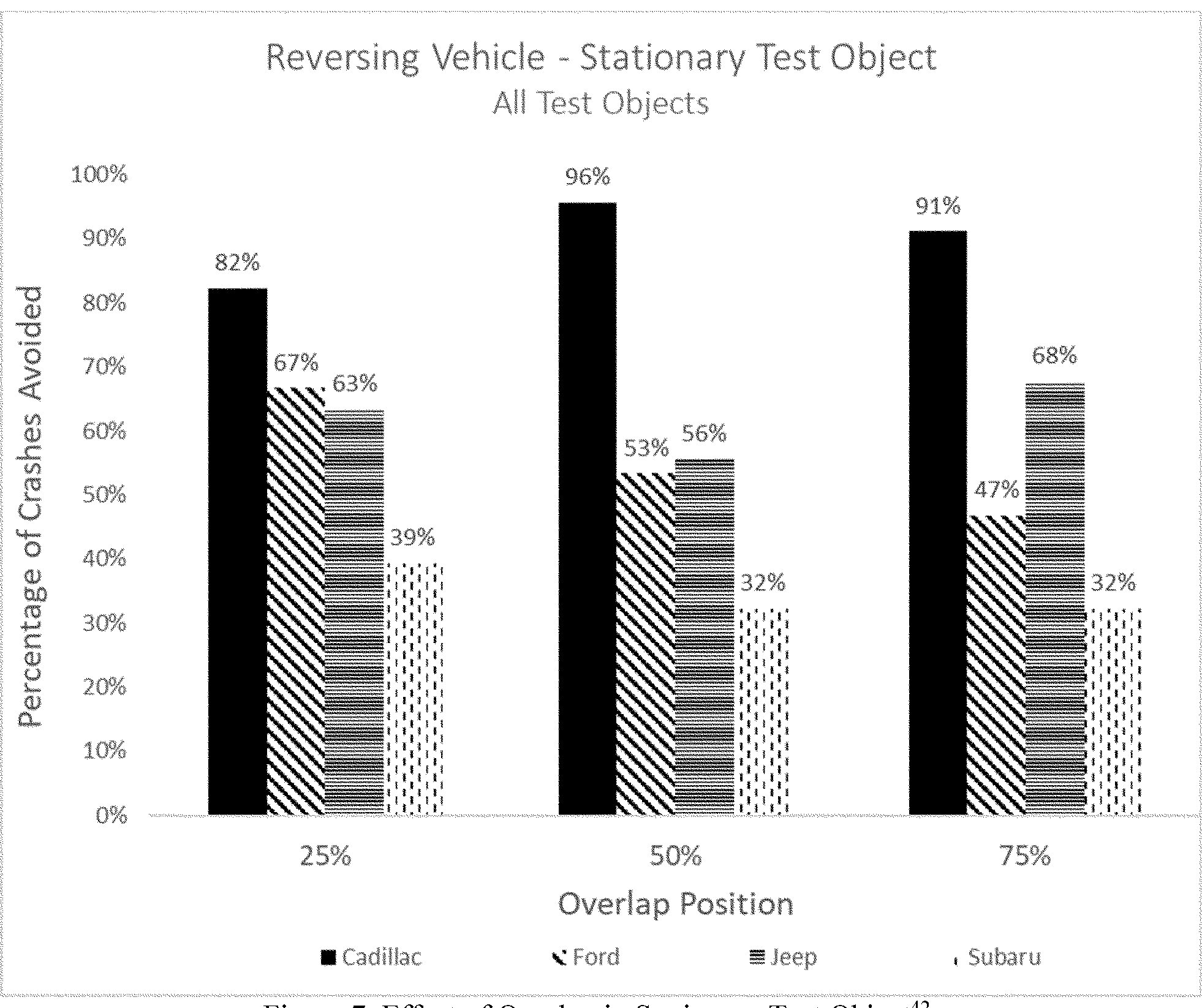
The results of NHTSA's stationary test object testing show that each vehicle's RAB system had varying success at avoiding contact for each overlap percentage, as shown in Figure 7 below.
( printed page 31848)
Figure 7. Effect of Overlap in Stationary Test Object [42]
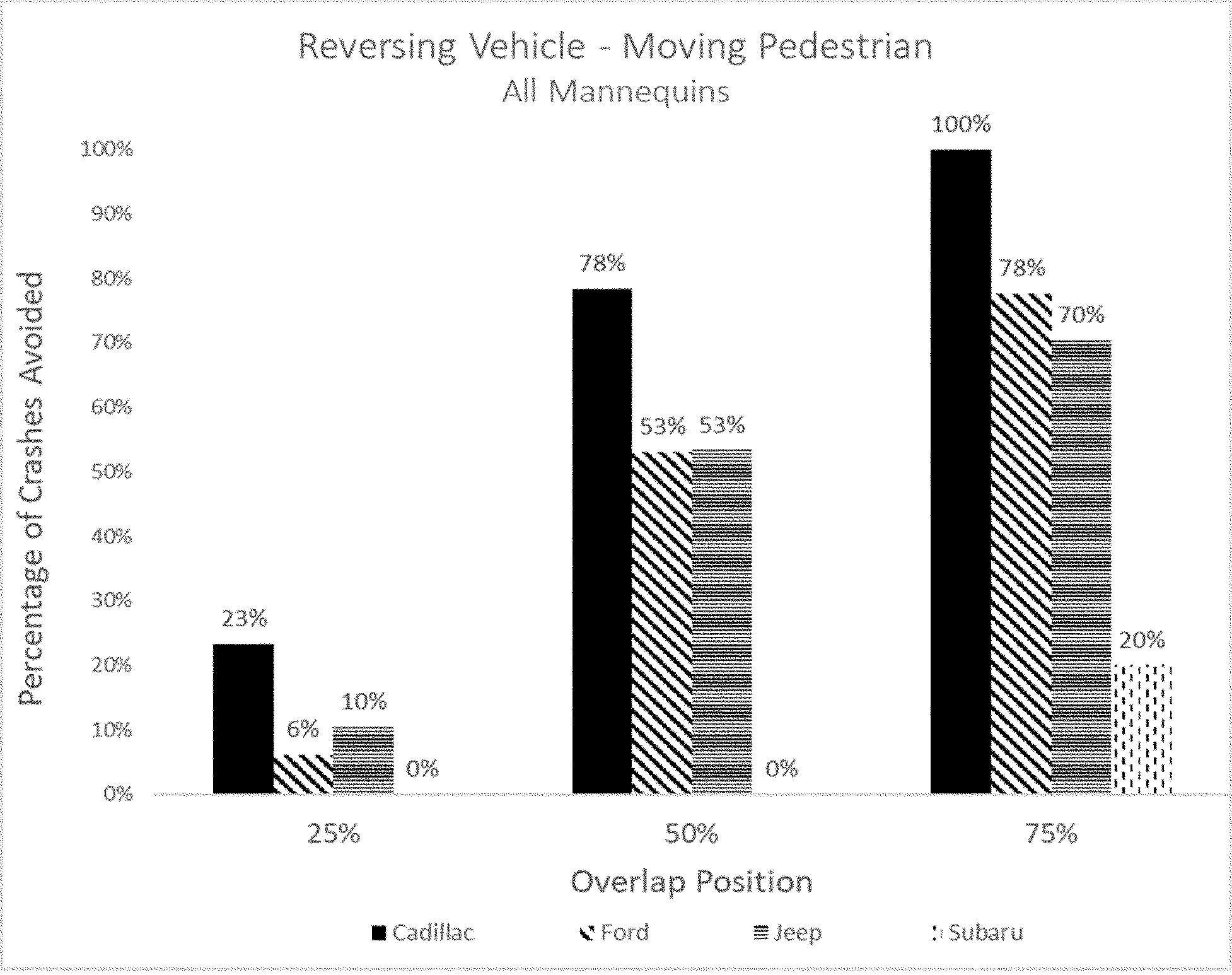
NHTSA also performed the moving pedestrian scenario tests at all three overlap percentages (25 percent, 50 percent, and 75 percent). For the moving pedestrian scenario, the test object motion was set so that if the vehicle's brakes were not applied, the vehicle would contact the test object at the target overlap percentage. The 25 percent overlap represents the “near-side” of the vehicle in reference to the direction the pedestrian test mannequin is approaching the vehicle's reversing path. If the pedestrian test object is approaching the vehicle's reversing path from the left, then 25 percent overlap is on the near-side of the driver position. Conversely, if the pedestrian test object is approaching the vehicle's reversing path from the right, then 25 percent overlap is on the far-side of the driver position. As shown below in Figure 8, vehicles' RAB systems avoided contact the most in the 75 percent overlap test trials and avoided contact the least in the 25 percent overlap test trials. The 50 percent overlap test trials showed intermediate stringency, with two of the four vehicles avoiding contact 53 percent of the time.
( printed page 31849)
Figure 8. Effect of Overlap in Moving Pedestrian Scenario [43]
7. Direction of Approach
NHTSA's research also examined the effect of the direction of pedestrian approach on RAB system performance. In the moving pedestrian scenario, mannequins approach the vehicle's reverse path from either the right or left, with a 50 percent overlap at the point of potential impact. These test configurations were included to evaluate whether RAB systems respond differently depending on which side of the vehicle a pedestrian enters the vehicle's path.
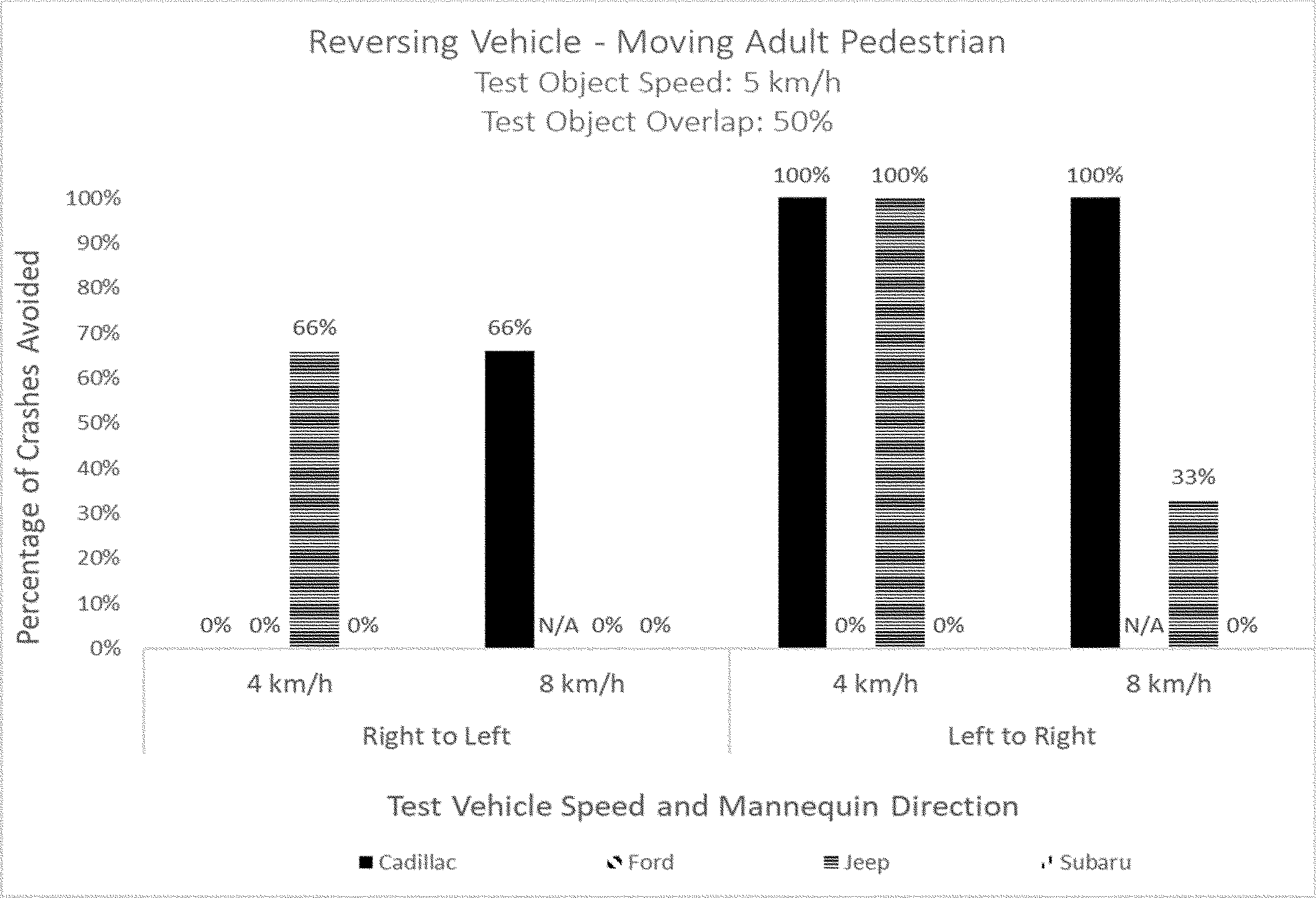
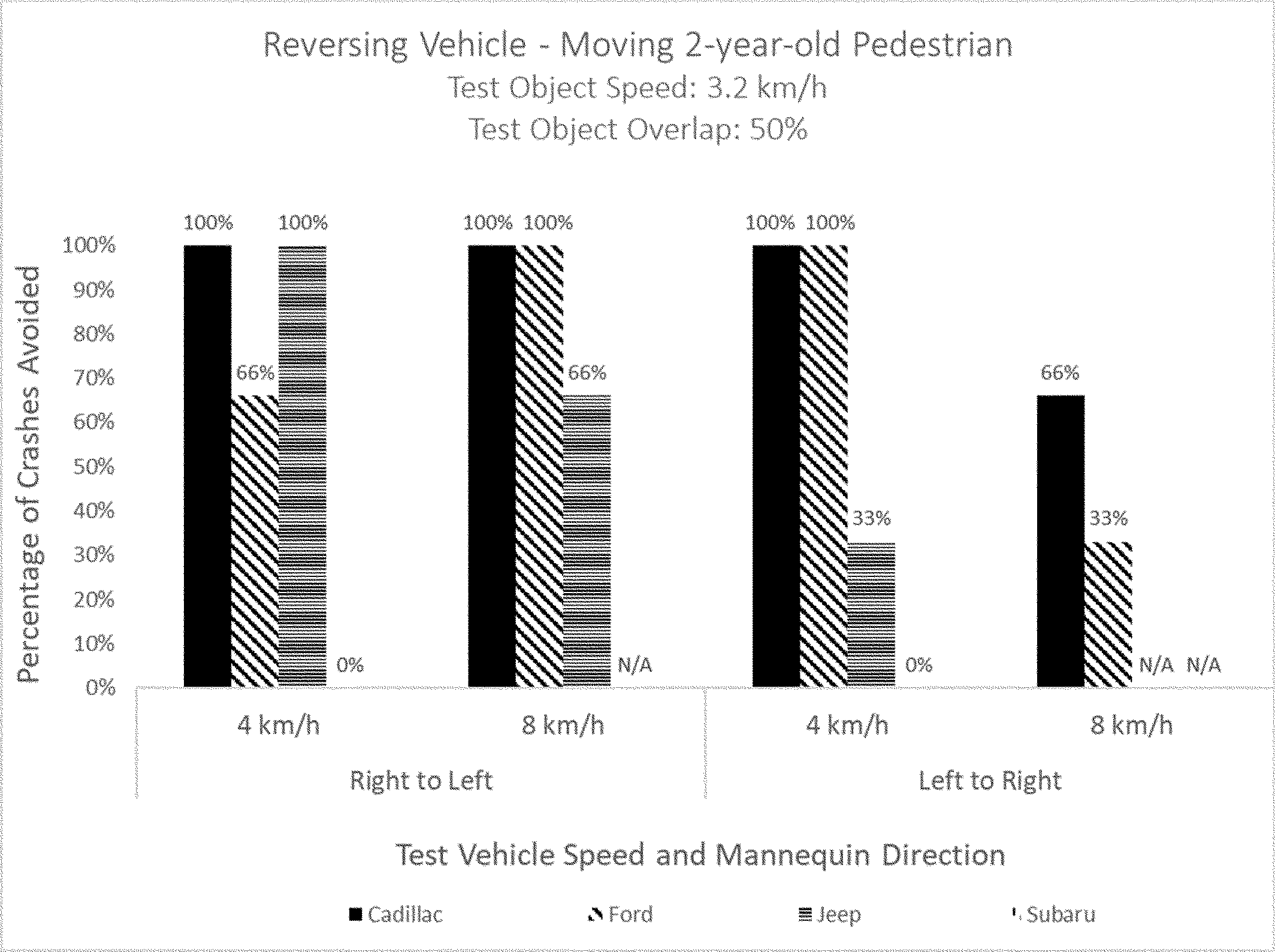
The results from these test trials are shown in Figure 9 for the adult mannequin and Figure 10 for the two-year-old mannequin. The results indicate that a pedestrian's directional approach can affect significantly RAB system response. For some vehicles, more crashes were avoided when the pedestrian approached the vehicle's reversing path from the right. For other vehicles, performance was better when the pedestrian approached the vehicle's reversing path from the left. The variability was observed across both adult and two-year-old child pedestrian test mannequins. NHTSA seeks comment on whether there are design reasons for performance discrepancies that depend upon the direction of pedestrian approach.
( printed page 31850)
Figure 9. Effect of Approach Direction in Moving Adult Pedestrian Test Mannequin Test Trials
( printed page 31851)
Figure 10. Effect of Approach Direction in Moving 2-Year-Old Child Mannequin Test Trials
C. Research Conclusions
The results of the research project indicated that while the updated RAB test procedure was effective in providing consistent, objective, and repeatable results, the overall performance of current RAB systems was highly variable across vehicle models and test conditions. The testing showed that the performance of the four RAB-equipped vehicles using both stationary and moving pedestrian test mannequins was inconsistent, with none of the vehicles able reliably to avoid collisions in all moving pedestrian test conditions. Performance also varied with vehicle reversing speeds, mannequin size, mannequin overlap percentage, and mannequin approach direction. These findings demonstrate that though RAB systems can prevent some backover crashes and offer important safety benefits, current implementations do not perform uniformly and repeatably under all conditions. These results highlight the potential for further refinement of RAB system design to ensure consistent pedestrian detection and braking response.
VI. Proposal in Detail
Building upon NHTSA's test results presented in NHTSA's 2026 Report, the proposed NCAP RAB pedestrian avoidance evaluation procedure incorporates the key conditions shown to influence system performance across vehicles. The research identified substantial variability between vehicles when tested at different overlap percentages, reversing speeds, pedestrian sizes, and approach directions. Accordingly, the proposed test matrix (presented in Table 1 of the Executive Summary section of this notice) includes both stationary and moving pedestrian test mannequin test scenarios that systematically vary these parameters to capture the full range of potential system responses. This testing structure ensures that the NCAP test procedure evaluates vehicles comprehensively and reflects real-world conditions under which RAB systems must detect and avoid pedestrians.
A draft NCAP test procedure for evaluating RAB performance in detecting and avoiding pedestrians is provided in the docket for this request for comment notice. The draft test procedure includes use of a robotic pedal controller to achieve a specific constant speed for all test vehicles throughout a test trial and the use of a robotic steering controller-based mannequin propulsion system for the moving pedestrian test mannequin tests. NHTSA seeks comment on the details of this test procedure, and whether any further test procedure clarification or refinement is needed to facilitate objective performance evaluation of RAB pedestrian crash avoidance.
A. Test Objects
The proposed NCAP RAB evaluation would use two pedestrian test mannequin test objects: the 4activePA-
( printed page 31852)
adult articulated pedestrian (adult mannequin) and the 4activePS-2YO two-year-old child pedestrian (two-year-old mannequin).[44 45]
The 4activePA-adult and the 4activePS-2YO conform to the specifications of ISO 19206-2:2018.[46]
These two mannequins represent the most common pedestrian populations involved in backover crashes. The adult mannequin corresponds to an articulated, full-scale representation of an average adult. It is designed to replicate the physical dimensions, limb articulation, and radar and optical properties of an adult pedestrian. The adult mannequin may be used in both stationary and moving mannequin test scenarios.
The two-year-old child mannequin is a smaller mannequin that replicates the height, mass distribution, and radar and optical signature of a standing two-year-old toddler. It can be used in both stationary and moving mannequin tests. This mannequin size is consistent with the physical dimensions of young children who are at greatest risk in backover incidents. The child mannequin's standing configuration represents a realistic scenario where a young child is present behind a reversing vehicle, such as in a driveway or parking lot environment.
NHTSA is proposing the use of the two-year-old child mannequin rather than the seven-year-old child mannequin used in the 2023 Euro NCAP protocol. In NHTSA's 2014 rear visibility final rule, NHTSA analyzed data from FARS and CRSS during the years 2007-2011 for fatal backover crashes.[47]
The breakdown of fatalities by age of the victim is summarized in Table 8 and Table 9 below.
Table 8—All Backover Fatalities and Injuries by Age of Victim
Age of victim
Fatalities
Percent of
fatalities
Estimated
injuries
Estimated
percent of
injuries
Sample
count of
injuries
Percent of
population
All Vehicles
Under 5
84
31
1,000
6
80
7
5-10
8
3
1,000
4
50
7
10-19
4
1
1,000
9
121
14
20-59
73
27
7,000
49
835
55
60-69
27
10
2,000
11
169
8
Table 9—Breakdown of Backover Fatalities and Injuries Involving Passenger Vehicles for Victims Under Age 5 Years
Age of victim
(years)
Percent of
fatalities
0
2
1
59
2
21
3
11
4
7
Total
100
This data indicates that children under age five represent nearly one-third of all backover fatalities, despite making up a small share of the population. Furthermore, the majority of backover fatalities among children occur in the one- to two-year-old age range, while involvement rates for children aged seven are comparatively low.[48]
Among victims under age five, approximately 59 percent were one-year-olds and 21 percent were two-year-olds, meaning that about four out of every five child backover fatalities occur between the ages of one and two years. Fatalities among ages three and four were far less common, accounting for only 18 percent combined. These data demonstrate that the greatest risk is concentrated among toddlers, supporting the selection of a two-year-old mannequin rather than a seven-year-old mannequin (currently used in the 2023 Euro NCAP protocol) to represent the most relevant and vulnerable population in RAB testing. NHTSA seeks comment on whether the proposed adult and two-year-old mannequins are appropriate for evaluating RAB system performance.
B. Test Scenarios and Test Conditions
1. Stationary Pedestrian Scenario
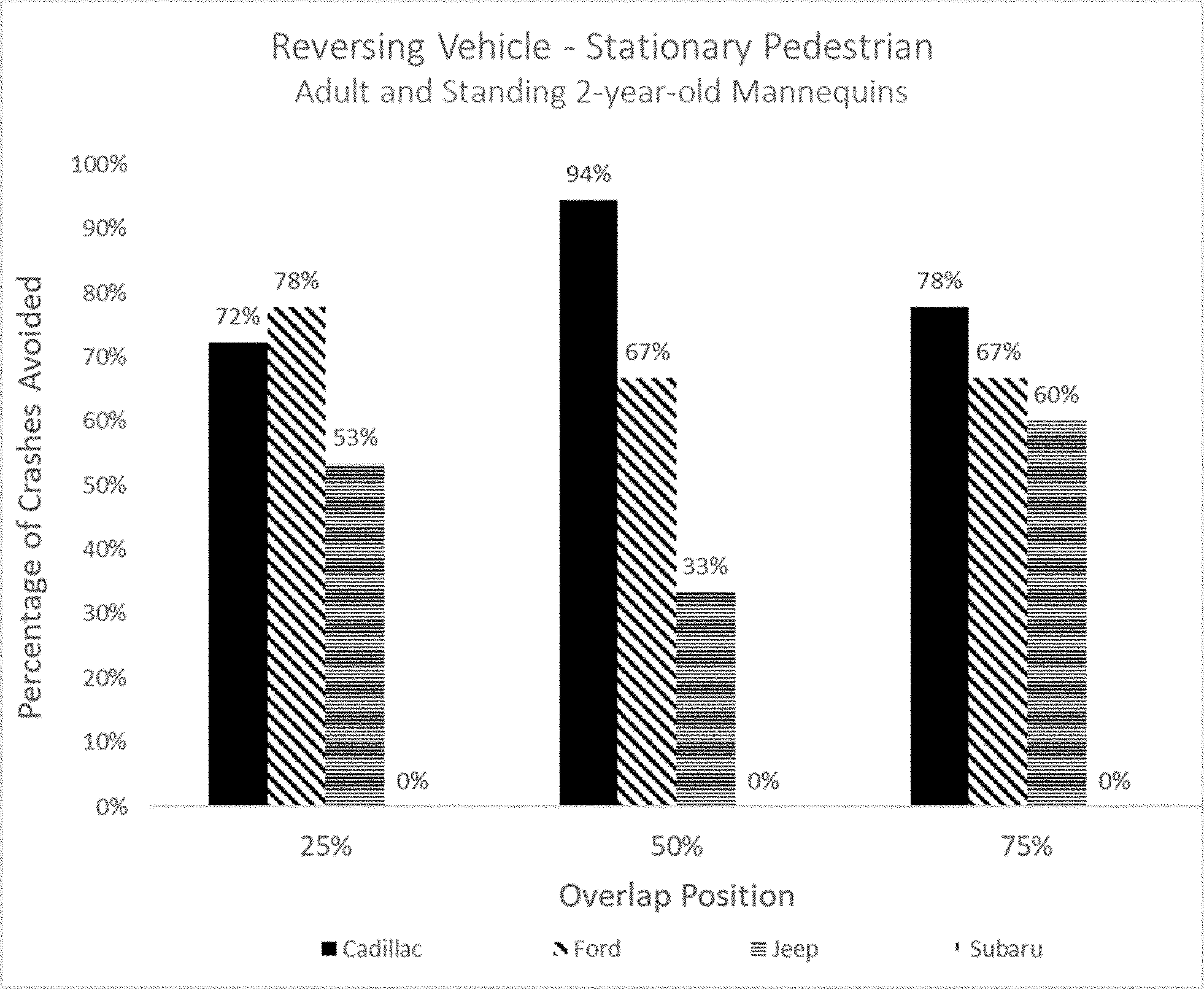
The proposed NCAP RAB evaluation includes a series of twelve stationary pedestrian test mannequin tests designed to assess system performance when pedestrians are standing still within the reversing path of the vehicle. Both the adult and two-year-old pedestrian test mannequins will be used in these tests. For each mannequin, three lateral overlap percentages will be used: 25 percent, 50 percent, and 75 percent. As described above, the percent overlap corresponds to the mannequin's location as a percentage of the vehicle's overall width. These different overlap percentages represent the potential impact location of the pedestrian test mannequin along the rear of the vehicle located near the left edge, center, and right edge. NHTSA's testing presented in NHTSA's 2026 Report shows that RAB system performance varied across these overlap percentages, with no consistent trend among vehicles. Figure 11 illustrates this observation with data collected for the adult mannequin and two-year-old mannequins.
( printed page 31853)
Figure 11. Effect of Overlap Percentage in Test Trials With Adult and Two-Year-Old Mannequins in Stationary Pedestrian Scenario
As shown in Figure 11, some systems performed better at detecting pedestrians near the vehicle's centerline, while others performed better at edge positions. This inconsistency indicates that percentage overlap influences significantly system detection capability and braking response. Therefore, all three overlap percentages are proposed for the stationary mannequin test scenario to ensure symmetrical detection performance and that the NCAP procedure evaluates system performance over the full range of possible pedestrian locations within a vehicle's backing path. This is important because in parking and driveway scenarios, both directions of approach are equally likely.
Each overlap percentage will be tested at two vehicle reverse speeds, four km/h and eight km/h, which correspond to common real-world backing speeds in residential driveways and parking environments.[49 50]
This results in six test conditions for the adult mannequin and six for the two-year-old mannequin, for a total of twelve stationary test conditions per vehicle. The four km/h test speed represents slow, cautious reversing such as when a driver backs out of a driveway, while the eight km/h speed represents situations where a driver reverses more quickly, as backing speeds have been documented to vary.[51]
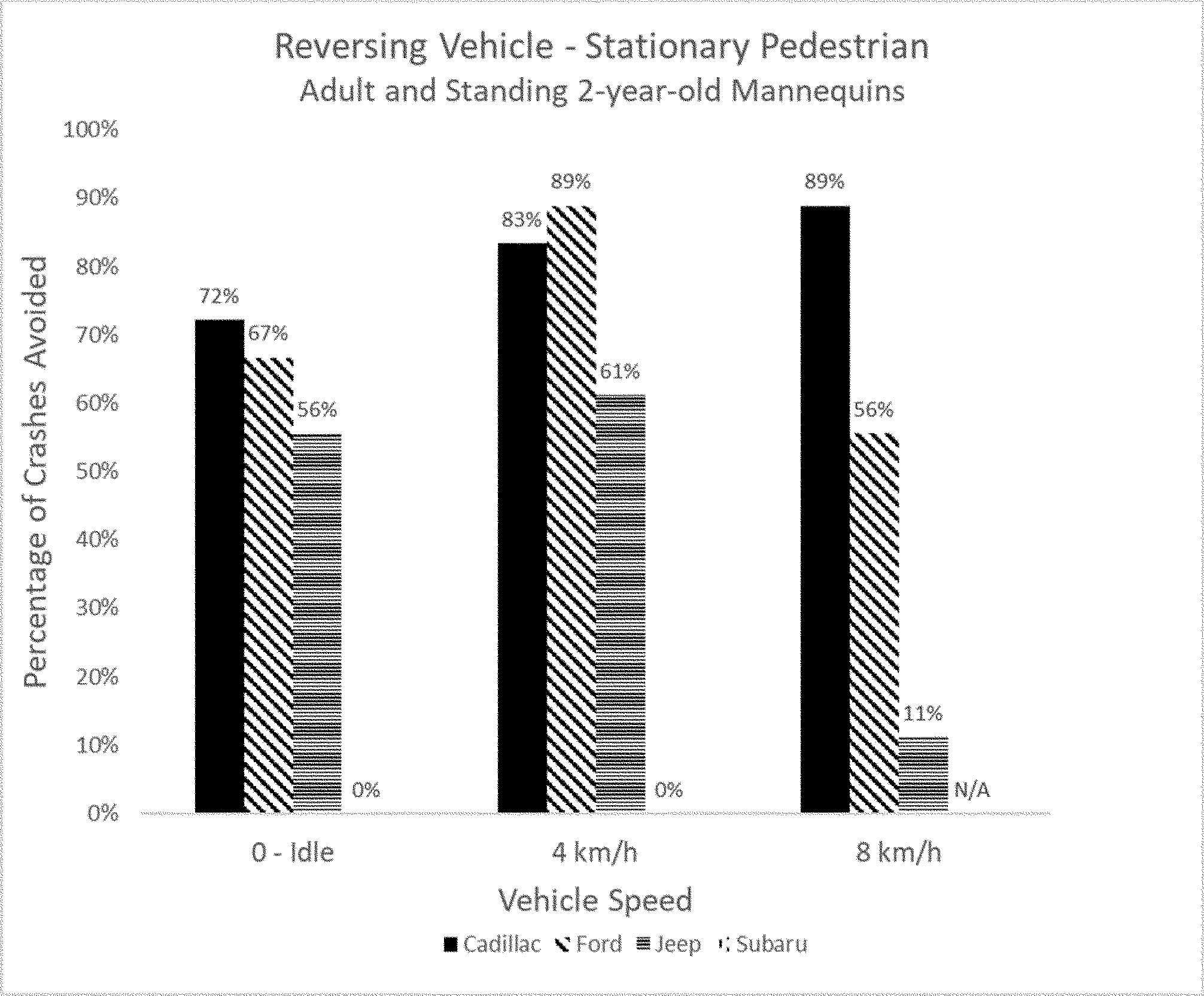
As noted in NHTSA's 2026 Report, RAB performance also varied by reversing speed. This variation is shown below in Figure 12 for the adult and two-year-old mannequins.
( printed page 31854)
Figure 12. Effect of Vehicle Speed for Adult and Two-Year-Old Mannequins in Stationary Pedestrian Scenario
As shown in Figure 12, most systems avoided more collisions at four km/h, but one vehicle demonstrated better performance at eight km/h. As a result of this observed variability, both reversing speeds are included in the proposed NCAP evaluation procedure. The multiple test condition combinations of overlap percentages, reversing speeds, and adult and two-year-old child pedestrian test mannequins provide a comprehensive assessment of RAB system capability to detect stationary adult pedestrians and small children. NHTSA seeks comment on whether the proposed vehicle test speeds (four km/h and eight km/h) and the three overlap percentages (25 percent, 50 percent, and 75 percent) for the stationary adult and two-year-old mannequins are appropriate for evaluating RAB system performance.
2. Moving Pedestrian Scenario
In addition to the twelve stationary pedestrian test mannequin test conditions, the proposed NCAP RAB evaluation includes eight test conditions designed to measure system performance when a pedestrian moves laterally into the vehicle's reversing path. These test conditions simulate a more complex real-world situation in which an adult or child suddenly walks behind a vehicle that is already in motion. For these test conditions, both the adult and two-year-old mannequins will be used, each crossing at a perpendicular angle to the vehicle's reversing path.
In the moving pedestrian scenario, all test conditions are with 50 percent overlap at the moment of potential impact. As shown in the test results presented in NHTSA's 2026 Report (Figure 8), in the tests with moving pedestrians, vehicles were least likely to meet the performance criteria in the 25 percent overlap tests and more likely to meet the performance criteria in the 75 percent overlap tests. The 50 percent overlap is selected as an intermediate position between the 25 percent and 75 percent overlap positions. The 50 percent overlap is also consistent with the overlap in the 2023 Euro NCAP protocol for the moving pedestrian test scenario.
In the moving pedestrian scenario, each mannequin starts the test at a distance four meters from the reversing vehicle's longitudinal centerline. Starting the mannequins at a consistent distance away from the vehicle's centerline provides a control for how soon the vehicle's sensors have the opportunity to detect the mannequin.
As with the stationary pedestrian scenario, each mannequin will be tested at both vehicle reversing speeds of four km/h and eight km/h. Figure 13 shows RAB performance variation based on reversing speed with a moving adult and two-year-old mannequins. Two vehicle models performed better at the
( printed page 31855)
higher vehicle reversing speed while the other two vehicles performed better at the lower reversing speed. This RAB performance variation indicates the need to test at both reversing speeds of four and eight km/h to assess system performance fully.
Figure 13. Effect of Vehicle Speed for Adult and Two-Year-Old Mannequins in Moving Pedestrian Scenario
In the moving pedestrian scenario, the mannequins will also move at a prescribed lateral speed perpendicular to the reversing path of the vehicle. The adult mannequin moves at a speed of five km/h which represents a brisk walking pace of an average adult,[52 53]
and is consistent with the established test procedure in the 2023 Euro NCAP protocol. The two-year-old mannequin moves at 3.2 km/h. This introduces a new speed not found in the 2023 Euro NCAP protocol, but the use of 3.2 km/h is necessary to correspond accurately to a toddler's slower walking speed [54 55]
compared to an adult. The testing results presented in NHTSA's 2026 Report demonstrate that RAB systems often responded differently to moving adult and child mannequins (see Figure 5). This inconsistency in performance across vehicle models and crossing conditions supports the need to evaluate both pedestrian sizes for the moving pedestrian scenario to ensure the testing evaluates potential limitations in system sensitivity and recognition.
Two separate tests will be conducted for each combination of mannequin size (two-year-old or adult) and vehicle reversing speed (four km/h or eight km/h). One test will be conducted with the mannequin approaching from the right with respect to the vehicle's reversing path, and another test will be conducted with the mannequin approaching from the left. This will allow NHTSA to evaluate system performance for situations where a pedestrian is approaching either from the right or
( printed page 31856)
from the left, which are equal possibilities in a parking lot or driveway scenario. The test results presented in NHTSA's 2026 Report also indicate that vehicle performance can differ depending on the approach direction of the mannequin, with some systems responding earlier or more effectively when the mannequin entered from one side compared to the other (see Figure 9 and Figure 10). Therefore, it is important to assess both pedestrian approach directions to provide a complete evaluation of RAB system performance.
NHTSA seeks comment on the proposed moving pedestrian test mannequin test scenario for evaluating RAB system performance. Specifically, NHTSA seeks comment on the proposed vehicle speed (four km/h and eight km/h), lower speed of 3.2 km/h for the two-year-old mannequin compared to the five km/h for the adult mannequin, and mannequin approach directions (left and right) with respect to the vehicle's reversing path. NHTSA also seeks comment on whether to add the 25 percent overlap location to the moving pedestrian scenario, which is more stringent than the 50 percent overlap location as shown in Figure 8 for the tests conducted on four MY 2022 vehicles.
The proposed stationary and moving pedestrian test mannequin test scenarios for evaluating RAB system performance are to be conducted exclusively in daylight. While RAB system performance differed across lighting conditions in recent research tests, vehicles generally avoided more collisions with the pedestrian test mannequins in daylight than in darkness. NHTSA seeks comment on whether the proposed RAB evaluation protocol should include testing in darkness, or whether darkness testing should be considered for inclusion in NCAP at a later date.
C. Pass-Fail Criteria
A vehicle will be considered to have met the NCAP RAB performance requirement only if it satisfies all performance criteria for every one of the 20 test conditions described above (12 stationary pedestrian test mannequin test conditions and eight moving pedestrian test mannequin test conditions). Vehicles that meet the criteria in full will receive a check mark indicating successful RAB system performance under NCAP. The performance criteria are as follows:
First, an auditory warning must sound prior to the onset of the vehicle's RAB system providing automatic braking. This requirement ensures that the RAB system provides the driver with a clear and timely warning to the presence of a pedestrian, providing situational awareness and allowing for potential manual intervention by the driver.
Second, the vehicle must not make physical contact with any test object during any test trial. Successful avoidance of contact demonstrates that the RAB system effectively detects the pedestrian test mannequin and applies sufficient braking force to bring the vehicle to a stop before impact.
Third, once automatic braking has been initiated and the vehicle comes to a complete stop, the vehicle's brakes must remain engaged until either: (1) the pedestrian test mannequin is no longer in the vehicle's path, or (2) the driver performs a deliberate override action. Some RAB systems bring the vehicle to a stop but then release the brakes. This provision addresses premature brake release that could otherwise result in secondary contact or incomplete system intervention. NHTSA has not defined “deliberate override action” at this time to provide system design flexibility. NHTSA seeks comment on whether permitted override action(s) should be defined and if so, what would be the definition(s).
Finally, the RAB system must be configured such that it defaults to “ON” at the start of each ignition or key cycle. This requirement aligns with the 2023 Euro NCAP protocol requirements and ensures that the system cannot be disabled by default, thereby providing continuous protection each time the vehicle is used.
NHTSA seeks comment on the four proposed performance criteria for evaluating RAB system performance: (1) an auditory warning shall be provided prior to RAB system brake application onset; (2) the vehicle shall not contact the pedestrian test mannequin; (3) after the vehicle comes to a complete stop, its brakes shall not be released unless the pedestrian test mannequin is no longer in the vehicle's path or the driver performs a deliberate override action; and (4) the RAB system shall default to “ON” after each ignition/key cycle. NHTSA also seeks comment on the effectiveness of different RAB system warning strategies, whether a haptic warning signal should be permitted in lieu of an auditory warning, and whether a visual warning should also be required.
D. Number of Trials per Test Condition
NHTSA proposes to perform one trial per RAB test condition. In the stationary mannequin scenario, there are 12 test conditions (two vehicle speeds (four and eight km/h) × two mannequins (adult and two-year-old) × three overlap percentages (25 percent, 50 percent, and 75 percent)). For the moving mannequin scenario, there are eight test conditions (two vehicle speeds (four and eight km/h) × two mannequins (adult and two-year-old) × two approach directions (left and right of vehicle). Conducting one trial per test condition results in a total of 20 tests for evaluating RAB performance, as shown in Table 1. Conducting one trial per test condition is similar to the approach NHTSA is using to assess other ADAS technologies added to NCAP in 2024.[56]
NHTSA also proposes that, in the process of conducting the RAB tests, if the test vehicle does not meet all four proposed performance criteria in a test, then any remaining tests (of the 20 proposed scenarios) with the vehicle will not be conducted because the vehicle would not be receiving NCAP credit for RAB.
NHTSA seeks comment on the proposal to conduct only one trial per test condition and to not conduct any remaining tests if the vehicle fails to meet all four performance criteria during a test trial.
E. Awarding Credit for RAB Systems
NHTSA proposes to denote vehicles that are equipped with RAB and that meet the proposed performance criteria for all 20 proposed RAB test conditions with a check mark on NHTSA's website. This is similar to the approach the Agency is using to notify consumers on available ADAS technologies that meet NHTSA's performance criteria.[57]
Until a crash avoidance rating system is developed and implemented, the check mark on the NHTSA website will remain the primary way of notifying consumers of available ADAS technologies meeting NHTSA's system performance criteria.[58]
Among the four MY 2022 vehicles tested (2022 Cadillac XT4, 2022 Ford Mustang Mach-E, 2022 Jeep Grand Cherokee L, and 2022 Subaru Outback Touring), results suggest that while some RAB systems performed
( printed page 31857)
significantly better than others, none of the vehicle models tested would obtain credit for RAB as proposed in this RFC.
NHTSA requests comment on the proposal to give credit for RAB systems only when the vehicle meets the performance criteria for all 20 test conditions.
VII. Conclusion
This RFC proposes to implement an RAB testing program in NHTSA's NCAP. In doing so, it responds to the need for improved protection of vulnerable road users such as small children in backover crash scenarios. This RFC seeks public comment on a proposed program that would evaluate RAB system performance using standardized, objective test procedures. If implemented, the changes to NCAP proposed in this document would advance NHTSA's efforts to provide consumers with important safety information regarding technologies designed to prevent backover crashes and reduce injuries and fatalities to pedestrians.
VIII. Economic Analysis
The changes to NCAP proposed in this RFC ultimately would enable a rating system that improves consumer awareness of pedestrian protection systems and the improvements to safety that stem from those systems. It would also encourage manufacturers to accelerate RAB adoption. The accelerated adoption of pedestrian protection systems would drive any economic and societal impacts that result from these changes and are thus the focus of this discussion of economic analysis. Hence, NHTSA has considered the potential economic effects for rear automatic braking pedestrian protection system proposed for inclusion in NCAP and the potential benefit of eventually developing a new rating system that would include this information.
RAB systems have the potential to reduce crashes with pedestrians when the vehicle is traveling in reverse. While NHTSA's research on RAB systems has been limited to only certain vehicle models, it illustrates how these systems can provide safety benefits. Though NHTSA does not have sufficient data to determine the monetized safety impacts resulting from RAB systems, NHTSA expects that the proposed inclusion of RAB systems in NCAP would likely have positive safety effects by promoting earlier and more widespread deployment of these technologies as well as encouraging manufacturers to design RAB systems with the ability to detect and avoid pedestrians consistently when the vehicle is reversing.
NCAP helps address the issue of asymmetric information (
i.e.,
when one party in a transaction is in possession of more information than the other), which can be considered a market failure. Regarding consumer information, the introduction of a potential new component to the NCAP rating system is anticipated to provide consumers additional vehicle safety information regarding the safety of vulnerable road users to help them make more informed purchasing decisions by presenting the relative safety benefits of systems designed to protect not only occupants inside the vehicle but also persons outside the vehicle. While NHTSA knows that consumers value information about the protection of vehicle occupants when making purchasing decisions, NHTSA believes that, as a society, most consumers are also interested in protecting people that share their roads. Hence, there is an unquantifiable value to consumers and to society as a whole for NHTSA to provide accurate and comparable vehicle safety information about protecting all lives. At this time, NHTSA does not have sufficient data, such as unit cost and information on how soon the full adoption of RAB systems designed to detect and avoid pedestrians would be reached, to predict the net increase in cost to consumers with a high degree of certainty.
IX. Public Participation
Interested parties are encouraged to submit thorough and detailed comments relating to each of the relevant areas discussed in this notice. Please see Appendix A for a summarized list of specific questions that have been posed in this notice. Comments submitted will help NHTSA make informed decisions as it strives to advance NCAP by encouraging continuous safety improvements for new vehicles and enhancing consumer information.
How do I prepare and submit comments?
Your comments must be written and in English. To ensure that your comments are correctly filed in the Docket, please include the docket number indicated in this document in your comments.
Your comments must not be more than 15 pages long (49 CFR 553.21). NHTSA established this limit to encourage you to write your primary comments in a concise fashion. However, you may attach necessary additional documents to your comments. There is no limit on the length of the attachments.
If you are submitting comments electronically as a PDF (Adobe) file, NHTSA asks that the documents submitted be scanned using an Optical Character Recognition (OCR) process, thus allowing NHTSA to search and copy certain portions of your submissions.
Please note that pursuant to the Data Quality Act, in order for substantive data to be relied upon and used by the Agency, it must meet the information quality standards set forth in the OMB and DOT Data Quality Act guidelines. Accordingly, we encourage you to consult the guidelines in preparing your comments. OMB's guidelines may be accessed at
https://www.transportation.gov/regulations/dot-information-dissemination-quality-guidelines.
How do I submit confidential business information?
You should submit a redacted “public version” of your comment (including redacted versions of any additional documents or attachments) to the docket using any of the methods identified under
ADDRESSES
. This “public version” of your comment should contain only the portions for which no claim of confidential treatment is made and from which those portions for which confidential treatment is claimed has been redacted. See below for further instructions on how to do this.
You also need to submit a request for confidential treatment directly to the Office of Chief Counsel. Requests for confidential treatment are governed by 49 CFR part 512. Your request must set forth the information specified in part 512. This includes the materials for which confidentiality is being requested (as explained in more detail below); supporting information, pursuant to section 512.8; and a certificate, pursuant to section 512.4(b) and part 512, Appendix A.
You are required to submit to the Office of the Chief Counsel one unredacted “confidential version” of the information for which you are seeking confidential treatment. Pursuant to section 512.6, the words “ENTIRE PAGE CONFIDENTIAL BUSINESS INFORMATION” or “CONFIDENTIAL BUSINESS INFORMATION CONTAINED WITHIN BRACKETS” (as applicable) must appear at the top of each page containing information claimed to be confidential. In the latter situation, where not all information on the page is claimed to be confidential, identify each item of information for
( printed page 31858)
which confidentiality is requested within brackets: “[ ].”
You are also required to submit to the Office of the Chief Counsel one redacted “public version” of the information for which you are seeking confidential treatment. Pursuant to section 512.5(a)(2), the redacted “public version” should include redactions of any information for which you are seeking confidential treatment (
i.e.,
the only information that should be unredacted is information for which you are not seeking confidential treatment).
NHTSA is currently treating electronic submission as an acceptable method for submitting confidential business information to the Agency under part 512. Please do not send a hard copy of a request for confidential treatment to NHTSA's headquarters. The request should be sent to Dan Rabinovitz in the Office of the Chief Counsel at
Daniel.Rabinovitz@dot.gov
or you may contact him for a secure file transfer link. Manufacturers or any companies that already have a Confidential Business Information (CBI) Portal account or an Enterprise Account with NHTSA should use the CBI Portal for their submission. If you are submitting a CBI request, please also email a courtesy copy of the request to John Piazza at
john.piazza@dot.gov.
Will the Agency consider late comments?
NHTSA will consider all comments received before the close of business on the comment closing date indicated above under
DATES
. To the extent possible, NHTSA will also consider comments that the docket receives after that date. If the docket receives a comment too late for us to consider in developing a final decision (assuming that one is issued), NHTSA will consider that comment as an informal suggestion for future NCAP updates.
X. Appendices
A. Requests for Comment
[1] NHTSA seeks comment on whether the inclusion of RAB technology in NCAP is appropriate.
[2] NHTSA seeks information regarding the motivation for the changes in RAB test scenarios between the 2023 Euro NCAP Protocol (Test Protocol—AEB/LSS VRU Systems; Implementation 2023, Version 4.5.1, February 2024) and the October 2025 Euro NCAP Protocol, “Crash Avoidance Low Speed Conditions Protocol, Version 1.1 October 2025, Implementation January 2026.”
[3] A draft NCAP test procedure for evaluating RAB is provided in the docket for this request for comment notice. NHTSA seeks comment on the details of this test procedure, and whether any further test procedure clarification or refinement is needed to facilitate objective performance evaluation of RAB pedestrian crash avoidance.
[4] NHTSA seeks comment on whether the proposed adult and two-year-old mannequins are appropriate for evaluating RAB system performance.
[5] NHTSA seeks comment on whether the proposed vehicle test speeds (four km/h and eight km/h) and the three overlap percentages (25 percent, 50 percent, and 75 percent) for the stationary adult and two-year-old mannequins are appropriate for evaluating RAB system performance.
[6] NHTSA seeks comment on the proposed moving mannequin test scenario for evaluating RAB system performance. Specifically, NHTSA seeks comment on the proposed vehicle speed (four km/h and eight km/h), lower speed of 3.2 km/h for the two-year-old mannequin compared to the five km/h for the adult mannequin, and mannequin approach directions (left and right) with respect to the vehicle's reversing path.
[7] NHTSA also seeks comment on whether to add the 25 percent overlap location to the moving pedestrian scenario, which is more stringent than the 50 percent overlap location as shown in Figure 8 for the tests conducted on four MY 2022 vehicles.
[8] The proposed stationary and moving pedestrian test mannequin test scenarios for evaluating RAB system performance are to be conducted exclusively in daylight. While RAB system performance differed across lighting conditions in recent research tests, vehicles generally avoided more collisions with the pedestrian test mannequins in daylight than in darkness. NHTSA seeks comment on whether the proposed RAB evaluation protocol should include testing in darkness, or whether darkness testing should be considered for inclusion in NCAP at a later date.
[9] NHTSA has not defined “deliberate override action” at this time to provide system design flexibility. NHTSA seeks comment on whether permitted override action(s) should be defined and if so, what would be the definition(s).
[10] NHTSA seeks comment on the four proposed performance criteria for evaluating RAB system performance: (1) an auditory warning shall be provided prior to RAB system brake application onset; (2) the vehicle shall not contact the pedestrian test mannequin; (3) after the vehicle comes to a complete stop, its brakes shall not be released unless the pedestrian test mannequin is no longer in the vehicle's path or the driver performs a deliberate override action; and (4) the RAB system shall default to “ON” after each ignition/key cycle. NHTSA also seeks comment on the effectiveness of different RAB system warning strategies, whether a haptic warning signal should be permitted in lieu of an auditory warning, and whether a visual warning should also be required.
[11] NHTSA seeks comment on the proposal to conduct only one trial per test condition and to not conduct any remaining tests if the vehicle fails to meet all four performance criteria during a test trial.
[12] NHTSA requests comment on the proposal to give credit for RAB systems only when the vehicle meets the performance criteria for all 20 test conditions.
1.
The test vehicle speeds of four and eight km/h were selected because they correspond to common real-world backing speeds in residential driveways and parking environments, and they align with the testing speeds used in the 2023 Euro NCAP protocol for Car-to-Pedestrian Reverse tests.
2.
The 4activePA-adult and the 4activePS-child pedestrian mannequins comply with ISO 19206-2:2018, “Road vehicles—Test devices for target vehicles, vulnerable road users, and other objects, for assessment of active safety functions—Part 2: Requirements for pedestrian targets,” and are compliant for use in Euro NCAP's assessment of RAB systems.
11.
ISO 19206-2:2018, “Road vehicles—Test devices for target vehicles, vulnerable road users, and other objects, for assessment of active safety functions—Part 2: Requirements for pedestrian targets.”
14.
Mazzae, E.N., Sun, A.L., & Baldwin, G.H.S., Rear Automatic Braking Feature Confirmation Test Procedure Refinement (2026). A copy of this report is available in the docket for this notice.
16.
Mazzae, E.N., Sun, A.L., & Baldwin, G.H.S., Rear Automatic Braking Feature Confirmation Test Procedure Refinement (2026). A copy of this report is available in the docket for this notice.
17.
Passenger vehicles (also referred to as light vehicles) include cars, crossovers, sport utility vehicles (SUVs), and light trucks and vans with a gross vehicle weight rating of 10,000 pounds (lbs) or less.
18.
The Abbreviated Injury Scale (AIS) is a classification system for assessing impact injury severity. AIS ranks individual injuries by body region on a scale of 1 to 6 where 1 = minor, 2 = moderate, 3 = serious, 4 = severe, 5 = critical, and 6 = maximum (untreatable). MAIS represents the maximum injury severity, or AIS level, recorded for an occupant (
i.e.,
the highest single AIS for a person with one or more injuries).
19.
The values in Table 3 have been annualized and rounded to the nearest whole number, so the listed totals may not match the respective column summations exactly.
22.
To determine rear-view camera equipage rates, NHTSA used information from the 2022 Ward's Automotive Yearbook for data from 2017-2021, and the 2022 sales data from the National Automobile Dealership Association (NADA) .
23.
Rear-view camera system effectiveness was established as 28-33 percent in the Final Regulatory Impact Analysis (FRIA) for the rear visibility final rule.
26.
Mazzae, E.N., Sun, A.L., & Baldwin, G.H.S., Rear Automatic Braking Feature Confirmation Test Procedure Refinement (2026). A copy of this report is available in the docket for this notice.
28.
Mazzae, E.N., Sun, A.L., & Baldwin, G.H.S., Rear Automatic Braking Feature Confirmation Test Procedure Refinement (2026). A copy of this report is available in the docket for this notice.
33.
Test objects included in these tests were as follows. Cadillac, Ford, Subaru: Adult mannequin, 7-year-old mannequin, Standing 2-year-old mannequin. Jeep: Adult mannequin, 7-year-old mannequin, Standing 2-year-old mannequin, Standing 1-year-old mannequin, Playing Child Target, 2-year-old mannequin on Bobby Car.
34.
Mazzae, E.N., Sun, A.L., & Baldwin, G.H.S., Rear Automatic Braking Feature Confirmation Test Procedure Refinement (2026). A copy of this report is available in the docket for this notice.
40.
Schimpl, M.; Moore, C.; Lederer, C.; Neuhaus, A.; Sambrook, J.; Danesh, J.; Ouwehand, W.; Daumer, M., Association between walking speed and age in healthy, free-living individuals using mobile accelerometry—A cross-sectional study, PLoS ONE, 2011;6(8):e23299, doi:
10.1371/journal.pone.0023299,
Epub 2011 Aug 10. PMID: 21853107; PMCID: PMC3154324.
43.
Test objects included in these tests were as follows. Cadillac, Ford, Subaru: Adult mannequin, 7-year-old mannequin, Standing 2-year-old mannequin. Jeep: Adult mannequin, 7-year-old mannequin, Standing 2-year-old mannequin, Standing 1-year-old mannequin, Playing Child Target, 2-year-old mannequin on Bobby Car.
46.
“Road vehicles—Test devices for target vehicles, vulnerable road users, and other objects, for assessment of active safety functions—Part 2: Requirements for pedestrian targets.”
48.
Victims that fall into the “1-year-old” category were 12- to 23-months-old, and the victims in the “2-year-old” category were 24- to 35-months-old.
52.
Oberg T., Karsznia A., Oberg K. Basic gait parameters: reference data for normal subjects, 10-79 years of age. J Rehabil Res Dev. 30(2):210-23 (1993)' PMID: 8035350.
53.
Schimpl, M.; Moore, C.; Lederer, C.; Neuhaus, A.; Sambrook, J.; Danesh, J.; Ouwehand, W.; Daumer, M. Association between walking speed and age in healthy, free-living individuals using mobile accelerometry—A cross-sectional study. PLoS ONE, 6(8):e23299 (2011); doi: 10.1371/journal.pone.0023299; Epub 2011 Aug 10; PMID: 21853107; PMCID: PMC3154324.
56.
89 FR 95916. The December 3, 2024 final decision notice added four new ADAS technologies—blind spot warning, blind spot intervention, lane keeping assist, and pedestrian automatic emergency braking to NCAP.
58.
Euro NCAP currently assesses RAB performance as part of its Vulnerable Road User Protection program. See
https://www.euroncap.com/media/79885/euro-ncap-assessment-protocol-vru-v114.pdf.
Euro NCAP allocates points for daytime testing in each pedestrian automatic emergency braking (PAEB) test scenario which includes potential frontal and rear impact scenarios involving pedestrians. The total points for RAB credits represent 33 percent of daytime PAEB points allocated in Euro NCAP.