Clarification of Discretionary Employment Authorization for Certain Aliens
The Department of Homeland Security proposes to limit and clarify eligibility for discretionary employment authorization for aliens paroled into the United States temporarily fo...
The Department of Homeland Security proposes to limit and clarify eligibility for discretionary employment authorization for aliens paroled into the United States temporarily for urgent humanitarian reasons or significant public benefit, who have been granted deferred action, or against whom a final order of removal exists and who are temporarily released from custody on an order of supervision. DHS further proposes to specify that aliens applying for employment authorization who admit to committing, have been arrested for, or have been convicted of certain criminal acts do not warrant a favorable exercise of discretion unless there are significant countervailing public interests, which may include assisting law enforcement activity in the United States.
DATES:
Submission of Public Comments:
Written comments must be submitted on or before August 4, 2026. Comments on the information collection described in the “Paperwork Reduction Act” section of this proposed rule must be received on or before August 4, 2026. The electronic Federal Docket Management System will accept comments prior to midnight eastern time at the end of that day.
ADDRESSES:
You may submit comments on the entirety of this proposed rulemaking package, identified by DHS Docket No. USCIS-2026-0067 through the Federal eRulemaking Portal:
https://www.regulations.gov.
In accordance with 5 U.S.C. 553(b)(4), the summary of this rule found above may also be found at
https://www.regulations.gov.
Follow the website instructions for submitting comments.
Comments must be submitted in English, or an English translation must be provided. Comments that will provide the most assistance to USCIS in implementing these changes will reference a specific portion of the proposed rule, explain the reason for any recommended change, and include data, information, or authority that support such recommended change. Comments submitted in a manner other than the one listed above, including emails or letters sent to DHS or USCIS officials, will not be considered comments on the proposed rule and may not receive a response from DHS. Please note that DHS and USCIS will not accept any comments that are hand-delivered, couriered, or sent by mail. In addition, USCIS cannot accept comments contained on any form of digital media storage devices, such as CDs/DVDs and USB drives. If you cannot submit your comment by using
https://www.regulations.gov,
please contact the Regulatory Coordination Division, Office of Policy and Strategy, U.S. Citizenship and Immigration Services, Department of Homeland Security, by telephone at (240) 721-3000 for alternate instructions.
FOR FURTHER INFORMATION CONTACT:
Security and Public Safety Division, Office of Policy and Strategy, U.S. Citizenship and Immigration Services (USCIS), Department of Homeland Security, 5900 Capital Gateway Drive, Camp Springs, MD 20746; telephone (240) 721-3000.
SUPPLEMENTARY INFORMATION:
Table of Contents
I. Public Participation
II. Executive Summary
A. Purpose of the Regulatory Action
B. Legal Authority
C. Summary of the Major Provisions of the Regulatory Action
D. Summary of Costs and Benefits
III. Background and Purpose
A. Prior and Related Rulemaking Efforts
1. Asylum EAD Reform
2. Biometrics Rule
B. Background
1. Detention, Release, and Repatriation of Aliens Ordered Removed
2. Withholding of Removal Under the INA and Regulations Implementing CAT and Deferral of Removal Under Regulations Implementing CAT
3. Parole
4. Deferred Action
5. Employment Authorization
6. Biometric Submission
C. Purpose
1. Aliens With Final Orders of Removal
2. Aliens Who Have Received a Grant of Deferral of Removal Under the Regulations Implementing CAT
3. Aliens Paroled Into the United States
4. Aliens Granted Deferred Action
IV. Discussion of Proposed Rule
A. Discretionary Employment Authorization Generally
1. Biometrics Submission and Criminal History
2. Filing Fees
3. E-Verify
4. Economic Necessity
B. Discretionary Employment Authorization for Aliens on OSUP
C. Aliens Granted Deferral of Removal Under the Regulations Implementing CAT
D. Discretionary Employment Authorization for Aliens Paroled Into the United States
E. Discretionary Employment Authorization for Aliens Granted Deferred Action
F. Automatic Termination of Employment Authorization
G. Technical Edits and Edits for Clarity
H. Reliance Interests of Certain Aliens With Current Employment Authorization
I. Description of Any Significant Alternatives to the Proposed Rule Which Accomplish the Stated Objectives
J. Severability
V. Statutory and Regulatory Requirements
A. Executive Orders 12866 (Regulatory Planning and Review), 13563 (Improving Regulation and Regulatory Review), and 14192 (Unleashing Prosperity Through Deregulation)
1. Summary
2. Background and Purpose of the Proposed Rule
3. Population
4. Monetized Impact Analysis
5. Costs to Employers
6. Biometrics Costs to All Other Aliens Who Apply for Employment Authorization
7. Potential Costs to the Federal Government
8. Benefits
9. Labor Market Overview
B. Regulatory Flexibility Act
C. Unfunded Mandates Reform Act of 1995
D. Small Business Regulatory Enforcement Fairness Act of 1996 (Congressional Review Act)
H. Executive Order 13175 (Consultation and Coordination With Indian Tribal Governments)
I. National Environmental Policy Act
J. Paperwork Reduction Act
K. Executive Order 12630 (Governmental Actions and Interference with Constitutionally Protected Property Rights)
Table of Abbreviations
AEDPA Anti-Terrorism and Effective Death Penalty Act
ASC Application Support Center
BIA Board of Immigration Appeals
BLS Bureau of Labor Statistics
CAP Center for American Progress
CAT Convention Against Torture and Other Cruel, Inhuman or Degrading Treatment or Punishment
CBP U.S. Customs and Border Protection
CEQ Council of Environmental Quality
CFR Code of Federal Regulations
CPI-U Consumer Price Index for All Urban Consumers
DACA Deferred Action for Childhood Arrivals
DHS U.S. Department of Homeland Security
DOJ U.S. Department of Justice
( printed page 34353)
DOL U.S. Department of Labor
DOS U.S. Department of State
EAD Employment Authorization Document
E.O. Executive Order
EOIR Executive Office for Immigration Review
E-Verify Employment Eligibility Verification System
FARRA Foreign Affairs Reform and Restructuring Act of 1998
FBI Federal Bureau of Investigation
FR Federal Register
FY Fiscal Year
GSA General Services Administration
HR Human Resources
H.R. 1 The One Big Beautiful Bill Act, Public Law 119-21, 139 Stat. 72.
HSA Homeland Security Act of 2002
HHS U.S. Department of Health and Human Services
ICE U.S. Immigration and Customs Enforcement
IIRIRA Illegal Immigration Reform and Immigrant Responsibility Act of 1996
IJ Immigration Judge
INA Immigration and Nationality Act
INS Immigration and Naturalization Service
IRFA Initial Regulatory Flexibility Analysis
IRS Internal Revenue Service
LPR Lawful Permanent Resident
MOU Memorandum of Understanding
NEPA National Environmental Policy Act
NGO Non-governmental Organization
NPRM Notice of Proposed Rulemaking
OI Operating Instructions
OMB Office of Management and Budget
OSUP Orders of supervision
PRA Paperwork Reduction Act
Pub. L. Public Law
RFA Regulatory Flexibility Analysis
RIA Regulatory Impact Analysis
SBREFA Small Business Regulatory Enforcement Fairness Act of 1996
Secretary Secretary of Homeland Security
SSA Social Security Administration
TPS Temporary Protected Status
UMRA Unfunded Mandates Reform Act of 1995
U.N. United Nations
U.S.C. United States Code
USCIS U.S. Citizenship and Immigration Services
I. Public Participation
The Department of Homeland Security (DHS) invites all interested parties to participate in this rulemaking by submitting written data, views, comments and arguments on all aspects of this proposed rule. DHS also invites comments that relate to the economic, environmental, or federalism effects that might result from this proposed rule. Comments must be submitted in English, or an English translation must be provided. Comments that will provide the most assistance to U.S. Citizenship and Immigration Services (USCIS) in implementing these changes will reference a specific portion of the proposed rule, explain the reason for any recommended change, and include data, information, or authority that support such recommended change. Comments submitted in a manner other than the one listed above, including emails or letters sent to DHS or USCIS officials, will not be considered comments on the proposed rule and may not receive a response from DHS.
Instructions:
If you submit a comment, you must include the agency name (U.S. Citizenship and Immigration Services) and the DHS Docket No. USCIS-2026-0067 for this rulemaking. Regardless of the method used for submitting comments or material, all submissions will be posted, without change, to the Federal eRulemaking Portal at
https://www.regulations.gov,
and will include any personal information you provide. Therefore, submitting this information makes it public. You may wish to consider limiting the amount of personal information that you provide in any voluntary public comment submission you make to DHS. DHS may withhold information provided in comments from public viewing that it determines may impact the privacy of an individual or is offensive. For additional information, please read the Privacy and Security Notice available at
https://www.regulations.gov.
Docket:
For access to the docket and to read background documents or comments received, go to
https://www.regulations.gov,
referencing DHS Docket No. USCIS-2026-0067. You may also sign up for email alerts on the online docket to be notified when comments are posted or a final rule is published.
II. Executive Summary
A. Purpose of the Regulatory Action
DHS proposes to limit and clarify eligibility for discretionary employment authorization under 8 CFR 274a.12(c)(11)(“(c)(11)”), for aliens paroled into the United States temporarily for urgent humanitarian reasons or significant public benefit,[1]
and for discretionary employment authorization under 8 CFR 274a.12(c)(14)(“(c)(14)”), for aliens granted deferred action.[2]
DHS also proposes to eliminate, with one narrow exception, discretionary employment authorization eligibility under 8 CFR 274a.12(c)(18)(“(c)(18)”), for aliens against whom a final order of deportation or removal exists and who are temporarily released from custody on an order of supervision.[3]
Additionally, DHS proposes to add automatic termination conditions for employment authorization with triggering events. The proposed rule will also require that aliens in these categories establish their economic necessity for employment and establish they warrant a favorable exercise of discretion. DHS is also proposing to require aliens applying for renewal or subsequent requests of employment authorization in these categories be employed by or seeking employment with an employer who participates in E-Verify, the electronic employment eligibility verification program administered by USCIS. DHS also proposes to clarify that all aliens applying for employment authorization under 8 CFR 274a.12(c) must submit biometrics, that an alien's identity must be validated before issuing any employment authorization, and that, generally, situations where aliens have been arrested,[4]
indicted, or convicted of any criminal act, or who have admitted to committing a violent or dangerous crime, or for whom evidence exists that the alien is a member of a gang or terrorist organization, do not warrant a favorable exercise of discretion, unless there are significant countervailing public interests, which may include the presence of the alien in the United States to assist law enforcement activity in the United States.
Additionally, DHS is clarifying that aliens granted deferral of removal based on regulations implementing the United States' obligations under Article 3 of the Convention Against Torture and Other Cruel, Inhuman or Degrading Treatment or Punishment (CAT) are eligible to apply for discretionary employment authorization in accordance with 8 CFR 274a.12(c)(18). Employment authorization will not be automatic upon the grant of deferral of removal under CAT. Such aliens may apply for employment authorization, but USCIS retains the authority and discretion to determine their eligibility under 8 CFR
( printed page 34354)
274a.12(c)(18) if the alien warrants a favorable exercise of discretion.
These proposed changes and clarifications are responsive to Executive Order (E.O.) 14159, “Protecting the American People Against Invasion” [5]
to ensure the continued safety and security of the American people and the integrity of our immigration system. DHS seeks to ensure that any discretionary grant of employment authorization to aliens is consistent with DHS's obligations under the INA to apprehend, detain, and promptly remove from the United States any criminal aliens, aliens who are a threat to national security or public safety, and aliens who are inadmissible or deportable or otherwise ineligible for relief under the INA. DHS also seeks to ensure that its rules are aligned with the Administration's efforts to reduce illegal immigration and the incentives for aliens to try to obtain immigration benefits outside of the comprehensive scheme Congress has provided for aliens to legally immigrate to the United States. Enforcement is essential to the integrity of the immigration system. It protects U.S. national security and ensures that only those who are legally qualified and lawfully in the United States are allowed to avail themselves of any benefits privileges under the INA.
Employment authorization issued under the (c)(18) category is for aliens temporarily released from U.S. Immigration and Customs Enforcement (ICE) custody on orders of supervision (OSUP), which allow aliens to remain in the United States while awaiting deportation or removal when they cannot be removed due to the refusal of all countries designated by the alien or under section 241 of the Act, 8 U.S.C. 1231, to receive the alien, or because the removal of the alien is otherwise impracticable or contrary to the public interest. When adjudicating employment authorization applications under 8 CFR 274a.12(c)(18), USCIS has historically granted the benefit to any alien with a final order of removal released on an order of supervision without conducting an individualized assessment of whether the alien cannot be removed due to the refusal of all countries designated by the alien or under section 241 of the Act to receive the alien or because removal is impracticable or contrary to the public interest. Granting employment authorization solely because the alien was released from ICE custody on an order of supervision after an order of removal without conducting an individualized assessment undermines the integrity of the immigration system as it can incentivize aliens to remain in the United States rather than complying with their removal orders, cooperating with ICE in swiftly obtaining travel documents, and departing the United States.
Furthermore, by eliminating, with one limited exception, discretionary employment authorization for an alien who has been arrested for, charged with, indicted for, or convicted of any criminal act, or who admits to committing a violent or dangerous crime, DHS hopes to deter the commission of crime and disincentivize such dangerous aliens from remaining in the United States. DHS anticipates this will be especially effective for aliens who intend to reapply for employment authorization. These aliens would not warrant a favorable exercise of discretion for employment authorization unless DHS has determined there are significant countervailing public interests, which may include assisting law enforcement activity in the United States.
The rule clarifies the requirements for discretionary grants of employment authorization under (c)(11) for aliens paroled into the United States temporarily for urgent humanitarian reasons or significant public benefit, under (c)(14) for those who have been granted deferred action, or under (c)(18) for those against whom a final order of deportation or removal exists and who are temporarily released from custody on an order of supervision. The rule will require these aliens to establish they warrant a favorable exercise of discretion. The rule also requires that aliens under these three categories establish economic necessity. In doing so, DHS promotes a consistent policy in contrast to the status quo, which currently only requires aliens who have received a grant of deferred action ((c)(14)) or those with final orders of removal ((c)(18)) to establish economic necessity for employment authorization. This proposed change will also ensure that only aliens with an economic need to work will be eligible for discretionary employment authorization in these categories, as well as minimize the potential risk of disadvantaging American workers. Aliens who do not have an economic need for employment will not be eligible for employment authorization and an employment authorization document (EAD) in these categories. Where DHS previously did not require all aliens under these categories to establish economic necessity, it will now consistently require them to do so. DHS will provide guidance on the documentation that may be used to establish such necessity in form instructions and other sub-regulatory guidance.
In addition to all the factors discussed at length above, this Administration and DHS recognize the importance of American workers as well. DHS intends for this rule to significantly restrict employment authorization that might incentivize aliens to remain in the United States after receiving a final order of removal and to strengthen protection for American workers.
Statutory provisions governing certain employment-based visas, such as H-2B temporary nonagricultural workers, mandate that such alien workers not displace qualified, available American workers who are capable of performing such services or labor, and similarly that such alien employment not adversely affect the wages and working conditions of workers in the United States.[6]
DHS is in no way equating the populations of aliens discussed in this proposed regulation with temporary nonagricultural workers; rather, DHS merely notes the mandatory consideration for American workers in certain visa programs. However, DHS recognizes there is historical precedent to consider American workers when DHS determines the availability and scope of employment authorization for aliens.
For example, in 1974, the former Immigration and Naturalization Service (INS) Commissioner Leonard F. Chapman, Jr. announced a significant change to the summer program policy for foreign students.[7]
Under the new policy, foreign students seeking summer employment had to apply and obtain permission from INS. In changing the long-standing student employment policy, INS recognized the foreign policy benefits for young aliens studying in the United States but determined that the protection of job opportunities for Americans should be the ultimate consideration.[8]
The following year, INS General Counsel Sam Bernsen gave a presentation further detailing INS' decision. He recognized that F-1 student work was not expressly banned by statute but was concerned about ensuring that “a United States citizen or a United States lawful permanent resident will not be fired from a campus job to provide employment for a nonimmigrant
( printed page 34355)
student.” [9]
Continuing, Bernsen stated the “INS had to weigh the adverse effect on foreign relations against the adverse effect on the labor market.” [10]
This ultimately meant students who wanted employment had to apply to the INS and establish eligibility under the prescribed rules. The Government Accountability Office (GAO) in a 1983 report estimated that there were approximately 154,580 F-1 students in 1974.[11]
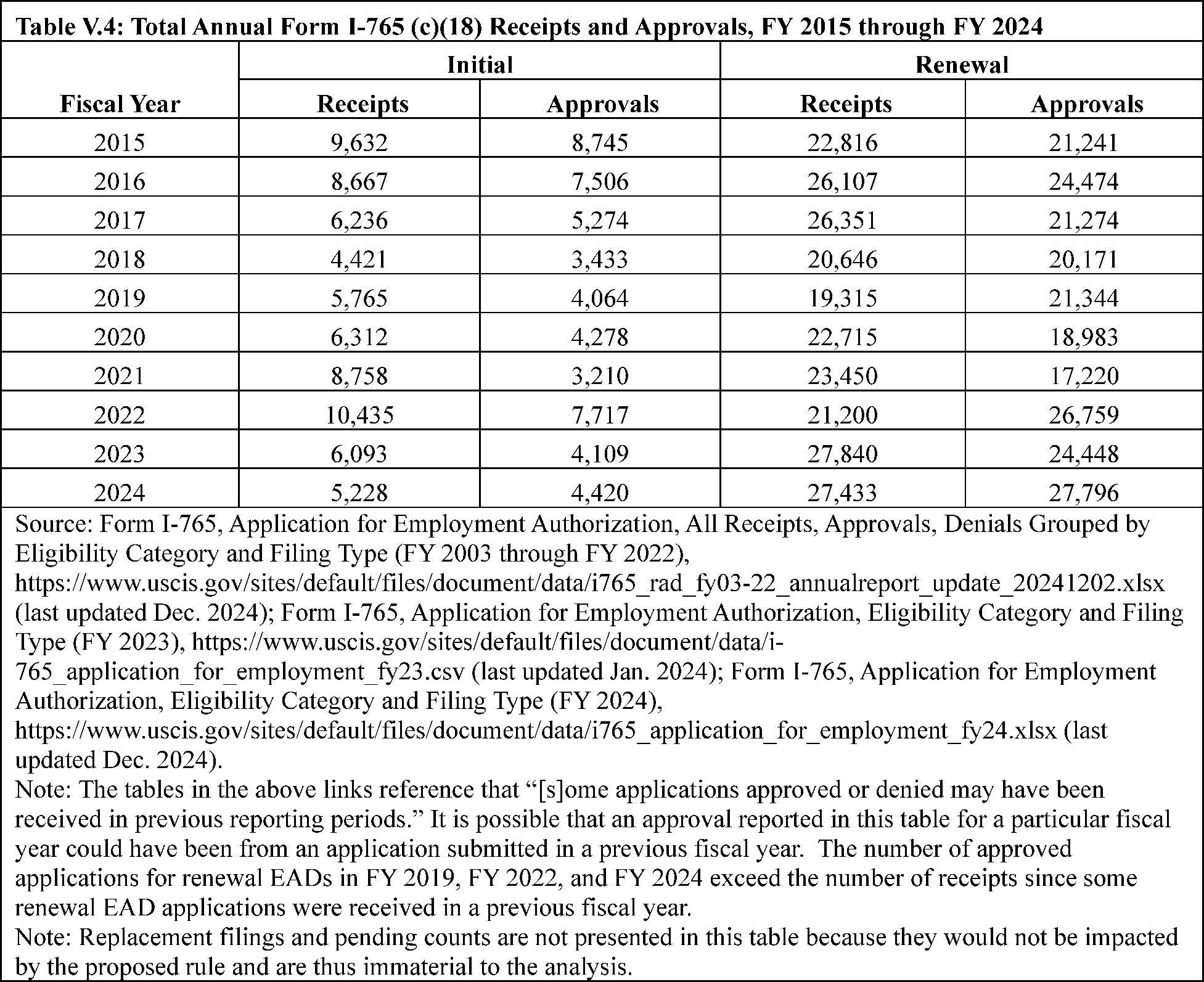
If all 154,580 F-1 students displaced American workers, it still falls far short of the current displacement risk based on more recent employment authorization applications. In FY 2024, USCIS received 33,024 (c)(18) Order of Supervision EAD initial and renewal applications; 792,130 (c)(11) Parole EAD initial and renewal applications; and 153,154 (c)(14) Deferred Action EAD initial and renewal applications, for a total of 978,308 discretionary EAD applications in the categories impacted by this proposed rule.[12]
If the former INS was justified in terminating a form of work authorization in order to prevent the possible displacement of more than 150,000 American workers on an annual basis, it follows that DHS cannot discount the potential impact on up to 978,308 American workers annually when reviewing discretionary EAD categories.
Enforcing our Nation's immigration laws is critically important to the national security and public safety of the United States. The American people deserve a Federal Government that puts their interests first and a Federal Government that understands its sacred obligation to prioritize the safety, security, and financial and economic well-being of Americans.[13]
This rule will also require the following groups of aliens who are seeking a renewal of employment authorization be employed by, or seeking employment with, a U.S. employer who is a participant in good standing in the E-Verify program: aliens who were (1) paroled into the United States temporarily for urgent humanitarian reasons or significant public benefit applying under (c)(11); (2) who have been granted deferred action applying under (c)(14); or (3) against whom a final order of deportation or removal exists and who are temporarily released from custody on an order of supervision applying under (c)(18). This requirement will protect American workers against potential displacement and any disadvantages in the labor market and ensure that U.S. employers who hire these aliens are complying with our immigration laws and not employing unauthorized workers.
Finally, this rule is consistent with the Administration's broad objective to protect and strengthen protections for American workers. Generally, by limiting employment authorization to those aliens who establish an economic necessity for employment and warrant a favorable exercise of discretion by USCIS, this rule will remove barriers and open pathways for American workers to participate in positions that may otherwise be filled by aliens. Further, the rule limits incentives to remain in the United States for those aliens with final orders of removal, thereby expanding the labor pool for American workers. Overall, this rule represents one piece of a broader initiative [14]
within the federal government to fulfill the President's domestic policy goal of developing American workers for jobs of the future and a revitalized economy. DHS proposes to apply changes made by this rule only to initial and renewal employment authorization applications filed on or after the effective date of the final rule.
B. Legal Authority
The Secretary of Homeland Security's (Secretary) authority for the regulatory amendments made in this proposed rule is found in various provisions of the Immigration and Nationality Act (INA), 8 U.S.C. 1101et seq.,
and the Homeland Security Act of 2002 (HSA), Public Law 107-296, 116 Stat. 2135 (codified in part at 6 U.S.C. 101et seq.). General authority for issuing this proposed rule is found in section 103(a) of the INA, 8 U.S.C. 1103(a), which authorizes the Secretary to administer and enforce the immigration and naturalization laws and establish such regulations as the Secretary deems necessary for carrying out such authority, as well as section 122 of the HSA, 6 U.S.C. 112, which vests all of the functions of DHS in the Secretary and authorizes the Secretary to issue regulations.[15]
This includes the authority to issue regulations authorizing categories of aliens to be employed in the United States and to collect from or require the submission of biometrics by aliens requesting immigration benefits, such as employment authorization. Additional authority for this proposed rule is found in:
Section 208,8 U.S.C. 1158, which governs the consideration of asylum applications and allows, inter alia, discretion to grant asylum applicants employment authorization under specified conditions.
Section 212(d)(5)(A),8 U.S.C. 1182(d)(5)(A), which authorizes the Secretary to prescribe conditions on parole.
Section 241 of the INA,8 U.S.C. 1231, which governs the detention, release, employment authorization, and removal of aliens after they have received an administratively final order of removal;
Section 274A(h)(3)(B) of the INA,8 U.S.C. 1324a(h)(3)(B), which recognizes the Secretary's authority to extend employment authorization to aliens in the United States; [16]
Sections 401-405 of the Illegal Immigration Reform and Immigrant Responsibility Act of 1996 (IIRIRA),Public Law 104-208, 110 Stat. 3009-
( printed page 34356)
546, which established the authority for the creation and operation of E-Verify;
Section 101(b)(1)(F) of the HSA,6 U.S.C. 111(b)(1)(F), which establishes as a primary mission of DHS the duty to “ensure that the overall economic security of the United States is not diminished by efforts, activities, and programs aimed at securing the homeland”;
Section 451(a)(3) of the HSA,6 U.S.C. 271(a)(3), which confers authority on the USCIS Director to establish “policies for performing [immigration adjudication] functions”;
Section 103 of the INA,8 U.S.C. 1103; section 287(b) of the INA, 8 U.S.C. 1357(b); and sections 103.2(b)(9) and 103.16 of chapter 8 of the CFR, which provides for and governs the collection, submission, and use of biometrics by DHS; and
The One Big Beautiful Bill Act (H.R. 1),Public Law 119-21, 139 Stat. 72 (codified in relevant part at 8 U.S.C. 1801-1815), which imposes restrictions on validity periods of employment authorization in relation to certain immigration benefits, as well as certain fees.
C. Summary of the Major Provisions of the Regulatory Action
DHS is proposing to amend its regulations governing discretionary employment authorization for certain aliens. The proposed rule would include the following provisions to clarify and limit when certain aliens are eligible for discretionary employment authorization and how USCIS will weigh certain discretionary factors when adjudicating a discretionary grant of employment authorization:
Employment Authorization for Aliens Granted Deferred Action or Paroled into the United States.
DHS proposes to revise eligibility for discretionary employment authorization under 8 CFR 274a.12(c)(11) for aliens who have been paroled into the United States based on urgent humanitarian reasons or significant public benefit and under 8 CFR 274a.12(c)(14) for aliens who have been granted deferred action by confirming such a grant requires the alien establish they warrant a favorable exercise of discretion, by requiring aliens applying for renewal of employment authorization be employed by or seeking employment with a U.S. employer in good standing in E-Verify, and by requiring aliens who have been paroled into the United States based on urgent humanitarian reasons or significant public benefit to establish an economic necessity for employment. The specific changes proposed to 8 CFR 274a.12(c)(14) do not apply to employment authorization based on a grant of DACA, which is authorized under 8 CFR 274a.12(c)(33), or to employment authorization based on a grant of deferred action to an applicant for T nonimmigrant status, and eligible family members, who have pending, bona fide applications, and who warrant a favorable exercise of discretion, authorized under 8 CFR 274a.12(c)(40), and not 8 CFR 274a.12(c)(14); however, the proposed changes described below relating to criminal aliens and biometrics, which are generally applicable to all discretionary employment authorization under 8 CFR 274a.12(c) unless specifically exempted, do apply to employment authorization based on a grant of DACA or a bona fide T application.
Employment Authorization for Aliens Temporarily Released on OSUP.
DHS proposes to limit eligibility for discretionary employment authorization under 8 CFR 274a.12(c)(18) for aliens who have final orders of removal and are temporarily released from custody on OSUP to aliens for whom DHS has determined that removal is impracticable because all countries from which DHS requested travel documents have failed to issue such documents. DHS also proposes to require aliens applying for renewal of employment authorization in this category to be employed by or seeking employment with a U.S. employer in good standing in E-Verify.
Bar discretionary employment authorization for criminal aliens.
DHS proposes that unless DHS has determined that there are significant countervailing public interests, which may include the presence of the alien in the United States to assist law enforcement activity in the United States, it generally will not favorably exercise its discretion to grant employment authorization, when:
○ An alien has been arrested for, charged with (without disposition), indicted for, or convicted of, any criminal act; or
○ An alien admits to committing a violent or dangerous crime, even if the alien has never been formally arrested, charged, indicted or convicted; or
○ There is evidence of the alien's membership in a gang or terrorist organization.
While an alien's successful participation in state or federal programs, such as pretrial diversion programs, may not constitute a conviction for the purposes of the INA, DHS generally will not favorably exercise its discretion to grant employment authorization for aliens who enter into agreements that impose some form of punishment, penalty, or a restraint on liberty. This includes agreements or programs where an alien's criminal record has been sealed or expunged. In these cases, the alien's initial criminal arrest would be the prevailing factor.
Require biometrics submission.
DHS proposes to require aliens seeking discretionary employment authorization to submit biometrics. USCIS will submit an alien's biometrics to the Federal Bureau of Investigation (FBI) for a criminal history check and use an alien's biometrics to facilitate identity verification and production of the EAD.
Validity periods.
DHS intends to shorten the validity period of the discretionary EADs (
e.g.,
not more than one year) impacted by the proposed rule and place the burden on the alien to ensure ongoing eligibility for those applying for EADs under these categories. On July 4, 2025, the President signed into law the One Big Beautiful Bill Act (H.R. 1), Public Law 119-21, 139 Stat. 72. It placed a limit on the validity of employment authorization for any alien paroled into the United States to one year or the duration of the alien's parole, whichever is shorter.[17]
H.R.1 also established statutory validity periods for Temporary Protected Status (TPS)-based employment authorization, stating TPS-related employment authorization may only be automatically extended for up to 1 year or the duration of TPS, whichever is shorter, for initial and renewal applications for employment authorization pending or filed on or after July 22, 2025.[18]
Considering these changes, DHS is updating the validity period for EADs issued for deferred action and OSUP-based employment authorization categories to align with the others imposed in H.R. 1. In addition to ensuring continuous eligibility and consistent treatment, this
( printed page 34357)
shorter validity period also supports ongoing management of aliens on OSUP to ensure aliens are complying with the terms and conditions of OSUP and have not reoffended or absconded. The burden should be on the alien to reappear for biometrics submission with each application for employment authorization to ensure USCIS has the most up-to-date and accurate background check information. At their discretion, DHS and USCIS may shorten additional discretionary EAD validity periods by issuing sub-regulatory guidance in the future.
Automatic Termination of Employment Authorization.
DHS is proposing to expand the reasons for automatic termination under 8 CFR 274a.14(a)(1), to include two additional reasons:
○ When an alien has an administratively final order of removal under any of the removal statutes (
e.g.,
INA 217, 235, 238, 240); and
○ When the underlying basis for employment authorization is terminated or denied. This can include DHS's termination of status or denial of the application that was the basis of the employment authorization (
e.g.,
parole, deferred action).
Notice of the termination of the underlying status or benefit, denial of a pending application, or having a final order of removal will result in the automatic termination of any alien's employment authorization granted under § 274a.12(c).
D. Summary of Costs and Benefits
DHS estimates that this proposed rule would result in a reduction in the number of aliens with granted deferred action, aliens granted parole, and aliens with final orders of removal who are eligible for employment authorization. This could result in lost earnings for aliens who are no longer eligible for employment authorization, while also ensuring and strengthening protections of American workers. The lost earnings could result in a transfer of costs from the alien to their support network, including family members, community groups, non-profits or third-party organizations that provide for the alien, and any dependents. In addition, DHS estimates that the proposed rule would increase filing burdens for those aliens who remain eligible for employment authorization, while ensuring economic necessity for employment and permitting DHS to verify criminal history and biometrically verify an alien's identity before issuing employment authorization, and demonstrating to the satisfaction of USCIS that the alien warrants a favorable exercise of discretion. U.S. businesses that currently employ alien workers who would no longer be eligible to renew their employment authorization under this proposed rule could incur new costs due to employee turnover or compliance with the proposed E-Verify requirement that would ensure aliens' authorization to work. Finally, the proposed rule may result in a loss of tax revenue.
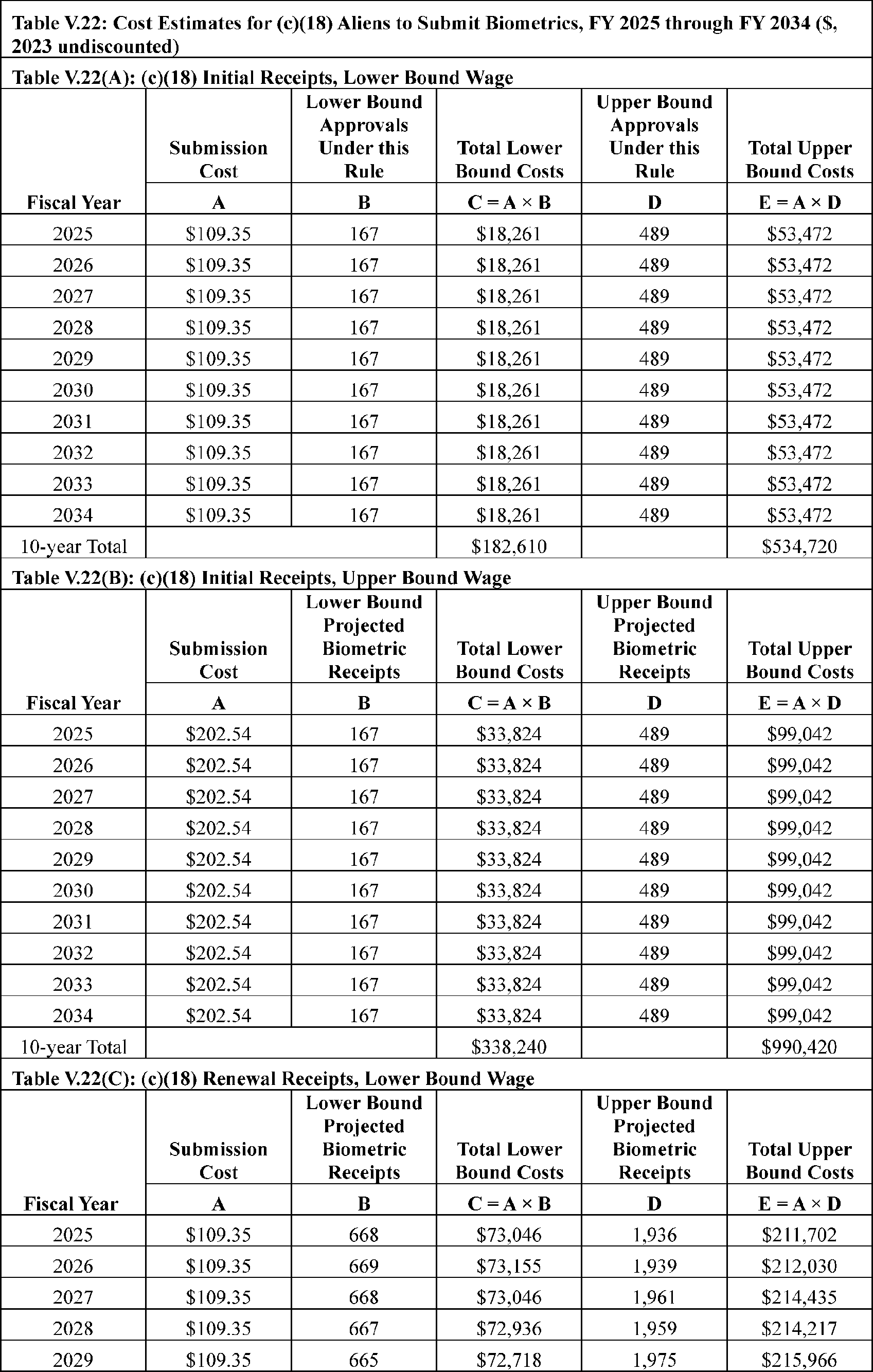
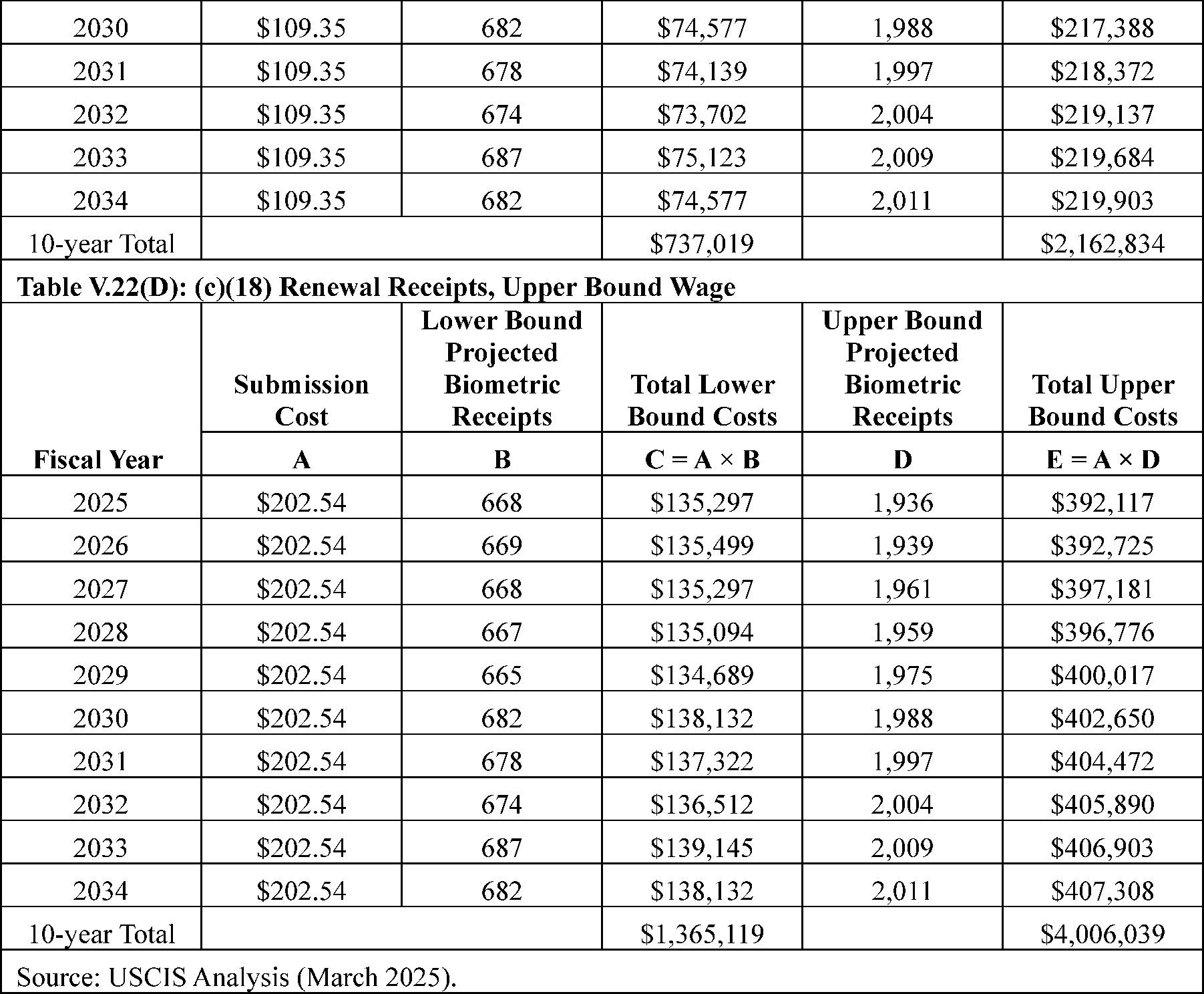
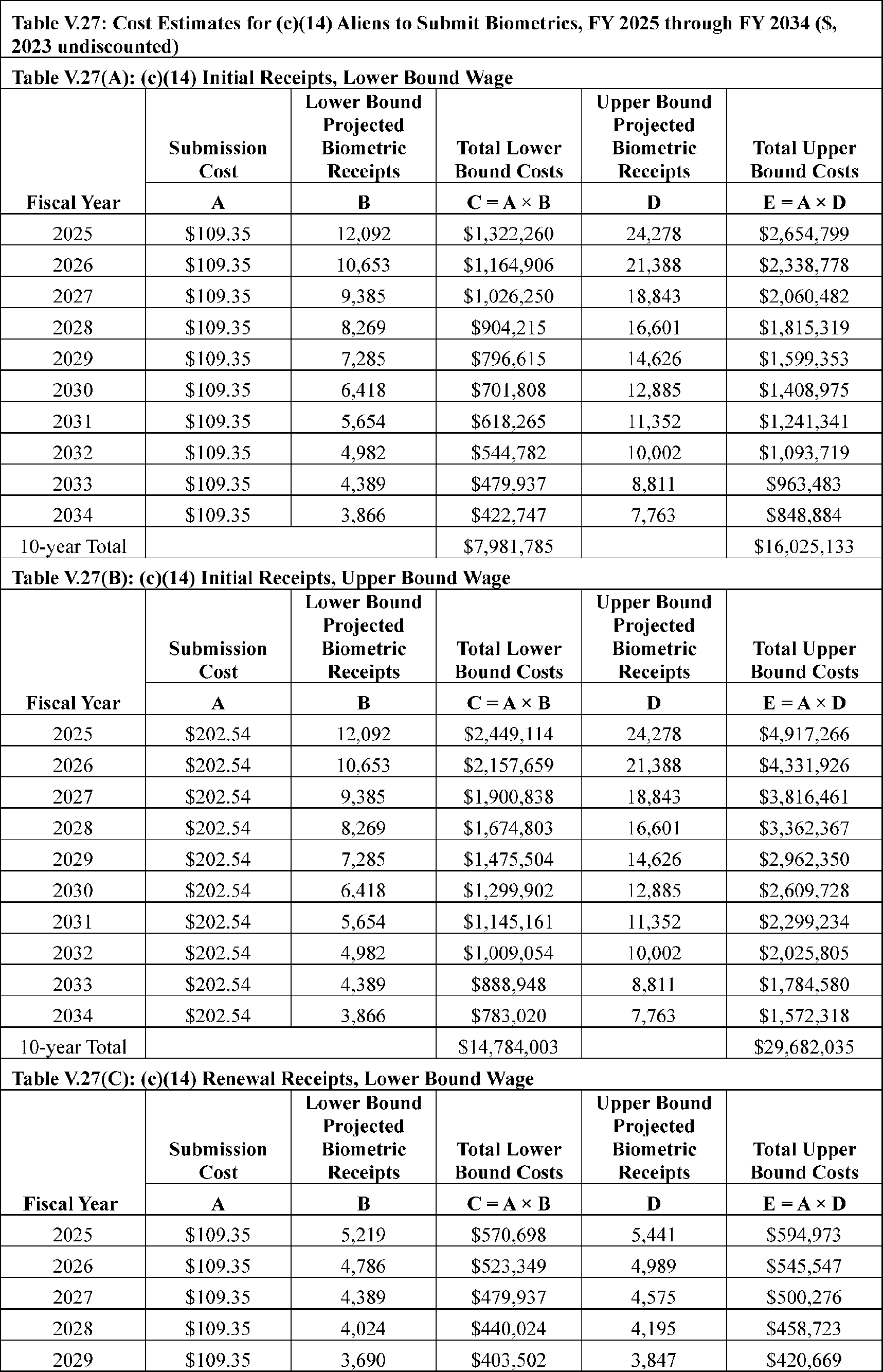
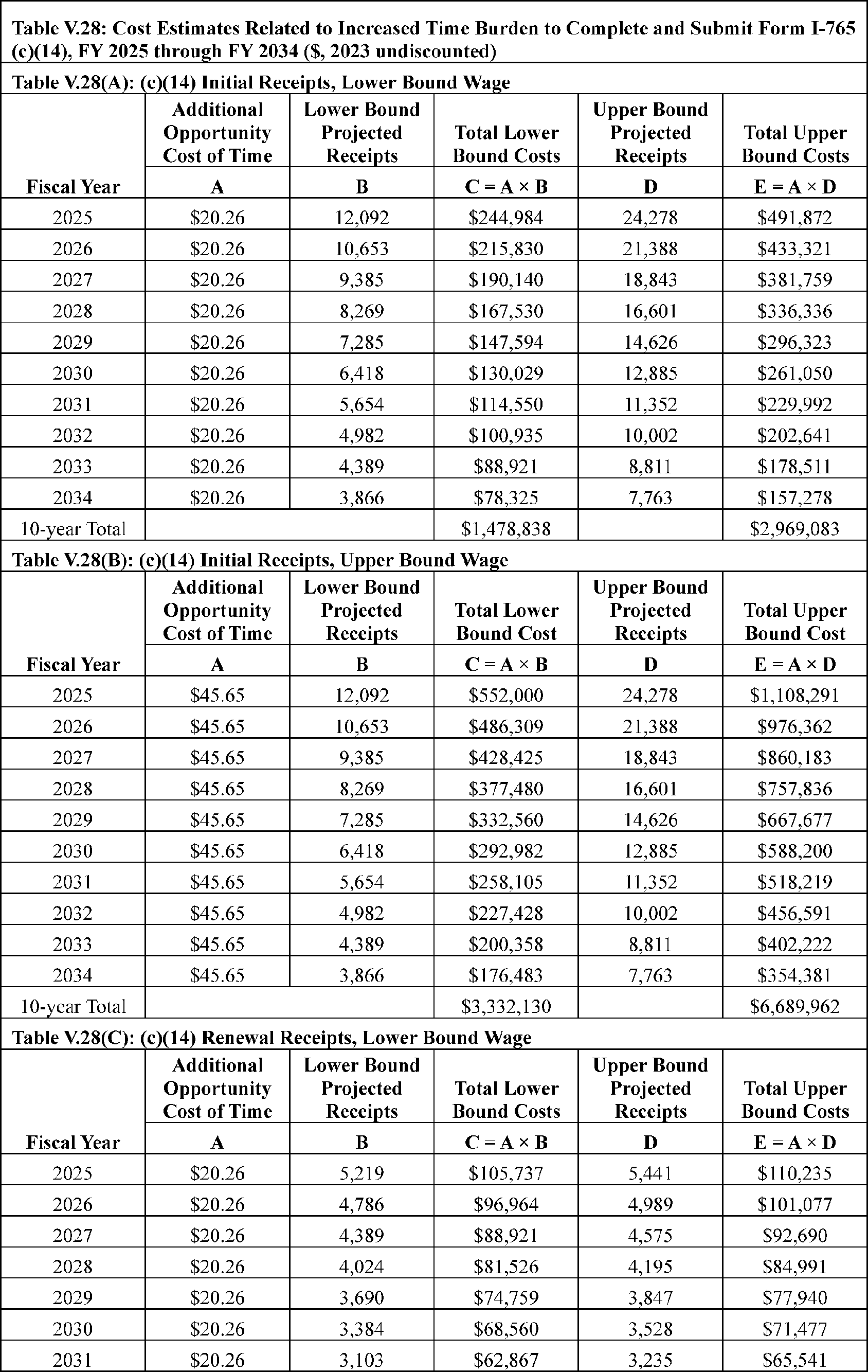
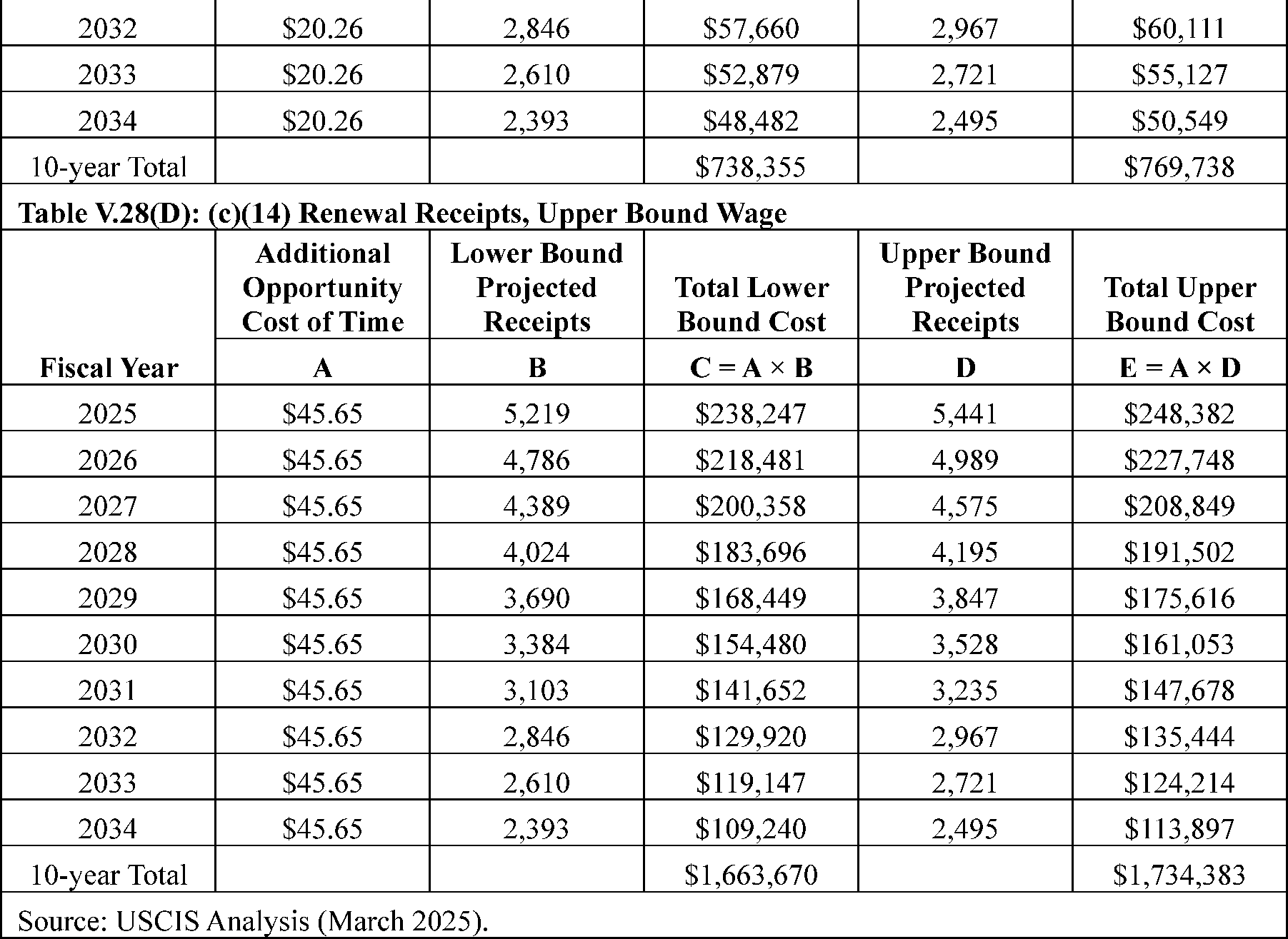
Under the proposed rule, DHS estimates and quantifies six types of economic impacts, including: (1) potential lost earnings of alien workers who may no longer be eligible for employment authorization; (2) increased time burden for aliens to submit forms; (3) added time and costs for aliens to submit biometrics; [19]
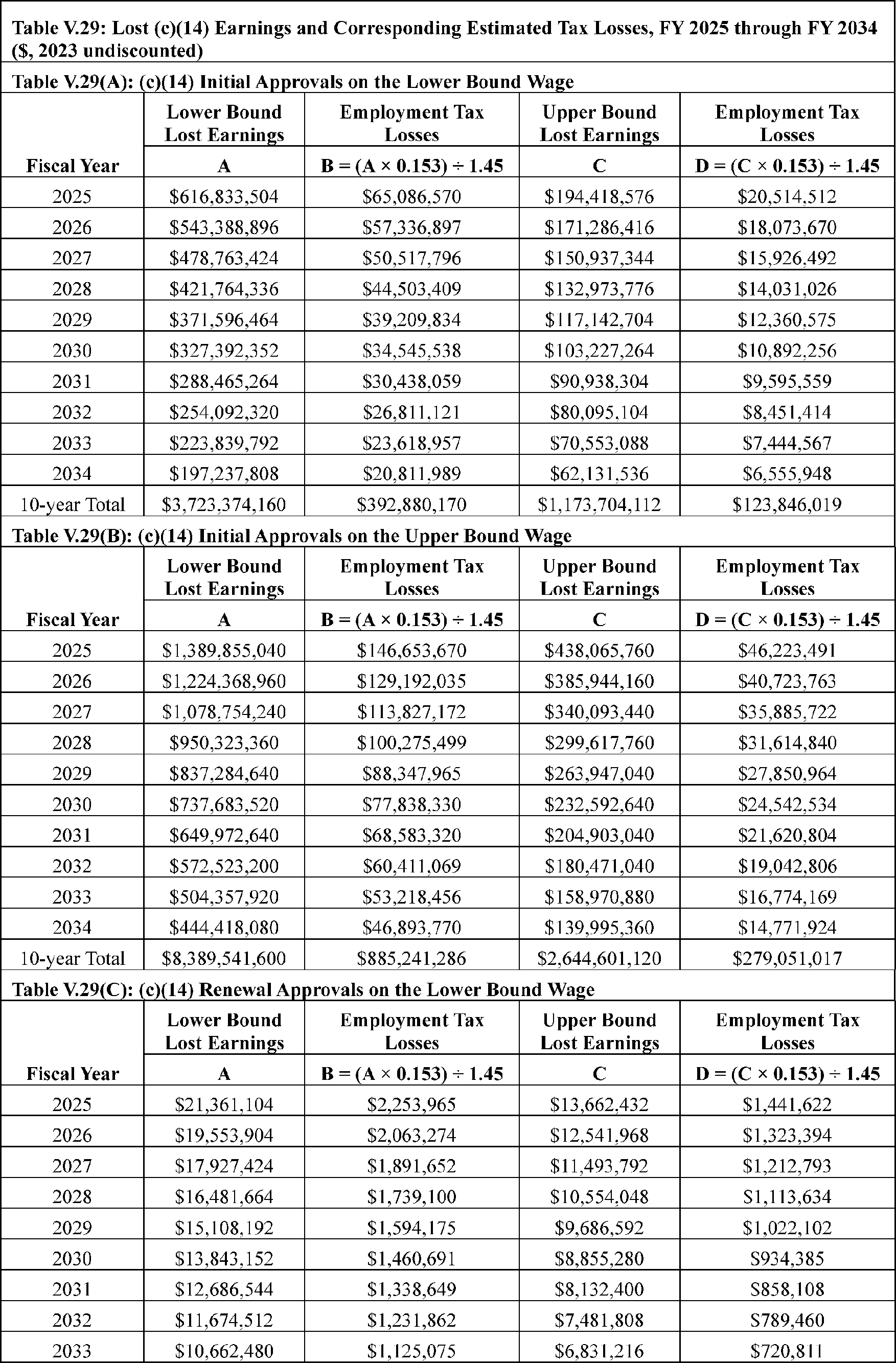
(4) labor turnover costs that employers of alien workers could incur when EADs expire, are revoked, or are not renewed; (5) costs to employers to enroll in and maintain an E-Verify account as a participant in good standing to retain alien workers applying for renewal EADs; and (6) potential employment tax losses to the Federal government.
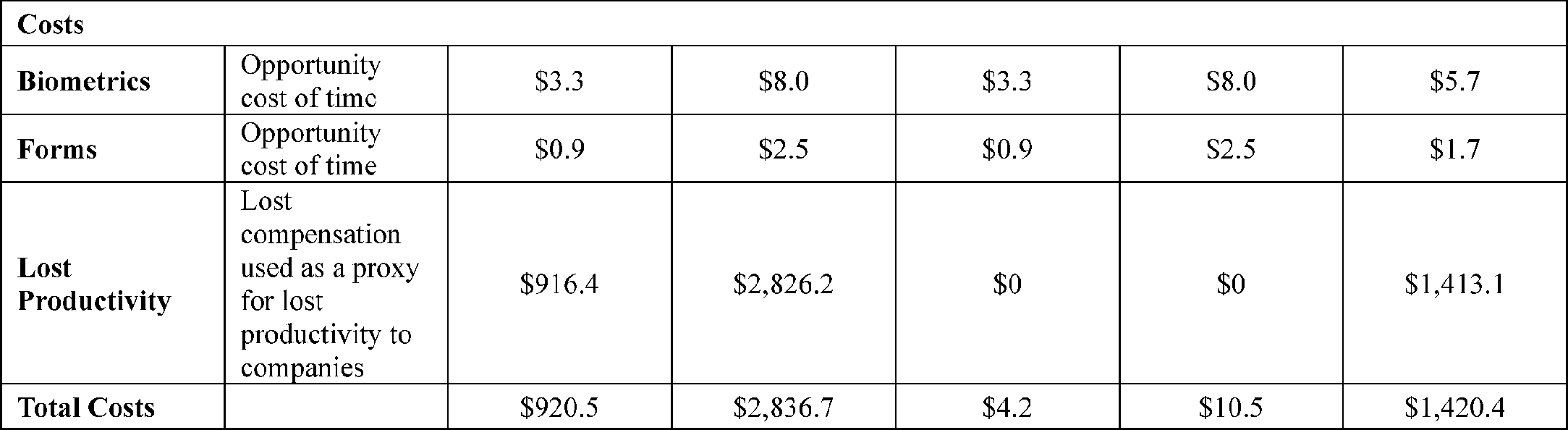
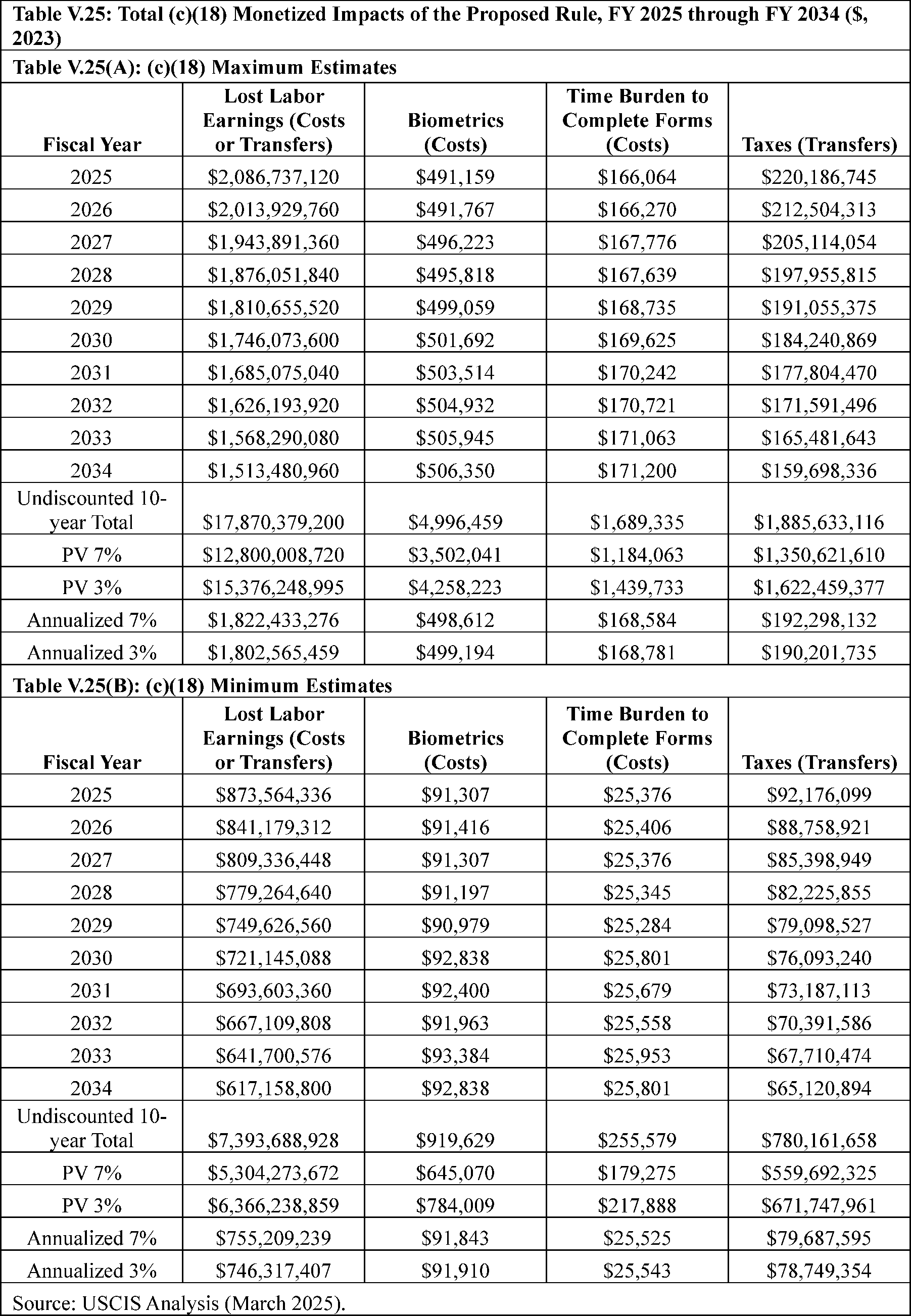
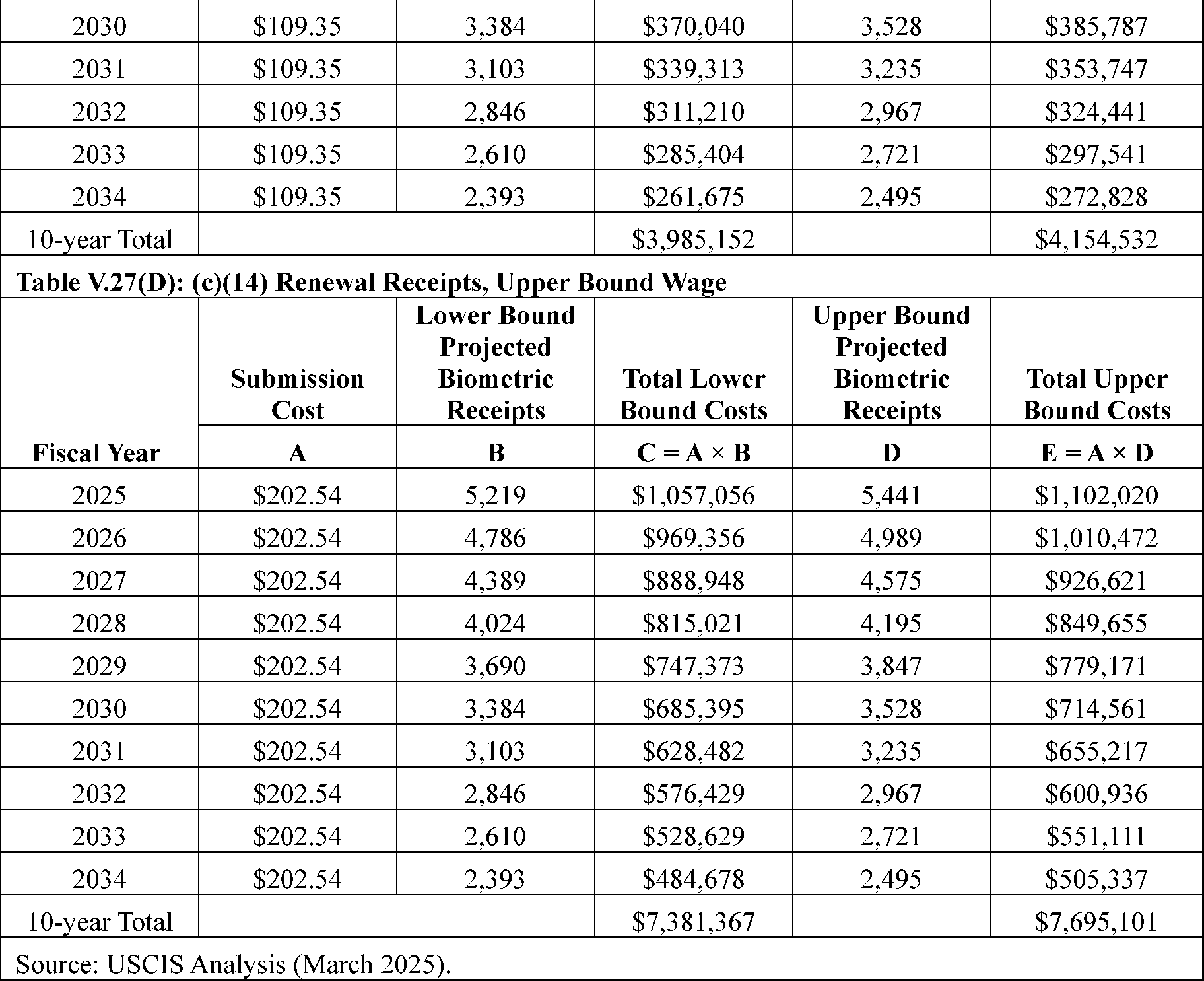
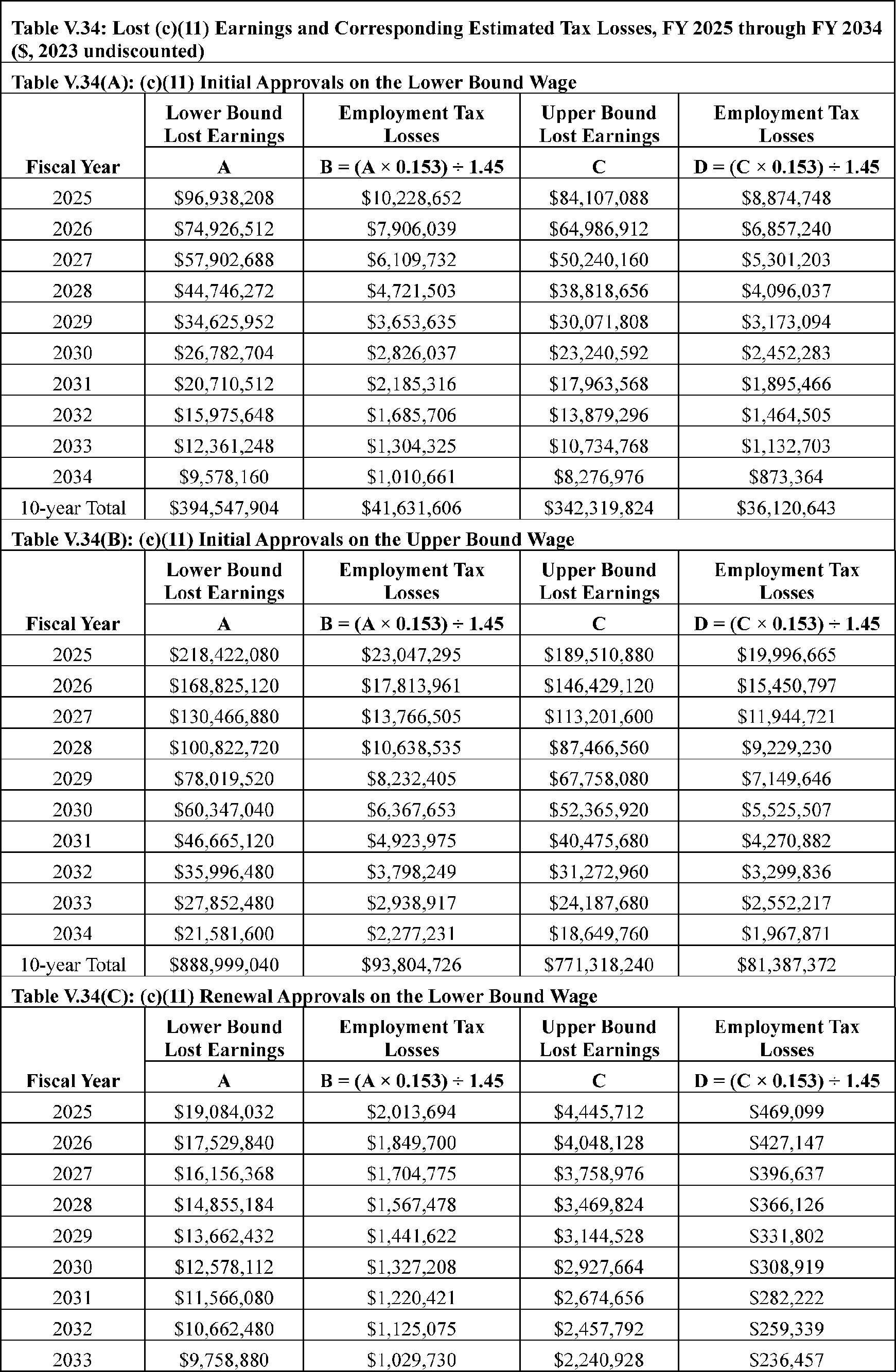
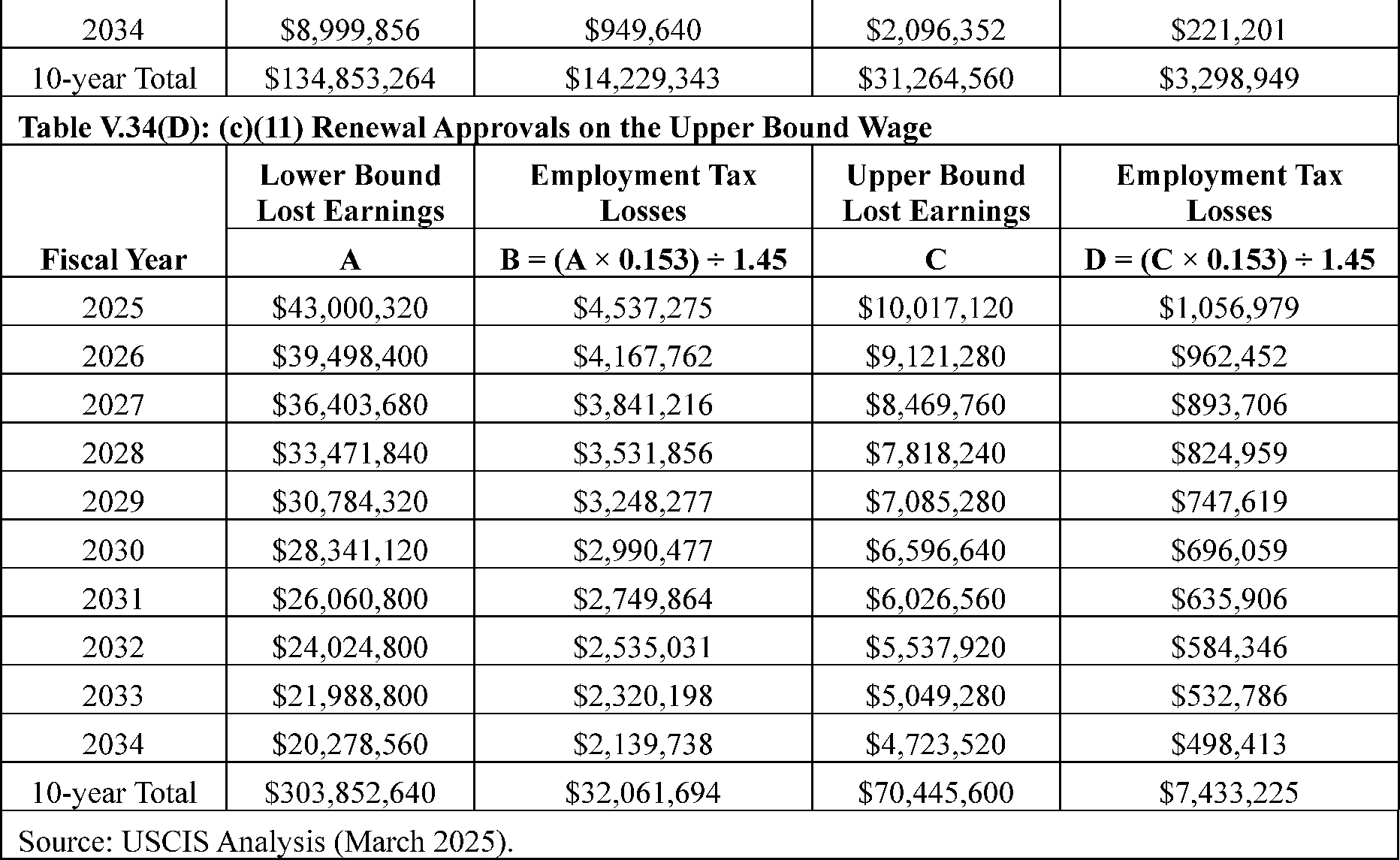
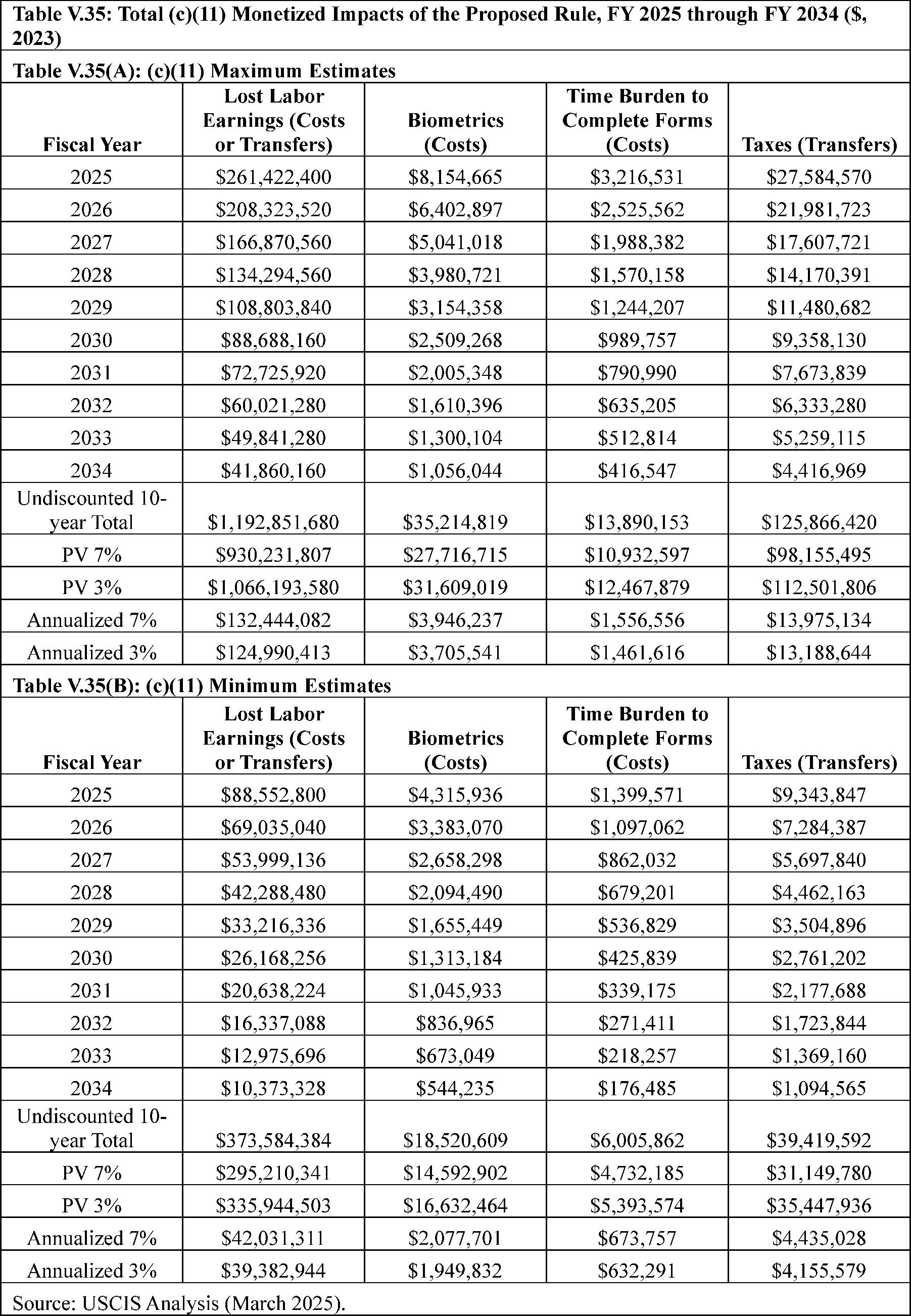
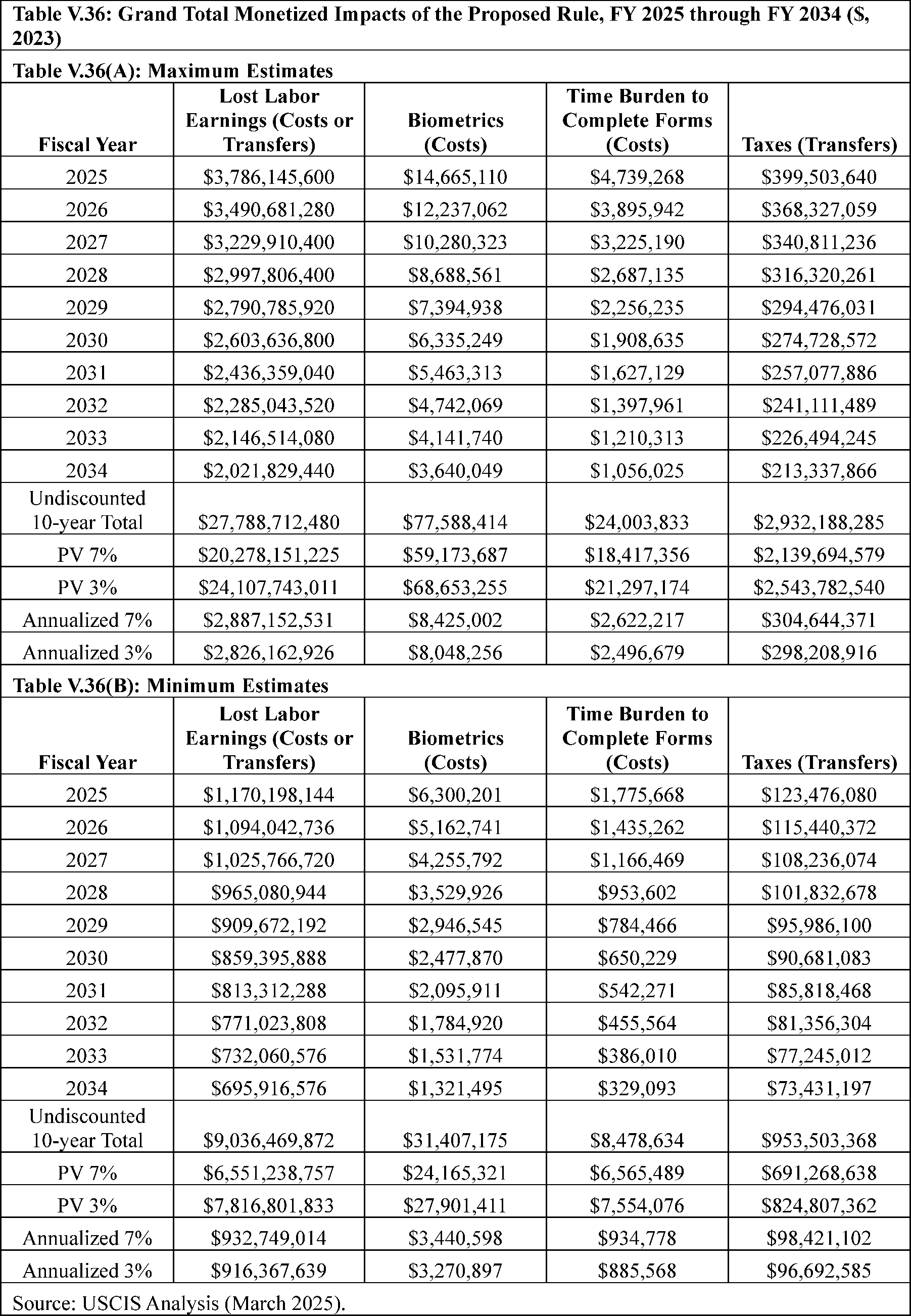
DHS estimates that some aliens would be ineligible for discretionary EADs due to the proposed rule. However, DHS cannot estimate this population with precision because of data constraints and, therefore, relies on a range with an upper and lower bound. The estimated 10-year undiscounted, direct costs of this proposed rule would range from about $9.1 billion to $27.9 billion (Table V.36), which includes costs associated with biometrics and added time burdens for relevant filing forms as well as estimated costs should employers not be able to find replacement labor for category (c)(11), (c)(14), and (c)(18) aliens who would become ineligible for employment authorization under this rule. The estimated 10-year costs of the proposed rule annualized at a 3 percent discount rate would range from $920.5 million to $2.8 billion, and at a 7 percent discount rate would range from $937.1 million to $2.9 billion. DHS estimates $2.9 billion (10-year undiscounted) as the maximum transfer of employment taxes (namely Medicare and Social Security) from employers and employees to the Federal Government ($298.2 million annualized at 3 percent and $304.6 million annualized at 7 percent).
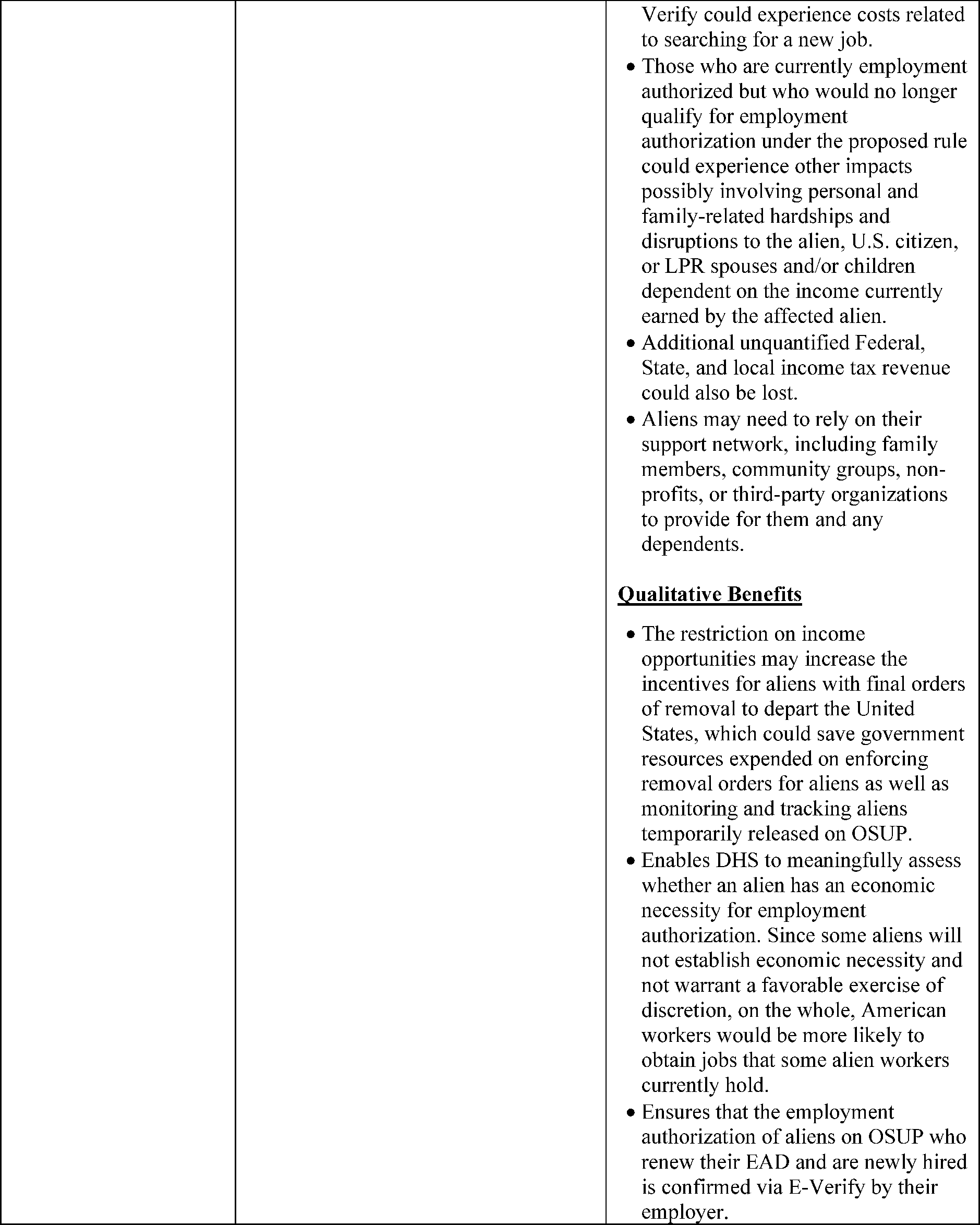
The potential benefits of the proposed rule would be qualitative. First, U.S. citizen or lawful permanent resident workers on the whole would be more likely to obtain jobs currently held by category (c)(11), (c)(14), and (c)(18) alien workers since the proposed rule would reduce employment authorization eligibility for these populations of aliens. Second, the proposed rule may reduce the incentive for (c)(18) aliens to remain in the United States after receiving a final order of removal, which could reduce the amount of government resources expended on enforcing final orders of removal for such aliens as well as monitoring and tracking aliens temporarily released on OSUP. According to a May 2025 DHS announcement,[20]
the average cost to arrest, detain, and remove an illegal alien is $17,121.[21]
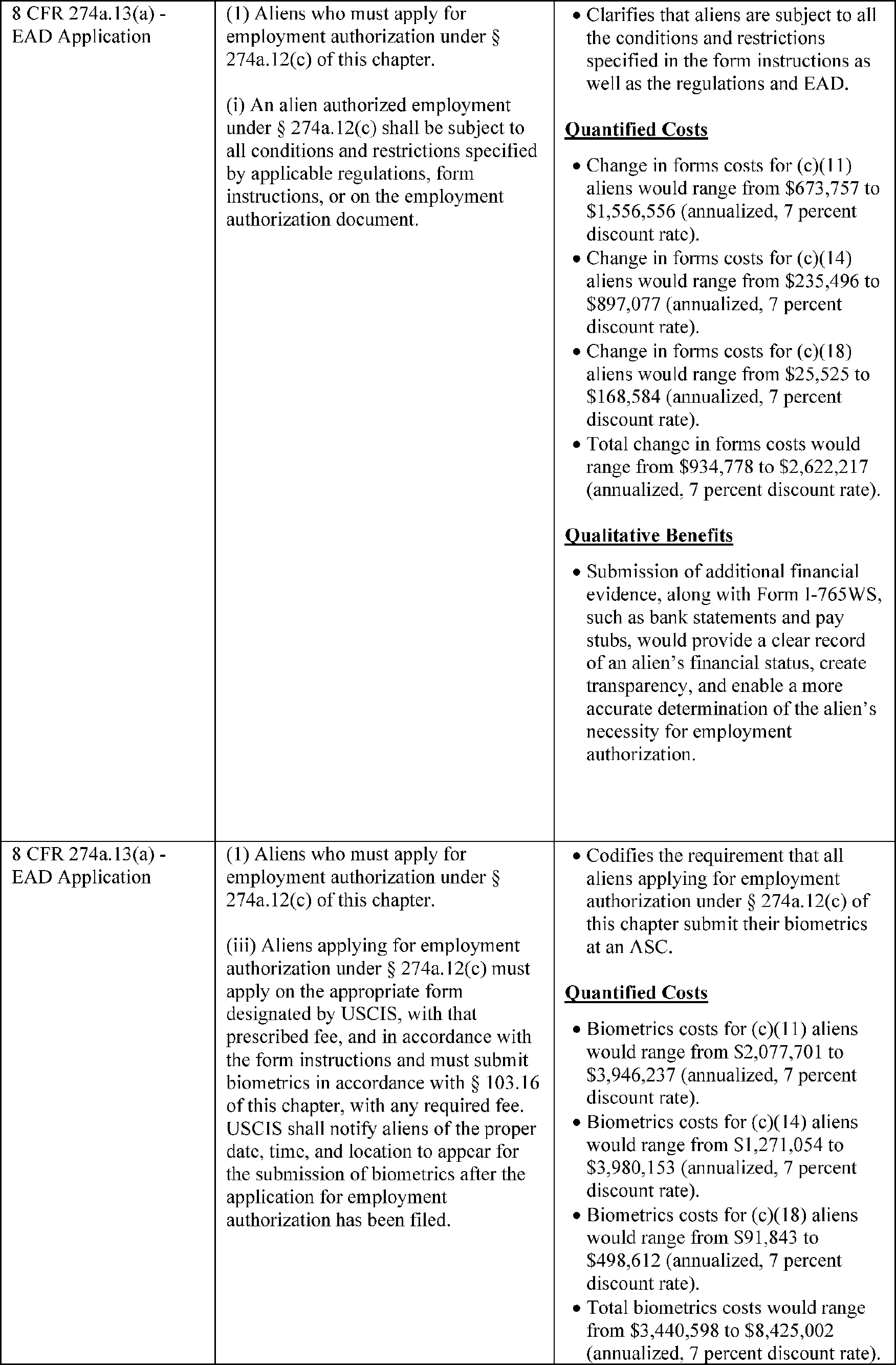
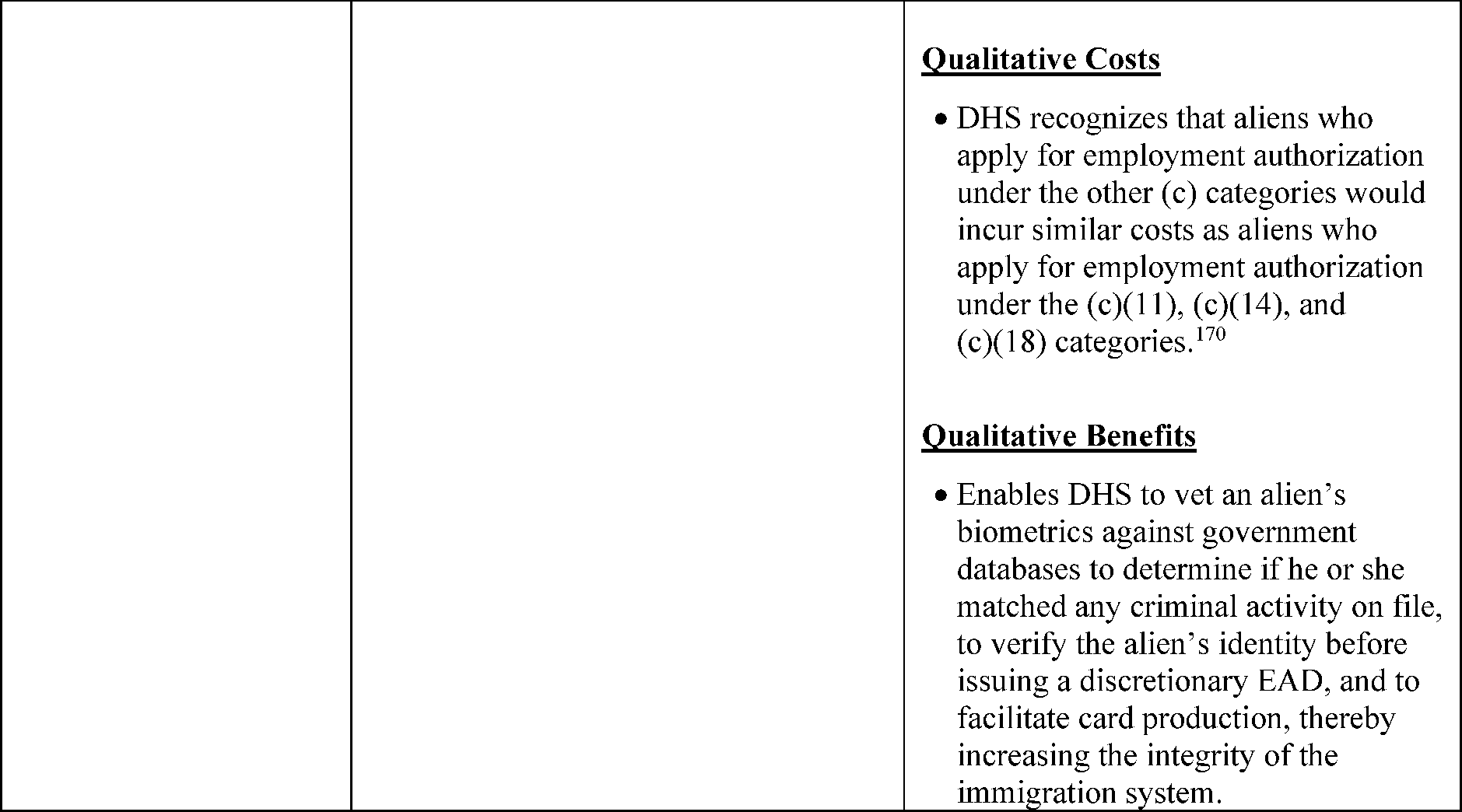
Additional unquantifiable benefits also include enabling DHS to determine an economic necessity for employment, biometrically verifying an alien's identity before issuing any employment authorization under § 274a.12(c), vetting an alien's biometrics against government databases for criminal activity, and ensuring that aliens who renew their employment authorization have their employment authorization verified by their employer, thereby increasing the integrity of the immigration system.
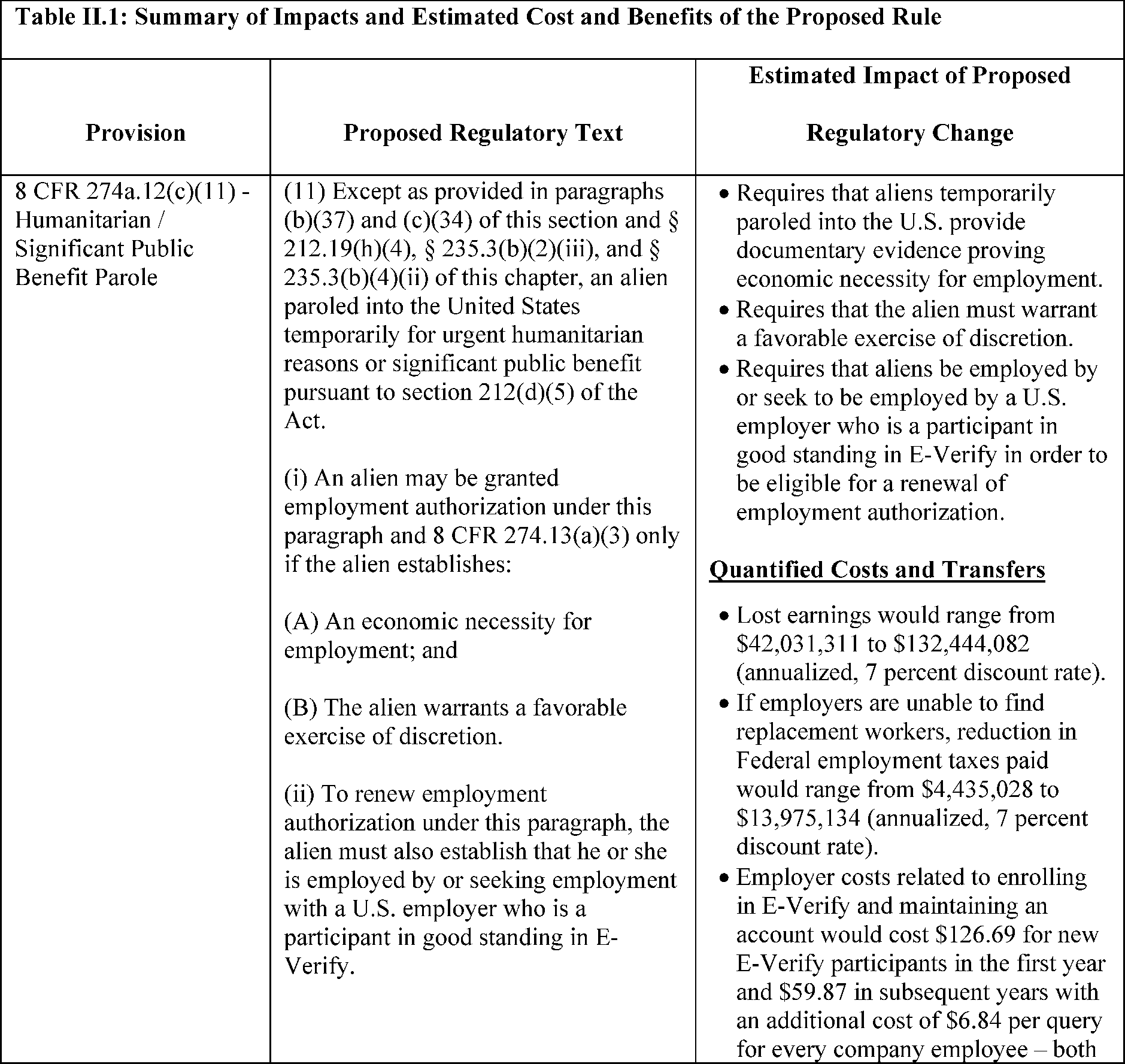
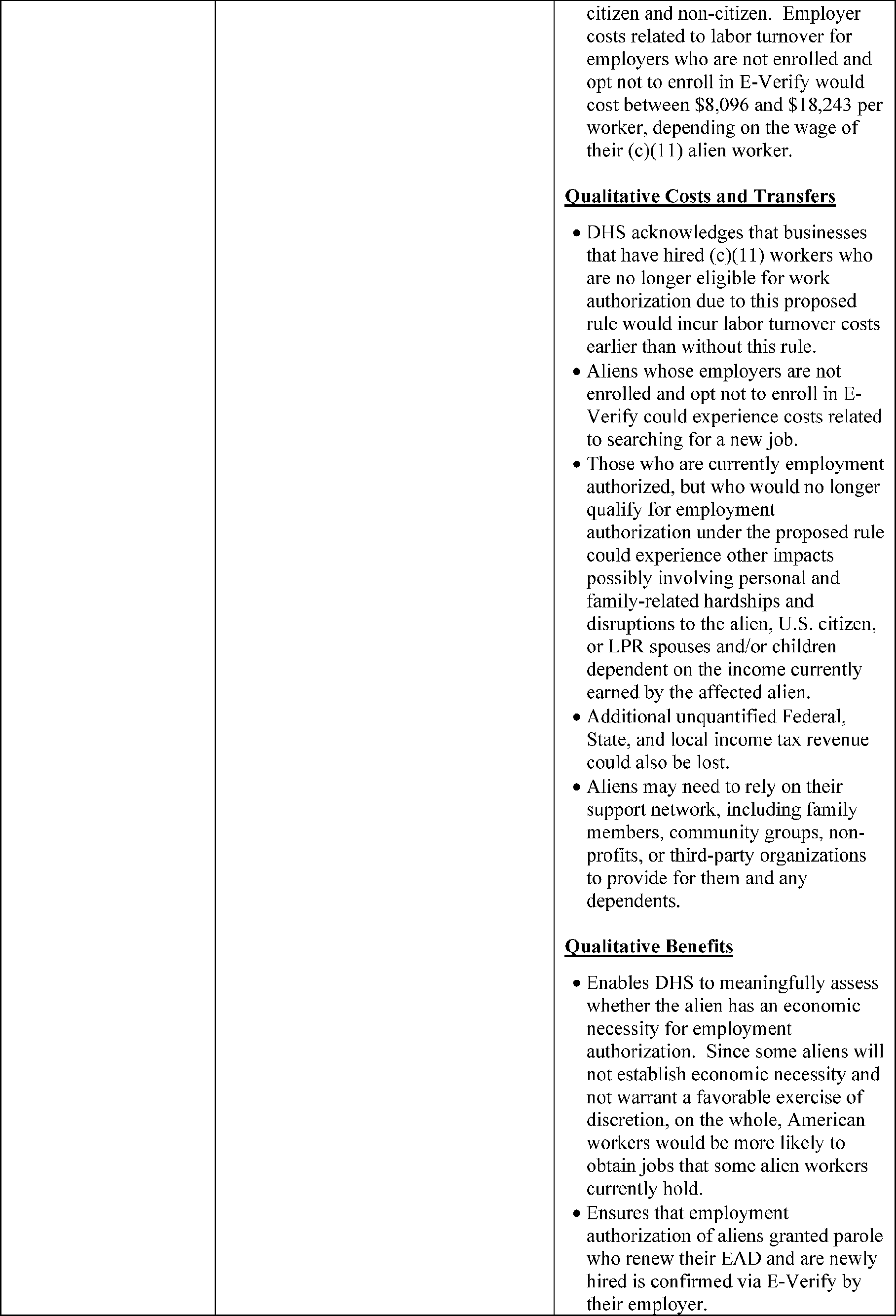
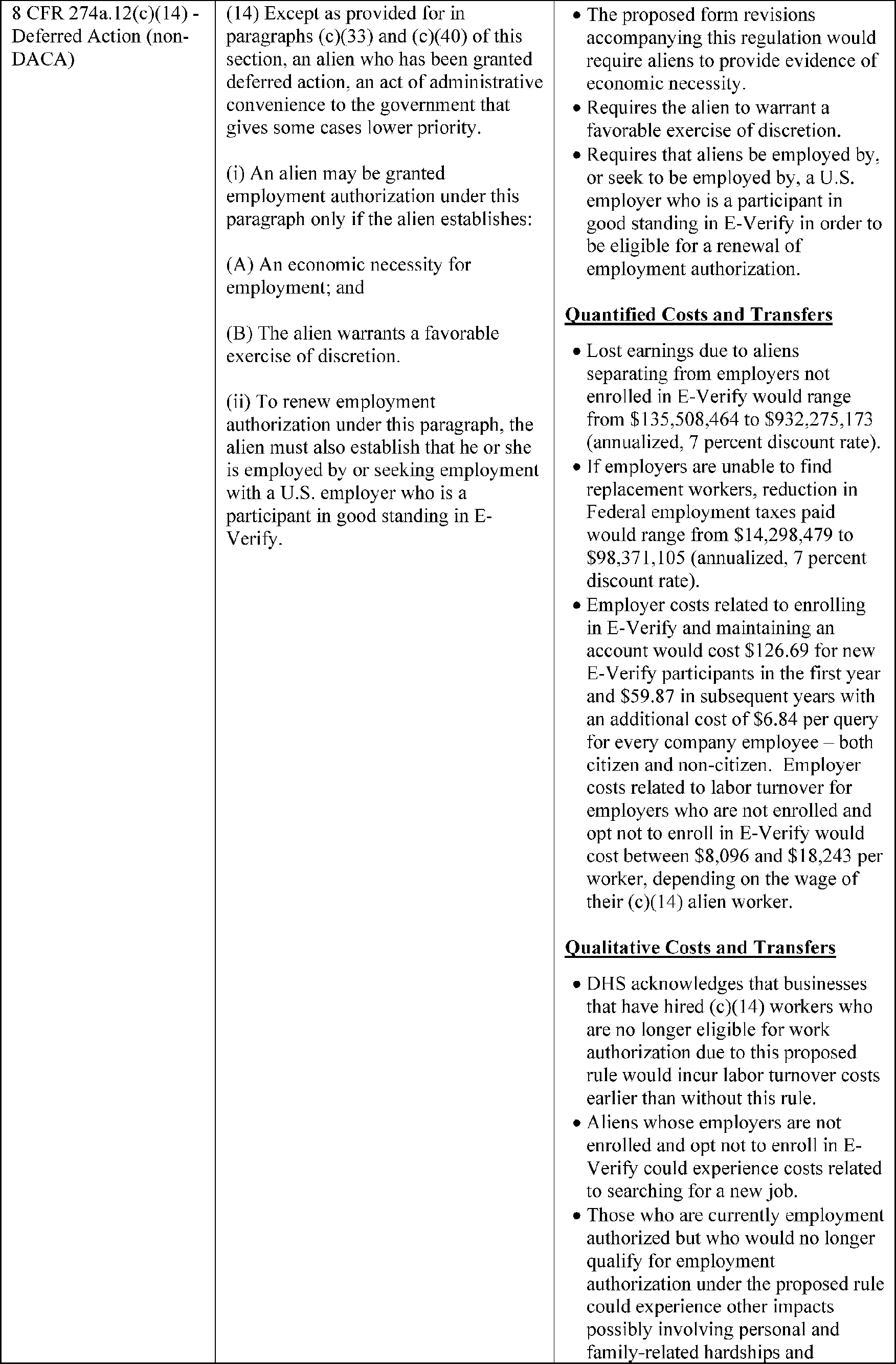
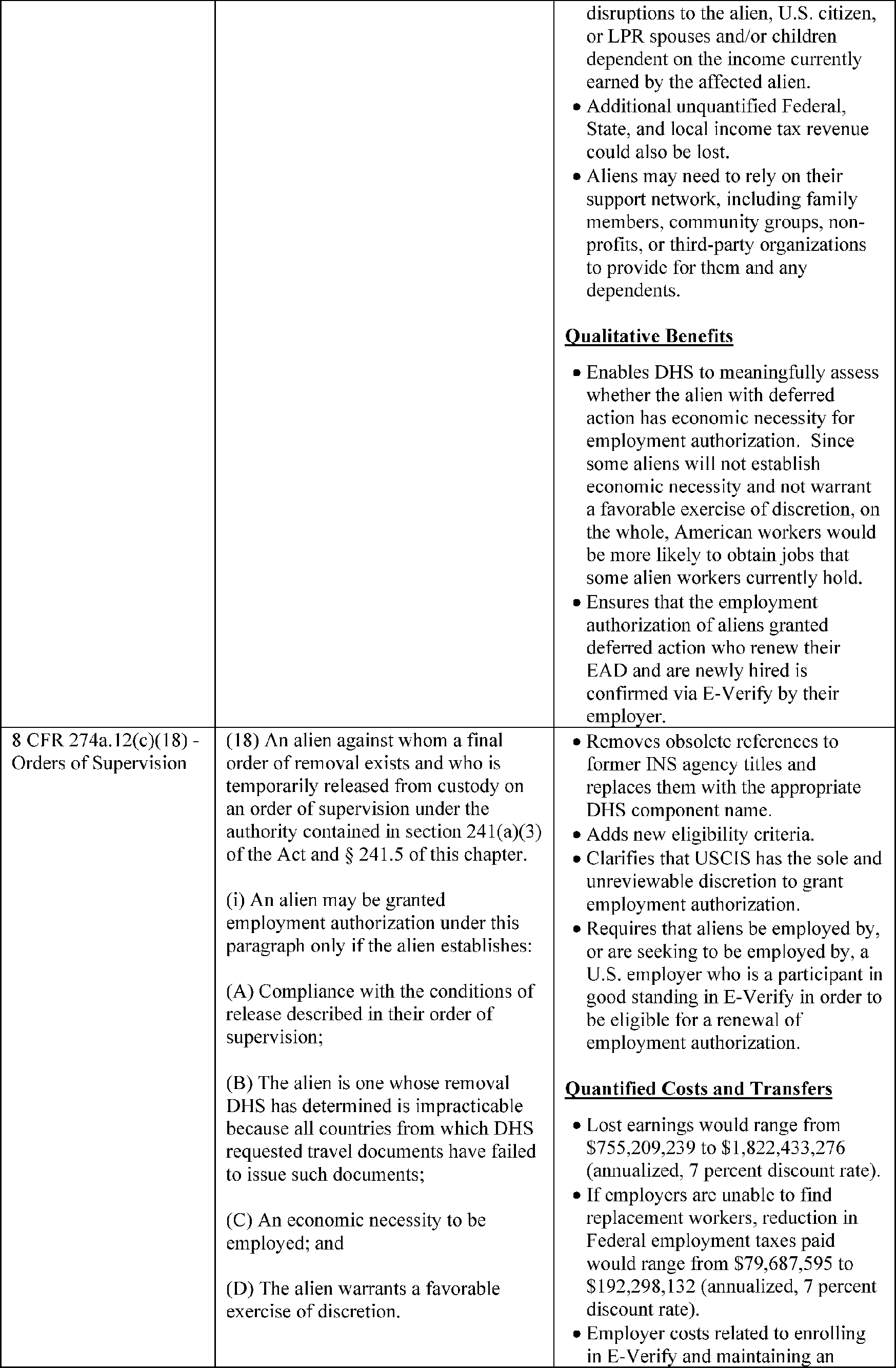
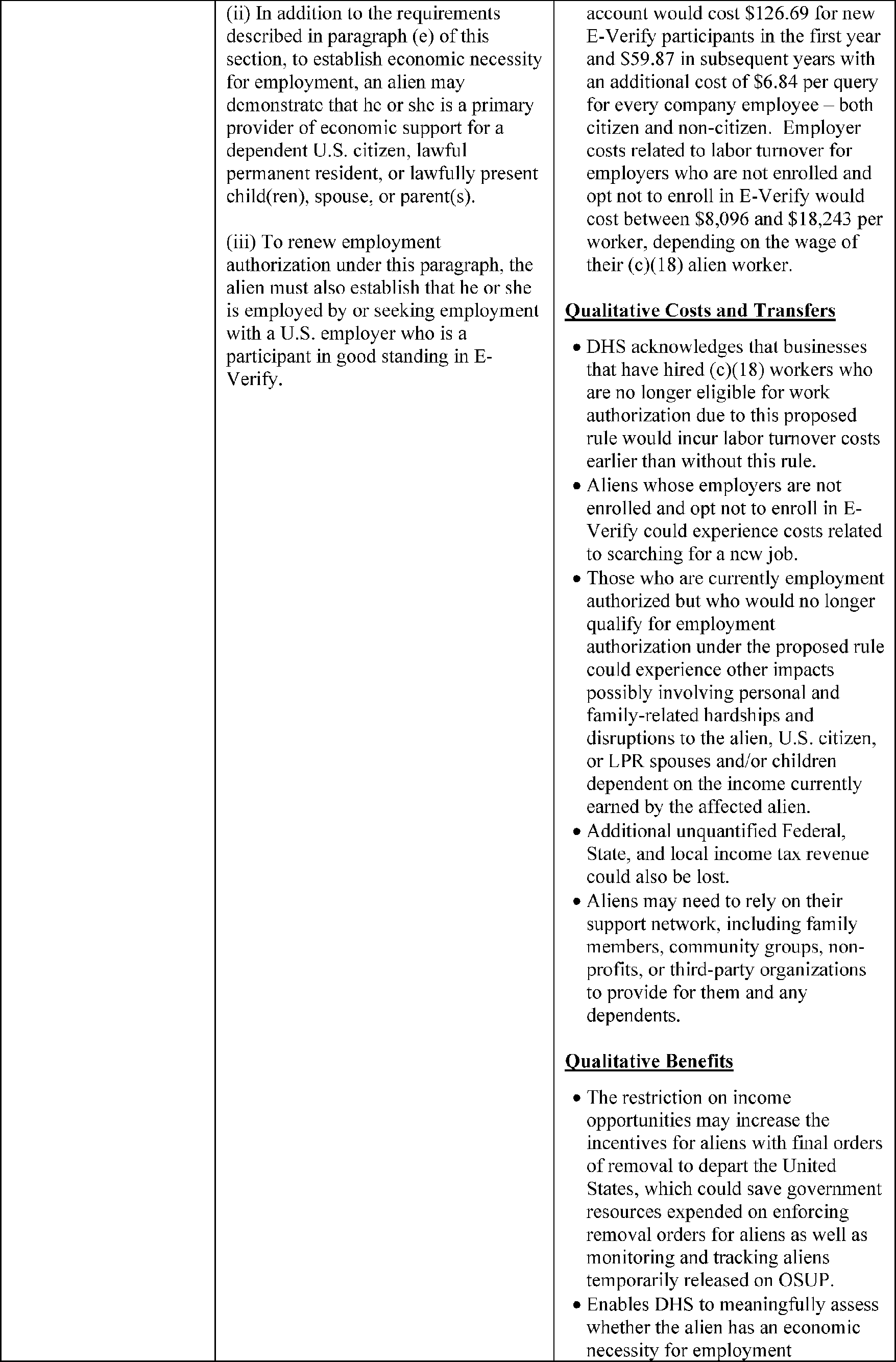
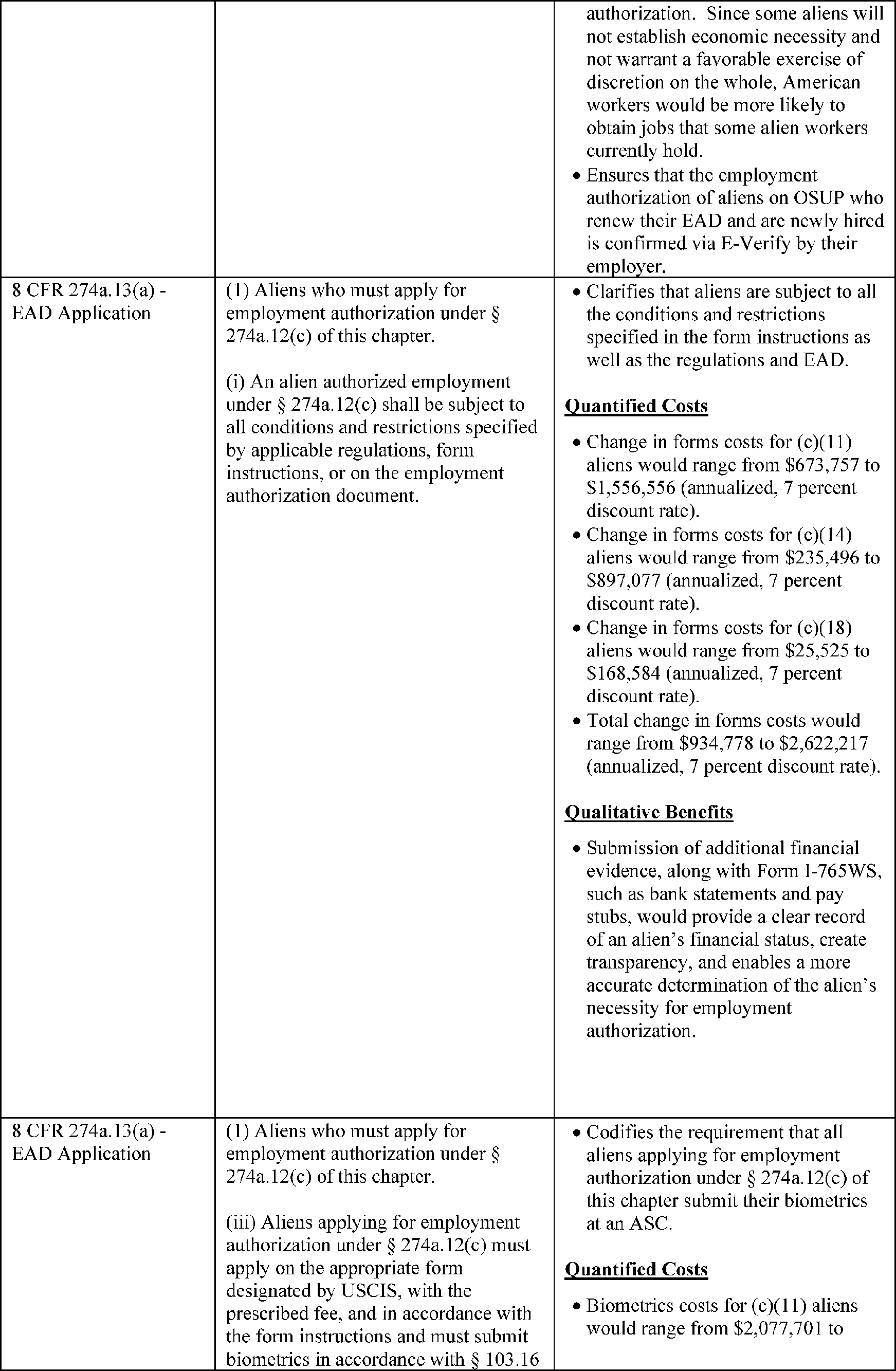
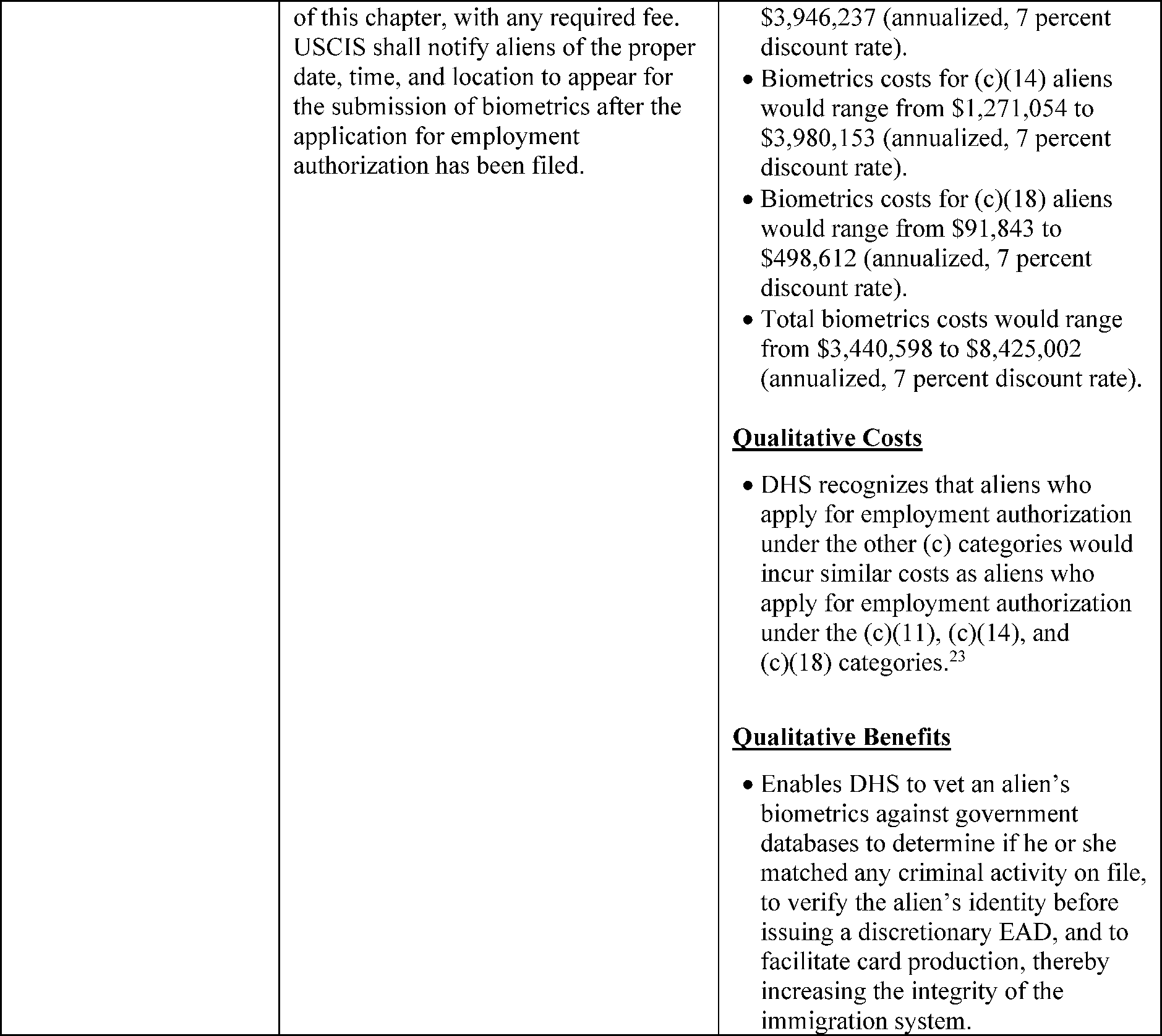
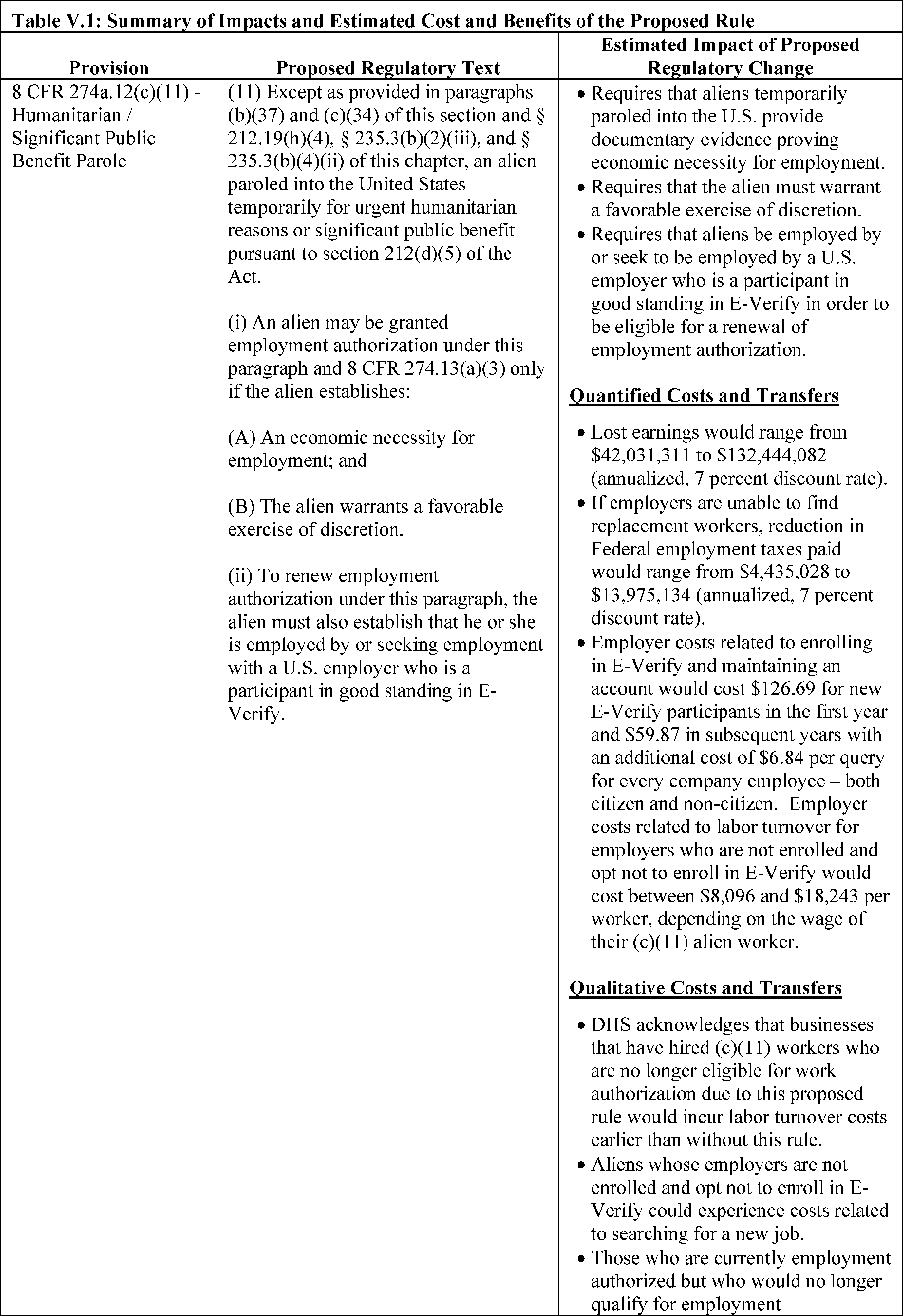
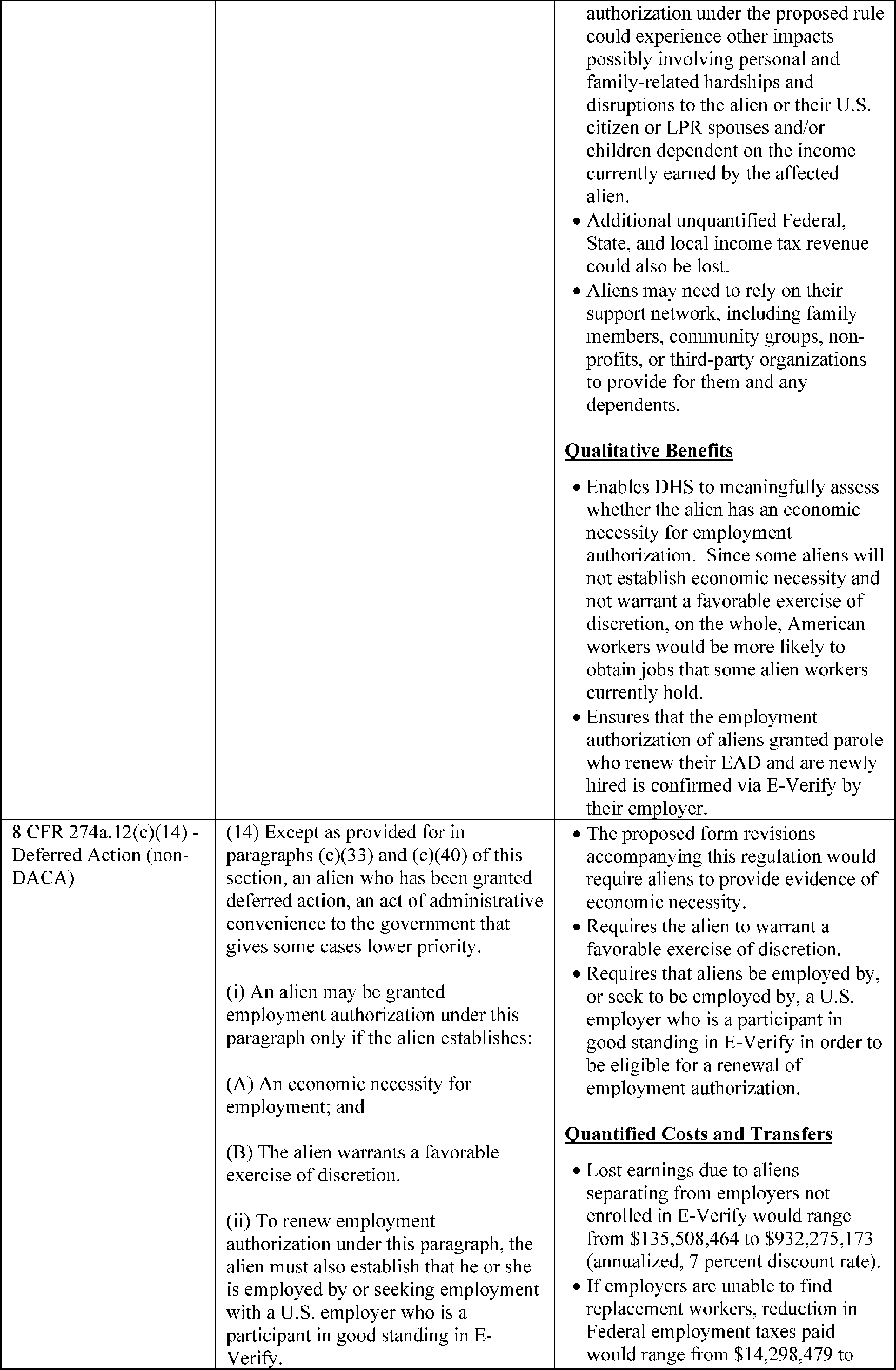
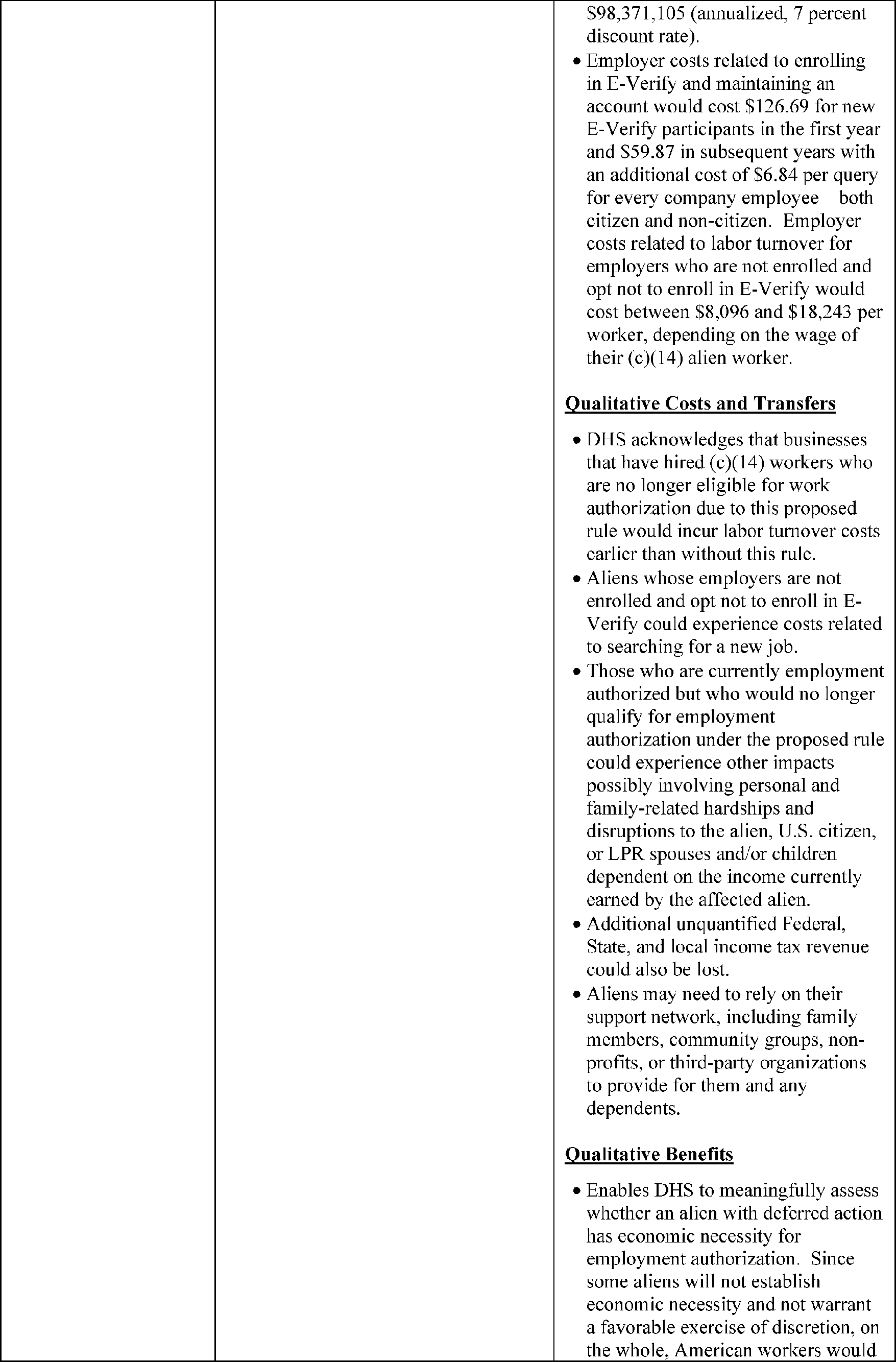
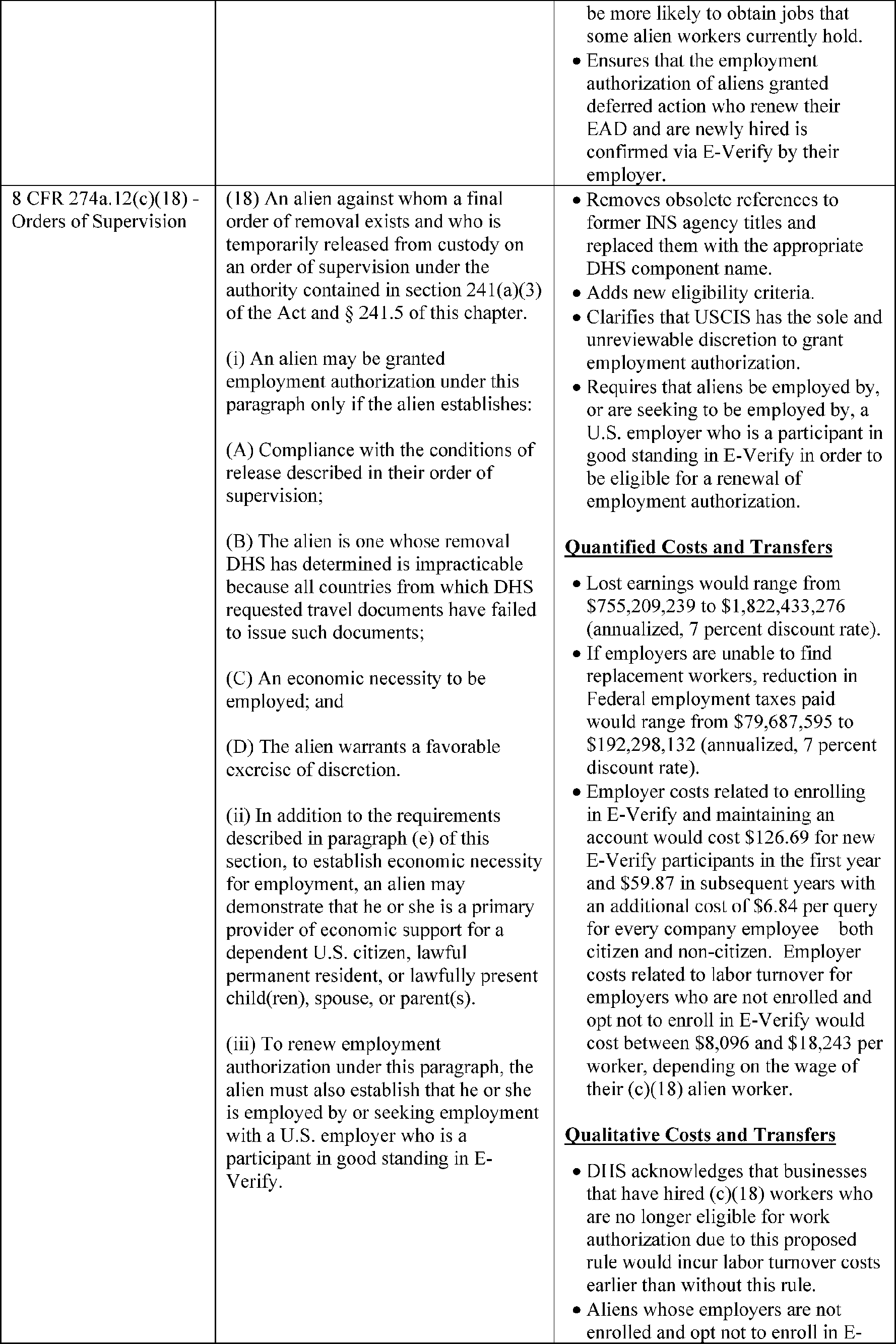
Table II.1 shows the summary of impacts of the proposed regulatory changes and the associated estimated costs and benefits.[22]
( printed page 34358)
( printed page 34359)
( printed page 34360)
( printed page 34361)
( printed page 34362)
( printed page 34363)
( printed page 34364)
The impacts [23]
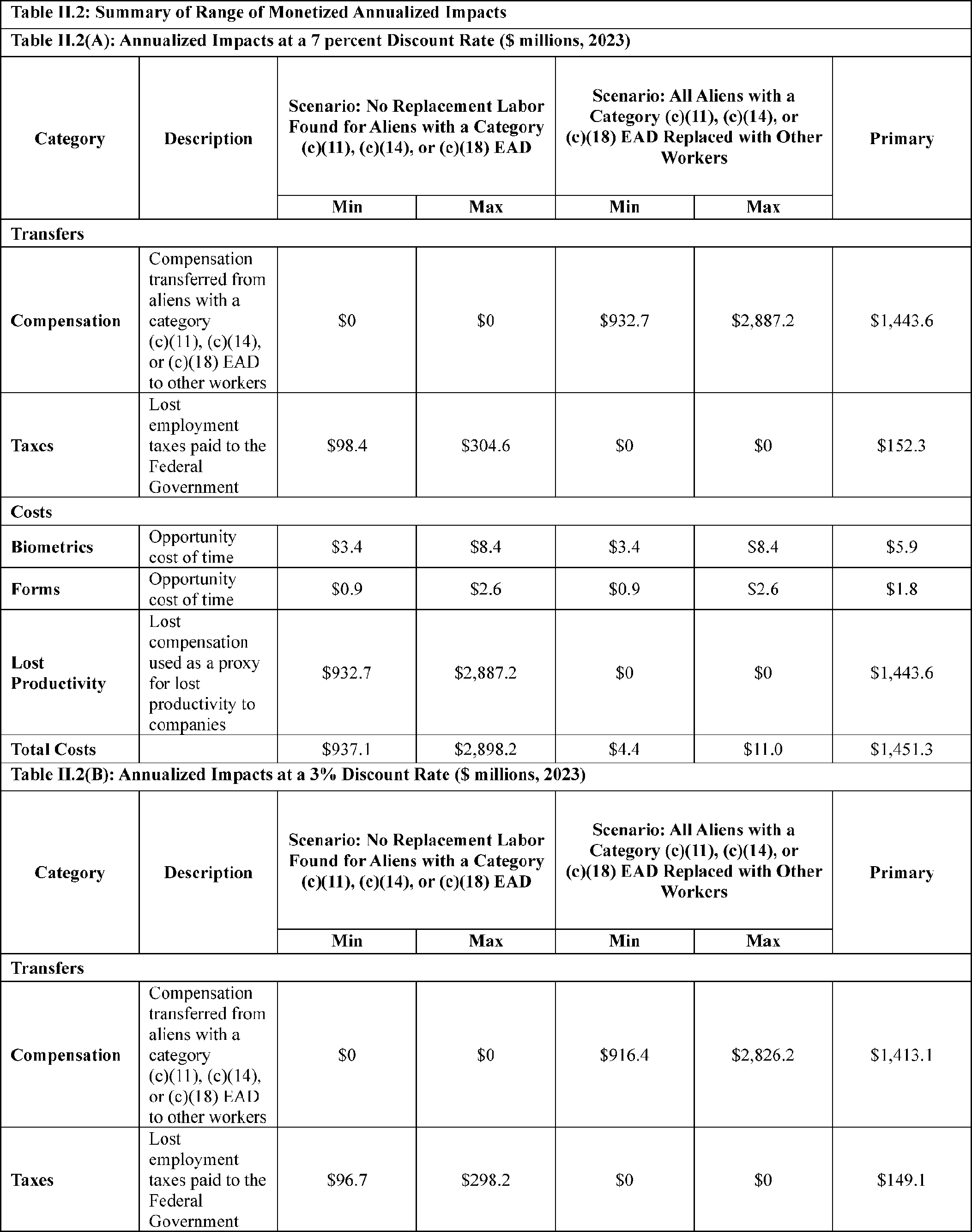
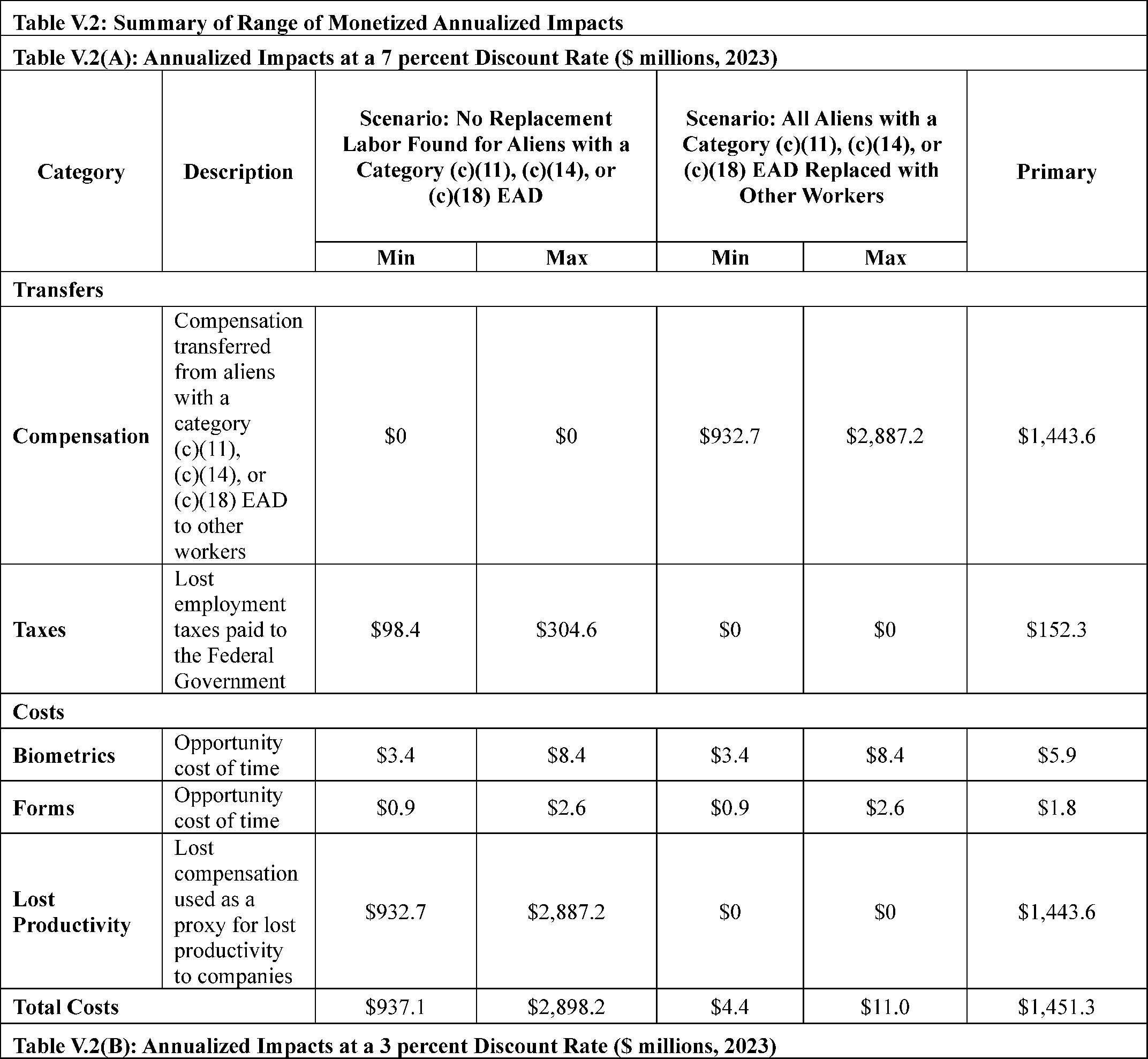
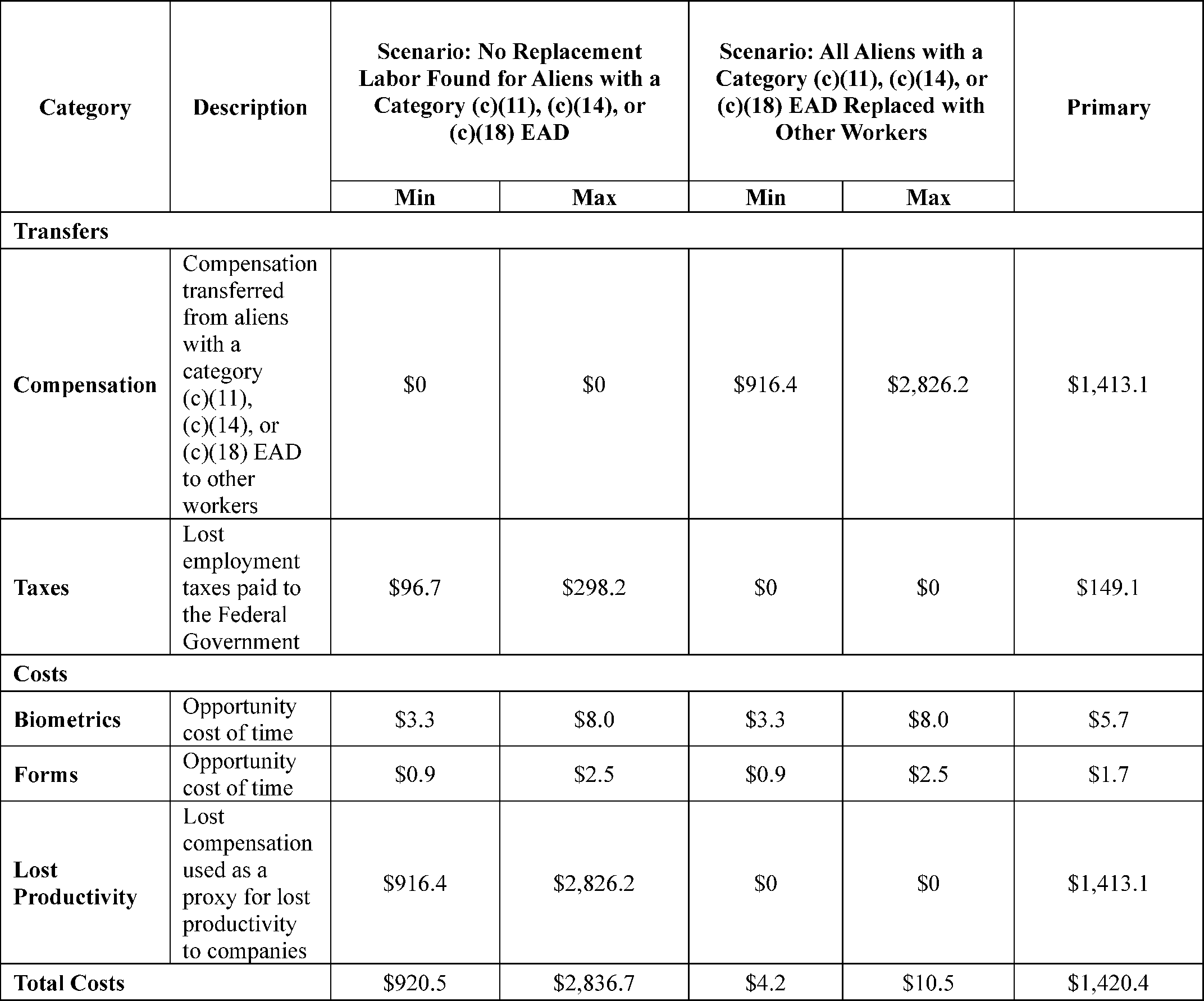
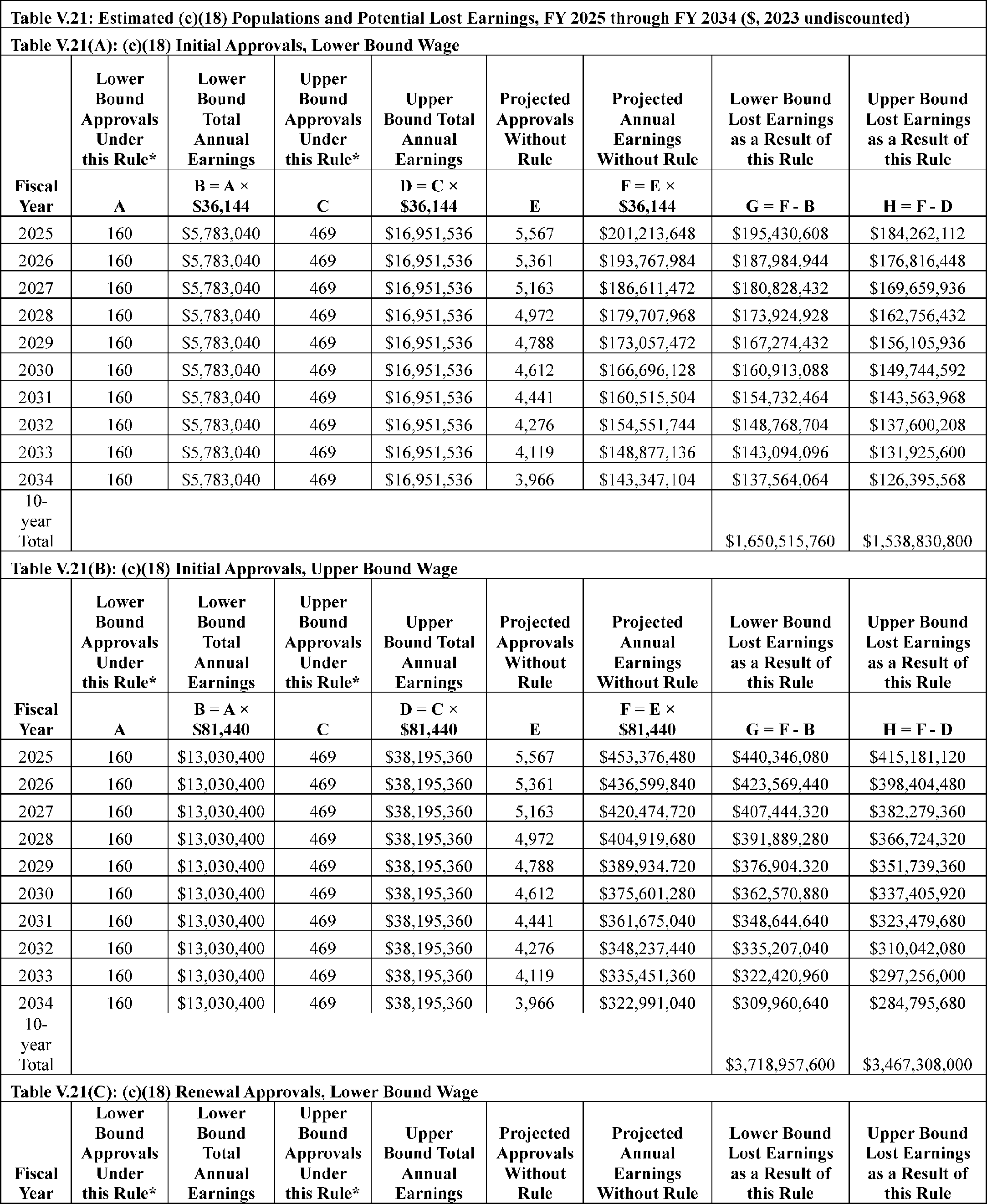
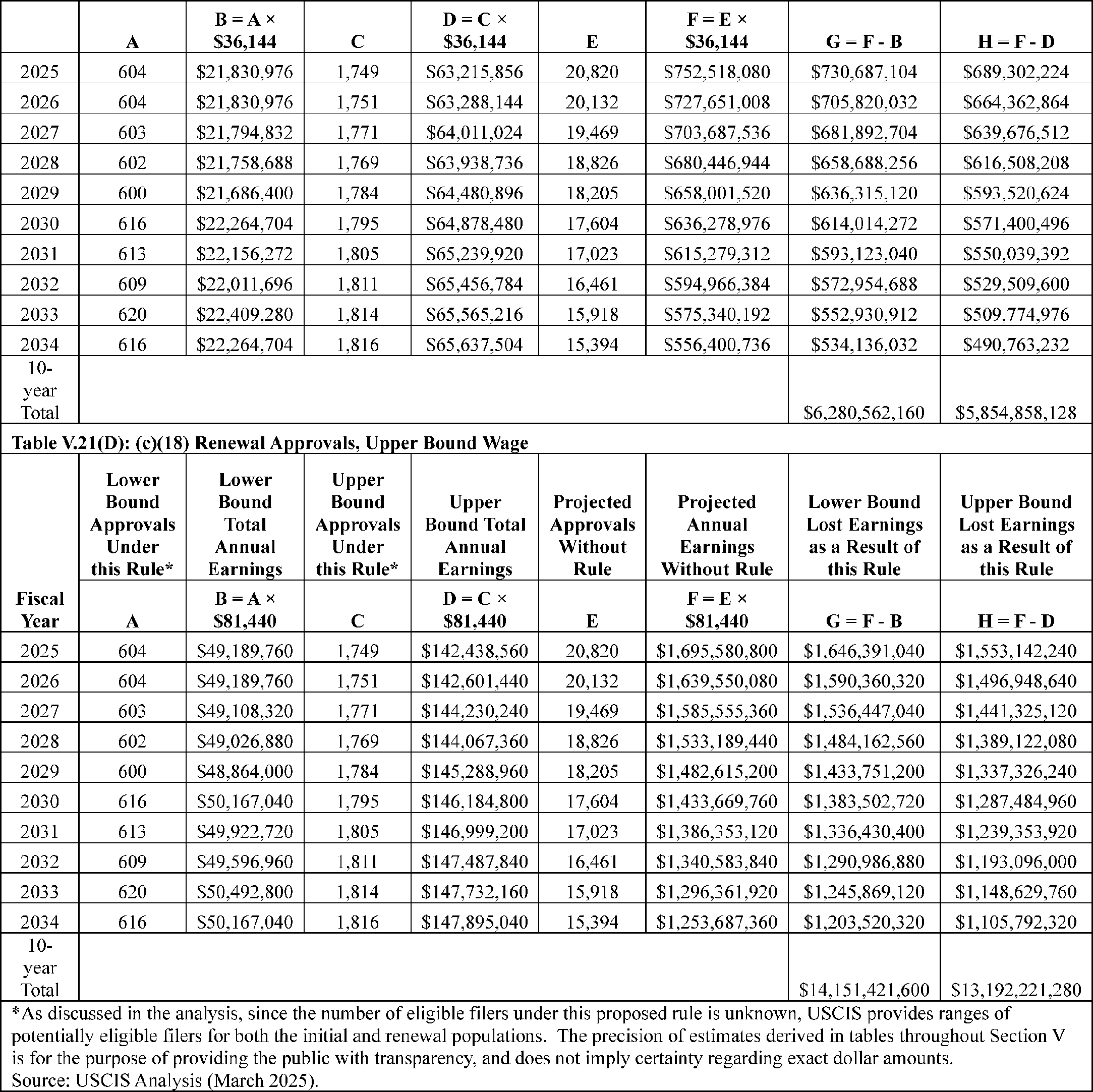
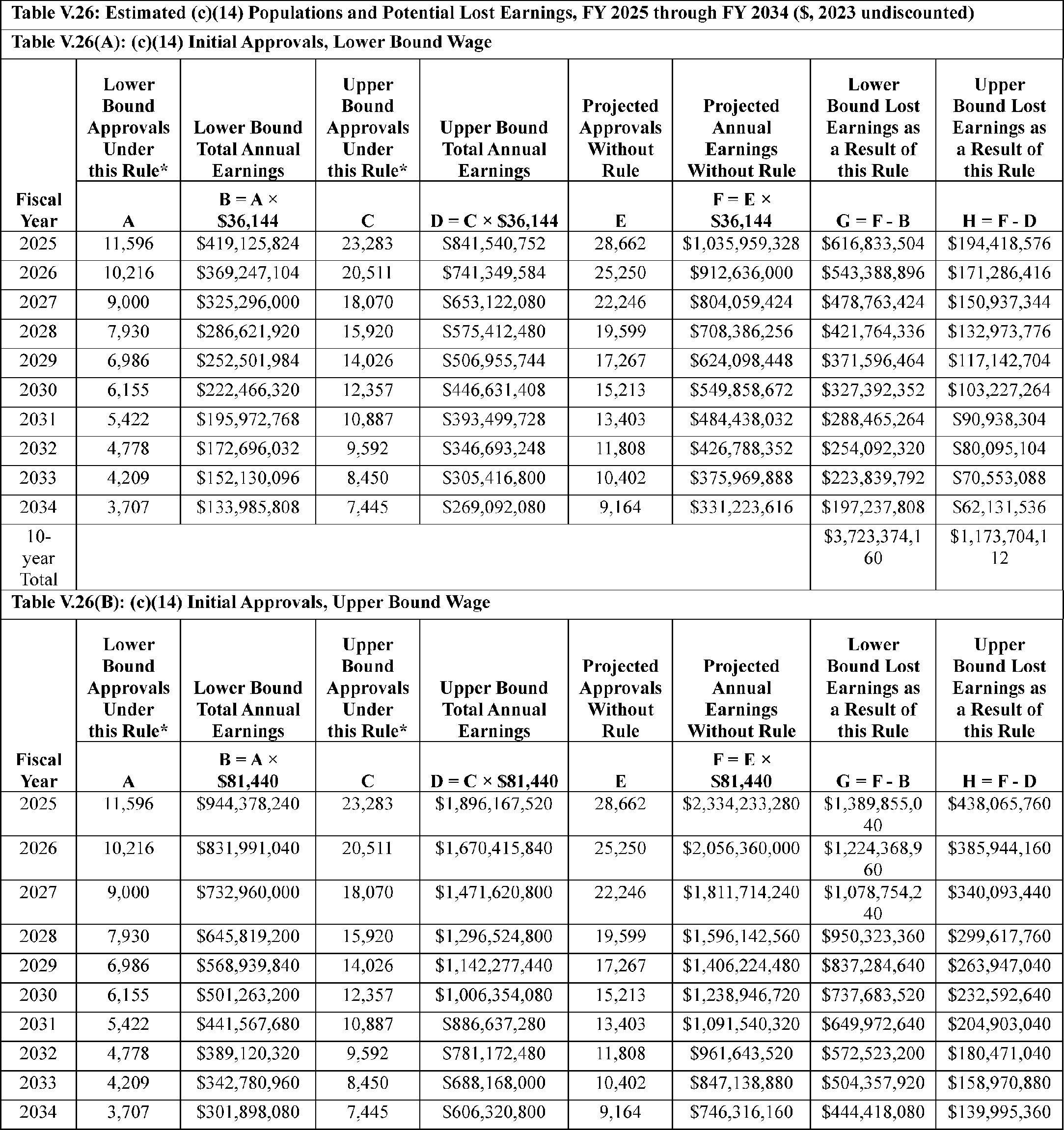
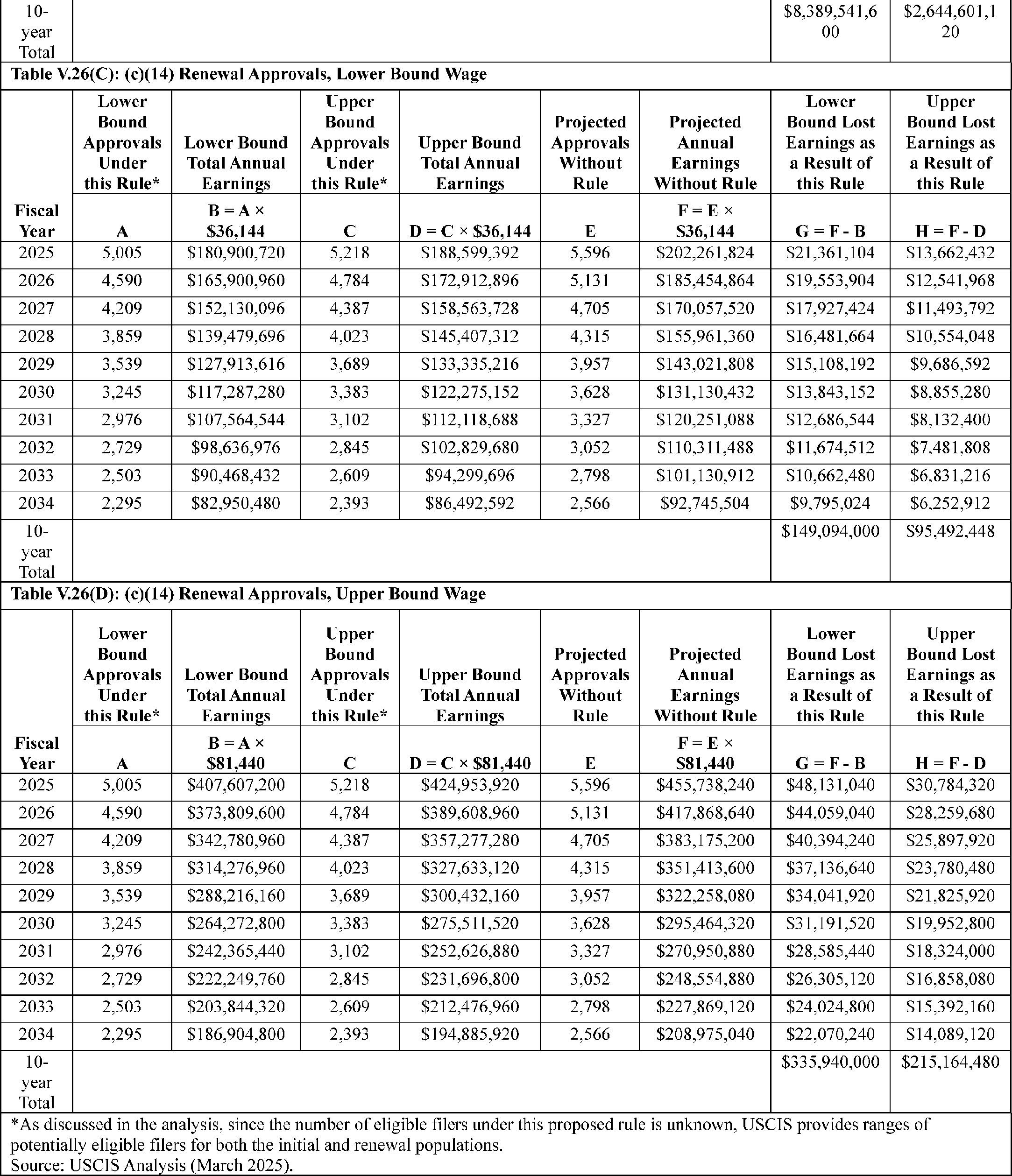
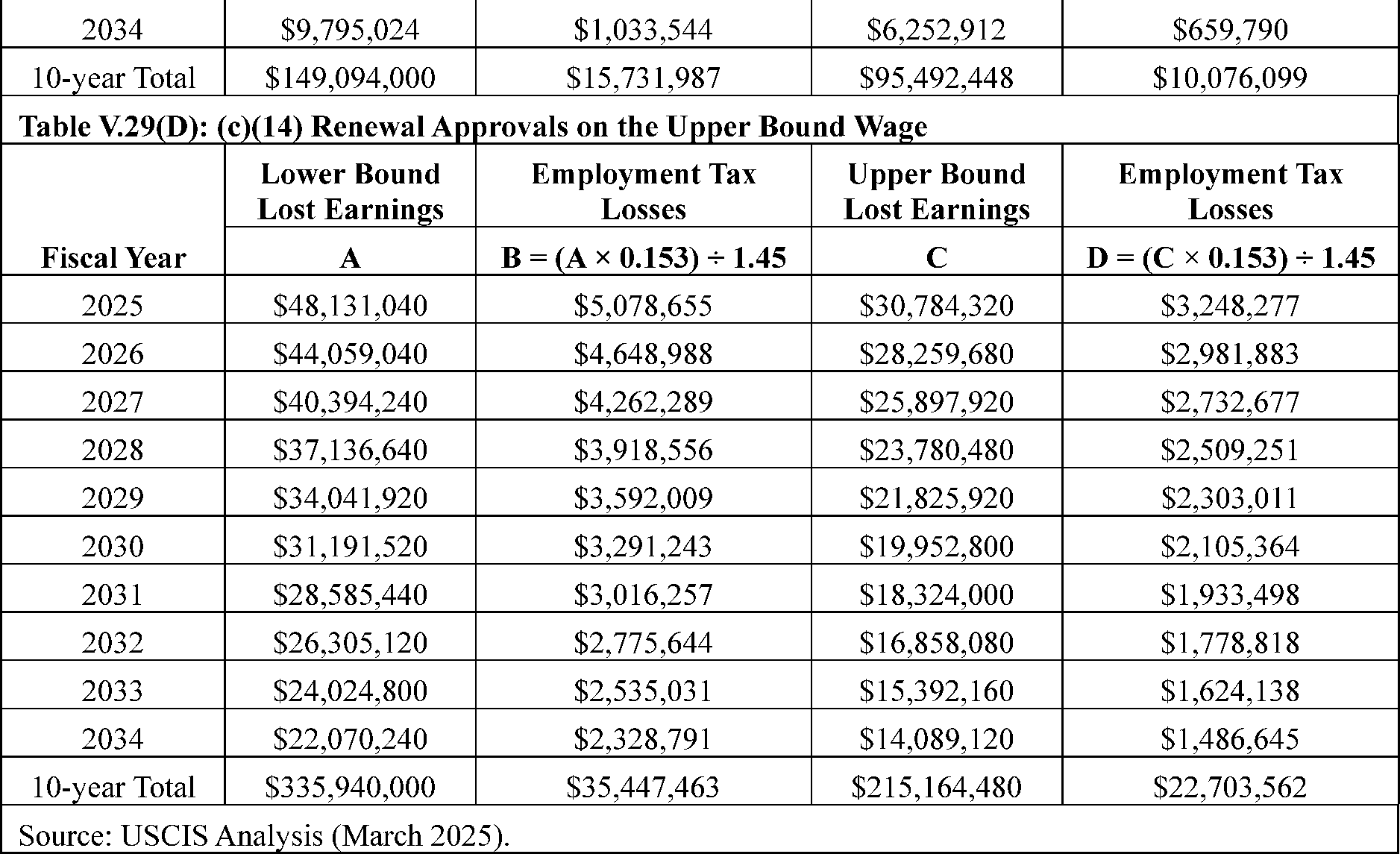
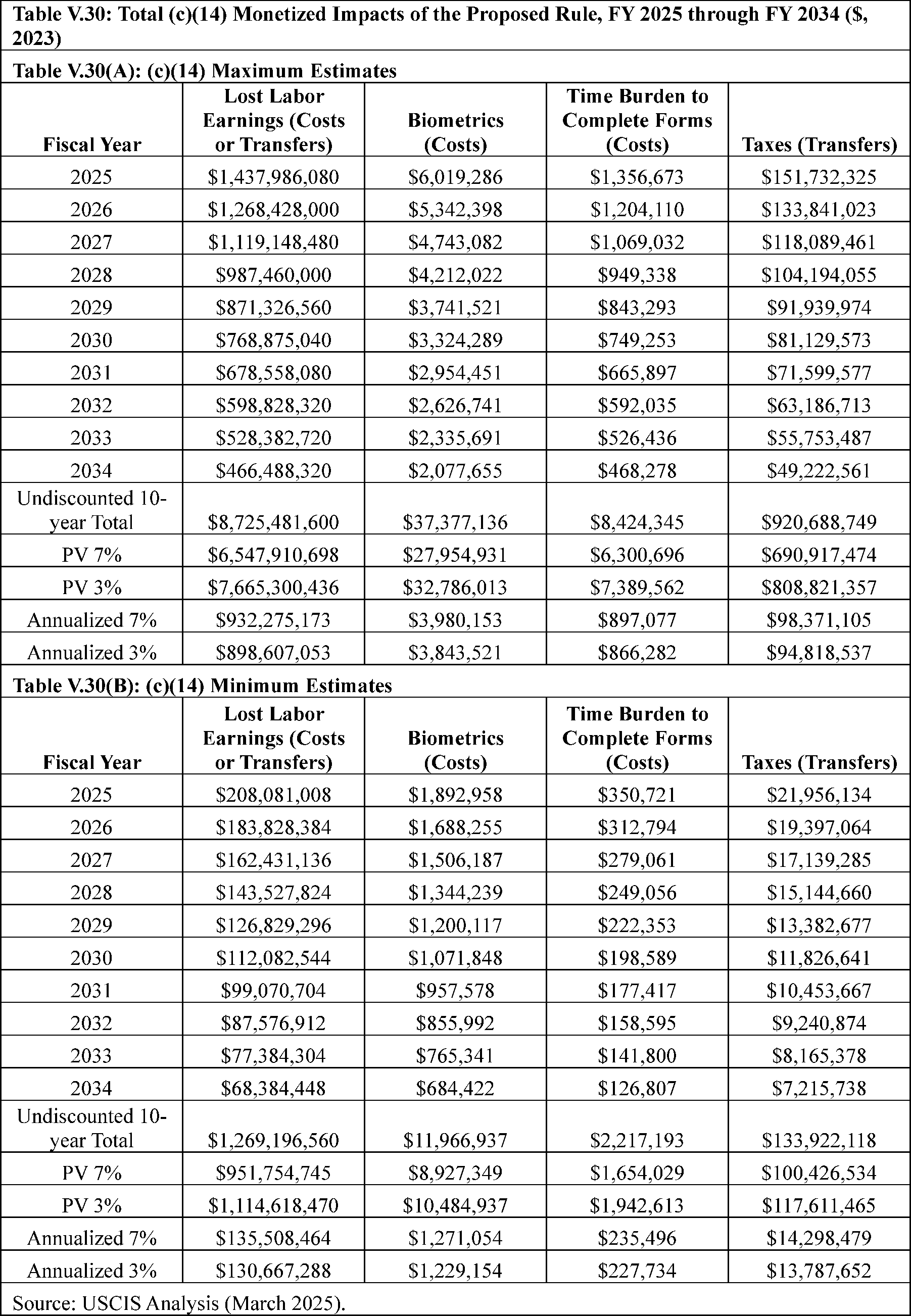
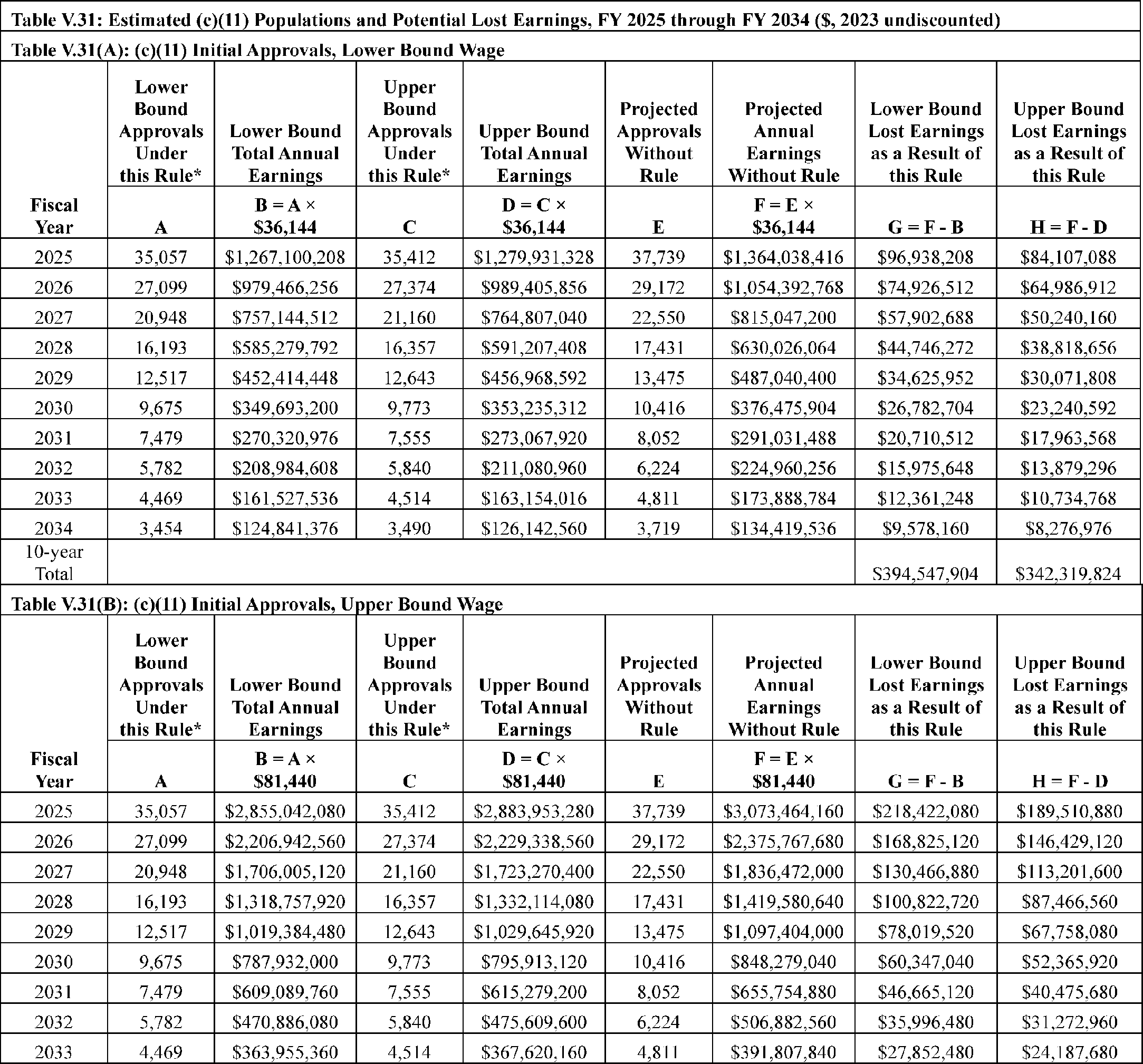
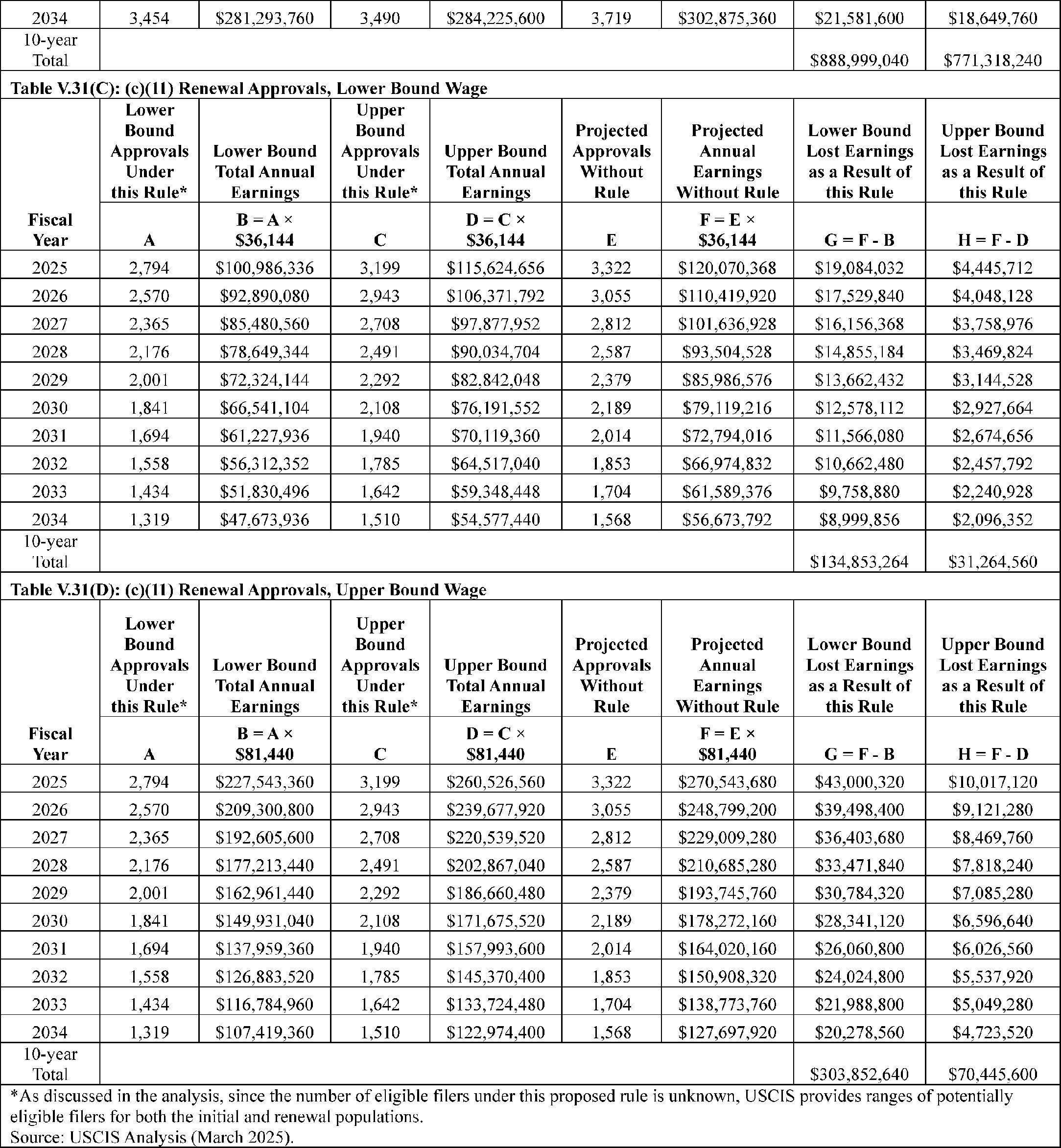
of reducing the number of aliens with final orders of removal, aliens granted deferred action, and aliens granted parole who are eligible for employment authorization include both potential distributional impacts (transfers) and costs. USCIS uses the lost compensation to aliens who are no longer eligible for employment authorization as a measure of the impact of this change—either as distributional impacts (transfers) from these aliens to others or as a proxy for businesses' cost for lost productivity. If all companies can easily find reasonable labor substitutes for the positions the aliens would have otherwise filled, DHS estimates a maximum of $2.8 billion (annualized at a 3 percent discount rate) would be transferred from these workers to others in the labor force (or induced back into the labor force) or $2.9 billion (annualized at a 7 percent discount rate) (Table II.2(A)).[24]
Under this scenario, there would be no Federal employment tax losses.[25]
Conversely, if companies are unable to find reasonable labor substitutes for the positions the aliens would have filled, then a maximum of $2.8 billion (annualized at a 3 percent discount rate) or $2.9 billion (annualized at a 7 percent discount rate) is the estimated monetized cost in lost productivity, and $0 is the estimated monetized transfers from these aliens to other workers. In addition, under this scenario where jobs would go unfilled, there would be a loss of employment taxes to the Federal Government. USCIS estimates $298.2 million (annualized at a 3 percent discount rate) or $304.6 million (annualized at a 7 percent discount rate) as the maximum reduction in transfers of employment taxes from companies and employees to the Federal Government.
DHS believes the two scenarios described above represent the uncertainty in how employers will be able to respond given labor market conditions. DHS estimated endpoints for the range of monetized impacts resulting from the provisions that affect employment eligibility for aliens with final orders of removal, aliens granted deferred action, and aliens granted parole. Effects of this rulemaking would depend in part on the interaction of a
( printed page 34365)
number of complex variables that are constantly in flux, including national, state, and local labor market conditions, economic and business factors, the type of occupations and skills involved, and the availability of similarly skilled workers. DHS acknowledges there is extensive literature on the impacts of immigration on labor markets.[26]
DHS welcomes public comment on the estimates presented in these scenarios and on the validity of the assumptions on affected jobs being backfilled.
There are other costs of the rule, including E-Verify, biometrics, labor turnover, and additional form burdens. These other costs exist under both scenarios described above, and thus $4.2 million is the minimum cost of the rule (annualized at a 3 percent discount rate) or $4.4 million (annualized at a 7 percent discount rate).
The range of impacts described by the scenarios above, plus the consideration of the other costs, are summarized in Table II.2. The primary estimate shown in Table II.2 is the median point between the minimum estimate and the maximum estimate for each scenario.[27]
( printed page 34366)
( printed page 34367)
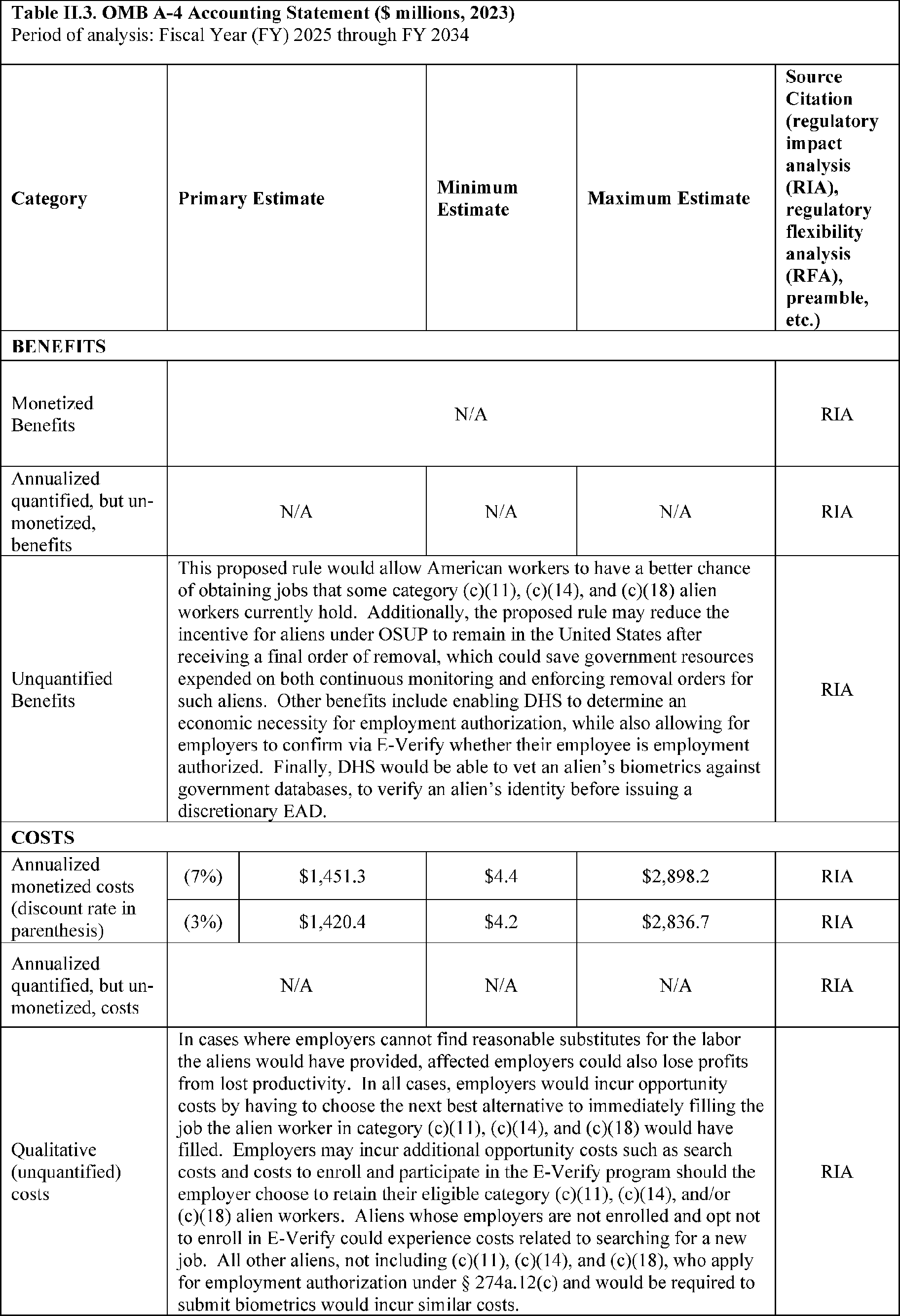
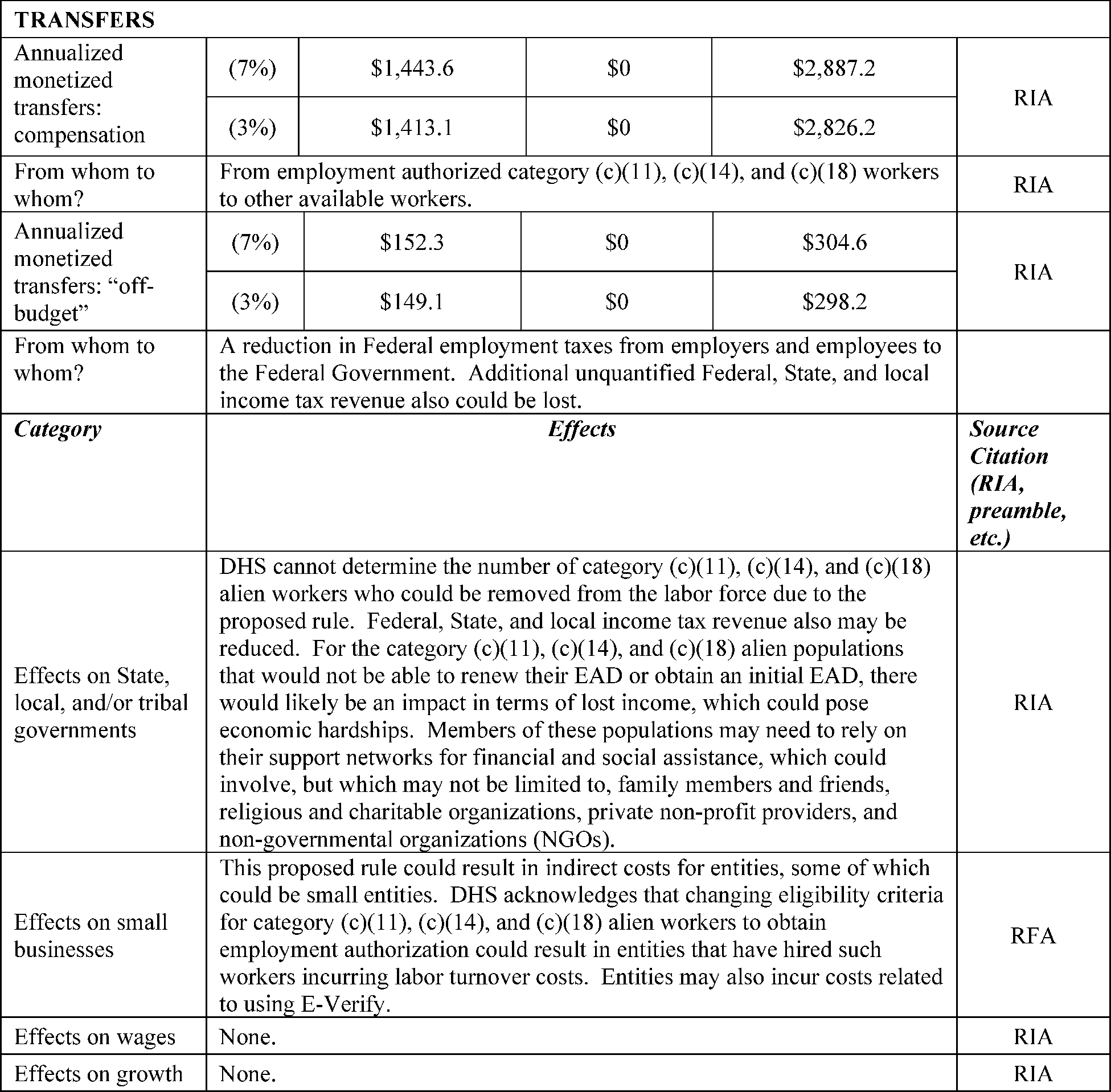
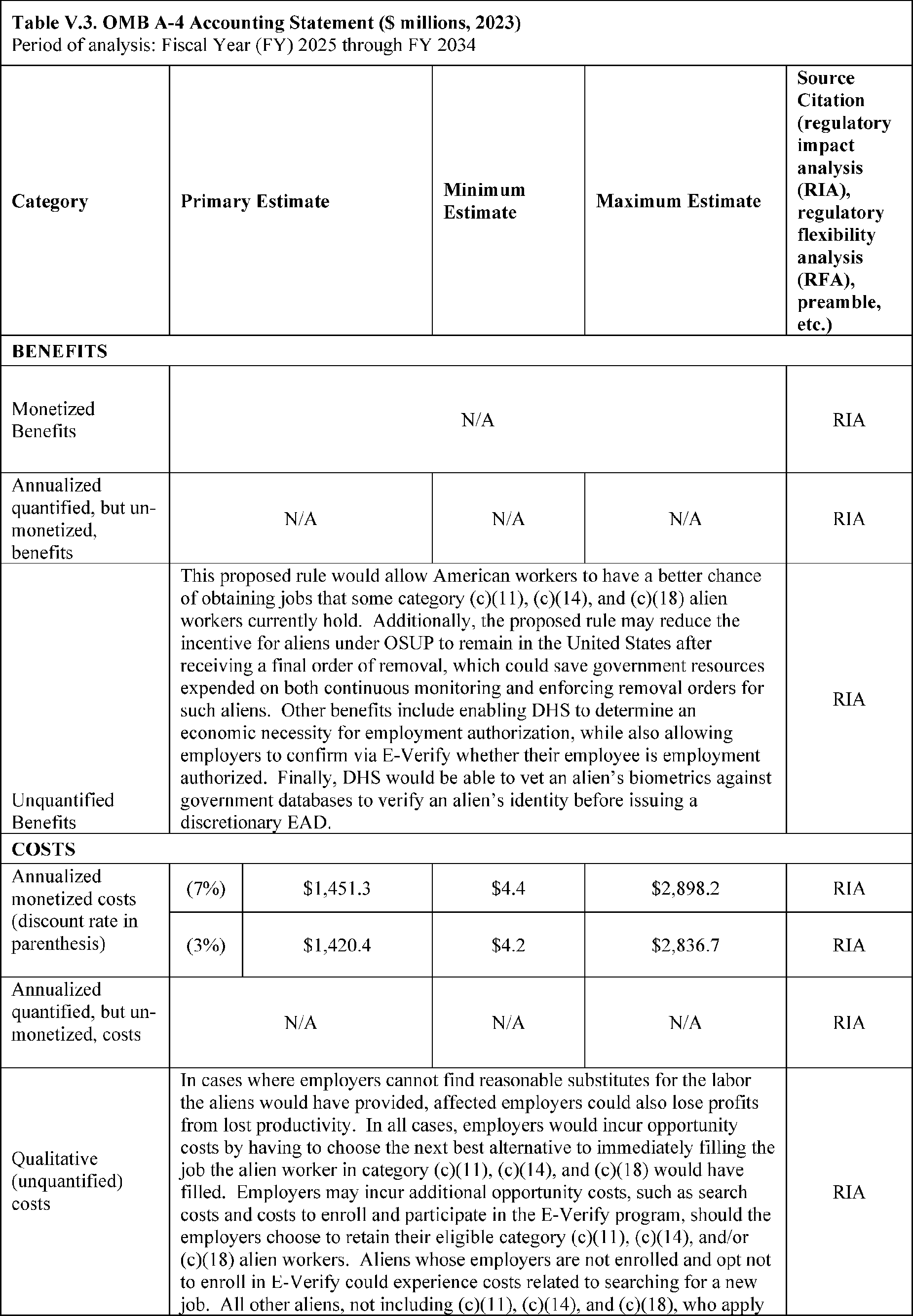
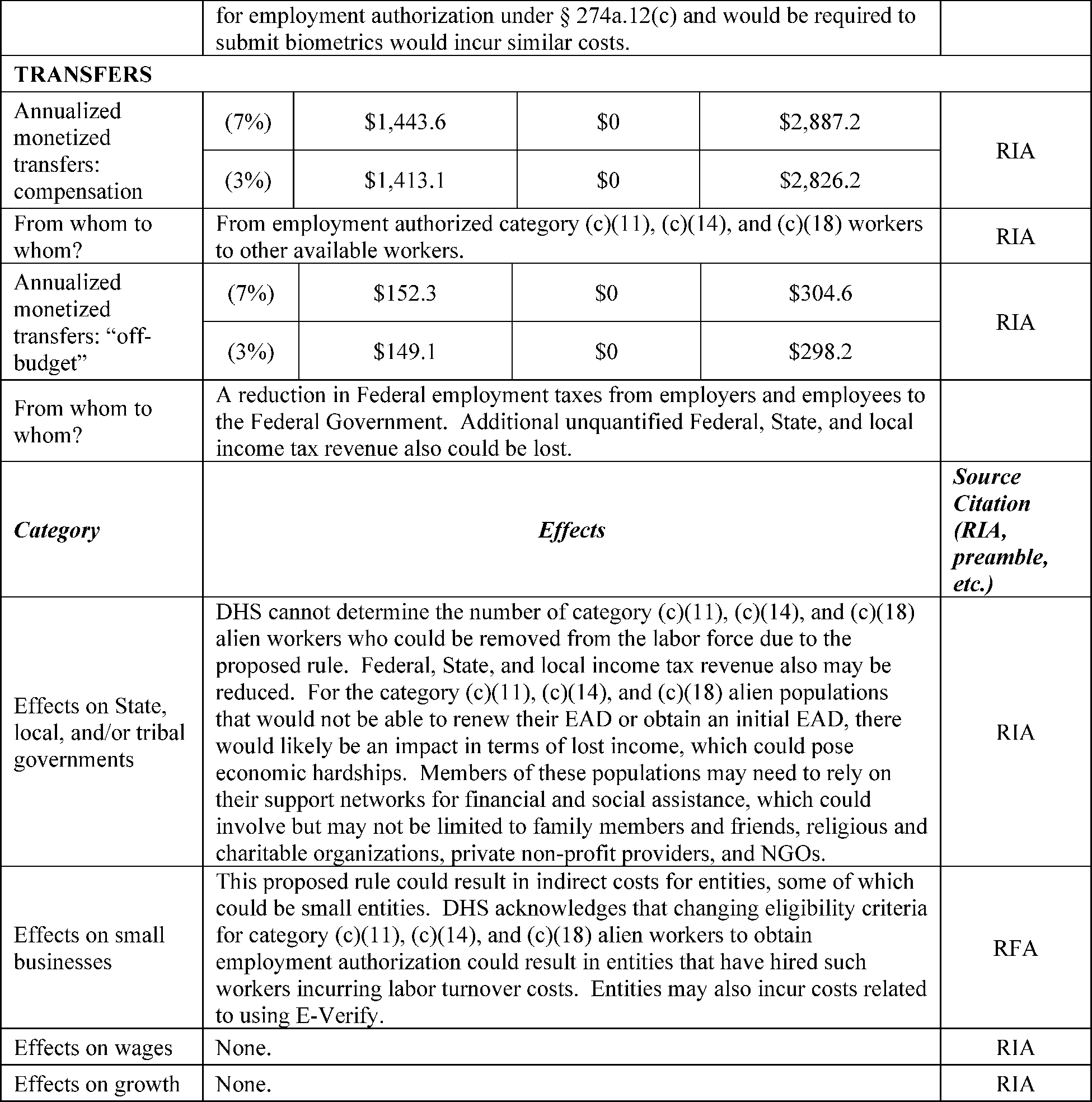
In addition, Table II.3 presents the prepared accounting statement, as required by OMB Circular A-4, showing the costs associated with this proposed regulation.[28]
Note that under costs, the primary estimates provided in the accounting statement are the calculated midpoint based on the minimum cost from the scenario that all aliens are replaced with other workers and the maximum cost from the scenario that no aliens are replaced with other workers (scenarios presented in Tables II.2(A) and (B)).
( printed page 34368)
( printed page 34369)
III. Background and Purpose
A. Prior and Related Rulemaking Efforts
On November 19, 2020, DHS published a notice of proposed rulemaking (NPRM) in the
Federal Register
, Employment Authorization for Certain Classes of Aliens with Final Orders of Removal (OSUP NPRM). 85 FR 74196. It proposed to eliminate eligibility for discretionary employment authorization for aliens who have final orders of removal and are temporarily released from custody on an order of supervision with one narrow exception. In general, the basis for the OSUP NPRM stemmed from two executive orders issued by President Trump, E.O. 13768 (Enhancing Public Safety in the Interior of the United States) and E.O. 13788 (Buy American and Hire American).[29]
USCIS provided a 30-day comment period to receive public comments on the proposed rule, which ended December 21, 2020. DHS received a total of 306 comments on the OSUP NPRM.
On January 20, 2021, President Biden issued E.O. 13993 (Revision of Civil Immigration Enforcement Policies and Priorities), which revoked E.O. 13768.[30]
Then, on January 25, 2021, President Biden issued E.O. 14005 (Ensuring the Future Is Made in All of America by All of America's Workers), which revoked E.O. 13788.[31]
E.O.s 13993 and 14005 directed agencies to review, revise, or rescind any agency actions or guidance inconsistent with the executive orders.
After reviewing the OSUP NPRM and the public comments in light of E.O.s 13993 and 14005, DHS withdrew the OSUP NPRM on May 10, 2021. Employment Authorization for Certain Classes of Aliens with Final Orders of Removal; Withdrawal, 86 FR 24751. Therefore, an OSUP final rule was never published. Many of the proposed provisions in this rule closely follow
( printed page 34370)
what was originally proposed in the OSUP NPRM. However, as no final rule was published, DHS will address the previously proposed provisions anew.
Concurrent with this rule, DHS is engaging in multiple rulemaking actions that are in various stages of development. DHS has considered and analyzed each of these other rules for peripheral, overlapping, or interrelated effects on this rule and has incorporated their effects, if any, into the supporting documentation, policies, and regulatory text for this proposed rule.
1. Asylum EAD Reform
DHS recently published a proposed rule (“Asylum EAD Reform Rule”) addressing employment authorization for aliens with pending applications for asylum under 8 CFR 274a.12(c)(8) and 8 CFR 208.7 (colloquially referred to as a “(c)(8) EAD”).
In the proposed Asylum EAD Reform rule, 91 FR 8616, DHS seeks to amend 8 CFR 274a.13(a)(1) so that USCIS would have discretion to grant applications for employment authorization filed by aliens applying for asylum pursuant to 8 CFR 274a.12(c)(8) in keeping with its discretionary statutory authority under section 208(d)(2) of the INA, 8 U.S.C. 1158(d)(2). As asylum is a discretionary benefit, it follows that USCIS should similarly grant work authorization associated with a pending asylum application as a matter of discretion. DHS cannot continue to provide employment authorization to asylum applicants with virtually no eligibility criteria and nearly limitless renewal opportunities to a population of aliens where many of the claims for relief are ultimately unsuccessful. In fiscal years 2023, 2024, and 2025 (year to date), in roughly 18,000 of the approximately 33,500 asylum cases completed by USCIS, over 50% resulted in a denial or referral to Immigration Court.[32]
Judges in the Department of Justice, Executive Office for Immigration Review's (EOIR) immigration courts similarly granted about 50% of the asylum applications adjudicated on the merits in fiscal years 2023 and 2024 and only about 25% in fiscal year 2025 (through the third quarter).[33]
The purpose of the proposed Asylum EAD Reform Rule is to reform, improve, and streamline the asylum EAD process, so that those with bona fide asylum claims can be prioritized and extended protection. Thus, that proposed rule would impact the process for issuance of EADs for aliens with a pending asylum application under 8 CFR 274a.12(c)(8), the processing timeframe for (c)(8) EAD applications, the waiting period to apply for a (c)(8) EAD, the time in which a (c)(8) EAD is adjudicated, (c)(8) EAD validity period, and eligibility requirements for (c)(8) EADs. The Asylum EAD Reform Rule would require changes to existing regulatory text and the creation of new regulatory text.
DHS considered the possible combined effects of the Asylum EAD Reform Rule and this proposed rule. Both this rule and the Asylum EAD Reform Rule emphasize the discretionary nature of employment authorization for the pertinent populations and the proposed discretionary factors and clarified eligibility requirements included in this rule and the Asylum EAD Reform Rule generally overlap. For example, both the Discretionary EAD Rule and Asylum EAD Reform Rule propose to exclude certain criminal aliens from employment authorization eligibility. In the Asylum EAD Reform Rule, DHS is proposing to exclude (c)(8) EAD eligibility for any alien who has been convicted of an aggravated felony as described in section 101(a)(43) of the INA, 8 U.S.C. 1101(a)(43), any alien who has been convicted of a particularly serious crime, any alien for whom there are serious reasons to believe that he or she committed a serious non-political crime outside the United States, and any alien who fails to establish that he or she is not subject to a mandatory denial of asylum due to any regulatory criminal grounds under 8 CFR 208.13(c).
Although this proposed rule intersects with the Asylum EAD Reform Rule, DHS is using current regulatory text as the basis for changes in both rules. This is because any changes proposed by the Asylum EAD Reform Rule at this point in the process are just that—proposed. Therefore, DHS acknowledges that the regulatory text for either final rule may differ from the exact provisions in the relevant proposed rule in order to align the text with any updated regulations as of the time of publication. For example, the Discretionary EAD Rule amends 8 CFR 274a.12(c) to outline the EAD categories that are currently non-discretionary, which includes asylum EADs under (c)(8). However, this provision may require edits at the final rule stage, to accurately align both the Discretionary EAD and Asylum EAD rules. DHS notes that while the proposed Discretionary EAD Rule includes changes that relate to all employment authorization under 8 CFR 274a.12(c), the Asylum EAD Reform Rule will address all (c)(8)-specific proposed changes.
2. Biometrics Rule
DHS is also concurrently proposing to amend its regulations concerning the use and submission of biometrics in the administration and enforcement of immigration and naturalization laws and the adjudication of any immigration application, petition, or benefit or any other related request or collection of information (“Biometrics Rule”).[34]
The Biometrics Rule proposes to require the submission of biometrics by any individual, regardless of age, filing or associated [35]
with an immigration benefit request or other request or collection of information, unless exempted. This incorporates any applicant, petitioner, sponsor, supporter, derivative, dependent, or beneficiary, including U.S. citizens, U.S. nationals, and lawful permanent residents. It will define “biometrics” and expand modalities authorized for collection by DHS. Further, the proposed rule will codify USCIS's ability to reuse biometrics rather than requiring applicants to submit new biometrics in all cases but permit the reuse of biometrics only after completion of a biometric-based identity verification. Finally, it will expand biometrics collection authority upon alien arrest; establish an “extraordinary circumstances” standard to excuse a failure to appear at a biometric services appointment; modify how VAWA self-petitioners and T nonimmigrant status applicants demonstrate good moral
( printed page 34371)
character; and clarify the purposes for which DHS can collect.
The purpose of the Biometrics Rule is to standardize the Department's collection of biometrics and provide notice to those populations that will be subject to biometrics requirements. As explained more in-depth in the Biometrics Rule, using biometrics for identity verification [36]
and case management will assist DHS's efforts to combat trafficking, confirm the results of biographical criminal history checks, and deter fraud.
DHS welcomes comments on the combined impact of this proposed rule with any intervening legislation, related rulemakings, and policy changes that could either overlap or coincide with this rulemaking.
B. Background
1. Detention, Release, and Repatriation of Aliens Ordered Removed
Section 241 of the INA, 8 U.S.C. 1231, governs the detention, release, and removal of aliens subject to final orders of removal. DHS generally has 90 days after the date a removal order becomes administratively final to remove the alien from the United States.[37]
This 90-day removal period can be extended if the alien fails or refuses to make timely application in good faith for travel or other documents necessary for the alien's departure or conspires or acts to prevent removal.[38]
Under section 241(a)(2) of the INA, 8 U.S.C. 1231(a)(2), DHS “shall detain” an alien during the removal period and is specifically prohibited from releasing an alien during the removal period who has been found inadmissible under sections 212(a)(2) or (a)(3)(B) of the INA, 8 U.S.C. 1182(a)(2) or (a)(3)(B), or deportable under sections 237(a)(2) or (a)(4)(B) of the INA, 8 U.S.C. 1227(a)(2) or (a)(4)(B) (criminal, security-related, and terrorism grounds).
In certain instances, DHS is not able to remove aliens within the 90-day removal period. In such cases, DHS must comply with the U.S. Supreme Court's decision in
Zadvydas
v.
Davis.[39]
In
Zadvydas,
the Supreme Court held that an alien with a final order of removal cannot be kept in detention (unless special circumstances exist) [40]
once it has been determined that there is not a “significant likelihood of removal in the reasonably foreseeable future.” [41]
The Court established 6 months as the “presumptively reasonable period of detention.” [42]
After the 6-month period, once the alien provides good reason to believe there is no significant likelihood of removal in the reasonably foreseeable future, the Government must respond with sufficient evidence to rebut that showing.[43]
In the event DHS determines that removal is not likely to occur in the reasonably foreseeable future, the alien must generally be temporarily released on an order of supervision.[44]
During this period of release, the alien is required to continue to make efforts (or assist in efforts) towards his or her removal while DHS continues to pursue the alien's removal.[45]
If an alien is temporarily released on an order of supervision, the order of supervision will contain conditions for release, including requiring the alien to appear periodically before an immigration officer and comply with the conditions prescribed in the order of supervision.[46]
If an alien fails to comply with the conditions of release as specified in the order of supervision, DHS can take the alien back into custody and detain the alien until he or she is removed. Aliens who willfully fail to comply with an order of supervision can also be criminally prosecuted under section 243(b) of the INA, 8 U.S.C. 1253(b).
Once an alien has been issued a final order of removal, ICE is responsible for effectuating the alien's removal from the United States pursuant to section 241 of the INA, 8 U.S.C. 1231, and 8 CFR part 241. Generally, a travel document must be obtained from a foreign government that will allow the alien to depart the United States and be repatriated either to the alien's country of birth, citizenship, nationality, or last habitual residence or to an alternate country that has agreed to accept the alien. Based on 2019 removal data, it takes DHS an average of 187.19 days, roughly 6 months, to obtain travel documents and remove an alien from the United States.[47]
As this average has declined in recent years, the population of aliens that will be released on OSUP will likely decrease.[48]
However, some countries refuse or unreasonably delay the issuance of the necessary travel documents to aliens who have been issued a final order of removal. Countries that unreasonably delay accepting the repatriation of their citizens or nationals impede DHS's ability to remove aliens in a timely manner and interfere with the United States' sovereign interest in enforcing its immigration laws. Under section 243(d) of the INA, 8 U.S.C. 1253(d), the Secretary has the authority to notify the Secretary of State that a specific country is refusing or unreasonably delaying acceptance of its nationals. Upon such notification from the Secretary, the Secretary of State must order consular officers in that country to discontinue issuing immigrant visas, nonimmigrant visas, or both to citizens and nationals of that country.[49]
While DHS and the U.S. Department of State (DOS) work through various diplomatic channels and avenues to get such countries to comply, and most countries do comply, there are countries that refuse to assist in the repatriation of their citizens and nationals, and as a result, the United States has imposed visa sanctions under section 243(d) of the INA, 8 U.S.C. 1253(d), to get such countries to cooperate.[50]
( printed page 34372)
2. Withholding of Removal Under the INA and Regulations Implementing CAT and Deferral of Removal Under Regulations Implementing CAT
Even if an alien is inadmissible or deportable and has a final order of removal, DHS's authority to remove an alien in certain cases may be further restricted by certain statutory and regulatory provisions implementing U.S. treaty obligations concerning non-refoulement (non-return). The United States is a party to the 1967 Protocol relating to the Status of Refugees (Protocol), which incorporates,
inter alia,
Article 33 of the 1951 Convention relating to the Status of Refugees. 198 U.N.T.S. 137. Article 33 specifically provides that “[n]o contracting state shall expel or return (
refouler
) a refugee in any manner whatsoever to the frontier of territories where his life or freedom would be threatened on account of his race, religion, nationality, membership of a particular social group, or political opinion.” [51]
The United States is also a party to CAT.[52]
Article 3 of CAT requires that “[n]o State Party shall expel, return (`refouler') or extradite a person to another state where there are substantial grounds for believing that he would be in danger of being subjected to torture.” [53]
Though neither of these treaties is self-executing, the United States has implemented its non-refoulement obligations under these treaties in statutes and regulations.[54]
With respect to Protocol, Congress implemented the United States' non-refoulement obligations as part of the Refugee Act of 1980, section 241(b)(3) of the INA, 8 U.S.C. 1231(b)(3). With respect to CAT, Congress directed the appropriate agencies to publish regulations to implement the United States' obligations under Article 3 of the CAT in the Foreign Affairs Reform and Restructuring Act of 1998 (FARRA), Public Law 105-277, div. G., sec. 2442(b) (Oct. 21, 1998). The Department of Justice (DOJ) published regulations in 1999 implementing FARRA sec. 2442.
See64 FR 8478 (Feb. 19, 1999). The regulations governing withholding of removal based on section 241(b)(3) of the INA, 8 U.S.C. 1231(b)(3), and withholding and deferral of removal under CAT are now codified in principal part at 8 CFR 208.16 through 208.18 and 1208.16 through 1208.18.
Aliens granted withholding of removal based on section 241(b)(3) of the INA, 8 U.S.C. 1231(b)(3), and aliens granted withholding of removal based on the regulations implementing CAT, 8 CFR 208.16(c) and 1208.16(c), are both subject to mandatory bars to withholding if the aliens participated in Nazi persecution, participated in genocide, committed an act of torture and extrajudicial killing, participated in the persecution of others, have been convicted of a particularly serious crime, have committed a serious nonpolitical crime outside the United States prior to arrival, or are a danger to the security of the United States.[55]
However, even if an alien is not eligible for withholding under the provisions noted above because he or she is subject to one of the mandatory bars to withholding, DHS still is not permitted to remove an alien from the United States if an Immigration Judge (IJ) or the Board of Immigration Appeals (BIA) has determined that removal would result in the alien being removed to a country where he or she would more likely than not be tortured. 8 CFR 208.17 and 1208.17. In such instances, the IJ or BIA defers removal to that country.
Withholding of deportation or removal based on section 241(b)(3) of the INA, 8 U.S.C. 1231(b)(3), or the regulations implementing U.S. obligations under CAT Article 3 (“CAT withholding”) (if the alien is not subject to a mandatory bar) and CAT deferral of removal are mandatory and must be granted if the alien meets the burden of proof.
See8 CFR 1208.16(b), (c)(4) and 1208.17(a). Once an alien has been granted withholding or deferral of removal, DHS cannot remove the alien to the country from which removal has been withheld or deferred unless the alien's case is reopened and withholding is terminated under 8 CFR 208.24 or 1208.24, or deferral is terminated under 8 CFR 208.17 or 1208.17. In most instances, an alien granted withholding of removal or deferral of removal under the regulations implementing CAT will be released pursuant to an order of supervision, but such an order does not alter or affect the nondiscretionary nature of the withholding or deferral of removal grant, even if the alien subsequently violates the conditions for release as specified in the order of supervision. Such violations could result in a return of the alien to ICE custody but will not result in the alien's actual removal from the United States to the relevant country or countries in question unless the alien's case is reopened, and withholding is terminated under 8 CFR 208.24 or 1208.24 or deferral of removal is terminated under 8 CFR 208.17 or 1208.17.
3. Parole
The INA confers upon the Secretary the narrow discretionary authority to parole applicants for admission, regardless of admissibility, into the United States “temporarily under such conditions as [DHS] may prescribe only on a case-by-case basis for urgent humanitarian reasons or significant public benefit.” [56]
Additionally, upon a finding by DHS that the purpose of the temporary, discretionary parole has been served, the alien is required to depart the United States “or be returned to the custody from which he was paroled and thereafter his case shall continue to be dealt with in the same manner as that of any other applicant for admission to the United States.” [57]
Since the late 19th century, the Government has used some form of parole to allow inadmissible aliens to come into and temporarily remain in the United States.[58]
Congress did not codify this parole authority until 1952, with the enactment of the INA.[59]
Section 212(d)(5) of the 1952 INA authorized the Attorney General to parole an alien into the United States for “emergent reasons or for reasons deemed strictly in the public interest.” [60]
In a House Report accompanying the 1952 INA, Congress indicated that parole was meant for
emergency cases, such as the case of an alien who requires immediate medical attention before there has been an opportunity for an immigration officer to inspect him, and in cases where it is strictly in the public interest to have an inadmissible alien present in the
( printed page 34373)
United States, such as, for instance, a witness or for purposes of prosecution.[61]
The INA, however, did not address whether the authority could be used to parole groups of inadmissible aliens.
Subsequent to 1952, the parole authority was repeatedly used to parole large groups of inadmissible aliens, namely refugees from Hungary, Cuba, China, Czechoslovakia, the Soviet Union, Uganda, and Vietnam.[62]
Although some in Congress criticized this use of the parole authority,[63]
Congress passed legislation to provide a path to lawful permanent residence for certain groups of aliens who had been paroled into the United States by the U.S. Government.[64]
In 1980, Congress passed the Refugee Act, narrowing the parole authority by prohibiting the parole of refugees unless “compelling reasons in the public interest with respect to that particular alien” required parole rather than admission as a refugee.[65]
The parole authority for non-refugees remained the same.
According to some scholars, the Refugee Act's amendment represented continued congressional displeasure with the Executive Branch's use of the parole authority in the preceding decades.[66]
The Senate Report accompanying the Refugee Act states that one of the Act's purposes was to “[e]nd[ ] the years of ad hoc use of the parole authority, which has been implemented by custom rather than clearly defined by law.” [67]
Despite this congressional criticism, the Executive Branch continued to use the parole authority to parole categories of aliens from 1980 until 1996, including for Vietnamese and other Southeast Asian populations, and U.S. expatriates.[68]
In 1996, Congress passed the IIRIRA.[69]
As part of its reform of the immigration laws, Congress specifically addressed its concerns about the broad use of the parole authority to allow groups of refugees to come to the United States. Congress amended the text of section 212(d)(5)(A) of the INA, 8 U.S.C. 1182(d)(5)(A), to make clear that the Attorney General could grant parole, as a matter of discretion, “
only on a case-by-case basis
for urgent humanitarian reasons or significant public benefit” (emphasis added).[70]
Following Congress' amendment in 1996, the parole authority continued to be used expansively to create new categorical parole programs. In 2000, for example, the parole authority was used to manage the statutorily sunsetting Visa Waiver Pilot Program under section 217 of the INA, 8 U.S.C. 1187, in its entirety, to avoid the wholesale disruption of international travel and commerce, and the serious harm to the U.S. economy and foreign relations, that would have resulted from suddenly imposing visa requirements on visitors for business or pleasure from most developed countries.[71]
Under this Visa Waiver Pilot Program, tens of millions of foreign visitors were paroled into the United States between May 1 and October 1, 2000.[72]
In subsequent years, the parole authority was used to create smaller categorical programs. For example, the Bush Administration created the Cuban Family Reunification Parole program in 2007.[73]
The Obama Administration created several parole programs, including the Haitian Family Reunification Parole Program in 2014,[74]
the Filipino World War II Veterans Parole program in 2016,[75]
and Parole for International Entrepreneurs in 2017.[76]
More recently, the Biden Administration created several categorical parole programs,[77]
including the parole programs for inadmissible aliens from Cuba, Haiti, Nicaragua, and Venezuela (“CHNV parole programs”).[78]
On July 4, 2025, the President signed H.R. 1, Public Law 119-21, 139 Stat. 72 into law. It established a new fee for an initial or renewal application for employment authorization by any alien paroled into the United States and also placed a limit on the validity of employment authorization to one year or the duration of the alien's parole, whichever is shorter.[79]
( printed page 34374)
4. Deferred Action
Since the late 1800s, the Supreme Court has recognized the authority of the Executive Branch to expel or exclude aliens from the United States and viewed such power as “an incident of sovereignty belonging to the government of the United States as a part of those sovereign powers delegated by the Constitution.” [80]
This authority was codified in the Immigration and Nationality Act of 1952, 8 U.S.C. 1101et seq.
Over the years, Congress has clarified and strengthened the immigration enforcement authorities and provisions in the INA.[81]
In 2002, with the creation of DHS, Congress reaffirmed this authority by giving the Secretary authority to enforce the immigration laws; to apprehend, detain, and remove aliens from the United States; and to establish “national immigration enforcement policies and priorities.” [82]
The Secretary's enforcement powers also come with an inherent authority to exercise prosecutorial discretion to not take a specific enforcement action against an alien.[83]
Deferred action is a form of discretion in which DHS chooses to not seek an alien's removal from the United States even though the alien lacks lawful status or is otherwise removable from the United States.[84]
Deferred action is not a legal immigration status that permits an alien to obtain immigration relief for which the alien is not eligible. Rather, deferred action is a form of enforcement discretion reflecting a decision not to pursue removal from the United States for a specified period of time. Unlike parole, deferred action was not created by statute and is not specifically defined in the INA. However, the authority not to execute an enforcement action is a quintessential feature of the Secretary's immigration enforcement powers. The Supreme Court has stated that the decision not to take an enforcement action is within the discretion of the agency, and such decisions are generally not subject to judicial review.[85]
The former INS used deferred action for decades.[86]
Prior to 1975, it was known as “non-priority status” and recognized as a use of prosecutorial discretion to defer removal of an alien for a specific period.[87]
Placing an alien in non-priority status was an authority exercised by field district directors and was governed by INS Operating Instructions (OI) and policy. For example, the OIs previously provided examples of factors district directors could consider when deciding whether to place an alien in non-priority status, which included: (1) the likelihood of the alien's removal from the United States; (2) the likelihood the alien would depart without formal proceedings; (3) the age and physical condition of the alien in terms of affecting the alien's ability to travel; (4) the likelihood another country would accept the alien, if the alien were removed; (5) whether the alien could qualify for relief under the immigration laws that would prevent or indefinitely delay deportation from the United States; (6) whether the alien was considered a high priority for removal (
e.g.,
terrorists, international drug traffickers, smugglers); and (7) whether the alien's removal would generate adverse publicity.[88]
Non-priority status was formally renamed deferred action in 1996.[89]
Deferred action is not a legal immigration status that permits an alien to obtain immigration relief for which the alien is not eligible. Rather, deferred action is a form of enforcement discretion reflecting a decision not to pursue removal from the United States for a specified period.
Even though there is no direct statutory authority for deferred action, Congress has acknowledged its use and, on certain limited and unique occasions, has referenced deferred action as an interim form of enforcement discretion to address compelling humanitarian circumstances, further a specific policy goal, or act as a bridge until specific legislative action could provide permanent relief.[90]
For example, Congress referenced deferred action for alien victims of domestic abuse, trafficking, and criminal activity, as well as family members of individuals who perished during the 9/11 attacks, and surviving family members of military personnel who died while serving on active duty in the U.S. Armed Forces.[91]
DHS still uses deferred action today, not only to address discrete situations and cases where there are exigent circumstances or compelling humanitarian factors, but also as “an act of administrative choice to give some cases lower priority.” [92]
Deferred action, however, was never meant to supplant the current legal immigration process or provide long-term relief solely to allow an inadmissible, removable, or otherwise ineligible alien to remain in the United States until he or she can qualify for a legal status.
While DHS has previously chosen to make deferred action available to large populations of aliens, the main and ancillary benefits of such make the granting of deferred action an extraordinary exercise of the Secretary's discretionary authority. A grant of deferred action should only be made on a case-by-case basis after careful consideration of the totality of the circumstances. Additionally, as deferred action is an exercise of prosecutorial discretion, it is subject to termination at any time and for any reason.
5. Employment Authorization
Whether an alien is authorized to work in the United States depends on the alien's status in the United States
( printed page 34375)
and whether employment is specifically authorized by statute or pursuant to the Secretary's general discretionary authority. There are very few statutory provisions that specifically require the provision of employment authorization.[93]
While some statutory provisions specifically allow the Secretary to grant employment authorization as a matter of discretion,[94]
the Secretary's general authorities under sections 103(a), 214(a)(1), and 274A(h)(3) of the INA, 8 U.S.C. 1103(a), 1184(a), 1324a(h)(3), among other provisions, provide the authority to establish discretionary employment authorization categories. However, in the context of aliens ordered removed, section 241(a)(7) of the INA, 8 U.S.C. 1231(a)(7), specifically prohibits an alien who has been ordered removed from the United States from being eligible to receive employment authorization unless the Secretary determines that the alien cannot be removed because no country, as designated by the alien or delineated under section 241(b) of the INA, 8 U.S.C. 1231(b), will accept the alien or the alien's removal is otherwise impracticable or contrary to the public interest.
DHS regulations at 8 CFR 274a.12 set forth the categories of aliens who are authorized to work in the United States, including: those aliens who are authorized to work incident to their status (8 CFR 274a.12(a)); aliens who are authorized to work in the United States but only for a specific employer (8 CFR 274a.12(b)); and aliens who fall within a category that the Secretary has determined may be employment authorized as a matter of discretion (8 CFR 274a.12(c)). If required to file an application for employment authorization with USCIS, aliens must also submit the appropriate fee (unless exempt or waived) and in accordance with the form instructions.
See8 CFR 274a.13.
6. Biometrics Submission
Several sections of the INA provide DHS with the specific authority to collect or require submission of biometrics.
See, e.g.,
INA section 235(d)(3), 8 U.S.C. 1225(d)(3) (providing authority “to take and consider evidence of or from any person touching the privilege of any alien or person he believes or suspects to be an alien to enter, reenter, transit through, or reside in the United States or concerning any matter which is material and relevant to the enforcement of this chapter and the administration of the Service”); INA section 287(b), 8 U.S.C. 1357(b) (powers of immigration officers and employees to administer oaths and take evidence); INA section 333, 8 U.S.C. 1444 (requirement to furnish photographs for naturalization); INA section 335, 8 U.S.C. 1446 (investigation and examination of applicants for naturalization); INA section 262(a), 8 U.S.C. 1302(a) (requirement for aliens to register and be fingerprinted); INA section 264(a), 8 U.S.C. 1304(a) (authority to prescribe contents of forms required for alien registration);
see also
INA section 103(a)(3), 8 U.S.C. 1103(a)(3) (conferring broad authority on the Secretary to “establish such regulations; prescribe such forms of bond, reports, entries, and other papers; issue such instructions; and perform such other acts as he deems necessary for carrying out his authority under the” immigration laws).
DHS regulations accordingly provide that USCIS may require any applicant, petitioner, sponsor, beneficiary, or individual filing a benefit request to submit biometrics and pay the biometric services fee.[95] See8 CFR 103.2(b)(9). DHS has the authority to require the submission of biometrics from any alien, lawful permanent resident or U.S. citizen filing a request, on a case-by-case basis, through law, regulation, form instructions, or a
Federal Register
notice.
Id.; see also8 CFR 103.16. Current regulations allow DHS to use biometric information to conduct background and security checks, adjudicate immigration benefits, and perform other functions related to the administration of the INA.
See id.
at 103.16(a). DHS has the authority to charge a biometric services fee associated with the submission of biometric information.
See8 CFR 103.17.
On January 31, 2024, USCIS published a final rule to adjust certain immigration and naturalization benefit request fees for the first time since 2016.[96] 89 FR 6194 (Jan. 31, 2024) (Fee Rule). The Fee Rule, among other changes, amended USCIS filing fees to incorporate a “biometric services fee” into the cost of the related form filing fee itself rather than charging a separate biometric fee.
See
89 FR at 6277-78;
see also88 FR 402, 484-85 (Jan. 4, 2023) (proposed rule).[97]
The new filing fees were effective for filings postmarked April 1, 2024, and later. The USCIS Fee Schedule is published in the Form G-1055, Fee Schedule.[98]
The most recent Fee Schedule was published on March 6, 2025.
The Fee Rule provided DHS flexibility in its biometrics submission practices and policies to ensure that necessary adjustments can be made to meet emerging needs, conduct biometrics-based background checks, produce documents, and verify identities, while reducing filing rejections. This approach simplified the fee structure, created a more user-friendly experience, reduced rejections of benefit requests for failure to include a separate biometric services fee, and better reflected how USCIS uses biometric information.
7. E-Verify
Originating in 1996, the E-Verify program is a web-based system that allows enrolled employers to confirm the eligibility of their employees to work in the United States.[99]
E-Verify employers verify the identity and employment authorization of newly hired employees by electronically matching information provided by employees on the Form I-9, Employment Eligibility Verification, against records available to DHS
( printed page 34376)
(identity and employment authorization) and the Social Security Administration (SSA) (identity verification), thereby assisting employers in maintaining a legal workforce and reducing the use of fraudulent work documents. It also helps to improve the accuracy of wage and tax reporting.
E-Verify is a free, fast, online service that electronically confirms an employee's information against millions of government records and provides results within as few as 3 to 5 seconds. While E-Verify is a voluntary program, some employers are required to enroll in it as a condition of Federal contracting, or as a condition of business licensing under State legislation or other applicable law.[100]
Before an employer can participate in the E-Verify program, the employer must enter into a Memorandum of Understanding (MOU) with DHS.[101]
By executing the MOU, employers agree to abide by lawful hiring requirements and to follow the E-Verify process to prevent unauthorized disclosure of personal information and unlawful discriminatory practices based on national origin or citizenship status. Specifically, in the MOU, the employer agrees not to use E-Verify for pre-employment screening of job applicants or in support of any unlawful employment practice. The employer further agrees to comply with title VII of the Civil Rights Act of 1964 and section 274B of the INA, 8 U.S.C. 1324b, by not discriminating unlawfully against any individual in hiring, firing, employment eligibility verification, or recruitment or referral practices because of his or her national origin or citizenship status, or by committing discriminatory documentary practices. Illegal practices can include selective verification, improper use of E-Verify, or discharging or refusing to hire an employee because he or she appears or sounds “foreign” or has received tentative non-confirmations (TNC) or mismatches. The MOU also makes clear that USCIS may suspend or terminate an employer's access to E-Verify if the employer violates title VII or section 274B of the INA, 8 U.S.C. 1324b; fails to follow required verification procedures; or otherwise fails to comply with E-Verify requirements. Any employer who violates the immigration-related unfair employment practices provisions in section 274B of the INA, 8 U.S.C. 1324b, could face civil penalties, including back pay awards. DHS may also immediately suspend or terminate the MOU, and thereby the employer's participation in E-Verify, if DHS or the SSA determines that the employer failed to comply with established E-Verify procedures or requirements. In sum, violation of the terms of this agreement by the employer is grounds for immediate termination of its participation in the program.102
Employers participating in E-Verify must still complete a Form I-9 for each newly hired employee, as required under current law.[103]
Following completion of Form I-9, the employer must enter the newly hired worker's information into E-Verify, which then checks that information against information contained in government databases.[104]
Once an employer enrolls in E-Verify, that employer is responsible for confirming the employment eligibility of all new hires in E-Verify at the hiring site(s) for which the employer has chosen to use E-Verify.[105]
The earliest an employer may use E-Verify with respect to an alien is after the alien accepts an offer of employment and the employee and employer complete the Form I-9.[106]
Verification of the employee's identity and employment authorization and creating the E-Verify case must be done no later than the end of 3 business days after the new hire's first day of employment. Generally, E-Verify applies to new hires only and cannot be used to verify expiring work authorization of a current employee (including those aliens authorized employment under the (c)(11), (c)(14), and (c)(18) categories).[107]
E-Verify, which is available in all 50 states, the District of Columbia, Puerto Rico, Guam, the U.S. Virgin Islands, and the Commonwealth of the Northern Mariana Islands, is currently the best means available to electronically confirm employment eligibility. The program allows employers to confirm the eligibility of their employees to work in the United States and shows that employers have done their due diligence by comparing information from an employee's Form I-9, Employment Eligibility Verification, to records available to DHS and SSA.
C. Purpose
DHS has determined that the current regulations governing discretionary employment authorization for aliens who are paroled into the United States, have been granted deferred action, or have an order of removal and an order of supervision do not adequately reflect DHS's enforcement mission and priorities.
Obtaining employment authorization in the United States has long been, and continues to be, a significant incentive for aliens to (legally and illegally) migrate to and remain in the United States.[108]
As such, employment authorization must be carefully regulated to maintain the integrity of the U.S. immigration system.
1. Strengthening Protections for American Workers
This proposed rule is consistent with the Administration's efforts to strengthen protections for American workers and minimize the risk of disadvantaging American workers.
As noted above, E.O. 14159 articulates the Administration's goal for the federal government to provide for the financial and economic well-being of U.S. workers. Protecting, strengthening, and developing the U.S. workforce is critical to establishing economic security,
( printed page 34377)
stability, and growth for American workers. This proposed rule aligns with these goals by limiting participation in the U.S. labor force to aliens who warrant employment authorization, thereby creating more opportunities for American workers to join or re-join the labor force. Indeed, studies have shown that immigration adversely impacts native workers through negative effects on wages along with employment opportunities in the short-term,[109]
with the adverse impacts typically, if not predominantly, borne by under-skilled or minority native workers.[110]
This proposed rule will mitigate these adverse impacts because it is possible that some aliens who would have received employment authorization under the (c)(11), (c)(14), and (c)(18) categories in the absence of this rule may compete for and potentially occupy jobs that American workers might have otherwise acquired.
In addition to the Administration's goal of protecting workers, this proposed rule is also part of a broader initiative by the President to modernize, strengthen, and revitalize the American workforce at all levels. For example, E.O. 14278,
Preparing Americans for High-Paying Skilled Trade Jobs of the Future,[111]
espouses the overarching commitment to “equip American workers to fill the growing demand for skilled trades and other occupations” by, among other things, developing “[o]pportunities to integrate systems and realign resources to address critical workforce needs and in-demand skills of emerging industries and companies investing in the United States.” E.O. 14278, secs. 2, 3(a). Relatedly, in
America First Trade Policy,
the President articulated his goal of “establishing a robust and reinvigorated trade policy that promotes investment and productivity, enhances our Nation's industrial and technological advantages, defends our economic and national security, and—above all—benefits American workers, manufacturers, farmers, ranchers, entrepreneurs, and businesses.[112]
These pronouncements embody the President's overarching goal of developing and bolstering opportunities for American workers of all levels. This proposed rule, thus, represents, one part of this larger initiative and broad array of policies to strengthen protections for American workers.
2. Aliens With Final Orders of Removal
a. Immigration Enforcement
Enforcement of the nation's immigration laws is essential to the integrity of the immigration system, as it ensures that only those who are legally qualified and lawfully in the United States are allowed to avail themselves of any benefits under the INA. In 1996, Congress passed the Anti-Terrorism and Effective Death Penalty Act (AEDPA), Public Law 104-132, title IV; 110 Stat. 1214 (Apr. 24, 1996) and the IIRIRA, Public Law 104-208, div. C; 110 Stat. 3009 (Sept. 28, 1996). AEDPA and IIRIRA made sweeping changes to U.S. immigration laws focusing on immigration enforcement, detention of aliens, and bars to certain types of relief, protection from removal, and grants of legal status. IIRIRA expanded the Attorney General's (now Secretary's) authority to detain aliens, including requiring mandatory detention of aliens convicted of aggravated felony offenses and the detention of aliens pending removal from the United States. It also created an expedited removal process for aliens who do not have proper documents or who make material misrepresentations and who are arriving in the United States, or, as designated by the Secretary, aliens who have not been inspected and admitted or paroled into the United States and cannot prove continuous presence in the United States for at least 2 years.[113]
By passing AEDPA and IIRIRA, Congress made clear that enforcement of the immigration laws is a priority and is critical for purposes of national security, public safety, and the integrity of the U.S. immigration system.
However, DHS is not always able to promptly remove aliens with final orders of removal. Sections 241(a)(1) and (2) of the INA, 8 U.S.C. 1231(a)(1) and (2), provide for a 90-day removal period in which the Secretary is authorized to detain the alien and within which the Secretary shall remove the alien. However, the removal of aliens from the United States and repatriation to their home countries can be a difficult and time-consuming process that can be further complicated by legal appeals or impeded by a lack of sufficient agency resources. Delays in removal can also occur because some countries unreasonably delay the issuance of travel documents or unreasonably delay accepting the repatriation of their nationals.
Although DHS has authority to detain aliens with final orders of removal during the removal period, if DHS cannot effectuate an alien's removal in a 6-month period, DHS must generally release such aliens from detention.[114]
Based on data on removals executed by DHS, it may take DHS 6 months or longer to obtain travel documents and remove an alien from the United States.[115]
As stated above, based on 2019 removal data, it takes DHS an average of 187.19 days, roughly 6 months, to obtain travel documents and remove an alien from the United States. However, this length of time can change due to a number of factors such as significant changes in migration, priority shifts, country agreements, backlogs, advances in technology, delivery methods, and security concerns. Due to the decision in
Zadvydas,
DHS has had to release thousands of aliens from immigration detention as illustrated in the table below, including aliens convicted of aggravated felonies and other serious crimes.
( printed page 34378)
When aliens with final orders of removal are released from DHS custody, the aliens are released under an order of supervision, which contains conditions for release, such as requiring aliens to assist with efforts to procure travel documents and present themselves for removal in the event removal can be arranged. Once temporarily released on an order of supervision, an alien may apply for employment authorization under 8 CFR 274a.12(c)(18). Each year, USCIS approves thousands of initial requests for employment authorization and renewals of such authorization for aliens released from DHS custody on an OSUP, as shown in Table III.2.
As noted above, E.O. 14159 made the successful enforcement of final orders of removal a priority for the Administration and directed the Secretary to take all appropriate action to ensure the faithful execution of immigration laws and to promptly revoke any memoranda, guidance, policy, or action that is inconsistent with the objectives espoused in E.O. 14159. Consistent with the above, DHS examined the current regulation at 8 CFR 274a.12(c)(18) governing employment eligibility for aliens with a final removal order and temporarily released on OSUP. DHS determined that this regulation is inconsistent with the Administration's enforcement priorities because it allows aliens temporarily released on an order of supervision to qualify for employment authorization
( printed page 34379)
and, as such, incentivizes such aliens to remain in the United States instead of complying with their removal order and departing the United States.
The current regulation at 8 CFR 241.5(c) largely restates the language of section 241(a)(7) of the INA, 8 U.S.C. 1231(a)(7),[116]
and also does not clearly place the burden on the alien to establish that he or she warrants a favorable exercise of discretion to obtain employment authorization. It also does not require an alien who has a final order of removal and has been temporarily released on an order of supervision to establish on what basis he or she is seeking employment authorization, either under section 241(a)(7)(A) of the INA, 8 U.S.C. 1231(a)(7)(A), because every country designated by the alien or described in section 241(b) of the INA, 8 U.S.C. 1231(b) has refused to receive the alien, or under section 241(a)(7)(B) of the INA, 8 U.S.C. 1231(a)(7)(B), because removal is impracticable or against the public interest. Proposed 8 CFR 274a.12(c)(18) clarifies that the burden is on the alien, not the U.S. Government, to establish that he or she is eligible for a discretionary benefit. Further, DHS is now proposing to clearly indicate that an alien applying for employment authorization under the (c)(18) category must provide a completed ICE Form I-220B, Order of Supervision indicating that DHS determined the alien could not be removed because every country identified by the U.S. government as an alternate country of removal, and every country the U.S. government has asked to accept the alien, has failed to provide the appropriate travel documents.
See
proposed 8 CFR 274a.13(a)(3)(iii). This change is being made to clarify that DHS makes the determination if an alien's removal is impracticable or contrary to the public interest, and the alien must submit a completed I-220B reflecting this determination.
DHS has determined that granting employment authorization to aliens who have final orders of removal and are released on OSUP, except in very limited circumstances, undermines the removal scheme created by Congress and incentivizes such aliens to remain in the United States instead of complying with their removal orders, working with the country of removal to obtain travel documents in a timely manner, and departing the United States. DHS's proposed changes will encourage aliens to obtain travel documents in a timely manner and depart the United States as ordered. The revisions proposed under this rule will address these concerns and align the grant of employment authorization with the Administration's enforcement priorities.
b. Exception to Employment Authorization Bars
DHS recognizes that there are certain times an alien cannot be removed from the United States because DHS is unable to obtain travel documents from a country of removal. Therefore, DHS is proposing to create a narrow exception to the bar to employment authorization. DHS will continue to allow aliens who are subject to a final order of removal and released on an order of supervision to apply for discretionary employment authorization, if: (1) the alien is complying with the conditions of release described in their order of supervision, (2) DHS has determined that the alien's removal is impracticable, either at the time of the alien's release from custody or at the time the alien checks in with ICE as scheduled and required by the terms of the alien's order of supervision, because all countries from which DHS has requested travel documents at that time have failed to issue such documents, (3) the alien establishes economic necessity, and (4) DHS determines that the alien otherwise warrants a favorable exercise of discretion for a grant of employment authorization.
DHS anticipates that the number of aliens who are subject to a final order of removal for whom DHS has determined that their removal is impracticable will be relatively small. For example, in FY 2024, only 120 aliens who were temporarily released from ICE custody on OSUP could not be removed in that fiscal year due to DHS's inability to obtain travel documents during the fiscal year in which the aliens were counted (Table III.3). DHS estimates this proposed rule would result in an annual average of 322 aliens temporarily released from ICE custody on OSUP remaining eligible for employment authorization under the exception.
( printed page 34380)
As reflected in Table III.3, the number of aliens who would qualify for this exception should remain small because even after an alien is temporarily released on OSUP, DHS continues to work with the appropriate foreign governments to obtain travel documents, and DHS sometimes receives travel documents for such aliens shortly after their release or within the following fiscal year. As the 10-year average was 322 aliens, and no single year was above 660 aliens, DHS anticipates that the number will remain relatively small.
Finally, allowing aliens who fall within the exception to be eligible for employment authorization is consistent with section 241(a)(7) of the INA, 8 U.S.C. 1231(a)(7). Section 241(a)(7) bars employment authorization for aliens who have been ordered removed, unless certain conditions are met. No alien subject to a final order of removal has a right to apply for or obtain employment authorization from USCIS, and Congress made this clear when it enacted section 241 as part of IIRIRA and stated that none of the provisions of this section create any substantive or procedural right or benefit.
See
INA sec. 241(h), 8 U.S.C. 1231(h).[117]
Section 241(a)(7) of the INA, 8 U.S.C 1231(a)(7), however, gives the Secretary discretionary authority to grant employment authorization if the Secretary determines, in his or her sole and unreviewable discretion, that: (1) an alien cannot be removed from the United States because all countries of removal as designated by the alien or delineated under section 241 of the INA, 8 U.S.C. 1231, have declined to receive the alien, or (2) the alien's removal is otherwise impracticable or contrary to the public interest. INA sec. 241(a)(7)(A) and (B), 8 U.S.C. 1231(a)(7)(A) and (B). The negative framing of the statute, that no alien shall be eligible for employment authorization
unless
certain conditions are met, demonstrates that these conditions are necessary, not sufficient, for eligibility. The Secretary is thus not required to make a finding under either INA 241(a)(7)(A) (an alien cannot be removed due to the refusal of all countries designated by the alien or under this section to receive the alien) or (B) (the alien's removal is “otherwise impracticable or contrary to the public interest”).
See
INA sec. 241(a)(7)(A), (B), 8 U.S.C. 1231(a)(7)(A), (B). Similarly, the Secretary is not required to make a specific finding under either clause of subparagraph (B). The Secretary can choose to maintain the permanent bar on employment authorization for all aliens subject to a final order of removal or otherwise establish reasonable requirements.
In this rulemaking, DHS is not making any determination under subparagraph (A) of section 241(a)(7) of the INA, 8 U.S.C. 1231(a)(7). Such a determination is not necessary or required. Making such a determination would be inconsistent with the Administration's enforcement priorities. DHS works to ensure that all aliens who have a final order of removal will eventually be subject to removal from the United States, either, consistent with its non-refoulement obligations: to a country where the alien is a citizen, subject, or national; to a country where the alien was born or the alien has a residence; or to any country that is willing to accept the alien.
DHS also is not making any determinations based on the “public interest” clause of subparagraph (B) of section 241(a)(7) of the INA, 8 U.S.C. 1231(a)(7)(B), because there are already sufficient alternate avenues available for aliens whom DHS has determined that it is in the public's interest for them to remain temporarily in the United States and receive employment authorization. The text of section 241(a)(7)(B) of the INA, 8 U.S.C. 1231(a)(7)(B) is written in the disjunctive and, as such, the two clauses in subparagraph (B) are separate and can be analyzed separate and apart from each other.[118]
For example, when an alien with a final order of removal is assisting law enforcement entities, and the alien's removal is contrary to the public interest because of such assistance, there are avenues for such an alien to qualify for employment authorization, in part, based on his or
( printed page 34381)
her assistance to law enforcement, not based on “public interest” under section 241(a)(7)(B). Aliens assisting law enforcement may qualify for employment authorization if the aliens are eligible for T nonimmigrant status (trafficking victims),[119]
U nonimmigrant status (victims of qualifying criminal activity),[120]
or S nonimmigrant status (witnesses in criminal investigations or prosecutions),[121]
or are granted continued presence (temporary immigration designation for certain trafficking victims),[122]
deferred action, or parole under section 212(d)(5) of the INA, 8 U.S.C. 1182(d)(5). These existing avenues reflect the public interest in strengthening cooperation with law enforcement and provide DHS with the appropriate framework to assess the nature of the alien's assistance to law enforcement.
Therefore, except for aliens for whom the Secretary has made a finding under the impracticability clause of section 241(a)(7)(B) of the INA, 8 U.S.C. 1231(a)(7)(B), no alien with a final order of removal who has been temporarily released on an order of supervision will be eligible for employment authorization. This includes aliens who may have previously been eligible for employment authorization based on the refusal of countries to receive the alien under section 241(a)(7)(A) of the INA, 8 U.S.C. 1231(a)(7)(A), or the public interest clause of section 241(a)(7)(B) of the INA, 8 U.S.C. 1231(a)(7)(B). Furthermore, for purposes of determining employment authorization eligibility only, DHS clarifies that an alien's removal is “otherwise impracticable” under section 241(a)(7)(B) of the INA, 8 U.S.C. 1231(a)(7)(B), when DHS determines that all countries from which DHS has currently requested travel documents have failed to issue a travel document.
It is the Administration's policy to ensure the prompt removal of aliens who have been issued a final order of removal. ICE works to promptly remove aliens subject to a final order of removal from the United States. Removal operations require integrated coordination, management, and facilitation efforts. The removal of aliens subject to final orders of removal is a national security priority for the United States, highlighted by section 4 of E.O. 14159, making it a priority to ensure “the successful enforcement of final orders of removal.” [123] E.O. 14159 also notes that the enforcement of our immigration laws is critically important to the national security and public safety of the United States. The continued presence in the United States of aliens with final orders of removal, many of whom are criminals who have served time in our Federal, State, and local prisons and who have been, in general, determined in immigration proceedings to be ineligible to remain in the country, is contrary to the national interest. For this reason, E.O. 14159 directed the Secretary to take all appropriate action to enable the heads of ICE, CBP, and USCIS to set priorities for their agencies that protect the public safety and national security interests of the American people, including by ensuring the successful enforcement of final orders of removal. E.O. 14159 also directed the Secretary to rescind the policy decisions that led to the increased or continued unauthorized presence of illegal aliens in the United States and to align all departmental activities with the policies set out by E.O. 14159.
Aliens with final orders of removal who are released from ICE custody under section 241(a)(3) of the INA, 8 U.S.C. 1231(a)(3), are subject to supervision.[124]
The supervision is effectuated through ICE Form I-220B, Order of Supervision. Conditions for release typically include regular check-ins with ICE; making good faith efforts to obtain travel documents and travel arrangements; not associating with gangs, criminals, or engaging in criminal activity; and participating in requisite rehabilitative treatment programs.
DHS has identified that granting employment authorization to aliens with final removal orders and released on OSUP exacerbates the challenges in effectuating removal by incentivizing such aliens to remain in the United States and possibly compete for jobs against American workers, instead of complying with their removal orders, working with the country of removal to obtain travel documents in a timely manner, and departing the United States.
DHS currently extends eligibility for employment authorization under 8 CFR 274a.12(c)(18) to aliens who have been ordered removed and have been temporarily released from detention under section 241(a)(3) of the INA, 8 U.S.C. 1231(a)(3), on an order of supervision (colloquially referred to as the “(c)(18) EAD”).
See8 CFR 274a.12(c)(18);
see also8 CFR 241.5(c). To apply for employment authorization, the alien must currently file a Form I-765 accompanied by required documentation and the proper fee. Required documentation for a (c)(18) EAD currently includes a copy of the order of removal and the order of supervision. USCIS requires aliens temporarily released on OSUP to submit biometrics and pay the associated fee, if applicable, as part of their initial or renewal employment authorization application. If USCIS issues the alien a (c)(18) EAD, it is valid for 1 year,[125]
and USCIS mails an EAD according to the mailing preferences indicated by the alien. To renew an alien's (c)(18) employment authorization, an alien must file Form I-765, accompanied by required documentation, biometrics and the proper fees, to demonstrate that he or she remains on an order of supervision and continues to comply with it. USCIS may, in its discretion, deny an application regardless of eligibility. If USCIS denies the Form I-765 application, the agency sends a written notice to the alien explaining the basis for denial.
DHS is proposing to require aliens who qualify for employment authorization under the narrow exception to the general bar to employment authorization under proposed 8 CFR 274a.12(c)(18) to establish an economic necessity for employment during the period the aliens are on OSUP. DHS proposes to revise the current list of factors it considers as a matter of discretion when adjudicating such applications for employment authorization to a list of requirements that an alien must now establish, including: the alien's compliance with the conditions for release; that DHS has determined the alien's removal is impracticable because
( printed page 34382)
all countries from which DHS requested travel documents have failed to issue such documents; the alien establishes an economic necessity to be employed; and the alien warrants a favorable exercise of discretion. DHS also proposes to clarify that an alien may demonstrate an economic necessity for employment by demonstrating that he or she is a primary provider of economic support for a dependent U.S. citizen, lawful permanent resident, or lawfully present child(ren), spouse, or parent(s).
3. Aliens Who Have Received a Grant of Deferral of Removal Under the Regulations Implementing CAT Article 3
Aliens who have received a grant of deferral of removal under CAT, as described in 8 CFR 208.17 and 1208.17, and are released from custody under an order of supervision would be eligible for employment authorization pursuant to 8 CFR 274a.12(c)(18). USCIS would only grant authorization under 8 CFR 274a.12(c)(18) if the alien meets the eligibility criteria described in 8 CFR 274a.12(c)(18) and the alien also warrants a favorable exercise of discretion. As discussed above, aliens applying for employment authorization under the (c)(18) category must provide a completed ICE Form I-220B, Order of Supervision indicating that DHS determined the alien could not be removed because every country identified by the U.S. government as an alternate country of removal, and every country the U.S. government has asked to accept the alien, has failed to provide the appropriate travel documents.
See
proposed 8 CFR 274a.13(a)(3)(iii). Employment authorization will not be automatic for this population of aliens and USCIS retains the authority and discretion to determine their eligibility for EAD.
4. Aliens Paroled Into the United States
As noted above, parole is a temporary action, taken by the Secretary in the Secretary's discretion, to allow an alien who is inadmissible to temporarily enter or remain in the United States, based on urgent humanitarian reasons or a significant public benefit. This discretion is not meant to circumvent the normal process for legal immigration to the United States. The Secretary's decision to exercise discretion to temporarily parole an alien into the United States also does not create any substantive rights or confer a lawful status to such aliens and can be terminated at any time.
With some exceptions, DHS currently extends eligibility for employment authorization under 8 CFR 274a.12(c)(11) to aliens who have been paroled into the United States temporarily for urgent humanitarian reasons or significant public benefit pursuant to section 212(d)(5) of the INA, 8 U.S.C. 1182(d)(5) (colloquially referred to as the “(c)(11) EAD”).[126]
To apply for a (c)(11) EAD, an alien must file a Form I-765 accompanied by required documentation and the proper fee (if applicable).[127]
The required documentation to establish eligibility for a (c)(11) EAD includes a copy of the alien's valid, unexpired Form I-94, passport, or other travel document showing he or she was paroled into the United States for urgent humanitarian reasons or significant public benefit. If USCIS approves the alien's application, an EAD is issued with a validity period of 1 year or for the duration of the alien's parole, whichever is shorter, and mailed according to the mailing preferences indicated by the alien.[128]
USCIS may, in its discretion, deny an application regardless of eligibility. If USCIS denies the Form I-765, the agency sends written notice to the alien explaining the basis for denial pursuant to 8 CFR 274a.13(c).
Due to the temporary nature of parole, DHS has determined that employment authorization based on parole should be further limited to better align with the Administration's current immigration enforcement priorities, including those outlined in E.O. 14159, and efforts to strengthen protections for American workers. Moreover, it is in the best interests of the American public to limit competition between U.S. citizens and aliens for available jobs. Limiting employment authorization for aliens minimizes any disadvantages currently faced by U.S. citizens who are on the job market and increases the availability of jobs filled by aliens in similar occupations, industries, and geographic regions, such as jobs currently held by the parolees who filed the 1,211,447 approved (c)(11)-based I-765s (initial and renewals) between FY2021 and FY2024.[129]
DHS further wants to ensure that aliens who are in the United States for a temporary period of time, such as those who are temporarily paroled into the United States for urgent humanitarian reasons or significant public benefit, warrant a grant of employment authorization. Therefore, DHS proposes to amend 8 CFR 274a.12(c)(11) to require aliens applying for employment authorization under 8 CFR 274a.12(c)(11) to establish an economic necessity for employment and to demonstrate that the alien warrants a favorable exercise of discretion. The types of documentation that may be used to establish an economic necessity to be employed will be provided in form instructions and other sub-regulatory guidance. DHS also proposes to add a requirement that aliens seeking to renew employment authorization under this category be employed by, or be seeking employment with, a U.S. employer who is a participant in good standing in E-Verify.
DHS also wants to ensure that parolees establish a need for employment authorization, that any decision to grant employment authorization is based upon that need, and that such a grant of employment authorization is consistent with the reason for granting parole. While DHS may have exercised its discretion to grant an alien parole for urgent humanitarian reasons or significant public benefit, the reasons for granting parole may not necessarily serve as the basis for a grant of employment
( printed page 34383)
authorization. The adjudication of the request for employment authorization based on a grant of parole is intended to be a separate decision wherein the discretionary factors related to the request for employment authorization are weighed against each other on their own and not against those that were weighed against each other when granting parole, while noting that many of the discretionary factors between the two may be the same and carry similar positive or negative weight.
DHS is also proposing to amend 8 CFR 274a.12(c)(11) to conform with 8 CFR 235.3(b)(2)(iii) (detention and parole of aliens in expedited removal) and 235.3(b)(4)(ii) (detention of aliens pending credible fear interview) which state that such grants of parole are for the limited purpose of parole out of custody and cannot serve as an independent basis for employment authorization under 8 CFR 274a.12(c)(11).[130]
Accordingly, for ease of reference and clarity, DHS is proposing to add this clarification to the 8 CFR 274a.12(c)(11) category itself.
5. Aliens Granted Deferred Action
Unlike parole, deferred action was not created by statute and is not specifically defined in the INA; however, as discussed above, the authority not to execute an enforcement action is a quintessential feature of the Secretary's immigration enforcement powers.[131]
Despite the lack of direct statutory authority for deferred action, Congress has acknowledged its use and, on several occasions, has referenced deferred action as an interim form of enforcement discretion, as discussed above.
DHS recognizes that there are some unique cases or compelling situations that may warrant granting an alien deferred action. Deciding whether to grant deferred action involves a review of an alien's circumstances, weighing positive and negative discretionary factors, and considering the totality of the circumstances. DHS will continue to use deferred action on a case-by-case basis to address compelling humanitarian circumstances, further a specific policy goal, or act as a bridge until specific legislative action can provide permanent relief. DHS will also continue to use deferred action as a temporary measure for administrative convenience, especially considering limited resources.
Whether aliens granted deferred action should be employment authorized, however, is a separate policy determination that is grounded in the Secretary's discretionary authority to grant employment authorization under sections 103(a) and 274a(h)(3) of the INA, 8 U.S.C. 1103(a) and 1374a(h)(3).
As with employment authorization based on a grant of parole, DHS also wants to ensure that any decision to grant employment authorization based upon a grant of deferred action is based upon the need for employment authorization and that such a grant of employment authorization is consistent with the reason for deferred action. While DHS may have exercised its discretion to grant deferred action, the reasons for granting deferred action may not necessarily serve as the same basis for a grant of employment authorization. The adjudication of the request for employment authorization based on a grant of deferred action is intended to be a separate decision wherein the discretionary factors related to the request for employment authorization are weighed against each other on their own and not against the factors that were weighed against each other when granting deferred action, while noting that many of the discretionary factors between the two may be the same and carry similar positive or negative weight.
DHS currently extends eligibility for employment authorization under 8 CFR 274a.12(c)(14) to aliens who have been granted deferred action, if the alien establishes an economic necessity for employment (colloquially referred to as the “(c)(14) EAD”). For such aliens to obtain employment authorization, they must file a Form I-765 accompanied by required documentation and the proper fee (if applicable).[132]
The required documentation to establish eligibility for employment authorization under 8 CFR 274a.12(c)(14) includes a copy of the alien's order, notice, or other document reflecting the grant of deferred action and proof that he or she has an economic necessity to work. USCIS considers whether an alien granted deferred action has an economic necessity to work by reviewing the alien's current annual income, current annual expenses, and the total current value of his or her assets.[133]
The alien is instructed to provide this financial information on Form I-765WS, Form I-765 Worksheet.
If USCIS approves the alien's application for a (c)(14) EAD, it is generally valid for the duration of the period of deferred action and is mailed according to the mailing preferences indicated by the alien. USCIS may, in its discretion, deny an application regardless of eligibility. If USCIS denies the Form I-765, the agency sends a written notice to the alien explaining the basis for denial pursuant to 8 CFR 274a.13(c).
DHS has determined that employment authorization should be further limited to better align with the DHS enforcement mission and the Administration's current immigration enforcement priorities, including those outlined in E.O. 14159. For example, E.O. 14159 expressly states that “It is the policy of the United States to faithfully execute the immigration laws against all inadmissible and removable aliens, particularly those aliens who threaten the safety or security of the American people[,]” and it requires DHS “to set priorities for their agencies that protect the public safety and national security interests of the American people, including by ensuring the successful enforcement of final orders of removal.” In addition, the E.O. compels DHS to “promptly take all appropriate action, consistent with law, to rescind the policy decisions of the previous administration that led to the increased or continued presence of illegal aliens in the United States, and align any and all departmental activities with the policies set out by this order and the immigration laws[,]” and “ensur[e] that employment authorization is provided in a manner consistent with section 274A of the INA (8 U.S.C. 1324a), and that employment authorization is not provided to any unauthorized alien in the United States.” Limiting employment authorization for aliens granted deferred action who have significant negative discretionary factors is consistent with the enforcement priorities enumerated in E.O. 14159.
In addition, Executive Order 14161, “Protecting the United States From Foreign Terrorists and Other National Security and Public Safety Threats”,
( printed page 34384)
requires DHS to “vet and screen to the maximum degree possible all aliens who intend to be admitted, enter, or are already inside the United States, particularly those aliens coming from regions or nations with identified security risks.”
Therefore, to promote clarity, DHS is proposing to amend 8 CFR 274a.12(c)(14) to emphasize the requirement that aliens applying for employment authorization based on a grant of deferred action must establish economic necessity for employment and that the alien warrants a favorable exercise of discretion, consistent with the priorities laid out above. Also consistent with the above, DHS is proposing to amend 8 CFR 274a.12(c)(14) to limit employment authorization to a period not to exceed one year.
In addition, DHS also proposes to add a requirement that aliens who were granted initial employment authorization under 8 CFR 274a.12(c)(14) be employed by or seeking employment with a U.S. employer who is a participant in good standing in E-Verify to be eligible for a renewal of their employment authorization based on this category.
IV. Discussion of Proposed Rule
A. Discretionary Employment Authorization Generally
DHS is proposing to revise several provisions in title 8 of the CFR to emphasize and clarify how DHS will exercise its inherent discretionary authority to grant employment authorization.
Many immigration benefits require an alien to demonstrate that the request warrants a favorable exercise of discretion in order to receive the benefit.[134]
For these benefits, a discretionary analysis is a separate, additional component of adjudicating the benefit request. An immigration officer typically determines whether to favorably exercise discretion after first determining that the alien meets all applicable threshold eligibility requirements.
The discretionary analysis involves the review of all relevant, specific facts and circumstances in an individual case. However, there are limitations on how the officer may exercise discretion; the officer may not exercise discretion arbitrarily, inconsistently, or in reliance on biases or assumptions.
In some contexts, there are regulations and case law that outline certain factors that officers must review and use as a guide in making a discretionary determination.[135]
However, there is no exhaustive list of factors that officers must consider when determining whether an alien warrants a favorable exercise of discretion with respect to employment authorization. To perform a discretionary analysis, officers must weigh all positive factors present in a particular case against any negative factors in the totality of the record. The analysis must be comprehensive, specific to the case, and based on all relevant facts known at the time of adjudication.[136]
As described in Section II.B, “Legal Authority,” the Secretary's authority to establish discretionary employment authorization categories and the eligibility criteria for aliens to be granted employment authorization exists in the Secretary's general authority, among other provisions, under section 103(a) of the INA, 8 U.S.C. 1103(a) and section 274A(h)(3) of the INA, 8 U.S.C. 1324a(h)(3).
Accordingly, as part of this proposed rule, DHS is proposing to amend 8 CFR part 274a to clarify how DHS will exercise its discretionary authority as it relates to employment authorization. The amendments to 8 CFR part 274a, discussed in further detail below, would also codify requirements for aliens who are applying for initial and renewal employment authorization under 8 CFR 274a.12(c) to submit biometrics at an ASC and pay the associated biometric services fee, as applicable. As noted above, however, the Asylum EAD Reform Rule proposes to amend DHS's discretion as it relates to (c)(8) EADs.
The amendments to 8 CFR part 274a would also generally codify DHS's existing practice of establishing validity periods for employment authorization and DHS's authority to apply discretion when considering a grant of employment authorization for applications filed under 8 CFR 274a.12(c), except for the employment eligibility categories that have otherwise been addressed via statute [137]
or specific regulation.[138] See
proposed 8 CFR 274a.12(c), 274a.13(a)(1)(iv), and 274a.13(b).
DHS is proposing to clarify that USCIS will generally not approve an application for initial or renewal of employment authorization, unless DHS has determined there are significant countervailing public interests, which may include assisting law enforcement activity in the United States, if (1) the alien: has been arrested for, charged with (without disposition), indicted for, or has been convicted of, any criminal act; or (2) the alien admits to committing a violent or dangerous crime, even if he or she has never been formally arrested, charged, indicted or convicted; or (3) there is evidence of the alien's membership in a gang or terrorist organization.
See
proposed 8 CFR 274a.13(a)(1)(iv). DHS emphasizes that these discretionary factors apply to all categories of employment authorized under 8 CFR 274a.12(c) (other than (8), (19), (20), (22), and (24)), including aliens granted deferred action based on Deferred Action for Childhood Arrivals (DACA), a bona fide T nonimmigrant status application [which will be adjudicated consistent with 22 U.S.C. 7101(b)(19)] or U nonimmigrant status petition, or a waitlisted U nonimmigrant status petition).
By eliminating, with one limited exception, discretionary employment authorization for aliens for whom there exists evidence of membership in a gang or terrorist organization, DHS is creating a disincentive for aliens to affiliate themselves with gangs and terrorist organizations and conforming its regulations with Administration priorities. DHS hopes this disincentive will be especially effective for aliens who intend to apply for employment authorization by imposing serious consequences on those who may otherwise affiliate themselves with groups that wish to harm the United States. When reviewing the available evidence, DHS will apply a multi-factor approach that takes into consideration all evidence and relevant factors (for example, and this list is by no means exhaustive, tattoos, clothing, and evidence including pictures or statements which indicate the alien has adopted a group identity used to intimidate or create fear) rather than applying any bright line rules. Pertinent evidence will change over time as gangs and terrorist organizations adopt new markers, tactics, and means of operating. Grants of employment
( printed page 34385)
authorization for these categories of aliens fall within the broad discretion afforded to the Department. In sum, aliens for whom evidence demonstrates membership in a gang or terrorist organization would not warrant a favorable exercise of discretion for employment authorization unless DHS has determined there are significant countervailing public interests, which may include assisting law enforcement activity in the United States. As it is not specifically addressed in this proposed rulemaking, DHS will provide information regarding the standard of proof for evidence of membership in a gang or terrorist organization through departmental guidance.
DHS notes that generally declining to grant employment authorization to aliens for whom there is evidence of membership in a gang or terrorist organization is consistent with the Administration's priorities of combating terrorism and the harms inflicted by gangs. E.O. 14159,
Protecting the American People Against Invasion,
recognized the importance of “end[ing] the presence of criminal cartels, foreign gangs, and transnational criminal organizations throughout the United States.” [139] E.O. 14161 announced the Administration's goal “to protect its citizens from aliens who intend to commit terrorist attacks, threaten our national security, espouse hateful ideology, or otherwise exploit the immigration laws for malevolent purposes.” [140]
The E.O. further announces the objective of “ensur[ing] that admitted aliens and aliens otherwise already present in the United States do not bear hostile attitudes toward its citizens, culture, government, institutions, or founding principles, and do not advocate for, aid, or support designated foreign terrorists or other threats to our national security.” By not granting employment authorization to those with ties or other evidence of membership in a gang or terrorist organization, the Department is conforming its regulations and practices to the stated policies of the Administration.
Additionally, regarding victims of serious crimes or severe forms of trafficking in persons, DHS has considered that some aliens will not receive a favorable decision on their discretionary employment authorization even though the alien is or will be deemed a bona fide applicant or petitioner, may be placed on the U visa waiting list, may receive a waiver of inadmissibility based on the same crime or crimes that rendered them ineligible for discretionary work authorization, and may ultimately have their victim-based petition or application approved despite the aforementioned crime or crimes. DHS has determined that, for consistency, all discretionary employment authorizations should generally be considered under the same analytical framework, as described elsewhere in this preamble. Accordingly, it is not necessary to provide any exceptions or exemptions for these populations because all populations should, generally, be considered equally in the presence of negative discretionary factors, per the Administration's priorities. Further, while this proposed rule would expand or revise some of the factors that must be considered within discretionary analysis prior to granting employment authorization, DHS already conducts discretionary analysis, including a review of national and public safety concerns, prior to issuing work authorization for these categories. For example, under current policy, DHS generally declines to exercise its discretion to grant work authorization and deferred action to a pending principal U nonimmigrant petitioner, or his or her qualifying family member, who has been convicted of, or arrested for, a crime or crimes that indicate a risk to public safety or national security and would generally render the alien inadmissible. Consistent with DHS's discretionary authority, this proposed rule simply builds on the current requirements and confirms DHS's decision not to provide work authorization to aliens who pose a potential or confirmed public safety or national security risk, regardless of any other favorable factors that may be present in their individual cases or the category under which the alien seeks employment authorization.
1. Biometrics Submission and Criminal History
Currently, DHS only requires certain categories of aliens to submit biometrics. When required to do so, these aliens receive a biometric services appointment notice from USCIS to appear at a USCIS application support center (ASC) to submit their biometrics—typically a photograph, fingerprints, and a signature. DHS uses biometrics for identity verification and secure EAD production. DHS is proposing to codify the requirement to submit biometrics and the requirement to pay any associated biometric services fee (if applicable) from all aliens seeking employment authorization under 8 CFR 274a.12(c).
See
proposed 8 CFR 274a.13(a). In addition, DHS will use the alien's biometrics to screen for criminal history and perform background checks.
DHS has a strong interest in ensuring public safety and preventing aliens with criminal histories from obtaining a discretionary benefit, such as employment authorization. As such, for all aliens applying for category (c), and who meet all other applicable category-specific eligibility requirements, DHS will consider each alien's entire criminal history, including any criminal activity after the alien's release on OSUP or grant of parole or deferred action, in determining whether DHS will favorably exercise its discretion to grant employment authorization. Where criminal history is a factor in the adjudication of an immigration benefit, DHS generally conducts biometric-based screenings to independently identify and verify criminal history in addition to reviewing any evidence submitted by the alien regarding his or her criminal history.[141]
With the proposal to require the submission of biometrics from every alien applying for employment authorization under 8 CFR 274a.12(c), DHS intends to use those biometrics for identity verification and secure EAD production, while also using the submitted biometrics to perform criminal history background checks for public safety, fraud, and national security vetting. This will allow USCIS to properly vet these aliens applying for employment authorization and make an appropriate discretionary determination based upon the results of each applicant's criminal background check. USCIS would continue to notify aliens of the proper date, time, and location to submit their biometrics after the application for employment authorization has been filed.
In considering the criminal history of an alien, DHS notes that while an alien's successful participation in state or federal programs (such as pretrial diversion programs) may not constitute a conviction for the purposes of the INA, DHS will consider the initial criminal arrest or law enforcement encounter as a negative discretionary factor. In general, DHS will not favorably exercise its discretion to grant employment authorization to aliens who enter into agreements that impose some form of punishment, penalty, or a restraint on liberty. This includes agreements or programs where an alien's criminal record has been sealed or expunged.
( printed page 34386)
Further, DHS intends to shorten the validity period of the discretionary EADs (
e.g.,
not more than one year) impacted by the proposed rule and place the burden on the alien to ensure ongoing eligibility of those applying for EADs under these categories. Specifically, DHS is proposing to limit the validity period for EADs issued for deferred action and OSUP-based employment authorization categories to a duration not to exceed one year, to align with other limits imposed in H.R. 1. For additional discretionary categories, DHS and USCIS, at their discretion, may shorten these EAD validity periods by issuing sub-regulatory guidance in the future. In addition to ensuring continuous eligibility, this also supports ongoing management of aliens on an OSUP to ensure aliens are complying with the terms and conditions of the OSUP and have not reoffended or absconded. The burden should be on the alien to comply with biometrics requirements with each application for employment authorization to ensure USCIS has the most up-to-date and accurate background check information.
2. Filing Fees
On January 31, 2024, USCIS published a final rule to adjust certain immigration and naturalization benefit request fees for the first time since 2016.[142]
The new filing fees were effective for filings postmarked April 1, 2024, and later. The USCIS Fee Schedule is published in the Form G-1055, Fee Schedule.[143]
This proposed rule does not propose to change the associated filing fee for the Form I-765, Application for Employment Authorization as documented in the most recent G-1055.
3. E-Verify
DHS also proposes to revise 8 CFR 274a.12(c)(11), (c)(14), and (c)(18) to reflect that aliens seeking renewal of their employment authorization under these employment authorization categories must be employed by or seeking employment with a U.S. employer who is a participant in good standing in E-Verify. Therefore, in addition to the requirements to be eligible for an initial grant of employment authorization under 8 CFR 274a.12(c)(11), (c)(14), and (c)(18) when seeking renewal of that employment authorization, an alien must also demonstrate he or she is employed by or is seeking employment with a U.S. employer who is a participant in good standing in E-Verify.
So, to be eligible to renew one's employment authorization under proposed 8 CFR 274a.12(c)(11), an alien must demonstrate he or she has a current grant of parole, establish both an economic necessity for employment and that they warrant favorable exercise of discretion, and be employed by or be seeking employment with a U.S. employer who is a participant in good standing in E-Verify. To be eligible to renew one's employment authorization under proposed 8 CFR 274a.12(c)(14), an alien must demonstrate he or she has a current grant of deferred action, establish an economic necessity for employment, warrant a favorable exercise of discretion, and be employed by or be seeking employment with a U.S. employer who is a participant in good standing in E-Verify. Lastly, to be eligible to renew one's employment authorization under proposed 8 CFR 274a.12(c)(18) an alien must demonstrate he or she has been released under an order of supervision under section 241(a)(3) of the INA, 8 U.S.C. 1231(a)(3), is complying with the conditions of release described in their order of supervision, is one whose removal DHS has determined is impracticable because all countries from which DHS requested travel documents have failed to issue such documents, establish an economic necessity for employment, warrant a favorable exercise of discretion, and be employed by or be seeking employment with a U.S. employer who is a participant in good standing in E-Verify.
Aliens can ensure they only accept employment from an E-Verify employer by using the E-Verify Employer Search Tool [144]
on the publicly available website to determine if the employer is currently enrolled in E-Verify. If the employer's name appears on the list, this is a good indication of their enrollment and good standing. E-Verify's Account Compliance section terminates employers who are not compliant with E-Verify rules (and therefore not in good standing), and if an employer is terminated, the E-Verify team will update the search tool. Employers can request reinstatement after termination if they fix the underlying issue, so the search tool is updated daily.[145]
An alien can demonstrate he or she is employed by or is seeking employment with a U.S. employer who is a participant in good standing in E-Verify by providing the U.S. employer's name as listed in E-Verify and the employer's E-Verify Company Identification Number (CIN) (or Client Company Identification Number if the U.S. employer uses an agent). While the CIN is not available via the search tool, an alien can obtain the number by contacting their employer or prospective employer.[146]
As this number does not change, any alien applying for renewal with the same employer would already have this number. An alien who fails to establish that he or she is employed by or is seeking employment with a U.S. employer who is a participant in good standing in E-Verify would not be eligible for renewal of his or her employment authorization and an EAD.
DHS will consider an employer to be a participant in good standing with E-Verify if, at the time of filing of the application for renewal of employment authorization, the employer (1) has enrolled in E-Verify with respect to all hiring sites in the United States that employ an alien with employment authorization under 8 CFR 274a.12(c) and (2) is in compliance with all requirements of E-Verify, including but not limited to, verifying the employment eligibility of newly hired employees at such hiring sites.
Requiring aliens who are seeking renewal of their employment authorization under the (c)(11), (c)(14), and (c)(18) categories to be employed by or seeking employment with a U.S. employer who is a participant in good standing in E-Verify promotes the integrity of the immigration system and the labor market in the United States. This requirement creates a system where aliens who are seeking to renew their employment authorization under the (c)(11), (c)(14), and (c)(18) categories are engaged with employers that, through their E-Verify MOU, have agreed to confirm the eligibility of their newly hired employees to work in the United States and to only hire people who are authorized to work in the United States and take the additional step to confirm Form I-9 information using E-Verify. This requirement also creates a system that prevents the displacement of American workers by guaranteeing that employers are engaging with aliens who maintain their basis for employment authorization and
( printed page 34387)
are not working unlawfully in the United States. In instances where an alien's parole or deferred action is terminated and his or her EAD is revoked but USCIS is unable to recover the revoked EAD, the alien may be able to continue to present the EAD to potential employers. An employer who is a participant in good standing in E-Verify will be able to correctly determine the alien's employment authorization status based on current government records even if the alien presents an EAD that appears to be facially valid.
4. Economic Necessity
DHS is proposing to modify 8 CFR 274a.12(c)(11), (c)(14), and (c)(18) to indicate that aliens in all three of these categories must establish that they have an economic necessity for employment. This change will result in consistency among the three categories, in contrast to the current requirement, which currently only mandates that aliens who received deferred action under (c)(14) and those with a final order of removal under (c)(18) must establish economic necessity. This proposed change will consistently ensure that only aliens with an economic need to work will be eligible for discretionary employment authorization in these categories, as well as minimize the potential risk of disadvantaging American workers.
This proposed change also promotes the Administration's objective to strengthen and enforce protections for American workers. In limiting employment authorization to those aliens who establish an economic necessity for employment and warrant a favorable exercise of discretion by USCIS, this rule will remove barriers and open pathways for American workers to participate in positions that may otherwise be filled by aliens. This rule will disincentivize aliens with a final order of removal from remaining in the United States and thus expand labor opportunities for American workers. This proposed rule change contributes to a broader initiative on the part of the federal government to fulfill the President's domestic policy goal of orienting American workers for jobs of the future and for a revitalized economy.
B. Discretionary Employment Authorization for Aliens on OSUP
Section 241(a)(7) of the INA, 8 U.S.C. 1231(a)(7), specifically prohibits an alien who has been ordered removed from the United States from being eligible to receive employment authorization unless the Secretary, in his or her discretion, determines, under subparagraph (a)(7)(A), 8 U.S.C. 1231(a)(7)(A), that the alien cannot be removed due to the refusal of all countries designated by the alien or under section 241(b) of the INA, 8 U.S.C. 1231(b), to accept the alien or, under subparagraph (a)(7)(B), 8 U.S.C. 1231(a)(7)(B), the alien's removal is otherwise impracticable or contrary to the public interest. Neither the INA nor the regulations mandate issuance of employment authorization to any alien subject to a final order of removal or based on such alien's temporary release from custody on an order of supervision. The statute preserves the Secretary's discretion to decide if employment authorization should be granted and, if yes, to which classes of aliens based upon a finding under subparagraph (A) or (B) of section 241(a)(7) of the Act, 8 U.S.C. 1231(a)(7)(A), (B).
DHS is proposing to revise 8 CFR 274a.12(c)(18) to amend eligibility for employment authorization for all aliens who have final orders of removal and who DHS has temporarily released from custody on an order of supervision, except for aliens for whom DHS has determined that their removal from the United States is impracticable because all countries from which DHS has requested travel documents have failed to issue such documents.
See
proposed 8 CFR 274a.12(c)(18). Providing employment authorization to aliens who do not fall within this exception undermines the integrity of the immigration system by incentivizing aliens with a final order of removal to remain in the United States instead of complying with their orders of removal, obtaining travel documents in a timely manner, and departing the United States.
Encouraging aliens who do not fall within the exception provided in this rule to timely depart the United States also promotes the efficient use of DHS's limited resources. Managing aliens released on OSUP consumes an inordinate amount of DHS resources. Management of aliens temporarily released on OSUP requires tracking and monitoring the status of such aliens, as well as conducting regular check-ins to ensure compliance with the conditions of release. This time-intensive process takes away from other enforcement priorities such as identifying, detaining, and removing criminal aliens or aliens who pose threats to the national security and public safety of the country. The rule also aligns with the Administration's goals of strengthening protections for American workers.
DHS has determined that continuing to provide employment authorization to those aliens who fall within the narrow exception provided in this rule is consistent with the impracticability clause of section 241(a)(7)(B) of the INA, 8 U.S.C. 1231(a)(7)(B). Table IV.1 below shows the subset of aliens released on OSUP for whom DHS cannot obtain travel documents annually.
( printed page 34388)
In some instances, even if DHS is not able to obtain travel documents for an alien in one fiscal year, DHS is able to obtain such documents in a subsequent fiscal year. DHS expects the number of aliens whose removal from the United States is impracticable because all countries from which DHS has requested travel documents have failed to issue such documents will remain very low. As such, DHS has determined that it is not contrary to the INA or the Administration's enforcement priorities to allow such aliens to work while remaining in the United States and until the aliens can be removed.
For aliens whose removal from the United States is impracticable, DHS is making economic necessity, which is currently only a discretionary factor, a mandatory eligibility requirement, consistent with other discretionary employment authorization categories.
See, e.g.,8 CFR 274a.12(c)(18). As such, aliens who are eligible for employment authorization based on the exception created in this proposed rule will need to demonstrate economic necessity for employment. Aliens who are financially able to support themselves will not be eligible for employment authorization and an EAD.
DHS is codifying its existing practice of limiting the validity period for employment authorization under 8 CFR 274a.12(c)(18), whether for an initial or renewal EAD, to a period not to exceed 1 year. All initial and renewal (c)(18) EADs are currently valid for a maximum of 1 year upon issuance.[147]
DHS is also proposing to add specific provisions related to employment authorization granted under 8 CFR 274a.12(c)(18) to the list of triggering events in 8 CFR 274a.14(a) that automatically terminate certain categories of employment authorization. Specifically, if a condition of the order of supervision is the alien's material support to a law enforcement investigation or prosecution, DHS is proposing that employment authorization under 8 CFR 274a.12(c)(18) will automatically terminate upon the termination of any agreement based on the alien's material cooperation with a qualifying law enforcement entity or the conclusion of the criminal investigation or prosecution. In addition, the rule proposes that the employment authorization would terminate if the alien obtains the required travel or other documents to remove the alien from the United States.
See
proposed 8 CFR 274a.14(a)(vi). These provisions are intended to ensure that the alien complies with all conditions of release on OSUP and are consistent with the Administration's priority of ensuring that aliens temporarily released on OSUP only have employment authorization for an appropriate period.
DHS is proposing to require aliens temporarily released on OSUP who are eligible for employment authorization to submit the following documents: (1) a copy of a decision by an IJ or the BIA, or an administrative removal order issued by DHS, demonstrating that the alien is subject to a final order of removal or deportation; (2) a form designated by USCIS, such as a completed Form I-765 including Form I-765WS, and documentary evidence such as statements of income, expenses, and assets, and/or any other evidence demonstrating that he or she is a primary provider of economic support for a dependent U.S. citizen, lawful permanent resident, or lawfully present child(ren), spouse, or parent(s) to show economic necessity; [148]
and (3) a copy of the current and complete Order of Supervision [149]
(Form I-220B), including a copy of the complete Personal Report Record that reflects compliance with the conditions for release.
Given that ICE is the primary DHS component with jurisdiction over the
( printed page 34389)
detention and removal of aliens with a final order of removal, ICE will make the appropriate determination as to whether the alien's removal is impracticable at the time of the alien's initial temporary release on an order of supervision and thereafter when the alien must report to ICE consistent with the conditions of release. If ICE determines, at the time of the alien's initial release on an order of supervision or when the alien checks in, in compliance with the conditions of the alien's order of supervision, that all countries from which DHS has requested travel documents at such time have failed to issue such documents, ICE officers will annotate the Form I-220B to indicate that the alien's removal is currently impracticable because of the reasons stated above. Aliens with final orders of removal whom DHS has temporarily released on an order of supervision and who are seeking employment authorization based on this exception will not be eligible for employment authorization unless ICE has made such a determination and annotated the Form I-220B to indicate the alien's removal is impracticable because of the reasons stated above.
DHS further proposes to allow aliens temporarily released on OSUP who apply for a renewal of their employment authorization to have it renewed only if the alien: (1) demonstrates that he or she meets all requirements listed in proposed 8 CFR 274a.13(a)(3)(i), and (2) establishes that he or she is employed by or seeking employment with a U.S. employer who is a participant in good standing in E-Verify.[150] See
proposed 8 CFR 274a.13(a)(3)(ii).
C. Aliens Granted Deferral of Removal Under the Convention Against Torture Regulations
Once an alien has been granted withholding or deferral of removal, DHS cannot remove an alien to the country from which removal has been withheld or deferred unless withholding or deferral is terminated under applicable regulatory procedures set out in 8 CFR 208.24, 1208.24, 208.17, 1208.17, or 1208.18(c).
Aliens who have been granted deferral of removal under the regulations implementing CAT at 8 CFR 208.17 and 1208.17 and are reporting on an OSUP may apply for employment authorization pursuant to 8 CFR 274a.12(c)(18). USCIS will retain the authority and discretion to determine eligibility for employment authorization for those aliens granted deferral of removal under the CAT regulations, as USCIS will only grant employment authorization under 8 CFR 274a.12(c)(18) if such aliens meet the eligibility criteria and also warrant a favorable exercise of discretion. As discussed above, aliens applying for employment authorization under the (c)(18) category must provide a completed ICE Form I-220B, Order of Supervision, indicating that DHS determined the alien could not be removed because every country identified by the U.S. government as an alternate country of removal, and every country the U.S. government has asked to accept the alien, has failed to provide the appropriate travel documents.
See
proposed 8 CFR 274a.13(a)(3)(iii). DHS recognizes that there have been past instances where aliens who were granted deferral of removal under the regulations implementing CAT were granted employment authorization without having to provide evidence of their release under an order of supervision. DHS is now clarifying that aliens who have been granted deferral of removal under the regulations implementing CAT are eligible for employment authorization under 8 CFR 274a.12(c)(18) and must satisfy all of the eligibility requirements of 8 CFR 274a.12(c)(18) to qualify for employment authorization, including producing evidence of their release under an order of supervision. Those aliens who have been granted deferral of removal under the regulations implementing CAT Article 3 and were granted employment authorization without having to present evidence of their release under an order of supervision must now, when seeking to renew their EAD, provide evidence of their release under an order of supervision to demonstrate they are eligible for employment authorization under the new 8 CFR 274a.12(c)(18). DHS is aware that such aliens may claim they have engendered reliance interests in not having to produce such evidence to be employment authorized. However, the federal government's interests in ensuring that aliens who have been ordered removed, but granted deferral of that removal, are complying with their order of supervision and deserve a favorable discretionary grant of employment authorization outweigh any reliance interests that may have engendered from past practices or grants of employment authorization without satisfying the proposed requirements under 8 CFR 274a.12(c)(18). The annual average number of aliens granted CAT deferral of removal in removal proceedings over a 10-fiscal-year period was 167, as reflected in Table IV.2 below. The number of aliens granted CAT deferral from FY 2015 through FY 2024 remains low.
( printed page 34390)
D. Discretionary Employment Authorization for Aliens Paroled Into the United States
DHS is proposing to amend 8 CFR 274a.12(c)(11) to clearly state that USCIS will only grant employment authorization under 8 CFR 274a.12(c)(11) if the alien warrants a favorable exercise of discretion.
See
proposed 8 CFR 274a.12(c)(11)(ii). This discretionary determination also includes but is not limited to consideration of the alien's criminal history, including any criminal arrests, charges, indictments, or convictions as discussed and described in Section IV.A of this proposed rule.
See also
proposed 8 CFR 274a.13(a)(iv).
DHS is also proposing to amend 8 CFR 274a.12(c)(11) to require that an alien paroled into the United States pursuant to section 212(d)(5) of the Act, 8 U.S.C. 1182(d)(5), must also establish an economic necessity for employment.
See
proposed 8 CFR 274a.12(c)(11)(i). Aliens who are financially able to support themselves during the period of parole will not be eligible for employment authorization. Limiting employment authorization to aliens who meet the proposed requirements aligns with the Administration's goals of strengthening protections for American workers in the labor market and minimizes any risk of disadvantaging American workers.
Additionally, as stated previously, these proposed revisions are intended to serve as a disincentive for aliens paroled into the United States who have significant criminal history from remaining in the United States, as the aliens will not be able to lawfully work. If these aliens do not have other financial means of sustaining their lives in the United States and do not have pending immigration benefits which may lead to a more permanent status, the aliens may not find it possible or desirable to remain in the country.
In addition to the requirements that establish eligibility for an initial grant of employment authorization under 8 CFR 274a.12(c)(11), DHS is also proposing that aliens with parole who are seeking renewal of their employment authorization under 8 CFR 274a.12(c)(11) must also establish that they are employed by or seeking employment with a U.S. employer who is a participant in good standing in E-Verify.[151] See
proposed 8 CFR 274a.12(c)(11).
E. Discretionary Employment Authorization for Aliens Granted Deferred Action
DHS is proposing to amend 8 CFR 274a.12(c)(14) by restructuring it to clearly state that USCIS will only grant employment authorization under 8 CFR 274a.12(c)(14) if the alien merits a favorable exercise of discretion and if the alien has established an economic necessity for employment.
See
proposed 8 CFR 274a.12(c)(14). This discretionary determination also includes consideration of the alien's criminal history, including but not limited to any criminal arrests, charges, indictments, or convictions as discussed and described in Section IV.A of this proposed rule.
See also
proposed 8 CFR 274a.13(a)(iv).
Currently, USCIS only suggests an alien submit documentary evidence of economic necessity, but documentary evidence will be required as part of the form revisions accompanying the
( printed page 34391)
proposed regulation. Information concerning what documentary evidence the alien may use to establish economic necessity will be set forth in form instructions and/or other sub-regulatory guidance. Aliens who are financially able to support themselves during the period of deferred action will not be eligible for employment authorization and an EAD. Providing employment authorization to aliens who meet the proposed requirements aligns with the Administration's goals of strengthening protections for American workers in the labor market and minimizes any risk of disadvantaging American workers. Additionally, these proposed revisions are intended to serve as a disincentive for aliens with deferred action who have significant criminal history from remaining in the United States, as the aliens will not be able to lawfully work. For example, such aliens who do not have other financial means of sustaining their lives in the United States and who do not have pending immigration benefits that may lead to a more permanent status may not find it possible or desirable to remain in the country.
In addition to the requirements that establish eligibility for an initial grant of employment authorization under 8 CFR 274a.12(c)(14), DHS is proposing that an alien with deferred action seeking renewal of his or her employment authorization under 8 CFR 274a.12(c)(14) must also establish that he or she is employed by or seeking employment with a U.S. employer who is a participant in good standing in E-Verify.[152] See
proposed 8 CFR 274a.12(c)(14). DHS is also limiting the validity period for employment authorization under 8 CFR 274a.12(c)(14), whether for an initial or renewal EAD, to a period not to exceed 1 year.
F. Automatic Termination of Employment Authorization
DHS is also proposing amending 274a.14(a)(1) to expand the reasons for automatic termination to include two additional reasons which would automatically terminate employment authorization granted under 8 CFR 274a.12(c). First, this rule proposes that EADs granted under 8 CFR 274a.12(c) will automatically terminate when the alien receives an administratively final order of removal under any removal provision (
e.g.,
INA 217, 235, 238, 240). For example, a removal order issued following removal proceedings under section 240 of the INA, 8 U.S.C. 1229a, generally becomes administratively final upon dismissal of an appeal by the Board of Immigration Appeals or upon the respondent's waiver of appeal or expiration of the period allotted for filing an appeal.
See8 CFR 1241.1.
Second, this rule proposes that EADs granted under 8 CFR 274a.12(c) automatically terminate when the underlying basis for employment authorization is terminated or denied. This can include DHS's termination of status or denial of the application that was the basis of the employment authorization (
e.g.,
parole, deferred action). Notice of the termination of the underlying status or benefit, denial of a pending application, or having a final order of removal will result in the automatic termination of any alien's employment authorization granted under 8 CFR 274a.12(c). This is a simpler, clearer, and more efficient process than revocation. As the alien's eligibility ceases, so too would the employment authorization. This limits administrative delays and clearly outlines when employment authorization ceases. While employment authorization alone does not preclude removal, the automatic termination assists the U.S. government in acting quickly to ensure only those aliens who are eligible for employment authorization have it in the event that imminent removal of an alien is necessary, such as in the case of an alien who DHS has established poses a clear threat to the safety of the American public.
If an alien believes that he or she has a separate basis for employment authorization, he or she may apply for authorization on that separate ground if his or her employment authorization is terminated under this provision. For example, there could be an alien who has both a pending asylum application as well as a pending petition for U nonimmigrant status. If such an alien had an EAD under 8 CFR 274a.12(c)(8) due to the length of time his or her asylum application was pending but later has that EAD terminated because USCIS denied the asylum application, the alien may be able to later apply for an EAD related to his or her U visa petition under 8 CFR 274a.12(c)(14).
G. Technical Edits and Edits for Clarity
Finally, DHS is proposing technical edits to update or remove references to position titles, form numbers, mailing addresses, copies, and office jurisdiction, edits to regulatory text for clarity, and edits that remove unnecessary operational or procedural constraints that have become technologically or organizationally outdated. As discussed, DHS proposes to revise 8 CFR 241.4(j)(3), 241.5(a), 241.5(c), and 241.13(h)(3) to remove obsolete references to legacy INS titles and replace them with the appropriate DHS component names, to correctly reflect the DHS components with authority over OSUP and EAD issuance, and to update and properly reference the employment authorization regulations under 8 CFR part 274a. These proposed amendments also clarify that the Secretary and the Director of ICE have the flexibility to delegate authorities within ICE to appropriate component heads, notwithstanding a particular title that has been or may be assigned to a particular position.[153] See
proposed 8 CFR 241.4(j)(3), 241.5(a), 241.5(c), and 241.13(h)(3). DHS will update all of 8 CFR part 241 in a future rulemaking to remove additional references to obsolete INS titles consistent with the changes proposed here.
H. Reliance Interests of Certain Aliens With Current Employment Authorization
In proposing these regulatory amendments, DHS has considered the potential reliance interests that may have been engendered over time to the aliens who may be affected by this proposed rule, including aliens paroled into the United States temporarily for urgent humanitarian reasons or significant public benefit, aliens granted deferred action, aliens against whom a final order of removal exists and who are temporarily released from custody on an order of supervision, OSUP, and aliens with a criminal history. While the grant of employment authorization is purely discretionary, temporary in nature, and for a finite period, DHS emphasizes that the adjudication of the request for employment authorization based on one of these discretionary categories was always intended to be a decision separate from, for example, whether the alien should be paroled or have deferred action. Nothing in this proposed rule changes the particular facts and circumstances that gave rise to the alien qualifying for a discretionary
( printed page 34392)
EAD in one of these categories; that is, aliens on OSUP will remain on OSUP, aliens on parole remain on parole, etc. Further, DHS would only apply the proposed changes in this rule to employment authorization applications received on or after the effective date of the rule, and nothing in this rule authorizes the revocation or termination of employment authorization for any alien who was eligible for an EAD under the current regulations but would no longer be eligible when these changes are finalized; any such aliens would retain their employment authorization for the validity date printed thereon.
In general, to be granted discretionary employment authorization, the alien must demonstrate eligibility and that he or she merits the favorable exercise of discretion by USCIS. An alien is authorized employment and issued an EAD only after USCIS approves an application for employment authorization. Many discretionary employment authorization categories are supposed to be temporary in nature and are based upon a temporary immigration status or grant.[154]
For example, parole and deferred action are temporary in nature, do not provide an immigration status within the United States, are solely within DHS's discretion, and may be terminated at any time. Once a grant of parole or deferred action either ends or is terminated, there will no longer be a basis for employment authorization. When the basis for an alien's employment authorization ends, employment authorization also ends, either at the conclusion of the validity period indicated on the EAD (which generally mirrors the time of parole or deferred action) or after termination under 8 CFR 274a.14(a) or revocation in accordance with the procedures set forth in 8 CFR 274a.14(b). Similarly, the period of time under which an alien with a final order of removal is released on an order of supervision is intended to be temporary in nature, and an alien should only expect to be released from custody on an order of supervision for only the period of time that it takes to ultimately effectuate the removal of the alien. These clear and limiting conditions that are at the very nature of these three immigration scenarios and any corresponding employment authorization serve to attenuate any long-term expectations and interests among these alien populations.[155]
Nonetheless, out an abundance of caution, DHS has analyzed the effects of this rulemaking on any potential reliance interests as discussed below.
The estimated costs associated with filing Form I-765 and Form I-765WS ranges from approximately $639.13 to $788.42 per alien.[156]
In addition to the filing fee, the alien incurs the opportunity cost of completing Form I-765 and Form I-765WS, estimated at 5.88 hours per response,[157]
and, as proposed in this rule, if applying under § 274a.12(c), submits their biometrics at a USCIS Application Support Center for biometric screening and vetting by USCIS as part of the review of their application.[158]
In general, these costs are not significant, especially given the U.S. Government's interest in determining who is permitted to work in the United States.
DHS recognizes that lost wages incurred by aliens who would no longer be employment authorized under this proposed rule could be viewed as significant. Nevertheless, as explained above, these aliens were apprised of the temporary and discretionary nature of these programs and that DHS may decline to exercise its discretion to grant them employment authorization with each application. Moreover, USCIS policy guidance for each employment eligibility category describes [159]
that an alien may be ineligible for employment authorization for a range of reasons, including if the alien fails to pass national security and public safety vetting or is otherwise deemed not to warrant a favorable exercise of discretion. In this rule, DHS is proposing to limit the exercise of its discretionary authority to grant employment authorization to aliens with a criminal history, such that if an alien has been arrested for, charged with (without disposition), indicted for, admits to committing, or has been convicted of certain criminal acts it will be considered a negative discretionary factor that will generally result in the denial of a request for employment authorization, absent a countervailing public interest, which may include assisting law enforcement activity in the United States. Such factors are by their very nature negative; therefore, it would be incongruous to argue that an alien has come to significantly rely on a continued practice of disregarding, discounting, or re-labeling such negative factors., Because USCIS may have not weighed such inherently negative factors as heavily in the past, it does not follow that USCIS would continue to do so in the future.
While the changes proposed in this rule may result in aliens and their families paying filing fees for ultimately denied applications (including any fees for appeals or requests for reconsideration), lost wages incurred by certain aliens who are no longer employment authorized, having to change to a U.S. employer who is a participant in good standing in E-Verify, or other related and ancillary economic hardships, those aliens are aware that they do not have a permanent immigration status, that their immigration situation is temporary, that any corresponding employment authorization will end when the basis for the employment authorization also ends, and that any future grant of employment authorization is contingent upon a favorable exercise of discretion by DHS. The aliens referenced in this proposed rule do not have a “right to work” in the United States. Any grant of employment authorization is purely discretionary, temporary in nature, and for a finite period, thus making it necessary for each alien to submit a new application requesting employment authorization each time the alien would like a new period or renewal of employment authorization. DHS has concluded that any such reliance interests that impacted aliens could claim are not significant and are outweighed by the United States' own interests and concerns as explained throughout this proposed rule.
While this proposed rule disrupts some settled practices and expectations of certain aliens who may have previously relied on the government's prior determinations to grant them employment authorization, DHS is not
( printed page 34393)
required to adhere to prior policies or regulations.[160]
DHS notes that, fundamentally, the temporary and discretionary nature of these three programs indicate that reliance on the continued assured existence of employment authorization would be unwarranted.
To the extent that the affected population has obtained employment authorization or otherwise established new ties within the community while in the United States, DHS notes these interests are qualitatively less than any reliance interests that might be attributed to a population with far greater interests, namely the Deferred Action for Childhood Arrival (DACA) recipient population at issue in
DHS
v.
Regents of the Univ. of Cal.[161]
In
Regents,
the Supreme Court reviewed whether DHS had appropriately considered the reliance interests of DACA recipients when rescinding DACA.[162]
The reliance interests of DACA recipients, all of whom had been present in the United States for considerable periods of time, included their enrollment in degree programs, beginning their careers, starting businesses, and purchasing homes.[163]
As the Court noted, these interests, though noteworthy, were not “necessarily dispositive,” and “DHS may determine, in the particular context before it, that other interests and policy concerns [in rescinding DACA] outweigh any reliance interests.” [164]
For the purposes of the actions announced in this proposed rule, DHS notes the reliance interests of the affected population will generally be far less than the population in
Regents.
As stated above, the affected population would have known, and thus must have considered, the limited and discretionary terms of their eligibility for work authorization. Accordingly, their reliance interests are outweighed by the U.S. government's strong interest in strengthening protections for American workers, aligning its discretionary authority to grant employment authorization with the Administration's current immigration enforcement priorities, including the prompt removal of aliens with removal orders, and rigorously enforcing and administering the country's immigration laws.
For aliens on OSUP, in instances where every country [165]
from whom DHS has requested travel documents has failed to issue travel documents, DHS created a specific exception to the bar to discretionary employment authorization for that limited group of aliens. Furthermore, DHS gave special consideration in this rule to those who fall under this exception and live in a mixed household (that is, aliens with certain U.S. citizen or lawfully permanent resident dependents). Under the proposed regulatory framework, DHS will consider the alien's role as a primary provider of economic support for a dependent U.S. citizen or lawful permanent resident spouse, child(ren), and/or parent as a positive factor in exercising its discretion to grant employment authorization. Currently, 8 CFR 274a.12(c)(18)(ii) lists “The existence of a dependent spouse and/or children in the United States who rely on the alien for support” as a discretionary factor. This proposed change does not intend to delete this factor but instead move it to 8 CFR 274a.13(a)(3), expand it to include parents, and clarify that the dependents must be U.S. citizens, lawful permanent residents, or present in the United States in some other lawful status. DHS is therefore acknowledging that those whose economic necessity includes the support of certain types of dependents will be afforded consideration.
Additionally, for aliens on OSUP, section 241(h) of the INA, 8 U.S.C. 1231(h) specifically provides that “[n]othing in this section shall be construed to create any substantive or procedural right or benefit that is legally enforceable by any party against the United States or its agencies or officers or any other person.” Nothing in the statute, the current regulations, or this proposed rule creates any right for an alien with a final order of removal to obtain employment authorization. Accordingly, there is no implied or explicit right to obtain employment authorization, and therefore reliance interests are necessarily discounted accordingly based on the express terms of the statute.
Third parties, including employers, landlords, and others, may also have indirect reliance interests in the ability of these populations to be employed; however, as stated previously, the immigration situation of each population and their corresponding employment authorization are temporary. Therefore, consideration of any reliance interest that may have resulted must take into account the temporary availability and eligibility of these populations to be employment authorized and is therefore not considered significant. For the same reasons set forth above, DHS finds the U.S. government's interest in these proposed regulatory amendments described in this rule outweighs any reliance interest of third parties.
Additionally, by going through notice and comment rulemaking, DHS is providing notice that will allow these populations to mitigate any reliance interest that may have resulted from being employment authorized.
DHS welcomes comments on the reliance interests that may be affected by this proposed rule.
I. Discussion on Alternatives to the Proposed Rule
DHS has carefully considered potential alternatives to the proposed rule that would achieve the stated objectives while minimizing economic impacts on affected individuals and entities. DHS has not identified alternatives that would meet the policy goals of the proposed rule in a manner consistent with applicable legal and operational requirements. The proposed rule reflects DHS's best judgment on how to effectively and efficiently achieve the stated objectives while balancing the relevant policy considerations.
DHS recognizes the importance of public input in pointing out potential alternatives that USCIS may not have identified during the rulemaking process. Accordingly, DHS invites members of the public to provide comments and suggestions for any significant alternatives that could accomplish the stated objectives of the proposed rule. Specifically, DHS seeks input on approaches that would achieve the same policy goals while further minimizing economic impacts or addressing any unintended consequences. Public feedback is critical to ensuring that the final rule reflects a comprehensive understanding of its potential impacts and incorporates viable alternatives, if available. DHS requests comments and seeks alternatives from the public that will accomplish the same objectives.
J. Severability
In issuing this proposed rule, it is DHS's intention that the various
( printed page 34394)
provisions would be considered severable from one another to the greatest extent possible. This rule is structured in such a way that a stay, injunction or vacatur of this rule could be narrowly tailored to remedy the specific harm that a court may determine exists with a specific provision. For example, if a court were to hold that only the amendments to the regulations under 8 CFR 274a.12(c)(11) should be enjoined or vacated for some reason, it is the intent of DHS that such court would narrowly construe its decision and leave the remainder of the rule in place with respect to all other covered aliens and circumstances. This also holds true for all of the provisions proposed in this rule, including 8 CFR 241.4, 241.5, 241.13, 274a.12, 274a.13, and 274a.14. Each revision that DHS is proposing in this rule, in particular those affecting discretionary employment authorization, is intended to be considered as a separate provision that can stand on its own and should be considered independently. DHS does recognize that the revisions being proposed to 8 CFR 106.2(a)(44)(ii)(F) and (a)(44)(iv)(D) are intertwined with and contingent upon the revisions being proposed to 8 CFR 274a.12(a)(10).
V. Statutory and Regulatory Requirements
A. Executive Orders 12866 (Regulatory Planning and Review), 13563 (Improving Regulation and Regulatory Review), and 14192 (Unleashing Prosperity Through Deregulation)
E.O.s 12866 and 13563 direct agencies to assess the costs and benefits of available regulatory alternatives and, if a regulation is necessary, to select regulatory approaches that maximize net benefits. E.O. 13563 emphasizes the importance of quantifying costs and benefits, reducing costs, harmonizing rules, and promoting flexibility.
E.O. 14192 directs agencies to significantly reduce the private expenditures required to comply with Federal regulations and provides that “any new incremental costs associated with the new regulations shall, to the extent permitted by law be offset by the elimination of existing costs associated with at least 10 prior regulations.”
The Office of Management and Budget (OMB) has designated this rule a “significant regulatory action” that is economically significant as defined under section 3(f)(1) of E.O. 12866, because its annual effects on the economy exceed $100 million in any year of the analysis. Accordingly, the rule has been reviewed by the Office of Management and Budget.
Additionally, this proposed rule is not an E.O. 14192 regulatory action because it is being issued with respect to an immigration-related function of the United States. The rule's primary direct purpose is to implement or interpret the immigration laws of the United States (as described in INA sec. 101(a)(17), 8 U.S.C. 1101(a)(17)) or any other function performed by the U.S. Federal Government with respect to aliens.
See
OMB Memorandum M-25-20, “Guidance Implementing Section 3 of Executive Order 14192, titled “Unleashing Prosperity Through Deregulation” (Mar. 26, 2025).
1. Summary
DHS estimates that this proposed rule would result in a reduction in the number of aliens granted deferred action, aliens granted parole, and aliens with final orders of removal who are eligible for employment authorization. This could result in lost earnings for aliens who are no longer eligible for employment authorization, while also ensuring and strengthening protections of American workers. The lost earnings could result in a transfer of costs from the alien to his or her support network, including family members, community groups, non-profits or third-party organizations that provide for the alien, and any dependents. In addition, DHS estimates that the proposed rule would increase filing burdens for those aliens who remain eligible for employment authorization, while ensuring economic necessity for employment and permitting DHS to verify criminal history and biometrically verify an alien's identity before issuing employment authorization, and demonstrating to the satisfaction of USCIS that the alien warrants a favorable exercise of discretion. U.S. businesses that currently employ alien workers who would no longer be eligible to renew their employment authorization under this proposed rule could incur new costs due to employee turnover or compliance with the proposed E-Verify requirement that would ensure aliens' authorization to work. Finally, the proposed rule may result in a loss of tax revenue.
Under the proposed rule, DHS estimates and quantifies six types of economic impacts, including: (1) potential lost earnings of alien workers who may no longer be eligible for employment authorization; (2) increased time burden for aliens to submit forms; (3) added time and costs for aliens to submit biometrics; [166]
(4) labor turnover costs that employers of alien workers could incur when EADs expire, are revoked, or are not renewed; (5) costs to employers to enroll in and maintain an E-Verify account as a participant in good standing to retain alien workers applying for renewal EADs; and (6) potential employment tax losses to the Federal government.
DHS estimates that some aliens would be ineligible for discretionary EADs due to the proposed rule. However, DHS cannot estimate this population with precision because of data constraints and therefore relies on a range with an upper and lower bound. The estimated 10-year undiscounted, direct costs of this proposed rule would range from about $9.1 billion to $27.9 billion (Table V.36), which includes costs associated with biometrics and added time burdens for relevant filing forms as well as estimated costs should employers not be able to find replacement labor for (c)(11), (c)(14), and (c)(18) aliens who would become ineligible for employment authorization under this rule. The estimated 10-year costs of the proposed rule annualized at a 3 percent discount rate would range from 920.5 million to 2.8 billion, and at a 7 percent discount rate would range from $937.1 million to $2.9 billion. DHS estimates $2.9 billion (10-year undiscounted) as the maximum transfer of employment taxes (namely Medicare and Social Security) from employers and employees to the Federal Government ($298.2 million annualized at 3 percent and $304.6 million annualized at 7 percent).
The potential benefits of the proposed rule would be qualitative. First, U.S. citizen or lawful permanent resident workers, on the whole, would be more likely to obtain jobs currently held by category (c)(11), (c)(14), and (c)(18) alien workers since the proposed rule would reduce employment authorization eligibility for these populations of aliens. Second, the proposed rule may reduce the incentive for (c)(18) aliens to remain in the United States after receiving a final order of removal, which could reduce the amount of government resources expended on enforcing final orders of removal for such aliens as well as monitoring and
( printed page 34395)
tracking aliens temporarily released on OSUP. According to a May 2025 DHS press release,[167]
the average cost to arrest, detain, and remove an illegal alien is $17,121.[168]
Additional unquantifiable benefits also include enabling DHS to determine an economic necessity for employment, biometrically verifying an alien's identity before issuing any employment authorization under § 274a.12(c), vetting an alien's biometrics against government databases for criminal activity, and ensuring that aliens who renew their employment authorization have their employment authorization verified by their employer, thereby increasing the integrity of the immigration system.
Table V.1 shows the summary of impacts of the proposed regulatory changes and the associated estimated costs and benefits.[169]
( printed page 34396)
( printed page 34397)
( printed page 34398)
( printed page 34399)
( printed page 34400)
( printed page 34401)
( printed page 34402)
The impacts of reducing
the number of aliens with final orders of removal, aliens granted deferred action, and aliens granted parole who are eligible for employment authorization include both potential distributional impacts (transfers) and costs. USCIS uses the lost compensation to aliens who are no longer eligible for employment authorization as a measure of the impact of this change—either as distributional impacts (transfers) from these aliens to others or as a proxy for businesses' cost for lost productivity. If all companies can easily find reasonable labor substitutes for the positions the aliens would have otherwise filled, DHS estimates a maximum of $2.8 billion (annualized at a 3 percent discount rate) would be transferred from these workers to others in the labor force (or induced back into the labor force); $2.9 billion (annualized at a 7 percent discount rate) (Table V.2(A)).[171]
Under this scenario, there would be no Federal employment tax losses.[172]
Conversely, if companies are unable to find reasonable labor substitutes for the positions the aliens would have filled then a maximum of $2.8 billion (annualized at a 3 percent discount rate) or $2.9 billion (annualized at a 7 percent discount rate) is the estimated monetized cost in lost productivity, and $0 is the estimated monetized transfers from these aliens to other workers. In addition, under this scenario where jobs would go unfilled, there would be a loss of employment taxes to the Federal Government. USCIS estimates $298.2 million (annualized at a 3 percent discount rate) or $304.6 million (annualized at a 7 percent discount rate) as the maximum reduction in transfers of employment taxes from companies and employees to the Federal Government.
DHS believes the two scenarios described above represent the uncertainty in how employers will be able to respond given labor market conditions. DHS estimated endpoints for the range of monetized impacts resulting from the provisions that affect employment eligibility for aliens with final orders of removal, aliens granted deferred action, and aliens granted parole. Effects of this rulemaking would depend in part on the interaction of a number of complex variables that are constantly in flux, including national, state, and local labor market conditions, economic and business factors, the type of occupations and skills involved, and the availability of similarly skilled workers. DHS acknowledges there is extensive literature on the impacts of immigration on labor markets.[173]
DHS welcomes public comment on the estimates presented in these scenarios and on the validity of the assumptions on affected jobs being backfilled.
There are other costs of the rule, including E-Verify, biometrics, labor turnover, and additional form burdens. These other costs exist under both scenarios described above, and thus $4.2 million is the minimum cost of the rule (annualized at a 3 percent discount rate or $4.4 million (annualized at a 7 percent discount rate).
The range of impacts described by the scenarios above, plus the consideration of the other costs, are summarized in Table V.2. The primary estimate shown in Table V.2 is the median point between the minimum estimate and the maximum estimate for each scenario.[174]
( printed page 34403)
( printed page 34404)
In addition, Table V.3 presents the prepared accounting statement, as required by OMB Circular A-4, showing the costs associated with this proposed regulation.[175]
Note that under costs, the primary estimates provided in the accounting statement are the calculated midpoint based on the minimum cost from the scenario that all aliens are replaced with other workers and the maximum cost from the scenario that no aliens are replaced with other workers (scenarios presented in Tables V.2(A) and (B)).
( printed page 34405)
( printed page 34406)
2. Background and Purpose of the Proposed Rule
USCIS is drafting regulations to align its discretionary authority to grant employment authorization with the Administration's current immigration enforcement priorities,[176]
including the prompt removal of aliens with removal orders through the rigorous enforcement and administration of our immigration laws.
a. Discretionary Employment Authorization for Aliens on OSUP ((c)(18))
As discussed, ICE works to promptly remove aliens subject to a final order of removal from the United States. Removal operations require integrated coordination, management, and facilitation efforts. By law, DHS is required to remove or release a detained alien ordered removed within a period of 90 days (“removal period”) after the issuance of a final order of removal.[177]
Furthermore, the law expressly prohibits DHS from releasing an alien during the removal period if the alien was ordered removed based on criminal grounds and/or terrorist activities.[178]
For aliens detained beyond the removal period, DHS must comply with
Zadvydas
(discussed throughout this proposed rule),[179]
which held that an alien with a final order of removal cannot be kept in detention (unless special circumstances exist) once it has been determined that there is not a “significant likelihood of removal in the reasonably foreseeable future.”
[180]
( printed page 34407)
Aliens with final orders of removal who are released from ICE custody under section 241(a)(3) of the INA, 8 U.S.C. 1231(a)(3), are subject to supervision.[181]
As noted above, DHS currently extends eligibility for employment authorization under 8 CFR 274a.12(c)(18) to aliens who have been ordered removed and have been temporarily released from detention under section 241(a)(3) of the INA, 8 U.S.C. 1231(a)(3), on an order of supervision.
See8 CFR 241.5(c), 274a.12(c)(18).
As explained in detail in the preamble, DHS has determined that employment authorization should be limited to a subset of aliens ordered removed and temporarily released on OSUP to better align with the DHS enforcement mission and the Administration's current immigration enforcement priorities, including those outlined in E.O. 14159, and efforts to strengthen protections of American workers.
Further, DHS intends to require aliens who qualify under this exception to establish an economic necessity for employment. The proposed regulatory change will require that aliens complete and submit Form I-765WS, as well as submit documentary evidence [182]
to support their claim of economic necessity for employment.
DHS proposes to apply changes made by this rule only to initial and renewal applications under 8 CFR 274a.12(c)(18) filed on or after the effective date of the rule, if finalized. USCIS would not apply the changes made by this rule to any pending application for a replacement EAD received before the effective date of the rule, if finalized, or to new applications for replacement EADs, because such adjudications are not considered a new grant of employment authorization but a replacement of an EAD based on a previously authorized period.
b. Discretionary Employment Authorization for Aliens Granted Deferred Action ((c)(14))
DHS currently extends eligibility for employment authorization to aliens who have been granted deferred action under the (c)(14) category.
See8 CFR 274a.12(c)(14). In order for such aliens to obtain employment authorization, the alien must file Form I-765 accompanied by required documentation and the proper fee.[183]
If USCIS approves the alien's Form I-765 under the (c)(14) category, the validity period generally runs for the same period of time as the grant of deferred action and will end on the end date of the period of deferred action.[184]
As explained in detail in the preamble, DHS has determined and is proposing that employment authorization should be limited for aliens granted deferred action not to exceed one year.
DHS proposes to apply changes made by this rule only to initial and renewal applications under 8 CFR 274a.12(c)(14) filed on or after the effective date of the rule, if finalized. USCIS would not apply the changes made by this rule, if finalized, to any pending application for a replacement EAD received before the effective date of the rule or to new applications for replacement EADs, because such adjudications are not considered a new grant of employment authorization but a replacement of an EAD based on a previously authorized period.
c. Discretionary Employment Authorization for Aliens Paroled Into the United States ((c)(11))
Aliens who are applicants for admission may request to be paroled into the country based on urgent humanitarian reasons or a significant public benefit. Parole allows an alien who may be inadmissible or otherwise ineligible for admission into the United States to be paroled into the country for a temporary period of time. Generally, parole ends upon an expiration date or when a parolee departs the United States or acquires an immigration status, whichever occurs first. With some exceptions, DHS currently extends eligibility for employment authorization to aliens who have been granted parole under the (c)(11) category.
See8 CFR 274a.12(c)(11). In order for such aliens to obtain employment authorization, the alien must file Form I-765 accompanied by required documentation and the proper fee.[185]
If USCIS approves an alien's Form I-765 under the (c)(11) category, the validity period for employment authorization will be the shorter of either the duration of the alien's parole or one year.[186]
As explained in detail in the preamble, DHS has determined that employment authorization should be further limited for aliens granted parole to better align with the DHS enforcement mission and the Administration's current immigration enforcement priorities, including those outlined in E.O. 14159, and efforts to strengthen protections of American workers.
DHS proposes to apply changes made by this rule only to initial and renewal applications under 8 CFR 274a.12(c)(11) filed on or after the effective date of the rule, if finalized. USCIS would not apply the changes made by this rule to any pending application for a replacement EAD received before the effective date of the rule, if finalized, or to new applications for replacement EADs because such adjudications are not considered a new grant of employment authorization but a replacement of an EAD based on a previously authorized period.
3. Population
The populations that could be affected by this proposed rule consist of: aliens who have a final order of removal but who are temporarily released from custody on an order of supervision and are employment authorized under the (c)(18) category; aliens granted deferred action and are employment authorized under the (c)(14) category; and aliens granted parole into the country based on urgent humanitarian reasons or a significant public benefit and are employment authorized under the (c)(11) category.
As noted in the preamble, aliens who have been arrested for, indicted for, or convicted of any criminal act, have admitted to committing a violent or dangerous crime, or for whom evidence exists that the alien is a member of a gang or terrorist organization do not warrant a favorable exercise of discretion, unless there are significant countervailing public interest, which
( printed page 34408)
may include the presence of the alien in the United States to assist law enforcement activity in the United States. These proposed changes will not only affect the (c)(11), (c)(14), and (c)(18) populations, but all discretionary EAD populations,[187]
excluding (c)(8),[188]
(c)(19), (c)(20), (c)(22), and (c)(24). While some aliens, such as those released on orders of supervision, are known convicted criminals, DHS is unable to precisely estimate the number of aliens who could potentially be denied employment authorization as a matter of discretion should this proposed rule be promulgated as a final rule. The discretionary analysis is case-specific and typically assessed after an officer has determined that the alien meets all applicable threshold eligibility requirements. It involves the review of all relevant, specific facts and circumstances in an individual case and weighing all the positive factors present in a particular case against any negative factors in the totality of the record. Further, DHS does not know the number of aliens who would be denied as a matter of discretion because of subsequent criminal convictions or gang/terrorist organization affiliations. For these reasons, we cannot estimate how many aliens would be denied as a matter of discretion based on these factors. However, DHS recognizes that there would be similar costs, which are further discussed in this analysis, for those aliens that are no longer found eligible for employment authorization under a discretionary EAD based on criminal history.
DHS estimates the affected population based on historical data for FY 2015 through FY 2024. The projected population estimates are developed under two scenarios: (1) without this rule and (2) with this rule. The two scenarios will later be used in the “Monetized Impact Analysis” section to estimate the economic impact of this proposed rule.
a. Discretionary Employment Authorization for Aliens on OSUP ((c)(18))
DHS estimates the affected population based on historical data for FY 2015 through FY 2024. Table V.4 shows the annual receipts and approvals for initial and renewal applications for employment authorization using Form I-765 under the (c)(18) category for aliens temporarily released on an order of supervision for FY 2015 through FY 2024.
( printed page 34409)
The number of initial receipts of employment authorization over the period FY 2015 through FY 2024 decreased from 9,632 in FY 2015 through 4,421 in FY 2018 (a period low), then increased to 10,435 in FY 2022 (a period high), and subsequently, decreased to 5,228 in FY 2024. The number of initial approvals of employment authorization decreased from a high of 8,745 in FY 2015 to a low of 3,210 in FY 2021, then increased to 4,420 in FY 2024. The number of renewal receipts of employment authorization decreased from 22,816 in FY 2015 to 19,315 in FY 2019 (a period low) before increasing to 27,840 FY 2023 (a period high) and subsequently decreased to 27,433 in FY 2024. The number of renewal approvals for employment authorization decreased from 21,241 in FY 2015 to a low of 17,220 in FY 2021 before increasing again to a high of 27,796 in FY 2024. While DHS estimates the proposed rule would reduce the number of aliens eligible for employment authorization and anticipates a decline in (c)(18) receipts and approvals for both initial and renewal applications, DHS is unable to determine the magnitude of decline for reasons discussed further in this analysis.
Table V.5 shows annual growth rates of initial and renewal receipts based on the receipts presented in Table V.4. For initial receipts, the 5-year annual growth rate for the period FY 2015 through FY 2019 decreased 9.8 percent; the 5-year annual growth rate for the period 2020 through 2024 decreased 3.7 percent; and the 10-year annual growth rate for the period FY 2015 through FY 2024 decreased 5.9 percent.[189]
For renewal receipts, the 5-year annual growth rate for the period FY 2015 through FY 2019 decreased 3.3 percent; the 5-year annual growth rate for the period 2020 through 2024 increased 3.8 percent; and the 10-year annual growth rate for the period FY 2015 through FY 2024 increased 1.9 percent.[190]
DHS uses these growth rates to estimate the projected number of initial and renewal receipts under the two scenarios with and without this rule.
To estimate the projected number of initial receipts without this rule, DHS chooses to use the declining growth rate of −3.7 percent for initial receipts for the period FY 2020 through FY 2024. By choosing this more conservative annual growth rate, the estimated projection will be higher for initial receipts, which would lead to a greater range of potential cost estimates.
To estimate the projected number of renewal receipts without this rule, DHS acknowledges that aliens temporarily released on OSUP have removal orders and are deported from the United States on an ongoing basis. Additionally, the declining growth rate for initial receipts would, at some point, result in either a plateau or a decrease for renewal receipts. Therefore, we do not find it reasonable to use an increasing annual growth rate to estimate the projected number of renewal receipts. In this analysis, we use the 5-year average annual growth rate of −3.3 percent for the period FY 2015 through FY 2019 (Table V.5).
Next, in Table V.6, we calculate the average number of receipts and approvals, along with approval rates for initial and renewal receipts.[191]
The approval rate for initials for FY 2015 through FY 2019 is 83.6 percent, for FY 2020 through FY 2024 is 64.5 percent, and for FY 2015 through FY 2024 is 73.7 percent. The approval rate for renewals for FY 2015 through FY 2019 is 94.2 percent, for FY 2020 through FY 2024 is 93.9 percent, and for FY 2015 through FY 2024 is 94.0 percent.
( printed page 34410)
To project the number of initial approvals without this rule in Table V.7, DHS chooses the more conservative initial approval rate by choosing the 5-year average annual rate of 83.6 percent from FY 2015 through FY 2019. Moreover, to project the number of renewal approvals, DHS chooses the more conservative renewal approval rate by choosing the 5-year annual rate of 94.2 percent from FY 2015 through FY 2019. However, we note that the average renewal approval rate over the three periods analyzed in Table V.6 are within a relatively small range of 0.3 percentage (94.2 percent minus 93.9 percent). By choosing these annual approval rates, the projections under the “without the rule scenario” will be higher for initial and renewal approvals, which will lead to a greater range of potential cost estimates.
To project FY 2025 initial and renewal receipts, we estimate the population in accordance with the administration's current immigration enforcement priorities. The average initial and renewal receipts from FY 2015 through FY 2019 fall more in line with these directives and are reasonable estimates for FY 2025. To project FY 2025 initial receipts, the 5-year average annual number of initial receipts of 6,944 from FY 2015 through FY 2019 is used. The projected FY 2025 initial approvals are calculated by multiplying the average initial approval rate of 83.6 percent (Table V.6) by the estimated number of initial receipts from FY 2025 (6,944), which equals 5,805 (Table V.7).
To project FY 2026 initial receipts, the 5-year average annual growth rate of −3.7 percent from FY 2020 through FY 2024 (Table V.5) is multiplied by the number of projected initial receipts from FY 2025 (6,944), which equals −257 (rounded). Subtracting 257 from the projected initial receipts for FY 2025 equals 6,687 (Table V.7).[192]
The FY 2026 initial approvals are calculated by multiplying the same average initial approval rate of 83.6 percent by the estimated number of initial receipts from FY 2026 (6,687), which equals 5,590 (rounded). The process was then repeated for subsequent years.
To project FY 2025 renewal receipts, we use the 5-year average annual growth rate of −3.3 percent for the period FY 2015 through FY 2019 (Table V.5).[193]
The FY 2025 renewal approvals are calculated by multiplying the average renewal approval rate of 94.2 percent (Table V.6) by the estimated number of renewal receipts from FY 2025 (23,047), which equals 21,710 (Table V.7).
To project FY 2026 renewal receipts, the more conservative 5-year annual growth rate of −3.3 percent from FY 2015 through FY 2019 (Table V.5) is multiplied by the number of projected renewal receipts from FY 2025 (23,047), which equals −761 (rounded). Subtracting 761 from the projected renewal receipts for FY 2025 equals 22,286 (Table V.7).[194]
The projected number of FY 2026 renewal approvals are calculated by multiplying the average renewal approval rate of 94.2 percent by the estimated number of renewal receipts from FY 2026 (22,286), which equals 20,993 (rounded). The process was then repeated for subsequent years. These projections are shown in Table V.7.
( printed page 34411)
This proposed rule would eliminate the eligibility for employment authorization for aliens temporarily released on OSUP with an exception of aliens for whom DHS has determined removal is impracticable because all countries from which DHS has requested travel documents have failed to issue such documents. To estimate the number of aliens whose removal is impracticable, USCIS obtained data from ICE over the last 10 fiscal years on the number of aliens released from custody who have been unable to obtain travel documents. Table V.8 shows the number of aliens temporarily released on OSUP denied a travel document in the corresponding fiscal year. DHS estimates this proposed rule would result in fewer aliens temporarily released on OSUP who are eligible for employment authorization and would result in a maximum of 322 aliens remaining eligible for employment authorization under the exception.
Aliens who have been granted deferral of removal under the regulations implementing CAT at 8 CFR 208.17 and 1208.17 will be eligible for employment authorization pursuant to 8 CFR 274a.12(c)(18). Aliens granted CAT deferral of removal continue to have their removal deferred until it is terminated.[195]
Table V.9 shows the number of CAT cases granted deferral of
( printed page 34412)
removal for FY 2015 through FY 2024. Since FY 2015, the number of CAT cases granted deferral of removal has trended upward reaching a high of 316 cases in FY 2023 before decreasing to 245 cases in FY 2024. The annual number of cases is approximately 167 based on a 10-year average.[196]
Based on the exception regarding aliens for whom DHS has determined removal is impracticable because all countries from which DHS has requested travel documents have affirmatively declined to issue such documents (322), and the grant of CAT deferral of removal exception (167), DHS estimates an upper bound estimate for initial (c)(18) category approvals that would remain eligible for employment authorization under this proposed rule in the future is 489 annually (322 plus 167). DHS recognizes an upper bound estimate does not account for the number of aliens who would no longer be eligible due to subsequent convictions. DHS also does not know how many aliens would be eligible under the economic necessity requirement or how many would apply for or be denied for other considerations, such as the alien's compliance with the order of supervision conditions and the alien's criminal history, including but not limited to any criminal arrests, charges, indictments, or convictions subsequent to the alien's release from custody on an order of supervision. DHS recognizes if any of the 322 potential initial (c)(18) category approvals who may fall under the exception do not apply for work authorization or are denied employment authorization that the upper bound estimate of 489 would be an overestimate. Thus, the upper bound estimate of 489 we use assumes that 100 percent of aliens temporarily released on OSUP who have either been unable to obtain travel documents or who have been granted deferral of removal under the regulations implementing CAT Article 3, would remain employment authorization eligible under this proposed rule.
Additionally, we use a lower bound estimate of 167 (Table V.10(A) column A) to capture the populations of aliens who have been granted deferral of removal under the regulations implementing CAT at 8 CFR 208.17 and 1208.17 and will be eligible for employment authorization pursuant to 8 CFR 274a.12(c)(18).[197]
DHS emphasizes that while aliens who are granted CAT deferral of removal are eligible for employment authorization, USCIS would only grant employment authorization under 8 CFR 274a.12(c)(18) if the alien warrants a favorable exercise of discretion. DHS recognizes if any of the 167 potential (c)(18) category approvals who may fall under the grant of CAT deferral of removal exception do not apply for
( printed page 34413)
work authorization or are denied employment authorization that the lower bound estimate of 167 would be an overestimate. Thus, the lower bound estimate of 167 assumes that 100 percent of aliens that fall under the grant of CAT deferral of removal exception would apply for work authorization and be approved under this proposed rule.
These upper and lower bound estimates are used as the projected number of initial receipts and depend on the average number of aliens released from ICE custody who are unable to obtain travel documents and aliens granted CAT deferral of removal. From FY 2015 through FY 2024, the number of aliens released from ICE custody decreased approximately 67.5 percent and cases granted CAT deferral of removals increased approximately 102.5 percent (Tables V.8 and V.9).[198]
For this analysis, DHS relies on 10-year averages for these populations as there are various factors outside of this rulemaking that may result in a decrease or increase in the number of aliens identified as unable to obtain travel documents or granted CAT deferral of removal. However, DHS cannot predict with certainty at this time if the trend in the size of these populations would increase, decrease, or remain stable. Therefore, DHS uses the respective 10-year averages for this analysis.
DHS estimates that the lower bound share of initial grants of employment authorization that would continue to be eligible for renewal under this proposed rule ranges from 2.9 percent in FY 2025 to 4.0 percent in FY 2034 (Table V.10(A) column C).[199]
Under the assumption that the same share of initial approvals would be eligible as renewals, we multiply the renewal receipts and approvals populations by these percentages to obtain a corresponding lower bound renewal EAD estimate for each fiscal year (Table V.10(A) columns E and G). Further, we estimate the upper bound assuming that the same share of initial approvals would be eligible as renewals. Table V.10(B) repeats the estimates for the upper bound populations for initials and renewals.
( printed page 34414)
We estimate the lower bound range for renewal approvals to be 626 to 647 (Table V.10(A) Column G). DHS recognizes that the projected renewal approvals may not fully account for the number of aliens who would no longer be eligible for employment authorization due to the proposed E-Verify requirement if the aliens' employers are not enrolled and opt not to enroll in E-Verify, and if the aliens are unable to find alternative employment with a U.S. employer who is a participant in good standing in E-Verify. Some aliens applying for renewal may also not be currently employed and therefore would not meet the new requirements for renewal. Additionally, DHS does not know how many of these aliens would be eligible under the economic necessity requirement or how many would be determined not to warrant employment authorization as a matter of discretion. DHS recognizes that the estimated lower bound range of 626 to 647 could be even lower if any of the renewal approvals do not apply for or are denied employment authorization.[200]
( printed page 34415)
b. Discretionary Employment Authorization for Aliens Granted Deferred Action ((c)(14)).
DHS estimates the affected population based on historical data for FY 2015 through FY 2024. Table V.11 shows the annual receipts and approvals using Form I-765 data for initial and renewal applications of employment authorization for aliens granted deferred action for FY 2015 through FY 2024.
The number of initial receipts of employment authorization over the period FY 2015 through FY 2024 decreased from 35,538 in FY 2015 through 14,302 in FY 2020 (a period low), then increased to 148,398 in FY 2024 (a period high). The number of initial approvals of employment authorization decreased from 22,177 in FY 2015 to 6,454 in FY 2016 (a period low) before increasing to 155,468 in FY 2024 (a period high). The number of renewal receipts of employment authorization decreased from a high of 11,303 in FY 2015 to 3,357 in FY 2019 (a period low) before increasing to 4,756 in FY 2024. The number of renewal approvals of employment authorization decreased from a high of 9,073 in FY 2015 to a low of 2,731 in FY 2020 before increasing to 4,100 in FY 2024. Although DHS estimates this proposed rule would reduce the number of aliens eligible for employment authorization and anticipates a decline in (c)(14) receipts and approvals for initial and renewal applications, DHS is unable to determine the magnitude of decline for reasons discussed further in this analysis.
Table V.12 shows annual growth rates of initial and renewal receipts based on the receipts presented in Table V.11. For initial receipts, the 5-year annual growth rate for the period FY 2015 to FY 2019 decreased 11.9 percent, the 5-year annual growth rate for the period 2020 through 2024 increased 59.7 percent, and the 10-year annual growth rate for the period FY 2015 through FY 2024 increased 15.4 percent.[201]
For renewal receipts, the 5-year annual growth rate for the period FY 2015 through FY 2019 decreased 21.6 percent; the 5-year annual growth rate for the period 2020 through 2024 increased 5.0 percent, and the 10-year annual growth rate for the period FY 2015 through FY 2024 decreased 8.3 percent.[202]
DHS uses
( printed page 34416)
these growth rates to estimate the projected number of initial and renewal receipts under the two scenarios of with and without this rule.
To estimate the projected number of initial receipts without this rule, DHS chooses to use the declining growth rate of -11.9 percent for initial receipts for the period FY 2015 through FY 2019. We do not find it reasonable to use an increasing annual percentage growth rate to project initial receipts based on the administration's current immigration enforcement priorities.[203]
To estimate the projected number of renewal receipts without this rule, DHS acknowledges that for aliens who have been granted deferred action and employment authorization, the grant of deferred action can be terminated at any time at DHS discretion.[204]
DHS also recognizes that the validity period for a (c)(14) EAD would not exceed one year, should this rule become finalized. Additionally, the declining growth rates for initial receipts would, at some point, result in either a plateau or a decrease in the number of renewal receipts. Therefore, we do not find it reasonable to use an increasing annual growth rate to estimate the projected number of renewal receipts. In this analysis, we use the 10-year average annual growth rate of −8.3 percent for the period FY 2015 through FY 2024 instead of the annual growth rate of −21.6 percent for the period FY 2015 through FY 2019 (Table V.12), which is the more conservative rate of renewal receipts between the two. By choosing an annual growth rate of −8.3 percent, the projection without this rule would be higher for renewal receipts, which would lead to a greater range of potential cost estimates.
Next, in Table V.13, we calculate the average receipts, approvals, and approval rates for initial and renewal receipts from the annual receipts and approvals shown in Table V.11.[205]
The approval rate for initials for FY 2015 through FY 2019 is 38.8 percent, for FY 2020 through FY 2024 is 95.9 percent, and for FY 2015 through FY 2024 is 77.9 percent. The approval rate for renewals for FY 2015 through FY 2019 is 72.9 percent, for FY 2020 through FY 2024 is 81.5 percent, and for FY 2015 through FY 2024 is 76.0 percent.
( printed page 34417)
To project the number of initial approvals without this rule in Table V.14, DHS chooses the more conservative initial approval rate by choosing the 5-year average annual rate of 95.9 percent from FY 2020 through FY 2024. Moreover, to project the number of renewal approvals, DHS chooses the more conservative renewal approval rate by choosing the 5-year annual rate of 81.5 percent from FY 2020 through FY 2024. However, we note that the average renewal approval rate over the three periods analyzed in Table V.13 are within a relatively small range of 8.6 percent (81.5 percent minus 72.9 percent). By choosing these annual approval rates, the projections under the “without the rule” scenario will be higher for initial and renewal approvals, which will lead to a greater range of potential cost estimates.
To project FY 2025 initial and renewal receipts, we estimate the population in accordance with the administration's current immigration enforcement priorities. The average initial and renewal receipts from FY 2015 through FY 2019 fall more in line with these directives and are reasonable estimates for FY 2025. The projected FY 2025 initial approvals are calculated by multiplying the average initial approval rate of 95.9 percent (Table V.13) by the estimated number of initial receipts from FY 2025, 31,165, which equals 29,887 (Table V.14).
To project FY 2026 initial receipts, the 5-year average annual growth rate of −11.9 percent from FY 2015 through FY 2019 (Table V.12) is multiplied by the number of projected initial receipts from FY 2025 (31,165), which equals −3,709 (rounded). Subtracting 3,709 from the projected initial receipts for FY 2025 equals 27,456 (Table V.14).[206]
The FY 2026 initial approvals are calculated by multiplying the same average initial approval rate of 95.9 percent by the estimated number of initial receipts from FY 2026 (27,456), which equals 26,330 (rounded). The process was then repeated for subsequent years.
To project FY 2025 renewal receipts, we use the 10-year average annual growth rate of −8.3 percent for the period FY 2015 through FY 2024 (Table V.12).[207]
The FY 2025 renewal approvals are calculated by multiplying the average renewal approval rate of 81.5 percent (Table V.13) by the estimated number of renewal receipts from FY 2025 (7,159), which equals 5,835 (Table V.14).
To project FY 2026 renewal receipts, the more conservative 10-year annual growth rate of −8.3 percent from FY 2015 through FY 2024 (Table V.12) is multiplied by the number of projected renewal receipts from FY 2025 (7,159), which equals −594 (rounded). Subtracting 594 from the projected renewal receipts for FY 2025 equals 6,565 (Table V.14).[208]
The projected number of FY 2026 renewal approvals are calculated by multiplying the average renewal approval rate of 81.5 percent by the estimated number of renewal receipts from FY 2026 (6,565), which equals 5,350 (rounded). The process was then repeated for subsequent years. These projections are shown in Table V.14.
To project the annual number of future (c)(14) employment authorization approvals under this rule, the estimates (without rule) for initial and renewal receipts from Table V.14 are multiplied by the two least conservative approval rates from Table V.13. To estimate the lower bound projected approvals for initials under this rule the approval rate of 38.8 percent is used and 77.9 percent is used for the upper bound. To estimate the lower bound projected approvals for renewals under this rule the approval rate of 72.9 percent is used and 76.0 percent is used for the upper bound. These ranges of approval rates are reasonable as they are both below the more conservative rates of 95.9 percent (initials) and 81.5 percent (renewals) used in the respective estimates without the rule and they fall more in line with the administration's current immigration enforcement priorities. The
( printed page 34418)
projected approvals under this rule are presented in Table V.15.
We estimate the lower bound range for renewal approvals to be 2,393 to 5,219 (Table V.15(B) Column C). DHS recognizes that the projected renewal approvals may not fully account for the number of aliens who would no longer be eligible for employment authorization due to the proposed E-Verify requirement if the aliens' employers are not enrolled and opt not to enroll in E-Verify, and if the aliens are unable to find alternative employment with a U.S. employer who is a participant in good standing in E-Verify. Some aliens applying for renewal may also not be currently employed and therefore would not meet the new requirements for renewal. Additionally, DHS does not know how many of these aliens would be eligible under the economic necessity requirement or how many would be determined not to warrant employment authorization as a matter of discretion. DHS recognizes that the estimated lower bound range of 2,393 to 5,219 could be even lower if any of the renewal approvals do not apply for or are denied employment authorization.209
c. Discretionary Employment Authorization for Aliens Paroled Into the United States ((c)(11))
DHS estimates the affected population based on historical data for FY 2015 to FY 2024. Table V.16 shows the annual receipts and approvals for initial and renewal applications of employment authorization for aliens granted parole
( printed page 34419)
using Form I-765 for FY 2015 through FY 2024.
The number of initial receipts of employment authorization over the period FY 2015 through FY 2024 decreased from 52,709 in FY 2015 to 7,099 in FY 2020 (a period low), then increased to 748,544 in FY 2024 (a period high). The number of initial approvals for employment authorizations increased from 48,060 in FY 2015 to 74,526 in FY 2016, before decreasing to a low of 4,341 in FY 2019. Subsequently, the number of initial approvals increased annually with a high of 753,357 in FY 2024. The number of renewal receipts for employment authorizations decreased from 5,133 in FY 2015 to a low of 1,862 in FY 2022, before increasing to a high of 43,586 in FY 2024. The number of renewal approvals for employment authorization generally decreased from 3,741 in FY 2015 to a low of 856 in FY 2021 before increasing to a high of 36,718 in FY 2024. Although DHS estimates this proposed rule would reduce the number of aliens eligible for employment authorization and anticipates a decline in (c)(11) receipts and approvals for both initial and renewals, DHS is unable to determine the magnitude of decline for reasons discussed further in this analysis.
Table V.17 shows annual growth rates of initial and renewal receipts based on the receipts presented in Table V.16. For initial receipts, the 5-year annual growth rate for the period FY 2015 through FY 2019 decreased 22.7 percent; the 5-year annual growth rate for the period FY 2020 through FY 2024 increased 153.9 percent; and the 10-year annual growth rate for the period FY 2015 through FY 2024 increased 30.4 percent.[210]
For renewal receipts, the 5-year annual growth rate for the period FY 2015 through FY 2019 decreased 8 percent; the 5-year annual growth rate for the period FY 2020 through FY 2024 increased 75.5 percent; and the 10-year annual growth rate for the period FY 2015 through FY 2024 increased 23.9 percent.[211]
DHS uses these growth rates to estimate the projected number of initial and renewal receipts under the two scenarios with and without this rule.
( printed page 34420)
To estimate the projected number of initial receipts without this rule, DHS chooses to use the declining growth rate of −22.7 percent for initial receipts for the period FY 2015 through FY 2019. We do not find it reasonable to use an increasing annual percentage growth rate to project initial receipts based on the administration's current immigration enforcement priorities.[212]
To estimate the projected number of renewal receipts without this rule, DHS acknowledges that aliens granted parole and have been authorized to work can have their parole terminated at DHS discretion. DHS also recognizes that the period of employment authorization is variable. Typically, employment authorization under (c)(11) is granted for the duration of parole or one year, whichever is shorter.[213]
Additionally, the declining growth rate for initial receipts would, at some point, result in either a plateau or a decrease for renewal receipts. Therefore, we do not find it reasonable to use an increasing annual growth rate to estimate the projected number of renewal receipts. In this analysis, we use the 5-year average growth rate of −8 percent for the period FY 2015 through FY 2019 (Table V.17).
Next, in Table V.18, we calculate the average receipts and approvals and approval rates for initial and renewal receipts from the annual receipts and approvals shown in Table V.16.[214]
The approval rate for initials for FY 2015 through FY 2019 is 95.7 percent, for FY 2020 to FY 2024 is 88.9 percent, and for FY 2015 through FY 2024 is 89.8 percent. The approval rate for renewals for FY 2015 through FY 2019 is 66.1 percent, for FY 2020 through FY 2024 is 78.6 percent, and for FY 2015 through FY 2024 is 75.7 percent.
To project the number of initial approvals without this rule in Table V.19, DHS chooses the more conservative initial approval rate by choosing the 5-year annual rate of 95.7 percent from FY 2015 through FY 2019. Moreover, to project FY 2025 renewal approvals, DHS chooses the more conservative renewal approval rate by
( printed page 34421)
choosing the 5-year annual rate of 78.6 percent from FY 2020 through FY 2024. However, we note that the average renewal approval rate over the three periods analyzed in Table V.18 are within a relatively small range of 12.5 percentage (78.6 percent minus 66.1 percent). By choosing these annual approval rates, the projections will be higher for initial and renewal approvals, which will lead to a greater range of potential cost estimates.
To project FY 2025 initial and renewal receipts, we estimate the population in accordance with the administration's current immigration enforcement priorities. The average initial and renewal receipts from FY 2015 through FY 2019 fall more in line with these directives and are reasonable estimates for FY 2025. To project FY 2025 initial receipts, the 5-year average annual number of initial receipts of 41,120 from FY 2015 through FY 2019 is used. The projected FY 2025 initial approvals are calculated by multiplying the average initial approval rate of 95.7 percent (Table V.18) for FY 2015 through FY 2019 by the estimated number of initial receipts from FY 2025 (41,120), which equals 39,352 (rounded).
To project FY 2026 initial receipts, the 5-year average annual growth rate of −22.7 percent from FY 2015 through FY 2019 (Table V.17) is multiplied by the number of projected initial receipts from FY 2025 (41,120), which equals −9,334 (rounded). Subtracting 9,334 from the projected initial receipts for FY 2025 equals 31,786 (Table V.19).[215]
The FY 2026 initial approvals are calculated by multiplying the same average initial approval rate of 95.7 percent by the estimated number of initial receipts from FY 2026 (31,786), which equals 30,419 (rounded). The process was then repeated for subsequent years.
To project FY 2025 renewal receipts, the 5-year average annual number of renewal receipts of 4,407 from FY 2015 through FY 2019 is used.[216]
The projected FY 2025 renewal approvals are calculated by multiplying the average renewal approval rate of 78.6 percent (Table V.18) for FY 2020 through FY 2024 by the estimated number of renewal receipts from FY 2025 (4,407), which equals 3,464 (Table V.19).
To project FY 2026 renewal receipts, the 5-year annual growth rate of −8.0 percent from FY 2015 through FY 2019 (Table V.17) is multiplied by the number of projected renewal receipts from FY 2025 (4,407), which equals −353 (rounded). Subtracting 353 from the projected renewal receipts for FY 2025 equals 4,054 (Table V.19).[217]
The FY 2026 renewal approvals are calculated by multiplying the same average renewal approval rate of 78.6 percent by the estimated number of renewal receipts from FY 2026 (4,054), which equals 3,186 (rounded). The process was then repeated for subsequent years. These projections are shown in Table V.19.
To project the annual number of future (c)(11) employment authorization approvals under this rule, the projected “without the rule” estimates for initial and renewal receipts from Table V.19 are multiplied by approval rates from Table V.18. To estimate the lower bound projected initial approvals under this rule the approval rate of 88.9 percent is used and 89.8 percent is used for the upper bound.[218]
To estimate the lower bound projected renewal approvals under this rule the approval rate of 66.1 percent is used and 75.7 percent is used for the upper bound. These ranges of approval rates are reasonable as they are both below the more conservative rates of 95.7 percent (initials) and 78.6 percent (renewals) used in the respective projected estimates without this rule (Table V.19) and they fall more in line with the Administration's current immigration enforcement priorities. The projected approvals
( printed page 34422)
under this rule are presented in Table V.20.
We estimate the lower bound range for renewal approvals to be 1,375 to 2,913 (Table V.20(B) Column C). DHS recognizes that the projected renewal approvals may not fully account for the number of aliens who would no longer be eligible for employment authorization due to the proposed E-Verify requirement if the aliens' employers are not enrolled and opt not to enroll in E-Verify, and if the aliens are unable to find alternative employment with a U.S. employer who is a participant in good standing in E-Verify. Some aliens applying for renewal may also not be currently employed and therefore would not meet the new requirements for renewal. Additionally, DHS does not know how many of these aliens would be eligible under the economic necessity requirement or how many would be determined not to warrant employment authorization as a matter of discretion. DHS recognizes that the estimated lower bound range of 1,375 to 2,913 could be even lower if any of the renewal approvals do not apply for or are denied employment authorization.[219]
( printed page 34423)
d. Aliens Applying for Renewal of Employment Authorization—E-Verify
DHS proposes to allow (c)(11), (c)(14), and (c)(18) aliens who are granted employment authorization after the effective date of the final rule to have their employment authorization renewed only if the alien meets the initial employment authorization eligibility criteria proposed in this rule and establishes that he or she is employed by a U.S. employer who is a participant in good standing in E-Verify, the DHS employment eligibility verification program, by providing the U.S. employer's E-Verify company identification number and the U.S. employer's name as listed in E-Verify. Because this rule proposes to limit and clarify eligibility for employment authorization for aliens temporarily released on an order of supervision and aliens granted deferred action and parole, the impact on renewal populations would depend on which aliens remain eligible and if an alien's employer already participates in E-Verify, or would be willing to enroll and participate in E-Verify if the employer is not enrolled.[220]
Because of the uncertainty regarding eligibility, DHS is unable to estimate a range for renewal populations that would be impacted by this provision, and attempting to do so would be speculative. However, DHS acknowledges there would be aliens applying for renewal who would be impacted by this provision.
e. Termination of Employment Authorization—8 CFR 274a.14
As noted in the preamble, DHS is proposing to expand the reasons for automatic termination under 8 CFR 274a.14. The populations previously described in this analysis would be impacted by this provision because their employment authorization will be terminated earlier than it would have been without this rule.[221]
Because of the uncertainty regarding the termination of employment authorization and the factors triggering termination, DHS is unable to estimate the precise portion of population impacts and attempting to do so would be speculative. However, DHS acknowledges costs for aliens whose employment authorization is terminated similar to those ascribed to aliens no longer eligible for employment authorization.
f. Employer Population
DHS recognizes that this proposed rule would impact employers who currently, or will in the future, employ (c)(11), (c)(14), and (c)(18) alien workers. However, DHS cannot precisely estimate the number of employers that could incur costs because employment authorization for discretionary EADs is considered to be “open market,” where alien workers are not tied to a specific employer. Such employment also does not require a Labor Condition Application or a Temporary Labor Certification from the U.S. Department of Labor (DOL), or other employer data at any point in the employment authorization application process (initial, renewal, or replacement stage). DHS recognizes that many factors influence whether an employer participates in the E-Verify program. While E-Verify is a free, voluntary program, some employers are required to enroll in the program as a condition of Federal contracting or as a condition of business licensing under State legislation or other applicable laws. However, DHS cannot predict the number of employers who would use E-Verify or how many would experience labor turnover due to this proposed rule. Further, DHS does not know the number of employers that would choose to enroll in E-Verify to retain their discretionary employment authorized alien employees or the overall number of employees for whom these entities would create an E-Verify case, should the employers enroll. DHS is also unable to determine the number of employers whose discretionary employment authorized alien employees would remain employment eligible as a result of this proposed rule. DHS welcomes public comment or data on employers who enroll in the E-Verify program to retain discretionary employment authorized alien employees as well as the overall number of employees for whom employers would create E-Verify cases, should they verify the employment authorization of employees. DHS notes that this provision may act as a barrier to a company hiring or continuing to employ a discretionary employment authorized alien should the company make the choice to not enroll in E-Verify. Such barriers contribute to the cost calculation of this rule by increasing the potential for turnover costs incurred by U.S. businesses, even in situations where a discretionary employment authorized employee remains employment authorized.
4. Monetized Impact Analysis
This section presents the estimated monetized costs associated with the proposed rule. The impacts of the proposed provisions are estimated in comparison with the “without the rule” scenario, a baseline that assumes no proposed action would be implemented. DHS anticipates that revising eligibility and introducing new evidentiary requirements for discretionary employment authorization could have several impacts, including potential lost earnings to alien workers, the costs associated with a 30-minute time burden increase to complete Form I-765, the requirement to complete Form I-765WS and the associated 30-minute time burden, traveling to an ASC and submitting biometrics, and the 15-minute increase to complete Form I-131 ((c)(11) category only).
The proposed rule is estimated to result in a reduction in the number of aliens who are eligible for employment authorization, under the (c)(11), the (c)(14), and the (c)(18) categories. The impacts of reducing the number of (c)(11), (c)(14), and (c)(18) aliens who are eligible for employment authorization include both potential distributional impacts (transfers) and costs. DHS uses lost compensation to these alien populations who would no longer be eligible for employment authorization and associated tax implications as a measure of the impact of this change—either as distributional impacts (transfers) from these aliens to others or as a proxy for businesses' cost for lost productivity.
a. Discretionary Employment Authorization for Aliens on OSUP ((c)(18))
i. Earnings
DHS has no information on wages or occupations of alien workers with employment authorization under the (c)(18) category, at the initial or renewal stage, since these alien workers obtain an open-market EAD that does not include or require any data on their employment. Because many of the aliens applying for (c)(18) category would be relatively new entrants to the labor force, we would not expect many of them to earn “high-tier” wages. The Federal minimum wage is currently
( printed page 34424)
$7.25 per hour,[222]
but many States have implemented higher minimum wage rates.[223]
However, the Federal Government does not track a nationwide population-weighted minimum wage estimate. Aliens in the population of interest could be located anywhere within the United States and may be subject to a range of minimum wage rates depending on the State or city in which the alien lives.
Consistent with other rules, DHS uses the 10th percentile hourly wage from the Bureau of Labor Statistics (BLS) National Occupational Employment and Wage Estimates for all occupations as a reasonable proxy for the effective minimum wage for individuals who are likely to earn an entry-level wage. BLS estimates account for changes in wages across the United States labor market, which is updated annually and will thus reflect any changes to State minimum wage rates. The 10th percentile hourly wage estimate for all occupations is currently $13.97, not accounting for worker benefits.[224]
It is likely that some aliens impacted would earn wages above the minimum. Because the EADs impacted do not include or require, at the initial or renewal stage, any data regarding wages, DHS has no information from the associated forms concerning earnings, occupations, industries, positions, or businesses that may employ such workers. However, DHS does not rule out the possibility that some portion of the population might earn the average wage for all occupations. Therefore, this analysis uses both the effective minimum hourly wage rate of $13.97 to estimate a lower bound and an average wage rate for all occupations of $31.48 as an upper bound in consideration of the variance in average wages across States.[225]
DHS accounts for worker benefits when estimating the opportunity cost of time by calculating a benefits-to-wage multiplier using the most recent BLS report detailing average total employee compensation for all civilian American workers.[226]
DHS estimates the benefits-to-wage multiplier to be 1.45, which incorporates employee wages and salaries and the full cost of benefits, such as paid leave, insurance, and retirement.[227]
Therefore, using the benefits-to-wage multiplier, DHS calculates the total rate of compensation for individuals at the high end of the range as $45.65 where the average wage estimate for all occupations is $31.48 per hour and the average benefits are $14.17 per hour.[228]
DHS calculates the total rate of compensation for individuals at the lower end of the range as $20.26 per hour, where the 10th percentile hourly wage estimate is $13.97 per hour and the average benefits are $6.29 per hour.[229]
All of the quantified estimates of costs and transfer payments in this analysis incorporate lower and upper bound compensation ranges based on the effective minimum hourly wage and the average hourly wage across all occupations.
To obtain the annual salary we multiply the hourly wage by annual work hours. The typical annual number of work hours is 2,080 (40 hours per week times 52 weeks in a year). However, not all American workers are employed full-time, so we make an adjustment to number of hours worked per week. BLS currently reports that average weekly hours across all private nonfarm industries is 34.3 hours.[230]
Using this adjustment we arrive at 1,784 hours worked per year (34.3 hours per week times 52 weeks in a year). Since the current validity period of a (c)(18) EAD is up to 1 year, DHS multiplied the total rate of compensation using the average effective minimum hourly wage rate of $20.26 and the average hourly compensation rate across all occupations of $45.65 by 1,784 hours to estimate the annual earnings of $36,144 and $81,440, respectively.
Table V.21 shows the two estimated population ranges for initial and renewal approvals for the two ranges of wage estimates for aliens temporarily released on OSUP and the corresponding potential lost earnings. Regarding the estimated approvals under this rule reported in Columns A and C and the estimated baseline filers without this rule reported in Column E, the assessments of possible impacts rely on the assumption that everyone who was approved for employment authorization under the (c)(18) category entered the labor force. This assumption is justifiable because aliens, with few exceptions, generally would not have expended the direct filing (for the pertinent employment authorization categories in which there is a filing fee) and time-related opportunity costs associated with applying for employment authorization if the aliens did not expect to recoup an economic benefit. Realistically, however, aliens might not be employed for any number of other reasons not specifically relevant to this action.
The national unemployment rate as of December 2024 was 4.1 percent.[231]
There is constant and considerable job turnover in the labor market even when the unemployment rate is low. Aliens could be unemployed due to this normal turnover or from any number of case-specific factors and conditions. As such, we believe it is reasonable to project scaled populations (from Table V.10 Columns A, B, and G) in Table V.21 Columns A, C, and E to account for current unemployment, which is conducted by integrating the employment rate, as unity minus 0.041, to arrive at 0.959.[232]
Table V.21(A) shows cost estimates for the lower and upper bound range of initial employment authorization approvals based on the lower bound
( printed page 34425)
wage annual earnings of $36,144. The total earnings for each population under the rule based on the projections developed in the (c)(18) “Population” section is reported in Columns B, D and F. Columns G and H present the potential lost earnings, by subtracting the potential earnings from rule populations (Columns B and D) from the current baseline (Column F). Similarly, Table V.21(B) repeats the estimates for the lower and upper bound range of initial employment authorization approvals based on the upper bound (average) wage annual earnings of $81,440. Tables V.21(C) and V.21(D) repeat the estimates from Table V.21(A) and V.21(B) for the lower and upper bound ranges of renewal employment authorization approvals based on the lower and upper bound wage annual earnings, respectively.
( printed page 34426)
( printed page 34427)
DHS uses the lost compensation to aliens temporarily released on an order of supervision as a measure of the overall impact of removing eligibility for employment authorization under the (c)(18) category—either as distributional impacts (transfers) or as a proxy for costs to businesses for lost productivity. It does not include additional costs to businesses for lost profits and opportunity costs or the distributional impacts for those in an alien's support network. However, these costs will be discussed further in this analysis. As shown in Table V.21, the potential lost earnings depend on the number of aliens released temporarily on OSUP who remain eligible for employment authorization and continue to work, as well as their wage rate. Over the 10-year period from FY 2025 to FY 2034, the total lost earnings would range from $7.4 billion to $17.9 billion.[233]
Annualized at a 7 percent discount rate, lost earnings for initial and renewal EAD holders would range from $755.2 million to $1.8 billion (Table V.25).
234
( printed page 34428)
Annualized at a 3 percent discount rate, lost earnings for initial and renewal EAD holders would range from $746.3 million to $1.8 billion (Table V.25).
EAD holders who would no longer be eligible to renew their employment authorization under the proposed eligibility criteria in this proposed rule would incur lost earnings. Additionally, DHS acknowledges the potential for additional lost compensation to aliens applying for renewal if their employers are not currently enrolled in E-Verify and opt not to enroll in the E-Verify program. In such cases, aliens applying for renewal could lose earnings if they are unable to find employment with an employer who participates in E-Verify.
DHS recognizes that, excluding the effects of inflation, earnings generally rise over time and the earnings of EAD holders could be higher in the future than estimated in this analysis. Moreover, since employment authorization renewals necessarily follow initial employment authorization approvals, in time, wages earned and, hence total compensation, could be higher for renewals. Accordingly, this effect could have a downward bias in the estimate of earnings losses. However, we see no tractable way at present to incorporate this possibility into the quantified estimates.
In addition to the above quantified impacts, there could be qualitative impacts for aliens released on an order of supervision who would no longer be eligible for employment authorization. For the (c)(18) population that would not be able to renew their employment authorization or obtain initial employment authorization, there would likely be an impact in terms of lost income, which could pose economic hardships. Members of this population may need to rely on their support networks for financial and social assistance, which could involve, but may not be limited to, family members and friends, religious and charitable organizations, private non-profit providers, State and local governments, and NGOs. DHS believes that the immediate indirect impact of this rule to an alien's support network is likely not significantly more than the wages and benefits the alien would have earned without this rule.
ii. Biometrics
As discussed in the preamble, current DHS regulations provide general authority for USCIS to require the submission of biometrics from any alien filing for an immigration benefit on a case-by-case basis.[235]
When USCIS determines that an alien applying for (c)(18) is required to submit biometrics, they receive a biometrics services appointment notice from USCIS to submit biometrics at an ASC to assist in identity verification and facilitate (c)(18) EAD card production, among other things.[236]
DHS is proposing to codify the requirement to submit biometrics, where all aliens who file Form I-765 under the (c)(18) category—for both initial and renewal applications—would be required to appear at an ASC and submit biometrics. DHS proposes to use the biometrics submitted by aliens applying for (c)(18) to screen for criminal history.[237]
The submission of biometrics requires that aliens travel to an ASC for the biometric services appointment. In past rulemakings, DHS estimated that the average round-trip distance to an ASC is 50 miles, and that the average travel time for the trip is 2.5 hours.[238]
The cost of travel also includes a mileage charge based on the estimated 50 mile round trip at the 2025 General Services Administration (GSA) rate of $0.70 per mile for use of a privately owned automobile.[239]
Because an individual alien would spend 1 hour and 10 minutes (1.17 hours) at an ASC to submit biometrics, summing the ASC time and travel time yields 3.67 hours.[240]
At the lower and upper wage bounds, we estimate the opportunity costs of time to submit biometrics services are $74.35 and $167.54 per hour, respectively.[241]
The estimated travel cost is $35, which is the per mileage reimbursement rate of $0.70 multiplied by the 50-mile travel distance. Summing the opportunity cost of time and travel costs generates a per alien biometrics submission cost of $109.35 at the lower bound wage and $202.54 at the upper bound wage.[242]
Table V.22 shows the two population ranges for initial and renewal receipts for the two ranges of wage estimates for aliens released on an order of supervision and the corresponding total cost to submit biometrics. Table V.22(A) shows cost estimates for the lower and upper bound range of initial Form I-765 receipts at the lower bound submission cost of $109.35. The lower and upper bound projected biometrics receipts in Columns B and D are the lower and upper bound approvals under this rule from Table V.10 in the (c)(18) “Population” section. The total costs for Columns C and E provide the range of undiscounted costs for the lower bound. Similarly, Table V.22(B) repeats the estimates for the lower and upper bound range of initial Form I-765 receipts based on the upper bound submission cost of $202.54. Tables V.22(C) and V.22(D) repeat these estimates for the lower and upper bound ranges of renewal Form I-765 receipts based on the lower and upper bound submission costs, respectively.
( printed page 34429)
( printed page 34430)
As shown in Table V.22, the cost to submit biometrics depends on the number of aliens temporarily released on an order of supervision who apply for employment authorization and their wage rate. Over the 10-year period from FY 2025 through FY 2034, the estimated total cost to submit biometrics would range from $919,629 to $4.9 million.[243]
Annualized at a 7 percent discount rate, the estimated costs to submit biometrics would range from $91,843 to $498,612 (Table V.25). Annualized at a 3 percent discount rate, the estimated costs to submit biometrics would range from $91,910 to $499,194 (Table V.25). DHS recognizes that the estimates presented may be an overestimate, as a portion of the population already receives a biometrics services appointment notice and completes biometrics submission. Under the new requirement of this proposed rule, this portion of the population would continue to complete biometrics and thus not incur new costs.
iii. Forms
For aliens who remain eligible to be employment authorized, the proposed rule would increase the time burden for Form I-765 on the population of aliens applying for employment authorization. This rule also proposes to add filing procedures and evidentiary requirements for aliens released on an order of supervision who are seeking initial employment authorization or renewing employment authorization. The proposed new requirements include submitting Form I-765WS along with supporting documentation [244]
to establish the alien's economic necessity for employment and, for aliens applying for renewal only, the name of the alien's U.S. employer as listed in E-Verify and that employer's E-Verify Company Identification Number.
DHS estimates the time burden for completing Form I-765 is 4.38 hours.245
For aliens released on OSUP who apply for employment authorization after the effective date of this rule should it be finalized, this proposed rule would increase the time burden of Form I-765 by 30 minutes (0.5 hours) for a total of 4.88 hours.246
The increased time burden is due to the proposed regulatory requirement that aliens be employed by a U.S. employer who is a participant in good standing in E-Verify to be eligible for a renewal of employment authorization. This change would increase the opportunity cost of time for each application by approximately $10.13 based on the effective minimum hourly
( printed page 34431)
compensation and by about $22.83 based on the average compensation for all occupations.247
This proposed rule would also make it a requirement to submit Form I-765WS for aliens applying for employment authorization under the (c)(18) category. Currently, proving the existence of economic necessity to be employed is
listed as a discretionary factor for consideration, but it is not a requirement under the (c)(18) category. In this proposed rule, DHS would make this a mandatory requirement. DHS estimates the current time burden for completing Form I-765WS is 30 minutes (0.5 hours).[248]
However, due to the proposed regulatory requirement that aliens provide supplementary documentation for their financial records reported in Form I-765WS, the time burden will increase 30 minutes (0.5 hours), making the new time burden to complete the form 1 hour. For aliens temporarily released on an order of supervision who continue to be eligible and apply for employment authorization after the effective date of the rule should it be finalized, the proposed rule would increase the opportunity cost of time for each alien by $20.26 based on the effective minimum hourly compensation and $45.65 based on the average compensation for all occupations.[249]
Combining the new costs of the Forms I-765 and I-765WS, the total per alien increased time burden would add costs of $30.39 and $68.48 at the respective lower and upper bound compensation rates.[250]
Table V.23 shows the additional opportunity cost of time for filing Form I-765 and Form I-765WS for the two population ranges for initial and renewal receipts. Table V.23(A) shows cost estimates for the lower and upper bound range of initial Form I-765 receipts based on the lower bound additional opportunity cost of time of $30.39. The lower and upper bound projected forms receipts in Columns B and D are the lower and upper bound approvals under this rule from Table V.10 in the (c)(18) “Population” section. The total costs for Columns C and E provide the range of undiscounted costs for the lower bound compensation. Similarly, Table V.23(B) repeats the estimates for the lower and upper bound range of initial EAD receipts based on the upper bound additional opportunity cost of time of $68.48. Tables V.23(C) and V.23(D) repeat these estimates for the lower and upper bound ranges of renewal Form I-765 receipts based on the lower and upper bound wage opportunity cost of time, respectively.
( printed page 34432)
( printed page 34433)
As indicated in the table, the estimated total opportunity costs of time incurred as a result of the increased time burden for completing the forms over the 10-year period from FY 2025 through FY 2034 would range from about $255,579 to $1.7 million.[251]
Annualized at a 7 percent discount rate, the estimated costs would range from $25,525 to $168,584 (Table V.25). Annualized at a 3 percent discount rate, the estimated costs would range from $25,543 to $168,781 (Table V.25).
There would be no change in the estimated time burden for aliens temporarily released on OSUP for ICE Form I-220B. ICE completes Form I-220B and it is currently already submitted during the employment authorization application process.
iv. Taxes
This proposed rule could reduce taxes paid to the Federal Government (a transfer payment) in the short term. During the period of vacancy for a job that could be (initial) or formerly (renewal) held by the (c)(18) alien worker, the Federal Government would not be collecting taxes.
If businesses cannot find labor for positions that affected aliens who are no longer eligible for work authorization would have occupied, then the unperformed labor would result in a reduction in taxes from employers and employees to governments. Accordingly, the lost earnings derived in the (c)(18) “Earnings” section will contribute to such a reduction in taxes paid. It is challenging to quantify impacts on Federal and State income tax revenue from employment in the labor market because individual and household tax situations vary widely as do the various States income tax rates.[252]
However, DHS is able to estimate the potential contributory effects on employment taxes, namely Medicare and Social Security, which have a combined tax rate of 7.65 percent (6.2 percent and 1.45 percent, respectively).[253]
With both the employee and employer paying their respective portion of Medicare and Social Security taxes, the total level of tax transfer payments from employees and employers to Medicare and Social Security is 15.3 percent.[254]
DHS estimates the tax impacts on the unburdened earnings basis. This is calculated by multiplying the stabilized earnings by the employment tax rate of 15.3 percent and dividing the resulting
( printed page 34434)
product by the benefits burden multiple of 1.45.255
To estimate the range of employment tax losses, we take the estimated lost earnings for the range of initial and renewal projected filers at the prevailing and average compensation rates from Table V.21, columns G and H, multiply each year by 15.3 percent, and divide by 1.45. These calculations are shown in Table V.24. The actual value of tax impacts would depend on the number of affected EAD holders that businesses would have been able to easily find reasonable labor substitutes for in the absence of this rule.
( printed page 34435)
( printed page 34436)
Lost earnings, which DHS estimates could range between $7.4 billion and $17.9 billion over the 10-year period from FY 2025 through FY 2034,[256]
would result in corresponding employment tax losses or transfers ranging between $780.2 million and $1.9 billion.[257]
Annualized at a 7 percent discount rate, employment tax losses would range from approximately $79.7 million to $192.3 million (Table V.25). Annualized at a 3 percent discount rate, employment tax losses would range from approximately $78.7 million to $190.2 million (Table V.25). Again, depending on the circumstances of the employee, there could be additional Federal income tax losses not estimated here. There may also be State and local income tax losses that would vary according to the jurisdiction, but that DHS is unable to quantify. We note that the potential decrease in tax transfers only applies to the compensation impacts, not to labor turnover costs, costs associated with form time burdens, or implementation and use of E-Verify.
v. Total
In the previous (c)(18) “Monetized Impact Analysis” sections we presented estimates of the impacts of the proposed rule germane to lost labor earnings, biometrics submission, increased time burdens for completing forms, and transfer payments in the form of reduced taxes. The total impacts are aggregated by summing the total initial and renewal impacts from Tables V.21 through V.24 in terms of the maximum and minimum estimates. Therefore, Table V.25 shows the range of estimated monetized costs of the proposed rule, where Table V.25(A) presents the maximum estimates, and Table V.25(B) presents the minimum estimates. For each subsection of the table, the 10-year totals are provided in undiscounted 10-year total values, as well as the present value costs and annualized costs discounted at 7 percent and 3 percent.
( printed page 34437)
( printed page 34438)
As Table V.25 shows, the projected 10-year monetized undiscounted costs of the proposed rule for the period FY 2025 through FY 2034 could be as high as about $19.76 billion with a minimum cost estimate of $8.18 billion under the assumptions relied on.[258]
The majority of the costs of this rule would result from lost labor earnings, if companies are unable to find reasonable labor substitutes for the positions that aliens temporarily released on OSUP would have filled. DHS notes there are unquantified costs not reflected in the estimates above.
b. Discretionary Employment Authorization for Aliens Granted Deferred Action ((c)(14))
i. Earnings
DHS has no information on wages or occupations of aliens who have been granted deferred action, at the initial or renewal stage, since these alien workers obtain an open-market EAD that does not include or require any data on their employment. Because many of the aliens applying for (c)(14) would have many of the same characteristics as aliens applying for (c)(18), such as being relatively new entrants to the labor force and having a validity period not exceeding one year, etc., DHS used the same wage and earnings estimates described in the (c)(18) “Earnings” section. For each alien, the estimated annual lower bound earnings used is $36,144 and the upper bound earnings is $81,440.
Table V.26 shows the two estimated population ranges for initial and renewal approvals for the two ranges of wage estimates for aliens granted deferred action and the corresponding potential lost earnings. Regarding the estimated approvals under this rule reported in Columns A and C and the estimated baseline filers without this rule reported in Column E, the assessments of possible impacts rely on the assumption that everyone who was approved for employment authorization under the (c)(14) category entered the labor force. This assumption is justifiable because aliens, with few exceptions, generally would not have expended the direct filing (for the pertinent employment authorization categories in which there is a filing fee) and time-related opportunity costs associated with applying for employment authorization if the aliens did not expect to recoup an economic benefit. Realistically, however, aliens might not be employed for any number of other reasons not specifically relevant to this action.
The national unemployment rate as of December 2024 was 4.1 percent.[259]
There is constant and considerable job turnover in the labor market even when the unemployment rate is low. Aliens could be unemployed due to this normal turnover or from any number of case-specific factors and conditions. As such, we believe it is reasonable to project scaled populations (from Table V.15: initial and renewal baseline receipts, lower bound initial and renewal approvals under this rule, and upper bound initial and renewal approvals under this rule) in Table V.26 Columns A, C, and E to account for current unemployment, which is conducted by integrating the employment rate, as unity minus 0.041, to arrive at 0.959.[260]
Table V.26(A) shows cost estimates for the lower and upper bound range of initial employment authorization approvals based on the lower bound wage annual earnings of $36,144. The total earnings for each population under the rule based on the projections developed in the (c)(14) “Population” section is reported in Columns B, D and F. Columns G and H present the potential lost earnings, by subtracting the potential earnings from rule populations (Columns B and D) from the current baseline (Column F). Similarly, Table V.26(B) repeats the estimates for the lower and upper bound range of initial employment authorization approvals based on the upper bound (average) wage annual earnings of $81,440. Tables V.26(C) and V.26(D) repeat the estimates from Table V.26(A) and V.26(B) for the lower and upper bound ranges of renewal employment authorization approvals based on the lower and upper bound wage annual earnings, respectively.
( printed page 34439)
( printed page 34440)
DHS uses the lost compensation to aliens granted deferred action as a measure of the overall impact of removing eligibility for employment authorization under the (c)(14) category—either as distributional impacts (transfers) or as a proxy for costs to businesses for lost productivity. It does not include additional costs to businesses for lost profits and opportunity costs or the distributional impacts for those in an alien's support network. However, these costs will be discussed further in this analysis. As shown in Table V.26, the potential lost
( printed page 34441)
earnings depend on the number of aliens granted deferred action who remain eligible for employment authorization and continue to work, as well as their wage rate. Over the 10-year period from FY 2025 through FY 2034, the total lost earnings would range from $1.3 billion to $8.7 billion.[261]
Annualized at a 7 percent discount rate, lost earnings for initial and renewal EAD holders would range from $135.5 million to $932.3 million (Table V.30).[262]
Annualized at a 3 percent discount rate, lost earnings for initial and renewal EAD holders would range from $130.7 million to $898.6 million (Table V.30).
EAD holders who would no longer be eligible to renew their employment authorization under the proposed eligibility criteria in this rule would incur lost earnings. Additionally, DHS acknowledges the potential for additional lost compensation to aliens applying for renewal if their employers are not currently enrolled in E-Verify and opt not to enroll in the E-Verify program. In such cases, aliens applying for renewal could lose earnings if they are unable to find employment with an employer who participates in E-Verify.
DHS recognizes that, excluding the effects of inflation, earnings generally rise over time and the earnings of EAD holders could be higher in the future than estimated in this analysis. Moreover, since employment authorization renewals necessarily follow initial employment authorization approvals, in time, wages earned and, hence total compensation, could be higher for renewals. Accordingly, this effect could have a downward bias in the estimate of earnings losses. However, we see no tractable way at present to incorporate this possibility into the quantified estimates.
In addition to the above quantified impacts, there could be qualitative impacts for aliens granted deferred action who would no longer be eligible for employment authorization. For the (c)(14) population that would not be able to renew their employment authorization or obtain initial employment authorization, there would likely be an impact in terms of lost income, which could pose economic hardships. Members of this population may need to rely on their support networks for financial and social assistance, which could involve, but may not be limited to, family members and friends, religious and charitable organizations, private non-profit providers, State and local governments, and NGOs. DHS believes that the immediate indirect impact of this rule to an alien's support network is likely not significantly more than the wages and benefits the alien would have earned without this rule.
ii. Biometrics
Current DHS regulations provide general authority for USCIS to require the submission of biometrics from any alien filing for an immigration benefit on a case-by-case basis. When USCIS determines that an alien applying for (c)(14) is required to submit biometrics, they receive a biometrics services appointment notice from USCIS to submit biometrics at an ASC to assist in identity verification and facilitate (c)(14) EAD card production, among other things.[263]
DHS is proposing to codify the requirement to submit biometrics, where all aliens who file Form I-765 under the (c)(14) category—for both initial and renewal applications—would be required to appear at an ASC and submit biometrics. DHS proposes to use the biometrics submitted by aliens applying for (c)(14) to screen for criminal history.[264]
Aliens applying for (c)(14) would likely experience similar costs to those outlined in the (c)(18) “Biometrics” section, a per alien biometrics submission cost of $109.35 and $202.54 at the respective lower and upper wage rates for this analysis.
Table V.27 shows the two population ranges for initial and renewal receipts for the two ranges of wage estimates for aliens granted deferred action and the corresponding total cost to submit biometrics. Table V.27(A) shows cost estimates for the lower and upper bound range of initial Form I-765 receipts at the lower bound submission cost of $109.35. The lower and upper bound projected biometrics receipts in Columns B and D are the lower and upper bound approvals under this rule from Table V.15 in the (c)(14) “Population” section.[265]
The total costs for Columns C and E provide the range of undiscounted costs for the lower bound. Similarly, Table V.27(B) repeats the estimates for the lower and upper bound range of initial Form I-765 receipts based on the upper bound submission cost of $202.54. Tables V.27(C) and V.27(D) repeat these estimates for the lower and upper bound ranges of renewal Form I-765 receipts based on the lower and upper bound submission costs, respectively.
( printed page 34442)
( printed page 34443)
As shown in Table V.27, the cost to submit biometrics depends on the number of aliens granted deferred action who apply for employment authorization and their wage rate. Over the 10-year period from FY 2025 to FY 2034, the estimated total cost to submit biometrics would range from $12.0 million to $37.4 million.[266]
Annualized at a 7 percent discount rate, the estimated costs to submit biometrics would range from $1.3 million to $4.0 million (Table V.30). Annualized at a 3 percent discount rate, the estimated costs to submit biometrics would range from $1.2 million to $3.8 million (Table V.30). DHS recognizes that the estimates presented may be an overestimate, as a portion of the population already receives a biometrics services appointment notice and completes biometrics submission. Under the new requirement of this proposed rule, this portion of the population would continue to complete biometrics, and thus not incur new costs.
iii. Forms
For aliens who remain eligible to be employment authorized, the proposed rule would increase the time burden on the population of aliens applying for employment authorization. This rule proposes to add filing procedures and evidentiary requirements for aliens granted deferred action who are seeking initial employment authorization or renewing employment authorization. Currently, without this rule, aliens applying for employment authorization under the (c)(14), deferred action category, must complete Form I-765WS to determine if the alien has an economic need to work. The time burden for completing this worksheet is not included in this analysis since it is already a requirement for this population. However, the proposed rule would require documentary evidence to support the financial information provided in Form I-765WS.[267]
For aliens granted deferred action and who remain eligible to be employment authorized, the proposed rule would require an alien applying for a (c)(14) renewal to show that he or she is employed or is seeking employment with a U.S. employer who is a participant in good standing in E-Verify. The alien would be required to list the U.S. employer's name and supply its E-Verify Company Identification Number. This new requirement would increase the time burden on the population of aliens applying for renewal of employment authorization.
DHS estimates the time burden for completing Form I-765 is 4.38 hours.[268]
For aliens granted deferred action who apply for employment authorization after the effective date of this rule
( printed page 34444)
should it be finalized, this proposed rule would increase the time burden of Form I-765 by 30 minutes (0.5 hours) for a total of 4.88 hours.[269]
The increased time burden is due to the proposed regulatory requirement that aliens be employed by a U.S. employer who is a participant in good standing in E-Verify to be eligible for a renewal of employment authorization. This change would increase the opportunity cost of time for each application by approximately $10.13 based on the effective minimum hourly compensation and by about $22.83 based on the average compensation for all occupations.[270]
Aliens granted deferred action, who are eligible and apply for employment authorization, are currently required to complete and submit Form I-765WS. The estimated time burden for completing Form I-765WS is currently 30 minutes (0.5 hours) per response.[271]
However, due to the proposed regulatory requirement that aliens provide supplementary documentation for their financial records reported in Form I-765WS, the time burden will increase 30 minutes (0.5 hours), making the new time burden to complete the form 1 hour. For aliens granted deferred action who continue to be eligible and apply for employment authorization after the effective date of the rule should it be finalized, the proposed rule would increase the opportunity cost of time for each application by approximately $10.13 based on the effective minimum hourly compensation and by about $22.83 based on the average compensation for all occupations.[272]
Combining the new costs of completing Form I-765 and Form I-765WS, the total per alien increased time burden would add costs of $20.26 and $45.65 at the respective lower and upper bound compensation rates.273
Table V.28 shows the additional filing opportunity cost of time for filing Form I-765 and Form I-765WS for the two population ranges for initial and renewal receipts. Table V.28(A) shows cost estimates for the lower and upper bound range of renewal Form I-765 receipts based on the lower bound additional opportunity cost of time of $20.26. The lower and upper bound projected receipts in Columns B and D are the lower and upper bound approvals under this rule from Table V.15 in the (c)(14) “Population” section. The total costs for Columns C and E provide the range of undiscounted costs for the lower bound compensation. Similarly, Table V.28(B) repeats the estimates for the lower and upper bound range of renewal receipts based on the upper bound additional opportunity cost of time of $45.65.
( printed page 34445)
( printed page 34446)
As indicated in the table, the estimated total opportunity costs of time incurred as a result of the increased time burden for completing the forms over the 10-year period from FY 2025 through FY 2034 would range from about $2.2 million to $8.4 million. Annualized at a 7 percent discount rate, the estimated additional costs to complete Forms I-765 and I-765WS would range from $235,496 to $897,077 (Table V.30). Annualized at a 3 percent discount rate, the estimated additional costs to complete Forms I-765 and I-765WS would range from $227,734 to $866,282 (Table V.30).
iv. Taxes
This proposed rule could reduce taxes paid to the Federal Government (a transfer payment) in the short term. During the period of vacancy for a job that could be (initial) or formerly (renewal) held by the (c)(14) alien worker, the Federal Government would not be collecting taxes.
If businesses cannot find labor for the positions the affected aliens who are no longer eligible for work authorization would have occupied, then the unperformed labor would result in a reduction in taxes from employers and employees to governments. Accordingly, the lost earnings derived in the (c)(14) “Earnings” section will contribute to such a reduction in taxes paid.
DHS uses the same potential contributory effects on employment taxes, namely Medicare and Social Security, as described in the (c)(18) “Taxes” section for this analysis. DHS estimates the tax impacts on the unburdened earnings basis. We calculate this by multiplying the stabilized earnings by the employment tax rate of 15.3 percent and dividing the resulting product by the benefits burden multiple of 1.45.[274]
To estimate the range of employment tax losses, we take the estimated lost earnings for the range of initial and renewal projected filers at the prevailing and average compensation rates from Table V.26, columns G and H, multiply each year by 15.3 percent, and divide by 1.45. These calculations are shown in Table V.29. The actual value of tax impacts would depend on the number of affected EAD holders that businesses would have been able to easily find reasonable labor substitutes for in the absence of this rule.
( printed page 34447)
( printed page 34448)
Lost earnings, which DHS estimates could range between $1.3 billion to $8.7 billion over the 10-year period from FY 2025 through FY 2034,[275]
would result in corresponding reduction in employment taxes or transfers ranging between $133.9 million and $920.7 million.[276]
Annualized at a 7 percent discount rate, employment tax losses would range from approximately $14.3 million to $98.4 million (Table V.30). Annualized at a 3 percent discount rate, the reduction in employment taxes would range from approximately $13.8 million to $94.8 million (Table V.30). Again, depending on the circumstances of the employee, there could be additional Federal income tax losses not estimated here. There may also be State and local income tax losses that would vary according to the jurisdiction, but that DHS is unable to quantify. We note that the potential decrease in tax transfers only applies to the compensation impacts, not to labor turnover costs, costs associated with form time burdens, or implementation and use of E-Verify.
v. Total
In the previous (c)(14) “Monetized Impact Analysis” sections we presented estimates of the impacts of the proposed rule germane to lost labor earnings, biometrics submission, increased time burdens for completing forms, and transfer payments in the form of reduced taxes. The total impacts are aggregated by summing the total initial and renewal impacts from Tables V.26 through V.29 in terms of the maximum and minimum estimates. Therefore, Table V.30 shows the range of estimated monetized costs of the proposed rule, where Table V.30(A) presents the maximum estimates, and Table V.30(B) presents the minimum estimates. For each subsection of the table, the 10-year totals are provided in undiscounted 10-year total values, as well as the present value costs and annualized costs discounted at 7 percent and 3 percent.
( printed page 34449)
( printed page 34450)
As Table V.30 shows, the projected 10-year monetized undiscounted costs of the proposed rule for the period FY 2025 through FY 2034 could be as high as about $8.8 billion with a minimum cost estimate of $1.3 billion under the assumptions relied on.[277]
The majority of the costs of this rule would result from lost labor earnings, if companies are unable to find reasonable labor substitutes for the positions that the aliens granted deferred action would have filled. DHS notes there are unquantified costs not reflected in the estimates above.
c. Discretionary Employment Authorization for Aliens Paroled Into the United States ((c)(11))
i. Earnings
DHS has no information on wages or occupations of aliens who have been granted parole, at the initial or renewal stage, since these alien workers obtain an open-market EAD that does not include or require any data on their employment. Because many of the aliens applying for (c)(11) would have many of the same characteristics as aliens applying for (c)(18), such as being relatively new entrants to the labor force and having a validity period not exceeding one year, etc., DHS used the same wage and earnings estimates described in the (c)(18) “Earnings” section. For each alien, the estimated annual lower bound earnings used is $36,144 and the upper bound earnings is $81,440.
Table V.31 shows the two estimated population ranges for initial and renewal approvals for the two ranges of wage estimates for aliens granted parole and the corresponding potential lost earnings. Regarding the estimated approvals under this rule reported in Columns A and C and the estimated baseline filers without this rule reported in Column E, the assessments of possible impacts rely on the assumption that everyone who was approved for employment authorization under the (c)(11) category entered the labor force. This assumption is justifiable because aliens, with few exceptions, generally would not have expended the direct filing (for the pertinent employment authorization categories in which there is a filing fee) and time-related opportunity costs associated with applying for employment authorization if the aliens did not expect to recoup an economic benefit. Realistically, however, aliens might not be employed for any number of other reasons not specifically relevant to this action.
The national unemployment rate as of December 2024 was 4.1 percent.[278]
There is constant and considerable job turnover in the labor market even when the unemployment rate is low. Aliens could be unemployed due to this normal turnover or from any number of case-specific factors and conditions. As such, we believe it is reasonable to project scaled populations (from Table V.20: initial and renewal baseline receipts, lower bound initial and renewal approvals under this rule, and upper bound initial and renewal approvals under this rule) in Table V.31 Columns A, C, and E to account for current unemployment, which is conducted by integrating the employment rate, as unity minus 0.041, to arrive at 0.959.[279]
Table V.31(A) shows cost estimates for the lower and upper bound range of initial employment authorization approvals based on the lower bound wage annual earnings of $36,144. The total earnings for each population under the rule based on the projections developed in the (c)(11) “Population” section is reported in Columns B, D and F. Columns G and H present the potential lost earnings, by subtracting, the potential earnings from rule populations (Columns B and D) from the current baseline (Column F). Similarly, Table V.31(B) repeats the estimates for the lower and upper bound range of initial employment authorization approvals based on the upper bound (average) wage annual earnings of $81,440. Tables V.31(C) and V.31(D) repeat the estimates from Table V.31(A) and V.31(B) for the lower and upper bound ranges of renewal employment authorization approvals based on the lower and upper bound wage annual earnings, respectively.
( printed page 34451)
( printed page 34452)
DHS uses the lost compensation to aliens granted parole as a measure of the overall impact of removing eligibility for employment authorization under the (c)(11) category—either as distributional impacts (transfers) or as a proxy for costs to businesses for lost productivity. It does not include additional costs to businesses for lost profits and opportunity costs or the distributional impacts for those in an alien's support network. However, these costs will be discussed further in this analysis. As shown in Table V.31, the potential lost earnings depend on the number of aliens granted parole who remain eligible for employment authorization and continue to work, as well as their wage rate. Over the 10-year period from FY 2025 through FY 2034, the total lost earnings would range from $373.6 million to $1.2 billion.[280]
Annualized at
( printed page 34453)
a 7 percent discount rate, lost earnings for initial and renewal EAD holders would range from $42.0 million to $132.4 million (Table V.35).281
Annualized at a 3 percent discount rate, lost earnings for initial and renewal EAD holders would range from $39.4 million to $125.0 million (Table V.35).
EAD holders who would no longer be eligible to renew their employment authorization under the proposed eligibility criteria in this rule would incur lost earnings. Additionally, DHS acknowledges the potential for additional lost compensation to aliens applying for renewal if their employers are not currently enrolled in E-Verify and opt not to enroll in the E-Verify program. In such cases, aliens applying for renewal could lose earnings if they are unable to find employment with an employer who participates in E-Verify.
DHS recognizes that, excluding the effects of inflation, earnings generally rise over time and the earnings of EAD holders could be higher in the future than estimated in this analysis. Moreover, since employment authorization renewals necessarily follow initial employment authorization approvals, in time, wages earned and, hence total compensation, could be higher for renewals. Accordingly, this effect could have a downward bias in the estimate of earnings losses. However, we see no tractable way at present to incorporate this possibility into the quantified estimates.
In addition to the above quantified impacts, there could be qualitative impacts for aliens granted parole who would no longer be eligible for employment authorization. For the (c)(11) population that would not be able to renew their employment authorization or obtain an initial employment authorization, there would likely be an impact in terms of lost income, which could pose economic hardships. Members of this population may need to rely on their support networks for financial and social assistance, which could involve, but may not be limited to, family members and friends, religious and charitable organizations, private non-profit providers, State and local governments, and NGOs. DHS believes that the immediate indirect impact of this rule to an alien's support network is likely not significantly more than the wages and benefits the alien would have earned without this rule.
ii. Biometrics
Current DHS regulations provide general authority for USCIS to require the submission of biometrics from any alien filing for an immigration benefit on a case-by-case basis. When USCIS determines that an alien applying for (c)(11) is required to submit biometrics, they receive a biometrics services appointment notice from USCIS to submit biometrics at an ASC to assist in identity verification and facilitate (c)(11) EAD card production among other things.[282]
DHS is proposing to codify the requirement to submit biometrics, where all aliens who file Form I-765 under the (c)(11) category—for both initial and renewal applications—would be required to appear at an ASC and submit biometrics. DHS proposes to use the biometrics submitted by aliens applying for (c)(11) to screen for criminal history.[283]
Because aliens applying for (c)(11) would likely experience similar costs to those outlined in the (c)(18) “Biometrics” section, there is a per alien biometrics submission cost of $109.35 and $202.54 at the respective lower and upper wage rates for this analysis.
Table V.32 shows the two population ranges for initial and renewal receipts for the two ranges of wage estimates for aliens granted parole and the corresponding total cost to submit biometrics. Table V.32(A) shows cost estimates for the lower and upper bound range of initial Form I-765 receipts at the lower bound submission cost of $109.35. The lower and upper bound projected biometrics receipts in Columns B and D are the lower and upper bound approvals under this rule from Table V.20 in the (c)(11) “Population” section.[284]
The total costs for Columns C and E provide the range of undiscounted costs for the lower bound. Similarly, Table V.32(B) repeats the estimates for the lower and upper bound range of initial Form I-765 receipts based on the upper bound submission cost of $202.54. Tables V.32(C) and V.32(D) repeat these estimates for the lower and upper bound ranges of renewal Form I-765 receipts based on the lower and upper bound submission costs, respectively.
( printed page 34454)
( printed page 34455)
As shown in Table V.32, the cost to submit biometrics depends on the number of aliens granted parole who apply for employment authorization and their wage rate. Over the 10-year period from FY 2025 through FY 2034, the estimated total cost to submit biometrics would range from $18.5 million to $35.2 million.[285]
Annualized at a 7 percent discount rate, the estimated costs to submit biometrics would range from $2.1 million to $3.9 million (Table V.35). Annualized at a 3 percent discount rate, the estimated costs to submit biometrics would range from $1.9 million to $3.7 million (Table V.35). DHS recognizes that the estimates presented may be an overestimate, as a portion of the population already receives a biometrics services appointment notice and completes biometrics submission. Under the new requirement of this proposed rule, this portion of the population would continue to complete biometrics, and thus not incur new costs.
iii. Forms
For aliens who remain eligible to be employment authorized, the proposed rule would increase the time burden on the population of aliens applying for employment authorization. This rule also proposes to add filing procedures and evidentiary requirements for aliens granted parole who are seeking initial employment authorization or renewing employment authorization. The proposed new requirements include submitting Form I-765WS along with supporting documentation [286]
to establish the alien's economic necessity for employment and, for aliens applying for renewal only, the name of the alien's U.S. employer as listed in E-Verify and that employer's E-Verify Company Identification Number.
DHS estimates the time burden for completing Form I-765 is 4.38 hours.[287]
For aliens granted parole who apply for employment authorization after the effective date of this rule should it be finalized, this proposed rule would increase the time burden of Form I-765 by 30 minutes (0.5 hours) for a total of 4.88 hours.[288]
The increased time burden is due to the proposed regulatory requirement that aliens be employed by a U.S. employer who is a participant in good standing in E-Verify to be eligible for a renewal of employment authorization. This change would increase the opportunity cost of time for each application by approximately $10.13 based on the effective minimum hourly
( printed page 34456)
compensation and by about $22.83 based on the average compensation for all occupations.[289]
This proposed rule would also make it a requirement to submit Form I-765WS for aliens applying for employment authorization under the (c)(11) category. Currently, proving the existence of economic necessity to be employed is listed as a discretionary factor for consideration, but it is not a requirement under the (c)(11) category. In this proposed rule, DHS would make this a mandatory requirement. DHS estimates the current time burden for completing Form I-765WS is 30 minutes (0.5 hours).[290]
However, due to the proposed regulatory requirement that aliens provide supplementary documentation for their financial records reported in Form I-765WS, the time burden will increase 30 minutes (0.5 hours), making the new time burden to complete the form 1 hour. For aliens granted parole who continue to be eligible and apply for employment authorization after the effective date of the rule should it be finalized, the proposed rule would increase the opportunity cost of time for each alien by $20.26 based on the effective minimum hourly compensation and $45.65 based on the average compensation for all occupations.[291]
Additionally, this proposed rule would impact the reporting burden for Form I-131, a form aliens seeking employment authorization under the (c)(11) category are currently required to complete. Due to the proposed regulatory requirements in this rule that aliens be employed by a U.S. employer who is a participant in good standing in E-Verify to be eligible for a renewal of employment authorization and that aliens provide supplementary documentation for their financial records reported in Form I-765WS, Form I-131 would be updated to reflect these new requirements. The time burden to complete Form I-131 is currently 2.917 hours but would increase to 3.167 hours under the proposed regulatory changes, a 15-minute (0.25 hour) difference. The opportunity cost of time for each alien due to these changes would increase by $5.07 based on the effective minimum hourly compensation and $11.41 based on the average compensation for all occupations.[292]
Combining the new costs of the Forms I-765, I-765WS, and I-131, the total per alien increased time burden would add costs of $35.46 and $79.89 at the respective lower and upper bound compensation rates.[293]
Table V.33 shows the additional opportunity cost of time for filing Form I-765, Form I-765WS, and Form I-131 for the two population ranges for initial and renewal receipts. Table V.33(A) shows cost estimates for the lower and upper bound range of initial Form I-765 receipts based on the lower bound additional opportunity cost of time of $35.46. The lower and upper bound projected forms receipts in Columns B and D are the lower and upper bound approvals under this rule from Table V.20 in the (c)(11) “Population” section. The total costs for Columns C and E provide the range of undiscounted costs for the lower bound compensation. Similarly, Table V.33(B) repeats the estimates for the lower and upper bound range of initial EAD receipts based on the upper bound additional opportunity cost of time of $79.89. Tables V.33(C) and V.33(D) repeat on the lower and upper bound wage opportunity cost of time, respectively.
( printed page 34457)
( printed page 34458)
As indicated in the table, the estimated total opportunity costs of time incurred as a result of the increased time burden for completing the forms over the 10-year period from FY 2025 to FY 2034 would range from about $6.0 million to $13.9 million.[294]
Annualized at a 7 percent discount rate, the estimated additional costs to complete Form I-765, Form I-765WS, and Form I-131 would range from $673,757 to $1.6 million (Table V.35). Annualized at a 3 percent discount rate, the estimated additional costs to complete Form I-765, Form I-765WS, and Form I-131 would range from $632,291 to $1.5 million (Table V.35).
iv. Taxes
This proposed rule could reduce taxes paid to the Federal Government (a transfer payment) in the short term. During the period of vacancy for a job that could be (initial) or formerly (renewal) held by the (c)(11) alien worker, the Federal Government would not be collecting taxes.
If businesses cannot find labor for the positions the affected aliens who are no longer eligible for work authorization would have occupied, then the unperformed labor would result in a reduction in taxes from employers and employees to governments. Accordingly, the lost earnings derived in the (c)(11) “Earnings” section will contribute to such a reduction in taxes paid.
DHS uses the same potential contributory effects on employment taxes, namely Medicare and Social Security, as described in the (c)(18) “Taxes” section for this analysis. DHS estimates the tax impacts on the unburdened earnings basis. We calculate this by multiplying the stabilized earnings by the employment tax rate of 15.3 percent and dividing the resulting product by the benefits burden multiple of 1.45.[295]
To estimate the range of employment tax losses, we take the estimated lost earnings for the range of initial and renewal projected filers at the prevailing and average compensation rates from Table V.31, columns G and H, multiply each year by 15.3 percent, and divide by 1.45. These calculations are shown in Table V.34. The actual value of tax impacts would depend on the number of affected EAD holders that businesses would have been able to easily find reasonable labor substitutes for in the absence of this rule.
( printed page 34459)
( printed page 34460)
Lost earnings, which DHS estimates could range between $373.6 million to $1.2 billion [296]
over the 10-year period from FY 2025 through FY 2034, would result in corresponding employment tax losses or transfers ranging between $39.4 million and $125.9 million.[297]
Annualized at a 7 percent discount rate, employment tax losses would range from approximately $4.4 million to $14.0 million (Table V.35). Annualized at a 3 percent discount rate, employment tax losses would range from approximately $4.2 million to $13.2 million (Table V.35). Again, depending on the circumstances of the employee, there could be additional Federal income tax losses not estimated here. There may also be State and local income tax losses that would vary according to the jurisdiction but that DHS is unable to quantify. We note that the potential decrease in tax transfers only applies to the compensation impacts, not to labor turnover costs, costs associated with the form time burdens, or implementation and use of E-Verify.
v. Total
In the previous (c)(11) “Monetized Impact Analysis” sections we presented estimates of the impacts of the proposed rule germane to lost labor earnings, biometrics submission, increased time burdens for completing forms, and transfer payments in the form of reduced taxes. The total impacts are aggregated by summing the total initial and renewal impacts from Tables V.31 through V.34 in terms of the maximum and minimum estimates. Therefore, Table V.35 shows the range of estimated monetized costs of the proposed rule, where Table V.35(A) presents the maximum estimates, and Table V.35(B) presents the minimum estimates. For each subsection of the table, the 10-year totals are provided in undiscounted 10-year total values, as well as the present value costs and annualized costs discounted at 7 percent and 3 percent.
( printed page 34461)
( printed page 34462)
As Table V.35 shows, the projected 10-year monetized undiscounted costs of the proposed rule for the period FY 2025 through FY 2034 could be as high as about $1.2 billion with a minimum cost estimate of $0.4 billion under the assumptions relied on.[298]
The majority of the costs of this rule would result from lost labor earnings, if companies are unable to find reasonable labor substitutes for the positions that the aliens granted parole would have filled. DHS notes there are unquantified costs not reflected in the estimates above.
d. Grand Total
In the previous “Monetized Impact Analysis” sections, we presented estimates of the impacts of the proposed rule germane to lost labor earnings, biometrics submission, increased time burdens for completing forms, and transfer payments in the form of reduced taxes for the discretionary EADs discussed. The grand total impacts are aggregated by summing the total initial and renewal impacts from Tables V.25, V.30, and V.35 in terms of the maximum and minimum estimates. Therefore, Table V.36 shows the range of estimated monetized costs of the proposed rule, where Table V.36(A) presents the maximum estimates, and Table V.36(B) presents the minimum estimates. For each subsection of the table, the 10-year totals are provided in undiscounted 10-year total values, as well as the present value costs and annualized costs discounted at 7 percent and 3 percent.
( printed page 34463)
As Table V.36 shows, the grand total projected 10-year monetized undiscounted costs of the proposed rule for the period FY 2025 through FY 2034 could be as high as about $27.9 billion with a minimum cost estimate of $9.1 billion under the assumptions relied
( printed page 34464)
on.[299]
The majority of the costs of this rule would result from lost labor earnings if companies are unable to find reasonable labor substitutes for the position the aliens discussed in this proposed rule would have filled. DHS notes there are unquantified costs not reflected in the estimates above.
5. Costs to Employers
Companies may incur opportunity costs by having to choose the next best alternative to filling a job a (c)(11), (c)(14), or (c)(18) alien worker would have filled. DHS is unable to determine what an employer's next best alternative may be for those companies. As a result, DHS does not know the portion of overall impacts of this rule that are transfers or costs.[300]
If companies can find replacement labor for the positions the (c)(11), (c)(14), or (c)(18) alien worker would have filled, removing employment authorization from these aliens would result in primarily distributional effects in the form of transfers from aliens to others that are currently in the U.S. labor force (or workers induced to return to the labor market), possibly in the form of additional work hours or overtime pay. DHS acknowledges that there may be additional opportunity costs to employers, such as additional costs associated with searching for new employees. If companies cannot find reasonable substitutes for the labor the aliens would have provided, removing employment authorization eligibility for these aliens would primarily result in costs to those companies through lost productivity and profits.
DHS anticipates that revising eligibility for aliens released on OSUP, aliens granted deferred action, and aliens granted parole could lead to a loss of employment resulting in turnover costs for employers. Additionally, the proposed E-Verify requirement for aliens applying for renewal would also result in costs to employers who are not currently enrolled in the E-Verify program and would seek to retain their alien worker(s). The population that could involve costs to employers involves specifically the renewal population, and the development of such impacts embodies two different provisions: (i) the provisions regarding eligibility in general, and (ii) the E-Verify requirement for aliens seeking to renew employment authorization.
a. Unquantified Turnover Costs
Some aliens who have final orders of removal but are temporarily released from custody on an order of supervision would eventually be out of the labor force even in the absence of this proposed rule. Since these aliens have been ordered removed, the Federal Government makes efforts to remove them from the United States on an ongoing basis regardless of employment authorization. For aliens who would no longer be eligible for employment authorization under this rule because the aliens do not meet the proposed exception—DHS has not determined that the removal of such aliens is impracticable because ICE has not identified them as unable to obtain travel documents—this rule would affect the timing of when such alien workers would be removed from the labor force, which could vary.
Further, some aliens who have been granted deferred action and aliens who have been granted parole would also eventually be out of the labor force even in the absence of this proposed rule. For both populations, the grant of deferred action and parole have limited validity periods and can be terminated at any time at DHS discretion. Additionally, for these aliens who would no longer be eligible for employment authorization under this rule because the aliens do not meet the proposed requirements, this rule would also affect the timing of when such alien workers would be removed from the labor force, which could vary.
This proposed rule would result in employers incurring labor turnover costs earlier in comparison to the state of the world in the absence of the proposed rule. Since the timing of when alien workers would be removed from the labor force is variable regardless of whether this proposed rule becomes final or not, DHS is unable to establish a baseline estimate of the labor turnover costs employers currently incur. In addition, DHS cannot quantify the labor turnover costs that employers would incur earlier than they would otherwise be due to the proposed rule because there is no way to know the timing for when aliens would be removed.
b. Employer Costs of E-Verify Requirement for Aliens Applying for Renewal
For aliens applying for renewal, employment authorization would only be granted to aliens who continue to meet the exception (under category (c)(18)), demonstrate economic necessity, do not have subsequent criminal convictions, are employed by a U.S. employer who is a participant in good standing in the E-Verify program, and establish that the aliens warrant a favorable exercise of discretion. The E-Verify program is a DHS web-based system that allows enrolled employers to confirm the identity and eligibility of their employees to work in the United States by electronically matching information provided by employees on the Employment Eligibility Verification (Form I-9) against records available to DHS and the SSA.[301]
DHS does not charge a fee for employers to participate in the E-Verify Program and create cases to confirm the identity and employment eligibility of newly hired employees. Employment authorization renewal applications would be denied for those aliens who cannot establish that he or she is employed by a U.S. employer who is a participant in good standing in E-Verify and the filing fee would not be refunded.[302]
DHS does not know the number of aliens applying for renewal who would incur this cost once the rule is final.
Although there is no fee to use E-Verify, this proposed requirement would result in costs to newly enrolled employers. Employers who enroll in the E-Verify program would incur startup enrollment or program initiation costs as well as additional opportunity costs of time for ongoing annual training for the E-Verify program. DHS assumes that employers who are currently participating in the E-Verify program would not incur these costs since they previously incurred enrollment costs and would continue to participate in ongoing annual training regardless of this proposed rule.[303]
Additionally, DHS expects that only newly enrolled employers would incur new costs for verifying the identity and work authorization of all of their newly hired
( printed page 34465)
employees, including any new (c)(11), (c)(14), and/or (c)(18) workers as a result of this proposed rule. For employers currently enrolled in E-Verify who choose to hire a (c)(11), (c)(14), and/or (c)(18) alien worker, the proposed rule would not cause such employers to incur new costs since they already must use E-Verify for all newly hired employees as of the date they signed the E-Verify MOU.[304]
Therefore, with or without the proposed rule, an employer already enrolled in the E-Verify program that chooses to hire a (c)(11), (c)(14), and/or (c)(18) alien worker would incur the opportunity cost of time to verify any newly hired employees.
Data show that some employers currently use E-Verify to confirm the identity and employment eligibility of (c)(11), (c)(14), and (c)(18) alien workers. Further, the requirement to participate in the E-Verify program is not new as certain employers are required to enroll in the program as a condition of Federal contracting, or as a condition of business licensing under State legislation or other applicable law or regulation.[305]
To renew employment authorization, the proposed rule would require that (c)(11), (c)(14), and (c)(18) alien workers be employed by or seek to be employed by employers enrolled in E-Verify who are in good standing. Therefore, the proposed rule would result in additional costs for employers that hire these alien workers only if such employers are not currently enrolled in the E-Verify program and who choose to retain their (c)(11), (c)(14), and/or (c)(18) alien workers.
For employers that have hired or intend to hire (c)(11), (c)(14), and/or (c)(18) alien workers but are not enrolled in the E-Verify program, such employers would incur opportunity costs of time to enroll. Participating in the E-Verify program and remaining in good standing requires employers to enroll in the program online,[306]
electronically sign the associated MOU with DHS that sets the terms and conditions of participation in the program and create E-Verify cases for all newly hired employees. The MOU requires employers to abide by lawful hiring procedures and to ensure that no employee will be unfairly discriminated against as a result of E-Verify.[307]
If an employer violates the terms of this agreement, it is grounds for immediate termination from the program.[308]
Additionally, employers are required to designate and register at least one person that serves as an E-Verify administrator on their behalf.
For this analysis, DHS assumes that each employer participating in the E-Verify program designates one human resources (HR) specialist to manage the program on its behalf. Based on the most recent PRA Information Collection Package for E-Verify, DHS estimates the time burden for an HR specialist to undertake the tasks associated with the E-Verify program. DHS estimates the time burden for an HR specialist to complete the enrollment process is 2 hours 16 minutes (2.26 hours), on average, to provide basic company information, review and sign the MOU, take a new user training, and review the user guides.[309]
Once enrolled in the E-Verify program, DHS estimates the time burden is 1 hour to complete ongoing annual training on new features and system updates.[310]
Once enrolled in the E-Verify program, the employer is responsible for ensuring that the employment eligibility verification process adheres to the requirements of the MOU and the employer verifies that all newly hired employees are employment authorized. After completing Form I-9, the employer must enter the newly hired employee's information in E-Verify where it is checked against records available to SSA and DHS. After checking an employee's information against these records, E-Verify returns the case processing results, which could either automatically confirm the employee as employment authorized or return a mismatch. Receiving a mismatch does not mean an employee is not authorized to work in the United States; rather, it indicates there is an initial system mismatch between the information the employer entered in E-Verify from the employee's Form I-9 and the records available to DHS or SSA. Employees receiving a mismatch have the option to contest (take action) or not contest (not take action) to resolve the DHS and/or SSA mismatch case result. E-Verify requires employers to promptly inform the employee about the mismatch and provide instructions for contesting it. The E-Verify website also provides detailed information about contesting the mismatch.[311]
In the absence of specific population data on which entities would continue to hire (c)(11), (c)(14), and/or (c)(18) alien workers, it is only possible to calculate an estimated average unit cost for an employer not currently participating in E-Verify to hire one renewal alien worker. In this analysis, DHS uses an hourly compensation rate for estimating the opportunity cost of time for an HR specialist. DHS uses this occupation as a proxy for those who might prepare and complete the verification for an employer. DHS notes that not all employers may have an HR specialist, but rather some equivalent occupation may prepare and complete the verification and create the E-Verify case.
According to the most recent BLS data, the average hourly wage rate for HR specialists is $36.57.[312]
DHS estimates the hourly compensation rates by adjusting the average hourly wage rates by a benefit-to-wage multiplier to account for the full cost of benefits, such as paid leave, insurance, and retirement. Based on the most recent report by the BLS on the average employers' costs for employee compensation for all civilian workers in major occupational groups and industries, DHS estimates that the benefits-to-wage multiplier is 1.45.[313]
Therefore, DHS calculates an average hourly compensation rate of $53.03 for
( printed page 34466)
HR specialists.[314]
Applying this average hourly compensation rate to the estimated time burden of 2.26 hours for the enrollment process, DHS estimates an average opportunity cost of time for a new employer to enroll in E-Verify is $119.85.[315]
DHS assumes the estimated opportunity cost of time to enroll in the E-Verify program is a one-time cost to employers. In addition, DHS estimates the opportunity cost of time associated with 1 hour of ongoing annual training for newly enrolled entities would be $53.03 annually in the years following enrollment.
Newly enrolled employers would also incur opportunity costs of time to enter employee information into the E-Verify system to confirm their identity and work authorization. DHS estimates the time burden for an HR specialist to submit a case in E-Verify is 7.74 minutes (or 0.129 hours).[316]
Therefore, DHS estimates the opportunity cost of time would be approximately $6.84 per case.[317]
DHS estimates the total first year cost for a new employer to enroll in E-Verify and create a single E-Verify case in the E-Verify system would be approximately $126.69.[318]
In subsequent years, DHS estimates newly-enrolled employers would incur costs of $59.87, at minimum, to maintain their account and create one new E-Verify case for their alien worker.[319]
DHS recognizes that the actual cost to newly-enrolled employers of using E-Verify would be higher since case submissions would also include all newly hired employees, not just (c)(11), (c)(14), or (c)(18) alien workers. However, since DHS cannot predict how many employees each employer would hire in the future, DHS cannot estimate how many additional E-Verify cases an employer may expect to create. Employers already enrolled in the E-Verify program who choose to hire (c)(11), (c)(14), or (c)(18) alien workers in subsequent years would incur costs even in the absence of this proposed rule.
Employers that are not currently participating in E-Verify face the binary choice of participating in or not participating in the program. If the employer who had hired a (c)(11), (c)(14), or (c)(18) alien worker does not participate, the employer faces the potential for labor turnover costs. If the employer does participate, the employer incurs the cost of enrolling and participating in the program and implementing the program requirements. On one hand, since the discretionary EADs discussed in this proposed rule can be variable and some can be terminated at any time at DHS discretion, there might be some disincentive not to participate in E-Verify. However, as discussed in the “Population” section, DHS cannot make reliable estimates of the number of employers that would enroll and participate in E-Verify, and as such, cannot estimate total costs germane to this implementation.
c. Turnover Costs to Employers Who Currently Hire Discretionary EAD Holders
In order to properly account for costs involving employers who have hired aliens who are discretionary EAD holders, DHS introduces the costs applicable to discuss labor turnover and E-Verify in separate segments. DHS anticipates this proposed rule would impose labor-related turnover costs on U.S. employers who employ (c)(11), (c)(14), and/or (c)(18) alien workers who would remain eligible under this rule but are not enrolled in E-Verify and opt not to enroll. Employers would incur labor turnover costs because these alien workers would remain eligible for initial employment authorization under this rule but would not be eligible to renew employment authorization since the alien workers would be unable to establish that they are employed by a U.S. employer who is a participant in good standing in E-Verify. As a result, alien workers would no longer be able to work and presumably employers would need to find a replacement worker.
For aliens who would remain eligible for employment authorization in the (c)(18) category under this rule, the duration of time to remove aliens on OSUP from the U.S. would likely be longer than average as DHS has determined that removal for these aliens is impracticable because all countries from which DHS has requested travel documents have affirmatively declined to issue such documents. Therefore, employers who do not use or are enrolled in E-Verify would incur turnover costs in cases where their (c)(18) alien workers would remain eligible for employment authorization under this rule. However, U.S. employers who are not enrolled in E-Verify could avoid turnover costs by choosing to enroll in the program. If an employer chooses to enroll in E-Verify, the employer would instead incur the associated costs to enroll in the system, submit cases (for all newly hired employees, not just (c)(18) alien workers), and maintain their account.
Employment separations can generate substantial labor turnover costs to employers that can be divided into several components. First are the direct or “hard” costs that involve separation and replacement costs. The separation costs include exit interviews, severance pay, and costs of temporarily covering the employee's duties and functions with other employees, which may require overtime or temporary staffing. The replacement costs typically include expenses of advertising positions, search and agency fees, screening applicants, interviews, background verification, employment testing, hiring bonuses (and/or incentives), and possible travel and relocation costs. Once hired, employers face additional training, orientation, and assessment costs.
Second, direct costs involve loss of productivity and possibly profitability due to operational and production disruptions, which can include errors from other employees that may temporally fill the position. Some analysts have identified a third cost segment, which is a type of indirect cost, which encompasses loss of institutional knowledge, networking, and impacts to work-culture, morale, and interpersonal relationships. This last type of cost is almost impossible to measure quantitatively.[320]
There are numerous studies and reports concerning labor turnover costs available from Human Resource entities that are cited across correspondent literature. Some focus on specific occupations, industries, salary levels, and often measure turnover cost in slightly different ways. Labor turnover
( printed page 34467)
cost is generally reported as a share of annual earnings or an actual cost per employee. Usually, these reports measure the more direct, or “hard” costs associated with turnover and not intangible effects, such as worker morale or lost productivity. Many reports cite a 2012 report published by the Center for American Progress (CAP) that surveyed more than 30 studies that considered both direct (
e.g.,
separation and replacement) and indirect (
e.g.,
loss of institutional knowledge) costs.[321]
DHS captures lost productivity—proxied by estimated earnings to aliens—should employers not be able to immediately find replacement labor for previously eligible aliens applying for employment authorization who would have been granted work authorization without this proposed rule. DHS requests public comments on how, or if, that measure of productivity may overlap with the types of productivity covered in the CAP report captured here, such as from the substitutability of replacement labor.
The CAP and other reports that we reviewed confirm three central aspects of turnover cost: (1) that they vary substantially across industries and jobs; (2) that they tend to grow (in absolute and percentage terms) according to skill level and earnings; and (3) that they are higher for salaried workers compared to hourly wage earners. The report notes that specialized technical jobs and highly paid jobs in line with senior or executive levels, which involve high levels of education, credentials, and stringent hiring criteria, can generate disproportionately high replacement costs that can reach more than 100 percent of the salary—compared to jobs with low educational and technical requirements.[322]
However, the CAP survey found that costs tend to range within a bound of 10 percent to around 40 percent of the salary. For example, CAP found despite wide variation and range, for workers earning on average $75,000 per year or less ($2012), turnover costs ranged typically from 10 to 30 percent of the salary, clustering at about 21 percent. More recent reports indicate that the typical cost is about one-third of the salary.[323]
DHS examined a 2020 report by the Washington Center for Equitable Growth, which updated the earlier CAP study results to provide information on about thirty-five studies on turnover costs.324
We selected data points that captured both the annual earnings salary (which the study benchmarked to 2019 levels) and turnover costs. We then culled the data applicable to salary levels introduced in the (c)(18) “Earnings” section of this proposed rule. Twenty-seven resulting data points were employed for the analysis (Table V.37). The mean of 22.4 percent and the median of 16.6 percent of annual salary are amenable to the metrics reported in the studies referenced above and fall within a substantial range, from 2.1 percent to 68.7 percent (Table V.38).
( printed page 34468)
Additionally, the scatterplots presented in Figures V.1(A) and V.1(B) with the fitted least squares line clearly reveal that turnover cost is an increasing function of the annual earnings, with a moderately strong correlation coefficient of 0.421.[325]
Figure V.1(A) plots the cost as a percentage of salary, as this is how it is inputted into the estimation, while Figure V.1(B) plots the cost in actual dollars, for context.
Figure V.1(A): Relation Between Annual Salary and Turnover Cost (%)
( printed page 34469)
Figure V.1(B): Relation Between Annual Salary and Turnover Cost ($)
In the absence of specific data on which employers hire (c)(11), (c)(14), and/or (c)(18) alien workers and use, or would enroll in, E-Verify, it is only possible to calculate an estimated range of average per employee turnover costs an employer not currently participating in E-Verify could incur. In order to estimate labor turnover costs, DHS uses estimated employee annual earnings of $36,144 based on the effective minimum wage as a lower bound and $81,440 based on the average wage developed previously in this analysis (
see
(c)(18) “Earnings” section) and an upper bound. DHS multiplied each of these estimated employee annual earnings by 22.4 percent in accordance with an average (mean) cost percent derived from the 2020 report by the Washington Center for Equitable Growth (
see
Table V.38). Using annual earnings based on the effective minimum wage (lower bound), DHS estimates labor turnover costs would be approximately $8,096 per worker and using the annual earnings based on the average wage (upper bound), DHS estimates labor turnover costs would be approximately $18,243 per worker.[326]
Turnover costs would be higher if a U.S. employer that does not use or enroll in E-Verify employs more than one (c)(11), (c)(14), and/or (c)(18) alien worker who would remain eligible under this rule. DHS
( printed page 34470)
recognizes that turnover costs would occur in the year an EAD expires and, depending on the effective date of this rule should it become finalized, employers who incur turnover costs may incur them in up to two consecutive fiscal years.
DHS is unable to predict how many employers would actually participate in E-Verify in order to retain their (c)(11), (c)(14), and/or (c)(18) alien workers or the total number of employment authorizations employers would confirm through E-Verify should they choose to participate. DHS assumes that employers would make a cost-benefit decision between incurring labor turnover costs and incurring the current and future costs to enroll and participate in E-Verify. DHS recognizes that an employer that enrolls and participates in E-Verify would confirm employment authorization for all new hires, not only their alien workers. Unlike the development of the costs germane to forgone earnings, in which DHS could at least deduce a range for the population based on some limited data, doing so here would be completely speculative, and we do not endeavor to rely on a range here.
6. Biometrics Costs to All Other Aliens Who Apply for Employment Authorization
As noted in the preamble and discussed elsewhere, aliens applying for employment authorization under § 274a.12(c) must submit biometrics in accordance with § 103.16 of this chapter, with any required fee. This includes all other (c) categories not discussed earlier in this analysis.[327]
For this proposed rule, DHS is unable to project population estimates with any precision for these other (c) categories due to uncertainty regarding the status of some of the populations. The administration's current immigration enforcement priorities, including E.O. 14159 “Protecting the American People Against Invasion,” may impact the populations of these other (c) categories to varying degrees. Further, DHS recently published a proposed rule, Employment Authorization Reform for Asylum Applicants (“Asylum EAD Reform Rule”), addressing employment authorization for aliens with pending applications for asylum under § 274a.12(c)(8). However, DHS acknowledges similar biometrics costs for aliens applying for employment authorization under the other (c) categories as those described in the “Monetized Impact Analysis” section. The estimated cost for biometrics submission would range between $109.35 and $202.54 per alien.
7. Potential Costs to the Federal Government
The INA provides for the collection of fees at a level that will ensure recovery of the full costs of providing adjudication and naturalization services, including administrative costs and services provided without charge to certain aliens and petitioners.
See
section 286(m) of the INA, 8 U.S.C. 1356(m). DHS notes that USCIS establishes its fees by assigning costs to an adjudication based on its relative adjudication burden and use of USCIS resources. Fees are established at an amount that is necessary to recover these assigned costs, such as salaries and benefits for clerical positions, officers, and managerial positions, plus an amount to recover unassigned overhead (
e.g.,
facility rent, IT equipment and systems) and immigration benefits provided without a fee charge. Consequently, since USCIS immigration fees are based on resource expenditures related to the service in question, USCIS uses the fee associated with an information collection as a reasonable measure of the collection's costs to USCIS. Therefore, DHS has established the fee for the adjudication of Form I-765, Application for Employment Authorization, and the corresponding Form I-765 Worksheet. DHS notes that the proposed rule may increase USCIS' costs associated with adjudicating employment authorization requests because of the requirement to submit supporting documentary evidence when submitting Form I-765WS. USCIS currently does not charge a filing fee for Form I-765WS. While a filing fee is not charged for this form, the cost to USCIS is captured in the fee for Form I-765. Future adjustments to the fee schedule may be necessary to recover the additional operating costs and will be determined at USCIS' next comprehensive biennial fee review.
8. Benefits
The benefits potentially realized by the proposed rule are qualitative. DHS estimates that American workers could have a better chance of obtaining jobs that some (c)(11), (c)(14), and (c)(18) alien workers currently hold, as the proposed rule would reduce employment authorization eligibility for these alien worker populations. This proposed rule would limit employment authorization under the (c)(11), (c)(14), and (c)(18) categories to better align with the DHS enforcement mission and the Administration's immigration enforcement priorities, including those outlined in E.O. 14159, Protecting the American People Against Invasion, and the Administration's efforts to strengthen protections of American workers.
In addition, E.O. 14159 entrusts DHS with the faithful execution of existing immigration laws and enables DHS to ensure the successful enforcement of final orders of removal to enhance public safety and national security. Without this proposed rule, aliens with final orders of removal could be incentivized to compete with American workers for jobs and resources instead of complying with their removal order. The proposed restriction on the ability to obtain work authorization may increase incentives for aliens with final orders of removal to depart the United States, which could decrease the amount of time aliens are in this status and could save government resources expended while aliens are temporarily released on an order of supervision and pending repatriation. ICE oversees the monitoring and tracking of aliens on an order of supervision as well as effectuates their removal from the United States.[328]
Managing aliens temporarily released on an order of supervision consumes DHS resources. Specifically, ICE must devote resources to track and monitor the status of these aliens. This includes conducting regular check-ins to ensure compliance with conditions of release. These cases absorb scarce enforcement resources that could be diverted to, among other things, identifying and detaining criminal aliens. If fewer aliens with final orders of removal on an order of supervision remain in the United States for an extended period because this rule increases the incentives for them to depart, then ICE is likely to spend fewer resources on monitoring and tracking aliens on an order of supervision.
This proposed rule would create a consistent policy for adjudicating employment authorization applications for aliens who apply for employment authorization under the (c)(11), (c)(14), and (c)18) categories. Having a consistent policy on imposing restrictions on the ability to obtain employment authorization could also incentivize aliens who apply for employment authorization under the (c)(11) and (c)(14) categories (and who
( printed page 34471)
may no longer be eligible) to voluntarily depart the United States earlier, thereby saving government resources to track and monitor these aliens once their parole or deferred action expires.
Monetizing this benefit is not possible at this time. Although the Federal Government makes efforts to remove these aliens from the United States on an ongoing basis regardless of employment authorization, there is no way to know the timing of when aliens would be removed, if an alien would be motivated to self-deport or, ultimately, who would execute the removal.
Additionally, the proposal to require aliens applying for employment authorization under the (c)(11), (c)(14), and (c)(18) categories to submit additional financial documentary evidence to establish an economic necessity to work may reduce abuse and fraud in the EAD program. Aliens would be required to submit Form I-765WS, which requires submission of annual income, annual expenses, and a total current value of an alien's assets, along with supporting financial documentary evidence.[329]
The additional documentation alongside Form I-765WS will provide a clear record of an alien's assets, creating transparency of an alien's financial status, and thus enabling the detection of irregularities in an alien's documentation. DHS is unable to quantify the benefits that would result from an increase in the required supporting financial documentation. Finally, the added requirement that aliens be employed by a U.S. employer who is a participant in good standing in E-Verify to remain eligible to renew employment authorization, along with codifying biometrics as a requirement for aliens applying under § 274a.12(c), would ensure that employers are hiring legally eligible alien workers and would enable aliens to be vetted against government databases for criminal records and verify their identity before issuing an EAD, which would promote a consistent policy when granting employment authorization and also uphold the integrity of the immigration system.
9. Labor Market Overview
As discussed in the “Population” sections of this analysis, USCIS anticipates approving somewhere between 37,933 and 106,053 Form I-765 applications annually from aliens with final orders of removal, aliens granted deferred action, and aliens granted parole in the absence of this proposed rule.[330]
The U.S. labor force consists of a total of 168,547,000 workers, according to recent data (Dec. 2024).[331]
Therefore, the maximum population affected by this proposed rule (about 106,053) represents 0.063 percent of the U.S. labor force, suggesting that the number of potential workers no longer eligible for employment authorization make up a very small percentage of the U.S. labor market.[332]
B. Regulatory Flexibility Act
The Regulatory Flexibility Act of 1980, 5 U.S.C. 601-612, as amended by the Small Business Regulatory Enforcement Fairness Act of 1996 (SBREFA), Public Law 104-121 (Mar. 29, 1996), requires Federal agencies to consider the potential impact of regulations on small businesses, small governmental jurisdictions, and small organizations during the development of their rules. The term “small entities” comprises small businesses, not-for-profit organizations that are independently owned and operated and are not dominant in their fields, or governmental jurisdictions with populations of less than 50,000.[333]
This proposed rule is estimated to result in a reduction in the number of aliens with final orders of removal—and are temporarily released on an order of supervision except in cases where the alien meets the exception under this proposed rule (
i.e.,
removal is impracticable because all countries from which DHS requested travel documents have affirmatively declined to issue such documents)—aliens granted deferred action, and aliens granted parole who are eligible for employment authorization. DHS has estimated that the rule would cover an upper bound population of about 106,053 aliens annually. As previously explained, the provision being proposed may result in forgone labor earnings for aliens with final orders of removal, aliens granted deferred action, and aliens granted parole. This rule directly regulates and impacts aliens with EADs, and individuals are not considered a small entity under the Regulatory Flexibility Act. Some entities (including employers) could be indirectly impacted by labor turnover costs or the costs of implementing and utilizing E-Verify by this proposed rule because they employ an affected alien. DHS has prepared an initial regulatory flexibility analysis (IRFA) to accompany this proposed rule.
1. A description of the reasons why the action by the agency is being considered.
DHS has determined that the current employment authorization regulations governing discretionary employment authorization do not adequately reflect DHS's enforcement mission and priorities. As discussed more fully in the preamble, DHS's current immigration enforcement priorities include (1) the prompt removal of aliens who have received a final order of removal from the United States; (2) carrying out the directives contained in E.O. 14159 “Protecting the American People Against Invasion;” and (3) implementing the Administration's objective of strengthening protections for American workers. DHS is proposing through this rulemaking to align its discretionary authority to grant employment authorization with its immigration enforcement mission and priorities. Enforcement is essential to the integrity of the immigration system.
2. A succinct statement of the objectives of, and legal basis for, the proposed rule.
DHS's authority to detain and release aliens ordered removed from custody on an order of supervision and to grant employment authorization is found in several statutory provisions. Section 102 of the HSA (Pub. L. 107-296, 116 Stat. 2135), 6 U.S.C. 112, and section 103 of the INA, 8 U.S.C. 1103, charge the Secretary with the administration and enforcement of the immigration and naturalization laws of the United States.[334]
In addition to establishing the Secretary's general authority to administer and enforce immigration
( printed page 34472)
laws, section 103 of the INA, 8 U.S.C. 1103, enumerates various related authorities, including the Secretary's authority to establish regulations as are necessary for carrying out his or her authority. Section 241 of the INA, 8 U.S.C. 1231, governs the detention, release, removal, and employment eligibility of aliens after they have received an administratively final order of removal. Section 274A of the INA, 8 U.S.C. 1324a, governs employment of aliens who are authorized to be employed by statute or in the discretion of the Secretary and the requirements U.S. employers must follow to verify the identity and employment authorization of their employees. The authority to establish and operate E-Verify is found in sections 401-405 of IIRIRA, Public Law 104-208, 110 Stat. 3009-546. The Secretary proposes the changes in this rule under these authorities.
3. A description of and, where feasible, an estimate of the number of small entities to which the proposed rule will apply.
This rule directly regulates and impacts aliens with EADs, and individuals are not considered a small entity under the Regulatory Flexibility Act. Since some small entities may be indirectly impacted by this proposed rule by employing an affected alien, DHS has developed this IRFA to evaluate the potential impact on small entities. Small entities could incur costs due to the proposed rule if they employ EAD holders who are affected by the new requirements of the proposed rule. However, DHS does not currently require information on the employer or employment status of the EAD holder and thus is unable to determine how many entities could be impacted by the proposed rule or whether the entities impacted would be considered small entities. This is because these EADs are open market EADs,[335]
and therefore DHS does not currently collect information on the employer or the employment status of the EAD holder. This proposed rule may cause some existing EAD holders to be ineligible to renew their employment authorization. In such cases, small entities may incur opportunity costs associated with having to choose the next best alternative to immediately filling a job an EAD holder would have filled in situations where eligibility for the employment authorization category is not met. If entities cannot find reasonable substitutes for the labor the aliens on discretionary EADs described in this proposed rule would have provided, removing employment authorization eligibility for these aliens would result primarily in costs to those entities through lost productivity and lost profits. DHS expects that this type of turnover would be incurred in the first two years after the effective date of this rule.[336]
Small entities, that do not currently participate in E-Verify would incur costs to implement and use the program in order to retain aliens temporarily released on OSUP in order for the alien to be eligible to renew employment authorization under this rule. DHS estimates the total first year cost for a new entity to enroll in the E-Verify program and create a single E-Verify case would be approximately $126.69.[337]
In subsequent years, DHS estimates newly enrolled entities would incur a minimal annual cost of $59.87 to maintain their account and create one new case for their category (c)(11), (c)(14), and (c)(18) alien workers.[338]
DHS recognizes that the actual cost to newly enrolled entities of using E-Verify would be higher since case submissions would also include all newly hired employees, not just category (c)(11), (c)(14), and (c)(18) alien workers. However, since DHS cannot predict how many employees each entity would hire in the future, DHS cannot estimate how many additional E-Verify cases an entity may expect to create. Entities already enrolled in the E-Verify program who choose to hire category (c)(11), (c)(14), and (c)(18) alien workers in subsequent years would incur costs even in the absence of this proposed rule.
Small entities that are not participating in E-Verify face the binary choice of participating or not participating in the program. If an entity who had hired a category (c)(11), (c)(14), and (c)(18) alien worker does not participate, the entity faces the potential for labor turnover costs. If the entity does participate, the entity incurs the cost of enrolling and participating in the E-Verify program and implementing the program requirements. On one hand, since the validity period for the discretionary EADs can be variable and some can be terminated at any time at DHS discretion, there might be some disincentive not to participate in E-Verify. However, as discussed in the “Population” section, DHS cannot make reliable estimates of the number of entities that would enroll and participate in E-Verify, and as such, cannot estimate total costs germane to this implementation.
If a small entity who employs category (c)(11), (c)(14), and (c)(18) alien workers who would remain eligible under this rule is not enrolled in E-Verify and opts not to enroll, the entity would incur labor-related turnover costs. Entities would incur labor turnover costs because these alien workers would remain eligible for initial employment authorization under this rule but would not be eligible to renew employment authorization since these aliens would be unable to establish that they are employed by an entity enrolled in E-Verify. As a result, alien workers would no longer be able to work and presumably entities would need to find a replacement worker. For aliens who would remain eligible for employment authorization under this rule—specifically aliens who are under category (c)(18) and who meet the exception under this proposed rule (
i.e.,
removal is impracticable because all countries from which DHS requested travel documents have affirmatively declined to issue such documents)—the duration of time to remove aliens on an order of supervision from the U.S. would likely be longer than average as DHS has determined that removal for these aliens is impracticable because all countries from which DHS has requested travel documents have affirmatively declined to issue such documents. Aliens under category (c)(11) and (c)(14) would also retain some eligibility under this rule so long as the aliens are able to provide the necessary documents to prove their economic necessity to work, which will be determined by use of the Federal Poverty Guidelines under title 42 of the U.S. Code. However, entities who do not use or are enrolled in E-Verify would incur turnover costs in cases where their category (c)(11), (c)(14), and (c)(18) alien workers would remain eligible for employment authorization under this rule and instead would have to find an eligible employer.
( printed page 34473)
Using annual earnings based on the effective minimum wage (lower bound), DHS estimates labor turnover costs would be approximately $8,096 per worker and using the annual earnings based on the average wage (upper bound), DHS estimates labor turnover costs would be approximately $18,243 per worker.[339]
Turnover costs would be higher if a U.S. employer that does not use or enroll in E-Verify employs more than one category (c)(11), (c)(14), or (c)(18) alien worker who would remain eligible under this rule. DHS recognizes that turnover costs would occur in the year an EAD expires and, depending on the effective date of this rule should it become finalized, employers who incur turnover costs may incur them in up to two consecutive fiscal years.
DHS is unable to predict how many entities would participate in E-Verify in order to retain their category (c)(11), (c)(14), or (c)(18) alien workers or the total number of employment authorizations these entities would confirm through E-Verify should they choose to participate. DHS assumes that entities would make a cost-benefit decision between incurring labor turnover costs and incurring the current and future costs to enroll and participate in E-Verify. DHS recognizes that an entity that enrolls and participates in E-Verify would confirm employment authorization for all new hires, not only their discretionary EAD alien workers.
DHS has no way to predict how many small entities would adopt the E-Verify system and how many workers they would vet. Since this rule proposes a reduction in eligibility for employment authorization for aliens with final orders of removal, aliens granted deferred action, and aliens granted parole, the impact on the renewal population would depend on which aliens remain eligible and if the alien's employer already participates in E-Verify or would be willing to enroll and participate in E-Verify if the employer is not enrolled. DHS cannot rule out that some employers would incur labor turnover costs as a result of choosing not to enroll and participate in E-Verify. Because of the uncertainty regarding eligibility, DHS is unable to estimate a range for the renewal population that would be impacted by this provision and attempting to do so would be completely speculative. However, DHS acknowledges there could be aliens applying for renewal who would be impacted by this provision, which could, in turn, affect employers, some of which could be small entities. DHS seeks comments from the public on the impacts to small entities from enrolling and participating in the E-Verify program. DHS also seeks public comment on the number of small businesses that may be affected as well as compliance costs to those small businesses as a result of this proposed rule.
4. A description of the projected reporting, recordkeeping, and other compliance requirements of the proposed rule, including an estimate of the classes of small entities that will be subject to the requirement and the type of professional skills necessary for preparation of the report or record.
This rule would not directly impose any reporting, recordkeeping, or other compliance requirements on small entities.
5. Identification, to the extent practicable, of all relevant Federal rules that may duplicate, overlap or conflict with the proposed rule.
DHS has recently published a proposed rule, Employment Authorization Reform for Asylum Applicants (“Asylum EAD Reform Rule”) addressing employment authorization for aliens with pending applications for asylum under 8 CFR 274a.12(c)(8) and 8 CFR 208.7. DHS is also concurrently proposing to amend its regulations concerning the use and submission of biometrics in the administration and enforcement of immigration and naturalization laws and the adjudication of any immigration application, petition, or benefit or any other related request or collection of information (“Biometrics Rule”).
6. Description of any significant alternatives to the proposed rule that accomplish the stated objectives of applicable statutes and that minimize any significant economic impact of the proposed rule on small entities.
This rule directly regulates and impacts aliens with final orders of removal, aliens granted deferred action, and aliens granted parole, and individuals are not considered a small entity under the Regulatory Flexibility Act. Accordingly, DHS is not aware of any alternatives to the proposed rule that accomplish the stated objectives and that would minimize the economic impact of the proposed rule on small entities as this rule already imposes no direct costs on small entities. DHS requests comment and seeks alternatives from the public that will accomplish the same objectives.
C. Unfunded Mandates Reform Act of 1995
The Unfunded Mandates Reform Act of 1995 (UMRA) is intended, among other things, to curb the practice of imposing unfunded Federal mandates on State, local, and Tribal governments.[340]
Title II of UMRA requires each Federal agency to prepare a written statement assessing the effects of any Federal mandate in a proposed rule, or final rule for which the agency published a proposed rule, which includes any Federal mandate that may result in a $100 million or more expenditure (adjusted annually for inflation) in any one year by State, local, and Tribal governments, in the aggregate, or by the private sector.
See2 U.S.C. 1532(a). The inflation adjusted value of $100 million in 1995 is approximately $206 million in 2024 based on the Consumer Price Index for All Urban Consumers (CPI-U).[341]
This proposed rule does not contain such a mandate, because it would not impose any enforceable duty upon any other level of government or private sector entity. Rather, there may be some private-public partnership investment projects and beneficial downstream effects to State or local governments because the rule would codify the set aside for infrastructure projects. Any downstream effects on such entities would arise solely due to their voluntary choices, and the voluntary choices of others, and would not be a consequence of an enforceable duty imposed by this rule. Similarly, any costs or transfer effects on State and local governments would not result from a Federal mandate as that term is defined under UMRA. The requirements of title II of UMRA; therefore, do not apply, and DHS has not prepared a statement under UMRA. DHS has, however, analyzed many of the potential effects of this proposed action in the RIA above.
( printed page 34474)
D. Small Business Regulatory Enforcement Fairness Act of 1996 (Congressional Review Act)
This proposed rule is a major rule as defined by 5 U.S.C. 804, also known as the Congressional Review Act (CRA) as enacted in section 251 of the Small Business Regulatory Enforcement Fairness Act of 1996, Public Law 104-121, 110 Stat. 847, 868
et seq.
Accordingly, this rule, if enacted as a final rule, would be effective absent any exceptions at least 60 days after the date on which Congress receives a report submitted by DHS under the CRA, or 60 days after the final rule's publication, whichever is later. 5 U.S.C. 801.
This proposed rule will not have substantial direct effects on the States, on the relationship between the National Government and the States, or on the distribution of power and responsibilities among the various levels of government. Therefore, in accordance with section 6 of E.O. 13132, Federalism, it is determined that this proposed rule does not have sufficient federalism implications to warrant the preparation of a federalism summary impact statement.
This proposed rule was drafted and reviewed in accordance with E.O. 12988, Civil Justice Reform. This proposed rule was written to provide a clear legal standard for affected conduct and was reviewed carefully to eliminate drafting errors and ambiguities, so as to minimize litigation and undue burden on the Federal court system. DHS has determined that this proposed rule meets the applicable standards provided in sections 3(a) and 3(b)(2) of E.O. 12988.
G. Family Assessment
DHS has reviewed this rule in line with the requirements of section 654 of the Treasury General Appropriations Act, 1999, Public Law 105-277, 112 Stat. 2681 (1998). DHS has systematically reviewed the criteria specified in section 654(c)(1) of the statute by evaluating whether this regulatory action: (1) impacts the stability or safety of the family, particularly in terms of marital commitment; (2) impacts the authority of parents in the education, nurture, and supervision of their children; (3) helps the family perform its functions; (4) affects disposable income or poverty of families and children; (5) only financially impacts families, if at all, to the extent such impacts are justified; (6) may be carried out by State or local government or by the family; or (7) establishes a policy concerning the relationship between the behavior and personal responsibility of youth and the norms of society. If the agency determines a regulation may negatively affect family well-being, then the agency must provide an adequate rationale for its implementation.
DHS has determined that the proposed rule may adversely cause personal and family-related hardships, including causing disruptions to the alien and his or her U.S. citizen or LPR spouse and/or children dependent on the income currently earned by the affected alien and may decrease disposable income and increase the poverty of certain family members.
DHS has also determined the proposed rule may decrease disposable income and increase the poverty of certain families and children, including U.S. citizen children. However, DHS notes that employment authorization under these categories are a discretionary benefit and temporary in nature.[342]
Families without durable lawful status should ultimately not solely rely upon discretionary categories of employment authorization and may experience hardship should they fail to take into account the temporary and discretionary nature of such benefits. The same is true for aliens with a final order of removal who will eventually be removed from the country, and their families should ultimately expect to experience such hardships.
However, for the reasons stated elsewhere in this preamble, DHS has determined that the benefits of the action justify the financial impact on such families. As described throughout this proposed rule, DHS has compelling legal and policy reasons for the proposed regulatory action. Any hardship that may occur because of an alien's inability to work is outweighed by DHS's goals of restoring the integrity of the immigration system through enforcement and judiciously using its discretion in those limited circumstances that serve a legitimate government interest. As described in the Purpose, Background, and Discussion sections of this rule, DHS has compelling legal and policy reasons for the proposed regulatory action, including the enforcement of the general prohibition against providing aliens ordered removed with employment authorization and disincentivizing those aliens with final orders of removal from remaining in the United States without a durable lawful status. This proposed rule's impact is justified, and no further actions are required.
Finally, DHS has also determined that the proposed rule neither strengthens nor erodes the authority and rights of parents in the education, nurture, and supervision of their children. The proposed rule also does not affect the ability of families to perform their functions or substitute governmental activity or function for the functions of families. This is not an action that can be carried out by State or local government, nor does the action establish an implicit or explicit policy concerning the relationship between the behavior and personal responsibility of youths and the norms of society.
H. Executive Order 13175 (Consultation and Coordination With Indian Tribal Governments)
This rule does not have tribal implications under E.O. 13175, Consultation and Coordination with Indian Tribal Governments, because it does not have a substantial direct effect on one or more Indian tribes, on the relationship between the Federal Government and Indian tribes, or on the distribution of power and responsibilities between the Federal Government and Indian tribes.
I. National Environmental Policy Act
DHS and its components analyze proposed regulatory actions to determine whether the National Environmental Policy Act (NEPA), 42 U.S.C. 4321et seq.,
applies and, if so, what degree of analysis is required. DHS Directive 023-01 Rev. 01 “Implementing the National Environmental Policy Act” (Dir. 023-01 Rev. 01) and Instruction Manual 023-01-001-01 Rev. 01 (Instruction Manual) [343]
establish the policies and procedures that DHS and its components use to comply with NEPA.
NEPA allows Federal agencies to establish, in their NEPA implementing procedures, categories of actions (“categorical exclusions”) that experience has shown do not, individually or cumulatively, have a significant effect on the human environment and, therefore, do not require an environmental assessment or environmental impact statement.[344]
The
( printed page 34475)
Instruction Manual, Appendix A lists the DHS Categorical Exclusions.[345]
Under DHS NEPA implementing procedures, for an action to be categorically excluded, it must satisfy each of the following three conditions: (1) The entire action clearly fits within one or more of the categorical exclusions; (2) the action is not a piece of a larger action; and (3) no extraordinary circumstances exist that create the potential for a significant environmental effect.[346]
This proposed rule is limited to amending the regulatory criteria for applying for employment authorization and clarifies discretionary employment authorization eligibility for aliens paroled into the United States temporarily for urgent humanitarian reasons or significant public benefit, for aliens granted deferred action, and for aliens who have a final order of removal and who are temporarily released from custody on an order of supervision. This proposed rule is strictly administrative and procedural and amends DHS's existing regulations governing employment authorization. DHS has reviewed this proposed rule and finds that no significant impact on the environment, or any change in environmental effect will result from the amendments being promulgated in this proposed rule.
Accordingly, DHS finds that the promulgation of this proposed rule's amendments to current regulations clearly fits within categorical exclusion A3 established in DHS's NEPA implementing procedures as an administrative change with no change in environmental effect, is not part of a larger Federal action, and does not present extraordinary circumstances that create the potential for a significant environmental effect. Therefore, the proposed amendments are categorically excluded from further NEPA review.
J. Paperwork Reduction Act
Under the Paperwork Reduction Act of 1995, Public Law 104-13, 109 Stat. 163 (1995), all Departments are required to submit to OMB, for review and approval, any reporting or recordkeeping requirements inherent in a rule. USCIS is revising two information collections in association with this rulemaking action:
Form I-765
USCIS invites the general public and other Federal agencies to comment on the impact to the proposed collection of information. In accordance with the PRA, the information collection notice is published in the
Federal Register
to obtain comments regarding the proposed edits to the information collection instrument.
Comments are encouraged and will be accepted for 60 days from the publication date of the proposed rule. All submissions received must include the OMB Control Number 1615-0040 in the body of the letter and the agency name. To avoid duplicate submissions, please use only one of the methods under the
ADDRESSES
and “Public Participation” sections of this rule to submit comments. Comments on this information collection should address one or more of the following four points:
(1) Evaluate whether the collection of information is necessary for the proper performance of the functions of the agency, including whether the information will have practical utility;
(2) Evaluate the accuracy of the agency's estimate of the burden of the collection of information, including the validity of the methodology and assumptions used;
(3) Enhance the quality, utility, and clarity of the information to be collected; and
(4) Minimize the burden of the collection of information on those who are to respond, including through the use of appropriate automated, electronic, mechanical, or other technological collection techniques or other forms of information technology,
e.g.,
permitting electronic submission of responses.
Overview of Information Collection
(1)
Type of Information Collection:
Revision of a Currently Approved Collection.
(2)
Title of the Form/Collection:
Application for Employment Authorization.
(3) Agency form number, if any, and the applicable component of DHS sponsoring the collection: I-765; USCIS.
(4) Affected public who will be asked or required to respond, as well as a brief abstract: Primary: Individuals or households. Form I-765 collects information needed to determine if an alien is eligible for an initial EAD, a replacement EAD, or a subsequent EAD upon the expiration of a previous EAD under the same eligibility category. Aliens in many immigration statuses are required to possess an EAD as evidence of work authorization. To be authorized for employment, an alien must be lawfully admitted for permanent residence or authorized to be so employed by the INA or under regulations issued by DHS. Pursuant to statutory or regulatory authorization, certain classes of aliens are authorized to be employed in the United States without restrictions as to location or type of employment as a condition of their admission or subsequent change to one of the indicated classes. USCIS may determine the validity period assigned to any document issued evidencing an alien's authorization to work in the United States. These classes of aliens authorized to accept employment are listed in 8 CFR 274a.12. USCIS also collects biometric information from certain aliens applying for EADs to verify the alien's identity, check or update their background information, and produce the EAD card. An alien applying for employment authorization can apply for a Social Security number and Social Security card using Form I-765.
(5) An estimate of the total number of respondents and the amount of time estimated for an average respondent to respond: The estimated total number of respondents for the information collection I-765 (paper) is 1,682,157 and the estimated hour burden per response is 4.88 hours; the estimated total number of respondents for the information collection I-765 (electronic) is 455,653 and the estimated hour burden per response is 4 hours; the estimated total number of respondents for the I-765 PDFi submission process is 148,190 and the estimated burden per response is 4.312 hours; the estimated total number of respondents for the information collection Form I-765WS is 302,000 and the estimated hour burden per response is 1 hour; the estimated total number of respondents for the information collection Biometric Processing is 302,355 and the estimated hour burden per response is 1.17 hours; the estimated total number of respondents for the information collection Passport-Style Photographs is 2,286,000 and the estimated hour burden per response is 0.5 hours.
(6) An estimate of the total public burden (in hours) associated with the collection: The total estimated annual hour burden associated with this collection is 12,441,047 hours.
(7) An estimate of the total public burden (in cost) associated with the collection: The estimated total annual cost burden associated with this collection of information is $400,895,820.
Form I-131
USCIS invites the general public and other federal agencies to comment on the impact to the proposed collection of information. In accordance with the PRA, the information collection notice is published in the
Federal Register
to
( printed page 34476)
obtain comments regarding the proposed edits to the information collection instrument.
Comments are encouraged and will be accepted for 60 days from the publication date of the proposed rule. All submissions received must include the OMB Control Number 1615-0013 in the body of the letter and the agency name. To avoid duplicate submissions, please use only one of the methods under the
ADDRESSES
and “Public Participation” sections of this rule to submit comments. Comments on this information collection should address one or more of the following four points:
(1) Evaluate whether the collection of information is necessary for the proper performance of the functions of the agency, including whether the information will have practical utility;
(2) Evaluate the accuracy of the agency's estimate of the burden of the collection of information, including the validity of the methodology and assumptions used;
(3) Enhance the quality, utility, and clarity of the information to be collected; and
(4) Minimize the burden of the collection of information on those who are to respond, including through the use of appropriate automated, electronic, mechanical, or other technological collection techniques or other forms of information technology,
e.g.,
permitting electronic submission of responses.
Overview of this information collection:
(1) Type of Information Collection: Revision of a Currently Approved Collection.
(2) Title of the Form/Collection: Application for Travel Document.
(3) Agency form number, if any, and the applicable component of DHS sponsoring the collection: Form I-131; USCIS.
(4) Affected public who will be asked or required to respond, as well as a brief abstract: Primary: Individuals or households. Certain aliens, principally lawful permanent residents, conditional permanent residents, refugees, asylees, aliens applying for adjustment of status, aliens with pending Temporary Protected Status (TPS) applications and granted TPS, eligible recipients of DACA, aliens inside the United States seeking an Advance Parole Document, aliens outside the United States seeking an Advance Parole Document, and Commonwealth of the Northern Mariana Islands long-term residents seeking Advance Permission to Travel to allow them to travel to the United States and lawfully enter or reenter the United States. U.S. citizens and lawful permanent residents will no longer utilize Form I-131 to request parole for their eligible family members under the Cuban Family Reunification Parole or Haitian Family Reunification Parole processes.
(5) An estimate of the total number of respondents and the amount of time estimated for an average respondent to respond: The estimated total number of respondents for the information collection Form I-131 (paper) is 976,639 and the estimated hour burden per response is 3.167 hours; the estimated total number of respondents for the information collection Form I-131 (online) is 30,205 and the estimated hour burden per response is 2 hours; the estimated total number of respondents for biometrics processing is 49,615 and the estimated hour burden per response is 1.17 hours; the estimated total number of respondents for passport-style photos is 16,600 and the estimated hour burden per response is 0.5 hours.
(6) An estimate of the total public burden (in hours) associated with the collection: The total estimated annual hour burden associated with this collection is 3,219,776 hours.
(7) An estimate of the total public burden (in cost) associated with the collection: The estimated total annual cost burden associated with this collection of information is $296,178,136.
K. Executive Order 12630 (Governmental Actions and Interference With Constitutionally Protected Property Rights)
This rule would not cause the taking of private property or otherwise have taking implications under Executive Order 12630, Governmental Actions and Interference with Constitutionally Protected Property Rights.
Continued detention of inadmissible, criminal, and other aliens beyond the removal period.
* * * * *
(j) * * *
(3)
Employment authorization.
An alien who is subject to a final order of deportation or removal and whom ICE has temporarily released from custody on an order of supervision pursuant to section 241(a)(3) of the Act after making the required assessment under section 241(a)(7) of the Act may apply to USCIS for employment authorization pursuant to the procedures prescribed under §§ 274a.12(c)(18) and 274a.13 of this chapter. Any grant of employment authorization by USCIS is discretionary. USCIS will only grant employment authorization if USCIS determines that the alien meets the criteria for employment authorization under § 274a.12(c)(18) of this chapter and warrants a favorable exercise of discretion. The alien must request employment authorization on the form
( printed page 34477)
and in the manner prescribed by USCIS and according to the form instructions.
* * * * *
5. Section 241.5 is amended by revising the paragraph (a) introductory text and paragraph (c) to read as follows:
(a)
Order of supervision.
Any alien U.S. Immigration and Customs Enforcement (ICE) determines should be released from custody or detention pursuant to §§ 241.4 and 241.13(h) of this part, shall only be released on an order of supervision and shall be issued a completed Form I-220B, Order of Supervision, or successor form, which specifies the conditions for release and consequences for failure to comply with the conditions of release, including DHS's authority to take the alien back into custody and the potential for criminal charges and fines under § 243 of the Act if the alien fails to comply with the terms of supervised release. The Secretary, Director of ICE, or designated delegate shall have the authority to issue an order of supervision under this section. The order of supervision shall specify conditions of supervision including, but not limited to, the following:
* * * * *
(c)
Employment authorization.
An alien who is subject to a final order of removal and whom U.S. Immigration and Customs Enforcement has released on an order of supervision pursuant to section 241(a)(3) of the Act and under this section may apply to U.S. Citizenship and Immigration Services (USCIS) for employment authorization on the form designated by USCIS, with the appropriate fee and in accordance with the form instructions, pursuant to the procedures prescribed under §§ 274a.12 and 274a.13 of this chapter.
6. Section 241.13 is amended by revising paragraph (h)(3) to read as follows:
Determination of whether there is a significant likelihood of removing a detained alien in the reasonably foreseeable future.
* * * * *
(h) * * *
(3)
Employment authorization.
USCIS may, in the exercise of its discretion, grant employment authorization under the same conditions set forth in §§ 241.5, 274a.12(c)(18), and 274a.13 of this chapter for aliens released under an order of supervision.
* * * * *
PART 274a—CONTROL OF EMPLOYMENT OF ALIENS
7. The authority citation for part 274a continues to read as follows:
8. Section 274a.12 is amended by revising the introductory text of paragraph (c), paragraph (c)(11), paragraph (c)(14), and paragraph (c)(18) to read as follows:
Classes of aliens authorized to accept employment.
* * * * *
(c)
Aliens who must apply to receive employment authorization.
An alien within a class of aliens described in this section must apply in order to receive employment authorization and an employment authorization document. Except as otherwise provided by law and except for aliens described in paragraph (c)(8), whether to authorize employment of an alien within a class described in this section is in the sole and unreviewable discretion of USCIS.
* * * * *
(11) Except as provided in paragraphs (b)(37) and (c)(34) of this section and § 212.19(h)(4), § 235.3(b)(2)(iii), and § 235.3(b)(4)(ii) of this chapter, an alien paroled into the United States temporarily for urgent humanitarian reasons or significant public benefit pursuant to section 212(d)(5) of the Act.
(i) An alien may be granted employment authorization under this paragraph and 8 CFR 274.13(a)(3) only if the alien establishes:
(A) An economic necessity for employment; and
(B) The alien warrants a favorable exercise of discretion.
(ii) To renew employment authorization under this paragraph, the alien must also establish that he or she is employed by or seeking employment with a U.S. employer who is a participant in good standing in E-Verify by providing the E-Verify Company Identification Number (or Client Company Identification Number if the U.S. employer uses an agent) of the employer.
* * * * *
(14) Except as provided for in paragraph (c)(33) or (c)(40) of this section, an alien who has been granted deferred action, an act of administrative convenience to the government that gives some cases lower priority.
(i) An alien may be granted employment authorization under this paragraph only if the alien establishes:
(A) An economic necessity for employment; and
(B) The alien warrants a favorable exercise of discretion.
(ii) To renew employment authorization under this paragraph, the alien must also establish that he or she is employed by or seeking employment with a U.S. employer who is a participant in good standing in E-Verify by providing the E-Verify Company Identification Number (or Client Company Identification Number if the U.S. employer uses an agent) of the employer.
* * * * *
(18) An alien against whom a final order of removal exists, including aliens granted deferral of removal pursuant to § 208.17 or § 1208.17 of this title, and who is temporarily released from custody on an order of supervision under the authority contained in section 241(a)(3) of the Act and § 241.5 of this chapter.
(i) An alien may be granted employment authorization under this paragraph only if the alien establishes:
(A) Compliance with the conditions of release described in his or her order of supervision;
(B) The alien is one whose removal DHS has determined is impracticable because all countries from which DHS requested travel documents have failed to issue such documents;
(C) An economic necessity to be employed; and
(D) The alien warrants a favorable exercise of discretion.
(ii) In addition to the requirements described in paragraph (e) of this section, to establish economic necessity for employment, an alien may demonstrate that he or she is a primary provider of economic support for a dependent U.S. citizen, lawful permanent resident, or lawfully present child(ren), spouse, or parent(s).
(iii) To renew employment authorization under this paragraph, the alien must also establish that he or she is employed by or seeking employment with a U.S. employer who is a participant in good standing in E-Verify by providing the E-Verify Company Identification Number (or Client Company Identification Number if the U.S. employer uses an agent) of the employer.
* * * * *
(e)
Basic criteria to establish economic necessity.
The poverty guidelines updated periodically in the
Federal Register
by the U.S. Department
( printed page 34478)
of Health and Human Services under the authority of 42 U.S.C. 9902(2) will be used as the basic criteria to establish eligibility for employment authorization when the alien's economic necessity is identified as a factor. The alien shall submit an application for employment authorization listing his or her assets, income, and expenses as evidence of his or her economic need to work. Permission to work granted on the basis of the alien's application for employment authorization may be revoked in accordance with the procedures set forth in 274a.14(b) of this chapter upon a showing that the information contained in the statement was not true and correct.
9. Section 274a.13 is amended by revising paragraph (a)(1), adding a paragraph heading to paragraph (a)(2), adding paragraph (a)(3), and revising paragraph (b) to read as follows:
(1)
Aliens who must apply for employment authorization under § 274a.12(c) of this chapter.
(i) An alien authorized employment under § 274a.12(c) shall be subject to all conditions and restrictions specified by applicable law, regulations, form instructions, or on the employment authorization document.
(ii) USCIS, in its discretion, may establish a specific validity period for an employment authorization document issued to an alien who falls within one of the classes of aliens described in § 274a.12(c), which may include authorization to work while any administrative appeal or judicial review of an application, petition, or request is pending.
(iii) Aliens applying for employment authorization under § 274a.12(c) must submit biometrics in accordance with § 103.16 of this chapter, with any required fee. USCIS shall notify aliens of the proper date, time, and location to appear for the submission of biometrics after the application for employment authorization has been filed.
(iv) The approval of applications for initial employment authorization or renewal of employment authorization filed under § 274a.12(c), except as otherwise provided by law and except for aliens described in § 274a.12(c)(8), is within the sole and unreviewable discretion of USCIS. In general, unless DHS has determined that there are significant countervailing public interests, USCIS will not grant employment authorization under any of the following circumstances,:
(A) The alien has been arrested for, charged with (without disposition), indicted for, or has been convicted of, any criminal act;
(B) The alien admits to committing a violent or dangerous crime, even if the alien has never been formally arrested, charged, indicted, or convicted; or
(C) There is evidence of the alien's membership in a gang or terrorist organization.
(2)
Aliens applying for asylum.
* * *
(3)
Aliens under orders of supervision.
In addition to the requirements under paragraph (a), an alien who is applying for initial employment authorization under § 274a.12(c)(18) must also submit the following supporting documentation:
(i) An administrative removal order issued by DHS or a decision by an Immigration Judge or the Board of Immigration Appeals (BIA) demonstrating that the alien is subject to a final order of removal or deportation;
(ii) A form designated by USCIS, such as a completed Form I-765 including Form I-765WS, to show economic necessity pursuant to § 274a.12(e), as well as documentary evidence of economic necessity, such as statements of income, expenses, and assets, and/or demonstrate that he or she is a primary provider of economic support for a dependent U.S. citizen, lawful permanent resident, or lawfully present child(ren), spouse, or parent(s);
(iii) The complete Form I-220B, Order of Supervision, or successor form, including the Personal Report Record that reflects that the alien is complying with the conditions for supervised release. The Form I-220B must also reflect that DHS has determined that the alien's removal is impracticable at this time because every country the U.S. government has asked to accept the alien, as described in section 241(b) of the Act, failed to provide the appropriate travel documents; and
(iv) If a condition of the order of supervision is to support a law enforcement investigation or prosecution, the alien must provide evidence that he or she is materially cooperating with Federal, State, or local law enforcement on a criminal investigation or prosecution. This includes a completed designated form executed by a qualifying law enforcement entity certifying material cooperation.
(b)
Approval of application.
If USCIS approves a request for employment authorization or an Employment Authorization Document (Form I-766), USCIS will issue an employment authorization document valid for a specific period, and the alien will be subject to any terms and conditions required by applicable law, regulations, form instructions, or specified on the employment authorization document. USCIS has discretion to determine, except as otherwise provided by law, the period for employment authorization, except that employment authorization under § 274a.12(c)(14) and (c)(18) shall not exceed 1 year.
* * * * *
10. Section 274a.14 is amended by revising paragraphs (a)(1)(i)-(iii) and adding paragraphs (a)(1)(iv)-(vi) to read as follows:
(i) The expiration date specified by USCIS on the employment authorization document is reached;
(ii) Removal proceedings are instituted (however, this shall not preclude the subsequent authorization of employment pursuant to § 274a.12(c) where appropriate);
(iii) The alien is granted voluntary departure;
(iv) The alien receives an administratively final order of removal (however, this shall not preclude the subsequent authorization of employment pursuant to § 274a.12(c) where appropriate);
(v) The underlying basis for employment authorization is terminated or denied; or
(vi) Under § 274a.12(c)(18):
(A) If a condition of the order of supervision is the alien's material support of a law enforcement investigation or prosecution, the termination of any agreement with the relevant law enforcement entity or the conclusion of the investigation or prosecution; or
(B) DHS or the alien obtains the travel or other documents necessary to effectuate the alien's removal from the United States.
* * * * *
Markwayne Mullin,
Secretary, U.S. Department of Homeland Security.
Footnotes
1.
Currently, except as provided in 8 CFR 274a.12(b)(37) and (c)(34) and 8 CFR 212.19(h)(4), an alien paroled into the United States temporarily for urgent humanitarian reasons or significant public benefit pursuant to section 212(d)(5) of the Act is eligible for employment authorization under 8 CFR 274a.12(c)(11) ((c)(11) category).
2.
Currently, except as provided in 8 CFR 274a.12(c)(33), an alien who has been granted deferred action, an act of administrative convenience to the government that gives some cases lower priority, is eligible for employment authorization under 8 CFR 274a.12(c)(14) ((c)(14) category) if the alien establishes an economic necessity for employment.
3.
Currently, an alien against whom a final order of deportation or removal exists and who is released on an order of supervision under the authority contained in section 241(a)(3) of the Act, and who meets other eligibility criteria may be granted employment authorization under 8 CFR 274a.12(c)(18) ((c)(18) category).
9.
See
Bernsen, Sam, General Counsel, INS, DOJ, “Leave to Labor” as published in American Counsel for Nationalities Service Interpreter Releases, Vol. 52, No 35 (Sept. 2, 1975).
15.
Although several provisions of the INA discussed in this proposed rule refer exclusively to the “Attorney General,” such provisions are now to be read as referring to the Secretary by operation of the HSA.
See 6 U.S.C. 202(3), 251, 271(b), 542 note, and 557; 8 U.S.C. 1103(a)(1) and (g), 1551 note;
Nielsen
v.
Preap,
586 U.S. 392, 397 n.2 (2019).
16.
Courts have acknowledged that Congress delegated authority to DHS to grant or extend employment authorization to certain classes of aliens.
See, e.g., Wash. All. of Tech. Workers
v.
DHS,
50 F.4th 164, 191-92 (D.C. Cir. 2022) (“What matters is that section 1324a(h)(3) expressly acknowledges that employment authorization need not be specifically conferred by statute; it can also be granted by regulation.”). DHS is exercising this discretionary authority consistent with all applicable authorities, including the referenced authorities in the HSA, and sections 103, 208, 212(d)(5)(A), 241, and 274A(h)(3) of the INA, 8 U.S.C. 1103, 1158, 1182(d)(5)(A), 1231, and 1324a(h)(3), as well as the Administrative Procedure Act at 5 U.S.C. 553.
See Loper Bright Enters.
v.
Raimondo,
603 U.S. 369, 395 (2024) (“In a case involving an agency, of course, the statute's meaning may well be that the agency is authorized to exercise a degree of discretion. Congress has often enacted such statutes. For example, some statutes `expressly delegate' to an agency the authority to give meaning to a particular statutory term. Others empower an agency to prescribe rules to `fill up the details' of a statutory scheme, or to regulate subject to the limits imposed by a term or phrase that leaves agencies with flexibility,' such as `appropriate' or `reasonable.' ”) (citations omitted).
17.
See
Section 100003(b)(1) of Part I, Title X of Public Law 119-21 (July 4, 2025), 8 U.S.C. 1803(b)(1) (defining the validity period for initial employment authorization of parolees to a period of 1 year or for the duration of the alien's parole, whichever is shorter.);
see also
Section 100010(a) of Part I, Title X of Public Law 119-21 (July 4, 2025), 8 U.S.C. 1809(a) (defining the validity period for renewal employment authorization of parolees to a period of 1 year or for the duration of the alien's parole, whichever is shorter).
18.
See
Section 100003(c)(1) of Part I, Title X of Public Law 119-21 (July 4, 2025), 8 U.S.C. 1803(c)(1) (defining the validity period for initial employment authorization of aliens granted TPS to a period of 1 year or for the duration of the TPS designation, whichever is shorter.);
see also
Section 100012(a) of Part I, Title X of Public Law 119-21 (July 4, 2025), 8 U.S.C. 1811(a) (defining the validity period for renewal employment authorization of those granted TPS to a period of 1 year or for the duration of the TPS designation, whichever is shorter).
19.
As discussed later in this preamble, the proposed changes under 8 CFR 274a.13(a) will require all aliens applying for employment authorization under § 274a.12(c) to submit biometrics at an ASC. DHS is concurrently proposing to amend its regulations concerning the submissions and use of biometrics by an NPRM. The overlapping policy objectives between the biometrics rule and this proposed rule were considered when developing the populations and costs associated with submitting biometrics under this proposed rule. As such, this rule will only consider the impacts of biometrics submission for those aliens that apply for employment authorization under § 274a.12(c).
21.
It is important to note that costs can vary significantly based on individual circumstances, such as the method of removal, the alien's location, detention costs, transportation expenses, legal proceedings, and other logistical considerations.
24.
We note that DHS does not know the portion of overall impacts of this rule that are transfers or costs and assume that if companies can find replacement labor for the positions the (c)(11), (c)(14), or (c)(18) alien worker would have filled, removing employment authorization from these aliens would result in primarily distributional effects in the form of transfers from aliens to others that are currently in the U.S. labor force (or workers induced to return to the labor market). Please see Section V.A.5. “Costs to Employers” for more information.
25.
This scenario assumes that all the labor substitutes for the positions the aliens would have filled were previously unemployed. If a labor substitute was previously employed, then there could be a potential tax loss stemming from the position that was vacated.
27.
Example calculations at 7 percent: The median for compensation (transfer) of $0 and $2,877,152,531 = $1,443,576,266. The median for taxes (transfer) of $0 and $304,644,371 = $152,322,185. The median for biometrics (cost) of $3,440,598 and $8,425,002 = $5,932,800. The median for forms (cost) of $934,778 and $2,622,217 = $1,778,497. The median for lost productivity (cost) of $0 and $2,887,152,531 = $1,443,576,266. The median for total costs of $4,375,376 and $2,898,199,750 = $1,451,287,563.
29.
E.O. 13768, Enhancing Public Safety in the Interior of the United States, 82 FR 8799 (Jan. 30, 2017); E.O. 13788, Buy American and Hire American, 82 FR 18837 (Apr. 21, 2017).
32.
See, e.g.,
Office of Homeland Security Statistics, DHS, “Asylees: 2023” (Oct. 2024),
https://ohss.dhs.gov/sites/default/files/2024-10/2024_1002_ohss_asylees_fy2023.pdf.Note:
This figure does not include cases associated with the Operation Allies Welcome (OAW) program. This program, established by the previous administration, resulted in disproportionately high grant rates for OAW cases. These cases were excluded to give a more accurate overview of the previous years' figures, as the OAW cases' priority and volume would have impacted the average if they had been included.
35.
By “associated,” DHS means a person with substantial involvement or participation in the immigration benefit request or other request or collection of information, such as a named derivative, beneficiary, petitioner's signatory, sponsor, or co-applicant. The terms “file,” “submit,” and “associated with” or variations thereof, as used throughout this rule, do not relate to attorneys and accredited representatives, although attorneys and accredited representatives may file or submit a request on behalf of a client.
40.
Under 8 CFR 241.14, aliens with “special circumstances” are those: (1) that have a highly contagious disease that threatens public safety; (2) whose release would have serious adverse foreign policy implications; (3) who present a significant threat to national security or significant risk of terrorism; or (4) who are especially dangerous.
44.
INA 241(a)(3), 8 U.S.C. 1231(a)(3);
see also8 CFR 241.5. Aliens subject to an expedited removal order, however, are not subject to release on an order of supervision. INA sec. 235(b)(1)(B)(iii)(IV), 8 U.S.C. 1225(b)(1)(B)(iii)(IV) (an alien subject to expedited removal under section 235 “shall be detained pending a final determination of credible fear of persecution and, if found not to have such a fear, until removed”).
46.
INA sec. 241(a)(3), 8 U.S.C 1231(a)(3); 8 CFR 241.5(a). DHS may also require an alien temporarily released on an order of supervision to post a bond of a sufficient amount to ensure that the alien complies with the terms for release, including surrendering him- or herself to DHS custody for removal. 8 CFR 241.5(b).
47.
This is the most recent publicly available data. Furthermore, even though the average time to obtain travel documents across all countries was 187.19 days, the process for negotiating with foreign governments to obtain travel documents is dynamic. While there may be a period of inactivity by a particular foreign government to cooperate with issuing travel documents for a specific alien, a policy shift can also occur quickly and result in prompt repatriation.
See
Office of Inspector General, “ICE Faces Barriers in Timely Repatriation of Detained Aliens” (Mar. 11, 2019),
https://www.oig.dhs.gov/sites/default/files/assets/2019-03/OIG-19-28-Mar19.pdf.
49.
See
INA sec. 243(d), 8 U.S.C. 1253(d);
see also
Memorandum of Understanding Between the Secretaries of State and Homeland Security Concerning Implementation of Section 428 of the Homeland Security Act of 2002, para. 3(c) (2003).
50.
See, e.g.,
DHS, “DHS Announces Implementation of Visa Sanctions,” July 10, 2018 (implementing visa restrictions on the governments of Burma and Laos for denying or unreasonably delaying the acceptance of their nationals who have been ordered removed from the United States),
https://www.dhs.gov/archive/news/2018/07/10/dhs-announces-implementation-visa-sanctions.
55.
The regulations at 8 CFR 208.16(d)(2) specifically provide that an application for withholding of removal under the regulations implementing CAT shall be denied if the alien falls within section 241(b)(3)(B) of the INA, 8 U.S.C. 1231(b)(3)(B).
56.
INA sec. 212(d)(5)(A), 8 U.S.C. 1182(d)(5)(A);
see also8 CFR 212.5(a) and (c) through (e) (discretionary authority for establishing conditions of parole and for terminating parole).
58.
See, e.g., Kaplan
v.
Tod,
267 U.S. 228, 230 (1925);
see also Nishimuru Ekiu
v.
United States,
142 U.S. 651, 661 (1892) (recognizing that the immigration authorities could authorize an alien to come ashore temporarily, without admission, while admissibility was litigated, leaving the alien in the same position as she was);
Leng May Ma
v.
Barber,
357 U.S. 185, 188-90 (1958) (a paroled alien is still deemed an alien seeking admission to the United States).
62.
See, e.g.,
Implementation of Haitian Family Reunification Parole Program, 79 FR 75581 (Dec. 18, 2014); Procedures for Credible Fear Screening and Consideration of Asylum, Withholding of Removal, and CAT Protection Claims by Asylum Officers, 87 FR 18078 (Mar. 29, 2022) (lowering the standard to parole an alien who had not yet established credible fear).
63.
See, e.g.,
H. Rept. 89-748, p. 3335 (Sept. 15, 1965), accompanying the Immigration and Nationality Act—Amendments of 1965:
Inasmuch as definite provision has now been made for refugees, it is the express intent of the committee that the parole provisions of the Immigration and Nationality Act, which remain unchanged by this bill, be administered in accordance with the original intention of the drafters of the legislation. The parole provisions were designed to authorize the Attorney General to act only in emergent, individual, and isolated situations, such as the case of an alien who requires immediate medical attention, and not for the immigration of classes or groups outside the limit of the law.
64.
See, e.g.,
Public Law 85-559, 72 Stat. 419-20 (July 25, 1958) (stating that any alien who was paroled into the United States as a refugee from the Hungarian Revolution who is found “to have been and to be admissible as an immigrant at the time of his arrival in the United States and at the time of his inspection and examination, except for the fact that he was not and is not in possession of the documents required by . . . the Immigration and Nationality Act, shall be regarded as lawfully admitted to the United States for permanent residence as of the date of his arrival”); Public Law 89-732, 80 Stat. 1161 (Nov. 2, 1966) (similarly relating to aliens paroled into the United States after fleeing Cuba due to the 1959 Cuban Revolution).
66.
E.g.,
Adam B. Cox & Cristina M. Rodríguez,
The President and Immigration Law,
119 Yale L.J. 458, 474-76 (2009) (“Congress added the language to the INA in 1980 in large part to restrict the use of parole in refugee contexts, including with respect to the Executive's heavy reliance on the power to manage the Haitian exoduses.”); Peter Margulies,
The Boundaries of Executive Discretion: Deferred Action, Unlawful Presence, and Immigration Law,
64 a.m. U. L. Rev. 1183, 1213 (2015) (“This language itself emerged in 1980 from congressional displeasure over expansive uses of discretion by the Executive Branch.”).
68.
Refugee Act of 1979, S.643 Before the S. Comm. on the Judiciary,
96th Cong. 253, (1979) (annual report of H.E.W. on the Indochinese Refugee Assistance Program) (describing an “expanded parole program” for 11,000 additional Cambodian, Vietnamese, and Laotian refugees); Marian Nash Leich,
Contemporary Practice of the United States Relating to International Law,
82 a.m. J. of Int'l L. 336, 336-337 (1988) (parole for U.S. expatriates who had renounced U.S. citizenship) (citing to Circular Telegram, State 386507).
76.
See 82 FR 5238 (Jan. 17, 2017). In 2018, DHS published a proposed rule to rescind the International Entrepreneur Parole Program. 83 FR 24415 (May 29, 2018).
78.
On March 25, 2025, the Trump Administration published a notice in the
Federal Register
titled, “Termination of Parole Processes for Cubans, Haitians, Nicaraguans, and Venezuelans”. 90 FR 13611 (Mar. 25, 2025). On April 14, 2025, a United States district court issued a preliminary injunction order staying parts of the FRN.
See Svitlana Doe,
—v.
Noem,
778 F. Supp. 3d 311 (D. Mass. 2025). However, DHS filed an application for a stay of the district court order with the U.S. Court of Appeals for the First Circuit, which was denied. On May 8, 2025, DHS filed with the Supreme Court an application to stay the district court's order. On May 30, 2025, the Supreme Court granted DHS' application for stay of the district court's order pending disposition of the appeal pending before the U.S. Court of Appeals for the First Circuit.
Noem
v.
Doe,
145 S. Ct. 1524 (2025). Accordingly, the parole termination notices and employment authorization termination notices that DHS sent to aliens paroled under the CHNV parole programs remain in effect. USCIS also will not process any new requests for parole related to CHNV programs.
79.
See
Section 100003(b)(1) of Part I, Title X of Public Law 119-21 (July 4, 2025), 8 U.S.C. 1803(b)(1) (defining the validity period for initial employment authorization of parolees to a period of 1 year or for the duration of the alien's parole,
whichever is shorter);
see
also Section 100010(a) of Part I, Title X of Public Law 119-21 (July 4, 2025); 8 U.S.C. 1809(a) (defining the validity period for renewal employment authorization of parolees to a period of 1 year or for the duration of the alien's parole, whichever is shorter.). On July 22, 2025, USCIS published a notice in the
Federal Register
at 90 FR 34511announcing the new H.R. 1 fee requirements, applicable to benefit requests postmarked on or after July 22, 2025, which includes application for employment authorization filed by parolees under 8 CFR 274a.12(c)(11).
81.
For example, in 1996, Congress passed the Anti-Terrorism and Effective Death Penalty Act (AEDPA), Public Law 104-132, title IV, 110 Stat. 1214 (Apr. 24, 1996) and IIRIRA. AEDPA and IIRIRA made significant changes to U.S. immigration laws. By passing AEDPA and IIRIRA, Congress underscored the importance of enforcement of the immigration laws as critical for upholding national security, public safety, and the integrity of the U.S. immigration system.
83.
See, e.g., United States
v.
Texas,
599 U.S. 670, 679 (2023);
Arizona
v.
United States,
567 U.S. 387, 396 (2012);
Heckler
v.
Chaney,
470 U.S. 821 (1985).
85.
See, e.g., Heckler,
470 U.S. at 831-33;
see also Texas,
599 U.S. at 678-79 (describing the Executive's power to prioritize and decide how aggressively to enforce the laws).
86.
See
Charles Gordon et al., “Immigration Law and Procedure” (1956) 6 sec. 72.03(2)(h).
See also generally
Leon Wildes, “The Operations Instructions of The Immigration Service: Internal Guidelines or Binding Rules?,” 17 San Diego L. Rev. 99 (1979).
90.
Cong. Research Service,
An Overview of Discretionary Reprieves from Removal: Deferred Action, DACA, TPS, and Others
(Apr. 10, 2018)
https://www.congress.gov/crs-product/R45158.
91.
See
INA sec. 204(a)(1)(D)(i)(II) and (IV) (aliens battered or subjected to extreme cruelty); INA sec. 237(d)(2) (victims of trafficking and qualifying criminal activity); title IV, subtitle C, sections 421-428, Uniting and Strengthening America by Providing Appropriate Tools Required to Intercept and Obstruct Terrorism Act of 2001, Public Law 107-56, 115 Stat. 272 (Oct. 26, 2001) (certain family members of lawful permanent resident 9/11 victims); Posthumous Benefits for Surviving Spouses, Children, and Parents of Certain Military Personnel, National Defense Authorization Act of FY 2004, Public Law 108-136, 117 Stat. 1392, title XVII, sec. 1703(c)(1)(A) and (d)(1) (certain surviving spouses, parents, children of deceased veteran of U.S. Armed Forces).
93.
See, e.g.,
INA sec. 101(i)(2), 8 U.S.C. 1101(i)(2) (requiring T nonimmigrants to be employment authorized); INA sec. 214(c)(2)(E), 8 U.S.C. 1184(c)(2)(E) (requiring spouses of L nonimmigrants to be employment authorized); INA sec. 214(e)(2), 8 U.S.C. 1184(e)(2) (requiring spouses of E treaty traders/investors to be employment authorized; INA sec. 214(p)(3)(B), 8 U.S.C. 1184(p)(3)(B) (requiring U nonimmigrants to be employment authorized).
94.
See, e.g.,
INA sec. 106(a), 8 U.S.C. 1105a(a) (providing that the Secretary may grant employment authorization to alien spouses of certain nonimmigrants if the alien spouse or child of that alien spouse were battered or subjected to extreme cruelty); INA sec. 214(p)(6), 8 U.S.C. 1184(p)(6) (providing that the Secretary may grant employment authorization to aliens who have a pending bona fide application for U nonimmigrant status).
95.
Currently, biometrics collection generally refers to the collection of fingerprints, photographs, and signatures.
See
USCIS, “Preparing for Your Biometric Services Appointment” (July 6, 2023),
https://www.uscis.gov/forms/forms-information/preparing-your-biometric-services-appointment
(describing biometrics as including fingerprints, photographs, and digital signature).
96.
USCIS issued a final rule to adjust fees in 2020, but that rule was preliminarily enjoined following litigation and ultimately never went into effect. 85 FR 46788 (Aug. 3, 2020);
Immigrant Legal Res. Ctr.
v.
Wolf,
491 F. Supp. 3d 520 (N.D. Cal. 2020) (
ILRC);
Nw. Immigrant Rights Project
v.
USCIS,
496 F. Supp. 3d 31 (D.D.C. 2020) (
NWIRP).
97.
The exception to this change is Form I-821, Application for Temporary Protected Status, which retained a separate biometric services fee due to the statutory $50 maximum TPS registration fee. 8 CFR 106.2(a)(48)(iii);
see
INA sec. 244(c)(1)(B), 8 U.S.C. 1254a(c)(1)(B); 88 FR 485;
see also8 U.S.C. 1254b(a) (“In addition to collection of registration fees described in section 1254a(c)(1)(B) of this title, fees for fingerprinting services, biometric services, and other necessary services may be collected when administering the program described in section 1254a of this title.”).
100.
See, e.g.,E.O. 13465 of June 6, 2008,
Amending Executive Order 12989, as amended,73 FR 33285 (June 6, 2008) (requiring that federal contractors participate in E-Verify); Ariz. Rev. Stat. sec. 23-214 (requiring every employer to “verify the employment eligibility of the employee through the E-Verify program”). Overall, 24 states have passed laws to require employers to utilize E-Verify to varying degrees, while 7 states, including Arizona, Georgia, Mississippi, North Carolina, South Carolina, Tennessee, and Utah, have E-Verify laws that require all or most employers to use E-Verify.
104.
See id.
For example, E-Verify compares employee information against records in the SSA database and those available to DHS. Most employees are automatically confirmed as work authorized. In Fiscal Year 2024 (Oct. 2023-Sept. 2024), the E-Verify program processed a total of 42,766,806 cases. During this same time period, 98.49 percent of employees were automatically confirmed as authorized to work (“work authorized”) either instantly or within 24 hours, requiring no employee or employer action.
See
E-Verify, “E-Verify Performance,”
https://www.e-verify.gov/about-e-verify/e-verify-data/e-verify-performance
(last updated Mar. 14, 2024).
108.
See, e.g.,
Elizabeth Jacobs, Center for Immigration Studies,
The Availability of Work Authorization Is a Known `Pull Factor' for Illegal Immigration and the Submission of Fraudulent Asylum Claims
(Feb. 7, 2024) (“The idea that work authorization availability serves as a strong incentive for an alien to file a fraudulent or frivolous asylum application is not a new one.”),
https://cis.org/Jacobs/Availability-Work-Authorization-Known-Pull-Factor-Illegal-Immigration-and-Submission.
109.
See, e.g., The Economic and Fiscal Consequences of Immigration,
National Academies of Sciences, Engineering, and Medicine, Francine D. Blau and Christopher Mackie, Eds. National Academies Press, 2017 at 267 (“Another regularity consistent with theory is that there are larger negative effects on native wages from immigrant inflows in the short run (
i.e.,
in studies of the immediate impacts of abrupt immigrant inflows or in which inflows are observed over shorter periods of time, or in the case of the structural studies, when capital is assumed fixed).
110.
Id.
at 241 (“Some notable patterns emerge. Confirming expectations based on economic theory about which groups are most negatively affected by immigration, native dropouts tend to be more negatively affected than better-educated natives (as indicated by comparing results for dropouts with the overall results for all workers or all men or women). The results in the table also suggest that this negative effect may be compounded for native minorities.”).
114.
See generally Zadvydas,
533 U.S. 678 (recognizing a six-month period of detention to be presumptively reasonable for aliens with final orders of removal).
116.
The Department notes that current 8 CFR 241.5(c)(1)—that an officer may grant employment authorization if “the alien cannot be removed in a timely manner”—does not directly mirror INA 241(a)(7)(A), 8 U.S.C. 1231(a)(7)(A) (“No alien ordered removed shall be eligible . . . unless the Attorney General makes a specific finding that—(A) the alien cannot be removed due to the refusal of all countries designated by the alien or under this section to receive the alien”). The Department believes the changes made to 8 CFR 274a.12(c)(18)—providing that an alien is eligible for work authorization under this category only if all countries from which DHS requested travel documents have failed to issue such documents—is more closely aligned with INA 241(a)(7)(A).
117.
Section 241(h) of the INA, 8 U.S.C. 1231(h), specifically states “(h) Statutory construction.—Nothing in this section shall be construed to create any substantive or procedural right or benefit that is legally enforceable by any party against the United States or its agencies or officers or any other person.”
118.
See, e.g., Reiter
v.
Sonotone Corp.,
442 U.S. 330, 339 (1979) (“Canons of construction ordinarily suggest that terms connected by a disjunctive be given separate meanings, unless the context dictates otherwise; here it does not.”) (citations omitted).
119.
See
INA sec. 101(a)(15)(T), 8 U.S.C. 1101(a)(15)(T) (eligibility requirements include compliance with any reasonable request from a law enforcement agency for assistance in the investigation or prosecution of human trafficking).
120.
See
INA sec. 101(a)(15)(U), 8 U.S.C. 1101(a)(15)(U) (eligibility requirements include helpfulness to law enforcement in the investigation or prosecution of a qualifying crime).
121.
See
INA sec. 101(a)(15)(S), 8 U.S.C. 1101(a)(15)(S) (eligibility requirements include providing law enforcement critical, reliable information necessary to the successful investigation or prosecution of a criminal organization).
122.
See 22 U.S.C. 7105(c)(3); 28 CFR 1100.35 (Federal law enforcement official must determine the alien is a victim of a severe form of trafficking and may be a potential witness to such trafficking).
124.
When releasing on OSUP an alien who has been ordered removed, ICE is not necessarily determining that all applicable foreign countries are refusing to accept the alien. ICE's efforts to effectuate removal are always ongoing, and even after an alien is temporarily released on OSUP, ICE may return the alien to custody and remove the alien from the United States.
125.
All initial and renewal EADs issued under category (c)(18) are currently valid for 1 year upon issuance. Replacement EAD cards are issued for the same dates as the previous card that would have had a validity period of 1 year.
126.
There are some exceptions to eligibility for employment authorization for individuals paroled into the United States.
See, e.g.,8 CFR 212.19(h)(4) (a child of an entrepreneur parolee is not employment authorized). Further, in 2022, DHS and the Department of Justice adopted an interim final rule that added new paragraphs 8 CFR 235.3(b)(2)(iii) and (b)(4)(ii), clarifying that “parole” for aliens in expedited removal or during periods of detention pending a credible fear interview would be for the limited purpose of parole out of custody and would not serve as an independent basis for employment authorization.
Procedures for Credible Fear Screening and Consideration of Asylum, Withholding of Removal, and CAT Protection Claims by Asylum Officers,87 FR 18078 (Mar. 29, 2022);
see8 CFR 235.3(b)(2)(iii) (a grant of parole for an alien in expedited removal is for the limited purpose of parole out of custody, and does not serve as a basis for employment authorization) and 8 CFR 235.3(b)(4)(ii) (parole of aliens pending credible fear determination is for limited purpose of parole out of custody, and does not serve as a basis for employment authorization).
127.
Not all categories of (c)(11) EADs require a fee. For example, (c)(11) EADs for Special Parole processes for Immigrant Military Members and Veterans Initiative, where the alien is a current or former U.S. armed forces service member, do not have a fee. For additional information, see G-1055, Fee Schedule,
https://www.uscis.gov/sites/default/files/document/forms/g-1055.pdf.
128.
See
Section 100003(b)(1) of One Big Beautiful Bill Act (also known as “H.R. 1”), Immigration and Law Enforcement Matters, Part I, Title X of Public Law 119-21, 139 Stat. 72 (July 4, 2025). 8 U.S.C. 1803(b)(1) (requiring new immigration fees and defining the validity period for initial employment authorization of parolees to a period of 1 year or for the duration of the alien's parole, whichever is shorter.); 90 FR 34511 (July 22, 2025) (USCIS notice announcing the new fees required by HR-1); “USCIS Updates Fees Based on H.R.1” (release date July 18, 2025),
https://www.uscis.gov/newsroom/alerts/uscis-updates-fees-based-on-hr-1
(last viewed on July 28, 2025). For EADs issued prior to July 22, 2025, the date of the USCIS
Federal Register
notice announcing the new HR-1 fees, parole-based EADs were generally valid for the duration of the parole period.
130.
As explained above, DHS and the Department of Justice adopted an interim final rule in 2022 that added new paragraphs 8 CFR 235.3(b)(2)(iii) and (b)(4)(ii), clarifying that “parole” for aliens in expedited removal or during periods of detention pending a credible fear interview would be for the limited purpose of parole out of custody and would not serve as an independent basis for employment authorization. 87 FR 18078;
see8 CFR 235.3(b)(2)(iii) (a grant of parole for an alien in expedited removal is for the limited purpose of parole out of custody, and does not serve as a basis for employment authorization);
see also8 CFR 235.3(b)(4)(ii) (parole of aliens pending credible fear determination is for limited purpose of parole out of custody, and does not serve as a basis for employment authorization).
142.
In all cases, the previous “Biometric Services Fee” was incorporated into the related form filing fee, with the exception of Form I-821, Application for Temporary Protected Status.
See 89 FR 6194 (Jan. 31, 2024).
146.
This is the same requirement as that of F-1 students applying for a 24-month extension of post-completion optional practical training, more commonly known as STEM OPT. 8 CFR 214.2(f)(10)(ii)(C)(5).
148.
See also8 CFR 274a.12(e), which provides that the Federal Poverty Guidelines issued by the Department of Health and Human Services under the authority of 42 U.S.C. 9902(2) will be used as the basic criteria to establish eligibility for employment authorization when economic necessity is a factor.
149.
In the event an alien who has been granted deferral of removal under the regulations implementing CAT was not issued or does not have an order of supervision, the alien will need to make arrangements with ICE to request issuance of or a copy of their order of supervision.
153.
After the functions of the former INS were transferred to the Secretary pursuant to the HSA, Public Law107-296, sec. 441(c) (6 U.S.C. 251(2)), the functions were further delegated to component heads. ICE now has primary authority over all enforcement actions and USCIS has authority over adjudications of immigration benefits, including issuance of EADs.
See
DHS Delegation No. 7030.2, “Delegation of Authority to the Assistant Secretary for U.S. Immigration and Customs Enforcement” (Nov. 13, 2004); DHS Delegation No. 0150.1, “Delegation to the Bureau of Citizenship and Immigration Services” (June 5, 2003).
155.
See DHS
v.
Regents of the Univ. of Cal.,
591 U.S. 1, 32 (2020) (noting that DHS could conclude that reliance is “unjustified in light of the express limitations” in relevant immigration policy).
157.
This proposed rule would increase the time burden of Form-I-765 by 30 minutes (0.5 hours) for a total of 4.88 hours. This proposed rule would also increase the time burden of Form I-765WS by 30 minutes (0.5 hours) for a total of 1 hour (0.5 hours to complete the form and 0.5 hours to provide supplementary documentation). However, alien workers that file under 8 CFR 274a.12(c)(14) are already required to submit Form I-765WS, and due to the proposed requirement that aliens provide supplementary documentation with the Form I-765WS this proposed rule would increase the time burden of Form I-765WS by 30 minutes (0.5 hours) for a total of 0.5 hours for category (c)(14) alien workers. Thus, completing both forms will have an estimated time burden of 5.88 hours for category (c)(18) and (c)(11) alien workers and an estimated time burden of 5.38 hours for category (c)(14) alien workers.
160.
See Encino Motorcars, LLC
v.
Navarro,
579 U.S. 211, 221-22 (2016) (“Agencies are free to change their existing policies as long as they provide a reasoned explanation for the change. . . . But the agency must at least display awareness that it is changing position and show that there are good reasons for the new policy. In explaining its changed position, an agency must also be cognizant that longstanding policies may have engendered serious reliance interests that must be taken into account.”).
166.
As discussed in the preamble, the proposed changes under 8 CFR 274a.13(a) will require all aliens applying for employment authorization under § 274a.12(c) to submit biometrics at an ASC. DHS is concurrently proposing to amend its regulations concerning the submissions and use of biometrics by an NPRM. The overlapping policy objectives between the biometrics rule and this proposed rule were considered when developing the populations and costs associated with submitting biometrics under this proposed rule. As such, this rule will only consider the impacts of biometrics submission for those aliens that apply for employment authorization under § 274a.12(c).
168.
It is important to note that costs can vary significantly based on individual circumstances, such as the method of removal, the alien's location, detention costs, transportation expenses, legal proceedings, and other logistical considerations.
171.
We note that DHS does not know the portion of overall impacts of this rule that are transfers or costs and assume that, if companies can find replacement labor for the positions the (c)(11), (c)(14), or (c)(18) alien worker would have filled, removing employment authorization from these aliens would result in primarily distributional effects in the form of transfers from aliens to others that are currently in the U.S. labor force (or workers induced to return to the labor market). Please see Section V.A.5. “Costs to Employers” for more information.
172.
This scenario assumes that all the labor substitutes for the positions the aliens would have filled were previously unemployed. If a labor substitute was previously employed, then there could be a potential tax loss stemming from the position that was vacated.
174.
Example calculations at 7 percent: The median for compensation (transfer) of $0 and $2,877,152,531 = $1,443,576,266. The median for taxes (transfer) of $0 and $304,644,371 = $152,322,185. The median for biometrics (cost) of $3,440,598 and $8,425,002 = $5,932,800. The median for forms (cost) of $934,778 and $2,622,217 = $1,778,497. The median for lost productivity (cost) of $0 and $2,887,152,531 = $1,443,576,266. The median for total costs of $4,375,376 and $2,898,199,750 = 1,451,287,563.
177.
INA sec. 241(a)(1), 8 U.S.C. 1231(a)(1). The 90-day period is extended if the alien fails or refuses to make timely application in good faith for travel or other documents necessary to the alien's departure or conspires or acts to prevent removal.
181.
INA sec. 241(a)(3), 8 U.S.C. 1231(a)(2).
See
Section III.C. When releasing an alien who has been ordered removed on OSUP, ICE is not necessarily determining that all applicable foreign countries are refusing to accept the alien. ICE's efforts to effectuate removal are always ongoing, and even after an alien is temporarily released on OSUP, ICE may take the alien back into custody and remove the alien from the United States.
182.
Supporting evidence includes, but is not limited to, pay stubs, an Internal Revenue Service (IRS) transcript for the most recent tax year, Form W-2 series or Form 1099 series for the most recent tax year, evidence of the value of the alien's assets such as the appraised value of a home, utility bills, credit card statements, bank statements, and evidence of claimed income, including alimony, child support, and dividends.
183.
The recently promulgated fee rule updated the fee for Form I-765 to $470 for online filing and $520 for paper filing.
See 89 FR 6194 (Jan. 31, 2024) (Fee Rule).
185.
The recently promulgated fee rule updated the fee for Form I-765 to $470 for online filing and $520 for paper filing.
See 89 FR 6194 (Jan. 31, 2024) (Fee Rule).
186.
See
Section 100003(b)(1) of One Big Beautiful Bill Act, Immigration and Law Enforcement Matters, Part I, Title X of Public Law 119-21, 139 Stat. 72 (July 4, 2025); 8 U.S.C. 1803(b)(1) (defining the validity period for initial employment authorization of parolees to a period of 1 year or for the duration of the alien's parole, whichever is shorter).
187.
All EAD categories that would be affected by these proposed changes include: (c)(1)-(12), (c)(14), (c)(16)-(18), (c)(26), (c)(33)-(36), and (c)(40).
188.
As noted elsewhere in this rule, there is concurrent rulemaking on (c)(8) EADs; as such, changes to the (c)(8) category will be in the Asylum EAD Reform Rule only.
197.
The population of aliens who have been granted deferral of removal under the regulations implementing CAT serves as a reasonable lower bound estimate because aliens under OSUP who cannot obtain travel documents are more likely to be removed if their country of origin eventually issues the necessary documents, because they lack the legal protection from removal that the regulations implementing CAT deferral of removal provides. In contrast, aliens granted deferral of removal under the regulations implementing CAT cannot be removed to the country where they face torture, regardless of document availability, unless their protection is legally terminated.
199.
Calculations: For example, for FY 2025 (167 estimated lower bound ÷ 5,805 projected number of initial approvals) = 0.029. For FY 2025 (489 estimated upper bound ÷ 5,805 projected number of initial approvals) = 0.084.
200.
Because of the uncertainty regarding eligibility, DHS is unable to estimate a range for renewal populations that would be impacted by this provision and attempting to do so would be speculative. Please see Section V.A.3.d for more information.
209.
Because of the uncertainty regarding eligibility, DHS is unable to estimate a range for renewal populations that would be impacted by this provision and attempting to do so would be speculative. Please see Section V.A.3.d for more information.
213.
See
Section 100003(b)(1) of One Big Beautiful Bill Act, Immigration and Law Enforcement Matters, Part I, Title X of Public Law 119-21, 139 Stat. 72 (July 4, 2025); 8 U.S.C. 1803(b)(1) (defining the validity period for initial employment authorization of parolees to a period of 1 year or for the duration of the alien's parole, whichever is shorter).
218.
DHS recognizes that this range is relatively tight but these percents are based on actuals and is more likely to accurately portray a range of approvals under this rule.
219.
Because of the uncertainty regarding eligibility, DHS is unable to estimate a range for renewal populations that would be impacted by this provision and attempting to do so would be
speculative. Please see Section V.A.3.d for more information.
220.
Currently, there are approximately 1,392,898 employers participating in E-Verify at over 2.4 million hiring sites. Employers enroll in E-Verify by reporting their company details, to include the company's name, parent organization, physical verification location, mailing address, employer identification number and total number of employees.
See
E-Verify History and Milestones,
https://www.e-verify.gov/about-e-verify/history-and-milestones
(last accessed July 8, 2025). For more information regarding how to confirm if an employer is in good standing in the E-Verify system, please refer back to Section IV.A.3 (E-Verify).
221.
All EAD categories that would be affected by these proposed changes include: (c)(1)-(12), (c)(14), (c)(16)-(22), (c)(24)-(c)(26), (c)(33)-(c)(36), and (c)(40).
224.
See
BLS, “May 2023 National Occupational Employment and Wage Estimates,” “United States,” “All Occupations” (SOC #00-0000),
https://www.bls.gov/oes/2023/May/oes_nat.htm#00-0000
(last updated Apr. 3, 2024). The 10th, 25th, 75th and 90th percentile wages are available in the downloadable XLS file link.
225.
See
BLS, “May 2023 National Occupational Employment and Wage Estimates,” “United States,” “All Occupations” (SOC #00-0000),
https://www.bls.gov/oes/2023/May/oes_nat.htm#00-0000
(last visited Jan. 31, 2025). The average wage of $31.48 for all occupations is found under occupation code 00-0000.
227.
The benefits-to-wage multiplier is calculated as follows: (Total Employee Compensation per hour) ÷ (Wages and Salaries per hour) = $46.84 ÷ $32.25 = 1.45 (rounded).
See
BLS, Economic News Release, “Employer Costs for Employee Compensation—September 2024,” Table 1. Employer costs for employer compensation by ownership, p. 4,
https://www.bls.gov/news.release/archives/ecec_12172024.pdf.
228.
The calculation of the benefits-weighted average for all occupations hourly wage estimate: $31.48 per hour × 1.45 benefits-to-wage multiplier = $45.65 (rounded) per hour.
229.
The calculation of the benefits-weighted 10th percentile hourly wage estimate: $13.97 per hour × 1.45 benefits-to-wage multiplier = $20.26 (rounded) per hour.
234.
An important assumption relied upon in this analysis is that each holder of an approved EAD has entered the labor force and is working (when the rule becomes effective). DHS relies on this assumption on the grounds that aliens would not have expended the direct filing and time-related opportunity costs of applying for an EAD if they did
not intend to recoup an economic benefit from doing so. In reality, some EAD holders may not be employed for any number of reasons—including normal labor market frictions—that have nothing to do with this rule. In addition, some aliens may seek an EAD for purposes of paper documentation and may not intend to work.
236.
USCIS was previously authorized to collect an $85 biometric services fee. However, the recently promulgated fee rule incorporated the biometric services costs into the underlying immigration benefit request fees for which biometric services are applicable and maintained a separate $30 biometric services fee for other certain benefit requests.
See 89 FR 6194 (Jan. 31, 2024) (Fee Rule). Thus, the populations of aliens applying for I-765 in this analysis are not required to pay a separate biometric services fee.
238.
See
“Employment Authorization for Certain H-4 Dependent Spouses; Final rule,” 80 FR 10284 (25 Feb. 2015); and “Provisional and Unlawful Presence Waivers of Inadmissibility for Certain Immediate Relatives; Final Rule,” 78 FR 536, 572 (Jan. 3, 2013).
240.
Source for biometric time burden estimate: Paperwork Reduction Act (PRA) Supporting Statement for USCIS Form I-485 Instructions (OMB control number 1615-0023). The PRA Supporting Statement can be found at page 19 of the form instructions,
https://www.uscis.gov/sites/default/files/document/forms/i-485instr.pdf
(last updated Jan. 20, 2025).
241.
Calculations: 3.67 (total time in hours to submit biometrics) × $20.26 (prevailing wage for 1 hour of work) = $74.35; 3.67 (total time in hours to submit biometrics) × $45.65 (average wage for 1 hour of work) = $167.54.
244.
Supporting evidence includes, but is not limited to, pay stubs, an IRS transcript for the most recent tax year, Form W-2 series or Form 1099 series for the most recent tax year, evidence of the value of the alien's assets such as the appraised value of a home, utility bills, credit card statements, bank statements, and evidence of claimed income including alimony, child support, and dividends.
246.
The additional 30 minutes is an average estimate across all respondents completing Form I-765 to review additional language in the instructions and gather required supporting documentation.
253.
The various employment taxes are discussed in more detail,
see
IRS, “Understanding Employment Taxes,”
https://www.irs.gov/businesses/small-businesses-self-employed/understanding-employment-taxes
(last updated Jan. 7, 2025).
See
IRS “Publication 15,” “(Circular E), Employer's Tax Guide” (Dec. 17, 2024),
https://www.irs.gov/pub/irs-pdf/p15.pdf,
for specific information on employment tax rates. Relevant calculation: (6.2 percent Social Security + 1.45 percent Medicare) × 2 employee and employer losses = 15.3 percent total estimated public tax impact.
254.
Employers are subject to Federal and State unemployment taxes on wages paid to employees. Employers must meet certain conditions to determine whether or not they must pay the Federal unemployment tax. The current Federal unemployment tax is 6.0 percent and applies to the first $7,000 paid to each employee as wages during the year,
https://www.irs.gov/taxtopics/tc759#:~:text=If%20you%20won't%20be,rate%20after%20credit%20is%200.6%25.
(last updated Jan. 7, 2025). State unemployment tax rates vary. Due to the unique circumstances for each employer, it would be difficult to assess any Federal and State unemployment tax losses.
255.
We divide by the 1.45 benefits multiplier to account for the fact that employment taxes are calculated based upon wages paid, not including fringe benefits.
262.
An important assumption relied upon in this analysis is that each holder of an approved EAD has entered the labor force and is working (when the rule becomes effective). DHS relies on this assumption on the grounds that aliens would not have expended the direct filing and time-related opportunity costs of applying for an EAD if they did not intend to recoup an economic benefit from doing so. In reality, some EAD holders may not be employed for any number of reasons—including normal labor market frictions—that have nothing to do with this rule. In addition, some aliens may seek an EAD for purposes of paper documentation and may not intend to work.
263.
USCIS was previously authorized to collect an $85 biometric services fee. However, the recently promulgated fee rule incorporated the biometric services costs into the underlying immigration benefit request fees for which biometric services are applicable and maintained a separate $30 biometric services fee for other certain benefit requests.
See 89 FR 6194 (Jan. 31, 2024) (Fee Rule). Thus, the populations of aliens applying for I-765 in this analysis are not required to pay a separate biometric services fee.
265.
Using the projected lower and upper bound approvals under this rule serves as a reasonable proxy for the projected number of biometric receipts under this rule proposes to codify the requirement to submit biometrics.
267.
Supporting evidence includes, but is not limited to, pay stubs, an IRS transcript for the most recent tax year, Form W-2 series or Form 1099 series for the most recent tax year, evidence of the value of the alien's assets such as the appraised value of a home, utility bills, credit card statements, bank statements, and evidence of claimed income including alimony, child support, and dividends.
269.
The additional 30 minutes is an average estimate across all respondents completing Form I-765 to review additional language in the instructions and gather required supporting documentation.
274.
We divide by the 1.45 benefits multiplier to account for the fact that employment taxes are calculated based upon wages paid, not including fringe benefits.
The benefits-to-wage multiplier is calculated as follows: (Total Employee Compensation per hour) ÷ (Wages and Salaries per hour) = $46.84 ÷ $32.25 = 1.45 (rounded). See BLS, Economic News Release, “Employer Costs for Employee Compensation—September 2024,” Table 1. Employer costs for employer compensation by ownership, p. 4,
https://www.bls.gov/news.release/archives/ecec_12172024.pdf.
281.
An important assumption relied upon in this analysis is that each holder of an approved EAD has entered the labor force and is working (when the rule becomes effective). DHS relies on this assumption on the grounds that aliens would not have expended the direct filing and time-related opportunity costs of applying for an EAD if they did not intend to recoup an economic benefit from doing so. In reality, some EAD holders may not be employed for any number of reasons—including normal labor market frictions—that have nothing to do with this rule. In addition, some aliens may seek an EAD for purposes of paper documentation and may not intend to work.
282.
USCIS was previously authorized to collect an $85 biometric services fee. However, the recently promulgated fee rule incorporated the biometric services costs into the underlying immigration benefit request fees for which biometric services are applicable and maintained a separate $30 biometric services fee for other certain benefit requests.
See 89 FR 6194 (Jan. 31, 2024) (Fee Rule). Thus, the populations of aliens applying for I-765 in this analysis are not required to pay a separate biometric services fee.
284.
Using the projected lower and upper bound approvals under this rule serves as a reasonable proxy for the projected number of biometric receipts under this rule proposes to codify the requirement to submit biometrics.
286.
Supporting evidence includes, but is not limited to, pay stubs, an IRS transcript for the most recent tax year, Form W-2 series or Form 1099 series for the most recent tax year, evidence of the value of the alien's assets such as the appraised value of a home, utility bills, credit card statements, bank statements, and evidence of claimed income including alimony, child support, and dividends.
288.
The additional 30 minutes is an average estimate across all respondents completing Form I-765 to review additional language in the instructions and gather required supporting documentation.
295.
We divide by the 1.45 benefits multiplier to account for the fact that employment taxes are calculated based upon wages paid, not including fringe benefits.
302.
The recently promulgated fee rule updated the fee for Form I-765 to $470 for online filing and $520 for paper filing.
See 89 FR 6194 (Jan. 31, 2024) (Fee Rule).
303.
Employers already participating in E-Verify likely already complete ongoing annual training because they voluntarily chose to enroll or because of rules or regulations beyond the scope of this proposed rule. DHS anticipates that such employers would continue to use E-Verify regardless of their decision to hire (c)(18), (c)(14), and/or (c)(11) workers or not.
305.
Certain States (for example Alabama, Arizona, Mississippi, and South Carolina) and certain Federal contracts subject to the Federal Acquisition Regulation found at 48 CFR, Subpart 22.18 require the use of E-Verify.
307.
An employer that discriminates in its use of E-Verify based on an individual's citizenship status or national origin may also violate the INA's anti-discrimination provision, at 8 U.S.C. 1324b.
309.
The USCIS Office of Policy and Strategy (OPS), PRA Compliance Branch estimates the average time burdens.
See
USCIS, “E-Verify Program” (OMB control number 1615-0092) (May 24, 2016),
https://www.regulations.gov/document?D=USCIS-2007-0023-0081.
The PRA Supporting Statement can be found under Question 12.
313.
The benefits-to-wage multiplier is calculated as follows: (Total Employee Compensation per hour) ÷ (Wages and Salaries per hour) = $46.84 ÷ $32.25 = 1.45 (rounded).
See
BLS, Economic News Release, “Employer Costs for Employee Compensation—September 2024,” Table 1. Employer costs for employer compensation by ownership, p. 4,
https://www.bls.gov/news.release/archives/ecec_12172024.pdf.
319.
Calculation: $53.03 1 hour of annual training + $6.84 cost to submit a query into E-Verify = $59.87. E-Verify has a Work Authorization Docs Expiring case alert that notifies employers that an employee's EAD or Arrival-Departure Record (Form I-94) document is expiring. The alert is a reminder for the employer to reverify the employee.
See
E-Verify, “Questions and Answers,”
https://www.e-verify.gov/about-e-verify/questions-and-answers?tid=All&page=0
(last updated Sept. 15, 2022).
324.
See
Kate Bahn and Carmen Sanchez Cumming, “Improving U.S. Labor Standards and the Quality of Jobs to Reduce the Costs of Employee Turnover to U.S. Companies,” Washington Center for Equitable Growth (Dec. 2020),
https://equitablegrowth.org/wp-content/uploads/2020/12/122120-turnover-costs-ib.pdf.
The data are found in the report's methodological appendix.
325.
The slope coefficient for the regression of costs against salary is 5.2E-06. By multiplying this figure by 5,000 to obtain 0.026, it can be interpreted that a $5,000 increase in salary is associated with a 2.6 percentage point increase in labor turnover costs, on average, within the range of our data. The exact probability of committing a type I error (
p
-value) for the slope coefficient is 0.027, such that we can reject the hypothesis that salary and turnover costs are not systemically related (or such that the correlation in the particular data is due to randomness) with more than 95 percent confidence.
329.
Supporting evidence includes, but is not limited to, pay stubs, an IRS transcript for the most recent tax year, Form W-2 series or Form 1099 series for the most recent tax year, evidence of the value of the alien's assets such as the appraised value of a home, utility bills, credit card statements, bank statements, and evidence of claimed income including alimony, child support, and dividends.
333.
A small business is defined as any independently owned and operated business not dominant in its field of operation that qualifies as a small business per the Small Business Act, 15 U.S.C. 632.
335.
Open market EADs allow aliens to work in any occupation or industry. The alien is not required to work for a specific employer or in any specific industry or occupation, and the U.S. employer is not required to test the labor market to ensure that there are no American workers available and that the hiring of the category (c)(11), (c)(14), and (c)(18) alien will not adversely affect the wages and working conditions for similarly situated American workers.
336.
We do not attribute turnover costs from ineligibility in other years because we operate under the assumption that if an initial EAD is approved, then the renewal would also be approved under the proposed criteria of this rule. DHS recognizes that in some cases, a renewal filing could be denied even in the wake of an approved initial EAD in future years, but the number of instances this would occur is unknown. Estimation of these cases would be speculative at this time.
337.
Calculation: $119.85 opportunity cost for a new entity to enroll in E-Verify + $6.84 cost to submit a query into E-Verify = $126.69. Calculation: $53.03 1 hour of annual training + $6.84 cost to submit a query into E-Verify = $59.87.
339.
Calculation: $36,144 × 22.4% = $8,096; $81,440 × 22.4% = $18,243. For more information on this calculation, please see the “Turnover Costs to Employers Who Currently Hire Discretionary EAD Holders” section.
341.
See
BLS, “Historical Consumer Price Index for All Urban Consumers (CPI-U): U.S. city average, all items, by month,”
https://www.bls.gov/cpi/tables/supplemental-files/historical-cpi-u-202412.pdf.
Calculation of inflation: (1) Calculate the average monthly CPI-U for the reference year (1995) and the current year (2024); (2) Subtract reference year CPI-U from current year CPI-U; (3) Divide the difference of the reference year CPI-U and current year CPI-U by the reference year CPI-U; (4) Multiply by 100 = [(Average monthly CPI-U for 2024—Average monthly CPI-U for 1995) ÷ (Average monthly CPI-U for 1995)] × 100 = [(313.689−152.383) ÷ 152.383] = (161.306 ÷ 152.383) = 1.059 × 100 = 105.9 percent = 106 percent (rounded). Calculation of inflation-adjusted value: $100 million in 1995 dollars × 2.06 = $206 million in 2024 dollars.
342.
DHS further notes that the underlying basis for employment authorization of the relevant categories of this rule—namely a grant of parole, deferred action, or order of supervision—are also wholly discretionary and temporary in nature.
343.
The Instruction Manual contains DHS's procedures for implementing NEPA and was issued November 6, 2014,
https://www.dhs.gov/ocrso/eed/epb/nepa.
(last updated July 29, 2025)
Use this for formal legal and research references to the published document.
91 FR 34352
Web Citation
Suggested Web Citation
Use this when citing the archival web version of the document.
“Clarification of Discretionary Employment Authorization for Certain Aliens,” thefederalregister.org (June 5, 2026), https://thefederalregister.org/documents/2026-11285/clarification-of-discretionary-employment-authorization-for-certain-aliens.