Department of Justice
Antitrust Division
Notice is hereby given pursuant to the Antitrust Procedures and Penalties Act, 15 U.S.C. 16(b)-(h), that a proposed Final Judgment, Stipulation, and Competitive Impact Statement have been filed with the United States District Court for the District of Minnesota in United States of America et al. v. Agri Stats, Inc., Civil Action No. 23-cv-03009. On November 15, 2023, the United States filed a Second Amended Complaint alleging that the information exchanges operated by Agri Stats among competing meat processors in the broiler chicken, pork, and turkey markets unreasonably restrained trade in violation of Section 1 of the Sherman Act, 15 U.S.C. 1. The proposed Final Judgment filed on May 15, 2026, requires Agri Stats to make significant changes to its information-sharing business, including: (1) prohibiting the sharing of sales reports and other non-public pricing information between and among competing protein processors; (2) prohibiting the sharing of most data at the facility or company level; (3) requiring information to be at least 45 days old on average; (4) requiring Agri Stats to make most information available for public purchase on reasonable and non-discriminatory terms; and (5) requiring Agri Stats to implement an antitrust compliance program. It also requires Agri Stats to submit to oversight by a monitoring trustee who will have the power to monitor Agri Stats' compliance with the Stipulation and Order and proposed Final Judgment.
Copies of the Complaint, proposed Final Judgment, and Competitive Impact Statement are available for inspection on the Antitrust Division's website at https://www.justice.gov/atr and at the Office of the Clerk of the United States District Court for the District of Minnesota. Copies of these materials may be obtained from the Antitrust Division upon request and payment of the copying fee set by Department of Justice regulations.
Public comment is invited within 60 days of the date of this notice. Such comments, including the name of the submitter, and responses thereto, will be posted on the Antitrust Division's website, filed with the Court, and, under certain circumstances, published in the Federal Register . Comments should be submitted in English and directed to Kate Riggs, Anti-Monopoly and Collusion Enforcement Section, Antitrust Division, Department of Justice, 450 Fifth Street NW, Washington, DC 20530 (email address: ATR.Public-Comments-Tunney-Act-MB@usdoj.gov).
Suzanne Morris,
Deputy Director Civil Enforcement Operations, Antitrust Division.
United States District Court for the District of Minnesota
United States of America, U.S. Department of Justice, 950 Pennsylvania Avenue NW, Washington, DC 20530, State of Minnesota, 445 Minnesota Street, Suite 1400, St. Paul, MN 55101, State of California, 300 S Spring St., Los Angeles, CA 90013, State of North Carolina, 114 W Edenton Street, Raleigh, NC 27603, State of Tennessee, P.O. Box 20207, Nashville, TN 37202, State of Texas, 300 West 15th Street, Austin, TX 78701, State of Utah, 350 N State Street, Suite 230, Salt Lake City, UT 84114, Plaintiffs, v. Agri Stats, Inc., 6510 Mutual Drive, Fort Wayne, IN 46825, Defendant.
No.: 0:23-CV-03009-JRT-JFD
Second Amended Complaint
For years, Agri Stats, Inc. has recruited the nation's largest meat processors to exchange detailed information about their prices, costs, and production plans. Each week, competing processors send competitively sensitive information from their internal accounting systems to Agri Stats. After auditing and standardizing these troves of data, Agri Stats creates and distributes comprehensive reports detailing competing processors' pricing, margins, inventories, and operations.
Agri Stats operates its information exchanges to promote total industry profits at the expense of competition. It does this by providing processors with unique insights about their competitors' production, costs, and pricing—and refusing to sell the same information to processors' customers, farmers, workers, or consumers. Agri Stats enables and encourages processors to use its asymmetrical information exchanges to weaken competition, curb production, and increase prices for purchasers. And processors follow this advice—ultimately harming consumers. The Agri Stats model was so effective in encouraging anticompetitive price increases that a Tyson executive explained, “we not only have to increase our price but we also have to out run our competitors['] improvements.”
Agri Stats' conduct is unlawful and must be enjoined. The United States and Plaintiff States bring this action for violations of Section 1 of the Sherman Act, 15 U.S.C. 1, to stop Agri Stats' anticompetitive scheme and restore competition to heartland U.S. agriculture markets.
I. Introduction
1. Each day, U.S. meat processors produce millions of pounds of chicken, pork, and turkey—staples of many Americans' diets. These processors largely control the supply chains that deliver meat from farms to grocery stores and restaurants, including the processing facilities that turn live poultry and livestock into traditional meat products.
2. Over the past two decades, Agri Stats has recruited and enabled all major U.S. chicken, pork, and turkey processors to exchange competitively sensitive information through its exclusive subscription and consulting business. Chicken, pork, and turkey processors that should be vigorous competitors have provided Agri Stats with detailed data about their current costs, output, and prices. Processors understand the competitive sensitivity of the information they provide to Agri Stats.
3. Agri Stats then audits the data, manipulates it to facilitate comparisons, and distributes it back to processors in a variety of different reports, often less than a week after receiving the information. The result is thousands of pages of reports spanning the processors' operations—including reports covering live production, processing, sales, and profitability of the broiler chicken,[1] pork, and turkey industries. The loosely anonymized reports contain competitively sensitive information about each industry and, frequently, each processor's facilities operating in these industries. As former Agri Stats President Blair Snyder stated, “[I]t's like Agri Stats is doing the accounting for the whole industry . . . .”
4. By design, Agri Stats focuses on raising industry-wide profitability of the meat industries it services, which can harm competition. Although it could be profitable for a processor to increase production when its prices are below those of its competitors, doing so would tend to lower industry profits; Agri Stats instead enables and encourages processors to increase prices and restrict output to boost profits industry-wide. As one Agri Stats employee stated, “A common saying in the Agri Stats circle is that ‘you cannot produce your way to the top . . . .’ ” Executives at some of ( printed page 34513) the country's largest meat processors testified that they could not recall any examples in which their companies used Agri Stats information to lower their sales prices to gain market share. An executive at Smithfield, a pork processor, summarized Agri Stats' consulting advice in four words: “Just raise your price.”
5. Agri Stats designs its reports so that a processor does not need to communicate directly with other processors to determine their intentions, but instead can look at the reports to forecast what competitors will do. And processors pay Agri Stats millions of dollars for these reports, which the processors in turn use to limit competition. For example, Agri Stats provides weekly sales reports that compare the processor's prices to national averages and ranks the processor's prices compared to the prices competitors charged for the same products. Using these reports, processors target products priced low compared to their competitors' products for price increases—a practice some processors refer to as “chasing price” or “pricing with courage.” A processor learns of these non-public opportunities only because Agri Stats collects competitively sensitive pricing information from nearly all other processors.
6. Other Agri Stats reports provide processors with metrics allowing them to forecast and monitor competitor output and confidently restrain production when it is profitable to do so, which can lead to higher prices.[2] Even though Agri Stats masks some of the information it collects, processors receive enough detailed data to allow them to forecast the plans of competitors. For example, the former CEO of Sanderson Farms assured investors during a 2009 call that Sanderson could maintain its current production levels because information provided by Agri Stats confirmed that his competitors were not planning on increasing production, “It makes no sense for us to ramp up. . . . [P]eople are not planning on ramping up. I see a lot of information from Agri Stats that tells me that nobody's going to ramp up.”
7. Agri Stats shares information about upstream markets as well, including competitively senstitive information related to suppliers, service providers, and workers. Agri Stats provides processors with detailed information about how their competitors compensate workers, including wage rates, farmer (or grower) pay, and other compensation metrics. While the processors willingly share this information with each other through Agri Stats, Agri Stats refuses to make the same information available to workers and farmers.
8. To help enable processors to boost margins industry-wide rather than compete by lowering prices to increase sales, Agri Stats produces a profit margin report that allows competitors to evaluate their profit margin performance relative to competitors. Processors have then used this information to make executive bonus decisions. Such bonuses were not based on the firm's total profits, but were instead tied to the firm's profit margin relative to its competitors. Focusing on relative margins, rather than a processor's own profits, tends to maintain high industry prices and profits.
9. Agri Stats refuses to make its reports available to meat purchasers and others in the protein supply chain, thereby strengthening the advantage processors gain by sharing information only with one another. As an Agri Stats employee explained to a restaurant group representative who sought access to Agri Stats data, “It would not be prudent for us to make this information available to non-users. Can you imagine if Tyson came in to negotiate with you and you started the conversation with, ‘[W]ell Agri Stats gave us profit information and it says . . . .’ That would not be a good situation for us.”
10. Further, Agri Stats tells these processors how to use the information to weaken competition. Agri Stats sells consulting services to the processors and has advised nearly all of the major processors in the broiler chicken, pork, and turkey industries—often with individual employees advising several competing processors simultaneously. Accordingly, Agri Stats does not advise its customers to compete more vigorously against each other or take sales from one another; rather it enables and encourages processors to raise total industry profits.
11. Agri Stats has organized several anticompetitive information exchanges, padding its own pockets while its subscribing processors earn millions by using information exchanged through Agri Stats to suppress competition. Meanwhile, American consumers have paid higher prices for staple food items, including chicken, pork, and turkey. The United States and Plaintiff States seek to stop these unlawful information exchanges.
II. Agri Stats and Its Co-Conspirators
12. Founded in 1985, Agri Stats is an Indiana for-profit corporation that has operated a subscription and consulting service in numerous meat processing industries. From 2013 to 2018, Agri Stats was a subsidiary of Eli Lilly & Company. Eli Lilly spun off the company after private plaintiffs named Agri Stats as a defendant in multiple private antitrust class action lawsuits. Today, a consortium of individuals, including four of Agri Stats' senior officers and two foreign nationals, nominally own Agri Stats through a network of holding companies. A subsidiary of TBG AG (the Thyssen-Bornemisza Group), a Swiss venture capital firm, provided nearly all of the funding to purchase Agri Stats.
13. Agri Stats owns Express Markets, Inc. (“EMI”), an Indiana for-profit corporation established in 2001. EMI operates out of the same building as, and shares staff with, Agri Stats. The two companies frequently operate interchangeably, and processors refer to Agri Stats and EMI as “one and the same.” [3] EMI provides forecasting and pricing analyses for the broiler chicken, pork, turkey, egg, and beef industries that are typically more aggregated than Agri Stats-branded reports and typically made available to non-processor customers. Even so, EMI occasionally makes certain reports or information available only to processors, just as Agri Stats does with its reports.
14. Agri Stats' business model involves establishing and operating information exchanges among direct competitors. In each industry where Agri Stats operates, Agri Stats agrees with its subscribing processors, and the processors agree with each other, to use Agri Stats to exchange competitively sensitive information. Agri Stats' co-conspirators in each industry include:
Broiler Chicken: Allen Harim Foods, LLC, Amick Farms, LLC (“Amick Farms”), Case Farms,[4] Norman W. Fries, Inc. (d/b/a Claxton Poultry Farms), Fieldale Farms Corp., Foster Poultry Farms (“Foster Farms”), George's,[5] Harrison Poultry, Inc., Holmes Foods, Inc., House of Raeford Farms, Inc. (“House of Raeford”), Koch Foods, Inc. ( printed page 34514) (“Koch Foods”), Mar-Jac Poultry,[6] Mountaire,[7] O.K. Foods, Inc., Peco Foods, Inc., Perdue,[8] Pilgrim's Pride Corp. (“Pilgrim's”), Sanderson Farms, LLC (“Sanderson Farms”),[9] Simmons Foods, Inc., Tyson,[10] and Wayne Farms, LLC (“Wayne Farms”);
Pork: Clemens Food Group, LLC (“Clemens”), Hormel Foods Corporation (“Hormel”), Indiana Packers Corporation, JBS USA Food Company, LLC (“JBS”), Seaboard Foods, LLC (“Seaboard”), Smithfield Foods, Inc. (“Smithfield”), Triumph Foods, LLC (“Triumph”),[11] and Tyson;
Turkey: Butterball, LLC (“Butterball”), Cargill,[12] Cooper Farms, Inc. (“Cooper Farms”), Dakota Provisions, LLC, Farbest Foods, Inc. (“Farbest”), Foster Farms, House of Raeford, Hormel, Jennie-O Turkey Store, Inc. (“Jennie-O”), Kraft Heinz Foods, Michigan Turkey Producers, LLC, Perdue, Prestage,[13] Tyson, and West Liberty Foods, LLC.
15. Agri Stats paused its turkey and pork processing reports in late 2019 in response to private antitrust litigation, but its executives have stated that they want to resume reporting in these industries once that litigation concludes.
III. Agri Stats Profits by Managing the Exchange of Sensitive Information Among Competitors
16. Agri Stats operates an information-sharing scheme that allows processors to exchange competitively sensitive information about their operations and sales that is comprehensive, granular, current, and available exclusively to processors.[14]
17. Agri Stats collects competitively sensitive information that processors ordinarily would not disclose to competitors. Agri Stats does not gather information through voluntary surveys or periodic polling. Instead, it secures from processors a “direct download of general ledgers and internal reports.” When a processor becomes an Agri Stats subscriber, or when an existing subscriber adds a new facility, Agri Stats sends a “setup specialist” onsite to map the processor's data to Agri Stats' systems. The implementation process takes two to three weeks, but once completed, processors can send vast quantities of data with minimal effort. This allows Agri Stats to quickly disseminate information on nearly every quantifiable metric, sometimes in a matter of days.
18. Processors share information with Agri Stats on all aspects of their businesses, from the hatching of chicks or birth of livestock, through the raising and slaughter of animals for meat, to customer delivery. In the broiler chicken industry, for example, Agri Stats receives data on live production, processing, and sales, including:
Live Production:
- Quantity of Breeder Chicks Placed
- Housing Costs
- Feed Costs
- Bird Weights
- Hatching Metrics
- Mortality Rates
Processing:
- Wage Rates
- Overtime
- Line Speed
- Insurance Costs
- Product Yield
- Maintenance Costs
Sales:
- Each Sales Transaction, including:
○ Purchasing Customer
○ Price Charged
○ Products & Amounts Sold
- Product Mix
- Freight Costs
19. Agri Stats audits the data it collects to ensure its reliability, thereby preventing processors from hiding or withholding information from their competitors. By validating the accuracy and completeness of the information, Agri Stats reduces common challenges to coordination—distrust among competitors and “cheating” on agreements. Agri Stats boasted in one presentation that it provides more trustworthy information than what a processor might receive directly from a competitor (Fig. 1).
( printed page 34515)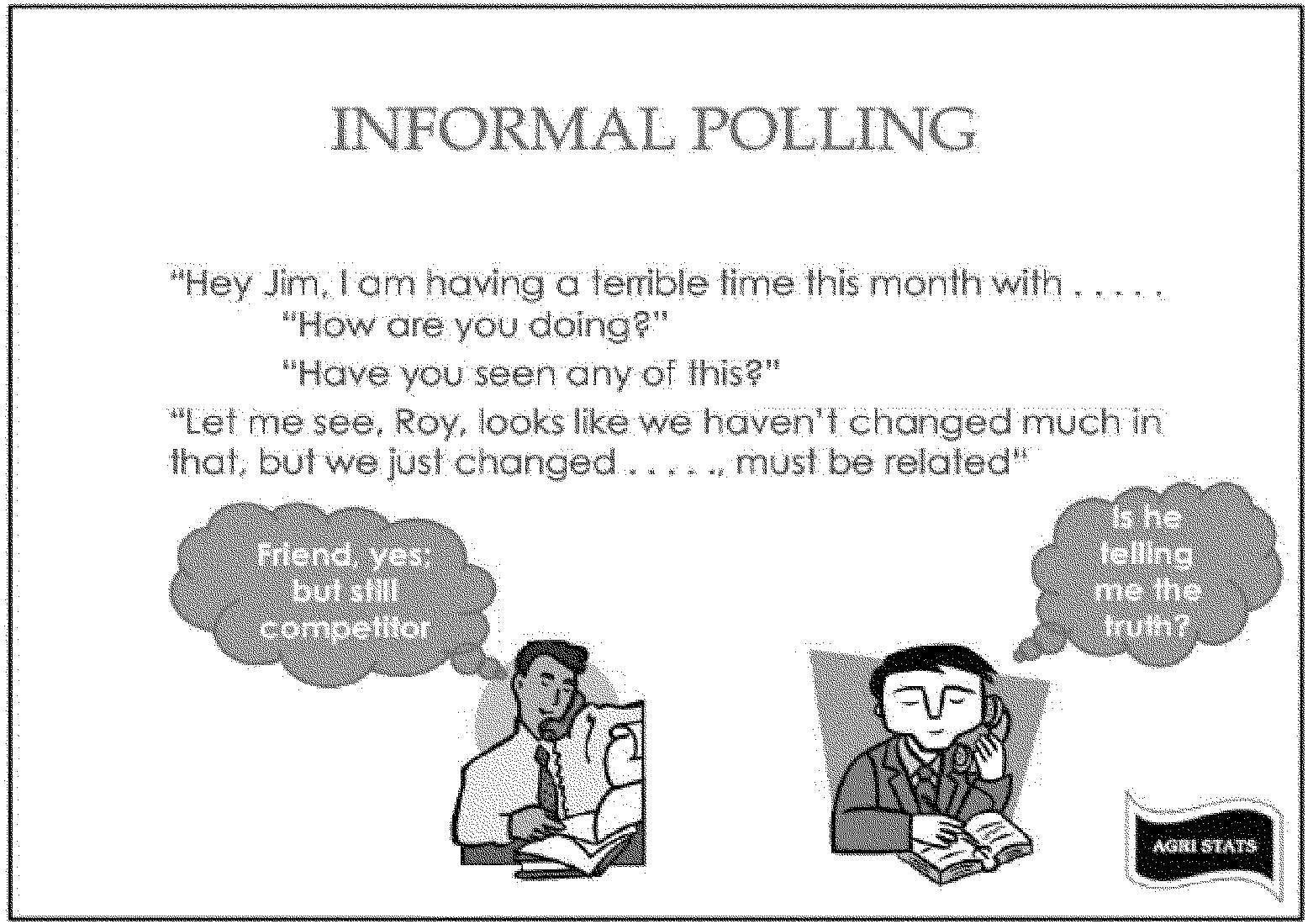
Figure 1
20. Agri Stats converts the data shared by processors to common metrics so they can make apples-to-apples comparisons across their operations and sales. If processors exchanged internal ledgers directly, they would need to account for each other's differing accounting methods and processes. Agri Stats eliminates that barrier to coordination. For example, Agri Stats sales reports group products based on characteristics such as form, weight, grade, preservation method, and packaging, which allows processors to assess how their prices compare to weighted averaged prices of the same products sold by competitors.[15] Agri Stats processing reports similarly group workers into job categories and provide wage and benefits information in a unified form so that processors can compare employee wages and benefits in common metrics.
21. Agri Stats compiles the data into “books” that it distributes back to the processors. Each book contains comprehensive “reports” detailing each competitor's performance on various business functions. The books that Agri Stats produces are hundreds of pages long and replete with company- and facility-level information. Agri Stats' former president described a typical book of reports as “a phonebook of information. . . . It's an inch and a half, two inches thick.”
22. The data that Agri Stats distributes is current. For example, broiler chicken weekly sales reports, which include pricing data, are typically published on Thursdays and include the previous week's data. For pork, Agri Stats provided an online data system called “Dataminer,” which included data from the previous week. Processors could query Dataminer to quickly and efficiently determine how their prices varied from the national average.
23. Agri Stats also publishes monthly reports that include information that is between thirty and sixty days old. Such current data gives processors a near-real-time understanding of their competitors' pricing, output, and costs, which enables the processors to reduce competition.
24. To ensure processors provide comprehensive information, Agri Stats regularly enforces a “give-to-get” policy that requires each processor to share complete data for each of its facilities. Agri Stats uses its position as a third-party intermediary to ensure that each processor contributes complete information to further the overall cooperative objective: increased profits for all processors.
25. Agri Stats provides processors with the names of the companies and facilities participating in its various reports.[16] Processors actively monitor these lists and contact Agri Stats if certain competitors do not appear. For example, after Seaboard temporarily left the pork reports in 2017, Smithfield's Vice President of Finance wrote to an Agri Stats employee, “[W]here are you on Seaboard[']s re entry into your program? January results?” The Agri Stats employee responded, “Still in discussions but they will not be present in the January report.” She later assured the Smithfield Vice President of her attempts to include its competitor in future reports: “Believe me I'm trying like hell[.]”
26. Some processors explicitly made their participation contingent on their competitors' participation. For example, in an effort to entice Tyson into providing data for all of its pork plants, Agri Stats made a “commitment to get JBS and Hormel completely onboard as well.” Agri Stats kept Tyson apprised of efforts to recruit Tyson's competitors and JBS and Hormel joined the reports, as Agri Stats committed, within the year.
27. The “give-to-get” policy also ensures that the processors' customers—including grocery stores and restaurants that buy broiler chicken, pork, and turkey products—do not obtain the information shared among the processors. When meat purchasers and workers have sought Agri Stats reports, Agri Stats has refused. Asked why Agri Stats adopted this policy, Agri Stats' ( printed page 34516) President explained, “[O]ur customers are the producers. We don't get in the way of the relationship between the producers and the buyers.”
IV. Agri Stats Shares Competitively Sensitive Information Through Written Reports and Direct Counseling
28. Through its reports and consulting services, Agri Stats provides processors with thousands of data points that allow them to understand their competitors' businesses. The information that Agri Stats collects and distributes is available nowhere else, and processors have regularly used this information to inflate prices and restrict output.
A. Agri Stats Reports
29. The most apparent way Agri Stats shares information among competitors is through its written reports, which are organized into “books.” Agri Stats produces a number of books consisting of standard and custom reports covering the various stages of production, including live production, processing, sales, and operations profits.
- The “sales ” book includes reports comparing a processor's pricing for specific packaged cuts of meat with aggregated sales information compiled from competitors' sales.
- The “live production ” book includes reports that provide details on each facility's costs and expenses for raising an animal for slaughter.
- The “processing ” book includes reports that list each facility's costs and expenses for slaughtering an animal and dividing it into parts for sale.
- The “operations profits ” book includes reports that use information from the live production, processing, and sales books to provide information on each participating facility's profit margins.
- The “bottomline report ” is a short report that ranks each participating processor based on company-level profit margins on a per animal and per pound basis.
30. In each industry, Agri Stats issues targeted reports that may come included in one of the “books” or as a standalone report. For example, as part of the turkey sales books, Agri Stats included more targeted “Retail and Deli” sales reports, providing sales data for deli turkey products. In pork, Agri Stats produced an Export Sales Report tracking pork sales data broken down by product type to foreign countries. Agri Stats also circulated to broiler chicken processors a “Freezer Inventory Report” providing information on the industry current total inventories, which correlates with price.
31. In addition, processors frequently request other customized reports, such as processing reports that compare only processing facilities slaughtering broiler chickens of a certain size or sales reports that focus on a particular product segment, like consumer tray pack sales.
32. Each report presents information in different ways. Some contain information about each competitor on a facility-by-facility basis, while other reports contain key metrics and data about highly specific product types. Two particular types of reports, sales and live production, are discussed in detail below.
1. Agri Stats Sales Reports
33. Several different Agri Stats books provide processors with competitively sensitive price information. Certain Agri Stats sales reports provide information on competitors' invoice prices on a company-basis for particular categories of meat ( e.g., turkey deli meat).
34. Other reports provide information for specific cuts of meat (identified at the near-SKU level).[17] Agri Stats provides the weighted average and top quartile prices and tells processors where their price ranks among competitors' prices for the same items. This pricing information is recent (from the prior week for weekly reports and 30-60 days removed for monthly reports). Agri Stats defines each item by its cut, trim, weight, preservation method, and packaging, allowing processors to see where their prices rank against competitors' prices for like items.
35. For example, poultry processors sell millions of pounds of chicken breasts each week to wholesalers, grocery stores, and restaurants. Agri Stats divides this category into smaller subcategories based on whether the cuts are left whole, sliced, diced, cut into strips, or trimmed of fat. Agri Stats then further separates these cuts by preservation method ( e.g., ice, carbon dioxide, vacuum packed, frozen, poly bagged) and packaging ( e.g., boxed, “combo bin,” bagged, consumer/retail ready, regular tray pack, jumbo tray pack). By reporting on these more detailed categories, Agri Stats allows processors to compare prices on similar items at the near-SKU level sold to like customers.
36. Figures 2 and 3 feature a single line from a weekly Agri Stats broiler sales report providing information on a category of marinated chicken drumsticks, chilled, and packaged in jumbo tray packs (Fig. 2 at (b)).[18] For this particular item, Agri Stats tells the processor how much of the product it sold (Fig. 2 at (c)) and how much the industry sold (Fig. 2 at (c.2)), allowing the processor to determine that its sales made up approximately 19% of the national sales for that week (Fig. 2 (c)÷(c.2)).

Figure 2
37. For each item, the sales report also tells each processor the average price it charged (Fig. 3 at (d)) as well as the average industry price (Fig. 3 at (d.1)) and top quartile price (Fig. 3 at (d.2)) charged for like items. It then ranks the processor's price (Fig. 3 at (e)), with the top rank going to the processor with the highest price. In this example, Agri Stats tells the processor that its price “ranked” seventh out of the eight sellers of this product during the week (Fig. 3 at (e)), meaning its price was the seventh lowest of the eight sellers.
( printed page 34517)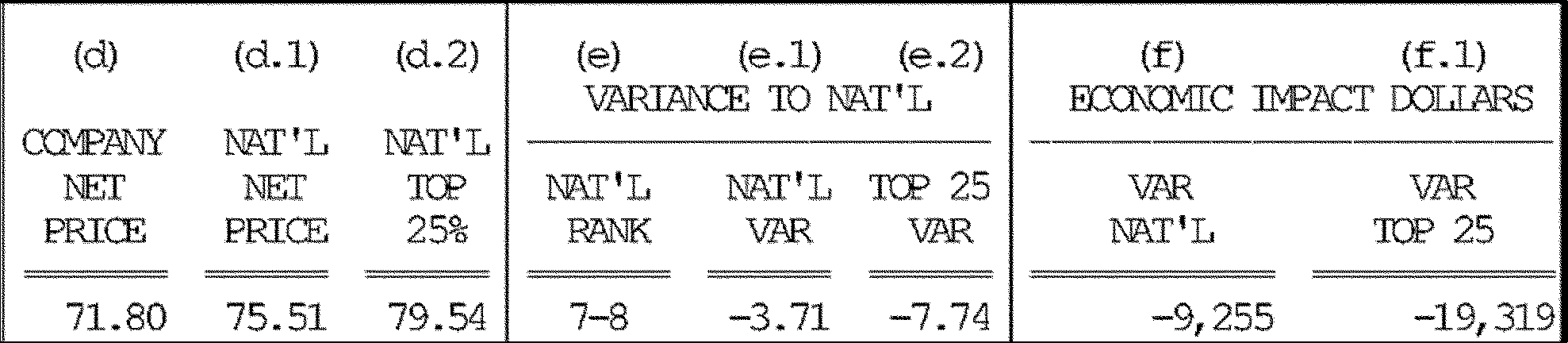
Figure 3
38. A processor that learns it has a low rank on price for an item—such as seventh out of eight competitors—can raise prices on that item with reduced uncertainty about losing business to a competitor based on price.
39. The average and top quartile prices provide the processor with additional details to guide its pricing. The Agri Stats sales report tells the processor how far below the industry average price and below the top quartile price (Fig. 3 at (e), (e.1.) & (e.2)) its price fell, and it quantifies the economic impact of leaving the price at below average and below top quartile prices as lost revenue (Fig. 3 at (f) and (f.1)). This information is particularly valuable where only a small number of processors—sometimes as few as two—sell comparable items.
40. As discussed later, processors have routinely relied on the weighted average price and weighted top quartile price information to identify particular items for price increases. Processors in each industry, often with Agri Stats' assistance, identified those items priced below the Agri Stats average as “opportunities” to impose price increases.
2. Agri Stats Live Production Reports
41. Agri Stats live production books comprise reports that provide facility-by-facility information on the production levels of each participating processor. Processors receive comprehensive reports that include all competitors, as well as more targeted reports that provide information about a select set of competing facilities.
42. Consider the following excerpt from the broiler chicken live production book for February 2013, which provides production information about facilities that process birds weighing more than 7.5 pounds.[19] Agri Stats provides each processor receiving this report with a list of each facility—by company and location—processing that size bird (Figure 4):
( printed page 34518)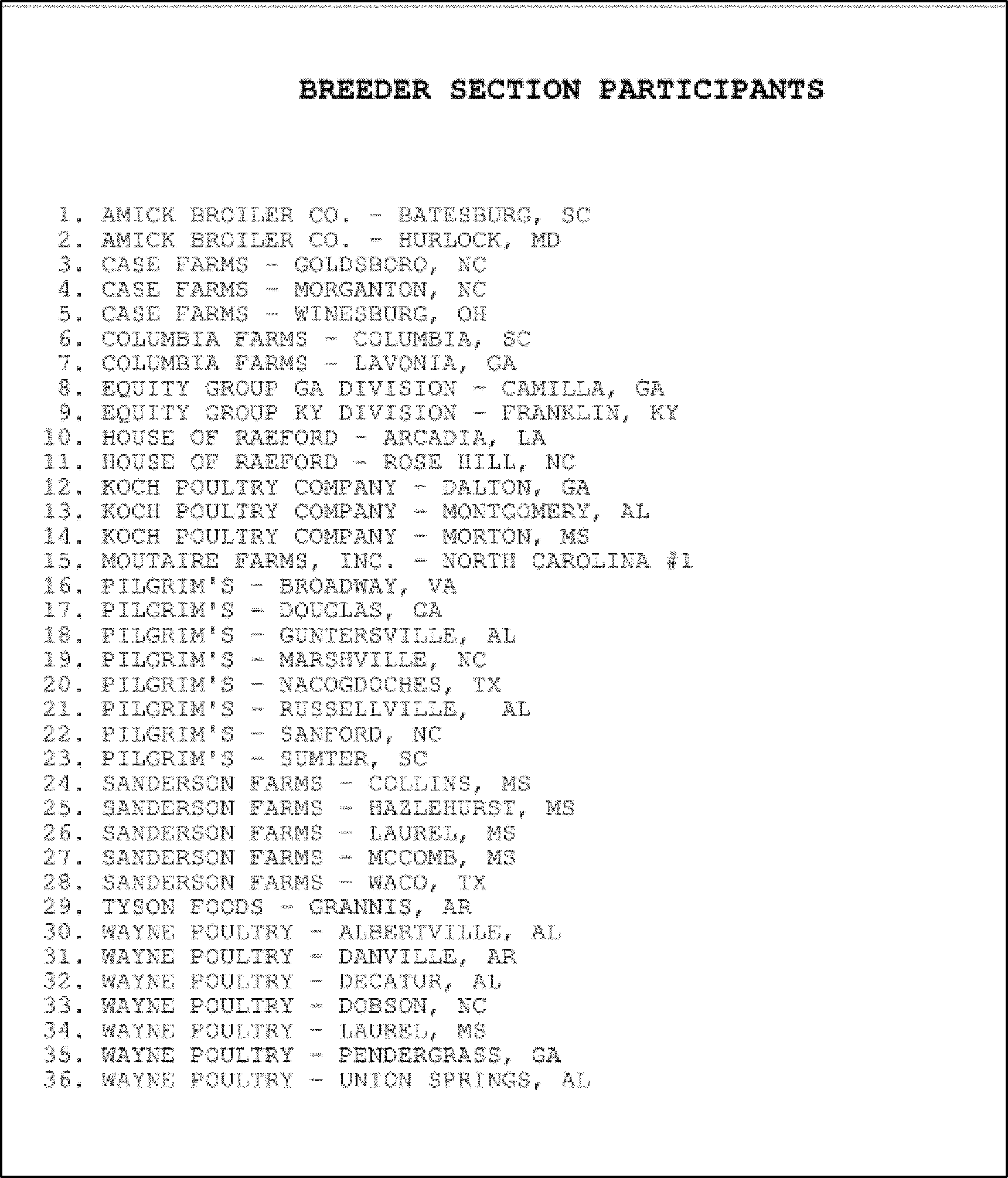
Figure 4
43. The live production book then provides detailed information about the growing of poultry or livestock for each contributor, such as the breeder chick placements (also known as “pullets”) associated with each broiler chicken processing facility.[20] Figure 5 is an excerpt from a report titled “Monthly Breeder Chick Placement by Plant.” In this report, each processing facility is represented by a line number (“LIN”) and the female (a.1.) and male (b.1.) breeder chick placements are stated for each facility. The reports compare breeder chick placements at each facility to the previous year's placements (Fig. 5 at (a.2) and (b.2)).
( printed page 34519)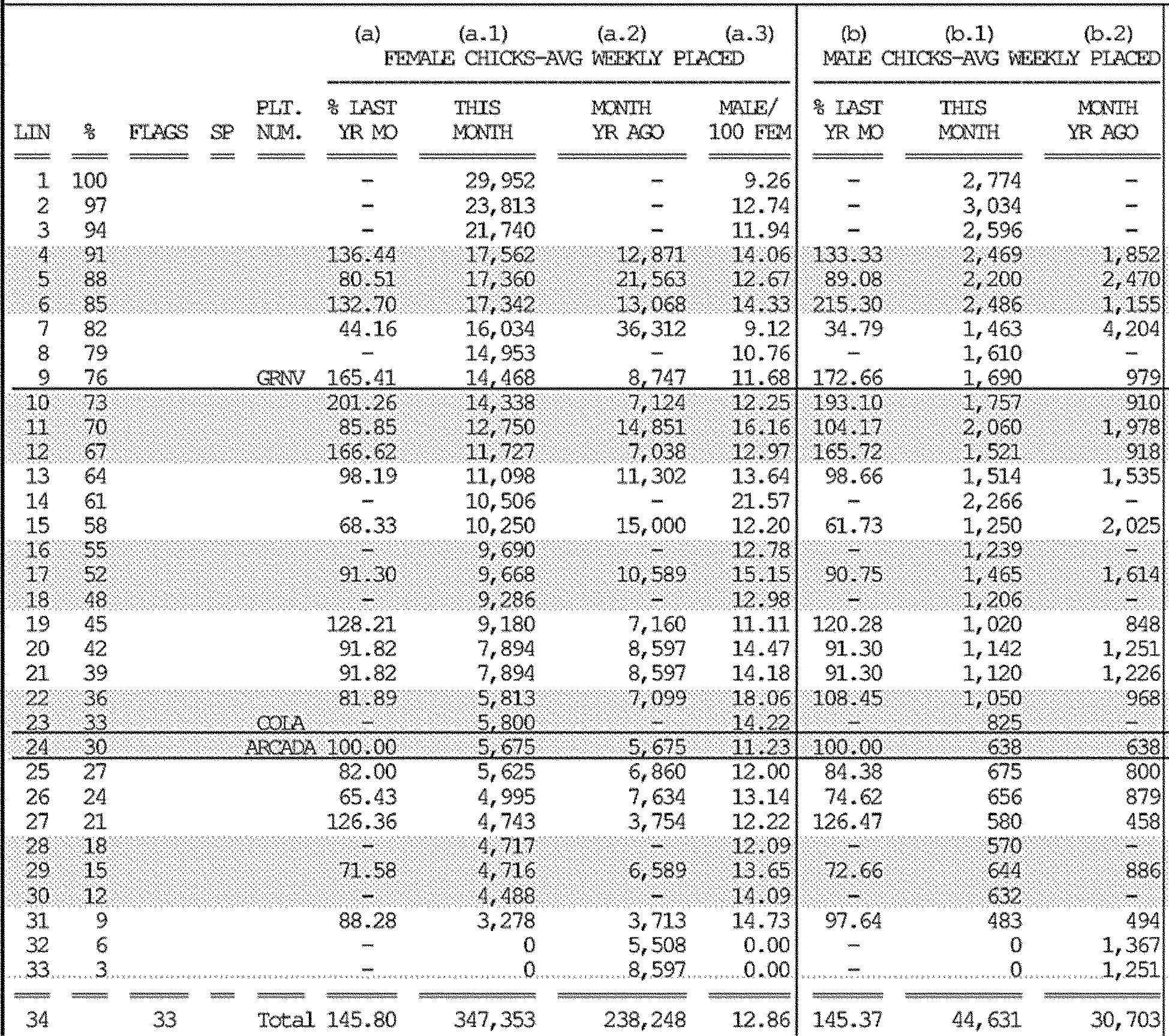
Figure 5
44. In addition to facility-level information, the report provides industry-wide figures, including the total number of breeder chick placements and how those numbers compare with the previous year. Specifically, the report discloses that placements have increased by 45.80% for female chicks and by 45.37% for male chicks (Fig. 5, line 34 at (a) and (b)). Unlike public data sources that rely on voluntary reporting, the breeder chick placement information here is comprehensive (all subscribers contribute) and is available for different-sized birds so processors can track whether processors are expanding production in certain sales channels.
45. As Agri Stats has stated in its live production customer manual (Fig. 6), the purpose of providing breeder chick information is to “help forecast Broilers & pounds produced for future months.”
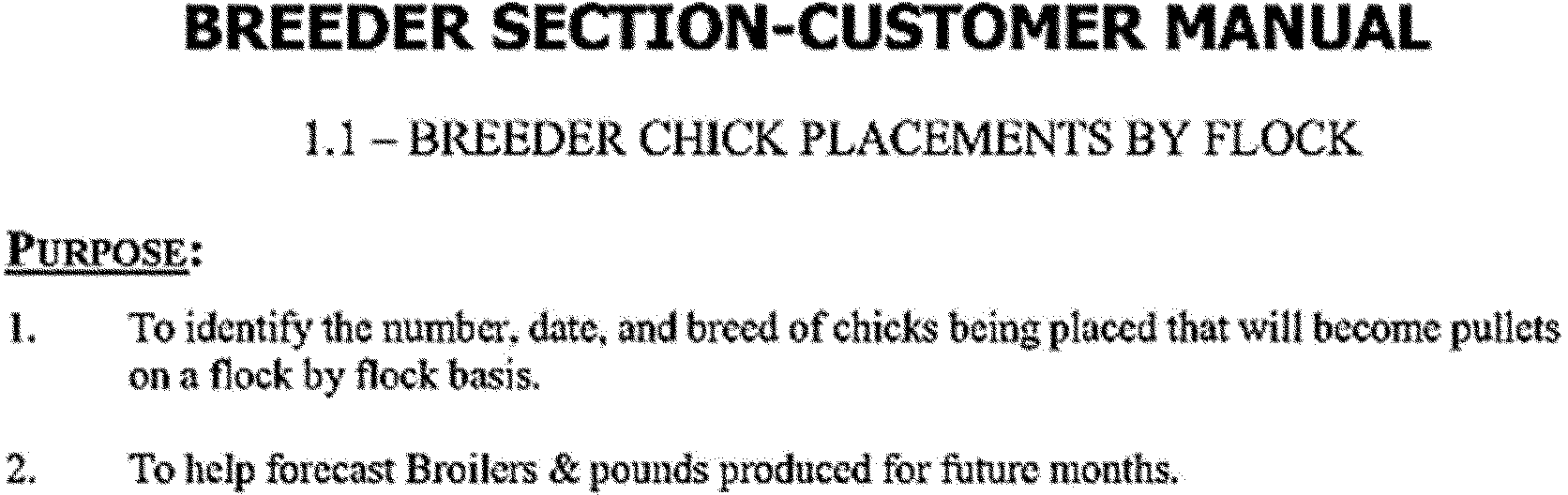
Figure 6
46. Breeder chicks begin laying eggs at about six months after placement. When a broiler chicken processor is planning to expand, typically it needs to begin increasing the size of the hatchery supply flock by increasing breeder chick placements approximately six months in advance. Monitoring breeder chick placements allows processors to forecast the future production plans of competitors.
47. Joe Sanderson, the former CEO of Sanderson Farms, specifically referred to tracking “pullet placements” in Agri Stats reports when he assured investors that Sanderson had no plans to increase production because his competitors were not doing so. He also explained that he could track production in terms of bird weight across sales channels (big bird, small bird, track pack) using Agri Stats:
I think the increase in Agri Stats that showed up in 2009 in weight, was primarily in the tray pac[k] region. There was a nominal increase in the big bird deboning but it was very slight. The tray pac[k] region increased more than anyone else, but it has not changed in about six months now and I think that has topped out. Small bird hasn't increased any. I don't really anticipate very much movement in weights any more in 2010. I don't see any more head until we see some improvement in pricing, so I think head count is going to run close to what we have.[21]
B. Agri Stats Sales Consulting
48. In addition to providing processors with written reports, Agri Stats meets with individual subscribers multiple times a year to discuss how to use the information that Agri Stats collects. Frequently, Agri Stats reviews price “opportunities” with processors like those discussed above and identifies items and customers to target for price increases. Agri Stats account managers prepare detailed presentations for their subscribers highlighting the additional revenue they could make by increasing prices.
49. Agri Stats has touted its ability to identify opportunities to raise prices as a selling point. When one processor contemplated unsubscribing from Agri Stats' bacon report, for example, Agri Stats employees encouraged it to continue subscribing by pointing to $100,000 in additional revenue the processor could make by raising prices on particular bacon products.
50. The consulting sessions provide an opportunity to directly advise participants on raising prices to boost industry profits. The in-person consulting sessions also provide processors with an opportunity to discuss with Agri Stats account managers information that might not be included in Agri Stats reports, but nevertheless might be gleaned from the detailed information Agri Stats receives about the operations and sales of nearly every major participant in the industries in which it operates.
V. Processors Use the Agri Stats Information-Sharing Scheme To Increases Prices and Restrict the Supply of Meat
51. With Agri Stats' encouragement and facilitation, Agri Stats' processor-subscribers use the information collected and distributed by Agri Stats to increase and stabilize prices and reduce the supply of meat.
A. Processors Use Information Shared Through Agri Stats Reports and Consulting To Raise Prices
52. By enabling and encouraging processors to focus on increasing prices on items priced below their competitors, Agri Stats helps processors boost sales margins, thereby increasing profits without lowering prices to take sales from competitors. The data allows processors to profitably raise prices on relatively low-priced products with greater confidence that they will not lose sales to lower priced rivals. The examples below illustrate how processors used Agri Stats reports to stabilize and raise prices.
1. Tyson Used Agri Stats Sales Data To Increase Chicken Prices
53. In January 2010, Tyson embarked on a plan to use competitor data exchanged through Agri Stats to increase prices in its fresh chicken business, a project that would potentially impact more than 3,000 retail outlets. Tyson deployed Agri Stats' weekly sales report—data that was often less than a week old—to its sales force for use in negotiating prices. Tyson management told employees to aggressively push price increases and “[h]ave price courage.”
54. Tyson focused on raising prices on fresh tray pack items (chicken packaged to sell predominately at grocery stores) to meet the national average as reported by Agri Stats. Tyson tracked the “variance” between Tyson's average price and the national average price, and circulated a chart showing the company's progress at reducing the variance. As shown below (Fig. 7), the bottom flat line represents the variance of −3.8 cents per pound (when Tyson began its pricing initiative) while the top flat line represents targeted “zero variance.” Each week, Tyson used Agri Stats data to track the variance between its average price for this category of products and the industry average. The chart shows how Tyson, by increasing prices, gradually narrowed the variance and brought its prices in line with the industry average price.
( printed page 34521)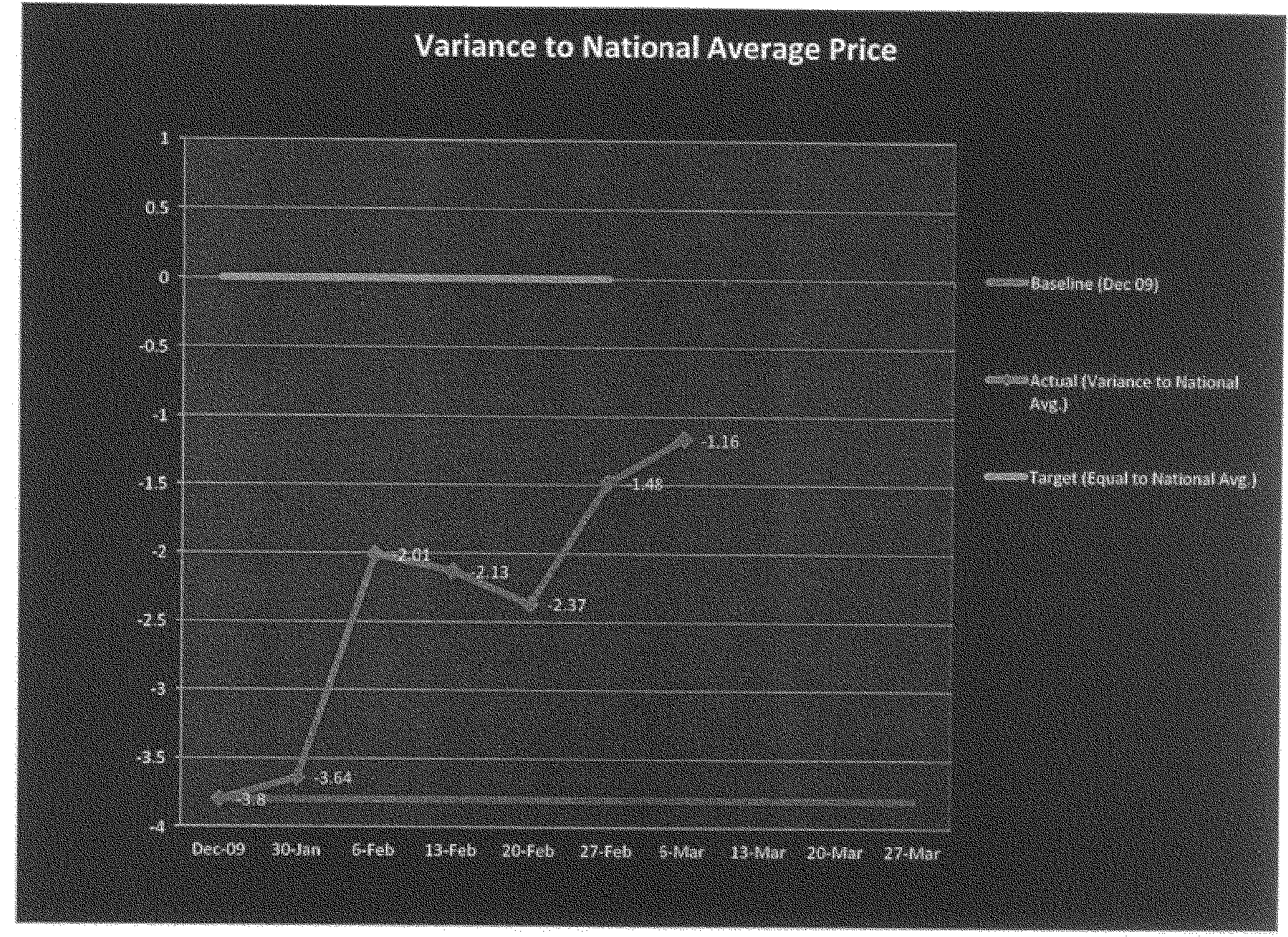
Figure 7
55. Tyson's price increases were not dictated by independent market forces that affected costs or supply. Rather, the Agri Stats reports, by providing averages and the top 25th percentile, informed Tyson that it could increase prices on items that its competitors already sold at higher prices. That is what Tyson did.
56. At the same time, Tyson's competitors were also raising prices, prompting one Tyson executive to explain the difficulty in closing the variance: “Overall we improved in sales price in several categories vs the previous week but it is obvious that our competition also made improvement. As we have discussed[,] we not only have to increase our price but we also have to out run our competitors['] improvements.”
57. Tyson and its broiler chicken competitors could focus on raising prices because they understood that processors did not use Agri Stats data to lower prices. A Tyson sales executive stated that he instructed his team to “stay ahead” of other broiler processors' price increases and that he never considered the possibility that competitors would respond by reducing their prices to take market share away from Tyson. From January 2010 to May 2012, Tyson raised the average price of tray pack items by over 20% and continued raising prices thereafter.
2. Sanderson Farms Used Agri Stats Sales Data To Increase Chicken Prices
58. Sanderson Farms used Agri Stats reports in a similar manner. For example, in December 2012, an executive circulated an email stating that the company had secured more than $18 million in price increases over the previous six months while noting, “We are not done.” He directed his sales team to continue renegotiating with open-ended contract customers to increase prices, explaining, “Start with wing help and then address any other parts that may be deficient. . . . All customers under contract will also be asked for help on wings and any other items deficient in Agri Stats.”
59. The Sanderson executive attached a spreadsheet (Fig. 8) identifying each customer, the contract date, the difference between current pricing and Agri Stats pricing, the status of any negotiations, and the amount of additional revenue secured or targeted for that customer. The spreadsheet ranks customers by the variance between Sanderson's prices and the Agri Stats price, and demonstrates how the company targeted for price increases those customers who had been receiving prices below Agri Stats prices. The customers include some of most well-known supermarkets in the United States.
( printed page 34522)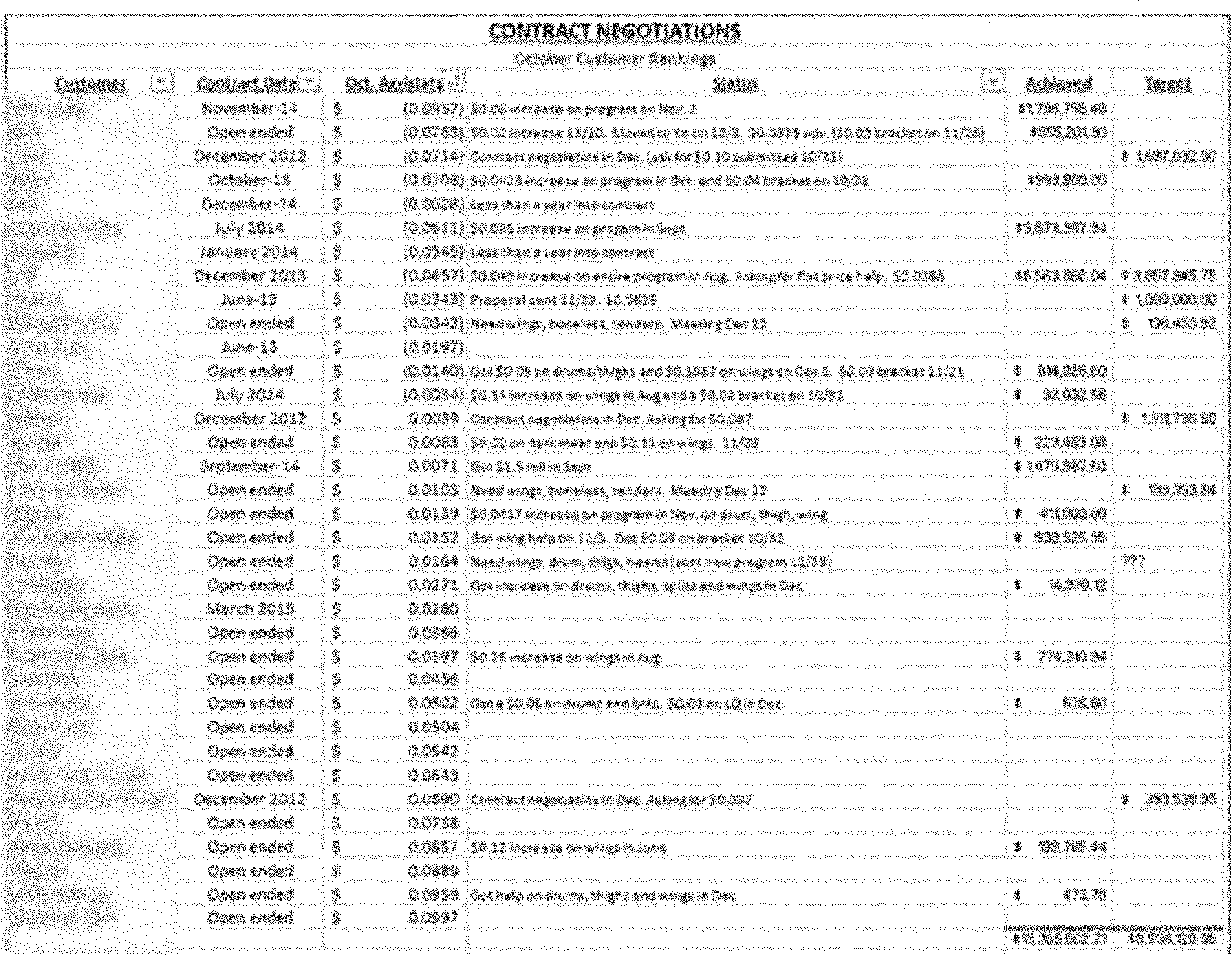
Figure 8 [22]
60. These examples from Tyson and Sanderson reflect a broader trend. As Tyson and Sanderson were raising prices, industry-wide profit margins increased dramatically for broiler chicken processors in 2013 and 2014, according to Agri Stats data.
3. Cargill Used Agri Stats Sales Data To Increase Turkey Prices
61. Turkey processors used Agri Stats in a similar manner. In a 2016 presentation slide entitled “Why AgriStats & Strategic Pricing?” (Fig. 9), Cargill explained that Agri Stats provides “insight into competitor's pricing” and identifies “what the market will bear.” The “goal” of Agri Stats and Strategic Pricing is “forward motion,” represented by figures raising a curve.
( printed page 34523)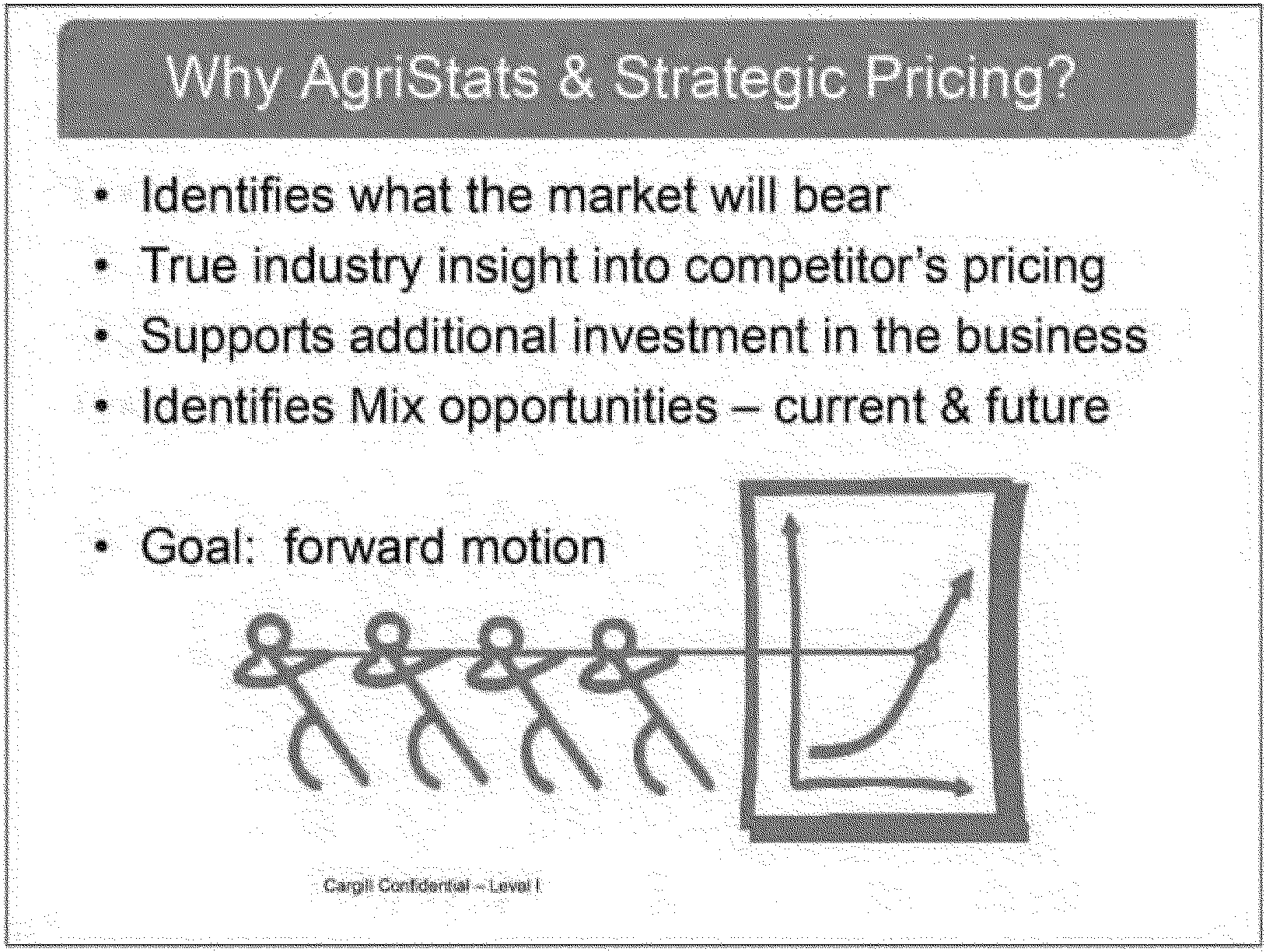
Figure 9
62. Consistent with the figures increasing the price curve, Cargill used Agri Stats data to raise prices. Beginning in late 2013, Cargill began relying on competitor data exchanged through Agri Stats to “increase [its] Benchmarking focus.” As shown below (Fig. 10), Cargill increased its prices from three cents below the national average to well above the national average as measured by Agri Stats' net dock price. It would maintain those increased prices at least into 2016.
( printed page 34524)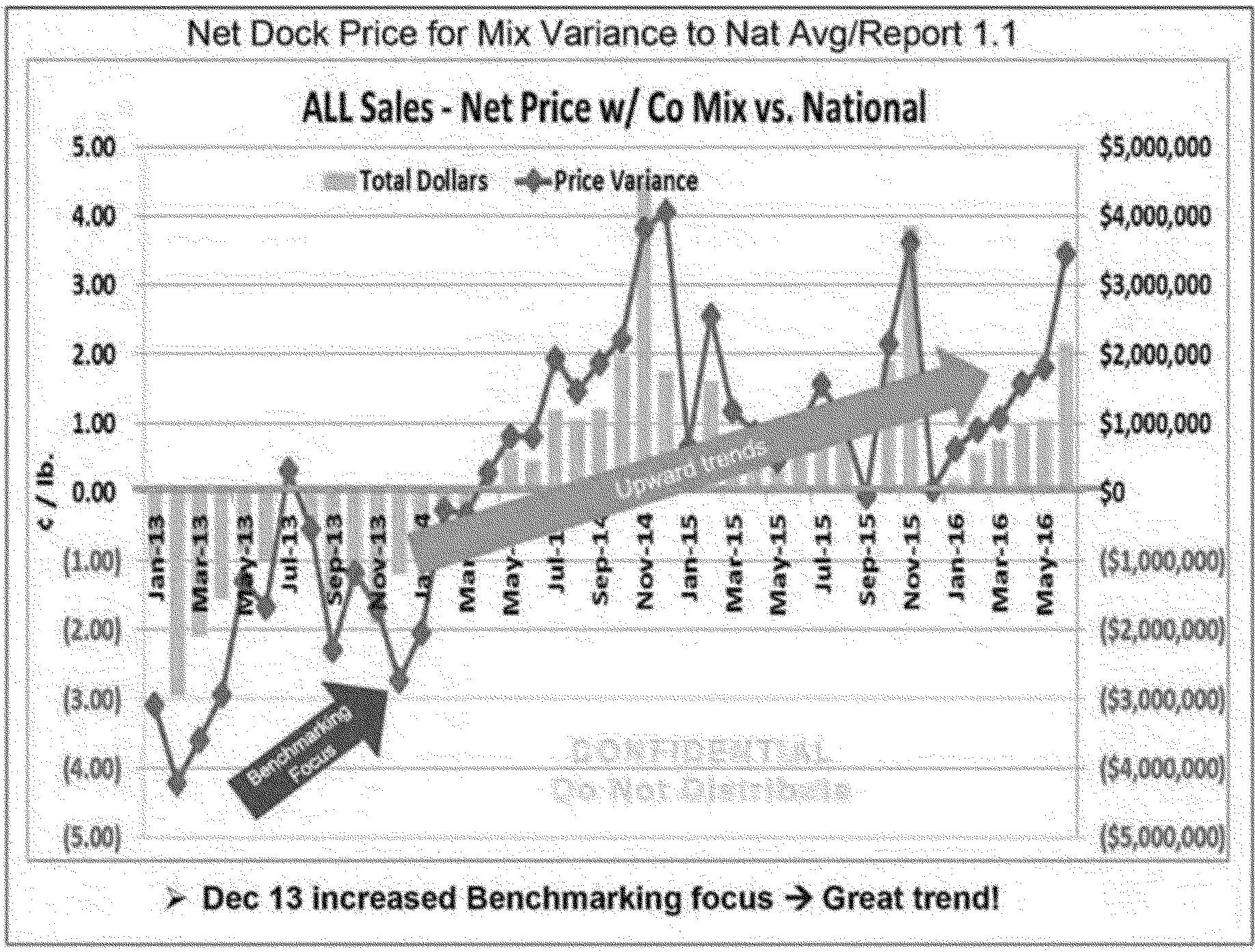
Figure 10
4. Butterball Used Agri Stats Sales Data To Increase Turkey Prices
63. Butterball likewise used Agri Stats sales data to increase turkey prices. In April 2014, Butterball sales executives and employees sent around Agri Stats sales data noting “poor results versus the competition.” These “poor results” were turkey products that were priced below the industry average. A Butterball vice president sent a list of “Product Group/SKU[s]” identifying these products. Another vice president noted that “[m]arkets are at historic highs” and Butterball needed to take advantage of the higher prices “everywhere we can.”
64. In response, a Butterball sales employee stated that Butterball had increased or would increase targeted turkey product prices for a number of large food distributors.
65. While Butterball and Cargill were increasing turkey prices, market-wide turkey prices increased in a way that cannot be explained by underlying costs of production. In fact, costs actually decreased during this period according to Agri Stats data. Yet, consistent with Agri Stats' advice, processors raised prices. According to Agri Stats' own records, turkey processors were able to increase margins by more than 300% between 2013 and 2016 and achieved historic profitability.
5. JBS Used Agri Stats Sales Data To Increase Pork Prices
66. Pork processors also used Agri Stats sales data to increase prices. Referring to its focus on Agri Stats pricing data as “margin-based” decision-making, JBS regularly used Agri Stats to monitor prices and pursue price increases on items sold below the national average price. For example, in August 2010, a JBS executive instructed his sales team to identify SKUs that “are LOW relative to the industry.” A JBS employee promptly identified ten products to consider for price increases based on Agri Stats data and suggested in several cases that JBS seek further guidance from Agri Stats on pricing. Here again, JBS's efforts were part of a broader trend. Profit margins for pork packers as measured by Agri Stats grew strikingly—over 50% from 2010 to 2011.
B. Agri Stats' Give-to-Get Policy Makes It Easier for Processors To Increase Prices Due to Information Asymmetry
67. Processors could increase prices so readily, in part, because meat purchasers such as grocery stores and restaurants do not have access to the same information. Agri Stats boasts that no other service offers anything close to what it provides to its subscribers. As one agricultural economist and former EMI employee admitted, “Agri Stats . . . [has] access to information about production costs, processes, yields, and structural information that no other economist or analyst can obtain.” Agri Stats' President stated that “Agri Stats['] biggest strength is that there are no other companies that do [what] we do.” Its processor co-conspirators agree; one Tyson executive stated that no other service provides this kind of comprehensive information regarding sales data. Yet Agri Stats has refused to make the competitively sensitive information it readily distributes among competing processors available to purchasers.
68. This information asymmetry contributes to processors' ability to ratchet prices upward. Each processor can identify which of its products are ( printed page 34525) priced below its competitors' and raise prices on those products with less concern about price competition. By contrast, purchasers cannot use the same information to identify when they are paying comparatively high prices because Agri Stats refuses to sell them its reports. Other statistical services available to the public (either for free or by subscription) are not substitutes for the data shared between the processors via Agri Stats because no other service has the same access to processors' internal ledgers.
69. In a competitive market, a processor may find it advantageous to lower its prices, increase its sales, and thereby grow its market share. But Agri Stats reports do not tell a processor how much additional profit it could make by selling more meat at a lower price than its rivals. One executive at pork processor Smithfield testified that he did not know of a single instance in which Smithfield used Agri Stats sales reports to decrease price. A Tyson sales executive similarly testified that he was unaware of a single instance in which his broiler sales team used Agri Stats information to reduce prices.
70. Encouraging price competition runs counter to Agri Stats' goal of increasing the profitability of the industry as a whole. Agri Stats has stated that its “paradigm” is to “increase [the] profitability of all participants.” Thus, Agri Stats enables and encourages participants to “chas[e] price” and boost collective industry profits, not compete to maximize the individual profits of the respective processors.
71. Agri Stats' “rankings” are a case in point. In its sales reports, for example, Agri Stats ranks processors based on how high their prices are. The processor charging the highest prices is ranked first, and the processor charging the least is ranked last, regardless of total profits. These rankings, which depend on competitively sensitive information collected by Agri Stats, push markets toward anticompetitive pricing by promoting increased margins.
72. Certain processors have even used Agri Stats' rankings in the sales reports to give bonuses for sales staff. These employees are therefore incentivized to sell less volume at higher prices rather than higher volume at lower prices, which results in higher prices for consumers.
C. Agri Stats Enables Processors To Restrict Supply
73. Price and output are interrelated. Generally, when demand stays constant, decreased supply of a product will increase its price. Broiler chicken, pork, and turkey processors have used competitively sensitive information exchanged through Agri Stats to restrict supply, which also leads to stabilized and inflated prices.
74. Agri Stats offers more comprehensive, detailed information than publicly available sources because Agri Stats collects data that comes directly from the internal ledgers of the processors. The information also covers multiple aspects of the production process, and includes metrics that indicate current inventories and future production.
75. By using Agri Stats to monitor each other's production plans, processors are more easily able to coordinate supply restraints and confidently ensure that no one is attempting to increase production and expand market share. Sanderson Farms and Pilgrim's, for example, both explicitly discussed making broiler supply decisions based on Agri Stats data during earnings calls.
76. In the broiler chicken and turkey industries, for example, Agri Stats reports the number of “breeder” chicks placed at the breeder farms affiliated with each processor in its live production reports. The time from breeder chick placement to meat delivery is highly regular, and, unsurprisingly, the number of breeder chicks placed closely predicts final output. As mentioned above, the Agri Stats user manual for broiler processors states that Agri Stats collects and publishes breeder data to allow subscribers to “help forecast Broilers & pounds produced for future months.” The Agri Stats user manual for turkey processors contains a similar statement. When processors know the future production plans of their competitors, they can more easily coordinate supply restraints and anticipate when price increases will be successful.
77. Agri Stats reports on many other supply metrics. Processors can monitor broiler chicken output through hatchery utilization ( i.e., the percentage of incubator space in a hatchery that is filled with eggs), density of broiler housing, average flock size, and average age at time of slaughter. Even metrics that may not obviously implicate supply to a layperson can reveal competitively sensitive information. For example, processors use certain metrics in Agri Stats reports to estimate a company's average bird weight, which is one of the variables processors use to increase or decrease total output. Sanderson Farms specifically mentioned monitoring competitor bird weights in a May 2013 investor call.
78. Agri Stats turkey reports included similar metrics that allowed competitors to track output, including breeder chicks placed, average flock size, bird age, bird weight, density of turkey breeder housing, hatchery utilization, and egg set capacity per week. Butterball, for example, deanonymized the Agri Stats data to track specific competitors' output trends.
79. The pork reports included metrics allowing processors to estimate the total number of pigs slaughtered and total pounds produced at competing facilities. These metrics include “head killed per operating hour,” the number of shifts operated, the number of hours per week each employee on a shift works, and live pig weight.
80. In the broiler chicken market, Agri Stats and EMI also distributed time-sensitive information regarding current inventories through a “Freezer Inventory Report.” This weekly report shows the aggregate pounds of various broiler chicken cuts in processors' on-site freezers. An example is shown in Figure 11.
( printed page 34526)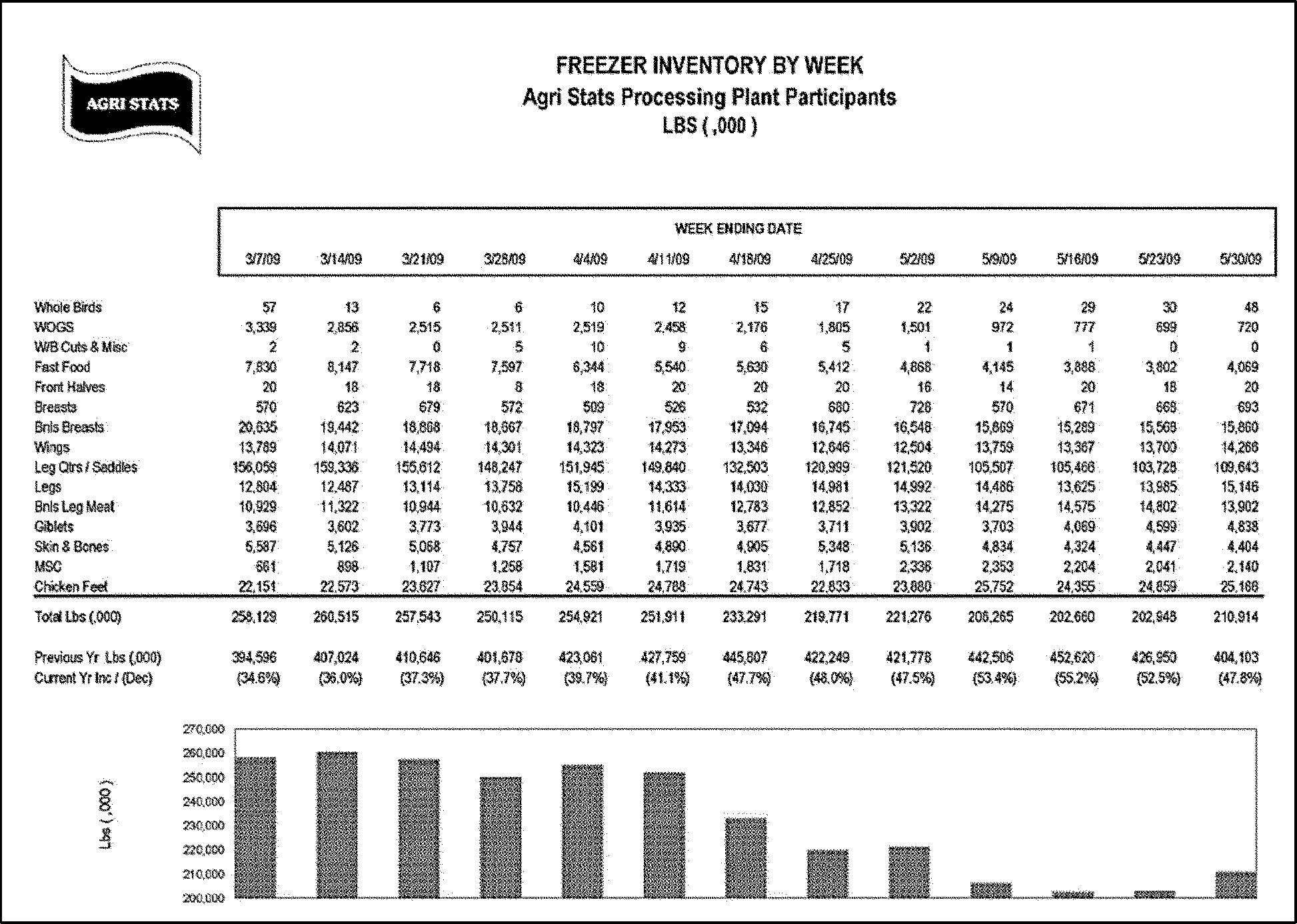
Figure 11
81. Agri Stats advised processors that freezer inventory closely correlates with price, and processors understood that connection. Shortly after receiving a March 2011 Freezer Inventory Report showing six weeks of inventory reductions, Mountaire Farms' CEO wrote, “Tell those sales people to raise sales prices . . . . [T]he tide has turned and our sales people must demand more and not be apologetic . . . .”
82. Although EMI produced and audited the Freezer Inventory Report, it branded the report with the Agri Stats logo, referred to it as the “Agri Stats Weekly Inventory Report” and made the report available only to processors.
83. Agri Stats provided pork processors with an “Export Sales” report as another way to monitor supply. Pork processors have regularly exploited the export market to constrain domestic supply, even when export sales result in a loss, because restraining supply significantly increases domestic pork prices. A Smithfield economist estimated that a 1% reduction (or “disappearance”) in domestic supply would lead to a 3% to 5% domestic price increase.
84. The same Smithfield economist was asked in an internal email, “[W]hy do we want to go to the export at a loss?” He replied, “Very simple: More exports translate to higher meat value [domestically].” This statement makes sense only if Smithfield was confident that no other processor would capture lost domestic sales. Smithfield had reason to be confident. For example, Seaboard wrote in a weekly update in 2012: “We continue to chase all the export opportunities we can find to keep excess product off the US market.” Tyson's CEO made similar comments as well.
85. The Agri Stats export sales reports allowed pork processors to track the quantity of exports and pricing in non-U.S. countries for identified pork items. Pork processors, including Tyson, Smithfield, and Cargill, monitored fluctuations in the volume of exported pork based on pork cut and country and asked Agri Stats to perform various custom analyses on exports.
86. Just as with prices, Agri Stats has enabled and encouraged processors to maintain output discipline. Agri Stats routinely sent analyses to processors (sometimes through EMI) encouraging them to “exercise restraint.” For example, in September 2014, an Agri Stats vice president circulated a presentation to various broiler companies, including Wayne Farms, Pilgrim's, Perdue, and Tyson, commenting that “[t]his summer every week sets a record for economic returns for the U.S. broiler industry.” The vice president reminded the processors that “the prospects for coming months remain extremely favorable” because “[b]reeder placements are not increasing anywhere near enough to cause a surplus of birds through at least the first half of 2015.” He called the numbers “stunning results for the industry.” The vice president effusively praised processors for maintaining “control” over production levels, signaling that they should restrain output to continue “the amazing times in the chicken business.” Agri Stats reports provided further assurance that each processor could restrict its own output by monitoring competitor output through the reports Agri Stats provided.
D. Agri Stats Enables Competitors To Exchange Plant and Company Level Information
1. Processors Exchange and Deanonymize Agri Stats Reports
87. Agri Stats reports not only enable the exchange of competitively sensitive price and supply metrics, they also make it easier for processors to ( printed page 34527) exchange other facility-level or company-level information directly—a practice Agri Stats enabled and knew occurred.
88. Many Agri Stats reports provide disaggregated, facility-level data for each participating facility. The inclusion of comparable, facility-level data makes the sharing of competitively sensitive information simpler and more likely to be anticompetitive.
89. Although Agri Stats ostensibly anonymizes the data to conceal each company's and facility's identity, Agri Stats knows that processors are able to deanonymize the reports. Once deanonymized, the reports allow processors to monitor specific competitors' output, cost, and price metrics even more closely. Processors can deanonymize Agri Stats reports without their competitors' assistance. Some metrics contained in Agri Stats reports are so detailed that deanonymization becomes fairly straightforward. A Butterball employee once boasted, “I can pick the companies for rankings with 100% certainty” using information found in Agri Stats' turkey Bottomline Report.
90. Once a facility is identified—for example, based on a unique feature related to its operations or product offerings that industry insiders would recognize—the plant can be tracked across different reports using that identifying metric. Tyson's Director of Competitive Intelligence and Analysis testified that once he was able to identify facilities “on the operations profit page, I can go back through the other books to identify their data elsewhere. Agristats often takes data to 4 decimal places which allows that number to be identified somewhere else in the books (live, plant, processing mix, sales, etc. . .).” Similarly, a Pilgrim's employee who previously worked at Agri Stats informed a work colleague that information in the Operations Profits book could help identify particular processors.
91. Deanonymization became a regular part of many processors' analyses of Agri Stats reports. A Mountaire employee regularly deanonymized Agri Stats' broiler chicken reports, considering it part of her official job duties. Other chicken processors such as Tyson, Pilgrim's, Perdue, Sanderson Farms, Wayne Farms, Amick Farms, Koch Foods, and Case Farms have deanonymized various Agri Stats broiler chicken reports.
92. Tyson held regular internal meetings in which its employees analyzed deanonymized Agri Stats pricing information about certain cuts of pork from its competitors' facilities. Dubbed the “naming process,” Tyson's process for deanonymizing pork facilities involved multiple employees from different departments. Besides Tyson, Seaboard/Triumph and Smithfield deanonymized various Agri Stats pork reports.
93. Cargill tracked its competitors' pricing based on the turkey Retail and Deli report provided by Agri Stats. A December 2015 spreadsheet from Cargill (Fig. 12) showed the company tracking the invoice prices and net sales prices of its largest turkey competitors—Butterball (“BB”), Jennie-O (“JOTS”), Cooper Farms, and Perdue—in Agri Stats reports (referred to below as “A/S”):
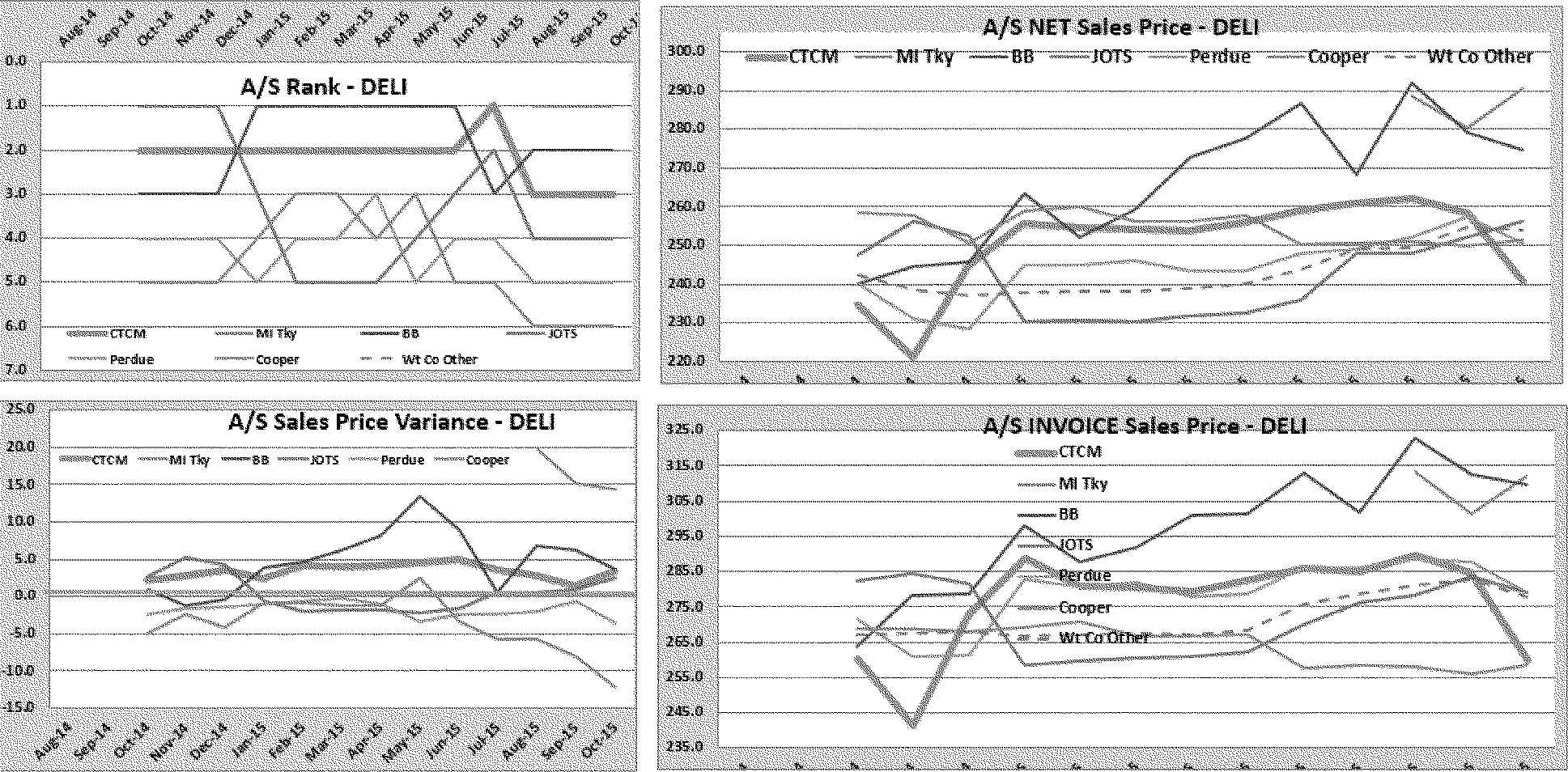
Figure 12
94. Like Cargill, Butterball, Jennie-O, Cooper Farms, Perdue, and Farbest also deanonymized various Agri Stats turkey reports.
95. By including a list of contributing facilities at the beginning of each report, Agri Stats makes the deanonymization process easier. At least one subscriber told Agri Stats that it would stop subscribing to certain reports if the company did not list participating companies and facilities on those reports.
96. Processors informed Agri Stats personnel over the years that several of its subscribers deanonymized its reports. Nevertheless, Agri Stats took no action to stop this practice and continued to provide the same reports and consulting services.
2. Agri Stats Employees Directly Facilitate the Exchange of Competitor Data
97. Agri Stats employees also served as more direct conduits for the exchange of competitively sensitive information. For example, in 2016, a Cargill employee emailed its account manager at Agri Stats, relaying that certain turkey purchasers complained that Cargill was overpricing ground turkey compared to ( printed page 34528) its competitors. The Cargill employee explained that this conflicted with her understanding of the Agri Stats data.
98. The Agri Stats account manager not only confirmed Cargill's interpretation, but she also provided specific pricing information for each grocery store at issue:
On Wal-Mart 85%—you are about 20 cents higher than other primary supplier but 11 cents under another supplier with less volume. 93% is well under the leading supplier by 27 cents. Ground white is also well under other suppliers ranging from 7 cents to under 65 cents under.
HEB 85%—you are 24 cents higher than other supplier.
Wakefern 85%—you are 38 and 32 cents higher than other 2 suppliers. 93% looks right in line. Ground white is in line with 1 other supplier but under 2 other suppliers with less volume by 45 cents.
99. By providing Cargill with detailed information about competitors' prices for specific purchasers, Agri Stats provided Cargill with an advantage that was unavailable to Cargill's customers.
100. In another incident, the same Agri Stats account manager and Cargill employee referenced “ad hoc comments” made by the Agri Stats employee during an onsite visit before asking, “If we set a goal to be 3¢ above Natl Ave—will we be beating our key competitors? Can we spot check this with you say 1/quarter to ensure we're focused on the right pricing improvements?”
101. The Agri Stats employee responded with a list of product categories and made specific recommendations for how much Cargill should raise prices. For example, the Agri Stats employee stated “Food Service[:] Cargill $116k fav[orable]—most opportunity here: ranking economic impact you come out 7th. The #1 company is $4.7m fav. I would shoot for being $2.5m fav which would put you competitive with who you are chasing in food service.”
102. These individual interactions align with Agri Stats' mission to increase processors' profitability through increased prices and reduced output. Despite managing the exchange of sensitive information between competitors, Agri Stats has no antitrust compliance program. It does not conduct antitrust training for its employees, despite regularly consulting with direct competitors.
VI. Agri Stats Entered Into Anticompetitive Agreements To Share Competitively Sensitive Information With Processors in the Broiler Chicken, Pork, and Turkey Industries
103. Agri Stats agreed with the broiler chicken, pork, and turkey processors identified in paragraph 14 above to exchange competitively sensitive information and encouraged processors to use it for the anticompetitive purposes of stabilizing and raising prices and restricting supply. As part of the conspiracy, processors used Agri Stats to exchange competitively sensitive information. The structure of the industries, nature of the information shared, market power of the subscribers, and purpose and effect of the information-sharing scheme confirm that each of these agreements unreasonably restrains trade.
A. Agri Stats and Its Co-Conspirators Agreed To Share Competitively Sensitive Information
104. In each of the broiler chicken, pork, and turkey markets, the processors agreed with Agri Stats and with each other to pay Agri Stats to manage the exchange of competitively sensitive information among the processors. The Agri Stats broiler chicken information-exchange conspiracy remains ongoing. Agri Stats paused its pork and turkey reporting around late 2019, but Agri Stats wants to resume the reporting in the future.
105. Each processor agreed to provide current, competitively sensitive information to its competitors through Agri Stats, knowing it would receive reports that included current, competitively sensitive information of its competitors in return. By entering into an agreement with Agri Stats, each processor also agreed with competing processors that subscribed to Agri Stats to exchange competitively sensitive information in the form Agri Stats provided. Each processor ratified these agreements each time it submitted data to Agri Stats. Tyson internally referred to the decision to participate in Agri Stats broiler reports as “support[ing] an industry effort” (emphasis added).
106. Agri Stats regularly listed current subscribers in presentations when pitching Agri Stats' services to new and existing clients, leaving no doubt about who was participating in the information-exchange scheme and warning them that their competitors would enjoy an advantage if they demurred. New subscribers understood that they would provide competitively sensitive information to current subscribers and receive competitively sensitive information from these current subscribers in return.
107. Agri Stats' “give-to-get” policy reinforced the collective nature of the agreement, and the publication of the participants at the front of every report allowed Agri Stats' subscriber customers to monitor the conspiracy and ensure that if they were providing competitively sensitive information, their competitors were doing so as well. The processors in each of the broiler chicken, pork, and turkey industries understood that the greater the participation in the Agri Stats scheme, the more useful the scheme would become.
B. The Nature of the Information Collected and Distributed by Agri Stats Has Facilitated the Suppression of Competition Among Processors
108. Agri Stats compiles highly sensitive competitive information that processors would not share directly and redistributes that information in ways that allow processors participating in the scheme to know where they could stabilize and raise prices and when they could restrict production.
109. The information exchanges operated by Agri Stats share several characteristics that enable processors to suppress competition:
a. Sensitivity: Agri Stats reports competitively sensitive price, output, and cost data that is not otherwise available to processors. Processors can and do deanonymize certain information and link data to particular competitors.
b. Timeliness: Agri Stats' information is current. Its weekly reports generally supply information from the prior week, while its monthly reports include data from the past one-to-two months. Some information is forward-looking and predictive.
c. Detail: Agri Stats provides highly detailed information that allows processors to dampen competition. Agri Stats reports cost and production information on a facility-by-facility and company-by-company basis, allowing processors a detailed look at their competitors' operations. Agri Stats provides price rankings as well as average and top quartile sales prices for products identified at the near-SKU level, allowing processors to see how their sales compare to market prices on a product-by-product basis.
d. Asymmetry: Agri Stats prohibits non-processors from purchasing Agri Stats' information, creating an information asymmetry between processors and purchasers that contributes to higher prices.
C. The Market Power of Agri Stats' Co-Conspirators
110. Collectively, the participating broiler processors (listed in paragraph 14) have market power over the sale of broiler chicken. They have accounted for at least 90% of the broiler chicken market from 2008 to the present. Agri ( printed page 34529) Stats itself has repeatedly estimated that its broiler chicken subscribers made up 98% of the broiler chicken market. Collectively, Agri Stats' broiler processor co-conspirators have the power to restrict output and increase prices in the broiler chicken market.
111. Collectively, the participating pork processers (listed in paragraph 14) had market power over the sale of pork. They have accounted for at least 80% of the pork market from 2008 to 2019, the time period during which Agri Stats was still issuing pork reports. During this period, Agri Stats repeatedly claimed that it covered 90% of the pork market as measured by number of pigs processed. Collectively, Agri Stats' pork co-conspirators had the market power to restrict output and increase prices in the pork market when Agri Stats was still issuing pork reports. Those same pork processors would collectively have market power today if they resumed their information exchange through Agri Stats.
112. Collectively, the participating turkey processors (listed in paragraph 14) had market power in the market for the sale of turkey. They have accounted for approximately 90% of the turkey market from at least 2008 until 2018.[23] During this period, Agri Stats repeatedly claimed that it covered 95% of the turkey market. Collectively, Agri Stats' turkey co-conspirators had the power to restrict output and increase prices in the turkey market. Those same turkey processors would collectively have market power today if they resumed their information exchange through Agri Stats.
D. Agri Stats' Conduct Has the Purpose and Effect of Suppressing Competition, Increasing Prices, and Limiting Supply
113. Agri Stats understands that its reports have enabled broiler chicken, pork, and turkey processors to stabilize and increase prices and reduce supply. Agri Stats regularly identifies “opportunities” for processors to raise prices or reduce supply by collecting and analyzing the competitively sensitive information provided by processors. Agri Stats refuses to offer its reports to processors' customers.
114. Agri Stats seeks to profit from its anticompetitive information exchanges. Its customers want a service that will allow them to increase profitability through anticompetitive pricing and output decisions. Thus, Agri Stats has knowingly created a product that allows its subscribers to do just that.
115. By participating in these anticompetitive information exchanges, Agri Stats and its processor co-conspirators have harmed and continue to harm the competitive process in the broiler chicken, pork, and turkey markets. Rather than allowing the ordinary give and take of the marketplace to determine price and output, Agri Stats and its co-conspirators have distorted each alleged market by asymmetrically sharing competitively sensitive information. In each market, the processor-subscribers used Agri Stats information to stabilize and increase prices or reduce supply or both.
116. Even standing alone, Agri Stats' agreements with processors allowed them to suppress competition among them. The information provided to processors allowed them to pursue strategies that they likely would not have absent the agreements. Each participating processor could more closely align its prices and output with those of its competitors, harm the competitive process, distort the bargaining and price-setting mechanisms, and suppress competition. A key purpose of Agri Stats' reports is to enable processors to suppress competition, stabilize and increase prices, and reduce supply.
117. Thus, the effects, probable and actual, of Agri Stats' information-exchange schemes are to stabilize and increase prices, decrease supply, or both, in the broiler chicken, pork, and turkey markets.
118. There is no legitimate procompetitive justification for Agri Stats' conduct.
VII. Relevant Markets
119. Agri Stats has orchestrated an anticompetitive information-sharing scheme in at least three relevant markets: (i) broiler chicken sold in the United States, (ii) pork sold in the United States, and (iii) turkey sold in the United States.
A. The Sale of Broiler Chicken in the United States Is a Relevant Market
120. The sale of broiler chicken meat in the United States is a relevant market. Broiler chicken refers to broiler chicken meat that comes in a variety of forms, fresh or frozen.
121. Academic estimates show that broiler chicken demand elasticity is low, indicating that there are no close economic substitutes for chicken. Academic estimates for cross-elasticity indicate that pork, turkey, and beef are not close substitutes for chicken.
122. Consumers find chicken to be distinct from other proteins. Most consumers view chicken as healthier and cheaper than red meats like beef and pork, and they eat chicken in different contexts than turkey, which is generally consumed around the holidays, in ground form, and as deli meat. Turkey is not served in restaurants as often as chicken—a basic fact that turkey processors like Cooper Farms have noted.
123. The broiler chicken conspirators' behavior reflects that they considered the sale of broiler chicken meat to be a relevant market. Agri Stats has produced standard reports for broiler chicken processors to learn highly granular information about their competitors' operations and sales. Agri Stats and EMI have developed and marketed specific services targeted to broiler chicken processors that are not available, for example, to the processors of other meats like turkey. Agri Stats frequently has provided the combined market share for broiler chicken processors that participate in its reports, indicating that Agri Stats believes the sale of broiler chicken is a market.
124. Large protein purchasers have dedicated procurement personnel for chicken (in its various forms). Processors that operate in multiple protein industries, like Tyson, JBS (Pilgrim's), and Perdue, have separate divisions for the sale of chicken. Grocery stores group chicken products separately from pork, turkey, and beef products, reflecting that consumers view the proteins differently.
125. Industry publications and analysts like WATT Poultry consider broiler chicken meat to be a distinct economic unit. Broiler processors and industry publications, including Agri Stats, consider whole bird composite prices to be relevant metrics when assessing prices and demand for broiler chicken.
126. The market for broiler chicken meat is concentrated. The top three processors, Tyson, Pilgrim's, and Sanderson-Wayne, constitute over 50% of the market as measured in pounds of broiler chicken processed. The top ten firms account for 80% of the market. A 2012 economic analysis prepared for broiler chicken processors described the broiler chicken market as “highly concentrated.”
127. There are high barriers to becoming a broiler processor. The start-up capital necessary to compete with today's broiler chicken processors would be substantial. Broiler chicken processors have large economies of scale, utilizing large and expensive production facilities. For example, Tyson estimated the construction costs of one new broiler chicken complex to ( printed page 34530) be $320 million in 2017. Without those economies of scale, it would be extremely difficult to compete. Broiler chicken processors tend to be vertically integrated, meaning a single company controls most aspects of the supply chain. To compete effectively, a new entrant would need hundreds of millions of dollars, substantial “know how,” and an opportunity to negotiate with large broiler chicken purchasers. A new company fitting these criteria will be rare.
128. Broiler chicken is a commodity. The broiler chicken meat of one processor, like Tyson, is highly interchangeable with—if even distinguishable from—the broiler chicken meat of another processor, like Pilgrim's. In commodity markets, firms compete primarily on price, as opposed to quality or some other form of product differentiation.
129. In sum, the broiler chicken market has characteristics that make information exchanges more likely to be anticompetitive. The broiler chicken market has relatively few competitors. Broiler chicken is a fungible, commodity product subject to inelastic demand. The barriers to entry in the broiler chicken market are very high.
B. The Sale of Pork in the United States Is a Relevant Market
130. The sale of pork in the United States is a relevant market. Pork refers to pig meat that can come in a variety of forms, including fresh or frozen.
131. Pork does not have any close economic substitutes. Academic estimates show that pork demand elasticity is low, indicating that there are no close economic substitutes for pork. Academic estimates for cross-elasticity indicate that chicken, turkey, and beef are not close substitutes for pork.
132. Consumers find pork to be distinct from other proteins. Consumers purchase less pork than chicken or beef and tend to value pork more for its taste than its health benefits or cost. Pork consumption has remained mostly flat since the 1970s.
133. The pork conspirators' behavior shows that they considered pork to be a relevant market. Agri Stats has produced standard reports to enable pork processors to learn highly granular information about their competitors' operations and sales. Agri Stats and EMI have developed and marketed specific services targeted to pork processors that are not available to, for example, the producers of other meats like beef. Agri Stats frequently has provided the market shares of the pork processors that subscribe to its services, indicating that Agri Stats believes it is a distinct market. Pork processors frequently have referred to a “pork market.” [24]
134. Large protein purchasers have dedicated procurement personnel for pork. Processors that operate in multiple protein industries, like Tyson, JBS, and Perdue, have separate divisions for the sale of pork. Grocery stores group pork products separately from chicken, turkey, and beef products, reflecting that consumers view the proteins differently.
135. Pork processors and industry publications, including Agri Stats, view the pork “cutout” value to be a relevant metric when assessing prices and demand for pork. The pork cutout value (often referred to as the Pork Carcass Cutout) indicates the average value of a hog carcass based on the average prices received for the various cuts of pork produced during a given period of time.
136. Pork is a concentrated market. The top three pork processors, Smithfield, JBS, and Tyson, make up over 60% of the market as measured by slaughter capacity.[25] The top ten processors make up nearly 90% of the market. Pork processor Triumph stated internally that “the US pork processing industry is highly concentrated, with the top ten processors representing over 88.3% of the total federally inspected industry capacity as of late 2010.” Since then, the industry has become more concentrated.
137. There are high barriers to becoming a pork processor. The start-up capital necessary to compete with today's pork processors would be substantial. Pork processors have large economies of scale, utilizing large and expensive processing facilities. Without those economies of scale, it would be extremely difficult to compete. The estimated cost of constructing a large pork processing facility today is approximately $500 million. Many pork processors are vertically integrated, a trend that has been increasing in recent years. To compete effectively, a new entrant would need hundreds of millions of dollars, substantial “know how,” and an opportunity to negotiate with large pork purchasers. A new company meeting these criteria will be rare.
138. Pork is a commodity. The pork of one processor is highly interchangeable with the pork of another processor. The pork processors themselves acknowledge that pork is a commodity. An internal document from Triumph stated that “[t]he wholesale pork market is first and foremost a commodity market, defined as a market where the products of all sellers are very similar, and price will tend to fluctuate depending on available supplies and level of interest . . . . In most cases, the wholesale pork marketplace is best summed up with the statement, `Pork is pork.'” Smithfield's former Senior Manager of Pricing acknowledged that it is not possible to differentiate a processor's pork once packaging is removed.
139. In sum, the pork market has characteristics that make information exchanges more likely to be anticompetitive.
C. The Sale of Turkey in the United States Is a Relevant Market
140. The sale of turkey in the United States is a relevant market. Turkey refers to turkey meat that comes in a variety of forms, fresh or frozen.
141. Academic estimates show that turkey demand elasticity is low, indicating that there are no close economic substitutes for turkey. Academic estimates for cross-elasticity indicate that chicken, pork, and beef are not close substitutes for turkey.
142. Consumers find turkey to be distinct from other proteins. Consumption of turkey grew considerably in the 1970s and 1980s and has remained relatively flat since. Consumers typically view turkey as a healthier, lower-fat protein than red-meat alternatives, but purchase turkey in fewer contexts than chicken. A large percentage of turkey is consumed during holidays (particularly Thanksgiving) as whole-birds; otherwise, consumers tend to purchase turkey in ground form or as deli meat.
143. The turkey conspirators' behavior reflects that they considered the sale of turkey to be a relevant market. Agri Stats' reports have grouped turkey processors together for comparison. Agri Stats and EMI have developed and marketed specific services targeted to turkey processors that they did not make available to processors of other meats, like chicken. Agri Stats frequently has referenced the collective market share of the turkey processors that subscribed to its turkey reports, indicating that Agri Stats believes it is a distinct market.
144. Processors that operate in multiple protein industries, like Tyson and Perdue, have separate divisions for the sale of turkey. Grocery stores group turkey products separately from chicken, pork, and beef products, reflecting that consumers view the proteins differently. ( printed page 34531)
145. Industry publications like WATT Poultry also consider turkey to be a separate economic market. Turkey processors and industry publications, including Agri Stats, use composite whole bird prices as relevant metrics for assessing price and demand of turkey.
146. The turkey market is concentrated. The top four processors, Butterball, Jennie-O, Cargill, and Farbest, make up over 50% of the market as measured by live pounds processed. The top ten turkey processors make up over 80% of the market.
147. There are high barriers to becoming a turkey processor. The start-up capital necessary to compete with today's turkey processors would be substantial. Turkey processors have large economies of scale, utilizing large and expensive production facilities. For example, Prestage Farms estimated the construction costs of one new turkey processing facility to be $150 million in 2021. Without those economies of scale, it would be difficult to compete.
148. Turkey processors tend to be vertically integrated. To compete effectively, a new entrant would need hundreds of millions of dollars, substantial “know how,” and an opportunity to negotiate with large turkey purchasers. A new company meeting these criteria will be rare.
149. Turkey is a commodity. The turkey of one processor is highly interchangeable—if even distinguishable—with the turkey of another processor. The turkey processors, along with industry analysts, refer to turkey as a commodity. For example, in an internal strategy document, Cargill refers to turkey as a “commodity business.” Butterball noted internally that “Overall, RETAILERS do not see our product differentiation as meaningful . . . [,]” because turkey products, like turkey bacon, are interchangeable regardless of brand.
150. In sum, the turkey market has characteristics that make information exchanges more likely to be anticompetitive.
D. Geographic Market
151. The United States is a relevant geographic market for the sale of broiler chicken, pork, and turkey. Agri Stats, the processors, courts, and industry specialists all analyze these meat markets on a national basis. Imports into the United States for each of these meats are minimal, with less than 1% of domestic broiler and turkey production imported and around 3% of domestic pork imported. Sales of these proteins in the United States must comply with U.S. law.
VIII. Jurisdiction, Venue, and Commerce
152. The United States brings this action pursuant to Section 4 of the Sherman Act, 15 U.S.C. 4, to prevent and restrain Agri Stats from violating Section 1 of the Sherman Act, 15 U.S.C. 1.
153. The States of California, Minnesota, North Carolina, Tennessee, Texas, and Utah by and through their respective Attorneys General, bring this action pursuant to Section 16 of the Clayton Act, 15 U.S.C. 26, to prevent and restrain Agri Stats from violating Section 1 of the Sherman Act, 15 U.S.C. 1.
154. The Court has subject matter jurisdiction under Section 4 of the Sherman Act, 15 U.S.C. 4, and 28 U.S.C. 1331, 1337(a), 1345.
155. The Court has personal jurisdiction over Agri Stats; venue is proper in this District under Section 12 of the Clayton Act, 15 U.S.C. 22, and under 28 U.S.C. 1391 because Agri Stats transacts business and is found within this District.
156. Multiple co-conspirator processors are headquartered in this District, including Hormel, which is headquartered in Austin, Minnesota and has been an Agri Stats pork and turkey subscriber, and Jennie-O, which is also headquartered in Austin, Minnesota and has been an Agri Stats turkey subscriber. Hormel has also received EMI reports.
157. Gold'n Plump Poultry, an Agri Stats broiler subscriber until 2016, was headquartered in St. Cloud, Minnesota and operated a broiler processing facility in Cold Spring, Minnesota. In 2016, Pilgrim's, an Agri Stats subscriber, purchased Gold'n Plump, including the Cold Spring facility. Pilgrim's now exchanges information with Agri Stats regarding that Minnesota-based facility.
158. Sparboe Farms is also a current Agri Stats egg subscriber headquartered in Litchfield, Minnesota.
159. Agri Stats has executed contracts with Hormel and Jennie-O for which the governing law, jurisdiction, and venue is Minnesota. Agri Stats has given in-person presentations in Minnesota, including an in-person pitch to Hormel in which Agri Stats listed every Agri Stats subscriber in all proteins.
160. Agri Stats has sent its reports to processors located in Minnesota in the broiler chicken, pork, and turkey industries. Agri Stats' conduct has harmed the United States markets for broiler chicken, pork, and turkey, which includes harm in Minnesota, as well as California, North Carolina, Tennessee, Texas, and Utah.
161. The broiler chicken, pork, and turkey markets are national markets, and Agri Stats' and its co-conspirators' conduct has substantially affected interstate commerce in each of the broiler chicken, pork, and turkey markets.
IX. Violations Alleged
A. Count 1: Sherman Act Section 1—Anticompetitive Information Exchange Harming Broiler Chicken Market
162. Plaintiffs repeat and reallege each and every paragraph in this Complaint as if fully set forth herein.
163. Since at least 2008, Agri Stats and its broiler chicken processor co-conspirators have agreed with each other to exchange competitively sensitive information regarding prices, output, and costs. These agreements have unreasonably restrained trade, suppressed competition, and had the actual and likely effect of stabilizing and increasing prices and reducing output in the United States broiler chicken market, in violation of Section 1 of the Sherman Act, 15 U.S.C. 1.
B. Count 2: Sherman Act Section 1—Anticompetitive Information Exchange Harming Pork Market
164. Plaintiffs repeat and reallege each and every paragraph of this Complaint as if fully set forth herein.
165. Since at least 2008, Agri Stats and its pork processor co-conspirators have agreed with each other to exchange competitively sensitive information regarding prices, output, and costs. These agreements have unreasonably restrained trade, suppressed competition, and had the actual and likely effect of stabilizing and increasing prices and reducing output in the United States pork market, in violation of Section 1 of the Sherman Act, 15 U.S.C. 1.
C. Count 3: Sherman Act Section 1—Anticompetitive Information Exchange Harming Turkey Market
166. Plaintiffs repeat and reallege each and every paragraph of this Complaint as if fully set forth herein.
167. Since at least 2008, Agri Stats and its turkey processor co-conspirators have agreed with each other to exchange competitively sensitive information regarding prices, output, and costs. These agreements have unreasonably restrained trade, suppressed competition, and had the actual and likely effect of stabilizing and increasing prices and reducing output in the United States turkey market, in violation of Section 1 of the Sherman Act, 15 U.S.C. 1. ( printed page 34532)
X. Requested Relief
168. Agri Stats' business model centers on the recruitment of competitors in various agricultural protein industries to participate in anticompetitive information exchanges. This conduct has stabilized and increased prices and reduced output for staple meat items.
169. Accordingly, Plaintiffs request that this Court:
a. rule that Agri Stats' and its broiler co-conspirators' anticompetitive information exchange has unreasonably restrained trade and is unlawful under Section 1 of the Sherman Act, 15 U.S.C. 1;
b. rule that Agri Stats' and its pork co-conspirators' anticompetitive information exchange has unreasonably restrained trade and is unlawful under Section 1 of the Sherman Act, 15 U.S.C. 1;
c. rule that Agri Stats' and its turkey co-conspirators' anticompetitive information exchange has unreasonably restrained trade and is unlawful under Section 1 of the Sherman Act, 15 U.S.C. 1;
d. permanently enjoin Agri Stats and EMI from facilitating the exchange of sensitive information;
e. permanently enjoin Agri Stats and EMI from continuing to engage in the anticompetitive practices described herein and from engaging in any other practices with the same purpose and effect as the challenged practices;
f. grant other relief as required by the nature of this case and as is just and proper to prevent the recurrence of the alleged violations and to dissipate their anticompetitive effects; and
g. award each Plaintiff, as applicable, an amount equal to its costs, including reasonable attorneys' fees, incurred in bringing this action; and award such other relief to each Plaintiff as the Court may deem just and proper.
( printed page 34533)



United States District Court
for the District of Minnesota
United States of America, State of Minnesota, State of California, State of North Carolina, State of Tennessee, State of Texas, and State of Utah, Plaintiffs, v. Agri Stats, Inc., Defendant.
No. 0:23-CV-03009-JRT-JFD
Corrected Proposed Final Judgment
Whereas, Plaintiff, United States of America filed a Complaint on September 28, 2023, which was joined by the States of California, Minnesota, North Carolina, Tennessee, Texas, and Utah (collectively, the Plaintiff States) on November 6, 2023 and November 15, 2023;
And whereas, the United States, Plaintiff States, and Defendant, Agri Stats, Inc., have consented to entry of this Final Judgment without the taking of testimony, without trial or adjudication of any issue of fact or law, and without this Final Judgment constituting any evidence against or admission by any party relating to any issue of fact or law;
And whereas, Agri Stats agrees to undertake certain actions to remedy the loss of competition alleged in the Complaint;
And whereas, Agri Stats represents that the relief required by this Final Judgment can and will be made and that Agri Stats will not later raise a claim of hardship or difficulty as grounds for asking the Court to modify any provision of this Final Judgment, except as set forth in Paragraph XII.A;
Now therefore, it is ordered, adjudged, and decread:
I. Jurisdiction
The Court has jurisdiction over the subject matter of this action under Section 4 of the Sherman Act, 15 U.S.C. 4, and 28 U.S.C. 1331, 1337(a), and 1345, and has personal jurisdiction over each of the parties to this action. The Complaint states claims upon which relief may be granted against Agri Stats under Section 1 of the Sherman Act, 15 U.S.C. 1.
II. Definitions
As used in this Final Judgment:
A. “Agri Stats” means Agri Stats, Inc., an Indiana company with its headquarters in Fort Wayne, Indiana, its successors and assigns, and its subsidiaries (including EMI), divisions, groups, affiliates, partnerships, and joint ventures, and their directors, officers, managers, agents, and employees.
B. “Agri Stats Report” means a compilation of data or information derived from the Non-Public Information of one or more Information Contributors.
C. “Book” means a compilation of Agri Stats Reports that relate to a common aspect of Meat Processing operations, which Agri Stats groups together and sells as a single package ( e.g., the Live, Processing, Operations Profit, Bottomline, and Sales).
D. “Business Unit” means a group of Complexes that represent the whole or some portion of a Meat Processing operation. For example, and without limitation, a Business Unit may include (i) a group of Complexes treated as one integrated operation because they all produce products in the same sales channel, or (ii) multiple Complexes performing different operations (hatching, grow out, processing), which are associated together.
E. “Complex” means a standalone facility engaged in one or more aspects of Meat Processing operations. For example, and without limitation, a Complex may be a hatchery, a feed mill, or a Meat Processing plant.
F. “Data Confidentiality” means the requirements of Paragraph VI.D (including all subparts), below.
G. “EMI” means Express Markets, Inc., a subsidiary of Agri Stats.
H. “EMI Price Reports” means the EMI publications that (1) Report nationwide (United States) broiler chicken prices by product category, (2) are compiled from actual invoice transactions sent electronically from Meat Processors to EMI, independent of data submissions sent to Agri Stats, and (3) EMI makes available for purchase by any Person.
I. “Flag” means the feature of an Agri Stats Report that reveals the number of Meat Processors, Business Units, or Complexes used in the calculation of a given metric. For example, a metric that reflects the average performance of 88 Complexes might include a “Flag” notation reflecting the number “88.”
J. “including” means including, but not limited to.
K. “Individual Information” means the Non-Public Information of any single Information Contributor (regardless of whether such information or data is anonymized), including information or data at the Complex-, Business Unit-, or Meat Processor-level, which is not aggregated or otherwise combined with the information or data of another Information Contributor.
L. “Information Contributor” means a Person that contributes its information or data to Agri Stats for use in Reporting by Agri Stats.
M. “Manuals” means the instructions, explanations, and calculations that are compiled by Agri Stats to assist any ( printed page 34538) Person in understanding Reporting by Agri Stats.
N. “Meat Processing” means the business of transforming raw broiler chicken, pork, or turkey meat into consumable products. Meat Processing includes all aspects of such operations, including birthing or hatching, raising, feeding, slaughtering, eviscerating, cleaning, butchering, processing, deboning, further processing, packing, packaging, distributing, selling, and all related activities and the management of those activities. Meat Processing may occur at integrated facilities or independent facilities, including feed mills, hatcheries, grow out farms, farrowing farms, and processing facilities.
O. “Meat Processor” means a Person (1) that is engaged in the business of Meat Processing, or (2) that has full or partial ownership or control of a Complex.
P. “Monitor” means the Person selected by the United States and appointed by the Court as described in Section VII.
Q. “Non-Public Information” means information or data provided to Agri Stats by one or more Information Contributor(s), which is not otherwise publicly available, including publicly available through Agri Stats Reports. Information or data based on Non-Public Information even if standardized, cleansed, or manipulated in other ways, is also Non-Public Information.
R. “Operations Profit Analysis” means the Book of Agri Stats Reports, in substantially the same form as exists in April 2026, relating to the overall profitability of a Meat Processing operation, which includes metrics related to Operations Profits Per Live Pound, Other Profit, Yielded Margin Over Processing (“YMOP”), Plant YMOP Variance Contributions, Sales Impact On Operations Profits, and Live Cost Impact On Operations Profits.
S. “Person” means any natural person, corporation, firm, company, sole proprietorship, partnership, joint venture, association, institute, or other legal entity.
T. “Report” or “Reporting” means to publish, disclose, disseminate, circulate, provide, transfer, discuss, send, or exchange information or data by any means including orally ( e.g., telephone communications, video communications, meetings, interviews, voicemails, audio recordings), electronically ( e.g., electronic communications, emails, text messages, data or information downloads, dashboard, databases, or structured data access), or by writing ( e.g., written or computer compiled reports, correspondence, graphs, facsimiles).
U. “Run” means a version of an Agri Stats Report or Book compiled from the Non-Public Information of a subset of Meat Processors, Business Units, or Complexes that share a common characteristic ( e.g., a small bird Run may include Complexes that primarily process small birds).
V. “Sales Data” means Non-Public Information regarding amounts charged or paid for broiler chicken, pork, or turkey products sold in the United States, including aggregated calculations, averaged calculations, statistical calculations, or distributive calculations.
W. “Sales Report Books” means Agri Stats' Express Sales and Customer Sales Books, in substantially the same form as exists in April 2026, containing Sales Data and other information.
III. Applicability
This Final Judgment applies to Agri Stats, as defined above, and all other Persons in active concert or participation with Agri Stats who receive actual notice of this Final Judgment.
IV. Prohibited Conduct
A. Restrictions on Sales Reporting
1. Agri Stats must cease offering its Sales Report Books. Except as permitted for EMI below, Agri Stats must not Report any Sales Data, regardless of whether such Sales Data is anonymized, except that Agri Stats is not prohibited by this Final Judgment from (a) Reporting calculations provided in the Operations Profit Analysis (which must otherwise conform to the terms of this Final Judgment) and (b) Reporting to an Information Contributor its own Individual Information, which may contain that Information Contributor's own Sales Data.
2. Except as permitted for EMI below, Agri Stats must not receive or maintain any Sales Data, except for use (a) by Agri Stats' audit team for calculations in the Operations Profit Analysis (which must otherwise conform to the terms of this Final Judgment) and (b) for Reporting to an Information Contributor its own Individual Information. Except as permitted for EMI below, any Sales Data Agri Stats receives in compliance with this Paragraph must not identify the purchaser of the product (whether by name or through use of a customer identification field) and must not be accessible by Agri Stats account managers.
B. Restrictions on Non-Sales Reporting. All Reporting by Agri Stats involving Meat Processing in the United States and that is not otherwise prohibited by this Final Judgment, including Paragraph IV.A, must conform to the following requirements, except as otherwise set forth in this Final Judgment:
1. Prohibition on Participant Lists. Agri Stats must not Report or otherwise reveal the identity of any Information Contributor; Agri Stats is not prohibited by this Final Judgment from Reporting an estimated percentage of the production volume in a given protein captured by a given Agri Stats Report.
2. Prohibition on Rankings. Agri Stats must not Report any Information Contributor's ranking(s), including at the Meat Processor-, Business Unit-, or Complex-level, in any given metric.
3. Prohibition on Flags. Agri Stats must not Report any “Flags.”
4. Prohibition on Reporting Individual Information. Agri Stats must not Report any Individual Information, except as explicitly provided for below in Paragraphs IV.B.4.a through IV.B.4.d and Section V.
a. Information Contributor Data. Agri Stats may Report to an Information Contributor that Information Contributor's own Individual Information, as well as the quartile(s) in which the Information Contributor falls relative to that Agri Stats Report.
b. Aggregated Data. Agri Stats may Report aggregated data that sums data from multiple Information Contributors in an Agri Stats Report, subject to any Data Confidentiality restrictions in Paragraph VI.D.1 of this Final Judgment.
c. Statistical Data. Agri Stats may Report statistical averages (including weighted averages) that are calculated from the data of multiple Information Contributors in an Agri Stats Report, subject to any Data Confidentiality restrictions in Paragraph VI.D.1 of this Final Judgment.
d. Distribution Data. Agri Stats may Report average data values for the Information Contributors within each quartile of the data provided by multiple Information Contributors in an Agri Stats Report, so long as that average data value is subject to the Data Confidentiality for Quartile Reporting restrictions in Paragraph VI.D.2 of this Final Judgment.
5. Public Availability. Agri Stats must make all Reporting and Manuals available to any Person in the United States in compliance with the requirements of Paragraph VI.C (including all subparts). ( printed page 34539)
V. Conduct Not Prohibited
A. Feed Formulation Information. Agri Stats is not prohibited by this Final Judgment from sharing anonymized Individual Information in the following Agri Stats Reports in substantially the same form as those Reports currently exist in Exhibit A: (i) Broiler Breeder Section Reports 1.11, 1.12, 1.19, and 1.20 and Broiler Live Feed Formulation Section Reports 5.1 to 5.15, except that with respect to the Broiler Breeder Section Reports the Individual Information in such Agri Stats Reports must not include pullet weights, feed owner variance, percent egg production, percent hatchability, males per 100 females, percent males, percent mortality, average age, bird weight, bird weight range, bird age, beginning age, or days fed; (ii) Swine Live Pig Production Section Reports 1.8, 1.9, 1.10, and 1.11 and Nursery Section Reports 5.9, 5.14, 5.15, 5.16, and 5.17, except that with respect to the Swine Live Pig Production Section Reports and Nursery Section Reports the Individual Information in the Agri Stats Reports must not include age, start age, start weight, finish age, finish weight, final weight, percent mortality, days in finish, percent in gilt pool, pigs weaned per litter, sow own cost, average litter weight, economic impact, placed weight, moved weight, days in nursery, age placed, weight placed, age moved, or weight moved; and (iii) Swine Live 3 Phase Finishing Section Reports 6.11, 6.12, 6.13, 6.26, 6.27, and 6.28; and Wean to Finish Section Reports 7.11, 7.12, 7.13, 7.26, 7.27, and 7.28, except that with respect to the Swine Live 3 Phase Finishing Section Reports and Wean to Finish Section Reports the Individual Information in the Agri Stats Reports must not include start weight, finish weight, final weight, start age, finish age, age, or days in finish. All other restrictions in this Final Judgment apply to the Agri Stats Reports identified in this Paragraph. Agri Stats must permit Processors, Business Units, or Complexes participating in the Agri Stats Reports identified in this Paragraph to independently determine whether their Individual Information will be Reported.
B. Performance Metrics. Agri Stats is not prohibited by this Final Judgment from limiting the sale of the broiler chicken and pork performance metrics listed in Exhibit B (or corresponding turkey and pork processing metrics should such Reporting resume) to Information Contributors. The metrics in this Paragraph are excepted only to the extent that they relate to animals that are no longer in production ( e.g., Agri Stats must not restrict to Information Contributors data regarding animal stocking density for breeder hen flocks that are still producing eggs at the time of the Reporting). All other terms in this Final Judgment apply to such Reporting.
C. Agri Stats is not prohibited by this Final Judgment from continuing to publish weekly Agri Stats Reports containing feed, yield, and performance data that are otherwise not prohibited by this Final Judgment and such weekly Agri Stats Reports are subject to all provisions of this Final Judgment, including the Recency Restrictions in Paragraph VI.E.
D. Agri Stats is not prohibited by this Final Judgment from offering new or additional types of Reporting, provided that such Reporting incorporates corresponding restrictions as those set forth in this Final Judgment. Agri Stats must submit notice of any new Reporting (including examples of public Reporting and Information Contributor Reporting, as applicable) to the United States, the Monitor, and the Plaintiff States no fewer than sixty (60) days prior to the introduction of such Reporting. The Monitor will provide to Agri Stats, the United States, and the Plaintiff States any comments about the Reporting, including any opinion that the Reporting is prohibited by the terms of this Final Judgment, within 30 days of receipt of Agri Stats' notice. For the avoidance of doubt, no new Reporting may be restricted or prohibited under this Final Judgment unless it is inconsistent with the terms set forth herein. Agri Stats is not prohibited by this Final Judgment from adding new average or quartile statistics based on data already included in existing Reporting without notice to the Monitor, so long as such average or quartile statistics comply with the Data Confidentiality standards set forth in Paragraph VI.D (including all subparts).
E. Notwithstanding the restrictions in Paragraph IV.A.1 and IV.A.2, the following applies to Agri Stats' subsidiary, EMI:
1. EMI is not prohibited by this Final Judgment from continuing to provide EMI Price Reports in substantially the same manner as it did as of April 24, 2026, but (1) such Reporting must continue to be made available to any interested party in the United States on terms that are no worse than those available to Meat Processors, and (2) EMI must not disclose in any manner the identities of the Persons that provide Sales Data for use in EMI Price Reports.
2. EMI is not prohibited by this Final Judgment from modifying the EMI Price Reports to add new or revised product categories so long as EMI meets all of the following conditions in Paragraph V.E.2.a (including all subparts):
a. Beginning 30 days after the Monitor agreement is finalized, and every six months thereafter, EMI must provide notice to the United States, the Monitor, and Plaintiff States identifying the product categories it intends to add to its EMI Price Reports.
i. For each product category EMI intends to add to its EMI Price Reports, EMI's notice to the United States, the Monitor, and Plaintiff States must include data sufficient to show that during the previous three months at least five Meat Processors produced products assigned to that product category, and no Meat Processor was responsible for more than 50 percent of the sales for that product category in the United States over that three month period. EMI's notice to the United States, the Monitor, and Plaintiff States must include the raw data underlying EMI's calculations and the identities and contact information of the Meat Processors that contributed to that data.
ii. For each product category EMI intends to add to its EMI Price Reports, EMI's notice to the United States, the Monitor, and Plaintiff States must include documents or information sufficient to show that EMI received requests to include the proposed product category in its EMI Price Reports from three meat purchasers that are not Meat Processors. Those non-Meat Processor meat purchasers may be current EMI customers or prospective EMI customers. EMI's notice to the United States, the Monitor, and Plaintiff States also must include contact information for each non-Meat Processor meat purchaser from whom EMI received the requests. Unless the United States objects that such added product categories do not comply with this Final Judgment, EMI may publish the product categories identified pursuant to Paragraph V.E.2.a in its EMI Price Reports 30 days after providing notice. Objection by the United States need not be filed with the Court.
3. As an alternative to the provisions set forth in Paragraphs V.E.2.a.i and ii, EMI may, at any time, request and receive approval to add new product categories to its EMI Price Reports from the United States after recommendation from the Monitor.
4. Other than new product categories, which are subject to the requirements above, this Final Judgment does not prohibit EMI from modifying its EMI Price Reports to add new or revised Reporting statistics, provided that such newly revised statistics do not in any way compare Meat Processor prices ( printed page 34540) (including individual processor price averages) to prices in EMI Price Reports, including through variances, economic impact statistics, or rankings.
5. EMI may only collect, receive, or maintain Sales Data for purposes of preparing the EMI Price Reports described in Paragraphs V.E and for no other purpose. Agri Stats (including EMI) may not use EMI Price Reports or the information and data underlying such Reports to reintroduce Agri Stats' Sales Report Books or to compare Meat Processor prices (including individual processor price averages) to prices in EMI Price Reports, including through variances, economic impact statistics, or rankings. For the avoidance of doubt, Agri Stats will not provide price opportunities or consulting to identify products for raising prices to Meat Processors using EMI Sales Data.
6. The Paragraphs in V.E are intended only to exempt EMI Price Reports from Paragraphs IV.A.1 and IV.A.2 of this Final Judgment while ensuring that EMI does not become a vehicle for the reintroduction of Agri Stats' Sales Report Books.
7. During the Term of this Final Judgment, EMI must provide at least 30 days' notice to the United States, the Monitor, and the Plaintiff States before it expands its EMI Price Reports to include U.S. turkey or pork products. All provisions of this Final Judgment apply to any Reporting of those products; provided, however, that Agri Stats may submit for approval by the United States in its sole discretion, concurrently with providing notice to the Monitor and the Plaintiff States, a proposal for alternatives to the restrictions in Paragraphs V.E.2.a.i-ii in light of market differences for those products.
VI. Required Conduct
A. Agri Stats must not Report any Non-Public Information collected from an Information Contributor other than as expressly permitted in this Final Judgment.
B. Agri Stats is not prohibited by this Final Judgment from renumbering or reordering its Agri Stats Reports or data fields, provided doing so does not cause such Reports or data fields to violate this Final Judgment. Agri Stats must keep detailed records, available to the United States, the Monitor, and the Plaintiff States at their request, at any time, cataloguing any renumbering or reordering of its Agri Stats Reports or data fields.
C. Agri Stats must comply with the following provisions related to making its Reporting available for purchase by non-Meat Processor Persons in the United States.
1. The first time any non-Meat Processor Person seeks to purchase any Agri Stats Report, Agri Stats must offer to sell any monthly general Run of any Agri Stats Report for a single month at the average monthly rate for a single-plant Meat Processor. If the non-Meat Processor Person purchases a general Run of an Agri Stats Report, Agri Stats must also offer to sell any monthly specialty Run of that Agri Stats Report for that same month. After that initial purchase by the non-Meat Processor Person, Agri Stats may require it to purchase annual subscriptions pursuant to Paragraphs VI.C.2.
2. Other than as described in Paragraph VI.C.1, Agri Stats must make annual subscriptions to all Reporting and Manuals available to all Persons in the United States or doing business in the United States. Consistent with Agri Stats' policy with respect to Meat Processors, if a non-Meat Processor Person purchases the general Run, that Person also may purchase one or more specialty Runs. Non-Meat Processor Persons also may choose to limit their subscriptions to particular Books. Agri Stats must not require non-Meat Processor Persons to purchase more Reporting or Manuals than it requires Meat Processors to purchase.
3. For the duration of this Final Judgment, Agri Stats must not charge a non-Meat Processor Person for its Reporting and Manuals more than the average price as of the day of purchase that Agri Stats charges single-plant Meat Processors for the same Reporting and Manuals on a Book-by-Book or Run-by-Run basis. For example, if single-plant Meat Processors pay an average price of $1,500 per month for the general Run of the Live/Growout general Run Book, Agri Stats must charge a non-Meat Processor Person no more than $1,500 per month for the Live/Growout general Run Book or $18,000 for an annual subscription.
4. Agri Stats must not attach non-price terms or prices or use any other means to discourage or prevent non-Meat Processor Persons from purchasing its Reporting, except that Agri Stats may impose reasonable restrictions on the disclosure of any Reporting. Agri Stats also may impose nondiscriminatory limitations on the use of any Reporting, including: (a) prohibitions on de-identifying Agri Stats Reports, and (b) prohibitions on use of Agri Stats Reports to reverse-engineer or otherwise develop a competing benchmarking service. For the avoidance of doubt, Agri Stats will not apply non-price terms for non-Meat Processors that are less favorable in any way than those terms Agri Stats applies for Meat Processors.
5. Agri Stats may not require non-Meat Processor Persons to contribute data or condition the purchase of any Reporting by Agri Stats on a requirement to purchase any other Agri Stats product or service. Agri Stats may require Meat Processors to contribute data as a condition of the purchase of any Reporting by Agri Stats. Agri Stats must publicize in a conspicuous manner on its website that its Reporting and Manuals are available for purchase by any Person in the United States.
D. Data Confidentiality. All Reporting by Agri Stats involving Meat Processing located in the United States and which is not otherwise prohibited by this Final Judgment must conform to the following requirements:
1. Data Confidentiality Restrictions. For all Agri Stats Reports consisting of data reflecting 50 percent or more of the United States sales for the protein segment that is the subject of the specific Run, Agri Stats must ensure that all Aggregated Data and Statistical Data values consist of data from at least three Meat Processors with no Meat Processor representing more than 70% of the data reflected in the Agri Stats Report, except as stated in Paragraph VI.D.2.
2. Data Confidentiality Restrictions for Quartile Reporting. For all Agri Stats Reports consisting of data reflecting 50 percent or more of the United States sales for the protein segment that is the subject of the specific Run, Agri Stats must ensure that a quartile average is calculated from at least 3 Complexes in each quartile.
E. Recency Restrictions. Other than Agri Stats Reports of a Person's own data, Agri Stats must ensure that every data field in every Agri Stats Report is composed of data that is at least (i) cumulatively 45 days old on average, and (ii) in the case of data that reflects production decisions ( e.g., breeder chick placements), that the production decision was made at least 90 days prior to Reporting. Data for a given month will not be included in an Agri Stats Report until the first day of the second month after the given month ( e.g., February data will not be included in an Agri Stats Report until April 1).
F. 30 days after entry of this Final Judgment, Agri Stats must send to the United States and the Plaintiff States the following:
1. Copies of all Agri Stats Reports as modified to comply with the terms of this Final Judgment;
2. A sworn statement describing all efforts to make Agri Stats Reports publicly available as required by ( printed page 34541) Paragraph VI.C of this Final Judgment, including the identity and contact information of all current Agri Stats customers and known prospective non-Meat Processor customers from preceding three months;
3. Copies of all contracts with Agri Stats' customers (or, if no written contract exists for a customer, a summary of all material terms between Agri Stats and that customer);
4. A sworn statement describing in detail the steps Agri Stats has taken to implement an antitrust compliance program as required by Section VIII of this Final Judgment; and
5. Even if earlier than otherwise required by Paragraph V.E.2.a and its notice requirement, a list of all product categories Agri Stats intends to add to EMI Price Reports, consistent with the other requirements of Paragraph V.E.2.a.
VII. Appointment of Monitor
A. Upon application of the United States, which Agri Stats may not oppose, the Court will appoint a Monitor selected by the United States in its sole discretion and approved by the Court. Within 30 calendar days after entry of the Stipulation and Order in this case, Agri Stats may propose to the United States a pool of three candidates to serve as the Monitor, and the United States may consider Agri Stats' perspectives on Agri Stats' three proposed candidates or any other candidates identified by the United States. The United States retains the right, in its sole discretion, either to select the Monitor from among the three candidates proposed by the Settling Defendants or to select a different candidate for the Monitor.
B. The Monitor will have the power and authority to monitor Agri Stats' compliance with the terms of this Final Judgment entered by the Court and will have other powers as the Court deems appropriate. The Monitor will have no responsibility or obligation for the operation of Agri Stats' business. No attorney-client relationship will be formed between Agri Stats and the Monitor.
C. The Monitor will have the authority to take such steps as, in the judgment of the Monitor and the United States, may be necessary to accomplish the Monitor's responsibilities. The Monitor may seek information from Agri Stats' personnel, including executives, in-house counsel, compliance personnel, and internal auditors. Agri Stats must establish a policy, annually communicated to all employees, that employees may disclose any information to the Monitor without reprisal for such disclosure. Agri Stats must not retaliate against any employee or third party for disclosing information to the Monitor.
D. Agri Stats may not object to actions taken by the Monitor in fulfillment of the Monitor's responsibilities under any Order of the Court on any ground other than malfeasance by the Monitor except as set forth in Paragraph XII.A. Disagreements between the Monitor and Agri Stats related to the scope of the Monitor's responsibilities do not constitute malfeasance. Objections by Agri Stats must be conveyed in writing to the United States and the Monitor within 30 calendar days after Agri Stats learns of the Monitor's action that gives rise to Agri Stats' objection, or the objection is waived.
E. The Monitor will serve at the cost and expense of Agri Stats pursuant to a written agreement, on terms and conditions, including confidentiality requirements and conflict of interest certifications, approved by the United States in its sole discretion. If the Monitor and Agri Stats are unable to reach such a written agreement within 14 calendar days of the Court's appointment of the Monitor, or if the United States, in its sole discretion, declines to approve the proposed written agreement, the United States, in its sole discretion, may take appropriate action, including making a recommendation to the Court, which may set the terms and conditions for the Monitor's work, including compensation, costs, and expenses.
F. The Monitor may hire, at the cost and expense of Agri Stats, any agents and consultants, including attorneys and accountants, that are reasonably necessary in the Monitor's judgment to assist with the Monitor's duties. These agents or consultants will be directed by and solely accountable to the Monitor and will serve on terms and conditions, including confidentiality requirements and conflict-of-interest certifications, approved by the United States in its sole discretion. Within three business days of hiring any agents or consultants, the Monitor must provide written notice of the hiring, the identity of the agent or consultant, and the rate of compensation to Agri Stats and the United States.
G. The compensation of the Monitor and agents or consultants retained by the Monitor must be on reasonable and customary terms commensurate with the individuals' experience and responsibilities.
H. The Monitor must account for all costs and expenses incurred, including by submitting reports to the United States, the Plaintiff States, and Agri Stats on a regular basis. The frequency and details included in such reports will be determined as part of the Monitor's work plan, but must include time spent, work performed, and rates charged. Agri Stats' failure to promptly pay the Monitor's accounted-for costs and expenses, including for agents and consultants, will constitute a violation of this Final Judgment and may result in sanctions ordered by the Court. If Agri Stats make a timely objection in writing to the United States to any part of the Monitor's accounted-for costs and expenses, Agri Stats must establish an escrow account into which Agri Stats must pay the disputed costs and expenses until the dispute is resolved. For the avoidance of doubt, Agri Stats retains the right under Section XI and Paragraph XII.A to seek relief from the Court if unable to resolve its objections with the United States and the Monitor regarding the Monitor's accounted-for costs and expenses.
I. Agri Stats must use best efforts to cooperate fully with the Monitor and to assist the Monitor in monitoring Agri Stats' compliance with its obligations under this Final Judgment. Subject to reasonable protection for trade secrets, other confidential research, development, or commercial information, or any applicable privileges or court orders, Agri Stats must provide the Monitor and agents or consultants retained by the Monitor with full and complete access to all personnel (current and former), agents, consultants, information and data, books, records, and facilities. Agri Stats may not take any action to interfere with or to impede accomplishment of the Monitor's responsibilities.
J. Following Agri Stats' provision of the information set forth in Paragraph VI.F, the United States will determine whether Agri Stats' Reporting, customer agreements, and compliance program are compliant with the Final Judgment, address any deficiencies with Agri Stats, and, upon Agri Stats' compliance, inform the Monitor as to Agri Stats' compliance with the Final Judgment. The Monitor will monitor Agri Stats' Reporting, customer agreements, and compliance program to ensure that Agri Stats continues to be in compliance with the Final Judgment. For avoidance of doubt, this provision is not intended to and does not limit the Monitor's power and authority to monitor Agri Stats' compliance with the terms of this Final Judgment.
K. The Monitor must investigate and report on Agri Stats' compliance with this Final Judgment, including reviewing and reporting on (1) Reporting by Agri Stats to determine compliance with, e.g., Sections IV-VI; ( printed page 34542) (2) data to determine compliance with, e.g., Paragraphs IV.A.2, B.4.b-d; V.C; V.E.2, 5-7; and VI.D-E; (3) the identity of Agri Stats' customers to determine compliance with, e.g., Paragraphs V.E.1 and VI.C; (4) the identity of Agri Stats' prospective, non-Meat Processor customers to determine compliance with, e.g., Paragraph VI.C; and (5) Agri Stats' agreements and price and non-price terms offered to its customers and prospective customers (including non-Meat Processors seeking to purchase Agri Stats Reporting) to determine compliance with, e.g., Paragraphs V.E.1; VI.C; and Section VIII. The Monitor should not repeat the initial review of Agri Stats information produced to the United States pursuant to Paragraph VI.F. The Monitor must provide periodic reports to the United States and the Plaintiff States setting forth Agri Stats' efforts to comply with its obligations under this Final Judgment. The United States, in its sole discretion, will set the frequency of the Monitor's reports, but, at minimum, the Monitor must provide reports annually.
L. Within 30 calendar days after appointment of the Monitor by the Court, and on a yearly basis thereafter, the Monitor must provide to the United States, the Plaintiff States, and Agri Stats a proposed written work plan. Agri Stats may provide comments on the proposed written work plan to the United States and the Monitor within 14 calendar days after receipt, after which the Monitor must produce a final work plan to the United States and Agri Stats, for approval by the United States in its sole discretion. Any disputes between Agri Stats and the Monitor with respect to any written work plan will be decided by the United States in its sole discretion. The United States retains the right, in its sole discretion, to require changes or additions to a work plan at any time.
M. The Monitor will serve for a term of 7 years beginning on the date that the initial work plan is finalized pursuant to Paragraph VII.L unless the United States, in its sole discretion after consultation with the Plaintiff States, determines a shorter period is appropriate. Beginning three years from the date the initial work plan is finalized pursuant to Paragraph VII.L, the United States will determine in its sole discretion whether continuation of the Monitor's term is appropriate, or whether to suspend the remainder of the term. Factors that the United States will consider in that determination include:
1. Agri Stats' compliance with the terms of this Final Judgment;
2. Agri Stats' cooperation with the Monitor; and
3. Whether Agri Stats has retained a dedicated compliance officer to oversee its compliance with the Approved Compliance Program and annually certify its compliance to the United States and Plaintiff States for the remainder of the term of the consent decree.
N. If the United States determines that continuation of the Monitor's term is appropriate pursuant to Paragraph VII.M, it may determine that a reduced Monitor work plan is appropriate for the remainder of the Monitor's term.
O. If the United States determines that the Monitor is not acting diligently or in a reasonably cost-effective manner, or if the Monitor resigns or becomes unable to accomplish the Monitor's duties, the United States may recommend that the Court appoint a substitute.
VIII. Antitrust Compliance Program
A. Within 30 days of entry of the Stipulation and Order, Agri Stats must submit a written antitrust compliance policy to the United States and Plaintiff States for approval by the United States in its sole discretion that complies with the obligations set forth in this Final Judgment. Agri Stats must annually train all United States employees on this written policy. At a minimum, the compliance program will include the following:
1. Data security measures to prevent Meat Processor employees who leave their employment from accessing their prior employer's Agri Stats Reports and Individual Information;
2. Data security measures to prevent Agri Stats employees who accept employment with a Meat Processor from accessing Non-Public Information of any Meat Processor other than the employee's new Meat Processor employer;
3. A prohibition on Agri Stats and its employees assisting with identifying Information Contributors and/or de-anonymizing Non-Public Information in Agri Stats Reports;
4. Publication of confidentiality language on all Reporting;
5. Whistleblower protections for any Person who reports to Agri Stats, the United States, the Monitor, or any of the Plaintiff States, any known or suspected violation of law or this Final Judgment;
6. Disciplinary consequences for violations of the antitrust compliance policy; and
7. Mandatory disclosure of violations or potential violations of this Final Judgment to the United States, Plaintiff States, and the Monitor, including the following information:
a. The date, time, location, and a description of the violation or potential violation;
b. All participants involved in the violation or potential violation; and
c. A description of any documents related to the violation, which Agri Stats must also produce to the United States and the Plaintiff States.
IX. Compliance Inspection
A. For the purposes of determining or securing compliance with this Final Judgment or of related orders or of determining whether this Final Judgment should be modified or vacated, upon the written request of an authorized representative of the Assistant Attorney General for the Antitrust Division, or any one of the Plaintiff States, and reasonable notice to Agri Stats, Agri Stats must permit, from time to time and subject to legally recognized privileges or court order, authorized representatives, including agents retained by the United States:
1. to have access during Agri Stats' business hours to inspect and copy, or at the option of the United States, to require Agri Stats to provide electronic copies of all Agri Stats Reports, books, ledgers, accounts, records, data, and documents, wherever located, in the possession, custody, or control of Agri Stats relating to any matters contained in this Final Judgment; and
2. to interview, either informally or on the record, Agri Stats' officers, employees, or agents, wherever located, who may have their individual counsel present, relating to any matters contained in this Final Judgment. The interviews must be subject to the reasonable convenience of the interviewee and without restraint or interference by Agri Stats.
B. Upon the written request of an authorized representative of the Assistant Attorney General for the Antitrust Division, Agri Stats must submit written reports or respond to written interrogatories, under oath if requested, relating to any matters contained in this Final Judgment.
X. Public Disclosure
A. No information or documents obtained pursuant to any provision in this Final Judgment, including reports the Monitor provided to the United States and Plaintiff States pursuant to Paragraph VII.K, may be divulged by the United States and Plaintiff States or the Monitor to any person other than the Court, an authorized representative of the executive branch of the United States, or an authorized representative of the Plaintiff States; except in the course of legal proceedings to which the ( printed page 34543) United States or a Plaintiff State is a party, including grand-jury proceedings; for the purpose of securing compliance with this Final Judgment; or as otherwise required by law.
B. In the event that the Monitor receives a subpoena, court order, or other court process seeking or requiring production of information or documents obtained pursuant to any provision in this Final Judgment, including reports the Monitor provides to the United States or the Plaintiff States pursuant to Paragraph VII.K, the Monitor must notify the United States, the Plaintiff States, and Agri Stats immediately and prior to any disclosure, so that Agri Stats may address such potential disclosure and, if necessary, pursue legal remedies, including, if deemed appropriate by Agri Stats, intervention in the relevant proceedings.
C. In the event of a request by a third party pursuant to the Freedom of Information Act, 5 U.S.C. 552, or similar state disclosure laws for disclosure of information obtained pursuant to any provision of this Final Judgment, the United States will act in accordance with that statute and the Department of Justice regulations at 28 CFR part 16, including the provision on confidential commercial information at 28 CFR 16.7, and the Plaintiff States will act in accordance with their applicable disclosure laws. When submitting information to the Antitrust Division, Agri Stats should designate those portions of the information or documents submitted that contain or constitute confidential commercial information under 28 CFR 16.7. Designations of confidentiality expire 10 years after submission, “unless the submitter requests and provides justification for a longer designation period.” See28 CFR 16.7(b).
D. If at the time that Agri Stats furnishes information or documents to the United States and Plaintiff States pursuant to any provision of this Final Judgment, Agri Stats represents and identifies in writing information or documents for which a claim of protection may be asserted under Rule 26(c)(1)(G) of the Federal Rules of Civil Procedure, and Agri Stats marks each pertinent page of such material, “Subject to claim of protection under Rule 26(c)(1)(G) of the Federal Rules of Civil Procedure,” the United States and the Plaintiff States must give Agri Stats 10 calendar days' notice before divulging the material in any legal proceeding (other than a grand jury proceeding).
XI. Retention of Jurisdiction
The Court retains jurisdiction to enable any party to this Final Judgment to apply to the Court at any time for further orders and directions as may be necessary or appropriate to carry out or construe this Final Judgment, including as to Paragraph XII.A, to modify any of its provisions, to enforce compliance, and to punish violations of its provisions.
XII. Enforcement of Final Judgment
A. In developing and approving the annual Monitor work plans pursuant to Paragraph VII.L, the United States and the Monitor will reasonably consider Agri Stats' size, revenue, financial condition, and compliance with this Final Judgment, recognizing that Agri Stats' conduct and compliance with this Final Judgment will affect Monitor costs. On a yearly basis beginning thirty (30) days before the annual Monitor work plan is due, Agri Stats must provide the United States, Monitor, and Plaintiff States with an affidavit of financial condition, made under penalty of perjury, that includes annual operating revenue and costs for the preceding year for Agri Stats, including EMI. If at any time during the term of the monitorship the United States or Plaintiff State(s) determine that the monitorship has failed to secure Agri Stats' compliance with the terms of this Final Judgment or that Agri Stats has failed to use best efforts to cooperate fully with the Monitor and to assist the Monitor in monitoring Agri Stats' compliance with its obligations under this Final Judgment, then the United States or Plaintiff State(s) may move to seek additional relief.
B. The United States and Plaintiff States retain and reserve all rights to enforce the provisions of this Final Judgment, including the right to seek an order of contempt from the Court. In a civil contempt action, a motion to show cause, or a similar civil action brought by the United States or Plaintiff States relating to an alleged violation of this Final Judgment, the United States or Plaintiff States may establish a violation of this Final Judgment and the appropriateness of a remedy therefor by a preponderance of the evidence, and Agri Stats waives any argument that a different standard of proof should apply.
C. This Final Judgment should be interpreted to give full effect to the procompetitive purposes of the antitrust laws and to restore the competition the United States and Plaintiff States allege was harmed by the challenged conduct. Agri Stats may be held in contempt of, and the Court may enforce, any provision of this Final Judgment that, as interpreted by the Court in light of these procompetitive principles and applying ordinary tools of interpretation, is stated specifically and in reasonable detail, whether or not it is clear and unambiguous on its face. In any such interpretation, the terms of this Final Judgment should not be construed against either party as the drafter.
D. In an enforcement proceeding in which the Court finds that Agri Stats has violated this Final Judgment, the United States or Plaintiff State(s) may apply to the Court for an extension of this Final Judgment, together with other relief that may be appropriate. In connection with a successful effort by the United States or Plaintiff State(s) to enforce this Final Judgment against Agri Stats, whether litigated or resolved before litigation, that Agri Stats must reimburse the United States or Plaintiff State(s) for the fees and expenses of its attorneys, as well as all other costs including experts' fees, incurred in connection with that effort to enforce this Final Judgment, including during the investigation of the potential violation.
E. For a period of four years following the expiration of this Final Judgment, if the United States has evidence that Agri Stats violated this Final Judgment before it expired, the United States may file an action against Agri Stats in this Court requesting that the Court order: (1) Agri Stats to comply with the terms of this Final Judgment for an additional term of at least four years following the filing of the enforcement action; (2) all appropriate contempt remedies; (3) additional relief needed to ensure the Agri Stats complies with the terms of this Final Judgment; and (4) fees or expenses as called for by this Section XII.
XIII. Expiration of Final Judgment
Unless the Court grants an extension, this Final Judgment will expire 10 years from the date of its entry, except that after 7 years from the date of its entry, this Final Judgment may be terminated upon motion by the United States, with the consent of all Plaintiffs, to the Court and notice by the United States to Defendant that continuation of this Final Judgment is no longer necessary or in the public interest. All requirements, including all notice, certification, and reporting requirements will terminate automatically upon the expiration of this Final Judgment.
XIV. Reservation of Rights
This Final Judgment terminates only the claims stated in the Complaint ( printed page 34544) against Agri Stats and does not in any way affect other charges or claims the United States or Plaintiff States may file.
XV. Notice
For purposes of the Final Judgment, any notice or other communication required to be filed with or provided to the United States or Plaintiff States must be sent to the addresses set forth below (or such other addresses as the United States or Plaintiff States may specify in writing to Agri Stats):
Chief, Anti-Monopoly and Collusion Enforcement Section, U.S. Department of Justice, Antitrust Division, 450 Fifth Street NW, Washington, DC 20530, ATRJudgmentCompliance@usdoj.gov.
For the State of Minnesota:
Katherine Moerke, Sarah Doktori
Assistant Attorneys General, Office of the Minnesota Attorney General, 445 Minnesota Street, Suite 600, St. Paul, Minnesota 55101,katherine.moerke@ag.state.mn.us, sarah.doktori@ag.state.mn.us.
For the State of California:
Paula Blizzard, Paula.blizzard@doj.ca.gov.
Michael Jorgenson, Michael.jorgenson@doj.ca.gov.
Casey Kovarik, Casey.kovarik@doj.ca.gov, California Attorney General's Office, Antitrust Section, 300 South Spring St., Los Angeles, CA 90013
For the State of North Carolina:
Kunal Choksi, Senior Deputy Attorney General, kchoksi@ncdoj.gov
Charles White, Assistant Attorney General, cwhite@ncdoj.gov, North Carolina Department of Justice, Consumer Protection Division, P.O. Box 629, Raleigh, NC 27602
For the State of Tennessee:
Deputy Attorney General, Antitrust and Scaled Industries Division, Office of the Tennessee Attorney General, P.O. Box 20207, Nashville, TN 37202, David.McDowell@ag.tn.gov.
For the State of Texas:
Chief, Antitrust Division, Office of the Texas Attorney General, 300 West 15th St., Austin, TX 78701,antitrust@oag.texas.gov.
For the State of Utah:
Marie W.L. Martin, CIPP/US, Division Director, Antitrust & Data Privacy Division, Utah Office of the Attorney General, P.O. Box 140811, 160 E 300 South, Salt Lake City, UT 84114, Cel: 385-270-2164, mwmartin@agutah.gov.
Matt Michaloski, Assistant Attorney General, Antitrust & Data Privacy Division, Utah Office of the Attorney General, 160 E 300 S, 5th Floor, P.O. Box 140830, Salt Lake City, UT 84114-0830, 801-440-9825, mmichaloski@agutah.gov.
XVI. Public Interest Determination
Entry of this Final Judgment is in the public interest. The parties have complied with the requirements of the Antitrust Procedures and Penalties Act, 15 U.S.C. 16, including by making available to the public copies of this Final Judgment and the Competitive Impact Statement, public comments thereon, and any response to comments by the United States. Based upon the record before the Court, which includes the Competitive Impact Statement and, if applicable, any comments and response to comments filed with the Court, entry of this Final Judgment is in the public interest.
Date:
[Court approval subject to procedures of Antitrust Procedures and Penalties Act, 15 U.S.C. 16]
Hon. John R. Tunheim,
United States District Judge.
Exhibit A
Feed Formulation Reports
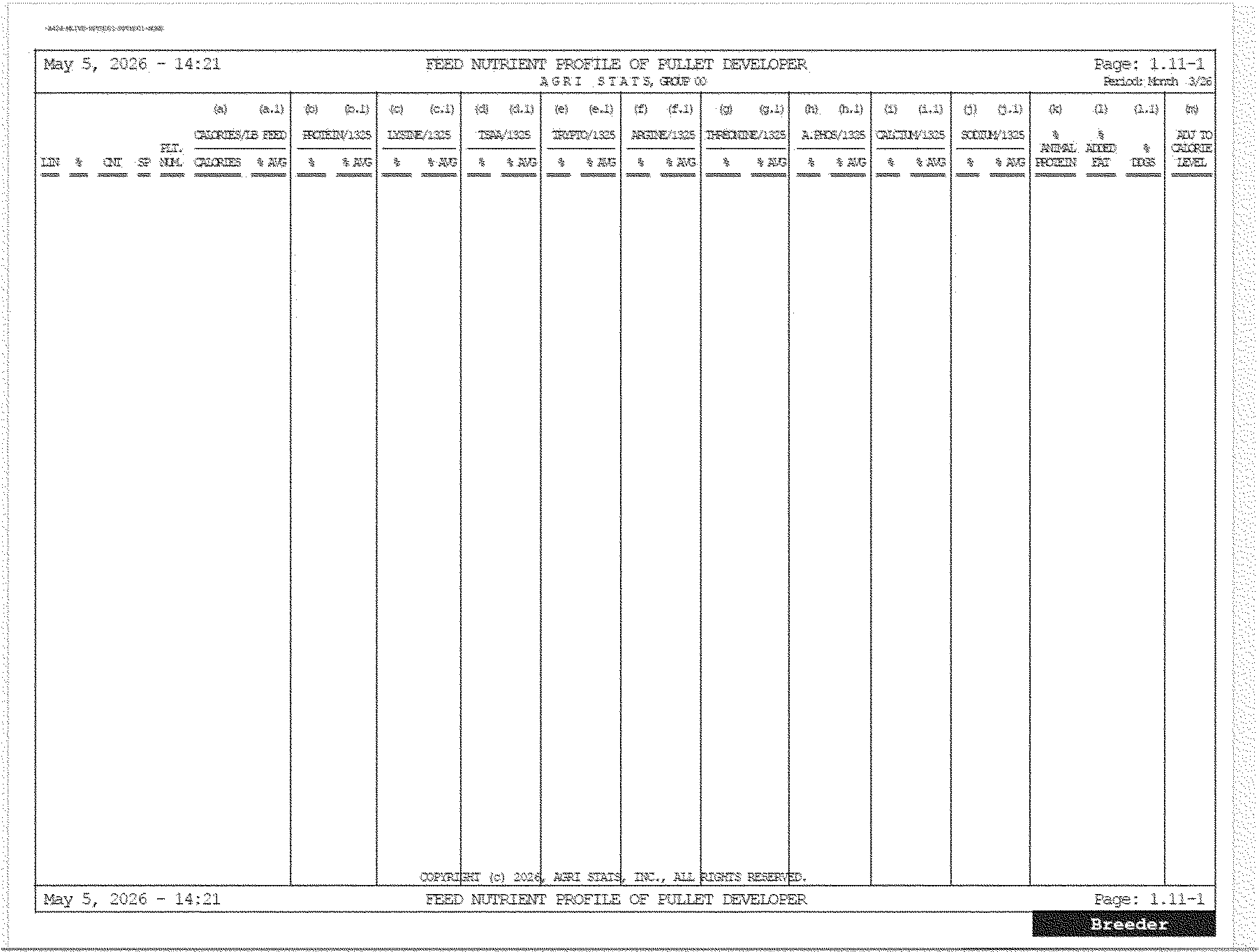
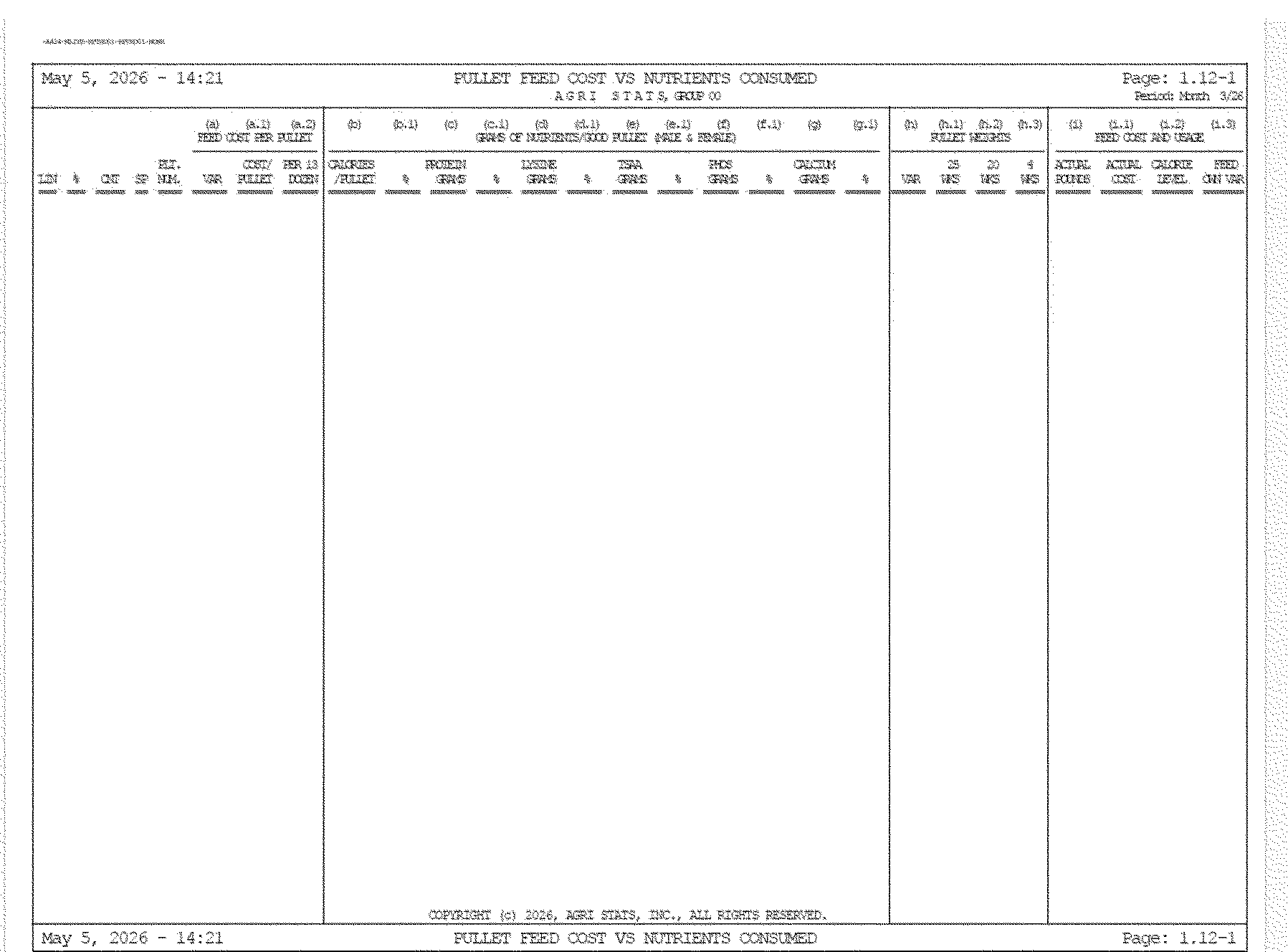
Exhibit B
Broiler Live Operations Metrics
A. Percent DOAs (6.3, 6.12, 6.17) (Completed).
B. Condemnations (5.1, 6.3, 6.10, 6.11, 6.17) (Completed).
C. Livability (6.1) (Completed).
D. Mortality (5.1, 5.8, 5.9, 5.10, 5.11, 5.12, 5.14, 5.14A, 5.14B, 5.14C, 5.15, 6.3, 6.4. 6.5, 6.5a, 6.6, 6.6a, 6.8, 6.10). (Completed).
E. Feed Calories (1.10, 1.17, 1.17a, 4.16, 5.1, 5.16, 6.6, 6.6a, 6.7, 6.10).
F. Feed Medication Usage and Rates (5.14A, 5.14A, 5.14B, 5.14C, 5.15).
G. Animal Stocking Density (6.5, 6.5a, 6.7, 6.10) (Completed)
H. Growth Rates (6.7, 6.17) (Completed).
I. Bird Age (6.1, 6.2, 6.3, 6.5, 6.5a, 6.6, 6.7, 6.8, 6.10, 6.11, 6.16, 6.17) (Completed)
J. Hatchery—Total BTU/Chick (2.5)
K. Hatchery—Total Cost/BTU (2.5)
L. Hatchery—Electrical BTU/Chick (2.5)
M. Hatchery—Electrical K/W Hrs/Chick (2.5)
N. Hatchery—Electrical $/K/W Hours (2.5)
O. Hatchery—Gas&Oil BTU's/Chick (2.5)
P. Hatchery—Gas&Oil $/BTU's (2.5)
Q. Feed Mfg—Total BTU/Ton (3.5)
R. Feed Mfg—Total Cost/BTU (3.5
S. Feed Mfg—Electrical BTU/Ton (3.5)
T. Feed Mfg—Electrical K/W Hrs/Ton (3.5)
U. Feed Mfg—Electrical $/K/W Hours (3.5)
V. Feed Mfg—Gas&Oil BTU's/Ton (3.5)
W. Feed Mfg—Gas&Oil $/BTU's (3.5)
X. Feed Delivery—Fuel Usage (3.7a, 3.9)
Y. Live Haul—Fuel Usage (6.15)
Broiler Processing Metrics
A. Hang to Stun Time (Processing 3.19)
B. Amperage at Stun (Processing 3.19)
C. Stun to Kill Time (Processing 3.19)
D. Kill to Scald Time (Processing 3.19)
E. Time in Scalder (Processing 3.19)
F. Scalder Temp (Processing 3.19)
G. Pre-Chiller Temp (Processing 3.19)
H. Animal Temp at Chiller Exit (Processing 3.19)
I. Bleed Time Minutes (Processing 3.19)
J. Total Water Usage—Gallons per Bird for 2nd Processing (Processing 4.4)
K. Total Water Usage—Gallons per Bird for 1st Processing (Processing 4.4)
L. Total Water Cost—$/1000 Gallons (Processing 4.4)
M. Total Water Usage—Water Source (Processing 4.4)
N. Total Electrical Usage—Cents Per Bird (Processing 2.7)
O. Total Electrical Usage—Dollars Per 100 Kilowatt Hours (Processing 2.7)
P. Gas and Oil Usage—Cents Per Bird (Processing 2.7)
Q. Gas and Oil Usage—BTU Per Bird (Processing 2.7)
R. Gas & Oil Usage—$/Mil BTU's (Processing 2.7)
S. Undergrade Paws—(Processing 5.21)
T. Undergrade Wings—(Processing 3.6)
U. DOA's—(Processing 3.1, 3.2) (Completed)
V. Condemnations—(Processing 2.9, 2.9a, 3.1, 3.2) (Completed)
Swine Live Metrics
A. Feed Mfg—Total BTU/Ton (3.5)
B. Feed Mfg—Total Cost/BTU (3.5
C. Feed Mfg—Electrical BTU/Ton (3.5)
D. Feed Mfg—Electrical K/W Hrs/Ton (3.5)
E. Feed Mfg—Electrical $/K/W Hours (3.5)
F. Feed Mfg—Gas&Oil BTU's/Ton (3.5)
G. Feed Mfg—Gas&Oil $/BTU's (3.5)
H. Feed Delivery—Fuel Usage (3.7a, 3.9)
I. Live Haul—Fuel Usage (9.3)
J. DOA's—(9.1)
K. Mortality—(6.10, 6.10a, 6.12, 6.13, 6.3, 6.3a, 6.4, 6.5, 6.5a, 6.8, 6.8a, 6.9, 6.98, 6.9a, 7.10, 7.10a, 7.12, 7.13, 7.3, 7.3a, 7.4, 7.5a, 7.8, 7.8a, 7.9, 7.95WF, 7.96WF, 7.97WF, 7.98, 7.99WF, 7.9a, 8.1a, 8.1b)
L. Age—(6.12, 6.13, 6.28, 6.28a, 6.28b, 6.3, 6.3a, 6.5, 6.5a, 6.8, 6.8a, 6.98, 7.12, 7.13, 7.28, 7.28a, 7.28b, 7.3, 7.3a, 7.5a, 7.8, 7.8a, 7.96WF, 7.98)
M. Medication Usage—(5.16, 6.27, 6.9a, 7.27, 7.9a)
N. Growth Rates—(6.12, 6.13, 6.26, 6.27, 6.28, 6.5, 6.5a, 6.8, 6.8a, 6.98, 7.12, 7.13, 7.26, 7.27, 7.28, 7.5a, 7.8, 7.8a, 7.96WF, 7.98)
United States District Court for the District of Minnesota
United States of America, State of Minnesota, State of California, State of North Carolina, State of Tennessee, State of Texas, and State of Utah, Plaintiffs, v. AGRI STATS, INC., Defendant.
No. 0:23-CV-03009-JRT-JFD
Competitive Impact Statement
In accordance with the Antitrust Procedures and Penalties Act, 15 U.S.C. 16(b)-(h) (the “APPA” or “Tunney Act”), the United States of America files this Competitive Impact Statement related to the proposed Final Judgment filed in this civil antitrust proceeding.
I. Nature and Purpose of the Proceeding
On September 28, 2023, the United States filed a civil antitrust complaint against Defendant Agri Stats, Inc. On November 6, 2023, the States of California, Minnesota, North Carolina, and Tennessee joined the suit through an amended complaint, followed by Texas and Utah on November 15, 2023 through a second amended complaint (the “Complaint”; the United States and the six Plaintiff States are collectively referred to as “Plaintiffs”).[26] The Complaint alleges that Agri Stats violated Section 1 of the Sherman Act, 15 U.S.C. 1, by engaging in anticompetitive information sharing in three protein markets—broiler chicken,[27] pork, and turkey. For years, Agri Stats recruited the nation's largest meat processors to send vast amounts of competitively sensitive information to Agri Stats to standardize and distribute in detailed reports on pricing, margins, inventories, and operations. This conduct inflated prices and reduced output of broiler chicken, pork, and turkey meat in the United States.
On May 7, 2026, Plaintiffs filed a proposed Final Judgment and a Stipulation and Order (both of which were corrected on May 15, 2026), designed to remedy the loss of competition alleged in the Complaint. See ECF 742; 748. Under the proposed Final Judgment, which is explained more fully below, Agri Stats is: (1) prohibited from sharing any sales reports or non-public pricing information between and among competing protein processors, (2) prohibited from sharing most production, cost, and labor data at the facility level between and among competing meat processors, (3) prohibited from providing any information to competing protein processors that is on average less than 45 days old, (4) required to make the vast majority of its reports available to all interested purchasers on reasonable and non-discriminatory terms, and (5) required to create and implement an antitrust compliance program. Additionally, the proposed Final Judgment requires the appointment of a Monitor to oversee Agri Stats' compliance with the proposed Final Judgment and imposes substantial penalties should Agri Stats violate these or other provisions of the Final Judgment in the future.
Under the terms of the Stipulation and Order, Agri Stats must comply with the provisions of the proposed Final Judgment until it is entered by the Court or until the time for all appeals of any Court ruling declining entry of the proposed Final Judgment has expired. On May 18, 2026, the Court entered the Stipulation and Order. ECF 749.
The United States and Agri Stats have stipulated that the proposed Final Judgment may be entered after compliance with the APPA. Entry of the proposed Final Judgment will terminate this action, except that the Court will retain jurisdiction to construe, modify, or enforce the provisions of the proposed Final Judgment.
II. Description of Events Giving Rise to the Alleged Violations
A. Competitive Concerns Raised by Information Sharing Among Competitors
1. Increased Market Observability
The exchange of competitively sensitive information among competitors can reduce competition and raise the risk of collusion by increasing ( printed page 34556) “market observability.” Market observability refers to the extent to which firms can observe their competitors' strategic choices, like changes in price, output, or other terms of dealing with customers.[28] When information sharing reflects those strategic choices, either directly or indirectly, it increases market observability.
Increased market observability through information sharing can reduce competition in multiple ways. First, even in the absence of collusion, market observability can reduce the intensity of competition between firms ( i.e., “softening competition”). Second, market observability can help sustain collusion, where there is an explicit or tacit understanding among competitors to suppress competition. Colluding competitors can use information sharing to determine if members of the conspiracy have deviated from the collusive agreement, enabling the conspirators to attempt to discipline the deviating members ( i.e., a “monitoring and punishment” system). Third, market observability can lay the foundation for future collusion by making a collusive agreement easier to implement and therefore more attractive.
Regarding the softening of competition, increased market observability through information sharing can reduce competition by helping firms predict how their competitors will react to competitive strategies. For example, when companies anticipate that their price cuts will be observed by their competitors—who may then cut prices in response—companies may refrain from cutting prices in the first place, factoring the mutual dependence of their businesses into their pricing strategies. Similarly, because output and costs are closely tied to pricing, information about companies' output, anticipated output, and costs can allow competitors to better predict how their rivals will price their goods. Additionally, in certain cases, information sharing may allow companies to identify efficient production practices implemented by their competitors. This can help less efficient firms become more efficient, but it can also reduce the incentives for firms to invest in innovation if competitors can quickly imitate the efficient firm and eliminate the competitive advantage gained by innovation.
Although information-sharing conduct should be assessed on a case-by-case basis, certain features of an information exchange tend to increase market observability and therefore pose greater likelihood of reducing competition, including the following:
Competitive sensitivity: Information that helps firms learn about competitors' strategic choices, including information related to prices, output, or costs, is particularly likely to increase market observability and reduce competition.
Granularity: Information that is disaggregated, particularly by company, customer, product, or geography, is generally more likely to increase market observability and reduce competition. However, even aggregated information ( e.g., averages), or information that is anonymized, may increase market observability and pose risks to competition. The competitive risk associated with granular information should be viewed as a spectrum and should be assessed on a case-specific basis.
Recency: Information that is recent provides greater market observability because it more likely reflects current market dynamics and allows firms to more effectively respond to their competitors' strategic choices. Like granularity, the competitive risk associated with recent information should be viewed as a spectrum and should be assessed on a case-by-case basis. To illustrate, information that is several months old may reflect current market dynamics when, for example, the information relates to contracts that are renewed only every six months or annually.
Reliability: The competitive risk of information sharing increases when the competitors trust the accuracy of the shared information. One way this can be accomplished is through an exchange that involves a trusted third party who audits and discloses the sources of the data.
2. Information Asymmetry
Information sharing can affect the negotiation process between buyers and sellers. When one side obtains information that the other side does not, the side with more information benefits from that information asymmetry. For example, information that provides insight into a buyer's willingness to pay for a particular seller's product can be important bargaining information for sellers, and information concerning the seller's cost of producing that good can be important bargaining information for buyers. In both cases, the information allows the party to more accurately predict the limits of what the counterparty will accept.
This concept also applies in situations with multiple buyers or sellers. For example, when there are multiple sellers of a good, the amount the buyer is willing to pay to a particular seller is directly influenced by the pricing of other sellers. If a buyer negotiates with one seller and knows that other sellers charge significantly less, the buyer will be less likely to accept the first seller's price. Similarly, if a seller knows that competing sellers are offering the same or higher prices, it will be less likely to negotiate a lower price.
B. Agri Stats' Anticompetitive Conduct
As alleged in the Complaint, prior to the entry of the Stipulation and Order and filing of the proposed Final Judgment, Agri Stats' business model consisted of collecting, standardizing, and redistributing competitively sensitive information concerning prices, output, costs, and profit margins among competing meat processors in the broiler chicken, pork, and turkey industries. After auditing and standardizing the information it collected from processors, Agri Stats shared this information through written reports, an interactive online portal from which processors could download and query data, and personalized consulting services. Agri Stats presented much of this data on a facility-by-facility and company-by-company basis, typically ranking participating processors in order of performance. Agri Stats usually identified each company and facility participating in each report. Agri Stats typically shared information either weekly (where the information was between 6 and 13 days old) or monthly (where the information was between 30 and 60 days old).
During negotiations and when making strategic decisions, meat processors benefited from the highly granular pricing information in Agri Stats' Sales Reports. This pricing information was based on Agri Stats' unique and highly granular product categorization. Agri Stats would assign an Agri Stats product code to each processor's products based on various specifications, such as cut, weight, packaging, and many other variables. Each product code included the most similar products sold by competitors. For example, Agri Stats would categorize chicken sold in the grocery store by type of cut ( e.g., boneless chicken breast), weight, packaging, method of preservation, and other variables, and would compare all chicken breast products meeting those specifications produced by any participating chicken processor. ( printed page 34557) Sometimes Agri Stats reported product categories with as few as two participating processors. Agri Stats' Sales Reports told a processor: (1) how its price compared to the national average and top 25% price for that product; (2) how much more the processor could make if it charged the national average price; (3) how much more the processor could make if it charged the average price of a processor in the top 25% of pricing; and (4) how the processor ranked compared to the other processors selling that product ( e.g., fifth out of six). As a result, a processor selling below the national average and ranked toward the bottom of companies selling that product knew it could likely successfully implement price increases because a buyer would have few alternatives to purchasing from the processor. Agri Stats also provided consulting services to processors regarding its Sales Reports. The sales consulting sessions typically involved an Agri Stats account manager going through detailed sales information with the processor and pointing out products and/or customers the processor should consider for price increases.
On the other side of the negotiations, purchasers of meat, like grocery stores and restaurants, lacked comparable information identifying products for which they paid above the national average. Agri Stats refused to sell its information to meat purchasers, as well as farmers, workers, and other entities that negotiate with processors and could have used Agri Stats' information to negotiate more effectively. These non-meat-processor market participants were interested in purchasing Agri Stats information, but Agri Stats refused to sell its reports or other services to them. The information available to these market participants through other market sources ( e.g., United States Department of Agriculture reporting) was less granular than Agri Stats' Sales Reports and—for broiler chicken and turkey—reported voluntarily.
Thus, the information exchanged through Agri Stats' written reports and consulting services had many of the hallmarks of an anticompetitive information exchange. The information Agri Stats collected, compiled, and provided to processors was competitively sensitive, granular, recent, reliable, and only available to one side of the market.
Competitively sensitive: The information in Agri Stats' Sales Reports included information about competitors' prices and identified all participants in each report. The Sales Reports and other reports also included information related to output, costs (including compensation paid to workers), and profit margins. Processors could use the individualized output information to monitor companies' current output levels and make predictions about future output. Processors could use individualized cost information to detect output trends and inform pricing strategies.
Granular: The information exchanged through Agri Stats was highly granular. Information in the Sales Reports was presented at the near-SKU level, comparing pricing of processors' individual products.[29] Information in the other reports was presented at the facility or company level.
Recent: Agri Stats shared weekly reports, including weekly Sales Reports, featuring information from the previous week. Agri Stats also shared information in monthly reports that included information usually one month in arrears ( i.e., 30-60 days old).
Reliable: Agri Stats received information directly from processors' accounting systems and then audited that information. Agri Stats also typically required processors to submit information for all their facilities to receive Agri Stats' reports and services. These practices prevented processors from selectively withholding or manipulating the information sent to Agri Stats.
Asymmetric: Agri Stats refused to sell any of the information it exchanged to meat purchasers, workers, farmers, and others. This created an information asymmetry in favor of the meat processors in negotiations because there is no equivalent publicly available data (free or by purchase) that has the detail and reliability of Agri Stats.
C. The Competitive Effects of Agri Stats' Conduct
Agri Stats' conduct caused anticompetitive effects in the broiler chicken, turkey, and pork markets in the United States. First, meat processors used Agri Stats information to identify which products they could raise prices on, but they did not use Agri Stats information to lower prices. Similarly, processors used Agri Stats information to monitor each other's production and future production plans. Processors used this information to inform their own production and pricing decisions, leading to output below competitive levels in all three of the markets.
Processors most flagrantly used information in Agri Stats' Sales Reports to harm competition. The Sales Reports provided highly granular pricing information by comparing each processor's cuts of meat to similar cuts sold by the processor's closest competitors. The sales information informed processors which of their products were relatively low priced compared to their competitors and identified where the processor ranked in terms of pricing. When a processor ranked as one of the lowest-priced processors, it knew that if it raised its price, customers would be unlikely to resist because most competing processors charged higher prices. Processors used the sales information systematically to target products and customers for price increases in all three markets.
Second, econometric evidence performed by Plaintiffs' economic expert, Professor Marc Rysman, Ph.D., empirically confirmed that Agri Stats' conduct harmed competition in each of the three markets. In the broiler chicken market, Professor Rysman examined how processors used Agri Stats' Sales Reports by comparing (1) the likelihood of price increases on products Agri Stats indicated were relatively low priced with (2) the likelihood of price decreases on products Agri Stats indicated were relatively high priced. In a competitive market, economic theory predicts that relatively high prices would decrease at roughly the same rate as relatively low prices would increase, all other things being equal—a phenomenon known as “reversion to the mean.” Professor Rysman's regression analysis showed that processors were nearly twice as likely to raise prices on products Agri Stats indicated were underpriced than they were to lower prices on products Agri Stats indicated were overpriced.[30] This empirical evidence confirmed documentary evidence that showed processors systematically using Agri Stats to target prices increases while not using Agri Stats to target price decreases.
In addition, Agri Stats suspended its reporting of information related to the markets for pork and turkey in response to private antitrust litigation. Professor Rysman therefore could measure Agri Stats' effects on prices when Agri Stats exited those markets. Professor Rysman found that after accounting for other factors that affect prices, pork prices fell up to 14.7% when pork processors ( printed page 34558) stopped participating in Agri Stats, and turkey prices decreased by up to 13.6% when turkey processors stopped participating in Agri Stats. Agri Stats also previously introduced and subsequently ended a program related to reporting information on bacon. Professor Rysman's analysis similarly found that after Agri Stats began reporting information about bacon, bacon prices increased by over 20% and that after Agri Stats ended its bacon reporting, bacon prices fell approximately 8.6%.
III. Explanation of the Proposed Final Judgment
The relief required by the proposed Final Judgment will remedy the harm to competition alleged in the Complaint. The terms described below are designed to ensure that Agri Stats ends its anticompetitive conduct and prevent Agri Stats from engaging in the same or similar conduct in the future.
A. Cessation of Sales Reports
Section IV of the proposed Final Judgment prohibits Agri Stats from offering Sales Reports or providing consulting advice based on pricing information. Agri Stats included in its Sales Reports detailed and granular price information and designed its Sales Reports to allow processors to use that detailed information to find opportunities to raise prices on their products. Processors used Agri Stats' Sales Reports systematically for decades to raise prices. Like the rest of Agri Stats' reporting, the Sales Reports were not offered to market participants other than processors, creating significant information asymmetries. Because of the history of Agri Stats' anticompetitive conduct, the United States and Plaintiff States required a full cessation, rather than modification, of Agri Stats' Sales Reports to remedy the significant anticompetitive effects flowing from Agri Stats' exchange of sales information.
While Agri Stats is prohibited from offering Sales Reports, Paragraph V.E of the proposed Final Judgment allows Agri Stats' subsidiary, Express Markets, Inc. (“EMI”), to continue offering its current price reporting in the same manner as it currently does. EMI's price reports differ from Agri Stats' Sales Reports in several ways: (1) historically, all market participants can (and many do) purchase EMI's information, avoiding the information asymmetry between buyers and sellers caused by Agri Stats' Sales Reports; (2) EMI presents its information to its customers at a significantly higher level of aggregation and does not provide facility or company-level information for competitors; and (3) EMI does not provide participant lists or otherwise indicate which processors' data it has included in the reporting.
Additionally, Paragraph V.E of the proposed Final Judgment imposes restrictions that ensure EMI cannot become a vehicle for reintroducing Agri Stats' Sales Reports, which the proposed Final Judgment expressly prohibits. See Paragraph V.E.6. In particular, the proposed Final Judgment requires EMI to continue making its price reporting publicly available for purchase by any interested party and prohibits EMI from identifying the processors who submit pricing data. Moreover, to the extent EMI seeks to add any new product categories to its price reports, Paragraph V.E.2 of the proposed Final Judgment requires EMI to provide notice and detailed information to the Monitor, the United States, and the Plaintiff States. Any new product category in EMI's price reporting must include at least five processors, and no individual processor can make up more than 50% of total sales of that category. In addition, any new product category must be requested by customers that are not meat processors. Under Paragraph V.E.2.a.ii of the proposed Final Judgment, the United States may object and prevent publication if the product category does not meet these requirements. Ultimately, the distinctions between EMI and Agri Stats reporting (and the restrictions imposed on those respective reports) ensure that the allowances for EMI will not diminish the efficacy of the relief secured by the proposed Final Judgment.
B. Prohibition on Granular Data
Under the proposed Final Judgment, Agri Stats is permitted to continue reporting non-sales information, but with significant restrictions to ensure that reporting cannot be used in ways that are anticompetitive. Previously, many Agri Stats reports contained granular information at the individual facility or company level, giving processors detailed visibility into their competitors' operations. Paragraph IV.B.4 of the proposed Final Judgment prohibits Agri Stats, with limited exceptions, from reporting production, cost, and labor data specific to the facility, complex, or company level, instead requiring Agri Stats to provide only aggregated industry averages or industry averages by quartile. In addition, Agri Stats can no longer report information about the number and identity of participants in a report, nor how the processor customer ranks on specific metrics by comparison to other participants. These prohibitions eliminate significant anticompetitive aspects of Agri Stats reporting.
C. Public Availability
Paragraph VI.C of the proposed Final Judgment ensures that the metrics remaining in Agri Stats reports will be made available for purchase on reasonable and non-discriminatory terms by interested purchasers, addressing the information asymmetry issues that were a core feature of Agri Stats' anticompetitive information exchanges. Paragraph VI.C.1 requires that Agri Stats must make monthly reports available for non-meat processors to sample before Agri Stats may charge yearly subscriptions to those non-meat processors. Paragraph VI.C.5 prohibits Agri Stats from requiring non-meat processors to contribute data or otherwise conditioning their purchase of Agri Stats reports on a requirement to purchase any other product or service. Paragraph VI.C.5 also requires Agri Stats to publicize in a conspicuous manner on its website that its reports are publicly available for purchase.
The proposed Final Judgment also ensures that Agri Stats cannot price discriminate against non-meat processors in a way that would de facto prevent public availability (and thus preserve information asymmetry). Paragraph VI.C.4 prohibits Agri Stats from requiring report buyers to agree to price or non-price terms that are meant to discourage or prevent non-meat processors from purchasing reports. Paragraph VI.C.3 prohibits Agri Stats from charging non-meat processors a higher price than the average price paid by small meat processors (who only have a single complex) on a report-by-report basis.
The only limited exceptions to the public availability requirements, as memorialized in Paragraph V.B, involve information for which evidence in the case did not indicate anticompetitive potential.
D. Data Confidentiality and Recency Restrictions
Paragraph VI.D of the proposed Final Judgment requires Agri Stats to adhere to certain restrictions, ensuring that it maintains the confidentiality of data. In particular, Paragraph VI.D.1 requires that for all statistics Agri Stats reports that reflect at least 50% of the sales for a protein segment, the statistic must contain data from at least three processors, with no processor representing more than 70% of the data reflected in the report. For Agri Stats reports that contain quartile averages, Paragraph VI.D.2 requires that Agri Stats ( printed page 34559) ensure each quartile average is calculated from at least three complexes in that quartile.
Paragraph VI.E requires that every statistic in an Agri Stats report be composed of data that is at least (i) cumulatively 45 days old on average, and (ii) in the case of data that reflects production decisions, at least 90 days old from the time of that production decision. The phrase “cumulatively 45 days old on average” reflects that Agri Stats' reporting typically involves data from a date range occurring between approximately 30-60 days prior to publication in a report. Under Paragraph VI.E of the proposed Final Judgment, data for a given month will not be included in an Agri Stats Report until the first day of the second month after the given month ( e.g., February data will not be included in an Agri Stats Report until April 1). Accordingly, for a report sent on April 1 that contains data from February, that data will vary from 59 days old to 32 days old, but will average to 45.5 days old.
These requirements, combined with public availability and the exclusion of facility-level data, address the concern that processors can use Agri Stats reports to effectively monitor output decisions by their competitors and either coordinate a reduction in output or make pricing decisions based on non-public information about competitor-specific or industry-wide output.
E. Monitor
Section VII of the proposed Final Judgment requires that Agri Stats be subject to an appointed Monitor selected by the United States. The Monitor will have the power and authority to investigate and report on Agri Stats' compliance with the terms of the Final Judgment and the Stipulation and Order, including Agri Stats' obligations with respect to cessation of Sales Reports, changes to its non-sales reports, data confidentiality, restrictions on recency of data, the requirement to make reports publicly available, and Agri Stats' antitrust compliance program.
The Monitor will serve at Agri Stats' expense and Agri Stats must assist the monitor in fulfilling his or her obligations. The Monitor will have the authority to take the steps necessary to accomplish his or her responsibilities and will provide periodic reports to the United States and the Plaintiff States describing Agri Stats' compliance with the terms of the Final Judgment. The Monitor will serve for seven years unless the United States determines that a shorter period is appropriate.
F. Compliance and Enforcement
The proposed Final Judgment also contains provisions designed to promote compliance with and make enforcement of the Final Judgment as effective as possible. Paragraph XII.A provides that the United States and Plaintiff States have the right to seek additional relief from the Court if the United States or the Plaintiff States determine that the monitorship has failed to secure Agri Stats' compliance with the terms of the Final Judgment or that Agri Stats has failed to use best efforts to cooperate with and assist the Monitor in his or her duties.
Paragraph XII.B provides that the United States retains and reserves all rights to enforce the Final Judgment, including the right to seek an order of contempt from the Court. Under the terms of this paragraph, Agri Stats has agreed that in any civil contempt action, any motion to show cause, or any similar action brought by the United States regarding an alleged violation of the Final Judgment, the United States may establish the violation and the appropriateness of any remedy by a preponderance of the evidence and that Agri Stats has waived any argument that a different standard of proof should apply. This provision aligns the standard for compliance with the Final Judgment with the standard of proof that applies to the underlying offenses that the Final Judgment addresses.
Paragraph XII.C provides additional clarification regarding the interpretation of the provisions of the proposed Final Judgment. The proposed Final Judgment is intended to remedy the loss of competition the United States alleges that Agri Stats has caused. Agri Stats agrees that it will abide by the proposed Final Judgment and that it may be held in contempt of the Court for failing to comply with any provision of the proposed Final Judgment that is stated specifically and in reasonable detail, as interpreted in light of this procompetitive purpose.
Paragraph XII.D provides that if the Court finds in an enforcement proceeding that Agri Stats has violated the Final Judgment, the United States may apply to the Court for an extension of the Final Judgment, together with such other relief as may be appropriate. In addition, to compensate American taxpayers for any costs associated with investigating and enforcing violations of the Final Judgment, Paragraph XII.D provides that, in any successful effort by the United States to enforce the Final Judgment against Agri Stats, whether litigated or resolved before litigation, Agri Stats must reimburse the United States for attorneys' fees, experts' fees, and other costs incurred in connection with that effort to enforce the Final Judgment, including the investigation of the potential violation.
Paragraph XII.E states that the United States may file an action against Agri Stats for violating the Final Judgment for up to four years after the Final Judgment has expired or been terminated. This provision is meant to address circumstances such as when evidence that a violation of the Final Judgment occurred during the term of the Final Judgment is not discovered until after the Final Judgment has expired or been terminated or when there is not sufficient time for the United States to complete an investigation of an alleged violation until after the Final Judgment has expired or been terminated. This provision, therefore, makes clear that, for four years after the Final Judgment has expired or been terminated, the United States may still challenge a violation that occurred during the term of the Final Judgment.
Finally, Section XIII of the proposed Final Judgment provides that the Final Judgment will expire ten years from the date of its entry. However, after seven years from the date of its entry, the Final Judgment may be terminated upon motion to the Court and notice to Agri Stats provided by the United States, with the consent of all Plaintiffs, that continuation of the Final Judgment is no longer necessary or in the public interest.
IV. Remedies Available to Potential Private Plaintiffs
Section 4 of the Clayton Act, 15 U.S.C. 15, provides that any person who has been injured as a result of conduct prohibited by the antitrust laws may bring suit in federal court to recover three times the damages the person has suffered, as well as costs and reasonable attorneys' fees. Entry of the proposed Final Judgment neither impairs nor assists the bringing of any private antitrust damage action. Under the provisions of Section 5(a) of the Clayton Act, 15 U.S.C. 16(a), the proposed Final Judgment has no prima facie effect in any subsequent private lawsuit that may be brought against Agri Stats.
V. Procedures Available for Modification of the Final Judgment
The United States, Plaintiff States, and Agri Stats have stipulated that the proposed Final Judgment may be entered by the Court after compliance with the provisions of the APPA, provided that the United States has not withdrawn its consent. The APPA ( printed page 34560) conditions entry upon the Court's determination that the proposed Final Judgment is in the public interest.
The APPA provides a period of at least 60 days preceding the effective date of the proposed Final Judgment within which any person may submit to the United States written comments regarding the proposed Final Judgment. Any person who wishes to comment should do so within 60 days of the date of publication of this Competitive Impact Statement in the Federal Register , or within 60 days of the first date of publication in a newspaper of the summary of this Competitive Impact Statement, whichever is later. All comments received during this period will be considered by the U.S. Department of Justice, which remains free to withdraw its consent to the proposed Final Judgment at any time before the Court's entry of the Final Judgment. The comments and the response of the United States will be filed with the Court. In addition, the comments and the United States' response will be published in the Federal Register unless the Court agrees that the United States instead may publish them on the U.S. Department of Justice, Antitrust Division's internet website.
Written comments should be submitted in English to:
Kate Riggs, Chief, Anti-Monopoly and Collusion Enforcement Section, Antitrust Division, United States Department of Justice, 450 Fifth Street NW, Washington, DC 20530, ATR.Public-Comments-Tunney-Act-MB@usdoj.gov.
The proposed Final Judgment provides that the Court retains jurisdiction over this action, and the parties may apply to the Court for any order necessary or appropriate for the modification, interpretation, or enforcement of the Final Judgment.
VI. Alternatives to the Proposed Final Judgment
As an alternative to the proposed Final Judgment, the United States considered proceeding to trial on the merits against Agri Stats. The United States could have continued the litigation and, upon a finding of liability, sought injunctive relief against Agri Stats' anticompetitive conduct. The United States is satisfied, however, that the relief required by the proposed Final Judgment will remedy the anticompetitive effects alleged in the Complaint. Thus, the proposed Final Judgment achieves all or substantially all the relief the United States would have obtained through litigation without the time, expense, and uncertainty of a full trial on the merits.
VII. Standard of Review Under the APPA for the Proposed Final Judgment
Under the Clayton Act and APPA, proposed Final Judgments, or “consent decrees,” in antitrust cases brought by the United States are subject to a 60-day comment period, after which the Court shall determine whether entry of the proposed Final Judgment “is in the public interest.” 15 U.S.C. 16(e)(1). In making that determination, the Court, in accordance with the statute as amended in 2004, is required to consider:
(A) the competitive impact of such judgment, including termination of alleged violations, provisions for enforcement and modification, duration of relief sought, anticipated effects of alternative remedies actually considered, whether its terms are ambiguous, and any other competitive considerations bearing upon the adequacy of such judgment that the court deems necessary to a determination of whether the consent judgment is in the public interest; and
(B) the impact of entry of such judgment upon competition in the relevant market or markets, upon the public generally and individuals alleging specific injury from the violations set forth in the complaint including consideration of the public benefit, if any, to be derived from a determination of the issues at trial.
15 U.S.C. 16(e)(1)(A) & (B). In considering these statutory factors, the Court's inquiry is necessarily a limited one as the government is entitled to “broad discretion to settle with the defendant within the reaches of the public interest.” United States v. Microsoft Corp., 56 F.3d 1448, 1461 (D.C. Cir. 1995); United States v. Associated Milk Producers, Inc., 534 F.2d 113, 117 (8th Cir. 1976) (“It is axiomatic that the Attorney General must retain considerable discretion in controlling government litigation and in determining what is in the public interest.”); United States v. U.S. Airways Grp., Inc., 38 F. Supp. 3d 69, 75 (D.D.C. 2014) (explaining that the “court's inquiry is limited” in Tunney Act settlements); United States v. InBev N.V./S.A., No. 08-cv-1965, 2009 U.S. Dist. LEXIS 84787, at *3 (D.D.C. Aug. 11, 2009) (stating that a court's review of a proposed Final Judgment is limited and only inquires “into whether the government's determination that the proposed remedies will cure the antitrust violations alleged in the complaint was reasonable, and whether the mechanisms to enforce the final judgment are clear and manageable”).
As the U.S. Court of Appeals for the District of Columbia Circuit has held, under the APPA a court considers, among other things, the relationship between the remedy secured and the specific allegations in the government's Complaint, whether the proposed Final Judgment is sufficiently clear, whether its enforcement mechanisms are sufficient, and whether it may positively harm third parties. See Microsoft, 56 F.3d at 1458-62. With respect to the adequacy of the relief secured by the proposed Final Judgment, a court may not “make de novo determination of facts and issues.” United States v. W. Elec. Co., 993 F.2d 1572, 1577 (D.C. Cir. 1993) (quotation marks omitted); see also Microsoft, 56 F.3d at 1460-62; United States v. Alcoa, Inc., 152 F. Supp. 2d 37, 40 (D.D.C. 2001); United States v. Enova Corp., 107 F. Supp. 2d 10, 16 (D.D.C. 2000); InBev, No. 08-cv-1965, 2009 U.S. Dist. LEXIS 84787, at *3. Instead, “[t]he balancing of competing social and political interests affected by a proposed antitrust decree must be left, in the first instance, to the discretion of the Attorney General.” W. Elec. Co., 993 F.2d at 1577 (quotation marks omitted). “The court should also bear in mind the flexibility of the public interest inquiry: the court's function is not to determine whether the resulting array of rights and liabilities is the one that will best serve society, but only to confirm that the resulting settlement is within the reaches of the public interest.” Microsoft, 56 F.3d at 1460 (quotation marks omitted); see also United States v. Deutsche Telekom AG, No. 19-cv-2232 (TJK), 2020 WL 1873555, at *7 (D.D.C. Apr. 14, 2020). More demanding requirements would “have enormous practical consequences for the government's ability to negotiate future settlements,” contrary to congressional intent. Microsoft, 56 F.3d at 1456. “The Tunney Act was not intended to create a disincentive to the use of the consent decree.” Id.; see also United States v. Mid-Am. Dairymen, Inc., No. 73-cv-681-W-1, 1977 WL 4352, at *9 (W.D. Mo. May 17, 1977) (“It was the intention of Congress in enacting [the] APPA to preserve consent decrees as a viable enforcement option in antitrust cases.”).
The United States' predictions about the efficacy of the remedy are to be afforded deference by the Court. See, e.g., Microsoft, 56 F.3d at 1461 (recognizing courts should give “due respect to the Justice Department's . . . view of the nature of its case”); United States v. Iron Mountain, Inc., 217 F. Supp. 3d 146, 152-53 (D.D.C. 2016) (“In evaluating objections to settlement agreements under the Tunney Act, a court must be mindful that [t]he government need not prove that the ( printed page 34561) settlements will perfectly remedy the alleged antitrust harms[;] it need only provide a factual basis for concluding that the settlements are reasonably adequate remedies for the alleged harms.” (citation modified)); United States v. Republic Servs., Inc., 723 F. Supp. 2d 157, 160 (D.D.C. 2010) (noting “the deferential review to which the government's proposed remedy is accorded”); United States v. Archer-Daniels-Midland Co., 272 F. Supp. 2d 1, 6 (D.D.C. 2003) (“A district court must accord due respect to the government's prediction as to the effect of proposed remedies, its perception of the market structure, and its view of the nature of the case.”). The ultimate question is whether “the remedies [obtained by the Final Judgment are] so inconsonant with the allegations charged as to fall outside of the `reaches of the public interest.' ” Microsoft, 56 F.3d at 1461 ( quoting W. Elec. Co., 900 F.2d at 309).
Moreover, the Court's role under the APPA is limited to reviewing the remedy in relationship to the violations that the United States has alleged in its Complaint, and the APPA does not authorize the Court to “construct [its] own hypothetical case and then evaluate the decree against that case.” Microsoft, 56 F.3d at 1459; see also U.S. Airways, 38 F. Supp. 3d at 75 (noting that the court must simply determine whether there is a factual foundation for the government's decisions such that its conclusions regarding the proposed settlements are reasonable); InBev, No. 08-cv-1965, 2009 U.S. Dist. LEXIS 84787, at *20 (“[T]he `public interest' is not to be measured by comparing the violations alleged in the complaint against those the court believes could have, or even should have, been alleged.”). Because the “court's authority to review the decree depends entirely on the government's exercising its prosecutorial discretion by bringing a case in the first place,” it follows that “the court is only authorized to review the decree itself,” and not to “effectively redraft the complaint” to inquire into other matters that the United States did not pursue. Microsoft, 56 F.3d at 1459-60.
In its 2004 amendments to the APPA, Congress made clear its intent to preserve the practical benefits of using judgments proposed by the United States in antitrust enforcement, Public Law 108-237 § 221, and added the unambiguous instruction that “[n]othing in this section shall be construed to require the court to conduct an evidentiary hearing or to require the court to permit anyone to intervene.” 15 U.S.C. 16(e)(2); see also U.S. Airways, 38 F. Supp. 3d at 76 (indicating that a court is not required to hold an evidentiary hearing or to permit intervenors as part of its review under the Tunney Act). This language explicitly wrote into the statute what Congress intended when it first enacted the Tunney Act in 1974. As Senator Tunney explained: “[t]he court is nowhere compelled to go to trial or to engage in extended proceedings which might have the effect of vitiating the benefits of prompt and less costly settlement through the consent decree process.” 119 Cong. Rec. 24,598 (1973) (statement of Sen. Tunney). “A court can make its public interest determination based on the competitive impact statement and response to public comments alone.” U.S. Airways, 38 F. Supp. 3d at 76 (citing Enova Corp., 107 F. Supp. 2d at 17).
VIII. Determinative Documents
There are no determinative materials or documents within the meaning of the APPA that were considered by the United States in formulating the proposed Final Judgment.
Dated: May 21, 2026.
Respectfully submitted,
For Plaintiff United States of America:
Mark H.M. Sosnowsky,
Mark H.M. Sosnowsky, Acting Deputy Director of Civil Litigation.
United States Department of Justice, Antitrust Division, 450 Fifth St. NW, Suite 8000, Washington, DC 20530, Telephone: 202-412-7316, Email: mark.sosnowsky@usdoj.gov.