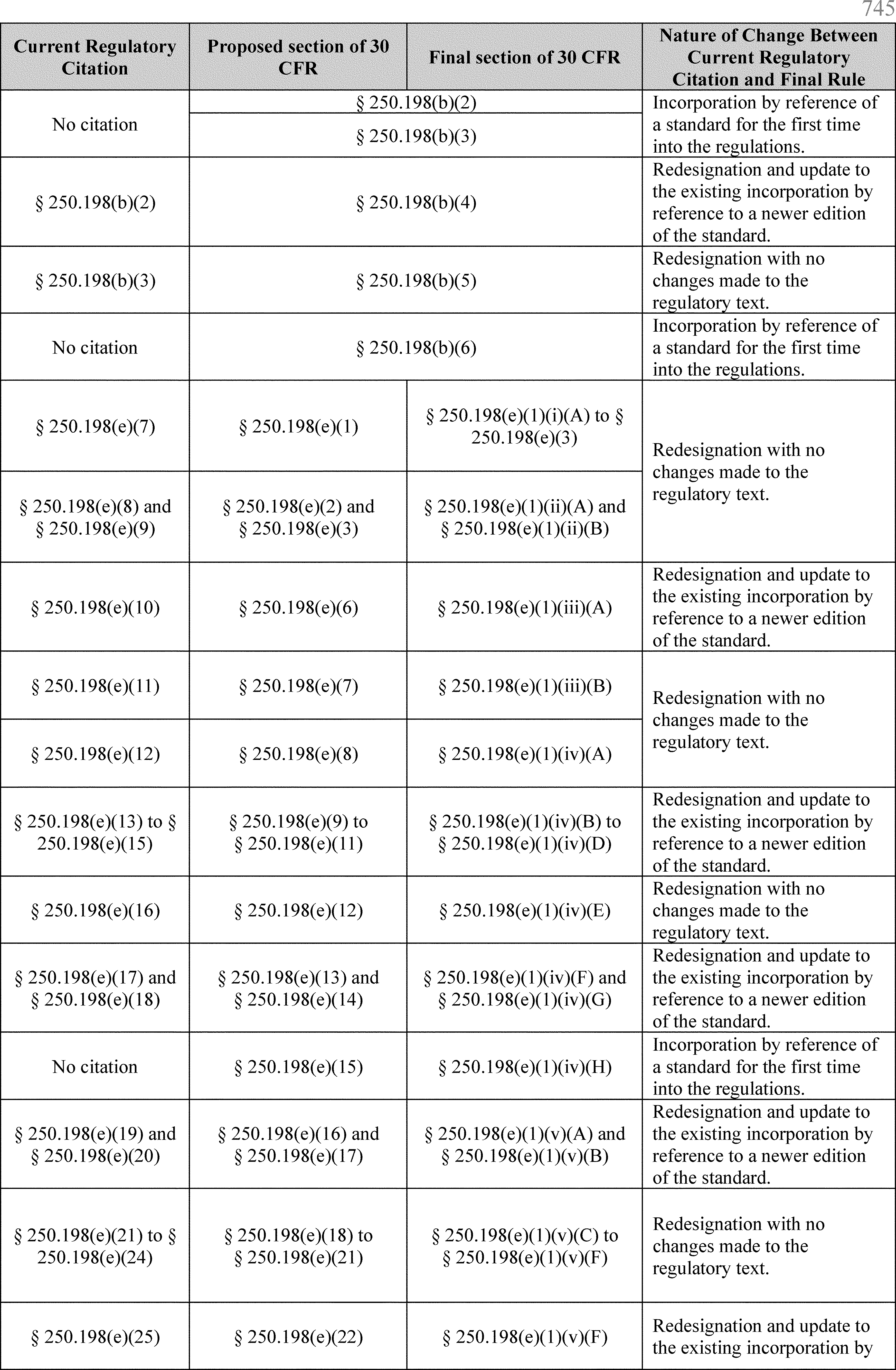
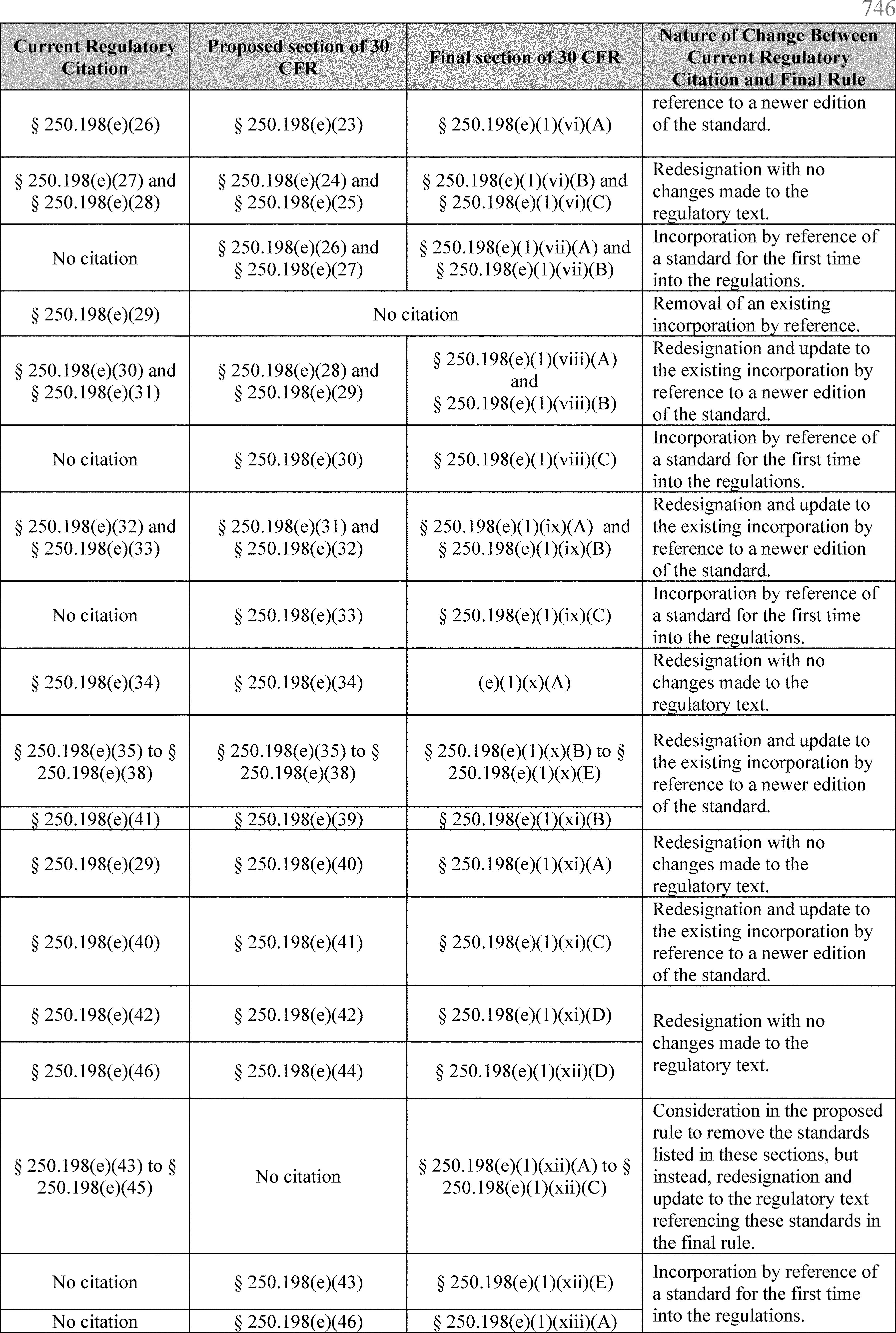
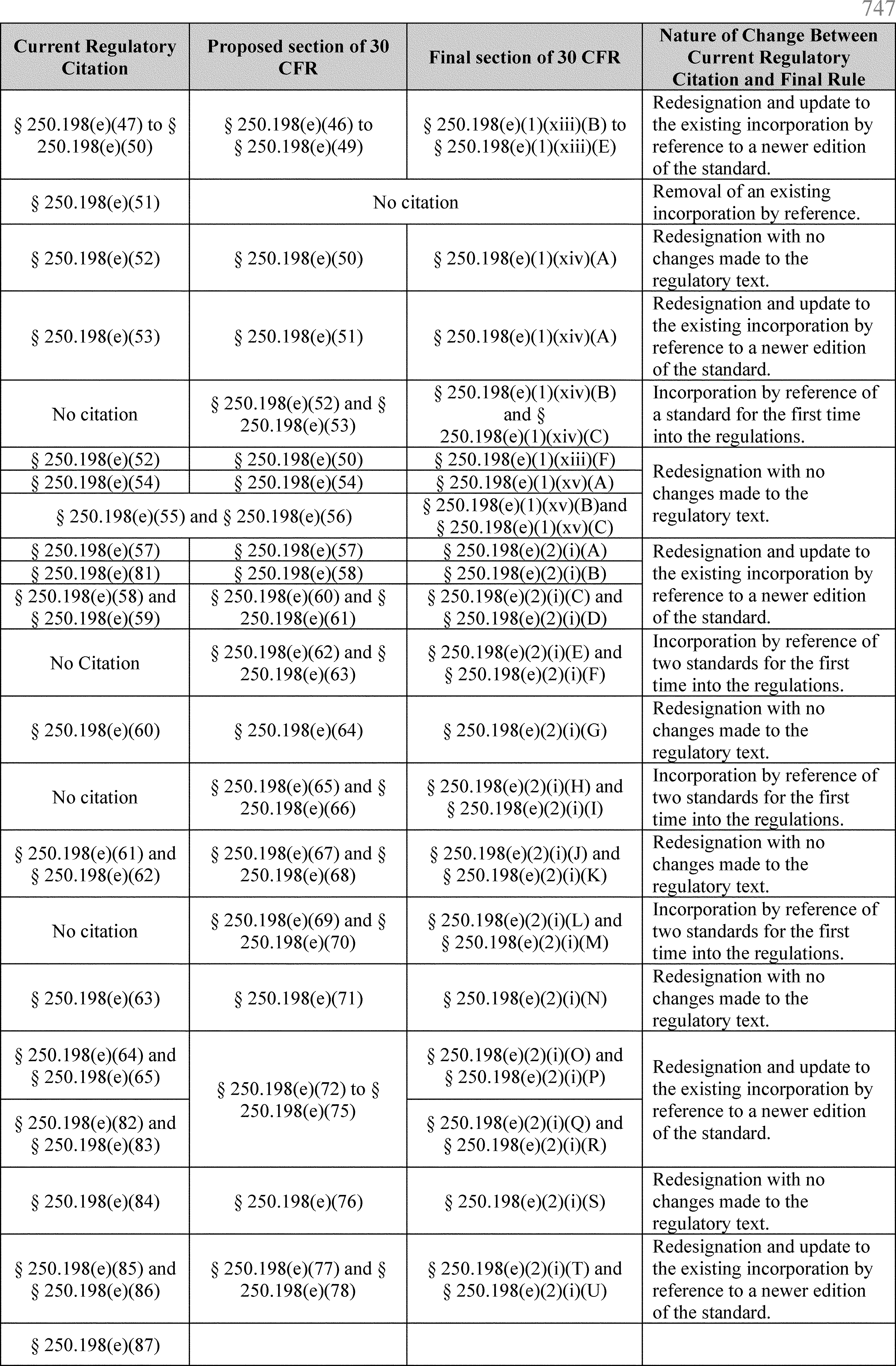
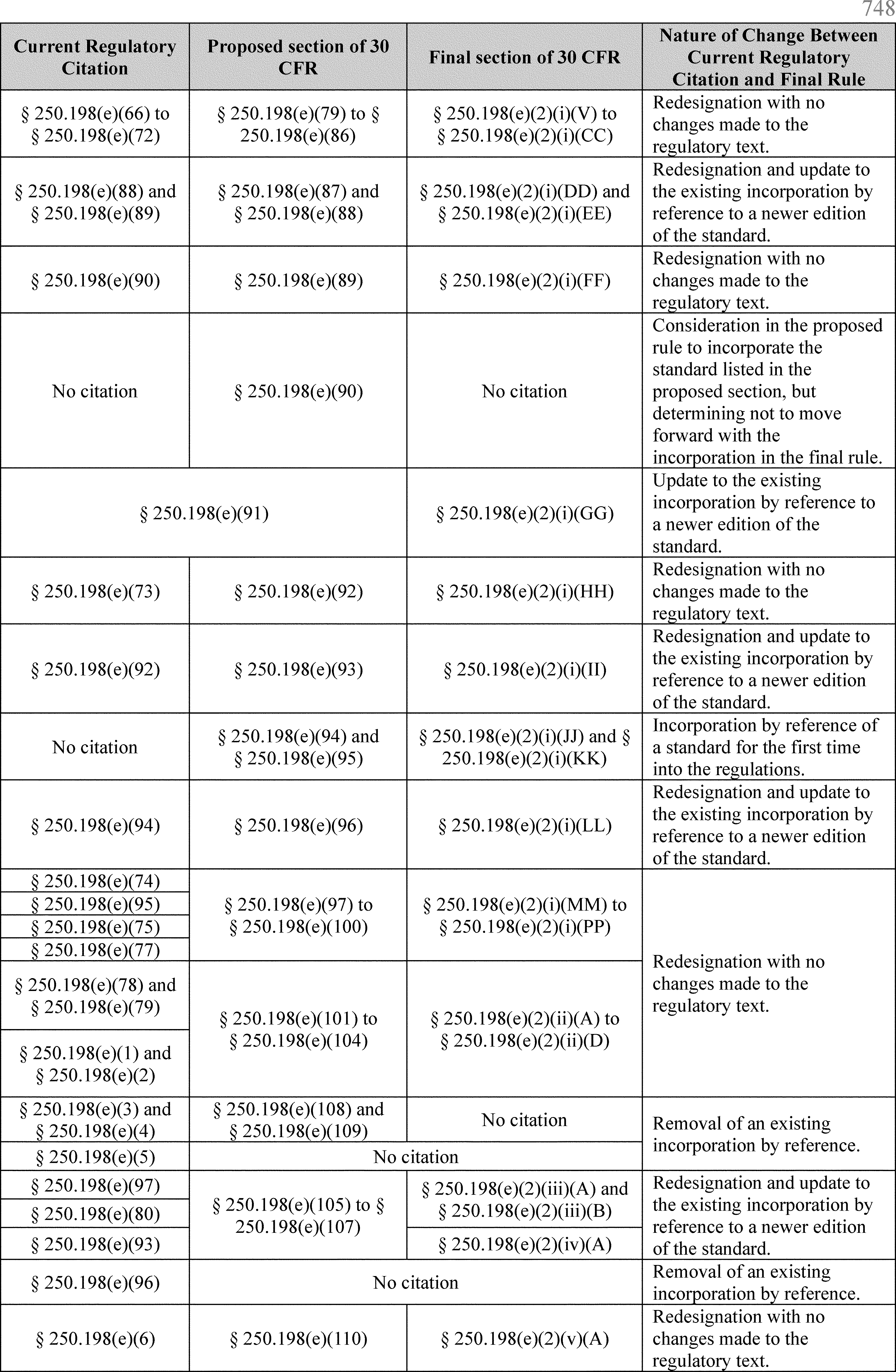
Oil and Gas and Sulfur Operations in the Outer Continental Shelf-Documents Incorporated by Reference
The Department of the Interior (DOI or Department), through the Bureau of Safety and Environmental Enforcement (BSEE), is incorporating by reference a collection of production m...
Bureau of Safety and Environmental Enforcement, Interior.
ACTION:
Final rule.
SUMMARY:
The Department of the Interior (DOI or Department), through the Bureau of Safety and Environmental Enforcement (BSEE), is incorporating by reference a collection of production measurement industry standards and safety industry standards into its regulations governing oil, gas, and sulfur operations on the Outer Continental Shelf (OCS). Incorporation of these documents by reference will provide industry with up-to-date standards for measuring oil and gas production volumes and enhancing safety. Compliance with these standards will reduce uncertainty in the measurement of oil and gas production and update the minimum standards in the safety regulations.
DATES:
This final rule is effective on August 10, 2026. The incorporation by reference of certain material listed in this rule is approved for use by the Director of the Federal Register beginning “August 10, 2026.” The incorporation by reference of certain other material listed in this rule was approved for use by the Director of the Federal Register as of July 15, 2019, February 26, 2021, and October 29, 2024.
FOR FURTHER INFORMATION CONTACT:
For technical or procedural questions contact Alton Payne at 713-220-9204, or David Izon at 703-787 1706, or by email:
standards@bsee.gov.
SUPPLEMENTARY INFORMATION:
Executive Summary
This final rule incorporates a total of 23 standards that have not previously been incorporated by reference into the regulations and updates the incorporation of 40 standards already referenced in the regulations. The updates to these 40 existing standards entail either incorporating newer editions of, addenda to, amendments to, or reaffirmations of the standards. The new standards and the updates to existing standards were developed by the American Petroleum Institute (API), the American Gas Association (AGA), GPA Midstream Association (GPA), and American Society of Mechanical Engineers (ASME), and address oil and gas measurement technologies and safety design factors related to oil and gas operations on the OCS. The documents that address oil and gas measurement technologies reflect the latest measurement standards, and their incorporation will provide industry with up-to-date requirements for measurement technology. The safety-related documents comprise four integrity management standards, two offshore structure standards, two bolting/metallurgy standards, and one well workover standard. The incorporation by reference (IBR) of these standards will help ensure that BSEE's regulations reflect improvements in operational safety and recognize advancements in science and technology, including those advancements related to measurement accuracy.
Table of Contents
I. Background
A. BSEE Statutory and Regulatory Authority and Responsibilities
B. Purpose and Summary of the Rule
C. Summary of Documents Incorporated by Reference
II. Discussion of Public Comments on the Proposed Rule
III. Section-by-Section Summary and Responses to Comments on the Proposed Rule
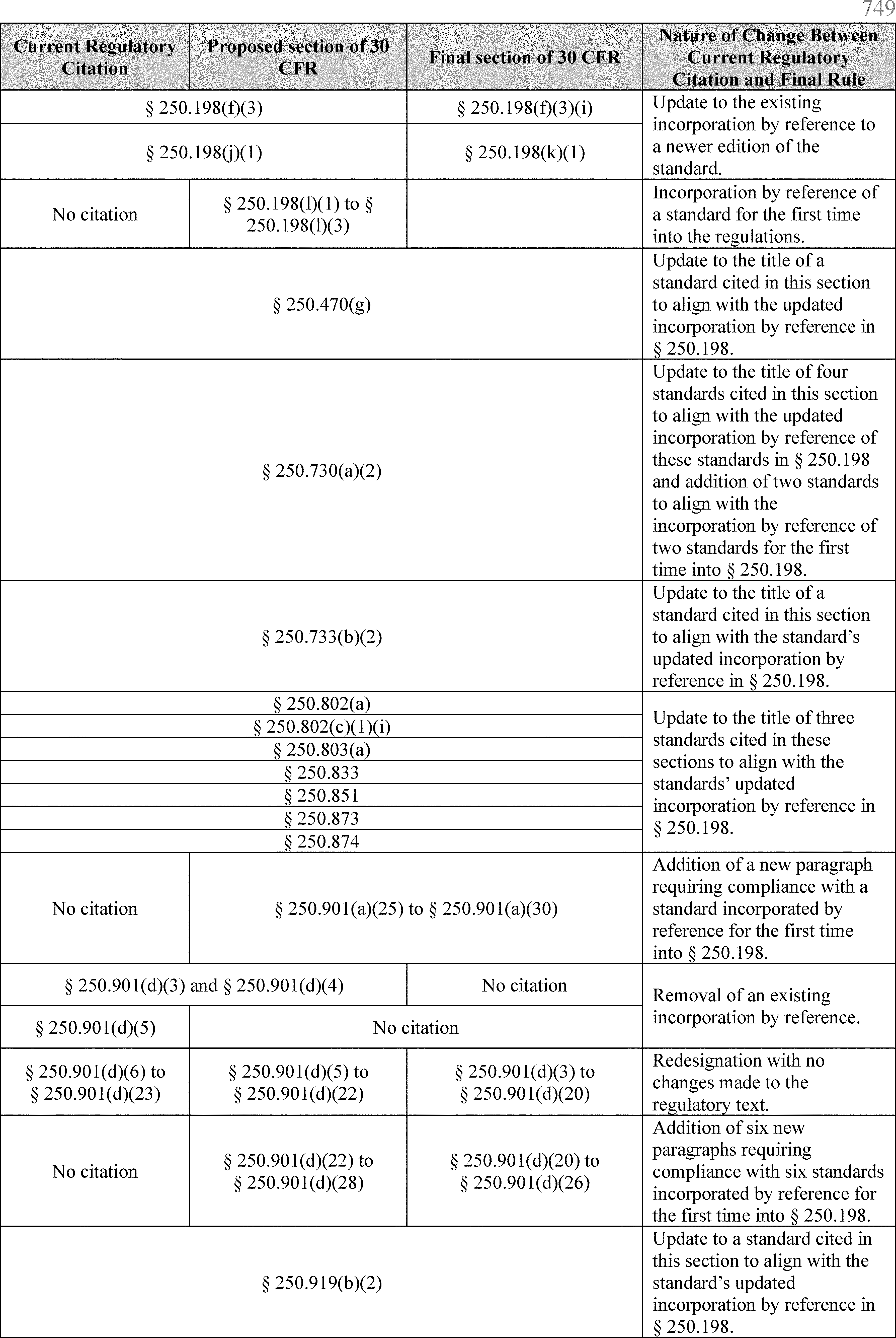
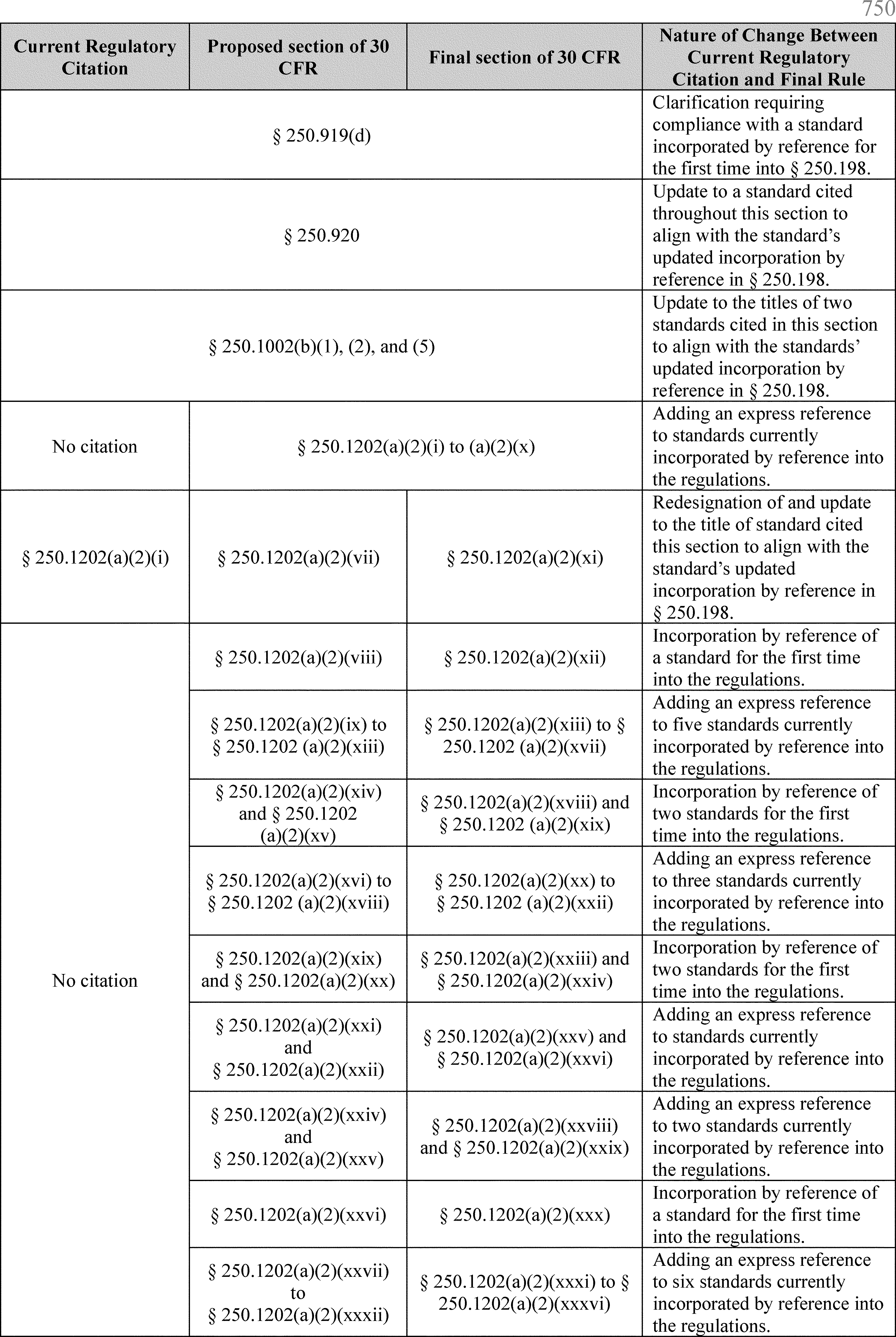
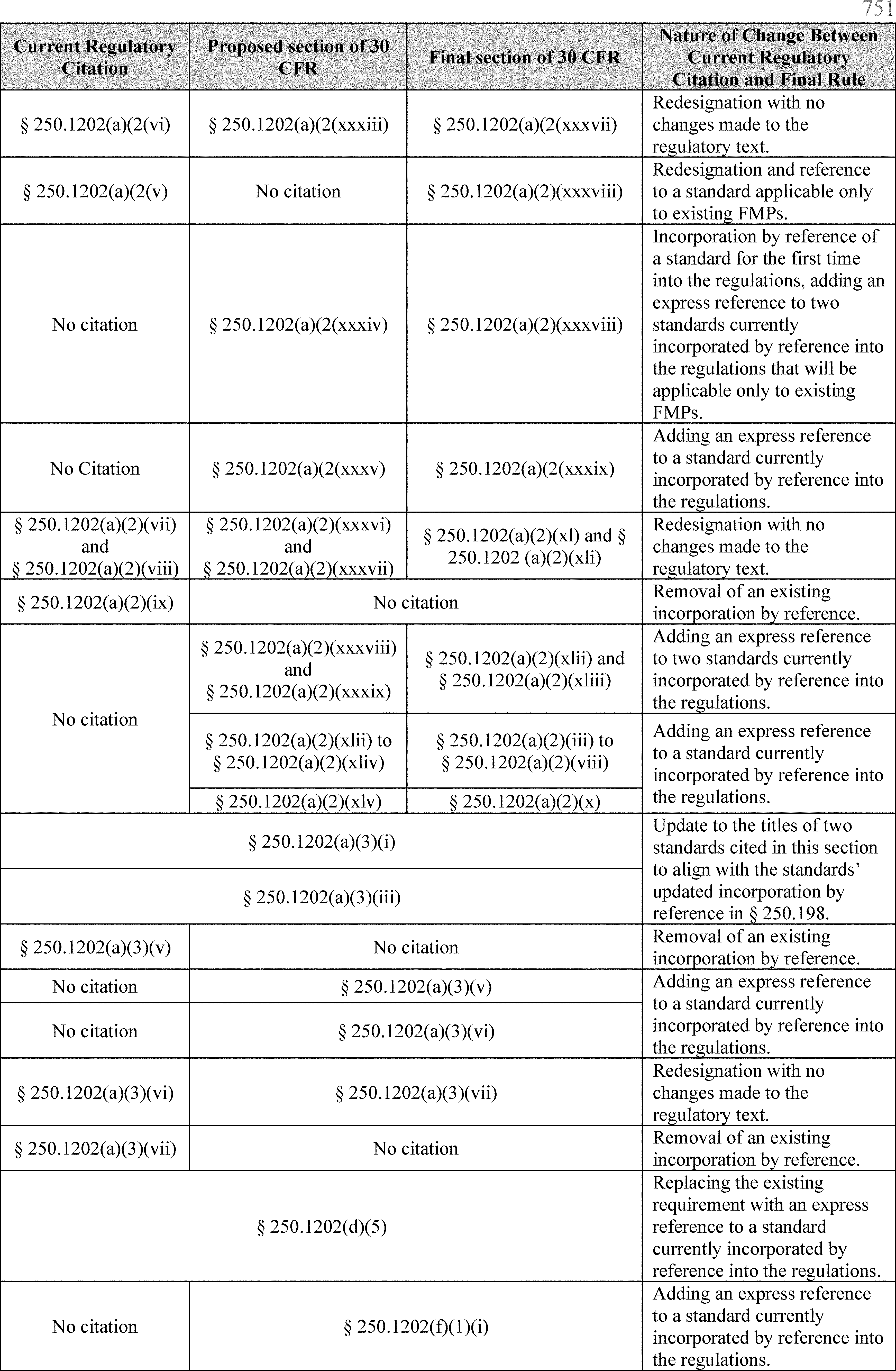
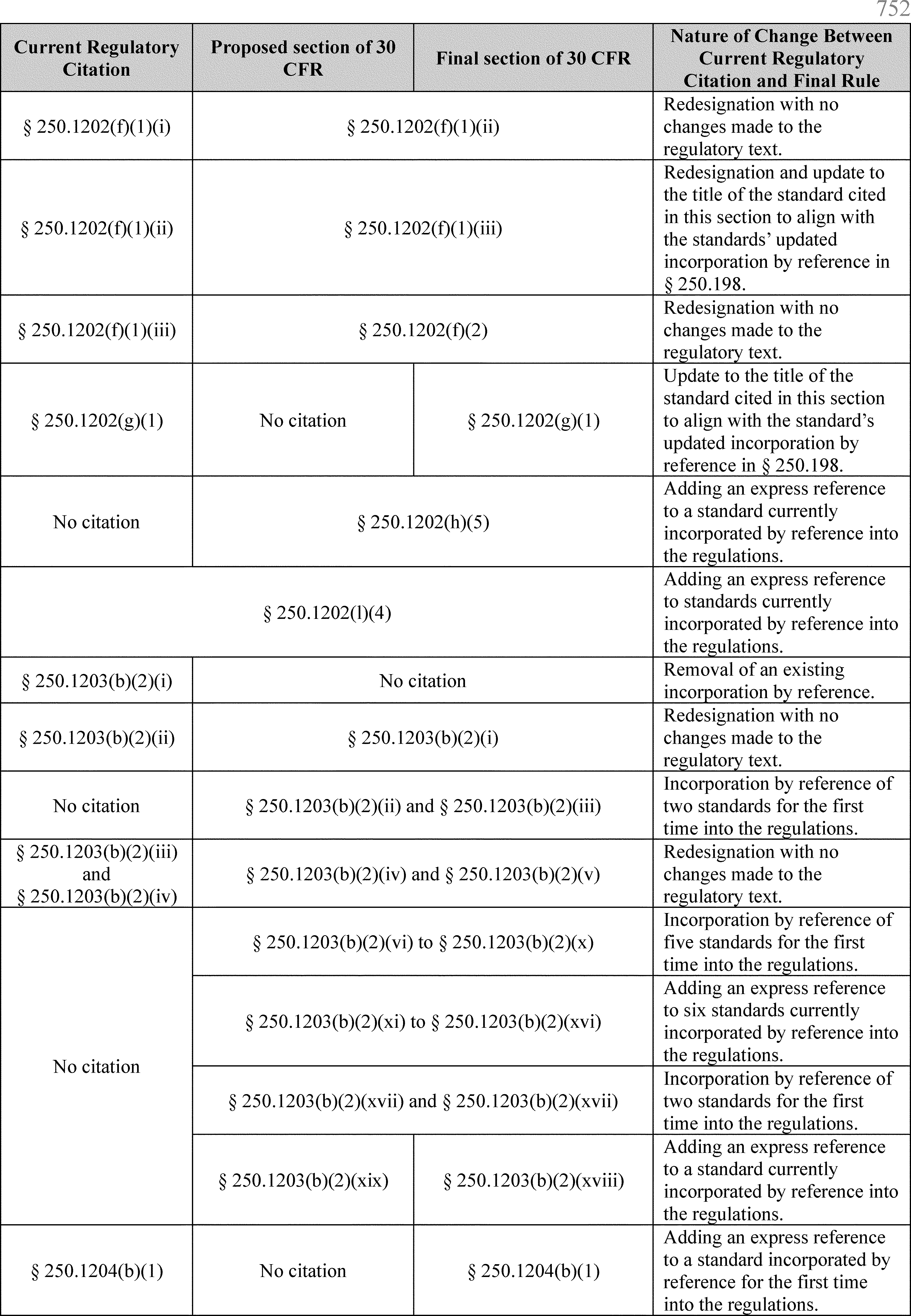
IV. Derivation Table
V. Procedural Matters
I. Background
A. BSEE Statutory and Regulatory Authority and Responsibilities
BSEE derives its authority primarily from the Outer Continental Shelf Lands Act (OCSLA), 43 U.S.C. 1331-1356a. OCSLA authorizes the Secretary of the Interior (Secretary) to lease the OCS for mineral development and to regulate oil and gas exploration, development, and production operations on the OCS. OCSLA also authorizes the Secretary to regulate OCS energy-related activities involving sources other than oil and gas. The Secretary has delegated authority to perform certain of these functions to BSEE. To carry out its responsibilities, BSEE regulates oil and gas exploration, development, and production operations on the OCS. Among other purposes, regulations administered by BSEE seek to prevent injury, loss of life, and damage to property, natural resources, and the environment. The Department of the Interior (Department) incorporates by reference in its regulations many oil and gas industry standards to require compliance with those standards in offshore operations. Detailed information concerning BSEE's regulations and guidance to the offshore oil and gas industry may be found on BSEE's website at
https://www.bsee.gov/guidance-and-regulations.
B. Purpose and Summary of the Rule
BSEE uses standards (STD), specifications (Spec), recommended practices (RP), manuals of petroleum measurement standards (MPMS),[1]
and other documents developed by standard development organizations (SDOs) as a means of establishing requirements for activities on the OCS. This practice, known as “incorporation by reference,” allows the Department to incorporate the standards from technical documents into the regulations so that the regulations reflect well accepted industry standards without increasing the volume of the Code of Federal Regulations (CFR). The Department currently incorporates by reference 125 industry standards into its offshore operating regulations, which are administered by BSEE.
The National Technology Transfer and Advancement Act (NTTAA) requires BSEE to “use technical standards that are developed or adopted by voluntary consensus standards bodies . . . to carry out policy objectives or activities[,]” including those on the OCS. According to the relevant definitional guidance from the Office of Management and Budget (OMB), standards include those developed by SDOs that are currently incorporated into regulations administered by BSEE (
e.g.,
industry standards, codes, specifications, and RPs).
Where appropriate, the Department incorporates industry standards into its regulations by reference without republishing the standards in their entirety. The legal effect of incorporation by reference is that the incorporated standards become regulatory requirements. This incorporated material, like any other duly promulgated regulation, has the force and effect of law. Operators, lessees, and other regulated parties must comply with the documents that are incorporated by reference in the regulations.
( printed page 35305)
Incorporation by reference of a document or publication is limited to the version of the document or publication cited in the regulations. This means that newer editions, versions, amendments, or revisions to documents that are already incorporated by reference in the regulations are not part of the regulations until the Department promulgates a rule in the
Federal Register
that incorporates the new, updated, or revised version of the document.
Industry standards incorporated into the Department's regulations are invaluable because they avoid the need to promulgate more detailed regulations. Incorporating industry standards into the Department's regulations also allows the Bureau's administration of those regulations to evolve from a regulatory process that reacts to inadequacies in OCS operations to one that instead follows a more orderly process that recognizes technical innovation and progressive industry ideas aimed at improving performance, safety, and efficiencies.
BSEE continually participates in reviews, revisions, and updates of standards with SDOs and determines whether new editions should be incorporated into the Department's regulations. Incorporation of new editions may be necessary because of changes in technology, environmental concerns, individual incidents, or incident trends. Also, BSEE may request an SDO to develop a new standard based on incident analysis or due to the introduction of new technologies, such as deep-water operations and floating production systems.
BSEE reviewed the requirements in the standards listed in the next section to ensure that industry uses the best available and most accurate measurement technologies. BSEE's review indicates that the decision to use these standards will not impose additional costs on the offshore oil and gas industry, because industry currently uses these standards.
C. Summary of Documents Incorporated by Reference
The Office of the Federal Register's (OFR) regulations, at 1 CFR part 51, govern how BSEE and other Federal agencies incorporate documents by reference. Agencies may incorporate a document by reference by publishing in the
Federal Register
the document title, edition, date, author, publisher, identification number, and other specified information. The preamble of the rule must contain a summary of each document incorporated by reference, as well as discuss the ways that the incorporated materials are reasonably available to interested parties and how interested parties can obtain those materials. This preamble also contains a summary of certain documents that have already been incorporated by reference into the regulations but are affected by this rulemaking. More specifically, this rulemaking will add express references to these documents at certain regulations in 30 CFR part 250 to clarify their longstanding use and existing incorporation into the regulations. The text immediately below summarizes the documents that will be or have already been incorporated by reference in 30 CFR 250.198 and the changes to the regulatory text. Descriptions of the standards described in this section are adopted or paraphrased from the SDO publications. This section of the preamble concludes with a discussion regarding the availability of the documents that are incorporated by reference.
1. American Gas Association (AGA) Report No. 8, Part 1—Thermodynamic Properties of Natural Gas and Related Gases Detail and Gross Equations of State, Third Edition, April 2017
AGA Report No. 8, Part 1 presents information for the computation of thermodynamic properties (
e.g.,
compressibility factor, density, and speed of sound) of natural gas and related gases with the DETAIL and GROSS equations of state. Uncertainty estimations for different compositions, pressures, and temperatures are given in Part 1. The computations described in Part 1 are valid for single-phase gaseous states only. BSEE is incorporating by reference this standard for the first time into its regulations at § 250.198(b)(2) and adding a reference to this standard in § 250.1203(b)(2)(ii).
2. AGA Report No. 8, Part 2—Thermodynamic Properties of Natural Gas and Related Gases, GERG—2008 Equation of State, First Edition, April 2017
AGA Report No. 8, Part 2 presents information for computation of thermodynamic properties, including compressibility factors, densities, and speeds of sound, of natural gas and related gases, for gaseous states, vapor-liquid equilibrium states, and liquid states, based on the GERG-2008 equation of state. It also improves upon the performance of the AGA 8 DETAIL equation for gas-phase properties, especially at high pressures and low temperatures. The ranges of temperature, pressure, and composition for which the GERG-2008 equation of state applies are much wider than the AGA 8 DETAIL equation. Uncertainty estimations for different compositions, pressures, and temperatures are given. With the availability of vapor-liquid equilibrium and liquid state calculations, Part 2 enables the calculation of dew points, bubble points, and the critical point. BSEE is incorporating by reference this standard for the first time into its regulations at § 250.198(b)(3) and adding a reference to this standard in § 250.1203(b)(2)(iii).
3. AGA Report No. 9—Measurement of Gas by Multipath Ultrasonic Meters, Fourth Edition, 2022
AGA Report No. 9 describes the optimum conditions and best practices for multipath ultrasonic transit-time flow meters used for the measurement of natural gas. Multipath ultrasonic meters have at least two independent pairs of measuring transducers (acoustic paths). Typical applications include measuring the flow of gas through production facilities, transmission pipelines, storage facilities, distribution systems, and large end-use customer meter sets. BSEE currently requires multipath ultrasonic meters used for gas royalty measurement to contain at least three independent pairs of measuring transducers. The latest edition of AGA Report 9 allows the calibration of ultrasonic meters with laboratory piping in lieu of shipping the entire metering package to the calibration lab. BSEE is updating the reference of AGA Report No. 9 currently in the regulations to the Fourth edition of this standard. BSEE is also renumbering the regulatory citation from § 250.198(b)(2) to § 250.198(b)(4), this standard is referenced in § 250.1203(b)(2)(iv)).
4. AGA Report No. 11—Measurement of Natural Gas by Coriolis Meter, Second Edition, February 2013
AGA Report No. 11 was developed for the specification, calibration, installation, operation, maintenance, and verification of Coriolis flow meters and is limited to the measurement of single-phase natural gas, consisting primarily of hydrocarbon gases mixed with other associated gases usually known as “diluents.” Although Coriolis meters are used to measure a broad range of compressible fluids, non-natural gas applications are beyond the scope of this document. BSEE is incorporating by reference this standard for the first time into the regulations at § 250.198(b)(6) and adding a reference to this standard in § 250.1203(b)(2)(vi).
( printed page 35306)
5. API Manual of Petroleum Measurement Standards Chapter 3.1A—Standard Practice for the Manual Gauging of Petroleum and Petroleum Products, Third Edition, August 2013, d December 2018, Errata 1, January 2021
This document is applicable for gauging quantities of liquids having Reid vapor pressures less than 103 kPa (15 psia). This document describes the following procedures and influences for manual gauging:
The procedures for manually gauging the liquid level of petroleum and petroleum products in non-pressure fixed-roof, floating-roof tanks and marine tank vessels;
Procedures for manually gauging the level of free water that may be found with the petroleum or petroleum products;
Methods used to verify the length of gauge tapes under field conditions and the influence of bob weights and temperature on the gauge tape length; and
Influences that may affect the position of gauging reference point (either the datum plate or the reference gauge point).
Throughout this standards document, the term petroleum is used to denote petroleum, petroleum products, or the liquids normally associated with the petroleum industry. The Third Edition added sections on gauging procedures, reading and recording gauges, operational precautions, and system integrity. This document is currently incorporated by reference in § 250.198(e)(10). BSEE is updating the incorporation by reference from the Second to the Third Edition, acknowledging the 2018 reaffirmation, renumbering the regulatory citation to § 250.198(e)(1)(iii)(A), changing the title of the standard from API MPMS Chapter 3, Section 1A to API MPMS Chapter 3.1A, and adding an express reference to this standard in § 250.1202(a)(2)(iii) and (l)(4)(iii) to clarify the longstanding use of this document already incorporated in the current regulations.
6. API Manual of Petroleum Measurement Standards Chapter 4—Proving Systems, Section 1—Introduction, Third Edition, February 2005; reaffirmed June 2014
Section 1, Proving Systems, is a general introduction to the subject of proving. The requirements in Chapter 4 are based on customary practices that evolved for crude oils and products covered by API MPMS Ch. 11.1. This document is currently incorporated by reference in § 250.198(e)(12). BSEE is updating the incorporation by reference in the regulations by renumbering the regulatory citation to § 250.198(e)(1)(iv)(A) and adding an express reference to this standard in § 250.1202(a)(2)(v) to clarify the longstanding use of this document already incorporated in the current regulations.
7. API Manual of Petroleum Measurement Standards Chapter 4—Proving Systems, Section 2—Displacement Provers, Third Edition, September 2003, Addendum February 2015, Reaffirmed December 2022
This chapter outlines the essential elements of displacement provers that do, and do not, accumulate a minimum of 10,000 whole meter pulses between detector switches, and provides design and installation details for the types of displacement provers that are currently in use. The provers discussed in this chapter are designed for proving measurement devices under dynamic operating conditions with single-phase liquid hydrocarbons. These provers consist of a pipe section through which a displacer travels and activates detection devices before stopping at the end of the run as the stream is diverted or bypassed. This document is currently incorporated by reference in § 250.198(e)(13). BSEE is updating the incorporation by reference in the regulations by acknowledging the 2022 reaffirmation and 2015 Addendum, renumbering the regulatory citation to § 250.198(e)(1)(iv)(B), and adding an express reference to this standard in § 250.1202(a)(2)(vi) to clarify the longstanding use of this document already incorporated in the current regulations.
8. API Manual of Petroleum Measurement Standards Chapter 4.5—Master Meter Provers, Fourth Edition, June 2016
This standard covers the use of displacement, turbine, Coriolis, and ultrasonic meters as master meters. The requirements in this standard are intended for single-phase liquid hydrocarbons. Meter proving requirements for other fluids should be appropriate for the overall custody transfer accuracy and should be agreeable to the parties involved. The Fourth Edition added sections on Master Meter Factors for combined uncertainty, random uncertainty, and related examples. This document does not cover master meters to be used for the calibration of provers. For information concerning master meter calibration of provers, see API MPMS Chapter 4.9.3. The title of this standard has also changed from API MPMS Chapter 4, Section 5 to API MPMS Chapter 4.5. This document is currently incorporated by reference in § 250.198(e)(15). BSEE is updating the incorporation by reference from the Second to the Fourth Edition, acknowledging the 2022 reaffirmation, renumbering the citation and updating the reference to this standard in the new § 250.198(e)(1)(iv)(D) to reflect the new name of the standard, and adding an express reference to this standard in § 250.1202(a)(2)(viii) to clarify the longstanding use of this document already incorporated in the current regulations.
9. API Manual of Petroleum Measurement Standards Chapter 4—Proving Systems, Section 7—Field Standard Test Measures, Third Edition, April 2009, Reaffirmed June 2014
This standard describes the essential elements of field standard test measures by providing descriptions, construction requirements, as well as inspection, handling, and calibration methods. Bottom-neck scale test measures and prover tanks are not addressed in this document. The scope of this standard is limited to the certification of “delivered volumes” of test measures. The Third Edition includes information on calibration frequency of test measurements and an example of a NIST report of calibration. This document is currently incorporated by reference in § 250.198(e)(17). BSEE is updating the incorporation by reference from the Second to the Third Edition, acknowledging the 2014 reaffirmation, renumbering the regulatory citation to § 250.198(e)(1)(iv)(F), and adding an express reference to this standard in § 250.1202(a)(2)(x) to clarify the longstanding use of this document already incorporated in the current regulations.
10. API Manual of Petroleum Measurement Standards Chapter 4.8—Operation of Proving Systems, Third Edition, July 2021
This standard provides information for operating meter provers on single-phase liquid hydrocarbons. It is a reference manual for operating proving systems. The requirements of this chapter are based upon customary practices for single-phase liquids. The standard is purposely written for hydrocarbons, but much of the information contained may be applicable to other liquids. Specific requirements for other liquids should be agreeable to parties involved. The Third Edition added information on frequency of meter proving, proving locations, types of provers, calibration frequency,
( printed page 35307)
and proving concerns. The title of this standard also changed from API MPMS Chapter 4, Section 8 to API MPMS Chapter 4.8. This document is currently incorporated by reference in § 250.198(e)(18). BSEE is updating the incorporation by reference from the First to the Third Edition, renumbering the regulatory citation to § 250.198(e)(1)(iv)(G), changing the title of the standard from API MPMS Chapter 4, Section 8 to API MPMS Chapter 4.8, and updating the references to this standard in § 250.1202(a)(2)(xi), (a)(3)(i), (f)(1)(ii), and (g)(1) to reflect the new name of the standard.
11. API Manual of Petroleum Measurement Standards Chapter 4—Proving Systems, Section 9—Methods of Calibration for Displacement and Volumetric Tank Provers, Part 2—Determination of the Volume of Displacement and Tank Provers by the Water-Draw Method of Calibration, First Edition, December 2005, Reaffirmed July 2015
This standard covers all the procedures required to determine the field data necessary to calculate a base prover volume, of either displacement provers or volumetric tank provers, by the water-draw method of calibration. The document will enable the user to perform all the activities necessary to prepare the prover, conduct calibration runs, and record all the required data necessary to calculate the base volumes of displacement and tank provers. Evaluation of the results and troubleshooting of many calibration problems are also discussed. Detailed calculation procedures are not included in this standard. BSEE will incorporate by reference this standard into the regulations for the first time at § 250.198(e)(1)(iv)(H) and add a reference to this standard in § 250.1202(a)(2)(xii).
12. API Manual of Petroleum Measurement Standards Chapter 5—Metering, Section 1—General Considerations for Measurement by Meters, Fourth Edition, September 2005, Errata 1 June 2008, Errata 2 June 2011, Reaffirmed December 2022
API MPMS Chapter 5 is a guide for the proper specification, installation, and operation of meter runs designed to dynamically measure liquid hydrocarbons so that acceptable accuracy, service life, safety, reliability, and quality control can be achieved. API MPMS Chapter 5 also includes information that will assist in troubleshooting and improving the performance of meters. This document is currently incorporated by reference in § 250.198(e)(19). BSEE is updating the incorporation by reference in the regulations by acknowledging the 2022 reaffirmation and 2008/2011 Errata. The errata corrected printing errors of references at the end of a paragraph,
e.g.,
“Paragraph 5.1.9.4.2, the reference at the end of the paragraph should read: (see 5.1.9.5).” BSEE is also renumbering the citation to § 250.198(e)(1)(v)(A), and adding an express reference to this standard in § 250.1202(a)(2)(xiii) to clarify the longstanding use of this document already incorporated in the current regulations.
13. API Manual of Petroleum Measurement Standards Chapter 5—Metering, Section 3—Measurement of Liquid Hydrocarbons by Turbine Meters, Fifth Edition, September 2005; Reaffirmed August 2014
Section 3 of API MPMS Chapter 5 covers the unique installation requirements and performance characteristics of turbine meters in liquid-hydrocarbon service. This document is currently incorporated by reference in § 250.198(e)(21). BSEE is updating the incorporation by reference in the regulations by renumbering the regulatory citation to § 250.198(e)(1)(v)(C) and adding an express reference to this standard in § 250.1202(a)(2)(xv) to clarify the longstanding use of this document already incorporated in the current regulations.
14. API Manual of Petroleum Measurement Standards Chapter 5—Metering, Section 4—Accessory Equipment for Liquid Meters, Fourth Edition, September 2005; Errata May 2015, Reaffirmed August 2015
Section 4 of API MPMS Chapter 5 describes the characteristics of accessory equipment that may be used with meters in liquid hydrocarbon service. Having a knowledge of these characteristics helps designers and operators of meter installations provide satisfactory quantity measurement results. Certain minimum requirements for devices that monitor temperature, density, and pressure are discussed in this section. Most system hardware, such as non-control valves, vents, and manifolding, is not discussed in this section. API reaffirmed the standard without substantive change in August 2015. This document is currently incorporated by reference in § 250.198(e)(22). BSEE is updating the incorporation by reference in the regulations by acknowledging the 2015 reaffirmation, renumbering the regulatory citation to § 250.198(e)(1)(v)(D), and adding an express reference to this standard in § 250.1202(a)(2)(xvi) to clarify the longstanding use of this document already incorporated in the current regulations.
15. API Manual of Petroleum Measurement Standards Chapter 5—Metering, Section 5—Fidelity and Security of Flow Measurement Pulsed-Data Transmission Systems, Second Edition, August 2005; Reaffirmed August 2015
The recommendations set forth in this publication are concerned only with the fidelity and security of pulsed-data, cabled transmission systems between a flow meter or flow meter transducer and a remote totalizer. API reaffirmed the standard without substantive change in August 2015. This document is currently incorporated by reference in § 250.198(e)(23). BSEE is updating the incorporation by reference in the regulations by acknowledging the 2015 reaffirmation, renumbering the regulatory citation to § 250.198(e)(1)(v)(E), and adding an express reference to this standard in § 250.1202(a)(2)(xvii) to clarify the longstanding use of this document already incorporated in the current regulations.
16. API Manual of Petroleum Measurement Standards Chapter 5.8—Measurement of Liquid Hydrocarbons by Ultrasonic Flow Meters, Second Edition, November 2011, Errata February 2014, Reaffirmed May 2017
This document defines the application criteria for Ultrasonic Flow Meters (UFMs) and addresses the appropriate considerations regarding the liquids to be measured. Also, this document addresses the installation, operation, and maintenance of UFMs in liquid hydrocarbon service. This document pertains only to spool type, two or more path ultrasonic flow meters with permanently affixed transducer assemblies. While this document was specifically written for custody transfer measurement, other acceptable applications may include allocation measurement, check meter measurement, and leak detection measurement. The Second Edition updated the normative references and the sections on meter performance, accuracy, and repeatability. The title of this standard also changed from API MPMS Chapter 5, Section 8 to API MPMS Chapter 5.8. This document is currently incorporated by reference in § 250.198(e)(25). BSEE is updating the incorporation by reference from the First to the Second Edition, acknowledging the 2017 reaffirmation
( printed page 35308)
and 2011 Errata, renumbering the regulatory citation to § 250.198(e)(1)(v)(G), and updating the references to this standard in § 250.1202(a)(2)(xix) and (a)(3)(iii) to reflect the new name of the standard.
17. API Manual of Petroleum Measurement Standards Chapter 6.1—Lease Automatic Custody Transfer (LACT) Systems, Second Edition, May 1991, Addendum 1 August 2020
This publication describes the metering function of a LACT unit. LACT equipment includes a meter (either displacement or turbine), a proving system (either fixed or portable), devices for determining temperature and pressure and for sampling the liquid, and a means of determining non-merchantable oil. Many of the aspects of the metering function of a LACT unit are considered at length in other parts of this manual and are referenced in paragraph 6.1.4. The title of this standard changed from API MPMS Chapter 6, Section 1 to API MPMS Chapter 6.1, and the 2020 Addendum added information on determining normal operating conditions. This document is currently incorporated by reference in § 250.198(e)(26). BSEE is updating the incorporation by reference in the regulations by acknowledging the 2020 addendum, renumbering the regulatory citation to § 250.198(e)(1)(vi)(A), updating the reference to this standard to reflect the new name of the standard, and adding an express reference to this standard in § 250.1202(a)(2)(xx) to clarify the longstanding use of this document already incorporated in the current regulations.
18. API Manual of Petroleum Measurement Standards Chapter 7.1—Temperature Determination-Liquid-in-Glass Thermometers, Second Edition, August 2017
API MPMS Chapter 7.1 describes the methods, equipment, and procedures for manually determining the temperature of liquid petroleum and petroleum products under both static and dynamic conditions with liquid-in-glass thermometers. API MPMS Chapter 7.1 is specific to liquid-in-glass thermometers. Further, Chapter 7.1 discusses temperature measurement requirements in general for custody transfer, inventory control, and marine measurements. The actual method and equipment selected for temperature determination are left to the agreement of the parties involved. The manual method covers non-pressurized tanks and non-pressurized marine vessels and gas-blanketed tanks and gas-blanketed marine vessels. It does not cover hydrocarbons under pressures in excess of 21 kPa (3 psi gauge) or cryogenic temperature measurement, unless equipped with a thermowell.
API MPMS Chapters 7.1, 7.2, 7.3, and 7.4 supersede API MPMS Chapter 7, Temperature Determination, First Edition, June 2001, which is currently incorporated by reference at § 250.198(e)(29). API has withdrawn API MPMS Chapter 7. BSEE is removing API MPMS Chapter 7 from the regulations and incorporating by reference API MPMS Chapter 7.1 for the first time into the regulations at § 250.198(e)(1)(vii)(A). BSEE is also adding an express reference to this standard in § 250.1202(a)(2)(xxiii).
19. API Manual of Petroleum Measurement Standards Chapter 7.3—Temperature Determination—Temperature Determination—Fixed Automatic Tank Temperature Systems, Second Edition, October 2011, Reaffirmed September 2021
API MPMS Chapter 7.3 describes the methods, equipment, and procedures for determining the temperature of petroleum and petroleum products under static conditions by the use of an automatic method. Automatic temperature measurement is discussed for custody transfer and inventory control for both onshore and marine measurement applications. Temperatures of hydrocarbon liquids under static conditions can be determined by measuring the temperature of the liquid at specific locations. Examples of where static temperature determination is required include storage tanks, ships, and barges. The application of this standard is restricted to automatic methods for the determination of temperature using fixed automatic tank thermometer (ATT) systems for hydrocarbons having a Reid Vapor Pressure at or below 101.325 kPa (14.696 psia).
As previously mentioned, API MPMS Chapters 7.1, 7.2, 7.3, and 7.4 supersede API MPMS Chapter 7, Temperature Determination, First Edition, June 2001, which is currently incorporated by reference at § 250.198(e)(29). API has withdrawn API MPMS Chapter 7. BSEE is removing API MPMS Chapter 7 from the regulations and incorporating by reference API MPMS Chapter 7.3 for the first time into the regulations at § 250.198(e)(1)(vii)(B). BSEE is also adding an express reference to this standard in § 250.1202(a)(2)(xxiv).
20. API Manual of Petroleum Measurement Standards Chapter 8.1—Standard Practice for Manual Sampling of Petroleum and Petroleum Products, Sixth Edition, September 2022
This practice covers procedures and equipment for manually obtaining samples of liquid petroleum and petroleum products, crude oils, and intermediate products from the sample point into the primary container. Procedures are also included for the sampling of free water and other heavy components associated with petroleum and petroleum products. This practice also addresses the sampling of semi-liquid or solid-state petroleum products. This practice provides additional specific information about sample container selection, preparation, and sample handling. This practice does not cover sampling of electrical insulating oils and hydraulic fluids. If sampling is for the precise determination of volatility, use Practice D5842 (API MPMS Chapter 8.4) in conjunction with this practice. For sample mixing and handling, refer to Practice D5854 (API MPMS Chapter 8.3). The title of this section changed from API MPMS Chapter 8, Section 1 to API MPMS Chapter 8.1, and the Sixth Edition added sections on health and safety precautions, sampling requirements, considerations, and procedures, as well as instructions for special products. This document is currently incorporated by reference in § 250.198(e)(30). BSEE is updating the incorporation by reference in the regulations by updating the reference from the Third Edition to the Sixth Edition, renumbering the regulatory citation to § 250.198(e)(1)(viii)(A), updating the reference to this standard to reflect the new name of the standard, and adding express references to this standard in § 250.1202(a)(2)(xxv) and § 250.1202(k)(1) to clarify the longstanding use of this document already incorporated in the current regulations.
21. API Manual of Petroleum Measurement Standards Chapter 8.2—Standard Practice for Automatic Sampling of Liquid Petroleum and Petroleum Products, Sixth Edition, September 2022
This document describes general procedures and equipment for automatically obtaining samples of liquid petroleum and petroleum products, crude oils, and intermediate products from the sample point into the primary container. This practice also provides additional specific information about sample container selection,
( printed page 35309)
preparation, and sample handling. If sampling is for the precise determination of volatility, use Practice D5842 (API MPMS Chapter 8.4) in conjunction with this practice. For sample mixing and handling, refer to Practice D5854 (API MPMS Chapter 8.3). This practice does not cover sampling of electrical insulating oils and hydraulic fluids. Combining values from the two systems may result in non-conformance with the standard. This standard was developed in accordance with internationally recognized principles on standardization established in the Decision on Principles for the Development of International Standards, Guides and Recommendations issued by the World Trade Organization Technical Barriers to Trade Committee. The title of this standard changed from API MPMS Chapter 8, Section 2 to API MPMS Chapter 8.2. The Sixth Edition added representative sampling components and performance criteria. This document is currently incorporated by reference in § 250.198(e)(31). BSEE is updating the incorporation by reference in the regulations by updating the reference from the Second Edition to the Sixth Edition, renumbering the regulatory citation to § 250.198(e)(1)(viii)(B), updating the reference to this standard to reflect the new name of the standard, and adding express references to this standard in § 250.1202(a)(2)(xxvi), § 250.1202(b)(4)(i), and § 250.1202(k)(1) to clarify the longstanding use of this document already incorporated in the current regulations.
22. API Manual of Petroleum Measurement Standards Chapter 8.3—Standard Practice for Mixing and Handling of Liquid Samples of Petroleum and Petroleum Products, Second Edition, September 2019
This practice covers handling, mixing, and conditioning procedures that are required to ensure that a representative sample of the liquid petroleum or petroleum product is delivered from the primary sample container or other container or both into the analytical apparatus or into intermediate containers. Appendix X1 in this document details the background information on the development of Table 1 used in performance testing. Appendix X2 provides guidance in the acceptance testing for water in crude oil. Appendix X3 provides a guide for materials of sample containers. Appendix X4 provides a summary of recommended mixing procedures. Appendix X5 provides a flow chart for sample container/mixing system acceptance test. The Second Edition added text on labeling, transport, mixing, sample integrity, storage, preservation, and audit. BSEE is incorporating by reference this standard for the first time into the regulations at § 250.198(e)(1)(viii)(C) and adding a reference to this standard in § 250.1202(a)(2)(xxvii).
23. API Manual of Petroleum Measurement Standards Chapter 9.1—Standard Test Method for Density, Relative Density, or API Gravity of Crude Petroleum and Liquid Petroleum Products by Hydrometer Method, Third Edition, December 2012, Reaffirmed May 2017
This test method covers the laboratory determination of the density, relative density, or API gravity of crude petroleum, petroleum products, or mixtures of petroleum and nonpetroleum products normally handled as liquids and having a Reid vapor pressure of 101.325 kPa (14.696 psi) or less. The relevant test method involves using a glass hydrometer in conjunction with a series of calculations. Values are determined at existing temperatures and corrected to 15°C or 60 °F by means of a series of calculations and international standard tables. The title of this standard changed from API MPMS Chapter 9, Section 1 to API MPMS Chapter 9.1, and the newer (
i.e.,
third) edition includes information on procedures, reporting, and precision and bias. The Third Edition was reaffirmed in May 2017. This document is currently incorporated by reference in § 250.198(e)(32). BSEE is updating the incorporation by reference from the 2002 Second Edition to the 2012 Third Edition, acknowledging the 2017 reaffirmation, renumbering the regulatory citation to § 250.198(e)(1)(ix)(A), and adding an express reference to this standard in § 250.1202(a)(2)(xxviii) to clarify the longstanding use of this document already incorporated in the current regulations.
24. API Manual of Petroleum Measurement Standards Chapter 9.2—Standard Test Method for Density or Relative Density of Light Hydrocarbons by Pressure Hydrometer, Fourth Edition, November 2022
This test method covers the determination of the density or relative density of light hydrocarbons including liquefied petroleum gases (LPG) having Reid vapor pressures exceeding 101.325 kPa (14.696 psi). The prescribed apparatus should not be used for materials having vapor pressures higher than 1.4 MPa (200 psi) at the test temperature. This pressure limit is dictated by the type of equipment. Higher pressures can apply to other equipment designs. The initial pressure hydrometer readings obtained are uncorrected hydrometer readings and not density measurements. Readings are measured on a hydrometer at either the reference temperature or at another convenient temperature, and readings are corrected for the meniscus effect, the thermal glass expansion effect, alternate calibration temperature effects, and to the reference temperature by means of calculations and Adjunct to D1250 Guide for Petroleum Measurement Tables (API MPMS Chapter 11.1) or API MPMS Chapter 11.2.4 (GPA TP-27), as applicable. The Fourth Edition includes distinguishing mandatory information and amends the referenced documents section, and the title of this standard changed from API MPMS Chapter 9, Section 2 to API MPMS Chapter 9.2. This document is currently incorporated by reference in § 250.198(e)(33). BSEE is updating the incorporation by reference from the 2003 Second Edition to the 2022 Fourth Edition, renumbering the regulatory citation and updating the reference to this standard in the new § 250.198(e)(1)(ix)(B) to reflect the new name of the standard, and adding an express reference to this standard in § 250.1202(a)(2)(xxix) to clarify the longstanding use of this document already incorporated in the current regulations.
25. API Manual of Petroleum Measurement Standards Chapter 9.4—Continuous Density Measurement Under Dynamic (Flowing) Conditions, First Edition, January 2018
This document covers the continuous on-line determination and application of flowing liquid densities for custody transfer. This document covers liquid and dense phase fluids, including natural gas liquids, refined products, chemicals, crude oil, and other liquid products commonly encountered in the petroleum industry. This document does not apply to the density measurement of natural gas, liquified natural gas, multiphase mixtures, semi-solid liquids such as asphalt, and solids such as coke and slurries. This standard also provides criteria and procedures for designing, installing, operating, and proving continuous on-line density measurement systems for custody transfer. This standard also discusses the different levels and requirements of accuracy for various applications. The API withdrew API MPMS Chapter 14—Natural Gas Fluids Measurement, Section 6—
Continuous Density Measurement,
and superseded it with
( printed page 35310)
API MPMS Chapter 9.4. Thus, as described in the proposed rule, BSEE is removing API MPMS Chapter 14, Section 6 from existing § 250.198(e)(51). BSEE is also incorporating by reference API MPMS Chapter 9.4 for the first time into the regulations at § 250.198(e)(1)(ix)(C) and adding a reference to this standard in § 250.1202(a)(2)(xxx).
26. API Manual of Petroleum Measurement Standards Chapter 10.2—Standard Test Method for Water in Crude Oil by Distillation, Fifth Edition, December 2022
This test method covers the determination of water in crude oil by distillation. The values stated in the International System of Units (SI units) are to be regarded as standard. No other units of measurement are included in this standard. The Fifth Edition accumulated references to ASTM documents and API documents associated terms and terminology along with related text. The title of this standard also changed from API MPMS Chapter 10, Section 2 to API MPMS Chapter 10.2. This document is currently incorporated by reference in § 250.198(e)(35). BSEE is updating the incorporation by reference from the 2007 Second Edition to the 2022 Fifth Edition, renumbering the regulatory citation to § 250.198(e)(1), updating the reference to this standard in the new § 250.198(e)(1)(x)(B) to reflect the new name of the standard, and adding an express reference to this standard in § 250.1202(a)(2)(xxxii) to clarify the longstanding use of this document already incorporated in the current regulations.
27. API Manual of Petroleum Measurement Standards Chapter 10.3—Standard Test Method for Water and Sediment in Crude Oil by the Centrifuge Method (Laboratory Procedure), Fifth Edition, December 2022
This test method describes the laboratory determination of water and sediment in crude oils by means of the centrifuge procedure. This centrifuge method for determining water and sediment in crude oils is not entirely satisfactory. The amount of water detected is almost always lower than the actual water content. When a highly accurate value is required, the revised procedures for water by distillation, Test Method D4006 (API MPMS Chapter 10.2) (Note 1), and sediment by extraction, Test Method D473 (API MPMS Chapter 10.1), must be used. Test Method D4006 (API MPMS Chapter 10.2) has been determined to be the preferred and most accurate method for the determination of water. The values stated in SI units are to be regarded as standard. The Fifth Edition provides additional references to ASTM documents and API documents, mandatory and nonmandatory documents, test methods and associated terms and terminology, and additional information on constraints. The title of this standard also changed from API MPMS Chapter 10, Section 3 to API MPMS Chapter 10.3. This document is currently incorporated by reference in § 250.198(e)(36). BSEE is updating the incorporation by reference from the 2008 Third Edition to the 2022 Fifth Edition, renumbering the regulatory citation to § 250.198(e)(1)(x)(C), updating the reference to this standard to reflect the new name of the standard, and adding an express reference to this standard in § 250.1202(a)(2)(xxxiii) to clarify the longstanding use of this document already incorporated in the current regulations.
28. API Manual of Petroleum Measurement Standards Chapter 10.4—Determination of Water and/or Sediment in Crude Oil by the Centrifuge Method (Field Procedure), Fifth Edition, August 2020
This document describes the field centrifuge method for determining both sediment and water or sediment only in crude oil. This method may not always produce the most accurate results, but it is considered the most practical method for field determination of sediment and water. This method may also be used for field determination of sediment. When a higher degree of accuracy is required, the laboratory procedure described in API MPMS Ch. 10.3, Standard Test Method for Water and Sediment in Crude Oil by the Centrifuge Method (Laboratory Procedure) (ASTM D4007); API MPMS Chapter 10.2, Standard Test Method for Water in Crude Oil by Distillation (ASTM D4006); or API MPMS Chapter 10.9, Standard Test Method for Water in Crude Oils by Coulometric Karl Fischer Titration (ASTM D4928); and the procedure described in API MPMS Chapter 10.1, Standard Test Method for Sediment in Crude Oils and Fuel Oils by the Extraction Method (ASTM D473) should be used. The Fifth Edition amended the text concerning procedures, calculations, and reporting related to centrifuge tube spin calculations, test procedures, and test reading requirements. The title of this standard also changed from API MPMS Chapter 10, Section 4 to API MPMS Chapter 10.4. This document is currently incorporated by reference in § 250.198(e)(37). BSEE is updating the incorporation by reference from the 1999 Third Edition to the 2020 Fifth Edition, renumbering the regulatory citation and updating the reference to this standard to reflect the new name in the new § 250.198(e)(1)(x)(D), and adding an express reference to this standard in § 250.1202(a)(2)(xxxiv) to clarify the longstanding use of this document already incorporated in the current regulations.
29. API Manual of Petroleum Measurement Standards Chapter 10.9—Standard Test Method for Water in Crude Oils by Coulometric Karl Fischer Titration, Third Edition, May 2013, Reaffirmed June 2018
This test method covers the determination of water in the range from 0.02 to 5.00 mass or volume % in crude oils. Mercaptan (RSH) and sulfide (S− or H2S) as sulfur are known to interfere with this test method, but at levels of less than 500 μ/g [ppm(m)], the interference from these compounds is insignificant. This test method can be used to determine water in the 0.005 to 0.02 mass % range, but the effects of the mercaptan and sulfide interference at these levels has not been determined. For the range 0.005 to 0.02 mass %, there is no precision or bias statement. This test method is intended for use with standard commercially available coulometric Karl Fischer reagent. The values stated in SI units are to be regarded as standard. No other units of measurement are included in this standard. The Third Edition was updated with modern terminology to bring content into compliance with existing practices. The title of this standard also changed from API MPMS Chapter 10, Section 9 to API MPMS Chapter 10.9. This document is currently incorporated by reference in § 250.198(e)(38). BSEE is updating the incorporation by reference from the 2002 Second Edition to the 2013 Third Edition, renumbering the regulatory citation and updating the reference to this standard in the new § 250.198(e)(1)(x)(E) to reflect the new name of the standard, and adding an express reference to this standard in § 250.1202(a)(2)(xxxv) to clarify the longstanding use of this document already incorporated in the current regulations.
( printed page 35311)
30. API Manual of Petroleum Measurement Standards Chapter 11—Physical Properties Data, Section 1—Temperature and Pressure Volume Correction Factors for Generalized Crude Oils, Refined Products, and Lubricating Oils, 2004 Edition, May 2004, Addendum 1 September 2007, Addendum 2 May 2019
This standard provides the algorithm and implementation procedure for the correction of temperature and pressure effects on density and volume of liquid hydrocarbons which fall within the categories of crude oil, refined products, or lubricating oils. Natural gas liquids and liquid petroleum gases are excluded from consideration in this standard. The combination of density and volume correction factors for both temperature and pressure are collectively referred to in this standard as a Correction for Temperature and Pressure of a Liquid. The temperature portion of this correction is termed the Correction for the Effect of Temperature on Liquid, also historically known as Volume Correction Factor. The pressure portion is termed the Correction for the Effect of Pressure on Liquid. This standard includes a 2019 Addendum that added 33 pages concerning compressibility, volume corrections, new terms, gauge pressure, and procedures. This document is currently incorporated by reference in § 250.198(e)(41). BSEE is updating the incorporation by reference by acknowledging the 2019 Addendum, renumbering the regulatory citation of the incorporation by reference to § 250.198(e)(1)(xi)(B), and maintaining the references to this standard at § 250.1202(a)(2)(xxxvi), (a)(3)(iv), (g)(2), and (l)(4)(v).
31. API Manual of Petroleum Measurement Standards Chapter 12.2—Calculation of Petroleum Quantities Using Dynamic Measurement Methods and Volumetric Correction Factors, Second Edition, July 2021
API MPMS Chapter 12.2 (2021) provides standardized calculation methods for the quantification of liquids, regardless of the point of origin or destination or the units of measure required by governmental customs or statute. The criteria contained in this document allow different entities using various computer languages on different computer hardware (or manual calculations) to arrive at output results within a defined tolerance within this document, using the same input data. The document specifies the equations for computing correction factors, rules for rounding, calculation sequence, and discrimination levels to be employed in the calculations. The intent of this document is to serve as a rigorous standard regarding the quantification of petroleum quantities. This document also covers multiple calculations as required by dynamic, online, integrated, continuous flow measurement.
BSEE had proposed to remove API MPMS Chapter 12, Section 2, parts 1, 2, and 3 from the regulations since API MPMS Chapter 12.2 supersedes these three standards and API withdrew these three standards. However, as discussed later when discussing the summary of comments related to API MPMS Chapter 12.2, BSEE is delaying the compliance date of API MPMS Chapter 12.2 as it pertains to existing measurement systems on the OCS to August 11, 2031. During this time, measurement systems on the OCS in existence prior to August 10, 2026 may comply with API MPMS Chapter 12, Section 2, Part 1, API MPMS Chapter 12, Section 2, Part 2, and API MPMS Chapter 12, Section 2, Part 3 in lieu of API MPMS Chapter 12.2, but must comply with API MPMS Chapter 12.2 no later than August 11, 2031. Therefore, BSEE will not remove these standards from the regulations and will renumber them to § 250.198(e)(1)(xii)(A) to (C). However, measurement systems on the OCS in existence prior to August 10, 2026 must be in compliance with API MPMS Chapter 12.2 by August 11, 2031. All new measurement systems approved after August 10, 2026 must comply with API MPMS Chapter 12.2. BSEE is incorporating by reference API MPMS Chapter 12.2 for the first time into the regulations at § 250.198(e)(1)(xii)(E) and adding a reference to this standard in § 250.1202(a)(2)(xxxviii).
32. API Manual of Petroleum Measurement Standards Chapter 14.1—Collecting and Handling of Natural Gas Samples for Analysis by Gas Chromatography, Eighth Edition, September 2022
This standard provides comprehensive guidelines and procedures for properly extracting, collecting, conditioning, and handling a sample from a flowing natural gas stream at or above its dew point temperature and that represents the composition of the vapor-phase portion of the source fluid. This standard considers spot, composite, continuous, online, and mobile sampling systems and does not include sampling of liquid or multiphase streams. BSEE is incorporating by reference the Eighth Edition of API MPMS Chapter 14.1 for the first time into the regulations at § 250.198(e)(1)(xiii)(A) and adding a reference to this standard in § 250.1203(b)(2)(x).
33. API Manual of Petroleum Measurement Standards Chapter 14.3.1—Orifice Metering of Natural Gas and Other Related Hydrocarbon Fluids—Concentric, Square-Edged Orifice Meters, Part 1: General Equations and Uncertainty Guidelines, Fourth Edition, September 2012, Errata July 2013, Reaffirmed September 2017
This standard provides a single reference for engineering equations, uncertainty, estimations, construction, and installation requirements, and standardized implementation recommendations for the calculation of flow rate through concentric, square-edged, flange-tapped orifice meters. Both U.S. customary and SI units are included. The standard is organized into four parts. Parts 1, 2, and 4 apply to the measurement of any Newtonian fluid in the petroleum and chemical industries. Part 3 focuses on the application of parts 1, 2, and 4 to the measurement of natural gas. The Fourth Edition made changes to equations to bring them into conformance with more recent practice. An Errata was made in 2013 and the standard was reaffirmed in 2017. The title of this standard also changed from API MPMS Chapter 14, Section 3, Part 1 to API MPMS Chapter 14.3.1. BSEE is updating the incorporation by reference from the 1990 Third Edition to the 2012 Fourth Edition, acknowledging the 2013 Errata and 2017 reaffirmation, renumbering the regulatory citation and updating the reference to this standard in the new § 250.198(e)(1)(xiii)(B) to reflect the new name of the standard, and adding an express reference to this standard in § 250.1203(b)(2)(xi) to clarify the longstanding use of this document already incorporated in the current regulations.
34. API Manual of Petroleum Measurement Standards Chapter 14.3.2—Orifice Metering of Natural Gas and Other Related Hydrocarbon Fluids—Concentric, Square-Edged Orifice Meters, Part 2: Specification and Installation Requirements, Fifth Edition, March 2016, Errata 1, March 2017, Errata 2, January 2019
This publication outlines the specification and installation requirements for the measurement of single-phase, homogenous Newtonian fluids using concentric, square-edged, flange-tapped orifice meters. It provides specifications for the construction and installation of orifice plates, meter tubes, and associated fittings when designing metering facilities using orifice meters. The Fifth Edition made
( printed page 35312)
changes concerning normative references, specifications, considerations, and installation requirements. Two Errata were made in 2017 and in 2019, and the title of this standard also changed from API MPMS Chapter 14, Section 3, Part 2 to API MPMS Chapter 14.3.2. This document is currently incorporated by reference in § 250.198(e)(48). BSEE is updating the incorporation by reference from the 2000 Fourth Edition to the 2016 Fifth Edition, acknowledging the 2017/2019 Errata, renumbering the regulatory citation and updating the reference to this standard in the new § 250.198(e)(1)(xiii)(C) to reflect the new name of the standard, and adding an express reference to this standard in § 250.1203(b)(2)(xii) to clarify the longstanding use of this document already incorporated in the current regulations.
35. API Manual of Petroleum Measurement Standards Chapter 14.3.3—Orifice Metering of Natural Gas and Other Related Hydrocarbon Fluids—Concentric Square-Edged Orifice Meters, Part 3: Natural Gas Applications, Fourth Edition, November 2013, Reaffirmed June 2021
This standard was developed as an application guide for the calculation of natural gas flow through a flange-tapped, concentric orifice meter, using the U.S. customary inch-pound system of units. It also provides practical guidelines for applying MPMS 14.3.1 and MPMS 14.3.2 to the measurement of natural gas. The Fourth Edition made changes in the applicability of the use of standard conditions and added functionality to the flow equations. The title of this standard changed from API MPMS Chapter 14, Section 3, Part 3 to API MPMS Chapter 14.3.3. API MPMS Chapter 14.3.3 was reaffirmed in 2021. This document is currently incorporated by reference in § 250.198(e)(49). BSEE is updating the incorporation by reference from the Third Edition to the 2013 Fourth Edition, acknowledging the 2021 reaffirmation, renumbering the regulatory citation and updating the reference to this standard in the new § 250.198(e)(1)(xiii)(D) to reflect the new name of the standard, and adding an express reference to this standard in § 250.1203(b)(2)(xiii) to clarify the longstanding use of this document already incorporated in the current regulations.
36. API Manual of Petroleum Measurement Standards Chapter 20—Allocation Measurement, Section 1-Allocation Measurement, First Edition, September 1993, Addendum 1 January 2013, Addendum 2 November 2016, Addendum 3 December 2017, Reaffirmed June 2024
This standard provides design and operating guidelines for liquid and gas allocation measurement systems. It includes recommendations for metering, static measurement, sampling, proving, calibrating, and calculating procedures. API MPMS Chapter 20.3, First Edition, which BSEE is incorporating by reference in § 250.198(e)(1), supersedes certain sections of API MPMS Chapter 20, Section 1, including sections 1.16.1, 1.16.3, 1.16.3.1, 1.16.3.2, and 1.16.3.3. An addendum was made to the First Edition in 2013, 2016, and 2017, which addressed measurement, calibration, equipment, and testing. The First Edition was reaffirmed in June 2024. This document is currently incorporated by reference in § 250.198(e)(53). BSEE is updating the incorporation by reference by acknowledging the addenda and reaffirmation, renumbering the regulatory citation to § 250.198(e)(1)(xiv)(A), excluding sections 1.16.1, 1.16.3, 1.16.3.1, 1.16.3.2, and 1.16.3.3 of the First Edition from the incorporation by reference, and adding an express reference to this standard in §§ 250.1202(a)(2)(xxxix) and 250.1203(b)(2)(xvi) to clarify the longstanding use of this document already incorporated in the current regulations.
37. API Manual of Petroleum Measurement Standards Chapter 20.3—Measurement of Multiphase Flow, First Edition January 2013; Reaffirmed October 2018
This publication addresses multiphase flow measurement in the production environment, upstream of the custody transfer (single-phase) measurement point, where allocation measurement for onshore, offshore, or subsea is applied. For other multiphase flow measurement applications such as reservoir management, well tests, and flow assurance, the standard can be used as a reference or guide. However, the focus of this standard is on those applications where the accuracy of multiphase flow measurement for allocation systems is required. This document refers to existing standards and RPs to supplement the guidance it provides in this subject area. The document addresses principles used in multiphase flow measurement, multiphase metering types and classifications, assessment of expected performance, and in selecting and operating multiphase measurement systems. It addresses operational requirements or constraints, including expectations for flow meter acceptance, calibration criteria, flow loop and in situ verifications, and other guidance specific to different multiphase flow metering applications. The document does not address specific meter configurations.
API MPMS Chapter 20.3 supersedes API RP 86, Recommended Practice for Measurement of Multiphase Flow, September 2005, located in the existing regulations at § 250.198(e)(76). API RP 86 was a document that provided best practices as of 2005. API MPMS Chapter 20.3 provides advances in multiphase flow measurement. BSEE is removing API RP 86 from the regulations and incorporating by reference API MPMS Chapter 20.3 for the first time into the regulations at § 250.198(e)(1)(xiv)(B) and adding a reference to this standard in § 250.1203(b)(2)(xvii).
38. API Manual of Petroleum Measurement Standards Chapter 20.5—Recommended Practice for Application of Production Well Testing in Measurement and Allocation, First Edition, December 2017; Errata 1, August 2023
This publication establishes a framework to conduct and apply production well testing for well rate determination in measurement and allocation. Production well testing addressed in this document refers to measurement of gas, oil, and water quantities from a single well during a specified length of time under controlled operational conditions. The intent of this document is to provide operators with a consistent and transparent approach for conducting, applying, and managing production well testing within an upstream measurement and allocation system. It is not intended to prescribe a particular production well test method, or particular application of production well test data use in allocation. This document provides recommendations and guidelines for the application of production well testing in production measurement and allocation. The recommendations and guidelines apply to conducting a production well test, calculating production well test volumes and rates, and the application of production well test data for use in measurement and allocation. This includes production well testing preparation, initiation, measurement, validation, and volume and rate
( printed page 35313)
calculations for separator, multiphase flow meter, and tank production well test systems. Additionally, this document addresses the proration of production well test results for use in allocation, the application of production well tests for validation and update of well flow models and virtual flow metering, and the adjustment of gas well continuous measurement results with production well test data. This document also provides recommendations and guidelines for the application of well flow modeling and virtual flow metering in production measurement and allocation. This document supersedes sections 1.7.2.2.2, 1.11.1, 1.16.3.2, 1.16.3.3, 1.16.5.1, and Appendix J of API MPMS Chapter 20.1. BSEE is incorporating by reference this standard for the first time into the regulations at § 250.198(e)(1)(xiv)(C) and adding a reference to this standard in § 250.1204(b)(1).
39. API Recommended Practice 2A-WSD—Planning, Designing, and Constructing Fixed Offshore Platforms—Working Stress Design, Twenty-second Edition, November 2014; Reaffirmed September 2020
This RP is based on global industry best practices and serves as a guide for those who are concerned with the design and construction of new fixed offshore platforms and for the relocation of existing platforms used for the drilling, development, production, and storage of hydrocarbons in offshore areas. Specific guidance for hurricane conditions in U.S. offshore areas, previously provided in API RP 2A-WSD, Twenty First Edition, Section 2, is now provided in API RP 2MET. Specific guidance for earthquake loading in U.S. offshore areas, previously provided in the API RP 2A-WSD, Twenty First Edition, Section 2, is now provided in API 2EQ. Specific guidance for soil and foundation considerations in offshore areas, previously provided in API RP 2A-WSD, Twenty First Edition, Section 6, is now provided in API RP 2GEO. Specific guidance for the evaluation of structural damage, above and below water structural inspection, fitness-for-purpose assessment, risk reduction and mitigation planning, plus the process of decommissioning has been removed and is now provided in API RP 2SIM. Specific guidance for fire and blast loading, previously provided for in the API RP 2A-WSD, Twenty First Edition, Section 18, is now provided for in API 2FB. The Twenty Second Edition was reaffirmed in 2020. This document is currently incorporated by reference in § 250.198(e)(57). BSEE is updating the incorporation by reference from the 2000 Twenty First Edition to the 2014 Twenty Second Edition, acknowledging the 2020 reaffirmation, renumbering the regulatory citation to § 250.198(e)(2)(i)(A), updating the references to this standard in the existing regulations at §§ 250.901(a)(4) and (d)(3), 250.908(a), and 250.920(f).
40. API Recommended Practice 2FPS—Planning, Designing, and Constructing Floating Production Systems, Second Edition, October 2011; Reaffirmed September 2020
This document provides requirements and guidance for the structural design and/or assessment of floating offshore platforms used by the petroleum and natural gas industries to support the following functions: production, storage and/or offloading, and drilling. The Second Edition made changes to bring the document into conformance with more recent practice, namely adding as normative references five API documents (API Recommended Practice 2A-WSD, API Bulletin 2INT-MET, API Recommended Practice 2SK, API Recommended Practice 14J, 75L) and four ISO documents (13702, 19900-2002, 19901-1, 19902-2007). This document is currently incorporated by reference in § 250.198(e)(59). BSEE is updating the incorporation by reference from the 2001 First Edition to the 2011 Second Edition, renumbering the regulatory citation to § 250.198(e)(2)(i)(D), and updating the reference of this standard in the existing regulations at § 250.901(a)(5) and (d)(15).
41. API Recommended Practice 2FSIM—Floating Systems Integrity Management, First Edition, September 2019
This RP provides guidance for floating system integrity management of floating production systems, which include tension leg platforms, used by the petroleum and natural gas industries to support drilling, production, storage, and/or offloading operations. Floating production systems described in this document are governed by local regulatory requirements and recognized classification society (RCS) rules, if classed. No specific regulatory compliance or RCS requirements are restated in the document. The requirements of this document do not apply to mobile offshore drilling units or to mobile offshore units used in support of construction operations. This document does not address dynamic positioning, moorings, or risers. BSEE is incorporating by reference for the first time API RP 2FSIM into the regulations at § 250.198(e)(2)(i)(E) and adding a reference to this standard in § 250.901(a)(22) and (d)(21).
42. ANSI/API Recommended Practice 2GEO—Geotechnical and Foundation Design Considerations; First Edition, April 2011, Addendum 1, October 2014; Reaffirmed, January 2021
This document contains requirements and recommendations for those aspects of geoscience and foundation engineering that are applicable to a broad range of offshore structures, rather than to a particular structure type. Such aspects are site characterization, soil and rock characterization, design and installation of foundations supported by the seabed (shallow foundations), identification of hazards, design of pile foundations, and soil-structure interaction for risers, flowlines, and auxiliary subsea structures. Aspects of soil mechanics and foundation engineering are not addressed by the document. BSEE is incorporating by reference for the first time API RP 2GEO, including all addenda and amendments through the January 2021 reaffirmation, into the regulations at § 250.198(e)(2)(i)(F) and adding a reference to this standard in § 250.901(a)(23) and (d)(22).
43. ANSI/API Recommended Practice 2MET—Derivation of Metocean Design and Operating Conditions; Second Edition, January 2021
This standard gives requirements for the determination and use of meteorological and oceanographic (metocean) conditions for the design, construction, and operation of offshore structures of all types used in the petroleum, natural gas, and renewable energy industries. The requirements are divided into two broad types: those that relate to the determination of environmental conditions in general, together with the metocean parameters that are required to adequately describe them; and those that relate to the characterization and use of metocean parameters for the design, construction, or operation of offshore structures. BSEE is incorporating by reference for the first time API RP 2MET into the regulations at § 250.198(e)(2)(i)(H) and adding a reference to this standard in § 250.901(a)(24) and (d)(23).
44. API Recommended Practice 2MIM—Mooring Integrity Management; First Edition, September 2019
This RP provides guidance for the integrity management of mooring systems connected to a permanent floating production system used for the drilling, development, production, and/or storage of hydrocarbons in offshore
( printed page 35314)
areas. The scope of this RP extends from the anchor to the connection to the floating unit (
e.g.,
chain stopper) and includes components critical to the mooring system (
e.g.,
turret bearings, fairleads, chain stoppers, anchors, suction piles). BSEE is incorporating by reference for the first time API RP 2MIM into the regulations at § 250.198(e)(2)(i)(I) and adding a reference to this standard in § 250.901(a)(25) and (d)(25).
45. API Recommended Practice 2RIM—Integrity Management of Risers From Floating Production Systems; First Edition, September 2019
This RP provides guidance for the integrity management of risers connected to a permanent floating production system used for the drilling, development, production, and storage of hydrocarbons in offshore areas. A riser is typically part of a larger subsea system extending from a wellhead, tree, manifold, template, or other structure on the seabed, to a boarding valve or pig trap on the host platform's topsides. This document addresses the integrity management of the dynamic portion of the riser system. For the purposes of this document, a riser has a top boundary that is somewhere at or above the point where it transfers load to the platform structure, and it has a lower boundary where it transfers load into a foundation, which could be a wellhead, pipeline, or subsea structure. For a top-tensioned riser, the top boundary will typically be the tensioner system hang-off point, and the bottom boundary will be the wellhead. For a steel catenary riser (SCR), the top boundary will typically be the stress joint or flexible joint. Unusual configurations, such as pull-tube steel catenary risers, merit special consideration. The top boundaries of a flexible or hybrid riser are typically a flanged connection to the riser end fitting at the top of an I-tube or J-tube, and a bend stiffener at the bottom of an I-tube or J-tube. The integrity management of the structural support for a riser on the host platform is in the scope of API RP 2FSIM, although some hybrid configurations, such as pull tubes, can require overlapping riser and structural integrity management. For risers structurally connected to the platform below the topsides, hull piping can be structurally clamped to the hull up to a boarding valve or pig launcher at the topsides. BSEE is incorporating by reference the First Edition of API RP 2RIM for the first time into the regulations at § 250.198(e)(2)(i)(L) and adding a reference to this standard in § 250.901(a)(26) and (d)(26).
46. API Recommended Practice 2SIM—Structural Integrity Management of Fixed Offshore Structures, First Edition, November 2014; Reaffirmed September 2020
This RP provides guidance for the structural integrity management of existing fixed offshore structures used for the drilling, development, production, and storage of hydrocarbons in offshore areas. However, the general principles of SIM apply to any structure. Specific guidance is provided for the evaluation of structural damage, above- and below-water structural inspection, fitness-for-purpose assessment, risk reduction, mitigation planning, and the process of decommissioning. This RP incorporates and expands on the recommendations of Section 14, “Surveys” and Section 17, “Assessment of Existing Platforms” as previously provided in API RP 2A-WSD, Twenty First Edition. See Annex A for additional information and guidelines on the provisions stated in the numbered sections of this document. The structural integrity management process provided in this RP is applicable to existing platforms installed at any location worldwide. However, the RP provides specific met-ocean criteria, which are only applicable for use in fitness-for-purpose assessments of platforms located in the U.S. Gulf of America and off the U.S. West Coast. For guidelines, RPs, and other requirements relating to planning, designing, and constructing new fixed offshore platforms, including reuse and change-in-use of existing platforms, reference should be made to the latest edition of API RP 2A-WSD. For guidelines, RPs, and other requirements relating to planning, designing, and constructing new offshore floating production systems, including reuse and change-in-use of existing floating production systems, reference should be made to the latest edition of API RP 2FPS. BSEE is incorporating by reference the First Edition of API RP 2SIM for the first time into the regulations at § 250.198(e)(2)(i)(M) and adding a reference to this standard in §§ 250.901(a)(27) and (d)(24); 250.919(b)(2) and (d); and 250.920.
47. API Recommended Practice 2SM—Design, Manufacture, Installation, and Maintenance of Synthetic Fiber Ropes for Offshore Mooring, Second Edition, July 2014; Reaffirmation, September 2020
This document applies to synthetic fiber ropes used in the form of taut leg or catenary moorings for both permanent and temporary offshore installations. This document covers the following aspects of synthetic fiber ropes: design and analysis considerations of mooring system, design criteria for mooring components, rope design, rope specification and testing, rope manufacture and quality assurance, rope handling and installation, and in-service inspection and maintenance. Application of this document to other offshore mooring applications is at the discretion of the designer and operator. This document is not intended to cover other marine applications of synthetic fiber ropes such as tanker mooring at piers and harbors, towing hawsers, mooring hawsers at single-point moorings, and tension leg platform tethers. Additionally, very little test data are available for large synthetic fiber ropes permanently deployed around fairleads and thus this document is limited to fiber ropes which span freely between end terminations. The Second Edition made changes to include applications to floating production, storage, and offloading units, floating storage units, mobile offshore drilling units, spar platforms, catenary anchor leg mooring buoys, and mobile offshore units. Further, the Second Edition added provisions for rope design, specification, and testing. The Second Edition was reaffirmed in September 2020. This document is currently incorporated by reference in § 250.198(e)(64). BSEE is updating the incorporation by reference from the 2001 First Edition to the 2014 Second Edition, acknowledging the 2020 reaffirmation, renumbering the regulatory citation to § 250.198(e)(2)(i)(O), and updating the reference of this standard in the existing regulations at §§ 250.800(c) and 250.901(a)(9) and (d)(19).
48. API Recommended Practice 2T—Planning, Designing, and Constructing Tension Leg Platforms, Third Edition, July 2010; Reaffirmed June 2015
This RP is a guide to the designer in organizing an efficient approach to the design of a tension leg platform. Emphasis is placed on participation of all engineering disciplines during each stage of planning, development, design, construction, installation, and inspection. The Third Edition made changes to include normative references, seafloor characteristics, materials-welding-corrosion protection, design criteria, safety categories, design load cases, vortex-induced vibrations, system and frequency domain modeling, material considerations, and design loads. The Third Edition was reaffirmed in June 2015. This document is
( printed page 35315)
currently incorporated by reference in § 250.198(e)(65). BSEE is updating the incorporation by reference from the 1997 Second Edition to the 2010 Third Edition, acknowledging the 2015 reaffirmation, renumbering the regulatory citation to § 250.198(e)(2)(i)(P), and updating the reference of this standard in the existing regulations at § 250.901(a)(10) and (d)(18).
49. API Specification 6A—Specification for Wellhead and Christmas Tree Equipment, Twenty-First Edition, November 2018, Errata 1 April 2019, Errata 2 June 2020, Errata 3 September 2020, Errata 4 September 2021, Addendum 1 July 2020, Addendum 2, June 2021, Addendum 3, August 2022
This specification provides requirements and gives recommendations for the performance, dimensional and functional interchangeability, design, materials, testing, inspection, welding, marking, handling, storing, shipment, and purchasing of wellhead and tree equipment for use in the petroleum and natural gas industries. This specification establishes requirements for four product specification levels (PSLs), namely, PSL 1, PSL 2, PSL 3, and PSL 4, as well as a supplemental designation of PSL 3G that define different levels of technical quality requirements. The subject matter of Annexes B, C, D, E, F, G, H, I, J, K, L, and M has been arranged in a way that minimizes the impact of changes on users of this document. The Twenty-First Edition made changes concerning normative references, performance, design, materials, welding, bolting, pressure boundaries, and quality control. This edition includes Errata through 2021 and Addenda through 2022, and a title change from ANSI/API Spec. 6A to API Specification 6A. BSEE is updating the incorporation by reference from the 2010 Twentieth Edition to the 2018 Twenty First Edition, acknowledging the various Errata and Addenda made through 2022, renumbering the regulatory citationand updating the reference to this standard in the new § 250.198(e)(2)(i)(Q) to reflect the new name of the standard, and updating the reference to this standard in the existing regulations at §§ 250.518(c), 250.619(c), 250.730(a)(2)(i), 250.802(a), 250.803(a), 250.833, 250.873(b), 250.874(g)(2), and 250.1002(b)(1) and (2).
50. API Standard 6AV1—Validation of Safety and Shutdown Valves for Sandy Service, Third Edition, July 2018
This Standard establishes sandy service design validation for valves to meet Class II and Class III, but not for Class I safety valves or actuators. There are three service classes, Class I, Class II, and Class III, for API Specification 6A surface safety valves, underwater safety valves, or boarding shutdown valves. Class II is intended to validate the valve bore sealing mechanism if substances, such as sand, can be expected to cause safety or shutdown valve failure. Class III adds requirements and validation of the bonnet assembly inclusive of stem seals. The Third Edition modified the Second Edition sufficient to change the document designation from Specification to Standard. Therefore, the title of this standard changed from API Spec. 6AV1 to API Standard 6AV1. Other changes between editions included the terms and conditions, equipment specifications, validation requirements, seal tests, and procedural requirements. This document is currently incorporated by reference in § 250.198(e)(83). BSEE is updating the incorporation by reference from the 2013 Second Edition to the 2018 Third Edition, renumbering the regulatory citation and updating the reference to this standard in the new § 250.198(e)(2)(i)(R) to reflect the new name of the standard, and updating the reference to this standard in existing regulations at §§ 250.802(a) and (c), 250.833, 250.873(b), and 250.874(g)(2).
51. API Specification 6D—Specification for Valves, Twenty-Fifth Edition November 2021, Errata 1 December 2021, Errata 2 April 2022, Addendum 1 April 2023
This specification defines the requirements for the design, manufacturing, assembly, testing, and documentation of ball, check, gate, and plug valves for application in pipeline and piping systems for the petroleum and natural gas industries. If product is supplied bearing the API Monogram and manufactured at a facility licensed by API, the requirements of Annex A apply. Annexes B, C, D, E, F, G, H, I, J, K, L, M, N, and O are annexes that are used in the order listed. This specification is not applicable to subsea pipeline valves, which are covered by a separate specification, API 6DSS. This specification is not applicable to valves for pressure ratings exceeding Class 2500. The Twenty Fifth Edition made changes concerning configuration, performance, pressure and temperature ratings, design, impact tests, welding, and inspections. The title of this standard also changed from ANSI/API Spec. 6D to API Specification 6D. The Twenty Fifth Edition includes amendments and errata made through April 2022. This document is currently incorporated by reference in § 250.198(e)(85). BSEE is updating the incorporation by reference from the 2008 Twenty Third Edition to the 2021 Twenty Fifth Edition, acknowledging the amendments and errata made through 2022, renumbering the regulatory citation and updating the reference to this standard in the new § 250.198(e)(2)(i)(T) to reflect the new name of the standard, and updating the reference of this standard in existing regulations at § 250.1002(b)(1).
52. API Specification 17D—Specification for Subsea Wellhead and Tree Equipment, Third Edition, October 2021, Errata 1, December 2021, Addendum 1, December 2022
This document provides specifications for subsea wellheads, mudline wellheads, drill-through mudline wellheads, and both vertical and horizontal subsea trees. It specifies the associated tooling necessary to handle, test, and install the equipment. It also specifies the areas of design, material, welding, quality control, including factory acceptance testing, marking, storing, and shipping for individual equipment, subassemblies, and subsea tree assemblies. The Third Edition made changes concerning configuration, performance, and several design equations, and includes a 2021 Errata and 2022 Addendum. The title of this standard is also corrected from ANSI/API Specification 17D to API Specification 17D. This document is currently incorporated by reference in § 250.198(e)(91). BSEE is updating the incorporation by reference from the 2011 Second Edition to the 2021 Third Edition, acknowledging the 2021 Errata and 2022 Reaffirmation, updating the reference to this standard in § 250.198(e)(2)(i)(HH) to reflect the corrected name of the standard, and updating the reference of this standard in the existing regulations at §§ 250.518(c), 250.619(c), 250.730(a)(2)(v).
53. API Specification 17J—Specification for Unbonded Flexible Pipe, Fourth Edition, May 2014, Errata 1 September 2016, Errata 2 May 2017, Addendum 1 October 2017, Reaffirmed March 2021
This document defines the technical requirements for safe, dimensionally, and functionally interchangeable flexible pipes that are designed and manufactured to uniform standards and criteria. Minimum requirements are specified for the design, material selection, manufacture, testing, marking, and packaging of flexible pipes, with reference to existing codes and standards where applicable. API Spec
( printed page 35316)
17J applies to unbonded flexible pipe assemblies, consisting of segments of flexible pipe body with end fittings attached to both ends. The applications addressed by API Spec 17J are sweet and sour service production, including export and injection applications. Production products include oil, gas, water, and injection chemicals. API Spec 17J applies to both static and dynamic flexible pipes used as flowlines, risers, and jumpers. The Fourth Edition made changes concerning normative references, design parameters, quality assurance requirements, and testing. The Fourth Edition includes 2016 and 2017 errata, a 2017 addendum, and 2021 reaffirmation. The title of this standard has also changed from ANSI/API Spec. 17J to API Spec 17J. This document is currently incorporated by reference in § 250.198(e)(92). BSEE is updating the incorporation by reference from the 2008 Third Edition to the 2014 Fourth Edition, acknowledging the errata, addendum, and reaffirmation, renumbering the regulatory citation and updating the reference to this standard in the new § 250.198(e)(2)(i)(JJ) to reflect the new name of the standard, and updating the reference of this standard in the existing regulations at §§ 250.852(e), 250.1002(b)(4), and 250.1007(a)(4)(i)(D).
54. API Specification 20E—Alloy and Carbon Steel Bolting for Use in the Petroleum and Natural Gas Industries, Second Edition, February 2017, Addendum 1 September 2018, Addendum 2 March 2019, Errata 1 November 2021, Errata 2 May 2022
This document specifies requirements for the qualification, production, and documentation of alloy and carbon steel bolting used in the petroleum and natural gas industries. It applies when referenced by an applicable API equipment standard or otherwise specified as a requirement for compliance. An annex for supplemental requirements that may be invoked by the purchaser is included. This document establishes requirements for three bolting specification levels (BSL). These three BSL designations define different levels of technical, quality, and qualification requirements, BSL-1, BSL-2, and BSL-3. The BSLs are numbered according to the increasing levels of severe consequences if a bolt fails. Hence, the increasing BSL levels reflect increasing technical, quality, and qualification criteria appropriate to reducing the risk of failure. This document covers the following finished product forms, processes, and sizes: machined studs; machined bolts, screws, and nuts; cold formed bolts, screws, and nuts (BSL-1 only); hot formed bolts and screws <1.5 in. (38.1 mm) nominal diameter; hot formed bolts and screws > or = 1.5 in. (38.1 mm) nominal diameter; roll threaded studs, bolts, and screws <1.5 in. (38.1 mm) diameter; roll threaded studs, bolts, and screws > or = 1.5 in. (38.1 mm) diameter; hot formed nuts <1.5 in. (38.1 mm) nominal diameter; and hot formed nuts > or = 1.5 in. (38.1 mm) nominal diameter. The Fourth Edition includes addenda and errata through May 2022. BSEE is incorporating by reference API Spec 20E, including the addenda and errata made through 2022, for the first time into the regulations at § 250.198(e)(2)(i)(KK) and adding a reference to this standard in § 250.730(a)(2)(vi).
55. API Specification 20F—Corrosion-Resistant Bolting for Use in the Petroleum and Natural Gas Industries, Second Edition, May 2018, API Monogram Program Effective Date: November 1, 2018, Errata 1 October 2020, Addendum 1 November 2021
This document specifies requirements for the qualification, production, and documentation of corrosion-resistant bolting used in the petroleum and natural gas industries. It applies when referenced by an applicable API equipment standard or otherwise specified as a requirement for compliance. This document establishes requirements for two bolting specification levels (BSL). These two BSL designations define different levels of technical, quality, and qualification requirements: BSL-2 and BSL-3. The BSLs are numbered in increasing levels of requirements in order to reflect increasing technical, quality, and qualification criteria. BSL-2 and BSL-3 are intended to be comparable to BSL-2 and BSL-3 as found in API Spec 20E. BSL-1 is omitted from this standard. This document covers the following product forms, processes, and sizes: machined studs; machined bolts, screws, and nuts; cold-formed bolts, screws, and nuts with cut or cold-formed threads; hot-formed bolts and screws <1.5 in. (38.1 mm) nominal diameter; hot-formed bolts and screws ≥1.5 in. (38.1 mm) nominal diameter; roll threaded studs, bolts, and screws <1.5 in. (38.1 mm) diameter; roll threaded studs, bolts, and screws ≥1.5 in. (38.1 mm) diameter; hot-formed nuts <1.5 in. (38.1 mm) nominal diameter; and hot-formed nuts ≥1.5 in. (38.1 mm) nominal diameter. The Fourth Edition includes addenda and errata through November 2021. BSEE is incorporating by reference the Second Edition of API Spec 20F, including the addenda and errata made through 2021, for the first time into the regulations at § 250.198(e)(2)(i)(LL) and adding a reference to this standard in § 250.730(a)(2)(vii).
56. API Standard 53—Well Control Equipment Systems for Drilling Wells, Fifth Edition, December 2018
This document provides the requirements for the installation and testing of blowout prevention equipment systems on land and marine drilling rigs (barge, platform, bottom-supported, and floating). Well control equipment systems are designed with components that provide wellbore pressure control in support of well operations. The primary functions of these systems are to confine well fluids to the wellbore, provide means to add fluid to the wellbore, and allow controlled volumes to be removed from the wellbore. The Fifth Edition made changes concerning sealing components, pressure measurement, control systems, testing, and examples. This document is currently incorporated by reference in § 250.198(e)(94). BSEE is updating the incorporation by reference from the 2012 Fourth Edition to the 2018 Fifth Edition, renumbering the regulatory citation to § 250.198(e)(2)(i)(MM), and updating the reference of this standard in existing regulations at §§ 250.730(a), 250.734(a)(4), 250.735(a), 250.736(d)(1), 250.737(d)(1), and 250.739(a).
57. API Standard 2555—Method for Liquid Calibration of Tanks, First Edition, September 1966; Reaffirmed May 2014
This standard describes the procedure for calibrating tanks, or portions of tanks, that are larger than a barrel or drum by introducing or withdrawing measured quantities of liquid. This update reflects a May 2014 reaffirmation of the standard without substantive change. This document is currently incorporated by reference in § 250.198(e)(97). BSEE is updating the incorporation by reference by acknowledging the 2014 and 2023 reaffirmations, renumbering the regulatory citation to § 250.198(e)(2)(iii)(A), and adding an express reference to this standard in § 250.1202(a)(2)(xlii) to clarify the longstanding use of this document already incorporated in the current regulations.
( printed page 35317)
58. API Recommended Practice 2556—Recommended Practice for Correcting Gauge Tables for Incrustation, Second Edition, August 1993; Reaffirmed November 2023
Incrustation is defined for the purpose of this RP as any material that adheres to the internal vertical sidewall surfaces of a tank when the tank is otherwise empty. Incrustation has the same effect on tank capacity as deadwood (anything that displaces liquid inside a tank) and should be treated as such as long as it remains in the tank. The problem of deducting the volume of liquid displaced by incrustation is complicated by two of incrustation's basic and typical characteristics. First, incrustation is difficult to measure, and second, its thickness is usually variable. Some oils present no incrustation problem, but many others do, usually on a field-wide basis. The error in measurement from any one tank may be slight, but the accumulated error from an entire field or from any one tank over a period of time could be substantial. The error always has the effect of indicating too large a tank capacity; therefore, a receiving carrier cannot be expected to continually absorb the effect of these errors. The method selected to correct the error should depend upon the desired approach to accuracy of measurement.
The tables given in this RP (see Section 4) show the percent of error of measurement caused by varying thicknesses of uniform incrustation in tanks of various sizes. These tables may be used as a guide by the tank owner and the carrier to negotiate an allowance for incrustation. If it is established that incrustation is causing a substantial loss to a carrier or to any other receiver using affected tank gauges as the basis for custody transfer measurement, it is the responsibility of the tank owner to provide a tank that will permit an accurate measurement or to agree to a reasonable adjustment. This update reflects a November 2013 and a November 2023 reaffirmation of the standard without substantive change. This document is currently incorporated by reference in § 250.198(e)(80). BSEE is updating the incorporation by reference by acknowledging the 2013 and 2023 reaffirmations, renumbering the regulatory citation to § 250.198(e)(2)(iii)(B), and updated the reference to this standard in § 250.1202(a)(2)(xliii).
59. American Society of Mechanical Engineers (ASME) Boiler and Pressure Vessel Code, Section VIII—Rules for Construction of Pressure Vessels; Division 1, 2021 Edition, July 1, 2021
This code gives detailed requirements for the design, fabrication, testing, inspection, and certification of both fired and unfired pressure vessels. It specifically refers to those pressure vessels that operate at pressures, either internal or external, that exceed 15 psig. Section VIII is divided into 3 sections, each of which covers different vessel specifications. Division 1 addresses the requirements for design, fabrication, inspection, testing, and certification. Division 1 contains appendices, some mandatory and some non-mandatory, that detail supplementary design criteria, nondestructive examination techniques, and inspection acceptance standards for pressure vessels. Division 1 also contains rules that apply to the use of the single ASME certification mark with the U, UM, and UV designators. The 2021 Edition made changes to bring the document into conformance with more recent practice, namely overpressure protections, permitted pressure relief devices and methods, design criteria, low temperature operation, and materials considerations. BSEE is updating the incorporation by reference of ASME Boiler and Pressure Vessel Code, Section VIII, Division 1, at § 250.198(f)(3)(i) from the 2017 Edition to the 2021 Edition and updating the reference of this standard in existing regulations at § 250.851(a)(1)(i) and (a)(3)(i).
60. ISO/IEC 17011:2017(E)—Conformity Assessment—Requirements for Accreditation Bodies Accrediting Conformity Assessment Bodies, Second Edition 2017-11
This document specifies requirements for the competence, consistent operation, and impartiality of accreditation bodies assessing and accrediting conformity assessment bodies. In the context of this document, activities covered by accreditation include, but are not limited to, testing, calibration, inspection, certification of management systems, persons, products, processes and services, provision of proficiency testing, production of reference materials, validation, and verification. The Second Edition made changes to bring the document into conformance with more recent practice. The document was revised and reorganized and an Annex A on knowledge and skills for performing accreditation activities was added. BSEE is updating the incorporation by reference of ISO/IEC 17011 at § 250.198(j)(1) from the 2004 First Edition to the 2017 Second Edition, renumbering the regulatory citation from § 250.198(j)(1) to § 250.198(k)(1), and updating the reference of this standard in existing regulations at §§ 250.1900(a), 250.1903, 250.1904(d), and 250.1922.
61. GPA Midstream Standard 2198-16—Selection, Preparation, Validation, Care and Storage of Natural Gas and Natural Gas Liquids Reference Standard Blends; Adopted as a Standard 1998; Revised August 2016
This standard covers the recommended procedures for selecting the proper Natural Gas and Natural Gas Liquids Reference Standards, preparing the standards for use, verifying the accuracy of composition as reported by the manufacturer, and the proper care and storage of those standards to ensure their integrity and longevity during use. This standard was revised in 2016. BSEE is incorporating by reference GPA standards into the regulations for the first time, including GPA Standard 2198-16 and its revision at § 250.198(j)(1)). BSEE is also adding a reference to this standard in § 250.1203(b)(2)(vii).
62. GPA Midstream Standard 2261-20—Analysis for Natural Gas and Similar Gaseous Mixtures by Gas Chromatography; Copyright 2019
This standard provides the gas processing industry with a method for determining the chemical composition of natural gas and similar gaseous mixtures using a Gas Chromatograph. The precision statements contained in this standard are based on the statistical analysis of round-robin laboratory data obtained by GPA Section B. This standard was developed by the cooperative efforts of many individuals from industry under the sponsorship of GPA Section B, Analysis and Test Methods. BSEE is incorporating by reference for the first time GPA 2261-20, as revised in 2020, into the regulations at § 250.198(j)(2)) and adding a reference to this standard in § 250.1203(b)(2)(viii).
63. GPA Midstream Standard 2286-14—Method for the Extended Analysis of Natural Gas and Similar Gaseous Mixtures by Temperature Program Gas Chromatography; Revised 2014
This standard covers the determination of the chemical composition of natural gas streams where precise physical property data of the hexanes and heavier fraction is
( printed page 35318)
required. This procedure is applicable for gaseous hydrocarbon mixes, which may contain nitrogen and carbon dioxide and/or hydrocarbon complexes C1 through C14 that fall within the ranges specified therein. This standard had previously seen only minor revisions since its adoption as a technical standard in 1986. The GPA revised portions of the standard that had become obsolete and that did not reflect current industry practices. In addition, the example calculations that use GPA 2145 to reflect the 2009 revision of GPA 2145 and all calculations related to those presented in GPA 2172 were removed and referenced to GPA 2172. The most significant changes to the standard involve updates to the method to maintain consistency with current technologies. BSEE is incorporating by reference for the first time GPA 2286-14, as revised in 2014, into its regulations at § 250.198(j)(3), and adding a reference to this standard in § 250.1203(b)(2)(ix).
Availability of Incorporated Documents for Public Viewing
When a copyrighted technical industry standard is incorporated by reference into the regulations, BSEE must observe and protect that copyright. BSEE provides members of the public with website addresses where these standards may be accessed for viewing—sometimes for free and sometimes for a fee. Typically, each SDO owns the standard's copyright and decides whether to charge a fee.
The API provides free read-only online public access to about 160 key industry standards, including a broad range of technical standards. All API standards that are safety-related and that are incorporated into Federal regulations are available to the public for free viewing online in the Incorporation by Reference Reading Room at
https://www.api.org/products-and-services/standards/ibr-reading-room
or for purchase on API's website at
https://publications.api.org
and
https://www.api.org/products-and-services/standards/purchase,
respectively. In addition to the free availability of these standards for viewing on API's website, hardcopies and printable versions are available for purchase from API. The API website address to purchase standards is:
https://www.api.org/products-and-services/standards/purchase.
We are also incorporating standards from other SDOs, including the AGA, GPA, ASME, and ISO. To purchase the copyrighted documents, the website addresses and telephone numbers are: for AGA Documents, contact Accuris at
https://store.accuristech.com/;
for ASME Documents, contact the organization at 1-800-843-2763 or their website
www.customercare@asme.org;
and for GPA Documents, contact the organization at 1-918-493-3872 or their website
www.gpamidstream.org;
for ISO documents, contact the organization at +41 22 749 01 11 or their website at
https://www.iso.org/standards.html.
For the convenience of the viewing public who may not wish to purchase or view the incorporated documents online, the documents may be inspected at BSEE's offices at 1919 Smith Street, Suite 14042, Houston, Texas 77002 (phone: 1-844-259-4779), 45600 Woodland Road, Sterling, Virginia 20166 (email:
regs@bsee.gov), by appointment only. An appointment is required to ensure personnel are available to accommodate requests to inspect the documents at BSEE offices and to account for competing agency obligations or concerns, including those related to public health and natural disasters. Additional information about where these documents can be inspected or purchased can be found at § 250.198, Documents incorporated by reference, or by sending a request by email to
regs@bsee.gov.
The other standards that appear in the amendatory text of this document were previously approved for the sections in which they appear.
II. Discussion of Public Comments on the Proposed Rule
In response to the proposed rule, BSEE received 4 sets of submitted comments containing general statements and specific comments on the standards included in the proposed rule. Comments included submittals from 1 company, 2 industry organizations (joint comments), and 2 anonymous individuals. All relevant comments are posted at the Federal eRulemaking portal:
https://www.regulations.gov.
To access the comments at that website, enter BSEE-2022-0005 in the Search box.
BSEE received multiple comments expressing general support for the proposed rule, including those that endorsed the Bureau's approach for undertaking this rulemaking to ensure that references to standards incorporated into regulation are kept current and, therefore, recognize the current changes in technology, materials, and safety improvements in the industry. While these commenters voiced support broadly for the rulemaking, they also disagreed with incorporating certain standards included in the proposed rule and provided suggested revisions. BSEE reviewed all comments submitted, and this section of the preamble contains brief summaries of the relevant comments, as well as BSEE's responses.
General Comments
Summary of comments related to compliance with previous editions of standards:
A few commenters noted that standards are developed based on the current industry best practices and in most cases, represent forward-looking requirements for designs, equipment, and engineering systems. When incorporated by reference, standards provide requirements for engineering systems that will be designed after the date of incorporation (effective date). For infrastructure and equipment that was designed, fabricated, installed, or operated on the OCS prior to the effective date of new standard incorporation, BSEE should clarify that compliant operation is defined as operating the equipment with technical specifications meeting the requirements specified in the original basis of design and applicable standards editions used when design was performed.F
Response:
BSEE does not agree with the commenters' recommendation. BSEE has addressed this comment numerous times in other rulemakings (
e.g.,83 FR 49216, 49229). It is not necessary to specify which of the updated standards, or which provisions in those standards, apply prospectively. By incorporating updated standards into this final rule, BSEE generally does not intend to require, and the standards themselves do not envision, replacement of existing facilities or equipment (that meet the applicable requirements that were in effect when the facilities or equipment were installed). The updated standards will apply to all BSEE approvals of facilities and equipment prospectively (as of the effective date of the final rule). The language of the regulations and the referenced standards will result in their application to new and existing facilities or equipment and require certain future actions (
e.g.,
equipment inspection, testing, removal, repair, or replacement) after this rule's effective date. After the effective date, operators must ensure that all existing facilities, equipment, and practices comply with those applicable requirements. If compliance issues arise in the future, BSEE will evaluate those issues on a case-by-case basis and where appropriate, may approve a request to use alternate procedures or equipment based on the circumstances or issues associated with each standard.
Summary of comments related to annual Incorporation by Reference (IBR)
( printed page 35319)
rulemakings:
A few commenters encouraged BSEE to ensure its regulations keep up with the most updated standards by actively publishing IBR rule notices on an annual basis to reflect the most recent technology and safety criteria.
Response:
BSEE agrees and shares the commenters' views as to the value and importance of standards incorporated by reference into the regulations. However, the timing associated with finalizing a rule is dependent on many factors unique to each rulemaking, such as the number of standards that may be included in a particular rulemaking or the number of issues that must be addressed before finalizing a rule. BSEE strives to issue IBR rulemakings on a continuous basis.
Summary of comments related to normative references and secondary standards:
A few commenters expressed dissatisfaction with BSEE's procedures for addressing secondary standards, which includes incorporating those secondary standards into the regulations. Industry standards often have normative references that include requirements to comply with other standards (referred to as secondary standards). Those requirements usually reference a specific version or edition of the secondary standard. BSEE should be aware of how compliance will be administered for standards with normative references where secondary standards with different editions are also incorporated by reference. To assure clarity of regulatory requirements, and to avoid edition conflicts, industry recommends that BSEE eliminates direct incorporation of secondary standards, when the primary standard is incorporated.
Response:
BSEE understands the commenters' concerns. However, one of BSEE's core responsibilities includes enforcement of applicable laws, regulations, or other requirements that the Bureau imposes. As previously mentioned, the legal effect of incorporation by reference is that the incorporated standards become regulatory requirements. This incorporated material, like any other regulation, has the force and effect of law. Operators, lessees, and other regulated parties must comply with the documents incorporated by reference in the regulations. BSEE relies heavily on its regulations to guide its enforcement actions. Furthermore, incorporation by reference of a document or publication is limited to the version of the document or publication cited in the regulations, as required by the OFR under 1 CFR part 51. These factors weigh heavily into BSEE's overarching approach to incorporating by reference secondary standards into the regulations. BSEE did not make a change to the final rule in response to this comment and will not change its policy for incorporating by reference secondary standards into the regulations.
Summary of comment related to BSEE engagement in the standards development process:
A commenter suggested that BSEE should ensure that its personnel are active and directly engaged in the open and transparent standard development process. However, BSEE should also establish internal processes to ensure that the engaged BSEE experts are sharing their knowledge of the standards with other BSEE personnel to ensure the broad internal understanding of both the content and the status of the standards and how they should be applied to the OCS.
Response:
BSEE personnel are involved in the standards development process, and those individuals do, in fact, share information and knowledge with other BSEE staff (including inspectors and those responsible for permit approvals) about the content and status of recently published standards or standards under development.
Measurement-Related Comments
Summary of comments related to additional reaffirmations of standards:
A few commenters noted that several oil and gas measurement-related standards referenced in the proposed rule have had additional reaffirmations made by the API. These standards include API MPMS Chapter 3.1A, API MPMS Chapter 4, Section 1, API MPMS Chapter 4.5, API MPMS Chapter 4, Section 7, API MPMS Chapter 4, Section 9 Part 2, API MPMS Chapter 5, sections 3, 4, and 5, API Standard 2552, API Standard 2555, and API RP 2556.
Response:
BSEE agrees with the commenters recommended clarifications. A reaffirmed standard denotes an action taken by the API standards committee, normally within a 5-year timeframe, confirming that the information contained within the standard is still applicable and requires no change at this time. Additionally, the edition number and date of the standard does not change because of reaffirmation by the standards committee. Because a reaffirmation does not change any of the standard's provisions and does not provide any new substantive information BSEE previously made available during the public's review of the proposed rule, BSEE may make this type of change as part of the final rule. BSEE checked the most recent publications of all the standards the commenters cited as having additional reaffirmation dates and could only confirm that API RP 2556 had an additional reaffirmation date. None of the current publications in the other documents the commenters recommended updating contained the additional reaffirmation dates. In accordance 1 CFR 51.7(a)(2)(i), a publication is eligible for incorporation by reference if it is published data. The documents the commenters cited are, in fact, published. However, the publications cited by these commenters do not contain the reaffirmation dates that commenters had noted. Therefore, this final rule incorporates the new reaffirmation date of API RP 2556 only. If these standards do get published with additional reaffirmation dates, BSEE will consider updating its regulations at § 250.198 as part of a future rulemaking to acknowledge the reaffirmations. In addition, as noted in the proposed rule, BSEE is removing API Standard 2552 from the regulations because the document provided best practices as of 1966; it is now outdated and not applicable with the measurement and calibration requirements presently used. Therefore, BSEE is not accepting the commenters' recommendation on this standard either.
Summary of comments related to newer editions of or superseding standards:
A few commenters recommended replacing certain standards referenced in the proposed rule with other standards that either supersede or update the edition of the standards referenced in the proposed rule. The standards the commenters recommended replacing include API MPMS Chapter 6.1, API MPMS Chapter 6, sections 6 and 7, API MPMS Chapter 12, Section 2, Part 4, API MPMS Chapter 14, Section 8, API MPMS Chapter 2, Section 2A, API MPMS Chapter 3, Section 1B, API MPMS Chapter 4, Section 6, API MPMS Ch. 20.3, API MPMS Chapter 21, Section 1, API STD 6AV2, API Spec 11D1, ANSI/API Spec 14A, API RP 14F, API RP 17H, API Spec 16A, API Spec 16C, API Spec 16D, API RP 65, API 510, API RP 90, and API Spec Q1.
Response:
BSEE appreciates the clarification provided through these comments. However, the Bureau did not accept the commenters' recommendation. BSEE did not propose these superseding or newer editions of standards as part of the proposed rule. Therefore, the public was not notified and given the opportunity to review and potentially provide comments on these standards during the public comment period. BSEE will review these
( printed page 35320)
standards and consider including them in future rulemakings.
Summary of comments related to API MPMS Chapter 9.4:
A few commenters pointed out that BSEE should, in conjunction with its incorporation by reference of API MPMS Chapter 9.4, promote Bureau personnel (
i.e.,
regulators and inspectors) awareness that the standard provides the option to use online density in lieu of using the density from a sample.
Response:
BSEE agrees with the commenters but did not make any changes in response to this comment. BSEE already has processes in place to ensure that its personnel are aware that the standard provides the option to use online density information. BSEE's Gulf of America Regional Office is responsible for approving the use of a continuous density measurement system at a facility measurement point (FMP). They are aware that API MPMS Chapter 9.4 provides the option to use online density in lieu of using the density from a sample. The approving official will consider it if the option is included as part of a request to use a continuous density measurement system. If the use of online density information is permitted, it will be documented in BSEE's measurement approval. The approval document will be shared with appropriate program staff at the BSEE District Office and with the Production Inspection Coordinator for use as part of a production inspection.
Summary of comments related to API MPMS Chapter 12.2:
In the proposed rule, BSEE had proposed to incorporate by reference for the first time API MPMS Chapter 12.2 and remove API MPMS Chapter 12, Section 2, parts 1, 2, and 3 since API had withdrawn these three standards and replaced them with API MPMS Chapter 12.2. A few commenters noted that API MPMS Chapter 12.2 took more than 16 years to develop and reach final consensus. They requested BSEE to consider grandfathering existing measurement systems, as immediate industrywide implementation will require significant time due to limitations on manufacturer development and availability of flow computer systems.
Response:
BSEE agrees with the commenter that there are limitations on the availability of equipment for existing FMPs on the OCS that will be required to comply with API MPMS Chapter 12.2 by August 10, 2026. There are currently 201 active oil royalty FMPs and 445 active royalty meters on the OCS. BSEE anticipates it will take at most 5 years for operators to assess those existing measurement systems and acquire the proper equipment to comply with API MPMS Chapter 12.2. Therefore, as part of the final rule, BSEE includes a provision delaying the compliance date for measurement systems on the OCS in existence as of August 10, 2026 that are unable to comply with API MPMS Chapter 12.2. However, those existing measurement systems must comply with API MPMS Chapter 12.2 by August 11, 2031. During that delay period, but no later than August 11, 2031, existing measurement systems may comply with API MPMS Chapter 12, Section 2, parts 1, 2, and 3 in lieu of API MPMS Chapter 12.2, but must comply with API MPMS Chapter 12.2 no later than August 11, 2031. Measurement systems on the OCS in existence prior to August 10, 2026 must be in compliance with API MPMS Chapter 12.2 by August 11, 2031. This provision does not apply to new oil royalty FMPs or royalty meters approved on the OCS, which must comply with Chapter 12.2 starting on August 10, 2026.
Summary of comments related to API MPMS Chapter 2.2E and API MPMS Chapter 2.2F:
A few commenters recommended that BSEE not incorporate API MPMS Chapter 2.2E, Part 1, and API MPMS Chapter 2.2F, Part 2 as there is limited or no need to incorporate these standards by reference for tanks that are not used offshore. The commenters noted that during operator working group discussions on these standards, none of the participants used horizontal cylindrical tanks in offshore operations.
Response:
BSEE agrees with the commenters' observations on the use, or the lack thereof, of horizontal cylindrical tanks on the OCS. Therefore, it is not necessary to incorporate by reference these two measurement standards into the regulations.
Summary of comments related to API MPMS Chapter 20.5:
A few commenters recommended that BSEE not incorporate API MPMS Chapter 20.5 as there has been significant learning in industry since the publication of the standard, which has shown the need for a revision. The commenters recommended that BSEE wait to incorporate by reference this standard into the regulations until the standard is updated to the second edition, which will align the provisions of this standard with updates to other standards, thereby eliminating potential conflicting requirements. In lieu of incorporating by reference API MPMS Chapter 20.5 into the regulations, the commenters recommended that BSEE instead maintain provisions in current subpart K, § 250.1152.
Response:
BSEE disagrees with the commenters' recommendations. Although the first edition of API MPMS Chapter 20.5, which was published over 6 years ago, is somewhat out of date, it is far more useful as a guidance document than the regulations at subpart K, § 250.1152. BSEE also notes that API reaffirmed the standard only a year ago. Also, the potential for conflicts between standards that are being updated continually will always exist and any issues can be addressed as they are identified.
Summary of comments related to API Specification 17D, API Specification 6A, and API Standard 6AV1:
A few commenters recommended that, in conjunction with BSEE's proposal to update the incorporation by reference of API Specification 17D to the Third Edition, API Specification 6A to the Twenty First Edition, and API Standard 6AV1 to the Third Edition into the regulations, BSEE should remove the reference to API Specification 6A in § 250.833
Specification for underwater safety valves (USVs)
and § 250.834
Use of USVs,
but maintain the reference to API Standard 6AV1. The commenters explained that the previous edition of API Spec 17D,
i.e.,
the Second Edition, required USV monogramming under the previous edition of API Specification 6A,
i.e.,
the Second Edition. However, the updated, Third Edition of API Specification 17D allows for USVs to be monogrammed under that standard, and its monogramming requirements are the same as API Standard 6AV1. The monogramming requirements contained within the newer, Twenty First Edition of API Specification 6A are not the same as the new editions of API Specification 17D and API Standard 6AV1. Therefore, there will be conflicts in the regulations by maintaining the reference to API Specification 6A in §§ 250.833 and 250.834.
Response:
BSEE disagrees with the commenters' recommendation to remove the reference to API Specification 6A in § 250.833. API Specification 6A is not mentioned in § 250.834. Sections 250.802 and 250.803 reference API Specification 6A within the context of USVs. Therefore, for consistency, it will not be appropriate to
( printed page 35321)
remove the reference to 6A in § 250.833. API Specification 17D is not currently referenced in the regulations for USVs. Its reference pertains only to those regulations in part 250 that address blowout preventers. BSEE considered the option of replacing the reference of API Specification 6A in § 250.833 with API Specification 17D. However, the requirements in API Specification 17D, as it pertains to those provisions that will apply to USVs, are not as stringent and thus not as robust as the requirements in API Specification 6A. Existing regulations at § 250.801 already provide a process to forgo monogramming of safety and pollution prevention equipment, including USVs, if an operator chooses to pursue that option.
Platforms- and Structures-Related Comments
Summary of comments related to compliance with the updated edition of API RP 2A-WSD and the new API RP 2A-WSD, API RP 2MET, and API RP 2SIM standards:
A commenter requested BSEE to evaluate facilities and structures under prior versions of standards that were in effect at the time the assets were originally designed and installed on the OCS. The commenter has serious concerns, in reference to the new API RP 2A, 2MET, and 2SIM standards, that structures designed, fabricated, and installed that comply with previous editions of API RP 2A-WSD will be inadvertently and overly scrutinized, which could cause unnecessary rework to platforms currently operating within their original design and/or could restrict the ability to repair or modify platforms in the future to meet business needs. Further, the commenter stated that “new structural standards dramatically change the classification, inspection, and assessment criteria of structures currently installed and compliant with applicable regulations and standards on the OCS.”
Response:
BSEE does not intend to use this standard's update as a mechanism to initiate new analyses of all existing facilities and structures. However, there will be cases where BSEE will require the existing facilities to comply with newer editions of a standard. For example, as existing facilities are modified to add new wells or topsides equipment, enlarge platform deck space, or repair damage, or are replaced to extend service life, BSEE will evaluate the original facilities for structural compliance under the current version of the standard in BSEE's regulations.
Another example where BSEE will require an operator to comply with the newer edition of API RP 2A-WSD or the new API RP 2SIM for existing fixed structures will be in cases where the operator must comply with the 5-year assessment process prescribed in paragraph (e) of § 250.920 “What are the BSEE requirements for assessment of fixed platforms?” BSEE will require the operator to comply with the new standards when performing the required structural analyses under the assessment process. The new editions of API RP 2A-WSD and API RP 2SIM were published in November 2014, providing more than 9 years for industry to comply.
In the years since API RP 2A-WSD, Twenty Second Edition, was first published in 2014, BSEE has been approached numerous times by industry with requests to allow the usage API RP 2A-WSD, Twenty Second Edition, for planning, designing, and constructing fixed offshore platforms. By incorporating by reference API RP 2A-WSD, Twenty Second Edition, BSEE is aligning its regulations with the most up-to-date industry standard for the structural planning, designing, and construction of fixed offshore platforms. Avoidance of the criteria set out in the Twenty Second Edition will be ill-considered, ignore good operating practices, and dismiss advances in structural design and installation.
Industry advanced the Twenty Second Edition of API RP 2A-WSD and First Edition of API RP 2SIM 9 years ago and has become familiar with its methods and tasks. Accordingly, BSEE does not agree with the commenter that this standard should not apply to existing structures and facilities.
Summary of comments related to discrepancies between API-RP-2SIM and a 2007 Notice to Lessees (NTL):
One commenter points to discrepancies between API RP 2SIM First Edition (2014) and a Notice to Lessees (NTL) issued in 2007 by MMS. The commenter says the 2014 API RP 2SIM First Edition “appears to be overly conservative and punitive as applied to fixed offshore structures designed to comply with earlier editions of API RP 2A-WSD.”
Response:
NTLs are advisory documents that reflect knowledge and practices available at the time of their issuance, here 17 years ago. In contrast, standards that are incorporated by reference in BSEE regulations are the result of lengthy and systematic evaluation by industry before being adopted as rules. In November 2014, the API designated API RP 2A-WSD, Twenty Second Edition, as establishing the minimum acceptable criteria for planning, designing, and constructing fixed offshore platforms using working stress designs. API reaffirmed the Twenty Second Edition in September 2020. Industry has supported and maintained the minimum criteria in the Twenty Second Edition for most of the last decade.
Summary of comments related to ambiguous or conflicting provisions in the newer edition of API RP 2A-WSD and the new API RP 2MET and API RP 2SIM:
A commenter advises BSEE that “certain vague or ambiguous provisions and/or discrepancies within a combination of new structural standards exist and should be addressed in conjunction with API subcommittee support.”
Response:
Rulemaking is not the proper venue for correcting vague or ambiguous provisions in industry standards. Standard development organizations, such as API and ASME, coordinate and publish standards that are written by industry subject matter experts. Such matters should be addressed with SDOs.
Summary of comments related to Section 9 of API RP 2SIM:
A commenter questions the accuracy and completeness of certain provisions of Section 9 of API RP 2SIM pertaining to assessments for metocean loading and criteria contained within that section. The commenter recommended that API address its concerns accuracy and completeness of information in Section 9 of API RP 2SIM. The commenter also requested that BSEE allow the operator to use site-specific metocean data that they acquire in preference in lieu of the requirements in Section H.9.2.2.5 of API RP 2MET, Second Edition.
Response:
BSEE is not responsible for the preparation of API standards, and this rulemaking is not intended to resolve how standards are developed or interpreted among industry members. BSEE declines to adopt the commenter's request that BSEE preferentially allow operators to use site-specific metocean data that they acquire in lieu of complying with the requirements in Section H.9.2.2.5 of API RP 2MET, Second Edition. BSEE will implement the API RP 2MET, Second Edition standard, including the development of site-specific metocean criteria in accordance with the methodology in API RP 2MET, Second Edition or the use of the default metocean tables and curves within API RP 2MET, Second Edition in lieu of developing site specific metocean criteria.
Summary of comments related to API RP 2GEO:
A commenter requested BSEE to verify that all methodologies outlined in API RP 2GEO are equally acceptable
( printed page 35322)
to BSEE and may be utilized or applied to be compliant with either one or both such guidance documents within the discretion of operator.
Response:
The API adopted, with modifications, ISO 19901-4:2003 as API RP 2GEO. Industry has supported and maintained the minimum criteria in the combination of ISO 19901-4:2003 and API RP 2GEO for over 20 years. BSEE declines to consider them as mere “guidance documents” to be used within the discretion of operators, as the commenter suggests. Such an approach would hamstring design criteria for geotechnical and foundation design considerations and ignore good operating practices achieved over the last 10 years and is not consistent with the approach prescribed by the NTTAA. BSEE also declines to identify all methodologies set out in API-RP-2GEO standard as “equally acceptable” because general methodological information is currently available in API-RP-2GEO itself.
Summary of comments related to API Bulletin 2 INT-DG and API Bulletin 2 INT-EX:
A few commenters recommended that BSEE remove from the regulations the incorporation by reference to API Bulletin 2 INT-DG and API Bulletin 2 INT-EX since the proposed rule had proposed to incorporate by reference API RP 2RIM, API RP 2FSIM, API RP 2MIM, API RP 2SIM. The provisions in API Bulletin 2 INT-DG and API Bulletin 2 INT-EX have been incorporated into those four standards.
Response:
BSEE appreciates the clarification and will remove API Bulletin 2 INT-DG and API Bulletin 2 INT-EX from the regulations as part of the final rule. This rule also removes API Bulletin 2INT-MET,
Interim Guidance on Hurricane Conditions in the Gulf of Mexico,
from the regulations since this rule incorporates by reference API RP 2MET into the regulations for the first time.
Summary of comments related to consistency between the new API RP 2SIM and newer edition of API RP 2A-WSD, and § 250.920:
A few commenters noted that there are clear linkages between API RP 2A-WSD and API RP 2SIM, for example there are API RP 2A-WSD sections that direct users to provisions in 2SIM for the assessment of existing structures. The commenter stated that the update to the newer edition of API RP 2A-WSD, as well as the incorporation by reference to the new API RP 2SIM, will disrupt some of the language in § 250.920, which must be reconciled by replacing the reference to Section 17 on platform assessments and Section 15 on platform re-use in the previous edition of API RP 2A-WSD with the applicable sections in API RP 2SIM. The commenter also stated that API RP 2SIM now addresses platform assessments of existing platforms and platform re-use, which are no longer addressed in the newer edition of API RP 2A-WSD.
Response:
BSEE appreciates the clarification provided by this comment and makes the appropriate changes to § 250.920. In addition, while not recommended by the commenter, BSEE updates § 250.919, which also addresses assessments of existing platforms. Details regarding the update to these regulatory sections are discussed below in
Section III. Section-by-Section Summary and Responses to Comments on the Proposed Rule.
Crane-Related Comments
Summary of comments related to API Standard 2CCU:
A few commenters recommended that BSEE not incorporate by reference API Standard 2CCU into the regulations, because incorporating it will make it the sole applicable standard in the regulations pertaining to operating and maintaining offshore cargo carrying units. The commenters noted that the standard was developed as guidance for the U.S. to complement other international standards. Incorporating it by reference will make 2CCU the only standard to comply with. However, there are other standards (industry and company standards) that are used in industry and meet the operational and safety goals necessary for operations. BSEE should not adopt this sole standard without further consideration of the appropriate suite of both domestic and international standards applicable in this space. The commenters urged BSEE to withdraw the current listing of 2CCU from this rule and engage in additional discussion on what could be a more appropriate approach to meet the goals sought by BSEE.
Response:
BSEE agrees with the commenters and plans to conduct a broader identification and evaluation of standards, both domestic and international, that will be appropriate to incorporate by reference to ensure safe operations and maintenance of offshore cargo carrying units on the OCS.
III. Section-by-Section Summary and Responses to Comments on the Proposed Rule
BSEE is finalizing revisions to the following regulations:
BSEE proposed to make extensive changes to § 250.198, which currently incorporates by reference 127 documents into the regulations under part 250. These changes include:
incorporating by reference 24 new standards;
updating 40 standards and removing 10 standards currently incorporated by reference into the regulations;
replacing the numbered list of API standards incorporated by reference in § 250.198 with a more user-friendly table organized by category and standard number, which will make it easier to locate the API standards that BSEE incorporates by reference; and
renumbering the regulatory citations for the AGA and API standards to account for all the documents that will be incorporated by reference into the regulations for the first time.
Summary of Final Rule Revisions
BSEE received and considered many comments on the standards mentioned in § 250.198 of the proposed rule. BSEE is finalizing the updates it had included in the proposed rule, except for the following changes:
Incorporating by reference API MPMS Chapter 2.2E, Part 1, API MPMS Chapter 2.2F, Part 2, and API Standard 2CCU for the first time into the regulations.
Removing the references to API MPMS Chapter 12, Section 2, parts 1 through 3.
Incorporating updates to API Spec 2C (from the sixth to eighth edition) and API RP 2D (from the sixth to the seventh edition).
Preserving the incorporation by reference of API Bulletin 2INT-DG and API Bulletin 2INT-EX in paragraph (e) of § 250.198.
Incorporating updates to API Standard 2RD from the first to second edition. Unrelated to public comments, BSEE will also take the following actions as part of the final rule:
Adding recent reaffirmation dates to certain standards that were mentioned in the proposed rule, which include:
○ API MPMS Chapter 7.1—Temperature Determination-Liquid-in-Glass Thermometers, Second Edition, August 2017; reaffirmed May 2024
○ API MPMS Chapter 12—Calculation of Petroleum Quantities, Section 2—Calculation of Petroleum Quantities Using Dynamic Measurement
( printed page 35323)
Methods and Volumetric Correction Factors, Part 4—Calculation of Base Prover Volumes by the Waterdraw Method, First Edition, December 1997; reaffirmed September 2014, reaffirmed January 2022
○ API MPMS Chapter 21—Flow Measurement Using Electronic Metering Systems, Section 2—Electronic Liquid Volume Measurement Using Positive Displacement and Turbine Meters; First Edition, June 1998; reaffirmed October 2016, reaffirmed December 2023
○ API RP 2556, Recommended Practice for Correcting Gauge Tables for Incrustation, Second Edition, August 1993; reaffirmed November 2013; reaffirmed November 2023
The following table lists those standards that will be renumbered in the final rule and their paragraph numbers in the existing regulations, the proposed rule, and the final rule:
Standard title in § 250.198
Existing paragraph number in § 250.198
Proposed rule
paragraph number
in § 250.198
Final rule paragraph number
in § 250.198
AGA Report No. 7
(b)(1).
AGA Report No. 8, Part 1
No reference
(b)(2) and (b)(3).
AGA Report No. 8, Part 2
AGA Report No. 9
(b)(2) and (b)(3)
(b)(4) and (b)(5).
AGA Report No. 10
AGA Report No. 11
No reference
(b)(6).
API MPMS Chapter 1
(e)(7) to (e)(9)
(e)(1)
(e)(1)(i)(A).
API MPMS Chapter 2, Section 2A
(e)(2)
(e)(1)(ii)(A).
API MPMS Chapter 2, Section 2B
(e)(3)
(e)(1)(ii)(B).
API MPMS Chapter 2.2E
No reference
(e)(4) and (e)(5)
Removed.
API MPMS Chapter 2.2F
API MPMS Chapter 3.1A
(e)(10) and (e)(11)
(e)(6) and (e)(7)
(e)(1)(iii)(A) to (e)(1)(iii)(B).
API MPMS Chapter 3, Section 1B
API MPMS Chapter 4, Section 1
(e)(12) to (e)(18)
(e)(8) to (e)(14)
(e)(1)(iv)(A) to (e)(1)(iv)(G).
API MPMS Chapter 4, Section 2
API MPMS Chapter 4, Section 4
API MPMS Chapter 4.5
API MPMS Chapter 4, Section 6
API MPMS Chapter 4, Section 7
API MPMS Chapter 4.8
API MPMS Chapter 4, Section 9, Part 2
No reference
(e)(15)
(e)(1)(iv)(H).
API MPMS Chapter 5, Section 1
(e)(19) to (e)(25)
(e)(16) to (e)(22)
(e)(1)(v)(A) to (e)(1)(v)(G).
API MPMS Chapter 5, Section 2
API MPMS Chapter 5, Section 3
API MPMS Chapter 5, Section 4
API MPMS Chapter 5, Section 5
API MPMS Chapter 5, Section 6
API MPMS Chapter 5.8
API MPMS Chapter 6.1
(e)(26) to (e)(28)
(e)(23) to (e)(25)
(e)(1)(vi)(A) to (e)(1)(vi)(C).
API MPMS Chapter 6, Section 6
API MPMS Chapter 6, Section 7
API MPMS Chapter 7.1
No reference
(e)(26) and (e)(27)
(e)(1)(vii)(A) and (e)(1)(vii)(B).
API MPMS Chapter 7.3
API MPMS Chapter 7
(e)(29)
Removed.
API MPMS Chapter 8.1
(e)(30) and (e)(31)
(e)(28) and (e)(29)
(e)(1)(viii)(A) and (e)(1)(viii)(B).
API MPMS Chapter 8.2
API MPMS Chapter 8.3
No reference
(e)(30)
(e)(1)(viii)(C).
API MPMS Chapter 9.1
(e)(32) and (e)(33)
(e)(31) and (e)(32)
(e)(1)(ix)(A) and (e)(1)(ix)(B).
API MPMS Chapter 9.2
API MPMS Chapter 9.4
No reference
(e)(33)
(e)(1)(ix)(C).
API MPMS Chapter 10, Section 1
(e)(34) to (e)(38)
(e)(32) to (e)(36)
(e)(1)(x)(A) to (e)(1)(x)(E).
API MPMS Chapter 10.2
API MPMS Chapter 10.3
API MPMS Chapter 10.4
API MPMS Chapter 10.9
API MPMS Chapter 11.1
(e)(39) to (e)(41)
(e)(39) to (e)(41)
(e)(1)(xi)(A) to (e)(1)(xi)(C).
API MPMS Chapter 11, Section 1
API MPMS Chapter 11.2.2
API MPMS Chapter 11, Section 2, Part 2
(e)(42)
(e)(42)
(e)(1)(xi)(D).
API MPMS, Chapter 12, Section 2, Part 1
(e)(43) to (e)(45)
No reference
(e)(1)(xii)(A) to (e)(1)(xii)(C).
API MPMS, Chapter 12, Section 2, Part 2
API MPMS, Chapter 12, Section 2, Part 3
API MPMS Chapter 12, Section 2, Part 4
(e)(46)
(e)(44)
(e)(1)(xii)(D).
API MPMS Chapter 12.2
No reference
(e)(43)
(e)(1)(xii)(E).
API MPMS Chapter 14.1
No reference
(e)(46)
(e)(1)(xiii)(A).
API MPMS Chapter 14.3.1
(e)(47) to (e)(50)
(e)(46) to (e)(49)
(e)(1)(xiii)(B) to (e)(1)(xiii)(E).
( printed page 35324)
API MPMS Chapter 14.3.2
API MPMS 14.3.3
API MPMS Chapter 14.5/GPA Standard 2172-09
API MPMS Chapter 14, Section 6
(e)(51)
Removed.
API MPMS Chapter 14, Section 8
(e)(52) and (e)(53)
(e)(50) and (e)(51)
(e)(1)(xiii)(F) and (e)(1)(xiv)(A).
API MPMS Chapter 20, Section 1
API MPMS Chapter 20.3
No reference
(e)(52) and (e)(53)
(e)(1)(xiv)(B) and (e)(1)(xiv)(C).
API MPMS Chapter 20.5
API MPMS Chapter 21, Section 1
(e)(54) to (e)(56)
(e)(1)(xv)(A) to (e)(1)(xv)(C).
API MPMS Chapter 21, Section 2
API MPMS Chapter 21, Addendum to Section 2
API RP 2A-WSD
(e)(57)
(e)(2)(i)(A).
API Spec. 2C
(e)(81)
(e)(58)
(e)(2)(i)(B).
API RP 2D
(e)(58) and (e)(59)
(e)(60) and (e)(61)
(e)(2)(i)(C) and (e)(2)(i)(D).
API RP 2FPS
API RP 2FSIM
No reference
(e)(62) and (e)(63)
(e)(2)(i)(E) and (e)(2)(i)(F).
API RP 2GEO
API RP 2I
(e)(60)
(e)(64)
(e)(2)(i)(G).
API RP 2MET
No reference
(e)(65) and (e)(66)
(e)(2)(i)(H) and (e)(2)(i)(I).
API RP 2MIM
ANSI/API RP 2N
(e)(61) and (e)(62)
(e)(67) and (e)(68)
(e)(2)(i)(J) and (e)(2)(i)(K).
API RP 2RD
API RP 2RIM
No reference
(e)(69) and (e)(70)
(e)(2)(i)(L) and (e)(2)(i)(M).
API RP 2SIM
API RP 2SK
(e)(63) to (e)(65)
(e)(71) to (e)(73)
(e)(2)(i)(N) to (e)(2)(i)(P).
API RP 2SM
API RP 2T
API Specification 6A
(e)(82) to (e)(87)
(e)(74) to (e)(79)
(e)(2)(i)(Q) to (e)(2)(i)(V).
API Standard 6AV1
API STD 6AV2
API Specification 6D
API Spec 11D1
ANSI/API Spec 14A
API RP 14B
(e)(66) to (e)(72)
(e)(80) to (e)(86)
(e)(2)(i)(W) to (e)(2)(i)(CC).
API RP 14C
API RP 14E
API RP 14F
API RP 14FZ
API RP 14G
API RP 14J
API Spec 16A
(e)(88) to (e)(90)
(e)(87) to (e)(89)
(e)(2)(i)(DD) to (e)(2)(i)(FF).
API Spec 16C
API Spec 16D
API RP 16ST
No reference
(e)(90)
No reference.
API Specification 17D
(e)(91)
(e)(2)(i)(GG).
API RP 17H
(e)(73)
(e)(92)
(e)(2)(i)(HH).
API Spec 17J
(e)(92)
(e)(93)
(e)(2)(i)(II).
API Spec 20E
No reference
(e)(94) and (e)(95)
(e)(2)(i)(JJ) and (e)(2)(i)(KK).
API Spec 20F
API Standard 53
(e)(94)
(e)(96)
(e)(2)(i)(LL).
API RP 65
(e)(74)
(e)(97)
(e)(2)(i)(MM).
API RP 86
(e)(76)
Removed.
API Standard 65, Part 2
(e)(95)
(e)(98)
(e)(2)(i)(NN).
API RP 75
(e)(75)
(e)(99)
(e)(2)(i)(OO).
API RP 90
(e)(77)
(e)(100)
(e)(2)(i)(PP).
API RP 500
(e)(78) and (e)(79)
(e)(101) and (e)(102)
(e)(2)(ii)(A) and (e)(2)(ii)(B).
API RP 505
API 510
(e)(1) and (e)(2)
(e)(103) and (e)(104)
(e)(2)(ii)(C) and (e)(2)(ii)(D).
API 570
API Standard 2552
(e)(96)
Removed.
API Standard 2555
(e)(97)
(e)(105)
(e)(2)(iii)(A).
( printed page 35325)
API RP 2556
(e)(80)
(e)(106)
(e)(2)(iii)(B).
API Spec Q1
(e)(93)
(e)(107)
(e)(2)(iv)(A).
API Bulletin 2INT-DG
(e)(3) and (e)(4)
(e)(108) and (e)(109)
Removed.
API Bulletin 2INT-EX
API Bulletin 2INT-MET
(e)(5)
Removed.
API Bulletin 92L
(e)(6)
(e)(110)
(e)(2)(v)(A).
ASME Boiler and Pressure Vessel Code, Section VIII
(f)(3)
(f)(3)(i).
ISO/IEC (International Electrotechnical Commission) 17011
(j)(1)
(k)(1).
GPA Standard 2198-16
No reference
(j)(1) to (j)(3).
GPA Standard 2261-20
GPA Standard 2286-14
Summary of Comments:
A few commenters recommended that BSEE not incorporate API MPMS Chapter 2.2E, Part 1, and API MPMS Chapter 2.2F, Part 2 as there is limited/no need to incorporate these standards by reference for tanks which are not used offshore.
Response:
BSEE agrees with the commenters' observations on the use, or the lack thereof, of horizontal cylindrical tanks on the OCS. Therefore, the final rule does not incorporate by reference these two measurement standards into the regulations.
Summary of Comments:
A few commenters noted that several oil and gas measurement-related standards referenced in the proposed rule have had additional reaffirmations made by the API.
Response:
All the standards that the commenters identified were, in fact, published documents. Other than API RP 2556, which was reaffirmed in November of 2023, none of the publications contained the additional reaffirmation dates that the commenters recommended BSEE acknowledge. In accordance with paragraph (i) of 1 CFR 51.7(a)(2), a publication is eligible for incorporation by reference if it is published data. While reviewing this comment, BSEE was also able to identify additional recent reaffirmation dates for other standards mentioned in the proposed rule, including API MPMS Chapter 12, Section 2, API MPMS Chapter 21, Section 1, and API MPMS Chapter 21, Section 2, which will be acknowledged as part of this final rule.
Summary of Comments:
In the proposed rule, BSEE had proposed to incorporate by reference for the first time API MPMS Chapter 12.2 and remove API MPMS Chapter 12, Section 2, parts 1, 2, and 3 since API had withdrawn these three standards and replaced them with API MPMS Chapter 12.2. A few commenters requested BSEE to consider grandfathering existing measurement systems, as immediate industrywide implementation will require significant time due to limitations on manufacturer development and availability of flow computer systems.
Response:
BSEE agrees with the commenter that there are limitations on the availability of equipment for existing FMPs on the OCS that will be required to immediately comply with API MPMS Chapter 12.2 by August 10, 2026. There are currently 201 active oil royalty FMPs and 445 active royalty meters on the OCS. BSEE anticipates it will take at most 5 years for operators to assess those existing measurement systems and acquire the proper equipment to comply with API MPMS Chapter 12.2. Therefore, BSEE is delaying compliance with API MPMS Chapter 12.2 for flow computer systems at BSEE designated FMPs in existence as of August 10, 2026 until August 11, 2031. During that delay period, but no later than August 11, 2031, existing measurement systems must comply with API MPMS Chapter 12, Section 2, parts 1, 2, and 3 in lieu of API MPMS Chapter 12.2, but only until August 11, 2031. Measurement systems on the OCS in existence prior to August 10, 2026 must be in compliance with API MPMS Chapter 12.2 by August 11, 2031. BSEE must continue to incorporate by reference these documents into the regulations if it is allowing BSEE-designated, existing FMPs to comply with these documents.
Summary of Comments:
A few commenters recommended that BSEE remove from the regulations the incorporation by reference to API Bulletin 2 INT-DG and API Bulletin 2 INT-EX since the proposed rule had proposed to incorporate by reference API RP 2RIM, API RP 2FSIM, API RP 2MIM, API RP 2SIM. The provisions in API Bulletin 2 INT-DG and API Bulletin 2 INT-EX have been incorporated into those four standards.
Response:
BSEE agrees with the commenters and is removing API Bulletin 2 INT-DG and API Bulletin 2 INT-EX from the regulations as part of the final rule.
BSEE did not receive any comments on its proposal to incorporate updates to API Spec 2C (from the sixth to eighth edition) and API RP 2D (from the sixth to the seventh edition). However, as part of that proposal, BSEE did not propose any provisions that will clarify how operators must comply with the newer editions of these standards. For example, how should cranes that existed prior to the publication of these more recent documents comply with the newer editions? BSEE's existing regulations in paragraphs (c) and (d) of § 250.108
What requirements must I follow for cranes and other material-handling equipment?
provide that clarification. Should BSEE provide a similar clarification for the newer editions of API Spec 2C and API RP 2D? Are there any other standards applicable to cranes that BSEE should consider incorporating by reference? BSEE will
( printed page 35326)
repropose the incorporation of updates to API Spec 2C and API RP 2D, address these types of questions, and seek the public's input in a future rulemaking.
BSEE also did not receive any comments on its proposal to incorporate updates to API Standard 2RD from the first to second edition. As discussed later below in the in the section titled
§ 250.733 What are the requirements for a surface BOP stack?,
BSEE needs more time to perform additional evaluations on API Standard 2RD to address concerns about the availability of clear guidance on how to properly select any of the four design methods contained within API Standard 2RD for a riser system. Accordingly, BSEE will not finalize the proposed incorporation of API Standard 2RD at this time and will make final decisions as to whether to incorporate some or all of this standard in a final rule at a later date. Please refer to discussion below under the
§ 250.733 What are the requirements for a surface BOP stack?
section for more details regarding this issue.
Subpart D—Oil and Gas Drilling Operations
§ 250.470 What additional information must I submit with my APD for Arctic OCS exploratory drilling operations?
Summary of Proposed Rule Revisions
BSEE proposed to update paragraph (g) of § 250.470 by changing an existing reference from API RP 2N to ANSI/API RP 2N, to align with the title of the document as incorporated in paragraph (e) of § 250.198.
Summary of Final Rule Revisions
BSEE did not receive any comments on this proposed section and is including the proposed language in the final rule without change.
Subpart G—Well Operations and Equipment
§ 250.730 What are the general requirements for BOP systems and system components?
Summary of Proposed Rule Revisions
BSEE proposed to update paragraph (a)(2) of § 250.730 by changing existing references from ANSI/API Spec. 6A to API Specification 6A, ANSI/API Spec. 16A to API Spec 16A, ANSI/API Spec. 16C to API Spec 16C, and ANSI/API Spec 17D to API Specification 17D to align with the title of the documents as incorporated in § 250.198 paragraph (e). BSEE also proposed adding references to API Spec 20E and API Spec 20F as new paragraphs (a)(2)(vi) and (vii) of § 250.730 to align with the incorporation by reference of these standards for the time in paragraph (e) of § 250.198.
Summary of Final Rule Revisions
BSEE did not receive any comments on this proposed section and is including the proposed language in the final rule without change.
§ 250.733 What are the requirements for a surface BOP stack?
Summary of Proposed Rule Revisions
BSEE proposed to update paragraph (b) of § 250.733 by changing an existing reference from API RP 2RD to API Standard 2RD, to align with the title of the document as incorporated in paragraph (e) of § 250.198.
Summary of Final Rule Revisions
BSEE did not receive any comments on this proposed section. However, BSEE needs more time to perform additional evaluations on API Standard 2RD. This standard addresses structural analysis procedures, design guidelines, component selection criteria, and typical designs for all new riser systems used on floating production systems and tension-leg platforms. The presence of riser systems within a floating production system has a direct and often significant effect on the design of all other major equipment subsystems. This document includes recommendations on:
(1) Configurations and components;
(2) General design considerations based on environmental and functional requirements; and
(3) Materials considerations in riser design.
API Standard 2RD also includes multiple design methods for riser systems that are in addition to what is already provided in API RP 2RD. The design method in API RP 2RD, known as the working stress design, is based on the principles of limiting stresses in the risers and related components under normal, extreme, and accidental conditions. The additional design methods in API Standard 2RD are all based on good engineering practices and are meant to provide for more accurate designs. However, API Standard 2RD does not provide guidelines for selecting the appropriate design method for a given project. Accordingly, BSEE will not finalize the proposed incorporation of API Standard 2RD at this time and will not include the proposed regulatory changes to § 250.733 in this final rule. BSEE will make final decisions as to whether to incorporate some or all of this standard in a final rule at a later date.
§ 250.750 What are the coiled tubing requirements?
Summary of Proposed Rule Revisions
BSEE proposed to add paragraph (c) to § 250.750 to clarify that operators must follow API RP 16ST. This proposed change will align with the incorporation by reference of this standard for the first time in paragraph (e) of § 250.198.
Summary of Final Rule Revisions
BSEE did not receive any comments on this proposed section. However, BSEE needs more time to perform additional evaluations on API RP 16ST, particularly with respect to industry's implementation of certain provisions in the document. BSEE may consider API RP 16ST in a future rulemaking after evaluating these implementation issues.
Subpart H—Oil and Gas Production Safety Systems
§ 250.800 General
Summary of Proposed Rule Revisions
BSEE proposed to update paragraph (c) of § 250.800 by changing an existing reference from API RP 2RD to API Standard 2RD, to align with the title of the document as incorporated in paragraph (e) of § 250.198.
Summary of Final Rule Revisions
BSEE did not receive any comments on this proposed section. However, BSEE is not updating API RP 2RD to API Standard 2RD as part of this final rule, as explained in the
§ 250.733 What are the requirements for a surface BOP stack?
section above. Therefore, the final rule will not include the update paragraph (c) of § 250.800.
§ 250.802 Requirements for SPPE
Summary of Proposed Rule Revisions
BSEE proposed to update paragraphs (a) and (c) of § 250.802 by changing existing references from ANSI/API Spec. 6A to API Specification 6A and from API Spec 6AV1 to API Standard 6AV1, to align with the titles of these documents as incorporated in paragraph (e) of § 250.198.
Summary of Final Rule Revisions
BSEE did not receive any comments on this proposed section and is including the proposed language in the final rule without change.
§ 250.803 What SPPE failure reporting procedures must I follow?
Summary of Proposed Rule Revisions
BSEE proposed to update paragraph (a) of § 250.803 by changing an existing reference from ANSI/API Spec 6A to
( printed page 35327)
API Specification 6A, to align with the title of the document as incorporated in paragraph (e) of § 250.198.
Summary of Final Rule Revisions
BSEE did not receive any comments on this proposed section and is including the proposed language in the final rule without change.
§ 250.833 Specification for Underwater Safety Valves (USVs)
Summary of Proposed Rule Revisions
BSEE proposed to update the introductory paragraph of § 250.833 by changing existing references from ANSI/API Spec 6A to API Specification 6A and from API Spec 6AV1 to API Standard 6AV1, to align with the titles of these documents as incorporated in paragraph (e) of § 250.198.
Summary of Final Rule Revisions
BSEE received and considered a comment on this section. However, BSEE did not agree with the comment as explained above in section
II. Discussion of Public Comments on the Proposed Rule
and is including the proposed language in the final rule without change.
Summary of comment:
A few commenters recommended that, in conjunction with BSEE's proposal to update the incorporation by reference of API Specification 17D to the Third Edition, API Specification 6A to the Twenty First Edition, and API Standard 6AV1 to the Third Edition into the regulations, BSEE should remove the reference to API Specification 6A in §§ 250.833 and 250.834 but maintain the reference to API Standard 6AV1. The commenter explained that the Second Edition of API Spec 17D required USV monogramming under the Twentieth Edition of API Specification 6A. However, the updated, Third Edition of API Specification 17D allows for USVs to be monogrammed under that standard, and its monogramming requirements are the same as API Standard 6AV1. The monogramming requirements contained within the newer, Twenty First Edition of API Specification 6A are not the same as the new editions of API Specification 17D and API Standard 6AV1. Therefore, there will be conflicts in the regulations by maintaining the reference to API Specification 6A in §§ 250.833 and 250.834.
Response:
BSEE disagrees with the commenters' recommendation to remove the reference to API Specification 6A in § 250.833. API Specification 6A is not mentioned in § 250.834. Sections 250.802 and 250.803 reference API Specification 6A within the context of USVs. Therefore, for consistency, it will not be appropriate to remove the reference to 6A in § 250.833, as this section also addresses USVs. API Spec 17D is not currently referenced in the regulations for USVs. Its reference pertains only to those regulations in part 250 that address Blowout Preventers. BSEE considered the option of replacing the reference of API Specification 6A in § 250.833 with API Spec 17D. However, the requirements in API Spec 17D that pertain to USVs are not as stringent, and thus, not as robust as the requirements in API Specification 6A. Existing regulations at § 250.801 already provide a process to forgo monogramming of safety and pollution prevention equipment, including USVs, if an operator chooses to pursue that option.
§ 250.851 Pressure Vessels (Including Heat Exchangers) and Fired Vessels
Summary of Proposed Rule Revisions
BSEE proposed to update paragraph of (a)(1)(i) of § 250.851 by changing an existing reference from ANSI/ASME Boiler and Pressure Vessel Code to ASME Boiler and Pressure Vessel Code, to align with the titles of these documents as incorporated in paragraph (f) of § 250.198.
Summary of Final Rule Revisions
BSEE did not receive any comments on this proposed section and is including the proposed language in the final rule without change.
§ 250.873 Subsea Gas Lift Requirements
Summary of Proposed Rule Revisions
BSEE proposed to update paragraph (b) of § 250.873 by changing existing references from ANSI/API Spec. 6A to API Specification 6A and from API Spec 6AV1 to API Standard 6AV1, to align with the titles of these documents as incorporated in paragraph (e) of § 250.198.
Summary of Final Rule Revisions
BSEE did not receive any comments on this proposed section and is including the proposed language in the final rule without change.
§ 250.874 Subsea Water Injection Systems
Summary of Proposed Rule Revisions
BSEE proposed to update paragraph (g)(2) of § 250.874by changing an existing reference from ANSI/API Spec. 6A to API Specification 6A and from API Spec. 6AV1 to API Standard 6AV1, to align with the titles of these documents as incorporated in paragraph (e) of § 250.198.
Summary of Final Rule Revisions
BSEE did not receive any comments on this proposed section and is including the proposed language in the final rule without change.
Subpart I—Platforms and Structures
§ 250.901 What industry standards must your platform meet?
Summary of Proposed Rule Revisions
BSEE proposed to revise the references in paragraphs (a) and (d) of § 250.901 from API RP 2RD to API Standard 2RD, to align with the title of this document as proposed for incorporation in paragraph (e) of § 250.198. BSEE also proposed to add API RP 2FSIM, API RP 2GEO, API RP 2MET, API RP 2MIM, API RP 2RIM, and API RP 2SIM to paragraph (a) § 250.901, and add API RP 2FSIM, API RP 2GEO, API RP 2MET, API RP 2SIM, API RP 2MIM, and API RP 2RIM to paragraph (d) of § 250.901, to align with the incorporation by reference of these standards for the time in paragraph (e) of § 250.198. BSEE will also be removing API Bulletin 2INT-MET,
Interim Guidance on Hurricane Conditions in the Gulf of Mexico,
from the regulations since the Bureau will be incorporating by reference API RP 2MET into the regulations for the first time.
Summary of Final Rule Revisions
BSEE did not receive any comments on this proposed section or BSEE's proposal to incorporate by reference API RP 2FSIM, API RP 2GEO, API RP 2MET, API RP 2SIM, API RP 2MIM, and API RP 2RIM into the regulations for the first time. Therefore, the Bureau will add references to these documents in this section as part of the final rule. However, BSEE will not revise the references in paragraphs (a) and (d) from API RP 2RD to API Standard 2RD since the Bureau is not updating the incorporation by reference of this standard at this time.
The final rule also removes the references to API Bulletin 2 INT-DG and API Bulletin 2 INT-EX from the Industry Table of paragraph (d). BSEE received a general comment explaining that the provisions in API Bulletin 2 INT-DG and API Bulletin 2 INT-EX have been incorporated into API RP 2RIM, API RP 2FSIM, API RP 2MIM, API RP 2SIM.
In the final rule, BSEE will also renumber the following regulatory designations to certain standards in the Industry Table of paragraph (d) in the proposed rule due to the removal of API Bulletin 2 INT-DG, API Bulletin 2 INT-
( printed page 35328)
EX, and API Bulletin 2INT-MET from the regulations:
Standard title in § 250.901(d)
Existing paragraph number in § 250.901(d)
Proposed rule paragraph number in § 250.901(d)
Final rule paragraph
number in § 250.901(d)
API Bulletin 2INT-DG
(d)(3) and (d)(4)
Removed.
API Bulletin 2INT-EX
API Bulletin 2INT-MET
(d)(5)
Removed.
API RP 2A-WSD
(d)(6) to (d)(23)
(d)(5) to (d)(22)
(d)(3) to (d)(20).
ASTM Standard C 33-07
ASTM Standard C 94/C 94M-07
ASTM Standard C 150-07
ASTM Standard C 330-05
ASTM Standard C 595-08
AWS D1.1
AWS D1.4
AWS D3.6M
NACE Standard RP 0176-2003
ACI 357R-84
API RP 14J
API RP 2FPS
API RP 2RD
API RP 2SK
API RP 2T
API RP 2SM
API RP 2I
API RP 2FSIM
No reference
(d)(23) to (d)(29)
(d)(20) to (d)(26).
API RP 2GEO
API RP 2MET
API RP 2SIM
API RP 2MIM
API RP 2RIM
Finally, BSEE will not be updating the incorporation by reference of API Standard 2RD to API RP 2RD as part of this final rule. As previously mentioned in the discussion above regarding the final rule revisions to § 250.733
What are the requirements for a surface BOP stack?,
BSEE needs more time to perform additional evaluations on API Standard 2RD to address concerns about the availability of clear guidance on how to properly select any of the four design methods contained within API Standard 2RD for a riser system. Accordingly, BSEE is not finalizing the proposed incorporation of API Standard 2RD at this time and will make final decisions as to whether to incorporate some or all of this standard in a final rule at a later date.
§ 250.919 What in-service inspection requirements must I meet?
Summary of Proposed Rule Revisions
BSEE did not propose an update to § 250.919 as part of the proposed rule. However, BSEE did receive a comment and recommendation on § 250.920 that the Bureau agrees with that impacts certain provisions in § 250.919. Section 250.919 includes provisions related to in-service inspection requirements; requirements for assessment of fixed platforms; and analysis of platform cumulative fatigue.
Summary of Final Rule Revisions
The final rule removes references to API RP 2A-WSD in paragraph (b)(2) of § 250.919 and replaces it with a reference to Section 6.6 of API RP 2SIM. The final rule also adds a new paragraph (d), at the end of § 250.919 that clarifies the in-service inspection intervals for offshore platforms in accordance with the table,
i.e.,
Table 3, in Section 6.5.3 of API RP 2SIM. Paragraph (d) clarifies that the operator must follow the specific time interval from Table 3 that applies to its platform based on the exposure category BSEE has accepted under § 250.920 and the platform's survey level established in accordance with Section 6.5 of API RP 2SIM. BSEE is not incorporating by reference Section 6.5.2.2 (Risk Based Inspection Intervals) of API RP 2SIM, which will also be stated in the new paragraph (d).
Summary of comments:
A few commenters noted that there are clear linkages between API RP 2A-WSD and API RP 2SIM which directs users to provisions, including provisions about in-service inspections, in API RP 2SIM for the assessment of existing structures. The commenters noted that BSEE's update to the newer edition (
i.e.,
Twenty Second Edition) of API RP 2A-WSD, as well as the incorporation by reference to the new edition (
i.e.,
First Edition) of API RP 2SIM, will disrupt some of the language in § 250.920, which must be reconciled by replacing the reference to Section 17 on platform assessments and Section 15 on platform re-use in the previous edition of API RP 2A-WSD with the applicable sections in API RP 2SIM. API RP 2SIM now addresses platform assessments of existing platforms and platform re-use, which are no longer addressed in the newer edition of API RP 2A-WSD.
Response:
BSEE agrees with the issues identified and recommended changes the commenters raise regarding proposed § 250.920. These issues also exist in § 250.919. More specifically, the survey intervals for offshore platforms have resided within Table 14.4.2-1 of the Twenty First Edition of API RP 2A-WSD, which BSEE had already incorporated by reference into the regulations. Table 14.4.2-1 and all of Section 14 from API RP 2A-WSD, Twenty First Edition, were removed and placed into API RP 2SIM, First Edition. Table 3 within Section 6.5.3 of API RP 2SIM is the same survey intervals from the old Table 14.4.2-1. In the final rule, BSEE will use the same survey intervals
( printed page 35329)
that have been used historically, which are now in Table 3 of API RP 2SIM. Also, defining these survey intervals in regulation now will allow NTL 2009-G32 to expire and will eliminate any confusion regarding the use of difficult-to-regulate risk-based survey intervals (as discussed in Section 6.5.2 of API RP 2SIM). The changes BSEE is making to § 250.919 are for consistency purposes, to ensure all the regulations in 30 CFR part 250 align with BSEE's incorporation by reference of the Twenty Second Edition of API RP 2A-WSD and the First Edition of API RP 2SIM into the regulations.
§ 250.920 What are the BSEE requirements for assessment of fixed platforms?
Summary of Proposed Rule Revisions
BSEE did not propose an update to § 250.920 as part of the proposed rule. However, BSEE did receive a comment and recommendation about § 250.920 and this section's relation to API RP 2A-WSD and API RP 2SIM. Section 250.920 addresses the requirements an operator must follow when assessing the structural performance of fixed platforms considered to be at risk from a life-safety or consequences-of-failure point of view, when subjected to fire, blasts, and accidental loading events.
Summary of Final Rule Revisions
The final rule replaces all applicable references to information from the Twenty First Edition of API RP 2A-WSD contained throughout § 250.920 with references to information from the Twenty Second Edition of API RP 2A-WSD and API RP 2SIM. More specifically, in paragraph (a), BSEE is replacing the reference to Section 17.3 of API RP 2A-WSD with a reference to Section 5.3.4 of API RP 2SIM, all references to the term “assessment categories” with references to the term “exposure categories,” and a reference to the term “A-2 or A-3 assessment categories” with a reference to the term “L-2 or L-3 exposure categories.” In paragraph (b), the final rule replaces the reference to “Sections 17.2.1 through 17.2.5 of API RP 2A-WSD” with a reference to “Section 8.3 of API RP 2SIM.” In paragraph (c), the final rule replaces the reference to “RP 2A-WSD” with a reference to “API RP 2SIM.” In paragraph (d), the final rule replaces the reference to “API RP 2A-WSD Section 17.6” with a reference to “API RP 2SIM Sections 9 through 12.” In paragraph (e), the final rule replaces the reference to “API RP 2A-WSD” with a reference to “API RP 2SIM.” In paragraph (f), the final rule replaces the reference to “Section 17, Assessment of Existing Platforms, of API RP 2A-WSD” with a reference to “API RP 2SIM,” and the reference to “API RP 2A-WSD, Section 15, Re-use” with a reference to “API RP 2A-WSD, Section 18, Re-use.”
Summary of comments:
As discussed earlier, a few commenters noted that BSEE's update to the Twenty Second Edition of API RP 2A-WSD, as well as the incorporation by reference to the First Edition of API RP 2SIM, will disrupt some of the language in § 250.920, which must be reconciled by replacing the reference to Section 17 on platform assessments and Section 15 on platform re-use in the previous edition of API RP 2A-WSD with the applicable sections in API RP 2SIM. API RP 2SIM now addresses platform assessments of existing platforms and platform re-use, which are no longer addressed in the newer edition of API RP 2A-WSD.
Response:
BSEE agrees with the commenters' recommendation. The applicable sections of the Twenty Second Edition of API RP 2A-WSD and the First Edition of API RP 2SIM will be inserted to § 250.920 as described in the
Summary of final rule revisions
section above. For example, as it pertains to paragraph (a), API transitioned the assessment categories defined in Section 17.3 of the Twenty Second Edition of API RP 2A-WSD to Section 5.3.4 of API RP 2SIM. As it pertains to paragraph (d), API transitioned the Section 17.6 of API RP 2A-WSD, which addressed assessment of metocean, seismic, and ice criteria/loads to Sections 9 through 12 of API RP 2SIM, which addresses assessment of metocean, fatigue, seismic, and ice loading. As with the changes to § 250.919, the changes to § 250.920 are for consistency purposes, to ensure all the regulations in part 250 align with BSEE's incorporation by reference of the Twenty Second Edition of API RP 2A-WSD and the First Edition of API RP 2SIM into the regulations.
Subpart J—Pipelines and Pipeline Rights-of-Way
§ 250.1002 Design Requirements for DOI Pipelines
Summary of Proposed Rule Revisions
BSEE proposed to update paragraph (b) of § 250.1002 by changing existing references from ANSI/API Spec. 6A to API Specification 6A, ANSI/API Spec 6D to API Specification 6D, and API RP 2RD to API Standard 2RD, to align with the titles of these documents as incorporated in paragraph (e) of § 250.198.
Summary of Final Rule Revisions
BSEE did not receive any comments on this proposed section. However, as previously discussed above, BSEE is not incorporating by reference API Standard 2RD as part of the final rule. Therefore, the reference to API RP 2RD will remain in the regulations and the final rule does not change the existing reference to this standard in paragraph (b) of § 250.1002.
Subpart L—Oil and Gas Production Measurement, Surface Commingling, and Security
§ 250.1202 Liquid Hydrocarbon Measurement
Summary of Proposed Rule Revisions
BSEE proposed to make extensive changes to § 250.1202, which included:
Revising paragraph (a)(2) of § 250.1202 by:
○ Changing existing references to three standards under § 250.1202(a)(2) to align with updates to the incorporation by reference of these standards in paragraph (e) of § 250.198:
API MPMS Chapter 4, Section 8 to API MPMS Chapter 4.8;
API MPMS Chapter 5, Section 8 to API MPMS Chapter 5.8; and
API MPMS Chapter 11, Section 1 to API MPMS Chapter 11.1.
○ Adding references to 40 standards as new paragraphs under § 250.1202(a)(2) to either align with the incorporation by reference of a standard for the first time, align with the update to the existing incorporation by reference of a standard, or to clarify the longstanding use of a standard that has already incorporated by reference (without being updated) in paragraph (e) of § 250.198:
API MPMS Chapter 2, Section 2A;
API MPMS Chapter 2, Section 2B;
API MPMS Chapter 2.2E, Part 1;
API MPMS Chapter 2.2F, Part 2;
API MPMS Chapter 3.1A;
API MPMS Chapter 3, Section 1B;
API MPMS Chapter 4, Section 1;
API MPMS Chapter 4, Section 2;
API MPMS Chapter 3, Section 1B;
API MPMS Chapter 4, Section 1;
API MPMS Chapter 4, Section 2;
API MPMS Chapter 4, Section 4;
API MPMS Chapter 4.5;
API MPMS Chapter 4, Section 6;
API MPMS Chapter 4, Section 7;
API MPMS Chapter 4.8;
API MPMS Chapter 4, Section 9, Part 2;
API MPMS Chapter 5, Section 1;
API MPMS Chapter 5, Section 2;
API MPMS Chapter 5, Section 3;
API MPMS Chapter 5, Section 4;
API MPMS Chapter 5, Section 5;
API MPMS Chapter 5, Section 6;
( printed page 35330)
API MPMS Chapter 5.8;
API MPMS Chapter 6.1;
API MPMS Chapter 6, Section 6;
API MPMS Chapter 6, Section 7;
API MPMS Chapter 7.1;
API MPMS Chapter 7.3;
API MPMS Chapter 8.1;
API MPMS Chapter 8.2;
API MPMS Chapter 8.3;
API MPMS Chapter 9.1;
API MPMS Chapter 9.2;
API MPMS Chapter 9.4;
API MPMS Chapter 10, Section 1;
API MPMS Chapter 10.2;
API MPMS Chapter 10.3;
API MPMS Chapter 10.4;
API MPMS Chapter 10.9;
API MPMS Chapter 11, Section 1;
API MPMS Chapter 12.2;
API MPMS Chapter 12, Section 2, Part 4;
API MPMS Chapter 20, Section 1;
API MPMS Chapter 21, Section 2;
API MPMS Chapter 21, Addendum to Section 2;
API Standard 2555; and
API RP 2556.
API MPMS Chapter 11.1
○ Removing references to API MPMS Chapter 12, Section 2, Part 3 since this document was withdrawn and superseded by API MPMS Chapter 12.2;
○ Removing the reference to API RP 86 since the document has been superseded by API MPMS Chapter 20.3; and
○ Renumbering the regulatory citations of the references under § 250.1202(a)(2) to accommodate for all the standards that would be added to or removed from this section.
Updating paragraph (a)(3) of § 250.1202 by:
○ Changing existing references to two standards under § 250.1202(a)(3) to align with updates to the incorporation by reference of these standards in paragraph (e) of § 250.198:
API MPMS Chapter 4, Section 8 to API MPMS Chapter 4.8; and
API MPMS Chapter 5, Section 8 to API MPMS Chapter 5.8.
○ Removing the reference to API MPMS Chapter 12, Section 2, Part 3 since the document has been withdrawn and superseded by API MPMS Chapter 12.2;
○ Adding references to API MPMS Chapter 11.2.2 and API MPMS Chapter 11, Section 2, Part 2 to clarify the longstanding use of these documents that have already been incorporated into the current regulations;
○ Removing the reference to API RP 86 since the document has been superseded by API MPMS Chapter 20.3; and
○ Renumbering the regulatory citations of the references under § 250.1202(a)(3) to accommodate for all the standards that would be added to or removed from this section.
Updating paragraph (5) of § 250.1202(d) by replacing the requirement for operators to submit copies of all meter proving reports for royalty meters to the Regional Supervisor monthly within 15 days after the end of the month with a requirement for operators to use procedures and proving or meter factors according to API MPMS Chapter 4, Section 1. This would clarify the longstanding use of this standard that has already been incorporated into the current regulations:
Updating paragraph (f)(1) of § 250.1202 by:
○ Adding a reference to API MPMS Chapter 4, Section 4 to clarify the longstanding use of this document that has already been incorporated into the current regulations; and
○ Renumbering the regulatory citations of the references under § 250.1202(f)(1) to accommodate for the addition of API MPMS Chapter 4, Section 4 to list of standards referenced in this section;
Updating paragraph (g)(1) of § 250.1202 by changing an existing reference from API MPMS Chapter 4, Section 8 to API MPMS Chapter 4.8 to align with updates to the incorporation by reference of this standard in paragraph (e) of § 250.198.
Updating paragraph (h) of § 250.1202 by adding a new paragraph (5) under § 250.1202(h) requiring operators to use procedures and proving or meter factors according to API MPMS Chapter 4, Section 6, which would clarify the longstanding use of this standard that has already been incorporated into the current regulations; and finally
Updating paragraph (l)(4) of § 250.1202 by adding references to API MPMS Chapter 2, Section 2A, API MPMS Chapter 2, Section 2B, and API MPMS Chapter 3, Section 1B to the list of standards operators must comply with, which would clarify the longstanding use of these standards that have already been incorporated into the current regulations.
Summary of Final Rule Revisions
BSEE received and considered many comments on the standards mentioned in § 250.1202 of the proposed rule. In the final rule, BSEE is moving forward with the provisions it had proposed, except for the following changes that were made in response to comments:
Maintain the reference to API MPMS Chapter 12, Section 2, Part 3 and API MPMS Chapter 12, Section 2, Part 4 currently in § 250.1202(a)(2) and add references to API MPMS Chapter 12, Section 2, parts 1 and 2 in § 250.1202(a)(2) to clarify that flow computer systems at BSEE designated FMPs in existence as of August 10, 2026 may comply with API MPMS Chapter 12, Section 2, parts 1, 2, and 3 in lieu of complying API MPMS Chapter 12.2 until no later than August 11, 2031. However, those FMPs must be in compliance with API MPMS Chapter 12.2 by August 11, 2031. The addition of API MPMS Chapter 12, Section 2, parts 1 and 2 to § 250.1202(a)(2) will clarify the longstanding use of these standards that have already been incorporated into the current regulations.
Not move forward with the Bureau's proposal to incorporate by reference API MPMS Chapter 2.2E, Part 1 and API MPMS Chapter 2.2F, Part 2 for the first time into the regulations.
In addition to the changes in response to comments, BSEE is also taking the following actions as part of the final rule:
Not moving forward with the change to an existing reference in § 250.1202(a)(2) from API MPMS Chapter 11, Section 1 to API MPMS Chapter 11.1. BSEE inadvertently included this change in the proposed rule. A May 2019 addendum to API MPMS Chapter 11, Section 1 is being incorporated by reference as part of this rulemaking. Therefore, BSEE will maintain the reference to this more current standard in § 250.1202(a)(2) and throughout § 250.1202. The existing edition of API MPMS Chapter 11.1 currently in the regulations, which BSEE is maintaining as part of this final rule, was reaffirmed in March 1997.
Not moving forward with the update to paragraph (5) of § 250.1202(d), which will have replaced the requirement for operators to submit copies of all meter proving reports for royalty meters to the Regional Supervisor monthly within 15 days after the end of the month with a requirement for operators to use procedures and proving or meter factors according to API MPMS Chapter 4, Section 1. BSEE inadvertently included this change in the proposed rule. The existing reporting requirement is still appropriate to maintain because § 250.1202(d) addresses requirements for liquid hydrocarbon royalty meter provings. API MPMS Chapter 4, Section 1 is already referenced in paragraph (2) of § 250.1202(a) and is merely an introduction to proving systems.
( printed page 35331)
Modifying proposed paragraph (5) of § 250.1202(d) to clarify how BSEE views the applicability of API MPMS Chapter 4, Section 6 and its longstanding use in the regulations, which is already incorporated into the current regulations. BSEE will clarify that proving systems that employ the dual chronometry method of pulse interpolation must be compliant with API MPMS Chapter 4, Section 6. The revised language recognizes that not all offshore proving systems will require the use of dual chronometry to achieve the required uncertainty of ±0.01 percent.
Aside from the changes just listed, BSEE is also making an administrative correction in § 250.1201 to eliminate confusion on the proper way to interpret certain provisions in § 250.1202. BSEE is removing the term “API MPMS” from § 250.1201, which is a section that lists and defines certain terms used in Subpart L. Section 250.1201 defines “API MPMS” to mean the American Petroleum Institute's Manual of Petroleum Measurement Standards, chapters 1, 20, and 21. It is not necessary to define the term API MPMS since existing § 250.1202 (and this rule) already specifies the API MPMS publications operators must comply with for liquid hydrocarbon measurement. There are some cases, however, particularly in § 250.1202(b)(4)(i) and § 250.1202(k)(1), where the term API MPMS is used, but there is no reference to a specific API MPMS publication in these paragraphs. A reader could interpret paragraphs (b)(4)(i) and (k)(1) to mean that regulatory compliance would be achieved if an operator follows API MPMS chapters 1, 20, and 21. Paragraphs (b)(4)(i) and (k)(1), respectively, address the location of sampling points immediately upstream or downstream of a meter or divert valve and the sampling frequency for allocation meters. These topics are more appropriately addressed in API MPMS chapters 8.1 and 8.2, and not chapters 1, 20, or 21. Therefore, BSEE will clarify in the final rule that, under paragraph (b)(4)(i), operators must comply with API MPMS Chapter 8.2 and, under paragraph (k)(1), operators must comply with API MPMS Chapter 8.1 or API MPMS Chapter 8.2. Furthermore, the references to chapters 1, 20, and 21 in the definition of API MPMS does not conform the OFR's drafting requirements for refencing a technical document.
Finally, this final rule will reference 40 standards in § 250.1202(a)(2) because a particular document is either being incorporated by reference for the first time into the regulations, has already been incorporated by reference into the regulations but is being updated as part of this final rule, or BSEE is adding an express reference to a standard to clarify the longstanding use of a document that has already been incorporated into the current regulations and is not being updated as part of this final rule. The standards being referenced in § 250.1202(a)(2) that are being incorporated by reference for the first time into the regulations include:
○ API MPMS Chapter 4, Section 9, Part 2;
○ API MPMS Chapter 7.1;
○ API MPMS Chapter 7.3;
○ API MPMS Chapter 8.3;
○ API MPMS Chapter 9.4; and
○ API MPMS Chapter 12.2.
The standards being referenced in § 250.1202(a)(2), (b)(3), (f)(1), (g), or (l)(4) that have already been incorporated into the current regulations, but are being updated as part of this final rule include:
○ API MPMS Chapter 3.1A;
○ API MPMS Chapter 4, Section 2;
○ API MPMS Chapter 4.5;
○ API MPMS Chapter 4, Section 7;
○ API MPMS Chapter 4.8;
○ API MPMS Chapter 5, Section 1;
○ API MPMS Chapter 5.8;
○ API MPMS Chapter 6.1;
○ API MPMS Chapter 8.1;
○ API MPMS Chapter 8.2;
○ API MPMS Chapter 9.1;
○ API MPMS Chapter 9.2;
○ API MPMS Chapter 10.2;
○ API MPMS Chapter 10.3;
○ API MPMS Chapter 10.4;
○ API MPMS Chapter 10.9;
○ API MPMS Chapter 20, Section 1;
○ API Standard 2555; and
○ API RP 2556.
The standards being referenced in § 250.1202(a)(2), (b)(3), (f)(1), (h)(5), or (l)(4) merely to have an express reference that clarifies the longstanding use of a document that has already been incorporated into the current regulations, but is not being updated as part of this final rule, include:
○ API MPMS Chapter 2, Section 2A;
○ API MPMS Chapter 2, Section 2B;
○ API MPMS Chapter 3, Section 1B;
○ API MPMS Chapter 3.1A;
○ API MPMS Chapter 4, Section 1;
○ API MPMS Chapter 4, Section 2;
○ API MPMS Chapter 4, Section 4;
○ API MPMS Chapter 4.5;
○ API MPMS Chapter 4, Section 6;
○ API MPMS Chapter 5, Section 2;
○ API MPMS Chapter 5, Section 3;
○ API MPMS Chapter 5, Section 4;
○ API MPMS Chapter 5, Section 5;
○ API MPMS Chapter 6, Section 6;
○ API MPMS Chapter 6, Section 7;
○ API MPMS Chapter 11.1
○ API MPMS Chapter 12, Section 2, Part 1; and
○ API MPMS Chapter 12, Section 2, Part 2.
In the final rule, BSEE will also renumber the regulatory designations to a majority of the standards referenced in § 250.1202(a)(2) in the proposed rule due to the Bureau's decision:
To not move forward with the incorporation of API MPMS Chapter 2.2E, Part 1 and API MPMS Chapter 2.2F, Part 2 for the first time into the regulations; and
Reorder the list of standards in a more logical sequence.
The following table lists those standards that are renumbered in the final rule and their paragraph numbers in the existing regulations, the proposed rule, and the final rule:
Standard title in § 250.1202
Existing paragraph number in § 250.1202
Proposed rule paragraph number in § 250.1202
Final rule paragraph
number in § 250.1202
API MPMS Chapter 3.1A
No reference
(a)(2)(
xlii)
(a)(2)(iii) and (l)(4)(iii).
API MPMS Chapter 3, Section 1B
(a)(2)(iii)
(a)(2)(iv) and (l)(4)(iv).
API MPMS Chapter 4, Section 1
(a)(2)(iv)
(a)(2)(v).
API MPMS Chapter 4, Section 2
(a)(2)(
xliii)
(a)(2)(vi).
API MPMS Chapter 4, Section 4
(a)(2)(v)
(a)(2)(vii) and (f)(1)(i).
API MPMS Chapter 4.5
(a)(2)(
xliv)
(a)(2)(viii).
API MPMS Chapter 4, Section 6
(a)(2)(vi)
(a)(2)(ix) and (h)(5).
API MPMS Chapter 4, Section 7
(a)(2)(
xlv)
(a)(2)(x).
API MPMS Chapter 4.8
(a)(2)(i)
(a)(2)(vii)
(a)(2)(xi), (a)(3)(i), (f)(1)(ii), and (g)(1).
API MPMS Chapter 4, Section 9, Part 2
No reference
(a)(2)(viii)
(a)(2)(xii).
API MPMS Chapter 5, Section 1
(a)(2)(ix)
(a)(2)(xiii).
API MPMS Chapter 5, Section 2
(a)(2)(x)
(a)(2)(xiv).
( printed page 35332)
API MPMS Chapter 5, Section 3
(a)(2)(xi)
(a)(2)(xv).
API MPMS Chapter 5, Section 4
(a)(2)(xii)
(a)(2)(xvi).
API MPMS Chapter 5, Section 5
(a)(2)(xiii)
(a)(2)(xvii).
API MPMS Chapter 5, Section 6
(a)(2)(ii)
(a)(2)(xiv)
(a)(2)(xviii) and (a)(3)(ii).
API MPMS Chapter 5.8
(a)(2)(iii)
(a)(2)(xv)
(a)(2)(xix) and (a)(3)(iii).
API MPMS Chapter 6.1
No reference
(a)(2)(xvi)
(a)(2)(xx).
API MPMS Chapter 6, Section 6
(a)(2)(xvii)
(a)(2)(xxi).
API MPMS Chapter 6, Section 7
(a)(2)(xviii)
(a)(2)(xxii).
API MPMS Chapter 7.1
(a)(2)(xix)
(a)(2)(xxiii).
API MPMS Chapter 7.3
(a)(2)(xx)
(a)(2)(xxiv).
API MPMS Chapter 8.1
(a)(2)(xxi)
(a)(2)(xxv) and (k)(1).
API MPMS Chapter 8.2
(a)(2)(xxii)
(a)(2)(xxvi), (b)(4)(i), and (k)(1).
API MPMS Chapter 8.3
(a)(2)(xxiii)
(a)(2)(xxvii).
API MPMS Chapter 9.1
(a)(2)(xxiv)
(a)(2)(xxviii).
API MPMS Chapter 9.2
(a)(2)(xxv)
(a)(2)(xxix).
API MPMS Chapter 9.4
(a)(2)(xxvi)
(a)(2)(xxx).
API MPMS Chapter 10, Section 1
(a)(2)(xxvii)
(a)(2)(xxxi).
API MPMS Chapter 10.2
(a)(2)(xxviii)
(a)(2)(xxxii).
API MPMS Chapter 10.3
(a)(2)(xxix)
(a)(2)(xxxiii).
API MPMS Chapter 10.4
(a)(2)(xxx)
(a)(2)(xxxiv).
API MPMS Chapter 10.9
(a)(2)(xxxi)
(a)(2)(xxxv).
API MPMS Chapter 11, Section 1
(a)(2)(iv)
(a)(2)(xxxii)
(a)(2)(xxxvi), (a)(3)(iv), (g)(2), and (l)(4)(v).
API MPMS Chapter 12, Section 2, Part 4
(a)(2)(vi)
(a)(2)(vi)
(a)(2)(xxxvii), (a)(3)(vii), (f)(1)(iii), and (g)(4).
API MPMS Chapter 12.2
No reference
(a)(2)(xxxiv)
(a)(2)(xxxviii).
API MPMS Chapter 12, Section 2, Part 1
(a)(2)(xxxiv)
(a)(2)(xxxviii).
API MPMS Chapter 12, Section 2, Part 2
(a)(2)(xxxiv)
(a)(2)(xxxviii).
API MPMS Chapter 12, Section 2, Part 3
(a)(2)(v)
(a)(2)(xxxiv)
(a)(2)(xxxviii) and (g)(3).
API MPMS Chapter 20, Section 1
No reference
(a)(2)(xxxvi)
(a)(2)(xxxix).
API MPMS Chapter 21, Section 2
(a)(2)(xxxvi)
(a)(2)(xl).
API MPMS Chapter 21, Addendum to Section 2
(a)(2)(viii)
(a)(2)(xxxvii)
(a)(2)(xli).
API Standard 2555
No reference
(a)(2)(xxxviii)
(a)(2)(xlii).
API RP 2556
(a)(2)(xxxix)
(a)(2)(xliii).
API MPMS Chapter 11.1
(a)(2)(xxxii)
(a)(2)(xliv).
Summary of Comments:
In the proposed rule, BSEE had proposed to incorporate by reference for the first time API MPMS Chapter 12.2 and remove API MPMS Chapter 12, Section 2, parts 1, 2, and 3 since API had withdrawn these three standards and replaced them with API MPMS Chapter 12.2. A few commenters requested BSEE to consider grandfathering existing measurement systems, as immediate industrywide implementation will require significant time due to limitations on manufacturer development and availability of flow computer systems.
Response:
BSEE agrees with the commenters that there are limitations on the availability of equipment for existing FMPs on the OCS that will be required to immediately comply with API MPMS Chapter 12.2 by August 10, 2026. There are currently 201 active oil royalty FMPs and 445 active royalty meters on the OCS. BSEE anticipates it will take at most 5 years for operators to assess those existing measurement systems and acquire the proper equipment to comply with API MPMS Chapter 12.2. Therefore, as part of the final rule, BSEE is including a provision that will delay the compliance date for measurement systems on the OCS in existence as of August 10, 2026 that are unable to comply with API MPMS Chapter 12.2. However, those existing measurement systems must be in compliance with API MPMS Chapter 12.2 by August 11, 2031. During that delay period, but no later than August 11, 2031, existing measurement systems may comply with API MPMS Chapter 12, Section 2, parts 1, 2, and 3 in lieu of API MPMS Chapter 12.2. This provision does not apply to new oil royalty FMPs or royalty meters approved on the OCS after August 10, 2026.
Summary of Comments:
A few commenters recommended that BSEE not incorporate API MPMS Chapter 2.2E, Part 1, and API MPMS Chapter 2.2F, Part 2 as there is limited or no need to incorporate these standards by reference for tanks which are not used offshore.
Response:
BSEE agrees with the commenters' observations on the use, or the lack thereof, of horizontal cylindrical tanks on the OCS. Therefore, it is not necessary to incorporate by reference these two measurement standards into the regulations.
The change BSEE is making in § 250.1202(g)(1), to update the existing reference from API MPMS Chapter 4, Section 8 to API MPMS Chapter 4.8 is only a formality to ensure the reference aligns with the update to the incorporation by reference of this standard in paragraph (e) of § 250.198.
§ 250.1203 Gas Measurement
Summary of Proposed Rule Revisions
BSEE proposed to make extensive changes to § 250.1203, which included:
Revising paragraph (2) of § 250.1203(b) by:
○ Adding (in the introductory paragraph) GPA to the list of SDOs that provide recommendations operators must follow for the design installation, use, maintenance, and testing of measurement equipment and procedures to ensure accurate and verifiable measurement;
( printed page 35333)
○ Removing the reference to API RP 86 since the document has been superseded by API MPMS Chapter 20.3;
○ Adding references to 16 standards as new paragraphs under § 250.1203(b)(2) to either align with the incorporation by reference of a standard for the time, align with the update to the existing incorporation by reference of a standard, or to clarify the longstanding use of a standard that has already incorporated by reference (without being updated) in paragraph (e) of § 250.198:
AGA Report No. 8, Part 1;
AGA Report No. 8, Part 2;
AGA Report No. 11;
GPA Standard 2198-16;
GPA Standard 2261-20;
GPA Standard 2286-14;
API MPMS Chapter 14.1;
API MPMS Chapter 14.3.1;
API MPMS Chapter 14.3.2;
API MPMS Chapter 14.3.3;
API MPMS Chapter 14.5/GPA Standard 2172-09
API MPMS Chapter 14, Section 8
API MPMS Chapter 20, Section 1;
API MPMS Chapter 20.3;
API MPMS Chapter 20.5; and
API MPMS Chapter 21, Section 1.
○ Renumbering the regulatory citations of the references under § 250.1203(b)(2) to accommodate for all the standards that will be added to or removed from this section.
Summary of Final Rule Revisions
BSEE did not receive any comments on this proposed section. However, BSEE will not be referencing API MPMS Chapter 20.5 in § 250.1203(b)(2). This standard addresses well testing, which is not a topic covered in § 250.1203. Well testing is addressed in § 250.1204(b). BSEE will also modify paragraph (b)(4) of § 250.1203, which addresses gas meters equipped with chart or electronic data recorders. Currently, paragraph (b)(4) requires operators to “follow the recommendations in API MPMS” if an electronic data recorder is used. However, the paragraph does not specify the API MPMS publication operators must follow. A reader could interpret paragraph (b)(4) to mean that the operator must comply with API MPMS chapters 1, 20, and 21 since § 250.1201 defines API MPMS to mean the American Petroleum Institute's Manual of Petroleum Measurement Standards, chapters 1, 20, and 21. The publication that applies to electronic gas measurement systems is API MPMS Chapter 21, Section 1. Therefore, BSEE is modifying § 250.1203(b)(4) in the final rule to make clear that the operator must follow the recommendations in API MPMS Chapter 21, Section 1 if an electronic data recorder is used. This eliminates confusion as to whether the operator would be required to follow API MPMS chapters 1, 20, and 21. As discussed earlier, in the section titled, Summary of final rule revisions, BSEE is also removing and will no longer define the term “API MPMS” from § 250.1201.
The standards being referenced in § 250.1203(b)(2) for the first time in the regulations include:
AGA Report No. 8, Part 1;
AGA Report No. 8, Part 2;
AGA Report No. 11;
GPA Standard 2198-16;
GPA Standard 2261-20;
GPA Standard 2286-14;
API MPMS Chapter 14.1; and
API MPMS Chapter 20.3.
The standards being referenced in § 250.1203(b)(2) that have already been incorporated into the current regulations, but are being updated as part of this final rule include:
API MPMS Chapter 14.3.1;
API MPMS Chapter 14.3.2;
API MPMS Chapter 14.3.3; and
API MPMS Chapter 20, Section 1.
The standards being referenced in § 250.1203(b)(2) or (b)(4) for including an express reference that clarifies the longstanding use of a document that has already been incorporated into the current regulations include:
API MPMS Chapter 14.3.1;
API MPMS Chapter 14.3.2;
API MPMS Chapter 14.5/GPA Standard 2172-09;
API MPMS Chapter 14, Section 8; and
API MPMS Chapter 21, Section 1
The following table lists those standards that will be renumbered in the final rule and their paragraph numbers in the existing regulations, the proposed rule, and the final rule:
Standard title in § 250.1203(b)
Existing paragraph number in § 250.1203(b)
Proposed and final rule paragraph number in § 250.1203(b)
AGA Report No. 7
(b)(2)(ii)
(b)(2)(i).
AGA Report No. 8, Part 1
No reference
(b)(2)(ii) and (b)(2)(iii).
AGA Report No. 8, Part 2
AGA Report No. 9
(b)(2)(iii) and (b)(2)(iv)
(b)(2)(iv) and (b)(2)(v).
AGA Report No. 10
AGA Report No. 11
No reference
(b)(2)(vi) to (b)(2)(xvii)
GPA Standard 2198-16
GPA Standard 2261-20
GPA Standard 2286-14
API MPMS Chapter 14.1
API MPMS Chapter 14.3.1
API MPMS Chapter 14.3.2
API MPMS Chapter 14.3.3
API MPMS Chapter 14.5/GPA Standard 2172-09
API MPMS Chapter 14, Section 8
API MPMS Chapter 20, Section 1
API MPMS Chapter 20.3
API MPMS Chapter 21, Section 1
(b)(2)(xviii) and (b)(4)
§ 250.1204 Surface Commingling
BSEE did not propose an update to § 250.1204 as part of the proposed rule. However, BSEE is adding an express reference in paragraph (b)(1) of § 250.1204 to API MPMS Chapter 20.5 to align with the update to the incorporation by reference of this standard in paragraph (e) of § 250.198 and clarify the longstanding use of this that has already been incorporated into the current regulations.
§ 250.1629 Additional Production and Fuel Gas System Requirements
Summary of Proposed Rule Revisions
BSEE proposed to update paragraph (b)(1)(i) of § 250.1629 by changing an existing reference from ANSI/ASME
( printed page 35334)
Boiler and Pressure Vessel Code to ASME Boiler and Pressure Vessel Code to align with the titles of these documents as incorporated in paragraph (f) of § 250.198.
Summary of Final Rule Revisions
BSEE did not receive any comments on this proposed section. However, on August 1, 2025, BSEE published a Direct Final rule:
Remove Regulations for Sulphur Operations
(90 FR 36106). This rule eliminated 30 CFR part 250, subpart P regulations (§§ 250.1601—250.1634). Therefore, BSEE and is not including the proposed language in the final rule.
Additional Administrative Changes for Consistency
In this final rule, BSEE will also be modifying language in various sections throughout 30 CFR part 250 that require use of a particular technical document that is incorporated by reference to ensure that the language used is consistent with the OFR's drafting requirements. For example, when referencing a technical document in a section, that section includes a cross-reference back to 30 CFR part 250's centralized IBR section, § 250.198. The cross-reference language throughout 30 CFR part 250 is inconsistent and, thus, will be modified to say in all cases, “incorporated by reference, see § 250.198.” BSEE will also be modifying the titles of all API publications referenced in 30 CFR part 250. Currently, there are cases where a portion of a publication's title is inconsistently abbreviated,
e.g.,
using “Spec.” in some cases and “Specification” in others, or “STD” instead of “Standard.” To correct this inconsistency, BSEE will use the title of the publication without any abbreviations (unless the publication's title uses the abbreviated form).
The sections impacted by this change include §§ 250.108, 250.114, 250.125, 250.198, 250.459, 250.470, 250.518, 250.619, § 250.730, 250.733 to 250.737, 250.739, 250.800 to 250.803, 250.814, 250.820, 250.828, 250.833, 250.834, 250.836, 250.841, 250.842, 250.850, 250.851, 250.852, 250.855, 250.856, 250.858, 250.859, 250.862, 250.865, 250.867, 250.869, 250.872 to 250.874, 250.880, 250.901, 250.908, 250.919, 250.920, 250.1002, 250.1004, 250.1007, 250.1202 to 250.1204, 250.1703, 250.1900, 250.1902, 250.1903, 250.1909, and 250.1920.
Finally, as previously described, BSEE published a Direct Final rule:
Remove Regulations for Sulphur Operations
(90 FR 36106), on August 1, 2025. This rule eliminated 30 CFR part 250, subpart P regulations (§§ 250.1601-250.1634). Therefore, BSEE removed all references to these regulations in §§ 250.125; 250.171; and 250.198.
IV. Derivation Table
The following table is intended to provide information about the derivation of the requirements in the regulations affected by this rulemaking, which includes regulations in Subpart A, D, G, H, I, J, L, and P. This table illustrates the destination of the various requirements as they currently exist in the regulations, the organization of and content of those changes as proposed by BSEE in the proposed rule, and the revisions that will be made in this final rule. In some instances, the changes made between the proposed rule and this final rule entail reordering the regulatory citations to provide a more logical progression based on the numbering system in the titles of the industry standards. In other instances, the changes were made to accommodate industry commentors' suggestions for removing from or adding to the list of standards BSEE had included in the proposed.
( printed page 35335)
( printed page 35336)
( printed page 35337)
( printed page 35338)
( printed page 35339)
( printed page 35340)
( printed page 35341)
( printed page 35342)
( printed page 35343)
V. Procedural Matters
Regulatory Planning and Review (Executive Order (E.O.) 12866, and 13563)
Executive Order (E.O.) 12866 provides that the OMB Office of Information and Regulatory Affairs (OIRA) will review all significant rules. OIRA has determined that this final rule is not significant.
E.O. 13563 reaffirms the principles of E.O. 12866 while calling for improvements in the Nation's regulatory system to promote predictability, to reduce uncertainty, and to use the best, most innovative, and least burdensome tools for achieving regulatory ends. E.O. 13563 directs agencies to consider regulatory approaches that reduce burdens and maintain flexibility and freedom of choice for the public where these approaches are relevant, feasible, and consistent with regulatory objectives. E.O. 13563 further emphasizes that regulations must be based on the best available science and that the rulemaking process must allow for public participation and an open exchange of ideas. BSEE has developed this final rule pursuant to the requirements of E.O. 13563 to use industry standards to promote predictability, reduce uncertainty, and maintain the status quo with respect to burden.
BSEE is incorporating by reference consensus standards developed by industry. Industry construes the consensus standards to be minimum requirements for safe operations. BSEE is incorporating by reference 63 consensus standards in its regulations. The consensus standards are widely practiced by industry operating on the OCS. The consensus standards that this final rule incorporates by reference include 23 standards that have not been previously incorporated in the regulations (30 CFR part 250) and the remainder are updates of standards that have been previously incorporated. All the consensus standards that this final rule incorporates by reference have been and continue to be widely used and practiced by the offshore industry. Thus, this final rule aligns the 30 CFR part 250 regulations with the existing industry practice.
Regarding the 23 standards not previously incorporated by reference in 30 CFR part 250 regulations, this final rule imposes no new burdens and essentially maintains the burden that industry has set for itself. Regarding the 40 out-of-date standards that have been previously incorporated by reference in the regulations, BSEE has determined that updating these will generate cost savings for industry by eliminating confusion as to which standard edition is required to be used to calculate flow rates, density, and other custody transfer characteristics. If a standard in the regulations is out-of-date, the regulations require industry to submit an Alternate Compliance Request (ACR) for approval. Over the past four and a half years, BSEE estimates this issue has required industry to submit to the BSEE Gulf of America Region 68 ACRs for approval to use a later edition of a document incorporated by reference, or an average of 15 ACRs per year. Using wage data from the U.S. Bureau of Labor Statistics [2]
and information in its most recent OMB approval for Information Collection Activities under 30 CFR part 250, subpart A (OMB Control Number 1014-0022),[3]
which addresses ACRs, BSEE estimates that eliminating the need for such ACRs will save industry just over $36,000 per year. This calculation assumes that industry will not have to prepare and submit 15 ACRs per year that they otherwise would, and that it will save an estimated 22 hours to prepare and submit each ACR (based on information in OMB Control Number 1014-022) at an average hourly labor rate, including fringe benefits, of $109.20 (based on data from BLS). This annual cost savings aggregates to $361,000 undiscounted over a ten-year period (approximately $308,000 using a 3% discount rate, and $253,000 using a 7% discount rate).
The Federal government would also realize cost savings since it will have to process fewer ACRs. BSEE estimates that such savings will amount to almost $30,000 per year. This calculation assumes that the Federal government will not have to review and process 15 ACRs per year that they otherwise would, and that it will save an estimated 22 hours to review and process each ACR (based on information in OMB Control Number 1014-022) at an average hourly labor rate, including fringe benefits, of $89.70 (based on data from BLS). This annual cost savings aggregates to $296,000 undiscounted over a ten-year period (approximately $253,000 using a 3% discount rate, $208,000 using a 7% discount rate).
Regulatory Flexibility Act
The Department of the Interior certifies that this final rule will not have a significant economic effect on a substantial number of small entities under the Regulatory Flexibility Act (5 U.S.C. 601et seq.).
This final rule will affect lessees and operators of oil and gas leases on the OCS. This includes approximately 130 active Federal oil and gas lessees. Lessees that conduct business under this final rule are coded under the Small Business Administration's North American Industry Classification System (NAICS) codes 211111, Crude Petroleum and Natural Gas Extraction, and 213111, Drilling Oil and Gas Wells. For these NAICS code classifications, a small company is defined as one with fewer than 500 employees. BSEE estimates that approximately 70 percent of the 130 lessees and operators that explore for and produce oil and gas on the OCS meet the definition of a small company. This final rule incorporates consensus standards developed by accredited standard development organizations (SDOs) as minimum acceptable requirements. The accredited SDOs develop standards with a process that is open, has balanced participation, provides due process, and has a specific appeal procedure—
i.e.,
a multi-stakeholder process. The accredited SDOs require that all aspects of a consensus standard are fully negotiated, including scope, definitions, and content. Any interested party can comment during the development process, and the comments must be fairly considered by the SDO and the commentor advised of the outcome and why—
i.e.,
a consensus-based approach where comments from all stakeholders are considered. All the standards in this final rule were developed by SDOs using this multi-stakeholder, fully negotiated, fairly considered, consensus-based approach.
BSEE understands that such a consensus-based approach leads to high voluntary conformance rates by industry participants because all parties are encouraged and allowed to participate. Consensus-building is a fundamental requirement encompassed by each standard in this final rule. Industry parties are required by SDO rules to resolve substantial objections early in the standards development stage. Thus, the regulated industry has had an opportunity to adopt and adhere to each consensus, industry standard prior to the publication of the standard and since. Furthermore, many of the industry standards being incorporated in this final rule are either updates to existing industry standards already incorporated by reference or have been adopted, adhered to, and published for numerous years. BSEE estimates that industry will realize costs savings by not having to submit ACRs in relation
( printed page 35344)
to outdated standards. This consensus-based process has also given industry participants sufficient time to integrate the standard into their operations.
Since 2019, BSEE has made a concerted effort to work with industry and the public to understand and analyze the utility of consensus standards used by BSEE in its regulatory program. Over the past five years, three offshore standards workshops have been conducted by industry with BSEE participation, namely on January 29, 2020, March 30, 2021, and May 11, 2023. Each workshop included an analysis of the standards that BSEE uses or that industry proposed that BSEE use in its regulatory program. BSEE's engagement with SDOs and industry stakeholders during the SDO workshops confirmed that industry's voluntary conformance with consensus standards is high. The costs of incorporating such standards are, therefore, minimal since the high conformance rates mean that the costs of adhering to the industry standard will be incurred regardless of this final rule and are appropriately considered to be part of the baseline. Although a few of the standards being incorporated by reference were adopted by SDOs within the last 2 years (
e.g.,
API Specification 6A, Specification for Wellhead and Christmas Tree Equipment and API Specification 6D, Specification for Pipeline Valves, both updated in 2023), voluntary conformance with these standards was already high at the time of adoption and is believed to have been increasing based on discussions during the SDO workshops. Therefore, most of the costs of adhering to these standards are also considered to be part of the baseline, as industry will incur them regardless of whether this final rule is promulgated. Thus, incorporating the standards in this final rule will not have a significant economic effect on a substantial number of small companies because any costs or burdens on any lessees or operators are a product of existing consensus minimum industry performance standards promulgated with broad stakeholder engagement and broadly adopted by industry.
Although the standards are available as read-only documents at BSEE offices and on the SDO websites, if any small entity wants to own a copy, then the primary economic effect of this final rule on that small business will be the nominal cost associated with the purchase of the standards.
Small Business Regulatory Enforcement Fairness Act
The Small Business and Agriculture Regulatory Enforcement Ombudsman and 10 Regional Fairness Boards were established to receive comments from small businesses about Federal agency enforcement actions. The Ombudsman will annually evaluate the enforcement activities and rate each agency's responsiveness to small business. If you wish to comment on the actions of BSEE, call 1-888-734-3247. You may comment to the Small Business Administration without fear of retaliation. Allegations of discrimination or retaliation filed with the Small Business Administration will be investigated for appropriate action.
Congressional Review Act
The final rule is not a major rule under the Congressional Review Act. This final rule:
1. Will not have an annual effect on the economy of $100 million or more. The main purpose of this final rule will be to add and update industry standards in the regulations to provide industry with up-to-date requirements in the use of new measurement and safety technology, consistent with existing industry practice.
2. Will not cause a major increase in costs or prices for consumers, individual industries, Federal, State, or local government agencies, or geographic regions. The cost to comply with the final rule will be consistent with the status quo, as it will only require compliance with industry standards to which affected entities already generally adhere.
3. Will not have a significant adverse effect on competition, employment, investment, productivity, innovation, or ability of U.S.-based enterprises to compete with foreign-based enterprises. The requirements will apply to all entities operating on the OCS and reflect existing industry standards.
Unfunded Mandates Reform Act of 1995
This final rule will not impose an unfunded mandate on State, local, or tribal governments or the private sector of more than $195 million per year.[4]
The final rule will not have a significant or unique effect on State, local, or tribal governments or the private sector. A statement containing the information required by the Unfunded Mandates Reform Act (2 U.S.C. 1501et seq.) is not required.
Under the criteria in E.O. 12630, this final rule does not have significant takings implications. The final rule is not a governmental action capable of interference with constitutionally protected property rights. A Takings Implication Assessment is not required.
Under the criteria in E.O. 13132, this final rule does not have federalism implications. This final rule will not substantially and directly affect the relationship between the Federal and State governments. To the extent that State and local governments have a role in OCS activities, this final rule will not affect that role. A Federalism Assessment is not required.
This final rule complies with the requirements of E.O. 12988. Specifically, this final rule:
Meets the criteria of section 3(a) requiring that all regulations be reviewed to eliminate errors and ambiguity and be written to minimize litigation; and
Meets the criteria of section 3(b)(2) requiring that all regulations be written in clear language and contain clear legal standards.
Executive Order (E.O.) 13175 defines “policies that have Tribal implications” as “regulations, legislative comments or proposed legislation, and other policy statements or actions that have substantial direct effects on one or more Indian tribes, on the relationship between the Federal Government and Indian tribes, or on the distribution of power and responsibilities between the Federal Government and Indian tribes.” BSEE complies with E.O. 13175 by following the Department of the Interior Policy on Consultation with Indian Tribes (512 Departmental Manual 4) [5]
and Procedures for Consultation with Indian Tribes (512 Departmental Manual 5).[6]
The Department's procedures require that “Bureaus/Offices must invite Indian Tribes early in the planning process to consult whenever a Departmental plan or action with Tribal Implications arises. Bureaus/Offices should operate under the assumption that all actions with land or resource use or resource impacts may have Tribal implications and
( printed page 35345)
should extend consultation invitations accordingly.” 512 DM 5.4(A).
BSEE fulfills its consultation obligations with Alaska Native Claims Settlement Act (ANCSA) Corporations on the same basis as Indian Tribes under E.O. 13175. BSEE complies with E.O. 13175 by following the Department of the Interior Policy on Consultation with ANCSA Corporations (512 Departmental Manual 6) [7]
and Procedures for Consultation with ANCSA Corporations (512 Departmental Manual 7).[8]
The Department's procedures require that “Bureaus and Offices should operate under the assumption that all actions with land or resource use or resource impacts may have ANCSA Corporation implications and should extend consultation invitations accordingly. When ANCSA Corporations indicate that there is substantial and direct effect of the Departmental Action with ANCSA Corporation Implications, the Department must engage in consultation.” 512 DM 7.4(A).
BSEE honors the special political and trust relationship between the United States and the Native Hawaiian Community and applies the principles of E.O. 13175 in its relations with the Native Hawaiian Community. BSEE fulfills its consultation obligations with the Native Hawaiian Community by following the Department of the Interior Policy on Consultation with the Native Hawaiian Community (513 Departmental Manual 1) [9]
and Procedures for Consultation with the Native Hawaiian Community (513 Departmental Manual 2).[10]
The Department's procedures require that “Bureaus and Offices must consult with the Native Hawaiian Community on all Actions with Native Hawaiian Community implications, as defined in 513 DM 1.4.A.” 513 DM 2.4(A).
In 2022, BSEE notified federally recognized Indian Tribes and ANCSA Corporations of multiple BSEE rulemakings in development, including this final rule, and invited consultation on any subjects in the regulatory agenda at a Tribe's or ANCSA Corporation's request. In 2024 and 2025, BSEE notified Tribes, ANCSA Corporations, and the Native Hawaiian Community of BSEE's regulatory agenda and invited consultation on any of the rulemakings in development. BSEE did not receive comments or any requests for consultation or further information on this ruler.
BSEE evaluated this final rule pursuant to the Department's consultation policies and determined that this rule would not have substantial direct effects on Indian Tribes, ANCSA Corporations, or the Native Hawaiian Community and that consultation under the Department's consultation policies is not required. BSEE does not plan to offer government-to-government, government-to-corporation, or government-to-sovereign consultation on this determination. However, it is BSEE's practice to initiate consultation at the request of any Tribe, ANCSA Corporation, or Native Hawaiian Organization in accordance with the Department's consultation procedures.
National Technology Transfer and Advancement Act (NTTAA)
BSEE complies with the National Technology Transfer and Advancement Act (NTTAA) (15 U.S.C. 3701et seq.) requirement that an agency “use standards developed or adopted by voluntary consensus standards bodies rather than government-unique standards, except where inconsistent with applicable law or otherwise impractical.” (OMB Circular A-119 at p. 1). BSEE also complies with the Office of the Federal Register (OFR) regulations governing incorporation by reference. (See, 1 CFR part 51.) Those regulations also specify the process for updating an incorporated standard at 1 CFR 51.11(a), and BSEE complies with those requirements, including seeking approval by OFR for a change to a standard incorporated by reference in a final rule.
Paperwork Reduction Act
In this final rule, BSEE determined that the revisions do not contain any information collection and do not require a submission to the Office of Management and Budget for review and approval under the Paperwork Reduction Act (PRA) of 1995 (44 U.S.C. 3501et seq.). As such, BSEE is not making any changes to the information collection burdens under OMB control number 1014-0022, which contains the burdens that are relevant to this rulemaking (
i.e.,
under § 250.141, May I ever use alternate procedures or equipment?). The currently approved annual burden associated with this provision is 1,527 ACRs (or 33,594 burden hours). An agency may not conduct or sponsor, and a person is not required to respond to, a collection of information unless it displays a currently valid OMB control number.
This final rule does not contain any new information collection burdens under the PRA. However, due to certain public comments raising discussions about ACRs made under § 250.141, BSEE evaluated how the final rule may reduce those information collection burdens. Because this final rule updates the standards in § 250.198, BSEE estimates there may be 15 less ACRs submitted on an annual basis; a little less than 1 percent of the 1,527 requests currently approved under OMB control number 1014-0022. OMB control number 1014-0022 expires on May 31, 2027. BSEE will make all adjustments to the information collections associated with ACRs under OMB control number 1014-0022 during the next renewal cycle.
National Environmental Policy Act of 1969 (NEPA)
This final rule does not constitute a major Federal action significantly affecting the quality of the human environment. A detailed statement under the National Environmental Policy Act of 1969 is not required because the final rule is covered by a categorical exclusion. This final rule is excluded from the requirement to prepare a detailed statement because it falls within the Departmental categorical exclusion covering “regulations . . . that are of an administrative, financial, legal, technical, or procedural nature; or whose environmental effects are too broad, speculative, or conjectural to lend themselves to meaningful analysis and will later be subject to the NEPA process, either collectively or case-by-case.” 43 CFR 46.210(i); see also 516 Departmental Manual 15.4(C)(1) (covering “[i]ssuance and modification of regulations”). We have also determined that the final rule does not involve any of the extraordinary circumstances listed in 43 CFR 46.215 that will require further analysis under the National Environmental Policy Act.
Endangered Species Act (ESA)
BSEE evaluates all rulemakings for compliance with section 7 of the Endangered Species Act of 1973, as amended (16 U.S.C. 1531et seq.). BSEE determined that this final rule is administrative. It does not authorize any activities on the OCS. It will incorporate 23 new standards that have not previously been incorporated by reference into the regulations and update the incorporation of 40
( printed page 35346)
standards already referenced in the regulations. The incorporation by reference of these standards will help ensure BSEE's regulations reflect improvements in operational safety and recognize advances in science and technology, including those advances related to measurement accuracy. The final rule is not expected to affect any ongoing ESA consultations. Therefore, this final rulemaking will not have any significant impacts on species listed, or those proposed to be listed, on the List of Endangered or Threatened Species, or to designated Critical Habitat for these species.
Data Quality Act
In developing this final rule, we did not conduct or use a study, experiment, or survey requiring peer review under the Data Quality Act (Pub. L. 106-554, app. C § 515, 114 Stat. 2763, 2763A-153-154).
This final rule is not a significant energy action under the definition in E.O. 13211. A Statement of Energy Effects is not required.
Severability
If a court holds any section or paragraph of this final rule or its applicability to any person, entity, or circumstance invalid, the remainder of this final rule and its applicability to other persons, entity, or circumstance will not be affected.
a. In paragraph (a), removing the text “API RP 2D (as incorporated by reference in § 250.198”, and adding, in its place, the text “API Recommended Practice 2D (incorporated by reference, see § 250.198”;
b. In paragraph (c), removing the text “API Spec 2C (as incorporated by reference in § 250.198”, and adding, in its place, the text “API Specification 2C (incorporated by reference, see § 250.198”; and
c. In paragraph (d), removing the text “API Spec 2C (as incorporated by reference in § 250.198”, and adding, in its place, the text “API Specification 2C (incorporated by reference, see § 250.198”.
3. Revise and republish § 250.114 to read as follows:
How must I install, maintain, and operate electrical equipment?
The requirements in this section apply to all electrical equipment on all platforms, artificial islands, fixed structures, and their facilities.
(a) You must classify all areas according to API Recommended Practice 500 (incorporated by reference, see § 250.198), or API Recommended Practice 505 (incorporated by reference, see § 250.198).
(b) Employees who maintain your electrical systems must have expertise in area classification and the performance, operation and hazards of electrical equipment.
(c) You must install all electrical systems according to API Recommended Practice 14F (incorporated by reference, see § 250.198), or API Recommended Practice 14FZ (incorporated by reference, see § 250.198).
(d) On each engine that has an electric ignition system, you must use an ignition system designed and maintained to reduce the release of electrical energy.
4. Amend § 250.125 by revising and republishing paragraphs (a)(3)-(5) to read as follows:
(5) New Facility Production Safety System Application for facility with more than 125 components
$6,312
A $16,610 additional fee will be charged if BSEE conducts a pre-production inspection of a facility offshore, and $8,638 for an inspection of a facility while in a shipyard.
§ 250.842.
A component is a piece of equipment or ancillary system that is protected by one or more of the safety devices required by API Recommended Practice 14C (incorporated by reference, see § 250.198)
5. In § 250.171, amend paragraph (c) by removing the text “§ 250.1603 (SOP only), 30 CFR 550.115,” and adding, in its place, the text “30 CFR 550.115”.
( printed page 35347)
6. Revise and republish § 250.198 to read as follows:
Certain material is incorporated by reference into this part with the approval of the Director of the Federal Register in accordance with 5 U.S.C. 552(a) and 1 CFR part 51. All approved incorporation by reference (IBR) material is available for inspection at BSEE and at the National Archives and Records Administration (NARA). Contact BSEE at: the Houston BSEE office at 1919 Smith Street Suite 14042, Houston, Texas 77002; 1-844-259-4779; or at
regs@bsee.gov.
For information on the availability of this material at NARA, visit
www.archives.gov/federal-register/cfr/ibr-locations
or email:
fr.inspection@nara.gov.
The material may be obtained from the following sources:
(a) American Concrete Institute (ACI), ACI Standards, 38800 Country Club Drive, Farmington Hills, MI 48331-3439: phone: 248-848-3700; website:
www.concrete.org:
(1) ACI Standard 318-95, Building Code Requirements for Reinforced Concrete, 1995; into § 250.901.
(2) ACI 318R-95, Commentary on Building Code Requirements for Reinforced Concrete, 1995; into § 250.901.
(3) ACI 357R-84, Guide for the Design and Construction of Fixed Offshore Concrete Structures, 1984; reapproved 1997, into § 250.901.
(b) American Gas Association (AGA Reports), 400 North Capitol Street NW, Suite 450, Washington, DC 20001; phone: 202-824-7000; website:
www.aga.org.
(1) AGA Report No. 7, Measurement of Natural Gas by Turbine Meters, Revised February 2006; into § 250.1203(b).
(2) AGA Report No. 8, Part 1, Thermodynamic Properties of Natural Gas and Related Gases Detail and Gross Equations of State, Third Edition, April 2017; into § 250.1203(b).
(3) AGA Report No. 8, Part 2, Thermodynamic Properties of Natural Gas and Related Gases, GERG-2008 Equation of State, First Edition, April 2017; into § 250.1203(b).
(4) AGA Report No. 9, Measurement of Gas by Multipath Ultrasonic Meters; Fourth Edition, 2022; into § 250.1203(b).
(5) AGA Report No. 10, Speed of Sound in Natural Gas and Other Related Hydrocarbon Gases, Copyright 2003; into § 250.1203(b).
(6) AGA Report No. 11, Measurement of Natural Gas by Coriolis Meter, Second Edition, February 2013; into § 250.1203(b).
(c) American Institute of Steel Construction, Inc. (AISC), AISC Standards, One East Wacker Drive, Suite 700, Chicago, IL 60601-1802; phone: 312-670-2400; website:
www.aisc.org.
(1) ANSI/AISC 360-05, Specification for Structural Steel Buildings; into § 250.901.
(2) [Reserved]
(d) American National Standards Institute (ANSI), 25 West 43rd Street, Fourth Floor, New York, NY 10036-7417; phone: 212-642-4980; email:
info@ansi.org;
website:
www./webstore.ansi.org/:
(1) ANSI/ASME B16.5-2003, Pipe Flanges and Flanged Fittings; into § 250.1002.
(2) ANSI/ASME B31.8-2003, Gas Transmission and Distribution Piping Systems; into § 250.1002.
(3) ANSI Z88.2-1992, American National Standard for Respiratory Protection; into § 250.490.
(e) American Petroleum Institute (API), 200 Massachusetts Avenue NW, Suite 1100, Washington, DC 20001-5571; phone: 202-682-8000; website:
www.api.org.
(1)
Manual of Petroleum Measurement Standards (MPMS)
(i)
Chapter 1.
(A) API MPMS Chapter 1, Vocabulary, Second Edition, July 1994; into § 250.1201.
(B) [Reserved]
(ii)
Chapter 2.
(A) API MPMS Chapter 2—Tank Calibration, Section 2A—Measurement and Calibration of Upright Cylindrical Tanks by the Manual Tank Strapping Method, First Edition February 1995, reaffirmed August 2017; into § 250.1202(a) and (l).
(B) API MPMS Chapter 2—Tank Calibration, Section 2B—Calibration of Upright Cylindrical Tanks Using the Optical Reference Line Method, First Edition, March 1989, reaffirmed April 2019 (including Addendum 1, October 2019); into § 250.1202(a) and (l).
(iii)
Chapter 3.
(A) API MPMS Chapter 3.1A, Standard Practice for the Manual Gauging of Petroleum and Petroleum Products, Third Edition, August 2013, Errata 1, January 2021; into § 250.1202(a) and (l).
(B) API MPMS Chapter 3—Tank Gauging, Section 1B—Standard Practice for Level Measurement of Liquid Hydrocarbons in Stationary Tanks by Automatic Tank Gauging, Second Edition, June 2001, reaffirmed February 2016; into § 250.1202(a) and (l).
(iv)
Chapter 4.
(A) API MPMS Chapter 4—Proving Systems, Section 1—Introduction, Third Edition, February 2005, reaffirmed June 2014; into § 250.1202(a).
(B) API MPMS Chapter 4—Proving Systems, Section 2—Displacement Provers, Third Edition, September 2003; Addendum February 2015, Reaffirmed December 2022; into § 250.1202(a).
(C) API MPMS Chapter 4—Proving Systems, Section 4—Tank Provers, Second Edition May 1998, reaffirmed May 2015; into § 250.1202(a) and (f).
(D) API MPMS Chapter 4.5, Master Meter Provers, Fourth Edition, June 2016; into § 250.1202(a).
(E) API MPMS Chapter 4—Proving Systems, Section 6—Pulse Interpolation, Second Edition, May 1999; Errata April 2007; reaffirmed October 2013; into § 250.1202(a) and (h).
(F) API MPMS Chapter 4—Proving Systems, Section 7—Field Standard Test Measures, Third Edition, April 2009, reaffirmed June 2014; into § 250.1202(a).
(G) API MPMS Chapter 4.8, Operation of Proving Systems, Third Edition, July 2021; into § 250.1202(a), (f), and (g).
(H) API MPMS Chapter 4—Proving Systems, Section 9—Methods of Calibration for Displacement and Volumetric Tank Provers, Part 2—Determination of the Volume of Displacement and Tank Provers by the Water-draw Method of Calibration, First Edition, December 2005, reaffirmed July 2015; into § 250.1202(a).
(v)
Chapter 5.
(A) API MPMS Chapter 5—Metering, Section 1—General Considerations for Measurement by Meters, Fourth Edition, September 2005, Errata 1 June 2008, Errata 2 June 2011, reaffirmed December 2022; into § 250.1202(a).
(B) API MPMS Chapter 5—Metering, Section 2—Measurement of Liquid Hydrocarbons by Displacement Meters, Third Edition, September 2005, reaffirmed July 2015; into § 250.1202(a).
(C) API MPMS Chapter 5—Metering, Section 3—Measurement of Liquid Hydrocarbons by Turbine Meters, Fifth Edition, September 2005, reaffirmed August 2014; into § 250.1202(a).
(D) API MPMS Chapter 5—Metering, Section 4—Accessory Equipment for Liquid Meters, Fourth Edition, September 2005, Errata May 2015, reaffirmed August 2015; into § 250.1202(a).
(E) API MPMS Chapter 5—Metering, Section 5—Fidelity and Security of Flow Measurement Pulsed-Data Transmission Systems, Second Edition, August 2005, reaffirmed August 2015; into § 250.1202(a).
(F) API MPMS Chapter 5—Metering, Section 6—Measurement of Liquid Hydrocarbons by Coriolis Meters; First Edition, October 2002, reaffirmed November 2013; into § 250.1202(a).
(G) API MPMS Chapter 5.8, Measurement of Liquid Hydrocarbons by Ultrasonic Flow Meters, Second Edition, November 2011, Errata
( printed page 35348)
February 2014, reaffirmed May 2017; into § 250.1202(a).
(vi)
Chapter 6.
(A) API MPMS Chapter 6.1, Lease Automatic Custody Transfer (LACT) Systems, Second Edition, May 1991; Addendum 1 August 2020; into § 250.1202(a).
(B) API MPMS Chapter 6—Metering Assemblies, Section 6—Pipeline Metering Systems, Second Edition, May 1991, reaffirmed December 2017; into § 250.1202(a).
(C) API MPMS Chapter 6—Metering Assemblies, Section 7—Metering Viscous Hydrocarbons, Second Edition, May 1991, reaffirmed March 2018; into § 250.1202(a).
(vii)
Chapter 7.
(A) API MPMS Chapter 7.1, Temperature Determination-Liquid-in-Glass Thermometers, Second Edition, August 2017; into § 250.1202(a).
(B) API MPMS Chapter 7.3, Temperature Determination—Temperature Determination—Fixed Automatic Tank Temperature Systems, Second Edition, October 2011; reaffirmed September 2021 into § 250.1202(a).
(viii)
Chapter 8.
(A) API MPMS Chapter 8.1, Standard Practice for Manual Sampling of Petroleum and Petroleum Products, Sixth Edition, September 2022; into § 250.1202(a) and (k).
(B) API MPMS Chapter 8.2, Standard Practice for Automatic Sampling of Liquid Petroleum and Petroleum Products, Sixth Edition, September 2022; into § 250.1202(a), (b), and (k).
(C) API MPMS Chapter 8.3, Standard Practice for Mixing and Handling of Liquid Samples of Petroleum and Petroleum Products, Second Edition, September 2019; into § 250.1202(a).
(ix)
Chapter 9.
(A) API MPMS Chapter 9.1, Standard Test Method for Density, Relative Density, or API Gravity of Crude Petroleum and Liquid Petroleum Products by Hydrometer Method, Third Edition, December 2012, reaffirmed May 2017; into § 250.1202(a).
(B) API MPMS Chapter 9.2, Standard Test Method for Density or Relative Density of Light Hydrocarbons by Pressure Hydrometer, Fourth Edition, November 2022; into § 250.1202(a).
(C) API MPMS Chapter 9.4, Continuous Density Measurement Under Dynamic (Flowing) Conditions, First Edition, January 2018; into § 250.1202(a).
(x)
Chapter 10.
(A) API MPMS Chapter 10—Sediment and Water, Section 1—Standard Test Method for Sediment in Crude Oils and Fuel Oils by the Extraction Method, Third Edition, November 2007; reaffirmed October 2012; into § 250.1202(a);
(B) API MPMS Chapter 10.2, Standard Test Method for Water in Crude Oil by Distillation, Fifth Edition, December 2022; into § 250.1202(a).
(C) API MPMS Chapter 10.3, Standard Test Method for Water and Sediment in Crude Oil by the Centrifuge Method (Laboratory Procedure), Fifth Edition, December 2022; into § 250.1202(a).
(D) API MPMS Chapter 10.4, Determination of Water and/or Sediment in Crude Oil by the Centrifuge Method (Field Procedure), Fifth Edition, August 2020; into § 250.1202(a).
(E) API MPMS Chapter 10.9, Standard Test Method for Water in Crude Oils by Coulometric Karl Fisher Titration, Third Edition, May 2013, reaffirmed June 2018; into § 250.1202(a).
(xi)
Chapter 11.
(A) API MPMS Chapter 11.1—Volume Correction Factors, Volume 1, Table 5A—Generalized Crude Oils and JP-4 Correction of Observed API Gravity to API Gravity at 60 °F, and Table 6A—Generalized Crude Oils and JP-4 Correction of Volume to 60 °F Against API Gravity at 60 °F, API Standard 2540, First Edition, August 1980; reaffirmed March 1997; into § 250.1202(a).
(B) API MPMS Chapter 11—Physical Properties Data, Section 1—Temperature and Pressure Volume Correction Factors for Generalized Crude Oils, Refined Products, and Lubricating Oils, May 2004, Addendum 1 September 2007, Addendum 2 May 2019; into § 250.1202(a), (g), and (l).
(C) API MPMS Chapter 11.2.2—Compressibility Factors for Hydrocarbons: 0.350-0.637 Relative Density (60 °F/60 °F) and −50 °F to 140 °F Metering Temperature, Second Edition, October 1986; reaffirmed: December 2007; into § 250.1202(a).
(D) API MPMS Chapter 11—Physical Properties Data, Addendum to Section 2, Part 2—Compressibility Factors for Hydrocarbons, Correlation of Vapor Pressure for Commercial Natural Gas Liquids, First Edition, December 1994; reaffirmed December 2002; into § 250.1202(a).
(xii)
Chapter 12.
(A) API MPMS Chapter 12—Calculation of Petroleum Quantities, Section 2—Calculation of Petroleum Quantities Using Dynamic Measurement Methods and Volumetric Correction Factors, Part 1—Introduction, Second Edition, May 1995; reaffirmed March 2014; into § 250.1202(a).
(B) API MPMS Chapter 12—Calculation of Petroleum Quantities, Section 2—Calculation of Petroleum Quantities Using Dynamic Measurement Methods and Volumetric Correction Factors, Part 2—Measurement Tickets, Third Edition, June 2003; reaffirmed February 2016; into § 250.1202(a).
(C) API MPMS Chapter 12—Calculation of Petroleum Quantities, Section 2—Calculation of Petroleum Quantities Using Dynamic Measurement Methods and Volumetric Correction Factors, Part 3—Proving Report; First Edition, October 1998, reaffirmed March 2014; into § 250.1202(a) and (g).
(D) API MPMS Chapter 12—Calculation of Petroleum Quantities, Section 2—Calculation of Petroleum Quantities Using Dynamic Measurement Methods and Volumetric Correction Factors, Part 4—Calculation of Base Prover Volumes by the Waterdraw Method, First Edition, December 1997; reaffirmed September 2014; into § 250.1202(a), (f), and (g).
(E) API MPMS Chapter 12.2, Calculation of Petroleum Quantities Using Dynamic Measurement Methods and Volumetric Correction Factors, Second Edition, July 2021; into § 250.1202(a).
(xiii)
Chapter 14.
(A) API MPMS Chapter 14.1, Collecting and Handling of Natural Gas Samples for Analysis by Gas Chromatography, Eighth Edition, September 2022; into § 250.1203(b).
(B) API MPMS Chapter 14.3.1—Orifice Metering of Natural Gas and Other Related Hydrocarbon Fluids—Concentric, Square-edged Orifice Meters, Part 1: General Equations and Uncertainty Guidelines, Fourth Edition September 2012, Errata July 2013, Reaffirmed September 2017; into § 250.1203(b).
(C) API MPMS Chapter 14.3.2, Orifice Metering of Natural Gas and Other Related Hydrocarbon Fluids—Concentric, Square-edged Orifice Meters, Part 2: Specification and Installation Requirements, Fifth Edition, March 2016, Errata 1 March 2017, Errata 2 January 2019; into § 250.1203(b).
(D) API MPMS 14.3.3, Orifice Metering of Natural Gas and Other Related Hydrocarbon Fluids—Concentric, Square-edged Orifice Meters, Part 3: Natural Gas Applications, Fourth Edition November 2013, Reaffirmed June 2021; into § 250.1203(b).
(E) API MPMS, Chapter 14.5/GPA Standard 2172-09; Calculation of Gross Heating Value, Relative Density, Compressibility and Theoretical Hydrocarbon Liquid Content for Natural Gas Mixtures for Custody Transfer; Third Edition, January 2009; reaffirmed February 2014; into § 250.1203(b).
(F) API MPMS Chapter 14—Natural Gas Fluids Measurement, Section 8—Liquefied Petroleum Gas Measurement, Second Edition, July 1997; reaffirmed, March 2006; into § 250.1203(b).
( printed page 35349)
(xiv)
Chapter 20.
(A) API MPMS Chapter 20—Allocation Measurement, Section 1—Allocation Measurement, First Edition, September 1993, Addendum 1 January 2013, Addendum 2 November 2016, Addendum 3 December 2017, Reaffirmed June 2024; into §§ 250.1202(a); 250.1203(b).
(B) API MPMS Chapter 20.3, Measurement of Multiphase Flow, First Edition, January 2013; reaffirmed, October 2018; into § 250.1203(b).
(C) API MPMS Chapter 20.5, Recommended Practice for Application of Production Well Testing in Measurement and Allocation, First Edition, December 2017; Errata 1, August 2023; into § 250.1204(b).
(xv)
Chapter 21.
(A) API MPMS Chapter 21—Flow Measurement Using Electronic Metering Systems, Section 1—Electronic Gas Measurement, First Edition, August 1993; reaffirmed, July 2005; into § 250.1203(b).
(B) API MPMS Chapter 21—Flow Measurement Using Electronic Metering Systems, Section 2—Electronic Liquid Volume Measurement Using Positive Displacement and Turbine Meters; First Edition, June 1998; reaffirmed October 2016; into § 250.1202(a).
(C) API MPMS Chapter 21—Flow Measurement Using Electronic Metering Systems, Addendum to Section 2—Flow Measurement Using Electronic Metering Systems, Inferred Mass; First Edition, reaffirmed February 2006; into § 250.1202(a).
(2)
Recommended Practices, Specifications, and Standards—
(i)
1-99.
(A) API Recommended Practice 2A-WSD, Planning, Designing and Constructing Fixed Offshore Platforms—Working Stress Design, Twenty-second Edition, November 2014, reaffirmed September 2020; into §§ 250.901(a) and (d); 250.908(a); 250.920(f).
(B) API Specification 2C, Specification for Offshore Pedestal Mounted Cranes, Sixth Edition, March 2004; into § 250.108.
(C) API Recommended Practice 2D, Operation and Maintenance of Offshore Cranes, Sixth Edition, May 2007; into § 250.108.
(D) API Recommended Practice 2FPS, Planning, Designing, and Constructing Floating Production Systems, Second Edition, October 2011, Reaffirmed September 2020; into § 250.901(a) and (d).
(E) API Recommended Practice 2FSIM, Floating Systems Integrity Management, First Edition, September 2019; into § 250.901(a) and (d).
(F) ANSI/API Recommended Practice 2GEO, Geotechnical and Foundation Design Considerations, First Edition April 2011, Addendum 1 October 2014, Reaffirmed January 2021; into § 250.901(a) and (d).
(G) API Recommended Practice 2I, In-Service Inspection of Mooring Hardware for Floating Structures; Third Edition, April 2008; into § 250.901(a) and (d).
(H) ANSI/API Recommended Practice 2MET, Derivation of Metocean Design and Operating Conditions; Second Edition, January 2021; into § 250.901(a) and (d).
(I) API Recommended Practice 2MIM, Mooring Integrity Management; First Edition, September 2019; into § 250.901(a) and (d).
(J) ANSI/API Recommended Practice 2N, Planning, Designing, and Constructing Structures and Pipelines for Arctic Conditions, Third Edition, April 2015; into § 250.470(g).
(K) API Recommended Practice 2RD, Design of Risers for Floating Production Systems (FPSs) and Tension-Leg Platforms (TLPs), First Edition, June 1998; reaffirmed, May 2006; Errata, June 2009; into §§ 250.733; 250.800(c); 250.901(a) and (d); 250.1002(b).
(L) API Recommended Practice 2RIM, Integrity Management of Risers from Floating Production Systems; First Edition, September 2019; into § 250.901(a) and (d).
(M) API Recommended Practice 2SIM, Structural Integrity Management of Fixed Offshore Structures, First Edition November 2014; reaffirmed September 2020; into §§ 250.901(a) and (d); 250.919(b) and (d); 250.920.
(N) API Recommended Practice 2SK, Design and Analysis of Stationkeeping Systems for Floating Structures, Third Edition October 2005, Addendum May 2008, reaffirmed June 2015; into §§ 250.800(c); 250.901(a) and (d).
(O) API Recommended Practice 2SM, Design, Manufacture, Installation, and Maintenance of Synthetic Fiber Ropes for Offshore Mooring, Second Edition, July 2014; Reaffirmation, September 2020; into §§ 250.800(c); 250.901(a) and (d).
(P) API Recommended Practice 2T, Planning, Designing, and Constructing Tension Leg Platforms, Third Edition, July 2010, reaffirmed June 2015; into § 250.901(a) and (d).
(Q) API Specification 6A, Specification for Wellhead and Christmas Tree Equipment, Twenty-First Edition November 2018, Errata 1 April 2019, Errata 2 June 2020, Errata 3 September 2020, Errata 4 September 2021, Addendum 1, July 2020, Addendum 2, June 2021, Addendum 3, August 2022; into §§ 250.518(c); 250.619(c); 250.730(a); 250.802(a); 250.803(a); 250.833; 250.873(b); 250.874(g); 250.1002(b).
(R) API Standard 6AV1, Validation of Safety and Shutdown Valves for Sandy Service, Third Edition, July 2018; into §§ 250.802(a) and (c); 250.833; 250.873(b); 250.874(g).
(S) API Standard 6AV2, Installation, Maintenance, and Repair of Surface Safety Valves and Underwater Safety Valves Offshore; First Edition March 2014; Errata 1 August 2014; into §§ 250.820; 250.834; 250.836; 250.880(c).
(T) API Specification 6D, Specification for Valves, Twenty-fifth Edition November 2021, Errata 1 December 2021, Errata 2 April 2022, Addendum 1 April 2023; into § 250.1002(b).
(U) ANSI/API Specification 11D1, Packers and Bridge Plugs, Third Edition, April 2015; Errata 1, August 2019; into §§ 250.518(e); 250.619(e); 250.1703.
(V) ANSI/API Specification 14A, Specification for Subsurface Safety Valve Equipment, Eleventh Edition, October 2005, reaffirmed June 2012; into §§ 250.802; 250.803(a).
(W) ANSI/API Recommended Practice 14B, Design, Installation, Operation, Test, and Redress of Subsurface Safety Valve Systems, Sixth Edition, September 2015; into §§ 250.802(b); 250.803(a); 250.814(d); 250.828(c); 250.880(c).
(X) API Recommended Practice 14C, Analysis, Design, Installation, and Testing of Basic Surface Safety Systems for Offshore Production Platforms, Seventh Edition, March 2001, reaffirmed: March 2007; into §§ 250.125(a); 250.841(a); 250.842(a); 250.850; 250.852(a); 250.855, 250.856(a); 250.858(a); 250.862(e); 250.865(a); 250.867(a); 250.869(a) through (c); 250.872(a); 250.873(a); 250.874(a); 250.880(b) and (c); 250.1002(d); 250.1004(b).
(Y) API Recommended Practice 14E, Design and Installation of Offshore Production Platform Piping Systems, Fifth Edition, October 1991; reaffirmed, January 2013; into §§ 250.841(b); 250.842(a).
(Z) API Recommended Practice 14F, Design, Installation, and Maintenance of Electrical Systems for Fixed and Floating Offshore Petroleum Facilities for Unclassified and Class 1, Division 1 and Division 2 Locations, Upstream Segment, Fifth Edition, July 2008, reaffirmed: April 2013; into §§ 250.114(c); 250.842(c); 250.862(e).
(AA) API Recommended Practice 14FZ, Design, Installation, and Maintenance of Electrical Systems for Fixed and Floating Offshore Petroleum Facilities for Unclassified and Class I, Zone 0, Zone 1 and Zone 2 Locations,
( printed page 35350)
Second Edition, May 2013; into §§ 250.114(c); 250.842(c); 250.862(e).
(BB) API Recommended Practice 14G, Fire Prevention and Control on Fixed Open-type Offshore Production Platforms, Fourth Edition, April 2007; Reaffirmed, January 2013; into §§ 250.859(a); 250.862(e); 250.880(c).
(CC) API Recommended Practice 14J, Design and Hazards Analysis for Offshore Production Facilities, Second Edition, May 2001; reaffirmed: January 2013; into §§ 250.800(b) and (c); 250.842(c); 250.901(a) and (d).
(DD) ANSI/API Specification 16A, Specification for Drill-through Equipment, Third Edition June 2004, reaffirmed August 2010; into § 250.730.
(EE) ANSI/API Specification 16C, Specification for Choke and Kill Systems, First Edition, January 1993, reaffirmed July 2010; into § 250.730.
(FF) API Specification 16D, Specification for Control Systems for Drilling Well Control Equipment and Control Systems for Diverter Equipment, Second Edition, July 2004, reaffirmed August 2013; into § 250.730.
(GG) API Specification 17D, Specification for Subsea Wellhead and Tree Equipment, Third Edition, October 2021, Errata 1, December 2021, Addendum 1, December 2022; into §§ 250.518(c); 250.619(c); 250.730(a).
(HH) API Recommended Practice 17H, Remotely Operated Tools and Interfaces on Subsea Production Systems, Second Edition, June 2013; Errata, January 2014; into § 250.734(a).
(II) API Specification 17J, Specification for Unbonded Flexible Pipe, Fourth Edition, May 2014, Errata 1 September 2016, Errata 2 May 2017, Addendum 1 October 2017, reaffirmed March 2021; into §§ 250.852(e); 250.1002(b); 250.1007(a).
(JJ) API Specification 20E, Alloy and Carbon Steel Bolting for Use in the Petroleum and Natural Gas Industries, Second Edition, February 2017, Addendum 1 September 2018, Addendum 2 March 2019, Errata 1 November 2021, Errata 2 May 2022; into § 250.730(a).
(KK) API Specification 20F, Corrosion-resistant Bolting for Use in the Petroleum and Natural Gas Industries; Second Edition, May 2018, Errata 1 October 2020, Addendum 1 November 2021; into § 250.730(a).
(LL) API Standard 53, Well Control Equipment Systems for Drilling Wells, Fifth Edition, December 2018; into §§ 250.730(a); 250.734(a); 250.735(a); 250.736(d); 250.737(d); 250.739(a).
(MM) API Recommended Practice 65, Recommended Practice for Cementing Shallow Water Flow Zones in Deepwater Wells, First Edition, September 2002; into § 250.415.
(NN) API Standard 65—Part 2, Isolating Potential Flow Zones During Well Construction; Second Edition, December 2010; into §§ 250.415(f); 250.420(a).
(OO) API Recommended Practice 75, Recommended Practice for Development of a Safety and Environmental Management Program for Offshore Operations and Facilities, Third Edition, May 2004, reaffirmed May 2008; into §§ 250.1900; 250.1902; 250.1903; 250.1909; 250.1920.
(PP) API Recommended Practice 90, Annular Casing Pressure Management for Offshore Wells, First Edition, August 2006; into § 250.519.
(ii)
500-599.
(A) API Recommended Practice 500, Recommended Practice for Classification of Locations for Electrical Installations at Petroleum Facilities Classified as Class I, Division 1 and Division 2, Third Edition, December 2012; Errata January 2014, into §§ 250.114(a); 250.459; 250.842(a); 250.862(a) and (e); 250.872(a).
(B) API Recommended Practice 505, Recommended Practice for Classification of Locations for Electrical Installations at Petroleum Facilities Classified as Class I, Zone 0, Zone 1, and Zone 2, First Edition, November 1997; reaffirmed, August 2013; into §§ 250.114(a); 250.459; 250.842(a); 250.862(a) and (e); 250.872(a).
(C) API 510, Pressure Vessel Inspection Code: In-Service Inspection, Rating, Repair, and Alteration, Tenth Edition, May 2014, Addendum 1, May 2017; into § 250.851(a).
(D) API 570, Piping Inspection Code: In-service Inspection, Rating, Repair, and Alteration of Piping Systems, Fourth Edition, February 2016, Addendum 1, May 2017; into § 250.841(b).
(iii)
2500-2599.
(A) API Standard 2555, Method for Liquid Calibration of Tanks, First Edition, September 1966, reaffirmed May 2014; into § 250.1202(a).
(B) API Recommended Practice 2556, Recommended Practice for Correcting Gauge Tables for Incrustation, Second Edition, August 1993, reaffirmed November 2013; into § 250.1202(a).
(iv)
A-Q.
(A) ANSI/API Specification Q1, Specification for Quality Management System Requirements for Manufacturing Organizations for the Petroleum and Natural Gas Industry, Ninth Edition, June 2013; Errata, February 2014; Errata 2, March 2014; Addendum 1, June 2016; into §§ 250.730; 250.801(b) and (c);
(B) [Reserved]
(v)
Bulletins.
(A) API Bulletin 92L, Drilling Ahead Safely with Lost Circulation in the Gulf of Mexico, First Edition, August 2015; into § 250.427(b).
(B) [Reserved]
(f) American Society of Mechanical Engineers (ASME), 22 Law Drive, P.O. Box 2900, Fairfield, NJ 07007-2900; phone: 1-800-843-2763; website:
www.asme.org:
(1) 2017 ASME Boiler and Pressure Vessel Code, Section I, Rules for Construction of Power Boilers, 2017 Edition, July 1, 2017; into § 250.851(a).
(2) 2017 ASME Boiler and Pressure Vessel Code, Section IV, Rules for Construction of Heating Boilers, 2017 Edition, July 1, 2017; into § 250.851(a).
(3) ASME Boiler and Pressure Vessel Code (BPVC), Section VIII, Rules for Construction of Pressure Vessels; into § 250.851(a)—as follows:
(i) ASME BPVC.VIII.1-2021, Division 1, 2021 Edition, July 1, 2021.
(ii) 2017 ASME BPVC, Division 2: Alternative Rules, 2017 Edition, July 1, 2017.
(iii) 2017 ASME BPVC, Division 3: Alternative Rules for Construction of High Pressure Vessels, 2017 Edition, July 1, 2017.
(g) ASTM, International (ASTM), 100 Bar Harbor Drive, P.O. Box C700, West Conshohocken, PA 19428-2959; phone: 1-877-909-2786; website:
www.astm.org:
(1) ASTM C33-07, approved December 15, 2007, Standard Specification for Concrete Aggregates; into § 250.901.
(2) ASTM C94/C 94M-07, approved January 1, 2007, Standard Specification for Ready-Mixed Concrete; into § 250.901.
(3) ASTM C150-07, approved May 1, 2007, Standard Specification for Portland Cement; into § 250.901.
(4) ASTM C330-05, approved December 15, 2005, Standard Specification for Lightweight Aggregates for Structural Concrete; into § 250.901.
(5) ASTM C595-08, approved January 1, 2008, Standard Specification for Blended Hydraulic Cements; into § 250.901.
(h) American Welding Society (AWS), AWS Codes, 8669 NW 36 Street, #130, Miami, FL 33126; phone: 800-443-9353; website:
www.aws.org:
(1) AWS D1.1:2000, Structural Welding Code—Steel, 17th Edition, October 18, 1999; into § 250.901.
(3) AWS D3.6M:1999, Specification for Underwater Welding (1999); into § 250.901.
(i) Center for Offshore Safety (COS), 1990 Post Oak Blvd., Suite 1370, Houston, TX 77056; phone: 832-495-
( printed page 35351)
4925; website:
www.centerforoffshoresafety.org:
(1) COS Safety Publication COS-2-01, Qualification and Competence Requirements for Audit Teams and Auditors Performing Third-party SEMS Audits of Deepwater Operations, First
Edition, Effective Date October 2012; into §§ 250.1900; 250.1903; 250.1904; 250.1921.
(2) COS Safety Publication COS-2-03, Requirements for Third-party SEMS Auditing and Certification of Deepwater Operations, First Edition, Effective Date October 2012; into §§ 250.1900; 250.1903; 250.1904; 250.1920.
(3) COS Safety Publication COS-2-04, Requirements for Accreditation of Audit Service Providers Performing SEMS Audits and Certification of Deepwater Operations, First Edition, Effective Date October 2012; into §§ 250.1900; 250.1903; 250.1904; 250.1922.
(j) GPA Midstream Association, 6060 S American Plaza St E, Suite 700, Tulsa, Oklahoma 74135; phone: (918) 493-3872. fax: (918) 493-3875; email:
news@GPAmidstream.org:
(1) GPA Midstream Standard 2198-16 (GPA Standard 2198-16), Selection, Preparation, Validation, Care and Storage of Natural Gas and Natural Gas Liquids Reference Standard Blends, Revised August 2016; into § 250.1203(b).
(2) GPA Midstream Standard 2261-20 (GPA Standard 2261-20), Analysis for Natural Gas and Similar Gaseous Mixtures by Gas Chromatography, Copyright 2019; into § 250.1203(b).
(3) GPA Standard 2286-14, Method for the Extended Analysis of Natural Gas and Similar Gaseous Mixtures by Temperature Program Gas Chromatography, Revised 2014; into § 250.1203(b).
(k) International Organization for Standardization (ISO), 1, ch. de la Voie-Creuse, CP 56, CH-1211, Geneva 20, Switzerland; phone: 41-22-749-01-11; website:
www.iso.org:
(1) ISO/IEC 17011:2017(E), Conformity assessment—Requirements for accreditation bodies accrediting conformity assessment bodies, Second Edition 2017-11 (ISO/IEC 17011); into §§ 250.1900(a); 250.1903; 250.1904(d); 250.1922.
(2) ISO/IEC 17021-1, Conformity assessment—Requirements for bodies providing audit and certification of management systems—Part 1: Requirements, First Edition, June 2015; into § 250.730(d).
(l) National Association of Corrosion Engineers (NACE) International, NACE Standards, Park Ten Place, Houston, TX 77084; phone: 281-228-6200; website:
www.nace.org:
(1) NACE Standard MR0175-2003, Standard Material Requirements, Metals for Sulfide Stress Cracking and Stress Corrosion Cracking Resistance in Sour Oilfield Environments, Revised January 17, 2003; into §§ 250.490; 250.518(a); 250.619(a); 250.901.
(2) NACE Standard RP0176-2003, Standard Recommended Practice, Corrosion Control of Steel Fixed Offshore Structures Associated with Petroleum Production; into § 250.901.
a. Removing the text “API RP”, wherever it appears, and adding, in its place, the text “API Recommended Practice”; and
b. Removing the text “as incorporated by reference in § 250.198”, wherever it appears, and adding, in its place, the text “incorporated by reference, see § 250.198”.
8. In § 250.420, amend paragraph (a)(6) by removing the text “as incorporated by reference in § 250.198”, wherever it appears, and adding, in its place, the text “incorporated by reference, see § 250.198”.
9. In § 250.427, amend paragraphs (b)(2) by removing the text “as incorporated by reference in § 250.198”, wherever it appears, and adding, in its place, the text “incorporated by reference, see § 250.198”.
10. Amend § 250.459 by revising and republishing the introductory text to read as follows:
What are the safety requirements for drilling fluid-handling areas?
You must classify drilling fluid-handling areas according to API Recommended Practice 500 (incorporated by reference, see § 250.198); or API Recommended Practice 505 (incorporated by reference, see § 250.198). In areas where dangerous concentrations of combustible gas may accumulate, you must install and maintain a ventilation system and gas monitors. Drilling fluid-handling areas must have the following safety equipment:
* * * * *
11. Amend § 250.470 by revising the introductory text of paragraph (g) to read as follows:
What additional information must I submit with my APD for Arctic OCS exploratory drilling operations?
* * * * *
(g) Where it does not conflict with other requirements of this subpart, and except as provided in paragraphs (g)(1) through (11) of this section, you must comply with the requirements of ANSI/API Recommended Practice 2N (incorporated by reference, see § 250.198), and provide a detailed description of how you will utilize the best practices included in ANSI/API Recommended Practice 2N during your exploratory drilling operations. You are not required to incorporate the following sections of ANSI/API Recommended Practice 2N into your drilling operations:
a. In paragraph (a)(2), by removing the text “incorporated by reference in § 250.198” and adding, in its place, the text “incorporated by reference, see § 250.198”;
b. In the introductory text to paragraph (c), by:
i. Removing the text “ANSI/API Spec.”, wherever it appears, and adding in its place, the text “API Specification”; and
ii. Removing the text “incorporated by reference in § 250.198”, wherever it appears, and adding, in its place, the text “incorporated by reference, see § 250.198”; and
c. In paragraph (e)(1), by:
i. Removing the text “ANSI/API Spec.” and adding in its place, the text “ANSI/API Specification”; and
ii. Removing the text “as incorporated by reference in § 250.198” and adding, in its place, the text “incorporated by reference, see § 250.198”.
13. Revise and republish § 250.519 to read as follows:
What are the requirements for casing pressure management?
Once you install your wellhead, you must meet the casing pressure management requirements of API Recommended Practice 90 (incorporated by reference, see § 250.198) and the requirements of §§ 250.519 through 250.531. If there is a conflict between API Recommended Practice 90 and the casing pressure requirements of this subpart, you must follow the requirements of this subpart.
a. In paragraph (a)(2), by removing the text “incorporated by reference in
( printed page 35352)
§ 250.198” and adding, in its place, the text “incorporated by reference, see § 250.198”;
b. In the introductory text to paragraph (c), by:
i. Removing the text “ANSI/API Spec.”, wherever it appears, and adding in its place, the text “API Specification”; and
ii. Removing the text “incorporated by reference in § 250.198”, wherever it appears, and adding, in its place, the text “incorporated by reference, see § 250.198”; and
c. In paragraph (e)(1), by:
i. Removing the text “ANSI/API Spec.” and adding in its place, the text “ANSI/API Specification”; and
ii. Removing the text “as incorporated by reference in § 250.198” and adding, in its place, the text “incorporated by reference, see § 250.198”.
15. Amend § 250.730 by:
a. In paragraph (a)(1), removing the text “incorporated by reference in § 250.198” and adding, in its place, the text “incorporated by reference, see § 250.198”;
b. Revising paragraph (a)(2);
c. In the introductory text of paragraph (c), removing the text “incorporated by reference in § 250.198” and adding, in its place, the text “incorporated by reference, see § 250.198”; and
d. In the introductory text of paragraph (d):
i. Removing the text “as incorporated by reference in § 250.198”, wherever it appears, and adding, in its place, the text “incorporated by reference, see § 250.198”; and
ii. Removing the text “ANSI/API Spec. Q1”, wherever it appears, and adding, in its place, the text “ANSI/API Specification Q1”.
The revision to paragraph (a)(2) reads as follows:
16. In § 250.733, amend the introductory text of paragraph (b)(2) by removing the text “API RD 2RD (as incorporated by reference in § 250.198” and add, in its place, the text “API Recommended Practice 2RD (incorporated by reference, see § 250.198”.
17. Amend § 250.734 by revising and republishing paragraph (a)(4) to read as follows:
What are the requirements for a subsea BOP system?
(a) * * *
When operating with a subsea BOP system, you must:
Additional requirements:
* * * * * * *
(4) Have a subsea BOP stack equipped with remotely operated vehicle (ROV) intervention capability;
You must have the ROV intervention capability to open and close each shear ram, ram locks, one pipe ram, and disconnect the lower marine riser package (LMRP) under MASP conditions as defined for the operation. You must be capable of performing these functions in the response times outlined in API Standard 53 (incorporated by reference, see § 250.198). The ROV panels on the BOP and LMRP must be compliant with API Recommended Practice 17H (incorporated by reference, see § 250.198).
* * * * * * *
* * * * *
18. Amend § 250.735 by revising the first sentence of paragraph (a) to read as follows:
19. In § 250.736, amend paragraph (d)(1) by removing the text “incorporated by reference in § 250.198” and adding, in its place, the text “incorporated by reference, see § 250.198”.
20. Amend § 250.737 by revising and republishing paragraph (d)(1) to read as follows:
21. In § 250.739, amend paragraph (a), by removing the text “incorporated by reference in § 250.198” and adding, in its place, the text “incorporated by reference, see § 250.198”.
22. In § 250.800, amend paragraphs (b) and (c) by:
a. Removing the text “API RP”, wherever it appears, and adding, in its
( printed page 35353)
place, the text “API Recommended Practice”; and
b. Removing the text “incorporated by reference as specified in § 250.198”, wherever it appears, and adding, in its place, the text “incorporated by reference, see § 250.198”.
a. In paragraph (b), remove the text “ANSI/API Spec. Q1 (incorporated by reference as specified in § 250.198” and add, in its place, the text “ANSI/API Specification Q1 (incorporated by reference, see § 250.198”; and
b. In paragraph (c), remove the text “ANSI/API Spec.”, wherever it appears, and add, in its place, the text “ANSI/API Specification”.
24. Amend § 250.802 by revising paragraphs (a), (b), and (c)(1)(i) to read as follows:
(a) All SSVs, BSDVs, USVs, and GLSDVs and their actuators must meet all of the specifications contained in API Specification 6A and API Standard 6AV1 (both incorporated by reference, see § 250.198).
(b) All SSSVs and their actuators must meet all of the specifications and recommended practices of ANSI/API Specification 14A and ANSI/API Recommended Practice 14B, including all annexes (both incorporated by reference, see § 250.198). Subsurface-controlled SSSVs are not allowed on subsea wells.
(c) * * *
(1) * * *
(i) The device design must be tested by an independent test agency according to the test requirements in the appropriate standard for that device (API Standard 6AV1 or ANSI/API Specification 14A), as identified in paragraphs (a) and (b) of this section.
* * * * *
25. Amend § 250.803 by revising paragraph (a) to read as follows:
What SPPE failure reporting procedures must I follow?
(a) You must follow the failure reporting requirements contained in section 10.20.7.4 of API Specification 6A (incorporated by reference, see § 250.198) for SSVs, BSDVs, GLSDVs and USVs. You must follow the failure reporting requirements contained in section 7.10 of ANSI/API Specification 14A and Annex F of ANSI/API Recommended Practice 14B (both incorporated by reference, see § 250.198) for SSSVs. Within 30 days after the discovery and identification of the failure, you must provide a written notice of equipment failure to the manufacturer of such equipment and to BSEE through the Chief, Office of Offshore Regulatory Programs, unless BSEE has designated a third party as provided in paragraph (d) of this section. A failure is any condition that prevents the equipment from meeting the functional specification or purpose.
* * * * *
26. Amend § 250.814 by revising and republishing paragraph (d) to read as follows:
Design, installation, and operation of SSSVs—dry trees.
* * * * *
(d) You must design, install, maintain, inspect, repair, and test all SSSVs in accordance with ANSI/API Recommended Practice 14B (incorporated by reference, see § 250.198). For additional SSSV testing requirements, refer to § 250.880.
27. Revise and republish § 250.820 to read as follows:
You must install, maintain, inspect, repair, and test all SSVs in accordance with API Standard 6AV2 (incorporated by reference, see § 250.198). If any SSV does not operate properly, or if any gas and/or liquid fluid flow is observed during the leakage test as described in § 250.880, then you must shut-in all sources to the SSV and repair or replace the valve before resuming production.
28. In § 250.828, amend paragraph (c) by removing the text “ANSI/API RP 14B (incorporated by reference in § 250.198” and adding, in its place, the text “ANSI/API Recommended Practice 14B (incorporated by reference, see § 250.198”.
29. Amend § 250.833 by revising the introductory paragraph to read as follows:
Specification for underwater safety valves (USVs).
All USVs, including those designated as primary or secondary, and any alternate isolation valve (AIV) that acts as a USV, if applicable, and their actuators, must conform to the requirements specified in §§ 250.801 through 250.803. A production master or wing valve may qualify as a USV under API Specification 6A and API Standard 6AV1 (both incorporated by reference, see § 250.198).
* * * * *
30. Revise and republish § 250.834 to read as follows:
You must install, maintain, inspect, repair, and test any valve designated as the primary USV in accordance with this subpart, your DWOP (as specified in §§ 250.286 through 250.295), and API Standard 6AV2 (incorporated by reference, see § 250.198). For additional USV testing requirements, refer to § 250.880.
31. Revise and republish § 250.836 to read as follows:
You must install, inspect, maintain, repair, and test all new BSDVs, as well as all BSDVs that you remove from service for remanufacturing or repair, in accordance with API Standard 6AV2 (incorporated by reference, see § 250.198) for SSVs. If any BSDV does not operate properly or if any gas fluid and/or liquid fluid flow is observed during the leakage test, as described in § 250.880, you must shut-in all sources to the BSDV and immediately repair or replace the valve.
32. In § 250.841, amend paragraphs (a) and (b) by:
a. Removing the text “API RP”, wherever it appears, and adding, in its place, the text “Recommended Practice”; and
b. Removing the text “incorporated by reference as specified in § 250.198”, wherever it appears, and adding, in its place, the text “incorporated by reference, see § 250.198”.
33. Amend § 250.842 by:
a. Revising and republishing paragraphs (a)(1) and (3); and
b. In paragraphs (c)(1) and (3):
i. Removing the text “API RP”, wherever it appears, and adding, in its place, the text “Recommended Practice”; and
ii. Removing the text “incorporated by reference in § 250.198”, wherever it appears, and adding, in its place, the text “incorporated by reference, see § 250.198”.
The revision and republication of paragraphs (a)(1) and (3) reads as follows:
Approval of safety systems design and installation features.
(a) * * *
( printed page 35354)
You must submit:
Details and/or additional requirements:
(1) Safety analysis flow diagram (API Recommended Practice 14C, Annex B) and Safety Analysis Function Evaluation (SAFE) chart (API Recommended Practice 14C, section 6.3.3) (incorporated by reference, see § 250.198);
Your safety analysis flow diagram must show the following:
(i) Well shut-in tubing pressure;
(ii) Pressure relieving device set points;
(iii) Size, capacity, and design working pressures of separators, flare
scrubbers, heat exchangers, treaters, storage tanks, compressors, and metering devices;
(iv) Size, capacity, design working pressures, and maximum discharge pressure of hydrocarbon-handling pumps;
(v) Size, capacity, and design working pressures of hydrocarbon-handling vessels, and chemical injection systems handling a material having a flash point below 100 degrees Fahrenheit for a Class I flammable liquid as described in API Recommended Practice 500 and API Recommended Practice 505 (both incorporated by reference, see § 250.198); and
(vi) Piping sizes and maximum allowable working pressures as determined in accordance with API Recommended Practice 14E (incorporated by reference, see § 250.198), including the locations of piping specification breaks.
* * * * * * *
(3) Area classification diagram;
A plan for each platform deck and outlining all classified areas. You must classify areas according to API Recommended Practice 500 or API Recommended Practice 505 (both incorporated by reference, see § 250.198). The plan must contain:
(i) All major production equipment, wells, and other significant hydrocarbon and class 1 flammable sources, and a description of the type of decking, ceiling, walls (
e.g.,
grating or solid), and firewalls; and
(ii) The location of generators and any buildings (
e.g.,
control rooms and motor control center (MCC) buildings) or major structures on the platform.
* * * * * * *
* * * * *
34. Revise and republish § 250.850 to read as follows:
You must comply with the production safety system requirements in §§ 250.851 through 250.872, in addition to the practices contained in API Recommended Practice 14C (incorporated by reference, see § 250.198).
35. Amend § 250.851 by revising paragraph (a) to read as follows:
Pressure vessels (including heat exchangers) and fired vessels.
(a) Pressure vessels (including heat exchangers) and fired vessels supporting production operations must meet the requirements in the following table:
Item name
Applicable codes and requirements
(1) Pressure and fired vessels
(i) Must be designed, fabricated, and code stamped according to applicable provisions of sections I, IV, and VIII of the ASME Boiler and Pressure Vessel Code (incorporated by reference, see § 250.198).
(ii) Must be repaired, maintained, and inspected in accordance with API 510 (incorporated by reference, see § 250.198).
(2) Existing uncoded pressure and fired vessels that have an operating pressure greater than 15 psig and are not code stamped in accordance with the ASME Boiler and Pressure Vessel Code
Must be justified and approval obtained from the District Manager for their continued use.
(3) Pressure relief valves
(i) Must be designed and installed according to applicable provisions of sections I, IV, and VIII of the ASME Boiler and Pressure Vessel Code (incorporated by reference, see § 250.198).
(ii) Must conform to the valve sizing and pressure-relieving requirements specified in these documents, but must be set no higher than the maximum-allowable working pressure of the vessel (except for cases where staggered set pressures are required for configurations using multiple relief valves or redundant valves installed and designated for operator use only).
(iii) Vents must be positioned in such a way as to prevent fluid from striking personnel or ignition sources.
(4) Steam generators operating at less than 15 psig
Must be equipped with a level safety low (LSL) sensor which will shut off the fuel supply when the water level drops below the minimum safe level.
(5) Steam generators operating at 15 psig or greater
(i) Must be equipped with a level safety low (LSL) sensor which will shut off the fuel supply when the water level drops below the minimum safe level.
(ii) Must be equipped with a water-feeding device that will automatically control the water level except when closed loop systems are used for steam generation.
a. In paragraph (a)(1), removing the text “API RP 14C (incorporated by reference as specified in § 250.198” and adding, in its place, the text “APR Recommended Practice 14 C (incorporated by reference, see § 250.198”; and
b. In paragraphs (e)(1) and (4), removing the text “ANSI/API Spec. 17J (incorporated by reference in § 250.198”, wherever it appears, and adding, in its place, the text “API Specification 17J (incorporated by reference, see § 250.198”.
37. Amend § 250.855 by revising and republishing the introductory text to read as follows:
The ESD system must conform to the requirements of Appendix C, section C1, of API Recommended Practice 14C (incorporated by reference, see § 250.198), and the following:
* * * * *
38. Amend § 250.856 by revising and republishing paragraph (a) to read as follows:
(a)
Engine exhaust.
You must equip all engine exhausts to comply with the insulation and personnel protection requirements of API Recommended Practice 14C, section 4.2 (incorporated by reference, see § 250.198). You must equip exhaust piping from diesel engines with spark arresters.
* * * * *
39. Amend § 250.858 by revising and republishing the introductory text to paragraph (a) to read as follows:
(a) You must equip compressor installations with the following protective equipment as required in API Recommended Practice 14C, sections A.4 and A.8 (incorporated by reference, see § 250.198).
* * * * *
40. Amend § 250.859 by revising and republishing paragraph (a)(1) to read as follows:
41. In § 250.862, amend paragraphs (a)(3) and (e) by:
a. Removing the text “API RP”, wherever it appears, and adding, in its place, the text “API Recommended Practice”; and
b. Removing the text “incorporated by reference as specified in § 250.198”, wherever it appears, and adding, in its place, the text “incorporated by reference, see § 250.198”.
42. Amend § 250.865 by revising and republishing paragraph (a) to read as follows:
(a) You must equip pump installations with the protective equipment required in API Recommended Practice 14C, Appendix A—A.7, Pumps (incorporated by reference, see § 250.198).
* * * * *
43. Amend § 250.867 by revising and republishing paragraph (a) to read as follows:
(a) You must equip temporary quarters with all safety devices required by API Recommended Practice 14C, Appendix C (incorporated by reference, see § 250.198). The District Manager must approve the safety system/safety devices associated with the temporary quarters prior to installation.
44. In § 250.869, amend the introductory text of paragraphs (a)(3) and (b), and paragraph (c) by:
a. Removing the text “API RP”, wherever it appears, and adding, in its place, the text “API Recommended Practice”; and
b. Removing the text “incorporated by reference as specified in § 250.198”, wherever it appears, and adding, in its place, the text “incorporated by reference, see § 250.198”.
45. Amend § 250.872 by revising and republishing paragraph (a) to read as follows:
(a) You must equip atmospheric vessels used to process and/or store liquid hydrocarbons or other Class I liquids as described in API Recommended Practice 500 or API Recommended Practice 505 (both incorporated by reference, see § 250.198) with protective equipment identified in API Recommended Practice 14C, section A.5 (incorporated by reference, see § 250.198). Transport tanks approved by the U.S. Department of Transportation, that are sealed and not connected via interconnected piping to the production process train and that are used only for storage of refined liquid hydrocarbons or Class I liquids, are not required to be equipped with the protective equipment identified in API Recommended Practice 14C, section A.5. The atmospheric vessels connected to the process system that contains a Class I liquid and the associated pumps must be reflected on the design documents listed in § 250.842(a)(1) through (4) and (b)(3).
* * * * *
46. Amend § 250.873 by revising paragraphs (a) and (b) to read as follows:
(a) Design the gas lift supply pipeline in accordance with API Recommended Practice 14C (incorporated by reference, see § 250.198) for the gas lift supply system located on the platform.
(b) Meet the applicable requirements in the following table:
( printed page 35356)
If your subsea gas lift system
introduces the
lift gas to
the . . .
Then you must install a
In addition, you must
API Specification 6A1
and API Standard 6AV11
gas-lift shutdown valve (GLSDV), and . . .
FSV on the
gas-lift supply
pipeline . . .
PSHL on the gas-lift supply . . .
API Specification 6A1
and API Standard 6AV11
manual isolation
valve . . .
(1) Subsea pipelines, pipeline risers, or manifolds via an external gas lift pipeline or umbilical
(i) Meet all of the requirements for the BSDV described in §§ 250.835 and 250.836 on the gas-lift supply pipeline. Locate the GLSDV within 10 feet of the first point of access to the gas-lift riser or topsides umbilical termination assembly (TUTA) (
i.e.,
within 10 feet of the edge of the platform if the GLSDV is horizontal, or within 10 feet above the first accessible working deck, excluding the boat landing and above the splash zone, if the GLSDV is in the vertical run of a riser, or within 10 feet of the TUTA if using an umbilical)
On the platform upstream (in-board) of the GLSDV
Pipeline on the platform downstream (out board) of the GLSDV
Downstream (out board) of the PSHL and above the waterline. This valve does not have to be actuated
(A) Ensure that the MAOP of a subsea gas lift supply pipeline is equal to the MAOP of the production pipeline.
(B) Install an actuated fail-safe close gas-lift isolation valve (GLIV) located at the point of intersection between the gas lift supply pipeline and the production pipeline, pipeline riser, or manifold.
(C) Install the GLIV downstream of the underwater safety valve(s) (USV) and/or AIV(s).
(ii) [Reserved]
(2) Subsea well(s) through the casing string via an external gas lift pipeline or umbilical
(i) Meet all of the requirements for the GLSDV described in §§ 250.835 and 250.836 on the gas-lift supply pipeline.
Locate the GLSDV within 10 feet of the first point of access to the gas-lift riser or topsides umbilical termination assembly (TUTA) (
i.e.,
within 10 feet of the edge of the platform if the GLSDV is horizontal, or within 10 feet above the first accessible working deck, excluding the boat landing and above the splash zone, if the GLSDV is in the vertical run of a riser, or within 10 feet of the TUTA if using an umbilical)
On the platform upstream (in-board) of the GLSDV
Pipeline on the platform down- stream (out board) of the GLSDV
Downstream (out board) of the PSHL and above the waterline. This valve does not have to be actuated.
(A) Install an actuated, fail-safe-closed GLIV on the gas lift supply pipeline near the wellhead to provide the dual function of containing annular pressure and shutting off the gas lift supply gas.
(B) If your subsea tree or tubing head is equipped with an annulus master valve (AMV) or an annulus wing valve (AWV), one of these may be designated as the GLIV.
(C) Consider installing the GLIV external to the subsea tree to facilitate repair and or replacement if necessary.
(ii) [Reserved]
(3) Pipeline risers via a gas-lift line contained within the pipeline riser
(i) Meet all of the requirements for the GLSDV described in §§ 250.835(a), (b), and (d) and 250.836 on the gas-lift supply pipeline
Upstream (in-board) of the GLSDV
Flowline upstream (in-board) of the FSV
Downstream (out board) of the GLSDV
(A) Ensure that the gas-lift supply flowline from the gas-lift compressor to the GLSDV is pressure-rated for the MAOP of the pipeline riser.
(B) Ensure that any surface equipment associated with the gas-lift system is rated for the MAOP of the pipeline riser.
(C) Ensure that the gas-lift compressor discharge pressure never exceeds the MAOP of the pipeline riser.
(D) Suspend and seal the gas-lift flowline contained within the production riser in a flanged API Specification 6A component such as an API Specification 6A tubing head and tubing hanger or a component designed, constructed, tested, and installed to the requirements of API Specification 6A.
(E) Ensure that all potential leak paths upstream or near the production riser BSDV on the platform provide the same level of safety and environmental protection as the production riser BSDV.
(F) Ensure that this complete assembly is fire-rated for 30 minutes.
( printed page 35357)
(ii) Attach the GLSDV by flanged connection directly to the API Specification 6A component used to suspend and seal the gas-lift line contained within the production riser. To facilitate the repair or replacement of the GLSDV or production riser BSDV, you may install a manual isolation valve between the GLSDV and the API Specification 6A component used to suspend and seal the gas-lift line contained within the production riser, or outboard of the production riser BSDV and inboard of the API Specification 6A component used to suspend and seal the gas-lift line contained within the production riser
a. In paragraph (a), removing the text “API RP” and adding, in its place, the text “API Recommended Practice”; and
b. In paragraph (g)(2), by removing the text “ANSI/API Spec 6A and API Spec. 6AV1 (both incorporated by reference, see § 250.198)” and adding, in its place, the text “API Specification 6A and API Standard 6AV1 (both incorporated by reference, see § 250.198)”.
48. Amend § 250.880 by revising and republishing paragraphs (b)(2), (c)(1)(i), (c)(2)(iv) and (v), (c)(3)(i), and (c)(4)(i) and (iii) to read as follows:
(2) Perform testing and inspections in accordance with API Recommended Practice 14C, Appendix D (incorporated by reference, see § 250.198), and the additional requirements specified in the tables of this section or as approved in the DWOP for your subsea system.
(c) * * *
(1) * * *
Item name
Testing frequency, allowable leakage rates, and other requirements
(i) Surface-controlled SSSVs (including devices installed in shut-in and injection wells)
Semi-annually, not to exceed 6 calendar months between tests. Also test in place when first installed or reinstalled. If the device does not operate properly, or if a liquid leakage rate > 400 cubic centimeters per minute or a gas leakage rate > 15 standard cubic feet per minute is observed, the device must be removed, repaired, and reinstalled or replaced. Testing must be according to ANSI/API Recommended Practice 14B (incorporated by reference, see § 250.198) to ensure proper operation.
* * * * * * *
(2) * * *
Item name
Testing frequency and requirements
* * * * * * *
(iv) SSVs
Once each calendar month, not to exceed 6 weeks between tests. Valves must be tested for both operation and leakage. You must test according to API Standard 6AV2 (incorporated by reference, see § 250.198). If an SSV does not operate properly or if any gas and/or liquid fluid flow is observed during the leakage test, the valve must be immediately repaired or replaced.
(v) Flowline FSVs
Once each calendar month, not to exceed 6 weeks between tests. All flowline FSVs must be tested, including those installed on a host facility in lieu of being installed at a satellite well. You must test flowline FSVs for leakage in accordance with the test procedure specified in API Recommended Practice 14C (incorporated by reference, see § 250.198). If leakage measured exceeds a liquid flow of 400 cubic centimeters per minute or a gas flow of 15 standard cubic feet per minute, the FSV must be repaired or replaced.
(3) * * *
Item name
Testing frequency and requirements
(i) Pumps for firewater systems
Must be inspected and operated according to API Recommended Practice 14G, Section 7.2 (incorporated by reference, see § 250.198).
( printed page 35358)
* * * * * * *
(4) * * *
Item name
Testing frequency, allowable leakage rates, and other requirements
(i) Surface-controlled SSSVs (including devices installed in shut-in and injection wells)
Tested semiannually, not to exceed 6 months between tests. If the device does not operate properly, or if a liquid leakage rate > 400 cubic centimeters per minute or a gas leakage rate > 15 standard cubic feet per minute is observed, the device must be removed, repaired, and reinstalled or replaced. Testing must be according to ANSI/API Recommended Practice 14B (incorporated by reference, see § 250.198) to ensure proper operation, or as approved in your DWOP.
* * * * * * *
(iii) BSDVs
Tested at least once each calendar month, not to exceed 6 weeks between tests. Valves must be tested for both operation and leakage. You must test according to API Standard 6AV2 for SSVs (incorporated by reference, see § 250.198). If a BSDV does not operate properly or if any fluid flow is observed during the leakage test, the valve must be immediately repaired or replaced.
* * * * * * *
* * * * *
49. Amend § 250.901 by:
a. Removing paragraphs (a)(4) through (6) and redesignating paragraphs (a)(7) through (24) as paragraphs (a)(4) through (21), respectively;
b. Revising newly redesignated paragraphs (a)(4) through (16);
c. Adding new paragraphs (a)(22) through (27);
d. Revising paragraph (d); and
e. In addition to the preceding amendments,
i. Removing the text “(incorporated by reference at § 250.198)”, wherever it appears, and adding, in its place, the text “(incorporated by reference, see § 250.198)”;
ii. Removing the text “(as specified in § 250.198)”, wherever it appears, and adding, in its place, the text “(incorporated by reference, see § 250.198)”; and
iii. Removing the text “(as incorporated by reference in § 250.198)”, wherever it appears, and adding, in its place, the text “(incorporated by reference, see § 250.198)”.
What are the minimum structural fatigue design requirements?
(a) API Recommended Practice 2A-WSD (incorporated by reference, see § 250.198), requires that the design fatigue life of each joint and member be twice the intended service life of the structure. * * *
* * * * *
51. Amend § 250.919 by revising paragraph (b)(2) and adding a paragraph (d) to read as follows:
What in-service inspection requirements must I meet?
* * * * *
(b) * * *
(2) A timetable for conducting the inspections described in section 6.6 of API Recommended Practice 2SIM (incorporated by reference, see § 250.198); and
* * * * *
(d) You must perform an in-service inspection for each of your platforms according to the time intervals described in Section 6.5.3 Table 3 (Default Inspection Program) of API Recommended Practice 2SIM. You must follow the specific time interval from Table 3 that applies to your platform based on the exposure category BSEE has accepted under § 250.920 and the platform's survey level established in accordance with Section 6.5 of API Recommended Practice 2SIM. You are not required to comply with Section 6.5.2.2 (Risk Based Inspection Intervals) of API Recommended Practice 2SIM.
What are the BSEE requirements for assessment of fixed platforms?
(a) You must document all wells, equipment, and pipelines supported by the platform if you intend to use either the L-2 or L-3 exposure category. Exposure categories are defined in API Recommended Practice 2SIM, Section 5.3.4 (incorporated by reference, see § 250.198). If BSEE objects to the exposure category you used for your assessment, you may need to redesign and/or modify the platform to adequately demonstrate that the platform is able to withstand the environmental loadings for the appropriate exposure category.
(b) You must perform an analysis check when your platform will have additional personnel, additional topside facilities, increased environmental or operational loading, inadequate deck height, or suffered significant damage (
e.g.,
experienced damage to primary structural members or conductor guide trays or global structural integrity is adversely affected); or the exposure category changes to a more restrictive level (see Section 8.3 of API Recommended Practice 2SIM for a description of assessment initiators).
(c) You must initiate mitigation actions for platforms that do not pass the assessment process of API Recommended Practice 2SIM. You must submit applications for your mitigation actions (
e.g.,
repair, modification, decommissioning) to the Regional Supervisor for approval before you conduct the work.
(d) The BSEE may require you to conduct a platform design basis check when the reduced environmental loading criteria contained in API Recommended Practice 2SIM Sections 9 through 12 are not applicable.
(e) By November 1, 2009, you must submit a complete list of all the platforms you operate, together with all the appropriate data to support the assessment category you assign to each platform and the platform assessment initiators (as defined in API Recommended Practice 2SIM) to the Regional Supervisor. You must submit subsequent complete lists and the appropriate data to support the consequence-of-failure category every 5 years thereafter, or as directed by the Regional Supervisor.
(f) The use of API Recommended Practice 2SIM is limited to existing fixed structures that are serving their original approved purpose. You must obtain approval from the Regional Supervisor for any change in purpose of the platform, following the provisions of Section 18, Re-use, in API Recommended Practice 2A-WSD (incorporated by reference, see § 250.198).
53. Amend § 250.1002 by:
a. In paragraph (a),
i. Designating the formula immediately following the paragraph as formula 1 to paragraph (a); and
ii. In the newly designated formula 1 to paragraph (a), removing the text “American National Standards Institute (ANSI) B31.8 (as incorporated by reference in § 250.198” and adding, in its place, the text “ANSI B31.8 (incorporated by reference, see § 250.198”;
b. Revising paragraphs (b)(1) and (2), (4), and (5), and the first sentence of paragraph (d).
(b)(1) Pipeline valves shall meet the minimum design requirements of API Specification 6A, API Specification 6D (both incorporated by reference, see § 250.198), or the equivalent. A valve may not be used under operating conditions that exceed the applicable pressure-temperature ratings contained in those standards.
(2) Pipeline flanges and flange accessories shall meet the minimum design requirements of ANSI/ASME B16.5-2003, API Specification 6A (incorporated by reference, see § 250.198), or the equivalent. Each
( printed page 35360)
flange assembly must be able to withstand the maximum pressure at which the pipeline is to be operated and to maintain its physical and chemical properties at any temperature to which it is anticipated that it might be subjected in service.
* * * * *
(4) If you are installing pipelines constructed of unbonded flexible pipe, you must design them according to the standards and procedures of API Specification 17J (incorporated by reference, see § 250.198).
(5) You must design pipeline risers for tension leg platforms and other floating platforms according to the design standards of API Recommended Practice 2RD (incorporated by reference, see § 250.198).
* * * * *
(d) If the maximum source pressure (MSP) exceeds the pipeline's MAOP, you must install and maintain redundant safety devices meeting the requirements of section A9 of API Recommended Practice 14C (incorporated by reference, see § 250.198). * * *
* * * * *
54. Amend § 250.1004 by revising and republishing paragraph (b)(9) to read as follows:
(9) Pipeline pumps must comply with section A7 of API Recommended Practice 14C (incorporated by reference, see § 250.198). The setting levels for the PSHL devices are specified in paragraph (b)(3) of this section.
* * * * *
55. Amend § 250.1007 by revising paragraph (a)(4)(i)(D) to read as follows:
(D) A review by a third-party independent verification agent (IVA) according to API Specification 17J (incorporated by reference, see § 250.198), if applicable.
* * * * *
56. Amend § 250.1201 by removing the definition for “API MPMS”.
57. Amend § 250.1202 by:
a. Revising paragraphs (a)(2) and (3), (b)(4)(i), (f), and (g);
(2) Use measurement equipment and procedures that will accurately measure the liquid hydrocarbons produced from a lease or unit according to the following API publications unless otherwise approved by the Regional Supervisor:
(i) API MPMS Chapter 2, Section 2A (incorporated by reference, see § 250.198);
(ii) API MPMS Chapter 2, Section 2B (incorporated by reference, see § 250.198);
(iii) API MPMS Chapter 3.1A (incorporated by reference, see § 250.198);
(iv) API MPMS Chapter 3, Section 1B (incorporated by reference, see § 250.198);
(v) API MPMS Chapter 4, Section 1 (incorporated by reference, see § 250.198);
(vi) API MPMS Chapter 4, Section 2 (incorporated by reference, see § 250.198);
(vii) API MPMS Chapter 4, Section 4 (incorporated by reference, see § 250.198);
(viii) API MPMS Chapter 4.5 (incorporated by reference, see § 250.198);
(ix) API MPMS Chapter 4, Section 6 (incorporated by reference, see § 250.198).;
(x) API MPMS Chapter 4, Section 7 (incorporated by reference, see § 250.198);.
(xi) API MPMS Chapter 4.8 (incorporated by reference, see § 250.198);
(xii) API MPMS Chapter 4, Section 9, Part 2 (incorporated by reference, see § 250.198);
(xiii) API MPMS Chapter 5, Section 1 (incorporated by reference, see § 250.198);
(xiv) API MPMS Chapter 5, Section 2 (incorporated by reference, see § 250.198);
(xv) API MPMS Chapter 5, Section 3 (incorporated by reference, see § 250.198);
(xvi) API MPMS Chapter 5, Section 4 (incorporated by reference, see § 250.198);
(xvii) API MPMS Chapter 5, Section 5 (incorporated by reference, see § 250.198);
(xviii) API MPMS Chapter 5, Section 6 (incorporated by reference, see§ 250.198);
(xix) API MPMS Chapter 5.8 (incorporated by reference, see § 250.198);
(xx) API MPMS Chapter 6.1 (incorporated by reference, see § 250.198);
(xxi) API MPMS Chapter 6, Section 6 (incorporated by reference, see § 250.198);
(xxii) API MPMS Chapter 6, Section 7 (incorporated by reference, see § 250.198);
(xxiii) API MPMS Chapter 7.1 (incorporated by reference, see § 250.198);
(xxiv) API MPMS Chapter 7.3 (incorporated by reference, see § 250.198);
(xxv) API MPMS Chapter 8.1 (incorporated by reference, see § 250.198);
(xxvi) API MPMS Chapter 8.2 (incorporated by reference, see § 250.198);
(xxvii) API MPMS Chapter 8.3 (incorporated by reference, see § 250.198);
(xxviii) API MPMS Chapter 9.1 (incorporated by reference, see § 250.198);
(xxix) API MPMS Chapter 9.2 (incorporated by reference, see § 250.198);
(xxx) API MPMS Chapter 9.4 (incorporated by reference, see § 250.198);
(xxxi) API MPMS Chapter 10, Section 1 (incorporated by reference, see § 250.198);
(xxxii) API MPMS Chapter 10.2 (incorporated by reference, see § 250.198);
(xxxiii) API MPMS Chapter 10.3 (incorporated by reference, see § 250.198);
(xxxiv) API MPMS Chapter 10.4 (incorporated by reference, see § 250.198);
(xxxv) API MPMS Chapter 10.9 (incorporated by reference, see § 250.198);
(xxxvi) API MPMS Chapter 11, Section 1 (incorporated by reference, see § 250.198);
(xxxvii) API MPMS Chapter 12, Section 2, Part 4 (incorporated by reference, see § 250.198);
(xxxviii) API MPMS Chapter 12.2 (incorporated by reference, see § 250.198). You may temporarily continue to use API MPMS Chapter 12, Section 2, Part 1, API MPMS Chapter 12, Section 2, Part 2, and API MPMS Chapter 12, Section 2, Part 3 (incorporated by reference, see § 250.198) for flow computer systems at BSEE designated facility measurement points (FMP) in existence as of August 10, 2026. However, you must comply with API MPMS Chapter 12.2 at these FMPs commencing August 11, 2031 unless otherwise approved by the Regional Supervisor;
(xxxix) API MPMS Chapter 20, Section 1, excluding sections 1.16.1,
( printed page 35361)
1.16.3, 1.16.3.1, 1.16.3.2, and 1.16.3.3, (incorporated by reference, see § 250.198);
(xl) API MPMS Chapter 21, Section 2 (incorporated by reference, see § 250.198);
(xli) API MPMS Chapter 21, Addendum to Section 2, Part 2 (incorporated by reference, see § 250.198);
(xlii) API Standard 2555 (incorporated by reference, see § 250.198);
(xliii) API Recommended Practice 2556 (incorporated by reference, see § 250.198); and
(xliv) API MPMS Chapter 11.1 (incorporated by reference, see § 250.198).
(3) Use procedures and correction factors according to the following API MPMS publications.
(i) API MPMS Chapter 4.8 (incorporated by reference, see § 250.198);
(ii) API MPMS Chapter 5, Section 6 (incorporated by reference, see § 250.198);
(iii) API MPMS Chapter 5.8 (incorporated by reference, see § 250.198);
(iv) API MPMS Chapter 11, Section 1 (incorporated by reference, see § 250.198);
(v) API MPMS Chapter 11.2.2 (incorporated by reference, see § 250.198);
(vi) API MPMS Chapter 11, Section 2, Part 2 (incorporated by reference, see § 250.198);
(vii) API MPMS Chapter 12, Section 2, Part 4 (incorporated by reference, see § 250.198); and
(viii) API MPMS Chapter 11.1 (incorporated by reference, see § 250.198).
* * * * *
(b) * * *
(4) * * *
(i) The sampling point is in the flowstream immediately upstream or downstream of the meter or divert valve in accordance with API MPMS Chapter 8.2 (incorporated by reference, see § 250.198) unless otherwise approved by the Regional Supervisor;
* * * * *
(f)
What are the requirements for calibrating mechanical-displacement provers and tank provers?
You must:
(1) Calibrate mechanical-displacement provers and tank provers at least once every 5 years according to the following API MPMS publications:
(i) API MPMS Chapter 4, Section 4 (incorporated by reference, see § 250.198);
(ii) API MPMS Chapter 4.8 (incorporated by reference, see § 250.198); and
(iii) API MPMS Chapter 12, Section 2, Part 4 (incorporated by reference, see § 250.198).
(2) Submit a copy of each calibration report to the Regional Supervisor within 15 days after the calibration.
(g)
What correction factors must I use when proving meters with a mechanical-displacement prover, tank prover, or master meter?
Calculate the correction factors using the following API MPMS publications (incorporated by reference, see § 250.198):
(1) API MPMS Chapter 4.8 (incorporated by reference, see § 250.198);
(2) API MPMS Chapter 11, Section 1 (incorporated by reference, see § 250.198);
(3) API MPMS Chapter 12, Section 2, Part 3 (incorporated by reference, see § 250.198); and
(4) API MPMS Chapter 12, Section 2, Part 4 (incorporated by reference, see § 250.198).
(h) * * *
(5) Proving systems that employ the dual chronometry method of pulse interpolation must be compliant with API MPMS Chapter 4, Section 6 (incorporated by reference, see § 250.198) unless otherwise approved by the Regional Supervisor.
* * * * *
(k) * * *
(1) Take samples continuously proportional to flow, or daily, using the procedures in API MPMS Chapter 8.1 or API MPMS Chapter 8.2 (both incorporated by reference, see § 250.198).
* * * * *
(l) * * *
(4) Obtain the volume and other measurement parameters by using corrections factors and procedures in the following API MPMS publications (all incorporated by reference, see § 250.198):
(i) API MPMS Chapter 2, Section 2A;
(ii) API MPMS Chapter 2, Section 2B;
(iii) API MPMS Chapter 3.1A;
(iv) API MPMS Chapter 3, Section 1B; and
(v) API MPMS Chapter 11, Section 1.
58. Amend § 250.1203 by revising paragraphs (b)(2) and (4) to read as follows:
(2) Design, install, use, maintain, and test measurement equipment and procedures to ensure accurate and verifiable measurement. You must follow the recommendations in the following API MPMS, GPA, and AGA publications unless otherwise approved by the Regional Supervisor:
(i) AGA Report No. 7 (incorporated by reference, see § 250.198);
(ii) AGA Report No. 8, Part 1 (incorporated by reference, see § 250.198);
(iii) AGA Report No. 8, Part 2 (incorporated by reference, see § 250.198);
(iv) AGA Report No. 9 (incorporated by reference, see § 250.198);
(v) AGA Report No. 10 (incorporated by reference, see § 250.198);
(vi) AGA Report No. 11 (incorporated by reference, see § 250.198);
(vii) GPA Standard 2198-16 (incorporated by reference, see § 250.198);
(viii) GPA Standard 2261-20 (incorporated by reference, see § 250.198);
(ix) GPA Standard 2286-14 (incorporated by reference, see § 250.198);
(x) API MPMS Chapter 14.1 (incorporated by reference, see § 250.198);
(xi) API MPMS Chapter 14.3.1 (incorporated by reference, see § 250.198);
(xii) API MPMS Chapter 14.3.2 (incorporated by reference, see § 250.198);
(xiii) API MPMS Chapter 14.3.3 (incorporated by reference, see § 250.198);
(xiv) API MPMS Chapter 14.5/GPA Standard 2172-09 (incorporated by reference, see § 250.198);
(xv) API MPMS Chapter 14, Section 8 (incorporated by reference, see § 250.198);
(xvi) API MPMS Chapter 20, Section 1, excluding sections 1.16.1, 1.16.3, 1.16.3.1, 1.16.3.2, and 1.16.3.3, (incorporated by reference, see § 250.198);
(xvii) API MPMS Chapter 20.3 (incorporated by reference, see § 250.198); and
(xviii) API MPMS Chapter 21, Section 1 (incorporated by reference, see § 250.198).
* * * * *
(4) Equip the meter with a chart or electronic data recorder. If an electronic data recorder is used, you must follow the recommendations in API MPMS Chapter 21, Section 1 (incorporated by reference, see § 250.198).
* * * * *
59. Amend § 250.1204 by revising paragraph (b)(1) to read as follows:
(1) Conduct a well test at least once every 60 days (unless otherwise approved by the Regional Supervisor) in accordance with the recommendations and guidelines provided in API MPMS Chapter 20.5 (incorporated by reference, see § 250.198). When a force majeure event precludes the required well test within the prescribed 60 day period (or other frequency approved by the Regional Supervisor), wells must be tested within 15 days after being returned to production. Thereafter, well tests must be conducted at least once every 60 days (or other frequency approved by the Regional Supervisor);
a. In the introductory text, removing the text “(API RP 75) (as incorporated by reference in § 250.198”, and adding, in its place, the text “(API Recommended Practice 75; incorporated by reference, see § 250.198”; and
b. In paragraph (a),
i. Removing the text “API RP” and adding, in its place, the text “API Recommended Practice”; and
ii. Removing the text “incorporated by reference as specified in § 250.198” and adding, in its place, the text “incorporated by reference, see § 250.198”.
62. In § 250.1902, amend paragraph (c) by removing the text “API RP 75 (as incorporated by reference in § 250.198” and adding, in its place, the text “API Recommended Practice 75 (incorporated by reference, see § 250.198”.
63. In § 250.1903, amend the introductory text by:
a. Removing the text “API RP” and adding, in its place, the text “API Recommended Practice”; and
b. Removing the text “incorporated by reference as specified in § 250.198” and adding, in its place, the text “incorporated by reference, see § 250.198”.
64. In § 250.1904, amend paragraphs (a), (c), and (d) by removing the text “incorporated by reference as specified in § 250.198” and adding, in its place, the text “incorporated by reference, see § 250.198”.
65. In § 250.1909, amend the introductory text by removing the text “API RP 75 (as incorporated by reference in § 250.198” and adding, in its place, the text “API Recommended Practice 75 (incorporated by reference, see § 250.198”.
i. Removing the text “API RP” and adding, in its place, the text “API Recommended Practice”; and
ii. Removing the text “incorporated by reference as specified in § 250.198”, wherever it appears, and adding, in its place, the text “incorporated by reference, see § 250.198”; and
b. In the introductory text of paragraph (b), removing the text “API RP 75 section 12 (as specified in § 250.198” and adding, in its place, the text “API Recommended Practice 75 section 12 (incorporated by reference, see § 250.198”.
67. In § 250.1921, amend paragraph (a) by removing the text “incorporated by reference as specified in § 250.198” and adding, in its place, the text “incorporated by reference, see § 250.198”.
68. In § 250.1922, amend paragraph (a) by removing the text “incorporated by reference as specified in § 250.198”, wherever it appears, and adding, in its place, the text “incorporated by reference, see § 250.198”.
Footnotes
1.
The STD, Spec, RP, and MPMS acronyms are used only when referencing a particular technical document in this rule's preamble. Acronyms are not used when calling out the title of a technical document in the regulatory text section at the conclusion of this rule or in the list of technical documents in Section C below, which summarizes the documents this rule is incorporating by reference.
Use this for formal legal and research references to the published document.
91 FR 35304
Web Citation
Suggested Web Citation
Use this when citing the archival web version of the document.
“Oil and Gas and Sulfur Operations in the Outer Continental Shelf-Documents Incorporated by Reference,” thefederalregister.org (June 10, 2026), https://thefederalregister.org/documents/2026-11648/oil-and-gas-and-sulfur-operations-in-the-outer-continental-shelf-documents-incorporated-by-reference.