Regulated Navigation Area; Piscataqua River, Newington, NH
The Coast Guard is establishing a temporary regulated navigation area (RNA) on the Piscataqua River near the General Sullivan Bridge in Newington, NH, due to bridge demolition. ...
The Coast Guard is establishing a temporary regulated navigation area (RNA) on the Piscataqua River near the General Sullivan Bridge in Newington, NH, due to bridge demolition. The RNA imposes a “Slow-No Wake” speed restriction, limits vessel transiting through the bridge to a beam of less than 160 feet, and other restrictions. Full enforcement periods of the regulated area, prohibiting all vessel entry, will be implemented only during hazardous demolition operations involving multiple cranes lifts of structural steel over the navigational channel. This rule is necessary to protect personnel, vessels, and the marine environment from construction-related hazards.
DATES:
This rule is effective without actual notice from June 11, 2026, through March 31, 2027. For the purposes of enforcement, actual notice will be used from June 10, 2026, until June 11, 2026. Comments and related material must be received by the Coast Guard on or before September 9, 2026.
ADDRESSES:
You may submit comments identified by docket number USCG-2026-0401 at
https://www.regulations.gov.
See the “Public Participation and Request for Comments” portion of the
SUPPLEMENTARY INFORMATION
section for further instructions on submitting comments. To view available documents, go to
https://www.regulations.gov
and search for USCG-2026-0401.
FOR FURTHER INFORMATION CONTACT:
If you have questions about this rule, contact MST1 Kyle Willis, Sector Northern New England Management Division, U.S. Coast Guard; telephone 571-608-5659, or email
Kyle.D.Willis@uscg.mil.
SUPPLEMENTARY INFORMATION:
I. Table of Abbreviations
CFR Code of Federal Regulations
COTP Captain of the Port
DHS Department of Homeland Security
FR Federal Register
NPRM Notice of proposed rulemaking
RNA Regulated Navigation Area
§ Section
U.S.C. United States Code
II. Background and Authority
On January 12, 2026, New Hampshire Department of Transportation notified the Coast Guard they are nearing completion of temporary trestles needed for the demolition of the General Sullivan Bridge, Piscataqua River, Newington, NH. This phase of the demolition includes removing deck and superstructure of spans. Due to the presence of crane barges and other construction equipment located in the navigational channel vessels transiting through the bridge will be limited to a beam of less than 160 feet from approximately June 2026 to December 2026. Based on the hazardous conditions created by this demolition project, the Northeast Coast Guard District Commander has determined that establishment of a temporary RNA through rulemaking is warranted to ensure the safety of life, property, and the environment within the regulated area.
The Coast Guard is issuing this rule under authority in 46 U.S.C. 70034. The
( printed page 35407)
Commander of the Northeast Coast Guard District has determined that potential hazards associated with this bridge demolition will continue to exist through March 31, 2027, creating a safety concern for anyone transiting the Piscataqua River in the vicinity of the General Sullivan Bridge demolition project. This rule is needed to protect personnel, vessels, and the marine environment in the navigable waters within the regulated area while bridge replacement operations are taking place.
The Coast Guard is issuing this rule without prior notice and comment. As is authorized by 5 U.S.C. 553(b)(B), the Coast Guard finds that good cause exists for not publishing a notice of proposed rulemaking (NPRM) with respect to this rule because it is impracticable and contrary to the public interest. Demolition of the General Sullivan Bridge is currently underway, creating a hazardous condition. Therefore, there is an urgent need for the RNA to protect the safety of both the construction crew and the waterway users operating in the vicinity of the bridge demolition. An interruption of the project to accommodate a full notice and comment period would also delay necessary operations, result in increased costs, and postponement to the completion date of the demolition project. We did not receive sufficient notice to solicit comments prior to the establishment of this RNA.
Because of the hazards associated with the bridge construction and replacement, the Coast Guard finds that under 5 U.S.C. 553(d)(3), good cause exists for making this rule effective less than 30 days after publication in the
Federal Register
. Delaying the effective date of this rule would be impracticable and contrary to public interest because immediate action is needed to respond to the hazardous conditions created by the demolition of the bridge that is about to commence.
Although this regulation is published as a temporary interim rule without prior notice, public comment is nevertheless desirable to ensure that the regulation is both workable and reasonable. Accordingly, persons wishing to comment may do so by submitting written comments as set out under
ADDRESSES
section in this preamble. Commenters should include their names and addresses, identify the docket number for the regulation, and give reasons for their comments. If the Coast Guard determines that changes to the temporary interim rule are necessary, we will publish a temporary final rule or other appropriate document.
III. Discussion of the Rule
This rule establishes an RNA from 12:01 a.m. on June 10, 2026, until 11:59 p.m. on March 31, 2027.
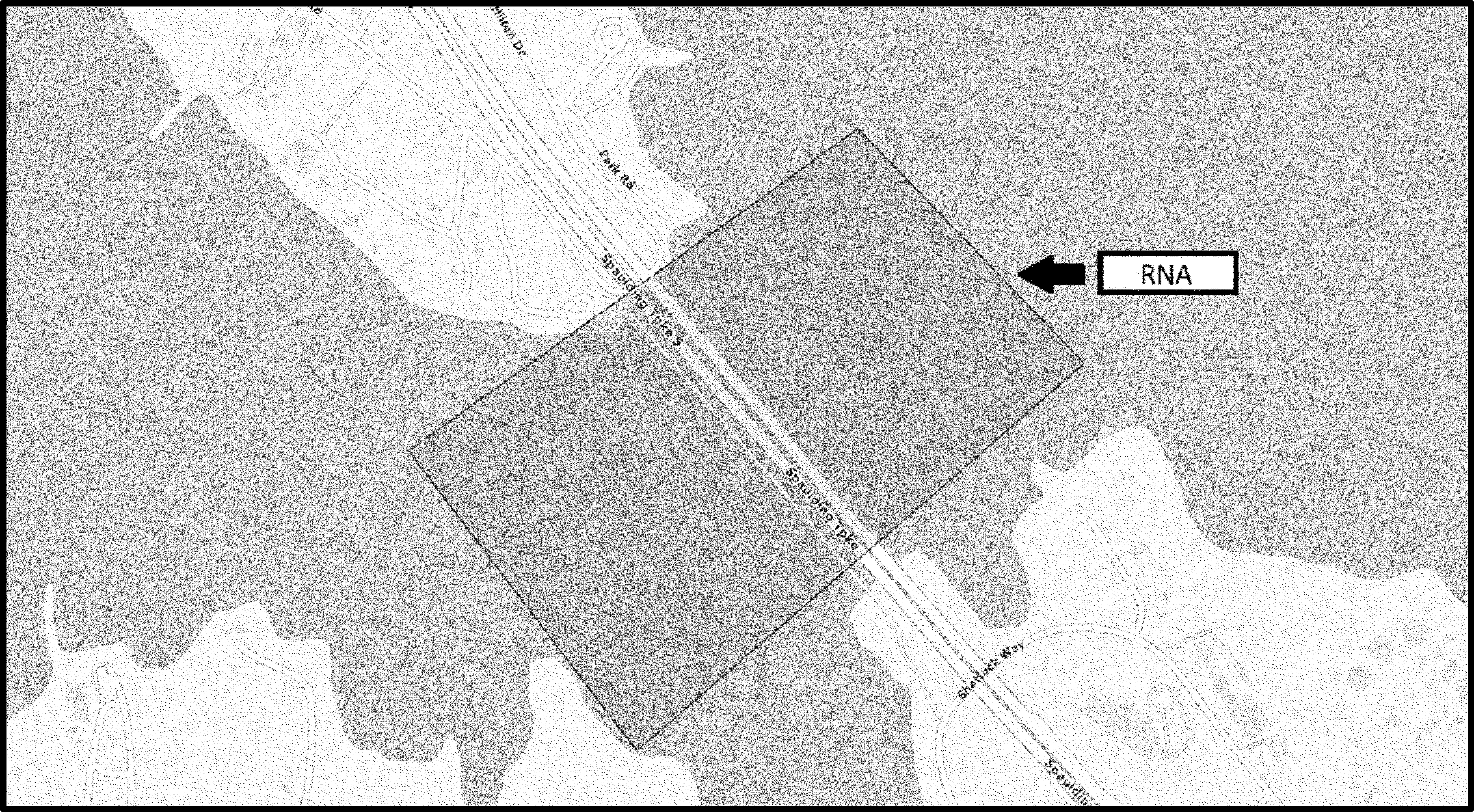
The Coast Guard is creating a RNA as shown in figure 1, to include all navigable waters of the Piscataqua River in the vicinity of the General Sullivan Bridge, Newington, NH, surface to bottom, encompassed by a line connecting the following approximated positions, beginning at 43°07′17.04″ N, 070°49′27.99″ W; thence to 43°07′04.67″ N, 070°49′51.61″ W; thence to 43°06′53.12″ N, 070°49′39.59″ W; thence to 43°07′08.01″ N, 070°49′16.03″ W; and thence to the point of origin, expressed in Degrees (°) Minutes (′) Seconds (″) (DMS) based on North American Datum 1983 (NAD 83).
(Figure 1 Chartlet Showing the Boundaries of the RNA.)
The RNA will establish the following operating restrictions on vessels:
(i) Entry and movement within the RNA is subject to a “Slow-No Wake” speed limit. All vessels may not produce a wake and may not attain speeds greater than five (5) knots unless a higher minimum speed is necessary to maintain bare steerageway.
(ii) No vessel with a beam greater than 160 feet may transit this area.
(iii) Any vessel transiting through the RNA must make a direct passage. No vessel may stop, fish, moor, anchor, or loiter within the RNA at any time.
(iv) Vessels may not pass (overtake) another vessel within the RNA.
(v) The operator of any vessel transiting in the RNA must comply with all lawful directions given to them by the COTP or the COTP's on-scene representative.
(vi) When a full enforcement period of the regulated area is activated, only vessel authorized by COTP may enter or remain within the regulated area.
The “Slow-No Wake” speed limit, vessel beam restriction of less than 160 feet, and other restrictions—except for
( printed page 35408)
the limited full enforcement period prohibiting vessels from entering the regulated area—will be enforced throughout the entire effective period.
Full enforcement periods of the regulated area, which entail prohibiting all vessel entry within the regulated area, will be implemented only during hazardous construction operations involving crane pulls above the navigable channel for demolition activities at the General Sullivan Bridge. These intermittent full closures are anticipated to occur between August 1, 2026, and September 1, 2026. These dates are tentative and subject to change due to weather, construction or supply chain delays, or other unforeseen circumstances. The COTP will provide email updates to all stakeholders as the project progresses and as the full closure dates and times are finalized based on demolition progress.
This regulated area and duration are intended to ensure the safety of personnel, vessels, and these navigable waters during the bridge demolition.
The dates and times of the full enforcement periods, during which all vessel transits through the regulated area will be prohibited, will be published in the Local Notice to Mariners, posted on the Coast Guard Navigation Center Maritime Safety Information Products page at
https://www.navcen.uscg.gov/msi,
and issue a Broadcast Notice to Mariners via marine channel 16 (VHF-FM) as soon as practicable in response to an emergency or hazardous condition.
This rule will remain in effect through March 31, 2027, which should accommodate the possibility of project delays due to unforeseen circumstances. If the project is completed before March 31, 2027, enforcement of the regulated navigation area will be suspended, and notice will be provided via the Local Notice to Mariners.
The navigational channel width in vicinity of the bridge will be reduced to 160 ft from June 10, 2026, to December 1, 2026. Markings will be placed to mark the new width of the channel in accordance with Private Aids to Navigation requirements in 33 CFR part 66. These dates are tentative and subject to change due to weather, construction or supply chain delays, or other unforeseen circumstances.
We developed this rule after considering numerous statutes and Executive orders related to rulemaking. Below we summarize our analyses based on a number of these statutes and Executive orders.
A. Impact on Small Entities
The regulatory flexibility analysis provisions of the Regulatory Flexibility Act of 1980, 5 U.S.C. 601-612, do not apply to rules that are not subject to notice and comment. Because the Coast Guard has, for good cause, waived the notice and comment requirement that would otherwise apply to this rulemaking, the Regulatory Flexibility Act's flexibility analysis provisions do not apply here.
Under section 213(a) of the Small Business Regulatory Enforcement Fairness Act of 1996 (Pub. L. 104-121), if this rule will affect your small business, organization, or governmental jurisdiction and you have questions, contact the person listed in the
FOR FURTHER INFORMATION CONTACT
section.
Small businesses may send comments to the Small Business and Agriculture Regulatory Enforcement Ombudsman and the Regional Small Business Regulatory Fairness Boards by calling 1-888-REG-FAIR (1-888-734-3247). The Coast Guard will not retaliate against small entities that question or complain about this rule or any policy or action of the Coast Guard.
B. Collection of Information
This rule will not call for a new collection of information under the Paperwork Reduction Act of 1995 (44 U.S.C. 3501-3520).
C. Federalism and Indian Tribal Governments
We have analyzed this rule under Executive Order 13132, Federalism, and have determined that it is consistent with the fundamental federalism principles and preemption requirements described in that Order.
Also, this rule does not have tribal implications under Executive Order 13175, Consultation and Coordination with Indian Tribal Governments, because it does not have a substantial direct effect on one or more Indian tribes, on the relationship between the Federal Government and Indian tribes, or on the distribution of power and responsibilities between the Federal Government and Indian tribes.
D. Unfunded Mandates Reform Act
As required by The Unfunded Mandates Reform Act of 1995 (2 U.S.C. 1531-1538), the Coast Guard certifies that this rule will not result in an annual expenditure of $100,000,000 or more (adjusted for inflation) by a State, local, or tribal government, in the aggregate, or by the private sector.
E. Environment
We have analyzed this rule under Department of Homeland Security Directive 023-01, Rev. 1, associated implementing instructions, and Environmental Planning COMDTINST 5090.1 (series), which guide the Coast Guard in complying with the National Environmental Policy Act of 1969 (42 U.S.C. 4321et seq.), and have determined that this action is one of a category of actions that do not individually or cumulatively have a significant effect on the human environment.
This rule is a regulated navigation area. It is categorically excluded from further review under paragraph L60(a) of Appendix A, Table 1 of DHS Instruction Manual 023-01-001-01, Rev. 1. A Record of Environmental Consideration supporting this determination will be available in the docket.
V. Public Participation and Request for Comments
We view public participation as essential to effective rulemaking and will consider all comments and material received during the comment period. Your comment can help shape the outcome of this rulemaking. If you submit a comment, please include the docket number for this rulemaking, indicate the specific section of this document to which each comment applies, and provide a reason for each suggestion or recommendation.
Submitting comments.
We encourage you to submit comments at
https://www.regulations.gov.
To do so, go to
https://www.regulations.gov,
type USCG-2026-0401 in the search box and click “Search.” Next, look for this document in the Search Results column, and click on it. Then click on the Comment option. If you cannot submit your material by using
https://www.regulations.gov,
call or email the person in the
FOR FURTHER INFORMATION CONTACT
section of this rule for alternate instructions.
Viewing material in the docket.
To view available documents, find the docket as described in the previous paragraph, and then select “Supporting & Related Material” in the Document Type column. We will post public comments in our online docket. Additional information is on the
https://www.regulations.gov
Frequently Asked Questions web page.
Personal information.
We accept anonymous comments. Comments we post to
https://www.regulations.gov
will
( printed page 35409)
include any personal information you have provided. For more about privacy and submissions to the docket in response to this document, see DHS's eRulemaking System of Records notice (85 FR 14226, March 11, 2020).
Regulated Navigation Area; Piscataqua River, Newington, NH.
(a)
Location.
The following area is a Regulated Navigation Area (RNA): all navigable waters of the Piscataqua River, in the vicinity of the General Sullivan Bridge, Newington, NH, surface to bottom, encompassed by a line connecting the following approximated positions, beginning at 43°07′17.04″ N, 070°49′27.99″ W; thence to 43°07′04.67″ N, 070°49′51.61″ W; thence to 43°06′53.12″ N, 070°49′39.59″ W; thence to 43°07′08.01″ N, 070°49′16.03″ W; and thence to the point of origin, expressed in Degrees (°) Minutes (′) Seconds (″) (DMS) based on North American Datum 1983 (NAD 83).
(b)
Definitions.
The following definitions apply to this section.
(1)
Designated representative
means a Coast Guard Patrol Commander, including a Coast Guard coxswain, petty officer, or other officer operating a Coast Guard vessel and a Federal, State, and local officer designated by or assisting the Northeast Coast Guard District Commander in the enforcement of the regulated area.
(2)
Local officer
means any officer, agent, or employee of a unit of local government authorized by law or by a local government agency to engage in or supervise the prevention, detection, investigation, or prosecution of any violation of criminal law.
(c)
Regulations.
In addition to the general RNA regulations in § 165.13, the following regulations apply to the RNA described in paragraph (a) of this section.
(1) Nothing in this section relieves any vessel, owner, operator, charterer, master, or person directing the movement of a vessel, from the consequences of any neglect to comply with this part or any other applicable law or regulation (
i.e.,
the International Regulations for Prevention of Collisions at Sea, 1972 (72 COLREGS) or 33 CFR part 84) or of the neglect of any precaution which may be required by the ordinary practice of seamen, or by the special circumstances of the case.
(2) Entry and movement within the RNA is subject to a “Slow-No Wake” speed limit. All vessels may not produce a wake and may not attain speeds greater than five (5) knots unless a higher minimum speed is necessary to maintain bare steerageway.
(3) No vessel with a beam greater than 160 feet may transit this area.
(4) Any vessel transiting through the RNA must make a direct passage. No vessel may stop, fish, moor, anchor, or loiter within the RNA at any time.
(5) Vessels may not pass (overtake) another vessel within the RNA.
(6) The operator of any vessel transiting in the RNA must comply with all lawful directions given to them by the Captain of the Port (COTP) or the COTP's on-scene representative.
(7) When a full enforcement period of the regulated area is activated, only vessel authorized by COTP may enter or remain within the RNA.
(d)
Enforcement.
The following enforcement periods and requirements apply to this RNA.
(1) This section will be enforced from 12:01 a.m. on June 10, 2026, to 11:59 p.m. on March 31, 2027.
(2) The “Slow-No Wake” speed limit, and other restrictions—except for the limited full enforcement period prohibiting vessels from entering the regulated area—will be enforced throughout the entire enforcement period.
(3) Full enforcement periods of the regulated area, prohibiting all vessel entry, will be enforced only during hazardous demolition operations obstructing the navigable channel. The Coast Guard will issue information on full enforcement periods through Local Notice to Mariners, the Coast Guard Navigation Center Maritime Safety Information Products page at
https://www.navcen.uscg.gov/msi,
and Broadcast Notice to Mariners via marine channel 16 (VHF-FM) as soon as practicable.
(4) Persons or vessels seeking to deviate from the restrictions described in section (c) of this section or to enter the regulated area during a full enforcement period must request authorization from the COTP or the COTP's on-scene designated representative on VHF-16 or via phone at (718) 354-4353.
Michael E. Platt,
Rear Admiral, U.S. Coast Guard, Commander, Northeast District.