Endangered and Threatened Wildlife and Plants; Revised Designation of Critical Habitat for the Contiguous U.S. Distinct Population Segment of the Canada Lynx
We, the U.S. Fish and Wildlife Service (Service), revise the critical habitat designation for the contiguous U.S. distinct population segment (DPS) of the Canada lynx (Lynx cana...
We, the U.S. Fish and Wildlife Service (Service), revise the critical habitat designation for the contiguous U.S. distinct population segment (DPS) of the Canada lynx (
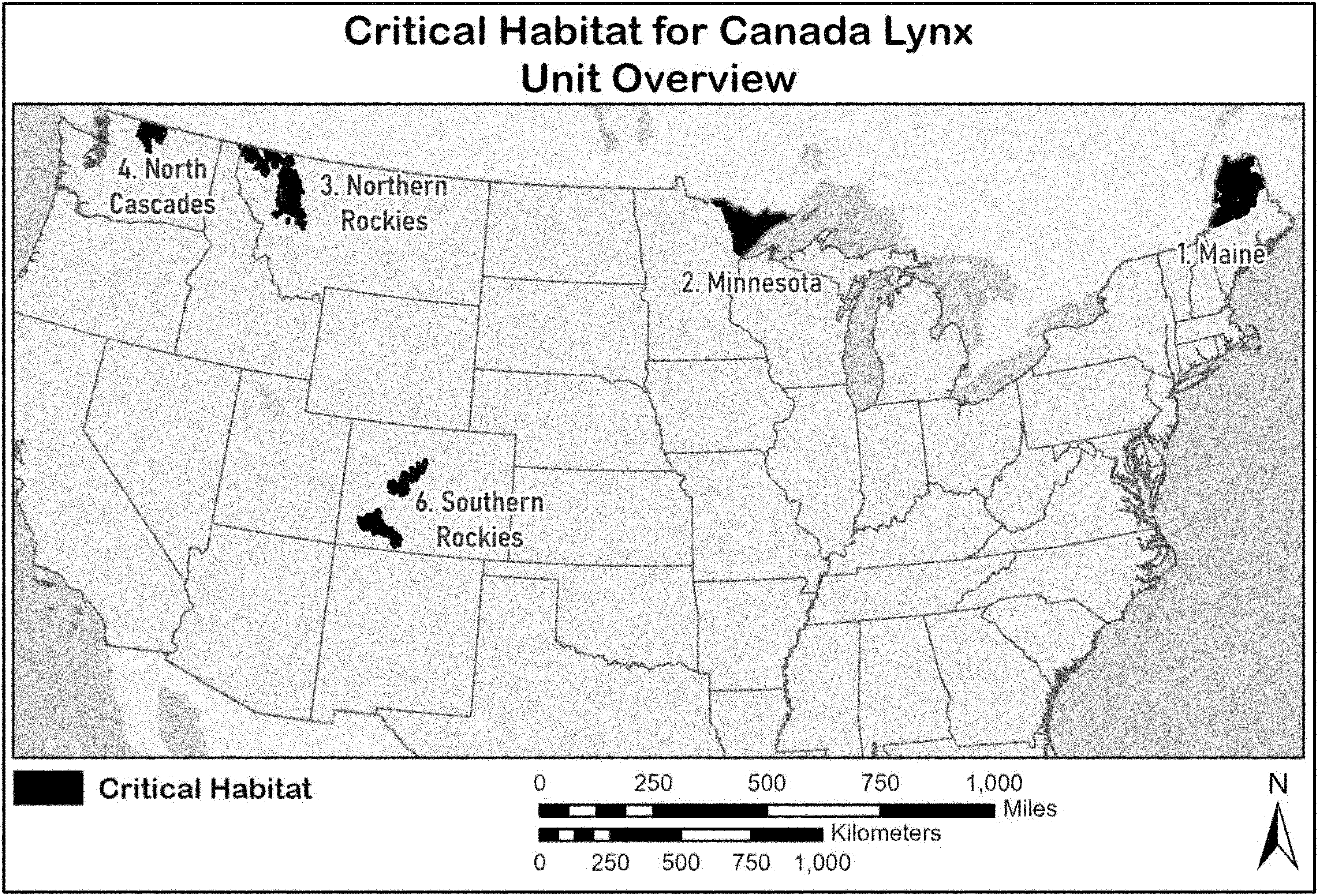
Lynx canadensis) under the Endangered Species Act of 1973, as amended (Act). In total, approximately 14,030 square miles (36,340 square kilometers) in Colorado, Idaho, Montana, and Washington, fall within the boundaries of the revised critical habitat designation. This revision fulfills our obligations under a settlement agreement to address issues raised by the District Court of Montana regarding our 2014 final critical habitat designation.
Availability of supporting materials:
Supporting materials we used in preparing this rule, such as the species status assessment (SSA) report addendum, are available on the Service's website at
ecos.fws.gov/ecp/species/A073?,
at
www.regulations.gov
at Docket No. FWS-R6-ES-2024-0142, or both. For the critical habitat designation, the coordinates or plot points or both from which the maps are generated are included in the decision file for this critical habitat designation and are available at
www.regulations.gov
at Docket No. FWS-R6-ES-2024-0142 and on the Service's website at
www.fws.gov/species/canada-lynx-lynx-canadensis.
FOR FURTHER INFORMATION CONTACT:
Amity Bass, Field Supervisor, U.S. Fish and Wildlife Service, Montana Ecological Services Field Office, 585 Shepard Way, Suite 1, Helena, MT 59601; telephone 406-449-5225. Individuals in the United States who are deaf, deafblind, hard of hearing, or have a speech disability may dial 711 (TTY, TDD, or TeleBraille) to access telecommunications relay services. Individuals outside the United States should use the relay services offered within their country to make international calls to the point-of-contact in the United States.
SUPPLEMENTARY INFORMATION:
Executive Summary
Why we need to publish a rule.
Under the Endangered Species Act (Act), any species that is determined to be threatened or endangered requires critical habitat to be designated to the maximum extent prudent and determinable. Designations and revisions of critical habitat can be completed only by issuing a rule through the Administrative Procedure Act rulemaking process (5 U.S.C. 551et seq.).
The contiguous U.S. DPS of the Canada lynx was listed as a threatened species in 2000. The range of the DPS spans parts of the States of Colorado, Idaho, Maine, Minnesota, Montana, New Hampshire, New Mexico, Washington, and Wyoming. We designated critical habitat for the Canada lynx DPS in 2006 and revised the designation in 2009 and 2014. On November 29, 2024, in response to a settlement agreement, we published a proposed rule to revise critical habitat for the Canada lynx DPS.
What this document does.
This final rule revises the existing designation of critical habitat for the threatened contiguous U.S. Canada lynx DPS. We are revising Canada lynx critical habitat in the western United States only because this part of the range was the subject of a 2016 court order that found fault with our 2014 final critical habitat rule for not designating critical habitat in Colorado and in five National Forests in Idaho and Montana, and because we have new scientific information on lynx habitat in the western United States. We are not making any revisions to existing critical habitat in Maine and Minnesota.
The basis for our action.
Section 3(5)(A) of the Act defines critical habitat as (i) the specific areas within the geographical area occupied by the species, at the time it is listed, on which are found those physical or biological features (I) essential to the conservation of the species and (II) which may require special management considerations or protections; and (ii) specific areas outside the geographical area occupied by the species at the time it is listed, upon a determination by the Secretary of the Interior (Secretary) that such areas are essential for the conservation of the species. Section 4(b)(2) of the Act states that the Secretary must make the designation on the basis of the best scientific data available and after taking into consideration the economic impact, the impact on national security, and any other relevant impacts of specifying any particular area as critical habitat.
Previous Federal Actions
Please refer to the proposed critical habitat rule (89 FR 94656) for the Canada lynx DPS published on November 29, 2024, for a detailed description of previous Federal actions concerning this species.
Peer Review
On December 1, 2023, a team of Service biologists, in consultation with recognized lynx and climate experts, completed an addendum to the 2017 SSA report for the Canada lynx DPS (Service 2023, entire). The SSA report (Service 2017, entire) and addendum (Service 2023, entire) represent a compilation of the best scientific and commercial data available concerning the status of the species, including the impacts of past, present, and future factors (both negative and beneficial) affecting the species.
In accordance with our joint policy on peer review published in the
Federal Register
on July 1, 1994, (59 FR 34270) and our August 22, 2016, memorandum updating and clarifying the role of peer review in listing and recovery actions under the Act, we solicited independent scientific review of the information contained in the Canada lynx SSA report addendum. We sent the SSA report addendum to five independent peer reviewers and received five responses. Results of this structured peer review process can be found at
www.regulations.gov
at Docket No. FWS-R6-ES-2024-0142. We incorporated the results of these reviews, as appropriate, into the SSA report, which was the foundation for the proposed rule and this final rule. A summary of the peer review comments can be found in the proposed rule (89 FR 94656 at 94659, November 29, 2024).
Summary of Changes From the Proposed Rule
In the proposed rule published on November 29, 2024, (89 FR 94656) we announced we were considering
( printed page 43733)
approximately 594 square miles (mi2
) (1,541 square kilometers (km2
)) for exclusion under section 4(b)(2) of the Act. We considered excluding all Tribal lands in Montana and New Mexico as well as lands in Montana, managed in accordance with the Montana Department of Natural Resources and Conservation (DNRC) Forested State Trust Lands Habitat Conservation Plan (Montana DNRC and U.S. Fish and Wildlife Service 2010b, entire), and lands in Washington, managed in accordance with the Washington Department of Natural Resources (WDNR) Lynx Habitat Management Plan for WDNR-managed Lands (WDNR 2006, entire). The proposed exclusion of Tribal lands in New Mexico no longer applies because we have determined in this final rule that areas proposed in New Mexico, including Tribal lands, are not critical habitat. We are excluding the other areas described above from the final critical habitat designation.
We also received several comments providing information that supported excluding additional areas from the final critical habitat designation because the benefits of excluding additional areas outweighed the benefits of including the areas. These additional areas include: State of Montana Department of Fish, Wildlife, and Parks (MTFWP) Wildlife management areas (43 mi2
(113 km2
)); and Green Diamond Resources lands in Montana (7 mi2
(18 km2
)).
In total, we are excluding approximately 625 mi2
(1,619 km2
) of lands from the final critical habitat designation for the Canada lynx DPS. Our rationale for each of these exclusions is provided in the Consideration of Impacts Under Section 4(b)(2) of the Act section below.
We have revised the physical and biological features (PBFs) since the proposed rule for clarity due to public comments received. We have determined that the following PBFs are essential to the conservation of the Canada lynx DPS: (1) presence of snowshoe hares that support lynx residency and reproduction over time within a mosaic of boreal/subalpine forest structural stages that includes snowshoe hare habitat with dense horizontal cover at ground- or snow-level; (2) winter conditions that provide and maintain deep persistent unconsolidated (fluffy) snow; (3) presence of denning structures, including downed trees, root wads, and accumulations of coarse woody debris; (4) habitat types, such as dry forest or meadows, that are between boreal forest patches and are likely to be used by lynx traveling between those patches within and among home ranges; and (5) landscapes with suitable habitat large enough (483 mi2
(greater than or equal to 1,250 km2
)) to support breeding populations. These PBFs describe the most important needs for Canada lynx at the species level.
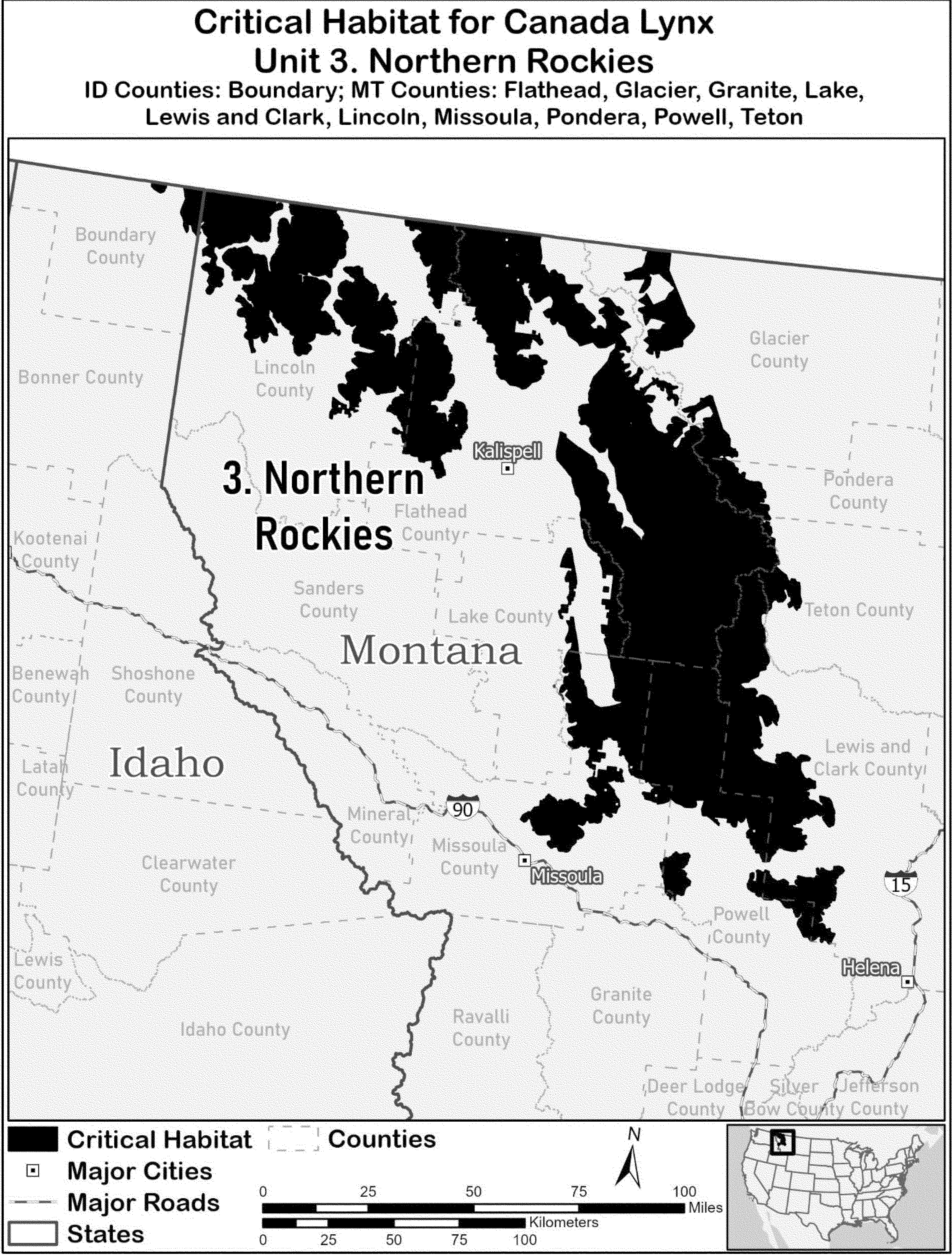
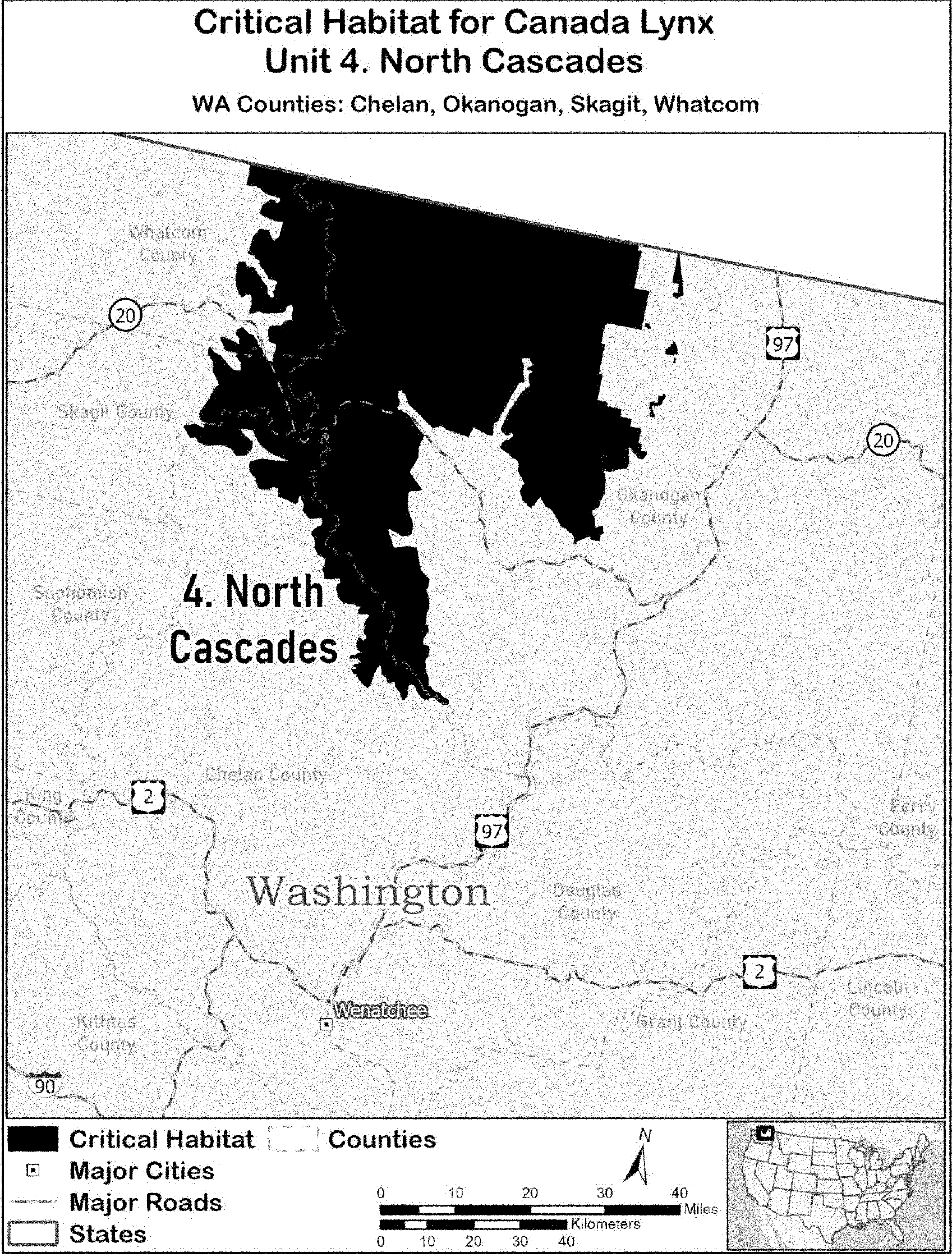
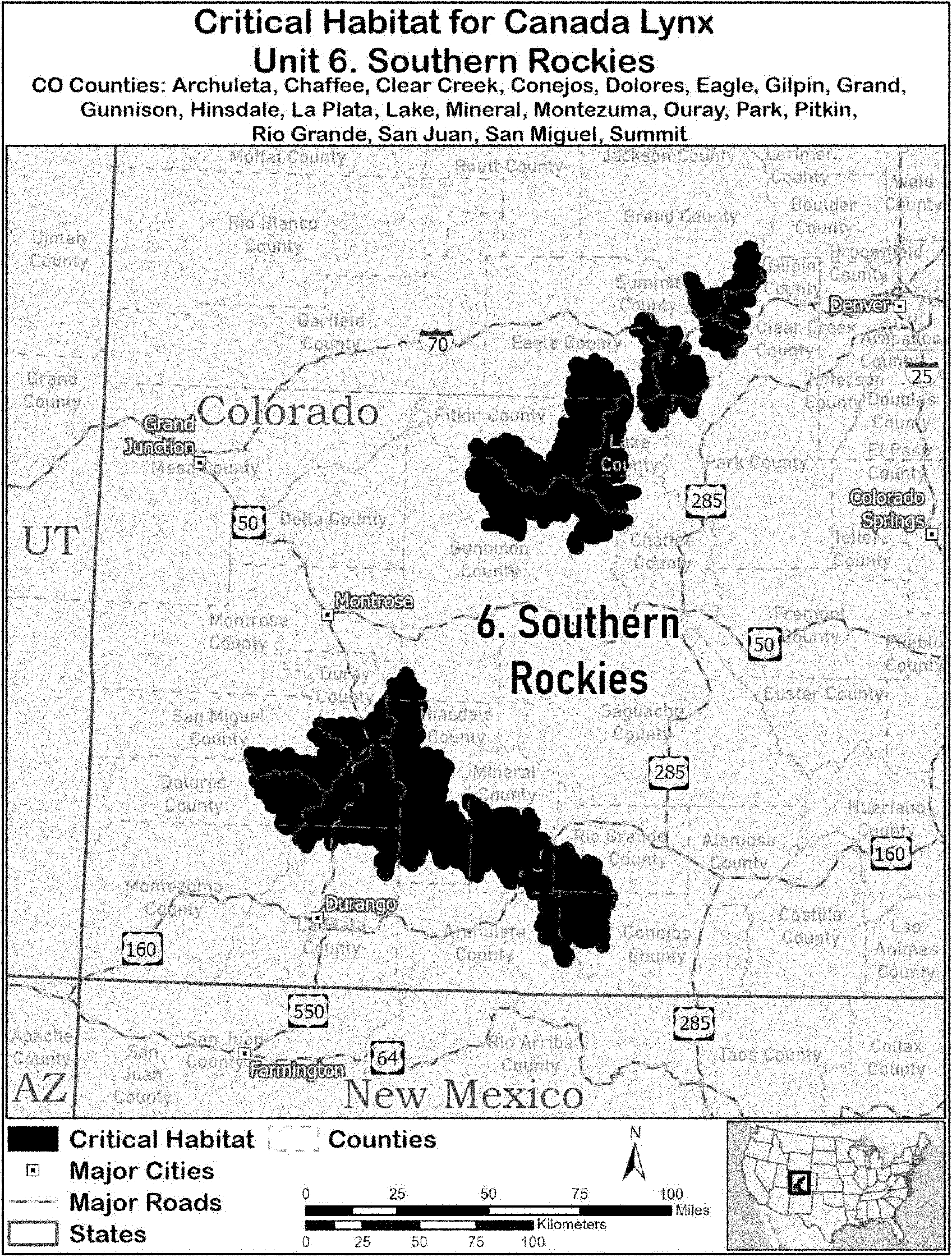
In response to public and Federal agency comments, we reviewed and made changes to the proposed critical habitat units in both the Southern Rockies (Unit 6) and in the Northern Rockies and Cascades (Units 3 and 4). These changes, in addition to the exclusions, resulted in an overall decrease from the proposed rule of 1,041 mi2
(2,695 km2
) in Unit 3, 279 mi2
(722 km2
) in Unit 4, and 2,642mi2
(6,842 km2
) in Unit 6. We also made changes in the Greater Yellowstone Area (GYA; Unit 5), removing all areas from critical habitat designation. Changes in Unit 4 were relatively minor; we adjusted the boundaries to remove a few areas of lower elevation dry forest that were outside of modeled likely lynx habitat. In Unit 3 we made some similar minor boundary adjustments, removing some small areas and also adding in a few areas of likely lynx habitat that is occupied. The bigger changes in Unit 3 were to remove some smaller polygons that did not meet the minimum size requirements, including the polygon along the Montana-Idaho border near Lolo Pass as well as the polygons in the Selkirk Mountains. Changes in the Southern Rockies were made to align better with the final data from the Squires et al. 2024 modeling effort that identified areas of likely and core habitat for lynx in the Southern Rockies. The revised critical habitat polygons contain the PBFs for lynx, and they encompass the substantial areas of likely and core habitat that have supported lynx occupancy and reproduction and other habitats that provide connectivity between those patches of the best habitat.
In addition, in the proposed rule we stated that we could not map critical habitat in sufficient detail to exclude each and every developed area or other areas that are unlikely to contain the PBFs essential to the conservation of lynx. Some comments received during the public comment period requested further detail of the types of areas excluded by text from the critical habitat designation. Since the proposed rule, we revised the part of the rule that explains what areas within the boundaries of critical habitat do not contain the PBFs essential to the conservation of the lynx DPS and are thus not considered critical habitat. Those areas include: lands covered by buildings, houses, pavement, and other structures; paved highways and roads; active mines and
existing
mining infrastructure; existing developed ski runs and tree islands, ski lifts, and associated ski area infrastructure and buildings; and irrigation infrastructure.
We made minor, nonsubstantive editorial revisions and corrections throughout this rule to ensure better consistency and to clarify information.
Summary of Comments and Recommendations
In the proposed rule published on November 29, 2024 (89 FR 94656), we requested that all interested parties submit written comments on the proposal by January 28, 2025. We also contacted appropriate Federal and State agencies, Tribal entities, scientific experts and organizations, and other interested parties and invited them to comment on the proposal. A newspaper notice inviting general public comment was published in U.S.A. Today on December 11, 2024. We did not receive any requests for a public hearing. All substantive information received during the comment period has either been incorporated directly into this final critical habitat designation or is addressed below.
Peer Reviewer Comments
As discussed in Peer Review above, we received comments from five peer reviewers on the draft SSA report addendum. We reviewed all comments we received from the peer reviewers for substantive issues and new information regarding the contents of the SSA report addendum (Service 2023, entire). The peer reviewers generally concurred with our methods and conclusions. The peer reviewers provided additional information, terminology clarifications, suggestions to explain uncertainties, clarifications to the explanation of our resiliency model, and other editorial suggestions. Peer reviewer comments and suggestions were incorporated as appropriate in the final version of the SSA report addendum (Service 2023, entire).
Federal Agency Comments
(1) Comment:
The U.S. Department of Agriculture (USDA) expressed desire for more precise language regarding areas of non-suitable habitat that fall within the proposed critical habitat that includes the exclusion of lands covered by buildings, pavement, and other structures.
Our response:
Given the extensive areas needed to support lynx populations, and thus the scale at which critical habitat was mapped, it was impractical to show all areas of
( printed page 43734)
development, infrastructure, and other areas of non-suitable habitat that are not included in the designation. Rather, these areas are excluded by text in regulation at 50 CFR 17.95. We revised our description of these types of areas within the boundaries of the final critical habitat designation that lack the PBFs necessary for lynx, to specify that existing developed areas with buildings, pavement, and other structures, such as irrigation-related infrastructure, are not included. We do note that some areas, such as the vegetation surrounding reservoirs, may provide lynx habitat and should be assessed on site-specific bases. See
Criteria Used To Identify Critical Habitat
below for more information.
(2) Comment:
USDA, through a National Forest in Colorado, requested the Service revise the moving window analysis of the Squires et al. (2024, entire) model. USDA stated that the Service appears to have used an arbitrary cutoff that is beyond the 95 percent cutoff that the paper proposes as likely habitat. USDA stated there is a large amount of ponderosa pine (
Pinus ponderosa), mountain shrublands, mountain grasslands and dry-mixed conifer forests dominated by ponderosa pine, Douglas fir (
Pseudotsuga menziesii), and white fir (
Abies concolor) vegetation that is being considered as critical habitat for lynx. These vegetation types do not comprise lynx habitat nor do they provide habitat for primary or alternate prey species. USDA stated that their management in these fire adapted vegetation types is to promote forest conditions that are more resilient to natural disturbances such as insects, disease, and wildfire. USDA suggested that the designation of these vegetation types as critical habitat potentially conflicts with forest management of these vegetation types and has potential to mislead public interpretation of science-based principles for management.
Our response:
We reviewed the mapping process used by the Western Lynx Biology Team (WLBT 2022, entire)—an interagency team of biologists from the Service, Forest Service, National Park Service, and Bureau of Land Management (BLM). The WLBT created tier polygons in the Southern Rockies based on an earlier draft of the model developed by Dr. John Squires and his colleagues, and our proposed critical habitat in the Southern Rockies used the tier 1 polygons from WLBT. The final model selected for publication (Squires et al. 2024) changed from what the WLBT used. Upon review of the Squires et al 2024 paper, we became aware that the WLBT polygons were based on the draft earlier model; thus, we reviewed the revised published model and revised our critical habitat polygons using the final published version of the model, following the WLBT's methods. The final critical habitat polygons for the Southern Rockies unit contain the physical or biological features for the Canada lynx and encompass all substantial areas of likely and core habitat, as well as habitats that provide connectivity in between, and they encompass the areas that have continued to support persistent lynx residency and occupancy.
In Colorado, as in other areas, high-quality lynx habitat (
e.g.,
mesic, boreal forest types) is often set within a matrix of dry forest types, rocky peaks, and other habitats that do not provide high-quality foraging or denning habitat for lynx but are important for connecting those high-quality lynx habitats to support large enough areas to provide for an individual lynx's home range. The revised critical habitat polygons substantially reduce the amount of dry forest types mentioned by USDA, and more closely map areas of high-probability lynx habitat. However, some areas of drier forest types, meadows, and mountain peaks fall within the critical habitat polygons. These areas may be used by lynx that are traveling within or between home ranges, and thus they provide connectivity, but they are not likely to contain habitat for foraging or denning. Vegetation management, fuels reduction, and other activities in these drier forest and non-boreal forest patches within the critical habitat polygons may be beneficial for reducing fire risk to the high-quality lynx habitats.
Lynx are primarily associated with mesic, boreal forest types such as spruce (
Picea
spp.) and fir
(Abies
spp.). Within lynx range in the western United States, these habitat types are often patchily distributed within a matrix of drier forest types and other habitats. Squires et al. (2024, entire) note that the relatively small areas of “likely” (
i.e.,
high-quality lynx habitat) and “core” habitats were patchily distributed and spatially limited within a matrix of “unlikely” habitat and that the shape of lynx habitat was convoluted due to the complex mountain topography that dominates the Southern Rocky Mountains. The critical habitat polygons capture the substantial areas of “likely” and “core” habitat, which are the habitats most likely to be used by resident lynx. The polygons also conservatively include the areas in between patches of “likely” habitat that provide the connective matrix. This resulted in the critical habitat polygons including some of the “unlikely” habitat in the matrix that connects patches of “likely” lynx habitat. In doing so, the critical habitat polygons capture broad areas with enough “likely” habitat to support multiple lynx home ranges, while also considering the within-home range and between-home range connectivity necessary for daily movements and interactions (
e.g.,
males traveling to multiple female home ranges). The critical habitat polygons do not capture areas that lynx may travel on occasion for making exploratory or long-range dispersal movements.
Forest management, fuels reduction, and most other activities within drier forest types, meadows, and other non-boreal forest types within the critical habitat polygons are unlikely to affect critical resources for lynx, such as foraging and denning habitat or winter snow conditions. The designation of critical habitat does not preclude forest management practices from occurring but provides assurance that forest management will not result in the destruction or adverse modification of the critical habitat at the scale of the entire critical habitat designation.
Comments From States
(3) Comment:
Montana Fish, Wildlife, and Parks (MTFWP) supported the exclusion of lands in Montana that are managed by the Montana Department of Natural Resources and Conservation (DNRC) from critical habitat designation. The DNRC has a habitat conservation plan (HCP) and State administrative rules (MT Admin Rules 36.11.428(4)) that specifically outline the conservation, monitoring, and management of lynx and their habitat on DNRC-managed lands. This HCP ensures that important habitats for lynx will be conserved and managed for the benefit of the species. MTFWP felt that designation of these areas as critical habitat will not provide any additional protections or benefits to the species; however, designating these areas may cause unneeded restrictions.
Our response:
We have excluded lands covered by the Montana DNRC HCP from the critical habitat designation because the benefits of excluding them outweigh the benefits of including them as critical habitat. See Consideration of Impacts Under Section 4(b)(2) of the Act, below, for our full exclusion analysis of these areas.
(4) Comment:
MTFWP commented that their agency has six wildlife management areas (WMAs; Nevada Lake, North Swan Valley, Fish Creek, Blackfoot-Clearwater, Marshal Creek, and Bad Rock Canyon) that overlap
( printed page 43735)
portions of the proposed Canada lynx critical habitat. WMAs in Montana are managed by MTFWP and have specific plans for each property. These plans include management strategies to benefit the diversity of wildlife species and their habitats, including Canada lynx. MTFWP recommended that the Service exclude WMAs in Montana from the designation of Canada lynx critical habitat.
Our response:
We have excluded WMAs managed by MTFWP from the critical habitat designation because the benefits of excluding them outweigh the benefits of including them as critical habitat. See Consideration of Impacts Under Section 4(b)(2) of the Act, below, for our full exclusion analysis of these areas.
(5) Comment:
MTFWP supported the removal of lynx critical habitat in the Greater Yellowstone Area (GYA) and applauded the Service for identifying the areas, according to science, that do not support resident Canada lynx populations or occupancy.
Our response:
We removed the GYA from critical habitat designation, based on the limited ecological capacity of the area to support Canada lynx, and the historical and contemporary records indicating only episodic lynx occurrence, not a persistent population occupying the GYA.
(6) Comment:
MTFWP supported the findings from the model presented in Olson et al. (2021, entire) as the best current model for designating critical habitat. They also commented that even though the model may estimate high-quality areas, that does not mean the areas are occupied by lynx or would support a resident population.
Our response:
The Olson et al. (2021) species distribution model (SDM) was a foundational scientific resource for delineating potential lynx habitat and was developed using empirical data from verified detections and radio-collared lynx, making it one of the most robust and contemporary tools available to the Service.
We agree that areas identified as having high probability of lynx use in the SDMs represent potential habitat and do not, on their own, demonstrate current occupancy or assure that an area can support a resident population. Multiple factors beyond modeled habitat quality- such as vegetation condition, prey abundance, disturbance history, and intra- or inter-specific competition—can influence whether lynx are present in a particular area or able to persist there over time. Accordingly, while the SDM identifies where habitat capable of supporting lynx may occur, the Service does not equate modeled habitat with demonstrated occupancy or confirmed capacity to sustain resident populations. Instead, occupancy and residency evaluations incorporate additional information on local conditions, survey data, and other ecological considerations. We also appreciate the efforts of the states and other partners to continue conducting scientifically rigorous surveys and studies of occupancy to inform current and future evaluations and management for the species.
(7) Comment:
Citing recent lynx occupancy surveys conducted in Montana, Idaho, and Wyoming, MTFWP stated that neither Idaho nor Wyoming detected a lynx during the study period (December 1, 2023, to April 30, 2024). MTFWP suggested that this information contradicts the Service's statement in the proposed rule that all areas proposed as critical habitat are occupied, and it does not support the need for Canada lynx critical habitat designation in northern Idaho or any of the GYA. MTFWP urged the Service to consider these newest lynx occupancy survey findings regarding any revision or elimination of those areas in the final critical habitat designation.
Our response:
We reviewed the recent occupancy surveys as well as other information regarding occupancy and verified records of lynx. We are not designating any critical habitat in the GYA, in either the Montana or the Wyoming portions of the area. The contemporary occupancy survey referenced in this comment, as well as other surveys conducted for lynx in the GYA, indicate the GYA is not occupied by a persistent population, and no verified evidence of successful reproduction has been recorded in decades. Similarly, we are not designating critical habitat in the Selkirks in Idaho, where the tri-state surveys failed to detect lynx (see also response to comment 10 below).
All of the critical habitat we are designating in Montana (in Unit 3) was occupied at the time of listing and is currently occupied by persistent resident populations. The small amount of critical habitat we are designating in Idaho is part of the Purcell Mountain Range; lynx occupancy was detected in the Purcell Range in the 2023-2024 surveys, and the Purcell Range has supported a persistent reproductive population for many years. Thus, all areas we are designating have had persistent reproductive populations and verified occupancy, as evidenced by multiple survey efforts.
(8) Comment:
The Colorado Department of Transportation (CDOT) requested that the Service consider removing the entire existing operational right-of-way along roads as defined in Federal Highway Administration regulations (23 U.S.C. 101) under section 4(b)(2) of the Act from critical habitat. Existing operational right-of-way refers to the right-of-way that has been disturbed for an existing transportation facility or is maintained for a transportation purpose. The existing operational right-of-way is actively maintained by transportation agencies, and therefore, would not include the PBFs essential to the conservation of lynx.
Our response:
As discussed in
Criteria Used To Identify Critical Habitat,
below, paved roads and transportation facilities that fall within the boundaries of critical habitat do not contain the PBFs essential to the conservation of lynx and are not considered critical habitat. Though paved roads and adjacent graveled shoulders do not contain PBFs, other vegetated sections of operational rights-of-way may contain habitat features occasionally used by lynx and snowshoe hares and are included in this designation.
(9) Comment:
CDOT expressed concerns about how critical habitat designation would influence future projects, such as road construction and maintenance and avalanche mitigation operations. They asked for clarification on what types or categories of “road construction and maintenance” would be included under the special management considerations that may be required for critical habitat.
Our response:
When designating critical habitat, we assess whether the specific areas within the geographical area occupied by the species at the time of listing contain features which are essential to the conservation of the species and which may require special management considerations or protection (see Special Management Considerations or Protection, below, for more information). As described earlier, some areas within the boundaries of mapped critical habitat do not contain the PBFs essential to the conservation of the lynx DPS and are thus not considered critical habitat. Those areas include paved highways and roads that would not be subject to the special management considerations because they do not contain PBFs essential to the conservation of lynx. However, for projects that impact designated critical habitat in areas with the PBFs (
e.g.,
road widening or vegetation removal that affect snowshoe hare densities), the areas of habitat containing the PBFs may require special management considerations or protection, although
( printed page 43736)
these are not requirements. Due to the variable nature of road construction, maintenance activities, and avalanche mitigation that may occur across the range of critical habitat, it is not feasible in this rule to specify which particular activities may or may not adversely affect critical habitat or warrant additional conservation measures. In general, paved roads and highways are more likely to result in habitat loss and fragmentation as they facilitate higher traffic volumes and/or speeds than smaller unpaved forest roads (Service 2017, pp. 100-102). The spatial and temporal scale of any activity should be examined, as well as any design features or specific conservation measures, to determine whether direct or indirect alteration of habitat would occur to the extent that the value of critical habitat for the survival and recovery of lynx would be appreciably diminished. For questions regarding whether specific activities may constitute adverse effects to critical habitat, we encourage project proponents and action agencies to work with the appropriate Ecological Services Field Office (
www.fws.gov/locations) to determine effects to critical habitat and ways to minimize them through project design.
(10) Comment:
The Idaho Governor's Office of Species Conservation stated that they believe areas in Idaho are not essential to the conservation of lynx, and provided the following points as evidence: (1) limited observations of lynx despite combined lynx-focused camera survey efforts, camera survey efforts for other forest carnivores, and camera survey efforts for large carnivores and ungulates; (2) insufficient predicted habitat to support a breeding population, which requires a minimum of 483 mi2
(1,250 km2
) as defined in the proposed rule (based on area alone, the proposed habitat patches could only support a small number of individuals even if all critical habitat were fully occupied); (3) even if fully occupied, this area would not contribute significantly to the population because these proposed areas are disjunct and peripheral to the larger matrix of modeled high-quality habitat and are unlikely to meaningfully contribute to population resilience (Unit 3 Northern Rockies); and (4) proposed areas in Idaho are peripheral and are not even between areas of known occupancy or sufficiently large areas of predicted high-quality, but are unoccupied, habitat. Based on the best available information, the Idaho Governor's Office of Species Conservation (OSC) suggested that the Service should not designate any critical habitat in Idaho.
Our response:
The final critical habitat designation includes a small area in northern Idaho that is in the northeast corner of the state, in an area within the Purcell Mountains. This area is directly connected to the rest of the mountain range that is located in Montana, and there is no ecological separation along the state line. The Purcell Mountains support regular occupancy and reproduction by multiple individual lynx (Squires et al. 2010, p. 1498; Olson et al. 2021, p. 1669). Survey efforts in the Purcells regularly detect lynx, including in the portion of the mountain range that falls within Idaho.
We have removed other areas of Idaho, including the Selkirk Mountains and the area around Lolo Pass from the critical habitat designation. Both of those areas were included in our proposed rule, due to being identified as tier 1 polygons by the WLBT. However, upon closer examination of the best available information, including information received since the proposed rule, these areas do not meet the definition of critical habitat. See Summary of Changes From the Proposed Rule for more information. We note that the Selkirks and the Lolo Pass area may function as important areas to support intermittent or even persistent occupancy and reproduction by lynx, peripheral to the core areas within Unit 3. Although they do not meet the definition of critical habitat in this designation, we encourage conservation considerations that preserve or improve conditions that allow these areas to contribute to lynx conservation.
(11) Comment:
The State of Idaho requested exclusion of Idaho State endowment trust land from the critical habitat designation for the Canada lynx DPS and challenged the assertion that the proposed critical habitat is an accurate predictor of lynx distribution and home ranges in the State.
Our response:
The proposed critical habitat included tier 1 polygons in the Selkirk Mountains that overlapped some Idaho State endowment trust lands. The final designation does not include this area and thus does not include the Idaho trust lands. As such, it is not necessary to consider an exclusion.
(12) Comment:
The Idaho Governor's Office of Species Conservation stated the Service should analyze how the addition of critical habitat will have an economic impact to logging contractors, counties, and small communities. They also stated that having the additional layer of critical habitat opens these areas to increased litigation. Adding additional critical habitat acreage in Idaho increases the liability for legal challenges on a larger scale. The Service should analyze how the increase in critical habitat will impact the counties, State and Federal government's costs related to litigation.
Our response:
We developed an incremental effects memorandum (IEM) considering the probable incremental economic impacts that may result from this critical habitat designation. The information contained in our IEM was then used to develop a screening analysis of the probable effects of the proposed designation of critical habitat for the Canada lynx DPS (Industrial Economics, Inc. (IEc) 2024, entire). We later revised the screening analysis for the final critical habitat rule (IEc 2026, entire). We considered economic impacts to logging contractors, counties, and small communities. We did not consider any potential increase in litigation costs associated with the addition of critical habitat, as this would be speculative. The analysis found that this critical habitat rule is unlikely to meet the threshold for an economically significant rule having an annual effect on the economy on the of $100 million or more. Designating occupied areas as critical habitat typically causes little, if any, incremental impacts above and beyond the impacts of listing the species, as is the case with Canada lynx DPS.
The public may view critical habitat designation as potentially resulting in incremental impacts in the form of lower property values; however, recent analysis of critical habitat property value impacts indicates that, at a national level on average, critical habitat designation has little to no effect on values for developed and undeveloped properties (IEc 2024 and 2026, p. 21, internal citations omitted). Similarly, the Service recognizes that some segments of the public see any critical habitat designation as severely limiting property rights; however, critical habitat designation has no regulatory effect on private actions on private land that do not involve Federal approval or action. We recognize that there are private actions on private lands that involve Federal actions; however, there should already be section 7 consultations taking place in these situations. The incremental effects of revising critical habitat for the Canada lynx DPS are likely to be limited to changes in administrative effort to evaluate the potential for adverse modification of Canada lynx DPS critical habitat. See
Exclusions Based on Economic Impacts,
below.
(13) Comment:
The State of Idaho is concerned that the designation of Canada lynx critical habitat will devalue
( printed page 43737)
its recently-acquired land and increase the likelihood that the State will reduce future purchases of land that might otherwise be developed or ecologically impaired. The commenter is also concerned about additional economic losses from new regulatory requirements, including reduced bidding from purchasers on timber sales because of the seasonal timber harvest restrictions and transportation and infrastructure limits.
Our response:
See our response to Comment 11, explaining that there are no state lands included in the final critical habitat designation in Idaho, which moots some of the concerns. We provide additional responses here regarding the economic concerns expressed in the comment. See also our response to Comment 44.
In general, real or perceived regulatory restrictions on land use can reduce the market value of the land. In the case of critical habitat for lynx, the Service finds that the rule is unlikely to generate additional restrictions on land use above and beyond any restrictions due to the presence of the species and its listing status. Nonetheless, the perception that additional restrictions may occur can affect land values. Section 4 of the economic screening analysis acknowledges that critical habitat may affect property values in certain circumstances; however, the screening analysis describes that a comprehensive review and synthesis of the economics literature on this topic found that the potential for property value impacts is species-specific and not generalizable to all critical habitat designations (IEc 2024 and 2026, p. 21). While some studies identify negative property value effects of critical habitat designation, others find that critical habitat can positively affect property values, and others find no effect. Mamun et al. (2023, entire), as cited in the economics screening memorandum (IEc 2024 and 2026, p. 21), represents the most comprehensive analysis of critical habitat property value impacts conducted to date. They found that critical habitat designation has an average of “little to no effect” on values for developed and undeveloped properties nationally. Nevertheless, the potential for a critical habitat designation to affect a property's value is species-specific and is acknowledged as a potential effect of this rule.
(14) Comment:
The Washington Department of Fish and Wildlife (WDFW) notes that the Service is considering excluding lands in Washington from the critical habitat designation that are managed in accordance with the WDNR) Lynx Habitat Management Plan (LHMP) for WDNR-managed lands (WDNR 2006, entire). WDFW also noted that the WDNR indicated that implementation and effectiveness monitoring results would be summarized in biennial reports to the Service and WDFW (WDNR 2006, p. 63) and that their 2006 plan would be updated as more is learned about lynx habitat relationships and management strategies through periodic reviews every five years (WDNR 2006, p. 6). To their knowledge, no such reports have been produced or shared and, with the exception of a limited-scope amendment in 2011, the plan has not been updated. Without an update to the WDNR's 2006 plan, and with no reports on implementation, neither WDFW nor the Service can make any statements on effectiveness. WDFW suggests the Service should request the biennial reports and consider these lands for inclusion in the critical habitat designation.
Our response:
We appreciate the concerns outlined by WDFW regarding the WDNR LHMP. In March 2025, both the Service and WDFW received a comprehensive report from WDNR on the implementation and effectiveness of their LHMP. The Service has reviewed the 2025 report and is currently working with WDFW and WDNR to evaluate the 2006 LHMP to determine the elements of the plan that warrant updating. WDNR has committed to completing any updates to the LHMP by 2028 (Crump, in lit. 2025). We appreciate the commitment of the WDNR to manage lands according to the LHMP and best available science, and we have excluded lands currently managed under the 2006 WDNR LHMP from the critical habitat designation because the benefits of excluding them outweigh the benefits of including them as critical habitat. See Consideration of Impacts Under Section 4(b)(2) of the Act, below, for our full exclusion analysis of these areas.
(15) Comment:
WDNR supports the proposed rule including continuing to exclude lands managed under the 2006 WDNR LHMP from critical habitat designation. WDNR remains committed to following the LHMP until lynx are de-listed, or until 2076, whichever is shorter.
Our response:
We appreciate the commitment of the WDNR to manage lands according to the LHMP, and we have excluded lands managed under WDNR's LHMP from the critical habitat designation because the benefits of excluding them outweigh the benefits of including them as critical habitat. See Consideration of Impacts Under Section 4(b)(2) of the Act, below, for our full exclusion analysis of these areas.
(16) Comment:
WDFW stated that establishment of a reintroduced lynx population in the Kettle Range of Washington could prompt consideration of a critical habitat designation congruent with the delineation of critical habitat for the reintroduced lynx population in Colorado (Unit 6 Southern Rockies). WDFW explained that the Kettle Range meets the ecological needs of lynx and snowshoe hares; thus, there will need to be an analysis of the success of the reintroduction project to determine if this area is essential to the conservation of the species. WDFW requested that the Service consider whether the Kettle Range warrants inclusion as critical habitat.
Our response:
We note that habitat modeling and mapping (Olson et al. 2021, entire; WLBT 2022, entire) identified roughly 283 mi2
(732 km2
) of lynx habitat in the Kettle Range of northeastern Washington, where the Confederated Tribes of the Colville Nation and their partners are attempting to establish a lynx population by translocating lynx from southern British Columbia, Canada. Based on previously estimated lynx home range sizes and densities in Washington, that area could potentially support 10 to 20 lynx; however, the success of this effort and the ability of the area to support a reproductive population over time remain uncertain.
The Kettle Range does not contain the minimum 483 mi2
(greater than or equal to 1,250 km2
) of suitable habitat thought to support a resilient breeding population of at least 25 lynx, which is the minimum habitat patch size the Service considered in the draft recovery outline (Service 2005, p. 5), the recovery plan (Service 2024, p. 35), and the critical habitat criteria, nor is the area in close proximity to other larger areas that do support breeding populations. The Kettle Range was not identified as a focal area in the recovery plan (Service 2024, entire). We do not consider the Kettle Range to have been occupied by lynx at the time of listing in 2000 based on historical lynx occurrence data. As such, to include the Kettle Range in the designation as unoccupied critical habitat according to the Act, we would have to make a determination that that area is essential for the conservation of the species. Although this area may contain some of the PBFs required by lynx, the area is not essential for the conservation of the Canada lynx because of its small habitat patch size, distance from other occupied areas, and the uncertainty of the success of the translocation effort. As a result, we are not including the Kettle Range in this
( printed page 43738)
designation. However, the translocation effort, and continued consideration of habitat management for lynx, may provide additional areas to support redundancy and resiliency for the DPS as peripheral area to the core areas designated as critical habitat.
(17) Comment:
The Wyoming Game and Fish Department applauds the Service's decision to substantially remove designated critical habitat in the GYA. However, because there is still a lack of evidence for a persistent historical population in the GYA, there is little suitable habitat present, and two recent survey efforts detected no evidence of lynx, it is inappropriate for the GYA to contain any designated critical habitat. Additionally, the State suggests it is unlikely the GYA will become prime lynx habitat given the effects of climate change, and the recovery plan is not aimed at increasing lynx populations. Thus, the Service should allocate its resources towards units already containing self-sufficient lynx populations.
Our response:
See our response to comment 7 above. After reviewing the best available information, we agree that the GYA does not meet the statutory definition of critical habitat because it lacks the PBFs essential to the conservation of the species. Although species distribution models identify portions of the GYA as potentially suitable habitat, multiple lines of evidence demonstrate that the area has not supported a persistent reproductive lynx population. The last documented instances of reproduction in the GYA include one female that failed to raise kittens in the Wyoming Range in the late 1990s (Squires et al. 2003, p. 13) and one female with a kitten on the east side of Yellowstone Lake in the early 2000s (Murphy et al. 2006, p. 203). Historical and contemporary records show that lynx use of the GYA has been intermittent, with no evidence of a persistent breeding population. Extensive surveys in much of the GYA have failed to document other instances of reproduction, and surveys in the past decade have failed to detect any lynx at all.
The inability to support a persistent breeding population of lynx may be a reflection of naturally marginal and patchy habitats and relatively low hare abundance in much of the GYA, resulting in only an intermittent ability of this unit to support resident lynx (Service 2018, p. 47). The absence of a persistent breeding population for at least the past 30 years indicates that the GYA does not contain the physical or biological features (PBFs) essential to lynx conservation—most notably, PBF 1 (the presence of snowshoe hares that support lynx residency and reproduction over time) and PBF 5 (landscapes large enough to support breeding populations).
In the proposed rule, we included the tier 1 areas in the GYA identified by the WLBT in the Wyoming Range and the Union Pass and Togwotee Pass area. These areas comprise 12 percent of the GYA (as identified in the SSA; Service 2018, p. 153-158), and are the areas with the most documented lynx use and predicted habitat in the GYA. Although Berg et al. (2012, entire) documented relatively high snowshoe hare densities in the Wyoming Range, compared with those in Yellowstone National Park (Hodges et al. 2009), this part of the GYA has still not supported a persistent breeding population. The only documented reproductive attempt in this area was from a female in the late 1990s whose kittens did not survive to adulthood; she later died of starvation (Squires and Oakleaf 2005, Squires et al. 2003). The radio-collared male present at that same time made multiple long-range movements out of the area, possibly due to food limitation (Squires and Oakleaf 2005). Other lynx that briefly occupied the Wyoming Range after dispersing from their reintroduction sites in Colorado remained only short periods (all less than a year) before moving on (Ivan 2017, p. 12-36). Surveys in the past decade have not detected any lynx (MT FWP 2024, entire; Abernathy and Cook 2024, entire; J. Wilmot, June 17, 2026, personal communication). Despite the habitat models indicating potential habitat, the lack of a persistent reproducing lynx population demonstrates these tier 1 areas do not contain the habitat features essential for lynx conservation.
We also found no evidence that land management practices are responsible for the absence of persistent breeding lynx populations in the GYA. The Wyoming Range and other tier 1 areas have been managed by the U.S. Forest Service under the same management direction that has been applied in other areas that support persistent breeding populations (
e.g.,
Units 3, 4, and 6 managed under the LCAS; ILBT 2013). Despite active conservation measures and sufficient time for some impacted areas to regenerate into higher-quality post-fire hare and lynx habitat, lynx have not naturally recolonized this unit, and reintroduced Colorado lynx that dispersed into the area have not maintained longterm home ranges or produced kittens (Service 2018, p. 47). Because the best available science shows the GYA does not support a persistent breeding lynx population and that this area does not contain the physical and biological features essential to lynx, the Service has concluded that no portion of the GYA meets the statutory definition of critical habitat and therefore is not designating critical habitat in this area.
Although we are not designating critical habitat in the GYA, the area may provide movement and foraging opportunities during rare population irruptions or for dispersing individuals. Habitats in the GYA may retain favorable temperatures and snow conditions for lynx in the future, though it is unknown if that will translate to the potential to support resident breeding populations (Service 2023, p. 66-70). Periodic monitoring for lynx, including efforts to detect multiple individuals and evidence of reproduction, will provide valuable insight into the area's condition and its ability to support the species as future conditions change. However, recovery of the DPS does not rely on establishing a breeding population in the GYA, and all recovery criteria can be met by existing populations elsewhere (Service 2024, entire).
(18) Comment:
The Utah Public Lands Policy Coordinating Office commented that although the Service was court-ordered to designate critical habitat in Colorado, the State of Utah does not support the Service's decision to designate critical habitat in Colorado. The Utah Public Lands Policy Coordinating Office believes that the inclusion of those areas punishes proactive conservation efforts and has, and will continue to, discourage future actions taken by States to restore species' ranges. Colorado's lynx introductions began just before the species' listing, and the populations occur primarily on Federal land. Colorado has invested heavily in lynx introductions and demonstrated a consistent record of conservation actions for the species. Based on these actions and the commitments contained in the Conservation Plan for Canada Lynx in Colorado (Colorado Division of Wildlife 2002, entire), the Utah Public Lands Policy Coordinating Office stated the exclusion of Colorado from the critical habitat designations would not lead to extinction.
Our response:
We commend the State of Colorado for the success of their Canada lynx reintroduction program and contribution to the conservation of this species. In determining whether we would conduct an exclusion analysis, we first evaluated whether the proponent of those exclusions presented credible information to support the
( printed page 43739)
benefits of excluding these areas. We found Utah Public Lands Policy Coordinating Office's request to exclude Colorado from the critical habitat designation did not meet this standard. The Conservation Plan for Canada Lynx in Colorado referenced in the comment is largely a plan to minimize take of reintroduced lynx and to ensure success of the reintroduction program rather than a plan to enact habitat conservation measures that would benefit lynx habitat in Colorado. We find that the commenters have not provided credible information that a meaningful impact may support benefits of excluding these areas from critical habitat. Therefore, an exclusion analysis was not warranted. We note that the State of Colorado did not comment on the proposed rule and did not request an exclusion. In terms of the position that designating critical habitat would deter future reintroductions of species, we acknowledge that position but point out that a species reintroduction does not cause a critical habitat designation.
Although we omitted Colorado from initial critical habitat designations, a court found that to be inconsistent with the Act and best available science. In fact, recent modeling (Squires et al. 2024) has confirmed the presence of the essential physical or biological features for the Canada lynx. Although beyond the scope of this rulemaking, we recognize that conservation benefit agreements and other conservation tools—such as establishing an experimental population under section 10(j) of the Act—can offer meaningful support to states and other partners engaged in species restoration efforts. We encourage individuals interested in reintroduction and restoration efforts to work with their local Field Office to explore how these tools can best provide regulatory assurances to support proactive conservation.
Comments From Tribes
(19) Comment:
The Jicarilla Apache Nation requests that the Service exclude the Jicarilla Apache Nation lands from the final designation of lynx critical habitat.
Our response:
We announced in the proposed rule that we were considering exclusions of Jicarilla Apache Nation lands from the critical habitat designation because the benefits of excluding them outweigh the benefits of including them as critical habitat. However, upon reexamination of the Southern Rockies Unit (Unit 6), we have determined in this final rule that areas proposed as critical habitat in New Mexico, including Jicarilla Apache Nation lands, do not meet our criteria for designation as critical habitat. Thus, there is no need for an exclusion in the final rule.
(20) Comment:
The Kootenai Tribe of Idaho believes areas in Bonner and Boundary Counties in Idaho should be included in the critical habitat designation. The habitat in this area appears to meet the criteria for designation as critical habitat for lynx. The Tribe expressed support for the revised delineation of critical habitat in the western United States, particularly the inclusion of areas in the Northern Rocky Mountains and Southern Rocky Mountains; however, they urge the Service to continue prioritizing connectivity corridors that are vital for maintaining genetic diversity and the resilience of lynx populations, particularly those at the southern periphery of the species' range.
Our response:
Areas in both Bonner and Boundary Counties contain likely lynx habitat and were included in the proposed rule (89 FR 94656, November 29, 2024). However, only the area of Boundary County that is within the Purcell Mountains is designated as final critical habitat. Other areas, including the Selkirk Mountains and part of the Cabinet Mountains in northern Idaho contain some habitat for lynx and may play a role in providing peripheral habitat and habitat for connectivity, but they do not meet the definition of critical habitat. We acknowledge the importance of connectivity to the conservation of the Canada lynx DPS. The PBFs essential to the conservation of Canada lynx we have used to delineate critical habitat include permeable landscapes conducive to within-unit daily movements and dispersal (see
Criteria Used To Identify Critical Habitat,
below).
Public Comments
(21) Comment:
Several commenters called for the protection of connectivity areas between lynx populations, particularly between core habitat units. Commenters argued that without robust protections in these areas, the potential for genetic interchange and resilience against climate impacts may be severely compromised, making populations more vulnerable to extinction. Some viewed the term “connectivity” as ambiguous, with suggestions to use clearer language regarding lynx movement and its implications for habitat designation. Commenters pointed out what they felt were inconsistencies between critical habitat and scientific studies, especially regarding the GYA. They argued that the proposed critical habitat did not reflect areas that are crucial for lynx movement and genetic exchange. There were suggestions for further research into lynx migration paths, especially those connecting Canada to the United States, and for these pathways to be designated as critical habitat to support the species' recovery.
Our response:
We considered two main types of connectivity in relation to the critical habitat units, which roughly encompass the different lynx populations for the DPS. When evaluating habitat for those populations, we considered intra-unit connectivity, which refers to connectivity related to daily movements within a lynx home range (
i.e.,
an individual walking through an open meadow in between two stands of dense boreal forest). We also considered inter-unit connectivity, which regards individuals that move from one critical habitat unit to another; for example, a lynx that resides in Unit 6 (Southern Rockies) dispersing to Unit 3 (Northern Rockies). Our response to comment 2 above addresses intra-unit connectivity. The remainder of this response will focus on inter-unit connectivity.
Areas of mapped lynx habitat outside of the critical habitat polygons may provide important habitat for individual lynx. Many areas outside of critical habitat contain likely lynx habitat, or even moderate-probability habitat, and some of those areas may support periodic occupancy and/or provide foraging and resting habitat for dispersing individuals.
Lynx have also been documented dispersing long distances from areas that support populations, including individuals that roamed widely after being reintroduced in Colorado and in the Kettle Range (Ivan 2012 and 2017, entire; Piccinini 2026, personal communication), as well as individuals that have traveled long distances in the GYA (Squires and Oakleaf 2005, entire), or moved north from Unit 3 (Northern Rockies) into Canada (Squires 2025, unpublished data). During such movements, lynx have used a variety of habitat types, occurring intermittently and temporarily in suboptimal, marginal, and unsuitable habitats that do not contain the PBFs essential to lynx in enough abundance and proximity to support reproductive populations of lynx over time. Lynx are able to find smaller patches of suitable habitat that will support an individual but not a persistent population. Thus, some habitats outside of critical habitat polygons may play an important role in facilitating inter-unit connectivity, but they are not included in designated critical habitat, as lynx have shown to be adept dispersers that are capable of using a wider range of habitats for
( printed page 43740)
dispersal than what they use for residency (Squires 2025, personal communication March 2025; Ivan 2012 and 2017, entire; Arnold et al. 2025, entire).
Lynx populations in the contiguous Unites State are believed to be influenced by lynx population dynamics in Canada, and many of the populations in Canada are directly interconnected with United States populations. Therefore, retaining connectivity with the larger lynx population in Canada is thought to be important to ensuring long-term persistence of lynx populations in the United States. Critical habitat Units 3 (Northern Rockies) and 4 (North Cascades) are directly connected to Canada, whereas Units 5 (Greater Yellowstone Area) and 6 (Southern Rockies) are more isolated with swaths of low probability lynx habitat in between, as well as some areas of moderate or even smaller amounts of high-quality habitat in certain areas. The WLBT (2022, entire) identified tier 2 and tier 3 areas as those that may support connectivity, either by providing habitat for resident animals and/or providing stepping stones of habitat for dispersers. We do not want to discredit the value of these areas; however, lynx are wide-ranging animals with a well-documented ability to make long journeys across both suitable and unsuitable habitats (Service 2017, p. 40-43; Interagency Lynx Biology Team (ILBT) 2013, p. 8, Ivan 2012 and 2017, entire). There is no evidence that human-caused factors have significantly reduced the ability of lynx to disperse or resulted in the loss of genetic or demographic interchange (ILBT 2013, p. 34). The level of diminished connectivity at which DPS populations could be affected is unknown; however, we have no evidence that current connectivity between lynx populations in the DPS and those in the core of the lynx's range are inadequate to maintain the genetic and demographic health of the DPS population or that this situation is likely to change in the foreseeable future.
Areas of lynx habitat outside of critical habitat may provide valuable habitat for individual lynx and for inter-population connectivity. This is especially true for tier 1 areas not included as critical habitat and tier 2 and 3 polygons identified by the WLBT, as well as areas of habitat adjacent to or connecting areas of critical habitat. Because the species list area for lynx is much broader than critical habitat, many areas of mapped lynx habitat may still be considered in section 7 consultations for the species, in which effects to connectivity and peripheral habitat will be considered.
(22) Comment:
Some commenters suggested that the Service include both “moderate-” and “high-” quality habitats (as identified in Olson et al. 2021), or all areas identified as tier 1 and 2 (as identified in WLBT 2022, entire) in the critical habitat designation to enhance connectivity and support lynx populations. Many commenters advocated for expanding the critical habitat designation rather than reducing it. Specific areas suggested for inclusion included, but are not limited to, the Mummy and Never Summer Mountain Ranges in Colorado, the Little Pend Oreille and Salmo Priest landscapes in Washington, the Bitterroot Mountains and Beaverhead-Deerlodge National Forest in Montana, and other areas that may facilitate movement in between areas of high-quality habitat.
Our response:
We considered all of the areas mentioned in comments, but we did not add any to the final critical habitat designation. This final critical habitat designation focuses on the areas most capable of supporting persistent breeding populations, as described in
Criteria Use to Identify Critical Habitat.
We relied primarily on the process developed by WLBT to identify areas large enough and with enough high-quality habitat to support multiple lynx home ranges. As such, not all areas modeled as “moderate” or “high” probability are included in the critical habitat designation. We also did not include the tier 2 and 3 areas identified by WLBT, since those areas are less naturally capable of supporting persistent breeding populations. Many of the tier 2 and 3 polygons have very few verified records of lynx occurrences, no evidence that they ever supported lynx over time, and are not essential to lynx conservation and recovery. Tier 1 polygons not included in critical habitat, as well as tier 2 and 3 areas and other areas of mapped habitat may provide habitat for connectivity, occasional occupancy, and even occasional reproduction. These areas may contain some of the PBFs, but do not provide enough habitat in close enough juxtaposition to support at least 25 individuals; thus they do not contain landscapes with suitable habitat large enough (483 mi2
(greater than or equal to 1,250 km2
)) to support breeding populations (
i.e.,
PBF 5).
Finally, in our consideration of additional areas outside of what we proposed for critical habitat, we made sure to consider the areas specifically addressed in the 2016 court order from the Montana District Court, including Colorado and parts of the Beaverhead-Deerlodge, Bitterroot, Nez Perce, Lolo, and Helena National Forests of Montana and Idaho. Our decision to include, or not include, Colorado and portions of those National Forests followed the same rationale provided above for all other areas suggested by commenters.
(23) Comment:
Some comments advocated for the inclusion of Federal, State, Tribal, and local agencies as cooperating partners in the critical habitat planning process. Commenters saw this collaboration as essential for balancing habitat protection with local economic interests. Commenters stressed the importance of working with local collaborative groups already engaged in forest resilience projects to identify and protect critical lynx habitats.
Our response:
The Service has worked with multiple partners over the past 25 years, since lynx were first listed as threatened, to support and interpret the best available science and information to guide recovery of the species. In particular, the proposed rule for critical habitat was built on the foundation of the WLBT (2022, entire) Framework for Conservation of Canada Lynx, which was an interagency effort between the majority land managers where lynx habitat is found in the western United States. An important part of the critical habitat process was the opportunity for partners and the public to review the proposed rule and provide comments and relevant information during the public comment period. We received comments from several States and Tribes in response to our November 29, 2024, proposed rule (89 FR 94656). See comments 1 through 20 above. The Service then considered all of the comments received when finalizing the critical habitat designation. We modified proposed critical habitat as a result of information provided in those comments. Additionally, the Service works with partners, particularly the U.S. Forest Service (USFS), which manages the vast majority of lynx habitat in the western United States, as well as other landowners (
e.g.
State trust land managers, willing private partners) to develop habitat management strategies (
e.g.
HCPs) to conserve lynx habitat and work towards recovery of the species.
(24) Comment:
We received requests from Mineral and Sanders Counties in Montana, to exclude several areas, including all USFS lands in the timber base (
i.e.,
lands identified in National Forest land and resource management plans, or forest plans, as suitable for timber harvest). They asserted various reasons for these requests, including: reducing government processes,
( printed page 43741)
reducing litigation, a need to provide management flexibility and ease of administration, economic impacts, and other reasons. Several other commenters also recommend excluding areas from critical habitat designation that are currently used for timber production or other economic activities. They argued that these areas are vital for local economies and cultural heritage.
Our Response:
Much of the designated critical habitat falls within the suitable timber base on National Forests, and the Forest Service must consult with the Service regarding any actions that may affect the critical habitat. Under the Endangered Species Act, the question is not whether an action causes
any
adverse effect to critical habitat, but whether it causes effects that are so substantial that they
appreciably diminish
the habitat's ability to support the conservation (survival and recovery) of the species. Activities may cause limited or temporary adverse effects to some physical or biological features of critical habitat without reaching this threshold. Given the need for a mosaic that includes dense early-successional forests that support snowshoe hares, some disturbance is needed within lynx critical habitat, which can come from both natural and anthropogenic causes, including timber harvest. Therefore, the designation of critical habitat for Canada lynx does not, by itself, prevent logging.
However, we recognize that a critical habitat designation creates an increased administrative workload and associated economic impacts. Within designated critical habitat, Federal agencies must consult with the Service on any actions that may affect critical habitat. Consultation already occurs for the species, but critical habitat adds an additional analysis in consultation workloads.
Consistent with 50 CFR 424.12, our economic screening analysis considered the probable incremental economic impacts of designating critical habitat. The Service may rely on this information as part of the weighing of the benefits of excluding particular areas from critical habitat against the benefits of including them. As described in the economic screening analysis, the Service finds that it is unlikely that critical habitat will change how projects and activities are managed (IEc 2024 and 2026, entire). Accordingly, additional timber harvest restrictions are not a probable outcome of the critical habitat rule, and economic impacts of the designation are limited to relatively minor administrative costs (IEc 2024 and 2026, entire).
We did not conduct an exclusion analysis for these areas based on government process requirements or ease of administration because the commenters did not provide information that there are meaningful impacts pertaining to these areas, or information that may support the benefits of excluding these areas. We do not agree with the assertion that the critical habitat designation conflicts with a need to provide management flexibility, because critical habitat designation in and of itself does not dictate or prescribe any management restrictions or requirements. Most Federal land management agencies have restrictions in their existing land and resource management plans to conserve the species (
e.g.,
USFS's 2007 Northern Rockies Lynx Management Direction Final Environmental Impact Statement), but those are actions the land management agencies determined they would undertake to do their part to conserve the species, as required under 7(a)(1) of the Act.
Similarly, critical habitat designation has no effect on private actions on private land that do not involve Federal approval or action, and even if there is a Federal nexus, critical habitat does not come with specific restrictions—only the requirement for Federal agencies to consult and avoid destruction or adverse modification of critical habitat (see also our response to comment 26 below). Thus, we did not consider the information provided by the commenter to be credible information that there are meaningful impacts to timber production. We also did not conduct an exclusion analysis for these areas based on economic impacts because the commenters did not provide information on the economic impacts of a designation to consider in an analysis of the exclusion requests listed here.
(25) Comment:
Many commenters emphasized the necessity for further research on lynx habitat, including the impacts of climate change, habitat connectivity, and the adaptability of lynx to various stressors. Specific areas of concern include the habitat requirements of snowshoe hares and alternative prey species. Commenters contended that more research is necessary to determine lynx occupancy before eliminating areas of critical habitat, and expressed concern that we were not considering areas of refuge and stepping stone areas between core areas, and that more comprehensive monitoring and surveys must be conducted in connectivity areas. Some commenters questioned the adequacy of the data used to support the proposed critical habitat reductions, suggesting that additional research and consideration of various habitat models are needed to make informed decisions.
Our response:
To ensure that our final determination is based on the best available information, we conducted a thorough literature review, as represented in the SSA report (Service 2017, entire) and the SSA report addendum (Service 2023, entire). We also considered any literature published after the SSA report addendum and all information provided to us in public comments. While more research may further enhance our understanding of the species' needs and refine mapping, such information is not currently available. Critical habitat designations made on the basis of the best available information at the time of designation will not control the direction and substance of future recovery implementation strategies, HCPs, or other species conservation planning efforts if new information available at the time of these planning efforts calls for a different outcome.
(26) Comment:
Several commenters expressed concern that the designation of critical habitat could lead to increased restrictions on land use, potentially affecting agricultural and rural residential properties.
Our response:
The designation of critical habitat only affects activities that involve a Federal permit, license, or funding. Federal agencies that carry out, fund, or permit activities (
i.e.,
Federal nexus) on private lands must consider effects to critical habitat. If there is a Federal nexus for a project that may affect lynx or lynx habitats associated with agricultural and rural residential properties, the associated Federal agency must review the actions to determine whether consultation with the Service is necessary to ensure that these activities do not destroy or adversely modify critical habitat. We recognize that there may be private actions on private lands that involve Federal permits or funds, and that may trigger the need for the Federal agency to consult with the Service on those actions; however, there should already be section 7 consultations taking place in these situations to consider impacts to lynx and to support a jeopardy determination in all areas where the species may be present. Since lynx currently occupy all areas we are designating as critical habitat, the added consideration of critical habitat is primarily an administrative effort.
Section 7 consultation is necessary when a Federal agency funds, authorizes, or carries out an action that may affect critical habitat. If adverse effects to the critical habitat are
( printed page 43742)
expected, the Service prepares a biological opinion to determine whether the proposed action results in destruction or adverse modification of the critical habitat, meaning effects that are so substantial that they appreciably diminish the habitat's ability to support the conservation of the species. If destruction or adverse modification is not expected, no additional requirements are required, although the Service may provide voluntary conservation recommendations. Only if the project is expected to result in destruction or adverse modification of the critical habitat would the Service require additional conservation measures in the form of a reasonable and prudent alternative. Based on past section 7 consultations for lynx in designated critical habitat, consultations on private lands are very rare, and none have resulted in a destruction or adverse modification determination.
Due to the very small amount of private land in the critical habitat designation (less than 1 percent), it is unlikely any activities on private lands would destroy or adversely modify critical habitat. We do not anticipate significant restrictions on otherwise lawful activities as a result of these consultations, and we expect little, if any, impacts to private landowners because activities on private lands will only undergo section 7 consultation if they have a Federal nexus.
(27) Comment:
A comment from the Montezuma County Board of Commissioners in Colorado requested that the Service exclude all private lands. The commenter explained that private lands make up only 4 percent of the proposed critical habitat area and most are already surrounded by protected lands or “unlikely” habitat. Private lands are economically and culturally important to local communities, especially those that do not have large scale commercial recreation. The comment further states that, in most cases, future development is already strictly regulated by local governments for private lands near large-scale commercial recreation.
Our response:
Canada lynx critical habitat would only affect projects or activities on private lands where there is a Federal nexus, because section 7 of the Act requires Federal agencies to consult with the Service when there is potential for activities to destroy or adversely modify critical habitat. Absent critical habitat designation, projects and activities with a Federal nexus occurring on private lands within lynx habitat are already subject to section 7 consultation due to the listing status of the Canada lynx DPS, to ensure those projects and activities do not adversely affect the species. In developing the critical habitat rule, the Service considered the potential for critical habitat to result in different project modifications than those typically recommended to avoid adverse effects on the species and found that it would most likely make the same recommendations for project modification with or without the critical habitat designation. Therefore, it is unlikely that the critical habitat designation would result in additional or different project modifications on private lands above and beyond what would already be recommended due to the listing status of the species The economic screening analysis found that the critical habitat designation is unlikely to generate economic costs beyond minor administrative efforts for projects and activities with a Federal nexus that require section 7 consultation (IEc 2024 and 2026, entire). Therefore, we are choosing not to exclude private lands from the critical habitat designation for the Canada lynx DPS.
(28) Comment:
Commenters objected to eliminating 88 percent of critical habitat for the Canada lynx in the GYA, which is already under stress from human activities including tourism and roadkill incidents. Commenters also provided citations to historical data regarding lynx occupancy and population estimates in an effort to show the GYA's importance to lynx conservation and contended that the GYA was essential to conservation due to its role in connectivity.
Our response:
See our responses to comments 7, 17, and 21, above. In addition, we reviewed all of the information provided during the public comment period, information in our records regarding historical and contemporary lynx use of the GYA and current habitat models. After reviewing the best available scientific information—including historical records, recent surveys, and analyses of lynx movement and habitat use—the Service has determined that no areas within the GYA meet the statutory definition of critical habitat. Lynx use of the GYA has been intermittent, with historical occurrences largely reflecting dispersal events rather than evidence of a persistent population, and no verified lynx detections have been documented in recent survey efforts (MT FWP 2024; J. Wilmot, personal communication, 2026; Service 2023, p. 27). The few verified attempts at reproduction by lynx in the GYA have failed to produce any kittens that survived to adulthood (Squires and Oakleaf 2005; Ivan 2017).Although lynx have occasionally moved through or temporarily resided in parts of the region for a few months to a few years at a time, this limited use does not demonstrate that the area contains the physical or biological features essential to lynx conservation, particularly when considering there has not been verified successful reproduction nor evidence of multiple individuals occupying home ranges to constitute a resident population.
The recovery plan for lynx (Service 2024, entire) also informed our determination; although the plan recognizes that portions of the GYA may function as a potential climate refugium in the future, it does not identify the GYA as necessary for achieving recovery and does not recommend establishing a population there as part of the recovery strategy. While conserving habitat that may provide long-term resilience is valuable, the potential for future suitability does not satisfy the statutory criteria for critical habitat today. Because the GYA neither contains essential features nor plays an essential role in the species' current conservation, the Service is not designating any critical habitat within this area.
(29) Comment:
We received several comments related to the Kettle Range in Washington. Commenters argued that this area has a long history of lynx presence and reproduction, and it is essential for connectivity between lynx populations in Washington and Canada. Commenters described the Kettle Range as a core habitat area that should be included in the critical habitat designation. Commenters expressed concern with the Service's assertion that the Kettle Range was unoccupied at the time of listing. They cited evidence from past reports and scientific studies that confirm the presence of lynx in this area, arguing that the Service's conclusions are inconsistent with the best available data.
Our response:
The Kettle Range in northeastern Washington historically supported a lynx population (Stinson 2001, pp. 13-14), and habitat models indicate the area provides probable habitat for lynx (Olson et al. 2021, entire). The WLBT identified the Kettle Range as a tier 1 area, meaning it is a relatively large area of contiguous habitat with a high abundance of high probability modeled habitat capable of supporting multiple home ranges (WLBT 2022, p. 23). While the Kettle Range was a traditional lynx stronghold for fur trappers in Washington, the population declined to very few by the 1980s. When critical habitat was designated in 2009 and in 2014, the Service concluded that the Kettle Range
( printed page 43743)
was unoccupied at the time of listing in 2000. We reviewed the information provided by commenters challenging the question of occupancy at the time of listing. The primary evidence supporting occupancy at the time of listing came from materials submitted to the Service by WDFW in response to the 2009 critical habitat designation, which refuted the Service's reported number of lynx detections. However, by 2014, WDFW had changed their position relative to lynx occupancy in the Kettle Range.
The Service's determination that the Kettle Range was unoccupied at the time of listing was upheld in
Wildearth Guardians
v.
U.S. Department of the Interior,
205 F. Supp. 3d 1176 (D. Mont 2016). Lynx surveys conducted over the past few decades detected no to very few lynx (WDFW 2016, p. 4) until 2021 when the Confederated Tribes of the Colville Reservation began a lynx reintroduction effort in the Kettle Range. Many of the individuals released in the area have traveled north back into Canada, although some have remained in the Kettle Range. The success of the reintroduction program is still being evaluated. The best available information continues to suggest that the Kettle Range was not occupied by a persistent population of lynx at the time of listing in 2000. In addition, the reintroduction efforts are too recent to know if lynx will persist in this area into the future.
Regardless of the current occupancy and reintroduction efforts, the Kettle Range contains some of the PBFs important to lynx, but its spatial configuration and quantity of habitat do not appear to be sufficient to provide for the conservation of lynx as we describe in our response to comment 16, above. We also considered whether the Kettle Range acts as part of a larger network of habitat with areas to the north in Canada and/or to the east and west in Washington. The Kettle Range is substantially more isolated than other habitat areas within the lynx range, and the area is smaller than the criteria we established to meet the definition of critical habitat. There has been no evidence that the Kettle Range supports lynx making east-west movements into or out of the Kettle Range to connect with other populations in the Cascades and Northern Rockies. Further, we did not determine this area is essential to the conservation and recovery of the DPS, as described in our recovery plan (Service 2024, p. 25), though we highlighted it as an area that may contribute to the DPS. Therefore, the Kettle Range was not included as critical habitat for the above reasons.
(30) Comment:
Some commenters thought that critical habitat should be designated in Oregon.
Our response:
In the SSA report, we state that it seems likely that lynx occurred historically in Oregon only intermittently as dispersers, or as small, naturally ephemeral populations; not as persistent resident breeding populations (Service 2017, pp. 43-44). This assessment is based on a comprehensive, peer-reviewed analysis of verified historical lynx records that was published at the time the DPS was listed (McKelvey et al. 2000a, entire) and on research and monitoring that have occurred since then. We conclude that Oregon has not historically or recently contributed to the persistence and conservation of lynx in the DPS and is unlikely to do so in the future (Service 2017, p. 44). There is no evidence that any areas in Oregon were occupied at the time of listing or that habitats in Oregon are capable of supporting resident breeding populations (Service 2017, p. 44). No areas of Oregon were included in the recovery plan for lynx as being necessary to support recovery goals. Thus, because the state is unoccupied, does not contain habitat capable of supporting resident breeding populations, and is not essential for meeting conservation or recovery goals for the species, we did not designate any areas of Oregon as critical habitat for lynx.
(31) Comment:
Commenters requested a comprehensive National Environmental Policy Act (NEPA) analysis to assess the potential impacts of the proposed rule, including a review of economic costs and benefits.
Our response:
The Department has determined that this agency action does not require an environmental analysis under NEPA. See
National Environmental Policy Act (42 U.S.C. 4321 et seq.),
below.
(32) Comment:
Some commenters were critical of State management plans, particularly those from Washington and Montana, and stated current measures may not adequately protect lynx populations. Some commenters called for a thorough evaluation of existing HCPs to ensure they provide adequate protections for lynx habitats. These commenters suggested that exclusions from the critical habitat designation should only occur if these plans demonstrate stronger conservation measures than currently identified.
Our response:
We reviewed the WDNR LHMP and Montana DNRC HCP, as well as monitoring reports from both of those agencies (WDNR 2025, entire; Montana MTDNRC 2025, entire) as well as data showing lynx regularly use lands covered by the State management plans. The plans include conservation measures to conserve the PBFs of habitat to support dense snowshoe hares and to provide a mosaic of structural stages, which provides protection for lynx populations. These plans have been in place since 2006 and 2010, respectively, and the affected State lands continue to be used by resident lynx and contribute to resiliency of Units 3 (Northern Rockies) and 4 (North Cascades). WDNR has recently committed to reviewing its LMHP with the Service, and Montana DNRC meets annually with the Service to review its HCP and discuss any new science that may need to guide their management. These commitments are adequate for the Service to have determined that the plans provide conservation benefits for the species and its habitat, and the benefits of excluding them outweigh the benefits of including them as critical habitat. See Consideration of Impacts Under Section 4(b)(2) of the Act, below, for our full exclusion analysis of these areas.
(33) Comment:
Commenters urged the Service to consider historical range and population data when designating critical habitat, arguing that many areas deemed “unoccupied” may still be essential for lynx conservation. Many comments referenced historical data on lynx detections in areas not included in critical habitat. Commenters presented evidence of past detections and potential populations to argue for the retention of these areas in the critical habitat designation. Commenters emphasized the necessity for the Service to incorporate the best available science, particularly Thornton and Murray (2024a, entire), which discusses the historical distribution of lynx.
Our response:
The Service has examined instances of lynx detections on multiple occasions, including in our review of data submitted with public and agency comments, in the SSA report (Service 2017, entire) and in previous critical habitat rules. In determining the geographic area occupied by the species at the time of listing, we used data providing verified evidence of lynx occurrence. We examined additional information provided in public comments on the proposed rule, including Thornton and Murray (2024a, entire) which implies a broad historical occupancy by lynx and substantial range contractions over the 20th century. This implication is contrary to the information we present in the SSA report (Service 2017, entire) and SSA report addendum (Service 2023, entire). Substantial concerns exist
( printed page 43744)
from other lynx researchers about the Thornton and Murray (2024a, entire) analysis, including several issues that limit the application of the paper to lynx conservation, including model design and validation, extensive extrapolation, ambiguous source data, and plausibility of the results (Ivan et al. 2024, entire). Given the extensive concerns about the Thornton and Murray (2024a, entire) paper (Ivan et al. 2024, entire; also see Thornton and Murray 2024b, entire), we did not rely on it for evidence of past occupancy of lynx, and join Ivan et al. (2024, entire) in disagreeing with Thornton and Murray's characterizations of historical or potential future lynx habitat. Instead, we relied on verified records (as defined in McKelvey et al. (2000, entire) and the species distribution models developed by Olson et al. (2021, entire) and Squires et al. (2024, entire), for indicating where habitat exists that may support resident lynx, which were developed using empirical data from collared lynx as well as verified locations of individual lynx, and thus are more robust and represent the best available science.
We did not include all areas where lynx have historically been detected. Lynx are adept dispersers, as evidenced by genetic connectivity indications (Schwartz et al. 2002, entire) and recent global positioning system (GPS) collar data (Ivan 2012, entire; Squires 2025, unpublished data; Arnold et al. 2025, entire), such that a single verified record does not indicate regular occupancy or habitat suitability. We explain below how we used verified records to determine areas occupied at the time of listing and the contemporary habitat models (Olson et al. 2021, entire; Squires et al. 2024, entire) to indicate where suitable habitat exists to support lynx populations. None of the unoccupied areas, and very little of the other areas suggested by commenters fall within areas identified in the recovery plan (Service 2024, entire). Thus, we did not find reason to designate unoccupied areas nor all areas within the historical range as critical habitat because they are not essential for the conservation of the species.
(34) Comment:
Commenters argued that areas like the GYA and Colorado may offer resilience against climate change and should be preserved for lynx conservation. Some commenters called for protections that consider the long-term viability of high-elevation forests, which are expected to retain suitable habitat conditions longer than lower-elevation areas.
Our response:
In the SSA Addendum (Service 2023, Chapter 6.1) and recovery plan for lynx (Service 2024, entire), the Service considered that some high elevation areas in Colorado and parts of the GYA may retain suitable temperature and climate conditions for lynx longer than lower elevation portions of the range. These are important considerations to monitor into the future, but they do not warrant critical habitat designation in and of themselves.
We are designating critical habitat in some areas of Colorado where high elevation boreal forests currently contain the physical or biological features (PBFs) essential to lynx conservation, where lynx occupancy at the time of listing was documented, and where the PBFs are present and support a persistent resident reproductive lynx population. In contrast, although the recovery plan recognizes that parts of the GYA may function as a potential future climate refugium, it does not identify the GYA as necessary for achieving recovery, does not recommend establishing a population there, and current data show that the area lacks the PBFs necessary to support resident or persistent lynx populations.
(35) Comment:
Commenters called for the Service to clarify our criteria for determining suitable lynx habitat. Commenters also asked for clarity on the specific PBFs required for lynx habitat, and how those PBFs need to be assessed when evaluating project effects to critical habitat.
Our response:
Our determination of suitable lynx habitat and thus critical habitat designation was based primarily on lynx SDMs developed by Olson et al. (2021, entire) and Squires et al. (2024, entire) and refined by the WLBT (2022, entire), with modifications as described in
Criteria Used To Identify Critical Habitat.
These SDMs predict areas likely to be used by lynx, based on primarily abiotic factors (temperature, moisture) and broad-scale vegetation data. These models predict areas with environmental conditions that correspond to lynx occurrence, based primarily on abiotic factors such as temperature and moisture and broad-scale vegetation characteristics. The SDMs are necessary to identify large landscapes capable of supporting multiple overlapping lynx home ranges.
However, the models do not depict fine-scale habitat attributes known to influence lynx presence and reproduction—specifically snowshoe hare habitat, denning structures, and snow characteristics—which we identify as PBFs. Because mapped data for these finer-scale PBFs are not available at the spatial resolution of lynx home ranges in the western United States, we used the SDMs as a proxy to identify areas likely capable of supporting those PBFs. Lynx presence strongly correlates with the occurrence of these PBFs, and therefore areas predicted by the SDMs are expected to contain the habitat conditions essential to the species.
The SDMs strongly correlate high-probability lynx habitat with areas of high snowshoe hare densities, including a strong alignment with the Holbrook et al. (2017, entire) model of areas with high snowshoe hare densities in western Montana and with Hodges et al. (2009, entire) finding of overall low snowshoe hare densities across most of Yellowstone National Park. Because snowshoe hare densities are strongly influenced by dynamic stand structure conditions—such as horizontal cover, which can be affected by wildfire, forest thinning, and natural regeneration—these attributes cannot be mapped at a consistent scale suitable for defining critical habitat.
In response to comments requesting a definition of “deep, fluffy” snow, we have revised the PBF for clarity and provide here a functional explanation of this PBF. These snow conditions are essential because they confer a competitive advantage to Canada lynx over other carnivores such as bobcats and coyotes. While snow characteristics vary across the species' range, we are not aware of a universally accepted quantitative metric for this feature. However, we qualitatively define it as primarily unconsolidated (fluffy) snow that is sufficiently deep to impede predators with higher foot loads than lynx and that persists for a substantial portion of the year, particularly during winter months when foraging opportunities are most limited. The SDMs incorporate temperature and moisture data that serve as proxies for snowpack characteristics—such as depth, moisture (which affects compaction), and persistence—thus capturing regional variation in snow conditions and predicting areas where lynx are likely to be found.
(36) Comment:
Some commenters expressed support for excluding Tribal lands and lands managed by the Montana DNRC and Washington DNR from lynx critical habitat designation. They argued that existing management plans and conservation initiatives, such as the Montana DNRC HCP, already provide adequate protection for lynx and their habitats. Other commenters expressed concerns about excluding state lands and urged the Service to carefully evaluate whether those plans provide adequate protection for the species and its habitat.
( printed page 43745)
Our response:
We evaluated the request and have excluded all Tribal lands and the Montana DNRC and Washington DNR lands from the final critical habitat designation, as explained below in the section titled Consideration of Impacts Under Section 4(b)(2) of the Act.
(37) Comment:
A timber company requested exclusions for their northern forestlands around Richards Mountain, citing their management under the Native Fish HCP and adherence to Sustainable Forestry Initiative (SFI) standards, which promote sustainable practices and habitat protection.
Our response:
We evaluated the request and have excluded those lands from the final critical habitat designation, as explained below in the section titled Consideration of Impacts Under Section 4(b)(2) of the Act.
(38) Comment:
Commenters commended the Service for using advanced habitat modeling to refine critical habitat boundaries, emphasizing the importance of focusing on tier 1 habitats (as documented in WLBT 2022, entire) that are crucial for lynx occupancy and reproductive success.
Our response:
The recent habitat modeling has been foundational to this critical habitat revision (Olson et al. 2021, entire; Squires et al. 2024, entire), along with the WLBT (2022, entire) identification of key habitat areas from the models and the tiered approach to model outputs by evaluating the extent and proportion of modeled high-quality habitat.
(39) Comment:
A timber company urged the Service to conduct a cost-benefit analysis regarding the designation of Federal lands as critical habitat, arguing that the economic costs may outweigh the benefits of habitat protection. They stressed the importance of maintaining non-wilderness Federal forests for timber supply and regional economic health.
Our response:
As stated in our response to comment 12, above, we developed an IEM considering the probable incremental economic impacts that may result from this designation of critical habitat. The information contained in our IEM was then used to develop a screening analysis of the probable economic effects of the designation of critical habitat for the Canada lynx DPS (IEc 2024 and 2026, entire). The analysis found that this critical habitat rule is unlikely to meet the threshold for an economically significant rule as defined in section 3(f)(1) of Executive Order (E.O.) 12866. Designating occupied areas as critical habitat typically causes little, if any, incremental impacts above and beyond the impacts of listing the species, as is the case with lynx. The incremental effects of revising critical habitat for lynx are likely to be limited to changes in administrative effort to evaluate the potential for adverse modification of Canada lynx critical habitat. The economic screening analysis also considers the potential benefits of designating critical habitat. According to the analysis, additional efforts to conserve lynx are not predicted. As the designation is unlikely to lead to additional or different project modifications and recommendations, no ancillary economic benefits are anticipated (see
Exclusions Based on Economic Impacts,
below).
Under the Act, critical habitat serves an important conservation function by identifying areas essential for the recovery of listed species and ensuring that federal actions do not destroy or adversely modify those areas (16 U.S.C. 1536). This designation for lynx provides several non-economic benefits. Critical habitat helps guide Federal agencies in project planning and consultation, ensuring that habitat features vital for species survival and recovery—such as within-population connectivity and potential foraging areas—are maintained. Identifying critical habitat also raises awareness of the species' conservation needs and fosters partnerships among Federal, state, tribal, and private stakeholders. This can lead to voluntary conservation measures and improved land-use planning, and it can add value to areas for conservation initiatives. For example, some conservation organizations seek to invest in conservation easements or acquisitions in areas identified as critical to the conservation of listed species. Other landowners may voluntarily develop habitat management plans or HCPs in designated critical habitat. This revised designation helps focus conservation efforts on areas most important for the species.
(40) Comment:
Various commenters requested that ski area lands not be designated as lynx critical habitat, asserting that these areas do not represent high-quality lynx habitat and have been managed for recreation for decades. One commenter representing the Colorado ski industry requested a comprehensive NEPA process to analyze the impacts of the proposed designation, particularly regarding ski areas in Colorado, which they believe should not be classified as critical habitat due to their long-standing management for recreational use.
Our response:
We examined the science regarding ski areas, and particularly relied upon the Olson et al. (2018, entire) study from Colorado regarding lynx use of developed ski areas versus areas where dispersed recreation occurs. The study found that lynx appeared to avoid high-intensity developed ski resorts, especially when recreation was most intense; however, lynx did not exhibit strong negative responses to dispersed recreation and used areas in which little to no recreation occurred. Because of that research, we determined it was not appropriate to include developed ski runs and lifts and associated infrastructure as critical habitat, as specified in the section
Criteria Used To Identify Critical Habitat,
below. However, some ski areas have permit areas or boundaries that extend beyond the existing developed footprint, where existing recreation is not resulting in lynx avoidance. These areas still provide habitat for lynx.
The Department has determined that this agency action does not require an environmental analysis under NEPA. See
National Environmental Policy Act (42 U.S.C. 4321 et seq.),
below.
(41) Comment:
Commenters argued that Colorado (Unit 6, Southern Rockies) does not meet the Act's requirements for critical habitat designation, noting that much of it was unoccupied when the lynx DPS was listed and questioning its essentiality for lynx conservation.
Our response:
When the Canada lynx DPS was listed in 2000, the State of Colorado had recently begun a lynx reintroduction effort. As such, some areas of Colorado that overlap with Unit 6 were occupied when the DPS was listed, as individual lynx were exploring the new area. Over the past 25 years, lynx have settled into certain areas that are regularly occupied and where the habitat has proven to support a persistent breeding population. In the recovery plan, we identified Unit 6, particularly the focal areas, as being essential for recovery (Service 2024, p. 22), and these areas meet the definition of critical habitat. The areas we are designating as critical habitat are a subset of the focal areas, are centered around the concentrated areas of likely habitat, and are large enough to support population goals outlined in the recovery plan. Other areas of potential lynx habitat in Colorado may be important for supporting connectivity, exploratory movements, or occasional occupancy, but do not meet the definition of critical habitat in this rule.
(42) Comment:
Citing economic implications and lack of habitat, a mining company requested the exclusion from critical habitat designation of their private lands in
( printed page 43746)
Colorado related to the Climax and Henderson mines.
Our response:
In determining our response to this request, we first considered the commenter's claim that the areas associated with the mines do not provide habitat for lynx. In evaluating the areas using aerial imagery and lynx habitat maps, we observed some areas have been developed and no vegetation exists (
i.e.,
mine pits and associated infrastructure). These developed areas are already excluded from critical habitat by text in the rule. However, in other portions of the properties, forested vegetation exists, and some is mapped as potential habitat for lynx, and/or it may provide habitat to facilitate within-unit permeability and connectivity and there has been evidence of lynx use of forested areas adjacent to the mines in recent years (Baigas et al. 2017, p. 206). Thus, there is biological value in parts of the lands in question. Next, we evaluated whether the proponent of those exclusions presented credible information of a meaningful impact that supports the benefits of excluding these areas outweighing the benefits of including these areas. We found that the request did not provide credible information and the asserted costs and economic impacts are based on a misunderstanding that critical habitat designation restricts activities on private lands that would impede any future development or activities associated with the mines, which it does not.
As described in the economic screening analysis (IEc 2024 and 2026, entire), one of the purposes of the assessment is to provide the Service with information necessary to inform its decision making as part of the section 4(b)(2) exclusion process. The economic screening analysis finds that critical habitat designation is unlikely to generate economic costs beyond minor administrative efforts for projects and activities with a Federal nexus that require section 7 consultation. If future actions on the mine properties are being authorized, funded, or carried out by a Federal agency, such as the surrounding National Forests, the Federal agency must consider the impacts to designated critical habitat and ensure the action does not destroy or adversely modify the critical habitat. We encourage private landowners to consider conservation measures that may retain the value of the habitat for lynx when developing future projects.
(43) Comment:
Some commenters opposed the exclusion of Tribal and State lands from critical habitat protections. Commenters advocated for partnerships with Tribal and State leaders to co-manage lands that are essential for lynx habitat rather than excluding them.
Our response:
The Secretary may exclude any area from critical habitat if the benefits of exclusion outweigh those of inclusion, so long as exclusion will not result in extinction of the species concerned. In this rule, we have excluded some Tribal and State lands from the final critical habitat designation. These exclusions represent existing partnerships and management objectives that benefit the species. See Consideration of Impacts Under Section 4(b)(2) of the Act, below, for further explanation of why exclusion of these areas outweighs the benefits of including them in critical habitat.
(44) Comment:
Several commenters expressed concerns about how critical habitat designation could curtail forest management, timber production, and fuels reduction activities. Others worried that the absence of critical habitat designation could lead to increased logging or thinning in lynx habitat.
Our response:
A critical habitat designation does not by itself impose specific restrictions or forest management requirements unless a proposed action would result in the destruction or adverse modification (DAM) of the critical habitat. If the Service determines that a proposed action would cause DAM, the Service must develop a Reasonable and Prudent Alternative (RPA) to the proposed action. The RPA would include additional conservation measures necessary to avoid DAM.
Of the 157 formal consultations reviewed from 2018 through 2024, most of which were forest management and fuels reduction project, none resulted in a DAM determination. In fact, since critical habitat was first designated for lynx in 2006, no proposed action has resulted in DAM or required an RPA. When evaluating Forest Service and BLM land management plans that incorporate the Lynx Conservation Assessment and Strategy (LCAS) and/or have been revised to include Northern Rockies Lynx Management Direction (NRLMD) or Southern Rockies Lynx Amendment (SRLA) standards, guidelines, and objectives, the Service has consistently determined in both plan-level and project-level biological opinions that these conservation measures are sufficient to avoid jeopardy to the species and DAM where critical habitat is designated. Most of these existing plans include allowances for timber harvest and fuels reduction within lynx habitat in certain structural stages and allow for treatment of all structural stages within the wildland urban interface. Forest management and fuel reduction projects proposed under current land management plan direction have incorporated adequate restrictions to avoid jeopardy to the species, under current conditions. Additional considerations for critical habitat have provided redundancy without imposing further restrictions.
The effects of timber harvest depend on the size, scale, and spatial arrangement of treatments. When used judiciously and at scales biologically relevant to lynx, logging and other forest management tools are an important part of managing critical habitat. The Lynx Conservation Assessment and Strategy (ILBT 2013) recommends using fire and mechanical treatments to maintain or create a mosaic of successional stages within lynx habitat and recommends focusing treatments in areas that have the potential to improve snowshoe hare habitat by developing dense horizontal cover. Existing forest management plans, such as the NRLMD (USFS 2007) and SRLA (USFS 2008), already provide sideboards for timber harvest in lynx habitat, regardless of critical habitat designation. We anticipate that this designation will not impose additional restrictions beyond those already in place to avoid jeopardy to the species.
Lynx habitat conservation can include forest management, including timber harvest, as a tool for creating and maintaining valuable structural stages to support foraging, denning, and other needs. The LCAS includes a conservation measure for vegetation management in lynx habitat that provides a “mosaic that includes dense early-successional coniferous and mixed-coniferous-deciduous stands, along with a component of mature multi-story coniferous stands to produce the desired snowshoe hare density” at spatial scales approximately the size of female lynx home ranges (ILBT 2013, p. 90-91). The WLBT Framework synthesized additional science that was published since the LCAS and included recommendations for vegetation mosaics based on published scientific literature (
e.g.,
Kosterman et al. 2018, Holbrook et al. 2017 and 2019). Such a mosaic can be created by using such tools as prescribed fire, mechanical vegetation treatments, and natural disturbances, among others. The LCAS and WLBT documents are useful tools for guiding conservation measures within lynx critical habitat and informing effects analyses in Section 7 consultations. However, we also acknowledge that the WLBT Framework is not a comprehensive lynx conservation strategy and does not
( printed page 43747)
incorporate all vegetation designations needed for applied forest management, wildfire risk reduction, and lynx conservation decision-making. We encourage action agencies, landowners, and others to consider these recommendations, alongside other relevant science on lynx, forest management and fire risk, and other best available vegetation information, when developing projects and management strategies within lynx critical habitat.
Critical Habitat
Background
Critical habitat is defined in section 3(5)(A) of the Act as:
(1) The specific areas within the geographical area occupied by the species, at the time it is listed in accordance with the Act, on which are found those physical or biological features.
(a) Essential to the conservation of the species, and
(b) Which may require special management considerations or protection; and
(2) Specific areas outside the geographical area occupied by the species at the time it is listed, upon a determination that such areas are essential for the conservation of the species.
Our regulations at 50 CFR 424.02 define the geographical area occupied by the species as an area that may generally be delineated around species' occurrences, as determined by the Secretary (
i.e.,
range). Such areas may include those areas used throughout all or part of the species' life cycle, even if not used on a regular basis (
e.g.,
migratory corridors, seasonal habitats, and habitats used periodically, but not solely by vagrant individuals).
Conservation, as defined under section 3 of the Act, means to use and the use of all methods and procedures that are necessary to bring an endangered or threatened species to the point at which the measures provided pursuant to the Act are no longer necessary. Such methods and procedures include, but are not limited to, all activities associated with scientific resources management such as research, census, law enforcement, habitat acquisition and maintenance, propagation, live trapping, and transplantation, and, in the extraordinary case where population pressures within a given ecosystem cannot be otherwise relieved, may include regulated taking.
Critical habitat receives protection under section 7 of the Act through the requirement that each Federal action agency ensure, in consultation with the Service, that any action they authorize, fund, or carry out is not likely to result in the destruction or adverse modification of designated critical habitat. The designation of critical habitat does not affect land ownership or establish a refuge, wilderness, reserve, preserve, or other conservation area. Such designation also does not allow the government or public to access private lands. Such designation does not require implementation of restoration, recovery, or enhancement measures by non-Federal landowners. Rather, designation requires that, where a landowner requests Federal agency funding or authorization for an action that may affect an area designated as critical habitat, the Federal agency consult with the Service under section 7(a)(2) of the Act. If the action may affect the listed species itself (such as for occupied critical habitat), the Federal agency would have already been required to consult with the Service even absent the designation because of the requirement to ensure that the action is not likely to jeopardize the continued existence of the species. Even if the Service were to conclude after consultation that the proposed activity is likely to result in destruction or adverse modification of the critical habitat, the Federal action agency and the landowner are not required to abandon the proposed activity, or to restore or recover the species; instead, they must implement “reasonable and prudent alternatives” to avoid destruction or adverse modification of critical habitat.
Under the first prong of the Act's definition of critical habitat, areas within the geographical area occupied by the species at the time it was listed are included in a critical habitat designation if they contain physical or biological features (1) which are essential to the conservation of the species and (2) which may require special management considerations or protection. For these areas, critical habitat designations identify, to the extent known using the best scientific data available, those physical or biological features that are essential to the conservation of the species (such as space, food, cover, and protected habitat).
Under the second prong of the Act's definition of critical habitat, we can designate critical habitat in areas outside the geographical area occupied by the species at the time it is listed, upon a determination that such areas are essential for the conservation of the species.
Section 4(b)(2) of the Act requires that we designate critical habitat on the basis of the best scientific data available. Further, our Policy on Information Standards Under the Endangered Species Act (published in the
Federal Register
on July 1, 1994 (59 FR 34271)), the Information Quality Act (section 515 of the Treasury and General Government Appropriations Act for Fiscal Year 2001 (Pub. L. 106-554; H.R. 5658)), and our associated Information Quality Guidelines provide criteria, establish procedures, and provide guidance to ensure that our decisions are based on the best scientific data available. They require our biologists, to the extent consistent with the Act and with the use of the best scientific data available, to use primary and original sources of information as the basis for recommendations to designate critical habitat.
When we are determining which areas should be designated as critical habitat, our primary source of information is generally the information compiled in the SSA report and information developed during the listing process for the species. Additional information sources may include any generalized conservation strategy, criteria, or outline that may have been developed for the species; the recovery plan for the species; articles in peer-reviewed journals; conservation plans developed by States and counties; scientific status surveys and studies; biological assessments; other unpublished materials; or experts' opinions or personal knowledge.
Habitat is dynamic, and species may move from one area to another over time. We recognize that critical habitat designated at a particular point in time may not include all of the habitat areas that we may later determine are necessary for the recovery of the species. For these reasons, a critical habitat designation does not signal that habitat outside the designated area is unimportant or may not be needed for recovery of the species. Areas that are important to the conservation of the species, both inside and outside the critical habitat designation, will continue to be subject to: (1) conservation actions implemented under section 7(a)(1) of the Act; (2) regulatory protections afforded by the requirement in section 7(a)(2) of the Act for Federal agencies to ensure their actions are not likely to jeopardize the continued existence of any endangered or threatened species; and (3) the prohibitions found in the 4(d) rule. Federally funded or permitted projects affecting listed species outside their designated critical habitat areas may
( printed page 43748)
still result in jeopardy findings in some cases. These protections and conservation tools will continue to contribute to recovery of the species. Similarly, critical habitat designations made on the basis of the best scientific data available at the time of designation will not control the direction and substance of future recovery plans, HCPs, or other species conservation planning efforts if new information available at the time of those planning efforts calls for a different outcome.
Physical or Biological Features Essential to the Conservation of the Species
In accordance with section 3(5)(A)(i) of the Act and regulations at 50 CFR 424.12(b), in determining which areas we will designate as critical habitat from within the geographical area occupied by the species at the time of listing, we consider the physical or biological features that are essential to the conservation of the species and which may require special management considerations or protection. The regulations at 50 CFR 424.02 define “physical or biological features essential to the conservation of the species” as the features that occur in specific areas and that are essential to support the life-history needs of the species, including, but not limited to, water characteristics, soil type, geological features, sites, prey, vegetation, symbiotic species, or other features. A feature may be a single habitat characteristic or a more complex combination of habitat characteristics. Features may include habitat characteristics that support ephemeral or dynamic habitat conditions. Features may also be expressed in terms relating to principles of conservation biology, such as patch size, distribution distances, and connectivity. For example, physical features essential to the conservation of the species might include gravel of a particular size required for spawning, alkaline soil for seed germination, protective cover for migration, or susceptibility to flooding or fire that maintains necessary early-successional habitat characteristics. Biological features might include prey species, forage grasses, specific kinds or ages of trees for roosting or nesting, symbiotic fungi, or absence of a particular level of nonnative species consistent with conservation needs of the listed species. The features may also be combinations of habitat characteristics and may encompass the relationship between characteristics or the necessary amount of a characteristic essential to support the life history of the species.
In considering whether features are essential to the conservation of the species, we may consider an appropriate quality, quantity, and spatial and temporal arrangement of habitat characteristics in the context of the life-history needs, condition, and status of the species. These characteristics include, but are not limited to, space for individual and population growth and for normal behavior; food, water, air, light, minerals, or other nutritional or physiological requirements; cover or shelter; sites for breeding, reproduction, or rearing (or development) of offspring; and habitats that are protected from disturbance.
Species Needs, Habitat, Ecological Requirements
A comprehensive review of the species description, biology, taxonomy, genetics, life history, ecology, distribution, species needs, habitat, and ecological requirements of the Canada lynx DPS is presented in the SSA report (Service 2017, entire) and SSA report addendum (Service 2023, entire). Here we present a summary of information relevant to the PBFs essential to the conservation of lynx.
The Canada lynx is a North American wild cat that is most strongly associated with northern-latitude boreal forests (
e.g.,
taiga) of Canada and Alaska (McCord and Cardoza 1982, p. 729; Agee 2000, pp. 39-41; Aubry et al. 2000, pp. 373-374; Mowat et al. 2000, p. 272). The southern peripheries of the boreal forest and lynx range extend into the northern contiguous United States. The lynx is a medium-sized cat with long legs and large, well-furred paws, which make it well-adapted for traversing and hunting in deep, unconsolidated snow. Its low foot-loading (weight per surface area of foot) is thought to provide a competitive advantage (Buskirk et al. 2000a, p. 90; Buskirk et al. 2000b, p. 400; ILBT 2013, pp. 26, 36, 81) over other terrestrial predators of snowshoe hare, the lynx's primary prey.
Lynx rely heavily on snowshoe hares to support survival, reproduction, recruitment, and therefore, population persistence (Ruggiero et al. 2000a, p. 110; Mowat et al. 2000, p. 270; Steury and Murray 2004, pp. 128, 136-138; Service 2005, p. 2; ILBT 2013, p. 30-34; 79 FR 54782, September 12, 2014). All aspects of lynx life history are inextricably tied to the snowshoe hare, which comprises most of the lynx diet throughout its range (Nellis et al. 1972, pp. 323-325; Brand et al. 1976, pp. 422-425; Koehler and Aubry 1994, pp. 75, 85; Apps 2000, pp. 358-359, 363; Aubry et al. 2000, pp. 375-378; Mowat et al. 2000, pp. 267-268), including the DPS (Koehler 1990, p. 848; von Kienast 2003, pp. 37-38; ; Moen 2009, p. 7; Vashon et al. 2012, p. 11; Olson 2015, pp. 60-69; Ivan and Shenk 2016, p. 1053). Being highly specialized hare predators, lynx require landscapes that consistently support relatively high hare densities (McCord and Cardoza 1982, p. 744; Quinn and Parker 1987, pp. 684-685; Aubry et al. 2000, pp. 375-378).
The best available science, including recent research in the lynx DPS' range, suggest that landscape-level snowshoe hare densities that are consistently greater than 0.2 hares/acre (0.5 hares/hectare) and have favorable snow conditions, that is, deep and persistent unconsolidated (“fluffy”) snow, for about 4 months per year are needed to support lynx occupancy, reproduction, and recruitment (Hoving et al. 2005, p. 749; Gonzalez et al. 2007, p. 7; Squires and Ruggiero 2007, pp. 313-314; Moenand Windels 2012, pp. 352-354; Simons-Legaard et al. 2013, pp. 567, 574-575). At the southern periphery of lynx distribution, some places, including within the range of the DPS, seem to be at minimum thresholds to meet these requirements or do so inconsistently.
Lynx and snowshoe hares are strongly associated with moist boreal forests, where winters are long, cold, and snowy (Bittner and Rongstad 1982, p. 154; McCord and Cardoza 1982, p. 743; Quinn and Parker 1987, pp. 684-685; Agee 2000, pp. 39-47; Aubry et al. 2000, pp. 373-382; Hodges 2000a, pp. 183-191; Hodges 2000b, pp. 136-140; McKelvey et al. 2000a, pp. 211-232). The predominant vegetation of boreal forest is conifer trees, primarily species of spruce and fir (
Picea
spp. and
Abies
spp., respectively; Elliot-Fisk 1988, pp. 34-35, 37-42). Snowshoe hares feed on conifers, deciduous trees, and shrubs (Hodges 2000a, pp. 181-183) and are most abundant in forests with dense understories that provide forage, cover to escape from predators, and protection during extreme weather (Wolfe et al. 1982, pp. 665-669; Litvaitis et al. 1985, pp. 869-872; Hodges 2000a, pp. 183-195; Hodges 2000b, pp. 136-140). Lynx population dynamics, survival, and reproduction are closely tied to snowshoe hare availability, making snowshoe hare habitat the primary component of lynx habitat.
Lynx distribution and population persistence are also influenced by snow conditions (Peers et al. 2012, pp. 4-9). The species is generally restricted to areas that receive deep and persistent unconsolidated snow, which is thought to allow lynx to outcompete other terrestrial hare predators that are less efficient in such conditions because of
( printed page 43749)
their proportionately longer limbs and very large feet (McCord and Cardoza 1982, pp. 748-749; Quinn and Parker 1987, p. 684; Buskirk et al. 2000a, pp. 89-94; Buskirk et al. 2000b, pp. 400-401; Ruggiero et al. 2000b, pp. 445-449; Hoving 2001, p. 75; Hoving et al. 2005, pp. 744-749; Carroll 2007, entire; Gonzalez et al. 2007, entire; ILBT 2013, pp. 25-26; 79 FR 54782). The lynx's physical adaptations (
i.e.,
long legs and large, well-furred paws) are thought to provide the lynx a seasonal advantage over potential terrestrial competitors and predators, which generally have higher foot-loading, causing them to sink into the snow more than the lynx (McCord and Cardoza 1982, p. 748; Murray and Boutin 1991, entire; Buskirk et al. 2000a, pp. 86-95; Ruediger et al. 2000, pp. 1-11; Ruggiero et al. 2000b, pp. 445, 450).
Buskirk et al. (2000a, entire) described potential exploitation (for food) and interference (avoidance) competition between lynx and other terrestrial and avian predators of hares, several of which have also been documented to prey on lynx. Coyotes (
Canis latrans) were thought most likely to exert local or regionally important exploitation competition impacts to lynx (Buskirk et al. 2000a, p. 89); however, subsequent research showed an insignificant amount of competition for hares between lynx and coyotes in winter (Kolbe et al. 2007, p. 1416; Dowd and Gese 2012, entire; Guillaumet et al. 2015, pp. 141-144), and evidence of competition with, and displacement of lynx by, bobcats (
Lynx rufus) (Robinson 2006, pp. 120-129; Peers et al. 2012, pp. 4-9; Peers et al. 2013, entire; Sirén et al. 2021, p. 1768; Sirén et al. 2022, pp. 761-762). Coyotes, bobcats, and cougars (
Puma concolor;
also, mountain lion) are capable of imparting interference competition (
i.e.,
aggressive encounters) effects on lynx (Buskirk et al. 2000a, p. 89; Scully et al. 2018, pp. 765-766; King et al. 2020, p. 338). Interference would most likely occur during summer but could also occur during winter in areas lacking deep, unconsolidated snow (ILBT 2013, p. 36).
Individual lynx require large landscapes with hare densities that maximize their chances of (1) surviving from birth to independence, (2) establishing and maintaining a home range, (3) breeding successfully, and (4) contributing genes to future generations (Breitenmoser et al. 1993, p. 552). These landscapes also must provide conditions that allow lynx to compete sufficiently for hares and minimize the likelihood of predation and other sources of lynx mortality.
Lynx populations need large (thousands of km2
) boreal forest landscapes with hare densities capable of supporting (1) multiple lynx home ranges, (2) reproduction and recruitment most years, and (3) at least some survival, even during years when hare numbers are low. Lynx populations estimated at fewer than 25 individuals or occupying habitat areas too small to support at least 25 individual lynx (less than 483 mi2
(1,250 km2
)) are considered “not resilient/functionally extirpated” because populations that small are unlikely to persist over time (Service 2023, pp. 50-51). Small populations are more vulnerable to catastrophic events, such as disease outbreaks or large wildfires that can affect multiple home ranges. At the periphery of the species' range, source-sink dynamics within a metapopulation structure mean that some populations may be naturally ephemeral (Service 2023, p. 58): smaller populations or individuals may occupy limited habitat for a time, then disappear, a pattern observed within the lynx DPS. While the overall contribution of these smaller habitat areas to metapopulation dynamics is not fully understood, they may play important roles in dispersal, range expansion, and demographic connectivity. However, core areas for the species are those with enough high-capability habitat to support resilient populations. Habitat patches of at least 483 mi2
(1,250 km2
) are critical for providing the redundancy, resiliency, and representation needed for recovery across the DPS (Service 2024, p. 14).
Large boreal forest landscapes also must have snow conditions (consistency, depth, and duration) that allow lynx to outcompete other terrestrial hare predators. To persist, lynx populations must exhibit recruitment and immigration rates that equal or exceed mortality and emigration rates on average over the long term. Immigration may be particularly important to the persistence and stability of lynx populations at the southern periphery of the range, including those within the DPS, where hare densities are generally low and hare populations are either non-cyclic or weakly-cyclic compared to northern populations. Low hare densities reduce the likelihood that lynx recruitment will consistently equal or exceed mortality. Non-cyclic or weakly-cyclic hare populations are unlikely to allow the rapid lynx population recovery observed in northern lynx populations outside of the DPS when hare numbers increase dramatically after cyclic population crashes. Conversely, more stable hare populations, even at lower landscape-level densities, likely provide stability (
i.e.,
prevent periodic steep declines) among lynx populations on the periphery of the DPS' range and southern Canada. Although immigration rates for DPS populations are unknown, as is the rate and periodicity of immigration needed to provide demographic stability among them, connectivity with, and immigration from, lynx populations in Canada are believed to be important to the persistence of lynx populations in the DPS (McKelvey et al. 2000a, pp. 232-242; McKelvey et al. 2000b, pp. 32-34; Schwartz et al. 2002, entire; Service 2005, p. 2; ILBT 2013, pp. 34, 42, 47, 54, 60, 65; Squires et al. 2013, p. 187; 79 FR 54782). Genetic data indicate that north-south movement renders the contiguous U.S. and Canada populations panmictic (Schwartz et al. 2002, entire), indicating a strong propensity for lynx to make north-south movements; however, telemetry data from marked individuals to date exhibit few east-west dispersals between populations (Olson et al. 2021, p. 1669; Ivan 2012 and 2017, entire).
Lynx are highly vagile, capable of moving long distances (several thousand km) over varied terrain and through a wide range of habitats, and they are even capable swimmers. As such, there are likely few complete barriers to dispersal or exploratory movements (Arnold et al. 2025, p. 1577; Ivan 2012, entire; Squires 2025, unpublished data), which genetic research supports, given high gene flow (Service 2017, p. 24-25, internal citations omitted). Within home ranges, however, residents are less tolerant of poor-quality habitats and rugged terrain. Natural features such as rivers and rocky peaks, as well as anthropogenic features such as highways and railways and residential developments, may be navigable but they create more challenges for individuals by increasing exposure, mortality risk, and energetic requirements (Service 2017, p. 100-102). Changes to vegetation structure can influence lynx movements within home ranges; in Montana, fragmentation from forest thinning decreased the probability of lynx movements across the forested landscape (Squires et al. 2013, p. 192). Lynx in the Northern Rockies also seem sensitive to changes in forest structure and avoid large forest openings like recent clearcuts and thinned areas, particularly in winter (Squires et al. 2010, p. 1654). Kosterman et al. (2018, entire) suggested that mature forest in a connected configuration creates an energetically efficient context for Canada lynx to
( printed page 43750)
acquire snowshoe hares and successfully reproduce. While no single feature typically prevents movement outright, the accumulation of natural and human-generated barriers can fragment boreal forest habitat within an individual's home range. This fragmentation can raise energetic costs, reduce access to high-quality foraging and denning areas, and thereby affect overall fitness, reproductive success, and survival.
Lynx dens have been documented in both mature and younger boreal forest stands and the amount of structure (
e.g.,
downed trees; large, woody debris; tip-up mounds) seems to be more important than the age of the forest stand for lynx denning habitat (Service 2017, p. 29, internal citations omitted). Denning habitat is not thought to be a limiting factor for lynx in the DPS, given the abundance of denning structures in dense boreal forest stands. Management actions that maintain coarse woody debris in areas occupied by lynx, such as leaving large-diameter logs in piled configurations or by retaining patches of dense burned forests that will windthrow over time, may provide future den sites as managed or burned stands regenerate (Squires et al. 2008, p. 1505).
The greatest challenges to the long-term viability of the DPS include projected warming and drought-related impacts (
e.g.,
loss of temperature, snow, and vegetation conditions supportive of lynx populations) and increases in the size, frequency, and severity of wildfires and vegetation-damaging insect outbreaks in lynx habitats. Modeled future warming is projected to cause a gradual but steady decline in lynx habitat distribution and quality of all focal areas and thus, a reduction in their ability to support persistent breeding populations in the future (Service 2023, p. 5). Large forest disturbances, such as wildfire, may influence how a landscape can produce sufficient hare densities, with some areas taking long periods of time for forest recovery, while other areas respond within a few decades to provide high-quality lynx foraging and denning habitat. The pace and scale of wildfires and other natural and anthropogenic disturbances within the SSA units in the future will strongly influence the DPS. Strategic forest management and fuels reduction within lynx critical habitat can ensure a mosaic of lynx habitat with abundant foraging for individuals while also reducing the risks of catastrophic wildfire that can negatively affect lynx as well as human infrastructure in the wildland urban interface. Thus, a special management consideration for lynx critical habitat should include updated strategies for incorporating the best available scientific information into management plans that manage proactively for desired mosaics and fuels reduction at spatial scales relevant to individual lynx within the critical habitat units.
Summary of Essential Physical or Biological Features
We derive the specific physical or biological features essential to the conservation of Canada lynx from studies of the species' habitat, ecology, and life history as described below. Additional information can be found in the 2014 final critical habitat rule (79 FR 54782, September 12, 2014), the 2017 SSA report (Service 2017, entire), and the SSA report addendum (Service 2023, entire); available on
www.regulations.gov
under Docket No. FWS-R6-ES-2024-0142.
We have determined that the following PBFs are essential to the conservation of the Canada lynx DPS:
(1) Presence of snowshoe hares that support lynx residency and reproduction over time within a mosaic of boreal/subalpine forest structural stages that includes snowshoe hare habitat with dense horizontal cover at ground- or snow-level.
(2) Winter conditions that provide and maintain deep persistent unconsolidated (fluffy) snow.
(3) Presence of denning structures, including downed trees, root wads, and accumulations of coarse woody debris.
(4) Habitat types, such as dry forest or meadows, that are between boreal forest patches and are likely to be used by lynx traveling between those patches within and among home ranges.
(5) Landscapes with suitable habitat large enough (483 mi2
(greater than or equal to 1,250 km2
)) to support breeding populations.
The PBFs identified above are those that are known to be important to lynx conservation based on decades of lynx research (as summarized in Service 2017, entire). The PBFs work in concert with one another, and must be present in the right amounts and juxtaposition to be able to support lynx in their various functions. We focused our identification of critical habitat on those areas where the PBFs are likely to occur in enough quantity and proximity to support persistent, breeding populations of lynx. The scientific literature does not confer precisely what quantities and spatial arrangements of the physical and biological features are needed to support lynx populations throughout the range of the DPS. However, we find that evidence of breeding populations is the best way to verify that the physical and biological features essential to lynx are present in sufficient quantity and spatial configuration to meet the needs of the species.
Because mapping has not been conducted to assess each of the PBFs at the scale of the lynx range in the western United States, we chose to use a proxy to identify areas with the PBFs that can support persistent resident breeding populations. We found the best proxy for identifying those PBFs was using the SDMs created by Olson et al. (2021, entire) and Squires et al. (2024, entire), and refined by the WLBT (2022, entire). The SDMs were based on GPS locations from collared lynx in reproductive populations in Montana, Washington, Wyoming, and Colorado, respectively. This proxy was appropriate because research has shown that lynx employ multi-scale selection of habitats by first choosing landscapes where the PBFs are abundant and then choosing home ranges within those larger landscapes that have appropriate amounts of snow depth, snowshoe hare occupancy, and boreal forest (Holbrook et al. 2017, entire). Within home ranges, lynx preferentially use stands with certain structural conditions that support high hare densities. The SDMs predict lynx habitat probability based on primarily abiotic factors (
e.g.,
temperature and moisture) as well as forest productivity. It is highly probable these three covariates are proxies for snow amount, duration, density, and consistency that give lynx a sufficiently long seasonal competitive advantage in hunting their primary prey species, snowshoe hares, over other terrestrial hare predators (
e.g.,
bobcats and coyotes). These variables also likely influence hare populations and density, and, by extension, lynx, which are indirectly reliant on the environmental conditions that favor hares (Service 2023, p. 61). The attributes that explained the lynx locations were then extrapolated across the western United States to identify potential habitats in all areas, regardless of current vegetation structure (
i.e.,
regardless of whether forests are dense or if they have been thinned) and regardless of whether lynx have been detected there in recent years. In other words, by using models that were built using recorded lynx movements to tell us where potential habitat occurs, we are considering all the PBFs that are identified above at the same time to identify areas that are essential to the conservation of lynx.
For individual project-level analysis of effects to critical habitat, it is most appropriate to assess effects to the PBFs themselves rather than the SDMs, which were tools used to help identify the
( printed page 43751)
areas to designate as critical habitat. Assessing the PBF related to snowshoe hares and their habitat is best conducted at the site or project-specific scale, where regionally specific information on horizontal cover and vegetation conditions can be used to evaluate the condition of the PBF at the time a project is proposed. Abundant information is available to help correlate snowshoe hare relative abundance with vegetation variables that describe stand-level characteristics, which are often more reasonable to measure and describe. Definitions of “dense horizontal cover” may vary by region and by season. Similarly, we do not expect project proponents to have to measure or quantify snow conditions when evaluating effects to the critical habitat; rather, project evaluations should consider any actions that may affect snow compaction or overall quantity and discuss effects to the PBF as such. The presence of denning structures is not thought to be a limiting factor for lynx in the DPS, and dens have been documented in both mature and younger forest stands. It is not necessary for project-level evaluations to quantify denning sites, but project development should ensure that potential denning structures (
e.g.,
downed trees, woody debris, tip-up mounds) are retained and/or recruited such that they continue to be present and distributed across multiple areas at the scale of a female home range. The PBF related to permeable landscapes is also best suited to qualitative versus quantitative evaluations that consider any barriers or disruptions to connectivity within or between home ranges within the critical habitat polygons. Widescale habitat probability models and/or SDMs are necessary for identifying and assessing the PBF regarding landscapes with suitable habitat to support breeding populations. We do not anticipate individual projects, such as forest management or small development projects, to impact this PBF, as it is mostly driven by bioclimatic features at broad spatial scales. Programmatic plans (such as land or resource management plans) are likely the best level for assessing effects to this PBF.
We note here that the 2014 critical habitat rule included a discussion of primary constituent elements (PCEs) essential to the conservation of lynx (79 FR 54782 at 54811, September 12, 2014). The Service no longer uses PCEs to define critical habitat; rather, we now evaluate and describe the PBFs that are essential to the conservation of the species in accordance with the definitions in the Act and our implementing regulations at 50 CFR 424.12(b). We have identified the PBFs in this revised critical habitat rule for the Canada lynx DPS in the western United States. The analysis provided in the 2014 critical habitat rule in support of critical habitat Units 1 (Maine) and 2 (Minnesota), including the description of PCEs, still applies to those units and is not subject to this revision. Even though the eastern critical habitat units are based on PCEs, those PCEs are biologically similar to the PBFs used in this rule.
Special Management Considerations or Protection
When designating critical habitat, we assess whether the specific areas within the geographical area occupied by the species at the time of listing contain features which are essential to the conservation of the species and which may require special management considerations or protection. The features essential to the conservation of lynx may require special management considerations or protections to reduce the following threats: climate change; vegetation management; wildland fire management; and habitat loss/fragmentation through development, roads, and mining (ILBT 2013, pp. 68-78; Service 2017, pp. 51-105). A detailed discussion of activities influencing the Canada lynx DPS and its habitat can be found in the SSA report (Service 2017, pp. 51-105) and SSA report addendum (Service 2023, pp. 31-46). This critical habitat rule does not prohibit these or any other activities within lynx critical habitat.
Since the DPS was listed in 2000, nearly all Federal forest plans and resource management plans throughout the DPS range have been revised in coordination with the Service and the lynx research community to include science-based measures and management practices consistent with lynx conservation, thereby greatly reducing the potential for population-scale habitat deterioration on Federal lands. These efforts have contributed significantly to addressing the threat for which the DPS was listed—the inadequacy of regulatory mechanisms in USFS and BLM land and resource management plans at that time. Additionally, Federal partners continue to incorporate the best available science into lynx habitat management practices on Federal lands; however, climate change-related impacts have the potential to reduce lynx and snowshoe hare habitat within the DPS in the future. Special management considerations or protections that may be required within critical habitat areas to address these threats include, but are not limited to, maintaining high-quality lynx habitat and potential climate refugia areas; maintaining boreal forest vegetation communities that support high densities of snowshoe hares and resident lynx breeding populations; supporting connectivity within and between home ranges; implementation of forest management practices that prevent or reduce risk of catastrophic wildfire; reducing indirect impacts to habitat from activities adjacent to critical habitat units; and minimizing habitat disturbance, fragmentation, and destruction through use of best management practices for vegetation management activities. Tools to create or maintain a desired mosaic of structural stages that are beneficial to lynx within critical habitat can include logging and timber management, prescribed and natural fire, and others (ILBT 2013, p. 91; WLBT 2022, p. 27). Other management considerations or protections may relate to ensuring highways and developments are permeable for lynx crossing within critical habitat polygons.
Conservation Strategy and Selection Criteria Used To Identify Critical Habitat
Conservation Strategy
We developed a conservation strategy for the Canada lynx DPS to determine and select areas occupied at the time of listing that contain the PBFs essential to the conservation of the species, which was heavily informed by our recovery plan (Service 2024). The goal of our conservation strategy for lynx is to recover the DPS to the point where the protections of the Act are no longer necessary. The role of critical habitat in achieving this conservation goal is to identify the specific areas within the range of the Canada lynx DPS that provide the essential PBFs without which the lynx's range-wide resiliency, redundancy, and representation would be insufficient to achieve recovery. This, in turn, requires an understanding of the fundamental parameters of lynx biology and ecology based on well-accepted conservation biology and ecological principles for conserving species and their habitats, such as those described in the SSA report (Service 2017, entire), SSA report addendum (Service 2023, entire), and recovery plan (Service 2024, entire).
The conservation strategy is the outline for the long-term viability of the Canada lynx DPS. In developing our conservation strategy, we focused on maintaining sufficient representation
( printed page 43752)
and redundancy within the DPS by maintaining or improving the resiliency of lynx populations and conserving their habitats. The conservation strategy includes the following:
(1) Maintenance or improvement of the current resiliency of the five breeding lynx populations (Maine, Minnesota, North Cascades, Northern Rocky Mountains, Southern Rocky Mountains) to preserve the redundancy and representation of the DPS.
(2) Identification and conservation of high-quality lynx habitat and potential climate refugia within the previously mentioned five areas.
(3) Continued implementation and refinement of regulatory mechanisms and other conservation measures that incorporate the best available science to ensure the conservation of lynx habitats and populations.
(4) Populations distributed across the three large representative units in the DPS range (Northeast, Midwest, and West), and
(5) Habitat that:
(a) Supports high- or moderately-resilient resident lynx breeding populations.
(b) Supports connectivity between DPS populations and the core of the lynx's range in Canada.
(c) Provides the climatic conditions that support resident populations.
(d) Provides the boreal forest vegetation communities that support high densities of snowshoe hare and resident lynx breeding populations.
(e) Is potentially capable of providing climate refugia.
Criteria Used To Identify Critical Habitat
As required by section 4(b)(2) of the Act, we use the best scientific data available to designate critical habitat. In accordance with the Act and our implementing regulations at 50 CFR 424.12(b), we review available information pertaining to the habitat requirements of the species and identify specific areas within the geographical area occupied by the species at the time of listing and any specific areas outside the geographical area occupied by the species to be considered for designation as critical habitat. The occupied areas identified encompass the varying habitat types and distribution of lynx and provide sufficient habitat to allow for maintaining the populations. We are not designating any areas outside the geographical area occupied by the species at the time of listing because we have not identified any unoccupied areas that meet the definition of critical habitat. Designating areas outside the geographical area occupied by lynx at the time of listing would not improve the likelihood of recovery (the point at which the protections of the Act are no longer necessary and delisting the DPS would be appropriate). The recovery plan did not identify any areas that were not occupied at the time of listing as necessary for recovery. Thus, because these areas are not essential for the conservation and recovery of the lynx DPS, designating them would not comply with the Act.
We considered connectivity to be important factors for the DPS, as populations in the lower 48 states function as a metapopulation—a network of local populations that exchanges individuals but has somewhat independent dynamics. To maintain genetic diversity and resilience, connectivity is important both within the SSA units (
i.e.,
intra-unit connectivity) and between units (
i.e.,
inter-unit connectivity). Population connectivity has two components: genetic and demographic. Genetic connectivity is defined as the degree to which gene flow affects evolutionary processes within populations, and demographic connectivity is the relative contribution of dispersal to population dynamics (Lowe and Allendorf 2010, p. 3039). Both are influenced by inter- and intra- unit movement of individuals. Within a population unit, connectivity is important for accessing daily resources, finding mates, and shifting home ranges to respond to disturbances or changing habitats. While lynx primarily use boreal forest habitats for feeding and other daily life functions, those habitats are often naturally fragmented in the range of the DPS, separated by drier forest types, meadows, mountain peaks, and other habitats. The WLBT (2022) tier 1 polygons capture some of those other habitats where they are interspersed with boreal forest habitats, and thus we considered those other habitats to be part of the critical habitat for lynx to support intra-unit connectivity. However, given the well-documented ability of lynx to make long journeys across both suitable and unsuitable habitats (Service 2017, p. 40-43; ILBT 2013, p. 8, Ivan 2012 and 2017, entire) and the lack of evidence that human-caused factors have significantly reduced the ability of lynx to disperse (Arnold et al. 2025, entire; ILBT 2013, p. 34), no additional management constraints or restrictions would be placed on those other habitats within the critical habitat
.
Between population units, dispersal and transitory movements can provide genetic and demographic connectivity. Given that lynx are adept dispersers and given the vast array of habitats used during transitory and dispersal movements (
e.g.,
Ivan 2012 and 2017, entire; Squires and Oakleaf 2005, entire; Squires 2025, unpublished data), we did not identify any specific habitats or areas to designate as critical habitat.
The 2024 recovery plan for the Canada Lynx DPS identifies the maintenance of multiple, resilient populations across the DPS's range as essential for recovery. The plan emphasizes that populations occupying areas smaller than 483 mi2
(1,250 km2
) are unlikely to be demographically or genetically viable in the long term, due to increased risks of stochastic events, genetic drift, and local extirpation. By using 483 mi2
(1,250 km2
) as a minimum area criterion for critical habitat, the Service ensures that designated units are large enough to support the ecological processes necessary for population persistence and recovery, consistent with the recovery plan's goals for redundancy, resiliency, and representation across the DPS.
In previous critical habitat designations, we identified lynx habitat using expert judgement of vegetation and habitat types and elevation thresholds. For the western United States, we now have new, state-of-the-art lynx habitat models (Olson et al. 2021, entire; Squires et al. 2024, entire) based on the best empirical data of lynx locations across the western United States. The models accurately map environmental covariates (abiotic and biotic features) found at lynx locations, as compared to a random sample of background locations, within and outside of known home ranges. These models were built using data from thousands of verified fine-scale GPS locations of radio-marked resident lynx in Montana, Washington, Wyoming, and Colorado. Additionally, the models were tested and verified using location data withheld from building the models and incidental lynx occurrence data that included locations within home ranges and locations outside of home ranges. The models cover the western extent of the Canada lynx DPS range and indicate the relative likelihood of lynx presence in Washington, Idaho, western Montana, northwestern and south-central Wyoming, northeastern Utah, western Colorado, and northern New Mexico.
These models and their use to identify high-quality lynx habitat were documented in the WLBT report (2022, entire). The WLBT included species experts from the Service, USFS, and BLM, as well as scientists from the USDA Rocky Mountain Research
( printed page 43753)
Station who led the development of the new habitat models. The interagency team used a science-based approach to identify key habitat areas from the models and developed a tiered approach to model outputs by evaluating the extent and proportion of modeled high-quality habitat. The WLBT framework underwent review from lynx researchers (WLBT 2022, p. 45-47).
The WLBT used the models to identify areas of high conservation value for lynx where high-quality habitat is abundant, and further assigned those areas into three tiers. Tier 1 polygons provide large and well-connected areas with high proportions of high-quality habitat and support long-term lynx occupancy and reproduction. Tier 2 polygons contain lower proportions of high-quality habitat, and they provide habitat for expansion or redundant habitat areas. In tier 2, the objective is to provide habitat to support periodic to regular occupancy, which may include reproductively successful individuals. Tier 3 areas are generally smaller islands of habitat that may function as “stepping stones for dispersing lynx; these areas may be important to maintain connectivity and facilitate dispersal across the landscape and among tiers.
The WLBT mapping effort and underlying SDMs identify habitat with the climatic and vegetation characteristics necessary to support lynx residency and reproduction. This includes boreal and subalpine forested habitats with a mosaic of variable forest successional and structural stages, dense horizontal cover, persistent snow, and moderate to high snowshoe hare densities, set within a matrix of other habitat types that provide areas for connectivity. Our proposed critical habitat maps relied heavily on the tier 1 areas described by the WLBT (2022, p. 23), and we made changes to the proposed critical habitat maps based on comments received, as detailed in
Criteria Used To Identify Critical Habitat.
When designating critical habitat, we are not required to designate all areas where a species occurs. We chose to focus on tier 1 polygons because these are the areas that have at least 50 percent of the polygon in the highest quality habitat. Tier 1 habitat is the most valuable to long-term lynx occupancy and reproduction and sufficient to provide for the conservation of the Canada lynx DPS. We did not use tier 2 or 3 polygons because those areas have lower proportions of high-quality lynx habitat; thus, they are not likely to support long-term occupancy and reproduction.
Following the public comment period on our proposed rule, we reviewed all of the proposed critical habitat polygons. We removed some polygons entirely, and we refined the boundaries of several proposed critical habitat units. These changes were made to the Service's critical habitat boundaries, not to the original WLBT polygons.
In Unit 3, we removed some areas from the final critical habitat designation that lacked evidence of regular lynx reproduction, and they also lacked adequate size and close proximity to other larger areas of modeled high-quality habitat with known persistent occupancy and reproduction; these include the Lolo Pass polygon and the 3 Selkirk Mountains polygons. These polygons are all smaller than 483 mi2
(1,250 km2
), both individually and when combined, which is the minimum area thought necessary to support a resilient lynx population as identified in the SSA report addendum (Service 2023, pp. 50-51). We retained a few smaller polygons where they exist within close proximity (<10 mi or 16 km) of other large tier 1 areas (such that in combination with those larger areas they do provide habitat areas greater than or equal to 483 mi2
(1,250 km2
)) and have known persistent lynx residency and reproduction (
i.e.,
the Garnet Range and the Dalton Mountain areas in Unit 3).
We also refined the boundaries of the critical habitat in a few areas to better align with likely habitat from the Olson et al. (2021, entire) model outputs (
i.e.,
the 95 percent withheld threshold that the WLBT used), trimming out edge areas of low or moderate probability habitat where vegetation types are dry or unsuitable. We did not remove any patches of dry forest, meadows, or rocky areas within the interior of critical habitat polygons, in an effort to acknowledge the role those areas likely play in providing within-home range and between-home range connectivity. We also added additional area onto two polygons in two locations: southwest of Seeley Lake, Montana, and in the northern Swan Range in Montana. In these areas, the best available information—such as lynx detections, known family group use, or lynx movement data—showed that high-quality or well used habitat exists in areas with some likely lynx habitat. In several places, we chose
not
to make any changes to the proposed polygons where doing so would contradict localized knowledge, collar data, or Resource Selection Function (RSF) models (
e.g.,
Holbrook 2017, entire; Squires 2013, entire). Collectively, these edits refined our critical habitat polygon boundaries to reflect high-quality, regularly used, and ecologically supported lynx habitat.
In Unit 5, the GYA, we removed all of the areas that were included in the proposed rule, and we did not add any areas, resulting in no areas of designated critical habitat in the GYA. Although habitat models identify portions of the GYA—such as the Wyoming Range and areas around Union and Togwotee Pass—as having some potential habitat, and the WLBT identified those areas as tier 1, historical and contemporary data indicate only intermittent use and lack of a persistent breeding population in those areas or any other areas of the GYA, and recent State and Federal surveys have repeatedly failed to detect lynx populations in the region. The absence of a persistent breeding population for at least the past 30 years or more indicates that the GYA does not contain the physical or biological features (PBFs) essential to lynx conservation—most notably, PBF 1—the presence of snowshoe hares that support lynx residency and reproduction over time, and PBF 5—suitable habitat enough to support a persistent breeding population.
In Unit 6, the Service discovered that the WLBT had relied on an earlier version of the Southern Rockies lynx habitat model (cited in WLBT 2022 as Squires et al. in prep.), to develop the tier polygons in the Southern Rockies. We chose to re-map polygons in the Southern Rockies using the final habitat model (published as Squires et al. 2024, entire) and using the same delineation process originally applied by WLBT to delineate new polygons that captured the substantial areas of likely lynx habitat. This process produced six revised polygons for the Southern Rockies. Two polygons fell within WLBT's original tier 2 areas, were smaller than 483 mi2
(1,250 km2
), and lacked confirmed persistent occupancy or reproduction. Thus, we treated those the same as the original tier 2 areas and did not include them in the critical habitat designation. The remaining four polygons fell within WLBT tier 1 areas; expert review confirmed that three adjacent northern polygons function ecologically as a single unit despite their separation in the final model, and the southernmost San Juans polygon reflects the most persistent and well-documented lynx use since reintroduction. Therefore, the critical habitat designation for the Southern Rockies includes the four revised polygons occurring within the original WLBT tier 1 areas.
These polygons were then reviewed by Service biologists, using the best
( printed page 43754)
available information, to ensure that all polygons have the PBFs essential to Canada lynx. These features include: (1) presence of snowshoe hares that support lynx residency and reproduction over time within a mosaic of boreal/subalpine forest structural stages that includes snowshoe hare habitat with dense horizontal cover at ground- or snow-level; (2) winter conditions that provide and maintain deep persistent unconsolidated (fluffy) snow; (3) presence of denning structures, including downed trees, root wads, and accumulations of coarse woody debris; (4) habitat types, such as dry forest or meadows, that are between boreal forest patches and are likely to be used by lynx traveling between those patches within and among home ranges; and (5) landscapes with suitable habitat large enough (483 mi2
(greater than or equal to 1,250 km2
)) to support breeding populations.
When determining critical habitat boundaries, we made an effort to avoid including developed areas because such lands lack physical or biological features necessary for lynx. We could not map critical habitat at a granular scale in order to exclude each and every developed area or other areas that are unlikely to contain the PBFs. The scale of the maps we prepared under the parameters for publication within the Code of Federal Regulations may not reflect the exclusion of such developed lands. Areas within the boundaries of this final critical habitat designation that do not include the PBFs necessary for lynx and are not designated as critical habitat include: lands covered by buildings, houses, pavement, and other structures; paved highways and roads; active mines and existing mining infrastructure; existing developed ski runs and tree islands, ski lifts, and associated ski area infrastructure and buildings; and irrigation infrastructure. Any such lands inadvertently left inside critical habitat boundaries shown on the maps of this rule have been excluded by text in the final rule and are not designated as critical habitat. Therefore, a Federal action involving these lands would not trigger section 7 consultation with respect to critical habitat and the requirement of no adverse modification unless the specific action would affect the physical or biological features in the adjacent critical habitat.
The critical habitat designation is defined by the map or maps, as modified by any accompanying regulatory text, presented at the end of this document under Regulation Promulgation. We include more detailed information on the boundaries of the critical habitat designation in the preamble of this document. We will make the coordinates or plot points or both on which each map is based available to the public on
www.regulations.gov
at Docket No. FWS-RX-ES-2024-0142, and on our internet site:
www.fws.gov/species/canada-lynx-lynx-canadensis.
Final Critical Habitat Designation
Critical habitat was last designated for the Canada lynx DPS in 2014 and included five units in the contiguous United States (79 FR 54782, September 12, 2014). We are revising critical habitat for the Canada lynx in the western United States to fulfill our obligations under a settlement agreement to address issues raised by the District Court of Montana regarding our previous critical habitat designation in 2014. Existing critical habitat units 1 (Maine) and 2 (Minnesota) were not implicated in the court order; we also did not find new habitat modeling or information that would necessitate a reassessment of critical habitat for those areas. Thus, the existing critical habitat units 1 (Maine) and 2 (Minnesota) are not addressed in this revision to lynx critical habitat and remain in place as described in the 2014 critical habitat final rule. We did, however, take a comprehensive look at critical habitat for lynx in the western United States, considering new science that was not available at the time of the 2014 critical habitat revision. The critical habitat areas we describe below constitute our current best assessment of areas that meet the definition of critical habitat for lynx in the western United States. The three areas we designate as critical habitat are: (1) Unit 3: Northern Rockies; (2) Unit 4: North Cascades; and (3) Unit 6: Southern Rockies. Table 1, below, shows the critical habitat units and the approximate area of each unit. All units were occupied at the time of listing in 2000. Table 1 lists the critical habitat units and their approximate sizes broken down by major land ownership.
Table 1—Western Critical Habitat Units for Canada Lynx (MI2
(KM2
))
[Area estimates reflect all land within critical habitat unit boundaries]
Critical habitat unit
Federal
State
Private
Other
Total
3. Northern Rockies
6,911 (17,900)
1 (2)
6 (16)
0 (0)
6,918 (17,918)
4. North Cascades
2,072 (5,367)
1 (1)
3 (7)
0 (0)
2,076 (5,375)
6. Southern Rockies
4,898 (12,685)
6 (16)
126 (326)
8 (20)
5,038 (13,047)
Total
13,881 (35,952)
8 (19)
135 (349)
8 (20)
14,030 (36,340)
Note: Area sizes may not sum due to rounding. Numbers are calculated using the U. S. Geological Survey's (USGS) Protected Areas Database for the United States 3.0 dataset (USGS 2022) supplemented with the BLM 2023 Surface Management Agency dataset (BLM 2023).
We present brief descriptions of all units, and reasons why they meet the definition of critical habitat for the Canada lynx DPS below.
Unit 3: Northern Rockies
Unit 3 consists of 6,918 mi2
(17,900 km2
) located in northwestern Montana in portions of Flathead, Glacier, Granite, Lake, Lewis and Clark, Lincoln, Missoula, Pondera, Powell, and Teton Counties and northern Idaho in portions of Boundary County. The revision represents a 2,865-mi2
(7,419-km2
) reduction from the 2014 designation for this unit (approximately 29 percent reduction), although it includes new areas of critical habitat in northern Idaho. This unit was occupied by lynx at the time of listing and is currently occupied by the species. Lynx are known to be widely distributed throughout this unit and breeding has been documented in multiple locations. This unit supports a resident population with regular occupancy and reproduction. The historical and current sizes of the resident lynx population in this unit are unknown, but it is currently thought to be capable of supporting 200 to 300 lynx home ranges (Service 2017, p. 110). This unit is directly connected to lynx habitats and populations in southwestern Alberta and southeastern British Columbia, Canada. Lynx in this unit represent the southern extent of a larger cross-border population, most of which occurs in western Canada.
( printed page 43755)
Land ownership within the unit is over 99 percent Federal, with less than one 1 percent state or private. Federal lands in this unit include National Forest System lands within the Kootenai, Flathead, and Helena-Lewis and Clark National Forests in Montana and the Idaho Panhandle National Forest in Idaho; National Park Service lands in Glacier National Park; and BLM lands in the Garnet Resource Area. Most state lands in this unit were excluded, as explained in
Exclusions Based on Other Relevant Impacts
section below, including lands managed by the Montana DNRC and MTFWP. Tribal lands within this unit were also excluded, including parts of the Confederated Salish and Kootenai Tribes Flathead Reservation and the Blackfeet Reservation, both in Montana.
The PBFs essential to the conservation of the Canada lynx in this unit may require special management considerations or protections to address activities that may result in removal or reduction of boreal/subalpine forest conditions that support Canada lynx and snowshoe hares. Such activities may include, but are not limited to, forestry and fuel reduction; efforts to reduce extensive high-severity fires in lynx habitat; highway construction and maintenance; and commercial, recreational, and energy/mineral development. These activities may remove or reduce boreal forest in a manner that impacts snowshoe hare densities, the size of suitable habitat patches to support breeding lynx populations, and permeability of landscapes for lynx daily movements and dispersal in this unit. Climate change is expected to negatively impact the duration of deep fluffy snow conditions favorable to lynx in this unit over time.
Unit 4: North Cascades
Unit 4 consists of 2,076 mi2
(5,375 km2
) located in north-central Washington in portions of northern Chelan, Okanogan, and eastern Skagit and Whatcom Counties. The revision represents a 241-mi2
(624-km2
; 13 percent) increase from the 2014 designation for this unit. Most of the increase is on the western side of the unit, in the North Cascades National Park. This unit was occupied by lynx at the time of listing and is currently occupied by the species. Lynx are known to be distributed throughout much of this unit, and breeding has been documented. The Service estimates that this unit is potentially capable of supporting a resident population of 90 to 120 lynx, but extensive large wildfires in roughly half of lynx habitat over the past 15 to 20 years are thought to have reduced its carrying capacity commensurately (but perhaps temporarily). Nonetheless, a systematic lynx DNA collection effort between 2018 and 2024 documented 73 individual lynx in north central Washington, including 40 males and 33 females (Akins and Preckler-Quisquater 2025, unpublished report). This unit is directly connected to lynx habitats and populations in southern British Columbia, Canada. Lynx in this unit represent the southern extent of a larger cross-border population, most of which occurs in western Canada.
Land ownership within the unit is over 99 percent Federal, with small parcels of private land that represents less than one-half of 1 percent of the unit. The 2,072 mi2
(5,367 km2
) of Federal lands in the unit include mostly lands within the Okanogan-Wenatchee National Forest and a small amount of North Cascades National Park. It also includes a small area of state land on the Methow Wildlife Area, but the majority of state land was excluded, including State Forest lands managed by the WDNR (see
Exclusions Based on Other Relevant Impacts
section below).
The PBFs essential to the conservation of the Canada lynx in this unit may require special management considerations or protections to address activities that may result in removal or reduction of boreal/subalpine forest conditions that support Canada lynx and snowshoe hares. Such activities may include, but are not limited to, timber and fuels management; efforts to reduce extensive high-intensity wildfires; highway construction and maintenance; and commercial, recreational, and energy/mineral development. These activities may remove or reduce boreal forest in a manner that impacts snowshoe hare densities, the size of suitable habitat patches to support breeding lynx populations, and permeability of landscapes for lynx daily movements and dispersal in this unit. Climate change is expected to negatively impact the duration of deep fluffy snow conditions favorable to lynx in this unit over time.
Unit 6: Southern Rockies
Although there is no critical habitat Unit 5 in this designation, other documents including the SSA and SSA Addendum and the recovery plan all refer to the Southern Rockies as Unit 6 (Service 2017, entire; Service 2023, entire; Service 2024, entire). Thus, we have retained that nomenclature in this critical habitat designation to retain consistency. Unit 6 consists of 5,038 mi2
(13,047 km2
) located in west-central and southwestern Colorado in portions of Archuleta, Chaffee, Clear Creek, Conejos, Dolores, Eagle, Gilpin, Grand, Gunnison, Hinsdale, La Plata, Lake, Mineral, Montezuma, Ouray, Park, Pitkin, Rio Grande, San Juan, San Miguel, and Summit Counties. Critical habitat was not previously designated in the Southern Rockies. At the time of listing, this unit was occupied by lynx translocated from Canada and Alaska, and it is currently occupied by the descendants of those released lynx. It is uncertain whether this unit historically supported a resident population or if lynx presence was naturally ephemeral and intermittent (Service 2017, p. 43, 112).
The area currently supports a resident breeding population that is the result of the State of Colorado's Canada Lynx Reintroduction Program, which included the 1999 to 2006 translocations of 218 lynx from Canada and Alaska into the San Juan Mountains in southwestern Colorado, with continued lynx occurrence and reproduction documented annually since then. Lynx researchers with Colorado Parks and Wildlife estimate the current size of the population at 75 to 150 resident lynx. This unit is not directly connected to lynx habitats and populations elsewhere in the DPS range or in the core of the species' range in western Canada; however, historical records suggest that dispersing lynx associated with cyclic irruptions of lynx from Canada into the northern contiguous U.S. occasionally reached the Southern Rockies. Some of the lynx released into Colorado dispersed into surrounding states, with some traveling into the GYA, Montana, Idaho, Utah, Nebraska, and New Mexico. The recovery plan for lynx (Service 2024, entire) identifies maintaining a population with moderate resiliency for the Colorado population as a component of the recovery strategy, as that population adds to redundancy and resiliency for the DPS.
Land ownership within the unit is approximately 97 percent Federal, less than 3 percent private, and less than 1 percent State and local government. Most of the Federal lands (95 percent) occur on National Forests, including the Arapaho, Gunnison, Pike, Rio Grande, Roosevelt, San Isabel, San Juan, Uncompahgre, and White River National Forests in Colorado. Approximately 5 percent of Federal lands occur on BLM lands and smaller parcels of Service and Bureau of Reclamation lands.
The PBFs essential to the conservation of the Canada lynx in this
( printed page 43756)
unit may require special management considerations or protections to address activities that may result in removal or reduction of boreal/subalpine forest conditions that support lynx and snowshoe hare. Such activities may include, but are not limited to, road construction and maintenance and commercial, recreational, and energy/mineral development. These activities may remove or reduce boreal forest in a manner that impacts snowshoe hare densities, the size of suitable habitat patches to support breeding lynx populations, and permeability of landscapes for lynx daily movements and dispersal in this unit. Climate change is expected to negatively impact the duration of snow conditions favorable to lynx in this unit over time; however, this unit is among the most resilient to climate change given the geography and high altitudes available for subalpine forests to respond to various climatic scenarios (Service 2023, pp. 60-70).
Effects of Critical Habitat Designation
Section 7 Consultation
Section 7(a)(2) of the Act requires Federal agencies, including the Service, to ensure that any action they authorize, fund, or carry out is not likely to jeopardize the continued existence of any endangered species or threatened species or result in the destruction or adverse modification of designated critical habitat of such species. Destruction or adverse modification means a direct or indirect alteration that appreciably diminishes the value of critical habitat for the conservation of a listed species. Such alterations may include, but are not limited to, those that alter the physical or biological features essential to the conservation of a species or that preclude or significantly delay development of such features (50 CFR 402.02). Compliance with the requirements of section 7(a)(2) is documented through our issuance of:
(1) A concurrence letter for Federal actions that may affect, but are not likely to adversely affect, listed species or critical habitat; or
(2) A biological opinion for Federal actions that may affect, and are likely to adversely affect, listed species or critical habitat.
When we issue a biological opinion concluding that a project is likely to jeopardize the continued existence of a listed species and/or destroy or adversely modify critical habitat, we provide reasonable and prudent alternatives to the project, if any are identifiable, that would avoid the likelihood of jeopardy and/or destruction or adverse modification of critical habitat. We define “reasonable and prudent alternatives” (at 50 CFR 402.02) as alternative actions identified during formal consultation that:
(1) Can be implemented in a manner consistent with the intended purpose of the action,
(2) Can be implemented consistent with the scope of the Federal agency's legal authority and jurisdiction,
(3) Are economically and technologically feasible, and
(4) Would, in the Service Director's opinion, avoid the likelihood of jeopardizing the continued existence of the listed species or avoid the likelihood of destroying or adversely modifying critical habitat.
Reasonable and prudent alternatives can vary from slight project modifications to extensive redesign or relocation of the project. Costs associated with implementing a reasonable and prudent alternative are similarly variable.
Regulations at 50 CFR 402.16 set forth requirements for Federal agencies to reinitiate consultation. Reinitiation of consultation is required and shall be requested by the Federal agency or by the Service, where discretionary Federal involvement or control over the action has been retained or is authorized by law and: (1) If the amount or extent of taking specified in the incidental take statement is exceeded; (2) if new information reveals effects of the action that may affect listed species or critical habitat in a manner or to an extent not previously considered; (3) if the identified action is subsequently modified in a manner that causes an effect to the listed species or critical habitat that was not considered in the biological opinion or written concurrence; or (4) if a new species is listed or critical habitat designated that may be affected by the identified action. As provided in 50 CFR 402.16, the requirement to reinitiate consultations for new species listings or critical habitat designation does not apply to certain agency actions (
e.g.,
certain land management plans issued by the BLM or USFS).
Due to the ephemeral and dynamic nature of some of the PBFs (
e.g.
snow, mosaic structural stages, etc.) we do not expect all PBFs to be present at all times. Project proponents or action agencies can use qualitative or quantitative measures to determine the functionality of the PBFs and proposed project related changes. The Service will evaluate proposed actions with a Federal nexus occurring within critical habitat based on whether or not they maintain or contribute to the overall functionality of the critical habitat.
Destruction or Adverse Modification of Critical Habitat
The key factor related to the destruction or adverse modification determination is whether implementation of the proposed Federal action directly or indirectly alters the designated critical habitat in a way that appreciably diminishes the value of the critical habitat for the conservation of the listed species (
i.e.,
Canada lynx DPS). As discussed above, the role of critical habitat is to support physical or biological features essential to the conservation of a listed species and provide for the conservation of the species.
Section 4(b)(8) of the Act requires that our proposed or final regulations include, to the maximum extent practicable, a brief description and evaluation of those activities (whether public or private) which, in the opinion of the Secretary, if undertaken may adversely modify critical habitat, or may be affected by such designation. Activities that may be affected by designation of critical habitat for the Canada lynx include those that may affect the physical or biological features of the Canda lynx' critical habitat (see Physical or Biological Features Essential to the Conservation of the Species, above). Importantly, determinations of destruction or adverse modification consider whether the proposed action is likely to appreciably diminish the value of the critical habitat for the conservation of lynx. Adverse effects to one or more PBFs do not necessarily constitute destruction or adverse modification of the critical habitat.
Exemptions
Application of Section 4(a)(3) of the Act
Section 4(a)(3)(B)(i) of the Act provides that the Secretary shall not designate as critical habitat any lands or other geographical areas owned or controlled by the Department of Defense (DoD), or designated for its use, that are subject to an integrated natural resources management plan (INRMP) prepared under section 101 of the Sikes Act Improvement Act of 1997 (16 U.S.C. 670a), if the Secretary determines in writing that such plan provides a benefit to the species for which critical habitat is proposed for designation. There are no DoD lands with a completed INRMP within the final critical habitat designation.
( printed page 43757)
Consideration of Impacts Under Section 4(b)(2) of the Act
Section 4(b)(2) of the Act states that the Secretary shall designate and make revisions to critical habitat on the basis of the best available scientific data after taking into consideration the economic impact, the impact on national security, and any other relevant impact of specifying any particular area as critical habitat. The Secretary may exclude any area from critical habitat if the benefits of exclusion outweigh those of inclusion, so long as exclusion will not result in extinction of the species concerned. Exclusion decisions are governed by the regulations at 50 CFR 424.19 and the Policy Regarding Implementation of Section 4(b)(2) of the Endangered Species Act (hereafter, the “2016 Policy;” 81 FR 7226, February 11, 2016)—both of which were developed jointly with the National Marine Fisheries Service (NMFS). We also refer to a 2008 Department of the Interior Solicitor's opinion entitled, “The Secretary's Authority to Exclude Areas from a Critical Habitat Designation under Section 4(b)(2) of the Endangered Species Act” (M-37016). We explain each decision to exclude areas, as well as decisions not to exclude, to demonstrate that the decision is reasonable.
When evaluating the exclusion of a particular area from the designation, we identify the benefits of including the area in the designation, identify the benefits of excluding the area from the designation, and evaluate whether the benefits of exclusion outweigh the benefits of inclusion. If the analysis indicates that the benefits of exclusion outweigh the benefits of inclusion, the Secretary may exercise discretion to exclude the area only if such exclusion would not result in the extinction of the species. In making the determination to exclude a particular area, the statute on its face, as well as the legislative history, are clear that the Secretary has broad discretion regarding which factor(s) to use and how much weight to give to any factor. In this final rule, we explain any decision to exclude areas, as well as decisions not to exclude, to make clear the rational basis for our decision. We describe below the process that we undertook for deciding whether to exclude any areas—taking into consideration each category of impacts and our analysis of the relevant impacts.
Exclusions Based on Economic Impacts
Section 4(b)(2) of the Act and its implementing regulations require that we consider the economic impact that may result from a designation of critical habitat. In order to consider economic impacts, we prepared an IEM and screening analysis which, together with our narrative and interpretation of effects, we consider to be our economic analysis of the critical habitat designation and related factors (IEc 2024 and 2026, entire). The analysis, dated August 12, 2024, was made available for public review from November 29, 2024, through January 28, 2025. The economic analysis addressed probable economic impacts of critical habitat designation for the Canada lynx. Following the close of the comment period, we reviewed and evaluated all information submitted during the comment period that may pertain to our consideration of the probable incremental economic impacts of this critical habitat designation. Additional information relevant to the probable incremental economic impacts of critical habitat designation for the Canada lynx is summarized below and available in the screening analysis for the Canada lynx (IEc 2026, entire), available at
www.regulations.gov.
The full description of the findings from the economic analysis is outlined in the proposed rule (89 FR 94656; November 29, 2024). We received an updated economic analysis on April 30, 2026, which incorporated changes made between the proposed and final rule and updated to 2026 dollars (IEc 2026, entire). The incremental effects of revising critical habitat for the Canada lynx are likely to be limited to changes in administrative effort to evaluate the potential for adverse modification of Canada lynx critical habitat. The entities most likely to incur incremental costs are parties who are required to conduct section 7 consultations, including Federal action agencies and, in some cases, third parties, most frequently State agencies or municipalities. This analysis finds that administrative costs and cost savings are on the order of $42,000 and $48,000 respectively, in a given year (2026 dollars). The expected net effect of revising critical habitat for the Canada lynx is a $5,200 decrease in administrative costs per year. Incremental economic benefits and forgone benefits are not anticipated. The economic analysis concludes that the revised rule for lynx critical habitat is unlikely to reach $100 million, which would make it a significant regulatory action under section 3(f)(1) of E.O. 12866.
Following the issuance of E.O. 14225 (
Immediate Expansion of American Timber Production) and E.O. 14308 (
Empowering Commonsense Wildfire Prevention and Response), the Service reviewed the revised critical habitat designation for Canada lynx to assess potential impacts in forested areas prioritized for timber production and wildfire mitigation. The E.O.s emphasize increasing domestic timber output and streamlining forest management. This critical habitat designation does not impart any restrictions on forest management activities. The designation does necessitate section 7 consultations for any actions, including timber and fuels, when there is a Federal nexus, to ensure the proposed action will not result in the destruction or adverse modification of the critical habitat. Approximately 52 percent of revised critical habitat overlaps with areas designated under the Forest Health and Fuels Emergency Situation Determination, where emergency authorities may be used to expedite forest health and fuels reduction projects, including emergency consultations.
Forest management activities, including timber harvest and wildfire risk reduction projects, can be beneficial tools for creating a mosaic of differing successional forest stages within lynx critical habitat (ILBT 2013, p. 91). Fuels reduction projects not only protect human infrastructure, they may also be designed to sustain high-quality lynx habitat by reducing the likelihood of extensive wildfire spread to mature forest areas of clynx habitat. Forest management can also create dense regenerating forest stands that support high hare densities as they regrow. All of these activities, when conducted strategically and informed by the best available science, can be a part of managing critical habitat for lynx.
The USFS has been consulting with the Service on projects affecting lynx critical habitat under the 2014 critical habitat designation on National Forests in units 3, 4, and 5. Thus, this revision is not expected to result in substantial changes for those National Forests in terms of consultations. In areas where critical habitat has not previously been designated (for example, National Forests in Colorado), the USFS will have to consider effects to critical habitat in addition to effects on the species and consult with the Service on projects that may affect the critical habitat. As a result, there will be incremental economic impacts resulting from the administrative costs associated with section 7 consultations that must include additional analysis for National Forests in Colorado. As such, the incremental economic impact of the designation is expected to be limited to minor administrative costs associated with section 7 consultation. Because this designation results in a 37 percent
( printed page 43758)
decrease in critical habitat compared to the 2014 rule, administrative costs will be less in areas that are no longer designated.
As discussed above, we considered the economic impacts of the critical habitat designation, and the Secretary is not exercising his discretion to exclude any areas from this designation of critical habitat for the Canada lynx based on economic impacts.
Exclusions Based on Impacts on National Security and Homeland Security
In preparing this rule, we determined that there are no lands within the designated critical habitat for the Canada lynx that are owned or managed by the DoD or Department of Homeland Security, and, therefore, we anticipate no impact on national security or homeland security. We did not receive any additional information during the public comment period for the proposed critical habitat designation regarding impacts of the designation on national security or homeland security that would support excluding any specific areas from the final critical habitat designation under the authority of section 4(b)(2) of the Act and our implementing regulations at 50 CFR 424.19, as well as the 2016 Policy.
Exclusions Based on Other Relevant Impacts
Under section 4(b)(2) of the Act, we consider any other relevant impacts, in addition to economic impacts and impacts on national security as discussed above. To identify other relevant impacts that may affect the exclusion analysis, we consider a number of factors, including whether there are approved and permitted conservation agreements or plans covering the species in the area such as safe harbor agreements (SHAs), candidate conservation agreements with assurances (CCAAs), “conservation benefit agreements” or “conservation agreements” (CBAs) (CBAs are a new type of agreement replacing SHAs and CCAAs in use after April 2024 (89 FR 26070; April 12, 2024)) or HCPs—or whether there are non-permitted conservation agreements and partnerships that would be encouraged by designation of, or exclusion from, critical habitat. In addition, we look at whether Tribal conservation plans or partnerships, Tribal resources, or government-to-government relationships of the United States with Tribal entities may be affected by the designation. We also consider any State, local, social, or other impacts that might occur because of the designation.
When identifying the benefits of inclusion for an area, we consider the additional regulatory benefits that area would receive due to the protection from destruction or adverse modification as a result of actions with a Federal nexus, the educational benefits of mapping essential habitat for recovery of the listed species, and any benefits that may result from a designation due to State or Federal laws that may apply to critical habitat. In the case of the Canada lynx, the benefits of critical habitat include public awareness of the presence of Canada lynx and the importance of habitat protection.
When identifying the benefits of exclusion, we consider, among other things, whether exclusion of a specific area is likely to result in conservation, or in the continuation, strengthening, or encouragement of partnerships. Additionally, continued implementation of an ongoing management plan that provides equal to or more conservation than a critical habitat designation would reduce the benefits of including that specific area in the critical habitat designation.
We evaluate the existence of a conservation plan when considering the benefits of inclusion. We consider a variety of factors, including, but not limited to, whether the plan is finalized; how it provides for the conservation of the essential physical or biological features; whether there is a reasonable expectation that the conservation management strategies and actions contained in a management plan will be implemented into the future; whether the conservation strategies in the plan are likely to be effective; and whether the plan contains a monitoring program or adaptive management to ensure that the conservation measures are effective and can be adapted in the future in response to new information.
After identifying the benefits of inclusion and the benefits of exclusion, we carefully weigh the two sides to evaluate whether the benefits of exclusion outweigh those of inclusion. If our analysis indicates that the benefits of exclusion outweigh the benefits of inclusion, we then determine whether exclusion would result in extinction of the species. If exclusion of an area from critical habitat will result in extinction, we will not exclude it from the designation.
Based on the information provided by entities seeking exclusion, as well as additional public comments we received, and the best scientific data available, we evaluated whether certain lands in critical habitat Units 3, and 4 are appropriate for exclusion from the final designation under section 4(b)(2) of the Act. If our analysis indicates that the benefits of excluding lands from the final designation outweigh the benefits of designating those lands as critical habitat, then the Secretary may exercise their discretion to exclude the lands from the final designation. In the paragraphs below, we provide our analysis of the areas being excluded under section 4(b)(2) of the Act.
Private or Other Non-Federal Conservation Plans or Agreements Associated With Permits Under Section 10 of the Act
As mentioned above, as part of our 4(b)(2) analysis, we consider whether there are approved and permitted conservation agreements or plans covering the species in the area such as SHAs, CCAAs, CBAs or HCPs. Under sections 10(a)(1)(A) and 10(a)(1)(B) of the Act, non-Federal entities may develop these agreements or plans when they seek authorization for take that may otherwise be prohibited under section 9 through an enhancement of survival (EOS) or incidental take permit (ITP), respectively.
Property owners seeking an EOS permit collaborate with the Service to develop a CBA to support the application. The EOS permit authorizes take associated with implementing the agreement and ongoing land management activities that provide a net conservation benefit to the covered species. The CBA replaces two previous types of voluntary agreements (SHAs and CCAAs) going forward for new agreements after May 2024. However, permitted SHAs and CCAAs or those noticed in the
Federal Register
prior to May 2024 remain in effect.
For incidental take permits issued under section 10(a)(1)(B) of the Act, applicants are required to develop a conservation plan, more commonly known as an HCP, to support their application. ITPs authorize take that is incidental to, but not the purpose of, carrying out otherwise lawful activities provided that the impact of the taking is minimized and mitigated to the maximum extent practicable.
For both section 10(a)(1)(A) and 10(a)(1)(B) permits, we provide permittees with assurances. In the case of 10(a)(1)(A) permits, we may not require additional or different conservation measures to be undertaken by a permittee without the consent of the permittee. In the case of section 10(a)(1)(B), we will not impose further land-, water-, or resource-use restrictions, or require additional commitments of land, water, or finances, beyond those agreed to in the HCP.
( printed page 43759)
We place great value on the partnerships that are developed during the preparation and implementation of conservation plans and agreements. In some cases, permittees agree to do more for the conservation of the species and their habitats on private lands than designation of critical habitat would provide alone.
When we undertake a discretionary section 4(b)(2) exclusion analysis based on conservation plans or agreements, we anticipate consistently excluding such areas if incidental take caused by the activities in those areas is covered by the permit under section 10 of the Act and the plan meets all of the following three factors (see the 2016 Policy for additional details. Because combining types of agreements such as SHAs and CCAAs into the term “CBAs” is a recent development (see 89 FR 26070, April 12, 2024), the 2016 Policy did not expressly reference CBAs. However, because CBAs replace CCAAs and SHAs moving forward we treat CBAs similarly to how we treat CCAA/SHA/HCPs described below:
a. The permittee is properly implementing the CCAA/SHA/HCP and is expected to continue to do so for the term of the agreement. A CCAA/SHA/HCP is properly implemented if the permittee is and has been fully implementing the commitments and provisions in the CCAA/SHA/HCP, implementing agreement, and permit.
b. The species for which critical habitat is being designated is a covered species in the CCAA/SHA/HCP, or very similar in its habitat requirements to a covered species. The recognition that the Services extend to such an agreement depends on the degree to which the conservation measures undertaken in the CCAA/SHA/HCP would also protect the habitat features of the similar species.
c. The CCAA/SHA/HCP specifically addresses that species' habitat and meets the conservation needs of the species in the planning area.
The Montana DNRC Forested Trust Lands HCP (Montana DNRC and USFWS 2010a, entire; 2010b as amended, entire; 2010c, entire) was permitted in 2012 under section 10(a)(1)(B) of the Act for a period of 50 years (Service 2011a, entire; 2011b, entire). The HCP was amended in 2018 to incorporate the terms of a 2015 Settlement Agreement on the Stillwater State Forest, and it was amended again in 2022 to add newly acquired forest lands. The permit has been amended twice to address issues and concerns and to add lands that the Montana DNRC acquired (Service 2018, entire; 2022, entire). The HCP covers about 889 mi2
(2,561 km2
) of forested State trust lands in western Montana. The HCP trust lands occur on both blocked and scattered parcels within three Montana DNRC land offices: the Northwestern, Central, and Southwestern Land Offices. Blocked lands are primarily in three State Forests: Stillwater, Coal Creek, and Swan. Scattered parcels refer to all other HCP project lands outside of blocked lands. About 179 mi2
(463 km2
) of lands managed in accordance with the HCP overlap with the area we proposed as lynx critical habitat in Unit 3. Most of those lands occur in areas identified in the HCP as high-priority areas for lynx conservation known as Lynx Management Areas (LMAs), with the remainder in scattered blocks (Montana DNRC and USFWS 2010b as amended, pp. 2-46-2-61).
The HCP covers activities that are primarily associated with commercial forest management and also includes grazing on forested trust lands. In addition to lynx, the HCP also covers grizzly bears (
Ursus arctos horribilis) and bull trout (
Salvelinus confluentus), both listed as threatened species under the Act, and two non-listed fish species, the westslope cutthroat trout (
Oncorhynchus clarkii lewisi) and the Interior (Columbia River) redband trout (
Oncorhynchus mykiss gairdneri).
The HCP includes a Lynx Conservation Strategy consisting of a suite of lynx habitat commitments that apply to all lands in the HCP project area supporting lynx habitat and additional commitments that apply to LMAs (Montana DNRC and USFWS 2010b as amended, pp. 2-46-2-61). The Montana DNRC has been implementing the Lynx Conservation Strategy since the first year of implementation in 2012 and reports to the Service annually (
e.g.,
Montana DNRC 2025, entire). The conservation commitments of the plan were officially added into the State's Administrative Rules for Forest Management in 2021, including the Lynx Conservation Strategy. The Lynx Conservation Strategy minimizes impacts of forest management activities on lynx and lynx critical habitat associated with the HCP, while allowing Montana DNRC to meet its fiduciary and stewardship trust responsibilities. Montana DNRC requested that lands subject to the HCP be excluded from critical habitat.
The goal of the Lynx Conservation Strategy is to support Federal lynx conservation efforts by managing for habitat elements important to lynx and their prey that contribute to the landscape-scale occurrence of lynx. HCP commitments in the strategy are associated with two types of habitat areas: (1) lynx habitat on lands within the HCP, and (2) lynx habitat on specific LMA subunits of HCP lands where resident lynx are known to occur or likely to occupy the area periodically. The HCP includes specific objectives to achieve this goal:
(1) Minimize potential for disturbance to known den sites;
(3) Retain coarse woody debris and other denning attributes;
(4) Limit conversion of suitable lynx habitat to temporarily nonsuitable habitat per decade in LMAs;
(5) Ensure adequate amounts of foraging habitat are maintained in LMAs;
(6) Provide for habitat connectivity where vegetation and ownership patterns allow; and
(7) Maintain suitable lynx habitat on Montana DNRC scattered parcels outside LMAs (Montana DNRC and USFWS 2010b as amended, pp. 2-46-2-61).
The Lynx Conservation Strategy places an additional conservation emphasis on geographic areas most likely to remain high-priority areas to promote lynx conservation into the future (Montana DNRC and USFWS 2010b as amended, p. 2-53). These HCP lands occur in primary lynx habitat types, which are likely to provide snow depths and the vegetation species compositions necessary for preferred winter foraging conditions as well as ensure that the HCP helps support Federal efforts to provide adequate amounts of suitable lynx habitat. It also describes how Montana DNRC will monitor and evaluate the implementation and effectiveness of the HCP (Montana DNRC and USFWS 2010b as amended, pp. 4-27-4-37). Prior to the HCP, Montana DNRC had been managing for lynx diligently for over a decade under existing ARMs. The HCP and the ARMs will ensure that habitat features important for the conservation of lynx will occur on Montana DNRC's HCP-managed lands long term.
In the 2014 final revised critical habitat designation (79 FR 54782; September 12, 2014), we determined that the benefits of excluding lands managed in accordance with the Montana DNRC HCP outweighed the benefits of including them in the designation, and that doing so would not result in extinction of the species. We reaffirm that determination in this rule based on the analysis below.
Benefits of Inclusion
—
( printed page 43760)
On Montana DNRC HCP State lands, it is relatively infrequent for an action with a Federal nexus that triggers consultation under section 7 of the Act to occur; therefore, little benefit would be realized through section 7 consultation if these lands were included in the critical habitat designation. Some educational benefits of designating critical habitat for lynx on Montana DNRC HCP-managed lands may exist; however, we believe there is already substantial awareness of lynx conservation issues because of the following: lynx are listed under the Act and addressed by Montana State law, the public review process for the Montana DNRC HCP, Montana DNRC's forest management alignment with the recovery plan (Service 2024, entire), and lynx and snowshoe hare research and surveys being conducted by various entities within the state of Montana.
Benefits of Exclusion
—
The Montana DNRC HCP provides substantial protection of features essential to the conservation of lynx on HCP-managed lands and provides a greater level of lynx management on these State lands than would be achieved with designation of critical habitat. Because the HCP provides lynx-specific objectives and strategies for different geographic locations, guidelines to meet the objectives, and monitoring to evaluate implementation and effectiveness, the measures contained in the HCP exceed any measures that might result from critical habitat designation. As a result, we do not anticipate any actions on these lands that would reduce the landscape-scale availability of important lynx and hare habitats or would otherwise diminish the conservation value of these lands to the lynx DPS.
The exclusion of Montana DNRC HCP-managed lands from critical habitat would help preserve the partnerships that have developed between the Service and the State through development and implementation of the HCP, the existing ARMs, and the intent of the State Forest Land Management Plan, all of which provide for long-term lynx conservation. Requiring additional redundant processes of permit applicants/holders who have already undergone an extensive Federal process to apply for a permit also appreciably undermines the benefit of HCPs for cooperators and reduces the certainty otherwise provided by a single clear plan.
Benefits of Exclusion Outweigh the Benefits of Inclusion
—
We have evaluated the exclusion of approximately 179 mi2
(463 km2
) of lands managed by the Montana DNRC in accordance with the HCP. We have determined that it is unlikely that including these HCP-managed areas in the final designation would lead to any changes in Montana DNRC management (
i.e.,
no additional conservation measures would be recommended to further avoid impacts to lynx and hare habitats); therefore, the benefits of inclusion are low.
We find that few, if any, additional conservation benefits would be realized through section 7 of the Act because activities with a Federal nexus are infrequent on these State lands. Additionally, the habitat conservation measures addressing the features essential to conservation of lynx are already being implemented on Montana DNRC lands under the HCP, have been demonstrated to be effective, will be in place until at least 2061, and are providing for the maintenance and protection of the PBFs essential to the conservation of the lynx DPS.
Therefore, we have determined that the benefits of excluding lands managed in accordance with the Montana DNRC HCP in Unit 3 outweigh the benefits of including these lands as critical habitat. Based on the above considerations, and consistent with the direction provided in section 4(b)(2) of the Act, we find that greater benefits to lynx are likely to be achieved by excluding Montana DNRC HCP lands from the final designation rather than by including them.
Exclusion Will Not Result in Extinction of the Species
—
The Montana DNRC HCP (1) provides biologically meaningful and quantifiable measures for the long-term conservation of lynx and the PBFs essential to the species, (2) includes long-term certainty of implementation, (3) employs rigorous monitoring and reporting requirements, and (4) applies an adaptive management approach. Therefore, it is our determination that the exclusion of Montana DNRC HCP lands from critical habitat will not result in the extinction of the lynx DPS. We therefore exclude 179 mi2
(463 km2
) of lands managed in accordance with the Montana DNRC HCP from Unit 3 of this final revised lynx critical habitat designation.
Non-Permitted Conservation Plans, Agreements, or Partnerships
Shown below is a non-exhaustive list of factors that we consider in evaluating how non-permitted plans or agreements affect the benefits of inclusion or exclusion. These are not required elements of plans or agreements. Rather, they are some of the factors we may consider, and not all of these factors apply to every plan or agreement. We also consider information provided by proponents of an exclusion on the non-permitted plan or agreement.
(i) The degree to which the record of the plan, or information provided by proponents of an exclusion, supports a conclusion that a critical habitat designation would impair the realization of the benefits expected from the plan, agreement, or partnership.
(ii) The extent of public participation in the development of the conservation plan.
(iii) The degree to which there has been agency review and required determinations (
e.g.,
State regulatory requirements), as necessary and appropriate.
(iv) Whether National Environmental Policy Act (NEPA; 42 U.S.C. 4321et seq.) was required.
(v) The demonstrated implementation and success of the chosen mechanism.
(vi) The degree to which the plan or agreement provides for the conservation of the physical or biological features that are essential to the conservation of the species.
(vii) Whether there is a reasonable expectation that the conservation management strategies and actions contained in a management plan or agreement will be implemented.
(viii) Whether the plan or agreement contains a monitoring program and adaptive management to ensure that the conservation measures are effective and can be modified in the future in response to new information.
The proposed critical habitat designation included areas that are covered by the following non-permitted plans providing for the conservation of the Canada lynx: (1) State of Montana Department of Fish, Wildlife, and Parks Wildlife Management Areas (MTFWP WMAs); (2) WDNR) Lynx Habitat Management Plan for DNR-managed Lands (WDNR LHMP); (3) Green Diamond Resource Company lands; and (4) Idaho State Trust lands.
MTFWP WMAs
The MTFWP manages multiple state-owned WMAs across the state of Montana. These WMAs are managed with wildlife and wildlife habitat conservation as the priority. Six WMAs are within the proposed critical habitat boundary, including Nevada Lake, North Swan Valley, Fish Creek, Blackfoot-Clearwater, Marshal Creek, and Bad Rock Canyon WMAs. Each WMA has a specific management plan that includes management strategies to benefit the diversity of wildlife species and their habitats, including Canada lynx. The state manages the WMAs with the goal of providing wildlife habitat. Some of the WMAs have seasonal
( printed page 43761)
closures that restrict public access to the WMA during the winter and spring, which allows for undisturbed habitat during the breeding season for lynx and during winter and early spring when food sources are most limited. The Marshal Creek WMA, sits in the heart of some of the best lynx habitat in Montana (Olson et al. 2021, entire), and it has supported multiple reproductively successful female lynx (Kosterman et al. 2018, entire) and regular occupancy (Southwestern Crown Carnivore Monitoring Team 2023, p. 25-26) under the State's management. Management goals for the Marshal Creek WMA include permanently protecting and restoring critical wildlife habitat, and forest management projects are designed to recruit, enhance, and maintain multistoried mature mesic and boreal forest stands, which provides benefits to lynx (MTFWP 2010, entire). The Blackfoot-Clearwater WMA (BCWMA) has been managed by FWP since 1948 and has continued to support habitat for primarily big game but also for Canada lynx and other native species since that time (MTFWP 1989, 2025, entire). A recent forest management project proposed on the BCWMA was designed to reduce fuels and promote forest health and will result in overall benefits to lynx habitat. Other WMAs also provide habitat for lynx, and the MTFWP often confers with the Service regarding lynx management when planning land management projects in the WMAs. MTFWP requested that lands in the WMAs be excluded from critical habitat.
Benefits of Inclusion
—
On MTFWP WMAs, it is relatively infrequent for an action with a Federal nexus that triggers consultation under section 7 of the Act to occur; therefore, little benefit would be realized through section 7 consultation if these lands were included in the critical habitat designation. Minimal educational benefits of designating critical habitat for lynx on MTFWP WMAs may exist. We believe there is already substantial awareness of lynx conservation issues because of the following: lynx are listed under the Act; the public review process MTFWP must undertake for habitat management activities that MTFWP proposes to conduct on its WMAs, including compliance with the Montana Environmental Protection Act (MEPA); the MTFWP's inclusion of lynx conservation considerations in their State Wildlife Action Plan (MTFWP, in prep); and lynx and snowshoe hare research and surveys being conducted by various entities within the state of Montana, including lynx occupancy surveys conducted by MTFWP.
Benefits of Exclusion
—
The MTFWP's management that specifically prioritizes habitat for wildlife on WMAs provides a greater level of management for the lynx on these State lands than would be achieved with designation of critical habitat. Since WMAs are already under active management for wildlife habitat conservation, adding them to the critical habitat designation would be redundant and would not provide additional conservation benefits. While the consultation requirement associated with critical habitat on WMAs would only be triggered if there was a Federal nexus, such review would add little benefit, and it would require the use of resources to ensure regulatory compliance that could otherwise be used for on-the-ground management of targeted listed or sensitive species. Therefore, the benefits of exclusion include the reduction of administrative costs of section 7 compliance in the event that the MTFWP is conducting management actions on WMAs that have a Federal nexus that would trigger section 7 consultation, eliminating the need for a separate analysis of the effects of an action on lynx habitat.
Benefits of Exclusion Outweigh the Benefits of Inclusion
—
We have evaluated the exclusion of approximately 43 mi2
(113 km2
) of lands managed by the MTFWP as WMAs. We have determined that it is unlikely that including these areas in the final designation would lead to any changes in MTFWP management, as they manage these lands to conserve fish, wildlife, and plants and their habitats. Exclusion of these lands will not increase the likelihood that management activities would be proposed which would appreciably diminish the value of the habitat for the conservation of the species. Designation of critical habitat on WMAs would provide redundant, but no additional increment of conservation value for lynx in terms of management emphasis or public recognition or education by the MTFWP beyond what currently exists. We find that few, if any, additional conservation benefits would be realized through section 7 of the Act, because activities with a Federal nexus are infrequent on these State lands.
Therefore, we have determined that the benefits of excluding MTFWP WMAs outweigh the benefits of including these lands as critical habitat. Based on the above considerations, and consistent with the direction provided in section 4(b)(2) of the Act, we find that greater benefits to lynx are likely to be achieved by excluding MTFWP WMAs from the final designation rather than by including them.
Exclusion Will Not Result in Extinction of the Species
—
The MTFWP WMAs represent a fraction of a percent of the lands with the PBFs necessary to support the lynx DPS. MTFWP's wildlife-focused management assures long-term certainty of adaptive management that benefits wildlife habitat by the state wildlife management agency. Therefore, it is our determination that the exclusion of MTFWP WMAs from critical habitat will not result in the extinction of the lynx DPS. We therefore exclude 43 mi2
(113 km2
) of MTFWP WMAs from this final revised lynx critical habitat designation.
WDNR Lynx Habitat Management Plan for DNR-Managed Lands (WDNR LHMP)
The WDNR LHMP encompasses 197 mi2
(510 km2
) of WDNR-managed lands distributed throughout north-central and northeastern Washington in areas delineated as Lynx Management Zones in the Washington State Lynx Recovery Plan (Stinson 2001, p. 39; WDNR 2006, pp. 5-13). Of the area covered by the plan, 166 mi2
(430 km2
) overlaps the area proposed as critical habitat. The WDNR LHMP was finalized in 2006 and is a revision of the 1996 WDNR lynx plan. The 1996 plan was developed as a substitute for a species-specific state critical habitat designation required by Washington Forest Practices rules in response to the lynx being State-listed as threatened (WDNR 2006, p. 5). The 2006 WDNR LHMP included further provisions to avoid the incidental take of lynx (WDNR 2006, p. 6). WDNR is committed to following the LHMP until 2076, or until the lynx is delisted (WDNR 2006, p. 6). WDNR requested that lands subject to the LHMP be excluded from critical habitat.
The WDNR LHMP contains measures to guide WDNR in creating and preserving quality lynx habitat through its forest management activities. The objectives and strategies of the LHMP are developed for multiple planning scales (ecoprovince and ecodivision, Lynx Management Zone, Lynx Analysis Unit (LAU), and ecological community), and include:
(1) Encouraging genetic integrity at the species level by preventing bottlenecks between British Columbia and Washington by limiting size and shape of temporary non-habitat along the border and maintaining major routes of dispersal between British Columbia and Washington;
(2) Maintaining connectivity between subpopulations by maintaining
( printed page 43762)
dispersal routes between and within zones and arranging timber harvest activities that result in temporary non-habitat patches among watersheds so that connectivity is maintained within each zone;
(3) Maintaining the integrity of requisite habitat types within individual home ranges by prolonging the persistence of snowshoe hare habitat that provides lynx forage and retaining coarse woody debris that provides denning habitat; and
(4) Maintaining connectivity between and integrity within home ranges used by individuals and/or family groups by providing a diversity of successional stages within each LAU and connecting denning sites and foraging sites with forested cover without isolating them with open areas by prolonging the persistence of snowshoe hare habitat and retaining coarse woody debris for denning sites (WDNR 2006, p. 29).
The LHMP identifies specific guidelines to achieve the objectives and strategies at each scale; it also describes how WDNR will monitor and evaluate the implementation and effectiveness of the LHMP (WDNR 2006, pp. 29-63). In response to several wildfires that reduced the availability of suitable lynx habitat in the Okanogan Lynx Management Zone, WDNR developed the Okanogan Lynx Management Zone Interim Management Guidelines and Recommendations (WDNR 2008, entire) to protect the remaining lynx habitat and assure no net loss of quality foraging habitat as a result of timber management activities. The Okanogan guidelines are considered a modification of the 2006 LHMP that will be implemented until WDNR, in conjunction with the Service and WDFW, have determined they are no longer necessary as additional conservation measures. WDNR has been managing for lynx for almost three decades, and lynx continue to be detected on and around the WDNR lands. A review of the WDNR monitoring report sent to the Service in March of 2025 demonstrates the WDNR has been following the LHMP (WDNR 2025, entire). The Service has concluded that the management strategies implemented are effective but could potentially be updated to incorporate newer science. The WDNR has committed to working with the Service to review newer science and determine what, if any, changes need to be made to the LHMP. They have committed to completing any updates to the LHMP by 2028 (Crump, C. in litt. 2025).
In the 2014 final revised critical habitat designation, (79 FR 54782; September 12, 20214), we determined that the benefits of excluding lands managed in accordance with the WDNR LHMP outweighed the benefits of including them in the designation, and that doing so would not result in extinction of the species. We reaffirm that determination in this rule based on the analysis below.
Benefits of Inclusion
—
On WDNR State lands, it is uncommon for an action with a Federal nexus that triggers consultation under section 7 of the Act to occur; therefore, little benefit would be realized through section 7 consultation if these lands were included in the designation. Some educational benefits to designating critical habitat for lynx on WDNR-managed lands may exist; however, we believe there is already substantial awareness of lynx conservation issues because lynx are listed both under the Act and Washington State law; the public review process for the WDNR LHMP and the Washington State Lynx Recovery Plan (Stinson 2001, entire); lynx and snowshoe hare research that has been or is being conducted by the USFS Pacific Northwest Research Station, Washington State University, University of Washington, University of Montana, and Home Range Wildlife Research; and surveys that have been or are being conducted by WDNR, WDFW and the USFS.
Benefits of Exclusion
—
The WDNR LHMP has provided substantial protection of features essential to the conservation of lynx on WDNR lands and has provided a greater level of lynx management on these State lands than would be achieved with the designation of critical habitat. Because the LHMP provides lynx-specific objectives and strategies for different planning scales, guidelines to meet the objectives, and monitoring to evaluate implementation and effectiveness, the measures contained in the WDNR LHMP exceed any measures that might result from critical habitat designation. As a result, we do not anticipate any actions on these lands that would destroy or adversely modify habitats essential to the conservation of the lynx DPS. The exclusion of WDNR lands from critical habitat would help preserve the partnerships that we have developed with the State of Washington through development and implementation of the 2006 LHMP and the original 1996 lynx plan, both of which provide for long-term lynx conservation.
Benefits of Exclusion Outweigh the Benefits of Inclusion
—
We evaluated the exclusion of approximately 166 mi2
(430 km2
) of lands managed by the WDNR. Including WDNR lands managed in accordance with the LHMP in the final designation would not lead to additional conservation measures being implemented because WDNR already manages in a way that provides benefits for lynx and snowshoe hare habitat; therefore, the benefits of inclusion are low. We find that few additional conservation benefits would be realized through section 7 of the Act because actions on these State lands rarely have a Federal nexus. The habitat conservation measures addressing the features essential to the conservation of lynx are already being implemented on WDNR lands under the WDNR LHMP, have a proven record of effectiveness, will be in place until at least 2076, and are providing for those PBFs essential to the conservation of lynx.
Therefore, we have determined that the benefits of excluding lands managed in accordance with the WDNR LHMP in Unit 4 outweigh the benefits of including these lands as critical habitat. Based on the above considerations, and consistent with the direction provided in section 4(b)(2) of the Act, we find that greater benefits to lynx are likely to be achieved by excluding WDNR LHMP lands from the final designation rather than by including them.
Exclusion Will Not Result in Extinction of the Species
—
We have determined that the exclusion of lands managed in accordance with the WDNR LHMP from Unit 4 of this final revised critical habitat designation for the lynx DPS will not result in the extinction of the species because the WDNR LHMP provides for the conservation of lynx and the PBFs essential to the conservation of lynx. The jeopardy standard of section 7(a)(2) of the Act and routine implementation of conservation measures through the section 7 process also provide assurances that the subspecies will not go extinct. The protections afforded to the lynx under the jeopardy standard will remain in place for the areas excluded from revised critical habitat. We therefore exclude 166 mi2
(430 km2
) of lands managed in accordance with the WDNR LHMP from Unit 4 of this final revised lynx critical habitat designation.
Green Diamond Resource Company Lands
The Green Diamond Resource Company (hereafter Green Diamond) is a family-owned business that owns and manages over 2,500 mi2
(6,475 km2
) of land in California, Oregon, Washington, and Montana. Approximately 7 mi2
(18
( printed page 43763)
km2
) of the proposed critical habitat overlaps Green Diamond lands in Montana in Unit 3. Green Diamond has a long history of developing and implementing long-term habitat and species conservation plans to guide its forest management practices. Green Diamond lands in northwestern Montana that overlap the tier 1 polygon are all under a permanent conservation easement that precludes development and protects wildlife habitat in perpetuity. The easement was completed in early 2025 through the Montana Great Outdoors Conservation Easement with MTFWP. This preclusion of development is particularly beneficial for maintaining the integrity of ecosystems that support lynx prey and other ecological functions. In the event the lands are sold, the easement stays with the land, ensuring conservation in perpetuity. The easement allows landowners to sustainably harvest wood products from the timberlands, and Green Diamond's lands are independently certified as sustainably managed under Sustainable Forestry Initiative (SFI) standards. The SFI mission is to promote sustainable forest management and conserve water quality, biodiversity, wildlife habitat, species at risk, and forests with exceptional conservation value. Green Diamond also manages its lands under an HCP designed to conserve native fishes until 2030. While not lynx-specific, the HCP provides incidental benefits for lynx by ensuring considerable riparian protection that provides dense forest for foraging and travel. Additionally, the HCP, conservation easement, and SFI certification demonstrate Green Diamond's commitment to conservation and offer incidental protections for lynx and their habitat.
Benefits of Inclusion
—
The principal benefit of including an area in a critical habitat designation is the requirement of Federal agencies to ensure that actions they fund, authorize, or carry out are not likely to result in the destruction or adverse modification of any designated critical habitat, which is one of the regulatory standards of section 7(a)(2) of the Act, under which consultation is completed. A critical habitat designation may provide a regulatory benefit for lynx when there is a Federal nexus present for a project that may affect critical habitat; however, as Green Diamond lands are private property and consultations are expected to be rare, critical habitat is expected to have little effect due to the lack of a Federal nexus. Thus, the regulatory benefit is limited and dependence on private conservation actions is more important.
Another important benefit of including lands in a critical habitat designation is that it can serve to educate landowners, agencies, Tribes, and the public regarding the potential conservation value of an area and may help focus conservation efforts on areas of high value for certain species. Some educational benefits to designating critical habitat for lynx on Green Diamond lands may exist; however, we believe there is already substantial awareness of lynx conservation issues since lynx have been listed under the Act since 2000 and through the past critical habitat rules that designated critical habitat for the species on the lands now owned by Green Diamond, who purchased the lands knowing they were designated critical habitat. As a result, the educational value of the designation is minimal.
Benefits of Exclusion
—
The benefits of excluding Green Diamond lands from the designation of critical habitat are substantial. The area will continue to provide conservation value to the species by continuing and strengthening our effective working relationship with Green Diamond to promote voluntary, proactive conservation and recovery of the lynx and its habitat on their lands. Green Diamond has indicated to the Service a desire to renew and expand the HCP that currently covers native fish and is valid until 2030, including an interest in adding lynx and other listed species to the HCP, which would cover roughly 453 mi2
(1,173 km2
) of Green Diamond lands in Montana. Excluding the Green Diamond lands from the critical habitat designation would minimize any additional review of future projects if there is a Federal nexus, and encourage voluntary conservation measures such as the HCP, conservation easement, and SFI certification. The exclusion may also serve to encourage other private landowners to pursue voluntary conservation measures that benefit lynx and other listed species in the future.
Benefits of Exclusion Outweigh the Benefits of Inclusion
—
We evaluated the exclusion of approximately 7 mi2
(18 km2
) of Green Diamond lands. Including Green Diamond lands in the final designation would likely not lead to any changes in Green Diamond management (to further avoid destroying or adversely modifying that habitat), and therefore, the benefits of inclusion are low. We find that few additional conservation benefits would be realized through section 7 of the Act, because actions on these private lands rarely have a Federal nexus. Recognizing the contributions of private landowners committed to sustainable forest management, and the substantial value of conservation easements that benefit wildlife species and their habitat, not only aligns with the conservation goals of the Service but also strengthens partnerships with private stakeholders. The Green Diamond lands, managed under voluntary conservation efforts, are providing for those PBFs essential to the conservation of the species.
Therefore, we have determined that the benefits of excluding lands owned and managed by Green Diamond in Unit 3 outweigh the benefits of including these lands as critical habitat. Based on the above considerations, and consistent with the direction provided in section 4(b)(2) of the Act, we find that greater benefits to lynx are likely to be achieved by excluding Green Diamond lands from the final designation rather than by including them.
Exclusion Will Not Result in Extinction of the Species
—
We have determined that the exclusion of Green Diamond lands from Unit 3 of this final revised critical habitat designation for the lynx DPS will not result in the extinction of the species because the voluntary conservation easement and Green Diamond's conservation-focused management provide for the conservation of the species and the PBFs essential to it and because the amount of land excluded is a fraction of a percent of the overall area identified as critical habitat for the lynx DPS. The jeopardy standard of section 7(a)(2) of the Act, and routine implementation of conservation measures through the section 7 process, also provide assurances that the species will not go extinct. The protections afforded to the lynx under the jeopardy standard will remain in place for the areas excluded from revised critical habitat. We therefore exclude 7 mi2
(18 km2
) of lands owned by Green Diamond Resource Company in Unit 3 of this final revised lynx critical habitat designation.
Tribal Lands
Several E.O.s, Secretary's Orders (S.O.s), and policies concern working with Tribes. These guidance documents generally confirm our trust responsibilities to Tribes, recognize that Tribes have sovereign authority to control Tribal lands, emphasize the importance of developing partnerships with Tribal governments, and direct the Service to consult with Tribes on a government-to-government basis.
( printed page 43764)
A joint S.O. that applies to both the Service and the NMFS—S.O. 3206,
American Indian Tribal Rights, Federal-Tribal Trust Responsibilities, and the Endangered Species Act
(June 5, 1997)—is the most comprehensive of the various guidance documents related to Tribal relationships and Act implementation, and it provides the most detail directly relevant to the designation of critical habitat. In addition to the general direction discussed above, the appendix to S.O. 3206 explicitly recognizes the right of Tribes to participate fully in any listing process that may affect Tribal rights or Tribal trust resources; this includes the designation of critical habitat. Section 3(B)(4) of the Appendix requires us to consult with affected Tribes “when considering the designation of critical habitat in an area that may impact Tribal trust resources, Tribally owned fee lands, or the exercise of Tribal rights.” That provision also instructs the Service to avoid including Tribal lands within a critical habitat designation unless the area is essential to conserve a listed species, and it requires the Service to “evaluate and document the extent to which the conservation needs of the listed species can be achieved by limiting the designation to other lands.”
Our implementing regulations at 50 CFR 424.19 and the 2016 Policy are consistent with S.O. 3206. When we undertake a discretionary exclusion analysis, in accordance with S.O. 3206, we consult with any Tribe whose Tribal trust resources, Tribally-owned fee lands, or Tribal rights may be affected by including any particular areas in the designation, and we evaluate the extent to which the conservation needs of the species can be achieved by limiting the designation to other areas. When we undertake a discretionary 4(b)(2) exclusion analysis, we always consider exclusion of Tribal lands, and give great weight to Tribal concerns in analyzing the benefits of exclusion.
However, S.O. 3206 does not override the Act's statutory requirement of designation of critical habitat. As stated above, we must consult with any Tribe when a designation of critical habitat may affect Tribal lands or resources. The Act requires us to identify areas that meet the definition of “critical habitat” (
i.e.,
areas occupied at the time of listing that contain the essential physical or biological features that may require special management considerations or protection and unoccupied areas that are essential to the conservation of a species), without regard to land ownership. While S.O. 3206 provides important direction, it expressly states that it does not modify the Secretaries' statutory authority under the Act or other statutes.
Flathead Indian Reservation and Blackfeet Reservation Lands
Areas proposed for critical habitat designation overlap with Tribal lands in Unit 3 including 186 mi2
(482 km2
) of lands on the Flathead Indian Reservation and 44 mi2
(113 km2
) on the Blackfeet Indian Reservation. We communicated with representatives for the Confederated Salish and Kootenai Tribes (CSKT) of the Flathead Nation and the Blackfeet Tribe, all of whom expressed a desire for their lands to be excluded from the final critical habitat designation.
In the previous final rules designating revised critical habitat for lynx, published in the
Federal Register
on February 25, 2009 (74 FR 8616) and September 12, 2014 (79 FR 54782), we determined that the benefits of excluding Flathead Indian Reservation Lands outweighed the benefits of including them. We determined that exclusion of these Tribal lands from the designation of critical habitat for the lynx will not result in the extinction of the species because the CSKT implement programs for the conservation of the species, and physical and biological features essential to it, in occupied areas. The protections afforded to the lynx under the jeopardy standard will remain in place for the areas considered for exclusion from revised critical habitat. Therefore, and in light of S.O. 3206 and Tribal management of lynx and their habitat, we are excluding 186 mi2
(482 km2
) of Flathead Indian Reservation Lands from the revised lynx critical habitat designation. Previous rules did not consider excluding any Blackfeet Reservation lands, as these were only identified as meeting the definition of critical habitat in the more recent habitat models (Olson et al. 2021, entire; Squires et al. 2024, entire) and identified as part of the tier 1 areas by the WLBT (WLBT 2022, entire).
Benefits of Inclusion
—
The principal benefit of including an area in a critical habitat designation is the requirement of Federal agencies to ensure that actions that they fund, authorize, or carry out are not likely to result in the destruction or adverse modification of any designated critical habitat, which is one of the regulatory standards of section 7(a)(2) of the Act under which consultation is completed. Although the CSKT and Blackfeet Tribes are not Federal agencies, some actions taken by the Tribes may have a Federal nexus if they fall under the jurisdiction of the Bureau of Indian Affairs (BIA) due to Federal funding or authorization or because actions are occurring on lands held in trust for the Tribe.
We have provided the Tribes and the BIA with technical assistance on project implementation and conducted informal consultations with agencies implementing, funding, or authorizing actions on Tribal lands. We have conducted one formal consultation with the BIA related to lynx, a framework programmatic consultation for the Blackfeet Forest Management Plan that concluded some future forest management activities on the Blackfeet lands may result in short-term adverse effects to lynx due to habitat modifications, but they will not likely jeopardize the continued existence of the species. In fact, the forest management actions may provide benefits to lynx habitats by reducing the risk of catastrophic wildfire and creating a mosaic of forest structural stages. Because both tribes practice land management and prioritize conservation, we do not anticipate an increase in section 7 consultations in the future and, as a result, the regulatory benefit of critical habitat would be minimal.
Another potential benefit of critical habitat designation would be to signal the importance of these lands to Tribal governments, Federal agencies, scientific organizations, State and local governments, and the public to encourage conservation efforts, funding, or research to benefit the lynx and its habitat. By publication of the proposed rule and this final rule, we are educating the public of the location of core lynx habitat and areas most important for the conservation and recovery of the lynx DPS. Given that lynx have been listed and researched in these areas for over two decades and given that the habitat mapping efforts have already informed the public and Tribes about the value of these areas and helped to focus potential conservation actions, the educational benefits from designating critical habitat on Tribal-owned or -managed Lands would be small.
Benefits of Exclusion
—
Under self-governance, the CSKT and Blackfeet Nation Tribes maintain their own high conservation standards and their own Wildlife Management divisions. According to their mission statement, the CSKT's Wildlife Management Program is charged with the protection, enhancement and management of terrestrial wildlife species and habitats to provide for viable populations of all wildlife species, and the Program actively engages in partnerships and research to benefit wildlife species and their
( printed page 43765)
habitats. Additionally, most of the high-quality lynx habitat on the Flathead Reservation occurs in areas with formal protective status, including (1) The long-designated Mission Mountains and Rattlesnake Tribal Wilderness Areas, which are largely roadless and managed for wilderness qualities; (2) the South Fork/Jocko Primitive Area, which is open to use only by Tribal members and in which commercial timber harvest is prohibited. The Blackfeet Tribe's Fish and Wildlife Department has proven to be a model of professional wildlife management in the region through a variety of programs, services, research, meaningful collaborations and projects. The Forest Management Plan includes considerations for mapped lynx habitat for the next 15 years, including a variety of forestry practices to promote a mosaic of structural stages, and the Tribe recognizes the conservation measures from the Canada Lynx Conservation Assessment and Strategy (ILBT 2013, entire) to incorporate into planned forest management activities.
Tribal lands that fall within the proposed critical habitat are small in size relative to the large landscape required to sustain the lynx populations in these areas. Although these Tribal lands support lynx habitat and the PBFs, they have a smaller role in lynx conservation compared to the extensive National Forest lands in the western United States. Due to Tribal natural resource management philosophies, plans, and practices that are already in place on Tribal lands (
e.g.,
Blackfeet Forest Management Plan 2024, Confederated Salish and Kootenai Forest Management Plans 1999 and 2005), it is highly unlikely that activities approaching the threshold of adverse modification would occur.
The Tribes have a long history of professional wildlife management and conservation. The designation of critical habitat on their lands would be considered an unwanted intrusion into Tribal self-governance, thus compromising the government-to-government relationship essential to achieving our mutual goal of managing for healthy ecosystems upon which the viability of threatened and endangered species populations depend. It is unlikely that additional benefits to lynx would result from designating these lands as critical habitat.
S.O. 3206, “American Indian Tribal Rights, Federal-Tribal Trust Responsibilities, and the Endangered Species Act” (June 5, 1997) states that, “critical habitat shall not be designated in such areas unless it is determined essential to conserve a listed species.” The President's memorandum of April 29, 1994, “Government-to- Government Relations with Native American Tribal Governments” (59 FR 22951); E.O. 13175 (“Consultation and Coordination with Indian Tribal Governments”), and the relevant provision of the Departmental Manual of the Department of the Interior (512 DM 2) also emphasize that Tribal lands should be evaluated to determine whether their inclusion in a critical habitat designation is essential to the species. Therefore, we believe that fish, wildlife, and other natural resources on Tribal lands are better managed under Tribal authorities, policies, and programs than through Federal regulation wherever possible and practicable.
Benefits of Exclusion Outweigh the Benefits of Inclusion—
Exclusion of Tribal lands is warranted because affected Tribes already take actions to avoid negative impacts to lynx and to conserve habitat. In discussions with each of the Tribes, we heard them voicing their commitment to ensuring that lynx remain a viable part of the ecosystem.
We have determined that conservation of lynx can be achieved on Tribal lands within the critical habitat units through the continuation of the cooperative partnerships between the Service and the Tribes, and without designating them as critical habitat. The management plans, activities, and land-use designations being implemented on Tribal lands described above are likely to ensure continued conservation of lynx on Tribal lands. Given the importance of government-to-government relationship with Tribes, the benefit of maintaining our commitment to the E.O. by excluding these lands outweighs the benefit of including them in critical habitat. Therefore, pursuant to section 4(b)(2) of the Act, we have excluded Tribal lands in Unit 3 in this final rule from critical habitat for the lynx DPS.
Exclusion Will Not Result in Extinction of the Species—
We have determined that exclusion of Tribal lands from the designation of critical habitat for the lynx will not result in the extinction of the species because the Confederated Salish and Kootenai Tribes and Blackfeet Tribe implement natural resource and wildlife management programs that ensure conservation of the species, and the physical and biological features essential to it, in occupied areas. Additively, the Tribal lands excluded from critical habitat comprise 230 mi2
(595 km2
), which is approximately 1 percent of the total critical habitat proposed in the western United States (Units 3, 4, 5, and 6). The protections afforded to lynx under the jeopardy standard will remain in place for the areas considered for exclusion from revised critical habitat. Therefore, in light of S.O. 3206 and Tribal management of lynx and their habitat, 186 mi2
(482 km2
) of lands on the Flathead Indian Reservation and 44 mi2
(113 km2
) on the Blackfeet Indian Reservation lands have been excluded from lynx critical habitat designation in this final rule.
Summary of Exclusions
As discussed above, based on the information provided by entities seeking exclusion, as well as any additional public comments received, we evaluated whether certain lands in the proposed critical habitat were appropriate for exclusion from this final designation pursuant to section 4(b)(2) of the Act. We are excluding the following areas from critical habitat designation for the Canada lynx: lands covered by the Montana DNRC HCP, lands covered by the Washington DNR Lynx Habitat Management Plan, Green Diamond Resource lands, and Tribal lands of the Flathead Reservation and Blackfeet Reservation.
Table 2—Areas Excluded From Critical Habitat Designation by Critical Habitat Unit
Unit
Specific area
Areas meeting the definition of critical habitat excluded, in square miles
(mi2
) (square kilometers (km2
))
3. Northern Rockies
Tribal Lands: Flathead Reservation, MT
186 (482)
3. Northern Rockies
Tribal Lands: Blackfeet Reservation, MT
44 (113)
3. Northern Rockies
Montana DNRC Multi-species HCP
179 (463)
3. Northern Rockies
Montana Fish Wildlife & Parks Wildlife Management Areas
43 (113)
3. Northern Rockies
Green Diamond Resources
7 (18)
( printed page 43766)
4. North Cascades
Washington DNR Lynx Habitat Management Plan
166 (430)
Total
625 (1,619)
Required Determinations
Regulatory Planning and Review (E.O.s 12866, 13563, 14192)
E.O. 12866 provides that the Office of Information and Regulatory Affairs (OIRA) in the OMB will review all significant rules as defined by section 3(f) of E.O. 12866. OIRA has determined that this final rule is significant under E.O. 12866.
E.O. 13563 reaffirms the principles of E.O. 12866 while calling for improvements in the Nation's regulatory system to promote predictability, to reduce uncertainty, and to use the best, most innovative, and least burdensome tools for achieving regulatory ends. E.O. 13563 directs agencies to consider regulatory approaches that reduce burdens and maintain flexibility and freedom of choice for the public where these approaches are relevant, feasible, and consistent with regulatory objectives. E.O. 13563 emphasizes further that regulations must be based on the best available science and that the rulemaking process must allow for public participation and an open exchange of ideas. We have developed this rule in a manner consistent with these requirements This final rule is considered an E.O. 14192 deregulatory action.
Under the Regulatory Flexibility Act (RFA; 5 U.S.C. 601et seq.), as amended by the Small Business Regulatory Enforcement Fairness Act of 1996 (SBREFA; title II of Pub. L. 104-121, March 29, 1996), whenever an agency is required to publish a notice of rulemaking for any proposed or final rule, it must prepare and make available for public comment a regulatory flexibility analysis that describes the effects of the rule on small entities (
i.e.,
small businesses, small organizations, and small government jurisdictions). However, no regulatory flexibility analysis is required if the head of the agency certifies the rule will not have a significant economic impact on a substantial number of small entities. The SBREFA amended the RFA to require Federal agencies to provide a certification statement of the factual basis for certifying that the rule will not have a significant economic impact on a substantial number of small entities.
According to the Small Business Administration, small entities include small organizations such as independent nonprofit organizations; small governmental jurisdictions, including school boards and city and town governments that serve fewer than 50,000 residents; and small businesses (13 CFR 121.201). Small businesses include manufacturing and mining concerns with fewer than 500 employees, wholesale trade entities with fewer than 100 employees, retail and service businesses with less than $5 million in annual sales, general and heavy construction businesses with less than $27.5 million in annual business, special trade contractors doing less than $11.5 million in annual business, and agricultural businesses with annual sales less than $750,000. To determine whether potential economic impacts to these small entities are significant, we considered the types of activities that might trigger regulatory impacts under this designation as well as types of project modifications that may result. In general, the term “significant economic impact” is meant to apply to a typical small business firm's business operations.
Under the RFA, as amended, and as understood in light of recent court decisions, Federal agencies are required to evaluate the potential incremental impacts of rulemaking on those entities directly regulated by the rulemaking itself; in other words, the RFA does not require agencies to evaluate the potential impacts to indirectly regulated entities. The regulatory mechanism through which critical habitat protections are realized is section 7 of the Act, which requires Federal agencies, in consultation with the Service, to ensure that any action authorized, funded, or carried out by the agency is not likely to destroy or adversely modify critical habitat. Therefore, under section 7, only Federal action agencies are directly subject to the specific regulatory requirement (avoiding destruction and adverse modification) imposed by critical habitat designation. Consequently, only Federal action agencies will be directly regulated by this designation. The RFA does not require evaluation of the potential impacts to entities not directly regulated. Moreover, Federal agencies are not small entities. Therefore, because no small entities will be directly regulated by this rulemaking, we certify that this critical habitat designation will not have a significant economic impact on a substantial number of small entities.
During the development of this final rule, we reviewed and evaluated all information submitted during the comment period on the proposed rule (89 FR 94656; November 29, 2024) that may pertain to our consideration of the probable incremental economic impacts of this critical habitat designation. Based on this information, we affirm our certification that this critical habitat designation will not have a significant economic impact on a substantial number of small entities, and a regulatory flexibility analysis is not required.
E.O. 13211 (“Actions Concerning Regulations That Significantly Affect Energy Supply, Distribution, or Use”) requires agencies to prepare statements of energy effects “to the extent permitted by law” when undertaking actions identified as significant energy actions (66 FR 28355; May 22, 2001). E.O. 13211 defines a “significant energy action” as an action that (i) is a significant regulatory action under E.O. 12866; and (ii) is likely to have a significant adverse effect on the supply, distribution, or use of energy. This rule is a significant regulatory action under E.O. 12866. In our economic analysis, we did not find that this proposed critical habitat designation revision would significantly affect energy supplies, distribution, or use. Therefore, this action is not a significant energy action, and no statement of energy effects is required.
( printed page 43767)
In accordance with the Unfunded Mandates Reform Act (2 U.S.C. 1501et seq.), we make the following finding:
(1) This rule will not produce a Federal mandate. In general, a Federal mandate is a provision in legislation, statute, or regulation that would impose an enforceable duty upon State, local, or Tribal governments, or the private sector, and includes both “Federal intergovernmental mandates” and “Federal private sector mandates.” These terms are defined in 2 U.S.C. 658(5)-(7). “Federal intergovernmental mandates” include a regulation that “would impose an enforceable duty upon State, local, or Tribal governments” with two exceptions. It excludes “a condition of Federal assistance.” It also excludes “a duty arising from participation in a voluntary Federal program,” unless the regulation “relates to a then-existing Federal program under which $500,000,000 or more is provided annually to State, local, and Tribal governments under entitlement authority,” if the provision would “increase the stringency of conditions of assistance” or “place caps upon, or otherwise decrease, the Federal Government's responsibility to provide funding,” and the State, local, or Tribal governments “lack authority” to adjust accordingly. At the time of enactment, these entitlement programs were: Medicaid; Aid to Families with Dependent Children work programs; Child Nutrition; Food Stamps; Social Services Block Grants; Vocational Rehabilitation State Grants; Foster Care, Adoption Assistance, and Independent Living; Family Support Welfare Services; and Child Support Enforcement. “Federal private sector mandate” includes a regulation that “would impose an enforceable duty upon the private sector, except (i) a condition of Federal assistance or (ii) a duty arising from participation in a voluntary Federal program.”
The designation of critical habitat does not impose a legally binding duty on non-Federal Government entities or private parties. Under the Act, the only regulatory effect is that Federal agencies must ensure that their actions are not likely to destroy or adversely modify critical habitat under section 7. While non-Federal entities that receive Federal funding, assistance, or permits, or that otherwise require approval or authorization from a Federal agency for an action, may be indirectly impacted by the designation of critical habitat, the legally binding duty to avoid destruction or adverse modification of critical habitat rests squarely on the Federal agency. Furthermore, to the extent that non-Federal entities are indirectly impacted because they receive Federal assistance or participate in a voluntary Federal aid program, the Unfunded Mandates Reform Act would not apply, nor would critical habitat shift the costs of the large entitlement programs listed above onto State governments.
(2) This rule will not significantly or uniquely affect small governments, because much of the designation (99 percent) occurs on Federal lands. Furthermore, based on an analysis conducted for the previous designation of critical habitat in 2014 and extrapolated to this designation, we do not expect this rule to significantly or uniquely affect small governments. Small governments will be affected only to the extent that any programs having Federal funds, permits, or other authorized activities must ensure that their actions will not adversely affect the critical habitat. Therefore, a small government agency plan is not required.
In accordance with E.O. 12630 (“Governmental Actions and Interference with Constitutionally Protected Property Rights”), we have analyzed the potential takings implications of designating critical habitat for the Canada lynx in a takings implications assessment. The Act does not authorize the Services to regulate private actions on private lands or confiscate private property as a result of critical habitat designation. Designation of critical habitat does not affect land ownership, or establish any closures, or restrictions on use of or access to the designated areas. Furthermore, the designation of critical habitat does not affect landowner actions that do not require Federal funding or permits, nor does it preclude development of habitat conservation programs or issuance of incidental take permits to permit actions that do require Federal funding or permits to go forward. However, Federal agencies are prohibited from carrying out, funding, or authorizing actions that would destroy or adversely modify critical habitat. A takings implications assessment has been completed and concludes that this designation of critical habitat for the Canada lynx DPS does not pose significant takings implications for lands within or affected by the designation.
In accordance with E.O. 13132 (“Federalism”), this rule does not have significant federalism effects. A federalism summary impact statement is not required. In keeping with Department of the Interior and Department of Commerce policy, we requested information from, and coordinated development of this critical habitat designation with, the appropriate State resource agencies. From a federalism perspective, the designation of critical habitat directly affects only the responsibilities of Federal agencies. The Act imposes no other duties with respect to critical habitat, either for States and local governments, or for anyone else. As a result, the proposed rule does not have substantial direct effects either on the States, or on the relationship between the Federal Government and the States, or on the distribution of powers and responsibilities among the various levels of government.
The designation may have some benefit to these governments because the areas that contain the features essential to the conservation of the species are more clearly defined, and the physical or biological features of the habitat necessary for the conservation of the species are specifically identified. This information does not alter where and what federally sponsored activities may occur. However, it may assist State and local governments in long-range planning because they no longer have to wait for case-by-case section 7 consultations to occur.
Where State and local governments require approval or authorization from a Federal agency for actions that may affect critical habitat, consultation under section 7(a)(2) of the Act would be required. While non-Federal entities that receive Federal funding, assistance, or permits, or that otherwise require approval or authorization from a Federal agency for an action, may be indirectly impacted by the designation of critical habitat, the legally binding duty to avoid destruction or adverse modification of critical habitat rests squarely on the Federal agency.
In accordance with E.O. 12988 (“Civil Justice Reform”), the Office of the Solicitor has determined that the rule will not unduly burden the judicial system and that it meets the requirements of sections 3(a) and 3(b)(2) of the Order. We are designating critical habitat in accordance with the provisions of the Act. To assist the public in understanding the habitat needs of the species, this rule identifies the physical or biological features essential to the conservation of the species. The proposed areas of critical habitat are presented on maps, and the
( printed page 43768)
rule provides several options for the interested public to obtain more detailed location information, if desired.
Paperwork Reduction Act of 1995 (44 U.S.C. 3501 et seq.)
This rule does not contain information collection requirements, and a submission to the Office of Management and Budget (OMB) under the Paperwork Reduction Act of 1995 (44 U.S.C. 3501et seq.) is not required. We may not conduct or sponsor and you are not required to respond to a collection of information unless it displays a currently valid OMB control number.
National Environmental Policy Act (42 U.S.C. 4321 et seq.)
Regulations adopted pursuant to section 4(a) of the Act are exempt from the NEPA (42 U.S.C. 4321et seq.) and do not require an environmental analysis under NEPA. We published a notice outlining our reasons for this determination in the
Federal Register
on October 25, 1983 (48 FR 49244). This includes listing, delisting, and reclassification rules, as well as critical habitat designations. In a line of cases starting with
Douglas County
v.
Babbitt,
48 F.3d 1495 (9th Cir. 1995), the courts have upheld this position. The Department has determined that this agency action does not require an environmental analysis under NEPA.
Government-to-Government Relationship With Tribes
In accordance with the President's memorandum of April 29, 1994 (“Government-to-Government Relations With Native American Tribal Governments;” 59 FR 22951, May 4, 1994), E.O. 13175 (“Consultation and Coordination with Indian Tribal Governments”), the President's memorandum of November 30, 2022 (“Uniform Standards for Tribal Consultation;” 87 FR 74479, December 5, 2022), and the Department of the Interior's manual at 512 DM 2, we readily acknowledge our responsibility to communicate meaningfully with federally recognized Tribes and Alaska Native Corporations on a government-to-government basis. In accordance with S.O. 3206 of June 5, 1997 (“American Indian Tribal Rights, Federal-Tribal Trust Responsibilities, and the Endangered Species Act”), we readily acknowledge our responsibilities to work directly with Tribes in developing programs for healthy ecosystems, to acknowledge that Tribal lands are not subject to the same controls as Federal public lands, to remain sensitive to Indian culture, and to make information available to Tribes.
On October 13, 2022, the Service sent a letter to federally recognized Tribal partners across the range of the Canada lynx in the western United States, indicating that we would be updating the SSA, explaining why it was necessary to revise the SSA to inform this critical habitat revision, and requesting additional information. During development of the proposed rule and this final critical habitat rule, we coordinated with Tribes that have lands within the boundary of the proposed critical habitat revision to determine eligibility for exclusion of those lands from the final designation of critical habitat. As described above, we are excluding Flathead Indian Reservation and Blackfeet Reservation lands from the final critical habitat designation for the Canada lynx DPS. As a result, no Tribal lands fall within the boundaries of the final critical habitat for the Canada lynx, so no Tribal lands are be affected by the designation.
References Cited
A complete list of references cited in this rulemaking is available on the internet at
www.regulations.gov
and upon request from the Montana Ecological Services Field Office (see
FOR FURTHER INFORMATION CONTACT
).
Authors
The primary authors of this proposed rule are the staff members of the Fish and Wildlife Service's Species Assessment Team and the Montana Ecological Services Field Office.
(1) Critical habitat units are depicted for States and Counties on the maps in this entry.
(2) Within these areas, the physical or biological features essential to the conservation of Canada lynx consist of the following components:
(i) Presence of snowshoe hares that support lynx residency and reproduction over time within a mosaic of boreal/subalpine forest structural stages that includes snowshoe hare habitat with dense horizontal cover at ground- or snow-level.
(ii) Winter conditions that provide and maintain deep persistent unconsolidated (fluffy) snow.
(iii) Presence of denning structures, including downed trees, root wads, and accumulations of coarse woody debris.
(iv) Habitat types, such as dry forest or meadows, that are between boreal forest patches and are likely to be used by lynx traveling between those patches within and among home ranges.
(v) Landscapes with suitable habitat large enough (483 mi2
(greater than or equal to 1,250 km2
)) to support breeding populations.
(3) Critical habitat does not include manmade structures (lands covered by buildings, houses, pavement, and other structures; paved highways and roads; active mines and existing mining infrastructure; existing developed ski runs and tree islands, ski lifts, and associated ski area infrastructure and buildings; and irrigation infrastructure) and the land on which they are located existing within the legal boundaries on August 17, 2026.
(4) Critical habitat units were delineated using a combination of datasets, including the Interagency Western Lynx Biology Team (WLBT) tier 1 polygons and multiple lynx habitat predictive models developed by lynx researchers. The WLBT polygons were based on the aforementioned habitat models that identified high probability lynx habitat, while accounting for minimum patch size necessary to support multiple home ranges and high-quality habitat metrics to support persistent occupancy and reproduction. These areas were then verified by species experts to contain
( printed page 43769)
the physical and biological features essential to the conservation of the species. For purposes of designating critical habitat under the Act, the Service made adjustments to the
critical habitat boundaries
—not to the WLBT polygons themselves—based on information received during public comment and interagency review, including additions, removals, and refinements where warranted to better reflect the best available information. Additional processing information is available in our files.
Critical habitat units were mapped and analyzed using Environmental Systems Research Institute (ESRI) ArcGIS Pro 3.5 Geographic Information System (GIS) program. Area calculations were done in ArcGIS Pro using the North American Datum (NAD) 1983 USA Contiguous Albers Equal Area Conic USGS projection. The maps in this entry, as modified by any accompanying regulatory text, establish the boundaries of the critical habitat designation. The coordinates or plot points or both on which each map is based are available to the public at the Service's internet site,
www.fws.gov/species/canada-lynx-lynx-canadensis,
at
www.regulations.gov
at Docket No. FWS-R6-ES-2024-0142 and Docket No. FWS-R6-ES-2013-0101, and at the field office responsible for this designation. You may obtain field office location information by contacting one of the Service regional offices, the addresses of which are listed at 50 CFR 2.2.
(5) Index map follows:
Figure 1 to Canada Lynx (
Lynx canadensis) paragraph (5)
(6) * * *
Figure 2 to Canada Lynx (
Lynx canadensis) paragraph (6)
* * * * *
(7) * * *
Figure 3 to Canada Lynx (
Lynx canadensis) paragraph (7)
* * * * *
(8) Unit 3: Northern Rockies—The entirety or portions of Boundary County, ID, and Flathead, Glacier, Granite, Lake, Lewis and Clark, Lincoln, Missoula, Pondera, Powell, and Teton Counties, MT.
(i) Unit 3 consists of 6,918 mi2
(17,918 km2
) located in northwestern Montana and northern Idaho. Land ownership within the unit is more than 99 percent Federal, with small parcels of State and private lands that represent less than one-half of 1 percent of the unit (total of 7 mi2
/18 km2
State and private).
(ii) Map of Unit 3 follows:
Figure 4 to Canada Lynx (
Lynx canadensis) paragraph (8)(ii)
( printed page 43770)
(9) Unit 4: North Cascades—The entirety or portions of Chelan, Okanogan, Skagit, and Whatcom Counties, WA.
(i) Unit 4 consists of 2,075 mi2
(5,375 km2
) located in north-central Washington. Land ownership within the unit is over 99 percent Federal, with small parcels of private lands and one parcel of State land that represent less than one-half of 1 percent of the unit (less than 4 mi2
/8 km2
).
(ii) Map of Unit 4 follows:
Figure 5 to Canada Lynx (
Lynx canadensis) paragraph (9)(ii).
( printed page 43771)
(10) Unit 6: Southern Rockies—The entirety or portions of Archuleta, Chaffee, Clear Creek, Conejos, Dolores, Eagle, Gilpin, Grand, Gunnison, Hinsdale, La Plata, Lake, Mineral, Montezuma, Ouray, Park, Pitkin, Rio Grande, San Juan, San Miguel, and Summit Counties, CO.
(i) Unit 6 consists of 5,037 mi2
(13,047 km2
) located in west-central and southwestern Colorado. Land ownership within the unit is approximately 97 percent Federal, 3 percent private, and less than 1 percent State and other.
(ii) Map of Unit 6 follows:
Figure 7 to Canada Lynx (
Lynx canadensis) paragraph (11)(ii)
Use this for formal legal and research references to the published document.
91 FR 43732
Web Citation
Suggested Web Citation
Use this when citing the archival web version of the document.
“Endangered and Threatened Wildlife and Plants; Revised Designation of Critical Habitat for the Contiguous U.S. Distinct Population Segment of the Canada Lynx,” thefederalregister.org (July 16, 2026), https://thefederalregister.org/documents/2026-14299/endangered-and-threatened-wildlife-and-plants-revised-designation-of-critical-habitat-for-the-contiguous-u-s-distinct-po.
 www.regulations.gov
 ecos.fws.gov/ecp/species/A073
 www.fws.gov/species/canada-lynx-lynx-canadensis
 5 U.S.C. 551
 50 CFR 17.95