Personnel Demonstration Project at the United States Army Communications-Electronics Command Software Engineering Center Science and Technology Reinvention Laboratory (STRL)
This Federal Register Notice (FRN) serves as notice of the proposed adoption of a new personnel demonstration project plan and flexibilities by the STRL comprised of the United ...
Under Secretary of Defense for Research and Engineering (USD(R&E)), Department of Defense (DoD).
ACTION:
Notice of proposal to adopt a STRL personnel management demonstration project plan and additional flexibilities.
SUMMARY:
This
Federal Register
Notice (FRN) serves as notice of the proposed adoption of a new personnel demonstration project plan and flexibilities by the STRL comprised of the United States Army Communications-Electronics Command (CECOM) Software Engineering Center (SEC), a successor STRL of the CECOM STRL. The CECOM STRL and, subsequent to reorganization, its two successor organizations—the CECOM SEC STRL and the Combat Capabilities Development Command (DEVCOM) Command, Control, Communications, Computers, Cyber, Intelligence, Surveillance, and Reconnaissance Center (C5ISR) STRL—have successfully implemented the personnel demonstration project plan since October 30, 2001. Because the successor STRLs operate under different commands and internal operating procedures, the CECOM SEC STRL proposes to independently adopt, with some modifications, a similar personnel demonstration project plan that is applicable only to the CECOM STRL.
DATES:
This proposal may not be implemented until a 30-day comment period is provided, comments addressed, and a final
Federal Register
notice published. To be considered, written comments must be submitted on or before August 21, 2026.
ADDRESSES:
You may submit comments, identified by docket number and title, by any of the following methods:
Federal eRulemaking Portal:www.regulations.gov/.
Follow the online instructions for submitting comments.
Mail:
Department of Defense, Office of the Director of Administration and Management, Oversight and Compliance Directorate, Regulatory Division, 4800 Mark Center Drive, Mailbox #24, Suite 05F16, Alexandria, VA 22350-1700.
Instructions:
All submissions received must include the agency name, docket ID no., and the subject heading/title for this
Federal Register
document. The general policy for comments and other submissions from members of the public is to make these submissions available for public viewing on the internet at
www.regulations.gov/
as the submissions are received without change, to include, changing any personal identifiers or contact information.
FOR FURTHER INFORMATION CONTACT:
Department of Defense:
Office of the Under Secretary of Defense (Research and Engineering), Defense Research Enterprise: Dr. Jagadeesh Pamulapati, 571-372-6372,jagadeesh.pamulapati.civ@mail.mil.
As authorized by 10 United States Code (U.S.C.) 4121, the Secretary of Defense may carry out personnel demonstration projects at DoD laboratories designated as DoD STRL. Through the USD(R&E), the Secretary exercises the authorities granted to the Office of Personnel Management (OPM) under 5 U.S.C. 4703
( printed page 46082)
to conduct personnel demonstration projects at DoD laboratories designated as STRLs. All STRLs authorized pursuant to 10 U.S.C. 4121 may adopt the provisions described in this FRN. STRLs implementing these flexibilities must have an approved personnel demonstration project plan published in an FRN. SEC will establish internal operating procedures (IOP) as appropriate.
1. Background
In 2001, CECOM published a FRN that established an STRL personnel demonstration project (STRL Demo) for CECOM research, development and engineering (RDE) organizations (CECOM RDE). CECOM RDE was comprised of CECOM RDE Center (now known as DEVCOM C5ISR) and CECOM SEC. CECOM SEC intends to continue to operate under the same provisions with minor modifications. The demonstration project currently includes supervisor and team leader personnel, and employees who were non-bargaining personnel outside Aberdeen Proving Ground, MD, and other duty stations where there was no bargaining unit representation. CECOM SEC intends to seek the inclusion of all eligible SEC government personnel in the demonstration project, including those who were previously in bargaining units.
Currently, CECOM SEC operates two different personnel demonstration projects. CECOM SEC intends to convert all employees participating in the Acq Demo project to the STRL Demo project. CECOM SEC leadership believes that having the entire workforce under the STRL Demo will result in a contemporary, flexible personnel management system that attracts, motivates, trains, and retains a top-performing Science and Technology (S&T) modernized workforce.
The CECOM SEC STRL personnel demonstration project plan will include:
(1) Additional employees who are currently under the Acq Demo project pay plan;
(2) Expansion of appointment authorities and hiring practices;
(3) Updated pay banding by including certain Information Technology (IT) Management (IT Specialist), Job series 2210, positions within the DB pay band that contribute to highly technical and/or scientific programs that generally reside in the RDE domains;
(4) Sabbaticals;
(5) Academic degree, certificate, and critical skills training;
(7) Changes to workforce shaping rules, such as Voluntary Early Retirement Authority (VERA) and Voluntary Separation Incentive Program (VSIP); and
(8) Improved incentives and opportunities.
Many aspects of a demonstration project are experimental and/or flexible. In accordance with (IAW) the provisions of DoD Instruction (DoDI) 3201.05, Management of Science and Technology Reinvention Laboratory Personnel Demonstration Projects, modifications may be made from time to time as additional experience is gained, results are analyzed, and conclusions are reached on how the system works.
2. Overview
The CECOM SEC STRL will adopt and expand upon the flexibilities implemented by CECOM RDE, 66 FR 54872, October 30, 2001. Adoption of the STRL Personnel Demo project flexibilities will enable CECOM SEC to achieve a modernized and future-ready workforce by adjusting the workforce for change, improving workforce quality, and allowing for the acquisition and retention of a dynamic, avant-garde, highly trained, and educated workforce. The purpose of the project is to demonstrate that DoD organizations can improve efficiencies through a highly responsive and flexible personnel system.
3. Access to Flexibilities of Other STRLs
Flexibilities published in this FRN will be available for use by DoD laboratories designated as STRLs pursuant to 10 U.S.C. 4121, including any newly designated STRLs, if they wish to adopt them.
Table of Contents
I. Executive Summary
II. Introduction
A. Purpose
B. Problems With the Present System
C. Changes Required/Expected Benefits
D. Participating Employees
E. Project Design
F. Personnel Management Board (PMB)
G. Organizational Structure and Design
III. Personnel System Changes
A. CECOM SEC STRL Role Definitions
B. Pay Banding
C. Classification
D. Pay-for-Performance Management System
E. Hiring and Appointment Authorities
F. Flexible Length and Renewable Term Technical Appointments (FLRTTA) and Flexible Length and Renewable Term Appointments for Support Positions (FLRTA)
G. Volunteer Emeritus and Expert Program (VEP)
H. Internal Placement
I. Pay Setting
J. Employee Development
K. Voluntary Early Retirement (VERA) and Voluntary Separation Incentive Pay (VSIP)
IV. Conversion
A. Conversion Into the Demonstration Project
B. Conversion or Movement From a Project Position to a General Schedule Position
CECOM SEC is one of the U.S. Army's leading software providers. SEC is responsible for executing and overseeing all software work performed across CECOM and for delivering life-cycle software solutions that ensure warfighting superiority and information dominance, and support decisive decision making through superior, innovative, and cost-effective software engineering services. This is accomplished by providing software engineering expertise to include developing, providing, integrating, and maintaining Army C5ISR, Logistics and Business software. SEC is dedicated to delivering full Life Cycle Software Engineering Support to aid the Warfighter. From supporting Project Managers, to maintaining existing software, to developing customer software from the ground up, SEC will tailor its support to meet the needs of its customers for any systems, on any platform, anywhere in the world.
CECOM SEC has an urgent need for a high-quality, contemporary, flexible personnel management system to attract, motivate, train, and retain a top-performing science, technology, and modernization workforce. To fulfill these requirements SEC intends to remain an STRL and establish its own FRN to operate independently from other Army commands. The STRL Demo will equip SEC to be a more modernized, competitive, premier employer with growth opportunities, competitive pay, and management flexibilities to take care of both employees and the mission. The STRL Demo features pay banding, performance-based compensation,
( printed page 46083)
flexible hiring, and a modern approach to career progression and assignments.
II. Introduction
A. Purpose
This project will enhance and expand opportunities available to CECOM SEC employees by allowing for greater managerial control over personnel functions through a more responsive and flexible personnel system. A top-tier workforce is essential to the efforts of CECOM SEC towards achieving technological innovation and modernization for the U.S. Army. Currently, CECOM SEC operates two different personnel demonstration projects. This FRN provides that CECOM SEC will establish one contemporary STRL personnel demonstration project for all eligible CECOM SEC personnel. These responsive personnel management flexibilities are designed to enable CECOM SEC leadership to be more agile and competitive in attracting, motivating, training, and retaining a top-performing, modernized S&T workforce. Also, this project will ensure that CECOM SEC is a premiere employer with growth opportunities, appropriate pay, and management flexibility to take care of both employees and assigned mission sets.
B. Problems With the Present System
In 2018, the majority of CECOM SEC workforce transitioned from the General Schedule (GS) system to the Acq Demo Personnel Demo project. In 2022, CECOM SEC discovered that IAW 10 U.S.C. 4121, that the organization was not authorized to operate a non-STRL Personnel Demo project.
Therefore, CECOM SEC was required to choose between moving the entire workforce to the Acq Demo Personnel Demo project and losing the STRL designation or moving the entire workforce to the STRL Personnel Demo project to maintain the STRL designation. The CECOM SEC Operations Directorate personnel coordinated with CECOM G8, Resource Management team to conduct an in-depth analysis of the impact of the entire CECOM SEC workforce transitioning into the STRL Demo pay plan with particular emphasis on three factors: (1) people, (2) mission, and (3) cost. It was determined that STRL Demo pay plan positively outweighed alternate pay plans due to STRL Demo program entitlements that enhanced workforce benefits, and it better allowed the ability of organizational leadership to meet modernization requirements.
CECOM SEC leadership believes that having the entire workforce under the STRL Demo will result in a contemporary, flexible personnel management system that attracts, motivates, trains, and retains a top-performing S&T modernized workforce.
C. Changes Required/Expected Benefits
The STRL Personnel Demo project plan will allow for greater workforce satisfaction through a responsive and effective personnel management system. There are some of the CECOM SEC workforce that are currently covered by the provisions of the STRL Personnel Demo project. This FRN will validate that the application of the STRL Personnel Demo project flexibilities to the CECOM SEC workforce and demonstrate the benefits of flexible personnel management system tailored to mission the goals, can result in an innovative and modernized workforce pool to include scientists, engineers, and technical personnel. This project will facilitate the following benefits:
(1) More effective, efficient, and adaptable organizational systems;
(2) Improved timeliness of key personnel processes;
(3) Increased retention of excellent performers;
(4) Increased success in recruitment of personnel with critical skills;
(5) Increased information exchange between CECOM SEC and industry;
(6) Increased permeability between Civil Service and industry; and
(7) Increased workforce satisfaction and engagement.
The STRL flexibilities and organizational modifications established by this FRN are:
(1) An expanded DE-III pay band to include GS-14, Step 10 for designated non-supervisory, technical champions, supervisory, and team leader positions;
(2) Certain positions included under the IT Management (IT Specialist), Job series 2210, are authorized under occupational Family I., Engineering & Science, with pay band and salary growth opportunities for designated positions that are commensurate with the positions previously available to engineers and scientists under the Demonstration Project;
(3) Utilization of the SSTM pay band as DB-V;
(4) Annual pay-for-performance (PFP) payouts shall be made effective within 120 days after the end of the rating cycle and in conjunction with pay period dates;
(5) The funding amount within a Pay Pool used for base pay increases will be set at no less than 2.0 percent of total salary annually. The funds available to be used for bonus payouts are funded separately and set no less than 1.0 percent of total salary annually;
(6) Base pay is capped when an employee reaches the maximum rate of the pay band, the mid-point rule or significant accomplishment rule applies (see below), or subject to a salary control point;
(7) The significant accomplishment rule will apply only to non-supervisory employees, in Engineers and Scientists (E&S) Band III of the STRL Personnel Demo project pay banding table, whose base salary falls within the top 15 percent of that band;
(8) Employees permanently or temporarily reassigned may receive a higher rate of pay that does not exceed the maximum rate of the pay band;
(9) Details to a position in a higher pay band for up to one year may be made non-competitively. Beyond one year requires competitive procedures are required.
D. Participating Employees
The STRL Demo project will apply to all CECOM SEC civilian employees with the occupational series listed in Appendix A. CECOM SEC currently has employees located in fifteen U.S. states, the Republic of Korea, and Germany. Approximately sixty-eight percent are located at APG, MD, and twenty-three percent are located at duty stations in New Jersey and Virginia. The remaining employees are located across twelve states: Alabama, Colorado, Florida, Georgia, Hawaii, Kansas, Kentucky, New York, North Carolina, Oklahoma, Texas, and Washington. CECOM SEC may add more employees, locations, and other occupations after implementation of the STRL Demo project. The addition of new occupational series will be documented in an IOP and will identify the proper designation of occupational family and career path. The project plan does not cover members of the Senior Executive Service (SES), Senior Level (SL) employees, Scientific and Professional (ST) employees, and employees presently covered by the Defense Civilian Intelligence Personnel System.
E. Project Design
CECOM SEC personnel interfaced with other DoD laboratories and the U.S. Army Civilian Human Resources Agency (CHRA) to identify the best practices and available initiatives to implement the most effective CECOM SEC STRL Demo project plan. The CECOM SEC Operations Directorate, Human Resources and Planning Team Personnel, conducted a comprehensive review of personnel flexibilities used
( printed page 46084)
within existing DoD laboratories and within other government agencies. The organization conducted internal analysis and review comparing the STRL Demo and the Acq Demo to evaluate the opportunities and benefits of each project plan. This analysis concluded that the CECOM SEC STRL Demo project plan should the expanded to include all eligible SEC personnel. The resulting Demo project plan will be overseen by the CECOM SEC Executive Director/CECOM SEC STRL Director, implemented through a STRL Demo Personnel Management Board (PMB), and documented in an IOP. Hereafter, the title CECOM SEC Executive Director/CECOM SEC STRL Director shall be referred to as the SEC Director. A review of the IOP will be conducted by the servicing legal office during approval routing coordination. Additional information on the delegated authorities and project structure is included in Section III of this FRN.
F. Personnel Management Board (PMB)
CECOM SEC will use a PMB to oversee and monitor the fair and equitable implementation of the provisions of the Demo project, to include the establishment of internal controls and accountability. The PMB membership will consist of the SEC Director (acts as the PMB Chair), the SEC Deputy Executive Director, and the CECOM SEC Associate Directors from each CECOM SEC Directorate. The PMB Chair may delegate add, remove, or change the membership of the PMB. As the STRL Demo project evolves, the PMB may also include subject matter experts (SMEs) from CECOM SEC Operations Directorate HR, Resource Management, or other relevant areas. Based on guidance from the PMB Chair and any applicable IOP, the PMB will:
(1) Oversee the implementation guidance and procedures in all aspects of the Demo project plan IAW with the direction given by the SEC Director;
(2) Issue top-level guidelines for the CECOM SEC STRL regarding established and implemented pay pools;
(3) Review pay pool results for equity and conformance, on an annual basis;
(4) Resolve administrative pay pool disputes that are not resolved through other means;
(5) Establish guidelines for the use of retention counteroffers;
(6) Review and approve the assignment of new occupational series to a pay band, if necessary;
(7) Apply established guidelines for exceptions to base pay increases, such as Extraordinary Achievement Rewards and Distinguished Contribution Allowances;
(8) Establish guidelines for the Voluntary Expert Program;
(9) Modify the Standard Performance Elements, as needed;
(10) Execute guidelines for the use of SME Qualifications for exceptional experience;
(11) Approve any performance-based rules created and administered by the CECOM SEC STRL, prior to their implementation;
(12) Assess the need for changes to Demo project procedures and policies and provide CECOM SEC leadership for efforts to modify this FRN;
(13) Promote collaboration and best practices within the CECOM SEC STRL;
(14) Review CECOM SEC STRL Demo Project IOP's for equity and conformance;
(15) Track personnel cost changes and recommend adjustments, if required;
(16) Conduct formative evaluations of the project, including those directed by DoD;
(17) Ensure that all employees are treated in a fair and equitable manner in accordance with all policies, regulations and guidelines covering this demonstration project;
(18) Ensure in-house budget discipline;
(19) Review procedures for pay setting and pay adjustments and provide recommendations for changes to the SEC Director; and
In executing these duties and responsibilities, the PMB will maintain close contact and consultation with the SEC Director to ensure that policies and procedures are executed consistently throughout CECOM SEC and that they are aligned with CECOM SEC STRL strategic objectives.
G. Organizational Structure and Design
To optimize the effectiveness and efficiency of the CECOM SEC STRL during the adoption of the expanded use of this Personnel Demo program plan, the SEC Director will review and realign the organization structure, as necessary, to best meet mission needs and requirements. Realignment may include removing limitations in terms of supervisory ratios consistent with 10 U.S.C. 4121, and the alignment and organization of the workforce required to accomplish the mission of the CECOM SEC STRL. In general, the SEC Director will manage the CECOM SEC STRL's workforce strength, structure, positions, and compensation without regard to any limitation on appointments, positions, or funding in a manner consistent with the budget available in accordance with 10 U.S.C. 4091.
III. Personnel System Changes
A. CECOM SEC STRL Role Definitions
The following role terminology is used throughout this FRN to refer to management and other officials in the CECOM SEC STRL.
(1) CECOM SEC STRL Director. This term refers to the SEC Director.
(2) PMB. This term refers to the group of supervisors/managers who oversee and monitor the fair, equitable, and consistent implementation of the demonstration project to include establishment of internal controls and accountability in performance ratings, resolve any rating issues, and make final decisions on ratings and payouts in each pay pool.
(3) Pay Pool Reconciliation. A process that provides for a structured group review of initial scores by raters within the organization. Employee preliminary scores are compared, and through discussion and consensus building, ratings are reconciled.
(4) Pay Pool Manager. This term refers to designated individuals from the CECOM SEC senior leadership who lead the pay pool panel meetings and make final decisions on scores and payouts for those employees within the assigned pay pool; CECOM SEC has several pay pools and pay pool managers. The Pay Pool Manager is responsible for reviewing the scores of employees in their pay pool for consistency and fairness and resolving any scoring issues.
(5) Senior Professionals. A term used to define positions classified in the IV pay band that plan, organize, and direct extensive development efforts for broad programs of applied research and development (R&D). Assignments are of fundamental significance in establishing overall agency R&D goals and missions; they develop and convey strategic vision and organizational policies.
(6) Technical Champions. A term used to define positions classified in the III, Category 2 (CAT-2), pay band that plan, develop, manage, and implement broad, critical, and complex projects. They serve as expert advisors and consultants in assigned functional areas.
B. Pay Banding
1. Career Paths and Pay Bands
Pay banding is a type of pay scale used in a Demo project designed to provide more flexibility regarding how much employees are paid. It groups GS pay grades into fewer bands to allow for progression based on performance. The goal of pay banding is to give the CECOM SEC STRL the ability to reward based on performance level. The new
( printed page 46085)
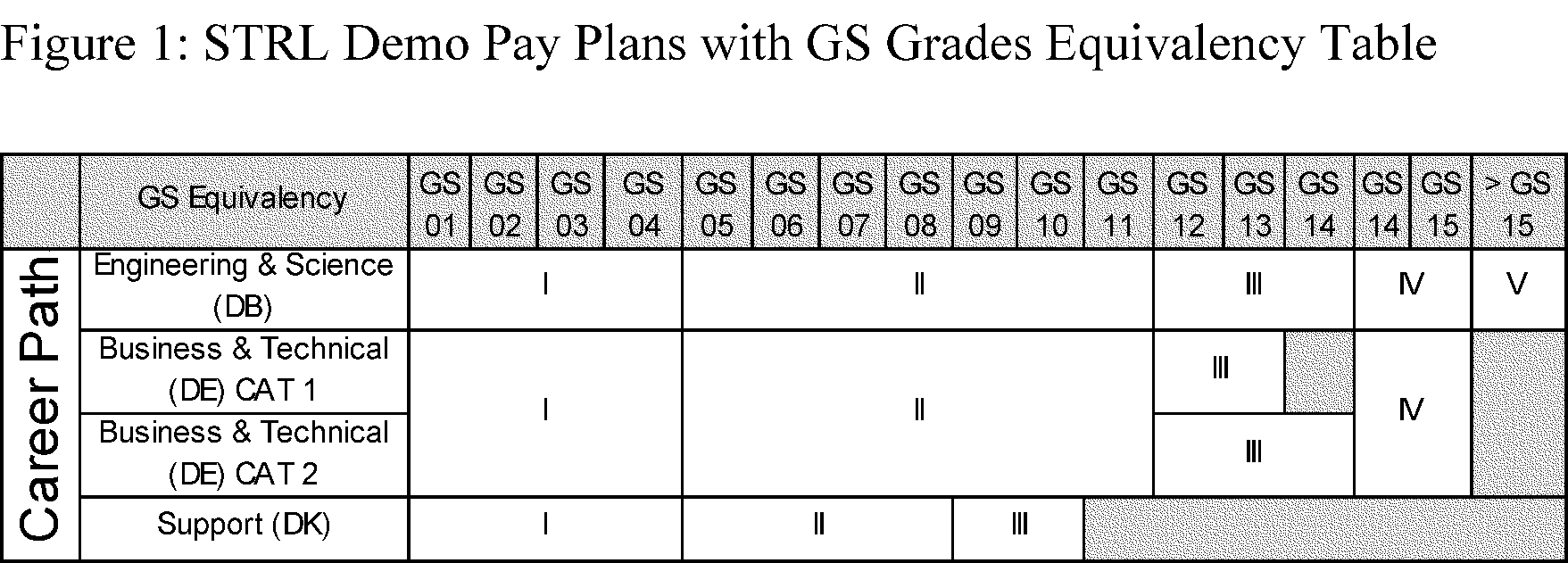
CECOM SEC STRL pay banding structure encompasses the existing pay band structure for the STRL Demo positions and includes expansion for the DE III pay band to include two categories: Category 1 (CAT-1) and CAT-2. The CAT-1 designation remains the same as the existing pay band structure and includes GS-12, step 1 through GS-13, step 10 for business and technical journeyman and non-team leader/non-supervisory positions. The CAT-2 designation expands the CAT-1 pay band to include GS-12, step 1 through GS-14, step 10 for team leader, supervisor (Branch Chief) and designated technical champion positions. DE III position descriptions will clearly indicate which category the position is classified, and this will be further clarified in IOPs. An equivalency table displaying the CECOM SEC STRL Personnel Demo project pay plans and career paths compared to the GS grades is provided in Figure 1.
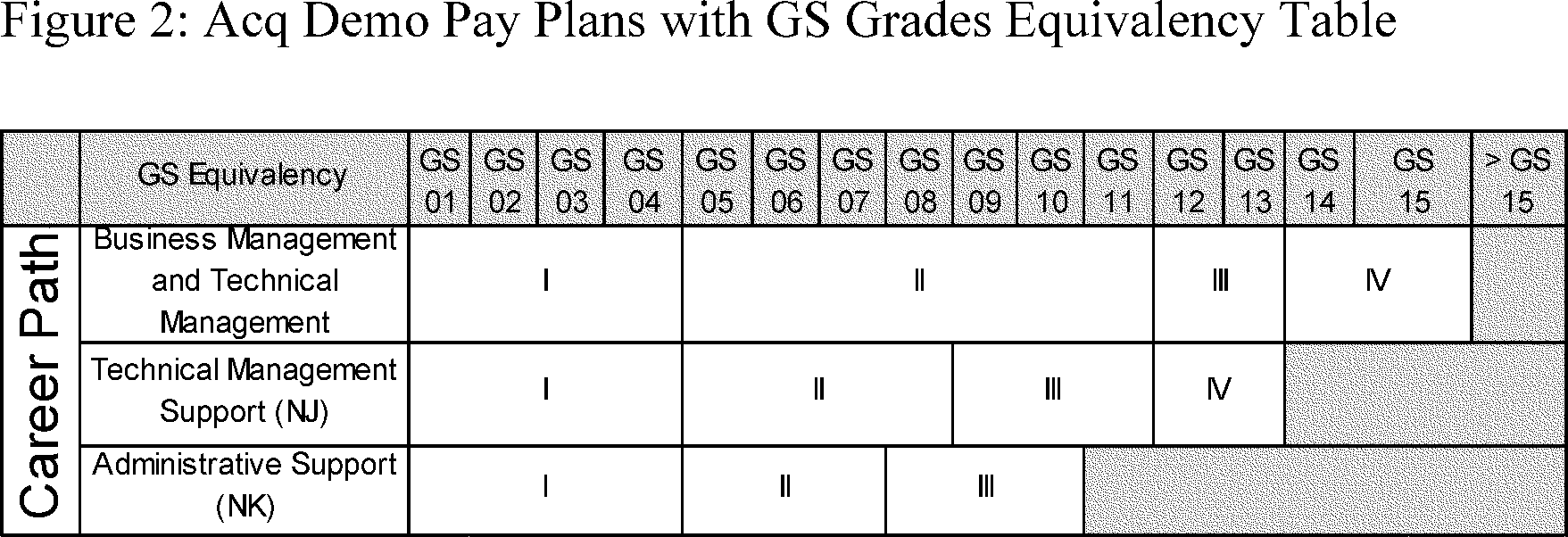
Further, an equivalency chart displaying the CECOM SEC Acq Demo project pay plans and career paths compared to GS grades is provided in Figure 2.
2. Pay Band Comparison
As provided in Figures 1 and 2, the CECOM SEC STRL Demo and CECOM SEC Acq Demo projects have differing pay band structures. The Acq Demo project pay bands reflect the structure within the Acquisition Demonstration Project
Federal Register
. Currently, CECOM SEC personnel who were previously included in a BU are included within the CECOM SEC Acq Demo project pay band plan, whereas supervisors, team leaders and employees located at duty stations that were not represented by BU's are covered under the CECOM SEC STRL Demo project pay band plan. The CECOM SEC Acq Demo pay band structure contains control points for certain positions, limiting pay at a specific grade/step, whereas the CECOM SEC STRL Demo pay band structure uses specific pay tables that contain pay rates to limit the maximum pay for the band at either the GS-13 or GS-14 step 10 equivalency and it remains consistent with GS step 10 as the highest performance level. The Acq Demo NH-04 band control point limits the non-supervisory positions to the GS-14, step 10 pay and grade equivalency. The NH-03 band includes GS-12 and GS-13 journeyman level positions and has a control point limiting certain positions to the GS-13, step 5 pay level, whereas other positions within the NH-03 band, provide a higher control point that is extended to the GS-13, step 10 pay level. This expanded control point level is determined by the level of responsibility for the position and is documented accordingly in the Position Requirements Document.
The Acq Demo (NH) pay bands include both the E&S and Business and Technology (B&T) occupational families. The STRL Demo separates these occupational families between the DE and DB bands. In the CECOM SEC STRL Demo, occupations with similar characteristics will be grouped together into one of three occupational families that are also referred to as career paths with pay bands designed to facilitate pay progression. Each career path will be composed of pay bands
( printed page 46086)
corresponding to recognized advancement and career progression expected within the occupations. Each career path will be divided into three to five pay bands with each pay band covering the same pay range now covered by one or more GS grades. The upper and lower pay rate for base pay of each pay band is defined by the minimum and maximum GS rate for the grade, except for Level V of the Engineering & Science career path. A comparison to the GS grades is used to set the upper and lower base pay dollar limits of the pay bands and is referred as “GS grade equivalency” in this FRN.
3. Occupational Series and STRL Career Paths
The occupational series provided in Appendix A serve as guidelines in the development of the following three career paths: E&S (Pay Plan DB), B&T (Pay Plan DE), and General Support (GEN) (Pay Plan DK).
i. Engineering and Science (E&S) (Pay Plan DB)
This career path includes technical professional positions, such as computer engineers, computer scientists, data scientists, and IT specialists identified as professional occupational family. Specific coursework or educational degrees are required for these occupations (except IT). Historically, the IT specialist position aligns with the B&T (DE), however CECOM SEC has evaluated that certain 2210 series capabilities may be classified and suitable for the E&S career path (DB) when contributing to highly technical and/or scientific programs that generally reside in the RDE domains. The IT specialist positions included in this pay band will be reserved for unique positions requiring the level of expertise, knowledge, and competencies possessed by the requisite engineering or scientific degrees and coursework to qualify for any professional series that is currently resident within the Occupational Family I, E&S.
CECOM SEC has established five pay bands for the E&S career path:
(a) Pay band I is a student trainee track covering GS-1, step 1 through GS-4, step 10;
(b) Pay band II is a developmental track covering GS-5, step 1 through GS- 11, step 10;
(c) Pay band III includes GS-12, step 1 through GS-14, step 10;
(d) Pay band IV includes GS-14, step 1 through GS-15, step 10; and
(e) Pay band V covers SSTM positions.
Currently, within the E&S occupational family, pay bands III and IV overlap with the GS-14 level. The GS-14 level positions fall into either III or IV pay band depending on the level of responsibility required for the position. The III pay band is comprised of CECOM SEC professionals, SMEs at the journeyman and technical champion levels, Team Leads, and Branch Chiefs. The IV pay band is comprised of CECOM SEC Associate Directors, Deputy Associate Directors, Division Chiefs, Senior Professionals, Chief Engineers, and Chief Data Officers. The Senior Professional position involves work efforts that plan, organize, and support direct development efforts that are of fundamental significance in establishing overall agency research and development goals and missions.
ii. Business and Technical (B&T) (Pay Plan DE)
This career path includes such positions as IT specialist, acquisition and business manager, and program and management analyst. Employees in these positions do not require specific course work or educational degrees.
CECOM SEC has established four pay bands for the B&T career path:
(a) Pay band I is a student trainee track covering GS-1, step 1 through GS-4, step 10;
(b) Pay band II includes developmental and full performance employees GS-5, step 1 through GS-11, step 10;
(c) Pay band III, CAT-1, includes GS-12, step 1 through GS-13, step 10 for business and technical journeyman and non-team leader/non-supervisory positions. The CAT-2 positions include GS-12, step 1 through GS-14 Step 10 for designated CECOM SEC Technical Champions, Team Leads, and Branch Chief positions. Technical Champions are personnel who are expert advisors/consultants in their assigned functional areas and identified as GS-14 equivalency upon conversion into the STRL Demo or in a position that is classified at the GS-14 level after conversion. These positions will be converted into STRL Demo at the DE III CAT-2 pay band on the same pay table as Team Leads and Branch Chiefs where the top of the pay band is the GS-14, step 10; and
(d) Pay band IV includes GS-14, step 1 through GS-15, step 10 for CECOM SEC Associate Directors, Deputy Associate Directors, Division Chiefs, and Senior Professional designated-positions.
There is an overlap at the start and end points for pay bands III and IV. The DE III, CAT-2 pay band extends up to the GS-14, step 10 at the top performance level for CECOM SEC Branch Chiefs, Team Leads, and Technical Champions that are considered a SME at the action officer level and meet the other requirements of a Technical Champion designated position. The IV pay band starts with GS-14, step 1 and extends to the GS-15, step 10 for SEC Director/Executive-level leadership positions, Division Chiefs, and Senior Professional designated positions. An assignment to the III or IV band is contingent on the level of responsibility of the position and is not subject to exception. Position descriptions clearly define the levels of responsibility for each position and the position is assigned to the III or IV pay band.
iii. General Support (Pay Plan DK)
This career path consists of clerical and assistant positions for which specific course work or educational degrees are not required. Clerical work usually involves the processing and maintenance of records. Assistant work requires knowledge of methods and procedures within a specific administrative area. CECOM SEC has established three pay bands for the General Support career path:
(a) Pay band I includes entry-level positions covering GS-1, step 1 through GS-4, step 10.
(b) Pay band II includes full-performance positions covering GS-5, step 1 through GS-8, step 10.
(c) Pay band III includes senior technicians/assistants/secretaries covering GS-9, step 1 through GS-10, step 10.
iv. Senior Scientific Technical Managers (SSTM)
The STRL Demo includes a category of SSTM positions that are defined as Senior Professional Scientific and Technical Positions classified above the GS-15 level of the GS. The SSTM Program will be managed and administered by the SEC Director IAW 10 U.S.C. 4091 and 79 FR 43722, as amended. E&S pay band V will apply exclusively to SSTM designated positions. The SSTM positions are managed separately from the SES, ST, and SL positions. The primary functions of an SSTM position are to engage in modernization and sustainment, within the technical management, computer science functions or another field, that is closely related to the mission of the STRL. The SSTM role also carries out technical supervisory responsibilities. This category is expected to provide an opportunity for career development and expansion of a pool of experienced,
( printed page 46087)
prominent technical candidates that meet the levels of proficiency and leadership essential to creating and maintaining state-of-the-art scientific, engineering, and technological capabilities within the DoD.
4. Position Control Points
Control points may be used as a compensation strategy when leadership determines that a position does not warrant unconstrained salary progression throughout the entire pay band. If used, the control points will be documented on the classified position description. The consideration to increase an employee's salary beyond the control point, if established or used, will require a review of both the position and the performance of the employee. Advancement across a control point may not occur without the approval of the SEC Director or their authorized designee. Any additional guidance will be included in the CECOM SEC STRL Demo project IOPs.
C. Classification
1. Occupational Series
The GS classification system has over 400 occupational series, which are divided into 23 occupational groupings. As detailed in Appendix A, CECOM SEC currently has positions in 14 occupational series. Additional occupational series may be added to the CECOM SEC STRL Demo project as needed.
2. Classification Standards and Position Description
SEC will utilize OPM classification standards for the identification of proper series and occupational titles of positions within the Demo project. The grading criteria in those standards will be used as a framework to develop new, simplified, and equitable standards for the purpose of pay band determinations. The objective is to include in the position description the essential criteria for each pay band within each career path by stating the characteristics of the work, the responsibilities of the position, and the competencies required.
The classification standard for each career path and pay band will serve as an important component to update existing position descriptions, which will include position-specific information, and provide data element information pertinent to the job. The Fully Automated System for Classification (or similar designated classification system) will be used to produce information necessary for any new position descriptions. The use of this system will make new position descriptions easier to prepare, minimize the amount of writing time, and make the position description a more useful and accurate tool for other personnel management functions. Specialty work and/or competency codes, with corresponding narrative descriptions, will be used within position descriptions to further differentiate work types and the competencies required for positions within each career path and pay band. Each code represents a specialization or type of work within the occupation.
3. Fair Labor Standards Act (FLSA)
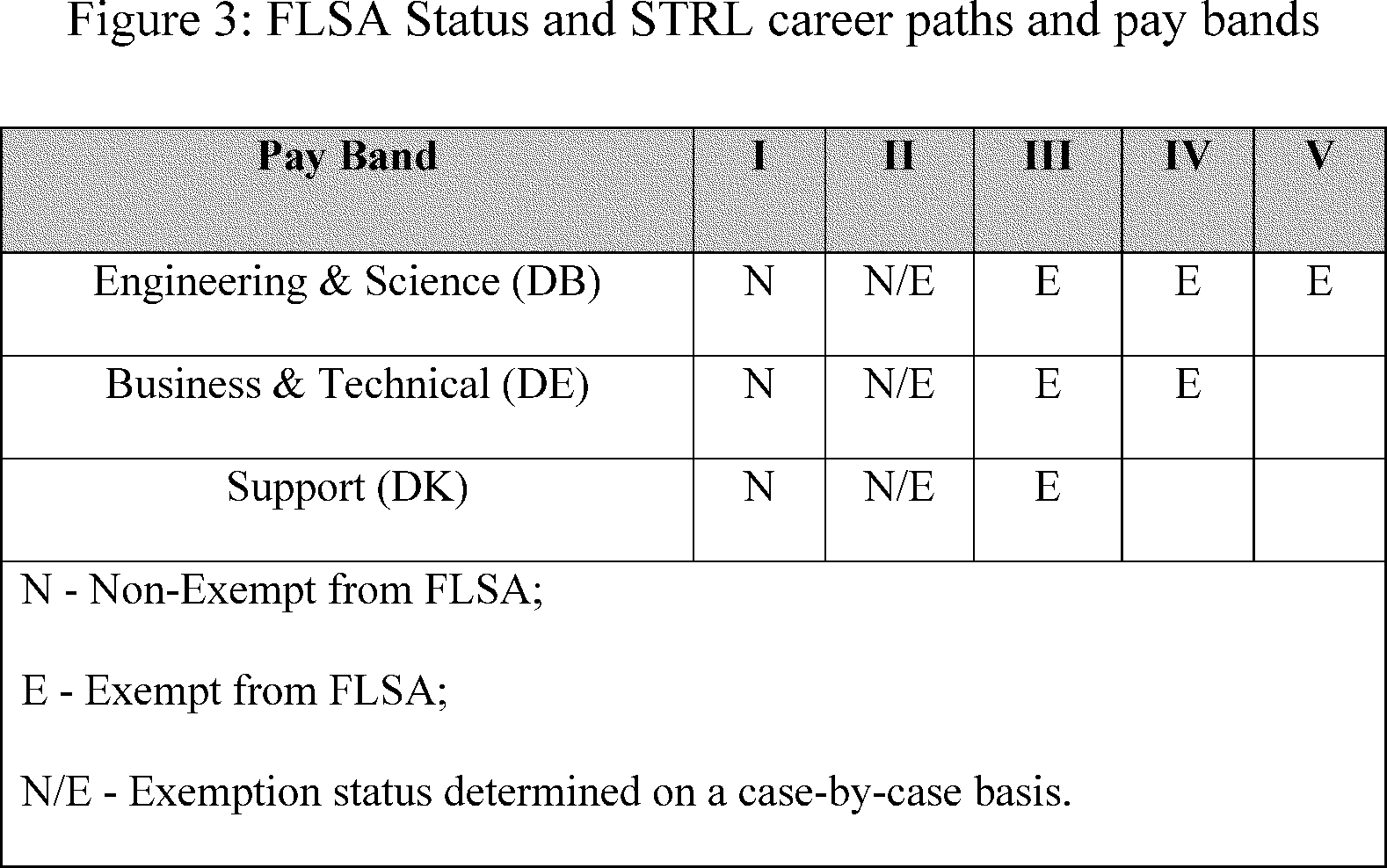
FLSA exemption and non-exemption determinations will be consistent with criteria within 5 CFR part 551. All employees are covered by the FLSA unless their position meets the criteria for exemption. The duties and responsibilities outlined in the classification standards for each pay band will be compared to the FLSA criteria. As detailed in Figure 3, the table displays that the FLSA status can be matched to mostly any career path and pay band. For note, although a typical exemption status under the various pay bands is shown in table, actual FLSA exemption determinations are made on a case-by-case basis. An example for the application of the FLSA exemption and non-exemption determination is that positions classified in pay band I of the E&S career path are typically non-exempt, meaning they are covered by the overtime entitlements prescribed by the FLSA. An exception to this rule would include supervisors/managers at pay band I or II whose primary duties meet the definitions outlined in the OPM GS Supervisory Guide; these employees are exempt from the FLSA.
The CECOM SEC STRL Demo project classification authorities will make the determinations on a case-by-case basis by comparing assigned duties and responsibilities to the classification standards for each career path and the
( printed page 46088)
FSLA criteria provided in 5 CFR part 551. In addition, the advice and assistance of the servicing personnel office will be obtained when making determinations. The position descriptions will not be the sole basis for the final determination. The basis for exemption will be documentation and attached to each position description. Exemption criteria will be narrowly construed and applied only to those employees who clearly meet the spirit of the exemption. Changes will be documented and provided to the servicing personnel office.
4. Classification Authority
The SEC Director will have classification authority and may, in turn, delegate this authority in writing to appropriate levels. Any individual with delegated classification authority must complete the required training and only classify positions that they supervise. Delegated classification authority can be used to develop position descriptions, otherwise, CECOM SEC will continue to engage with the U.S. Army CHRA for the development of position descriptions.
CECOM SEC classification authorities will identify the career path, job series, functional code, specialty work and/or competency code, pay band, and other critical information. The CECOM SEC Operations Directorate, HR personnel, will provide on-going consultation and guidance to managers and supervisors throughout the classification process. These decisions will be documented in the position description.
5. Classification Appeal
The evaluation of all classification appeals under this Demo project is based upon the project classification criteria. All case files will be forwarded for action through the servicing personnel office and will include copies of appropriate demonstration project criteria. Classification appeals under this Demo project will be processed using the following procedures:
(a) An employee may appeal the determination of career path, occupational series, position title, and pay band of the position at any time.
(b) An employee must formally raise the area of concern to supervisors in the immediate chain of command, in writing.
(c) If the employee is not satisfied with the supervisory response, the employee may then appeal to their SEC Associate Director, and if still not satisfied, the employee may appeal to the SEC Director.
(d) If the employee is not satisfied with the response from the SEC Director, a final appeal may be made to the CECOM Deputy to the Commanding General. The classification determination appeal process will be defined in a CECOM SEC STRL Demo project IOP.
(e) Classification appeals are not accepted on positions which exceed the equivalent of a GS-15 level. Time periods apply for cases processed under 5 CFR part 511.
D. Pay-for-Performance (PFP) Management System
1. Overview
The purpose of the PFP management system is to provide an effective, efficient, and flexible method for assessing, compensating, and managing the CECOM SEC workforce. It is essential for the development of a high performing workforce and to provide management at the lowest practical level, the authority, control, and flexibility needed to achieve a quality organization that can meet mission requirements. The PFP management system allows for more employee involvement in the assessment process, strives to increase communication between the supervisor and employee, promotes a clear accountability of performance, facilitates employee career progression, and provides an understandable and rational basis for salary changes by linking pay and performance.
The PFP management system uses annual performance payouts that are based on the total performance score of the employee rather than within-grade increases, quality step increases, and performance awards. The normal rating period will be one year. The minimum rating period will be 90 days. Annual PFP management system payouts shall be made effective within 120 days after the end of the rating cycle and in conjunction with pay period dates. The PFP management system payouts can be in the form of increases to base pay and/or bonuses that are not added to base salary, but rather, are given as a lump sum payment, and/or a time-off award. The CECOM SEC STRL Demo project PFP management system by the CECOM SEC STRL Demo PMB, if necessary and as more experience is gained under the project.
2. Performance Elements
Performance elements define common performance characteristics that will be used to evaluate the success of the employee in accomplishing performance objectives. The use of common characteristics for scoring purposes helps to ensure comparable scores are assigned while accommodating diverse individual objectives. The PFP management system will utilize and rate employees on the critical performance elements provided in Appendix B. A critical performance element is defined as an attribute of job performance that is of sufficient importance that performance below the minimally acceptable level requires remedial action and may be the basis for removing an employee from their position. Each of the performance elements will be assigned a two-digit weight between 0 and 1 rounding two significant digits, which reflects its importance in accomplishing the performance objectives of that employee. A minimum weight is set for each performance element with the sum weight for all the elements being 100.
A single set of performance elements will be used for evaluating the annual performance of all employees covered by this Demo project plan. This set of performance elements may evolve over time based on experience gained during each rating cycle. This evolution is essential to capture the critical characteristics that the organization encourages in its workforce and toward meeting individual and organizational objectives. This is particularly true in an environment where technology and work processes are changing at an increasingly rapid pace. The CECOM SEC STRL Demo PMB will annually review the set of performance elements and set the criteria for the entire organization before the beginning of the rating period. The following is an initial set of performance elements along with the minimum weight:
(a) Technical Competence (Minimum Weight: 15%)
(b) Interpersonal Skills (Minimum Weight: 10%)
(c) Management of Time and Resources (Minimum Weight: 15%)
(d) Customer Satisfaction (Minimum Weight: 10%)
(e) Team/Project Leadership (Minimum Weight: 15%)
(f) Supervision/EEO (Minimum Weight: 25%)
All employees will be rated against the first four performance elements. In addition, the Team/Project Leadership performance element is mandatory for Team Leads. The Supervision/EEO performance element is mandatory for all managers/supervisors. At the beginning of the rating period, the Pay Pool Manager will review the objectives and weights assigned to employees within the pay pool, to verify consistency and appropriateness.
( printed page 46089)
3. Performance Objectives
Performance objectives define a target level of activity, expressed as a tangible, measurable objective, against which actual achievement can be compared. These objectives will specifically identify what is expected of the employee during the rating period and will typically consist of three to ten results-oriented statements. The employee and the supervisor will jointly develop the performance objectives for the employee at the beginning of the rating period. If there is a disagreement between the employee and supervisor concerning the performance objectives, the supervisor of the employee will render the final resolution concerning the assigned performance objectives. The objectives are to be reflective of the duties/responsibilities of that employee within their assigned pay band and be consistent with organizational goals, priorities, and mission.
Objectives will be reviewed annually and may be revised if salary changes occur reflecting increased responsibilities commensurate with a salary increase. Performance objectives are intended to define the specific responsibilities and accomplishments of an employee. In contrast, performance elements will identify common performance characteristics, against which the accomplishment of the objectives will be measured. As a part of this Demo project, training focused on overall organizational objectives and the development of performance objectives will be held for both supervisors and employees. Performance objectives may be jointly modified, changed, or deleted as appropriate during the rating cycle. Generally, performance objectives should only be changed when circumstances outside the control of the employee prevent or hamper the accomplishment of the original objectives. It is also appropriate to change objectives when mission or workload shifts occur.
4. Performance Feedback and Formal Ratings
The most effective means of communication is a person-to-person discussion between supervisors and employees concerning the requirements, performance goals, and desired results. Employees and supervisors are expected to actively participate in these discussions for optimum clarity regarding expectations and identify potential obstacles to meeting objectives. In addition, employees should explain (to the best extent possible) what they need from the supervisor to support objective accomplishment. The timing of these discussions will vary, based on the nature of work performed, but will occur at least at the midpoint and end of the rating period. The supervisor and employee will discuss job performance and accomplishments in relation to the performance objectives and elements. At least one review, normally the midpoint review, will be documented as a formal progress review. There may be more frequent task specific discussions, as appropriate, during the rating period. In cases where work is accomplished by a team, team discussions regarding goals and expectations may be appropriate.
The employee will provide a written list of accomplishments to the supervisor at both the midpoint and end of the rating period. An employee may elect to provide self-ratings on the performance elements and/or solicit accomplishment input from team members, customers, peers, supervisors in other units, subordinates, and other sources which will permit the supervisor to fully evaluate accomplishments during the rating period.
At the end of the rating period, following a review of the employees' accomplishments, the supervisor will rate each of the performance elements by assigning a score between 0 and 50. Benchmark performance standards have been developed, which describe the level of performance associated with a score. Using these benchmark performance standards, the supervisor decides where on the performance element score scale (at any point on a scale of 0 to 50) the performance of the employee fits and assigns the employee the appropriate score. It should be noted that these scores are not discussed with the employee or considered final until all scores are reconciled and approved by the Pay Pool Manager. The element scores will then be multiplied by the element-weighting factor to determine the final weighted score expressed to two decimal points. The weighted scores for each element will then be totaled to determine the overall appraisal score for the employee (rounded to a whole number) as follows:
(a) If the digit to the right of the decimal is between five and nine, it should be rounded to the next higher whole number; or
(b) If the digit to the right of the decimal is between one and four, it should be dropped.
A total score of 10 or above will result in a rating of acceptable. A total score of 9 or below, or a score of 9 or below in a single element, will result in a rating of unacceptable will require the employee be placed on a Performance Improvement Plan (PIP), as soon as feasible, or that other appropriate administrative action is taken, such as an adverse action under 5 U.S.C. chapter 75.
5. Unacceptable Performance
Informal employee performance reviews will be a continuous process so that corrective action, to include placing an employee on a PIP, may be taken at any time during the rating cycle. When a supervisor recognizes the performance of the employee is unacceptable in one or more performance elements, the supervisor should immediately discuss the concerns with the employee. All efforts will be made to identify the possible reasons for the unacceptable performance and how to improve the performance; a structured PIP may be used to improve performance. The supervisor will identify the items/actions that need to be corrected or improved, outline required timeframes (no less than 30 days) for such improvement and provide the employee with any available assistance as appropriate.
During the PIP period, the performance of the employee will be monitored, and all supervisor/employee counseling sessions will be documented. If the employee's performance is acceptable at the conclusion of the PIP, the improvement is noted in the documentation provided to the employee and no further action is necessary.
If the employee fails to improve during the PIP period, the employee will be given documented notice of proposed and appropriate action. This action can include removal from Federal service, placement in a lower pay band with a corresponding reduction in pay (demotion), reduction in pay within the same pay band, or change in position or occupational family. The majority of employees with an unacceptable rating will not be permitted to remain at their current salary and may be reduced in pay band. Reductions in salary within the same pay band or changes to a lower pay band will be accomplished with a minimum of a five-percent decrease in the base pay of the employee. For note, no guidance in this subsection will preclude action under 5 U.S.C. 75, as appropriate. All actions taken to address the unacceptable performance will be documented to include actions concerning the reduction in pay or removal from Federal service. The documentation should be made available to the employee and/or their designated representative. At a minimum, the documentation record
( printed page 46090)
will consist of a copy of the notice of proposed personnel action, the employee's written reply, if provided, or a written summary of the oral reply from the employee. Additionally, the record will contain the written notice of decision, the reasons for the decision, and supporting material for the decision including any documentation regarding the opportunity afforded the employee to demonstrate improved performance.
If the employee's performance continues to deteriorate to an unacceptable level for the same performance element(s), within two years from the start date of a PIP period, additional actions may be initiated with no additional further opportunity for the employee to improve performance. If the performance of the employee is at an acceptable level for two years from the beginning of the PIP period for the same performance elements(s) and performance once again declines to an unacceptable level, the employee will be given an additional opportunity to improve before leadership proposes additional action.
6. Reconciliation Process
At the end of the rating cycle and following the initial scoring of each employee by the supervisor, the rating officials along with the employee's next level of supervisor within the organization, will meet to ensure consistency and equity of the ratings. Each employee's performance objectives, accomplishments, preliminary scores, and current salaries are compared. Through discussion and consensus building, consistent and equitable ratings and/or shares are reached. There will not be a prescribed distribution of total scores. The Pay Pool Manager will chair a final review with the rating officials who report directly to them to validate the ratings and resolve any scoring issues. If there are disputes or concerns during the ratings process, the Pay Pool Manager is considered the final decision authority. After the reconciliation process is complete, scores are finalized. The final employee payout will proceed according to the final score and current salary of the employee. Upon approval of this Demo project plan, a CECOM SEC STRL Demo IOP will be created to document this process for employees and supervisors.
7. Pay Pools
Employees within the CECOM SEC STRL Demo project will be placed into pay pools. Pay pools are combinations of organizational elements (
e.g.,
Directorates, Divisions, Branches, and Offices) that are defined for the purpose of determining performance payouts under the PFP management system. As an exception, the Pay Pool Manager may deviate from the guidelines if there is a compelling need to do so, and the supporting rationale is approved by the SEC Director. This exception and approval will be documented in writing.
Typically, pay pools will have between 35 and 300 employees. A pay pool should be large enough to encompass a reasonable distribution of ratings, but not so large, as to compromise rating consistency. Supervisory personnel will be placed in a pay pool separate from subordinate, non-supervisory personnel. Team Leads classified by the GS Leader Grade-Evaluation Guide will be included in a supervisory pay pool. Neither the Pay Pool Manager nor supervisors within a pay pool will recommend or set their own individual pay.
All decisions regarding the performance payout amount are based on the established payout calculations. Annual pay pool limits for base pay increases and bonuses, also referred to as payout factors, will be established by the CECOM SEC STRL Demo PMB. The funds for performance payouts are divided into two components: base pay increases and bonuses. The funds used for base pay increases are those that would have been available from the GS within-grade increases, quality step increases, and promotions. This payout amount will be defined based on historical data and set at no less than 2.0 percent of total salary annually. The funds available to be used for bonus payouts are funded separately within the constraints of the organization's overall award budget. The payout amount will be defined based on historical data and set no less than 1.0 percent of total salary annually. The sum of the two fund performance payout components is referred to as the Pay Pool Percentage Factor. On an annual basis, the CECOM SEC STRL Demo PMB will review the pay pool funding formulas and recommend adjustments to ensure cost discipline over the life of the STRL Demo project. The CECOM SEC STRL Demo PMB allocates the amount of funds assigned to each pay pool as necessary to ensure equity and to meet unusual circumstances.
8. Performance Payout Determination
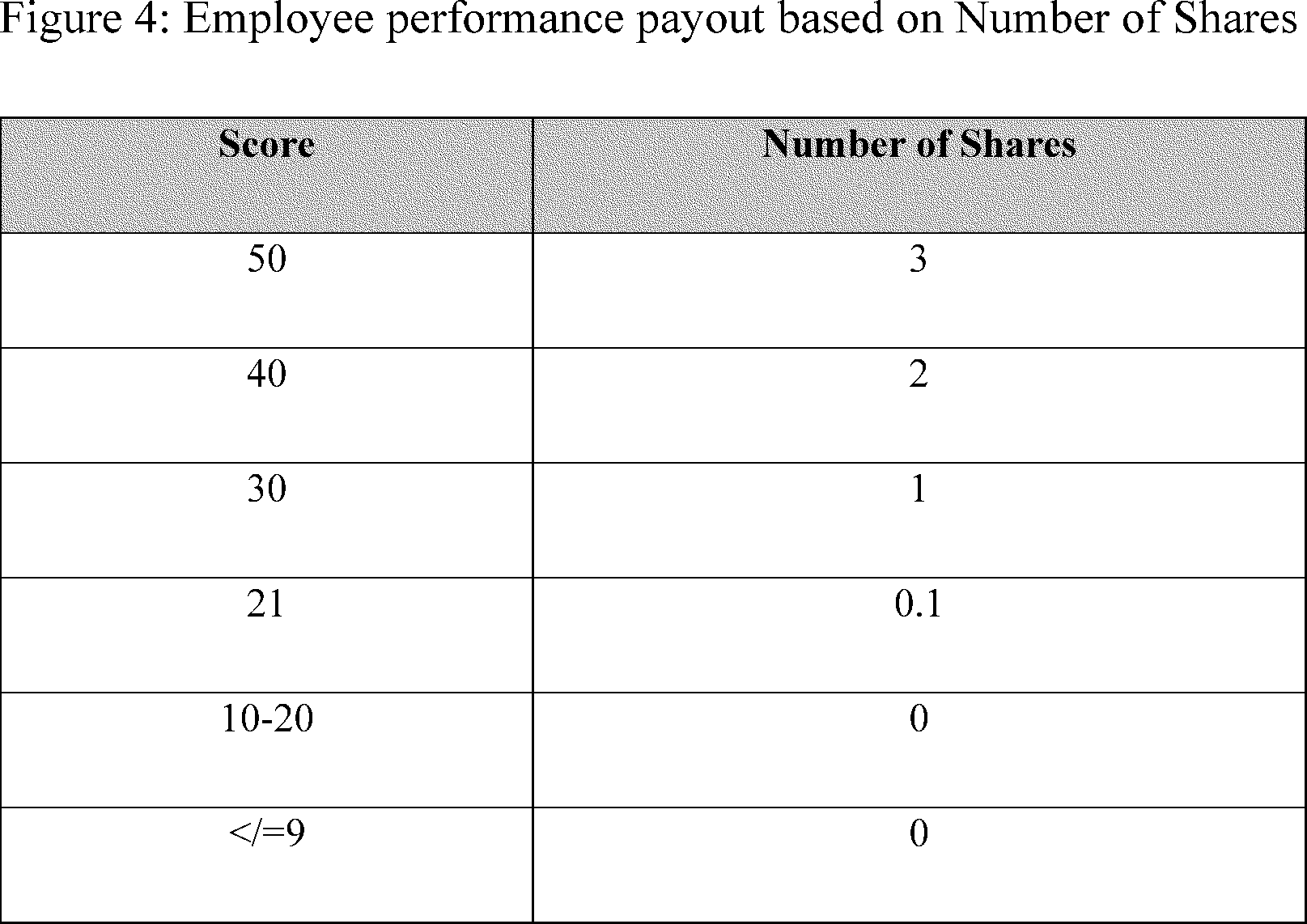
The performance payout that an employee will receive is based on the total performance score from the pay-for-performance assessment process. An employee will receive a performance payout as a percentage of their current salary. This percentage is based on the number of shares that equate to their final appraisal score. Shares will be awarded on a continuum as shown in Figure 3. An example is that a score of 38 would equate to 1.8 shares and a score of 44 would equate to 2.4 shares. Fractional shares will be awarded for employee scores that fall between the score values listed in the table. Any score below 9 will require further administrative action.
( printed page 46091)
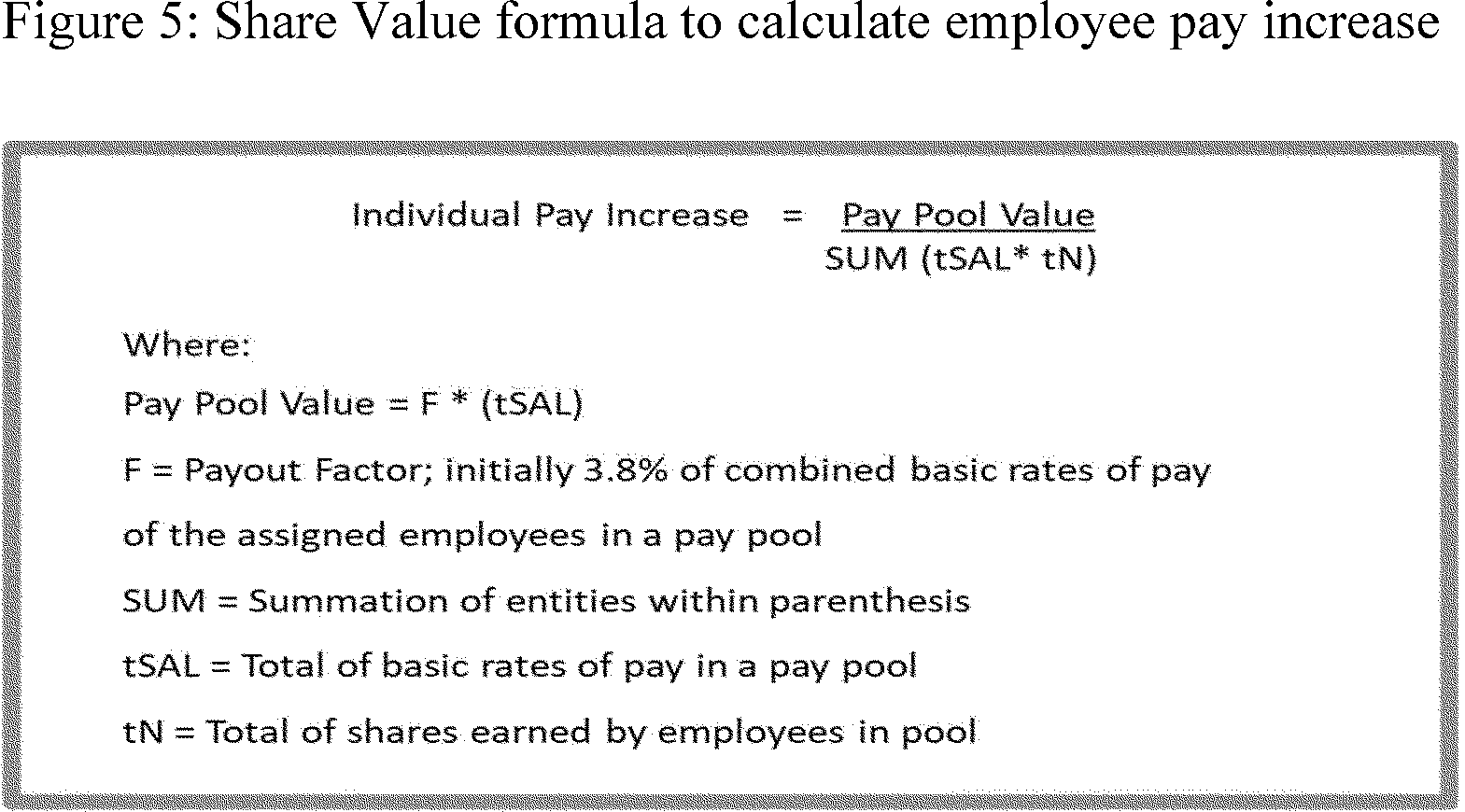
The value of a share cannot be exactly determined until the rating and reconciliation process is completed and all scores are finalized. The share value is expressed as a percentage. The formula that computes the value of each share is based on (1) the value of pay pool, (2) the employee's pay, (3) the number of shares awarded to each employee in the pay pool, and (4) the total number of shares awarded in the pay pool. This formula assures that each employee within the pool receives a share amount equal to all others in the same pool who are at the same rate of basic pay and receiving the same score. The formula is shown in figure 4.
A Pay Pool Manager is accountable for staying within pay pool limits. The Pay Pool Manager makes the final decisions on pay increases and/or bonuses to individuals based on recommendations from personnel ratings, the final score, the pay pool funds available, and the employee's current salary. A Pay Pool Manager may request approval from the CECOM SEC STRL Demo PMB to grant an additional pay increase or performance bonus to an employee that is higher than the one generated by the compensation formula for that employee. An example of the employees who might warrant such consideration are those employees making extraordinary achievements or for a local intern to provide them with accelerated compensation.
In addition, the designated Pay Pool Manager may nominate employees for Extraordinary Achievement Recognition. This recognition grants a
( printed page 46092)
base pay increase and/or bonus to an employee that is higher than the one generated by the traditional compensation formula. The funds available for Extraordinary Achievement Recognition are separately funded within the constraints of the organization's budget.
9. Base Pay Increases and Bonuses
The shares that the employee earns will be paid out as a base pay increase, a bonus, or a combination of both. To ensure continued cost discipline and performance incentive, base pay increases may be limited or capped. There are certain employees that cannot receive base pay increases due to base pay caps. Base pay is capped when an employee reaches the maximum rate of pay in an assigned pay band or when a performance-based rule applies. The employees affected by base pay caps and those receiving retained pay will receive the entire performance payout in the form of a bonus.
If there are unexpended base cap pay funds for capped employees, the CECOM SEC STRL Demo PMB may deem it appropriate to re-allocate a portion (up to the maximum possible amount) of the funds to uncapped employees. Any dollar increase in an employee's projected base pay will be offset, dollar for dollar, by an accompanying reduction in the employee's projected bonus payment. Thus, the employee's total performance payout is unchanged. All PFP management system bonuses and salary increases must be effective within 120 days of the end of the appraisal cycle.
Base pay is capped when an employee reaches the maximum rate of pay in an assigned pay band, when the mid-point rule applies or when the significant accomplishment rule applies, or otherwise subject to a salary control point as established by the SEC Director.
10. Performance-Based Rules
As a compensation management tool, CECOM SEC may establish performance-based rules to manage pay progression by career path, pay band, or any other grouping. If established, such performance-based rules must be approved by the CECOM SEC STRL Demo PMB and be published to the workforce prior to implementation. In addition, the process for obtaining a rule exception will be documented in a CECOM SEC STRL Demo IOP. Once established, performance-based rules may be used in the pay pool process to manage performance salary increases.
i. Mid-Point Rule
To provide added performance incentives as an employee progresses through a pay band, a mid-point rule will be used to determine base pay increases. The mid-point rule dictates that any employee must receive a score of 30 or higher for their base pay to cross the salary midpoint of their pay band. Also, once the base pay of the employee exceeds the salary midpoint of their band, the employee must receive a score of 30 or higher to receive any additional base pay increases. If there is any amount of the performance payout not paid in the form of a base pay increase because of the mid-point rule, the payout will instead be paid as a bonus. This rule effectively raises the standard of performance expected of an employee once the salary midpoint of a band is crossed. This applies to all employees in every occupational family and pay band.
ii. Significant Accomplishment/Contribution Rule
The purpose of this rule is to maintain cost discipline while ensuring that employee payouts are in consonance with accomplishments and levels of responsibility. This rule will apply only to non-supervisory employees in E&S Band III and B&T Band III Category 2 whose base salary falls within the top 15 percent of the band. For employees meeting this criterion, the following provisions will apply:
(1) If an employee's score falls in the top third of scores received in his/her pay pool, he/she will receive the full allowable base pay increase portion of the performance payout. The balance of the payout will be paid as a lump sum bonus;
(2) If an employee's score falls in the middle third of scores received in his/her pay pool, the base pay increase portion will not exceed 1% of base salary. The balance of the payout will be paid as a lump sum bonus; and
(3) If an employee's appraisal score falls in the bottom third of scores received in his/her pay pool, the full payout will be paid as a lump sum bonus.
11. Awards
To provide additional flexibility in motivating and rewarding individuals and groups, some portion of the performance award budget may be reserved for special acts and other categories as they occur. Awards may include, but are not limited to special acts, patents, suggestions, on-the-spot, and time-off. The funds available to be used for awards are separately funded within the constraints of the organization's overall award budget. While not directly linked to the PFP management system, this additional flexibility is important to encourage outstanding accomplishments and innovation in accomplishing the diverse modernization missions that CECOM SEC intends to accomplish through participating in STRL Personnel Demo project. Additionally, to foster and encourage teamwork among its employees, CECOM SEC may give group awards. The SEC Director will have the authority to grant special act awards to covered employees of up to $25,000 IAW the criteria of Army Regulation 672-20, Incentive Awards.
12. General Pay Increase (GPI)
When the rates of the GS are increased due to general pay increases, the minimum and maximum salaries of the pay band levels will also increase. All employees will receive the GPI as the increases are approved except for employees in pay band V and employees with unacceptable performance. The maximum basic rate with locality for Pay band V is Level III of the executive schedule (EX-III). Employees, who are on a PIP due to unacceptable performance and/or receive a Level 1 rating of record at the time that pay determinations are made, may be denied performance payouts or the GPI.
When the employee has performed at an acceptable level for at least 90 days, the GPI will not be retroactive but will be granted at the beginning of the next pay period after the supervisor authorizes its payment. These actions may result in a base salary that is identified in a lower pay band. This occurs because the minimum rate of basic pay in a pay band increases as the result of the GPI pursuant to 5 U.S.C. 5303. This situation (a reduction in pay band with no reduction in pay) will not be considered an adverse action, nor will any pay band retention provisions apply. After 90 days of acceptable performance, the employee is granted GPI, and the employee will be returned to their previous pay band.
13. Grievances and Disciplinary Actions
An employee has the right to grieve the performance rating/score received under the PFP management system. Employees who choose to pursue a grievance must do so in accordance with the established administrative grievance procedures outlined in the IOP. Except, where specifically waived or modified in the CECOM SEC STRL Demo plan, adverse action procedures
( printed page 46093)
under 5 CFR part 752 remain unchanged.
E. Hiring and Appointment Authorities
Competitive service positions will be filled through Merit Staffing, direct-hire authority, competitive examining/delegated examining, or other non-competitive hiring authorities. Direct-hire authority will be exercised IAW the requirements of the delegation of authority.
1. Qualifications
The qualifications required for placement into a position within a pay band and within an occupational family are determined using the OPM GS Qualification Operating Manual. As the pay bands are anchored to the GS grade levels, the minimum qualification requirements for a position will be the minimum requirements that corresponding to the lowest GS grade incorporated into that pay band. For example, for a position in the E&S occupational family, pay band II individuals must meet the basic requirements for a GS-5 as specified in the qualification standard for Professional and Scientific Positions. Selective placement factors can be established IAW the OPM GS Qualification Operating Manual, when judged to be critical to successful job performance. These factors will be communicated to all candidates for position vacancies and must be met for basic eligibility.
2. Delegated Examining
Competitive service positions within the CECOM SEC STRL Demo project may be filled through Delegated Examining. The CECOM SEC STRL Demo project positions will follow category rating when recruiting under competitive examining. When there are no more than 15 qualified applicants and no preference eligibles, all eligible applicants are immediately referred to the selecting official without rating and ranking. Rating and ranking will be required only when the number of qualified candidates exceeds 15 or there is a mix of preference and non- preference applicants. Statutes and regulations covering veterans' preference will be observed in the selection process and when rating and ranking are required. Veterans will be placed ahead of non-veterans within the same category. The procedures within the OPM Delegated Examining Operations Handbook will be followed.
3. Direct Hire
In addition to direct hire authorities authorized by OPM or granted within various National Defense Authorization Acts (NDAAs), CECOM SEC will use the direct hire authorities authorized by 10 U.S.C. 4091 and published in 79 FR 43722 and 82 FR 29280, 85 FR 78829, and 88 FR 10874, as amended and appropriate, to appoint the following:
(a) Candidates with bachelor's and/or advanced degrees to scientific and engineering positions;
(b) Veteran candidates to scientific, technical, engineering, and mathematics positions (STEM), including technicians;
(c) Student candidates enrolled in a program of instruction leading to a bachelor or advanced degree in a STEM discipline;
(d) Candidates for any position:
(1) involving 51 percent or more of time in direct support of SEC mission;
(2) identified as hard to fill; having a history of high turnover; or
(3) requiring a unique, laboratory-related skillset.
(e) Candidates for students and recent graduates for occupations which do not require expertise in STEM.
Direct hire appointments may be made on a permanent, term, or temporary basis. Requirements for qualifying positions for the usage of the direct hire authorities will be documented in a CECOM SEC STRL Demo IOP. In addition, other direct hire authorities, documented in FRNs that are available to all DoD STRL laboratories, may be utilized, once requested and adopted, as appropriate.
4. Hiring Demonstrated Exceptional Talent for Engineering and Science Positions
IAW paragraph 4.g. of the OPM GS Qualification Operating Manual, CECOM SEC may consider any demonstrated, exceptional experience or a combination of experience and education in lieu of the candidate meeting OPM individual occupational qualification requirements for E&S positions by using 85 FR 78829, as amended, to implement this consideration criteria.
5. Official Transcripts
CECOM SEC will comply with 85 FR 78829, as amended, to waive the requirement to have official transcripts prior to establishing an entrance-on-duty (EOD).
6. Use of USAJobs Flyers
CECOM SEC will have authority to determine when to utilize USAJobs flyers to solicit for CECOM SEC STRL Demo project positions in compliance with 85 FR 57842, as amended, for implementation.
7. Security Eligibility
CECOM SEC has the authority to appoint individuals to Critical-Sensitive and Special-Sensitive (SS) positions prior to a final favorable eligibility determination at the Top Secret/Sensitive Compartmented Information (SCI)-level using 85 FR 78829, as amended for implementation.
F. Flexible Length and Renewable Term Technical Appointments (FLRTTA) and Flexible Length and Renewable Term Appointments for Support Positions (FLRTA)
CECOM SEC may use the FLRTTA workforce shaping tool to appoint qualified candidates to any STEM positions, including technicians who are not currently DoD civilian employees or are currently DoD term employees, for a period of more than one year but not more than six years. CECOM SEC will use 82 FR 43339, as amended for implementation.
CECOM SEC may use FLRTA to appoint qualified candidates whose positions involve 51 percent or more of time spent in direct support of STRL activities, for a period of more than one year but not more than six years, as provided in 85 FR 78839, and 82 FR 43339, as amended, for implementation. The guidance that follows is applicable to both FLRTTA and FLRTA qualified candidates unless stated otherwise.
1. Probationary or Trial Period
The probationary period for all newly hired permanent career-conditional employees and trial periods for term appointments will be three years. The purpose of a three-year probationary or trial period is to allow supervisors adequate time to fully evaluate an employee's ability to complete cycles of work and to fully assess an employee's contribution and conduct. All other features of the current probationary or trial period are retained to include the requirements for determining creditable service and the potential to terminate an employee, without providing the full substantive and procedural rights afforded to a non-probationary employee, when the employee fails to demonstrate proper conduct, competency, and/or adequate contribution during the probationary period.
If a probationary employee's performance is determined to be satisfactory at a point prior to the end of the three-year probationary period, a supervisor has the option of ending the probationary period at an earlier date, but not before the employee has completed at least one year of
( printed page 46094)
continuous service. If the probationary period is terminated before the end of the three-year period, the supervisor will provide written reasons for the decision to the next level of supervision for concurrence prior to implementing the action.
2. Termination of Probationary Employees
When terminating probationary or trial employees, supervisors must work with their management employee relations (MER) point of contact (POC) within the U.S. Army CHRA to ensure that all documentation supports the termination and follows required guidelines for termination of employment.
When a supervisor decides to terminate an employee during the probationary or trial period, the supervisor shall terminate the employee, in writing, stating the reasons for termination and the effective date of the action.
3. Supervisory Probationary Periods
New supervisors will be required to complete a supervisory probationary period for initial appointment to a supervisory position. The probationary period for supervisory employees is one year but may be extended to up to two years, at the discretion of the SEC Director, when further review is needed to evaluate the level of successful performance. If, during this supervisory probationary period, the decision is made to return the employee to a non-supervisory position for reasons related to supervisory performance, the employee will be returned to a position comparable in pay and job duties to the position from which they were originally promoted or re-assigned. The return to a non-supervisory position will result in a return to salary that the employee received immediately prior to the appointment to a supervisory position. Supervisors must coordinate with their MER POC within the U.S. Army CHRA to ensure that all documentation supports the re-assignment/modification back to a non-supervisory position.
4. Re-Employment of Annuitants
CECOM SEC will use the authorities provided by 82 FR 43339, as amended, to appoint reemployed annuitants, as applicable and appropriate.
5. Student Loan Repayment
CECOM SEC may provide student loan repayment options, as authorized in 85 FR 78829, as amended, that are in line with current tuition costs and the amount may be adjusted based on inflation without higher-level command approval. The SEC Director can authorize the increase, as appropriate and applicable. This decision-authority provides the ability for CECOM SEC to repay all, or part of, an outstanding and qualifying student loan or loans that were previously assumed by the employee or candidate prior to employment with CECOM SEC.
G. Volunteer Emeritus and Expert Program (VEP)
The CECOM SEC STRL Demo project will have the authority to offer voluntary assignments to former Federal employees who have retired or separated from the Federal service and U.S. citizens who are retired, separated, or on sabbatical from private or public sector organizations.
Volunteer emeritus will ensure continued quality research while reducing the overall salary line by allowing higher paid individuals to accept retirement incentives with the opportunity to retain a presence in the scientific community. Volunteer experts will bring commercial sector or public sector knowledge and experience to the CECOM SEC STRL Demo project. The volunteers will not be used to replace any Government personnel or interfere with their career opportunities. Volunteers may not be used to replace or substitute for work performed by Government personnel occupying positions required to perform the CECOM SEC STRL Demo project mission requirements. Volunteer assignments are not considered “employment” by the Federal Government with some noted exceptions.
To be accepted as a volunteer, an individual must be a U.S. citizen and must be recommended by a CECOM SEC manager to the CECOM SEC approval authority. There is no assumed entitlement to participate in the program and an application to the program does not guarantee acceptance into the program. CECOM SEC will clearly document the decision process/rationale for each volunteer application received regardless of whether the applicant is accepted or rejected from the program. The application, support documentation sent for consideration with the application, CECOM SEC decision process/rational, and the decision adjudication documentation must be retained throughout the assignment; one year for accepted applicants and two years for rejected applicants.
Volunteer participants will not be permitted to perform any Inherently Governmental Functions or to participate in any contracts or solicitations for which the participant may have a conflict of interest. Volunteer participants are not permitted to participate in contract source selections, nor are they, permitted to have access to contractor bid, proposal information, source selection information, or to data/information that is protected by the Trade Secrets Act, 18 U.S.C. 1905, without a written agreement between the volunteer and the owner of the data or that information.
To ensure success and encourage participation in the volunteer emeritus part of the VEP, the volunteer's Federal retirement pay (whether military or civilian) will not be affected while serving in a volunteer capacity under the VEP. Retired or separated Federal employees may accept a volunteer emeritus position without a break or mandatory waiting period. An agreement will be established between the volunteer and CECOM SEC, and the agreement will be reviewed by the servicing legal office.
The agreement must be finalized prior to the assumption of any duties under the VEP. The agreement will include:
(a) A statement that the voluntary assignment does not constitute an appointment in the civil service and is without compensation, and that all claims against the Government (because of the voluntary assignment), are waived by the volunteer;
(b) A statement that the volunteer will be considered a federal employee solely for the purpose of and under the authorities of:
(6) 28 U.S.C. chapter 171 (tort claims procedure), and any other Federal tort liability statute; and
(7) 5 U.S.C. 552a (records maintained on individuals)
(c) The volunteer's work schedule;
(d) The length of the agreement (defined by length of project or time defined by weeks, months, or years)
(e) The support to be provided by SEC (travel, administrative, office space, supplies);
(f) The volunteer's duties;
(g) A provision allowing either party to void the agreement with at least two working days' written notice;
(h) A provision that states no additional time will be added to a volunteer's service credit for such
( printed page 46095)
purposes as retirement, severance pay, or leave as a result of participating in the VEP;
(i) The level of security access required (any security clearance required by the assignment will be managed by CECOM SEC while the participant is a member of the VEP);
(j) A provision that any written products prepared for publication that are related to VEP participation will be submitted to CECOM SEC for pre-publication review and approval;
(k) A statement that the volunteer accepts accountability for loss or damage of any assigned Government property occasioned by the volunteer's negligence or willful action;
(l) A statement that the activities of the volunteer on the premises will conform to the regulations and requirements of the organization;
(m) A statement that the volunteer will not improperly use or disclose any non-public information, to include any pre-decisional or draft deliberative information related to DoD programming, budgeting, resourcing, acquisition, procurement, or any other matter for the benefit or advantage of the volunteer or any non-Federal entities. Volunteers will handle all non-public information in a manner that reduces the possibility of improper disclosure;
(n) A statement that the volunteer agrees to disclose any inventions made in the course of work performed for CECOM SEC, and CECOM SEC will have the option to obtain title to any such invention on behalf of the U.S. Government.
Should the SEC Director elect not to take title, CECOM SEC will retain a non-exclusive, irrevocable, paid up, royalty-free license to practice or have practiced the invention worldwide on behalf of the U.S. Government;
(o) A statement that the volunteer must complete either a confidential or public Financial Disclosure Report, whichever applies; a disqualification statement prohibiting the volunteer from working on matters related to their former employer; and ethics training IAW Office of Government Ethics regulations prior to implementation of the written agreement; and
(p) A statement that the volunteer must receive post-Government employment advice from a DoD Ethics counselor at the conclusion of program participation. Volunteers are deemed Federal employees for purposes of post-Government employment restrictions.
A written Memorandum of Agreement (MOA) between CECOM SEC and the volunteer is required and must include all items above, regardless of format used. The use and wording of the MOA will be provided in a CECOM SEC STRL Demo IOP.
H. Internal Placement
1. Promotion
A promotion is the movement of an employee to a higher pay band in the same occupational family or to another pay band in a different occupational family, wherein the band in the new family has a higher maximum salary than the band from which the employee is moving. When filled, positions with known promotion potential to a specific band within an occupational family will be identified; not all positions in an occupational family will have promotion potential to the same band. The movement from one career path to another will depend upon individual competencies, qualifications, and the needs of the organization. Salary progression within a pay band is not considered a promotion and not subject to the provisions of this section with some noted exceptions.
Promotions will be processed under competitive procedures IAW Merit System Principles and requirements of the local merit promotion plan. For an employee to be promoted competitively or non-competitively from one band to the next, the employee must meet the minimum qualifications for the job and have a current performance rating of “acceptable” with a score of 30 or better (or equivalent) in their current assigned performance appraisal system. If an employee does not have a current performance rating, the employee will be treated the same as an employee with an “acceptable” rating if there is no documented evidence of unacceptable performance. The following actions are exceptions from competitive procedures:
(a) Re-promotion to a position which is in the same pay band or GS equivalency and occupational family that the employee previously held on a permanent basis within the competitive service;
(b) Promotion, reassignment, demotion, transfer, or reinstatement to a position having promotion potential no greater than the potential of a position an employee currently holds or previously held on a permanent basis in the competitive service;
(c) A position change permitted by reduction in force procedures;
(d) Promotion without current competition when the employee was appointed through competitive procedures to a position with a documented career ladder;
(e) A temporary promotion, or detail to a position in a higher pay band, of one year or less;
(f) A promotion due to the reclassification of positions based on accretion (addition) of duties;
(g) A promotion resulting from the correction of an initial classification error or the issuance of a new classification standard;
(h) Consideration of a candidate who did not receive proper consideration in a competitive promotion action; and
(i) Impact of person in the job and Factor IV process (application of the Research Grade-Evaluation Guide, Equipment Development Grade-Evaluation Guide, Part III, or similar guides) promotions.
2. Reassignment
A reassignment is the movement of an employee from one position to a different position within the same career path and pay band or to another career path and pay band wherein, the pay band in the new career path has the same maximum base pay. The employee must meet the qualification requirements for the career path and pay band.
3. Placement in a Lower Pay Band
An employee may be placed in a lower pay band within the same career path or placement into a pay band in a different career path with a lower maximum base pay. This change may be voluntary based on a request from the employee or involuntary, for cause (performance or conduct), or for reasons other than cause (
e.g.,
erosion of duties, reclassification of duties to a lower pay band, or placement actions resulting from Reduction in Force (RIF) procedures). Involuntary actions will be executed using the applicable procedures in 5 U.S.C. 43 and 5 U.S.C. 75.
4. Detail and Temporary Promotions
Employees may be detailed (an assignment requiring a different level of expertise and qualifications) to a position in the same pay band, lower pay band, or higher pay band. An initial detail will not exceed six months but may be extended up to one year. The time spent in one or more detail assignment may not exceed one year out of a two-year period where the time served is calculated from the effective date of the initial action. Details may be done competitively or non-competitively without a change in pay.
Temporary promotions (movement to a position in a pay band with a higher maximum salary) may be done non-competitively up to one year; beyond
( printed page 46096)
one year requires competitive procedures. Temporary promotions are generally assignments not to exceed one year but may be extended for up to two years. Circumstances allowing an extension beyond one-year will be identified in a CECOM SEC STRL Demo IOP. Employees selected for temporary promotions may only be permitted to serve a maximum of two years out of a three-year period from the effective date of the initial action. Competitive and non-competitive temporary promotions are eligible for a pay adjustment up to six percent of the current base salary or the minimum salary of the next higher band to which they will be promoted.
I. Pay Setting
1. General
Pay administration policies will be established by the CECOM SEC STRL Demo PMB. These policies will be exempt from Army Regulations or local pay setting policies. The SEC Director shall have delegated authority to make full use of recruitment, retention, and relocation payments as currently provided for by OPM.
2. Pay and Compensation Ceilings
Under a Demo project, the total monetary compensation paid in a calendar year for an employee cannot exceed the base pay of Level I of the Executive Schedule consistent with 5 U.S.C. 5307 and 5 CFR part 530, subpart B, except for employees placed in an SSTM position. Further, each pay band will have its own pay ceiling, just as grades do in the GS system. Base pay rates for the various pay bands will be directly tied to the GS rates, except for E&S Level V (SSTMs). Other than where a retained rate applies, base pay will be limited to the maximum base pay that is payable. The minimum basic pay for SSTM positions is 115 percent of the minimum rate of basic pay for GS-15. The maximum SSTM basic pay with locality pay is limited to Executive Level III (EX-III), and the maximum salary without locality pay may not exceed EX-IV.
3. Pay Setting for Appointment
For initial appointments to Federal service, the individual's pay may be set at the lowest base pay in the pay band or anywhere within the pay band consistent with the special qualifications of the individual, specific organizational requirements, the unique requirements of the position, or other compelling reasons. These special qualifications may be in the form of education, training, experience, or any combination thereof that is pertinent to the position in which the employee is being placed. Guidance on pay setting for new hires will be documented in a CECOM SEC STRL Demo IOP.
4. Pay Setting for Promotion
The minimum base pay increase upon promotion will be six percent or the minimum base pay rate of the new pay band, whichever is greater. The maximum amount of a pay increase for a promotion may be up to the top of the pay band consistent with the special qualifications of the individual, specific organizational requirements, the unique requirements of the position, or other compelling reasons. Any additional criteria will be specified in a CECOM SEC STRL Demo IOP.
For employees assigned to occupational categories and geographic areas covered by special salary rates, the minimum base pay is the minimum rate in the pay band or the corresponding special salary rate or locality rate, whichever is greater. The maximum base pay is the maximum rate in the pay band, or the top of the special salary rate pay table. When a temporary promotion is terminated, the employee's pay entitlements will be re-determined based on the employee's position of record, with appropriate adjustments, to reflect pay events during the temporary promotion and it is subject to the specific policies and rules established in IOP to cover this procedure. The resulting salary may not exceed the maximum rate of the pay band.
5. Pay Setting for Reassignment
A reassignment may be made without a change in the employee's base pay. Where a re-assignment, whether competitive or non-competitive, significantly increases the complexity, responsibility, authority, or for other compelling reasons, an Associate Director or above may grant up to a six percent base pay increase. For pay increases that are six percent or more, these actions must be approved by the SEC Director. The resulting salary may not exceed the maximum rate of the pay band. Specific guidance will be established in the CECOM SEC STRL Demo IOP.
6. Pay Setting for Change to Lower Pay Band
Employees subject to an involuntary change to the lower pay band for cause (performance or conduct) or voluntary change to lower pay band (request or selection to new position) are not entitled to pay retention and may receive a decrease in base pay. Employees subject to an involuntary change to a lower pay band for reasons other than cause (
e.g.,
erosion of duties, reclassification of duties to a lower pay band, or placement actions resulting from RIF procedures) may be entitled to pay retention IAW the provisions of 5 U.S.C. 5363 and 5 CFR part 536, except as waived or modified within this CECOM SEC STRL Personnel Demo project plan.
An employee may volunteer for a change to a lower band for his or her own convenience or benefit, which may be in the same or different career path, and results in reduction to a lower pay band. The salary cannot be set above the maximum for the new band or above the employee's salary immediately prior to the change. Any form of rate retention is terminated.
7. Supervisory and Team Leader Pay Adjustments and Differentials
Supervisory and Team Lead pay adjustments and differentials are incentive payments that differ from increases to base pay. These adjustments and differentials can be used to further compensate supervisors, and team leads in situations where salary inequities may exist and/or exemplary supervisory or team leader performance has been demonstrated and warrants additional compensation.
Adjustments and differentials differ in that adjustments are paid as an increase to base pay, while differentials are paid in the form of a bi-weekly bonus. Neither, an adjustment or differential, is automatic by virtue of holding a supervisory or team leader position. Supervisors and team leads are recognized with the word supervisory or lead in their position description title which means they spend at least 25% of their time carrying out supervisory or team lead responsibilities.
Neither adjustments or differentials are funded by pay pool dollars. Pay Adjustments do not apply to employees in pay band V of the E&S Occupational Family. These incentives may be approved by the SEC Director based on the recommendation of the CECOM SEC STRL Demo PMB to compensate employees with supervisory or team lead responsibilities. Any further Criteria and/or additional guidance will be established in a CECOM SEC STRL Demo IOP.
8. Accelerated Compensation for Developmental Positions (ACDP)
The ACDP process will be used to recognize the development of job-related competencies of employees in training programs, internships, or other developmental capacities. The use of ACDP's may be provided to employees in positions that cross bands within a
( printed page 46097)
career path (formally known as career ladder positions) or developmental positions within a band. All CECOM SEC supervisors, at the GS-15 equivalency, may authorize a basic pay increase for employees participating in a program that's supported by the ACDP process. Any additional guidance will be established in a CECOM SEC STRL Demo IOP.
9. Supplemental Pay
The SEC Director may establish supplemental pay rates based on market conditions to help attract, recruit, and retain a high-caliber workforce. CECOM SEC will use the supplemental pay rate provisions described in 87 FR 72462, as amended, for implementation.
10. Retention Counteroffers
The SEC Director will comply with 89 FR 44648, as amended, to offer a retention counter offer for the retention of high performing employees in scientific, technical, or administrative positions, in any career field who present credible evidence of an alternative employment opportunity (Federal or non-Federal organizations) with higher compensation. Employees must sign a service agreement prior to receiving any retention incentive payments authorized under this FRN. Pay retention will follow current law and regulations at 5 U.S.C. 5363, and 5 CFR part 536, except as waived or modified, in Section IX of this plan.
J. Employee Development
1. Training for Degrees
Degree training is an essential component of an organization that requires continuous acquisition of advanced and specialized knowledge. Degree training in the academic environment of laboratories is also a critical tool for recruiting and retaining employees with critical skills. Constraints, under current law and regulations, limit degree payments to occupations that are considered limited to shortage occupations. In addition, current Government-wide regulations authorize payment for degrees based only on recruitment or retention needs. Degree payment is currently not permitted for non-shortage occupations involving critical skills.
CECOM SEC may expand the authority to provide degree training for purposes of meeting critical skill requirements, to ensure continuous acquisition of advanced and specialized knowledge essential to the organization, or to recruit and retain personnel critical to the present and future requirements of the organization. It is expected that the degree payment authority will be used primarily for attainment of advanced degrees. CECOM SEC will document guidelines for using this authority in a CECOM SEC STRL Demo IOP.
2. Sabbaticals
CECOM SEC may grant paid sabbaticals to career employees to permit them to engage in study or uncompensated work experience that will contribute to their development and effectiveness. Each sabbatical should benefit CECOM SEC, as well as increase the employee's individual effectiveness. An example would be advanced academic teaching, study, or research; self-directed (independent) or guided study; or on-the-job work experience with a public, private, or nonprofit organization. Each recipient of a sabbatical must sign a continued service agreement and agree to serve a period equal to at least three times the length of the sabbatical. Any additional guidance will be established in a CECOM SEC STRL Demo IOP.
3. Expanded Developmental Opportunities Program
The Expanded Developmental Opportunities Program will be available to all Demo project employees. These expanded developmental opportunities will complement existing developmental opportunities such as long-term training, rotational job assignments, developmental assignments within DoD, and self-directed study via correspondence courses and local colleges and universities.
Each developmental opportunity must result in a product, service, report or study that will benefit CECOM SEC or customer organization as well as increase the employees' individual effectiveness. The developmental opportunity period will not result in loss of (or reduction) in basic pay, leave to which the employee is otherwise entitled, or credit for service time. The developmental opportunity will be documented with the gaining organization, within a memorandum of understanding, to include expected assignments the positions of employees on expanded developmental opportunities may be backfilled
i.e.,
with temporary assignment, detailed or promoted employees, or with term employees. The position must be made available to the employee upon return from the developmental period. When the position of record is no longer available, the employee will be placed in an equivalent position with the same salary, pay band, and similar responsibilities to the positions they held prior to their developmental opportunity. Any additional guidance will be established in a CECOM SEC STRL Demo IOP. The IOP will include written guidance for employees on application procedures and develop a process that will be used to review and evaluate applicants for development opportunities.
K. Voluntary Early Retirement Authority (VERA) and Voluntary Separation Incentive Pay (VSIP)
CECOM SEC will follow 82 FR 43339, as amended, and all the authorities authorized by section 1109 of the fiscal year 2016 NDAA to offer VERA and VSIP, as appropriate, whenever such incentives will help to shape the laboratory workforce to better fulfill mission requirements and achieve the optimum workforce balance.
VERA/VSIP incentives may be offered to the entire CECOM SEC STRL Demo workforce pursuant to the legislation and waivers in 82 FR 43339.
IV. Conversion
A. Conversion Into the Demonstration Project
The initial entry of CECOM SEC employees into the CECOM SEC STRL Demo project from the CECOM SEC Acq Demo project will be accomplished through a full employee protection approach that ensures no loss in pay band status based on GS grade equivalency and no loss of pay and/or earning potential.
The conversion process will include the determination of the GS equivalency of each employee within the current Acq Demo pay band and using the GS step 4 representative rate rule to identify the appropriate pay band for placement into the CECOM SEC STRL Demo project. The employee's current salary is compared to the GS step 4 rate in the pay band with the highest applicable GS rate range. When the salary equals or exceeds the applicable step 4 rate of the highest GS grade in the band, the employee is converted to that grade. When the salary is lower than the applicable step 4 rate of the highest grade, the adjusted rate is compared with the step 4 rate of the second highest grade in the employee's pay band. If the salary equals or exceeds the step 4 rate of the second highest grade, the employee is converted to that grade. This process is repeated for each successively lower grade in the band until a grade is found in which the salary equals or exceeds the applicable step 4 rate of the grade.
( printed page 46098)
The NH-04 pay banded employees will convert to the DE-III, CAT-2 and DB-III pay bands to remain consistent with the intent for their current pay to extend to the GS-14, step 10 full potential. Only those employees whose salary exceeds the GS-15 step 4 grade will convert to the DE or DB-IV pay bands. Backfilling of these positions will be accomplished at the DE-III, CAT-2 or DB-III pay bands, unless the position is restructured, to a position with higher responsibility at the Division Chief, Director, Chief Engineer/Data Officer or Senior Professional level.
The CECOM SEC Acq Personnel Demo project pay bands include both E&S and B&T career paths in one path and these will be separated into different paths upon conversion into the CECOM SEC STRL Personnel Demo project. Employees are placed in a career path (
i.e.,
DB, DE, DK) based upon their occupational series and into a pay band that includes their current GS grade equivalency. Employees in Computer Science (1550), Data Science (1560), Computer Engineering (0854), or Electronics Engineering (0855) positions will convert into the E&S (Pay Plan DB). The employees in the Information Technology (2210), Security Administration (0080), Administration (0301, 0340, 0343, 0346), General Arts and Information (1101) and Supply (2001 and 2003) positions will convert into B&T (Pay Plan DE). Employees in the Secretarial (0318) positions will convert into GEN (Pay Plan DK).
Under the DE-III pay band there are two full performance levels defined as: (1) CAT-1 including equivalent GS grades 12 and 13 with a full performance level GS-13 step 10, and (2) CAT-2 including equivalent GS grades 12 through 14 with a full performance level at the GS-14 step 10. The DE-III, CAT-2 pay band includes Branch Chiefs, Team Leads and incorporates Technical Champions including those converting from Acq Demo at the NH-04 band with a control point and grade equivalency at the GS-14 level and full performance level of GS-14 step 10 who have a current salary less than the GS-15 step 4 rate. The placement of a GS-14 equivalent position into pay band III is not considered placement in a lower-graded position when converting from an NH-04 position, as the DE III CAT-2 comes with the same grade equivalency and salary potential. Any additional guidance will be established in a CECOM SEC STRL Demo IOP. The conversion operations will be overseen by the CECOM SEC STRL Demo PMB.
All future DE III, CAT-2 Technical Champion positions may be filled, based on mission requirements for this level of expertise and proper classification of job duties. Each employee's initial total salary under the CECOM SEC STRL Demo project will be equal to the total salary received under the CECOM SEC Acq Demo project, prior to conversion. Pay retention will be provided to employees whose pay exceeds their assigned pay band in the CECOM SEC STRL Demo project.
Employees serving under temporary promotions will be returned to their position of record prior to conversion into CECOM SEC STRL Demo project. Once converted into Demo, the employee will be placed back into the temporary position using the initial established NTE date.
Employees serving under temporary and term appointments will be converted and placed on a new appointment under the temporary and term guidance identified in this FRN to continue their temporary and term appointments up to their established, current NTE date. After conversions, extensions of temporary appointments will be made under the new appointment identified in this FRN while using the initial appointment dates to calculate the timeframe of the extended appointment.
Conversion rules will apply to employees who are involuntarily reassigned to the CECOM SEC STRL Demo project. When employees converting into the CECOM SEC STRL Demo project from the GS pay plan or when the conversion into the Demo is accompanied by a geographic move, the employee's equivalent GS pay entitlements to include the within grade increase (often referred to as the WIGI buy-in) and/or the new geographic area must be determined before performing the pay conversion. Grade retention provisions under 5 U.S.C. 5362 and 5 CFR part 536 will not be applicable to the CECOM SEC STRL Demo project, as employees are converted into pay bands with the same grade equivalency as the pay plan from which they were converted. For purposes of actions within the CECOM SEC STRL Demo project that provide entitlement to pay retention, the standard provisions of pay retention under 5 U.S.C. 5363, 5 CFR part 536, and applicable DoD Instructions will apply, except as waived or modified, under this FRN. Wherever the term “grade” is used in the law or regulation, the term “pay band” will be substituted. The CECOM SEC STRL Demo project may grant pay retention to employees who meet general eligibility requirements, but does not have specific entitlement by law, provided the employees are not specifically excluded. The CECOM SEC STRL Demo will allow SSTMs to receive pay retention as described in 79 FR 43727, as amended.
Employees who have completed an initial probationary period prior to conversion will not be required to serve a new or extended initial probationary period. Employees who are serving an initial probationary period upon conversion will serve the time remaining on the probationary period for their current position/assignment. Employees who have completed a supervisory probationary period prior to conversion will not be required to serve a new or extended supervisory probationary period while in their current position. Upon conversion, employees who are currently serving on a supervisory probationary period will serve the time remaining on their supervisory probationary period.
B. Conversion or Movement From a Project Position to a General Schedule Position
If the CECOM SEC STRL Demo project ends and employees move back to the GS system, the following procedures will be used to convert the employees' Demo career path and pay band to a GS equivalent grade, and the employees' Demo rate of pay to the GS equivalent rate of pay.
(1) The converted GS grade and GS rate of pay must be determined before movement or conversion out of the Demo project and any accompanying geographic movement, promotion, or other simultaneous action;
(2) For conversions upon the termination of the Demo project and for lateral reassignments, the converted GS grade and rate will become the employee's actual GS grade and rate;
(3) For employee movement from within DoD (transfers), promotions, and other actions, the converted GS grade and rate will be used in applying any GS pay administration rules that are applicable, in connection with, the employee's movement out of the Demo project (
e.g.,
promotion rules, highest previous rate rules, and pay retention rules) as if the GS converted grade and rate were in effect immediately before the employee left the Demo project.
i. Grade Setting Provisions
An employee in a pay band corresponding to a single GS grade is converted to that grade. An employee in a pay band corresponding to two or more grades is converted to one of those grades according to the following criterion:
(a) The employee's adjusted rate of basic pay under the Demo project
( printed page 46099)
(including any locality payment) is compared with step 4 rates on the highest applicable GS rate range. (For this purpose, a “GS rate range” includes a rate in (1) the GS base schedule, (2) the locality rate schedule for the locality pay area in which the position is located, or (3) the appropriate special salary rate schedule for the employee's occupational series, as applicable.) If the series is a two-grade interval series, odd- numbered grades are considered below GS-11.
(b) If the employee's adjusted project rate equals or exceeds the applicable step 4 rate of the highest GS grade in the band, the employee is converted to that grade.
(c) If the employee's adjusted project rate is lower than the applicable step 4 rate of the highest grade, the adjusted rate is compared with the step 4 rate of the second highest grade in the employee's pay band. If the employee's adjusted rate equals or exceeds step 4 rate of the second highest grade, the employee is converted to that grade.
(d) This process is repeated for each successively lower grade in the pay band until a grade is found in which the employee's adjusted project rate equals or exceeds the applicable step 4 rate of the grade. The employee is then converted at that grade. If the employee's adjusted rate is below the step 4 rate of the lowest grade in the pay band, the employee is converted to the lowest grade.
(e) A point of exception is when an employee will not be converted to a lower grade than the grade held immediately preceding a conversion, lateral reassignment, or upon transfer from within DoD into the Demo project, unless since that time the employee has undergone a reduction in pay band or accepted a lower pay band position.
If an employee is retaining a rate under the Demo project, the employee's GS-equivalent grade is the highest grade encompassed in the employees' pay band.
ii. Equivalent Increase Determinations
Any service under the CECOM SEC STRL Demo project is creditable for within-grade increase (WGI) purposes upon conversion back to the GS pay system. Performance pay increases (including a zero increase) under the Demo project are equivalent increases for the purpose of determining the commencement of a WGI waiting period under 5 CFR 531.405(b).
iii. Termination of Coverage Under the Demonstration Project Pay Plans
If the employees' coverage under the CECOM SEC STRL Demo project pay plan is terminated, employees move with their position to another applicable and appropriate system within CECOM SEC. The grade or pay band of their position in the new system will be based upon the position classification criteria of the gaining system. Employees may be eligible for pay retention under 5 CFR part 536 when converted to their position under the new system, if applicable. All personnel laws, regulations, and guidelines, not waived by the Demo project plan or new system, will remain in effect. Basic employee rights will be safeguarded, and Merit System Principles will be maintained. An employee in Level V of the E&S occupational family will convert out of the Demo project at the GS-15 level. Procedures will be documented in an organizational IOP to ensure that employees entering Level V understand that if they leave the Demo project and their adjusted base pay under the Demo project exceeds the highest applicable GS-15, step 10 rate, they are entitled to retained pay but not retained grade.
V. Implementation Training
Critical to the success of the CECOM SEC STRL Demo project is the training developed to promote understanding of the broad concepts and finer details needed to implement and successfully execute the Demo project. Training will be tailored to address employee concerns and to encourage comprehensive understanding of the demonstration project. Training will be required both prior to implementation and at various times during the life of the demonstration project. A training program will begin prior to implementation and will include modules tailored for employees, supervisors, and administrative staff. Typical modules would be:
(1) An overview of the demonstration project personnel system
(2) How employees are converted into and out of the system
(3) Career paths and pay banding
(4) The PFP system
(5) Defining performance objectives
(6) How to assign weights to performance elements
(7) Assessing performance and giving feedback
(8) New position descriptions
(9) Demonstration project administration and formal evaluation.
Various types of training are being considered, including instructor led in person training, videos, teleconference tutorials, and train-the-trainer concepts. To the extent possible, materials developed by other STRLs will be utilized when appropriate to reduce implementation cost and to maintain consistency in application of similar procedures across laboratories.
VI. Project Maintenance and Changes
Many aspects of a Demo project are experimental. Minor modifications to CECOM SEC STRL Demo project may be made from time to time as experience is gained, results are analyzed, and conclusions are reached on how the system works. Flexibilities published in this FRN shall be available for use by all DoD STRLs, if they wish to adopt them.
VII. Evaluation Plan
A. Overview
Title 5 U.S.C. chapter 47 requires that an evaluation be performed to measure the effectiveness of the Demo project and its impact on improving public management. In 1995, a joint OPM/DoD Evaluation Committee conducted a comprehensive evaluation plan for the entire STRL demonstration program. This plan was submitted to the Office of Defense Research & Engineering (now renamed Office of the Under Secretary of Defense for Research and Engineering) and was subsequently approved. The main purpose of the evaluation is to determine whether the waivers granted result in a more effective personnel system and improvements in ultimate outcomes (
i.e.,
organizational effectiveness, mission accomplishment, and customer satisfaction).
The plan, while useful, is dated and does not fully afford the DoD Laboratories the ability to evaluate all aspects of the Demo project in a way that fully facilitates assessment and effective modification based on actionable data. Therefore, in conducting the evaluation, CECOM SEC will ensure that the evaluation plan requirements are applied, along with knowledge gained from the other DoD Laboratories and their evaluations to ensure a timely and effective evaluation of the CECOM SEC STRL Demo project.
B. Evaluation Model
The evaluation model for the CECOM SEC STRL Demo project will identify elements critical to an evaluation of the effectiveness of the flexibilities. However, the focus of the evaluation will be on intermediate outcomes,
i.e.,
the results of specific personnel system changes which are expected to improve human resources management. The ultimate outcomes are defined as improved organizational effectiveness, mission accomplishment, CECOM SEC customer satisfaction, and increased employee retention.
( printed page 46100)
C. Method of Data Collection
Data from a variety of different sources will be used in the evaluation. Information from existing management information systems, supplemented with perceptual survey data from employees, will be used to assess variables related to effectiveness. Multiple methods provide more than one perspective on how the CECOM SEC STRL Demo project is working. Information gathered through one method will be used to validate information gathered through another method. The confidence in the findings will increase as they are substantiated by the different collection and validation methods. The following types of qualitative and/or quantitative data may be collected as part of the evaluation:
(1) Workforce data;
(2) Personnel office data;
(3) Employee attitudes and feedback using surveys, structured interviews, and focus groups;
(4) Local activity histories; and/or
(5) Core measures of laboratory effectiveness.
VIII. Demonstration Project Costs
A. Cost Discipline
An objective of the Demo project is to ensure in-house cost discipline. A baseline will be established at the start of the project and labor expenditures will be tracked yearly. Implementation costs (including project development, automation costs, step buy-in costs, and evaluation costs) are considered one-time costs and will not be included in the cost discipline. The CECOM SEC STRL Demo PMB will track personnel cost changes and recommend adjustments, if required, to achieve the objective of cost discipline.
B. Development Costs
Costs associated with the development of the Demo project include software automation, training, and project evaluation. All funding will be provided through the organization's budget. The Demo project evaluation costs are not expected to continue beyond the first five years unless the results warrant further evaluation. Additional costs may be incurred as a part of the implementation and operation of the project.
IX. Required Waivers to Laws and Regulations
The following waivers and adaptations of certain title 5 U.S.C. and title 5 CFR provisions are required only to the extent that these statutory provisions limit or are inconsistent with the actions contemplated under this demonstration project. Nothing in this plan is intended to preclude the Demo project from adopting or incorporating any law or regulation enacted, adopted, or amended after the effective date of this demonstration project.
A. Waivers to Title 5, United States Code
(1) Chapter 31, section 3104. Employment of Specially Qualified Scientific and Professional Personnel. Waived to allow SSTM authority;
(2) Chapter 31, section 3132. The Senior Executive Service: Definitions and exclusions. Waived as necessary to allow for the Level V SSTM authority of the E&S pay band;
(3) Chapter 33, subchapter I. Examination, Certification, and Appointment. Waived except for sections 3302, 3321, and 3328 to the extent necessary to allow direct hire authority for qualified candidates whose positions involve 51 percent or more of time spent in direct support of SEC activities, are identified by STRLs as hard to fill, have a history of high turnover, or require unique, laboratory-related skillsets; and to the extent necessary to allow employees appointed on flexible-length and renewable-term appointments to apply for Federal positions as status candidates;
(4) Chapter 33, section 3321: Competitive Service; Probationary Period. This section is waived only to the extent necessary to replace “grade” with “pay band” and to allow for probationary periods of three years for newly hired permanent career-conditional employees and trial periods for term appointments; the probationary period for supervisory employees may be extended up to two years.
(5) Chapter 33, section 3324-3325: Appointments to Scientific and Professional Positions. Waived in its entirety to fully allow for positions above GS-15 and allow SSTMs.
(6) Chapter 33, section 3341: Waived, to extent to allow the time limits for details as described in this FRN.
(7) Chapter 35, section 3522: Agency VSIP Plans; Approval. Waived to remove the requirement to submit a plan to OPM prior to obligating any resources for voluntary separation incentive payments.
(8) Chapter 35, section 3523(b)(3): Related to voluntary separation incentive payments. Waived to the extent necessary to utilize the authorities authorized in this FRN.
(9) Chapter 41, section 4107(a)(1), (2), (b)(1), and (3): Pay for Degrees. Waived to the extent required to allow SEC to
( printed page 46101)
pay for all courses related to a degree program approved by the STRLs.
(10) Chapter 41, section 4108(a)-(c): Employee agreements; service after training. Waived to the extent necessary to require the employee to continue in the service of SEC for the period of the required service and to the extent necessary to permit the STRL to waive in whole or in part a right of recovery.
(11) Chapter 43, section 4301-4305: Related to performance appraisal. These sections are waived to the extent necessary to allow provisions of the performance management system as described in this FRN.
(12) Chapter 51, section 5101-5112: Classification. Waived as necessary to allow for the demonstration project pay banding system.
(13) Chapter 53, section 5301-5307: Related to Pay Comparability System, Special Pay Authority, and General Schedule Pay Rates. Waived to the extent necessary to allow demonstration project employees, including SSTM employees, to be treated as GS employees, and to allow base rates of pay under the demonstration project to be treated as scheduled rates of pay. SSTM pay will not exceed EX-IV and locality adjusted SSTM rates will not exceed EX III.
(14) Chapter 53, section 5331-5336: General Schedule Pay Rates. Waived to the extent necessary to allow for the demonstration project's pay banding system and pay provisions as described in this FRN.
(15) Chapter 53, section 5361-5366: Pay retention. Waived to the extent necessary to allow pay retention provisions described in this FRN and to allow SSTMs to receive pay retention as described in 79 FR 43722 as amended.
(16) Chapter 53, section 5379(a)(1)(A) and (b)(2): Student Loan Repayment. Waived to the extent necessary to define agency as STRL and to allow provisions of the student loan repayment authority as described in this FRN.
(17) Chapter 55, section 5545(d): Hazardous duty differential. Waived to the extent necessary to allow demonstration project employees to be treated as GS employees. This waiver does not apply to employees in Level V of the E&S pay band.
(18) Chapter 57, section 5753-5755: Recruitment and relocation, bonuses, retention allowances, and supervisory differentials. Waived to the extent necessary to allow: (a) provisions of supervisory differentials as described in this FRN, (b) employees in Level V of the E&S pay band to be treated as ST employees, (c) provisions of the retention counteroffer and incentives as described in this FRN, and (d) to allow SSTMs to receive supervisory pay differentials as described in 79 FR 43722 as amended.
(19) Chapter 75, Adverse Actions, sections 7501(1)—Waived to the extent necessary to apply probationary and trial period requirements described in this FRN.
(20) Chapter 75, Adverse Actions, 7511(a)(1)(A)(ii), (a)(1)(B) and (a)(1)(C)(ii)—Waived to the extent necessary to apply probationary and trial period requirements described in this FRN.
(21) Chapter 75, section 7512(3): Adverse actions. Waived to the extent necessary to replace “grade” with “pay band.”
(22) Chapter 75, section 7512(4): Adverse actions. Waived to the extent necessary to provide that adverse action provisions do not apply to (1) reductions in pay due to the removal of a supervisory or team leader pay adjustment/differential upon voluntary movement to a non-supervisory or non-team leader position or (2) decreases in the amount of a supervisory or team leader pay adjustment/differential during the annual review process.
(23) Chapter 99, section 9902(f): Related to Voluntary Separation Incentive Payments. Waived to the extent necessary to allow the provisions in this FRN.
(1) Part 11 Probationary and Trial Periods, parts 11.2, 11.3 and 11.4—Waived to the extent necessary to apply probationary and trial period requirements described in this FRN.
(2) Part 212, section 212.301: Competitive Status Defined. Waived to the extent necessary to allow individuals on flexible-length and renewable term appointments to be considered status candidates as defined in this FRN.
(3) Part 300-330: Employment (General). Other than Subpart G of 300. Waived to the extent necessary to allow provisions of the direct hire authorities as described in 79 FR 43722, 82 FR 29280, and 85 FR 78829 as amended; direct hire authority for qualified candidates whose positions involve 51 percent or more of time spent in direct support of STRL activities, are identified by the STRLs as hard to fill, have a history of high turnover, or require unique, laboratory-related skillsets.
(4) Part 300, section 300.601-300.605: Time-in-Grade Restrictions. Waived to eliminate time-in-grade restrictions in the demonstration project.
(5) Part 316, section 316.301: Term employment. Waived to the extent necessary to allow modified term appointments and FLRTA/FLRTTA as described in this FRN.
(6) Part 330, section 330.104: Requirements for Vacancy Announcements. Waived to the extent necessary to allow an STRL to utilize a USAJobs flyer as published in this FRN.
(7) Part 332 and 335: Related to competitive examination and agency promotion programs. Waived to the extent necessary to allow no rating and ranking when there are 15 or fewer qualified applicants and no preference eligible candidates; allow the hiring and appointment authorities as described in this FRN; to extend the length of details and temporary promotions without requiring competitive procedures as described in 85 FR 78829 as amended and this FRN.
(8) Part 335, section 335.103: Agency Promotion Programs. Waived to the extent necessary to extend the length of details and temporary promotions without requiring competitive procedures
(9) Part 337, section 337.101(a): Rating applicants. Waived to the extent necessary to allow referral without rating when there are 15 or fewer qualified candidates and no qualified preference eligible candidates.
(10) Part 338, section 338.301: Competitive Service Appointment. Waived to the extent necessary to allow demonstrated exceptional experience or a combination of experience and education in lieu of meeting OPM individual occupational qualification requirements for E&S positions as described in 85 FR 78829 as amended and this FRN.
(11) Part 340, Subparts A-C: Other than full-time career employment. These subparts are waived to the extent necessary to allow a Voluntary Expert Program.
(12) Part 351, Subparts B, D, E, F, and G: Waived to the extent necessary to allow the provisions of RIF.
(13) Part 359, section 359.705: Related to SES Pay. Waived to allow demonstration project rules governing pay retention to apply to a former SES or ST placed on an SSTM position or Level IV position.
(14) Part 410, section 410.308(a-e): Training to obtain an academic degree. Waived to the extent necessary to allow provisions described in this FRN.
(15) Part 410, section 410.309: Agreements to Continue in Service. Waived to the extent necessary to allow the SEC Director to determine continued service requirements related to continued service agreements, to waive
( printed page 46102)
repayment of such requirements and to the extent that the service obligation is to SEC. This also includes continued service agreements applicable to employees under the Student Educational Employment Program who have received tuition assistance.
(16) Part 430, Subpart B: Performance appraisal for GS, prevailing rate, and certain other employees. Waived to the extent necessary to be consistent with the demonstration project's pay-for-performance system.
(17) Part 432, section 432.102-432.106: Performance based reduction in grade and removal actions. Waived to the extent necessary to allow provisions described in the FRN.
(18) Part 511: Classification under the general schedule. Waived to the extent necessary to allow classification provisions outlined in this FR to include the list of issues that are neither appealable nor reviewable, the assignment of series under the project plan to appropriate career paths; and to allow appeals to be decided by the SEC Director.
(19) Part 531, Subparts B, D, and E: Determining the Rate of Basic Pay. Waived to the extent necessary to allow for pay setting and pay-for-performance under the provisions of the demonstration project. Within-Grade Increases and Quality Step Increases. Waived in its entirety.
(20) Part 531, Subpart F: Locality-based comparability payments. Waived to the extent necessary to allow (1) demonstration project employees, except employees in Level V of the E&S pay band, to be treated as GS employees; and (2) base rates of pay under the demonstration project to be treated as scheduled annual rates of pay.
(21) Part 536: Grade and pay retention. Waived to the extent necessary to Replace “grade” with “pay band;” Provide that pay retention provisions do not apply to conversions from GS special salary rates to demonstration project pay, as long as total pay is not reduced, and to reductions in pay due solely to the removal of a supervisory pay adjustment upon voluntarily leaving a supervisory position; Provide that pay retention provisions do not apply to movements to a lower pay band as a result of not receiving the general increase due to an annual performance rating of record of unacceptable; and
(22) Part 536, section 536.306(a): Limitation on retained rates. Waived to the extent necessary (1) to allow SSTMs to receive pay retention as described in 79 FR 43727 as amended. (2) where the salary and grade equivalency will be maintained by employees converting from another pay plan into STRL Demo who exceed the top of the STRL Demo pay band salary.
(23) Part 537: Repayment of Student Loans. Waived to the extent necessary to define agency as STRL and to allow provisions of the student loan repayment authority as described in this FRN.
(24) Part 550, section 550.902: Definitions. Waived to the extent necessary to allow demonstration project employees to be treated as GS employees. This waiver does not apply to employees in Level V of the E&S pay band.
(25) Part 575, Subparts A-D: Recruitment incentives, relocation incentives, retention incentives, and supervisory differentials. Waived to the extent necessary to allow: (1) Employees and positions under the demonstration project covered by pay banding to be treated as described in this FRN, (2) To allow SSTMs to receive supervisory pay differentials as described in 73 FR 43727 as amended, and (3) To allow the Director to pay an offer up to 50 percent of base pay of either a base pay and/or a cash payment to retain quality employees; and to the extent necessary to allow SSTMs to receive supervisory pay differentials. Criteria for retention determination and preparing written service agreements will be as prescribed in 5 U.S.C. 5754 and as waived herein.
(26) Part 591, Subpart B: Cost-of-Living Allowances and Post Differential-Non-Foreign Areas. Waived to the extent necessary to allow demonstration project employees covered by broad banding to be treated as employees under the GS.
(27) Part 752, section 752.101, 752.201, 752.301, and 752.401: Principal statutory requirements and coverage. Waived to the extent necessary to (1) Allow for up to a three-year probationary period and two-year probationary period for supervisory positions; (2) Permit termination during the extended probationary period without using adverse action procedures for those employees serving a probationary period under an initial appointment except for those with veterans' preference; (3) Allow for supervisory probationary periods and to permit reassignment during the supervisory probationary period without use of adverse action procedures; (4) Replace “grade” with “pay band;” (5) Provide that a reduction in pay band is not an adverse action if it results from the employee's rate of base pay being exceeded by the minimum rate of base pay for that pay band. Waived to the extent necessary to provide that adverse action provisions do not apply to (1) conversions from GS special salary rates to demonstration project pay, as long as total pay is not reduced, and (2) reductions in pay due to the removal of a supervisory or team leader pay adjustment/differential upon voluntary movement to a non-supervisory or non-team leader position or decreases in the amount of a supervisory or team leader pay adjustment based on the annual review.
(28) Part 1400, section 1400.202(a)(2): Waivers and Exceptions to Pre-appointment Investigative Requirements. (1) To the extent necessary, waive the pre-employment investigative requirements thereby enabling a final job offer and establishing an EOD prior to a favorable eligibility determination at the Top Secret/SCI level. (2) For positions designated as Top Secret/Special-Sensitive and Critical-Sensitive apply the same waiver requirements for pre-appointment investigations IAW 5 CFR 1400.202(a)(2)(ii) for Critical-Sensitive positions with the following changes:
(1) An emergency or a national interest necessitating a pre-employment investigation waiver would include an STRL's inability to meet mission requirements.
(2) An agency or agency head would be defined as an STRL to allow for the provisions regarding security eligibility as described in 85 FR 78829 as amended.
Appendix A. Occupational Series by Career Path
Occupational Series—Engineering & Science (DB):
0854 Computer Engineering
0855 Electronics Engineering
1550 Computer Science
1560 Data Science Series
2210 Information Technology Management (limited applicability)
Occupational Series—Business & Technology (DE):
0080 Security Administration
( printed page 46103)
0301 Miscellaneous Administration and Program
0340 Program Management
0343 Management and Program Analysis
0346 Logistics Management
1101 General Business and Industry
2001 General Supply
2003 Supply Program Management
2210 Information Technology Management
Occupational Series—General Support (DK):
0318 Secretary
Appendix B: Performance Elements
Each critical performance element is assigned a minimum percentage weight. The total weight of all elements in a performance plan is 100. IAW the assigned duties/responsibility objectives assigned to the employee and the mission and goals of the organization, the supervisor assigns a percentage of the total weight percentage of 100. All employees will be rated against the first four critical performance elements listed below. In addition, those employees whose duties require Team Lead responsibilities will also be rated on element five. All managers/supervisors will be rated on element six, in addition to the first four performance elements. The critical performance elements are as follows:
(1)
Technical Competence
—Minimum Weight: 15%. As defined in the employee's individual performance objectives:
(a) Exhibits and maintains knowledge, skills, abilities and initiative to produce quality work;
(b) Assignments are completed in a timely manner with an appropriate level of supervision;
(c) The quality and quantity of work meets expectations;
(d) Makes prompt, technically sound decisions and recommendations that get the desired results; and
(e) Where appropriate, seeks and accepts developmental and/or special assignments.
(2)
Interpersonal Skills
—Minimum Weight: 10%. As defined in the employee's individual performance objectives:
(a) Provides or exchanges oral/written ideas and information in a manner that is timely, accurate and easily understood;
(b) Listens effectively so that resultant actions show complete comprehension;
(c) Coordinates actions appropriately so that others are included in, and informed of, decisions and actions;
(d) Is an effective team player;
(e) Accepts personal responsibility for assigned tasks;
(f) Is considerate of differing viewpoints, exhibiting willingness to compromise on areas of difference;
(g) Exercises tact and diplomacy and maintains effective relationships both within and external to the organization; and
(h) Readily gives assistance and shows appropriate respect and courtesy.
(3)
Management of Time and Resources
—Minimum Weight: 15%. As defined in the employee's individual performance objectives:
(a) Meets schedules and deadlines;
(b) Arranges work schedules to effectively balance difficult and time-consuming high priority tasks with other lower priority and less time-consuming tasks;
(c) Generates and accepts new ideas and methods for increasing work efficiency; and
(d) Effectively utilizes and, where appropriate, properly controls available resources.
(4)
Customer Satisfaction
—Minimum Weight: 10%. As defined in the employee's individual performance objectives:
(a) Demonstrates care for customers through responsive, courteous, and reliable actions;
(b) Promotes relationships of trust and respect;
(c) Maintains solid working relationship with existing customers and where appropriate seeks out and develops new customers;
(d) Responds to taskings and develops practical solutions to satisfy those needs.
(e) Keeps customer informed; and
(f) Within the scope of job responsibility seeks out and develops new programs and/or reimbursable customer work.
(5)
Team/Project Leadership
—Minimum Weight: 15%. As defined in the employee's individual performance objectives:
(a) Ensures that the organization/project strategic plan, mission, vision, and values are communicated into the team workplans, products, and services;
(b) Provides advice on work methods practices and procedures;
(c) Assists members in identifying viable solutions to work issues;
(d) As appropriate, distributes and balances workload, checks on work in progress, and makes adjustments as needed;
(e) Reports to the supervisor on team and individual work accomplishments, problems and training needs; and
(f) Resolves simple, informal complaints, informs supervisor of performance management issues/problems. (Mandatory for Team Leads and optional for others,
e.g.
project leaders).
(6)
Supervision and EEO
—Minimum Weight: 25%. As defined in the employee's individual performance objectives:
(a) Plans, develops, communicates, and directs the implementation of strategic and operational goals and objectives of the organization;
(b) Allocates and monitors resources and equitably distributes work to subordinates. Initiates personnel actions to recruit, select, promote and/or reassign employees in a timely manner;
(c) Develops subordinates, through counseling and positive motivational techniques on job expectations, identification of training needs, and attainment of career goals;
(d) Recognizes corrective action to resolve inadequate performance or behavioral issues;
(e) Applies EEO and Merit Principles;
(f) Creates a positive, safe and challenging work environment; and
(g) Ensures appropriate internal controls to prevent fraud, waste or abuse and to safeguard assigned property and resources. (Mandatory for Managers/Supervisors).
Dated: July 17, 2026.
Aaron T. Siegel,
Alternate OSD Federal Register Liaison Officer, Department of Defense.
Use this for formal legal and research references to the published document.
91 FR 46081
Web Citation
Suggested Web Citation
Use this when citing the archival web version of the document.
“Personnel Demonstration Project at the United States Army Communications-Electronics Command Software Engineering Center Science and Technology Reinvention Laboratory (STRL),” thefederalregister.org (July 22, 2026), https://thefederalregister.org/documents/2026-14703/personnel-demonstration-project-at-the-united-states-army-communications-electronics-command-software-engineering-center.
 www.regulations.gov/
 5 U.S.C. 4703
 Title 5, Code of Federal Regulations