Revocation of Obsolete Rules Regarding Infant Bouncer Seats and Stationary Activity Centers
The U.S. Consumer Product Safety Commission (Commission or CPSC) is reviewing its regulations to reduce regulatory burdens and costs. Pursuant to this review, CPSC has identifie...
The U.S. Consumer Product Safety Commission (Commission or CPSC) is reviewing its regulations to reduce regulatory burdens and costs. Pursuant to this review, CPSC has identified two rules concerning infant bouncer seats and stationary activity centers that are now obsolete because those products are subject to newer, more comprehensive mandatory safety standards issued by the Commission. This direct final rule removes the obsolete provisions to eliminate unnecessary duplication and improves regulatory clarity for manufacturers, testing laboratories, regulators, and the public. This action does not eliminate or reduce any mandatory federal safety standard applicable to infant bouncer seats or stationary activity centers. Both product categories will remain subject to the Commission's mandatory safety standards.
DATES:
The rule is effective on September 21, 2026, unless the Commission receives a significant adverse comment by August 21, 2026. If the Commission receives such a comment, it will publish a notification in the
Federal Register
, withdrawing this direct final rule before its effective date.
ADDRESSES:
You can submit comments, identified by Docket No. CPSC-2026-0298, by any of the following methods:
( printed page 45993)
Electronic Submissions:
Submit electronic comments to the Federal eRulemaking Portal at:
www.regulations.gov.
Follow the instructions for submitting comments. CPSC typically does not accept comments submitted by email, except as described below.
Mail/Hand Delivery/Courier/Confidential Written Submissions:
CPSC encourages you to submit electronic comments by using the Federal eRulemaking Portal. You may, however, submit comments by mail, hand delivery, or courier to: Office of the Secretary, Consumer Product Safety Commission, 4330 East-West Highway, Bethesda, MD 20814; telephone: (301) 504-7479. If you wish to submit confidential business information, trade secret information, or other sensitive or protected information that you do not want to be available to the public, you may submit such comments by mail, hand delivery, or courier, or you may email them to:
cpsc-os@cpsc.gov.
Instructions:
All submissions must include the agency name and docket number. CPSC may post all comments without change, including any personal identifiers, contact information, or other personal information provided, to:
www.regulations.gov.
Do not submit to this website: confidential business information, trade secret information, or other sensitive or protected information that you do not want to be available to the public. If you wish to submit such information, please submit it according to the instructions for mail/hand delivery/courier/confidential written submissions.
Docket:
For access to the docket to read background documents or comments received, go to:
www.regulations.gov,
and insert the docket number, CPSC-2026-0298, into the “Search” box, and follow the prompts.
FOR FURTHER INFORMATION CONTACT:
Joseph Williams, Compliance Officer, U.S. Consumer Product Safety Commission, 4330 East West Highway, Bethesda, MD 20814; telephone: (301) 504-7585; email:
jfwilliams@cpsc.gov;
or Daniel Taxier, Project Manager, U.S. Consumer Product Safety Commission, 5 Research Place, Rockville, MD 20850; telephone: (301) 987-2211; email:
dtaxier@cpsc.gov.
SUPPLEMENTARY INFORMATION:
I. Background
Executive Order 14192, “Unleashing Prosperity Through Deregulation” (E.O. 14192) states the policy of the executive branch “to alleviate unnecessary regulatory burdens placed on the American people.” 90 FR 9065, Feb. 6, 2025; signed Jan. 31, 2025. In accordance with E.O. 14192, the Commission is reviewing its regulations to reduce regulatory burdens and costs. Pursuant to this review, CPSC has identified two outdated provisions promulgated in 1971 in 16 CFR 1500.18(a)(6) and 1500.86(a)(4) applicable to infant bouncer seats and stationary activity centers. The Commission promulgated new safety standards for both product categories in 2017 and 2019, 82 FR 43470 and 84 FR 28211, but the obsolete requirements issued in 1971 also remain in the Code of Federal Regulations (CFR).
This action advances the Administration's regulatory reform objectives by eliminating duplicative requirements that no longer provide independent safety benefits while preserving mandatory safety standards applicable to these products. This action removes duplicative regulatory provisions that have been superseded by later mandatory safety standards. It does not rescind or modify the mandatory safety standards applicable to infant bouncer seats or stationary activity centers. Removing these provisions from the CFR will streamline title 16 and increase clarity for regulated entities and the public. The changes to the CFR in this rule will have no impact on safety because infant bouncer seats and stationary activity centers remain subject to the mandatory safety standards for these products at 16 CFR parts 1229 and 1238.
A. CPSC's Federal Hazardous Substances Act Regulation for Baby-Bouncers
CPSC regulations at 16 CFR 1500.18(a)(6) and 1500.86(a)(4) ban any “ `baby-bouncer' or `walker-jumper' and any other similar article” (referred to below as “baby-bouncers”) that does not meet specified safety criteria. The Food and Drug Administration (FDA) issued these regulations in 1971 under the Federal Hazardous Substances Act (FHSA), 15 U.S.C. 1261-1278. 36 FR 21809 (Nov. 16, 1971). On May 14, 1973, the functions under the FHSA were transferred from the FDA to the then newly-created CPSC. Specifically, 16 CFR 1500.18(a)(6) bans baby-bouncers and “any other similar article” that are intended to support very young children while “sitting, walking, bouncing, jumping, and/or reclining, and which because of its design has any exposed parts capable of causing amputation, crushing, lacerations, fractures, hematomas, bruises, or other injuries to fingers, toes, or other parts of the anatomy of young children.” The regulation describes the hazardous design features of such articles warranting the ban as including, but not being limited to, one or more of the following:
Areas about the point on each side of the article where the frame components are joined together to form an X-shape capable of producing a scissoring, shearing, or pinching effect;
Other areas where two or more parts are joined in such a manner as to permit rotational movement capable of exerting a scissoring, shearing, or pinching effect;
Exposed coil springs which may expand sufficiently to allow an infant's finger, toe, or other body part to be inserted, in whole or in part, and injured by being caught between the coils of the spring or between the spring and another part of the article;
Holes in plates or tubes that could allow insertion of a finger, toe, or other part of the anatomy that could then be injured by the movement of another part of the article; or
A design and construction that permits accidental collapse while in use.
Exemptions to the ban can be found at 16 CFR 1500.86(a)(4). These include any baby-bouncer where:
The frames are designed and constructed in a manner to prevent injury from any scissoring, shearing, or pinching when the members of the frame or other components rotate about a common axis or fastening point or otherwise move relative to one another;
Any coil springs which expand when the article is subjected to a force that will extend the spring to its maximum distance so that a space between successive coils is greater than one-eighth inch (0.125 inch) are covered or otherwise designed to prevent injuries;
All holes larger than one-eighth inch (0.125 inch) in diameter, and slots, cracks, or hinged components in any portion of the article through which a child could insert, in whole or in part, a finger, toe, or any other part of the anatomy, are guarded or otherwise designed to prevent injuries;
The articles are designed and constructed to prevent accidental collapse while in use; and
The articles are designed and constructed in a manner that eliminates from any portion of the article the possibility of presenting a mechanical hazard through pinching, bruising, lacerating, crushing, breaking, amputating, or otherwise injuring portions of the human body when in normal use or when subjected to reasonably foreseeable damage or abuse.
( printed page 45994)
The existing regulations do not include any requirements specifically pertaining to hazards associated with falls from elevated surfaces, structural integrity, occupant retention, or loading/stability issues.
As discussed above, the regulations at 16 CFR 1500.18(a)(6) and 1500.86(a) apply to any “baby-bouncer,” “walker-jumper,” and “any other similar article.” The regulations do not define those terms, and when FDA promulgated those regulations in 1971, it expressly rejected comments that sought a description of the regulated articles. In the preamble to the final rule that appeared in the
Federal Register
of November 16, 1971 (36 FR 21809), FDA stated that the term “baby-bouncers” is “used both by industry and the general public” and revised the phrase, “and similar articles,” to “and any other similar article” to clarify the regulations' purpose “to include within their scope all articles conforming to the descriptions in the regulations whether or not they are called by those specific names.”
B. Statutory Changes Affecting FHSA Baby Bouncers Regulation
The Consumer Product Safety Improvement Act of 2008 (CPSIA), directs the Commission to take a number of actions concerning “durable infant or toddler products.” Section 104(f) of the CPSIA defines a durable infant or toddler product as a durable product intended for use, or that may be reasonably expected to be used, by children under the age of 5 years. This category includes a broad range of products such as cribs, toddler beds, high chairs, booster chairs, hook-on chairs, bath seats, gates and other enclosures for confining a child, play yards, stationary activity centers, infant carriers, strollers, walkers, swings, bassinets, and cradles. Section 104(b) of the CPSIA provides, in part, that the Commission shall, in consultation with representatives of consumer groups, juvenile product manufacturers, and independent child product engineers and experts, examine and assess the effectiveness of any voluntary consumer product safety standards for durable infant or toddler products. The Commission also is directed to promulgate consumer product safety standards that are substantially the same as such voluntary standards or that are more stringent than such voluntary standards if the Commission determines that more stringent standards would further reduce the risk of injury associated with the products.
In 2010, the Commission revoked its existing regulations pertaining to baby-walkers in 16 CFR 1500.18(a)(6) and 1500.86(a)(4) because those regulations were replaced by new and more comprehensive safety standard applicable to baby-walkers (16 CFR part 1216, “Safety Standard for Infant Walkers”) issued under section 104 of the CPSIA. 75 FR 35266, 35279 (June 21, 2010). Since 2010, the Commission has issued new and more comprehensive safety standards for infant bouncer seats and stationary activity centers under section 104 of the CPSIA. In 2017, the Commission published a final rule for a safety standard for infant bouncer seats (16 CFR part 1229, “Safety Standard for Infant Bouncer Seats”). 82 FR 43470 (Sep. 18, 2017). In 2019, the Commission published a final rule for a safety standard for stationary activity centers (16 CFR part 1238, “Safety Standard for Stationary Activity Centers”). 84 FR 28205 (June 18, 2019). Both safety standards are discussed in further detail below.
II. Mandatory Regulation of Infant Bouncer Seats and Stationary Activity Centers
A. Infant Bouncer Seats Rule
Under section 104(b)(1) of the CPSIA, the Commission issued a final rule for infant bouncer seats, codified at 16 CFR part 1229. The final rule incorporated by reference the then-current ASTM F2167-17,
Standard Consumer Safety Specification for Infant Bouncer Seats,
with two modifications related to warning label content and placement to make the standard more stringent and further reduce the risk of injury to infants that fall either out of, or with (
e.g.,
while secured to), bouncer seats, especially bouncer seats that are placed on an elevated surface. ASTM has subsequently revised the voluntary standard four times and notified the Commission of each update. In accordance with the procedures set out in section 104(b)(4)(B) of the CPSIA, these revised standards became the new mandatory standard for infant bouncer seats. In September 2022, the Commission revised the mandatory standard to incorporate by reference ASTM F2167-22, which is the current mandatory standard for infant bouncer seats. 87 FR 54362 (Sep. 6, 2022).
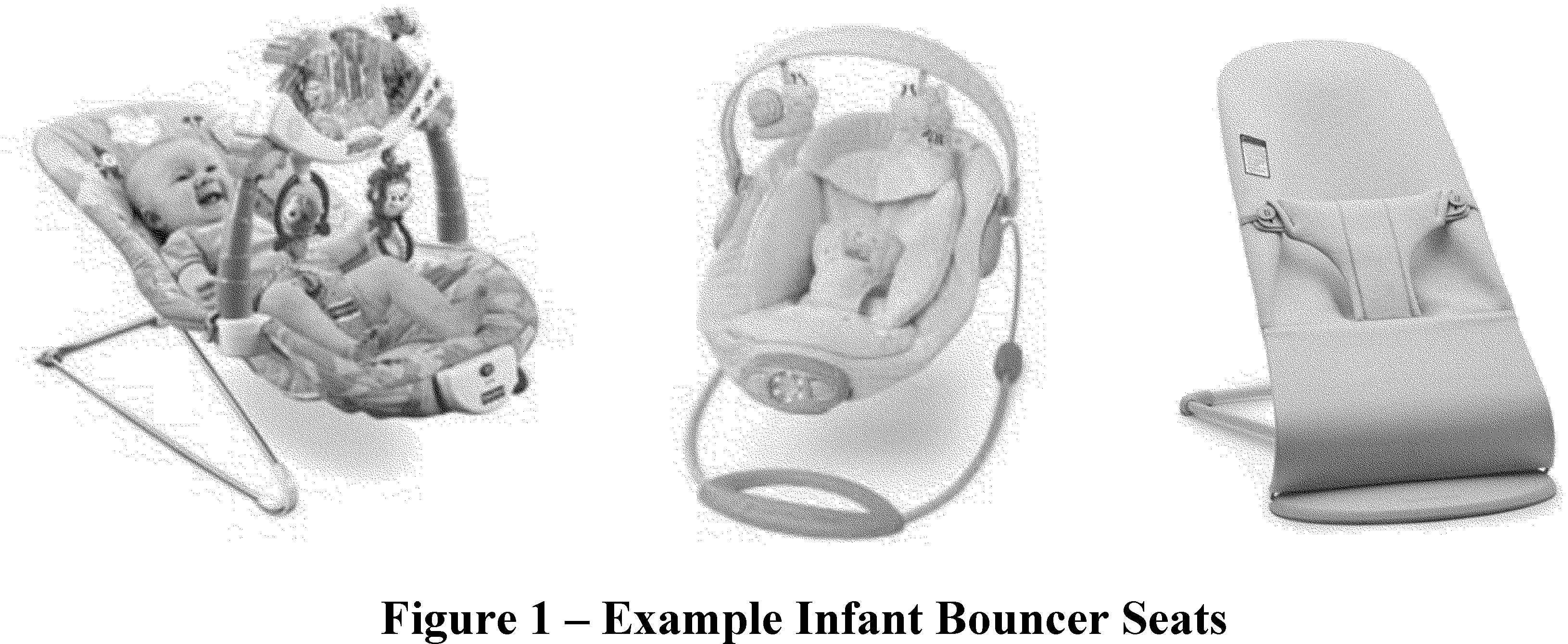
An “infant bouncer seat” is defined in the scope section 1.2 of ASTM F2167-22 as “a freestanding product intended to support an occupant in a reclined position to facilitate bouncing by the occupant, with the aid of a caregiver or by other means” and “whose intended occupants are infants who have not developed the ability to sit up unassisted (approximately 0 to 6 months of age).” Bouncer seats vary in design, from a wire frame construction model with a fabric cover, a toy bar and a three point restraint, to more complex designs with additional features, such as battery-powered devices that vibrate and play melodies and nature sounds (Figure 1).
( printed page 45995)
ASTM F2167 is intended to minimize the risk of injury or death to infants in bouncer seats associated with falls from elevated surfaces, product disassembly or collapse, stability, and suffocation. ASTM F2167 also addresses the hazards described in 16 CFR 1500.18(a)(6). Specifically:
Section 5.6 addresses scissoring, shearing and pinching;
Section 5.8 addresses exposed coil springs;
Section 5.7 addresses holes or openings; and
Section 5.5 addresses latching or locking mechanisms to prevent accidental collapse.
B. Stationary Activity Centers Rule
Under section 104 of the CPSIA, the Commission issued a final rule for stationary activity centers, codified in 16 CFR part 1238. The rule incorporated by reference ASTM F2012-18
ε[1]
,
Standard Consumer Safety Performance Specification for Stationary Activity Centers.
ASTM subsequently revised the voluntary standard in March 2025, and the Commission revised the mandatory standard to incorporate by reference ASTM F2012-24, which is the current mandatory standard for stationary activity centers. 90 FR 13833 (March 27, 2025).[1]
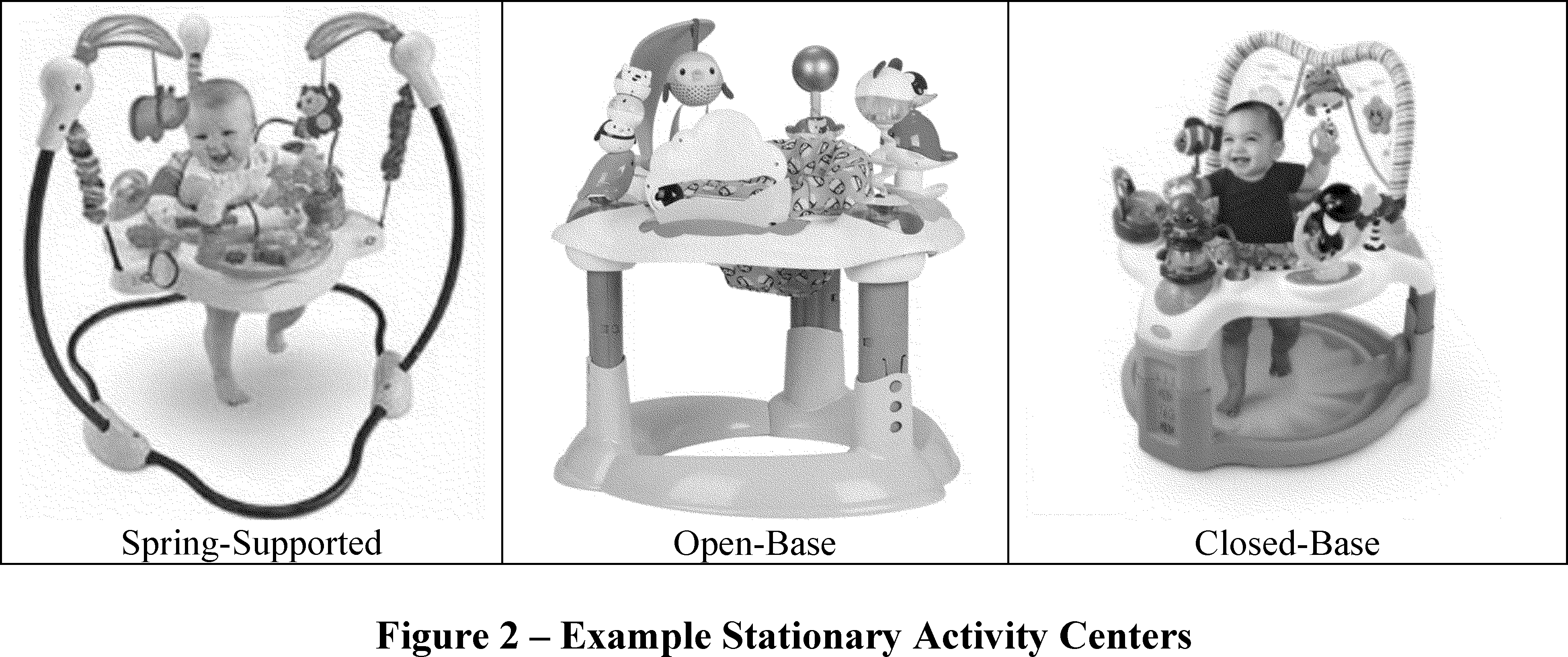
Stationary activity centers are intended for children who are not yet able to walk but are able to hold up their heads unassisted. Stationary activity centers vary in style and design complexity but typically consist of a seat that is suspended from a frame by springs or supported from the bottom by a fixed base. ASTM F2012 section 3.1.12 defines a stationary activity center as “a freestanding product intended to remain stationary that enables a sitting or standing occupant whose torso is completely surrounded by the product to walk, rock, play, spin or bounce, or all of these, within a limited range of motion.” ASTM F2012 also defines three types of stationary activity centers: Closed-base stationary activity centers, open-base stationary activity centers, and spring-supported stationary activity centers. Examples of each type are shown in Figure 2.
ASTM F2012 is intended to minimize the risk of injury or death to children using stationary activity centers associated with seat strength, product tip-over, openings for finger entrapment, and small parts. The voluntary standard addresses the hazards described in 16 CFR 1500.18(a)(6). Specifically:
Section 5.6 addresses scissoring, shearing and pinching;
Section 5.4 addresses latching or locking mechanisms to prevent accidental collapse or folding; and
Section 5.11 addresses the risk of accidental collapse when the springs fail on a spring-supported stationary activity center.
C. Justification for Removing Infant Bouncer Seats and Stationary Activity Centers From the Scope of 16 CFR 1500.18(a)(6)
As described earlier in this preamble, 16 CFR 1500.18(a)(6) describes the features of baby-bouncers subject to that rule, including any subject product that has any exposed parts capable of causing amputation, crushing, lacerations, fractures, hematomas, bruises, or other injuries to fingers, toes, or other parts of the anatomy of young children. Section 1500.86(a)(4) describes the requirements for baby bouncers, including provisions pertaining to scissoring shearing and pinching; exposed coil springs; holes or openings; and accidental collapse. The ASTM standards incorporated by reference in parts 1229 and 1238 similarly contain provisions pertaining to scissoring shearing and pinching; exposed coil springs; holes or openings; and accidental collapse that are more specific than the requirements in section 1500.86(a)(4), and that can be evaluated in a repeatable and reproducible manner. Furthermore, the requirements in the ASTM standards are based on anthropometric data developed for the CPSC by the University of Michigan in 1975.[2]
This data set sampled body measurements of children from 2 weeks to 13 years of age. Below is a more detailed staff assessment of how the ASTM standards adequately address the hazards 16 CFR 1500.86(a)(4) is intended to address.
1. Scissoring, Shearing, and Pinching
The requirement in section 1500.86(a)(4)(i) states that frames must be designed and constructed in a manner to prevent injury from any scissoring, shearing, or pinching when the members of the frame or other components rotate or move relative to one another. The ASTM standards include a similar requirement, but add the specific requirement that scissoring, shearing, or pinching shall not be permissible when the edges of the rigid parts admit a probe greater than 0.210 in. (5.33 mm) and less than 0.375 in. (9.53 mm) diameter at any accessible point throughout the range of motion of such parts (ASTM F2167 section 5.6 and ASTM F2012 section 5.6). The intent of this requirement is to not allow fingers access to scissoring, shearing, or pinching hazards by making openings between components either too small for the smallest user to penetrate with their smallest finger (0.210 in. diameter) or larger than the largest user's biggest finger (0.375 in. diameter). Therefore, products that meet the scissoring, shearing, and pinching requirements in ASTM F2012 and ASTM F2167 will also reliably meet the requirement in section 1500.86(a)(4)(i).
2. Exposed Coil Springs, Holes, or Openings
Section 1500.86(a)(4)(ii) requires the space between extended spring coils to be less than 0.125 inches, or to be covered or otherwise prevent injuries. Similarly, section 1500.86(a)(4)(iii) requires holes to be less than or equal to 0.125 inches in diameter, or to be covered or otherwise designed to prevent injuries. The specifications in ASTM F2012 and ASTM F2167 for coil springs (ASTM F2012 section 5.7 and ASTM F2167 section 5.8) and openings (holes) (ASTM F2012 section 5.5 and ASTM F2167 section 5.7) are conceptually similar to those in section 1500.86(a)(4) but specify different allowable dimensions. The ASTM standards require any exposed coil springs capable of generating a space between coils of 0.210 in. or greater to be covered or otherwise designed to prevent injury. This requirement prevents fingers from becoming entrapped in the space between spring coils.
Similarly, the ASTM standards also prohibit any hole or slot between 0.210 inches and 0.375 inches in size that extends entirely through a wall section of any rigid material less than 0.375 inches thick. This prevents the entrapment of fingers by making openings either too small for the smallest user to penetrate with their smallest finger or larger than the largest user's biggest finger (thereby allowing the finger to be withdrawn without entrapment). Although these dimensions are larger than the 0.125 inches cited in section 1500.86(a)(4), the ASTM requirements are based on children's finger size and have been shown to prevent finger entrapment injuries. Therefore, products that comply with the exposed coil springs, holes, or opening requirements in ASTM F2012 and ASTM F2167 also address the hazards described in section 1500.86(a)(4)(ii-iii).
3. Accidental Collapse
Section 1500.86(a)(4)(iv) states that articles must be designed and constructed to prevent accidental collapse while in use, but it does not specify how to test for conditions that could lead to accidental collapse. In contrast, the ASTM standards include specific tests for latching and locking mechanisms to prevent accidental collapse: latching or locking mechanisms are to release with a force of at least 10 pounds when only a single action is needed; or two distinct and separate actions shall be required to release the mechanism (ASTM F2012 section 5.4 and ASTM F2167 section 5.5). The ASTM standards also have structural integrity requirements to reduce the risk of collapse due to structural failure. Additionally, ASTM F2012 includes a requirement in section 5.11 that spring supported stationary activity centers have a redundant system in case any one of the springs should fail: the system must fully support the test weight; cause the seat to come to a rest at an angle of no more than 25 degrees from horizontal; and must not create a hazardous condition. Therefore, products that comply with the accidental collapse requirements in ASTM F2012 and ASTM F2167 also comply with section 1500.86(a)(4)(iv).
The requirements in 16 CFR 1500.86(a)(4) were developed by the FDA in 1971, prior to the CPSC's publication of children's anthropometric measurements. The requirements in the ASTM standards incorporated by reference in parts 1229 and 1238 are based on more recent anthropometric data developed for the CPSC by the University of Michigan in 1975 and include clear performance criteria. The ASTM standards also address other hazard patterns that were not addressed by the FHSA regulations. Based on the above evaluation, the hazards addressed by 16 CFR 1500.86(a)(4) are also effectively addressed by the requirements in parts 1229 and 1238. Accordingly, the requirements in 16 CFR 1500.18(a)(6) and 1500.86(a)(4) that apply to infant baby bouncers and stationary activity centers are being revoked as obsolete and unnecessary.
Finally, the Commission determines that it is not in the public interest to revoke the existing requirements of 16 CFR 1500.18(a)(6) and 1500.86(a)(4) as
( printed page 45997)
they apply to products like doorway or ceiling bouncers or jumpers. There is not an existing ASTM safety standard which applies to these products and which covers the types of hazards that this rule is intended to address. Having these requirements remain in place will make it easier to obtain a recall or other corrective actions if products present a hazard due to a failure to meet an existing requirement. Any negative effect of having particular dimensions specified in these regulations that are based on outdated anthropometric data is neutralized by the provision in the regulations that allows products that are “otherwise designed to prevent injuries.” The Commission would consider an effective requirement based on current anthropometric data to be designed to prevent injuries.
The Commission is issuing this rule as a direct final rule. Although the Administrative Procedure Act (APA; 5 U.S.C. 551-559) generally requires agencies to provide notice of a rule and an opportunity for public comment, section 553 of the APA provides an exception when the agency “for good cause finds” that notice and comment are “impracticable, unnecessary, or contrary to the public interest.”
Id.
553(b)(B). The Commission has determined that the above-described provisions relating to infant bouncer seats and stationary activity centers in 16 CFR 1500.18(a)(6) and 1500.86(a)(4) no longer serve the public interest because they are obsolete or otherwise unnecessary. Applying the “good cause” standard discussed above, the Commission concludes that prior notice and comment are unnecessary before revoking the provisions in this direct final rule.
In Recommendation 2024-6, the Administrative Conference of the United States (ACUS) endorses direct final rulemaking as an appropriate procedure to expedite rules that are noncontroversial and that are not expected to generate significant adverse comments.
See89 FR 106406 (Dec. 30, 2024). ACUS recommends that agencies use the direct final rule process when they act under the “unnecessary” prong of the good cause exemption in 5 U.S.C. 553(b)(B). 89 FR 106406, 106409. Consistent with the ACUS recommendation, the Commission is publishing this rule as a direct final rule, because CPSC does not expect any significant adverse comments.
Unless CPSC receives a significant adverse comment within 30 days of this notification, the rule will become effective on September 21, 2026. In accordance with ACUS's recommendation, the Commission considers a significant adverse comment to be one where the commenter explains why the rule would be inappropriate, “including challenges to the rule's underlying premise or approach,” or where the commenter explains why the rule would be ineffective or unacceptable without change. Id. at 106409. If the Commission receives a significant adverse comment, the Commission will withdraw any portion of this direct final rule related to such a comment. Depending on the comment and other circumstances, the Commission may then incorporate the adverse comment into a subsequent direct final rule or publish a notice of proposed rulemaking, providing an opportunity for public comment.
V. Regulatory Flexibility Act
The Regulatory Flexibility Act (RFA; 5 U.S.C. 601-612) generally requires agencies to review proposed and final rules for their potential economic impact on small entities, including small businesses, and prepare regulatory flexibility analyses. 5 U.S.C. 603, 604. The RFA applies to any rule that is subject to notice and comment procedures under section 553 of the APA. 5 U.S.C. 601-612. As discussed in section IV of this preamble regarding the Direct Final Rule Process, the Commission has determined that notice and the opportunity to comment are unnecessary for this rule. Therefore, the RFA does not apply.
VI. Paperwork Reduction Act
This direct final rule does not impose any information collection requirements. Accordingly, this rule is not subject to the Paperwork Reduction Act, 44 U.S.C. 3501-3520.
VII. Environmental Considerations
The Commission's regulations provide for a categorical exclusion from any requirement to prepare an environmental assessment or an environmental impact statement where they “have little or no potential for affecting the human environment.” 16 CFR 1021.5(c)(2). This rule falls within the categorical exclusion, so no environmental assessment or environmental impact statement is required.
VIII. Preemption
According to Executive Order 12988 (February 5, 1996), agencies must state in clear language the preemptive effect, if any, of new regulations. Because the Commission is simply removing outdated requirements concerning infant bouncer seats and stationary activity centers that are still subject to other CPSC mandatory standards, this direct final rule has no preemptive effect.
IX. Effective Date
Unless the Commission receives a significant adverse comment by August 21, 2026, the rule will become effective on September 21, 2026. In Recommendation 2024-6, ACUS recommends, absent exceptional circumstances for providing a different effective date, the agency should provide that a direct final rule will take effect at least 30 days after the close of the comment period if the agency receives no significant adverse comments. An agency that does not publish a confirmation notice should consider providing an effective date greater than 30 days after the close of the comment period if the agency believes it is necessary to ensure that it has adequate time to withdraw the rule in the event it receives significant adverse comments.
See89 FR 106409. The 60-day effective date for the direct final rule is consistent with ACUS Recommendation 2024-6.
Pursuant to the Congressional Review Act (CRA) and Executive Order (E.O.) 12866, the Office of Management and Budget's Office of Information and Regulatory Affairs has determined that this rule does not qualify as a “major rule,” as defined in 5 U.S.C. 804(2), and is not a significant regulatory action as defined under section 2(f) of E.O. 12866. To comply with the CRA, CPSC will submit the required information to each House of Congress and the Comptroller General.
Banned toys and other banned articles intended for use by children.
(a) * * *
(6) Any article known as a “baby-bouncer” or “walker-jumper” and any other similar article (referred to in this paragraph (a)(6) as “article(s)”), except an infant walker subject to part 1216 of this chapter, an infant bouncer seat subject to part 1229 of this chapter, and a stationary activity center subject to part 1238 of this chapter, which is intended to support very young children while sitting, bouncing, jumping, and/or reclining, and which because of its design has any exposed parts capable of causing amputation, crushing, lacerations, fractures, hematomas, bruises, or other injuries to fingers, toes, or other parts of the anatomy of young children. * * *
* * * * *
3. Amend § 1500.86 by revising paragraph (a)(4) introductory text to read as follows:
Exemptions from classification as a banned toy or other banned article for use by children.
(a) * * *
(4) Any article known as a “baby-bouncer” or “walker-jumper” and any other similar article (referred to in this paragraph (a)(4) as “article(s)”), except an infant walker subject to part 1216 of this chapter, an infant bouncer seat subject to part 1229 of this chapter, and a stationary activity center subject to part 1238 of this chapter, described in § 1500.18(a)(6) provided:
* * * * *
Alberta E. Mills,
Secretary, Consumer Product Safety Commission.
Footnotes
1.
The current version of the voluntary standard, ASTM F2012-24
ε1.
, includes editorial revisions to example warning labels. ASTM did not notify CPSC about this editorial update under CPSIA section 104(b)(4)(B), 15 U.S.C. 2056a(b)(4)(B), so ASTM F2012-24 remains the current mandatory standard.
2.
Snyder, R. G., Spencer, M. L., Owings, C. L. & Schneider, L. W. (1975), Physical Characteristics of Children As Related to Death and Injury for Consumer Product Design and Use, Prepared for the Consumer Product Safety Commission (UM-HSRI-BI-75-5 Final Report Contract FDA-72-70 May 1975), Highway Safety Research Institute, The University of Michigan, May 31, 1975.
 www.regulations.gov
 16 CFR 1500.18(a)(6)
 15 U.S.C. 1261-1278