Medicaid Program; Amending the Indirect Hold Harmless Threshold of Health Care-Related Taxes
This proposed rule would revise standards for determining whether an indirect hold harmless arrangement exists for a health care- related tax. This proposed rule is necessary to...
Centers for Medicare & Medicaid Services (CMS), Department of Health and Human Services (HHS).
ACTION:
Proposed rule.
SUMMARY:
This proposed rule would revise standards for determining whether an indirect hold harmless arrangement exists for a health care-related tax. This proposed rule is necessary to implement a provision in the “One Big Beautiful Bill Act,” herein referred to as the “Working Families Tax Cut (WFTC) legislation,” which established new indirect hold harmless thresholds for health care-related taxes. Currently, the threshold for a State's collection of tax revenues is no more than 6 percent of net patient revenue attributable to the assessed permissible class of health care items or services. Effective October 1, 2026, the WFTC legislation generally sets the threshold equal to the applicable percent of net patient revenue attributable to taxes imposed as of July 4, 2025. Effective October 1, 2027, the WFTC legislation also requires a phase down of the hold harmless threshold in expansion States. Apart from establishing the new threshold in regulation and proposing related changes and enhancements to existing processes, we propose to sunset a secondary prong to the indirect hold harmless determination to ensure the thresholds determined as of July 4, 2025, serve as the maximum permissible level. Finally, this rule proposes to add a new permissible class to enhance CMS oversight of health care-related taxes.
DATES:
To be assured consideration, comments must be received at one of the addresses provided below, by September 21, 2026.
ADDRESSES:
In commenting, please refer to file code CMS-2452-P.
Comments, including mass comment submissions, must be submitted in one of the following three ways (please choose only one of the ways listed):
2.
By regular mail.
You may mail written comments to the following address ONLY: Centers for Medicare & Medicaid Services, Department of Health and Human Services, Attention: CMS-2452-P, P.O. Box 8010, Baltimore, MD 21244-8010.
Please allow sufficient time for mailed comments to be received before the close of the comment period.
3.
By express or overnight mail.
You may send written comments to the following address ONLY: Centers for Medicare & Medicaid Services, Department of Health and Human Services, Attention: CMS-2452-P, Mail Stop C4-26-05, 7500 Security Boulevard, Baltimore, MD 21244-1850.
For information on viewing public comments, see the beginning of the
SUPPLEMENTARY INFORMATION
section.
FOR FURTHER INFORMATION CONTACT:
Jonathan Endelman, (410) 786-4738, and Stuart Goldstein, (410) 786-0694, for Health Care-Related Taxes.
SUPPLEMENTARY INFORMATION:
Inspection of Public Comments:
All comments received before the close of the comment period are available for viewing by the public, including any personally identifiable or confidential business information that is included in a comment. We post all comments received before the close of the comment period on the following website as soon as possible after they have been received:
www.regulations.gov.
Follow the search instructions on that website to view public comments. CMS will not post on
Regulations.gov
public comments that make threats to individuals or institutions or suggest that the commenter will take actions to harm an individual. CMS continues to encourage individuals not to submit duplicative comments. We will post acceptable comments from multiple unique commenters even if the content is identical or nearly identical to other comments.
Title XIX of the Social Security Act (the Act) authorizes Federal grants to the States for Medicaid programs to provide medical assistance to eligible individuals with limited income and resources. While Medicaid programs are administered by the States, the program is jointly financed by the Federal and State governments. Shared responsibility for financing lies at the foundation of the Medicaid program. Sections 1902(a), 1903(a), and 1905(b) of the Act require States to share in the cost of medical assistance and in the cost of administering the State plan. The Federal government pays its share of Medicaid expenditures to the State on a quarterly basis according to a formula set forth in sections 1903 and 1905(b) of the Act. The amount of the Federal share of Medicaid expenditures is called Federal financial participation (FFP).
Section 1903(a)(1) of the Act provides for payments to States of a percentage of medical assistance expenditures authorized under their approved State plans. Generally, FFP is available when a covered Medicaid service is provided to a Medicaid beneficiary, which results in a Federally matchable expenditure that is funded in part through non-Federal funds from the State or a non-State governmental entity. In addition, under section 1903(a)(7) of the Act, FFP is available at a rate of 50 percent for amounts expended by a State “as found necessary by the Secretary for the proper and efficient administration of the State plan,” which is known commonly as administrative claiming. The share of Federal funding for medical assistance expenditures is determined by the Federal medical assistance percentage (FMAP), which is calculated for each State using a formula set forth in section 1905(b) of the Act, or other applicable FFP match rates specified by the statute.[1]
Section 1902(a)(2) of the Act, and its implementing regulations in 42 CFR part 433, subpart B, requires States to share in the cost of Medicaid expenditures, with financial participation by the State of not less than 40 percent of the non-Federal share of expenditures. These requirements also permit other non-State government units to contribute to the financing of the non-Federal share of medical assistance expenditures up to the remaining 60 percent of the non-Federal share. States must participate in the costs of operating a program for providing health care services to eligible beneficiaries and therefore have an incentive to ensure the program is
( printed page 46563)
operated efficiently and in a fiscally responsible manner.
There are several ways in which States can finance the non-Federal share of Medicaid expenditures, including: (1) State general funds, typically derived from tax revenue appropriated directly to the Medicaid agency; (2) revenue derived from health care-related taxes when consistent with Federal statutory requirements in section 1903(w) of the Act and implementing regulations at 42 CFR part 433, subpart B; (3) provider-related donations to the State, which must be “bona fide” in accordance with section 1903(w) of the Act and implementing regulations at 42 CFR part 433, subpart B; (4) intergovernmental transfers (IGTs) from units of State or local government that contribute funding for the non-Federal share of Medicaid expenditures by transferring their own funds to and for the use of the Medicaid agency; and (5) certified public expenditures whereby units of government, including health care providers that are units of government, incur FFP-eligible expenditures under the State's approved State plan, consistent with section 1903(w)(6) of the Act and § 433.51(b).
B. Health Care-Related Taxes
The Medicaid Voluntary Contribution and Provider Specific Tax Amendments of 1991 (Pub. L. 102-234, enacted December 12, 1991) amended section 1903 of the Act to specify limitations on the amount of FFP available for medical assistance expenditures in a fiscal year when States receive certain funds donated from providers or certain related entities, and revenues generated by certain health care-related taxes. The Centers for Medicare & Medicaid Services (CMS) issued regulations to implement the statutory provisions concerning provider-related donations and health care-related taxes in an interim final rule with comment period published in November 1992 (57 FR 55118, November 24, 1992) (1992 IFC). CMS issued the final rule in August 1993 (58 FR 43156, August 13, 1993) (1993 final rule).
Section 1903(w) of the Act provides for a reduction of Federal Medicaid matching funds based on State health care-related taxes unless those taxes meet statutory requirements. In general, health care-related taxes must be: (1) imposed on a permissible class of health care items and services; (2) broad-based, or apply to all non-Federal, nonpublic providers within a class of health care items and services; (3) uniform, such that all providers within a class must be taxed at the same rate; and (4) not part of hold harmless arrangements in which collected taxes are returned to the taxpayer, whether directly or indirectly. Section 1903(w)(3)(E) of the Act specifies that the Secretary shall approve a health care-related tax waiver for the broad-based or uniformity requirements if the net impact of the tax and associated expenditures is “generally redistributive” in nature and the amount of the tax is not directly correlated to Medicaid payments for items and services with respect to which the tax is imposed. To enforce the requirement that taxes have a net impact that is “generally redistributive,” CMS applies specific tests when a State seeks a waiver of the broad-based or uniformity requirements. A State must satisfy § 433.68(e)(1) and (3) for a broad-based waiver only, or § 433.68(e)(2) and (3) for a uniformity waiver (whether or not a broad-based waiver is also requested), for the tax to be considered generally redistributive. These tests, where applicable, are intended to demonstrate that the State's tax program does not impose a higher tax burden on the Medicaid program compared to a broad-based and uniform tax. The permissible class and hold harmless requirements cannot be waived.
Section 1903(w)(1)(A) of the Act states that the Secretary will reduce a State's medical assistance expenditures, prior to calculating FFP, by the sum of any revenues from health care-related taxes that do not meet the requirements under section 1903(w) of the Act. This reduction in a State's claimed expenditures is codified in § 433.70(b). Because of the way the statute is constructed, the baseline assumption is that all health care-related taxes are impermissible, with limited exceptions for health care-related taxes that satisfy the parameters specified by the statute. Health care-related taxes may only be imposed permissibly (that is, where a State will not have the revenues deducted from expenditures) on certain groups of health care items and services, known as permissible classes, that are specified in section 1903(w)(7) of the Act and § 433.56 of the implementing regulations.
C. Direct and Indirect Hold Harmless Arrangements
Section 1903(w)(4) of the Act and implementing regulations in § 433.68(f) describe hold harmless arrangements with respect to health care-related taxes. Section 1903(w)(4)(C)(i) of the Act provides that a hold harmless provision exists where “[t]he State or other unit of government imposing the tax provides (directly or indirectly) for any payment, offset, or waiver that guarantees to hold taxpayers harmless for any portion of the costs of the tax.” The implementing regulation in § 433.68(f)(3) similarly provides that a hold harmless arrangement exists where “[t]he State (or other unit of government) imposing the tax provides for any direct or indirect payment, offset, or waiver such that the provision of the payment, offset, or waiver directly or indirectly guarantees to hold taxpayers harmless for all or any portion of the tax amount.”
There are two general types of hold harmless arrangements: direct and indirect. Under a direct hold harmless arrangement, the State provides a payment (Medicaid or non-Medicaid), offset, or waiver to the providers (whether through direct or indirect payments, including payments redistributed through an intermediary) that guarantees to repay the providers for part or all of the cost of the tax and thereby holds them harmless for the cost of the tax. It is the payment, not necessarily the unit of government, that guarantees to hold the provider harmless for the cost of the tax. In the preamble to a 2008 final rule (“Medicaid Program; Health Care- Related Taxes” (73 FR 9685) (2008 final rule)) amending § 433.68(f)(1) through (3), CMS explained that “[a] direct guarantee will be found when a State payment is made available to a taxpayer or a party related to the taxpayer with the reasonable expectation that the payment would result in the taxpayer being held harmless for any part of the tax (through direct or indirect payments).” [2]
In contrast to direct payments, the use of the term “indirect” in the statute and regulation, highlighted in the excerpts noted previously in this proposed rule, makes clear that the State or other unit of government imposing the tax itself need not be involved in the actual redistribution of Medicaid payments for the purpose of making taxpayers whole for the arrangement to qualify as a hold harmless. It is possible for a State to indirectly provide a payment within the meaning of section 1903(w)(4)(C)(i) of the Act that directly guarantees to hold taxpayers harmless for all or any portion of the costs of the tax, if some or all of the taxpayers receive those payments through an intermediary (for example, a hospital association or similar provider affiliated organization) rather than from the State or its contracted managed care plan. As CMS further explained in the preamble to the 2008 final rule, we used the term “reasonable expectation” because “State laws were rarely overt in requiring that State payments be used to
( printed page 46564)
hold taxpayers harmless.” [3]
In the preamble to the 2008 final rule, we also gave an example of State laws providing grants to nursing home residents who experienced increased charges as a result of nursing facility bed taxes; even though no State law typically required residents to use the grant funds to pay the increased nursing home fees, these State payments to nursing home residents indirectly held the nursing facilities harmless for their health care-related tax costs because of the reasonable expectation that their residents would use the State payments to pay the higher fees the nursing facilities charged to recover all or a portion of their tax costs. The State payments of grant funds to nursing home residents therefore constituted indirect payments to the nursing facilities for purposes of the hold harmless analysis. As CMS explained in the 2008 final rule, hold harmless arrangements may not be overtly established through State law but can be based instead on reasonable expectations that certain actions will take place among participating entities that will result in taxpayers being held harmless for all or a portion of their health care-related tax costs.
The indirect hold harmless threshold was first described in the 1992 IFC and is reflected in the current codification in § 433.68(f)(3)(i)(A), where it is referred to as an indirect guarantee. In that rule, CMS explained that a hold harmless exists if the State or other unit of local government imposing the tax provides, directly or indirectly, for any payment, offset, or waiver that guarantees to hold taxpayers harmless for all or a portion of the tax. We also specified how we would make this determination if an explicit guarantee [4]
did not exist, and we described a two-part, or two-prong test (however, if an explicit guarantee exists, the tax would be impermissible, and the two-prong test would not apply). Under the first prong, we compare the revenues from a tax imposed on a permissible class to the revenue attributable to the assessed permissible class of health care items or services, now referred to as net patient revenue. If the tax produces revenues of more than 6 percent of the net patient revenue (under the regulations established at that time and under current regulations), we may determine that an indirect hold harmless exists, depending on whether the tax passes the second prong, discussed next. CMS chose the threshold of 6 percent, as described in the 1992 IFC, based on a determination that this was “the average level of taxes applied to other goods and services in the States.” [5]
This threshold is based on the premise that if tax collections exceed a certain amount of taxpayers' revenue, there likely exists a means of providing money (through Medicaid payments or otherwise) back to those taxpaying entities to repay tax costs. This first prong has become commonly known as the “6 percent test,” or the “safe harbor threshold.”
If the tax exceeds the 6 percent threshold, CMS will evaluate the tax under the second prong of the test, referred to here as the “75/75 test.” This prong measures if, in the aggregate, 75 percent of taxpayers receive 75 percent or more of their total tax costs back in enhanced Medicaid payments or other State payments. If this occurs, CMS will determine that an indirect hold harmless arrangement exists and the tax will be impermissible and thereby subject to the reduction in medical assistance expenditures required under section 1903(w)(1)(A) of the Act. We selected the 75/75 test parameters, as described in the 1992 IFC, “because we believe it strikes a reasonable balance between our need to assure that States do not use Medicaid rates to repay providers for tax costs in a way not permitted under the statute, and our desire to permit States flexibility in the design of their tax and payment programs.” [6]
Congress enacted the Tax Relief and Health Care Act of 2006 (Pub. L. 109-432) on December 20, 2006. Section 403 of the Tax Relief and Health Care Act of 2006 incorporated the existing regulatory test for an indirect guarantee into the Medicaid statute and further provided for a temporary reduction of the threshold under the first prong of the test. Specifically, the law reduced the indirect hold harmless threshold of 6 percent to 5.5 percent for the period of January 1, 2008, through September 30, 2011. On February 22, 2008, CMS published the 2008 final rule, which incorporated the temporary reduction into regulation located at § 433.68(f)(3)(i)(A). Beginning October 1, 2011, the applicable threshold under the first prong of the indirect hold harmless test returned to 6 percent of net patient revenue.
On November 8, 2018, the HHS Office of Inspector General (OIG) issued a report titled, “Although Hospital Tax Programs in Seven States Complied with Hold-Harmless Requirements, the Tax Burden on Hospitals Was Significantly Mitigated.” [7]
For the report, the OIG reviewed seven States with the largest hospital health care-related tax programs. At that time, the States in question collected $38.4 billion in revenue from hospital taxes from State fiscal years 2011 through 2015 that they used to draw down $54.6 billion in Federal matching funds. The OIG found that, for these States, the hospital tax amounts exceeded 75 percent of non-DSH supplemental payments to hospitals for all years except for 2 years in one State and 1 year in another. However, these taxes were considered permissible as they were under the indirect guarantee hold harmless threshold of 6 percent; therefore, the second prong of the test was not applied. This rate of return of Medicaid taxes in the form of Medicaid payments led the OIG to express concern that these taxes generated “significant amounts of revenue to draw down additional Federal funds,” while generally taxpayers' tax costs were offset due to supplemental payments received by the taxpayers. The OIG recommended that CMS “re-evaluate the effects of the health care-related tax safe-harbor threshold and the associated 75/75 requirement to determine if modifications are needed, such as the reduction or elimination of the safe harbor threshold or adjusting the 75/75 requirement and take appropriate action.” CMS concurred with the OIG's recommendation and stated that it would examine the 75/75 threshold to determine whether any modifications are necessary. Therefore, through this proposed rule and in connection with the regulatory action required with respect to the indirect hold harmless threshold by Public Law 119-21, we are re-evaluating the appropriateness of the 75/75 test.
D. Working Families Tax Cut Legislation
Public Law 119-21 was enacted on July 4, 2025 (herein referred to as the Working Families Tax Cut (WFTC) legislation). Section 71115 of the WFTC legislation amended section 1903(w)(4) of the Act by modifying the indirect hold harmless threshold for fiscal years (FY) beginning on or after October 1, 2026. Specifically, section 71115(a) of the WFTC legislation replaced the previous “6 percent” threshold with an amount calculated generally based on the percent of net patient revenue
( printed page 46565)
attributable to the permissible class for which a health care-related tax was enacted by a State or unit of local government, and that State or locality imposes such tax as of July 4, 2025. If a State or unit of local government has not enacted and imposed such a tax for the permissible class as of July 4, 2025, the applicable percent for that class is zero percent. We note that throughout this rule, we may make references to the State as the taxing authority, but in each instance these references should be read to include units of local government, consistent with the language of section 1903 of the Act.
This methodology differs with respect to expansion versus non-expansion States. Section 71115(a)(1)(D)(iii) of the WFTC legislation defines an expansion State as “a State that, beginning on January 1, 2014, or on any date thereafter, elects to provide medical assistance to all individuals described in section 1902(a)(10)(A)(i)(VIII) under the State plan under this title or under a waiver of such plan,” and provides that a non-expansion State is any State that is not an expansion State. For expansion States, in addition to the methodology described already, and beginning in Federal fiscal year (FFY) 2028, the indirect hold harmless threshold will be subject to a statutory phase down. Starting FFY 2028, the applicable threshold for each permissible class will be the lower of the July 4, 2025, calculated threshold, or the applicable percent for the FFY (5.5 percent in FFY 2028, decreasing by 0.5 percentage points annually until reaching 3.5 percent in FFY 2032). For example, if an expansion State has a threshold of 4.7 percent for the inpatient hospital services permissible class based on taxes that were enacted and imposed as of July 4, 2025, the State's threshold would be 4.7 percent for FFY 2027, 2028, and 2029. Beginning in FFY 2030, the applicable percent would be 4.5 percent because this is the lower of the July 4, 2025, threshold and the phased-down applicable percent for that year. In this example, the phased-down applicable percentages of 5.5 percent for FFY 2028 and 5 percent for FFY 2029 would not affect the State, because 4.7 percent is lower than each of those phased-down alternate thresholds. This phase down for expansion States is not applicable to health care-related taxes imposed on the nursing facility or intermediate care facility for individuals with intellectual disabilities (ICF/IID) permissible classes, although those permissible classes will still be held to the threshold calculated as of July 4, 2025. Finally, we note that under section 71115(b) of the WFTC legislation, the amendments made to section 1903(w)(4) of the Act are applicable to all States and the District of Columbia, but not to the territories.
To support implementation of the amendments to section 1903(w)(4) of the Act made by section 71115 of the WFTC legislation, CMS released a “Dear Colleague” letter on November 14, 2025,[8]
providing preliminary guidance to aid State planning efforts. The letter described CMS' initial interpretation of the terms “enacted” and “imposes” [9]
and the implications of the statutory amendments for existing taxes and pending tax waivers. This proposed rule proposes regulatory changes that, if finalized, would codify those standards, with certain modifications described later in this preamble, update relevant regulations to implement the new statutory thresholds, and facilitate transition to those new thresholds and related oversight of health care-related taxes.
E. Concerns Regarding Permissible Tax Classes of Health Care Services and Providers
Over the past several years, we have become aware that several States have instituted taxes on health insurers, typically as a tax on health insurance premium revenue. Because health insurers are not currently identified as a permissible class, many existing taxes on health insurers would be impermissible to the extent they are health care-related taxes. When this issue first came to light, we decided to act on it through rulemaking, a decision we discuss in greater detail in section II.B. of this proposed rule. In prior rulemaking, we made an effort to maintain consistent Federal oversight of health care-related taxes, modernize the permissible class definitions, and permit States additional flexibility to implement health care-related taxes. Issued in 2019, the proposed rule addressed numerous financial provisions, one of which proposed to define health insurers as a permissible class (84 FR 63722) (2019 proposed rule)). The 2019 proposed rule, which was withdrawn and not finalized, was much broader in scope in terms of the number of financial topics than this proposed rule. Due to the changes made by the WFTC legislation to requirements concerning health care-related taxes, we have determined that it is appropriate to revisit this proposal at this time. Apart from the absence of a currently recognized permissible class for such taxes, taxes on health insurers are not presently subject to the same class-specific review process applicable to recognized permissible classes, making it more difficult for CMS to evaluate their structure and impact on Medicaid in a thorough and consistent manner.
CMS first defined the permissible classes in the 1992 IFC based on the permissible classes listed in section 1903(w)(7)(A) of the Act. In response to comments, in the 1993 final rule, and in accordance with section 1903(w)(7)(A)(ix) of the Act, which authorizes the Secretary to establish “such other classification of health care items and services consistent with this subparagraph as the Secretary may establish by regulation,” we added additional permissible classes. At the time, we described in the preamble the criteria we would use when considering further additions: (1) the revenue of the class is not predominantly from Medicaid and Medicare (not more than 50 percent from Medicaid and not more than 80 percent from Medicaid, Medicare, and other Federal programs combined); (2) the class is clearly identifiable, for example through State licensing programs, Federal statutory recognition, or inclusion as a provider in State plans; and (3) the class is nationally recognized rather than unique to a single State.[10]
The list of permissible classes, which appears in § 433.56(a), has remained largely unchanged since that time.[11]
In a 1997 State Medicaid Director Letter,[12]
CMS reminded States “of their opportunity to propose additional classes of providers, items, or services which the Secretary may consider including as permissible classes,” reiterating both our ongoing intent to consider and potentially establish additional permissible classes, and the three criteria specified in the 1993 final rule for considering such proposals.
As discussed in the provisions section that follow, and similar to the 2019 proposed rule, this proposed rule would add services of health insurers, other than services of managed care
( printed page 46566)
organizations (MCOs) (including HMOs and PPOs) as defined in § 433.56(a)(8), as a permissible class of health care items or services under § 433.56, in accordance with section 1903(w)(7)(A)(ix) of the Act. Further, this proposed rule would apply to this proposed permissible class the indirect hold harmless threshold requirements under section 1903(w)(4) of the Act, as amended by section 71115 of the WFTC legislation.
II. Provisions of the Proposed Regulations
For clarity, we intend that if any provision of this proposed rule, if finalized, is held to be invalid or unenforceable by its terms, or as applied to any person or circumstance, or is stayed pending further action, that provision shall be severable from the remainder of the final rule, and from rules and regulations currently in effect, and not affect the remainder thereof or the application of the provision to other persons not similarly situated or to other, dissimilar circumstances. If any provision is held to be invalid or unenforceable, the remaining provisions that can function independently should take effect and be given the maximum effect permitted by law. In this proposed rule, we propose several provisions that are intended to and would operate independently of each other, even if each serves the same general purpose or policy goal. Where a provision is necessarily dependent on another, the context generally makes that clear.
A. General Definitions (§ 433.52)
We are proposing to add new definitions to § 433.52. We first propose to add and define “Expansion State” to mean, as used in part 433, subpart B, a State that, beginning on January 1, 2014, or on any date thereafter, elects to provide medical assistance to all individuals described in section 1902(a)(10)(A)(i)(VIII) of the Act under the State plan or under a waiver of such plan. We propose to codify the same definition used in section 71115 of the WFTC legislation, but note that the definition is specific to the subpart. Because the term “Expansion State” appears elsewhere in CMS regulations for other purposes, we believe it is important to define it specifically for how it would be used and referenced in § 433.68.
We propose to add and define “Net Patient Revenue” to “mean revenues received by the taxpayer, which are revenues attributable to the assessed permissible class of health care items or services, regardless of payer source.” This definition is intended to restate the description of this term that currently appears in § 433.68(f)(3)(i)(A). While we are proposing to define the term as “Net patient revenue” for consistency with the language in the WFTC legislation, which uses that phrase, the term should be viewed as synonymous with instances where we have previously used “net patient services revenue.” We further note that in one reference within the existing regulations, and in several instances in the 2008 final rule, we referred to “net patient services revenue.” Due to the importance of precision and consistency in States' understanding of Net patient revenue resulting from the changes to the indirect hold harmless threshold created by the WFTC legislation and the reporting enhancements we are proposing with respect to this metric, we determined it was beneficial to define it separately in the dedicated definitions section. We are not proposing any changes to our interpretation of this term, as discussed in the 2008 final rule.[13]
In that rule, we specified that net patient revenue “would include all revenues received from all payers for providing the particular service that is assessed by the State and would not include revenues unrelated to the service being assessed.” This means that the revenues are limited to the permissible class being taxed and cannot include revenues from other services even if delivered in the same facility (for example, the Net patient revenue from a tax on the inpatient hospital services permissible class would not include patient revenue from the hospital's provision of outpatient hospital services). For the purposes of the indirect hold harmless percentage, the State should include all revenue, including Medicare revenue, in the net patient revenue calculation regardless of whether such revenue is taxed. Later in this rule, we discuss the opportunities States will have to amend reporting of net patient revenue to account for any adjustments. We further note that revenues from non-patient care, such gift shop revenues, cafeteria revenues, or parking revenues cannot be included, as these revenues cannot be subject to a health care-related tax under any permissible class.
Finally, we propose to add and define “Non-expansion State” to mean a State that is not an Expansion State, as defined in this subpart. This definition is derived directly from the definition in section 71115 of the WFTC legislation.
We considered but did not propose to define “Net Patient Revenue” to include only revenue associated with the providers within the permissible class that are actually taxed. We did not propose this alternative definition of net patient revenue because we believe it is inconsistent with our longstanding interpretation of the term and would therefore be disruptive to existing taxes. In addition, the current interpretation of net patient revenue has been adopted in statute on two separate instances. Finally, adopting this definition could present a gaming risk due to the ability it would provide to manipulate the denominator of the calculation. We invite comment on this alternative definition, or other modifications to the definition, of “Net patient revenue.” As another example, we considered but did not propose to define a term such as “total tax collection” to provide a term synonymous with the numerator of the indirect hold harmless calculation, which is the total tax revenue collected for all health care-related taxes imposed on a permissible class. We did not propose such a definition because we do not believe there is confusion about this concept and we have not used a single term consistently for this feature as we have with net patient revenue. We invite comment on inclusion of a term such as “total tax collection,” or any other additional terms, in the definitions in § 433.52.
We invite comments on the inclusion of these terms, the definitions we have proposed, and whether there are any other terms used in this proposed rule that should be included in the regulatory definitions as well.
B. Classes of Health Care Services and Providers Defined (§ 433.56)
Section 1903(w)(7)(A)(ix) of the Act provides that permissible classes of health care items and services include “such other classifications consistent with section 1903(w)(7)(A) of the Act as the Secretary may establish by regulation.” In addition to the specific classifications that Congress identified in statute, current regulations in § 433.56(a) specify certain additional classes established by the Secretary, as discussed in the background section of this proposed rule. We are proposing to add a new class of health care items and services to the list of permissible classes in § 433.56(a) by redesignating paragraph (a)(19) as paragraph (a)(20), revising paragraph (a)(18), and adding a new paragraph (a)(19). We propose to remove “and” from paragraph (a)(18), to accommodate the redesignation. In new proposed paragraph (a)(19), we would add services of health insurers other than those already identified in paragraph (a)(8) to the definition of classes of health care services and
( printed page 46567)
providers, which would permit States and units of local government to use revenue collected from taxes imposed on these services as the non-Federal share since, if finalized, such tax revenue would be derived from a permissible class for purposes of section 1903(w) of the Act, subject to applicable statutory and regulatory requirements.
We are aware that several States utilize taxes imposed on health insurers as the source of non-Federal share to finance Medicaid expenditures, including taxes based on health insurance premiums revenue or other insurance-related measures, despite health insurers not currently being identified as a permissible class under § 433.56(a) for purposes of health care-related taxes. As context, and to clarify the distinction between the proposed health insurer permissible class and the MCO permissible class, the health insurer class would encompass health insurer services that are not MCO services already accounted for in current regulations at § 433.56(a)(8). The Deficit Reduction Act of 2005 modified the MCO provider class to “more broadly encompass services provide by all managed care organizations without regard to their status as Medicaid or commercial health plan or the form of such plan.” [14]
While there is potential overlap between these two provider classes, they are distinct. We believe at least some of these taxes have been in place for a long time. These taxes appear to meet the definition of, and function as, health care-related taxes; as such, they must meet relevant statutory requirements. Therefore, CMS is left with the choice whether to establish a prospective new permissible class or determine in which particular circumstances where States continue collecting these taxes it is appropriate to initiate compliance actions. Functionally, this means either bringing health insurers into the scope of permissible classes and clarifying that they must meet applicable statutory and regulatory requirements, or treating many existing health insurer taxes as impermissible because they are health care-related taxes imposed on a class not currently recognized as permissible under § 433.56(a).
We previously attempted to address the issue in a 2019 proposed rule that would have added health insurers as a permissible class, but that proposed rule was subsequently withdrawn. In late 2025, we began an effort to ascertain more complete information from States regarding their collection of health care-related taxes. We believe that in many instances, States may not have understood certain health insurer taxes constitute health care-related taxes for purposes of section 1903(w) of the Act. For example, we have received inquiries from State insurance commissions and departments that impose some of these health insurer taxes, rather than from State Medicaid agencies, which more typically are involved in health care-related tax arrangements. Through these inquiries, we determined some States may not have understood that certain taxes imposed through their insurance commissions, which possibly provided the non-Federal share for Medicaid expenditures, could constitute health care-related taxes under section 1903(w) of the Act, notwithstanding that health insurers are not currently included in § 433.56(a). At least one State has asked for clarification on how to treat such taxes in light of the WFTC legislation. This overall situation has resulted in identification of numerous taxes on health insurers that may not have previously been evaluated under a clear regulatory framework addressing their treatment under section 1903(w) of the Act. This disconnect may have created uncertainty among relevant States which CMS is addressing through this proposed rulemaking.
The WFTC legislation amended the indirect hold harmless requirements applicable to permissible classes as in effect on May 1, 2025, but did not amend section 1903(w)(7)(A)(ix) of the Act or otherwise address the establishment of new permissible classes that were not specified in Federal regulation as of May 1, 2025, leaving CMS authority to establish additional permissible classes undisturbed. We further note that taxes on health insurers are the only existing tax structure of which we are aware where States have imposed taxes that appear to be health care-related taxes under section 1903(w) of the Act despite the absence of a corresponding permissible class under § 433.56(a). In evaluating whether to propose a new permissible class, we considered several factors, including the longstanding existence of these taxes in multiple States, our prior consideration of this issue through rulemaking, the apparent uncertainty among States regarding the treatment of these taxes under section 1903(w) of the Act, and the interest in proposing consistent and transparent application of the statutory and regulatory framework governing health care-related taxes. Taken together, these considerations support proposing a permissible class for services of health insurers through notice-and-comment rulemaking.
Therefore, we are proposing to expand the permissible class list to include a class for health insurers to provide States with clarity regarding the treatment of taxes on health insurers under section 1903(w) of the Act and to support consistent application of the statutory and regulatory requirements governing health care-related taxes. This change would facilitate CMS review of such taxes under the existing framework applicable to permissible classes, including whether such taxes are structured in a manner that would impermissibly target items or services financed primarily or exclusively through the Medicaid program. Taxes imposed on health care items or services or providers of such items or services that are financed primarily or exclusively by Medicaid could raise fiscal integrity concerns and make it unlikely that such a tax could satisfy the generally redistributive requirement under section 1903(w)(3)(E)(ii)(I) of the Act if the State sought a waiver of the broad-based and/or uniformity requirements. Specifically, we propose to describe a new permissible class in § 433.56(a)(19) as “services of health insurers (other than services of managed care organizations (including health maintenance organizations and preferred provider organizations) as specified in paragraph (a)(8) of this section).” Examples of metrics that could be used to assess a tax on services of health insurers include health insurance premium revenue or covered lives. The proposed class would also include health insurers offering plans to Medicaid beneficiaries under a section 1115 demonstration that provides premium assistance to purchase qualified health plan coverage through the Health Insurance Exchange. We are seeking comment on the scope of this permissible class to ensure all appropriate services of health insurers are included. As with other permissible classes, taxes imposed on this proposed category of health care services would be subject to applicable legal requirements, including the broad-based requirements in § 433.68(b)(1) and the uniformity requirements in § 433.68(b)(2) (unless waived), and the hold harmless provisions in § 433.68(f) (which cannot be waived). We discuss later in this section how this proposed new permissible class would interact with the hold harmless requirements proposed elsewhere in this rule.
To establish this permissible class, we must first establish that the taxes in question are health care-related taxes. Section 433.55(a)(3) explains that a
( printed page 46568)
health care-related tax is a licensing fee, assessment, or other mandatory payment that is related to, among other things, the payment for the health care items or services. Thus, a tax on the services of health insurers, which provide for the payment of health care items or services, is a health care-related tax. Furthermore, § 433.55(c) provides that “a tax is considered to be health care related if the tax is not limited to health care items or services, but the treatment of individuals or entities providing or paying for those health care items or services is different than the tax treatment provided to other individuals or entities.” Thus, where health insurers are paying for health care items or services, and the tax specifically targets them in a manner that treats them differently from other individuals or entities subject to the tax, the tax is also a health care-related tax. Therefore, we believe it is clear that taxes on health insurers are health care-related taxes.
Next, we must analyze whether this class is appropriate to add as a permissible class under previously articulated standards. As discussed, the preamble of the August 1993 final rule listed three criteria that should be met by any additional class of health care items and services under consideration to be added to the permissible classes under section 1903(w)(7)(A) of the Act. The criteria specified for establishment of a new class are: the revenue from the class is not predominantly from Medicaid and Medicare; the class is clearly identifiable; and the class is not unique to a State, but nationally recognized. We believe that the class of providers of health care items or services that we are proposing to add in § 433.56(a)(19) meets all of these requirements. First, according to the most recent data available from the US Census Bureau,[15]
66.1 percent of individuals in the United States that are insured have private health insurance, whereas 35.5 percent have public coverage, including 17.6 percent that have Medicaid and CHIP and 19.1 percent that have Medicare. In addition, not all Medicaid or Medicare beneficiaries pay premiums when they are covered by a plan that would be included in this permissible class, and when they do, such amounts are generally limited by Federal statute and regulation and are typically lower than premiums paid by enrollees in private insurance. Further, Medicaid benefits are not generally furnished by entities acting in their capacity as health insurers, and where States deliver Medicaid benefits through managed care arrangements, those entities are already identified as a separate permissible class under § 433.56(a)(8) and are expressly excluded from the proposed class. As a result, we do not believe that revenue from the proposed class, services of health insurers (excluding services of MCOs as defined in § 433.56(a)(8) (which include HMOs and PPOs)) is predominantly from Medicaid (or other programs where the Federal government participates in the cost). Specifically, we believe, based on the data described previously in this paragraph, that such revenue is well below the 50 percent threshold (described in our factors from the 1993 final rule) from Medicaid and also below the 80 percent threshold for revenues from Medicaid, Medicare, and other Federal and Federal-State cooperative programs combined.
Second, each State already defines and regulates health insurers under State law, and thus the class is clearly identifiable. To the extent that State law specifically includes or excludes certain types of issuers of health insurance policies as health insurers, we propose deferring to the State in determining which such entities are included within the proposed class, and which are not. For example, certain groups of employers may band together to offer health insurance coverage to their employees through association health plans under section 3(5) of the Employee Retirement Income and Security Act (ERISA) (Pub. L. 93-406, enacted September 2, 1974). The degree to which an issuer of an association health plan is considered to be a health insurer depends on State law. However, we will continue to conduct oversight and monitor development of provider taxes to make sure this State discretion is not used to circumvent the requirements of this regulation, if finalized.
Third and finally, many health insurers exist nationwide and generally are not unique to any individual State, which is one of the criteria we have identified for considering the addition of a permissible class. As a result, the proposed class meets all of the criteria specified in the 1993 final rule and we believe it is appropriate to add to the permissible classes of health care items and services upon which States may impose health care-related taxes without a reduction in FFP, subject to all applicable Federal statutory and regulatory requirements.
In an effort to avoid being overly prescriptive, we have decided against proposing a narrow definition of the term “health insurer” as used in the context of the services of health insurers, the permissible class. However, the definition of “health insurance issuer” at 45 CFR 144.103 provides a helpful point of reference. That regulation defines a health insurance issuer as “an insurance company, insurance service, or insurance organization (including an HMO) that is required to be licensed to engage in the business of insurance in a State and that is subject to State law that regulates insurance (within the meaning of section 514(b)(2) of ERISA).” However, unlike the definition at 45 CFR 144.103, the term health insurer in the proposed additional class in § 433.56(a)(19), explicitly excludes MCOs such as HMOs and PPOs because these entities are already included under section 1903(w)(7)(A)(viii) of the Act and § 433.56(a)(8). The proposed class would include insurers that issue policies for the group market and/or the individual market, including such coverage under high-deductible or “catastrophic” plans. The proposed class would also include issuers of short-term limited-duration policies as defined in § 144.103, as well as issuers of coverage for “excepted benefits,” as defined in 45 CFR 146.145 for the group market and 45 CFR 148.220 for the individual market, such as dental-only and vision-only policies. Such a health care-related tax on this class could include, but need not be limited to, an assessment on health insurance premium revenue or covered lives. The class could include revenue from premiums paid under Medicare, such as premiums for private fee-for-service (FFS) plans offered under Medicare Advantage pursuant to Medicare Part C or premiums for prescription drug insurance plans offered under Medicare Part D, as well as any premiums paid on behalf of individuals as part of a section 1115 demonstration in which Medicaid funding is used for premium assistance to help beneficiaries purchase coverage through commercial health insurance plans. We are soliciting comments on the definition of this permissible class to ensure that the appropriate entities and services (or in this context, the provision of payment for services) are included.
Section 71115 of the WFTC legislation amends the statutory indirect hold harmless threshold to health care-related taxes imposed on permissible classes “as in effect on May 1, 2025.” The statute does not address whether, or how, the amended indirect hold harmless threshold provisions should apply to permissible classes that may be
( printed page 46569)
established by regulation after that date pursuant to section 1903(w)(7) of the Act. We generally do not interpret the statute or its legislative history to reflect a particular congressional intent regarding the treatment of subsequently established permissible classes. Rather, the statute is silent on this issue. In the absence of an express statutory directive, and consistent with our general authority to implement section 1903(w) of the Act, we are proposing that if the permissible class for services of health insurers is finalized, health care-related taxes imposed on this class would be subject to the same indirect hold harmless threshold framework that applies under the amendments made by section 71115 of the WFTC legislation to taxes imposed on permissible classes as in effect on May 1, 2025. Although section 71115 of the WFTC legislation does not specify thresholds for permissible classes established after May 1, 2025, we believe the most appropriate implementation of section 1903(w) of the Act is to apply the same indirect hold harmless framework applicable to preexisting permissible classes. Under this approach, taxes on the newly established class (if finalized as proposed) that were not enacted and imposed as of July 4, 2025, would have an applicable percent of 0 (zero). We believe this approach is reasonable because, as discussed throughout this section, these taxes appear to constitute health care-related taxes, the proposed class satisfies the criteria identified in the 1993 final rule for establishing additional permissible classes, and recognizing this class would promote consistent application of the requirements of section 1903(w) of the Act. In addition, absent establishment of a permissible class, existing health insurer taxes that constitute health care-related taxes could be subject to deductions of the total revenue from a State's expenditures.
Although the addition of this permissible class would expand the list of permissible classes for health care-related taxes, we believe this proposal appropriately situates longstanding State tax structures within the statutory framework of section 1903(w) of the Act. Addressing the treatment of these taxes through notice and comment rulemaking allows us to provide clarity and promotes consistent and transparent application of the statutory requirements of section 1903(w), including with respect to taxes for which States have requested guidance regarding their classification and treatment under existing regulations. Providing this clarity also would reduce uncertainty regarding how the indirect hold harmless provisions apply to these taxes, which in turn would help limit incentives to attempt to structure or modify tax arrangements in ways that could potentially give rise to circumvention or other abusive practices that undermine the operation of the amended indirect hold harmless limitations enacted by section 71115 of the WFTC legislation. Finally, we propose that the newly added permissible class of health insurers would be subject to the same phase-down requirements applicable to other permissible classes under section 71115 of the WFTC legislation, as applicable for expansion States.
In conclusion, States with taxes on health insurers would have a threshold calculated and would be subject to the reporting requirements described in this rule, if finalized, and in the case of an expansion State, be subject to a phase down. The applicable percent for health insurer taxes not enacted and imposed by July 4, 2025, would have a threshold of 0 (zero) percent. Although section 71115 does not specify thresholds for permissible classes established after May 1, 2025, we believe it is most appropriate, as a matter of regulatory implementation of section 1903(w) of the Act, to apply parallel indirect hold harmless thresholds to this newly established permissible class.
C. Permissible Health Care-Related Taxes (§ 433.68)
The current indirect hold harmless threshold regulations, specifically the two-prong test, are codified in regulations in § 433.68(f)(3)(i)(A) and (B). The following sections describe our proposals to implement the WFTC legislation and make other related changes to the existing regulatory framework.
1. Restructure of Existing Regulations, Effective Until October 1, 2026
To most clearly add the proposed regulations that would be in effect beginning October 1, 2026, we propose to restructure the existing regulations that appear in § 433.68(f)(3)(i)(A) and (B), to improve clarity. We propose to move existing language to § 433.68(f)(3)(i), which previously did not contain any introductory language, and add new introductory language specifying that for periods prior to October 1, 2026, an indirect guarantee will be determined to exist under a two-prong “guarantee” test (referencing the regulations currently in effect). This new proposed introductory language and restructuring, if finalized, would allow us to distinguish the regulations and threshold in effect prior to October 1, 2026, from those proposed to apply afterward, and would more clearly introduce the concept of the two-prong test.
In paragraph 433.68(f)(3)(i)(A), we propose to describe the first prong indirect hold harmless test, often referred to as the “6 percent test,” as an examination of the tax as a percent of net patient revenue. We then propose to add new paragraphs (f)(3)(i)(A)(
1) and (
2) to distinguish the existing regulatory periods, namely the periods before January 1, 2008, and after September 30, 2011 (but before October 1, 2026), and the period of January 1, 2008, through September 30, 2011. Although this latter period has passed, we intend to preserve the 5.5 percent standard applicable at that time to maintain the substance of the existing regulations.
Next, we propose in paragraph (f)(3)(i)(B) to generally maintain the language that had been there previously regarding the second prong, known as the “75/75 test.” The only change we propose is to divide the first sentence into two sentences and slightly revise them, to state more clearly when CMS will apply the second prong. Otherwise, we propose no substantive changes, and the language would now appear under the paragraph specifying that it applies for periods prior to October 1, 2026. As discussed later in this proposed rule in section II.C.4, we are proposing not to maintain this prong after October 1, 2026.
We then propose to place the new regulations in § 433.68(f)(3)(ii), where we propose to introduce the regulations that would be applicable prospectively as follows: “For Federal fiscal years beginning on or after October 1, 2026, an indirect guarantee will be determined to exist if a State exceeds a threshold calculated and applied as specified in this paragraph.” We propose to specify Federal fiscal years to provide clarity as to CMS' interpretation of “fiscal year” as used in section 71115 of the WFTC legislation, which states the changes are in effect for “fiscal years beginning on or after October 1, 2026.” We discuss this topic in more detail in section II.C.3. of this proposed rule.
It is not our intent to change the meaning of any of the existing requirements with this reorganization effort, and we invite comment on any further ways we could make the existing regulations more organizationally clear, or if any of our proposed changes would create unintended operational difficulties.
( printed page 46570)
2. Calculation of Threshold
Current regulations in § 433.68(f)(3)(i) specify the methodology used to calculate whether a tax exceeds the indirect hold harmless threshold. This proposed rule does not propose to alter the basic mechanics of that calculation. The applicable percent would continue to be calculated by dividing the total amount of tax revenue collected for the permissible class by the net patient revenue attributable to that class. However, section 71115 of the WFTC legislation requires CMS to determine a new applicable percent for each permissible class that was in effect as of May 1, 2025, based on whether a health care-related tax was enacted and imposed on that class as of July 4, 2025. We therefore propose to implement in regulation how CMS would apply the existing methodology in light of the new statutory requirements to ensure consistent implementation. That process is described in more detail in the next section of this proposed rule. In this section, we describe the methodology we propose to use to calculate the threshold that would replace the former 6 percent indirect hold harmless percentage for each permissible class that was in effect as of May 1, 2025, for which a State or locality enacted and imposed a tax as of July 4, 2025, as required by section 71115 of the WFTC legislation.
We propose in § 433.68(f)(3)(ii)(A) to establish how CMS would perform the calculations of the new threshold that will apply for a permissible class in a particular State. By way of clarification, this methodology would be used to establish the threshold both for permissible classes that existed as of May 1, 2025, and for the proposed permissible class for health insurers discussed in section II.B. of this proposed rule, if finalized. Once CMS determines and provides States with the new threshold, that percentage would not change and would serve as the State's new indirect hold harmless threshold, which, if this proposed rule is finalized as proposed, would be the maximum tax revenue percentage for that class. However, each State would have its own percentage for each permissible class, and those percentages would differ across States and permissible classes. For example, State-A may have a threshold percentage of 3.5 percent for taxes on nursing facility services, while State-B may have a threshold percentage of 2 percent for those same services. Likewise, each permissible class within a State would have its own threshold. For example, State-A may have a 3.5 percent threshold for taxes on nursing facility services and a 4 percent threshold for taxes on inpatient hospital services.
In addition, CMS reminds States that the tax rate and the indirect hold harmless threshold are not the same. The tax rate is the percentage or amount that providers are assessed under a health care-related tax. An example of a tax rate may be an inpatient hospital tax that assesses a rate of 4 percent of net patient revenue for certain hospitals. Although this tax rate is against net patient revenue, it may be assessed only on a subset of hospitals and may not align fully with the entire permissible class (if a waiver of the broad-based requirement is approved). To illustrate, a State could obtain a broad-based waiver to exclude psychiatric hospitals from its inpatient hospital services tax. As a result, the indirect hold harmless percentage would likely be lower than the tax rate because the net patient revenue used for the indirect hold harmless percentage calculation would include all hospitals in the permissible class for the State, including psychiatric hospitals with an inpatient hospital services tax rate of zero. To continue with this example, the indirect hold harmless percentage may only be 3 percent whereas the tax rate is 4 percent. As such, a tax may be permissible even when the tax rate is higher than the indirect hold harmless threshold, provided the total tax collected for the permissible class does not exceed that threshold. This relationship between the tax rate and the indirect hold harmless thresholds exists under the current regulations and would continue under these proposed regulations.
Additionally, we propose in practice to round to nine decimal places when calculating the new thresholds under the policies we propose in this section. CMS proposes to specify this rounding policy because a calculation of the indirect hold harmless threshold has the potential to result in a figure with several decimal places that makes expression and application of the threshold cumbersome. CMS selected nine decimal places since that is the limit we use for resource proxies in eligibility determinations, and we do not have a rounding policy currently established and specified for our tax-related calculations. We invite comment on the appropriate number of decimal places to use in determining the indirect hold harmless threshold, and whether it should be higher or lower than nine. Taxes must be at or below the threshold for each State, for each permissible class, and for each applicable year. For periods prior to October 1, 2026, a tax that exceeds the applicable percentage may nevertheless remain permissible if it satisfies the second prong of the indirect hold harmless test (the 75/75 test), consistent with proposed § 433.68(f)(3)(i)(B).
As an illustration of how rounding might operate in practice for periods prior to October 1, 2026, if CMS calculates a threshold for a given permissible class in a State of 4.52562 percent based on the taxes enacted and imposed as of July 4, 2025, that threshold cannot be exceeded without penalty, unless the 75/75 test is met. If the State reports tax collections of 4.52563 percent of net patient revenue for the permissible class for a given fiscal year under the policies proposed in section II.D. of this proposed rule, and CMS verifies that calculation as accurate, that would exceed its threshold of 4.52562 percent. As a result, revenue collected from the tax would be subject to deduction from claimed expenditures before FFP is calculated. However, if the State calculates the percentage as 4.52562000003, and CMS verifies that calculation as accurate, that percentage would not exceed the threshold since the number rounded to nine decimal places is 4.525620000, which is at or below the threshold of 4.52562 percent.
a. Enacted and Imposes
Section 71115 of the WFTC legislation amended the statutory indirect hold harmless threshold applicable for health care-related taxes, effective October 1, 2026. This provision of the WFTC legislation establishes that the indirect hold harmless threshold is determined as follows: (1) for non-expansion States, the threshold may not exceed the applicable percent of net patient revenue attributable to health care-related taxes enacted and imposed as of July 4, 2025, with respect to a permissible class in effect as of May 1, 2025; and (2) for expansion States, the threshold is the lower of the July 4, 2025, applicable percent or the applicable phase-down amount beginning in fiscal year (FY) 2028, with respect to a permissible class in effect as of May 1, 2025. On November 14, 2025, CMS released sub-regulatory guidance, entitled “Section 71115 and 71117 of Working Families Tax Cuts Legislation on Provider Taxes,” referred to here as the “Dear Colleague Letter” describing CMS' interpretation of the terms “enacted” and “imposes” [16]
as used in
( printed page 46571)
the legislation. In this proposed rule, CMS proposes to revise its interpretation of the terms “enacted” and “imposes,” as used in section 71115, in a manner we believe more accurately reflects the status of a tax relative to waiver approval when applicable, and to offer additional explanation of how CMS proposes to operationalize the statutory requirements in practice.
As required by statute, and as described in section I.D. of this proposed rule, we propose to limit the threshold for each permissible class in effect as of May 1, 2025, to the applicable percent of net patient revenue attributable to the class, based on the health care-related tax structure enacted and imposed as of July 4, 2025 (with potentially lower limits for expansion States in future years). We further propose to apply the same threshold requirements to the newly proposed permissible class for health insurers, discussed in the previous section, if finalized. In § 433.68(f)(3)(ii)(A)(
1), under the regulations as they would appear with the reorganization described in the previous section, we propose to codify CMS' interpretation of the terms “enacted” and “imposes.” Specifically, we propose to revise the interpretation by addressing waiver-related requirements under the interpretation of “imposes,” rather than “enacted,” and by explaining how waiver timing and applicability would be treated under that revised approach. As we describe in more detail in the following paragraphs, we believe this revised interpretation more accurately reflects the distinction between a State's legislative authority to authorize a tax and the role of waiver approval, where applicable, in permitting the use of tax revenues as Medicaid non-Federal share. We are further specifying in the preamble for illustrative purposes how that interpretation applies in additional factual scenarios.
Therefore, we propose to specify in § 433.68(f)(3)(ii)(A)(
1)(
i) that a tax is enacted if the applicable State or local government has completed the entire legislative process necessary to authorize the tax, either initially or to amend an existing tax that was in effect on or before July 4, 2025, not later than that same date. The enacted tax structure as of July 4, 2025, would not include administrative or legislative adjustments to a tax structure, including actions by a State budget office or State legislature (including revenue increases), that are retroactively applicable to July 4, 2025, or earlier.
In other words, “enacted” means that the State or locality had the authority under State, or local law, as applicable, to impose the tax on July 4, 2025. We further propose that a tax would not be considered enacted as of July 4, 2025, if the State enacts a new tax or an increased tax rate after that date but makes it retroactively effective for a period beginning on or before July 4, 2025, because a retroactive effective date would not cause the tax to be considered enacted as of July 4, 2025, for purposes of section 71115 of the WFTC legislation. For example, if State-A enacts a new nursing facility tax by passing a State law on September 1, 2025, with an effective date of July 1, 2025, the tax would not be considered enacted as of July 4, 2025, for purposes of section 71115 of the WFTC legislation, because the State legislature did not authorize the tax until September 1, 2025. We believe the phrasing of the statute, “if on the date of enactment [July 4, 2025] of this subparagraph, the [State] has enacted a tax,” indicates enactment must have occurred as of that date. As noted, we previously included the requirement for waiver approval in our interpretation of “enacted” in the Dear Colleague Letter on the basis that waiver approval was necessary for a tax to be both enacted and imposed, and we viewed the waiver requirement as aligning with the idea of authorizing the tax, as through enactment. However, following initial feedback from States and interested parties regarding the Dear Colleague Letter, we have determined it is more appropriate to address waiver-related requirements under the interpretation of “imposes,” rather than “enacted.” We believe this approach better reflects the role of waiver approval in determining when a tax may be imposed for purposes of using the resulting revenues as Medicaid non-Federal share, consistent with the regulatory language currently in § 433.72 concerning requirements for a waiver to permit the State “to receive tax revenue . . . without a reduction in FFP,” § 433.72(b).
We also propose that revenues associated with any tax increases enacted after July 4, 2025, would not count toward the baseline threshold calculation because the tax structure supporting those increased revenues was not enacted as of July 4, 2025. Therefore, if a State enacts an increase to its tax rates between July 4, 2025, and October 1, 2026, when the new thresholds become applicable, the State would not be permitted to include the revenues attributable to that increase in the data it submits for the threshold calculation. Accordingly, if a State increases the amount of its health care-related tax at any point during the State fiscal year that includes July 4, 2025, and the increase occurs after July 4, 2025, it must deduct the revenues attributable to that increase when submitting tax revenue data for the one-time reporting requirements described in section II.D.1. of this proposed rule. We discuss the applicable data timeframes in the next subsection.
We propose an updated interpretation of “imposes” from what was described in the Dear Colleague Letter. Specifically, we propose that a tax is imposed as of July 4, 2025, if it was in effect. In other words, the State or locality (directly or by way of a delegated administrative agency), imposed on taxpayers a legally enforceable obligation to pay as of July 4, 2025. In the Dear Colleague Letter, we discussed circumstances where a State was actively collecting the tax as of July 4, 2025, and where the State was collecting on a delayed schedule according to routine practice. While we generally expect that active collection of the tax as of that date would be conclusive evidence that the State or local taxing authority “imposes” the tax as of that date, we recognize that the framing in the Dear Colleague Letter caused some individuals to believe we were defining “imposed” as effectively synonymous with “collected.” The revised interpretation is intended to address those concerns by explaining that the operative issue is whether or not the tax was in effect, such that taxpayers were subject to a legally enforceable obligation to pay the tax as of July 4, 2025. We discuss later in this section how a State may demonstrate that a tax was in effect, namely that such an obligation existed. We further propose that if the tax requires a broad-based and/or uniformity tax waiver, the tax waiver must have either been approved as of July 4, 2025, or, if approved after that date, must have an effective date of July 4, 2025, or earlier. Apart from moving the waiver approval element from the interpretation of “enacted,” this proposal would expand the universe of taxes that would be included in the threshold calculation.
For example, if a State had enacted a new tax effective July 1, 2025, that required a waiver and that waiver was not approved until after July 4, 2025, but had an effective date of July 1, 2025, any revenue increases associated with that waiver could be counted toward the threshold. However, we propose that if the waiver had an effective date of July 5, 2025, or later, the tax would not be
( printed page 46572)
considered “imposed” as of July 4, 2025, for purposes of section 71115 of the WFTC legislation. Under § 433.72(c), a waiver for a tax program commencing on or after August 13, 1993, is effective on the first day of the calendar quarter in which CMS receives the waiver request. Accordingly, for a waiver to have an effective date of July 1, 2025, CMS would need to have received the waiver request no later than September 30, 2025.
We acknowledge that this interpretation differs from the policy stated in the Dear Colleague Letter. Upon further analysis and based on CMS' longstanding application of § 433.72(c), which provides that a waiver will be effective beginning on the first day of the calendar quarter in which the waiver request is received by CMS, we determined that this revised interpretation more appropriately reflects CMS and State practices regarding waiver requests and effective dates. In general, we expect that a State can demonstrate the taxpayers were subject to a legally enforceable obligation to pay the tax as of July 4, 2025, where the legislative language establishing the tax also includes an effective date and language demonstrating that July 4, 2025, falls within the applicable period. In the absence of such clear support, States may provide other documentation demonstrating that the tax obligation was in effect, including, but not limited to, billing information or collection activity (as discussed in the Dear Colleague letter and earlier in this section). In the reporting requirements discussed in section II.E.1. of this proposed rule, we note that States must provide the documentation necessary to demonstrate a tax is imposed as of July 4, 2025. We are available to answer States' questions about what constitutes appropriate documentation to demonstrate that this requirement is met and may request additional documentation, or other information to confirm that a particular tax was imposed as of July 4, 2025, within the meaning of the proposed requirements, if finalized.
We also do not wish to exclude taxes from the threshold calculation solely because collections had not yet occurred by July 4, 2025, where States or other authorized taxing units had established a health care-related tax under applicable law and, where required, had an approved waiver effective as of July 4, 2025, as long as the tax otherwise meets the definitions of enacted and imposed as of July 4, 2025. By contrast, taxes that we would consider to be enacted but not imposed could include instances where the State legislature has provided a standing authority for a tax (or more commonly, an increase to a tax) to be implemented at an unspecified, discretionary time, for example, by a State administrative agency. Although such a tax (or tax increase) might be considered “enacted,” we would not consider it “imposed” as of July 4, 2025, if taxpayers were not subject to a legally enforceable obligation to pay the tax or increase as of that date.
In section II.E. of this proposed rule, we discuss the one-time reporting requirements that would provide the data needed for CMS to calculate and verify the new threshold, and as part of that reporting we intend to examine the circumstances of tax collections. The methods to document that these standards have been met will be described in more detail in section II.E. of this proposed rule. In cases where a tax has not been enacted and imposed as of July 4, 2025, meaning there are no revenues attributable to the July 4, 2025, timeframe, the threshold would be calculated to be 0 (zero). Specifically, in § 433.68(f)(3)(ii)(A)(
2), we propose that in the case of a permissible class for which no tax has been enacted and imposed as of July 4, 2025, the threshold percentage shall be 0 (zero). This language reflects the requirement in section 1903(w)(4)(D)(i)(I)(bb) and (II)(bb) of the Act, as added by section 71115(a) of the WFTC legislation.
We further propose in § 433.68(f)(3)(ii)(A)(3) that in no case shall the threshold percentage exceed 6 percent, unless, as of July 4, 2025, a State has demonstrated to CMS that the State's tax met the requirements for the 75/75 test under paragraph (f)(3)(i)(B) (as reorganized) as of that date. This provision is intended to address two circumstances. First, where the State's new threshold (that is, the maximum tax revenue percentage calculated under proposed § 433.68(f)(3)(ii)(A)) exceeds 6 percent and the tax was not permissible under the 75/75 test as of July 4, 2025. Under this proposed language, the State's new threshold, even if calculated to exceed 6 percent using the enacted and imposed tax structure in effect on July 4, 2025, would be capped at 6 percent because it was not permissible under the 75/75 test as of July 4, 2025. Second, the circumstance where the tax was permissible under the 75/75 test. In that instance, we would allow for the continuation of taxes that exceeded the 6 percent threshold as of July 4, 2025, to the extent the tax was permissible under the 75/75 test specified in § 433.68(f)(3)(i)(B) as of that date. However, we do not expect any State will meet these criteria.
In the event of a tax that exceeds 6 percent and was not permissible under the 75/75 test as of July 4, 2025, the tax could place the State at risk of reductions in claimed expenditures by the amount of revenue raised from the tax if the State imposes a tax rate that exceeds the capped 6 percent threshold. While we do not believe that any aspect of this proposed regulation contradicts prior CMS guidance on how to calculate this percentage in terms of the basic data and calculation we perform, we recognize that the details and specific methodology proposed here may differ from approaches States have used in the past to produce the data for such calculation and for which CMS confirmed compliance with the applicable threshold. For example, during tax waiver submissions, CMS has historically accepted estimates and trended figures, and prior period data as substitutes for actual tax collections to establish compliance with the 6 percent threshold. Under this proposal, we would standardize the methodology by relying on actual tax revenue collected and actual net patient revenue for the relevant period, which may not be identical to the data States previously used for financing reviews or monitoring compliance. It is important to CMS that States submit accurate, actual data. However, absent evidence of fraud or other exceptional circumstances, if a State would have satisfied the 6 percent test during a financial review using estimates, prior -period figures, or base-year data under previously accepted CMS practices, we generally would not expect to seek reduction in claimed expenditures solely because the actual data required under this methodology show that the tax slightly exceeds the 6 percent threshold. This approach would apply even when the tax does not satisfy the 75/75 test. We expect such situations to arise infrequently, such as in cases where net patient revenue has decreased unexpectedly, and for the amount that exceeds 6 percent to be minimal.
This position does not preclude CMS from reviewing and considering reductions in claimed expenditures for more significant excesses in revenue, or in circumstances where a State is unable to demonstrate that the tax would have satisfied the 6 percent test using data sources that historically we have accepted for this purpose. We would expect this to occur more often in instances where a State had established a tax without consideration for the 6 percent threshold (such as, a broad-based and uniform tax with a rate
( printed page 46573)
applied to net patient revenue that is higher than 6 percent), or where a State has not monitored its tax revenues in relation to provider net patient revenue. States that believe they may be in this position must take proactive steps if they determine that their tax revenue collections for the State fiscal year (SFY) that includes July 4, 2025, will exceed the 6 percent threshold and they wish to avoid reductions in expenditures equal to the amount of the tax collected. For example, before the final threshold is calculated, States may refund tax revenues collected in excess of the 6 percent threshold to taxpayers in a manner appropriate to ensure the tax remains otherwise permissible once the collections fall at or below 6 percent. For States interested in issuing refunds to taxpayers to ensure that reported collections fall at or below the 6 percent threshold, we are proposing that States must ensure that refunds are made to the taxpayers in proportion to the amount of total tax revenue that the taxpayer paid. This requirement is intended to ensure compliance with the broad-based and uniformity requirements and any applicable health care-related tax waiver. This approach is consistent with previously issued sub-regulatory guidance contained in an October 9, 1997, letter to State Medicaid Directors.[17]
States may make only uniform changes to rates specified in an approved tax waiver, without obtaining a new waiver approval. A uniform change is a change that is the same percentage change for all providers, such as a 2 percent reduction in the tax rate for all taxpayers. The State may then accurately report collections that fall at or below the 6 percent threshold.
We propose that the same definitions and policies discussed in this section would apply both to taxes on permissible classes that existed as of May 1, 2025, as required by the amendments made by section 71115 of the WFTC legislation, and to taxes on the proposed new permissible class for services of health insurers, if finalized. We invite comment on applying these definitions and policies to the proposed new permissible class.
b. Data Timelines and Reporting
To determine the new indirect hold harmless threshold applicable for a State and permissible class, CMS must first calculate the indirect hold harmless percentage, based on the tax revenue attributable to the enacted and imposed tax structure as of July 4, 2025. Currently, the percentage is calculated using a fraction comparing tax collections to net patient revenue, and we do not propose to change the basic methodology. The numerator consists of the total dollar amount collected for all health care-related taxes that are imposed on a permissible class, as listed in § 433.56(a), including those permissible classes in effect as of May 1, 2025, and the proposed new permissible class for health insurers, if finalized. To calculate the numerator, we propose that the State would add all revenue actually collected for each health care-related tax imposed on that permissible class, including amounts recovered through involuntary mechanisms such as Medicaid payment offsets. This amount may differ from the total tax liability of providers, for example, where a provider is delinquent in making required tax payments and the State does not successfully collect the full amount owed. It is important not to include unpaid tax liabilities and to include only the money actually collected for several reasons. First, a State may never actually collect the money owed by the provider. Second, we provide an extended reporting period for States to complete and correct data submitted for use in this calculation, which should address most delinquencies. Additionally, we know that several States impose penalties on delinquent taxpayers for non-payment of a tax by reducing the taxpayer's future Medicaid payments. The reduction has the effect of collecting taxes from the taxpayer. In certain instances, a State may impose a penalty on a provider for failing to pay a health care-related tax by the required date, and that penalty may exceed the amount of tax owed. As a result, the calculation should include delinquent tax payments later recovered by the State, including associated penalty amounts collected through Medicaid payment offsets or similar recovery mechanisms, but only to the extent such penalties are actually recovered and directly associated with collection of the health care-related tax. Penalty amounts should be included in the calculation because they are a direct product of the State's effort to collect the health care-related tax and thus are realized through enforcement of the underlying tax obligation. When a State reduces a provider's future Medicaid payments to recover an unpaid tax, that offset is functionally equivalent to collecting the tax itself. Therefore, CMS believes including the associated penalty amounts creates a more accurate measure of the revenues generated by the tax. For the denominator, we propose that the State would add the net patient revenue attributable to all providers in the permissible class, including both providers that are subject to the tax and those that are not. This would exclude patient revenue owed but not collected, consistent with the numerator calculation exclusion of amounts not collected. This amount must also exclude any revenue not attributable to the permissible class, consistent with the proposed definition of net patient revenue and existing CMS practice. CMS intends to work with States to ensure proper attribution of revenue amounts obtained from combined data sources, such as inpatient and outpatient hospital revenue (which must be disaggregated into their individual permissible classes). In general, we do not intend to take enforcement actions for States depending on the circumstances of any misattributions. Where misattributions occur, CMS will work collaboratively with States to correct them. However, under no circumstance can revenues from a different class of items or services be included in the calculation.
The new statutory language created by section 71115 of the WFTC legislation requires the Secretary to determine the percentage of net patient revenue attributable to a permissible class with respect to which a State or unit of local government had enacted and imposed a health care-related tax as of July 4, 2025. The calculation requires both the total tax revenue collected under the enacted and imposed tax structure and the total net patient revenue attributable to the permissible class. However, due to differences in State collection cycles and the timing of reporting revenue, a single snapshot date cannot accurately represent the relationship between tax collections and net patient revenues for all States and all providers in all permissible classes. Although section 71115 of the WFTC legislation requires us to set the new indirect hold harmless thresholds based on the tax structure that was enacted and imposed as of July 4, 2025, with respect to a permissible class in effect as of May 1, 2025, the associated tax revenue and net patient revenue must be measured over a period of time rather than on a single date. CMS has historically relied on annualized data for these purposes, including when reviewing tax waiver submissions, and we continue to view a full year of data as the most appropriate timeframe for measuring the relationship between tax revenue and net patient revenue. For this reason, we propose in § 433.68(f)(3)(ii)(A)(
4) to use the SFY in which July 4, 2025, falls as the measurement period for calculating
( printed page 46574)
thresholds for taxes that are enacted and imposed. Most States already report tax revenue and net patient revenue data on a SFY basis, and using that period would promote administrative consistency, comparability across States, and alignment with existing State data systems and reporting practices.
We acknowledge that the SFY that includes July 4, 2025, may not readily provide a year of data for certain taxes that are enacted and imposed as of that date, and we propose to accommodate these instances. Specifically, we further propose in subparagraph (
4) that “in circumstances where State or local legislative or administrative changes subsequent to July 4, 2025, affect the revenue collected for the State fiscal year that contains July 4, 2025, States must deduct any revenues attributable to increases that were enacted or imposed after July 4, 2025; where such changes decreased the revenue collected for such period, CMS will consider using tax data from an alternate time period to prevent the post-July 4, 2025, decrease from adversely affecting the threshold calculation.” For example, we discussed in the previous section that States with increases to taxes effective after July 4, 2025, would have to deduct the increase in revenue attributable to that later change from the tax collection data. We also discussed in the previous section that there are instances where we will view a tax as continuous despite reauthorization cycles, to ensure taxes that are otherwise continuous are not excluded simply due to the State's reauthorization process. Decreased revenues present a challenge for using actual data to perform the threshold calculation. If an increase needs to be excluded, a State can exclude the increase and the remainder is still actual data. However, if the revenue decreases, there is not actual data available to measure the tax revenue at the higher enacted and imposed tax structure, requiring the use of alternate methods or time periods. We expect scenarios that may require examining a different time period to obtain a full year of usable data to be limited, and we intend to work with States to determine an appropriate measurement period (which may include annualizing and/or pro-rating data for 1 or more years) where necessary.
We invite comment on the use of the SFY that includes July 4, 2025, as the annual measurement period, and whether an alternative annual period would be more appropriate. For example, we considered but did not propose using the Federal fiscal year that includes July 4, 2025 (that is, FFY 2025), or calendar year 2025, or 4 consecutive quarters that include July 4, 2025.
As we will discuss in section II.E. of this proposed rule, we propose that States would be required to report actual collection and revenue data for a full fiscal year, rather than projections or extrapolations. If a State makes legislative or administrative adjustments to its tax structure after July 4, 2025, the State must adjust its reported tax revenue collection data to remove revenue attributable to those changes when submitting data for the threshold calculation. We note that if a State makes legislative or administrative adjustments to its tax structure after July 4, 2025, that result in lower tax revenue than was collected under the structure in effect on July 4, 2025, the threshold percentage would continue to be based on the tax revenue as a percentage of net patient revenue under the structure in effect on July 4, 2025. As a result, the State could retain the ability to increase future tax revenue collection up to the determined threshold, even though it currently collects a smaller amount. For example, if a State had a health care-related tax generating $40 million in revenue as of July 4, 2025, against $1 billion in net patient revenue, the threshold percentage for a Non-expansion State would be 4 percent moving forward and for an Expansion State it would be 4 percent until October 1, 2031. If the Non-expansion State subsequently reduces its tax to $30 million, the threshold percentage would remain unchanged. The State therefore would retain the ability to collect up to 4 percent of net patient revenue without exceeding its threshold, even though it is currently only collecting $30 million.
We also want to clarify for purposes of calculating the applicable threshold the situation in which a State had a health care-related tax that was in effect as of July 4, 2025, but for which continued collection of the tax revenue requires approval of a new broad-based or uniformity waiver. While a State may regard a waiver approval as new based on State tax authorization cycles, CMS generally would treat the tax as continuous for purposes of the applicable threshold, with consideration for changes in revenue discussed in the next subsection. Where a State had a tax within the permissible class in effect on July 4, 2025, CMS would not exclude all data for that class from the threshold calculation solely because of the timing of a State's new waiver request for the tax or for another tax within the same permissible class when the tax is continuous. This approach is intended to avoid excluding longstanding taxes solely due to routine reauthorizations or waiver request timing and to provide a reasonable and administrable method for measuring the applicable percent where the statute does not prescribe the method CMS should use to select the data period for measuring tax collections attributable to the tax structure in effect as of July 4, 2025. We invite comment on alternative measurement methodologies for measuring the applicable percent in circumstances where a full year of data may not be available or may not accurately reflect the tax as it existed as of July 4, 2025, including but not limited to the use of partial year data, which we would then annualize to calculate the threshold. This approach is intended to produce appropriate proxy data to comply with the statutory requirement to establish the applicable percent based on the tax structure in effect as of July 4, 2025.
Finally, we propose to include a cross reference in § 433.68(f)(3)(ii)(A)(4) to our proposed one-time reporting requirements, to ensure States are aware that the permissibility of the tax would depend on whether the State has submitted data necessary for CMS to calculate the threshold. Specifically, we propose that States would be required to provide to CMS, in the form and manner specified by CMS, the data described in § 433.74(b)(1) by June 30, 2028. Because CMS cannot finalize thresholds until these data are submitted and reviewed, States would operate under “interim” indirect hold harmless limits from October 1, 2026, through September 30, 2028, as discussed in section II.C.3.c. of this proposed rule. Prior to the availability of final threshold calculations, beginning October 1, 2026, States would be subject to the indirect hold harmless framework described in § 433.68(f)(3)(ii), informed by interim threshold amounts based on available reported data, pending submission and review of final data necessary to calculate the applicable thresholds. CMS intends to announce final thresholds to States, including the phase-down schedule for expansion States, on
Medicaid.gov
or another suitable website maintained by HHS, no later than September 30, 2028.
We would use the data reported under the one-time data reporting requirements to calculate and provide to States the new threshold percentage applicable to each permissible class to which they would need to adhere. The underlying method for calculation of the threshold (that is, the relationship between tax revenue collections and net patient revenue) is consistent with the approach CMS has historically used and
( printed page 46575)
has advised States to use, although this proposal would rely on actual reported data rather than estimates or projections that have been acceptable in the past. For example, on May 2, 2024, CMS released guidance to States entitled “Best Practices for Health Care-Related Tax Waiver Request Submissions,” which describes calculating the percentage by dividing the total amount of tax revenue attributable to a permissible class by the net patient revenue attributable to all providers in that class, including providers that are excluded from the tax. Although the one-time reporting requirements would request tax-specific data, we remind States both that the calculation of this threshold and its application, as discussed in the next section, would occur on a permissible class basis, as required by the amendments made by section 71115 of the WFTC legislation.
If a State fails to report necessary tax information to CMS as part of the final threshold calculation process, CMS would not include that tax in the State's final threshold, which could result in an understated threshold. This discussion applies only to the one-time, final threshold calculation and does not address ongoing quarterly reporting requirements, which are discussed in section II.E. of this proposed rule. We propose that the same policies discussed in this section would apply both with respect to taxes on permissible classes that existed as of May 1, 2025, as required by the amendments made by section 71115 of the WFTC legislation, as well as taxes on the proposed new permissible class for health insurers. We solicit comment on whether there should be a different approach to services of health insurers versus other permissible classes for measuring the indirect hold harmless threshold.
3. Application of Threshold
In the previous section, we described the proposed requirements for calculating the new indirect hold harmless threshold; in this section we describe how we propose to apply these new thresholds, including provisions associated with transitioning to these new requirements, if finalized.
a. Timing
The requirements of section 71115 of the WFTC legislation are effective “for fiscal years beginning on or after October 1, 2026,” and although we propose to calculate the thresholds based on a SFY of data, we propose to apply the threshold for the purposes of monitoring and possible enforcement on a Federal fiscal year (FFY) basis. Specifically, in § 433.68(f)(3)(ii)(B), we propose that beginning October 1, 2026, CMS would apply the threshold on a FFY basis, as calculated under the provisions we proposed in the previous section. As discussed in more detail in the next paragraph, CMS has generally interpreted statutory references to “fiscal year,” where Congress has not included distinguishing language, to mean the FFY, except in limited circumstances when the timing makes FFY application impossible or unreasonable. For example, in the “Medicaid Program; Disproportionate Share Hospital Payments” final rule published in the December 19, 2008,
Federal Register
(73 FR 77904), CMS interpreted statutory references to the fiscal year to be applicable to the Medicaid disproportionate share (DSH) State plan rate year, explaining that “[t]he basis for this modification is recognition of varying fiscal periods between hospitals and States. The Medicaid State plan rate year is the one uniform time period under which all States estimate uncompensated costs in order to make DSH payments under the approved Medicaid State plan.” [18]
In other instances, CMS has interpreted statutory references to the fiscal year to mean a time period other than FFY where that approach made the most operational sense or where the statutory effective dates did not align with either the FFY or SFY, such as when implementing the Tax Relief and Health Care Act of 2006.
In this instance, we believe that the FFY is the most appropriate basis for application of the indirect hold harmless threshold for several reasons. First, the statutory requirement becomes effective for fiscal years beginning on or after October 1, 2026, which is the start of the FFY. Second, unlike the 2006 statutory change, the applicability date specified in section 71115 of the WFTC legislation aligns with the beginning of the FFY, and therefore does not present the type of misalignment that warranted interpreting “fiscal year” to refer to the SFY in that earlier context. Third, applying the threshold on a FFY basis promotes consistency across States and aligns with other Federal Medicaid financial oversight processes that operate on a FFY basis. Interpreting the language to mean SFY would give some States up to three additional quarters in relation to other States before the threshold became effective, an inconsistency that would be more pronounced for any possible expansion State phase down (discussed in the next section).
Therefore, we propose that, beginning with FFY 2027, States would be required to comply with the indirect hold harmless thresholds established for their health care-related taxes enacted and imposed as of July 4, 2025, on a permissible class basis. As we discussed previously, States and CMS both generally perform assessments and calculations regarding taxes based on a year of data, and we believe that approach is appropriate to apply here as well. Because we propose that States would report the necessary information through the quarterly CMS-64, CMS would be able to determine compliance with the threshold on a FFY basis using the four quarters in that FFY. This interpretation primarily affects when the threshold becomes effective for a State. Most States have SFYs that do not align with the FFY, and therefore would need to ensure tax revenues attributable to portions of SFYs that fall within a FFY do not exceed the threshold. For example, a State's SFY may run from July 1, 2026, through June 30, 2027, crossing the October 1, 2026, effective date of the requirements of the WFTC legislation. Despite this non-alignment, the State must ensure that its tax collections for the period of October 1, 2026, through September 30, 2027, are within the applicable indirect hold harmless threshold, even though the State may levy its tax based on a State tax year that runs contemporaneously with the SFY from July 1, 2026, through June 30, 2027. If the State had a tax revenue increase that would not count toward the final threshold (for example, if the increase was in effect after July 4, 2025), that State must ensure that any corresponding tax revenue reductions are proportionate to the portions of the FFY for which different thresholds apply, including any quarters where the threshold remains at 6 percent and any quarters in which a lower threshold applies. This State would need to undertake similar measures for the phase-down years, if applicable, which would similarly take effect on a FFY cadence. We believe that attempting to establish different timeframes based on SFYs or other State circumstances, or different timeframes for different permissible classes, would be cumbersome to both CMS and States and increase the risk of error.
Once the applicable threshold is established under the proposals in the previous section and the proposed reporting requirements proposed in section II.D. are in effect, if finalized, the indirect hold harmless threshold would be maintained on an ongoing
( printed page 46576)
basis without requiring special consideration due to non-alignment of the State and Federal fiscal years, provided that the State's tax is not subject to a phase down of the indirect hold harmless threshold, as discussed in the next subsection. States should be aware that the tax revenue collected as a percentage of net patient revenue may increase even if tax rates remain unchanged. This could occur, for example, if the net patient revenue for the permissible class decreases while tax collections remain constant (or if tax collections increase, or decrease at a lesser rate than net patient revenue). Accordingly, States must monitor their actual tax revenue relative to their applicable thresholds on an ongoing basis, in addition to reporting this information to CMS through regular quarterly submissions. CMS will endeavor to notify States that appear at risk of exceeding the applicable limit as early as possible to allow them time to initiate remedial action, although States should be conducting their own compliance monitoring on an ongoing basis and should not rely on CMS for such alerts. We also note that because States may update and correct reporting data as additional information becomes available, interim CMS compliance monitoring may not always be fully predictive of final compliance determinations. Accordingly, CMS-driven monitoring alerts should be viewed as one tool to assist States in maintaining compliance, rather than as definitive assessments. We discuss later in this section the mechanisms we propose to assist States with ensuring compliance.
For States that have tax increases that are not considered enacted and imposed as of July 4, 2025, apart from needing to deduct the increase from the amounts used for calculation of the threshold, we further remind such States that those increases may cause the tax to exceed the applicable threshold beginning October 1, 2026. As such, the State must ensure its tax collections for FFY 2027 and thereafter do not exceed the final threshold established under statute and this proposed rule, if it is finalized. This would include taxes with respect to permissible classes in effect as of May 1, 2025, as required under the amendments made by section 71115 of the WFTC legislation, as well as taxes on the proposed new permissible class for health insurers, if finalized. We propose to provide an interim threshold later in this rule, which we believe would help guide States to reduce revenue to within the threshold.
b. Phase Down for Expansion States
As discussed in the previous section, both expansion and non-expansion States may need to address existing revenues that exceed the initial indirect hold harmless threshold associated with a tax waiver approved after July 4, 2025. For instance, a State may have an approved tax waiver authorizing an increase in tax revenue that was approved after July 4, 2025, and may collect tax revenues that would not be considered enacted and imposed as of this date, but such authority may remain in effect through September 30, 2026, before the new threshold requirements become applicable on October 1, 2026. In such cases, the State would need to account for the lower indirect hold harmless threshold that would be in effect as of October 1, 2026. Expansion States may also need to account for similar scenarios in future years, depending on how each expansion State's taxes are affected by the phase down of the indirect hold harmless threshold discussed in this section. Section 71115 of the WFTC legislation specifies that expansion States, which we propose to define in section II.A. of this proposed rule, will be subject to a phase down of the indirect hold harmless threshold, with respect to taxes on permissible classes as in effect on May 1, 2025. Additionally, we propose to apply the same phase-down requirements with respect to taxes on the proposed new permissible class for health insurers, if finalized. As discussed in section II.B. of this proposed rule, although section 71115 of the WFTC legislation does not specifically address permissible classes established after May 1, 2025, we are proposing to apply the same indirect hold harmless requirements, including the phase-down requirements applicable to expansion States, to the proposed permissible class for health insurers. As discussed in section I.A. of this proposed rule, section 71115(a)(1)(D)(iii) of the WFTC legislation defines an expansion State as “a State that, beginning on January 1, 2014, or on any date thereafter, elects to provide medical assistance to all individuals described in section 1902(a)(10)(A)(i)(VIII) under the State plan under this title or under a waiver of such plan.” These States are subject to statutory phase-down requirements relating to the indirect hold harmless threshold for their health care-related taxes. Therefore, we propose to specify in regulation in § 433.68(f)(3)(ii)(B)(1) that in the case of a non-expansion State, and a class of health care items or services specified in § 433.56(a), the threshold would be the amount calculated under paragraph (f)(3)(ii)(A). This codifies that the threshold calculated based on the tax structure enacted and imposed as of July 4, 2025, would remain the final threshold for non-expansion States.
For expansion States, the phase down is not applicable to health care-related taxes levied on the nursing facility or ICF/IID permissible classes under section 1903(w)(4)(D)(iv) of the Act, as added by section 71115 of the WFTC legislation. The indirect hold harmless threshold for these two classes of health care providers would remain unchanged from the threshold for such taxes enacted and imposed as of July 4, 2025, regardless of whether the State is an expansion or non-expansion State. Because the indirect hold harmless threshold is applied on a permissible class basis, we propose to codify that for an expansion State, and the permissible classes specified in § 433.56(a)(3) or (4), the threshold will be the amount calculated under paragraph (f)(3)(ii)(A).
This treatment does not apply to the remaining permissible classes for expansion States, which are subject to a phase down under section 1903(w)(4)(D)(ii) of the Act, as added by section 71115 of the WFTC legislation, nor would it apply to the proposed new permissible class for health insurers, if finalized. This phase down begins in FFY 2028 and runs through FFY 2032, decreasing the indirect hold harmless threshold by 0.5 percentage points each year. Accordingly, the indirect hold harmless threshold for expansion States for permissible classes other than those specified in § 433.56(a)(3) or (4) would be the lower of: the indirect hold harmless threshold of the tax as enacted and imposed as of July 4, 2025; or 5.5 percent for FFY 2028, 5 percent for FFY 2029, 4.5 percent for FFY 2030, 4 percent for FFY 2031, or 3.5 percent for FFY 2032 and each subsequent FFY thereafter. We propose to codify the approach in § 433.68(f)(3)(ii)(B)(3).
We expect expansion States to comply with the applicable indirect hold harmless thresholds for each FFY. We acknowledge again that most expansion States have SFYs that do not align with the FFY and may therefore need to make accommodations to account for the threshold decreasing on October 1, 2026, and for the classes subject to the phase down, which, beginning in FFY 2028, may occur mid-year for States whose SFYs do not align with the FFY. Take the example of an expansion State with a SFY that begins on July 1, 2030, and ends on June 30, 2031. Although the State may assess its inpatient hospital service tax on a SFY basis, CMS
( printed page 46577)
would verify compliance separately for FFY 2030 and FFY 2031, applying the applicable threshold for each FFY to the aggregated tax collections and net patient revenue attributable to that permissible class and FFY.
There are two potential methods by which an expansion State may operationalize a health care-related tax on the permissible class that is subject to the statutory phase down when the FFY indirect hold harmless threshold decreases mid-SFY, to ensure the State's collection remains within the applicable limit. Take, for example, a tax on inpatient hospital services for which the State will have hospital cost report and other financial information for each provider in the permissible class, aggregated by the State to determine compliance with the indirect hold harmless threshold. One approach would be for the State to assess the inpatient hospital service tax at 4.5 percent of net inpatient service revenues for all providers in the State attributable to the period of July 1, 2030, through September 30, 2030, and 4 percent of net inpatient service revenues attributable to the period of October 1, 2030, through June 30, 2031. This example assumes a lower applicable threshold percentage does not apply based on the tax structure enacted and imposed on July 4, 2025. Alternatively, the State may choose to pro-rate the aggregated net inpatient revenues for all providers for the entire SFY to reflect the partial SFY period July 1, 2030, through September 30, 2030, for which the indirect hold harmless threshold is 4.5 percent and the period of October 1, 2030, through June 30, 2031, for which the indirect hold harmless threshold is 4 percent. The former period represents 25 percent of the SFY while the latter period represents 75 percent of the SFY. If providers in the State had net patient revenue for inpatient services of $1 billion for SFY 2031, using this method, the State could tax up to $250 million at 4.5 percent for the period July 1, 2030, through September 30, 2030, and tax up to $750 million at 4 percent for the period October 1, 2030, through June 30, 2031. We acknowledge that net patient revenue may not be earned evenly throughout the year and therefore solicit comments on how States may operationalize implementation of the requirements established by section 71115 of the WFTC legislation, including the reporting of the net patient revenues, in order to maintain compliance with the statutorily required indirect hold harmless threshold limits, whether the two approaches discussed in this paragraph for operationalization are appropriate, and whether there might be other appropriate approaches to operationalization that we should consider discussing in a final rule.
We believe States should already be able to operationalize the differences between the SFY and the FFY, including the mid-year changes in the applicable indirect hold harmless percentage during the phase down because States are already expected to be monitoring compliance with indirect hold harmless thresholds with respect to changes to net patient revenues from year to year. To the extent implementation of section 71115 of the WFTC legislation requires adjustment of data, we believe States should generally be able to perform these calculations (such as dividing an annual collection across the four applicable quarters). We invite comment on this belief and on whether any additional steps would mitigate any difficulty.
Finally, we propose that if a current non-expansion State chooses to expand Medicaid in the future and thereby becomes an expansion State, we would interpret the amendments made by section 71115 of the WFTC legislation to mean that the phase-down thresholds applicable to expansion States would apply for the FFY in which the expansion becomes effective. For example, if a previously non-expansion State chose to expand effective January 1, 2030, and had an inpatient hospital tax with a threshold of 5.9 percent, the applicable threshold would be 4.5 percent for FFY 2030, and then would be 4.0 percent on October 1, 2031, and finally 3.5 percent on October 1, 2032, consistent with the statutory phase-down schedule. The amendments made by section 71115 make clear an expansion State includes a State that expands on any date beginning on or after January 1, 2014, which would therefore include States that expand after this legislation was enacted. Likewise, the phase-down schedule in the statute applies on a fiscal year-specific basis, which we are proposing to apply on the basis of the FFY, rather than, for example, a full phase-down glidepath beginning on a particular State's date of expansion. Accordingly, in the case of a newly expanding State, we propose that the indirect hold harmless threshold would be the applicable percentage in effect for the FFY in which the expansion becomes effective for FFYs beginning with FFY 2028, unless a lower threshold applies based on the tax structure that was enacted and imposed on July 4, 2025. This proposal would apply with respect to taxes on permissible classes in effect on May 1, 2025, and to the newly proposed permissible class for health insurers, if finalized. Particularly with respect to the situation where a State becomes an expansion State on a date that does not coincide with the beginning of a FFY, we would be available to provide technical assistance to any State considering Medicaid expansion in the future.
c. Interim Indirect Hold Harmless Threshold Process
Section 1903(w)(4) of the Act, as amended by section 71115 of the WFTC legislation, requires CMS to collect additional tax data in order to verify that all States are in compliance with the applicable indirect hold harmless threshold. As discussed in section II.E. of this proposed rule, we intend to calculate and apply the threshold using actual tax collection data and net patient revenue data for the permissible classes in the SFY that includes July 4, 2025. Because those data are not available as quickly as the amendments made by section 71115 of the WFTC legislation take effect, we propose an interim indirect hold harmless threshold process to provide States with an early indication of the thresholds that ultimately may apply and to support a transition to the new reporting requirements. This interim process would allow CMS and States time to address data lags and routine revenue collection delays, provide States the opportunity to correct errors in initial reporting, provide a reference points for monitoring potential compliance issues, and facilitate review of waiver proposals [19]
submitted after October 1, 2026, but before final thresholds are established. Although the interim threshold would not be binding, we intend for it to facilitate review of State waiver proposals while minimizing the later collection adjustments a State may need to make. We discuss the final threshold reporting process in section II.E. of this proposed rule.
Separately, we propose in the next section a remediation process that would apply after final thresholds have been established. Under that process, States would have up to 2 years (see section II.E.d. of this proposed rule) to submit all required data for the relevant FFY. At the end of that period, CMS would assess the data for the applicable FFY against the final threshold to determine whether taxes for a
( printed page 46578)
permissible class exceed the threshold, and if so, would proceed to reduce the State's expenditures before calculating FFP, as provided in § 433.70(b).
Although the data remediation process and reporting requirement proposals are discussed later in this proposed rule, we are including references in the following graphic (Figure 1) and table (Table 1) to illustrate how these processes work in conjunction with the interim period. Figure 1 reflects visually the time periods for the interim period and remediation processes. Although the ongoing reporting and remediation process will be continuous, we have represented them as annual processes to reflect the related time periods for the interim period and remediation processes. Table 1 summarizes the various timeframes proposed here, including those discussed in greater detail later in the proposed rule, to provide initial context and clarity for timing. Note these times may shift based on the timing of the final rule, and the following is intended to illustrate the concepts:
Table 1—Dates and Timeframes Associated With Proposals
Event
Data used
Anticipated timing
Reporting and Calculation of Interim Threshold
Data applicable to the SFY that contains July 4, 2025—Best estimates
With the CMS-64 for QE December 31, 2026.
Reporting and Calculation of Final Threshold
Data applicable to the SFY that contains July 4, 2025—Actual data
Reporting by June 30, 2028.
Ongoing reporting
Data applicable to the respective quarters of the relevant FFY—Actual data
Quarterly, with enhanced reporting beginning October 1, 2026.
Interim Period—Monitoring and waiver submissions
Interim Threshold
October 1, 2027-September 30, 2028.
Announcement of Final Thresholds
Actual data as submitted by June 30, 2028, for SFY that contains July 4, 2025
September 30, 2028.
Remediation
Final Threshold
Ongoing, for the time between the end of a reporting period (or in the first year, the interim period when States would adjust based on the interim threshold before a final is available), and possible enforcement.
Enforcement
Applicable FFY of ongoing reporting data and data about any remediation undertaken for the FFY
2 years following the end of the applicable reporting period.
Based on the data reported under the one-time process proposed in § 433.74(b)(2), discussed in section II.E.1. States would use the interim threshold to make initial adjustments until the final threshold is available, at which point States must reconcile payments and reporting and complete any necessary remediation steps before the remediation period concludes, as described in the remediation section of this rule. CMS generally does not intend to make determinations regarding whether a penalty should apply to a tax exceeding the interim threshold until after a final threshold is available and States have had an opportunity to take corrective actions. CMS will make a determination regarding whether a penalty should apply in circumstances where CMS has reason to believe that a State may have engaged in excessive or intentional overcollections (for example, collections that exceed the current 6 percent threshold, or excessive tax collections that are used as a source of non-Federal share to claim Federal matching funds before those excess collections are returned to taxpayers). States must report accurate and
( printed page 46579)
complete tax collection information and should not attempt to inflate reported tax collection information to artificially increase their interim or final indirect hold harmless threshold. Following review of reported data, CMS may request additional information or supporting documentation under its authority in § 433.74 where reported amounts appear inconsistent with available information regarding a State's health care-related taxes and tax collection practices.
Specifically, we propose that to allow for any data lag and oversight work, CMS will provide States with an interim threshold, based on the reporting requirements specified in proposed § 433.74(b)(2). CMS generally does not intend to use this interim threshold to apply penalties under section 1903(w)(1)(A) of the Act and § 433.70, as noted earlier. However, States should use the interim threshold for oversight purposes and, if necessary, tax collection purposes to avoid or minimize overcollection and the potential need to take remediation steps. This proposal reflects our expectation that States may use the interim threshold to guide their decision making about their tax programs and tax collection, thereby reducing the likelihood that extensive remediation would be necessary once the final threshold is available and CMS reaches the point at which it may take enforcement action. We reiterate that we retain discretion to apply penalties and take enforcement action for any period of time, including for the period going back to October 1, 2026, where appropriate, based in the applicable indirect hold harmless threshold for the period.
As discussed, the interim period is designed to, among other things, allow for lags in data availability that may affect the reporting used to calculate the final threshold. We therefore propose that the interim period will last 1 year following the first reporting cycle of FFY 2027, which would be FFY 2028, and would allow States to use the interim threshold for oversight and potential waiver submission purposes until CMS issues the final threshold calculations, anticipated no later than September 30, 2028. However, we recognize that there are various factors that may affect our ability to adhere to this timeline or unforeseen administrative challenges. Therefore, we propose that, where necessary, the interim period may extend through the period between the one-time reporting used to calculate the interim threshold and the announcement of final thresholds following submission of final threshold data. In all cases, we propose to allow time for data remediation, as discussed in the next subsection. In developing this proposed approach, CMS has considered that States use varying reporting and tax collection practices, including differences in the timing of cost reports that form the basis for calculating the net patient revenue. To balance these considerations and avoid the administrative burden of multiple unique timelines, we are proposing to operate this interim period and the remediation process, discussed in the next section, under the general principle that a 2-year period is sufficient time to finalize tax revenue collections for a given period, obtain final data, and make necessary corrections to data and payment amounts. In other words, where CMS allows use of an interim threshold beyond the one-year interim period described above, or makes other timing adjustments, we generally intend to permit 2 years between the end of the time period for which data are applicable and the point at which CMS would assess the data for compliance and would undertake enforcement.
This 2-year time period has proven effective in similar State claiming practices, such as the 2-year timely filing period for Medicaid FFP (as specified in 45 CFR 95.7) and the reconciliation period for Medicaid DSH claims (as specified in 42 CFR part 447, subpart E). In the DSH context, States must reconcile initial, prospective payments against qualifying hospitals' actual costs to avoid exceeding the applicable allotment and/or hospital-specific limits. Additionally, under the DSH framework, States have 2 years to address and report any overpayment redistribution amounts from the date of discovery that a hospital-specific limit has been exceeded, as determined under § 433.316(f), and in accordance with a redistribution methodology in the approved Medicaid State plan. Although States may in some circumstances have longer to address DSH overages due to the timing of the audit, those longer timeframes are driven in large part by the requirement for an independent certified DSH audit, which is a distinct statutory step not required for the provider tax reporting, threshold calculation, and remediation process proposed here. This approach to timely filing and reconciliation is thus reflected in the process we propose for ongoing reporting and application of the final threshold.
As discussed, one of the critical processes that the interim threshold is intended to support is the waiver submission and approval process. Section 433.72(b)(3) requires, as a condition of waiver approval, that the tax does not violate the hold harmless provisions of § 433.68(f). Section 71115 of the WFTC legislation applies beginning October 1, 2026, regardless of whether a final rule or final threshold data are available by that date. While we account for data lags in our proposed requirements, we believe it would be unduly disruptive to States to defer consideration of otherwise approvable waiver submissions until final thresholds are established. Therefore, we propose to rely on the interim threshold for purposes of evaluating waiver submissions on or after October 1, 2026, and prior to CMS' announcement of final thresholds. However, even if a waiver meets the interim threshold and is otherwise approvable, States must nevertheless address any revenue that exceeds the final threshold, once announced, even for time periods covered in the approved tax waiver. In other words, the existence of an approved tax waiver does not mean the tax would not be subject to penalty if it ultimately exceeds the final threshold.
d. Data Remediation
As discussed, because we propose that the final threshold calculated under section 71115(a) of the WFTC legislation would be based on the actual tax revenue collected under the tax structure that was enacted and imposed as of July 4, 2025, each permissible class with an existing tax as of that date generally will, by definition, already be at its indirect hold harmless threshold. Previously, many State tax rates were set at or below the 6 percent threshold. Because most permissible classes with existing taxes would begin with an applicable percentage that reflects their current tax structure, many States would be operating at or near their applicable thresholds. Mindful of the increased oversight associated with the new threshold, States may need to adopt new procedures to ensure they do not exceed the threshold once it becomes effective.
Once the final indirect hold harmless threshold is established, this threshold would be fixed moving forward and therefore the need for an interim threshold would cease. However, the availability of the actual tax revenue collection and net patient revenue data needed to assess compliance for each FFY will continue to lag, which affects the timing of oversight and enforcement for a particular FFY. Therefore, and as discussed, we propose to allow a time period of up to 2 years, inclusive of any portion of that period remaining after
( printed page 46580)
the end of the interim reporting period, for States to submit all required data for the relevant FFY, including reporting net patient revenue derived from cost reports that are finalized after the close of the FFY, and to make any necessary corrections. We believe 2 years is an appropriate length of time for States to obtain, report, and correct the actual tax data applicable to a given time period, and we generally would not assess such time period for possible enforcement actions until after 2 years have passed. This reflects our general timing principle, but we acknowledge in the first one or two enforcement cycles, the timing of final rule issuance or the availability of finalized data may require adjustment to the standard timeline described previously, but it generally reflects the timing of when CMS would assess the data for the applicable FFY against the threshold to determine whether taxes for a permissible class exceeded the threshold, and where appropriate, would proceed to disallow overpaid FFP based on a reduction of the State's expenditures before calculating FFP for the relevant period, as provided in § 433.70(b).
To put this policy into context, the first year of reporting after section 71115 of the WFTC legislation becomes effective is FFY 2027, which ends September 30, 2027. As described in the prior section, and under the intended timeframes, the interim period would take place during FFY 2028, or until a final threshold is announced. If that announcement occurs by September 30, 2028, as intended, States would have an additional year to complete any necessary remedial steps before CMS evaluates compliance for FFY 2027, and determines whether to take enforcement action. FFY 2028 would end September 30, 2028, coinciding with CMS' intended announcement of final thresholds, and CMS would similarly allow 2 years for States to continue to report, correct, and remediate data for that time period (FFY 2028) before CMS review and possible enforcement action (beginning October 1, 2030). We reiterate these are illustrative timelines.
In the remediation time period, States would have the opportunity to collaborate with CMS to correct reporting and/or adjust their tax collections to ensure the tax has not exceeded the final threshold for a particular FFY. We would expect States to use this time to gather final cost reports to report accurate net patient revenue and make any necessary adjustments for the applicable FFY. Most importantly, we would expect States to use this time to return collections that exceed the threshold to all taxpayers in the permissible class on a consistent basis, such that the refund does not alter the broad-based or uniform nature of the tax, or conflict, if applicable, with an approved waiver. For example, a State that has determined it would exceed the threshold may not return a tranche of funds only to a single taxpayer to reduce collections, as this would result in the tax becoming non-uniform or would be a non-uniform change to a tax with an approved waiver, if applicable, that would require a new waiver. All other health care-related tax requirements apply, and targeted adjustments of this kind would likely result in a tax that is not generally redistributive, or that has been changed in a non-uniform manner without CMS approval and is therefore not compliant and would be subject to penalties.
For example, for FFY 2029, which ends on September 30, 2029, States would be expected to complete any remedial steps by September 30, 2031. During that period, States should monitor their compliance with their final indirect hold harmless thresholds. If a non-expansion State with an inpatient hospital tax has an indirect hold harmless threshold of 5 percent for that permissible class and determines in August 2030 that the collections for FFY 2029 reached 5.5 percent of the net patient revenue for FFY 2029, the State should use the time remaining in the remediation period that runs through September 30, 2031, to make adjustments. The State in this example may choose to make a proportionally distributed return to taxpayers to bring the collections to 5 percent. Whether such action is permissible may depend on compliance with other Federal laws, the State's authority under State law, or the approved State plan. Accordingly, for States where other Federal laws, State law or State plan provisions may interfere with the ability to take remedial steps in the event of tax collections in excess of the applicable percent threshold for a permissible class, States should explore legislative changes and/or SPAs as may be needed to enable the State to avoid a reduction in FFP by refunding excess tax collections to taxpayers. In addition, the requirements in § 433.72(c)(2) have not changed, meaning CMS may approve a broad-based or uniformity waiver only with an effective date not earlier than the first day of the quarter in which the waiver request is received. Therefore, States should ensure any necessary processes are in place as soon as practical. If a waiver-requiring change cannot be made effective for the FFY in question, the State would need to undertake remedial actions that do not require a waiver, such as the proportionally distributed return of tax collections described in this example. However, because the concept of an indirect hold harmless threshold is not new, we expect States to generally be prepared to undertake such remedial actions if necessary. We invite comment on this expectation.
In summary, we are proposing this remediation period for two reasons. First, States need time to compile actual tax amounts collected and actual net patient revenue from providers. For example, in the case of hospitals, each hospital has its own fiscal year, which may differ from other providers. The hospital's Medicare cost report is due to the State 5 months after the conclusion of the hospital's fiscal year, and it may take 12 months or longer to receive a Notice of Program Reimbursement (NPR) from Medicare. Providers may also be delinquent in paying their health care-related taxes to the State and, as a result, may make tax payments to States after the end of a given reporting period that are applicable to the relevant FFY. In an effort to ensure that the State provides full, complete, accurate, and finalized data to CMS on the tax amounts collected and net patient revenue, we believe that providing 2 years for reporting this information is appropriate. We also believe this timing is sufficient, as it aligns with timely claims filing requirements for State expenditures (as specified in 45 CFR 95.7) and the reconciliation period for Medicaid DSH claims (as specified in 42 CFR part 447, subpart E). Second, the remediation period provides a practical timeline for enforcement that allows States to correct any errors in data and make any necessary refunds to ensure that collections do not exceed the hold harmless threshold, consistent with Federal requirements. Over this period, we would expect to work collaboratively with States to ensure the requirements are met, if finalized. We reiterate that we retain discretion to take enforcement action where appropriate, such as instances where we find evidence of fraud, or failure to report accurate data.
Although we are proposing to allow this time for remediation, CMS expects that every State would make every effort to stay under its indirect hold harmless percentage on an ongoing basis. CMS intends to conduct oversight activities to determine if any State appears to be collecting amounts above the applicable limit with the expectation that such amounts can later be refunded. The purpose of the 2-year remediation
( printed page 46581)
period is not to enable overcollections that would, in effect, function as generally interest-free loans from taxpayers to the State. CMS would monitor the scale and nature of downward adjustments a State makes to its tax collections to ensure this type of practice is not taking place and may contact the State for explanations and supporting documentation under our existing authority in § 433.74 when reviewing CMS-64s.
4. Revision of the Second Prong of the Indirect Hold Harmless Test (the 75/75 Test)
Under current regulations, a State that exceeds the indirect hold harmless threshold may still be able to permissibly collect the tax revenue without penalty if it passes a second prong, specified in current § 433.68(f)(3)(i)(B), referred to here as the 75/75 test, referenced in section I.C. of this proposed rule. As discussed previously, under this test, CMS will consider an indirect hold harmless arrangement to exist if 75 percent or more of the taxpayers in the class receive 75 percent or more of their total tax costs back in enhanced Medicaid payments or other State payments. The 75/75 test was established in the 1993 final rule and is not expressly set forth in statute. If a tax produces revenues above the threshold under the first prong, commonly referred to as the “6 percent test” in current regulations, and then fails the 75/75 test, CMS will find that an indirect hold harmless arrangement exists. In that case, pursuant to section 1903(w)(1)(A) of the Act and § 433.70(b), CMS will reduce a State's medical assistance expenditures, prior to calculating FFP, by the amount of tax revenue raised by the impermissible tax.
The changes made by the WFTC legislation do not address the 75/75 test. However, the statute as amended by section 71115 generally limits States from adopting new or increased health care-related taxes above the threshold percentage, as discussed previously. With the enactment of the WFTC legislation creating this limitation, States may have greater incentives to rely on the 75/75 test as a mechanism that permits collections above the threshold otherwise established under the first prong. This incentive is magnified for expansion States, which will be subject to a phase-down of the indirect hold harmless threshold and thus may face lower permissible thresholds than applicable to the State before the required phase-down. As States adapt to these restrictions, we anticipate States may try to manipulate a way to increase tax revenue collections in order to maintain existing levels of non-Federal share generated through health care-related taxes. The 75/75 test was originally created in regulation and was designed to allow some flexibility for States if the need arose for a health care-related tax to be imposed at a higher overall tax level than 6 percent. In the 1992 Interim Final Rule,[20]
CMS stated the 75/75 test was selected “because we think it strikes a reasonable balance between our need to assess that States do not use Medicaid rates to repay providers for tax costs in a way not permitted under the statue, and our desire to permit States flexibility in the design of their tax and payment programs.” However, since that time, significant changes have been made with respect to Medicaid financing and reimbursement policies, and the use of health care-related taxes has increased dramatically. In addition, since 1992, States have become more sophisticated in structuring health care-related tax programs using increasingly complex mechanisms. In light of these developments, continued application of the 75/75 test could create opportunities for States to maintain or increase tax collections above the thresholds established under section 71115 through arrangements that satisfy the regulatory second prong. We believe that discontinuing this regulatory source of flexibility prospectively would better align the indirect hold harmless framework with the operation of section 71115 and reduce opportunities for circumvention of the threshold limitations established by that provision.
In addition, this test has been utilized extremely rarely, given the dynamic of health care-related taxes and typical State use supporting payment of Medicaid services. This is true despite the previously mentioned increases in health care-related taxes since the time of the 1992 IFC. Most health care-related taxes have been created to fund the non-Federal share of Medicaid payments, and within that most have been designed to finance such payments to the same class of providers. Due to this structure, it becomes more difficult to demonstrate less than 75 percent of taxpayers receive less than 75 percent of the tax back, and thus the 75/75 test is typically impractical to pass. Illustrating the rarity of this exception in practice, only one health care-related tax has ever utilized this second prong to collect tax revenue above the indirect hold harmless threshold permissibly. Removing this test will not be disruptive to existing taxes, which will have their thresholds established based on the structure that was enacted and imposed as of July 4, 2025, including as permitted under the 75/75 test as in effect on that date. Moreover, the need for such flexibility has not been borne out in the experience since the inception of the test. Thus, we believe that eliminating this additional test would remove an avenue by which States could otherwise exceed the applicable thresholds or avoid the phase down requirements.
Further, as noted in the concerns raised by the OIG in its report referenced earlier in this preamble, while a State health care-related tax program may not exceed the first prong of the indirect hold harmless threshold and the 75/75 test is not required, the tax could still violate the spirit of the 75/75 test. The OIG had recommended the re-evaluation of the application of the 75/75 test, which we did in development of this proposed rule. While the OIG report did not conclude that the 75/75 test was inconsistent with the statute in place at the time of its review, the report did identify vulnerabilities associated with the test and recommended that CMS reduce or eliminate the indirect hold harmless threshold or adjust the 75/75 test. We believe the latest statutory changes provide the necessary guardrails against excessive tax rates, but that maintaining the 75/75 test could allow States to circumvent those guardrails. This proposed change would further promote the use of appropriate sources of non-Federal share to support Medicaid payments and enhance program and fiscal integrity by limiting the potential for excessive claiming of Federal dollars in the absence of genuine State sharing in Medicaid program costs.
Therefore, we are proposing to discontinue application of the 75/75 test in the regulations that apply to Federal fiscal years beginning on or after October 1, 2026. We believe it is reasonable to discontinue application of the 75/75 test so that States are not afforded the opportunity to increase tax rates in excess of what was enacted and imposed as of July 4, 2025. However, as discussed in section II.B.2.b. of this proposed rule, to the extent a State has a threshold that exceeds 6 percent that CMS previously approved a higher level under the second prong as of July 4, 2025, the State may continue to collect at that higher level (specifically, the level in effect as of July 4, 2025). Although we do not intend to continue the 75/75 test for FFYs beginning on or after October 1, 2026, we believe it is consistent with section 71115(a) of the
( printed page 46582)
WFTC legislation to preserve any higher applicable percent that the Secretary determined as of July 4, 2025, based on that test as it was in effect on that date. Specifically, section 71115(a)(2)(D)(i) of the WFTC legislation specifies that if the Secretary determines that the tax is within the indirect hold harmless threshold as of July 4, 2025, the threshold for that State (or unit of local government) and permissible class shall be the applicable percent of net patient revenue that has been so determined. Therefore, if a State's applicable percent determined as of July 4, 2025, reflects a higher percentage that CMS had previously permitted under the second prong, that percentage remains the applicable threshold, subject to the required phase-down for expansion States. However, we do not expect any State will be in this situation.
CMS is proposing this prospective elimination of the second prong based on our concern that continued application of this prong for future determinations would allow certain taxes to exceed their class-specific applicable percentage without triggering an indirect hold harmless finding. While States always could have used the 75/75 prong in this manner since it was established, the high bar to meet the prong generally kept States working within the 6 percent threshold. Therefore, we propose to discontinue application of the second prong and maintain the indirect hold harmless threshold as the sole indirect hold harmless test.
We invite comment on the proposed revisions to the second prong of the indirect hold harmless threshold, including additional or different revisions. For example, an alternative to the proposed policy on the 75/75 test we considered but did not propose was to delete the 75/75 test from § 433.68 entirely since it is not currently in use by any State. This alternative would also address our aforementioned concerns about continuation of the test. We invite comment on our proposal and this or any other alternative.
D. Limitation on Level of FFP for Revenues From Health Care-Related Taxes (§ 433.70)
Section 1903(w)(1)(A)(iii) of the Act requires us to reduce the medical assistance expenditures of a State by any health care-related taxes that involve an impermissible hold harmless arrangement. Section 433.70(b) mirrors the statute, requiring CMS to reduce from a State's medical assistance expenditures, before calculating FFP, the amount of any health care-related taxes that involve hold harmless arrangements (or are otherwise impermissible). As a result of this reduction, the State must return to CMS any FFP that was paid that is associated with revenue collected from the impermissible tax, which can occur through a voluntary return of funds by the State. If the State refuses to voluntarily return the funds to CMS, CMS may initiate a deferral action under § 430.40 or a disallowance action under section 1903(d)(2) of the Act and implementing Federal regulations in § 430.42. Deferrals are initiated when CMS requires additional information to determine if a given expenditure is allowable. Disallowances are initiated when CMS has determined that the expenditure is unallowable and requires the State to adjust its expenditure report and repay the disallowed FFP.
The amendments made by section 71115 of the WFTC legislation replaced the indirect hold harmless percentage of 6 percent of net patient revenue with a permissible class-specific applicable percent based on the percentage of net patient revenue raised under the tax structure that was enacted and imposed as of July 4, 2025, for permissible classes in effect as of May 1, 2025. As discussed earlier, we propose to apply the same framework to health care-related taxes on the proposed new permissible class for health insurers, if finalized, as well. The recent statutory changes did not modify the recoupment process that forms the basis of penalties for impermissible taxes. As such, the existing recoupment process for impermissible taxes would continue to operate as it always has, including through voluntary returns, and if necessary, deferrals and disallowances to prevent the payment of or to recoup overpaid FFP. However, we are proposing to add clarifying language to existing § 433.70(b) to make clear that the deduction for exceeding the indirect hold harmless threshold is applied on a permissible class basis. This clarification is intended to better ensure States understand how the penalty functions, and to reflect how penalties have always been imposed for impermissible taxes. Specifically, we propose to add language to specify that we would deduct revenues from health care-related taxes within a permissible class that has exceeded the threshold specified in § 433.68. Therefore, if a State has more than one tax in a permissible class, including taxes imposed by localities, and the aggregate tax amount collected for that class exceeds the applicable threshold, all taxes within that class would be subject to deduction under § 433.70(b). This is not a deviation from current practice, as the threshold has always been applied on a permissible-class basis. Instead, this is a clarification to better ensure States understand the full scope of consequences that may result from exceeding the threshold. This understanding is particularly important now that, by operation of the calculation of the threshold, most taxes would initially be at or near the threshold and therefore at risk of exceeding it.
It is also important to note that section 1903(w)(1)(A)(iii) of the Act does not state that only the portion above the threshold is impermissible (for a tax or all taxes in a permissible class). The aggregate amount of tax revenue raised from all taxes on the permissible class is impermissible when the threshold is exceeded for the permissible class, and CMS would deduct all revenues from all taxes on the permissible class from the State's claimed medical assistance expenditures. For example, if the applicable percentage for a given permissible class is 5 percent of net patient revenue and the State imposes a tax that is 5.5 percent of net patient revenue, the penalty would not only deduct the 0.5 percent of net patient revenue that was collected in excess of the threshold. Instead, CMS would deduct from the State's medical assistance expenditures all revenues of the 5.5 percent tax, in accordance with the longstanding statutory language. Similarly, if the same State has two taxes on the same permissible class that cumulatively add up to 5.5 percent, the revenues from both taxes would be deducted from expenditures.
However, as discussed in a preceding section, CMS is proposing an interim threshold process and a remediation process that would provide States with time to modify their tax collection practices before taxes are deemed impermissible and subject to deduction. In general, the interim threshold would not be used to determine final deduction amounts. Similarly, collections during the time the interim threshold is in effect may be subject to deduction based on the final threshold, once calculated. Therefore, as discussed, we would expect States to use the interim threshold for ongoing oversight and alignment of tax policy and collection processes. As discussed in the previous section, the “remediation period” refers to the time period from the end of a Federal fiscal year through 2 years thereafter, inclusive of any interim threshold period, where applicable.
Once a final threshold is calculated, for FFYs starting on or after October 1,
( printed page 46583)
2026, if a State does not comply with the indirect hold harmless threshold for a permissible class, the State would have an impermissible hold harmless arrangement for the tax or taxes in that class. In such cases, CMS intends to notify the State that its tax (or taxes) exceeded the indirect hold harmless threshold and request that the State return the applicable Federal funds associated with the tax or taxes on the permissible class. If the State refuses to do so, we would initiate a disallowance. As is the case currently, the State would have the opportunity to challenge any disallowances through the administrative reconsideration process under § 430.42(b) through (e) or appeal to the HHS Departmental Appeals Board (DAB) as provided in § 430.42(f).
E. Reporting Requirements (§ 433.74)
The current regulations in § 433.74 specify the reporting requirements for States pertaining to provider-related donations and health care-related taxes. These requirements specify that States must report on a quarterly basis to CMS a “complete, accurate, and full disclosure of all of their donation and tax programs and expenditures.” This information is currently collected through Form CMS 64.11 and Form CMS 64.11A. We propose to retain this general requirement for provider-related donation and health care-related tax information prior to October 1, 2026. We also propose to specify in paragraph (a) that these requirements are applicable from the first quarter of fiscal year 1993 through the end of FFY 2026. Otherwise, we do not propose changes to the text of paragraph (a), because maintaining this longstanding requirement is necessary to capture prior period reporting for historical and oversight purposes.
We further propose to redesignate current paragraphs (b) through (d) as proposed paragraphs (c) through (e), respectively. We propose to add a new paragraph (b) to set forth the proposed reporting requirements applicable beginning October 1, 2026 (FFY 2027). Paragraph (b) would specify the reporting requirements applicable beginning October 1, 2026, and would require that States' reports present a complete, accurate, and full disclosure of all tax programs and expenditures. In paragraph (b)(1), we propose to separate out the reporting requirements related to provider-related donations since donations are not subject to the new indirect hold harmless threshold under section 71115 of the WFTC legislation. The text in paragraph (b)(1) would remain consistent with the existing donation reporting requirements. Its placement reflects the proposed restructuring of the section to establish the post-October 1, 2026, reporting framework.
1. One-Time Reporting Requirements
In proposed § 433.74(b)(2), we propose the one-time data reporting requirements necessary to support implementation of section 71115 of the WFTC legislation and to allow CMS to calculate an interim threshold for State planning purposes. First, we propose requirements regarding the one-time reporting necessary to establish the interim threshold described in section II.B.3.c. of this proposed rule, and to make a determination regarding whether taxes are enacted and imposed. We are proposing that this information be provided by December 31, 2026, in a form and manner specified by CMS. The reporting must first include tax collection and net patient revenue data, by tax and permissible class, applicable to the SFY that contains July 4, 2025. For this interim reporting, States may use estimated, projected, or otherwise extrapolated data in order to provide the amounts requested. However, we expect that States would use the best available data as the basis for any projections, and to the extent possible use data that aligns with the guidance issued in CMS' November 14, 2025, Dear Colleague Letter, as well as the proposed specifications for data to be used in establishing a State's final threshold. In other words, we expect States to submit data that accounts for the tax revenue levels that were enacted and imposed as of July 4, 2025, with respect to the applicable permissible class. We are not proposing a particular approach for developing these interim estimates. Depending on the information available, States may determine that the best available data involve extrapolating from actual but incomplete data or estimating based on reasonable expectations.
The interim reporting would also include the authorizing legislation (date and citation) for all State and local health care related taxes, as well as date and citation for any related State regulation or administrative issuance required to implement the tax under the authorizing legislation. States would also be required to provide the type and date of waiver(s) approved under § 433.68(e)(1) or (2) (if applicable), and documentation that demonstrates when the tax was imposed in accordance with the definition in § 433.68(f)(3)(ii)(A)(
1)(
ii). Finally, the State would be required to provide CMS information regarding what the taxes are used to fund, including, as applicable, the specific Medicaid payments supported by the applicable tax. CMS intends to work closely with States to identify any concerns about the adequacy of documentation submitted and to allow States an opportunity to supplement the submission, as needed, to ensure that determinations regarding whether a tax was enacted and imposed as of July 4, 2025, can be made.
This information submitted through this interim reporting process would be critical to States for ensuring compliance with the applicable indirect hold harmless threshold established under section 71115 of the WFTC legislation and would also supply data that States may need to support any waiver requests submitted before CMS announces the final threshold. Recognizing the inherent lag in actual provider revenue amounts and State tax collection data, this interim amount is intended to assist States for planning and budgetary purposes, and we discuss the process and limitations further in section II.C.3.c. of this proposed rule. In addition, this initial reporting would allow CMS to identify all State health care-related taxes for which final threshold data would need to be submitted later, as CMS is not always aware of taxes that are not subject to a waiver or cited in SPAs or preprints, despite the reporting requirements in current regulation at § 433.74. Failure to submit this information may result in delays in CMS' ability to calculate and announce final thresholds in a timely manner due to the absence of information regarding a tax for which data are required. The additional data and documentation regarding enacted legislation and imposition on taxpayers will also be a crucial initial step so CMS may promptly determine which taxes are appropriately included in the interim (and subsequently final threshold), to allow us to continue processing payment proposals such as SPAs and SDPs funded by these taxes while we await final threshold data.
In § 433.74(b)(3), we propose that by June 30, 2028, each State must provide, in a form and manner to be determined by the Secretary, the actual net patient revenue and tax collection data for all health care-related taxes enacted and imposed as of July 4, 2025, along with any documentation and data necessary for CMS to calculate the final indirect hold harmless percentage for each permissible class. Specifically, we propose that these data and documentation include by tax: the applicable permissible class; tax collection amount and the net patient revenue for all providers in the permissible class. During and after
( printed page 46584)
receipt of these submissions, CMS would verify the State's data and perform the calculations necessary to establish the final indirect hold harmless percentage for each permissible class. After completing this review, CMS would notify the State of the final indirect hold harmless percentage for each permissible class, including any applicable phase down.
For this interim and final one-time reporting process to operate efficiently and support consistent threshold calculations across States, it is imperative that States submit data in a complete and accurate manner using the best available information. This requires ensuring all taxes are accounted for; if a State subsequently reports a health care-related tax that was not included in the State's final threshold calculation and inclusion of that tax causes the permissible class to exceed the applicable indirect hold harmless threshold, the State may be in violation of the indirect hold harmless requirement and its tax collections for that permissible class may be impermissible. As a result, after a remediation period, CMS may pursue recovery of FFP associated with those taxes through the voluntary return or disallowance process pursuant to section 1903(w)(1)(A)(ii) of the Social Security Act and implementing regulations at § 433.70(b). CMS intends to work with States during the data submission window for the final threshold to resolve any questions or issues regarding documentation requirements or form of submission. If necessary, CMS would issue subregulatory guidance; we invite comment on what additional information would be helpful for States to understand these proposed reporting requirements.
In addition to State-imposed taxes, units of government within a State may impose a health care-related tax, which CMS will at times refer to as locality taxes. These units of local government, such as cities, counties, or parishes, may impose such a tax on providers within their jurisdictions and transfer the tax revenue to the State Medicaid Agency through an intergovernmental transfer (IGT). As a result, a provider may be subject to multiple taxes within the same permissible class, including both State and local taxes. For the purpose of calculating the final indirect hold harmless threshold, there can be only 1 percentage for each permissible class within a State. Therefore, and consistent with the process we described earlier in the Calculation of Threshold section of this proposed rule, if one or more units of local government within a State impose a health care-related tax, those tax revenue amounts must be added to any Statewide assessments on the same permissible class and then divided by the net patient revenue for the whole State to calculate the final indirect hold harmless percentage. For example, assume State B has a tax on inpatient hospital services that has a tax rate of 4 percent of net patient revenue with no providers excluded; County A within State B has a tax on inpatient hospital services of 5 percent of net patient revenue for hospitals within the county, and City D has a tax on inpatient hospital services of 5 percent of net patient revenue for hospitals within the city. For threshold calculation purposes, the total tax revenue amount (or numerator) consists of the combined State B, County A, and City D tax amounts. CMS would then divide that amount by the net patient revenue (or denominator) for all inpatient hospital services in the State (including those located in County A and City D) to calculate the threshold. States should use the same approach when calculating their indirect hold harmless percentage for internal monitoring purposes or when preparing a waiver submission (if applicable) to demonstrate that the proposed tax structure does not create an indirect hold harmless arrangement.
2. Ongoing Reporting Requirements
On an ongoing basis, we propose in § 433.74(b)(4)(i) through (v) that each State must submit to CMS quarterly the following data for all State and local health care-related taxes: total tax revenue collections, by tax and permissible class in its entirety; net patient revenue by permissible class, what the tax is used to fund (that is, how the tax collections are utilized within the State or locality and any specific Medicaid payments associated with the tax); whether the State has exempted any providers that are units of government in the reporting quarter; and any additional information requested by the Secretary related to any health care-related taxes imposed on health care providers. The total tax collections and total net patient revenues for a permissible class includes all taxes imposed on that specific permissible class, including both State and locality taxes. The State would be required to report the net patient revenue and the tax amount collected for the reporting period in question, even if the actual collection occurs after the end of the reporting period. For example, if a State imposes a tax for a permissible class for FFY 2028, but does not collect the tax revenue from a provider until FFY 2029, the State would report that tax revenue as part of its FFY 2028 reporting, not as part of its FFY 2029 reporting. In other words, tax collections would be reported for the period to which the tax obligation relates, rather than the period in which payment is actually received.
As a reminder, the indirect hold harmless percentage is calculated, as described in section II.B.3.b. of this proposed rule, by dividing the total tax collections for the entire permissible class (the numerator) by the total net patient revenue for that class (the denominator). States must use the same approach for internal monitoring purposes or, where applicable, to demonstrate compliance in support of a waiver request. This calculation should not be performed separately for individual taxes within the permissible class. For example, if State A imposes two taxes on inpatient hospital services, Hospital Tax A and Hospital Tax B, and Hospital Tax A collects $20 million, while Hospital Tax B collects $30 million in the same reporting period, the numerator for calculating the indirect hold harmless percentage for the inpatient hospital services permissible class is $50 million. Similarly, if State A collects this total of $50 million in tax revenue on inpatient hospital services, and all localities in the State that tax such services collect an additional total of $5 million in inpatient hospital services tax revenue, then the numerator for calculating the indirect hold harmless percentage for the permissible class is $55 million.
For the denominator, proposed § 433.68(f)(3)(i)(A)(
1) provides that the “revenues received by the taxpayer” refers to the “net patient revenue attributable to the assessed permissible class of health care items or services.” Thus, the net patient revenue for the entire permissible class must be included in the denominator and is not limited only to revenues from providers that are subject to the tax. For example, assume that under Inpatient Hospital Tax A, State A excludes inpatient services provided in rural hospitals. State A must still include the inpatient net patient revenue from rural hospitals, and all other providers in the permissible class, in the denominator. This holds true even if rural hospitals are also excluded from Inpatient Hospital Tax B and all locality taxes on inpatient hospital services in State A, too. If the Statewide inpatient net patient revenue for the permissible class for the year is $1 billion and total tax collections for that class equal $50 million, the indirect hold harmless percentage is 5 percent. If the indirect hold harmless threshold for State A for
( printed page 46585)
the permissible class of inpatient hospital services is at least 5 percent, then State-A has not exceeded the threshold. In summary, all health care-related taxes imposed on the same permissible class, including both Statewide and locality taxes, must be aggregated when determining the indirect hold harmless threshold.
For the ongoing reporting of net patient revenue, we expect that States will report actual data, and, as noted before, we have structured the reporting timeline to allow States sufficient time to obtain and submit actual data. However, we note that if a State utilizes a particular methodology to calculate net patient revenue for the one-time reporting that forms the basis of the new threshold calculation, then it must continue to use that same methodology for all subsequent reporting of net patient revenue. This standard will ensure the ongoing data is being compared against the threshold in a consistent manner, and to protect the integrity of the threshold assessment by preventing inconsistent methodological changes in later reporting periods. As such, we stress the importance of calculating the net patient revenue for the one-time reporting in the most accurate manner available.
The information proposed to be collected under proposed § 433.74(b)(4) will serve as the basis for CMS to enforce the indirect hold harmless threshold established under section 71115 of the WFTC legislation. This information will enable CMS, and States for their own monitoring purposes, to compare actual tax collections to net patient revenues on a per class basis. We further propose in § 433.74(b)(5) that any data reported must reflect actual data and not rely on estimates, projections, or other statistical methods, except as permitted for interim reporting under § 433.74(b)(2). This proposed data reporting must meet the requirements of proposed § 433.68(f)(3)(ii) to ensure that CMS can make factual determinations regarding whether a State has exceeded its indirect hold harmless threshold and whether reductions in claimed expenditures are required.
CMS recognizes that some States may experience difficulty in reporting net patient revenue for certain permissible classes. We have previously engaged with States and provided technical assistance on revenue separation methodologies, including the use of proportional allocations, where necessary and approved by CMS, based on actual units of inpatient and outpatient services. If this proposal is finalized, CMS would make similar technical assistance available to ensure that any such allocation methodologies used for reporting net patient revenue under § 433.74(b)(4)(ii) are based on accurate, complete, and verifiable information.
We also point out that net patient revenue may be determined differently for permissible classes other than hospitals. For example, managed care organizations (MCOs) generally do not directly provide patient services, and net patient revenue for an MCO tax would consist of premium revenue and/or per-member per-month payments made by the State under its Medicaid contract (and possibly including premium amounts paid by beneficiaries to the MCO). Other permissible classes rely on cost reports tailored to the provider type. For example, nursing facilities use Medicare cost reports, while intermediate care facilities for individuals with intellectual disabilities rely on Medicaid cost reports submitted to their State Medicaid agencies.
To support ongoing compliance with the reporting requirements, States should use the most accurate, complete, and recent data that they have available and should rely on standardized provider forms where possible. States must be prepared to identify the source of any reported data upon inquiry by CMS. We further note that for this ongoing reporting, States may amend previously reported tax data for a period of up to 2 years following the quarter to which the data relate. Previously, summary tax data reflected only what was collected in a particular quarter or year, but under this proposal, if a State needs to correct tax data or add additional amounts attributable to an earlier time period, it would have the opportunity to do so within that 2-year period. In all cases, the data for tax revenue and net patient revenue must be from the same period and must be reported based on the period to which they relate, regardless of when the State updates the data or collects the revenue. For example, if a State is collecting a tax for the period of FFY 2028, but collects the money from a given provider in FFY 2029, the State must report that tax revenue for FFY 2028 and not FFY 2029.
In § 433.74(b)(4)(iv), we specifically propose that, to the extent a State or unit of local government updates a tax to remove one or more providers that are also units of government from the tax obligation, and the State is not submitting a waiver associated with this change, the State must notify CMS of this change when submitting the CMS-64 applicable to the quarter in which the change is effective. States are able to exempt public providers without submitted a waiver because under section 1903(w)(3)(B)(i) of the Act, a broad-based tax is on all non-Federal, non-public providers, and as such the inclusion or exclusion of public providers does not affect the broad-based determination. CMS is proposing this requirement to address concerns that the limitations on expanding provider taxes created by section 71115 of the WFTC legislation, as implemented by this rule if finalized, could motivate States to seek out potentially impermissible means to maximize Federal match, including changes that could result in a prohibited direct hold harmless arrangement. We therefore intend to look closely at certain structural changes States make to taxes once the new thresholds are in effect to determine whether such changes are made to facilitate a hold harmless arrangement. One example of the type of change we will scrutinize further is when a State exempts a large State hospital system from a tax, but then establishes an IGT for that hospital system. Such arrangements warrant close oversight to ensure permissibility, particularly with regard to potential hold harmless arrangements, as it affords a means to increase non-Federal share for which the State may then seek to ensure the payers are held harmless. The change to the tax, if combined with a change in related payments, this could indicate a potential hold harmless.
This additional reporting requirement, if finalized, would assist CMS in reviewing such changes for compliance with the statutory and regulatory provider tax requirements. Currently, CMS has limited insight into some broad based and uniform taxes because such taxes do not require a waiver submission to CMS and this proposal would address one area of potential concern. Furthermore, the exclusion of providers that are units of government from a tax does not necessarily require a waiver submission due to the tax still being regarded as broad-based. If the reporting requirements in this rule are finalized, this specific change would enhance our understanding of taxes that exempt public providers, and more generally improve transparency and oversight, to help ensure compliance with the statutory and regulatory hold harmless requirements. We further note that, generally, we intend to enhance our scrutiny of health care-related taxes as States adjust to the new requirements. For example, we would also scrutinize other situations that may lead to a similar effect, such as providers being
( printed page 46586)
removed from a tax (that includes providers that are units of local government), followed by an increase in the tax imposed on the remaining providers to maximize the available room under the indirect hold harmless threshold, to determine whether the resulting arrangement complies with the statutory and regulatory hold harmless requirements. Similarly, we intend to review Medicaid utilization data for providers subject to and exempted from a tax during the course of tax waiver reviews and financial reviews of taxes in conjunction with Medicaid payment proposals to ensure there is not a correlation that indicates a direct hold harmless. We do anticipate the required information will be readily available, easy to report, and will not be a significant burden on States to meet due to the awareness we expect a State to have of whether a provider is subject to a tax.
In § 433.74(c) as redesignated under this proposed rule, we propose that each State must provide the information specified in paragraphs (a) and (b) of this section on a quarterly basis in accordance with procedures established by CMS. States' reports must present a complete, accurate, and full disclosure of all of their tax programs and expenditures. This is generally consistent with existing regulatory requirements in paragraph (c), but our proposal in § 433.74(c) removes the reference to “summary data,” as the requirements are no longer summary in nature and instead require tax and permissible-class specific reporting. This proposed reporting structure would allow both CMS and the States to monitor tax collections and application of the indirect hold harmless threshold more effectively.
As specified earlier, existing paragraph (c) would be redesignated as paragraph (d), with no substantive changes. In proposed paragraph (e), we propose to maintain the existing regulatory requirements specifying the consequences a State may face for failure to comply with the reporting requirements. Under § 433.74(e), if a State fails to comply with the reporting requirements, we would specify that future grant awards would be reduced by the amount of FFP CMS estimates is attributable to the sums raised by tax and donation programs as to which the State has not reported properly, until such time as the State complies with the reporting requirements. We also propose to re-state that deferrals or disallowances of equivalent amounts may be imposed with respect to quarters for which the State has failed to report properly, and that unless otherwise prohibited by law, FFP for those expenditures will be released once the State complies with all reporting requirements. In § 433.74(e) we propose to add new language to specify that CMS may also withhold approval of State payment proposals pending compliance with the reporting requirements in this section, to the extent CMS is unable to verify that the proposed payments would be supported by permissible non-Federal share due to the State's failure to submit required tax or donation data.
III. Collection of Information Requirements
Under the Paperwork Reduction Act of 1995 (PRA), 44 U.S.C. 3501-3520, we are required to provide notice in the
Federal Register
and solicit public comment before a collection of information requirement is submitted to the Office of Management and Budget (OMB) for review and approval. Collection of information is defined under 5 CFR 1320.3(c) of the PRA's implementing regulations.
To fairly evaluate whether an information collection should be approved by OMB, 44 U.S.C. 3506(c)(2)(A) requires that we solicit comment on the following issues:
The need for the information collection and its usefulness in carrying out the proper functions of our agency.
The accuracy of our estimate of the information collection burden.
The quality, utility, and clarity of the information to be collected.
Recommendations to minimize the information collection burden on the affected public, including automated collection techniques.
We are soliciting public comment on each of these issues for the following sections of this document that contain confirmed or potential information collection requirements. Comments, if received, will be responded to within the subsequent final rule (CMS-2452-F; RIN 0938-AV93).
A. Wage Data
To derive average costs, we used the most recently available data from the US Bureau of Labor Statistics (BLS), the May 2025 National Occupational Employment and Wage Statistics, for all salary estimates (
www.bls.gov/oes/tables.htm). In this regard, Table 2 presents BLS' mean hourly wage, our estimated cost of fringe benefits and other indirect costs (calculated at 100 percent of salary), and our adjusted hourly wage.
Table 2—National Occupational Employment and Wage Estimates
Occupation title
Occupation code
Mean
hourly wage
($/hr)
Fringe
benefits and
other
indirect
costs
($/hr)
Adjusted
hourly wage
($/hr)
Data Entry and Information Processing Workers
43-9020
21.63
21.63
43.26
Health Care Support Worker
31-9099
24.43
24.43
48.86
As indicated, we are adjusting our employee hourly wage estimates by a factor of 100 percent. This is necessarily a rough adjustment, both because fringe benefits and other indirect costs vary significantly from employer to employer, and because methods of estimating these costs vary widely from study to study. Nonetheless, we believe that doubling the hourly wage to estimate the total cost is a reasonably accurate estimation method.
B. Proposed Information Collection Requirements
The following sections of this rule contain proposed collection of information requirements (or “ICRs”) that are or may be subject to OMB review and approval under the authority of the PRA. Our analysis of the proposed requirements and collection of information burden follow. For this rule's full burden implications, please see the Regulatory Impact Analysis under section V. of this preamble.
( printed page 46587)
1. ICRs Regarding General Definitions (§ 433.52)
We do not anticipate that any of the proposed changes (adding and defining “Expansion State,” “net patient revenue,” and “non-expansion State”) would result in the need for States to amend existing or create new State Plan or policy documents. Consequently, such changes are not subject to the requirements of the PRA since they do not fall under the definition of a collection of information.
2. ICRs Regarding Indirect Hold Harmless Requirements (§ 433.68)
Although proposed § 433.68 includes reporting obligations by cross-reference to § 433.74, for clarity and to avoid duplication we discuss the reporting requirements cross-referenced in § 433.68 below under ICR #4 regarding § 433.74 (“Reporting Requirements”).
The proposed amendments to § 433.68(f)(3) would not have any impact on the active tax waiver submission process and associated recordkeeping requirements and burden that are approved by OMB under control number 0938-0618 (CMS-R-148). Consequently, such changes are not subject to the requirements of the PRA.
3. ICRs Regarding Penalties (§ 433.70)
We do not anticipate that any of the proposed changes to the penalties regulations would result in the need for States to amend existing or create new State Plan or other policy documents. Consequently, such changes are not subject to the requirements of the PRA since they do not fall under the definition of a collection of information.
The following proposed changes will be submitted to OMB for review under control number 0938-1265 (CMS-10529) with regard to the reporting of information to CMS on form CMS-64.[21]
Section 71115 of the WFTC legislation revised the indirect hold harmless threshold that CMS must apply when determining whether a health care-related tax is permissible. To support CMS' calculation, transition, and application of the revised threshold, States would be required to submit additional data to CMS. As described in section II.E. of this rule, we are proposing to add two new one-time reporting requirements and revise an active reporting requirement that would expand on the reporting of summary level tax data that is currently collected on form CMS-64.
Although we intend to transition all of the CMS-64 reporting activities to the Medicaid and CHIP Financial platform if and when these requirements are finalized, it is possible that the reporting will remain under MBES until the transition is fully functional.
For the one-time interim reporting, this rule proposes that the information be provided by December 31, 2026 (in a form and manner specified by CMS) to include tax collection and net patient revenue data, by tax and permissible class, applicable to the State Fiscal Year that contains July 4, 2025. Although States may use estimated, projected, or otherwise extrapolated data for the amounts requested, we expect that States will use the best available data (see explanation in section II.E.1. of this proposed rule) as the basis for any projections and, to the extent possible, use data that aligns with the proposed specifications for data to be used in establishing a State's final threshold. States will also be required to submit data and supporting documentation to represent that any provider taxes to be counted toward the final threshold were enacted and imposed on July 4, 2025, as discussed in section II.C.2. of this proposed rule.
The initial reporting would allow CMS to identify all State and local health care-related taxes for which final threshold data must be later submitted, including taxes that may not have required a waiver or otherwise been reported previously. It will also provide CMS time to review documentation and verify that taxes are able to be counted toward the threshold. Failure to meet this requirement may delay CMS' ability to provide final threshold calculations in a timely manner.
We expect it would take 15 minutes (0.25 hr) at $43.26/hr for a data entry and information processing worker to prepare the requested tax and net patient revenue data. We also anticipate that the 15 minute response time is appropriate since we assume the data will be readily available on the basis of other requirements, and therefore fulfilling this submission requirement for a small amount of data would only require time to access the appropriate system and upload. We note specifically that CMS recently requested tax data from all States through the CMS-64 process that were comparable to, and in some respects more detailed than, the information proposed here, which informs our belief that the data will be readily available. We also expect it will take 15 hours at $48.86/hr for a health care support worker to gather documentation required and 3 hours at $43.26/hr for a data entry and information processing worker in total to submit the data and documentation required to CMS.
In aggregate, we estimate one-time burden of 930.75 hours (51 States * 18.25 hr) at a cost of $44,548.25 (51 States * [(15 hr * 48.86/hr) + (3.25 hr * $43.26/hr)]). When taking into account the Federal administrative match of 50 percent, we estimate a one-time State cost of $22,274.12 ($44,548 * 0.5) or $437 per State.
For the one-time final threshold reporting, States would need to provide data and supporting documentation that allows CMS to calculate and validate the final threshold. This could include providing cost reports and tax collection data. As such, we expect it will take 5 hours at $48.86/hr for a health care support worker to gather the data and documentation required and 1 hours at $43.26/hr for a data entry and information processing worker in total to submit the data and documentation required to CMS. This estimate, although related to reporting that will produce a similar output as the initial reporting data portion, is higher due to the extent and nature of the reporting. In this instance States would need to provide support of their reported figures and additional data metrics, whereas the initial reporting permits estimates. We anticipate the need to work collaboratively with States to ensure all requirements are met.
In aggregate, we estimate one-time burden of 306 hours (51 States * 6 hr) at a cost of $16,872 (51 States * [(5 hr * $48.86/hr) + (1 hr * $43.26/hr)]). When taking into account the Federal administrative match of 50 percent, we estimate a one-time State cost of $8,436 ($16,872 * 0.5).
The proposed amendments to § 433.74(b)(4)(i) through (iv) would require that each State report (to CMS) quarterly the following data for all State and local health care-related taxes: (1) total collections, by tax and permissible class in its entirety; (2) net patient revenue by permissible class, what the tax is used to fund (that is, how the tax collections are utilized within the State or locality and any specific payments associated with the tax); and (3) any additional information requested by the Secretary related to any health care-related taxes imposed on health care providers. Although this is an increase in reporting metrics, the data should be readily available, as it would have been necessary to support the current level of CMS-64 tax data reporting and be available to CMS upon request under existing requirements.
( printed page 46588)
The total tax collections and total net patient revenues for a permissible class would include all taxes imposed on that specific permissible class. The State must provide the net patient revenue and the tax amount collected for the reporting period in question, even if the collection occurs after the end of the reporting period.
The new ongoing reporting of tax data would change the level of detail reported to CMS. We estimate that it would take an additional 15 minutes (0.25 hr) for a data entry and information processing worker to add the relevant tax data to the CMS-64, quarterly, or 1 hour per year. Our added 15 minute quarterly estimate aligns with our currently approved 45 minute quarterly estimate to complete the entire CMS-64. In addition, States are able to report flexibly for prior quarters, allowing States to report in a timing that best aligns with the availability of data. We believe the proposed ongoing reporting requirement would require minimal additional work to our currently approved reporting process.
The recordkeeping required that would provide the basis for the data to submit to CMS is unchanging, as States have always been required to maintain records and data for health care-related taxes.
In aggregate, we estimate an added annual burden of 51 hours (1 hr/year * 51 States) at a cost of $2,206 (51 hr * $43.26/hr). When taking into account the Federal administrative match of 50 percent, we estimate an annual State cost of $1,103 ($2,206 * 0.5).
C. Summary of Burden Estimates for Proposed Requirements
On-going (Quarterly) Enhanced Reporting of Tax Data (§ 433.74)
51
4
204
0.25
51
43.26
2,206
1,103
Total
51
varies
306
varies
1,288
varies
61,420
30,710
D. Submission of PRA-Related Comments
We have submitted a copy of this proposed rule to OMB for its review of the rule's information collection requirements. The requirements are not effective until they have been approved by OMB.
We invite public comments on these potential information collection requirements. If you wish to comment, please submit your comments electronically as specified in the
DATES
and
ADDRESSES
sections of this proposed rule and identify the rule (CMS-2452-P, RIN 0938-AV93), the ICR's CFR citation, and the OMB control number.
IV. Response to Comments
Because of the large number of public comments we normally receive on
Federal Register
documents, we are not able to acknowledge or respond to them individually. We will consider all comments we receive by the date and time specified in the
DATES
section of this preamble, and, when we proceed with a subsequent document, we will respond to the comments in the preamble to that document.
V. Regulatory Impact Analysis
A. Statement of Need
This proposed rule would implement section 71115 of the WFTC legislation by establishing the regulatory framework needed for CMS to calculate and apply the new indirect hold harmless threshold and by updating associated reporting and oversight requirements for health care-related taxes. These changes are necessary to operationalize the statutory threshold and ensure CMS is able to assess data and enforce compliance. The provisions of this proposed rule are tailored to this implementation, and also include limited updates to existing processes, that while not mandated by the WFTC legislation, are needed to support transparent and consistent application of the new threshold.
B. Overall Impact
We have examined the impacts of this rule as required by Executive Order 12866, “Regulatory Planning and Review;” Executive Order 13132, “Federalism;” Executive Order 13563, “Improving Regulation and Regulatory Review;” Executive Order 14192, “Unleashing Prosperity Through Deregulation;” the Regulatory Flexibility Act (RFA) (Pub. L. 96354); section 1102(b) of the Social Security Act; and section 202 of the Unfunded Mandates Reform Act of 1995 (Pub. L. 104-4).
Executive Orders 12866 and 13563 direct agencies to assess all costs and benefits of available regulatory alternatives and, if regulation is necessary, to select those regulatory approaches that maximize net benefits (including potential economic, environmental, public health and safety, and other advantages; distributive impacts). Section 3(f) of Executive Order 12866 defines a “significant regulatory action” as any regulatory action that is likely to result in a rule that may: (1) have an annual effect on the economy of $100 million or more or adversely affect in a material way the economy, a sector of the economy, productivity, competition, jobs, the environment, public health or safety, or State, local, or tribal governments or communities; (2) create a serious inconsistency or otherwise interfere with an action taken or planned by another agency; (3) materially alter the budgetary impact of entitlements, grants, user fees, or loan programs or the rights and obligations of recipients thereof; or (4) raise novel legal or policy issues arising out of legal mandates, or the President's priorities.
A regulatory impact analysis (RIA) must be prepared for a regulatory action that is significant under section 3(f)(1) of E.O. 12866. For this proposed rule, we prepared our estimates using a “pre-statute” baseline. Based on our estimates, the Office of Management and
( printed page 46589)
Budget's (OMB) Office of Information and Regulatory Affairs (OIRA) has determined this rulemaking is significant per section 3(f)(1).
C. Detailed Economic Analysis
As stated previously in this proposed rule, our proposals would implement section 71115 of the WFTC legislation, which has the effect of stopping almost all new provider taxes or tax increases. Nearly all States (49) and the District of Columbia currently utilize provider taxes. We have developed this analysis to examine the possible effects of this proposed rule.
1. Impact on Tax Revenues
Currently, 49 States and the District of Columbia use provider taxes, which can be used to fund the States' share of Medicaid expenditures. We currently have detailed provider tax data from all States and DC. This data comes from reports submitted by the States at the request of CMS in an effort to gather more information about existing taxes in 2025 and 2026. While the CMS-64 includes some information on provider tax revenues, we believe the State-submitted data to be the most complete and accurate data set on provider taxes.
For many of the taxes, the tax revenue amounts in this data set covered a time period prior to calendar year 2026 (most commonly for time periods starting in 2024 or 2025). We projected tax revenue from historical time periods to increase by 5 percent annually to develop a projection of 2026 tax revenue. Using this approach, we estimate provider taxes would result in $98.6 billion in revenue for States in calendar year 2026. This would be equal to about 26 percent of projected State Medicaid expenditures on medical assistance payments in 2026 (about $376 billion).[22]
These amounts also include provider taxes not already enacted and imposed as of July 4, 2025; in some cases, these taxes would be ineligible to remain in place beyond October 1, 2026 under the provisions of this proposed rule. The following table (Table 4) shows estimated tax revenue by the most commonly utilized permissible provider classes for 2026.
Table 4—Estimated 2026 Provider Tax Revenue by Provider Class
[In billions of dollars]
Provider class
Provider
tax
revenue
Managed care organizations
$28.1
Hospitals (includes both inpatient and outpatient)
61.8
Nursing facilities and intermediate care facilities
7.3
All other classes
1.4
Total
98.6
We project that tax revenue absent the effects of this proposed rule would increase at the same rate as overall Medicaid spending growth absent the effects of the WFTC legislation. We used the projected trends in Medicaid expenditures from the President's FY 2027 Budget to develop these projections. The projected average annual growth rate in Medicaid spending over the next 10 years is 7.0 percent, excluding the effects of the WFTC legislation. In addition, we assumed that prior to the effects of legislation, tax revenue would increase an additional 0.5 percent per year, reflecting new provider taxes and increases in existing provider taxes. Table 5 shows the projected provider tax revenue prior to the WFTC legislation by year.
Table 5—Projected Provider Tax Revenue Absent the Effects of the WTFC Legislation
[In billions of real 2026 dollars]
2026
2027
2028
2029
2030
2031
2032
2033
2034
2035
2026-2035
Provider tax revenue
$98.6
$102.5
$105.7
$109.6
$113.7
$117.6
$121.2
$125.0
$129.0
$133.2
$1,156.2
Section 71115 of the WFTC legislation would reduce the use of provider taxes in Medicaid. We estimate two primary effects of the proposed rule on provider tax revenue collected by States. The first effect is that there would be no new provider taxes following enactment of the legislation. While States are still able to establish new taxes, they would not be able to do so without ending another tax or otherwise modifying other taxes in the same permissible class; to the extent such opportunities are available, these could not exceed the revenue threshold for the permissible class. Therefore, for the purposes of calculating the impacts of this proposed rule, we have assumed that there would be no new provider taxes if the proposed rule is finalized as proposed. This freeze would begin October 1, 2026, and would have increasing effects over time. This estimate also includes projected revenues from proposed tax waivers that were submitted to CMS but not approved as of July 4, 2025, but are effective to that date or earlier. This freeze reduces projected tax revenue by $2.3 billion in 2026 and by $51.0 billion from 2026 through 2035. Table 6 shows the projected annual impacts on provider tax revenues by year.
Table 6—Projected Impact on Provider Tax Revenue of Prohibiting New Taxes
[In billions of real 2026 dollars]
2026
2027
2028
2029
2030
2031
2032
2033
2034
2035
2026-2035
Change in provider tax revenues
−$2.3
−$2.9
−$3.4
−$4.0
−$4.7
−$5.3
−$6.0
−$6.7
−$7.5
−$8.3
−$51.0
The second effect is based on phasing down the indirect hold harmless threshold for provider taxes in expansion States beginning in FFY 2028. To the extent a tax had revenues that were equal to 6 percent of the net
( printed page 46590)
patient revenue for a permissible class, the threshold would be 6 percent in 2026, and then would be reduced to 5.5 percent in FFY 2028 (October 1, 2027), 5.0 percent in FFY 2029, 4.5 percent in FFY 2030, 4.0 percent in FFY 2031, and 3.5 percent in FFY 2032 and thereafter. These changes would further reduce provider tax revenue, with a projected decrease of $0.3 billion in 2026 and by $147.7 billion from 2026 through 2035. The following table shows the annual projected decrease in provider tax revenue due to the phase down of the thresholds in expansion States.
Table 7—Projected Impact of Lowering Indirect Hold Harmless Threshold for Provider Taxes in Expansion States
[In billions of real 2026 dollars]
2026
2027
2028
2029
2030
2031
2032
2033
2034
2035
2026-2035
Change in provider tax revenue
−$0.3
−$0.3
−$3.1
−$6.8
−$12.0
−$18.3
−$25.7
−$26.4
−$27.1
−$27.8
−$147.7
We project that when combined, the effects would reduce State provider tax revenue by about $198.7 billion over the next 10 years. By 2035, this would be a 27 percent reduction in the amount of provider tax revenue collected by States absent the effects of the legislation. The annual impacts are shown in Table 8.
Table 8—Projected Impact on Provider Tax Revenue
[In billions of real 2026 dollars]
2026
2027
2028
2029
2030
2031
2032
2033
2034
2035
2026-2035
Change in provider tax revenue to States
−$2.6
−$3.1
−$6.5
−$10.8
−$16.6
−$23.6
−$31.7
−$33.1
−$34.5
−$36.1
−$198.7
Change in taxes paid by providers
1.9
2.4
5.0
8.6
13.6
19.6
26.3
27.5
28.8
30.1
163.7
Change in payment from private payers
0.7
0.8
1.4
2.2
3.0
4.1
5.3
5.6
5.8
6.0
35.0
These projected changes in revenue are reductions to States' tax revenues. For the providers subject to these taxes, these changes are effectively increases in net revenues, because they would be paying the States less in taxes. In addition, as we describe in the next section, we expect that there would also be a reduction in payment rates to managed care organizations from private payers (non-Medicaid, non-Medicare), as the provider taxes are likely passed through to payers as an increase in premiums.
2. Impact on Medicaid Spending
Projecting the revenue impacts is the first step in estimating the impact of this proposed rule. As States often use provider taxes to finance Medicaid spending, we expect that reductions in provider tax revenues would lead to lower Medicaid benefit expenditures. This reduced spending could result in reductions in payments to providers, services covered, and enrollment. We have not attempted to predict how States would distribute the impact of lost tax revenue across the program, but we have projected the total amount of spending change as a result of the change in provider tax revenues. However, we estimate that this proposed rule would have no effect on enrollment and that all reductions in spending would be made through reductions in provider payments and benefits provided. We expect that the provider tax revenues that would be impacted by this proposed rule mostly have been associated with increased payments to providers and not expansions of enrollment. In addition, we believe that States would be more likely to prioritize covering enrollees above maintaining provider payment rates and benefits offered in response to this proposed rule. In addition, as described later in this section, many of the payment reductions may be through lower State-directed payments (SDPs), which would also avoid changes to enrollment.
To project how Medicaid spending would change due to reductions in tax revenue, we make several assumptions. First, we assume that provider taxes lead to some direct increases in Medicaid spending. That is, Medicaid programs are likely to pay providers higher amounts due to the taxes. This happens most directly in managed care; taxes on managed care organizations are built into premiums, and we expect that the full cost of a managed care organization tax is likely passed onto the payers. We also assume that Medicaid accounts for half of all managed care premiums subject to these taxes, and thus the Medicaid program effectively pays 50 percent of managed care organization taxes.[23]
For taxes on other providers, we assume that the effect is significantly smaller, because the tax cannot be directly passed onto the payers. We have assumed that the Medicaid program effectively pays for about 3.5 percent of nursing facility and intermediate care facility taxes and about 2 percent for hospital taxes and taxes on other provider categories; we estimate that Medicaid pays for about 35 percent of nursing facility long-term care spending in the US and about 20 percent of hospital spending, and that 10 percent of the increase in tax would be passed along as rate increases to the Medicaid program.[24]
Approximately 90 percent ($164.43 billion State and Federal) of the increase in Medicaid payments to offset provider taxes are related to the managed care organization taxes, and payments for other provider taxes accounts for about 10 percent ($18.27 billion State and Federal). Table 9 shows the projected amount of provider taxes that Medicaid pays in the form of increased provider
( printed page 46591)
payment rates, absent the effects of this proposed rule.
Table 9—Projected Effective Medicaid Payments for Provider Taxes Absent the Effects of the WFTC legislation
[In billions of real 2026 dollars]
2026
2027
2028
2029
2030
2031
2032
2033
2034
2035
2026-2035
Federal share
$10.3
$10.7
$11.0
$11.4
$11.8
$12.2
$12.6
$13.0
$13.4
$13.8
$119.9
State share
5.3
5.5
5.7
6.0
6.2
6.4
6.6
6.8
7.0
7.3
62.8
Total
15.6
16.2
16.7
17.3
18.0
18.6
19.2
19.8
20.4
21.1
182.7
We assume that States use the vast majority of provider tax revenue to fund the State share of Medicaid spending. The Medicaid and CHIP Payment and Access Commission (MACPAC) found that “[S]tates generally use provider taxes to either increase payment to providers or offset potential cuts to provider payment that otherwise would be made to fill budget gaps,” with many States usually requiring that provider tax revenues are used to pay the provider types from which the revenues were derived (that is, revenue from a tax on hospitals would be used to fund Medicaid payments to hospitals).[25]
We assume that 90 percent of provider tax revenues are used to fund the State share of Medicaid payments. To calculate how this would increase Medicaid spending, we use 90 percent of the provider tax revenue and consider this to be the State share of Medicaid payments; we then divide this by 1 minus the average Federal share (about 64 percent) to calculate the total Medicaid spending increase, and then calculate the difference between the total spending and State spending as the Federal spending impact. In Table 10, we show the projected amount of Medicaid spending that is associated with provider taxes prior to the impact of the WFTC legislation.
Table 10—Projected Medicaid Spending Associated With Provider Taxes Absent the Effects of the WFTC Legislation
[In billions of real 2026 dollars]
2026
2027
2028
2029
2030
2031
2032
2033
2034
2035
2026-2035
Federal share
$159.0
$164.9
$169.0
$174.9
$180.9
$186.9
$192.6
$198.5
$204.7
$211.2
$1,842.5
State share
88.8
92.3
95.1
98.6
102.3
105.8
109.1
112.5
116.1
119.9
1,040.6
Total
247.7
257.2
264.1
273.5
283.2
292.7
301.7
311.0
320.8
331.1
2,883.0
There are several reasons we would expect decreases in Medicaid spending following changes in provider tax revenues. We expect that States use provider tax revenue as State share for Medicaid payments, and we anticipate that State Medicaid payments (and thus Federal payments) would decrease when provider tax revenues are cut. In addition, in cases where the provider tax is specifically intended to generate higher payments to providers, it is likely that with lower tax revenue, States would be unable or unwilling to continue those higher payments. However, we also assume that the States would use other revenues (mainly general fund revenues) to offset some payment reductions. We assume States would offset 30 percent of these cuts with other revenue sources.
We project that under this proposed rule, Federal Medicaid spending would be reduced by $245.8 billion and State Medicaid spending would be reduced by $138.2 billion over the next 10 years, for a total reduction of $384.0 billion. These reductions in Medicaid expenditures are projected across different provider classes, and we expect that the largest decreases would be in payments to hospitals given that hospital taxes account for the majority of provider tax revenues. Table 11 shows the impacts on Federal, State, and total Medicaid spending.
Table 11—Projected Changes in Medicaid Expenditures Related to Changes in Provider Taxes
[In billions of real 2026 dollars]
2026
2027
2028
2029
2030
2031
2032
2033
2034
2035
2026-2035
Federal share
−$3.4
−$4.1
−$8.2
−$13.7
−$20.7
−$29.2
−$39.0
−$40.7
−$42.5
−$44.4
−$245.8
State share
−1.9
−2.3
−4.6
−7.6
−11.6
−16.4
−21.9
−22.9
−23.9
−25.0
−138.2
Total
−5.3
−6.3
−12.8
−21.3
−32.3
−45.6
−61.0
−63.6
−66.4
−69.3
−384.0
In Table 12, we show the combined projected effects of the revenue changes and expenditure changes to show the net impact by each payer and entity under the projected rule. In this table, reductions in payments are shown as positive to payers and negative to providers, and reductions in tax revenue are shown as negative to recipients (the States) and positive to providers.
( printed page 46592)
Table 12—Projected Net Changes Related to Changes in Provider Tax Revenues and Expenditures
[In billions of real 2026 dollars]
2026
2027
2028
2029
2030
2031
2032
2033
2034
2035
2026-2035
Federal government
$3.4
$4.1
$8.2
$13.7
$20.7
$29.2
$39.0
$40.7
$42.5
$44.4
$245.8
States
−0.7
−0.9
−1.9
−3.2
−5.0
−7.2
−9.7
−10.2
−10.6
−11.1
−60.5
Providers
−3.4
−4.0
−7.8
−12.7
−18.7
−26.0
−34.6
−36.1
−37.7
−39.3
−220.3
Private payers
0.7
0.8
1.4
2.2
3.0
4.1
5.3
5.6
5.8
6.0
35.0
3. Offsets
We expect that there is a significant interaction with other provisions of the WFTC legislation. There are two that we specifically have considered as part of this analysis. First, section 71117 of the WFTC legislation addresses certain provider taxes that imposed a disproportionate burden onto Medicaid.[26]
Most of these taxes were on managed care organizations, where the share of the tax being assessed against Medicaid managed care premiums were significantly higher than Medicaid's share of the managed care market. To consider the effects of this section of the legislation in the proposed analysis, we assume that the share of these taxes imposed on Medicaid would be those calculated under the final rule. This does not have a significant impact on the estimates shown in this proposed rule, because we project the total amount of tax revenue is the same, but that the burden has changed. In addition, there were a limited number of provider taxes expected to be impacted by the final rule.
The second provision that has interactions with this rule relates to SDPs. SDPs are payments that States can make to providers through managed care plans. Section 71116 of the WFTC legislation sets new limits on SDPs by lowering the effective payment rate allowable for SDPs. Provider taxes are often used to fund SDPs. Based on data collected from SDP preprints, we estimate that between 55 and 75 percent of SDP spending is financed with provider taxes. We reviewed SDP preprint data and found that about 38 percent of SDPs were reported to be financed with provider taxes, and another 37 percent of SDPs were reported to be financed with health provider taxes and at least one other source of funding (including general revenues and/or intergovernmental transfers). We use 65 percent as our assumption about the percentage of SDPs funded through provider taxes for this analysis.
SDPs are projected to decrease significantly. On May 22, 2026, CMS published a proposed rule on the new SDPs limits,[27]
and we projected that this proposed rule would reduce SDPs by $774.8 billion in real 2026 dollars from 2026 through 2035 ($510.1 billion in Federal expenditures and $264.7 billion in State expenditures). These impacts are shown in Table 13.
Table 13—Projected Reduction in SDPs Under Section 71116 of the WFTC Legislation
[In billions of real 2026 dollars]
2026
2027
2028
2029
2030
2031
2032
2033
2034
2035
2026-2035
Federal share
−$11.9
−$19.4
−$31.2
−$41.6
−$51.3
−$59.4
−$66.3
−$71.8
−$76.6
−$80.6
−$510.1
State share
−6.3
−10.3
−16.3
−21.8
−26.7
−30.9
−34.3
−37.1
−39.5
−41.5
−246.7
Total
−18.2
−29.7
−47.5
−63.4
−78.0
−90.3
−100.6
−108.9
−116.1
−122.1
−774.8
Absent the SDP changes in the WFTC legislation, States may have chosen to reduce SDPs in light of these changes to provider taxes. Many SDPs are financed via provider taxes, and thus, even if there was no required reduction in SDPs, we believe it is reasonable to assume that SDPs would be one of the key areas States target for reductions in response to this proposed rule. Therefore, we expect that there will be substantial overlap in the effects between these two sections of legislation.
To calculate the effects of this interaction, we make two key assumptions. First, as described previously, we assume that 65 percent of SDPs are financed through provider taxes. Second, we assume that States would choose to apply no more than 80 percent of the reductions in expenditures to SDPs. That is, if we project a State would reduce expenditures by $100 million in response to this proposed rule, we assume that a State would apply no more than $80 million in reductions to SDPs (and the remaining $20 million would come from other sources). In this example, if SDPs were projected to be reduced by $50 million, we would assume that the State would make another $50 million in reductions elsewhere. If SDPs were projected to be reduced by $120 million, then we would project that the State would not make any further reductions because the $120 million reduction in SDPs is greater than the $100 million in reductions the State would otherwise make.
When we consider the projected reduction in SDPs under the proposed SDP rule, the amount of additional reductions in provider payments under this proposed rule decreases significantly. Excluding the impacts of the SDP rule, we project that the Federal government and States would pay providers $384.0 billion less from 2026 through 2035 (as shown in table 12); however, when considering the interaction between the two rules, we project payments to providers would only be reduced an additional $142.1 billion beyond the reductions projected under the SDP rule. The difference ($241.9 billion) represents the amount of provider payment reductions already attributed to the reduction in SDPs. Federal spending reductions would be $154.9 billion less after accounting for the changes to SDPs, and State spending reductions would be $87.0 billion less. The annual effects after accounting for
( printed page 46593)
the impacts of the proposed SDP rule are shown in Table 14.
Table 14—Projected Net Changes Related to Changes in Provider Tax Revenues and Expenditures Including Interaction With Section 71116 of the WFTC Legislation
[In billions of real 2026 dollars]
2026
2027
2028
2029
2030
2031
2032
2033
2034
2035
2026-2035
Federal government
$0.0
$0.0
$0.0
$1.2
$5.0
$10.8
$18.4
$18.2
$18.4
$18.9
$90.9
States
−2.6
−3.1
−6.5
−10.2
−13.8
−17.5
−21.3
−22.8
−24.2
−25.4
−147.5
Providers
1.9
2.4
5.0
6.7
5.7
2.6
−2.4
−0.9
0.1
0.5
21.7
Private payers
0.7
0.8
1.4
2.2
3.0
4.1
5.3
5.6
5.8
6.0
35.0
In Table 14, we show the net impacts of this proposed rule after considering the interaction with proposed SDP rule on the Federal government, the States, providers, and private payers. In this table, reductions in payments are shown as positive to payers (the Federal government, States, and private payers) and negative to providers, and reductions in tax revenue are shown as negative to recipients (the States) and positive to providers.
When adding the effects of the SDP provisions of the WFTC legislation, the Federal government is projected to reduce Medicaid spending ($90.9 billion over 10 years), reflecting mainly reduced payments to healthcare providers. States experience a net loss (−$147.5 billion over 10 years); while States also would experience a reduction in payments to providers (or reduced Medicaid spending), this is outweighed by the reduction in revenues through the provider taxes. For providers, when considering the effects of SDP provisions, we project that they would experience a net gain in this scenario ($21.7 billion over 10 years). Providers would experience decreases in Medicaid payments, but the reduction in taxes paid to States would be greater; however, this also accounts for the significant decrease in provider payments through SDPs ($774.8 billion over 10 years), so that the net effect of both proposed rules would still be a significant reduction to provider payments through Medicaid over time. Actual impacts could vary from these projections. Projections of healthcare spending are inherently uncertain, as the price and use of healthcare services could be higher or lower than estimated and enrollment in different programs (including Medicaid) could be greater or lesser than projected. There are several additional areas of uncertainty related to this proposed rule, including: (1) the future growth in the use of provider taxes prior to the WFTC legislation; (2) the degree to and manner in which States offset lost revenue from provider taxes; and (3) the interactions between section 71115 and other provisions of the WFTC legislation, most notably the SDP provisions. Because there is limited information on how States use the revenue from provider taxes today (whether to fund general Medicaid payments, specific Medicaid payments such as SDPs, or to offset costs elsewhere) and it is unknown how States would react to these changes in revenues, there is significant uncertainty about the overall impacts of this proposed rule. The net impacts of this section could be larger or smaller than projected here. In the next section, we provide two alternative scenarios to show a range of possible impacts. We welcome comments on these estimates and assumptions.
4. Alternative Scenarios
Given the uncertainty of several assumptions, we have also modeled a high scenario and a low scenario to show a range of possible impacts under this proposed rule.
a. High Scenario
Under the high scenario, we made the following assumptions. First, we assumed that Medicaid paid providers more to offset some of the taxes (4 percent of the revenue for hospital taxes and other services taxes, and 7 percent of the revenue for nursing facility taxes). We assumed that States offset 20 percent of payment reductions through other revenue sources. For the interaction with the proposed SDP rule, we assumed that 55 percent of SDPs are financed by provider taxes and that up to 70 percent of provider payment reductions under this proposed rule would be made to SDPs.
Table 15 shows the impacts of this proposed rule under the high scenario, as compared to Table 12 in the previous section.
Table 15—High Scenario: Projected Net Changes Related to Changes in Provider Tax Revenues and Expenditures
[In billions of real 2026 dollars]
2026
2027
2028
2029
2030
2031
2032
2033
2034
2035
2026-2035
Federal government
$4.2
$5.1
$10.3
$17.0
$25.8
$36.5
$48.8
$50.9
$53.2
$55.5
$307.3
States
−0.3
−0.3
−0.7
−1.3
−2.1
−3.1
−4.2
−4.4
−4.6
−4.8
−25.7
Providers
−4.6
−5.5
−11.0
−17.9
−26.8
−37.5
−50.0
−52.1
−54.4
−56.8
−316.5
Private payers
0.7
0.8
1.4
2.2
3.0
4.1
5.3
5.6
5.8
6.0
35.0
Table 16 shows the impacts of this proposed rule under the high scenario with the interactions with section 71116 of the WFTC legislation, as compared to Table 14 in the previous section.
( printed page 46594)
Table 16—High Scenario: Projected Net Changes Related to Changes in Provider Tax Revenues and Expenditures Including Interaction With Section 71116 of the WFTC Legislation
[In billions of real 2026 dollars]
2026
2027
2028
2029
2030
2031
2032
2033
2034
2035
2026-2035
Federal government
$2.1
$1.3
$3.6
$7.8
$14.3
$22.9
$33.5
$34.3
$35.3
$36.7
$191.8
States
−1.4
−2.4
−4.5
−6.5
−8.6
−10.7
−12.8
−13.8
−14.6
−15.4
−90.7
Providers
−1.4
0.3
−0.6
−3.5
−8.7
−16.3
−26.1
−26.1
−26.5
−27.3
−136.1
Private payers
0.7
0.8
1.4
2.2
3.0
4.1
5.3
5.6
5.8
6.0
35.0
On net, we project that the Federal government would see a larger net reduction in expenditures than in the base scenario ($191.8 billion over 10 years, compared to $90.9 billion in the base scenario). This is mainly due to (1) assuming that States pay offset a smaller share of reduced Medicaid payments through other revenue sources and (2) assuming a lesser interaction with the SDP provisions of the legislation. Similarly, the net impact on States is a smaller net decrease (−$90.7 billion over 10 years, compared to −$147.5 billion in the base scenario). While the reduction is the same between the base and high scenarios, in the high scenarios we assume that the States offset a smaller amount of reduced Medicaid payments. For providers, we assume that in the high scenario they would experience a larger reduction in payments than in the base scenario (−$136.1 billion over 10 years, compared to +$21.7 billion in the base scenario).
b. Low Scenario
Under the low scenario, we made the following assumptions. We assumed that Medicaid did not pay providers any additional amounts due to the taxes. We also assumed that States offset 40 percent of payment reductions through other revenue sources. With respect to the interaction with the proposed SDP rule, we assumed that 75 percent of SDPs are financed by provider taxes and that up to 90 percent of provider payment reductions under this proposed rule would be made to SDPs.
Table 17 shows the impacts of this proposed rule under the low scenario, as compared to Table 12 in the previous section.
Table 17—Low Scenario: Projected Net Changes Related to Changes in Provider Tax Revenues and Expenditures
[In billions of real 2026 dollars]
2026
2027
2028
2029
2030
2031
2032
2033
2034
2035
2026-2035
Federal government
$2.7
$3.2
$6.5
$10.7
$16.1
$22.7
$30.3
$31.7
$33.0
$34.5
$191.4
States
−1.1
−1.4
−2.9
−4.9
−7.6
−10.9
−14.6
−15.3
−16.0
−16.7
−91.4
Providers
−2.3
−2.6
−5.0
−8.0
−11.6
−15.9
−21.0
−21.9
−22.8
−23.8
−135.0
Private payers
0.7
0.8
1.4
2.2
3.0
4.1
5.3
5.6
5.8
6.0
35.0
Table 18 shows the impacts of this proposed rule under the low scenario with the interactions with section 71116 of the WFTC legislation, as compared to Table 14 in the previous section.
Table 18—Low Scenario: Projected Net Changes Related to Changes in Provider Tax Revenues and Expenditures Including Interaction With Section 71116 of the WFTC Legislation
[In billions of real 2026 dollars]
2026
2027
2028
2029
2030
2031
2032
2033
2034
2035
2026-2035
Federal government
$0.0
$0.0
$0.0
$0.0
$0.0
$0.0
$3.5
$2.4
$1.7
$1.4
$9.1
States
−2.6
−3.1
−6.5
−10.8
−16.6
−23.6
−29.7
−31.7
−33.6
−35.3
−193.6
Providers
1.9
2.4
5.0
8.6
13.6
19.6
20.8
23.8
26.1
27.8
149.6
Private payers
0.7
0.8
1.4
2.2
3.0
4.1
5.3
5.6
5.8
6.0
35.0
In the low scenario, the Federal government would experience a smaller net gain than in the base scenario ($9.1 billion over 10 years, compared to $90.9 billion in the base scenario). We assumed that there would be larger offsets to reduced provider payments and a larger interaction with the SDP provisions, which would result in much smaller reductions in Federal spending. As shown in table 18, for the first several years there would be no additional savings to the Federal government after considering reductions to SDP payments. The net impact on States in the low scenario is a larger net decrease (−$193.6 billion over 10 years, compared to −$147.5 billion in the base scenario). For the same reasons the Federal government would see less savings in the low scenario (larger offsets to reduced payments to providers, larger interactions with the SDP provision), States would experience less savings under this scenario. For providers, because we assume that States (and thus the Federal government) offset more of the reduced payments in the low scenario, we project that they would experience a smaller reduction in payments than in the base scenario and experience a net gain (+$149.6 billion over 10 years, compared to +$21.7 billion in the base scenario). As with the base scenario, however, the net impact of this proposed rule in the low scenario and the SDP proposed rule would still be a significant reduction in Medicaid payments to providers.
5. Regulatory Review Cost Estimation
If regulations impose administrative costs on private entities, such as the time needed to read and interpret this proposed rule, we should estimate the
( printed page 46595)
cost associated with regulatory review. Due to the uncertainty involved with accurately quantifying the number of entities that will review the rule, we assume the following entities will review: State Medicaid Agencies, State governments, MCOs, and health care providers. We assume at least three people at every State Medicaid Agency (56) will review and two people in every State and territory government (56), for a total of 280 reviewers. We then estimate an additional 10 reviewers in every State Medicaid Agency affected by these policies (51), 510 reviewers, and 10 reviewers in every affected State legislature, 510 reviewers, for a total of 1300 reviewers. It is more difficult to predict how many individuals in how many MCOs and providers will review, so we are therefore doubling the number from the previous estimate, for 2,600 total reviewers. We acknowledge that this assumption may understate or overstate the costs of reviewing this rule. We welcome any comments on the approach in estimating the number of entities which will review this proposed rule. We also recognize that this is a relatively short proposed rule with a single policy focus, and therefore for the purposes of our estimate we assume that each reviewer reads 100 percent of the rule. We seek comments on this assumption.
Using the wage information from the BLS (
www.bls.gov/oes/tables.htm) for medical and health service managers (Code 11-9111), we estimate that the cost of reviewing this rule is $132.44 per hour, including overhead and fringe benefits. Assuming an average reading speed, we estimate that it would take approximately 2 hours for each person to review this proposed rule. For each person that reviews the rule, the estimated cost is $264.88 (2 hours × $132.44). Therefore, we estimate that the total cost of reviewing this regulation is $0.7 million ($264.88 × 2,600).
D. Alternatives Considered
We considered replacing the regulatory references to 6 percent with a reference to the methodology prescribed by the WFTC legislation, and requiring States to demonstrate compliance upon request (such as during specific oversight activities or with the submission of a tax waiver). While this may have represented less initial burden on States, it would have likely increased burden later, as States would need to demonstrate compliance without clear parameters for recordkeeping and reflecting revenue attributable to a specific date (July 4, 2025). In addition, consistent and enhanced reporting facilitates a smoother and more equitable oversight process, and helps ensure that no State is disadvantaged by unfamiliarity with processes they may not have previously used.
We considered alternate interpretations of the terms “enacted” and “imposes.” As reflected in the Dear Colleague Letter, we had initially considered including the waiver requirement in our interpretation for “enacted.” However, as described in the preamble, upon further reflection and from initial feedback, we determined it more logically exists as a requirement for a tax to be imposed, and to include into the threshold taxes with a waiver effective date on or before July 4, 2025. For enacted, we considered several variations. As part of this exercise, we considered not requiring CMS waiver approval to meet the standard of either “enacted” or “imposes.” However, as described in the provisions section, because a tax requiring a waiver is not permissible unless CMS has approved the waiver, such a tax cannot be permissibly imposed absent CMS waiver approval. Therefore, a tax that requires a waiver and has not obtained CMS waiver approval cannot be imposed and therefore would fail the standards of the WFTC legislation. As such, because CMS approval of waivers is a required element of a permissible tax, we determined the inclusion of CMS waiver approval, if applicable, was necessary in general, and then that it was more appropriate under “imposes,” but allowing for our standard practice of an earlier effective date detailed in regulations in § 433.72. We also considered interpreting “imposes” to strictly mean the State is actively collecting. While that remains a primary metric to demonstrate a tax is imposed, this interpretation would have disrupted a considerable number of taxes where an obligation is imposed relative to that date, but the collection schedule is delayed, or infrequent as not to align with the specific date of enactment. We determined such disruption was not the intended effect of the statutory language. We also considered more detailed regulatory language, but determined the definition functioned best by reflecting the most straightforward elements, namely that the tax is in effect as of that date.
We also considered not proposing an interim process, and instead delaying the implementation of the new threshold. However, we determined this approach would likely result in a large volume of late tax adjustments, increasing risk of errors due to the delay in interacting with the relevant data. This also would not provide clarity on how a State should demonstrate compliance with a statutory requirement that is in effect even though a final threshold is not yet available for potential waiver submissions, where applicable.
Next, we considered not retiring the 75/75 prong of the indirect hold harmless test. As we discussed in detail in the provisions section, we believe allowing this prong to remain would have invited unnecessary risk when considering the current environment of provider taxes. We have consistently noted that the 75/75 prong was a difficult standard to meet, but we are also aware that this regulatory pathway is being considered as a means to circumvent the limitations on provider taxes created by section 71115. CMS created this prong and Congress did not choose to adopt it when they incorporated the 6 percent test in statute, which had also been initially a function of regulation alone. As such, although Congress was silent on the 75/75 test in the WFTC legislation, they had always left it to be a regulatory concept. Therefore, the concerns about how this prong might be used and the flexibility to adjust our regulations, led us to determine retirement of this prong was the most appropriate proposal.
We considered not enhancing the ongoing tax reporting, as section 71115 of the WFTC legislation merely changes the 6 percent figure, and in theory our oversight could continue to function in the same manner. However, the relationship between State taxes and the indirect hold harmless amount is not the same as it was previously. First, and as described previously in this proposed rule, every State is likely near or at the indirect hold harmless threshold because the threshold will be calculated based on the current revenue levels. That means States that were not previously accustomed to monitoring this metric as closely will need to, and our enhanced oversight of a State's tax revenue collections will allow us to assist our State partners with this task. Second, and most importantly, expansion States will be subject to the phase-down that begins FFY 2028. As such, the new threshold is not merely an exercise of staying within a limit; instead, CMS will need to ensure that States have lowered their taxes when and to the extent necessary. Our enhanced reporting requirements will also facilitate this task. Finally, we believe the nature and extent of the enhanced data reporting does not exceed what States should already be collecting to have readily available, as the data required would have always
( printed page 46596)
been potentially required if and when CMS requested supporting data for current CMS-64 reporting. Therefore, we made the decision to propose increased ongoing tax reporting through the CMS-64.
Finally, we considered immediate enforcement once a threshold became available without providing an interim process to give States time to correct data. Given the structure of the new indirect hold harmless calculation, States may face greater risk of exceeding the threshold than under prior law, where fewer States approached the threshold. Because the penalty for violating indirect hold harmless requirements may be significant, we determined it was most appropriate to give States time to implement.
E. Accounting Statement and Table
Consistent with OMB Circular A-4 (available at
www.reginfo.gov/public/jsp/Utilities/a-4.pdf), we have prepared an accounting statement in Table 19 showing the classification of the impact associated with the provisions of this proposed rule.
Table 19—Accounting Statement
Category
Estimate
Year dollar
Discount rate
Period covered
Collection of Information Requirements
Total
$56,922
2025
N/A
One-time.
State
$28,461
2025
N/A
One-time.
Total
$2,142
2025
N/A
Ongoing.
State
$1,071
2025
N/A
Ongoing.
Regulatory Review Costs
$0.7 million
2025
N/A
One-time.
Transfers
Medium case
Low case
High case
Annualized Monetized (Federal, millions of $/year)
$7,598
$746
$16,537
2026
7 percent
2026-2035.
$8,433
$836
$18,018
2026
3 percent
2026-2035.
Annualized Monetized (States, millions of $/year)
−$13,159
−$17,015
−$8,125
2026
7 percent
2026-2035.
−$14,056
−$18,332
−$8,656
2026
3 percent
2026-2035.
Annualized Monetized (Providers, millions of $/year)
$2,448
$13,155
−$11,525
2026
7 percent
2026-2035.
$2,294
$14,168
−$12,691
2026
3 percent
2026-2035.
Annualized Monetized (Private Payers, millions of $/year)
$3,113
$3,113
$3,113
2026
7 percent
2026-2035.
$3,329
$3,329
$3,329
2026
3 percent
2026-2035.
Quantitative:
• Federal transfers reflect a reduction of $90.9 billion in net payments to providers from 2026 through 2035, accounting for interactions with other provisions of the WFTC legislation.
• State transfers reflect (1) a net reduction in payments to providers and (2) a net reduction in payments from providers to States via provider taxes. Over 2026 through 2035, the net transfer is -$147.5 billion to States, accounting for interactions with other provisions of the WFTC legislation.
• Provider transfers reflect (1) a net reduction in payments to providers from the Federal government and States and (2) a net reduction in payments from providers to States via provider taxes. Over 2026 through 2035, the net transfer is $21.7 billion to providers, accounting for interactions with other provisions of the WFTC legislation.
• Private payer transfers reflect a net reduction in payments to managed care organizations (providers) due to lower provider tax rates. The net transfer to private payers is $35.0 billion over 2026 through 2035, accounting for interactions with other provisions of the WFTC legislation.
Qualitative:
• Reductions in payments to providers may lead to (1) lower prices paid for services and/or (2) fewer services provided to Medicaid beneficiaries.
• Increases in State spending to offset reduced provider tax revenue may come from (1) increases in other taxes or revenue sources from States and/or (2) reductions in State spending from other non-Medicaid programs.
F. Regulatory Flexibility Act (RFA)
The RFA requires agencies to analyze options for regulatory relief of small entities, if a rule has a significant impact on a substantial number of small entities. For purposes of the RFA, we estimate that many of the health care providers subject to health care-related taxes are small entities as that term is used in the RFA (including small businesses, nonprofit organizations, and small governmental jurisdictions). The great majority of hospitals and most other health care providers and suppliers are small entities, either by being nonprofit organizations or by meeting the SBA definition of a small business (having revenues of less than $9.0 million to $47.0 million in any 1 year).
Individuals and States are not included in the definition of a small entity. This proposed rule, if finalized, will not have a significant impact
( printed page 46597)
measured as a change in revenue of 3 to 5 percent on a substantial number of small businesses or other small entities. The change made by the WFTC legislation serves to freeze the indirect hold harmless threshold, then later decreases it in certain instances. The compliance costs associated with this rule are borne entirely by State and local governments. States may at some point be required to decrease revenues from health care-related taxes, which could impact payments the State makes to hospitals and other health care providers. However, that is a function of the statutory phase down and not a provision of this rule or its requirements. Furthermore, the rule does not prohibit States from increasing revenues through other non-Federal share financing means, and a decrease in payments to these entities would not be a guarantee. Therefore, the Secretary has certified that this proposed rule will not have a significant economic impact on a substantial number of small entities.
We seek comments on this assessment.
In addition, section 1102(b) of the Act requires us to prepare a regulatory impact analysis if a rule may have a significant impact on the operations of a substantial number of small rural hospitals. This analysis must conform to the provisions of section 603 of the RFA. For purposes of section 1102(b) of the Act, we define a small rural hospital as a hospital that is located outside of a metropolitan statistical area and has fewer than 100 beds. We do not believe this rule will have a significant impact on small rural hospitals. Although as stated previously we cannot predict the ways a State may respond to potential decreases to tax revenue, as stated in the previous paragraph, there is nothing in this rule preventing States from using other non-Federal share financing resources. Additionally, the costs for complying with this rule are borne by State and local governments. Therefore, the Secretary has certified that this proposed rule will not have a significant impact on the operations of a substantial number of small rural hospitals.
G. Unfunded Mandates Reform Act (UMRA)
Section 202 of the Unfunded Mandates Reform Act of 1995 (UMRA) also requires that agencies assess anticipated costs and benefits before issuing any rule whose mandates require spending in any 1 year of $100 million in 1995 dollars, updated annually for inflation. In 2026, that threshold is approximately $193 million. The UMRA's analysis requirement is met by the analysis included in section V. of this proposed rule, conducted per E.O. 12866. This proposed rule does not mandate any requirements for local or tribal governments, or for the private sector. Costs may shift from the Federal government to States.
H. Federalism
Executive Order 13132 establishes certain requirements that an agency must meet when it promulgates a proposed rule (and subsequent final rule) that imposes substantial direct requirement costs on State and local governments, preempts State law, or otherwise has Federalism implications. This proposed rule, if finalized, would implement section 71115 of the WFTC legislation. In general, our provisions are directly focused on codifying the statutory requirements into regulations as necessary and to permit CMS to enforce the new threshold. To the extent the provisions are not specifically required by the WFTC legislation, this rule does not impose substantial direct costs on State or local governments, preempt State law, or otherwise have Federalism implications.
I. E.O. 14192, “Unleashing Prosperity Through Deregulation”
Executive Order 14192, entitled “Unleashing Prosperity Through Deregulation” was issued on January 31, 2025, and requires that “any new incremental costs associated with new regulations shall, to the extent permitted by law, be offset by the elimination of existing costs associated with at least 10 prior regulations.” This proposed rule, if finalized as proposed, is expected to be exempt from otherwise-applicable requirements under E.O. 14192, per footnote 1 of OMB's Accounting Methods.[28]
J. Conclusion
In accordance with the provisions of Executive Order 12866, this regulation was reviewed by the Office of Management and Budget.
Mehmet Oz, Administrator of the Centers for Medicare & Medicaid Services, approved this document on July 15, 2026.
2. Amend § 433.52 by adding the definitions of “ Expansion State
”, “
Net Patient Revenue
”, and “
Non-Expansion State
” in alphabetical order to read as follows:
Expansion State,
as used in this subpart, means a State that, beginning on January 1, 2014, or on any date thereafter, elects to provide medical assistance to all individuals described in section 1902(a)(10)(A)(i)(VIII) of the Act under the State plan under title XIX or under a waiver of such plan.
* * * * *
Net Patient Revenue
means revenues received by the taxpayer, which are revenues attributable to the assessed permissible class of health care items or services, regardless of payer source.
Non-Expansion State
means a State that is not an expansion State, as defined in this subpart.
* * * * *
3. Amend § 433.56—
a. In paragraph (a)(18) by removing the phrase “and” at the end of the paragraph;
b. By redesignating paragraph (a)(19) as paragraph (a)(20); and
Classes of health care services and providers defined.
(a) * * *
(19) Services of health insurers (other than services of managed care organizations (including health maintenance organizations and preferred provider organizations) as specified in paragraph (a)(8) of this section); and
4. Amend § 433.68 by revising paragraph (f)(3) to read as follows:
(3) The State (or other unit of government) imposing the tax provides for any direct or indirect payment, offset, or waiver such that the provision of that payment, offset, or waiver directly or indirectly guarantees to hold taxpayers harmless for all or any portion of the tax amount.
(i) For periods prior to October 1, 2026, an indirect guarantee will be
( printed page 46598)
determined to exist under a two prong “guarantee” test.
(A) The first prong examines the tax as a percentage of net patient revenue.
(
1) For periods before January 1, 2008, and after September 30, 2011 (but before October 1, 2026), if the health care-related tax or taxes on each health care class are applied at a rate that produces revenues less than or equal to 6 percent of the revenues received by the taxpayer, the tax or taxes are permissible under this test. The phrase “revenues received by the taxpayer” refers to the net patient revenue attributable to the assessed permissible class of health care items or services.
(
2) For the period of January 1, 2008, through September 30, 2011, the applicable percentage of net patient revenue is 5.5 percent. Compliance in State fiscal year 2008 will be evaluated from January 1, 2008, through the last day of State fiscal year 2008. Beginning with State fiscal year 2009, the 5.5 percent tax collection will be measured on an annual State fiscal year basis.
(B) CMS will apply the second prong when the tax or taxes produce revenues in excess of the applicable percentage of the revenue received by the taxpayer. In this prong, CMS will consider an indirect hold harmless provision to exist if 75 percent or more of the taxpayers in the class receive 75 percent or more of their total tax costs back in enhanced Medicaid payments or other State payments. The second prong of the indirect hold harmless test is applied in the aggregate to all health care-related taxes applied to each class. If this standard is violated, the amount of tax revenue to be offset from medical assistance expenditures is the total amount of the taxpayers' revenues received by the State.
(ii) For Federal fiscal years beginning on or after October 1, 2026, an indirect guarantee will be determined to exist if a State exceeds a threshold calculated and applied as specified in this paragraph.
(A)
Calculation of the threshold.
CMS will calculate the threshold applicable to a State and permissible class by dividing the total tax collection by the Net Patient Revenue, based on the following methodology and requirements:
(
1) The tax must have been both enacted and imposed as of July 4, 2025.
(
i)
Enacted.
Enacted means that the applicable State or local government has completed the entire legislative process necessary to authorize (either initially or to amend an existing tax, as applicable) the specific tax structure that was in effect on July 4, 2025. The enacted tax structure as of July 4, 2025, does not include administrative (for example, through a State budget office) or legislative adjustments to a tax structure (including revenue increases) after July 4, 2025, that are retroactively applicable to July 4, 2025, or earlier.
(
ii)
Imposed.
Imposed means that the tax was in effect on July 4, 2025. If the tax requires a broad-based or uniformity tax waiver, CMS has approved the tax waiver with an effective date of July 4, 2025, or earlier.
(
2) In the case of a permissible class for which no tax has been enacted and imposed as of July 4, 2025, the threshold percentage shall be 0 (zero).
(
3) In no case shall the threshold percentage exceed 6 percent unless, as of July 4, 2025, the State's tax met the requirements of paragraph (f)(3)(i)(B) as of that date.
(
4) In general, the timeframe for the data that CMS will use to calculate the threshold will be tax revenue collection and net patient revenue data for the State fiscal year that contains July 4, 2025. Only tax revenue that is actually collected and reported to CMS by June 30, 2028, as specified in section 433.74(b)(3) of this part, for taxes that are enacted and imposed as of July 4, 2025, will be considered. In circumstances where State or local legislative or administrative changes subsequent to July 4, 2025, affect the tax revenue collected for the State fiscal year that contains July 4, 2025, States must deduct any tax revenues attributable to increases that were enacted after or that were not imposed as of July 4, 2025; where such changes decreased the tax revenue collected for such period, CMS will consider using tax data from an alternate time period to prevent the post-July 4, 2025, decrease from lowering the threshold calculation.
(B)
Application of the threshold.
Beginning October 1, 2026, CMS will apply the threshold on a Federal fiscal year basis, as calculated under paragraph (f)(3)(ii)(A) of this section, in the following manner:
(
1) In the case of a non-expansion State, and a class of health care items or services specified in § 433.56(a), the threshold will be the amount calculated under paragraph (f)(3)(ii)(A) of this section.
(
2) In the case of an expansion State, and a permissible class specified in § 433.56(a)(3) or (4), the threshold will be the amount calculated under paragraph (f)(3)(ii)(A) of this section.
(
3) In the case of an expansion State, and a class of health care items or services described in § 433.56(a) other than § 433.56(a)(3) or (4), the threshold will be the lower of the amount calculated under paragraph (f)(3)(ii)(A) of this section or:
(
i) For fiscal year 2028, 5.5 percent;
(
ii) For fiscal year 2029, 5 percent;
(
iii) For fiscal year 2030, 4.5 percent;
(
iv) For fiscal year 2031, 4 percent; and
(
v) For fiscal year 2032 and each subsequent fiscal year, 3.5 percent.
(
4)
Interim and final threshold calculations.
To allow for any data lag and data quality assurance and other oversight activities, and to ensure operational feasibility, CMS will provide States with an interim threshold based on the reporting requirements described in § 433.74(b)(2). States should use interim thresholds for their ongoing oversight purposes to ensure compliance with the anticipated indirect hold harmless percentage threshold for the applicable period and, if necessary, to adjust their tax collections to minimize overcollection. Failure to adhere to the interim threshold could increase the likelihood that the State will experience a reduction in claimed expenditures before calculation of Federal financial participation with respect to revenue raised from the tax after calculation of the final threshold, as specified in section 433.70(b) of this part.
5. Amend § 433.70 by revising paragraph (b) to read as follows:
Limitation on level of FFP for revenues from health care-related taxes.
* * * * *
(b)
Calculation of FFP.
CMS will deduct from a State's medical assistance expenditures, before calculating FFP, revenues from health care-related taxes that do not meet the requirements of § 433.68, including revenues from health care-related taxes within a permissible class that have exceeded the threshold in § 433.68, and any health care-related taxes in excess of the threshold specified in paragraph (a)(1) of this section.
6. Amend § 433.74 by—
a. Revising paragraph (a);
b. Redesignating paragraphs (b) through (d) as paragraphs (c) through (e);
c. Adding new paragraph (b); and
d. Revising newly redesignated paragraphs (c) and (e).
(a) Beginning with the first quarter of Federal fiscal year 1993 through the end of the last quarter of Federal fiscal year 2026, each State must submit to CMS quarterly summary information on the source and use of all provider-related
( printed page 46599)
donations (including all bona fide and presumed-to-be bona fide donations) received by the State or unit of local government, and health care-related taxes collected. Each State must also provide any additional information requested by the Secretary related to any other donations made by, or any taxes imposed on, health care providers. States' reports must present a complete, accurate, and full disclosure of all of their donations and tax programs and expenditures.
(b) Beginning with the first quarter of Federal fiscal year 2027, except where another timeframe is specified in this paragraph, each State must adhere to the following reporting requirements. States' reports must present a complete, accurate, and full disclosure of all tax programs and expenditures.
(1) Each State must submit to CMS quarterly summary information on the source and use of all provider-related donations (including all bona fide and presumed-to-be bona fide donations) received by the State or unit of local government. Each State must also provide any additional information requested by the Secretary related to any other donations made by health care providers. States' reports must present a complete, accurate, and full disclosure of all of their donations.
(2) Interim data: By December 31, 2026, States must provide to CMS, in the form and manner specified by CMS, the following information:
(i) The best available tax collection amounts by tax and permissible class and net patient revenue data by permissible class, applicable to the State Fiscal Year that contains July 4, 2025, which must include amounts from both State and local taxes.
(ii) Authorizing legislation (enactment and effective dates and citation), as well as any related State regulation or administrative issuance (issuance and effective dates and citation) required to implement the tax under the authorizing legislation.
(iii) Type and date of waiver(s) approved under § 433.68(e)(1) or (2) (if applicable).
(iv) Documentation that demonstrates when the tax was imposed in accordance with the definition in § 433.68(f)(3)(ii)(A)(
1)(
ii).
(v) What the tax is used to fund, including, as applicable, the specific Medicaid payments supported by the tax.
(3) Final data: By June 30, 2028, States must provide to CMS, in the form and manner specified by CMS, the following data and documentation regarding all health care-related taxes enacted and imposed as defined in § 433.68(f)(3)(ii) as of July 4, 2025, by tax:
(i) Permissible class.
(ii) Tax revenue collection amount, reported based on the time period for which the tax liability is applicable.
(iii) Net patient revenue for all providers in the permissible class, whether or not they are subject to the health care-related tax. This must include total net patient revenue associated with both State and local taxes.
(4) Each State must submit to CMS via the CMS-64 quarterly report the following data for all health care-related taxes:
(i) Tax collections, by tax and permissible class.
(ii) Net patient revenue, by permissible class, for each reporting period, even if the actual collection occurs after the end of the reporting period.
(iii) What each tax on each permissible class is used to fund.
(iv) To the extent a State or unit of local government updates a tax to remove one or more providers that are also units of government from the tax obligation, and the State is not submitting a waiver associated with this change, the State must notify CMS of this change when submitting the CMS-64 applicable to the first quarter in which the change is effective.
(v) Any additional information requested by the Secretary related to any health care-related taxes, taxes imposed on health care providers, and Medicaid and non-Medicaid expenditures funded by such taxes.
(5) Except as provided in paragraph (b)(2) of this section, the tax collection and net patient revenue amounts reported in paragraphs (b)(3) and (b)(4) must reflect actual data without using estimates, projections, or other statistical methods to approximate the required data based on other data.
(c) Each State must provide the information specified in paragraphs (a) and (b) of this section on a quarterly basis in accordance with procedures established by CMS. States' reports must present a complete, accurate, and full disclosure of all of their tax programs and expenditures.
* * * * *
(e) If a State fails to comply with the reporting requirements in this section, future grant awards will be reduced by the amount of FFP CMS estimates is attributable to the sums raised by tax and donation programs which the State has not reported properly, until such time as the State complies with the reporting requirements. Deferrals and/or disallowances of equivalent amounts may also be imposed with respect to quarters for which the State has failed to report properly. Unless otherwise prohibited by law, FFP for those expenditures will be released when the State complies with all reporting requirements. CMS may also withhold approval of any State payment proposals (such as supplemental and State-directed payments) pending compliance with this section to the extent CMS is unable to verify that the proposed payments would be supported by an allowable source of non-Federal share due to the State's failure to report or report properly.
Robert F. Kennedy, Jr.,
Secretary, Department of Health and Human Services.
4.
The 1992 IFC used the terminology of “explicit guarantee.” Subsequent rulemaking and subregulatory guidance references have used the term “direct guarantee,” including in current § 433.68(f)(3).
9.
The Dear Colleague Letter incorrectly used the tense “imposed” when specifically quoting the WFTC legislation. That has been corrected in this proposed rule; however, we also believe the distinction bears little practical effect on our interpretation of the term.
11.
Changes include updating “Services of health maintenance organizations and health insuring organizations” at 433.56(a)(8) to “Services of managed care organizations (including health maintenance organizations, preferred provider organizations)” in 2008 as a result of the Deficit Reduction Act of 2005.
16.
As noted previously, although the Dear Colleague letter used the term “imposed,” the legislation says “imposes,” and we have adopted the statutory tense in this preamble when referring to the language of the legislation.
19.
As part of the waiver review process, States are expected to demonstrate compliance with the indirect hold harmless threshold. This process acknowledges the need States may have to continue submitting waivers for tax changes while a final threshold calculation is still pending.
23.
This assumption accounts for the impacts of section 71117 of the WFTC legislation, which sets new limits on provider taxes that disproportionately apply to Medicaid revenues. See CMS-2448-F, “Medicaid Program; Preserving Medicaid Funding for Vulnerable Populations—Closing a Health Care-Related Tax Loophole,” 91 FR 4794-4838 (February 2, 2026).
24.
The 2024 National Health Expenditure Accounts report Medicaid paid for $318.9 billion of $1,634.7 billion of hospital spending in 2024 (19.5 percent), and $78.9 billion of $219.9 billion of nursing care facility spending (35.9 percent). See Centers for Medicaid & Medicaid Services, 2024 National Health Expenditure Accounts historical data,
www.cms.gov/data-research/statistics-trends-and-reports/national-health-expenditure-data/historical.
Use this for formal legal and research references to the published document.
91 FR 46562
Web Citation
Suggested Web Citation
Use this when citing the archival web version of the document.
“Medicaid Program; Amending the Indirect Hold Harmless Threshold of Health Care-Related Taxes,” thefederalregister.org (July 23, 2026), https://thefederalregister.org/documents/2026-14897/medicaid-program-amending-the-indirect-hold-harmless-threshold-of-health-care-related-taxes.
 www.regulations.gov/docket/CMS-2026-2476
 5 U.S.C. 553(b)(4)
 42 CFR part 433, subpart B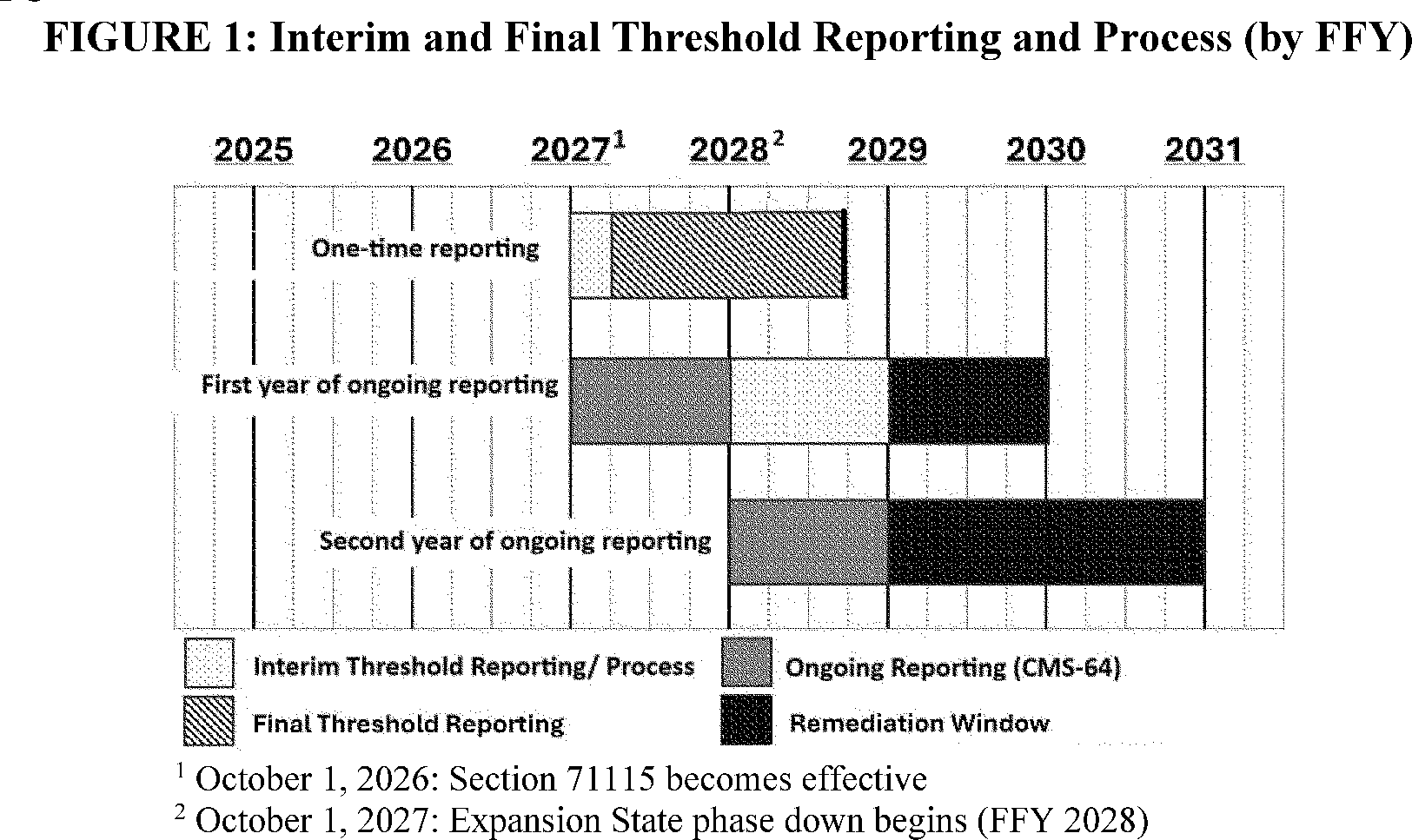
 www.bls.gov/oes/tables.htm
 www.cms.gov/regulations-and-guidance/legislation/paperworkreductionactof1995/pra-listing
 www.reginfo.gov/public/jsp/Utilities/a-4.pdf
 www.federalregister.gov/documents/2025/11/28/2025-21332/federal-financial-participation-in-state-assistance-expenditures-federal-matching-shares-for
 www.macpac.gov/federal-match-rate-exceptions/
 oig.hhs.gov/reports/all/2018/although-hospital-tax-programs-in-seven-states-complied-with-hold-harmless-requirements-the-tax-burden-on-hospitals-was-significantly-mitigated/
 www.medicaid.gov/medicaid/downloads/providertax_dcl_11142025.pdf
 www2.census.gov/library/publications/2025/demo/p60-288.pdf