Desert Southwest Region and Western Area Lower Colorado Balancing Authority-Rate Order No. WAPA-222
The extension of the Desert Southwest Region's (DSW) existing balancing authority area and transmission provider services formula rates for Western Area Lower Colorado Balancing...
Western Area Power Administration, Department of Energy (DOE).
ACTION:
Notice of rate order extending formula rates for balancing authority area and transmission provider services.
SUMMARY:
The extension of the Desert Southwest Region's (DSW) existing balancing authority area and transmission provider services formula rates for Western Area Lower Colorado Balancing Authority has been confirmed, approved and placed into effect on an interim basis. The existing formula rates under Rate Schedules DSW-SD4 (Scheduling, System Control, and Dispatch), DSW-RS4 (Reactive Supply and Voltage Control), DSW-FR4 (Regulation and Frequency Response), DSW-SPR4 (Spinning Reserve), DSW-SUR4 (Supplemental Reserves), DSW-EI4 (Energy Imbalance), DSW-GI2 (Generator Imbalance), DSW-TL1 (Transmission Losses), DSW-UUI (Unreserved Use Penalties), DSW-EIM1T (Administrative Service), DSW-EIM4T (Energy Imbalance Service), and DSW-EIM9T (Generator Imbalance Service) expire on September 30, 2026. This rate extension makes no changes to the existing formula rates and extends them through September 30, 2031.
DATES:
The extended formula rates under Rate Schedules DSW-SD4, DSW-RS4, DSW-FR4, DSW-SPR4, DSW-SUR4, DSW-EI4, DSW-GI2, DSW-TL1, DSW-UUI, DSW-EIM1T, DSW-EIM4T, and DSW-EIM9T will be placed into effect on an interim basis on October 1, 2026.
FOR FURTHER INFORMATION CONTACT:
Scott R. Lund, Regional Manager, Desert Southwest Region, Western Area Power Administration, P.O. Box 6457, Phoenix, AZ 85005-6457, or Tina Ramsey, Rates Manager, Desert Southwest Region, Western Area Power Administration, (602) 812-2355, or email:
dswpwrmrk@wapa.gov.
SUPPLEMENTARY INFORMATION:
Western Area Power Administration (WAPA) published a
Federal Register
notice (Proposed FRN) on January 26, 2026 (91 FR 3182), proposing to extend the existing formula rates under Rate Schedules DSW-SD4, DSW-RS4, DSW-FR4, DSW-SPR4, DSW-SUR4, DSW-EI4, DSW-GI2, DSW-TL1, DSW-UUI, DSW-EIM1T, DSW-EIM4T, and DSW-EIM9T. The Proposed FRN also initiated a 60-day public consultation and comment period.
Legal Authority
By Delegation Order No. S1-DEL-RATES-2016, effective November 19, 2016, the Secretary of Energy delegated: (1) the authority to develop power and transmission rates to the WAPA Administrator; (2) the authority to confirm, approve, and place such rates into effect on an interim basis to the Deputy Secretary of Energy; and (3) the authority to confirm, approve, and place into effect on a final basis, or to remand or disapprove such rates, to the Federal Energy Regulatory Commission (FERC). By Delegation Order No. S1-DEL-S3-2024, effective August 30, 2024, the Secretary of Energy also delegated the authority to confirm, approve, and place such rates into effect on an interim basis to the Under Secretary for Infrastructure. By Redelegation Order No. S3-DEL-WAPA1-2023, effective April 10, 2023, the Under Secretary for Infrastructure further redelegated the authority to confirm, approve, and place such rates into effect on an interim basis to WAPA's Administrator. This extension is issued under Redelegation Order No. S3-DEL-WAPA1-2023 and Department of Energy rate extension procedures set forth in 10 CFR part 903.[1]
Following review of DSW's proposal, Rate Order No. WAPA-222 is hereby confirmed, approved, and placed into effect on an interim basis. This extends, without adjustment, the existing Rate Schedules DSW-SD4, DSW-RS4, DSW-FR4, DSW-SPR4, DSW-SUR4, DSW-EI4, DSW-GI2, DSW-TL1, DSW-UUI, DSW-EIM1T, DSW-EIM4T, and DSW-EIM9T through September 30, 2031. WAPA will submit Rate Order No. WAPA-222 and the extended rate schedules to FERC for confirmation and approval on a final basis.
Department of Energy
Administrator, Western Area Power Administration
In the Matter of: Western Area Power Administration Extension for the Desert Southwest Region and Western Area Lower Colorado Balancing Authority Area and Transmission Provider Services Formula Rates,
Rate Order No. WAPA-222
Order Confirming, Approving, and Placing the Formula Rates for the Balancing Authority Area and Transmission Provider Services Into Effect on an Interim Basis
The formula rates in Rate Order No. WAPA-222 are established following section 302 of the Department of Energy (DOE) Organization Act (42 U.S.C. 7152).[2]
By Delegation Order No. S1-DEL-RATES-2016, effective November 19, 2016, the Secretary of Energy delegated: (1) the authority to develop power and transmission rates to the Western Area Power Administration (WAPA) Administrator; (2) the authority to confirm, approve, and place such rates into effect on an interim basis to the Deputy Secretary of Energy; and (3) the authority to confirm, approve, and place into effect on a final basis, or to remand or disapprove such rates, to the Federal Energy Regulatory Commission (FERC). By Delegation Order No. S1-DEL-S3-2024, effective August 30, 2024, the Secretary of Energy also delegated the authority to confirm, approve, and place such rates into effect on an interim basis to the Under Secretary for Infrastructure. By Redelegation Order No. S3-DEL-WAPA1-2023, effective April 10, 2023, the Under Secretary for Infrastructure further redelegated the authority to confirm, approve, and place such rates into effect on an interim basis to WAPA's Administrator. This extension is issued under Redelegation Order No. S3-DEL-WAPA1-2023 and DOE rate extension procedures set forth in 10 CFR part 903.[3]
Background
On January 12, 2017, FERC approved and confirmed ancillary service Rate Schedules DSW-SD4, DSW-RS4, DSW-FR4, DSW-SPR4, DSW-SUR4, DSW-EI4, and DSW-GI2, transmission losses Rate Schedule DSW-TL1, and unreserved use penalty Rate Schedule DSW-UU1, under Rate Order No. WAPA-175, on a final basis for a 5-year period through September 30, 2021.[4]
On October 25, 2022, FERC approved and confirmed an extension of these formula rates, under Rate Order No. WAPA-200,
( printed page 46424)
on a final basis for a 5-year period through September 30, 2026.[5]
On September 12, 2023, FERC approved and confirmed EIM Rate Schedules DSW-EIM1T, DSW-EIM4T, and DSW-EIM9T, under Rate Order No. WAPA-208, on a final basis for a 3-year period through September 30, 2026.[6]
These rate schedules apply to balancing authority area and transmission provider services within the Desert Southwest Region and Western Area Lower Colorado Balancing Authority. Details about the rate schedules and the formula rates are viewable on DSW's website at:
www.wapa.gov/about-wapa/regions/dsw/rates.
The rates continue the formula-based methodology that includes an annual update to the data in the rate formulas, which provides adequate revenue to recover annual expenses, including interest expenses, and repay capital investments within allowable time periods. This ensures repayment within the cost recovery criteria set forth in DOE Order RA 6120.2.
Discussion
In accordance with 10 CFR 903.23(a), DSW filed a notice in the
Federal Register
on January 26, 2026, proposing to extend, without adjustment, Rate Schedules DSW-SD4, DSW-RS4, DSW-FR4, DSW-SPR4, DSW-SUR4, DSW-EI4, DSW-GI2, DSW-TL1, DSW-UUI, DSW-EIM1T, DSW-EIM4T, and DSW-EIM9T under Rate Order No. WAPA-222.[7]
DSW determined it was not necessary to hold public information or public comment forums on the proposed formula rate extension but provided a 60-day consultation and comment period to give the public an opportunity to comment on the proposed extension. The consultation and comment period ended on March 27, 2026, and DSW received no comments on the proposed formula rate extension.
Ratemaking Procedure Requirements
Environmental Compliance
A categorical exclusion determination was previously issued for these rates under the following categorical exclusion listed in appendix B to 10 CFR part 1021 and in appendix B of DOE's National Environmental Policy Act (NEPA) Implementing Procedures published on June 30, 2025: B4.3 (Electric power marketing rate changes).[8]
That categorical exclusion determination is also applicable to this rate action. A copy of the categorical exclusion determination is available on DSW's website at:
www.wapa.gov/about-wapa/regions/dsw/environment/dsw-cx/.
Look for file titled, “Rate Order WAPA-222.”
WAPA has an exemption from centralized regulatory review under Executive Order 12866; accordingly, no clearance of this notice by the Office of Management and Budget is required.
Submission to the Federal Energy Regulatory Commission
The provisional formula rates herein confirmed, approved, and placed into effect on an interim basis, together with supporting documents, will be submitted to FERC for confirmation and final approval.
Order
In view of the above and under the authority delegated to me, I hereby confirm, approve, and place into effect, on an interim basis, Rate Order No. WAPA-222, which extends the existing balancing authority area and transmission provider services formula rates under Rate Schedules DSW-SD4, DSW-RS4, DSW-FR4, DSW-SPR4, DSW-SUR4, DSW-EI4, DSW-GI2, DSW-TL1, DSW-UUI, DSW-EIM1T, DSW-EIM4T, and DSW-EIM9T through September 30, 2031. The rates will remain in effect on an interim basis until: (1) FERC confirms and approves of this extension on a final basis; (2) subsequent rates are confirmed and approved; or (3) such rates are superseded.
Signing Authority
This document of the Department of Energy was signed on July 20, 2026, by Tracey A. LeBeau, Administrator, Western Area Power Administration, pursuant to delegated authority from the Secretary of Energy. That document, with the original signature and date, is maintained by DOE. For administrative purposes only, and in compliance with requirements of the Office of the Federal Register, the undersigned DOE Federal Register Liaison Officer has been authorized to sign and submit the document in electronic format for publication, as an official document of the Department of Energy. This administrative process in no way alters the legal effect of this document upon publication in the
Federal Register
.
Signed in Washington, DC, on July 20, 2026.
Jennifer Hartzell,
Alternate Federal Register Liaison Officer, U.S. Department of Energy.
Rate Schedule DSW-SD4
Schedule 1 to OATT
(Supersedes Rate Schedule DSW-SD3)
United States Department of Energy
Western Area Power Administration
Desert Southwest Region
Western Area Lower Colorado Balancing Authority
Scheduling, System Control, and Dispatch Service
(Approved Under Rate Order No. WAPA-175)
Effective
The first day of the first full billing period beginning on or after October 1, 2016, and extending through September 30, 2021, or until superseded by another rate schedule, whichever occurs earlier. [Note: This rate schedule was extended by Rate Order No. WAPA-200 through September 30, 2026, and by Rate Order No. WAPA-222 through September 30, 2031.]
Applicable
Scheduling, System Control, and Dispatch Service is required to schedule the movement of power through, out of, within, or into the Balancing Authority Area (BA Area). This service can be provided only by the operator in which the transmission facilities used for transmission service are located. The Western Area Lower Colorado Balancing Authority (WALC) performs this service for all Transmission Service Providers (TSPs) within its BA Area. The transmission customer must purchase this service, unless other arrangements are made with WALC.
The charge will be applied to all schedules, except for schedules that return energy in kind to WALC. WALC will accept any number of scheduling changes during the day without additional charge. The charge will be allocated equally among all TSPs, both Federal and non-Federal, listed on schedules inside its BA Area. The Federal transmission segments of the schedule are exempt from invoicing since the costs for these segments are
( printed page 46425)
included in applicable transmission service rates.
Formula Rate
The charge per schedule, per day, is calculated by dividing the annual costs associated with scheduling (numerator) by the number of schedules per year (denominator). The numerator is the annual cost of transmission scheduling personnel, facilities, equipment, software, and other related costs involved in providing the service. The denominator is the yearly total of daily tags which result in a schedule, excluding schedules that return energy in kind.
Based on the formula rate, the charge will be calculated each fiscal year using updated financial and schedule data. The charge will be effective on October 1st of each year and posted on WALC's website.
Rate Schedule DSW-RS4
Schedule 2 to OATT
(Supersedes Rate Schedule DSW-RS3)
UNITED STATES DEPARTMENT OF ENERGY
WESTERN AREA POWER ADMINISTRATION
DESERT SOUTHWEST REGION
Western Area Lower Colorado Balancing Authority
Reactive Supply and Voltage Control From Generation Sources or Other Sources Service
(Approved Under Rate Order No. WAPA-175)
Effective
The first day of the first full billing period beginning on or after October 1, 2016, and extending through September 30, 2021, or until superseded by another rate schedule, whichever occurs earlier. [Note: This rate schedule was extended by Rate Order No. WAPA-200 through September 30, 2026, and by Rate Order No. WAPA-222 through September 30, 2031.]
Applicable
In order to maintain transmission voltages on the transmission facilities within acceptable limits, generation facilities and non-generation resources capable of providing Reactive Supply and Voltage Control (VAR Support Service) are operated to produce (or absorb) reactive power. This service must be provided for each transaction on the transmission facilities within the Balancing Authority (BA) by the Transmission Service Provider (TSP) or the BA who performs this function for the TSP.
VAR Support Service will be provided by the Western Area Lower Colorado Balancing Authority (WALC). Customers of a Federal TSP must purchase this service from WALC unless the transmission customer has generating resources capable of providing VAR Support Service directly to the Federal TSP and has executed a contract stipulating all the provisions of their self-supply. If WALC provides VAR Support Service on behalf of any non-Federal TSP, this service will be assessed on either the non-Federal TSP's reserved capacity or the scheduled quantity of the non-Federal TSP's customers.
Formula Rate
The numerator consists of the annual revenue requirement for generation multiplied by the percentage of resource capacity used for providing VAR Support Service. That percentage is based on the nameplate power factor (one minus the power factor) for the generating units supplying the service within WALC. The denominator consists of the transmission transactions within WALC that require this service.
Based on the formula rate, the charge will be calculated each fiscal year using updated financial and reservation data. The charge will be effective on October 1st of each year and will be posted on WALC's website.
Rate Schedule DSW-FR4
Schedule 3 to OATT
(Supersedes Rate Schedule DSW-FR3)
United States Department of Energy
Western Area Power Administration
Desert Southwest Region
Western Area Lower Colorado Balancing Authority
Regulation and Frequency Response Service
(Approved Under Rate Order No. WAPA-175)
Effective
The first day of the first full billing period beginning on or after October 1, 2016, and extending through September 30, 2021, or until superseded by another rate schedule, whichever occurs earlier. [Note: This rate schedule was extended by Rate Order No. WAPA-200 through September 30, 2026, and by Rate Order No. WAPA-222 through September 30, 2031.]
Applicable
Regulation and Frequency Response Service (Regulation Service) is necessary to provide for the continuous balancing of resources, generation and interchange, with load, and for maintaining scheduled interconnection frequency at sixty cycles per second (60 Hz). The obligation to maintain this balance between resources and load lies
( printed page 46426)
with the Transmission Service Provider (TSP) or the Balancing Authority (BA) who performs this function for the TSP. The Western Area Lower Colorado Balancing Authority (WALC) performs this function for the Federal TSPs and must offer this service when transmission is used to serve load within its Balancing Authority Area (BA Area). Non-Federal TSPs and customers of Federal TSPs must purchase Regulation Service from WALC or make alternative comparable arrangements to satisfy their regulation obligations.
Formula Rate
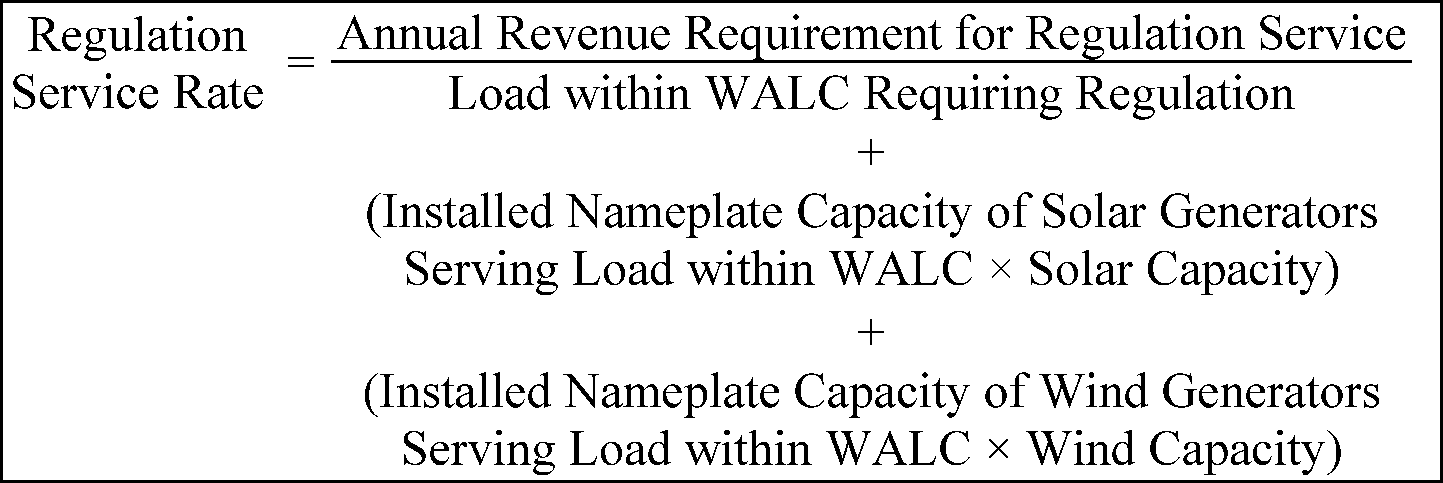
The numerator includes the annual costs associated with plant-in-service, operation and maintenance, purchase of regulation products, purchases of power to support WALC's ability to regulate, and other related costs involved in providing the service. The denominator consists of the load within WALC that requires this service plus the product of the installed nameplate capacity of solar and wind generators serving load within WALC and the applicable capacity multipliers.
Based on the formula rate, the charge will be calculated each fiscal year using updated financial and load data. The charge will be effective on October 1st of each year and will be posted on the WALC website.
Types of Assessments
There are two different applications of this formula rate:
(1) A load-based assessment which is applicable to load within WALC (total metered load less Federal power allocation, including behind the meter generation rating, or if available, hourly data if generation is synchronized) and the installed nameplate capacity of all intermittent resources serving load within WALC.
(2) A self-provision assessment which allows entities with Automatic Generation Control (AGC) to self-provide for all or a portion of their loads. Entities with AGC are known as Sub-Balancing Authorities (SBA) and must meet all of the following criteria: (a) have a well-defined boundary, with WALC-approved revenue-quality metering, accurate as defined by the North American Electric Reliability Corporation (NERC), to include Megawatt (MW) flow data availability at 6-second or smaller intervals; (b) have AGC responsive unit(s); (c) demonstrate Regulation Service capability; and (d) execute a contract with WALC, provide all requested data, and meet the SBA error criteria below.
Self-provision is measured by use of the entity's 1-minute average Area Control Error (ACE) to determine the amount of self-provision. The ACE is used to calculate the Regulation Service charges every hour as follows:
(1) If the entity's 1-minute average ACE for the hour is less than or equal to 0.5 percent of its hourly average load, no charge is assessed for that hour.
(2) If the entity's 1-minute average ACE for the hour is greater than or equal to 1.5 percent of the entity's hourly average load, WALC assesses charges using the hourly load-based assessment applied to the entity's peak load for that month.
(3) If the entity's 1-minute average ACE for the hour is greater than 0.5 percent but less than 1.5 percent of its hourly average load, WALC assesses charges based on linear interpolation of no charge and full charge, using the hourly load-based assessment applied to the entity's peak load for that month.
WALC monitors the entity's self-provision on a regular basis. If WALC determines that the entity has not been attempting to self-regulate, WALC will, upon notification, employ the load-based assessment methodology described above.
Alternative Arrangements
Exporting Intermittent Resource Requirement: An entity that exports the output from an intermittent generator to another BA Area will be required to dynamically meter or dynamically schedule that resource out of WALC to another BA unless arrangements, satisfactory to WALC, are made for that entity to acquire this service from a third-party or self-supply (as outlined below). An intermittent generator is one whose output is volatile and variable due to factors beyond direct operational control and, therefore, is not dispatchable.
Self- or Third-party Supply: WALC may allow an entity to supply some or all of its required regulation, or contract with a third party. This entity must have revenue quality metering at every load and generation point, with accuracy as defined by NERC, to include MW flow data availability at 6-second (or smaller) intervals. WALC will evaluate the entity's metering, telecommunications and regulating resource, as well as the required level of regulation, to determine whether the entity qualifies to self-supply under this provision. If approved, the entity is required to enter into a separate agreement with WALC which will specify the terms of self-supply.
Customer Accommodation
For entities unwilling to take Regulation Service, self-provide as described above, or obtain the service from a third party, WALC will assist the entity in dynamically metering its loads/resources to another BA. Until such time as meter configuration is accomplished, the entity will be responsible for charges assessed under this schedule.
( printed page 46427)
Rate Schedule DSW-SPR4
Schedule 5 to OATT
(Supersedes Rate Schedule DSW-SPR3)
United States Department of Energy
Western Area Power Administration
Desert Southwest Region
Western Area Lower Colorado Balancing Authority
Operating Reserve—Spinning Reserve Service
(Approved Under Rate Order No. WAPA-175)
Effective
The first day of the first full billing period beginning on or after October 1, 2016, and extending through September 30, 2021, or until superseded by another rate schedule, whichever occurs earlier. [Note: This rate schedule was extended by Rate Order No. WAPA-200 through September 30, 2026, and by Rate Order No. WAPA-222 through September 30, 2031.]
Applicable
Spinning Reserve Service is needed to serve load immediately in the event of a system contingency and may be provided by generating units that are on-line and loaded at less than maximum output. The Transmission Service Provider (TSP) or the Balancing Authority (BA) who performs this function for the TSP must offer this service when transmission is used to serve load within its BA Area.
The Western Area Lower Colorado Balancing Authority (WALC) performs this function for the Federal TSP. Customers of a Federal TSP must purchase this service from WALC or make alternative arrangements to satisfy their Spinning Reserve obligations.
Formula Rate
WALC has no Spinning Reserves available for sale. Upon request, WALC will purchase at market price and pass-through the cost plus an administrative fee that covers the cost of procuring and supplying Spinning Reserves. The customer will be responsible for providing the transmission needed to deliver the Spinning Reserves purchased.
Rate Schedule DSW-SUR4
Schedule 6 to OATT (Supersedes Rate Schedule DSW-SUR3)
United States Department of Energy
Western Area Power Administration
Desert Southwest Region
Western Area Lower Colorado Balancing Authority
Operating Reserve—Supplemental Reserve Service
(Approved Under Rate Order No. WAPA-175)
Effective
The first day of the first full billing period beginning on or after October 1, 2016, and extending through September 30, 2021, or until superseded by another rate schedule, whichever occurs earlier. [Note: This rate schedule was extended by Rate Order No. WAPA-200 through September 30, 2026, and by Rate Order No. WAPA-222 through September 30, 2031.]
Applicable
Supplemental Reserve Service is needed to serve load in the event of a system contingency. It is not available immediately to serve load but is generally available within a short period of time after a system contingency event. This service may be provided by generating units that are on-line but unloaded, by quick-start generation, or by interruptible load. The Transmission Service Provider (TSP) or the Balancing Authority (BA) who performs this function for the TSP must offer this service when transmission is used to serve load within its BA Area.
The Western Area Lower Colorado Balancing Authority (WALC) performs this function for the Federal TSP. Customers of a Federal TSP must purchase this service from WALC or make alternative arrangements to satisfy their Supplemental Reserve obligations.
Formula Rate
( printed page 46428)
WALC has no Supplemental Reserves for sale. Upon request, WALC will purchase at market price and pass-through the cost plus an administrative fee that covers the cost of procuring and supplying Supplemental Reserves. The customer will be responsible for providing the transmission needed to deliver.
Rate Schedule DSW-EI4
Schedule 4 to OATT
(Supersedes Rate Schedule DSW-EI3)
United States Department of Energy
Western Area Power Administration
Desert Southwest Region and Western Area Lower Colorado Balancing Authority
Energy Imbalance Service
(Approved Under Rate Order No. WAPA-175)
Effective
The first day of the first full billing period beginning on or after October 1, 2016, and extending through September 30, 2021, or until superseded by another rate schedule, whichever occurs earlier. [Note: This rate schedule was extended by Rate Order No. WAPA-200 through September 30, 2026, and by Rate Order No. WAPA-222 through September 30, 2031.]
Applicable
Energy Imbalance Service is provided when there is a difference between the scheduled and actual delivery of energy to a load located within a Balancing Authority Area (BA Area) over a single hour. The Transmission Service Provider (TSP) or the Balancing Authority (BA) who performs this function for the TSP must offer this service when transmission is used to serve load within its BA Area.
The Western Area Lower Colorado Balancing Authority (WALC) performs this function for the Federal TSP. Customers of a Federal TSP must purchase this service from WALC or make alternative comparable arrangements to satisfy their Energy Imbalance obligations. Non-Federal TSPs must have separate agreements with WALC that specify the terms of Energy Imbalance Service. WALC may charge a transmission customer for either energy imbalances under this schedule or generator imbalances under Schedule 9 for imbalances occurring during the same hour, but not both unless the imbalances aggravate rather than offset each other.
Formula Rate
Charges for energy imbalances are based on the deviation bands as follows:
1. For deviations within ±1.5 percent (with a minimum of 4 MW) of the metered load, the settlement for on-peak and off-peak hours is 100 percent.
2. For deviations greater than ±1.5 up to 7.5 percent (or greater than 4 MW up to 10 MW) of the metered load, the settlement for on-peak hours is 110 percent for under-delivery and 90 percent for over-delivery, and the settlement for off-peak hours is 110 percent for under-delivery and 75 percent for over-delivery.
3. For deviations greater than ±7.5 percent (or 10 MW) of the metered load, the settlement for on-peak hours is 125 percent for under-delivery and 75 percent for over-delivery, and the settlement for off-peak hours is 125 percent for under-delivery and 60 percent for over-delivery.
The deviation bands will be applied hourly and any energy imbalances that occur as a result of the transmission customer's scheduled transactions will be netted on a monthly basis and settled financially at the end of the month. For purposes of this schedule, the proxy prices used to determine financial settlement will be derived from the Palo Verde electricity price indexes, or similar alternative, for on-peak and off-peak. WALC may accept settlement in energy in lieu of financial settlement.
During periods of BA operating constraints, WALC reserves the right to eliminate credits for over-delivery. The cost to WALC of any penalty assessed by a regulatory authority due to a violation of operating standards resulting from under or over-delivery of energy may be passed through to customers.
Rate Schedule DSW-GI2
Schedule 9 to OATT
(Supersedes Rate Schedule DSW-GI1)
United States Department of Energy
Western Area Power Administration
Desert Southwest Region
Western Area Lower Colorado Balancing Authority
Generator Imbalance Service
(Approved Under Rate Order No. WAPA-175)
Effective
The first day of the first full billing period beginning on or after October 1, 2016, and extending through September 30, 2021, or until superseded by another rate schedule, whichever occurs earlier. [Note: This rate schedule was extended by Rate Order No. WAPA-200 through September 30, 2026, and by Rate Order No. WAPA-222 through September 30, 2031.]
Applicable
Generator Imbalance Service is provided when a difference occurs between the output of a generator located in the Balancing Authority Area (BA Area) and the delivery schedule from that generator to another BA Area or a load within the Transmission Service Provider's (TSP) BA Area over a single hour. The TSP or the Balancing Authority (BA) who performs this function for the TSP must offer this service, to the extent it is physically feasible to do so from its resources or from resources available to it, when transmission is used to deliver energy from a generator located within its BA Area.
The Western Area Lower Colorado Balancing Authority (WALC) performs this function for the Federal TSP. Customers of a Federal TSP must purchase this service from WALC or make alternative comparable arrangements to satisfy their generator imbalance obligations. Non-Federal TSPs must have separate agreements with WALC that specify the terms of Generator Imbalance Service. An intermittent resource serving load outside WALC will be required to dynamically schedule or dynamically meter their generation to another BA Area unless arrangements, satisfactory to WALC, are made to acquire this service from a third-party. An intermittent resource, for the limited purpose of this schedule, is an electric generator that is not dispatchable and cannot store its fuel source, and therefore cannot respond to changes in demand or respond to transmission security constraints.
WALC may charge a transmission customer for either generator imbalances under this schedule or energy imbalances under Schedule 4 for imbalances occurring during the same hour, but not both unless the imbalances aggravate rather than offset each other.
Formula Rate
Charges for generator imbalances are based on the deviation bands as follows:
1. For deviations within ±1.5 percent (with a minimum of 4 MW) of the metered generation, the settlement for on-peak and off-peak hours is 100 percent.
2. For deviations greater than ±1.5 up to 7.5 percent (or greater than 4 MW up to 10 MW) of the metered generation, the settlement for on-peak hours is 110
( printed page 46429)
percent for under-delivery and 90 percent for over-delivery, and the settlement for off-peak hours is 110 percent for under-delivery and 75 percent for over-delivery.
3. For deviations greater than ±7.5 percent (or 10 MW) of the metered generation, the settlement for on-peak hours is 125 percent for under-delivery and 75 percent for over-delivery, and the settlement for off-peak hours is 125 percent for under-delivery and 60 percent for over-delivery. An intermittent resource will be exempt from this deviation band but will be subject to the settlement provisions in the second deviation band for all deviations greater than ±7.5 percent (or 10 MW).
The deviation bands will be applied hourly and any generator imbalances that occur as a result of the transmission customer's scheduled transactions will be netted on a monthly basis and settled financially at the end of the month. For purposes of this schedule, the proxy prices used to determine financial settlement will be derived from the Palo Verde electricity price indexes, or similar alternative, for on-peak and off-peak. WALC may accept settlement in energy in lieu of financial settlement.
During periods of BA operating constraints, WALC reserves the right to eliminate credits for over-delivery. The cost to WALC of any penalty assessed by a regulatory authority due to a violation of operating standards resulting from under or over-delivery of energy may be passed through to customers.
Rate Schedule DSW-TL1
United States Department of Energy
Western Area Power Administration
Desert Southwest Region
Western Area Lower Colorado Balancing Authority
Transmission Losses Service
(Approved Under Rate Order No. WAPA-175)
Effective
The first day of the first full billing period beginning on or after October 1, 2016, and extending through September 30, 2021, or until superseded by another rate schedule, whichever occurs earlier. [Note: This rate schedule was extended by Rate Order No. WAPA-200 through September 30, 2026, and by Rate Order No. WAPA-222 through September 30, 2031.]
Applicable
Capacity and energy losses occur when a Transmission Service Provider (TSP) delivers electricity over its transmission facilities for a transmission customer. The Western Area Lower Colorado Balancing Authority (WALC) provides this service to TSPs within its Balancing Authority Area (BA Area). Transmission losses (losses) are assessed for transactions on transmission facilities within WALC, unless separate agreements specify the terms for losses. The losses applicable to Federal TSPs will be passed directly to transmission customers. The transmission customer must either purchase this service from WALC or make alternative comparable arrangements to satisfy their obligations for losses.
Formula Rate
The loss percentage currently in effect is posted on WALC's website and may be changed from time to time. Financial settlement for losses will occur on a monthly basis, unless determined by WALC. Proxy prices used to determine financial settlement will be derived from the Palo Verde electricity price indexes, or similar alternative, for on-peak and off-peak. This pricing information is posted on WALC's website.
Rate Schedule DSW-EIM1T
Schedule 1T to OATT
United States Department of Energy
Western Area Power Administration
Desert Southwest Region
Western Area Lower Colorado Balancing Authority
Energy Imbalance Market-Administrative Service
(Approved Under Rate Order No. WAPA-208)
Effective
Beginning on April 5, 2023, and extending through September 30, 2026, or until superseded by another rate schedule, whichever occurs earlier. [Note: This rate schedule was extended by Rate Order No. WAPA-222 through September 30, 2031.]
Applicable
This rate schedule applies to Administrative Service when the Western Area Lower Colorado (WALC) Balancing Authority (BA) participates in the California Independent System Operator's (CAISO) Energy Imbalance Market (EIM) and when the EIM has not been suspended. Rate Schedule DSW-SD4 for Scheduling, System Control and Dispatch Service, or its superseding rate schedule will continue to apply. Both DSW-EIM1T and DSW-SD4 shall apply when the WALC BA participates in the EIM.
The CAISO assesses charges and fees to cover the costs associated with operating the EIM and providing various services to participants. The charges and fees associated with the WALC BA's participation in the EIM will be passed through to ensure the WALC BA remains revenue neutral.
Formula Rate
Charges for Administrative Service shall reflect the pass through of applicable costs associated with the WALC BA's participation in the EIM that are assessed by the CAISO to the WALC BA. Costs shall be identified by a CAISO charge code and passed through to transmission customers using the settlement methods detailed in Desert Southwest Region's (DSW) EIM business practice posted on its Open Access Same-time Information System (OASIS) at
www.oasis.oati.com/walc/index.html.
Revisions to the CAISO's Tariff may require changes to DSW's EIM business practice, which would be processed consistent with section 4.3 of WAPA's Tariff.
Charge Components
Administrative Service charges typically include one or more of the following items:
Component
Description
EIM Transaction
CAISO charge assessed to entities for EIM participation.
Scheduling Coordinator
CAISO charge assessed to Scheduling Coordinators that have any settlement activity during the relevant trading month.
Forecasting Service
CAISO fee to forecast the output of Variable Energy Resources that are external to the CAISO BA Area.
The first day of the first full billing period beginning on or after October 1, 2016, and extending through September 30, 2021, or until superseded by another rate schedule, whichever occurs earlier. [Note: This rate schedule was extended by Rate Order No. WAPA-200 through September 30, 2026, and by Rate Order No. WAPA-222 through September 30, 2031.]
Applicable
Unreserved use occurs when a customer uses transmission service it has not reserved or uses transmission service in excess of its reserved capacity. Unreserved use may also include a transmission customer's failure to curtail transmission when requested. The transmission customer shall compensate the Federal Transmission Service Provider (TSP) each month for any unreserved use of the transmission system.
Penalty Rate
The charge for a transmission customer that engages in unreserved use is two times the maximum allowable firm point-to-point transmission rate for the service at issue, assessed as follows:
(1) The penalty for one instance, in a single hour, is based on the daily rate;
(2) The penalty for more than one instance, for any given duration (
e.g.,
daily) increases to the next longest duration (
e.g.,
weekly).
A transmission customer that exceeds its reserved capacity at any point of receipt or point of delivery, or a customer that uses transmission service at a point of receipt or point of delivery that it has not reserved, is required to pay for all ancillary services provided by the Federal TSP and associated with the unreserved use. The customer will pay for ancillary services based on the amount of transmission service it used and did not reserve.
Rate Schedule DSW-EIM4T
Schedule 4T to OATT
United States Department of Energy
Western Area Power Administration
Desert Southwest Region
Western Area Lower Colorado Balancing Authority
Energy Imbalance Market-Energy Imbalance Service
(Approved Under Rate Order No. WAPA-208)
Effective
Beginning on April 5, 2023, and extending through September 30, 2026, or until superseded by another rate schedule, whichever occurs earlier. [Note: This rate schedule was extended by Rate Order No. WAPA-222 through September 30, 2031.]
Applicable
This rate schedule applies to Energy Imbalance (EI) Service when the Western Area Lower Colorado (WALC) Balancing Authority (BA) participates in the California Independent System Operator's (CAISO) Energy Imbalance Market (EIM) and when the EIM has not been suspended. Rate Schedule DSW-EI4 or its superseding rate schedule would apply when the WALC BA is not participating or when the EIM has been suspended.
The CAISO EIM provides energy to the WALC BA when there is a difference between the scheduled and actual delivery of energy to a load within the WALC BA Area. These differences (energy imbalances) result in financial settlements between the CAISO and the WALC BA. Any financial settlements for energy imbalances associated with the WALC BA's participation in the EIM will be passed through to ensure the WALC BA remains revenue neutral.
Formula Rate
Charges for EI Service shall reflect the pass through of all applicable costs associated with the WALC BA's participation in the EIM that are assessed by the CAISO to the WALC BA. Costs shall be identified by a CAISO charge code and passed through to transmission customers using the settlement methods detailed in Desert Southwest Region's (DSW) EIM business practice posted on its Open Access Same-time Information System (OASIS) at
www.oasis.oati.com/walc/index.html.
Revisions to the CAISO's Tariff may require changes to DSW's EIM business practice, which would be processed consistent with section 4.3 of WAPA's Tariff.
Charge Components
Charges for EI Service will typically include one or more of the following items:
Components
Description
Instructed Imbalance Energy
Operational adjustment of transmission customer's affected interchange or intrachange, including certain changes made to an E-Tag.
Uninstructed Imbalance Energy
Differences between a transmission customer's metered load and base schedule derived from interchange and intrachange forecast data (E-Tags).
Unaccounted for Energy
Differences between WALC BA generation (generators, non-generator resources, and imports) and demand (from loads and exports) adjusted for transmission losses.
Under/Over-Scheduling Load
The under-scheduling and over-scheduling of transmission that contributes to energy imbalances.
Uplifts or Offsets
Imbalance energy for each settlement interval for each resource within the EIM area and all system resources dispatched in real time.
Bid Cost Recovery
Bid costs for eligible resources (real-time energy) that were scheduled or dispatched by the CAISO for the EIM.
Flexible Ramping
Sufficient ramping capability to meet the forecasted net load and cover upward and downward forecast error uncertainty.
( printed page 46431)
Rate Schedule DSW-EIM9T
Schedule 9T to OATT
United States Department of Energy
Western Area Power Administration
Desert Southwest Region
Western Area Lower Colorado Balancing Authority
Energy Imbalance Market-Generator Imbalance Service
(Approved Under Rate Order No. WAPA-208)
Effective
Beginning on April 5, 2023, and extending through September 30, 2026, or until superseded by another rate schedule, whichever occurs earlier. [Note: This rate schedule was extended by Rate Order No. WAPA-222 through September 30, 2031.]
Applicable
This rate schedule applies to Generator Imbalance (GI) Service when the Western Area Lower Colorado (WALC) Balancing Authority (BA) participates in the California Independent System Operator's (CAISO) Energy Imbalance Market (EIM) and when the EIM has not been suspended. Rate Schedule DSW-GI2 [Note: This rate schedule was erroneously listed as DSW-GI4 in the previously published rate order and is corrected here] or its superseding rate schedule would apply when the WALC BA is not participating or when the EIM has been suspended.
The CAISO EIM provides energy to the WALC BA when there is a difference between the scheduled and actual delivery of energy from a non-participating resource within the WALC BA Area. These differences (generator imbalances) result in financial settlements between the CAISO and the WALC BA. Any financial settlements for generator imbalance associated with the WALC BA's participation in the EIM will be passed through to ensure the WALC BA remains revenue neutral.
Formula Rate
Charges for GI Service shall reflect the pass-through of all applicable costs associated with the WALC BA's participation in the EIM that are assessed by the CAISO to the WALC BA. Costs shall be identified by a CAISO charge code and passed through to transmission customers using the settlement methods detailed in Desert Southwest Region's (DSW) EIM business practice posted on its Open Access Same-time Information System (OASIS) at
www.oasis.oati.com/walc/index.html.
Revisions to the CAISO's Tariff may require changes to DSW's EIM business practice, which would be processed consistent with section 4.3 of WAPA's Tariff.
Charge Components
Charges for GI Service will typically include on or more of the following items:
Component
Description
Instructed Imbalance Energy
Resource imbalances created by a manual dispatch, EIM available balancing capacity dispatch, or adjustments to resource forecasts pursuant to provisions of the CAISO's Tariff.
Uninstructed Imbalance Energy
Differences between a customer's metered generation and base schedule derived from the resource forecast data submitted through the CAISO's Base Schedule Aggregation Portal.
Unaccounted for Energy
Differences between WALC BA generation (generators, non-generator resources, and imports) and demand (loads and exports) adjusted for losses.
Under/Over-Scheduling
The under-scheduling and over-scheduling of resources that contributes to generator imbalances.
Uplifts or Offsets
Imbalance energy for each settlement interval for each resource within the EIM area and all system resources dispatched in real time.
Bid Cost Recovery
Bid costs for eligible resources (real-time energy) that were scheduled or dispatched by the CAISO for the EIM.
Flexible Ramping
Sufficient ramping capability to meet the forecasted net load and cover upward and downward forecast error uncertainty.
2.
This Act transferred to, and vested in, the Secretary of Energy the power marketing functions of the Secretary of the Department of the Interior and the Bureau of Reclamation (Reclamation) under the Reclamation Act of 1902 (ch. 1093, 32 Stat. 388), as amended and supplemented by subsequent laws, particularly section 9(c) of the Reclamation Project Act of 1939 (43 U.S.C. 485h(c)); and other acts that specifically apply to the projects involved.
8.
The determination was done in compliance with NEPA (42 U.S.C. 4321-4347), DOE NEPA regulations at 10 CFR part 1021, and DOE's NEPA implementing procedures outside the Code of Federal Regulations available at
energy.gov/nepa.
Use this for formal legal and research references to the published document.
91 FR 46423
Web Citation
Suggested Web Citation
Use this when citing the archival web version of the document.
“Desert Southwest Region and Western Area Lower Colorado Balancing Authority-Rate Order No. WAPA-222,” thefederalregister.org (July 23, 2026), https://thefederalregister.org/documents/2026-14901/desert-southwest-region-and-western-area-lower-colorado-balancing-authority-rate-order-no-wapa-222.
 10 CFR part 903
 42 U.S.C. 7152
 www.wapa.gov/about-wapa/regions/dsw/rates



 www.oasis.oati.com/walc/index.html