Department of Justice
Antitrust Division
Notice is hereby given pursuant to the Antitrust Procedures and Penalties Act, 15 U.S.C. 16(b)-(h), that a proposed Final Judgment, Stipulation, and Competitive Impact Statement have been filed with the United States District Court for the Southern District of Ohio, Eastern Division in United States of America, et al. v. OhioHealth Corporation, Civil Action No. 2:26-cv-207. On February 20, 2026, the United States and the State of Ohio filed a Complaint alleging that OhioHealth Corporation's use of anticompetitive contract provisions in its contracts with payors violated Section 1 of the Sherman Act, 15 U.S.C. 1. The proposed Final Judgment, filed on June 16, 2026, requires OhioHealth Corporation to void existing contract provisions that prohibit or deter insurers from offering budget-conscious health-insurance plans or plan features and prevents OhioHealth from seeking or obtaining such contract provisions in the future, among other things.
 15 U.S.C. 16(b)-(h)
Copies of the Complaint, proposed Final Judgment, and Competitive Impact Statement are available for inspection on the Antitrust Division's website at www.justice.gov/atr and at the Office of the Clerk of the United States District Court for the Southern District of Ohio, Eastern Division. Copies of these materials may be obtained from the Antitrust Division upon request and payment of the copying fee set by Department of Justice regulations.
 www.justice.gov/atr
Public comment is invited within 60 days of the date of this notice. Such comments, including the name of the submitter, and responses thereto, will be posted on the Antitrust Division's website, filed with the Court, and, under certain circumstances, published in the Federal Register . Comments should be submitted in English and directed to Jill Maguire, Acting Chief, Healthcare and Consumer Products Section, Antitrust Division, Department of Justice, 450 Fifth Street NW, Suite 4100, Washington, DC 20530 (email address: ATR.Public-Comments-Tunney-Act-MB@usdoj.gov).
Suzanne Morris,
Deputy Director Civil Enforcement Operations, Antitrust Division.
In the United States District Court for the Southern District of Ohio Eastern Division
United States of America, U.S. Department of Justice, Antitrust Division 450 Fifth Street, NW, Suite 4100 Washington, DC 20530, and State of Ohio 30 East Broad Street, 26th Floor, Columbus, OH 43215. Plaintiffs, v. Ohiohealth Corporation, 3430 OhioHealth Parkway, Columbus, OH 43202, Defendant.
Case No. 2:26-cv-207
Judge Algenon L. Marbley
Magistrate Judge S. Courter M. Shimeall
The United States of America and the State of Ohio, for their Complaint ( printed page 46464) against Defendant OhioHealth Corporation (“OhioHealth”), allege as follows:
Introduction
1. Healthcare costs weigh heavily on the minds and budgets of American families and businesses. The mechanism that ultimately lowers costs for all patients and healthcare consumers is robust and unrestrained competition. Americans deserve the benefits of vigorous competition between healthcare providers. Rather than compete to serve patients in Columbus, Ohio, OhioHealth has chosen to prevent competition from other providers. Through contractual restrictions, OhioHealth restricts commercial health insurers (“payors”) from offering health plans that allow patients to share in the savings that come from choosing to use OhioHealth's lower-cost rivals.
2. OhioHealth has thereby denied patients the ability to choose a health plan that may work better for them—a choice that patients would be free to make in a competitive market unburdened by OhioHealth's burdensome restrictions. OhioHealth's contractual restrictions insulate it from price competition and help to maintain its extremely high prices. The dynamic effect of these contractual restrictions is that OhioHealth is effectively preventing competitors from achieving scale with regard to patients as well as quality.
3. OhioHealth is the dominant hospital system in Columbus. Since at least 2003, it has used its market power to protect its dominance—and its high prices—by blocking payors from offering patients health insurance plans that feature lower-cost hospitals and other providers and even from informing patients that lower-cost options are available.
4. As a result, these restrictions deprive patients of a choice among a full spectrum of competitive health insurance plans, where patients could decide for themselves whether going to OhioHealth for care is worth the high prices it charges. If such plans were available, the employers and patients who choose them would benefit immediately from lower premiums and out-of-pocket costs.
5. Further, without its unlawful contracts, OhioHealth would need to compete more vigorously against other providers. Those other providers could compete for additional patients by lowering their own prices, gaining both business and incentive to make quality-improving investments that would enhance their attractiveness. All employers and patients in the Columbus area would benefit from higher quality and lower prices as the healthcare marketplace became more competitive. More competition means patients and employers would get lower premiums, lower out-of-pocket healthcare costs, and more insurance plan choices. Yet, OhioHealth's conduct prevents patients from receiving the real, tangible benefits associated with competition.
6. The United States of America and the State of Ohio bring this civil antitrust action to stop OhioHealth from using unlawful contract restrictions that lessen healthcare competition in Columbus. OhioHealth's restrictions that deter the emergence and development of money-saving health insurance plans reduce competition among hospitals and other providers on both price and quality. The result is reduced choice of insurance plans, higher healthcare costs, and less competition for high quality healthcare for Columbus-area patients, employers, and payors, in violation of Section 1 of the Sherman Act, 15 U.S.C. 1, and Ohio's Valentine Act, Ohio Revised Code §§ 1331.01 et seq.
Ohiohealth
7. OhioHealth is an Ohio not-for-profit healthcare services corporation, with its principal place of business in Columbus, Ohio. OhioHealth owns or manages hospitals, outpatient facilities, physician groups, and other healthcare services throughout Ohio. Its flagship facility, Riverside Methodist Hospital, is in Columbus, Ohio. OhioHealth owns or manages 16 hospitals in Ohio and is attempting to acquire Fairfield Medical Center in Fairfield County, Ohio.
8. OhioHealth is the dominant hospital system in the Columbus area. The Ohio State University Wexner Medical Center (“Ohio State”) competes with OhioHealth in the Columbus area. Ohio State operates an academic medical center and research institution in Columbus that receives referrals for advanced care from throughout Ohio and the midwestern United States. OhioHealth also competes in the Columbus area with Mount Carmel Health System (“Mount Carmel”), which is owned by Trinity Health. Mount Carmel operates five hospitals in the Columbus area and holds a majority joint-venture interest in a sixth.
9. OhioHealth charges payors prices (in the form of “reimbursement rates”) that are significantly higher than OhioHealth's competitors.
10. While higher priced, OhioHealth's services are not generally higher quality than those of its local rivals. Indeed, one widely used public measure of hospital safety, the Leapfrog Hospital Safety Grade, reports that OhioHealth's hospitals in the Columbus area often received lower grades than the hospitals of its primary competitors. Other publicly available quality metrics, like Centers for Medicare & Medicaid Services Five-Star Quality Rating System, similarly do not show OhioHealth to be of consistently higher quality than its primary Columbus-area competitors. OhioHealth nevertheless has extracted reimbursement rates from payors that are higher than those of Ohio State, a leading regional academic medical center that operates a top-tier medical school, conducts medical research, and trains physicians in advanced subspecialities through numerous fellowship programs. OhioHealth's prices are also higher than those of Mount Carmel.
11. OhioHealth can extract high reimbursement rates because it exerts market power over payors, as reflected in its high market share. OhioHealth's market power is built upon the scale, breadth, and configuration of its providers, including, among other things, its large size, its many locations, and its control of rural hospitals that payors need to include in at least some hospital networks to maintain network coverage. OhioHealth requires a payor that wants any of these providers in its network to include all of them in its network. To offer competitive insurance plans to Columbus-area patients, payors need to include access to OhioHealth's hospitals—as well as its many other facilities and providers—in at least some of their provider networks. OhioHealth's market power has enabled it to negotiate high reimbursement rates for treating insured patients across a range of services. OhioHealth's market power is further evidenced by its ability to impose contractual restrictions on payors that reduce competition.
Jurisdiction
12. The Court has subject-matter jurisdiction over this action under 28 U.S.C. 1331, 1337(a), and 1345. Plaintiff United States brings this action pursuant to Section 4 of the Sherman Act, 15 U.S.C. 4, to prevent and restrain violations of Section 1 of the Sherman Act, 15 U.S.C. 1.
13. Plaintiff State of Ohio, by and through its Attorney General, brings this action, pursuant to Section 109.81(A) of the Ohio Revised Code, in its sovereign capacity and as parens patriae on behalf of the citizens, general welfare, and economy of the State of Ohio (a), pursuant to Section 16 of the Clayton Act, to prevent OhioHealth from violating Section 1 of the Sherman Act, ( printed page 46465) 15 U.S.C. 1; and (b), pursuant to its equitable and/or common law powers and Section 1331.11 of the Ohio Revised Code, to prevent OhioHealth from violating Section 1331.04 of the Ohio Revised Code.
14. The Court has personal jurisdiction over OhioHealth under Section 12 of the Clayton Act, 15 U.S.C. 22. OhioHealth maintains its principal place of business and transacts business in this District.
Venue and Interstate Commerce
15. Venue is proper under 28 U.S.C. 1391 and Section 12 of the Clayton Act, 15 U.S.C. 22. OhioHealth transacts business and resides in this District and the events giving rise to this action occurred in this District.
16. OhioHealth engages in interstate commerce and in activities substantially affecting interstate commerce. OhioHealth provides healthcare services for which employers, payors, and individual patients remit payments across state lines. OhioHealth also purchases supplies and equipment that are shipped across state lines, and it otherwise participates in interstate commerce.
Hospital Competition Benefits Patients and Employers
17. Hospital systems and hospitals (“hospitals”) participate in commercial insurance plans that payors sell directly to individuals and, more often, that payors contract with employers to offer to their employees. Payors individually negotiate reimbursement rates and contract terms with each hospital so that their members can use the hospital's services. Payors design the commercial features of each plan they sell, such as premiums, co-payments, and deductibles. Importantly, as part of their negotiations with hospitals, payors choose which hospitals and other providers will be included in each specific plan as well as how much members pay for various healthcare services.
18. Many employers, or other plan sponsors such as unions, offer their employees or members a choice among insurance plans, as plans differ in what benefits they offer and consumers value these benefits differently. Payors generally offer broad network plans that appeal to consumers willing to pay a premium to have access to virtually all providers in their area. Payors in competitive markets—in other parts of Ohio and across the United States—also generally offer plans that allow their members to save money by using a more limited panel of cost-effective providers or by asking members to pay more for choosing more expensive providers. These plans create incentives for patients to use certain providers and are sometimes called “steered plans” because they may influence patients' decisions about where to receive treatment. These “steering” features reward competition by allowing hospitals or other providers to compete to be included or otherwise featured in the plans.
19. Consumers deserve the benefit of a marketplace where they can pick from differently priced options. This is a common and basic feature of free and competitive markets. Consumers see these options available to them in their everyday lives. For example, when consumers go to any Columbus grocery store, they can often choose from a range of options that could be considered “good/better/best.” Consumers can choose a “best” brand item at a premium price. Consumers may instead choose the “better” or “good” brand at a lower price. The choice of a “better” or “good” brand at a lower price may be particularly attractive to a family looking to stay within a tight household budget.
20. Patients and their employers deserve the opportunity to make these choices when it comes to their healthcare. In other parts of Ohio and the United States, employers and patients choose from different health plans that vary in the size and composition of the provider network, the prices of health insurance premiums, and the cost to visit specific hospitals or other providers. Like the “better” or “good” brands in grocery stores, health plans that limit the availability of healthcare services from high-cost providers may particularly appeal to budget-conscious employers and patients.
21. Budget-conscious plans can take a variety of forms. But they all emphasize competition, either by creating competition among hospitals and other providers to be included in a network or among those hospitals and other providers to attract patients once the provider is included in a health network. The tools that can be used to create and offer these plans can be used either in combination with each other or on their own. Different features of many budget-conscious plans are described below.
22. Narrow network plans offer employers and individuals the ability to reduce the cost of health insurance. Narrow networks include a relatively limited set of cost-effective providers. When a payor creates a narrow network, it gives providers an incentive to offer competitive prices to participate in the plan in exchange for the added patient volume that being included in the new network creates. Payors recruit cost-effective providers to participate in narrow networks precisely because they are willing to provide services at lower prices. Payors are sometimes also able to secure further discounts from providers in exchange for the incremental flow of patients that may result from being included in a narrow network. Narrow network plans can charge lower premiums to employers and patients than broad network plans because the payors are not paying as much to providers. Some employers will offer employees a choice between narrow and broad network plans, allowing the employee to pay the additional cost for the broad network plan if the employee values the additional provider options.
23. Tiered network plans use broad networks but reward members with lower out-of-pocket expenses if they choose cost-effective providers within the network when they seek care. For example, a plan may charge members different co-insurance payments for different hospitals. Payors may assign a lower co-insurance payment to lower-cost hospitals to give members an incentive to use hospitals that offer better value. Members of tiered network plans can choose to secure healthcare from the lower-priced favored tier of providers or to pay more for care from the more expensive tier of providers.
24. Centers of excellence give patients with broad network plans an incentive to seek specific healthcare services from designated groups of providers that offer better value within a broad network. When creating a center of excellence, payors identify specific high-quality, cost-effective programs—such as orthopedic surgery or oncology programs—at specific providers and encourage their members to choose care at those facilities by reducing or waiving the fees that the patient must pay. Members can then choose whether to seek care from the “center of excellence” providers that its plan has designated or to seek care from costlier providers at a higher price.
25. Site of service steering is a plan feature that saves money by incentivizing patients to have procedures done in a lower-cost site of service—such as an ambulatory surgery center—instead of a higher cost site of service, such as a hospital.
26. Reference-based pricing is a fixed reimbursement rate for a procedure (often pegged to some reference point like a market average price). The member has the option to seek care from any in-network provider, but the member will bear the additional costs ( printed page 46466) associated with care that is obtained from a provider that charges more than this price.
27. Active transparency is payor outreach to members to share pricing information that informs the member's choice of healthcare provider. For example, a payor may call a patient who has scheduled a magnetic resonance imaging (“MRI”) procedure at a hospital and explain that the patient could save money by rescheduling the procedure at an outpatient facility where the payor has negotiated a better rate for the procedure. The patient can then choose where to get the MRI with the benefit of additional information about the cost to the patient.
28. Not all patients may choose plans with these money-saving features, just as not all consumers choose lower-cost products at the grocery store. But the personal agency to make that choice as a consumer is the very essence of competition.
29. Because these plan designs allow members to save money and obtain high-quality care by choosing cost-effective hospitals and other providers, they create price and quality competition among providers. As rival providers gain patient volume from participating in these plans, and as these plans gain members when patients are given the agency to choose among plans, more efficient rival providers obtain revenues to invest in quality improvements. Patients also experience good outcomes as they benefit from competition for quality, enabling rival providers to mitigate the reputational and informational barriers that dominant providers erect in the marketplace. In short, the ability of payors to offer a variety of network plans and configurations generates a virtuous cycle of competition among providers.
30. This, of course, is the essence of how competition benefits society. But OhioHealth impedes this competition by restricting payors from offering budget-conscious plan designs that would result in patients choosing rival hospitals and other providers instead of high-priced OhioHealth providers. OhioHealth's restrictions do not allow the essential features of competition to take hold in Columbus.
Ohiohealth Violates the Sherman Act and the Valentine Act
I. OhioHealth's Contractual Restrictions Unlawfully Restrain Competition
31. Payors must include OhioHealth in at least some of their plans to offer commercially viable health insurance in the Columbus area. OhioHealth has used its dominance to contractually restrict payors who want to include OhioHealth in any of their plans from offering budget-conscious plans, with the effect of protecting itself against price competition for healthcare services. These restrictions prevent rival hospitals or other providers from competing for more patient volume by lowering their rates. In so doing, the restrictions enable OhioHealth to continue to charge supracompetitive prices without the consequence of losing patient volume.
32. Except for limited carve outs, OhioHealth restricts payors from offering budget-conscious plan designs that promote competition among healthcare providers by effectively forcing them to include OhioHealth in all networks for all commercial insurance products, regardless of how OhioHealth's prices compare to its competitors, and requiring that OhioHealth be featured at the most favored level of benefits in each network.
33. OhioHealth's contractual restrictions effectively prevent the payors that account for at least 85% of commercial health insurance business in the Columbus area from introducing budget-conscious plans. OhioHealth's restrictions inhibit the implementation of each and every one of the tools for creating budget-conscious plans described above.
34. OhioHealth's contractual provisions with payors also severely limit payors' efforts to increase transparency about the price of healthcare services in the Columbus area, thereby depriving patients of information they need to make good decisions. OhioHealth's contract provisions prevent payors from even providing patients with truthful information about the prices of healthcare services they may receive. These restrictions act effectively as gag rules. They prevent transparency by limiting the dissemination of price information or by setting other burdensome requirements on its disclosure. Patients, deprived of price information because of OhioHealth's restrictions, are deprived of their agency as purchasers of healthcare. They are unable to make price-conscious decisions, let alone shop around to consider obtaining healthcare services from OhioHealth's more cost-effective competitors.
35. These restrictions on budget-conscious plans and price transparency, in turn, deter OhioHealth's competitors from competing for patients by reducing prices or improving quality.
36. As a result of OhioHealth's anticompetitive conduct, patients and employers in the Columbus area likely pay more for healthcare and are less informed about the costs of healthcare than they would be if OhioHealth did not impose these contractual restrictions.
37. Payors that serve the Columbus area already offer budget-conscious plan designs in other parts of Ohio and in large parts of the United States. These payors want to provide these budget-conscious plans in the Columbus area but are restrained from doing so by OhioHealth's restrictions.
II. The Relevant Market and Anticompetitive Effects
A. Relevant Product Market
38. Defining a relevant product market helps courts assess, among other things, the products or services for which a contract restrains trade. Although the contractual restrictions imposed by OhioHealth affect both inpatient services and OhioHealth's other healthcare services, the sale of inpatient general acute care (“GAC”) hospital services to commercial payors and their members is a relevant product market in which to assess the market power that OhioHealth wields and the competitive effects of OhioHealth's contractual restrictions.
39. Inpatient GAC hospital services consist of a broad group of medical and surgical diagnostic and treatment services that include a patient's overnight stay in the hospital. Although individual inpatient GAC hospital services are not substitutes for each other ( e.g., obstetrics is not a substitute for cardiac services), payors typically contract for the various individual inpatient GAC hospital services as a bundle, and the services are sold under similar competitive conditions, and OhioHealth's contractual restrictions have an adverse impact on the sale of all inpatient GAC hospital services. Therefore, inpatient GAC hospital services can be aggregated for analytical convenience.
40. There are no reasonable substitutes or alternatives to inpatient GAC hospital services. Consequently, a hypothetical monopolist of inpatient GAC hospital services sold to payors would likely profitably impose a small but significant price increase or other worsening of terms for those services over a sustained period of time.
41. Inpatient GAC hospital services do not include psychiatric care, substance abuse, rehabilitation services, pediatrics services, or outpatient services, as these services may be offered by a different set ( printed page 46467) of competitors under different conditions from inpatient GAC hospital services and are not substitutes for inpatient GAC hospital services. The relevant market also does not include sales of inpatient GAC hospital services to government payors, e.g., Medicare (covering people age 65 and up or people with certain disabilities or medical conditions), Medicaid (covering low-income persons), and TRICARE (covering military personnel and families) because a healthcare provider's negotiations for commercial insurance plans are separate from the process used to determine the rates paid to providers by government payors. OhioHealth jointly negotiates inpatient GAC hospital services with all of the other services it offers in its contracts with payors, and its contract restrictions bind and impact competition for its full suite of service offerings.
B. Relevant Geographic Market
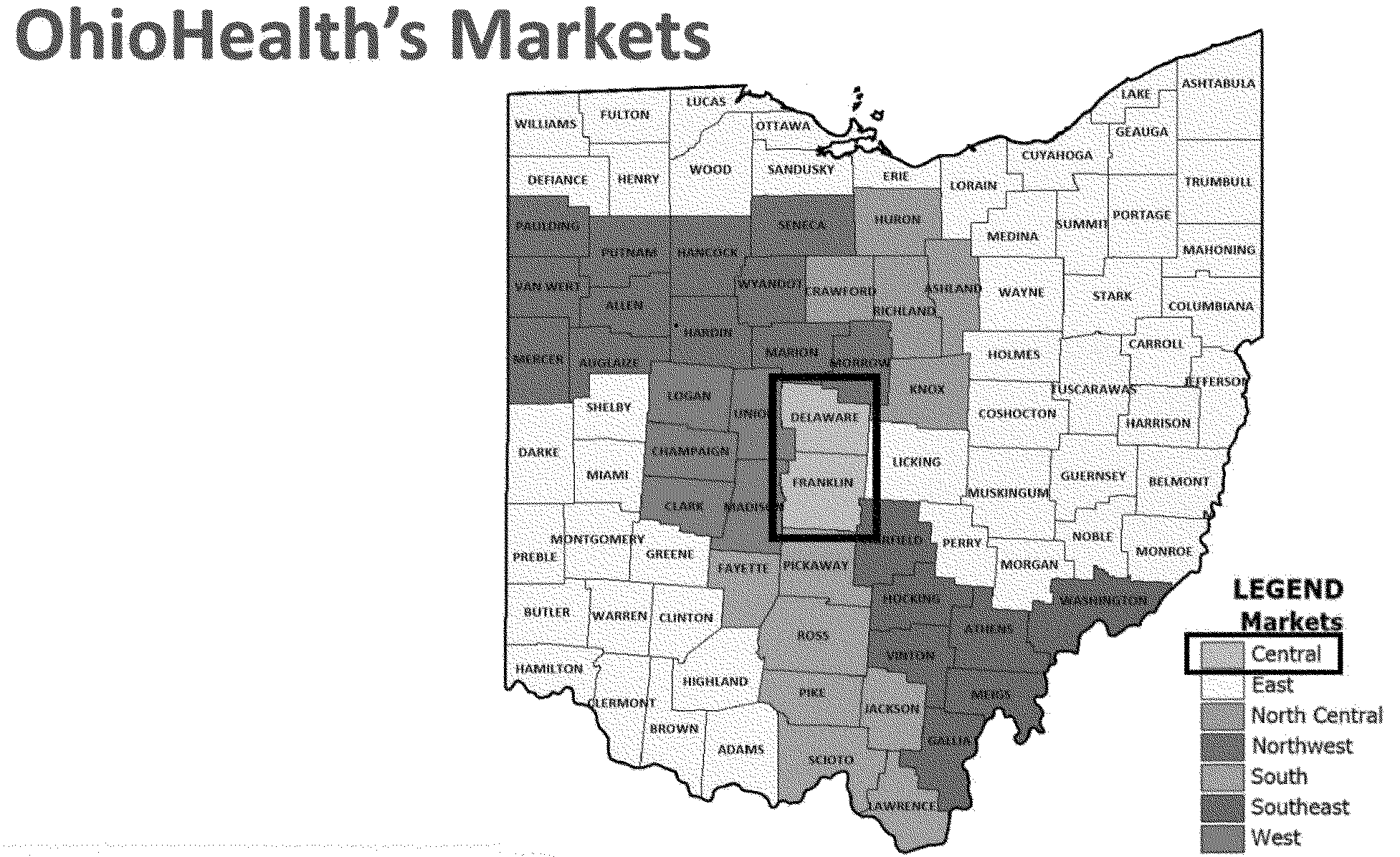
42. Defining relevant geographic markets helps courts assess, among other things, the market power wielded by OhioHealth and the anticompetitive impact of the challenged restraints. The area comprising Franklin and Delaware counties in Ohio is a relevant geographic market.
43. OhioHealth, in the ordinary course of its business, identifies Central Columbus as a distinct region for the delivery of healthcare services, and defines it as Franklin and Delaware counties. For example, a November 2024 Market Share Update prepared by OhioHealth shows the following map:
44. For purposes of this Complaint, the area comprising Franklin and Delaware counties is called Central Columbus. Central Columbus contains most of the city of Columbus, Ohio. OhioHealth's flagship hospital is in the Central Columbus market, as are five other OhioHealth hospitals. Central Columbus is home to more than 1.5 million Ohioans who prefer to obtain care from hospitals located in Central Columbus. The following map shows the GAC hospitals located in and around Central Columbus.
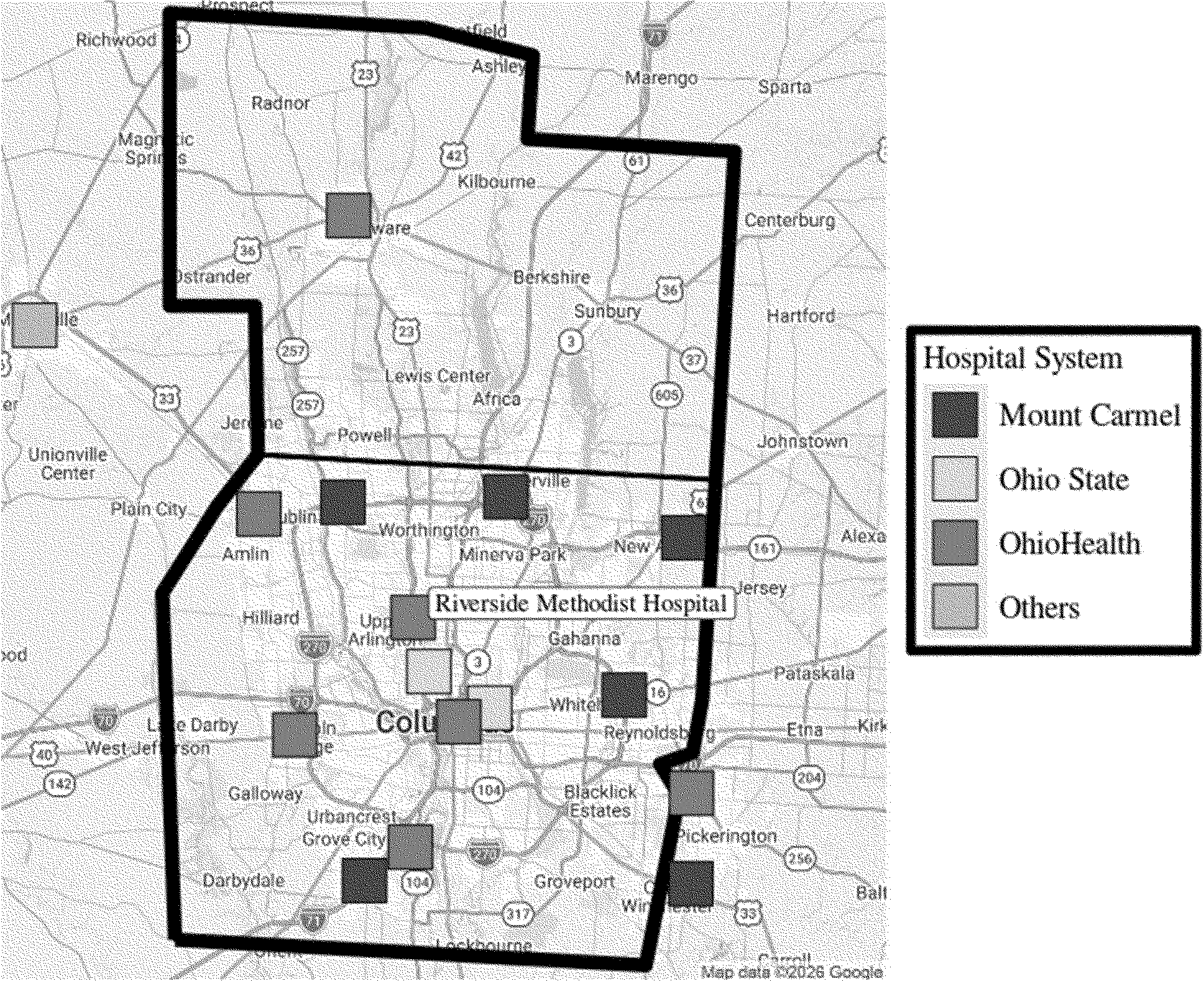
45. Central Columbus is a geographic market in which market power in the sale of inpatient GAC hospital services can be exercised. It satisfies the hypothetical monopolist test. A hypothetical monopolist consisting of all hospitals in Central Columbus likely would undertake at least a small but significant increase in price or other worsening of terms over a sustained period of time for at least one hospital. Patients in Central Columbus prefer to receive inpatient GAC hospital services at hospitals that are close to their homes. Because of this, a payor without any in-network hospitals located in Central Columbus would not be competitive selling commercial health plans in Central Columbus. To continue selling commercial health insurance to individuals and to employers in Central Columbus, payors would be forced to accept a price increase imposed by the hypothetical monopolist.
46. The area not larger than the Columbus Metropolitan Statistical Area (“MSA”), as defined by the U.S. Office of Management and Budget, is also a relevant geographic market in which market power in the sale of inpatient GAC hospital services can be exercised. This market includes the counties of Delaware, Fairfield, Franklin, Hocking, Licking, Madison, Morrow, Perry, Pickaway, and Union. This Complaint refers to these 10 counties as the Columbus MSA. The following map shows the GAC hospitals in and around the Columbus MSA.
( printed page 46469)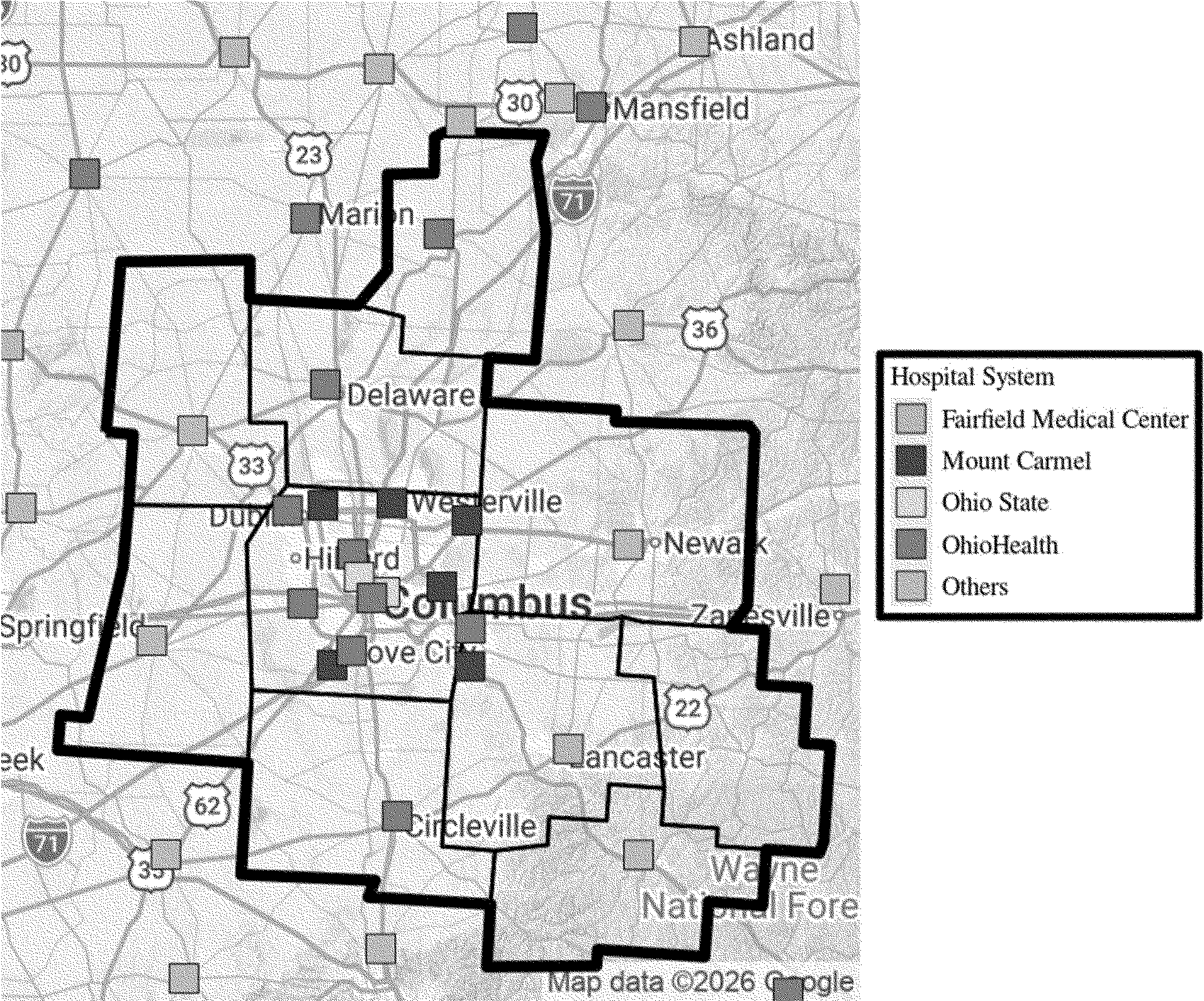
47. A market of the Columbus MSA satisfies the hypothetical monopolist test. A hypothetical monopolist consisting of all hospitals in the Columbus MSA likely would undertake at least a small but significant increase in price or other worsening of terms over a sustained period of time for at least one hospital. Patients in the Columbus MSA prefer to receive inpatient GAC hospital services at hospitals that are close to their homes. Because of this, a payor without any in-network hospitals located in the Columbus MSA would not be competitive selling commercial health plans in the Columbus MSA. To continue selling health plans to individuals and to employers in the Columbus MSA, payors would be forced to accept a price increase imposed by the hypothetical monopolist.
C. Market Power and Anticompetitive Effects
48. OhioHealth has market power in inpatient GAC hospital services in the relevant geographic markets. Other than OhioHealth, Ohio State and Mount Carmel are the only hospital systems that provide inpatient GAC services in Central Columbus. In the broader Columbus MSA, these three hospital systems control more than 85% of inpatient GAC discharges.
49. In 2023, OhioHealth's share of inpatient GAC discharges was more than 35% in both the Central Columbus and Columbus MSA markets. Similarly, OhioHealth controls more than 35% of inpatient GAC hospital beds in the Columbus MSA market and the Central Columbus market. OhioHealth's market shares have been growing, and in 2023, an internal OhioHealth document reported “OhioHealth maintains strong market position” and “strong profitability.” Market power confers the ability to raise prices above those that could be charged in a competitive market, and OhioHealth's supracompetitive rates provide compelling evidence of its possession and exercise of market power.
50. Because of OhioHealth's size and the many hospitals it controls, a payor selling health insurance plans to individuals and employers in the Columbus MSA and in Central Columbus must have OhioHealth as a participant in at least some of its provider networks to have viable health insurance products. OhioHealth also derives market power from its control of hospitals outside of the Columbus MSA, some of which are the only hospitals in their counties. Payors need those hospitals in their provider networks. This market power gives OhioHealth the ability to ward off competition by imposing restrictions in its contracts with payors that inhibit payors from offering budget-conscious plans.
51. Payors that sell commercial health insurance plans in the relevant geographic markets have tried to negotiate the removal of these restrictions from their contracts with OhioHealth, but OhioHealth has summarily refused. Because of OhioHealth's market power, payors have had to agree to those restrictions. In the absence of these contractual restrictions, payors would be free to ( printed page 46470) offer budget-conscious plans that allow patients to save money by choosing high quality and cost-effective hospitals, such as Ohio State or Mount Carmel. OhioHealth's contractual restrictions short circuit the competitive process and thereby lessen competition between OhioHealth and the other hospitals that provide inpatient GAC hospital services in the Columbus area, including Ohio State and Mount Carmel. Because of OhioHealth's contractual restrictions, OhioHealth's rivals are impeded in their efforts to win more commercially insured business by offering lower prices or higher value. The restrictions thus help insulate OhioHealth from competition and make it difficult for other hospitals to win market share from dominant OhioHealth. This failure of market forces, induced by OhioHealth's contractual restrictions, harms the process by which OhioHealth and other Columbus-area hospitals would otherwise compete on the prices of the services they sell.
52. OhioHealth's restrictions on budget-conscious plans further harm competition by hindering OhioHealth's rival hospitals from expanding and improving over time. Denied the ability to attract new patients via these plans, non-dominant rivals lose the opportunity to demonstrate what they offer to patients and to build their reputation and consumer loyalty. This in turn deprives them of the larger patient volume that could make new investments in services viable, further hurting patients and buttressing OhioHealth's ability to charge higher prices than it could if competition were not restricted.
53. Because OhioHealth's contractual restrictions apply to all of the services it sells to payors, including inpatient GAC hospital services, outpatient services, physician services, and ancillary services such as labs and imaging, they impact competition across these services. In addition to hindering expansion by its rivals and preventing payors from featuring lower-cost providers, they create a barrier to entry by new providers of these services. Prospective entrants cannot, as in competitive markets, hope to attract patients by offering quality services at lower prices than the incumbents. This further harms consumers in the Columbus area.
54. As a result of this reduced competition due to OhioHealth's contractual restrictions, individuals and employers in the Columbus area pay higher prices for health insurance coverage and have fewer insurance plans from which to choose. Deprived of price transparency and the ability to benefit from choosing more cost-effective providers, Columbus-area patients incur higher out-of-pocket costs for their healthcare.
55. OhioHealth's restrictions on budget-conscious plans do not have any procompetitive effects. Any arguable benefits of OhioHealth's contractual restrictions are outweighed by their actual and likely anticompetitive effects and/or could be achieved through less restrictive means. Without these restrictions, OhioHealth can seek to maintain its patient volume and market share by competing to offer lower prices, higher-quality, and better value than its competitors.
56. Entry or expansion by other hospitals in the Columbus area has not counteracted the actual and likely competitive harms resulting from OhioHealth's restrictions on budget-conscious plans. And in the future, such entry or expansion is unlikely to counteract these harms to competition. Building a hospital with a strong reputation that can attract physicians and patients is difficult, time-consuming, and expensive. In fact, OhioHealth's restrictions raise barriers to entry for hospitals and other providers by making it virtually impossible for them to attract more patients by offering lower prices or more value.
Claims for Relief
First Claim
(Sherman Act, 15 U.S.C. 1)
57. Plaintiffs incorporate paragraphs 1 through 56 of this Complaint.
58. OhioHealth has market power in the sale of inpatient GAC hospital services in the Columbus MSA and in Central Columbus.
59. OhioHealth has and likely will continue to negotiate and enforce contracts containing restrictions on budget-conscious plans with commercial payors in the Columbus area. The contracts containing these restrictions are contracts, combinations, and conspiracies within the meaning of Section 1 of the Sherman Act, 15 U.S.C. 1.
60. OhioHealth's contractual restrictions on budget-conscious plans have had, and will likely continue to have, the following substantial anticompetitive effects in the relevant markets, among others:
a. protecting OhioHealth's market power and enabling OhioHealth to maintain at supracompetitive levels the prices of inpatient GAC hospital services;
b. substantially lessening competition among hospitals in their sale of inpatient GAC hospital services;
c. restricting the introduction of innovative insurance products that are designed to achieve lower prices and improved quality for inpatient GAC hospital services;
d. reducing patients' incentives to seek inpatient GAC hospital services from more cost-effective providers;
e. creating barriers to entry and expansion by rival providers of inpatient GAC hospital services; and
f. depriving payors and their members of the benefits of a competitive market for their purchase of inpatient GAC hospital services.
61. The challenged restrictions unreasonably restrain trade in violation of Section 1 of the Sherman Act, 15 U.S.C. 1.
Second Claim
(Valentine Act, Section 1331.04 of the Ohio Revised Code)
62. The State of Ohio incorporates paragraphs 1 through 61 of this Complaint.
63. Through the exercise of market power, OhioHealth has induced payors to agree to the contracts containing restrictions on budget-conscious plans, and it has exploited its market dominance to maintain and preserve the restrictions and prevent payors from negotiating procompetitive contract terms.
64. OhioHealth has thereby entered into combinations with payors for the purpose of creating and carrying out restrictions in trade or commerce, creating trusts under Section 1331(C)(1)(a) of the Ohio Revised Code, and each such combination, contract, or agreement in the form of a trust constitutes an illegal conspiracy against trade in violation of Section 1331.04 of the Ohio Revised Code.
Relief Requested
65. Wherefore, Plaintiffs request that the Court enter judgment in their favor and provide the following relief:
a. adjudge that all of the restrictions on budget-conscious plans in the contracts between OhioHealth and any commercial payors violate Section 1 of the Sherman Act, 15 U.S.C. 1, and Sections 1331.01(C)(1)(a) and 1331.04 of the Valentine Act;
b. enjoin OhioHealth, its officers, directors, agents, employees, and successors, and all other persons acting or claiming to act on its behalf, directly or indirectly, from seeking, agreeing to, or enforcing any provision in any agreement that prohibits or restricts a ( printed page 46471) payor from offering, or attempting to offer, plans that give members information and financial incentives to use any healthcare provider;
c. enjoin OhioHealth from substituting other unlawful and anticompetitive means of restricting budget-conscious benefit designs that would replicate the effects of its contractual restrictions;
d. enjoin OhioHealth from retaliating, or threatening to retaliate, against any insurer for offering, or attempting to offer, budget-conscious plans; and
e. award Plaintiffs their costs in this action and such other relief as the Court may deem just and proper.
Dated: February 20, 2026
Respectfully submitted,
For Plaintiff, United States of America:
Omeed A. Assefi, Acting Assistant Attorney General.
Nicole A. Sarrine, Acting Deputy Assistant Attorney General.
Dina Kallay, Deputy Assistant Attorney General.
Miriam R. Vishio, Acting Director of Civil Enforcement (Conduct and Operations).
Catherine K. Dick, Acting Director of Litigation.
Jill C. Maguire, Acting Chief, Healthcare and Consumer Products Section.
Garrett M. Liskey, Assistant Chief, Healthcare and Consumer Products Section.
Paul J. Torzilli * (S.D. Ohio Bar 4118832), Senior Litigation Counsel
Karl D. Knutsen *
Rahul A. Darwar
Jessica Hollis
Stella Martin
Sean P. Mulloy
David M. Stoltzfus
Trial Attorneys
United States Department of Justice, Antitrust Division, Healthcare & Consumer Products Section, 450 Fifth Street NW, Suite 4000, Washington, DC 20530, Telephone: (202) 476-0547, Email: Paul.Torzilli@usdoj.gov.
* Designated Trial Attorneys
For Plaintiff State of Ohio:
Dave Yost
Ohio Attorney General (OH Bar 0056290).
Beth A. Finnerty (OH Bar 0055383)
Section Chief, Antitrust Section
Edward J. Olszewski (OH Bar 0082655)
Assistant Section Chief, Antitrust Section, 30 East Broad Street, 26th Floor, Columbus, OH 43215, Telephone: (614) 466-4328, Fax: (614) 995-0266.
Thomas J. Collin (OH Bar 0023770)
Principal Assistant Attorney General.
Antitrust Section, 615 West Superior Avenue, 11th Floor, Cleveland, OH 44113, Telephone: (216) 787-4484, Fax: (866) 503-2011, Beth.Finnerty@OhioAGO.gov, Edward.Olszewski@OhioAGO.gov, Thomas.Collin@OhioAGO.gov.
United States District Court for the Southern District of Ohio Eastern Division
United States of America, and State of Ohio, Plaintiffs, v. OhioHealth Corporation, Defendant.
Case No. 2:26-cv-207
Judge Algenon L. Marbley
Magistrate Judge S. Courter M. Shimeall
[Proposed] Final Judgment
Whereas, Plaintiffs, United States of America and the State of Ohio, filed their Complaint on February 20, 2026;
And Whereas, the United States, State of Ohio, and Defendant, OhioHealth Corporation (“OhioHealth”), have consented to entry of this Final Judgment without the taking of testimony, without trial or adjudication of any issue of fact or law, and without this Final Judgment constituting any evidence against or admission by any party relating to any issue of fact or law;
And Whereas, Defendant has signed a stipulation agreeing to be bound by the provisions of this Final Judgment pending its approval by this Court;
And Whereas, Defendant agrees to undertake certain actions and refrain from certain conduct for the purpose of remedying the anticompetitive effects alleged in the Complaint;
And Whereas, Defendant represents that the relief required by this Final Judgment can and will be made and that Defendant will not later raise a claim of hardship or difficulty as grounds for asking the Court to modify any provision of this Final Judgment;
Now Therefore, it is Ordered, Adjudged, and Decreed:
I. Jurisdiction
The Court has jurisdiction over the subject matter of, and each of the parties to, this action. The Complaint states a claim upon which relief may be granted against Defendant under Section 1 of the Sherman Act, as amended, 15 U.S.C. 1, and Ohio's Valentine Act, Ohio Revised Code Sections 1331.01 et seq.
II. Definitions
As used in this Final Judgment:
A. “Benefit Plan” means a specific set of Healthcare Services that is made available to a Payor's members through a health plan underwritten by an insurer, a self-funded benefit plan, or a Medicare Part C plan. The term “Benefit Plan” does not include workers' compensation programs, Medicare (except Medicare Part C plans), Medicaid, or uninsured discount plans.
B. “Broad Network” means a network that offers a full range of Healthcare Services to a Payor's members and is not significantly limited in the number of Providers in the network.
C. “Broad Network Benefit Plan” means any Benefit Plan that is offered with a Broad Network.
D. “Center of Excellence” means a feature of a Benefit Plan that designates Providers of certain Healthcare Services based on objective quality or quality-and-price criteria in order to encourage patients to obtain such Healthcare Services from those designated Providers.
E. “Commercial Benefit Plan” means a “Benefit Plan” that does not include Medicare Part C plans.
F. “Defendant” means OhioHealth Corporation, an Ohio Healthcare Services corporation with its headquarters in Columbus, Ohio, its successors and assigns, and its subsidiaries, divisions, groups, affiliates, partnerships, and joint ventures, and their directors, officers, managers, agents, and employees.
G. “Healthcare Services” mean any or all inpatient services, outpatient services, professional services, and ancillary services. “Healthcare Services” does not mean management of patient care, such as through population health programs or employee or group wellness programs.
H. “Including” means including, but not limited to.
I. “Narrow Network” means a network composed of a significantly limited number of Providers that offers a range of Healthcare Services to a Payor's members.
J. “Payor” means any Person providing commercial health insurance or access to Provider networks, including managed-care organizations, and rental networks ( i.e., entities that lease, rent, or otherwise provide direct or indirect access to a proprietary network of Providers), regardless of whether that entity bears any risk or makes any payment relating to the provision of healthcare. The term “Payor” includes Persons that provide Medicare Part C plans but does not include Medicare (except Medicare Part C plans), Medicaid, or TRICARE, or entities that otherwise contract on behalf of Medicare (except Medicare Part C plans), Medicaid, or TRICARE.
K. “Penalize” means using any contract term or taking any action that has the actual or likely effect of restraining, discouraging, or reducing Steering through the use of Steered Plans or Transparency. The term “Penalize” has a meaning that is broader than “prohibit” or “prevent.” In determining whether any contract provision or action “Penalizes” Steering, factors that may be considered ( printed page 46472) include: the facts and circumstances relating to the contract provision or action and its economic impact.
L. “Person” means any natural person, corporation, company, partnership, joint venture, firm, association, proprietorship, agency, board, authority, commission, office, or other business or legal entity.
M. “Provider” means all of any part of any Person delivering any Healthcare Service. For avoidance of doubt, two different hospitals owned by the same corporation or other business entity are each a Provider.
N. “Reference-Based Pricing” means a feature of a Benefit Plan pursuant to which a Payor pays up to a uniformly-applied defined contribution, based on an external price set by the Payor, with the Payor's member being required to pay the remainder of the full price charged for a Healthcare Service. However, a Benefit Plan with Reference-Based Pricing as a feature may permit a Payor to pay a portion of this remainder.
O. “Relevant Payors” means any Payor with which Defendant has a contractual relationship, or that contacts or communicates with the Defendant about contracting for Defendant's participation in a Benefit Plan or Provider network.
P. “Site-of-Service Steering” means a feature of a Benefit Plan pursuant to which a Payor requires or encourages, including by providing different levels of benefits, its members to obtain certain Healthcare Services at specific facilities or types of facilities.
Q. “Steered Plan” means any Benefit Plan with one or more forms of Steering. Steered Plans include, but are not limited to, Narrow Network Benefit Plans, Tiered Network Benefit Plans, or any Benefit Plans with Reference-Based Pricing, Site-of-Service Steering, or a Center of Excellence as a component.
R. “Steered” or “Steering” means a Payor providing any incentive to that Payor's members to seek care at specific Providers or types of Providers.
S. “Tiered Network” means a network of Providers (i) that a Payor divides into different sub-groups based on objective price, access, and/or quality criteria; and (ii) for which a Payor's members receive different levels of benefits when they use Healthcare Services from Providers in the different sub-groups.
T. “Transparency” means communication of any price, cost, quality, or patient experience information directly or indirectly by a Payor to its members or other Persons that contract with the Payor for access to a Benefit Plan or Plans.
III. Applicability
This Final Judgment applies to Defendant, as defined above, and all other Persons in active concert with, or participation with, Defendant who receive actual notice of this Final Judgment.
IV. Prohibited Conduct
A. Any and all of Defendant's contract provisions that prohibit, deter, prevent, or Penalize Steering, Steered Plans, or Transparency are void and unenforceable. For example, the contract language reproduced in Exhibit A is void, and Defendant may not enforce or attempt to enforce it.
B. Defendant must not seek or obtain any contract provision that would prohibit, deter, prevent, or Penalize Steering, Steered Plans, or Transparency, including:
1. requirements of prior approval for the introduction of new Benefit Plans; or
2. requirements that Defendant be included in the most-preferred tier of Benefit Plans, though Defendant may seek to participate in the most-preferred tier of a Benefit Plan.
C. Defendant must not take any action that Penalizes, or threatens to Penalize, a Payor for (i) providing (or planning to provide) Transparency, (ii) engaging in (or planning to engage in) Steering, or (iii) designing, offering, expanding, or marketing (or planning to design, offer, expand, or market) a Steered Plan.
D. Defendant must not seek or obtain any contract provision that prohibits, deters, prevents, or Penalizes Steering, Steered Plans, or Transparency, including by requiring that Defendant be included in the most-preferred tier of any Benefit Plan. However, notwithstanding this Paragraph IV.D, Defendant may enter into a contract with any Payor that provides Defendant with the right to participate in the most-preferred tier of a Benefit Plan under the same terms and conditions as any other Provider, provided that if Defendant declines to participate in the most-preferred tier of that Benefit Plan, then Defendant must participate in that Benefit Plan on terms and conditions that are substantially the same as any terms and conditions of any then-existing broad-network Benefit Plan ( e.g., PPO plan) in which Defendant participates with that Payor. Additionally, notwithstanding Paragraph IV.D, nothing in this Final Judgment prohibits Defendant from obtaining any criteria used by the Payor to (i) assign Providers to each tier in any Tiered Network; and/or (ii) designate Providers as a Center of Excellence.
V. Permitted Conduct
A. Defendant may exercise any contractual right it has, provided it does not engage in any Prohibited Conduct as set forth above.
B. For any Narrow Network in which Defendant is the most-prominently featured Provider, Defendant may restrict steerage within that Narrow Network.
C. Defendant may communicate with a Payor's members about considerations that may be important to patients when choosing a provider or site of service, provided it does not engage in any Prohibited Conduct as set forth above.
D. With regard to information communicated as part of any Transparency effort, nothing in this Final Judgment prohibits Defendant from reviewing its information to be disseminated, provided such review does not materially delay the dissemination of the information. Furthermore, Defendant may challenge inaccurate information or seek appropriate legal remedies relating to inaccurate information disseminated by third parties. Also, for a Payor's dissemination of price or cost information (other than communication of an individual consumer's or member's actual or estimated out-of-pocket expense or information made public under applicable law), nothing in the Final Judgment will prevent or impair Defendant from enforcing current or future provisions, including but not limited to confidentiality provisions, that (i) prohibit a Payor from disseminating price or cost information to Defendant's competitors, other Payors, or the general public except as required under applicable laws; and/or (ii) unless otherwise provided under applicable law, require a Payor to obtain a covenant from any third party that receives such price or cost information that such third party will not disclose that information to Defendant's competitors, another Payor, the general public, or any other third party lacking a reasonable need to obtain such competitively sensitive information, provided the Defendant does not engage in any Prohibited Conduct as set forth above. Defendant may seek all appropriate remedies (including injunctive relief) in the event that dissemination of such information occurs.
VI. Required Conduct
A. Within fifteen (15) business days of the entry of this Final Judgment, Defendant must notify any Relevant Payor in writing that this Final Judgment has been entered (enclosing a ( printed page 46473) copy of this Final Judgment) and that it prohibits Defendant from entering into or enforcing any contract provision that would prohibit, prevent, or Penalize Steering, Steered Plans, or Transparency, or taking any other action that violates this Final Judgment.
B. While the Final Judgment is in effect, Defendant must notify, in writing, any Relevant Payors not previously notified pursuant to Paragraph VI.A that this Final Judgment has been entered (enclosing a copy of this Final Judgment) and that it prohibits Defendant from entering into or enforcing any contract provision that would prohibit, prevent, or Penalize Steering, Steered Plans, or Transparency, or taking any other action that violates this Final Judgment, within five (5) business days of the exchange of written terms or a draft agreement between such Relevant Payor and Defendant about Defendant's participation in that Payor's Benefit Plan or Provider network.
C. For five (5) years from the entry of the Final Judgment, on the final business day of each calendar quarter, Defendant must provide a written report to the monitor and each Plaintiff identifying each Payor with which Defendant (1) agreed to new or amended contract terms, (2) declined to participate in any Tiered Network, and (3) contracted for the right to participate in the most-preferred tier of a Benefit Plan that is described in Section IV.D of the Final Judgment.
VII. Affidavits
A. Within forty-five (45) calendar days of entry of the Stipulation and Order in this case, and every forty-five (45) calendar days thereafter until the actions required by this Final Judgment in Paragraphs VI.A, IX.A.1 and IX.A.3 have been completed, Defendant must deliver to the United States and the State of Ohio an affidavit, signed by Defendant's General Counsel, describing in reasonable detail the fact and manner of Defendant's compliance with this Final Judgment. The United States, in its sole discretion, may approve different signatories for the affidavits.
VIII. Appointment of Monitor
A. Upon application of the United States, which Defendant may not oppose, the Court will appoint a monitor selected by the United States in its sole discretion, after consultation with the State of Ohio, and approved by the Court. Defendant may propose up to three (3) monitor candidates to the United States. Once approved, the court-appointed monitor should be considered by the Plaintiffs and Defendant to be an arm and representative of the Court.
B. The monitor will have the power and authority to monitor Defendant's compliance with the terms of this Final Judgment and the Stipulation and Order entered by the Court, including compliance with Sections IV, VI, and IX. The monitor may also have other powers as the Court deems appropriate. The monitor will have no responsibility or obligation for the operation of the Defendant's business. No attorney-client relationship will be formed between Defendant and the monitor.
C. The monitor will have the authority to take such steps as, in the judgment of the monitor and the United States, may be necessary to accomplish the monitor's responsibilities. The monitor may seek information from Defendant's personnel, including in-house counsel, compliance personnel, and internal auditors. Defendant must establish a policy, annually communicated to all employees, that employees may disclose any information to the monitor without reprisal for such disclosure. Defendant must not retaliate against any employee or third party for disclosing information to the monitor.
D. Defendant may not object to actions taken by the monitor in fulfillment of the monitor's responsibilities under any Order of the Court on any ground other than malfeasance by the monitor. Disagreements between the monitor and Defendant related to the scope of the monitor's responsibilities do not constitute malfeasance. Objections by Defendant must be conveyed in writing to the United States, the State of Ohio, and the monitor within twenty (20) calendar days of the monitor's action that gives rise to Defendant's objection, or the objection is waived.
E. The monitor will serve at the cost and expense of Defendant pursuant to a written agreement, on terms and conditions, including confidentiality requirements and conflict of interest certifications, approved by the United States in its sole discretion. If the monitor and Defendant are unable to reach such a written agreement within fourteen (14) calendar days of the Court's appointment of the monitor, or if the United States, in its sole discretion, declines to approve the proposed written agreement, the United States, in its sole discretion, may take appropriate action, including making a recommendation to the Court, which may set the terms and conditions for the monitor's work, including compensation, costs, and expenses.
F. The monitor may hire, at the cost and expense of Defendant, any agents and consultants, including attorneys, and accountants, that are reasonably necessary in the monitor's judgment to assist with the monitor's duties. These agents or consultants will be directed by and solely accountable to the monitor and will serve on terms and conditions, including confidentiality requirements and conflict-of-interest certifications, approved by the United States, in its sole discretion. Within three (3) business days of hiring any agents or consultants, the monitor must provide written notice of the hiring and the rate of compensation to Defendant and the United States.
G. The compensation of the monitor and agents or consultants retained by the monitor must be on reasonable and customary terms commensurate with the individuals' experience and responsibilities.
H. The monitor must account for all costs and expenses incurred.
I. Defendant's failure to promptly pay the monitor's accounted-for costs and expenses, including for agents and consultants, will constitute a violation of this Final Judgment and may result in sanctions ordered by the Court. If Defendant makes a timely objection in writing to the United States to any part of the monitor's accounted-for costs and expenses, Defendant must establish an escrow account into which Defendant must pay the disputed costs and expenses until the dispute is resolved.
J. Defendant must use best efforts to cooperate fully with the monitor and to assist the monitor to monitor Defendant's compliance with its obligations under this Final Judgment and the Stipulation and Order, including with Sections IV, VI, and IX. Subject to reasonable protection for trade secrets, other confidential research, development, or commercial information, or any applicable privileges, Defendant must provide the monitor, and agents or consultants retained by the monitor, with full and complete access to all personnel (current and former), agents, consultants, books, records, and facilities. Defendant may not take any action to interfere with or to impede accomplishment of the monitor's responsibilities.
K. The monitor must investigate and report on Defendant's compliance with this Final Judgment and the Stipulation and Order. The monitor must provide periodic reports to the United States and the State of Ohio setting forth Defendant's efforts to comply with its obligations under this Final Judgment and the Stipulation and Order. The ( printed page 46474) United States, in its sole discretion, will set the frequency of the monitor's reports, but, at minimum, the monitor must provide written reports at least every one hundred and eighty (180) days for the first two (2) years of the term of the monitor's appointment, after which the monitor must provide written reports on at least an annual basis. The monitor must provide the first written report within one hundred and eighty (180) days of the monitor's appointment by the Court. The United States, in its sole discretion, may change the frequency of the monitor's written reports at any time, communicate or meet with the monitor at any time, and make any request of the monitor as the United States deems appropriate.
L. Within thirty (30) calendar days after appointment of the monitor by the Court, and on a yearly basis thereafter, the monitor must provide to the United States, the State of Ohio, and Defendant a proposed written work plan. Defendant may provide comments on the proposed written work plan to the United States, the State of Ohio, and the monitor within fourteen (14) calendar days after receipt, after which the monitor must produce a final work plan to the United States, the State of Ohio, and Defendant, for approval by the United States in its sole discretion. Any disputes between Defendant and the monitor with respect to any written work plan will be decided by the United States in its sole discretion. The United States retains the right, in its sole discretion, to require changes or additions to a work plan at any time.
M. The monitor may communicate ex parte with the Court when, in the monitor's judgment, such communication is reasonably necessary to the monitor's duties under this Final Judgment, including if Defendant fails to pay the monitor's costs and expenses in a timely manner or otherwise violates this Final Judgment.
N. The monitor will serve for a term of five years after being appointed, unless the United States, in its sole discretion, determines a different period is appropriate.
O. If the United States determines that the monitor is not acting diligently or in a reasonably cost-effective manner, or if the monitor resigns or becomes unable to accomplish the monitor's duties, the United States may recommend that the Court appoint a substitute.
P. For the duration of the term of the monitor, Defendant must provide to the monitor a copy of each new contract and each new amendment to a contract that covers Healthcare Services that Defendant has executed with any Payor within the last one-hundred and eighty (180) calendar days. Defendant must provide the contracts to the monitor in batches every one-hundred and eighty (180) calendar days, or within ten (10) calendar days upon request of the monitor at any time during the monitorship. Defendant will also notify the monitor within thirty (30) calendar days of having reason to believe that Defendant, or any Provider on whose behalf Defendant negotiates, has a contract with any Payor with a provision that prohibits, prevents, or Penalizes Steering, Steered Plans, or Transparency.
IX. Compliance
A. Defendant must:
1. within fifteen (15) calendar days of entry of this Final Judgment, provide a copy of this Final Judgment to each of Defendant's directors and officers, and to each employee or agent whose job responsibilities include negotiating or approving agreements on behalf of Defendant with Payors for the purchase of Healthcare Services;
2. distribute in a timely manner a copy of this Final Judgment to any Person who succeeds to, or subsequently holds, a position at Defendant of director, officer, or other position for which the job responsibilities include negotiating or approving agreements with Payors for the purchase of Healthcare Services; and
3. within sixty (60) calendar days of entry of this Final Judgment, develop and implement procedures necessary to ensure Defendant's compliance with this Final Judgment. Such procedures must ensure that Defendant's directors, officers, or employees have the opportunity to raise questions about this Final Judgment with counsel (which may be outside counsel).
B. For the purposes of determining or securing compliance with this Final Judgment or of related orders such as the Stipulation and Order or of determining whether this Final Judgment should be modified or vacated, upon the written request of an authorized representative of the Assistant Attorney General for the Antitrust Division or the Attorney General of the State of Ohio and reasonable notice to Defendant, Defendant must permit, from time to time and subject to legally recognized privileges, authorized representatives, including agents retained by the United States or the State of Ohio;
1. to have access during Defendant's business hours to inspect and copy, or at the option of the United States, to require Defendant to provide electronic copies of all books, ledgers, accounts, records, data, and documents, wherever located, in the possession, custody, or control of Defendant relating to any matters contained in this Final Judgment; and
2. to interview, either informally or on the record, Defendant's officers, employees, or agents, wherever located, who may have their individual counsel present, relating to any matters contained in this Final Judgment. The interviews must be subject to the reasonable convenience of the interviewee and without restraint or interference by Defendant.
C. Upon the written request of an authorized representative of the Assistant Attorney General for the Antitrust Division of the Attorney General of the State of Ohio, Defendant must submit written reports or respond to written interrogatories, under oath if requested, relating to any matters contained in this Final Judgment.
X. Public Disclosure
A. No information or documents obtained pursuant to any provision in this Final Judgment, including reports the monitor provides to the United States and the State of Ohio, pursuant to Paragraph VIII.K, may be divulged by the United States, the State of Ohio, or the monitor, to any person other than an authorized representative of the executive branch of the United States or an authorized representative of the State of Ohio, except in the course of legal proceedings to which the United States or the State of Ohio is a party, including grand-jury proceedings, for the purpose of securing compliance with this Final Judgment, or as otherwise required by law.
B. In the event that the monitor receives a subpoena, court order, or other court process seeking or requiring production of information or documents obtained pursuant to any provision in this Final Judgment, including reports the monitor provides to the United States and the State of Ohio, pursuant to Paragraph VIII.K, the monitor must notify the United States, the State of Ohio, and Defendant immediately, and no fewer than fourteen (14) calendar days prior to any disclosure, so that Defendant may address such potential disclosure and, if necessary, pursue alternative legal remedies, including if deemed appropriate by Defendant, intervention in the relevant proceedings.
C. In the event of a request by a third party, pursuant to the Freedom of Information Act, 5 U.S.C. 552, or the Ohio Public Records Act, O.R.C. § 149.43, for disclosure of information obtained pursuant to any provision of this Final Judgment, the United States ( printed page 46475) will act in accordance with that statute and the Department of Justice regulations at 28 CFR part 16, including the provision on confidential commercial information at 28 CFR 16.7, and the State of Ohio will act in accordance with its applicable disclosure laws. Records containing any such information shall be deemed confidential law enforcement investigatory records under O.R.C. § 149.43(A)(1). When submitting information to the Antitrust Division, Defendant should designate the confidential commercial information portions of all applicable documents and information under 28 CFR 16.7. Designations of confidentiality expire 10 years after submission, “unless the submitter requests and provides justification for a longer designation period.” See28 CFR 16.7(b).
 28 CFR part 16
D. If at the time that Defendant furnishes information or documents to the United States or the State of Ohio pursuant to any provision of this Final Judgment, Defendant represents and identifies in writing information or documents for which a claim of protection may be asserted under Rule 26(c)(1)(G) of the Federal Rules of Civil Procedure, and Defendant marks each pertinent page of such material, “Subject to claim of protection under Rule 26(c)(1)(G) of the Federal Rules of Civil Procedure,” the United States and the State of Ohio must give Defendant ten (10) calendar days' notice before divulging the material in any legal proceeding (other than a grand jury proceeding).
XI. Retention of Jurisdiction
The Court retains jurisdiction to enable any party to this Final Judgment to apply to the Court at any time for further orders and directions as may be necessary or appropriate to carry out or construe this Final Judgment, to modify any of its provisions, to enforce compliance, and to punish violations of its provisions.
XII. Enforcement of Final Judgment
A. If at any time during the five-year period following entry of this Final Judgment, the United States determines in its sole discretion that the Final Judgment has failed to fully redress the violations alleged in the Complaint, then the United States may re-open this proceeding to seek additional relief. Such additional relief may be ordered by this Court upon a finding by a preponderance of the evidence that there is a reasonable probability that the proposed Final Judgment did not fully redress the violations alleged in the Complaint.
B. The United States, or the State of Ohio, retains and reserves all rights to enforce the provisions of this Final Judgment, including the right to seek an order of contempt from the Court. In a civil contempt action, a motion to show cause, or a similar action brought by the United States or the State of Ohio relating to an alleged violation of this Final Judgment, the United States or the State of Ohio may establish a violation of this Final Judgment and the appropriateness of a remedy therefor by a preponderance of the evidence, and Defendants waive any argument that a different standard of proof should apply.
C. This Final Judgment should be interpreted to give full effect to the procompetitive purposes of the antitrust laws and to restore the competition the United States and the State of Ohio allege was harmed by the challenged conduct. Defendant may be held in contempt of, and the Court may enforce, any provision of this Final Judgment that, as interpreted by the Court in light of these procompetitive principles and applying ordinary tools of interpretation, is stated specifically and in reasonable detail, whether or not it is clear and unambiguous on its face. In any such interpretation, the terms of this Final Judgment should not be construed against any party as the drafter.
D. In an enforcement proceeding in which the Court finds that Defendant has violated this Final Judgment, the United States may apply to the Court for an extension of this Final Judgment, together with other relief that may be appropriate. In connection with a successful effort by the United States or the State of Ohio to enforce this Final Judgment against Defendant, whether litigated or resolved before litigation, Defendant must reimburse the United States or the State of Ohio for the fees and expenses of its attorneys, as well as all other costs including experts' fees, incurred in connection with that effort to enforce this Final Judgment, including during the investigation of the potential violation.
E. For a period of four (4) years following the expiration of this Final Judgment, if the United States has evidence that Defendant violated this Final Judgment before it expired, the United States may file an action against Defendant in this Court requesting that the Court order: (1) Defendant to comply with the terms of this Final Judgment for an additional term of at least four years following the filing of the enforcement action; (2) all appropriate contempt remedies; (3) additional relief needed to ensure Defendant complies with the terms of this Final Judgment; and (4) fees or expenses as called for by this Section XII.
XIII. Expiration of Final Judgment
Unless the Court grants an extension, this Final Judgment will expire ten (10) years from the date of its entry, except that after five (5) years from the date of its entry, this Final Judgment may be terminated upon notice by the United States to the Court, Defendant, and the State of Ohio that the continuation of this Final Judgment is no longer necessary or in the public interest.
XIV. Reservation of Rights
This Final Judgment terminates only the claims stated in the Complaint against Defendant and does not affect other charges or claims the United States or the State of Ohio may file.
XV. Public Interest Determination
The parties have complied with the requirements of the Antitrust Procedures and Penalties Act, 15 U.S.C. 16, including by making available to the public copies of this Final Judgment and the Competitive Impact Statement, public comments thereon, and any response to comments by the United States. Based upon the record before the Court, which includes the Competitive Impact Statement and, if applicable, any comments and response to comments filed with the Court, entry of this Final Judgment is in the public interest.
Date:
[Court approval subject to procedures of Antitrust Procedures and Penalties Act, 15 U.S.C. 16]
Algenon L. Marbley, United States District Judge.
Exhibit A
Examples of contract provisions that are void and unenforceable according to the Final Judgment.
Examples of Contract Provisions That Prohibit, Deter, Prevent or Penalize Steering, Steered Plans, or Transparency
1. If [OhioHealth's] Network Exclusion or inclusion in limited benefit plan product offerings as described in [another section] above results, in the good faith and reasonable opinion of [OhioHealth], in an adverse and material financial impact on any [OhioHealth's] volumes or revenues received for Covered Services in excess of [amount] per year, [the contracting payor] agrees to an adjustment in the Company Rate to offset such impact, ( printed page 46476) applicable to and as proposed by [OhioHealth].
2. In the event [payor] causes a Network Exclusion for [an OhioHealth] provider or includes [OhioHealth] Hospital as a participating provider in any limited benefit plan products ( i.e., products with individual annual benefit maximum [amount]), then this Agreement will automatically terminate on the 90th day following implementation of the Network Exclusion, unless, by the end of such 90 day period:
(A) [Payor] obtains the written consent of [OhioHealth] as to its Network Exclusion or inclusion in limited benefit plan product offerings as described in [another section].1 above; and
(B) If [OhioHealth]'s Network Exclusion or inclusion in limited benefit plan product offerings as described in [another section] above results, in the good faith and reasonable opinion of [OhioHealth], in an adverse and material financial impact on any [OhioHealth] Providers' volumes or revenues received for Covered Services in excess of [amount] per year, Company shall agree to an adjustment in the Company Rate to offset such impact, applicable to and as proposed by such affected [OhioHealth] Provider.
No such termination or Company Rate adjustment shall be made if the reason for the [OhioHealth] Provider's Network Exclusion is a failure by [OhioHealth] Provider to meet any non-financial selection criteria established by Company for similarly situated providers in the Other Network Benefit Plan product or service as stipulated in [another Section], or [OhioHealth] Provider willingly chooses not to be a Participating Provider in such Other Network Benefit Plan product or service.
3. Under no circumstances shall [payor], [a payor] Affiliate, Plan or a sponsor, or their respective affiliates, subsidiaries and independent contractors (collectively or individually, as the case may be, “[a payor] Advisor”) provide verbal, written, website or other advice, counseling or information to Covered Individuals, their representatives, treating physicians or practitioners or others regarding higher payment rates and/or charges of Covered Services provided at OhioHealth Provider facilities versus other provider facilities, or undertake any strategy to directly or indirectly steer Covered Individuals to provider facilities other than those of any OhioHealth Provider, based on price/charge differences, or for any reason other than the availability of health care services at the OhioHealth Provider (collectively or individually, as the case may be, a “Rate Comparison Program”), except for Rate Comparison Programs permitted under [other sections].
United States District Court for the Southern District of Ohio Eastern Division
United States of America, and State of Ohio, Plaintiffs, v. Ohiohealth Corporation, Defendant.
Case No. 2:26-cv-00207
Judge Algenon L. Marbley
Magistrate Judge S. Courter M. Shimeall
Competitive Impact Statement
In accordance with the Antitrust Procedures and Penalties Act, 15 U.S.C. 16(b)-(h) (the “APPA” or “Tunney Act”), the United States of America files this Competitive Impact Statement related to the proposed Final Judgment filed in this civil antitrust proceeding.
I. Nature and Purpose of the Proceeding
On February 20, 2026, the United States and the State of Ohio (together “Plaintiffs”) filed a civil antitrust complaint against OhioHealth Corporation (“OhioHealth”) ( See ECF No. 1) (“Complaint”). The Complaint alleges that OhioHealth imposes anticompetitive contract restrictions on health insurers, which effectively deprive Columbus-area consumers of the choice of lower-cost health plan options and reduce competition among hospitals. As the Complaint alleges, OhioHealth's contracts with health insurers (also called payors) contain provisions that (1) require health insurers to include OhioHealth in all networks for all commercial insurance products at the most favored level of benefits in each network, and (2) limit health insurers from providing truthful information to their members about more cost-effective treatment options, with the effect of protecting OhioHealth against price competition for healthcare services in violation of Section 1 of the Sherman Act, 15 U.S.C. 1.
On June 16, 2026, Plaintiffs filed a proposed Final Judgment [1] and Order [2] (“Stipulation and Order”), wherein OhioHealth agreed to undertake certain actions and refrain from certain conduct for the purpose of remedying the anticompetitive effects alleged in the Complaint.
Under the proposed Final Judgment, which is explained more fully below, OhioHealth will remove restrictions on steering and transparency ( i.e., sharing information with members about more cost-effective options) from its contracts with payors, will not seek to reinstitute such restrictions, and will refrain from penalizing insurers for engaging in steering and transparency initiatives.
Plaintiffs and OhioHealth have stipulated that the proposed Final Judgment may be entered after compliance with the APPA. Entry of the proposed Final Judgment will terminate this action, except that the Court will retain jurisdiction to construe, modify, or enforce the provisions of the proposed Final Judgment and to punish violations thereof.
II. Description of Events Giving Rise to the Alleged Violation
A. OhioHealth
OhioHealth is an Ohio not-for-profit healthcare services corporation, with its principal place of business in Columbus, Ohio. OhioHealth owns or manages sixteen (16) hospitals and outpatient facilities, physician groups, and other healthcare services throughout Ohio.
OhioHealth is one of the most significant health systems in and around central Ohio. OhioHealth uses its market power—built upon the scale, breadth, configuration of its providers, large size, and many locations—to extract restrictive contract provisions and high prices from payors. OhioHealth's “reimbursement rates” are significantly higher than those of its competitors. Payors must have OhioHealth as a participant in at least some of their provider networks to have viable health insurance products to offer to consumers and employers. However, OhioHealth requires that payors include OhioHealth in all networks for all commercial insurance products, regardless of how OhioHealth's prices compare to those of its competitors, and requires that OhioHealth be featured at the most favored level of benefits in each network.
B. Relevant Market
The Complaint alleges that OhioHealth has market power in a relevant market for the sale of inpatient general acute care (“GAC”) hospital services to commercial payors and their members. Although the contractual restrictions imposed by OhioHealth affect both inpatient services and OhioHealth's other healthcare services, the sale of inpatient GAC hospital services to commercial payors and their members is a relevant product market in which to assess the market power that ( printed page 46477) OhioHealth wields and the competitive effects of OhioHealth's contractual restrictions. Inpatient GAC hospital services consist of a broad group of medical and surgical diagnostic and treatment services that include a patient's overnight stay in the hospital. Although individual inpatient GAC hospital services are not substitutes for each other ( e.g., obstetrics is not a substitute for cardiac services), payors typically contract for the various individual inpatient GAC hospital services as a bundle, the services are sold under similar competitive conditions, and OhioHealth's contractual restrictions have an adverse impact on competition for the sale of all inpatient GAC hospital services. Therefore, inpatient GAC hospital services can be aggregated.
The Complaint alleges that the area comprising Franklin and Delaware counties in Ohio is a relevant geographic market. OhioHealth, in the ordinary course of its business, defines and identifies Franklin and Delaware counties as “Central Columbus,” a distinct region for the delivery of healthcare services. Patients in Central Columbus prefer to receive inpatient GAC hospital services at hospitals that are close to their homes. Because of this, a payor without any in-network hospitals located in Central Columbus would not be competitive selling commercial health plans in Central Columbus.
The area not larger than the Columbus Metropolitan Statistical Area (“MSA”), as defined by the U.S. Office of Management and Budget, is also a relevant geographic market in which market power in the sale of inpatient GAC hospital services can be exercised. This market includes the Ohio counties of Delaware, Fairfield, Franklin, Hocking, Licking, Madison, Morrow, Perry, Pickaway, and Union. Patients in the Columbus MSA prefer to receive inpatient GAC hospital services at hospitals that are close to their homes. Because of this, a payor without any in-network hospitals located in the Columbus MSA would not be competitive selling commercial health plans in the Columbus MSA.
C. The Anticompetitive Effects of OhioHealth's Contract Provisions
OhioHealth's contract provisions effectively prevent health insurers from offering consumers and employers the opportunity to pay less for healthcare from less expensive hospitals and providers. The restrictions that OhioHealth demands from health insurers inhibit competition among hospitals because OhioHealth's contract restrictions limit the opportunity of hospitals with lower prices to gain more volume. This means that hospitals lack an incentive to further reduce prices in order to gain volume, interfering with the basic price-setting mechanism. Additionally, because the restrictions deter OhioHealth's competitors from competing by reducing prices, they protect OhioHealth from pressure to reduce its own prices. In turn, this inhibited price competition raises the cost of health insurance and results in patients and employers paying more for essential healthcare.
Health insurers design budget-conscious plans to give patients and employers the opportunity to save money by choosing among differently priced options for their healthcare. Health insurers in markets with robust provider competition generally offer a spectrum of plans: from broad network plans that allow consumers to access virtually all providers in their area for a cost premium, to lower-cost plans that either have a more limited panel of lower-cost providers or offer patients lower out-of-pocket costs when they select care at less-expensive providers. These budget-conscious plans can take a variety of forms, including narrow network plans, tiered network plans, and plans with features including centers of excellence, site of service steering, reference-based pricing, and active transparency.
—Narrow network plans offer employers and individuals the ability to reduce the cost of their health insurance. Narrow networks include a relatively limited set of cost-effective providers. When a payor creates a narrow network, it gives providers an incentive to offer competitive prices to participate in the plan in exchange for the added patient volume that being included in the new network creates. Payors recruit cost-effective providers to participate in narrow networks precisely because they are willing to provide services at lower prices. Payors are sometimes also able to secure further discounts from providers competing for the incremental flow of patients that may result from being included in a narrow network. Narrow network plans can charge lower premiums to employers and patients than broad network plans because payors are not paying as much to providers. Some employers will offer employees a choice between narrow and broad network plans, allowing the employee to pay the additional cost for the broad network plan if the employee values the additional provider options.
—Tiered network plans use broad networks but reward members with lower out-of-pocket expenses if they choose cost-effective providers within the network when they seek care. For example, a plan may charge members different co-insurance payments for different hospitals. Payors may assign a lower co-insurance payment to lower-cost hospitals to give members an incentive to use hospitals that offer better value. Members of tiered network plans can choose to secure healthcare from the lower-priced favored tier of providers or to pay more for care from the more expensive tier of providers.
—Centers of excellence give patients with broad network plans an incentive to seek specific healthcare services from designated groups of providers that offer better value within a broad network. When creating a center of excellence, payors identify specific high-quality, cost-effective programs—such as orthopedic surgery or oncology programs—at specific providers and encourage their members to choose care at those facilities by reducing or waiving the fees that the patient must pay. Members can then choose whether to seek care from the “center of excellence” providers that its plan has designated or to seek care from costlier providers at a higher price.
—Site of service steering is a plan feature that saves money by incentivizing patients to have procedures done in a lower-cost site of service—such as an ambulatory surgery center—instead of a higher cost site of service, such as a hospital.
—Reference-based pricing is a fixed reimbursement rate for a procedure (often tied to some reference point like a market average price). The member has the option to seek care from any in-network provider, but the member will bear the additional costs associated with care that is obtained from a provider that charges more than this price.
—Active transparency refers to payor outreach to members to share pricing information that informs the member's choice of healthcare provider. For example, a payor may call a patient who has scheduled a magnetic resonance imaging (“MRI”) procedure at a hospital and explain that the patient could save money by rescheduling the procedure at an outpatient facility where the payor has negotiated a better rate for the procedure. The patient can then choose where to get the MRI with the benefit of additional information about the cost to the patient.
III. Explanation of the Proposed Final Judgment
The relief required by the proposed Final Judgment will remedy the loss of competition alleged in the Complaint. ( printed page 46478) The terms described below are designed to ensure that OhioHealth ends its anticompetitive conduct and prevent OhioHealth from engaging in the same or similar conduct in the future.
OhioHealth has market power in inpatient GAC hospital services and uses it to restrict steering across the broad range of healthcare services that OhioHealth provides throughout Ohio. The proposed Final Judgment therefore applies to this broad range of healthcare services. In addition to inpatient GAC services, the proposed Final Judgment covers outpatient services, professional services rendered by physicians, and ancillary services, defined by the proposed Final Judgment as “Healthcare Services.”
The proposed Final Judgment also applies to a broad range of commercial benefit plans. This includes health plans underwritten by an insurer, self-funded benefit plans, or Medicare Part C plans. The term “Benefit Plan” does not include workers' compensation programs, Medicare (except Medicare Part C plans), Medicaid, or uninsured discount plans.
A. Prohibited Conduct
The proposed Final Judgment seeks to restore competition by prohibiting OhioHealth from engaging in anticompetitive conduct. There are four main provisions that the proposed Final Judgment includes to restore competition: (1) Paragraph IV.A stops OhioHealth from enforcing the current contract provisions at issue in this suit; (2) Paragraph IV.B prevents OhioHealth from enforcing similar or new contract provisions that would restrict steering, steered plans, or transparency; (3) Paragraph IV.C prohibits OhioHealth from penalizing or retaliating against payors who engage (or are planning to engage) in steering, offer steered plans, or provide transparency to their members; and (4) Paragraph IV.D prevents OhioHealth from requiring that it be included in the most-preferred tier of any benefit plan offered by payors.
1. Voiding the Anticompetitive Contract Provisions (Paragraph IV.A)
The proposed Final Judgment voids any and all language in OhioHealth's contracts with payors that prohibits, deters, prevents, or penalizes steering, steered plans, or transparency. The proposed Final Judgment voids contractual provisions, like the examples listed in Exhibit A to the proposed Final Judgment, that expressly prevent steering.[3]
In addition, the proposed Final Judgment eliminates provisions in OhioHealth's contracts with payors that limit transparency or outreach to patients by providers that seek to provide information so patients can make informed choices about where to seek healthcare.
2. Preventing New Contract Provisions That Prevent or Limit Steering, Steered Plans, or Transparency (Paragraph IV.B)
The proposed Final Judgment also prevents OhioHealth from seeking or obtaining similar or new contract provisions that would prohibit, prevent, or penalize steering through steered plans or transparency. The purpose of this provision is to ensure OhioHealth does not reinstate restrictions on steering and transparency.
Paragraph IV.B of the proposed Final Judgment identifies two types of contractual provisions that, among others, would prohibit, prevent, or penalize steering through steered plans and would thus violate the terms of the proposed Final Judgment. First, OhioHealth may not require prior approval of new benefit plans offered by payors. Second, OhioHealth may not demand to be included in the most-preferred tier of benefit plans, although like other healthcare providers OhioHealth may seek to participate in the most-preferred tier of a benefit plan.
3. Penalizing or Threatening To Penalize Payors for Steering, Offering Steered Plans, or Transparency (Paragraph IV.C)
The proposed Final Judgment's prohibition of steering restrictions also reaches beyond the provisions being voided to include any contract provision that penalizes steering, steered plans, and transparency. “Penalize” is a term in the proposed Final Judgment, defined more broadly than “prohibit” or “prevent,” that includes anything that would have the actual or likely effect of restraining, discouraging, or reducing steering, steered plans, or transparency. In determining if OhioHealth is penalizing payors for steering, offering steered plans, or transparency, factors that may be considered include the facts and circumstances relating to the contract provision or action and its economic impact.
4. Requiring OhioHealth's Inclusion in the Most-Preferred Tier of Any Benefit Plan (Paragraph IV.D)
Paragraph IV.D of the proposed Final Judgment prohibits OhioHealth from obtaining any contract provision that prohibits, deters, prevents, or penalizes steering, steered plans, or transparency, including by requiring that OhioHealth be included in the most-preferred tier of any benefit plan as a condition of OhioHealth participating in the payor's network. However, the proposed Final Judgment does not limit OhioHealth from contracting to participate in the most-preferred tier of a benefit plan under the same terms and conditions as any other provider, provided that if OhioHealth then declines to participate in the most-preferred tier of that benefit plan, it must participate in that plan on terms and conditions that are substantially the same as any terms and conditions of any then-existing broad-network Benefit Plan ( e.g., PPO plan) in which OhioHealth participates with that payor.
B. Permitted Conduct
Section V of the proposed Final Judgment sets forth the conduct that OhioHealth may undertake without violating the terms of the proposed Final Judgment. Paragraph V.A makes clear that nothing in the proposed Final Judgment prohibits OhioHealth from exercising any of its contractual rights provided it does not engage in conduct that would violate the terms of the proposed Final Judgement.
If OhioHealth is the most prominently featured provider in a narrow-network plan, Paragraph V.B of the proposed Final Judgment allows OhioHealth to restrict an insurer from steering away from OhioHealth in that plan. Such restrictions may help narrow networks be more effective, and this provision allows OhioHealth to participate in plans that steer towards it.
Paragraph V.C makes clear that OhioHealth can communicate with a payor's members about issues that may be important to patients when choosing a provider or site of service, provided it does not engage in any of the prohibited conduct set forth in the proposed Final Judgment.
Paragraph V.D also makes clear that the proposed Final Judgment does not prohibit OhioHealth from seeking certain safeguards regarding the payor's dissemination of the prices OhioHealth has negotiated with insurers. OhioHealth may review information to be disseminated, provided that review does not create material delay. A payor may communicate an individual consumer's or member's actual or estimated out-of-pocket expense for services and may communicate information made public under applicable law. However, OhioHealth may seek contractual provisions ( printed page 46479) prohibiting the payor from disseminating OhioHealth's negotiated prices to OhioHealth's competitors, other insurers, or the general public, except as such dissemination is required under applicable laws. OhioHealth may also seek contractual provisions with an insurer requiring the insurer to obtain a covenant from any third party receiving OhioHealth's negotiated prices that such third party will not disclose that information to OhioHealth's competitors, another insurer, the general public, or another third party lacking a reasonable need to know such information. OhioHealth may also seek all appropriate remedies in the event that dissemination of such information occurs.
C. Compliance Terms
Pursuant to Section VI of the proposed Final Judgment, within fifteen (15) business days of the entry of the Final Judgment, OhioHealth must notify any relevant payor in writing that the Final Judgment has been entered (enclosing a copy) and that it prohibits OhioHealth from entering into or enforcing any contract provision that would prohibit, prevent, or penalize steering, steered plans, or transparency, or taking any other action that violates the proposed Final Judgment.
While the Final Judgment is in effect, OhioHealth must notify, in writing, any relevant payors not previously notified pursuant to Paragraph VI.A that the Final Judgment has been entered (enclosing a copy) and that it prohibits OhioHealth from entering into or enforcing any contract provision that would prohibit, prevent, or penalize steering, steered plans, or transparency, or taking any other action that violates the Final Judgment, within five (5) business days of the exchange of written terms or a draft agreement between such relevant payor and OhioHealth about OhioHealth's participation in that payor's benefit plan or provider network.
Pursuant to Paragraph VI.C of the proposed Final Judgment, for five (5) years from the entry of the proposed Final Judgment, OhioHealth must provide a written report on the final business day of each calendar quarter to the monitor and each Plaintiff identifying each payor with which Defendant (1) agreed to new or amended contract terms, (2) declined to participate in any Tiered Network, and (3) contracted for the right to participate in the most-preferred tier of a Benefit Plan that is described in Paragraph IV.D of the Final Judgment.
In addition, OhioHealth must deliver to the United States and the State of Ohio an affidavit, signed by Defendant's General Counsel within forty-five (45) calendar days of entry of the Stipulation and Order and every forty-five (45) calendar days thereafter until the actions required by the proposed Final Judgment in Paragraphs VI.A, IX.A.1 and IX.A.3 have been completed. The affidavit must describe in reasonable detail the fact and manner of Defendant's compliance with the proposed Final Judgment. The United States, in its sole discretion, may approve different signatories for the affidavits.
D. Appointment of a Monitor
Paragraph VIII of the proposed Final Judgment provides that upon application of the United States, which OhioHealth may not oppose, the Court will appoint a monitor selected by the United States in its sole discretion, after consultation with the State of Ohio, and approved by the Court. The monitor will have the power and authority to investigate and report on OhioHealth's compliance with the terms of the Final Judgment and the Stipulation and Order entered by the Court, including compliance with Sections IV, VI, and IX of the proposed Final Judgment. The monitor will not have any responsibility or obligation for the operation of Defendant's businesses. The monitor will serve at OhioHealth's expense, on such terms and conditions as the United States approves, and OhioHealth must assist the monitor in fulfilling his or her obligations. The monitor will provide periodic reports to the United States and the State of Ohio and will serve for five (5) years.
The monitor will have the authority to take such steps as, in the judgment of the monitor and the United States, may be necessary to accomplish the monitor's responsibilities. The monitor may seek information from OhioHealth's personnel, including in-house counsel, compliance personnel, and internal auditors. Paragraph VIII.C requires OhioHealth to establish a policy that is communicated annually to all employees that employees may disclose any information to the monitor without reprisal for such disclosure. Additionally, OhioHealth must not retaliate against any employee or third party for disclosing information to the monitor.
Paragraph VIII.D prevents OhioHealth from objecting to actions taken by the monitor in fulfillment of his or her responsibilities under any Order of the Court on any ground other than malfeasance by the monitor. Disagreements between the monitor and OhioHealth related to the scope of the monitor's responsibilities do not constitute malfeasance. Objections by OhioHealth must be conveyed in writing to the United States, the State of Ohio, and the monitor within twenty (20) calendar days of the monitor's action that gives rise to Defendant's objection, or the objection is waived.
Paragraph VIII.F permits the monitor to hire, at OhioHealth's cost and expense, any agents and consultants, including attorneys, and accountants, that are reasonably necessary in the monitor's judgment to assist with his or her duties. These agents or consultants will be directed by and solely accountable to the monitor and will serve on terms and conditions, including confidentiality requirements and conflict-of-interest certifications, approved by the United States, in its sole discretion. Within three (3) business days of hiring any agents or consultants, the monitor must provide written notice of the hiring and the rate of compensation to OhioHealth and the United States. Further, pursuant to Paragraph VIII.G, compensation of the monitor and agents or consultants retained by the monitor must be on reasonable and customary terms commensurate with the individuals' experience and responsibilities and pursuant to Paragraph VIII.H, the monitor must account for all costs and expenses incurred. OhioHealth's failure to promptly pay the monitor's accounted-for costs and expenses, including for agents and consultants, will constitute a violation of the Final Judgment and may result in sanctions ordered by the Court. As described in Paragraph VIII.I, OhioHealth can make a timely objection in writing to the United States to any part of the monitor's accounted-for costs and expenses. OhioHealth must establish an escrow account into which Defendant must pay the disputed costs and expenses until the dispute is resolved.
Paragraph VIII.J requires OhioHealth to use best efforts to cooperate fully with the monitor and to assist the monitor in monitoring OhioHealth's compliance with its obligations under the Final Judgment and the Stipulation and Order, including with Sections IV, VI, and IX. Subject to reasonable protection for trade secrets, other confidential research, development, or commercial information, or any applicable privileges, OhioHealth must provide the monitor, and agents or consultants retained by the monitor, with full and complete access to all personnel (current and former), agents, consultants, books, records, and facilities. OhioHealth may not take any action to interfere with or to impede ( printed page 46480) accomplishment of the monitor's responsibilities.
E. Other Provisions
The proposed Final Judgment also contains provisions designed to promote compliance with and make enforcement of the Final Judgment as effective as possible. Paragraph XII.A provides that if at any time during the five-year period following entry of this Final Judgment, the United States determines in its sole discretion that the Final Judgment has failed to fully redress the violations alleged in the Complaint, then the United States may re-open this proceeding to seek additional relief. Such additional relief may be ordered by this Court upon a finding by a preponderance of the evidence that there is a reasonable probability that the proposed Final Judgment did not fully redress the violations alleged in the Complaint.
Paragraph XII.B provides that the United States and the State of Ohio retain and reserve all rights to enforce the Final Judgment, including the right to seek an order of contempt from the Court. Under the terms of this paragraph, Defendant has agreed that in any civil contempt action, any motion to show cause, or any similar action brought by the United States or the State of Ohio regarding an alleged violation of the Final Judgment, the United States or the State of Ohio may establish the violation and the appropriateness of any remedy by a preponderance of the evidence and that Defendant has waived any argument that a different standard of proof should apply. This provision aligns the standard for compliance with the Final Judgment with the standard of proof that applies to the underlying offense that the Final Judgment addresses.
Paragraph XII.C provides additional clarification regarding the interpretation of the provisions of the proposed Final Judgment. The proposed Final Judgment is intended to restore the competition the United States and the State of Ohio allege was harmed by the challenged conduct. Defendant agrees that it will abide by the proposed Final Judgment and that it may be held in contempt of the Court for failing to comply with any provision of the proposed Final Judgment that is stated specifically and in reasonable detail, as interpreted in light of this procompetitive purpose.
Paragraph XII.D provides that if the Court finds in an enforcement proceeding that a Defendant has violated the Final Judgment, the United States may apply to the Court for an extension of the Final Judgment, together with such other relief as may be appropriate. In addition, to compensate taxpayers for any costs associated with investigating and enforcing violations of the Final Judgment, Paragraph XII.D provides that, in any successful effort by the United States or the State of Ohio to enforce the Final Judgment against Defendant, whether litigated or resolved before litigation, Defendant must reimburse the United States or the State of Ohio for attorneys' fees, experts' fees, and other costs incurred in connection with that effort to enforce the Final Judgment, including the investigation of the potential violation.
Paragraph XII.E states that the United States may file an action against Defendant for violating the Final Judgment for up to four years after the Final Judgment has expired or been terminated. This provision is meant to address circumstances such as when evidence that a violation of the Final Judgment occurred during the term of the Final Judgment is not discovered until after the Final Judgment has expired or been terminated or when there is not sufficient time for the United States to complete an investigation of an alleged violation until after the Final Judgment has expired or been terminated. This provision, therefore, makes clear that, for four years after the Final Judgment has expired or been terminated, the United States may still challenge a violation that occurred during the term of the Final Judgment.
Finally, Section XIII of the proposed Final Judgment provides that the Final Judgment will expire ten (10) years from the date of its entry, except that after five (5) years from the date of its entry, the Final Judgment may be terminated upon notice by the United States to Defendant and the State of Ohio and upon motion to the Court that continuation of the Final Judgment is no longer necessary or in the public interest.
IV. Remedies Available to Potential Private Plaintiffs
Section 4 of the Clayton Act, 15 U.S.C. 15, provides that any person who has been injured as a result of conduct prohibited by the antitrust laws may bring suit in federal court to recover three times the damages the person has suffered, as well as costs and reasonable attorneys' fees. Entry of the proposed Final Judgment neither impairs nor assists the bringing of any private antitrust damage action. Under the provisions of Section 5(a) of the Clayton Act, 15 U.S.C. 16(a), the proposed Final Judgment has no prima facie effect in any subsequent private lawsuit that may be brought against Defendant.
V. Procedures Available for Modification of the Proposed Final Judgment
Plaintiffs and OhioHealth have stipulated that the proposed Final Judgment may be entered by the Court after compliance with the provisions of the APPA, provided that the United States and the State of Ohio have not withdrawn their consent. The APPA conditions entry upon the Court's determination that the proposed Final Judgment is in the public interest.
The APPA provides a period of at least 60 days preceding the effective date of the proposed Final Judgment within which any person may submit to the United States written comments regarding the proposed Final Judgment. Any person who wishes to comment should do so within 60 days of the date of publication of this Competitive Impact Statement in the Federal Register , or within 60 days of the first date of publication in a newspaper of the summary of this Competitive Impact Statement, whichever is later. All comments received during this period will be considered by the U.S. Department of Justice, which remains free to withdraw its consent to the proposed Final Judgment at any time before the Court's entry of the Final Judgment. The comments and the response of the United States will be filed with the Court. In addition, the comments and the United States' responses will be published in the Federal Register unless the Court agrees that the United States instead may publish them on the U.S. Department of Justice, Antitrust Division's internet website.
Written comments should be submitted in English to: Jill C. Maguire, Acting Chief, Healthcare & Consumer Products Section, Antitrust Division, United States Department of Justice, 450 Fifth St. NW, Suite 4100, Washington, DC 20530, ATR.Public-Comments-Tunney-Act-MB@usdoj.gov.
The proposed Final Judgment provides that the Court retains jurisdiction over this action, and the parties may apply to the Court for any order necessary or appropriate for the modification, interpretation, or enforcement of the proposed Final Judgment.
VI. Alternatives to the Proposed Final Judgment
As an alternative to the proposed Final Judgment, the United States considered a full trial on the merits against OhioHealth. The United States could have continued the litigation and brought the case to trial. The United ( printed page 46481) States is satisfied, however, that the relief required by the proposed Final Judgment will remedy the anticompetitive effects alleged in the Complaint, preserving competition for the sale of inpatient GAC hospital services to commercial payors and their members in Ohio. Thus, the proposed Final Judgment achieves all or substantially all of the relief the United States would have obtained through litigation but avoids the time, expense, and uncertainty of a full trial on the merits.
VII. Standard of Review Under the APPA for the Proposed Final Judgment
Under the Clayton Act and APPA, proposed Final Judgments, or “consent decrees,” in antitrust cases brought by the United States are subject to a 60-day comment period, after which the Court shall determine whether entry of the proposed Final Judgment “is in the public interest.” 15 U.S.C. 16(e)(1). In making that determination, the Court, in accordance with the statute as amended in 2004, is required to consider:
(A) the competitive impact of such judgment, including termination of alleged violations, provisions for enforcement and modification, duration of relief sought, anticipated effects of alternative remedies actually considered, whether its terms are ambiguous, and any other competitive considerations bearing upon the adequacy of such judgment that the court deems necessary to a determination of whether the consent judgment is in the public interest; and
(B) the impact of entry of such judgment upon competition in the relevant market or markets, upon the public generally and individuals alleging specific injury from the violations set forth in the complaint including consideration of the public benefit, if any, to be derived from a determination of the issues at trial.
15 U.S.C. 16(e)(1)(A) & (B). In considering these statutory factors, the Court's inquiry is necessarily a limited one as the government is entitled to “broad discretion to settle with the defendant within the reaches of the public interest.” United States v. Microsoft Corp., 56 F.3d 1448, 1461 (D.C. Cir. 1995); United States v. U.S. Airways Grp., Inc., 38 F. Supp. 3d 69, 75 (D.D.C. 2014) (explaining that the “court's inquiry is limited” in Tunney Act settlements); United States v. InBev N.V./S.A., No. 08-1965 (JR), 2009 U.S. Dist. LEXIS 84787, at *3 (D.D.C. Aug. 11, 2009) (noting that a court's review of a proposed Final Judgment is limited and only inquires “into whether the government's determination that the proposed remedies will cure the antitrust violations alleged in the complaint was reasonable, and whether the mechanisms to enforce the final judgment are clear and manageable”).
As the U.S. Court of Appeals for the District of Columbia Circuit has held, under the APPA a court considers, among other things, the relationship between the remedy secured and the specific allegations in the government's Complaint, whether the proposed Final Judgment is sufficiently clear, whether its enforcement mechanisms are sufficient, and whether it may positively harm third parties. See Microsoft, 56 F.3d at 1458-62. With respect to the adequacy of the relief secured by the proposed Final Judgment, a court may not “make de novo determination of facts and issues.” United States v. W. Elec. Co., 993 F.2d 1572, 1577 (D.C. Cir. 1993) (quotation marks omitted); see also Microsoft, 56 F.3d at 1460-62; United States v. Alcoa, Inc., 152 F. Supp. 2d 37, 40 (D.D.C. 2001); United States v. Enova Corp., 107 F. Supp. 2d 10, 16 (D.D.C. 2000); InBev, 2009 U.S. Dist. LEXIS 84787, at *3. Instead, “[t]he balancing of competing social and political interests affected by a proposed antitrust decree must be left, in the first instance, to the discretion of the Attorney General.” W. Elec. Co., 993 F.2d at 1577 (quotation marks omitted). “The court should also bear in mind the flexibility of the public interest inquiry: the court's function is not to determine whether the resulting array of rights and liabilities is the one that will best serve society, but only to confirm that the resulting settlement is within the reaches of the public interest.” Microsoft, 56 F.3d at 1460 (quotation marks omitted); quoting United States v. Western Elec. Co., 900 F.2d 283, 309 (D.C. Cir. 1990) (emphasis in original) (quoting United States v. Bechtel Corp., 648 F.2d 660, 666 (9th Cir.), cert. denied, 454 U.S. 1083 (1981), in turn quoting United States v. Gillette Co., 406 F. Supp. 713, 716 (D. Mass. 1975)); see also United States v. Deutsche Telekom AG, No. 19-2232 (TJK), 2020 WL 1873555, at *7 (D.D.C. Apr. 14, 2020). More demanding requirements would “have enormous practical consequences for the government's ability to negotiate future settlements,” contrary to congressional intent. Microsoft, 56 F.3d at 1456. “The Tunney Act was not intended to create a disincentive to the use of the consent decree.” Id.
The United States' predictions about the efficacy of the remedy are to be afforded deference by the Court. See, e.g., Microsoft, 56 F.3d at 1461 (recognizing courts should give “due respect to the Justice Department's . . . view of the nature of its case”); United States v. Iron Mountain, Inc., 217 F. Supp. 3d 146, 152-53 (D.D.C. 2016) (“In evaluating objections to settlement agreements under the Tunney Act, a court must be mindful that [t]he government need not prove that the settlements will perfectly remedy the alleged antitrust harms[;] it need only provide a factual basis for concluding that the settlements are reasonably adequate remedies for the alleged harms.” (internal citations omitted)); United States v. Republic Servs., Inc., 723 F. Supp. 2d 157, 160 (D.D.C. 2010) (noting “the deferential review to which the government's proposed remedy is accorded”); United States v. Archer-Daniels-Midland Co., 272 F. Supp. 2d 1, 6 (D.D.C. 2003) (“A district court must accord due respect to the government's prediction as to the effect of proposed remedies, its perception of the market structure, and its view of the nature of the case.”). The ultimate question is whether “the remedies [obtained by the Final Judgment are] so inconsonant with the allegations charged as to fall outside of the `reaches of the public interest.' ” Microsoft, 56 F.3d at 1461 ( quoting W. Elec. Co., 900 F.2d at 309).
Moreover, the Court's role under the APPA is limited to reviewing the remedy in relationship to the violations that the United States has alleged in its Complaint, and does not authorize the Court to “construct [its] own hypothetical case and then evaluate the decree against that case.” Microsoft, 56 F.3d at 1459; see also U.S. Airways, 38 F. Supp. 3d at 75 (noting that the court must simply determine whether there is a factual foundation for the government's decisions such that its conclusions regarding the proposed settlements are reasonable); InBev, 2009 U.S. Dist. LEXIS 84787, at *20 (“[T]he `public interest' is not to be measured by comparing the violations alleged in the complaint against those the court believes could have, or even should have, been alleged.”). Because the “court's authority to review the decree depends entirely on the government's exercising its prosecutorial discretion by bringing a case in the first place,” it follows that “the court is only authorized to review the decree itself,” and not to “effectively redraft the complaint” to inquire into other matters that the United States did not pursue. Microsoft, 56 F.3d at 1459-60.
In its 2004 amendments to the APPA, Congress made clear its intent to preserve the practical benefits of using judgments proposed by the United States in antitrust enforcement, Public Law 108-237 § 221, and added the ( printed page 46482) unambiguous instruction that “[n]othing in this section shall be construed to require the court to conduct an evidentiary hearing or to require the court to permit anyone to intervene.” 15 U.S.C. 16(e)(2); see also U.S. Airways, 38 F. Supp. 3d at 76 (indicating that a court is not required to hold an evidentiary hearing or to permit intervenors as part of its review under the Tunney Act). This language explicitly wrote into the statute what Congress intended when it first enacted the Tunney Act in 1974. As Senator Tunney explained: “[t]he court is nowhere compelled to go to trial or to engage in extended proceedings which might have the effect of vitiating the benefits of prompt and less costly settlement through the consent decree process.” 119 Cong. Rec. 24,598 (1973) (statement of Sen. Tunney). “A court can make its public interest determination based on the competitive impact statement and response to public comments alone.” U.S. Airways, 38 F. Supp. 3d at 76 (citing Enova Corp., 107 F. Supp. 2d at 17).
VIII. Determinative Documents
There are no determinative materials or documents within the meaning of the APPA that were considered by the United States in formulating the proposed Final Judgment.
Dated: July 15, 2026
Respectfully submitted,
For Plaintiff United States of America:
Stanley E. Woodward, Jr., Associate Attorney General.
Nicole A. Sarrine, Deputy Assistant Attorney General.
Jill C. Maguire, Acting Chief, Healthcare & Consumer Products Section.
Garrett M. Liskey, Assistant Chief, Healthcare & Consumer Products Section.
Paul Torzilli * (S.D. Ohio Bar 4118832) Senior Litigation Counsel
Karl D. Knutsen *
Rahul A. Darwar
Trial Attorneys
United States Department of Justice, Antitrust Division, 450 Fifth St. NW, Suite 4100, Washington, DC 20530, Telephone: (202) 476-0547, Email: Paul.Torzilli@usdoj.gov.
* Designated Trial Attorneys