Securities and Exchange Commission
- [Release No. 34-105971; File No. SR-NASDAQ-2026-004]
I. Introduction
On January 13, 2026, the Nasdaq Stock Market LLC (“Exchange” or “Nasdaq”) filed with the Securities and Exchange Commission (“Commission”), pursuant to Section 19(b)(1) of the Securities Exchange Act of 1934 (“Act”) [1] and Rule 19b-4 thereunder,[2] a proposed rule change to adopt a new Market Value of Listed Securities continued listing requirement of at least $5 million. The proposed rule change was published for comment in the Federal Register on January 29, 2026.[3] On March 11, 2026, the Commission designated a longer period within which to take action on the proposed rule change.[4] On April 28, 2026, the Commission instituted proceedings under Section 19(b)(2)(B) of the Act [5] to determine whether to approve or disapprove the proposed rule change.[6]
On June 18, 2026, the Exchange filed Amendment No. 1 to the proposed rule change, which replaced and superseded ( printed page 46996) the original filing in its entirety.[7] Amendment No. 1 was published for comment in the Federal Register on June 25, 2026.[8] This order approves the proposed rule change, as modified by Amendment No. 1.
II. Description of the Proposed Rule Change, as Modified by Amendment No. 1 [9]
Nasdaq Rules require companies listed on the Nasdaq Global Select Market (“NGS”), Nasdaq Global Market (“NGM”) and Nasdaq Capital Market (“NCM”) to maintain certain minimum continued listing requirements.[10] Subject to certain conditions, a company that fails to meet continued listing requirements generally may submit a compliance plan or receive an automatic cure or compliance period.[11] The Nasdaq Rules also set forth specific circumstances in which a company's securities will be immediately subject to suspension and delisting.[12] A company that receives a Staff Delisting Determination may appeal this decision to a Nasdaq Listing Qualifications Hearings Panel (“Hearings Panel”).[13] When the Hearings Panel review is of a deficiency related to continued listing requirements, generally the Hearings Panel may, where it deems appropriate, take certain actions, including, but not limited to, granting an exception to the continued listing requirements for a period not to exceed 180 days from the date of the Staff Delisting Determination to regain compliance, and finding the company has regained compliance with all applicable listing requirements.[14]
The Exchange states that the compliance periods provided to a company that has failed to maintain compliance with continued listing requirements are designed to allow time for a company facing temporary business issues, a temporary decrease in the value of its securities, or temporary market conditions to take action to come back into compliance.[15] However, the Exchange states that it has observed that some companies, typically those facing conditions related to financial distress or prolonged operational downturn, are unable to regain compliance with the continued listing requirements for the long-term, and as a result the market may assign low market values to such companies.[16] The Exchange states that it believes when the market identifies significant problems in a company by assigning a very low market value, the company is no longer appropriate for continued listing and trading on Nasdaq because the challenges facing such a company, generally, are not temporary and may be so severe that the company is unlikely to regain compliance within the compliance period or maintain compliance thereafter.[17]
Accordingly, the Exchange proposes to adopt Nasdaq Rules 5450(a)(3) and 5550(a)(6) to require that companies listed on the NGM (or NGS) and NCM, respectively, maintain a minimum Market Value of Listed Securities (“MVLS”) [18] of at least $5 million.[19] The Exchange also proposes to modify Nasdaq Rule 5810(c)(1) to add an additional type of deficiency that would result in an immediate delisting and suspension from trading on Nasdaq of a company's securities. Specifically, proposed Nasdaq Rule 5810(c)(1) would provide that a Staff Delisting Determination will inform the company that its securities are immediately subject to suspension and delisting when the company fails to comply with the continued listing requirement for MVLS of at least $5 million under proposed Nasdaq Rules 5450(a)(3) or 5550(a)(6) for a period of 30 consecutive business days (“MVLS Requirement”). In addition, the Exchange proposes to amend Nasdaq Rule 5810(c)(3)(C) to provide that a company would not be entitled to any cure or compliance period if the company failed to comply with the MVLS Requirement and would immediately receive a Staff Delisting Determination.[20]
The Exchange also proposes to add to the list of circumstances in which a request for Hearings Panel review will not stay the suspension of a company's securities from trading. Specifically, the Exchange proposes to amend Nasdaq Rule 5815(a)(1)(B) to provide that a timely request for a hearing will not stay the suspension of the securities from trading pending the issuance of a written Hearings Panel decision where the company received a Staff Delisting Determination due to a failure to comply with the MVLS Requirement.[21] The Exchange states that, given the difficulties with maintaining fair and orderly markets in such low value companies, it believes it is not appropriate for these companies to continue trading on Nasdaq during the pendency of a Hearings Panel review for deficiencies under proposed Nasdaq Rules 5450(a)(3) or 5550(a)(6).[22]
Finally, the Exchange proposes to adopt Nasdaq Rule 5815(c)(1)(I) to provide that in the case of a company that received a Staff Delisting Determination due to a failure to comply with the MVLS Requirement, the Hearings Panel may reverse a delisting decision where the Hearings Panel determines that the Staff Delisting Determination was in error, or grant an exception for a period not to exceed 180 days from the Staff Delisting Determination for the company to demonstrate that it meets all requirements for initial listing.[23] Nasdaq states that it believes that the proposed ( printed page 46997) change balances the Exchange's obligation to protect investors while allowing a company whose operational and financial difficulties are indeed temporary to demonstrate to an independent Hearings Panel that continued listing is appropriate.[24]
III. Discussion and Commission Findings
After careful review, the Commission finds that the proposed rule change, as modified by Amendment No. 1, is consistent with the requirements of the Act and the rules and regulations thereunder applicable to a national securities exchange.[25] In particular, the Commission finds that the proposed rule change, as modified by Amendment No. 1, is consistent with Section 6(b)(5) of the Act,[26] which requires, among other things, that the rules of an exchange be designed to prevent fraudulent and manipulative acts and practices, to promote just and equitable principles of trade, to remove impediments to and perfect the mechanism of a free and open market and a national market system, and, in general, to protect investors and the public interest, and are not designed to permit unfair discrimination between customers, issuers, brokers, or dealers. The Commission also finds that the proposed rule change, as modified by Amendment No. 1, is consistent with Section 6(b)(7) of the Act,[27] which requires, among other things, that the rules of an exchange provide fair procedure for the prohibition or limitation by the exchange of any person with respect to access to services offered by the exchange. In addition, the Commission finds that the proposed rule change, as modified by Amendment No. 1, is consistent with Section 6(b)(8) of the Act,[28] which requires that the rules of an exchange do not impose any burden on competition not necessary or appropriate in furtherance of the purposes of the Act.
The Commission has consistently recognized that the development and enforcement of meaningful listing standards [29] by an exchange is of critical importance to financial markets and the investing public.[30] Among other things, the Commission has stated that listing standards provide the means for an exchange to screen issuers that seek to become listed, and to provide listed status only to bona fide companies that have or will have sufficient public float, investor base, and trading interest to provide the depth and liquidity to promote fair and orderly markets.[31] Meaningful listing standards also are important given investor expectations regarding the nature of securities that have achieved an exchange listing, and the role of an exchange in overseeing its market and assuring compliance with its listing standards.[32]
A. The MVLS Requirement
The Exchange proposes to adopt Nasdaq Rules 5450(a)(3) and 5550(a)(6) to require that companies listed on the NGS, NGM, and NCM must maintain a minimum MVLS of at least $5 million. The Exchange also proposes to amend Nasdaq Rule 5810(c)(1) to provide that companies that fail to maintain a minimum MVLS of at least $5 million for 30 consecutive business days ( i.e., the MVLS Requirement) will be immediately subject to suspension and delisting. Accordingly, such companies will not be eligible to receive a cure or compliance period before receiving a Staff Delisting Determination.
The Exchange states that it has observed that the challenges facing companies that fail to maintain a minimum MVLS of at least $5 million generally are not temporary and may be so severe that the company is not likely to regain and maintain compliance with continued listing requirements.[33] According to the Exchange, the securities of companies with such a low MVLS have a greater chance of being manipulated or experiencing trading volatility because less capital may be required to undertake manipulative trading activity.[34] The Exchange further states that it is more difficult to maintain fair and orderly markets in these securities.[35]
Several commenters expressed support for Nasdaq's proposal.[36] Many of these commenters agreed with Nasdaq that low-priced securities are more likely to be the subject of fraud and manipulation,[37] and some of these commenters also stated that such fraud and manipulation have become more pronounced in recent years due to the increase in low-priced securities.[38] One commenter stated “[l]ow MVLS securities are especially vulnerable because their limited liquidity and ( printed page 46998) scrutiny make them easier to manipulate, directly underscoring the need for Nasdaq's proposed bright-line continued listing standard to protect investors and maintain fair and orderly markets.” [39] Another commenter stated that stocks with persistently low market values “are subject to structural fragilities like thin trading, higher spreads, and lack of sustainable investor interest, as well as being susceptible to promotion driven spikes by insiders.” [40] The same commenter stated that “[m]arket participants have witnessed rampant use by bad actors in low-priced stocks, including manipulative trading following fraudulent account takeovers,” and estimated that “retail investors suffered around $15 billion in ramp-and-dump losses in 2025.” [41] Another commenter stated that once the market assigns a company a low value, it is difficult to maintain a fair and orderly market in its securities, which negatively impacts all market participants.[42] Other commenters agreed with Nasdaq's statement that the challenges facing companies with a very low market value are generally not temporary and may be so severe that the company is not likely to regain or sustain compliance,[43] while one commenter stated that the proposal is “appropriately tailored to identify companies that are not sufficiently capitalized to warrant continued listing on a national securities exchange.” [44]
Several commenters stated that Nasdaq's proposal to require the companies listed on the NGS, NGM, and NCM to maintain a minimum MVLS of at least $5 million will provide protection for investors from these abuses.[45] One commenter in particular stated that the proposal “represents an important step towards strengthening investor protection and promoting market integrity by addressing the potential risks posed by low-priced securities.” [46]
Other commenters raised concerns regarding the proposed rule change.[47] Specifically, several commenters stated that the proposal does not provide empirical evidence in support of the proposed $5 million MVLS threshold, such as evidence demonstrating that issuers below the proposed threshold are financially distressed or present a systemic problem warranting categorical intervention.[48] In particular, one commenter stated that “[i]f fraud or manipulation risk is disproportionately concentrated among particular issuer profiles, a targeted, risk-based response focused on those characteristics would be more precise and far less damaging than a blanket market-value trigger applied to all issuers regardless of domicile, governance structure, or compliance history.” [49]
A commenter that expressed support for the proposal, however stated that “[t]he defining characteristic of ramp-and-dump schemes is the perpetrators' ( printed page 46999) ability to exert meaningful control over the security's price.” [50] This commenter further stated that “[s]ecurities most susceptible to such manipulation are precisely those with low publicly available floats, which is the exact condition created by persistently low MVLS.” [51] Another commenter stated that “smaller issuers are more susceptible to fraud and manipulation than larger issuers, because their trading markets are thinner and less sophisticated ( i.e., less institutional shareholding and analyst monitoring).” [52] The Exchange states that it agrees with these commenters.[53]
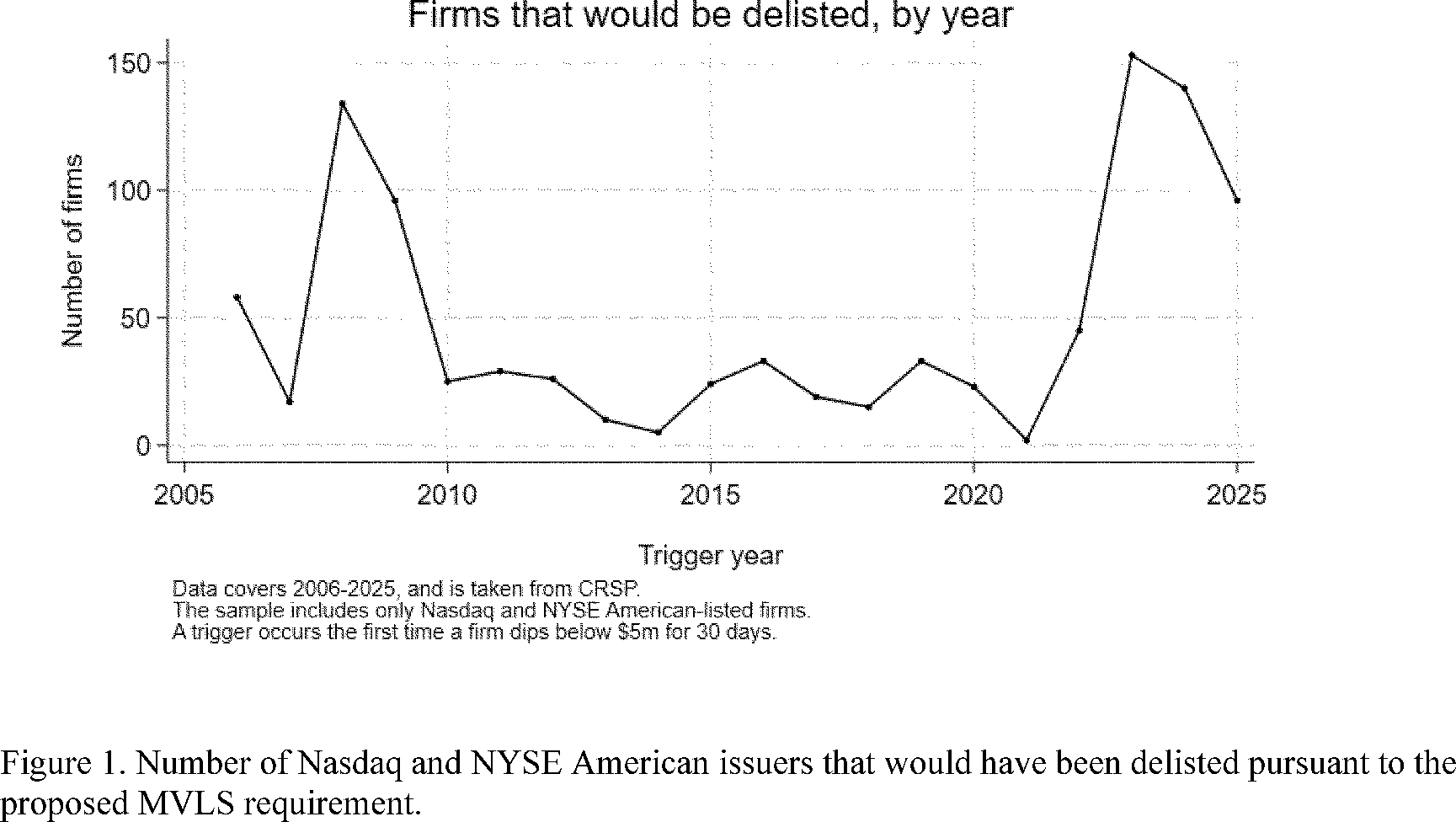
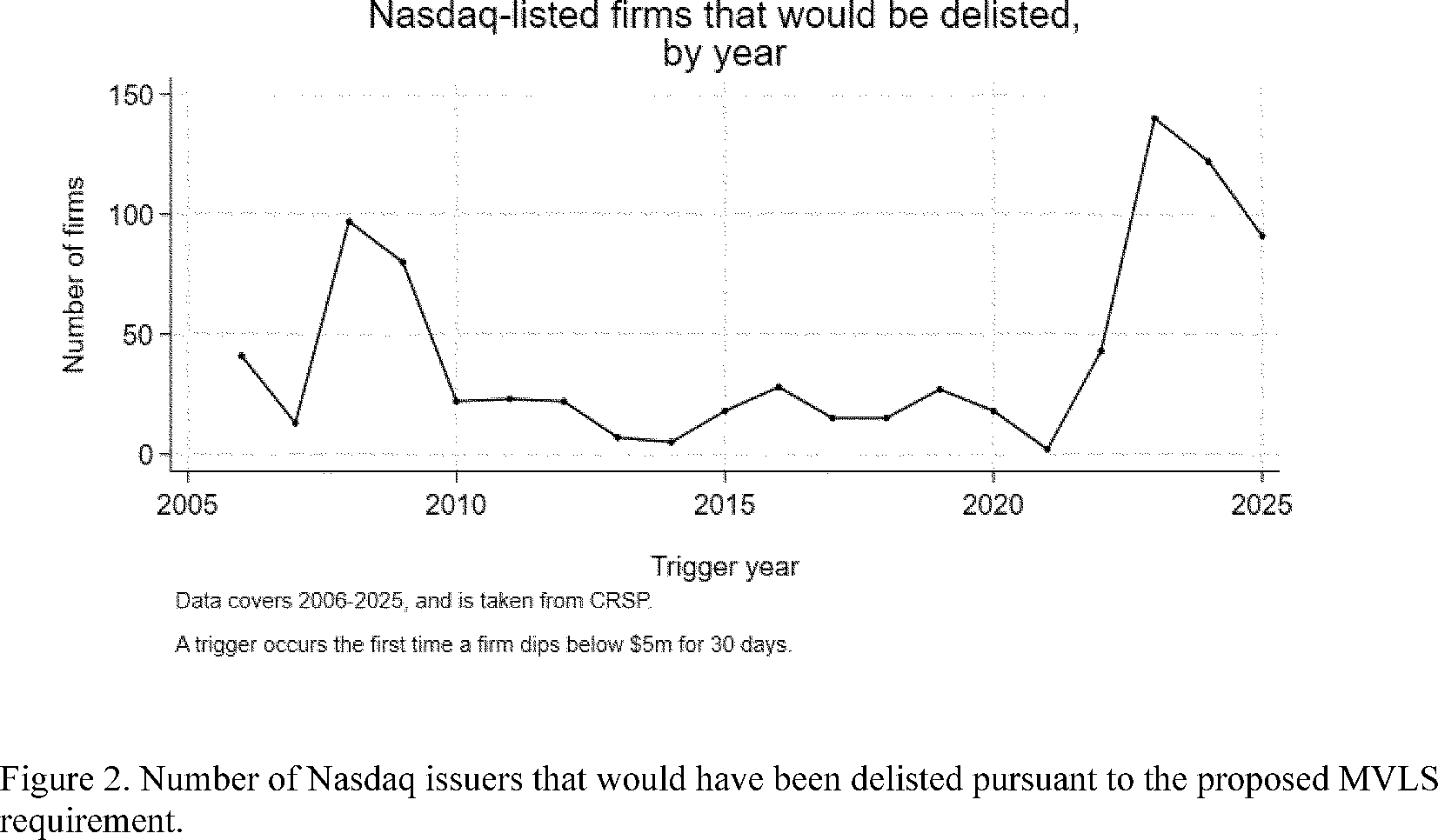
As part of the Commission's consideration of the proposed MVLS Requirement, the Commission analyzed stock price and delistings data for companies listed on Nasdaq and on NYSE American.[54]
The results of the Commission's analysis show that the number of issuers that would have failed to comply with the MVLS Requirement, if such requirement had been in place at the time, increased sharply from 2 issuers in 2021 to 140 issuers in 2023.[55] Although the numbers decreased to 122 issuers in 2024, and 91 issuers in 2025, they are still higher than during the rest of the sample period, apart from 2008.
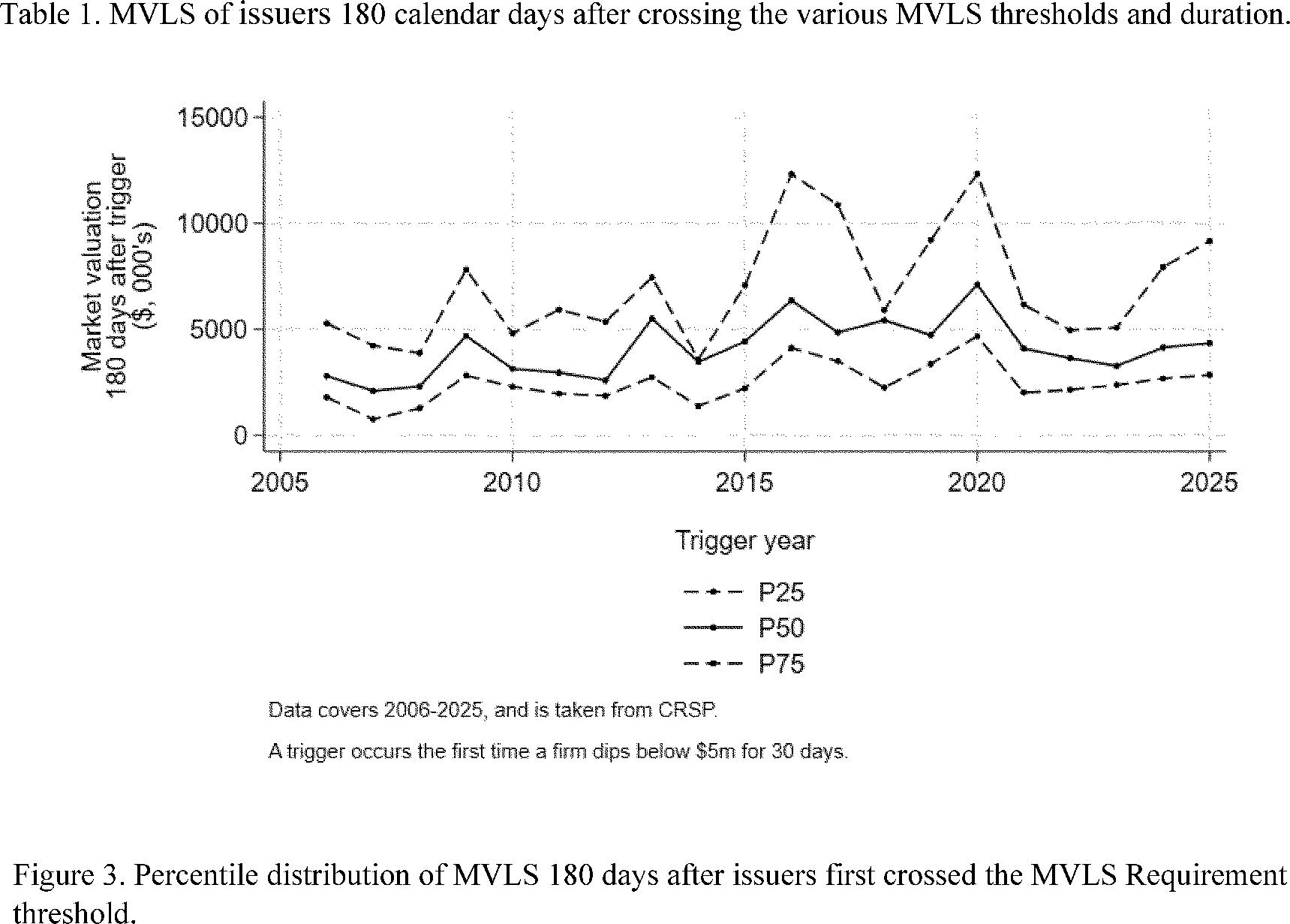
In addition, the Commission analyzed the relationship of securities that crossed specific MVLS thresholds between $1 million and $50 million, for various time durations between 30 and 90 trading days, and their MVLS after 180 calendar days of first crossing a specific MVLS threshold and specific duration.[56] According to the analysis, regardless of the MVLS threshold or time parameter selected, the median MVLS after 180 days is below the specific MVLS threshold. This result generally holds true for the MVLS Requirement ( i.e., below $5 million MVLS for 30 business days) over the sample period.[57] 65% of the issuers that failed to comply with the MVLS Requirement had a MVLS under $5 million after 180 days, with the median valuation under $3.7 million.
| Market cap threshold ($, 000's) | Days below threshold | Companies that would have been delisted | Market capitalization of companies 180 calendar days after crossing the threshold ($, 000's) | ||||
|---|---|---|---|---|---|---|---|
| Sample statistics: | |||||||
| Average | P25 | P50 | P75 | P90 | |||
| $50,000 | 30 | 4,342 | $39,321 | $14,918 | $27,990 | $44,132 | $65,029 |
| 20,000 | 30 | 2,912 | 18,512 | 6,778 | 11,932 | 18,854 | 32,476 |
| 10,000 | 30 | 1,910 | 10,758 | 3,653 | 6,377 | 10,651 | 19,014 |
| 7,000 | 30 | 1,370 | 8,803 | 2,772 | 4,678 | 7,601 | 13,935 |
| 5,000 | 30 | 983 | 8,278 | 2,195 | 3,699 | 6,384 | 12,322 |
| 3,000 | 30 | 509 | 8,515 | 1,368 | 2,588 | 4,597 | 9,666 |
| 1,000 | 30 | 70 | 10,352 | 481 | 851 | 2,727 | 11,480 |
| 50,000 | 60 | 4,080 | 34,122 | 13,097 | 25,531 | 41,556 | 60,792 |
| 20,000 | 60 | 2,571 | 19,499 | 5,751 | 10,621 | 17,754 | 28,846 |
| 10,000 | 60 | 1,520 | 10,080 | 3,263 | 5,726 | 9,213 | 16,642 |
| 7,000 | 60 | 1,072 | 8,344 | 2,436 | 4,161 | 6,922 | 12,120 |
| 5,000 | 60 | 711 | 7,997 | 1,800 | 3,302 | 5,654 | 10,715 |
| 3,000 | 60 | 310 | 3,976 | 1,222 | 2,193 | 3,603 | 6,991 |
| 1,000 | 60 | 39 | 10,433 | 402 | 835 | 4,075 | 21,380 |
| 50,000 | 90 | 3,829 | 34,410 | 11,971 | 23,732 | 39,744 | 58,990 |
| 20,000 | 90 | 2,286 | 15,475 | 5,382 | 9,760 | 16,367 | 28,097 |
| 10,000 | 90 | 1,277 | 9,790 | 2,994 | 5,273 | 8,508 | 16,008 |
| 7,000 | 90 | 859 | 9,297 | 2,325 | 3,937 | 6,615 | 12,419 |
| 5,000 | 90 | 539 | 9,177 | 1,760 | 2,937 | 5,150 | 10,279 |
| 3,000 | 90 | 210 | 4,891 | 1,187 | 2,038 | 3,207 | 6,710 |
| ( printed page 47001) | |||||||
| 1,000 | 90 | 20 | 3,104 | 332 | 651 | 1,416 | 11,965 |
The Commission's analysis also shows that issuers that would have failed to comply with the MVLS Requirement had a high likelihood of being delisted for reasons that indicate a failure to comply with other quantitative continued listing requirements.[58] Historically, when an issuer failed to comply with the MVLS Requirement and was later delisted, such delisting, at the median, occurred 259 days later, and at the 75th percentile, 638 days later.[59]
( printed page 47002)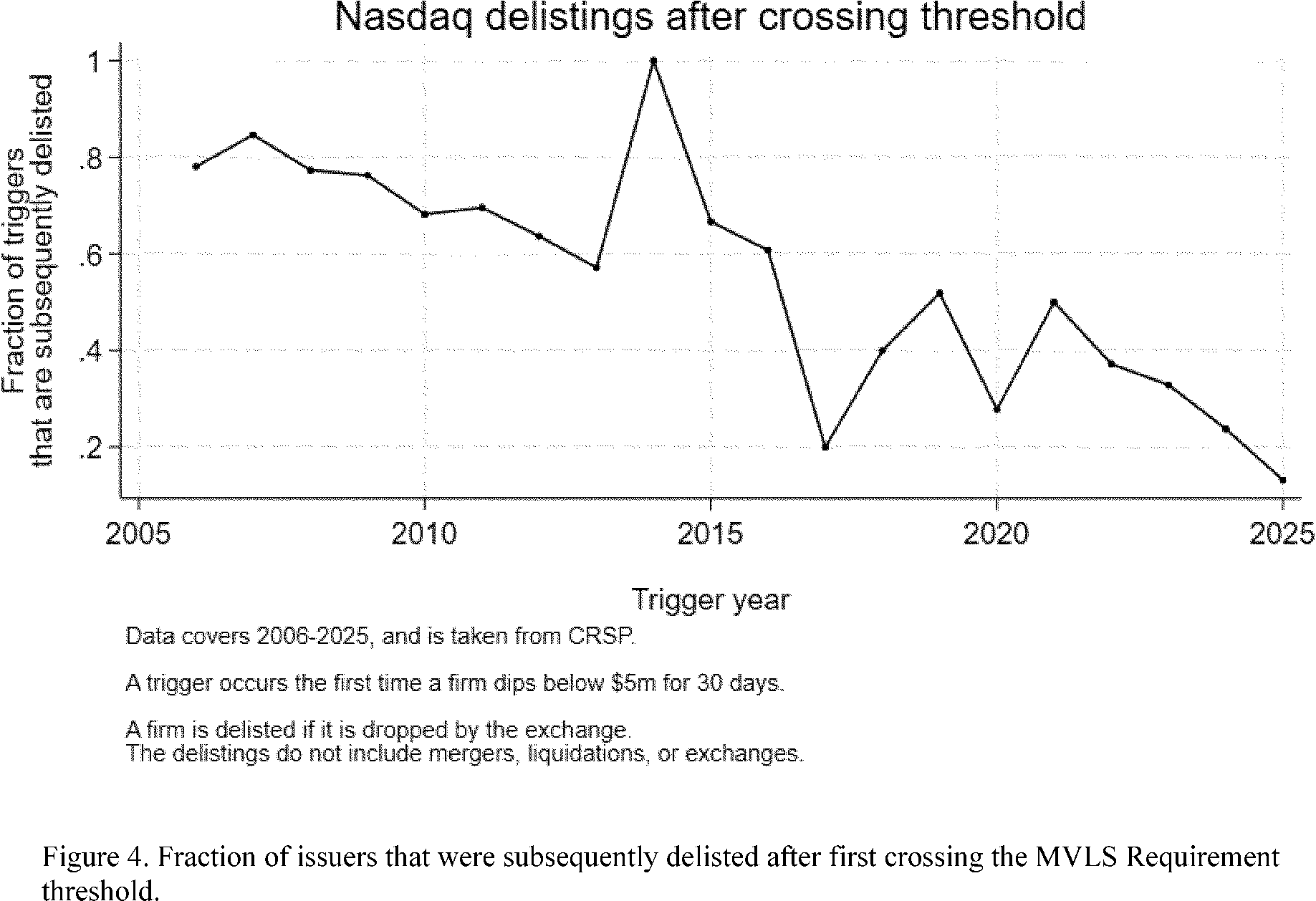
Finally, the Commission's analysis indicates a fundamental tradeoff inherent in selecting a threshold for delisting: a more stringent threshold ( i.e., higher MVLS or shorter duration) would capture issuers that will eventually be delisted for other reasons, but also implicate issuers that otherwise would have remained above the threshold and stayed listed.[60]
| Market cap threshold ($, 000's) | Days below threshold | Companies that would have been delisted | Expedited delistings | False positives | False negatives | False positives as a fraction of companies that would have been delisted |
|---|---|---|---|---|---|---|
| 50,000 | 30 | 4,342 | 1,670 | 2,672 | 320 | 62% |
| 20,000 | 30 | 2,912 | 1,365 | 1,547 | 625 | 53 |
| 10,000 | 30 | 1,910 | 941 | 969 | 1,049 | 51 |
| 7,000 | 30 | 1,370 | 695 | 675 | 1,295 | 49 |
| 5,000 | 30 | 983 | 486 | 497 | 1,504 | 51 |
| 3,000 | 30 | 509 | 250 | 259 | 1,740 | 51 |
| 1,000 | 30 | 70 | 43 | 27 | 1,947 | 39 |
| 50,000 | 60 | 4,080 | 1,597 | 2,483 | 393 | 61 |
| 20,000 | 60 | 2,571 | 1,194 | 1,377 | 796 | 54 |
| 10,000 | 60 | 1,520 | 743 | 777 | 1,247 | 51 |
| 7,000 | 60 | 1,072 | 522 | 550 | 1,468 | 51 |
| 5,000 | 60 | 711 | 337 | 374 | 1,653 | 53 |
| 3,000 | 60 | 310 | 156 | 154 | 1,834 | 50 |
| 1,000 | 60 | 39 | 22 | 17 | 1,968 | 44 |
| 50,000 | 90 | 3,829 | 1,524 | 2,305 | 466 | 60 |
| 20,000 | 90 | 2,286 | 1,047 | 1,239 | 943 | 54 |
| 10,000 | 90 | 1,277 | 600 | 677 | 1,390 | 53 |
| 7,000 | 90 | 859 | 391 | 468 | 1,599 | 54 |
| ( printed page 47003) | ||||||
| 5,000 | 90 | 539 | 249 | 290 | 1,741 | 54 |
| 3,000 | 90 | 210 | 103 | 107 | 1,887 | 51 |
| 1,000 | 90 | 20 | 11 | 9 | 1,979 | 45 |
The Exchange has identified risks pertaining to securities with an MVLS below $5 million, including a heightened susceptibility to manipulation and difficulty maintaining fair and orderly markets in these securities. The results of the Commission's analysis support approval of the Exchange's proposal to impose the MVLS Requirement. The increased number of securities with an MVLS below $5 million in recent years, along with the significant likelihood that such securities will eventually be delisted, warrants the Exchange's consideration of the continued listing of securities with a low level of market capitalization.[61] Moreover, when securities have an MVLS under $5 million for 30 consecutive business days, there is a significant likelihood that they will continue to have an MVLS under $5 million after another 180 calendar days, which is a significant period of time.[62] The Commission recognizes that securities with a small market capitalization may be more prone to manipulation. When a security has a smaller market capitalization, the cost required to accumulate a position from the public float that is large enough to influence the price of the security is reduced. Accordingly, a would-be manipulator may find it less costly to manipulate the price of the security. Thus, the continued listing of companies with low MVLS raises concerns that these securities may have heightened susceptibility to manipulation. These concerns are exacerbated if the security lacks a sufficient public float, investor base, or natural trading interest that could otherwise mitigate the susceptibility to manipulation by promoting fair and orderly markets in the security.
It is reasonable for the Exchange to determine to raise its listing standards and list only securities of a higher quality. The imprimatur of listing on a particular exchange derives from investors' expectations that the listed issuer meets certain standards set by the exchange and that a listing exchange will use its judgment regarding the level at which to set those standards.[63] Those standards are informed by an exchange's regulatory and commercial considerations and the Act provides exchanges with discretion, subject to the requirements of the Act, to set those standards as they see fit with the understanding that not all companies will meet those standards initially or over time. Moreover, the addition of the MVLS Requirement is not unfairly discriminatory because the proposed standard is reasonably tailored to the Exchange's goal of addressing the risks that it has identified with respect to securities with a small market capitalization. The $5 million MVLS threshold will provide for a level of market capitalization below which there may be a heightened susceptibility to manipulation and difficulties maintaining fair and orderly markets in these securities. And the requirement that a security must remain below $5 million MVLS for 30 consecutive business days before being subject to immediate suspension and delisting will target instances where securities have demonstrated a significant longevity of these risks. Therefore, the Commission finds that the Exchange's proposal, as set forth in Amendment No. 1, to immediately suspend and delist companies that fail to comply with the MVLS Requirement is reasonably designed and consistent with the requirements of Section 6(b)(5) of the Act that the rules of the Exchange be designed to prevent fraudulent and manipulative acts and practices, promote just and equitable principles of trade, protect investors and the public interest, and not be designed to permit unfair discrimination between customers, issuers, brokers, or dealers.
1. Comments Regarding the MVLS Threshold
Several commenters stated that the proposed $5 million MVLS threshold would result in the delisting of companies based on sector-specific [64] or market or global situational factors [65] that may cause temporary declines in a company's valuation unrelated to its actual financial health.[66] Commenters ( printed page 47004) also raised concerns that the proposal unfairly discriminates against and would disproportionately burden emerging and tightly held companies, as well as small cap companies.[67] Two commenters stated that there would be a disparate impact on emerging and small cap companies as these companies regularly experience volatile market conditions that result in fluctuations in share prices and market capitalization on a day-to-day basis.[68] One of these commenters further stated that the proposal may disproportionately impact tightly held issuers, whose investors do not trade actively and therefore do not contribute to the stock's public float.[69]
Commenters also took the position that the proposal would lead to delisting of some companies that may recover.[70] One of these commenters attached a report by Professor Craig M. Lewis that presents an empirical study raising concerns that the proposal may prematurely delist companies that would otherwise regain compliance.[71] The Lewis Report analyzed approximately 816 companies that fell below the $5 million threshold for 30 days between 2006 and 2025, and concluded that “temporarily falling below the proposed threshold is not a reliable indicator of permanent failure.” [72] The Lewis Report stated that of the 816 companies that would have been delisted based on the proposal, 78% recovered once above the $5 million threshold during the time period studied, 45% of the 816 companies are not delisted, and 212 companies are trading above $5 million, representing over $22 billion in current market capitalization.[73] One commenter, citing the Lewis Report, stated “[t]he Exchange's contention that . . . issuers cannot recover is, in our respectful view, directly contradicted by . . . evidence from the Exchange's own historical listing data.” [74] Another commenter stated that the evidentiary record does not support Nasdaq's premise that a sustained MVLS below $5 million is a reliable indicator of fundamental, non-temporary distress and heightened investor protection risk, such that an issuer is unlikely to regain and sustain compliance.[75]
The Exchange stated that it acknowledges the position taken by several commenters that some companies with a low market capitalization may meaningfully recover and states that it modified the Initial Proposal to allow the Hearings Panel to grant an exception from the Staff Delisting Determination for a period not to exceed 180 days for a company to demonstrate compliance with initial listing requirements.[76] According to the Exchange, this revision addresses concerns raised by commenters that the Initial Proposal did not accommodate scenarios where situational factors result in temporary declines in a company's valuation that are unrelated to its actual financial health.[77]
The Commission recognizes the overall conclusion of the Lewis Report that the Exchange's proposal to immediately suspend and delist securities that fail to comply with the MVLS Requirement may result in the delisting of companies that later recover and that some of those companies may otherwise have remained listed on the Exchange. Both the Commission's analysis and the Lewis Report agree that a significant number of companies that failed to comply with the MVLS Requirement did not recover. Moreover, as discussed above, the Commission's analysis shows that 65% of the issuers that failed to comply with the MVLS Requirement had a MVLS under $5 million after 180 days.[78] Even if some of the issuers that remained below $5 million MVLS after 180 days eventually recovered, this analysis indicates that such issuers may persist with an MVLS below $5 million for an extended period of time. Given that the Exchange has identified risks that securities with a small market capitalization have heightened susceptibility to manipulative trading activity and that there may be difficulty maintaining fair and orderly markets in these securities, it is not unfairly discriminatory and is consistent with Section 6(b)(5) of the Act for the Exchange to immediately suspend and delist securities that fall below the MVLS Requirement.
Some commenters expressed concern that factors influencing MVLS may be outside the company's control and therefore a company's MVLS is not a reliable indicator of performance.[79] Many of these commenters stated that a company's MVLS can be impacted by directional pressure exerted by opportunistic traders and short sellers.[80] Further, one commenter stated that temporary market dislocations based on market dynamics, rather than economic reality, could affect a company's MVLS.[81] In response, the Exchange states that MVLS is based on the number of securities issued and outstanding and market value. According to the Exchange, the number of securities issued and outstanding is entirely within the company's control.[82] The Exchange also states that the value of a company is based primarily on the company's prospects, and that an MVLS of below $5 million is therefore a good indication that continued listing is not appropriate.[83]
Several commenters stated that the rigid $5 million MVLS threshold, coupled with automatic suspension after 30 consecutive business days, could increase the potential for manipulative trading and market abuse ( printed page 47005) in an effort to drive down the value of a company's stock, causing a company to be delisted.[84] In particular, commenters stated the $5 million MVLS threshold and requirement that a company be below that threshold for 30 consecutive business days could incentivize short selling activity in smaller companies to drive the market value of these companies below the $5 million MVLS threshold and keep it there for the time period required to trigger delisting.[85] Commenters also stated that the threat of delisting may contribute to and encourage further downward price pressure and incentivize opportunistic trading behavior, and a company's stock may experience increased volatility and reduced liquidity in the period leading up to potential delisting.[86] One of these commenters stated that rational investors will discount the stock prices of companies near the threshold to account for the possibility of forced delisting; analysts and counterparties may hesitate to engage with companies facing even a remote possibility of exchange removal.[87]
In response, the Exchange states that market manipulation is illegal and commenters should submit any evidence of violations to the appropriate authorities for investigation and enforcement.[88] The Exchange also states that it has a multitude of Commission-approved price-based listing requirements, all of which could be accused of encouraging the same type of activity, and commenters provide no actual evidence of the activities they speculate will occur.[89]
MVLS, as a combination of the quantity of listed securities and their market value, is a reasonable measure to be used in a quantitative listing standard to determine whether a company should continue to be listed on the Exchange.[90] While commenters expressed concern that the MVLS Requirement would create an incentive for opportunistic trading behavior, or for bad actors to manipulate the price of a company's securities to trigger immediate suspension and delisting (including that the 30 consecutive business day measurement period may contribute to this risk), the 30 consecutive business day requirement associated with the $5 million MVLS threshold could mitigate the risk of actual opportunistic or manipulative activities for the purpose of triggering immediate suspension and delisting. As discussed above, the immediate suspension and delisting of securities that fall below the MVLS Requirement would prevent continued listing of securities that may have a heightened susceptibility to manipulative trading activity.
2. Comments Regarding the Lack of a Cure Period
Several commenters raised concerns about the proposal's absence of a cure or compliance period that would allow companies that fail to comply with the MVLS Requirement to regain compliance before being delisted.[91] In particular, commenters stated that this lack of a compliance period is inconsistent with the compliance periods that Exchange rules provide for companies that fall below certain other continued listing requirements, such as a failure to maintain a minimum bid price of $1.00 per share.[92] According to one commenter, a 180-day compliance period is one of the “principal mechanisms by which temporarily distressed but ultimately viable issuers complete capital-raising transactions and return to compliance.” [93]
However, in support of the absence of a cure period, one commenter stated that the application of the proposal only after an issuer remains below the minimum MVLS threshold for 30 consecutive business days is a “meaningful persistence requirement” and a “feature [that] helps distinguish sustained deterioration from temporary volatility.” [94] According to the commenter, once this condition is met, the Exchange may reasonably conclude that a cure period would “unnecessarily prolong” heightened risks of manipulation, investor confusion, and diminished market quality.[95] The Exchange states that it agrees with this commenter's position.[96]
While the Commission acknowledges that Exchange rules provide for a cure period for failure to meet certain continuing listing standards, the Exchange has proposed to immediately suspend and delist companies whose MVLS falls below $5 million for 30 consecutive business days based on concerns that such companies may have a heightened susceptibility to manipulation.[97] A company's failure to comply with the MVLS Requirement may be indicative of serious difficulties within such company that are likely to continue to put downward pressure on the stock price, such that there may not be a sufficient likelihood that the company would regain a $5 million MVLS threshold within a compliance period. As discussed above, and according to the Commission's analysis, 65% of the issuers that failed to comply with the MVLS Requirement had a MVLS under $5 million after 180 days, with the median valuation under $3.7 ( printed page 47006) million. The Commission's analysis supports a conclusion that the ability of companies to regain $5 million MVLS within 180 days after failing to comply with such MVLS threshold is limited.[98] Companies that fail to meet the MVLS Requirement may have heightened susceptibility to manipulative trading activity, contrary to the goal of protecting investors and the public interest. Thus while, in part, the delisting process is designed to allow companies experiencing temporary financial or business issues to regain compliance with continued listing standards, the Exchange's proposal, as set forth in Amendment No. 1, reasonably balances this design with the need to prevent the prolonged trading of such companies.
3. Comments Regarding Need for the Proposed Rule Change
Several commenters stated that the proposal overlaps with recently adopted rules related to continued listing and Exchange proposals designed to address the same low-valuation risk factors identified in the current proposal.[99] In addition, commenters stated that the Commission should first observe and consider the effects of recent and pending changes to Exchange listing rules before considering harsher standards.[100] Commenters also stated that the companies that are not able to sustain an MVLS of at least $5 million do not appear to pose heightened risks to investors that are not already addressed by existing Nasdaq requirements.[101]
While existing Nasdaq continued listing requirements may address some similar concerns, as discussed above, the risks of heightened susceptibility to manipulative trading activity and difficulty maintaining fair and orderly markets in the securities of companies that are not able to sustain an MVLS of at least $5 million support the adoption of the proposed MVLS Requirement. The Exchange has proposed, and the Commission has approved, certain price-based continued listing requirements that reduce the period of time for a company to regain compliance based on investor protection concerns.[102] The current proposal and rules that the Commission approved previously address different continued listing requirements and work in tandem to address similar Exchange concerns with lower-priced securities. For example, the Commission stated in the context of removing compliance periods for securities that have had excessive reverse stock splits and securities that are trading at very low prices,[103] that there were investor protection concerns with allowing the securities identified in that proposal to have an extended period of time to regain compliance with the relevant requirements.[104] Similar to the Reverse Stock Split Proposal, the Exchange states that companies identified in this proposal are not usually experiencing temporary problems and have other compliance issues.[105] Moreover, while a reverse stock split increases a company's stock price, it does not directly change the company's MVLS.[106] If a company is trading at a price compliant with the relevant bid price requirements, but has a very low MVLS, it could continue to be susceptible to manipulative trading.
One commenter referenced the recently adopted Nasdaq Rule IM-5101-4 and stated that the Commission's rationale when approving the rule—that concerns about securities susceptible to manipulation would be addressed through a case-by-case process tied to trading activity—is contradictory with the “automatic MVLS trigger with no cure period and no comparable individualized assessment” of the current proposal.[107] However, Nasdaq Rule IM-5101-4 provides that the Exchange may exercise its authority under Nasdaq Rule 5101 to delist the security where a security exhibits trading activity that is indicative of potential manipulation and the Commission has implemented a temporary trading suspension of that security pursuant to Section 12(k) of the Act (“Section 12(k) suspension”).[108] Given that Nasdaq Rule IM-5101-4 is specific to instances where there has been a Section 12(k) suspension, any overlap with the current proposal would be minimal. Further, the Commission recognizes that the Exchange's discretionary authority under Nasdaq Rule 5101 complements its quantitative listing requirements that provide explicit standards that are clearly stated and can be applied uniformly.
4. Comments Regarding Effects on Delisted Companies
Several commenters stated that the proposal would make raising capital more difficult for small companies.[109] One commenter discussed the benefits of exchange listing for both smaller companies and investors in the context ( printed page 47007) of cost of capital.[110] Specifically, this commenter stated that exchange listing provides smaller companies access to a larger set of investors and greater liquidity through access to secondary markets and allows investors to benefit from a set of Commission rules designed to enhance and organize the flow of information to investors.[111] The commenter concluded that this lowers the cost of capital because investors “are willing to pay a premium for the ability to trade easily,” and “are more willing to make long-dated investments when they know their positions can be readily transferred to other investors.” [112] The commenter further stated that investors are less inclined to invest in, and lenders are less willing to extend financing, to companies trading close to the bright-line threshold, which intensifies the downward price pressure.[113]
One commenter stated that the proposal may incentivize smaller issuers to seek listing on less regulated venues, rely more heavily on private capital markets with reduced transparency, or delay or forgo public listing.[114] Another commenter stated that the proposal may increase risk to investors by incentivizing companies “to engage in value-distorting actions,” including “reverse stock splits, overly dilutive financings, excessive marketing campaigns or premature asset sales.” [115]
Several commenters discussed the negative consequences of trading in the OTC market upon immediate delisting and suspension.[116] Commenters stated that when a security is delisted and moves from Nasdaq to the OTC market, the price of such security experiences further decline because institutional investors with exchange-listing mandates will liquidate positions, market makers will withdraw, analyst coverage will cease, and liquidity will decline.[117] One commenter believed that such consequences, in addition to elimination of the regulatory and disclosure framework that exchange listing provides, would harm retail investors, “who disproportionately hold micro-cap securities.” [118] Several commenters also stated that shareholders may face difficulty exiting positions without significant price concessions.[119] Several commenters further stated that many OTC issuers are not subject to the same shareholder approval requirements for significant corporate actions, leaving retail investors with fewer procedural protections and limited resources in the event of materially adverse corporate actions.[120] Several commenters stated that trading in the OTC market would impact their access to the equity capital markets, cause reputational harm, and directly impair their ability to fund developments.[121] One commenter discussed the benefits of the regulatory framework for exchange-listed securities, which are NMS securities.[122] On the contrary, another commenter stated that the OTC markets “are valuable trading venues that serve capital formation for small, large, and emerging companies.” [123]
Several commenters stated that the proposal's disproportionate burden on small-cap issuers, emerging growth companies, and issuers operating in developing sectors is an unnecessary burden on competition under Section 6(b)(8) of the Act.[124] In particular, one commenter stated that the MVLS Requirement imposes a disproportionate compliance burden on micro-cap and small-cap issuers.[125]
In response, the Exchange states that the proposal balances the goals of capital formation and investor protection by setting a transparent threshold where sustained trading under that threshold results in suspension of trading and delisting of the securities.[126] The Exchange believes that any incidental burden on affected companies is necessary to better protect prospective investors and in furtherance of the purpose of the Act.[127]
The Commission acknowledges that there are many benefits to companies and their shareholders related to being listed on a national securities exchange, including increased access to capital formation and promotion of market efficiency. Commenters have raised concerns that delisting companies that fall below the MVLS Requirement may lead to several negative outcomes, including, but not limited to, making raising capital more difficult for small companies [128] and incentivizing smaller issuers to seek listing on less regulated venues.[129] However, the benefits of listing and possible consequences of delisting do not override the need for an exchange to maintain and enforce continued listing standards such that the proposed rule would not be consistent with Section 6(b)(5) or Section 6(b)(8) of the Act. As discussed above, the immediate suspension and delisting of companies that do not comply with the MVLS Requirement will address identified risks of heightened susceptibility to manipulative trading activity and difficulty maintaining fair and orderly markets in these securities, and it is not unfairly discriminatory to impose a standard that is reasonably tailored to address those risks. Moreover, companies that fail to comply with the MVLS Requirement and are subsequently delisted will continue to be able to trade in the OTC market, which provides a viable alternative for the trading of companies that do not meet the requirements for Exchange ( printed page 47008) listing. These companies may also apply for Exchange listing in the future. The Exchange's proposal to immediately suspend and delist companies that fail to comply with the MVLS Requirement, as set forth in Amendment No. 1, is reasonably designed to prevent fraudulent and manipulative acts and practices, promote just and equitable principles of trade, and protect investors and the public interest, consistent with Section 6(b)(5) of the Act. Accordingly, the Exchange's proposal is not designed to permit unfair discrimination between customers, issuers, brokers, or dealers, consistent with Section 6(b)(5) of the Act; and will not impose any burden on competition that is not necessary or appropriate in furtherance of the purposes of the Act, consistent with Section 6(b)(8) of the Act.
5. Comments Suggesting Alternatives
Several commenters suggested alternatives to the proposal.[130] One commenter suggested imposing stricter initial listing guidelines, rather than changing the continued listing requirements.[131] Another commenter suggested using quantitative thresholds ( e.g., involving cash and cash equivalents, net tangible assets, readily marketable securities or digital assets, or sufficient working capital) rather than MVLS.[132] Two commenters that support the proposal suggested that the Exchange consider using market capitalization measures that only consider publicly held shares ( i.e., Market Value of Publicly Held Shares and Market Value of Unrestricted Publicly Held Shares) rather than MVLS.[133] Another commenter suggested expanding the MVLS calculation to include securities that are not listed on the Exchange.[134] Other commenters suggested that the Exchange use an averaging methodology for measuring sustained non-compliance with the minimum $5 million MVLS standard.[135] One commenter, who supports the proposal, stated that it believes the $5 million MVLS threshold may not be sufficient and recommended that the Commission monitor, on an ongoing basis, the effectiveness of the proposed rule upon adoption.[136]
Other commenters suggested that the Exchange provide enhanced public disclosures once an issuer approaches the minimum $5 million MVLS threshold,[137] while another commenter recommended the Exchange use an enhanced monitoring mechanism for issuers approaching the threshold to allow heightened oversight without immediate suspension.[138] Two commenters suggested that the Exchange conduct a qualitative review of a company on a case-by-case basis prior to delisting,[139] while another commenter recommended the Exchange adopt a mechanism for considering sector-specific or situational and qualitative factors.[140] Another commenter recommended extending the deficiency period from 30 days to 120 days.[141] Other commenters suggested that there should be a compliance period to allow companies to take corrective action for deficiencies [142] and that the Hearings Panel should be permitted to make additional considerations before suspension.[143] One commenter requested that, if the proposal were approved, effectiveness of the changes should be delayed for no less than 12 months.[144]
Even if commenters' suggestions could provide alternative means to address concerns that securities with low market capitalization are susceptible to manipulative trading activity and may present difficulties with the maintenance of fair and orderly markets in these securities, these suggestions are not part of Nasdaq's proposal and the Commission must approve the proposal if it finds the proposal is consistent with the Act and the rules thereunder.[145] For the reasons discussed herein, the Exchange's proposal to immediately suspend and delist companies that fail to comply with the MVLS Requirement, as set forth in Amendment No. 1, is reasonably designed to prevent fraudulent and manipulative acts and practices, to protect investors and public interest, and is not designed to permit unfair discrimination between customers, issuers, brokers, or dealers, consistent with Section 6(b)(5) of the Act.
B. Lack of a Stay Pending Hearings Panel Review
The Exchange proposes to amend Nasdaq Rule 5815(a)(1)(B) to provide that a timely request for a hearing will not stay the suspension of the securities from trading pending the issuance of a written Hearings Panel decision where the company received a Staff Delisting Determination due to a failure to comply with the MVLS Requirement.[146] According to the Exchange, given the difficulties associated with maintaining fair and orderly markets in securities of low value companies, it is not appropriate for these companies to continue trading during the pendency of the Hearings Panel review process.[147] Companies may appeal the Staff Delisting Determination to the Hearings Panel, but the companies' securities will generally trade in the OTC market while the appeal is pending.[148]
Several commenters raised concerns regarding the removal of the automatic stay of suspension pending Hearings Panel review.[149] Several commenters opposed the proposal to amend Nasdaq Rule 5815(a)(1)(B)(ii) to provide that a hearing request shall not stay the suspension of trading when there is a deficiency relating to the MVLS Requirement, and stated that a stay pending appeal is an important procedural safeguard for listed companies to receive meaningful review before facing the harms caused by suspension and being relegated to trade on the OTC market.[150] One of these commenters stated that the lack of a stay of the suspension of trading pending review renders appeal rights “largely illusory” and that the stay pending appeal is “a fundamental safeguard that ensures listed companies receive ( printed page 47009) meaningful review before suffering the severe consequences of delisting.” [151] Another commenter stated that in the absence of a stay, issuers will “suffer[ ] the full adverse effects of delisting—loss of liquidity, institutional selling pressure, and reputational harm—before any review occurs.” [152] Several commenters stated that the absence of an opportunity for a hearing before the Hearings Panel before suspension of trading would violate issuers' rights to procedural due process and the fair procedure requirement under Section 6(b)(7) of the Act.[153]
In response, the Exchange states that it continues to believe that immediate suspension from trading for a company that failed to maintain the MVLS Requirement is appropriate, and references previous Commission statements in In re Tassaway.[154] The Exchange also points to the statements by supporting commenters, who disagree that automatic delisting for failing to maintain the MVLS Requirement will cause “severe and irreversible harm to affected companies by moving them to the OTC markets.” [155] The Exchange states that, in its own experience, companies can take action to regain compliance while trading in the OTC market.[156]
As discussed above, a company that fails to comply with the MVLS Requirement may be likely to have an insufficient investor base, public float, and trading interest necessary to promote fair and orderly markets in their securities and relatedly may have heightened susceptibility to manipulation. It is consistent with investor protection to prohibit the securities of such companies from continuing to trade on the Exchange during a review of the delisting determination.[157] Given these concerns, the Exchange's proposal, as set forth in Amendment No. 1, to immediately suspend and delist companies that fail to comply with the MVLS Requirement is reasonably designed to prevent fraudulent and manipulative acts and practices, to promote just and equitable principles of trade, to protect investors and the public interest, and is not designed to permit unfair discrimination between customers, issuers, brokers, or dealers, consistent with Section 6(b)(5) of the Act.
The proposal is also consistent with Section 6(b)(7) of the Act in that it provides a fair procedure for the prohibition or limitation by the Exchange of any person with respect to access to services offered. A listed company whose security is subject to immediate suspension and delisting under the proposal after failing to comply with the MVLS Requirement will still be able to seek review of the Staff Delisting Determination by the Hearings Panel, as discussed below.
C. Hearings Panel Review Process
In the Initial Proposal, the Exchange proposed to modify Nasdaq Rule 5815(c)(1)(H) to provide that, in the case of a company that failed to comply with the MVLS Requirement, the Hearings Panel would only be permitted to reverse a delisting decision based on a determination that the Staff Delisting Determination was in error.[158] Under the Initial Proposal, the Hearings Panel would not have been permitted to grant an exception under Nasdaq Rule 5815(c)(1)(A) allowing the company additional time to regain compliance.[159]
Two commenters explicitly supported the proposed modifications to Nasdaq Rule 5815(c)(1)(H) in the Initial Proposal.[160] However, several commenters raised concerns regarding the limitations on Hearings Panel discretion to review the delisting determination under the Initial Proposal.[161] One commenter stated that the proposal to amend Nasdaq Rule 5815(c)(1)(H) would reduce the Hearings Panel to a “ministerial function” and suggested that Nasdaq should allow the Hearings Panel to have full discretion to consider evidence that the company has regained compliance and grant exceptions to allow additional time.[162] Several commenters stated that Nasdaq is not operating within statutory constraints of Section 6(b)(7) of the Act by attaching automatic suspension and delisting consequences to a mechanical price-based trigger, and limiting the scope and practical effectiveness of appellate review.[163]
In response to these concerns, in Amendment No. 1, the Exchange modifies this aspect of the proposal to allow the Hearings Panel, when reviewing a delisting decision based on a company's failure to comply with the MVLS Requirement, to grant an exception of up to 180 days for the company to come back into compliance by satisfying the Exchange's initial listing requirements. Specifically, instead of modifying existing Nasdaq Rule 5815(c)(1)(H),[164] the Exchange ( printed page 47010) proposes to adopt Nasdaq Rule 5815(c)(1)(I) to provide that in the case of a company that received a Staff Delisting Determination notice due to a failure to comply with the MVLS Requirement, the Hearings Panel may reverse a delisting decision where the Hearings Panel determines that the Staff Delisting Determination was in error, or grant an exception for a period not to exceed 180 days from the Staff Delisting Determination for the company to demonstrate that it meets all requirements for initial listing.[165] The Exchange states that it acknowledges that some companies with a low market capitalization may meaningfully recover and therefore their continued listing on the Exchange may be appropriate.[166] The Exchange further states that the proposed addition of Nasdaq Rule 5815(c)(1)(I) appropriately balances the Exchange's obligation to protect investors while allowing a company whose operational and financial difficulties are indeed temporary to demonstrate to an independent Hearings Panel that continued listing is appropriate.[167] Moreover, the Exchange states that requiring companies in these circumstances to satisfy the Exchange's initial listing requirements, which are generally higher than the continued listing requirements, will provide a level of certainty that the company will not immediately fall out of compliance with the MVLS Requirement or any other continued listing requirement.[168]
Several commenters stated that proposed Nasdaq Rule 5815(c)(1)(I) does not provide a meaningful cure period to companies that fail to comply with the MVLS Requirement.[169] One commenter stated that the amended proposal retains “one of the most problematic aspects of the rule” in continuing to deny a company that fails to meet the MVLS Requirement an ordinary stay of suspension pending Hearings Panel review.[170] This commenter also stated that the proposal continues to risk delisting companies that are experiencing a temporary decline in MVLS.[171] Other commenters raised concerns that while the amended proposal provides for a cure period, the decision whether to grant this exception would be entirely within the Hearings Panel's discretion.[172]
Commenters also expressed concern with the proposed requirement that a company that has been delisted, but has been granted an exception to the delisting determination, must meet initial listing standards instead of continued listing standards.[173] One commenter stated “[a]n issuer that has been relegated to the OTC market is less likely to satisfy the higher initial listing standards required for the New Hearings Panel Exception, precisely because the metrics that govern initial listing, including market value of listed securities, market value of publicly held shares, and minimum bid price, deteriorate significantly as a direct consequence of suspension.” [174]
By providing the Hearings Panel the authority to grant an exception to a delisting determination, and allowing up to 180 days for a company to come back into compliance by satisfying the Exchange's initial listing requirements, the proposal will allow the Hearings Panel to determine whether the circumstances demonstrate that it is appropriate to provide a company with an opportunity to regain compliance and continue trading on the Exchange. The requirement that a company must satisfy the Exchange's initial, generally higher, listing standards,[175] rather than simply achieving a $5 million MVLS to regain compliance, will help to ensure that such companies do not immediately fall out of compliance with the proposed MVLS Requirement and other quantitative continued listing requirements. In this way, the proposal reasonably balances the objectives of the delisting process, which, in part, is designed to allow companies experiencing temporary financial or business issues the opportunity to regain compliance with listing standards, with the need to prevent the prolonged trading of the securities of a company that fails to comply with the MVLS Requirement and may experience heightened susceptibility to manipulative trading activity and be less able to maintain fair and orderly markets. Thus, the Exchange's proposal, as set forth in Amendment No. 1, is reasonably designed to prevent fraudulent and manipulative trading practices and to protect investors and public interest and is consistent with Section 6(b)(5) of the Act.
Further, the proposal is consistent with Section 6(b)(7) of the Act in that it provides a fair procedure for the prohibition or limitation by the Exchange of any person with respect to access to services offered. A listed company whose security is subject to immediate suspension and delisting under the proposal after failing to comply with the MVLS Requirement will still be able to seek review of the Staff Delisting Determination by the Hearings Panel. Further, while such company's security will not trade on the Exchange during the pendency of any appeal, the Hearings Panel will continue to have authority under the proposal to grant an exception for a period not to exceed 180 days from Staff Delisting Determination for the company to demonstrate that it meets all requirements for initial listing.[176] Moreover, the Hearings Panel will continue to have the authority to consider any failure to meet any quantitative standard for continued listing, and the company will be given written notice of such consideration and an opportunity to respond.[177] The company will also continue to be able to appeal a Hearings Panel decision to the Listing Council.[178]
For these reasons, the Commission finds that the proposed rule change, as modified by Amendment No. 1, is consistent with the Act.
IV. Conclusion
It is therefore ordered, pursuant to Section 19(b)(2) of the Act,[179] that the ( printed page 47011) proposed rule change (SR-NASDAQ-2026-004), as modified by Amendment No. 1, be and hereby is, approved.
For the Commission, by the Division of Trading and Markets, pursuant to delegated authority.[180]
Sherry R. Haywood,
Assistant Secretary.
 15 U.S.C. 78s(b)(1)
 17 CFR 240.19b-4
 www.sec.gov/rules-regulations/public-comments/sr-nasdaq-2026-004
 indexes.morningstar.com/docs/guide/crsp-us-stock-databases-data-descriptions-guide-for-crspaccess-fiz?isRdp=true