Black Lung Benefits Act: Authorization of Self-Insurers
The Department is proposing revisions to regulations under the Black Lung Benefits Act (BLBA or the Act) governing authorization of self-insurers. These rules will determine the...
Office of Workers' Compensation Programs, Department of Labor.
ACTION:
Notice of proposed rulemaking; request for comments.
SUMMARY:
The Department is proposing revisions to regulations under the Black Lung Benefits Act (BLBA or the Act) governing authorization of self-insurers. These rules will determine the process for coal mine operators to apply for authorization to self-insure, the requirements operators must meet to qualify to self-insure, the amount of security self-insured operators must provide, and the types of security accepted for operators to self-insure.
DATES:
The Department invites written comments on the proposed regulations from interested parties. Written comments must be received by September 28, 2026.
ADDRESSES:
You may submit written comments by any of the following methods. To facilitate receipt and processing of comments, the Office of Workers' Compensation Programs (OWCP) encourages interested parties to submit their comments electronically.
Federal eRulemaking Portal:www.regulations.gov.
Follow the instructions on the website for submitting comments. Pursuant to the Administrative Procedure Act at 5 U.S.C. 553(b)(4), a plain language summary of the rule may also be found on the Federal eRulemaking Portal.
( printed page 48003)
Facsimile:
(202) 693-1395 (this is not a toll-free number). Only comments of ten or fewer pages, including a fax cover sheet and attachments, if any, will be accepted by fax.
Regular Mail/Hand Delivery/Courier:
Submit comments on paper to the Division of Coal Mine Workers' Compensation Programs, Office of Workers' Compensation Programs, U.S. Department of Labor, 200 Constitution Avenue NW, Suite C3520-DCWMC, Washington, DC 20210. The Department's receipt of U.S. mail may be significantly delayed due to security procedures. You must take this into consideration when preparing to meet the deadline for submitting comments.
Instructions:
Your submission must include the agency name and the Regulatory Information Number (RIN) for this rulemaking.
Caution:
All comments received will be posted without change to
www.regulations.gov.
Please do not include any personally identifiable or confidential business information you do not want publicly disclosed.
Docket:
For access to the rulemaking docket and to read background documents or comments received, go to
www.regulations.gov.
Although some information (
e.g.,
copyrighted material) may not be available through the website, the entire rulemaking record, including any copyrighted material, will be available for inspection at OWCP. Please contact the individual named below if you would like to inspect the record.
FOR FURTHER INFORMATION CONTACT:
Ryan Jansen, Acting Director, Division of Coal Mine Workers' Compensation, Office of Workers' Compensation Programs, U.S. Department of Labor, 200 Constitution Avenue NW, Suite C3520-DCWMC, Washington, DC 20210. Telephone: 1-800-347-2502. This is a toll-free number. TTY/TDD callers may dial toll-free 1-877-889-5627 for further information.
SUPPLEMENTARY INFORMATION:
I. Background of This Rulemaking
The BLBA, 30 U.S.C. 901-944, provides for the payment of benefits to coal miners and certain of their dependent survivors for total disability or death due to pneumoconiosis, commonly known as black lung disease. 30 U.S.C. 901(a);
Usery
v.
Turner Elkhorn Mining Co.,
428 U.S. 1, 5 (1976). The Act places the primary responsibility for paying benefits on coal mine operators. 30 U.S.C. 932(b). When a coal miner is determined to be eligible for benefits, the operator responsible for paying benefits (the responsible operator) is generally the one that most recently employed the miner for a period of at least one year and is financially capable of paying benefits. 20 CFR 725.495(a)(1).
If a responsible operator cannot be determined, is unable to pay, or defaults on its obligation to pay, the responsibility for paying benefits falls to the Black Lung Disability Trust Fund, which is primarily financed by an excise tax on coal mined for domestic use. 30 U.S.C. 932(j), 934(b); 26 U.S.C. 4121, 9501. If the black lung excise tax revenue is not sufficient to finance the Black Lung benefits due, the trust fund may borrow from the general fund of the Treasury. As of September 30, 2024, the Fund reported a $6.6 billion deficit [1]
and has borrowed from the U.S. Treasury's general fund nearly every year since 1979 to make needed expenditures.[2]
In FY24, OWCP's Black Lung Program paid compensation and medical benefits for 12,911 beneficiaries, totaling approximately $140 million under Part C of title IV of the Act.[3]
Because coal mine operators are principally responsible for paying benefits, the Act requires every operator to secure the payment of benefits for which it may be found liable. 30 U.S.C. 932(b). Each operator must secure the payment of benefits either by purchasing commercial insurance or by qualifying as a self-insurer “in accordance with regulations prescribed by the Secretary.” 30 U.S.C. 933(a);
see also20 CFR 726.1. At the end of FY24, there were 709 Responsible Mine Operators (RMOs) covered by commercial insurance policies containing a Federal Black Lung endorsement. In comparison, 15 RMOs were authorized to self-insure their Federal Black Lung liabilities, which is only two percent of RMOs that could potentially be affected by this rulemaking. There were 10,139 covered beneficiaries being paid by RMOs, either through commercial insurance policies or self-insurance authorization, during this timeframe.[4]
Regulations—20 CFR part 726 Subpart B—establish the standards for a coal mine operator to qualify as a self-insurer. They provide that, to qualify as a self-insurer, an operator must meet certain minimum requirements, including “obtain[ing] security . . . in a form approved by OWCP . . . and in an amount to be determined by OWCP.” 20 CFR 726.101(b)(2). The regulations identify four forms of security that an operator may use alone or in concert: (1) indemnity bonds; (2) deposits of negotiable securities; (3) letters of credit; or (4) trust funds under Section 501(c)(21) of the Internal Revenue Code. 20 CFR 726.104(b).
Historically, the Department did “not require self-insured operators to post . . . security with a face value that would cover all of the operator's expected black lung liability.”
See62 FR 3338, 3370 (Jan. 22, 1997). The Department relied in part on a company's size as evidence of its ability to make future benefits payments.
Id.
A number of insolvencies in the mining industry revealed weaknesses in that process and demonstrated that a more substantial security amount would be required to adequately protect the Trust Fund. Specifically, beginning in 2014, three large self-insured operators filed for bankruptcy. Because these operators had insufficient securities to cover the full amount of expected benefits, an estimated $865 million in liabilities will ultimately transfer to the Trust Fund.
See
U.S. Government Accountability Office,
Federal Black Lung Benefits Program: Improved Oversight of Coal Mine Operator Insurance is Needed,
at 13 (Feb. 2020), available at
www.gao.gov/products/gao-20-21.
In response, OWCP developed revised guidelines and procedures for authorizing coal mine operators to self-insure, which it began to implement in 2019. These guidelines were intended to standardize the process by which applicants provide financial and actuarial information to OWCP. OWCP required each company to calculate and report its projected black lung liabilities through actuarial reports using a set of standardized assumptions, including discount rate, claim cost trends, and the probability of awards. OWCP also developed a set of financial metrics and a methodology to assess each operator's solvency, profitability, and risk of default. This assessment determined the proportion of the operator's projected liabilities it would be required to post as security. Operators determined to be at less risk of not meeting their obligations would be required to provide smaller amounts of security, while operators at higher risk would be required to provide larger amounts of security. These guidelines were summarized in a December 2020
( printed page 48004)
bulletin,
see
BLBA Bulletin No. 21-01 (Dec. 7, 2020).[5]
In 2021, the then-new administration withdrew enforcement of these guidelines, and began work on revised rulemaking that culminated in the current regulations.
The Department promulgated new regulations in 2024 (89 FR 100304, December 12, 2024), providing that “[a]ny operator approved to self-insure must submit security equal to 100 percent of the actuarially estimated liabilities (all present and future liabilities), as determined by OWCP based on the actuarial report or reports submitted with the operator's application or on file with OWCP, other information submitted with the operator's application, and any other materials or information that OWCP deems relevant.” 20 CFR 726.105.
The 2024 regulations implemented the practice of basing a self-insured operator's security requirement on an actuarial assessment of its total present and future black lung liability. 20 CFR 726.105, 89 FR at 100320. The regulations eliminated the process of assessing each operator's financial strength and risk of default, and required all self-insured operators to post security equal to 100 percent of their projected black lung liabilities.
Id.
Coal mine operators were instructed to post this security within one year of promulgation. “Operators that are required to submit an initial or increased security deposit may do so in quarterly increments over the course of one year. Such operators must deposit at least 25 percent of the newly required security amount within thirty days of OWCP issuing the notification provided in paragraphs (d) and (e) of this section, followed by at least 50 percent of their required security within four months, at least 75 percent within eight months, and 100 percent within one year. If an operator fails to timely submit any one of these security installments, OWCP will revoke its self-insurance authorization and the operator will be subject to the civil penalty provisions in subpart D of this part.” 20 CFR 726.104(c), 89 FR at 100319. The 2024 regulations also removed the option to establish new Internal Revenue Code Section 501(c)(21) trust funds for securing a mine operator's estimated liabilities, but continued to allow existing funds to serve as security. 26 U.S.C. 501(c)(21), 20 CFR 726.104(b)(4), 89 FR at 100308, 100319.
The Department now believes that the current 2024 rule is prohibitive and potentially detrimental to the coal industry by requiring operators to secure 100% of actuarial estimated liabilities in a short period of time, regardless of the operator's financial strength. The rule was informed by prior self-insured operator bankruptcies that transferred an estimated $865 million to the Trust Fund, as outlined in the February 2020 GAO report referenced above.
The requirement for 100% of actuarial estimated liabilities within one year of the operator's security determination is a substantial increase in collateral in a short period of time that now risks a negative economic impact on the coal mining industry. The financial impact to individual operators is the cost of the change in securities to meet 100% actuarial estimated liabilities within one year, an amount that ranges between $136 thousand to $343 million per operator. Meeting such a sizeable increase in a short amount of time will require operators to place more liquid assets in the approved security options, such as treasury bills or letters of credit, resulting in less working capital. That change in available assets potentially impairs their operating ability and ability to adjust to strategic changes, such as current industry growth as a result of the increased need for electricity to power AI data centers, or emergent situations where a mine becomes unable to produce due to a full or partial collapse, equipment malfunction, or maintenance.
Such a heavy-handed approach to self-insurance security requirements fails to promote the stated goal of increasing domestic energy production, including coal, announced by President Donald J. Trump (Executive Order 14261, April 8, 2025). OWCP believes that this rule would best balance the needs of the Trust Fund with ensuring that miners receive the benefits to which they are entitled. As was outlined in the 2020 GAO report referenced above, prior security requirements for self-insurance authorizations were inadequate, and resulted in the $865 million transfer of liability to the Trust Fund. Further disruptions in the industry could have an equally dire effect on the Trust Fund. The 2024 rule would place an excessive burden on coal mine operators by requiring self-insured operators to pledge over $500 million in security within twelve months. This diversion of capital from operations to security would have negative impacts on both the companies operating coal mines as well as national energy requirements. This proposed rule supports growth in a critical sector and balances national security and energy interests while adequately protecting the Trust Fund. Self-insured operators would need to pledge additional security to protect the Trust Fund (over $300 million) but they would be permitted to make these allotments over a lengthier period of time, and in a manner that is most appropriate for their operations.
Accordingly, the Department removed the 60-day deadline it had set by letter in January 2025 for self-insured operators to submit applications for renewal authorization under the 2024 rule. The Department sent follow-up letters to the operators in February 2025, informing them that the 60-day deadline no longer applied and they would receive further guidance after OWCP consulted with new Department leadership. In the meantime, OWCP has evaluated current self-insured operators and determined that although not all are secured at 100%, they are not currently at high risk of bankruptcy.
II. Statutory Authority
Section 426(a) of the BLBA, 30 U.S.C. 936(a), authorizes the Secretary of Labor to prescribe rules and regulations necessary for the administration and enforcement of the Act.
III. Summary of the Proposed Rule
The Department proposes this rule to balance the need to protect the Trust Fund and benefits owed to disabled miners with vital energy and national security interests.
Id.
The proposed rule intends to allow self-insured coal mine operators greater flexibility in securing their estimated black lung liabilities for the benefit of disabled miners. The proposed rule would establish a graduated system of security levels based on an operator's risk of default, to reflect the economic realities of the mining industry. The rule would also allow operators an extended period to post this security in order to avoid constraining vital capital that could be used in mining operations. Lastly, the Department proposes to introduce new methods for operators to post required security, while continuing to recognize existing methods. These new methods could be employed individually or in combination with other options, affording the coal mine operators the greatest flexibility in determining how they can utilize their assets to secure their liabilities. By allowing multiple options, coal mine operators can select
( printed page 48005)
the method or methods that best fit their business operations, and OWCP can ensure that the Trust Fund is protected in the event of default.
The Department invites comments on the proposed rule from all interested parties. The Department is particularly interested in comments addressing the impact of the proposed rulemaking on coal mine operators currently participating in the self-insurance program and any resulting impact on their ability to continue participating in the program.
A. General Provisions
The Department is proposing a number of changes to advance the goal of protecting the Black Lung Disability Trust Fund against future insolvencies of mine operators in the coal industry. During the comment period following publication of a previous Notice of Proposed Rulemaking on this subject (88 FR 3349, January 19, 2023), the Department received a number of comments from stakeholders. Those comments have been taken into consideration during development of this proposed rule.
The Department proposes to establish security levels for self-insured coal mine operators at levels that account for the financial health of the operator and accurately reflect the risk of default for the Trust Fund. The Department also proposes to allow operators to fully secure the appropriate amount of their established liabilities over the course of three years following promulgation of a Final Rule.
The Department proposes to allow self-insured coal mine operators to secure their estimated liabilities through a number of new methods. These new methods provide operators with expanded options that can be tailored to specific business needs and resources. The Department expects that operators will utilize a combination of multiple methods to arrive at their total security requirement. We note that the option to use multiple instruments to secure liability is not a new authority for self-insured operators. The Department also notes that the methods proposed are merely options. Operators will not be required or encouraged to utilize any particular instrument. The Department is retaining all existing methods of securing liability, with certain limitations about how much liability may be secured through each method, as detailed below.
The Department proposes to allow operators to designate a hierarchy to prioritize which method of security should be utilized first in the event of default. This new authority is intended to allow operators flexibility when purchasing security, and may result in cost savings for the purchase of particular instruments.
The Department retains the ability to adjust security amounts between annual reviews when presented with material change(s) to evidence submitted after the application process is completed and prior to the next scheduled annual review. The operator will receive notification of any security requirement adjustments.
B. Section-by-Section Explanation
20 CFR 726.101 Who May File and Be Authorized To Self-Insure
Current § 726.101 describes the minimum requirements established by the Secretary for determining whether any particular coal mine operator may be authorized to self-insure or to renew authorization to self-insure.
Current paragraph (a) is retained in its entirety.
OWCP proposes revising paragraph (b), to update the minimum requirements that must be met by an operator seeking authorization or reauthorization to self-insure. OWCP proposes adding a new requirement that first-time applicants provide, at minimum, $400,000 in security in order to be authorized to self-insure their liabilities.[6]
If the present and future estimated liabilities of the operator exceed $400,000 at the time of application or during annual reviews in the first three years of the operator's self-insurance authorization, the operator will be required to provide 100% of their present and future estimated liabilities as security. If the estimated liabilities are less than $400,000 or if OWCP determines that the estimated liabilities cannot be reasonably estimated due to limited historical claims experience and exposure data, the operator will be required to provide $400,000 in security. This requirement will only apply to the first three years in which the new applicant is authorized to self-insure. After three years, the operator will be subject to the requirements outlined in § 726.105 below and required to post security at a level based on the operator's risk of default; they may withdraw any excess security that was required from them in the first three years of their self-insurance authorization. Previously, operators were not permitted to self-insure within the first three years of commencing mining operations. These revisions will allow new operators to self-insure, provided that they secure a minimum of $400,000 of estimated liabilities. This change allows flexibility to new operators to determine the best methods for securing liabilities, while protecting the Trust Fund.
Given the foregoing changes, OWCP proposes to retain in its entirety and renumber current paragraph (b)(1) as paragraph (b)(2), and current paragraph (b)(2) as paragraph (b)(3).
Current paragraphs (c) and (d) are retained in their entirety.
OWCP also proposes to add a new paragraph (e), which will specify which entities may apply for authorization to self-insure or to renew authorization to self-insure. OWCP proposes using the same language for this paragraph as appears in current § 726.102(c), and will remove the language from that section. New paragraph (e) also provides that if a parent corporation's self-insurance authorization includes subsidiary corporations, the parent will remain liable for claims based on employment with such subsidiaries regardless of any sale or transfer of the subsidiaries.
20 CFR 726.102 Application for Authority To Become a Self-Insurer; How Filed; Information To Be Submitted
Current § 726.102 provides requirements for filing an application for authorization to self-insure or renew authorization to self-insure, detailing what information must be submitted with an application and how to file it.
Current paragraphs (a) and (b)(1) through (b)(6) are retained in their entirety.
OWCP proposes revising paragraph (b)(7). Current paragraph (b)(7) grants OWCP discretion to request additional information or evidence from an applicant. OWCP proposes deleting and replacing current paragraph (b)(7) to identify the exact financial documentation that must be submitted in order to calculate security requirements under § 726.105. OWCP's proposed paragraph (b)(7) will require an applicant to include the most recent long-term credit rating report issued by a nationally recognized statistical rating organization within the past 18 months at the time of application, if such a report exists. This change is intended to provide OWCP with an independent and standardized assessment of the applicant's creditworthiness, to use in conjunction with other information requested in paragraph (b).
( printed page 48006)
OWCP proposes to add a new paragraph (b)(8). The proposed paragraph (b)(8) provides the documentation an applicant must submit for OWCP to use in accordance with the financial scoring systems known as the Altman Z-score [7]
and Ohlson O-score.[8]
OWCP proposes to use the Altman Z-score and Ohlson O-Score as part of its calculations to determine the amount of security the applicant must submit under § 726.105. To calculate these scores, OWCP will require audited financial statements for the most recent and prior fiscal years, including balance sheets, income statements, cash flow statements, financial statement notes, and market capitalization data for publicly traded companies. OWCP performed a retrospective analysis on previous bankruptcies that discharged unsecured liabilities to the Black Lung Disability Trust Fund (BLDTF). The proposed methodology would have been successful in identifying the growing risk of default and would have resulted in requiring higher levels of security at the critical time.
OWCP proposes to add a new paragraph (b)(9) that will allow OWCP to request additional information or evidence not outlined in paragraphs (b)(1) through (b)(8). OWCP may request additional information related to the supporting documentation submitted by the applicant as provided by paragraphs (b)(1) through (b)(8). OWCP's request will detail the reasons for requesting additional information. An example of this would be OWCP's request for additional information because there is a note in the financial statement that necessitates clarification before review of the application can continue.
OWCP proposes retaining the language contained in current § 726.102(c) in its entirety and renumbering current § 726.102(c) as the new § 726.101(e).
20 CFR 726.103 Application for Authority To Self-Insure; Effect of Regulations Contained in This Part
Current § 726.103 provides that each of the regulations, interpretations and requirements contained in this part 726, including those described in subpart C related to insurance contracts, are binding upon each applicant for self-insurance authorization, and the applicant's consent to be bound by all requirements of the regulations in this part are deemed to be included in and a part of the application, as fully as though written therein.
OWCP proposes revising this section for clarification in response to a court decision that called into question OWCP's ability to hold liable a parent company based on its self-insurance of a subsidiary when the miner last worked there, if the parent later sold the subsidiary. (
See Hobet Mining Co.
v.
Director, OWCP and Horace Meredith,
156 F.4th 385 (4th Cir. 2025). OWCP proposes to add a new sentence clarifying that an applicant's consent to be bound by all requirements in this part includes, but is not limited to, § 726.203's insurance endorsement, which applies to any self-insurer. For instance, a parent company whose self-insurance authorization includes a subsidiary company shall remain liable for federal black lung claims based on employment with that subsidiary, regardless of any sale or transfer of the subsidiary.
20 CFR 726.104 Action by OWCP Upon Application of Operator
OWCP proposes revising § 726.104 to focus on the actions OWCP will take upon receipt of applications and how much time operators will have to phase in their required security amounts. OWCP proposes to move references to the forms of security that operators may use from § 726.104 to § 726.106.
Current paragraph (a) is retained in its entirety. OWCP proposes to make stylistic changes to paragraph (a). No alteration in meaning either results from or is intended by these changes.
OWCP proposes retaining the portion of paragraph (b) that provides that OWCP will notify an operator that it may give security in an amount fixed by OWCP. OWCP proposes removing paragraphs (b)(1), (b)(2), (b)(3), and (b)(4), which list the acceptable types of security in the current rule, and will instead provide this information in § 726.106.
OWCP proposes to substantially revise paragraph (c) to change the period of time and process through which operators may phase in their security, after the initial self-insurance review under these new regulations. Current paragraph (c) requires operators to phase in their security within one year. OWCP proposes to revise this phased approach by allowing approved operators to reach full security over the course of three years commencing with OWCP's acceptance of the first security deposit. The first security deposit for year one will be equal to at least 34% of the operator's overall security amount. For the following year, designated as year two, the second annual security deposit will be at least 33%, bringing the total security submitted to at least 67% of the operator's total security requirement. At year three, the remaining balance or 33% of security will be submitted, bringing the operator to its total calculated security. OWCP will notify the operator of the amounts and submission deadline for each security deposit after the initial review under these revised regulations. In this notification, OWCP will typically provide operators thirty calendar days to submit their payments, which can be extended for good cause. This change to the phase-in period is in recognition that some self-insured mine operators are currently severely under-secured and requiring them to attain even a low-level tier of security could put a strain on their financial capital at a time when both coal mine expansion is crucial and the industry continues to shoulder significant regulatory burdens elsewhere. In response to prior self-insurance rulemaking, operators have opposed the narrow timeframes allotted for submission of additional securities, arguing that anything less than a three-year phased in approach is not only unworkable, but arbitrary and capricious. Therefore, developing a longer phase-in approach and providing coal mine operators an established annual period to scale up their security would reduce that burden for entities that are not already at their required security level. This approach will also allow OWCP to take into account various factors that may affect the amount of security required each year of the three-year period, including the operator's assessed risk of default and the amount of security that the operator has already deposited. Furthermore, allowing operators a reasonable time to reach full security will protect the Trust Fund from absorbing the consequences of any potential default caused by operators being unable to reach full security on a truncated timeline. The three-year phase-in approach is only applicable for submitting security to
( printed page 48007)
attain total security after the initial review conducted under these revised regulations. Operators will not be afforded additional years to attain total security with each review of a subsequent application for reauthorization.
OWCP proposes to revise paragraph (d) to provide that initial self-insurance authorization is contingent upon and effective upon receipt of either the full security amount or the first security deposit under paragraph (c) of this section, in addition to a completed form OWCP-1 Agreement and Undertaking.
OWCP proposes to revise paragraph (e)(2) to provide that renewed self-insurance authorization is contingent upon and effective upon receipt of either the full security amount or the first security deposit under paragraph (c) of this section, in addition to a completed form OWCP-1 Agreement and Undertaking. The rest of current paragraph (e) is retained in its entirety. OWCP proposes to make stylistic changes to the rest of paragraph (e). No alteration in meaning either results from or is intended by these changes.
OWCP proposes to revise paragraph (f) to clarify that an applicant who cannot satisfy its security requirements has 30 calendar days after OWCP issues notification of its decision to obtain and submit proof of a commercial policy or contract of insurance.
Current § 726.105 provides that any operator approved to self-insure must submit security equal to 100 percent of its actuarial estimated liabilities (all present and future liabilities) as determined by OWCP based on the actuarial report or reports submitted by the applicant (or on file with OWCP), other information submitted with the operator's application, or any other materials or information that OWCP deems relevant.
OWCP proposes to delete current § 726.105 and replace it with a new § 726.105. Proposed § 726.105 would provide that any operator approved to self-insure must submit security according to a multi-tiered risk-focused framework. This new model is designed around financial assessments based on accepted accounting standards and principles. This approach is also consistent with methodologies outlined in the National Association of Insurance Commissioners Financial Condition Examiners Handbook. OWCP will use the self-insured coal mine operator's financial strength to determine the percentage of their total estimated liability which would require security annually. By setting required security amounts at manageable levels, OWCP seeks to prevent a negative impact on coal mine operations while protecting the Trust Fund from absorbing the negative effects of coal-industry disruptions and insolvencies.
New paragraph (a) describes the methodology used by OWCP to determine the amount of security an operator must provide to self-insure their liabilities under the Act. OWCP will determine the financial position of the applicant by the credit rating report submitted in accordance with new § 726.102, in conjunction with the financial metrics outlined in new paragraph (b) of this section. If no external credit rating exists, OWCP will perform an assessment based upon information submitted by the applicant. The risk assessment will place each operator within one of seven tiers with the most financially secure entities required to secure less of their liabilities, while operators who are financially riskier would be required to secure a higher percentage.
OWCP proposes new paragraph (b), which will provide that the amount of required security is determined by calculating a Composite Solvency Score that evaluates the financial health of the operator using a combination of metrics in accordance with actuarial standards. OWCP shall calculate the Composite Solvency Score for each self-insured operator based upon three factors. OWCP proposes new paragraph (b)(2), which will list the three financial indicators it will use to determine the Composite Solvency Score: (i) the company's credit rating; (ii) the company's Altman Z-score; and (iii) and the company's Ohlson O-score.
Subparagraph (b)(2)(i) explains that OWCP will review an operator's most recent long-term credit rating from a nationally recognized statistical rating organization, such as Fitch Ratings, Moody's Investors Service or Standard and Poor's.
Subparagraphs (b)(2)(ii) and (b)(2)(iii) explain that OWCP will also factor the Altman Z-score and Ohlson O-score into its calculation of the Composite Solvency Score.
New paragraph (c) provides the procedure OWCP will follow to calculate the Composite Solvency Score. New paragraph (c)(1) provides the formulas for calculating each of the metrics. New paragraph (c)(2) describes how the scores for each metric will be normalized so that the results can be weighted into a composite score. This step is necessary in the scoring process because each of the metrics is expressed on a different scale. A consistent, normalized, scale is applied to ensure that equivalent levels of risk are represented comparably across all metrics. New paragraph (c)(3) provides the final formula OWCP will use to calculate the Composite Solvency Score.
New paragraph (d) provides that after calculating the Composite Solvency Score, OWCP will assign an operator to the appropriate tier of scores and will require the operator to secure the appropriate percentage of their estimated liability based on that tier. The tier structure outlined in paragraph (d) represents OWCP's planned structure for the first year of implementing any final rule arising from this proposed rule. OWCP will update this tier structure periodically by published subregulatory guidance. These adjustments will be based on actuarially assessed economic factors involving the industry.
New paragraph (e) provides that OWCP reserves the right to conduct its own independent financial analysis.
OWCP proposes amending § 726.106 to list the acceptable types of security, a change from where they appear in the current rule, § 726.104(b), and to allow operators to utilize new methods to secure liabilities.
OWCP proposes to amend paragraph (a) to reiterate that multiple forms of security may be utilized to attain the fixed security amount.
Current paragraph (b) is retained in its entirety.
OWCP proposes to revise paragraph (c) to add that deposits of negotiable securities must be in compliance with § 726.107.
OWCP proposes to add paragraph (d) to describe a letter of credit as an acceptable type of security. Letters of credit are described as acceptable types of security in the current rule at § 726.104(b)(3), but the current rule notes that letters of credit are not sufficient by themselves to satisfy an operator's security obligations. OWCP proposes to more definitively limit the portion of a self-insured operator's estimated liabilities that can be secured by a letter of credit, requiring that a letter of credit may only be used to secure fifty percent of an operator's estimated liability. In the event of an insolvency, a letter of credit does not provide priority over other creditors. In order to protect the Trust Fund while still allowing flexibility, OWCP would limit the amount of estimated liability that can be secured through a letter of credit.
OWCP proposes to add paragraph (e) to describe a Section 501(c)(21) trust as
( printed page 48008)
an acceptable type of security. OWCP proposes to reintroduce the option for operators to provide security in the form of a new 501(c)(21) trust. The 2024 rulemaking restricted the use of new trusts, and mandated that only trusts in existence prior to publication of the final rule would be allowed.
See89 FR 100304, 100305 (December 12, 2024). In the 2024 rule, OWCP noted that 501(c)(21) trusts had proven to be a less reliable form of security.
Id.
A number of commenters expressed disagreement with this change. In part, commenters disputed the Department's authority to remove this kind of security instrument and noted that 501(c)(21) trusts are not inherently riskier to the Trust Fund.
Id.
at 100308. The Department explained in the 2024 Final Rule that while the Department is not concerned about the riskiness of investments in 501(c)(21) trusts, it is concerned about the risk that money in such trusts may fall below necessary security amounts because the trusts can be used to pay claims and other expenses.
Id.; see also26 U.S.C. 501(c)(21)(A). OWCP now proposes to permit the use of new 501(c)(21) trusts as security, but to protect against the risk described here, OWCP proposes to require that an operator secure no more than fifty percent of its estimated liabilities using such a trust. The operator would be required to secure the remaining liabilities with another method or combination of methods.
OWCP proposes to add paragraph (f) to allow self-insured operators to secure a portion of their liabilities using reinsurance policies. Reinsurance policies under this new subsection will be limited to stop-loss or catastrophic coverage, and must not exceed 90% of the operator's total security amount. A reinsurance policy must be utilized in conjunction with one or more other types of security, and those other types of security will act as the self-insured retention limit that must be exhausted before the reinsurance policy becomes responsible. Similar to other commercial insurance, as provided in 20 CFR 726.202, a reinsurance contract can be underwritten by any stock company or mutual company or association, or with any other person, or fund, including any State fund while such company, association, person, or fund is authorized under the law of any State to insure workers' compensation. All reinsurance contracts will be subject to the same requirements of commercial insurance contracts under the Act and regulations, including 30 U.S.C. 933(b) (required provisions of insurance contracts) and 933(c) (cancellation of insurance contracts), and 20 CFR 726.201-213. OWCP proposes to incorporate the provisions of 20 CFR 726.203-207 into § 726.106(f).
OWCP proposes to add paragraph (g) to allow self-insured operators to secure their liabilities using a guaranty from a parent company. The parent company will irrevocably and unconditionally, and jointly and severally, guarantee self-insured obligations allocated to the operator under the Act, either in part or in full, as allowed by OWCP. The guaranty must be submitted on parent company letterhead and contain language as required by OWCP. The guaranty shall be continuous in form and remain in full force and effect until authorized cancellation or release by OWCP. The existence of a parental guaranty does not eliminate liability for a subsidiary company, nor does the absence of a parental guaranty alter the liability of a parent company under the Act and implementing regulations. Because the success of a parental guaranty as self-insurance security will depend on the parent company's risk of default, OWCP proposes to allow a parent company to secure more than 50% of its subsidiary's estimated liabilities if the parent company has a Composite Solvency Score of at least 90 under § 726.105(d), and to secure less than 50% of its subsidiary's estimated liabilities if the parent company has a Composite Solvency Score of at least 70. No parent company with a Composite Solvency Score under 70 will be permitted to guarantee its subsidiary's liabilities.
OWCP proposes to add paragraph (h) to allow an operator to create a hierarchy to determine which security instrument is to be the primary payor, secondary payor, and so forth, in the event of a partial default. Allowing the operator to determine the order in which funds should be recovered may influence the price of the instrument. A hierarchy of this type would not alleviate the operator's responsibility to secure the required amount of estimated liabilities, and would pose no additional risks to the Black Lung Disability Trust Fund in the event of a default.
Current paragraph (a) provides OWCP with discretion to increase security between annual reauthorization reviews when OWCP determines that the security on deposit is less than 100% of the self-insurer's estimated liabilities. OWCP proposes revising § 726.109(a) to reflect the change in percentage of estimated liabilities that will be required for security under § 726.105 and to allow OWCP to decrease, rather than only increase, an operator's security between annual reauthorization reviews.
OWCP proposes adding subparagraphs (1) and (2) to explain the conditions that would necessitate a security adjustment. Most notably, if evidence alters an operator's Composite Solvency Score, then OWCP may deem it necessary to adjust the amount of total security or scheduled phase-in deposits.
See
§§ 726.105, and 726.112.
OWCP proposes revising § 726.110 to remove reporting requirements, which will instead be part of § 726.112. Current § 726.110 provides additional conditions that must be met prior to an operator receiving authorization to self-insure. Specifically, an operator must execute and file a form Agreement and Undertaking, in which the operator agrees to the terms of its self-insurance authorization. These requirements are set out in current paragraphs (a) and (b), which are retained in their entirety. OWCP proposes to make stylistic changes to paragraphs (a) and (b). No alteration in meaning either results from or is intended by these changes.
OWCP proposes to remove paragraphs (c) and (d) from this section. These paragraphs provide requirements that operators notify OWCP of certain changes and allow OWCP to require certain information from operators. OWCP proposes moving these provisions to § 726.112, Reporting Required of Self-Insurer; Examination of Accounts of Self-Insurer.
20 CFR 726.112 Reporting Required of Self-Insurer; Examination of Accounts of Self-Insurer
Current § 726.112 provides reporting requirements of authorized self-insurers, including the examination of books of
( printed page 48009)
account, records, and other documentation to verify evidence submitted as part of the application process.
OWCP proposes revising the language contained within paragraphs (a) and (b) to better explain conditions that would require an operator to provide additional information or necessitate inspection of financial documentation. When evidence suggests that the operator is neglecting duties as required under 726.110, OWCP may request supplemental documentation confirming all benefits payable have been rendered when due and proper security limits as required under § 726.105 are being maintained.
OWCP proposes retaining the language contained in current § 726.110(c) and renumbering as new § 726.112(c). New paragraph (c) will provide the requirements that operators notify OWCP of certain changes to operations covered under the self-insurance authorization. Also, OWCP proposes revising the language of current § 726.110(d) and renumbering as new § 726.112(d). New paragraph (d) will provide that OWCP may require an operator to provide supplemental information upon notification of changes under paragraph (c) of this section only if it determines that the operator's total security under 726.105 will be impacted.
Given the foregoing changes, OWCP proposes to renumber current paragraph (c) as paragraph (e) and retain the language in its entirety.
Section 726.116 establishes the steps an applicant must undertake to appeal a self-insurance determination made by OWCP. Current paragraph (a) provides that an applicant may file an appeal in writing with the Director of OWCP in the form and manner prescribed by OWCP within 30 days of the issuance of a self-insurance determination. The 30-day deadline may not be extended. OWCP proposes to retain the substance of this paragraph but clarify that an appeal must be made within 30 calendar days of the issuance of a self-insurance determination.
Current paragraph (b) provides that an applicant may submit a brief in support of its appeal, but no further evidence not provided with the initial application. OWCP proposes to amend this paragraph to allow applicants an opportunity to submit additional evidence in support of an appeal. Current paragraph (b) also provides that OWCP may extend an applicant's deadline to submit briefing for up to 30 days upon a showing of good cause, up to a maximum of two extensions. OWCP proposes revising paragraph (b) to allow OWCP to extend an applicant's deadline upon a showing of good cause, without limiting the extensions to 30 days or a maximum of two extensions. OWCP proposes these changes because the Department believes the current provisions do not allow enough opportunity for applicants to submit evidence or enough time to do so.
Current paragraph (c) sets forth the process for requesting an informal conference on an appeal. Current subparagraph (c)(1) provides that an applicant may request in writing an informal conference when it submits its brief in support of an appeal. To provide greater flexibility to applicants, OWCP proposes slightly revising subparagraph (c)(1) to reflect that an applicant may request an informal conference when submitting its brief and evidence or when submitting any new evidence in support of its appeal. Current subparagraph (c)(2) is retained in its entirety.
Current subparagraph (c)(3) provides that if an applicant does not request a conference, OWCP may decide the appeal without one or schedule an informal conference on its own initiative. Subparagraph (c)(3) is retained with stylistic changes.
Current subparagraph (c)(4) provides that the informal conference will be limited to the issues an applicant identified in its written materials. Subparagraph (c)(4) is retained in its entirety.
Current paragraph (d) sets forth OWCP's obligations in the review process and issuance of a final agency decision. Current paragraph (d) provides that OWCP will review its previous determination and issue a final agency decision. OWCP proposes to clarify that the division will review the previous determination in light of any new evidence and information submitted.
Current subparagraph (d)(1) provides that the Director of OWCP will review the initial determination, the evidence of record, and arguments on appeal, and that the applicant may not submit any new evidence to the Director of OWCP. OWCP proposes revising subparagraph (d)(1) to clarify that an applicant may only submit evidence allowed in proposed 726.116(b).
Current subparagraph (d)(2) provides that the Director of OWCP will have 60 days to take up the appeal and issue a final agency decision. Current subparagraph (d)(3) provides that if the Director of OWCP issues a final agency decision denying self-insurance authorization, any existing authorization will end and the applicant will have 30 days to obtain and submit proof of commercial insurance or face civil penalties for failure to secure benefits. OWCP proposes to retain the substance of subparagraphs (d)(2) and (d)(3), but clarify the deadlines in terms of calendar days. OWCP will also add that a final agency decision will be issued within 7 calendar days after review of appeal and evidence provided.
C. Severability
The Department proposes to include a severability provision in Part 726 Subpart B, so that if one or more of the provisions of Part 726 are held invalid or stayed pending further agency action, the remaining provisions would remain effective and operative. The Department believes that the provisions of the proposed rule can operate independently and will improve the effectiveness of the self-insurance program, even if other provisions are deemed invalid.
It is the Department's intent that any final rule following this proposal apply to its greatest extent even if one or more provisions of such rule are invalidated or stayed. For example, it is the Department's intent that each of the minimum requirements that must be met by an operator under § 726.101(b)'s be effective even if one of those requirements is invalidated. Similarly, it is the Department's intent that each of the financial risk metrics relied on in § 726.105(b)(2) be effective even if the consideration of one of those metrics is invalidated. It is also the Department's intent that each form of security provided in § 726.106 be effective even if one of those forms of security is invalidated. This list is not exhaustive. In all circumstances, whether or not specifically discussed, it is the Department's intent that the provisions of any final rule be construed to give the maximum effect to the provisions permitted by law, and that any invalidated provisions be considered
( printed page 48010)
severable from Part 726 and not affect the remainder of any final rule.
IV. Administrative Law Considerations
A. Information Collection Requirements
The Paperwork Reduction Act of 1995 (PRA), 44 U.S.C. 3501et seq.,
and its implementing regulations, 5 CFR part 1320, require that the Department consider the impact of paperwork and other information collection burdens imposed on the public. A Federal agency generally cannot conduct or sponsor a collection of information, and the public is generally not required to respond to an information collection, unless it is approved by the Office of Management and Budget (OMB) under the PRA and displays a currently valid OMB Control Number. In addition, notwithstanding any other provisions of law, no person may generally be subject to penalty for failing to comply with a collection of information that does not display a valid Control Number.
See5 CFR 1320.5(a) and 1320.6.
The proposed rule contains information collections within the meaning of the PRA (
see
proposed § 726.102), however, these collections are not new. They are currently approved for use in the Black Lung program by OMB under Control Number 1240-0057 (CM-2017 Application or Renewal of Self-Insurance Authority; and CM-2017b Report of Claims Information for Self-Insured Operators). The requirements for completion of the forms and the information collected on the forms will not change if this rule is adopted in final. In fact, as with the current rule, this proposed rule removes the previous requirement for OWCP to review self-insurers' quarterly financial reports.
Consistent with the 2024 rule, the proposed rule requires applicants to submit an actuarial report of current and future liabilities utilizing actuarial assumptions provided by OWCP. This is not a new requirement of operators. The stipulated data points are based on historical, current, and future trend analysis experienced by the Trust Fund. Applicants will be afforded the opportunity to submit alternative actuarial reports based on their individual experience as a self-insurer.
Although the proposed rule adds the requirement for applicants to submit the most recent long-term credit rating report (if available), as well as audited financial statements for the most recent and prior fiscal years, including balance sheets, income statements, cash flow statements, financial statement notes, and market capitalization data for publicly traded companies, the burden on applicants would be minimal. These financial documents are not unfamiliar to applicants and are, in fact, routinely created as part of standard operating procedures. Providing OWCP with copies of these existing documents will not be an arduous task for applicants, so the overall burden imposed by the information collections is negligible.
B. Executive Order 12866: Regulatory Planning and Review; Executive Order 13563: Improving Regulation and Regulatory Review; and 14192 (Unleashing Prosperity Through Deregulation)
Under Executive Order (E.O.) 12866, as amended by E.O. 14904, the Office of Information and Regulatory Affairs (OIRA) of OMB determines whether a regulatory action is significant and, therefore, subject to the requirements of the E.O. and review by OMB. Section 3(f) of E.O. 12866 defines a “significant regulatory action” as an action that is likely to result in a rule that (1) has an annual effect on the economy of $100 million or more, or adversely affects in a material way a sector of the economy, productivity, competition, jobs, the environment, public health or safety, or State, local, territorial or tribal governments or communities; (2) create a serious inconsistency or otherwise interfere with an action taken or planned by another agency; (3) materially alter the budgetary impacts of entitlements, grants, user fees, or loan programs, or the rights and obligations of recipients thereof; or (4) raises legal or policy issues “for which centralized review would meaningfully further the President's priorities or the principles set forth in this Executive order.”
SeeE.O. 12866, 58 FR 51735 (Oct. 4, 1993).
Executive Order 13563 emphasizes the importance of quantifying both costs and benefits, reducing costs, harmonizing rules, and promoting flexibility. It also instructs agencies to review “rules that may be outmoded, ineffective, insufficient, or excessively burdensome, and to modify, streamline, expand, or repeal them.”
SeeE.O. 13563, 76 FR 3821 (Jan. 21, 2011).
The Department has considered the proposed rule with these principles in mind and has determined that the anticipated benefits outweigh the costs. The discussion below sets out the rule's anticipated economic impact and discusses economic factors favoring adoption of the proposal. OIRA has reviewed this rule and designated it as a significant regulatory action under Section 3(f) of Executive Order 12866, as amended.
Executive Order 14192, titled “Unleashing Prosperity Through Deregulation,” was issued on January 31, 2025. This proposed rule, if finalized as proposed, is expected to be an E.O. 14192 deregulatory action.
1. Economic Considerations
The proposed rule will have an economic impact on operators that currently participate in the self-insurance program, as well as any new applicants.
As explained in the preamble, prior security requirements have proven inadequate to protect the Trust Fund when a self-insured operator becomes insolvent. From 2014 to 2016, three self-insured coal operators entered bankruptcy with combined collateral of $27.4 million; the resulting transfer of black lung liabilities to the Trust Fund was eventually estimated to be $865 million.
See
U.S. Government Accountability Office,
Federal Black Lung Benefits Program: Improved Oversight of Coal Mine Operator Insurance is Needed,
at 13 (Feb. 2020), available at
www.gao.gov/products/gao-20-21. In response to those inadequacies, the Department underwent additional rulemaking. The regulations, as amended in 2024 (89 FR 100304, December 12, 2024) required operators to secure 100 percent of the actuarially estimated liabilities (all present and future liabilities), over one year, regardless of the operator's financial strength. This proposed rule will balance the need to protect the Trust Fund and secure benefits for affected coal miners, while decreasing potential risks and disruptions to the coal industry.
This analysis provides the Department's estimate of the economic impact of the proposed rule, both on the economy as a whole and on individual operators. The Department invites comments on this analysis from all interested parties. The Department is particularly interested in comments addressing the Department's evaluation of the impact of the proposed rule on operators that currently participate in the self-insurance program.
a. Data Considered
To determine the proposed rule's general economic impact, the Department calculated how the rule will affect several stakeholder groups, including: (i) OWCP, (ii) taxpayers, (iii) commercially insured operators, and (iv) self-insured operators.
i. OWCP
The proposed rule does not impose significant additional demands on OWCP resources. In fact, as with the current rule, this proposed rule removes
( printed page 48011)
the previous requirement for OWCP to review self-insurers' quarterly financial reports. The proposed rule will require OWCP to review each operator's financial information each year and determine the resulting security percentage. OWCP will also review actuarial liability estimates every three years and monitor authorized self-insurers for compliance with eligibility requirements. The review of annual financial reports and calculation of the required security percentage represents a change from the 2024 rule, but does not pose a significant cost on OWCP due to OWCP's familiarity with this task and the relatively small number of affected operators.
OWCP may incur a minimal cost to review financial statements of the parent corporations of self-insured coal mine operators that elect the parental guarantee security option. However, this would not be a significant expense for OWCP.
ii. Taxpayers
The proposed rule will be of net benefit to taxpayers. The proposed rule will balance the need to protect the Trust Fund and secure benefits for affected coal miners, while decreasing potential risks and disruptions to the coal industry upon which Americans rely for domestic energy production. In comparison to the 2024 rule, the proposed rule reallocates a portion of the bankruptcy-related risk to the taxpayers, but the required security deposits are appropriately aligned with the associated risk of bankruptcy.
iii. Commercially Insured Operators
The proposed rule will not impose additional costs on operators that secure their BLBA liabilities through commercial insurance. The proposed rule affects only the eligibility criteria, security requirements, and other procedures for operators that secure their liabilities by qualifying to self-insure. At most, commercially insured operators might choose to reassess whether, in light of these changes, commercial insurance remains the most cost-effective option for securing their liabilities or, instead, whether to switch to self-insurance. The cost of any such assessment would be
de minimis.
iv. Self-Insured Operators
The proposed rule may reduce costs for current operators that are self-insured. OWCP has identified a total of 15 operators that are, or recently have been, actively mining coal and participating in the self-insurance program. Of these 15 self-insured operators, four have commercial insurance for their current operations, but self-insure their legacy liabilities. Six secure both their current and legacy liabilities through self-insurance. The remaining five have hybrid coverage with self-insurance or commercial insurance for legacy and current operations, depending on mine site location and/or subsidiary operator.
The proposed rule will apply to these 15 operators. Table 1 lists the estimated actuarial liabilities, securities currently on deposit, the estimated security requirement under the 2024 final rule, and estimated future security requirements under the proposed rule.
The proposed rule imposes small changes to the reporting or filing requirements on the operators currently utilizing self-insurance. Operators are required to continue updating their actuarial liability estimates on a three-year cycle and are required to provide annual financial reports rather than quarterly financial reports. OWCP will provide applicants with actuarial assumptions based on Trust Fund data, however, it is permissible for operators to submit alternative actuarial reports based on their individual experience administering self-insured claims. As part of the security percentage calculation, operators will also be required to provide their most recent credit rating, if available, and publicly-traded operators will be required to provide their market capitalization amount consistent with the date of their financial statements. These financial documents are routinely created as part of standard operating procedures and should be readily available to applicants. The cost to provide OWCP with copies of the existing documentation would be minimal. There will also be a cost to the operators for the time required to review and understand the rule. Because of the small number of affected establishments, the cost of the change in reporting requirements and rule
( printed page 48012)
familiarization is
de minimis
in aggregate and is not included in the rule's total cost estimate. OWCP requests comments on the reporting burden from affected stakeholders.
The proposed rule allows self-insured operators to adjust the amount of their security deposits to reach the required security percent. Table 1 reflects that all of the 15 current self-insured operators will be allowed to decrease their required security deposits as a result of this proposed rule. For each operator, the cost savings of the decrease in required security deposits depends on which security deposit option the operator employs (since different security options have different costs) and the amount of the permissible reduction in required security.
Operators with security deposits in the form of surety bonds incur a premium cost determined by the commercial bond underwriters. OWCP does not have direct information on the cost of these bonds, as pricing is a function of multiple qualitative and quantitative attributes of each operator and is determined by underwriters on a case-by-case basis. Each underwriter has their own pricing formula and offers various payment options. To estimate the impacts of the proposed rule, an annual premium ranging from 2 percent to 12 percent of the additional security was used as an estimate. This range is based on a review of public data from several different surety companies; however, actual costs could be higher or lower.[9]
OWCP seeks comments from the public regarding the costs of bonds for coal mine operators. Additionally, OWCP estimates that in most cases the surety companies will require the operator to maintain a certain amount of restricted cash in support of the surety obligations. Based on a review of the coal industry financial reports, OWCP estimates an average restricted cash requirement of 25% of the surety bond amount. The opportunity cost of holding the restricted cash is estimated at the company or industry-level Weighted Average Cost of Capital (WACC) minus interest earned on the restricted cash. The median WACC for the coal and related energy industry is currently 8.4 percent, although the WACC for coal mining companies specifically, and in particular for individual coal mining companies, may be higher or lower. Interest earned on the restricted cash is currently estimated at 3 percent. These assumptions translate into an additional annual cost of approximately 1.5 percent per dollar of increased security. Adding the cost of the restricted cash requirements to the estimated surety bond premium results in an estimated range of 3.5 percent to 13.5 percent annual cost. This analysis focuses solely on surety bonds because that is both the most widely used option among currently self-insured operators and the most cost-effective option. If operators do not wish to use surety bonds, however, they may obtain a different form—or multiple forms—of security, or commercial insurance.
See20 CFR 726.104(b), 30 U.S.C. 933(a), and 20 CFR 726.1 and 726.201.
For operators with security deposits in the form of negotiable securities, the savings would consist of the opportunity costs of the reduced deposits (
i.e.,
the difference in return between funds held in such accounts and funds invested elsewhere, such as in higher-performing investments or reinvested into the operations of the business itself). The opportunity costs for these operators could be estimated by calculating the difference between their WACC and the annual return earned on their security deposit and multiplying that figure by the dollar decrease in their security requirement. OWCP has not quantified these costs for two principal reasons. First, as noted above, most self-insured operators use surety bonds as security. OWCP does not anticipate that these operators will begin using negotiable securities. Second, annual surety bond costs are likely to be lower than the one-time financing of negotiable securities and associated opportunity costs, making surety bonds the more cost-effective option. Furthermore, any operators that currently use negotiable securities to secure some or all of their liabilities can continue using those securities in combination with surety bonds or similarly approved security option to comply with the revised security requirement (
i.e.,
some portion of the operator's liabilities could be secured with negotiable securities and the remainder could be secured with surety bonds).
Table 2 calculates the estimated savings from obtaining a a smaller surety bond for each operator and compares this figure to each operator's annual revenues. Annual revenues are represented by the most recent revenue available to OWCP, as reported by S&P or operator-provided financial statements. Annual costs are estimated as the average of the maximum and minimum annual cost (
i.e.,
the midpoint of the 3.5 percent to 13.5 percent range). As shown in Table 2, the estimated annual impact for operators as a percentage of annual revenue ranges from 0.0002 percent to 0.257 percent savings.[10]
OWCP invites additional information and supporting documentation from commenters on the cost of these bonds; security levels required by the surety providers; and information regarding financing costs, borrowing costs, or capital constraints relevant for evaluating the financial and operational impact of the proposed security requirements.
( printed page 48013)
As a result of these changes, some self-insured operators might choose to reassess whether, in light of these changes, self-insurance remains the most cost-effective option for securing their liabilities or, instead, whether to switch to commercial insurance. The cost of any such assessment would be
de minimis.
v. New Coal Mine Operators
Under current practices, operators new to coal mining are not permitted to self-insure during the first three years after commencing mining operations. The proposed rule would remove this three-year restriction while continuing to require a minimum security amount of $400,000 during the operator's initial three years of self-insurance. This change would provide greater flexibility for new operators in determining the most appropriate method for securing the payment of black lung benefits for their employees, while maintaining a baseline level of financial protection for the Trust Fund.
b. Economic Impact Summary
The Department believes the proposed rule will not have a significant impact on the economy as a whole. OIRA has used a $100 million-dollar annual threshold for determining the proposed rule's economic significance. See,
e.g.,E.O. 12866.
Based on this test, the self-insurance rule change is not “economically significant” because its estimated combined impact ranges from approximately $7 million to $28 million savings on an annual basis, with a mid-range estimate of $17 million.[11]
In Table 2 above, the minimum and maximum estimated impacts of the change in security requirements are based on 3.5 percent and 13.5 percent, respectively, of the total change in secured position for each operator. OWCP used an annual cost ranging from 3.5 percent to 13.5 percent of the secured amount based on a review of public data from several different surety companies and operator financial statements. OWCP used estimates for surety bonds because that is both the most widely used option among currently self-insured operators and likely to be the most cost-effective option.
The impact on the coal industry overall is smaller than that of the self-insured operator group because we do not estimate any impact on commercially insured operators.
2. Regulatory Alternatives
The Department considered alternative options and methods before proposing these changes to the self-insurance program. Specifically, the Department considered the repeal of the 2024 rule and a return to the prior scheme, or a fixed industry-wide security requirement similar to the 2024 rule's 100% requirement, but at a lesser level. The Department continues to believe that greater security than currently on deposit is required, and that a simple repeal of the 2024 rule would have a negative impact on the Trust Fund, leaving operators severely under secured. The potential financial impact on the Trust Fund is measured by the change in unsecured operator liabilities for future black lung claims. Current unsecured liabilities equal $572 million (the total $688 million estimated operator liability minus the $116 million in current operator securities). Should a series of operators default, the Trust Fund could experience an influx of liabilities similar to the events outlined in the U.S. Government Accountability Office, Federal Black Lung Benefits Program: Improved Oversight of Coal Mine Operators Insurance is Needed (February 2020).
Alternatively, the Department considered maintaining the structure and form of the 2024 rule but applying a different uniform security requirement. While this approach would have mitigated the impact of the loss of liquidity in the form of working capital, it would not address the fact that the 2024 rule did not allow for any consideration of individual company's financial health. The 2024 rule acknowledges OWCP's ability to set security levels and then abdicates that responsibility by imposing a full 100%
( printed page 48014)
security mandate. The Department now feels that companies should have the opportunity to present evidence of their ongoing ability to cover liabilities and receive a level commensurate with their status.
C. Regulatory Flexibility Act and Executive Order 13272 (Proper Consideration of Small Entities in Agency Rulemaking)
The Regulatory Flexibility Act of 1980 (RFA), 5 U.S.C. 601et seq.,
requires an agency to prepare a regulatory flexibility analysis when it proposes regulations that will have “a significant economic impact on a substantial number of small entities” or to certify that the proposed regulations will have no such impact, and to make the analysis or certification available for public comment.
The Department certifies that this rule will not have a significant economic impact on a substantial number of small entities. For the mining industry, the Small Business Administration (SBA) uses two levels of employee counts to define small mining operations:
For purposes of this analysis, operators were classified as Surface operations (NAICS = 212114) or Underground (NAICS = 212115) depending on their predominant method of coal mining. The SBA classification of small entities was applied according to the operator's NAICS code type of operations.
According to the SBA criteria, 6 of the 15 self-insured operators, or 40 percent, are considered small firms. Tables 3A and 3B show the impact on small and large self- insured operators. As explained above, the minimum and maximum estimated impact of the change in security requirements is based on 3.5 percent and 13.5 percent, respectively, of the total change in secured position for each operator.
Based on these facts, the Department certifies that this rule will not have a significant economic impact on a substantial number of small entities.[12]
The Department, however, invites comments from members of the public who believe the regulations will have a significant economic impact on a substantial number of small operators. The Department has provided the Chief Counsel for Advocacy of the Small Business Administration with a copy of this certification.
See5 U.S.C. 605.
( printed page 48015)
Industry Profile and Analysis
Types of Operations
The United States coal mine industry consists of hundreds of mines controlled by hundreds of operators. Coal mine operators vary in size from owners of multiple mines to operators of single mines. The two main categories of coal mining operations are surface and underground, but many operators are also involved in other coal-related enterprises, including steel production, mining technology and support services, petroleum products, other mineral mining operations, and energy generation. Coal mining is the only focus of some operators, while for others it is only incidental to their main enterprise. For purposes of this analysis, operators engaged in surface mining or with multiple streams of revenue were classified as Surface operations (NAICS = 212114). Other operators were classified as Underground (NAICS = 212115) depending on their main source of revenues. The SBA classification of small entities was applied according to the operator's NAICS code type of operations.
Revenues Versus Coal Production
Typically, coal operators are analyzed on the basis of measures such as coal production, coal reserves, and mine productivity. Among self-insured operators, there are differences in the proportion of coal mining operations covered by self-insurance, and the proportion of operators' total operations that are mining related (see Table 4 below). To determine the impact of the rule change, total company revenues were used, because an individual operator could have multiple revenue streams available to support their workers' compensation costs. As noted, 40 percent of the self-insured operators are classified as “small” using employee counts, under the SBA's definitions. Additionally, 47 percent are classified as “major” coal producers based on coal production. The “major” classification is based on the U.S. Energy Information Administration (“EIA”) criterion of producing more than 5 million short tons of coal per year.
D. Unfunded Mandates Reform Act of 1995
Title II of the Unfunded Mandates Reform Act of 1995, 2 U.S.C. 1531et seq.,
directs agencies to assess the effects of Federal regulatory actions on state, local, and tribal governments, and the private sector, “other than to the extent that such regulations incorporate requirements specifically set forth in law.” The proposed rule does not include any Federal mandate that may result in increased expenditures by state, local, tribal governments, or increased expenditures by the private sector of more than $100 million, and therefore is not covered by the Unfunded Mandates Reform Act.
The Department has reviewed this proposed rule in accordance with Executive Order 13132 regarding federalism and has determined that it does not have “federalism implications.” E.O. 13132, 64 FR 43255 (Aug. 4, 1999). The proposed rule will not “have substantial direct effects on the States, on the relationship between the national government and the States, or on the distribution of power and responsibilities among the various
( printed page 48016)
levels of government” if promulgated as a final rule.
Id.
The proposed rule meets the applicable standards in Sections 3(a) and 3(b)(2) of Executive Order 12988, Civil Justice Reform, to minimize litigation, eliminate ambiguity, and reduce burden.
(a) Pursuant to section 423 of part C of title IV of the Act, authorization to self-insure against liability incurred by coal mine operators on account of the total disability or death of miners due to pneumoconiosis may be granted or denied in the discretion of the Secretary. The provisions of this subpart describe the minimum requirements established by the Secretary for determining whether any particular coal mine operator may be authorized as a self-insurer.
(b) The minimum requirements which must be met by any operator seeking authorization to self-insure are as follows:
(1) First time applicants will be required to submit and maintain, at minimum, $400,000 in security for the first three years of their self-insurance authorization. If at the time of application or during subsequent annual reviews during these first three years, the operator's total present and future estimated liabilities exceed this amount, the operator will be required to secure 100% of its estimated liabilities. After three years, the operator is subject to the requirements outlined in § 726.105, and they may withdraw any excess security that was required from them in the first three years of their self-insurance authorization.
(2) The operator must demonstrate the administrative capacity to fully service such claims as may be filed against it; and,
(3) Such operator must obtain security, in a form approved by OWCP (see § 726.104) and in an amount to be determined by OWCP (see § 726.105).
(c) No application will be approved until OWCP receives security in the amount and in the form determined by OWCP. If the applicant is seeking authorization to self-insure for the first time, it is not authorized to self-insure while its application is under review.
(d) No operator whose application for authorization to self-insure or to renew authorization to self-insure is denied may reapply until 12 months after a final decision denying such application.
(e) An application for authorization to self-insure (including an application to renew authority to self-insure) may be filed by any parent or subsidiary corporation, partner or partnership, party to a joint venture or joint venture, individual, or other business entity which may be determined liable for the payment of black lung benefits under part C of title IV of the Act, regardless of whether such applicant is directly engaged in the business of mining coal. However, in each case for which authorization to self-insure is granted, the agreement and undertaking filed pursuant to § 726.110 and the security deposit must be respectively filed by and deposited in the name of the applicant only. A parent corporation that holds self-insurance authorization encompassing subsidiary companies shall remain liable for claims arising from employment with such subsidiaries, regardless of any sale or transfer of the subsidiaries.
Application for Authority to Become a Self-Insurer; How Filed; Information to be Submitted.
(a) How filed. An application for authorization to self-insure or to renew authorization to self-insure must be submitted electronically in the manner prescribed by OWCP. Such application must be signed by the applicant and if the applicant is not an individual, by the principal officer of the applicant duly authorized to make such application.
(b) Information to be submitted. Each application for authority to self-insure or to renew authorization to self-insure must contain the following:
(1) Any application forms required by OWCP.
(2) An actuarial report using OWCP-mandated actuarial assumptions, unless the applicant has submitted such a report within the preceding 3 years. The operator may submit an additional actuarial report using alternate assumptions with an explanation of why it believes the alternative assumptions are appropriate.
(3) A statement of the employer's payroll report for each of the preceding 3 years.
(4) A statement of the average number of employees engaged in employment within the purview of the Act for each of the preceding 3 years.
(5) A list of the mine or mines to be covered by any particular self-insurance agreement. Each such mine or mines listed must be described by name and reference must be made to the Mine Identification Number assigned such mine by the Mine Safety and Health Administration, U.S. Department of Labor.
(6) A statement demonstrating the applicant's administrative capacity to provide or procure adequate servicing for a claim including both medical and dollar claims.
(7) The most recent long-term issuer credit rating report issued by a nationally recognized statistical rating organization. The issue date for the credit rating must be within the past 18 months and the credit rating agency must be registered as a nationally recognized statistical rating organization through the U.S. Securities and Exchange Commission (SEC).
(8) Audited financial statements for the most recent and prior fiscal years. The financial statements must include:
(i) Balance sheets
(ii) Income statements
(iii) Cash flow statements
(iv) Notes to the financial statements
(9) For publicly-traded companies, market capitalization data is required, reflecting the stock price and number of shares outstanding at the end of the most recent fiscal year.
(10) As an addition to the information required in paragraphs (b)(1) through (8) of this section, OWCP may request additional information related to the supporting documents submitted with the application. When requesting further information, OWCP will detail the type of information or evidence required and explain the need of any such supplemental information.
Application for Authority to Self-Insure; Effect of Regulations Contained in this Part.
As appropriate, each of the regulations, interpretations and requirements contained in this part 726 including those described in subpart C of this part, are binding upon each applicant under this subpart B, and the applicant's consent to be bound by all requirements of the regulations in this part are deemed to be included in and a part of the application, as fully as though written therein. This provision encompasses, but is not limited to, the insurance endorsement specified in § 726.203, applicable to all self-insurers.
(a) Within 30 calendar days after determining that an operator's application for authorization to self-insure or to renew authorization to self-insure is complete, OWCP will review and consider all relevant information submitted in the application and issue a written determination either denying the application or determining the amount of security which must be given by the applicant to guarantee the payment of benefits and the discharge of all other obligations which may be required of such applicant under the Act. OWCP may extend the 30-calendar day deadline if it determines that additional evidence is needed or that the applicant's evidence is not in compliance with OWCP's requirements in this subpart.
(b) Upon approval, the applicant will thereafter be notified that they may give security in the amount fixed by OWCP under § 726.105, utilizing one or more acceptable types of security described in § 726.106.
(c) Any operator authorized to self-insure will submit security in full or be allowed to phase in total security at specific percentages over a three-year period, at maximum, after the initial review under these revised regulations. Subsequent applications for reauthorization to self-insure will not be allotted additional periods or years to phase in total security after each annual review. Operators will be provided with advance notification, typically 30 calendar days, of the amounts due for each security submission and the dates upon which payments will be made. The deadline for payment can be extended with good cause. The three-year phase-in commences with the first security deposit, known as year one. The year one submission will be at least 34% of the overall security amount. For the following year, designated as year two, the security deposit will be at least 33%, bringing the total security submitted to at least 67% of the total security requirement. At year three, the remaining balance of 33% security will be submitted, bringing the operator to its total calculated security amount. Factors affecting the amount required each year include the level of assessed risk and the amount of security already provided by the operator for their estimated liabilities. Furthermore, any operators fully secured at the time of rule publication will not be permitted to withdraw existing security to less than their total calculated security amount to participate in the three-year phase in and must remain fully secured.
(d) If the applicant is receiving authorization to self-insure for the first time, OWCP will notify the applicant that:
(1) its authorization to self-insure is contingent upon submitting the required security (either the full amount or the first security deposit under paragraph (c) of this section) and completed form OWCP-1 Agreement and Undertaking; and
(2) the applicant's authorization to self-insure is effective for 12 months from the date such security (either the full amount or the first security deposit under paragraph (c) of this section) and completed form OWCP-1 Agreement and Undertaking are received by OWCP.
(e) If OWCP renews the applicant's authorization to self-insure, OWCP will notify the applicant that:
(1) If there are no changes in the required security amount, the applicant's authorization to self-insure is effective for 12 months from the date such renewal is granted and the applicant's completed form OWCP-1 Agreement and Undertaking is received by OWCP; or
(2) If changes are needed to the existing security amount, the applicant's authorization to self-insure is not granted until the applicant has submitted the required security (either the full amount or the annual security deposit under paragraph (c) of this section) and completed form OWCP-1 Agreement and Undertaking. The applicant's authorization to self-insure will be effective for 12 months from the date such updated security and completed form OWCP-1 Agreement and Undertaking are received by OWCP.
(f) Any applicant who cannot meet the security deposit requirements imposed by OWCP should proceed to obtain a commercial policy or contract of insurance and submit proof of such coverage within 30 calendar days after OWCP issues notification to the applicant of its decision. Any applicant for authorization to self-insure whose application has been denied or who believes that the security deposit requirements imposed by OWCP are excessive may appeal such determination in the manner set forth in § 726.116.
(a) Purpose. Any operator approved to self-insure must secure their liabilities according to a risk-based system that uses the operator's financial strength to determine the percentage of their total present and future estimated liability which would require security. Following risk assessment, each operator will be placed within one of seven tiers with the most financially secure entities required to secure less of their liabilities, while operators who are financially weakest would be required to secure a higher percentage.
The financial position of the operator would be determined by an external expert financial assessment establishing a credit rating provided by the operator when possible, in conjunction with the financial metrics outlined in paragraph (b) of this section. Alternatively, if no external credit rating exists, OWCP will perform an assessment based upon information submitted by the operator to OWCP directly. This is necessary for privately held operators whose financial performance is not publicly available.
(b) Composite Solvency Score. The amount of required security is determined by calculating a Composite Solvency Score that evaluates the financial health of the operator using a weighted combination of metrics.
(1) The Department will calculate a Composite Solvency Score using the documentation submitted during the application process.
(2) The Department will calculate the Composite Solvency Score based on three financial risk metrics:
(i) The long-term credit rating from a nationally recognized statistical rating organization, such as Fitch Ratings, Moody's Investors Service or Standard and Poor's, if available;
(ii) The Altman Z-score; and
(iii) The Ohlson O-score.
(3) The Composite Solvency Score will determine the amount of security the operator must post, as a percentage of the operator's actuarial liability.
(c) Calculation and Normalization of Scores
(1) The three financial metrics will be calculated as:
(i) Credit rating. The most recent long-term credit rating issued by the rating agency will be used directly as the input for the normalized credit rating score, if such a rating exists.
(ii) Altman Z-Score. The Department will calculate the Altman Z-Score (Z) for
( printed page 48018)
each operator using the following formula:
Z = (1.2 × A) + (1.4 × B) + (3.3 × C) + (0.6 × D) + (1.0 × E)
Where:
A = Working Capital/Total Assets
B = Retained Earnings/Total Assets
C = Earnings Before Interest and Taxes/Total Assets
D = Market Value of Equity/Total Liability for publicly-traded companies and Book Value of Equity/Total Liability for privately-owned companies
E = Sales/Total Assets
(iii) Ohlson O-Score. The Department will calculate a modified Ohlson O Score (O) for each operator using the following formula:
With weights according to the following structure:
( printed page 48019)
W
1
W
2
W
3
The entity has a credit rating issued by an NRSRO within the past 18 months, and is not an energy utility
0.50
0.35
0.15
The entity does not have a credit rating issued by an NRSRO within the past 18 months, and is not an energy utility
0
0.70
0.30
The entity is an Energy Utility
0.80
0
0.20
An “Energy Utility” means any entity, whether publicly or privately owned, that owns, operates, or controls facilities for the generation, transmission, or distribution of electricity, or for the transportation or distribution of natural gas, and that provides such services to the public under terms and conditions regulated by a federal or state authority.
The Composite Solvency Score shall be rounded to the nearest whole number. Higher Composite Solvency Scores indicate higher financial strength.
(d) The security percentage will be assigned based on the Composite Solvency Score. For the first year of implementing any final rule arising from this proposed rule, the tier structure will be as follows. This structure will remain in place until such time as OWCP makes and implements changes to the tier structure or values through subregulatory guidance.
Composite solvency score
Security
percentage
90
10
70-89
25
58-69
40
43-57
55
21-42
70
9-20
85
0-8
100
(e) OWCP reserves the right to conduct its own independent financial analysis and to make discretionary adjustments where OWCP determines that unusual circumstances materially affect the reliability or appropriateness of the calculated results.
(a) OWCP will determine the type or types of security, described in this section, which an applicant is authorized to procure. An operator may not provide any form of security other than those provided in this section. An operator can procure multiple types of security as allowed in the section to attain the total fixed security amount under § 726.105.
(b)
Indemnity Bond.
In the event the indemnity bond option is selected, the bond must be in such form and contain such provisions as OWCP prescribes:
Provided
that only corporations may act as sureties on such indemnity bonds. In each case in which the surety on any such bond is a surety company, such company must be one approved by the U.S. Treasury Department under the laws of the United States and the applicable rules and regulations governing bonding companies (see Department of Treasury's Circular-570).
(c)
Negotiable Security.
If the form of negotiable securities is selected, the operator must deposit the amount fixed by OWCP in any negotiable securities acceptable as security for the deposit of public moneys of the United States under regulations issued by the Secretary of the Treasury in 31 CFR part 225., and in compliance with § 726.107. The approval, valuation, acceptance, and custody of such securities is hereby committed to the several Federal Reserve Banks and the Treasurer of the United States.
(d)
Letter of Credit.
A letter of credit issued by a financial institution, as authorized. Financial institutions are authorized to provide letters of credit to government agencies through their chartering authority and through designation by the U.S. Treasury Department Fiscal Service as a Depositary and Financial Agent of the Government. (See 31 CFR parts 202 and 203) The letter of credit cannot exceed 50% of the operators' total estimated liability under the Act, and must be employed in conjunction with another form of approved security.
(e)
501(c)(21) Trust.
A 501(c)(21) is a tax-exempt trust that can be established by coal operators through a financial institution. The Internal Revenue Service authorizes the establishment of such trusts under Internal Revenue Code 501(c)(21). Any financial institution acting as trustee for such trust is subject to regulatory oversight by its respective federal and state bodies, such as the Federal Deposit Insurance Corporation under the Federal Deposit Insurance Act (see 12 U.S.C). A 501(c)(21) trust may not be funded at an amount to exceed 50% of the operator's required security for present and future black lung claims liability, and must be employed in conjunction with another form of approved security.
(f)
Reinsurance.
OWCP may approve the use of a reinsurance contract, either stop-loss or catastrophic, not to exceed 90% of the total fixed security amount. This security instrument must be utilized in conjunction with another type of security or multiple securities; the other securities will act as the self-insured retention limit and must be exhausted before the reinsurance policy becomes responsible. A reinsurance contract must comply with the insurance provisions in 20 CFR 726.201-213, which are incorporated into this section.
(g)
Parental Guaranty.
OWCP may approve a parental guaranty, in part or in full, to secure the self-insured obligations of the subsidiary operator under the Act. The parent company will irrevocably and unconditionally, and jointly and severally, guarantee self-insured obligations allocated to the operator under the Act. OWCP will determine the financial strength of the guarantor and calculate a composite solvency score utilizing the methodologies described in § 726.105. Parent companies securing greater than 50% of the subsidiary's liabilities must have a composite solvency score of at least 90 on the chart under § 726.105(d). Parent companies securing less than 50% of subsidiary liabilities must have a composite solvency score of at least 70. Parent companies with a composite solvency score of less than 70 will not be permitted to guarantee subsidiary liabilities. The parental guaranty shall remain in force and effect until released, in writing, by OWCP.
(h) If an operator procures more than one instrument to secure their estimated liabilities, the operator may designate which instrument is to be the primary payor, secondary payor, tertiary payor, etc. in the event of a default unless the order is specified within any provision of § 726.106.
(a) Deposits of securities provided for by the regulations in this part must be made with any Federal Reserve bank or any branch of a Federal Reserve bank designated by OWCP, or the Treasurer of the United States, and must be held in the name of the Department of Labor.
(b) If the self-insurer defaults on its obligations under the Act, OWCP has the power, in its discretion, to:
(1) collect the interest as it may become due;
(2) sell any or all of the securities; and
(3) apply the collected interest or proceeds from the sale of securities to
( printed page 48020)
the payment of any benefits for which the self-insurer may be liable.
(c) If a self-insurer with deposits of securities has neither defaulted nor appealed from a determination made by OWCP under § 726.104, OWCP may allow the self-insurer to collect interest on the security deposit.
(a) Withdrawal of any form of security as allowed under 726.106 is prohibited except upon express written authorization by OWCP.
(b) If a self-insurer wishes to withdraw securities, it must submit a written request, and must submit replacement securities in the amount and form approved by OWCP. If OWCP approves the operator's request to withdraw and replace its securities, the operator must provide the replacement securities before it withdraws its existing securities.
(a) OWCP may increase or decrease the percentage of liabilities required for adequate security that is determined under 726.105, depending on evidence submitted under 726.112. OWCP will provide a written explanation for any adjustment.
(1) If an operator's Composite Solvency Score increases, OWCP may decrease the total security percentage or next scheduled phase-in deposit required under 726.105.
(2) If an operator's Composite Solvency score decreases, OWCP may increase the total security percentage or next scheduled phase-in deposit required under 726.105. An operator's security percentage will not fall below one level of the established tiering, unless the Composite Solvency Score decreases in excess of twenty points.
(b) OWCP will not require an operator to post greater than 100 percent of its estimated liabilities, based on the information prompting the increase in security.
(a) In addition to the requirement that adequate security be procured as set forth in this subpart, the applicant for the authorization to self-insure must, as a condition precedent to receiving such authorization, execute and file form OWCP-1 Agreement and Undertaking, in which the applicant must agree:
(1) To pay when due, as required by the Act, all benefits payable on account of total disability or death of any of its employee-miners;
(2) To furnish medical, surgical, hospital, and other attendance, treatment, and care as required by the Act;
(3) To provide security in a form approved by OWCP (see § 726.106) and in an amount established by OWCP (see § 726.105); and
(4) To authorize OWCP to sell any negotiable securities so deposited or any part thereof, and to pay from the proceeds thereof such benefits, medical, and other expenses and any accrued penalties imposed by law as OWCP may find to be due and payable.
(b) When an applicant has provided the requisite security, it must submit a completed and executed form OWCP-1 Agreement and Undertaking, together with satisfactory proof that its obligations and liabilities under the Act have been secured.
Upon receipt of a completed agreement and undertaking and satisfactory proof that adequate security has been provided, OWCP will notify an applicant for authorization to self-insure in writing that it is authorized to self-insure to meet the obligations imposed upon such operator by section 415 and part C of title IV of the Act. OWCP will also notify the applicant of the date on which its authorization is effective, the date on which such authorization will expire, and the date by which the applicant must apply to renew such authorization if the applicant intends to continue self-insuring its liabilities under the Act.
Reporting Required of Self-Insurer; Examination of Accounts of Self-Insurer.
(a) Upon request by OWCP, an operator who has been authorized to self-insure under this part is required to submit reports containing such information confirming all benefits payable, including medical treatment, are rendered when due. This may be in the form of an annual CM-908 report or ad hoc request when allegations of neglect are made by an eligible party.
(b) OWCP, or its duly authorized representative, may inspect or examine the books of account, records, and other papers of a self-insurer for the purpose of verifying any financial statement submitted under 726.102 or any other section of this part, if necessary. In lieu of this requirement OWCP may accept an adequate report of a certified public accountant.
(c) Any operator authorized to self-insure must notify OWCP of any changes to operations covered under the self-insurance authorization, including the purchase, sale, or lease of any coal mining operations that could affect the operator's liability for benefits under the Act. The operator must provide notification to OWCP within 30 days of such change. In all events, however, an operator's liability following a change or sale is governed by Subpart G of these regulations, 20 CFR 725.490-725.497.
(d) OWCP may require an operator to provide supplemental information upon notification of changes under subparagraph (c) of this section, if it is determined the operator's total security under 726.105 will be impacted.
(e) Failure to submit or make available any report or information requested by OWCP from an authorized self-insurer pursuant to this section may, in appropriate circumstances, result in a revocation of the authorization to self-insure.
Any financial information or records, or other information relating to the business of an authorized self-insurer or applicant for the authorization of self-insurance obtained by OWCP is exempt from public disclosure to the extent provided in 5 U.S.C. 552(b) and the applicable regulations of the Department of Labor promulgated thereunder. (See 29 CFR part 70.)
(a) No initial or renewed authorization to self-insure may be granted for a period in excess of 12 months unless OWCP determines that extenuating circumstances exist to allow an extension.
(b) If an applicant is seeking to renew its authority to self-insure, the applicant must file its application no later than 90 calendar days before its existing authorization period ends.
(c) Each operator authorized to self-insure under this part must apply for reauthorization for any period during which it engages in the operation of a coal mine and for additional periods after it ceases operating a coal mine. Upon application by the operator, accompanied by proof that the security it has posted is sufficient to secure all benefits potentially payable to miners formerly employed by the operator, OWCP will issue a certification that the operator is exempt from the coal mine operator insurance requirements of this part based on its prior operation of a coal mine. The civil money penalty provisions of subpart D of this part will be applicable to any operator that fails to apply for reauthorization in accordance with the provisions of this section.
OWCP may suspend or revoke the authorization of any self-insurer for good cause, including but not limited to:
(a) Failure by a self-insurer to comply with any provision or requirement of law or of the regulations in this part, or with any lawful order or request made by OWCP;
(b) The failure or insolvency of the surety on its indemnity bond, if such bond is used as security, or any other financial institution holding any form of security provided by an operator; or
(c) Impairment of financial responsibility of such self-insurer.
(a) How to appeal. Any applicant that wishes to appeal a self-insurance determination on an application must submit a written appeal to the Director of OWCP in the form and manner prescribed by OWCP within 30 calendar days of such determination. This deadline may not be extended.
(b) What to submit. Within 30 calendar days after filing a written appeal, the applicant must submit any evidence and/or briefing on which it intends to rely, including any arguments that the initial determination was erroneous. OWCP may extend this deadline at the applicant's request upon a showing of good cause.
(c) Conferences.
(1) The applicant may request an informal conference to present its position. Such request must be made in writing when the applicant submits evidence and briefing and/or any new timely evidence in support of its request for review.
(2) If the applicant requests a conference, the Director of OWCP will hold one with the applicant's representatives and the Department's Office of the Solicitor.
(3) If the applicant does not request a conference, OWCP may either decide the appeal on the record or schedule a conference on its own initiative.
(4) The conference will be limited to the issues identified in the applicant's written materials.
(d) Review by OWCP. OWCP will review the previous determination in light of any new evidence or additional information submitted and issue a final agency decision.
(1) The Director of OWCP will review the prior decision, evidence of record, and arguments submitted on appeal within 60 calendar days of acknowledging receipt of such. The applicant may not submit new evidence to the Director of OWCP outside of what is allowable under 726.116(b).
(2) The Director of OWCP will issue a final agency decision within 7 calendar days upon completion of review.
(3) If the Director of OWCP issues a final agency decision denying self-insurance, any existing self-insurance authorization of the applicant will end. The applicant will have 30 calendar days from issuance of the final agency decision to obtain and submit proof of commercial insurance or begin facing civil penalties for failure to secure benefits.
Signed at Washington, DC.
James Macy,
Director, Office of Workers' Compensation Programs.
2.
U.S. Government Accountability Office,
Federal Black Lung Benefits Program: Improved Oversight of Coal Mine Operator Insurance is Needed,
at 13 (Feb. 2020), available at
www.gao.gov/products/gao-20-21.
5.
OWCP published a notice in the
Federal Register
seeking comment on the Bulletin in January 2021, pursuant to then-operative Executive Order 13891 and the Department's implementing regulation. 86 FR 1529 (Jan. 8, 2021). OWCP later withdrew the notice after the Executive Order and the Department's regulation were rescinded and the incoming Administration imposed a temporary regulatory freeze. 86 FR 8806 (Feb. 9, 2021).
6.
Based on historical practices and its experience administering the self-insurance program under the Black Lung Benefits Act, OWCP has determined a $400,000 minimum security requirement is appropriate given the financial profile of companies it typically authorizes for self-insurance.
7.
The Altman Z-score is a financial metric used to predict the likelihood of a company entering bankruptcy within the next two years and is widely used in the financial industry. This score uses information directly from the company's balance sheets and income statements. Retrospective studies have shown that it is a reasonably efficient predictor of financial distress, particularly for manufacturing and similar industries. The formula considers: short-term liquidity; reliance on debt financing; operating efficiency; leverage; and revenue generation.
8.
The Ohlson O-Score is a credit scoring system that is used to predict the likelihood of a company going bankrupt within the next two years. The Ohlson O-Score uses a formula derived from nine variables: total assets; total liabilities; working capital; current liabilities; current assets; total liabilities to total assets; net income; funds from operations; and if a net loss has occurred for the last two years.
9.
In reaching this estimate, OWCP reviewed publicly available estimates of surety bond premiums from BondExchange; Bryant Surety Bonds; Insureon; JW Surety Bonds; Lance Surety Bond Associates, Inc.; NNA Surety Bonds; Surety Bonds Direct; Surety Solutions; and Value Penguin. Note that these are for surety bonds generally, not surety bonds for coal companies specifically. The 2 to 12 percent range was then developed based on this public data.
10.
Surety bonds are generally paid for annually, and the premium is paid up front at the beginning of the year or charged a finance fee for a payment plan. Discounting is not presented in Table 2 because the average estimated cost represents one annual premium payment, rather than the total net present value of all future payments.
12.
The RFA does not define “significant” or “substantial.” 5 U.S.C. 601. It is widely accepted, however, that “[t]he agency is in the best position to gauge the small entity impacts of its regulations.” SBA Office of Advocacy, “A Guide for Government Agencies: How to Comply with the Regulatory Flexibility Act,” at 18 (August 2017), available at
cdn.advocacy.sba.gov/wp-content/uploads/2019/06/21110349/How-to-Comply-with-the-RFA.pdf.
One measure for determining whether an economic impact is “significant” is the percentage of revenue affected. For this rule, the Department used as a standard of significant economic impact whether the costs for a small entity equal or exceed 3 percent of the entity's annual revenue.
The Department has used the threshold of 3 percent of revenues for the definition of significant economic impact in a number of recent rulemakings.
See, e.g.,
Wage and Hour Division, Establishing a Minimum Wage for Contractors, Notice of Proposed Rulemaking, 79 FR 34568, 34603 (June 17, 2014); Office of Federal Contract Compliance Programs, Government Contractors, Requirement To Report Summary Data on Employee Compensation, Notice of Proposed Rulemaking, 79 FR 46562, 46591 (Aug. 8, 2014). The 3 percent standard is also consistent with the standards utilized by various other Federal agencies in conducting their regulatory flexibility analyses.
See, e.g.,
Department of Health and Human Services, Centers for Medicare & Medicaid Services, “Medicare and Medicaid Programs; Regulatory Provisions To Promote Program Efficiency, Transparency, and Burden Reduction; Part II; Final Rule,” 79 FR 27106, 27151 (May 12, 2014).
 www.regulations.gov
 5 U.S.C. 553(b)(4)
 20 CFR 725.495(a)(1)
 www.gao.gov/products/gao-20-21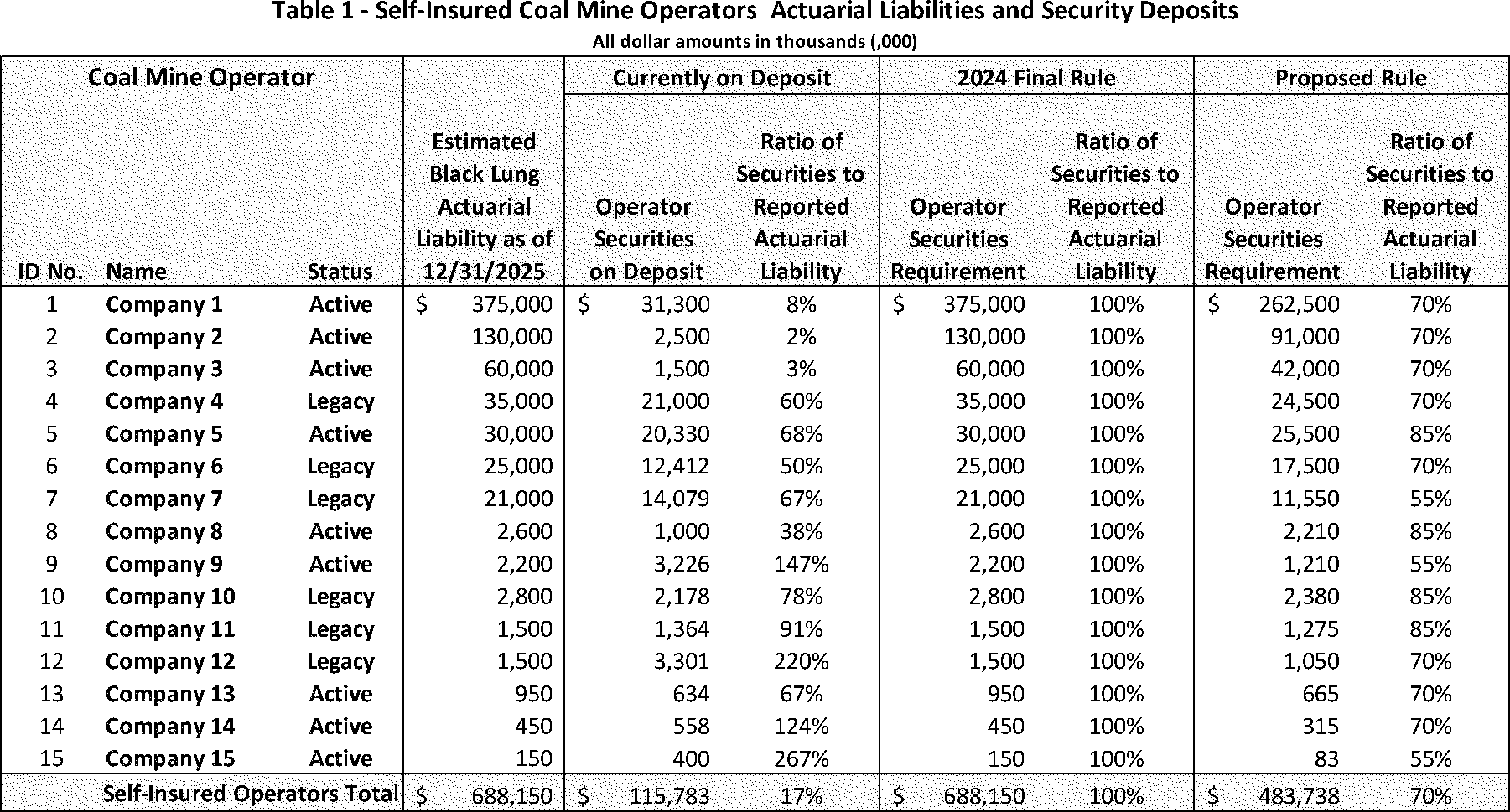
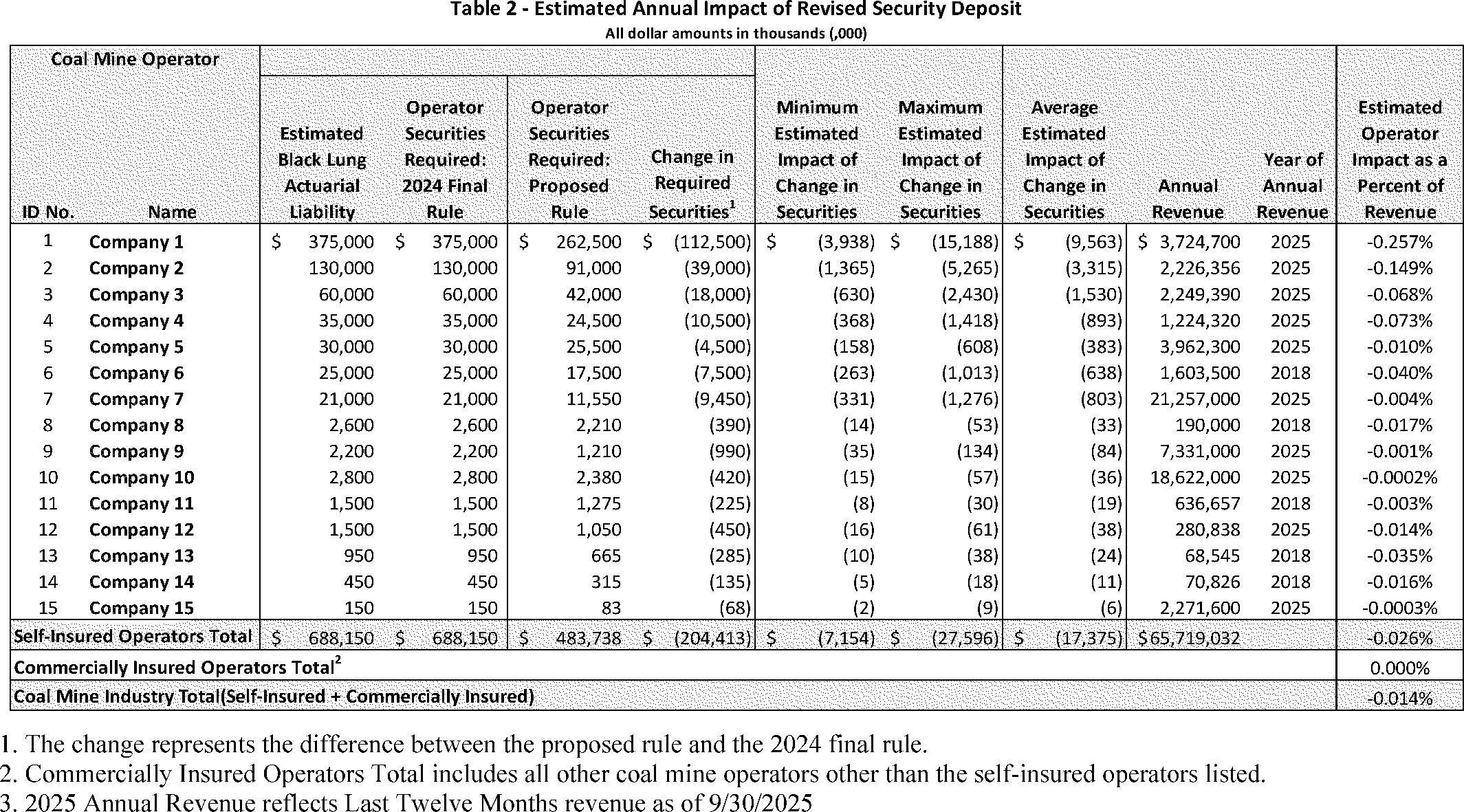
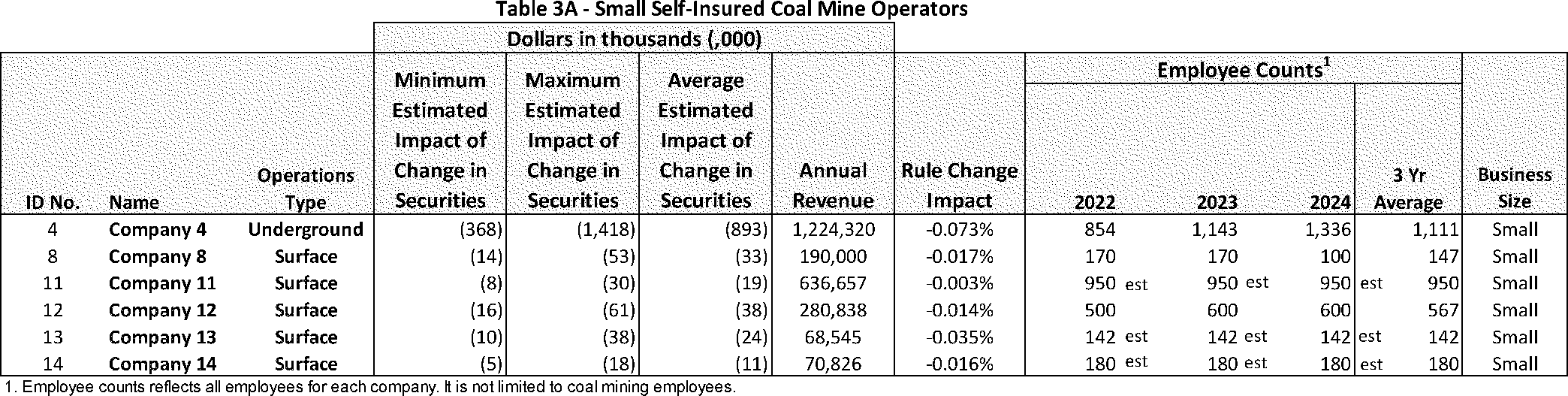
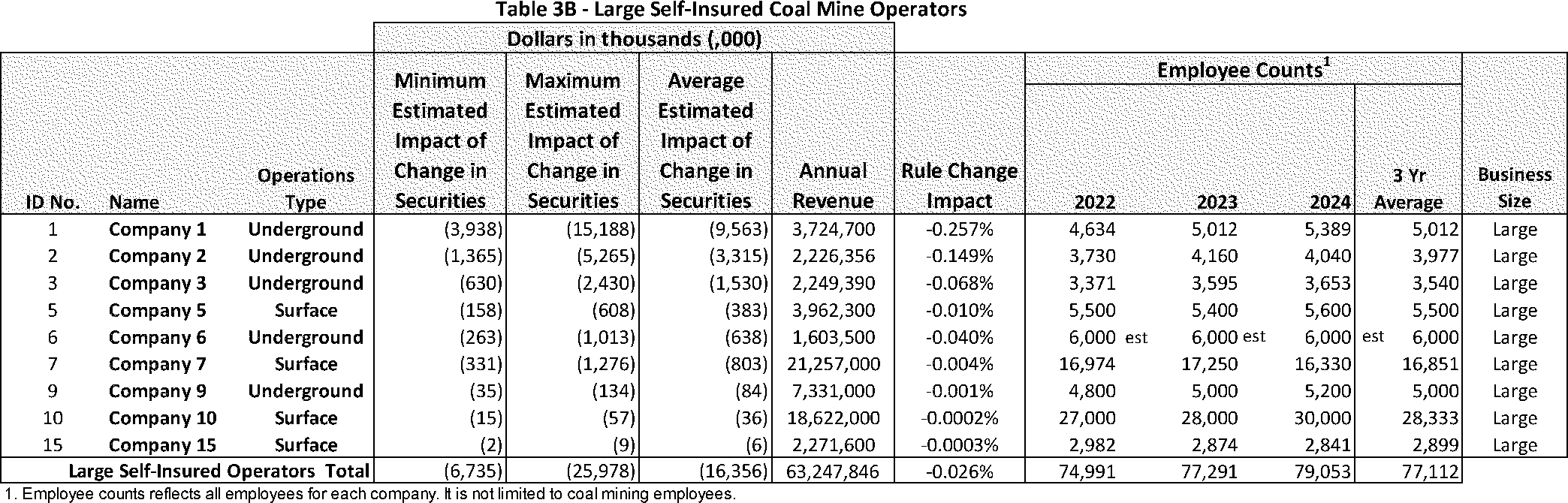
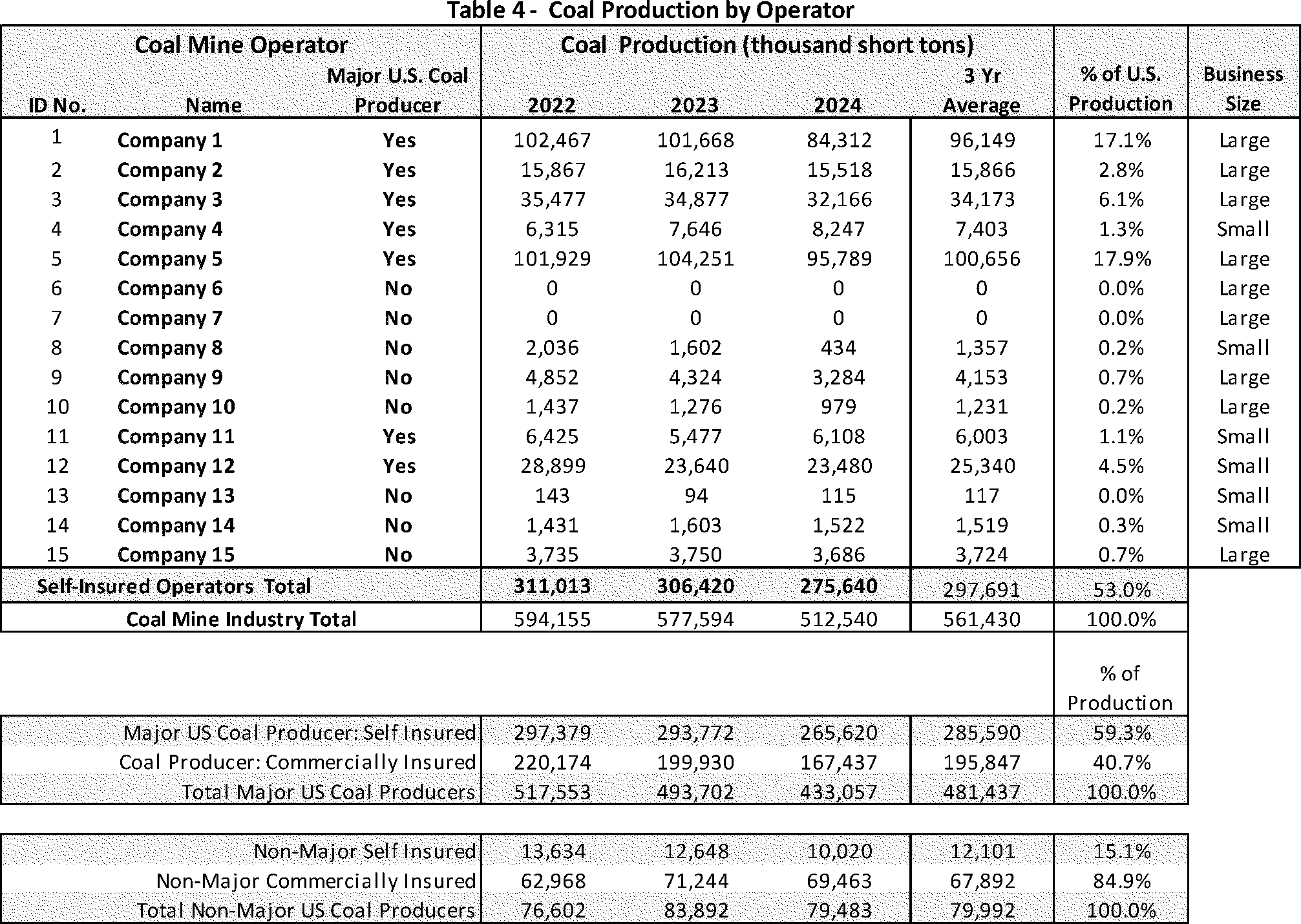
 www.dol.gov/sites/dolgov/files/OPA/reports/2024annualreport.pdf
 cdn.advocacy.sba.gov/wp-content/uploads/2019/06/21110349/How-to-Comply-with-the-RFA.pdf