The Office of Personnel Management (OPM) is revising its reduction in force (RIF) regulations to make the RIF regulations more streamlined, efficient, and merit-based by priorit...
The Office of Personnel Management (OPM) is revising its reduction in force (RIF) regulations to make the RIF regulations more streamlined, efficient, and merit-based by prioritizing performance over tenure and length of service when determining which employees will be retained in a RIF and by modifying the types of employees who are excluded from RIF competition. OPM is also revising its regulations regarding the reemployment priority list (RPL), career transition assistance program (CTAP), the interagency career transition assistance program (ICTAP), and transfers of function.
DATES:
This rule is effective September 2, 2026. An agency that issued a RIF notice before the effective date of the rule must process the RIF under the regulations in effect when the RIF notice was issued. An agency that issues a RIF notice on or after the effective date must apply the RIF provisions as amended by this final rule.
FOR FURTHER INFORMATION CONTACT:
Mr. Aaron Gottesman at (202) 606-0960 or by email at
employ@opm.gov.
1.
Replaces the current tenure-group framework with a simplified competitive service and excepted service structure.
The rule consolidates current tenure groups I, II, and III into a “competitive service tenure group” and an “excepted service tenure group,” with two subgroups in each.
2.
Excludes certain employees from RIF competition.
Employees serving initial probationary periods, trial periods, temporary or time-limited appointments of one year or less, and Schedule C and Schedule G employees are not “competing employees” for RIF purposes and can be retained, furloughed, separated, demoted, or reassigned without using RIF procedures.
3.
Reorders retention standing to place performance first.
Agencies will maintain separate retention registers for competitive service and excepted service employees; within each group, employees will be ranked by performance credit, augmented by veterans' preference, with tenure subgroup and length of service used as tie-breakers.
4.
Creates a new numerical performance credit methodology.
Agencies will calculate performance credit using the three most recent ratings of record from the relevant four-year period, assigning 7 points for Level 5, 5 points for Level 4, 3 points for Level 3, and 0 points for Level 1 or Level 2 ratings, with special rules for missing ratings and differing appraisal patterns.
5.
Applies veterans' preference by adding points to performance credit.
Preference eligibles with a compensable service-connected disability of 30 percent or more receive 5 additional points; other preference eligibles receive 3 additional points; non-preference eligibles receive no additional points.
6.
Adds definitions of key terms.
The rule defines “competing employee,” “competitive service tenure group,” “excepted service tenure group,” “reduction in force,” “initial probationary period,” “trial period,” “government obligation,” and “military spouse.”
7.
Excludes emergency shutdown furloughs from the RIF furlough definition.
The rule excludes emergency shutdown furloughs caused by lapses in appropriations from the RIF furlough definition.
8.
Removes erosion of duties reclassifications from actions requiring RIF procedures, while adding an anti-manipulation safeguard.
Agencies will no longer need to use RIF procedures for such reclassifications but could not undertake an erosion of duties reclassification after announcing a RIF if it would adversely affect an employee's retention standing.
9.
Narrows and simplifies transfer-of-function requirements.
The rule narrows transfer-of-function requirements to transfers between agencies, rather than transfers within a single agency, and simplifies identification of employees tied to a transferring function by focusing on whether the employee performs the function at least half of the time.
10.
Clarifies how agencies define competitive areas.
Under this
r
ule, competitive areas may be based on official organizational units or combinations of units. Agencies may define certain geographic locations as separate competitive areas, while employees working at approved alternate locations remain assigned to their official organizational unit for competitive area purposes. In addition, an organizational unit for RIF purposes must be clearly distinguished from other organizational units with regard to its operation, work function, staff, and supervisory oversight.
11.
Clarifies and simplifies procedures when an entire competitive area is being abolished.
When abolishing all positions in a competitive area within 180 days, agencies may release employees without ranking them on a retention register or applying assignment rights, and with a simplified notice.
12.
Revises and simplifies assignment rights by replacing “bump and retreat” concepts with assignment rights to a position held by an employee with a lower-retention-standing.
A released employee in the competitive service will receive assignment rights to a qualifying position held by another employee with lower retention standing in the same tenure group, generally within three grades below the released employee's position, or five grades for certain 30-percent-or-more disabled veterans.
13.
Requires skills-based assessments for RIF assignment qualifications and RPL selection.
Agencies must assess whether employees or RPL candidates have the capacity, adaptability, and skills needed for the position through job-related assessments based on job analysis (unless the employee held the same or substantially similar position within five years of the RIF and achieved a rating of Level 3 (Fully Successful), or higher, or equivalent, for performing the duties of the position). This change requires agencies to use more rigorous assessments in accordance with the Chance to Compete Act of 2024 (Pub. L. 118-188) to determine whether the individual is qualified.
14.
Updates RPL, CTAP and ICTAP rules to conform to the new RIF framework.
The rule replaces references to prior tenure groups with the new competitive service tenure group, preserves preexisting eligibility through OPM-recognized qualifying appointments, updates selection methods to emphasize skills-based assessments, and adds exceptions allowing agencies to retain or finalize appointments of probationary employees.
( printed page 49179)
15.
Updates Pathways and post-secondary student regulations to conform to the new RIF framework.
The rule modifies regulations in 5 CFR parts 316 and 362, pertaining to post-secondary students and Pathways Programs, to clarify how such appointments are treated for RIF purposes in conformance with the changes made by this rule.
16.
Revises RIF exceptions, notices, and records, and makes various conforming changes in other regulatory sections.
The rule clarifies continuing and temporary exceptions allowing agencies to retain employees who would otherwise be separated via a RIF, including for government obligations, parental leave, sick-leave-related circumstances, annual leave, and military spouses; fixes retention standing as of the date the employee receives a specific RIF notice (rather than the date the RIF is executed); updates required notice content; and makes conforming changes for post-secondary students, Pathways interns, compensable-injury restoration rights, Senior Executive Service (SES) furloughs, and performance management cross-references.
In addition, in this rule, OPM is modifying the proposed rule in the following ways:
1.
Clarifying how retention and restoration rights under the Uniformed Services Employment and Reemployment Rights Act of 1994 (USERRA) apply in a RIF.
In response to public comments, this rule provides additional clarity regarding how USERRA applies to RIFs. It requires that agencies apply USERRA retention protections and restoration rights as a mandatory exception to the order of release under a RIF. When an entire competitive area is abolished pursuant to § 351.605, an employee entitled to USERRA retention protections or restoration rights must be assigned to a different position at the agency. If an entire agency is abolished, OPM will provide placement assistance elsewhere in the Executive Branch.
2.
Reinforcing Merit System Principles.
OPM is revising § 351.204 to clarify that agencies have a responsibility not only to follow and apply the regulations in Part 351 when conducting a RIF, but to ensure that the RIF regulations are administered and applied consistent with all applicable laws, including the merit system principles set forth in 5 U.S.C. 2301(b).
3.
Providing additional competitive area safeguards.
OPM is requiring that, when a competitive area will be in effect less than 90 days prior to a specific RIF notice, or has been materially modified, an agency must submit a description of the competitive area and provide, for OPM review, a written explanation of the bona fide organizational basis for the competitive area.
4.
Clarifying exclusions of employees from RIF competition in § 351.202(d).
The final rule clarifies that if the individuals among the categories of employees specified in § 351.202(d) as excluded from RIF competition are released for the reasons described in § 351.201(a)(2) (
i.e.,
lack of work, shortage of funds, insufficient personnel ceiling, reorganization, or the exercise of reemployment rights or restoration rights), they must receive a modified RIF notice, unless the release is the natural expiration of the temporary or time-limited appointment.
5.
Making various clarifying and conforming changes and updating an outdated reference.
The final rule makes changes to the wording of § 351.605, dealing with abolishment of a competitive area, to further clarify the meaning of this provision; makes minor changes to the definition of “emergency shutdown furlough” in § 351.203 and § 359.802 to remove potentially confusing language; updates § 353.110 to replace outdated OPM contact information for placement assistance; adds an introductory phrase to § 351.802(a); and makes conforming changes to § 351.805, dealing with successive RIF notices, and § 362.306, dealing with Pathways recent graduates, to ensure consistency with other changes made in this rulemaking.
6.
Not finalizing changes to RIF furlough procedures.
In response to input from public comments, OPM has elected not to finalize a further change to provide greater flexibility for agencies to conduct unpaid furloughs of more than 30 days.
II. Digest of Public Comments
During the 60-day comment period, OPM received 721 unique comments from current and former Federal employees, Federal agencies, unions, veterans' groups, professional organizations, think tanks, and other interested parties. One comment was submitted as 100 entries; following review, OPM determined that the submission in fact represented the views of one commenter.
Some commenters supported the rule, contending that Federal agencies should be able to retain their highest-performing employees when downsizing, and applauding OPM for seeking to simplify an unnecessarily complicated regulatory structure. Many other commenters objected to the proposal, arguing that it would conflict with the relevant statutory framework and weaken tenure, seniority, and veterans' preference. OPM appreciates the many thoughtful comments it received, and it has closely considered them. Responses to the most common issues raised by commenters are below; other section-specific comments are addressed in the section-by-section analysis.
A. The Rule Is Consistent With the Statutory RIF Framework
Several commenters (for example, 0660, 0672, 0532 and 0157) argued that the proposed rule is inconsistent with the statutory framework governing RIFs. OPM disagrees.
The relevant statute, 5 U.S.C. 3502, directs OPM to prescribe RIF regulations giving “due effect” to four factors: tenure of employment, military preference, length of service, and efficiency or performance ratings. The statute does not prescribe the current regulatory order of retention, does not require performance to be converted into additional years of service (as under the current 5 CFR part 351 regulations), and does not require OPM to retain the current adjusted-service-computation-date model. Nor does the statute require OPM to rank tenure, veterans' preference, length of service, and performance in the precise order reflected in current 5 CFR part 351. As Commenter 0673 pointed out, 5 U.S.C. 3502 “demands no hierarchy among the four retention factors in terms of how each is weighted.” Commenter 0673 contended that Congress's decision not to rank the factors supports the view that OPM may weigh them flexibly.
The final rule continues to give due effect to all statutory factors, but in a more transparent, administrable, and merit-based sequence. Employees will be placed on separate registers by tenure group. Performance credit will then be calculated from ratings of record. Veterans' preference will be applied by adding preference points. Tenure subgroup will resolve ties, and service computation date (SCD) will resolve remaining ties. OPM is not eliminating tenure, veterans' preference, or length of service as factors in RIF retention. Rather, OPM is changing the way those factors are integrated into retention standing, consistent with its statutory authority to prescribe RIF regulations and give “due effect” to all four statutory factors in 5 U.S.C. 3502(a).
The current regulatory formula is not mandated by statute. It is a regulatory choice, and OPM may revise that choice when it reasonably concludes that a different approach better serves the statutory purposes and the needs of the
( printed page 49180)
civil service. In the context of an earlier rulemaking that also gave greater weight to performance in RIF determinations, the D.C. Circuit noted expressly that OPM's decision about how much weight to give to performance in RIF retention is “a policy decision, not a technical question for which data can provide a mathematically `correct' answer.”
Am. Fed'n of Gov't Emps., AFL-CIO
v.
Off. of Pers. Mgmt.,
821 F.2d 761, 765 (D.C. Cir. 1987) (“
AFGE
v.
OPM”).
The various weights given by OPM to each of the four statutory factors have varied over time. For example, as Commenter 0687 noted, the initial RIF regulations issued by the Civil Service Commission in 1943 weighed performance much more heavily than OPM's current regulations. Seniority began to play a more prominent role as the regulations were revised through successive Civil Service Commission rulemakings. In the 1980s, OPM revised the RIF regulations to give more effect to performance ratings. However, performance and veterans' preference currently remain subordinate to tenure, with performance being applied as an additional credit to length of service.
OPM concludes, consistent with 5 U.S.C. 3502, that giving “due effect” to the four prescribed statutory factors is best achieved by giving greater practical weight to performance, while still preserving tenure, veterans' preference, and length of service as factors in determining the RIF register. The current rules are cumbersome, intricate, resource-intensive, and prone to error. The complexity of the current rules, and their failure to weight employee performance as the primary consideration in retaining an employee, justify replacing the performance-adjusted-SCD model with a more direct scoring model.
Commenter 0680 argued that the rule fails to give due effect to tenure subgroup and length of service because those factors will matter only in ties. OPM disagrees with the premise that a factor lacks “due effect” unless it alters every ranking in every retention register. The current rule itself does not cause every factor to affect every comparison. For example, performance and length of service do not allow a Group II disabled veteran to outrank a Group I non-veteran under current rules, because tenure controls first. The current rules therefore also contain factors that may be dispositive in some comparisons and irrelevant in others.
The rule gives due effect to all four factors as follows: tenure determines whether the employee is placed on the competitive-service or excepted-service register and, within those registers, tenure subgroup resolves ties; military preference is converted into additional retention points; performance is measured directly through ratings of record; and length of service is reflected through actual SCD as the final tie-breaker. The statute does not require equal weight, identical sequencing, or universal decisiveness for each factor in every case.
Commenters 0458 and 0680 contended that tenure is unlawfully diminished because current Groups I, II, and III would be replaced with a competitive-service tenure group and an excepted-service tenure group, each with two tenure subgroups. Commenter 0678 argued that non-performance factors, including tenure and length of service, would be rendered “functionally irrelevant” under the rule. OPM disagrees.
The rule continues to account for tenure and length of service. It first separates competitive service and excepted service employees into distinct tenure-group registers. It then uses tenure subgroup I and II to resolve ties within those registers when employees have the same performance credit, as augmented by veterans' preference, with length of service as a second tiebreaker. OPM reasonably concluded that reducing the current tenure structure is appropriate because the current system gives tenure a controlling effect that can require agencies to release higher-performing employees before lower-performing employees. This rule gives tenure effect as a tiebreaker when two employees have the same performance credit after augmenting for veterans' preference, but not the overriding effect that tenure currently enjoys, as illustrated below:
Rank
Name
Tenure group
Vets
preference
subgroup
Rating of record
summary
levels
Performance credit total
Tenure
subgroup
Service comp date
1
Rivera
CS
B
5/5/4
19
I
2018-04-02
2
Singh
CS
A
5/4/3
18
I
2013-08-15
3
Morgan
CS
A
5/4/3
18
I
2020-01-27
4
Taylor
CS
AD
4/4/3
18
II
2023-07-10
5
Nguyen
CS
A
4/4/4
18
II
2023-11-06
6
Owens
CS
B
5/5/3
17
I
2016-05-12
In the example above, Rivera ranks first because Rivera has the highest total performance credit. Singh, Morgan, Taylor, and Nguyen all have the same total score of 18, so the tie is broken first by tenure subgroup: Singh and Morgan in subgroup I rank ahead of Taylor and Nguyen in subgroup II. Within each subgroup, SCD breaks the remaining tie: Singh ranks ahead of Morgan because Singh has the earlier SCD, and Taylor ranks ahead of Nguyen because Taylor has the earlier SCD. Owens has subgroup I status and more service than Taylor and Nguyen, but Owens ranks below them because Owens has a lower total performance credit.
If one position were abolished, Owens would be released first. If two positions were abolished, Owens and Nguyen would be released first.
The example below illustrates how length of service is given due effect as a second tiebreaker:
Rank
Name
Tenure group
Vets
preference
subgroup
Rating of record
summary
levels
Performance credit total
Tenure
subgroup
Service comp date
1
Bennett
CS
B
5/5/5
21
I
2021-09-13
2
Alvarez
CS
AD
5/4/3
20
I
2014-02-24
3
Chen
CS
A
5/5/3
20
I
2016-11-01
4
Diaz
CS
AD
5/4/3
20
I
2019-06-17
5
Evans
CS
A
5/5/3
20
II
2023-08-21
6
Flores
CS
B
5/5/4
19
I
2015-04-10
( printed page 49181)
In the example above, Bennett ranks first because Bennett has the highest score: 21. Alvarez, Chen, Diaz, and Evans all have a total score of 20, so tenure subgroup breaks the first tie: Alvarez, Chen, and Diaz in subgroup I rank ahead of Evans in subgroup II. Alvarez, Chen, and Diaz are still tied because they have the same score and the same tenure subgroup, so SCD determines their order: Alvarez first, then Chen, then Diaz. Flores has more service than Evans and is in subgroup I, but Flores ranks below Evans because Flores has a lower total score. If one position were abolished, Flores would be released first. If two positions were abolished, Flores and Evans would be released first.
Commenter 0680's position would effectively freeze the current tenure-group hierarchy. Nothing in 5 U.S.C. 3502 or any other provision, statute or law requires that result. Congress required OPM to give due effect to tenure; it did not mandate current Groups I, II, and III as permanent statutory categories.
B. The Rule Preserves Veterans' Preference as a Substantial Factor in RIF Retention
Many commenters (for example, 0005, 0660, 0672, 0680, and 0157) criticized OPM's proposal because, in their view, the proposal undermines veterans' preference. OPM disagrees. The relevant statute, 5 U.S.C. 3502, requires that preference eligibles under 5 U.S.C. 2108 receive preference in RIF retention, with 30-percent-or-more disabled veterans receiving preference above other veterans. However, the statute does not require the current regulatory subgroup structure and does not forbid OPM from giving more weight to performance in RIF retention.
OPM gives veterans' preference due and substantial effect through an explicit point augmentation that changes an employee's relative standing in the retention register. The rule retains veterans' preference as a meaningful part of retention standing by adding 5 points for preference eligibles with a compensable service-connected disability of 30 percent or more and 3 points for other preference eligibles. Those points are added to performance credit before tenure subgroup and service computation date are considered. This level of veterans' preference meaningfully honors veterans' sacrifice and service [1]
while appropriately balancing the government's interest in retaining top performers when an agency undergoes restructuring. This rule thus gives effect to Congress's direction that disabled veterans be retained “in preference to” other veterans, 5 U.S.C. 3502(b), and that veterans be retained “in preference to other competing employees.” 5 U.S.C. 3502(c).
Notably, the amount of veterans' preference provided under these provisions is much greater than the preference veterans receive in competitive examining for hiring using numerical rating and ranking under 5 U.S.C. 3309 and 5 CFR 337.101(a). Under these authorities, disabled veterans receive an additional 10 points on a 100-point scale, while veterans receive an extra 5 points on a 100-point scale. By contrast, this rule adds 5 points (for disabled veterans) or 3 points (for other preference eligibles) out of an ordinary maximum performance credit score of 21. Thus, on a scale-normalized basis, veterans' preference points in RIF retention are far greater than in typical competitive hiring. This is illustrated by the chart below showing how veterans' preference is applied in ordinary competitive examining with numerical rating and ranking:
Hiring preference category
Earned-rating scale
Preference points
Preference as percent of 100-point scale
5-point preference eligible
100
+5
5
10-point preference eligible
100
+10
10
Compare this to how RIF retention will work under the revised RIF regulations:
RIF preference category
Performance-
credit scale
Preference percent points
Preference as percent of 21-point scale
Other preference eligible, Subgroup A
21
+3
14.3
30%+ compensably disabled preference eligible, Subgroup AD
21
+5
23.8
Thus, the RIF preference can offset a much larger share of the performance scale than hiring preference offsets of the examining scale. In hiring, a 10-point preference eligible with an earned score of 90 reaches an augmented score of 100. A 5-point preference eligible with an earned score of 95 reaches an augmented score of 100. That means hiring preference bridges the top 10% or 5% of the 100-point earned-rating scale.
Under this rule, a 30%+ disabled preference eligible with a raw performance-credit score of 16 reaches 21 after the +5 preference addition. Other preference eligibles with a raw performance-credit score of 18 reach 21 after the +3 preference addition. Because the maximum ordinary performance-credit score is 21, the RIF preference bridges the top 23.8% or 14.3% of the performance-credit scale. That makes the revised RIF veterans' preference materially stronger than hiring preference as a scoring weight.
Further, the practical effect of veterans' preference under this rule is far greater than preference in competitive hiring, because RIF performance-credit increments are relatively small. Under the new RIF formula, the difference between a Level 5 rating and a Level 4 rating is only 2
( printed page 49182)
points, and the difference between a Level 4 rating and a Level 3 rating is also only 2 points. That means a +3 veterans' preference credit is larger than one ordinary one-level rating difference, and a +5 credit is larger than two ordinary one-level rating differences. For example:
Employee
Ratings
Raw
performance
credit
Veterans'
preference
Augmented RIF score
Non-preference employee
5/5/4
19
+0
19
30%+ disabled preference eligible
4/4/4
15
+5
20
In this example, the 30%+ disabled preference eligible with three Level 4 ratings ranks ahead of a non-preference employee with two Level 5 ratings and one Level 4 rating.
Similarly:
Employee
Ratings
Raw performance credit
Veterans' preference
Augmented RIF score
Non-preference employee
5/4/4
17
+0
17
Other preference eligible
4/4/4
15
+3
18
In that example, the non-disabled preference eligible with three Level 4 ratings ranks ahead of a non-preference employee with one Level 5 and two Level 4 ratings. These examples show that Commenter 0157's contention that veterans' preference would be “largely illusory” under these revised regulations is not accurate; instead, it provides substantial retention preference for both disabled veterans and non-disabled veterans.
OPM believes that veterans' preference under 5 U.S.C. 3502(b) and (c) may lawfully be operationalized through a points-based addition to performance credit. The statute provides that a preference eligible employee with a compensable service-connected disability of 30 percent or more whose performance has not been rated “unacceptable” is entitled to retention preference ahead of other veterans. 5 U.S.C. 3502(b). Other preference eligibles whose performance has not been rated “unacceptable” are entitled to retention “in preference to other competing employees.” 5 U.S.C. 3502(c).
Commenters 0660 and 0680 read 5 U.S.C. 3502(b) and (c) to mean that a preference eligible whose performance is not unacceptable must always be retained ahead of every non-preference eligible, regardless of comparative performance. OPM disagrees. The statute does not require that disabled veterans and other preference eligibles must always appear first on the retention register, only that they be retained “in preference to” other competing employees. These provisions create an entitlement to a meaningful retention preference, not a categorical right to be retained ahead of every non-veteran regardless of performance.
Further, sections 3502(b) and (c) must be read together with section 3502(a). Subsection (a) requires OPM to issue regulations that give “due effect” in a RIF not only to military preference, but also to tenure, length of service, and performance ratings, without establishing any categorical hierarchy concerning how the factors must be applied.
This lack of specific direction is notable, because Congress has elsewhere directed
specifically
that disabled veterans with a compensable service-connected disability of 10 percent or more “be entered on appropriate registers or list of eligibles” before other candidates for positions other than scientific and technical positions in GS-9 or higher. 5 U.S.C. 3313;
see also Legislative History of the Civil Service Reform Act of 1978
at p. 789 (“Certain other disabled veterans go to the top of the list of eligibles, except in competition for professional and scientific positions in grade and [sic] GS-9 and above”). This provision was codified at the same time as the modern RIF statute.
See
Pub. L. 89-554, Sept. 6, 1966. Congress's use of much more general language—“is entitled to be retained in preference to” other preference eligibles or competing employees, as applicable—in the RIF statute, when contrasted with the specific direction in 5 U.S.C. 3313 that disabled veterans appear before other candidates on hiring registers—indicates that Congress did not intend to create a rigid structure under which disabled veterans or veterans must always appear at the top of the retention register.
As a further example, USERRA states expressly that veterans who are required to be reemployed by their employers after a tour of duty in the uniformed services “shall not be discharged from such employment, except for cause” for periods of six months (for military service between 30 days and 180 days) or one year (for military service of more than 180 days). 38 U.S.C. 4316. This provision underscores that Congress speaks directly when it means to give absolute retention rights to certain groups of employees, as opposed to a preference.
Indeed, OPM's current RIF regulations subordinate veterans' preference to another factor, namely tenure. That is, employees are currently ranked according to tenure groups I, II, III, and veterans only enjoy preference ahead of other employees in their tenure group. Thus, a veteran in tenure group II is ranked below a non-veteran in tenure group I in retention standing.
This longstanding feature of OPM's RIF regulations reflects the fact that, in 5 U.S.C. 3502, Congress did not prescribe that veterans or disabled veterans must always appear first on the register. As the Director of the Civil Service Commission's Bureau of Recruitment and Examining testified in 1977 concerning RIF regulations:
In retention, veterans have the right to be retained over competing non-veterans in a reduction in force. Retention standing under the law is based on four factors: type of appointment, veterans preference, performance rating, and length of service. Although this gives veterans a significant advantage, it is not absolute. For example, in fiscal year, 1976, 1800 veterans were separated in Reduction in Force actions versus 3,000 nonveterans. An equal number of veterans and nonveterans (approximately 4,500) were also reduced in grade. (quoted in
( printed page 49183)
Legislative History of the Civil Service Reform Act of 1978
at p. 789; emphasis added)
Under OPM's current RIF rules, a Group II preference eligible can be released—and ultimately separated—before a Group I non-veteran, even if the preference eligible has a stronger performance credit, as in the example below (which assumes that both employees are in the same competitive area and competitive level, one position is abolished, no mandatory or permissive exception applies, and there is no position for Employee B to bump or retreat to):
Rank
Employee
Veteran status
Tenure group
Veterans' preference subgroup
Adjusted SCD
Result
1
Employee A
Non-veteran
Group I
Subgroup B
2002-01-01
Retained.
2
Employee B
30%+ disabled veteran
Group II
Subgroup AD
1995-01-01
Released.
However, under this rule, the higher-performing preference eligible may be retained over the longer-tenured non-veteran, as shown below:
Rank
Employee
Tenure group
Vets pref group
Rating of record summary levels
Vets pref points
Total performance credit
Tenure subgroup
SCD
Result
1
Employee B
CS
AD
5/5/5
+5
26
II
2024-01-01
Retained.
2
Employee A
CS
B
4/5/4
+0
17
I
2015-01-01
Released.
In this example, Employee B will fare better than Employee A because the revised regulations no longer rank all Group I employees ahead of all Group II employees. Instead, both will be placed in the competitive-service tenure group, and Employee A's former Group I status will function as tenure subgroup I, while Employee B's former Group II status will function as tenure subgroup II. Tenure subgroup would operate as a tie-breaker after performance credit, as augmented by veterans' preference.
In sum, this rule changes the method of operationalizing preference, but not the underlying principle. Current rules operationalize preference through categorical subgroups within tenure groups. This final rule operationalizes preference through numerical augmentation of performance credit. Both are regulatory methods for giving effect to military preference within a multi-factor RIF system.
Title 5 elsewhere confirms that veterans' preference can be implemented through points. As noted above, in competitive examining, 5 U.S.C. 3309 provides that preference eligibles who receive passing scores are entitled to additional points above their earned rating: 10 points for certain preference eligibles and 5 points for others. OPM's regulation implements that provision on a 100-point examining scale, adding 5 or 10 points to passing applicants' earned numerical ratings.
See5 CFR 337.101(b).
The general veterans' preference policy in 5 U.S.C. 1302(b) and (c) states that preference shall be given in certification, appointment, reinstatement, reemployment, and retention. OPM has discretion under 5 U.S.C. 1302(b) to “prescribe and enforce regulations for the administration of” veterans' preference in the civil service. In the examining context, Congress and OPM implement that preference through a point credit, not an automatic selection entitlement. The same conceptual approach is available in RIF retention unless the RIF statute clearly forecloses it. Section 3502 does not. It requires due effect to military preference and specifically grants a retention preference, but it does not prescribe a fixed subgroup hierarchy or prohibit OPM from implementing that preference through a substantial numerical credit.
Commenter 0532's example, in which a non-veteran with three Outstanding ratings may rank above a disabled veteran with three Fully Successful ratings, does not show that veterans' preference has been erased. Instead, the example confirms that veterans' preference operates as a significant preference within a performance-centered RIF system rather than as an absolute rule that overrides all performance distinctions. OPM considers that approach consistent with the statutory direction to give due effect to all required factors.
Commenter 0680 similarly offers an example in which a veteran with ratings of 4/4/5 and 40 years of service receives 20 total points, while a non-veteran with ratings of 5/5/5 and 4 years of service receives 21 points. Commenter 0680 argues that the non-veteran's higher ranking shows that veterans' preference has been unlawfully denied.
OPM disagrees. The example shows only that, under the rule, a non-preference eligible with a materially stronger performance record may rank ahead of a preference eligible in some circumstances. That is a feature of a system designed to give meaningful effect to both veterans' preference and performance, not evidence that veterans' preference has been erased. The veteran in the commenters' example receives an additional 3 points solely by virtue of preference status. Without that preference, the veteran's performance score would be 17, not 20. The preference therefore materially improves the veteran's standing, but it does not operate as an absolute override of all higher performance. It operationalizes Congress's direction that veterans be retained “in preference to other competing employees.” 5 U.S.C. 3502(c).
C. Giving Greater Weight to Performance in RIF Retention Standing is Consistent With Merit-System Principles
Commenter 0673 strongly supported the proposed rule because, in its view, it “helps correct a longstanding imbalance between tenure and merit in policies governing federal employee retention during” a RIF. OPM agrees.
Commenter 0673 pointed out that the Merit System Principles demand that “[e]mployees should be retained on the basis of the adequacy of their performance, inadequate performance should be corrected, and employees should be separated who cannot or will not improve their performance to meet required standards.” 5 U.S.C. 2301(b)(6). The Merit System Principles further
( printed page 49184)
direct that “selection and advancement should be determined solely on the basis of relative ability, knowledge, and skills.”
Id.
sec. 2301(b)(1). The Merit System Principles were codified by Congress into Federal law in the Civil Service Reform Act of 1978 (“CSRA”), reinforcing the centrality of merit to modern Federal workforce management.
In addition, Commenter 0673 pointed out that the CSRA requires agencies to create performance appraisal systems for their employees and to “use the results of performance appraisals as a basis for training, rewarding, reassigning, promoting, reducing in grade, retaining, and removing employees.” 5 U.S.C. 4302(a)(3). In so doing, Commenter 0673 argued that OPM's changes to give performance more weight in RIF retention more closely align OPM's RIF regulations with the Merit System Principles and the overall CSRA statutory scheme, which emphasizes the importance of performance ratings of record in determining retention and advancement in the Federal civil service.
Commenter 0091, the U.S. Office of Special Counsel, agreed that OPM's changes are more aligned with the Merit System Principles and the overall CSRA statutory scheme because the rules now make performance the primary retention factor.
OPM concurs with Commenters 0091 and 0673 that the Merit System Principles, particularly Merit System Principle 6 (“[e]mployees should be retained on the basis of the adequacy of their performance”) strongly support making performance ratings of record the main factor in RIF retention. In addition, allowing agencies to restructure efficiently helps fulfill Merit System Principle 5, that “[t]he Federal work force should be used efficiently and effectively.” 5 U.S.C. 2301(b)(5). OPM also agrees that the CSRA's requirement that agencies use “the results of performance appraisals as a basis for,”
inter alia,
reassigning, reducing in grade, retaining, and removing employees, 5 U.S.C. 4302(a)(3), provides significant support for making performance ratings of record the main factor in RIF retention.
OPM also agrees with Commenter 0685, who concluded that “elevating performance within the RIF framework is not only reasonable but also consistent with broader principles of effective workforce management.”
Commenters 0532, 0672, and 0678 alleged that OPM's RIF reforms are part of a larger plan to undermine the merit system and non-partisan civil service. But OPM believes that putting performance first in RIF retention enhances the merit system, as do the other changes in this final rule that allow more streamlined restructuring. To underscore that agencies must not use RIFs in a targeted manner against particular employees, OPM is adding a new provision to § 351.204 requiring that agencies must administer OPM's RIF regulations consistent with the merit system principles set forth in 5 U.S.C. 2301. OPM notes that existing law continues to prohibit discriminatory, retaliatory, politically motivated, or otherwise unlawful personnel actions.
D. Concerns About Subjectivity in Performance Ratings do not Justify Retaining the Current RIF Formula
Many commenters (0002, 0532, 0672, and 0683, for example) objected to the reliability of agency performance-management systems. Many commenters (for example, 0504, 0532, 0672, 0678 and 0617) also asserted that the current system properly relies on objective measures such as tenure and length of service, while the proposed rule gives too much weight to performance ratings. OPM disagrees.
Performance is not an extraneous or improper factor in RIF retention. Instead, Congress expressly included “efficiency or performance ratings” among the factors to which OPM must give due effect in RIF regulations. This rule changes how performance is credited, not whether it is considered. In addition, 5 U.S.C. 4302 provides that agencies must use the results of performance appraisals as a basis for, among other things, rewarding, reassigning, promoting, retaining, and removing employees. Performance appraisal systems also must establish performance standards that, to the maximum extent feasible, permit accurate evaluation of job performance based on objective criteria related to the job. 5 U.S.C. 4302(c). It is therefore consistent with the statutory framework to give performance a more central role in determining which employees are retained during a RIF.
That some agencies may need to improve rating practices does not make it unreasonable for OPM to give greater effect to the performance factor that Congress expressly included in 5 U.S.C. 3502. As the D.C. Circuit noted in rejecting similar arguments against an earlier OPM RIF rulemaking that gave more weight to performance, “[t]he federal government has long employed subjective performance evaluations to help make RIF decisions.”
AFGE
v.
OPM,
821 F.2d at 765. As in that prior rulemaking, the commenters “allege potential problems associated with the general use of performance evaluations, and not with their increased importance” in the RIF context.
Id.
OPM believes that concerns over performance appraisal systems are better addressed through the rules governing performance appraisal systems and rating administration. Indeed, OPM revised its performance appraisal regulations at 5 CFR part 430, subpart B, to enable more meaningful distinctions in performance by allowing a standardized distribution of at least some rating levels, while continuing to require ratings of record to be based on actual job performance and objective criteria.[2]
That rulemaking requires OPM to engage in biennial review of agency performance appraisal systems to ensure that they make meaningful distinctions in relative performance and comply with applicable laws, including the Merit System Principles codified in 5 U.S.C. 2301. It also reduces the number of permissible patterns of summary levels to reduce variation between agency performance appraisal systems. These reforms tackle head-on the issues identified by commenters, such as ratings inflation (identified by Commenters 0683 and 0678) and differing ratings systems across agencies (identified by Commenter 0683).
OPM has taken concrete steps to ensure the accuracy and fairness of employee ratings systems. It has provided guidance to agencies that employee performance plans “should be written as clearly and specifically as possible to provide a firm benchmark towards which employees must aim their performance and permit the accurate evaluation of job performance on the basis of objective criteria.” [3]
Further, it has emphasized that “[p]erformance elements and standards should be measurable, understandable, verifiable, and achievable,” and that performance standards “must include a clear result to achieve and a specific measure of success reflecting `fully successful' performance.” [4]
While OPM believes that there is room for improvement in performance ratings, it disagrees with Commenter 0683's contention that performance ratings are
( printed page 49185)
too subjective to be given additional weight in RIF retention.
Commenter 0672 suggested that OPM's proposal to give greater weight to performance ratings should be viewed against a background of alleged efforts to target particular employees or functions. But using performance ratings in administering a RIF is not a license for arbitrary action or targeting employees based on favoritism. This rule does not change the basic premise that a RIF is a position-based workforce-restructuring action, not a disciplinary or conduct-based removal tool. The rule's definition of a “reduction in force” continues to tie a RIF action to reasons such as lack of work, shortage of funds, insufficient personnel ceiling, reorganization, or the exercise of reemployment or restoration rights. Allegations that an agency might misuse RIF authority do not justify retaining unnecessarily complex governmentwide procedures for all agencies.
Further, OPM has built in safeguards to prevent performance ratings from being manipulated to target individual employees in the RIF context. Ratings of record must be generated under applicable performance-management requirements. And RIF retention standing must be calculated under the regulatory formula. This rule makes the formula more transparent by converting ratings into stated numerical values and adding veterans' preference points, rather than burying performance within an adjusted SCD calculation.
This rule also contains several provisions that reduce the risk of manipulation and retaliation, thus addressing concerns expressed by several commenters (0003, 0677, 0064, for example). It uses the three most recent ratings of record during the four-year period before RIF notices, and it permits agencies to establish a cutoff date after which no new rating will be considered. It also freezes the effective date of RIF retention standing at the date that the RIF notice is issued, meaning that agencies cannot alter RIF retention standing by altering ratings of record after RIF notices are issued. For agencies using appraisal systems that do not meaningfully distinguish among higher levels of performance, the rule permits enhanced performance credit where the agency specifies and documents the basis for doing so in advance, makes the information available before running the RIF, and applies the criteria consistently to all competing employees.
Existing law also continues to prohibit discriminatory, retaliatory, politically motivated, or otherwise unlawful personnel actions. Performance evaluations and awards are personnel actions covered by the prohibited-personnel-practice framework, and the statute prohibits discrimination, political coercion, reprisal, unauthorized preferences, and actions violating veterans' preference requirements. In addition, in the final rule, OPM is adding an express provision in § 351.204 that agencies must administer OPM's RIF regulations consistent with the merit system principles set forth in 5 U.S.C. 2301, and to underscore that agencies must not use RIFs in a targeted manner against particular employees.
E. OPM Has Adequately Justified the Need for the Changes
Commenters 0672 and 0532 asserted that OPM has not justified the changes. OPM disagrees.
Federal agencies perform essential public functions: national defense, border and transportation security, veterans' care, public-health protection, disaster response, cybersecurity, financial oversight, benefits administration, scientific research, law enforcement, and stewardship of public lands and infrastructure. Many of these functions involve substantial public resources and critical services.
Agency needs and missions are constantly shifting in response to external events, changing priorities, and evolving public needs. OPM's Human Capital Framework recognizes that agencies must align workforce decisions with agency missions “even in the midst of constant change,” and that modern agencies face budget fluctuations, changing public expectations, unforeseen crises, and other complex and unpredictable external factors.[5]
Agencies therefore must be agile and responsive in managing talent to accomplish their missions, and must continuously adapt to new requirements and expectations. Merit System Principle 5 demands that “[t]he Federal work force should be used efficiently and effectively,” 5 U.S.C. 2301(b)(5), which means that Federal agencies must be able to restructure efficiently in response to evolving mission needs and the public interest. OPM has repeatedly emphasized that agencies must be able to restructure efficiently to align their workforces with changing missions, budget realities, technology, and service-delivery needs.[6]
Commenter 0687 observed that “the government should not presume that it has the right talent today for the missions of tomorrow”—particularly as technology rapidly advances—and thus the government needs flexible personnel systems to accommodate this reality. OPM agrees with Commenter 0687's observation that, “if the goal of personnel policymaking is to ensure agencies are staffed with the right people, at the right time, for the missions they're given, it is sometimes necessary to reduce headcount in some areas while bolstering it in others.”
OPM believes that Federal agencies should be able to retain their highest-performing employees during a RIF. A RIF is a workforce-reshaping action that determines whether an agency will still have the people needed to carry out its statutory mission after the reduction is complete. Thus, OPM agrees with Commenter 0687, who supports the decision to elevate performance above other statutory retention factors, and explains that this change will help avoid some historical adverse selection effects (release of junior but higher-performing staff as opposed to those with longer tenure but who are less highly rated) historically associated with RIFs.
Indeed, when an agency is reducing positions because of budget, reorganization, lack of work, or changing priorities, the employees who remain often must absorb mission-critical work, maintain continuity, solve new operational problems, and implement new statutory, technological, or policy requirements with fewer resources. OPM believes that employees with a demonstrated record of high performance, as reflected in their rating of record, are more likely to possess the technical expertise, judgment, adaptability, and execution capacity needed to maintain essential operations after restructuring. They are also more likely to help agencies implement new priorities, train or support remaining staff, and sustain service quality when staffing levels decline.
Current RIF rules prioritize tenure and length of service over performance, which can result in high-performing employees being separated while lower-performing, more senior employees are retained. OPM believes that agencies need a more streamlined and merit-based RIF framework and that these regulatory changes will give
( printed page 49186)
performance a more central role in determining retention standing.
Federal agencies have confirmed that they would like greater ability to retain their highest-performing employees during a RIF. Commenter 0720, a Federal agency, stated that it “would like to be able to retain its higher performing employees during RIF actions and this rule would enable it to do so.” Commenter 0720 noted that OPM's proposed performance-weighted RIF framework “offers a more accurate reflection of employee contributions and reduces the likelihood that restructuring disproportionately affects high performers.” Under the current rules, performance affects retention standing only after tenure group and veterans' preference subgroup are applied, and only by being translated into additional years of service. As Commenter 0720 observed: “Under the current RIF rules an employee's performance functions primarily as a modest supplement to their seniority.” OPM believes that this structure can cause higher-performing employees to be released ahead of lower-performing employees and that a more direct performance-credit system better promotes an efficient and effective civil service.
In OPM's view, current RIF rules are unnecessarily cumbersome, inflexible, intricate, time-consuming, and resource-intensive, and they can create unnecessary risk of implementation error. In the proposed rule, OPM cited a longtime Federal employee who described the current RIF rules and regulations as “complex and cumbersome,” creating a “time-consuming and demoralizing process” that leads to outcomes that are “haphazard and invariably negative.” Fred Mills,
Civil Disservice: Federal Employment Culture and the Challenge of Genuine Reform,
at p. 42 (iUniverse 2010). Commenter 0720 noted recent difficulties in implementing workforce reshaping that imposed unnecessary costs and burdens and contended that these difficulties “provide compelling evidence of the need for the streamlined, modernized, and more administratively feasible framework proposed by OPM.” Commenter 0720 states that OPM's reforms “will simplify execution, reduce administrative errors, and increase consistency across agency components.”
Commenter 0685 noted that “[a] central feature of the current [RIF] framework is its administrative complexity, which can significantly impede implementation.” Commenter 0685 observed that “[t]he procedural demands of the current system also contribute to significant delays in the execution of workforce restructuring decisions.” Further, Commenter 0685 noted that the current framework imposes substantial resource costs on agencies. Implementing a RIF under existing rules often requires human resources specialists, legal counsel, and management personnel to dedicate significant time and effort to navigating procedural requirements. Commenter 0091, a Federal agency, noted that the current rules contribute to an existing “critical weakness”; namely, the “federal government's historic lack of agility in dynamic environments.”
Indeed, the current rules require agencies to classify employees by tenure group, veterans' preference subgroup, service computation date, and performance-adjusted service credit, and then apply additional rules governing release, assignment rights, bumping, retreating, notices, and related placement obligations. They increase the likelihood of error, impede timely restructuring, and make it more difficult for agencies to retain top performing employees in a RIF. OPM believes that a clearer register based on performance points, veterans' preference points, tenure subgroup, and actual SCD will be easier for agencies to apply and easier for employees to understand.
Commenter 0680 argued that the current regulations do not prioritize length of service over performance because performance credit and length of service are added together. OPM disagrees.
Under the current RIF rules, performance and length of service are combined only after tenure group and veterans' preference subgroup have already been applied. In addition, performance is capped through the current additional-service-credit formula, while actual service may continue to accumulate over an employee's career. That means current RIF ordering is not a simple comparison of Employee A's performance against Employee B's performance. Agencies must first place employees into tenure groups, then veterans' preference subgroups, then calculate adjusted service dates. Performance affects ranking only inside the employee's already-determined tenure/veterans' category. The current formula therefore does not give performance the same effect as this final rule does.
The current system therefore does not allow performance to overcome many of the most important retention categories. A high-performing employee in a lower tenure group cannot outrank a lower-performing employee in a higher tenure group; and within the same tenure group, performance cannot overcome veterans' preference subgroup placement. Performance matters only within the employee's already-determined group and subgroup. That means current performance credit is not a true performance-first retention rule; it is a service-date adjustment applied at the end of a categorical ranking system.
Even within the same tenure group and veterans' preference subgroup, the current system gives performance a relatively narrow practical effect. The difference between three Level 5 ratings and three Level 3 ratings is only 8 years of adjusted service credit: 20 years versus 12 years. So a long-serving employee with three Fully Successful ratings can still outrank a much higher-performing employee with three Outstanding ratings if the long-serving employee has more than an 8-year service advantage. Current 5 CFR 351.504 requires the performance credits to be averaged, rounded, and expressed as additional years of service. Level 5 ratings add 20 years, Level 4 ratings add 16 years, and Level 3 ratings add 12 years to the employee's retention-service credit.
For example, assume two employees are in the same tenure group and veterans' preference subgroup:
Employee
Actual SCD
Ratings
Current performance credit
Adjusted SCD
Current rule
outcome
Employee A
1996
3/3/3
+12 years
1984
Ranks higher.
Employee B
2021
5/5/5
+20 years
2001
Ranks lower.
Employee B is clearly the higher performer, but Employee A is retained because Employee A's longer service overwhelms the 8-year performance differential. That illustrates the core problem: the current system does not really prioritize performance but merely gives performance a modest service-date boost.
( printed page 49187)
The current method is also opaque. It requires agencies and employees to translate ratings into artificial years of service, average those values, round them, subtract them from the employee's actual SCD, and then rank employees by the resulting adjusted SCD. That makes performance harder to see and harder to explain because the final ranking appears as a date rather than as a performance score.
The approach in this final rule is more transparent. Performance remains performance, measured in points. Length of service remains length of service, measured by actual SCD. OPM reasonably concluded that this system is easier to administer and easier for employees to understand than a performance-adjusted SCD. These regulations still give length of service effect as a tie-breaker when employees have the same augmented performance credit and tenure subgroup.
The direct point system that OPM adopts in this rule better advances the goal of a merit-based workforce because it makes performance a central, visible, and auditable factor in determining retention standing. Under these regulations, agencies will assign direct point values to ratings (Level 5 = 7 points, Level 4 = 5 points, Level 3 = 3 points, and Level 1 or 2 = 0 points) and then sum the values for the employee's three most recent ratings. Employees will then be ranked within the same tenure group by performance credit as augmented by veterans' preference points; only if employees tie would the agency use tenure subgroup and then actual SCD.
Using the same example under the proposed rule:
Employee
Ratings
Proposed
performance credit
Result
Employee A
3/3/3
9
Ranks lower.
Employee B
5/5/5
21
Ranks higher.
That outcome better reflects merit. The employee with three Outstanding ratings outranks the employee with three Fully Successful ratings, regardless of the fact that the lower-performing employee has longer service. Length of service is still considered, but only as a tie-breaker after performance credit, veterans' preference, and tenure subgroup have been applied.
In short, the current system gives performance nominal credit but not meaningful priority. It buries performance inside seniority, lets long service overwhelm even large performance differences, and prevents performance from crossing tenure and veterans' preference subgroup boundaries. This final rule makes performance visible, direct, auditable, and outcome-affecting, while still preserving veterans' preference, tenure, and length of service in the retention framework.
F. The Final Rule Reasonably Balances Retention of Institutional Knowledge With Retention of High Performers
Commenter 0672 argued that the rule may harm recruitment, retention, and institutional knowledge. OPM acknowledges that length of service and institutional knowledge are important. However, OPM believes that the current system overvalues tenure at the expense of performance. This final rule does not eliminate length of service; it uses length of service as the final tie-breaker after performance credit, veterans' preference, and tenure subgroup are considered. OPM has reasonably determined that the public interest is better served by a RIF system that allows agencies to retain employees with the strongest demonstrated performance while still recognizing tenure, veterans' preference, and service.
Long service may reflect valuable experience. But performance ratings are a more direct measure of how well an employee is contributing to agency mission needs than seniority alone. As Commenter 0720, a Federal agency, noted: “Where more senior employees have gained experience that makes them more effective in advancing the agency's mission this greater effectiveness is typically reflected in their performance ratings.” Thus, Commenter 0720 stated that “it makes more sense for the RIF regulations to target retaining high performers directly, by prioritizing performing as a retention criterion, than indirectly through seniority,” as in its experience, “employee performance ratings are more strongly correlated with their performance and effectiveness than pure seniority.”
Commenter 0686, another Federal agency, noted that prioritizing performance over tenure and length of service “ensures top performance, regardless of tenure, continues to be prioritized for retention decisions. This revision acknowledges that tenure is not always a reflection of an employee's knowledge or capabilities” and “ensures that merit-based performance takes precedence over seniority, which is a more effective way to retain skilled and high-performing staff.”
OPM agrees with Commenters 0720 and 0686 that a RIF system that retains higher performers better serves the public and better supports agency operations after restructuring—and that high performance is more accurately measured through performance ratings, not pure seniority. OPM rejects Commenter 0653's assertion that performance appraisals cannot capture the value of institutional knowledge; instead, OPM believes that institutional knowledge that meaningfully advances agency missions will be appropriately reflected in performance ratings of record issued under 5 U.S.C. 4302.
OPM agrees that agencies must protect mission delivery during and after a RIF but disagrees that a tenure-first system is the best way to do so. A RIF leaves an agency with fewer employees, making it especially important that the employees retained are those with the strongest demonstrated ability to perform the agency's evolving mission-critical work.
OPM rejects Commenter 0532's characterization that the proposal assumes longer-serving employees are poor performers. The rule does not rest on any such assumption. It simply recognizes that length of service and performance are distinct statutory factors, and that a modern RIF system should give greater weight to demonstrated performance when agencies must make difficult retention decisions.
A merit-based RIF system should not operate solely based on how long employees have served or on the formal category into which they fall. It should also reflect demonstrated performance and the government's need to retain an effective workforce during restructuring. Congress made performance one of the statutory RIF factors, and this rule gives that factor more transparent and meaningful effect.
( printed page 49188)
G. The Size of Recent Workforce Reductions Does Not Undermine the Basis for the Rule
Commenters 0532, 0320, and 0616 contended that, because the Government was able to reduce the workforce under existing rules, OPM cannot claim the current RIF rules are burdensome. OPM disagrees.
The ability to reduce workforce size through a combination of tools does not establish that the current RIF regulations are efficient, clear, or optimal. Workforce reductions may occur through attrition, retirements, voluntary separation incentives, voluntary early retirement authority, term expirations, resignations, or other tools that do not require full part 351 RIF procedures. The question in this rulemaking is not whether agencies can ever reduce headcount under the current framework, but whether the current part 351 RIF process is unnecessarily complex and whether the rules should better enable agencies to retain high performers when a RIF is necessary.
OPM reasonably concluded that the current RIF framework imposes unnecessary burdens and that the changes in this rule will provide agencies with a more efficient, merit-based process. The revised rules are intended to work alongside other downsizing tools, such as Voluntary Early Retirement Authority (VERA) and Voluntary Separation Incentive Payments (VSIP), and to reduce burden when agencies must invoke RIF procedures.
Further, as Commenter 0687 noted, voluntary downsizing tools like VERA and VSIP have clear downsides. For example, VERA is only available to those in a narrow eligibility group and can impose burdens on public pension funds. VSIP has a dollar cap that has not been updated since the mid-1990s and which limits its utility as a workforce reshaping tool. With respect to RIFs, as Commenter 0687 noted, the main downside is their complexity and the primacy of non-performance factors like tenure and seniority, meaning that such layoffs are often disproportionately targeted at newer employees that have the most marketable skills. OPM agrees and notes that its revision to the RIF rules addresses these very issues: the complexity of RIFs and the primacy of non-performance factors in determining retention.
Commenter 0685 observed that one of the more significant consequences of the over-complexity of RIF procedures is that it discourages agencies from utilizing RIF authority even when it may be the most appropriate tool. Commenter 0685 noted that reliance on voluntary separation programs or attrition can be effective in certain contexts, but they do not always provide the level of control or precision needed to align workforce structures with mission requirements. Commenter 0680 argued that the current regulations have been in place for decades and that this longevity shows they work. OPM disagrees. Longevity is not the same as effectiveness. The fact that agencies have struggled for many decades to conduct RIFs under the current rules does not mean the rules are efficient, easy to administer, or properly aligned with modern merit-based workforce needs. OPM reasonably concluded that current rules have not kept pace with the complexity of modern agency missions, organizational structures, funding arrangements, work schedules, hiring authorities, and skill requirements. OPM is not required to keep in place RIF regulations that one longtime former Federal employee described as “the ultimate bureaucratic poison pill” merely because they have largely been unchanged for decades. Fred Mills,
Civil Disservice: Federal Employment Culture and the Challenge of Genuine Reform,
at p. 42 (iUniverse 2010).
H. OPM Reasonably Relied on the Department of Defense's Experience as Relevant Support
Commenter 0532 argued that OPM's reliance on Department of Defense (“DOD”) RIF procedures is misplaced because DOD has a separate statutory framework, including congressional-notice provisions for certain RIFs. OPM disagrees.
DOD is by far the largest employer within the Federal government. It adopted a performance-first RIF system in January 2017. The change was prompted by language in Section 1101 of the National Defense Authorization Act for 2016 directing DOD to make RIF separation decisions “primarily on the basis of performance.” The language was codified at 10 U.S.C. 1597(e).
Congress later revised that language in the FY 2022 NDAA to remove the phrase “primarily on the basis of performance.” The current version of 10 U.S.C. 1597(e) instead requires DOD RIF procedures to “account for employee performance,” among other factors determined by the Secretary of Defense. But the revision did not prohibit a performance-first system. DOD has retained a performance-first RIF framework, even though its statutory authority currently only requires it to account for employee performance as one factor in RIF retention.
The existence of this DOD-specific statutory provision does not make DOD's experience irrelevant. OPM remains responsible for prescribing Government-wide RIF regulations under 5 U.S.C. 3502, and it may consider other federal personnel systems in determining whether a revised approach is workable and beneficial.
Indeed, DOD's current statutory RIF framework no longer requires that it place performance first in determining RIF retention—yet DOD continues to do so, reflecting its judgment that prioritizing performance supports mission readiness and retention of a high-performing workforce. DOD's continued use of performance-first after the FY 2022 NDAA undercuts the argument that performance-first RIF retention is legally permissible only when Congress uses the word “primarily.” The current DOD statute requires DOD to account for performance among other factors determined by the Secretary, and DOD has continued to implement a performance-first system under that broader language.
OPM is not importing DOD's statutory scheme wholesale. Rather, DOD's experience serves as powerful evidence that a performance-focused RIF system can support mission readiness and workforce effectiveness. DOD's experience demonstrates that a performance-first RIF system is both administrable and consistent with statutory direction to consider multiple retention factors. OPM reasonably relies on that experience in elevating performance in governmentwide RIF retention standing while continuing to give effect to tenure, veterans' preference, and length of service.
Further, OPM believes there is an independent interest in ensuring some level of consistency across government in RIF procedures, in that all agencies should place performance first in determining RIF retention.
I. This Final Rule Does Not Violate the APA Because the Proposed Rule Was Issued Alongside Other Rulemakings
Several commenters argued that OPM's RIF procedures proposal should have been issued in a single consolidated rulemaking with OPM's separate proposals concerning performance appraisal and RIF appeals. Commenter 0532, for example, argued that OPM's RIF proposal must be viewed together with OPM's separate proposals concerning RIF appeals and performance appraisal, and that OPM violated the APA by issuing the
( printed page 49189)
proposals separately. OPM has considered these comments and disagrees that the Administrative Procedure Act (“APA”) required OPM to combine the rulemakings, delay this rulemaking, reopen the comment period, or provide a separate comment period devoted solely to the interaction among the three proposals.
The APA requires a notice of proposed rulemaking to identify the time, place, and nature of the proceeding, the legal authority for the proposal, and either the proposed rule's terms or substance or a description of the subjects and issues involved; after notice, the agency must provide interested persons an opportunity to submit written data, views, or arguments and must consider relevant matter presented. 5 U.S.C. 553(b)-(c). The RIF proposal satisfied those requirements. It identified the statutory authorities for the rulemaking, identified the affected CFR Parts, described the proposed changes to the RIF regulations and related provisions, provided proposed regulatory text, invited public comment on the RIF proposal, and set a comment deadline. In addition, OPM provided a section in the proposed rule titled “Other regulatory changes” that identified the concurrent rulemakings with respect to RIF appeals and performance appraisals as potentially intersecting with the current rulemakings.
The APA does not require an agency to combine every related regulatory initiative into a single notice-and-comment proceeding. Agencies routinely address related but distinct issues in separate rulemakings, particularly where the rules amend different regulatory provisions, address different legal questions, rest on different administrative records, and can operate independently. That is the case here. This rule concerns the substantive procedures for conducting RIFs, including RIF coverage, retention standing, release from competitive level, assignment rights, notices, RPL, CTAP, ICTAP, transfers of function, and related conforming provisions. The performance-appraisal proposal concerned the standards and procedures for rating employee performance under part 430. The RIF appeals proposal concerned the forum and procedures for administrative review of RIF actions. Those subjects are related, but they are not the same rulemaking.
The fact that OPM also proposed related personnel-management reforms around the same time does not make the RIF proposal procedurally defective. Agencies may address related subjects in separate rulemakings, particularly where, as here, the rulemakings address distinct regulatory parts and distinct issues: RIF retention procedures, performance appraisal administration, and RIF appeals. Indeed, OPM's proposals involving performance appraisal and RIF appeals have separate administrative records, involve separate regulatory provisions, tackle distinct issues and problems, and are based on distinct justifications.
Nor did OPM conceal the existence or potential relevance of the related rulemakings. The RIF proposed rule contained a section titled “Other Regulatory Changes,” which expressly identified other pending rulemakings that included proposed changes to part 351 or part 430 and explained that OPM might need to make conforming cross-reference changes depending on how those rulemakings were finalized. The RIF proposed rule specifically identified the RIF appeals rulemaking as addressing subpart I, which this rulemaking did not address, and separately identified the performance-appraisal rulemaking as potentially requiring conforming changes to part 351. That disclosure gave interested parties fair notice that OPM was proceeding through separate, related rulemakings and that commenters could address any asserted interactions they believed relevant. Indeed, numerous commenters did so, which confirms that the public had a meaningful opportunity to raise interaction-based objections.
Many commenters (0003, 0678, and 0606, for example) who objected to giving greater weight to performance ratings in RIF retention cited the separate OPM rulemaking allowing a standardized distribution of performance ratings as part of their objection. But OPM notes that the intent of its separate rulemaking is to increase meaningful differentiation in performance ratings and thus address concerns raised by commenters about compression of performance ratings. As Commenter 0720 stated, “If OPM finalizes its proposed rule to require performance ratings follow a standardized distribution, then performance ratings would even more effectively distinguish between employees' relative performance.”
The performance-appraisal proposal does not contradict this rule. This rule determines how ratings of record, once issued under applicable performance-management systems, are converted into RIF retention-standing credit. The separate performance appraisal proposal addresses how agencies evaluate employee performance in the first instance and how performance appraisal systems may be structured to better distinguish levels of performance. OPM explained in that separate proposal that recent rating distributions showed substantial concentration in the highest rating levels and very few ratings below Fully Successful, and that OPM sought to improve performance differentiation and accountability. Those objectives are consistent with, not contrary to, this rule's decision to give greater effect to ratings of record in RIF retention standing. A rule that makes performance matter more in RIF retention and a rule that seeks to improve the accuracy and differentiation of performance ratings address complementary parts of the same merit-based personnel system.
This rule also does not depend on the performance-appraisal rule. Regardless of the performance-appraisal rule, this rule still operates using ratings of record issued under then-applicable performance-management rules. This rule does not require a standardized distribution to function. It does not change the legal standards governing issuance of ratings of record, and it does not adjudicate whether any individual rating was properly assigned. It simply establishes the RIF consequence of ratings of record lawfully issued under applicable appraisal systems. For that reason, objections directed to the separate performance-appraisal proposal are properly addressed in that rulemaking, while this rulemaking addresses the RIF use of ratings once they exist. As the D.C. Circuit has noted, “[t]he federal government has long employed subjective performance evaluations to help make RIF decisions,” and broader concerns regarding agency administration of these performance appraisal systems do not undermine OPM's decision to give greater weight to this factor as opposed to non-merit factors like tenure and length of service.
See AFGE
v.
OPM,
821 F.2d at 765.
Many commenters also expressed opposition to OPM's separate proposed rulemaking to transfer RIF appeals from the Merit Systems Protection Board to OPM's Office of Merit Systems Accountability and Compliance. The RIF appeals rule concerns where and how challenges to those RIF actions may be reviewed. The validity of the retention-standing formula, competitive-area rules, notice provisions, and related RIF procedures does not turn on whether RIF appeals are heard by MSPB, OPM, or another lawfully designated forum. OPM explained in the RIF appeals rule that MSPB review of RIF actions is regulatory rather than statutory, that OPM had delegated RIF appeal review to MSPB by regulation,
( printed page 49190)
and that the rule addressed whether RIF appeals should instead be reviewed through OPM procedures. Regardless of which forum hears administrative appeals, agencies will still need a substantive rule governing how RIFs are conducted. This rule supplies that substantive framework.
OPM notes that the changes proposed in its RIF appeals rule are broadly consistent with its broader policy goal of streamlining the execution of RIFs across the Federal government while ensuring accuracy and legal and regulatory compliance in implementation. However, OPM also believes that the changes in the two rules are distinct and may reasonably be evaluated separately. This rule concerns retention standing and related RIF procedures, not the full scope of RIF appeal rights. The two proposals address different subjects and concerns, and OPM believes that the two proposals are sensibly treated in separate rulemakings. OPM notes that the changes in this rule do not depend on OPM's finalizing the RIF appeals rule (and vice versa), and it would have proposed and finalized the changes in this final rule regardless of whether OPM or the MSPB were adjudicating RIF appeals. Further, while OPM acknowledges concerns about transferring the administrative adjudication of RIF appeals to OPM, it does not believe that those concerns impact the reforms proposed in this rulemaking such that another comment period is required or helpful. Instead, those concerns are best dealt with in the context of the separate RIF appeals rulemaking.
OPM also disagrees with the assertion that it was required to provide a separate opportunity for comment on the combined effect of the three rules. The APA requires notice and comment on the rule being proposed, not a single omnibus proceeding for every related agency initiative. The RIF proposed rule provided the terms and substance of the RIF proposal and invited comment. The performance-appraisal and RIF appeals proposals likewise provided notice and opportunities for comment in their respective dockets. Interested parties who believed the proposals interacted were free to say so, and many did. The fact that commenters submitted detailed arguments about those interactions demonstrates that they were not deprived of a meaningful opportunity to participate.
Commenter 0683 urged OPM to delay finalization of this rule until the rulemakings on performance management and RIF appeals are completed, or else reopen the comment period for this rulemaking after the other two rulemakings are finalized. OPM disagrees. As noted, concerns about agency performance management systems are longstanding. OPM believes that improvements to those systems are properly addressed in separate rulemakings, and do not affect the decision as to whether to weight performance ahead of non-merit factors like tenure and length of service. While OPM agrees that current performance ratings systems should be improved to reduce ratings inflation, OPM disagrees with Commenter 0683 that the Federal government must wait until performance management systems have achieved an ideal state before it may increase the relative weight given performance vis-à-vis the other statutory retention factors. The fact that OPM is seeking to address two different problems in two different rulemakings—a RIF retention order that does not adequately value performance, and performance appraisal systems that too often yield inflated ratings—does not make its approach irrational or contradictory.
OPM also declines to delay this rule until the performance-appraisal and RIF-appeals rulemakings are complete. Delay would leave in place a RIF system that OPM has found overly complex, costly to administer, and insufficiently aligned with merit and mission needs. Supportive commenters (for example, 0685, 0719 and 0720) similarly emphasized that the current framework is resource-intensive, difficult to administer, and insufficiently responsive to modern workforce needs.
Finally, OPM does not adopt Commenter 0532's characterization of the three proposals as a coordinated effort to evade the APA or dismantle the civil service. OPM issued separate proposals because they amend different regulatory provisions and address different problems: how performance is appraised, how RIF actions are conducted, and how RIF appeals are reviewed. Separate rulemakings allowed the public to comment in a focused way on each proposal's legal authority, operational effects, and regulatory text. Consolidating all three into one proceeding would not have improved notice; it would have made the record less clear by combining distinct statutory and regulatory issues. The APA does not require that result.
III. Section-by-Section Analysis and Response to Comments
OPM responds to comments regarding specific sections of this rule below.
A. Part 351, Subpart B: Changes in Definitions, Coverage, Use of Regulations, and Agency Responsibilities
1. Erosion of Duties Reclassifications
OPM is modifying § 351.201(a)(2) to remove from the list of actions that require agencies to use RIF procedures reclassification of an employee's position due to erosion of duties if the action would take effect after an agency had formally announced a RIF in the employee's competitive area and the RIF would take effect within 180 days.
Commenter 0532 argued that OPM has not justified removing erosion-of-duties reclassifications from the actions requiring RIF procedures. OPM disagrees.
The proposed rule explains the history of the erosion-of-duties provision. In 1986, OPM generally removed erosion-of-duties reclassifications from the categories of actions subject to RIF procedures, but retained a narrow RIF-procedure requirement for reclassifications occurring after announcement of a RIF and within 180 days of the RIF effective date. OPM is now removing that narrow procedural trigger because it is unreasonable and impracticable to require agencies to build a retention register for such reclassifications, and OPM is not aware of any agency actually executing an erosion-of-duties reclassification action using RIF procedures since the 1986 revision.
Commenter 0037 argued that the “erosion of duties” changes could be used to constructively demote disfavored employees. OPM disagrees. Erosion of duties reclassifications have generally been excluded from RIF procedures since 1986, except in the narrow circumstance where the reclassification will take effect after an agency has formally announced a RIF in the employee's competitive area that will take effect within 180 days. This rule directly addresses concerns that erosion-of-duties reclassifications could be used to undermine the RIF retention order. Rather than requiring a full RIF process for erosion-of-duties reclassifications, this rule will bar agencies from undertaking an erosion-of-duties reclassification between the formal announcement and completion of a RIF if the action would adversely affect an employee's retention standing in the RIF. This is a more direct and administrable safeguard than the current rule. Notably, commenters 0037 and 0532 do not identify any concrete instance in which the existing erosion-of-duties RIF trigger has been necessary to protect employees, nor do
( printed page 49191)
commenters 0037 or 0532 explain why the proposed anti-manipulation prohibition would be inadequate.
Instead, OPM agrees with Commenter 0720, a Federal agency, that the current erosion-of-duties provision is outdated, and OPM's approach in this rule “reduces unnecessary confusion and risk while preserving safeguards against improper alterations to retention outcomes.”
2. Employees Excluded From RIF Competition
This rule modifies the definition of the term
Competing employee
in § 351.203 to mean an employee in the competitive service tenure group or the excepted service tenure group. It also adds a definition of
Competitive service tenure group
to mean all employees within competitive service tenure subgroups I and II; that is, all employees in the competitive service who, as of the date of the RIF notice, are not serving an initial probationary period or a temporary appointment of 1 year or less under subpart D of 5 CFR part 316. This rule defines the
Excepted service tenure group
as all employees within excepted service tenure subgroups I and II; that is, all excepted service appointees serving in a career position (that is, not in Schedule C or G) who, as of the date of the RIF notice, are not serving a trial period or in a temporary or time-limited appointment of 1 year or less.
OPM is also adding definitions of
initial probationary period
and
trial period
to § 351.203. With respect to these provisions, OPM notes that a supervisory or managerial employee with career tenure who is only on probation with respect to those supervisory or managerial functions (
i.e.,
is entitled to be returned to a nonsupervisory or non-managerial position rather than being subject to removal under 5 CFR part 315, subpart I) would be included in the RIF in the supervisory or managerial position, and would not be subject to the exclusion from RIF procedures applicable to individuals serving an initial probationary period under 5 CFR 11.2. Further, an employee who is serving both an initial probationary period and a supervisory probationary period simultaneously is exempt from RIF procedures.
In the proposed rule, OPM proposed to add a § 351.202(d) that lists categories of employees excluded from RIF retention procedures, as they fall outside the definition of “competing employees” under 5 U.S.C. 3502(a). Under OPM's definition of “competing employees,” employees in the competitive service who are serving an initial probationary period would be excluded from RIF procedures, as would employees in the excepted service who are serving a trial period. In addition, competitive and excepted service employees who are serving temporary or time-limited appointments of 1 year or less would be excluded from RIF competition, as would Schedule C and Schedule G employees.
In this final rule, OPM is revising the wording of § 351.202(d). The revised wording narrows § 351.202(d) from a broad statement that certain employees are excluded from part 351 altogether to a more precise statement that they are not “competing employees” for RIF purposes. The final rule clarifies the consequences of this classification: an agency may retain such an employee while releasing a competing employee, and may furlough, separate, demote, or reassign such an employee for a reason described in § 351.201(a)(2) (lack of work, shortage of funds, insufficient personnel ceiling, reorganization, or the exercise of reemployment rights or restoration rights) without determining the employee's retention standing under subparts D and E, applying the order-of-release provisions in subpart F, or providing assignment rights under subpart G, provided the action is otherwise consistent with the terms of the employee's appointment and applicable law. Further, the revised text clarifies that these excluded employees are still subject to the notice provisions of § 351.801 where they are furloughed for more than 30 days, separated, demoted, or reassigned for the reasons described in § 351.201(a)(2), and the action is not merely the expiration of a temporary or time-limited appointment according to its terms. Under such circumstances the agency must provide the employee a modified written notice that includes the action to be taken, the reasons for the action, and its effective date; a link to 5 CFR part 351 and access to the agency's records pertinent to the reduction in force being taken; information on reemployment rights; and any appeal rights.
In addition, the final rule makes other wording changes to § 351.202(d). It revises the Schedule C and Schedule G language by referring to employees “serving under” those appointments and removes a proposed reference to term appointments under part 316 subpart C, making clear that the competitive-service temporary-appointment exclusion is limited to temporary appointments of 1 year or less under part 316 subpart D.
Commenter 0719, a Federal agency, supported the proposed changes excluding initial probationary period and trial period employees from RIF competition, noting that the current RIF rules demand that probationary and trial period employees be released first in a RIF. Commenter 0719 noted that this results in “the loss of high potential individuals essential for long term succession planning and mission continuity.” The agency noted that “[r]emoving these groups from RIF competition will allow [it] greater flexibility to retain high potential early career employees even in constrained budget conditions.” Commenter 0687 noted that termination of probationary employees as part of workforce reshaping activities can “weaken[] early career pipelines” and result in the loss of some of the agency's “best talent.” OPM agrees.
Commenter 0678 claimed that these exclusions would mean that the RIF regulations would no longer provide a comprehensive system to govern workforce reductions, while Commenter 0684 argued that this change would conflict with 5 U.S.C. 3501(b)'s broad coverage provision. OPM disagrees. OPM has long used its authority under 5 U.S.C. 3502 to define the otherwise-undefined statutory term “competing employees” subject to RIF competition to exclude certain groups of employees from RIF retention procedures. For example, in its regulations at 5 CFR 316.911, OPM recognizes that employees “whose initial appointment [is] for a period of 1 year or less are not assigned a tenure group and do not compete with other employees in a RIF.” In its regulations at 5 CFR 353.209, OPM stated that an employee performing duty with the uniformed services “is not a `competing employee' under” the RIF regulations. And OPM's regulations at 5 CFR 351.705 have long provided that an agency may, but is not required to, provide assignment rights to excepted service employees.
Related statutory provisions, and the broader history of probationary and trial periods in the Federal service, support OPM's determination that probationary and trial period employees should not be considered “competing employees” for purposes of 5 U.S.C. 3502. The phrase “competing employee” in 5 U.S.C. 3502 must be read against a long background tracing to the Pendleton Act of 1883 whereby Congress has consistently and deliberately maintained a distinction between employees whose appointments have become final and employees still serving a probationary or trial period. This distinction reflects a longstanding congressional and regulatory judgment that competitive selection alone is not the final test of fitness for Federal
( printed page 49192)
service. Rather, an initial period of actual service has always served as the Government's final opportunity to determine whether an employee should receive the full procedural protections associated with continuing Federal employment.
The Pendleton Act (22 Stat. 403) required that the “there shall be a period of probation before any absolute appointment or employment aforesaid.” That statutory formulation indicates that Congress did not treat appointment and final appointment as the same event. It preserved a two-step process—competitive appointment first, with final appointment only after satisfactory completion of probation.
In its first annual report in 1884, the Civil Service Commission characterized the probationary period as lasting “six months before any absolute appointment can be made. At the end of this time the appointee goes out of the service unless then reappointed.” [7]
Two years later, the Commission wrote in its third annual report that “doing the public work is precisely what the Merit System provides. If at its termination the appointing officer is not . . . willing to make an unconditional appointment, the probationer is . . . absolutely out of the service without any action on the part of the Government.” [8]
With the enactment of the Lloyd-La Follette Act of 1912, Congress created the first legislative codification of protection against removal for civil servants. The Act established “[t]hat no person in the classified civil service of the United States shall be removed therefrom except for such cause as will promote the efficiency of said service.” [9]
The Act also imposed certain procedural requirements on removals including advance notice and an opportunity to respond in writing. However, Congress did not establish employment protections for probationary employees, and has maintained this exclusion through every subsequent recodification of the civil service laws.
Congress legislated against this backdrop in using the term “competing employees” in the Veterans' Preference Act of 1944 [10]
—the direct legislative predecessor of 5 U.S.C. 3502. The Veterans' Preference Act of 1944 did not define “competing employees” to include all individuals serving in Federal positions. Instead, Section 12 of that Act provided that, in a reduction in personnel, “competing employees” would be released in accordance with Civil Service Commission regulations giving due effect to the statutory retention factors. Congress thus left the identification of the competitive group to regulation.
This is particularly significant because, in Section 14, the Veterans' Preference Act expanded civil service protections to preference eligible Federal employees, but it explicitly excluded probationers, limiting its protections to a “permanent or indefinite preference eligible, who has completed a probationary or trial period.” Section 12 and section 14 were enacted in the same statute. If Congress believed probationary and trial-period employees necessarily had to be treated the same as final appointees for all retention-related purposes, it would be odd for Congress, two sections later, to condition major procedural protections on completion of probationary or trial service. The better reading is that the 1944 Act preserved a two-step civil-service model: an employee could enter Federal service and receive whatever preference rights the statute and regulations afforded, but the employee did not necessarily become part of the competitive retention workforce before completing the probationary or trial period.
The statutory text of 5 U.S.C. 3502(a) therefore does not compel OPM to include employees serving an initial probationary or trial period in RIF competition; rather, it permits OPM to determine by regulation that such employees are not “competing employees” for purposes of retention registers and order of release, while preserving any independently applicable statutory or regulatory protections.[11]
The current 5 U.S.C. 7511 codifies the longstanding exclusion of probationary and trial period employees from the adverse-action definition of “employee.” Under 5 U.S.C. 7511, an “employee” in the competitive service or excepted service generally means an individual who is not serving a probationary or trial period under an initial appointment or who has completed one year of current continuous service under other than a temporary appointment limited to one year or less.
Courts interpreting section 7511 and related CSRA provisions have repeatedly recognized that Congress intended agencies to retain substantial flexibility over probationary and trial-period employees. In
Department of Justice
v.
FLRA,
the D.C. Circuit relied on the CSRA's structure and legislative history in concluding that probationary employees could not obtain through negotiated grievance procedures the kind of review Congress deliberately withheld from them in chapter 75.[12]
709 F.2d 724, 730 (D.C. Cir. 1983). In
United States
v.
Connolly,
the Federal Circuit likewise treated the exclusion of probationary employees from chapter 75 appeal rights as a deliberate congressional choice, not a statutory gap for courts or agencies to fill.[13]
And in
National Treasury Employees Union
v.
FLRA,
the D.C. Circuit reaffirmed that the CSRA's treatment of probationary employees reflects Congress's judgment that agencies must have latitude to assess and separate employees who have not yet completed the testing period for Federal service.[14]
This history does not mean that section 7511 directly controls chapter 35 RIF procedures. It does, however, confirm that OPM's treatment of probationary, trial-period, and short-term temporary employees in this rule is consistent with the broader civil-service framework Congress enacted.
In addition, 5 U.S.C. 3502 should be read consistent with 5 U.S.C. 3321, which contemplates a probationary period before an appointment becomes final and allows the President to issue rules and regulations effectuating probationary periods. Current Civil Service Rule 11, issued by the President under Executive Order (E.O.) 14284, already supplies a comprehensive framework for probationary and trial-period employment. It requires agencies to use probationary and trial periods to evaluate whether an employee's continuation in Federal service advances the public interest and expressly permits agencies to consider agency needs and interests, whether continued employment would advance agency or Government organizational goals, and whether continued
( printed page 49193)
employment would advance the efficiency of the service.
Those considerations substantially overlap with the reasons agencies conduct RIFs, including lack of work, shortage of funds, and reorganization. Requiring agencies to apply full part 351 retention-register, order-of-release, and assignment-right procedures to employees whose appointments have not yet become final would duplicate Rule 11 and could produce inconsistent outcomes. For example, Rule 11 might support retaining a probationary employee because the employee has scarce skills, strong actual performance, and is needed for the agency's future mission. But a part 351 retention register would likely place the same employee low because the employee has little service time and may lack a rating of record. Thus, excluding probationary and trial period employees from the statutory definition of “competing employees” in 5 U.S.C. 3502(a) eliminates duplication and makes sense of the overall statutory scheme.
With respect to temporary employees, OPM's regulations at 5 CFR part 316, subpart D make clear that such appointments are only appropriate to meet short-term needs, including “for such reasons as abolishment, reorganization, or contracting of the function, anticipated reduction in funding, or completion of a specific project or peak workload.” 5 CFR 316.401(a)(2). Further, “[t]he supervisor of each position filled by temporary appointment must certify that the employment need is truly temporary and that the proposed appointment meets the regulatory time limits.”
Id.
316.401(b). Thus, these regulations indicate that temporary employees do not have a reasonable expectation of long-term employment and thus should not be considered “competing employees” for purposes of 5 U.S.C. 3502.
Further, in the final rule, OPM has clarified that the employees excluded from RIF competition are not entirely outside the regulatory scheme and must receive a notice in accordance with 5 U.S.C. 3502(d) when they are furloughed for more than 30 days, separated, demoted, or reassigned for reasons of lack of work, shortage of funds, insufficient personnel ceiling, reorganization, or the exercise of reemployment rights or restoration rights and the action is not merely the expiration of a temporary or time-limited appointment according to its terms. In addition, the regulations provide in § 351.605 that all positions in the competitive area, including those of employees excluded from RIF competition under § 351.202(d), must be abolished within 180 days for an agency to permissibly use the streamlined procedures of that subpart.
Commenter 0672 objected that probationary employees can be covered by the proposal's missing-rating rules and therefore should remain in RIF competition. OPM does not agree that the proposed modal-rating provision eliminates the need to exclude probationary and trial-period employees from RIF competition. The modal-rating rule is a limited proxy for competing employees who lack ratings in the applicable lookback period; it does not provide an individualized measure of performance for employees whose appointments have not yet been finalized and who often have not served long enough to receive a rating of record. In a performance-first RIF system, assigning retention standing to such employees based on the most common rating assigned to other employees would fail to measure the employee's own performance. OPM therefore reasonably treats probationary and trial-period employees outside the retention-register process and permits agencies to retain, finalize, or separate them under the rules applicable to their appointments, instead of the RIF rules.
Further, the modal-rating approach does not address the separate legal and personnel-management function of probationary and trial periods. Civil Service Rule 11 provides that agencies must use probationary and trial periods to evaluate an employee's fitness and whether continued employment advances the public interest; the agency may consider performance and conduct, agency needs, organizational goals, and efficiency of the service before finalizing the appointment. A modal RIF rating cannot replace that appointment-finalization judgment. It does not tell the agency whether the employee has demonstrated sufficient fitness, adaptability, conduct, judgment, or mission fit to warrant final appointment. It simply imputes a rating based on how other employees were rated. That is a poor fit for employees who are still in the government's final assessment period.
Commenters 0674 and 0680 argued that excluding temporary, probationary and trial period employees from RIF procedures could mean that certain employees still covered by RIF regulations would be released ahead of more junior employees, thus undermining tenure as a statutory retention factor. But 5 U.S.C. 3502 does not prescribe a strict “last in, first out” system. It does not define “competing employees,” does not require every employee in an agency to compete against every other employee, and does not require agencies to retain every more senior employee ahead of every less senior employee in all circumstances. Instead, it directed OPM to create regulations for the release of competing employees and to give “due effect” to several factors. “Due effect” does not mean controlling effect, equal effect, or absolute effect in every possible comparison. Nor does it mean that tenure must always override appointment status, performance, agency needs, or the threshold question whether an employee has a finalized appointment and belongs in RIF competition at all. OPM therefore may reasonably distinguish between employees who have completed the period necessary to obtain a finalized appointment and employees who remain in a temporary, probationary, or trial status.
Commenter 0115 expressed concern that excluding probationary and temporary employees from RIF procedures might hurt efforts to recruit early-career talent. However, probationary, trial period, and temporary employees are the most likely to be separated under the current RIF rules, which require agencies to place these employees at the bottom of the retention register due to their lack of tenure and seniority. The changes in this rulemaking make it much more likely that an agency will be able to retain these employees post-restructuring, as the decision to retain or separate these employees would no longer depend on their retention standing.
Commenter 0683 urged OPM to consider the impact of the exclusion of probationary employees from RIF procedures on leadership pipeline investments, and to recommend that agencies account for leadership development considerations in their workforce planning. OPM agrees that agencies should closely consider the impact on leadership pipelines in determining whether agencies should release probationary employees in a reduction in force. Indeed, OPM notes that the regulatory flexibility to exclude probationary employees from RIF procedures is essential to protecting investments that agencies have made in recruiting outstanding early career employees.
Commenters 0037 and 0678 argued that the changes remove procedural protections from these employees, while Commenters 0680 and 0672 referenced past instances where probationary employees were allegedly subject to termination without regard to their
( printed page 49194)
performance. However, probationary, trial period and temporary employees will continue to be protected by the Merit System Principles codified in 5 U.S.C. 2301, which require that Federal employees receive fair and equitable treatment in personnel management without regard to political affiliation, and that they receive protection against arbitrary action or coercion for partisan political purposes. In addition, probationary and trial period employees will also continue to be subject to applicable procedures under Civil Service Rule 11, while probationary employees would be able to appeal their terminations to OPM under the proposed rule “Streamlining Probationary and Trial Period Appeals” (90 FR 61070). In addition, in the final rule, OPM is revising § 351.202(d) to note specifically that actions to retain, furlough, separate, demote or reassign employees excluded from RIF competition must be consistent with the terms of the employee's appointment and applicable law, and that such employees must be provided a modified RIF notice.
Thus, these changes will not subject probationary and trial period employees to arbitrary action, retaliation, or pretextual decision-making without redress. Instead, the changes make it more likely that these employees could be retained post-restructuring and recognize relevant differences between these categories of employees and others (namely, their limited performance history) while maintaining the procedural rights appropriate to their employment.
Commenter 0685 urged that OPM adopt a presumption of retention for probationary employees. OPM does not adopt this suggestion, as the subject of probationary employment is covered comprehensively in E.O. 14284 and Civil Service Rule 11 (5 CFR part 11), which provide clear processes for evaluating probationary employees. In addition, OPM notes that the Merit System Principles codified in 5 U.S.C. 2301 and OPM's parallel rulemaking regarding appeals for probationary employees provide further protections for this group of employees.
3. Emergency Shutdown Furloughs
OPM is modifying the definition of the term
furlough
in § 351.203 to exclude an emergency shutdown furlough caused by a lapse in congressional appropriations where the ultimate duration of the furlough is not known by the agency at the outset of the furlough. Commenters generally supported this change. Commenter 0687 noted that because “Congress has subsequently guaranteed backpay to federal employees in a law signed by President Trump in 2019” and thus “all employees are eventually compensated by law for time they would otherwise be at work” (unlike in the case of an unpaid RIF furlough), a RIF furlough notice should not be required in emergency shutdown furloughs. Commenter 0686, a Federal agency, commented that “[t]his change improves efficiency and ensures employees are not subject to repeated, unnecessary notices when a furlough is based on a lack of appropriations.” In the final rule, OPM is making a minor, non-substantive change to remove the limitation that the length of the furlough must be “dependent entirely on congressional action, rather than agency action” to avoid confusion (as agencies often call employees back to work during government shutdowns of unknown length that are caused by lapses in appropriations).
4. Transfers of Function
OPM is revising § 351.203 to modify the definition of
transfer of function
to adhere to the text of the applicable statute enacted by Congress to govern transfers of function, 5 U.S.C. 3503. That statute only applies to a situation “[w]hen a function is transferred from one
agency
to another . . . .” (emphasis added).
Commenters 0672 and 0674 argued that narrowing transfer-of-function procedures would weaken employee protections and allow agencies to evade RIF rules through internal reorganizations. OPM disagrees. This rule does not allow agencies to evade RIF requirements when an internal reorganization results in release from a competitive level for RIF reasons. Rather, it distinguishes between interagency transfers of function, where governmentwide transfer-of-function protections are statutorily required, and internal management realignments, where ordinary reassignment principles can address any resulting personnel actions and offer adequate protections for employees. Specifically, transfers and reassignments of employees in the competitive service within agencies will continue to be governed by 5 CFR part 335. Transfers and reassignments of employees within agencies in the excepted service will continue to be governed by 5 CFR parts 213 and 302. Further, 5 U.S.C. 2301 requires agencies to adhere to Merit System Principles in personnel management, including transfers and reassignments of employees, and in the final rule OPM is amending § 351.204 to provide specifically that its 5 CFR part 351 regulations must be administered and applied consistent with all applicable laws, including the Merit System Principles set forth in 5 U.S.C. 2301(b).
Commenter 0719, a Federal agency, stated that “[t]he updated definition for transfer of function will remove constraints that currently impede timely organizational adjustments,” noting that existing rules result in “administrative obstacles that slow [its] ability to adapt quickly to emerging needs.” Commenter 0719 noted that, “[u]nder existing regulations, even straightforward internal realignments can require extensive procedures, discouraging agencies from implementing changes that could reduce duplication, improve efficiency, or better align staff with mission priorities.” OPM agrees.
5. Other Definitions
In this rule, OPM is providing a formal definition of “reduction in force”: the release of a competing employee from his or her competitive level by furlough for more than 30 days, separation, or demotion, or reassignment requiring displacement, when the release is required because of lack of work; shortage of funds; insufficient personnel ceiling; reorganization; or the exercise of reemployment rights or restoration rights. OPM did not receive significant comments regarding its definition of “reduction in force,” as this definition closely tracks the longstanding coverage of OPM's RIF regulations, as reflected in 5 CFR 351.201(a)(2).
This rule modifies the current definitions in § 351.203 for
current rating of record
and
rating of record.
The revision to
current rating of record
updates the cross reference within part 351. The revision to
rating of record
clarifies that only the annual performance evaluation—and not a mid-year within-grade evaluation—can be used when computing the performance credit, which is used for determining standing on the retention register. OPM did not receive significant adverse comment regarding these changes.
OPM is also adding meanings for
agency, Government obligation
and
military spouse,
and to correct a typo in § 351.204 to change “reduction force” to “reduction in force.” OPM did not receive significant adverse comment regarding these proposed changes. As discussed further below, OPM is also adding a definition for
restoration protected employee.
Commenter 0687 suggested that OPM add an anti-manipulation provision to state clearly that agencies may not manipulate competitive areas to purposefully target employees in ways
( printed page 49195)
that are inconsistent with Merit System Principles. OPM agrees, in part, and is adding a provision to § 351.204, setting forth the responsibilities of agencies, to clarify that agencies are not only responsible for following and applying the RIF regulations, but for ensuring that such regulations are administered and applied consistent with the Merit System Principles set forth in 5 U.S.C. 2301(b). OPM agrees with Commenter 0687 that “[t]his issue is the crux of what OPM has historically attempted to do with its regulations.”
B. Part 351, Subpart C: Changes in Transfer of Function Procedures
OPM is substituting the word “agency” for “competitive area” throughout subpart C and making other conforming changes, so as to align with the text of the statute Congress enacted governing transfers of functions (5 U.S.C. 3503), which applies to transfers of functions
between
agencies, not
within
agencies. Notably, the regulations governing transfers of function applicable to the SES apply only to “the transfer of the performance of a continuing function from one
agency
to one or more other
agencies.”5 CFR 359.608 (emphasis added);
see also5 U.S.C. 3595 (providing to the SES rights comparable to those provided by 5 U.S.C. 3503). Similarly, OPM's regulations in § 353.109 regarding restoration to duty from uniformed service or compensable injury only speak of transfers between agencies.
Commenter 0687 suggested that “OPM should require agencies to provide advance notice and the opportunity to follow one's function when functions are transferred between competitive areas within a single agency, even if the full transfer-of-function procedures of Subpart C are not required.” OPM disagrees. It believes that agencies will appropriately seek to retain talented and knowledgeable employees during intra-agency transfers of function even without a regulatory requirement to provide advance notice and the opportunity to transfer when a function is transferred within a single agency. OPM believes that this current regulatory requirement unduly inhibits agencies from carrying out internal restructurings and generates litigation without a corresponding benefit to the government.
OPM is revising § 351.302(b) to remove the unclear term “liquidation” and make the meaning of this section more plain by adapting language from OPM's
Workforce Reshaping Handbook
explaining its practical operation. OPM did not receive significant adverse comment regarding this provision and is therefore finalizing it. In addition, in this rule, OPM is revising § 351.302(b) to state that, except as permitted in paragraph (e) of this section, the losing agency must use the adverse action procedures found in 5 CFR part 752, if applicable, or other procedures required by law, regulation, or the terms of the employee's appointment, if it chooses to separate a competing employee who declines to transfer with his or her function. That is because some employees affected by transfer-of-function procedures may not be covered by part 752, and some separations may be governed by other procedures.
OPM is revising § 351.302(g) to clarify the procedures that agencies must follow in asking employees whether they wish to transfer with the function, when functions are transferred between agencies. OPM is also revising § 351.303 to simplify the process for identifying which employees are identified with the transferring function. OPM did not receive significant adverse comment regarding these provisions and is finalizing them.
C. Part 351, Subpart D: Changes in How Competitive Areas Are Defined and Approved
This rule revises § 351.402(b) to allow agencies to designate a competitive area as being any organizational unit, or combination of organizational units, on an agency's official organizational chart. Organizational charts must be available on the agency's public facing web page or otherwise appropriately documented by the agency. An organizational unit for these purposes must be designated/approved by the head of the agency, or designee, and the designation or approval cannot be redelegated to an official below the agency's headquarters level.
In addition, OPM is revising § 351.402(b) to require that an organizational unit for purposes of a RIF must be clearly distinguished from other organizational units with regard to its operation, work function, staff, and supervisory oversight. In addition, OPM is clarifying that field or regional offices officially established by the agency as discrete organizational units and shown on the agency's official organizational chart may be their own competitive area(s).
Commenter 0684 contended that the previous regulatory phrase “under separate administration” was not vague but had an accepted meaning as encompassing “the authority to take or direct personnel actions.” Commenter 0684 argued that the requirement in this rule that an organizational unit be differentiated from other organizational units with regard to its operation, work function, staff, and supervisory oversight is not equivalent to the previous phrase.
However, the previous OPM rulemaking and Federal Circuit case cited by Commenter 0684 state that “under separate administration” may be satisfied by as little as the authority to “assign duties,” a power that any front-line supervisor would possess. Further, OPM's current
Workforce Reshaping Operations Handbook
rejects Commenter 0684's definition of “under separate administration,” as OPM states that the definition “[r]ecognizes that individual organizational components may be under separate administration even though many agencies reserve final approval of certain personnel actions to a higher level in the agency.” [15]
Ultimately, Commenter 0684 only underscores that the phrase “under separate administration” is confusing, and that OPM was correct in the proposed rule in stating that “the current terminology is not aligned with the operational realities of Federal agencies, where many components may be `under separate administration' in some important respects, but under centralized administration in other important respects.”
Commenter 0684 also contended that § 351.402(b) “no longer specifies that the definition is the
minimum
competitive area, and thus strips agencies of the flexibility to expand a small competitive area to allow for competition.” But that is not so: section 351.402(b) continues to state that a “competitive area may consist of any organizational unit or combination of units established on the agency's official organizational chart,” which allows agencies to expand a small competitive area to allow for greater competition.
Commenter 0687 expressed appreciation that “OPM is taking competitive area manipulation seriously and agree[d] with OPM's stated intent to preserve rules against it,” but presented several issues with OPM's new proposed definition. The commenter noted that Federal agencies are not required to maintain a single “official” organizational chart, and in practice agencies or their subparts may maintain several organizational charts for different purposes, which may not reflect how the agency manages itself on a day-to-day basis. Therefore, Commenter 0687 suggested that OPM
( printed page 49196)
“pick a single, authoritative dataset for the purposes of competitive area definition: the hierarchy utilized during administration of the Federal Employee Viewpoint Survey [FEVS] in the most immediately prior year.”
OPM appreciates Commenter 0687's suggestion but does not adopt it. OPM believes that administration of FEVS should remain flexible and responsive to agency needs and not be tied to administration of RIFs. OPM also believes that agencies may reasonably adopt new organizational charts that deviate from the structure reflected in their previous year's administration of FEVS based on evolving mission needs, including changes in agency budgets, technology, and presidential and congressional priorities. Indeed, the RIF regulations have long applied where release is required due to,
inter alia,
“reorganization,”
see5 CFR 351.201(a)(2), defined as “the planned elimination, addition, or redistribution of functions or duties in an organization,”
see5 CFR 351.203. OPM believes that the limitations in § 351.402(c) against recognizing new competitive areas that will be in effect for less than 90 days before issuance of RIF notices, as augmented by changes described below, provide sufficient guardrails against competitive area manipulation.
Commenter 0683 also expressed concern about the “potential for gerrymandering competitive areas to target particular employees or groups of employees.” It suggested that “OPM require agencies to establish competitive area designations through a transparent process, with documentation available for review, and to prohibit agencies from establishing or modifying competitive areas after a decision to conduct a RIF has been made.”
OPM agrees with this suggestion, in part. In this final rule, OPM is adding an additional safeguard against competitive area manipulation: when agencies are seeking approval from OPM for a new competitive area that has existed for less than 90 days prior to issuing specific RIF notices, the agency shall submit a description of the competitive area, along with a written statement explaining the bona fide organizational basis for the competitive area, to OPM for approval in advance of the RIF. Such approval is also required where an agency materially modifies a competitive area. In addition, descriptions of all competitive areas, and accompanying explanations submitted to OPM, must be made readily available for review consistent with national security considerations and applicable laws including the Freedom of Information Act (5 U.S.C. 552), and the Privacy Act (5 U.S.C. 552a). In addition, as noted above, OPM is requiring expressly that the RIF regulations be administered consistent with the merit system principles set forth in 5 U.S.C. 2301. OPM believes that these suggestions adequately address the concerns expressed by Commenters 0683 and 0687 regarding competitive area manipulation. These further advance Commenter 0685's call for OPM to “strengthen requirements related to transparency and documentation” in the final rule.
D. Part 351, Subpart E: New Method of Deriving Retention Standing, Revised Order of Retention Examples, and Additional Examples
OPM is finalizing its changes to 5 CFR part 351, subpart E “Retention Standing,” including revised and reorganized content in §§ 351.501 through 351.504. In addition, OPM is renumbering current § 351.505
Records
and § 351.506
Effective date of retention standing
to § 351.506
Records
and § 351.507
Effective date of retention standing,
respectively.
As noted above, under this rule (and particularly § 351.501
Order of retention), when determining the order in which employees are placed on a RIF retention register, agencies will now do so based on whether the employee is in the competitive service tenure group or excepted service tenure group. Within each group, employees will be ranked based on performance, as augmented by additional points for veterans' preference. Where employees are tied, the employee in the higher tenure subgroup (with subgroup I ranked ahead of subgroup II) will be ranked ahead. When employees are still tied, the employee with the longer service will be ranked ahead.
In § 351.502
Tenure of employment,
OPM is redefining the tenure groups for both the competitive and excepted services. The competitive service tenure group will consist of all competitive service employees (in accordance with the provisions of § 315.201) who are not (as of the date of the RIF notice) serving an initial probationary period or a temporary or time-limited appointment of 1 year or less under 5 CFR part 316. The excepted service tenure group will consist of excepted service employees occupying a career position (as defined in § 213.101) who are not serving a trial period and are not serving in a temporary or time-limited appointment of 1 year or less.
In addition, competitive service tenure subgroup I will include each career employee in the competitive service who, as of the date the employee receives a specific reduction in force notice, is not serving an initial probationary period. This definition is substantially the same as the current competitive service tenure group I.
Competitive service tenure subgroup II will consist of every other competitive service employee who, as of the date of the RIF notice, is not serving an initial probationary period or a temporary or term appointment of 1 year or less. For example, an employee serving under a career-conditional competitive service appointment who has completed a probationary period but not yet completed the service requirements for career tenure (under 5 CFR 315.201) would be included in subgroup II.
Excepted service tenure subgroup I will include all employees occupying a career position (that is to say, not in Schedule C or G) in the excepted service who, as of the date the employee receives a specific reduction in force notice, are not serving a trial period and whose appointment carries no restriction or condition such as conditional, indefinite, or specific time limit. This definition is substantially the same as current excepted service tenure group I.
Excepted service tenure subgroup II will consist of all other career employees in the excepted service (that is to say, not in Schedule C or G) who are not serving a trial period or a temporary or time-limited appointment of 1 year or less. Examples of employees in excepted service tenure subgroup II include employees occupying career positions in the excepted service who have completed any required trial period and who are serving under conditional, indefinite, or specific time-limited appointments of more than 1 year.
OPM revises § 351.503
Performance
to state that an agency will list employees on a RIF retention register (within the same tenure group) based on each employee's calculated performance credit. Generally, the three most recent ratings of record received during the 4-year period prior to the date of issuance of reduction in force notices may be considered; however, an agency may establish a cut-off date after which no new rating of record will be considered. Ratings of record will be assigned a numerical value in conjunction with the patterns of summary level in 5 CFR 430.208(e) as follows:
( printed page 49197)
Summary level
Rating description
Performance
credit
Level 5
Outstanding or equivalent
7
Level 4
Exceeds Fully Successful or equivalent
5
Level 3
Fully Successful or equivalent
3
Level 2
Minimally Satisfactory or equivalent
0
Level 1
Unacceptable
0
Agencies will list competing employees on the retention register in descending order (within the same tenure group) based on each employee's performance credit, which is the sum of the values assigned for their three most recent ratings of record received during the 4-year period prior to the issuance of RIF notices. Employees would then receive additional performance credit based on veteran status: each preference eligible veteran with a compensable service-connected disability of 30 percent or more receives an additional 5 points added to their total performance credit, while every other preference eligible veteran would then receive an additional 3 points added to their total performance credit.
For example, the employees below are covered under a pattern C four-summary level rating performance appraisal system as described in 5 CFR 430.208(e). Their ratings and totals are:
Employee
Ratings
Performance credit
Total
Alice
5/4/4
7/5/5
17
Bill
4/3/3
5/3/3
11
Carol
4/4/3
5/5/3
13
Fred
3/4/5
3/5/7
15
These employees would be listed on the retention register in the following order: Alice, Fred, Carol, then Bill.
Section 351.503(b)
Ratings used
establishes which ratings of record may be used as the basis for calculating an employee's performance credit. For most employees, an employee's ratings of record are those recorded pursuant to subpart B of 5 CFR part 430.
Section 351.503(c)
Consideration of performance
includes language currently in § 351.504(b) but modifies this language by removing the reference to “additional retention service credit” (
i.e.,
credit for performance will no longer be added to an employee's length of service). Performance will now be the primary basis for rating employees within each tenure group. Performance will be measured based on performance credit,
i.e.,
the total of each employee's summary level ratings for the employee's three most recent ratings of record for performance consistent with § 351.503(a), which will then be augmented by additional credit for veterans' preference status as set forth in § 351.504.
New paragraph § 351.503(d)
Single rating pattern
describes how agencies list employees who have been covered under the same rating pattern of summary levels during the 4-year period prior to the date of issuance of the reduction in force notice or the agency-established cutoff date. Paragraph (d) provides that, for employees covered under a summary level appraisal system in which the highest summary level is a level “3” rating (
i.e.,
a pattern A (`pass/fail'), or pattern D system authorized under 430.208(d) prior to the final rule prescribed at 91 FR 41521), the agency may, in its sole and exclusive discretion, give additional credit for employees who have documented exceptional performance to give more weight to certain performance-related actions than others for purposes of listing some level “3” employees ahead of other employees on a retention register. Evidence of exceptional performance may include documentation showing an agency has awarded: an employee with the highest Agency or Departmental award (such as a Secretary's or Chairman's award), a special act or service award, a quality step increase (QSI), or other performance awards or bonuses (
e.g.,
a “time-off” award for demonstrated performance above expectations).
Commenter 0683 expressed concern that this could “create[] a system in which the same level of actual performance could yield materially different retention outcomes depending on which agency the employee works for and what award budget was available.” OPM disagrees. Instead, it believes this change will provide a method by which an agency may make meaningful distinctions among employees in a pattern A performance appraisal program (
i.e.,
the highest summary level rating is a “3” or satisfactory) who have documented performance above expectations in these appraisal systems. It thus directly addresses Commenter 0683's concern that existing performance appraisal systems do not always meaningfully differentiate relative performance, along with Commenter 0683's concerns regarding variations in rating patterns across agencies.
For example, the employees below are covered under a three-summary level pattern as described in 5 CFR 430.208(e). Their agency has an established policy of providing enhanced performance credit by assigning 7 points for agency awards, 5 points for organizational awards, and 4 points for various performance awards. (An agency award is designated by “A”; a component-level award is designated by “O”; and a performance award or QSI is designated by “P”.) Their ratings and totals are:
Employee
Ratings
Performance credit
Award(s)
Assigned
values for awards
Total
Carol
3/3/3
3/3/3
O/O/A
5/5/7
3+3+3+5+5+7=26
Alice
3/3/3
3/3/3
A/-/P
7/0/4
3+3+3+7+4=20
Bill
2/3/3
0/3/3
-/-/P
0/0/4
0+3+3+0+0+4=10
( printed page 49198)
Fred
3/3/3
3/3/3
-/-/-
0/0/0
3+3+3+0+0+0=9
New paragraph § 351.503(e)
Multiple rating patterns
addresses situations in which an agency has employees in a competitive area who have ratings of record under more than one pattern of summary levels, as described in 5 CFR 430.208(e). An agency may, in its sole and exclusive discretion, choose to provide enhanced performance credit to employees under disparate pattern summary levels. It may do so by transmuting or assigning an employee a higher summary level rating than what he or she received under a previous rating system when there is documented evidence of exceptional or higher-level performance consistent with the criteria in revised § 351.503(d).
In addition, for an employee who goes from an appraisal system which uses a higher pattern of summary levels to a lower one (
e.g.,
an employee who goes from a 5 summary level appraisal program to a two level system (
i.e.,
pass/fail system)), an agency may adopt policies which would allow employees with ratings above the highest summary level of the lower pattern system to be listed ahead of any employee on the retention register who does not have documented evidence of exceptional performance as described above. This method allows agencies to adopt policies that would prevent exceptional performers from being disadvantaged because they may be covered under two or more patterns of summary rating levels which may not make meaningful distinctions for performance among employees. Further, § 351.503 will require RIF performance ratings and assigned summary levels, including adjustments, to be uniformly and consistently applied within the competitive area and consistent with the agency's implementing issuances. Where an agency elects to assign additional performance credit, the agency must specify and document the criteria in advance and make them available for review.
Paragraph (f) of § 351.503 describes how an agency should factor performance ratings into the RIF process when an employee does not have three actual ratings of record during the 4-year period prior to the date of issuance of RIF notices, or the 4-year period prior to the agency-established cut-off date. It uses the modal rating concept for employees with no ratings during the 4-year period prior to the RIF, as currently found in § 351.504(c)(1), but modifies the current provisions by removing the reference to “additional retention service credit.”
Section 351.504
Veterans' preference
defines how veterans' preference will be applied in a RIF in both the competitive and excepted services. Each preference eligible employee with a compensable service-connected disability of 30 percent or more will receive an additional 5 points added to their performance credit, while every other preference eligible employee will receive an additional 3 points added to their performance credit. “Preference eligibles” is defined in 5 U.S.C. 2108(3) to include not only veterans, but also certain close family members of deceased or service-disabled veterans. Non-preference eligible employees do not receive any additional points added to their performance score.
Commenter 0660 asserted, without any additional information, that “the proposed rules are vague and unclear as to exactly how performance and veterans' issues are to be determined,” but does not indicate in what manner the proposed rule is vague or unclear, providing no supporting information whatsoever. Commenter 0660 contended that “[t]he proposed regulation will make it likely that the classifications will result in numerous appeals challenging the order and create chaos in their implementation as a result,” but failed to explain how the new regulation is more complicated than the current rules.
OPM disagrees with Commenter 0660's assertions. The current rules require agencies to categorize employees based on tenure group and veterans' preference subgroup. Employees are ranked first by tenure group I, II, III; then within each tenure group by veterans' preference subgroup AD, A, B; and only then by years of service as augmented by performance credit, starting with the earliest service date. Agencies then prepare an “adjusted SCD” calculation where extra years of service are added to an employee's actual service computation date. That means current RIF ordering is not a simple comparison of Employee A's performance against Employee B's performance. Agencies must first place employees into tenure groups, then veterans' preference subgroups, then calculate adjusted service dates. Performance affects ranking only inside the employee's already-determined tenure/veterans' preference category.
Agencies then must undergo multiple rounds of complicated bumping and retreating before arriving at a final retention register. Notably, “bump and retreat” can create a chain. If Employee A bumps Employee B, then Employee B is released from that competitive level, and the agency must determine whether Employee B has his or her own bump or retreat right. This process is highly burdensome and prone to errors.
This rule replaces the current rules with a streamlined system that eliminates the need for multiple, complicated rounds of bump and retreat, replacing it with a straightforward comparison of employee performance as augmented by veterans' preference, with ties broken by tenure and length of service. Further, OPM's new rules are simpler because they eliminate the most confusing features of the current rules: using performance to manufacture an adjusted service computation date and complicated bump-and-retreat procedures.
This rule addresses that problem by making performance credit more transparent and direct: Level 5 ratings receive 7 points, Level 4 ratings receive 5 points, Level 3 ratings receive 3 points, and Level 1 or 2 ratings receive no points. Veterans' preference is then added to that performance credit.
This rule's use of defined point values—Level 5 = 7 points, Level 4 = 5 points, Level 3 = 3 points, and Level 1 or 2 = 0 points—also makes the RIF calculation easier to understand and audit than an artificial performance-adjusted SCD. As Commenter 0687 noted, this reform simplifies the composition of retention registers.
In addition, this rule does not change the basic record-keeping requirements in current § 351.505 (renumbered to § 351.506) or the notice requirements in § 351.802, except to conform their provisions to other changes made in this rulemaking. Thus, OPM does not agree with Commenter 0678's assertion that the rule “reduces notice and transparency” regarding RIFs. Instead, OPM agrees with Commenter 0687, who noted that the revisions “simplify[ ] the composition of retention registers . . . such that retention standing is faster to compute, more transparent, and more equitably applied.”
( printed page 49199)
In the proposed rule, OPM provided order of retention examples. Commenter 0680 points out correctly that some of the tables illustrating the operation of the proposed rule contained errors, as they incorrectly ranked employees in a higher tenure subgroup ahead of employees with a greater performance credit. OPM is therefore correcting these examples below. OPM is also publishing further examples of how retention standing will work under the new regulations to aid with administration of the new rules.
OPM disagrees with Commenter 0680 that these inadvertent errors show a lack of reasoned decision-making, that the new rules increase the risk of mistakes, or that OPM or agencies are unprepared to administer the new rules. Such a correction is consistent with ordinary rulemaking practice: agencies often revise, add, delete, or correct examples to conform them to the operative regulatory standard or to respond to comments.16
The binding rule is the regulatory text, which provides that employees are ranked by performance credit as augmented by veterans' preference, with tenure subgroup and service computation date used as tie-breakers. The proposed rule text clearly stated that, within each tenure group, employees are ranked by performance credit as augmented by veterans' preference, and only when employees have the same augmented performance credit are they further ranked by tenure subgroup and then by length of service.
Indeed, OPM believes the new RIF formula is much simpler to understand and apply than the current formula, as it involves a simple calculation of performance credits adjusted for veterans' status, with tenure subgroup and length of service serving as tiebreakers. The current system, by contrast, involves a multi-layered system where employees were sorted into three tenure groups, with veterans' status subgroups within each tenure group, with employees then further sorted by service computation date that is adjusted based on performance. That process required agencies to translate performance into years, average the credited years, round where necessary, and then move the employee's service date backward to create an “adjusted SCD.” That made the register harder to understand because the service computation date was not the employee's actual service date, but an artificial service date reflecting both service and performance. Further, agencies were then required to engage in complicated “bump and retreat” exercises between employees in different tenure groups, often encompassing multiple rounds of RIF competition governed by detailed rules that were understood by very few beyond a very small group of Federal HR specialists and consultants.
Under this rule, by contrast, performance remains a score that corresponds to direct numerical values, augmented by consistent numerical values for veterans' preference. Thus, the new rules will likely result in far fewer errors than the old rules. They are also easier and more streamlined, making them easier to apply and understand by both HR offices and Federal employees. Employees who inspect the register will be much more likely to understand how their retention standing was calculated and be able to spot errors.
Several commenters agree that the new regulations are simpler than the current ones. Commenter 0687 noted that the new rule simplifies the composition of retention registers and the application of assignment rights, versus the current complicated “bump and retreat” process. Commenter 0685 noted that the benefits of OPM's simplification of RIF rules are “substantial and should not be understated,” and that “the proposal's effort to simplify the RIF framework represents a meaningful and constructive reform.”
The following examples illustrate and contrast the impact of performance ratings of record and their summary levels on a retention register under the current rules and this final rule. Consider the following employees in a General Schedule (GS) 201-12 position:
Name
Tenure group
Vets pref
subgroup
Rating of
record
summary
levels
Service comp
date
Al
I
A
3/3/3
01/01/1998
Barb
I
A
5/4/5
01/01/2020
Carl
II
A
3/4/4
01/01/2022
Dave
I
A
4/5/4
01/01/1990
Emma
II
A
3/4/4
01/01/2024
Example 1: Current Rules
Under the current rules, a retention register for these employees would look like this, based on retention factors considered in this order: Tenure | Vets Pref | Adjusted Service Computation Date (ASCD)—
i.e.,
the service computation date (SCD) adjusted for additional service credit (ASC) based on ratings of record summary levels:
( printed page 49200)
Example 2: Final Rule
Under this final rule, the retention register for these same competing employees will look like this, based on considering retention factors in this order: Tenure, Performance based on the total of the employee's summary levels augmented by Veterans' Preference, Tenure Subgroup, and Service Computation Dates:
Name
Tenure group
Veterans' preference subgroup
Rating of record
summary
levels
Performance credit totals
Tenure
subgroup
Service
computation date
Barb:
CS
A
5/4/5
7+5+7+3 = 22
I
01/01/2020
Dave:
CS
A
4/5/4
5+7+5+3 = 20
I
01/01/1990
Carl:
CS
A
3/4/4
3+5+5+3 = 16
II
01/01/2022
Emma:
CS
A
3/4/4
3+5+5+3 = 16
II
01/01/2024
Al
CS
A
3/3/3
3+3+3+ 3 = 12
I
01/01/1998
Example 3: Final Rule
The following illustrates how veterans' preference and length of service apply under this final rule. Assume the same group of employees but with one difference: Emma receives additional performance credit based on status as a veteran with a compensable service-connected disability, as follows:
Name
Tenure group
Vets pref subgroup
Rating of record
summary
levels
Performance credit totals
Tenure
subgroup
Service comp date
Barb
CS
A
5/4/5
22
I
01/01/2020
Dave
CS
A
4/5/4
20
I
01/01/1990
Emma
CS
AD
3/4/4
18
II
01/01/2024
Carl
CS
A
3/4/4
16
II
01/01/2022
Al
CS
A
3/3/3
12
I
01/01/1998
Under this final rule, the retention register for these employees would look like this, based on considering retention factors in this order: Tenure | Performance based on the total of the employee's summary levels | Vets Pref | Service Computation Date. In this example Emma is listed ahead of Carl because she receives additional performance credit as a veteran with a compensable service-connected disability, despite being in the same tenure subgroup and having less service credit than Carl.
Name
Tenure group
Vets preference subgroup
Rating of record
summary
levels
Performance credit totals
Tenure
subgroup
Service comp date
Barb:
CS
A
5/4/5
22
I
01/01/2020
Dave:
CS
A
4/5/4
20
I
01/01/1990
Emma:
CS
AD
3/4/4
18
II
01/01/2024
Carl:
CS
A
3/4/4
16
II
01/01/2010
Al:
CS
A
3/3/3
12
I
01/01/1998
( printed page 49201)
To aid in implementation, OPM is providing additional examples of how the new rules will work below.
Example 4: Final Rule
Name
Tenure group
Vets
preference
subgroup
Rating of record
summary
levels
Performance credit totals
Tenure
subgroup
Service comp date
Harper
CS
B
5/5/5
21 + 0 = 21
II
2024-06-01
Imani
CS
B
5/4/4
17 + 0 = 17
I
2016-02-15
Jorge
CS
AD
4/3/3
11 + 5 = 16
II
2002-11-01
Kai
CS
A
3/3/3
9 + 3 = 12
I
2008-07-20
Lena
CS
B
3/3/3
9 + 0 = 9
I
1996-04-05
Under the final rule, Harper ranks first even though Harper is in tenure subgroup II and has the latest service computation date, because Harper has the highest augmented performance-credit total. Lena has the earliest service computation date, but the lowest performance credit. If two employees must be released from this competitive level, the agency would release Lena first, then Kai.
Example 4: Current Rules
Name
Current tenure group
Vets
preference subgroup
Current
performance
service credit
Service comp date
Adjusted
service
comp date
Current-rule reason
Kai
I
A
12 years
2008-07-20
1996-07-20
Group I, subgroup A ranks ahead of Group I, subgroup B.
Lena
I
B
12 years
1996-04-05
1984-04-05
Within Group I/B, earliest adjusted SCD.
Imani
I
B
18 years
2016-02-15
1998-02-15
Same Group I/B as Lena, but later adjusted SCD.
Jorge
II
AD
14 years
2002-11-01
1988-11-01
Group II ranks after all Group I employees.
Harper
II
B
20 years
2024-06-01
2004-06-01
Group II/B ranks after Group II/AD.
Harper moves from last under current rules to first under this final rule because the final rule makes performance credit the primary ordering factor within the competitive-service tenure group. Kai moves from first under current rules to fourth under this final rule because veterans' preference and tenure no longer control ahead of performance; veterans' preference adds points to the performance score instead.
Example 5: Final Rule
Name
Tenure group
Vets
preference
subgroup
Rating of record
summary levels
Performance
credit totals
Tenure
subgroup
Service comp date
Mallory
CS
B
5/5/5
21 + 0 = 21
II
2024-03-01
Nikhil
CS
AD
4/4/4
15 + 5 = 20
I
2012-01-30
Olivia
CS
B
5/4/3
15 + 0 = 15
I
1998-09-01
Priya
CS
A
4/3/missing
12 + 3 = 15
II
2024-05-10
For Priya, the final rule's missing-rating method gives a proxy value equal to the average of the two actual final rule point values: Level 4 = 5 and Level 3 = 3, so the missing rating is 4 points and Priya's raw performance total is 5 + 3 + 4 = 12. Priya is also given 3 points as a preference eligible veteran for a total performance credit of 15.
Under this final rule, Mallory ranks first because Mallory's augmented performance-credit total is highest. Olivia and Priya tie at 15, so the tie is broken by tenure subgroup: Olivia's subgroup I beats Priya's subgroup II. If one competitive-service position is abolished, Priya would be released first from this register.
Example 5: Current Rules
Name
Current tenure group
Vets
preference
subgroup
Current
performance service
credit
Service comp date
Adjusted
service comp
date
Current-rule reason
Nikhil
I
AD
16 years
2012-01-30
1996-01-30
Group I/AD ranks first.
Olivia
I
B
16 years
1998-09-01
1982-09-01
Group I ranks before Group II.
Priya
II
A
14 years
2024-05-10
2010-05-10
Group II/A ranks ahead of Group II/B.
( printed page 49202)
Mallory
II
B
20 years
2024-03-01
2004-03-01
Group II/B ranks after Group II/A.
Mallory moves from fourth under current rules to first under this final rule because Mallory's three Level 5 ratings become the dominant factor. Nikhil remains high in both systems, but for different reasons: under current rules, Nikhil is protected first by Group I/AD status; under this final rule, Nikhil ranks high because AD preference adds 5 points to a strong performance-credit total.
OPM is modifying § 351.506(c) to make these provisions consistent with changes in § 351.505. It did not receive significant adverse comment on these provisions. In this final rule, OPM is also clarifying § 351.506(d) that employees who have not received specific RIF notices may have rights to review retention registers and related records under other laws such as the Freedom of Information Act (FOIA).
OPM is revising § 351.507 to make clear that the effective date of retention standing is measured as of the date the employee receives a specific reduction in force notice, not the date a RIF separation actually occurs. Commenters did not express significant concerns regarding this change, which will make it more administratively feasible for agencies to conduct a RIF in instances where the actual date of RIF separation is delayed due to litigation or other unforeseen factors. This change also addresses concerns expressed by some commenters (like Commenter 0449) that agencies might change performance ratings between announcement and execution of a RIF.
OPM is making additional changes to § 351.805(b),
New notice required,
to conform with the changes to § 351.507 and confirm that an amended notice issued solely to state a later effective date is not a new specific reduction in force notice for purposes of § 351.507 and does not require the agency to redetermine or recalculate retention standing under subpart E. This amendment affirms the necessary consequence of the changes to § 351.507: once retention standing is fixed as of the date of the specific RIF notice, a ministerial amended notice delaying the effective date does not restart the retention-standing calculation.
E. Part 351, Subpart F: Furloughs, Abolishment of Competitive Area, USERRA Rights, and Exceptions
OPM is modifying § 351.601 for consistency with how retention standing is to be calculated under Subpart E of part 351. OPM is also modifying § 351.602 to remove the prohibition on retaining an employee serving a specifically limited temporary appointment in a competitive level while releasing a competing employee from that level. OPM did not receive significant adverse comments on these provisions and is finalizing them.
1. RIF Furloughs
In the proposed rule, OPM proposed to modify its regulations in § 351.604 regarding furloughs of more than 30 consecutive calendar days (or more than 22 workdays if done on a discontinuous basis over a period not exceeding 1 year) to remove the requirement that agencies furlough employees based on retention standing and recall employees to duty from furlough based on retention standing.
Commenter 0687 opposed these changes, contending that they had “no obvious use case and could create mechanisms for abuse.” Commenter 0687 noted that agencies typically do not engage in unpaid furloughs of any length, whether greater or less than 30 days, and that OPM's proposed revision would create risks that agencies could use long furloughs to circumvent normal RIF procedures. Commenter 0687 therefore contended that the risks of this new provision outweigh the benefits. Commenter 0117 similarly expressed concern that agencies could use long-term unpaid furloughs to avoid following retention order requirements. OPM agrees that its proposed changes to § 351.604 warrant further consideration and has chosen not to finalize them.
2. Abolishment of a Competitive Area
In this rule, OPM is renaming § 351.605 as
Abolishment of a competitive area
to more accurately describe its purpose. The revised section explains that the appropriate use of this provision is when an agency is abolishing all positions (including the positions of employees otherwise excluded from RIF competition under § 351.202(d)) in a competitive area within 180 days. It further explains that, because all positions in the competitive area will be eliminated, an agency is not required to release competing employees in order of retention standing.
As the D.C. Circuit explained in upholding an earlier version of this provision, when all employees in a competitive area will be released within a relatively short time, “it is certainly reasonable to conclude that it would be a waste of resources for an agency to be forced to perform detailed seniority and performance calculations solely to construct a rank ordering of employees' retention rights when those rights are of such little value.”
AFGE
v.
OPM,
821 F.2d at 766 n. 4. Thus, OPM was “within its authority to conclude that under those limited circumstances, no effect is `due.' ”
Id.
With performance now the main consideration governing RIF retention, the same considerations apply: it does not make sense to require agencies to perform detailed seniority and performance calculations to construct a rank ordering of employees that will have no substantive effect on their retention rights.
In this final rule, OPM is making minor wording and ordering changes to this provision. Section 351.605(c) provides that any competing employee released under this provision must be provided a specific written notice in accordance with § 351.801,
Notice period.
The notice must include the following: the action being taken and its effective date; the competitive area being abolished; a link to 5 CFR part 351 and access to the agency's records pertinent to the RIF being run to abolish the competitive area; information on reemployment rights; the employee's appeal rights; and a statement that, because all positions in the competitive area are being abolished pursuant to 5 CFR 351.605, the employee was not ranked relative to other competing employees in the reduction in force. The notice is not required to include the information described in § 351.802(a)(2) or (a)(4).
Section 351.605(d),
Retention register not required,
explains that an agency is not required to rank competing employees in the abolished competitive area, and must not apply the assignment right provisions in subpart G, because
( printed page 49203)
no positions in the competitive area will remain.
Commenter 0683 suggested that OPM review and approve any competitive area abolishment due to the potential that agencies could use this provision alongside the new competitive area definition to evade the need to build a retention register and provide assignment rights. OPM believes that these concerns are adequately addressed by the requirement in § 351.402(c) that OPM approve new or substantially modified competitive areas that have been in effect less than 90 days prior to the issuance of RIF notices; the requirement in § 351.204 that agencies must administer and apply the regulations consistent with all applicable laws, including the Merit System Principles in 5 U.S.C. 2301(b); the requirement that the competitive area be disclosed to the employee in the RIF notice; and the availability of RIF appeal rights in Subpart I of 5 CFR part 351.
Commenter 0683 also asked that OPM clarify that the abolishment of a competitive area under Section 351.605 does not diminish or supersede the statutory placement rights of career SES members under 5 U.S.C. 3594-3595. OPM confirms that these revisions are not intended to diminish or supersede career SES placement rights in a RIF. However, OPM believes that 5 CFR 359.602(b) is clear enough on this point that no change to the regulatory text in 5 CFR part 351 is required.
3. USERRA Rights
In the proposed rule, OPM proposed to modify § 351.606(a), which addresses mandatory RIF exceptions for employees who have been restored or reemployed following uniformed service and who remain entitled to post-reemployment retention protection under § 353.209(b) for either 6 months or 1 year. These retention rights are provided under USERRA.
Commenter 0686, a Federal agency, requested that OPM clarify the proposed modifications to § 351.606, and particularly its interaction with § 351.605, which revises the procedures to be followed when a competitive area is abolished. Several other commenters (0076, 0121, 0455, 0550, 0597) argued that the proposed rule could be read as undermining USERRA rights, including where an employee performing uniformed service or recently reemployed after uniformed service lacks recent civilian performance ratings.
OPM agrees that clarification is appropriate. Accordingly, OPM in this final rule is making explicit how USERRA restoration and retention protections operate when an employee is affected by a RIF.
First,
OPM is adding a definition of “Restoration protected employee” in § 351.203. For purposes of part 351, a restoration protected employee is a competing employee who has been restored or reemployed following uniformed service and who, as of the date the employee receives a specific reduction in force notice, remains within the 6-month or 1-year post-reemployment protection period described in § 353.209(b). Those protection periods implement 38 U.S.C. 4316(c), which provides that a person reemployed under USERRA may not be discharged from employment, except for cause, for 1 year after reemployment if the period of uniformed service was more than 180 days, or for 180 days after reemployment if the period of service was more than 30 days but less than 181 days.
Second,
OPM is revising § 351.606 to clarify that agencies must apply USERRA retention protections and restoration rights as a mandatory exception to the ordinary RIF order of release. The agency must first determine the employee's ordinary retention standing under subpart E. The agency must then apply the mandatory exception in § 351.606(a). During the applicable 6-month or 1-year protection period, the agency may not release a restoration protected employee from the competitive level if another competing employee may be released instead.
Third,
OPM is clarifying how the mandatory exception applies when an agency abolishes all positions in a competitive area under § 351.605. When an entire competitive area is abolished pursuant to § 351.605, the agency may not separate the restoration protected employee by RIF during the applicable 6-month or 1-year protection period. Instead, the employee must be assigned by the agency to a different position of like seniority, status, and pay for which the employee is qualified, consistent with 5 CFR part 353.
Fourth,
OPM is revising § 353.209(a) to conform part 353 to these part 351 clarifications. Section 353.209(a) already provides that an employee performing duty with the uniformed services may not be demoted or separated, other than military separation, except for cause; that RIF is not “for cause” under that subpart; that the employee is not a competing employee under part 351; and that, if the employee's position is abolished during the absence, the agency must reassign the employee to another position of like status and pay. OPM is clarifying that this reassignment obligation applies when the employee's position is abolished in a RIF, including when all positions in the employee's competitive area are abolished under § 351.605.
Fifth,
OPM is clarifying the relationship between part 351, part 353, and 38 U.S.C. 4314 when the employing agency can no longer place the employee. If the employee's function has been transferred to another agency, the employee's rights are governed by the transfer and restoration provisions in 5 CFR part 353. If the employing agency no longer exists and its functions have not been transferred, or if it is impossible or unreasonable for the agency to reassign the restoration protected employee, OPM will offer placement assistance elsewhere in the executive branch to the employee pursuant to 5 CFR 353.110.
These revisions also address concerns that employees performing uniformed service, or recently returned from uniformed service, may lack recent civilian ratings of record. This rule's missing-rating provisions continue to address how ordinary performance credit is calculated for competing employees who do not have three ratings of record, including use of the modal rating for employees with no ratings during the relevant four-year period and proxy rules for employees with one or two ratings. But for a restoration-protected employee within the 6-month or 1-year post-reemployment protection period, the mandatory exception in § 351.606(a) operates independently of the employee's ordinary retention standing. Thus, the employee is not penalized for lacking recent civilian ratings during the protected period; the agency must honor the USERRA retention protection before releasing the employee by RIF.
In addition, this rule preserves credit for uniformed service in calculating length of service for RIF purposes. Section 351.505(b)(1) provides that all active duty in a uniformed service, as defined in 5 U.S.C. 2101(3), is creditable for purposes of part 351, except as otherwise provided in that section. The service computation date includes all actual creditable service under § 351.505(a) and (b).
4. Exceptions
OPM is modifying and clarifying current § 351.607, relabeling this section as
Discretionary continuing exceptions
to harmonize this section with other provisions in this chapter for which agency use is optional. OPM is also modifying and clarifying § 351.608, renaming this section
Discretionary
( printed page 49204)
temporary exceptions.
OPM is also creating new flexibilities for an agency to retain an employee past the effective date of a RIF due to a government obligation. Section 351.608(c) now includes additional examples of situations in which the exception may be used, such as when an employee, or spouse of an employee, is pregnant on the effective date of a RIF or an employee has not used all available paid parental leave to care for a recently born child or a child recently placed with the employee for adoption purposes.
Paragraph (d) of § 351.608 expands the existing exception to allow employees with medical conditions or other circumstances that would qualify for use of sick leave to use other appropriate leave (paid or unpaid) or other paid time off in addition to sick leave, subject to a 90-day cap and provided that the leave is used continuously. Section 351.608(e) labels this provision “annual leave” to make clear the type of leave appropriate for an exception under this paragraph, which has been expanded to include not only employees covered by a Federal leave system under an authority other than 5 U.S.C. chapter 63 but also employees covered by a retirement law not referenced in § 351.606(b) or a health benefits law other than 5 U.S.C. chapter 89. A new § 351.608(f) establishes a temporary exception for military spouses as defined in § 351.203. An agency may retain an eligible military spouse for up to 90 days beyond the effective date of a RIF. OPM did not receive significant adverse comment regarding its proposed changes to sections 351.607 and 351.608 and is finalizing them.
F. Part 351, Subpart G: Assignment Rights
OPM is revising § 351.701(a) to replace tenure groups I and II with the competitive service tenure group in conformance with other changes in this rulemaking.
OPM is consolidating § 351.701(b) and (c), simplifying the method of applying assignment rights. Based on the new method of defining tenure groups and assigning retention standing based on performance credit as augmented by veterans' preference, with tenure subgroup and length of service as tiebreakers, subgroups will no longer play a predominant role in determining retention standing, and thus there is no longer a need for the separate concepts of an employee “bumping” another employee in a lower subgroup, and “retreating” to the position of a lower-ranked employee in the same subgroup. Instead, a released employee will have assignment rights to a position held by another employee with lower retention standing in the same tenure group, who is not more than three grades below the position from which the employee was released, and for which the released employee is qualified, pursuant to the criteria set forth in § 351.702 and § 351.703. This reform will significantly simplify the process of applying assignment rights in a RIF, eliminating the need for successive rounds of bumping and retreating between and within different subgroups.
OPM is eliminating § 351.701(d). With the new method of calculating retention standing implemented in this rulemaking, which emphasizes performance over tenure and length of service, OPM believes that this restriction on employees with a current annual performance rating of record of Level 2 from obtaining assignment to positions held by employees with a higher performance rating is no longer necessary. OPM did not receive significant adverse comment on the removal of this provision.
OPM is modifying § 351.702(a)(4), pertaining to qualifications for assignment to a new position, to include language clarifying that in determining qualifications for reassignment an agency must use an assessment that allows for demonstration of job-related skills, abilities, knowledge, and competencies; is based on a job analysis; and does not rely on a self-assessment from an automated examination. Commenter 0687 supported this change, expressing “appreciat[ion] that OPM has added a mechanism for agencies to utilize assessments to determine qualification for those assignments that is skills-based and consistent with merit principles in selection.”
On the other hand, Commenter 0685 expressed concern that the use of assessments would “inject subjectivity into what has traditionally been a more mechanical qualification determination.” OPM disagrees. The current rule provides that an employee is qualified for a position if the employee “[h]as the capacity, adaptability, and special skills needed to satisfactorily perform the duties of the position without undue interruption,” but provides no other guidance for making this determination, other than that an agency may consider “recency of experience, when appropriate.” OPM believes that the use of a validated assessment that allows for demonstration of job-related skills, abilities, knowledge, and competencies, such as a structured interview, structured resume review, or a work-related exercise, will reduce the subjectivity of making a qualifications determination, requiring that an employee demonstrate their job-related skills in a measured, objective fashion. In so doing, OPM is aligning qualification determinations for assignment in a RIF with otherwise-applicable merit-based hiring practices required under E.O. 13932, E.O. 14171, the Chance to Compete Act of 2024 (Pub. L. 118-188), and the Merit Hiring Plan.[17]
However, OPM recognizes that, in some circumstances, requiring a new assessment may be unnecessary where official records already show that the employee recently and successfully performed the same or substantially equivalent work. Thus, in the Final Rule, OPM is providing that an agency is not required to administer an assessment if, during the 5-year period ending on the date the employee receives a specific RIF notice, the employee occupied the same position, or a position at the same grade or pay level with substantially the same duties, occupational series, qualification requirements, and conditions of employment, and received a rating of record of Level 3, Fully Successful, or higher, or the equivalent, for performance of those duties. This provision is intended to reduce unnecessary assessments while preserving the requirement that assignment rights be based on the employee's ability to perform the work.
OPM is modifying current § 351.705
Administrative assignment
to eliminate references to optional agency flexibilities to allow employees with lower retention standing to displace an employee with higher standing in the same subgroup under certain circumstances. With the more merit-based and straightforward order of retention implemented in this rulemaking, there is no longer a need for these exceptions.
OPM is retaining, and renumbering, current § 351.705(c), which provides that agencies may, at their discretion, provide competing employees in the excepted service with assignment rights to other positions under the same appointing authority on the same basis as assignment rights provided to competitive service employees under § 351.701.
G. Part 351, Subpart H: Notice Provisions
OPM is modifying § 351.802(a) to include the introductory statement
( printed page 49205)
“Except as otherwise provided in this part, a specific written notice under § 351.801 must include.” During previous rulemakings, OPM appears to have inadvertently deleted the opening part of § 351.802(a), which previously read: “The notice shall state specifically.” Adding an introductory phrase to the beginning of § 351.802(a) does not change the substance of the required notice; it merely makes explicit what the heading and enumerated list already imply. It also tracks the notice requirement in § 351.802(a) with the relevant statutory text in 5 U.S.C. 3502(d)(2), which provides that a RIF notice “shall include” the personnel action, effective date, procedures used to identify employees for release, the employee's relative ranking and how it was determined, and appeal or other rights. OPM is including the phrase “Except as otherwise provided in this part” to account for the modified notice provisions allowed under § 351.605(b) when an entire competitive area is being abolished; under such circumstances, an agency need not include the information described in § 351.802(a)(2) or (a)(4) because the agency is not required to build a retention register and must not apply assignment rights.
In the proposed rule, OPM proposed to modify § 351.802(a)(2) to substitute “veterans' status” for “subgroup,” and to add references to notifying employees of their tenure group and subgroup. In this final rule, OPM is revising this to “veterans' preference subgroup.” OPM is also updating language in § 351.802(a)(3) by requiring agencies to provide competing employees with a link to 5 CFR part 351 and access to the agency's records pertinent to the RIF being run.
OPM is adopting a clarifying amendment to § 351.805(b) to conform that provision to proposed § 351.507. In the proposed rule, OPM proposed to determine retention standing as of the date the employee receives a specific reduction in force notice, rather than the date on which the RIF action is ultimately effected. OPM explained that this change is necessary because the actual effective date of a RIF action may be delayed by litigation or other unforeseen factors, and that requiring agencies to rerun retention registers whenever a RIF effective date is delayed would be costly and time-consuming.
Current § 351.805(b) already requires an agency to issue an amended written notice if a RIF is changed to a later effective date. The amendment to § 351.805(b) clarifies that an amended notice issued solely to state a later effective date is not a new specific reduction in force notice for purposes of § 351.507 and does not require the agency to redetermine or recalculate retention standing under subpart E. This amendment confirms the necessary consequence of § 351.507: once retention standing is fixed as of the date of the specific RIF notice, a ministerial amended notice delaying the effective date does not restart the retention-standing calculation. The amendment provides that it does not affect an agency's obligation to correct an error under § 351.507(c).
H. Part 316, Subpart I: Post-Secondary Student Hiring Authority
OPM is revising § 316.911, which specifies how RIF procedures apply to employees hired under the post-secondary student hiring authority under 5 U.S.C. 3116 and 5 CFR part 316, subpart I, to comport with the changes to part 351 that OPM is making elsewhere in this rule. OPM did not receive significant adverse comment regarding this change and is finalizing it.
I. Part 330: RPL, ICTAP, and CTAP
OPM is making various changes to 5 CFR part 330 to conform the provisions of this part pertaining to RPL, ICTAP, and CTAP to the other changes made in this rulemaking, most notably the modifications to tenure groups I, II and III, and to update some of the terminology. RPL, ICTAP, and CTAP are designed to help employees who have been, or are about to be, displaced by a RIF find continued Federal employment, so part 330 needs to align with the revised RIF definitions and concepts in part 351. In the proposed rule, OPM stated expressly that it does not intend for the coverage definitions to apply retroactively in a way that would deprive employees who already received a RIF separation notice, declined a directed geographic reassignment, or received a notice of expected separation before the rule's effective date of eligibility for coverage; the rule adds coverage for “another qualifying competitive service appointment, as determined by OPM” to ensure that there are no gaps.
OPM is also making several changes to strengthen the merit basis for RPL, ICTAP and CTAP placement. For example, OPM is changing the definition of “qualified” in § 330.202 to align with OPM's definition of that same term in § 351.702 (in the context of assignment rights in a RIF). To be qualified for a position, an RPL registrant, just like an employee competing in a RIF, will be required to have the capacity, adaptability, and special skills necessary to satisfactorily perform the duties of the position, as demonstrated through a valid, job-related assessment. This change strengthens RPL placement by ensuring candidates are matched to jobs through real, job-related assessment rather than paper or self-rated qualification screens.
OPM is also modifying § 330.213(c), which prescribes a method for selecting qualified RPL placement priority candidates based on numerical scoring. Instead of rating and ranking candidates based on job experience and education, an agency using this method must instead rate and rank candidates based on their job-related skills, knowledge, and competencies as measured by an assessment. Agencies using the numerical scoring method will be required to rate and rank qualified RPL placement priority candidates in a fair and consistent manner, and will be required to assign additional points to candidates based on veterans' preference. This change maintains RPL priority but makes the selection process more skills-based and consistent with the revised RIF framework.
Commenter 0720, a Federal agency, supported these changes to 5 CFR part 330. It noted that the frameworks governing RPL, CTAP and ICTAP were developed decades ago, and the changes proposed by OPM would align these programs with the performance-forward retention model, improve clarity around eligibility and priority placement, and support more predictable reemployment outcomes for affected employees.
Some commenters (for example, 0037, 0125, 0317, and 0412) opposed these changes, believing that they would weaken RPL, CTAP, and ICTAP. OPM does not agree. The revisions in this rule preserve the core placement rights and selection priorities of RPL, CTAP, and ICTAP while aligning those programs with the revised part 351 RIF structure and improving the accuracy of qualification determinations. Under the revised RPL retention-standing method, the agency still must place qualified RPL candidates in retention-standing order and may not pass over a higher-standing candidate to select a lower-standing candidate. This rule does not eliminate the core CTAP rule that an agency may not place another candidate into a vacancy if an available CTAP selection-priority candidate exists, unless a regulatory exception applies. And this rule retains the requirement that an agency may not appoint a candidate from outside its permanent competitive-service workforce into a vacancy if an ICTAP selection-priority candidate is available, unless an exception applies. Further, requiring job-analysis-based assessments that
( printed page 49206)
measure job-related skills, abilities, knowledge, and competencies reduces overreliance on automated self-assessments and helps ensure RPL candidates are genuinely qualified for the vacancies into which agencies place them.
OPM is adopting its proposed changes to 5 CFR part 330 in this final rule, with one exception. OPM is not proceeding with adding finalizing the appointment of an employee serving a trial period under Civil Service Rule 11 to the lists of permitted personnel actions that may be taken as an exception to CTAP selection priority in § 330.609, and ICTAP selection priority in § 330.707. It is not including these additions because CTAP and ICTAP only apply to filling vacancies in the competitive service, and trial periods under Civil Service Rule 11 apply only to excepted service employees. Thus, there is no need to identify finalizing an excepted service appointment as an exception to ICTAP and CTAP selection priority.
J. Part 353: Retention Protections During Uniformed Service
In this final rule, OPM is revising § 353.110(a) to remove an outdated reference to the address where employees seeking OPM placement assistance in the executive branch must provide notice, and add the current, up-to-date email address. This technical amendment reflects OPM's current organizational routing and does not alter any substantive right or obligation.
Additionally, in this final rule, OPM is revising § 353.301(b) to provide more information about how retention protections for individuals serving in the uniformed services operate during a RIF. OPM is making these changes in response to comments seeking more clarity on how USERRA protections operate during a RIF, and to ensure that restoration protections for employees absent because of uniformed service or compensable injury operate coherently with the final revisions to part 351.
Current § 353.209(a) already provides that an employee performing duty with the uniformed services may not be demoted or separated, other than military separation, except for cause; that RIF is not “for cause”; that such an employee is not a competing employee under part 351; and that, if the employee's position is abolished during the absence, the agency must reassign the employee to another position of like status and pay. This final rule clarifies that this reassignment obligation applies when the employee's position is abolished as part of the abolishment of an entire competitive area under § 351.605. These additional edits clarify how restoration rights apply when an employee's position is abolished in connection with a RIF, including when an agency abolishes all positions in a competitive area under § 351.605.
OPM is removing a reference to tenure group III in § 353.301(a). Instead of “tenure group III,” OPM is substituting “temporary, term or indefinite appointment,” which encompasses the categories previously included in tenure group III.
K. Part 359: SES Furloughs
Consistent with the changes to the definition of “furlough” in § 351.203, OPM is revising the definition of “furlough” in § 359.802 (regulating furloughs in the SES) to align with OPM's longstanding guidance that SES competitive furlough requirements are not applicable to emergency shutdown furloughs due to a lapse in appropriations where the ultimate duration of the furlough is unknown at the outset. Commenter 0683 agreed that this change appropriately distinguishes between planned agency-initiated furloughs and emergency furloughs driven by congressional inaction. OPM did not receive significant adverse comment regarding this change and is finalizing it.
L. Part 362: Pathways Programs
OPM is modifying 5 CFR 362.205 regarding the Pathways Intern Program by removing references to how RIF procedures apply to Pathways interns, as those references would no longer be accurate or necessary given OPM's changes to Part 351. Pursuant to revised § 351.502(b), the termination of a Pathways intern will only be covered by RIF procedures if the intern had completed a trial period under 5 CFR 11.3. Otherwise, Pathways interns could be retained or separated by an agency without regard to RIF procedures.
OPM is also revising § 362.306(a) to conform the Recent Graduates Program regulation to the final revisions to part 351. Current § 362.306(a) provides that Recent Graduates are in excepted service Tenure Group II for purposes of § 351.502 and that expiration of a Recent Graduates appointment is not otherwise subject to part 351. Because this final rule replaces the prior excepted-service tenure-group structure with the “excepted service tenure group” and excludes employees serving a trial period from RIF competition, the current reference to excepted service Tenure Group II is no longer accurate.
This final rule therefore provides that Recent Graduates are in the excepted service tenure group for purposes of § 351.502 upon completion of a trial period under § 11.3. This amendment harmonizes § 362.306 with the revised definition of “competing employee” and the revised coverage and tenure provisions in part 351. It also parallels the rule's treatment of Pathways interns, for whom OPM proposed to remove obsolete RIF language because Pathways participants serving trial periods are not competing employees under the revised part 351 framework. Revising § 362.306(a) applies the same principle to the Recent Graduates Program and prevents confusion caused by obsolete tenure-group terminology.
M. Part 430: Performance Appraisals
OPM is revising § 430.208(e)(4) to conform part 430 to the modified RIF performance-credit framework in part 351. Current § 430.208 refers to summary levels as a reference point for assigning additional retention service credit under part 351. Because this rule eliminates the current performance-adjusted service-credit model and replaces it with direct performance-credit values under § 351.503, that reference is no longer accurate.
The revised provision preserves the role of summary levels and summary-level patterns as the common reference point for describing ratings of record and applying related regulations. Thus, ratings of record assigned under part 430 continue to provide the baseline for calculating performance credit in a RIF. At the same time, the revised language clarifies that enhanced performance values authorized by § 351.503 are governed by part 351 and are not constrained by the ordinary summary-level reference in § 430.208.
Enhanced performance values under § 351.503 do not change the employee's rating of record or alter the part 430 appraisal system. They operate only for RIF retention-standing purposes, and only where part 351 permits such treatment. This clarification ensures that part 430 and part 351 operate together: part 430 supplies the rating-of-record and summary-level framework, while part 351 governs how those ratings, and any authorized RIF-specific enhancements, are converted into retention-standing credit.
IV. Implementation Considerations
OPM recognizes that agencies that may be conducting RIFs may be impacted by the changes resulting from this rule, particularly where an agency has recently issued RIF notices with RIF effective dates that may occur near the effective date of this rule. To provide clear implementation instructions, OPM is requiring compliance with this final
( printed page 49207)
rule based on the date the agency issues the RIF notice.
An agency that issues a RIF notice before September 2, 2026 must process the RIF under the regulations in effect when the notice was issued. An agency that issues a RIF notice on or after September 2, 2026 must apply the RIF provisions as amended by this final rule. OPM believes that this implementation approach provides clear and consistent guidance to agencies. It also aligns with the revised regulations, under which the effective date of retention standing is calculated as of the date the employee receives the RIF notice, rather than the RIF effective date (typically 60 days after issuance of the RIF notice).
V. Expected Impact of This Rule
A. Statement of Need
OPM is finalizing these revisions because the existing RIF regulations no longer provide agencies, employees, or the public with a sufficiently clear, efficient, flexible, and merit-based framework for managing workforce reductions and organizational realignments. RIF rules determine not only which positions are abolished, but which employees remain to carry out the Government's continuing responsibilities after a reduction. The public interest is therefore not served by a system that treats RIFs as a mechanical exercise in tenure-based ordering, rather than as a workforce-shaping process that seeks to preserve agency capacity, operational continuity, and the ability to perform mission-critical work.
The statutory RIF framework directs OPM to prescribe regulations giving due effect to tenure of employment, military preference, length of service, and efficiency or performance ratings. The statute does not require OPM to preserve the current regulatory hierarchy or to subordinate performance to tenure and length of service. OPM has concluded that the current rules do not give sufficiently meaningful effect to performance and are not adequately suited to the needs of modern agencies. Under current regulations, employees are ranked first by tenure, then veterans' preference, then length of service, with performance used only to augment service credit; as OPM explained in the proposed rule, this structure may result in higher-performing employees being separated while lower-performing, more senior employees are retained.
Several commenters agreed that the existing RIF system has become too complex, too burdensome, and insufficiently aligned with agency mission needs. Commenter 0685 explained that RIF policy directly affects agency effectiveness by influencing which employees are retained, how quickly restructuring can occur, and how resources are allocated across mission-critical functions; it further observed that current rules have accumulated layers of procedural requirements and categorical distinctions that can impede timely workforce adjustments. Commenter 0720, a Federal agency, similarly described its current RIF process as requiring complex tenure groupings, broad competitive-area analyses, manual retention registers, bump-and-retreat determinations, transfer-of-function analyses, and coordination with CTAP, ICTAP, and RPL, all of which impose substantial operational burdens.
The Federal Government's missions have changed substantially since the current RIF framework was developed. Agencies now operate in environments shaped by evolving statutory responsibilities, constrained budgets, changing technology, new skill requirements, diverse hiring authorities, distributed worksites, and complex organizational structures. Commenter 0687 emphasized that agencies need tools to right-size and realign their workforces in response to labor-market disruption, advances in technology, and congressionally directed mission changes, and that personnel systems must be flexible enough to ensure agencies have the right people, with the right skills, for the missions assigned to them. Commenter 0719, a Federal agency, likewise explained that changing mission needs, budget environments, evolving skill requirements, varied hiring and funding structures, and administrative barriers under current rules can hinder operational agility and effective service to the public.
The current rules also impose real administrative costs. OPM explained in the proposed rule that a RIF can be a complex operational endeavor that may take as long as 14 months from planning through completion, with time-consuming tasks including review of position descriptions, validation of competitive levels, verification of veterans' preference and service computation dates, updating qualifications data, and creation of retention registers. For example, Commenter 0720, a Federal agency, reported a large and heterogeneous workforce across multiple appointment types, probationary categories, special hiring authorities, and retention right classifications, and explained that manual processes for retention registers and transition programs can become unsustainable when affected populations exceed 200 employees.
OPM is also finalizing this rule because retaining high performers during a RIF is essential to effective government. A RIF leaves an agency with fewer employees to perform continuing work. The employees who remain must maintain operations, absorb mission-critical responsibilities, implement new priorities, and preserve public service delivery. Commenter 0673 opined that performance has been systematically underweighted in current RIF competition and that the proposed rule better links retention to efficiency, performance, and contribution to agency mission success. Commenter 0720 similarly stated that when RIFs are necessary, agency operations benefit from retaining the highest-performing and most effective employees, and that performance ratings are a more direct measure of contribution than pure seniority.
The final rule addresses this need by replacing the current performance-adjusted service computation date model with a more transparent performance-credit model. Performance will be measured directly through numerical credit for ratings of record, veterans' preference will be added as explicit additional credit, tenure subgroup will resolve ties, and actual service computation date will resolve remaining ties. This approach gives effect to each statutory factor while making the retention register easier to understand, administer, and audit. OPM's final rule provides that employees will be ranked by tenure group, then by performance credit as augmented by veterans' preference, and then—where scores are tied—by tenure subgroup and service computation date.
OPM also agrees with commenters that modernization must preserve structure and predictability. This rule is not intended to replace clear rules with unbounded discretion. Rather, it establishes a more coherent framework: ratings of record are used under defined lookback rules; agencies may establish cutoff dates; performance credit must be applied uniformly and consistently within the competitive area; veterans' preference remains a substantial component of retention standing; tenure and length of service remain part of the ranking process; and employees continue to receive notice and access to pertinent records. These guardrails respond to commenters who supported greater flexibility and performance-based retention while emphasizing the importance of clarity, documentation, and consistent application.
( printed page 49208)
This rule also addresses the need to preserve workforce pipelines and future agency capacity. Current rules can require agencies to release the least-tenured employees first, even where those employees represent high-potential early-career talent in which the agency has invested substantial recruiting, training, and development resources. Commenter 0719, a Federal agency, explained that this dynamic contributes to a “bathtub” workforce structure, weakening the mid-career pipeline, reducing the agency's capacity to train new employees, and increasing vulnerability as large workforce segments approach retirement eligibility. This rule's treatment of probationary, trial-period, and temporary employees gives agencies greater flexibility to make appropriate workforce decisions for employees whose appointments have not yet become final or whose service is inherently time-limited.
OPM is further finalizing related changes to transfer-of-function, RPL, CTAP, ICTAP, and related provisions. Agencies must often restructure functions, realign work, manage temporary funding or workload disruptions, and provide transition assistance to displaced employees. Commenter 0719, a Federal agency, commented that existing transfer-of-function rules can discourage straightforward internal realignments that would reduce duplication, improve efficiency, or better align staff with mission priorities. Commenter 0720, a Federal agency, likewise stated that legacy transfer-of-function, erosion-of-duties, CTAP, ICTAP, and RPL rules can create ambiguity and burdens during restructuring. This rule updates these related programs to make the overall workforce transition framework more coherent and administrable while preserving appropriate employee notice, priority placement, and reemployment protections.
Accordingly, OPM has determined that this rule is necessary to modernize the Government-wide RIF framework for the contemporary Federal workforce. It will reduce avoidable administrative burden, improve transparency, better align retention outcomes with demonstrated performance, preserve meaningful veterans' preference and service credit, support recruitment and retention of future talent, and help agencies carry out essential public missions after workforce reductions. This rule ensures that when agencies must restructure, the rules governing that process leave the Government smaller where necessary, but still capable, high-performing, and accountable to the American people.
B. Impact
OPM expects this rule to produce a more efficient, transparent, and merit-based RIF process than the current regulatory framework. The rule modernizes a number of provisions that have become complex, resource-intensive, and insufficiently aligned with the needs of contemporary Federal agencies. The rule is intended to make RIF regulations more streamlined, efficient, and merit-based by prioritizing performance over tenure and length of service, revising which employees are included in RIF competition, and updating related rules governing RPL, CTAP, ICTAP, transfers of function, and furloughs.
The principal impact of this rule will be to increase the likelihood that agencies retain employees with the strongest demonstrated performance when a RIF is necessary. Under the current framework, retention standing is driven first by tenure group, veterans' preference subgroup, and length of service as augmented by performance credit. As a result, performance often operates only after status- and service-based factors have already determined the relevant competitive grouping. This rule changes that balance by using performance credit, augmented by veterans' preference, as the primary ordering factor within the relevant tenure group, while preserving tenure subgroup and service computation date as tie-breakers. This approach gives effect to each statutory factor while making performance a more direct and consequential measure of retention standing.
These changes are expected to improve agency mission performance after a RIF. A RIF leaves an agency with fewer employees to perform continuing work; therefore, the composition of the remaining workforce is critical. Agencies must continue to administer statutory programs, deliver services to the public, maintain operational continuity, and adapt to changing workloads, technologies, and funding levels. Commenters supporting the rule emphasized that RIF policy directly affects agency effectiveness by determining which employees remain, how quickly restructuring can occur, and how resources are allocated across mission-critical functions.
This rule also improves RPL, CTAP, and ICTAP administration. The changes to part 330 align those programs with the revised RIF framework while preserving the core purpose of transition assistance: helping employees affected by restructuring find continued Federal employment. Under this rule, RPL selection by retention standing continues to prohibit an agency from passing over a higher-standing qualified RPL candidate to select a lower-standing candidate, and ICTAP selection priority continues to bar appointment from outside the permanent competitive-service workforce when an available ICTAP priority candidate exists, unless an exception applies.
The rule's changes to RPL, CTAP, and ICTAP are expected to improve both efficiency and merit because they move placement decisions toward job-related assessment and away from overreliance on paper qualifications or automated self-assessments. The changes align with the Federal Government's broader movement toward skills-based hiring, validated assessments, and reduced reliance on educational credentials where not necessary for job performance. These changes will help agencies identify affected employees who are genuinely qualified for available positions and improve the match between displaced employees and mission needs.
Overall, OPM expects the rule to produce substantial qualitative benefits. Agencies will have clearer and more administrable RIF procedures, greater ability to retain high-performing employees, improved flexibility to restructure functions and manage long furloughs, and more useful tools for matching displaced employees to available vacancies. Employees will benefit from a more transparent scoring model, clearer notice and records, and a RIF system that better reflects actual performance while still preserving veterans' preference, tenure, and length of service. The public will benefit because agencies emerging from a RIF will be better positioned to continue performing essential missions with a smaller but stronger and more effectively aligned workforce.
C. Costs
This rule will affect RIFs conducted by most Federal agencies. OPM continues to expect that the rule will require agencies to review the final regulatory text, update internal RIF policies and procedures, revise templates and training materials, and train human resources practitioners, labor-relations staff, legal staff, workforce planners, and managers who may participate in future RIF planning or implementation. As in the proposed rule, OPM estimates first-year implementation costs associated with rule review, policy updates, and training, but does not expect this rule to
( printed page 49209)
substantially increase ongoing administrative costs because the rule modernizes, simplifies, and clarifies existing RIF procedures rather than creating a new personnel program.
OPM continues to use the same general methodology set forth in the proposed rule. The proposed rule estimated that affected agencies would need an average of 300 hours in the first year after publication of this rule to review the rule and update policies, procedures, and training. Using the assumptions stated in the proposed rule, OPM estimated first-year implementation costs of approximately $43,128 per agency for 80 agencies and approximately $3,450,240 Government-wide. OPM continues to believe that estimate reasonably captures the principal first-year implementation burden. Some agencies may incur additional costs to ensure that staff have appropriate assessment-measurement expertise, particularly for job-related assessments used in RPL qualification and selection and in RIF assignment-right determinations, but OPM expects these costs to be limited and outweighed by the administrative efficiencies produced by this rule.
OPM also expects this rule to produce significant savings when agencies actually conduct RIFs. A RIF is a complex operational endeavor that may require months of planning, record validation, competitive-level review, retention-register creation, qualification determinations, notice preparation, and assignment-right analysis. In the proposed rule, OPM explained that preparation and execution can last as long as 14 months, and identified two especially time-consuming steps: employee data and record review, validation, and correction; and retention-register creation. OPM estimated illustrative costs of approximately $20,000 for data/record review, validation, and correction in a 100-person competitive area, approximately $2,000 for retention-register creation and $2,000 for completing qualification assessments when applying assignment rights in such a competitive area.
Commenter 0688 agreed that the rule will produce cost savings by simplifying the administrative burdens of conducting a RIF, including by reducing the number of employees subject to RIF competition and narrowing the scope of complex displacement analysis. The commenter noted that RIF-related costs are incurred for each competitive area and are tied to the number of employees subject to RIF procedures, so even incremental reductions in the scope of RIF competition can produce meaningful aggregate savings across agencies. The commenter also noted that studies by the U.S. Government Accountability Office show that RIFs are often more costly relative to attrition and buyouts due in part to the costs of implementing bump-and-retreat during a RIF.[18]
OPM concurs. This rule will reduce costs by decreasing the number of employees for whom agencies must calculate retention standing, validate performance and service data, place employees on retention registers, and conduct assignment-right analyses. This is particularly important because many of the employees not included in RIF competition are employees who, under the current framework, would typically have low retention standing due to short tenure, limited service, lack of finalized appointment status, or absence of ratings of record. Requiring agencies to process these employees through the full RIF competition machinery often produces little practical benefit while increasing the data-validation, ranking, notice, and placement burdens associated with a RIF.
This rule will also reduce costs by replacing the current “bump and retreat” framework with a more straightforward assignment-right standard tied to lower retention standing. Under the current system, agencies must conduct detailed displacement analyses based on tenure group, subgroup, grade intervals, representative rates, prior positions held, qualification determinations, and potential cascading displacement. This rule simplifies that framework by using the employee's retention standing under the revised system and assignment to a qualifying position held by an employee with lower retention standing. This change will reduce the time and expertise required to determine assignment rights, reduce the risk of error, and reduce the need for repeated second-round displacement determinations.
This rule will also reduce costs associated with abolishment of an entire competitive area. Where an agency eliminates all positions in a competitive area, this rule does not require the agency to prepare a retention register or conduct ordinary assignment-right analysis because no positions remain in that competitive area to which employees could be assigned. Instead, the rule provides a tailored notice requirement explaining that the employee was not ranked relative to other competing employees because all positions in the competitive area are being abolished. This will avoid unnecessary ranking and placement work in the very circumstances where such work would not change the outcome.
OPM further expects cost savings from the transfer-of-function revisions. Commenter 0719, a Federal agency, commented that existing transfer-of-function rules can require extensive procedures even for straightforward internal realignments, discouraging changes that could reduce duplication, improve efficiency, or better align staff with mission priorities. OPM agrees that this rule's narrower and clearer treatment of transfers of function will reduce unnecessary process for internal organizational changes while preserving RIF protections where a RIF action is actually taken.
OPM also expects efficiencies from the rule's part 330 changes. RPL, CTAP, and ICTAP are preserved, but this rule aligns them with the revised RIF framework and requires more job-related assessment methods. Agencies should benefit from clearer standards for determining whether an RPL candidate is qualified and from selection procedures that focus on job-related skills, abilities, knowledge, and competencies rather than overreliance on automated self-assessments. These changes may require modest implementation effort, but they should reduce mismatches, improve placement quality, and avoid costs associated with unclear or poorly supported qualification determinations.
OPM recognizes that some commenters argued the rule could increase costs in other ways. Commenter 0684 argued that OPM failed to consider potential costs to retirement funds if more senior employees are released and become eligible for discontinued-service retirement. OPM has considered that concern but does not believe it provides a basis for materially revising the cost analysis. This rule does not require agencies to conduct RIFs, does not set agency staffing levels, and does not determine how many employees will be separated in any future RIF. Any effect on retirement funds would depend on future agency decisions to conduct RIFs, the number and location of abolished positions, the age and service profiles of affected employees, individual employee elections, the availability of reassignment or placement, and other
( printed page 49210)
facts not reasonably predictable in this Government-wide rulemaking.
OPM also recognizes that this final rule includes certain additional guardrails that may impose modest process costs. OPM expects any marginal cost associated with these clarifications to be small because they largely require documentation and explanation that prudent agencies would already prepare when conducting a RIF. The guardrails should also reduce downstream costs by preventing misunderstanding, reducing errors, improving defensibility, and decreasing disputes over how the rule operates.
After considering the comments, OPM concludes that this rule's benefits and cost savings outweigh its implementation costs. The rule will require agencies to update policies and train staff, and some agencies may incur additional assessment-related or documentation costs. But those costs are limited and front-loaded. By contrast, the rule's expected savings will accrue whenever agencies conduct RIFs or related restructuring actions: fewer employees unnecessarily processed through retention competition, simpler retention and assignment-right calculations, reduced reliance on complex bump-and-retreat analysis, more efficient treatment of competitive-area abolishment, clearer transfer-of-function rules, and more effective RPL, CTAP, and ICTAP administration. OPM therefore concludes that this rule will reduce overall administrative burden, improve the cost-effectiveness of RIF administration, and better align workforce-restructuring costs with agency mission needs.
D. Reliance Interests
In the proposed rule, OPM expressly sought comment on reliance interests and stated that it would address such comments in any final rule that it issued. OPM received several comments proposing various reliance interests regarding the current RIF regulations. However, after careful review, OPM does not believe that reliance interests justify retaining the RIF regulations in their current form.
Commenter 0680 contended that civil servants have “remained in the federal workforce with the understanding that their tenure and length of service would grant them some protection during government downsizing,” while “many employees, particularly those in professional and specialized roles, could have earned higher compensation in the private sector but chose federal service in part because of the stability and retention protections embedded in statute and regulation.” On the other hand, Commenter 0673 argued that “[n]o federal employee accepts a federal employment position, declines a private-sector job offer, or makes any major life decision based on the weighting of tenure versus `efficiency or performance' based on a hypothetical future RIF.”
OPM recognizes that employees and unions may have relied on the current RIF framework in understanding how workforce reductions have historically been conducted, and that long-serving Federal employees deserve an orderly and transparent RIF system. OPM also recognizes that institutional knowledge is important in agencies with specialized missions.
The final rule addresses these reliance interests by ensuring that the new rules apply only prospectively, and by preserving tenure group, tenure subgroup, veterans' status, and length of service as retention factors, while recalibrating how those factors operate so that performance has a more meaningful role in retention.
However, OPM does not agree that employees have a vested right to any particular retention formula. OPM also believes that reliance interests do not require OPM to preserve the current regulatory hierarchy indefinitely. OPM has the responsibility to prescribe RIF regulations under 5 U.S.C. 3502, and OPM may adjust the relative operation of statutory factors so long as each receives due effect. This rule continues to give effect to tenure and length of service while increasing the role of performance in a manner OPM concludes is better aligned with merit-system principles and agency mission needs.
OPM believes that general expectations that the current regulatory formula will remain unchanged do not prevent OPM from prospectively revising regulations that it reasonably finds outdated or inefficient. Indeed, OPM notes that, in the past decade, the Department of Defense, by far the largest Federal agency, moved from the current tenure-based RIF framework to a performance-first system much like OPM's final rule, thus undermining any reasonable expectation that RIF rules would remain static. Further, OPM proposed, but did not finalize, changes to its RIF regulations in 2020 to make performance a greater factor in RIFs. As Commenter 0673 pointed out, “An expectation that tenure would dictate retention in a hypothetical future RIF is the very type of `unilateral expectation'” that does not reasonably give rise to a reliance interest.
OPM concludes that the public interest in a clearer, more efficient, and more performance-based RIF system outweighs reliance on the existing regulatory ordering. Agencies must be able to restructure while retaining employees best able to carry out remaining mission-critical work. This rule is intended to ensure that RIFs leave agencies not merely smaller, but better able to perform their statutory responsibilities.
Further, this final rule does not retroactively invalidate past RIF actions or past service; it changes how future RIF retention standing will be calculated. The rule gives greater weight to performance, a statutory factor that OPM concludes should play a more central role in determining which employees are retained when agencies must restructure.
OPM also believes it is appropriate to consider agency and public reliance interests. Agencies rely on the ability to restructure effectively, maintain mission delivery, and retain employees best able to perform remaining work after a downsizing. A rule that more effectively retains high-performing employees serves those interests and better protects the public from mission degradation following a RIF.
Commenter 0677 argued that “[m]any federal agencies operate under negotiated collective bargaining agreements (CBAs) that include seniority protections in RIF procedures.” OPM notes, however, that a provision that prescribes the order of retention in a Federal agency RIF is likely unlawful. Under the Federal Service Labor-Management Relations Statute (FSLMRS), each agency has the right to determine whether to conduct a RIF and exercise its discretion in determining which positions will be abolished or retained. Among the enumerated management rights of Federal agencies under the FSLMRS are the rights to “layoff, and retain employees in the agency.” 5 U.S.C. 7106(a)(2)(A);
see also AFGE Local 1827,
58 FLRA 344, 345 (2003);
Nat'l Fed'n of Fed. Emps., Loc. 108,
16 FLRA 807, 809 (1984) (formulation of retention registers involves “managerial judgment,” and a proposal that “would include the Union in the decision-making process” regarding a RIF “interferes with management's right to layoff employees under section 7106(a)(2)(A) of the Statute.”). Further, parties cannot bargain for provisions that contravene existing government-wide regulations. The express reservation, in the FSLMRS, of the right to layoff and retain employees in the agency, and the prohibition on CBA provisions that violate government-wide regulations (such as OPM's RIF
( printed page 49211)
regulations), undermines any reliance interests in RIF provisions that would prescribe RIF procedures.
However, OPM recognizes that there are aspects of a RIF that may be properly bargainable, such as issues pertaining to procedures and appropriate arrangements regarding RIFs.[19]
OPM acknowledges Commenter 0674's concern that employees and unions have bargained against the backdrop of existing RIF regulations for many years, including provisions addressing seniority, service credit, furloughs, pay retention, relocation, and the consequences of displacement.
With respect to lawful RIF provisions in existing CBAs, however, the FSLMRS itself accounts for any reliance interests. The FSLMRS (at 5 U.S.C. 7116(a)(7)) states that it is an unfair labor practice for an agency “to enforce any rule or regulation” that conflicts with an applicable CBA if the CBA was in effect before the rule or regulation was prescribed, except for rules or regulations implementing 5 U.S.C. 2302, which concerns prohibited personnel practices. Thus, under the FSLMRS, a newly issued government-wide rule or regulation that does not implement section 2302 does not automatically supersede an existing, conflicting collective-bargaining-agreement provision mid-term.
Thus, for ordinary fixed-term or renewed agreements, FLRA precedent has stated that the preexisting CBA provision is protected for the express term of the agreement during which the later regulation was first prescribed, “but no longer,”
see U.S. Dep't of Def., Defense Contract Audit Agency, Central Region,
37 FLRA 1218, 1227-28 (1990); once the agreement expires, the Government-wide regulation becomes enforceable by operation of law and its enforceability does not depend on completing negotiations.
In sum, OPM has closely considered reliance interests. Those interests are important, but they do not outweigh the public, agency, and workforce benefits of a modern RIF system that better retains high-performing employees, reduces unnecessary administrative complexity, supports mission continuity, and gives agencies practical tools to realign workforces in response to changing missions, budgets, technology, and skill needs. The statute (5 U.S.C. 3502) requires OPM to give “due effect” to tenure, military preference, length of service, and performance ratings in a RIF; it does not freeze the current regulatory hierarchy or require performance to remain subordinated to tenure and length of service.
This rule advances the core merit-system objective that employees who contribute most to mission success should be more likely to remain when agencies must reduce positions, while still preserving veterans' preference, tenure, length of service, notice, records, and transition-assistance protections. This rule's central purpose is making RIF regulations more streamlined, efficient, and merit-based, including by prioritizing performance and updating RPL, CTAP, ICTAP, transfer-of-function, and furlough rules. OPM received many comments explaining that the existing RIF framework is overly complex and administratively burdensome; that performance has been underweighted; that agencies need tools to right-size and reskill their workforces; and that the rule will help agencies preserve mission-critical expertise, early-career talent, and operational continuity.
Accordingly, OPM concludes that any reliance interests in the prior regulatory formula are outweighed by the Government's compelling need for a clearer, faster, more performance-centered, and mission-focused RIF system. The rule is prospective, preserves the statutory RIF factors, and does not disturb past RIF actions or accrued service; it simply recalibrates how future RIF competition will be administered so that agencies emerging from a reduction are not merely smaller, but better able to serve the American people.
E. Benefits
This rule offers several positive improvements to the RIF process. Agencies will benefit by having an increased ability to retain their better-performing employees in a RIF. This outcome will help agencies more effectively and efficiently meet their mission-critical responsibilities in the aftermath of a RIF and thus provide a higher level of service to the public than would otherwise be the case. Agencies emerging from a RIF must continue delivering services, enforcing statutes, managing programs, protecting public resources, and adapting to changing workloads with fewer employees. Retaining stronger performers is therefore directly connected to mission continuity and public service quality.
This rule will also reduce administrative burden and cost. RIFs are among the most complex personnel actions agencies administer. In the proposed rule, OPM explained that preparing for and running a RIF can last as long as 14 months from planning through completion, and that the notification and preparation phase alone often takes 4 to 6 months. OPM identified particularly time-consuming tasks, including reviewing position descriptions, validating competitive levels, verifying veterans' preference and SCD data, updating qualifications data, and creating retention registers.
This rule reduces those burdens in several ways. It simplifies the tenure framework, treats certain probationary, trial-period, temporary, time-limited, Schedule C, and Schedule G employees as not included in RIF competition, clarifies competitive-area rules, and reduces unnecessary retention-register work when all positions in a competitive area are abolished. Fewer employees in RIF competition means fewer employee records to validate, fewer performance and service-credit calculations, fewer register entries to create and review, and fewer assignment-right determinations to make. OPM estimated in the proposed rule that, under current rules, employee data and record review, validation, and correction for a 100-person competitive area costs about $20,000, and retention-register creation costs about $2,000, before accounting for higher costs that may result when agencies procure vendor or shared-service support.
These savings are especially important for agencies that lack deep in-house RIF expertise. Commenter 0720, a Federal agency, described the current process as requiring complex tenure groupings, competitive-area analyses, retention registers, bump-and-retreat determinations, transfer-of-function analyses, and coordination with CTAP, ICTAP, and RPL. This rule reduces these burdens by simplifying the order-of-retention framework and replacing the current bump-and-retreat terminology with a more straightforward assignment-right standard tied to lower retention standing. That change will reduce the time required to determine displacement rights, limit cascading displacement analyses, and lower the risk of errors that can delay implementation or lead to disputes.
This rule will also produce benefits when an agency abolishes every position in a competitive area. In that circumstance, no remaining position exists in the competitive area to which an employee could be assigned through ordinary assignment rights. Requiring the agency to prepare a full retention register and conduct ordinary assignment-right analysis would therefore impose cost without changing the result. This rule avoids that
( printed page 49212)
unnecessary burden while adding a tailored notice requirement explaining that the employee was not ranked relative to other competing employees because all positions in the competitive area are being abolished. This approach preserves transparency while eliminating process that would not affect employee placement.
This rule also improves workforce planning and talent retention. Current RIF rules tend to place the newest employees at the bottom of the register, even where they are high-potential employees with skills the agency needs for future mission delivery. This rule gives agencies greater flexibility to preserve early-career talent and critical skill pipelines, while still requiring actions involving those employees to be consistent with the terms of their appointments and applicable law.
This rule will also improve agencies' ability to realign work internally. Current transfer-of-function rules can impose cumbersome procedures on internal reorganizations that do not implicate the statutory concerns associated with interagency transfers. Commenter 0719, a Federal agency, commented that the proposed revision to the transfer-of-function definition would significantly reduce administrative burden associated with internal restructuring, remove constraints that slow organizational adjustments, and better allow the agency to respond to evolving skill requirements and mission needs. This rule preserves RIF protections where a RIF action is actually taken but avoids forcing agencies to use transfer-of-function procedures for routine internal realignments that can be managed through ordinary staffing and management authorities.
This rule's changes to RPL, CTAP, and ICTAP will further enhance efficiency and merit. These programs remain important transition protections for employees affected by restructuring. This rule aligns them with the revised RIF framework and requires more job-related assessment of qualifications, including assessments based on job analysis and not principally reliant on automated self-assessments. That will help agencies identify affected employees who are genuinely qualified for available positions, improve the match between displaced employees and vacancies, and reduce errors or disputes caused by weak or paper-based qualification determinations.
The benefits of this rule also extend to employees. A clearer RIF system reduces uncertainty, makes the basis for retention standing easier to understand, and reduces the risk of avoidable error. The current adjusted-SCD model obscures the effect of performance by converting ratings into artificial years of service. The final rule's point-based approach is easier for employees to review and easier for agencies to explain. Employees affected by a RIF will benefit from clearer notice, more transparent records, and more intelligible retention calculations.
Finally, this rule benefits the public. The public depends on agencies to continue performing essential functions even after budget reductions, reorganizations, or changes in workload. A RIF system that better retains high performers, reduces administrative burden, and allows agencies to realign work efficiently will help agencies preserve capacity and maintain service quality after downsizing.
OPM therefore concludes that this rule will produce substantial qualitative and quantitative benefits. It will make RIF administration less costly; improve agencies' ability to retain high-performing employees; reduce unnecessary processing of employees not included in RIF competition; simplify assignment-right determinations; avoid needless retention-register work when all positions in a competitive area are abolished; improve transition-placement administration; and support more effective internal restructuring. This rule will help ensure that when agencies must reduce positions, they remain able to perform their missions with a smaller workforce.
F. Regulatory Alternatives
OPM considered a range of alternatives before adopting this rule. In evaluating those alternatives, OPM considered the statutory direction in 5 U.S.C. 3502, the current structure of 5 CFR part 351, comments submitted by agencies, unions, employee organizations, and public-interest organizations, and the practical need for a RIF framework that agencies can administer efficiently while still giving due effect to tenure, military preference, length of service, and performance ratings.
No-action alternative.
OPM first considered making no changes to the current RIF regulations. OPM rejected that alternative. As explained in the proposed rule, the current regulations have become difficult and inefficient to administer, require substantial agency resources, and do not adequately address the needs of modern agencies. The existing framework ranks employees first by tenure group, then veterans' preference subgroup, and only then by length of service as augmented by performance credit; performance therefore often affects retention only after categorical status- and service-based factors have already determined the relevant ranking universe. The no-action alternative would leave in place a system that OPM has concluded insufficiently reflects demonstrated performance and that agencies report is burdensome to apply.
Several commenters supported this conclusion. Commenter 0720, a Federal agency, explained that the current RIF process requires complex tenure groupings, competitive-area analyses, retention registers, bump-and-retreat determinations, transfer-of-function analyses, and coordination with CTAP, ICTAP, and RPL, all of which impose substantial administrative burdens in a large and varied workforce. Commenter 0719, another Federal agency, similarly stated that current RIF rules limit its ability to retain high-performing employees during workforce shaping necessitated by changing mission needs and budget environments. Commenter 0685 stated that the existing RIF framework has accumulated layers of procedural requirements, categorical distinctions, and technical rules that make it complex, resource-intensive, and less aligned with modern workforce realities. OPM therefore concludes that retaining the current framework unchanged would not adequately address the problems identified in the proposed rule or the comment record.
Reissuing the 2020 proposed rule.
OPM also considered reissuing the proposed rule published in the
Federal Register
on December 17, 2020 (85 FR 81839). OPM rejected that alternative as too narrow. The 2020 proposal would not sufficiently address agency feedback that current regulatory provisions are decades old, difficult to apply, and a source of needless costs and delays. The 2020 proposal would not have comprehensively addressed the core issues that this rule addresses: the weight given to performance in retention standing, the treatment of employees whose appointments have not become final or are inherently short term, the complexity of transfer-of-function rules and bump-and-retreat provisions, and the need to allow for skills-based assessments in administering RIF assignment rights, RPL, CTAP, and ICTAP.
OPM has concluded that incremental revision of isolated provisions would leave the principal defects of the existing framework intact. The current RIF rules function as an interlocking system: retention standing affects release from competitive level; release affects assignment rights; assignment
( printed page 49213)
rights affect displacement; displacement affects placement programs; and transfer-of-function and furlough rules affect whether and how agencies must use RIF procedures. A narrow reissuance of the 2020 proposal would not provide the coherent modernization needed to make the RIF process more efficient, more transparent, and more focused on retaining employees best able to perform the agency's continuing work.
Increasing the amount of current performance-based service credit.
Commenter 0680 urged OPM to consider increasing the amount of performance-based additional service credit under the current framework, such as increasing Level 5 credit from 20 years to 22 years. OPM considered that alternative and rejects it. Increasing the number of years credited for performance would not solve the structural problem with the current system: performance would still be converted into an artificial adjustment to service computation date and would still operate only after tenure group and veterans' preference subgroup have already been applied. The current adjusted-SCD model is one of the features that makes the RIF process difficult for employees to understand and burdensome for agencies to administer. Merely increasing the number of years added to service credit would preserve that complexity.
That alternative would also fail to give performance the more direct effect OPM has determined is appropriate. Under the current framework, a higher-performing employee in a lower tenure group may still be ranked below a lower-performing employee in a higher category. OPM believes that performance ratings of record are a more direct measure of demonstrated contribution than length of service alone, and the broader civil-service statutes support using appraisal results in retention decisions. Under 5 U.S.C. 4302, agencies must use performance appraisal results as a basis for actions including training, rewarding, reassigning, promoting, reducing in grade, retaining, and removing employees; and the merit-system principles state that the Federal workforce should be used efficiently and effectively and that employees should be retained on the basis of the adequacy of their performance. OPM is not required to adopt a less effective alternative that would leave the principal defects of the current framework in place.
Maintaining the current multi-factor framework while “refining” performance metrics.
Commenter 0678 suggested that OPM consider maintaining a balanced multi-factor framework while refining performance metrics; enhancing the quality and consistency of performance evaluations rather than elevating their weight; providing guardrails or validation mechanisms to ensure performance ratings are reliable before using them as a primary RIF determinant; and implementing targeted reforms to address specific inefficiencies without restructuring the system. Commenter 0683 made similar comments, agreeing that performance should matter in retention decisions and that the current RIF regulations could benefit from modernization, but expressing concern that performance ratings should not be given determinative weight without additional safeguards.
OPM agrees that performance ratings must be reliable, consistently applied, and supported by appropriate safeguards. OPM does not agree, however, that appraisal-system improvements are a substitute for reforming the RIF regulations. The alternatives suggested by Commenter 0678 would leave in place the core structure under which tenure group, veterans' preference subgroup, and length of service dominate the ranking process and performance is converted into service-credit years. Those alternatives would not simplify retention registers, would not eliminate the artificial adjusted-SCD calculation, would not address the complexity of bump-and-retreat determinations, and would not address inefficiencies in transfer-of-function procedures. In sum, they would leave in place an overly complicated set of regulations that agencies struggle to administer and which lead to errors and unnecessary costs.
OPM also notes that concerns about rating quality do not justify giving performance only a marginal role in RIF retention. Performance ratings already affect RIF retention standing under current regulations. This rule changes the weight and method of using performance; it does not introduce performance into RIFs for the first time. OPM has also separately finalized reforms to the performance-appraisal regulations to address the very issues with performance appraisal systems acknowledged by Commenter 0678, reforms that ensure more meaningful differentiation of relative performance and require biennial certification by OPM to ensure reliability, legal compliance, and lack of bias. Those appraisal reforms are complementary to, not substitutes for, this rule. The RIF rule also contains RIF-specific guardrails, including use of ratings of record, defined performance-credit values, lookback rules, agency cutoff-date authority, uniform and consistent application within the competitive area, and documentation requirements for any enhanced performance-credit determinations.
Targeted reforms without restructuring the system.
OPM also considered whether to adopt only targeted reforms to discrete parts of part 351. OPM rejected that alternative because it would not provide sufficient relief from the administrative and mission-related problems identified in the proposed rule and comments. For example, retaining the current order-of-retention system while making only targeted changes to transfer-of-function rules would still leave agencies with an overly complex retention-register process and an adjusted-SCD model that obscures performance. Retaining the current bump-and-retreat system while changing only performance-credit values would still require agencies to conduct difficult displacement analyses based on categorical tenure and subgroup distinctions that no longer align with this rule's performance-centered retention-standing framework.
The comment record supports OPM's conclusion that the needed changes are systemic rather than isolated. Commenter 0687 observed that the government needs tools to rightsize and realign its workforce in response to changing missions, skill needs, and labor-market disruption, and that workforce-reshaping tools often produce adverse-selection effects when they are poorly targeted. Commenter 0685 likewise supported modernizing the RIF framework while emphasizing that this rule should preserve clarity, structure, and transparency. OPM has responded to that concern by retaining a structured rule, not open-ended discretion: agencies must calculate performance credit under specified rules, add veterans' preference points, use tenure subgroup and service computation date as tie-breakers, and maintain records supporting the action.
Relying on VERA, VSIP, attrition, or hiring controls instead of RIF reform.
Some commenters (for example, 0532, 0320, and 0616) argued that agencies already have workforce-shaping tools, such as attrition, VERA, VSIP, hiring freezes, and other non-RIF measures, and therefore do not need revised RIF regulations. OPM disagrees that these tools are adequate substitutes for RIF reform. Voluntary tools can be useful, and agencies should continue to consider them where appropriate, but they are not always available,
( printed page 49214)
sufficiently targeted, timely, or aligned with mission needs. They also can produce adverse-selection effects by encouraging the departure of employees whose skills agencies need to retain. Commenter 0687 specifically identified adverse-selection concerns in existing workforce-shaping tools, including early retirement and voluntary separation incentives.
A RIF is sometimes the legally and operationally necessary tool when positions must be abolished, functions reorganized, budgets reduced, or work restructured. When a RIF is necessary, the governing rules should enable agencies to retain employees best able to perform the work that remains. Reliance on voluntary tools instead of RIF reform would leave agencies without a modernized framework for the circumstances in which a RIF cannot be avoided.
Retaining the current treatment of probationary, trial-period, temporary, and time-limited employees.
OPM considered leaving these employees in RIF competition. OPM rejected that alternative. Employees serving initial probationary or trial periods have not completed the final stage of appointment, frequently lack ratings of record, and are already subject to a separate appointment-specific framework under Civil Service Rule 11. Temporary and time-limited appointments of one year or less are inherently short term and do not carry the same expectation of continuing employment as permanent or continuing appointments. Requiring agencies to calculate retention standing, place such employees on retention registers, and provide full assignment-right analyses would impose administrative burden without corresponding benefit.
OPM also considered the workforce-pipeline consequences of the current approach. Commenter 0719, a Federal agency, explained that current rules often require release of junior early-career employees first, even when those employees are high-potential talent important to succession planning and mission continuity, contributing to a “bathtub” workforce structure with a diminished mid-career cohort. Commenter 0720, another Federal agency, likewise explained that modern agency workforces include substantial numbers of conditional, excepted-service, time-limited, and special-authority employees that do not fit neatly within the current RIF framework. OPM concludes that excluding these employees from RIF competition, while preserving independently applicable appointment terms and legal protections, better aligns RIF procedures with the distinct legal status of these appointments.
Retaining the current veterans' preference subgroup hierarchy.
OPM also considered retaining the current categorical veterans' preference subgroup structure while otherwise modifying performance credit. OPM rejected that alternative because it would preserve the current hierarchy under which veterans' preference and tenure categories can prevent performance from meaningfully affecting many comparisons. OPM recognizes the importance of veterans' preference and agrees with commenters such as Commenter 0676 that veterans' preference must remain meaningful and enforceable. This rule therefore retains veterans' preference as a meaningful retention factor, operationalizing preference through direct point augmentation: veterans' preference is added to performance credit before tenure subgroup and SCD tie-breakers are applied.
OPM concludes that this approach better harmonizes the statutory factors than retaining the current categorical hierarchy. Sections 3502(b) and (c) require a meaningful retention preference for covered preference eligibles; they do not prescribe the existing subgroup method as the exclusive means of providing that preference. This rule ensures that veterans' preference remains a substantial component of retention standing while ensuring that performance remains the primary factor.
Retaining current transfer-of-function procedures for intra-agency movements.
OPM considered preserving the current transfer-of-function framework for intra-agency movements. OPM rejected that alternative. The current rule can require agencies to apply complex transfer-of-function procedures even for internal realignments that do not implicate the statutory concerns addressed by 5 U.S.C. 3503. Commenter 0719, a Federal agency, stated that the proposed change would reduce administrative burden associated with internal restructurings and remove constraints that impede timely organizational adjustments, reduce duplication, and better align staff with mission priorities. Commenter 0720, another Federal agency, similarly identified transfer-of-function procedures as legacy rules that can produce ambiguity and burden during restructuring.
OPM recognizes concerns that eliminating intra-agency transfer-of-function procedures could allow agencies to move work on paper to avoid employee protections. OPM considered that concern and concludes that retaining the current intra-agency transfer-of-function structure is not necessary to prevent pretextual personnel actions. If an agency releases competing employees from a competitive level for a RIF reason, part 351 applies. Other applicable staffing, classification, labor-relations, anti-discrimination, and prohibited-personnel-practice rules also continue to apply. Further, 5 U.S.C. 2301 requires agencies to adhere to Merit System Principles in personnel management, including transfers and reassignments of employees, and OPM is expressly amending § 351.204 in this final rule to state that the 5 CFR part 351 regulations must be administered and applied consistent with all applicable laws, including the merit system principles set forth in 5 U.S.C. 2301(b). This rule's approach reduces unnecessary process for legitimate internal realignments while preserving protections against unlawful or pretextual personnel actions.
Adopting additional guardrails instead of changing the framework.
OPM considered whether to respond to concerns about agency discretion only by adding guardrails to the current system. OPM rejects that as a substitute for this rule, but it has adopted additional guardrails in response to comments. It is expressly requiring in § 351.204 that agencies are responsible for administering and applying the RIF regulations consistent with all applicable laws, including the merit system principles set forth in 5 U.S.C. 2301(b). OPM is clarifying that the employees excluded from RIF competition may only be retained, furloughed, separated, demoted or reassigned consistent with the terms of the employee's appointment and applicable law, and must be provided a modified RIF notice if they are furloughed for more than 30 days, separated, demoted, or reassigned for reasons of lack of work, shortage of funds, insufficient personnel ceiling, reorganization; or the exercise of reemployment rights or restoration rights. OPM is revising § 351.402(c) to require agencies to submit a written explanation of the bona fide organizational basis for a proposed competitive area that will be in effect less than 90 days before issuance of RIF notices, and that such explanations must be made readily available for review consistent with national security considerations and applicable laws including FOIA and the Privacy Act. And OPM is not finalizing the proposed revision to § 351.604 that would have
( printed page 49215)
given agencies broader discretion to furlough and recall employees based on agency-selected criteria.
Conclusion.
After considering these alternatives, OPM concludes that this rule best satisfies the statutory mandate and policy objectives of this rulemaking. The no-action alternative would leave in place a framework that is too complex and insufficiently performance-centered. Reissuing the 2020 proposal would not go far enough. Increasing performance-service-credit years would retain the artificial adjusted-SCD model and leave performance subordinated in many comparisons. Appraisal-only reforms would not modernize RIF procedures. Targeted changes would fail to address the interlocking nature of the current RIF framework. Voluntary workforce-shaping tools are useful but not substitutes for a modern RIF system.
This rule provides the most effective approach because it modernizes the RIF framework as a whole: it makes performance credit more transparent and consequential; preserves veterans' preference, tenure, and length of service; clarifies which employees participate in RIF competition; simplifies assignment-right concepts; updates transfer-of-function procedures; and aligns RPL, CTAP, and ICTAP with the revised framework. OPM therefore concludes that the alternatives identified by commenters would not adequately address the problems identified in the proposed rule and the administrative record.
G. Severability
OPM confirms that, if any of the provisions of this rule is held to be invalid or unenforceable by its terms, or as applied to any person or circumstance, it shall be severable from its respective section(s) and shall not affect the remainder thereof or the application of the provision to other persons not similarly situated or to other dissimilar circumstances. In enforcing civil service protections and merit system principles, OPM will comply with all applicable legal requirements.
VI. Regulatory Compliance
1. Regulatory Review
OPM has examined the impact of this rule as required by E.O.s 12866 and 13563, which direct agencies to assess all costs and benefits of available regulatory alternatives and, if regulation is necessary, to select regulatory approaches that maximize net benefits (including potential economic, environmental, public health, and safety effects, distributive impacts, and equity). A regulatory impact analysis must be prepared for rules that have an annual effect on the economy of $100 million or more or adversely affect in a material way the economy, a sector of the economy, productivity, competition, jobs, the environment, public health or safety, or State, local, or tribal governments or communities. This rulemaking does not reach that threshold but has otherwise been designated as a “significant regulatory action” under section 3(f) of E.O. 12866, as supplemented by E.O. 13563. This rule is not considered an Executive Order 14192 regulatory action because it imposes no more than de minimis costs.
2. Regulatory Flexibility Act
The Director of the Office of Personnel Management certifies that this rule will not have a significant economic impact on a substantial number of small entities because it only affects Federal agencies and employees.
3. Federalism
We have examined this rule in accordance with E.O. 13132, Federalism, and have determined that this rule will not have any negative impact on the rights, roles and responsibilities of State, local, or tribal governments.
4. Civil Justice Reform
This regulation meets the applicable standard set forth in E.O. 12988.
5. Unfunded Mandates Reform Act of 1995
This rule will not result in the expenditure by state, local, and tribal governments, in the aggregate, or by the private sector, of $100 million or more in any year and it will not significantly or uniquely affect small governments. Therefore, no actions were deemed necessary under the provisions of the Unfunded Mandates Reform Act of 1995.
6. Congressional Review Act
Subtitle E of the Small Business Regulatory Enforcement Fairness Act of 1996 (known as the Congressional Review Act or CRA) (5 U.S.C. 801et seq.) requires most final rules to be submitted to Congress before taking effect. OPM will submit to Congress and the Comptroller General of the United States a report regarding the issuance of this rule before its effective date. The Office of Information and Regulatory Affairs in the Office of Management and Budget has determined that this rule is not a major rule as defined by the CRA (5 U.S.C. 804).
7. Paperwork Reduction Act
OPM has determined that this rule does not contain a new or revised collection of information subject to OMB approval under the PRA because the documentation and reporting requirements apply to Federal agencies in their capacity as Federal employers.
The Director of OPM, Scott Kupor, reviewed and approved this document and has authorized the undersigned to electronically sign and submit this document to the Office of the Federal Register for publication.
Post-secondary students are covered by part 351 of this chapter for purposes of a reduction in force (RIF) as follows:
(a) Students whose initial appointment was for a period of 1 year or less are not assigned a tenure group and do not compete with other employees in a RIF.
(b) Students whose initial appointment was for a period expected to last more than 1 year are placed in the competitive service tenure group for purposes of part 351 of this chapter upon completion of an initial probationary period.
PART 330—RECRUITMENT, SELECTION, AND PLACEMENT (GENERAL)
3. The authority citation for part 330 is revised to read as follows:
Agency
means an Executive agency as defined in 5 U.S.C. 105, along with the Government Publishing Office, but does not include the Government Accountability Office.
Competitive service tenure group
has the meaning given that term in § 351.203 of this chapter.
* * * * *
Permanent competitive service workforce
and
permanent competitive service employees
mean agency employees serving under career or career-conditional appointments in the competitive service tenure group.
* * * * *
Subpart B—Reemployment Priority List (RPL)
5. Amend § 330.202 by revising paragraph (5) of and adding paragraph (6) to the definition of “Qualified”. The revision and addition read as follows:
(5) Has the capacity, adaptability, and special skills needed to satisfactorily perform the duties and responsibilities of the position. In determining these qualifications an agency must use an assessment that:
(i) Allows for demonstration of job-related skills, abilities, knowledge, and competencies;
(ii) Is based on a job analysis; and
(iii) Does not consist solely of, or principally rely on, an automated self-assessment.
(iv) Acceptable examples of the types of assessments include: structured interviews; a work-related exercise; a custom or generic procedure for measuring an employee's employment or career-related qualifications and interests; a structured resume review; or another assessment provided:
(A) it demonstrates job-related technical skills, abilities and knowledge;
(B) is relevant for the position for which the assessment is developed; and
(6) Meets any other applicable requirements for competitive service appointment (including employment suitability requirements under part 731 of this chapter).
* * * * *
6. Amend § 330.203 by revising paragraphs (a)(1) and (b)(1) to read as follows:
(1) Must be serving in an appointment in the competitive service in the competitive service tenure group (or another qualifying competitive service appointment, as determined by OPM);
* * * * *
(b) * * *
(1) Must be serving in, or separated from, an appointment in the competitive service in the competitive service tenure group (or another qualifying competitive service appointment, as determined by OPM);
* * * * *
7. Amend § 330.206 by revising paragraph (b)(1) to read as follows:
(1) Have a representative rate no higher than the position from which they were, or will be, separated unless the eligible was demoted in a previous RIF. If the eligible was so demoted as a competitive service tenure group employee in a previous RIF, the eligible can register for positions with a representative rate up to the representative rate of the position held on a permanent appointment immediately before the RIF demotion was effective;
* * * * *
8. Amend § 330.212 by revising paragraph (c)(1) to read as follows:
(1) Modify the OPM or OPM-approved qualification standard used to determine if an RPL eligible is qualified for a position, provided the exception is applied consistently and equitably in filling a position;
* * * * *
9. Amend § 330.213 by revising paragraphs (b) and (c)(1) to read as follows:
(b)
Retention standing order.
For each vacancy to be filled, the agency places qualified RPL placement priority candidates in order of retention standing in accordance with part 351 of this chapter. In making a selection, an agency may not pass over a candidate with a higher retention standing to select a candidate with lower retention standing.
(c) * * *
(1) For each vacancy to be filled, the agency rates RPL placement priority candidates according to their job-related skills, abilities, knowledge, and competencies, as measured by an
( printed page 49217)
assessment that does not principally rely on a self-assessment from an automated examination. The assessment must be based on a job analysis, and the agency must rate and rank RPL placement priority candidates in a fair and consistent manner. The agency assigns the candidates a numerical score of at least 70 on a scale of 100, based on the evaluation criteria developed under this paragraph. The agency must grant 5 additional points to veterans' preference eligibles under 5 U.S.C. 2108(3)(A) and (B), and 10 additional points to veterans' preference eligibles under 5 U.S.C. 2108(3)(C) through (G).
* * * * *
Subpart D—Positions Restricted to Preference Eligibles
Displacement of preference eligibles occupying restricted positions in contracting out situations.
An individual agency and OPM both have additional responsibilities when the agency decides, in accordance with the Office of Management and Budget (OMB) Circular A-76, to contract out the work of a preference eligible who holds a restricted position. These additional responsibilities as described in §§ 330.405 and 330.406 are applicable if a preference eligible holds a competitive service position (other than in the Government Publishing Office) that is:
(a) A restricted position as designated in 5 U.S.C. 3310 and § 330.401; and
(b) In the competitive service tenure group, as defined in § 351.203 of this chapter.
Subpart F—Agency Career Transition Assistance Plan (CTAP) for Local Surplus and Displaced Employees
11. Amend § 330.602 by revising paragraph (1) of the definition of “displaced” and paragraph (1) of the definition of “surplus”. The revisions read as follows:
(1) A current competitive service employee in the competitive service tenure group at grade GS-15 (or equivalent) or below (or another qualifying competitive service appointment, as determined by OPM) who:
* * * * *
Surplus
* * *
(1) A current competitive service employee in the competitive service tenure group at grade GS-15 (or equivalent) or below (or another qualifying competitive service appointment, as determined by OPM) who received a Certification of Expected Separation under part 351 of this chapter or other official agency certification or notification indicating that the employee's position is surplus (for example, a notice of position abolishment or a notice of eligibility for discontinued service retirement).
* * * * *
12. Revise paragraphs (e), (dd), (ee), and (gg) of § 330.609 and add paragraph (hh) to read as follows:
(e) Convert an employee serving under an appointment that provides noncompetitive conversion eligibility to a competitive service appointment, including from:
(1) A Veterans Recruitment Appointment under part 307 of this chapter;
(2) An appointment under 5 U.S.C. 3112 and part 316 of this chapter of a veteran with a compensable service-connected disability of 30 percent or more;
(3) An excepted service appointment under part 213 of this chapter; and
(4) A post-secondary student appointment under 5 U.S.C. 3116 and part 316, subpart I, of this chapter;
* * * * *
(dd) Effect a transfer or a position change of an employee under part 412 of this chapter;
(ee) Convert an employee's time-limited appointment in the competitive or excepted service to a permanent appointment in the competitive service if the employee accepted the time-limited appointment while a CTAP eligible;
* * * * *
(gg) Make an appointment using the post-secondary student hiring authority under 5 U.S.C. 3116 and part 316, subpart I, of this chapter; or
(hh) Retain, or finalize the appointment of, an employee serving a probationary period pursuant to § 11.2 of this part.
Subpart G—Interagency Career Transition Assistance Plan (ICTAP) for Displaced Employees
13. Amend the definition of “displaced” in § 330.702 by revising paragraph (1) introductory text, paragraph (2) introductory text, and paragraph (4) to read as follows:
(1) A current competitive service employee of any agency in the competitive service tenure group at grade GS-15 (or equivalent) or below (or another qualifying competitive service appointment, as determined by OPM) whose current performance rating of record is at least fully successful (Level 3) or equivalent and who:
* * * * *
(2) A former competitive service employee of any agency who was in the competitive service tenure group at grade GS-15 (or equivalent) or below (or another qualifying competitive service appointment, as determined by OPM), and whose last performance rating of record was at least fully successful (Level 3) or equivalent who was either:
* * * * *
(4) A former competitive service employee of any agency who was in the competitive service tenure group (or another qualifying competitive service appointment, as determined by OPM) who retired with a disability annuity under 5 U.S.C. 8337 or 8451 and who has received notification from OPM that the disability annuity has been or will be terminated.
* * * * *
14. Revise paragraph (a) of § 330.705 to read as follows:
(a) An agency must not appoint any candidate from outside its permanent competitive service workforce into a vacancy if there is an ICTAP selection priority candidate available for the vacancy, unless the personnel action to be effected is an exception under § 330.707.
* * * * *
15. Amend § 330.707 by revising paragraphs (v), adding paragraph (w), and revising paragraphs (x) and (y) to read as follows:
(v) Transfer or effect a position change of an employee under part 412 of this chapter;
(w) Retain, or finalize the appointment of, an employee serving a probationary period pursuant to § 11.2 of this part;
(x) Make an appointment using the college graduate hiring authority under 5 U.S.C. 3115 and part 315 of this chapter; or
(y) Make an appointment using the post-secondary student hiring authority
( printed page 49218)
under 5 U.S.C. 3116 and part 316, subpart I, of this chapter.
PART 351—REDUCTION IN FORCE
16. Revise the authority citation for part 351 to read as follows:
(2) Each agency shall follow this part when it releases a competing employee from his or her competitive level by furlough for more than 30 days, separation, or demotion, or reassignment requiring displacement, when the release is required because of lack of work; shortage of funds; insufficient personnel ceiling; reorganization; or the exercise of reemployment rights or restoration rights.
* * * * *
18. Amend § 351.202 by:
a. Revising paragraph (b) introductory text, paragraph (c) introductory text, and paragraph (c)(3); and
(b)
Employees exempted.
This part does not apply to an employee:
* * * * *
(c)
Actions exempted.
This part does not apply to:
* * * * *
(3) A change to lower grade based on reclassification of an employee's position due to erosion of duties, except that an agency shall not undertake such a reclassification action between the time an agency has formally announced a reduction in force in the employee's competitive area and the completion of the reduction in force where the reclassification action would adversely affect an employee's retention standing in the announced reduction in force.
* * * * *
(d)
Employees excluded from reduction in force competition.
An employee holding one of the following appointments is not a “competing employee” for purposes of a reduction in force:
(1) In the excepted service:
(i) An employee serving under a temporary or time-limited appointment limited to one (1) year or less;
(ii) An employee serving a trial period;
(iii) An employee serving under a Schedule C appointment; and
(iv) An employee serving under a Schedule G appointment.
(2) In the competitive service:
(i) An employee serving under an indefinite appointment who is serving an initial probationary period;
(ii) A career-conditional employee serving an initial probationary period; and
(iii) An employee serving under a temporary appointment of one (1) year or less under subpart D of part 316 of this chapter.
(3) An employee holding one of these appointments is not a “competing employee” for purposes of a reduction in force. An agency may retain such an employee while releasing a competing employee, and may furlough, separate, demote, or reassign such an employee for a reason described in § 351.201(a)(2) without determining the employee's retention standing under subparts D and E of this part, applying the order-of-release provisions in subpart F of this part, or providing assignment rights under subpart G of this part, provided the action is otherwise consistent with the terms of the employee's appointment and applicable law.
(4) If an agency furloughs for more than 30 days, separates, demotes, or reassigns an employee described in paragraph (d)(1) or (2) of this section for a reason described in § 351.201(a)(2), and the action is not merely the expiration of a temporary or time-limited appointment according to its terms, the agency must provide written notice under § 351.801. The notice must include notification content in accordance with § 351.802(a)(1), (a)(3), (a)(5), (a)(6) and (b), and must state that the employee is not a competing employee under this paragraph and therefore was not ranked relative to competing employees on a retention register. The notice is not required to include the information described in § 351.802(a)(2) or (a)(4).
19. Amend § 351.203 by:
a. Adding a definition in alphabetical order for “Agency”;
b. Revising the definition of “Competing employee”;
c. Adding a definition in alphabetical order for “Competitive service tenure group”;
d. Revising the definition of “Current rating of record”,
e. Adding a definition in alphabetical order for “Excepted service tenure group”;
f. Revising the definition of “Furlough”;
g. Adding definitions in alphabetical order for “Government obligation”, “Initial probationary period”, and “Military spouse”;
h. Revising the definition of “Rating of record”
i. Adding definitions in alphabetical order for “Reduction in force”, and “Restoration protected employee”;
j. Revising the definition of “Transfer of function”; and
k. Adding a definition in alphabetical order for “Trial period”.
Agency
means an Executive agency as defined in 5 U.S.C. 105, along with the Government Publishing Office, but does not include the Government Accountability Office.
Competing employee
means an employee in the competitive service tenure group or the excepted service tenure group.
Competitive service tenure group
means all employees in competitive service tenure subgroups I or II (as defined in § 351.502).
Current rating of record
is the rating of record for the most recently completed appraisal period as provided in § 351.503(c)(3).
* * * * *
Excepted service tenure group
means all employees in excepted service tenure subgroups I or II (as defined in § 351.502).
Furlough
means the placement of an employee in a temporary nonduty and nonpay status for more than 30 consecutive calendar days, or more than 22 workdays if done on a discontinuous basis over a period not exceeding one (1) year; but it does not refer to an emergency shutdown furlough caused by a lapse in congressional appropriations where the ultimate duration of the furlough is not known by the agency at the outset of the furlough.
Government obligation
means a legal or moral duty or action an agency takes or may take towards a competing employee, whether the duty is imposed by law, contract, promise, social relations, courtesy, kindness, or morality. A Government obligation may include, for example, retaining an employee to enable the employee to maintain and utilize his or her health insurance during the pregnancy of the
( printed page 49219)
employee or employee's spouse until the birth of a child or allowing an employee to use available paid parental leave to care for a newly born child or a child newly placed with the employee for adoption purposes.
Initial probationary period
means the probationary period described in § 11.2 of this part and does not include the probationary period applicable on initial appointment to a supervisory or managerial position described in subpart I of part 315 of this chapter.
* * * * *
Military spouse
has the meaning of a spouse of a member of the armed forces or service member as defined in § 315.612(b)(4)(i).
* * * * *
Rating of record
means the performance rating prepared at the end of an appraisal period for performance of agency-assigned duties over the entire period and the assignment of a summary level within a pattern (as specified in § 430.208(e)). For an employee not subject to 5 U.S.C. Chapter 43 or part 430 of this chapter, it means the officially designated performance rating, as provided for in the agency's appraisal system, that is considered to be an equivalent rating of record under the provisions of § 430.201(c) of this chapter.
Reduction in force
means the release of a competing employee from his or her competitive level by furlough, separation, or demotion, or reassignment requiring displacement, when the release is required because of lack of work; shortage of funds; insufficient personnel ceiling; reorganization; or the exercise of reemployment rights or restoration rights.
* * * * *
Restoration protected employee
means a competing employee restored or reemployed following uniformed service who, as of the date of a specific reduction in force notice, remains entitled under § 353.209(b) of this chapter to retention for six (6) months or one (1) year after restoration.
Transfer of function
means the transfer of the performance of a continuing function from one agency to another agency, except when the function involved is virtually identical to functions already being performed in the other agency affected.
Trial period
means the trial period described in § 11.3 of this part.
Each agency covered by this part is responsible for following and applying the regulations in this part when the agency determines that a reduction in force is necessary and for ensuring that such regulations are administered and applied consistent with all applicable laws, including the merit system principles set forth in 5 U.S.C. 2301(b).
(a) Before a reduction in force is made in connection with the transfer of any or all of the functions of one agency to another agency, each competing employee in a position identified with the transferring function or functions must be transferred to the agency gaining the function without any change in the tenure of his or her employment.
(b) An employee whose position is transferred under this subpart and who is identified with a function or functions that will be terminated in the gaining agency within 60 days is not a competing employee for other positions in the agency gaining the function or functions and does not have a right to any continuing positions in the agency gaining the function or functions.
(c) Regardless of an employee's personal preference, a competing employee only has the right to transfer with his or her function when the alternative in the agency losing the function is separation or demotion.
(d) Except as permitted in paragraph (e) of this section, the losing agency must use the adverse action procedures found in 5 CFR part 752, if applicable, or other procedures required by law, regulation, or the terms of the employee's appointment, if it chooses to separate a competing employee who declines to transfer with his or her function.
(e) The losing agency may, at its discretion, include competing employees who decline to transfer with their function in a concurrent reduction in force.
(f) An agency may not separate a competing employee who declines to transfer with the function any sooner than it transfers competing employees who chose to transfer with the function to the gaining agency.
(g) Agencies may ask employees whose positions are identified with the transferring function pursuant to § 351.303, via a canvass letter, whether each employee prefers to transfer with the function when the function transfers to a different agency. The canvass letter must give each employee information regarding the consequences of accepting the offer to transfer, and the consequences of declining the offer to transfer. The agency may require an employee to respond to the canvass letter within a set period of time but must give the employee at least 30 calendar days to consider the offer. The agency may treat a failure to respond to the canvass letter as a declination of the offer to transfer with the function, unless the employee establishes that the failure to respond within the specified timeframe was due to circumstances beyond the employee's control such as the employee not receiving the letter or employee or family member illness.
Identification of positions with a transferring function.
(a) The agency losing the function is responsible for identifying the positions of competing employees with the transferring function. A competing employee is identified with the transferring function on the basis of the employee's official position.
(b) A competing employee is identified with a transferring function if the agency determines that employee performs the function during at least half of his or her work time.
(c) In determining what percentage of time an employee performs a function in the employee's official position, the agency may supplement the employee's official position description by the use of appropriate records (
e.g.,
work reports, organizational time logs, work schedules, etc.) and information obtained from supervisors.
Subpart D—Scope of Competition
24. Amend § 351.402 by revising paragraphs (b) and (c) to read as follows:
(b)(1) Except as authorized in paragraph (b)(2), a competitive area must be defined in terms of the agency's organizational unit(s) and, except as provided in paragraph (e) of this section, it must include all employees within the competitive area so defined. A competitive area may consist of any
( printed page 49220)
organizational unit or combination of units established on the agency's official organizational chart. Organizational charts must be available on the agency's public facing web page or otherwise appropriately documented by the agency. An organizational unit for these purposes must be designated/approved by the head of the agency, or designee, and the designation or approval cannot be delegated to an official below the agency's headquarters level. In addition, an organizational unit for these purposes must be clearly distinguished from other organizational units with regard to its operation, work function, staff, and supervisory oversight.
(2) An agency may define a geographic location (
e.g.,
a national park or county) as a separate competitive area.
(3) Notwithstanding paragraph (b)(2) of this section, for the purposes of defining a competitive area, an agency must assign employees working at an approved alternate location to the organizational unit to which they are officially assigned.
(c) If an agency establishes or materially modifies a competitive area within 90 days before issuing specific reduction in force notices for that competitive area, the agency shall submit a description of the competitive area, along with a written statement explaining the bona fide organizational basis for the competitive area, to OPM for approval in advance of the reduction in force. Descriptions of all competitive areas, and accompanying explanations submitted to OPM, must be made readily available for review consistent with national security considerations and applicable laws including the Freedom of Information Act (5 U.S.C. 552), and the Privacy Act (5 U.S.C. 552a).
When determining the order of retention in a reduction in force under this part, an agency must classify competing employees on the appropriate retention register on the basis of four factors (tenure of employment, performance, veterans' preference, and length of service) as follows:
(a) By tenure group, with the competitive service tenure group and the excepted service tenure group listed on separate retention registers;
(b) Within each tenure group, by performance credit in descending order as determined in § 351.503, as augmented by veterans' preference as described in § 351.504;
(c) When two or more competing employees have the same performance credit, as augmented by veterans' preference as described in § 351.504, the competing employees are further ranked in descending order by tenure subgroups (as described in § 351.502), with tenure subgroup I listed ahead of tenure subgroup II, and then by years of service beginning with the earliest service computation date, as computed under § 351.505.
(a)
Competitive service.
Tenure groups and subgroups in the competitive service are defined as follows:
(1) The competitive service tenure group includes all employees in competitive service tenure subgroups I or II.
(2) Competitive service tenure subgroup I includes each career employee (as that term is used in part 315 of this chapter) in the competitive service who, as of the date the employee receives a specific reduction in force notice, is not serving an initial probationary period. The following employees are in competitive service tenure subgroup I as soon as the employee completes any required probationary period for initial appointment:
(i) An employee for whom substantial evidence exists of eligibility to acquire status and career tenure immediately, and whose case is pending final resolution by OPM (including cases under Executive Order 10826 to correct certain administrative errors);
(ii) An employee who acquires competitive status and satisfies the service requirement for career tenure when the employee's position is brought into the competitive service;
(iii) An administrative law judge appointed prior to establishment of excepted service schedule E and who remains in the competitive service;
(iv) An employee appointed under 5 U.S.C. 3104, which provides for the employment of specially-qualified scientific or professional personnel, or a similar authority; and
(v) An employee who acquired status under 5 U.S.C. 3304(c) on transfer to the competitive service from the legislative or judicial branches of the Federal Government.
(3) Competitive service tenure subgroup II includes each employee in the competitive service who, as of the date the employee receives a specific reduction in force notice, is not in competitive service tenure subgroup I and is not serving an initial probationary period or a temporary appointment of 1 year or less under subpart D of part 316 of this chapter.
(b)
Excepted service.
Tenure groups and subgroups in the excepted service are defined as follows:
(1) The excepted service tenure group includes all employees in excepted service tenure subgroups I or II.
(2) Excepted service tenure subgroup I includes all employees occupying a career position (as defined in part 213 of this chapter) in the excepted service who, as of the date the employee receives a specific reduction in force notice, are not serving a trial period and whose appointment carries no restriction or condition such as conditional, indefinite, or specific time limit.
(3) Excepted service tenure subgroup II includes all other employees occupying a career position (as defined in part 213 of this chapter) in the excepted service who, as of the date the employee receives a specific reduction in force notice, are not serving a trial period and who are not serving in a temporary or time-limited appointment of 1 year or less.
(a)
Calculation of performance credit.
Determine each competing employee's performance credit as follows:
(1) For each rating used, assign a numerical value as follows in conjunction with the patterns of summary level in 5 CFR 430.208(e): 7 for a Level 5 (Outstanding or equivalent) summary level, 5 for a Level 4 (Exceeds Fully Successful or equivalent) summary level, 3 for a Level 3 (Fully Successful or equivalent) summary level, 0 for a Level 2 (Minimally Satisfactory or equivalent) summary level, 0 for a Level 1 (Unacceptable) summary level.
(2) Sum the values assigned for each rating.
(b)
Ratings used.
(1) Subject to paragraph (c)(3) of this section, only ratings of record may be used as the basis for classifying an employee's performance in a reduction in force.
(2) For competing employees who received ratings of record while covered by part 430, subpart B, of this chapter, the summary levels assigned for those ratings of record must be used to
( printed page 49221)
establish the employee's performance credit in a reduction in force in accordance with § 351.501 (as augmented by veterans' preference in accordance with § 351.504).
(3) For competing employees who received performance ratings while not covered by the provisions of 5 U.S.C. chapter 43 and subpart B of part 430 of this chapter, those performance ratings must be considered ratings of record with summary levels for designating an employee's performance credit in a reduction in force only when the agency conducting the reduction in force determines, in its sole discretion, that those performance ratings are equivalent to ratings of record under the provisions of § 430.201(c).
(c)
Consideration of performance.
(1) A competing employee's entitlement to performance consideration under this subpart must be based on the employee's three most recent summary level ratings of record received during the 4-year period prior to the date of issuance of reduction in force notices, except as otherwise provided in this section.
(2) To provide adequate time to determine employee performance credit, an agency may provide for a cutoff date, a specified number of days prior to the issuance of reduction in force notices after which no new ratings of record will be put on record and used for purposes of this subpart. When a cutoff date is used, an employee's performance credit will be based on the three most recent ratings of record received during the 4-year period prior to the cutoff date.
(3) To be considered for purposes of this subpart, a rating of record and its assigned summary level (including any adjustments to performance consistent with this subpart) must have been issued to the employee, with all appropriate reviews and signatures, and must also be on record (
i.e.,
the rating of record is available for use by the office responsible for establishing retention registers).
(4) The use of performance ratings of record and assigned summary levels (including any adjustments to performance) for purposes of this subpart must be uniformly and consistently applied within a competitive area, and must be consistent with an agency's appropriate issuance(s) that implement this part. Each agency must specify in its appropriate issuance(s):
(i) The conditions under which a rating of record is considered to have been received for purposes of determining whether it is within the 4-year period prior to either the date the agency issues reduction in force notices or the agency-established cutoff date for ratings of record, as appropriate; and
(ii) If the agency elects to use a cutoff date, the number of days prior to the issuance of reduction in force notices after which no new ratings of record will be put on record and used for purposes of this subpart.
(d)
Single rating pattern.
If all competing employees in a reduction in force competitive area have received ratings of record under a single pattern of summary levels as set forth in § 430.208(e), an agency must calculate performance credit as described in paragraph (a) of this section, except that an agency may, in its sole and exclusive discretion, assign additional points for performance for employees covered under a summary level appraisal system in which the highest summary level is a level “3” rating (
i.e.,
a pattern A `pass/fail', or pattern D system authorized under 430.208(d) prior to the final rule prescribed at 91 FR 41521), subject to the following limitations:
(1) An agency may, in its sole and exclusive discretion, assign additional points to level “3” employees with demonstrated exceptional performance if, within the 4-year period prior to either the date the agency issues reduction in force notices or the agency-established cutoff date for ratings of record, the agency has applied performance-related criteria and taken an action that recognizes the employee's exceptional performance. Such actions may include awarding an employee: the highest Agency or Departmental award (such as a Secretary's or Chairman's award), a special act or service award, a quality step increase, or other performance awards or bonuses (
e.g.,
a `time-off' for demonstrated performance above expectations).
(2) An agency may determine, in its sole and exclusive discretion, whether to give more weight to the performance-related action(s) described in paragraph (d)(1) of this section for purposes of differentiating performance on a retention register. Points may be added to the value assigned for the rating of record on an annual basis or as a single addition to the calculated performance credit.
(3) An agency that chooses to assign additional credit for performance must specify and document, in advance of the reduction in force, how it will prioritize performance awards for these purposes and make these criteria readily available for review.
(e)
Multiple rating patterns.
(1) If an agency has employees in a competitive area who have ratings of record under more than one pattern of summary levels, as set forth in § 430.208(e), it may, in its sole and exclusive discretion, elect to provide additional retention credit for performance in accordance with the following:
(i) An agency may transmute or assign an employee a higher summary level rating than what he or she received under their previous appraisal system only when there is documented evidence of exceptional or higher level performance as evidenced by an employee who received the highest Agency or Departmental award (such as a Secretary's or Chairman's award), a quality step increase, or appraisal performance awards or bonuses (
e.g.,
a “time-off” for demonstrated performance above expectations in lieu of a cash bonus); and
(ii) If an agency chooses to provide additional retention credit for performance in accordance with paragraph (e)(1)(i) of this section, it must specify and document, in advance of the reduction in force, the basis on which it will transmute an employee's rating;
i.e.,
the agency must describe how it will translate evidence of documented exceptional performance to a higher performance rating under the appraisal system (
i.e.,
pattern of summary level) being applied to the reduction in force, make these criteria readily available for review, and apply them consistently to all competing employees.
(2) An agency that elects to provide additional retention credit to competing employees in accordance with paragraph (e)(1)(i) of this section must transmute the rating of the employee who meets the criteria set forth in that paragraph to the highest summary level of the pattern summary level being applied to the reduction in force (
i.e.,
a level “4” rating if the agency conducting the reduction in force uses a pattern C or G summary level appraisal system, or a level “5” rating if the agency uses a pattern B, E, F, or H summary level appraisal system, as authorized under 430.208(d) prior to the final rule prescribed at 91 FR 41521). An agency cannot transmute a rating to a summary level which is not among those in the pattern being applied to the reduction in force.
(3) In situations in which the agency conducting the reduction in force is using a pattern summary level rating appraisal system with a summary level no higher than a level “3” (
i.e.,
a pass/fail system) but has employees rated previously under a pattern with higher summary levels, the agency may, in its sole and exclusive discretion, elect to give more performance credit to the employees with the higher summary
( printed page 49222)
ratings than it gives to summary level “3” employees with no documented evidence of exceptional performance (before augmenting for veterans' preference in accordance with § 351.504).
(f)
Missing ratings.
Use of performance ratings for competing employees who do not have three actual ratings of record during the 4-year period prior to the date of issuance of reduction in force notices or the 4-year period prior to the agency-established cutoff date for ratings of record permitted in paragraph (c)(2) of this section must be determined under paragraph (c) of this section, as appropriate, and as follows:
(1) The performance credit of an employee who has not received any rating of record for any year during the 4-year period must be based on the modal rating as defined in § 351.203 for the summary level pattern that applies to the employee's official position of record at the time of the reduction in force.
(2) For an employee who has received two previous ratings of record during the 4-year period calculate the performance credit by using a proxy value for the missing rating. Calculate the proxy value by adding the assigned values for the two actual ratings of record and dividing by 2, with the result being either (1) a whole number or (2) a number with .5 decimal value. The performance credit is the sum of the value for the missing rating (
i.e.,
the proxy value) and the values for the two actual ratings.
(3) For an employee with only one actual rating of record during the period, calculate the performance credit by multiplying the points assigned for that rating of record times three.
(a) Veterans' preference for both competitive and excepted service employees is applied as follows:
(1) Each preference eligible employee who has a compensable service-connected disability of 30 percent or more receives an additional 5 points added to their performance credit. These employees must be identified as being in veterans' preference Subgroup AD on the retention register.
(2) Every other preference eligible employee receives an additional 3 points added to their performance credit. These employees must be identified as being in veterans' preference Subgroup A on the retention register.
(3) Non-preference eligible employees receive 0 additional points added to their performance credit. These employees must be identified as being in veterans' preference Subgroup B on the retention register.
(b) A retired member of a uniformed service is considered a preference eligible under this part only if the member meets at least one of the conditions of the following paragraphs (b)(1), (2), or (3) of this section, except as limited by paragraph (b)(4) or (b)(5):
(1) The employee's military retirement is based on disability that either:
(i) Resulted from injury or disease received in the line of duty as a direct result of armed conflict; or
(ii) Was caused by an instrumentality of war incurred in the line of duty during a period of war as defined by 38 U.S.C. 101 and 301.
(2) The employee's retired pay from a uniformed service is not based upon 20 or more years of full-time active service, regardless of when performed but not including periods of active duty for training.
(3) The employee has been continuously employed in a position covered by this part since November 30, 1964, without a break in service of more than 30 days.
(4) An employee retired at the rank of major or above (or equivalent) is considered a preference eligible under this part if such employee is a disabled veteran as defined in 5 U.S.C. 2108(2) and meets one of the conditions covered in paragraphs (b)(1), (2), or (3) of this section.
(5) An employee who is eligible for retired pay under 10 U.S.C. chapter 67 and who retired at the rank of major or above (or equivalent) is considered a preference eligible under this part at age 60, only if such employee is a disabled veteran as defined in 5 U.S.C. 2108(2).
(a) All civilian service as a Federal employee, as defined in 5 U.S.C. 2105(a), is creditable for purposes of this part. Civilian service performed in employment that does not meet the definition of
Federal employee
set forth in 5 U.S.C. 2105(a) is creditable for purposes of this part only if specifically authorized by statute as creditable for retention purposes.
(b)(1) As authorized by 5 U.S.C. 3502(a)(A), all active duty in a uniformed service, as defined in 5 U.S.C. 2101(3), is creditable for purposes of this part, except as provided in paragraphs (b)(2) and (b)(3) of this section.
(2) As authorized by 5 U.S.C. 3502(a)(B), a retired member of a uniformed service who is covered by § 351.504(b) is entitled to credit under this part only for:
(i) The length of time in active service in the Armed Forces during a war, or in a campaign or expedition for which a campaign or expedition badge has been authorized; or
(ii) The total length of time in active service in the Armed Forces if the employee is considered a preference eligible under 5 U.S.C. 2108 and 5 U.S.C. 3501(a), as implemented in § 351.504(b).
(3) An employee may not receive dual service credit for purposes of this part for service performed on active duty in the Armed Forces that was performed during concurrent civilian employment as a Federal employee, as defined in 5 U.S.C. 2105(a).
(c)(1) The agency is responsible for establishing the service computation date applicable to each employee competing for retention under this part. If applicable, the agency is also responsible for adjusting the service computation date to withhold retention service credit for non-creditable service.
(2) The service computation date includes all actual creditable service under paragraph (a) and paragraph (b) of this section.
(d) The service computation date is computed on the following basis:
(1) The effective date of appointment as a Federal employee under 5 U.S.C. 2105(a) when the employee has no previous creditable service under paragraph (a) or (b) of this section; or if applicable,
(2) The date calculated by subtracting the employee's total previous creditable service under paragraph (a) or (b) of this section from the most recent effective date of appointment as a Federal employee under 5 U.S.C. 2105(a).
(a) The agency is responsible for maintaining correct personnel records that are used to determine the retention standing of its employees competing for retention under this part.
(b) The agency must allow its retention registers and related records to be inspected by:
(1) An employee of the agency who has received a specific reduction in force notice, and/or the employee's representative if the representative is acting on behalf of the individual employee; and
(2) An authorized representative of OPM.
(c) An employee who has received a specific notice of reduction in force under the authority of subpart H of this part has the right to review any completed records used by the agency
( printed page 49223)
in a reduction in force action that was taken, or will be taken, against the employee, including:
(1) The complete retention register, if applicable, with the released employee's name and other relevant retention information (including the names of all other employees listed on that register, the employee's performance credit calculated under § 351.503 as augmented by veterans' preference under § 351.504, and the employee's service computation date under § 351.505), so that the employee may consider how the agency constructed the competitive level, and how the agency determined the relative retention standing of the competing employees; and
(2) The complete retention registers, if applicable, for other positions that could affect the composition of the employee's competitive level, and/or the determination of the employee's assignment rights (
e.g.,
registers to which the released employee may have potential assignment rights under § 351.701(b) and (c)).
(d) An employee who has not received a specific reduction in force notice has no right under this section to review the agency's retention registers and related records. This paragraph does not limit any right of access available under another statute or regulation.
(e) The agency is responsible for ensuring that each employee's access to retention records is consistent with both the Freedom of Information Act (5 U.S.C. 552), and the Privacy Act (5 U.S.C. 552a).
(f) The agency must preserve all registers and records relating to a reduction in force for at least 2 years after the date it issues a specific reduction in force notice.
(a) The retention standing of each employee released from a competitive level in the order prescribed in § 351.601 is determined as of the date the employee receives a specific reduction in force notice.
(b) The retention standing of each employee retained in a competitive level as an exception under § 351.606(b), § 351.607, or § 351.608 is determined as of the date the employee receives a specific reduction in force notice, irrespective of when the employee would have been released had the exception not been used. The retention standing of each employee retained under any of these provisions remains fixed until completion of the reduction in force action which resulted in the temporary retention.
(c) When an agency discovers an error in the determination of an employee's retention standing, it must correct the error and adjust any erroneous reduction in force action to accord with the employee's proper retention standing as of the effective date established by this section.
26. Revise the header for subpart F to read as follows:
(c) When competing employees in the same tenure group have identical performance credits as calculated pursuant to § 351.503 (as augmented by veterans' preference as described in § 351.504), are in the same tenure subgroup, and have identical service dates (as calculated pursuant to § 351.505) and are therefore tied for release from a competitive level, the agency may select any tied employee for release.
(a)
Appropriate use.
An agency may use this provision to reduce the administrative burden of conducting a reduction in force when it will eliminate all positions (including the positions of employees otherwise excluded from reduction in force competition under § 351.202(d)) within a competitive area within 180 days.
(b)
Abolishment of competitive area.
When an agency is abolishing all positions in a competitive area within 180 days it may release a competing employee without regard to retention standing. When invoking this provision, an agency is not required to follow §§ 351.403, 351.404, and 351.501 through 351.505. The agency must provide for the exceptions under § 351.606. The agency may provide for the exceptions under § 351.608(c)-(f) without providing notice under § 351.608(a)(4).
(c)
Notice.
An agency must provide any competing employee released under this provision with written notice in accordance with § 351.801. The notice must include notification content in accordance with § 351.802(a)(1), (a)(3), (a)(5), (a)(6) and (b); must identify the competitive area being abolished; and must state that, because all positions in the employee's competitive area are being abolished pursuant to this section, the employee was not ranked relative to other competing employees in the reduction in force. The notice is not required to include the information described in § 351.802(a)(2) or (a)(4).
(d)
Retention register not required.
When using this provision, an agency is not required to rank competing employees in the abolished competitive area, and must not apply assignment rights pursuant to subpart G of this part, because no positions in the competitive area will remain.
30. Revise § 351.606 paragraphs (a) and (c) to read as follows:
(1) When an agency applies § 351.601 or § 351.605, it must provide a mandatory exception for each competing employee entitled under § 353.209(b) to retention for, as applicable, 6 months or 1 year after restoration.
(2) The agency shall first determine the employee's ordinary retention standing under subpart E of this part. The agency shall then apply this paragraph as a mandatory exception to the order of release. The agency may not release a restoration protected employee from his or her competitive level before the expiration of the applicable retention protection period if another competing employee may be released instead.
(3) If no other competing employee may be released (such as when an entire competitive area is abolished pursuant to § 351.605), the agency may not separate the restoration protected employee by reduction in force during the applicable retention protection period. The agency must instead reassign the employee, as necessary, to another position of like seniority, status, and pay for which the employee is qualified, consistent with part 353 of this chapter.
(4) If the entire agency is abolished and the employee's function has not
( printed page 49224)
been transferred to another agency, or if it is otherwise impossible or unreasonable for the agency to reassign the employee, OPM will offer placement assistance to the employee in accordance with 38 U.S.C. 4314 and § 353.110 of this chapter.
(5) This paragraph does not:
(i) Alter the restoration protected employee's retention standing under subpart E;
(ii) Affect the agency's authority to take an action against a restoration protected employee under parts 432 or 752 of this chapter; or
(iii) Affect an agency's authority to make a mandatory, permissive continuing, or permissive temporary exception to the order of release under sections 351.606(b), 351.607, or 351.608 of this chapter so long as required documentation is maintained and appropriate notice provided, and provided that such exception may not result in the discharge of a restoration protected employee during the period described in § 353.209(b).
(6) For each restoration protected employee, the agency must document the employee's ordinary retention standing, the basis for the restoration protection, the date the protection expires, and any employee released because the restoration protected employee was passed over. The agency must maintain this documentation on the retention register or, if no retention register is prepared under § 351.605, in the agency's reduction in force records.
* * * * *
(c)
Documentation.
Each agency shall record on the retention register, for inspection by each employee, the reasons for any deviation from the order of release required by § 351.601.
An agency may make an exception to the order of release in § 351.601 and to the action provisions of § 351.603 when needed to retain an employee (
i.e.,
extend an employee's separation date) on duties that cannot be taken over within 90 days and without undue interruption to the activity by an employee with higher retention standing. The agency must notify in writing each higher-standing employee reached for release from the same competitive level of the reasons for the exception.
(a)
General.
(1) An agency may use one of the exceptions authorized under this section to retain an employee (
i.e.,
extend an employee's separation date) after the effective date of a reduction in force, notwithstanding the order of release under § 351.601 or the action provisions under § 351.603. Temporary exceptions are time-limited, but the duration may vary depending on a variety of factors as provided in paragraphs (b) through (g) of this section.
(2) After the effective date of a reduction in force action, an agency may not amend or cancel the reduction in force notice of an employee retained under a temporary exception to avoid completion of the reduction in force action. This does not preclude the employee from receiving or accepting a job offer in the same competitive area in accordance with a Reemployment Priority List established under part 330, subpart B, of this chapter, or under a Career Transition Assistance Plan established under part 330, subpart F, of this chapter, or equivalent programs.
(3) Each exception under a paragraph in this section stands alone and may not be sequenced or stacked in combination with another exception. If an agency determines that it can approve more than one exception for an employee, the agency may apply the exception that provides for the longest period of retention.
(4) When an agency makes an exception under this section for more than 30 days, it must:
(i) Notify in writing each higher standing employee in the same competitive level reached for release of the reasons for the exception and the latest date the lower standing employee's retention is projected to end; and
(ii) List opposite the employee's name on the retention register the reasons for the exception and the latest date the employee's retention is projected to end.
(b)
Undue interruption.
An agency may make a temporary exception for not more than 90 days when needed to continue an activity without undue interruption.
(c)
Government obligation.
An agency may make a temporary exception to satisfy a Government obligation to an employee. Any application of this exception is subject to the conditions and limitations established by the agency and this section. The employee must use leave (paid or unpaid) or paid time off continuously to cover all tour of duty hours during the period the exception is in effect. The use of each type of leave or paid time off must be consistent with the established rules governing its use. Administrative leave under 5 CFR part 630, subpart N (or similar authority) may not be used. The exception may not take effect unless the employee signs a written agreement in which the employee attests that he or she understands and agrees with the conditions and limitations established by the agency and this section. Authorized agency applications of this exception include the following:
(1) An exception may be approved under this paragraph (c) for an employee who is eligible for, and has not exhausted, paid parental leave under 5 U.S.C. 6382(d)(2) (or equivalent authority) based on the birth of a child of the employee before the effective date of the reduction in force. The exception may be approved through the date by which the employee would be able to use all remaining available paid parental leave to the employee's credit in connection with the birth, if the leave is used continuously starting on the effective date of the reduction in force.
(2) An exception may be approved under this paragraph (c) for an employee who is eligible for, and has not exhausted, paid parental leave under 5 U.S.C. 6382(d)(2) (or equivalent authority) based on the placement of a child with the employee for adoption purposes before the effective date of the reduction in force. The exception may be approved through the date by which the employee would be able to use all remaining available paid parental leave to the employee's credit in connection with the placement, if the leave is used continuously starting on the effective date of the reduction in force.
(3) An exception may be approved under this paragraph (c) for an employee who is pregnant, or whose spouse is pregnant, as of the effective date of reduction in force and who would be eligible for paid parental leave under 5 U.S.C. 6382(d)(2) (or equivalent authority) based on the expected birth. The exception may be approved through the date that is 12 weeks after the birth.
(d)
Leave for a sick leave purpose.
An agency may make a temporary exception to retain an employee covered by 5 U.S.C. chapter 63 (or other applicable leave system for Federal employees), who has a condition or circumstance that would warrant continuous use of sick leave during all tour-of-duty hours of the period of retention if the employee had available sick leave, provided—
(1) Such condition or circumstance continues throughout the period of retention;
( printed page 49225)
(2) The employee first uses any available sick leave in accordance with the requirements 5 CFR part 630, subpart D (or other applicable sick leave system), before using any other appropriate leave (paid or unpaid) or paid time off, consistent with any applicable requirements governing use of the leave or paid time off;
(3) The use of leave or paid time off is continuous through all tour-of-duty hours of the period of retention; and
(4) The period of retention does not exceed 90 days.
(e)
Annual leave.
(1) An agency may make a temporary exception to retain on accrued annual leave an employee who:
(i) Is being involuntarily separated under this part;
(ii) Is not covered by § 351.606(b) (because the employee is covered by a Federal leave system under an authority other than 5 U.S.C. chapter 63, a retirement law not referenced in § 351.606(b), or a health benefits law other than 5 U.S.C. chapter 89); and
(iii) Will attain first eligibility for an immediate retirement benefit under 5 U.S.C. 8336, 8412, or 8414 (or other authority), and/or establish eligibility under 5 U.S.C. 8905 (or other authority) to carry health benefits coverage into retirement during the period represented by the amount of the employee's accrued annual leave.
(2) An agency may not approve an employee's use of any other type of leave after the employee has been retained under this paragraph (e).
(3) This exception may not exceed the date the employee first becomes eligible for immediate retirement or for continuation of health benefits into retirement, except that an employee may be retained long enough to satisfy both retirement and health benefits requirements.
(4) Accrued annual leave includes all accumulated, accrued, and restored annual leave, as applicable, in addition to annual leave earned and available to the employee after the effective date of the reduction in force. When approving a temporary exception under this provision, an agency may not advance annual leave or consider any annual leave that might be credited to an employee's account after the effective date of the reduction in force other than annual leave earned while in an annual leave status.
(f)
Military spouse.
An agency may extend the separation date beyond the effective date of a reduction in force of a military spouse as defined in § 351.203. The agency may establish a maximum number of days, up to a maximum of 90 days, for which an exception may be approved.
(g)
Other exceptions.
An agency may make a temporary exception to extend an employee's separation date beyond the effective date of the reduction in force when the temporary retention of the lower standing employee does not adversely affect the right of any higher standing employee who is released ahead of the lower standing employee. The agency may establish a maximum number of days, up to 90 days, for which an exception may be approved.
(a)
General.
When a competitive service tenure group employee with a current annual performance rating of record of minimally satisfactory (Level 2) or equivalent, or higher, is released from a competitive level, an agency must offer assignment, rather than furlough or separation, in accordance with paragraph (b) of this section to another competitive position that requires no reduction, or the least possible reduction, in representative rate. The employee must be qualified for the offered position. The offered position must be in the same competitive area and have the same type of work schedule (
e.g.,
full-time, part-time, intermittent, or seasonal) as the position from which the employee is released. Upon accepting an offer of assignment, or displacing another employee under this part, an employee retains the same status and tenure in the new position. The promotion potential of the offered position is not a consideration in determining an employee's right of assignment.
(b)
Assignment rights.
In accordance with paragraph (a) of this section, a released employee shall be assigned to a position:
(1) That is held by another employee with lower retention standing in the same tenure group; and
(2) That is not more than three grades (or appropriate grade intervals or equivalent) below the position from which the employee was released, except that for a preference eligible employee with a compensable service-connected disability of 30 percent or more the limit is five grades (or appropriate grade intervals or equivalent). (The agency uses the grade progression of only the released employee's position of record to determine the applicable grades (or appropriate grade intervals or equivalent) of the employee's assignment right. The agency does not consider the grade progression of the position to which the employee has an assignment right); and
(3) For which the released employee is qualified, pursuant to the criteria set forth in § 351.702 and § 351.703.
(c)
Pay rates.
(1) The determination of equivalent grade intervals shall be based on a comparison of representative rates.
(2) Each employee's assignment rights shall be determined on the basis of the pay rates in effect on the date of issuance of specific reduction in force notices, except that when it is officially known on the date of issuance of notices that new pay rates have been approved and will become effective by the effective date of the reduction in force, assignment rights shall be determined on the basis of the new pay rates.
(d)(1) In determining applicable grades (or grade intervals) under paragraph (b)(2) of this section, the agency uses the grade progression of the released employee's position of record to determine the grade (or interval) limits of the employee's assignment rights.
(2) For positions covered by the General Schedule, the agency must determine whether a one-grade, two-grade, or mixed grade interval progression is applicable to the position of the released employee.
(3) For positions not covered by the General Schedule, the agency must determine the normal line of progression for each occupational series and grade level to determine the grade (or interval) limits of the released employee's assignment rights. If the agency determines that there is no normal line of progression for an occupational series and grade level, the agency provides the released employee with assignment rights to positions within three actual grades lower on a one-grade basis. The normal line of progression may include positions in different pay systems.
(4) For positions where no grade structure exists, the agency determines a line of progression for each occupation and pay rate and provides assignment rights to positions within three grades (or intervals) lower on that basis.
(5) If the released employee holds a position that is less than three grades above the lowest grade in the applicable classification system (
e.g.,
the employee holds a GS-2 position), the agency provides the released employee with assignment rights up to three actual grades lower on a one-grade basis in other pay systems.
(e) If a competitive area includes more than one local commuting area, the
( printed page 49226)
agency determines assignment rights under this part on the basis of the representative rates for one local commuting area within the competitive area (
i.e.,
the same local commuting area used to establish competitive levels under § 351.403(c)(4), (5), and (6)).
(f) If a competitive area includes positions under one or more pay bands, a released employee shall be assigned in accordance with paragraphs (a) and (b) of this section to a position in an equivalent pay band or one pay band lower, as determined by the agency, than the pay band from which released. A preference eligible with a service-connected disability of 30 percent or more must be assigned in accordance with paragraphs (a) and (b) of this section to a position in an equivalent pay band or up to two pay bands lower, as determined by the agency, than the pay band from which released.
(g) If a competitive area includes positions under one or more pay bands, and other positions not covered by a pay band (
e.g.,
GS and/or FWS positions), the agency provides assignment rights under this part by:
(1) Determining the representative rate of positions not covered by a pay band, consistent with § 351.203;
(2) Determining the representative rate of each pay band, or competitive level within the pay band(s), consistent with § 351.203;
(3) As determined by the agency, providing assignment rights under paragraph (b) of this section, consistent with the grade intervals covered in paragraph (b)(2) of this section, and the pay band intervals in paragraph (f) of this section.
34. Amend § 351.702 by revising paragraph (a)(4) to read as follows:
(4) Has the capacity, adaptability, and special skills needed to satisfactorily perform the duties of the position without undue interruption. In determining these qualifications an agency must use an assessment that:
(i) Allows for demonstration of job-related skills, abilities, knowledge, and competencies;
(ii) Is based on a job analysis; and
(iii) Does not consist solely of, or principally rely on, an automated self-assessment.
(iv) Acceptable examples of the types of assessments include: structured interviews; a work-related exercise; a custom or generic procedure for measuring an employee's employment or career-related qualifications and interests; a structured resume review; or another assessment provided (1) it demonstrates job-related technical skills, abilities and knowledge, and (2) is relevant for the position for which the assessment is developed.
(v) An agency is not required to administer an assessment under this paragraph if, during the 5-year period ending on the date the employee receives a specific reduction in force notice, the employee occupied the same position, or a position at the same grade or pay level with substantially the same duties, occupational series, qualification requirements, and conditions of employment, and received a rating of record of Level 3, Fully Successful, or higher, or the equivalent, for performance of those duties.
* * * * *
35. Amend § 351.705 by revising paragraph (a) to read as follows:
(a) An agency may, at its discretion, adopt provisions that provide competing employees in the excepted service with assignment rights to other positions under the same appointing authority on the same basis as assignment rights provided to competitive service employees under § 351.701.
* * * * *
Subpart H—Notice to Employee
36. Amend § 351.802 by revising the introductory text of paragraph (a) and paragraphs (a)(2) and (a)(3) to read as follows:
(a) Except as otherwise provided in this part, a specific written notice under § 351.801 must include:
* * * * *
(2) The employee's competitive area, competitive level, veterans' preference subgroup, tenure group and subgroup, service date, and three most recent ratings of record received during the last 4 years;
(3) A link to 5 CFR part 351 and information on how to access the agency's records pertinent to the reduction in force being taken.
* * * * *
37. Amend § 351.805 by revising paragraph (b) to read as follows:
(b) An agency must give an employee an amended written notice if the reduction in force is changed to a later effective date. An amended notice issued under this paragraph solely to state a later effective date is not a new specific reduction in force notice for purposes of § 351.507 and does not require the agency to redetermine or recalculate retention standing under subpart E of this part. Nothing in this paragraph affects the agency's obligation to correct an error under § 351.507(c).
* * * * *
PART 353—RESTORATION TO DUTY FROM UNIFORMED SERVICE OR COMPENSABLE INJURY
38. The authority citation for part 353 is revised to read as follows:
39. Amend § 353.110 by removing in paragraph (a)(1) the words “Associate Director for Employment, OPM, 1900 E Street NW, Washington, DC 20415” and adding in their place the words “Workforce Policy & Innovation by email at wpintake@opm.gov
”.
(a)
During uniformed service.
An employee may not be demoted or separated (other than military separation) while performing duty with the uniformed services except for cause. (Reduction in force is not considered “for cause” under this subpart.) He or she is not a “competing employee” under § 351.203 of this chapter. If the employee's position is abolished during such absence (as when an entire competitive area is abolished pursuant to § 351.605 of this chapter), the agency must reassign the employee to another position of like status and pay. If the entire agency is abolished and the employee's function has not been transferred to another agency, or if it is otherwise impossible or unreasonable for the agency to reassign the employee, OPM will offer placement assistance elsewhere in the executive branch to the employee pursuant to § 353.110.
(a)
Fully recovered within 1 year.
An employee who fully recovers from a compensable injury within 1 year from the date eligibility for compensation began (or from the time compensable disability recurs if the recurrence begins after the employee resumes regular full-
( printed page 49227)
time employment with the United States), is entitled to be restored immediately and unconditionally to his or her former position or an equivalent one. Although these restoration rights are agencywide, the employee's basic entitlement is to the former position or equivalent in the local commuting area the employee left. If a suitable vacancy does not exist, the employee is entitled to displace an employee occupying a continuing position under a temporary, term, or indefinite appointment. If there is no such position in the local commuting area, the agency must offer the employee a position (as described above) in another location. This paragraph also applies when an injured employee accepts a lower-grade position in lieu of separation and subsequently fully recovers. A fully recovered employee is expected to return to work immediately upon the cessation of compensation.
* * * * *
PART 359—REMOVAL FROM THE SENIOR EXECUTIVE SERVICE; GUARANTEED PLACEMENT IN OTHER PERSONNEL SYSTEMS
Subpart H—Furloughs in the Senior Executive Service
42. The authority citation for part 359, subpart H, is revised to read as follows:
For the purpose of this subpart,
furlough
means the placing of an appointee in a temporary status without duties and pay because of lack of work or funds or other nondisciplinary reasons; except it does not refer to an emergency shutdown furlough caused by a lapse in congressional appropriations where the ultimate duration of the furlough is not known by the agency at the outset of the furlough.
PART 362—PATHWAYS PROGRAMS
44. The authority citation for part 362 continues to read as follows:
(a)
Intern.
As a condition of employment an Intern appointment expires 180 calendar days after completion of the designated academic course of study or career and technical education program, unless the Participant is selected for noncompetitive conversion under § 362.204.
(b)
Intern NTE.
As a condition of employment an Intern NTE appointment expires upon expiration of the temporary internship appointment, unless the Participant is selected for noncompetitive conversion under § 362.204.
Subpart C—Recent Graduates Program
46. Amend § 362.306 by revising paragraph (a) to read:
(a)
Reduction in force.
Recent Graduates are in the excepted service tenure group for purposes of § 351.502 of this chapter upon completion of a trial period pursuant to § 11.3 of this chapter. Expiration of a Recent Graduates appointment is not otherwise subject to part 351 of this chapter.
* * * * *
PART 430—PERFORMANCE MANAGEMENT
47. The authority citation for part 430 continues to read as follows:
(4) The designation of a summary level and its pattern must be used to provide consistency in describing ratings of record and as a reference point for applying other related regulations, excluding enhanced performance values under § 351.503(d) and (e).
* * * * *
Footnotes
1.
This rule also allows consideration for the sacrifice endured by other categories of preference eligibles under 5 U.S.C. 2108(3), such as certain close family members of veterans.
2.
Performance Appraisal for General Schedule, Prevailing Rate, and Certain Other Employees, 91 FR 41521 (July 7, 2026). OPM proposed similar reforms to its performance appraisal regulations at 5 CFR part 430, subpart E. Managing Senior Professional Performance, 91 FR 8763 (Feb. 24, 2026).
11.
Commenter 0684 points to
Fathauer
v.
United States,
566 F.3d 1352 (Fed. Cir. 2009), but that case is inapposite. Here, OPM is not defining “employee” in 5 U.S.C. 3501(b) to nullify statutory coverage. Instead, it is defining the narrower, undefined term “competing employee” in section 3502(a), a term Congress expressly left for implementation through OPM regulations.
16.
Compare Internal Revenue Service,
Qualified Business Income Deduction,84 FR 2952 (2019) with Internal Revenue Service,
Qualified Business Income Deduction; Correction,84 FR 15954 (2019). Also compare EEOC,
Implementation of the Pregnant Workers Fairness Act,89 FR 29096 (2024) with final interpretive guidance.
18.
U.S. Gov't Accountability Office,
Reduction in Force Can Sometimes Be More Costly to Agencies Than Attrition and Furlough,
GAO/PEMD-85-6 at 18 (July 24, 1985); U.S. General Accounting Office,
Federal Downsizing: The Costs and Savings of Buyouts Versus Reductions-in-Force,
GAO/GGD-96-63 at 6 (May 14, 1996).
 5 U.S.C. 1103
 5 CFR parts 316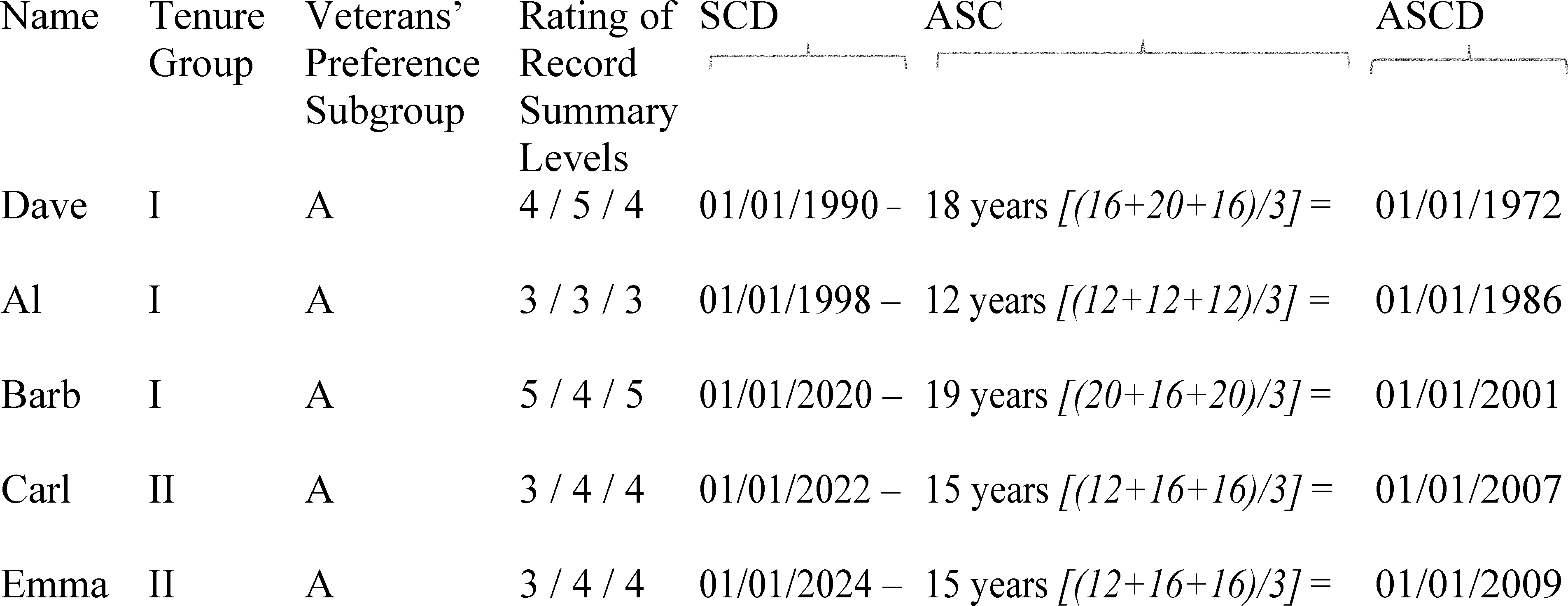
 www.opm.gov/chcoc/latest-memos/performance-management-for-federal-employees.pdf
 babel.hathitrust.org/cgi/pt?id=nnc1.cu09006737&seq=9