Marine Mammals; Incidental Take During Specified Activities; Proposed Incidental Harassment Authorization for Southwest Alaska Stock of Northern Sea Otters in Unalaska, Alaska
We, the U.S. Fish and Wildlife Service (FWS), in response to a request under the Marine Mammal Protection Act of 1972, as amended, from the City of Unalaska, propose to authoriz...
Notice of receipt of application; proposed incidental harassment authorization; draft environmental assessment; request for comments.
SUMMARY:
We, the U.S. Fish and Wildlife Service (FWS), in response to a request under the Marine Mammal Protection Act of 1972, as amended, from the City of Unalaska, propose to authorize incidental take by harassment of small numbers of Southwest Alaska stock northern sea otters (
Enhydra lutris kenyoni) for a period of up to 1 year from the date of issuance. The applicant has requested this authorization for take by harassment that may result from activities associated with pile driving and marine construction at the Robert Storrs Harbor in Unalaska, Alaska. This proposed authorization, if finalized, would be for incidental take by Level A harassment and Level B harassment of northern sea otters from the Southwest Alaska stock. We invite comments on the proposed incidental harassment authorization and the accompanying draft environmental assessment from the public, Tribes, and local, State, and Federal agencies.
DATES:
Comments must be received by September 10, 2026.
ADDRESSES:
Document availability:
You may view the application package, the draft environmental assessment, and other supporting material at
www.regulations.gov
under Docket No. FWS-R7-ES-2026-2576, or you may request these documents from the person listed under
FOR FURTHER INFORMATION CONTACT
.
Comment submission:
All submissions must include the docket number [FWS-R7-ES-2026-2576] for this document. You must submit comments using one of the following methods:
Electronic submission:
Go to the Federal eRulemaking Portal:
www.regulations.gov.
In the Search box, enter FWS-R7-ES-2026-2576, which is the docket number for this rulemaking action. Then, click on the “Search” button. On the resulting page, in the panel on the left side of the screen under the “Document Type” heading, check the Notice box to locate this document. You may submit a comment by clicking on “Comment.” Comments must be submitted to
www.regulations.gov
before 11:59 p.m. (Eastern Time) on the date specified in
DATES
.
U.S. mail:
Public Comments Processing, Attn: Docket No. FWS-R7-ES-2026-2576, U.S. Fish and Wildlife Service, MS: PRB (JAO/3W), 5275 Leesburg Pike, Falls Church, VA 22041-3803.
Comments submitted through any method not authorized in this document, or sent to an address not listed here, will not be considered. We will not accept comments via email, fax, or hand delivery. We are not required to consider comments that are submitted after the comment period ends or that are submitted via a method outside of these instructions. Comments containing profanity, vulgarity, threats, or other inappropriate content will not be considered.
We request that you send comments only by the methods described above. We will post all comments at
www.regulations.gov.
You may request that we withhold personal identifying information from public review; however, we cannot guarantee that we will be able to do so. See Request for Public Comments for more information.
FOR FURTHER INFORMATION CONTACT:
Stephanie Burgess, by email at
r7mmmregulatory@fws.gov,
by telephone at 907-786-3800, or by U.S. mail at U.S. Fish and Wildlife Service, MS 341, 1011 East Tudor Road, Anchorage, AK 99503. Individuals in the United States who are deaf, deafblind, hard of hearing, or have a speech disability may dial 711 (TTY, TDD, or TeleBraille) to access telecommunications relay services. Individuals outside the United States should use the relay services offered within their country to make international calls to the point-of-contact in the United States.
SUPPLEMENTARY INFORMATION:
Background
Section 101(a)(5)(D) of the Marine Mammal Protection Act of 1972 (MMPA; 16 U.S.C. 1361,
et seq.) authorizes the Secretary of the Interior (Secretary) to allow, upon request, the incidental, but not intentional, taking by harassment of small numbers of certain marine mammals in response to requests by U.S. citizens (as defined in title 50 of the Code of Federal Regulations (CFR) in part 18, at 50 CFR 18.27(c)) engaged in a specified activity (other than commercial fishing) within a specified geographic region during a period of not more than 1 year. The Secretary has delegated authority for implementation of the MMPA to the U.S. Fish and Wildlife Service (FWS, or we). According to the MMPA, the FWS shall allow this incidental taking by harassment if we find that the total of such taking for the 1-year period:
1. Will affect only small numbers of individuals of the species or stock;
2. Will have no more than a negligible impact on the species or stock; and
3. Will not have an unmitigable adverse impact on the availability of these species or stock for taking for subsistence use by Alaska Natives.
If the requisite findings are made, we issue an authorization that sets forth the following, where applicable:
1. Permissible methods of taking;
2. Means of effecting the least practicable adverse impact on the species or stock and its habitat and the availability of the species or stock for subsistence uses; and
3. Requirements for monitoring and reporting of such taking by harassment, including, in certain circumstances, requirements for the independent peer review of proposed monitoring plans or other research proposals.
The term “take” means to “harass, hunt, capture, or kill, or to attempt to harass, hunt, capture, or kill any marine mammal” (16 U.S.C. 1362(13)). Harassment for activities other than military readiness activities or scientific research conducted by or on behalf of the Federal Government means any act of pursuit, torment, or annoyance that has the potential to injure a marine mammal or marine mammal stock in the wild (the MMPA defines this as “Level A harassment”), or has the potential to disturb a marine mammal or marine mammal stock in the wild by causing disruption of behavioral patterns, including, but not limited to, migration, breathing, nursing, breeding, feeding, or sheltering (the MMPA defines this as “Level B harassment”) (16 U.S.C. 1362(18)).
The terms “negligible impact” and “unmitigable adverse impact” are defined in 50 CFR 18.27(c) as follows: “Negligible impact” is an impact resulting from the specified activity that cannot be reasonably expected to, and is not reasonably likely to, adversely affect the species or stock through effects on annual rates of recruitment or survival. “Unmitigable adverse impact” means an impact resulting from the specified activity: (1) that is likely to reduce the availability of the species to a level
( printed page 51729)
insufficient for a harvest to meet subsistence needs by (i) causing the marine mammals to abandon or avoid hunting areas, (ii) directly displacing subsistence users, or (iii) placing physical barriers between the marine mammals and the subsistence hunters; and (2) that cannot be sufficiently mitigated by other measures to increase the availability of marine mammals to allow subsistence needs to be met.
The term “small numbers” is also defined in 50 CFR 18.27(c). However, we do not rely on that definition here as it conflates “small numbers” with “negligible impacts.” We recognize “small numbers” and “negligible impacts” as two separate and distinct considerations when reviewing requests for incidental harassment authorizations (IHA) under the MMPA (see
Natural Res. Def. Council, Inc.
v.
Evans,
232 F. Supp. 2d 1003, 1025 (N.D. Cal. 2003)). Instead, for our small numbers determination, we estimate the likely number of marine mammals to be taken and evaluate if that take is small relative to the size of the species or stock.
The term “least practicable adverse impact” is not defined in the MMPA or its enacting regulations. In processing requests for IHAs, we ensure the least practicable adverse impact by requiring mitigation measures that are effective in reducing the impact of specified activities, but they are not so restrictive as to make specified activities unduly burdensome or impossible to undertake and complete.
Summary of Request
On June 25, 2025, the FWS received a request prepared by PND Engineers, Inc. on behalf of the City of Unalaska (hereafter, COU or the applicant) for an authorization to take by harassment northern sea otters (
Enhydra lutris kenyoni) (hereafter, sea otters unless another sea otter subspecies is specified) from the Southwest Alaska stock. The applicant expects take by harassment may occur during their replacement and improvement of the existing Robert Storrs Harbor infrastructure in Unalaska, Alaska. FWS requested additional information on project activities, geospatial files of the project impact area, and mitigation measures, and the COU provided the requested information. We received a revised request on April 2, 2026, and we determined the revised request to be adequate and complete.
Description of Specified Geographic Region and Specified Activities
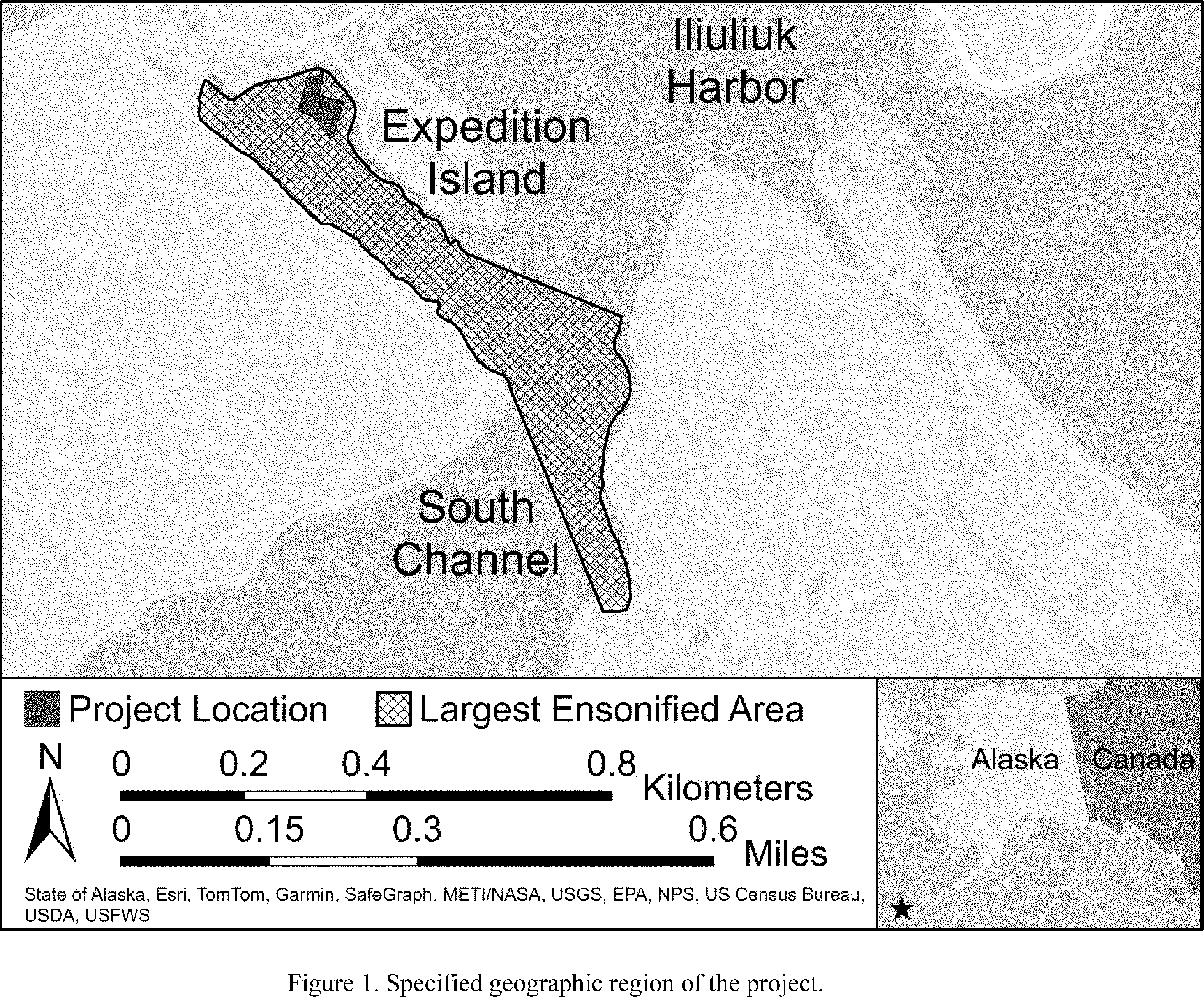
The specified geographic region is the nearshore waters surrounding Robert Storrs Harbor (hereafter project location) located in Unalaska, Alaska. The project location is within Expedition Inlet, which is adjacent to Expedition Island, in Iliuliuk Harbor (figure 1 below).
The specified activity (hereafter referred to as project) will include demolishing the existing moorage structures; installing new high-density polyethylene (HDPE) floats; upgrading access and utilities; and expanding upland parking facilities to improve accessibility, public safety and services, and vessel mooring for local recreational vessels at the Robert Storrs Harbor. The applicant, COU, plans to remove a total of 33 steel piles that are no greater than 40.6 centimeters (cm) (16 inches [in]) in diameter using vibratory pile driving methods. A total of 5 temporary steel piles, each 61.0 cm (24 in) in diameter, will be installed and removed using vibratory pile driving to guide permanent piles into place. The applicant plans to install a total of 44 permanent steel piles no greater than 61.0 cm (24 in) in diameter using a combination of vibratory pile driving, impact pile driving, and down-the-hole (DTH) drilling of rock sockets. Hereafter (unless otherwise specified), the terms “pile driving” and “pile-driving activities” are used to refer to both pile installation and pile removal. Table 1 below summarizes in-water project activities.
( printed page 51730)
Table 1—COU Robert Storrs Harbor Project Activities, Piles Installed or Removed, and Days of Activity
Project component
Pile size and material
Activity
Total number of piles
Maximum
number of
piles per day
Maximum
number of
activity days
Demolition
40.6-cm (16-in) steel
Removal-vibratory
33
15
7
Construction
61.0-cm (24-in) steel
Temporary installation—vibratory
5
4
2
Temporary removal—vibratory
4
3
61.0-cm (24-in) steel
Installation—vibratory
44
4
22
Installation—impact
4
22
Installation—rock socket DTH
2
44
Pile-driving activities will occur up to 100 non-consecutive days during the 1 year from the date of issuance of the IHA, if finalized. Materials and equipment will be transported via barges to the project location. The applicant will also use a crane barge and one or more small skiffs to support construction operations. Shot rock fill and base course will be placed below the high tide line to create the embankment to support the upland parking facility expansion. Geotextile fabric and armor rock will be placed to protect the upland parking facility and keep the shot rock fill in place. Additional project details may be reviewed in the application materials available as described under
ADDRESSES
or may also be requested as described under
FOR FURTHER INFORMATION CONTACT
.
Description of Marine Mammals in the Specified Geographic Region
The sea otter is the only marine mammal species under the FWS's jurisdiction likely to be found within the specified geographic region. Information on the range, stocks, and biology of sea otters is included in supplemental information, which can be found as described above in
ADDRESSES
.
Potential Impacts of the Specified Activities on Marine Mammals
Effects of Noise on Sea Otters
We characterize “noise” as sound released into the environment from human activities that exceeds ambient levels or interferes with normal sound production or reception by sea otters. The terms “acoustic disturbance” and “acoustic harassment” are disturbances or harassment events resulting from noise exposure. Potential effects of noise exposure are likely to depend on the sea otter's distance from the sound source, the sound level and intensity the sea otter receives, background noise levels, noise frequency, noise duration, and whether the noise is pulsed or continuous. The actual noise level perceived by individual sea otters will also depend on whether the sea otter is above or below water and on atmospheric and environmental conditions. Temporary disturbance of sea otters or localized displacement reactions are the most likely effects to occur from noise exposure.
Sea Otter Hearing
Pile driving and marine construction activities produce sound within sea otters' hearing range. Controlled sound exposure trials on southern sea otters (
Enhydra lutris nereis) indicate that sea otters can hear frequencies between 125 hertz (Hz) and 38 kilohertz (kHz), with best sensitivity between 1.2 and 27 kHz (Ghoul and Reichmuth 2014). Sea otters are more adept at aerial hearing and their sensitivity is similar to that of terrestrial carnivores (Reichmuth and Ghoul 2012; Ghoul and Reichmuth 2016; Zellmer et al. 2021).
Aerial and underwater audiograms for a captive adult male southern sea otter in the presence of ambient noise suggest the sea otter's hearing was less sensitive to high-frequency (greater than 22 kHz) and low-frequency (less than 2 kHz) sound than that of terrestrial mustelids, but similar to that of a California sea lion (
Zalophus californianus). However, the sea otter was still able to hear low-frequency sounds, and the detection thresholds for sounds between 0.125 and 1 kHz were between 116 and 101 decibels (dB), respectively. Dominant frequencies of southern sea otter vocalizations are between 3 and 8 kHz, with some energy extending above 60 kHz (McShane et al. 1995; Ghoul and Reichmuth 2012).
Exposure to high levels of sound may cause changes in behavior, masking of communications, temporary or permanent changes in hearing sensitivity, discomfort, and injury to marine mammals. Sea otters do not rely on sound to orient themselves, locate prey, or communicate under water; therefore, masking of communications by anthropogenic noise is less of a concern for sea otters than for other marine mammals. However, sea otters, especially mothers and pups, do use sound for communication in air (McShane et al. 1995), and sea otters may monitor underwater sound to avoid predators (Davis et al. 1987).
Exposure Thresholds
Underwater Sounds
Noise exposure criteria for identifying underwater noise levels capable of causing Level A harassment (injury) to marine mammal species, including sea otters, have been established using the same methods as those used by the National Marine Fisheries Service (NMFS) (Southall et al. 2019). These criteria are based on estimated levels of sound exposure capable of causing a permanent shift in hearing sensitivity that is, a permanent threshold shift (PTS) (NMFS 2018). A PTS occurs when noise exposure causes damage to hair cells within the inner ear system (Ketten 2012). A sea otter that experiences PTS would be permanently unable to hear certain sounds at frequencies similar to those that caused the initial injury. Although the effects of PTS are, by definition, permanent, PTS does not equate to total hearing loss.
Sound exposure thresholds incorporate two metrics of exposure: the peak level of instantaneous exposure likely to cause PTS, and the cumulative sound exposure level (SELCUM) during a 24-hour period. They also include weighting adjustments for the sensitivity of different species to varying frequencies. The PTS-based injury criteria were developed from theoretical extrapolation of observations of temporary threshold shifts (TTS) detected in lab settings during sound exposure trials (Finneran 2015). A TTS is a noise-induced threshold shift in hearing sensitivity that fully recovers over time (Finneran 2015). Southall et al. (2019) developed TTS thresholds for sea otters, which are included in the
( printed page 51731)
“other marine carnivores” category, of 188 dB SELCUM
re 1 micropascal (µPa) for impulsive underwater sound and 199 dB SELCUM
for nonimpulsive underwater sound. Based on these analyses, Southall et al. (2019) predict that PTS for sea otters will occur at 232 dB peak sound pressure level (SPL) or 203 dB SELCUM
for impulsive underwater sound and 219 dB SELCUM
for nonimpulsive underwater sound.
The NMFS has revised its sound exposure criteria to include thresholds for auditory injury (NMFS 2024). We are evaluating the auditory injury criteria to determine whether they are appropriate for FWS trust species, as sea otters in particular are not exposed to in-water noise for an entire 24-hour period.
The NMFS (2018) sound exposure criteria do not identify thresholds for avoidance of Level B harassment. For pinnipeds (seals and sea lions), NMFS has adopted a 160-dB threshold for Level B harassment from exposure to impulsive noise and a 120-dB threshold for nonimpulsive noise (High Energy Seismic Survey Team 1999; NMFS 2018). These thresholds were developed from observations of mysticete (baleen) whales responding to airgun operations (
e.g.,
Malme et al. 1983; Malme and Miles 1983; Richardson et al. 1986, 1995). Southall et al. (2007, 2019) assessed behavioral response studies and found considerable variability among pinnipeds. The authors determined that exposures between approximately 90 to 140 dB generally do not appear to induce strong behavioral responses from pinnipeds in water. However, they found behavioral effects, including avoidance, became more likely in the range between 120 and 160 dB, and most marine mammals showed some, albeit variable, responses to sound between 140 and 180 dB. Wood et al. (2012) adapted the approach identified in Southall et al. (2007) to develop a probabilistic scale for marine mammal taxa at which 10 percent, 50 percent, and 90 percent of individuals exposed are assumed to produce a behavioral response. For many marine mammals, including pinnipeds, these response rates were set at 140, 160, and 180 dB SPLs, respectively.
We have evaluated these thresholds and determined that the Level B harassment threshold of 120 dB for nonimpulsive noise is not applicable to sea otters. The 120-dB threshold is based on studies in which gray whales (
Eschrichtius robustus) were exposed to experimental playbacks of industrial noise (Malme et al. 1983; Malme and Miles 1983). During these playback studies, southern sea otter responses to industrial noise were also monitored (Riedman 1983, 1984). While gray whales exhibited avoidance to industrial noise at the 120-dB threshold, there was no evidence of disturbance reactions or avoidance in southern sea otters. Thus, given the differences in hearing and behavior between sea otters and gray whales, the NMFS 120-dB threshold based on gray whale behavior is not appropriate for predicting sea otter behavioral responses.
Based on the lack of sea otter disturbance response or any other reaction to the 1980s playback studies, as well as the absence of a clear pattern of disturbance or avoidance behaviors attributable to underwater sound levels up to about 160 dB resulting from low-frequency broadband noise, we assume 120 dB is not an appropriate behavioral response threshold for sea otters exposed to nonimpulsive underwater noise.
Based on the best available scientific information about sea otters and closely related marine mammals where sea otter data are limited, the FWS has set 160 dB of received underwater sound as a threshold for take by Level B harassment of sea otters in this proposed IHA. Exposure to in-water noise levels between 125 Hz and 38 kHz that are greater than 160 dB—for both impulsive and nonimpulsive sound sources—will be considered by the FWS as Level B harassment. Thresholds for Level A harassment (which entails the potential for injury) for in-water noise levels between 125 Hz and 38 kHz are 232 dB peak SPL or 203 dB SELCUM
for impulsive sounds and 219 dB SELCUM
for nonimpulsive sounds (table 2 below).
Airborne Sounds
Thresholds for Level A harassment for in-air noise levels are 176 dB peak SPL re 20 µPa or 161 dB SELCUM
for impulsive sounds and 177 dB SELCUM
for nonimpulsive sounds (table 2 below). The NMFS (2018) guidance neither addresses thresholds for preventing injury or disturbance from airborne noise, nor provides thresholds for avoidance of Level B harassment. The NMFS currently recommends 100 dB for all pinnipeds, excluding harbor seals, as the Level B harassment threshold for in-air noise (NMFS 2025). Conveyance of underwater noise into the air is of little concern since the effects of pressure release and interference at the water's surface reduce underwater noise transmission into the air. For activities that create both in-air and underwater noise, we will estimate take based on parameters for underwater noise transmission. Considering sound energy travels more efficiently through water than through air, this estimation will also account for exposures to sea otters at the surface.
[Established by Southall et al. (2019) through modeling and extrapolation for “Other Marine Carnivores”, which include sea otters.*]
TTS
PTS
nonimpulsive
impulsive
nonimpulsive
impulsive
SEL
CUM
SEL
CUM
Peak SPL
SEL
CUM
SEL
CUM
Peak SPL
Air
157
146
170
177
161
176
Water
199
188
226
219
203
232
* Values are weighted for other marine carnivores' hearing thresholds and given in cumulative sound exposure level (SEL
CUM
dB re (20 micropascal [µPa] in air and SEL
CUM
dB re 1 µPa in water) for impulsive and nonimpulsive sounds, and unweighted peak sound pressure level (SPL) in air (dB re 20µPa) and water (dB 1µPa) (impulsive sounds only)).
Evidence From Sea Otter Studies
Individual sea otters near the project location would likely show a range of responses to noise from pile-driving activities. Some sea otters would likely dive, show startle responses, change direction of travel, or prematurely surface. Sea otters reacting to pile-driving activities may divert time and attention from biologically important behaviors, such as feeding and nursing pups. Sea otter responses to disturbance can result in energetic costs. For example, sea otters spend more time traveling in areas with high levels of
( printed page 51732)
disturbance (Curland 1997). Higher energetic costs require increased amounts of prey consumption (Barrett 2019). This increased prey consumption may impact sea otter prey availability and cause sea otters to spend more time foraging and less time resting (Barrett 2019). Some sea otters may abandon the project location and return when the disturbance has ceased. Based on the observed movement patterns of sea otters (Lensink 1962; Kenyon 1969, 1981; Garshelis and Garshelis 1984; Riedman and Estes 1990), we expect some sea otters would respond to pile-driving activities by dispersing to nearby areas of suitable habitat; however, other sea otters, especially territorial adult males, would not be displaced.
Additional information on the evidence from studies about how sea otters may be affected by noise can be found in the supplemental information to this document (available as described above in
ADDRESSES
).
Consequences of Permanent Threshold Shift
Sea otters exposed to noise levels above Level A harassment threshold criteria may experience a permanent shift in the sensitivity of their hearing. Information on the consequences of a PTS in sea otter hearing due to noise exposure can be found in the supplemental information to this document (available as described above in
ADDRESSES
).
Consequences of Disturbance
Information on the consequences of disturbance to sea otters can be found in the supplemental information to this document (available as described above in
ADDRESSES
).
Vessel Activities
Vessel activity during the project includes the use of barges and skiffs to transport and stage equipment and materials to support construction operations. Vessels will not be used extensively or over a long duration during project activities. We do not anticipate that sea otters would experience changes in behavior indicative of harassment during vessel operations. Additionally, vessel operators would take every precaution to avoid harassment of sea otters when operating a vessel near sea otters and implement mitigation measures described in the COU's request and below in this proposed IHA, which include maintaining a minimum distance of 100 meters (m) (328 feet [ft]) from all sea otters.
Additional information on vessel activities can be found in the supplemental information to this document (available as described above in
ADDRESSES
).
Effects on Sea Otter Habitat and Prey
Information on the potential impacts of the specified activities on sea otter habitat and prey species can be found in the supplemental information to this document (available as described above in
ADDRESSES
). Based on this information, we do not anticipate any harassment to sea otters due to effects on sea otter habitat or prey from the specified activities.
Potential Impacts of the Specified Activities on Subsistence Uses
The specified activities will occur near marine subsistence harvest areas used by Alaska Natives from Unalaska and the surrounding areas. The majority of sea otter harvest in this area occurs in Captains Bay near Unalaska. Since 2015, there have been five sea otters harvested in the Captains Bay area. Four sea otters were harvested in 2015, and one sea otter was harvested in 2020.
The planned project will occur within the Unalaska city limits, where firearm use is prohibited. The area potentially affected by the planned project does not significantly overlap with current subsistence harvest areas. Construction activities will not preclude access to hunting areas or interfere in any way with individuals wishing to hunt. Despite no conflict with subsistence use being anticipated, the FWS will conduct outreach with potentially affected communities to see whether there are any questions, concerns, or potential conflicts regarding subsistence use in those areas. If any conflicts are identified in the future, the COU will develop a plan of cooperation (POC) specifying the steps necessary to minimize any effects the project may have on subsistence harvest.
Estimated Take
Definitions of Incidental Take Under the MMPA
Under the MMPA, “take” means “to harass, hunt, capture, or kill, or attempt to harass, hunt, capture, or kill any marine mammal” (16 U.S.C. 1362(13)). Below we provide definitions of three types of take of sea otters. This discussion is provided for context and background and does not necessarily reflect what is anticipated to result from the specified activities.
Lethal Take
In the most serious interactions, human actions can result in the mortality of sea otters, which we define here as lethal take.
Level A Harassment
The MMPA defines Level A harassment, for nonmilitary readiness activities, as “any act of pursuit, torment, or annoyance which . . . has the potential to injure a marine mammal or marine mammal stock in the wild” (16 U.S.C. 1362(18)(A)(i), (C)). We interpret this definition to include human activity that may result in PTS in a sea otter's hearing sensitivity or injury to sea otters.
Level B Harassment
The MMPA defines Level B harassment for nonmilitary readiness activities as “any act of pursuit, torment, or annoyance which . . . has the potential to disturb a marine mammal or marine mammal stock in the wild by causing disruption of behavioral patterns, including, but not limited to, migration, breathing, nursing, feeding, or sheltering” (16 U.S.C. 1362(18)(A)(ii), (D)). We interpret this definition to include human-caused reactions that disrupt biologically significant behaviors or activities for the affected animal. Such reactions include, but are not limited to, the following:
Swimming away at a fast pace on belly (i.e.,
porpoising);
Repeatedly raising the head vertically above the water to get a better view (spyhopping) while apparently agitated or while swimming away;
In the case of a pup, repeatedly spyhopping while hiding behind and holding onto its mother's head;
Abandoning prey or feeding area;
Ceasing to nurse and/or rest (applies to dependent pups);
Ceasing to rest (applies to independent animals);
Ceasing to use movement corridors;
Ceasing mating behaviors;
Shifting/jostling/agitation in a raft (i.e.,
group of 10 or more sea otters) so that the raft disperses;
Sudden diving of an entire raft;
Flushing animals off a haulout; or
TTS in a sea otter's hearing sensitivity.
This list does not encompass all possible behaviors that indicate Level B harassment; other behavioral responses may be indicative of take by Level B harassment. In some circumstances, eliciting behavioral responses that equate to take by Level B harassment repeatedly may result in Level A harassment. Relatively minor changes in behavior such as the animal raising its head or temporarily changing its direction of travel are not likely to disrupt biologically important
( printed page 51733)
behavioral patterns, and the FWS does not view such minor changes in behavior as indicative of a take by Level B harassment.
Calculating Take
Sea Otter Density
We assumed all sea otters exposed to underwater sound levels that meet the acoustic exposure criteria defined above in
Exposure Thresholds
would experience take by Level A harassment or Level B harassment. We refer to the area in which sound levels meet or exceed the acoustic exposure criteria defined for either Level A harassment or Level B harassment as the ensonification area. Spatially explicit ensonification areas were established around the planned construction location to estimate the number of sea otters that may be exposed to these sound levels.
We estimated sea otter density using the estimated number of sea otters in the project location derived from a spatially explicit hierarchical distance sampling model (Wilson et al. 2021). Sea otter density ranged from 13.413 to 22.745 sea otters per square kilometer (km2
) inside the project's largest ensonification area (Wilson et al. 2021). We used the maximum estimated sea otter density of 22.745 sea otters/km2
in our analysis to estimate the number of sea otters potentially affected by the project activities.
Sound Levels for the Specified Activities
The project activities consist of vibratory pile extraction and multiple pile installation methods (vibratory pile driving, impact pile driving, and DTH drilling of rock sockets). Each method generates a different type of in-water noise. Vibratory pile extraction and installation produces nonimpulsive noise; impact pile installation produces impulsive noise; and DTH drilling of rock sockets is considered to produce both impulsive and nonimpulsive noise (NMFS 2020).
The level of sound anticipated from each project activity was established using data from several sources in addition to guidance from NMFS. We used the empirical data from those proxy projects and sound levels provided by NMFS with the NMFS Technical Guidance and User Spreadsheet (NMFS 2018, 2020) to determine the distance at which sound levels would attenuate to Level A harassment thresholds (table 2 above). To estimate the distance at which sound levels would attenuate to Level B harassment thresholds, we used the data from the proxy projects and the sound levels provided by NMFS to determine the distance at which sound levels would attenuate to 160 dB. We used the NMFS-recommended transmission loss coefficient of 15 for coastal pile-driving activities in a practical spreading loss model (NMFS 2020) to estimate distances at which sounds would attenuate to Level A harassment and Level B harassment thresholds. The weighting factor adjustment included in the NMFS user spreadsheet accounts for sounds experienced in less sensitive portions of an animal's hearing range. We used the weighting factor adjustment for otariid pinnipeds as they are the closest available physiological and anatomical proxy for sea otters. We acknowledge that NMFS has revised their user spreadsheet to include thresholds for auditory injury (NMFS 2024). As discussed in
Exposure Thresholds,
we are evaluating the auditory injury criteria to determine whether they are appropriate for FWS trust species, and we will continue to use the previous version of the user spreadsheet (NMFS 2018, 2020) to estimate harassment of sea otters from in-water noise exposure during our evaluation.
Sound levels for all sources are unweighted and given in dB re 1 µPa. For nonimpulsive sound sources, sound levels are shown in the form of mean maximum root mean square (RMS) SPL. For impulsive sound sources, sound levels are shown in the forms of peak SPL (peak) and sound exposure level for a single strike (SELss). Sound levels for project activities are listed in table 3 below.
Table 3—COU Robert Storrs Habor Sound Types, Levels, and Timing
Project component
Pile size and
material
Activity
Type of sound
Sound levels
Source
Timing per pile
(nonimpulsive sound sources)
or strikes per pile
(impulsive sound sources)
Demolition
40.6-cm (16-in) steel
Removal-vibratory
Nonimpulsive
163 dB RMS
NMFS 2026
15 minutes
Construction
61.0-cm (24-in) steel
Temporary installation-vibratory
Nonimpulsive
163 dB RMS
NMFS 2026
20 minutes
Temporary removal-vibratory
163 dB RMS
NMFS 2026
15 minutes
61.0-cm (24-in) steel
Installation-vibratory
Nonimpulsive
163 dB RMS
NMFS 2026
20 minutes.
Installation-impact
Impulsive
190 dB RMS; 177 dB SELss; 203 dB peak
Caltrans 2015;
NMFS 2026
1,000 strikes
Installation-rock socket DTH
Impulsive and nonimpulsive
167 dB RMS; 159 dB SELss; 184 dB peak
Heyvaert & Reyff 2021;
NMFS 2022
180 minutes/
108,000 strikes
Ensonification Areas
Distances to below Level A harassment and Level B harassment thresholds were calculated for each project activity to determine the ensonification area for that activity. The COU would implement a 10-m (33-ft) physical interaction shutdown zone, regardless of predicted sound levels, to minimize the potential for physical impacts to sea otters. Additionally, this 10-m (33-ft) physical interaction shutdown zone would reduce the number of sea otters exposed to in-water noise levels at or above Level A harassment thresholds. The 10-m (33-ft) physical interaction shutdown zone would encompass the majority of the Level A harassment zones (table 4 below).
( printed page 51734)
Table 4—COU Robert Storrs Harbor Distances to Below Level A Harassment and Level B Harassment Zones and Proposed Physical Interaction Shutdown Zones
Project component
Pile size and material
Activity
Distance to below Level A
harassment threshold
(m)
Distance to below Level B
harassment threshold
(m)
Distance to below physical
interaction shutdown zone
(m)
Demolition
40.6-cm (16-in) steel
Removal-vibratory
1.0
15.9
10.0
Construction
61.0-cm (24-in) steel
Temporary installation-vibratory
0.5
15.9
10.0
Temporary removal-vibratory
0.4
15.9
10.0
61.0-cm (24-in) steel
Installation-vibratory
0.5
15.9
10.0
Installation-impact
39.0
1,000.0
10.0
Installation-rock socket DTH
35.2
29.3a
10.0
a
The Level B harassment distance threshold is smaller than the Level A harassment distance threshold for these activities; therefore, the Level A harassment distance threshold will be used rather than the Level B harassment distance threshold for monitoring of takes.
We calculated the area ensonified to >232 dB peak SPL or >203 dB SELCUM
re 1µPa for impulsive underwater sound and >219 dB SELCUM
re 1µPa for nonimpulsive underwater sound to determine the area in which sea otters may experience Level A harassment for each of the COU's project activities. Our ensonification area calculations showed that the project activity sound levels would not reach the 232 dB peak SPL threshold for causing instantaneous PTS in sea otter hearing sensitivity. We multiplied the ensonification area for Level A harassment by the density of sea otters for the project location (see
Sea Otter Density) and the number of project activity days to determine the number of Level A harassment events for each project activity.
To estimate the number of Level B harassment events during the COU's project activities, we subtracted the area of the Level A harassment zone from the area ensonified to >160 dB re 1µPa to determine the area in which sea otters may experience Level B harassment for each project activity. Our ensonification area calculations showed that the project activity sound levels would not reach the 226 dB peak SPL threshold for causing instantaneous TTS in sea otter hearing sensitivity outside the 10-m (33-ft) physical interaction shutdown zone. We multiplied the remaining ensonified area for Level B harassment by the density of sea otters for the project location (see
Sea Otter Density) and the number of project activity days to determine the number of Level B harassment events for each project activity. The COU provided geospatial files representing the area where pile driving and construction activities will occur and the ensonified water around the construction area. These geospatial files were clipped by land boundaries; therefore, only the area of ensonified water was provided by the applicant. The numbers of Level A harassment and Level B harassment events estimated during project activities can be found in tables 5 and 6 below, respectively.
Table 5—COU Robert Storrs Harbor Level A Harassment Events Estimated
Project
component
Pile size and
material
Activity
Maximum number of
activity days
Sea otter density
Level A area
(km2
)
Estimated sea otters affected by Level A sound per day
Total
estimated
Level A
harassment events
(unrounded)
Total
estimated
Level A
harassment events
(rounded)
Demolition
40.6-cm (16-in) steel
Removal—vibratory
7
22.745 sea otters/km2
0.005
0.119
0.830
a
2
Construction
61.0-cm (24-in) steel
Temporary installation—vibratory
2
0.005
0.115
0.230
a
2
Temporary removal—vibratory
3
0.005
0.114
0.342
a
2
61.0-cm (24-in) steel
Installation—vibratory
22
0.005
0.115
2.525
3
Installation—impact
22
0.015
0.340
7.487
8
Installation—rock socket DTH
44
0.014
0.321
14.105
15
a
Where the estimated total number of harassment events expected was equal to or greater than 0.001, we rounded to 2 instead to accommodate potential mother and pup pairs of sea otters for project activities.
Table 6—COU Robert Storrs Harbor Level B Harassment Events Estimated
Project
component
Pile size and material
Activity
Maximum number of activity days
Sea otter density
Level B area
(km2
)
Level B area minus Level A area
(km2
)
Estimated sea otters affected by Level B sound per day
Total
estimated
Level B
harassment
events
(unrounded)
Total
estimated
Level B
harassment
events
(rounded)
Demolition
40.6-cm (16-in) steel
Removal—vibratory
7
22.745 sea otters/km2
0.010
0.004
0.099
0.696
a
2
( printed page 51735)
Construction
61.0-cm (24-in) steel
Temporary installation—vibratory
2
0.010
0.005
0.103
0.207
a
2
Temporary removal—vibratory
3
0.010
0.005
0.104
0.312
a
2
61.0-cm (24-in) steel
Installation—vibratory
22
0.010
0.005
0.103
2.272
3
Installation—impact
22
0.140
0.125
2.854
62.785
b
264
Installation—rock socket DTH
44
0.013
0c
0
0
0
a
Where the estimated total number of harassment events expected was equal to or greater than 0.001, we rounded to 2 instead to accommodate potential mother and pup pairs of sea otters for project activities.
b
The ensonification area for this activity overlaps with a channel that serves as a sea otter travel corridor. We estimated up to 12 sea otters may travel through this channel on a given day. Therefore, we multiplied 12 sea otters by the number of activity days to estimate the number of harassment events.
c
The Level B harassment distance threshold is smaller than the Level A harassment distance threshold for these activities; in these instances, we estimated take of sea otters by Level A harassment only.
Critical Assumptions
In order to conduct this analysis and estimate the potential amount of take by Level A harassment and Level B harassment, several critical assumptions were made.
Sound level information from pile-driving activities in several locations was used to generate sound level estimates for the specified activities (see sources in table 3 above). Environmental conditions in these locations, including water depth, substrate, and ambient sound levels may be similar to those in the project location, but are not identical. Further, ensonification area estimates were based on sound attenuation models using a practical spreading loss model. These factors may lead to actual sound values differing slightly from those estimated here.
We assumed that the different types of pile-driving activities will occur sequentially and that the total number of activity days will equal the sum of the number of days required to complete each type of pile-driving activity. While more than one type of activity will take place on some days, which would reduce the number of days of exposure, we cannot know this information in advance. As such, the estimated number of activity days is the maximum possible for the planned work.
The pile-driving activities described here will also create in-air noise. Because sea otters spend over half of their day with their heads above water (Esslinger et al. 2014), they will be exposed to the in-air noise produced by construction equipment. However, we have calculated Level A harassment and Level B harassment with the assumption that a sea otter may be harassed only one time per 24-hour period, and in-water noise levels would be more disturbing and extend farther than in-air noise. Thus, while sea otters may be disturbed by noise both in-air and in-water, we have relied on the more conservative in-water estimates.
Level B harassment is equated herein with behavioral responses that indicate harassment or disturbance. There is likely a portion of animals that respond in ways that indicate some level of disturbance but do not experience biologically significant consequences. Our estimates do not account for variable responses by sea otter age and sex.
The behavioral response estimates presented here do not account for the individual movements of animals in response to the specified activities. Our assessment assumes animals remain stationary (that is, the density does not change) for a 24-hour period, and animals do not move out of ensonification areas in response to noise. Not enough information is available about the movement of sea otters in response to specific disturbances to refine this assumption.
We reviewed multiple sea otter observation datasets to determine sea otter density within the COU's project location. We used the maximum estimated sea otter density of 22.745 sea otters/km2
for our analysis to estimate the number of sea otters potentially harassed by in-water noise during the project activities. This estimated sea otter density was calculated using a spatially explicit hierarchical distance sampling model (Wilson et al. 2021). Methods and assumptions for these surveys can be found in the original publication. We also considered sea otter observations recorded during a dock construction project in Iliuliuk Harbor (see figure 1 above), which is adjacent to the COU's project location (PND Engineers, Inc. 2017). Based on these sea otter observations, we estimated that up to 12 sea otters may travel through the channels leading into Iliuliuk Harbor on a given day, indicating the channels provide a travel corridor for sea otters. The esonification area for impact pile driving activities overlaps with one of the channels. We assumed that up to 12 sea otters may travel through the channel and be exposed to in-water noise during each day of impact pile driving activities. Therefore, we multiplied the number of days in which impact pile driving activities will occur by 12 sea otters to estimate the number of harassment events for impact pile driving activities.
A limited number of individual sea otters occupy the project location depending on multiple factors such as habitat suitability, prey availability, environmental stressors, predation, subsistence harvest levels, and human activity (Tinker et al. 2019; Eisaguirre et al. 2021). Although sea otters are nonmigratory, they typically move amongst focal areas within their home ranges to rest and forage (Garshelis and Garshelis 1984; Laidre et al. 2009). We used the best available scientific information to estimate the maximum number of individual sea otters that may be exposed to the COU's project activities. The largest sea otter group size observed during the most recent abundance surveys of the Eastern Aleutians management unit was approximately 112 sea otters, and this
( printed page 51736)
group was observed approximately 8 kilometers (km) (5 miles [mi]) from the COU's project location (Wilson et al. 2021). Based on this information and our assumptions, we estimate that a maximum of 112 individual sea otters may be exposed to the COU's project activities. It is possible that, given the large variability in individual sea otter home range sizes and the potential for daily movement in and out of foraging or resting areas, different individual sea otters could be found within the ensonification area each day of the project. Thus, we assumed that the estimated harassment events may impact different sea otters up to the maximum number of individual sea otters estimated to be exposed to the COU's project activities.
For our take estimate analysis, we subtracted the Level A harassment ensonification area from the Level B harassment ensonification area for each project activity to estimate the total number of Level B harassment events. This approach avoids overestimating the number of Level B harassment events. We rounded the total numbers of Level A harassment and Level B harassment events up to the nearest whole number considering that harassment events are not fractional units. Where the estimated total number of harassment events was between 0.001 and 1, we rounded up to 2 harassment events to account for the potential of mother and pup pairs of sea otters encountering project activities.
Sum of Harassment From All Sources
The COU will conduct pile driving and marine construction activities in Unalaska for up to a 1-year period. A summary of total estimated takes by Level A harassment and Level B harassment during the project is provided in table 7 below.
Table 7—Sea Otters Expected To Be Harassed; Level A Harassment and Level B Harassment Events
Location
Number of sea otters exposed to Level A
harassment
Total number of Level A
harassment events
Number of sea otters exposed to Level B
harassment
Total number of Level B
harassment events
Unalaska (Southwest Alaska stock)
32
32
a
112
273
a
It is possible that an individual sea otter may experience both Level A harassment and Level B harassment. We anticipate up to 112 sea otters may experience harassment during the project activities.
Over the course of the project, we estimate up to 32 instances of take by Level A harassment of 32 sea otters from the Southwest Alaska stock due to PTS associated with in-water noise exposure during project activities. We anticipate that sea otters may experience PTS as a result of cumulative in-water noise exposure. Project activity sound levels would not reach the 232 dB peak SPL threshold for causing instantaneous PTS in sea otter hearing sensitivity based on our ensonification area calculations. Using soft-start procedures, zone clearance prior to activity startup, and shutdown zones is likely to decrease both the number of sea otters exposed to noise above Level A harassment thresholds and the exposure time of any sea otters entering the Level A harassment zone. This reduces the likelihood of hearing sensitivity losses that might impact the health, reproduction, or survival of affected sea otters. Despite the implementation of mitigation measures, it is anticipated that some sea otters may experience Level A harassment via exposure to in-water noise above threshold criteria during pile-driving activities.
Over the course of the project, we estimate up to 273 instances of take by Level B harassment of up to 112 sea otters from the Southwest Alaska stock due to behavioral responses to in-water noise exposure during project activities. Although multiple instances of Level B harassment of individual sea otters are possible, these events are unlikely to have significant consequences for the health, reproduction, or survival of affected sea otters. The potential effects of multiple Level B harassment noise exposures may include short-term behavioral reactions, displacement of sea otters near active operations, and, in rare cases, potential temporary shifts in hearing thresholds. We anticipate that the likelihood of sea otters experiencing a TTS is low during the project. Project activity sound levels would not reach the peak SPL threshold for causing instantaneous TTS in sea otter hearing sensitivity outside of the 10-m (33-ft) physical interaction shutdown zone based on our ensonification area calculations. Therefore, sea otters would experience TTS as a result of cumulative in-water noise exposure, which is unlikely due to sea otter behavioral patterns. Sea otters spend over half of their time above the surface during the summer months (Esslinger et al. 2014), and likely no more than 70 percent of their time foraging during winter months (Gelatt et al. 2002); thus, their ears would not be exposed to underwater noise for a prolonged time period, thereby reducing their likelihood to experience TTS. Considering the sound levels of the specified activities, the limited amount of time over non-consecutive days in which the specified activities will occur, and the localized area to be impacted by the specified activities; we do not anticipate that the effects of multiple Level B harassment noise exposures would rise to the level of TTS, an injury, or Level A harassment.
Determinations and Findings
Sea otters exposed to noise from the specified activities are likely to respond with temporary behavioral modification or displacement. The specified activities could temporarily interrupt the feeding, resting, and movement of sea otters. The activities will occur during a limited amount of time and in a localized area, and the impacts associated with the project are likewise temporary and localized. The anticipated effects are short-term behavioral reactions, displacement of sea otters near active operations, and potential shifts in hearing thresholds.
Sea otters that encounter the specified activities may exert more energy than they would otherwise due to temporary cessation of feeding, increased vigilance (for example, repeatedly spyhopping), and retreating from the project location. We expect that affected sea otters would tolerate this exertion without measurable effects on health or reproduction. Most of the anticipated takes would be due to short-term Level B harassment in the form of startling reactions, interruption of feeding, resting, and movement, or temporary displacement. We anticipate that the likelihood of sea otters experiencing a TTS due to in-water noise exposure is low during the project based on the project activity sound levels and sea otter behavioral patterns. While mitigation measures incorporated into the COU's request would reduce occurrences of Level A harassment to the extent practicable, a small number
( printed page 51737)
of takes by Level A harassment would be authorized for the specified activities, which have Level A harassment zone radii ranging up to 39.0 m (128.0 ft).
Small Numbers
For our small numbers determination, we consider whether the estimated number of sea otters to be subjected to incidental take is small relative to the population size of the species or stock. More specifically, the FWS compares the number of sea otters anticipated to be taken in the year contemplated by the proposed IHA with the population estimate applicable for the year. Here, predicted numbers of sea otters to be taken were determined based on the estimated density of sea otters in the project location and ensonification areas developed using empirical evidence from similar geographic areas. We estimate that the COU's specified activities in the specified geographic region would take no more than 112 Southwest Alaska stock sea otters by Level A harassment and Level B harassment during the 1-year period of this proposed IHA (see
Sum of Harassment from All Sources). Take of 112 sea otters is 0.22 percent of the best available estimate of the current annual Southwest Alaska stock size of 51,935 animals (88 FR 53510, August 8, 2023) ([112 ÷ 51,935] × 100 ≉ 0.22), and represents a “small number” of sea otters of that stock.
Further, the specified activity area is small relative to the range of the Southwest Alaska stock of sea otters. The Southwest Alaska stock of sea otters ranges well beyond the nearshore waters surrounding the Robert Storrs Harbor in Unalaska, meaning this specified geographic region represents only a small subset of the potential area in which this population may occur.
Therefore, we propose a finding that the COU's specified activities would take only small numbers of sea otters because: (1) Only a small proportion of sea otters would overlap with the areas where the specified activities will occur; and (2) the estimated number of Southwest Alaska stock sea otters to be taken would be limited to a total of 112 sea otters over the duration of the proposed IHA, which represents a small proportion (0.22 percent) of the stock of sea otters.
Negligible Impact
We propose a finding that any incidental take by harassment resulting from the specified activities cannot be reasonably expected to, and is not reasonably likely to, adversely affect sea otters through effects on annual rates of recruitment or survival and would, therefore, have no more than a negligible impact on the Southwest Alaska stock of sea otters. In making this finding, we considered the best available scientific information including the biological and behavioral characteristics of the species, the most recent information on species distribution and abundance within the specified geographic region, the current and expected future status of the stock (including existing and foreseeable human and natural stressors), the potential disturbance sources caused by the specified activities, and the potential sea otter responses to this disturbance. In addition, we reviewed applicant-provided materials, our own files and datasets, published reference materials, and input from species experts. We propose this finding based on the following: (1) we anticipate that the impacts on sea otters potentially resulting from the specified activities are limited to short-term behavioral reactions, displacement near active operations and, in rare cases, hearing threshold shifts; (2) the potential impacts from the specified activities would not have long-term consequences to a sea otter's survival and reproduction; (3) the total number of sea otters affected and the impact severity are not expected to affect annual rates of recruitment or survival or result in adverse effects on the stock; and (4) we propose mitigation measures that are designed to minimize interactions with and impacts on sea otters.
We anticipate that the impacts on sea otters potentially resulting from the specified activities are limited to short-term behavioral reactions, displacement near active operations, and, in rare cases, hearing threshold shifts. Most sea otters would respond to disturbance by moving away from the source, which may cause temporary interruption of foraging, resting, or other natural behaviors. Affected sea otters are expected to resume normal behaviors soon after exposure with no lasting consequences to their survival or reproduction. While Level A harassment has the potential to result in the injury (hearing threshold shift) of up to 32 sea otters during the IHA period, this type of harassment would be a result of cumulative in-water noise exposure. We anticipate a low likelihood of sea otters experiencing hearing thresholds shifts due to cumulative in-water noise exposure based on the project activity sound levels and sea otter behavioral patterns. Sea otters spend over half of their time above the surface during the summer months (Esslinger et al. 2014), and likely no more than 70 percent of their time foraging during winter months (Gelatt et al. 2002); thus, their ears would not be exposed to underwater noise for a prolonged time period, thereby reducing their likelihood of experiencing hearing threshold shifts. Based on this information, we anticipate that the vast majority of harassment events will be limited to short-term behavioral reactions and displacement near active operations. These behavioral responses could have temporary biological impacts for affected sea otters but are not anticipated to result in measurable changes in survival or reproduction. Should individual sea otters remain in the immediate project location and be repeatedly harassed, the most biologically consequential repeated behavioral responses would be cessation of nursing or changes to foraging, grooming, or resting. However, the project location is surrounded by suitable sea otter habitat, providing ample opportunity for undisturbed nursing, foraging, grooming, or resting in nearby coves.
We anticipate that the potential impacts from the specified activities would not have long-term consequences to a sea otter's survival and reproduction. The most severe impact on sea otters potentially resulting from the specified activities is multiple Level A harassment noise exposures. The potential effects of multiple Level A harassment noise exposures may include a greater reduction in a sea otter's hearing sensitivity, but this reduction in hearing sensitivity does not equate to total hearing loss. The reduction in sea otter hearing sensitivity caused by PTS would align with the energy produced by pile-driving activities (for example, low-frequency less than 2 kHz), which would not impair the majority of a sea otter's hearing range. Sea otters do not rely on sound to orient themselves, locate prey, or communicate under water. Therefore, we do not anticipate PTS from multiple Level A harassment noise exposures would impact sea otters' ability to move, forage, or communicate. Sea otters, especially mothers and pups, do use sound for communication in air (McShane et al. 1995), and sea otters may monitor underwater sound to avoid predators (Davis et al. 1987). However, we anticipate that a sea otter would retain the majority of its hearing range if it experiences PTS from multiple Level A harassment noise exposures and that impacts from PTS would not have long-term consequences to a sea otter's survival and reproduction.
( printed page 51738)
The total number of sea otters affected and the impact severity are not sufficient to change the current population dynamics at the stock scale. Although the specified activities may result in a maximum of 305 incidental takes of up to 112 sea otters from the Southwest Alaska stock, we do not expect this level of harassment to affect annual rates of recruitment or survival or result in adverse effects on the stock.
Our proposed finding of negligible impact applies to incidental take associated with the specified activities as mitigated by the avoidance and minimization measures identified in the COU's mitigation and monitoring plan. These mitigation measures are designed to minimize interactions with and impacts on sea otters. These mitigation measures and the monitoring and reporting procedures are required for the validity of our finding and are a necessary component of the proposed IHA. For these reasons, we propose a finding that the specified project would have a negligible impact on the Southwest Alaska stock of sea otters.
Least Practicable Adverse Impact
We propose a finding that the mitigation measures required by this proposed IHA would effect the least practicable adverse impact on the Southwest Alaska stock of sea otters from any incidental take likely to occur in association with the specified activities. In making this finding, we considered the biological characteristics of sea otters, the nature of the specified activities, the potential effects of the activities on sea otters, the documented impacts of similar activities on sea otters, and alternative mitigation measures. After reviewing the original request (submitted June 25, 2025), the FWS discussed additional mitigation measures with the COU to reduce potential impacts of the specified activities. These additional mitigation measures included maintaining a minimum avoidance distance between sea otters and vessels supporting the project activities and revising sea otter monitoring zones, shutdown zones, and shutdown periods. The applicant incorporated these additional mitigation measures in their revised request and supporting documentation.
In evaluating what mitigation measures are appropriate to ensure the least practicable adverse impact on species or stocks and their habitat, as well as subsistence uses, we considered the manner and degree to which the successful implementation of the measures is expected to achieve this goal. We considered the nature of the potential adverse impact being mitigated (likelihood, scope, range), the likelihood that the measures would be effective if implemented, and the likelihood of effective implementation. We also considered the practicability of the measures for applicant implementation (for example, the cost and impact on operations).
To reduce the potential for disturbance associated with the activities, the COU would implement mitigation measures, including the following:
Using the smallest diameter piles practicable while minimizing the overall number of piles;
Using a project design that does not include dredging or blasting;
Minimizing the use of the impact hammer to the extent possible by using a vibratory hammer to advance piles as deeply as possible;
Development of a marine mammal monitoring and mitigation plan;
Visual mitigation monitoring by designated protected species observers (PSOs);
Halting or delaying activity during environmental conditions that may hinder sea otter detection, such as darkness, adverse weather conditions, high sea states, and other times of limited visibility;
Maintaining the maximum distance practicable between a vessel and raft of sea otters;
Operating vessels in such a way as to avoid approaching sea otters or impeding sea otter movements when traveling near the shoreline in shallow water (<20 m [66 ft]) whenever practicable;
Establishment of shutdown and monitoring zones;
Site clearance before activity startup;
Soft-start procedures; and
Shutdown procedures.
A number of additional potential mitigation measures were considered but determined to be not practicable and/or not effective. These measures are listed below:
Require use of bubble curtains and other noise-dampening methods
—The applicant indicated that implementation of bubble curtains and other noise-dampening methods such as cofferdams, pile-surrounding casings, sound mitigation screens, and nets around piles would require additional barges and equipment that would further restrict the limited workspace available in the harbor for construction activities and create navigational and safety hazards during operations. The FWS determined the required use of bubble curtains and other noise-dampening methods was not practicable because these mitigation measures were unduly burdensome to undertake for the project activities.
Require use of alternate detection methods
—The FWS determined that the required use of alternate detection methods such as infrared sensors; thermal imaging; or surveys conducted by aircraft, unmanned aircraft system, or vessel was not practicable considering that these alternate detection methods would be less effective than PSOs in reducing impacts on sea otters due to the limited number of project activities and small spatial extent of ensonification areas. The applicant would employ PSOs to monitor the project location for sea otters to reduce impacts on sea otters.
Require pile-driving activities be conducted at lower tidal heights
—The applicant indicated that conducting pile-driving activities at lower tidal heights to reduce transmission of sound into the water column would restrict the available time to conduct activities safely each day and add delays to the project schedule. The FWS determined that requiring pile-driving activities to be conducted at lower tidal heights was not practicable because this mitigation measure would be less effective in reducing impacts on sea otters if the implementation of this mitigation measure extended the project duration.
Require use of silt curtains during DTH drilling activities
—The applicant indicated that the maintenance and repairs to the silt curtain would not be easily accessible due to the remote project location. The FWS determined that the required use of silt curtains during DTH drilling activities was unduly burdensome to undertake for the project activities.
Impact on Subsistence Use
The anticipated harassment will not preclude access to harvest areas or interfere with the availability of sea otters for harvest by Alaska Native Peoples. Additionally, the existing vessel harbor and associated facilities are located within the City of Unalaska, where firearm use is prohibited. We therefore propose a finding that the COU's anticipated harassment would not have an unmitigable adverse impact on the availability of any stock of sea otters for taking for subsistence uses by Alaska Native Peoples during the specified timeframe. In making this proposed finding, we considered the timing and location of the planned activities and the timing and location of subsistence harvest activities in the project location.
The harvest of sea otters is important to Alaska Native Peoples in the
( printed page 51739)
communities surrounding Unalaska. The COU would be required to contact subsistence communities that may be affected by the pile driving and marine construction activities to discuss potential conflicts caused by location, timing, and methods of the specified activities. The COU must make reasonable efforts to ensure that activities do not interfere with subsistence hunting and that adverse effects on the availability of sea otters are minimized. No concerns have been voiced by the Alaska Native communities regarding the specified activities limiting availability of sea otters for subsistence uses. However, should such a concern be voiced, a POC, which identifies measures to minimize any adverse effects, would be implemented. The POC would ensure that the COU would not have an unmitigable adverse impact on the availability of the species or stock for subsistence uses. This POC would provide the procedures addressing how the COU would work with the affected Alaska Native communities and what actions would be taken to avoid interference with subsistence hunting of sea otters, as warranted.
The FWS has not received any reports and is not aware of information that indicates that sea otters are being or would be deterred from hunting areas or impacted in any way that diminishes their availability for subsistence use by the expected level of pile driving and marine construction activity. If there is evidence that these pile driving and marine construction activities are affecting the availability of sea otters for subsistence uses, we would reevaluate our findings regarding permissible limits of take and the measures required to ensure continued subsistence hunting opportunities.
Monitoring and Reporting
The purpose of monitoring requirements is to assess the effects of specified activities on sea otters; to ensure that take is consistent with that anticipated in the small numbers, negligible impact, and subsistence use analyses; and to detect any unanticipated effects on the species or stock. Monitoring plans document when and how sea otters are observed, the number of sea otters, and their behaviors during the observation. This information allows the FWS to measure encounter rates, examine trends in sea otter activity and distribution in the project location, and estimate the number of sea otters potentially affected by the specified activities. The COU is required to report all observations of sea otters. To the extent possible, PSOs would record group size, age, sex, behavior, duration of observation, and closest approach to the project activity.
As proposed, monitoring activities would be summarized and reported in formal reports. The COU must submit monthly reports for all months during which noise-generating work takes place as well as a final monitoring report that must be submitted no later than 90 days after the expiration of the IHA. We would require approval of the monitoring results for continued operation under the IHA.
We propose a finding that these monitoring and reporting requirements to evaluate the potential impacts of planned activities would ensure that the effects of the activities remain consistent with the rest of the findings.
References Cited
A list of the references cited in this notice may be found at
www.regulations.gov
under Docket No. FWS-R7-ES-2026-2576.
Required Determinations
National Environmental Policy Act
We have prepared a draft environmental assessment in accordance with the National Environmental Policy Act (NEPA; 42 U.S.C. 4321et seq.). We have preliminarily concluded that the proposed action of issuing a final IHA would not significantly affect the quality of the human environment and, thus, preparation of an environmental impact statement for this IHA, if finalized, is not required by section 102(2) of NEPA or the Department's NEPA handbook. We are accepting comments on the draft environmental assessment as specified above in
DATES
and
ADDRESSES
.
Endangered Species Act
Under the Endangered Species Act (ESA; 16 U.S.C. 1536(a)(2)), all Federal agencies are required to ensure the actions they authorize are not likely to jeopardize the continued existence of any threatened or endangered species or result in destruction or adverse modification of critical habitat. The specified activities will occur entirely within the range of the Southwest Alaska stock of sea otters, which is listed as threatened under the ESA. Before issuance of this IHA, the FWS will conduct intra-service consultation under section 7 of the ESA on our issuance of an IHA. These evaluations and findings may be requested from the FWS.
Government-to-Government Consultation
It is our responsibility to communicate and work directly on a Government-to-Government basis with federally recognized Alaska Native Tribes and organizations in developing programs for healthy ecosystems. We seek their full and meaningful participation in evaluating and addressing conservation concerns for protected species. It is our goal to remain sensitive to Alaska Native culture, and to make information available to Alaska Natives. Our efforts are guided by
Executive Order 13175—Consultation and Coordination With Indian Tribal Governments,
512 DM 5—
Procedures for Consultation with Indian Tribes,
512 DM 6—
Department of the Interior Policy on Consultation with Alaska Native Claims Settlement Act Corporations,
510 FW 1,
The Service's Native American Policy,
and 510 FW 2,
The Service's Alaska Native Relations Policy.
The FWS has evaluated possible effects of the specified activities on federally recognized Alaska Native Tribes and Alaska Native Claims Settlement Act Corporations. The applicant has presented a communication process, culminating in a POC if needed, with the Alaska Native organizations and communities most likely to be affected by their work. We have evaluated the potential effects of the proposed action and determined that it would not have substantial direct effects on any federally recognized Tribes or Alaska Native Claims Settlement Act Corporations. However, we invite continued discussion, either about the project and its impacts or about our coordination and information exchange throughout the IHA/POC process.
Paperwork Reduction Act
This authorization does not contain any new collection of information that requires approval by the Office of Management and Budget (OMB) under the Paperwork Reduction Act of 1995 (44 U.S.C. 3501et seq.). The OMB has previously approved the information collection requirements associated with IHAs and assigned OMB Control Number 1018-0194 (expires August 31, 2026). An agency may not conduct or sponsor, and a person is not required to respond to, a collection of information unless it displays a currently valid OMB control number.
Proposed Authorization
We propose to authorize the incidental take by Level A harassment
( printed page 51740)
and Level B harassment of sea otters from the Southwest Alaska stock. Authorized take would be limited to disruption of behavioral patterns, displacement of sea otters near active operations, or hearing threshold shifts that may be caused by pile driving and marine construction activities conducted by the COU in Unalaska, Alaska, for a period of up to one year from the date of finalization.
A. General Conditions for this IHA
(1) Activities must be conducted in the manner described in the revised request dated April 2, 2026, from the COU for an IHA and in accordance with all applicable conditions and mitigations measures. The taking of sea otters whenever the required conditions, mitigation, monitoring, and reporting measures are not fully implemented as required by the IHA is prohibited. Failure to follow the measures specified both in the revised request and within this proposed authorization may result in the modification, suspension, or revocation of the IHA.
(2) If project activities cause a form of take other than Level A harassment or Level B harassment or take of one or more sea otters through methods not described in the IHA, the COU must take the following actions:
(i) Cease its activities immediately (or reduce activities to the minimum level necessary to maintain safety);
(ii) Report the details of the incident to the FWS within 24 hours; and
(iii) Suspend further activities until the FWS has reviewed the circumstances and determined whether additional mitigation measures are necessary to avoid further unauthorized taking.
(3) All operation managers, vehicle operators, and machine operators must receive a copy of this IHA and maintain access to it for reference at all times during project work. These personnel must understand, be fully aware of, and be capable of implementing the conditions of the IHA at all times during project work.
(4) This IHA will apply to activities associated with the specified project as described in this document and in the COU's revised request. Changes to the specified project without prior authorization may invalidate the IHA.
(5) The COU's revised request is approved and fully incorporated into this IHA unless exceptions are specifically noted herein. The request includes:
(i) The COU's revised request for an IHA, dated April 2, 2026; and
(ii) The COU's revised Protected Species Monitoring and Mitigation Plan, dated April 2, 2026.
(6) Operators will allow FWS personnel or the FWS's designated representative to visit project worksites to monitor for impacts on sea otters and subsistence uses of sea otters at any time throughout project activities so long as it is safe to do so. “Operators” are all personnel operating under the COU's authority, including all contractors and subcontractors.
B. Avoidance and Minimization
(7) Construction activities must be conducted using equipment that generates the lowest practicable levels of in-water noise within the range of frequencies audible to sea otters.
(8) If a sea otter enters or appears likely to enter the shutdown zone, in-water activities must be shut down until either the sea otter has been visually observed outside the shutdown zone or at least 15 minutes have elapsed since the last observation time without redetection of the sea otter.
(i) During all in-water activities, regardless of predicted sound levels, a physical interaction shutdown zone of at least 10 m (33 ft) must be enforced.
(ii) During rock fill placement activities, a physical interaction shutdown zone of at least 30 m (98 ft) must be enforced.
(9) For impact pile driving activities, a soft-start procedure must be implemented at the start of each day's impact pile driving activities and at any time following cessation of impact pile driving for more than 30 minutes without monitoring by PSOs. The soft-start procedure requires an initial set of three strikes from the impact driver at reduced energy if possible, followed by a 30-second waiting period. This procedure must be conducted a total of three times before full-powered strikes if practicable.
(10) For DTH drilling activities, a soft-start procedure must be implemented at the start of each day's DTH drilling activities and at any time following cessation of DTH drilling for more than 30 minutes without monitoring by PSOs. The soft-start procedures requires the equipment operators to activate the drilling equipment at reduced energy if possible for several seconds, followed by a 30-second waiting period. This procedure must be conducted a total of three times before full-powered operations if practicable.
(11) In-water activity must be conducted in daylight. If environmental conditions prevent visual detection of sea otters approaching the shutdown zone, in-water activities must be stopped until visibility is regained.
C. Mitigation Measures for Vessel Operations
Vessel operators must take every precaution to avoid harassment of sea otters during vessel operations. The applicant must carry out the following measures:
(12) Vessels must maintain a minimum distance of 500 m (0.3 mi) from rafts of 10 or more sea otters unless otherwise needed for safety. If a vessel must transit within 500 m (0.3 mi) from rafts of sea otters, the vessel must travel at a reduced speed and maintain the maximum distance practicable between the vessel and raft of sea otters. Vessels must reduce speed and maintain a minimum distance of 100 m (328 ft) from all sea otters unless otherwise needed for safety.
(13) Vessels must not be operated in such a way as to separate members of a group of sea otters (two or more sea otters) from other members of the group, encircle sea otters, or impede movement of sea otters. Vessels must use established navigation channels or commonly recognized vessel traffic corridors and avoid approaching sea otters or impeding sea otter movements when traveling near the shoreline in shallow water (<20 m or <66 ft) whenever practicable.
(14) When weather conditions require, such as when visibility drops, vessels must adjust speed accordingly to reduce the likelihood of injury to sea otters.
(15) Vessel operators must be provided written guidance for avoiding collisions and minimizing disturbances to sea otters. Guidance will include all measures identified in this section.
D. Monitoring
(16) Operators shall work with PSOs to apply mitigation measures and shall recognize the authority of PSOs up to and including stopping work, except in situations where doing so poses a significant safety risk to personnel.
(17) Duties of the PSOs include watching for and identifying sea otters, recording observation details, documenting presence in any applicable monitoring zone, identifying and documenting potential harassment, and working with operators to implement all appropriate mitigation measures.
(18) A sufficient number of PSOs will be available to meet the following criteria: 100 percent monitoring of shutdown zones during all daytime periods of in-water noise-generating work; a maximum of 4 consecutive
( printed page 51741)
hours on watch per PSO; a maximum of 12 hours on watch per day per PSO.
(19) All PSOs will complete training on the project's Protected Species Monitoring and Mitigation Plan designed to familiarize individuals with monitoring and data collection procedures. This training will be completed prior to starting work. A field crew leader with prior experience as a sea otter observer will supervise the PSO team. Initially, new or inexperienced PSOs will be paired with experienced PSOs so that the quality of marine mammal observations and data recording is kept consistent. Resumes for candidate PSOs will be made available to the FWS prior to the start of the project.
(20) The PSOs will be provided with reticule binoculars (7×50 or better), big-eye binoculars or spotting scopes (30×), inclinometers, and range finders. Field guides, instructional handbooks, maps, and a contact list will also be made available.
(21) The PSOs will monitor a pre-clearance zone for 30 minutes prior to the commencement of in-water noise-generating activities and following periods of inactivity of more than 30 minutes to ensure no sea otters are within the shutdown zone prior to initiating or resuming in-water noise-generating activities.
(22) The PSOs will collect data using the following procedures:
(i) All data will be recorded onto a field form or database.
(ii) Global positioning system data, sea state, tidal state, wind force, visibility, and weather condition will be recorded at the beginning and end of a monitoring period; at least every hour in between, at the change of a PSO, and upon observation of sea otters.
(iii) Observation records of sea otters will include date, time, the PSOs' locations, sea otter's heading (if moving), weather condition, visibility, number of sea otters, group composition (adults/juveniles), and the location of the sea otters (or distance and direction from the PSO).
(iv) Observation records will also include initial behaviors of the sea otters, descriptions of project activities and in-water noise levels being generated, the position of sea otters relative to applicable monitoring and Level A harassment or Level B harassment zones, any mitigation measures applied, and any apparent reactions to the project activities before and after mitigation.
(v) For all sea otters in or near a Level A harassment or Level B harassment zone, the PSOs will record the distance from the sound source to the sea otter upon initial observation, the duration of the encounter, and the distance at last observation in order to monitor cumulative sound exposures.
(vi) The PSOs will note any instances of sea otters lingering close to or traveling with vessels for prolonged periods of time.
(23) Monitoring of the shutdown zone must continue for 30 minutes following completion of in-water noise-generating activities.
E. Measures To Reduce Impacts to Subsistence Users
(24) Prior to conducting the work, the COU will take the following steps to reduce potential effects on subsistence harvest of sea otters:
(i) Avoid work in areas of known sea otter subsistence harvest;
(ii) Discuss the planned activities with subsistence stakeholders including Southwest Alaska villages and traditional councils;
(iii) Identify and work to resolve concerns of stakeholders regarding the project's effects on subsistence hunting of sea otters; and
(iv) If any concerns remain, develop a POC in consultation with the FWS and subsistence stakeholders to address these concerns.
F. Reporting Requirements
(25) The applicant, COU, must notify the FWS at least 48 hours prior to commencement of activities.
(26) Monthly reports will be submitted to the FWS's Marine Mammals Management office (MMM) for all months during which noise-generating work takes place. The monthly report will contain and summarize the following information: dates, times, weather, and sea conditions (including the Beaufort Scale sea state and wind force conditions) when sea otters were observed; the number, location, distance from the sound source, and behavior of the sea otters; the associated project activities; and a description of the implementation and effectiveness of mitigation measures with a discussion of any specific behaviors the sea otters exhibited in response to mitigation.
(27) A final report will be submitted to the FWS's MMM within 90 days after completion of work or expiration of the IHA. The report will include:
(i) A summary of monitoring efforts (hours of monitoring, activities monitored, number of PSOs, and, if requested by the FWS, the daily monitoring logs).
(ii) A description of all project activities, any additional work yet to be done, factors influencing visibility and detectability of marine mammals (
e.g.,
sea state, fog, glare, and number of PSOs), and factors correlated with the presence and distribution of sea otters (
e.g.,
weather, sea state, and project activities).
(iii) An estimate of the number of sea otters exposed to noise at received levels greater than or equal to Level A harassment and Level B harassment (based on visual observation).
(iv) A description of changes in sea otter behavior resulting from project activities and any specific behaviors of interest.
(v) A discussion of the mitigation measures implemented during project activities and their observed effectiveness for minimizing impacts on sea otters. Sea otter observation records will be provided to the FWS in the form of electronic database or spreadsheet files.
(28) Injured, dead, or distressed sea otters that are not associated with project activities (
e.g.,
animals known to be from outside the project location, previously wounded animals, or carcasses with moderate to advanced decomposition or scavenger damage) must be reported to the FWS within 24 hours of the discovery to either the FWS's MMM (907-786-3800, business hours); or the Alaska SeaLife Center in Seward (1-888-774-7325, 24 hours a day), or both. Photographs, video, location information, or any other available documentation must be provided to the FWS.
(30) The COU must notify the FWS upon project completion or end of the work season.
Request for Public Comments
If you wish to comment on this proposed authorization, the associated draft environmental assessment, or related documents, you may submit your comments by either of the methods described above in
ADDRESSES
. Please identify the document(s) to which your comments pertain, make your comments as specific as possible, confine them to issues pertinent to the proposed authorization, and explain the reason for any changes you recommend. Where possible, your comments should reference the specific section or paragraph that you are addressing. The FWS will consider all comments that are received before the close of the comment period (see
DATES
above). The FWS does not anticipate extending the public comment period beyond the 30 days required under section 101(a)(5)(D)(iii) of the MMPA.
( printed page 51742)
Comments, including names and street addresses of respondents, will become part of the administrative record for this proposal. Before including your address, telephone number, email address, or other personal identifying information in your comment, be advised that your entire comment, including your personal identifying information, may be made publicly available at any time. While you can ask us in your comments to withhold from public review your personal identifying information, we cannot guarantee that we will be able to do so.
Peter Fasbender,
Assistant Regional Director for Fisheries and Ecological Services, Alaska Region, U.S. Fish and Wildlife Service.
 www.regulations.gov
 16 U.S.C. 1361
 title 50 of the Code of Federal Regulations