Securities and Exchange Commission
- [Release No. 34-106134; File No. SR-NYSEAMER-2025-72]
I. Introduction
On December 3, 2025, NYSE American LLC (“NYSE American” or the “Exchange”) filed with the Securities and Exchange Commission (“Commission” or “SEC”), pursuant to Section 19(b)(1) of the Securities Exchange Act of 1934 (“Act”) [1] and Rule 19b-4 thereunder,[2] a proposed rule change to amend Section 1003 of the NYSE American Company Guide (“Company Guide”). The proposed rule change was published in the Federal Register on December 17, 2025.[3] On January 22, 2026, the Exchange filed Amendment No. 1 to the proposed rule change, which superseded the original proposed rule change in its entirety.[4] On January 28, 2026, pursuant to Section 19(b)(2) of the Act,[5] the Commission designated a longer period within which to take action on the proposed rule change.[6] On February 25, 2026, the Exchange filed Amendment No. 2 to the proposed rule change, which superseded the proposed rule change, as modified by Amendment No. 1, in its entirety.[7] On March 6, 2026, the Exchange filed Amendment No. 3 to the proposed rule change, which superseded the proposed rule change, as modified by Amendment No. 2, in its entirety.[8] On March 17, 2026, the Commission published notice of Amendment No. 3 and instituted ( printed page 53437) proceedings pursuant to Section 19(b)(2)(B) of the Act [9] to determine whether to approve or disapprove the proposed rule change, as modified by Amendment No. 3.[10] On June 11, 2026, the Commission issued a notice of designation of a longer period of time for Commission action on proceedings to determine whether to approve or disapprove the proposed rule change, as modified by Amendment No. 3.[11] On July 15, 2026, the Exchange filed Amendment No. 4 to the proposed rule change, which superseded the proposed rule change, as modified by Amendment No. 3, in its entirety.[12] As of the date of publication of this order, the Commission received several comment letters, which are addressed below.[13]
The Commission is publishing this notice and order to solicit comments on Amendment No. 4 from interested persons and to approve the proposed rule change, as modified by Amendment No. 4, on an accelerated basis.
II. Description of the Proposed Rule Change, as Modified by Amendment No. 4 [14]
Section 1003 of the Company Guide sets forth minimum quantitative and qualitative continued listing standards for securities listed on the Exchange.[15] Currently, Section 1003(f)(v) of the Company Guide states that the Exchange will consider initiating suspension and delisting procedures when a class of common stock is selling for a substantial period of time at a low price per share and its issuer fails to effect a reverse stock split to raise the per share trading price.[16] The Exchange states that, in applying this rule, Exchange staff seeks to have proactive discussions with any issuer whose stock is trading below $1.00 to notify such issuer of the Exchange's policy to initiate suspension and delisting procedures when a stock trades below $0.10 per share.[17] The Exchange states that it has become aware of a recent increase in exchange trading of companies that have a very low trading price per share,[18] and that a stock that trades at a low price per share is potentially susceptible to manipulation and more likely to experience trading volatility in its shares.[19] According to the Exchange, at such low prices, less capital is required to undertake manipulative trading activity.[20] Therefore, the Exchange proposes to amend Section 1003 relating to the price criteria for continued listing to increase the price at which the Exchange will take immediate delisting action and codify such price and procedures in Exchange rules.[21]
The Exchange proposes to amend Section 1003(f)(v) of the Company Guide to specify that if a security's closing price per share is less than $0.25 (the “Minimum Trading Price”) on any trading day, the Exchange shall immediately suspend trading and commence delisting proceedings with respect to such security in accordance with the provisions of Section 1009 of the Company Guide.[22] The Exchange states that it believes that securities that trade below the Minimum Trading Price are more susceptible to trading volatility and market manipulation and are unlikely to recover to any meaningful degree.[23] The Exchange also proposes to modify Section 1003(f)(v) of the Company Guide to state that such company will not be entitled to follow the procedures outlined in Section 1009 of the Company Guide with respect to the Minimum Trading Price criteria.[24] The Exchange states that all issuers retain the right to appeal an Exchange delisting decision.[25]
The Exchange proposes that these changes will be effective on July 1, 2027.[26] The Exchange states that providing a transition period before the rule is effective will afford issuers time to implement reverse stock splits to increase their share price before the new requirement is in place.[27]
The Exchange also proposes to specify in Section 1003(f)(v) of the Company Guide that, consistent with its general authority under Section 1002(e) of the Company Guide to suspend trading in the event of any condition that makes further dealings on the Exchange unwarranted, it may suspend trading or delist a security where, in the Exchange's opinion, the trading price has experienced a precipitous decline and is at an abnormally low level from which it is unlikely to recover, even if such security has not fallen below the Minimum Trading Price.[28] The Exchange states that, in its experience, under those conditions a security's trading price is generally unable to recover.[29]
III. Discussion and Commission Findings
After careful review, the Commission finds that the proposed rule change, as modified by Amendment No. 4, is consistent with the requirements of the Act and the rules and regulations thereunder applicable to a national securities exchange.[30] In particular, the Commission finds that the proposed rule change, as modified by Amendment No. 4, is consistent with Section 6(b)(5) of the Act,[31] which requires, among other things, that the rules of a national securities exchange be designed to ( printed page 53438) prevent fraudulent and manipulative acts and practices, to promote just and equitable principles of trade, to remove impediments to and perfect the mechanism of a free and open market and a national market system, and, in general, to protect investors and the public interest, and not be designed to permit unfair discrimination between customers, issuers, brokers, or dealers. The Commission also finds that the proposed rule change, as modified by Amendment No. 4, is consistent with Section 6(b)(7) of the Act,[32] which requires, among other things, that the rules of an exchange provide fair procedure for the prohibition or limitation by the exchange of any person with respect to access to services offered by the exchange. In addition, the Commission finds that the proposed rule change, as modified by Amendment No. 4, is consistent with Section 6(b)(8) of the Act,[33] which requires that the rules of an exchange do not impose any burden on competition not necessary or appropriate in furtherance of the purposes of the Act.
The Commission has consistently recognized that the development and enforcement of meaningful listing standards [34] by an exchange is of critical importance to financial markets and the investing public.[35] Among other things, the Commission has stated that listing standards provide the means for an exchange to screen issuers that seek to become listed, and to provide listed status only to bona fide companies that have or will have sufficient public float, investor base, and trading interest to provide the depth and liquidity to promote fair and orderly markets.[36] Those listing standards are informed by an exchange's regulatory and commercial considerations and the Act provides exchanges with discretion, subject to the requirements of the Act, to set those standards as they see fit with the understanding that not all companies will meet those standards initially or over time. Meaningful listing standards also are important given investor expectations regarding the nature of securities that have achieved an exchange listing, and the role of an exchange in overseeing its market and assuring compliance with its listing standards.[37] The imprimatur of listing on a particular exchange correlates to investors' expectations that the listed issuer meets the standards set by the exchange and that the exchange has used its judgment regarding the level at which to set those standards.[38]
Minimum Trading Price, Immediate Trading Suspension, and Delisting
The Exchange's proposal is reasonably designed to enhance the Exchange's continued listing standards. The proposal will accelerate the timeframe within which the Exchange will delist a security in instances where the security trades below the Minimum Trading Price and result in immediate suspension from trading on the Exchange. The Exchange states that securities that fall below the Minimum Trading Price are more susceptible to trading volatility and market manipulation and are unlikely to recover to a meaningful degree.[39]
While several commenters expressed general support for the Exchange's goal of enhancing market quality and maintaining appropriate continued listing standards,[40] commenters raised several concerns regarding the proposed rule change.[41] Specifically, one commenter stated that the Exchange fails to provide empirical analysis to support the Minimum Trading Price.[42] Another commenter stated that the Exchange has not demonstrated, through “reasoned and evidence-based analysis,” that its proposal is necessary to protect investors and promote fair and orderly markets.[43] This commenter also stated that the Exchange does not demonstrate that the Minimum Trading Price “is a reliable predictor of sustained financial distress, manipulation risk, or future non-compliance with existing listing standards.” [44]
This commenter attached a report by Professor Craig M. Lewis that presents an empirical study raising concerns that the proposal may prematurely delist companies that would otherwise regain compliance.[45] The Lewis Report analyzes approximately 323 companies that fell below $0.25 between January 1, 2006 and December 31, 2025, and concludes that “a temporary decline below the threshold does not reliably predict permanent business failure or
( printed page 53439)eventual delisting.” [46] The Lewis Report states that of the 323 companies that would have been delisted based on the proposal, 90% (283 companies) recovered at least once above the $0.25 threshold during the time period studied and 23% (74 companies) remain listed as of December 2025, representing over $20.1 billion in current market capitalization.[47]
In response to commenters, the Exchange states the Minimum Trading Price criteria is a “measured approach to address concerns about volatility and potential manipulation in low-priced stocks.” [48] According to the Exchange, “low-priced stocks are more susceptible to manipulation because it necessarily requires a smaller capital investment to transact in such securities, thereby opening the door to a wider range of potential bad actors.” [49] The Exchange states that, based on the Lewis Report, while 23% of the companies that fell below the Minimum Trading Price remain listed on the Exchange, 77% of such companies are no longer listed on the Exchange, and this data is consistent with the Exchange's historical observation that companies falling below the Minimum Trading Price are generally unlikely to recover to any meaningful degree.[50] The Exchange further states that its proposal is not premised on the notion that a security trading below the Minimum Trading Price is without value and instead is seeking to address problematic trading in low-priced stocks, which are frequently below other Exchange listing standards.[51]
The Exchange's proposal to immediately suspend trading and commence delisting proceedings for a security that falls below the Minimum Trading Price is consistent with the Act's requirement that rules be, among other things, designed to prevent fraudulent and manipulative acts and practices, to promote just and equitable principles of trade, to remove impediments to and perfect the mechanism of a free and open market and a national market system, and, in general, to protect investors and the public interest, and not permit unfair discrimination between customers, issuers, brokers, or dealers.[52]
The Commission's data analysis supports the Exchange's proposal. Specifically, the Commission's analysis supports the Exchange's statement that there is an increasing trend of low-priced stocks and demonstrates that stocks trading below the Minimum Trading Price are likely to stay under this threshold for a significant period of time. As discussed further below, low priced securities may be more susceptible to manipulation. The continued listing of securities trading below the Minimum Trading Price raises concerns that these securities may have heightened susceptibility to manipulation while trading on the Exchange for an extended period. Accordingly, the immediate suspension and delisting of these securities is reasonably designed to prevent fraudulent and manipulative acts and practices, and to protect investors and the public interest, consistent with Section 6(b)(5) of the Act.[53]
As part of the Commission's consideration of the proposed Minimum Trading Price, the Commission analyzed stock prices and delisting data for companies listed on NYSE American and New York Stock Exchange (“NYSE”).[54] The results of the Commission's analysis show that the number of securities that would have fallen below the Minimum Trading Price from 2006 to 2025 were at or above the average of 26 securities in 8 out of the 20 years, and were noticeably higher in 2008, 2009, 2015, and 2023, at 125 securities, 46 securities, 43 securities, and 40 securities, respectively.[55]
( printed page 53440)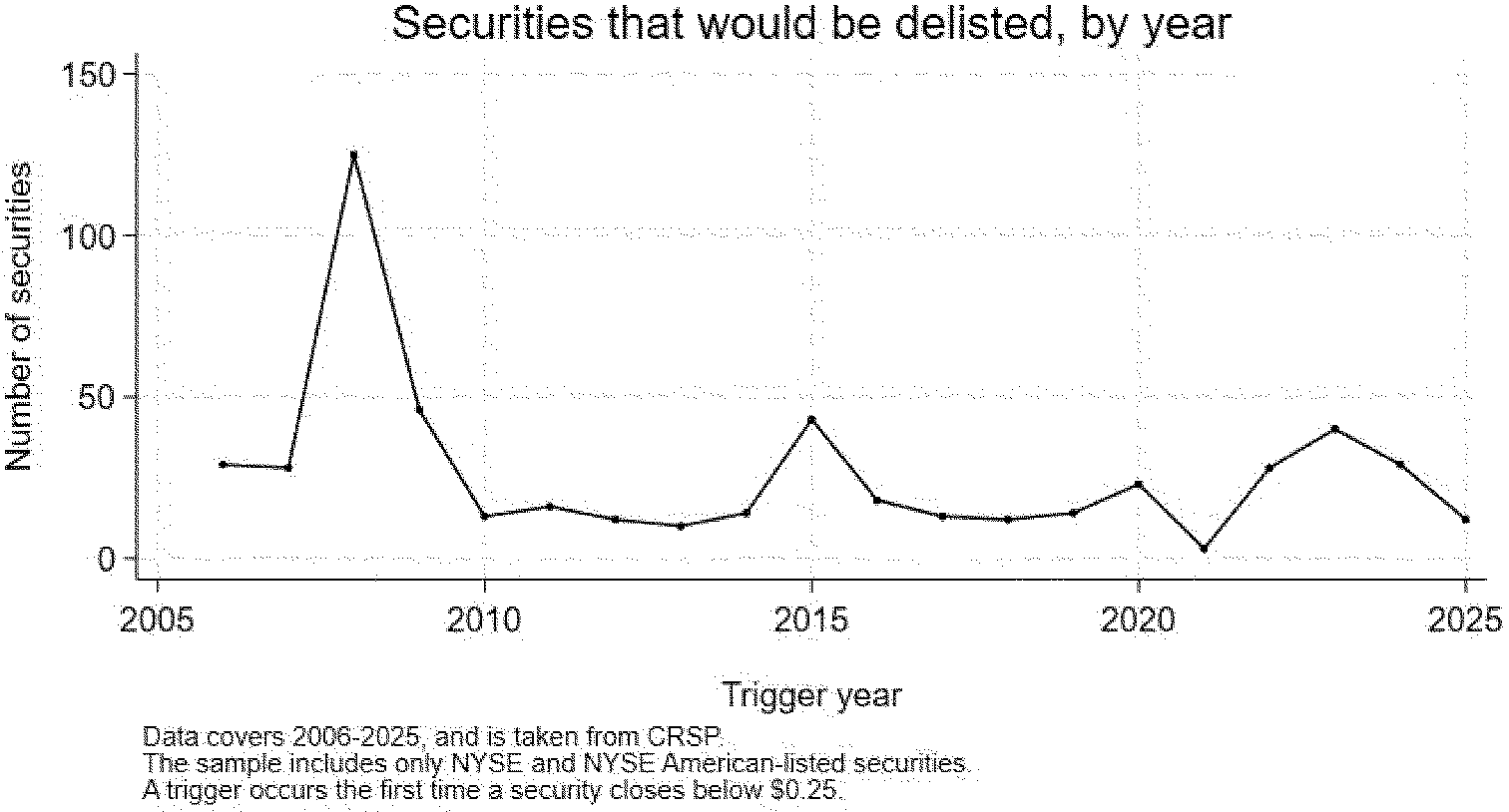
Figure 1. Number of Securities That Would Have Been Delisted Pursuant to the Proposed Minimum Trading Price Threshold From 2006 to 2025
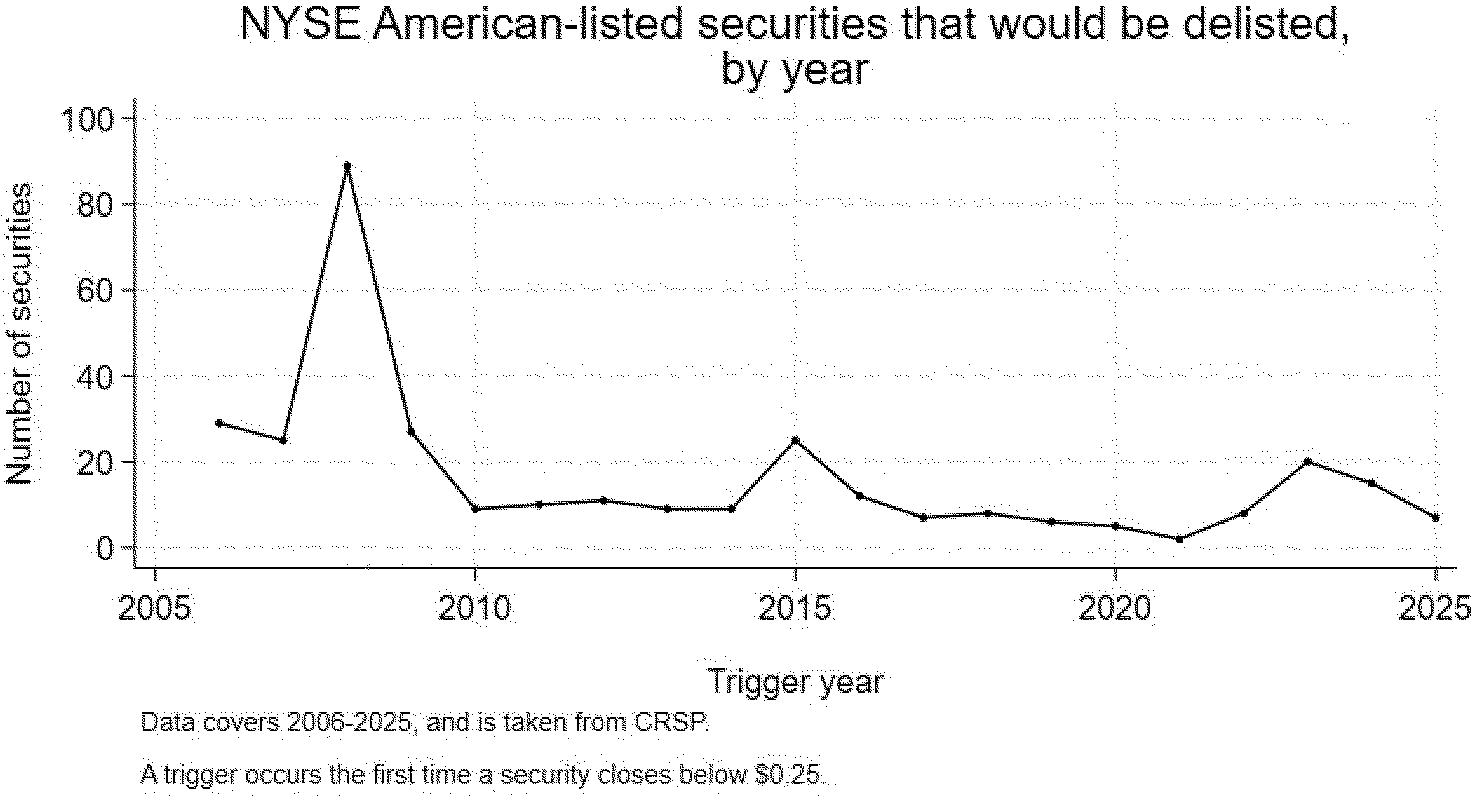
Figure 2. Number of NYSE American Securities That Would Have Been Delisted Pursuant to the Proposed Minimum Trading Price Threshold From 2006 to 2025
In addition, the Commission analyzed the relationship of securities that crossed specific closing price thresholds between $0.10 and $0.50, and their closing prices after 180 calendar days of first crossing a specific closing price threshold.[56] According to the analysis, regardless of the closing price threshold selected, the median closing price after 180 days is below the specific closing price threshold. This result generally holds true for the Minimum Trading Price ( i.e., $0.25) over the sample period.[57] 55% of the securities that fell below the Minimum Trading Price had a closing price under $0.25 after 180 days, with the median closing price at $0.23. The results also show significant volatility in securities after trading below the Minimum Trading Price. 25% of the securities closed below $0.15, representing a loss of at least 40% from the $0.25 threshold after 180 days, while 25% of the securities closed above $0.45, representing a gain of 80%.
( printed page 53441)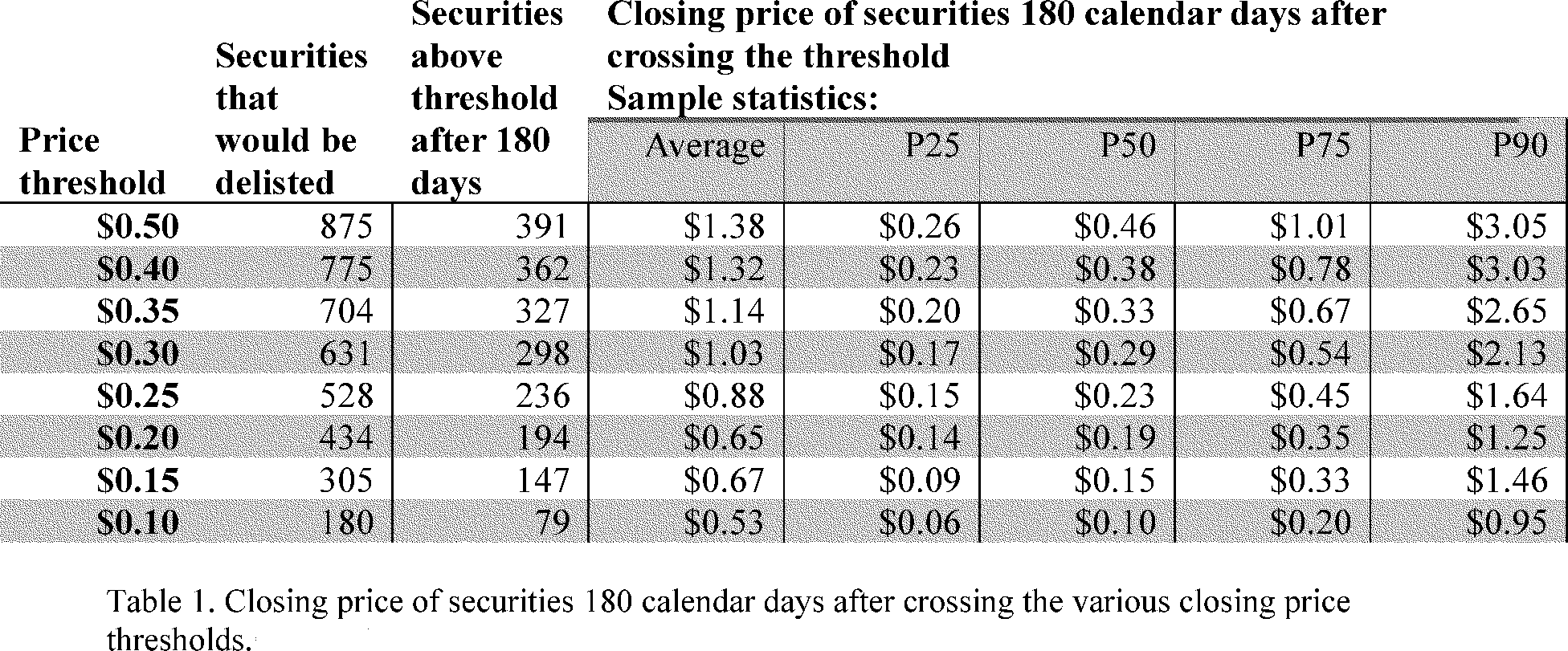
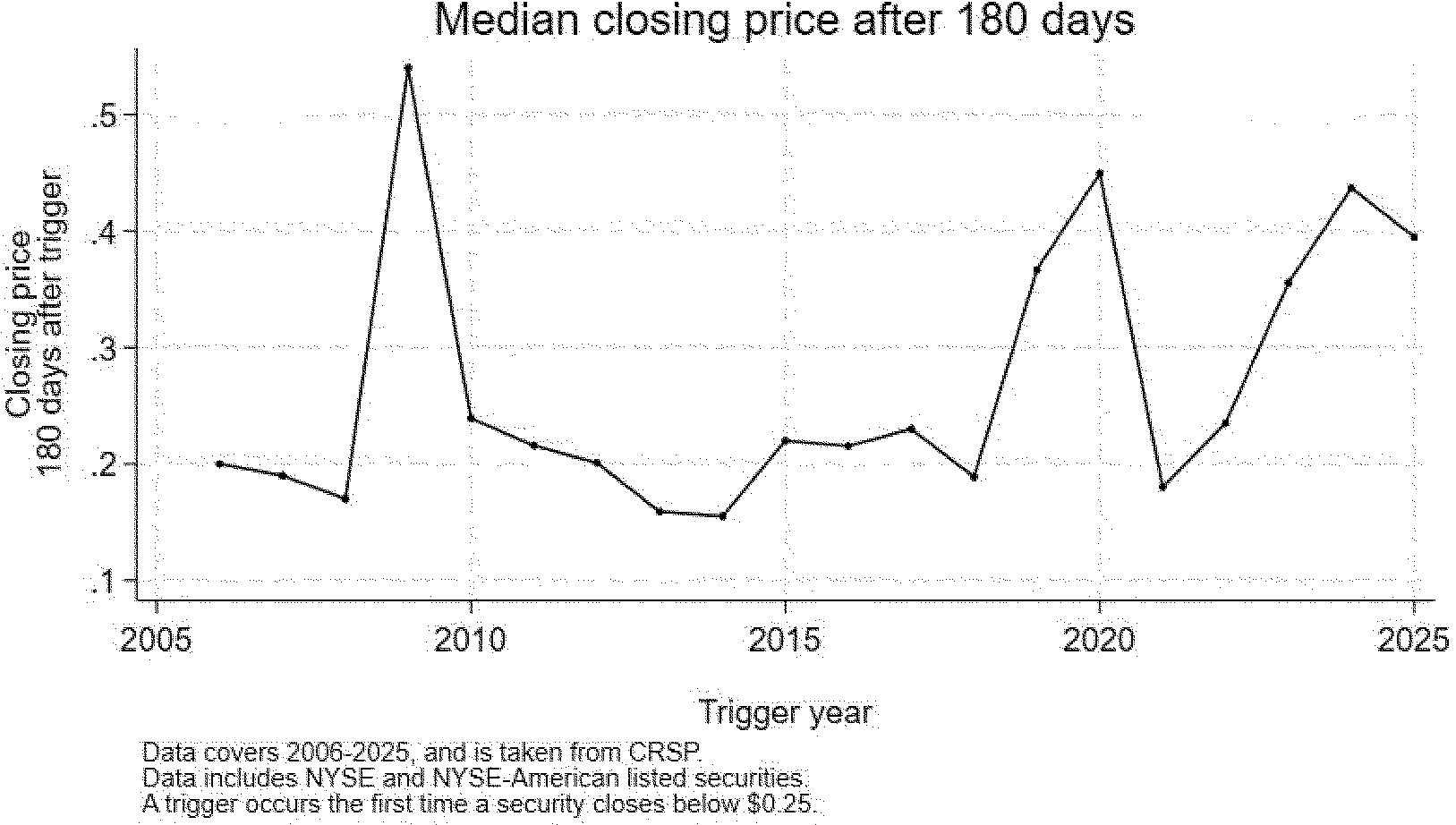
Figure 3. Median Closing Price 180 Days After Securities First Crossed the Minimum Trading Price
The Commission's analysis also shows that securities that would have fallen below the Minimum Trading Price had a high likelihood of being delisted for reasons that indicate a failure to comply with other quantitative continued listing requirements.[58] Historically, when a security fell under the Minimum Trading Price and was later delisted, such delisting, at the median, occurred 129 days later, and at the 75th percentile, 433 days later.59
( printed page 53442)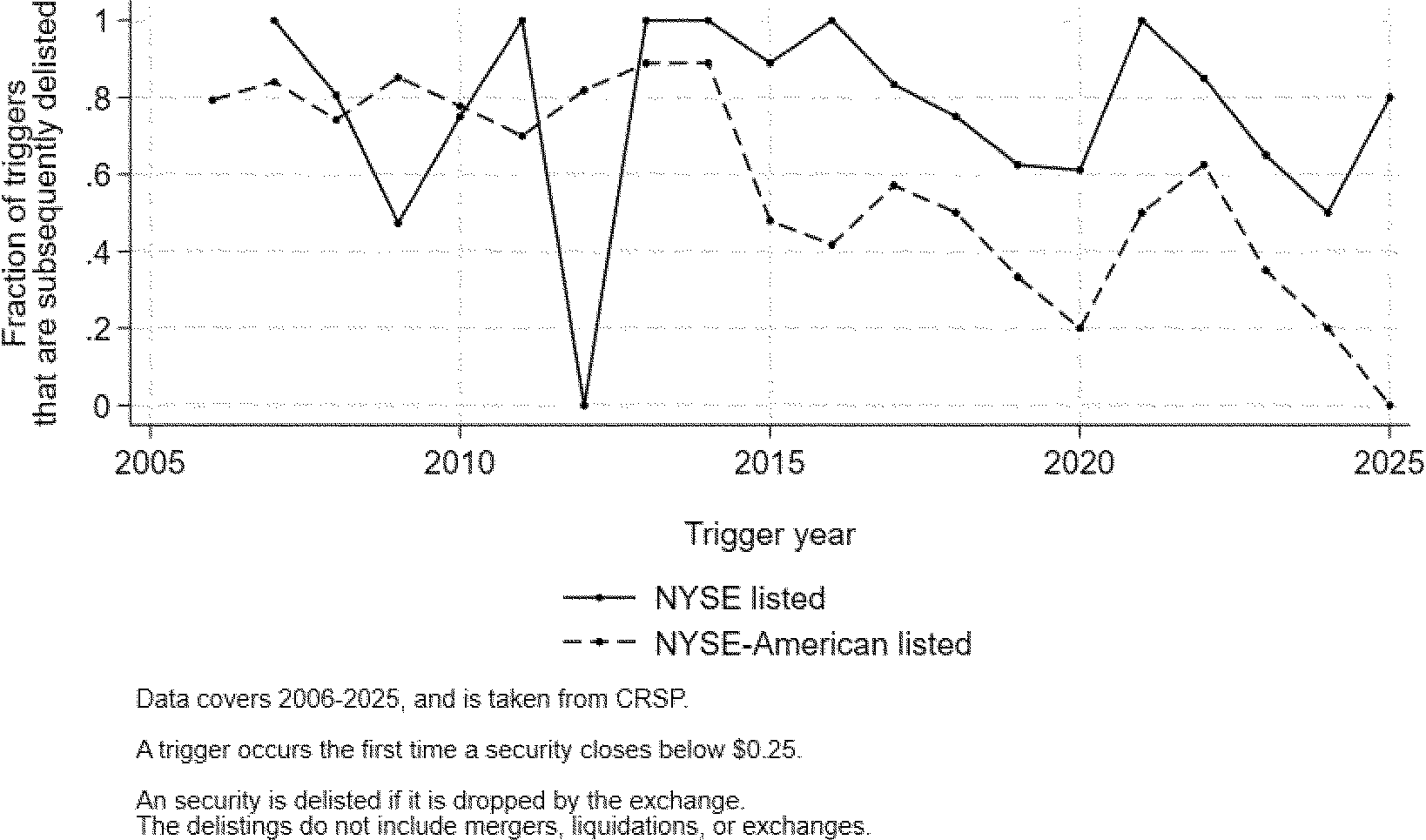
Figure 4. Fraction of NYSE and NYSE American Securities That Were Subsequently Delisted After First Crossing the Minimum Trading Price
Finally, the Commission's analysis indicates a fundamental tradeoff inherent in selecting a threshold for delisting: a more stringent threshold ( i.e., higher minimum trading price) would capture securities that will eventually be delisted for other reasons, but also implicate securities that otherwise would have remained above the threshold and stayed listed.60
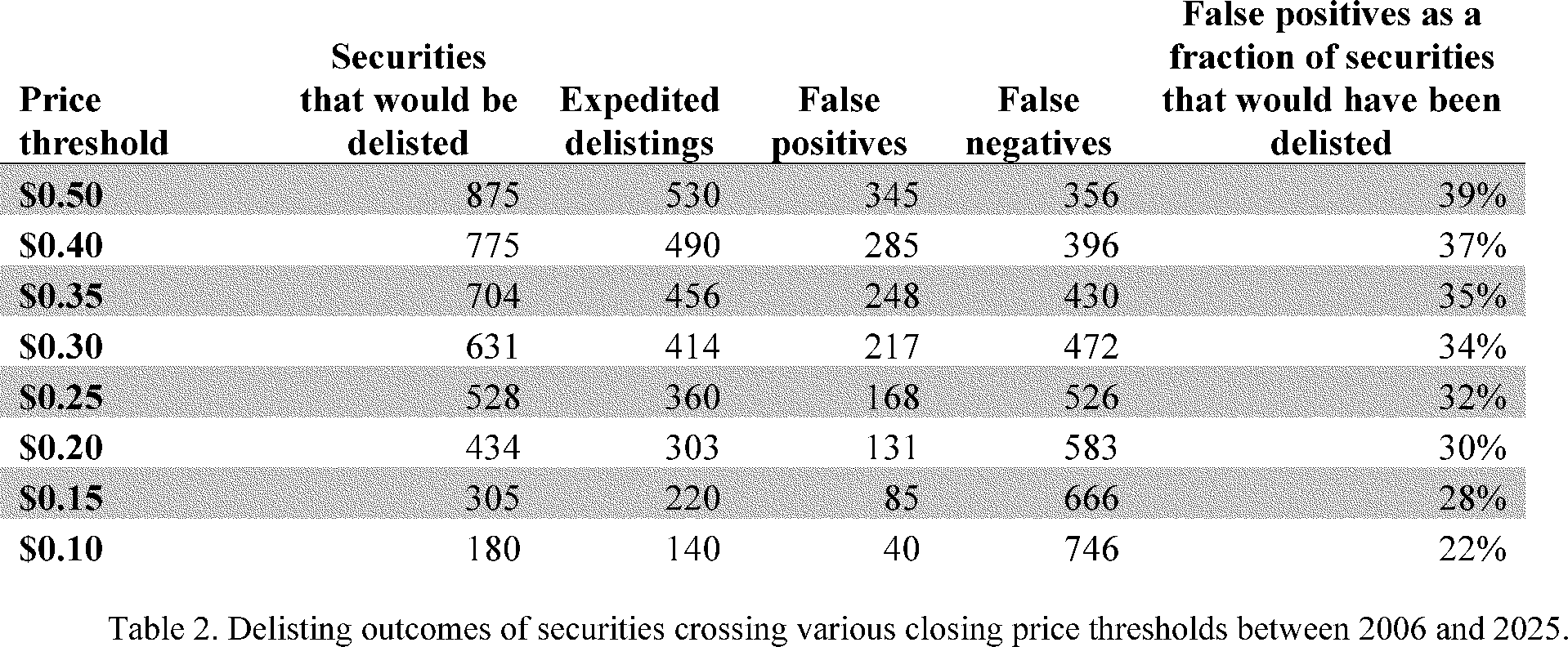
The Exchange has identified risks pertaining to securities that trade below the Minimum Trading Price, including a heightened susceptibility to manipulation. The results of the Commission's analysis support the approval of the Exchange's proposal to impose the Minimum Trading Price requirement. The notable number of securities trading below the Minimum Trading Price in recent years, along with the significant likelihood that such securities will eventually be delisted, warrants the Exchange's consideration of the continued listing of securities with very low trading prices.[61] Moreover, when securities fall below the Minimum Trading Price, there is a significant likelihood that they will continue to have a closing price below ( printed page 53443) $0.25 for another 180 calendar days, which is a significant period of time.[62]
The Commission agrees with the Exchange that securities with low trading prices may be more prone to manipulation.[63] When a security has a low trading price, the cost required to accumulate a position from the public float that is large enough to influence the price of the security is reduced. Accordingly, a would-be manipulator may find it less costly to manipulate the price of the security. Thus, the continued listing of companies with low trading prices raises concerns that these securities may have heightened susceptibility to manipulation. As such, the immediate suspension and delisting of these very low-priced securities is designed to prevent fraudulent and manipulative acts and practices, and more broadly, the rule is reasonably designed to protect investors and the public interest from potential harm.[64]
The proposal is reasonably designed to enhance the Exchange's listing standards by immediately suspending trading and commencing delisting proceedings for securities that fall below the Minimum Trading Price, which facilitates the continued listing of securities of a higher quality and that are financially sound. As noted above, the imprimatur of listing on a particular exchange correlates to investors' expectations that the listed issuer meets certain standards set by the exchange and that a listing exchange will use its judgment regarding the level at which to set those standards. Those standards are informed by an exchange's regulatory and commercial considerations and the Act provides exchanges with discretion, subject to the requirements of the Act, to set those standards as they see fit with the understanding that not all companies will meet those standards initially or over time.
Moreover, the addition of the Minimum Trading Price requirement is not unfairly discriminatory because the proposed standard is reasonably designed to the Exchange's goal of addressing the risks that it has identified with respect to very low-priced securities. The Minimum Trading Price will provide for a closing price level below which there may be a heightened susceptibility to manipulation and difficulties maintaining fair and orderly markets in these securities.
While the overall conclusion of the Lewis Report is that the Exchange's proposal to immediately suspend trading and commence delisting proceedings for securities that fall below the Minimum Trading Price may result in the delisting of companies that later recover and that some of these companies may otherwise have remained listed on the Exchange, the possibility of a meaningful recovery is not determinative of whether the Exchange may reasonably determine to delist a security. As discussed above, the Commission's analysis shows that 55% of the securities that fell below the Minimum Trading Price had a closing price under $0.25 after 180 days, with the median closing price at $0.23, and that securities that close below $0.25 experience significant volatility.[65] Even if many of the securities that remained below $0.25 after 180 days eventually recovered, this analysis indicates that such securities may persist with a closing price below $0.25 for an extended period of time. Given the risks that very low-priced securities may have heightened susceptibility to manipulative trading activity, it is not unfairly discriminatory for the Exchange to immediately suspend trading and commence delisting proceedings for securities that fall below the Minimum Trading Price. Accordingly, the Exchange's proposal is consistent with Section 6(b)(5) of the Act which requires that the rules of the Exchange be designed to prevent fraudulent and manipulative acts and practices, promote just and equitable principles of trade, protect investors and the public interest, and not be designed to permit unfair discrimination between customers, issuers, brokers, or dealers.
Several commenters stated that the Minimum Trading Price criteria would negatively impact capital formation for small public companies and increase risk to investors.[66] One commenter discussed the benefits of exchange listing for both smaller companies and investors in the context of cost of capital.[67] Specifically, this commenter stated that exchange listing provides smaller companies access to a larger set of investors and greater liquidity through access to secondary markets and allows investors to benefit from a set of Commission rules designed to enhance and organize the flow of information to investors.[68] The commenter concluded that this lowers the cost of capital because investors “are willing to pay a premium for the ability to trade easily,” and “are more willing to make long-dated investments when they know their positions can be readily transferred to other investors.” [69] Another commenter stated that investors are less inclined to invest in, and lenders are less willing to extend financing, to companies trading close to the bright-line threshold, which intensifies the downward price pressure.[70] This commenter explained that the issuers trading close to the Minimum Trading Price threshold “will face persistent delisting risk based on ordinary market volatility,” which creates uncertainty, and “constrains capital formation and increases financing costs.” [71] Two commenters stated that the proposal may disproportionately affect issuers that operate in capital-intensive sectors.[72]
The Commission acknowledges that there are many benefits to companies and their shareholders related to being listed on a national securities exchange, including increased access to capital formation and promotion of market efficiency. Commenters have raised concerns that delisting companies that fall below the Minimum Trading Price may lead to several negative consequences, including, but not limited to, making capital raising and obtaining financing more difficult for small companies.[73] However, the benefits of listing and possible consequences of delisting for issuers and their shareholders do not override the need for an exchange to maintain and enforce continued listing standards such as the proposed rule, which is consistent with Section 6(b)(5). As discussed above, the immediate suspension of trading and commencement of delisting proceedings for securities that fall below the Minimum Trading Price addresses identified risks of heightened ( printed page 53444) susceptibility to manipulative trading activity, and it is not unfairly discriminatory to impose a standard that is reasonably designed to address those risks. Moreover, securities that fall below the Minimum Trading Price and are subsequently delisted will continue to be able to trade in the over-the-counter market, which provides a viable alternative for the trading of companies' securities that do not meet the requirements for Exchange listing. These companies may also apply for Exchange listing in the future.
The Exchange's proposal to immediately suspend trading and commence delisting proceedings for securities that fall below the Minimum Trading Price, as set forth in Amendment No. 4, is reasonably designed to prevent fraudulent and manipulative acts and practices, to promote just and equitable principles of trade, and to protect investors and the public interest, consistent with Section 6(b)(5) of the Act. The Exchange's proposal is not designed to permit unfair discrimination between customers, issuers, brokers, or dealers, consistent with Section 6(b)(5) of the Act; and will not impose any burden on competition that is not necessary or appropriate in furtherance of the purposes of the Act, consistent with Section 6(b)(8) of the Act.
Several commenters stated that the Minimum Trading Price criteria is susceptible to short-term market dislocations ( e.g., macroeconomic conditions, sector-wide developments, or short-term trading dynamics) and could increase market manipulation risk of coordinated short-selling activity that could result in automatic suspension and delisting.[74] Commenters also stated that the resulting downward pressure on the stock price may not arise from operational weakness, but from the proposed Minimum Trading Price requirement, where the existence of such threshold can intensify investor caution, increasing financing cost.[75] Another commenter stated that such downward pressure increases stress on single-market-maker issuers.[76] One commenter nevertheless stated that the impact may not be pronounced because issuers may be able to mitigate the effects through performing reverse stock splits.[77]
In response, the Exchange states that it has a long standing practice of immediately suspending trading in a security when it trades below $0.10 that is publicly known.[78] The Exchange further states that it is not aware that bad actors have exploited the Exchange's current practice to manipulate trading for the purpose of getting a stock delisted.[79]
A security's closing price is a reasonable measure to be used in a quantitative listing standard to determine whether a company should continue to be listed on the Exchange,[80] notwithstanding that stock prices may be subject to short-term market dynamics or that the proximity of a stock price to listing thresholds may in turn affect pricing. In addition, the commenters' concern that the Minimum Trading Price criteria will encourage short-selling activities due to non-compliance with continued listing standards is not unique to the Exchange's proposal and, indeed, exists today with the Exchange's policy to initiate suspension of trading and delisting procedures when a stock trades below $0.10 per share. The Commission and FINRA have established rules to regulate short selling in order to maintain market integrity and protect investors from manipulative or abusive short selling practices.[81] Further, manipulative short selling, including “naked” short selling as part of a manipulative scheme, is always illegal under the general antifraud provisions of the federal securities laws, including Section 9(a) [82] and Section 10(b) of the Act,[83] and Rule 10b-5 [84] and Rule 10b-21 thereunder.[85] As discussed above, the immediate suspension of trading and commencement of delisting proceedings for securities that fall below the Minimum Trading Price would prevent the continued listing of securities that may have a heightened susceptibility to manipulative trading activity.
Several commenters raised concerns about the lack of a cure or compliance period for issuers that fall below the Minimum Trading Price and stated that immediate suspension of trading and commencement of delisting proceedings under the proposal without a plan of compliance or cure period for issuers raises fair procedure concerns under Section 6(b)(7) of the Act.[86] One of these commenters stated that immediately suspending trading and commencing delisting proceedings for a security based on a single-day closing price, “without any cure period or meaningful pre-deprivation process, . . . risks reducing any subsequent appeal to a ministerial exercise.” [87]
In response, the Exchange states that it disagrees with the approach of incorporating a compliance period (or measuring the Minimum Trading Price over 30 trading days) due to the propensity for problematic trading at very low price levels and that allowing for a compliance period would facilitate the exchange trading of low-priced stocks for a longer period.[88] The Exchange states that the Exchange staff engage with listed issuers as soon as a security's 30-trading day average closing ( printed page 53445) price falls below $1.00, and companies are informed of the Exchange's policy regarding minimum trading price and encouraged to consider remedial action.[89] The Exchange also states that the proposal provides issuers added transparency to the Minimum Trading Price criteria, and it believes that issuers will have adequate time and fair notice in which to take corrective action if they choose to do so.[90]
While the Exchange rules provide for an opportunity to submit a plan to come back into compliance with certain other continued listing standards,[91] the Exchange has proposed to immediately suspend trading and commence delisting proceedings for securities that fall below the Minimum Trading Price based on concerns that such companies may have a heightened susceptibility to manipulation.[92] The Exchange's practice of engaging with listed issuers as soon as a security's 30-trading day average closing price falls below $1.00 generally provides listed issuers with a period of time within which to raise their stock price.[93] However, a company's failure to comply with the Minimum Trading Price requirement ( i.e., $0.25) is likely indicative of serious difficulties within such company and a likelihood that the company would not regain compliance within a compliance period. As discussed above, and according to the Commission's analysis, 55% of the securities that failed to meet the Minimum Trading Price had a closing price under $0.25 after 180 days, with the median closing price under $0.23. The Commission's analysis supports a conclusion that the ability of companies to regain compliance with the Minimum Trading Price within 180 days is limited.[94] Companies that fall below the Minimum Trading Price may have heightened susceptibility to manipulative trading activity, contrary to the goal of protecting investors and the public interest. Thus, the Exchange's proposal is reasonably designed to protect investors by preventing the prolonged trading of very low-priced securities and seeks to provide meaningful assurance that only financially sound and quality issuers remain listed on the Exchange. Therefore, the Commission finds that the Exchange's proposal, as set forth in Amendment No. 4, to immediately suspend trading and commence delisting proceedings for securities that fail to comply with the Minimum Trading Price requirement is reasonably designed and consistent with the requirements of Section 6(b)(5) of the Act that the rules of the Exchange be designed to prevent fraudulent and manipulative acts and practices, promote just and equitable principles of trade, protect investors and public interest, and not be designed to permit unfair discrimination between customers, issuers, brokers, or dealers.
The proposal is also consistent with Section 6(b)(7) of the Act in that it provides a fair procedure for the prohibition or limitation by the Exchange of any person with respect to access to services offered. A listed company whose security is subject to immediate suspension of trading and the commencement of delisting proceedings under the proposal after failing to comply with the Minimum Trading Price requirement will be able to appeal the delisting decision in accordance with the provisions in Part 12 of the Company Guide.[95] Depending on the level of proceeding under Part 12 of the Company Guide, a Listing Qualifications Panel, the Committee for Review, or the Exchange Board of Directors, will continue to have the authority to consider any failure to meet any quantitative standard for continued listing, including the issuer's stock price, and the company will be given a written notice of such determination, and an opportunity to respond.[96] The company will also be able to appeal a Listing Qualifications Panel decision to the Committee for Review.[97]
Several commenters suggested alternatives to the proposal. Commenters recommended replacing the proposal's single-day price trigger with a multi-day average price test.[98] One commenter recommended, among other things, that the proposal “define objective, quantitative criteria for `precipitous decline' and `abnormally low level,' including specified look back periods and percentage thresholds.” [99] Another commenter recommended a tiered response for different minimum price deficiency triggers, whereby a single close below $0.25 would trigger a deficiency notice and short grace period, but a sustained period below a lower price level would result in immediate delisting.[100] Another commenter suggested employing enhanced monitoring or watch-list status for issuers near the minimum trading price trigger.[101] Several commenters recommended a mandatory cure or compliance period.[102] Finally, two commenters recommended “consideration of holistic issuer compliance, including market capitalization, operational progress, and adherence to other listing requirements.” [103] These suggestions are not part of the Exchange's proposal and, as required by the Act, the Commission must approve the proposal if it finds that the proposal is consistent with the Act and rules thereunder. For the reasons discussed herein, the proposal is consistent with the Act.
As originally filed, the Exchange had proposed that the Minimum Trade Price requirement would become effective on October 1, 2026.[104] The Exchange states that providing a transition period before the rule is effective will provide issuers with time to implement reverse stock splits to increase their share price.[105] Several commenters recommended a delayed effective date.[106] In response, ( printed page 53446) the Exchange filed Amendment No. 4 to delay the effective date of the proposal from October 1, 2026 to July 1, 2027, and stated that any impacted issuer will have the benefit of its 2027 annual meeting to take proactive action.[107] The Commission finds that the proposed effective date of July 1, 2027 is appropriate and consistent with the requirements of the Act and should provide a sufficient transition period before the rule is effective for affected issuers to take steps to bring their trading price above $0.25, including by implementing reverse stock splits to increase share prices, while helping to ensure the timely implementation of the Minimum Trading Price to address the risks of very low-priced securities.
Discretionary Authority
As discussed above, the Exchange proposes to specify that, consistent with its general authority under Section 1002(e) of the Company Guide to suspend trading in the event of any condition that makes further dealings on the Exchange unwarranted, it may suspend trading or delist a security where, in the Exchange's opinion, the trading price has experienced a precipitous decline and is at an abnormally low level from which it is unlikely to recover, even if such security has not fallen below the Minimum Trading Price.[108] The Exchange states that, in its experience, under those conditions, a security's trading price is generally unable to recover and it is appropriate for the Exchange to take action.[109]
Several commenters stated that the proposed revision to Section 1003(f)(v) of the Company Guide, which allows the Exchange to suspend trading or delist a security where the trading price has experienced a precipitous decline and is at an abnormally low level, provides the Exchange with “broad” and “amorphous” discretion.[110] These commenters stated that the standards are not objective, and the proposed revision is not supported by empirical evidence.[111] One of these commenters stated that it is “internally inconsistent” for the Exchange to establish the Minimum Trading Price, “while simultaneously reserving the right to disregard that threshold,” and that the Exchange does not articulate any objective, quantitative criteria under which the Exchange will consider trading price to have experienced a “precipitous decline” and be at “an abnormally low level from which it is unlikely to recover.” [112] This commenter also stated that the “absence of clear guardrails around the Exchange's discretion raises serious fair process concerns under Exchange Act Section 6(b)(7).” [113]
In response, the Exchange states that the rules of the Exchange permit regulatory staff of the Exchange to delist a company when they have determined, in their sole discretion, that continued trading is inadvisable.[114] The proposed revision to Section 1003(f)(v) of the Company Guide simply applies that principle to the trading of low-priced stocks.[115] The Exchange also states that it “would be counter to the protection of investors if the Exchange were required to stand by while a securities trading price was in free fall simply waiting for it to close below $0.25.” [116]
The proposed change is consistent with Section 6(b)(5) of the Act because it is reasonably designed to promote just and equitable principles of trade and to protect investors and the public interest.[117] The Exchange has the authority under existing Section 1002(e) of the Company Guide to suspend trading in securities when, in the Exchange's opinion, an event occurred or condition existed which made further dealings on the Exchange unwarranted, including where a security's trading price has experienced a precipitous decline and is at an abnormally low level from which it is unlikely to recover.[118] The proposal provides transparency in the application of such authority and avoids any confusion about how the Exchange's general discretionary authority intersects with the Minimum Trading Price requirement. Thus, the proposal is reasonably designed to promote just and equitable principles of trade and to protect investors and the public interest, consistent with Section 6(b)(5) of the Act, because it will maintain the Exchange's authority to exercise its discretion and delist a security that has experienced a precipitous price decline, without being required to wait until the security's trading price falls below $0.25.
The proposed change is also consistent with Section 6(b)(7) of the Act in that it provides a fair procedure for the prohibition or limitation by the Exchange of any person with respect to access to services offered. Pursuant to the Exchange's proposal, the Exchange may exercise discretion to determine if a listed company's security is experiencing a precipitous decline and is at an abnormally low level from which it is unlikely to recover, and accordingly suspend trading and commence delisting proceedings for the security. Such company will be able to appeal the delisting decision in accordance with the provisions in Part 12 of the Company Guide, as described above.[119]
Based on the foregoing, the Commission finds that the proposed rule change, as modified by Amendment No. 4, is consistent with the Act.
IV. Solicitation of Comments on Amendment No. 4 to the Proposed Rule Change
Interested persons are invited to submit written data, views, and arguments concerning whether the proposed rule change, as modified by Amendment No. 4, is consistent with the Act. Comments may be submitted by any of the following methods:
Electronic Comments
- Use the Commission's internet comment form (www.sec.gov/rules/sro.shtml); or
- Send an email torule-comments@sec.gov. Please include file number SR-NYSEAMER-2025-72 on the subject line. ( printed page 53447)
 www.sec.gov/rules/sro.shtml
Paper Comments
- Send paper comments in triplicate to Secretary, Securities and Exchange Commission, 100 F Street NE, Washington, DC 20549-1090.
All submissions should refer to file number SR-NYSEAMER-2025-72. This file number should be included on the subject line if email is used. To help the Commission process and review your comments more efficiently, please use only one method. The Commission will post all comments on the Commission's internet website ( www.sec.gov/rules/sro.shtml). Copies of the filing will be available for inspection and copying at the principal office of the Exchange. Do not include personal identifiable information in submissions; you should submit only information that you wish to make available publicly. We may redact in part or withhold entirely from publication submitted material that is obscene or subject to copyright protection. All submissions should refer to file number SR-NYSEAMER-2025-72 and should be submitted on or before September 8, 2026.
V. Accelerated Approval of the Proposed Rule Change, as Modified by Amendment No. 4
The Commission finds good cause to approve the proposed rule change, as modified by Amendment No. 4, prior to the thirtieth day after the date of publication of Amendment No. 4 in the Federal Register . Amendment No. 4 does not alter any substantive provisions of the proposed rule change or raise any regulatory issues substantially different from what is set forth in the Notice and Amendment No. 3, which were subject to public comment. Amendment No. 4 extends the effective date from October 1, 2026 to July 1, 2027. This limited change is responsive to comment letters requesting a delay in the transition period. The 9-month delay addresses potential administrative and governance burdens on listed issuers and is consistent with the original proposal's intent to provide sufficient time to implement reverse stocks splits to increase share prices. For these reasons, the Commission finds good cause, pursuant to Section 19(b)(2) of the Act,[120] to approve the proposed rule change, as modified by Amendment No. 4, on an accelerated basis.
VI. Conclusion
It is therefore ordered, pursuant to Section 19(b)(2) of the Act,[121] that the proposed rule change (SR-NYSEAMER-2025-72), as modified by Amendment No. 4, be and hereby is, approved on an accelerated basis.
By the Commission.
Vanessa A. Countryman,
Secretary.
 15 U.S.C. 78s(b)(1)
 17 CFR 240.19b-4
 indexes.morningstar.com/docs/guide/crsp-us-stock-databases-data-descriptions-guide-for-crspaccess-fiz?isRdp=true