Accreditation, Innovation, and Modernization: The Secretary's Recognition of Accrediting Agencies: Institutional Eligibility Under the Higher Education Act of 1965, as Amended, Student Assistance General Provisions
The Department proposes to revise the existing accrediting agency recognition regulations at 34 CFR part 602 to implement the directives set forth in Executive Order 14279, Refo...
Office of Postsecondary Education, Department of Education.
ACTION:
Notice of proposed rulemaking (NPRM).
SUMMARY:
The Department proposes to revise the existing accrediting agency recognition regulations at 34 CFR part 602 to implement the directives set forth in Executive Order 14279, Reforming Accreditation to Strengthen Higher Education, and other Administration priorities, align the regulations more closely with statute, and reduce regulatory burden.
DATES:
We must receive your comments on or before September 21, 2026.
ADDRESSES:
Submit your comments through the Federal eRulemaking Portal at
regulations.gov.
The Department will not accept comments submitted by fax or by email or comments submitted after the comment period closes. To ensure that the Department does not receive duplicate copies, please submit your comment only once. Additionally, please include the Docket ID at the top of your comments. Pursuant to the Administrative Procedure Act at 5 U.S.C. 553(b)(4), a plain language summary of the rule is available at
regulations.gov.
Information on using
Regulations.gov, including instructions for submitting comments, is available on the site under “FAQ.” If you require an accommodation or cannot otherwise submit your comments via
Regulations.gov, please contact
regulationshelpdesk@gsa.gov
or by phone at 1-866-498-2945. If you are deaf, hard of hearing, or have a speech disability and wish to access telecommunications relay services, please dial 7-1-1.
Privacy Note:
The Department's policy is to make all comments received from members of the public available for public viewing in their entirety on the Federal eRulemaking website at
www.regulations.gov.
Therefore, commenters should include in their comments only information that they wish to make publicly available. Additionally, commenters should not include in their comments any personally identifiable information (PII) about other individuals. For example, if your comment describes an experience of someone other than yourself, please do not identify that individual or include any personal information that identifies that individual. The Department reserves the right to redact a portion of a comment or the entire comment at any time if PII about other individuals is included.
FOR FURTHER INFORMATION CONTACT:
Aaron Washington, Office of Postsecondary Education, 400 Maryland Ave. SW, Washington, DC 20202. Telephone: 202-987-0911. Email:
aaron.washington@ed.gov.
SUPPLEMENTARY INFORMATION:
I. Executive Summary
The Secretary of Education recognizes accrediting agencies currently under existing regulations at 34 CFR part 602. Accrediting agencies serve as key gatekeepers in determining which institutions may participate in the Federal student aid programs, which currently provide more than $100 billion in Pell Grants and Federal student loans annually. Unfortunately, while the existing regulations are intended to ensure that the accrediting agencies recognized by the Secretary are “reliable authorities regarding the quality of education or training offered by the institutions or programs they accredit,” many are failing to do so and recognize institutions and programs that fail some of the most important indicia of quality and returns on investment, hurting students and taxpayers. Amidst this decline in student outcomes, some accrediting agencies have neglected their positions of public trust, improperly shifting their focus away from student achievement to compelling institutions to adopt illegal and discriminatory ideology and practices, and intruding on State and local authority over public institutions. All of this has been done under the guise of establishing and applying accreditation standards on institutions and programs.
As a result, Americans' trust and confidence in the U.S. higher education system has declined significantly over the last decade. Americans deserve and demand better. To that end, and to ensure that accrediting agencies are taking their responsibilities as quality indicators seriously, the Department is therefore proposing a comprehensive modernization of the regulations for recognition of accrediting agencies, one that focuses on student achievement and providing a high-quality education.
The proposed regulations would break down barriers that have long held back institutions from adopting innovative and cost-effective educational models. The proposed regulations would eliminate requirements not required by statute, including the “two-year rule” for initial recognition of new agencies, prescriptive site visit mandates, unnecessary documentation requirements, and rigid and overly long processing timelines. These commonsense reforms would also remove existing regulatory barriers impeding institutions' ability to change or work with multiple accrediting agencies, while agencies would have more flexibility to apply certain standards that meet the needs of their accredited institutions and programs. The Department also proposes a new review framework for better oversight of recognized accrediting agencies that serve as the primary gatekeepers for the Federal student aid programs, and whose potential failures pose the greatest risk to taxpayers.
Additionally, in order to reduce administrative costs that are negatively impacting college affordability, the Department is proposing to require recognized accrediting agencies to apply their standards in ways that minimize institutional administrative burden, avoid duplicative reporting, and support the implementation of lower-cost educational models. These changes would also shift institutions' and programs' focus towards cost-effective practices for staffing, facilities, student services, and program design.
The proposed regulations promote greater integrity in decision making by recognized accrediting agencies and eliminate previous regulatory exceptions for resource-sharing and other areas of potential conflicts of interest. The proposed regulations would also take the final step to eliminating geographic-scope distinctions and make other anticompetitive behavior a negative factor in consideration of agency recognition.
The Department proposes to reinforce the existing legal, constitutional, civil rights, and consumer protection obligations already required of recognized accrediting agencies and the institutions and programs that they accredit. Accrediting agencies recognized by the Secretary would be required to confirm that institutions and programs they accredit comply with all Federal and State laws and would prevent recognized accrediting agencies from applying standards that direct accredited institutions and programs to
( printed page 53941)
violate those laws. New student outcome and program-level performance expectations would focus accrediting agencies on important objective measures of student and institution performance such as completion, licensure pass rates, and economic returns.
Further, the proposed regulations also address persistent issues with transfer of credit policies, ensuring that students are not required to undertake duplicative coursework when not necessary. While institutions and programs would have the latitude to deny a transfer of credit based on the credit failing to meet the institutions' standards, schools would have to provide written reasoning for the denial. These regulations also propose to require more transparency before a student enrolls, so he or she can have a full understanding of the scope, and cost, of the education.
Taken together, these proposed regulations aim to improve educational quality, protect students and taxpayers, and promote a higher education accreditation system that supports innovation, accountability, and legal compliance.
II. Summary of the Major Provisions of This Regulatory Action
The proposed regulations would:
Part 600—Institutional Eligibility Under the Higher Education Act of 1965, as Amended
Subpart A—General
Amend § 600.11 to make it less burdensome for institutions that are changing accrediting agencies or wish to utilize more than one accrediting agency.
Amend § 602.2 to require the Department provide public notice on its accreditation website if the Secretary denies continued recognition to a previously recognized agency, or if the Secretary limits, suspends, or terminates the agency's recognition before the end of its recognition period.
Amend § 602.3 to define and use the term “institution” in these regulations instead of “institution of higher education” which is defined in the HEA, and elsewhere in the Department's regulations, and refers to a narrower subset of institutions, and to add a definition for “related, associated, or affiliated trade association.”
Subpart B—The Criteria for Recognition
Amend § 602.10 to clarify the Secretary's recognition extends only to those accrediting agencies whose institutions or programs actively participate in a Federal program.
Amend § 602.11 to require accrediting agencies to clearly describe the scope of their accrediting activities and remove geographic restrictions that restrict institutions and programs from choosing an accrediting agency.
Amend § 602.12 to remove references to geographic areas and geographic constraints and require review of contractions of scope. Additionally, amends the regulations to clarify the policies and capacity an accrediting agency must have to seek initial recognition, and eliminates the “two-year rule” for initial recognition due to lack of statutory requirement.
Unreserve and amend § 602.13 to specify that an accrediting agency's recognition by the Department does not provide any immunity from antitrust laws.
Amend § 602.14 to strengthen the fiscal and administrative criteria an accrediting agency must meet to prove it is fully separate and independent from any related, associated, or affiliated trade or membership organization.
Amend § 602.15 to require accrediting agencies to administer their standards, policies, and procedures in a manner that minimizes unnecessary compliance costs and administrative burdens on accredited institutions, as well as requires agencies to maintain appropriate conflict of interest controls and policies.
Amend § 602.16 to codify that an agency may establish additional lawful accreditation standards that are consistent with ensuring institutional or programmatic quality and integrity as it deems appropriate.
Amend § 602.17 to clarify expectations for reviewing student achievement and faculty related policies, including academic freedom and intellectual diversity. There are also new requirements for cost-benefit analysis, institutional flexibility and mission, program length review, and safeguards against misrepresentation.
Amend § 602.18 to require accrediting agency decisions to be neutral with respect to viewpoint and ideology, except for those with a religious mission.
Amend § 602.20 to provide guidance to accrediting agencies on how to structure their arbitration procedures and remove overly prescriptive requirements.
Amend § 602.21 to remove overly prescriptive requirements.
Amend § 602.22 to refine the list of changes requiring accreditor approval, add prison education programs as a defined substantive change, and remove outdated and overly prescriptive requirements.
Amend § 602.23 to require accrediting agencies to ensure institutions comply with all applicable Federal and State laws and remove overly prescriptive requirements.
Amend § 602.24 to strengthen accrediting agencies' oversight of institutional changes, expand requirements for teach-out planning, including transcript access, and increase transparency and support for students when institutions face disruptions. These regulations would also establish clearer, fairer rules by defining consistent criteria, prohibiting discriminatory denials, requiring acceptance of comparable credits, and providing students with an appeals process.
Amend § 602.25 to remove overly prescriptive requirements.
Amend § 602.26 to update and modernize the required content of agency notices and better align these requirements with contemporary methods of disclosure and allow temporary continuation of eligibility for title IV, HEA funds after erroneous decisions on the part of the accrediting agency.
Amend § 602.27 to require the Department's website to be updated on a regular, timely basis to display the current accreditation status of all institutions and programs.
Amend § 602.28 to broaden the circumstances under which an accrediting agency must re-evaluate an institution or program following negative actions by other authorities.
Amend § 602.30 to modernize how accrediting agencies submit applications and reports to the Department.
Subpart C—The Recognition Process
Amend § 602.32 and split it into two sections: § 602.31 and § 602.32.
Amend § 602.31 to modernize and streamline the procedures accrediting agencies must follow when submitting applications for initial or renewed recognition.
Amend § 602.32 to modernize and clarify the processes used to review an accrediting agency's expansions or contractions of scope, compliance reports, and increases in headcount enrollment.
Amend § 602.33 to modernize and streamline the procedures for review of agencies during the period of recognition, including the review of monitoring reports.
Amend § 602.34 to require the National Advisory Committee on Institutional Quality and Integrity (NACIQI) to review applications for
( printed page 53942)
contractions of scope, and for accrediting agencies to post public notice of upcoming NACIQI reviews.
Amend §§ 602.35, 602.36, and 602.37 to update cross references.
Part 668—Student Assistance General Provisions
Subpart D—Institutional and Financial Assistance Information for Students
Amend § 668.43 to require transfer of credit disclosures and direct written notice to students.
Cost and Benefits
As further detailed in the Regulatory Impact Analysis (RIA), the proposed regulations include numerous provisions that may impact students, institutions of higher education, accrediting agencies, and the Federal government. The proposed regulations include provisions related to transfer-of-credit policies, which may benefit students by making it easier for students to transfer credits to continue their postsecondary enrollment at a new institution. Students will benefit from these proposed changes because they will likely spend less time and money retaking courses that failed to transfer, whereas institutions may experience costs from these provisions due to the lower levels of tuition revenue they may receive from transfer students. The proposed regulation also encourages accrediting agencies to include new criteria that evaluates program and institutional outcomes. This may impose new costs on accreditors, who may need to develop such criteria, and on institutions, who may need to implement changes to meet such criteria. Furthermore, the proposed regulations will remove several barriers for new accrediting agencies to emerge and obtain Department recognition, which may ultimately benefit accrediting agencies through the reduction in administrative burden to gain initial recognition and maintain recognition. Additionally, the proposed rule would also require accrediting agencies to adopt several new policies and procedures that aim to increase college affordability and innovation, while also putting downward pressure on credential inflation. Students may benefit from these provisions if the changes result in more affordable and flexible educational opportunities.
As noted in the RIA, the Department does not estimate a significant net budget impact on the title IV, HEA federal student aid programs from the proposed regulations. In prior regulations [1]
the Department estimated the accreditation reform would result in volume increases from easier recognition of new accreditors or agencies with an expanded scope to new credential levels, and the option for alternative standards to allow for faster introduction of innovative programs. In 2019, we did not estimate a significant change in repayment performance as institutions with less favorable program outcomes could find more lenient accrediting agencies or institutions with strong programs could take advantage of the flexibility allowed by the substantive change policy revisions to expand their program offerings. At the time we noted the uncertainty of the extent to which increasing accreditation options and encouraging program innovation would shift loan and grant volume among more options for students versus generating new volume and that uncertainty remains. Additionally, greater acceptance of transfer credits may increase volumes by encouraging some students to complete degrees but also may reduce volumes by credits being recognized by the institutions receiving transfers. In retrospect, we know the number of institutions that changed accreditors was fairly low and it is difficult to attribute particular changes in volume to accreditation reforms given other economic, demographic, and programmatic developments during the same period. The Department seeks feedback on the reasonability of the estimate that the proposed regulations will not have a significant net budget impact and sources of data or analysis for further consideration of this question as we prepare the final regulations.
III. Directed Questions
§ 602.15—Administrative and Fiscal Responsibilities
Under § 602.15(e), the Department proposes to require an accrediting agency have clear and effective controls to: (1) prevent conflicts of interest, (2) ensure that members of the standards-setting body are prevented from voting as members of the decision-making body, (3) determine its dues without review from a related, associated, or affiliated trade association or professional organization, (4) disallow shared resources, (5) ensure that the accrediting agency does not share or solicit feedback from an associated or affiliated trade association or professional association, (6) disclose on its website any relationship with related, associated, or affiliated trade associations or professional organizations and, (7) not act to restrict access to employment in a profession, occupation or vocation.
The Department seeks feedback about the extent to which the “conflict of interest” requirements impact accrediting agencies in relation to 401K, health insurance, and other areas. We understand that there may be some agencies who utilize the same resources in these certain areas, and that there may be some consideration to the amount of time and resources it would take to unwind the sharing of resources in such instances. We welcome comments from agencies that have current relationships exist between themselves and the related, associated, or affiliated trade association or professional association that would be affected by the amendments to the regulations proposed here. Specifically, the Department requests information that considers the length of time it would take to unwind these benefits from a related, associated, or affiliated association.
Regulatory Impact Analysis—Data Constraints
The Department recognizes that there is limited data available to estimate the proposed regulation's potential impact on accrediting agencies, institutions of higher education, and students. Due to the scarcity of existing information, the Department invites public feedback on possible methods and data sources that could strengthen the analysis presented in the RIA. Additionally, the Department welcomes input regarding prior research on accreditation reform, especially insights on how findings from such research might further inform and support the analysis included in the RIA. The Department is particularly interested in research findings on the way that accreditation reform is associated with accreditor innovation, competition, and quality, along with any associations that reform has on student behavior and outcomes. Additionally, the Department is also interested in receiving comments regarding possible impacts not identified by the Department, along with supporting data and analysis.
IV. Invitation To Comment
We invite you to submit comments regarding these proposed regulations. For your comments to have maximum effect in developing the final regulations, we urge you to clearly identify the specific section or sections of the proposed regulations that each of your comments address and to arrange your comments in the same order as the proposed regulations. The Department
( printed page 53943)
will not accept comments submitted after the comment period closes.
The following tips are meant to help you prepare your comments:
Be concise but support your claims.
Explain your views as clearly as possible and avoid using profanity.
Refer to specific sections and subsections of the proposed regulations throughout your comments, particularly in any headings that are used to organize your submission.
Explain why you agree or disagree with the proposed regulatory text and support these reasons with data-driven evidence, including the depth and breadth of your personal or professional experiences.
Where you disagree with the proposed regulatory text, suggest alternatives, including regulatory language, and your rationale for the alternative suggestion.
Submit your public comment only.
Do not include personally identifiable information (PII) such as Social Security numbers or loan account numbers for yourself or for others in your submission.
Do not include any information that directly identifies or could identify other individuals or that permits readers to identify other individuals.
Mass Writing Campaigns:
In instances where individual submissions appear to be duplicates or near duplicates of comments prepared as part of a writing campaign, the Department will post one representative sample comment along with the total comment count for that campaign to
Regulations.gov.
The Department will consider these comments along with all other comments received.
In instances where individual submissions are bundled together (submitted as a single document or packaged together), the Department will post all of the substantive comments included in the submissions along with the total comment count for that document or package to
Regulations.gov.
A well-supported comment is often more informative to the agency than multiple form letters.
Public Comments:
The Department invites you to submit comments on all aspects of the proposed regulatory language specified in this NPRM, and in the Regulatory Impact Analysis and Paperwork Reduction Act sections.
The Department may, at its discretion, decide not to post or to withdraw certain comments and other materials that contain promotion of commercial services or products, and spam.
We may not address comments outside of the scope of these proposed regulations in the final rule. Comments that are outside of the scope of these proposed regulations are comments that do not discuss the content or impact of the proposed regulations or the Department's evidence or reasons for the proposed regulations.
Comments that are submitted after the comment period closes will not be posted to
Regulations.gov
or addressed in the final rule.
We invite you to assist us in complying with the requirements of Executive Orders 12866 and 13563 and their overall requirement of reducing regulatory burden that might result from these proposed regulations. Please let us know of any further ways we could reduce potential costs or increase potential benefits while preserving the effective and efficient administration of the Department's programs and activities. During and after the comment period, you may inspect public comments about these proposed regulations by accessing
Regulations.gov.
Assistance to Individuals with Disabilities in Reviewing the Rulemaking Record:
On request, we will provide appropriate accommodation or auxiliary aid to an individual with a disability who needs assistance to review the comments or other documents in the public rulemaking record for these proposed regulations. If you want to schedule an appointment for this type of accommodation or auxiliary aid, please contact the Information Technology Accessibility Program Help Desk at
ITAPSupport@ed.gov
to help facilitate this request.
Clarity of the Regulations
Executive Order 12866 and the Presidential memorandum “Plain Language in Government Writing” require each agency to write regulations that are easy to understand. The Secretary invites comments on how to make the regulation easier to understand, including answers to questions such as the following:
Are the requirements in the proposed regulations clearly stated?
Do the proposed regulations contain technical terms or other wording that interferes with their clarity?
Does the format of the proposed regulations (grouping and order of sections, use of headings, paragraphing) aid or reduce its clarity?
Would the proposed regulations be easier to understand if we divided them into more (but shorter) sections? (A “section” is preceded by the symbol “§ ” and a numbered heading; for example, § 668.2 General definitions.)
Could the description of the proposed regulations in theSUPPLEMENTARY INFORMATION
section of this preamble be more helpful in making the proposed regulations easier to understand? If so, how?
What else could we do to make the proposed regulation easier to understand?
To send any comments that concern how the Department could make these proposed regulations easier to understand, see the instructions in the
ADDRESSES
section.
V. Background
Section 496 of the Higher Education Act (HEA), as amended, requires the Secretary of Education (Secretary) to establish criteria for determining whether an accrediting agency is a reliable authority, for purposes of participation in programs authorized under the HEA and other Federal programs, on the quality of education or training offered by the institutions and programs that they accredit. Such criteria are required to include appropriate measures of student achievement.
Consistent with the statute, the Secretary has established regulations for recognition of accrediting agencies at 34 CFR part 602 and has revised these regulations periodically.
Executive Order (E.O.) 14279, titled “Reforming Accreditation to Strengthen Higher Education,” issued on April 23, 2025, by President Trump, directs the Secretary to take several actions related to the recognition of accrediting agencies or associations by the Department. Some of these actions require changes to existing regulations.
The goal of these regulatory changes is to realign the Secretary's criteria for recognition of accrediting agencies to promote high-quality, high value, and affordable education for students that—
Promotes such academic programs and activities at higher education institutions that are focused on student outcomes and are free from unlawful discrimination and other violations of Federal law;
Reduces barriers that limit competition, innovation, and new education models that advance credential and degree completion;
Holds institutions accountable for discrimination and other unlawful acts; and
Advances academic freedom, intellectual inquiry, and student learning by ensuring that accreditation requires that institutions support and prioritize intellectual diversity among faculty.
Specifically, the Executive Order directs the Secretary to—
( printed page 53944)
Resume recognition of new accrediting agencies to foster competition and expand institutional options; and
Mandate that accrediting agencies require member institutions to use data on program-level student outcomes to improve such outcomes, without reference to race, ethnicity, or sex.
The Department undertook this rulemaking in part to address the goals contained within the Executive Order, but also to propose substantive changes that would reform the static and outdated higher education accountability system. These regulations are intended to increase competition among accrediting agencies by reducing barriers to entry, facilitating institutional mobility among recognized agencies, and reducing regulatory requirements that may unnecessarily discourage the formation of innovative accrediting organizations. Increased competition is expected to improve institutional responsiveness, reduce accreditation costs over time, and encourage greater innovation in the market for quality assurance validation.
The Department believes that increasing competition among recognized accrediting agencies is likely to improve the quality, responsiveness, and effectiveness of accreditation. Accreditation has historically seen very little competition because it evolved from voluntary membership peer review groups to set uniform academic standards within those groups. Institutional accreditors (including former “regional” accreditors) rarely engage in head-to-head competition, institutions face difficulty in changing accrediting agencies due to high switching costs and potential risks in maintaining eligibility for Federal student aid for their students, and there are regulatory barriers to the recognition of new agencies. During negotiated rulemaking, the Department explained that competition among accreditors is expected to generally improve quality and expand choices for institutions.
Competition creates incentives for agencies to innovate, respond to workforce changes, expand choices for institutions among agencies engaged in various types of innovative activities and to develop new measures for assessing student success by institutions.
As explained by a Department economist during negotiated rulemaking, there is a high concentration of institutions that are accredited by a handful of institutional accrediting agencies. The Department recognizes that empirical evidence measuring the causal effect of institutions changing accreditors is limited. Because institutions rarely switch accreditors, and those that do may differ systematically from those that do not, it is difficult to isolate the independent effect of changing accreditors on institutional outcomes. Moreover, previous regulatory barriers have resulted in too few accreditor switches to permit rigorous statistical analysis. The absence of such evidence, however, does not undermine the broader economic evidence concerning the benefits of competition in quality assurance markets.
Economic research has consistently found that competition encourages innovation and improved performance. Joseph Schumpeter argued that competition produces “creative destruction” that drives innovation by creating new markets that render older ones obsolete, while more recent empirical work has found that introducing competition into concentrated markets substantially increases innovation. The Department believes these findings are relevant because higher education accreditation has historically exhibited many characteristics of an uncompetitive market.
Competition is also expected to improve the informational value of accreditation. During negotiated rulemaking, the Department explained that institutions seek credible signals of educational quality, and that in a competitive accreditation market, agencies would compete to provide those signals. Rather than offering only a binary “approved/not approved” determination, competing accreditors may distinguish themselves by offering scaled ratings for institutional quality. On April 14, 2026, during opening remarks for negotiated rulemaking, the Department stated:
“Competition will include competition for relevance and universities will signal their quality level through accreditation . . . Current accreditors give universities and colleges pass-fail grades which provide very little useful information.” [2]
This reasoning is consistent with the economic literature on certification intermediaries. In “Information Revelation and Certification Intermediaries”, Alessandro Lizzeri [3]
demonstrates that monopolistic certifiers have incentives to reveal only limited information, whereas competition among certifiers results in more informative quality signals. Similarly, in “The Effect of Information on Product Quality: Evidence from Restaurant Hygiene Grade Cards” Giner Zhe Jin and Phillip Leslie [4]
found that more detailed quality information improves quality outcomes.
The Department also believes that competition can strengthen, rather than weaken, Federal oversight. During negotiated rulemaking, the Department explained that where only one recognized accreditor effectively serves a sector, withdrawal of recognition may significantly disrupt institutions and students making it more difficult to impose such a penalty. By contrast, when multiple recognized accreditors are available, institutions have viable alternatives, reducing barriers to enforcement. As the Department stated during negotiated rulemaking:
“With regional and programmatic monopolies, withdrawal of recognition can throw industries into chaos . . . . If alternatives are available, if competition exists, any hesitation to derecognize agencies disappears.” The Department believes competition will increase accountability both for institutions and for accrediting agencies themselves.
Finally, the Department believes that competition will encourage innovation in accreditation. Accrediting agencies that face meaningful competition will have stronger incentives to develop new approaches to quality assurance, reduce unnecessary costs, respond to institutional diversity, and improve services to institutions and students. As explained in the Department's written responses during negotiated rulemaking, barriers to switching generally reduce competition and increase market power through a lock-in effect. Eliminating or reducing those barriers promotes innovation and responsiveness.
For these reasons, the Department finds that reducing unnecessary barriers to competition among qualified accrediting agencies is likely to improve accreditation over time while preserving the Department's responsibility to establish minimum standards for Federal recognition. The Department does not believe competition will cause a “race to the bottom.” Rather, quite the opposite will likely occur. Recognized accrediting agencies must continue to satisfy all statutory and regulatory
( printed page 53945)
recognition requirements, while competing to provide higher quality, more informative, and more innovative quality assurance services. As stated during negotiated rulemaking, “We shouldn't fear healthy competition. It is the basis of a free market economy, and we need more of it in the coddled, protected business of higher education.”
VI. Authority for This Regulatory Action
The authority for this rulemaking is Section 496 of the HEA. Section 496(a) of the HEA provides criteria that an accrediting agency must meet for the Secretary to recognize it as a reliable authority as to the quality of education or training offered. The same section states that the Secretary shall, after notice and opportunity for a hearing, establish criteria for such determinations.
Section 496(o) of the HEA directs the Secretary to establish, through regulation, procedures governing the recognition of accrediting agencies and the appeal of recognition decisions. At the same time, Congress provided that the Secretary shall not promulgate regulations with respect to the standards of an accrediting agency described in Section 496(a)(5). The Department interprets these provisions together to mean that the Secretary may establish recognition criteria governing whether an accrediting agency functions as a reliable authority under Section 496, while leaving to accrediting agencies the responsibility for developing and applying their own substantive accreditation standards. Accordingly, these proposed regulations establish the criteria the Secretary will use in determining whether an accrediting agency qualifies for Federal recognition. Except where expressly required by statute, the proposed regulations do not prescribe the substantive content of institutional accreditation standards, but instead establish minimum expectations regarding the processes, consistency, transparency, and lawful administration of those standards.
The Department has also reviewed existing regulations in light of section 496(o). Where current regulations prescribe requirements that extend beyond recognition procedures and instead direct the content or administration of accrediting standards without a clear statutory basis, the Department proposes to remove or simplify those requirements to better align the regulations with congressional direction.
VII. Public Participation
Section 492 of the HEA, 20 U.S.C. 1098a, requires the Secretary to obtain public involvement in the development of proposed regulations affecting programs authorized by the title IV, HEA programs. Prior to developing this NPRM, the Department obtained advice and recommendations from individuals and representatives of groups involved in the title IV, HEA programs. This outreach included a 30-day public comment period, one day of public hearings, and five days of in-person negotiated rulemaking on these proposed regulations at the Department's headquarters in Washington, DC. Further details regarding these efforts are provided below.
On April 4, 2025, the Department published in the
Federal Register
(90 FR 14741) a notice of our intent to hold public hearings and to establish negotiated rulemaking committees to consider regulatory changes to the title IV, HEA programs, with one committee addressing topics that would streamline current federal student financial assistance program regulations while maintaining or improving program integrity and institutional quality. The engagement included a 30-day written public comment period, two public hearings on April 29 and May 1, 2025, and nine days of negotiated rulemaking specific to this NPRM.
Public Comments and Hearings
We received written comments in response to the
Federal Register
notice. Additionally, we held two public hearings on April 29 and May 1, 2025.
You may view the written comments submitted in response to the April 4, 2025 “Intent to Establish Negotiated Rulemaking Committees; Correction” correction notice (90 FR 14741), by visiting the Federal eRulemaking Portal at
Regulations.gov, within docket ID ED-2025-OPE-0016. Instructions for finding comments are also available on the site under “FAQ.”
After obtaining extensive advice and recommendations from the public, the Secretary, as required by Section 492 of the HEA, 20 U.S.C. 1098a, prepared draft regulations and submitted them to a negotiated rulemaking process.
On January 27, 2026, we published a notice in the
Federal Register
(91 FR 3403).[5]
That notice set forth a schedule for committee meetings and requested nominations for individual negotiators to serve on the Accreditation, Innovation, and Modernization (AIM) Committee.
We chose members of the negotiated rulemaking committee from individuals nominated by groups involved in the title IV, HEA programs. We selected individuals with demonstrated expertise or experience with the proposed topics. The negotiated rulemaking committee included the following members, representing their respective constituencies:
Students, student loan borrowers, or groups representing them:
Magnus Noble, University of Illinois Springfield, and Ryan Hofer (alternate), Independent Advocate for Student Borrowers.
Veterans and U.S. military service members, or groups representing them:
Julie Howell, Paralyzed Veterans of America, and Colonel Stuart B. Helgeson (alternate), Valley Forge Military College.
Organizations representing workforce development needs, professional associations or employers:
Dr. Siri Terjesen, Florida Atlantic University.
Legal assistance organizations, consumer advocates, and civil rights organizations that represent students or borrowers:
Rabbi A.D. Motzen, Agudath Israel of America.
Public Institutions of Higher Education, including community colleges, Historically Black Colleges and Universities, and Tribally Controlled Colleges and Universities:
Monty Sullivan, Louisiana Community and Technical College System (Ret.), and Luciano DeCastro (alternate), University of Iowa.
Private Nonprofit Institutions of Higher Education, including institutions with a religious mission, Historically Black Colleges and Universities, and Tribally Controlled Colleges and Universities:
David Eubanks, Furman University, William L. Hathaway (alternate), Regent University.
Proprietary Institutions of Higher Education, as defined in 34 CFR 600.5:
Jeffrey Bodimer, Post University, and David Cohen (alternate), Five Towns College.
State officials, including Governors, State higher education executive officers, State authorizing agencies and State attorneys general:
Raymond Rodrigues, State University System of
( printed page 53946)
Florida, and Michael Duffey (alternate), Ohio Department of Higher Education.
Institutional accrediting agencies recognized by the Secretary under 34 CFR part 602:
Michale S. McComis, Accrediting Commission of Career Schools and Colleges, and Heather F. Perfetti (alternate), Middle States Commission on Higher Education.
Programmatic accrediting agencies recognized by the Secretary under 34 CFR part 602:
Rebecca A. Busacca, National Accreditation Commission, and Brian Kessler (alternate), Meritus School of Osteopathic Medicine.
Organizations representing taxpayers and the public interest Primary:
Michael Shires, America First Policy Institute, and Jim Blew (alternate), Defense of Freedom Institute.
Nascent accreditation organizations not currently recognized by the Secretary under 34 CFR part 602, and third-party organizations that measure outcome-based quality assurance standards for postsecondary education that are aligned with established industry standards:
Mark Becker, Commission for Public Higher Education Alternate, and Jade Foster (alternate), National Council for AI Workforce Program Accreditation.
National Advisory Committee on Institutional Quality and Integrity:
Jennifer Blum, Blum Higher Education Advising, PLLC.
After obtaining extensive advice and recommendations from the public, the Secretary, as required by Section 492 of the HEA, 20 U.S.C. 1098a, prepared draft regulations and submitted them to a negotiated rulemaking process. The Committee for these proposed regulations convened April 13-17, 2026, and May 18-21, 2026. The Committee reviewed and discussed draft regulations prepared by the Department, as well as alternative regulatory language and suggestions proposed by Committee members. Additionally, during each negotiated rulemaking meeting, some non-Federal negotiators shared feedback that they had received from stakeholders in their respective constituencies. This approach facilitated the inclusion of a wide array of ideas and perspectives, which contributed to the development of the consensus language.
Under the organizational protocols for negotiated rulemaking agreed to by all members of the Committee, if the Committee reaches consensus on the proposed regulations, the Department agrees to publish, without substantive alteration, a defined group of regulations on which the Committee reached consensus—unless the Secretary reopens the process or provides a written explanation to the participants stating why she has decided to depart from the agreement reached during negotiations. In this instance, consensus is considered to be the absence of dissent by any member of the negotiated rulemaking Committee (abstaining members are not considered to be dissenting from the proposal). The Committee reached consensus on the entirety of the draft regulations on May 21, 2026. As a result, this NPRM reflects the consensus language with minor technical and non-substantive corrections which are noted in subsequent sections of this NPRM.
VII. Significant Proposed Regulations
The Department discusses substantive issues under the sections of the proposed regulations to which they pertain. Generally, we do not address proposed regulatory provisions that are technical or otherwise minor in effect. The Department may to release subregulatory guidance as a compliment to the regulations because E.O. 14279 requires that the Department “update the Accreditation Handbook to ensure that the accreditor recognition and reauthorization process is transparent, efficient, and not unduly burdensome.” The Department may provide subregulatory guidance in the Accreditation Handbook on areas like student engagement, site visits, complaint processes, faculty structure and evaluation. We also intend to clarify terminology such as peer review and evaluation teams in the Accreditation Handbook as well.
§ 600.11 Special Rules Regarding Institutional Accreditation or Preaccreditation
Statute:
Section 496(h) of the HEA states that the Secretary shall not recognize the accreditation of any otherwise eligible institution of higher education if the institution of higher education is in the process of changing its accrediting agency or association, unless the eligible institution submits to the Secretary all materials relating to the prior accreditation, including materials demonstrating reasonable cause for changing the accrediting agency or association.
Section 496(i) of the HEA states the Secretary shall not recognize the accreditation of any otherwise eligible institution of higher education if the institution of higher education is accredited, as an institution, by more than one accrediting agency or association, unless the institution submits to each such agency and association and to the Secretary the reasons for accreditation by more than one such agency or association and demonstrates to the Secretary reasonable cause for its accreditation by more than one agency or association. If the institution is accredited, as an institution, by more than one accrediting agency or association, the institution shall designate which agency's accreditation shall be utilized in determining the institution's eligibility for programs under the HEA.
Current Regulations:
Current regulations under § 600.11(a) state that the Secretary does not recognize the accreditation or preaccreditation of an otherwise eligible institution if that institution is in the process of changing its accrediting agency, unless the institution provides materials described in regulation to the Secretary and receives approval, or if the institution was not provided its due process.
Current regulations under § 600.11(b) provide exceptions to the Secretary recognizing the accreditation or preaccreditation of an otherwise eligible institution if that institution is accredited or preaccredited as an institution by more than one accrediting agency.
Proposed Regulations:
We proposed to amend paragraph § 600.11(a) to read that for purposes of §§ 600.4(a)(5)(i), 600.5(a)(6), and 600.6(a)(5)(i), the Secretary does not recognize the accreditation or preaccreditation of an otherwise eligible institution if that institution is in the process of changing its accrediting agency, unless the institution provides the following to the Secretary: (1) all materials related to its prior accreditation or preaccreditation and (2) materials demonstrating reasonable cause for changing its accrediting agency. The Secretary will determine such cause to be reasonable unless the Secretary determines that the institution is seeking the change in order to—(A) evade or circumvent a requirement of Federal law or regulation; (B) avoid or delay enforcement or oversight by the Department or an accrediting agency; (C) obtain eligibility for title IV, HEA programs through misrepresentation or other unlawful means; or (D) otherwise undermine the integrity of the title IV, HEA programs.
We propose to require an institution to publicly disclose the change of accrediting agency within 10 business days on its website and make reasonable efforts to notify all current students and recent graduates for whom they have active contact information.
Under § 600.11(b), we propose that an institution may obtain accreditation or preaccreditation from more than one
( printed page 53947)
accrediting agency recognized by the Secretary if the institution provides the following to the Secretary:
materials related to its prior accreditation or preaccreditation and a written explanation showing reasonable cause for having multiple accreditors. Under the proposed regulations, the Secretary would determine such cause to be reasonable unless the Secretary determines that the institution is seeking to be accredited by more than one accrediting agency in order to: evade or circumvent a requirement of Federal law or regulation; avoid or delay enforcement or oversight by the Department or an accrediting agency; obtain eligibility for title IV, HEA programs through misrepresentation or other unlawful means; or otherwise undermine the integrity of the title IV, HEA programs. Additionally, the Secretary would not determine the cause of having multiple accrediting agencies to be unreasonable due to a withdrawal, revocation, other termination of accreditation, probation or equivalent, show cause order, or suspension order.
Reasons:
We propose the changes under § 600.11(a) to ease restrictions on institutions wishing to change accrediting agencies and the changes under § 600.11(b) to ease restrictions on institutions wishing to hold accreditation from multiple agencies.
The proposed changes also incorporate the policies and practices in the Dear Colleague Letter (DCL) that the Department issued on May 1, 2025, titled “Changes to the Approval Process for Changing Accrediting Agencies”. This guidance noted that the Department's lone interest in the matter of institutions changing accrediting agencies relates to “ensuring the institution is not switching accrediting agencies as a means of avoiding adherence to the Department's laws and regulations.” The proposed regulations affirm institutions' ability to freely develop unique partnerships with accrediting agencies or to hold multiple recognitions from accrediting agencies, which the statute neither prohibits nor disincentivizes.
These changes promote flexibility and innovation while maintaining necessary and robust guardrails that prevent fraud, waste, and abuse of taxpayer funds. Taxpayer funds would be protected through the stipulations that an institution subject to an adverse action cannot switch its recognition to simply avoid consequences, thereby ensuring Federal financial aid dollars do not flow to institutions with malintent. These changes also encourage competition; by removing regulations not directly based in the statute that prohibited an institution from freely changing accrediting agencies based solely on geographic or other factors, institutions will now have the freedom to seek out accreditors that better fit their needs. By eliminating regulations that restrict movement among agencies, accrediting bodies will be incentivized to adapt and innovate in order to recognize additional institutions or retain their current institutions. The changes also assist in accomplishing the streamlining of the process to switch accrediting agencies so that institutions may find an agency that better aligns with their mission and values, a goal of E.O. 14279.
§ 602.2 How do I know which agencies the Secretary recognizes?
Statute:
Section 101(c) of the HEA states that the Secretary shall publish a list of nationally recognized accrediting agencies or associations that the Secretary determines to be reliable authority as to the quality of the education or training offered.
Current Regulations:
Current regulations require that the Secretary periodically publish a list of recognized agencies in the
Federal Register
, together with each agency's scope of recognition. The public may obtain a copy of the list from the Department at any time, and the list is also available on the Department's website.
The regulations also require that if the Secretary denies continued recognition to a previously recognized agency, or if the Secretary limits, suspends, or terminates the agency's recognition before the end of its recognition period, the Secretary must publish a notice of that action in the
Federal Register
. The Secretary also must make the reasons for the action available to the public, on request.
Proposed Regulations:
The proposed regulations change a reference from “web site” to “website.” The regulations would also change the publication type from a “notice” to an “announcement” on the Department's website. The proposed regulations would also specify that the Secretary publishes an announcement of each action limiting, terminating, or suspending an agency's recognition on the Department's website, along with the reasons for the action and the date it was taken, in addition to publishing such information in the
Federal Register
.
Reasons:
The changes are proposed to update and simplify regulations while implementing the Department's current practices in regulation. The updated reference to “website” is a solely a technical change to conform to standard grammatical practices. Transitioning to the use of the word “announcement” rather than “notice” allows the Department to more quickly notify the public about certain accreditation actions taken and in a different medium. The Department will relay this information in a
Federal Register
notice, as is standard practice for most agency publications; however, modifying the regulations to allow for publication on the Department's website allows information to be disseminated to the public more quickly, as a posting to the
Federal Register
can often take multiple days to process. Additionally, we propose adding the requirement that the Secretary publish the date when the action was taken to provide specific, transparent information about how long the agency has been subject to said action.
§ 602.3 What definitions apply to this part?
Statute:
Section 496 of the HEA provides criteria that an accrediting agency must meet for the Secretary to recognize it as a reliable authority as to the quality of education or training offered.
Current Regulations:
The regulations under § 602.3 define frequently used terms throughout § 602 and cross references to definitions in 34 CFR part 600, including the definition of “institution of higher education.” The regulations also prescribe definitions of terms, including but not limited to,
accreditation, accrediting agency or agency, institutional accrediting agency, program,
and
representative of the public.
Proposed Regulations:
The proposed regulations remove the cross reference to the definition of an institution of higher education under 34 CFR part 600. The proposed regulations add a definition of “institution,” which would mean an educational institution that meets the requirements of paragraph (1) of the definition of
eligible institution
found in 34 CFR 600.2. The Department would eliminate all references to “institution of higher education” throughout § 602 and replace them with “institution.”
The proposed regulations amend the definition of an “accrediting agency or agency” to remove the stipulation that accrediting activities must be conducted through peer review. The proposed definition of an accrediting agency or agency is a legal entity, or that part of a legal entity, that conducts accrediting activities through voluntary, non-Federal review, that may include peer review, and makes decisions concerning
( printed page 53948)
the accreditation or preaccreditation status of institutions, programs, or both.
The Department proposes to add a definition of “related, associated, or affiliated trade association” to mean an organization that is generally a membership organization, that is organized to promote a line of commerce, business, industry, or profession, does not engage in a regular business of a kind ordinarily carried on for profit, and no part of the net earnings of which inures to the benefit of any member, and is related to a particular accrediting agency in that the agency accredits institutions or programs that prepare students to enter the workforce of the same or substantially the same line of commerce, business, industry, or profession that organization promotes.
Finally, the Department proposes to reverse the order of affiliated with and associated in the definition of “representative of the public”. We propose that part (2) of the definition means a person who is not a member of any trade association or membership organization related to, associated with, or affiliated with the agency.
Reasons:
The addition of the definition of “institution” is technical and non-substantive. There is not a singular definition of institution of higher education in 34 CFR part 600. There is, however, a singular definition of an “eligible institution” which includes public, nonprofit, proprietary and vocational institutions of higher education. Therefore, to clarify the definition and reduce the instances in which the Department would need to repeat “institutions of higher education” throughout § 602, we added the definition of “institution” to § 602.3 to cross reference the definition of “eligible institution” in 34 CFR part 600.
The Department proposes to remove the requirement for peer review from the definition of an “accrediting agency or agency” based on a recommendation from several negotiators. During negotiated rulemaking, non-Federal negotiators argued that accrediting agencies may wish to include professionals and experts on site visit teams who do not directly fit within the strictest meanings implied by the word “peer” or “peer reviewers.” The negotiators requested, in order to ensure flexibility for agencies and facilitate quality site reviews, for the Department to eliminate the reference to peer reviews. The Department ultimately agreed with these negotiators in an effort to enhance flexibility for accrediting bodies; however, we note that the exclusion of the word “peer” does not preclude an agency from using peer review where it sees fit. The Department proposes to make use of peer review optional, not mandatory. We concur with the negotiators in their arguments that subject matter expertise does exist outside of the peer review process; other individuals or groups may have similar, if not more, subject matter expertise that allows them to be an effective evaluator of the quality of an institution or program. This flexibility would permit innovation in accreditation to allow agencies to create a unique review process for institutions and programs. This change would also reduce the regulatory burden of having to comply with outdated regulations not required under statute.
The Department proposes to add a definition of “related, associated, or affiliated trade association,” as the phrase appears both in statute and in our current and proposed regulations. In previous iterations of regulations under 34 Part 602, this term has not been defined, therefore, the Department believes that there is a need for a standardized definition so that all accrediting agencies can comply with the regulatory requirements in good faith. We find it critical to define this phrase in order to successfully apply the ‘separate and independent’ requirements contained in Section 496(b) of the HEA in the same manner across all agencies, and so that agencies have clarity on the organizations that the Department expects it to maintain clear firewalls with. For example, the HEA requires that an accrediting agency be separate and independent from a related, associated, or affiliated trade association to ensure there is no undue influence over the decision-making body that makes accreditation or preaccreditation decisions of institutions or programs, the accrediting agency's dues, or the accrediting agency's own budget. This separation is critical to ensuring the independence of accrediting bodies, ensuring that the priorities of such organizations focus primarily on students and educational outcomes, rather than the interests of a relevant trade association. For more discussion on proposed regulations to address reducing conflicts of interest please see the discussion under § 602.15. This provision also more clearly defines the affiliates that an agency may not engage in antitrust activities with, as further described in the “Reasons” section of § 602.13.
Finally, the Department amends the definition of “representative of the public” by reversing the order of “affiliated with” and “associated with” to match the order of the definition of “Related, associated, or affiliated trade association”. This is a non-substantive technical change that aligns the language of regulations across Part 602.
§ 602.10 Link to Federal Programs
Statute:
Section 496(m) of the HEA states that the Secretary may only recognize accrediting agencies or associations which accredit institutions of higher education for the purpose of enabling such institutions to establish eligibility to participate in the programs under this Act or which accredit institutions of higher education or higher education programs for the purpose of enabling them to establish eligibility to participate in other programs administered by the Department of Education or other Federal agencies.
Current Regulations:
The current regulations state that an accrediting agency must demonstrate that its accreditation is a required element in enabling at least one institution of higher education to establish eligibility to participate in HEA programs, or that its accreditation is a required element in enabling at least one institution of higher education or program to establish eligibility to participate in non-HEA Federal programs. This concept is referred to as the “Federal link,” meaning the Department can only recognize accreditors if they have a nexus through the HEA or another federal government program.
Proposed Regulations:
The Department proposes to amend the regulations under § 602.10(a) to state that if an accrediting agency is seeking renewal of recognition, it must demonstrate that its accreditation is a required element in enabling at least one institution to establish eligibility to participate in the title IV, HEA programs. The proposed regulations state that if an agency accredits one or more institutions that participate in the title IV, HEA programs, the agency satisfies the Federal link requirement, even if the institution currently designates another institutional accrediting agency as its Federal link.
Under § 602.10(b), if the accrediting agency is seeking renewal of recognition and the agency accredits institutions, programs, or both, it must demonstrate that its accreditation is a required element to enable an entity to participate in a non-HEA Federal program, as stated in a Federal statute, regulation, grant or funding announcement, or other official Federal agency notice establishing eligibility requirements for participation. The proposed regulations also establish that the agency must provide documentation
( printed page 53949)
that an institution or program is currently relying on the agency's accreditation as a condition of eligibility to participate in such programs.
Finally, we propose under § 602.10(c), if the accrediting agency is seeking initial recognition, it must demonstrate that an institution or program it accredits is likely to rely on the agency's accreditation to establish or continue eligibility to participate in an HEA or non-HEA Federal program upon recognition of the agency within two years. In the event the agency does not have an institution or program that is relying upon the agency's accreditation to establish or continue eligibility to participate in an HEA or non-HEA Federal program when the agency is recognized by the Department, it must report to the Secretary when the first institution or program it accredits begins relying upon its accreditation for such purposes. If, after two years after initial recognition, there are no institutions or programs that rely on the agency's accreditation to establish or continue eligibility to participate in an HEA or non-HEA Federal program upon recognition of the agency, then the agency ceases to be recognized by the Department.
Reasons:
Under § 602.10(a) we propose several minor technical, non-substantive edits. For example, we have updated “institutions of higher education” to “institutions” to conform with the updated definition in § 600.6. We also propose to add “title IV” before “HEA programs” to specify the section of the HEA that affects these regulations. Because the current regulations cover Federal link requirements for accrediting agencies that are seeking recognition and renewal of recognition, we propose to break out § 602.10(a) to only cover accrediting agencies seeking renewal of recognition.
Proposed regulations under § 602.10(b) would cover Federal link requirements for accrediting agencies that are seeking renewal of recognition. Combined, the proposed regulations under § 602.10(a) and (b) clarify that accrediting agencies will only be recognized if the agency's recognition is a material condition of eligibility for an institution or program to participate in a certain Federal programs. These edits strengthen the Federal link requirements for accrediting agencies that do not accredit institutions participating in the title IV, HEA programs and limit the Department's recognition reviews to accrediting agencies whose accredited institutions or programs actually utilize Federal funding programs. By increasing the strength of the Federal link requirement, the Department proposes to ensure that government resources are expended solely on accrediting agencies that utilize Federal funding. This preserves Department Accreditation Group staff resources, who must review the agencies for recognition, as well as resources utilized to host meetings of the NACIQI, who must further review the agencies up for initial or renewal of recognition. Department recognition should extend, upon proper evaluation, only to those agencies that benefit from its use. An agency without any ties to the Federal government through title IV, HEA programs, or non-HEA federal programs, should consider the use of government resources when evaluating whether to continue to seek Department recognition when it is not necessary for its purposes.
The proposed changes to § 602.10(c) provide the expectation that institutions or programs accredited by accrediting agencies that are granted initial recognition would be expected to utilize a Federal funding program for an agency to maintain recognition. A single demonstration of use would not be sufficient to continue to claim a Federal link.
§ 602.11 Extent of Accrediting Activities
Statute:
Section 496(a)(1) authorizes the Secretary to recognize nationally recognized accrediting agencies that can seek to operate as an agency or association within a State, region, or nationally, as appropriate. Every recognized accrediting agency is a “nationally recognized accrediting agency,” because the HEA requires it to be nationally recognized in order to perform title IV gatekeeping functions under Section 101 and Section 496(m) of the HEA.
Current Regulations:
The current regulations require an accrediting agency to demonstrate that it conducts accrediting activities within a State, a region or group of States, or the United States.
Proposed Regulations:
Under § 602.11(a), the Department proposes to remove the reference to a State, if the agency is a part of a State government, and replace the language with a requirement that the agency must identify the extent of its accrediting activities and demonstrate that it has the capacity, policies, and procedures necessary to conduct accrediting activities within the identified extent.
Under § 602.11(b), we propose that an agency may seek recognition to operate in a group of States, or in all States, but the Secretary does not assign, prefer, or limit geographic scope, except as necessary to ensure that the agency has the capacity to carry out its intended accrediting activities. Any geographical limitations are imposed at the sole discretion of the agency itself. We also propose that the Secretary may not assign institutions or programs to accrediting agencies, restrict institutions or programs from seeking accreditation from any agency recognized by the Secretary, directly or indirectly discourage institutions or programs from seeking accreditation from another recognized agency through policy, guidance, communications, other actions, or otherwise favor one recognized accrediting agency over another.
Finally, we propose that the Secretary may not delay, condition, or otherwise adversely affect an institution's participation in title IV, HEA programs solely because the institution seeks accreditation from, or changes accreditation to, another agency recognized by the Secretary.
Reasons:
These regulations codify guidance in the “Clarification of the Appropriate Use of Terms `National' and `Regional' by Recognized Accrediting Agencies” (91 FR 7199) and discourage the identification of accrediting agencies as having a regional scope.
The guidance in 91 FR 7199 clarifies the appropriate use of the terms “regional” and “national” by an accrediting agency recognized by the Department when describing an accrediting agency's area of operation or recognition scope. The guidance was intended to further clarify the changes to the regulations in 34 Part 602 made by the Department's final rule published on November 1, 2019 (84 FR 58834).
Though these regulations ended the Department's recognition of accrediting agencies as “regional,” some accrediting agencies and institutions of higher education continue to rely on such term in their representative texts and to the public. As noted in the Department's 2019 final rule, and in the guidance at 91 FR 7199, the Department does not recognize accrediting agencies as “regional.”
The Department proposes in this final rule to adopt the principles in the guidance to clarify further the intent of the 2019 Final Rule, the Department seeks to ensure that the use of `regional' nomenclature is eliminated to avoid sending false signals to students or the public that the institution lost its accreditation from a “regional accreditor” or that it now has a lesser accreditation status. These changes are intended to eliminate any preconceived notion that one accrediting agency or
( printed page 53950)
association may be fundamentally `better' than another, simply due to longstanding opinions, length of existence of the agency, or the institutions that the agency accredits. There is significant variety in institutions each formerly regional accrediting agency recognizes, and the elimination of the geographic border in 2019 allowed institutions to find an agency that better aligned with their mission or values. By proposing to fully eradicate the terminology here, the Department continues to break down barriers to competition and choice.
These proposed regulations make it clear that an agency may limit where it chooses to accredit, whether that be via State or group of States by geographic extent, but it is not a requirement for recognition by the Department, nor can an agency so term itself “regional” because of a self-imposed limitation on scope of recognition. Further, the Department proposes that it cannot intervene in or retaliate against an institution or program for its own decision to seek accreditation from any nationally recognized accrediting agency. This ultimately would ensure choice and flexibility in choosing an accrediting body is present for institutions, and allows consistency in perception of the quality of an accrediting agency.
Note that the title in the consensus language for this section was “§ 602.11 Geographic area Extent of accrediting activities.” The Department made a technical, non-substantive edit to amend the title to be “§ 602.11 Extent of accrediting activities.”
§ 602.12 Accrediting Experience
Statute:
Section 496(a)(1) of the HEA requires that an accrediting agency demonstrate the ability and the experience to operate as an accrediting agency or association within the State, region, or nationally, as appropriate.
Current Regulations:
Current regulations under § 602.12(a) require that an accrediting agency seeking initial recognition demonstrate that it has granted accreditation or preaccreditation prior to applying to the Department for recognition. Additionally, current regulations require that the agency has conducted accrediting activities for at least two years prior to seeking recognition, unless the agency is affiliated with or a division of another recognized agency.
Under § 602.12(b), a recognized accrediting agency seeking an expansion of scope must follow specific steps outlined in the regulations and demonstrate that it has policies in place that meet all criteria for recognition. An agency that cannot demonstrate experience making an accreditation or a preaccreditation decision under an expanded scope may be limited in the number of institutions or programs to which it may grant accreditation under the expanded scope. The accrediting agency may also be required to submit a monitoring report regarding decisions made under the expanded scope.
Proposed Regulations:
We propose to amend § 602.12(a) to require that an agency seeking initial recognition demonstrate that it has sufficient accreditation experience prior to submitting an application for recognition. An agency would be eligible to submit an application for recognition when it can show the following: (1) the agency is legally established to operate in the relevant jurisdiction; (2) the agency has adopted accreditation standards consistent with § 602.16; (3) the agency has adopted operating procedures consistent with § 602.23; and (4) the agency has established a process to accept applications for accreditation consistent with 34 CFR 602.17 and has at least one institution or program which has submitted an application for accreditation.
We propose to redesignate § 602.12(b) to § 602.12(d). The new paragraph § 602.12(b) would require that an agency seeking initial recognition must undergo the Secretary's recognition process, defined in § 602.31, and an evaluation of the agency's compliance with the Secretary's recognition criteria, defined in 34 CFR part 602, for the purpose of determining if the agency is a reliable authority as to the quality of education or training provided by the institutions or programs it accredits before its application for recognition may be considered by the Advisory Committee.
We propose to add new § 602.12(c), which would require that an accrediting agency must have granted accreditation to one or more institutions if it is requesting recognition as an institutional accrediting agency, and to one or more programs if it is requesting recognition as a programmatic accrediting agency before the agency may be granted recognition.
Under the redesignated § 602.12(d)(1), we propose to amend the current requirements to add that a “contraction” of scope must also follow specific requirements. The amendments would require an accrediting agency seeking an expansion
or
contraction of its scope of recognition to follow the requirements in § 602.32, as well as demonstrate that it has accreditation or preaccreditation policies in place that meet all the criteria for recognition covering the range of the specific degrees, certificates, institutions, and programs it seeks in its proposed scope. A change to an agency's geographic area of accrediting activities does not constitute an expansion or contraction of the agency's scope of recognition, but the agency must notify the Department of, and publicly disclose on the agency's website, any such change. Paragraph (d)(2) of this section would remain the same as current (b)(2).
Finally, the Department proposes to add a new § 602.12(e), noting that experience qualifying under this section is not limited to the accreditation of institutions within a particular geographic area and may include experience obtained in a national, State or group of States, or programmatic basis.
Reasons:
Changes proposed to § 602.12 would reduce overall regulatory burden for accrediting agencies seeking initial recognition. The proposal represents an alignment with the Department's goal to reduce barriers to entry while also seeking to serve the interest of taxpayers and students by (1) ensuring minimum eligibility criteria are met and (2) that accrediting agencies with little experience in accrediting institutions or programs or enforcing standards be required to demonstrate success in this regard, aligning with the Department's goal of a risk-based approach for initial recognition. The Department interprets the statutory requirement for a “comprehensive review and evaluation” to require that the Secretary consider whether an agency continues to satisfy all applicable recognition criteria. This is a holistic approach to ensure that any altered or changed elements do not contradict or conflict with any remaining elements and that the totality of the agency continues to benefit and not harm recognition.
The statute does not prescribe the form of an agency's submission or require the Department to review criterion in support of unchanged policies and documentation during every review cycle. However, every renewal remains comprehensive because every recognition criterion is part of a holistic review. The Department is merely tailoring the documentation requested from agencies whose prior reviews and ongoing oversight indicate relatively lower risk.
We propose to add clearly defined guardrails that ensure that accrediting agencies seeking recognition are legally established in the relevant jurisdiction, and that the agency has accreditation standards and operating procedures consistent with the law and regulations.
( printed page 53951)
This ensures that agencies that seek recognition from the Department have already established legitimate operations before initial petition, and that Department staff in the Accreditation Group have sufficient evidence to begin review of compliance with the Secretary's recognition criteria.
We propose to add § 602.12(b) to ensure that each agency submits a comprehensive petition to the Department for evaluation demonstrating that the accrediting agency meets the basic eligibility requirements and demonstrates implementation of the required accrediting standards, operating policies and procedures.
We propose to amend § 602.12(c) to remove language related to the requirement that an accrediting agency specify the geographic area for which the accrediting agency seeks recognition. By removing references to geographic area, the Department seeks to discourage identification of accrediting agencies based on geography and reduces unnecessary barriers to the recognition of accrediting agencies and an agency's subsequent recognition of an institution or program.
We also propose to remove the requirement that an accrediting agency grant or deny accreditation or preaccreditation for at least two years prior to seeking recognition by the Department. This two-year requirement is not statutory and represents undue and unnecessary burden for accrediting agencies seeking recognition. Timelines for review can be lengthy, given the cycle of review by the NACIQI, and may cause accrediting agencies seeking initial recognition to linger in review stage longer than necessary. Eliminating this two-year requirement removes a significant competitive barrier to entry that the Department expects will induce more accreditation agencies to pursue recognition and ultimately increase competition in the accreditation market.
By allowing agencies to petition for recognition as soon as it has received an application from at least one institution or program, it ensures that Department staff have evidence of standards and practices to review. And, by ensuring that recognition by the Department cannot be granted until the agency has approved a program or institution, it allows Department staff, NACIQI, and the Senior Department official to review implementation of such standards and practices to ensure the agency is functioning as a quality indicator. Both these stipulations provide enhanced guardrails to ensure Federal student aid is only flowing to qualified programs or institutions but also provides the agency with increased flexibility in timeline for review and decreases overall time to recognition. These changes also implement the Department's interpretation and guidance published contained in 91 FR 7199.
Further, the Department proposes to redesignate current regulations under § 602.12(b) to § 602.12(d). In redesignating, we have also added a condition that accrediting agencies must apply to the Department when seeking a contraction in scope. For example, an accrediting agency would need to apply to the Department by fulfilling requirements under proposed § 602.32 if that agency sought to contract its scope from accrediting entry-level programs in a profession at the master's degree level to only programs at to the doctoral degree level. The proposed addition will provide an avenue for the Department and the senior Department official to take action related to the current language at § 602.32(e): “The Department may view as a negative factor when considering an application for initial, or expansion of scope of, recognition as proposed by an agency, among other factors, any evidence that the agency was part of a concerted effort to unnecessarily restrict the qualifications necessary for a student to sit for a licensure or certification examination or otherwise be eligible for entry into a profession.”
Finally, we propose adding 602.12(e) to reduce unnecessary barriers to the recognition of accrediting agencies, as directed by E.O. 14279, by acknowledging that accreditation experience can occur outside of a particular geographic area and may include in a national, State, or programmatic basis.
§ 602.13 Effect of Recognition
Statute:
Section 496(a) of the HEA states that the Secretary may recognize an accrediting agency or association to be a reliable authority as to the quality of education or training offered for the purposes of title IV, HEA programs or for other Federal purposes, if, among other things, the agency or association is one of the four types enumerated in HEA Section 496(a)(1). With the exception of a State agency approved by the Secretary for the purpose of accrediting institutions of higher education, all three of these categories require that the agency or association be comprised of a “voluntary membership.”
See
HEA Section 496(a)(2).
Additionally, HEA Section 496(n)(3) states that, when reviewing and evaluating the performance of all accrediting agencies or associations seeking recognition by the Secretary, the “Secretary shall consider all available relevant information concerning the compliance of the accrediting agency or association with the criteria provided for in this section, including any complaints or legal actions against such agency or association.”
Current Regulations:
None. This section is currently reserved.
Proposed Regulations:
Under § 602.13(a), the Department proposes to affirm that recognition does not confer immunity or any relief from Federal or State antitrust laws. Accrediting agencies, institutions, and programs remain subject to those laws, notwithstanding recognition or eligibility determinations made by the Department.
Under § 602.13(b), the Department proposes to amend the regulations to state that recognition does not authorize collective action among accrediting agencies, institutions, or programs that would otherwise be subject to oversight under Federal or State law.
Finally, we propose to amend § 602.13(c) such that recognition does not create a property interest or entitlement to continued recognition.
Reasons:
The HEA does not provide that recognition of an accrediting agency or association by the Secretary confers any form of immunity from Federal or state antitrust laws.
The U.S. Department of Justice recently made clear in a statement of interest filed in a private lawsuit on December 15, 2025 that the antitrust laws apply to recognized accreditation agencies.[6]
In that case, a party suggested that the Department of Education's recognition displaces the antitrust laws.[7]
The Department of Justice explained that “[a]rguments supposing “[r]epeals of the antitrust laws by implication from a regulatory statute are strongly disfavored.”
Norfolk & W. Ry. Co.
v.
Am. Train Dispatchers Ass'n,
499 U.S. 117, 129 (1991) (quoting
United States
v.
Phila. Nat. Bank,
374 U.S. 321, 350 (1963)). And that, the party had failed to make a “convincing showing of clear repugnancy between the antitrust laws and the [Department of Education's] regulatory system” necessary to establish a repeal by implication.” [8]
The Department believes that adding clarification to its regulations regarding
( printed page 53952)
this point is important, for multiple reasons.
First, the Department interprets the phrase “voluntary membership,” as used in HEA Section 496(a)(2), in accordance with the plain meaning of the word “voluntary”—
i.e.,
a membership composed of persons or institutions or programs who have joined on their “own free will without valuable consideration or legal obligation” or otherwise “unconstrained by interference.”
See
Merriam-Webster,
Voluntary,Merriam-Webster.com
(last updated June 20, 2026). One form of interference which would preclude an agency or association's membership from being truly voluntary is that agency or association engaging in anti-competitive behavior prohibited by Federal or State antitrust laws, as such actions undermine the efficiency and fairness of the accreditation marketplace and limit the choices of market participants.
Second, the Department notes that E.O. 14279 directed the Department to “resume recognizing new accreditors to increase competition and accountability in promoting high-quality, high-value academic programs focused on student outcomes.” The Department believes that, to carry out this directive successfully, it is necessary to remind existing accrediting agencies of the legal obligations to comply with Federal or State antitrust laws (despite this not being a new requirement) and to ensure that agencies do not attempt to construe the Secretary's recognition to permit behavior that is illegal under the antitrust laws.
In a similar vein, neither the HEA, nor current Department regulations, authorize collective action among accrediting agencies, institutions, or programs that would otherwise be subject to oversight under Federal or State law, however, the Department believes that it is important to clarify this point for accrediting agencies. While the Department seeks to encourage collaboration amongst accrediting agencies, institutions, and other stakeholders, agreements to take collective action can limit competition and run afoul of antitrust regulation. Therefore, the Department proposes to include this language in regulation to minimize any potential for an accrediting agency to improperly construe the Secretary's recognition to allow for activities which may violate Federal or State antitrust laws.
Finally, the Department proposes to add language stating that recognition of an accrediting agency by the Secretary does not create a property interest or entitlement to continued recognition for clarity. “To have a property interest in a benefit,” a person or entity must “have a legitimate claim of entitlement to it.”
Bd. of Regents of State Colls.
v.
Roth,
408 U.S. 565, 577 (1972). Legitimate claims of entitlement arise from sources of positive law, such as statutes or regulations, that create reasonable expectations of specific benefits.
Id.
Thus, because neither Section 496 of the HEA, nor the Department's regulations, require the Secretary to grant recognition to an agency or association or to continue such recognition after it is initially granted, no such legitimate claim of entitlement or property interest in such recognition can possibly exist. Adding this language to the Department's regulations will simply serve to provide additional clarity and will provide the Department with protection in the event an accrediting agency who is denied recognition pursues legal action against the Department.
We further clarify that the Department is not the enforcer of antitrust law, but accrediting agencies are expected to comply with federal law, including avoiding anti-competitive practices, and that any findings by the Department of antitrust violations by agencies would be based on competent legal authority.
§ 602.14 Purpose and Organization
Statute:
Section 496(a)(2) of the HEA lists the categories of accrediting agencies that the Department will recognize, including but not limited to, a State agency listed by the Secretary as nationally recognized on or before October 1, 1991; an agency with voluntary membership of institutions that utilize the agency's accreditation to access title IV, HEA programs; an agency that has voluntary membership of institutions or programs that utilize the agency's accreditation to access other Department or Federal programs; or an agency that has a voluntary membership of individuals in a profession or programs within institutions to access title IV, HEA programs. Section 496(a)(3) requires an accrediting agency to operate “separate and independent” of any related, associated, or affiliated trade association or membership organization unless that agency is categorized as having a voluntary membership of institutions or programs that utilize the agency's accreditation to access other Department or Federal programs. Section 496(b) of the HEA defines the term “separate and independent”.
Current Regulations:
The current regulations under § 602.14(a) generally mirror statutory requirements that prescribe which agencies the Department can recognize. Similarly, § 602.14(b) prescribes the definition of “separate and independent,” which generally follows the statutory framework.
Regulations under § 602.14(c) allow for the joint use of personnel, services, equipment, or facilities by an agency and a related, associated or affiliated trade association or membership organization and clarifies these shared resources do not violate separate and independent requirements when certain firewalls are in place. Paragraph § 602.14(d) provides the parameters by which the Secretary may waive the “separate and independent” requirements. Finally, current regulations under § 602.14(e) state that an agency seeking a waiver of the “separate and independent” requirements must apply for the waiver each time the agency seeks recognition or continued recognition.
Proposed Regulations:
The Department proposes to remove the phrase “ . . . or obtain a waiver of those requirements under paragraph (d) of the section” from § 602.14(a)(4)(ii). The Department does not interpret this change to eliminate any waiver authority that Congress expressly provided in § 496(a)(3)(C). Rather, the Department concludes that no separate regulatory waiver process is necessary because the Secretary retains whatever waiver authority the statute itself provides.
We also propose to amend paragraphs (b)(1)-(5) and add new (b)(6). We propose amending § 602.14(b) to define “separate and independent” as (1) the members of the agency's decision-making body, who decide the accreditation or preaccreditation status of institutions or programs, establish the agency's accreditation policies, or both, are not elected or selected by the board or chief executive officer of any related, associated, or affiliated trade association or professional organization and are not staff of the related, associated, or affiliated trade association or professional organization; (2) at least one member of an the agency's decision-making body is a representative of the public, and at least one-seventh of the body consists of representatives of the public; (3) the agency has established and implemented mandatory conflict of interest controls for each member of the decision making body in accordance with § 602.15(e); (4) the agency's dues are paid and held separately from any dues paid to any related, associated, or affiliated trade association or professional organization; (5) the agency develops and determines its own budget, without review by or in
( printed page 53953)
consultation with any other entity or organization, including any related, associated or affiliated trade association or professional organization; and (6) the authorized representative of the agency submits a signed statement certifying that it has met the requirements to be “separate and independent” within each petition for recognition submitted to the Department, and includes in that statement information regarding any complaints received during the current recognition period that are material.
Finally, we proposed to remove and rescind § 602.14(c) and (d).
Reasons:
The proposed changes to § 602.14 strengthen the fiscal and administrative requirements that an agency must meet in order for an agency to demonstrate that it is “separate and independent” from any related, associated, or affiliated trade association or membership organization. We propose to strike “or obtains a waiver of those requirements under paragraph (d) of this section” from § 602.14(a)(4)(ii) to no longer allow for waivers from compliance with the separate and independent criteria. The Department also clarifies that removal of the waiver may only affect those agencies eligible for a waiver under the current regulations. The Department does not interpret this change to eliminate any waiver authority that Congress expressly provided in § 496(a)(3)(C). Rather, the Department concludes that no separate regulatory waiver process is necessary because the Secretary retains whatever waiver authority the statute itself provides. Section 496(a)(3)(C) of the HEA; statute also clarifies that the granting of a waiver has been subject to the Secretary's discretion. We believe that an accrediting agency's decision-making body must not be influenced by any related, associated, or affiliated trade association or professional organization, and the waiver outlined under § 602.14 (d) did not adequately restrict such influence in the accreditation or preaccreditation of institutions or programs. The ability for an agency to seek a waiver has the potential to compromise some of the controls in place to prevent certain negative consequences, such as credential inflation, restrictions on entry into occupational fields, restrictions on the capacity of educational institutions, and slower adoption of innovations.
There was extensive discussion by the AIM Committee surrounding § 602.14(c) and proposed changes. Negotiators were concerned that accrediting agencies that share joint use or personnel services, equipment, or facilities with a related, associated, or affiliated trade association would be penalized, even if there was no interaction between the two bodies. A few negotiators commented that some localities have limited office space that could necessitate that need to occupy the same facility; others pointed to the size of some facilities and the ability to separate via multiple floors or office spaces. One negotiator asked what the process would be for accrediting agencies that currently occupy the same facility as the related, associated, or affiliated trade association under a multiyear lease. The Department reiterated its position that, at minimum, accrediting agencies must avoid conflicts of interest by having separate personnel services, equipment, or facilities with a related, associated or affiliated trade association. Though we can appreciate the fact that there may be some hurdles accrediting agencies may face when shifting offices, that does not alleviate concerns that such proximity could exacerbate relationships that are already too close. Further, the Department clarified that we do not share the same concerns that an agency may not be able to find a separate space to conduct activities. The earliest these regulations would become effective is July 1, 2027, which we believe is sufficient time for an agency to find separate space and plan to comply with any changes in regulations. Additionally, we have provided for additional time for an agency that currently has a lease within the same facility at the related, associated or affiliated trade association. Under § 602.15(e)(4), the Department proposes to provide agencies with an additional year to comply with any regulations that affect shared spaces; therefore, the earliest date that agencies would be expected to comply with the regulation would be July 1, 2028.
§ 602.15 Administrative and Fiscal Responsibilities
Statute:
Section 496(c) of the HEA provides that no accrediting agency or association may be recognized by the Secretary as a reliable authority as to the quality of education or training offered by an institution seeking to participate in title IV, HEA programs unless the agency or association maintains specific operating procedures enumerated therein. HEA section 496(c)(1) requires an accrediting agency that wishes to be recognized by the Secretary to ensure accreditation team members are well-trained and knowledgeable with respect to their responsibilities.
With respect to those accrediting agencies serving as institutional agencies, as well as for programmatic accrediting agencies (whether or not the programmatic agency serves as a title IV gatekeeper), Section 496(a)(2) of the HEA requires that agency's membership be “voluntary.”
Section 496(a)(4)(A) requires that to be recognized by the Secretary, an accrediting agency or association must demonstrate that it consistently applies and enforces standards that respect the stated mission of the institution of higher education, including religious missions, and that ensure that the education offered by the institution of higher education is of sufficient quality to achieve the stated objective for which the courses or the programs are offered.
Current Regulations:
Current regulations under § 602.15 require that an accrediting agency has administrative and fiscal capability to carry out accreditation activities in light of its scope of recognition. An agency must demonstrate that it has (1) adequate staff and financial resources, (2) competent and knowledgeable individuals, qualified by education or experience to conduct on-site evaluations, apply or establish policies, and make accreditation or preaccreditation decisions, (3) academic and administrative personnel on its evaluation, policy, and decision-making bodies, if an institutional agency, (4) educators, practitioners, and employers on its evaluation, policy and decision-making bodies, if a programmatic agency, (5) representatives of the public on all decision-making bodies, and (6) clear and effective controls to prevent or resolve conflicts of interest by the agency's board members, commissioners, evaluation team members, consultants, administrative staff, and other agency representatives.
Proposed Regulations:
We propose to amend the regulations at § 602.15 to add that the agency must have conflict of interest controls that apply to its own activities to carry out its accreditation activities in light of its requested scope of recognition. We propose to amend § 602.15(a) to state that the agency meets this requirement if it demonstrates that it has (1) adequate administrative staff and financial resources to carry out its accrediting responsibilities, (2) competent and knowledgeable individuals, qualified by education or experience in their own right as appropriate for their roles, (3) training provided to all agency representatives and staff that includes topics related to best practices in various educational delivery methods, models, and modalities; innovative or lower-cost educational delivery models that may provide high quality education to students; and avoiding unnecessary costs to institutions in the accreditation process, and (4) representatives of the
( printed page 53954)
public on all decision-making bodies. We propose to move and amend the requirements currently at § 602.15(a)(6) to § 602.15(e).
In addition to amending existing requirements under § 602.15, we propose to add four additional requirements for an agency to demonstrate administrative and fiscal responsibilities.
We propose at § 602.15(c) that that the agency must conduct its accreditation activities in a manner that seeks to avoid unnecessary financial, compliance, and administrative burdens, including by avoiding duplicative reporting, excessive documentation requirements, and unwarranted prescriptive processes.
We propose at § 602.15(d) that the agency will cooperate with other agencies and the Department in the development of common templates and forms for institutions or programs to submit when seeking to change accrediting agencies.
We propose at § 602.15(e) that the agency has clear and effective controls, including guidelines, to (1) prevent or resolve conflicts of interest, or the appearance of conflicts of interest, by the agency's officers and directors, employees (including temporary, part-time, and full-time employees), evaluation team members, consultants and contractors, volunteers, and other agency representatives, (2) ensure that members of the standards-setting body, which may include members of the decision-making body, do not vote as members of the decision-making body on the setting of standards or policies that affect any institution or program that of which such a member is an officer, director, or employee, (3) determine its dues without review by any related, associated, or affiliated trade association or professional organization, (4) disallow shared resources, such as personnel, services, equipment, facilities, or information technology, nor have office space in the same building as any related, associated, or affiliated trade association or professional organization. The requirement for separate office space will take effect one year after the effective date of the final regulations, (5) ensure that any officers, directors, employees, or volunteers of the agency do not share or solicit feedback regarding the agency's policies, standards, or decisions with respect to any institution or program from any related, associated, or affiliated trade association or professional association, (6) prominently disclose on its website all relationships with related, associated, or affiliated trade associations or professional organizations, and (7) not act to restrict access to employment in a profession, occupation, or vocation unless the agency provides notice of clear and convincing evidence to the Secretary that the restriction is necessary to protect the public interest; the expected public benefits outweigh the costs to the public from reduced access to the profession, occupation, or vocation; and no less restrictive alternative would adequately protect the public interest. We propose that restricting access to employment includes taking steps to increase credentialing standards; increasing the cost or level of required education or training; or decreasing the availability of education or training in a manner that may benefit any related, associated, or affiliated trade association or professional organization.
Finally, we propose at § 602.15(f) that the agency's accreditation standards, policies and enforcement practices must not restrict public institutions from fulfilling their obligations under the First Amendment to the Constitution of the United States. These standards similarly also must not restrict any private institutions that, through their institutional policies, guarantee the same or similar protections for students or faculty, unless the institution has a religious mission.
Reasons:
The Department proposes to amend 34 CFR 602.15 to provide accrediting agencies with the flexibility necessary to adopt policies and procedures that encourage innovation and minimize unnecessary expenses for institutions, while simultaneously requiring agencies to operate in an open, transparent manner. The Department also seeks to add language to 34 CFR 602.15 for the purposes of clarifying that accrediting agencies should be composed of a “voluntary” membership and to require accrediting agencies to adopt policies designed to restrict anticompetitive behavior that could preclude institutions or programs from choosing, or switching to, the agency which best aligns with the institution's or program's educational mission.
First, to provide additional flexibility to accrediting agencies, the Department proposes to eliminate the current requirement in 34 CFR 602.15(a)(3) that institutional agencies include academic and administrative personnel on their evaluation, policy, and decision-making bodies. Likewise, the Department proposes to remove the current requirement in 34 CFR 602.15(a)(4) for programmatic accrediting agencies to include educators, practitioners, and/or employers on their evaluation, policy, and decision-making bodies. Instead, the Department proposes to reduce the burden by simplifying these requirements by expecting that all accrediting agencies possess competent and knowledgeable individuals, qualified by education or experience, and trained by the agency on their responsibilities, as appropriate for their roles. The Department believes that this change will allow accrediting agencies the discretion to adopt the structures necessary to best perform their function and respond to the needs of their membership.
Additionally, the Department proposes to require accrediting agencies to adopt procedures necessary to manage conflicts of interest and prevent collusion between agencies, the institutions or programs which they accredit, related, associated, or affiliated trade associations, or professional organizations which could lead to accrediting agencies engaging in anticompetitive behavior that would compromise the “voluntary” membership of the agency and taint the agency's ability to apply and enforce its standards in a consistent manner. While the current regulations require accrediting agencies to adopt controls to manage conflicts of interest, the Department believes that it necessary to increase the specificity of these requirements, in recognition of the influence that agencies, both institutional and programmatic, wield over the institutions and programs that they accredit. To this end, the Department proposes requiring accrediting agencies to prominently disclose their relationships with related, associated, or affiliated trade associations and adopt controls to ensure that such organizations do not influence an agency's independent evaluation of the institutions and programs they accredit.
In this same vein, the Department proposes adding language barring accrediting agencies from acting to restrict employment in a given profession, occupation, or vocation. The purpose of this change is to ensure that agencies do not attempt to establish a monopoly over the accreditation of certain types of programs or institutions, particularly those that may lead to credential inflation, resulting in increased costs to students and lengthier time to credential. However, the Department recognizes that certain restrictions on access to employment in specific professions, occupations, or vocations may be necessary to protect the public interest, such as ensuring sufficient level of quality and safety in job performance. To this end, the Department proposes adding provisions
( printed page 53955)
that allow accrediting agencies to act to create such restrictions, so long as the agency provides clear and convincing evidence that such restrictions are necessary to the public interest.
Finally, the Department proposes to add language that explicitly bars accrediting agencies from adopting or enforcing policies that would prevent public institutions from fulfilling their obligations under the First Amendment to the Constitution of the United States or private institutions from adopting policies which guarantee similar protections to students and faculty. The Department believes that this requirement is necessary to ensure that all institutions or programs are treated in a consistent manner by accrediting agencies and that agencies do not take actions that would unnecessarily restrict free inquiry and academic discourse at institutions or programs.
§ 602.16 Accreditation and Preaccreditation Standards
Statute:
Section 496(a)(5) states that accrediting agencies must establish standards of accreditation to assess the institution's or program's success with respect to student achievement, curricula, faculty, facilities, fiscal and administrative capacity, student support services, recruiting and admissions practices, program length and credentials, student complaints, and compliance with program responsibilities under title IV of the HEA.
Current Regulations:
The current regulations require that an accrediting agency's standards set forth clear expectations for the institutions or programs it accredits under the same criteria as listed under the
Statute
heading of this section. The accrediting agency's preaccreditation standards, if offered, must relate to its accreditation standards and not span more than five years before a final action is made.
Specifically, § 602.16(a)(1) and (a)(1)(i) require that the agency's accreditation standards must set forth expectations for the institutions or programs it accredits in the following areas, including success with respect to student achievement in relation to the institution's mission, which may include different standards for different institutions or programs, as established by the institution, including, as appropriate, consideration of State licensing examinations, course completion, and job placement rates.
Proposed Regulations:
We propose to amend § 602.16(a)(1) and (a)(1)(i) to require that the agency's accreditation standards must establish requirements for the institutions or programs it accredits in the following areas: (i) Success with respect to student achievement at the institutional and program level in relation to the institution's mission, which may include different standards for different institutions or programs, as established by the institution, including, as appropriate, consideration of State licensing examinations, course completion, and job placement rates, as described in § 602.17(a)(1). We also propose under § 602.16(f) that an agency that has established and applies the standards in paragraph (a) of this section may establish any additional lawful accreditation standards that are consistent with ensuring institutional or programmatic quality and integrity, as it deems appropriate.
Reasons:
The proposed edits under § 602.16 eliminate subjectivity and increase the clarity of the regulations by changing “set forth clear expectations” to the proposed “establish requirements” under § 602.16(a)(1), which does not change the effect of the regulation, and adding “at the institutional and program level” under § 602.16 (a)(1)(i). Also, under § 602.16(a)(1)(i), we propose to add a cross reference to § 602.17(a)(1) to provide accrediting agencies with clarity on the application of standards.
Finally, we added clarifying language to § 602.16(f) to require that any additional standard that an accrediting agency adopts beyond those required by Section 496 of the HEA does not violate any other Federal law and is consistent with ensuring institutional or programmatic quality and integrity. In amending these standards, we also address one of the goals of E.O. 14279, which is to ensure that accrediting agencies do not force institutions or programs to violate State laws, unless those conflict with Federal law or the Constitution. For example, this requirement would prohibit an agency from holding a standard that would require its recognized institutions or programs to only hire faculty 30 years old or younger. Such a standard would violate the Age Discrimination in Employment Act of 1967, therefore placing the institution in violation of Federal law due to the agency's policies. A policy such as this would neither be lawful, nor would it contribute to the evaluation or assurance of quality or integrity at an institution or program.
§ 602.17 Application of Standards in Reaching Accreditation Decisions
Statute:
Section 496(a)(6)(A) states that no accrediting agency or association may be determined by the Secretary to be a reliable authority as to the quality of education or training offered or for other Federal purposes, unless the agency or association meets criteria established by the Secretary. The Secretary shall, after notice and opportunity for a hearing, establish criteria for such determinations. Such criteria shall include an appropriate measure or measures of student achievement. Such criteria shall require that such an agency or association establish and apply review procedures throughout the accrediting process, including evaluation and withdrawal proceedings, which comply with due process procedures.
Current Regulations:
Current regulations require that the agency have effective mechanisms for evaluating an institution's or program's compliance with the agency's standards before reaching a decision to accredit or preaccredit the institution or program. The agency meets this requirement if the agency demonstrates that it evaluates whether the institution or program maintains clearly specified educational objectives that are consistent with its mission and appropriate in light of the degrees or certificates awarded; is successful in achieving its stated objectives at both the institutional and program levels; and maintains requirements that at least conform to commonly accepted academic standards, or the equivalent, including pilot programs in § 602.18(b). The regulations also state that an agency's standards must require an institution or program to engage in a self-study process that assesses the institution's or program's education quality and success in meeting its mission and objectives; to highlight opportunities for improvement; and include a plan for making those improvements. The regulations also require an accrediting agency to conduct at least one on-site review of the institution or program during which it obtains sufficient information to determine if the institution or program complies with the agency's standards. The current regulations also require an agency to allow the institution or program the opportunity to respond in writing to the report of the on-site review.
Current regulations also require an agency to conduct its own analysis of the self-study and supporting documentation furnished by the institution or program, the report of the on-site review, the institution's or program's response to the report, and any other information substantiated by the agency from other sources to determine whether the institution or program complies with the agency's
( printed page 53956)
standards. They also require an agency to provide the institution or program with a detailed written report that assesses the institution's or program's compliance with the agency's standards, including areas needing improvement, and the institution's or program's performance with respect to student achievement.
Finally, the regulations require an agency's standards to ensure institutions have processes in place through which the institution establishes that a student who registers in any course offered via distance education or correspondence is the same student who academically engages in the course or program. Regulations also require it to be stated, clearly and in writing, that institutions must use processes that protect student privacy and notify students of any projected additional student charges associated with the verification of student identity at the time of registration or enrollment.
Proposed Regulations:
We propose to amend § 602.17(a) to tie process of an agency applying and reviewing the standards to the standards as set forth under § 602.16. The remainder of § 602.17(a) would require that the accrediting agency evaluates whether an institution or program maintains clearly specified educational objectives, which may include credit for prior learning, that are consistent with its mission and appropriate in light of the degrees or certificates awarded that are developed, regularly reviewed, and updated using reliable data. We propose that, as appropriate to the accrediting agency's own standards, it reviews an institution's student success with respect to student achievement at both the institutional and program levels, including minimum expectations, by assessing State licensing or certification examination results, where applicable to the program of study; program retention, completion, or graduation rates, including as appropriate the extent to which grades meaningfully reflect student learning and support progression through the program of study, post-completion or graduation outcomes, including employment and continued education; scores on relevant standardized assessments taken for admission to a higher-level degree, during and after the time of enrollment at an institution, as available; and educational and economic returns aligned to the program's credential level, length, and occupational context relative to the total cost of attendance. Such returns shall be assessed using the earnings data calculated under 34 CFR 668 Subpart Q, enhanced Unemployment Insurance wage records, or other reliable earnings data available to the agency.
We propose that when applying its standards on faculty, the accrediting agency evaluate whether an institution maintains a sufficient number of appropriately qualified faculty and other subject matter instructors who are regularly evaluated on the performance of their instructional, research, or service responsibilities and applies written faculty performance evaluation policies that include defined performance criteria and are conducted on a periodic basis. The accrediting agency would be required to maintain academic freedom protections that are clearly articulated and applied consistently to faculty regardless of appointment classification, race or other immutable characteristics, viewpoint, or ideology, unless the institution has a religious mission. If an institution has a religious mission, the agency would evaluate whether the institution maintains academic freedom protections that are consistent with the institution's religious mission and applied consistently to faculty, regardless of appointment classification, race or other immutable characteristics, and with sufficient flexibility in instructional staffing policies and procedures to respond to persistent, material changes in student demand, program viability, or financial conditions. In addition, in the case of public institutions, the agency would be required to consistently apply polices that protect the First Amendment to the Constitution of the United States. The agency should similarly evaluate any private institution that, through its institutional policies, guarantees the same or similar protections for students or faculty. The agency would also be required to maintain policies regarding the integrity of scholarly activity, research, and practices designed to prevent, detect, and address fabrication, material misrepresentation or falsification, plagiarism, and other forms of research misconduct. This would need to include mechanisms for timely investigation, corrective actions, and, as appropriate, public disclosure. Agencies would need to evaluate whether institutions have a policy, or policies, to protect civil rights and, as applicable, First Amendment rights, and whether such policy or policies include academic freedom protections that are clearly articulated and applied consistently to faculty regardless of appointment classification, race or other immutable characteristics, viewpoint, or ideology, unless the institution has a religious mission. We propose to require that such policies must also include academic freedom and freedom of inquiry protections for faculty in teaching, scholarship, and research within the subject matter of a course and research within their academic discipline, including conditions under which a range of academic perspectives may be expressed and examined without adverse action based on lawful viewpoints unrelated to professional or academic competence, unless the institution has a religious mission. In the case of a private institution, agencies would be required to assess policies that, if established, guarantee the same or similar protections.
We propose to require a recognized accrediting agency to establish a policy that is designed to support, promote, and appropriately prioritize intellectual diversity and the free exchange of ideas amongst faculty, to include elements that address intellectual inquiry and student learning, and measures student and faculty perceptions on the range of viewpoints and perspectives offered by the institution or program, unless the institution or program has a religious mission. If an institution or program has a religious mission, the policy would need to include elements that address intellectual inquiry and student learning that are consistent with the institution's religious mission.
We propose that when applying its standards related to facilities, equipment, and supplies and student support services, agencies conduct a cost/benefit analysis, which means a review by the agency of the institution's budget, resource utilization and allocation, and if existing, its business/strategic plan, continuous improvement strategic plan, and review of whether the institution considers whether the expected benefits of the institution's activities justify the associated financial, administrative and opportunity costs, and the impact of capital expenditures on future operating expenses. Agencies would also be required to conduct a review of an institution's practices and capabilities regarding the administration of student aid programs, and of the sufficiency and proper maintenance of the institution's facilities to ensure that such facilities comply with applicable safety standards, laws, and regulations.
We propose, when applying its standards on program length and the objectives of degrees or credential offered, an accrediting agency seeks to ensure that program length is appropriate to the objectives of the program and credential awarded at the institution. In applying its standard, the agency must not categorically prohibit or unreasonably restrict the
( printed page 53957)
accreditation of a short-term program that is designed to prepare students for employment in recognized occupations eligible for Federal student aid under applicable law or a certificate or degree program offered for a shorter period of time than is traditionally required to obtain that credential, so long as the program results in comparable academic, professional, and employment outcomes for students who would complete such programs.
We changed the initial wording slightly (without changing the meaning) in subparagraphs (a)(2)(ii) and (v) from the consensus language to grammatically align them with the stem and the rest of the sentence structure.
We propose to add new § 602.17(b), which would establish requirements for how an agency must apply and determine an institution's or program's compliance with its standards. We propose to remove the current requirement for self-study and replace it with the requirement for a comprehensive review process, that may include self-study. We propose to make conforming changes throughout § 602.17, renumbering current paragraphs (b)-(f) to 602.17(b)(1)-(5). We propose to move current 602.17(g) to 602.17(c), in which a clarifying, non-substantive technical edit is made. Our proposal also strikes the current paragraph at 602.17(h).
We propose to add § 602.17(d) to require that, when applying its standards, an agency seeks to reduce unnecessary barriers which restrict the ability of institutions or programs from adopting instructional, programmatic, or delivery practices that improve student access, accelerate credential or degree completion, or support innovative models of postsecondary education, including program length.
We propose to add § 602.17(e) to require that the agency adopts, implements, and enforces written policies and procedures that seek to ensure the accuracy, completeness, and integrity of all representations made by the agency tot The Secretary, the public, including current and prospective students, State, Tribal, and other governmental authorities, and institutions or programs it accredits or preaccredits.
Under proposed § 602.17(f), we would require that the agency has policies to ensure it does not knowingly make false, misleading, or materially incomplete statements regarding the accreditation or preaccreditation status of any institution or program; the scope, conditions, or implications of accreditation or preaccreditation, or compliance of an institution or program with applicable Federal or State law.
We propose to require that the accrediting agency maintain procedures for the prompt correction of materially inaccurate public statements or disclosures, maintains procedures for investigating credible allegations that the agency or its representatives made materially inaccurate or misleading representations, and takes appropriate corrective or disciplinary action when it determines that materially inaccurate or misleading representations have occurred.
We propose under § 602.17(g) that the agency may not have standards that encourage, direct, or otherwise require institutions or programs to violate Federal or State law, including by having policies that provide any preferences on the basis of race.
Finally, under § 602.17(h) we propose to state that nothing in this section would be construed to require any action that would conflict with applicable Federal or State law.
Reasons:
In amending § 602.17(a), we propose to codify in regulation that the stipulations for review and evaluation under this section is how accrediting agencies must evaluate and monitor its established standards in accordance with § 602.16 at its recognized institutions and programs. When applying these standards, the Department anticipates that accrediting agencies will use data to ensure continuous improvement in their programs and consistent evaluation against previous benchmarks. We proposed changes under § 602.17(a)(1) to ensure that standards related to student achievement may include credit for prior learning. This ensures that a priority of E.O. 14279 is addressed, which requested that the Department reduce barriers to agencies implementing innovative practices to advance credential completion and establishing new educational models. Requiring accrediting agencies to evaluate prior credit ensures that educational programs and coursework becomes stackable, and that students retain high-quality prior credit to shorten time to completion, as well as keep credit earned from outside learning while enrolled at a program. Additionally, the proposed requirements to regularly review degree or certificate offerings using reliable data continues to emphasize several of the Administration's goals, which is to ensure that there are objective measures of quality utilized alongside of subjective measures. Using reliable data ensures that programs are evaluated against the same metrics and can be comparatively weighted to ensure accountability in higher education. These data may also speak to the quality of outcomes upon graduation, including employment rates, placement rates, or average wages. Note that the Department may provide more clarity on how an agency may assess “relevant standardized assessments” taken for admission to a higher-level degree in the future sub-regulatory guidance.
We propose changes to § 602.17(a)(2), and the addition of § 602.17(a)(1)(ii), to set expectations that accrediting agencies must adhere to when evaluating institutions and programs for standards related to student achievement. The proposed addition of § 602.17(a)(2) would set expectations to which accrediting agencies must adhere when evaluating institutions and programs for standards related to faculty. This addition includes § 602.17(a)(2)(iii)-(viii) to implement the requirements in E.O. 14279 which “requires that institutions support and appropriately prioritize intellectual diversity amongst faculty in order to advance academic freedom, intellectual inquiry, and student learning” and to ensure that “accreditors are not using their role under Federal law to encourage or force institution to violate State laws, unless such State laws violate the Constitution or Federal law.” The Department's goal in instituting these regulations is to support academic freedom and intellectual diversity on college campuses as a critical component of educational quality. Diversity of thought and perspectives help inform students' decision-making, research, and practices.
The Department believes promoting intellectual diversity at postsecondary institutions will also help to increase critical thinking amongst students. As students graduate and enter the workforce, their jobs, family, and many other life circumstances will require strong critical thinking skills. Individuals will be able to make more thoughtful, well-developed decisions having been exposed to a diversity of thought during college. Intellectual diversity will also expose students to a wide variety of perspectives which will encourage them to express their own views and strengthen their understanding of their rights to constitutionally protected speech. We also believe that healthy debate is necessary, and intellectual diversity will encourage students to engage in meaningful conversations with professors and other students. Students can find common ground on various subjects or simply agree to disagree but still come away with a full
( printed page 53958)
understanding of other thoughts and viewpoints.
The intent is not to prescribe specific institutional policies or override institutional autonomy, but rather to ensure that sufficient consideration is given to ensuring intellectual diversity is present on campus. The proposed regulations would also require accrediting agencies to ensure that accredited public institutions' policies, practices, and procedures comport with the First Amendment, as interpreted by Federal courts, including with respect to viewpoint nondiscrimination, religious nondiscrimination, and speech protections. Such references, throughout the regulations, are not intended to make accrediting agencies the arbiters of constitutional law, but to ensure institutions have and apply policies consistent with legal requirements. Further, accrediting agencies are not expected to investigate or enforce civil rights law but to ensure institutions have policies and respond appropriately to findings by competent authorities. The accrediting agency's role is to ensure institutions have and apply appropriate policies, not to adjudicate legal disputes or act as enforcement agencies. The HEA does not define the term “academic freedom”. During negotiated rulemaking, the Department proposed a definition of academic freedom. While we believe that the proposal was clear and represented a fair interpretation of the phrase, a few negotiators dissented to the inclusion of a definition of academic freedom in the regulations. The Department subsequently removed the definition from the proposal; instead, we propose to require that agencies adopt and implement standards for evaluating if an institution has a policy for academic freedom. For reference, the Department's non-binding proposed language for adoption is represented below. We are not requiring agencies or institutions to apply this definition; however, if an agency or institution does apply this definition, we believe that would meet the requirements of the E.O. and our proposed regulations.
Academic Freedom:
(1) Means the freedom of faculty to:
(i) conduct research, publish their findings, and teach without undue interference and engage in discussion of any matter germane to the subject of the course being taught; and
(ii) speak and write in their personal capacity, provided that such activities are lawful and comply with applicable institutional rules and policies, and that faculty do not represent their views as those of the institution.
(2) Does not include the freedom to introduce, or solicit discussion of, material that is not germane to the subject of the course being taught.
(3) Nothing in this definition shall be construed to prohibit institutions or accrediting agencies from adopting and enforcing policies reasonably designed to promote intellectual diversity, the exposure of students to a range of scholarly viewpoints, or the balanced presentation of competing perspectives, so long as such policies do not infringe the core protections of academic freedom described in this section.
The proposed § 602.17(a)(2)(vi) requires that, in evaluating whether an institution is in compliance with an agency's standards, the agency must evaluate whether an institution maintains policies related to research misconduct. Research misconduct includes, but is not limited to, plagiarism, material misrepresentation of research findings, including through undisclosed selective reporting or other practices that distort the accuracy or reliability of results. We believe that accrediting agencies must ensure institutions have policies in place to prevent faculty members from engaging in improper authorship attribution, citation manipulation, or coordinated practices intended to inflate or misrepresent scholarly impact. We encourage the use of artificial intelligence to enhance productivity, streamline processes, and make teaching more efficient. However, we also believe agencies and institutions must ensure that artificial intelligence is not used by faculty to supplant teaching and instruction. We do not believe that artificial intelligence should degrade methods in the conduct and presentation of research. The proposed regulations help to maintain integrity of research and among the institution's faculty by encouraging responsible uses of beneficial technology. Students benefit from the research activities of institutions of higher education in many ways. Many students have opportunities to work directly with faculty on research projects and gain valuable experience and exposure to cutting-edge technology and ideas. Faculty involved in research are better able to teach students about current ideas in their disciplines. Research that is not conducted with integrity, however, will not convey these benefits to students, and can even tarnish the reputations of students involved in unethical research and teach the wrong lessons. Additionally, the proposal will benefit taxpayers by ensuring that the education system they help fund is built upon integrity and responsible practice.
We propose to add § 602.17(a)(3)(i) and (ii), which would require accrediting agencies to conduct a cost/benefit analysis to review and ensure institutions have sufficient flexibility in instructional staffing policies and policies regarding integrity of scholarly activity. The addition of this language is intended to provide relief for students and taxpayers who have suffered increased debt burdens through costly standards of accreditation, whether that be decreasing the number of students allowed in a classroom at once, requiring increased student to teacher ratios where not necessarily required, or decreasing the number of courses a professor is required to teach, thereby adding additional hiring costs. These regulations would allow greater institutional flexibility to control costs and to make cost efficiency a factor that accrediting agencies consider when evaluating whether to implement certain standards, and in evaluating whether changes made by a recognized program or institution are justifiably necessary to the quality of the program at the cost proposed. The intent is not to require burdensome analyses for every expenditure, but to encourage prudent, evidence-based decision-making.
The Department also proposes to add § 602.17(a)(4), which provides that agencies must evaluate whether the length of a program is appropriate to the goals of such program and the credential sought. In proposing this regulation, the Department seeks to ensure that program length is not artificially extended in order to seek additional revenue from a student. For example, when evaluating programs in accordance with the proposed regulation, the Department would expect that accrediting bodies would weigh the length of the program against peer programs. A bachelor's degree that requires five years of education may be a program that an agency would feel to be inappropriate in length, given the nation-wide standard of four-year bachelor's degrees. Conversely, an agency must also ensure that the program length is sufficient to provide the appropriate education, which may be more subjective and varied at the graduate level. This provision would require the agency to conduct careful evaluation to ensure that Federal student aid dollars, and taxpayer resources, are not being used inappropriately to increase an institution's bottom line. In adding this provision to regulations, we aim to continue to decrease barriers that limit
( printed page 53959)
innovation and practices that advance credential completion.
Proposed changes to § 602.17(b) would eliminate the requirement that an institution or program engage only in a “self-study” and allow agencies to implement innovative and comprehensive approaches to evaluating the quality of an institution or program. We believe that only allowing institutions to conduct a self-study is limiting, and new approaches for reflection and evaluation should be encouraged to spur competition and advancement in accreditation. During self-study the institution or program seeking recognition prepares an in-depth self-evaluation study that measures its performance against the standards established by the accrediting agency. We believe innovation is key to advancing evaluation of academic quality. Relying on a one-size fits all approach discourages progress and new methodologies from emerging that may be better than a self-study. Accrediting agencies can continue to require a self-study; however, other options may be better for institutions. Institutions may prefer an independent audit or a review from business leaders in the community or region that the institution is located among forms of evaluation.
The proposed addition of § 602.17(d) is a direct application of the requirement in E.O. 14279 that prohibits accrediting agencies from engaging in practices that result in credential inflation that burdens students with additional unnecessary costs. One of the most common letters that the Department receives from the public is regarding the high cost of attendance at postsecondary institutions. Many prospective students have written to the Department requesting more be done regarding overall costs to credential completion. By prohibiting agencies from establishing unnecessary barriers to actions that may improve access, accelerate credential completion, or support innovative models around program length, the Department is taking the necessary steps to encourage agencies and institutions to think about and enact policies that reduce a student's need to borrow more. The proposed addition of § 602.17(e) seeks to mandate that the accrediting agency has a policy that ensures that accredited institutions only present factual information to stakeholders. The proposal ensures transparency and consistency, while also protecting taxpayers and students by adding requirements regarding misrepresentation and fraud. We proposed to add § 602.17(f) to require integrity and transparency in the public communications and policy of accrediting agencies. Accurate statements from accrediting agencies about accredited and preaccreditation institutions serve to protect and safeguard students, taxpayers and postsecondary institutions.
The proposed addition of § 602.17(g) reinforces the Department's objective, and a goal of E.O. 14279, of ensuring that higher education programs are free from unlawful discrimination or other violations of Federal law. As noted above, this does not intend to make the agency the arbiter of any violation of Federal law, but rather ensures that the agency evaluates any glaring violations of such law. The proposed language under § 602.17(g) related to discrimination or preferences is limited to those practices that are unlawful under Federal or State law, and not intended to prohibit lawful single-sex or mission-based practices.
Finally, the proposed addition of § 602.17(h) confirms that these regulations do not require an accrediting agency to violate applicable Federal or State law to demonstrate compliance.
The changes proposed in § 602.17 are intended to provide flexibility when taking into account institutional mission, program type, and other contexts.
§ 602.18 Ensuring Consistency in Decision-Making
Statute:
Section 496(a)(4)(A) states that the Secretary shall establish criteria to require that such agency or association consistently applies and enforces standards that respect the stated mission of the institution of higher education, including religious missions, and that ensure that the courses or programs of instruction, training, or study offered by the institution of higher education, including distance education or correspondence courses or programs, are of sufficient quality to achieve, for the duration of the accreditation period, the stated objective for which the courses or the programs are offered.
Current Regulations:
The current regulations under § 602.18(a) require accrediting agencies to consistently apply and enforce standards that respect the stated mission of the institution and ensure that its instruction is of sufficient quality to achieve its stated objective for the accreditation or preaccreditation period.
The current regulations under § 602.18(b) require an accrediting agency to have written specification of the requirements for accreditation and preaccreditation, have effective controls against inconsistent application of standards, base decisions on published standards, have a reasonable basis for determining that information is reliable, and provide the institution or program with a detailed written report that identifies deficiencies and publish policies for retroactive accreditation.
The current regulations at § 602.18(c) state that nothing prohibits an agency, when special circumstances exist, to include innovative program delivery approaches or, when an undue hardship on students occurs, from applying equivalent written standards, policies, and procedures that provide alternative means of satisfying one or more of the requirements set forth in 34 CFR 602.16, 602.17, 602.19, 602.20, 602.22, and 602.24, as compared with written standards, policies, and procedures the agency ordinarily applies as along as certain conditions are met.
The regulations under § 602.18(d) state that nothing prohibits an agency from permitting the institution or program to be out of compliance with one or more of its standards, policies, and procedures adopted in satisfaction of §§ 602.16, 602.17, 602.19, 602.20, 602.22, and 602.24 for a period of time, as determined by the agency annually, not to exceed three years unless the agency determines there is good cause to extend the period of time and meets several other regulatory requirements.
Proposed Regulations:
We propose to add new paragraph § 602.18(b)(4) that states that the agency meets the requirement in paragraph (a) of this section if the agency “has adopted and followed procedures to ensure that agency decisions are neutral with respect to viewpoint and ideology that are unrelated to its accrediting policies or standards, except that nothing in this paragraph requires an accrediting agency with a religious mission to be neutral with respect to viewpoints,” followed by conforming changes to renumber current paragraphs 602.18(b)(4)-602.18(b)(6) to 602.18(b)(5)-602.18(b)(7).
We propose to amend paragraph § 602.18(c) to codify that nothing prohibits an agency from reducing barriers that limit institutions and programs from adopting practices that advance credential and degree completion, and that promote new models of education by applying equivalent written standards, policies, and procedures that provide alternative means of satisfying one or more of the requirements set forth in §§ 602.16, 602.17, 602.19, 602.20, 602.22, and 602.24, as compared with written standards, policies, and procedures the agency ordinarily applies as long as conditions under the current regulations
( printed page 53960)
are met. Finally, we propose rescinding § 602.18(d).
Reasons:
We propose the addition of paragraph § 602.18(b)(4) to ensure that accrediting agencies remain neutral towards viewpoint diversity and prioritize diversity of thought on campuses. Within this, we also recognize that there are several accrediting agencies or associations with religious missions. As such, we stipulate here that this does not apply to institutions accredited by these agencies, in the name of respecting the mission of such an agency. We propose edits to paragraph (c) to clarify that the Department encourages new education models to accelerate innovation and improve accountability by establishing new flexible and streamlined quality assurance pathways for higher education institutions that provide high-quality, high-value academic programs.
We rescinded § 602.18(d) because we propose to move to the language to § 602.20 with modifications, as described below.
§ 602.20 Enforcement of Standards
Statute:
Section 496(a)(4)(A) states that an accrediting agency consistently applies and enforces standards that respect the stated mission of the institution of higher education. Section 496(a)(6) states that an accrediting agency or association shall establish and apply review procedures throughout the accrediting process, including evaluation and withdrawal proceedings, which comply with due process procedures. Finally, Section 496(e) states that the Secretary may not recognize the accreditation of any institution of higher education unless the institution of higher education agrees to submit any dispute involving the final denial, withdrawal, or termination of accreditation to initial arbitration prior to any other legal action.
Current Regulations:
Under current § 602.20(a)(4), if the agency's review of an institution or program under any standard indicates that the institution or program is not in compliance with that standard, the agency must have a written policy to evaluate and approve or disapprove monitoring or compliance reports it requires, provide ongoing monitoring, if warranted, and evaluate an institution's or program's progress in resolving the finding of noncompliance. The regulations prescribe the procedures an accrediting agency must implement if it finds an institution or program out of compliance. Additionally, § 602.20(e) requires that all adverse actions are subject to arbitration requirements.
Proposed Regulations:
Under § 602.20(a)(4), we propose to remove the requirement that an accrediting agency be required to approve or disapprove monitoring or compliance reports and provide ongoing monitoring, if warranted, for an institution or program that is non-compliant with any one of the agency's standards. The proposed paragraph would require that an accrediting agency have a written policy to evaluate an institution's or program's progress in resolving the finding of noncompliance. Under § 602.20(e), we propose to add language to the existing paragraph to require that any agency arbitration standard or policy must be nonbinding, except that both parties may agree to binding arbitration after a dispute arises on a case-by-case basis. If an agency has an arbitration policy or standard, it must apply to all final adverse actions, however, an agency may require the institution or program to first exhaust the agency's appeal process; ensure that the arbitration process is fair and impartial; and provide for a transparent and reasonable period of time for resolution of disputes.
We propose adding new § 602.20(h). Under the proposed regulations, an agency must have a policy for restoring accreditation (including retroactive restoration) in circumstances that the agency determines are appropriate, including if required by an applicable judicial decision.
As noted above in our description of the reasons for proposed amendments to § 602.18, we propose moving current § 602.18(d) to a new § 602.20(i) and to make one amendment to remove current 602.18(d)(1)(v).
Reasons:
We proposed the edits to § 602.20(a)(4) to simplify regulations. We believe the current language is confusing to accrediting agencies since we use the terms “monitoring or compliance reports,” which are defined at § 602.3 as applicable to an agency, not an institution or program. We believe removing the language does not substantively change the requirement; accrediting agencies will still need to have a written policy to evaluate an institution's or program's progress in resolving a finding on noncompliance.
We propose the additions under § 602.20(e) to more closely align with the statutory text. Section 496(e) of the HEA states that “The Secretary may not recognize the accreditation of any institution of higher education unless the institution of higher education agrees to submit any dispute involving the final denial, withdrawal, or termination of accreditation to initial arbitration prior to any other legal action.” The best reading of this section is that the Department cannot recognize that an institution is accredited unless the institution and agency have agreed to an initial arbitration when the institution is first accredited and asks for that accreditation to be recognized by the Department. This arbitration agreement cannot be binding, because the statute specifies that it must be “initial” and provides that the institution may still instigate “any other legal action” after arbitration. A binding arbitration agreement would prevent the institution from pursuing “any” other legal action. However, nothing in the statute prevents an institution and agency from entering into a binding arbitration agreement later, once a dispute has arisen. Indeed, nothing in the statute gives the Department the authority to impose requirements on arbitration agreements other than that which is entered into when the institution is first accredited. The Department also released guidance in November 2023,[9]
that clarified that arbitration must be initial and non-binding. If an accrediting agency and institution choose to enter into binding arbitration after a dispute arises, then that is permissible because both parties come to an agreement as opposed to an agency requiring the arbitration as a requirement to seek or maintain accreditation.
We propose to add language under § 602.20(h) to require an accrediting agency to have a policy to restore accreditation in circumstances it deems appropriate, including if required by an applicable judicial decision. Current regulations already allow for such a policy, but this proposal now requires an accrediting agency to have such a policy. We believe the proposed language is necessary because retroactive accreditation may be appropriate based on unseen circumstances that might arise.
With the exception of § 602.18(d)(1)(v), we propose moving language from § 602.18(d) to § 602.20(i).
§ 602.21 Review of Standards
Statute:
Section 496(a)(5) states that accrediting agencies must establish standards of accreditation to assess the institution's success with respect to student achievement in relation to the institution's mission, which may include different standards for different institutions or programs; curricula;
( printed page 53961)
faculty; facilities, equipment, supplies; fiscal and administrative capacity; student support services; recruiting and admissions practices, academic calendars, catalogs, publications, grading and advertising; program length and credentials; student complaints; and record of compliance.
Current Regulations:
§ 602.21(a) requires an accrediting agency to maintain a comprehensive systematic program of review that involves all relevant constituencies, and that demonstrates that its standards are adequate to evaluate the quality of the education or training provided by the institutions and programs it accredits and is relevant to the educational or training needs of students. § 602.21(b) requires that an accrediting agency review follow specific procedures outlined in that paragraph. § 602.21(c) requires that changes to an accrediting agency's standards be initiated with 12 months and that such action must be completed within a reasonable period of time. Finally, § 602.21(d) prescribes the process an accrediting agency must complete prior to finalizing any changes to its standards.
Proposed Regulations:
We propose to amend § 602.21(a) to require an accrediting agency to maintain a comprehensive systematic program of review that occurs at regular intervals, involves all relevant constituencies (including students), and that demonstrates that its standards are adequate to evaluate the quality of the education or training provided by the institutions and programs it accredits and is relevant to the educational or training needs of students. We propose to rescind paragraphs (b), (c), and (d) of this section.
Reasons:
We propose to amend 602.21 to add a condition that the review of standards occur at regular intervals. This will ensure that accrediting agencies continually and consistently review standards dynamically. As technology advances and approaches to education inevitably shift, accrediting agencies should be at least reviewing standards regularly to ensure that students are receiving the most relevant and high-quality education as possible. Without regular review of standards, an accrediting agency and institutions that it accredits could become obsolete and ineffective in producing positive outcomes. An ineffective and outdated accrediting agency is not a good use of taxpayer dollars via the institutions or programs it accredits and may leave students without a good return on investment and with insurmountable student loan debt that they may struggle to repay debt. The inclusion of students in the reviews by the accrediting agency was a suggestion by a negotiator during rulemaking. The negotiator believed that students should serve a mandatory role in reviewing standards by which accrediting agencies will evaluate institutions. Several negotiators noted that students are often already included in reviews of institutions and programs, therefore this addition may be inconsequential.
The Department proposes rescinding paragraphs (b),(c), and (d) to remove prescriptive regulations that are not based on statute. Removing these paragraphs eliminates burdensome and complex regulations that are not only difficult for accrediting agencies to implement but also difficult for the Department to enforce. The regulations continue to retain the statutory requirement for accrediting agencies to regularly review their standards which, in totality, affords them the flexibility to innovate but also maintain the guardrails of a regular review process. Note that because only one paragraph remains in the section, we would not keep the remaining paragraph labeled as (a), instead there will not be paragraph indicators in the section.
§ 602.22 Substantive Changes and Other Reporting Requirements
Statute:
Section 496(c)(1) states that no accrediting agency or association may be recognized by the Secretary as a reliable authority as to the quality of education or training offered by an institution seeking to participate in the programs authorized under this subsection, unless the agency or association performs, at regularly established intervals, on-site inspections and reviews of institutions of higher education (which may include unannounced site visits) with particular focus on educational quality and program effectiveness, and ensures that accreditation team members are well-trained and knowledgeable with respect to their responsibilities, including those regarding distance education.
Current Regulations:
The current regulations under § 602.22 detail and define substantive change policies and other institutional reporting requirements. Current § 602.22(a)(1) requires that if the agency accredits institutions, it must maintain adequate substantive change policies that ensure that any substantive change after the agency has accredited or preaccredited the institution does not adversely affect the capacity of the institution to continue to meet the agency's standards and defines actions that are considered a substantive change. Current § 602.22(b) specifies that institutions that have been placed on probation or equivalent status, have been subject to negative action by the agency over the prior three academic years, or are under a provisional certification, as provided in 34 CFR 668.13, must receive prior approval for the certain additional changes and that all other institutions must report the changes described within this subsection within 30 days to their accrediting agency. Current § 602.22(c) explains that institutions that have successfully completed at least one cycle of accreditation and have received agency approval for the addition of at least two additional locations as provided in paragraph (a)(1)(ii)(H) of this section, and that have not been placed on probation or equivalent status or been subject to a negative action by the agency over the prior three academic years, and that are not under a provisional certification, as provided in 34 CFR 668.13, need not apply for agency approval of subsequent additions of locations, and must report these changes to the accrediting agency within 30 days, if the institution has met criteria established by the agency indicating sufficient capacity to add additional locations without individual prior approvals, including, at a minimum, satisfactory evidence of a system to ensure quality across a distributed enterprise. Current § 602.22(d) requires the agency to have an effective mechanism for conducting, at reasonable intervals, visits to a representative sample of additional locations approved under paragraphs (a)(1)(ii)(H) and (I) of this section. Current § 602.22(e) allows the agency to determine the procedures it uses to grant prior approval of the substantive change. However, these procedures must specify an effective date, on which the change is included in the program's or institution's grant of accreditation or preaccreditation. The date of prior approval must not pre-date either an earlier agency denial of the substantive change, or the agency's formal acceptance of the application for the substantive change for inclusion in the program's or institution's grant of accreditation or preaccreditation. An agency may designate the date of a change in ownership as the effective date of its approval of that substantive change if the accreditation decision is made within 30 days of the change in ownership. An agency may require a visit before granting approval. Current § 602.22(f) specifies that except as provided in paragraph (c) of this section, if the agency's accreditation of an institution enables the institution to seek eligibility to participate in title IV,
( printed page 53962)
HEA programs, the agency's procedures for the approval of an additional location that is not a branch campus where at least 50 percent of an educational program is offered must include visits and mechanisms to ensure education quality. Current § 602.22(g) explains that the purpose of the visits described in paragraph (f) of this section is to verify that the additional location has the personnel, facilities, and resources the institution claimed it had in its application to the agency for approval of the additional location. Finally, current § 602.22(h) requires that the agency's substantive change policy defines when the changes made or proposed by an institution are or would be sufficiently extensive to require the agency to conduct a new comprehensive evaluation of that institution.
Proposed Regulations:
The Department proposes to add language to § 602.22(a)(1)(i) to refer to a revised subparagraph in § 602.22(a)(1)(ii). The proposed revision to § 602.22(a)(1)(ii) strikes the language “high-impact, high-risk changes, including”. We propose to amend § 602.22(a)(1)(ii)(B) to insert the phrase “that results in a change in control”. We propose to move the current § 602.22(a)(1)(ii)(E) to § 602.22(b)(1). The current § 602.22(a)(1)(ii)(F) would become the new § 602.22(a)(1)(ii)(E) and would be amended to move the portion of this subsection stating “A substantial increase in the number of clock hours or credit hours awarded, or” to § 602.22(b)(2). The current § 602.22(a)(1)(ii)(G) would become the new § 602.22(a)(1)(ii)(F) and would be amended to add “not otherwise reviewed as part of a change of control transaction or the process for the addition of a location” to the existing text. In current § 602.22(a)(1)(ii)(I) we propose to strike the text “agency's review”, “include assessment of the institution's” and “the regular evaluation of locations”. In § 602.22(a)(1)(ii)(I)(1) we propose to strike “is clearly identified.” In § 602.22(a)(1)(ii)(I)(4) we propose to strike “engaged in long-range” and “expansion” and add “appropriate” and “the addition” in their place. We propose to add a new § 602.22(a)(1)(ii)(K) to state the “Addition of the first prison education program at the first two additional locations and the first additional prison education program offered by a new method of delivery.” The remaining changes to § 602.22(a)(1) would be conforming to renumber amended or removed sections. In § 602.22(b) we propose to strike the current § 602.22(b)(1), § 602.22(b)(2), and § 602.22(b)(3). The new § 602.22(b)(1) and (2) are those elements moved from § 602.22(a)(ii)(E) and (F), respectively. In § 602.22(c) we propose to strike § 602.22(c)(1)-(5). We propose to strike § 602.22(d) entirely. We propose to redesignate current § 602.22(e) to § 602.22(d) and strike “Except as provided in paragraphs (d) and (f) of this section, an agency may require a visit before granting such an approval.” We propose to strike § 602.22(f) and § 602.22(g) entirely. Finally, we propose to redesignate § 602.22(h) to § 602.22(e) for conforming and renumbering purposes.
Reasons:
We propose to amend § 602.22(a)(1)(i) to specify the revised definition(s) of substantive change, as detailed in proposed § 602.22(a)(1)(ii)(A) through (K). We propose to amend § 602.22(a)(1)(ii) so that the definition of substantive change applies to a more precise set of situations, arrives at a better balance of needed oversight, and returns some degree of deference to the agencies to make the decisions on what the substantive changes are and how they are processed. We recognize the burden institutions and accrediting agencies face when implementing and overseeing these changes and propose amending § 602.22(a)(1)(ii)(A) through (K) to reduce this burden. We propose to amend § 602.22(a)(1)(ii) to simplify the types of changes considered substantive. We propose to amend § 602.22(a)(1)(ii)(B) to narrow its scope to changes that result in a change of control. This would reduce burden for reviewing changes in legal status, forms of control or ownership that would not lead to a true change of control. We propose moving current § 602.22(a)(1)(ii)(E) and (F) to § 602.22(b)(1) and (2) to only require notification for these changes that do not require accrediting agency approval for Federal student aid eligibility purposes. We propose amending current § 602.22(a)(1)(ii)(G) to require the acquisition of any other institution, program, or location of another institution only if it was not otherwise reviewed as part of a change of control transaction or the process for the addition of a location. This proposed amendment reflects discussions held during negotiated rulemaking that concluded the current requirement to report this as a separate substantive change is cumbersome for both accrediting agencies and institutions. It was recommended by negotiators that this language be revised to only apply when an acquisition is not otherwise captured in a change of control or separate location substantive change review. We propose amending current § 602.22(a)(1)(ii)(I) based on a recommendation from a negotiator to streamline, simplify, and lessen burden on accrediting agencies by requiring the institution to document its fiscal and administrative capability to operate the location or branch campus, instead of the accrediting agency. The institution still must verify and document that it has appropriate plans for the addition of the new location or branch campus. We propose adding a new § 602.22(a)(1)(ii)(K) to formally address and include the prison education programs (PEP) brought about by the FAFSA Simplification Act. This regulatory addition is required under § 668.237(b) and ensures the addition of specified PEP programs will be considered a substantive change and must be treated in accordance with § 602.22. We further propose to amend § 602.22(a) to remove prescriptive regulations that are not based on statute but still retain the best practices in requiring institutional accrediting agencies to review substantive changes. We propose to amend § 602.22(b) to accommodate § 602.22(b)(1) and (2), which were moved from § 602.22(a)(ii)(E) and (F). The remaining deletions in § 602.22(b) are intended to reduce burden and streamline the functions of reporting changes and wait time for approvals regarding innovative approaches in core academic functions (
e.g.,
delivering instruction, modifying courses, assuming competencies). The remaining proposed deletions in § 602.22(c) through § 602.22(g) are intended to reduce the barriers that limit institutions from adopting innovative practices that advance credential and degree completion and spur new models of education. These proposals are in direct support of E.O. 14279 and are designed to improve accountability while streamlining required quality assurances. The final changes in § 602.22 are conforming and allow for new numbering and proper organization of the regulation.
§ 602.23 Operating Procedures All Agencies Must Have
Statute:
Section 496(c) of the HEA prescribes accrediting agency operating procedures, which include requirements for public disclosure of relevant information.
Current Regulations:
The current regulations under § 602.23 prescribe operating procedures that accrediting agencies must adhere to. Under § 602.23(c) the accrediting agency must
( printed page 53963)
review in a timely, fair, and equitable manner any complaint it receives against an accredited institution or program or the agency's own standards or procedures and take follow-up action. Under § 602.23(d) the accrediting agency must ensure that the institution or program accurately discloses its accreditation status and provides the name and contact information for the accrediting agency. The regulations under § 602.23(f) prescribe the procedural requirements for institutions or programs granted preaccreditation by an accrediting agency. The same paragraph confirms that all credits and degrees earned and issued by an institution or program holding preaccreditation from a nationally recognized accrediting agency are considered by the Department to be from an accredited institution or program.
Proposed Regulations:
We propose to include preaccredited institutions under the requirements of paragraph § 602.23(c)(1). Under paragraph § 602.23(c)(3) we proposed to include a requirement to review conflicts of interest and mandate documentation of actions when an accrediting agency reviews a complaint. The proposed would read that the accrediting agency must (1) Review in a timely, fair, and equitable manner any complaint it receives against an accredited or preaccredited institution or program that is related to the agency's standards or procedures. The agency may not complete its review and make a decision regarding a complaint unless, in accordance with published procedures, it ensures that the institution or program has a sufficient opportunity to provide a response to the complaint, (2) Take follow-up action, as necessary, including enforcement action, if necessary, based on the results of its review, and (3) Review in a timely, fair, and equitable manner, and apply unbiased judgment to, any complaints against itself, to include conflict of interest violations, and take follow-up action, as appropriate, based on the results of its review, and document such complaints and actions.
The Department proposes to amend § 602.23(d) to require that the accrediting agency must require its accredited institutions or programs to publicly disclose any action by the agency that begins the enforcement timeline in § 602.20(a) or (b). When an institution or program makes such a disclosure or elects to make a public disclosure of its accreditation or preaccreditation status, the agency must ensure that the institution or program discloses that status accurately, including the specific academic or instructional programs covered by that status, the reason(s) for the action, and the name and contact information for the agency.
We propose to rescind paragraph § 602.23(f)(1) and modify the remaining language (formerly § 602.23(f)(2)) to refer to “credentials” instead of “degrees”. The proposed language would require that all credits and credentials earned and issued by an institution or program holding preaccreditation from a nationally recognized agency are considered by the Secretary to be from an accredited institution or program.
We propose to add new paragraphs § 602.23(h)-(l). Under proposed § 602.23(h), the agency must not have policies that require institutions or programs to violate any Federal or State law, including Title VI of the Civil Rights Act of 1964, 42 U.S.C. 2000det seq.,
and Title IX of the Education Amendments Act of 1972, 20 U.S.C. 1681et seq.
(Title IX), which means among other things, that agencies must not have policies that require institutions or programs to provide unlawful preferences to students, faculty, staff, contractors, or any employees based upon their race, color, national origin, or sex, including in admissions, hiring, and the selection of contracts.
Under proposed § 602.23(i), the agency must have internal controls to ensure compliance with antitrust laws, including by ensuring that the agency does not directly or indirectly facilitate coordination or collusive activities among institutions or programs that violate the antitrust laws, or unnecessarily restrict access to employment in an occupation.
Under proposed § 602.23 (j), the agency must refrain from reviewing aspects of institutional governance of public institutions that are established by State law, including the appointment of institutional directors or officers by elected or appointed State officials.
Under proposed § 602.23(k), the agency may have a timely procedure to accelerate the comprehensive accreditation process for an institution or program seeking initial accreditation. An institution or program would be eligible to access this process if, at a minimum, it holds current accreditation from another nationally recognized accrediting agency and meets the requirements of § 600.11 or is impacted by a decision by the senior Department official or the Secretary to terminate an agency's recognition.
Under proposed § 602.23(l), the agency must establish and maintain at least one structured mechanism through which currently enrolled students, employed staff, and employed faculty of accredited or preaccredited institutions or programs may communicate directly with the agency any concerns related to the agency's accreditation standards or the institution's or program's compliance. Such mechanism(s) must be designed to ensure that information received is substantive and manageable in volume. Permissible mechanisms include, but are not limited to, any one or more of the following: (1) A registration process through which students, staff, or faculty may sign up to participate in structured meetings with agency representatives during scheduled site visits or virtual visits, subject to reasonable limits on the number of participants and appointment availability; (2) Randomized panels of students, staff, or faculty selected by the accrediting agency or its authorized representatives to participate in confidential interviews or focus groups during site visits, conducted in a manner that ensures a representative cross-section of the institutional community; or (3) Student, faculty, staff surveys independently administered by the agency as part of an initial or renewal of accreditation process which minimally address the standards areas required by § 602.16 (a).
Reasons:
We propose to add preaccredited institutions to the requirements under § 602.23(c)(1) to clarify that complaints received against a preaccredited institution must also be reviewed in a timely, fair, and equitable manner. Similarly, under § 602.23(c)(3) the Department seeks to clarify that all complaints, including those related to conflicts of interest, about the accrediting agency itself must be reviewed and documented in a timely, fair, and equitable manner.
We proposed adding additional language to § 602.23(d) regarding an institution's or program's public disclosure of actions by the accrediting agency to promote transparency and consistency amongst accrediting agencies. The specific actions that would be required to be disclosed include any action that cites non-compliance with any standard from an institution or program, no matter the form of the notice. Further, we believe that accrediting agencies must review an institution's or program's public disclosure of its accreditation or preaccreditation status to ensure that the institution or program is accurately representing itself to prospective and enrolled students.
We propose to rescind the requirements under § 602.23(f)(1)
( printed page 53964)
because they are not required by statute. We also propose to change the term “degrees” to “credentials” in regard to the recognition of credentials from a preaccredited institution because credentials is a broader term that could encompass the successful completion of other programs which would implement E.O. 14279's direction that the Department reduce barriers limiting institutions from adopting practices that advance credential and degree completion and encourage new models of education. By referring broadly to “credentials” rather than only “degrees,” the regulations recognize the growing importance of certificates and other high-value postsecondary credentials that prepare students for employment and further education. The Department does not believe that non-degree program credentials from preaccredited institutions are viewed by the public, State agencies, and other entities as the same quality as those received from an accredited institution. We believe that this language will help confirm to employers that credentials from preaccredited institutions carry the same validity and legitimacy as credentials from accredited institutions.
E.O. 14279 states that “accreditation requires higher education institutions to provide high-quality, high-value academic programs free from unlawful discrimination or other violations of Federal law” and in order to effectuate this E.O., it states that the Department must “mandate that accreditors require member institutions to use program-level data on student outcomes to improve such outcomes, without reference to race, ethnicity, or sex”. To codify the requirements of E.O. 14279, we propose paragraph § 602.23(h) to prohibit accrediting agencies from having polices that violate Federal or State law, including Title VI of the Civil Rights Act of 1964, 42 U.S.C. 2000det seq.,
and Title IX of the Education Amendments Act of 1972, 20 U.S.C. 1681et seq.
(Title IX).
The Trump Administration has sought to eliminate illegal diversity, equity and inclusion requirements throughout the Federal government and its programs, demonstrated in E.O.s 14151 [10]
and 14398.[11]
These proposed regulations represent a continuation of those efforts. We believe that all students, faculty, staff, contractors, and employees should be held to the same standards regardless of their demographics in admissions, as well as the hiring and selection for contracts. We propose a prohibition of preferential treatment based on protected characteristics, such as race-based scholarships or programs, and preferential hiring or promotion practices. Merit must be prioritized over race, color, national origin, or sex, traits which do not provide any characterization of suitability or preparedness for study or employment.
Rationale for the antitrust provision under paragraph § 602.23(i) can be found in the discussion for § 602.13. We propose § 602.23(j) to direct accrediting agencies to refrain from interfering with institutional governance decisions that fall within the rightful purview of State governments, boards of trustees, or similar governing bodies, limiting their role to advisory purposes only. We propose § 602.23(k) codify that an agency may prioritize the accreditation of an institution or program changing accrediting agencies if it meets the factors outlined in regulation. While an agency is not required to prioritize the accreditation of an institution or program, the Department wanted to add language that would provide support for agencies that chose to prioritize in this manner. As accrediting agencies are one part of the title IV eligibility process for an institution, we want to encourage continuity of access for students when an institution seeks to change accrediting agencies so that there is a seamless transition. These regulations encourage new, innovative accrediting agencies to seek recognition from the Department, which will increase competition and quality of agencies, therefore, we expect that some institutions may seek out new accrediting agencies under the proposed regulations. We propose § 602.23(l) to mandate that there be a direct line of communication between impacted stakeholders which include students, staff and faculty and the accrediting agency to express concerns in addition to the formal complaint process already mandated under § 602.23(c). By adding this process for stakeholders to express concerns directly to the accrediting agency, it may be able to address concerns and adjust its policies or procedures to avoid receiving formal complaints regarding its accredited or preaccredited institutions or programs. We also believe that the accrediting agency should continuously receive feedback from impacted stakeholders about how the institution or program is implementing the agency's standards to ensure that institutions do not impose additional standards or misrepresent the accrediting agency's standards to stakeholders. We propose that accrediting agencies have flexibility in effectuating this requirement.
§ 602.24 Additional Procedures Certain Institutional Agencies Must Have
Statute:
Section 496(c)(3) of the HEA requires an institution to submit a teach-out plan to its accrediting agency for approval when the Department notifies the accrediting agency of an action against the institution, the accrediting agency acts to withdraw, terminate, or suspend the accreditation of the institution, or the institution notifies the accrediting agency that the institution intends to cease operations. Section 496(c)(5) of the HEA requires the accrediting agency to conduct an on-site visit within six months of a branch campus opening or following a change in ownership. Section 496(c)(6) of the HEA specifies that teach-out agreements must receive explicit approval from the accrediting agency and conform to its standards. Section 496(c)(9) of the HEA requires accrediting agencies to verify that institutions maintain publicly disclosed transfer of credit policies, including clearly articulated criteria for evaluating and accepting credits earned at other institutions of higher education.
Current Regulations:
Current § 602.24(b) states that an accrediting agency must conduct an on-site visit no later than six months after the establishment of a branch campus or a change of ownership or control. Current § 602.24(c)(1) provides that the accrediting agency must require an institution it accredits to submit a teach-out plan (as defined in 34 CFR 600.2) to the agency for approval upon the occurrence of specific events, to include when an institution is participating in title IV, HEA programs under a provisional program participation agreement and the Secretary has required a teach-out plan as a condition of participation. Current § 602.24(c)(2) requires an institution to submit a teach-out plan and, if practicable, teach-out agreements (as defined in 34 CFR 600.2) to the accrediting agency for approval when the Department imposes monitoring or enforcement, when accreditation is at risk, when the institution plans to close, or when State authorization is revoked. Current § 602.24(c)(3) states that an accrediting agency must evaluate an institution's teach-out plan to ensure it includes a list of currently enrolled students, academic programs offered by the
( printed page 53965)
institution, and the names of other institutions that offer similar programs and that could potentially enter into a teach-out agreement with the institution. Current § 602.24(c)(4) states that if the agency approves a teach-out plan that includes a program or institution that is accredited by another recognized accrediting agency, it must notify that accrediting agency of its approval. Current § 602.24(c)(6) lists criteria closing institutions must have their teach-out agreements. Current § 602.24(c)(7) requires the accrediting agency to confirm that an institution's teach-out agreement meets certain criteria before approving the agreement. Current § 602.24(c)(10) requires an institution to provide copies of all notifications related to the institution's closure or teach-out options. Current § 602.24(d) states that if an institution closes without a teach-out plan or agreement, the accrediting agency is required to work with the Department and the appropriate State agency to assist students in finding reasonable opportunities to complete their education without additional charges. Current § 602.24(e) requires an institution to have transfer of credit policies that are publicly disclosed in accordance with § 668.43(a)(11) and include a statement of the criteria established by the institution regarding the transfer of credit earned at another institution of higher education.
Proposed Regulations:
The Department proposes to amend § 602.24(b) to clarify that site visits to new branch campuses or following a change in ownership cannot be conducted solely by agency staff. The Department proposes to amend § 602.24(c)(1) to require an institution to submit a teach-out plan to its accrediting agency within 30 days when certain events occur. The Department proposes to amend § 602.24(c)(1)(iii) to require an institution to submit a teach-out plan after its accrediting agency is notified that the institution's participation in the title IV, HEA programs has changed from full to provisional certification. The Department proposes to remove “plan and, if practicable, teach-out” from current § 602.24(c)(2) and add “unless the institution is completing its own teach-out” at the end of current § 602.24(c)(2)(iv). The Department proposes adding a new § 602.24(c)(3) to allow an institution that is unable to secure a teach-out agreement to document the reasons it cannot do so, and in such cases, require the institution to provide financial protection.
The Department proposes to renumber § 602.24(c)(3)-(10) and amend new § 602.24(c)(4) to require institutions to explain how they plan to maintain and provide students with access to their transcripts in the event of closure. The Department also proposes to add the phrase “or a teach-out agreement” to new § 602.24(c)(5) and remove the word “closing” in current § 602.24(c)(6), the additional criteria in current § 602.24(c)(7), and the entire paragraph in current § 602.24(c)(10).
The Department proposes to amend § 602.24(d) to clarify the responsibilities an accrediting agency must fulfill when one of its institutions does not have a teach-out plan. The Department proposes that an accrediting agency work with institutions to secure teach-out agreements and to secure transfer options for institutions that cannot arrange a teach-out agreement. The Department also proposes for accrediting agencies to have teach-out or transfer options, the terms of such options, and information on obtaining transcripts, loan discharges, and reimbursement publicly available on their website, and to share such information with appropriate State agencies and, as applicable, with other recognized accrediting agencies.
The Department proposes to amend § 602.24(e) to require institutions to include additional specified criteria in their transfer of credit policies. Such criteria include the public disclosure of general policies for specific academic standards, time limits, and curricular requirements for acceptance of credits, and a comprehensive statement of all transfer of credit criteria established by the institution, which must consider the comparability and applicability of coursework completed or credit earned at another institution accredited by an agency recognized by the Secretary. The Department proposes to prohibit an institution from denying transfer of credit based on the institution at which the student completed the coursework or the agency that accredits that institution, so long as the agency is recognized by the Secretary. The Department also proposes for the institution to utilize a presumption of awarding transfer credit for undergraduate programs for coursework that has been successfully completed at another institution, accredited by an agency recognized by the Secretary, and comparable in content and learning outcomes to the institution's own course offerings, unless the institution provides a written basis for denial under 34 CFR 668.43(c)(4) in accordance with its academic standards or curricular requirements. Lastly, the Department proposes that an institution be required to provide the student with an opportunity to appeal the decision within 15 calendar days of receipt of the institution's written notification if an institution declines to award transfer credit.
Reasons:
The Department proposes to require a site visitor alongside accrediting agency staff during on-site visits to preserve the independence, integrity, and credibility of the accreditation process. As mentioned in negotiated rulemaking, this requirement would codify what is already being done during site visits to be applied consistently across agencies. For example, having a peer or independent reviewer alongside accrediting agency staff would help the evaluation reflect professional expertise and perspectives that extend beyond accrediting agency staff alone. Peer reviewers bring field specific knowledge that allows them to assess academic standards, administrative capacity, and institutional practices with appropriate depth. Independent reviewers, likewise, help the accreditation process not be unduly influenced by an agency's internal perspectives or by longstanding relationships with institutions.
The Department proposes a 30-day deadline to submit a teach-out plan as the occurrence of any of the events that require a teach-out plan are time-sensitive and could result in an institutional closure. The Department also clarifies the language for when a shift from full to provisional certification occurs because such a shift is an early warning that an institution may have an increased risk of closure, and having a plan in place would quickly help safeguard students, prevent administrative gaps if conditions worsen, strengthen oversight, and reinforce existing responsibilities for transcript access and coordinated closure planning.
The Department proposes to remove the phrasing “plan and, if practicable, teach-out” and add “or a teach-out agreement” in § 602.24(c)(2) to eliminate ambiguity, clearly distinguish between plans and agreements, and ensure accrediting agencies apply teach-out requirements consistently and effectively. We heard from negotiators that the current wording blurs the distinction between teach-out plans and teach-out agreements and creates uncertainty in situations where institutions face rapid or unanticipated closure, therefore we propose to require teach-out agreements for certain operational or financial events, such as abrupt changes in ownership, major compliance findings, severe financial
( printed page 53966)
deterioration as such events present heightened risks of institutional disruption and student harm. The Department believes having teach-out agreements in place would provide students with a clear, reliable pathway to continue their education without interruption and encourage institutions to plan proactively for continuity of instruction when facing circumstances that materially threaten their ability to operate. The Department also proposes to add “unless the institution is completing its own teach-out” to make explicit that an institution conducting its own orderly teach-out should not also be required to develop a separate external teach-out agreement.
The Department proposes to allow an institution that cannot secure a teach-out agreement within 30 days to document the reasons it cannot do so since some institutions, such as those offering programs with limited transferability or operating in geographic areas with few comparable institutions, may face challenges in securing such agreements. In these cases, financial protection such as a letter of credit would serve as an essential safeguard for resources to be available to support students in the event of closure. The Department also proposes requiring that teach-out plans include a clear process for maintaining and providing access to student transcripts to help affected students transfer credits, obtain licensure, apply for jobs, and continue their education if an institution closes.
Additionally, the Department proposes to remove the word “closing” in current § 602.24(c)(6) for accrediting agency obligations to not only apply when an institution is formally closing, but whenever a teach-out agreement is required. The Department proposes to remove the criteria listed in current § 602.24(c)(7) because the provisions extend beyond what the HEA requires for teach-out agreements and therefore lack a statutory foundation. The HEA establishes the core requirements for accrediting agencies when evaluating teach-out agreements, but it does not authorize the Department to impose other criteria unrelated to the statutory framework. By removing the additional criteria, the Department would avoid imposing unsupported or unnecessary burdens on institutions and accrediting agencies and maintain clear alignment between statutory and regulatory requirements. Similarly, the Department also proposes to remove § 602.24(c)(10) as it is not supported by statute and imposes unnecessary prescriptive oversight on accrediting agencies.
The Department proposes establishing explicit expectations for accrediting agencies to coordinate with both the Department and State agencies during an institutional closure to improve the effectiveness, timeliness, and consistency of student protection efforts. Closures demand fast, accurate, and coordinated action across the Federal-State-accrediting agency triad and since State notifications, institutional withdrawal notices, and teach-out processes are already intertwined, greater collaboration would help students receive timely protections, access to teach-out options, clear information, and continuity of records.
The Department proposes new transfer of credit requirements to address longstanding inequities and inconsistencies in how institutions evaluate credits earned at other institutions accredited by an agency recognized by the Department. Section 496(c)(9) of the HEA requires accrediting agencies to verify that institutions maintain publicly disclosed transfer of credit policies, including clearly articulated criteria governing the evaluation and acceptance of credits earned at other institutions of higher education. Congress therefore recognized that transfer of credit policies are an appropriate subject of review by an accrediting agency and that transparency regarding those policies is an important component of educational quality and student protection. Consistent with the Secretary's authority under section 496 of the HEA to establish recognition criteria for accrediting agencies, the Department proposes requirements designed to ensure that accrediting agencies evaluate whether institutions administer transfer of credit policies in a transparent, academically grounded, and consistently applied manner.
The Department clarifies that the transfer of credit provisions are intended to apply primarily to undergraduate credit, reflecting the reality that most student mobility and credit transfer activity occurs at the undergraduate level. The Department has observed that credit transfer decisions are often made using criteria that are not fully disclosed to students or that rely primarily on the identity of the sending institution or its accrediting agency rather than on the academic quality of the coursework completed. Such practices may unnecessarily delay degree completion, require students to repeat substantially equivalent coursework, increase educational costs and borrowing, reduce student mobility, and discourage innovation by limiting students' ability to move among institutions accredited by different nationally recognized accrediting agencies. These consequences are inconsistent with the Administration's objectives of reducing unnecessary costs, promoting innovation, encouraging competition among institutions and accrediting agencies, and improving educational value for students. Accordingly, the Department proposes to require institutions to publish transfer of credit policies that clearly describe the academic standards, time limits, curricular requirements, and other criteria used when evaluating transfer coursework. Public disclosure of these standards would provide students with accurate information before enrollment, promote consistent institutional decision making, and enable accrediting agencies to determine whether institutions are applying their own published policies faithfully and consistently.
The Department further proposes that institutions are not permitted to deny transfer credit solely because coursework was completed at another institution accredited by a different accrediting agency recognized by the Secretary. The Department believes that decisions based solely on institutional identity or the identity of a nationally recognized accrediting agency, rather than on academic considerations, are inconsistent with the purpose of maintaining published academic criteria for evaluating transfer credit and unnecessarily limit student mobility and institutional competition. Nothing in these proposed regulations, however, requires an institution to disregard its own academic standards or curricular requirements.
The Department also proposes to require institutions to award transfer credit for undergraduate coursework completed at another institution accredited by an agency recognized by the Secretary when, after application of the institution's published academic standards and curricular requirements, the institution determines that the coursework is comparable in content and learning outcomes to its own offerings. Institutions retain full responsibility for determining academic comparability, including consideration of subject matter, learning outcomes, sequencing, laboratory requirements, program coherence, and other legitimate academic considerations. When an institution concludes that transfer credit should not be awarded, it must provide the student with a written explanation identifying the academic basis for the decision, consistent with the institution's published policies. These
( printed page 53967)
requirements are intended to promote transparency, consistency, and accountability while preserving institutional responsibility for academic quality and curricular integrity.
Finally, the Department proposes to require institutions to provide students with a meaningful opportunity to appeal credit transfer determinations when denied. An appeals process promotes consistent application of published institutional standards, allows institutions to consider additional academic information that may not have been available during the initial review, and improves confidence that credit transfer decisions are based on legitimate academic considerations rather than undisclosed or inconsistently applied criteria. The Department believes these proposed requirements appropriately implement section 496(c)(9) of the HEA by establishing expectations for accrediting agencies to evaluate whether institutions maintain, disclose, and consistently administer academically grounded transfer of credit policies while preserving institutional authority to determine academic equivalency and educational quality.
§ 602.25 Due Process
Statute:
Section 496(a)(6) of the HEA states an accrediting agency or association shall establish and apply review procedures throughout the accrediting process, including evaluation and withdrawal proceedings, which comply with due process procedures.
Current Regulations:
Current regulations under 34 CFR 602.25 prescribe that an agency must demonstrate that the procedures it uses throughout the accrediting process satisfy due process.
One of the requirements, under 34 CFR 602.25(f), provides that the accrediting agency must provide an opportunity, upon written request of an institution or program, for the institution or program to appeal any adverse action prior to the action becoming final. The appeal must take place at a hearing before an appeals panel that must meet several requirements. The hearing may not include current members of the agency's decision-making body that took the initial adverse action. It must be subject to a conflict of interest policy. It cannot only serve only an advisory or procedural role, and must have and use the authority to affirm, amend, or remand adverse actions of the original decision-making body. A decision to affirm or amend the adverse action is implemented by the appeals panel or by the original decision-making body, at the agency's option; however, in the event of a decision by the appeals panel to remand the adverse action to the original decision-making body for further consideration, the appeals panel must explain the basis for a decision that differs from that of the original decision-making body and the original decision-making body in a remand must act in a manner consistent with the appeals panel's decisions or instructions.
Proposed Regulations:
We propose to rescind paragraphs 602.25(f)(1)(iii) and (iv), which require an appeals panel to not only serve an advisory or procedural role and instead have authority, and that the appeals panel affirms, amends, or remands the adverse action.
Reasons:
These rescissions would remove prescriptive regulations that are not required in the HEA. These changes would implement one of the orders under E.O. 14279 that directed the Department to reduce unduly burdensome requirements to accrediting agencies. Section 496(a)(6)(C)(i) and (ii) of the HEA only states that if an accrediting agency takes an adverse action against the institution or program, prior to such action becoming final the agency must provide for an opportunity to appear at a hearing before an appeals panel that—“(i) shall not include current members of the agency's or association's underlying decision-making body that made the adverse decision; and (ii) is subject to a conflict of interest policy.” These provisions are covered in § 602.25(f)(1)(i) and (ii).
§ 602.26 Notification of Accrediting Decisions
Statute:
Section 496(a)(6) of the HEA states an accrediting agency or association shall establish and apply review procedures throughout the accrediting process, including evaluation and withdrawal proceedings, which comply with due process procedures. Section 496(a)(7) of the HEA states that an accrediting agency or association shall notify the Secretary and the appropriate State licensing or authorizing agency within 30 days of the accreditation of an institution or any final denial, withdrawal, suspension, or termination of accreditation or placement on probation of an institution, together with any other adverse action taken with respect to an institution. Section 496(a)(8) of the HEA states that an accrediting agency such agency or association shall make available to the public, upon request, and to the Secretary, and the State licensing or authorizing agency a summary of any review resulting in a final accrediting decision involving denial, termination, or suspension of accreditation, together with the comments of the affected institution.
Current Regulations:
Current regulations require that accrediting agencies must demonstrate that it has established and follows written procedures requiring it to provide written notice of its accrediting decisions to the Secretary, the appropriate State licensing or authorizing agency, the appropriate accrediting agencies, and the public. Under § 602.26(a), an agency must provide written notice of the following types of decisions to the Secretary, the appropriate State licensing or authorizing agency, the appropriate accrediting agencies, and the public no later than 30 days after it makes the decision to award initial accreditation or preaccreditation to an institution or program or to renew an institution's or program's accreditation or preaccreditation.
Under § 602.26(b), an agency must provide written notice of a final decision of a probation or equivalent status or an initiated adverse action to the Secretary, the appropriate State licensing or authorizing agency, and the appropriate accrediting agencies at the same time it notifies the institution or program of the decision and requires the institution or program to disclose such an action within seven business days of receipt to all current and prospective students.
Under § 602.26(c), an agency must provide written notice of the following types of decisions to the Secretary, the appropriate State licensing or authorizing agency, and the appropriate accrediting agencies at the same time it notifies the institution or program of the decision, but no later than 30 days after it reaches the decision: a final decision to deny, withdraw, suspend, revoke, or terminate the accreditation or preaccreditation of an institution or program or a final decision to take any other adverse action, as defined by the agency, not listed above. An agency must provide written notice to the public of the decisions listed in (b) and (c) within one business day of its notice to the institution or program. For any decision listed in (c), the institution or program must disclose the decision to current and prospective students within seven business days of receipt and makes available to the Secretary, the appropriate State licensing or authorizing agency, and the public, no later than 60 days after the decision, a brief statement summarizing the reasons for the agency's decision and the official
( printed page 53968)
comments that the affected institution or program may wish to make with regard to that decision, or evidence that the affected institution has been offered the opportunity to provide official comment.
Under paragraph (g), the agency must also notify the Secretary, the appropriate State licensing or authorizing agency, the appropriate accrediting agencies, and, upon request, the public if an accredited or preaccredited institution or program decides to withdraw voluntarily from accreditation or preaccreditation, within 10 business days of receiving notification from the institution or program that it is withdrawing voluntarily from accreditation or preaccreditation; or lets its accreditation or preaccreditation lapse, within 10 business days of the date on which accreditation or preaccreditation lapses.
Proposed Regulations:
We propose to amend § 602.26(b) to require a decision letter or clear explanation in writing that explains the reasons for the final decision. We propose to amend § 602.26(c) to require a decision letter or clear explanation in writing of final decisions when a final decision to deny, withdraw, suspend, revoke, or terminate the accreditation or preaccreditation of an institution or program or when a final decision to take any other adverse action, as defined by the agency, not listed. We also propose to amend § 602.26(d) to require that for decision listed above, the agency must update its website directory of accredited institutions or programs to note the decision within one business day of its notice to the institution or program. We further propose to amend § 602.26(e) to require an agency's decision letter or clear explanation instead of a brief summary statement of the reasons for the agency's decision and the official comments that the affected institution or program may wish to make with regard to that decision, or evidence that the affected institution has been offered the opportunity to provide official comment. We propose to add a new § 602.26(f) that requires an agency to maintain on its website a clear record of all actions taken for each institution or program it accredits or preaccredits for a period of at least five years, including in the agency's decision letter required pursuant to subparagraphs (b), (c), and (e) above. We propose to redesignate current § 602.26(f) to § 602.26(g) to allow for the new § 602.26(f) above. Finally, we propose adding a new § 602.26(h) to state that if the agency issues a final decision to withdraw, suspend, revoke, or terminate the accreditation or preaccreditation of the institution, and the institution challenges this final decision, the Department may continue to provide access to title IV, HEA programs to an institution until both arbitration and judicial review has concluded or until relief is denied, whichever occurs first, if failure to do so would result in immediate, irreparable harm to the institution. We propose to make it clear that this provision would not authorize the Department to nullify agency decisions that are made in a manner consistent with the agency's standards, even if the Department disagrees with said decision.
Reasons:
The changes to § 602.26(b), (c), (d) and (e) are designed to improve and clarify the notice requirements (
e.g.,
clear explanations in lieu of brief summarizing statements) and to bring the overall notification process in line with current methods of disclosure and notification (
e.g.,
ubiquitous websites). We have added a new § 602.26(f) to broaden transparency and notification efforts/initiatives to convey all actions taken for a period of at least five years. We feel this expanded requirement will benefit any interested person or entity seeking recent accrediting agency actions at a specific institution or program. We have added a new § 602.26(h) to allow for situations where an accrediting agency issued a final decision regarding accreditation but an institution is seeking arbitration and/or judicial review. In such a situation, this new regulation would allow the Department to continue title IV, HEA funding, to the institution until the review is concluded or relief is denied, whichever comes first. This proposed regulation provides a limited opportunity for the Department to limit the effect of an adverse accrediting action while an institution is seeking arbitration and/or judicial review of the action. The remainder of the changes made to this section were conforming to allow for proper numbering.
§ 602.27 Other Information an Agency Must Provide the Department
Statute:
Section 496(n)(1) of the HEA states the Secretary shall conduct a comprehensive review and evaluation of the performance of all accrediting agencies or associations which seek recognition by the Secretary in order to determine whether such accrediting agencies or associations meet the criteria established in the HEA.
Current Regulations:
The current regulations under § 602.27 require agencies to provide other information to the Department. Current § 602.27(a)(1) states that agencies must submit to the Department a list, updated annually, of its accredited and preaccredited institutions and programs, which may be provided electronically. The remainder of the regulations under § 602.27 detail other information that agencies must submit to the Department such as year-end summaries, proposed policy changes, expansion of scope notifications for distance education and correspondence courses, etc. We are only proposing changes to § 602.27(a)(1) and the remainder of § 602.27 remains unchanged.
Proposed Regulations:
We propose amending § 602.27(a)(1) to require more frequent updates of an agency's accredited and preaccredited institutions and programs, not solely an annual list. The proposed § 602.27(a)(1) requires agencies to submit regular and timely updates throughout the year on the Department's website. We propose to remove the phrase “which may be provided electronically.”
Reasons:
The Department wants updates regarding accredited and preaccredited institutions and programs as close to real-time as possible, thus the phrase “regular and timely updates” is used in proposed § 602.27(a)(1). The Department feels an annual update is not sufficient to appraise the Department or the public about important accreditation or preaccreditation changes to institutions and programs. We also propose to remove the phrase “which may be provided electronically” because it is no longer needed, as we expect this notification to be placed on the Department's web-based directory.
§ 602.28 Regard for Decisions of States and Other Accrediting Agencies
Statute:
Section 496(l)(2) of the HEA establishes the requirements if the Secretary determines that an accrediting agency or association has failed to apply effectively the criteria in the HEA or is otherwise not in compliance with the requirements of the HEA.
Current Regulations:
Current § 602.28 addresses how accrediting agencies take into account negative decisions or adverse actions by States and other recognized accrediting agencies in the review of their accredited and preaccredited institutions and programs. Current § 602.28(d) states that if the agency learns that an institution it accredits or preaccredits, or an institution that offers a program it accredits or preaccredits, is the subject of an adverse action by another recognized accrediting agency or has been placed on probation or an equivalent status by another recognized agency, the agency must promptly review its accreditation or
( printed page 53969)
preaccreditation of the institution or program to determine if it should also take adverse action or place the institution or program on probation or show cause.
Proposed Regulations:
The Department proposes to amend § 602.28(d) only. We propose to add language to specifically add actions to a program that is accredited or preaccredited by the agency to fall under the required review. We propose to strike “by another recognized accrediting agency” and add language that expands applicability to institutions or programs that have been the subject of similar negative or adverse action by a State agency or Federal agency, as well as another recognized accrediting agency. We also propose to replace “show cause” with “an equivalent status”.
Reasons:
The Department proposes to amend § 602.28(d) to more precisely specify that programs, not just institutions, are subject to review by an agency in situations where another recognized agency has initiated an adverse action or placed a program on probation or an equivalent status. This provision promotes program quality and accountability by requiring comprehensive review and discouraging changes of accrediting agencies for the purpose of evading minimum accreditation standards. We also propose expand the other recognized agencies to include State and Federal agencies to allow for increased accountability for institutions or programs subject to negative or adverse actions by those entities. Finally, we wish to allow agencies flexibility in placing affected institutions or programs on probation or an equivalent status, not solely a show cause status. This approach also aligns with similar language in § 602.26(b).
§ 602.30 Agency Applications and Reports To Be Submitted to the Department
Statute:
Section 496(d) of the HEA states that no accrediting agency or association may be recognized by the Secretary for the purpose of this Act for a period of more than five years. Section 496(n) of the HEA states that the Secretary shall conduct a comprehensive review and evaluation of the performance of all accrediting agencies or associations which seek recognition by the Secretary in order to determine whether such accrediting agencies or associations meet the criteria established by this section. The statute requires the Secretary to conduct an independent evaluation of the information provided by such agency or association. Included in this section are requirements related to agency applications, including requirements related to distance education and the provision of documentation. Additionally, Section 496(o) of the HEA states that the Secretary shall by regulation provide procedures for the recognition of accrediting agencies or associations and for the appeal of the Secretary's decisions.
Current Regulations:
We propose to redesignate and amend current regulations in § 602.31 to § 602.30. The current regulations in § 602.31 require that accrediting agencies must apply in writing for initial or continued recognition, submitting the application at least every five years and 24 months before their current recognition expires. Applications must include the agency's requested scope of recognition, proof it meets the recognition criteria in § 602 subpart B (including its policies and standards), and documentation showing how it evaluates distance-education or correspondence programs if those are included in its scope. An agency requesting an expansion of scope must submit a written application that states the requested scope, provides the relevant accreditation standards and evidence of their use, and includes the materials required under § 602.32(j) and 602.32(l). If an accrediting agency is required to submit a compliance or monitoring report, it must file the report within 30 days after the compliance period ends. If an agency that has requests a change in scope to include distance education or corresponding courses reports an increase in headcount enrollment for an institution it accredits the agency must submit a report within 45 days explaining how it evaluates an institution's ability to handle a significant enrollment increase, what caused the enrollment growth and the results of its review, and any additional information needed to show it is effectively applying recognition criteria. By applying for recognition, an accrediting agency agrees to allow the Department to observe its site visits and meetings, review any documents it needs, and access its records, staff, and facilities. Agencies must follow Federal laws when submitting materials for recognition. Before sending documents to the Department, they must redact all personally identifiable information, mark any business information they believe is confidential, and submit only required documents. The Department may request unredacted versions for review and will handle public disclosure requests under FOIA. Finally, the Secretary may limit the length of agency submissions.
Proposed Regulations:
We propose to strike the language regarding the submission timeline and concurrent submission requirements under current § 602.30(a) (proposed § 602.31(a)), insert the requirement for an accrediting agency to submit a written application to the Secretary if it seeks a contraction of scope under § 602.30(b), and insert the prohibition that an accrediting agency cannot prematurely redact business and other non-PII information in its applications and reports submitted to the Department under § 602.30(f)(1)(iii) and § 602.30(f)(2).
Reasons:
The recission related to the recognition timeline in § 602.30(a) would streamline the recognition process and align with timeline changes noted in the proposed regulations in § 602.31. The proposed regulations would change the recognition process from lasting over 720 days to an estimated 240 days, reducing burden, enhancing the currency of the Department's oversight for accrediting agencies, and focusing Department resources based on potential risk related to the distribution of title IV, HEA funds. This decreased timeline also enables nascent accrediting agencies to become recognized in a timelier manner which will enhance competition among accrediting agencies and benefit students and taxpayers. These changes would implement one of the orders under E.O. 14279 that directs the Department to resume recognizing new accrediting agencies to increase competition and accountability in promoting high-quality, high-value academic programs focused on student outcomes.
Including contraction of scope in § 602.30(b) would clarify that any significant change in the scope of recognition for an accrediting agency would be reviewed by the Secretary to ensure that accrediting agencies do not restrict entry into professional fields by eliminating credentials obtained at lower levels. These changes would implement one of the orders under E.O. 14279 that direct the Department reduce barriers that limit institutions from adopting practices that advance credential and degree completion and spur new models of education and prohibit accrediting agencies from engaging in practices that result in credential inflation that burdens students with additional unnecessary costs. The amendment and recission in § 602.30(f)(1)(iii) and § 602.30(f)(2) would continue to allow for accrediting agencies to identify any material believed to be exempt from public
( printed page 53970)
disclosure under FOIA for later redaction prior to publication but would no longer permit agencies to prematurely redact business and other non-PII information and obscure information from Department review. These changes would implement one of the orders under E.O. 14279 that direct the Department to increase the consistency, efficiency, and effectiveness of the accrediting agency recognition review process and align the regulations with Section 496(n)(4) which states that the Secretary shall maintain sufficient documentation to support the conclusions reached in the recognition process.
§ 602.31 Procedures for Submitting Applications for Recognition and Renewal of Recognition
Statute:
Section 496(d) of the HEA states that no accrediting agency or association may be recognized by the Secretary for the purpose of this Act for a period of more than five years. Section 496(n) of the HEA states that the Secretary shall conduct a comprehensive review and evaluation of the performance of all accrediting agencies or associations which seek recognition by the Secretary in order to determine whether such accrediting agencies or associations meet the criteria established by this section. The Secretary shall conduct an independent evaluation of the information provided by such agency or association. Included in this section are requirements related to agency applications, including requirements related to distance education and the provision of documentation, as well as requirements for site visits by Department staff to the agency seeking recognition. Section 496 (n)(2) of the HEA states that Secretary shall place a priority for review of accrediting agencies or associations on those agencies or associations that accredit institutions of higher education that participate most extensively in the programs authorized by this title and on those agencies or associations which have been the subject of the most complaints or legal actions. Additionally, Section 496(o) of the HEA states that the Secretary shall by regulation provide procedures for the recognition of accrediting agencies or associations and for the appeal of the Secretary's decisions.
Current Regulations:
We propose to redesignate and amend current regulations in § 602.32 to § 602.31. In the current regulations, agencies renewing recognition must, 24 months before their recognition expires, submit a list of institutions or programs they expect to review for accreditation within the next year, along with those subject to compliance reporting. If no reviews are anticipated during that period, the agency may instead provide institutions or programs it has reviewed since its prior recognition. Agencies seeking initial recognition must meet these requirements and additionally provide letters of support from accredited institutions or programs, educators, and, where relevant, employers or practitioners, along with a letter from at least one institution intending to rely on the agency as its Federal link. Upon receiving an application, Department staff publish a
Federal Register
notice inviting public comment, then evaluates the application using all relevant information, including site visits, file reviews, public comments, and complaints. Evidence of efforts by an agency to improperly restrict professional entry may be considered negatively in the recognition review. If an agency seeking initial recognition fails to meet basic eligibility requirements, Department staff return the application and require withdrawal. Otherwise, Department staff issues a draft analysis, allows at least 180 days for agency response, and then prepares a final analysis with a compliance determination and a recommended action. The final analysis is provided to the accrediting agency and to the NACIQI no later than 30 days prior to the advisory committee meeting. Agencies may request deferral of Advisory Committee consideration if Department staff fail to provide required materials on time, unless the delay was caused by the agency. Agencies requesting an expansion of scope must submit supporting documentation, letters from institutions or programs that would seek accreditation under the expanded scope, and explanations of capacity and budget to support the expansion. Applications for expansion of scope, compliance reports, and enrollment increases are processed according to the evaluation procedures described in the regulation for renewal of recognition.
Proposed Regulations:
In the proposed regulations, the Department would remove the application process for recognition or renewal of recognition that is currently identical for all agencies and instead provide specific instructions and requirements based on agency activities. Under the proposed § 602.31(a)(1), when the institutions accredited by an agency receive a substantial portion of all title IV, HEA program funds, as determined by the Secretary, the agency would be required to submit a comprehensive application for recognition. Under the proposed § 602.31(a)(2), when not designated for review under § 602.31(a)(1) the institutional accrediting agency would submit an application demonstrating its adherence to the regulatory requirements found in §§ 602.15, 602.16, 602.17, 602.19, and 602.20, along with any additional criteria identified by Department staff. The agency would be required to attest that its policies and practices have remained in full compliance with all other criteria in subpart B since its most recent comprehensive review as well as conformity with all recognition standards beyond those addressed directly in its application. Under the proposed § 602.31(a)(3), when an accrediting agency, or any of its officers or directors, has been involved in legal actions, complaints, or other compliance matters that collectively or individually raise significant concerns about the agency's adherence to the regulatory requirements in this part, the agency would be required to submit a comprehensive application. Under the proposed § 602.31(a)(4), when a programmatic accrediting agency is not selected for review under paragraph (a)(3), it would submit an application demonstrating its compliance with the standards set forth in §§ 602.10, 602.16, 602.17, 602.19, and 602.20, as well as any additional criteria identified by Department staff. The agency would also be required to attest that, since its most recent comprehensive review, its policies and practices have remained in full compliance with all other requirements in subpart B that are not addressed in its application. Under the proposed § 602.31(a)(5), any agency described in § 602.31(a)(2) or § 602.31(a)(4) would need to submit a comprehensive application at least once every third cycle of review. Under the proposed § 602.31(a)(6), the Department would evaluate a range of considerations when reviewing an accrediting agency's performance for the purpose of determining which type of recognition review to be conducted including: whether any accredited institutions closed without required teach-out agreements; whether the Department has received serious or a high proportion of complaints regarding the agency's accredited institutions or programs; whether the agency has substantially increased the number of institutions or programs it accredits; and the number and seriousness of any noncompliance findings identified in the senior Department official's or Secretary's decision letter on the agency's renewal of recognition.
( printed page 53971)
The Department would strike the current requirements in § 602.31(b) related to additional requirements that are only applicable to agencies seeking initial recognition. Under the newly proposed 602.31(b), the Department would make technical changes to the language in the section to clarify that the specific information sought in the notice concerns the performance of the agency. Additionally, the changes would expand the public's ability to comment on accrediting agency performance by requiring agencies to publish on their websites information regarding public comment related to the recognition review. Under the proposed 602.31(c), the Department would strike the date listed as it is no longer relevant. Under the proposed § 602.31(c)(1), the Department would amend the observation requirements by Department staff of an agency seeking recognition to require a site visit to the agency, which may include a file review or an observation of the agency's decision-making body meeting, an agency's visit to a member institution or program, or of other agency activity. Under the proposed § 602.31(c)(2), the Department would strike “comments and other third-party” and include “information” in place of “comments” after the remaining third-party.
Under the proposed § 602.31(d), the Department would clarify that the Department could treat certain forms of anticompetitive conduct as a negative factor when evaluating an agency's application for initial recognition, including collusive activity between an accrediting agency and related professional or membership organizations that improperly inflates the qualifications required for students to sit for licensure or certification examinations or to enter a profession through unjustified increases in education or training requirements. Under the proposed § 602.31(g)(1), the Department would require the draft staff analysis to be completed within 120 days of the submission deadline set by the Department. Under the proposed § 602.31(g)(2), the Department would provide the agency at least 90 days to submit its response. Under the proposed § 602.31(g)(2), the Department would strike “comments” and replace with “information.” Under the proposed § 602.31(h), the Department would amend this section with technical changes and clarify language related to any agency failure to submit timely information would forfeit the agency's right to request a deferral. Under the proposed § 602.31(i), the Department would extend an agency's recognition period automatically if Department staff were unable to complete their evaluation of an agency's application before the current recognition period ends. Any recommended recognition period following the extension would not be able to exceed five years of the original expiration date. The Department would strike the current §§ 602.32(j),(k),(l), and (m) and provide the relevant revisions in § 602.32.
Reasons:
The changes in §§ 602.31(a)(1)-(a)(6) would allow for greater focus on the accrediting agencies that enable the flow of substantive Federal monies while ensuring all accrediting agencies are regularly reviewed in an appropriate oversight manner. The changes more directly implement the expectations in 496(n)2) of the HEA by enabling the Department to implement a risk-based type review. The changes also offer sufficient flexibility for the Department to determine if additional criteria must be reviewed to ensure continued compliance. These changes would implement one of the orders under E.O. 14279 that direct the Department to increase the consistency, efficiency, and effectiveness of the accrediting agency recognition review process. The removal of current § 602.31(b) would ensure that accrediting agencies seeking initial recognition are not held to requirements beyond those applied to currently recognized agencies, thus meeting one of the goals of the Department to streamline the recognition process and eliminate any inappropriate barriers to recognition by implementing one of the orders under E.O. 14279 that direct the Department to reduce barriers that limit institutions from adopting practices that advance credential and degree completion and spur new models of education, and ensure that the accreditor recognition and reauthorization process is transparent, efficient, and not unduly burdensome. Additionally, the technical changes would clarify the language in the criteria to reflect the request for only specific information related to performance concerns of the agency. The inclusion of a new subsection under requiring accrediting agencies to post the request for third-party information from the Department on their own websites will increase the transparency of the review process and better promote the public's participation. The removal of the date from § 602.31(c) is appropriate given that the date has passed and all accrediting agencies are now required to abide by the processes noted in the section. Under § 602.31(c)(1), the amended language would require at minimum one site visit to an agency under review for recognition, which may include a file review or an observation to an agency's decision-making body meeting, of a visit to an institution or program being reviewed, or another agency activity. The current requirement for Department staff to conduct three site visits is burdensome for accrediting agencies and the Department. These changes also implement one of the orders under E.O. 14279 that direct the Department to ensure that the accreditor recognition and reauthorization process is transparent, efficient, and not unduly burdensome. The recission of the term “comment” and substitution of the term “information” in § 602.31(c)(2) is a technical edit to align with the revision to § 602.31(b). Under § 602.31(d), the Department seeks to ensure that accrediting agencies make decisions independently to prevent any conflict of interest or anticompetitive conduct. These changes also implement one order under E.O. 14279 that directs the Department to ensure accreditors are prohibited from engaging in practices that result in credential inflation that burden students with additional unnecessary costs. This change would also seek to prevent inappropriate agency decisions to improperly inflate credential for entry into any field or to sit for any field-required exam. The new timeline for review in § 602.31(g)(1) would significantly expedite the timeline for recognition reviews by requiring Department staff to review agency submissions within 120 days rather than the current 12 months. The change would implement the E.O. 14279 direction that the Department increase the efficiency of the accreditor recognition review process and resume recognizing new accreditors to increase competition and accountability in promoting high-quality, high-value academic programs focused on student outcomes. The recission of the term “comment” and expanding the language to include public and third-party information in § 602.31(g)(2) is a technical edit to align with the revision to § 602.31(b). The technical changes in § 602.31(h) would provide greater clarity to processing requirements should the accrediting agency fail to timely submit information and include confirmation that no deferral of an agency application will occur if the agency is at fault for the delay. The changes to § 602.31(i) would clarify procedures for recognition status if the Department does not complete its review prior to the expiration date of an
( printed page 53972)
agency's recognition period. This change would resolve delays that could occur due to government closure or other issues that would delay the review of the agency's application and then require either an immediate determination by the Department or the creation of quasi-regulatory processes for the extension of an agency's recognition. Finally, the Department would strike (j), (k), (l), and (m) from this section as they deal with other types of reports, which are moved to § 602.32 and amended in that section.
§ 602.32 Procedures for Review of an Expansion of Scope, a Contraction of Scope, Compliance Reports, or Increases in Headcount Enrollment
Statute:
Section 496(l) of the HEA states that if the Secretary makes a determination of noncompliance or ineffective application of the criteria, the Secretary may require the agency or association to take appropriate action to bring return to compliance with such requirements within a timeframe specified by the Secretary. Section 496(n) of the HEA states that the Secretary shall conduct a comprehensive review and evaluation of the performance of all accrediting agencies or associations which seek recognition by the Secretary in order to determine whether such accrediting agencies or associations meet the criteria established by this section. The Secretary shall conduct an independent evaluation of the information provided by such agency or association. Included in this section are requirements related to agency applications, including requirements related to distance education and the provision of documentation. Section 496(o) of the HEA states that the Secretary shall by regulation provide procedures for the recognition of accrediting agencies or associations and for the appeal of the Secretary's decisions. Section 496(q) of the HEA states that the Secretary shall require a review, at the next available meeting of the National Advisory Committee on Institutional Quality and Integrity, of any change in scope undertaken by an agency or association under subsection (a)(4)(B)(i)(II) if the enrollment of an institution that offers distance education or correspondence education that is accredited by such agency or association increases by 50 percent or more within any one institutional fiscal year.
Current Regulations:
We propose to redesignate and amend current regulations in § 602.32(c)-(h) to this section. In the current regulations, the Department processes applications for expansion of scope, compliance reports, or increases in enrollment reports in accordance with paragraphs with paragraphs (c) through (h) of § 602.32. These regulations require that the Department publishes a notice in the
Federal Register
upon receiving an agency's application for recognition, thereby inviting public comment on the agency's adherence to the established recognition criteria and announcing the deadline for such submissions. Department staff then conducts a comprehensive evaluation of the agency's application for initial or continued recognition. This evaluation considers all relevant information regarding the agency's compliance with recognition criteria and the consistency with which those criteria are applied. The evaluation must include site visits to the agency or to institutions and programs it accredits; reviews of agency files; examination of public comments, third-party information, and complaints; as well as consideration of legal actions involving either the agency or the institutions under its purview. In reviewing applications for initial recognition or expansion of scope, the Department may weigh negatively any evidence that the agency participated in efforts to unduly limit student eligibility for licensure, certification, or entry into a profession. Department staff may also review information related to accredited institutions or programs to assess their compliance with agency standards and the agency's effectiveness in applying those standards, while ensuring that all materials relied upon in the evaluation are made available to the agency for review and comment. Upon completing its evaluation, Department staff prepares a draft analysis identifying any areas of potential noncompliance and transmits it to the agency along with relevant comments, complaints, and supporting materials. The agency is afforded at least 180 days to respond. After reviewing any response, Department staff prepares a final analysis indicating whether the agency is in full, substantial, or noncompliance with each criterion. The final analysis includes a recommendation to the senior Department official regarding approval, continued recognition (with or without monitoring or compliance reporting), or denial, limitation, suspension, or termination of recognition. The final analysis and accompanying materials are provided to the agency no later than 30 days prior to the Advisory Committee meeting.
Proposed Regulations:
We propose new processing requirements for expansions and contractions of scope, compliance reports, and increases in headcount. Specifically, under proposed § 602.32(a)(1) and (2) the Department will consider applications for an expansion or contraction of an accrediting agency's scope only when submitted together with an application for recognition, unless Department staff, at their discretion, elect to review such a request independently. Under proposed 602.32(a)(3), in evaluating proposed scope changes, the Department may treat evidence of anticompetitive conduct, such as collusion between an accrediting agency and affiliated professional or membership organizations to inflate qualification requirements for professional entry or licensure, as a negative factor. Under proposed § 602.32(b), for compliance reports, Department staff will complete its evaluation and, within 90 days of the deadline established in the senior Department official's or Secretary's decision letter, prepare a written draft analysis of the agency's report. This draft, along with any materials received by the Department within the established timeframe, will be sent to the agency and identifies any potential areas of noncompliance. The agency will be invited to submit a written response within at least 45 days. Department staff will then review any response and prepare a final analysis indicating whether the agency is in full, substantial, or noncompliance with the applicable recognition criteria, and provide a recommendation to the senior Department official on whether recognition should be approved, continued (with or without reporting or monitoring requirements), or denied (limited, suspended, or terminated). The final analysis and all available materials for the Advisory Committee will be provided to the agency no later than 30 days prior to the Committee's meeting.
Under proposed § 602.32(c), reports related to increases in headcount enrollment submitted pursuant to proposed § 602.30(d) will be processed by the Department using the same procedures applicable to compliance reports.
Reasons:
The addition of this section would allow for clearer, quicker, and more specific processing requirements related to reviews of scope, compliance reports, and increase in headcount enrollment. By only allowing for the review of changes in scope with an application for recognition other than in special cases in § 602.32(a)(2), the Department aims to focus Department and accrediting agency resources and increase the efficiency of the review process in accordance with E.O. 14279. Under proposed § 602.32(a)(3), the
( printed page 53973)
Department would make clear that it will not permit agencies to expand or contract scope in a manner that would violate antitrust laws or cause inappropriate credential inflation.
Under proposed § 602.32(b), the Department would establish clear procedures for the review of compliance reports. The new procedures would significantly expedite the time of review for compliance reports by requiring Department staff to review agency submissions within 90 days rather than the previous 12 months and requiring the agency to reply to any concerns within 45 days rather than the previous 180 days. This change would implement E.O. 14279, which directs the Department to increase the efficiency of the accreditor recognition review process and also potentially ensure, by resolving issues in a more timely manner, the protection of students and the stewardship of taxpayer dollars.
Under proposed § 602.32(c), the Department would make clear that reviews related to increase in headcount enrollment would be processed in the same expedited timeline as compliance reports.
§ 602.33 Procedures for Review of Agencies During the Period of Recognition, Including the Review of Monitoring Reports
Statute:
Section 496(n) of the HEA requires the Secretary to conduct a comprehensive review and evaluation of the performance of all accrediting agencies seeking recognition to determine if they meet the criteria. Additionally, Section 496(o) of the HEA states that the Secretary shall provide procedures for the recognition of accrediting agencies.
Current Regulations:
Current regulations enable Department staff to conduct a review of an accrediting agency at any time based upon an agency's submission of a monitoring report or any other credible information that raises compliance concerns. Department staff will provide the agency with a draft analysis along with any supporting documentation if such reviews indicate compliance issues. The agency will have ninety days to provide a written response after which Department staff will either conclude the review, continue monitoring, or provide a final analysis for presentation to the NACIQI. In such an event, a notice will be made in the
Federal Register
, any public comments received will be provided to the agency, further analysis will be finalized if needed due to comments or agency responses, and the final staff analysis will be provided to the agency at least thirty days prior to the NACIQI meeting.
Proposed Regulations:
We propose adding a new section as § 602.33(c) ensuring accrediting agencies are provided with any documentation as a result of an inquiry being made under § 602.33(a)(2) and are given an opportunity to respond, which is a modification of language being removed from current § 602.33(c). We propose adding a new section as § 602.33(d) to ensure that reviews resulting in a finding of an agency in compliance are concluded and the agency is notified. We propose adding language in the existing § 602.33(c)(2) (proposed § 602.33(e)(2)) to clarify that the Department only provides not previously provided supporting documentation to accrediting agencies. We propose changing the timeline in the existing § 602.33(c)(3) (proposed § 602.33(e)(3)) for accrediting agencies to provide a written response to the draft analysis from ninety days to forty-five days. We propose adding language in § 602.33(c)(4)(i) (proposed § 602.33(e)(4)(i)) to clarify that a review is concluded upon finding that an accrediting agency is in compliance. We propose striking the existing § 602.33(c)(4)(iii)(B-C) to eliminate publishing a notice in the
Federal Register
and the steps involved with soliciting and receiving third party comments on reviews initiated under this section that result in a finding of noncompliance.
Reasons:
The addition of the new § 602.33(c) will promote greater transparency and due process for accrediting agencies but is not a significant change from current practice. The clarification in the existing § 602.33(c)(2) and the change to the timeline in § 602.33(c)(3) will promote greater efficiency. The change would implement the E.O. 14279 for the Department to increase the efficiency of the accreditor recognition review process and ensure that the accreditor recognition and reauthorization process is transparent, efficient, and not unduly burdensome.
The change in § 602.33(c)(4)(i) (proposed § 602.33(e)(4)(i)) will clarify that a review is only concluded if the result was a finding of compliance. The removal of existing § 602.33(c)(4)(iii)(B-C) will promote greater efficiency in the use of Department resources, particularly given that public comment is not required by statute for such reviews, and the public will still have an opportunity to provide third-party comments in response to a notice in the
Federal Register
throughout other stages of an accrediting agency's recognition process. The addition of the new § 602.33(d) will promote greater transparency and finality for accrediting agencies that have been found in compliance following a review.
§ 602.34 Advisory Committee Meetings
Statute:
Section 114(a) of the HEA requires the establishment of the National Advisory Committee on Institutional Quality and Integrity (NACIQI). Section 114(c) of the HEA states that one of the NACIQI's functions is to advise the Secretary with respect to the recognition of a specific accrediting agency. Section 114(d) of the HEA sets forth meeting procedures for the NACIQI which includes: publication of meeting information, establishment of an agenda, invitation for public comment, and attendance by a Department representative. Additionally, Section 496(o) of the HEA states that the Secretary shall provide procedures for the recognition of accrediting agencies.
Current Regulations:
Current regulations provide procedures for the Advisory Committee (NACIQI) meetings and its review of accrediting agencies. Department staff develop a proposed meeting schedule and the NACIQI establishes an agenda for approval by the Designated Federal Official. Department staff provide the NACIQI with the agency's application or compliance report and supporting documentation, the agency's response to the draft staff analysis, a final staff analysis, any timely third-party comments and any agency responses to them, and any other information used in developing the analysis. Prior to the NACIQI meeting, the Department issues a
Federal Register
notice inviting interested parties to make oral presentations. The NACIQI conducts a public meeting to review the agency, develops a written motion making a recommendation on recognition regarding the agency, and provides the recommendation to the senior Department official.
Proposed Regulations:
We propose including NACIQI's consideration of an agency seeking a contraction of its scope of recognition under § 602.34(c)(1). We propose striking the term “comment” under §§ 602.34(c)(4) and (c)(5) and instead require the Department to provide third-party “information” and responses to the NACIQI. We propose adding the new subsection § 602.34(d)(2) to require accrediting agencies to publish a notice of an upcoming NACIQI meeting, concerning the agency, on its own website with instructions on how the public can participate. The remaining proposed
( printed page 53974)
regulations are not substantive changes but are proposed cross-reference changes and technical amendments.
Reasons:
Including contraction of scope in § 602.34(c) would clarify that any significant change in scope would be reviewed by the NACIQI to ensure that accrediting agencies do not restrict entry into professional fields by eliminating credentials obtained at lower levels. The change would implement an order within E.O. 14279 directing the Department to prohibit practices that result in credential inflation. The recission of the term “comment” and substitution of the term “information” in §§ 602.34(c)(4) and (c)(5) will reflect the change in terms made in § 602.31(b). The inclusion of a new subsection under § 602.34(d) requiring accrediting agencies to post NACIQI meeting information on their own websites will increase the transparency and expand the public's ability to comment on accrediting agency performance at the NACIQI meeting by requiring agencies to publish on their websites information regarding public participation related to the recognition review. The non-substantive and cross-reference changes will provide greater clarity and conformity.
§ 602.35 Responding to the Advisory Committee's Recommendation
Statute:
Section 496(n) of the HEA requires the Secretary to conduct a comprehensive review and evaluation of the performance of all accrediting agencies seeking recognition to determine if they meet the criteria. Additionally, Section 496(o) of the HEA states that the Secretary shall provide procedures for the recognition of accrediting agencies.
Current Regulations:
Current regulations provide the procedures for allowing Department staff or an accrediting agency, or both, to submit further information to the senior Department official following a NACIQI meeting. These procedures also provide guidance on the limitations to comments submitted and the provision of comments to Department staff or an accrediting agency, or both.
Proposed Regulations:
We propose adding language to § 602.35(a) to clarify that the timeline for the Department staff or the accrediting agency to submit further comments to the senior Department official begins within ten business days of the transcript of the NACIQI meeting being published as opposed to beginning instead within ten business days following the conclusion of the meeting itself.
Reasons:
The clarification in § 602.35(a) will better ensure that both Department staff and the accrediting agencies have an appropriate amount of time and access to the NACIQI transcript when drafting any further comments for consideration by the senior Department official following a NACIQI meeting.
§ 602.36 Senior Department Official's Decision
Statute:
Section 496(l) of the HEA requires the Secretary to determine if an accrediting agency is in compliance with the requirements. If not, the Secretary shall either limit, suspend, or terminate the agency's recognition or require it to take corrective actions. If the agency does not return to compliance, the Secretary is required to limit, suspend, or terminate the agency's recognition. An agency must be provided with notice and an opportunity for a hearing if the Secretary seeks to limit, suspend, or terminate an agency's recognition. Section 496(n) of the HEA requires the Secretary to conduct a comprehensive review and evaluation of the performance of all accrediting agencies seeking recognition to determine if they meet the criteria. Section 496(n) of the HEA also requires the Secretary to maintain sufficient documentation to support the conclusions reached in the recognition process and, if the Secretary does not recognize any accrediting agency, to publicize the reason for denying recognition. Additionally, Section 496(o) of the HEA states that the Secretary shall provide procedures for the recognition of accrediting agencies.
Current Regulations:
Current regulations provide the procedures for the senior Department official to make a recognition decision. The regulations describe the types of corrective actions that can be taken if needed as well as timelines that must be followed. They also provide for due process.
Proposed Regulations:
We propose making cross-reference changes to conform to earlier proposed changes, to include action on an application of a contraction of scope and revising regulatory citations.
Reasons:
The proposed cross-reference changes ensure proper references and continuity throughout the regulations.
§ 602.37 Appealing the Senior Department Official's Decision to the Secretary
Statute:
Section 496(l) of the HEA requires the Secretary to determine if an accrediting agency is in compliance with the requirements. If not, the Secretary shall either limit, suspend, or terminate the agency's recognition or require it to take corrective actions. If the agency does not return to compliance, the Secretary is required to limit, suspend, or terminate the agency's recognition. An agency must be provided with notice and an opportunity for a hearing if the Secretary seeks to limit, suspend, or terminate an agency's recognition. Section 496(n) of the HEA requires the Secretary to conduct a comprehensive review and evaluation of the performance of all accrediting agencies seeking recognition to determine if they meet the criteria. Additionally, Section 496(o) of the HEA states that the Secretary shall provide procedures for the recognition of accrediting agencies.
Current Regulations:
Current regulations provide the procedures for an accrediting agency to appeal the recognition decision of the senior Department official.
Proposed Regulations:
We propose making cross-reference changes to conform to earlier proposed changes, to include revised regulatory citations.
Reasons:
The proposed cross-reference changes ensure proper references and continuity throughout the regulations.
§ 668.43 Institutional and Programmatic Information
Statute:
Section 485 (a)(1) of the HEA requires institutions participating in the title IV, HEA programs to provide accurate and comprehensive institutional and consumer information to current and prospective students, and to make the information readily available upon request, through appropriate publications, mailings, and electronic media. Section 485 (a)(1) of the HEA states that institutions must provide a non-exhaustive list of information related to academic programs, cost of attendance, program requirements, institutional policies, accreditation, completion and graduation rates, and other consumer relevant disclosures.
Current Regulations:
Current § 668.43(a)(11) requires institutions' transfer of credit policies to include any established criteria the institution uses regarding the transfer of credit earned at another institution and any types of institutions or sources from which the institution will not accept credits, a list of institutions with which the institution has established an articulation agreement, and written criteria used to evaluate and award credit for prior learning experience including, but not limited to, service in the armed forces, paid or unpaid employment, or other demonstrated competency or learning. Current
( printed page 53975)
§ 668.43(c)(3) requires disclosures to be made directly to the student in writing, which may include through email or other electronic communication. Current § 668.43(c)(3) also requires an institution to make a determination regarding the State in which a student is located in accordance with the institution's policies or procedures, which must be applied consistently to all students. The institution must, upon request, provide the Secretary with written documentation of its determination of a student's location, including the basis for such determination. An institution must make a determination regarding the State in which a student is located at the time of the student's initial enrollment in an educational program and, if applicable, upon formal receipt of information from the student, in accordance with the institution's procedures, that the student's location has changed to another State.
Proposed Regulations:
The Department proposes adding additional criteria to § 668.43(a)(11) that institutions must include in their transfer of credit policies. The additional criteria includes the timeline by which a transcript must be submitted for timely review so that a prospective student can make an informed decision prior to making a nonrefundable financial commitment, enrollment or registration, and a statement regarding whether the institution considers credit earned in a non-degree program, or hours completed in a non-credit program, for transfer or articulation to a degree program.
The Department proposes to amend current § 668.43(c)(3) with disclosure requirements for transfer of credit. Namely, if an institution receives a timely transcript from a student, the institution would be required to inform the student of the credit that would be awarded for courses on the transcript. Institutions would be required to inform the student of the credit that the institution declines to award for courses on that transcript, and disclose the estimated time and, when applicable, courses that would be needed to replace the courses for which the institution declined to award credit. The Department proposes adding a new provision, § 668.43(c)(4), that states that if the institution declines to award credit to a student pursuant to its transfer of credit policy under 34 CFR 602.24(e)(4), the institution would need to provide the student with a written rationale specific to each course that does not result in transfer credit. The Department also proposes to move the content from current § 668.43(c)(3), which requires disclosures to be made directly to the student in writing, to § 668.43(c)(5)(iii). Accordingly, the Department proposes to update the cross references in this section from paragraph (c)(3)(ii)(A) to (c)(5)(iii)(A). The Department also proposes to require institutions to provide students with disclosures related to transcripts by the earlier of the date that the student signs an enrollment agreement completes registration or makes a nonrefundable financial commitment to the institution.
The Department proposes to add the word “nonrefundable” in current § 668.43(d)(3) to require an institution to provide the relevant information to access the website maintained by the Secretary to any prospective student, or a third party acting on behalf of the prospective student, before the prospective student signs an enrollment agreement, completes registration, or makes a nonrefundable financial commitment to the institution.
Reasons:
The Department proposes a defined timeline for students to submit transcripts in § 668.43(a)(11) so institutions can complete transfer credit evaluations before a prospective student makes any binding financial or enrollment commitment. A timeline would prevent delays in transcript review that could disadvantage students or pressure them into committing without knowing their standing in the program. The Department also proposes that an institution disclose whether it considers credit earned in a nondegree program, or hours completed in a noncredit program, for transfer or articulation to a degree program in order for students have accurate, up-front information about whether learning they have already completed—in non-degree or non-credit programs—would count toward a degree program at the institution.
The Department proposes new § 668.43(c)(3) to help prospective students understand credit acceptance before making a financial commitment. The Department proposes adding § 668.43(c)(4) to have institutions explain exactly why a course was not accepted, rather than leaving students uncertain or subject to unclear institutional practices. The Department proposes adding § 668.43(c)(5) to provide students and borrowers with timely, accurate information necessary to make informed decisions. Clear timing standards reduce ambiguity, promote consistency across institutions, and help prevent delays that can negatively affect students' ability to transfer credits, verify completion, or access financial aid. By establishing a uniform disclosure framework, the Department aims to enhance transparency, strengthen consumer protection, and improve administrative efficiency while minimizing compliance burdens for institutions.
The Department proposes moving the contents of current § 668.43(c)(3) to § 668.43(c)(5)(iii) because the cross references in the amendatory language needed to be renumbered to align with the new regulatory structure. The Department proposes to add the word “nonrefundable” in current § 668.43(d)(3) to anchor disclosure timing to before a student becomes financially at risk. The intent is to prevent institutions from charging nonrefundable deposits and creating financial liability before students receive information about whether their academic credits will transfer.
VIII. Regulatory Impact Analysis
Executive Orders 12866 and 13563
Under Executive Order 12866, the Office of Management and Budget (OMB) must determine whether this regulatory action is “significant” and, therefore, subject to the requirements of the Executive Order and subject to review by OMB. Section 3(f) of Executive Order 12866 defines a “significant regulatory action” as an action likely to result in a rule that may—
(1) Have an annual effect on the economy of $100 million or more, or adversely affect in a material way the economy, a sector of the economy, productivity, competition, jobs, the environment, public health or safety, or State, local, territorial, or Tribal governments or communities;
(2) Create serious inconsistency or otherwise interfere with an action taken or planned by another agency;
(3) Materially alter the budgetary impacts of entitlement grants, user fees, or loan programs or the rights and obligations of recipients thereof; or
(4) Raise legal or policy issues for which centralized review would meaningfully further the President's priorities, or the principles stated in the Executive Order, as specifically authorized in a timely manner by the Administrator of OIRA in each case.
As indicated in the Net Budget Impact section of this RIA, the Department estimates that there will be no significant change in transfers between the Federal Government and student loan borrowers and Pell Grant recipients as a result of the proposed regulations. Quantified annualized costs include updates and reporting costs for accrediting agencies, institutions, and individuals detailed in the
Paperwork
( printed page 53976)
Reduction Act
section of this NPRM of $490.3 million and $494.2 million at 3 percent and 7 percent discounting, respectively. Therefore, based on our estimates of quantified costs and benefits, OIRA has determined that this proposed regulation is “economically significant” under section 3(f)(1) of Executive Order 12866 and subject to OMB review.
We have also reviewed these regulations under Executive Order 13563, which supplements and explicitly reaffirms the principles, structures, and definitions governing regulatory review established in Executive Order 12866. To the extent permitted by law, Executive Order 13563 requires that an agency—
(1) Propose or adopt regulations only on a reasoned determination that their benefits justify their costs (recognizing that some benefits and costs are difficult to quantify);
(2) Tailor its regulations to impose the least burden on society, consistent with obtaining regulatory objectives and considering—among other things and to the extent practicable—the costs of cumulative regulations;
(3) In choosing among alternative regulatory approaches, select those approaches that maximize net benefits (including potential economic, environmental, public health and safety, and other advantages; distributive impacts; and equity);
(4) To the extent feasible, specify performance objectives rather than the behavior or manner of compliance a regulated entity must adopt; and
(5) Identify and assess available alternatives to direct regulation, including economic incentives—such as user fees or marketable permits—to encourage the desired behavior, or provide information that enables the public to make choices.
Executive Order 13563 also requires an agency “to use the best available techniques to quantify anticipated present and future benefits and costs as accurately as possible.” OIRA has emphasized that these techniques may include “identifying changing future compliance costs that might result from technological innovation or anticipated behavioral changes.”
This action is expected to be considered a regulatory action under Executive Order 14192. This Executive Order directs agencies of the executive branch to be prudent and financially responsible in the expenditure of funds, from both public and private sources, and to alleviate unnecessary regulatory burdens placed on the American people. We estimate that this rule would generate approximately $417.9 million in annualized costs at a 7% discount rate, discounted relative to year 2024, over a perpetual time horizon.
Consistent with OMB Circular A-4, we compare the proposed regulations to the current regulations. In this regulatory impact analysis, we discuss the need for regulatory action, potential costs and benefits, net budget impacts, and the regulatory alternatives we considered.
Elsewhere in this section under Paperwork Reduction Act of 1995, we identify and explain burdens specifically associated with information collection requirements.
Regulatory Impact Analysis
In this regulatory impact analysis, we discuss the need for regulatory action, the potential costs and benefits, net budget impacts, assumptions, limitations, and data sources, as well as the regulatory alternatives we considered.
1. Need for Regulatory Action
The Department proposes this regulatory action to align the Secretary of Education's (Secretary) criteria for recognition of accreditors to promote high-quality, high-value, and affordable education for students as outlined in Executive Order 14279, “Reforming Accreditation to Strengthen Higher Education,” issued on April 23, 2025, by President Trump.[12] Executive Order 14279 directs the Secretary to take several actions related to the Department's recognition of accrediting agencies or associations to ensure agency standards and enforcement actions are focused on student outcomes and free from unlawful discrimination and other potential violations of Federal and State law.
The Higher Education Act (HEA), as amended, requires the Secretary to establish criteria for determining whether an accrediting agency is a reliable authority, for purposes of the HEA and for other Federal purposes, on the quality of education or training offered by the institutions or programs that they accredit. Consistent with the statute, the Secretary has established regulations for recognition of accrediting agencies and has revised these regulations periodically.
The proposed regulations are intended to reduce barriers that limit competition among accreditors and recognition of new accreditors. Similarly, via changes to accreditor requirements, the proposed regulations aim to increase educational innovation and foster new education models that advance credential and degree completion. To improve student outcomes on student loan repayment, graduate earnings, and financial value and affordability, the proposed regulations also mandate that accrediting agencies assess member institutions on program-level student outcomes, without reference to race, ethnicity, or sex.
2. Summary of Proposed Provisions
Table 2.1 provides a summary of the proposed provisions.
Table 2.1—Summary of Key Changes in the Proposed Regulations
Provision
Regulatory section
Description of proposed provision
Accreditation, Innovation, and Modernization
Special rules regarding institutional accreditation or preaccreditation
§ 600.11
Amend § 600.11 to make it less burdensome for institutions that are changing accreditors or wish to utilize more than one accrediting agency.
How do I know which agencies the Secretary recognizes?
§ 602.2
Amend § 602.2 to require the Department provide public notice on its accreditation website if the Secretary denies continued recognition to a previously recognized agency, or if the Secretary limits, suspends, or terminates the agency's recognition before the end of its recognition period.
What definitions apply to this part
§ 602.3
Amend § 602.3 to define and use the term “institution” in these regulations instead of “institution of higher education” which is defined in the HEA, and elsewhere in the Department's regulations, and refers to a narrower subset of institutions, and to add a definition for “related, associated, or affiliated trade association.”
Link to Federal programs
§ 602.10
Amend § 602.10 to clarify the Secretary's recognition extends only to those accrediting agencies whose institutions or programs actively participate in a Federal program.
( printed page 53977)
Extent of Accrediting activities
§ 602.11
Amend § 602.11 to require accrediting agencies to clearly describe the scope of their accrediting activities and remove geographic restrictions on institutions' and program' ability to choose an accrediting agency.
Accrediting experience
§ 602.12
Amend § 602.12 to remove references to geographic areas and geographic constraints, and require review of contractions of scope. Additionally, amends the regulations to clarify the policies and capacity an accrediting agency must have to seek initial recognition, and eliminates the “two-year rule” for initial recognition due to lack of statutory requirement.
Effect of recognition
§ 602.13
Unreserve and amend § 602.13 to specify that an accrediting agency's recognition by the Department does not provide any immunity from antitrust laws.
Purpose and organization
§ 602.14
Amend § 602.14 to strengthen the fiscal and administrative criteria an accrediting agency must meet to prove it is fully separate and independent from any related, associated, or affiliated trade or membership organization.
Administrative and fiscal responsibilities
§ 602.15
Amend § 602.15 to require accrediting agencies to administer their standards, policies, and procedures in a manner that minimizes unnecessary compliance costs and administrative burdens on accredited institutions, as well as requires agencies to maintain appropriate conflict of interest controls and policies.
Accreditation and preaccreditation standards
§ 602.16
Amend § 602.16 to require accrediting agencies to establish clear institutional and program level student achievement requirements aligned with § 602.17, and to clarify that any additional standards must be lawful and consistent with ensuring institutional and programmatic quality and integrity.
Application of standards in reaching accreditation decisions
§ 602.17
Amend § 602.17 to clarify expectations for reviewing student achievement and faculty related policies, including academic freedom and intellectual diversity. There are also new requirements for cost-benefit analysis, institutional flexibility and mission, program length review, and safeguards against misrepresentation.
Ensuring consistency in decision-making
§ 602.18
Amend § 602.18 to require accrediting agency decisions to be neutral with respect to viewpoint and ideology, except for those with a religious mission.
Enforcement of standards
§ 602.20
Amend § 602.20 to provide guidance to accrediting agencies on how to structure their arbitration procedures and remove overly prescriptive requirements.
Review of standards
§ 602.21
Amend § 602.21 to remove overly prescriptive requirements.
Substantive changes and other reporting requirements
§ 602.22
•Amend § 602.22 to refine the list of changes requiring accreditor approval, add prison education programs as a defined substantive change, and remove outdated and overly prescriptive requirements.
Operating procedures all agencies must have
§ 602.23
Amend § 602.23 to require accrediting agencies to ensure make sure institutions comply with all applicable Federal and State laws and remove overly prescriptive requirements.
Additional procedures certain institutional agencies must have
§ 602.24
Amend § 602.24 to strengthen accrediting agencies' oversight of institutional changes, expand requirements for teach-out planning, including transcript access, and increase transparency and support for students when institutions face disruptions. These regulations would also establish clearer, fairer transfer of credit rules by defining consistent criteria, prohibiting discriminatory denials, requiring acceptance of comparable credits, and providing students with an appeals process.
Due process
§ 602.25
Amend § 602.25 to remove overly prescriptive requirements.
Notification of accrediting decisions
§ 602.26
Amend § 602.26 to update and modernize the required content of agency notices and better align these requirements with contemporary methods of disclosure and allow temporary continuation of eligibility for title IV, HEA funds after erroneous decisions on the part of the accrediting agency.
Other information an agency must provide the Department
§ 602.27
Amend § 602.27 to require that the Department's website is updated on a regular, timely basis to display the current accreditation status of all institutions and programs.
Regard for decisions of States and other accrediting agencies
§ 602.28
Amend § 602.28 to broaden the circumstances under which an accrediting agency must reevaluate an institution or program following negative actions by other authorities.
Agency applications and reports to be submitted to the Department
§ 602.30
Amend § 602.30 to modernize how accrediting agencies submit applications and required reports to the Department.
Procedures for submitting applications for recognition and renewal of recognition
§ 602.31
Amend § 602.31 to modernize and streamline the procedures accrediting agencies must follow when submitting applications for initial or renewed recognition.
Procedures for review of an expansion of scope, a contraction of scope, compliance reports, or increases in headcount enrollment
§ 602.32
Amend § 602.32 to modernize and clarify the processes used to review an accrediting agency's expansions or contractions of scope, compliance reports, and increases in headcount enrollment.
Procedures for review of agencies during the period of recognition, including the review of monitoring reports
§ 602.33
Amend § 602.33 to modernize and streamline the procedures for review of agencies during the period of recognition, including the review of monitoring reports.
Advisory Committee meetings
§ 602.34
Amend § 602.34 to require the National Advisory Committee on Institutional Quality and Integrity (NACIQI's) to review applications for contractions of scope, and for accrediting agencies to post public notice of upcoming NACIQI reviews for transparency and consistency.
Responding to the Advisory Committee's recommendation
§ 602.35
Amend § 602.35 to update cross references.
Senior Department official's decision
§ 602.36
Amend § 602.36 to update cross references.
Appealing the senior Department official's decision to the Secretary
§ 602.37
Amend § 602.37 to update cross references.
Institutional and programmatic information
§ 688.43
Amend § 668.43 to require transfer of credit disclosures and direct written notice to students.
3. Cost, Benefits, and Transfers
The proposed regulations would affect students, institutions of higher education, accrediting agencies, and the Federal government. The Department expects students and the Federal government to benefit from the proposed regulations. The proposed regulation is likely to impose new costs on institutions and accrediting agencies.
This analysis focuses on four major policy areas within the proposed rule that are likely to have the most significant costs and benefits:
(1) changes to accrediting agencies' transfer-of-credit policies;
(2) a new requirement that agencies adopt policies that assess program-level student outcomes;
(3) regulatory changes that will allow for greater competition among existing
( printed page 53978)
and newly recognized accrediting agencies; and
(4) reforms that align accreditation standards with efforts to reduce college costs and credential inflation.
We discuss the costs and benefits associated with each of these areas below. The Department notes that there is little critical data available on which to base estimates of the proposed regulation's effect on the accrediting agency marketplace and responses by institutions and students. For this regulatory impact analysis, the Department has relied primarily on publicly available Database of Accredited Postsecondary Institutions and Programs (DAPIP) and its own administrative data on title IV, HEA student aid recipients in the National Student Loan Data System (NSLDS) and Common Origination and Disbursement (COD) data. As we described above in the Directed Questions section, the Department is interested in receiving comments about possible data, methods, and other related research that would supplement these analyses. We are also interested in receiving comments regarding possible impacts not identified by the Department, along with supporting data and analysis.
Transfer of Credits
The proposed regulation would make it easier for students to transfer credits to continue their postsecondary enrollment at a new institution. Under section 602.24(e)(3), accrediting agencies would be required to ensure member institutions adopt several policies regarding transfer of credit that should increase the number of credits students are able to retain when transferring to a new institution. For example, the proposed rule would require that accreditors prohibit an institution from denying transfer of credit based on the recognition of the institution, or type of institution, at which the student completed the coursework, so long as the agency providing accreditation is recognized by the Secretary. The Department also proposes that accrediting agencies require an institution to award transfer credit for undergraduate programs for coursework that has been successfully completed at another institution, is accredited by an agency recognized by the Secretary, and is comparable in content and learning outcomes to the institution's own course offerings, unless the institution provides a written basis for denial.
Students could benefit from these proposed changes because they may spend less time and money retaking courses that failed to transfer. A 2017 study by the U.S. Government Accountability Office using Department of Education data found that transfer students typically lose 43 percent of their credits when they transfer.[13]
Under the proposed rule, students will retain more of their credits earned at prior institutions, allowing them to complete their postsecondary education faster.
It is difficult to estimate the precise effect this policy may have on enrollment and title IV, HEA student aid disbursements, and the Department acknowledges a variety of outcomes could occur. First, the policy may induce more students to enroll in higher education because students will have more flexibility to switch programs. It may also make transfer more desirable, allowing students to better match themselves to different programs and enhancing their ability to continue their education. If this occurs, the policy may ultimately increase enrollment and title IV, HEA student aid disbursements, imposing new costs on taxpayers and the Federal government. Additionally, higher education institutions may benefit, as they would likely receive additional revenues due to higher enrollment levels.
Alternatively, the policy may result in a reduction in title IV, HEA disbursements, providing a benefit to the Federal government and taxpayers and a new cost for higher education institutions. This would occur if higher education enrollment remains constant and if the proposed provision allows students finish their credentials faster, resulting in fewer title IV, HEA disbursements. If this occurs, institutions may experience costs because their transfer students will likely spend less time enrolled (because they will not need to retake the credits that the institution previously did not accept in the transfer).
To better understand the potential impact of the transfer of credit policies proposed for accrediting agencies in this rule, the Department is providing information from the National Student Loan Data System on the number of undergraduate students who transferred institutions between the 2023-24 and 2024-25 award years and the title IV, HEA student aid they received. This information is presented in Tables 3.1 and 3.2. Specifically, Table 3.1 shows that, between the 2023-24 and 2024-25 award year, a total of 1.8 million title IV, HEA students transferred institutions, and among those students, roughly 60 percent received title IV, HEA student aid in the award year they transferred (2024-25). Table 3.2 shows that these title IV, HEA recipients received a total of $8.8 billion in title IV, HEA funds at their new institution in 2024-25, or an average of approximately $8,300 per transfer student.
While the Department lacks readily available data to determine how much title IV, HEA disbursements could change due to the proposed transfer of credit provisions, these data help establish a method to gauge the potential impact for both students and taxpayers. For example, if the Department assumes that 43 percent of title IV, HEA student aid received by transfer students was spent covering tuition and fees for course credits that failed to transfer (which is what prior research indicates is the average share of credits that fail to transfer), and under further assumptions that overall enrollment remains constant and transfer students do not change other aspects of their enrollment behavior, this would suggest that title IV, HEA disbursements would decline by an average of approximately $3,600 per transfer student during the 2024-25 award year. As described in the Directed Questions section, the Department seeks public comments on other data and methods that could be utilized to estimate the potential impacts of this proposed transfer of credit provisions, and the Department may revise these estimates based on the public comments we receive.
( printed page 53979)
( printed page 53980)
Standards for Program-Level Student Outcomes
Under the proposed regulation, accrediting agencies are required to review the use of additional student outcome metrics in their standards for institutions. Under section 602.17, accreditors must review their criteria for assessing whether an institution is successful in achieving its stated objectives at both the institutional and program levels, including minimum expectations regarding student outcomes such as graduation rates, post-completion employment and educational and economic returns using earnings data for former students relative to the total cost of attendance.
Requiring accrediting agencies to review their standards and criteria may impose new costs on both accreditors and institutions. Some accrediting agencies may review their usage of student outcome criteria and ultimately make no adjustments to the standards they use because they have found, in their evaluation, that their standards are sufficiently rigorous and properly evaluate student success. In these cases, the cost to accreditors and institutions is likely to be small.
In other cases, accrediting agencies may review and then adopt new standards related to student outcomes for the institutions they accredit. Agencies that choose this action may experience costs from several factors. First, for agencies that do not have a mechanism in place to assess the student success metrics of the institutions or programs they accredit, they will need to develop these new standards and apply them routinely in the accreditation process. Second, accrediting agencies may also need to develop systems and processes that allow them to collect new data from institutions, and to invest in new analytical capacity to assess the extent that institutions meet minimum requirements related to student outcomes.
Institutions accredited by agencies who review and adopt new standards may also incur new costs as those institutions work to comply with the new standards and requirements from their accrediting agency. This is likely to include new reporting costs between institutions and accrediting agencies. Institutions are also likely to incur costs as they work to change and improve any programs that fail to achieve compliance with any new standards related to student achievement imposed by an accrediting agency. Some institutions may ultimately decide to close noncompliant programs, which will also cause institutions to incur new costs, both in operational costs to shutter a program, and in reduced enrollment and revenue associated with those closed programs.
Accrediting agencies have considerable discretion in designing their own standards regarding student outcomes under the proposed regulation, and the Department cannot anticipate which metrics agencies will consider revising or adopting when making determinations regarding recognition. This makes it difficult for the Department to estimate the impact of the proposed change. To inform the potential impact of the proposed
( printed page 53981)
requirement, the Department compiled data on the variation in several student outcome metrics among institutions accredited by seven institutional accreditors.[14]
These metrics include graduation rates, post-enrollment earnings, and student loan delinquency rates. Data were drawn from DAPIP, the College Scorecard, and the Program Participation Data 2026 file released for the Accountability in Higher Education and Access Through Demand-Driven (AHEAD) rulemaking. The results are presented in Figures 3.1, 3.2, and 3.3. These box plots show the variation in student outcomes for institutions recognized by the same accrediting agency.
These figures show a wide variation in student outcome metrics among the institutions each accreditor accredits. For example, the Higher Learning Commission recognizes both institutions with near perfect graduation rates and institutions with graduation rates well below 20 percent. The Higher Learning Commission also accredits institutions with both extremely high (over 80 percent) and very low student loan delinquency rates. The variation in outcomes across institutions recognized by the same agency suggest that, in practice, accrediting agencies have few meaningful standards on student outcomes. If the proposed regulations result in agencies adopting more rigorous or consistent standards, some institutions or programs might be at risk of noncompliance and could therefore face pressure to improve or risk losing recognition.
Figure 3.1—Variation in Institutional Graduation Rates by Accrediting Agency
( printed page 53982)
Figure 3.2—Variation in Institutional Completer Earnings by Accrediting Agency
( printed page 53983)
Figure 3.3—Variation in Institutional Loan Delinquency Rates by Accrediting Agency
Accrediting Agency Competition and New Agencies
The proposed regulations will remove barriers for new accrediting agencies to emerge and obtain Department recognition. Specifically, the rule simplifies and streamlines the Department's regulations for recognition and review of accrediting agencies, including eliminating superfluous requirements for recognition of new accrediting agencies that reduce competition and institutional choices when selecting an accrediting agency. The proposed rule also simplifies procedures for institutions to change accrediting agencies so that institutions are not forced to comply with standards that are antithetical to their values and missions. For example, the proposed rule would remove the Department's current requirement that an accrediting agency grant or deny accreditation or pre-accreditation to an institution for at least two years prior to seeking recognition by the Department. This two-year requirement is not statutory and represents an unnecessary burden for new accrediting agencies. Similarly, the proposed regulations streamline the process for institutions to change accreditors by clarifying that the Secretary may not delay, condition, or otherwise adversely affect an institution's participation in title IV, HEA programs solely because the institution seeks accreditation from, or changes accreditation to, another agency recognized by the Secretary. Under section 602.13, the proposed regulation also specifies that recognition by the Department does not confer immunity from antitrust laws, which may further stimulate competition among accrediting agencies.
The Department also believes that reducing barriers to entry may improve accreditation by increasing contestability in the market for accrediting services. Reducing barriers to entry may also facilitate innovation by making it easier for new accrediting agencies to emerge and for institutions offering new educational models to obtain appropriate accreditation. To the extent such models attract students who receive Pell Grants or Federal student loans, the rule could affect Federal student aid outlays. Innovative models could reduce time to completion of programs, reducing Federal student aid spending, or it might attract new students. The Department cannot reliably quantify this effect because it depends on future entry, institutional participation, student enrollment, and the types of programs that emerge. Contestability refers to the extent to which potential competitors can realistically enter a market and existing customers can switch providers, even if relatively few firms currently compete or customers actually switch. Economic theory suggests that incumbent organizations respond not only to actual competition but also to the credible possibility of new entry or customer
( printed page 53984)
mobility. Baumol's theory of contestable markets predicts that reducing barriers to entry encourages incumbent firms to improve quality, reduce unnecessary costs, and become more responsive to consumers, while Demsetz emphasized that competition for a market can discipline incumbent firms even in concentrated industries. See William J. Baumol, “Contestable Markets: An Uprising in the Theory of Industry Structure,” 72 American Economic Review 1 (1982); Harold Demsetz, “Why Regulate Utilities?,” 11 Journal of Law and Economics 55 (1968). The Department believes that reducing unnecessary barriers to the recognition of new accrediting agencies and facilitating institutional mobility among recognized agencies is therefore likely to improve accreditor agency performance even if relatively few institutions ultimately change accreditors. Accordingly, to the extent that these changes increase the credible possibility of new accreditor entry or institutional mobility, economic theory suggests they may improve accreditor performance even if relatively few institutions ultimately change accreditors.
Although the Department lacks sufficient data to estimate how these proposed changes will affect the accreditation marketplace, the changes will likely increase the number of institutional accrediting agencies recognized by the Department and may increase the number of institutions seeking to change agencies. To provide context regarding the potential impact of the proposed changes, the Department used information from DAPIP to examine the growth and contraction in the number of institutional accrediting agencies and the rate and number of institutions that switch agencies over time. This analysis adds evidence to the Department's view that both new accrediting agency recognition and changes in agency by institutions are rare. For example, Figure 3.4 and Table 3.3 show that there has been little change in the number of institutional accrediting agencies over the past 30 years, and that in recent decades the number of recognized agencies has actually declined, despite the large increases in higher education enrollment over this time. Additionally, Table 3.4 shows that since 2020, only ten institutions have voluntarily switched from one of the agencies formerly known as a regional accrediting agency, and that fewer than 50 have ever voluntarily switched away from these accreditors.
One of the key goals of the proposed regulations is that, through the proposed reforms to reduce burden and enhance competition among accreditors, more agencies will choose to enter the marketplace and greater numbers of institutions will choose to change accreditors, thereby enhancing competition. While prior regulatory reforms may not have resulted in a descriptive change in the number of accreditors and amount of accreditor switching that takes place (see Figure 3.4 and Table 3.4), the proposed regulations include additional provisions aimed at spurring competition, which may ultimately enhance the ability for accreditors to enter and institutions to switch. Specifically, we believe that the reduction in time from initial petition to review for recognition by the senior Department official will ultimately result in additional accrediting agencies entering the marketplace, providing more options for institutions. These proposed changes also coincide with regulatory efforts by some States that require the State's institutions to switch accrediting bodies. Ultimately, accrediting agencies may benefit from these proposed regulations because they will likely experience less burden to gain initial recognition and maintain recognition. Institutions, similarly, could benefit from these proposed regulations if they value the ability to choose from a greater number of potential agencies, or if the new agencies that may emerge are better aligned with the institution's mission.
Figure 3.4—Number of Institutional Accrediting Agencies 1895-Present
( printed page 53985)
( printed page 53986)
Affordability and Innovation
The Department's proposed rule would require accrediting agencies to adopt several new policies and procedures that aim to increase college affordability. Specifically, under section § 602.17 (Application of standards in reaching accreditation decisions), the proposed rule would require accrediting agencies to consider efficiency in their review of institutions and to conduct cost-benefit analyses to ensure institutions' activities justify the associated financial, administrative and opportunity costs, and the impact of capital expenditures on future operating expenses. Such analyses could put downward pressure on institutional costs and, by extension, tuition prices. If some institutions prove to be incapable of conducting credible cost/benefit analyses, the number of accredited institutions could fall, but this is unlikely.
Similarly, the proposed rule could put downward pressure on student costs by helping to reduce excessive program length by requiring that accrediting agencies apply standards that ensure program length is appropriate to the objectives of the program and credential awarded at the institution. The proposed rule also aims to reduce credential inflation and prevent agencies from restricting institutions from offering short-term programs, which may help reduce costs for students because they will be able to pursue fewer or shorter credentials to work in a given occupation. This may ultimately increase enrollment and title IV, HEA student aid disbursements if more students pursue postsecondary education as a result of the improved affordability and reduced time to completion.
The proposed rule would also specify in section 602.17 that accrediting agencies' standards related to student achievement may include credit for prior learning. Granting credits for prior learning should reduce costs for students because it allows them to earn credit from skills obtained outside the institution, such as service in the armed forces, employment, or other demonstrated competency.
While these provisions would likely provide benefits to students through lower prices and less time enrolled, they could also reduce revenues for institutions and transfers of Federal title IV, HEA funds to institutions. Institutions may therefore bear additional costs as they adjust their programs and policies to align with new accreditation standards. Accrediting agencies will bear new costs as they work to incorporate these proposed changes into their standards and practices.
The proposed rule includes several provisions that ensure accrediting agencies do not unnecessarily constrain innovations that could further reduce costs to students and institutions, and may also increase program quality. For example, section 602.15 (Administrative and fiscal responsibilities) would be amended to require that accrediting agencies provide training to all agency representatives and staff that includes topics related to best practices in various educational delivery methods, models, and modalities; innovative or lower-cost educational delivery models that may provide high-quality education to students; and avoiding unnecessary costs to institutions in the accreditation process. These innovations may make higher education more accessible for students, thereby increasing postsecondary enrollment and title IV, HEA student aid disbursements.
The proposed rule also states that agencies should apply their standard in ways that seek to reduce unnecessary barriers that restrict the ability of institutions or programs from adopting instructional, programmatic, or delivery practices that improve or accelerate credential completion. By reducing unnecessary procedural requirements, encouraging accrediting agencies to minimize administrative burdens, recognizing innovative educational delivery models, and discouraging unnecessary barriers to new instructional approaches, the proposed regulations are expected to facilitate experimentation with new methods of delivering high-quality postsecondary education. Because many of these innovations have not yet been developed or implemented, the Department cannot estimate their future value, but expects that increased flexibility may improve educational quality, enrollment, and affordability over time.
The proposed provisions related to innovation and new educational models are likely to provide benefits to students by increasing the range of available educational options and by reducing prices for those options. As noted in the Net Budget Impact section of this RIA and in the 2019 Accreditation regulations, these factors may have offsetting effects on loan and grant volumes as credit transfer or shorter programs could reduce the amount needed to complete a degree but others could encourage increased enrollment. Accrediting agencies will bear new costs in aligning their policies and practices to implement those new requirements.
Finally, the proposed rule requires major new changes that mandate separation between trade associations or affiliated organizations and accrediting agencies. These relationships can result in credential inflation if trade associations seek to require additional credentials to enter into a profession and then use their affiliation with an accrediting agency to make those requirements a condition of accreditation for programs at institutions. One report finds that many federally recognized programmatic accrediting agencies maintain deep structural ties with the professional and trade associations with which they are affiliated.[15]
Accrediting agencies and affiliated organizations or associations will bear new costs under these provisions as they work to alter their legal, operational, and physical structures. Students may benefit from these proposed changes because the policies could reduce excessive and unnecessary degree and time requirements to enter into certain professions.
Department Administrative Costs
The Department expects the proposed regulations to impose only modest incremental administrative costs on the Federal Government. Most provisions modify the criteria and procedures the Department uses when recognizing accrediting agencies rather than establishing new Federal programs or recurring operational responsibilities.
Implementation will primarily require Department staff to review new, or additional, accrediting agency recognition applications and petitions under the revised standards. These reviews are already part of the Department's regular recognition process, and the proposed regulations generally change the substance of those reviews rather than creating new review processes. As a result, the Department expects most implementation activities to be absorbed within existing recognition cycles and staffing levels.
Some additional staff time may be required during the initial implementation period to review revised accrediting agency policies and procedures addressing issues such as conflicts of interest, independence from affiliated organizations, antitrust compliance, student outcomes, academic freedom, intellectual diversity, research integrity, and other revised recognition criteria. The
( printed page 53987)
Department also anticipates limited one-time costs associated with updating guidance documents, internal training materials, and information systems necessary to administer the revised regulations.
To the extent the proposed regulations encourage the recognition of additional accrediting agencies or increase the number of institutions seeking to change agencies, the Department could experience a modest increase in recognition-related workload. However, these activities are expected to occur gradually over multiple recognition cycles and to remain manageable within existing administrative structures.
The Department also anticipates offsetting administrative savings. Since the Department announced its accreditation reform efforts, two accrediting agencies have voluntarily withdrawn from Department recognition. As additional agencies determine that they no longer wish to maintain Federal recognition under the revised regulatory framework, the Department expects the number of federally recognized accrediting agencies requiring recognition reviews, interim monitoring, compliance reporting, and other oversight activities to decline. A smaller number of recognized agencies would reduce the Department's workload associated with recognition petitions, staff reviews, National Advisory Committee on Institutional Quality and Integrity (NACIQI) proceedings, monitoring, and related administrative actions, thereby partially offsetting the implementation costs associated with these proposed regulations.
The proposed regulations may also generate longer-term administrative efficiencies by establishing clearer recognition standards and focusing Department oversight on areas presenting the greatest risk to students and taxpayers. To the extent these reforms improve the efficiency of the recognition process, they could reduce both Federal administrative costs and private-sector compliance burdens over time.
Accordingly, the Department does not anticipate that implementation of these proposed regulations will require significant additional Federal resources. Over time, the Department expects that the offsetting of administrative savings and efficiencies described above may reduce the overall Federal administrative burden associated with oversight of federally recognized accrediting agencies.
4. Additional Benefits
The Department expects the proposed regulations to produce several important benefits that cannot be reliably quantified but that are nevertheless relevant in evaluating the overall effects of the rule.
First, the proposed regulations are expected to increase competition among recognized accrediting agencies. The Department anticipates that reducing unnecessary barriers to the recognition of new accrediting agencies, simplifying the process by which institutions may change accrediting agencies, and eliminating unnecessary geographic distinctions will increase institutional choice and create stronger incentives for accrediting agencies to innovate, improve responsiveness to institutions, and reduce unnecessary costs. While the Department cannot reliably estimate the magnitude of these effects, economic theory and experience in other quality-assurance markets suggest that increased competition is likely to improve quality and efficiency over time.
Second, the proposed regulations are expected to improve transparency and accountability. The proposed requirements regarding transfer-of-credit policies, public disclosure of accrediting actions, institutional representations, and research integrity are intended to provide students, taxpayers, employers, and policymakers with more complete and reliable information regarding institutional quality and performance. Greater transparency improves decision making by prospective students and encourages institutions to maintain high standards. Although these benefits cannot readily be expressed in monetary terms, the Department expects them to improve the functioning of the higher education marketplace.
Third, the proposed regulations are expected to strengthen academic freedom, intellectual inquiry, and the free exchange of ideas. The Department believes that institutions providing an environment in which lawful viewpoints may be expressed and examined, faculty are evaluated without regard to viewpoint or ideology, and students are exposed to a range of scholarly perspectives are better positioned to fulfill the educational purposes recognized by the Higher Education Act. While these educational benefits cannot be quantified, the Department considers them an important component of institutional quality and student learning.
Fourth, the proposed regulations are expected to reduce regulatory uncertainty by more clearly distinguishing the Department's recognition criteria from accrediting agencies' own substantive accreditation standards. The Department expects that clearer recognition standards, streamlined procedures, and more transparent expectations will reduce unnecessary disputes, improve the efficiency of the recognition process, and allow both accrediting agencies and institutions to devote greater resources to educational quality rather than regulatory compliance. Although these benefits cannot be quantified, they are expected to improve the administration of the Federal recognition process over time.
Finally, the Department expects that the proposed regulations will strengthen public confidence in the accreditation system. By emphasizing educational quality, lawful administration of accreditation standards, research integrity, objective measures of student outcomes, transparency, and institutional accountability, the Department expects the proposed regulations to reinforce public confidence that accreditation serves students and taxpayers while respecting institutional diversity, including intellectual diversity, and mission. Although these effects are inherently difficult to quantify, they are central objectives of the proposed rule.
5. Net Budget Impacts
The changes to accreditation implemented by the proposed regulations are not estimated to have a significant net Federal budget impact. Consistent with the requirements of the Credit Reform Act of 1990, budget cost estimates for the student loan programs reflect the estimated net present value of all future non-administrative Federal costs associated with a cohort of loans. A cohort reflects all loans originated in a given fiscal year. The baseline for estimating the cost of these regulations is the President's Budget FY2027 baseline that includes effects of the Working Families Tax Cuts Act and final regulations related to loan limits, repayment plans, and other areas published May 1, 2026 [16]
and related to Accountability published July 1, 2026.[17]
Rules governing accreditation and the roles of actors in the Federal-State-accrediting agency triad have been the subject of several recent rules, including a rule published November 1, 2019 [18]
that shared the goals of reducing barriers that limit competition, innovations, and new educational
( printed page 53988)
models. Adjustments from the earlier regulations are in the current budget baseline.
The proposed regulations will build on and further those initial efforts to foster innovation and remove regulatory barriers in the accreditation process. This could have offsetting effects on Federal student loan and Pell Grant volumes. If some schools are able to begin or extend their participation in title IV, HEA programs by finding accrediting agencies that support their innovative approaches or missions, that could increase volumes compared to the baseline. On the other hand, accrediting agencies requiring more acceptability of transfer credits or approving experiential credits may allow some students to complete programs faster and reduce loan and grant volumes. The proposed mandate that accrediting agencies require institutions to use data on student-level outcomes to improve performance mitigates concerns that making accreditation changes less burdensome would result in greater defaults or other negative outcomes.
In prior regulations [19]
the Department estimated the accreditation reform would result in volume increases from easier recognition of new accreditors or agencies with an expanded scope to new credential levels, and the option for alternative standards to allow for faster introduction of innovative programs. In 2019, we did not estimate a significant change in repayment performance as institutions with less favorable program outcomes could find more lenient accrediting agencies or institutions with strong programs could take advantage of the flexibility allowed by the substantive change policy revisions to expand their program offerings. At the time we noted the uncertainty of the extent to which increasing accreditation options and encouraging program innovation would shift loan and grant volume among more options for students versus generating new volume and that uncertainty remains. Additionally, greater acceptance of transfer credits may increase volumes by encouraging some students to complete degrees but also may reduce volumes by credits being recognized by the institutions receiving transfers. In retrospect, we know the number of institutions that changed accreditors was fairly low, and it is difficult to attribute particular changes in volume to accreditation reforms given other economic, demographic, and programmatic developments during the same period.
In the absence of specific evidence that changes in accreditation policy have resulted in significant volume or loan repayment performance changes in the past, the Department does not anticipate a significant budget impact of the proposed regulations. We welcome comments about this conclusion and sources of data or analysis and will consider them when evaluating the potential net budget impact of the final rule.
Accounting Statement
As required by OMB Circular A-4, we have prepared an accounting statement showing the classification of the benefits, costs, and transfers associated with the provisions of these regulations. Table 5.1 provides our best estimate of the changes in annual monetized benefits, costs, and transfers as a result of these proposed regulations.
( printed page 53989)
( printed page 53990)
6. Alternatives Considered
As a part of the development of these regulations, the Department engaged in a negotiated rulemaking process in which we received comments and proposals from non-Federal negotiators representing numerous impacted constituencies on a variety of issues. The proposals were submitted from the constituencies listed under the “Negotiated Rulemaking” heading of this NPRM. Information about these proposals is available on our rulemaking website at
www.ed.gov/laws-and-policy/higher-education-laws-and-policy/higher-education-policy/negotiated-rulemaking-higher-education-2026.
The Department worked with the negotiators and continued to provide additional proposed regulatory text for consideration. Due to these efforts, the negotiators reached consensus on the proposed regulations in this NPRM.
Regulatory Flexibility Act
This section considers the effects that the proposed regulations may have on small entities in the Educational Sector as required by the Regulatory Flexibility Act (RFA, 5 U.S.C.
et seq.,
Pub. L. 96-354) as amended by the Small Business Regulatory Enforcement Fairness Act of 1996 (SBREFA). The purpose of the RFA is to establish as a principle of regulation that agencies should tailor regulatory and informational requirements to the size of entities, consistent with the objectives of a particular regulation and applicable statutes.
The RFA generally requires an agency to prepare a regulatory flexibility analysis of any rule subject to notice and comment rulemaking requirements under the Administrative Procedure Act (APA) or any other statute unless the agency certifies that the rule will not have a “significant impact on a substantial number of small entities.”
This proposed rule implements regulatory changes to realign the Secretary's criteria for recognition of accrediting agencies to promote high-quality, high-value, and affordable education for students.
Congress has prohibited the Department from intervening in the curricular decisions of an institution or attempting to exert control over its faculty, administration, or academic programs. Instead, under the HEA, accrediting agencies oversee the quality and academic sufficiency of instructional programs at institutions participating in the title IV, HEA programs. Accrediting agencies are independent, membership-based organizations that review member institutions or programs to ensure they meet certain standards for academic quality and rigor.
The HEA requires the Secretary to establish criteria for determining whether an accrediting agency is a reliable authority, for purposes of the HEA and for other Federal purposes, on the quality of education or training offered by the institutions or programs that they accredit. Such criteria are required to include appropriate measures of student achievement. Consistent with statute, the Secretary has established regulations for recognition of accrediting agencies at 34 CFR part 602 and has revised these regulations periodically.
Executive Order 14279 directed the Secretary to take several actions related to the recognition of accrediting agencies or associations by the Department. Some of these actions require changes to existing regulations. The goal of these regulatory changes is to realign the Secretary's criteria for recognition of accreditors to promote high-quality, high value, and affordable education for students.
As we describe below, the Department believes that the proposed rule would not have a significant economic impact on a substantial number of institutions of higher education that meet its definition of a small entity because institutions are only indirectly affected by the regulation. The Department estimates that the proposed rule would have a significant economic impact on a substantial number of institutional accreditors that meet the definition of small entities.
Description of, and, Where Feasible, an Estimate of the Number of Small Entities to Which the Regulations Will Apply
The Department believes that institutions of higher education are not directly regulated by the proposed rule and could only be indirectly impacted by actions accrediting agencies take in response to the proposed rule. For this reason, the Department does not examine the possible impact of the proposed regulations on small entities that are institutions of higher education. The Department also notes that it is difficult to estimate the impact of the proposed rule on institutions of higher education that are small entities because accrediting agencies have wide discretion in how they implement the proposed changes, and data on the impact of accreditation regulations on institutions are not available. Moreover, as explained in Section 5 of this RIA (“Net Budget Impact”), several of the proposed regulatory changes are likely to have offsetting revenue effects for institutions, including on institutions of higher education that are small entities. For example, institutions will be subject to new student outcome standards for recognition purposes, which could force some institutions to reform or close programs, negatively affecting their revenues. Policies aimed at increasing credit transfers for students could have similar negative revenue effects on small entities. On the other hand, the proposed rule includes several provisions meant to prevent accrediting agencies from unnecessarily restricting innovation in educational models, which should allow institutions—including small entities—greater operational flexibility, which could increase their revenue. The proposed reforms to increase new entrants and agency switching should also promote greater operational flexibility by creating a more favorable environment for institutions looking to innovate.
The other group directly affected by the proposed regulations are accrediting agencies. Most accrediting agencies are organized as nonprofit entities that are defined as “small entities” if they are independently owned and operated and not dominant in their field of operation. While dominance in accreditation is hard to determine for institutional accreditors, as it currently stands, the Department believes programmatic accrediting agencies—that is, recognized agencies that accredit specific programs within an institution—very often have dominance in their field. This is because there are usually, at most only one or two, and in rare cases multiple, programmatic agencies that provide recognition for a given field or occupation, that is used not only for Federal programs, but also as for educational requirements related to professional licensure.[20]
Therefore, we do not consider programmatic accrediting agencies to be small entities for the purposes of this analysis, but we welcome comments on this determination and will consider any information received in evaluating the final regulations. This determination is consistent with the Department's past position on accrediting agency size standards.
The Department believes that institutional accrediting agencies, which
( printed page 53991)
function as gatekeepers to title IV, HEA program funds and are subject to many of the policy changes in the proposed rule, meet the standard for small entities. The Department considers these agencies to be “professional organizations” as classified under the North America Industry Classification System (813920). The SBA defines small professional organizations as businesses having less than $24 million in total annual revenue. Each accrediting agency recognized by the Department as institutional accrediting agencies report annual revenue below this threshold (Table 6.1).
To determine whether the proposed rule would have a significant economic impact on a substantial number of institutional accrediting agencies, the Department estimated the burden the proposed rule would impose on institutional accrediting agencies, which is also included in the Paperwork Reduction Act section of this proposed rule. The proposed rule is estimated to require 470 hours of labor per institution to comply with the proposed regulations because institutional accrediting agencies will need to update their processes, data collection efforts, and reporting activities.
Using the median hourly wage for Education Administrators, Postsecondary (11-9033) from the U.S. Bureau of Labor Statistics ($50.29 in 2025) and then doubling that figure to account for overhead costs and benefits, the Department estimates that the burden imposed on institutional accreditors is $47,273.[21]
These new costs will create a significant economic impact on a substantial number of institutional accreditors. For the purposes of this analysis the Department has defined “significant economic impact” as increasing or reducing a small entity's revenues by more than 3 percent, and a “substantial number of small entities” as more the 5 percent of entities that meet the Department's definition of a small entity. The $47,273 estimated burden for institutional accrediting agencies that result from the proposed rule is about 8 percent of the Association of the Institutions of Jewish Studies' reported annual revenue of approximately $600,000, exceeding the Department's threshold of 3 percent. All other agencies would experience less than a 3 percent effect on their revenues. Because there are fewer than 20 institutional accrediting agencies, a single accrediting agency represents over 5 percent of the accreditors and therefore exceeds the Department's threshold for a substantial number.
The Department welcomes comments and data from the public that may help it improve its impact analyses for small entities with respect to the changes in this proposed regulation.
Alternatives Considered (Small Entities)
It is the Department's general policy to minimize compliance costs and regulatory burden for all regulated entities, especially small entities, and to develop regulations that are consistent with statutory requirements. The Department considered other options and changes to the proposed rule intended to reduce compliance costs and administrative burden for small entities such as whether institutional accreditors who meet the definition of small entities could have fewer reporting requirements, or exemptions from certain aspects of the regulation. As explained above, each currently-recognized institutional accrediting agency is a relatively small non-profit voluntary membership organization and meets the definition of a small entity based on annual revenue volume (see Table 6.1). For that reason, the Department determined that there were the alternatives considered for small
( printed page 53992)
entities would diminish the effectiveness of the proposed regulations for institutional accrediting agencies, which serve as quality gatekeepers for institutions participating in the Federal student assistance programs, under which approximately 13 million students will receive more than $120 billion in the current year. Furthermore, the Department believes that such alternatives are inconsistent with the Higher Education Act, which establishes specific requirements for recognition of accrediting agencies that the existing regulations implement and which are further enhanced by these proposed regulations, and Executive Order 14279, which directed the Secretary to take specific actions.
Paperwork Reduction Act
The Paperwork Reduction Act of 1995 (44 U.S.C. 3507(d)) requires that the Department consider the impact of paperwork and other information collection burdens imposed on the public. According to the 1995 amendments to the Paperwork Reduction Act (5 CFR 1320.8(b)(2)(vi)), an agency may not conduct or sponsor the collection of information, nor may it impose an information collection requirement unless it displays a currently valid Office of Management and Budget (OMB) control number.
As part of its continuing effort to reduce paperwork and respondent burden, the Department provides the general public and Federal agencies with an opportunity to comment on proposed and continuing collections of information in accordance with the Paperwork Reduction Act of 1995 (PRA) (44 U.S.C. 3506(c)(2)(A)). This helps make certain that the public understands the Department's collection instructions, respondents can provide the requested data in the desired format, reporting burden (time and financial resources) is minimized, collection instruments are clearly understood, and the Department can properly assess the impact of collection requirements on respondents.
This action contains proposed new information collection requirements and amendments to existing collections.
§ 600.11 Special Rules Regarding Institutional Accreditation or Preaccreditation
Summary
This proposed regulation would revise rules regarding the change of an institution's accreditor. Currently, institutions are required to submit materials to the Department demonstrating a reasonable cause for changing accreditors. Proposed 600.11 removes this requirement unless the Secretary has determined otherwise.
Institutions seeking approval of multiple accreditors will also be required to submit a reasonable explanation for this request. Unless the Secretary determines otherwise, all reasons are acceptable.
Finally, the institution will be required to use all reasonable efforts to notify current students and recent graduates of the change of accrediting agency within 10 days.
Burden
institutions will now be required to submit a form with required information on switching accreditors. Burden for this requirement will be assessed under a new OMB control number and will be made available for public comment prior to the rule becoming effective.
§ 602.2 How do I know which agencies the Secretary recognizes?
Summary
Proposed section 602.2 explains that the Department will be periodically publishing a list of recognized accreditors along with additional accreditor action activities on its website.
Burden
The Department will be responsible for publishing the list of accreditors. There is no additional burden on accrediting agencies for this proposed regulation.
§ 602.3 What definitions apply to this part?
Summary
Proposed § 602.3 revises some key definitions and adds new definitions used in these regulations.
Burden
Accrediting agencies and institutions will be required to review the new definitions and update internal policies and procedures to ensure they are compliant with the new regulations. The Department believes it will take institutions and accreditors 10 hours to review, update, and make any relevant changes required to be in compliance with the proposed regulations. The Department anticipates this will be a one-time burden.
Entity
Responses
Hours
Burden hours
Public
1,806 institutions
10
18,060
Private
1,649 institutions 50 accrediting agencies =1,699 total
10
16,990
For Profit
1,546 institutions
10
15,460
Total
5,051
50,510
§ 602.10 Link to Federal Programs
Summary
Requires that agencies demonstrate a link to a Federal program in order to seek recognition by the Secretary.
Burden
No additional burden because changes made to this section are technical in nature. They strengthen the language that agencies must demonstrate a link to a Federal program in order to be recognized by the Secretary.
§ 602.11 Extent of Accrediting Activities
Summary
The Department proposes that the agency must identify the extent of its accrediting activities and demonstrate that it has the capacity, policies, and procedures necessary to conduct accrediting activities within the identified extent.
An agency may seek recognition to operate in a group of States, or in all States, but the Secretary does not assign, prefer, or limit geographic extent, except as necessary to ensure that the agency has the capacity to carry out its intended accrediting activities.
Burden
The Department does not believe proposed 602.11 will result in additional burden on accrediting agencies. This change is to reiterate that accrediting agencies are not bound by geographic location, for example a State or a region.
( printed page 53993)
§ 602.12 Accrediting Experience
Summary
Proposed 602.12 explains the experience an accreditor must have in order to be recognized by the Department.
Burden
Burden for the proposed regulation is assessed elsewhere throughout the proposed changes and requirements of accreditation.
§ 602.13 Effect of Recognition
Summary
This proposed regulation makes clear that existing Federal and State antitrust laws apply to all agencies recognized by the Secretary.
Burden
The Department does not believe this adds additional burden.
§ 602.14 Purpose and Organization
Summary
Proposed § 602.14 explains that the agency must be “separate or independent” from any related, associated, or affiliated trade association or professional organization. We also eliminate the regulations permitting a waiver of the separate or independent requirement.
To comply, we propose that agencies are prohibited from any joint use of personnel, services, equipment, or facilities by an agency at a related, associated, or affiliated trade association or professional organization. In addition, the regulations also propose that the agency has established and implemented conflict of interest control for each member of the decision-making body.
Under current rules, agencies could potentially restrict access to employment in a profession, occupation, or vocation. This could be done by increasing credentialing standards, increasing cost, or decreasing availability of education or training. Under the proposed regulations this would not be permitted unless the agency provides notice of clear and convincing evidence to the Secretary.
Finally, under this proposed rule, the authorized representative of the agency must submit a signed statement certifying that it has met the requirements to be separate and independent. This certification must also include information regarding any complaints received during the current recognition period.
Burden
The proposed change under § 602.14 (a)(4)(ii) removes the ability for an agency to request a waiver to the “separate and independent” requirements will increase burden for agencies that currently have a waiver and purely programmatic agencies. We estimate there are 25 agencies that could be impacted by this change in regulation. These agencies will need to evaluate if they are in a building with a related, associated, or trade organization. If so, the proposed regulations would require that agency to move. The Department estimates it will take 5 hours for agencies to review and evaluate whether or not the regulations would require them to move. We anticipate that around half of these agencies will have to move and we believe it would take 40 hours for agencies to determine the need to move, research moving, and complete the move. Adding a one-time burden of 605 hours.
The proposed change under § 602.14(b)(6) requires an authorized representative of the agency to submit a signed statement certifying that it has meet the requirements to be “separate and independent” will increase burden.
The Department estimates the changes under § 602.14(b)(6) will take an agency five hours to complete the statement and obtain the necessary signature annually.
§ 602.15 Administrative and Fiscal Responsibilities.
Summary
Proposed § 602.15 explains that the agency must have the administrative and fiscal capability, including conflict of interest controls, to carry out its accreditation activities. Under current regulations, conflict of interest controls are not included in the administrative and fiscal responsibilities regulations. With this proposed rule, agencies will now be required to have conflict of interest controls.
Section 602.15 proposes training be provided to agency representatives and staff, focusing on best practices and avoiding unnecessary costs. The regulations also propose an agency will cooperate with other agencies and the Department to develop common accreditation templates.
Burden
The Department estimates that it will take each accrediting agency 30 hours to create, review and update conflict of interest controls.
Creating training for representatives and staff would create burden on accrediting agencies. We estimate it would take 18 hours for an agency to create or research appropriate training for their staff. The Department anticipates this will be an ongoing burden.
§ 602.16 Accreditation and Pre-Accreditation Standards
Summary
We propose to add the word “lawful” to § 602.16(f), clarifying that an agency may establish any additional lawful accreditation standards that are consistent with ensuring institutional or programmatic quality and integrity, as it deems appropriate.
Burden
The Department does not believe this change adds or reduces burden to this regulation.
§ 602.17 Application of Standards in Reaching Accreditation Decisions
Summary
Section 602.17 provides more information on the expectations of the standards for accreditation that agencies must follow. Agencies must have policies that uniformly and consistently apply their accreditation standards to the institutions or programs they accredit. The Department proposes adding more details to an agency's required accreditation requirements with regard to educational objectives, student success, faculty performance and evaluation, facilities, academic freedom, and intellectual diversity.
Agencies would also be required under 602.17 to complete a cost benefit analysis which would be a review of an institution's budget, practices regarding administration of financial aid, and maintenance of an institution's facilities.
Burden
Agencies may already have policies and procedures in place that address the proposed requirements. To comply with proposed 602.17 agencies must review the new regulations and assess whether or not policies need to be updated, written, or both. We estimate this would
( printed page 53994)
take an agency approximately 160 hours to review and update policies to comply with 602.17.
50 Accreditors × 160 Hours = 8,000 Burden Hours
An agency would now be required to perform a cost-benefit analysis for each institution it accredits. There are about 50 accreditors and 5,001 Title IV postsecondary institutions. We estimate each cost benefit analysis would take an average of 150 hours. This results in 750,150 additional burden hours. The Department believes this will be an annual burden.
Average of 10 Institutions/Accreditor × 50 Accreditors (Respondents) = 5,001 Responses
We propose to add new paragraph § 602.18(b)(4) that states that the agency meets the requirement in paragraph (a) of this section if the agency “has adopted and followed procedures to ensure that agency decisions are neutral with respect to viewpoint and ideology that are unrelated to its accrediting policies or standards.
Burden
Burden for this proposed regulation has already been accounted for elsewhere in this section.
§ 602.20 Enforcement of Standards
Summary
Under § 602.20(e) we propose that any agency's arbitration standard or policy must be nonbinding, except that both parties may agree to binding arbitration after a dispute arises on a case-by-case basis. We propose under § 602.20(h) to require an agency to have a policy about the circumstances for restoring accreditation, including retroactive restoration, to an institution. § 602.20(i) was redesignated from § 602.18(d).
Burden
The Department estimates that there will be a one time burden on accrediting agencies that do not currently have retroactive accreditation policies. We believe it would take an accrediting agency 30 hours to create such a policy.
The accreditation guidance [22]
on non-binding arbitration language has been in effect since December 5, 2023, therefore, we do not believe this creates additional burden.
§ 602.21 Review of Standards
Summary
We propose to amend § 602.21 to require an accrediting agency to maintain a comprehensive systematic program of review that occurs at regular intervals, involves all relevant constituencies (including students), and that demonstrates that its standards are adequate to evaluate the quality of the education or training provided by the institutions and programs it accredits and is relevant to the educational or training needs of students. We propose rescinding paragraphs (b), (c), and (d) of 602.21.
Burden
The Department estimates that there will be an annual burden reduction due to the proposed reduction in regulations. The last time burden was assessed for this regulation it was estimated that reviewing standards would take approximately 12 hours for 53 accrediting agencies to complete. We now estimate 50 accrediting agency responses at 8 hours per accreditor resulting in a decrease of 2,000 hours of burden and a decrease of 3 responses.
§ 602.22 Substantive Changes and Other Reporting Requirements
Summary
The proposed changes to § 602.22 would clarify, streamline, and reduce the types of situations that are defined in the agency's definition of substantive change.
Burden
The Department believes the proposed changes to § 602.22 would reduce reporting burden on institutions and processing burden on accrediting agencies. The definition of substantive change would apply to a more precise set of situations, arrives at a better balance of needed oversight, and returns some degree of deference to the agencies to make the decisions on what the substantive changes are and how they are processed.
We estimate there will be a reduction of 16 burden hours on agencies annually.
§ 602.23 Operating Procedures All Agencies Must Have
Summary
We propose to include preaccredited institutions under the requirements of paragraph § 602.23(c)(1). Currently, there is only a requirement to review complaints received against an accredited institution.
Under paragraph § 602.23(c)(3) we proposed to include a requirement to review conflicts of interest and mandate documentation of actions when an accrediting agency reviews a complaint.
The Department proposes to amend § 602.23(d) to require that the accrediting agency requires its accredited institutions or programs to publicly disclose any action by the agency that begins the enforcement timeline in § 602.20(a) or (b).
Under proposed § 602.23, the agency must not have policies that require institutions or programs to violate any Federal or State law. The agency must also have internal controls to ensure compliance with antitrust laws.
Proposed § 602.23(k) requires agencies have a timely procedure to accelerate the comprehensive accreditation process for an institution or program seeking initial accreditation.
Lastly, under proposed § 602.23(l), the agency must establish and maintain at least one structured mechanism through which currently enrolled students, employed staff, and employed faculty of accredited or preaccredited institutions or programs may communicate directly with the agency.
Burden
In 2019 we estimated that it would take 2 hours for each accrediting agency to comply with § 602.23. For proposed 602.23 we estimate that it would take an additional two hours to review the new requirements and update their policies and procedures, as necessary. We believe this will be an annual burden.
§ 602.24 Additional Procedures Certain Institutional Agencies Must Have
The proposed regulations would codify the requirement that a site visitor accompany accrediting agency staff during on-site reviews, clarify when institutions must submit teach out plans and agreements, and establish clear timelines and documentation expectations. The proposed regulations would also enhance transparency and student support by requiring accrediting agencies to coordinate teach outs, ensure transcript access and transfer
( printed page 53995)
pathways, and notify other agencies when cross agency agreements are approved. Additionally, institutions would be required to update and publicly disclose comprehensive transfer of credit policies, adopt consistent criteria for evaluating comparable credits, prohibit discriminatory denials, and provide students with an appeals process.
Current regulations do not distinguish between the circumstances requiring institutions to provide teach-out plans versus teach-out agreements. Under the proposed regulations, institutions would be required to submit a teach-out plan within 30 days when specified events occur, such as when an institution's certification status changes from full to provisional. On the other hand, teach-out agreements would be required within the same 30-day window when institutions experience triggering events that signal heightened operational risk, including financial concerns or adverse actions. To ensure institutions act promptly when they are unable to secure a teach-out agreement, the Department proposes a new requirement mandating that institutions provide their accrediting agency and the State with documentation explaining why a teach-out agreement could not be secured within 30 days. In addition, institutions in this situation would be required to notify the Department, which may then require the institution to provide proof of financial protection to safeguard students in the event of closure.
Current regulations require accrediting agencies to evaluate elements of teach out agreements that go beyond what the HEA requires, while at the same time providing only limited and insufficient contingency measures for institutions that close. Under the proposed regulations, accrediting agencies would be required to coordinate with institutions to secure teach-out agreements, review teach-out plans and agreements and confirm that students retain access to transcripts and transfer pathways. In addition, if a teach-out agreement includes a program or institution that is accredited by another recognized accrediting agency accrediting, the accrediting agency must notify the other accrediting agency of its approval.
Burden
The proposed regulations would remove several overly prescriptive requirements that are unsupported in the statutory framework. The removal of these requirements would decrease unnecessary burdens on teach-out institutions and accrediting agencies. However, several other provisions in proposed § 602.24 would create burden on institutions and accrediting agencies.
Requiring a site visitor to accompany accrediting agency staff during on-site visits would create burden as some accrediting agencies would need to assign someone to be present during site visits. The Department believes the burden would be minimal as many accrediting agencies already have a site visitor present during on-site reviews. Accrediting agencies would also be required to request and review documents from institutions and maintain communication with institutions and State agencies. Accrediting agencies would be required to review the new regulations (10 hours), identify the scope of the new requirements (20 hours), amend policies and procedures (40 hours), train staff (100 hours), and update relevant systems (300 hours). The Department estimates that this will take approximately 470 hours per accrediting agency.
Institutions would be required to prepare teach-out plans and agreements to comply with expanded transparency and student protection requirements. Institutions would also need to review, update, and publish transfer of credit policies according to the proposed changes. Institutions would be required to review the new regulations (10 hours), identify the scope of the new requirements (20 hours), amend policies and procedures (40 hours), train staff (100 hours), and update relevant systems (300 hours). The Department estimates that this will take approximately 470 hours one-time per institution.
Entity
Respondents
Hours
Burden hours
Public
1,806
470
848,820
Private
1,649
470
775,030
For Profit
1,546
470
726,620
Total
5,001
2,350,470
§ 602.25 Due Process
Summary
Proposed 602.25 would rescind the requirement that an appeals panel not only serve an advisory or procedural role and instead have authority, and that the appeals panel affirms, amends, or remands the adverse action.
Burden
The Department does not believe this proposed change would result in any change in burden.
§ 602.26 Notification of Accrediting Decisions
Summary
Proposed 602.26 slightly amends the requirements for accrediting agencies to report accrediting decisions to the Secretary. Agencies will now be required to maintain a record of all actions taken for each institution or program it accredits on its website for a period of at least five years.
Burden
Proposed § 602.26 would now require agencies to maintain on its website a clear record of all actions taken for each institution or program it accredits or preaccredits for a period of at least five years. This adds burden to accrediting agencies as complying with the new regulation requires agencies to expand their monitoring and reporting processes. Agencies will need to review the new requirements and create a process to ensure their website is compliant with this proposed rule. Agencies may also have to update their systems or train staff to keep their website up to date with actions taken for each institution or program. We believe this will add 100 burden hours per year.
§ 602.27 Other Information an Agency Must Provide the Department
Summary
Proposed § 602.27 would require more frequent updates of an agency's accredited and preaccredited institutions and programs to the Department's website directory. The proposed reporting requirements would require agencies to submit regular and timely updates throughout the year rather than an annual list.
( printed page 53996)
Burden
Complying with these new regulations would require agencies to expand their reporting processes to allow for more frequent reporting submissions to the Department. Agencies are already accustomed to reporting actions taken. In 2023 the Department estimated that each website update would take an agency 20 minutes to complete. Under the proposed rules, we estimate this would take an average of 2 hours per update. More frequent updates will also increase burden for this regulation. Currently, accrediting agencies are required to submit an update to the Department's website directory once per year. Under the proposed regulation, agencies would be required to submit regular and timely updates throughout the year.
If an agency updates the Department's website directory four times per year, this would increase burden to 8 additional burden hours per agency per year.
50 Accrediting Agencies × 8 Hours = 400 Burden Hours under 1845-0838 Accrediting Agencies Reporting Activities for Institutions and Programs—Database of Accredited Postsecondary Institution and Programs (DAPIP).
§ 602.28 Regard for Decisions of States and Other Accrediting Agencies
Summary
Proposed § 602.28 would require accrediting agencies to expand the function of reviewing the accreditation or preaccreditation of certain institutions and allow agencies to place institutions on a show cause or equivalent status. This would allow agencies to more precisely specify that programs, not just institutions, are subject to review by an agency when another recognized agency has initiated an adverse action or placed a program on probation or an equivalent status. We also propose expanding the other recognized agencies to include State and Federal agencies to allow for increased accountability for institutions or programs subject to negative or adverse actions by those entities.
Burden
Complying with these new regulations would require agencies to expand their institutional review processes. We believe this would require 30 additional burden hours per year.
§ 602.30 Agency Applications and Reports To Be Submitted to the Department
Summary
The proposed regulations would modernize how accrediting agencies submit applications and reports to the Department. The submission timeline and concurrent submission requirements would be removed, and there would be a new requirement for an accrediting agency to submit a written application to the Secretary if it seeks a contraction of scope. The proposed regulations would also prohibit an accrediting agency from prematurely redacting business and other non-PII information in its applications and reports submitted to the Department.
Burden
602.30 would add burden to accrediting agencies. Currently, there is no requirement for an agency to apply for a contraction of scope. We believe that 10 accrediting agencies will apply for a contraction of scope each year. In 2019 the Department estimated it would take 20 hours per expansion of scope application. Using a similar estimate, we estimate it would take 20 hours to complete a contraction of scope application. If 10 agencies submit a contraction of scope application this would add 200 burden hours per year.
§ 602.30 Procedures for Submitting Applications for Recognition and Renewal of Recognition
Summary
The proposed regulations would remove the application process for recognition or renewal of recognition that is currently identical for all agencies and instead provide specific instructions and requirements based on agency activities.
Under proposed § 602.31, when the institutions accredited by an agency receive a substantial portion of all Title IV, HEA program funds, the agency is required to submit a comprehensive application for recognition. When not designated for review under the institutional accrediting agency would submit an application demonstrating its adherence to the regulatory requirements. When submitting information to the Department, agencies are no longer required to redact certain information prior to submission.
Burden
Proposed section 602.30 would slightly reduce burden on accrediting agencies. In 2019 the Department estimated that 53 accrediting agencies would require 285 additional hours of burden be added to this section. The Department is now removing the 53 responses and 285 burden hours to account for the reduction in requirements.
§ 602.32 Procedures for Review of an Expansion of Scope, a Contraction of Scope, Compliance Reports, or Increases in Headcount Enrollment
Summary
We propose new processing requirements for expansions and contractions of scope, compliance reports, and increases in headcount. Specifically, under proposed § 602.32(a)(1) and (2) the Department will consider applications for an expansion or contraction of an accrediting agency's scope only when submitted together with an application for recognition, unless Department staff, at their discretion, elect to review such a request independently.
For compliance reports, Department staff will complete its evaluation and a draft analysis. The draft along with any materials received by the Department be sent to the agency identifying any potential areas of noncompliance. The agency will be invited to submit a written response within at least 45 days.
Under proposed § 602.32(c), reports related to increases in headcount enrollment submitted pursuant to proposed § 602.30(d) will be processed by the Department using the same procedures applicable to compliance reports.
Burden
The Department estimates there will be 12 agencies invited to respond to a written compliance report per year. We believe this response would take an agency 15 hours to outline, draft, complete, and transmit it to the Department.
§ 602.33 Procedures for Review of Agencies During the Period of Recognition, Including the Review of Monitoring Reports
Summary
The proposed regulations would modernize and streamline the procedures for review of agencies during the period of recognition, including the review of monitoring reports. We propose adding a new section as § 602.33(c) ensuring accrediting agencies are provided with any documentation as a result of an
( printed page 53997)
inquiry being made under § 602.33(a)(2) and are given an opportunity to respond within 45 days. Previously agencies were permitted 90 days.
Burden
Proposed 602.33 does not contain any new information collection requirements. The Department does not believe changing the timeframe from 90 days to 45 days will result in additional burden on agencies.
§ 602.34 Advisory Committee Meetings
Summary
The proposed regulations would require the National Advisory Committee on Institutional Quality and Integrity (NACIQI) to review applications for contractions of scope. The Department also proposes accrediting agencies post public notice of upcoming NACIQI reviews.
Burden
Agencies will now be required to post notices of upcoming reviews to be completed by NACIQI. The Department believes this will take 2 hours per agency per year to determine if notification is necessary and publish any relevant information.
§ 602.35 Responding to the Advisory Committee's Recommendation., § 602.36 Senior Department Official's Decision., § 602.37 Appealing the Senior Department Official's Decision to the Secretary
Summary
We propose to make several technical, non-substantive edits to § 602.35, § 602.36, and § 602.37.
Burden
These edits do not require additional burden on the affected entities.
§ 668.43 Institutional and Programmatic Information
Summary
Institutions will be required to provide a description of the transfer of credit policies specific to each prospective student prior to them making a nonrefundable financial commitment, enrollment, or registration. If an institution declines to award credit for a course, they must provide a written explanation to the student as to why they were not awarded transfer credit and provide information on courses that
could
be awarded transfer credit.
Under current regulations, institutions are required to provide students with information regarding their credit transfer policies. In certain situations, schools are also required to notify students prior to enrollment if curriculum is not found to be adequate to satisfy the State educational requirements for licensure or certification in the State where the student is located.
Similarly, under proposed regulations, institutions would now be required to inform students of the credit(s) that will or will not be awarded based on the student's submitted transcripts if they are submitted within a certain timeframe. When an institution declines to award a credit, the institution must provide a written explanation as to why they declined to award the credit and provide information and examples of courses that otherwise would be awarded credit.
A student who receives the disclosure with the transcript deadline may have already, at one point or another, submitted their transcript to their institution. In this situation, a student would not be required by regulation to submit their transcript again in order for an institution to consider transfer credit so long as the institution has what it needs prior to the date they prescribe in their disclosure.
Burden
Proposed § 668.43 would create burden on institutions. Institutions would be required to update their processes for the transmission of required student disclosures to ensure the requirements of the proposed regulation are met. Institutions will also need to create new policies and procedures to comply with the proposed requirements. This includes potentially creating new procedures to accommodate the review of transcripts prior to a prospective student making a nonrefundable financial commitment to the institution. For simplicity and to keep the burden low, the Department believes most institutions will send their required disclosures to students electronically.
Institutions will be required to review the new regulations (10 hours), identify the scope of the new requirements (20 hours), amend policies and procedures (40 hours), train staff (100 hours), and update relevant systems (300 hours). The Department estimates that this will take approximately 470 hours per institution one time.
This proposed regulation contains burden for students, too. Students will receive a disclosure which must now include a date for which the student must submit transcripts for consideration of transfer credits. The Department estimates it would take a student an average of one hour to transmit their transcripts for this purpose.
There are approximately 20,000,000 students enrolled at title IV institutions. An estimated 17% of those students will have transcripts to submit to their institution for consideration. This is about 3,400,000 students. Of those students, we believe 90 percent (3,060,000) will submit their transcripts prior to the institution's prescribed deadline.
If it takes one hour for a student to transmit the required transcripts, this is a total of 3,060,000 hours of burden 3,060,000 responses. As explained in question 1 of this supporting statement, this burden will be merged with 1845-0022 once the Department has published all final regulations and has received OMB approval of related collections.
Estimated Annual Burden and Respondent Costs Table
For institutions, we used the median hourly wage for Education Administrators, Postsecondary (11-9033) from the U.S. Bureau of Labor Statistics. In 2025 this was $50.29. To account for overhead costs and benefits, the Department has multiplied this wage by two, resulting in hourly costs of $100.58.
In 2025 the median hourly wage for all occupations was $24.51. For consistency purposes, we have also doubled this wage to $49.02.
( printed page 53998)
( printed page 53999)
( printed page 54000)
( printed page 54001)
( printed page 54002)
Intergovernmental Review
This program is subject to Executive Order 12372 and the regulations in 34 CFR part 79. One of the objectives of the Executive Order is to foster an intergovernmental partnership and strengthened Federalism. The Executive Order relies on processes developed by State and local governments for coordination and review of proposed Federal financial assistance.
( printed page 54003)
This document provides early notification of our specific plans and actions for this program.
Assessment of Education Impact
In accordance with Section 411 of the General Education Provisions Act, 20 U.S.C. 1221e-4, the Secretary particularly requests comments on whether these proposed regulations would require transmission of information that any other agency or authority of the United States gathers or makes available.
Federalism
Executive Order 13132 requires us to provide meaningful and timely input by State and local elected officials in the development of regulatory policies that have Federalism implications. “Federalism implications” means substantial direct effects on the States, on the relationship between the National Government and the States, or on the distribution of power and responsibilities among the various levels of government. The proposed regulations do not have Federalism implications.
Accessible Format:
On request to the program contact person(s) listed under
FOR FURTHER INFORMATION CONTACT
, individuals with disabilities can obtain this document in an accessible format. The Department will provide the requestor with an accessible format that may include Rich Text Format (RTF) or text format (txt), a thumb drive, an MP3 file, braille, large print, audiotape, or compact disc, or other accessible format.
Electronic Access to This Document:
The official version of this document is the document published in the
Federal Register
. You may access the official edition of the
Federal Register
and the Code of Federal Regulations at
www.govinfo.gov.
At this site you can view this document, as well as all other documents of this Department published in the
Federal Register
, in text or Adobe Portable Document Format (PDF). To use PDF, you must have Adobe Acrobat Reader, which is available free at the site.
You may also access documents of the Department published in the
Federal Register
by using the article search feature at
www.federalregister.gov.
Specifically, through the advanced search feature at this site, you can limit your search to documents published by the Department.
Special rules regarding institutional accreditation or preaccreditation.
(a)
Change of accrediting agencies.
(1) For purposes of §§ 600.4(a)(5)(i), 600.5(a)(6), and 600.6(a)(5)(i), the Secretary does not recognize the accreditation or preaccreditation of an otherwise eligible institution if that institution is in the process of changing its accrediting agency, unless the institution provides the following to the Secretary:
(i) All materials related to its prior accreditation or preaccreditation.
(ii) Materials demonstrating reasonable cause for changing its accrediting agency. The Secretary will determine such cause to be reasonable unless the Secretary determines that the institution is seeking the change in order to—
(A) Evade or circumvent a requirement of Federal law or regulation;
(B) Avoid or delay enforcement or oversight by the Department or an accrediting agency;
(C) Obtain eligibility for title IV, HEA programs through misrepresentation or other unlawful means; or
(D) Otherwise undermine the integrity of the title IV, HEA programs.
(2) The institution must publicly disclose within 10 business days on its website and make reasonable efforts to notify all current students, and recent graduates for whom they have active contact information, of the change of accrediting agency.
(b)
Multiple accreditation.
(1) An institution may obtain accreditation or preaccreditation from more than one accrediting agency recognized by the Secretary if the institution provides the following to the Secretary:
(i) Materials related to its prior accreditation or preaccreditation;
(ii) A written explanation showing reasonable cause for having multiple accreditors. The Secretary will determine such cause to be reasonable unless the Secretary determines that the institution is seeking to be accredited by more than one accrediting agency in order to—
(A) Evade or circumvent a requirement of Federal law or regulation;
(B) Avoid or delay enforcement or oversight by the Department or an accrediting agency;
(C) Obtain eligibility for title IV, HEA programs through misrepresentation or other unlawful means; or
(D) Otherwise undermine the integrity of the title IV, HEA programs.
(2) The Secretary will not determine the cause of having multiple accrediting agencies to be unreasonable due to a withdrawal, revocation, other termination of accreditation, probation or equivalent, show cause order, or suspension order.
* * * * *
PART 602—THE SECRETARY'S RECOGNITION OF ACCREDITING AGENCIES
3. The general authority citation for part 602 continues to read as follows:
How do I know which agencies the Secretary recognizes?
(a) Periodically, the Secretary publishes a list of recognized agencies in the
Federal Register
, together with each agency's scope of recognition. You may obtain a copy of the list from the Department at any time. The list is also available on the Department's website.
(b) If the Secretary denies continued recognition to a previously recognized agency, or if the Secretary limits, suspends, or terminates the agency's recognition before the end of its
( printed page 54004)
recognition period, the Secretary publishes an announcement of that action on the Department's website, which includes the reasons for the action and date it was taken, and also publishes such information of the list and scope of recognized agencies published in the
Federal Register
pursuant to subsection (a).
* * * * *
5. Amend § 602.3 by revising the section to read as follows:
(a) The following definitions are contained in the regulations for Institutional Eligibility under the Higher Education Act of 1965, as amended, 34 CFR part 600:
(1) Accredited.
(2) Additional location.
(3) Branch campus.
(4) Correspondence course.
(5) Direct assessment program.
(6) Distance education.
(7) Nationally recognized accrediting agency.
(8) Preaccreditation.
(9) Religious mission.
(10) Secretary.
(11) State.
(12) Teach-out.
(13) Teach-out agreement.
(14) Teach-out plan
(b) The following additional definitions apply to this part:
Accreditation
means the status of public recognition that an accrediting agency grants to an institution or program that meets the agency's standards and requirements.
Accrediting agency or agency
means a legal entity, or that part of a legal entity, that conducts accrediting activities through voluntary, non-Federal review, that may include peer review, and makes decisions concerning the accreditation or preaccreditation status of institutions, programs, or both.
Act
means the Higher Education Act of 1965, as amended.
Adverse accrediting action or adverse action
means the denial, withdrawal, suspension, revocation, or termination of accreditation or preaccreditation, or any comparable accrediting action an agency may take against an institution or program.
Advisory Committee
means the National Advisory Committee on Institutional Quality and Integrity.
Compliance report
means a written report that the Department requires an agency to file when the agency is found to be out of compliance to demonstrate that the agency has corrected deficiencies specified in the decision letter from the senior Department official or the Secretary. Compliance reports must be reviewed by Department staff and the Advisory Committee and approved by the senior Department official or, in the event of an appeal, by the Secretary.
Designated Federal Official
means the Federal officer designated under section 10(f) of the Federal Advisory Committee Act, 5 U.S.C. Appdx. 1.
Final accrediting action
means a final determination by an accrediting agency regarding the accreditation or preaccreditation status of an institution or program. A final accrediting action is a decision made by the agency, at the conclusion of any appeals process available to the institution or program under the agency's due process policies and procedures.
Institution
means an educational institution that meets the requirements of paragraph (1) of the definition of
eligible institution
found in 34 CFR 600.2.
Institutional accrediting agency
means an agency that accredits institutions.
Monitoring report
means a report that an agency is required to submit to Department staff when it is found to be substantially compliant. The report contains documentation to demonstrate that—
(i) The agency is implementing its current or corrected policies; or
(ii) The agency, which is compliant in practice, has updated its policies to align with those compliant practices.
Program
means a postsecondary educational program offered by an institution that leads to an academic or professional degree, certificate, or other recognized educational credential.
Programmatic accrediting agency
means an agency that accredits specific educational programs, including those that prepare students in specific academic disciplines or for entry into a profession, occupation, or vocation.
Recognition
means an unappealed determination by the senior Department official under § 602.36, or a determination by the Secretary on appeal under § 602.37, that an accrediting agency complies with the criteria for recognition listed in subpart B of this part and that the agency is effective in its application of those criteria. A grant of recognition to an agency as a reliable authority regarding the quality of education or training offered by institutions or programs it accredits remains in effect for the term granted except upon a determination made in accordance with subpart C of this part that the agency no longer complies with the subpart B criteria or that it has become ineffective in its application of those criteria.
Related, associated, or affiliated trade association
means an organization that:
(i) is generally a membership organization;
(ii) is organized to promote a line of commerce, business, industry, or profession;
(iii) does not engage in a regular business of a kind ordinarily carried on for profit, and no part of the net earnings of which inures to the benefit of any member; and
(iv) is related to a particular accrediting agency in that the agency accredits institutions or programs that prepare students to enter the workforce of the same or substantially the same line of commerce, business, industry, or profession that organization promotes.
Representative of the public
means a person who is not—
(1) An employee, member of the governing board, owner, or shareholder of, or consultant to, an institution or program that either is accredited or preaccredited by the agency or has applied for accreditation or preaccreditation;
(2) A member of any trade association or membership organization related to, associated with, or affiliated with the agency; or
(3) A spouse, parent, child, or sibling of an individual identified in paragraph (1) or (2) of this definition.
Scope of recognition
or scope means the range of accrediting activities for which the Secretary recognizes an agency. The Secretary may place a limitation on the scope of an agency's recognition for title IV, HEA purposes. The Secretary's designation of scope defines the recognition granted according to—
(i) Types of degrees and certificates covered;
(ii) Types of institutions and programs covered;
(iii) Types of preaccreditation status covered, if any; and
(iv) Coverage of accrediting activities related to distance education or correspondence courses.
Senior Department official
means the official in the U.S. Department of Education designated by the Secretary who has, in the judgment of the Secretary, appropriate seniority and relevant subject matter knowledge to make independent decisions on accrediting agency recognition.
Substantial compliance
means the agency demonstrated to the Department that it has the necessary policies, practices, and standards in place and generally adheres with fidelity to those policies, practices, and standards; or the agency has policies, practices, and standards in place that need minor
( printed page 54005)
modifications to reflect its generally compliant practice.
* * * * *
6. Amend § 602.10 by revising the section to read as follows:
(a) If the agency is seeking renewal of recognition and the agency accredits institutions, it must demonstrate that its accreditation is a required element in enabling at least one of those institutions to establish eligibility to participate in the title IV, HEA programs. If, pursuant to 34 CFR 600.11(b), an agency accredits one or more institutions that participate in the title IV, HEA programs and that could designate the agency as its link to the title IV, HEA programs, the agency satisfies this requirement, even if the institution currently designates another institutional accrediting agency as its Federal link; or
(b) If the agency is seeking renewal of recognition and the agency accredits institutions or programs, or both, it must demonstrate that its accreditation is a required element, as stated in a Federal statute, Federal regulation, Federal grant or funding announcement, or other official Federal agency notice establishing eligibility requirements for participation in the program, in enabling at least one of those entities to establish eligibility to participate in non-HEA Federal programs and provide documentation that an institution or program is currently relying on the agency's accreditation as a condition of eligibility to participate in such programs.
(c)(1) If the agency is seeking initial recognition, it must demonstrate that an institution or program it accredits is likely to rely on the agency's accreditation to establish or continue eligibility to participate in an HEA or non-HEA Federal program upon recognition of the agency within two years.
(2) In the event the agency does not have an institution or program that is relying upon the agency's accreditation to establish or continue eligibility to participate in an HEA or non-HEA Federal program when the agency is recognized by the Department, it must report to the Secretary when the first institution or program it accredits begins relying upon its accreditation for such purposes.
(3) If, after two years after initial recognition, there are no institutions or programs that rely on the agency's accreditation to establish or continue eligibility to participate in an HEA or non-HEA Federal program upon recognition of the agency, then the agency ceases to be recognized by the Department.
* * * * *
7. Amend § 602.11 by revising the section to read as follows:
(a) The agency must identify the extent of its accrediting activities and demonstrate that it has the capacity, policies, and procedures necessary to conduct accrediting activities within the identified extent.
(b)(1) An agency may seek recognition to operate in a group of States, or in all States, but the Secretary does not assign, prefer, or limit geographic extent, except as necessary to ensure that the agency has the capacity to carry out its intended accrediting activities.
(2) The Secretary may not assign institutions or programs to accrediting agencies; restrict institutions or programs from seeking accreditation from any agency recognized by the Secretary; directly or indirectly discourage institutions or programs from seeking accreditation from another recognized agency through policy, guidance, communications, or other actions; or otherwise favor one recognized accrediting agency over another.
(3) The Secretary may not delay, condition, or otherwise adversely affect an institution's participation in title IV, HEA programs solely because the institution seeks accreditation from, or changes accreditation to, another agency recognized by the Secretary.
* * * * *
8. Amend § 602.12 by revising the section to read as follows:
(a) An agency seeking initial recognition must demonstrate that it has sufficient accreditation experience prior to submitting an application for recognition. An agency will be eligible to submit an application for recognition when it can show the following—
(1) The agency is legally established to operate in the relevant jurisdiction;
(2) The agency has adopted accreditation standards consistent with § 602.16;
(3) The agency has adopted operating procedures consistent with § 602.23; and
(4) The agency has established a process to accept applications for accreditation consistent with § 602.17 and has at least one institution or program which has submitted an application for accreditation.
(b) An agency seeking initial recognition must undergo the Secretary's recognition process, defined in § 602.31, and an evaluation of the agency's compliance with the Secretary's recognition criteria, defined in 34 CFR part 602, for the purpose of determining if the agency is a reliable authority as to the quality of education or training provided by the institutions or programs it accredits before its application for recognition may be considered by the Advisory Committee.
(c) The agency must have granted accreditation to one or more institutions if it is requesting recognition as an institutional accrediting agency and to one or more programs if it is requesting recognition as a programmatic accrediting agency before the agency may be granted recognition.
(d)(1) A recognized agency seeking an expansion or contraction of its scope of recognition must follow the requirements of § 602.32 and demonstrate that it has accreditation or preaccreditation policies in place that meet all the criteria for recognition covering the range of the specific degrees, certificates, institutions, and programs it seeks in its proposed scope. A change to an agency's geographic area of accrediting activities does not constitute an expansion or contraction of the agency's scope of recognition, but the agency must notify the Department of, and publicly disclose on the agency's website, any such change.
(2) An agency that cannot demonstrate experience in making accreditation or preaccreditation decisions under expanded scope at the time of its application or review for an expansion of scope may—
(i) If it is an institutional accrediting agency, be limited in the number of institutions to which it may grant accreditation under the expanded scope for a designated period of time; or
(ii) If it is a programmatic accrediting agency, be limited in the number of programs to which it may grant accreditation under that expanded scope for a certain period of time;
(iii) Be required to submit a monitoring report regarding accreditation decisions made under the expanded scope; and
(e) Experience qualifying under this section is not limited to the accreditation of institutions within a particular geographic area and may include experience obtained on a national, State or group of States, or programmatic basis.
* * * * *
9. Add § 602.13 by revising the reserved section to read as follows:
(a) Recognition under this part does not confer immunity or any relief from
( printed page 54006)
Federal or State antitrust laws. Accrediting agencies, institutions, and programs remain subject to those laws notwithstanding recognition or eligibility determinations made by the Department.
(b) Recognition under this part does not authorize collective action among accrediting agencies, institutions, or programs that would otherwise be subject to oversight under Federal or State law.
(c) Recognition under this part does not create a property interest or entitlement to continued recognition.
* * * * *
10. Amend § 602.14 by revising the section to read as follows:
(a) The Secretary recognizes only the following four categories of accrediting agencies:
(1) A State agency that—
(i) Has as a principal purpose the accrediting of institutions, programs, or both; and
(ii) Has been listed by the Secretary as a nationally recognized accrediting agency on or before October 1, 1991.
(2) An accrediting agency that—
(i) Has a voluntary membership of institutions;
(ii) Has as a principal purpose the accrediting of institutions and that accreditation is used to provide a link to Federal HEA programs in accordance with § 602.10; and
(iii) Satisfies the “separate and independent” requirements in paragraph (b) of this section.
(3) An accrediting agency that—
(i) Has a voluntary membership; and
(ii) Has as its principal purpose the accrediting of institutions or programs, and the accreditation it offers is used to provide a link to Federal programs in accordance with § 602.10.
(4) An accrediting agency that, for purposes of determining eligibility for title IV programs—
(i) (A) Has a voluntary membership of individuals participating in a profession; or
(B) Has as its principal purpose the accrediting of programs within institutions that are accredited by another nationally recognized accrediting agency; and
(ii) Satisfies the “separate and independent” requirements in paragraph (b) of this section.
(b) For purposes of this section, “separate and independent” means that—
(1) The members of the agency's decision-making body, who decide the accreditation or preaccreditation status of institutions or programs, establish the agency's accreditation policies, or both, are not elected or selected by the board or chief executive officer of any related, associated, or affiliated trade association or professional organization and are not staff of the related, associated, or affiliated trade association or professional organization;
(2) At least one member of an agency's decision-making body is a representative of the public, and at least one-seventh of the body consists of representatives of the public;
(3) The agency has established and implemented mandatory conflict of interest controls for each member of the decision-making body in accordance with § 602.15(e);
(4) The agency's dues are paid and held separately from any dues paid to any related, associated, or affiliated trade association or professional organization;
(5) The agency develops and determines its own budget, without review by or in consultation with any other entity or organization, including any related, associated or affiliated trade association or professional organization;
(6) The authorized representative of the agency submits a signed statement certifying that it has met the requirements to be “separate and independent” within each petition for recognition submitted to the Department, and includes in that statement information regarding any complaints received during the current recognition period that are material.
* * * * *
11. Amend § 602.15 by revising the section to read as follows:
The agency must have the administrative and fiscal capability, including conflict of interest controls, to carry out its accreditation activities in light of its requested scope of recognition. The agency meets this requirement if the agency demonstrates that—
(a) The agency has—
(1) Adequate administrative staff and financial resources to carry out its accrediting responsibilities;
(2) Competent and knowledgeable individuals, qualified by education or experience in their own right, as appropriate for their roles;
(3) Training provided to all agency representatives and staff that includes topics related to best practices in various educational delivery methods, models, and modalities; innovative or lower-cost educational delivery models that may provide high-quality education to students; and avoiding unnecessary costs to institutions in the accreditation process; and
(4) Representatives of the public on all decision-making bodies.
(b) The agency maintains complete and accurate records of—
(1) Its last full accreditation or preaccreditation review of each institution or program, including on-site evaluation team reports, the institution's or program's responses to on-site reports, periodic review reports, any reports of special reviews conducted by the agency between regular reviews, and a copy of the institution's or program's most recent self-study if applicable; and
(2) All decision letters issued by the agency regarding the accreditation and preaccreditation of any institution or program and any substantive changes.
(c) The agency conducts its accreditation activities in a manner that seeks to avoid unnecessary financial, compliance, and administrative burdens, including by avoiding duplicative reporting, excessive documentation requirements, and unwarranted prescriptive processes.
(d) The agency will cooperate with other agencies and the Department in the development of common templates and forms for institutions or programs to submit when seeking to change accrediting agencies.
(e) The agency has clear and effective controls, including guidelines, to—
(1) Prevent or resolve conflicts of interest, or the appearance of conflicts of interest, by the agency's—
(i) Officers and directors;
(ii) Employees (including temporary, part-time, and full-time employees);
(iii) Evaluation team members;
(iv) Consultants and contractors;
(v) Volunteers; and
(vi) Other agency representatives.
(2) Ensure that members of the standards-setting body, which may include members of the decision-making body, do not vote as members of the decision-making body on the setting of standards or policies that affect any institution or program of which such a member is an officer, director, or employee;
(3) Determine its dues without review by any related, associated, or affiliated trade association or professional organization;
(4) Disallow shared resources, such as personnel, services, equipment, facilities, or information technology, nor have office space in the same building as any related, associated, or affiliated trade association or professional organization. The requirement in this paragraph for separate office space will take effect one year after the effective date of this section;
( printed page 54007)
(5) Ensure that any officers, directors, employees, or volunteers of the agency do not share or solicit feedback regarding the agency's policies, standards, or decisions with respect to any institution or program from any related, associated, or affiliated trade association or professional association;
(6) Prominently disclose on its website all relationships with related, associated, or affiliated trade associations or professional organizations; and
(7)(i) Not act to restrict access to employment in a profession, occupation, or vocation unless the agency provides notice of clear and convincing evidence to the Secretary that:
(A) the restriction is necessary to protect the public interest;
(B) the expected public benefits outweigh the costs to the public from reduced access to the profession, occupation, or vocation; and
(C) no less restrictive alternative would adequately protect the public interest.
(ii) For the purposes of this subsection, restricting access to employment includes:
(A) taking steps to increase credentialing standards;
(B) increasing the cost or level of required education or training; or
(C) decreasing the availability of education or training in a manner that may benefit any related, associated, or affiliated trade association or professional organization.
(f) The agency's accreditation standards, policies, and enforcement practices must not restrict public institutions from fulfilling their obligations under the First Amendment to the Constitution of the United States. These standards similarly also must not restrict any private institutions that, through their institutional policies, guarantee the same or similar protections for students or faculty, unless the institution has a religious mission.
* * * * *
12. Amend § 602.16 by revising the section to read as follows:
(a) The agency must demonstrate that it has standards for accreditation, and preaccreditation, if offered, that are sufficiently rigorous to ensure that the agency is a reliable authority regarding the quality of the education or training provided by the institutions or programs it accredits. The agency meets this requirement if the following conditions are met:
(1) The agency's accreditation standards must establish requirements for the institutions or programs it accredits in the following areas:
(i) Success with respect to student achievement at the institutional and program level in relation to the institution's mission, which may include different standards for different institutions or programs, as established by the institution, including, as appropriate, consideration of State licensing examinations, course completion, and job placement rates, as described in § 602.17(a)(1).
(ii) Curricula.
(iii) Faculty.
(iv) Facilities, equipment, and supplies.
(v) Fiscal and administrative capacity as appropriate to the specified scale of operations.
(vi) Student support services.
(vii) Recruiting and admissions practices, academic calendars, catalogs, publications, grading, and advertising.
(viii) Measures of program length and the objectives of the degrees or credentials offered.
(ix) Record of student complaints received by, or available to, the agency.
(x) Record of compliance with the institution's program responsibilities under title IV of the Act, based on the most recent student loan default rate data provided by the Secretary, the results of financial or compliance audits, program reviews, and any other information that the Secretary may provide to the agency; and
(2) The agency's preaccreditation standards, if offered, must—
(i) Be appropriately related to the agency's accreditation standards; and
(ii) Not permit the institution or program to hold preaccreditation status for more than five years before a final accrediting action is made.
(b) Agencies are not required to apply the standards described in paragraph (a)(1)(x) of this section to institutions that do not participate in title IV, HEA programs. Under such circumstance, the agency's grant of accreditation or preaccreditation must specify that the grant does not include participation by the institution in title IV, HEA programs.
(c) If the agency only accredits programs and does not serve as an institutional accrediting agency for any of those programs, its accreditation standards must address the areas in paragraph (a)(1) of this section in terms of the type and level of the program rather than in terms of the institution.
(d)(1) If the agency has or seeks to include within its scope of recognition the evaluation of the quality of institutions or programs offering distance education, correspondence courses, or direct assessment education, the agency's standards must effectively address the quality of an institution's distance education, correspondence courses, or direct assessment education in the areas identified in paragraph (a)(1) of this section.
(2) The agency is not required to have separate standards, procedures, or policies for the evaluation of distance education or correspondence courses.
(e) If none of the institutions an agency accredits participates in any title IV, HEA program, or if the agency only accredits programs within institutions that are accredited by a nationally recognized institutional accrediting agency, the agency is not required to have the accreditation standards described in paragraphs (a)(1)(viii) and (a)(1)(x) of this section.
(f) An agency that has established and applies the standards in paragraph (a) of this section may establish any additional lawful accreditation standards that are consistent with ensuring institutional or programmatic quality and integrity as it deems appropriate.
(g) Nothing in paragraph (a) of this section restricts—
(1) An accrediting agency from setting, with the involvement of its members, and applying accreditation standards for or to institutions or programs that seek review by the agency;
(2) An institution from developing and using institutional standards to show its success with respect to student achievement, which achievement may be considered as part of any accreditation review; or
(3) Agencies from having separate standards regarding an institution's or a program's process for approving curriculum to enable programs to more effectively meet the recommendations of—
(i) Industry advisory boards that include employers who hire program graduates;
(ii) Widely recognized industry standards and organizations;
(iii) Credentialing or other occupational registration or licensure; or
(iv) Employers in a given field or occupation, in making hiring decisions.
(4) Agencies from having separate faculty standards for instructors teaching courses within a dual or concurrent enrollment program, as defined in 20 U.S.C. 7801, or career and technical education courses, as long as the instructors, in the agency's
( printed page 54008)
judgment, are qualified by education or work experience for that role.
* * * * *
13. Amend § 602.17 by revising the section to read as follows:
Application of standards in reaching accreditation decisions.
(a) The agency must have effective mechanisms for evaluating an institution's or program's compliance with the agency's standards before reaching a decision to accredit or preaccredit the institution or program. The agency meets this requirement if it demonstrates that when reviewing institutions in accordance with the standards the agency establishes under § 602.16, it—
(1) For the purposes of meeting the standards requirements of § 602.16(a)(1)(i), evaluates whether an institution or program—
(i) Maintains clearly specified educational objectives, which may include credit for prior learning, that are consistent with its mission and appropriate in light of the degrees or certificates awarded that are developed, regularly reviewed, and updated using reliable data (which may include Federal or state data);
(ii) As appropriate to its own standards, reviews an institution's student success with respect to
student achievement at both the institutional and program levels, including minimum expectations, by assessing:
(A) State licensing or certification examination results, where applicable to the program of study;
(B) Program retention, completion, or graduation rates, including as appropriate the extent to which grades meaningfully reflect student learning and support progression through the program of study;
(C) Post-completion or graduation outcomes, including employment and continued education;
(D) Scores on relevant standardized assessments taken for admission to a higher-level degree, during and after the time of enrollment at an institution, as available; and
(E) Educational and economic returns aligned to the program's credential level, length, and occupational context relative to the total cost of attendance. Such returns shall be assessed using the earnings data calculated under 34 CFR 668 Subpart Q, enhanced Unemployment Insurance wage records, or other reliable earnings data available to the agency.
(2) When applying its standards according to § 602.16(a)(1)(iii) on faculty, evaluates whether an institution maintains:
(i) A sufficient number of appropriately qualified faculty and other subject matter instructors who are regularly evaluated on the performance of their instructional, research, or service responsibilities;
(ii) Written faculty performance evaluation policies that include defined performance criteria and are conducted on a periodic basis;
(iii) Academic freedom protections that are clearly articulated and applied consistently to faculty regardless of appointment classification, race or other immutable characteristics, viewpoint, or ideology, unless the institution has a religious mission. If an institution has a religious mission, the agency evaluates whether the institution maintains academic freedom protections that are consistent with the institution's religious mission and applied consistently to faculty regardless of appointment classification, race, or other immutable characteristics;
(iv) Sufficient flexibility in instructional staffing policies and procedures to respond to persistent material changes in student demand, program viability, or financial conditions;
(v) In the case of public institutions, consistently applied policies that protect the First Amendment to the Constitution of the United States. The agency should similarly evaluate any private institutions that, through their institutional policies, guarantee the same or similar protections for students or faculty;
(vi) Policies regarding the integrity of scholarly activity and research and practices designed to prevent, detect, and address fabrication, material misrepresentation or falsification, plagiarism, and other forms of research misconduct as well as mechanisms for timely investigation, corrective actions, and, as appropriate, public disclosure;
(vii) A policy or policies to protect civil rights and, as applicable, First Amendment rights, and whether such policy or policies include:
(A) Academic freedom protections that are clearly articulated and applied consistently to faculty regardless of appointment classification, race or other immutable characteristics, viewpoint, or ideology, unless the institution has a religious mission. If an institution has a religious mission, the agency evaluates whether the institution maintains academic freedom protections that are consistent with the institution's religious mission and applied consistently to faculty regardless of appointment classification, race, or other immutable characteristics;
(B) Academic freedom and freedom of inquiry protections for faculty in teaching, scholarship and research within the subject matter of a course and research within their academic discipline, including conditions under which a range of academic perspectives may be expressed and examined without adverse action based on lawful viewpoints unrelated to professional or academic competence, unless the institution has a religious mission;
(C) In the case of a private institution, policies that if established guarantee the same or similar protections as those described in subsections (i) and (ii) above.
(viii) A policy that is designed to support, promote, and appropriately prioritize intellectual diversity and the free exchange of ideas amongst faculty, to include elements that address intellectual inquiry and student learning, and measures student and faculty perceptions on the range of viewpoints and perspectives offered by the institution or program, unless the institution or program has a religious mission. If an institution or program has a religious mission, the policy shall include elements that address intellectual inquiry and student learning that are consistent with the institution's religious mission;
(3) When applying its standards according to § 602.16(a)(1)(iv) and (vi):
(i) A cost/benefit analysis, which means a review by the agency of the institution's budget, resource utilization and allocation, and, if existing, its business/strategic plan, continuous improvement strategic plan, and review of whether the institution considers whether the expected benefits of the institution's activities justify the associated financial, administrative, and opportunity costs and the impact of capital expenditures on future operating expenses;
(ii) A review of an institution's practices and capabilities regarding the administration of student aid programs; and
(iii) A review of the sufficiency and proper maintenance of the institution's facilities and that such facilities comply with applicable safety standards, laws, and regulations.
(4) When applying its standards according to § 602.16(a)(1)(viii), seeks to ensure that program length is appropriate to the objectives of the program and credential awarded at the institution. In applying its standard, the agency must not categorically prohibit or unreasonably restrict the accreditation of a:
( printed page 54009)
(i) Short-term program that is designed to prepare students for employment in recognized occupations eligible for Federal student aid under applicable law; or
(ii) Certificate or degree program offered for a shorter period of time than is traditionally required to obtain that credential, so long as the program results in comparable academic, professional, and employment outcomes for students who would complete such programs.
(b) When applying and determining an institution's or program's compliance with its standards, the agency must:
(1) Require the institution or program to engage in a-comprehensive process, that may include a self-study, that assesses the institution's or program's education quality and success in meeting its mission and objectives, highlights opportunities for improvement, and includes a plan for making those improvements;
(2) Conduct at least one on-site review of the institution or program during which it obtains sufficient information to determine if the institution or program complies with the agency's standards;
(3) Allow the institution or program the opportunity to respond in writing to the report of the on-site review;
(4) Conduct its own analysis of the comprehensive process and supporting documentation furnished by the institution or program, the report of the on-site review, the institution's or program's response to the report, and any other information substantiated by the agency from other sources to determine whether the institution or program complies with the agency's standards;
(5) Provide the institution or program with a detailed written report that assesses the institution's or program's compliance with the agency's standards, including areas needing improvement, and the institution's or program's performance with respect to student achievement;
(c) When applying its standards, an agency requires institutions to have processes in place through which the institution establishes that a student who registers in any course offered via distance education or correspondence is the same student who academically engages in the course or program; and
(d) When applying its standards, an agency seeks to reduce unnecessary barriers which restrict the ability of institutions or programs from adopting instructional, programmatic, or delivery practices that improve student access, accelerate credential or degree completion, or support innovative models of postsecondary education, including program length.
(e) The agency has adopted, implements, and enforces written policies and procedures that seek to ensure the accuracy, completeness, and integrity of all representations made by the agency to:
(1) The Secretary;
(2) The public, including current and prospective students;
(3) State, Tribal, and other governmental authorities; and
(4) Institutions or programs it accredits or preaccredits.
(f) The agency has policies that the agency:
(1) Does not knowingly make false, misleading, or materially incomplete statements regarding:
(i) The accreditation or preaccreditation status of any institution or program; or
(ii) The scope, conditions, or implications of accreditation or preaccreditation; and
(iii) Compliance of an institution or program with applicable Federal or State law.
(2) Maintains procedures for the prompt correction of materially inaccurate public statements or disclosures;
(3) Maintains procedures for investigating credible allegations that the agency or its representatives made materially inaccurate or misleading representations; and
(4) Takes appropriate corrective or disciplinary action when the agency determines that materially inaccurate or misleading representations have occurred.
(g) The agency may not have standards that encourage, direct, or otherwise require institutions or programs to violate Federal or State law, including by having policies that provide any preferences on the basis of race.
(h) Nothing in this section shall be construed to require any action that would conflict with applicable Federal or State law.
* * * * *
14. Amend § 602.18 by revising the section to read as follows:
(a) The agency must consistently apply and enforce standards that respect the stated mission of the institution, including religious mission, and that ensure that the education or training offered by an institution or program, including any offered through distance education, correspondence courses, or direct assessment education is of sufficient quality to achieve its stated objective for the duration of any accreditation or preaccreditation period.
(b) The agency meets the requirement in paragraph (a) of this section if the agency—
(1) Has written specification of the requirements for accreditation and preaccreditation that include clear standards for an institution or program to be accredited or preaccredited;
(2) Has effective controls against the inconsistent application of the agency's standards;
(3) Bases decisions regarding accreditation and preaccreditation on the agency's published standards and does not use as a negative factor the institution's religious mission-based policies, decisions, and practices in the areas covered by § 602.16(a)(1)(ii), (iii), (iv), (vi), and (vii) provided, however, that the agency may require that the institution's or program's curricula include all core components required by the agency;
(4) Has adopted and followed procedures to ensure that agency decisions are neutral with respect to viewpoint and ideology that are unrelated to its accrediting policies or standards, except that nothing in this paragraph requires an accrediting agency with a religious mission to be neutral with respect to viewpoints.
(5) Has a reasonable basis for determining that the information the agency relies on for making accrediting decisions is accurate; and
(6) Provides the institution or program with a detailed written report that clearly identifies any deficiencies in the institution's or program's compliance with the agency's standards.
(7) Publishes any policies for retroactive application of an accreditation decision, which must not provide for an effective date that predates either—
(i) An earlier denial by the agency of accreditation or preaccreditation to the institution or program; or
(ii) The agency's formal approval of the institution or program for consideration in the agency's accreditation or preaccreditation process.
(c) This section does not prohibit an agency from reducing barriers that limit institutions and programs from adopting practices that advance credential and degree completion and that promote new models of education by applying equivalent written standards, policies, and procedures that provide alternative means of satisfying one or more of the requirements set forth in §§ 602.16, 602.17, 602.19, 602.20, 602.22, and 602.24, as compared with written
( printed page 54010)
standards, policies, and procedures the agency ordinarily applies, if—
(1) The alternative standards, policies, and procedures, and the selection of institutions or programs to which they will be applied, are approved by the agency's decision-making body and otherwise meet the intent of the agency's expectations and requirements;
(2) The agency sets and applies equivalent goals and metrics for assessing the performance of institutions or programs;
(3) The agency's process for establishing and applying the alternative standards, policies, and procedures is set forth in its published accreditation manuals; and
(4) The agency requires institutions or programs seeking the application of alternative standards to demonstrate the need for an alternative assessment approach, that students will receive equivalent benefit, and that students will not be harmed through such application.
* * * * *
15. Amend § 602.20 by revising the section to read as follows:
(a) If the agency's review of an institution or program under any standard indicates that the institution or program is not in compliance with that standard, the agency must—
(1) Follow its written policy for notifying the institution or program of the finding of noncompliance;
(2) Provide the institution or program with a written timeline for coming into compliance that is reasonable, as determined by the agency's decision-making body, based on the nature of the finding, the stated mission, and educational objectives of the institution or program. The timeline may include intermediate checkpoints on the way to full compliance and must not exceed the lesser of four years or 150 percent of the—
(i) Length of the program in the case of a programmatic accrediting agency; or
(ii) Length of the longest program at the institution in the case of an institutional accrediting agency;
(3) Follow its written policies and procedures for granting a good cause extension that may exceed the standard timeframe described in paragraph (a)(2) of this section when such an extension is determined by the agency to be warranted; and
(4) Have a written policy to evaluate an institution's or program's progress in resolving the finding of noncompliance.
(b) Notwithstanding paragraph (a) of this section, the agency must have a policy for taking an immediate adverse action, and take such action, when the agency has determined that such action is warranted.
(c) If the institution or program does not bring itself into compliance within the period specified in paragraph (a) of this section, the agency must take adverse action against the institution or program, but may maintain the institution's or program's accreditation or preaccreditation until the institution or program has had reasonable time to complete the activities in its teach-out plan or to fulfill the obligations of any teach-out agreement to assist students in transferring or completing their programs.
(d) An agency that accredits institutions may limit the adverse or other action to particular programs that are offered by the institution or to particular additional locations of an institution, without necessarily taking action against the entire institution and all of its programs, provided the noncompliance was limited to that particular program or location.
(e) All adverse actions taken under this subpart are subject to the arbitration requirements in 20 U.S.C. 1099b(e). Any agency arbitration standard or policy must be nonbinding, except that both parties may agree to binding arbitration after a dispute arises on a case-by-case basis. If an agency has an arbitration policy or standard, it must:
(1) Apply to all final adverse actions; however, an agency may require the institution or program to first exhaust the agency's appeal process;
(2) Ensure that the arbitration process is fair and impartial; and
(3) Provide for a transparent and reasonable period of time for resolution of disputes.
(f) An agency is not responsible for enforcing requirements in 34 CFR 668.14, 668.15, 668.16, 668.41, or 668.46, but if, in the course of an agency's work, it identifies instances or potential instances of noncompliance with any of these requirements, it must notify the Department.
(g) The Secretary may not require an agency to take action against an institution or program that does not participate in any title IV, HEA or other Federal program as a result of a requirement specified in this part.
(h) The agency must have a policy for restoring accreditation (including retroactive restoration) in circumstances that the agency determines are appropriate, including if required by an applicable judicial decision.
(i) Nothing in this part prohibits an agency from permitting the institution or program to be out of compliance with one or more of its standards, policies, and procedures adopted in satisfaction of §§ 602.16, 602.17, 602.19, 602.22, and 602.24 for a period of time, as determined by the agency annually, not to exceed three years unless the agency determines there is good cause to extend the period of time and if—
(1) The agency and the institution or program can show that the circumstances requiring the period of noncompliance are beyond the institution's or program's control, such as—
(i) A natural disaster or other catastrophic event significantly impacting an institution's or program's operations;
(ii) Accepting students from another institution that is implementing a teach-out or closing;
(iii) Significant and documented local or national economic changes, such as an economic recession or closure of a large local employer;
(iv) Changes in State licensure requirements;
(v) Instructors who do not meet the agency's typical faculty standards but who are otherwise qualified by education or work experience to teach courses within a dual or concurrent enrollment program, as defined in 20 U.S.C. 7801, or career and technical education courses;
(2) The grant of the period of noncompliance is approved by the agency's decision-making body;
(3) The agency projects that the institution or program has the resources necessary to achieve compliance with the standard, policy, or procedure within the time allotted; and
(4) The institution or program demonstrates to the satisfaction of the agency that the period of noncompliance will not—
(i) Increase the cost of the program to the student without the student's consent;
(ii) Create any undue hardship on, or harm to, students; or
(iii) Compromise the program's academic quality.
(5) The agency timeline must include the enforcement of intermediate checkpoints that allow the agency to ensure the institution will be in full compliance by the end of the timeline.
(6) An extension under this provision can only be granted by the agency if the special circumstances constitute a new and independent cause for the non-compliance.
* * * * *
16. Amend § 602.21 by revising the section to read as follows:
The agency must maintain a comprehensive systematic program of
( printed page 54011)
review that occurs at regular intervals, involves all relevant constituencies (including students), and that demonstrates that its standards are adequate to evaluate the quality of the education or training provided by the institutions and programs it accredits and is relevant to the educational or training needs of students.
* * * * *
17. Amend § 602.22 by revising the section to read as follows:
Substantive changes and other reporting requirements.
(a)(1) If the agency accredits institutions, it must maintain adequate substantive change policies that ensure that any substantive change, as defined in this section, after the agency has accredited or preaccredited the institution does not adversely affect the capacity of the institution to continue to meet the agency's standards. The agency meets this requirement if—
(i) The agency requires the institution to obtain the agency's approval of substantive change defined in subparagraph (ii) before the agency includes the change in the scope of accreditation or preaccreditation it previously granted to the institution; and
(ii) The agency's definition of substantive change covers at least the following:
(A) Any substantial change in the established mission or objectives of the institution or its programs.
(B) Any change in the legal status, form of control, or ownership of the institution that results in a change of control.
(C) The addition of programs that represent a significant departure from the existing offerings or educational programs, or method of delivery, from those that were offered or used when the agency last evaluated the institution.
(D) The addition of graduate programs by an institution that previously offered only undergraduate programs or certificates.
(E) An increase in the level of credential awarded for successful completion of one or more programs.
(F) The acquisition of any other institution or any program or location of another institution not otherwise reviewed as part of a change of control transaction or the process for the addition of a location.
(G) The addition of a permanent location at a site at which the institution is conducting a teach-out for students of another institution that has ceased operating before all students have completed their program of study.
(H) The addition of a new location or branch campus, except as provided in paragraph (c) of this section. The institution must document its fiscal and administrative capability to operate the location or branch campus, including verification of the following:
(1) Academic control by the institution.
(2) The institution has adequate faculty, facilities, resources, and academic and student support systems in place.
(3) The institution is financially stable.
(4) The institution had appropriate planning for the addition.
(I) Entering into a written arrangement under 34 CFR 668.5 under which an institution or organization not certified to participate in the title IV, HEA programs offers more than 25 percent but less than 50 percent of one or more of the accredited institution's educational programs.
(J) Addition of each direct assessment program.
(K) Addition of the first prison education program at the first two additional locations and the first additional prison education program offered by a new method of delivery.
(2)(i) For substantive changes under only paragraph (a)(1)(ii)(C), (E), (G), or (I) of this section, the agency's decision-making body may designate agency senior staff to approve or disapprove the request in a timely, fair, and equitable manner; and
(ii) In the case of a request under paragraph (a)(1)(ii)(I) of this section, the agency must make a final decision within 90 days of receipt of a materially complete request, unless the agency or its staff determine significant circumstances related to the substantive change require a review by the agency's decision-making body to occur within 180 days.
(b) Institutions that have been placed on probation or equivalent status, have been subject to negative action by the agency over the prior three academic years, or are under a provisional certification, as provided in 34 CFR 668.13, must receive prior approval for the following additional changes (all other institutions must report these changes within 30 days to their accrediting agency or as directed by their accrediting agency):
(1) A change in the way an institution measures student progress, including whether the institution measures progress in clock hours or credit hours, semesters, trimesters, or quarters, or uses time-based or non-time-based methods.
(2) A substantial increase in the number of clock hours or credit hours awarded.
(3) Entering into a written arrangement under 34 CFR 668.5 under which an institution or organization not certified to participate in the title IV, HEA programs offers up to 25 percent of one or more of the accredited institution's educational programs.
(c) Institutions that have successfully completed at least one cycle of accreditation and have received agency approval for the addition of at least two additional locations as provided in paragraph (a)(1)(ii)(H) of this section, and that have not been placed on probation or equivalent status or been subject to a negative action by the agency over the prior three academic years, and that are not under a provisional certification, as provided in 34 CFR 668.13, need not apply for agency approval of subsequent additions of locations, and must report these changes to the accrediting agency within 30 days, if the institution has met criteria established by the agency indicating sufficient capacity to add additional locations without individual prior approvals, including, at a minimum, satisfactory evidence of a system to ensure quality across a distributed enterprise.
(d) The agency may determine the procedures it uses to grant prior approval of the substantive change. However, these procedures must specify an effective date on which the change is included in the program's or institution's grant of accreditation or preaccreditation. The date of prior approval must not pre-date either an earlier agency denial of the substantive change, or the agency's formal acceptance of the application for the substantive change for inclusion in the program's or institution's grant of accreditation or preaccreditation. An agency may designate the date of a change in ownership as the effective date of its approval of that substantive change if the accreditation decision is made within 30 days of the change in ownership.
(e) The agency's substantive change policy must define when the changes made or proposed by an institution are or would be sufficiently extensive to require the agency to conduct a new comprehensive evaluation of that institution.
* * * * *
18. Amend § 602.23 by revising the section to read as follows:
(1) Review in a timely, fair, and equitable manner any complaint it receives against an accredited or preaccredited institution or program that is related to the agency's standards or procedures. The agency may not complete its review and make a decision regarding a complaint unless, in accordance with published procedures, it ensures that the institution or program has sufficient opportunity to provide a response to the complaint;
(2) Take follow-up action, as necessary, including enforcement action, if necessary, based on the results of its review; and
(3) Review in a timely, fair, and equitable manner, and apply unbiased judgment to, any complaints against itself, to include conflict of interest violations, and take follow-up action, as appropriate, based on the results of its review, and document such complaints and actions.
(d) The agency must require its accredited institutions or programs to publicly disclose any action by the agency that begins the enforcement timeline in § 602.20(a) or (b). When an institution or program makes such a disclosure or elects to make a public disclosure of its accreditation or preaccreditation status, the agency must ensure that the institution or program discloses that status accurately, including the specific academic or instructional programs covered by that status, the reason(s) for the action, and the name and contact information for the agency.
(e) The accrediting agency must provide for the public correction of incorrect or misleading information an accredited or preaccredited institution or program releases about—
(1) The accreditation or preaccreditation status of the institution or program;
(2) The contents of reports of on-site reviews; and
(3) The agency's accrediting or preaccrediting actions with respect to the institution or program.
(f) All credits and credentials earned and issued by an institution or program holding preaccreditation from a nationally recognized agency are considered by the Secretary to be from an accredited institution or program.
(g) The agency may establish any additional operating procedures it deems appropriate. At the agency's discretion, these may include unannounced inspections.
(h) The agency must not have policies that require institutions or programs to violate any Federal or State law, including Title VI of the Civil Rights Act of 1964, 42 U.S.C. 2000det seq.,
and Title IX of the Education Amendments Act of 1972, 20 U.S.C. 1681et seq.
(Title IX), which means, among other things, that agencies must not have policies that require institutions or programs to provide unlawful preferences to students, faculty, staff, contractors, or any employees based upon their race, color, national origin, or sex, including in admissions, hiring, and the selection of contracts.
(i) The agency must have internal controls to ensure compliance with antitrust laws, including by ensuring that the agency does not directly or indirectly facilitate coordination or collusive activities that are anticompetitive among institutions or programs or unnecessarily restrict access to employment in an occupation.
(j) The agency must refrain from reviewing aspects of institutional governance of public institutions that are established by State law, including the appointment of institutional directors or officers by elected or appointed State officials.
(k) The agency may have a timely procedure to accelerate the comprehensive accreditation process for an institution or program seeking initial accreditation. An institution or program would be eligible to access this process if, at a minimum, it—
(1) Holds current accreditation from another nationally recognized accrediting agency; and
(2)(i) Meets the requirements of § 600.11; or
(ii) Is impacted by a decision by the senior Department official or Secretary to terminate an agency's recognition.
(l) The agency must establish and maintain at least one structured mechanism through which currently enrolled students, employed staff, and employed faculty of accredited or preaccredited institutions or programs may communicate directly with the agency concerns related to the agency's accreditation standards or the institution's or program's compliance therewith. Such mechanism(s) must be designed to ensure that information received is substantive and manageable in volume. Permissible mechanisms include, but are not limited to, any one or more of the following:
(1) A registration process through which students, staff, or faculty may sign up to participate in structured meetings with agency representatives during scheduled site visits or virtual visits, subject to reasonable limits on the number of participants and appointment availability; or
(2) Randomized panels of students, staff, or faculty selected by the accrediting agency or its authorized representatives to participate in confidential interviews or focus groups during site visits, conducted in a manner that ensures a representative cross-section of the institutional community.
(3) Student, faculty, staff surveys independently administered by the agency as part of an initial or renewal of accreditation process which minimally address the standards areas required by § 602.16(a).
* * * * *
19. Amend § 602.24 by revising the section to read as follows:
Additional procedures certain institutional agencies must have.
* * *
(b)
Site visits.
The agency must undertake a site visit that cannot be conducted solely by agency staff to a new branch campus or following a change of ownership or control as soon as practicable, but no later than six months, after the establishment of that campus or the change of ownership or control.
(c)
Teach-out plans and agreements.
(1) The agency must require an institution it accredits to submit a teach-out plan as defined in 34 CFR 600.2 within 30 days to the agency for approval upon the occurrence of any of the following events:
(i) For a nonprofit or proprietary institution, the Secretary notifies the agency of a determination by the institution's independent auditor expressing doubt about the institution's ability to operate as a going concern or indicating an adverse opinion or a finding of material weakness related to financial stability.
(ii) The agency acts to place the institution on probation or equivalent status.
(iii) The Secretary notifies the agency that the institution's participation in title IV, HEA programs has changed from full to provisional certification.
(2) The agency must require an institution it accredits or preaccredits to submit a teach-out agreement (as defined in 34 CFR 600.2) to the agency for approval upon the occurrence of any of the following events:
(i) The Secretary notifies the agency that it has placed the institution on the reimbursement payment method under 34 CFR 668.162(c) or the heightened cash monitoring payment method requiring the Secretary's review of the institution's supporting documentation under 34 CFR 668.162(d)(2).
(ii) The Secretary notifies the agency that the Secretary has initiated an emergency action against an institution,
( printed page 54013)
in accordance with section 487(c)(1)(G) of the HEA, or an action to limit, suspend, or terminate an institution participating in any title IV, HEA program, in accordance with section 487(c)(1)(F) of the HEA.
(iii) The agency acts to withdraw, terminate, or suspend the accreditation or preaccreditation of the institution.
(iv) The institution notifies the agency that it intends to cease operations entirely or close a location that provides one hundred percent of at least one program, including if the location is being moved and is considered by the Secretary to be a closed school, unless the institution is completing its own teach-out.
(v) A State licensing or authorizing agency notifies the agency that an institution's license or legal authorization to provide an educational program has been or will be revoked.
(3) If an institution is unable to secure a teach-out agreement within 30 days with another institution as required under paragraph (c)(2) of this section—
(i) The institution must provide documentation to the agency and the State detailing why a teach-out agreement cannot be secured; and
(ii) The institution must notify the Department that a teach-out agreement cannot be secured and if this is the case, the Department may require the institution to provide financial protection.
(4) The agency must evaluate the teach-out plan to ensure it includes a list of currently enrolled students, academic programs offered by the institution, a plan to maintain and provide access to transcripts in the event of closure, and the names of other institutions that offer similar programs and that could potentially enter into a teach-out agreement with the institution.
(5) If the agency approves a teach-out plan or a teach-out agreement that includes a program or institution that is accredited by another recognized accrediting agency, it must notify that accrediting agency of its approval.
(6) The agency may require an institution it accredits or preaccredits to enter into a teach-out agreement as part of its teach-out plan.
(7) The agency must require an institution to include in its teach-out agreement—
(i) A complete list of students currently enrolled in each program at the institution and the program requirements each student has completed;
(ii) A plan to provide all potentially eligible students with information about how to obtain a closed school discharge and, if applicable, information on State refund policies;
(iii) A record retention plan to be provided to all enrolled students that delineates the final disposition of teach-out records (
e.g.,
student transcripts, billing, financial aid records);
(iv) Information on the number and types of credits the teach-out institution is willing to accept prior to the student's enrollment; and
(v) A clear statement to students of the tuition and fees of the educational program and the number and types of credits that will be accepted by the teach-out institution.
(8) The agency must require an institution it accredits or preaccredits that enters into a teach-out agreement, either on its own or at the request of the agency, to submit that teach-out agreement for approval. The agency may approve the teach-out agreement only if the agreement meets the requirements of 34 CFR 600.2 and this section, is consistent with applicable standards and regulations, and provides for the equitable treatment of students being served.
(9) Irrespective of any teach-out plan or signed teach-out agreement, the agency must not permit an institution to serve as a teach-out institution under the following conditions:
(i) The institution is subject to the conditions in paragraph (c)(1) or (2) of this section.
(ii) The institution is under investigation, subject to an action, or being prosecuted for an issue related to academic quality, misrepresentation, fraud, or other severe matters by a law enforcement agency.
(10) The agency is permitted to waive requirements regarding the percentage of credits that must be earned by a student at the institution awarding the educational credential if the student is completing his or her program through a written teach-out agreement or transfer.
(d)
Closed institution.
If an institution the agency accredits or preaccredits closes without a teach-out plan, the agency must work with the Department and the appropriate State agency, to the extent feasible, to assist students in finding reasonable opportunities to complete their education without additional charges, including by—
(i) Working with institutions to secure teach-out agreements;
(ii) Where a teach-out agreement cannot be arranged, working with institutions identified in the teach-out plan to secure transfer options with those institutions;
(iii) Making teach-out or transfer options, the terms of such options, and information on obtaining transcripts, loan discharges, and reimbursement publicly available on the agency's website; and
(iv) Sharing such information with appropriate State agencies and, as applicable, with other recognized accrediting agencies.
(e)
Transfer of credit policies.
The accrediting agency must confirm, as part of its review for initial accreditation or preaccreditation, or renewal of accreditation, that the institution has transfer of credit policies which include provisions that—
(1) Are publicly disclosed in accordance with 34 CFR 668.43(a)(11) and include general policies for specific academic standards, time limits, and curricular requirements for acceptance of credits;
(2) Include a comprehensive statement of all transfer of credit criteria established by the institution, which must consider the comparability and applicability of coursework completed or credit earned at another institution accredited by an agency recognized by the Secretary;
(3) Do not deny the transfer of credit based on the institution at which the student completed the coursework or the agency that accredits that institution, so long as the agency is recognized by the Secretary;
(4) Award transfer credit for undergraduate programs for coursework that has been successfully completed at another institution that is accredited by an agency recognized by the Secretary and is comparable in content and learning outcomes to the institution's own course offerings, unless the institution provides a written basis for denial under 34 CFR 668.43(c)(4) in accordance with its academic standards or curricular requirements; and
(5) Provide the student an opportunity to appeal the decision within 15 calendar days of receipt of the institution's written notification if an institution declines to award transfer credit under paragraph (4).
(f)
Agency designations.
In its accrediting practice, the agency must—
(1) Adopt and apply the definitions of “branch campus” and “additional location” in 34 CFR 600.2;
(2) On the Secretary's request, conform its designations of an institution's branch campuses and additional locations with the Secretary's if it learns its designations diverge; and
(3) Ensure that it does not accredit or preaccredit an institution comprising fewer than all of the programs, branch campuses, and locations of an institution as certified for title IV participation by the Secretary, except
( printed page 54014)
with notice to and permission from the Secretary.
* * * * *
20. Amend § 602.25 by revising the section to read as follows:
The agency must demonstrate that the procedures it uses throughout the accrediting process satisfy due process. The agency meets this requirement if the agency does the following:
(a) Provides adequate written specification of its requirements, including clear standards, for an institution or program to be accredited or preaccredited.
(b) Uses procedures that afford an institution or program a reasonable period of time to comply with the agency's requests for information and documents.
(c) Provides written specification of any deficiencies identified at the institution or program examined.
(d) Provides sufficient opportunity for a written response by an institution or program regarding any deficiencies identified by the agency, to be considered by the agency within a timeframe determined by the agency, and before any adverse action is taken.
(e) Notifies the institution or program in writing of any adverse accrediting action or an action to place the institution or program on probation or show cause. The notice describes the basis for the action.
(f) Provides an opportunity, upon written request of an institution or program, for the institution or program to appeal any adverse action prior to the action becoming final.
(1) The appeal must take place at a hearing before an appeals panel that—
(i) May not include current members of the agency's decision-making body that took the initial adverse action; and
(ii) Is subject to a conflict of interest policy.
(2) The agency must recognize the right of the institution or program to employ counsel to represent the institution or program during its appeal, including to make any presentation that the agency permits the institution or program to make on its own during the appeal.
(g) The agency notifies the institution or program in writing of the result of its appeal and the basis for that result.
(h)(1) The agency must provide for a process, in accordance with written procedures, through which an institution or program may, before the agency reaches a final adverse action decision, seek review of new financial information if all of the following conditions are met:
(i) The financial information was unavailable to the institution or program until after the decision subject to appeal was made.
(ii) The financial information is significant and bears materially on the financial deficiencies identified by the agency. The criteria of significance and materiality are determined by the agency.
(iii) The only remaining deficiency cited by the agency in support of a final adverse action decision is the institution's or program's failure to meet an agency standard pertaining to finances.
(2) An institution or program may seek the review of new financial information described in paragraph (h)(1) of this section only once and any determination by the agency made with respect to that review does not provide a basis for an appeal.
* * * * *
21. Amend § 602.26 by revising the section to read as follows:
The agency must demonstrate that it has established and follows written procedures requiring it to provide written notice of its accrediting decisions to the Secretary, the appropriate State licensing or authorizing agency, the appropriate accrediting agencies, and the public. The agency meets this requirement if the agency, following its written procedures—
(a) Provides written notice of the following types of decisions to the Secretary, the appropriate State licensing or authorizing agency, the appropriate accrediting agencies, and the public no later than 30 days after it makes the decision:
(1) A decision to award initial accreditation or preaccreditation to an institution or program.
(2) A decision to renew an institution's or program's accreditation or preaccreditation;
(b) Provides the decision letter or clear explanation in writing of the reasons for a final decision of a probation or equivalent status or an initiated adverse action to the Secretary, the appropriate State licensing or authorizing agency, and the appropriate accrediting agencies at the same time it notifies the institution or program of the decision and requires the institution or program to disclose such an action within seven business days of receipt to all current and prospective students;
(c) Provides the decision letter or clear explanation in writing of the following types of decisions to the Secretary, the appropriate State licensing or authorizing agency, and the appropriate accrediting agencies at the same time it notifies the institution or program of the decision, but no later than 30 days after it reaches the decision:
(1) A final decision to deny, withdraw, suspend, revoke, or terminate the accreditation or preaccreditation of an institution or program.
(2) A final decision to take any other adverse action, as defined by the agency, not listed in paragraph (c)(1) of this section;
(d) For the decisions listed in paragraphs (b) and (c) of this section, the agency must update its website directory of accredited institutions or programs to note the decision within one business day of its notice to the institution or program;
(e) For any decision listed in paragraph (c) of this section, requires the institution or program to disclose the decision to current and prospective students within seven business days of receipt and makes available to the Secretary, the appropriate State licensing or authorizing agency, and the public, no later than 60 days after the decision, the agency's decision letter or clear explanation of the reasons for the agency's decision and the official comments that the affected institution or program may wish to make with regard to that decision, or evidence that the affected institution has been offered the opportunity to provide official comment;
(f) The agency must maintain on its website a clear record of all actions taken for each institution or program it accredits or preaccredits for a period of at least five years, including in the agency's decision letter required pursuant to subparagraphs (b), (c), and (e) above.
(g) Notifies the Secretary, the appropriate State licensing or authorizing agency, the appropriate accrediting agencies, and, upon request, the public if an accredited or preaccredited institution or program—
(1) Decides to withdraw voluntarily from accreditation or preaccreditation, within 10 business days of receiving notification from the institution or program that it is withdrawing voluntarily from accreditation or preaccreditation; or
(2) Lets its accreditation or preaccreditation lapse, within 10 business days of the date on which accreditation or preaccreditation lapses.
(h) If the agency issues a final decision to withdraw, suspend, revoke, or terminate the accreditation or preaccreditation of the institution, and
( printed page 54015)
the institution challenges this final decision, the Department may continue to provide access to title IV, HEA programs to an institution until both arbitration and judicial review (if applicable) has concluded or until relief is denied, whichever occurs first, if failure to do so would result in immediate, irreparable harm to the institution. This provision does not authorize the Department to nullify agency decisions that are made in a manner consistent with the agency's standards, even if the Department disagrees with said decision.
* * * * *
22. Amend § 602.27 by revising paragraph (a)(1) to read as follows:
Other information an agency must provide Department.
(a) The agency must submit to the Department—
(1) Regular and timely updates, occurring throughout the year, of its accredited and preaccredited institutions and programs on the Department's website directory;
* * * * *
23. Amend § 602.28 by revising paragraph (d) to read as follows:
Regard for decisions of States and other accrediting agencies.
* * * * *
(d) If the agency learns that an institution it accredits or preaccredits, an institution that offers a program it accredits or preaccredits, or a program it accredits or preaccredits, is the subject of an adverse action or has been placed on probation or an equivalent status by another recognized agency, or has been the subject of a similar action or status by a State agency or Federal agency, the agency must promptly review its accreditation or preaccreditation of the institution or program to determine if it should also take adverse action or place the institution or program on probation or an equivalent status.
* * * * *
24. Redesignate § 602.31 to § 602.30 and amend the section to read as follows:
Agency applications and reports to be submitted to the Department.
(a)
Applications for recognition or renewal of recognition.
An accrediting agency seeking initial or continued recognition must submit a written application to the Secretary. Each accrediting agency must submit an application for continued recognition at least once every five years, or within a shorter time period specified in the final recognition decision. The application must consist of—
(1) A statement of the agency's requested scope of recognition;
(2) Documentation that the agency complies with the criteria for recognition listed in subpart B of this part, including a copy of its policies and procedures manual and its accreditation standards; and
(3) Documentation of how an agency that includes or seeks to include distance education or correspondence courses in its scope of recognition applies its standards in evaluating programs and institutions it accredits that offer distance education or correspondence courses.
(b)
Applications for expansions or contractions of scope.
An agency seeking an expansion or contraction of scope by application must submit a written application to the Secretary. The application must—
(1) Specify the scope requested;
(2) Provide copies of any relevant standards, policies, or procedures developed and applied by the agency for its use in accrediting activities conducted within an expansion of scope proposed and documentation of the application of these standards, policies, or procedures; and
(3) Provide the materials required by § 602.32(a).
(c)
Compliance or monitoring reports.
If an agency is required to submit a compliance or monitoring report, it must do so within 30 days following the end of the period for achieving compliance as specified in the decision of the senior Department official or Secretary, as applicable.
(d)
Review following an increase in headcount enrollment.
If an agency that has notified the Secretary in writing of its change in scope to include distance education or correspondence courses in accordance with § 602.27(a)(4) reports an increase in headcount enrollment in accordance with § 602.19(e) for an institution it accredits, or if the Department notifies the agency of such an increase at one of the agency's accredited institutions, the agency must, within 45 days of reporting the increase or receiving notice of the increase from the Department, as applicable, submit a report explaining—
(1) How the agency evaluates the capacity of the institutions or programs it accredits to accommodate significant growth in enrollment and to maintain education quality;
(2) The specific circumstances regarding the growth at the institution or program that triggered the review and the results of any evaluation conducted by the agency; and
(3) Any other information that the agency deems appropriate to demonstrate the effective application of the criteria for recognition or that the Department may require.
(e)
Consent to sharing of information.
By submitting an application for recognition, the agency authorizes Department staff throughout the application process and during any period of recognition—
(1) To observe its site visits to one or more of the institutions or programs it accredits or preaccredits, on an announced or unannounced basis;
(2) To visit locations where agency activities such as training, review and evaluation panel meetings, and decision meetings take place, on an announced or unannounced basis;
(3) To obtain copies of all documents the staff deems necessary to complete its review of the agency; and
(4) To gain access to agency records, personnel, and facilities.
(f)
Public availability of agency records obtained by the Department.
(1) The Secretary's processing and decision-making on requests for public disclosure of agency materials reviewed under this part are governed by the Freedom of Information Act, 5 U.S.C. 552; the Trade Secrets Act, 18 U.S.C. 1905; the Privacy Act of 1974, as amended, 5 U.S.C. 552a; 5 U.S.C. Chapter 10 (Federal Advisory Committees); and all other applicable laws. In recognition proceedings, agencies must, before submission to the Department—
(i) Redact the names and any other personally identifiable information about individual students and any other individuals who are not agents of the agency or of an institution or program the agency is reviewing;
(ii) Redact the personal addresses, personal telephone numbers, personal email addresses, Social Security numbers, and any other personally identifiable information regarding individuals who are acting as agents of the agency or of an institution or program under review;
(iii) Designate, but not redact, all business information within agency submissions that the agency believes would be exempt from disclosure under exemption 4 of the Freedom of Information Act (FOIA), 5 U.S.C. 552(b)(4). A blanket designation of all information contained within a submission, or of a category of documents, as meeting this exemption will not be considered a good faith effort and will be disregarded; and
(iv) Ensure documents submitted are only those required for Department
( printed page 54016)
review or as requested by Department officials.
(2) The agency may identify any other material the agency believes would be exempt from public disclosure under FOIA, the factual basis for the request, and any legal basis the agency has identified for withholding the document from public disclosure.
(3) The Secretary processes FOIA requests in accordance with 34 CFR part 5 and makes all documents provided to the Advisory Committee available to the public.
(4) Upon request by Department staff, the agency must disclose to Department staff any specific material the agency has redacted that Department staff believes is needed to conduct the staff review. Department staff will make any arrangements needed to ensure that the materials are not made public if prohibited by law.
(g)
Length of submissions.
The Secretary may publish reasonable, uniform limits on the length of submissions described in this section.
* * * * *
25. Redesignate § 602.32 to § 602.31 and amend the section to read as follows:
Procedures for submitting applications for recognition and renewal of recognition.
(a) An agency must submit an application for initial or renewal of recognition and meet the submission deadline set by the Department. The type of application that must be submitted and the scope and priority of the Department's review are determined by the Department as follows:
(1) If the total title IV, HEA program funds received by the institutions accredited by an accrediting agency constitute a substantial portion, as determined by the Secretary, of the total funds awarded for the title IV, HEA programs, the agency must submit a comprehensive application that addresses the agency's compliance with all criteria in subpart B of this part.
(2) If an institutional accrediting agency is not identified for review under paragraph (a)(1) of this section, the agency must submit an application that addresses the agency's compliance with §§ 602.15, 602.16, 602.17, 602.19, and 602.20 and any other criteria as directed by Department staff. The agency must also attest that since its last comprehensive review the agency's policies and practices have remained in compliance with all criteria in subpart B of this part not addressed in its application.
(3) If an agency or its officers or directors have been the subject of legal actions, complaints, or other compliance issues that individually or in the aggregate raise substantial concerns regarding the agency's compliance with this part, the agency must submit a comprehensive application that addresses the agency's compliance with all criteria in subpart B of this part.
(4) If an agency is exclusively a programmatic accrediting agency and is not identified for review under paragraph (a)(3) of this section, the agency must submit an application that addresses the agency's compliance with the criteria in §§ 602.10, 602.16, 602.17, 602.19, and 602.20 and any other criteria as directed by Department staff. The agency must also attest that since its last comprehensive review the agency's policies and practices have remained in compliance with all criteria in subpart B of this part not addressed in its application.
(5) An agency described in paragraphs (a)(2) or (a)(4) of this section must submit a comprehensive application that addresses the agency's compliance with all criteria in subpart B of this part at least once every third cycle of review.
(6) The Department may also consider factors that include but are not limited to—
(i) Whether any of its accredited institutions closed without an approved teach-out agreement in place when such an agreement was required in accordance with § 602.24(c);
(ii) Whether the Department has received serious or a high proportion of complaints about the institutions or programs the agency accredits;
(iii) Whether the agency has significantly increased the number of institutions or programs it accredits; and
(iv) The number and severity of noncompliant findings identified in the senior Department official's or Secretary's decision letter for the agency's application for renewal of recognition.
(b) (1) After receipt of an agency's application for initial or renewal of recognition, Department staff publishes a notice in the
Federal Register
stating that the agency submitted an application and inviting the public to provide information concerning the performance of the agency to assist the Department in determining whether the agency meets the criteria for recognition and establishing a deadline for receipt of information from the public.
(2) Within 10 business days after publication of the notice described in subparagraph (1), the agency must publish the request for information on the agency's website to include instructions on how the public can submit information in response to the request.
(c) The Department staff analyzes the agency's application for initial or renewal of recognition, to determine whether the agency satisfies the criteria for recognition, taking into account all available relevant information concerning the compliance of the agency with those criteria and the agency's consistency in applying the criteria. The analysis of an application will include—
(1) A site visit, which may be conducted as an in-person visit at the agency, including an on-site file review of agency documents, or through a virtual file review of agency documents. The site visit may also include, as appropriate, an in-person visit to the agency's member institutions or programs, an on-site or virtual observation of a meeting of the agency's decision-making body, or an on-site or virtual observation of other agency activity. During the site visit, Department staff may retain copies of documents needed for inclusion in the administrative record;
(2) Review of the public information Department staff receives by the established deadline, the agency's responses to the third-party information, as appropriate, and any other information Department staff obtains for purposes of evaluating the agency under this part; and
(3) Review of complaints or legal actions involving the agency; and
(4) Review of complaints or legal actions against an institution or program accredited or preaccredited by the agency, which may be considered but are not necessarily determinative of compliance.
(d) The Department may view as a negative factor when considering an application for initial recognition as proposed by an agency anticompetitive conduct that is violative of the antitrust laws, such as collusion between accrediting agencies and any related, associated, or affiliated trade association, professional organization, standard setting organization, State certification organization, or membership organization to unnecessarily inflate the qualifications necessary for a student to sit for a licensure or certification examination or otherwise be eligible for entry into a profession, occupation, or vocation due to an increase in related education or training requirements.
(e) Department staff's evaluation of an agency may also include a review of information directly related to institutions or programs accredited or preaccredited by the agency relative to
( printed page 54017)
their compliance with the agency's standards, the effectiveness of the standards, and the agency's application of those standards, but must make all materials relied upon in the evaluation available to the agency for review and comment.
(f) If, at any point in its evaluation of an agency seeking initial recognition, Department staff determines that the agency fails to demonstrate compliance with the basic eligibility requirements in §§ 602.10 through 602.15, the staff—
(1) Returns the agency's application and provides the agency with an explanation of the deficiencies that caused staff to take that action; and
(2) Requires that the agency withdraw its application and instructs the agency that it may reapply when the agency is able to demonstrate compliance.
(g) Except with respect to an application that has been returned and is withdrawn under paragraph (f) of this section, when Department staff completes its evaluation of the agency, the staff will—
(1) Within 120 days of the submission deadline set by the Department, prepare a written draft analysis of the agency's application;
(2) Send to the agency the draft analysis including any identified areas of potential noncompliance and all third-party information and complaints, if applicable, and any other materials the Department received by the established deadline or is including in its review;
(3) Invite the agency to provide a written response to the draft analysis and third-party comments or other material included in the review, specifying a deadline that provides at least 90 days for the agency's response;
(4) Review the response to the draft analysis the agency submits, if any, and prepares the written final analysis—
(i) Indicating that the agency is in full compliance, substantial compliance, or noncompliance with each of the criteria for recognition; and
(ii) Recommending that the senior Department official approve, continue recognition with a compliance report-to be submitted to the Department within 12 months, continue recognition with a compliance report to be submitted to the Department with a deadline in excess of 12 months based on a finding of good cause and extraordinary circumstances, approve with monitoring or other reporting requirements, or deny, limit, suspend, or terminate recognition; and
(5) Provide to the agency, no later than 30 days before the Advisory Committee meeting, the final staff analysis and any other available information provided to the Advisory Committee under § 602.34(c).
(h) The agency may request that the Advisory Committee defer acting on an application at that Advisory Committee meeting if Department staff fails to provide the agency with the materials described, and within the timeframes provided, in paragraphs (g)(3) and (5) of this section. If the Department staff's failure to send the materials in accordance with the timeframe described in paragraph (g)(3) or (5) of this section is due to the agency's failure to timely submit reports or other information requested by the Secretary, submit its response to the draft analysis, or to comply with the requirements of § 602.30(e), the Department will not grant the agency any requests to defer consideration of its application.
(i) If Department staff does not conclude its review of the application for recognition before the expiration of an agency's recognition period, the recognition period automatically extends for a period of time that expires when a recognition decision is made and Department staff will limit the length of the recognition recommendation to not exceed five years from the expiration.
* * * * *
26. Amend § 602.32 by revising the section to read as follows:
Procedures for review of an expansion of scope, a contraction of scope, compliance reports, or increase in headcount enrollment.
(a) For an expansion or contraction of scope—
(1) The Department will only accept such applications in conjunction with an application for recognition, except as provided in paragraph (a)(2) of this section; and
(2) At the discretion of Department staff and on a case-by-case basis, Department staff may review an application for an expansion or contraction of scope independent of a renewal application.
(3) The Department may view as a negative factor, when considering an expansion or contraction of scope as proposed by an agency, anticompetitive conduct that is violative of the antitrust laws, such as collusion between accrediting agencies and any related, associated, or affiliated trade association, professional organization, standard setting organization, State certification organization, or membership organization to unnecessarily inflate the qualifications necessary for a student to sit for a licensure or certification examination or otherwise be eligible for entry into a profession, occupation, or vocation due to an increase in related education or training requirements.
(b) For the review of a compliance report, Department staff—
(1) Completes its evaluation of the agency's compliance report;
(2) Within 90 days of the submission deadline set by the SDO or Secretary decision letter for the compliance report, prepares a written draft analysis of the agency's compliance report;
(3) Sends to the agency the draft analysis, including any identified areas of potential noncompliance and any other materials the Department received by the established deadline or that is included in its review;
(4) Invites the agency to provide a written response to the draft analysis and other material included in the review, specifying a deadline that provides at least 45 days for the agency's response;
(5) Reviews any response to the draft analysis the agency submits and prepares the written final analysis—
(i) Indicating that the agency is in full compliance, substantial compliance, or noncompliance with each of the criteria for recognition under review; and
(ii) Including a recognition recommendation to the senior Department official, including, but not limited to, a recommendation that the senior Department official approve, continue recognition with compliance reporting requirements based on a finding of good cause and extraordinary circumstances, approve with monitoring or other reporting requirements, or deny, limit, suspend, or terminate recognition; and
(6) Provides to the agency, no later than 30 days before the Advisory Committee meeting, the final staff analysis and any other available information provided to the Advisory Committee under § 602.34(c).
(c) For the review of a report related to an increase in headcount enrollment, the agency will provide the report required by § 602.30(d); and the Department will process the report in accordance with the procedures described in paragraph (b) of this section for a compliance report.
* * * * *
27. Amend § 602.33 by revising the section to read as follows:
Procedures for review of agencies during the period of recognition, including the review of monitoring reports.
(a) Department staff may review the compliance of a recognized agency with the criteria for recognition at any time—
(1) Based on the submission of a monitoring report as directed by a
( printed page 54018)
decision by the senior Department official or Secretary; or
(2) Based on any information that, as determined by Department staff, appears credible and raises concerns relevant to the criteria for recognition.
(b) The review may include, but need not be limited to, any of the activities described in § 602.31(c) and (e).
(c) If the inquiry was initiated under paragraph (a)(2) of this section, Department staff will provide the agency with documentation concerning the inquiry and an opportunity to respond within a reasonable time.
(d) If, in the course of the review, Department staff determines that the agency is in compliance with the criteria for recognition, the Department will conclude the review and notify the agency.
(e) If, in the course of the review, Department staff notes that one or more deficiencies may exist in the agency's compliance with the criteria for recognition or in the agency's effective application of those criteria, Department staff—
(1) Prepares a written draft analysis of the agency's compliance with the criteria of concern;
(2) Sends to the agency the draft analysis including any identified areas of noncompliance and all supporting documentation not previously provided;
(3) Invites the agency to provide a written response to the draft analysis within 45 days; and
(4) Reviews any response provided by the agency, and either—
(i) Determines the agency is in compliance with the criteria and concludes the review;
(ii) Continues monitoring of the agency's areas of deficiencies; or
(iii) (A) Notifies the agency, in the event that the agency's response or monitoring report does not satisfy the staff, that the draft analysis will be finalized for presentation to the Advisory Committee;
(B) Finalizes the staff analysis as necessary to reflect its review of any agency response and any public comment received;
(C) Provides to the agency, no later than 30 days before the Advisory Committee meeting, the final staff analysis and a recognition recommendation and any other information provided to the Advisory Committee under § 602.34(c); and
(D) Submits the matter for review by the Advisory Committee in accordance with § 602.34.
* * * * *
28. Amend § 602.34 by revising the section to read as follows:
(a) Department staff submits a proposed schedule to the Chairperson of the Advisory Committee based on anticipated completion of staff analyses.
(b) The Chairperson of the Advisory Committee establishes an agenda for the next meeting and, in accordance with the Federal Advisory Committee Act, presents it to the Designated Federal Official for approval.
(c) Before the Advisory Committee meeting, Department staff provides the Advisory Committee with—
(1) As applicable, the agency's application for recognition, renewal of recognition, or the agency's application for expansion or contraction of scope when Advisory Committee review is required, or the agency's compliance report, and supporting documentation submitted by the agency;
(2) The final Department staff analysis of the agency developed in accordance with §§ 602.31, 602.32, or 602.33, and any supporting documentation;
(3) The agency's response to the draft analysis;
(4) Any written third-party information the Department received about the agency on or before the established deadline;
(5) Any agency response to third-party information; and
(6) Any other information Department staff relied upon in developing its analysis.
(d)(1) At least 30 days before the Advisory Committee meeting, the Department publishes a notice of the meeting in the
Federal Register
inviting interested parties to make oral presentations before the Advisory Committee.
(2) Within 10 business days after publication of the notice described in subparagraph (1), the agency must publish the meeting notice on the agency's website to include instructions on how the public can participate.
(e) The Advisory Committee considers the materials provided under paragraph (c) of this section in a public meeting and invites Department staff, the agency, and other interested parties to make oral presentations during the meeting. A transcript is made of all Advisory Committee meetings.
(f) The written motion adopted by the Advisory Committee regarding each agency's recognition will be made available during the Advisory Committee meeting. The Department will provide each agency, upon request, with a copy of the motion on recognition at the meeting. Each agency that was reviewed will be sent an electronic copy of the motion relative to that agency as soon as practicable after the meeting.
(g) After each meeting of the Advisory Committee, the Advisory Committee forwards to the senior Department official its recommendation with respect to each agency, which may include, but is not limited to—
(1)(i) For an agency that is fully compliant, approve initial or renewed recognition;
(ii) In the case of non-compliance—
(A) Continue recognition with a required compliance report to be submitted to the Department within 12 months from the decision of the senior Department official;
(B) In conjunction with a finding of exceptional circumstances and good cause, continue recognition for a specified period in excess of 12 months pending submission of a compliance report; or
(C) Deny, limit, suspend, or terminate recognition.
(iii) In the case of substantial compliance, grant initial recognition or renewed recognition and recommend a monitoring report with a set deadline to be reviewed by Department staff to ensure that corrective action is taken, and full compliance is achieved or maintained (or recommend for action by staff under § 602.33 if it is not); or
(iv) Grant or deny a request for expansion or contraction of scope; or
(v) Revise or affirm the scope of the agency.
* * * * *
29. Amend § 602.35 by revising paragraphs (a) and (c)(2) the to read as follows:
Responding to the Advisory Committee's recommendation.
(a) Within 10 business days following the publication of transcripts of the Advisory Committee meeting, the agency and Department staff may submit written comments to the senior Department official on the Advisory Committee's recommendation. The agency must simultaneously submit a copy of its written comments, if any, to Department staff. Department staff must simultaneously submit a copy of its written comments, if any, to the agency.
* * *
(c) * * *
(2) Within 10 business days of receipt by the Department staff of an agency's comments or new evidence, if applicable, or of receipt by the agency of the Department staff's comments, Department staff, the agency, or both, as applicable, may submit a response to the senior Department official. Simultaneously with submission, the agency must provide a copy of any
( printed page 54019)
response to the Department staff. Simultaneously with submission, Department staff must provide a copy of any response to the agency. No additional comments or new documentation may be submitted after the responses described in this paragraph are submitted.
* * * * *
30. Amend § 602.36 by revising paragraphs (a),(b),(e),(h), and (i) to read as follows:
(a) The senior Department official makes a decision regarding recognition of an agency based on the record compiled under §§ 602.31, 602.32, 602.33, 602.34, and 602.35 including, as applicable, the following:
(1) The materials provided to the Advisory Committee under § 602.34(c).
(2) The transcript of the Advisory Committee meeting.
(3) The recommendation of the Advisory Committee.
(4) Written comments and responses submitted under § 602.35.
(5) New documentation submitted in accordance with § 602.35(c)(1).
(6) A communication from the Secretary referring an issue to the senior Department official's consideration under § 602.37(e).
(b) In the event that statutory authority or appropriations for the Advisory Committee ends, or there are fewer duly appointed Advisory Committee members than needed to constitute a quorum, and under extraordinary circumstances when there are serious concerns about an agency's compliance with subpart B of this part that require prompt attention, the senior Department official may make a decision on an application for renewal of recognition or compliance report on the record compiled under § 602.31 or § 602.32 after providing the agency with an opportunity to respond to the final staff analysis. Any decision made by the senior Department official under this paragraph from the Advisory Committee may be appealed to the Secretary as provided in § 602.37.
* * *
(e) The senior Department official's decision may include, but is not limited to, approving for recognition; approving with a monitoring report; denying, limiting, suspending, or terminating recognition following the procedures in paragraph (g) of this section; granting or denying an application for an expansion of scope; granting or denying an application for a contraction of scope; revising or affirming the scope of the agency; or continuing recognition pending submission and review of a compliance report under §§ 602.32 and 602.34 and review of the report by the senior Department official under this section.
(1)
(i) The senior Department official approves recognition if the agency has demonstrated compliance or substantial compliance with the criteria for recognition listed in subpart B of this part. The senior Department official may determine that the agency has demonstrated compliance or substantial compliance with the criteria for recognition if the agency has a compliant policy or procedure in place but has not had the opportunity to apply such policy or procedure.
(ii) If the senior Department official approves recognition, the recognition decision defines the scope of recognition and the recognition period. The recognition period does not exceed five years, including any time during which recognition was continued to permit submission and review of a compliance report.
(iii) If the scope of recognition is less than that requested by the agency, the senior Department official explains the reasons for continuing or approving a lesser scope.
(2)
(i) Except as provided in paragraph (e)(3) of this section, if the agency fails to comply with the criteria for recognition listed in subpart B of this part, the senior Department official denies, limits, suspends, or terminates recognition.
(ii) If the senior Department official denies, limits, suspends, or terminates recognition, the senior Department official specifies the reasons for this decision, including all criteria the agency fails to meet and all criteria the agency has failed to apply effectively.
(3)
(i) If the senior Department official concludes an agency is noncompliant, the senior Department official may continue the agency's recognition, pending submission of a compliance report that will be subject to review in the recognition process, provided that—
(A) The senior Department official concludes that the agency will demonstrate compliance with, and effective application of, the criteria for recognition within 12 months from the date of the senior Department official's decision; or
(B) The senior Department official identifies a deadline more than 12 months from the date of the decision by which the senior Department official concludes the agency will demonstrate full compliance with, and effective application of, the criteria for recognition, and also identifies exceptional circumstances and good cause for allowing the agency more than 12 months to achieve compliance and effective application.
(ii) In the case of a compliance report ordered under paragraph (e)(3)(i) of this section, the senior Department official specifies the criteria the compliance report must address, and the time period for achieving compliance and effective application of the criteria. The compliance report documenting compliance and effective application of criteria is due not later than 30 days after the end of the period specified in the senior Department official's decision.
(iii) If the record includes a compliance report required under paragraph (e)(3)(i) of this section, and the senior Department official determines that an agency has not complied with the criteria for recognition, or has not effectively applied those criteria, during the time period specified by the senior Department official in accordance with paragraph (e)(3)(i) of this section, the senior Department official denies, limits, suspends, or terminates recognition, except, in extraordinary circumstances, upon a showing of good cause for an extension of time as determined by the senior Department official and detailed in the senior Department official's decision. If the senior Department official determines good cause for an extension has been shown, the senior Department official specifies the length of the extension and what the agency must do during it to merit a renewal of recognition.
* * * * *
(h) If relevant and material information pertaining to an agency's compliance with recognition criteria, but not contained in the record, comes to the senior Department official's attention while a decision regarding the agency's recognition is pending before the senior Department official, and if the senior Department official concludes the recognition decision should not be made without consideration of the information, the senior Department official either—
(1)
(i) Does not make a decision regarding recognition of the agency; and
(ii) Refers the matter to Department staff for review and analysis under §§ 602.31, 602.32, or 602.33, as appropriate, and consideration by the Advisory Committee under § 602.34; or
(2)
( printed page 54020)
(i) Provides the information to the agency and Department staff;
(ii) Permits the agency to respond to the senior Department official and the Department staff in writing, and to include additional documentation relevant to the issue, and specifies a deadline;
(iii) Provides Department staff with an opportunity to respond in writing to the agency's submission under paragraph (h)(2)(ii) of this section, specifying a deadline; and
(iv) Issues a recognition decision based on the record described in paragraph (a) of this section, as supplemented by the information provided under this paragraph (h).
(i) No agency may submit information to the senior Department official, or ask others to submit information on its behalf, for purposes of invoking paragraph (h) of this section. Before invoking paragraph (h) of this section, the senior Department official will take into account whether the information, if submitted by a third party, could have been submitted in accordance with §§ 602.31, 602.32, or 602.33.
* * * * *
31. Amend § 602.37 by revising paragraphs (g) and (h) to read as follows:
Appealing the senior Department official's decision to the Secretary.
* * *
(g) If relevant and material information pertaining to an agency's compliance with recognition criteria, but not contained in the record, comes to the Secretary's attention while a decision regarding the agency's recognition is pending before the Secretary, and if the Secretary concludes the recognition decision should not be made without consideration of the information, the Secretary either—
(1) (i) Does not make a decision regarding recognition of the agency; and
(ii) Refers the matter to Department staff for review and analysis under §§ 602.31, 602.32, or 602.33, as appropriate; review by the Advisory Committee under § 602.34; and consideration by the senior Department official under § 602.36; or
(2) (i) Provides the information to the agency and the senior Department official;
(ii) Permits the agency to respond to the Secretary and the senior Department official in writing, and to include additional documentation relevant to the issue, and specifies a deadline;
(iii) Provides the senior Department official with an opportunity to respond in writing to the agency's submission under paragraph (g)(2)(ii) of this section, specifying a deadline; and
(iv) Issues a recognition decision based on all the materials described in paragraphs (e) and (g) of this section.
(h) No agency may submit information to the Secretary, or ask others to submit information on its behalf, for purposes of invoking paragraph (g) of this section. Before invoking paragraph (g) of this section, the Secretary will take into account whether the information, if submitted by a third party, could have been submitted in accordance with §§ 602.31, 602.32, or 602.33.
* * * * *
PART 668—STUDENT ASSISTANCE GENERAL PROVISIONS
32. The general authority citation for part 668 continues to read as follows:
(11) A description of the transfer of credit policies established by the institution, which must include a statement of the institution's current transfer of credit policies that includes, at a minimum—
(i) The timeline by which a transcript must be submitted for timely review so that a prospective student can make an informed decision prior to making a nonrefundable financial commitment, enrollment, or registration;
(ii) Any established criteria the institution uses regarding the transfer of credit earned at another institution and any types of institutions or sources from which the institution will not accept credits;
(iii) A list of institutions with which the institution has established an articulation agreement; and
(iv) Written criteria used to evaluate and award credit for prior learning experience including, but not limited to, service in the armed forces, paid or unpaid employment, or other demonstrated competency or learning; and
(v) A statement regarding whether the institution considers credit earned in a non-degree program, or hours completed in a non-credit program, for transfer or articulation to a degree program;
* * * * *
(c)
(1) If the institution has made a determination under paragraph (a)(5)(v) of this section that the program's curriculum does not meet the State educational requirements for licensure or certification in the State in which a prospective student is located, or if the institution has not made a determination regarding whether the program's curriculum meets the State educational requirements for licensure or certification, the institution must provide notice to that effect to the student prior to the student's enrollment in the institution in accordance with § 668.14(b)(32).
(2) If the institution makes a determination under paragraph (a)(5)(v) of this section that a program's curriculum does not meet the State educational requirements for licensure or certification in a State in which a student who is currently enrolled in such program is located, the institution must provide notice to that effect to the student within 14 calendar days of making such determination.
(3) If a student timely provides a transcript to an institution during the period described in paragraph (a)(11)(i) of this section, the institution must—
(i) Inform the student of the credit that will be awarded for courses on that transcript;
(ii) Inform the student of the credit that the institution declines to award for courses on that transcript; and
(iii) Disclose the estimated time and, when applicable, courses that would be needed to replace the courses for which the institution declined to award credit under paragraph (ii).
(4) If the institution declines to award credit to a student pursuant to its transfer of credit policy under 34 CFR 602.24(e)(4), the institution must provide to the student a written rationale specific to each course that does not result in transfer credit.
(5)(i) Disclosures under paragraphs (c)(1)-(4) of this section must be made directly to the student in writing, which may include through email or other electronic communication.
(ii) Disclosures under paragraph (c)(3) of this section must be provided to the student by the earlier of the date that the student—
(A) Signs an enrollment agreement;
(B) Completes registration; or
(C) Makes a nonrefundable financial commitment to the institution.
(iii)
(A) For purposes of paragraphs (c)(1) and (c)(2) of this section, an institution must make a determination regarding the State in which a student is located in accordance with the institution's
( printed page 54021)
policies or procedures, which must be applied consistently to all students.
(B) The institution must, upon request, provide the Secretary with written documentation of its determination of a student's location under paragraph (c)(5)(iii)(A) of this section, including the basis for such determination.
(C) An institution must make a determination regarding the State in which a student is located at the time of the student's initial enrollment in an educational program and, if applicable, upon formal receipt of information from the student, in accordance with the institution's procedures under paragraph (c)(5)(iii)(A) of this section, that the student's location has changed to another State.
* * * * *
(d)
* * * * *
(3)
Distribution to prospective students.
The institution must provide the relevant information to access the website maintained by the Secretary to any prospective student, or a third party acting on behalf of the prospective student, before the prospective student signs an enrollment agreement, completes registration, or makes a nonrefundable financial commitment to the institution.
4.
Ginger Zhe Jin, Phillip Leslie, “The Effect of Information on Product Quality: Evidence from Restaurant Hygiene Grade Cards.” The Quarterly Journal of Economics 118, no. 2, (2003): 409-451.
doi.org/10.1162/003355303321675428.
6.
Statement of Interest of the United States at 17,
Lincoln Mem'l Univ.
v.
Am. Veterinary Med. Assoc.
No. 25-cv-00282 (E.D. Tenn. Dec. 15, 2025), available at
www.justice.gov/atr/media/1420886/dl?inline
13.
U.S. Government Accountability Office, Report to Congressional Requesters, “Higher Education: Students Need More Information to Help Reduce Challenges in Transferring College Credits”, GAO-17-574, August 14, 2017,
www.gao.gov/assets/gao-17-574.pdf.
14.
These include the Accrediting Commission for Community and Junior Colleges, Higher Learning Commission, Middle States Commission on Higher Education, New England Commission of Higher Education, Northwest Commission on Colleges and Universities, and Southern Association of Colleges and Schools Commission on Colleges.
20.
In this context, the Department considers the field of programmatic accrediting agencies to include only accrediting agencies that accredit academic programs within the same field of study. This is because programmatic accreditors that accredit programs in one field of study—such as an agency that accredits law programs—do not also accredit programs in any other field of study.
21.
The Department is unable to determine which specific workers at a small entity would complete the processing requirements in the proposed regulations. We assume that most individuals who complete the processing fall in the “Education Administrators, Postsecondary” occupational category, who have a median hourly income of $50.29. However, to provide a high-end estimate, we repeat our analysis but now assume the processing is completed by lawyers, who have a median hourly wage of $76.76. Under this assumption, the estimated burden imposed on institutional accrediting agencies would be $72,154. This alternative estimate does not change the conclusion the Department draws on the proposed regulation's potential impact on small entities.
Use this for formal legal and research references to the published document.
91 FR 53940
Web Citation
Suggested Web Citation
Use this when citing the archival web version of the document.
“Accreditation, Innovation, and Modernization: The Secretary's Recognition of Accrediting Agencies: Institutional Eligibility Under the Higher Education Act of 1965, as Amended, Student Assistance General Provisions,” thefederalregister.org (August 20, 2026), https://thefederalregister.org/documents/2026-17001/accreditation-innovation-and-modernization-the-secretary-s-recognition-of-accrediting-agencies-institutional-eligibility.
 34 CFR part 602
 5 U.S.C. 553(b)(4)
 www.regulations.gov
 www.ed.gov/laws-and-policy/higher-education-laws-and-policy/higher-education-policy/negotiated-rulemaking-for-higher-education-2025-2026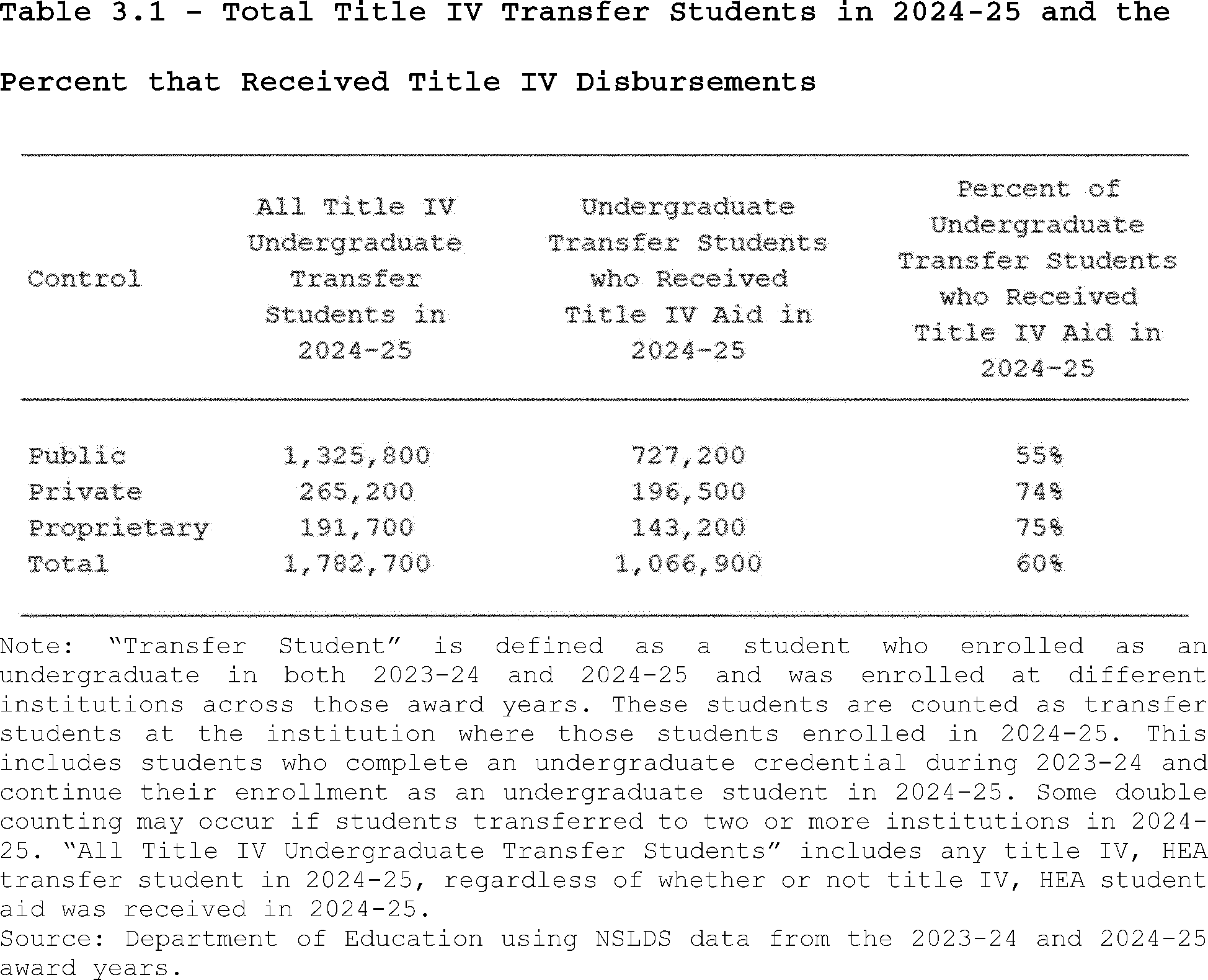
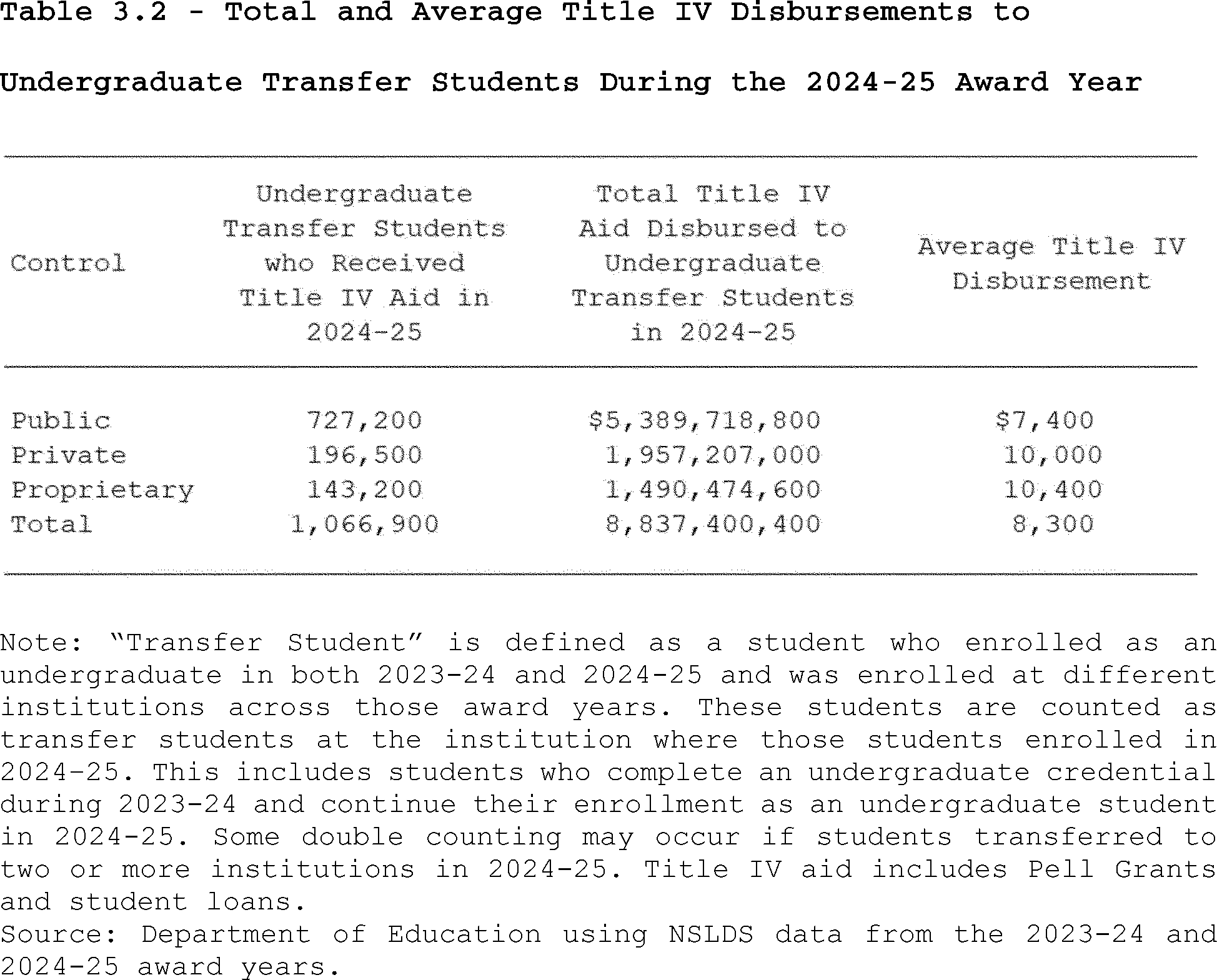
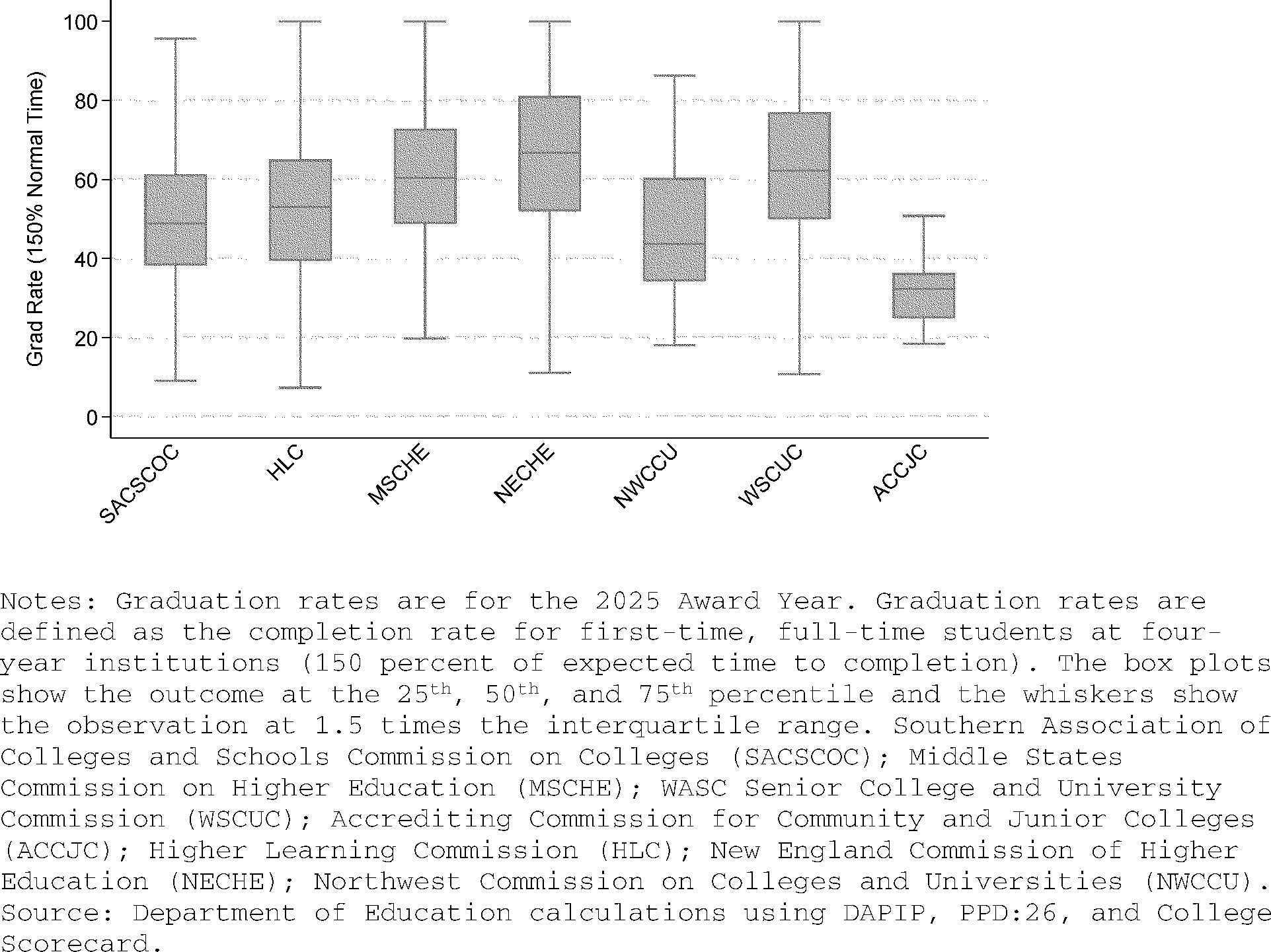
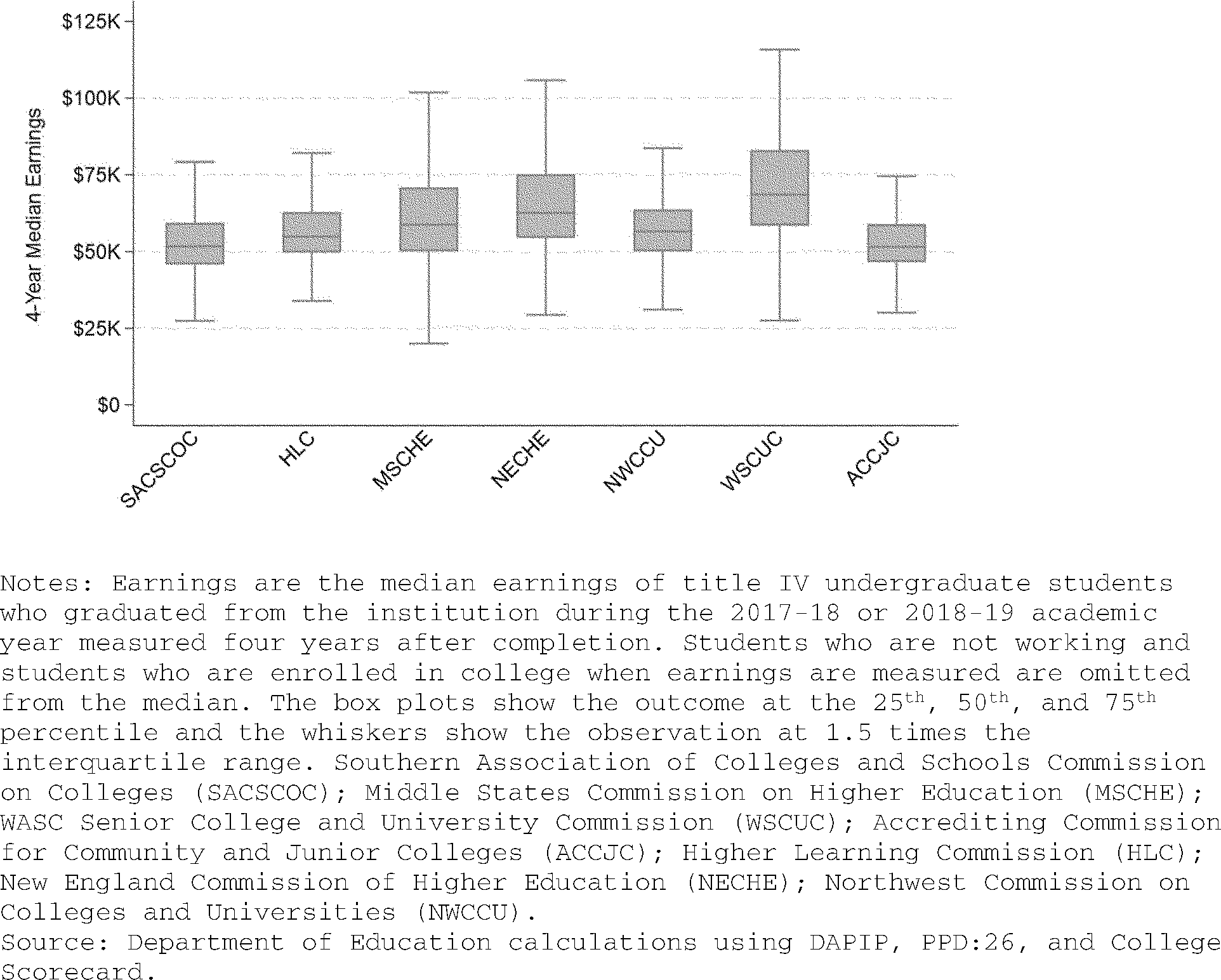
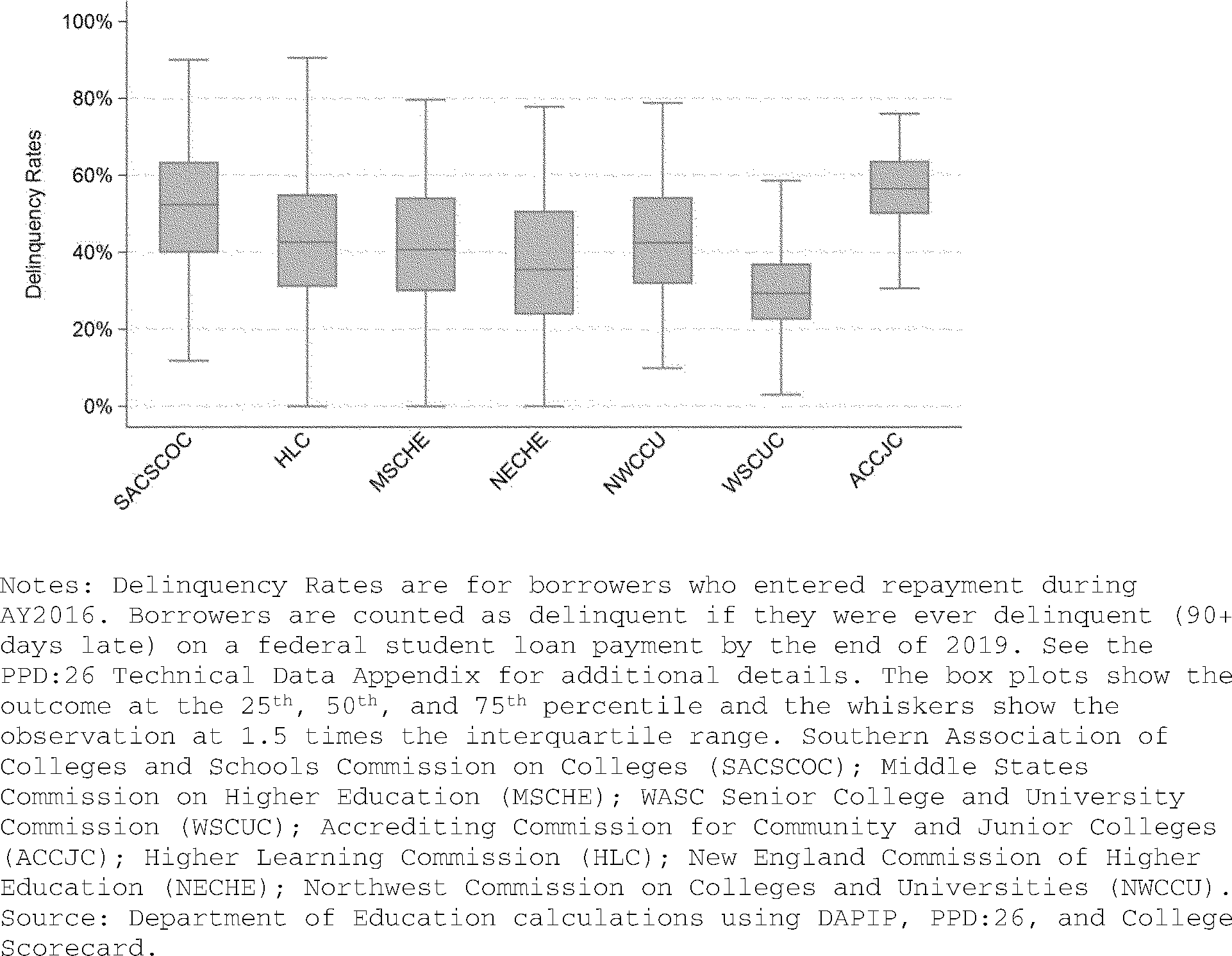
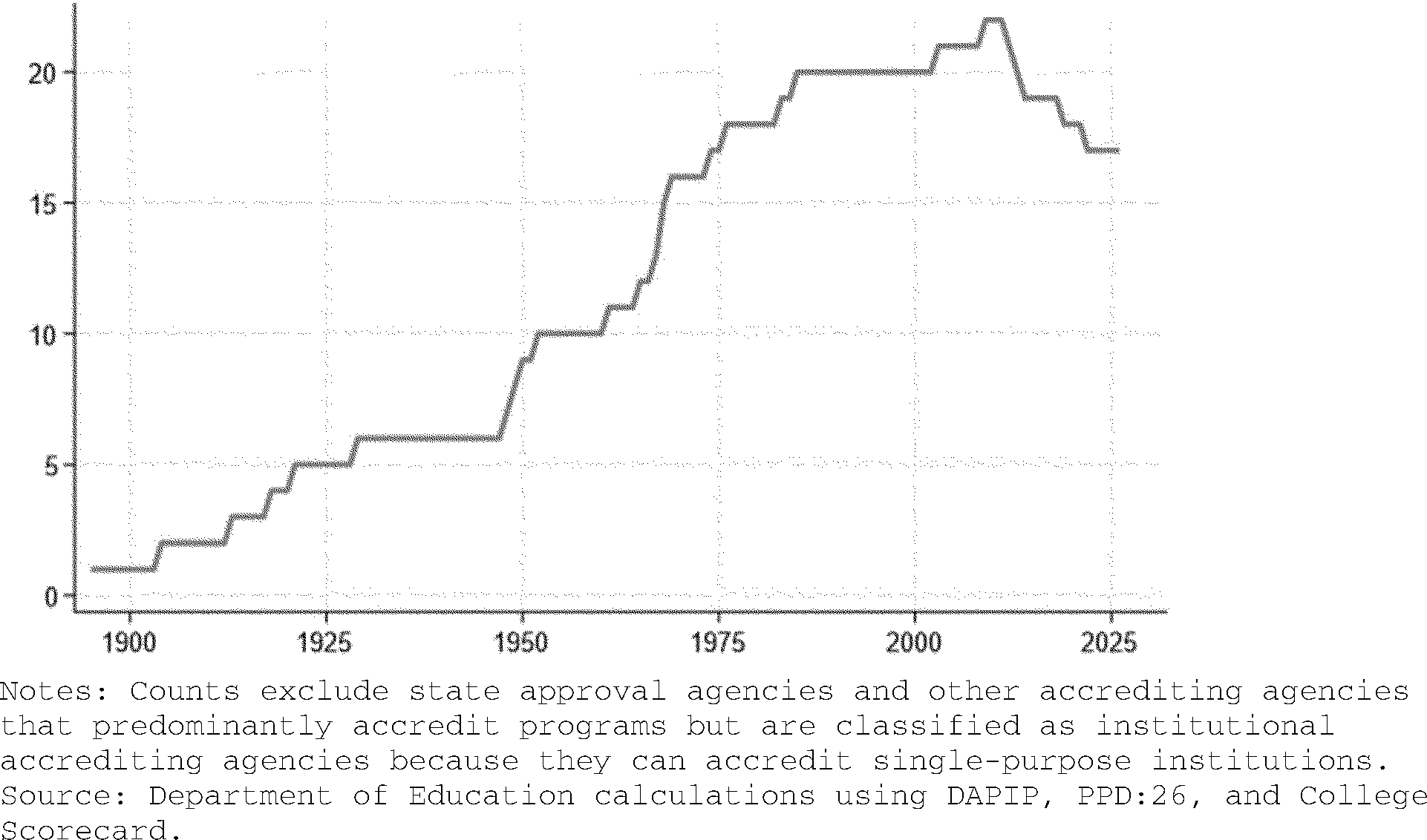
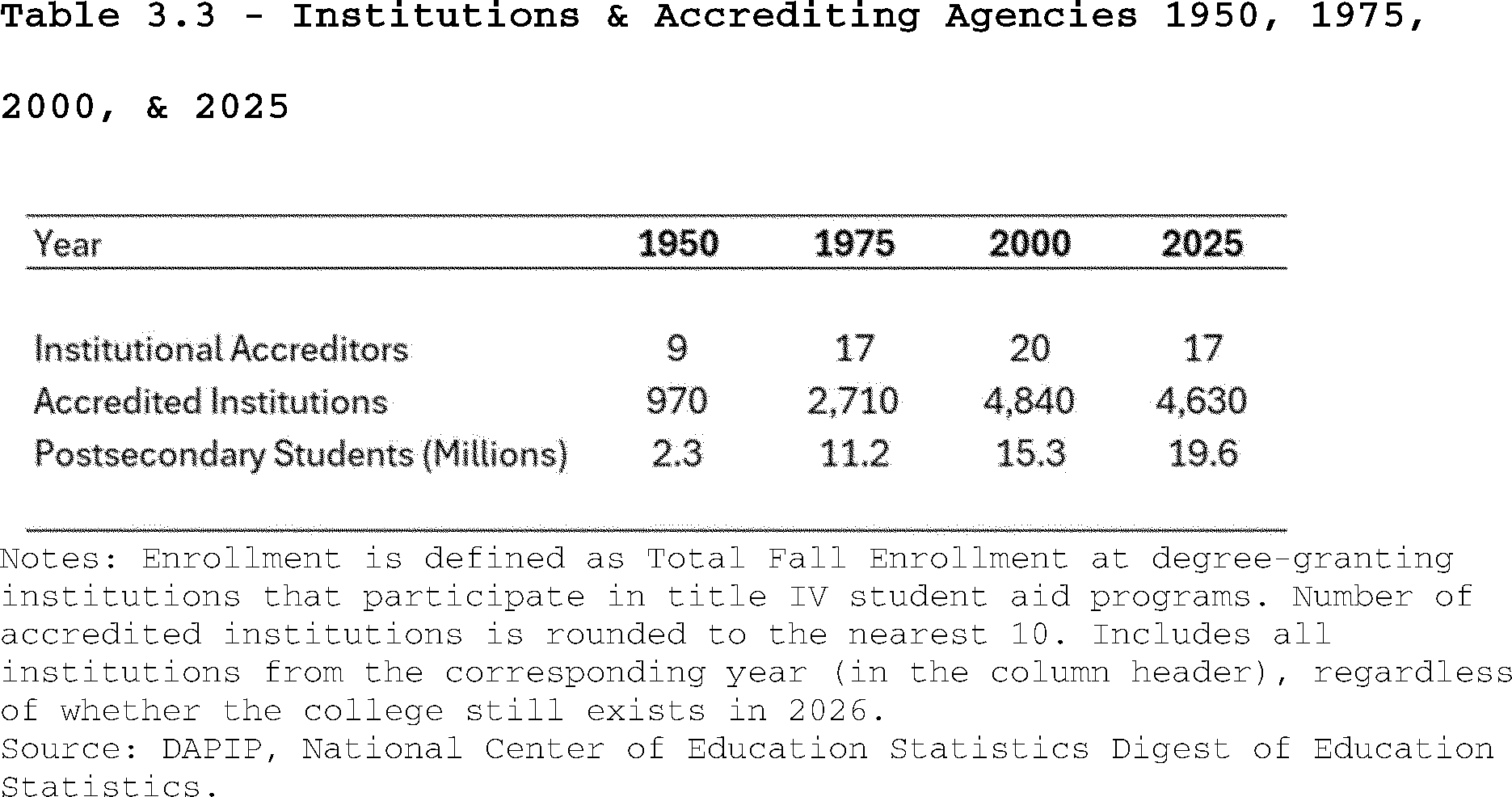
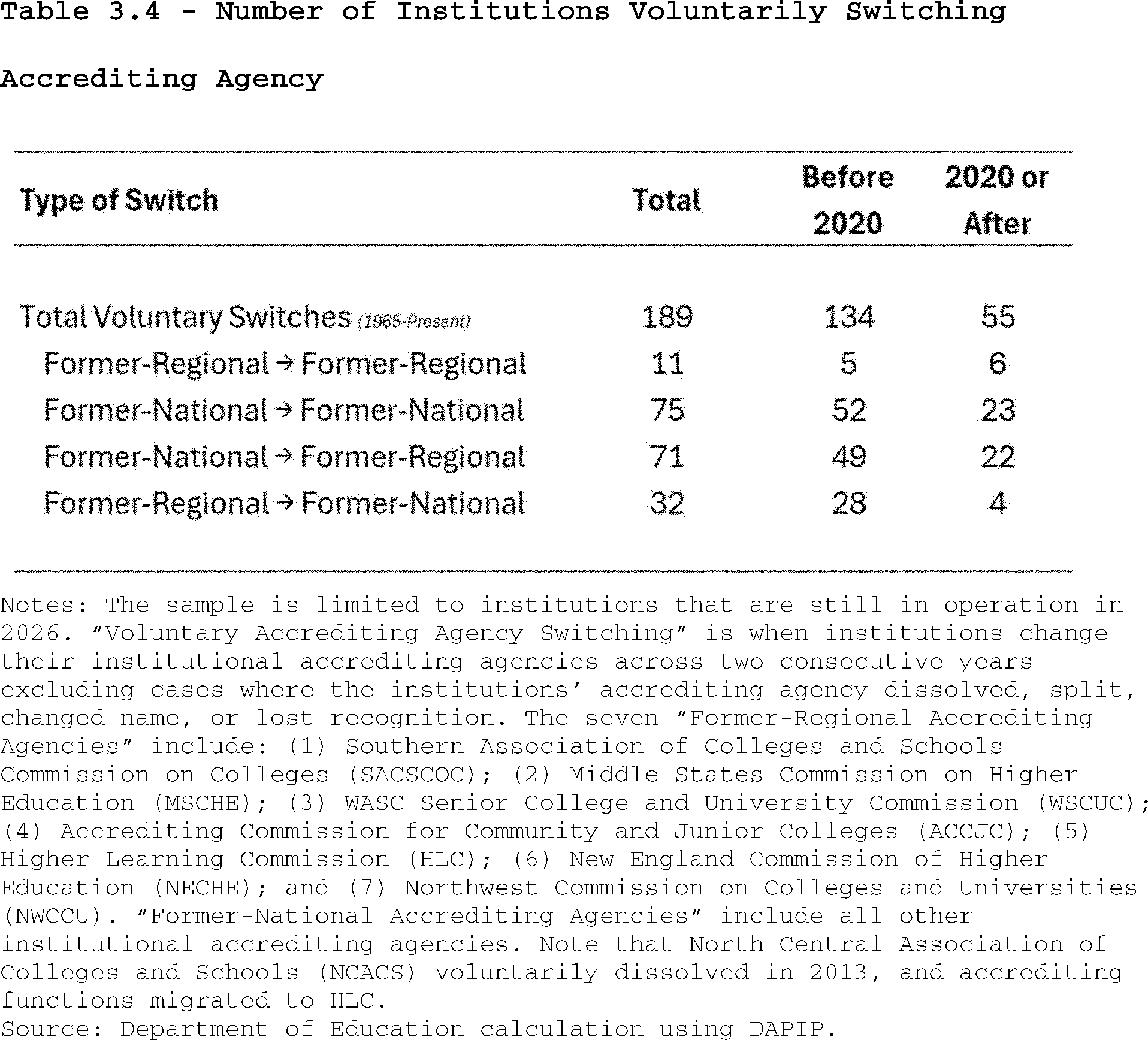
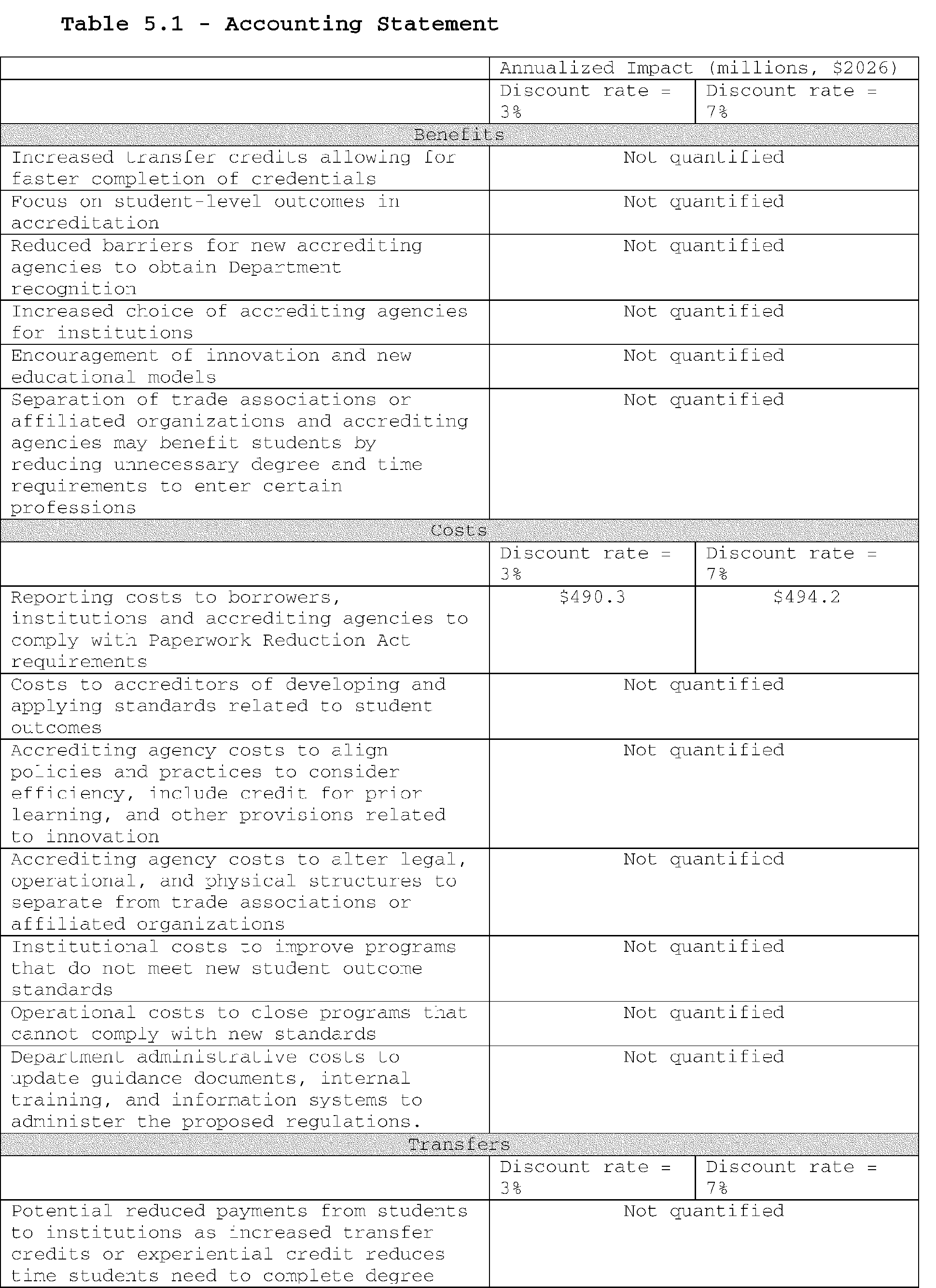
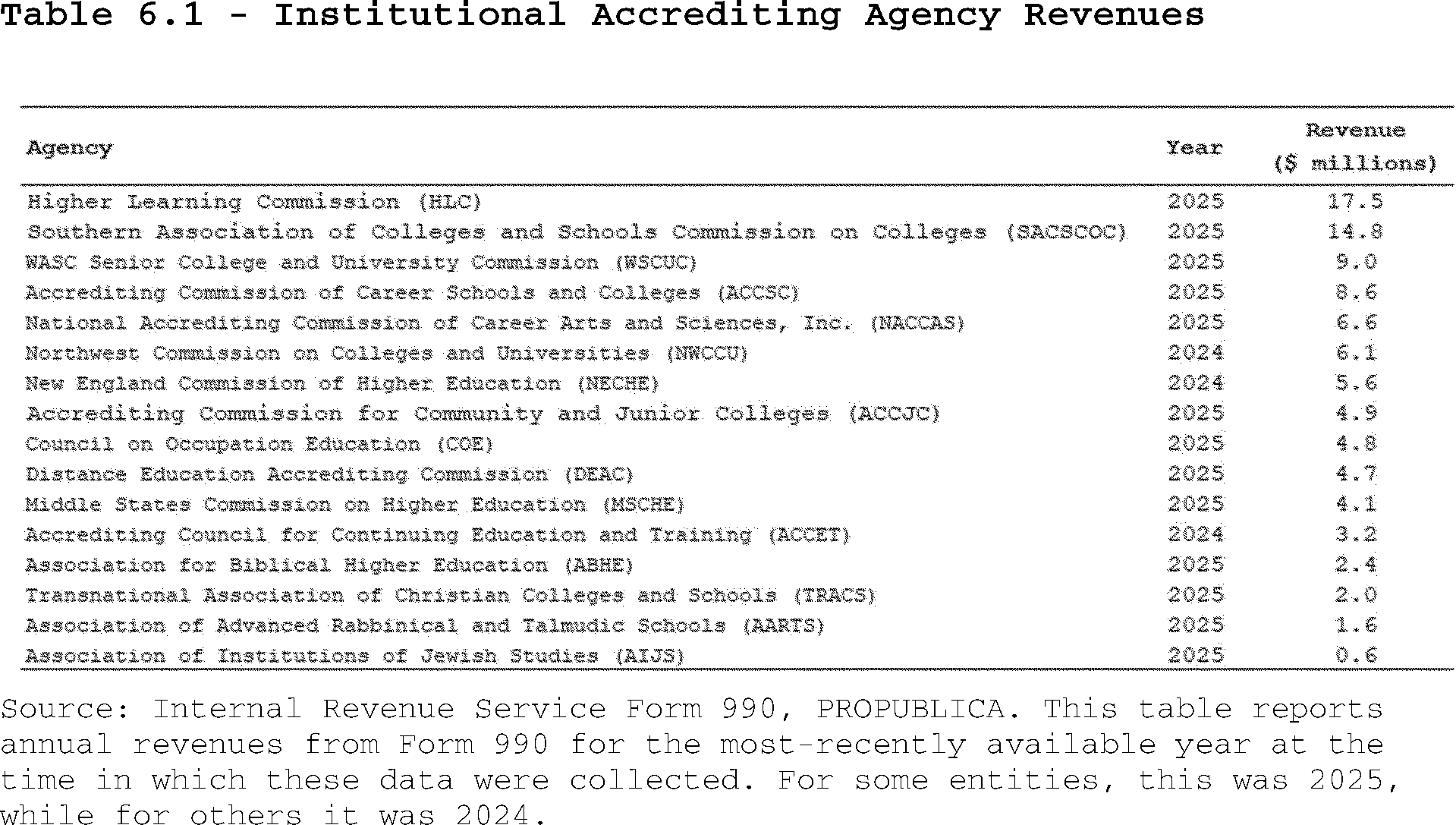
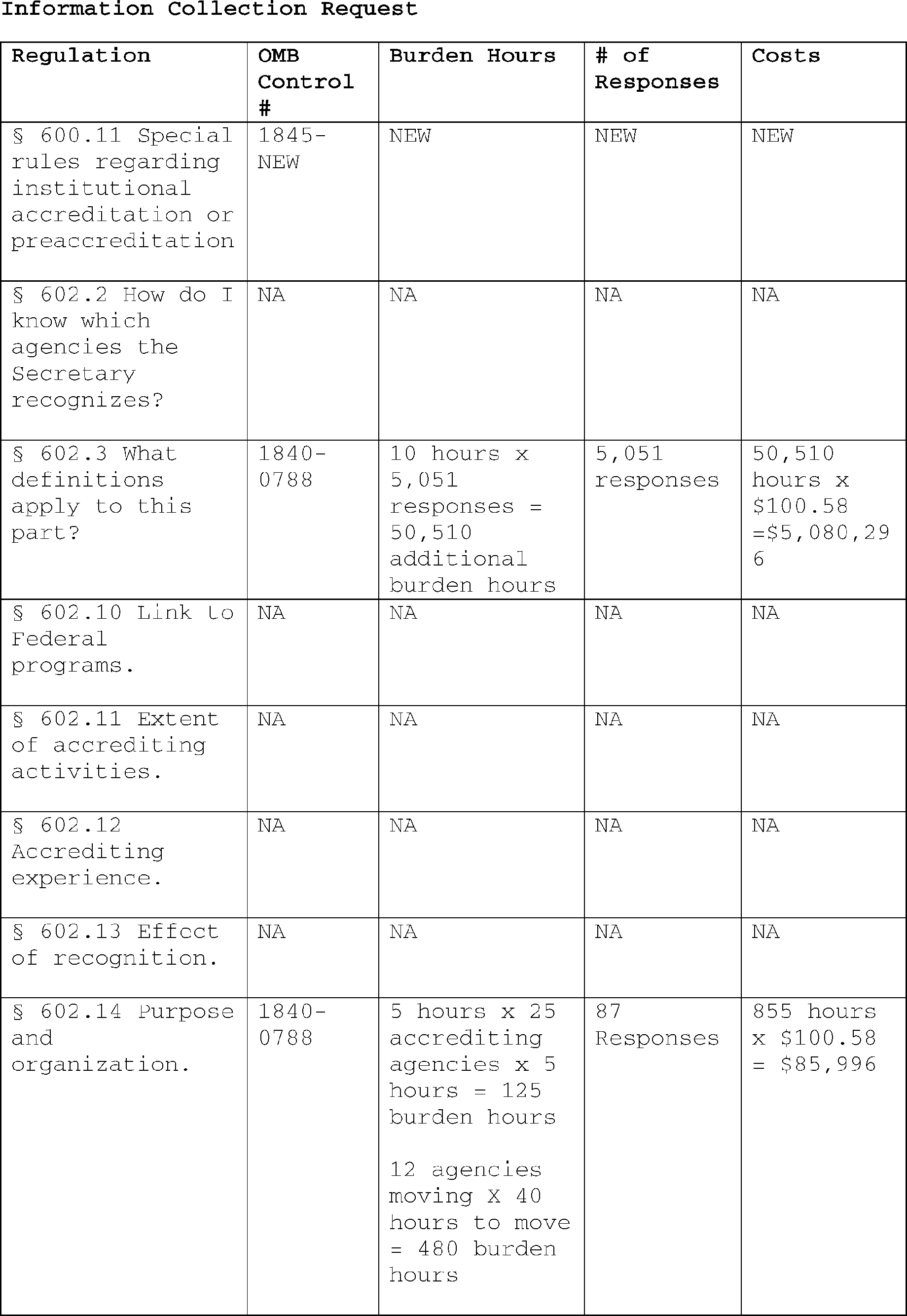
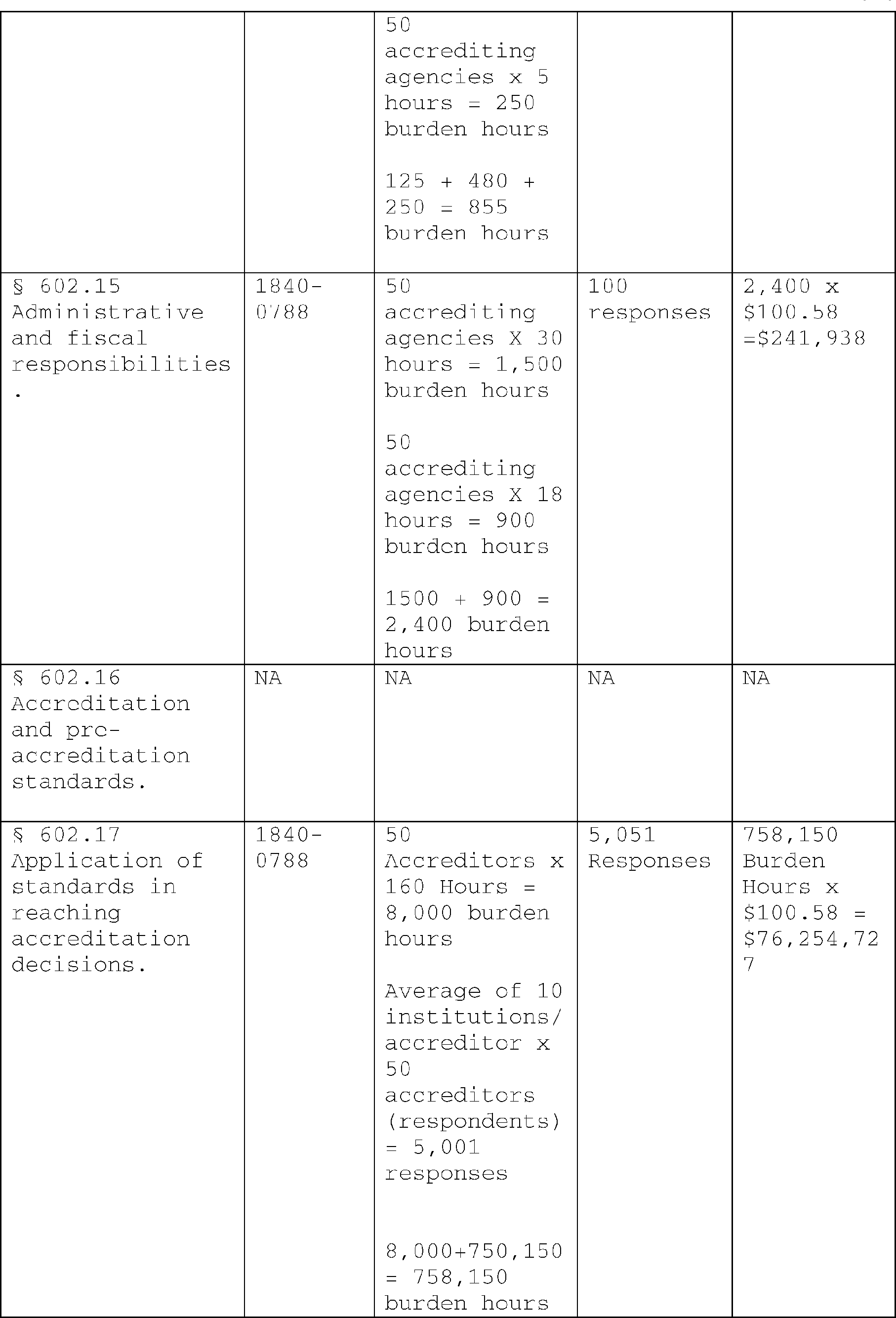
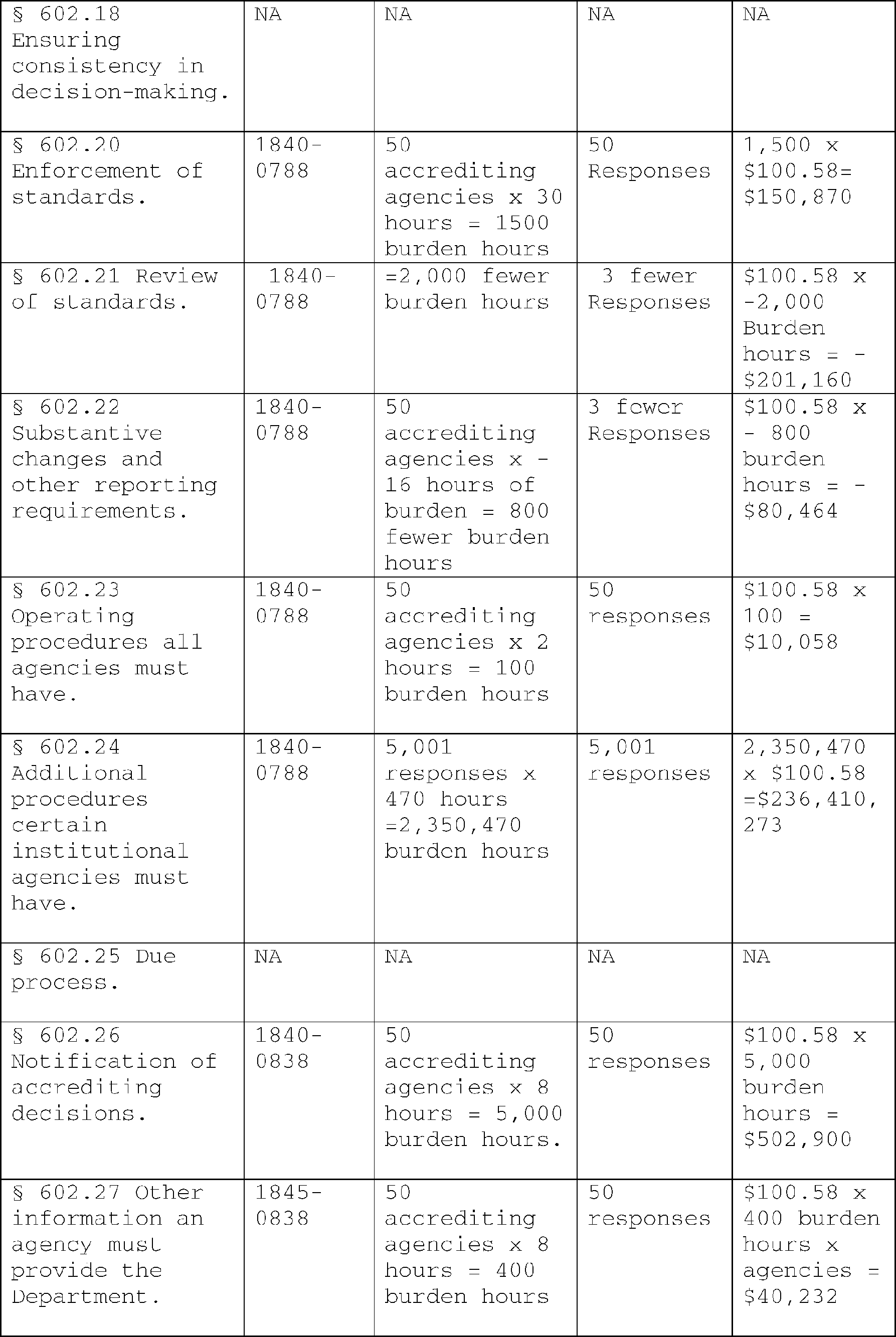
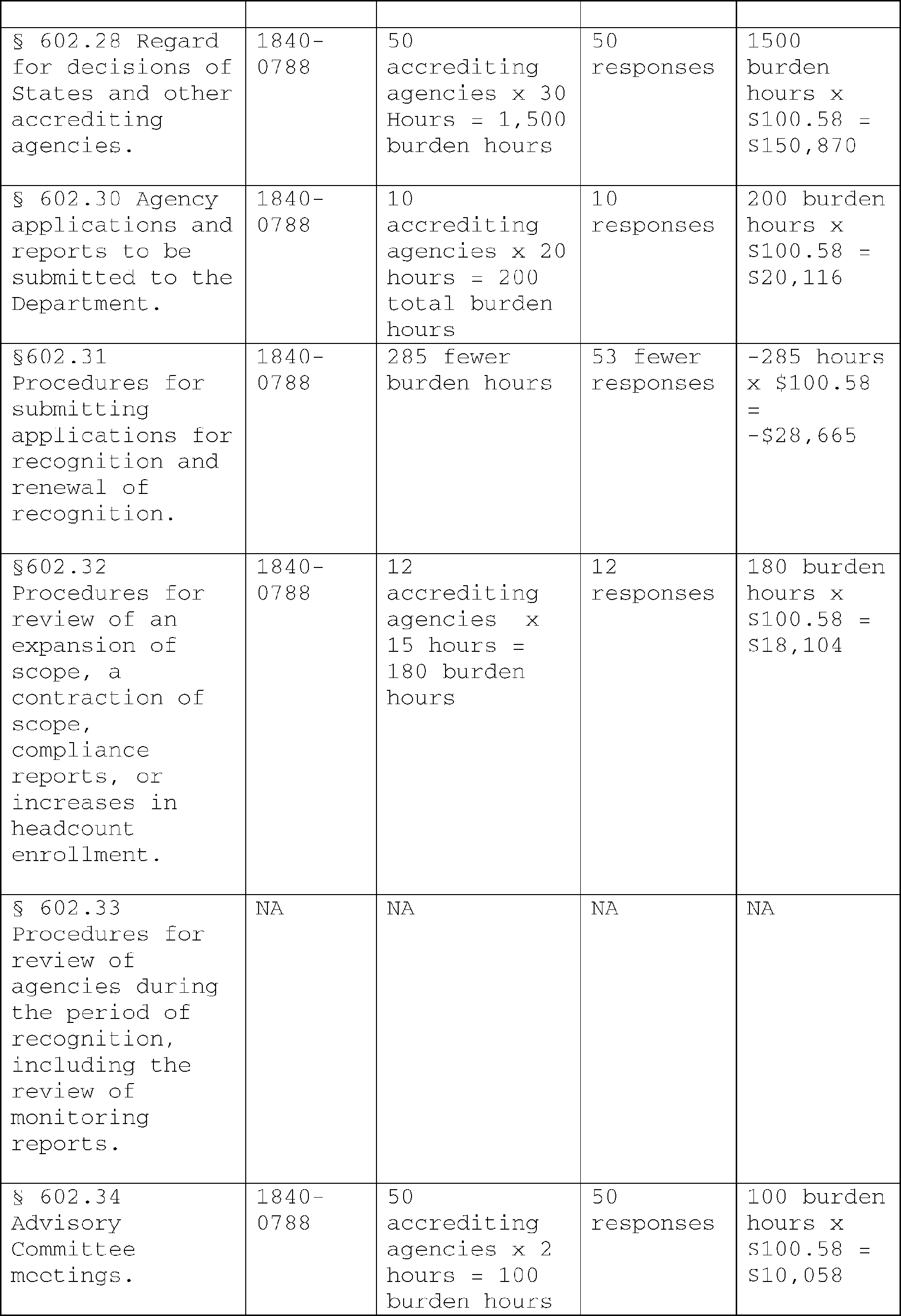
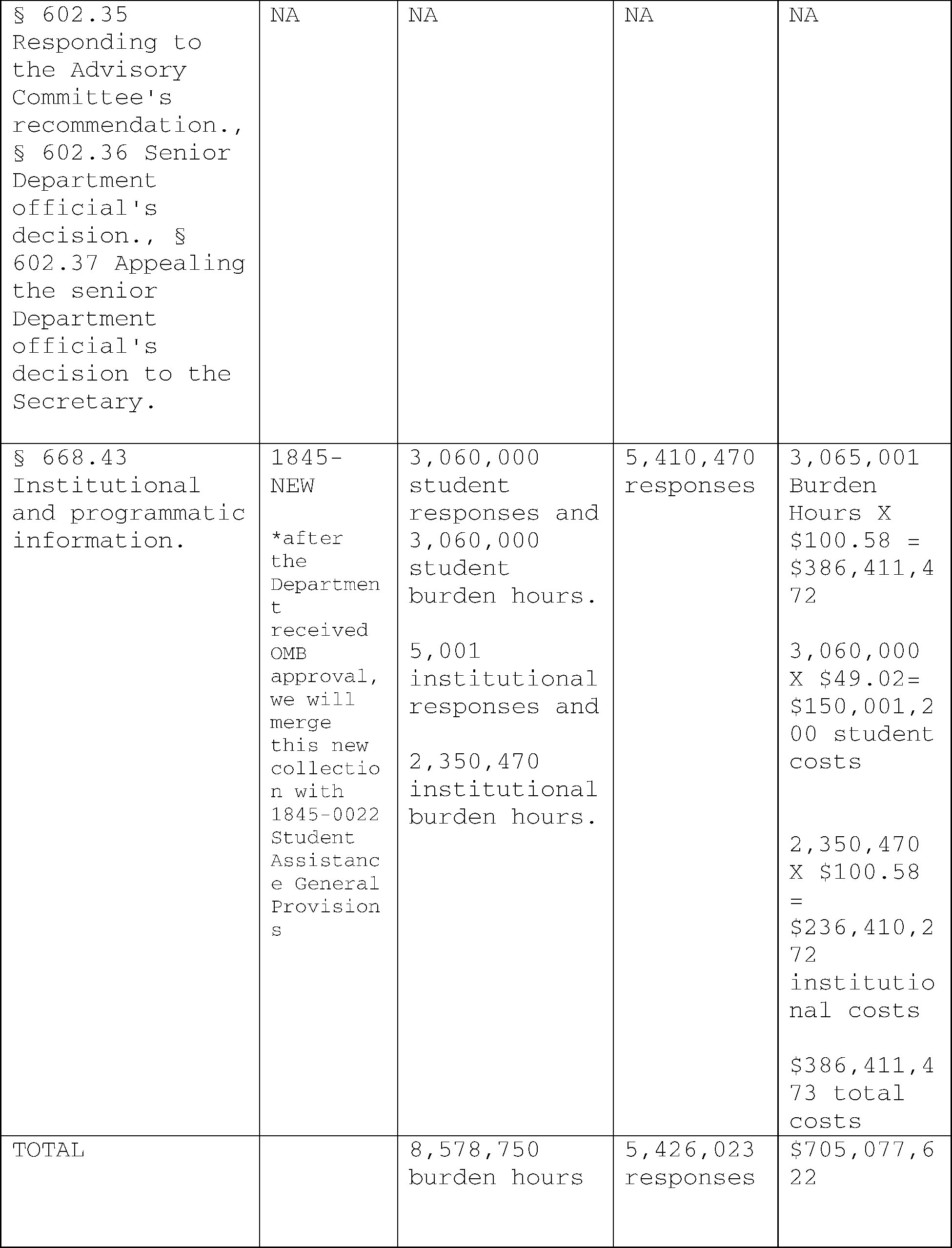
 www.federalregister.gov
 doi.org/10.2307/2556078
 www.justice.gov/atr/media/1420886/dl?inline
 fsapartners.ed.gov/knowledge-center/library/dear-colleague-letters/2023-11-03/regulations-governing-recognition-accrediting-agencies-institutional-eligibility-and-arbitration-updated-dec-5-2023
 www.whitehouse.gov/presidential-actions/2025/01/ending-radical-and-wasteful-government-dei-programs-and-preferencing/
 www.gao.gov/assets/gao-17-574.pdf
 papers.ssrn.com/sol3/papers.cfm?abstract_id=6510203