Agency Information Collection Activities; Submission to the Office of Management and Budget for Review and Approval; Request for Comment; Consolidated Child Restraint System Registration for Defect Notifications and Labeling
In compliance with the Paperwork Reduction Act of 1995 (PRA), this notice announces that the Information Collection Request (ICR) summarized below will be submitted to the Offic...
National Highway Traffic Safety Administration (NHTSA), Department of Transportation (DOT).
ACTION:
Notice and request for comments on a reinstatement and revision of a previously-approved information collection.
SUMMARY:
In compliance with the Paperwork Reduction Act of 1995 (PRA), this notice announces that the Information Collection Request (ICR) summarized below will be submitted to the Office of Management and Budget (OMB) for review and approval. The ICR describes the nature of the information collection and its expected burden. This document request for comments on a reinstatement and revision of a previously-approved information collection on Child Restraint System Registration for Defect Notifications and Labeling. A
Federal Register
Notice with a 60-day comment period soliciting comments on the following information collection was published on December 5, 2023 (88 FR 84514). No comments were received.
DATES:
Comments must be submitted on or before September 25, 2026.
ADDRESSES:
Written comments and recommendations for the proposed information collection, including suggestions for reducing burden, should be submitted to the Office of Management and Budget at
www.reginfo.gov/public/do/PRAMain.
To find this particular information collection, select “Currently under Review—Open for Public Comment” or use the search function.
FOR FURTHER INFORMATION CONTACT:
For additional information or access to background documents, contact Mrs. Cristina Echemendia, Office of Crashworthiness Standards, at
cristina.echemendia@dot.gov.
You can
( printed page 55158)
reach this official by phone at 202-366-1810. Address: National Highway Traffic Safety Administration, U.S. Department of Transportation, 1200 New Jersey Avenue SE, West Building, Washington, DC 20590. Please identify the relevant collection of information by referring to its OMB Control Number.
SUPPLEMENTARY INFORMATION:
Under the PRA (44 U.S.C. 3501et seq.), a Federal agency must receive approval from the Office of Management and Budget (OMB) before it collects certain information from the public, and a person is not required to respond to a collection of information by a Federal agency unless the collection displays a valid OMB control number. In compliance with those requirements, this notice announces that the following information collection request is being submitted to OMB.
Title:
“Consolidated Child Restraint System Registration, Labeling and Defect Notifications.”
OMB Control Number:
2127-0576.
Form Number:
NHTSA 1053 A, NHTSA 1053 B.
Type of Request:
Reinstatement and revision of a previously-approved information collection.
Type of Review Requested:
Regular.
Length of Approval Requested:
Three years from date of approval.
Summary of the Collection of Information
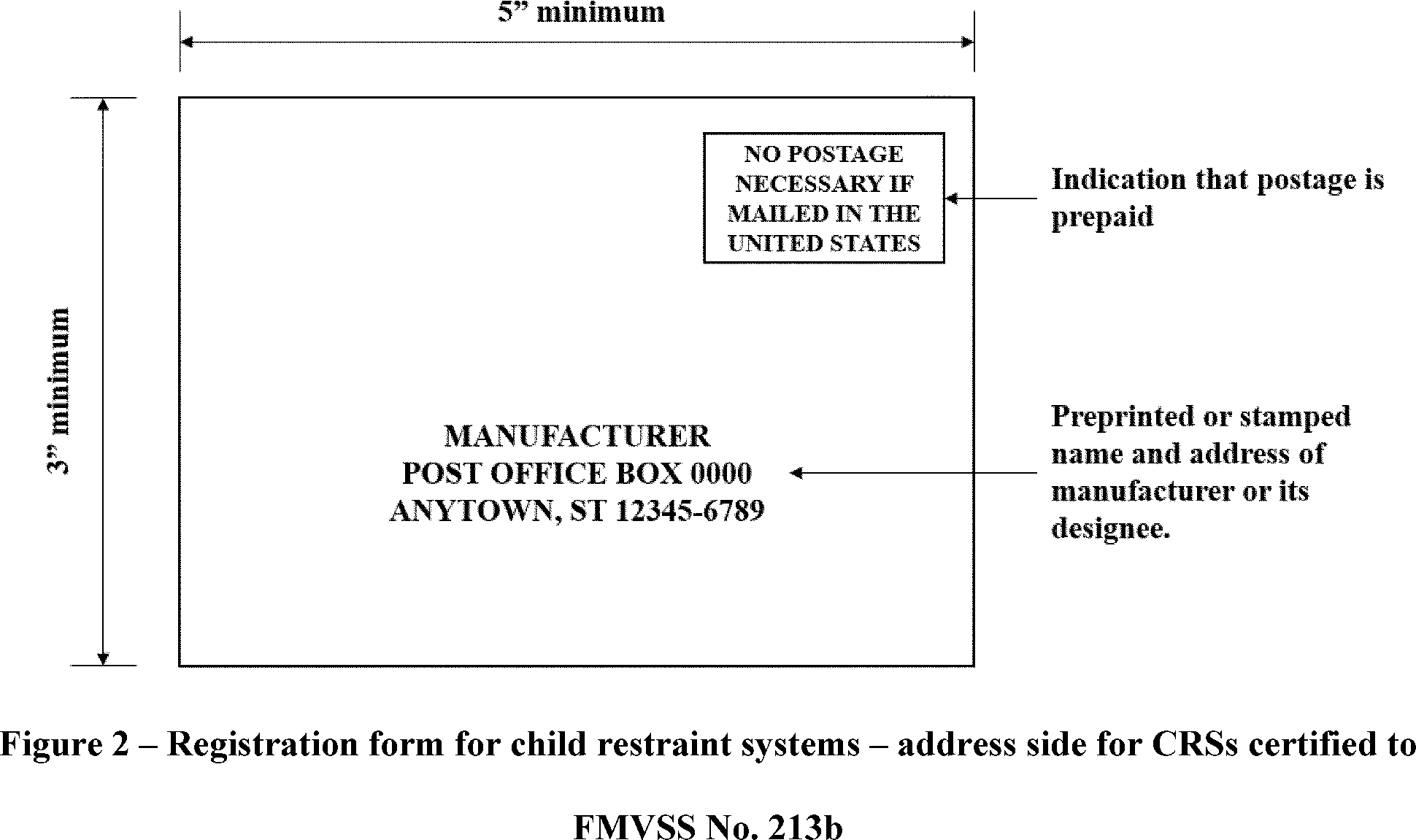
This information collection requires that manufacturers of child restraint systems (CRSs): (1) produce registration cards, labels and printed instructions (brochures), (2) collect CRS owner registration information, (3) design registration cards, labels and manuals, and (4) create and keep registration records so that, in the event of a safety recall, manufacturers can provide direct notification to owners. Child restraint manufacturers are required to provide an owner's registration card for purchasers of child safety seats in accordance with Title 49 of the Code of Federal Regulations (CFR), Part 571—Section 213, “Child restraint systems” or—section 213b, “Child restraint systems.” The registration card consists of two-parts (Figures 1 and 2 in FMVSS No. 213 and Figures 4 and 5 in FMVSS No. 213b). The FMVSS No. 213 information card contains a message and suitable instructions to be retained by the purchaser. The registration form part is to be returned to the manufacturer by the purchaser. The registration part includes prepaid return postage, the pre-printed name and address of the manufacturer, the pre-printed model and date of manufacture, and spaces for purchasers to fill in their name and address. The size, font, color, and layout of the top part are currently prescribed (see Figures 1 and 2) as is the attachment method (fold/perforation) of the information card to the lower part of the form (the mail-in card). The top part of the registration card sets forth: (a) prescribed wording advising the consumer of the importance of registering; (b) prescribed instructions on how to register; and (c) prescribed statements that the mail-in card is pre-addressed and that postage is already paid.
The bottom part (the mail-in card) is to be returned to the manufacturer by the purchaser. The bottom part includes prepaid return postage, the pre-printed name andaddress of the manufacturer, the pre-printed model and date of manufacture, and spaces for the purchaser to fill in his/her name and address. Optionally, child restraint manufacturers are permitted to add to the registration form: (a) Specified statements informing CRS owners that they may register online; (b) the internet address for registering with the company; (c) revisions to statements reflecting use of the internet to register; and (d) a space for the consumer's email address. For those CRS owners with access to the internet, online registration may be a preferred method of registering a CRS.
Child restraint manufacturers are also required to provide printed instructions with new CRSs, with step-by-step information on how the restraint is to be used, and a permanently attached label that gives “quick look” information on matters such as usage instructions and information on registering the CRS.
The December 5, 2023 final rule updating child restraint systems requirements established the standard FMVSS No. 213b. The final rule amended the requirements in FMVSS No. 213 and FMVSS No. 213b so that the wording advising the consumer about the importance of registering their CRS and instructing how to register is not prescribed. Instead, CRS manufacturers are given leeway to use their own words to convey the importance of registering the CRS and to instruct how registration is achieved. Updated requirements allow statements instructing consumers to use electronic (or any other means) of registering, as long as instructions are provided on using the paper card for registering (including that the mail-in card is pre-addressed and that the postage is prepaid). Updated requirements allow other means of electronic registration other than a web address, such as a QR code, tiny URL, or similar.
In the final rule, the agency also removed restrictions on the use of size, font, color, layout, and attachment method of the information card portion, allowing manufacturers greater flexibility in its design. NHTSA is continuing a current provision that prohibits any other information unrelated to the registration of the CRS, such as advertising or warranty information. With the changes to the information card (Figure 1 and Figure 2 of this notice) adopted in the December 5, 2023 final rule, NHTSA anticipates a change to the hour burden or costs associated with the revised information card, labels and printed instructions, which will be discussed in later sections of this notice.
In addition to the manufacturer-supplied registration card, NHTSA implemented a CRS registration system to assist owners who either lost the original registration card or purchased a previously owned CRS.[1]
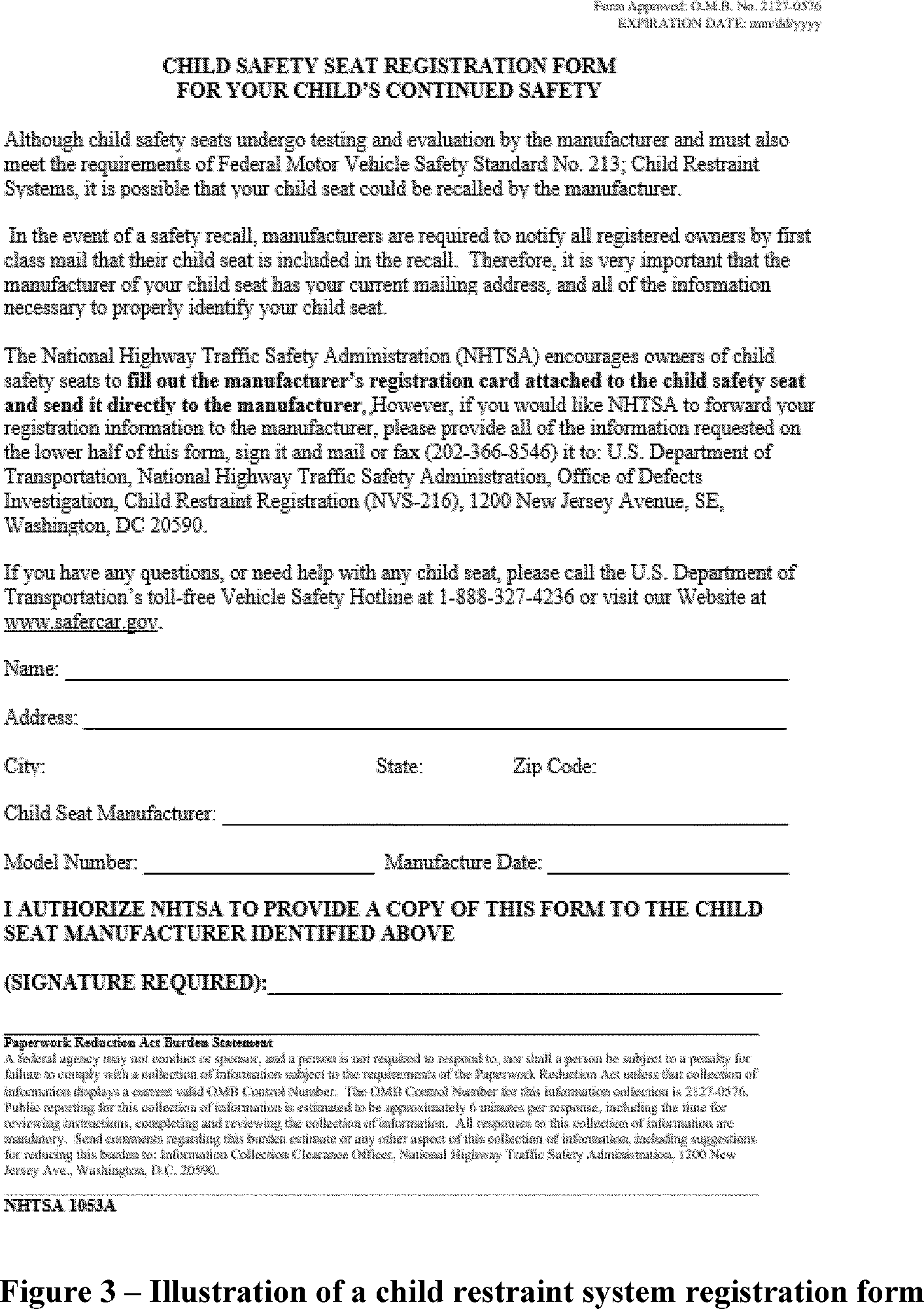
Upon an owner's request, NHTSA provides a substitute registration form that can be obtained either by mail or from the internet [2]
(see Figure 3). When the completed registration is returned to the agency, the information is forwarded to the CRS manufacturer. In the absence of a substitute registration system, many CRS owners, especially any second-hand owners, might not be notified of safety defects and non-compliances. These owners would be less likely to have any defects and non-compliances remedied without notification.
Child seat owner registration information is retained in the event that owners need to be contacted for defect recalls or replacement campaigns. Chapter 301 of Title 49 of the United States Code specifies that if either NHTSA or a manufacturer determines that motor vehicles or items of motor vehicle equipment contain a defect that relates to motor vehicle safety or fails to comply with an applicable Federal Motor Vehicle Safety Standard, the manufacturer must notify owners and purchasers of the defect or noncompliance and the manufacturer must provide a remedy without charge. In title 49 of the Code of Federal Regulations (CFR), part 577, defect and noncompliance notification for equipment items, including child restraint systems, must be sent by first class mail to the most recent purchaser known to the manufacturer.
( printed page 55159)
Child restraint manufacturers also must provide printed instructions in a brochure containing step-by-step information on how the restraint is to be used. Without proper CRS usage, the effectiveness of these systems is greatly diminished. Each CRS must also have a permanent label. A permanently attached label gives “quick look” information on whether the restraint meets the safety requirements, recommended installation and use, and warnings against misuse. CRSs equipped with internal harnesses and components to attach to a vehicle's child restraint anchorage system are also required to be labeled with a child limit.
Description of the Need for the Information and Proposed Use of the Information
CRS manufacturers are required to label each CRS and provide brochures containing safety information and instructions on proper restraint usage. Such information mitigates the risk of misuse and consequently reduces injuries to and fatalities of children in crashes. This collection supports the Department of Transportation's (DOT) strategic goal for safety, by working towards the elimination of transportation related deaths and injuries involving children.
FMVSS No. 213 and FMVSS No. 213b each require that every new CRS has an owner registration form attached. The standards permit information regarding online product registration to be included on the owner registration form required under the standard. This enhances the opportunity for owners to register their CRSs online, which may increase registration rates and the effectiveness of recall campaigns. Manufacturers are also permitted to supplement (but not replace) recall notification via first-class mail with email notification, which increases the likelihood that owners learn of a recall. Manufacturers are also required to include a U.S. telephone number on a CRS label for the purpose of enabling consumers to register their products by telephone.
Increasing CRS registrations is an important part to protecting young children and infants. By registering CRSs, product manufacturers will to able to directly contact owners in the event of any safety recalls.
60-Day Notice
A
Federal Register
notice with a 60-day comment period soliciting public comments on the following information collection was published on December 5th, 2023 (88 FR 84514). The closing date for comments was February 3, 2024. No comments were received on the information collection.
Affected Public:
Businesses, Individuals and Households.
Estimated Number of Respondents:
38 Manufacturers, 2,835,200 Consumers.[3]
Frequency:
On occasion.
Estimated Number of Responses:
2,835,200.
Estimated Total Annual Burden Hours:
119,439 hours.
The total burden hours for this collection consist of: (1) the hours spent by consumers filling out the registration form, (2) the hours spent collecting registration information, (3) the hours spent designing registration cards, labels and manuals, and, (4) the hours spent determining the maximum allowable child weight for lower anchor use and adding the information to the existing label and instruction manual.
(1)
Annual Burden for filling out registration card.
NHTSA estimates that 16,000,000 CRSs are currently sold each year by 38 CRS manufacturers. Of the CRSs sold each year, NHTSA estimates that 2,369,660 are registered using registration cards and 465,540 are registered online. A consumer spends approximately 60 seconds (one minute) filling out the registration form. The estimated annual number of burden hours for consumers to fill out the registration form is 47,253 hours (rounded) (2,835,200 × (60 seconds/3,600 seconds/hour)).
(2)
Annual Burden for Reporting (collecting registration information).
Manufacturers must spend about 90 seconds (1.5 min) to enter the information from each returned registration card; while online registrations are considered to have no burden for the manufacturer, as the information is entered by the purchaser. Therefore, the estimated annual number of burden hours for CRS registration information collection is 59,242 hours (rounded) (2,369,660 × (90 seconds/3,600 seconds/hour)).
(3) NHTSA assumes for purposes of this burden analysis that each manufacturer would design the registration information on the information card five times per year, whether it is to use different registration cards designs in different CRS models or to adapt the design to improve registrations. The agency estimates 50 hours of additional burden per child restraint manufacturer for the designing of the registration card (information card portion) that no longer have prescribed text (50 hours × 5 designs/year × 38 CRS manufacturers = 9,500 hours annually).
(4)
Annual Burden for Reporting (determining maximum allowable child weight).
About 12,400,000 of the CRSs sold each year are equipped with internal harnesses. About half of the CRSs equipped with internal harnesses sold annually (6,200,000 = 12,400,000 × 0.5) would require a label with the maximum allowable child weight for using the lower anchors. Manufacturers must spend about two seconds to determine the maximum allowable child weight for lower anchor use and to add the information to the existing label and instruction manual. Therefore, the total annual burden hours for the information on the maximum allowable child weight in the existing label and instruction manual is 3,444 hours (rounded) (= 6,200,000 × (2 seconds/3,600 seconds/hour)).
The estimated total annual number of burden hours is 119,439 (= 47,253 + 59,242 + 9,500 + 3,444) hours. The total estimated hour burden increased from 109,939 hours to 119,439 hours (a 9,500-burden hour increase). The increase in burden is due to new requirements in FMVSS No. 213b that result in additional cost for designing the registration card, labels, and manuals.[4]
The adopted changes include allowing manufacturers to use their own words, instead of using prescribed statements, to convey the importance of registering and providing instructions on how to register. NHTSA also removed restrictions on size, font, color, layout, and attachment method for the information card portion of the registration card.
Estimated Total Annual Burden Cost: $10,565,493 (Rounded)
The total burden cost for this collection consists of printing and material costs of labels and registration cards and the mailed-in registration cards postage costs.
( printed page 55160)
Printing and Material Costs of Labels and Registration Cards, and Postage Costs
The total annual printing and material cost to the respondents is estimated to be $9,120,000. NHTSA estimates that the printing and material cost of $0.23 per CRS labels and $0.34 per CRS registration card. The total annual printing and material cost to respondents is calculated by multiplying the printing and material cost ($0.57 = $0.23 + $0.34) by the estimated 16,000,000 responses (CRSs produced) per year ($0.57 × 16,000,000). The total estimated annual printing and material costs are detailed in the table below:
Number of CRS
produced annually
Printing and
material cost per
CRS—labels
Printing and material
cost per CRS—
registration card
Annual printing
and material cost
16,000,000
$0.23
$0.34
$9,120,000
The total annual postage cost for the mailed in registration cards is estimated to be $1,445,493.00. Approximately 16,000,000 CRSs are sold each year with an estimated registration rate of 17.72% (2,835,200). Of the total registrations received, 83.58% (2,369,660) are mailed in registration cards. The remainder are from online registrations. CRS manufacturers are required to provide printed mail-in registration cards with pre-paid postage. The total annual postage cost is calculated by multiplying the number of mailed in registration cards (2,369,660) by the postage cost ($0.61).[5]
The total estimated postage cost is detailed in the table below:
Annual Postage Costs
[Mailed-in registration cards]
Number of CRS
produced each year
Annual number of
returned CRS registrations
(registration rate of 17.72%)
Registrations
received from
registration cards
(83.58%) *
Registration card
postage cost
Annual
postage cost
16,000,000
2,835,200
2,369,660
$0.61
$1,445,492.70
The estimated total annual cost burden is $10,565,493. The total annual cost burden is calculated by adding the annual printing and material costs ($9,120,000) and the mailed-in registration card postage cost ($1,445,492.70).
The total estimated burden cost increased from $8,781,987.85 to $10,565,492.70 (a $1,783,505 (rounded) increase). The increase in burden is due to the increase in postage, material, and printing costs.
Public Comments Invited:
You are asked to comment on any aspects of this information collection, including: (a) whether the proposed collection of information is necessary for the proper performance of the functions of the agency, including whether the information will have practical utility; (b) the accuracy of the agency's estimate of the burden of the proposed collection of information, including the validity of the methodology and assumptions used; (c) ways to enhance the quality, utility and clarity of the information to be collected; and (d) ways to minimize the burden of the collection of information on respondents, including the use of appropriate automated, electronic, mechanical, or other technological collection techniques or other forms of information technology,
e.g.,
permitting electronic submission of responses.
4.
On December 5, 2023 NHTSA published a final rule (88 FR 84514) adopting changes to the CRS registration card. These changes require manufacturers to use their own language to convey the importance of registration and provide instructions on how to complete it, replacing the previously mandated NHTSA-prescribed statements. NHTSA also removed restrictions on size, font, color, layout and attachment method of the information card portion of the registration card. On October 9, 2024, a petitions for reconsideration response final rule (89 FR 81836) was published that delayed the compliance date of these new requirements from December 5, 2024 to June 30, 2025, when the requirements will be mandatory.
Use this for formal legal and research references to the published document.
91 FR 55157
Web Citation
Suggested Web Citation
Use this when citing the archival web version of the document.
“Agency Information Collection Activities; Submission to the Office of Management and Budget for Review and Approval; Request for Comment; Consolidated Child Restraint System Registration for Defect Notifications and Labeling,” thefederalregister.org (August 26, 2026), https://thefederalregister.org/documents/2026-17384/agency-information-collection-activities-submission-to-the-office-of-management-and-budget-for-review-and-approval-reque.
 www.reginfo.gov/public/do/PRAMain
 44 U.S.C. 3501
 Title 49 of the Code of Federal Regulations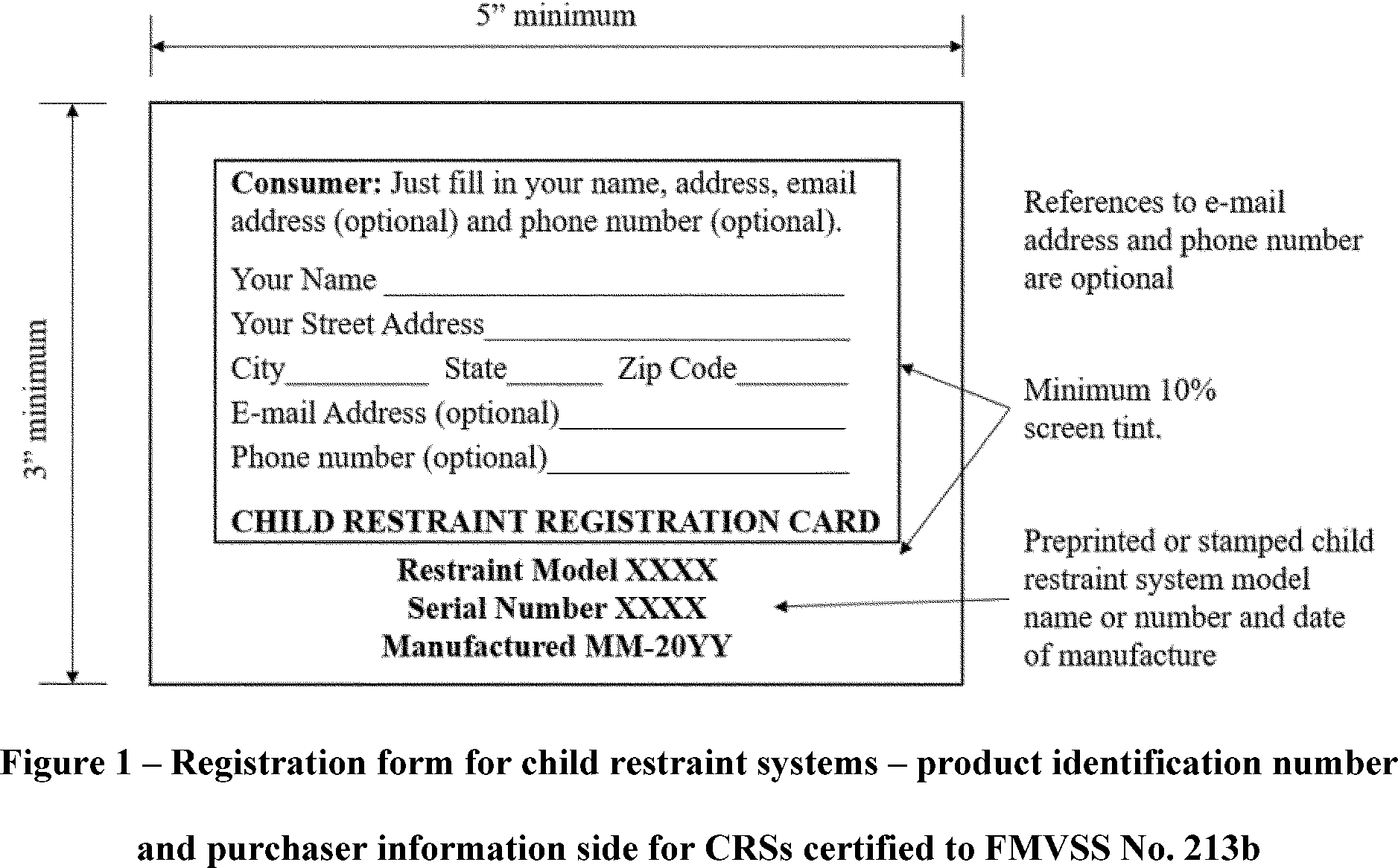
 www.nhtsa.gov/equipment/car-seats-and-booster-seats#car-seat-registration
 pe.usps.com/text/dmm300/Notice123.htm#_c096