Automated Commercial Environment (ACE) Electronic Export Manifest for Rail Cargo
U.S. Customs and Border Protection (CBP) is revising its regulations pursuant to the Trade Act of 2002 requiring the transmission of export manifest data electronically in the A...
U.S. Customs and Border Protection (CBP) is revising its regulations pursuant to the Trade Act of 2002 requiring the transmission of export manifest data electronically in the Automated Commercial Environment (ACE) for cargo transported by rail for any train departing the United States. This rule mandates the electronic transmission of rail export manifest information, identifies the parties eligible to transmit information, and describes the time frames prior to departure in which the information is due. This rule enables CBP to address important cargo security concerns while providing efficiencies to the trade.
DATES:
Effective date:
This rule is effective on October 26, 2026.
Compliance date:
CBP will begin enforcing this rule on October 26, 2027.
FOR FURTHER INFORMATION CONTACT:
David Garcia, Program Manager, Outbound Enforcement and Policy Branch, Office of Field Operations, CBP, via email at
cbpexportmanifest@cbp.dhs.gov.
SUPPLEMENTARY INFORMATION:
I. Executive Summary
A. Purpose of Revising the Regulations for Electronic Export Manifest for Rail Cargo
Current regulations are insufficient to adequately capture cargo data for rail shipments leaving the United States. U.S. Customs and Border Protection (CBP) is finalizing this rule to reduce the data gaps existing under current regulations, and to address important cargo security concerns resulting from incomplete data. This rule will apply to all rail cargo exports and provide efficiencies to the trade. CBP does not presently require the pre-departure electronic transmission of data for all exported cargo as it does for imported cargo. This can result in a threat to cargo and broader U.S. national security because CBP has no regulations prescribing any method or means of review for cargo being exported by rail. The electronically transmitted cargo data that is transmitted prior to departing the United States by rail is limited significantly in its scope. Currently, 19 CFR 192.14 requires a U.S. Principal Party in Interest (USPPI), the USPPI's agent, or the authorized filing agent of a Foreign Principal Party in Interest (FPPI) to transmit Electronic Export Information (EEI) to CBP through the Automated Commercial Environment (ACE). While this pre-departure data is helpful, EEI is generally only required by the Bureau of Census regulations on shipments that exceed $2,500, per Schedule B number and is generally not required for shipments to Canada unless certain controlled items are involved or the shipment is being transshipped to another destination. 15 CFR Parts 30 and 758. Because of these limitations, there is a significant lack of electronic manifest data which inhibits the enforcement efforts by CBP for such exports. This rule creates an integrated pre-departure electronic export manifest which includes receiving advance information for risk assessment purposes from the source most likely to have correct information about the cargo. This rule closes the gap which currently exists and requires all information to be manifested which enhances the security of the rail cargo and aligns the security of exported rail cargo with the regulations that are required of rail cargo imported into the United States.
B. Statutory Authority
Pursuant to Section 343(a) of the Trade Act of 2002, as amended (“Trade Act”) (19 U.S.C. 1415), CBP is authorized to promulgate regulations providing for the mandatory transmission of electronic cargo information by way of a CBP-authorized electronic data interchange (EDI) system before cargo arrives or departs the United States by any mode of commercial transportation (sea, air, rail, or truck). The required cargo information is reasonably necessary to ensure cargo safety and security pursuant to the laws enforced and administered by CBP. 19 U.S.C. 1415(a)(2)). CBP needs to obtain timely and sufficient data prior to cargo arriving or departing the United States via any mode of commercial transportation to review and conduct risk assessments to identify high-risk shipments and inspect cargo effectively.
C. Summary of the Rule
This rule mandates the transmission of electronic export manifest (EEM) data, in addition to the EEI data required under 15 CFR part 30, for all cargo prior to departing the United States for Canada and Mexico in the rail environment in lieu of paper submissions. The new regulation, to be codified at 19 CFR 123.93, mandates the electronic transmission of rail export manifest information, identifies the parties eligible to transmit such information, describes the time frames prior to departure of the train in which the information is due, requires a bond to secure compliance with the new regulation, and identifies an initial filing that must occur as early as practicable, but no later than 24 hours prior to departure from the U.S. port of export while requiring the remaining data to be transmitted at least two hours prior to such departure. The new regulation designates information as transportation data, cargo data, or empty container data, and lists the data elements to be transmitted while identifying and classifying them as mandatory, conditional, or optional. The data elements identified as mandatory must be transmitted, while elements identified as conditional shall be transmitted if applicable, and optional elements may be transmitted at the discretion of the party making the transmission. These data elements will allow CBP to inspect cargo effectively, ensure compliance with U.S. export control laws and regulations, and identify high-risk shipments for purposes of ensuring cargo safety and security.
In the notice of proposed rulemaking (NPRM), 90 FR 2874, 2917 (Jan. 13, 2025), CBP proposed that the initial filing “must be transmitted as early as practicable, but no later than 24 hours prior to departure of the train from the United States.” Subsequent filings were due “no later than two hours prior to departure of the train from the United States.”
Id.
In this final rule, consistent with the NPRM preamble and to provide greater clarity regarding these deadlines, CBP has revised the regulatory text such that the 24-hour and 2-hour deadlines are keyed to the “departure of the train from the United States port of export,” rather than simply “departure of the train from the United States.” [1]
This change is intended to make explicit that
( printed page 55171)
the operative deadline is the train's scheduled departure from the designated U.S. port of export and to avoid any ambiguity regarding inland rail yards or other locations.
Also in the NPRM, CBP proposed to add 19 CFR 123.93(c), which identifies the parties that can transmit the cargo and conveyance data. The outbound carrier is responsible for transmitting the export manifest transportation data and empty container data. If no other party elects to transmit the initial filing data and the export manifest cargo data, then the outbound carrier must transmit this data. If another eligible party elects to transmit either the initial filing data or export manifest cargo data, the outbound carrier may also choose to, but is not required to, transmit such data. Other eligible parties include the USPPI and FPPI, or an authorized agent, as those parties are defined in section 30.1 of the Federal Trade Regulations (FTR) of the Department of Commerce, Bureau of the Census (15 CFR 30.1). Other eligible transmitters also include any other party with direct knowledge of the export information, such as a customs broker, Automated Broker Interface (ABI) filer, Non-Vessel Operating Common Carrier (NVOCC) as defined by 19 CFR 4.7(b)(3)(ii), or a freight forwarder as defined in 19 CFR 112.1. If another party does not transmit advance export information, then the party that arranges for and/or delivers the cargo to the outbound carrier must fully disclose and present to the outbound carrier the data elements for the initial filing. Based on the comments received after the publication of the NPRM regarding certain parties such as freight forwarders or NVOCCs, CBP is amending 19 CFR 123.93(c) to reflect that these parties will not be acting as customs brokers but, in this instance, acting as EEM transmitters. Specifically, in section 123.93(a), CBP is adding a provision stating that “[t]he transmission of such EEM data for the purpose of complying with this section does not constitute customs business.”
Section 123.93(d) requires a mandatory initial filing of seven data elements identified below to be transmitted as early as practicable, but no later than 24 hours prior to departure from the United States, by either the carrier, USPPI, or another qualified party or their authorized agent. The results of the Test have shown that some rail carriers would have the export manifest data available days in advance prior to departure and therefore would have all the necessary information to transmit the initial filing data to CBP and all other export manifest data well in advance of the 24-hour prior to departure deadlines.[2]
Except for the initial data elements, CBP would require electronic export manifest information in sections 123.93(e), and (f) to be transmitted two hours prior to train departure from the U.S. port of export.
Based upon comments submitted, CBP is making the following changes in paragraphs (d), (e), and (f) as compared to the NPRM:
In paragraphs (d)(1)(v) and (vi) (which were paragraphs 123.93(d)(5) and (6) in the NPRM), CBP is removing the identification number from these data elements to remove any potential uncertainty and to provide CBP with the necessary information that is sought.
In paragraph (d)(2), CBP is revising its approach to exemption statements. This revision introduces a conditional element to be transmitted with the initial filing at the time of the initial filing, or as soon as the information becomes applicable: the Automated Export System (AES) Internal Transaction Number (ITN) or FTR exemption/exclusion code. (As proposed, there was a mandatory data element for “Automated Export System (AES) Exemption Statement, as applicable.”) Making this data element conditional will allow the filer to complete the initial EEM filing even when the ITN or FTR exemption/exclusion code is not yet available.
In paragraph (d)(1)(vii), and in paragraphs (e), and (f), CBP now includes a new data element, “Employer Identification Number (EIN) or Importer Record Number (IRN) or CBP assigned number,” that will help CBP identify the transmitter's required bond, which will be obligated to secure the filing, and will be a mandatory data element for the initial filing, transportation data filing, and cargo data filing. CBP will determine the obligated bond as follows: if the transmitter has an active international carrier bond, the transmitter's international carrier bond will be obligated to secure the filing; if the transmitter does not have an active international carrier bond but does have an active basic custodial bond, the transmitter's basic custodial bond will be obligated to secure the filing; and if the transmitter has neither an active international carrier bond nor an active basic custodial bond but does have an active basic importation and entry bond, the transmitter's basic importation and entry bond will be obligated to secure the filing.
Section 123.93(g) provides for two types of referrals that may be issued by CBP after a risk assessment of an outbound export manifest data transmission. Should any rail cargo be identified by CBP as requiring review, the cargo will not depart until the required additional information related to the shipment is transmitted or some other appropriate action is taken, as specified by CBP. Once the cargo is cleared for loading, a release message will be generated and transmitted to the filer. Section 123.93(h) provides for additional procedures for when a CBP officer determines during the review that cargo or a rail car may contain a potential threat to the train and its vicinity, so that a Do-Not-Load (DNL) instruction can be issued. A DNL instruction prohibits the rail carrier from transporting that cargo or rail car so that further examination can be conducted. These examinations allow CBP to secure the cargo, conduct risk assessments, and inspect cargo effectively. CBP is changing paragraph (h), as compared to the NPRM, by:
Making clear that DNL and Hold instructions are issued “to the outbound rail carrier and any other transmitter as soon as applicable”; and
Providing that “[a]ll outbound rail carriers and transmitters who receive a DNL or Hold instruction must contact CBP at the port of export.”
As an enforcement tool, CBP is also changing the relevant bond provisions in 19 CFR 113.62 (basic importation and entry bond), 19 CFR 113.63 (basic custodial bond), and 19 CFR 113.64 (international carrier bond) to provide CBP with authority to assess liquidated damages when parties do not provide the mandatory EEM data in the manner and in the time frame required. Specifically, CBP is amending 19 CFR 113.62 to add new paragraph (k)(3), and amending 19 CFR 113.63(g) and 19 CFR 113.64(d), to add new parameters for failure to electronically provide outbound information in the manner and time frame required because these provisions currently address electronic transmissions for merchandise or cargo which is inbound. With each of these regulations, CBP may assess liquidated damages if a violation occurs. CBP's primary goal is compliance and CBP seeks to work alongside rail carriers and other parties to ensure that the proper data is provided in a timely manner, for CBP to properly review the data, conduct risk assessment of high-risk shipments, and enforce U.S. export laws and regulations on U.S. rail exports. As compared to the NPRM, CBP is also changing proposed 19 CFR 113.64(d)(1) by removing the references to “§§ 4.7 and 4.7(a) of this chapter” and changing the language to read “applicable regulations” so that CBP can rely on this
( printed page 55172)
regulation to enforce violations in other modes of transportation without further amendment. Similarly, in sections 113.62(k)(3), 113.63(g)(2), and 113.64(d)(1) and (2), CBP is removing the references to “under § 123.93 of this chapter” and changing the language to read “by regulation” so that CBP can rely on those regulations to enforce violations in other modes of transportation without further amendment. This final rule will also require a party transmitting the EEM data to CBP to have an appropriate bond on file with CBP that contains the condition to transmit advance export information in the manner required by regulation. This rule goes into effect 60 days after publication, but CBP will not begin enforcing this rule until one year after publication, which gives a party expecting to need an appropriate bond when CBP begins enforcing this rule 300 days to obtain such a bond, either by terminating and replacing an existing continuous bond or by obtaining a new bond (continuous or single transaction). At one year, a bond that does not contain the condition to transmit advance export information in the manner required by regulation will be deemed insufficient.
For CBP, this requirement to transmit an electronic export manifest will enhance cargo security because it provides improvements in risk assessment capabilities by allowing CBP to use its Automated Targeting System (ATS) to screen all of the data transmitted. Port operations will enjoy considerable efficiencies through the elimination of paper manifests. Storage space currently reserved for manifest documents will be freed. Coordination and information exchange among CBP, the Department of Commerce, and other partner government agencies with export jurisdiction will improve. Carriers, USPPIs, NVOCCs, and other interested parties who transmit information will receive more thorough and rapid examination decisions from CBP and improved communication between CBP and trade members. The trade will benefit through the ease of making information corrections and additions electronically in contrast to the more time-consuming process that is required with paper submissions. These benefits, including improved targeting capabilities, which are necessary for security purposes, outweigh the flexibility of allowing parties to file submissions either by paper or electronically.
CBP has also made a couple of other conforming changes as compared to the NPRM. First, CBP is amending § 192.14(b)(1)(iv) to clarify that, for rail cargo, Electronic Export Information (EEI) included in an initial data transmission of electronic export manifest (EEM) information must be filed in accordance with the provisions of § 123.93. This change aligns the EEI filing requirements for rail exports with the new electronic export manifest procedures. The purpose of the change is to avoid any potential conflict or confusion regarding the applicable filing deadlines.
Second, as compared to the NPRM, CBP is making a clarifying change to § 103.31a(a) to add a reference to § 123.93. Specifically, CBP is listing advance electronic information for outbound rail cargo submitted under the new electronic export manifest requirements as information that is covered by the availability of information provisions in § 103.31a.
D. Costs and Benefits
CBP anticipates that during the time period of analysis, including the Test period and the regulatory period (2016-2030), this final rule will result in costs, cost savings, and benefits to CBP and trade members engaging in exporting merchandise out of the United States in the rail environment.[3]
CBP estimates present value total costs to CBP and trade members will range from $10.3 million (discounted 2025 U.S. dollars) using a three percent discount rate to around $7.0 million (discounted 2025 U.S. dollars) using a seven percent discount rate. The annualized total costs are estimated to range from $859,845 using a three percent discount rate to around $764,026 using a seven percent discount rate. CBP identified some other potential costs from this rule and some comments from the public voiced concerns about these costs but did not provide monetized values for costs to trade members. Therefore, CBP was unable to monetize these costs, including time burdens to CBP officers if the final rule results in additional cargo examinations and costs to trade members participating in the rail EEM from adjusting business practices, requiring participants to hold or obtain an appropriate bond, requiring outbound rail carriers to have staff available to respond to CBP questions, and trade members potentially being liable for liquidated damages for any violations. Present value total cost savings to CBP and trade members are expected to range between around $47.7 million (discounted 2025 U.S. dollars) using a three percent discount rate, and $29.6 million (discounted 2025 U.S. dollars) using a seven percent discount rate. Annualized cost savings are estimated to range from $4.0 million using a three percent discount rate and $3.3 million using a seven percent discount rate. CBP expects that there will be additional cost savings to trade members that CBP was unable to monetize such as reduced paper, printing and storage costs related to paper forms, and reducing or eliminating instances where trains need to be deconstructed in order for CBP to examine cargo that typically results in a delay of up to two hours and around $3,000 in freight movement costs. CBP anticipates that benefits from this final rule will include improving CBP's security efforts by using ATS to conduct risk assessments on all rail exports, improving communication between federal agencies with export jurisdiction, and improving efficiencies to participating trade members from transitioning from a paper to an electronic process. However, CBP was unable to monetize the expected benefits from this final rule. Present value total net cost savings from the implementation of this final rule will range from $37.5 million (discounted 2025 U.S. dollars) using a three percent discount rate and $22.7 million (discounted 2025 U.S. dollars) using a seven percent discount rate. Annualized net cost savings from this final rule are expected to range from $3.1 million using a three percent discount rate to $2.5 million using a seven percent discount rate.[4]
Table 1 below displays CBP's estimates for annualized costs, cost savings, benefits, and net costs from this final rule using a three and seven percent discount rate over the period of analysis (2016-2030). Additionally, based on CBP's perpetual time horizon calculations, the present value of net cost savings from this final rule will be $128.6 million and the annualized value of net cost savings will be $9.01 million using a seven percent discount.
( printed page 55173)
( printed page 55174)
II. Statutory Authority
Section 343(a) of the Trade Act (19 U.S.C. 1415) authorizes CBP to promulgate regulations providing for the mandatory transmission of electronic cargo information by way of a CBP-authorized EDI system before the cargo is brought into or departs the United States by any mode of commercial transportation (sea, air, rail, or truck). The required cargo information is reasonably necessary to enable CBP to ensure cargo safety and security pursuant to the laws enforced and administered by CBP. 19 U.S.C. 1415(a)(2).
CBP consulted with carriers throughout the process of developing the proposed regulation and during the course of the ACE Export Manifest for Rail Cargo Test that has been administered since 2015. 19 U.S.C. 1415(a)(3)(A). As the statute requires, in general, the regulation imposes requirements on the party most likely to have direct knowledge of information to be provided. When requiring information from the party with direct knowledge of that information is not practicable, the regulations take into account how, under ordinary commercial practices, information is acquired by the party on which the requirement is imposed, and whether and how such party is able to verify the information. Where information is not reasonably verifiable by the party on which a requirement is imposed, the regulations permit that party to transmit information on the basis of what it reasonably believes to be true. 19 U.S.C. 1415(a)(3)(B). The regulation that CBP is promulgating will require the transmission of the export manifest data electronically in ACE for cargo transported by rail, pursuant to section 343(a), of the Trade Act. 19 U.S.C. 1415(a)(3)(E). Under section 343(a)(3)(G) of the Trade Act (19 U.S.C. 1415(a)(3)(G)), CBP is required to promulgate regulations that protect the privacy of business proprietary and any other confidential cargo information provided to CBP. Data electronically presented to CBP in accordance with 19 CFR 123.93 is specifically exempt from disclosure as either trade secrets or privileged or confidential commercial or financial information under 19 CFR 103.31a, unless CBP receives a specific request for such records pursuant to 6 CFR 5.3, and the owner of the information expressly agrees in writing to its release. The regulations avoid imposing requirements that are redundant with one another or that are redundant with requirements in other provisions of law, as seen below. 19 U.S.C. 1415(a)(3)(I).
III. Background
A. Current Regulations
Under the existing regulations, commercial rail carriers are not required to submit a paper or electronic manifest for cargo exported from the United States by rail. CBP does have regulations which support the transmission of EEI required by the Bureau of the Census Foreign Trade Regulations (FTR) or the Bureau of Industry and Security's Export Administration Regulations (EAR). Section 192.14 of title 19 of the Code of Federal Regulations implements the requirements of the Trade Act regarding cargo departing the United States. Under 19 CFR 192.14, the USPPI, or its authorized agent, or the authorized filing agent of the FPPI is required to transmit certain advance information to CBP for export cargo leaving the United States by rail.[5]
Under 19 CFR 192.14, the USPPI or its authorized agent must transmit and verify system acceptance of this EEI, generally no later than two hours prior to the arrival of the train at the border.
See19 CFR 192.14(b)(1)(iv). A commercial rail carrier may not load cargo without first receiving from the USPPI or its authorized agent either the related EEI filing citation, covering all cargo for which the EEI is required, or exemption legends, covering cargo for which EEI need not be filed.
See19 CFR 192.14(c)(4)(i). While the rail carrier is not required to transmit a rail cargo export manifest to CBP, the outbound rail carrier must annotate the carrier's outward manifest, waybill, or other export documentation with the applicable AES proof of filing, post departure, downtime, exclusion, or exemption citations, conforming to the approved data formats found in the Bureau of the Census FTR.
See15 CFR part 30.
The current regulations found in 19 CFR 192.14 also require the USPPI, the USPPI's authorized agent, or the authorized filing agent of the FPPI to electronically transmit to CBP through AES certain EEI. This information supports statistical gathering; however, it falls short of addressing important cargo security considerations because almost all shipments with a value less than $2,500.00 per Schedule B number and shipments directed to Canada are exempt from EEI filing requirements, other than, for example, those containing certain items controlled under the EAR or intended for transshipment through Canada, creating a gap in security which this new regulation will resolve by requiring information on all exports for rail cargo. CBP will require the transmission of manifest information, providing CBP the opportunity to more effectively target
all
shipments that are exported by rail, which will increase CBP's ability to discover and interdict contraband such as narcotics, weapons, or ammunition, thereby enhancing the security of the United States. This new regulation will close the security gap by requiring compliance with the regulation in order to export the cargo as parties will have to provide pre-departure electronic manifest information which CBP can screen and inspect for the safety and security of the United States and its neighboring countries. This new regulation also aligns with the current regulation for rail cargo imported into the United States.
See19 CFR 123.91.
The transmission of EEI is a Bureau of the Census filing regulated by 15 CFR part 30 and, with few exceptions, is only submitted when the value of merchandise is above $2,500.00 per Schedule B commodity classification number.
See, e.g.,15 CFR 30.1(c) (definition of “shipment”), 30.37(a).
The requirement to transmit EEI also does not apply to rail shipments bound for Canada, unless such shipments contain certain export-controlled items or are destined for transshipment to third countries.
See15 CFR 30.36. This regulatory gap leaves many shipments outside of CBP security review. The lack of pre-departure information, which includes commodity information submitted by rail carriers into CBP targeting systems, hinders CBP's ability to conduct risk assessments and inspect cargo effectively to ensure cargo safety and security. This new regulation creates an integrated pre-departure electronic export manifest which includes receiving advance information for risk assessment purposes from the source most likely to have correct information about the cargo.
Currently, for exporting purposes, each carrier submits a train consist in a format that the carrier develops and with the data elements that the carrier believes should be reported. The train consist identifies what is on the train, the order of the train, and what the train is consisted of as it prepares to depart the country. These data elements provide export information similar to that required by the provisions of 19
( printed page 55175)
CFR 123.91, which describes electronic information for rail cargo required in advance of arrival, and 19 CFR 123.6, which includes a train sheet for arriving railroad trains.
B. The ACE Export Manifest for Rail Cargo Test
On September 9, 2015, CBP published a general notice in the
Federal Register
(80 FR 54305) announcing the National Customs Automation Program (NCAP) Test for the transmission through ACE of EEM information for rail shipments, the ACE Export Manifest for Rail Cargo Test (“Test”), which was limited to nine rail carriers.
In part, the Test was used in furtherance of International Trade Data System (ITDS) key initiatives, set forth in section 405 of the Security and Accountability for Every Port Act of 2006, Public Law 109-347, 120 Stat. 1884, 1929-1931 (SAFE Port Act), codified at 19 U.S.C. 1411(d), and Executive Order 13659, Streamlining the Export/Import Process for America's Businesses, 79 FR 10655 (Feb. 25, 2014). The purpose of ITDS, as stated in section 411(d)(1)(B) of the SAFE Port Act, is to eliminate redundant information requirements, efficiently regulate the flow of commerce, and effectively enforce laws and regulations relating to international trade, by establishing a single portal system operated by CBP for the collection and distribution of standard electronic import and export data required by all participating federal agencies. ACE was developed by CBP as the “single window” for the trade community to comply with the ITDS requirement established by the SAFE Port Act.
See19 U.S.C. 1411(d)(1)(B).
The data elements in the original Test have been mandatory unless otherwise indicated below. The Test has required that the five conditional data elements be transmitted to CBP only if the particular information pertains to the shipment or cargo. The data elements are required to be transmitted at the lowest bill level. The data elements in the Test for all shipments, including empty rail cars, consist of:
(1) Mode of Transportation (containerized rail cargo or non-containerized rail cargo)
(2) Port of Departure from the United States
(3) Date of Departure
(4) Manifest Number
(5) Train Number
(6) Rail Car Order
(7) Car Locator Message
(8) Hazmat Indicator (Yes/No)
(9) 6-character Hazmat Code (conditional) (If the hazmat indicator is yes, then UN (for United Nations Number) or NA (North American Number) and the corresponding 4-digit identification number assigned to the hazardous material must be provided.)
(10) Marks and Numbers
(11) SCAC (Standard Carrier Alpha Code) for exporting carrier
(12) Shipper name and address (For empty rail cars, the shipper may be the railroad from whom the rail carrier received the empty rail car to transport.)
(13) Consignee name and address (For empty rail cars, the consignee may be the railroad to whom the rail carrier is transporting the empty rail car.)
(14) Place where the rail carrier takes possession of the cargo shipment or empty rail car
(15) Port of Unlading
(16) Country of Ultimate Destination
(17) Equipment Type Code
(18) Container Number(s) (for containerized shipments) or Rail Car Number(s) (for all other shipments)
(19) Empty Indicator (Yes/No)
If the empty indicator is no, then the following data elements must also be provided, as applicable:
(20) Bill of Lading Numbers (Master and House)
(21) Bill of Lading Type (Master, House, Simple, or Sub)
(22) Number of House Bills of Lading
(23) Notify Party name and address (conditional)
(24) AES Internal Transaction Number or AES Exemption Statement (per shipment)
(25) Cargo Description
(26) Weight of Cargo (may be expressed in either pounds or kilograms)
(27) Quantity of Cargo and Unit of Measure
(28) Seal Number
(29) Split Shipment Indicator (Yes/No)
(30) Portion of split shipment (
e.g.,
1 of 10, 4 of 10, 5 of 10—Final, etc.) (conditional)
(31) In-bond Number (conditional)
(32) Mexican Pedimento Number (only for shipments for export to Mexico) (conditional)
On August 14, 2017, CBP extended the Test and began accepting additional applications for all parties that met the eligibility requirements of the original nine stakeholders composed of rail carriers. (82 FR 37893). CBP consulted with the Commercial Customs Operations Advisory Committee (COAC) to address issues concerning the quality, accessibility, and timeliness of export manifest data received during the Test.
After evaluating the initial phase of the Test and considering COAC's comments, CBP determined that, to better test the functionality and feasibility of transmitting the specified export data two hours prior to loading of the cargo on the train, the filing condition for nine of the data elements should be changed. The modified filing conditions enabled CBP to better determine the appropriate reporting requirements for each data element.
CBP modified the Test to change the following eight mandatory or conditional data elements to optional:
Mode of Transportation (containerized rail cargo or non-containerized rail cargo) (Data Element #1)
Place where the carrier took possession (Data Element #14)
Country of Ultimate Destination (Data Element #16)
Equipment Type Code (Data Element #17)
Number of House Bills of Lading (Data Element #22)
Split Shipment Indicator (Data Element #29)
Portion of Split Shipment (Data Element #30)
Mexican Pedimento Number (Data Element #32)
CBP also modified the Test to change Data Element #10, Marks and Numbers, from mandatory to conditional.
The remaining data elements under the extended Test continued to be mandatory, conditional, or optional as provided in the September 9, 2015 notice.
CBP identified in the expansion and modification of the Test that it would reevaluate the filing conditions for each data element to determine the feasibility of requiring that data element to be filed electronically in ACE within a specified timeframe before the cargo is loaded on the train, should CBP decide to conduct rulemaking. Accordingly, this regulation changes the timing of presentation of most electronic export manifest data from two hours prior to loading on the train to two hours prior to departure of the train from the U.S. port of export.
Since its inception, the Test evaluated the practicality of requiring rail carriers to transmit export manifest data in a standardized format by utilizing ACE ITDS initiatives. A key challenge was that CBP had not yet established regulations for the specific data elements needed, and carriers were providing train manifests in their own chosen formats. ACE resulted in the creation of a single automated export processing platform for certain export manifest, commodity, licensing, export control, and export targeting transactions. Transmitting export
( printed page 55176)
manifest data through ACE reduces costs for CBP, partner government agencies, and the trade community, and improves facilitation of export shipments through the supply chain.
Additionally, the Test examined the feasibility of requiring the rail carrier to transmit manifest information electronically in ACE, generally within a specified timeframe before the cargo has been loaded on the train. Test participants were required to transmit export manifest data electronically to ACE at least two hours prior to loading of the cargo or, for empty rail cars, upon assembly of the train. This time frame enabled CBP to link the EEI transmitted by the USPPI with the export manifest information. Much of that success resulted from the fact that a high percentage of information is transmitted well before the deadline of two hours prior to departure. CBP found that nearly 94 percent of data transmissions occurred more than 24 hours prior to conveyance departure.[6]
The success of the Test allowed CBP to determine that the electronic transmission of manifests provides improvements in capabilities at the departure level. As a result of these improvements, CBP is now codifying this program with the regulations in this document. Upon the effective date of this rule, the ACE Export Manifest for Rail Cargo Test will end.
IV. Purpose and Need of the Rule
On January 13, 2025, CBP published a notice of proposed rulemaking which proposed a new regulatory requirement because there are no regulations in place requiring the submission of an electronic export manifest for cargo transported by rail to assess cargo security. 90 FR 2874. The regulatory changes are the culmination of CBP's efforts with the Test described above in Section III.
This regulation leverages the data elements and train consist requirements in advance of departure to Mexico and Canada in order for CBP to make the best use of the data. The data elements are already included in the current Test, which has been operational since September 9, 2015. 80 FR 54305. This regulation identifies the mandatory, conditional, and optional data elements and who is required to transmit the data. The regulation also adds seven mandatory data elements to be provided and presented as the initial filing as early as practicable, but no later than 24 hours prior to departure of the train and one conditional data element to be presented as soon as it is available.
For CBP, the requirement to transmit an electronic export manifest will enhance cargo security because it improves risk assessment capabilities at the port level. Port operations will enjoy considerable efficiencies through the elimination of paper manifests. Storage space currently reserved for manifest documents will be freed. Coordination and information exchange among CBP, the Department of Commerce, and other partner government agencies with export jurisdiction will improve. Carriers, USPPIs, NVOCCs, and other interested parties who transmit information will receive more thorough and rapid examination decisions from CBP. The trade will benefit through the ease of making information corrections and additions electronically, a process that requires cumbersome manifest discrepancy reporting in a paper world.
CBP uses the ACE Export Manifest data transmission, for instance, to conduct risk assessments to identify high-risk rail cargo, but even for this purpose, “high risk” is not limited to weapons, ammunition, currency or narcotics. High-risk shipments are identified based on the totality of the review which includes the party name, country of destination, cargo description, and/or a combination of data elements. Data supports the conclusion that Test participants have access to the manifest data early in the planning stages of an export rail cargo transaction and are able to comply with these time frames. Where concerns were revealed through comments received after the NPRM was published, CBP adjusted certain factors required to be included within the initial filing. CBP added a conditional data element to the regulation, previously a mandatory element, the AES Exemption statement, and amended it to, AES ITN or FTR exemption/exclusion code based on the comment that filers may not have such information to meet the initial filing requirement at the 24-hour mark. CBP recognized that this was a distinct possibility and therefore amended the regulation in this final rule. As stated, CBP anticipates that these timeframes will provide adequate time to perform proper risk assessments and identification of shipments to be inspected early enough in the supply chain to enhance security while minimizing disruption to the flow of goods. Current regulations do not provide any method to screen or secure rail cargo exports, which this regulation seeks to address. ACE Export Manifest pre-departure data transmission allows CBP to use its ATS to screen all of the data transmitted, which allows CBP to make better examination decisions while also reducing the time required to make such decisions. Although CBP aims to identify shipments for inspection prior to loading, inspections could potentially happen at any time before the train departs the United States.
Any rail cargo identified by CBP as requiring review will be held until the required additional information related to the shipment is transmitted to clarify non-descriptive, inaccurate, or insufficient information, a physical inspection is performed, or some other appropriate action is taken, as specified by CBP. Once the cargo is cleared for loading, a release message will be generated and transmitted to the filer.
V. Discussion of Final Rule
CBP is promulgating a new regulation, 19 CFR 123.93, requiring the transmission of export manifest data electronically in ACE for cargo transported by rail, pursuant to section 343(a) of the Trade Act. The regulation mandates the electronic transmission of rail export manifest information, identifies the parties eligible to transmit information, describes the time frames prior to departure of the train in which the information is due, requires a bond to secure compliance with the new regulation, and identifies an initial filing that must occur as early as practicable, but no later than 24 hours prior to departure from the U.S. port of export while requiring the remaining data to be transmitted at least two hours prior to such departure.
Further, consistent with section 343 of the Trade Act, this new regulation requires parties with the most direct knowledge to provide certain information to CBP. In furtherance of that goal, the regulatory language sets forth differences between transportation data (always required of the carrier and carrier only) and cargo data, which can be provided by the party with direct knowledge of that information.
Consistent with the provisions of 19 U.S.C. 1415(a)(3)(B), when requiring information from the party with direct knowledge of the information is not practicable, the regulation takes into account how, under ordinary commercial practices, information is acquired by the party on which the requirement is imposed and whether and how such party is able to verify the information. Where information is not reasonably verifiable by the party, the regulation permits the party to transmit
( printed page 55177)
information on the basis of what it reasonably believes to be true.
The regulation designates information as transportation data, cargo data, or empty container data, and lists the data elements to be transmitted while identifying them as mandatory, conditional, or optional. The data elements that are identified as mandatory must be transmitted. These elements are necessary for CBP to inspect cargo effectively, ensure compliance with U.S. export control laws and regulations, and identify high-risk shipments for purposes of ensuring cargo safety and security. Data elements that are identified as conditional must be provided if applicable. Data elements identified as optional provide additional information for purposes of clarity and may facilitate the clearance process but are not required to be transmitted.
The regulation provides direction regarding enforcement referrals, DNL messages, and Hold messages. Any rail cargo identified by CBP as requiring review will be held until the required additional information related to the shipment is transmitted to clarify non-descriptive, inaccurate, or insufficient information, a physical inspection is performed, or some other appropriate action is taken, as specified by CBP. If the cargo is cleared for loading, a release message will be generated and transmitted to the filer(s). If a potential high-risk cargo is identified, then a CBP officer will conduct an examination. The rail carriers, and any other filers, will be notified of these holds through the integrated system if a mandatory examination of the cargo and/or freight car is required or if CBP needs to conduct further review of the data transmitted. In addition to holds, if a CBP officer determines during review that cargo or a rail car may contain a potential threat to the train and its vicinity, a DNL instruction will be issued, which prohibits the rail carrier from transporting that cargo or railcar. The rail carrier should not transport any cargo or rail car with a DNL instruction. The advance transmission of EEM data helps CBP review and issue holds before cargo is loaded, or before a train reaches the U.S. port of export, thus facilitating a more efficient export process.
Specifically, CBP is requiring seven data elements, characterized as an initial filing, to be transmitted as early as practicable, but no later than 24 hours prior to train departure. As a result of comments received, CBP amended the initial filing to include an AES ITN or FTR exemption/exclusion code as a conditional element recognizing that such information may not be available to the filer at the 24-hour mark. Because compliance is CBP's goal, CBP changed this data element to be conditional and must be transmitted as soon as it is available. CBP replaced the seventh original data element with EIN or IRN or CBP assigned number which was another suggestion based upon comments received from the NPRM. Recognizing that there is more than one type of bond that may be used to secure legal compliance, it is important that CBP records the party transmitting the information to verify that that party has at least one of the required bonds on file. Therefore, CBP added this requirement as the seventh initial data element as well as a mandatory element within transportation and cargo data. The seven data elements chosen for mandatory transmission at least 24 hours prior to departure are those data elements that provide CBP with the cargo information it needs to perform the appropriate security analysis, including: Bill of Lading Number, Total Quantity, Total Weight, Cargo Description, Shipper's name and address, Consignee name and address, and EIN or IRN or CBP assigned number. The AES ITN or FTR Exemption/Exclusion Statement, which is another security-based data element, is another conditional data element to be supplied if and when it is obtained by the filer.
The rule provides for the transmission of transportation, conveyance, and empty container information two hours prior to departure of the train rather than two hours prior to loading (or on assembly of the train in the case of information pertinent to empty rail cars). This change in transmission timing for all other data elements combined with the initial transmission affords CBP the ability to better assess risk and effectively target and inspect shipments prior to the cargo departing the United States to ensure cargo safety and security.
A. Eligible Parties
Section 123.93(c) identifies the parties that can file the cargo and conveyance data. The outbound carrier is responsible for transmitting export manifest transportation data and empty container data. The outbound carrier must also transmit the initial filing data and the export manifest cargo data if no other eligible party elects to do so. If another eligible party elects to transmit either the initial filing data or export manifest cargo data, the outbound carrier may also choose to, but is not required to, transmit such data. Other eligible parties include the USPPI and FPPI, as defined by the provisions of section 30.1 of the FTR of the Department of Commerce, Bureau of the Census (15 CFR 30.1), or its authorized agent. Other eligible filers also include any other party with direct knowledge of the export information, such as a customs broker, ABI filer, NVOCC as defined by 19 CFR 4.7(b)(3)(ii), or a freight forwarder as defined in 19 CFR 112.1. Based upon comments received, CBP changed proposed 19 CFR 123.93(a) to clarify that filing EEM data does not constitute customs business, as defined in 19 U.S.C. 1641(a)(2). If another party does not transmit advance export information, then the party that arranges for and/or delivers the cargo to the outbound carrier must fully disclose and present to the outbound carrier the data elements for the initial filing. Any party transmitting any of the data described in sections 123.93(d)-(f) must have on file with CBP either a CBP basic importation and entry bond containing the provisions found in 19 CFR 113.62, a basic custodial bond containing the provisions found in 19 CFR 113.63, or an international carrier bond containing the provisions found in 19 CFR 113.64.
B. Initial Data Elements
Different from the Test's time periods for data presentation, 19 CFR 123.93 requires a mandatory initial filing of seven data elements identified below to be transmitted as early as practicable, but no later than 24 hours prior to departure from the U.S. port of export, by either the carrier, USPPI, or other qualified parties or their authorized agents. As reflected in 19 CFR 123.93(b)(1), CBP determined that requiring this initial filing in the time frame prescribed is necessary to allow for complete vetting of cargo and transportation information for security purposes. The high percentage of data available for transmission 24 hours prior to departure supports the feasibility of requiring this initial filing. In further support of this approach, CBP intends to relax validations that relate to transportation data until the carrier links the master bill and house bill to allow for the transmission of advance data. Upon receipt of the initial filing transmission, CBP will validate and notify the filer of the master bill and house bill data, if any data is required, or if the house bill has been placed on hold pending the updating of the bill. Under the new regulation, the carrier will have the ultimate responsibility to load, hold, or not load the cargo. The carrier, USPPIs, and other parties qualified to transmit data (or their authorized agent) will be eligible to transmit the initial data filing as discussed above.
( printed page 55178)
CBP added 19 CFR 123.93(d) which identifies the seven data elements from the Test that are required in the mandatory initial filing. Descriptions of those data elements were revised in the proposed rule to clarify the kind and character of data that is required. The revised data elements have been further amended based upon comments received from the NPRM for the initial filing to identify the party transmitting the information and provide for additional time in the situation where an AES ITN or FTR exemption/exclusion code are not available at the 24-hour mark. Below are the data elements with the Test data elements to which they correspond in brackets:
(1) Bill of lading number, which is necessary to link the transmission to the cargo throughout the entire electronic manifest process;
(2) The numbers and quantities of the cargo laden aboard the train as contained in the carrier's bill of lading, either master or house, as applicable (this means the quantity of the lowest external packaging unit; numbers or quantities of containers and pallets do not constitute acceptable information; for example, a container holding 10 pallets with 200 cartons should be described as 200 cartons) [Test data element of Quantity of Cargo and Unit of Measure];
(3) Total weight of cargo expressed in pounds or kilograms [Test data element of Weight of Cargo (may be expressed in either pounds or kilograms)];
(4) A precise cargo description (or the Harmonized Tariff Schedule (HTSUS) number(s) to the 6-digit level under which the cargo is classified if that information is received from the shipper and weight of the cargo; or for a sealed container, the shipper's declared description and weight of the cargo (generic descriptions, specifically those such as “FAK” (freight of all kinds), “general cargo”, and “STC” (said to contain) are not acceptable)) [Test data element of Cargo Description];
(5) The shipper's complete name and address, or identification number, from the bills of lading (for each house bill in a consolidated shipment) [Test data element of Shipper name and address];
(6) The consignee's complete name and address, or identification number, from the bill(s) of lading. (The consignee is the party to whom the cargo will be delivered in a foreign country. However, in the case of cargo shipped “to order of [a named party],” the “to order” party must be named as the consignee; and if there is any other commercial party listed in the bill of lading for delivery or contact purposes, the carrier must also report this other commercial party's identity and contact information including address in the “Notify party” field.) [Test data element of Consignee name and address];
(7) EIN or IRN or CBP assigned number. [Data element recommended by commenter]; and
Conditional data. The following initial data is conditional and must be transmitted if and as soon as applicable. The AES ITN or FTR exemption/exclusion code. [Test data element of AES Exemption Statement (per shipment)].
Except for these eight data elements described above, CBP requires electronic export manifest information in sections 123.93(e), and (f) to be transmitted two hours prior to train departure from the U.S. port of export. That data comprises all additional data elements required to be described as export manifest transportation data, cargo data, and empty container data.
C. Transportation Data Elements
Section 123.93(e)(1) establishes the obligation on the carrier or its agent to supply transportation data. The transportation data elements carried forward from the Test to the current rule include the following:
(1) Port of Departure from the United States (mandatory);
(2) Date of Departure (mandatory);
(3) Mode of Transportation (containerized rail cargo or non-containerized rail cargo) (optional);
(4) Equipment Type Code (optional);
(5) Place where the rail carrier takes possession of the cargo shipment or empty rail car (optional);
(6) Carrier-assigned conveyance name, equipment number and trip number (mandatory);
(7) 6-character Hazmat Code. (If the Hazmat Code is provided, then UN (for United Nations Number) or NA (North American Number) and the corresponding 4-digit identification number assigned to the hazardous material must be provided.) (conditional);
(8) Marks and Numbers (conditional);
(9) SCAC (Standard Carrier Alpha Code) for the exporting carrier (mandatory);
(10) Container or Equipment Numbers (for containerized shipments) or Rail Car Numbers (for all other shipments) (mandatory);
A transportation data element carried over from the Test to section 123.3(e) with an expanded definition is as follows:
Seal Number (conditional, only required if container was sealed). The seal numbers for all seals affixed to containers and/or rail cars to the extent that CBP's data system can accept this information (for example, if a container has more than two seals, and only two seal numbers can be accepted through the system per container, electronic presentation of two of these seal numbers for the container would be considered as constituting full compliance with this data element).
In 19 CFR 123.93(e), CBP added the transportation data element of “Estimated Time of Departure” (mandatory) to be supplied by the carrier or its agent that was not required in the Test but provides important information to CBP.
Based upon comments received from the NPRM, CBP clarifies that 19 CFR 123.93(e)(1)(ii), date of departure, means the date that the train crosses the international border.
Final 19 CFR 123.93(e)(1)(v), which adds the mandatory transportation data element of “Train Consist,” provides CBP with what is on the train from the engine through the last car and how the cargo is lined up for departure from the United States. The Train Consist is composed of the following data elements that were required in the Test and remain in the regulation:
(1) Manifest Number
(2) Train Number
(3) Rail car order
(4) Empty containers.
D. Cargo Data Elements
Section 123.93(f) establishes the obligation to transmit manifest cargo data by any eligible party or its agent identified in section (c). The cargo data elements carried forward from the Test to the rule in addition to the seven data elements forming the initial data filing include the eighteen data elements listed below. CBP recognizes that some cargo data elements are already requested in the initial data filing; however, those data elements would not need to be transmitted again unless there are updates or changes made. While a comment was received asking about the deadline for updating information, CBP has chosen not to insert a deadline as the most relevant and updated information will always be sought. The final cargo data elements are as follows:
(1) Shipper name and address (for empty rail cars, the shipper may be the railroad from whom the rail carrier received the empty rail car to transport) (mandatory);
(2) Consignee name and address (for empty rail cars, the consignee may be the railroad to whom the rail carrier is transporting the empty rail car) (mandatory);
(3) Port of Lading (mandatory);
( printed page 55179)
(4) Port of Unlading (mandatory);
(5) Bill of Lading Type (Master, House, Simple, or Sub) (mandatory);
(6) Bill of Lading Numbers (Master, House, Simple, or Sub) (mandatory);
(7) AES ITN or In-bond Number (per shipment) (mandatory);
(8) Cargo description (mandatory);
(9) Weight of cargo (may be expressed in either pounds or kilograms) (mandatory);
(10) Quantity of cargo and unit of measure (mandatory);
(11) Employer Identification Number (EIN) or Importer Record Number or CBP assigned number (mandatory)
(12) In-bond type (conditional);
(13) Notify party name and address (conditional);
(14) Secondary notify party name and address (conditional);
(15) Mexican Pedimento Number (only for shipments for export to Mexico) (optional);
(16) Secondary notify party SCAC (optional);
(17) Country of ultimate destination (optional); and
(18) Number of house bills of lading (optional).
E. Examination Referrals
Two types of referrals may be issued by CBP after a risk assessment of an outbound export manifest data transmission, pursuant to 19 CFR 123.93(g). A referral for information will be delivered to the data transmitter, the last party to file the outbound rail manifest data for which referral is sought, if the information provided fails to appropriately describe the cargo or if the information provided is inaccurate or insufficient. The data transmitter must then add or correct the information prior to the departure of the train from the United States. A referral for screening will be issued if the potential risk of the cargo is deemed high enough to warrant enhanced screening. In this instance, the rail carrier is notified of these holds, and the notification lets the rail carrier know that a mandatory examination of the cargo and or freight car is required or if CBP needs to conduct further review of the data transmitted.
F. Do-Not-Load (DNL)/Hold Instructions
CBP is also adding 19 CFR 123.93(h), which provides procedures for when a CBP officer determines during the review that cargo or a rail car may contain a potential threat to the train and its vicinity, so that a DNL instruction can be issued, which prohibits the rail carrier from transporting that cargo or rail car. The rail carrier should not transport any cargo or rail car with a DNL instruction. A Hold instruction will be issued, even after loading, if further examination is required. In order to address such issues, data transmitters must respond and fully cooperate when such an instruction or hold is issued. Based upon comments received in the NPRM, CBP removed the requirement that telephone numbers and email addresses be provided because the system will electronically and automatically transmit to the rail carrier and any other transmitter. CBP has changed section 123.93(h)(1)-(3) to clarify that if there is any other filer, in addition to the rail carrier, all filers will be notified electronically of such an issue. It is incumbent upon all parties who receive a DNL/Hold instruction to contact CBP at the port of export.
G. Other Technical Amendments to Part 123
Because CBP is adding new subpart J, CBP is revising the scope provision of the new regulation (19 CFR 123.0) to reflect that customs procedures at the Canadian and Mexican borders would include electronic information for cargo in advance of departure which is not addressed in the current regulation.
H. Proposed Amendments to CBP Bond Conditions
As an enforcement tool, CBP is also changing the relevant bond provisions in 19 CFR 113.62 (basic importation and entry bond), 19 CFR 113.63 (basic custodial bond), and 19 CFR 113.64 (international carrier bond) to provide CBP with authority to assess liquidated damages when parties do not provide the mandatory EEM data in the manner and in the time frame required. Specifically, CBP amends 19 CFR 113.62 to add new paragraph (k)(3) to address electronically provided outbound information. Section 113.62(k) currently addresses electronic transmissions for merchandise or cargo which is inbound. CBP also amends 19 CFR 113.63(g) to include reference to advance outbound information provided to CBP electronically and in the manner and in the time period required under 19 CFR 123.93. Finally, CBP amends 19 CFR 113.64(d) to include outbound reference to information provided electronically by international carriers in the manner and time period required under 19 CFR 123.93. CBP has amended certain language in section 113.64(d) so that CBP can rely on that section to enforce violations in other modes of transportation without further amendment in the future. CBP is not amending section 113.64(e) because that provision, as already promulgated, provides for enforcement of violations when advance outbound information is not provided to CBP electronically and in the manner and in the time period required under 19 CFR 123.93. With each of these regulations, CBP may assess liquidated damages if a violation occurs. Any party that violates the bond conditions for outbound data transmission as described above in this final rule agrees to pay liquidated damages of $5,000 for each violation and up to a maximum of $100,000 per departure. CBP notes that the $100,000 per departure cap on liquidated damages applies only to international carrier bonds (19 CFR 113.64), and not to basic importation and entry bonds (113.62) or basic custodial bonds (113.63). This distinction reflects longstanding regulatory practice and is based on the different types of obligations secured by each bond. International carrier bonds secure obligations related to the movement of conveyances, such as trains, vessels, or aircraft, and the cap is intended to limit liability for each discrete movement. In contrast, basic importation and entry bonds and basic custodial bonds secure obligations that may involve the full value of imported merchandise or the custody and control of goods, where no per-movement cap is appropriate. Compliance is CBP's goal and CBP aspires to work alongside rail carriers and other parties to ensure that trade members provide the proper data in a timely manner, so that CBP can properly review the data, conduct risk assessment of high-risk shipments, and enforce U.S. export laws and regulations on U.S. rail exports. Consistent with this approach, CBP will begin enforcing this rule on October 26, 2027.
I. Severability
CBP intends for the requirements contained in this rule to be severable from each other and to be given effect to the maximum extent possible, such that if a court holds that any provision is invalid or unenforceable—whether in their entirety or as to a particular entity or circumstance—the other provisions will remain in effect as to any other person or circumstance.[7]
The various requirements in this final rule are designed to function sensibly without the others, and CBP intends for them to be severable so that each can operate independently.
( printed page 55180)
For example, CBP would intend to be able to implement as much of the rule as possible, even if it could not implement some of the rule (such as a conditional data element) due to a court order. This approach ensures that CBP can make necessary security improvements to the greatest extent possible.
Even if a court order were to render the requirement to transmit a particular data element invalid or unenforceable and EEM transmitters' responses under that data element inform transmitters' responsibilities to transmit other data elements, CBP would intend that EEM transmitters continue to provide the other data elements, using the preamble of this final rule as guidance for the applicability of any conditions to the extent this conditionality interpretation does not violate a court order.
If a stricken provision creates a question of whether or not a conditional data element should be transmitted, CBP intends that EEM transmitters would interpret the stricken provision as satisfied such that transmission of the conditional data element is required.
VI. Discussion of Comments
A. Overview
In response to the NPRM, CBP received eleven comments during the 60-day public comment period. Commenters consisted of individuals, customs brokers and freight forwarders associations, standards and compliance organizations, and trade associations. CBP reviewed the public comments received in response to the rulemaking and has addressed relevant comments in this final rule. CBP's responses are grouped by subject area, with a focus on the most common issues and suggestions raised by commenters. Some commenters expressed support for the rule and strongly support CBP's efforts to move forward with the NPRM because it modernizes and helps automate processes, enabling both trade members and CBP to generate efficiencies in international trade. These comments also offered suggestions for additional clarity and improvement. While some commenters expressed general opposition to the proposed rule citing significant costs, voicing concerns with potential disruptions to trade flows, bonding requirements, lack of clarity on certain details, ability to meet certain data reporting requirements and unnecessary added costs, these commenters also provided some suggestions for improvement. One commenter strongly opposed the NPRM and suggested revisions to reduce the impact on its trade members. Comments submitted regarding any topic other than the proposed rule, (
i.e.,
comments on topics unrelated to, for instance, EEM data, process, and costs and benefits of the EEM) are out of scope for this rule and were not considered.
B. Discussion of Comments
1. Generally Supportive With Suggested Changes/Improvements
Comment:
One commenter provided suggested revisions to the regulation text for section 113.63 and multiple paragraphs within section 123.93(a), (c), (g), and (h) to simplify the language and improve clarity.
Response:
CBP appreciates the comment, but considers the language used to be clear and concise, and therefore CBP is not making the suggested edits.
Comment:
One commenter who was supportive of the rule suggested that CBP should offer financial or technical assistance to small and medium sized rail carriers who are likely to face difficulties in adopting new digital infrastructure.
Response:
CBP appreciates the positive feedback. Additionally, CBP plans to provide compliance resources and technical assistance to all interested parties, including rail carriers, during the transition to providing EEM data to CBP.
Comment:
A few commenters requested that CBP ensure that the rail manifest process aligns with the ocean manifest process, particularly in determining the data element used to connect an NVOCC's submission to the rail or ocean manifest.
Response:
CBP agrees with the comment and states that CBP strives to align the EEM process to the extent feasible for all modes of transportation which are the subject of separate rulemakings.
Comment:
One commenter suggested that CBP align the proposed rule with internationally recognized standards, particularly those related to the use of the commenter's suggested identifiers for tracking and identifying cargo. The commenter cited “GS1 identifiers (
e.g.,
Global Trade Item Numbers [GTINs] and Serial Shipping Container Codes [SSCCs]) for tracking and identifying cargo” (brackets are the commenter's). The commenter wrote that these globally unique identifiers are widely used across the industry and can be leveraged to support enhancing data accuracy, interoperability and efficiency. The commenter added that “GS1 data carriers (
e.g.,
GS1-128 barcodes and RFID tags) and GS1 standards for data sharing (
e.g.,
EDI/XML, EPCIS) can be utilized” and that use of such standards “would ensure harmonization with global trade systems and enhances interoperability, ultimately reducing costs and paperwork while improving operational efficiency for all stakeholders involved in the export process including, but not limited to, rail carriers and exporters.”
Response:
CBP appreciates this comment and CBP's goal is to align with recognized standards, but CBP believes its use of the Automated Commercial Environment (ACE) as the platform for the electronic export manifest and specific data elements, which are internationally recognized, meets the standards being utilized by other trade systems.
Comment:
One commenter supportive of the rule requested that CBP adopt data quality standards that ensure that all required information is provided in an accurate and timely manner, thus reducing the potential for costly delays and non-compliance issues.
Response:
CBP agrees and notes that as shown in the NPRM and this final rule, CBP has adopted standards which provide the best information in an orderly and accurate manner.
Comment:
A number of commenters request that CBP allow sufficient time and a transition period for trade members to prepare for full implementation, specifically for them to adjust business practices and adjust their systems such that they can provide the EEM data to CBP.
Response:
CBP understands the concerns from these comments and in response will make this rule effective 60 days after the date of publication; however, enforcement will not begin for at least one year to allow the trade members a period of transition so they may prepare for full implementation. Additionally, CBP notes that its primary goal is compliance and seeks to work alongside rail carriers and other parties to ensure that the proper data is provided in a timely manner, for CBP to properly review the data, conduct risk assessment of high-risk shipments, and enforce U.S. export laws and regulations on U.S. rail exports.
2. Issues With Eligible Parties
Comment:
A number of commenters expressed concern about the specific list of parties eligible to participate in the rail EEM, specifically commenters stated that the USPPI, FPPI, customs brokers and ABI filers were not likely to be EEM filers. Some of the commenters suggested that CBP should remove references to the FTR except in instances where the EEM filing must connect with the EEI filing. These
( printed page 55181)
commenters reasoned that because reporting requirements under the FTR are different, distinguishing between FTR requirements and EEM requirements is important to avoid confusion about who is responsible for the EEM filing.
Response:
CBP emphasizes that the regulatory language describes who is eligible to file and does not gauge whether the eligible filers will or will not engage in this data transmission activity. Any of these parties could be the party that has direct knowledge of the information, and the regulation will not exclude them from eligibility. CBP has added language to section 123.93(a) to clarify that the act of transmitting EEM is not customs business, but brokers will still be eligible to file EEM. Because USPPIs and FPPIs may be filers, the FTR language will stay in this rule.
Comment:
One commenter, who was generally supportive of the rule, asked for additional clarity on which parties are responsible for filing export manifest cargo data, specifically whether each of the NVOCCs with house bills are required to file EEM data or only the lowest level house bill filer must do so.
Response:
CBP has afforded the export filers choices as to whether to take responsibility over the transmission of data pertaining to a shipment. While the outbound rail carrier is the default transmitter, other parties may step forward and take responsibility for data transmission. CBP only seeks a party with knowledge of the shipment to be the transmitter; any eligible party may transmit the data. In any situation, CBP encourages the party with the most direct knowledge of the cargo to provide accurate and complete cargo data either directly to CBP as an EEM participant or to another party that will act as the EEM participant.
3. Availability of Filing Parties
Comment:
A number of commenters were concerned about the requirement that the EEM “transmitter” must have 24/7 access to the phone number and email address provided on the EEM transmission. They suggest that the rail carrier should be the entity required to monitor a phone and email address 24/7, not the house-level filers. One commenter specifically suggested that the house-level filers need not have the same level of availability to CBP as the rail carriers.
Response:
CBP understands the concern of the commenters and is adjusting the language of the regulatory text in sections 123.93(h)(1) through 123.93(h)(3) as part of this final rule to reflect this concern. All parties who transmit EEM data will be notified, should an instruction of Do-Not Load (DNL) or Hold be issued. CBP will update the regulatory text to include all transmitters and/or outbound rail carriers, as applicable, must respond and fully cooperate when a DNL or Hold instruction is issued. The parties that receive such instructions must contact CBP at the port of export. The party with physical possession of the cargo will be required to carry out the DNL or Hold protocols and the directions provided by law enforcement authorities. It is incumbent on the parties who have received a DNL or Hold instruction to contact CBP at the port of export.
4. Data Changes
Comment:
Several commenters requested further guidance on section 123.93(b)(3). In the NPRM, CBP states that updates are required “upon discovery of data changes,” but it does not specify a timeframe for when such updates must be made. The comments recommend that CBP should provide further guidance on whether there is a cutoff period for updates, particularly in cases where discrepancies are identified long after departure, such as during an audit conducted after delivery, perhaps after a year or more.
Response:
CBP appreciates this comment, but CBP sees value in allowing trade members to update export manifest data at any time in the future, which is consistent with CBP treatment of import manifest data. This approach is similar to Foreign Trade Regulations at 15 CFR part 30 which also seek updates without time constraints. Specifically, under those regulations, “corrections, cancellations, or amendments to . . . information shall be electronically identified and transmitted . . . for all required fields as soon as possible.” 15 CFR 30.9(a).
5. Bond Conditions
Comment:
A few commenters were concerned with proposed section 113.62 (k)(3) which states “If the principal elects to provide advance outbound information to CBP electronically, the principal agrees to provide such information in the manner and in the time period required under section 123.93 of this chapter. If the principal defaults with regard to these obligations, the principal and surety (jointly and severally) agree to pay liquidated damages of $5,000 for each violation.” These commenters recommend that this be removed as the basic importation and entry bond is not applicable to the parties who will be transmitting EEM filings.
Response:
CBP believes that this recommendation is inconsistent with the statutory provisions governing the transmission of advance electronic cargo information. The information can come from a party with direct knowledge of that information, who may be the principal on a basic importation and entry bond. CBP does not limit the transmitter by role but rather by knowledge of the information. To ensure accuracy, CBP permits any party with that knowledge to come forward and transmit the required electronic export manifest information, but to ensure the electronic export manifest regulations are complied with, the transmitter must have a bond on file.
Comment:
One commenter stated that it is not appropriate to include export-related obligations within the bond conditions controlling importation or entry of merchandise. The commenter suggests that a new subsection be created to incorporate bond conditions that ensure compliance by parties that elect to file, or are required to file, export-related information in accordance with CBP regulations. Commenters further argued that imposing export-related obligations within import bond conditions could create practical problems. For example, one commenter explained that export cargo is often unrelated to imported merchandise, so requiring export filers to use bonds designed for imports is “contradictory and out of place.” Some commenters wrote that parties such as shippers, consignees, or freight forwarders may not have, or may not wish to use, import bonds for export filings. They cited the Importer Security Filing (ISF) process, where CBP created a separate bond appendix for parties without standard bonds, and suggested a similar approach for export manifest filings. A commenter wrote that requiring export filers to obligate import bonds could force them to obtain unnecessary bonds or create confusion when multiple bonds are active.
Response:
The statutory framework of section 343 of the Trade Act of 2002, as amended (19 U.S.C. 1415) addresses both import and export making the inclusion of bonds consistent with the statutory text. Under Trade Act of 2002, when CBP requires the provision of advance electronic export cargo information, CBP shall impose the requirement on the party most likely to have direct knowledge of the information. The rail electronic export information requirements described in the rule are consistent with this statutory framework as they seek the information from the party best positioned to have it. The rule
( printed page 55182)
encourages transmission by the party most likely to have direct knowledge of the information, and the current bond structure is sufficient to ensure compliance with it, with the amendments to the bonds made in this rule. When a party holding a Basic Importation and Entry Bond has this information and chooses to provide it, having a consolidated bond that secures the party's compliance with this rule, rather than requiring a new, separate bond, is the best way to ensure the information transmitted is accurate and timely and involves less cost to the transmitter and less administrative burden on all parties.
Furthermore, CBP directs the commenter to 19 CFR 113.64 which has imposed export-related obligations within import bond conditions; this regulation became effective on February 18, 1985 (49 FR 41171). For instance, under 19 CFR 113.64(j), an agreement to deliver export documents provides that “[i]f the principal's vessel, vehicle, or aircraft is granted clearance without filing a complete outward manifest and all required export documents, the principal agrees to file timely the required manifest and all required export documents.” Section 113.64(m)(1) states that the “[p]rincipal agrees that it will not allow seized or detained merchandise, marked with warning labels of the fact of seizure or detention, to be placed on board a vessel, vehicle, or aircraft for exportation or to be otherwise disposed of without written permission from CBP, and that if it fails to prevent such placement or other disposition, it will redeliver the merchandise to CBP within 30 days, upon demand made within 10 days of CBP discovery of the unlawful placement or other disposition.”
Finally, CBP does not want to create a separate bond when the new provisions can be absorbed within the current bond structure. Many parties wanting to transmit information already hold a CBP bond and will not be required to incur the expense of acquiring a separate bond to handle export transactions only.
Comment:
One commenter suggested that if CBP anticipates more than one bond activity code may be used for the rail EEM, it will be important that CBP records the party transmitting the information and specify the bond the filer intends to obligate. The commenter suggests that CBP could add an additional data element for the identification of the filing party and filer's bond being obligated in each of the three categories of data elements: sections 123.93(d) (used for the initial filing), 123.93(e) (used for transportation data), and 123.93(f) (used for cargo data). The commenter further suggests that these three subsections should also include a mandatory data element that identifies the filer's bond being obligated because it is not uncommon for outbound carriers, or non-carrier information filers (
e.g.,
shipper, consignee, freight forwarder, etc.), to have multiple active continuous bonds that would contain export rail manifest-related bond conditions. Lastly, the commenter suggests that, as is done with the Importer Security Filings, the information filer should identify the bond that it chooses to secure its filing obligations.
Response:
CBP appreciates these suggestions and believes adding the transmitter's identifying information as a data element will assist CBP in identifying the transmitter's required bond. As such, CBP will add a new data element for the transmitter's identifying information to sections 123.93(d)(1)(vii) for the initial filing, 123.93(e)(1)(viii) for transportation data, and 123.93(f)(1)(xi) for cargo data. CBP will determine the obligated bond as follows: if the transmitter has an active international carrier bond, the transmitter's international carrier bond will be obligated to secure the filing; if the transmitter does not have an active international carrier bond but does have an active basic custodial bond, the transmitter's basic custodial bond will be obligated to secure the filing; and if the transmitter has neither an active international carrier bond nor an active basic custodial bond but does have an active basic importation and entry bond, the transmitter's basic importation and entry bond will be obligated to secure the filing. CBP considered the commenter's suggestion to allow filers to designate which of their bonds to obligate but has decided to use this standardized hierarchy to promote administrative simplicity and consistent enforcement.
Comment:
One commenter suggested that the expansion of existing bond conditions in certain sections of Part 113 of the CBP regulations should be included to ensure compliance by parties that elect to file or are required to file export information including to ensure clarity and remove doubt.
Response:
CBP appreciates this suggestion and believes that the addition of the reference to “(k)(3)” to section 113.62(n) clarifies the consequences of default and the calculation of liquidated damages for each violation.
Comment:
One commenter suggested that the proposed rule would change carriers' bonding requirements and could result in unfair enforcement against rail carriers because they could conceivably be liable for liquidated damages based on the transmission of data of which the carrier did not have direct knowledge. The commenter wrote that the proposed rule also creates a disincentive for any other data transmitter to actually transmit the data for which they have the most direct knowledge because they are not
required
to submit the data.
Response:
The rule treats bonding for exports for rail carriers in a manner consistent with vessel and air carriers. In all modes, any party with knowledge may step forward and transmit the necessary data as long as that party has at least one of the three bonds that are being amended to secure advance export information. Otherwise, the rail carrier will be responsible for knowing what is on its train and transmitting the data required. The bonding structure for outbound rail transmissions is consistent with all bonding schemes for other modes of transport. Additionally, as required by section 343 of the Trade Act of 2002, as amended (19 U.S.C. 1415), the regulations provide that, CBP will take into consideration how, in accordance with ordinary commercial practices, a rail carrier acquired the information, and whether and how the rail carrier is able to verify the information. The regulations also provide that, where a rail carrier is not reasonably able to verify such information, CBP will permit the rail carrier to electronically transmit the information based on what that party reasonably believes to be true.
6. Issues Regarding Initial Filing
Comment:
A few commenters suggested that for ocean shipments routed via rail (specifically when an NVOCC has an ocean shipment departing the U.S. via rail to a Canadian or Mexican seaport), CBP utilize the Vessel Operating Common Carrier (VOCC) master bill of lading as the linkage point in section 123.93(d) as it would be the least disruptive and most operationally feasible approach. The commenters stated that there is no feasible way for the NVOCC to obtain the waybill number before the initial filing of house-level data.
Response:
CBP appreciates the suggestion in these comments; however, the waybill number exists before the initial filing of house-level data and trade members may need to adjust business practices to obtain that information to transmit in the initial filing in order to comply with this rule. In co-loading scenarios, CBP recognizes
( printed page 55183)
that master-loader NVOCCs may not have visibility into the lowest-level house bill data, and CBP expects that, where practicable, the NVOCC that issued the lowest-level house bill will provide that house-level data either directly to CBP or through another EEM transmitter.
Comment:
A few commenters request additional clarification for section 123.93(d)(4) regarding potential risks of holds, delays, or other issues if the cargo description in the EEM does not exactly match the descriptions in other export documents. The commenters requested clarification on whether such differences between the EEM and EEI filings would hinder CBP's targeting objectives or result in shipment holds, and if so, how such discrepancies should be addressed to ensure smooth processing.
Response:
CBP is interested in the cargo description from a security aspect, not a statistical one. CBP utilizes both EEM and EEI in its risk assessment as CBP considers all available data sets which inform enforcement and facilitation determinations. CBP expects that the additional data will improve and not hinder CBP objectives.
Comment:
A few commenters stated that the requirement in proposed section 123.93(d)(4), as written, indicates that the description provided in EEM for a sealed container should be the “shipper's declared description” and asked CBP to clarify whether the “shipper's declared description” should match the description in the bill of lading. Commenters stated that if the shipper's declared description should match the description in the bill of lading, the description may not provide the desired details.
Response:
CBP notes that the EEM filer (transmitter) is expected to meet the requirements of the regulation, and whether or not the container is sealed is not the controlling factor in providing that data. CBP expects that the party with the most direct knowledge of the house-level bills will provide the EEM data either directly to CBP or to another party which will transmit the EEM data to CBP.
Comment:
A few commenters requested additional clarification for sections 123.93(d)(5) and 123.93(d)(6). Commenters requested clarification on what constitutes an acceptable “identification number” for the shipper and consignee, noting that using an EIN may not correspond to the party listed on the bill of lading and that there is no standard identification number for foreign consignees. The commenters noted that the consignee field in a bill of lading can vary, creating potential uncertainty in reporting.
Response:
CBP appreciates the comment and acknowledges the potential uncertainty. To address this concern, CBP will remove “identification number” from sections 123.93(d)(5) and 123.93(d)(6), and both sections are restructured to sections 123.93(d)(1)(v) and 123.93(d)(1)(vi) in this final rule.
Comment:
A few commenters suggested that CBP adjust language in section 123.93(d)(7) to include ITN or FTR exemption/exclusion codes. These commenters further suggested that CBP should accept initial filing even when the AES, ITN, or FTR exemption/exclusion statement is not yet available. Commenters suggested CBP move this data element to the mandatory cargo data section, allowing an NVOCC to transmit it in the initial filing when available or as part of a supplemental filing at a later time, as long as it remains within the required transmission timeframe. The commenters ask CBP to verify that appropriate processes are in place to ensure rail carriers' manifest filings can accommodate all applicable ITNs and exemption/exclusion statements.
Response:
CBP acknowledges this concern and as a result will amend section 123.93(d) of the initial filing to include both mandatory and conditional elements in this final rule. CBP is revising this provision such that the data element “The Automated Export System (AES) Exemption Statement, as applicable” is amended to conditional and revised to state that “AES, ITN, or FTR exemption/exclusion code must be transmitted if, and as soon as, applicable.”
Comment:
One commenter suggested that there is no need to have the initial data elements transmitted 22 hours prior to the transportation data elements and cargo data elements. Rail carriers may have a rail yard that is only an hour or two from the point of export, or where a train maybe traveling to Canada and may have to pick up cars for export along the way. In this case, the rail carrier will construct the train and transmit the initial filing and then need to hold the train for over 20 hours in the yard or somewhere else less secure between the yard and the point of export. The commenter also remarks that this was not how the Test program worked and suggested that transmission time for all three data elements should be aligned at two hours prior to departure from the country.
Response:
CBP disagrees as the deadlines for data elements are based on hours prior to the train departure from the U.S. port of export, not crossing the border. 19 CFR 123.93(d) requires an initial filing of eight data elements (7 mandatory and 1 conditional) identified to be transmitted as early as practicable, but no later than 24 hours prior to departure from the U.S. port of export, by either the carrier, USPPI, or other qualified parties or their authorized agents. The results of the Test have shown that some rail carriers will have the export manifest data available days in advance prior to departure and therefore will have all the necessary information to transmit the initial filing data to CBP and all other export manifest data well in advance of the 24 hours prior to departure deadlines. As noted, during the duration of the Test, CBP has kept such disruptions to a minimum.
Comment:
One commenter suggested that the rule will create major disruptions for railroads. The commenter argued that:
Because the rule prohibits carriers from transporting cargo subject to a DNL or Hold instruction, and because CBP will only know whether to issue such an instruction after it has received and reviewed all three sets of data (initial filing at 24 hours, and transportation and cargo data at 2 hours before departure), carriers would in practice need to hold trains until CBP has completed its review and communicated whether any DNL/Hold applies.
Moreover, according to the commenter, it appears that a referral or DNL/Hold decision will be made by CBP after all data elements are collected from the data transmitters.
As a result, export trains assembled in a yard could be forced to sit for more than 24 hours while awaiting CBP's review and a de facto “all-clear,” which is inconsistent with how rail yards are designed—i.e.,
for high throughput and minimal dwell time.
The commenter further stated that if trains or cars must be held at or near border crossings for inspections triggered by DNL/Hold decisions or referrals, this would require complex switching or live-lift operations at locations that often have single-track constraints and limited infrastructure, causing cascading delays and missed “slots” for both export and other traffic on the line.
In the commenter's view, these effects would substantially increase dwell time, force carriers to redesign their train-slotting practices, and decrease overall network fluidity.
The commenter stated that the timing of data set transmissions is also problematic as there is no need to have
( printed page 55184)
the initial data elements transmitted 22 hours prior to the transportation data elements and cargo data elements.
Response:
CBP notes that the outbound electronic rail manifest requirements do not obligate carriers to wait for an affirmative “all-clear” message from CBP prior to movement, and do not obligate CBP to wait for all data to be submitted before CBP can issue a DNL or Hold instruction. Under 19 CFR 123.93, carriers must meet the prescribed filing deadlines and must not transport cargo that is subject to a DNL or Hold instruction, but they are not required to hold trains solely to await a separate notification that no such instruction has been issued. Additionally, CBP notes that feedback obtained from the rail EEM Test participants indicates they did not experience disruptions while participating in the Test.
In general, CBP does not anticipate that the final rule will impose the prolonged yard dwell times, widespread slotting conflicts, or systemic network disruptions described by the commenter. When EEM data is provided within the deadlines set forth in this rule, cargo inspections will be conducted at a U.S. port of export location determined by CBP. Therefore, CBP anticipates that cargo inspections occurring between the U.S. port of export and the actual border crossing would be rare instances where a significant imminent threat is identified after the train is given clearance and has departed the United States from the final port of export.
CBP acknowledges that certain ports of export and border crossings have unique yard and infrastructure constraints such that carriers may need to adjust operational procedures as needed to minimize unwarranted disruption.
CBP acknowledges that carriers remain free to build in their own buffers, but notes that such self-imposed dwell is not required by the rule and is too speculative for CBP to quantify.
Regarding the commenter's objection to requiring initial data elements at least 22 hours prior to the transportation and cargo data elements, this comment is contrary to the long-stated trade desire for progressive filings when information is known.
Comment:
One commenter suggested that CBP's assumption that a 24-hour transmission timeframe for the initial data elements was based on a flawed Test program design. The commenter further suggested that CBP expand its Test program to incorporate different points of export to learn from real-world experiences how rail carriers operate at the border and that continuing to expand the Test program could provide for better outcomes in the long run.
Response:
The time frames set out in this rule are a compromise that allows commerce to flow while providing CBP the ability to identify risks and to examine cargo in the export process. CBP opened participation in the Test program to any and all rail carriers as well as other members of the trade as of 2017. The only limitation was that participation from rail carriers and other trade members needed to be voluntary. There were no restrictions with regard to the participant's organization size, location, or commodity type for participation in the test. 82 FR at 37894. CBP does not support the idea of further extending the Test where additional voluntary participation is unlikely to occur.
7. Date of Departure
Comment:
A few commenters requested additional clarification on section 123.93(e) “Date of departure”. They stated that CBP does not specify whether this data element refers to the departure date from the United States. To ensure consistency and clarity, the data should explicitly state that it represents the date the train crosses the international border, leaving the United States.
Response:
CBP agrees that for this rule the term “Date of departure” constitutes the date that the train crosses the international border, exiting the United States.
8. Assistance for Stakeholders
Comment:
A number of commenters urged CBP to release an EEM business process document to allow affected parties to more accurately formulate compliant and effective business processes internally and with their business partners.
Response:
CBP agrees and intends to cooperate and provide support to trade members during the transition process where the trade will be providing EEM data to CBP. CBP agrees that providing an EEM business process document will be beneficial and intends to provide that documentation to trade members.
Comment:
One commenter requested that CBP engage with supply chain stakeholders, including manufacturers, distributors, shippers, exporters, logistics providers, and technology solution developers, throughout the rulemaking process and provide adequate support and education on compliance requirements, especially for smaller players in the supply chain.
Response:
CBP has engaged with stakeholders throughout the rulemaking process and will continue to do so during the implementation phase of this rule.
9. General Opposition to Rule With Suggested Changes/Improvements
Comment:
One commenter who opposed the rule stated that statutory principles should guide the rulemaking and that “the requirement to provide particular information shall be imposed on the party most likely to have direct knowledge of that information . . . [and] [w]here information is not reasonably verifiable by the party on which a requirement is imposed, the regulations shall permit that party to transmit information on the basis of what it reasonably believes to be true.”
The commenter suggested that, to comply with the congressional directive, the only information a rail carrier should be required to provide is the mandatory data subset of the export manifest transportation data. The commenter further suggests that the rule should be revised to only permit enforcement on the rail carrier for misstatements regarding the mandatory data subset of the export manifest transportation data. The commenter objected that the proposal places the onus on the rail carrier to transmit all data elements.
Response:
CBP agrees that statutory principles guide this rulemaking, including the authority to promulgate regulations providing for the mandatory transmission of electronic cargo information, pursuant to section 343(a) of the Trade Act. Furthermore, this rule encourages the parties with the knowledge to supply the data. While all eligible parties are encouraged to transmit data, the ultimate obligation must rest with at least one party. Furthermore, there must be a responsible party to reach should questions about the data arise and/or violations involving false or inadequate transmission of data occur. Without a clear identification of the transmitter of the data whose bond is liable, CBP would never be able to identify the party responsible for any data transmission deficiencies. As with other data transmission rules, this regulation allows any party with the necessary information to transmit it, but if no other party comes forward and elects to transmit the data, the ultimate responsibility must fall on the carrier as the party transporting the shipment out of the United States. If the carrier does not provide the necessary information, the carrier has the ability to remove the cargo as the conveyance will not be authorized to leave the United States.
( printed page 55185)
10. DNL/Holds
Comment:
One commenter stated that the rule would have unintended consequences to the fluidity of the rail network and supply chain, citing the following concerns: if there is a referral made under proposed 19 CFR 123.93(g), then the car, unit, or empty container may not be exported; if a DNL/Hold instruction is made, then the rail carrier may not even transport the car, unit, or empty container at all under proposed 19 CFR 123.93(h); it appears that a referral or DNL/Hold decision will be made by CBP after all data elements are collected from the data transmitters, but CBP will not have all data elements until two hours prior to departure, at which point a rail carrier under normal circumstances would already have the train underway. This commenter suggests that CBP eliminate the DNL/Hold instruction provision of the rule.
Response:
CBP disagrees that it should eliminate the DNL/Hold instruction provision as the regulation does not state that CBP will make decisions only after all elements are collected. In fact, one of the purposes of the rule is to provide trade members with the ability to provide data on a continuous basis as information becomes available, which allows CBP to review the data on a continuous basis as it is transmitted. Additionally, under the rule at 19 CFR 123.93(h), if a CBP officer determines during the review that cargo or a rail car may contain a potential threat to the train and its vicinity, then a DNL instruction may be issued. Any such warning will assist in avoiding a catastrophic event; so, in those instances, any transportation delay and resultant inconvenience will be insignificant when compared to a possible catastrophe averted.
Comment:
One commenter stated that the rule should be modified to allow rail carriers and CBP to designate inspection areas to reduce the need for infrastructure, facilities, manpower, and equipment at the actual border crossing or point of export.
Response:
CBP will be flexible in working cooperatively with carriers to accomplish necessary inspections with as minimal disruption as possible, but inspectional decisions reside solely with the agency. The transmission of EEM data in advance helps CBP review and allows CBP to issue holds before cargo is loaded or before a train reaches the U.S. port of export, thereby limiting the number of issues that CBP must address at the U.S. port of export and reducing potential delays.
11. Timing
Comment:
One commenter was concerned about the timing of CBP referrals if the train is in route to the point of export where such an inspection will occur. The commenter wrote that NPRM seems to contemplate that inspections could just occur at the port of export, which is not that simple for the rail carriers.
Response:
CBP understands this concern and will endeavor to perform all inspections with the least inconvenience to the trade. CBP anticipates that the deadline requirements of this rule for transmitting information allows CBP to conduct most, if not all risk assessments, and identify potential cargo that may be inspected prior to the train departing the port of export. If, however, a CBP officer determines that an inspection needs to occur while in transit to avoid a catastrophic threat, any transportation delay and inconvenience that might be caused will be insignificant when compared to averting a disaster.
12. Resources
Comment:
One commenter stated CBP does not have the necessary resources for a rule of this magnitude and expressed concern at how CBP will inspect at points of export.
Response:
CBP notes that resource management and inspection techniques fall outside the scope of this regulation and do not need to be considered. However, CBP will inspect cargo in a manner that causes the least amount of disruption to the flow of commerce. CBP anticipates that inspections will occur before the train departs the port of export but acknowledges that there could be instances where an inspection needs to occur between the port of export and crossing the border. CBP does not anticipate that this will be a common event, especially when data is provided within the deadlines of this rule.
13. Burden on Carriers
Comment:
One commenter stated that the burden imposed on carriers regarding the application of the EEI proposal to empty containers is not justified by the risk because providing that data will be onerous for rail carriers, especially when most rail equipment including containers are not owned by the rail carrier, but instead by shippers, equipment manufacturers, or lessors. The commenter expressed concern that because such data is not provided by rail carriers to CBP for empty containers, an entire system will need to be developed to do so.
Response:
CBP maintains the right to make security and enforcement decisions on the level of risk involved. Additionally, empty containers are listed in the train consist currently being provided by participants now, and do not require any additional data to be provided in accordance with this rule. As identified above, this rule will be effective 60 days from the date of publication, and a longer time period will be provided to facilitate the transition before enforcement begins.
14. Uniform Enforcement
Comment:
One commenter suggested that CBP take steps to ensure that it enforces the final rule uniformly across all points of export because some rail carriers export cargo to northern, southern, and maritime borders.
Response:
CBP's goal is to make enforcement uniform in the rail export environment and to have consistent enforcement procedures where feasible. CBP notes that each port of export is unique and presents its own challenges. CBP will endeavor to have uniform enforcement at every port to the best of its ability.
15. Comments on Cost Benefit Analysis
Comment:
A few commenters expressed concern about the requirement for house-level data. They recognized CBP's need for house-level data and stated that implementing this change for NVOCCs will necessitate “significant investments” in programming, process adjustments, training, and associated costs and will require time to effectuate. These commenters encouraged CBP to address these concerns in the submission of the final rule to ensure effective and practical implementation that aligns with industry operations.
Response:
CBP acknowledges that the modernization of the export manifest process, may result in trade members adjusting their business practices in order to comply with this regulation. However, CBP believes this final rule provides the best option to transition to electronic environments and implement the Trade Act authority in a way that also improves CBP's enforcement efforts on cargo security and smuggling prevention. CBP notes that the data elements being requested exist before the deadlines established for the data transmission. Trade members may need to adjust their current processes in order to meet the EEM data requirements. CBP agrees with the concern raised by these commenters that there could be significant investments required for NVOCCs and other non-rail carrier trade members that elect to participate and
( printed page 55186)
directly transmit EEM data to CBP. However, CBP notes that for these trade members direct participation is voluntary and therefore they will only directly participate if it makes business sense for them to do so.
In the NPRM, CBP specifically requested comments from trade members on these potential costs to adjust business practices; however, no specific monetized estimates were provided. These commenters suggest there would be “significant investments,” but this statement lacks the specificity needed for CBP to monetize such investments in the economic analysis for this rule. However, CBP acknowledges that the investments for these parties if they choose to participate directly as rail EEM transmitters could be significant, and they would likely also incur some cost savings as well. CBP's economic analysis for the NPRM included a discussion of these costs and CBP has added to that discussion based on the information received in this public comment.
Comment:
One commenter stated that the cost-benefit analysis provided was flawed and failed to account for significant costs that would be imposed by this rule. The commenter asserted that the rail network is not designed for disconnecting rail cars for inspection outside of the port of export/rail yard. The commenter suggested that implementing the necessary infrastructure and equipment at all points of export would cost millions of dollars in land acquisition and rail construction, and significant delays in rail transportation at certain points of export. The commenter also suggested that trade members would be required to develop new programming to provide the new data elements to CBP. Furthermore, the commenter stated that because this NPRM introduced a CBP system-generated inspection not currently done at export, it would result in increased delays of rail traffic and not time benefits to the rail carriers.
Response:
CBP disagrees that the rule will necessitate the disconnection of rail cars for inspection outside of the port of export/rail yard. CBP believes this rule provides sufficient time for the data to be provided so CBP can complete a proper risk assessment such that all cargo inspections will be conducted before the train departs from the final port of export. CBP retains the authority to conduct inspections, when necessary, even if it must be conducted between the train's departure from the final port of export and crossing the international border. In such an instance, this will result in a delay in the train's departure from the United States and will result in a cost to the rail carrier. CBP notes that these scenarios would be in the very rare cases where a significant imminent threat is identified after the train is given clearance to depart the United States from the final port of export and has not yet crossed the international border, and CBP will request the train be routed to where an inspection can be conducted. CBP does not quantify these costs because they are very unlikely to occur. CBP's goal is to conduct such inspections with the least amount of disruption to the trade whenever possible.
Additionally, CBP notes that the rule's requirements for data transmissions prior to departing the U.S. port of export will further limit the number of inspections that will need take place between the U.S. port of export and crossing the international border. CBP plans to move forward with the existing infrastructure at border crossings and does not expect rail carriers or CBP to invest in these significant costs as stated by this commenter.
CBP acknowledges that rail carriers will incur systems costs, and CBP has accounted for the systems costs to rail carriers in the analysis for this rule. Regarding the system costs to other trade members, CBP notes that their participation in providing EEM data directly to CBP is voluntary and as such CBP assumes that they will only do so if it were beneficial to their business. CBP requested feedback on those potential costs but did not receive specific feedback during public comments to provide an estimated amount to the average non-rail carrier participant. The feedback received from the rail EEM Test participants suggested that providing the EEM data to CBP did not result in any increased delays of rail traffic.
Comment:
One commenter stated that the rule is based on a Test pilot program that was limited in its application and does not account for concerns raised in the comment provided. Because the pilot was limited in application and scope, the commenter stated that the Test pilot program is not a good representation of costs to trade members when this rule is finalized. The commenter stated that not all Class I carriers were involved in the Test and those that were, did not have every possible point of export included in the Test. The commenter stated that no points of export at the southern border were included in the Test because these are more difficult points of export. Lastly, the commenter stated that CBP wrongfully overestimated the high compliance rate for rail carriers transmitting data 24 hours before departure and noted that one participant had to redesign its operations to account for an inspection at the border crossing rather than the yard.
Response:
CBP has been conducting the Electronic Export Manifest Test for Rail Cargo since 2015. The rail EEM Test data received was limited by what Test participants were willing to provide. CBP did not limit Test participants to provide rail EEM Test data only at specific ports of export. Because participation in the Test was voluntary, the participants, not CBP, determined what data to provide to CBP. CBP based its cost estimates on the information that was available from the Test and based on feedback from the rail EEM Test participants. CBP provided its best estimates on the costs associated with this rule based on the information available to CBP and the participation in the pilot. CBP acknowledges there may be a range of estimates because not all experiences may be the same. However, CBP will endeavor to perform all inspections with the least inconvenience to the trade. CBP anticipates that the deadline requirements of this rule will allow CBP to conduct most, if not all, risk assessments and identify potential cargo that may need to be inspected prior to the train's departure from the United States.
CBP acknowledges this comment and concern that Test data was not provided at all port of export locations and that there may be differences between different ports of export and that there may be certain industry practices that could create unique challenges resulting in costs. However, CBP has taken this comment into consideration and incorporated these concerns into the analysis for this rule. Since this comment did not provide quantitative estimates for these costs, CBP can only provide a qualitative discussion of these potential costs to trade members that did not participate in the rail EEM Test.
Comment:
One commenter disagreed with CBP's assumption that there would be negligible additional cost to rail EEM participants to comply with the bond requirements. Specifically, the commenter's concern is for rail carriers that would be responsible for transmitting all data elements if no other party elects to participate, and then the rail carriers would be liable for the liquidated damages based on data that the rail carrier was provided and about which the carrier lacked direct knowledge.
Response:
CBP notes that rail carriers may be required to be the EEM
( printed page 55187)
transmitter for all data if no other eligible party elects to directly transmit the data. However, if the parties with the most direct knowledge of the information decide not to transmit the EEM data directly to CBP, they must provide that information to rail carriers in a timely manner, or the cargo cannot be exported. Additionally, the regulations provide that, where a transmitting party (including a rail carrier that transmits EEM data to CBP) is not reasonably able to verify information that it receives from another party in accordance with ordinary commercial practices, it may electronically transmit the unverified information to CBP based on what the transmitting party reasonably believes to be true.
CBP also notes that all rail carriers that engage in carrying goods for export out of the United States are also engaged in carrying goods for import into the United States and therefore already have a requirement to secure and obtain a bond, so CBP expects adding this provision will not add a significant cost to these rail carriers.
VII. Regulatory Analyses
A. Executive Orders 12866, 13563, and 14192
Executive Orders 12866 (Regulatory Planning and Review) and 13563 (Improving Regulation and Regulatory Review) direct agencies to assess the costs and benefits of available regulatory alternatives and, if regulation is necessary, to select regulatory approaches that maximize net benefits. Executive Order 13563 emphasizes the importance of quantifying both costs and benefits, of reducing costs, of harmonizing rules, and of promoting flexibility. Executive Order 14192 (Unleashing Prosperity Through Deregulation) directs agencies to significantly reduce the private expenditures required to comply with Federal regulations and provides that “any new incremental costs associated with new regulations shall, to the extent permitted by law, be offset by the elimination of existing costs associated with at least 10 prior regulations.”
The Office of Management and Budget (OMB) has designated this rule a “significant regulatory action” under section 3(f) of Executive Order 12866, although not economically significant under section 3(f)(1). Accordingly, the rule has been reviewed by the Office of Management and Budget.
This final rule is considered an Executive Order 14192 deregulatory action. CBP's quantified estimates demonstrate this rule generates $9.01 million in annualized net cost savings using a seven percent discount rate, discounted relative to year 2024, over a perpetual time horizon. However, the costs imposed by the rule are not fully quantified.
In summary, CBP expects that this final rule will result in a present value total combined net cost savings of $37.5 million using a three percent discount rate and $22.7 million using a seven percent discount rate; to CBP, outbound rail carriers and other trade members during the period of analysis (2016 to 2030). Meanwhile, annualized net cost savings are estimated to range between $3.1 million and $2.5 million using a three and seven percent discount rate respectively. CBP anticipates that this final rule will also provide added benefits from enhanced cargo security measures by improving compliance and the enforcement of U.S. export laws and regulations on U.S. rail exports, while also improving the facilitation of the export process. The following is the economic analysis of the potential effects from this final rule. Based on feedback from public comments received from the rail EEM NPRM, CBP made a few changes between the analysis for the NPRM and for this final rule. CBP revised a data element “AES Exemption Statement, as applicable” to “AES (AES) Internal Transaction Number (“ITN”) or FTR exemption/exclusion code”, and this data element will be conditional in the initial filing in this final rule. Additionally, CBP removed the requirement to have trade members provide telephone and email address that is monitored 24 hours/7 days a week to address any holds issued by CBP. CBP does not expect these changes to result in any additional quantifiable costs or cost savings from this final rule.
Purpose and Background
CBP's mission includes ensuring cargo security and preventing smuggling, while enforcing U.S. trade laws and regulations. CBP needs to obtain timely and sufficient data prior to cargo arriving or departing the United States, via any mode of commercial transportation, in order to review and conduct risk assessment to identify high-risk shipments and inspect cargo effectively. According to Section 343(a) of the Trade Act of 2002, as amended (Trade Act) (19 U.S.C. 1415), CBP is authorized to establish regulations that provide for the mandatory electronic transmission of data by way of a CBP-approved electronic data interchange before cargo arrives or departs the United States in all environments (sea, air, rail, and truck). Transmitting export manifest data electronically, instead of on paper or via email, allows CBP to use its Automated Targeting System (ATS) to screen all data transmitted. This allows CBP to make better examination decisions while also reducing the time required to make such decisions. Trade members also experience efficiencies through quicker CBP examination decisions and improved communication between CBP and trade members. The requirement to transmit manifest data through an electronic data interchange (ACE), which is the same system through which data is incorporated from AES, is also important to help facilitate a more efficient trade process for all federal agencies and trade members involved. Transmitting electronic manifest data (specifically pre-arrival or pre-departure) significantly increases CBP's ability to conduct risk assessment and identify high-risk cargo to ensure cargo security and to prevent smuggling. Additionally, the electronic environment will improve and expedite communications between CBP and trade members in resolving examinations where additional or corrected information of the transmission is required.
Baseline
In the rail environment, CBP currently requires the advance electronic submission of data for all cargo being brought into the United States, but CBP does not require the pre-departure electronic transmission of data for all exported cargo. CBP requires some electronically transmitted cargo data prior to departing the United States by rail but this data is significantly limited in scope. Current regulations [8]
require the U.S. Principal Party in Interest (USPPI), the USPPI's agent, or the authorized filing agent of the Foreign Principal Party in Interest (FPPI) to transmit Electronic Export Information (EEI) to CBP through the Automated Commercial Environment (ACE), no later than two hours prior to the arrival of the train at the border. Although this pre-departure data is helpful, the information provided by EEI falls short of what CBP requires for proper enforcement.
Additionally, the required transmission of EEI is subject to certain exemptions, as established by the Bureau of the Census regulations,[9]
which generally only require EEI transmission on shipments greater than $2,500 and do not require the transmission of EEI for shipments destined for Canada, unless the
( printed page 55188)
shipment contains certain controlled items or is being transshipped to another destination.[10]
Therefore, numerous low dollar value shipments and/or Canadian-bound shipments of merchandise departing the United States by rail do not have EEI transmitted for CBP to review. The lack of detailed electronic manifest data for some shipments and the unavailability of electronic cargo data on lower value merchandise shipments impedes CBP's enforcement efforts on rail exports.
Although CBP receives limited pre-departure electronic data for rail exports, CBP usually receives additional pre-departure data from rail carriers or their agents. This information, however, is submitted via attachments to an email, which is not the most efficient or effective method to obtain such data and perform risk assessment.[11]
During the export cargo process, the rail carrier may not load cargo without first receiving from the USPPI or its authorized agent either the related EEI filing citation, covering all cargo for which the EEI is required, or exemption legends, covering cargo for which EEI need not be filed. While the rail carrier is not required to submit a rail cargo export manifest to CBP, the outbound rail carrier must annotate the carrier's outward manifest, waybill, or other export documentation with the applicable Automated Export System (AES) proof of filing, post departure, downtime, exclusion, or exemption citations, conforming to the approved data formats found in the Bureau of the Census Foreign Trade Regulations.[12]
In the baseline rail carriers or their agents submit finalized train consists to CBP in a format of the rail carrier's choosing before a train is granted permission to depart from the U.S. port of export.[13 14]
Rail carriers or their agents can provide this data via email prior to a train's arrival at the U.S. port of export (pre-departure) or present this data to a CBP officer at departure when the train arrives at the U.S. port of export (at departure). The submission of such data pre-departure via email is not mandatory, nor is there a required time frame for submitting such information. However, rail carriers have an incentive to provide this information pre-departure so that CBP has time to review the information before the train reaches the U.S. port of export, expediting the export process. Because of this incentive, rail carriers usually send this information to CBP at least two hours prior to a train's arrival at the United States border.[15]
If rail carriers or agents choose not to provide this data pre-departure, they must present the finalized train consists to CBP upon arrival at the U.S. port of export at which point CBP officers must complete the review of the train consists while the train is at the U.S. port of export, resulting in a potential delay in the train's departure.
Once this information is received by CBP (either via email or in person at the port of export), CBP officers will then conduct a review of the export information, which includes reviewing the finalized train consist (paper version or emailed) manually and addressing any issues. CBP officers must then also compare this data with any EEI information transmitted electronically for that train along with any other documents. To ensure proper cargo security, during this review CBP officers must also conduct their targeting and risk assessment measures and then determine if any cargo needs to be examined before a train departs the United States. In the baseline scenario, CBP is not able to automatically use ATS for risk assessment on the export information contained on the train consists provided by rail carriers to CBP.[16]
Although CBP officers can manually query ATS with information provided on the finalized train consists, CBP notes this is a cumbersome and time-consuming process and is not a frequent occurrence. If during CBP's review of this information, prior to the train's arrival at the U.S. port of export, CBP officers find any discrepancies or missing data, CBP communicates via email to the rail carrier that submitted the data, requesting updates or corrections to the data provided. The CBP review process, including communications between CBP and rail carriers about discrepancies discovered while reviewing train consist information, can be unnecessarily cumbersome and time consuming because this data is provided via email attachments and the formats can be inconsistent across rail carriers. If CBP is not provided the pre-departure data or is not provided the data in a time frame that allows for CBP to properly review, request, and receive updates from rail carriers, and conduct proper risk assessment or examine high-risk cargo or shipment manually, then a CBP officer must resolve these issues at the U.S. port of export. This usually results in a delay to the train's departure.
CBP does not track how often rail carriers provide this pre-departure data nor to what extent CBP officers are able to conduct some or all of their manual review of the data prior to the train's arrival to the U.S. port of export. Sometimes CBP identifies a high-risk cargo or shipment during manual review at the U.S. port of export or while reviewing pre-departure data but does not have time to adjudicate the shipment prior to a train's arrival at the U.S. port of export. In this situation, the CBP officer holds the train until one or more freight car(s) can be removed from the already constructed train for examination, which can cause delays and can be costly to rail carriers.[17]
This final rule will establish a requirement for the electronic transmission of export manifest data pre-departure from the United States for all cargo in the rail environment. CBP defines the process described above as the regulatory baseline and the analysis of this final rule attempts to measure any incremental costs, cost savings, or benefits compared to the baseline scenario.
The ACE Export Manifest for Rail Cargo Test
CBP has been working toward developing a new process to require the transmission of electronic export manifest (EEM) data for all cargo departing the United States by rail to enhance CBP's efforts to ensure cargo security while also preventing smuggling and implement the Trade Act authority. CBP expects that the transmission of pre-departure EEM data would help CBP obtain all the necessary data to successfully review and conduct risk assessment measures before trains reach the U.S. port of export, thereby limiting the number of issues that CBP must address at the U.S. port of export and reducing potential delays. Rail carriers have also acknowledged that the
( printed page 55189)
baseline process of sending forms of rail export data by email is unnecessarily costly, time burdensome, and inconsistent with the process for providing data on cargo entering the United States.[18]
As such, rail carriers have generally been supportive of CBP's efforts to provide a more efficient process by allowing for the transmission of rail EEM data.
In September of 2015, CBP introduced a two-year pilot test program, referred to in this analysis as the ACE Export Manifest for Rail Cargo Test (the Test), to determine the feasibility for rail carriers or their agents to provide pre-departure EEM data for rail exports to CBP via ACE within a specified time before cargo departs the United States. To test the functionality of this new process, CBP initially limited participation in the Test to nine rail carriers. During this initial phase of the Test, CBP worked with rail carriers who agreed to participate and transmit EEM data to CBP via ACE in addition to providing paper forms. The participants were large rail companies, similar in most respects to those that did not participate. As such, CBP believes their experience with the Test is informative for analyzing the effects of the rule. CBP requested comment during the NPRM on any meaningful differences between the participants and the non-participants that would affect the analysis. CBP did receive a public comment stating that the rail EEM Test experienced limited participation, that not all Class I carriers were involved in the Test, and not every point of export was included in the Test. The commenter stated that because of these factors, the Test does not provide a good representation of the costs. CBP acknowledges that participation in the Test was limited but CBP notes that the Test was expanded and extended in 2017 and has since been available to all trade members. CBP acknowledges that effects from this final rule will be different depending on the trade member and the port of export, but CBP believes that the quantitative data provided in the analysis for this final rule which is based on feedback from the public through public comments and rail EEM Test participants is CBP's best quantitative estimate. Any effects CBP was unable to quantify CBP discusses qualitatively. CBP included input received through the public comments to improve its analysis, though some commentors did not provide substantive or quantitative information that could be used in the analysis. In addition, CBP has made changes to the rule in response to public comments that highlighted costs that would be more severe for certain trade members, including smaller trade members.
CBP requested that rail EEM Test participants continue to provide data in paper forms as they did before the Test so that CBP could capture any inconsistencies or issues with the electronic transmission of rail export manifest data to CBP. In the Test, CBP requested that participants provide rail EEM data to CBP at least two hours prior to loading the cargo onto the train, or in the case of empty rail cars upon assembly of the train.[19]
Because ACE would conduct a majority of the risk assessment and review of electronically transmitted data, CBP anticipated that this two-hour window would provide enough time for CBP to review pre-departure EEM data prior to the cargo being loaded onto trains and before the trains have been assembled. The two-hour time frame also provided CBP the opportunity to notify rail carriers or agents to revise and correct export manifest data where necessary before the cargo is loaded. This increased the chance that CBP could conduct cargo inspections before cargo is loaded and trains are assembled, avoiding costly time burdens if issues need to be addressed after the train has been constructed. The required deadline for EEM data also provided CBP an opportunity to compare any EEI transmitted by the USPPI with the export manifest data to properly conduct safety and security screening for cargo departing the United States in the rail environment.
One major improvement of the Test was that rail carriers can provide and revise export manifest data electronically on a flow basis when the export data becomes available during the export process. Typically, rail carriers provide export manifest data in documents known as bills of lading (bills), which act as a receipt and contract of transporting cargo and goods. These bills can come from a number of sources depending on which party is privy to the information and the timing of when the information is provided. A house bill contains cargo details and is issued directly by a party such as a Non-Vessel Operating Common Carrier (NVOCC) or freight forwarder. This bill acts as the receipt of exported goods and provides export manifest data at its lowest level. Carriers issue a master bill which includes all other export manifest information such as transportation details for the transporting train covering any number of house bills that are included on that train. Additionally, in the case where a NVOCC or freight forwarder is not involved in the shipment transaction and the carrier has the specific cargo data available, the carrier can issue a “simple bill,” which is similar to a house bill and contains cargo details at the lowest bill level of export manifest data. In the rail environment, house bills and master bills are not typically issued because rail carriers usually issue simple bills for all cargo and then submit finalized train consists to CBP. These consists include the simple bills associated with all the cargo on the train and any other transportation data for the train prior to departure from the U.S. port of export. The Test allowed participants to transmit these simple bills on a flow basis when the information becomes available. This differs from the baseline scenario where rail carriers typically waited for simple bills to be finalized before sending the export manifest data in the finalized train consist in paper format to CBP for review. The transmission of EEM data, via ACE, allows for the integrated system to conduct a large portion of the review process using data validations, checks, and risk assessment measures prior to the rail carriers loading cargo onto freight cars or constructing the train. Additionally, upon transmission of the pre-departure EEM data, CBP can review data on a flow basis while rail carriers provide updated data throughout the export process.
The integrated system will generate two types of holds when rail carriers transmit bills: 2H Documentation holds, which notifies the rail carriers or their agents in the integrated system of outstanding issues with the data provided, and 1H Enforcement holds, which result from CBP's risk assessment. In the instance of a 2H Documentation hold, the rail carrier or agent must add or revise the missing or incorrect reference data in order to release the hold on the cargo prior to departure from the United States. The 2H Documentation holds automatically generated by ACE do not require any action or response from CBP or CBP officers and only affect rail carriers or
( printed page 55190)
their agents. The integrated system assists CBP in its risk assessment efforts and the identification of high-risk cargo. If during the integrated systems risk assessment, a potential high-risk cargo is identified, then a 1H Enforcement hold is generated which requires a CBP officer to conduct a review of the export manifest data transmitted.[20]
The rail carriers are notified of these holds through the integrated system which lets them know if a mandatory examination of the cargo and or freight car is required or if CBP needs to conduct further review of the data transmitted. These holds can be issued and addressed even after rail carriers load the cargo. If a 1H Enforcement hold is issued to a rail carrier after loading the cargo and CBP requests to inspect the cargo, the rail carrier must provide CBP with a location where CBP can conduct a proper examination. In addition to holds, if a CBP officer determines during review that cargo or a rail car may contain a potential threat to the train and its vicinity, a Do-Not-Load (DNL) instruction is issued, which prohibits the rail carrier from transporting that cargo or rail car. The rail carrier should not transport any cargo or rail car with a DNL. The transmission of EEM data in advance would help CBP review, and issue holds before cargo is loaded or before a train reaches the U.S. port of export. This transmission facilitates a more efficient export process by reducing the likelihood of a freight car or cargo being removed from a constructed train and the resulting delays when departing the U.S. port of export.
Rail carriers participating in the Test provided a number of mandatory and conditional data elements electronically to CBP via ACE. CBP determined that the selected data elements (listed below) would provide the information necessary to conduct proper cargo security enforcement. Rail carriers were already providing these data elements by the time of departure from the U.S. port of export to CBP prior to the Test but in paper form within the finalized train consists. The Test also required participating rail carriers to submit these data elements at the lowest bill level possible. The necessary data elements CBP selected during this initial phase of the Test, including empty rail cars, consisted of the following:
(1) Mode of Transportation (containerized rail cargo or non-containerized rail cargo)
(9) 6-character Hazmat Code (conditional) (If the hazmat indicator is yes, then UN (for United Nations Number) or NA (North American Number) and the corresponding 4-digit identification number assigned to the hazardous material must be provided.)
(10) Marks and Numbers
(11) SCAC (Standard Carrier Alpha Code) for exporting carrier
(12) Shipper name and address (For empty rail cars, the shipper may be the railroad from whom the rail carrier received the empty rail car to transport.)
(13) Consignee name and address (For empty rail cars, the consignee may be the railroad to whom the rail carrier is transporting the empty rail car.)
(14) Place where the rail carrier takes possession of the cargo shipment or empty rail car
(15) Port of Unlading
(16) Country of Ultimate Destination
(17) Equipment Type Code
(18) Container Number(s) (for containerized shipments) or Rail Car Number(s) (for all other shipments)
(19) Empty Indicator (Yes/No)
Additionally, if the rail carrier identified that the rail car is not empty (empty indicator is no), then CBP also required information for the following data elements for non-empty rail cars, as applicable:
(20) Bill of Lading Numbers (Master and House)
(21) Bill of Lading Type (Master, House, Simple or Sub)
(22) Number of house bills of lading
(23) Notify Party name and address (conditional)
(24) AES Internal Transaction Number or AES Exemption Statement (per shipment)
(25) Cargo Description
(26) Weight of Cargo (may be expressed in either pounds or kilograms)
(27) Quantity of Cargo and Unit of Measure
(28) Seal Number
(29) Split Shipment Indicator (Yes/No)
(30) Portion of split shipment (
e.g.,
1 of 10, 4 of 10, 5 of 10—Final, etc.) (conditional)
(31) In-bond Number (conditional)
(32) Mexican Pedimento Number (only for shipments for export to Mexico) (conditional)
After the initial two-year period, CBP determined that the initial phase of the Test had been feasible and functional for participating rail carriers to provide EEM data and therefore CBP extended the Test in 2017. At that time, CBP expanded the Test and made it available to all rail carriers and other trade members (beyond the initial nine rail carrier limit) which met the eligibility criteria.[22]
After the first two years of the Test, CBP received feedback from rail carriers from the Commercial Customs Operations Advisory Committee (COAC), which stressed that rail carriers may not have access to certain export manifest data elements requested by CBP two hours prior to loading of cargo. Therefore, CBP determined to change the filing condition for nine of the pre-departure export manifest data elements for the Test moving forward. As part of the Test extension, CBP separated EEM data elements into three categories, mandatory, conditional, and optional data, and requested this information for all cargo and empty rail cars, at least two hours prior to loading of the cargo. CBP changed the following pre-departure EEM data elements (which were originally mandatory) to optional for the Test extension.
Mode of Transportation (containerized rail cargo or non-containerized rail cargo) (Original Data Element #1)
Place where the carrier took possession (Original Data Element #14)
Country of Ultimate Destination (Original Data Element #16)
Equipment Type Code (Original Data Element #17)
Number of house bills of lading (Original Data Element #22)
Split Shipment Indicator (Original Data Element #29)
Portion of split shipment (Original Data Element #30)
Mexican Pedimento Number (Original Data Element #32)
( printed page 55191)
CBP also modified the Test by changing the following data element from mandatory to conditional:
Marks and Numbers (Data Element #10)
CBP has continuously extended or renewed the Test to gauge the functionality and feasibility of implementing the requirement of providing EEM data to CBP prior to a train's departure. CBP believes that the Test has been successful and, through this rulemaking, CBP will now make the transmission of pre-departure EEM data mandatory for all cargo departing the United States in the rail environment.
The ACE Export Manifest for Rail Cargo Program
This final rule will mandate the transmission of EEM data for all cargo prior to departing the United States in the rail environment in lieu of paper submissions, see Section V `Discussion of the Final Rule' above for discussion on the regulatory requirements of this final rule. CBP anticipates that requiring the transmission of pre-departure EEM data will significantly improve CBP's ability to conduct proper cargo security, prevent smuggling, and aid in facilitating a more effective and efficient trade process. Under this final rule, the parties most likely to have the correct data on rail export cargo will be able to provide it to CBP through ACE. The experience and knowledge CBP gained during the Test influenced CBP to change some of the requirements for providing EEM data in this final rule.
CBP evaluated the time frames for electronic manifest data transmission during the Test, the most important data elements needed for risk assessment and screening cargo, and the unavailability to rail carriers of certain data elements at given time frames and decided to group the rail EEM data elements based on the deadlines for transmission of data and on which party likely has the correct information to provide the export manifest data. This final rule will allow rail carriers, carriers' agents, NVOCCs, freight forwarders, customhouse brokers (CHB), or anyone with direct knowledge of the export manifest data to provide specific pre-departure export manifest data to CBP, using CBP's ACE as a data transmission portal. This final rule mandates that a party transmitting any specific EEM data must have a bond on file with CBP that secures the obligation to transmit EEM in the time and manner required by regulation. Additionally, the party that transmits any EEM data electronically to CBP is also the responsible party for addressing any questions, issues, instructions, or holds resulting from CBP's review of that specific data.[23]
In the NPRM, CBP suggested requiring the party transmitting the EEM data to provide a telephone number and email address that will be monitored 24 hours per day and seven days a week. However, CBP received a number of public comments suggested that the 24 hours a day, seven days a week requirement would place an unfair burden, specifically on smaller trade members and therefore CBP removed the requirement of providing a 24-hour monitored telephone number and email address in this final rule. CBP anticipates that ACE will electronically and automatically notify whoever has transmitted rail EEM data to CBP.
To improve CBP's risk assessment and screening efforts using pre-departure EEM data, this final rule will require an initial filing of seven mandatory data elements, which must be transmitted to CBP by any eligible party at least 24 hours prior to the departure from the U.S. port of export, and one conditional data element that must be transmitted as soon as applicable.[24]
The rail carrier is responsible for providing the initial filing data elements to CBP if no other eligible party elects to transmit the data. Eligible parties should transmit all other pre-departure EEM data elements to CBP no later than two hours prior to departure from the U.S. port of export, except for data on empty containers which will be required upon assembly of the train. From CBP's experience during the Test, CBP does not anticipate that changing the time frames for data transmission in this final rule will cause any data transmission issues for parties transmitting the information.[25]
Depending on the party providing the EEM data, the required export data may be available at different points in time during the export rail transaction process. Some rail carriers will have the export manifest data available days in advance prior to departure and therefore will have all the necessary information to transmit the initial filing data to CBP and all other export manifest data well in advance of the 24-hour and 2-hour prior to departure deadlines.[26]
CBP anticipates that all rail carriers will likely obtain the necessary export data elements to provide the required transportation and cargo EEM data within the two-hour prior to departure deadline.[27]
CBP received a public comment stating that CBP's assumption of high compliance from rail carrier when requesting data 24 hours in advance is overestimated because the Test was flawed based on limited participation. The commenter suggests that CBP's assumptions are based on the rail EEM Test which did not receive rail EEM data at some of the more difficult ports of export, and it would be difficult in some situations to provide rail EEM data 24 hours in advance, and the commenter suggests all data should be transmitted 2 hours in advance. CBP agrees with the comment that every U.S. port of export in the rail environment is unique and creates different challenges, but CBP based its assumptions for data availability on feedback from rail EEM Test participants that voluntarily provided rail EEM Test data at ports of exports that they wished.[28]
Additionally, in the NPRM, CBP acknowledged that rail carriers may need to make changes stating that some rail carriers acquiring the necessary data for the initial filing 24 hours prior to departure may require a change in business practices and additional coordination with other trade members or parties that have the required export manifest data.
See
90 FR at 2886. As CBP wrote in the NPRM, CBP does not believe that in such instances the export manifest data does not exist, rather, the other trade members have not yet provided this information to the rail carrier.[29]
CBP expects that in such instances, the costs to rail carriers to obtain this information from other trade members a few hours earlier will be minimal. Additionally, if other trade
( printed page 55192)
members are reluctant to provide this information to rail carriers within the 24-hour prior to departure deadlines, the other trade members will be able to transmit this data to CBP directly as a participant of the rail EEM.
CBP notes that during the Test, participants were already providing most of the data required in the initial filing well in advance of departure and more than 24 hours prior to departure.[30]
CBP expects that rail carriers and other trade members will have access to most export manifest data early in the planning stages of an export rail cargo transaction and will be able to comply with these time frames. Additionally, participating parties will be able to transmit EEM data to CBP on a flow basis whenever it becomes available to help facilitate CBP's review of the export data and the overall export process. CBP anticipates that these time frames will provide CBP with adequate time to perform proper risk assessment and identify any cargo that CBP needs to examine, early enough in the supply chain to enhance security while minimizing disruption to the flow of goods. Upon transmission of the initial filing, CBP will validate or notify the party responsible of any holds or DNLs. The party that transmits the data is responsible for providing answers and updates on the data to CBP but the ultimate responsibility to load, hold, or not load cargo falls on the rail carrier.[31]
Of the mandatory data elements CBP selected for the initial filing, six were part of the mandatory data elements in the Test; however, CBP revised the descriptions of these elements in this final rule to provide additional clarity on the data required. Based on feedback CBP obtained from public comments during the NPRM, CBP revised some data elements, including the data element “AES Exemption Statement, as applicable” to “AES (AES) Internal Transaction Number (“ITN”) or FTR exemption/exclusion code”, and this data element will be conditional in the initial filing in this final rule. Additionally, to provide additional clarity, CBP removed identification numbers as acceptable data as proposed during the NPRM for the shipper's complete name and address and the consignee's complete name and address and created a new data element `Employer Identification Number (EIN) or Importer Record Number or CBP assigned number' as a mandatory data element for the initial filing for this final rule. The mandatory initial filing data elements required in this final rule include the following, listed as well are the data elements' corresponding descriptions during the Test:
(1) Mandatory Data
(i) Bill of lading number,
(ii) The numbers and quantities of the cargo laden aboard the train as contained in the carrier's bill of lading, either master or house, as applicable (this means the quantity of the lowest external packaging unit; the numbers or quantities of containers and pallets do not constitute acceptable information; for example, a container holding 10 pallets with 200 cartons should be described as 200 cartons [Test data element of Quantity of Cargo and Unit of Measure],
(iii) Total weight of cargo expressed in pounds or kilograms [Test data element of Weight of Cargo (may be expressed in either pounds or kilograms)],
(iv) A precise cargo description (or the Harmonized Tariff Schedule (HTSUS) number(s) to the 6-digit level under which the cargo is classified if that information is received from the shipper and weight of the cargo); or for a sealed container, the shipper's declared description and weight of the cargo (generic descriptions, specifically those such as “FAK” [“freight of all kinds”], “general cargo”, and “STC” [“said to contain”] are not acceptable) [Test data element of Cargo Description],
(v) The shipper's complete name and address, from the bills of lading (for each house bill in a consolidated shipment) [Test data element of Shipper name and address],
(vi) The consignee's complete name and address, from the bill(s) of lading (The consignee is the party to whom the cargo will be delivered in a foreign country. However, in the case of cargo shipped “to order of [a named party],” the “to order” party must be named as the consignee; and if there is any other commercial party listed in the bill of lading for delivery or contact purposes, the carrier must also report this other commercial party's identity and contact information including address in the “Notify party” field.) [Test data element of Consignee name and address], and
(vii) Employer Identification Number (EIN) or Importer Record Number or CBP assigned number.
Additionally, CBP is adding one conditional data element be provided at the time of the initial filing, if applicable.
(2) Conditional Data
Automated Export System (AES) Internal Transaction Number (“ITN”) or FTR exemption/exclusion code [Test data element AES Exemption Statement (per shipment)].
In this final rule, CBP groups the remaining rail EEM data elements based on CBP's understanding of which parties may have the best knowledge of the export manifest data elements. CBP categorizes these remaining data elements as export manifest transportation data, export manifest cargo data, and empty container data. According to this final rule, the rail carrier or its agent is responsible for transmitting to CBP the EEM data on any empty container rail cars.[32]
This data must be transmitted electronically no later than the time of assembly of the train. For EEM transportation data, the rail carrier or its agent must also transmit this data at least two hours prior to departure from the U.S. port of export. The rail carrier or its agent is responsible for providing the following EEM transportation data elements to CBP in this final rule:
(4) Carrier-assigned conveyance name, equipment number and trip number
(5) Train Consist, which includes: (A) manifest number, (B) train number, (C) rail car order, and (D) empty containers (if applicable)
(6) The rail carrier identification SCAC code (the unique Standard Carrier Alpha Code assigned for each carrier by the National Motor Freight Traffic Association;
see
§ 4.7a(c)(2)(iii) of this chapter)
(7) Container or equipment numbers (for containerized shipments) or Rail Car Numbers (for all other shipments)
(8) Employer Identification Number (EIN) or Importer Record Number or CBP assigned number
Conditional Elements
(1) 6-character Hazmat Code. (If the Hazmat indicator is yes, then UN
( printed page 55193)
(for United Nations Number) or NA (North American Number) and the corresponding 4-digit identification number assigned to the hazardous material must be provided)
(2) Marks and Numbers
(3) Seal number (only required if container was sealed.) [35]
Optional Elements
(1) Mode of transportation (containerized rail cargo or non-containerized rail cargo)
(2) Equipment type code
(3) Place where the rail carrier takes possession of the cargo shipment or empty rail car
CBP provides additional flexibility in this final rule by allowing any eligible party with the most direct information to provide EEM cargo data to CBP two hours prior to departure from the U.S. port of export. However, the rail carrier or its agent may also elect to transmit the mandatory EEM cargo data and in the case that no other party elects to provide the required EEM cargo data, it is the rail carrier's responsibility to provide this EEM cargo data to CBP.[36]
The following data elements comprise the CBP-requested EEM cargo data for rail EEM in this final rule. CBP notes that if the data was provided during the initial filing it does not need to be transmitted again unless there are updates or changes made to the data.
Mandatory Elements
(1) Shipper name and address (For empty rail cars, the shipper may be the railroad from whom the rail carrier received the empty rail car to transport.)
(2) Consignee name and address (For empty rail cars, the consignee may be the railroad to whom the rail carrier is transporting the empty rail car.)
(3) Port of lading
(4) Port of unlading
(5) Bill of lading type (Master, House, Simple or Sub)
(6) Bill of lading numbers (Master, House, Simple or Sub)
(7) AES (ITN) or In-bond number (per shipment)
(8) Cargo description
(9) Weight of cargo (may be expressed in either pounds or kilograms)
(10) Quantity of cargo and unit of measure
(11) Employer Identification Number (EIN) or Importer Record Number or CBP assigned number.
Conditional Elements
(1) In-bond type
(2) Notify party name and address
(3) Secondary notify party name and address
Optional Elements
(1) Mexican Pedimento Number (only for shipments for export to Mexico)
(2) Secondary notify party SCAC
(3) Country of ultimate destination
(4) Number of house bills of lading
When participants transmit the EEM cargo and transportation data to CBP via ACE, CBP will validate or notify the responsible party of any holds. Additionally, a CBP officer will review the finalized train consist prior to the train's departure from the U.S. port of export. CBP anticipates that obtaining this data through the integrated system will help CBP work with rail carriers and other parties to address almost all issues identified during the CBP review before the train reaches the U.S. port of export and possibly before loading of the cargo. This will significantly reduce any delays at the U.S. port of exports in instances where CBP officers conduct review and address issues while the train is at the U.S. port of export. CBP anticipates that through the obtaining of pre-departure rail EEM data, CBP officers will be able to conduct the appropriate risk assessment and screening and complete their review of all export manifest data prior to a train's arrival at the U.S. port of export.[37]
In the initial Test, CBP requested that 32 data elements be transmitted two hours prior to the cargo loading. The experience gained during the Test has allowed CBP to revise which data elements should be mandatory, conditional, optional, and unnecessary. Of the original 32 data elements put forth in the initial Test, five data elements were determined by CBP to be unnecessary and CBP no longer requests these EEM data elements in this final rule. CBP lists these below.
(1) Car Locator Message
(2) Empty Indicator (yes/no)
(3) Hazmat Indicator
(4) Split Shipment Indicator (Yes/No)
(5) Portion of split shipment (
e.g.,
1 of 10, 4 of 10, 5 of 10—Final, etc.)
As an enforcement tool, this final rule provides CBP with authority to impose liquidated damages on parties that do not provide the mandatory EEM data in the manner and in the time frame required. CBP may assess liquidated damages when a violation occurs. Any party that violates the requirements for data transmission as described above in this final rule is subject to liquidated damages of $5,000 for each violation and up to a maximum of $100,000 per departure. Although there is the possibility for liquidated damages, compliance is CBP's goal and CBP aspires to work alongside rail carriers and other parties to ensure that trade members provide the proper data in a timely manner, so that CBP can properly review the data, conduct risk assessment, identify high-risk shipments, and enforce U.S. export laws and regulations on U.S. rail exports.[38]
Time Periods of Analysis
This analysis primarily focuses on the potential impacts of this final rule after it will be in effect, but it also includes a discussion of the impacts during the Test that was in place before the final rule is finalized. The costs, cost savings and benefits of the Test are sunk (already incurred and cannot be recovered) for the purpose of deciding whether to proceed with the final rule, but they are important for understanding the full costs and benefits of implementing the rail EEM as a whole. To give the reader a full view of the effects of CBP's requiring rail EEM data throughout the entire span of time, CBP analyzes the effects of implementing rail EEM collection over two time periods comparing each time period to the baseline scenario that existed prior to the rail EEM Test. First, CBP analyzes the effects from Test used for the collection of pre-departure manifest data on rail exports during the pilot period, fiscal years 2016-2025.[39]
Second, CBP analyzes the effects of the final rule which will mandate the transmission of EEM data in the rail environment during the five-year regulatory period, beginning in fiscal year 2026 and ending in fiscal year 2030. For the regulatory period, CBP estimates, to the extent data is available, the additional total projected costs, cost
( printed page 55194)
savings and benefits to the Federal government, rail carriers and other trade members as a result of requiring the transmission of EEM data for trains departing the United States, compared to the baseline scenario. In the analysis for this final rule, CBP defines the pilot period as fiscal years 2016-2025 and the regulatory period as fiscal years 2026-2030. At the conclusion of the analysis, CBP includes tables showing the effects of the final rule across both periods—effectively showing the full results of the pilot and the final rule against the baseline (the world without the rail EEM Test). While CBP provides information about the two time periods separately for full transparency and to make clear which costs are sunk and which are incremental to this final rule, CBP also sums the two time periods for a full accounting of the effects of the rail EEM program as a whole. Additionally, all references to years are for fiscal years unless otherwise noted.
Population Affected by Rule
CBP expects that this final rule will affect a number of different parties. During the regulatory period, as the transmitting of EEM data expands, CBP expects broader effects on rail carriers, other trade members (such as USPPIs, FPPIs, NVOCCs, freight forwarders, customhouse Brokers (CHB), or other parties with knowledge of manifest data elements), CBP, and other Federal government agencies that oversee U.S. exports. CBP expects that this final rule will affect all seven rail carrier companies currently exporting cargo from the United States by rail. Although CBP does not have the necessary data to provide an exact estimate for how many other trade members this final rule will affect, CBP acknowledges that this final rule could result in some minor effects to a large number of other trade members, specifically in case they elect to provide EEM data directly to CBP via ACE. CBP expects that this final rule will also improve the facilitation of the export process at around 68 U.S. ports of export, currently conducting the exportation of goods from the United States in the rail environment.
Because the Test was limited in scope, the effects were largely experienced by a few rail carriers, possibly some other trade members and CBP during the pilot period. Although CBP only made the initial Test available to nine carriers, CBP then extended the Test to all eligible parties; however, only two rail carriers actively participated in the Test. The two rail carriers participating in the rail EEM Test have similar business characteristics to the remaining rail carriers that will be affected by this final rule. All are large carriers that operate internationally. Therefore, CBP anticipates that the effects on the rail carriers participating in the rail EEM Test accurately represent the effects that the remaining rail carriers will experience from this final rule.
Rail EEM Test Data and Export Rail Projections
In the analysis for the NPRM, CBP was able to identify the number of export manifest data transmissions and train consists transmitted electronically by participating rail carriers during the Test from 2016-2023. Since the NPRM was published, CBP now has data from rail EEM test for 2024 and CBP has adjusted its estimates in this analysis for the final rule to reflect this new data. Because CBP's pilot period includes a future year, CBP does not have actual Test data available for 2025. To address this issue CBP provides an estimate for the final year of the pilot period. This estimate is based on actual data in previous years. From 2016-2024 rail EEM Test participants provided a total of 1,756,481 export manifest data transmissions and 13,618 train consists electronically to CBP via ACE.[40]
To estimate the number of export manifest data transmissions that will occur during the final year of the pilot period CBP used the average number of rail EEM data transmissions from 2017-2024 (208,920) and the average number of train consists submitted electronically to CBP from 2021-2024 (3,011).[41]
According to CBP's projections for the final year of the pilot period and the actual data obtained (2016-2024), CBP expects that during the entire pilot period rail EEM Test participants will transmit around 1,965,401 export manifest data transmissions and 16,629 electronic train consists. Total electronic data transmissions to CBP from participants in the rail EEM Test would be 1,982,029 during the pilot period.[42]
Table 2 below displays CBP's actual and estimated number of export manifest data transmissions and train consists transmitted electronically to CBP during the pilot period.
( printed page 55195)
Unfortunately, outside of the limited EEM data provided by Test participants, all other export rail data (excluding data for EEI requirements) submitted by rail carriers was on paper forms and therefore CBP was unable to obtain actual rail export volumes (by train or by train car). Therefore, CBP used train import volume data as a proxy for train export volume data to calculate the possible number of EEM data transmissions as a result from this final rule during the regulatory period. CBP anticipates that the number of train cars entering the United States from rail imports is likely comparable to the number of train cars exiting the United States for rail exports.[43]
CBP used existing internal data on inbound train cars to project the volume of outbound train cars during the final year of the pilot period and the regulatory period. Inbound train car volumes have been largely consistent from 2017-2024 and CBP anticipates that on average, rail volume should remain relatively constant in future years as compared to the volumes recorded over the past eight years.
CBP estimates that from 2016-2024 there were a total of around 39.5 million train cars departing the United States, or on average 4.4 million each year.[44]
Because CBP anticipates that the outbound train volume will remain relatively constant during future years, CBP used the average number of estimated outbound train cars during 2017-2024 (4.2 million) for the number of expected outbound train cars for each future year.[45]
Although CBP has data available on the number of train cars, CBP does not know how many actual trains will engage in exporting goods in the rail environment during the regulatory period. Therefore, CBP does not know exactly how many train consists rail carriers will transmit requiring a CBP officer to review each year during the regulatory period. To provide an estimate for how many train departures will likely be involved in exporting goods in the rail environment during the regulatory period, CBP used Test data from 2021-2024 on the number of simple bills transmitted compared to the number of train consists transmitted. Over the course of these four years a total of 826,123 simple bills and 12,042 train consists were electronically transmitted to CBP as part of the Test, or on average approximately 68.6 simple bills per train consist.[46]
CBP used this ratio of simple bills (train cars) to train consists (trains) and the expected outbound train cars to estimate the total number of trains that will transmit electronic train consists when exporting goods from the United States during future years.
CBP anticipates that each year during the regulatory period, approximately 4,220,861 train cars and 58,194 trains will depart the United States requiring the transmission of export manifest data. In total CBP expects that during the regulatory period, rail EEM participants will transmit approximately 21,395,279 data transmissions to CBP or around 4,279,056 annually. Table 3 below displays CBP's estimate for total outbound train cars and trains during 2016-2024 and projected outbound train cars and trains for the final year of the pilot period and the regulatory period, and the estimated total EEM data transmissions during the regulatory period.
( printed page 55196)
In addition to the number of export manifest data transmissions and train consists transmitted electronically from 2016-2024, CBP also obtained information from the Test on the number of 2H Documentation and 1H Enforcement holds that were issued during these years. According to CBP internal data as part of the rail EEM Test from 2016-2024 CBP issued a total of 51,040 2H Documentation holds and 1,188 1H Enforcement holds.[48]
To determine the number of holds that will be issued by CBP in the final year of the pilot period CBP used the percent of export manifest data transmissions that resulted in a 2H Documentation or a 1H Enforcement hold from 2020-2024. Based on the information obtained during the Test, on average a 2H Documentation hold was issued on approximately 5.0 percent of all export manifest data transmissions and on average a 1H Enforcement hold was issued on 0.10 percent of all export manifest data transmissions. To estimate the number of holds issued in 2025 CBP multiplied the percentage of EEM data transmissions resulting in a 2H Documentation hold (5.00%) and 1H Enforcement hold (0.10%) by the expected total number of rail EEM data transmissions for 2025 (see Table 2). CBP anticipates that during the pilot period CBP will issue around 61,621 2H Documentation holds and around 1,405 1H Enforcement holds.
CBP expects that these holds will be issued at a similar frequency during the regulatory period. Therefore, to estimate the number of CBP holds that will be issued during the regulatory period, CBP multiplied the percentage of data transmissions that will be issued 2H Documentation holds (5.00%) and 1H Enforcement holds (0.10%) by the estimated number of total data transmissions (see Table 3), for each year of the regulatory period. According to CBP's estimates, CBP will issue a total of 1,068,148 2H Documentation holds or on average 213,630 annually and around 21,890 1H Enforcement holds or on average 4,378 annually during the regulatory period. Table 4 displays CBP's estimates for total holds that will be issued during the regulatory period.
( printed page 55197)
CBP believes that it is possible that the total number of holds could be less than these estimates during the regulatory period as rail carriers and other trade members become more familiar and efficient at providing the pre-departure EEM data, potentially improving compliance and limiting the number of holds CBP issues. CBP did not issue any DNL holds during the Test and does not expect a significant number of DNL holds to be issued during the regulatory period. If DNL holds are issued this will be an additional cost to rail carriers, who are ultimately responsible for loading and not loading cargo.
Pilot Period
Costs
CBP expects that CBP, participating rail carriers, other trade members incur some costs during the pilot period when compared to the baseline.[49]
CBP's primary cost during the pilot period was from implementing the Test EEM data tool into ACE. ACE was already in place prior to the Test; therefore, CBP did not need to develop an entirely new system. However, there were some development and ongoing systems costs to CBP during the introduction and operation of the Test. Initially, CBP incurred systems costs of approximately $608,000 to develop and implement the Test EEM tool into ACE.[50]
During the pilot period, CBP incurs ongoing operations and maintenance costs associated with the Test, which costs CBP on average approximately $101,350 each year. CBP estimates that total systems costs to CBP for developing and operating the Test will be approximately $1.6 million during the pilot period.
CBP also incurs some time burdens while conducting additional review of EEM data when compared to the baseline. As stated earlier, in the baseline scenario the rail carriers provided export rail data to CBP all at once in the finalized train consists at or prior to departure from the United States. Therefore, under the baseline scenario, CBP was unable to review export data until the finalized train consist was submitted. During the Test, participants provided EEM data on a flow basis, so CBP was able to review the data when participants transmitted the EEM data and did not have to wait for rail carriers to finalize all the data and submit it together in the train consist. When participants transmit the EEM data to CBP via ACE, the integrated system can identify potential high-risk cargo and issue a 1H Enforcement hold, which requires manual review from a CBP officer. As discussed earlier, 2H Documentation holds generated by ACE do not require any action or response from CBP officers, therefore CBP does not anticipate any time burden to CBP when a 2H Documentation hold is issued. CBP estimates that this additional review of each 1H Enforcement hold imposes an average time burden of approximately 5 minutes
( printed page 55198)
(0.083 hours) to CBP officers.[51]
In addition to reviewing the EEM data transmitted, CBP officers also incur time burdens when addressing and resolving 1H Enforcement holds. Depending on the complexity of the 1H Enforcement hold, the time burden to CBP officers to address and resolve these holds varies from a few minutes to a few hours if a hold requires a CBP officer to manually examine cargo or a train car.[52]
CBP does not know how many issued 1H Enforcement holds result in cargo examinations during the pilot period or if the Test led to additional examinations when compared to the baseline scenario. However, CBP notes that the majority of these 1H Enforcement holds do not result in a cargo examination and CBP officers are able to address and resolve the majority of these holds in a few minutes.[53]
CBP estimates that, on average, CBP officers incur an additional time burden of 10 minutes (0.167 hours) to address and resolve each 1H Enforcement hold.[54]
In total, CBP expects on average a CBP officer incurs a time burden of approximately 15 minutes (0.25 hours) to review and resolve each 1H Enforcement hold.
During the pilot period, CBP estimates that rail carriers transmitted a total of 1,982,029 EEM data submissions as part of the Test, resulting in approximately 1,405 1H Enforcement holds issued which required additional review by a CBP officer.[55]
CBP calculates the time burden to CBP officers during the pilot period by multiplying the estimated number of 1H Enforcement holds (1,405) by the expected average time burden to CBP officers to review, address and resolve the average 1H Enforcement hold (15 minutes, 0.25 hours). CBP expects that CBP officers will have incurred a time burden of approximately 351 hours (1,405 holds * 0.25 hours) during the pilot period. CBP estimates the costs to CBP officers by multiplying the total time burden (351 hours) by the average hourly loaded rate for a CBP officer ($88.45) = $31,056.[56]
Table 5 shows CBP's estimate for the time and cost burden to CBP officers when reviewing and resolving 1H Enforcement holds during the pilot period.
( printed page 55199)
In addition to CBP, rail carrier participants and some other trade members incurred costs during the pilot period. The Test implemented a few changes that affect rail carrier participants, such as providing advance EEM data within CBP-requested deadlines prior to cargo loading onto trains, transmitting the requested EEM data elements to CBP, and responding to and addressing any issued holds or questions from CBP about the data provided. During the pilot period, the participating rail carriers demonstrated very high levels of compliance with providing data within the requested deadlines of the Test, as approximately 94 percent of EEM data provided to CBP was transmitted 24 hours prior to departure.[57]
From 2016-2024, the participating rail carriers electronically transmitted a total of 1,770,009 EEM data submissions, including 1,756,481 simple bills and 13,618 train consists, representing around 4 percent of all estimated export manifest data submissions.[58]
Since CBP requests that rail carriers participating in the Test continue to provide the paper forms in addition to the EEM data, these rail carriers incurred an additional time burden to transmit the new electronic data during the Test. CBP estimates that on average rail carriers incur a time burden of approximately 40 minutes (0.667 hours) per train to transmit the EEM data.[59]
Unfortunately, CBP does not have data on the exact number of total trains for which the participating rail carriers provided electronic data during the pilot period.[60]
Therefore, to provide an estimate, CBP used 2021-2024 data from the Test on the number of simple bills transmitted compared to the number of train consists transmitted.[61]
Over the course of these years rail carriers electronically transmitted to CBP a total of 826,123 simple bills and 12,042 train consists as part of the Test, or on average approximately 68.6 simple bills per train consist. CBP used this ratio of simple bills (train cars) to train consists (trains) and the total estimated number of simple bills that were transmitted during each year of the pilot period (2016-2025) to estimate the total number of trains for which rail carriers transmitted electronic export manifest data to CBP. According to CBP's estimates, there were approximately 28,649 trains that had EEM data transmitted to CBP when departing the United States. Assuming that the Test participants transmitted EEM data for approximately 28,649 trains, CBP estimates that these rail carrier participants incur a time burden of 19,099 hours for transmission purposes (28,649 trains * 0.667 hours). To estimate the time burden costs, CBP multiplied the time burden hours by the average hourly loaded wage rate for exporters ($36.57).[62 63]
CBP estimates that, during the pilot period when transmitting the EEM data to CBP, Test participants incurred a total cost of around $698,513 or on average $69,851 annually. Table 6 below displays CBP's estimate for the number of trains that depart the United States, provide EEM data, the estimated time burden, and the costs to rail carriers during each year of the pilot period.
( printed page 55200)
Rail carriers participating in the Test and other trade members also faced time burdens and costs when responding to 2H Documentation holds and 1H Enforcement holds. According to CBP internal data and estimates for 2025, during the pilot period, CBP will have issued a total of 61,621 2H Documentation holds and 1,405 1H Enforcement holds. CBP did not issue any DNL instructions during the Test.[64]
By the end of 2024, rail carriers showed high rates of compliance and responsiveness to CBP holds during the Test, with over 99.9% of holds being resolved and cargo released.[65]
CBP expects that the time burden to respond to each hold depends on the complexity of the issue and if the hold results in an examination of cargo which will be more time consuming. When responding to holds, if a rail carrier does not have the necessary information and needs to obtain the data from another trade member, that will also impose a time burden on the other trade member. CBP believes that on average the overall time burden to trade (rail carriers and other trade members) when reviewing and addressing these holds is approximately 12.5 minutes (0.21 hours) per hold.[66]
Based on CBP Test data and estimates for 2025, there were a total of 63,025 holds issued during the pilot period (see Table 4) and CBP estimates these holds imposed a time burden to trade of around 13,130 hours (63,025 holds * 0.21 hours per hold). CBP estimated the cost to trade by multiplying the total expected hours spent reviewing and addressing holds (13,130) by the average hourly loaded wage rate for exporters ($36.57). CBP expects that during the pilot period reviewing and addressing holds issued by CBP cost trade approximately $480,214 or on average $48,021 annually. Table 7 shows CBP estimates for the total number of holds issued, the estimated time burden, and costs to rail carriers during each year of the pilot period.
( printed page 55201)
From the Test, CBP does not know to what extent obtaining pre-departure EEM data resulted in identifying additional high-risk cargo or other compliance issues, beyond what CBP would have identified in the absence of the Test. CBP notes that for all pre-departure EEM that was transmitted to the Test, CBP was able to use ATS for risk assessment compared to the baseline scenario where CBP was only able to use ATS on a very limited number of export cargo data in the rail environment.[67]
If CBP identifies more high-risk cargo as a result of the Test, that may result in larger time burdens on rail carriers to respond to and address CBP requests for cargo examination.
During the pilot period, rail carriers that voluntarily participated in the Test incurred costs to adjust and maintain their IT systems to interact with CBP's ACE and provided the required pre-departure EEM data to CBP. The EEM data requirements are very similar to data requirements for advance electronic import manifest data required during the import process.[68]
Because rail carriers already had developed systems for those electronic processes at import, Test participants did not need to develop entirely new IT systems to transmit EEM data for the Test, but rather rail carriers made adjustments to their already existing internal systems.[69]
As rail carriers already have systems to interface with ACE for import filings, among other things, systems needed to be modified rather than developed. In addition, rail carrier employees who file information for imports are typically the same who file for export. The cost of adjusting and maintaining internal systems to support providing EEM data to CBP can vary depending on the rail carrier or trade member. Therefore, CBP provides a range of estimates for the internal system costs to the average Test participant during the pilot period. CBP estimates that the annual internal systems costs required to participate in the Test could range from $10,000 to $60,000 each year.[70]
CBP used the midpoint within the range, $35,000, as CBP's primary estimate for annual internal systems costs to the average rail carrier participating in the Test. As alternate estimates, CBP used a low estimate of $10,000 and the high estimate of $60,000 for the annual internal systems costs per year. According to CBP's primary estimate, the two Test participants incurred approximately $700,000 in total costs to adjust and maintain their internal systems for providing EEM data to CBP during the pilot period.[71]
CBP's alternate low and high estimates show that internal systems total costs to the two rail carriers were between $200,000 and $1,200,000 during the pilot period. Table 8 displays CBP's range of cost estimates for annual internal systems costs to the two rail carrier participants during the pilot period.
( printed page 55202)
CBP estimates that total overall costs from the Test during the pilot period were approximately $3.5 million or on average $353,122. Total estimated costs to CBP and trade as a result of the Test are displayed below in Table 9. CBP estimates that during the pilot period CBP incurred costs of approximately $1.65 million or on average $165,250 annually. According to CBP's primary estimate for total costs to trade members from participating in the Test during the pilot period, costs were approximately $1.88 million or on average $187,873 annually.
( printed page 55203)
Cost Savings
The implementation of the Test also provided cost savings during the pilot period. As CBP expected, obtaining EEM data through the Test is a more efficient process than obtaining export data from paper forms. CBP officers manually review all finalized train consists prior to a train's departure from the United States, regardless of whether rail carriers submit the train consists in paper or electronic form. During the pilot period, when CBP received electronic finalized train consists from participating rail carriers, the time burden to review those consists decreased substantially compared to reviewing the paper consists. Additionally, CBP officers are able to conduct and complete their review of a transmitted electronic train consist prior to that train's arrival to the U.S. port of export.[72]
CBP's review of these train consists required on average 35 minutes (0.583 hours) when transmitted electronically compared to an average of 2.5 hours when they were submitted to CBP on paper forms.[73]
To estimate the total time savings, CBP multiplied the average time savings of reviewing a train consist transmitted electronically (2.5 hours−35 minutes = 1.92 hours) by the total number of estimated train consists that will be transmitted electronically during the pilot period (16,629, see Table 2). CBP estimates that the Test generated time savings of approximately 31,871 hours to CBP officers. CBP then multiplied the estimated time savings (31,871 hours) by the average hourly loaded rate for a CBP officer ($88.45) to estimate the total cost savings of approximately $2.8 million to CBP during the pilot period. Table 10 shows CBP's estimates for the time savings and cost savings to CBP officers from swifter review of electronic train consists for each year of the pilot period.
Rail carriers also experienced time and cost savings from the Test resulting in a more efficient export process at the U.S. port of export. Rail carriers generally support CBP's transition to EEM data because rail carriers acknowledge that the former process of providing export information on paper forms is inefficient and unnecessarily burdensome to all parties involved. Additionally, the existing export process using paper forms is inconsistent with the import process which has already transitioned to electronic data transmission. Rail carriers have experienced a more efficient import process as a result, and they acknowledge the potential for improvements to the export process from providing electronic data.
CBP's review of electronic train consists is significantly quicker than train consists in paper form. In the baseline scenario, CBP does not know how often rail carriers sent finalized train consists by email in advance of departure and to what extent CBP officers were able to fully conduct their review of the paper train consist prior to the train's arrival to the U.S. port of export. If CBP officers, prior to the Test, were unable to start their review of a train's consist before the train reached the U.S. port of export and the train was held at the U.S. port of export until CBP officers conducted a review of the train consist, then participants in the Test experienced a time savings similar to that estimated above for CBP's officers during CBP's review process (1.92 hours) when transmitting an electric train consist. However, CBP does not know in the baseline scenario the extent to which rail carriers sent finalized pre-departure data via email to CBP providing CBP officers enough time to review the paper train consists prior to the train's arrival to the U.S. port of export. Therefore, during the pilot period CBP does not know exactly how much time savings rail carriers
( printed page 55204)
experience from a swifter CBP review of electronic train consists at the U.S. port of export. To estimate the potential time savings to rail carrier participants during the pilot period from quicker CBP processing time, CBP provides a range of time savings under a few situations that could occur in the baseline scenario depending on the amount of review CBP officers complete before the train's arrival to the U.S. port of export.
In Scenario 1, where CBP officers did not begin the review of paper train consists until the train arrived at the port, rail carriers participating in the Test will experience on average a time savings of 1.92 hours per train from a more efficient CBP review using electronic train consists, assuming no 1H Enforcement holds, or other issues CBP identified during the review of the consist. In Scenario 2, during the baseline, where rail carriers sent finalized train consists by email pre-departure and CBP officers were able to complete their review of these paper train consists prior to all trains arriving at the U.S. port of export, rail carriers participating in the Test will likely not experience any time savings from transmitting electronic train consists. CBP anticipates that in this scenario CBP officers were able to fully complete their review of the paper or electronic train consist prior to the train's arrival to the U.S. port of export avoiding any delays to departure from CBP officers conducting their review at the U.S. port of export. CBP is uncertain to what extent these time savings are experienced by rail carriers during the pilot period; however, CBP believes that it will likely be between 1.92 hours and zero hours per train. For the purposes of this analysis, CBP uses Scenario 3, which is the mid-point between the two values (0.96 hours), as the primary estimate for time savings per electronic train consist reviewed during the pilot period. CBP also considered a Scenario 4 which assumes CBP officers were able to complete 25
percent of the review of finalized train consists prior to a train's arrival at the U.S. port of export during the baseline.
For illustrative purposes, CBP presents these potential time savings to rail carriers in range estimates based on how much review CBP officers completed prior to a train's arrival to the port in the baseline. CBP multiplied the average time savings per train by the estimated number of electronic train consists transmitted to CBP (16,629, see Table 2) during the pilot period to estimate the total potential time savings from expedited CBP processing at the U.S. port of export. To calculate the cost savings CBP multiplied these potential time savings by the average hourly loaded wage rate for exporters ($36.57). CBP's primary estimate for time savings and cost savings to rail carriers from swifter CBP review of train consists will be approximately 15,963 hours and $583,828. Table 11 displays CBP's primary estimate along with range estimates for potential time savings and cost savings to rail carriers at the U.S. port of export during the pilot period depending on if during the baseline CBP officers were able to complete 0 percent of their review of train consists, 25 percent of their review and 100 percent of their review prior to a train's arrival at the U.S. port of export.74
CBP expects that participating rail carriers also experienced additional time savings from the Test when compared to the baseline when making corrections to transmitted data.[75]
Making updates and corrections to data transmitted electronically is significantly more efficient than making updates and corrections to emailed paper forms. Additionally, the Test allowed participants to transmit data when it became available, and the Test allowed them to continuously edit and update data in ACE on a flow basis. CBP estimates that during the pilot period making such corrections when transmitting EEM data saved Test participants on average 15 minutes (0.25 hours) per train.76
To calculate the time savings, CBP used the estimate discussed earlier for total trains that had electronic data transmitted during the pilot period (28,649, see Table 6) multiplied by the expected time savings per train (0.25 hours). CBP estimates that the total time savings to rail carriers from making data corrections in the electronic environment were approximately 7,162 hours during the pilot period. CBP multiplied the estimated time savings by the average hourly loaded wage rate for exporters ($36.57) and anticipates the total cost savings to rail carrier participants from making data corrections in the electronic environment was approximately $261,942 or on average $26,194 annually during the pilot period. Table 12 shows CBP's estimate for time savings and cost savings to rail carrier participants while making data corrections to EEM compared to paper forms during the pilot period.
( printed page 55205)
CBP anticipates there was a savings to rail carriers during the Test when CBP identified issues before trains were loaded and assembled. In the baseline scenario, when CBP identified a high-risk cargo, the cargo already had been loaded onto the train, requiring a burdensome and time-consuming process to detach or unload the cargo from an assembled train. CBP estimates that to physically detach a freight car from an assembled train typically costs around $3,000 and can result in a delay of up to two hours.[77]
This includes the freight and labor costs to safely decouple a train car from a built train. Under this rule, the pre-departure EEM data transmitted to CBP will improve CBP's ability to identify high-risk cargo before it is loaded onto a train, avoiding the costly action of deconstructing trains and unloading cargo for examination. CBP does not track the number of cargo examinations and was unable to generate an estimate for the average number of cargo examinations each year, but feedback received from trade members suggests that such examinations are not a frequent occurrence.[78]
CBP estimates that during the pilot period total cost savings as a result of the Test was approximately $3.66 million or on average $366,479 annually. CBP expects that trade will have experienced a total cost savings of approximately $854,770 or on average $84,577 annually. Table 13 displays CBP's estimates for cost savings to CBP, trade and total overall cost savings during the pilot period as a result of the Test.
( printed page 55206)
In the NPRM, CBP requested feedback and comments from rail carriers and other trade members on the costs and cost savings to rail carriers and other trade members during the Test pilot period; however, CBP did not receive any comments specifically in regards the Test pilot period cost and cost savings estimates. Some commenters said that the pilot was not representative as only two carriers participated. CBP acknowledges that it is possible that the carriers may have different costs and for this reason presents a range of estimates. CBP did not receive any public comments regarding the range of costs used, so we adopt them again in this analysis for the final rule.
Benefits
According to the Trade Act, CBP is authorized to establish regulations that provide for the mandatory electronic transmission of data by way of a CBP-approved electronic data interchange before cargo arrives in or departs the United States in all environments (sea, air, rail, and truck). The Test was developed and implemented as a way for CBP to test a feasible process to meet its requirements, as per the Trade Act. In addition to meeting its statutory requirements, CBP experienced benefits during the pilot period. CBP does not have the data available to quantify these benefits and therefore will discuss these benefits qualitatively. The primary benefit of requiring pre-departure EEM data is improving CBP's security efforts and its ability to use ATS to identify high-risk cargo prior to departing the United States, while minimizing the disruption to the export process. In the baseline, CBP officers usually manually review train consists at the time of departure without using CBP's ATS, so CBP cannot take advantage of the ATS risk assessment during the rail exit process. All EEM data transmitted to CBP as part of the Test are screened by CBP using ATS prior to departure, providing a more robust review and improving CBP's security efforts. Additionally, the gained efficiencies from obtaining data in an integrated system allow CBP to review export rail data more efficiently prior to departure and provide CBP officers with the ability to allocate more time to mission-critical activities of cargo security and safety.
Net Impact
CBP has provided its primary estimates for the total costs and cost savings from the Test during the pilot period, displayed in Table 14. CBP estimates that the net cost savings were approximately $133,563 or on average $13,356 annually.
( printed page 55207)
Table 15 displays CBP's primary estimate for quantifiable effects from the Test adjusted for discounting. In the NPRM for this rule CBP estimated that using two percent discount rate during the pilot period resulted in net cost savings.[79]
However, after updating the analysis to reflect 2024 data CBP estimates that the three and seven percent discount rates now show a net costs a net cost savings during the pilot period. As shown, CBP expects that this the Test resulted in total effects to CBP, rail carriers and other trade members during the pilot period ranging from a cost of around $106,701 (2025 U.S. dollars) using a three percent discount rate to a net cost of $327,018 (2025 U.S. dollars) using a seven percent discount rate. CBP estimates that annualized net effects ranged from a cost of around $12,509 using a three percent discount rate to a cost of around $46,560 using a seven percent discount rate.
( printed page 55208)
Regulatory Period
For the regulatory period, CBP estimated the future costs, cost savings, and benefits to rail carriers, the Federal government, and other trade members as a result of requiring EEM data in the rail environment. CBP anticipates the effects of the final rule will be similar to those experienced during the pilot period but on a larger scale as the final rule will make transmission of pre-departure EEM data mandatory for all U.S. exports in the rail environment.
Costs
CBP anticipates that this final rule will result in costs to both CBP and trade members during the regulatory period. CBP will bear technology and opportunity costs by expanding the existing Test to a requirement for all rail carriers. CBP does not anticipate it will incur any costs to develop new systems during the regulatory period because CBP completed the system development and implementation of the rail EEM data tool application into ACE during the pilot period. CBP does expect to incur some ongoing systems operations and maintenance costs associated with the rail EEM data application in ACE. Over the course of the regulatory period, CBP estimates that ongoing systems costs in ACE will be approximately $586,026 or on average $117,205 each year.[80]
In addition to the ongoing systems costs, CBP expects to incur additional time burdens as a result of CBP officers manually reviewing, addressing and resolving 1H Enforcement holds. CBP estimates that a total of 21,890 1H Enforcement holds will be issued during the regulatory period (see Table 4 above). CBP expects that the time burden to a CBP officer to manually review a 1H Enforcement hold on average is about 5 minutes (0.083 hours). CBP also anticipates that CBP officers will incur an additional time burden to address and resolve these 1H Enforcement holds. Depending on the complexity of the hold and if it is determined that a CBP officer needs to manually examine cargo, the time burden to CBP officers to address and resolve these holds varies from a few minutes to a few hours.[81]
CBP expects that the majority of these 1H Enforcement holds issued will not result in a cargo examination.[82]
CBP estimates that the average time burden incurred by CBP officers during the regulatory period for addressing and resolving 1H Enforcement holds is the same as during the pilot period, 10 minutes (0.167 hours).[83]
Combined, CBP expects that that on average the total time burden to CBP officers during the regulatory period to review, address and resolve a 1H Enforcement hold is approximately 15 minutes (0.25 hours). CBP estimates that the final rule will result in 1H Enforcement holds that will cause an additional time burden to CBP officers of approximately 5,473 hours (21,890 1H Enforcement holds * 0.25 hours per hold). CBP calculated the costs to CBP officers in the regulatory period by multiplying the total time burden (5,473) hours by the average hourly loaded rate for a CBP Officer ($88.45) = $484,050. Table 16 shows CBP estimates for total costs to CBP during the regulatory period including ongoing systems and maintenance costs and the time burden and cost to CBP officers from additional review of 1H Enforcement holds during the regulatory period. Over the regulatory period this final rule will cost CBP approximately $1,070,076 or on average $214,015 annually.
CBP does not expect that this final rule will result in additional cargo examinations when compared to the baseline. In the case where CBP determines it is necessary to conduct a physical examination of cargo or a container on average a CBP officer is able to complete the examination and transmit the findings in about 60 minutes.[84]
Given the CBP officer hourly loaded wage rate of $88.45, CBP estimates the average time burden cost to CBP to conduct a cargo or container examination is approximately $88.45 per examination. If there are more manual examinations of cargo as a result of 1H Enforcement holds when compared to the baseline, then the time burden to CBP officers during the regulatory period could be larger than CBP has estimated in this analysis. Unfortunately, CBP does not have data available on how many 1H Enforcement holds typically result in a cargo examination. However, because the EEM data is provided in advance of departure CBP will likely be able to issue holds before trains reach the U.S. port of export and possibly before cargo is loaded, limiting the time burden and costs of conducting these cargo examinations when compared to the baseline scenario.
CBP anticipates that this final rule will result in costs to trade members in the form of both systems and
( printed page 55209)
opportunity costs. CBP expects that the remaining rail carriers (five) that did not participate in the Test will incur costs to adjust and maintain their IT systems to provide the electronic export manifest data directly to CBP via ACE. CBP anticipates that the cost of adjusting and maintaining internal systems can vary depending on the rail carrier or trade member and therefore CBP provides a range of estimates for the annual internal system costs to the rail EEM participants during the regulatory period. CBP anticipates that the annual internal systems costs will range from the low end $10,000 to as high as $60,000 each year.[85]
For the primary estimate during the regulatory period CBP used the same estimate as proposed during the pilot period, $35,000 in internal system costs to the average rail EEM participant to maintain its internal systems each year. To provide a range of cost estimates, CBP also provides estimates if maintaining the internal systems cost the average Rail EEM participant $10,000 each year or $60,000 each year. CBP expects that at least the seven rail carriers will incur these systems costs each year of the regulatory period; however, CBP does not know how many other trade members will also elect to participate and provide the EEM cargo data directly to CBP via ACE thus incurring systems costs. CBP obtained public comments stating that other trade members would directly participate and would incur significant investments including IT systems investments when they transmit rail EEM data to CBP. However, the commenters did not provide a monetary estimate for the cost to adjust their IT systems and CBP did not receive and estimate on how many of these other parties would elect to directly participate as a rail EEM transmitter. Any potential future cost related to IT systems for other trade members that voluntarily participate in the rail EEM will likely vary by trade member. If a trade member has their own internal IT systems then the cost would be larger when compared to other trade members that use software vendors, which provide them with the systems to transmit data to CBP electronically.[86]
CBP notes that it is voluntary for the other trade members to provide the EEM cargo data directly to CBP. If no other party provides this EEM cargo data, then it must be provided by rail carriers. CBP believes that other trade members will only participate if it were beneficial for their business or company. Therefore, CBP does not anticipate these other trade members would participate if it resulted in a net cost and if there is a significant cost to participate, they must also experience a significant benefit that is at least as large. To estimate the cost to rail carriers from operating and maintaining their internal systems to support participation in providing EEM data, CBP multiplied the average annual cost by the number of expected rail carrier participants each year (seven). According to CBP's primary estimate for operating and maintaining internal systems, rail EEM participants will incur costs of approximately $1.2 million or on average $245,000 annually. Under CBP's low estimate, rail EEM participants will incur costs of around $350,000 or $70,000 annually and the high estimate shows internal systems costs of approximately $2.1 million or $420,000 annually. Table 17 displays CBP's estimates of internal systems costs to trade members during the regulatory period.
The final rule adjusted data elements and deadlines for the transmission of EEM data from what CBP established during the Test. Rail EEM participants (rail carriers and other trade members such as USPPIs, FPPIs, NVOCCs, freight forwarders, customhouse brokers, or other third-parties with knowledge of manifest data elements) will provide the initial filing data elements to CBP 24 hours prior to the cargo and train departing the U.S. port of export. As stated earlier, during the Test CBP considered what data elements were most important, CBP's needs, and what trade members could provide, given the time frames recommended and CBP adjusted the required data elements for this final rule. CBP expects that most rail carriers will have access to most export manifest data early in the planning stages of an export rail cargo transaction and will be able to comply with the new deadlines imposed by the final rule. CBP notes that some rail carriers will have the export manifest data available days in advance prior to departure and therefore will have all the necessary information to transmit the initial filing data to CBP and all other export manifest data well in advance of the 24-hour and 2-hour prior to departure deadlines.[87]
CBP anticipates that all parties that will participate in transmitting EEM data to CBP will have the necessary export data elements to provide the required EEM data within the two-hour prior to departure deadline.[88]
However, for some rail carriers acquiring the necessary data for the initial filing 24 hours prior to departure may require a change in business practices and additional coordination with other trade members or parties that have the required export information. CBP does not believe that in such instances the export manifest data does not exist; rather, the other
( printed page 55210)
trade member has not yet provided this information to the rail carrier.[89]
Based on input from some in the trade community, CBP expected that in such instances the net costs to rail carriers to obtain this information earlier from other trade members will be minimal. However, CBP did receive public comment stating that the assumptions made by CBP, which are based on the rail EEM Test which experienced limited participation is not a good representation of the costs to trade members, specifically because data wasn't provided for trains departing from more difficult ports of export. CBP acknowledges this comment that the rail EEM Test data was not provided at all ports of export locations, which could result in different effects on trade members. Since this comment did not provide quantitative estimates for these costs, CBP can only discuss these concerns qualitatively. The requirements of this final rule may result in different effects based on the port of export and the trade members business processes. CBP fully expects that trade members may need to make adjustments to their existing business practices to comply with this final rule. CBP specifically requested comment on the extent and costs of those adjustments but did not receive specific monetary estimates of these expected costs. CBP's analysis for the NPRM included ranges of estimates as CBP acknowledged that carriers would have different costs depending on their circumstances. As CBP did not receive comments regarding these ranges, CBP adopts them as final in this analysis. Additionally, CBP notes that if other trade members are reluctant to provide this information to the rail carriers within the 24-hour prior to departure deadlines the other trade members will be able to provide this data to CBP directly as a rail EEM transmitter.
The transition from a paper form process to an electronic data process could also result in parties that provide EEM data adjusting business practices. CBP expects any costs related to adjusting business practices will be minimal and should not have a large effect on rail carriers and other trade members, specifically because they likely already have such practices developed to provide manifest data for rail imports.[90]
Additionally, participation in directly providing the rail EEM data to CBP by other trade members is voluntary; CBP expects that these parties will likely only directly provide data to CBP if the benefits outweighed the costs to their company. In the NPRM, CBP requested comments from rail carriers and trade members on the potential costs during the regulatory period related to internal system adjustments, operation and maintenance needed to support transmitting pre-departure EEM data to CBP via ACE. CBP did not receive any monetary estimates on these costs from the public comments. Some commenters noted that costs would vary across different carriers. CBP agrees and, for this reason, presents a range of costs as well as a central estimate. Additionally, CBP also requested comments in the NPRM on any other costs to trade members associated with transitioning from paper forms to the transmission of EEM data that CBP did not address in this analysis. CBP did receive comments concerning the potential impact to NVOCCs from the requirement of providing house-level data. These commenters stated that requiring NVOCCs to provide house-level data introduces a new process which doesn't currently exist for NVOCCs, and this would result in significant investments in programming, process adjustments, training, and associated costs and will require time to effectuate. CBP acknowledges that trade members may incur these costs and may need to adjust business processes in order to meet the requirements of this rule, and for NVOCCs obtaining house-level data would be a change. However, it is CBP's understanding that the house-level data exists in advance of the deadlines for data transmission set forth in this rule and that NVOCCs will need to adjust current practices to obtain that information from the exporters in advance to comply with the requirements of this rule. These commenters state that these changes will necessitate significant investments, but CBP is unable to quantify a monetized value based on the information provided. CBP agrees with the concern raised by these commenters that there could be significant investments required for NVOCCs and other non-rail carrier trade members that elect to participate and directly transmit EEM data to CBP. However, CBP notes that for these trade members direct participation is voluntary and therefore they will only directly participate if it makes business sense for them to do so. Additionally, in this final rule CBP has established a delayed enforcement date (one year after publication of the final rule) to allow trade members time to implement any changes needed to meet the requirements of this rule.
CBP expects that rail carriers and other trade members that provide EEM data to CBP will incur time burdens and costs while responding to CBP-issued holds. During the regulatory period, the party that provides the EEM data to CBP is the party responsible for responding to any questions, holds or issues that arise from CBP's review of that export data.[91]
During the regulatory period CBP expects that the time burden to respond to each hold depends on the complexity of the issue. When a party is reviewing and responding to holds, if that party does not have the necessary information and needs to obtain the data from another trade member, that will impose an additional time burden on both parties. To estimate the time burden to trade to review and resolve the average hold (including both 2H Documentation holds and 1H Enforcement holds) during the regulatory period, CBP used the same time burden estimate as we did for the pilot period-approximately 12.5 minutes (0.21 hours) to trade when reviewing and resolving each 2H Documentation and 1H Enforcement hold.[92]
CBP does not expect that such holds will result in CBP officers conducting additional cargo examinations when compared to the baseline. Cargo examinations conducted after cargo has been loaded onto the train are a burdensome and time-consuming process and will result in a larger time burden to resolve holds that result in an examination. CBP does not track the number of cargo examinations and was unable to generate an estimate for the average number of cargo examinations each year, but feedback received from trade members suggests that cargo examinations are not a frequent occurrence.[93]
Although CBP does not
( printed page 55211)
anticipate examinations will increase as a result of this final rule, if CBP did conduct more examinations when compared to the baseline then time burden costs to trade members to review and resolve holds could be higher than what CBP provides in this analysis. Additionally, CBP does not track and was unable to estimate the number of holds issued that will result in multiple parties being involved in reviewing and resolving of holds. If responding to issued holds always requires multiple parties to be involved, then the time burden to review and resolve a hold will also likely be higher than the 12.5-minute estimate CBP provided above.
To estimate the time burden to trade during the regulatory period when reviewing and resolving holds, CBP multiplied the total number of expected holds issued each year during the regulatory period by the estimated average time burden to review and resolve a hold (0.21 hours). CBP expects that during the regulatory period trade members will review and resolve around 1,090,039 holds (see Table 4) resulting in a total time burden of approximately 227,091 hours or on average 45,418 hours annually. CBP calculated the costs to trade from reviewing and resolving these holds by multiplying the total hours of time burden by the average hourly loaded wage rate for exporters ($36.57). CBP anticipates that overall costs to trade from reviewing and resolving holds as a result of this final rule will be around $8.3 million or on average $1.7 million annually. Table 18 shows CBP's regulatory period estimates for time burden and costs to trade associated with the review and resolution of holds issued by CBP.
The final rule prohibits rail carriers from transporting cargo with a hold across the border until the issues have been addressed and the hold has been lifted. Upon notification of a hold being issued on a specific cargo the party responsible for providing that information to CBP will need to contact CBP for specifics and further instructions regarding the hold. If CBP requires a manual examination of cargo, the rail carrier must coordinate with CBP to identify a place where a proper examination of cargo can be conducted. CBP will prohibit a train's departure from a U.S. port of export if there are any unresolved holds issued for cargo currently loaded onto a train. Parties that do not address a CBP-issued hold on specific cargo or freight cars before the required deadlines could face enforcement actions. Because CBP experienced very high rates of compliance during the Test (the compliance rate was over 99.8%), CBP expects excellent rates of compliance during the regulatory period.[94]
As stated earlier, CBP's primary goal is compliance and CBP intends to work with parties providing the EEM data during this process to minimize the disruption of the flow of goods.
This final rule will also require a party transmitting the EEM data to CBP to have an appropriate bond on file with CBP that contains the condition to transmit advance export information in the manner required by regulation.[95]
This rule goes into effect 60 days after publication, but CBP will not begin enforcing this rule until one year after publication, which gives a party expecting to need an appropriate bond when CBP begins enforcing this rule 300 days to obtain such a bond, either by terminating and replacing an existing continuous bond or by obtaining a new bond (continuous or single transaction). At one year, a bond that does not contain the condition to transmit advance export information in the manner required by regulation will be deemed insufficient. CBP received a public comment disagreeing with CBP's assumption that there would only be negligible additional costs to rail EEM participants to comply with the bond requirements. Specifically, this commenter was concerned with rail carriers' responsibility for transmitting all data elements when no other party elects to transmit the EEM data to CBP. The commenter is concerned about liquidated damages assessed against rail carriers based on data that was provided to rail carriers from other trade members. If a rail carrier receives information from another party to the transaction, and the rail carrier cannot reasonably verify the information, the rail carrier is not liable for a violation if it provides the unverified information to CBP as long as it reasonably believes the information to be true. Therefore, rail carriers will not be subject to liquidated damages in this scenario as they have not violated the regulation. CBP also notes that all rail carriers that engage in carrying goods for export out of the United States are also carrying goods for import into the United States
( printed page 55212)
and therefore already have a requirement to secure and obtain a bond, so CBP believes adding this small provision doesn't add a significant cost to these rail carriers.
Rail carriers and other trade members could also incur some costs to meet the requirement of this final rule of having someone readily available to respond to questions and issues that may arise from CBP's review for EEM data transmitted. CBP anticipates that any additional staffing costs to participants would be negligible because they typically have someone working for other business operations that can respond to CBP questions and issues.
Rail carriers and other trade members may also be subject to claims for liquidated damages of $5,000 for each violation and up to a maximum of $100,000 per departure for noncompliance. These claims imposed by CBP are a compliance tool and CBP anticipates that there will be high levels of compliance from participants during the regulatory period such that violations that result in claim issuance will likely not be a common occurrence.[96]
Compliance is CBP's primary goal and CBP plans to work with rail carriers and other trade members to ensure they provide the appropriate EEM data in a timely manner.
CBP estimated that during the regulatory period total overall costs of the final rule will be approximately $10.6 million or on average $2.1 million annually. Table 19 below displays CBP's estimates for total costs to CBP and trade members as a result of this final rule. CBP requested feedback and comments in the NPRM on the regulatory period costs from this rule to rail carriers and other trade members discussed above and any other cost to rail carriers and other trade members that CBP did not address in this analysis. CBP received a comment that CBP did not consider significant infrastructure costs needed to conduct cargo inspections at border crossings. However, CBP disagrees that such infrastructure will be required. When EEM data is provided within the deadlines set forth in this rule, cargo inspections will be conducted at a U.S. port of export location determined by CBP. Therefore, CBP anticipates that cargo inspections occurring between the U.S. port of export and the actual border crossing would be rare instances where a significant imminent threat is identified after the train is given clearance and has departed the United States from the final port of export. Since these will be rare occurrences, CBP does not believe they will necessitate significant investments from rail carriers or CBP in additional infrastructure at actual border crossings.
Cost Savings
The mandatory transmission of pre-departure EEM data will generate cost savings to CBP and some trade members during the regulatory period. As discussed in the pilot period cost savings section of this analysis, obtaining and reviewing EEM data is a more efficient process when compared to working with paper forms. During the regulatory period, CBP officers will continue to review all train consists prior to each train departing the U.S. port of export. As the transmission of EEM data becomes mandatory for all cargo departing the United States in the rail environment, CBP will experience more time savings through the expedited review of train consists. To estimate the time savings to CBP during the regulatory period CBP uses the time savings estimate provided during the pilot period of 1.92 hours per train consist. CBP multiplied this time savings per train consist by the forecasted number of departing trains exporting goods during the regulatory period, 290,972 trains (see Table 3). CBP estimates that as a result of this final rule CBP will experience time savings of approximately 111,539 hours each year or 557,696 hours in total during the regulatory period. To calculate the total cost savings, CBP multiplied the time savings estimate by the average loaded hourly wage rate for a CBP officer ($88.45). CBP estimates that the total cost savings to CBP during the regulatory period will be approximately $49.3 million or on average $9.86 million annually. Table 20 displays these estimated time and cost savings to CBP for each year of the regulatory period.
( printed page 55213)
Because the transmission of EEM data will be mandatory for all cargo trains departing across approximately 68 U.S. ports of export as a result of this final rule, rail carriers and other trade members will likely experience some time and cost savings during the regulatory period. CBP notes that during the pilot period when Test participants transmitted all EEM within the required deadlines, CBP officers are able to complete their review of those train consists prior to that train's arrival to the U.S. port of export. CBP anticipates this will also be the case during the regulatory period.[97]
Therefore, the time savings to rail carriers during the regulatory period from a swifter CBP processing of an electronic train consist is dependent on how much review of a paper train consist CBP completed before the train arrives at the U.S. port of export in the baseline. CBP defines a few potential scenarios depending on when rail carriers provided export data to CBP prior to this final rule. In Scenario 1 rail carriers prior to this final rule did not provide export data pre-departure to CBP—meaning CBP officers were unable to start their review of the train consist until the train is at the U.S. port of export—in this scenario CBP anticipates these rail carriers will experience the same amount of time savings per train as CBP officers: 1.92 hours per outbound train. For Scenario 2, rail carriers who, prior to this final rule, provided pre-departure export data and the finalized train consists to CBP in advance such that CBP officers were able to conduct and complete their review of this information before the train arrived at the U.S. port of export, these rail carriers will likely not experience any time savings from the expedited CBP review of train consists. As CBP does not have data prior to this final rule on how many trains transmit pre-departure export data to CBP in time for CBP to review it, CBP anticipates that the time savings to rail carriers from the expedited review of electronic train consists will be somewhere between 1.92 hours to 0 hours per departing train. Similar to the pilot period estimate, CBP determined to use the midpoint between these two values (0.96 hours) as Scenario 3 and as CBP's primary estimate for the time savings to rail carriers per outbound train during the regulatory period. CBP also provides the potential time savings from Scenario 4 which assumes CBP officers were able to complete 25 percent of the review of finalized train consists prior to a train's arrival at the U.S. port of export.
Because of this uncertainty for the actual amount of time savings to rail carriers from this process CBP provides a range of potential time savings to rail carriers during the regulatory period using the same alternate estimates provided in the pilot period portion of this analysis, assuming CBP officers completed 0 percent of their review of train consists in Scenario 1 (1.92 hours of time savings per train), 100 percent of their review in Scenario 2 (0 hours of time savings per train), 50 percent of their review in Scenario 3 (0.96 hours of time savings per train), and 25 percent of their review in Scenario 4 (0.48 hours of time saving per train) before the train arrives at the U.S. port of export. CBP estimated the time savings to rail carriers by multiplying the average time savings per train by the forecasted number of outbound trains (see Table 3) during each year of the regulatory period. CBP then calculated a range of potential cost savings each year of the regulatory period by multiplying the estimated time savings by the average hourly loaded wage rate for exporters ($36.57). Under CBP's primary estimate, time savings to rail carriers during the regulatory period from swifter CBP review of electronic train consists will be approximately 279,333 hours or on average 55,867 hours annually. Cost savings to rail carriers will be approximately $10.2 million during the regulatory period or on average $2.04 million annually. According to CBP's range of estimates, cost savings to rail carriers from shorter review time of train consists could be anywhere from $0 to $20.4 million or at most on average $4.1 million annually. Table 21 displays CBP's primary estimate and alternative range estimates for these potential time savings and cost savings to rail carriers and other trade members.
( printed page 55214)
CBP expects that rail carriers, and other trade members that decide to provide EEM cargo data, will also experience some other time and cost savings as a result of this final rule. During the regulatory period, rail carriers will transmit EEM data to CBP and will no longer submit finalized train consists in paper form to CBP either via email or at the U.S. port of export. Eliminating the time burden and cost to provide the paper form train consists will be a cost savings of this final rule, but parties will now incur the time and cost to provide the EEM data. CBP expects providing the EEM data takes less time than providing the data on paper forms and rail EEM participants will experience a time savings when providing EEM data.[98]
During the regulatory period, CBP estimates that eliminating paper forms and providing the EEM data will help rail carriers and other trade members to automate the process for providing export manifest data to CBP and will generate a time savings of approximately 20 minutes (0.333 hours) on average for each train exporting goods out of the United States.[99]
CBP used the number of total outbound trains estimated above 290,972 (see Table 3) for the number of trains that will potentially be affected and experience this time savings during the regulatory period. According to CBP calculations, trade members will experience a total of 96,991 hours (290,972 trains * 0.333 hours) in time savings from a more efficient process of providing the electronic export manifest data when compared to the baseline. To provide an estimate for the total cost savings from this process, CBP multiplied the total expected time savings (96,991 hours) by the average hourly loaded wage rate for exporters ($36.57). CBP estimates that these cost savings to trade during the regulatory period will be approximately $3.55 million or on average $709,447 annually. Additionally, during the regulatory period CBP expects that rail EEM participants will experience time savings when making corrections and/or
( printed page 55215)
updates to electronically transmitted data in ACE when compared to making corrections and updates to paper forms in the baseline scenario. CBP uses the same time savings estimate used in the pilot period of 15 minutes (0.25 hours) per train for the time savings experienced by rail EEM participants during the regulatory period. CBP multiplied this time savings per train by the expected number of outbound trains during each year of the regulatory period (58,194 trains, see Table 3). CBP estimates that rail EEM participants will experience a time savings of approximately 72,743 hours on average and 14,549 each year from being able to make updates and corrections to EEM data in ACE when compared to paper forms. To provide an estimate for the total cost savings from this process, CBP multiplied the total expected time savings during the regulatory period (72,743 hours) by the average hourly loaded wage rate for exporters ($36.57). CBP estimates that these cost savings to trade during the regulatory period will be approximately $2.66 million or on average $532,085 annually. Table 22 displays CBP estimates for time savings to rail EEM participants from transitioning to transmitting EEM data and making corrections and updates to electronic data in ACE. Overall, CBP estimates that transitioning to EEM data transmission will save rail EEM participants approximately $6.2 million or on average $1.2 million annually.
CBP also expects that rail carriers will experience time and cost savings if the pre-departure EEM data results in CBP identifying a high-risk cargo prior to that cargo being loaded or added to a train, thereby avoiding the costly burden of identifying high-risk cargo after the train has been constructed. CBP did not track how often such examinations occur prior to the NPRM and CBP was unable to provide an estimate for how often such examinations occur, but CBP expects that they are fairly uncommon.[100]
CBP requested comment on this in the NPRM and received none, so it adopts this position for the final rule as well. Additionally, CBP does not anticipate this final rule will result in additional examinations compared to the baseline. CBP estimates that the cost to rail carriers to remove a car from a constructed train for CBP examination is approximately $3,000 per occurrence and results in a delay of up to two hours.[101]
This includes the freight and labor costs to safely decouple a train car from a built train. Rail carriers will avoid these costs if CBP receives pre-departure data and is able to issue holds and examine these cargo or train cars before constructed to the train. Additionally, moving to transmission of EEM data will reduce the space required to store and file paper form manifest documents generating savings to rail carriers and other trade members. Unfortunately, CBP does not have data available to provide a quantifiable estimate for the savings to trade members from reduced storage space as a result of eliminating paper form manifest documents, but based on feedback from trade members, does not consider the costs to be substantial.
CBP estimates that total cost savings as a result of this final rule will be approximately $65.8 million or on average $13.2 million annually during the regulatory period. In total, CBP anticipates that trade members will experience cost savings of $16.4 million
( printed page 55216)
or on average $3.3 million annually during the regulatory period, while CBP will experience cost savings of around $49.3 million or on average $9.9 million annually. Table 23 below displays CBP's estimates for total cost savings to CBP and trade during each year of the regulatory period. CBP requested feedback and comments during the NPRM from rail carriers and trade members on CBP's estimates for the cost savings to trade as a result of this rule and any other potential cost savings from this rule that CBP may not have included in this analysis; however, CBP did not receive any comments on this matter.
Benefits
CBP expects that parties involved in U.S. rail exports will likely experience benefits as a result of this final rule during the regulatory period. Unfortunately, CBP does not have the data available to quantify these benefits and therefore will discuss these benefits qualitatively. A primary benefit of requiring pre-departure EEM data will be an improvement in CBP's security efforts and its ability to use CBP's ATS to conduct risk assessment for all rail export cargo prior to departing the United States, while also minimizing the disruption to the export process. This final rule will assist CBP in preventing illegal, dangerous, and hazardous cargo from being exported out of the United States and will allow CBP to ensure cargo safety and security for all exports in the rail environment. Additionally, transitioning to electronic data will reduce the use of paper for all parties involved and bring the outbound rail process level with existing inbound rail processing technology. The deadlines for transmitting EEM data and the gained efficiencies from moving from paper forms to electronic data transmission using an integrated system will provide CBP with more time to review the necessary detailed export data prior to a train's departure, allowing CBP officers to allocate more time to mission-critical activities. CBP also anticipates this final rule will generate benefits to the Federal government through improved coordination and communication among CBP, the Department of Commerce, and other government agencies with export jurisdiction, while enforcing U.S. export laws and regulations. In addition, CBP will implement the Trade Act authority in the rail environment, under which CBP may establish regulations providing for the mandatory electronic transmission of data by way of a CBP-approved electronic data interchange before cargo arrives or departs the United States in all environments.
Net Impact of the Final Rule
CBP anticipates that the cost savings generated from this final rule will outweigh the costs during the regulatory period. In addition, this final rule generates meaningful unquantified security benefits. During the regulatory period, CBP anticipates that this final rule will generate net cost savings to both CBP and trade members. CBP notes that lack of data available prevented CBP from providing exact estimates for some of the potential costs and cost savings from the implementation of rail EEM and therefore the actual net cost savings could be more or less than what CBP's primary estimates project in this analysis. Additionally, CBP acknowledges that for other trade members, participating directly in providing rail EEM data to CBP is voluntary and CBP expects that they will only do so if it were beneficial to their company and the benefits or cost savings outweigh the costs. Because CBP does not have data on how many of these other trade members will decide to directly participate in providing rail EEM data during the regulatory period the actual costs and cost savings from this final rule could be higher than what CBP has provided during the regulatory period of this analysis. CBP estimates that, during the regulatory period, CBP, rail carriers, and other trade members will incur undiscounted costs of approximately $10.6 million or an average of $2.1 million per year. Meanwhile, CBP estimates an undiscounted total cost savings to CBP, rail carriers and other trade members of approximately $65.8 million during the regulatory period, or an average of $13.2 million per year. This results in an undiscounted net cost savings of approximately $55.2 million, or an average of $11.0 million per year. Table 24 displays CBP's undiscounted estimates for costs and cost savings to CBP and trade members during each year of the regulatory period.
( printed page 55217)
Table 25 shows the discounted total quantified costs during the regulatory period from this final rule. As shown, the total costs over the 5-year regulatory period of analysis will range from around $9.7 million (in 2025 U.S. dollars) using a three percent discount rate and $8.7 million (in 2025 U.S. dollars) using a seven percent discount rate. Expected annualized costs from this final rule are about $2.1 million using both a three and seven percent discount rate.
Table 26 displays the discounted total quantified cost savings as a result of this final rule during the regulatory period. CBP's primary estimates show that this rule will provide cost savings to CBP, rail carriers and other trade members ranging from $60.2 million (in 2025 U.S. dollars) using a three percent discount rate and $53.9 million (in 2025 U.S. dollars) using a seven percent discount rate. Annualized cost savings from this final rule will be approximately $13.2 million using both three and seven percent discount rates.
( printed page 55218)
Table 27 displays CBP's primary estimate for quantifiable net cost savings from the implementation of rail EEM. As shown, CBP expects that this final rule will result in total net cost savings to CBP, rail carriers and other trade members of range from around $50.5 million (in 2025 U.S. dollars) using a three percent discount rate to around $45.2 million (in 2025 U.S. dollars) using a seven percent discount rate. CBP estimates that annualized net cost savings are approximately $11.0 million using both a three and seven percent discount rate.
Total Impact of the Rail EEM Program
CBP anticipates that over the entire 15-year time period of analysis 2016-2030, the final rail EEM program will result in overall net cost savings compared to the baseline (before the rail EEM Test was introduced). Initially as the rail EEM Test was introduced, costs outweighed the cost savings, but CBP estimated that as the Test expanded, and after the final rule will be implemented, cost savings will far outweigh the costs incurred by this final rule. In addition, CBP expects that this final rule will generate meaningful unquantified security benefits after it is implemented as discussed above in the regulatory period net impact section. CBP estimates that between 2016-2030 the rail EEM program will result in undiscounted total costs of $14.1 or on average $0.94 million annually. Additionally, the rail EEM program will result in undiscounted total cost savings of $69.4 million or on average $4.6 million annually between 2016-2030. CBP estimates that undiscounted total net cost savings from the rail EEM program during the period of analysis 2016-2030 will be $55.3 million or on average $3.7 million annually when compared to the baseline. Table 28 displays CBP's undiscounted estimates for total costs, cost savings and net cost savings as a result of this final rule from 2016-2030.
( printed page 55219)
Table 29 shows the discounted total quantified costs from the rail EEM program from 2016-2030 compared to the baseline scenario. As shown, the total costs over the 15-year period of analysis will range from $10.3 million (in 2025 U.S. dollars) using a three percent discount rate to $7.0 million (in 2025 U.S. dollars) using a seven percent discount rate. Expected total annualized costs from this final rule range from $859,845 using a three percent discount rate to $764,026 using a seven percent discount rate.
Table 30 shows the discounted total quantified cost savings as a result of this final rule from 2016-2030. As shown, the total cost savings over the 15-year period of analysis will range from $47.7 million (in 2025 U.S. dollars) using a three percent discount rate to $29.6 million (in 2025 U.S. dollars) using a seven percent discount rate. Expected total annualized cost savings from this final rule will range from $4.0 million using a three percent discount rate to $3.3 million using a seven percent discount rate.
Table 31 shows the discounted total quantified net cost savings from this final rule. As shown, the total net cost savings over the 15-year period of analysis compared to the baseline will range from $37.5 million (in 2025 U.S. dollars) using a three percent discount rate to $22.7 million (in 2025 U.S. dollars) using a seven percent discount rate. Expected total annualized net cost savings from this final rule will range from $3.1 million using a three percent discount rate to $2.5 million using a seven percent discount rate. Accounting statements 1 and 2 show the expected costs, cost savings and benefits from this final rule for the regulatory period and the program as a whole, respectively. Though CBP presents the costs of the program as a whole, including both the pilot period and the regulatory period, the costs of the pilot period are sunk for the purposes of decision-making. Therefore, CBP considered the net effects for the regulatory period when deciding whether to proceed with this final rule.
( printed page 55220)
( printed page 55221)
B. Regulatory Flexibility Act
This section examines the impact on small entities as required by the Regulatory Flexibility Act (5 U.S.C. 601et seq.), as amended by the Small Business Regulatory Enforcement and Fairness Act of 1996. A small entity may be a small business (defined as any independently owned and operated business not dominant in its field that qualifies as a small business per the Small Business Act); a small not-for-profit organization; or a small governmental jurisdiction (locality with fewer than 50,000 people).
CBP acknowledges that this final rule, requiring pre-departure transmission of EEM data, could potentially affect a large number of small U.S. entities. CBP expects that all rail carrier companies that engage in exporting goods (which presently totals seven rail carriers) from the United States in the rail environment and an unknown number of other trade members (such as USPPIs, FPPIs, NVOCCs, freight forwarders, CHB, or other third parties with knowledge of export manifest data elements) at approximately 68 U.S. ports of export will be affected by this final rule. Under this final rule, outbound carriers will be responsible for transmitting export manifest transportation data and empty container data, as specified in the regulatory text.[102]
CBP notes that of the current seven rail carriers affected by this final rule, two carriers are Canadian
( printed page 55222)
companies, and the other five companies are large companies according to the U.S. Small Business Administration's size standards for small businesses.[103]
Therefore, CBP does not anticipate that this final rule will affect any small U.S. entity rail carriers.
The scope of impact on small U.S. entities depends largely on how many other trade members elect to provide electronic manifest cargo data directly to CBP as a result of this final rule. This final rule does not require other trade members to provide electronic manifest cargo to CBP, and CBP expects that they will only do so if it is beneficial for their business or company. CBP does not anticipate these other trade members would participate directly if it resulted in a net cost and if there is a significant cost to participate, they must also experience a significant benefit that is at least as large. Therefore, CBP expects that even if this final rule affects a significant number of small U.S. entities, such entities will not incur significant net costs. CBP expects that this final rule will save some businesses time and money by transitioning from a paper process to a more efficient electronic process. CBP anticipates that providing rail export data electronically will generate time savings to those transmitting data to CBP, when making any corrections to data transmitted electronically, and will reduce paper and printing costs.
According to CBP's calculations in the regulatory impact analysis for this final rule, the average annual total costs to trade members will be around $1.9 million, while the average annual total cost savings will be around $3.3 million. Additionally, CBP anticipates there will be approximately 4.2 million data transmissions during the first year this rule is implemented. Therefore CBP anticipates on average the total cost per data transmission will be approximately $0.45 to $0.77, meanwhile the estimated cost savings per data transmission is around $0.78, resulting in a net savings per data transmission ($0.33).[104]
CBP does not know how many of these trade members will choose to transmit this data to CBP or how often, so CBP is unable to estimate the annual savings to these trade members as a result of this rule.
Therefore, CBP certifies that this final rule will not have a significant economic impact on a substantial number of small U.S. entities. CBP requested comments from the public during the NPRM on CBP's certification that this rule will not have a significant economic impact on a substantial number of small U.S. entities, and CBP did not receive any specific comments on that certification.
C. Paperwork Reduction Act
An agency may not conduct, or sponsor, and an individual is not required to respond to a collection of information unless it displays a valid OMB control number. The collections of information in the current regulations have already been approved by the Office of Management and Budget (OMB) in accordance with the Paperwork Reduction Act of 1995 (44 U.S.C. 3507) and assigned OMB control number 1651-0001. This collection already provides estimated burdens to the public for voluntarily participating in the Rail EEM Test. CBP anticipates that this final rule will result in an additional time burden to respondents that will provide rail EEM directly to CBP. This final rule establishes new requirements for trade members to provide rail EEM data to CBP prior to a train departing from a U.S. port of export. CBP notes that prior to providing EEM data, rail carriers typically incurred time burdens to provide some export data to CBP that were not originally included on this information collection or any other information collection as the data was not a statutory or regulatory requirement. Trade members have expressed that providing export data to CBP as part of the rail EEM did provide a reduction in time burden compared to the prior process, but because the original time burden to provide export data to CBP prior to rail EEM was not included in this information collection CBP estimates that the time burden to the public from this final rule will be insignificant.
As a result of this final rule, CBP estimates that at least all seven major rail carriers that currently engage in exporting goods out of the United States in the rail environment will be affected. Collection 1651-0001 will be revised to reflect the changed burden hours for requiring trade members to provide rail EEM data to CBP prior to departure of the train from a U.S. port of export. The new information collection requirements from this final rule will result in the following estimated time burdens to the public for the information collection number 1651-0001 from transmitting rail EEM data to CBP:
Estimated number of respondents annually:
7.
Average responses per respondent:
611,294.
Total responses:
4,279,056.
Estimated time burden per respondent:
5,940 hours.
Total time burden:
41,582 hours.
CBP estimates that this added time burden will increase the cost to the public by $1,520,797 and adjust the total cost to the public for this information collection to $542,876,501.
CBP also expects that this new information collection requirement will result in a decrease in the annual cost to the Federal government through the automated review of rail EEM data by ATS. CBP officers will experience a reduced time burden from reviewing only 0.10 percent of all rail EEM responses provided by the public. This revision to the total number of responses reviewed by CBP for this information collection decreased by 10,622 responses resulting in a reduced time burden of around 885 hours and cost reduction of around $70,645 annually.
D. Privacy
CBP will ensure that all Privacy Act requirements and applicable DHS privacy policies are adhered to as a result of this regulation.[105]
CBP has issued a Privacy Impact Assessment (PIA) for the Automated Commercial Environment (ACE),[106]
which outlines how CBP ensures compliance with Privacy Act protections and DHS privacy policies, including DHS's Fair Information Practice Principles (FIPPs). DHS uses the FIPPs to assess and enhance privacy protections by analyzing the nature and purpose of the collection of PII to fulfill DHS's mission and how the Department can best provide privacy protections in light of these principles. The PIA addresses
( printed page 55223)
issues such as security, integrity, sharing of data, use limitation and transparency. The PIA is publicly available at:
www.dhs.gov/privacy-documents-us-customs-and-border-protection.
The Privacy Act of 1974 requires that federal agencies issue a System of Record Notice (SORN) to provide the public notice regarding personally identifiable information (PII) collected in a system of records. SORNs explain how the information is used, retained, and may be accessed or corrected, and whether certain portions of the system are subject to Privacy Act exemptions for law enforcement, national security, or other reasons. CBP issued the DHS/CBP-001 Import Information Systems (IIS) System of Records and the DHS/CBP-020 Export Information System (EIS) System of Records, which provide coverage for these regulations.[107]
E. Unfunded Mandates Reform Act of 1995
This rule will not result in the expenditure by State, local, and tribal governments, in the aggregate, or by the private sector, of $100 million or more in any one year (adjusted for inflation), and it will not significantly or uniquely affect small governments. Therefore, no actions are necessary under the provisions of the Unfunded Mandates Reform Act of 1995.
F. Congressional Review Act
Before a rule can take effect, 5 U.S.C. 801, the Congressional Review Act (CRA), requires agencies to submit the rule and a report indicating whether it is a major rule, to Congress and the Comptroller General. If a rule is deemed a “major rule” by OMB, the CRA generally provides that the rule may not take effect until at least 60 days following its publication. 5 U.S.C. 801(a)(3). The Administrator of the Office of Information and Regulatory Affairs of OMB has determined that this rule does not meet the criteria for a “major rule” in 5 U.S.C. 804(2). This rule will take effect 60 days after publication.
G. National Environmental Policy Act
DHS and its components analyze final actions to determine whether the National Environmental Policy Act (NEPA), 42 U.S.C. 4321et seq.,
applies to them and, if so, what degree of analysis is required. DHS Directive 023-01 Rev. 01 and Instruction Manual 023-01-001-01 Rev. 01 (Instruction Manual) establish the policies and procedures that DHS and its components use to comply with NEPA, 42 U.S.C. 4321et seq.
NEPA allows Federal agencies to establish categories of actions (“categorical exclusions”) that experience has shown do not, individually or cumulatively, have a significant effect on the human environment and, therefore, do not require an environmental assessment (EA) or environmental impact statement (EIS).
See42 U.S.C. 4336(a)(2), 4336e(1). The Instruction Manual, Appendix A lists the DHS Categorical Exclusions.
Under DHS NEPA implementing procedures, for an action to be categorically excluded, it must satisfy each of the following three conditions: (1) The entire action clearly fits within one or more of the categorical exclusions; (2) the action is not a piece of a larger action; and (3) no extraordinary circumstances exist that create the potential for a significant environmental effect.
See
Instruction Manual 023-01 at V.B(2)(a)-(c).
DHS has analyzed this action under Directive 023-01 and Instruction Manual 023-01-001-01. DHS has made a determination that this rulemaking action is one of a category of actions that do not individually or cumulatively have a significant effect on the human environment. First, this rule clearly fits within the Categorical Exclusions A3(a) and A3(d) of DHS's Instruction Manual 023-01-001-01, Appendix A, for the promulgation of rules of a “strictly administrative or procedural nature” and rules that “interpret or amend an existing regulation without changing its environmental effect,” respectively. Second, this rule is not part of a larger action. Third, this rule presents no extraordinary circumstances creating the potential for significant environmental effects. Therefore, a more detailed NEPA review is not necessary.
H. International Trade Impact Assessment
The Trade Agreements Act of 1979, 19 U.S.C. 2501-82, prohibits Federal agencies from establishing any standards or engaging in related activities that create unnecessary obstacles to the foreign commerce of the United States.
See19 U.S.C. 2532. Legitimate domestic objectives, such as essential security and legitimate safety interests, are exempted from classification as an unnecessary obstacle to foreign trade.
See19 U.S.C. 2531(b). The Act also requires consideration of international standards and, where appropriate, that the standards constitute the basis for U.S. standards.
See19 U.S.C. 2532(2)(A). Earlier in this preamble, DHS summarized and responded to a comment suggesting that DHS align with certain international standards, particularly those related to the use of the commenter's suggested identifiers for tracking and identifying cargo. As DHS explained above, CBP's use of the Automated Commercial Environment (ACE) as the platform for the electronic export manifest and specific data elements which are internationally recognized meets the standards being utilized by other trade systems.
The publication of this rule serves legitimate domestic objectives, such as the safety and security of rail cargo; thus, this rule is exempt from classification as an unnecessary obstacle to foreign trade. However, CBP assessed the potential effects of this rule and determined that it will not create unnecessary obstacles to the foreign commerce of the United States. CBP conducted a lengthy Test period prior to the development of this rule, including significant engagement with Test participants.
VIII. Signing Authority
The signing authority for these amendments falls under 19 CFR 0.2(a). Accordingly, this document is signed by the Secretary of Homeland Security (or the Secretary's delegate).
Advance electronic information for air, truck, and rail cargo; Importer Security Filing information for vessel cargo.
* * * * *
(a) Advance cargo information that is electronically presented to Customs and Border Protection (CBP) for inbound or outbound air, rail, or truck cargo in accordance with § 122.48a, § 122.48b, § 123.91, § 123.92, § 123.93, or § 192.14 of this chapter;
* * * * *
PART 113—CBP BONDS
3. The general authority citation for part 113 continues to read as follows:
(3) If the principal elects to provide advance outbound information to CBP electronically, the principal agrees to provide such information in the manner and in the time period required by regulation. If the principal defaults with regard to these obligations, the principal and surety (jointly and severally) agree to pay liquidated damages of $5,000 for each violation.
* * * * *
(n) * * *
(1) If the principal defaults on agreements in this condition other than conditions in paragraph (a), (g), (i), (j), (k)(2), (k)(3), (l), or (m) of this section the obligors agree to pay liquidated damages equal to the value of the merchandise involved in the default, or three times the value of the merchandise involved in the default if the merchandise is restricted or prohibited merchandise or alcoholic beverages, or such other amount as may be authorized by law or regulation.
* * * * *
5. Amend § 113.63 by revising and republishing paragraph (g) to read as follows:
(g)
Agreement to comply with electronic entry and/or advance cargo information filing requirements.
(1) The principal agrees to comply with all Importer Security Filing requirements set forth in part 149 of this chapter including but not limited to providing security filing information to CBP in the manner and in the time period prescribed by regulation. If the principal defaults with regard to any obligation, the principal and surety (jointly and severally) agree to pay liquidated damages of $5,000 per violation.
(2) If the principal elects to provide advance outbound information to CBP electronically, the principal agrees to provide such information in the manner and in the time period required by regulation. If the principal defaults with regard to these obligations, the principal and surety (jointly and severally) agree to pay liquidated damages of $5,000 for each violation.
* * * * *
6. Amend § 113.64 by revising and republishing paragraph (d) to read as follows:
(d)
Agreement to provide advance cargo information.
(1) The incoming carrier agrees to provide advance cargo information to CBP in the manner and in the time period required under applicable regulations. If the incoming carrier, as principal, defaults with regard to these obligations, the principal and surety (jointly and severally) agree to pay liquidated damages of $5,000 for each violation, to a maximum of $100,000 per conveyance arrival.
(2) The outbound carrier agrees to transmit advance outbound information to CBP electronically, in the manner and in the time period required by regulation. If the outbound carrier, as principal, defaults with regard to these obligations, the principal and surety (jointly and severally) agree to pay liquidated damages of $5,000 for each violation, to a maximum of $100,000 per departure.
* * * * *
PART 123—CBP RELATIONS WITH CANADA AND MEXICO
7. The general authority citation for part 123 continues to read as follows:
Authority: 19 U.S.C. 66, 1202 (General Note 3(i), Harmonized Tariff Schedule of the United States (HTSUS)), 1415, 1431, 1433, 1436, 1448, 1624, 2071 note.
* * * * *
8. Revise and republish § 123.0 to read as follows:
This part contains special regulations pertaining to Customs procedures at the Canadian and Mexican borders. Included are provisions governing report of arrival, manifesting, unlading and lading, instruments of international traffic, shipments in transit through Canada or Mexico or through the United States, commercial traveler's samples transiting the United States or Canada, baggage arriving from Canada or Mexico including baggage transiting the United States or Canada or Mexico, and electronic information for rail and truck cargo in advance of arrival or departure. Aircraft arriving from or departing for Canada or Mexico are governed by the provisions of part 122 of this chapter. The arrival of all vessels from, and clearance of all vessels departing for, Canada or Mexico is governed by the provisions of part 4 of this chapter. Fees for services provided in connection with the arrival of aircraft, vessels, vehicles and other conveyances from Canada or Mexico are set forth in § 24.22 of this chapter. Regulations pertaining to the treatment of goods from Canada or Mexico under the North American Free Trade Agreement are contained in part 181 of this chapter. The requirements for the United States Postal Service to transmit advance electronic information for inbound international mail shipments are set forth in § 145.74 of this chapter.
9. Revise the heading of subpart J to read as follows:
Subpart J—Advance Information for Cargo Arriving or Departing by Rail or Truck
Electronic information for rail conveyance and cargo required in advance of export.
(a)
General requirement.
Pursuant to section 343(a), Trade Act of 2002, as amended (19 U.S.C. 1415), for any train departing the United States, U.S. Customs and Border Protection (CBP) must receive electronically from the rail carrier, or other eligible filer as specified in paragraph (c) of this section, certain information concerning the train and cargo, as enumerated in paragraphs (d), (e), and (f) of this section. CBP must receive this information, known as outbound electronic rail manifest data, no later than the time frames prescribed in paragraph (b) of this section. The transmission of the required data must occur through the Automated Commercial Environment (ACE) or any other CBP-authorized electronic data interchange system. The transmission of such electronic export manifest (EEM) data for the purpose of complying with this section does not constitute customs business. Any examination referrals must be resolved in accordance with the provisions and time frames prescribed in paragraph (g) of this section. Any Do-Not-Load (DNL) or Hold instructions must be addressed in accordance with the provisions prescribed in paragraph (h) of this section.
(b)
Time frame for transmitting data
—(1)
Initial filing.
The required initial filing data enumerated in paragraph (d) of this section must be transmitted as early as practicable, but no later than 24 hours prior to departure of the train from the United States port of export.
(2)
Subsequent filing.
The required subsequent filing will include the data identified in paragraphs (b)(2)(i) through (iii) of this section:
(i)
Export manifest cargo data.
Export manifest cargo data other than initial filing data must be transmitted no later than two hours prior to departure of the train from the United States port of export.
(ii)
Export manifest transportation data.
Export manifest transportation data other than initial filing data must be transmitted no later than two hours prior to departure of the train from the United States port of export.
(iii)
Empty container data.
Data related to empty containers must be transmitted no later than the time of assembly of the train.
(3)
Updates.
The party who transmits data must update it if, after the filing is transmitted, any of the transmitted data changes or more accurate data becomes available. Updates are required upon discovery of data changes.
(c)
Parties filing cargo and conveyance data
—(1)
Outbound carrier.
The outbound carrier is responsible for transmitting export manifest transportation data and empty container data. If no other eligible party elects to transmit the initial filing data or export manifest cargo data, the outbound carrier must transmit it. If another eligible party elects to transmit either the initial filing data or export manifest cargo data, the outbound carrier may also choose to do so.
(2)
Other filers.
In addition to the outbound carrier for whom participation is mandatory, one of the following parties meeting the qualifications of paragraph (a) of this section that require transmission of information through ACE or any other CBP-authorized electronic data interchange system may elect to transmit to CBP the initial filing data and/or the export manifest cargo data for outgoing cargo listed in paragraph (d) of this section.
(i) The U.S. Principal Party in Interest (USPPI), as defined by the provisions of § 30.1 of the Foreign Trade Regulations (FTR) of the Department of Commerce, Bureau of the Census (15 CFR 30.1), or its authorized agent;
(ii) The Foreign Principal Party in Interest (FPPI) or its authorized agent, as those parties are defined by the provisions of § 30.1 of the Foreign Trade Regulations (FTR) of the Department of Commerce, Bureau of the Census, (15 CFR 30.1); or
(iii) Any other party with direct knowledge of the export information acting as an EEM transmitter, which may include a customs broker, Automated Broker Interface (ABI) filer, non-vessel operating common carrier (NVOCC) as defined by § 4.7(b)(3)(ii) of this chapter, or a freight forwarder as defined in § 112.1 of this chapter.
(3)
Nonparticipation by other party.
If another party specified in paragraph (c)(2) of this section does not transmit advance export information to CBP, the party that arranges for and/or delivers the cargo to the outbound carrier must fully disclose and present to the outbound carrier the cargo information listed in paragraph (d) of this section. The outbound carrier must transmit this information to CBP in accordance with this section.
(4)
Bond required.
A party transmitting any of the information described in this section must have at least one of the following bonds on file with CBP: a CBP Basic Importation and Entry Bond containing the provisions found in § 113.62 of this chapter, a Basic Custodial Bond containing the provisions found in § 113.63 of this chapter, or an International Carrier Bond containing the provisions found in § 113.64 of this chapter.
(5)
Required information in possession of third party.
Any entity, other than the outbound carrier or a party described in paragraph (c)(2) of this section, in possession of data required to be transmitted to CBP under this section must fully disclose and present the required data to either the outbound carrier or other electronic filer, as applicable, which must transmit such data to CBP.
(6)
Party receiving information believed to be accurate.
Where the party electronically transmitting the data required in paragraph (d) or (f) of this section receives any of this information from another party, CBP will take into consideration how, in accordance with ordinary commercial practices, the transmitting party acquired such information, and whether and how the transmitting party is able to verify this information. Where the transmitting party is not reasonably able to verify such information, CBP will permit the party to electronically transmit the information based on what that party reasonably believes to be true.
(d)
Initial filing.
The following information comprises the initial filing which is mandatory and may be made by any party identified in paragraph (c)(1) or (2) of this section:
(1)
Mandatory data.
(i) Bill of lading number;
(ii) The numbers and quantities of the cargo laden aboard the train as contained in the carrier's bill of lading, either master or house, as applicable (this means the quantity of the lowest external packaging unit; numbers or quantities of containers and pallets do not constitute acceptable information; for example, a container holding 10 pallets with 200 cartons should be described as 200 cartons);
(iii) Total weight of cargo expressed in pounds or kilograms;
(iv) A precise cargo description (or the Harmonized Tariff Schedule (HTSUS) number(s) to the 6-digit level under which the cargo is classified if that information is received from the shipper) and weight of the cargo; or, for a sealed container, the shipper's declared description and weight of the cargo (generic descriptions, specifically those such as “FAK” (“freight of all kinds”), “general cargo,” and “STC” (“said to contain”) are not acceptable);
(v) The shipper's complete name and address from the bill(s) of lading (for each house bill in a consolidated shipment);
(vi) The consignee's complete name and address from the bill(s) of lading (The consignee is the party to whom the cargo will be delivered in the foreign country. However, in the case of cargo
( printed page 55226)
shipped “to order of [a named party],” the “to order” party must be named as the consignee; and if there is any other commercial party listed in the bill of lading for delivery or contact purposes, the carrier must also report this other commercial party's identity and contact information including address in the “Notify party” field.); and
(vii) Employer Identification Number (EIN) or Importer Record Number or CBP assigned number.
(2)
Conditional Initial data.
The Automated Export System (AES) Internal Transaction Number (“ITN”) or FTR exemption/exclusion code is conditional and must be transmitted if, and as soon as, applicable.
(e)
Export manifest transportation data
—(1)
Mandatory data.
The following transportation data is mandatory and must be transmitted by the rail carrier or its agent:
(i) Port of departure from the United States;
(ii) Date of departure;
(iii) Estimated time of departure;
(iv) Carrier-assigned conveyance name, equipment number and trip number;
(v) Train Consist, which includes:
(A) Manifest number;
(B) Train number;
(C) Rail car order; and
(D) Empty containers;
(vi) The rail carrier identification SCAC code (the unique Standard Carrier Alpha Code assigned for each carrier by the National Motor Freight Traffic Association; see § 4.7a(c)(2)(iii) of this chapter);
(vii) Container or equipment numbers (for containerized shipments) or rail car Numbers (for all other shipments); and
(viii) Employer Identification Number (EIN) or Importer Record Number or CBP assigned number.
(2)
Conditional data.
The following transportation data is conditional and must be transmitted by the rail carrier or agent if applicable:
(i) 6-character Hazmat Code. The UN (for United Nations Number) or NA (North American Number) and the corresponding 4-digit identification number assigned to the hazardous material must be provided;
(ii) Marks and numbers; and
(iii) Seal number (only required if container was sealed). The seal numbers for all seals affixed to containers and/or rail cars to the extent that CBP's data system can accept this information (for example, if a container has more than two seals, and only two seal numbers can be accepted through the system per container, electronic presentation of two of these seal numbers for the container would be considered as constituting full compliance with this data element).
(3)
Optional data.
The following transportation data is optional and may be transmitted by the rail carrier or its agent:
(i) Mode of transportation (containerized rail cargo or non-containerized rail cargo);
(ii) Equipment type code; and
(iii) Place where the rail carrier takes possession of the cargo shipment or empty rail car.
(f)
Export manifest cargo data
—(1)
Mandatory data.
The following export manifest cargo data is mandatory and may be transmitted by any party eligible to transmit as described in paragraph (c) of this section. If the information has been provided in the initial filing, it need not be transmitted again unless there are updates or changes:
(i) Shipper name and address (for empty rail cars, the shipper may be the railroad from whom the rail carrier received the empty rail car to transport);
(ii) Consignee name and address (for empty rail cars, the consignee may be the railroad to whom the rail carrier is transporting the empty rail car);
(iii) Port of Lading;
(iv) Port of Unlading;
(v) Bill of Lading type (Master, House, Simple or Sub);
(vi) Bill of Lading Numbers (Master, House, Simple or Sub);
(vii) AES Internal Transaction Number or In-bond Number (per shipment);
(viii) Cargo description;
(ix) Weight of cargo (may be expressed in either pounds or kilograms);
(x) Quantity of cargo and unit of measure; and
(xi) Employer Identification Number (EIN) or Importer Record Number or CBP assigned number.
(2)
Conditional data.
The following export manifest cargo data is conditional and must be transmitted if applicable:
(i) In-bond type;
(ii) Notify party name and address; and
(iii) Secondary notify party name and address.
(3)
Optional data.
The following export manifest cargo data is optional and may be transmitted by any party eligible to transmit as described in paragraph (c) of this section:
(i) Mexican Pedimento Number (only for shipments for export to Mexico);
(ii) Secondary notify party Standard Carrier Alpha Code (SCAC);
(iii) Country of ultimate destination; and
(iv) Number of house bills of lading.
(g)
Examination referrals
—(1)
Potential referrals.
There are two types of referrals that may be issued by CBP after a risk assessment of an outbound export manifest data transmission.
(i)
Referral for information.
A referral for information will be issued if a risk assessment of the cargo cannot be conducted due to non-descriptive, inaccurate, or insufficient data. This can be due to typographical errors, vague cargo descriptions, and/or unverifiable information; or
(ii)
Referral for screening.
A referral for screening will be issued if the potential risk of the cargo is deemed high enough to warrant enhanced screening.
(2)
Rail export referral resolution.
All outbound rail export data transmitters must respond to and take the necessary action to address all referrals, no later than prior to departure of the train. The appropriate protocols and time frame for taking the necessary action to address these referrals must be followed as directed by CBP. The parties responsible for taking the necessary action to address outbound rail export data referrals are as follows:
(i)
Referral for information.
The data transmitter is responsible for taking the necessary action to address a referral for information. The last party to file the outbound rail manifest data for which referral is sought is responsible for such action.
(ii)
Referral for screening.
If the outbound rail export manifest transmitter is the rail carrier, it may address a referral for screening directly. If the outbound rail export manifest transmitter is a party other than the outbound rail carrier, it may choose to address the referral for screening directly while informing the outbound carrier of the referral. If the outbound rail export manifest transmitter chooses not to address the referral for screening, it must notify the outbound rail carrier of the referral for screening. Upon such notification, the outbound rail carrier is responsible for taking the necessary action to address the referral.
(3)
Prohibition on transporting cargo with unresolved referrals.
The outbound rail carrier may not transport cargo destined for departure from the United States until all referrals issued pursuant to this section with respect to such cargo have been resolved.
(h)
Do-Not-Load (DNL)/Hold instructions.
(1) A Do-Not-Load (DNL) instruction will be issued to the outbound rail carrier and any other transmitter as soon as applicable if it is determined that the cargo or rail car may contain a potential threat to the train and its vicinity.
(2) A Hold instruction will be issued to the outbound rail carrier and any
( printed page 55227)
other transmitter as soon as applicable, even after loading, if it is determined that further examination of the cargo or rail car is required.
(3) All outbound rail carriers and any other transmitter must respond and fully cooperate when a Do-Not-Load (DNL) or Hold instruction is issued. The party with physical possession of the cargo will be required to carry out the Do-Not-Load (DNL) or Hold protocols and the directions provided by law enforcement authorities. All outbound rail carriers and transmitters who receive a DNL or Hold instruction must contact CBP at the port of export.
(4) The outbound rail carrier may not transport cargo with a Do-Not-Load (DNL) or Hold instruction.
PART 192—EXPORT CONTROL
11. The authority citation for part 192 continues to read as follows:
Electronic information for outward cargo required in advance of departure.
* * * * *
(b) * * *
(1) * * *
(iv) For rail cargo, the USPPI, the USPPI's authorized agent, or the FPPI's authorized filing agent must provide the EEI filing citation (the ITN), exclusion, and/or exemption legend to the exporting carrier no later than 2 hours prior to the arrival of the train at the border, except that EEI filing included in an initial data transmission of electronic export manifest (EEM) information must be filed in accordance with the provisions of § 123.93 of this chapter;
* * * * *
Markwayne Mullin,
Secretary of Homeland Security.
Footnotes
1.
See, e.g.,
90 FR at 2880 (“The proposed regulation would . . . identify an initial filing that must occur 24 hours prior to departure from the
port of export
while requiring the remaining data to be transmitted at least two hours prior to
such departure.
” (emphases added)).
3.
In the Regulatory Impact Analysis for this final rule, CBP also discusses and provides estimates for the costs, cost savings, and benefits compared to the baseline (prior to the introduction of the rail EEM test) during both the rail EEM test pilot period (2016-2025) and for the regulatory period (2026-2030).
4.
In the economic analysis for this final rule, CBP used a three and seven percent discount rate for estimated future quantified and monetized costs, cost savings, and benefits based on guidance from OMB Circular A-4.
5.
The USPPI is defined in the Bureau of the Census FTR as the person or legal entity in the United States that receives the primary benefit, monetary or otherwise, from the export transaction. Generally, that person or entity is the U.S. seller, manufacturer, or order party, or the foreign entity while in the United States when purchasing or obtaining the goods for export. 15 CFR 30.1.
6.
Information provided by CBP's Cargo and Conveyance Security, Office of Field Operations, subject matter expert on May 9, and June 21, 2022. CBP conducted a random sample of train conveyances participating in the rail EEM test and found that around 94 percent of data transmissions were submitted 24 hours prior to departure.
7.
Courts have uniformly held that the APA, 5 U.S.C. 706(2), authorizes courts to sever and set aside “only the offending parts of the rule.”
Carlson
v.
Postal Regulatory Comm'n,
938 F.3d 337, 351 (D.C. Cir. 2019);
see, e.g., K Mart Corp.
v.
Cartier, Inc.,
486 U.S. 281, 294 (1988).
11.
This information is submitted by rail carriers for trains transporting cargo out of the United States and is provided regardless of whether an EEI submission is required.
13.
Information provided by CBP's Cargo and Conveyance Security, Office of Field Operations, subject matter expert on February 25, 2022.
14.
A train consist is documentation that generally refers to the contents of a train including the position of the locomotives and cars, as well as both non-hazardous and hazardous freight within those cars.
16.
In the baseline scenario CBP is not able use ATS for risk assessment on export data submitted on paper forms (or via email) and paper forms cannot be automatically uploaded or submitted to ATS for risk assessment. A primary benefit of this rule is allowing CBP to automatically use ATS for risk assessment on all rail EEM data provided.
17.
Unfortunately, CBP does not track how often manual examinations occur on average each year as these examinations are not entered into a system of record.
19.
CBP notes that although the Test requested export manifest data to be provided within certain deadlines, participants were not required to provide data within these time frames. Participants were given flexibility to provide the data to CBP electronically and were not penalized if export manifest data was not transmitted within the time frames of the Test. However, CBP experienced high levels of compliance with EEM data transmissions with 94 percent of all data transmissions submitted greater than 24 hours prior to the departure time.
22.
Limited to those parties able to electronically transmit manifest data in the identified acceptable format. Prospective ACE Export Manifest for Rail Cargo Test participants must have the technical capability to electronically transmit data to CBP and receive response message sets via Cargo-ANSI X12 (also known as “Rail X12”) or Unified XML and must successfully complete certification testing with their client representative. Once parties have applied to participate, they must complete a test phase to determine if the data transmission is in the required readable format. Applicants will be notified once they have successfully completed testing and are permitted to participate fully in the Test. In selecting participants, CBP takes into consideration the order in which the applications are received.
24.
Based on feedback CBP obtained from public comments following the NPRM, CBP decided to change one of the initial filing data elements from mandatory to conditional (all other data elements are mandatory), that data element is expected to be provided if it exists at the time of initial filing, if not then it will be provided in the mandatory export cargo data.
26.
CBP obtained feedback and information from Trade members on when in the export transaction process, the export manifest data is typically available for them to submit to CBP. Information obtained in February 2023.
27.
CBP obtained feedback and information from Trade members on when in the export transaction process, the export manifest data is typically available for them to submit to CBP. Information obtained in February 2023.
28.
After the rail EEM Test was extended in 2017, CBP did not put any limits on the trade members that could participate or which ports of export the participants should provide rail EEM data for departing trains. CBP only received rail EEM test data based on what voluntary participants were willing to provide.
29.
Information provided during discussion with some Trade members in regard to the timeline for when export manifest data is available to provide to CBP and challenges to providing pre-departure data well in advance. Data obtained in February 2023.
32.
If applicable, empty container rail car data would be included in the Train Consist data element of the mandatory data elements for transportation data. Empty containers are listed in the train consist and do not require any additional data to be provided as per this rule.
34.
CBP clarifies that this data element is the estimated time the train departs the United States; the time the train crosses the international border.
35.
The seal numbers for all seals affixed to containers and/or rail cars to the extent that CBP's data system can accept this information (for example, if a container has more than two seals, and only two seal numbers can be accepted through the system per container, electronic presentation of two of these seal numbers for the container would be considered as constituting full compliance with this data element).
39.
CBP anticipates that the Test would still be active until fiscal year 2026 when the final rule will be implemented; however, at the time this analysis was written CBP only had actual data up through fiscal year 2024. Therefore, CBP provides estimates, not actual data, for the fiscal year 2025 in this analysis. CBP compares the costs, cost savings and benefits during the Test to the baseline scenario, CBP assumes these effects to be sunk and are not incremental to this rule.
40.
Information provided by CBP's Cargo and Conveyance Security, Office of Field Operations, subject matter expert on December 6, 2022, May 10, 2024, and May 6, 2025. Data obtained from CBP's ACE.
41.
CBP excluded 2016 from the average for export manifest data transmissions due to lack of participation in that year. CBP used only four years of data 2021-2024 for the electronic train consists transmitted, because these were the only full years of data during the pilot period when all train consists were actually transmitted by participating rail carriers in the Test.
42.
This number represents the total number of electronic transmissions sent to CBP by rail EEM test participants (export manifest data transmissions + electronic train consists).
43.
Information provided by CBP's Cargo and Conveyance Security, Office of Field Operations, subject matter expert on June 21, 2022. CBP used car volume instead of train volume because import volumes by train would be inaccurate since they tracked by rail car fee payments which are capped per year.
44.
Information provided by CBP's Cargo and Conveyance Security, Office of Field Operations, subject matter expert on December 6, 2022, May 9, 2024, and May 5, 2025. Data obtained from CBP's Borderstat and OMR databases on inbound rail statistics from FY 2017-FY 2024.
45.
Inbound rail volume decreased significantly between 2016 to 2017 and volume remained relatively the same between 2017-2024. Therefore, CBP omitted the 2016 inbound rail volumes for the estimate for the regulatory period volume because CBP expects this would have skewed the annual volume upward.
46.
Information provided by CBP's Cargo and Conveyance Security, Office of Field Operations, subject matter expert on December 6, 2022, May 10, 2024, and May 6, 2025. Data obtained from CBP's ACE. CBP used only three years of data 2021-2024, because these were the only full years of data during the pilot period when all train consists were actually transmitted by participating rail carriers in the Test. Additionally, CBP notes that most of the time the ratio of a simple bill to train car is one to one, however a simple bill could be transmitted for multiple train cars or vice versa. Because CBP only knows the number of simple bills transmitted during the Test and not the number of train cars, CBP assumes in this analysis that the ratio of a simple bill to train car is one to one, essentially the number of simple bills represents the number of train cars.
47.
To estimate the number of total outbound train cars in future years, CBP used the average volume of train cars during the seven year period (2017-2024) = 4,220,861 annually.
48.
Information provided by CBP's Cargo and Conveyance Security, Office of Field Operations, subject matter expert on December 6, 2022, and May 10, 2024. Data obtained from CBP's ACE.
50.
Information provided by CBP's Cargo and Conveyance Security, Office of Field Operations, on December 7, 2022. Rail EEM ACE cost estimates were provided by CBP's Office of Information and Technology and provided development and ongoing costs that increase at a fixed rate each year.
51.
Information provided by CBP's Cargo and Conveyance Security, Office of Field Operations, on August 2, 2022. 1H Enforcement holds can also be issued by CBP officers upon manual review of export manifest data.
54.
Information provided by CBP's Cargo and Conveyance Security, Office of Field Operations, subject matter expert on November 21, 2022. Data obtained from CBP's OMR database.
55.
Information provided by CBP's Cargo and Conveyance Security, Office of Field Operations, subject matter expert on December 6, 2022, May 10, 2024, and May 6, 2025. Data obtained by CBP's ACE and based on CBP estimates for 2025.
56.
CBP bases this wage on the FY 2024 salary, benefits, premium pay, non-salary costs, and awards of the national average of CBP Officer Positions in GS Series 1895. Source: Email correspondence with CBP's Office of Finance on July 15, 2025. CBP notes that this average hourly wage rate was $101.44 in the analysis for the NPRM. The $101.44 wage rate was based on FY 2023 CBP salaries and was adjusted down to $88.45 according to updated FY 2024 data provided by CBP Office of Finance.
58.
Information provided by CBP's Cargo and Conveyance Security, Office of Field Operations, subject matter expert on December 6, 2022, May 10, 2024, and May 6, 2025. Data obtained from CBP's ACE, Borderstat and OMR databases. CBP notes that most of the time the ratio of a simple bill to train car is one to one, however a simple bill could be transmitted for multiple train cars or vice versa. Because CBP only knows the number of simple bills transmitted during the Test and not the number of train cars, CBP assumes in this analysis that the ratio of a simple bill to train car is one to one, essentially the number of simple bills represents the number of train cars. CBP determined the number of total export manifest data submissions during the pilot period by accounting for if all export manifest data were transmitted electronically and by assuming one simple bill per estimated departing train car and one train consist per departing rain, based on the volume of inbound train cars and CBP's estimate for the number of simple bills (train cars) per train.
59.
Information was obtained from feedback and discussions with Trade members on the potential impacts of providing EEM data in addition to the paper forms. Data obtained in February 2023.
60.
Rail EEM Test participants did not start providing the train consists electronically to CBP on a consistent basis until 2021, therefore CBP does not know how many actual trains had electronic data transmitted to CBP earlier in the pilot period.
61.
Information provided by CBP's Cargo and Conveyance Security, Office of Field Operations, subject matter expert on December 6, 2022, May 10, 2024, and May 6, 2025. Data obtained from CBP's ACE. CBP used only three years of year of data 2021-2024, because these were the only full years of data during the pilot period when all train consists were actually transmitted by participating rail carriers in the Test.
62.
CBP calculated this loaded wage rate by first multiplying the Bureau of Labor Statistics' (BLS) 2024 median hourly wage rate for Cargo and Freight Agents ($23.99), which CBP assumes best represents the wage for exporters, by the ratio of BLS' Q4 2024 total compensation to wages and salaries for Office and Administrative Support occupations (1.4886), the assumed occupational group for exporters, to account for non-salary employee benefits. Source of median wage rate: U.S. Bureau of Labor Statistics. Occupational Employment and Wage Statistics, “May 2024 National Occupational Employment and Wage Estimates United States.” Updated April 2, 2025. Available at
www.bls.gov/oes/2024/may/oes_nat.htm.
Accessed June 17, 2025. The total compensation to wages and salaries ratio is equal to the total compensation cost per hour worked for Office and Administrative Support occupations ($35.86) divided by the wages and salaries cost per hour worked for the same occupation category ($24.09). See “Table 2. Employer Costs for Employee Compensation for civilian workers by occupational and industry group.” Bureau of Labor Statistics, “Employer Costs for Employee Compensation—December 2024.” Released March 14, 2025. Available at
www.bls.gov/news.release/archives/ecec_03142025.pdf.
Accessed June 17, 2025.
64.
Information provided by CBP's Cargo and Conveyance Security, Office of Field Operations, subject matter expert on December 6, 2022, and June 11, 2025.
65.
Information provided by CBP's Cargo and Conveyance Security, Office of Field Operations, subject matter expert on May 6, 2025. Data obtained from CBP's ACE.
66.
Data obtained from CBP discussion with Trade members on the potential costs to review and resolve holds issued by CBP in response to EEM data transmitted. Time burdens vary greatly depending on the complexity of the issue; CBP took this into consideration when calculating the average time burden to review and address an issued hold. Data obtained in February 2023.
67.
CBP can only use ATS on electronically transmitted data; therefore, because the majority of export manifest data provided to CBP prior to this rule was submitted in paper and or via email, CBP was not able to use ATS to screen any cargo associated with these paper forms.
68.
Data obtained from feedback provided by Trade members on similarities between providing electronic import manifest data and the requested EEM. Data obtained in December 2022 and February 2023.
69.
Data obtained from feedback provided by Trade members on potential necessary development, adjustments and maintenance of existing internal systems to support providing EEM to CBP via ACE. Data obtained in December 2022 and February 2023.
70.
Data was obtained from feedback from Trade members on the potential costs to internal systems to support providing EEM to CBP via ACE. Data was obtained in December 2022 and February 2023.
71.
CBP does not anticipate additional rail carrier or trade member volunteers in the Test in 2025 and therefore CBP assumes that the same two participates will be the only trade members that incur systems costs during the pilot period. Therefore, CBP assumes remaining rail carriers and any other trade members who elect to directly participate as a transmitter will start incurring systems costs in 2026.
72.
Information provided by CBP's Cargo and Conveyance Security, Office of Field Operations, subject matter expert on November 8, 2022. With electronic transmitted data, the system assists in much of the cargo screening and review of the data allowing CBP to conduct a quicker and more thorough review of export manifest data.
74.
To provide additional possible outcomes CBP also includes Scenario 4 which assumes CBP officers were able to complete 25 percent of the review of finalized train consists prior to a train's arrival at the U.S. port of export.
75.
Information was obtained from feedback and discussions with Trade members on the potential effects of providing EEM data. Data obtained in February 2023.
76.
Information was obtained from feedback and discussions with Trade members on the potential effects of providing EEM data. Data obtained in February 2023.
77.
Information was obtained from feedback and discussions with Trade members on the potential costs and time burden to remove a train car from a constructed train in order for CBP to conduct an examination of the cargo or container. Data obtained in February 2023.
78.
Information was obtained from feedback and discussions with Trade members on the frequency of cargo examinations prior to the Test and during the Test suggesting such an occurrence was fairly uncommon. Data obtained in February 2023.
79.
CBP used a two percent discount rate for the NPRM (published in 2024) based on updated guidance for OMB Circular A-4 in 2023 which has since been repealed. Therefore for this final rule CBP uses a 3 percent and 7 percent discount rates as per existing OMB Circular A-4 guidance.
80.
Information provided by CBP's Cargo and Conveyance Security, Office of Field Operations, on December 7, 2022. Rail EEM ACE cost estimates were provided by CBP's Office of Information and Technology, ongoing costs are expected increase at a fixed rate each year.
85.
Data obtained from feedback and discussions with Trade members on the potential costs associated with internal systems to support providing EEM to CBP via ACE. Data was obtained in December 2022 and February 2023.
86.
Trade members using software vendors typically pay an annual amount for the services and access to software which will allow them to provide EEM data directly to CBP via ACE. This feedback was obtained for the Enhanced Air Cargo Advanced Screening Interim Final Rule, 90 FR 52796 (Nov. 21, 2025).
87.
CBP obtained feedback and information from Trade members on when in the export transaction process, the export manifest data is typically available for them to submit to CBP. Information obtained in February 2023.
88.
Data obtained from feedback and discussions with Trade members on the timeline for when export manifest data elements are made available and can be provided to CBP. Data was obtained in February 2023.
89.
Information provided during discussion with some Trade members in regard to the timeline for when export manifest data is available to be provided to CBP and challenges to providing pre-departure data well in advance. Data obtained in February 2023.
90.
CBP requested feedback from Trade members on the potential costs from adjusting business practices as a result of this rule. Trade members suggested that there could be some costs but were unable to provide additional details on the costs for such adjustments to business practices or if this would be a one-time adjustment cost or ongoing adjustment costs.
92.
Data obtained from CBP discussion with Trade members on the potential costs to review and resolve holds issued by CBP in response to EEM data transmitted. Time burdens vary greatly depending on the complexity of the issue. CBP took this into consideration when calculating the average time burden to review and address an issued hold. Data obtained in February 2023.
93.
Information was obtained from feedback and discussions with Trade members on the frequency
of cargo examinations prior to the Test and during the Test suggesting such an occurrence was fairly uncommon. Data obtained in February 2023.
94.
Information provided by CBP's Cargo and Conveyance Security, Office of Field Operations, subject matter expert on May 6, 2025. This was based on the number of holds issued and those that were released in FY 2024.
95.
The transmitter must have at least one of the following bonds: CBP Basic Importation and Entry Bond containing the provisions found in section 113.62 of 19 CFR, a Basic Custodial Bond containing the provisions found in 113.63 of 19 CFR, or an International Carrier Bond containing the provisions found in section 113.64 of 19 CFR.
96.
CBP notes if a rail carrier receives information from another party to the transaction, and the rail carrier cannot reasonably verify the information, the rail carrier is not liable for a violation if it provides the unverified information to CBP as long as it reasonably believes the information to be true.
98.
Information was obtained from feedback and discussions with Trade members on the potential effects of providing EEM data instead of paper forms. Data obtained in February 2023.
99.
Information was obtained from feedback and discussions with Trade members on the potential effects of providing EEM data instead of paper forms. Data obtained in February 2023.
100.
Information was obtained from feedback and discussions with Trade members on the frequency of cargo examinations prior to the Test and during the Test suggesting such an occurrence was fairly uncommon. Data obtained in February 2023.
101.
Information was obtained from feedback and discussions with Trade members on the potential costs and time burden to remove a train car from a constructed train in order for CBP to conduct an examination of the cargo or container. Data obtained in February 2023.
102.
CBP notes that this final rule requires that all rail carriers must participate and this rule does not limit participation to seven rail carriers. If there are additional rail carriers in the future, they will all be required to adhere to the regulation.
103.
CBP compared the five U.S. companies with the given U.S. Small Business Administration's size standards for small businesses based on the associated NAICS classification listed in Hoovers Online Company Reports,
available at subscriber.hoovers.com/H/home/index.html.
104.
According to CBP's estimates each year during the regulatory period total costs to trade members would be $1,906,083, the total cost savings to trade would be $3,284,740 and the total expected rail EEM data transmissions each year are expected to be around 4,279,056. CBP calculated the average cost per rail EEM data transmission by dividing the total cost by the estimated number of rail EEM data transmission ($1,906,083/4,279,056 = $0.45) and the average cost savings per rail EEM data transmission by dividing the total cost saving by the estimated number of rail EEM data transmission ($3,284,740/4,279,056 = $0.77).
106.
See
U.S. Department of Homeland Security, U.S. Customs and Border Protection, Privacy Impact Assessment for The Automated Commercial Environment, DHS/CBP/PIA-003 and all subsequent updates,
available at www.dhs.gov/privacy-documents-us-customs-and-border-protection.
 19 CFR 192.14
 19 U.S.C. 1415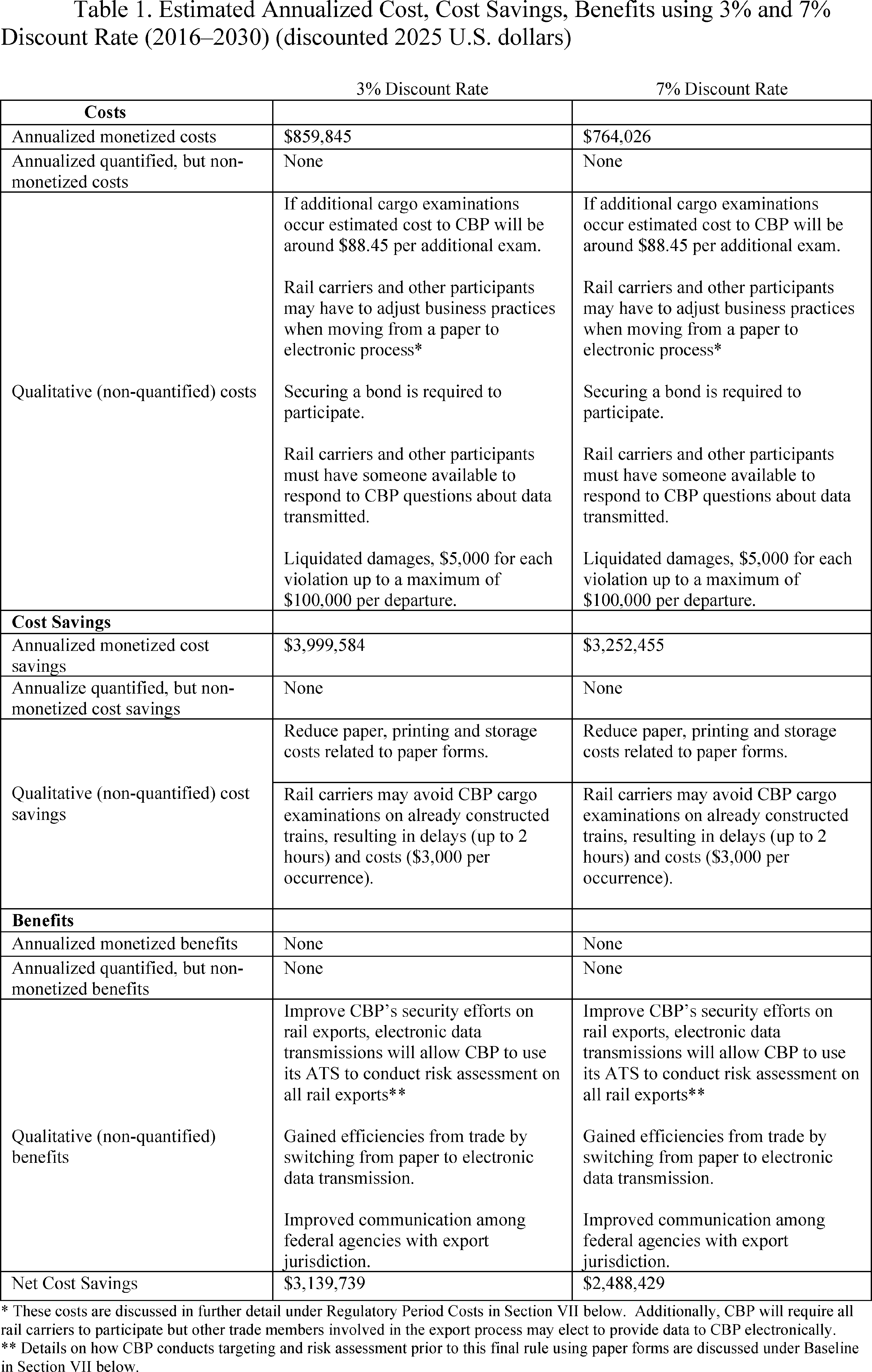
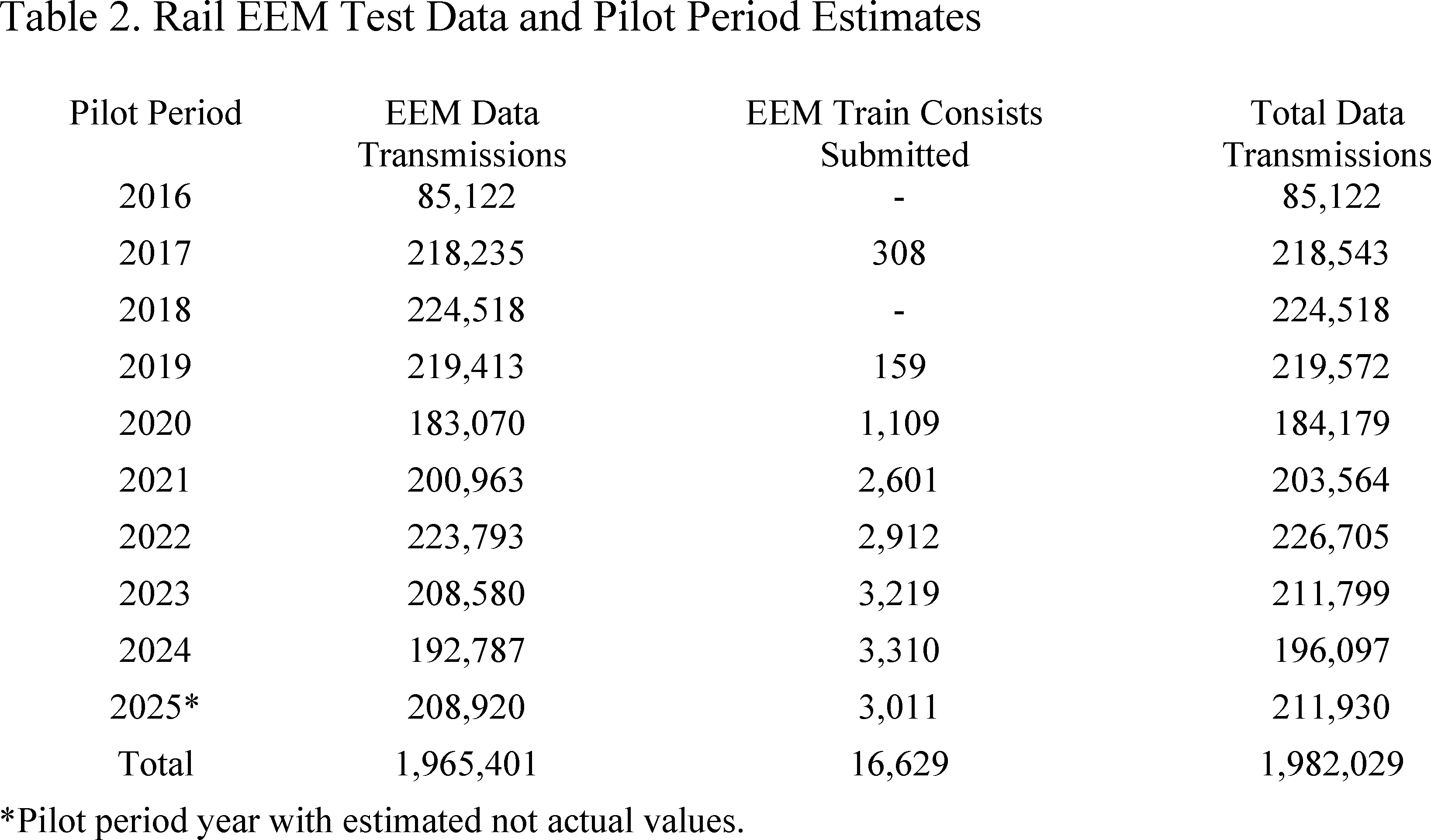
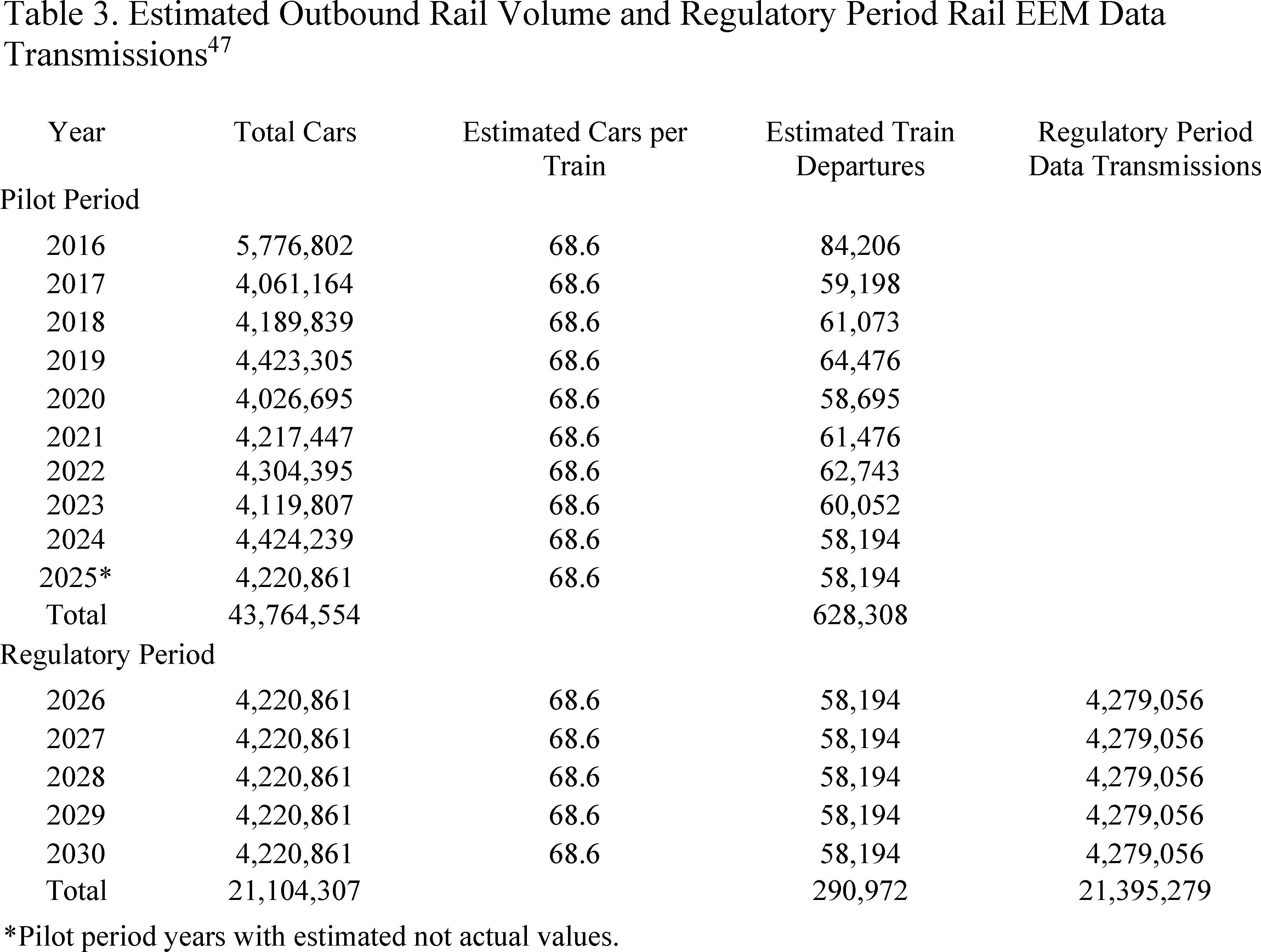
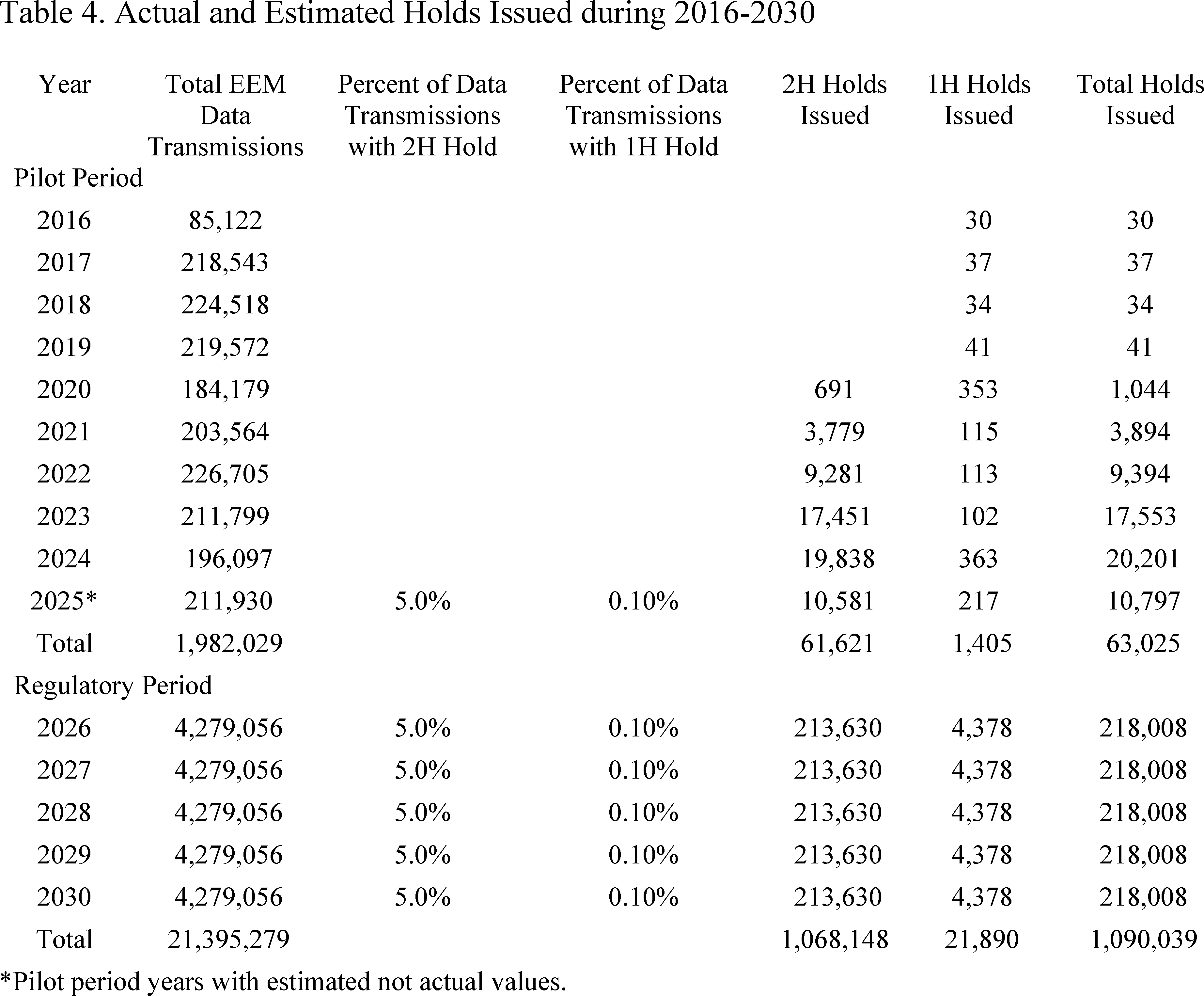
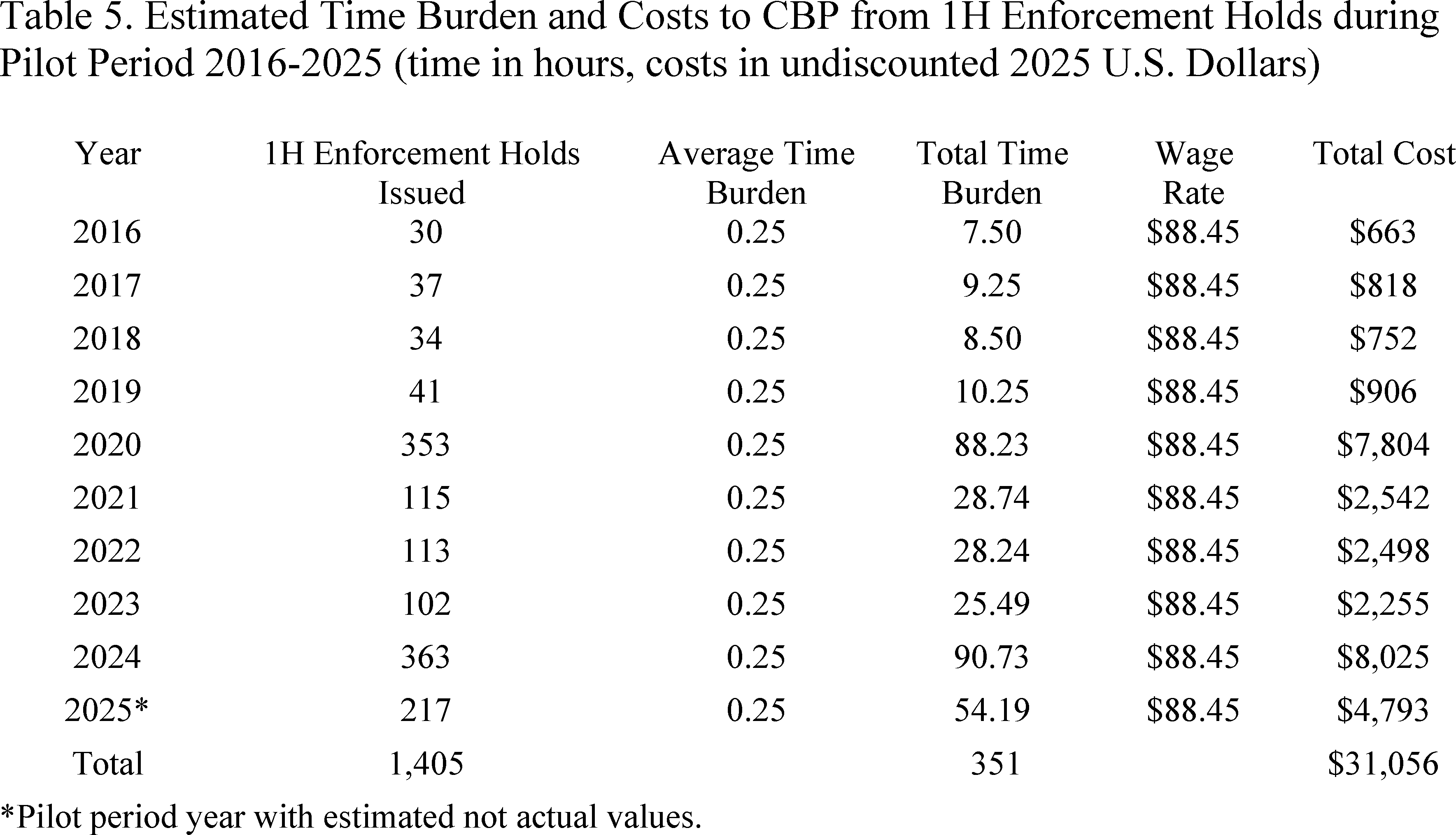
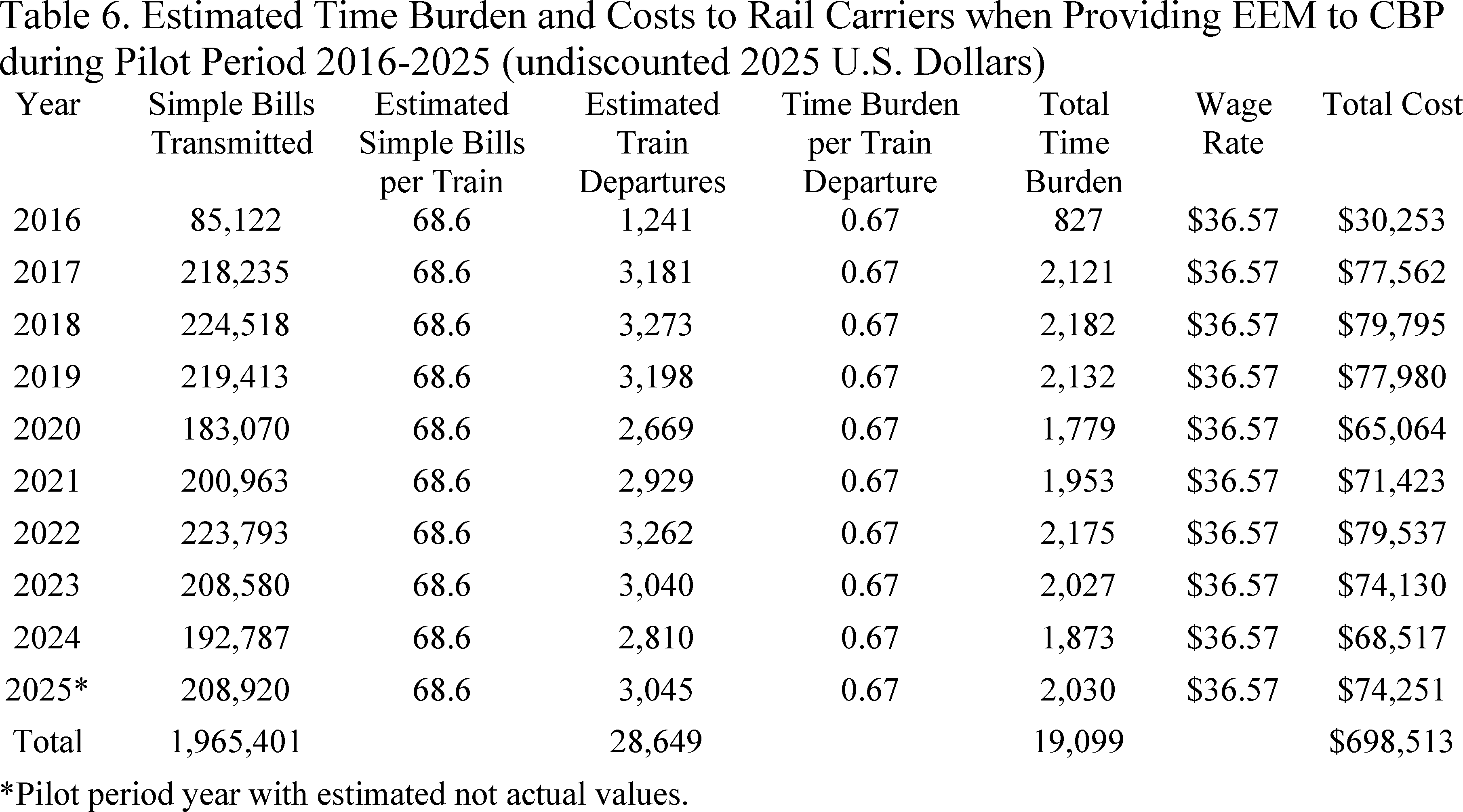
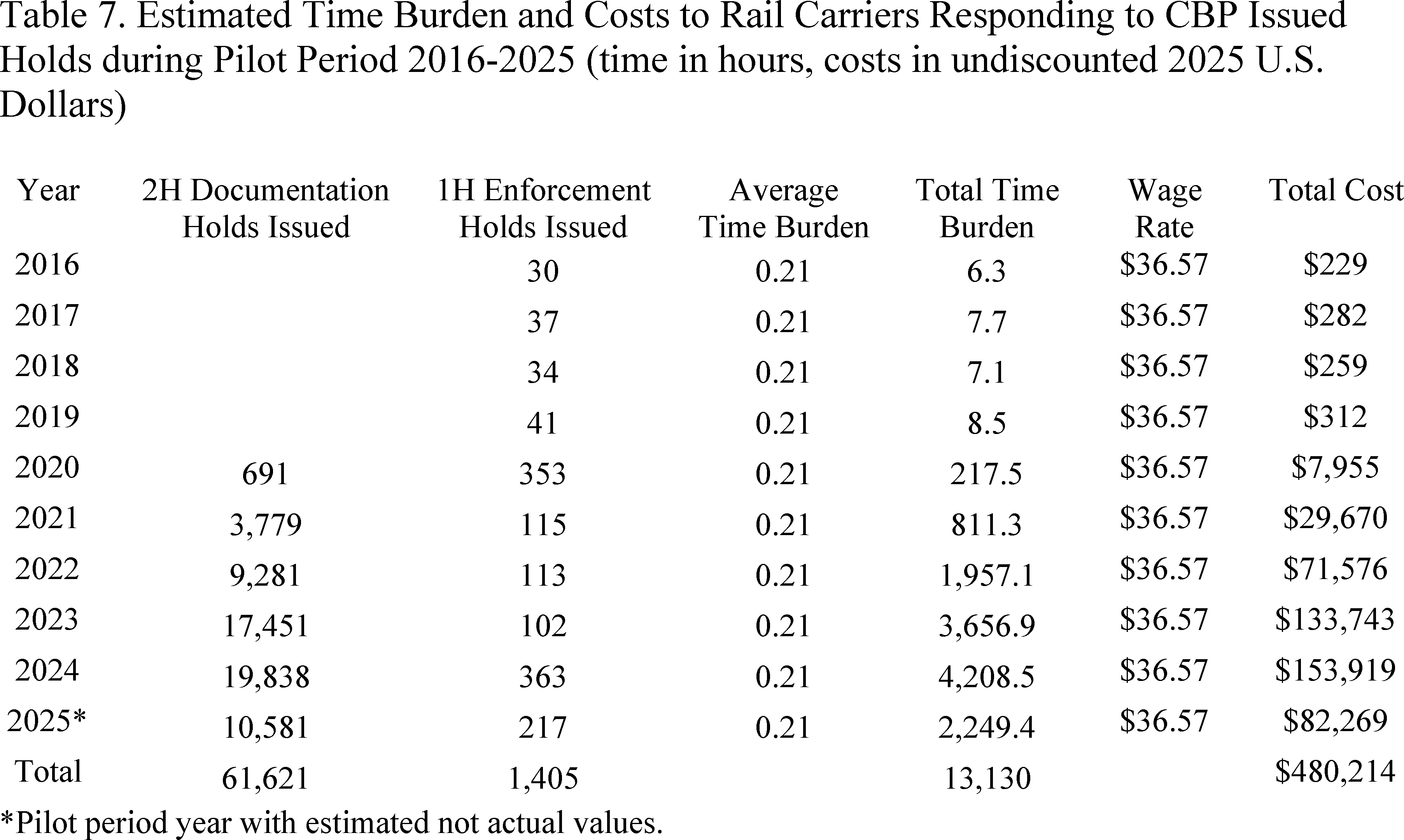
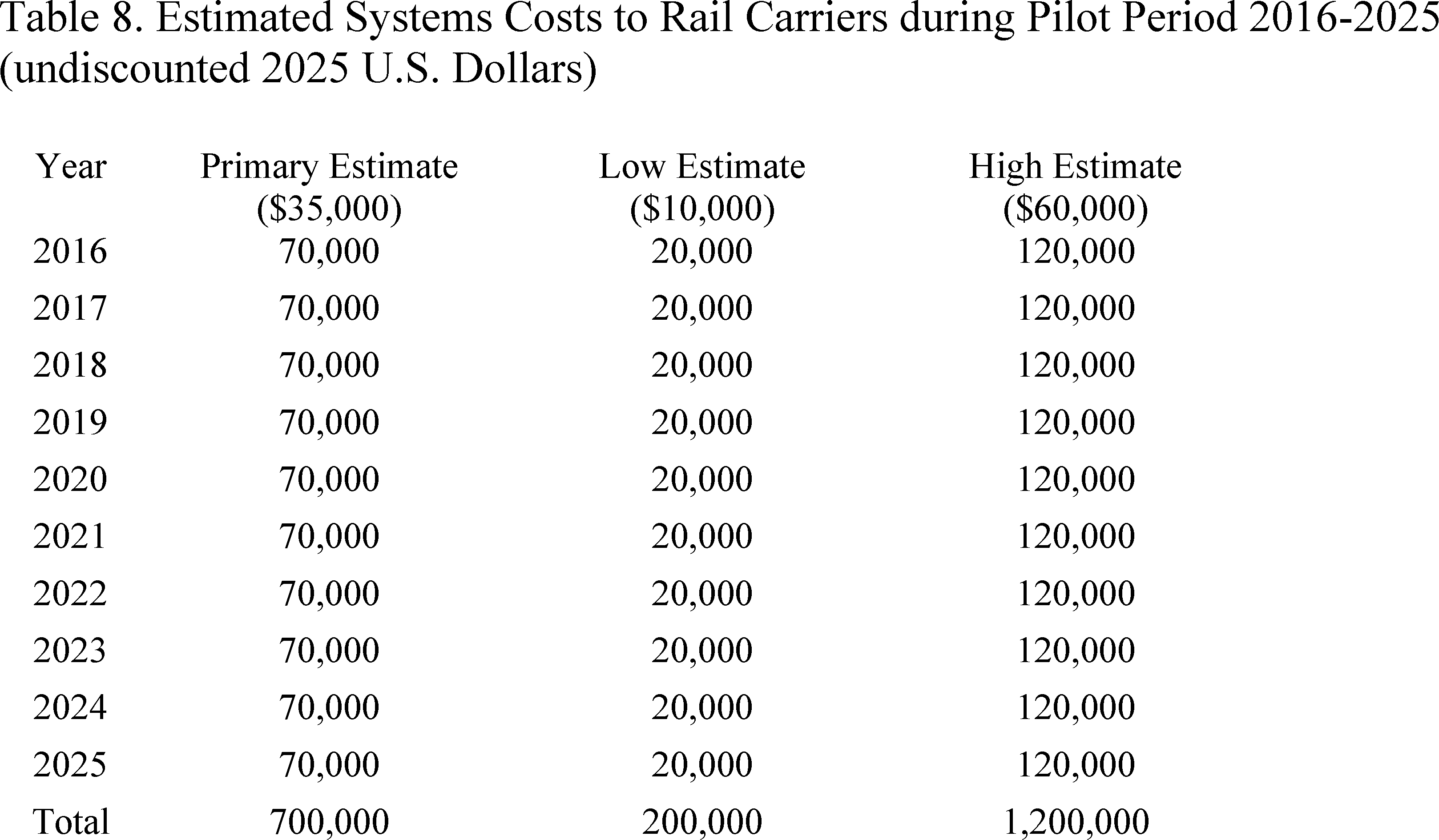
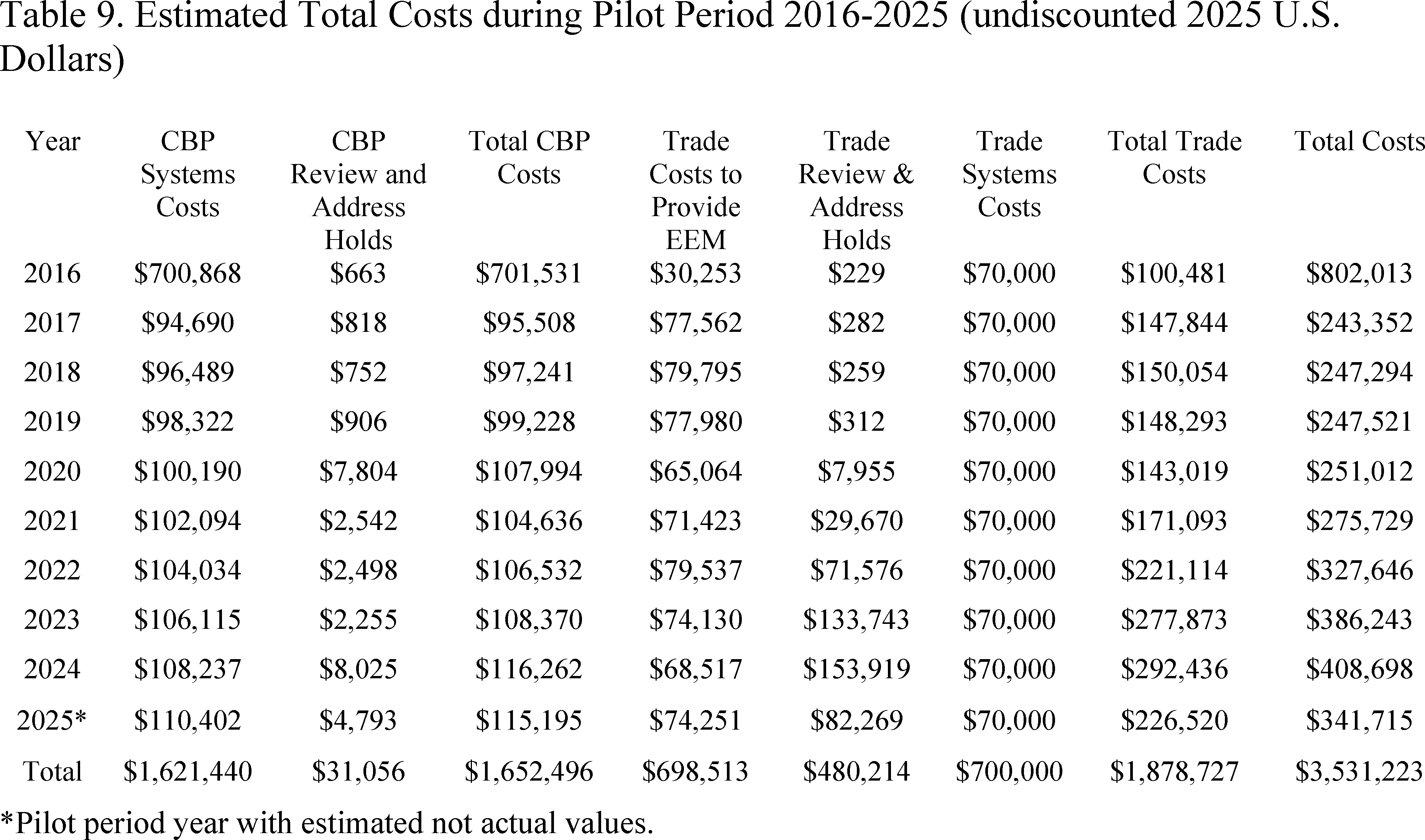
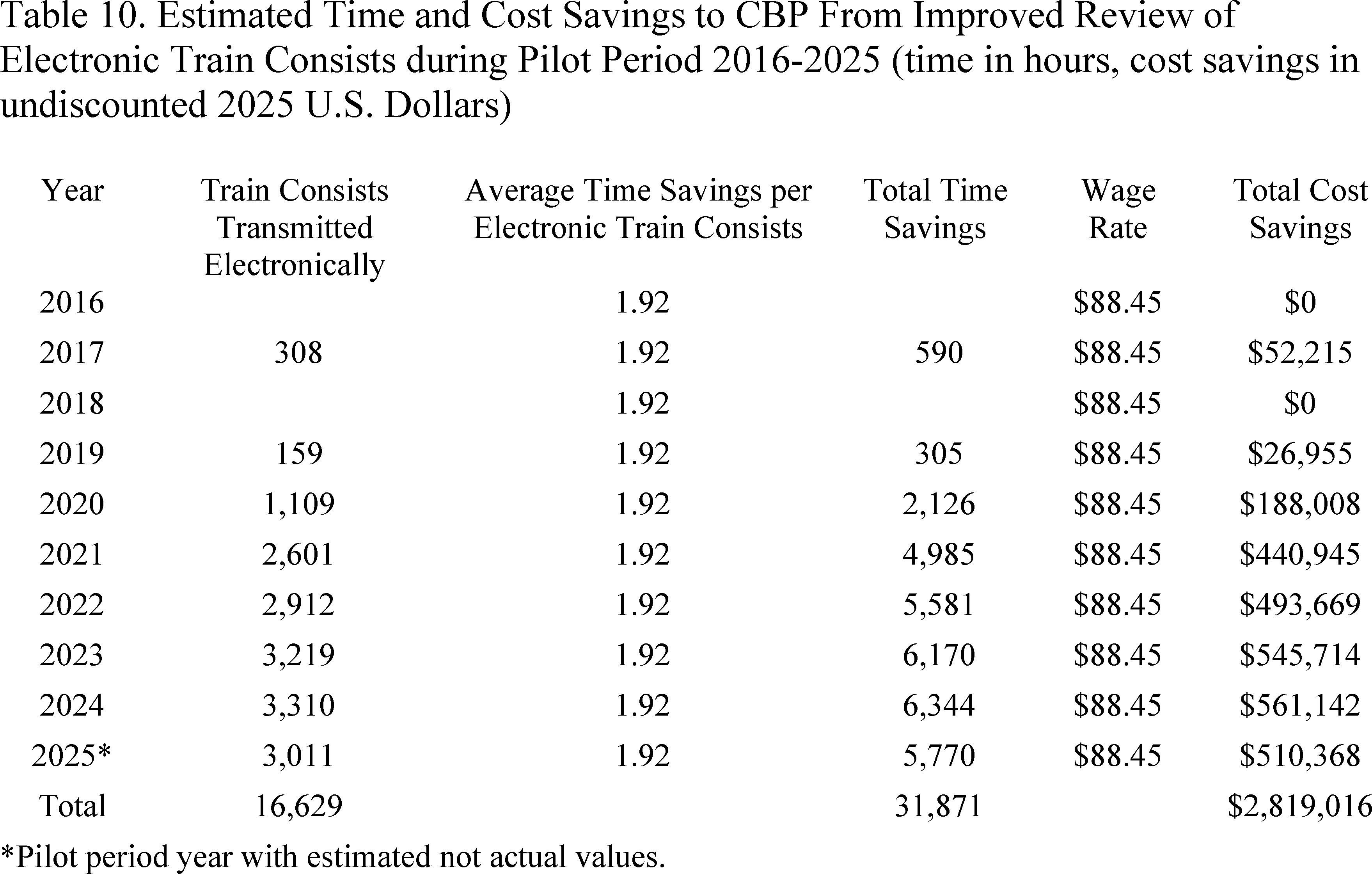
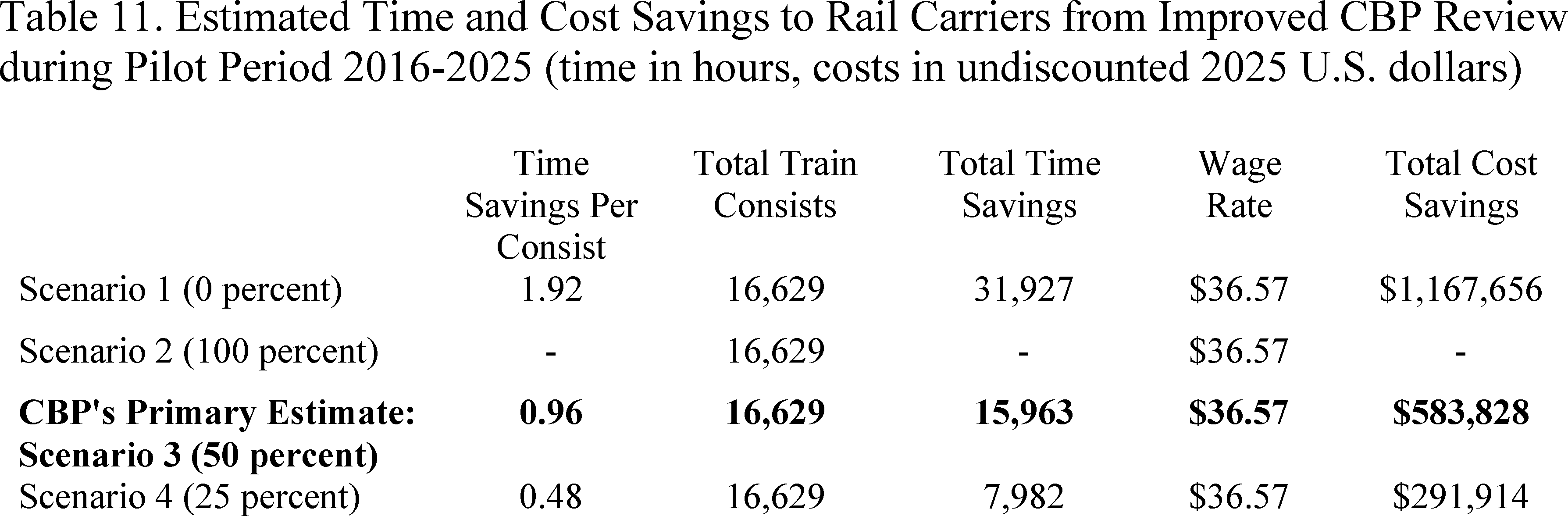
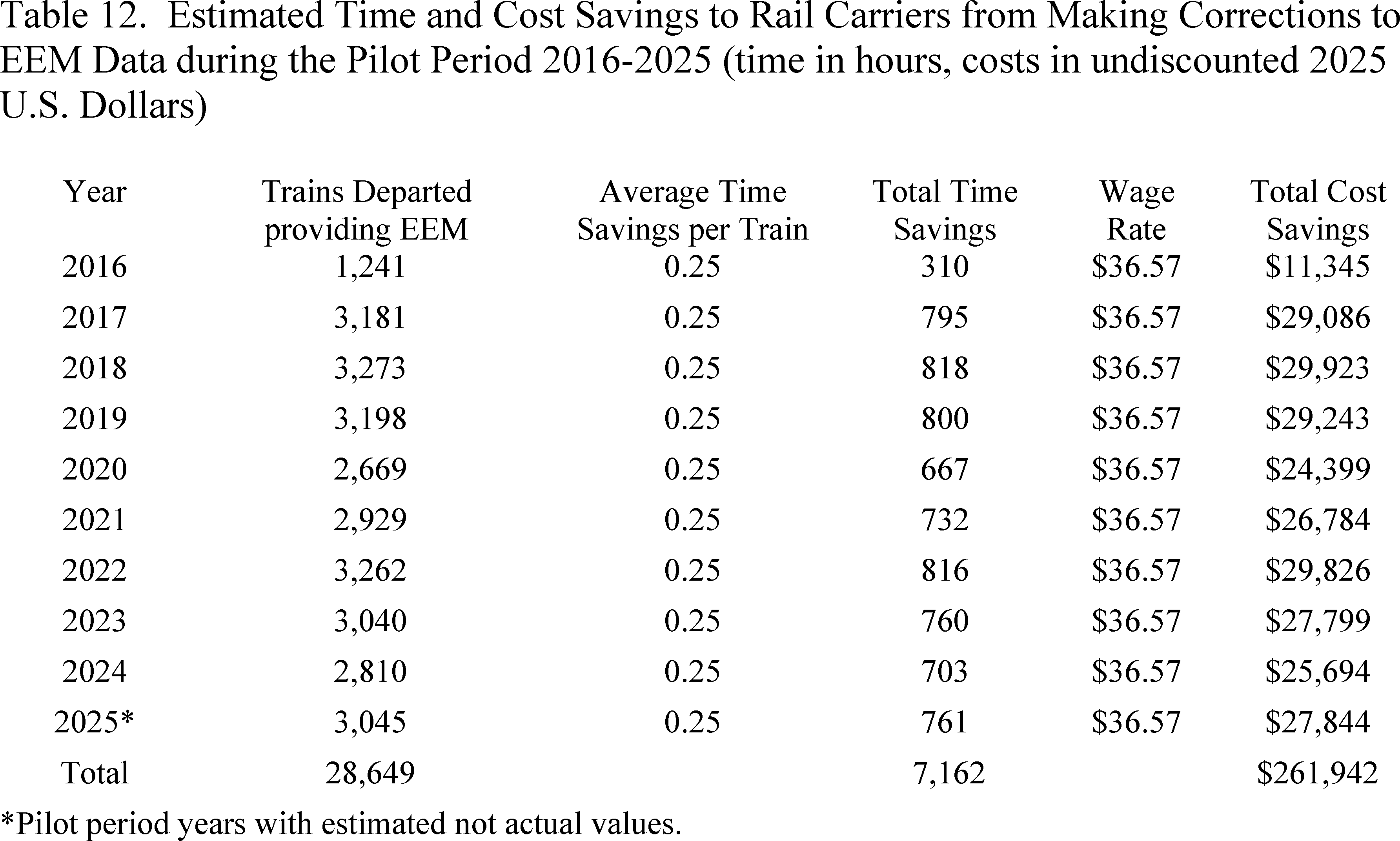
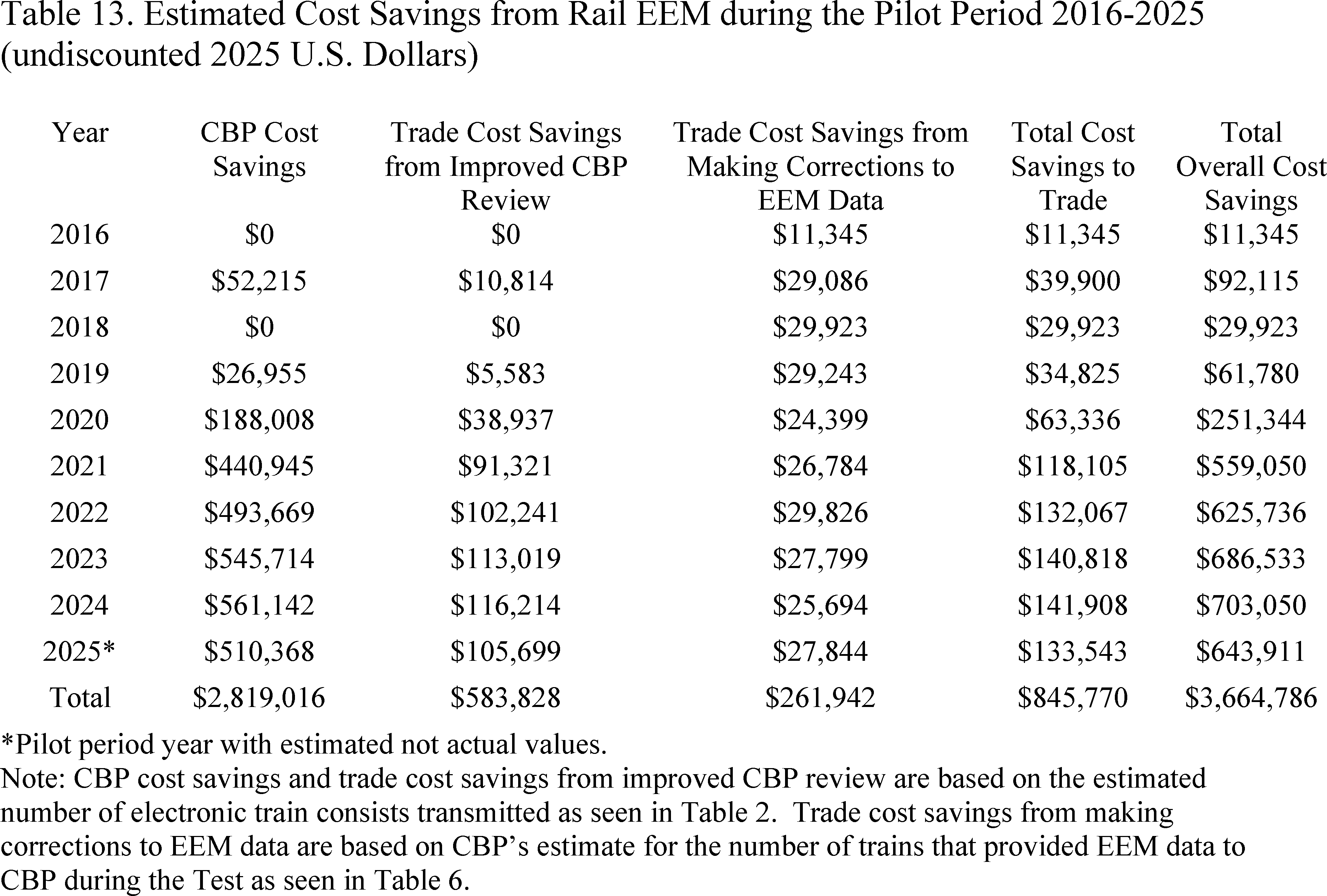
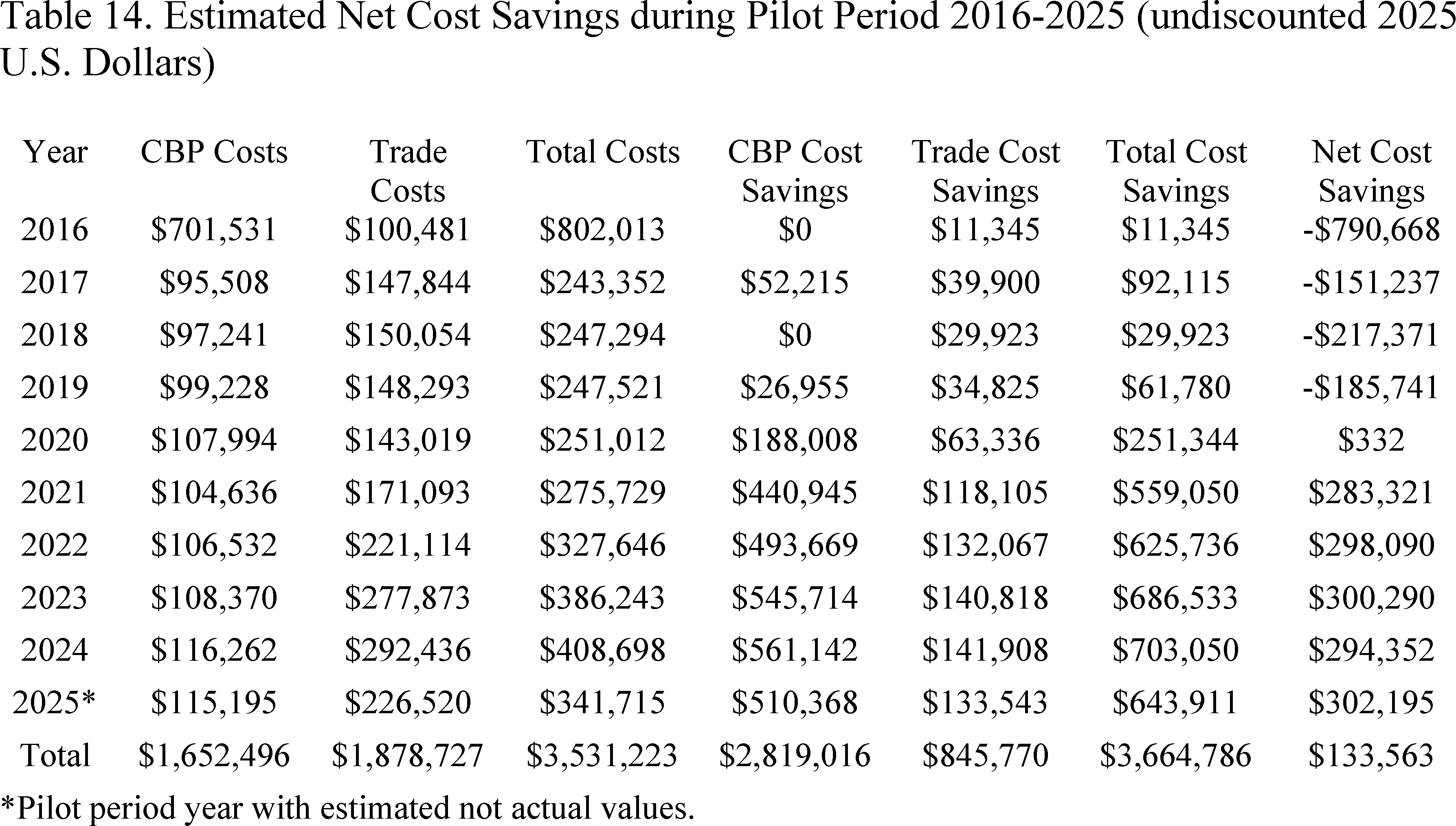

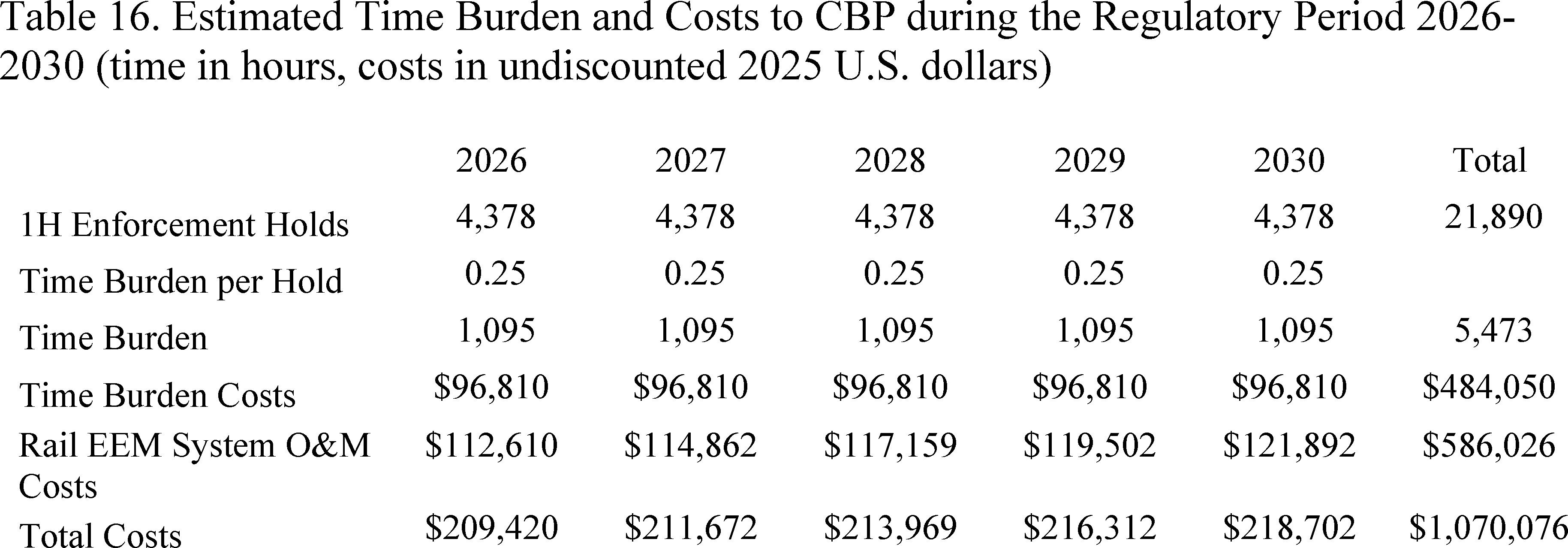
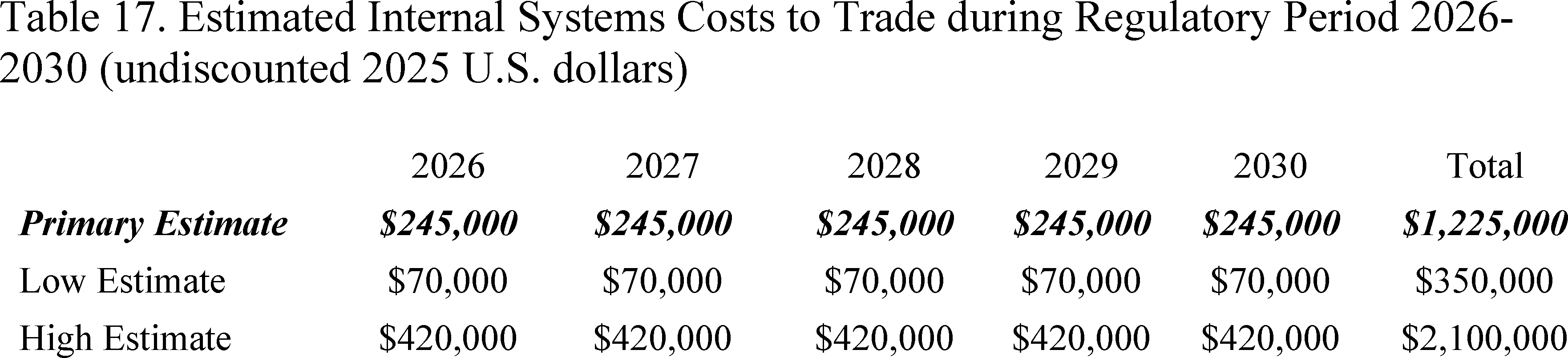
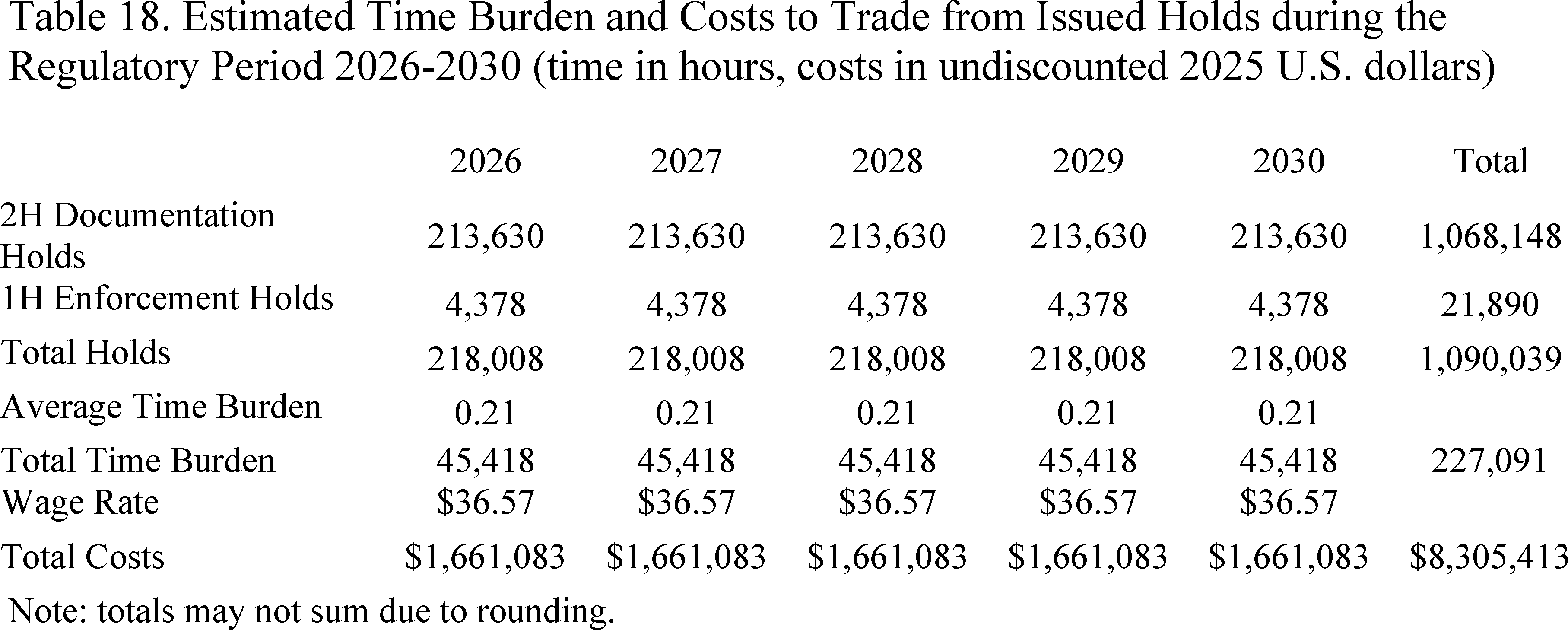
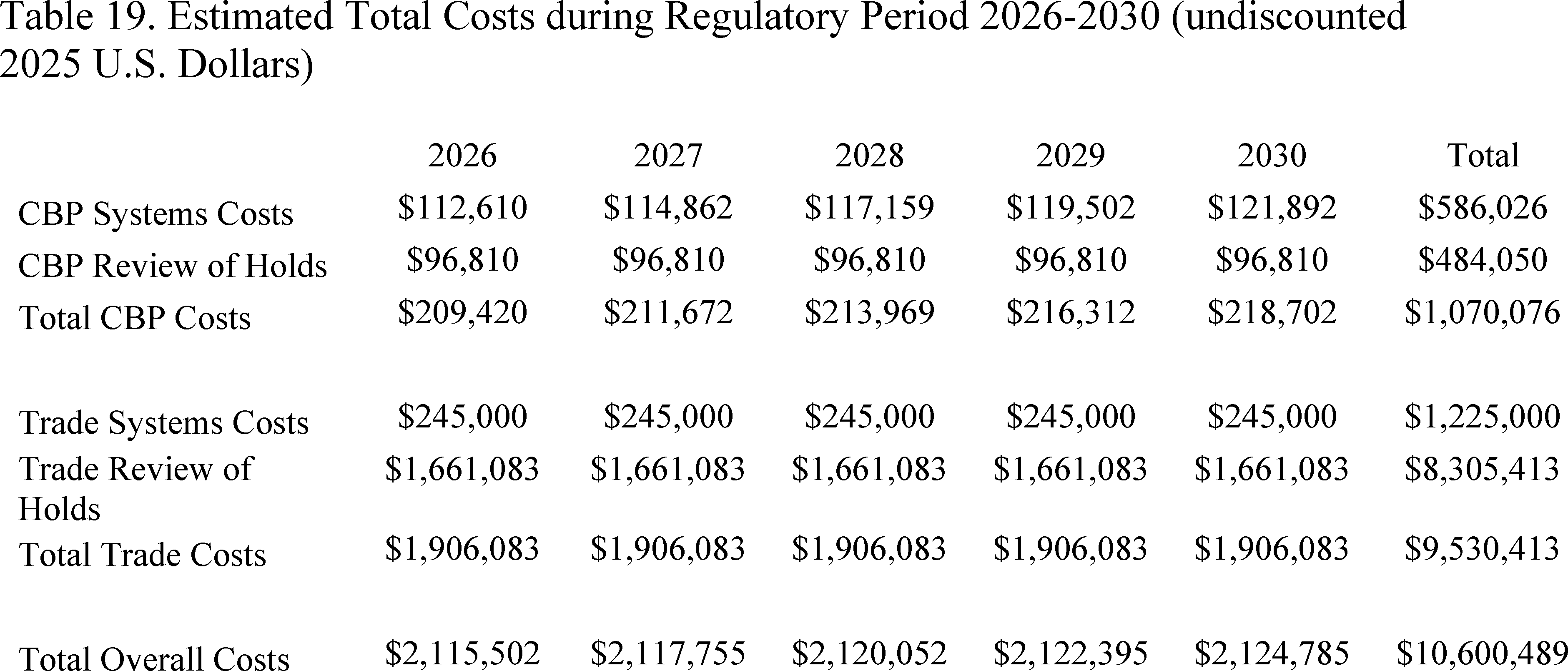
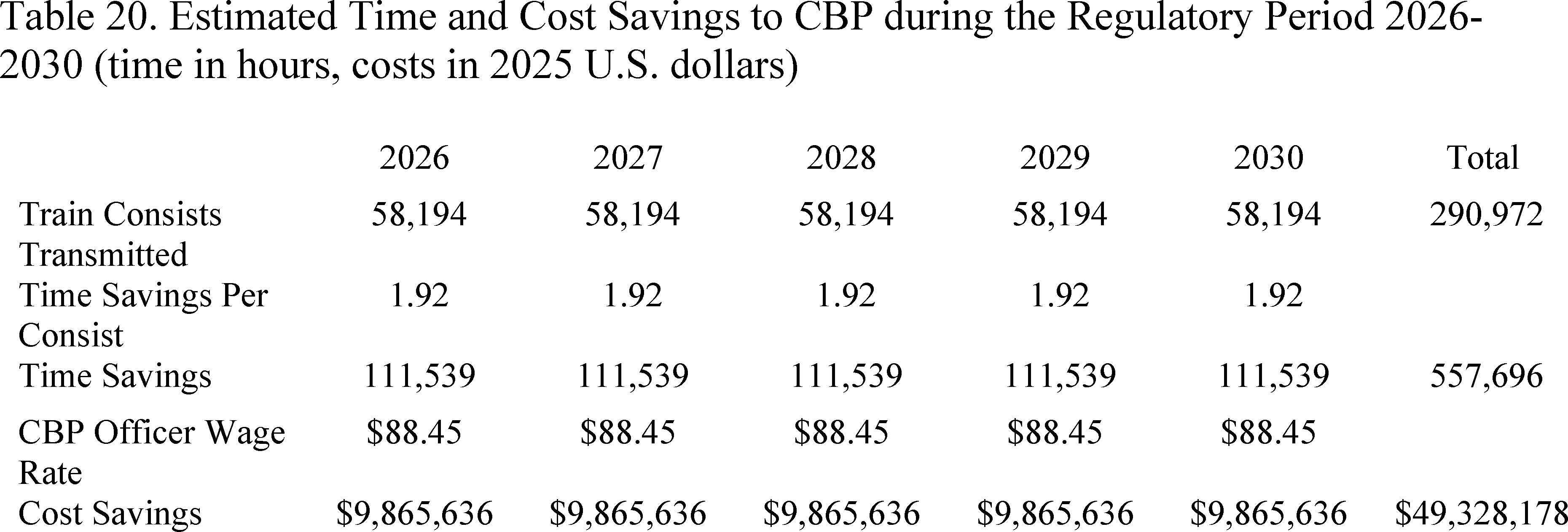
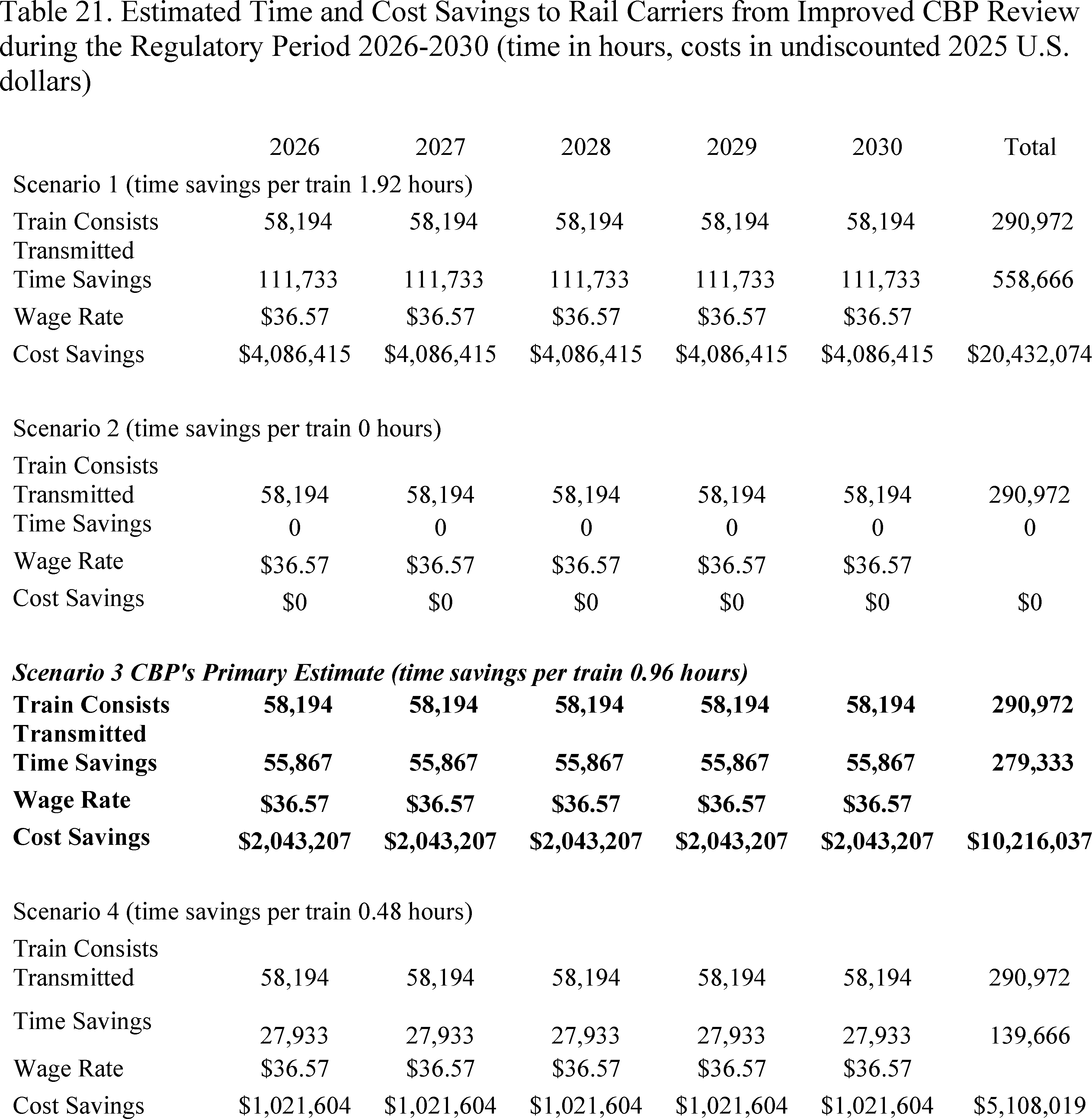
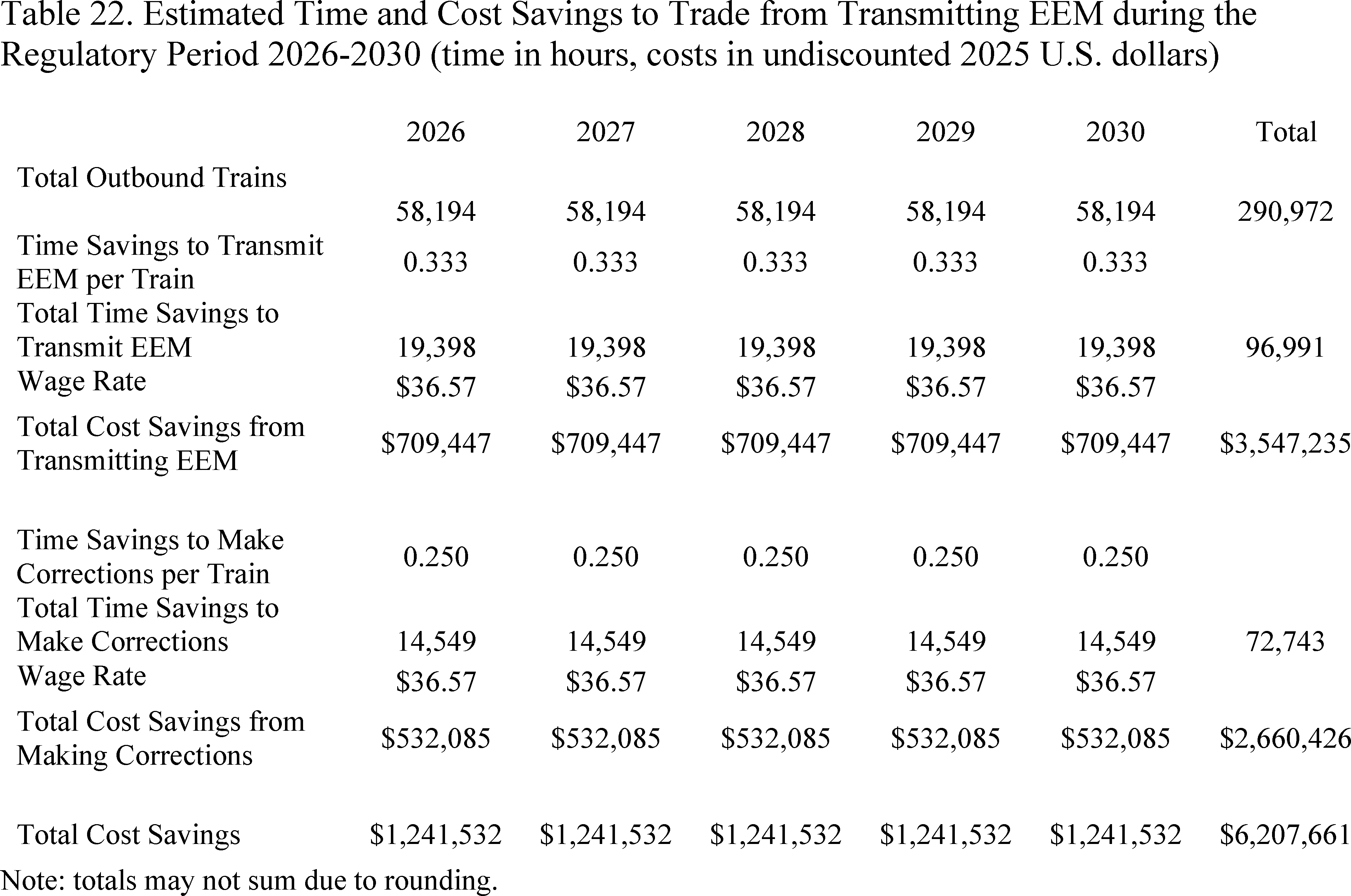
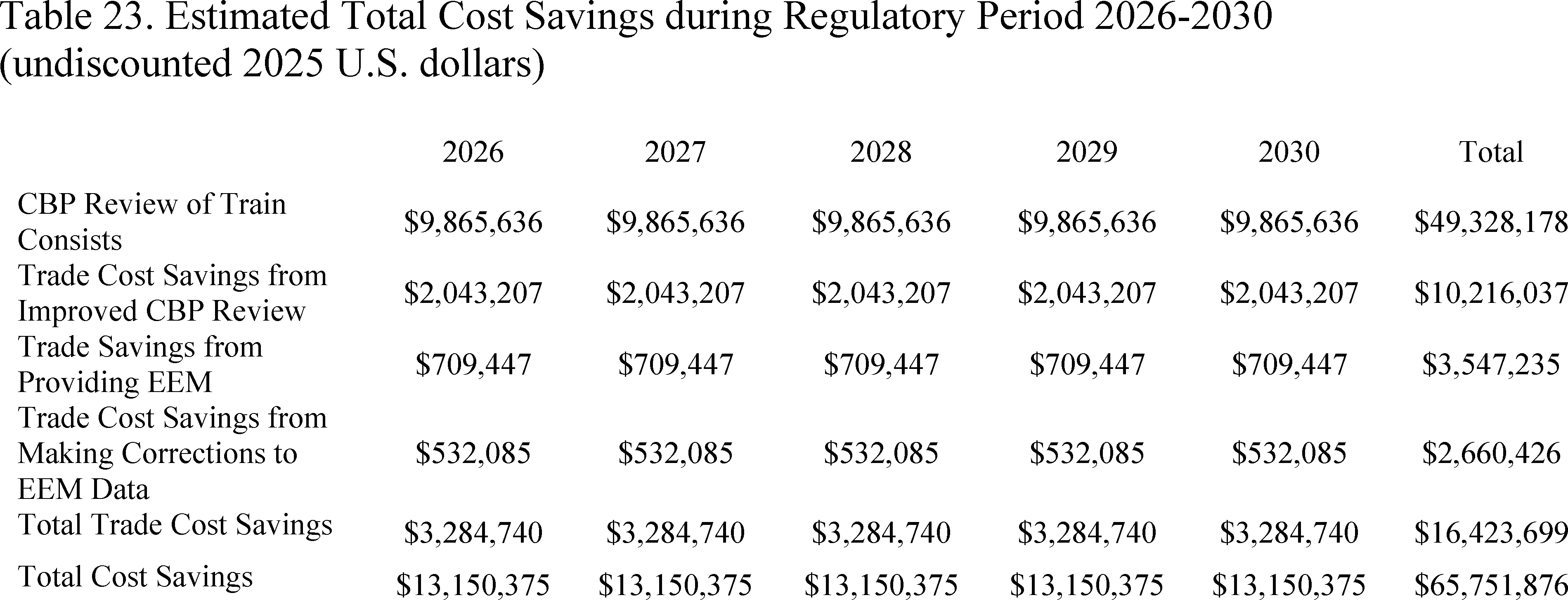
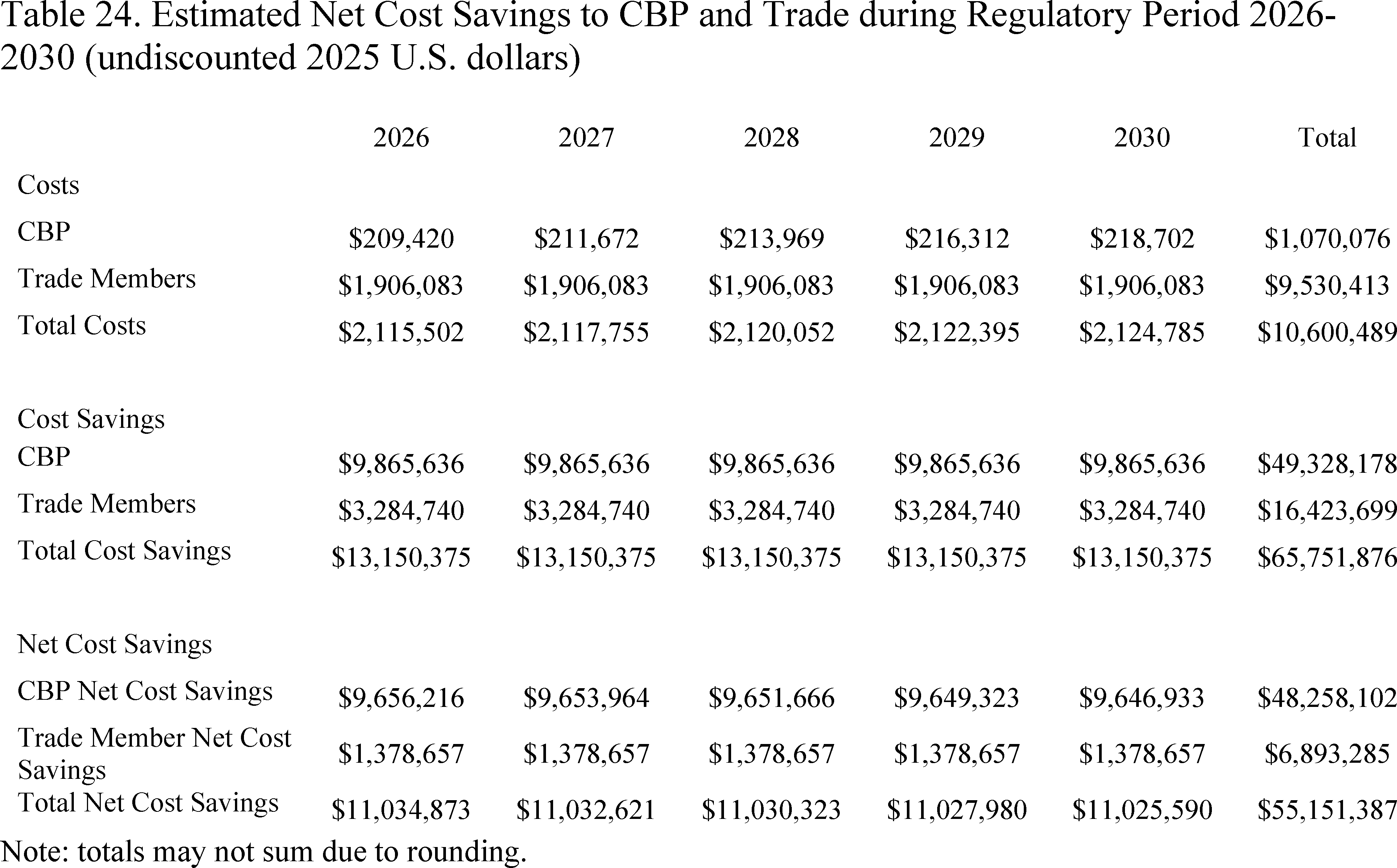
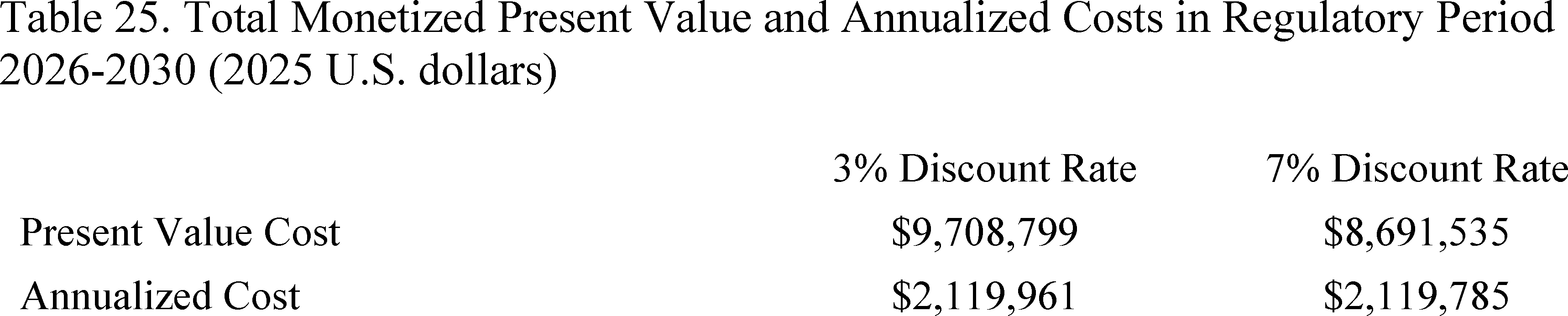


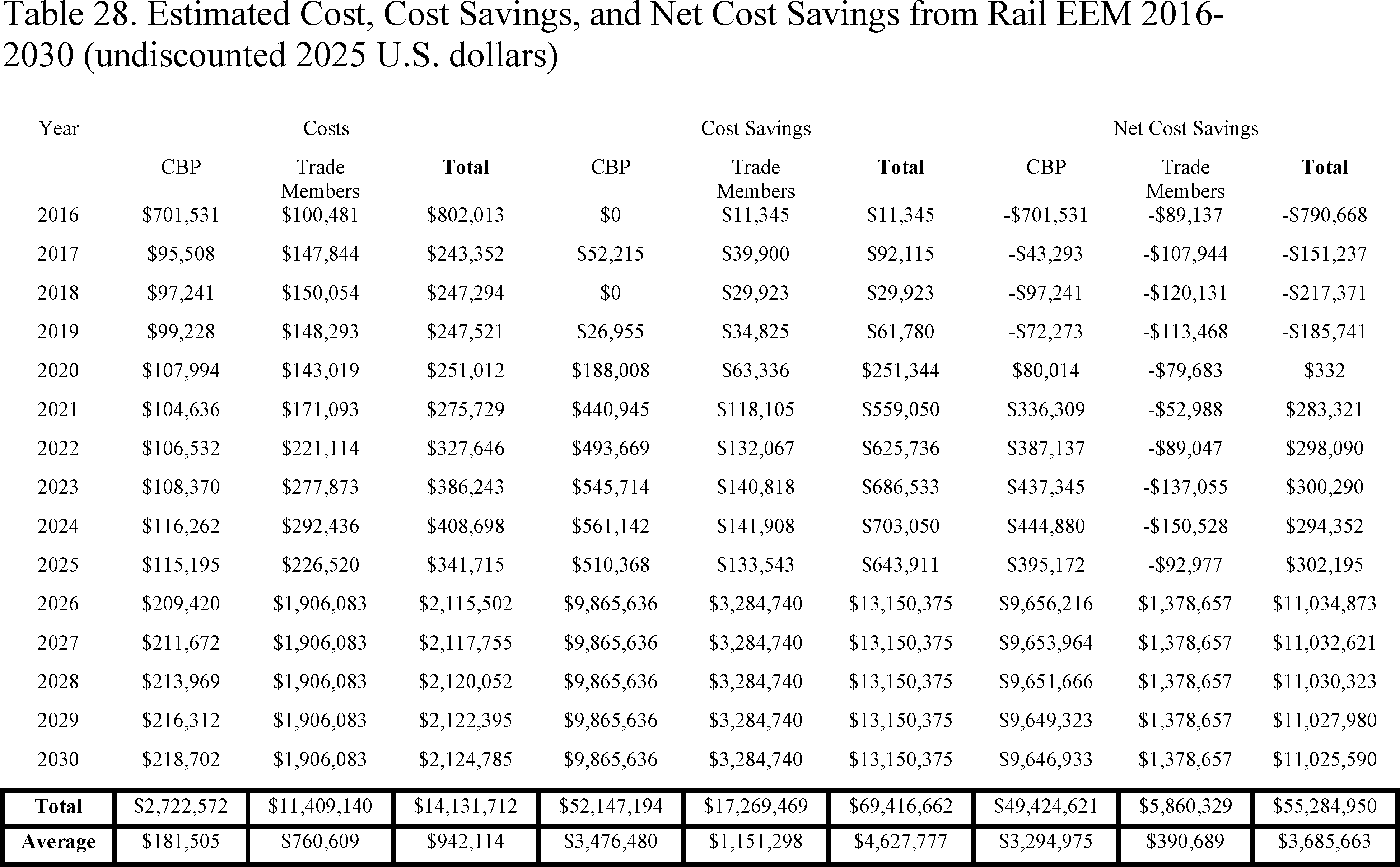
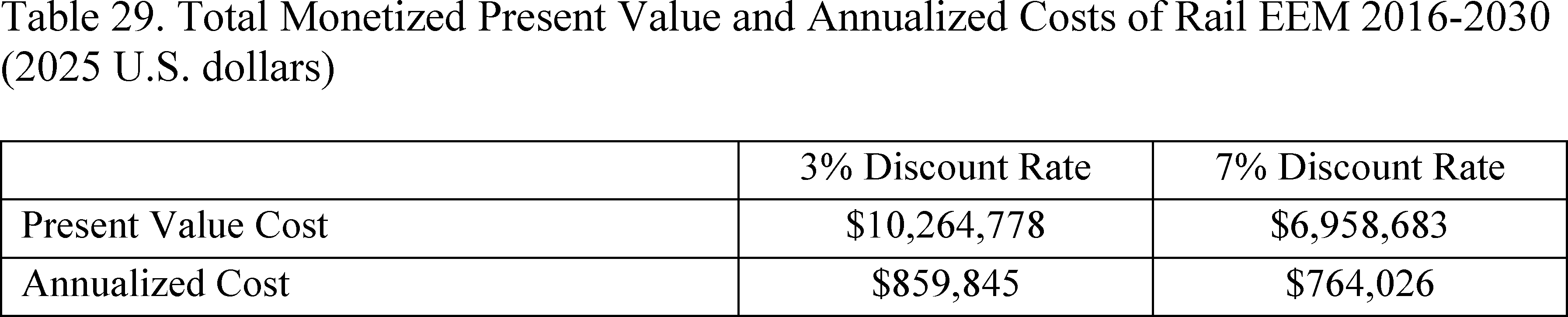
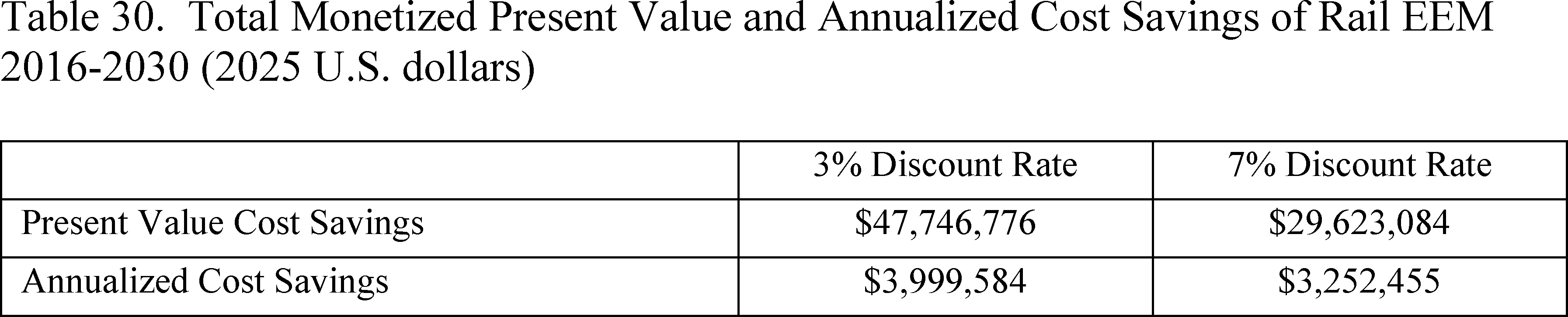
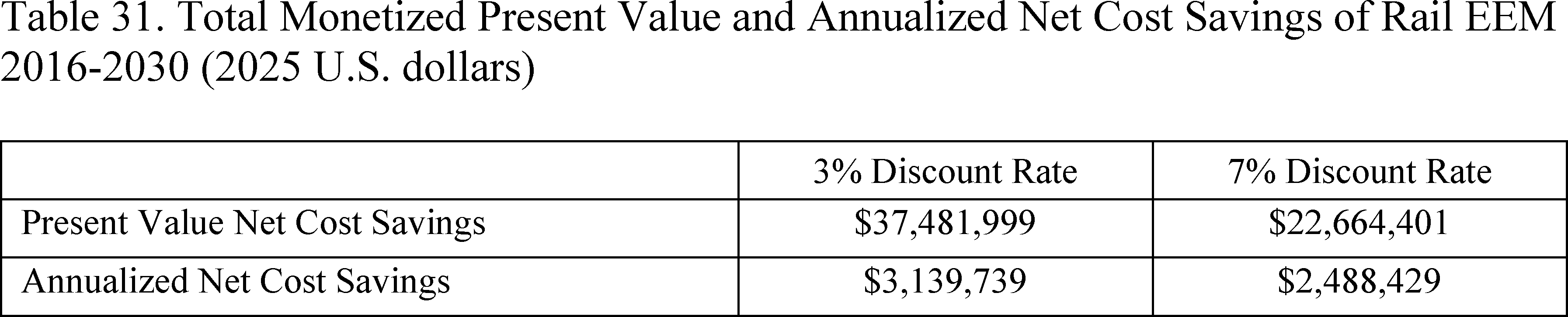
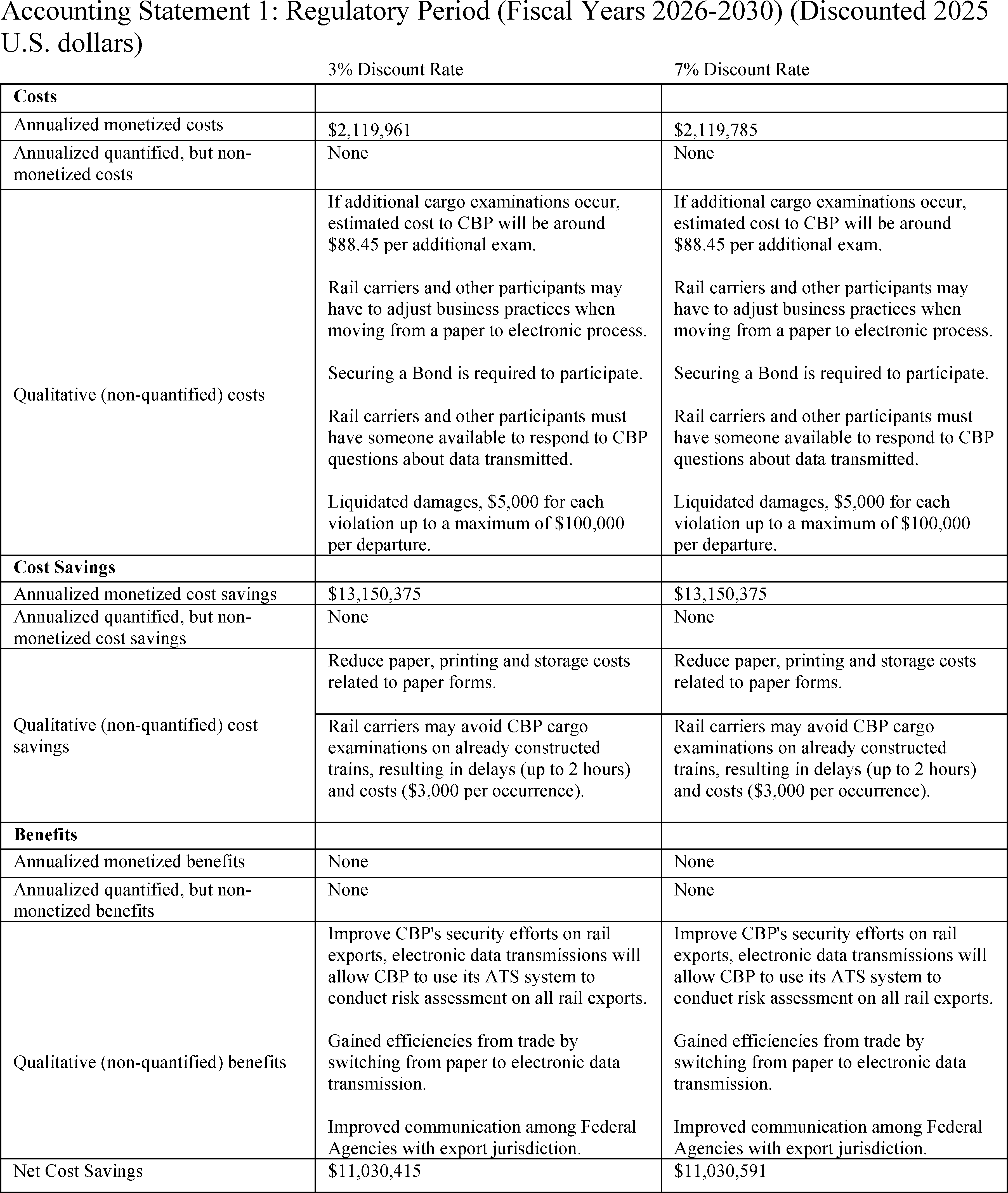
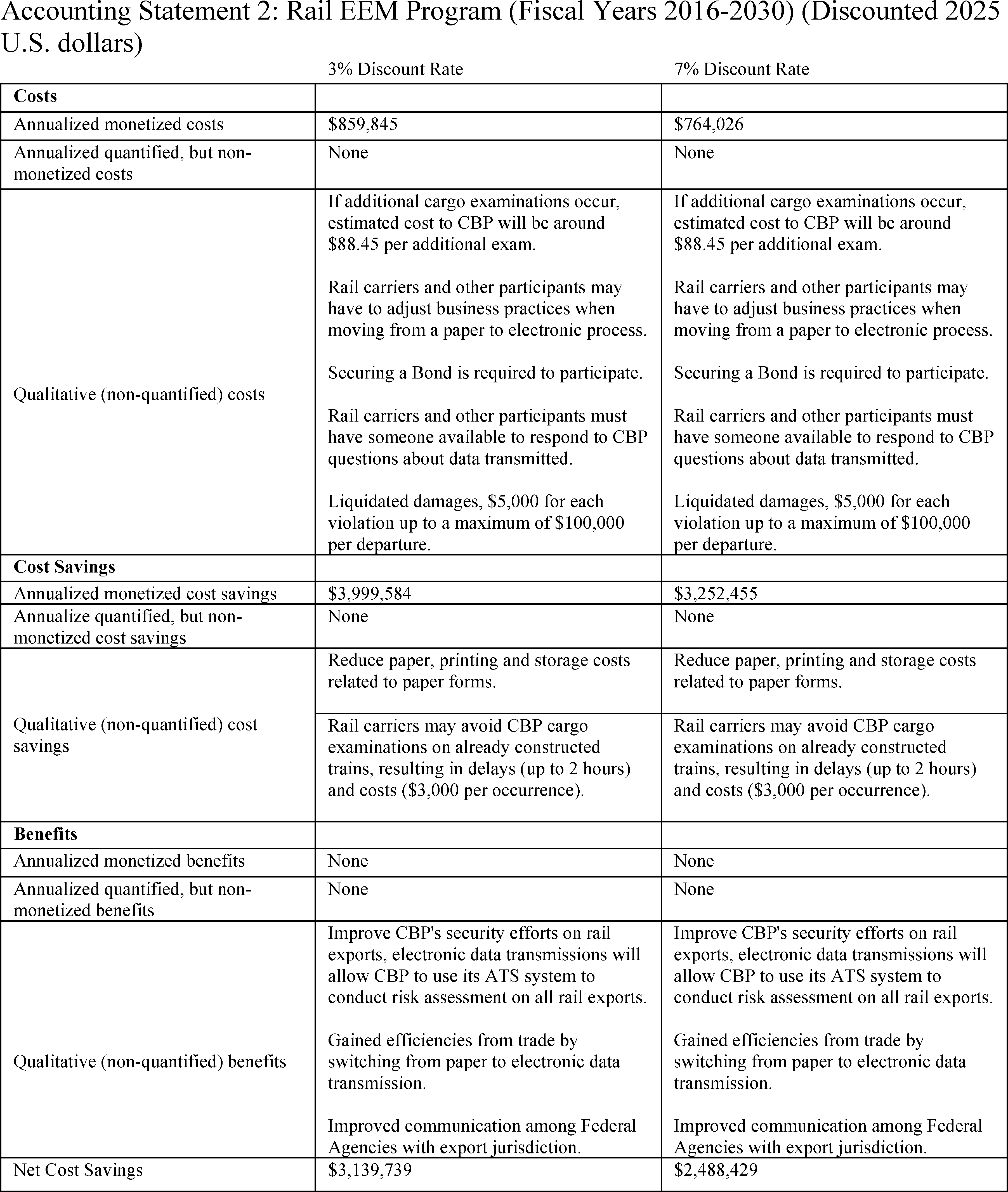
 www.dhs.gov/privacy-documents-us-customs-and-border-protection
 www.bls.gov/oes/2024/may/oes_nat.htm
 apps.bea.gov/iTable/?reqid=19&step=2&isuri=1&categories=survey#eyJhcHBpZCI6MTksInN0ZXBzIjpbMSwyLDMsM10sImRhdGEiOltbImNhdGVnb3JpZXMiLCJTdXJ2ZXkiXSxbIk5JUEFfVGFibGVfTGlzdCIsIjEzIl0sWyJGaXJzdF9ZZWFyIiwiMjAxNiJdLFsiTGFzdF9ZZWFyIiwiMjAyNCJdLFsiU2NhbGUiLCIwIl0sWyJTZXJpZXMiLCJBIl1dfQ==
 subscriber.hoovers.com/H/home/index.html
 www.federalregister.gov/documents/2016/07/26/2016-17596/privacy-act-of-1974-department-of-homeland-security-us-customs-and-border-protection-dhscbp-001