Department of Justice
Antitrust Division
Notice is hereby given pursuant to the Antitrust Procedures and Penalties Act, 15 U.S.C. 16(b)-(h), that a proposed Final Judgment, Stipulation, and Competitive Impact Statement have been filed with the United States District Court for the Southern District of New York in United States of America v. KKR & Co. Inc., et al., Civil Action No. 1:25-cv-343-LTS. On January 14, 2025, the United States filed a Complaint alleging that KKR & Co. Inc. and various related entities (including KKR & Co. GP LLC) failed to make complete and accurate premerger filings at least sixteen separate times, violating Section 7A of the Clayton Act, 15 U.S.C. 18a. The proposed Final Judgment, filed on August 26, 2026, requires KKR & Co. GP LLC to pay a civil penalty in the amount of $250,000,000 to the United States within thirty calendar days of entry of the Final Judgment.
 15 U.S.C. 16(b)-(h)
Copies of the Complaint, proposed Final Judgment, and Competitive Impact Statement are available for inspection on the Antitrust Division's website at www.justice.gov/atr and at the Office of the Clerk of the United States District Court for the Southern District of New York. Copies of these materials may be obtained from the Antitrust Division upon request and payment of the copying fee set by Department of Justice regulations.
 www.justice.gov/atr
Public comment is invited within 60 days of the date of this notice. Such comments, including the name of the submitter, and responses thereto, will be posted on the Antitrust Division's website, filed with the Court, and, under certain circumstances, published in the Federal Register . Comments should be submitted in English and directed to Danielle Hauck, Acting Chief, Technology and Digital Platforms Section, Antitrust Division, Department of Justice, 450 Fifth Street NW, Suite 7100, Washington, DC 20530 (email address: ATR.Public-Comments-Tunney-Act-MB@usdoj.gov).
Suzanne Morris,
Deputy Director Civil Enforcement Operations, Antitrust Division.
United States District Court
Southern District of New York
UNITED STATES OF AMERICA, U.S. Department of Justice, Antitrust Division, 450 5th St. NW, Washington, DC 20530, Plaintiff, v. KKR & CO. INC., 30 Hudson Yards, New York, NY 10001, KKR & CO. GP LLC, 30 Hudson Yards, New York, NY 10001, KOHLBERG KRAVIS ROBERTS & CO. L.P., 30 Hudson Yards, New York, NY 10001, KKR AMERICAS FUND XII L.P., c/o Kohlberg Kravis Roberts & Co. L.P., 30 Hudson Yards, New York, NY 10001, KKR AMERICAS FUND XII (KESTREL) L.P., c/o Kohlberg Kravis Roberts & Co. L.P., 30 Hudson Yards, New York, NY 10001, KKR AMERICAS FUND XII (THRIVE) L.P., c/o Kohlberg Kravis Roberts & Co. L.P., 30 Hudson Yards, New York, NY 10001, KKR APPLE AGGREGATOR L.P., c/o Kohlberg Kravis Roberts & Co. L.P., 30 Hudson Yards, New York, NY 10001, KKR CHORD IP AGGREGATOR L.P., 30 Hudson Yards, New York, NY 10001, KKR CORE HOLDING COMPANY LLC, c/o Kohlberg Kravis Roberts & Co. L.P., 30 Hudson Yards, New York, NY 10001, KKR CORE II HOLDING COMPANY LLC, c/o Kohlberg Kravis Roberts & Co. L.P., 30 Hudson Yards, New York, NY 10001, KKR DCIF LOWER ENTITY III SCSP, c/o Kohlberg Kravis Roberts & Co. L.P., 30 Hudson Yards, New York, NY 10001, KKR GLOBAL IMPACT FUND SCSP, c/o Kohlberg Kravis Roberts & Co. L.P., 30 Hudson Yards, New York, NY 10001, KKR GLOBAL INFRASTRUCTURE INVESTORS IV USD (APPLE) L.P., c/o Kohlberg Kravis Roberts & Co. L.P., 30 Hudson Yards, New York, NY 10001, KKR NORTH AMERICA FUND XIII SCSP, c/o Kohlberg Kravis Roberts & Co. L.P., 30 Hudson Yards, New York, NY 10001, and KKR OBSIDIAN AGGREGATOR LP, c/o Kohlberg Kravis Roberts & Co. L.P., 30 Hudson Yards, New York, NY 10001, Defendants.
Case No.: 1:25-cv-343
Complaint
Defendant KKR & Co. Inc. and its co-defendant investment advisors and funds (collectively “KKR”) are in the business of buying and selling companies, often completing over a dozen transactions each year. Many of those transactions are subject to the Hart-Scott-Rodino Antitrust Improvements Act of 1976 (“HSR Act”) and its implementing rules, which require parties to transactions above a certain size to submit a premerger filing to the Department of Justice's Antitrust Division and the Federal Trade Commission. As one of the oldest, largest, and most-sophisticated private equity firms in the United States, KKR and its executives have for nearly five decades been subject to the HSR Act and its requirement to provide information and documents to the federal antitrust agencies, certify their accuracy, and observe the statutory waiting period before completing transactions.
Rather than comply with the law, and despite repeated sworn certifications of its compliance, KKR and its executives systematically flouted the requirements of the HSR Act. Just since 2021 KKR was required to make more than 100 premerger filings under the HSR Act. But over the course of only two years—2021 and 2022—KKR failed to make complete and accurate premerger filings at least 16 separate times. Sometimes KKR failed to include required business documents such as those that assessed competition in markets impacted by the deal, including documents that had already been circulated to its partners and investment committees, despite certifying it had done so. In at least one instance, KKR failed to correct a deficient filing to include documents that its outside counsel had in their possession, even after its outside counsel relayed the Antitrust Division's inquiries about potentially omitted documents. Sometimes KKR's executives and employees ordered or made alterations to the business documents filed including in some instances information about the competitive implications of the proposed transaction. And, for at least two transactions, KKR failed to make any pre-consummation filings at all.
( printed page 56902)
KKR repeatedly evaded legally-mandated scrutiny of its investment business, which allowed it to close potentially anticompetitive transactions without proper review by the antitrust agencies, review that should have been informed by relevant documents and information. By flouting the Act's filing requirements, KKR has impeded the federal antitrust agencies' opportunities to evaluate the potential anticompetitive effects of KKR's transactions before they were completed.
Congress understood that for enforcement against anticompetitive mergers to be most effective, the Antitrust Division and FTC needed specific information and the opportunity to act before the transaction was complete. And Congress recognized not only the importance of the merging company making the required filings and providing the required information, but the importance of that information being timely. Accordingly, Congress authorized steep civil penalties for a company in violation of the Act, penalties that currently stand at more than $50,000 per day per violation. KKR's serial violations are unusual, expansive, and long-running. Cumulatively, it has been in violation of the HSR Act for more than ten thousand days since early 2021, taking into account each of the 16 separate violations of which the United States is aware.
The United States brings this civil action to obtain the substantial civil penalties authorized by the Act, and to obtain other equitable relief from KKR to alleviate the harms from its serial violations of the HSR Act and to prevent their recurrence.
The United States alleges as follows:
I. Premerger Filings Required by the Hart-Scott-Rodino Act and the HSR Act Rules
1. The HSR Act's premerger notification and reporting requirements are essential to the integrity of the U.S. antitrust enforcement framework affecting mergers and acquisitions.
2. Today, the vast majority of antitrust enforcement actions affecting mergers and acquisitions falls under Section 7 of the Clayton Act, which prohibits any transaction where, in any relevant market, “the effect of such acquisition may be substantially to lessen competition, or to tend to create a monopoly.” 15 U.S.C. 18. Section 7 “is intended to halt monopolies and restraints of trade in their initial stages, before they ripen into full-scale Sherman Act violations.” H.R. Rep. 94-1373, at 5 (1976).
3. After Section 7's enactment, however, the antitrust agencies rarely had the chance to sue to block illegal mergers before they were consummated and therefore often could not prevent serious harm to competition from occurring. In 1976, therefore, Congress passed the HSR Act, Section 7A of the Clayton Act, to further strengthen antitrust enforcement by giving the antitrust agencies the chance to move to block transactions before they were complete. Specifically, the HSR Act prohibits any company from carrying out a transaction over a certain size, with certain limited exceptions, unless the company notifies the antitrust agencies of the transaction and generally waits at least 30 days before the transaction is consummated. 15 U.S.C. 18a(a), (b).
4. Although it is not a substitute for post-complaint discovery under the Federal Rules of Civil Procedure, the HSR Act's waiting period is designed to give the antitrust agencies the opportunity to meaningfully investigate whether a transaction may violate the antitrust laws before parties consummate the transaction and, if necessary, to seek an injunction. As Congress made clear, the agencies need “a fair and reasonable opportunity to detect and investigate large mergers of ( printed page 56903) questionable legality before they are consummated,” H.R. Rep. 94-1373, at 5 (1976), and this pre-consummation review is “essential in order to carry out the underlying purpose of section 7.” S. Rep. 94-803, at 64-65 (1976).
5. The HSR Act, unlike Section 7 of the Clayton Act, does not proscribe anticompetitive conduct. Parties to transactions covered by the HSR Act must abide by its requirements regardless of whether the transaction, if consummated, would be unlawful.
6. The HSR Act authorizes the FTC, with concurrence from the Antitrust Division, to promulgate rules that require the premerger filing notification “be in such form and contain such documentary material and information relevant to a proposed acquisition as is necessary and appropriate” to determine whether such acquisition, if consummated, may violate the antitrust laws. 15 U.S.C. 18a(d)(1). The FTC also is authorized to define the terms used in the HSR Act and establish other rules that are necessary and appropriate to carry out the purposes of the notification and waiting period provisions. 15 U.S.C. 18a(d)(2). The FTC first promulgated the HSR Act Rules in 1978 to carry out the purposes of the HSR Act and has periodically updated them since. 16 CFR 801-803. These HSR Act Rules require that the notification be provided to the antitrust agencies in accordance with a Notification and Report Form (“HSR Form” or “Form”) that is made a part of the Rules. 16 CFR 803.1 and appendix to 16 CFR part 803. The FTC adjusts the HSR Act's jurisdictional thresholds annually, based on changes in gross national product. Currently, only certain transactions valued at more than $119.5 million are subject to the HSR Act. 89 FR 7708 (Mar. 6, 2024).
 16 CFR 801-803
7. The instructions to the HSR Form, contained in the appendix to 16 CFR part 803, require parties to the transaction to submit with their premerger filings certain business documents prepared by or for officers and directors that help illuminate how the proposed transaction may affect competition. These are often referred to as “Item 4” documents after the portions of the HSR Form that call for them. Item 4(c) of the Form requires parties to “[p]rovide all studies, surveys, analyses, and reports which were prepared . . . for the purpose of evaluating or analyzing the acquisition with respect to market shares, competition, competitors, markets, potential for sales growth or expansion into product or geographic markets.” Item 4(d) of the Form requires parties to provide “all Confidential Information Memoranda”; “all studies, surveys, analyses and reports prepared by [third party advisors such as investment bankers] . . . for the purpose of evaluating or analyzing market shares, competition, competitors, markets, potential for sales growth, or expansion into product or geographic markets”; and “all studies, surveys, analyses and reports evaluating or analyzing synergies and/or efficiencies.”
8. These documents provide information about the merging companies' own evaluations of competition in the markets likely to be affected by the proposed transaction. These documents also provide unique insight into the viewpoints of the merging parties and are indispensable to the antitrust agencies' evaluation of potential competitive effects of proposed transactions. As such, documents called for by Item 4 of the HSR Form are some of the most important documents that merging companies must submit to the antitrust agencies.
9. If a party to a transaction does not provide all the information and documents required by the HSR Form, including not providing documents called for by Item 4, then it must provide “a statement of reasons for such noncompliance.” 15 U.S.C. 18a(b)(1). Section 803.3 of the HSR Act Rules details the information that should be included within each statement of noncompliance. The purpose of the statement is to provide the antitrust agencies with sufficient information so that they can assess whether information was withheld lawfully.
10. The HSR Act's waiting period does not begin until both parties have provided complete notifications, commonly known as “HSR filings,” to the antitrust agencies. Therefore, the HSR Act Rules require an officer, director, or general partner of each filing party to certify, under penalty of perjury under the laws of the United States, that the HSR Form and accompanying documents were “prepared and assembled under [his/her] supervision” in accordance with instructions issued by the FTC, and that “the information is, to the best of [his/her] knowledge, true, correct, and complete” in accordance with the HSR Act and the HSR Act Rules. 16 CFR 803.6(a) and appendix to 16 CFR part 803.
11. This certification is not a rubber stamp. It is intended to place upon the individual who signs it the responsibility for supervising the filing company's compliance with the HSR Act and ultimately determining that, to the best of that individual's knowledge, the information provided is true, correct, and complete in accordance with the HSR Act and the HSR Act Rules. It is also intended to estop the person on whose behalf the HSR Form is filed from later denying the completeness or accuracy of the information contained in it.
12. Congress established significant daily penalties to ensure that companies complied with the HSR Act. A company that fails to comply with any of its notification provisions is liable to the United States for a civil penalty for each day it is in violation. 15 U.S.C. 18a(g)(1). Originally set at $10,000 per day in 1976, the maximum amount of the civil penalty now sits at $51,744 per day. Federal Civil Penalties Inflation Adjustment Act Improvements Act of 2015, Pub. L. 114-74 § 701 (further amending the Federal Civil Penalties Inflation Adjustment Act of 1990, 28 U.S.C. 2461 note), and 16 CFR 1.98(a). These civil penalties apply without regard to whether the underlying transaction itself also violates the antitrust laws. In addition, Congress further authorized courts to provide such other equitable relief as is necessary or appropriate. 15 U.S.C. 18a(g)(2)(C).
II. KKR'S Illegal Conduct
13. KKR repeatedly violated the HSR Act through conduct that pervaded deal teams, senior executives, and investment funds across the company. Despite routinely certifying its compliance with the HSR Act and HSR Act Rules and purporting to submit complete HSR filings, KKR and its executives failed to meet their obligations under the law. Sometimes, KKR failed to turn over, as required by Item 4 of the HSR Form, business documents reflecting market shares, competitive analysis, and other types of assessments that help illuminate the competitive impact of a transaction. KKR omitted required documents from its HSR filings for at least ten deals. For at least eight transactions, KKR altered documents before submitting them to the antitrust agencies, including in some instances information about the competitive implications of the proposed transaction. And, at least twice, KKR failed to make any premerger HSR filings at all before consummating a qualifying transaction.
A. KKR Systematically Omitted Item 4 Documents, Including in at Least Ten Transactions
14. In March 2022, KKR attempted to acquire a company called TalentNeuron, a leading labor market analytics provider, in a transaction valued at $300 million. KKR's HSR filing for ( printed page 56904) TalentNeuron included only two Item 4 documents. The Antitrust Division notified KKR that it was opening a preliminary investigation into the proposed acquisition and highlighted the paucity of Item 4 documents. In April 2022, KKR withdrew and refiled its HSR filing to extend the HSR premerger review period. The HSR Act Rules required KKR to include any new Item 4 documents with its refiling. 16 CFR 803.12(c). KKR included two additional Item 4 documents with its refiling, including an Investment Committee report that predated the first filing date and plainly should have been submitted in the first instance.
15. KKR prepared the Investment Committee report as it considered whether to acquire TalentNeuron. The report gave detailed information about the competitive implications of the proposed transaction that was relevant to the Antitrust Division's premerger review. In particular, the report analyzed the commercial benefits to KKR of acquiring TalentNeuron and merging it with Emsi Burning Glass, a company that KKR had created through a series of earlier acquisitions of labor market analytics companies. Emsi Burning Glass was also TalentNeuron's most significant competitor at the time. The Investment Committee report was shared with officers and directors of KKR a few days before KKR first made its HSR filing for the proposed acquisition, and drafts of this document also were shared with KKR's outside antitrust counsel for review. On the day of KKR's original HSR filing, this document was presented to the Investment Committee—a group that included the certifier of the HSR filing—immediately before this individual signed the certification attesting that the filing was complete. Nonetheless, KKR omitted this document from its HSR filing.
16. In response to a subsequent subpoena, KKR later produced three additional documents that had been omitted from the original TalentNeuron HSR filing. KKR blamed its deficient filing, in part, on alleged misunderstandings and oversight by its outside antitrust counsel. Amid further investigation by the Antitrust Division, KKR abandoned the TalentNeuron transaction.
17. As described in further detail below, see paragraphs 66-85 and 106-135, there are at least nine other HSR filings, in addition to TalentNeuron, in which KKR certified that it had complied with the HSR Act and Rules but failed to submit required Item 4 documents with its HSR filing: Emsi (HSR filing nos. 2021-1932; 2023-1045), Lynx (HSR filing no. 2022-0079), Ross (HSR filing no. 2022-0996), OutSystems (HSR filing nos. 2022-2539; 2022-3060), Barracuda (HSR filing no. 2022-2108), Therapy Brands (HSR filing no. 2021-1693), Equus I (HSR filing no. 2022-2600), Equus II (HSR filing no. 2022-3141), and Minnesota Rubber (HSR filing no. 2022-2952). These incomplete HSR filings were prepared by multiple KKR deal team members, certified by senior executives in different investment funds across the company, and submitted by several different outside law firms on behalf of KKR.
18. In many cases, KKR included in these HSR filings a very small number of Item 4 documents and, only in response to the Antitrust Division's investigation, including subpoenas for documents and testimony, did KKR eventually identify more Item 4 documents—and sometimes many more—that KKR omitted from its HSR filings.
( printed page 56905)
B. For at Least Eight Transactions, KKR Altered Documents Before Submitting Them to the Antitrust Division
20. The HSR Act Rules require a merging party to submit true, complete, and correct copies of all responsive documents and then certify that it has done so. But in some cases, KKR employees altered those documents to delete relevant information in ways that limited the ability of the antitrust agencies to accurately assess the antitrust implications of KKR's proposed transactions. These alterations took place after KKR employees had shared them with KKR's officers and directors but before KKR submitted them as part of its HSR filings.
21. As described in greater detail below, see paragraphs 66-105, in connection with at least eight separate transactions in 2021-2022, KKR altered language in Item 4 documents before submitting them to the antitrust agencies as part of the associated HSR filings: Emsi (HSR filing nos. 2021-1932; 2023-1045), Lynx (HSR filing no. 2022-0079), Ross (HSR filing no. 2022-0996), OutSystems (HSR filing nos. 2022-2539; 2022-3060), ERM (HSR filing no. 2021-2211), Kobalt Music (HSR filing no. 2021-3222), John Laing (HSR filing no. 2021-2229), and Neighborly (HSR filing no. 2021-2624). In at least four of those instances, KKR both omitted Item 4 documents and altered what Item 4 documents it did submit. KKR employees across different investment funds and deal teams altered these documents. Five of the eight affected HSR filings included one altered document each, two included two altered documents each, and one included four altered documents.
22. KKR altered documents even after it became aware of the Antitrust Division's investigation into its HSR Act compliance. KKR made its original HSR filing in connection with the OutSystems acquisition several months after the Antitrust Division's investigation began. Nevertheless, KKR made that filing—and certified compliance with the HSR Act and Rules—while omitting multiple Item 4 documents and submitting two others that had been altered. Three months later, KKR submitted a corrective HSR filing and included the omitted Item 4 documents but still included the altered documents, and then certified its compliance again. Finally, over a year later—more than fifteen months after it had originally purported to comply with the HSR Act, KKR admitted that two Item 4 documents submitted in both earlier HSR filings had been altered prior to their submission.
23. KKR's document alterations in these eight HSR filings included deal materials prepared for KKR executives, such as partner or Investment Committee reports, that discussed key considerations by KKR in analyzing potential transactions. At times, KKR's alterations were extensive. For example, for the ERM Transaction, KKR deleted 40 out of 48 pages of one Item 4 document, and 25 out of 42 pages of another, before submitting the HSR filing and certifying compliance with the statute and Rules. These document alterations were not inadvertent or accidental; rather, KKR deal teams deliberately altered these documents before they were submitted in HSR filings. ( printed page 56906)
C. For at Least Two Different Transactions, KKR Failed To Properly Notify a Merger or Acquisition at All
24. KKR's HSR Act violations go beyond failing to submit or altering Item 4 documents called for by the HSR Form. KKR violated the HSR Act twice by failing to make premerger HSR filings for at least two qualifying transactions.
25. In December 2021, KKR admitted to the FTC that it did not make premerger HSR filings before closing two acquisitions, Applovin and Adjust. When it submitted corrective filings more than seven months after it had completed those transactions, KKR assured the FTC these failures to file were merely “inadvertent[ ]” and “exceptional,” resulting from “an unusual and unanticipated set of circumstances,” and inconsistent with its “internal policies and procedures in place to ensure compliance with HSR.” But in fact, KKR's failures to comply with the HSR Act requirements for the Applovin or Adjust acquisitions were not “exceptional”—they were of a piece with at least 14 other HSR Act violations committed before, during, and after the failures it admitted to with regard to Applovin and Adjust.
D. KKR's HSR Act Violations Are Systemic
26. For years, KKR failed to maintain sufficient controls over its HSR filing practices and otherwise ensure full compliance with the HSR Act. For example, KKR provided inadequate training to employees involved in collecting responsive documents and certifying HSR filings. At times, KKR deal teams failed to search the files of certain directors or officers for relevant Item 4 documents in preparing HSR filings. And at times, KKR's senior executives who were responsible for certifying under penalty of perjury that each HSR filing was true, correct, and complete and prepared under that executive's supervision failed to review complete and final versions of the filings prior to signing the certifications.
27. Although KKR engaged law firms with significant antitrust experience to assist with its HSR filings, it retained ultimate responsibility for the collection of responsive documents and information for, and certified the adequacy of, each HSR filing.
28. Moreover, even when KKR provided its outside counsel with materials that unambiguously should have been included in an HSR filing—and those responsive materials were not in fact submitted to the antitrust agencies—KKR nonetheless signed the HSR certification and authorized a deficient filing. In at least one instance, KKR did not submit a corrective HSR filing even after its outside counsel relayed to the KKR deal team direct inquiries by the Antitrust Division about potentially omitted documents. Strikingly, there, outside counsel told KKR deal team members that the law firm had in its possession at least one omitted document that it continued to withhold from the Antitrust Division, with KKR's assent, notwithstanding these direct inquiries.
29. KKR's systemic failure to meet its obligations under the HSR Act contributed to at least 16 violations since 2021. The actual number of HSR Act violations to be uncovered during discovery is likely higher.
III. KKR'S Illegal Conduct Threatens the Integrity of the U.S. Premerger Review System
30. While an HSR Act violation may be found regardless of whether the underlying transaction ultimately violates Section 7 of the Clayton Act, 15 U.S.C. 18, KKR's misconduct highlights the potential anticompetitive harm the public bears when companies circumvent the HSR Act's requirements and close potentially anticompetitive transactions without proper premerger review.
31. In at least two instances, KKR closed potentially anticompetitive transactions after submitting HSR filings that omitted and altered documents that were required to be submitted to the antitrust agencies. Both transactions were part of KKR strategies to “roll up” companies through serial acquisitions of a KKR portfolio company's competitors. In each case, KKR omitted and altered required documents about the affected markets that would have informed the Antitrust Division's review of the potential competitive effects of the acquisitions. The omissions and alterations of these documents from KKR's HSR filings allowed it to consummate the acquisitions without the requisite antitrust scrutiny by the Antitrust Division. KKR benefited from these violations of the HSR Act, generating millions of dollars in revenues, while leaving the public in the affected markets to bear the risks of consolidation and reduced competition as a result of the transactions.
32. In 2021, KKR acquired Emsi, a labor market analytics company, for approximately $350 million. As part of its HSR filing, KKR submitted only two Item 4 documents, while omitting 28 documents that should have been submitted at the time. The omitted documents contained essential information about competition between Emsi and a KKR portfolio company called Burning Glass, a leading competitor to Emsi and one of very few meaningful alternatives available to customers at the time.
33. The omitted documents included statements related to potential post-merger price increases as a result of a reduction in competition from KKR acquiring Emsi and merging it with Burning Glass. The omitted documents also described the competitive landscape as a “two-player market,” consisting of Emsi and Burning Glass, and characterized Emsi as the “biggest” and “closest and most formidable competitor” to Burning Glass. KKR's sanitized HSR filing hid KKR's expectation that the planned merger of Emsi and Burning Glass would be “the killer combination” and provide KKR with an “opportunity to . . . create the undisputed category leader” and a “scaled category killer” in the market.
34. In April 2023, KKR submitted a corrective HSR filing for the Emsi transaction to include these omitted documents—almost two years after closing the deal. But even the corrective HSR filing was not complete, despite KKR's second certification that it was. In August 2023, KKR admitted that both its original HSR filing for Emsi in 2021 and its refiling in 2023 included one Item 4 document that KKR altered before submitting it to the antitrust agencies. While reviewing deal documents related to the planned Emsi acquisition in April 2021, a KKR partner instructed a deal team member to edit a portion of an Investment Committee report in advance of the HSR review process by circling the “Competitive Behavior” section of a diligence chart and writing “[need to revise for HSR purposes]” in the document:
( printed page 56907)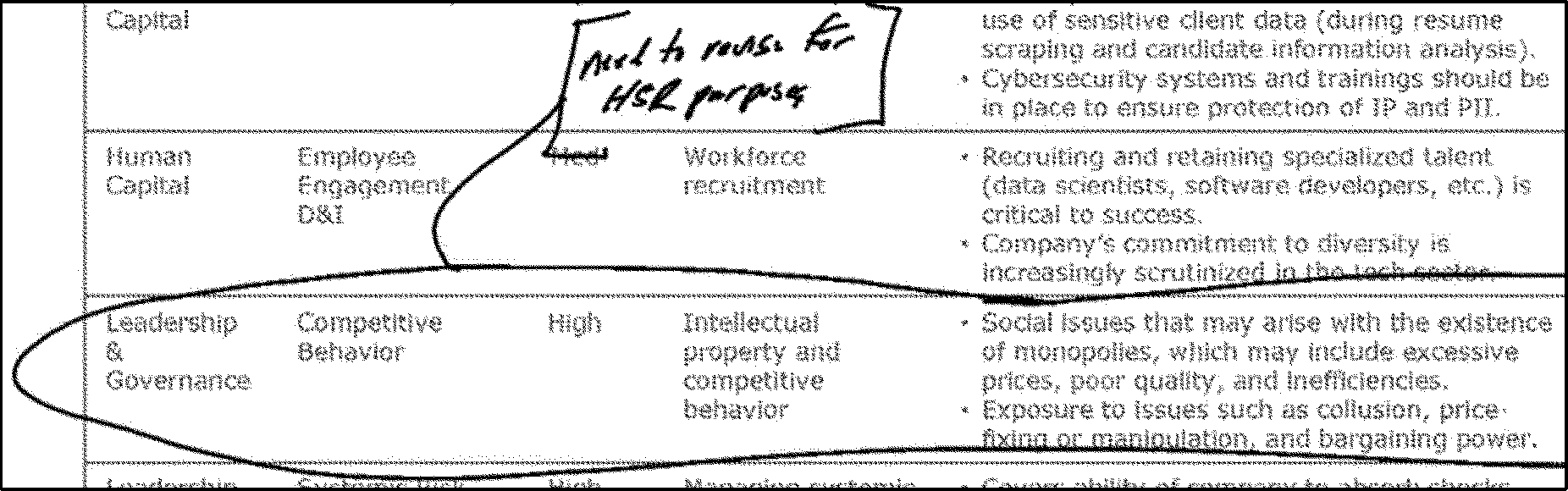
35. Thereafter, the KKR deal team member did not merely revise the “Competitive Behavior” section but deleted this row entirely from an earlier version of the document—one that had already been presented to the Investment Committee in March 2021—before submitting the altered document to the Antitrust Division with KKR's HSR filing for Emsi.
36. The full impact of KKR's acquisition of Emsi, and the resulting elimination of head-to-head competition between Emsi and Burning Glass, came to light two years after the transaction closed and during the Antitrust Division's investigation of KKR's HSR Act violations. At that time, the Antitrust Division opened a merger investigation into KKR's then-consummated acquisition of Emsi, issuing compulsory process to both KKR and Emsi's former owner. The merger of Emsi and Burning Glass raised competition concerns about the combination of two leading providers of labor market analytics, potentially resulting in higher prices, fewer choices, and less innovation. As explained in a pricing strategy document uncovered during the post-consummation merger investigation, the Emsi/Burning Glass merger “eliminated a competitor . . . and because of that, [there is] less leverage to drop in price, and more reason to increase.” KKR acknowledged this intended effect of the Emsi/Burning Glass merger, hiring a consultant to perform a pricing study shortly after acquiring Emsi to “understand [the] competitive situation after [the] merger.” This pricing study recommended an average price increase of about 20% across customer types and attributed that increase in part to “decreased competitive intensity.” Thereafter, the merged Emsi/Burning Glass company adopted a strategy of increasing prices.
37. KKR's HSR Act violations with respect to Lynx also disguised a potentially anticompetitive merger involving services provided to general aviation customers. In 2021, KKR acquired Lynx, a fixed-base operator that provides fuel and other services to general aviation customers, for about $425 million. KKR launched its strategy to roll up fixed-base operators earlier in 2021 by first acquiring Atlantic Aviation, a company that operated a large network of fixed-base operators throughout the United States, for $3.5 billion. In 2021, KKR then sought to acquire Lynx, Atlantic Aviation's competitor. KKR submitted only five documents in its HSR filing for Lynx, while omitting another 29 documents that should have been submitted at the time. KKR also deleted five pages of one of the Lynx Item 4 documents that discussed the planned follow-on acquisition of a third fixed-base operator, Ross, and then submitted the same altered document twice: first, as an Item 4 document with its Lynx HSR filing, and then again, the same altered document as an Item 4 document with its Ross HSR filing.
38. As with Emsi, the omitted Item 4 documents for Lynx included important information related to competition—this time about different regional markets where KKR planned to benefit from merging Lynx with Atlantic Aviation's network of fixed-base operators. In these omitted documents, KKR also observed that merging Lynx with Atlantic Aviation would give KKR ownership of the fixed-base operators at “sister pairs” of airports—that is, two airports located near one another in the same metropolitan area—in both Pittsburgh, Pennsylvania, and Portland, Oregon. In Pittsburgh, Atlantic Aviation was the sole fixed-base operator at Pittsburgh International Airport (PIT), and Lynx was the sole fixed-base operator at nearby Allegheny County Airport (AGC). In Portland, Atlantic Aviation was the sole fixed-base operator at Portland International Airport (PDX), and Lynx was one of two fixed-base operators at nearby Aurora State Airport (UAO). KKR explained in the omitted documents that combining the PIT/AGC sister pair in Pittsburgh, and combining the PDX/UAO sister pair in Portland, “could be strategically complementary, especially for [KKR's] pricing initiative.” As a result, KKR concluded in the omitted documents that the combination of Lynx and Atlantic Aviation “will help increase rates” in the Pittsburgh region and “will help lift rates and prices” in the Portland region.
39. With the closing of the Lynx acquisition, KKR took over a competitor and was in a position to enrich itself with expected anticompetitive benefits of the regional consolidation of the Atlantic Aviation and Lynx fixed-base operator networks through its combined ownership of both the PIT/AGC and PDX/UAO sister pairs.
IV. The Defendants
40. Defendant KKR & Co. Inc. (“KKR Parent”) is a corporation organized and existing under the laws of the state of Delaware with its principal place of business at 30 Hudson Yards, New York, New York 10001.
41. Defendant KKR & Co. GP LLC (“KKR GP LLC”) is a limited liability company organized and existing under the laws of the state of Delaware with its principal place of business at 30 Hudson Yards, New York, New York 10001.
42. Defendant Kohlberg Kravis Roberts & Co. L.P. (“Kohlberg Kravis Roberts”) is a limited partnership organized and existing under the laws of the state of Delaware with its principal place of business at 30 Hudson Yards, New York, New York 10001.
43. Defendants KKR Parent, KKR GP LLC, and Kohlberg Kravis Roberts are collectively referred to herein as the “KKR Investment Managers.” Defendant KKR Parent owns and controls Defendant KKR GP LLC. Defendant KKR GP LLC is the sole general partner of, and has sole control over, Defendant Kohlberg Kravis Roberts. Defendant Kohlberg Kravis Roberts is the parent company of Defendant KKR Parent's ( printed page 56908) global asset management business, which includes the remaining Defendants named below, and its employees were responsible for preparing the HSR filings at issue herein.
44. Defendant KKR Americas Fund XII L.P. (“KKR Americas Fund”) is a limited partnership organized and existing under the laws of the Cayman Islands with its principal place of business at 30 Hudson Yards, New York, New York 10001.
45. Defendant KKR Americas Fund XII (Kestrel) L.P. (“KKR Americas Fund Kestrel”) is a limited partnership organized and existing under the laws of the state of Delaware with its principal place of business at 30 Hudson Yards, New York, New York 10001.
46. Defendant KKR Americas Fund XII (Thrive) L.P. (“KKR Americas Fund Thrive”) is a limited partnership organized and existing under the laws of the state of Delaware with its principal place of business at 30 Hudson Yards, New York, New York 10001.
47. Defendant KKR Apple Aggregator L.P. (“KKR Apple Fund”) is a limited partnership organized and existing under the laws of the state of Delaware with its principal place of business at 30 Hudson Yards, New York, New York 10001.
48. Defendant KKR Chord IP Aggregator L.P. (“KKR Chord Fund”) is a limited partnership organized and existing under the laws of Ontario, Canada, with its principal place of business at 30 Hudson Yards, New York, New York 10001.
49. Defendant KKR Core Holding Company LLC (“KKR Core Fund”) is a limited liability company organized and existing under the laws of the state of Delaware with its principal place of business at 30 Hudson Yards, New York, New York 10001.
50. Defendant KKR Core II Holding Company LLC (“KKR Core II Fund”) is a limited liability company organized and existing under the laws of the Cayman Islands with its principal place of business at 30 Hudson Yards, New York, New York 10001.
51. Defendant KKR DCIF Lower Entity III SCSp (“KKR DCIF Fund”) is a special limited partnership organized and existing under the laws of Luxembourg with its principal place of business at 30 Hudson Yards, New York, New York 10001.
52. Defendant KKR Global Impact Fund SCSp (“KKR Global Impact Fund”) is a special limited partnership organized and existing under the laws of Luxembourg with its principal place of business at 30 Hudson Yards, New York, New York 10001.
53. Defendant KKR Global Infrastructure Investors IV USD (Apple) L.P. (“KKR Global Infrastructure Fund”) is a limited partnership organized and existing under the laws of Ontario, Canada, with its principal place of business at 30 Hudson Yards, New York, New York 10001.
54. Defendant KKR North America Fund XIII SCSp (“KKR North America XIII Fund”) is a special limited partnership organized and existing under the laws of Luxembourg with its principal place of business at 30 Hudson Yards, New York, New York 10001.
55. Defendant KKR Obsidian Aggregator LP (“KKR Obsidian Fund”) is a limited partnership organized and existing under the laws of the state of Delaware with its principal place of business at 30 Hudson Yards, New York, New York 10001.
56. Defendants KKR Americas Fund, KKR Americas Fund Kestrel, KKR Americas Fund Thrive, KKR Apple Fund, KKR Chord Fund, KKR Core Fund, KKR Core II Fund, KKR DCIF Fund, KKR Global Impact Fund, KKR Global Infrastructure Fund, KKR North America XIII Fund, and KKR Obsidian Fund are collectively referred to herein as the “KKR Funds.” Each KKR Fund is owned and managed by the KKR Investment Managers. Each KKR Fund is its own ultimate parent entity within the meaning of the HSR Act and had its own obligation to comply with the notification and waiting period requirements of the HSR Act.
57. KKR is a major global investment firm with over $500 billion in total assets under management. KKR's asset management business includes a private equity segment operated by Kohlberg Kravis Roberts and other subsidiaries of KKR. KKR describes itself as a “world leader in private equity,” reporting over $176 billion of private equity assets under management as of December 31, 2023, including a private equity portfolio of over 130 companies headquartered in over 20 countries and operating in about 20 general industries, together generating about $285 billion in annual revenues.
58. As part of its asset management business, KKR routinely engages in transactions that require notice under the HSR Act. Since 2021, KKR provided notice to the Antitrust Division and the FTC of over 100 proposed transactions under the HSR Act. In a December 2021 letter to the FTC admitting to two failures to make premerger HSR Act filings, KKR touted its wealth of experience with the HSR Act requirements, emphasizing its involvement in “a large number of transactions (with numerous HSR filings every year),” its engagement of “experienced and highly qualified lead outside HSR counsel,” and its “internal policies and procedures in place to ensure compliance with HSR.” At that time, KKR assured the FTC that it “takes its HSR responsibilities extremely seriously, and substantial efforts ha[d] been dedicated to building a culture and system of compliance.” Contrary to these assurances, KKR disregarded the HSR Act's requirements throughout its investments business. Since 2021, KKR repeatedly violated the HSR Act by failing to provide true, correct, and complete information to the Antitrust Division and the FTC in HSR filings for, at minimum, the 16 individual transactions identified herein (collectively, the “Transactions”).
V. Jurisdiction
59. The United States brings this action under the HSR Act to obtain monetary and equitable relief for the numerous violations of the HSR Act detailed herein.
60. This Court has subject-matter jurisdiction over this action under Section 7A(g) of the Clayton Act, 15 U.S.C § 18a(g), and pursuant to 28 U.S.C. 1331, 1337(a), 1345, and 1355.
61. Each Defendant is engaged in interstate commerce and in activities substantially affecting interstate commerce. KKR Parent, both directly and by and through the other named Defendants, provides asset management and insurance solutions throughout the United States. Each Defendant is engaged in a regular, continuous, and substantial flow of interstate commerce, and its sales have had a substantial effect on interstate commerce.
62. This Court has personal jurisdiction over each Defendant. Each Defendant transacts business within this district through, among other things, its presence at 30 Hudson Yards, New York, New York 10001, which is the address of record listed for the filing entity in each HSR filing made by the Defendants.
VI. Venue
63. Venue is proper in this district under Section 12 of the Clayton Act, 15 U.S.C. 22. Each Defendant transacts business within this district through, among other things, its presence at 30 Hudson Yards, New York, New York 10001, which is the address of record listed for the filing entity in each HSR filing made by the Defendants.
VII. Violations Alleged
64. KKR has violated the HSR Act in connection with at least 16 transactions ( printed page 56909) since 2021. The violations stem from a variety of illegal conduct, including failing to provide required documents as a part of an HSR filing, altering required HSR filing documents, and failing to make required premerger HSR filings. The maximum statutory penalty for these 16 known HSR Act violations currently exceeds $650 million.
65. The full extent of KKR's HSR Act violations likely exceeds the violations identified and alleged herein based on the systemic nature of the failures of KKR's HSR Act compliance.
Count 1
KKR'S First Violation of the HSR Act: Emsi
66. Plaintiff incorporates the allegations of paragraphs 1 through 65 above.
67. The KKR Investment Managers and KKR Global Impact Fund are Defendants to this Count 1.
68. The KKR Investment Managers, KKR Global Impact Fund, the Emsi Transaction, and the other parties thereto all met the criteria that required premerger notification pursuant to the HSR Act and the HSR Act Rules. Because of this, the KKR Investment Managers, KKR Global Impact Fund, and the other parties to the Emsi Transaction were required to submit HSR filings, certified by an officer, director, or general partner, with all required information, and to observe the statutory period before they could consummate the Emsi Transaction. The KKR Investment Managers and KKR Global Impact Fund violated the premerger notification requirements of the HSR Act by submitting a deficient HSR filing for the Emsi Transaction that both omitted responsive documents and contained a document altered prior to submission.
69. On May 7, 2021, employees of the KKR Investment Managers submitted an HSR filing on behalf of KKR Global Impact Fund in connection with its acquisition of Emsi, a labor market analytics company, for about $350 million (HSR filing no. 2021-1932). This HSR filing included two Item 4 documents. The Emsi acquisition closed on June 9, 2021.
70. Further investigation revealed, and KKR Global Impact Fund later acknowledged, that KKR Global Impact Fund omitted required documents from this HSR filing and made a first corrective filing for Emsi on April 20, 2023. This corrective filing included 32 additional Item 4 documents, 28 of which predated the original HSR filing date and should have been submitted in the first instance (HSR filing no. 2023-1045). The omitted documents related to analyses of head-to-head competition between Emsi and Burning Glass, product overlaps, customer interviews, post-merger strategic plans, pricing, and deal valuation. KKR Global Impact Fund made a second corrective filing for Emsi on August 15, 2023, to include the complete version of one Item 4 document in the HSR filing that an employee altered prior to submission to delete text referencing competitive issues (HSR filing no. 2023-1045).
Count 2
KKR'S Second Violation of the HSR Act: Lynx
71. Plaintiff incorporates the allegations of paragraphs 1 through 65 above.
72. The KKR Investment Managers and KKR Apple Fund are Defendants to this Count 2.
73. The KKR Investment Managers, KKR Apple Fund, the Lynx Transaction, and the other parties thereto all met the criteria that required premerger notification pursuant to the HSR Act and the HSR Act Rules. Because of this, the KKR Investment Managers, KKR Apple Fund, and the other parties to the Lynx Transaction were required to submit HSR filings, certified by an officer, director, or general partner, with all required information, and to observe the statutory period before they could consummate the Lynx Transaction. The KKR Investment Managers and KKR Apple Fund violated the premerger notification requirements of the HSR Act by submitting a deficient HSR filing for the Lynx Transaction that both omitted responsive documents and contained a document altered prior to submission.
74. On October 8, 2021, employees of the KKR Investment Managers submitted an HSR filing on behalf of KKR Apple Fund for its acquisition of Lynx, a fixed-base operator providing fuel and other services to general aviation customers, for about $425 million (HSR filing no. 2022-0079). This HSR filing included five Item 4 documents. The Lynx acquisition closed on November 23, 2021.
75. Further investigation later revealed that KKR Apple Fund omitted another 29 documents that should also have been included in this HSR filing. The omitted documents included information related to analyses of pricing, market shares by location, local and regional overlaps, and competitors. In addition, KKR Apple Fund deleted five pages containing information about competitive overlaps from one Item 4 document prior to submitting this document with its HSR filing. A complete unaltered version of this document was not produced to the Antitrust Division until November 2023. This HSR Act violation remains ongoing, as KKR Apple Fund has failed to file a corrective HSR filing for this Transaction to date.
Count 3
KKR'S Third Violation of the HSR Act: Ross
76. Plaintiff incorporates the allegations of paragraphs 1 through 65 above.
77. The KKR Investment Managers and KKR Global Infrastructure Fund are Defendants to this Count 3.
78. The KKR Investment Managers, KKR Global Infrastructure Fund, the Ross Transaction, and the other parties thereto all met the criteria that required premerger notification pursuant to the HSR Act and the HSR Act Rules. Because of this, the KKR Investment Managers, KKR Global Infrastructure Fund, and the other parties to the Ross Transaction were required to submit HSR filings, certified by an officer, director, or general partner, with all required information, and to observe the statutory period before they could consummate the Ross Transaction. The KKR Investment Managers and KKR Global Infrastructure Fund violated the premerger notification requirements of the HSR Act by submitting a deficient HSR filing for the Ross Transaction that both omitted responsive documents and contained a document altered prior to submission.
79. On November 29, 2021, employees of the KKR Investment Managers submitted an HSR filing on behalf of KKR Global Infrastructure Fund for the proposed acquisition of Ross, a fixed-base operator providing fuel and other services to general aviation customers, for over $919 million (HSR filing no. 2022-0996). This HSR filing included 11 Item 4 documents. The Ross acquisition closed on May 27, 2022.
80. Further investigation later revealed that KKR Global Infrastructure Fund omitted another 12 documents that should also have been included in this HSR filing. The omitted documents contained analyses of the competitive impact of the Ross acquisition, post-merger strategic plans, synergies, industry consolidation, top customers, and market shares by location. In addition, KKR Global Infrastructure Fund deleted five pages containing competitive information from one Item 4 document prior to submitting this document with its HSR filing. A complete unaltered version of this ( printed page 56910) document was not produced to the Antitrust Division until November 2023. This HSR Act violation remains ongoing, as KKR Global Infrastructure Fund has failed to file a corrective HSR filing for this Transaction to date.
Count 4
KKR'S Fourth Violation of the HSR Act: Outsystems
81. Plaintiff incorporates the allegations of paragraphs 1 through 65 above.
82. The KKR Investment Managers and KKR North America Fund XIII are Defendants to this Count 4.
83. The KKR Investment Managers, KKR North America Fund XIII, the OutSystems Transaction, and the other parties thereto all met the criteria that required premerger notification pursuant to the HSR Act and the HSR Act Rules. Because of this, the KKR Investment Managers, KKR North America Fund XIII, and the other parties to the OutSystems Transaction were required to submit HSR filings, certified by an officer, director, or general partner, with all required information, and to observe the statutory period before they could consummate the OutSystems Transaction. The KKR Investment Managers and KKR North America Fund XIII violated the premerger notification requirements of the HSR Act by submitting a deficient HSR filing for the OutSystems Transaction that both omitted responsive documents and contained documents altered prior to submission.
84. On June 24, 2022, employees of the KKR Investment Managers submitted an HSR filing on behalf of KKR North America Fund XIII for the proposed acquisition of OutSystems, an omnichannel enterprise applications tool provider, for between $202 and $779 million (HSR filing no. 2022-2539). KKR North America Fund XIII submitted eight Item 4 documents with its HSR filing but subsequently submitted a corrective filing on September 19, 2022, with an additional 15 documents, including eight of which predated the original filing date and should have been submitted in the first instance. The omitted documents contained analyses of competitive positioning, post-merger strategic plans, market landscape and competitive dynamics, detailed customer surveys, and a market study. The OutSystems acquisition closed on October 19, 2022.
85. Further investigation revealed that, even then, though, the corrective filing was not complete, as KKR North America Fund XIII later acknowledged that it had altered two Item 4 documents included in both the original and corrective HSR filings for OutSystems prior to submission to delete six pages from one document, and seven pages from the other. The deleted pages included information related to competitive positioning, customer surveys, and market landscape. Complete unaltered versions of these documents were not produced to the Antitrust Division until November 2023. This HSR Act violation remains ongoing, as KKR North America Fund XIII has failed to file a corrective HSR filing for this Transaction to date.
Count 5
KKR'S Fifth Violation of the HSR Act: ERM
86. Plaintiff incorporates the allegations of paragraphs 1 through 65 above.
87. The KKR Investment Managers and KKR Core Fund are Defendants to this Count 5.
88. The KKR Investment Managers, KKR Core Fund, the ERM Transaction, and the other parties thereto all met the criteria that required premerger notification pursuant to the HSR Act and the HSR Act Rules. Because of this, the KKR Investment Managers, KKR Core Fund, and the other parties to the ERM Transaction were required to submit HSR filings, certified by an officer, director, or general partner, with all required information, and to observe the statutory period before they could consummate the ERM Transaction. The KKR Investment Managers and KKR Core Fund violated the premerger notification requirements of the HSR Act by submitting a deficient HSR filing for the ERM Transaction that contained documents altered prior to submission.
89. On June 1, 2021, employees of the KKR Investment Managers submitted an HSR filing on behalf of KKR Core Fund for the proposed acquisition of ERM, a provider of environmental, health, safety, risk, and social consulting services, for about $3 billion (HSR filing no. 2021-2211). The ERM acquisition closed on October 13, 2021.
90. Further investigation later revealed that KKR Core Fund deleted a total of 70 pages across four separate Item 4 documents prior to submitting these documents with this HSR filing, including one document with 40 out of 48 pages deleted and another document with 25 out of 42 pages deleted. The deleted pages included information related to analyses of competitors, market shares, barriers to entry, market projections, pricing, and post-merger plans. Complete unaltered versions of these documents were not produced to the Antitrust Division until November 2023. This HSR Act violation remains ongoing, as KKR Core Fund has failed to file a corrective HSR filing for this Transaction to date.
Count 6
KKR'S Sixth Violation of the HSR Act: Kobalt Music
91. Plaintiff incorporates the allegations of paragraphs 1 through 65 above.
92. The KKR Investment Managers and KKR Chord Fund are Defendants to this Count 6.
93. The KKR Investment Managers, KKR Chord Fund, the Kobalt Music Transaction, and the other parties thereto all met the criteria that required premerger notification pursuant to the HSR Act and the HSR Act Rules. Because of this, the KKR Investment Managers, KKR Chord Fund, and the other parties to the Kobalt Music Transaction were required to submit HSR filings, certified by an officer, director, or general partner, with all required information, and to observe the statutory period before they could consummate the Kobalt Music Transaction. The KKR Investment Managers and KKR Chord Fund violated the premerger notification requirements of the HSR Act by submitting a deficient HSR filing for the Kobalt Music Transaction that contained documents altered prior to submission.
94. On September 3, 2021, employees of the KKR Investment Managers submitted an HSR filing on behalf of KKR Chord Fund for the proposed acquisition of Kobalt Music, a music rights portfolio company, for about $1.1 billion (HSR filing no. 2021-3222). The Kobalt Music acquisition closed on October 15, 2021.
95. Further investigation later revealed that KKR Chord Fund altered two Item 4 documents to delete two pages each prior to submitting these documents with this HSR filing. The deleted pages included details about KKR's strategy to subsequently roll up other music rights portfolio companies, as well as anticipated deal pipeline and valuation analysis. Complete unaltered versions of these documents were not produced to the Antitrust Division until November 2023. This HSR Act violation remains ongoing, as KKR Chord Fund has failed to file a corrective HSR filing for this Transaction to date. ( printed page 56911)
Count 7
KKR'S Seventh Violation of the HSR Act: John Laing
96. Plaintiff incorporates the allegations of paragraphs 1 through 65 above.
97. The KKR Investment Managers and KKR DCIF Fund are Defendants to this Count 7.
98. The KKR Investment Managers, KKR DCIF Fund, the John Laing Transaction, and the other parties thereto all met the criteria that required premerger notification pursuant to the HSR Act and the HSR Act Rules. Because of this, the KKR Investment Managers, KKR DCIF Fund, and the other parties to the John Laing Transaction were required to submit HSR filings, certified by an officer, director, or general partner, with all required information, and to observe the statutory period before they could consummate the John Laing Transaction. The KKR Investment Managers and KKR DCIF Fund violated the premerger notification requirements of the HSR Act by submitting a deficient HSR filing for the John Laing Transaction that contained a document altered prior to submission.
99. On June 3, 2021, employees of the KKR Investment Managers submitted an HSR filing on behalf of KKR DCIF Fund for the proposed acquisition of John Laing, an international investment company, for about $2.8 billion (HSR filing no. 2021-2229). The John Laing acquisition closed on September 22, 2021.
100. Further investigation later revealed that KKR DCIF Fund altered one Item 4 document by deleting five pages in their entirety and selected text from two other pages prior to submitting this document with this HSR filing. The deleted content included analyses of valuation, deal rationale, investment returns, and post-merger plans. A complete unaltered version of this document was not produced to the Antitrust Division until November 2023. This HSR Act violation remains ongoing, as KKR DCIF Fund has failed to file a corrective HSR filing for this Transaction to date.
Count 8
KKR'S Eighth Violation of the HSR Act: Neighborly
101. Plaintiff incorporates the allegations of paragraphs 1 through 65 above.
102. The KKR Investment Managers and KKR North America Fund XIII are Defendants to this Count 8.
103. The KKR Investment Managers, KKR North America Fund XIII, the Neighborly Transaction, and the other parties thereto all met the criteria that required premerger notification pursuant to the HSR Act and the HSR Act Rules. Because of this, the KKR Investment Managers, KKR North America Fund XIII, and the other parties to the Neighborly Transaction were required to submit HSR filings, certified by an officer, director, or general partner, with all required information, and to observe the statutory period before they could consummate the Neighborly Transaction. The KKR Investment Managers and KKR North America Fund XIII violated the premerger notification requirements of the HSR Act by submitting a deficient HSR filing for the Neighborly Transaction that contained a document altered prior to submission.
104. On July 15, 2021, employees of the KKR Investment Managers submitted an HSR filing on behalf of KKR North America Fund XIII for the proposed acquisition of Neighborly, a franchisor of home servicing brands, for about $2.2 billion (HSR filing no. 2021-2624). The Neighborly acquisition closed on September 1, 2021.
105. Further investigation later revealed that KKR North America Fund XIII altered one Item 4 document to delete two pages prior to submitting this document with this HSR filing. The deleted pages included analyses of valuation and investment returns. A complete unaltered version of this document was not produced to the Antitrust Division until November 2023. This HSR Act violation remains ongoing, as KKR North America Fund XIII has failed to file a corrective HSR filing for this Transaction to date.
Count 9
KKR'S Ninth Violation of the HSR Act: Barracuda
106. Plaintiff incorporates the allegations of paragraphs 1 through 65 above.
107. The KKR Investment Managers and KKR Core II Fund are Defendants to this Count 9.
108. The KKR Investment Managers, KKR Core II Fund, the Barracuda Transaction, and the other parties thereto all met the criteria that required premerger notification pursuant to the HSR Act and the HSR Act Rules. Because of this, the KKR Investment Managers, KKR Core II Fund, and the other parties to the Barracuda Transaction were required to submit HSR filings, certified by an officer, director, or general partner, with all required information, and to observe the statutory period before they could consummate the Barracuda Transaction. The KKR Investment Managers and KKR Core II Fund violated the premerger notification requirements of the HSR Act by submitting a deficient HSR filing for the Barracuda Transaction that omitted responsive documents.
109. On April 22, 2022, employees of the KKR Investment Managers submitted an HSR filing on behalf of KKR Core II Fund for the proposed acquisition of Barracuda, a security and data protection solutions provider, for about $3.75 billion (HSR filing no. 2022-2108). This HSR filing included seven Item 4 documents. The Barracuda acquisition closed on August 15, 2022.
110. Further investigation later revealed that KKR Core II Fund omitted another 19 documents that should also have been included in this HSR filing. The omitted documents included analyses of competitors, interview reports from industry participant surveys, detailed emails to KKR partners analyzing the acquisition and competitive landscape, a KKR partners update report, discussion of proposed price increases, churn analysis, customer surveys, market size and competitive positioning, and discussion of competitive overlaps between Barracuda and other portfolio companies owned by KKR. This HSR Act violation remains ongoing, as KKR Core II Fund has failed to file a corrective HSR filing for this Transaction to date.
Count 10
KKR'S Tenth Violation of the HSR Act: Therapy Brands
111. Plaintiff incorporates the allegations of paragraphs 1 through 65 above.
112. The KKR Investment Managers and KKR Americas Fund Thrive are Defendants to this Count 10.
113. The KKR Investment Managers, KKR Americas Fund Thrive, the Therapy Brands Transaction, and the other parties thereto all met the criteria that required premerger notification pursuant to the HSR Act and the HSR Act Rules. Because of this, the KKR Investment Managers, KKR Americas Fund Thrive, and the other parties to the Therapy Brands Transaction were required to submit HSR filings, certified by an officer, director, or general partner, with all required information, and to observe the statutory period before they could consummate the Therapy Brands Transaction. The KKR Investment Managers and KKR Americas Fund Thrive violated the premerger notification requirements of the HSR Act by submitting a deficient ( printed page 56912) HSR filing for the Therapy Brands Transaction that omitted responsive documents.
114. On April 9, 2021, employees of the KKR Investment Managers submitted an HSR filing on behalf of KKR Americas Fund Thrive for the proposed acquisition of Therapy Brands, a technology solutions provider for behavioral and mental health organizations, for about $1.25 billion (HSR filing no. 2021-1693). This HSR filing included six Item 4 documents. The Therapy Brands acquisition closed on May 18, 2021.
115. Further investigation later revealed that KKR Americas Fund Thrive omitted another 17 documents that should also have been included in this HSR filing. The omitted documents included a different version of the Confidential Information Memorandum report submitted with the HSR filing, a later version of a market study submitted with the HSR filing, multiple detailed market participant surveys used to prepare analyses for KKR's Investment Committee, KKR partner meeting reports, and an email to a KKR partner analyzing the proposed acquisition and competitive dynamics. This HSR Act violation remains ongoing, as KKR Americas Fund Thrive has failed to file a corrective HSR filing for this Transaction to date.
Count 11
KKR'S Eleventh Violation of the HSR Act: Equus I
116. Plaintiff incorporates the allegations of paragraphs 1 through 65 above.
117. The KKR Investment Managers and KKR Americas Fund are Defendants to this Count 11.
118. The KKR Investment Managers, KKR Americas Fund, the Equus I Transaction, and the other parties thereto all met the criteria that required premerger notification pursuant to the HSR Act and the HSR Act Rules. Because of this, the KKR Investment Managers, KKR Americas Fund, and the other parties to the Equus I Transaction were required to submit HSR filings, certified by an officer, director, or general partner, with all required information, and to observe the statutory period before they could consummate the Equus I Transaction. The KKR Investment Managers and KKR Americas Fund violated the premerger notification requirements of the HSR Act by submitting a deficient HSR filing for the Equus I Transaction that omitted responsive documents.
119. On July 5, 2022, employees of the KKR Investment Managers submitted an HSR filing on behalf of KKR Americas Fund for its first attempted sale of Equus, a government-funded workforce and job corps services provider, for about $147.5 million (HSR filing no. 2022-2600). This HSR filing included seven Item 4 documents. This proposed sale of Equus was subsequently abandoned after the HSR filings were made.
120. Further investigation later revealed that KKR Americas Fund omitted another six documents that should also have been included in this HSR filing. The omitted documents included analyses of competitors, market shares, and bid data including win/loss history. For this abandoned Transaction, KKR was in violation of the HSR Act for a period of 30 days after the inaccurate and incomplete HSR filing was made.
Count 12
KKR'S Twelfth Violation of the HSR Act: Equus II
121. Plaintiff incorporates the allegations of paragraphs 1 through 65 above.
122. The KKR Investment Managers and KKR Americas Fund are Defendants to this Count 12.
123. The KKR Investment Managers, KKR Americas Fund, the Equus II Transaction, and the other parties thereto all met the criteria that required premerger notification pursuant to the HSR Act and the HSR Act Rules. Because of this, the KKR Investment Managers, KKR Americas Fund, and the other parties to the Equus II Transaction were required to submit HSR filings, certified by an officer, director, or general partner, with all required information, and to observe the statutory period before they could consummate the Equus II Transaction. The KKR Investment Managers and KKR Americas Fund violated the premerger notification requirements of the HSR Act by submitting a deficient HSR filing for the Equus II Transaction that omitted responsive documents.
124. On September 30, 2022, employees of the KKR Investment Managers submitted an HSR filing on behalf of KKR Americas Fund for its second attempted sale of Equus for about $154 million (HSR filing no. 2022-3141), following on the prior deficient HSR filing for its first attempted sale of Equus (HSR filing no. 2022-2600) that omitted six Item 4 documents. This HSR filing included three Item 4 documents. The Equus sale closed on November 1, 2022.
125. Further investigation later revealed that KKR Americas Fund omitted at least one other document that should also have been included in this HSR filing. The omitted document included an analysis of strategic expansion plans. In addition, several of the documents omitted by KKR Americas Fund in its earlier Equus I HSR filing also contained competitive information relevant to the parties in the Equus II Transaction that should have been available for the Antitrust Division to review in evaluating the Equus II Transaction, had that earlier filing by KKR Americas Fund not also been deficient. This HSR Act violation remains ongoing, as KKR Americas Fund has failed to file a corrective HSR filing for this Transaction to date.
Count 13
KKR'S Thirteenth Violation of the HSR Act: Talentneuron
126. Plaintiff incorporates the allegations of paragraphs 1 through 65 above.
127. The KKR Investment Managers and KKR Obsidian Fund are Defendants to this Count 13.
128. The KKR Investment Managers, KKR Obsidian Fund, the TalentNeuron Transaction, and the other parties thereto all met the criteria that required premerger notification pursuant to the HSR Act and the HSR Act Rules. Because of this, the KKR Investment Managers, KKR Obsidian Fund, and the other parties to the TalentNeuron Transaction were required to submit HSR filings, certified by an officer, director, or general partner, with all required information, and to observe the statutory period before they could consummate the TalentNeuron Transaction. The KKR Investment Managers and KKR Obsidian Fund violated the premerger notification requirements of the HSR Act by submitting a deficient HSR filing for the TalentNeuron Transaction that omitted responsive documents.
129. On March 21, 2022, employees of the KKR Investment Managers submitted an HSR filing on behalf of KKR Obsidian Fund for the proposed acquisition of TalentNeuron, a labor market analytics provider, for about $300 million (HSR filing no. 2022-1877). KKR Obsidian Fund submitted two Item 4 documents with its initial HSR filing for TalentNeuron but later withdrew and refiled its HSR filing to include two additional documents, including one that predated the original filing date and should also have been included originally. The TalentNeuron sale was abandoned prior to closing.
130. Further investigation later revealed that KKR Obsidian Fund ( printed page 56913) omitted from both its initial filing and the refiling three other documents that should have been included originally. For this abandoned Transaction, KKR Obsidian Fund was in violation of the HSR Act for a period of 30 days after the inaccurate and incomplete HSR filing was made.
Count 14
KKR'S Fourteenth Violation of the HSR Act: Minnesota Rubber
131. Plaintiff incorporates the allegations of paragraphs 1 through 65 above.
132. The KKR Investment Managers and KKR Americas Fund Kestrel are Defendants to this Count 14.
133. The KKR Investment Managers, KKR Americas Fund Kestrel, the Minnesota Rubber Transaction, and the other parties thereto all met the criteria that required premerger notification pursuant to the HSR Act and the HSR Act Rules. Because of this, the KKR Investment Managers, KKR Americas Fund Kestrel, and the other parties to the Minnesota Rubber Transaction were required to submit HSR filings, certified by an officer, director, or general partner, with all required information, and to observe the statutory period before they could consummate the Minnesota Rubber Transaction. The KKR Investment Managers and KKR Americas Fund Kestrel violated the premerger notification requirements of the HSR Act by submitting a deficient HSR filing for the Minnesota Rubber Transaction that omitted responsive documents.
134. On August 30, 2022, employees of the KKR Investment Managers submitted an HSR filing on behalf of KKR Americas Fund Kestrel in connection with the proposed sale of Minnesota Rubber, a company that manufactures, assembles, distributes, and sells rubber and plastic products and related molds and tooling, for about $950 million (HSR filing no. 2022-2952). This HSR filing included two Item 4 documents. The sale of Minnesota Rubber closed on October 27, 2022.
135. Further investigation revealed that KKR Americas Fund Kestrel omitted two other documents that should also have been included in this HSR filing. The omitted documents included an email with the subject line “Pricing Power,” as well as analyses of synergies and product overlaps between Minnesota Rubber and the buyer. This HSR Act violation remains ongoing, as KKR Americas Fund Kestrel has failed to file a corrective HSR filing for this Transaction to date.
Count 15
KKR'S Fifteenth Violation of the HSR Act: Applovin
136. Plaintiff incorporates the allegations of paragraphs 1 through 65 above.
137. The KKR Investment Managers and KKR Americas Fund are Defendants to this Count 15.
138. The KKR Investment Managers, KKR Americas Fund, the Applovin Transaction, and the other parties thereto all met the criteria that required premerger notification pursuant to the HSR Act and the HSR Act Rules. Because of this, the KKR Investment Managers, KKR Americas Fund, and the other parties to the Applovin Transaction were required to submit HSR filings, certified by an officer, director, or general partner, with all required information, and to observe the statutory period before they could consummate the Applovin Transaction. The KKR Investment Managers and KKR Americas Fund violated the premerger notification requirements of the HSR Act by failing to timely submit an HSR filing for the Applovin Transaction.
139. On April 19, 2021, KKR Americas Fund acquired additional voting shares of Applovin, an app marketing and monetization software solutions provider, for about $6.9 billion, but did not submit an HSR filing prior to consummating this Transaction. On December 3, 2021, employees of the KKR Investment Managers submitted a corrective HSR filing on behalf of KKR Americas Fund for its consummated acquisition of Applovin (HSR filing no. 2022-1068).
Count 16
KKR'S Sixteenth Violation of the HSR Act: Adjust
140. Plaintiff incorporates the allegations of paragraphs 1 through 65 above.
141. The KKR Investment Managers and KKR Americas Fund are Defendants to this Count 16.
142. The KKR Investment Managers, KKR Americas Fund, the Adjust Transaction, and the other parties thereto all met the criteria that required premerger notification pursuant to the HSR Act and the HSR Act Rules. Because of this, the KKR Investment Managers, KKR Americas Fund, and the other parties to the Adjust Transaction were required to submit HSR filings, certified by an officer, director, or general partner, with all required information, and to observe the statutory period before they could consummate the Adjust Transaction. The KKR Investment Managers and KKR Americas Fund violated the premerger notification requirements of the HSR Act by failing to timely submit an HSR filing for the Adjust Transaction.
143. On April 22, 2021, KKR Americas Fund indirectly acquired Adjust, a mobile marketing solutions and analytics provider, for between $376 million and $919 million, but did not submit an HSR filing prior to consummating this Transaction. On December 3, 2021, employees of the KKR Investment Managers submitted a corrective HSR filing on behalf of KKR Americas Fund for its consummated acquisition of Adjust (HSR filing no. 2022-1067).
VIII. Request for Relief
144. Wherefore, Plaintiff requests that the Court:
a. adjudge and decree that KKR's conduct in respect of the Transactions violated the HSR Act, 15 U.S.C. 18a;
b. order KKR to pay to the United States an appropriate civil penalty as provided by the HSR Act, 15 U.S.C. 18a(g)(1), the Federal Civil Penalties Inflation Adjustment Act Improvements Act of 2015, Public Law 114-74, 701 (further amending the Federal Civil Penalties Inflation Adjustment Act of 1990, 28 U.S.C. 2461 note), and 16 CFR 1.98(a);
c. enjoin KKR from any future violations of the HSR Act;
d. order such other equitable relief, including but not limited to disgorgement, plus interest, to eliminate the unlawful financial gains reaped by KKR as a result of its illegal consummation of certain Transactions;
e. grant Plaintiff such other and further relief as the Court may deem just and proper to redress and prevent recurrence of the alleged violations and to dissipate their anticompetitive effects, including structural and behavioral relief; and
f. award Plaintiff its costs of this suit.
Dated this 14th day of January 2025.
Respectfully submitted,
For Plaintiff United States of America:
Doha Mekki, Acting Assistant Attorney General for Antitrust.
Ryan Danks, Director of Civil Enforcement.
Catherine K. Dick, Acting Director of Litigation.
Suzanne Morris, Deputy Director for Civil Enforcement Operations.
Aaron Hoag, Chief, Technology & Digital Platforms Section.
Danielle Hauck, Assistant Chief, Technology & Digital Platforms Section.
Adam Severt, Assistant Chief, Technology & Digital Platforms Section.
David Teslicko, Vittorio Cottafavi, Meagan Glynn, Leah Graham, Arshia Najafi,
Trial Attorneys
( printed page 56914)United States Department of Justice, Antitrust Division, Technology & Digital Platforms Section, 450 Fifth Street NW, Suite 7100, Washington, DC 20530, Telephone: (202) 307-0128, Email: David.Teslicko@usdoj.gov.
Attorneys for the United States
United States District Court Southern District of New York
United States Of America, Plaintiff, -v.- KKR & CO. INC., et al., Defendants.
1:25-cv-343-LTS
[rel. 1:25-cv-448-LTS]
[Proposed] Final Judgment
Whereas, Plaintiff, United States of America, filed its Complaint on January 14, 2025, alleging violations of Section 7A of the Clayton Act, 15 U.S.C. 18a, commonly known as the Hart-Scott-Rodino Antitrust Improvements Act of 1976 (the “HSR Act”);
And Whereas, the United States and KKR (as defined below) have consented to entry of this Final Judgment without the taking of testimony, without trial or adjudication of any issue of fact or law, and without this Final Judgment constituting any evidence against or admission by any party relating to any issue of fact or law;
And Whereas, KKR agrees to pay a civil penalty, as set forth herein, to resolve the claims alleged in the Complaint;
And Whereas, KKR represents that the relief required of it by the provisions of this Final Judgment can and will be made and that KKR will not later raise a claim of hardship or difficulty as grounds for asking the Court to modify any provision of this Final Judgment;
Now therefore, it is ordered, adjudged, and decreed:
I. Jurisdiction
The Court has jurisdiction over the subject matter of and each of the parties to this action. The Complaint states a claim upon which relief may be granted against KKR under Section 7A of the Clayton Act, 15 U.S.C. 18a.
II. Definitions
145. As used in this Final Judgment:
A. “KKR” means Defendant KKR & Co. GP LLC, a Delaware limited liability company with its principal place of business at 30 Hudson Yards, New York, New York 10001, its direct and indirect parents, subsidiaries, divisions, groups, partnerships, and joint ventures, and its and their respective directors, officers, managers, agents, partners, advisors, and employees, and any investment fund, account or vehicle that is managed, advised, or sponsored by any direct or indirect corporate affiliate of KKR & Co. GP LLC.
B. “Including” means including, but not limited to.
C. “Person” means any natural person, corporation, company, partnership, joint venture, firm, association, sole proprietorship, agency, board, authority, commission, office, institution, university, municipality, governmental entity, or other business or legal entity, whether private or governmental.
III. Applicability and Securities Laws
A. The provisions of this Final Judgment shall apply to KKR and all other persons in active concert or participation with KKR who receive actual notice of this Final Judgment.
B. Pursuant to Rule 506(d)(2)(iii), 17 CFR 230.506(d)(2)(iii), as promulgated under the Securities Act of 1933, 15 U.S.C. 77a, et seq., disqualification under paragraph (d)(1)(ii) of Rule 506, 17 CFR 230.506(d)(1)(ii), will not arise as a consequence of the entry of this Final Judgment or of the entry of any other order or judgment in this action.
C. Pursuant to Rule 262(b)(3), 17 CFR 230.262(b)(3), as promulgated under the Securities Act of 1933, 15 U.S.C. 77a, et seq., disqualification under paragraph (a)(2) of Rule 262, 17 CFR 230.262(a)(2), will not arise as a consequence of the entry of this Final Judgment or of the entry of any other order or judgment in this action.
D. Nothing in this Final Judgment or any other order or judgment in this action is intended to permanently or temporarily enjoin KKR or its affiliates or otherwise contain an injunction that would trigger disqualification under Section 9(a) of the Investment Company Act of 1940, 15 U.S.C. 80a-9a, et seq., or give rise to potential subsequent legal proceedings to censure, place limits on, suspend or revoke the registration of KKR, its affiliates or their associated persons under Section 15(b)(4)(C) of the Securities Exchange Act of 1934 or Section 203(e)(4) of the Investment Advisers Act of 1940.
E. None of the conduct alleged in the Complaint arises out of or is attributable to KKR's or its affiliates' conduct or advice in their capacity as a broker, dealer, underwriter, investment adviser, bank, insurance company, commodity pool operator, or fiduciary. The Antitrust Division of the Department of Justice has made no finding or determination regarding KKR's or its affiliates' ineligibility under the Department of Labor Prohibited Transaction Class Exemption 84-14 or under Prohibited Transaction Exemption 2020-02.
F. KKR & Co. Inc.; Kohlberg Kravis Roberts & Co. L.P.; KKR Americas Fund XII L.P.; KKR Americas Fund XII (Kestrel) L.P.; KKR Americas Fund XII (Thrive) L.P.; KKR Apple Aggregator L.P.; KKR Chord IP Aggregator L.P.; KKR Core Holding Company LLC; KKR Core II Holding Company LLC; KKR DCIF Lower Entity III SCSp; KKR Global Impact Fund SCSp; KKR Global Infrastructure Investors IV USD (Apple) L.P.; KKR North America Fund XIII SCSp; and KKR Obsidian Aggregator L.P. are hereby dismissed with prejudice pursuant to Federal Rule of Civil Procedure 41(a)(1)(A)(ii) upon entry of this Final Judgment; provided that Sections IV through IX shall not apply to the affiliates of KKR & Co. GP LLC identified in this Paragraph F following the entry of the Stipulation and Order.
IV. Civil Penalty for Alleged Violations of Section 7A of the Clayton Act
146. Within 30 calendar days of entry of this Final Judgment, KKR must pay a civil penalty in the amount of $250,000,000 to the United States.
V. Payment of the Civil Penalty
A. Payment of the civil penalty ordered hereby must be made by wire transfer of funds. Prior to making the wire transfer, KKR will contact ATR.CivilJudgment@atr.usdoj.gov for instructions.
B. In the event of a default or delay in payment, interest at the rate of 18 percent per annum will accrue from the date of the default to the date of payment.
VI. Stipulation and Order
147. KKR must take all steps necessary to comply with the provisions of the Stipulation and Order entered by the Court.
VII. Public Disclosure
A. No information or documents obtained pursuant to any provision of this Final Judgment may be divulged by the United States to any person other than KKR or an authorized representative of the executive branch of the United States, except in the course of legal proceedings to which the United States is a party, including grand-jury proceedings, or as otherwise required by law or this Final Judgment.
B. In the event of a request by a third party, pursuant to the Freedom of Information Act, 5 U.S.C. 552, for disclosure of information obtained pursuant to any provision of this Final Judgment, the Antitrust Division will act in accordance with that statute, and the Department of Justice regulations at 28 CFR part 16, including the provision on confidential commercial information, ( printed page 56915) at 28 CFR 16.7. When submitting information to the Antitrust Division, KKR should designate the confidential commercial information portions of all applicable documents and information under 28 CFR 16.7. Designations of confidentiality expire 10 years after submission, “unless the submitter requests and provides justification for a longer designation period.” See28 CFR 16.7(b).
VIII. Retention of Jurisdiction
The Court retains jurisdiction to enable any party to this Final Judgment to apply to the Court at any time for further orders and directions as may be necessary or appropriate to carry out or construe this Final Judgment, to modify any of its provisions, to enforce compliance, and to punish violations of its provisions.
IX. Enforcement of Final Judgment
A. The United States retains and reserves all rights to enforce the provisions of this Final Judgment against KKR, including the right to seek an order of contempt from the Court. In a civil contempt action, a motion to show cause, or a similar action brought by the United States relating to an alleged violation of any provisions of this Final Judgment, the United States may establish a violation of this Final Judgment by KKR and the appropriateness of a remedy therefor by a preponderance of the evidence, and any argument that a different standard of proof should apply is waived.
B. This Final Judgment should be interpreted to give full effect to the procompetitive purposes of the antitrust laws. KKR may be held in contempt of, and that the Court may enforce, any provision of this Final Judgment that, as interpreted by the Court in light of these procompetitive principles and applying ordinary tools of interpretation, is stated specifically and in reasonable detail, whether or not it is clear and unambiguous on its face. In any such interpretation, the terms of this Final Judgment should not be construed against either party as the drafter.
C. In an enforcement proceeding in which the Court finds that KKR has violated any provisions of this Final Judgment, the United States may apply to the Court for an extension of this Final Judgment, together with other relief that may be appropriate. In connection with a successful effort by the United States to enforce this Final Judgment against KKR, whether litigated or resolved before litigation, KKR agrees to reimburse the United States for the reasonable fees and expenses of its attorneys, as well as all other reasonable costs including experts' fees, incurred in connection with that effort to enforce this Final Judgment against KKR, including in the investigation of the potential violation.
X. Expiration of Final Judgment
This Final Judgment, including all compliance obligations set forth herein, will expire upon payment in full by KKR of the civil penalty required by Section IV of this Final Judgment.
XI. Reservation of Rights
This Final Judgment settles, discharges, and releases the claims stated in the Complaint against KKR, which include any and all of the claims of the United States against KKR, its portfolio companies, and its and their respective current and former affiliates, directors, officers, managers, agents, partners, advisors, and employees for failure to comply with Section 7A of the Clayton Act, 15 U.S.C. 18a, in connection with submissions pursuant to the HSR Act made, or required to have been made, by any of them prior to the date of the filing of the Complaint. This Final Judgment does not affect other charges or claims the United States may file.
XII. Public Interest Determination
Entry of this Final Judgment is in the public interest. The parties have complied with the requirements of the Antitrust Procedures and Penalties Act, 15 U.S.C. 16, including by making available to the public copies of this Final Judgment and the Competitive Impact Statement, public comments thereon, and any response to comments by the United States. Based upon the record before the Court, which includes the Competitive Impact Statement and, if applicable, any comments and response to comments filed with the Court, entry of this Final Judgment is in the public interest.
Date:
[Court approval subject to procedures of Antitrust Procedures and Penalties Act, 15 U.S.C. 16]
United States District Judge
United States District Court Southern District of New York
United States of America, Plaintiff, -v.- KKR & Co. Inc., et al., Defendants.
1:25-cv-343-LTS
[rel. 1:25-cv-448-LTS]
Competitive Impact Statement
In accordance with the Antitrust Procedures and Penalties Act, 15 U.S.C. 16(b)-(h) (the “APPA” or “Tunney Act”), the United States of America files this Competitive Impact Statement related to the proposed Final Judgment filed in this civil antitrust proceeding.
I. Nature and Purpose of the Proceeding
On January 14, 2025, the United States filed a civil antitrust Complaint against KKR & Co. Inc.; KKR & Co. GP LLC; [1] Kohlberg Kravis Roberts & Co. L.P., and twelve affiliated funds (collectively “KKR”), for violating the premerger notification and waiting period requirements of the Hart-Scott-Rodino Antitrust Improvements Act of 1976, 15 U.S.C. 18a (the “HSR Act”).
The HSR Act and the accompanying regulations (the “HSR Rules”) require parties to provide advance notice to the federal antitrust agencies—the Department of Justice (“DOJ”), Antitrust Division and the Federal Trade Commission (“FTC”)—of their proposed transaction if it meets certain criteria. After making their HSR filings, parties must observe a statutory waiting period before closing the transaction. Providing advance notice to the agencies, which includes submitting required information about the parties and the transaction and adhering to the waiting period, is necessary to prevent parties from prematurely consolidating their assets before the agencies have had a meaningful opportunity to investigate whether the transaction violates the antitrust laws.
The Complaint alleges that, despite KKR's decades of experience with the premerger notification process as one of the world's largest private equity firms, KKR violated the HSR Act in connection with its premerger notification filings for, at minimum, 16 separate transactions (collectively, the “Transactions”) since at least 2021. These violations encompass a range of misconduct: KKR omitted required documents from its HSR filings, KKR altered documents in its HSR filings prior to submission, and KKR failed to make timely HSR filings for qualifying transactions. In addition, KKR's internal process for preparing and reviewing HSR filings was deficient and lacked adequate supervision, training, and control procedures reasonably necessary to ensure HSR Act compliance by its employees. ( printed page 56916)
On April 17, 2025, KKR filed a motion to dismiss the Complaint, which the United States opposed. The Court has not ruled on the pending motion.
The United States has now filed a proposed Final Judgment and Stipulation and Order (“Stipulation and Order”) to which KKR has agreed and that is designed to remedy the violations of the HSR Act alleged in the Complaint. Under the proposed Final Judgment, which is explained more fully below, KKR is required to pay a civil penalty of $250,000,000.
The United States and KKR have stipulated that the proposed Final Judgment may be entered after compliance with the APPA. Entry of the proposed Final Judgment will terminate this action, except that the Court will retain jurisdiction to construe, modify, or enforce the provisions of the proposed Final Judgment and to punish violations thereof.
II. Description of the Events Giving Rise to the Alleged Violations
A. Background
KKR is a major global investment firm that provides asset management and insurance solutions and has over $744 billion in total assets under management. KKR's asset management business includes a private equity segment operated by Kohlberg Kravis Roberts & Co. L.P. and other subsidiaries of KKR. KKR describes itself as “a leader of the private equity industry for five decades” reporting over $229 billion of private equity assets under management as of December 31, 2025.[2]
As part of its asset management business, KKR routinely engages in transactions that require notice under the HSR Act. For the period 2021-2024, KKR provided notice to the Antitrust Division and the FTC of over 100 proposed transactions under the HSR Act. During that time, as the Complaint alleges, KKR repeatedly violated the HSR Act by failing to provide true, correct, and complete information to the federal antitrust agencies in premerger notification filings for, at a minimum, the 16 Transactions. For each of the Transactions, KKR filed premerger notification forms pursuant to the HSR Act on behalf of the relevant portfolio company/investment fund.
B. Violations of the HSR Act
As alleged in the Complaint, KKR, the Transactions, and the other parties thereto all met the criteria that required premerger notification pursuant to the HSR Act and the HSR Rules. Because of this, KKR and the other parties to the Transactions were required to submit premerger notifications, certified by an officer, with all required information, and to observe the statutory waiting period before they could consummate the Transactions.
The Complaint asserts that KKR violated the premerger notification and waiting period requirements of the HSR Act by submitting a deficient HSR filing for each Transaction, for a total of at least 16 HSR Act violations, as follows:
- With respect to ten of the Transactions, KKR omitted responsive HSR documents from its filings. The number of documents per transaction omitted by KKR ranged from one to 29 and included information related to head-to-head competition, product overlaps, post-merger strategic plans, pricing, and deal valuation—all topics covered by the HSR Act's document production requirements.
- With respect to eight of the Transactions, KKR altered documents prior to submitting them as part of HSR filings, including four transactions for which KKR both omittedand altered HSR documents prior to submission. Five of the eight affected HSR filings included one altered document each, two included two altered documents each, and one included four altered documents. These alterations included the deletion of information related to KKR's investment theses, post-merger strategic plans, competitive overlaps, and future acquisition plans.
- With respect to two of the Transactions, KKR failed to make timely HSR filings. In December 2021, KKR admitted to the FTC that it did not make proper HSR filings before closing two acquisitions. KKR described the failures to file as inadvertent and arising from an unusual and unanticipated set of circumstances related to the timing of a complicated restructuring transaction, and KKR made corrective filings for both transactions.
The examples of recurrent document omissions, document alterations, and failures to file proper HSR Forms are indicative of systemic noncompliance with the HSR Act by KKR. As a major investment firm with billions of dollars of assets under management, and with decades of experience with the HSR Act, KKR knew that compliance with the HSR Act required notification for its qualifying transactions and submission of all responsive documents—in full and without alterations—to the antitrust agencies. KKR's systemic lack of compliance with the HSR Act's notification requirements impeded the ability of the antitrust agencies to fully evaluate the competitive effects of the Transactions prior to consummation.
III. Explanation of the Proposed Final Judgment
The civil penalty KKR must pay pursuant to the proposed Final Judgment is intended to remedy the HSR Act violations alleged in the Complaint. Section IV of the proposed Final Judgment imposes a civil penalty of $250,000,000 to address the violations alleged in the Complaint, penalize KKR, and deter KKR and others from violating the HSR Act. The United States adjusted the penalty downward from the maximum amount permitted under the HSR Act because KKR is willing to resolve the matter through the proposed Final Judgment, permitting the United States to thereby avoid prolonged litigation, and because KKR has already implemented a new, more robust HSR Act compliance program designed to mitigate the risk of future violations. The release contained in Section IV of the Stipulation and Order and the reservation of rights in Section XI of the proposed Final Judgment releases the claims stated in the Complaint against KKR, i.e., claims that KKR violated Section 7A of the Clayton Act based upon HSR filings that were made, or were required to have been made, prior to the date of the filing of the Complaint, January 14, 2025. It does not affect other charges or claims the United States may file. The United States retains the ability to investigate KKR's compliance with the HSR Act for more recent and future transactions, such as through the use of civil investigative demands, which it used to uncover the HSR Act violations alleged in the Complaint.
IV. Remedies Available to Potential Private Plaintiffs
Section 4 of the Clayton Act, 15 U.S.C. 15, provides that any person who has been injured as a result of conduct prohibited by the antitrust laws may bring suit in federal court to recover three times the damages the person has suffered as well as costs and reasonable attorneys' fees. Entry of the proposed Final Judgment neither impairs nor assists the bringing of any private antitrust damage action. Under the provisions of Section 5(a) of the Clayton Act, 15 U.S.C. 16(a), the proposed Final Judgment has no prima facie effect in any subsequent private lawsuit that may be brought against one or more Defendants. ( printed page 56917)
V. Procedures Available for Modification of the Proposed Final Judgment
The United States and KKR have stipulated that the proposed Final Judgment may be entered by the Court after compliance with the provisions of the APPA, provided that the United States has not withdrawn its consent. The APPA conditions entry upon the Court's determination that the proposed Final Judgment is in the public interest.
The APPA provides a period of at least 60 days preceding the effective date of the proposed Final Judgment within which any person may submit to the United States written comments regarding the proposed Final Judgment. Any person who wishes to comment should do so within 60 days of the date of publication of this Competitive Impact Statement in the Federal Register , or within 60 days of the first date of publication in a newspaper of the summary of this Competitive Impact Statement, whichever is later. All comments received during this period will be considered by the U.S. Department of Justice, which remains free to withdraw its consent to the proposed Final Judgment at any time before the Court's entry of the Final Judgment. The comments and the response of the United States will be filed with the Court. In addition, the comments and the United States' responses will be published in the Federal Register unless the Court agrees that the United States instead may publish them on the U.S. Department of Justice, Antitrust Division's internet website.
Written comments should be submitted in English to:
Danielle Hauck, Acting Chief, Technology and Digital Platforms Section, Antitrust Division, United States Department of Justice, 450 Fifth St. NW, Suite 7100, Washington, DC 20530, atr.public-comments-tunney-act-mb@usdoj.gov
The proposed Final Judgment provides that the Court retains jurisdiction over this action and that the parties may apply to the Court for any order necessary or appropriate for the modification, interpretation, or enforcement of the Final Judgment.
VI. Alternatives to the Proposed Final Judgment
As an alternative to the proposed Final Judgment, the United States considered a full trial on the merits against the Defendants. The United States is satisfied, however, that the proposed relief is an appropriate remedy in this matter, especially given the particular circumstances presented in this case including the passage of time and the remedial measures already undertaken by KKR. Thus, the proposed Final Judgment achieves substantially all of the relief the United States would have obtained through litigation but avoids the time, expense, and uncertainty of a full trial on the merits and potential appeals.
VII. Standard of Review Under the APPA for the Proposed Final Judgment
Under the APPA, proposed Final Judgments, or “consent decrees,” in antitrust cases brought by the United States are subject to a 60-day comment period, after which the Court shall determine whether entry of the proposed Final Judgment “is in the public interest.” 15 U.S.C. 16(e)(1); see also United States v. Int'l Bus. Mach. Corp., 163 F.3d 737, 739-40 (2d Cir. 1998) (describing the Tunney Act process and public interest standard). In making that determination, the Court, in accordance with the statute as amended in 2004, is required to consider:
(A) the competitive impact of such judgment, including termination of alleged violations, provisions for enforcement and modification, duration of relief sought, anticipated effects of alternative remedies actually considered, whether its terms are ambiguous, and any other competitive considerations bearing upon the adequacy of such judgment that the court deems necessary to a determination of whether the consent judgment is in the public interest; and
(B) the impact of entry of such judgment upon competition in the relevant market or markets, upon the public generally and individuals alleging specific injury from the violations set forth in the complaint including consideration of the public benefit, if any, to be derived from a determination of the issues at trial.
15 U.S.C. 16(e)(1)(A) & (B); see generally United States v. Keyspan, 763 F. Supp. 2d 633, 637-38 (S.D.N.Y. 2011) (discussing Tunney Act standards). In considering these statutory factors, the Court's inquiry is necessarily a limited one as the government is entitled to “broad discretion to settle with the defendant within the reaches of the public interest.” United States v. Microsoft Corp., 56 F.3d 1448, 1461 (D.C. Cir. 1995); United States v. Hewlett Packard Enterprise Co., No. 25-CV-00951-PCP, 2026 WL 2349970, at *16 (N.D. Cal. Aug. 12, 2026); accord United States v. Alex. Brown & Sons, Inc., 963 F. Supp. 235, 238 (S.D.N.Y. 1997), aff'd sub nom. United States v. Bleznak, 153 F.3d 16 (2d Cir. 1998) (citing Microsoft, 56 F.3d at 1460); Keyspan, 763 F. Supp. 2d at 637 (same).
As the United States Court of Appeals for the District of Columbia Circuit has held, under the APPA a court considers, among other things, the relationship between the remedy secured and the specific allegations in the government's Complaint, whether the proposed Final Judgment is sufficiently clear, whether its enforcement mechanisms are sufficient, and whether it may positively harm third parties. See Microsoft, 56 F.3d at 1458-62. With respect to the adequacy of the relief secured by the decree,“ `[t]he Court's function is not to determine whether the proposed [d]ecree results in the balance of rights and liabilities that is the one that will best serve society, but only to ensure that the resulting settlement is `within the reaches of the public interest.' ” United States v. Morgan Stanley, 881 F. Supp. 2d 563, 567 (S.D.N.Y. 2012) (quoting Alex. Brown & Sons, 963 F. Supp. at 238) (internal quotation marks omitted). In making this determination, “ `[t]he [c]ourt is not permitted to reject the proposed remedies merely because the [c]ourt believes other remedies are preferable. [Rather], the relevant inquiry is whether there is a factual foundation for the government's decisions such that its conclusions regarding the proposed settlement are reasonable.' ” Morgan Stanley, 881 F. Supp. 2d at 567 (citing United States v. Abitibi-Consolidated Inc., 584 F. Supp. 2d 162, 165 (D.D.C. 2008)); see also United States v. Apple, Inc., 889 F. Supp. 2d 623, 631 (S.D.N.Y. 2012); Alex. Brown & Sons, 963 F. Supp. at 238.[3] The United States' predictions about the efficacy of the remedy are to be afforded deference by the Court. Apple, 889 F. Supp. 2d at 631; Microsoft, 56 F.3d at 1461 (noting the need for courts to be “deferential to the government's predictions as to the effect of the proposed remedies”); United States v. ArcherDaniels-Midland Co., 272 F. Supp. 2d 1, 6 (D.D.C. 2003) (noting that the court should grant due respect to the United States' prediction as to the effect of proposed remedies, its perception of the market structure, and its views of the nature of the case); United States v. Iron Mountain, Inc., 217 F. Supp. 3d 146, 152-53 (D.D.C. 2016) (“In evaluating objections to settlement agreements under the Tunney Act, a court must be mindful ( printed page 56918) that [t]he government need not prove that the settlements will perfectly remedy the alleged antitrust harms[;] it need only provide a factual basis for concluding that the settlements are reasonably adequate remedies for the alleged harms.”) (internal quotations omitted).
“Because enforcement by consent decree is an alternative to enforcement by trial or abandonment of the litigation altogether and often reflects the United States's assessment of litigation risk, a proposed settlement does not need to replicate the full relief that United States sought in its complaint.” Hewlett Packard Enter., 2026 WL 2349970, at *17. “[A] proposed decree must be approved even if it falls short of the remedy the court would impose on its own, as long as it falls within the range of acceptability or is `within the reaches of public interest.'” United States v. Am. Tel. & Tel. Co., 552 F. Supp. 131, 151 (D.D.C. 1982); Apple, 889 F. Supp. 2d at 637 n.10; see also United States v. U.S. Airways Grp., Inc., 38 F. Supp. 3d 69, 74 (D.D.C. 2014) (noting that room must be made for the government to grant concessions in the negotiation process for settlements) (citing Microsoft, 56 F.3d at 1461); Morgan Stanley, 881 F. Supp. 2d at 568 (approving the consent decree even though the court may have imposed a greater remedy). To meet this standard, “it is necessary only that the submissions provide an ample `factual foundation for the government's decisions such that its conclusions regarding the proposed settlement are reasonable.'” Apple, 889 F. Supp. 2d at 639 (citing Keyspan, 763 F. Supp. 2d at 637-38).
Moreover, the Court's role under the APPA is limited to reviewing the remedy in relationship to the violations that the United States has alleged in its Complaint, and does not authorize the Court to “construct [its] own hypothetical case and then evaluate the decree against that case.” Microsoft, 56 F.3d at 1459; see also Morgan Stanley, 881 F. Supp. 2d at 567 (“A court must limit its review to the issues in the complaint and give `due respect to the [Government's] perception of . . . its case.' ”) (citing Microsoft, 56 F.3d at 1461); United States v. InBev, 2009 U.S. Dist. LEXIS 84787, at *20 (D.D.C. Aug. 11, 2009) (“[T]he `public interest' is not to be measured by comparing the violations alleged in the complaint against those the court believes could have, or even should have, been alleged”). Because the “court's authority to review the decree depends entirely on the government's exercising its prosecutorial discretion by bringing a case in the first place,” it follows that “the court is only authorized to review the decree itself,” and not to “effectively redraft the complaint” to inquire into other matters that the United States did not pursue. Microsoft, 56 F.3d at 1459-60.
In its 2004 amendments to the APPA, Congress made clear its intent to preserve the practical benefits of using judgments proposed by the United States in antitrust enforcement, Public Law 108-237 § 221, and added the unambiguous instruction that “[n]othing in this section shall be construed to require the court to conduct an evidentiary hearing or to require the court to permit anyone to intervene.” 15 U.S.C.§ 16(e)(2); see also Apple, 889 F. Supp. 2d at 633 (declining to hold evidentiary hearing and finding “[a] hearing would serve only to delay the proceedings unnecessarily.”); U.S. Airways, 38 F. Supp. 3d at 76 (stating that “[a] court is not required to hold an evidentiary hearing or to permit intervenors as part of its review under the Tunney Act”). This language explicitly wrote into the statute what Congress intended when it first enacted the Tunney Act in 1974. As Senator Tunney explained: “[t]he court is nowhere compelled to go to trial or to engage in extended proceedings which might have the effect of vitiating the benefits of prompt and less costly settlement through the consent decree process.” 119 Cong. Rec. 24,598 (1973) (statement of Sen. John V. Tunney). Rather, the procedure for the public interest determination is left to the discretion of the court, with the recognition that the court's “scope of review remains sharply proscribed by precedent and the nature of Tunney Act proceedings.” SBC Commc'ns, 489 F. Supp. 2d at 11; see also Apple, 889 F. Supp. 2d at 632 (“[P]rosecutorial functions vested solely in the executive branch could be undermined by the improper use of the APPA as an antitrust oversight provision or anti-takeover statute.” (quoting United States v. BNS Inc., 858 F.2d 456, 466 (9th Cir. 1988)). A court can make its public interest determination based on the detailed allegations in the Complaint, competitive impact statement, and response to public comments alone. Apple, 889 F. Supp. 2d at 633; U.S. Airways, 38 F. Supp. 3d at 76.
VIII. Determinative Documents
There are no determinative materials or documents within the meaning of the APPA that were considered by the United States in formulating the proposed Final Judgment.
Dated: August 27, 2026
Respectfully submitted,
For Plaintiff United States of America:
Stanley E. Woodward, Jr., Associate Attorney General
Emily Claire Mimnaugh, Deputy Associate Attorney General
Nicole A. Sarrine, Deputy Assistant Attorney General
Suzanne Morris, Deputy Director for Civil Enforcement Operations
Andrew L. Kline, Acting Deputy Director of Civil Enforcement
Danielle Hauck, Acting Chief, Technology & Digital Platforms Section
David M. Teslicko
Meagan Glynn
U.S. Department of Justice
Antitrust Division
450 5th St. NW, Suite 4000
Washington, DC 20530
Telephone: 202-710-0114
Email: David.Teslicko@usdoj.gov
Counsel for Plaintiff