Science and Technology Reinvention Laboratory (STRL) Personnel Demonstration Project (PDP); Defense Health Agency (DHA) Research and Development (R&D) Activity, Fort Detrick, Frederick, Maryland
This serves as notice of the adoption of a STRL PDP plan and additional flexibilities by the DHA R&D, a DoD (referred to herein as "DoW") STRL. The DHA R&D is an STRL composed o...
Under Secretary of Defense for Research and Engineering, Department of Defense (DoD).
( printed page 58854)
ACTION:
Notice of approval of demonstration project final plan.
SUMMARY:
This serves as notice of the adoption of a STRL PDP plan and additional flexibilities by the DHA R&D, a DoD (referred to herein as “DoW”) STRL. The DHA R&D is an STRL composed of medical research organizations that were formerly components of the U.S. Army Medical Research and Development Command (USAMRDC), a successor to the U.S. Army Medical Research and Materiel Command (USAMRMC). The DHA R&D will adopt the PDP plan of the USAMRDC at the
Federal Register
issue of March 3, 1998, with some modifications. In addition, the DHA R&D proposes to adopt certain personnel flexibilities available to all DoW STRLs.
DATES:
This demonstration project may be implemented at the DHA R&D no earlier than September 17, 2026.
FOR FURTHER INFORMATION CONTACT:
DHA R&D:
Linda Krout,
linda.j.krout.civ@health.mil,
Civilian Personnel Chief, 505 Scott Street, Fort Detrick, Frederick, MD 21702-5000, phone 301-619-7276.
Office of the Under Secretary of War for Research and Engineering:
Dr. Richard T. LaVoie,
richard.t.lavoie2.civ@mail.mil,
Deputy Assistant Secretary of War, Science and Technology Foundations, 4800 Mark Center Drive, Suite 17E08, Alexandria, VA 22350-3600, phone 703-545-9457.
SUPPLEMENTARY INFORMATION:
Pursuant to section 4121 of Title 10, United States Code (U.S.C.), the Secretary of Defense is authorized to conduct PDPs at laboratories designated as DoW STRLs. Through the USW(R&E), the Secretary exercises the authorities of the Director, Office of Personnel Management (OPM), under 5 U.S.C. 4703 to conduct PDPs at DoW laboratories designated as STRLs. The DoW STRLs must have an approved PDP plan published in a
Federal Register
Notice (FRN) and fulfill any collective bargaining obligations before implementing the demonstration project or adopting the flexibilities available to other DoW STRL demonstration projects. In implementing this plan, the DHA R&D will establish internal operating procedures as appropriate.
1. Background
A PDP was implemented at the USAMRMC in accordance with the plan at 63 FR 10440 (March 3, 1998). In 2019, the USAMRMC was redesignated as the USAMRDC and the PDP notice at 63 FR 10440 was updated through a minor modification on August 30, 2019, to reflect this change. On May 5, 2024, following the transfer of USAMRDC components to the DHA R&D, the Deputy Assistant Secretary of War for Science and Technology Foundations designated the DHA R&D as a DoW STRL. The DHA R&D has implemented the USAMRDC PDP authorities for the DHA R&D components that were formerly subordinate components of the USAMRDC. This notice implements the PDP for all DHA R&D components by adopting the USAMRDC PDP plan and includes updates, modifications, and adoptions of other flexibilities available to all DoW STRLs.
The purpose of the demonstration project is to demonstrate that the effectiveness of DoW organizations can be enhanced by allowing greater managerial control over personnel functions and, at the same time, expand the opportunities available to employees through a more responsive and flexible personnel system.
2. Summary of Comments
There were 17 comments received from commenters regarding the DHA PDP, 89 FR 89621, dated November 13, 2024. The following is a summary of comments received and a response to each.
Comment:
For the Supervisory Bonus (SB), must they have completed a supervisory probationary period to be eligible? Can a supervisor get a SB, pro-rated, other than the beginning of the appraisal period to be used as a recruitment incentive?
Response:
No changes to the notice were made based on this question. Eligibility for the SB will be described in the internal operating procedure. An employee may receive a pro-rated SB as a recruitment incentive for filling a supervisory position. To maintain the SB upon initial receipt, and thereafter, an employee must successfully complete the one-year probationary period and required supervisory training.
Comment:
There are Special Salary Rates (SSR) that far exceed the with locality amount for certain geographic locations/Occupational Classification Code series. How will this apply to converting into demo if the SSR is higher than the top of the band?
Response:
No changes to the notice were made based on this question. The R&D demonstration project does not recognize SSR. However, supplemental pay may be granted to address the difference in salary between the demonstration project salary and the SSR.
Comment:
For contingent employees appointment Authority, is it still relevant to get commander approval for the 6th year when a 10-year term authority is available?
Response:
No changes to the notice were made based on this question. This will be addressed in the internal operating procedure and includes implementing instructions for the Flexible Length and Renewable Term Technical Appointments.
Comment:
Reduction in Force (RIF) rules in
Federal Register
Volume 63, No. 41, dated March 3, 1998, are superseded by 87 FR 58334, dated September 26, 2022.
Response:
No changes to the notice were made based on this question. The RIF rules in 63 FR 10440, dated March 3, 1998, were superseded by those published in 87 FR 58334 dated Sept 26, 2022. The RIF rules as they apply to the DHA R&D demonstration project will be addressed in the internal operating procedure.
Comment:
Is DoD still limited to 40 pay band V positions?
Response:
No changes to the notice were made based on this question. The original limit of 40 pay band V positions was set by the OPM. Title 10 U.S.C. 4091 and 79 FR 43724, dated July 28, 2014, authorized the establishment of a new category of positions entitled Senior Scientific Technical Managers (SSTM). For the DHA R&D, this category is identified as the DB-05 pay band. The total number of authorized DB-05 positions cannot exceed two percent of the number of scientists and engineers employed at such laboratory as of the close of the last fiscal year before the fiscal year in which any appointments subject to that numerical limitation are made. If the two percent does not equate to a whole number, the R&D will round down to the next lower number.
Comment:
Under the performance section, does the employee still receive retention years of credit for RIF?
Response:
No changes to the notice were made based on this question. The rules for RIF will be outlined in the Internal Operating Procedures, which will mirror the MRDC RIF IOP #7 and allow the provision of RIF as described in 87 FR 58334.
Comment:
For Expanded Development Opportunity, based on new RIF rules, retention years credit for RIF no longer applies, is this correct?
Response:
No changes to the notice were made based on this question. Yes, this is correct.
Comment:
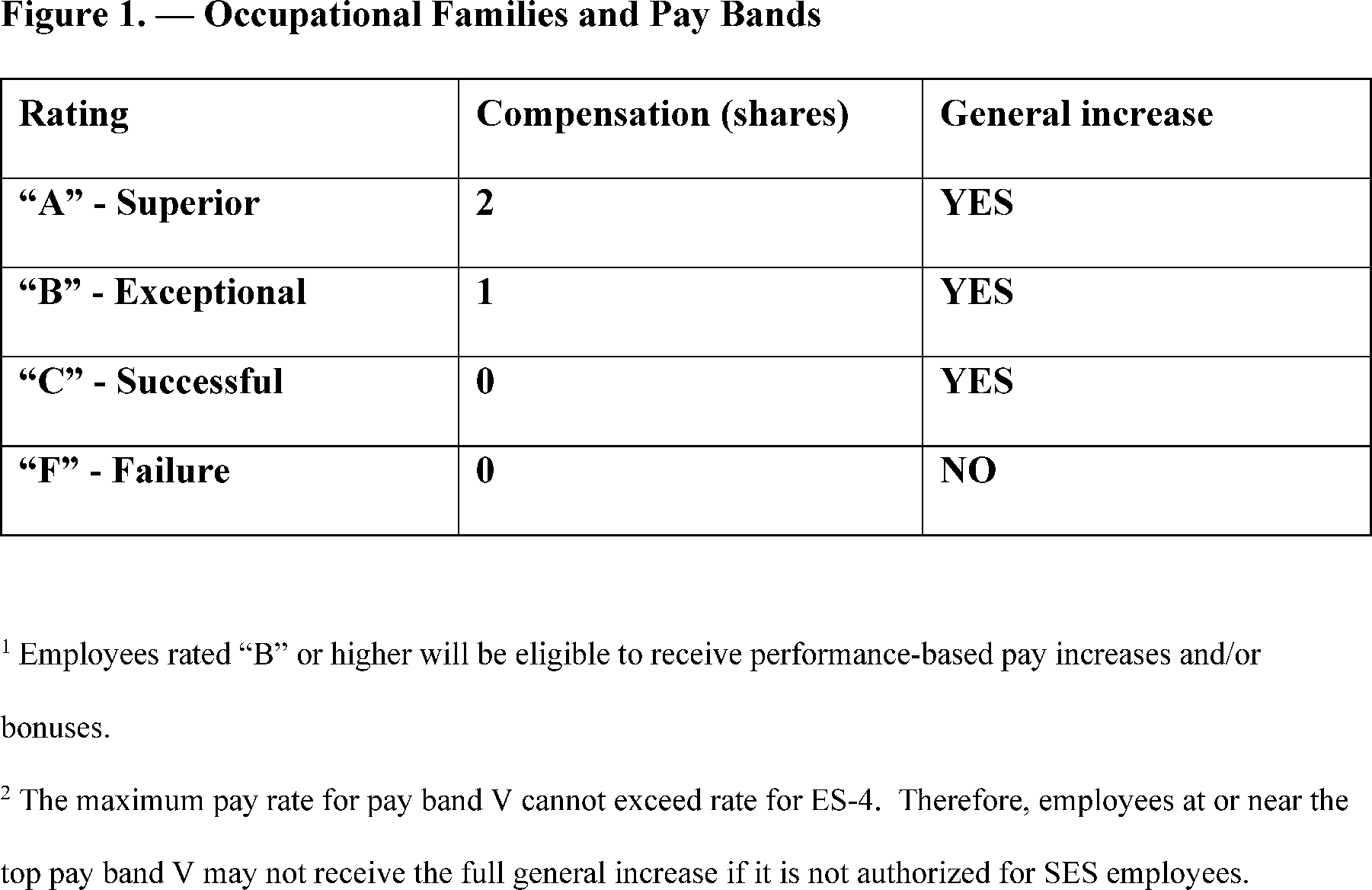
Given the age of the MRDC FRN, is the Fair Labor Standards Act (FLSA) designations still accurate as identified on Figure 1-Occupational Families and Pay Bands?
( printed page 58855)
Response:
No changes to the notice were made based on this question. The FLSA designations listed in the FRN are a guide and should not be used as the official designation. The duties of each position description are reviewed to make the final FLSA determination.
Comment:
Will the DB05 authority still be exercised at the DA level? Are high grade controls still in place
Response:
No changes to the notice were made based on this question. The SSTM, DB-05, authority are authorized in 10 U.S.C. 4091 and 79 FR 43722. The number of DB-05 positions authorized is based on two percent of the number of scientists and engineers employed at the laboratory at the close of the last fiscal year.
Comment:
Voluntary Separation Incentive Payment (VSIP)—authority has not been delegated to sub activity Commanders/Directors; can it be?
Response:
No changes to the notice were made based on this question. The VSIP authority will be delegated accordingly by the agency. No changes to the Notice were made based on this question.
Comment:
What does first line management mean? Does it mean the first line supervisor?
Response:
No changes to the notice were made based on this question. Yes, first line management means the first line supervisor.
Comment:
Recommend rewriting Supervisory Probation period because as written it's confusing on how long the probationary period are.
Response:
The supervisory probationary period has been re-written to clarify the one-year requirement for a supervisory probationary period.
Comment:
A score range of 85 to 100 or an “A” rating is quite broad when considering academic-type rating. Can the cumulative scores for each rating be adjusted and the Alpha character changed to a numerical level? Example: Instead of A superior = 85-100, make it a level 5 outstanding = 90-100?
Response:
No changes to the notice were made based on this question. After the implementation of the DHA R&D STRL, the recommendation to adjust the rating scores will be further explored and if necessary, a minor modification to this FRN will be accomplished.
Comment:
What is DA Form 374? Is it still applicable under DHA? Does Army still use it?
Response:
No changes to the notice were made based on this question. This form is obsolete and no longer used.
Comment:
Recommend references to the Civilian Personnel Advisory Center (CPAC)/Civilian Personnel Operations Center (CPOC) be updated to reflect Civilian Human Resources Service Center (CHRSC) now that the titling has changed.
Response:
References to CPAC/CPOC were updated to the new name of CHRSC, Civilian Human Resources Service Center.
Table of Contents
I. Executive Summary
II. Introduction
A. Purpose
B. Participating Organization
C. Participating Employees
D. Labor Participation
E. Project Design
F. Personnel Management Board
III. Personnel System Changes
A. Broad Banding
B. Classification
C. Pay-for-Performance Management System
D. Hiring and Appointment Authorities
E. Expanded Developmental Opportunities Program
F. Revised Reduction-In-Force (RIF) Procedures
IV. Training
V. Conversion
VI. Project Administration
VII. Project Evaluation
VIII. Required Waivers to Law and Regulation
Appendix A: Occupational Series by Occupational Family
Appendix B: Project Evaluation and Oversight
Appendix C: Performance Elements
Appendix D: Benchmark Performance Standards
I. Executive Summary
This serves as adoption of the USAMRDC STRL PDP plan, including the following modifications approved pursuant to DoD Instruction 3201.05: minor modification to administrative occupational family, DJ-03 and DJ-04 band structure of occupational series 1102 only (February 3, 2011); minor modification to pay for performance payment timeframe (January 5, 2018); minor modification to participating occupational series (November 28, 2022). Upon implementation, the DHA R&D will also utilize the flexibilities published in the following FRNs and any future omnibus flexibilities that are available to all DoW STRLs:
The purpose of the project is to demonstrate that the effectiveness of DoW laboratories can be enhanced by allowing greater managerial control over personnel functions and, at the same time, expanding the opportunities available to employees through a more responsive and flexible personnel system.
B. Participating Organization
This demonstration project will cover approximately 1,224 DHA R&D positions. Approximately 59 percent of covered positions are at the following DHA R&D organizations located at Fort Detrick, Maryland: DHA R&D, Telemedicine and Advanced Technology Research and Medical Research Institute of Infectious Disease. The remaining positions are at the following sites: Medical Research Institute of Chemical Defense, Aberdeen Proving Ground, Maryland; Walter Reed Institute of Army Research, Forest Glen Annex, Silver Spring, Maryland; Institute of Surgical Research and the Burn Center Directorate, Joint Base San Antonio, Texas. These positions transferred to the DHA R&D from the U.S. Army Medical Research and USAMRDC. The DHA R&D has successfully implemented the USAMRDC PDP authorities for the DHA R&D components that were formerly subordinate organizations of USAMRDC. Based on experience gained and following careful consideration, the DHA R&D has determined to conduct a PDP for all DHA R&D components by adopting the USAMRDC PDP plan and other flexibilities available to all DoW STRLs.
C. Participating Employees
The demonstration project includes appropriated funded civilian employees in the competitive and excepted service (to include non-citizens hired in the absence of qualified citizens) paid under the General Schedule (GS) pay system and Interns assigned to the STRL. The project plan does not cover Senior Executive Service employees, Scientific and Professional employees, and Federal Wage System employees Personnel added to the DHA R&D in like positions, either through appointment, promotion, reassignment, change to lower grade or where their functions and positions have been transferred into the DHA R&D, will be converted to the demonstration project.
( printed page 58856)
D. Labor Participation
The DHA R&D will fulfill its obligations to consult and/or negotiate with the designated union as appropriate and applicable in accordance with 5 U.S.C. 4703(f) and 7117.
E. Project Design
In October 1994, the USAMRMC began development of the specifics of this personnel demonstration proposal. A PDP Office was established, and administrative support added in April 1995. Briefings of the proposal were initially conducted for the workforce at every participating subordinate activity with subsequent briefings provided upon request by Commanders/Directors.
Status of the project was provided to subordinate activity Commanders/Directors for dissemination to all employees. An electronic mail address was established in the Fall of 1994 and made available to all employees and managers for the purpose of expressing opinions and/or obtaining specific information about the project. Review of the proposal and input by the U.S. Army Medical Command (MEDCOM), USAMRMC workforce, as well as critical and extensive reviews by Headquarters Department of the Army, the Office of the Secretary of War, and OPM since April 1995, led to the publication of the proposal in the March 12, 1997,
Federal Register
. Subsequently, Public Hearings were held, and comments from interested parties and the workforce were reviewed and considered, culminating in the publication of the final USAMRMC demonstration project plan.
In October 2018, USAMRMC was realigned from MEDCOM to the U.S. Army Materiel Command. On June 12, 2019, the USAMRMC was renamed to the USAMRDC. During the summer of 2019, USAMRDC began reporting to the Army Futures Command (AFC). On December 22, 2019, USAMRDC personnel were realigned to the AFC. On May 5, 2024, USAMRDC personnel were transferred from AFC to the DHA R&D with the exception of three subordinate activities, U.S. Army Research Institute of Environmental Medicine and U.S. Army Aeromedical Research Laboratory, and U.S. Army Medical Materiel Development Activity Program Manager Soldier Medical Devices, which remained with AFC.
F. Personnel Management Board
The DHA R&D intends to establish an appropriate balance between the personnel management authority/accountability delegated to subordinate activity Commanders/Directors and R&D management/oversight responsibilities by establishing a Personnel Management Board (PMB). The Chairperson and members will be appointed by the Director R&D. The PMB will serve to provide oversight, policy, guidelines, corrective action, and evaluation as subordinate activity Commanders/Directors execute the following:
1. Formulate and execute the civilian pay budget;
2. Determine the composition of the pay-for-performance pay pools in accordance with the guidelines of this proposal and internal procedures;
3. Administer funds allocation to pay pool managers;
4. Determine hiring and promotion salaries as well as exceptions to pay-for- performance salary increases;
5. Provide guidance to pay pool managers;
6. Manage the awards pools;
7. Select participants for the Expanded Developmental Opportunities Program, long term training, and any special developmental assignments;
8. Adhere to guidelines concerning the promotion of employees into salary ranges designated “high grades”;
9. Ensure in-house budget neutrality to include tracking of average salaries, FTEs, etc.;
10. Contact the PMB designee for problem resolution, recommending changes in policy/procedure, etc.; and
11. Ensure that all employees are treated in a fair and equitable manner in accordance with all policies, regulations, and guidelines covering this demonstration project.
III. Personnel System Changes
A. Broadbanding
Occupational Families
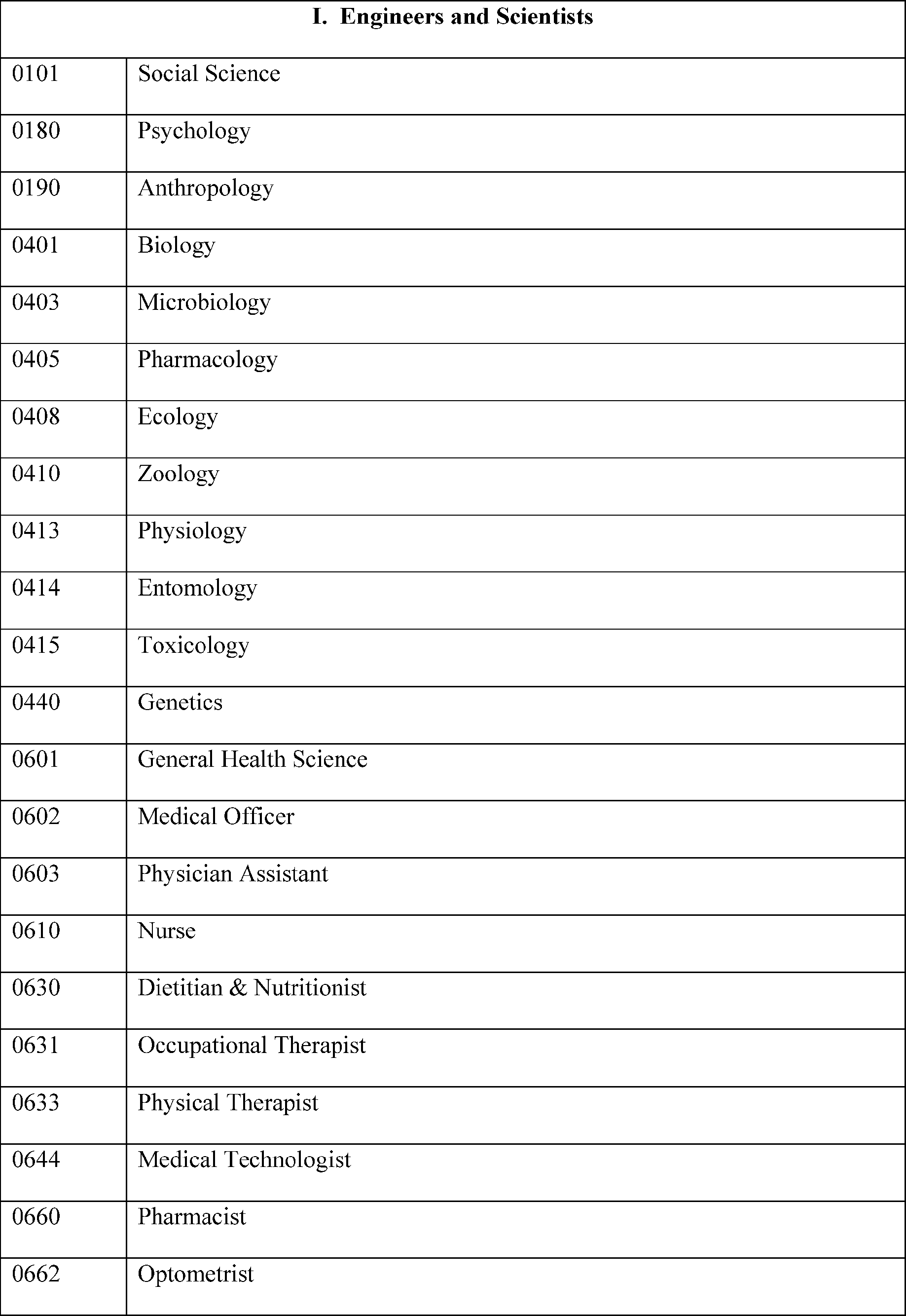
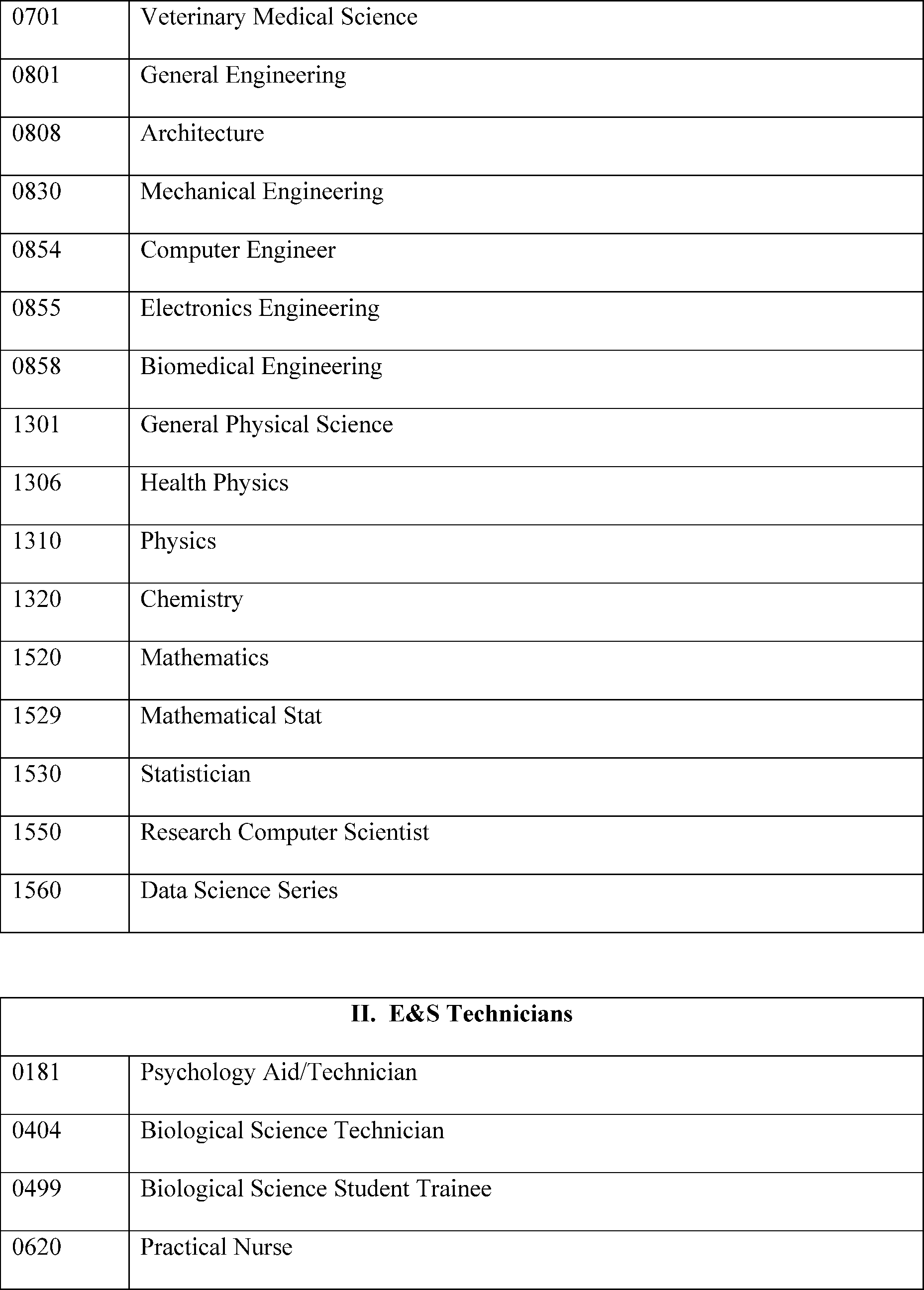
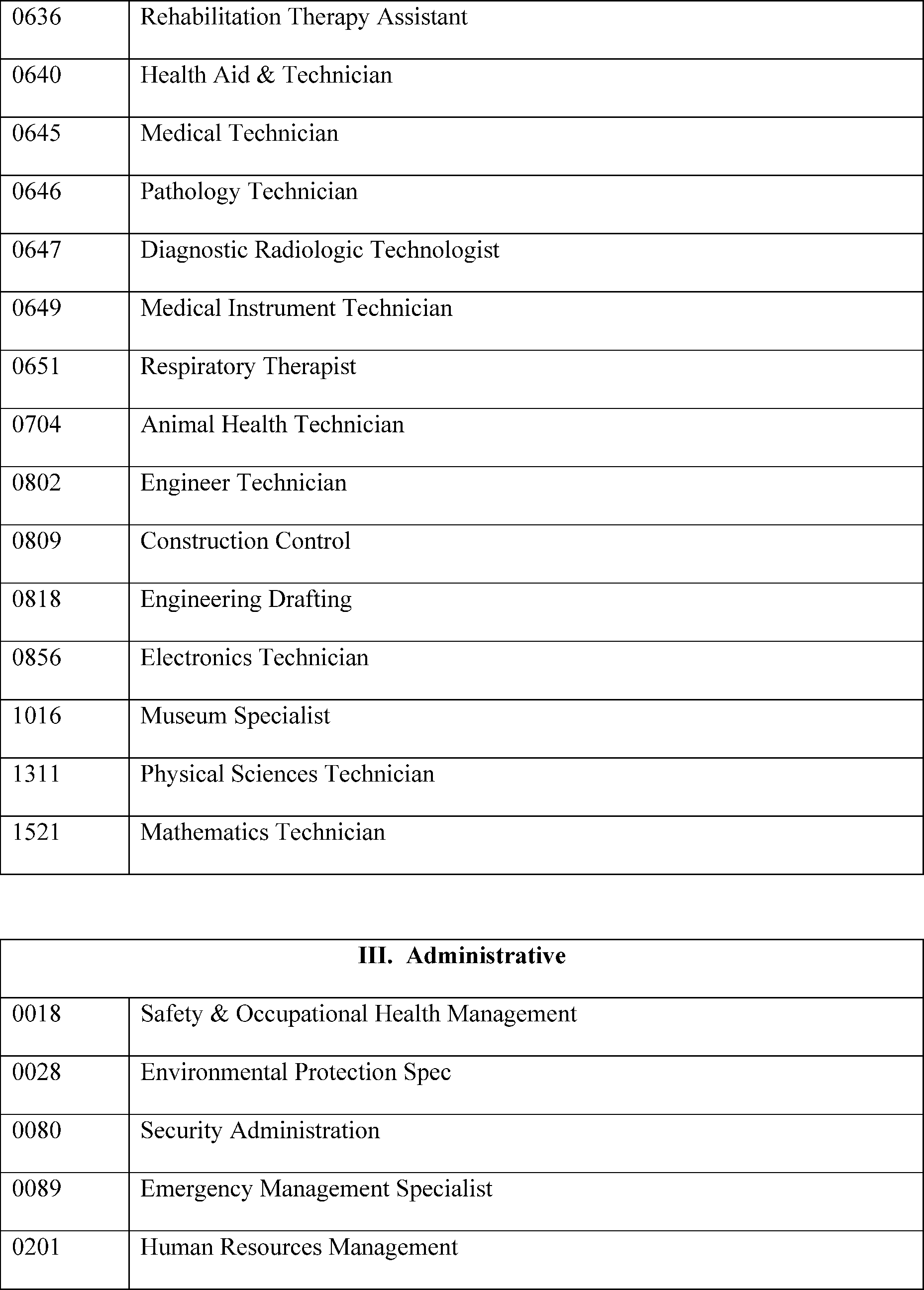
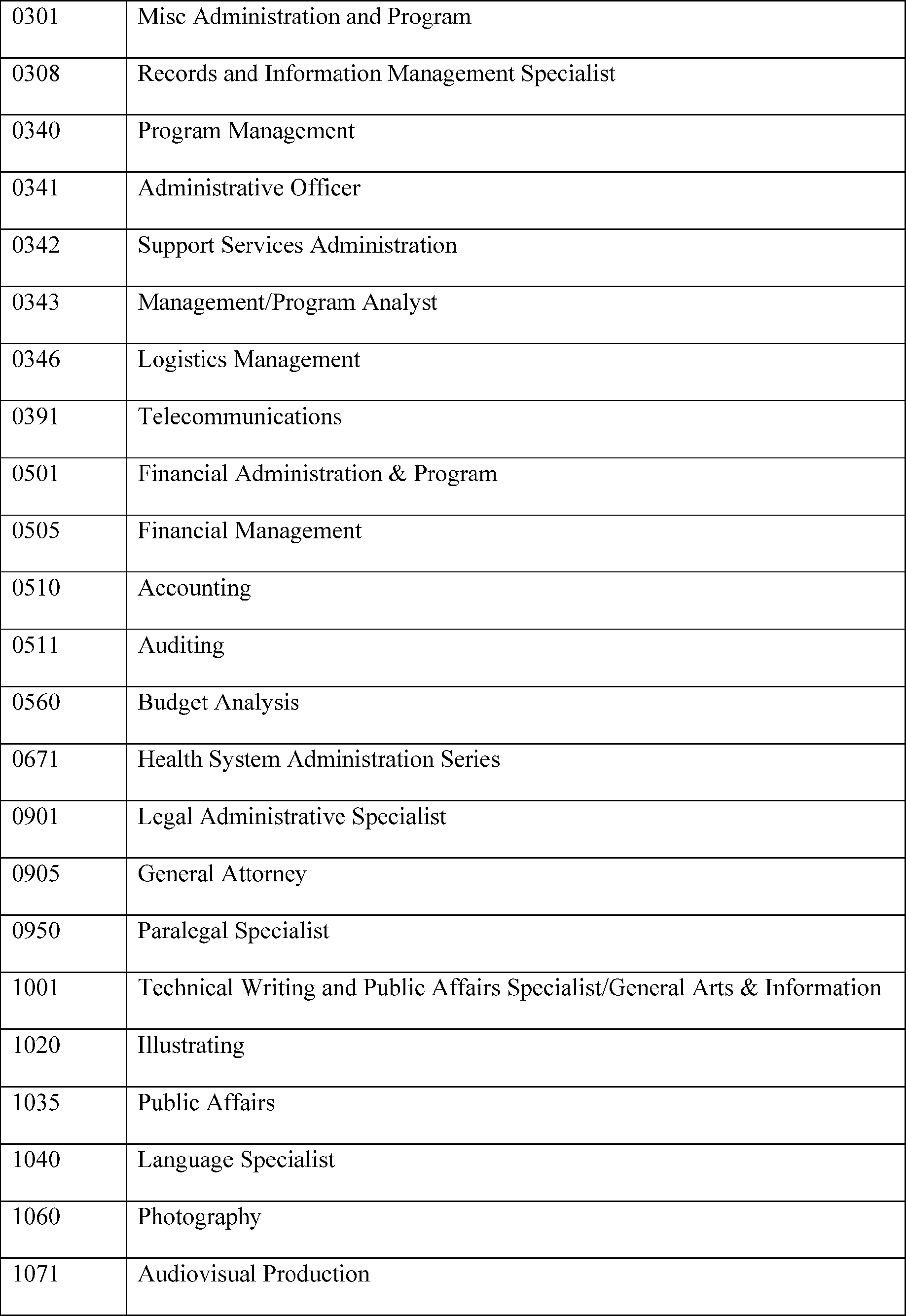
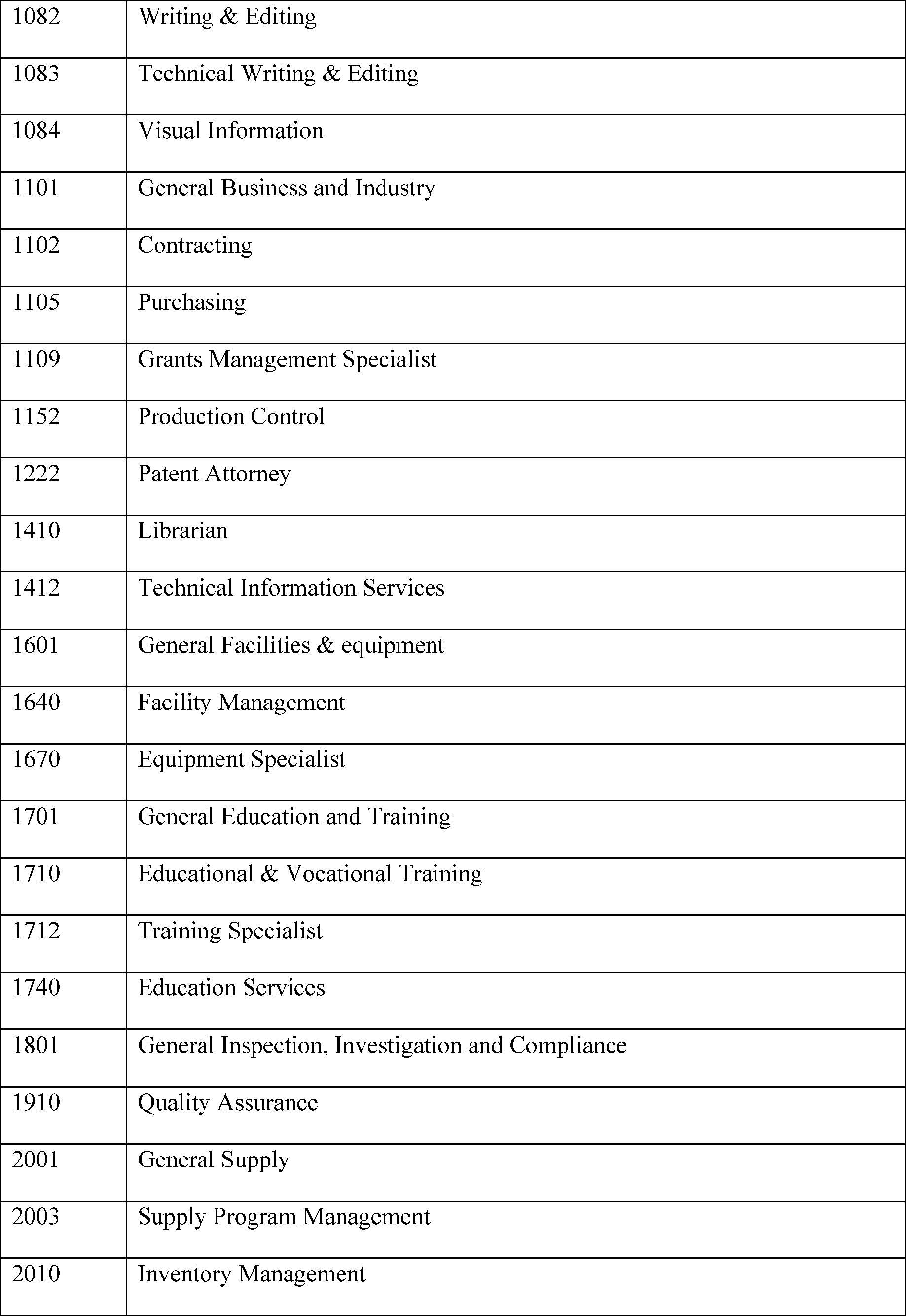
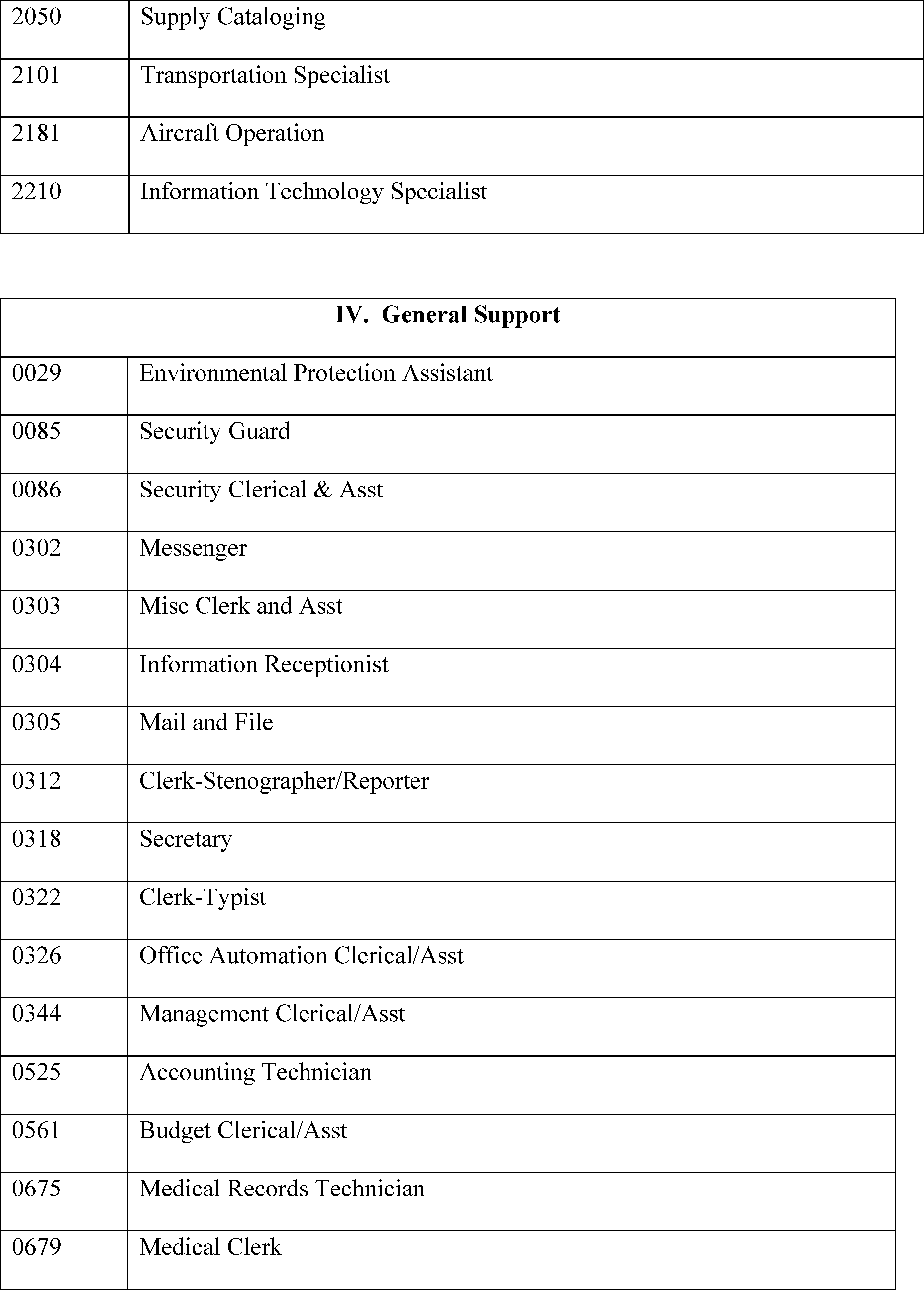
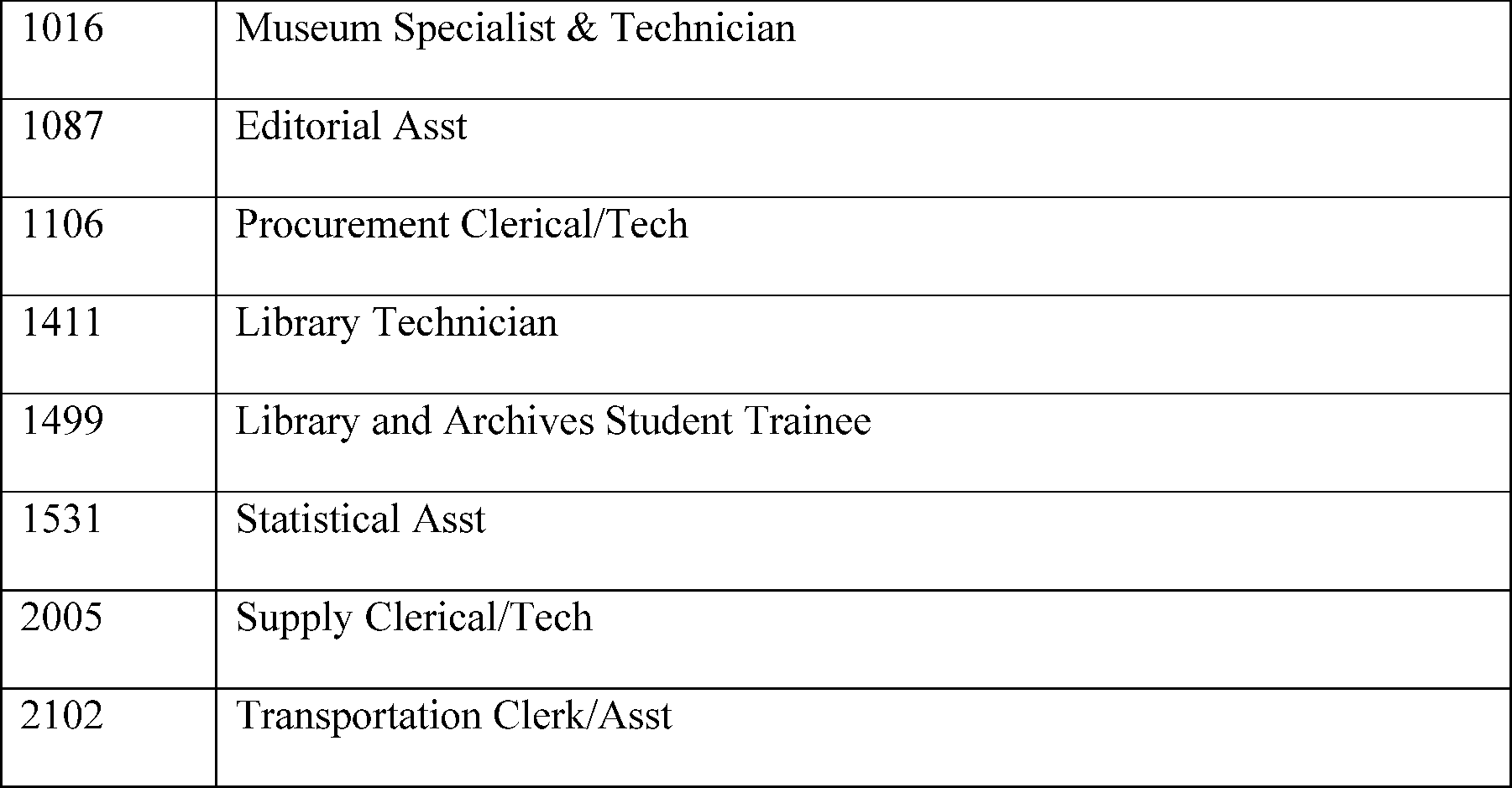
Occupations at the DHA R&D will be grouped into occupational families. Occupations will be grouped according to similarities in type of work and customary requirements for formal training or credentials. The common patterns of advancement within the occupations as practiced at DoW Laboratories and in the private sector will also be considered. The current occupations and grades have been examined, and their characteristics and distribution have served as guidelines in the development of the four occupational families described below. Positions included in each occupational family are listed in Appendix A.
1.
Engineers and Scientists (E&S). This occupational family includes all technical professional positions, such as positions in the biological, physical and social sciences, medical, veterinary, mathematical, and engineering fields. Ordinarily, specific course work or educational degrees are required for these occupations.
2.
E&S Technicians. This occupational family contains specialized functions in fields that provide direct technical support to the scientific/engineering effort. Positions in these occupations may or may not require completion of formal college course work. However, training and skills in the various specialties are generally required.
3.
Administrative. This occupational family contains specialized functions in such fields as management analysis, accounting, budgeting, contracting, purchasing, legal, business and industry, library, quality assurance, and supply. Special skills in administrative fields or special degrees are required.
4.
General Support. This occupational family is composed of positions requiring special skills and knowledge, such as typing, shorthand, or office automation skills, and job-related experience. Clerical work usually involves the processing and maintenance of records. Assistant work requires knowledge of methods and procedures within a specific administrative area. Support functions include positions such as secretary, mail clerk, medical clerk, accounting technician and supply technician.
Pay Bands
Each occupational family will be composed of discrete pay bands (levels) corresponding to recognized advancement within the occupations. These pay bands will replace grades. They will not be the same for all occupational families. Each occupational family will be divided into three to five pay bands, each pay band covering the same pay range now covered by one or more grades. A salary overlap, like the current overlap between GS grades, will be maintained.
Ordinarily, an individual will be hired at the lowest salary in a pay band. Exceptional qualifications, specific organizational requirements, or other compelling reasons may lead to a higher entrance level within a band. The DHA R&D broadbanding plan is expanded to create a Pay Band V of the Engineers and Scientists Occupational Family. This pay band is designed for Senior Scientific Technical Managers (79 FR 43722). Current OPM guidelines of Senior Executive Service (SES) and Scientific and Professional (ST) positions do not fully meet the needs of DHA R&D. The SES designation is appropriate for executive level managerial positions whose
( printed page 58857)
classification exceeds the GS-15 grade level. The primary knowledge and abilities of SES positions relate to supervisory and managerial responsibilities. Positions classified as ST are reserved for bench research scientists and engineers; these positions require a very high level of technical expertise, and they have little or no supervisory responsibility.
The DHA R&D currently has many positions, typically division/directorate chiefs, which have characteristics of both SES and ST classifications. Most division/directorate chiefs in DHA R&D are responsible for supervising other GS-15 positions, including branch chiefs, non- supervisory researcher scientists and engineers, and possibly ST positions. Most division/directorate chief positions are classified at the GS-15 level, although their technical expertise warrants classification beyond GS-15. Because of their management responsibilities, these individuals are excluded from the ST system. Because of management considerations, they cannot be placed in the SES. Management considers the primary requirement for division/directorate chiefs to be knowledge of, and expertise in, the specific scientific and technology areas related to the mission of their divisions/directorates. Historically, incumbents of these positions have been recognized within the community as scientific and engineering leaders, who possess primarily scientific/engineering credentials and are considered experts in their field. However, they must also possess strong managerial and supervisory abilities. Therefore, although some of these employees have scientific credentials that might compare favorably with ST criteria, classification of these positions as STs is not an option, because the managerial and supervisory responsibilities inherent in the positions cannot be ignored.
The purpose of Pay Band V (which will reinforce the equal pay for equal work principle) is to solve a critical classification problem. It will also contribute to an SES “corporate culture” by excluding from the SES positions for which technical expertise is paramount. Pay Band V proposes to overcome the difficulties identified above by creating a new category of positions, the Senior Scientific Technical Manager, which has both scientific/technical expertise and full managerial and supervisory authority. Current GS-15 division/directorate chiefs will convert into the demonstration project at Pay Band IV. After conversion, they will be reviewed against established criteria to determine if they should be reclassified to Pay Band V. Other positions possibly meeting criteria for classification to Pay Band V will be reviewed on a case-by-case basis. The salary range is a minimum of 115 percent of the minimum rate of basic pay for GS-15 with a maximum rate of basic pay established at the rate of basic pay (excluding locality pay) for SES level 4 (EX-4). Vacant positions in Pay Band V will be competitively filled to ensure that selectees are preeminent researchers and technical leaders in the specialty fields who also possess substantial managerial and supervisory abilities. Panels will be created to assist in filling Pay Band V positions. Panel members will be selected from a pool of current DHA R&D senior military and SES members, ST employees, and later those in Pay Band V, and the unit Commander to ensure impartiality, breadth of technical expertise, and a rigorous and demanding review. The panel will apply criteria developed largely from the current OPM Research Grade Evaluation Guide for positions exceeding the GS-15 level.
The pay bands for the occupational families and how they relate to the current GS grades are shown in Figure 1. Application of the FLSA within each pay band is also shown in Figure 1. It should be noted that for recruitment and retention reasons for the occupational series 1102 and 1105, the DJ-03 pay band range will be GS-11 through GS-13, and DJ-04 is GS-14. This pay-band concept has the following advantages:
1. It reduces the number of classification decisions required during an employee's career.
2. It simplifies the classification decision-making process and paperwork. A pay band covers a larger scope of work than a grade and thus will be defined in shorter and simpler language.
3. It supports delegation of classification authority to line managers.
4. It provides a broader range of performance-related pay for each level. In many cases, employees whose pay would have been frozen at the top step of a grade will now have more potential for upward movement in the broader pay band.
5. It prevents the progression of low performers through a pay band by mere longevity, since job performance serves as the basis for determining pay.
( printed page 58858)
FLSA
The FLSA exemption and non-exemption determinations will be made consistent with criteria found in 5 CFR part 551. Supervisors with classification authority will make the determinations on a case-by-case basis with reference to documentation in the operating procedures manual and the advice and assistance of the CHRSC. The generic position description benchmark will not be the sole basis for the determination. The basis for exemption/non-exemption will be documented and annotated on each description. Exemption criteria will be narrowly construed and applied only to those employees who clearly meet the spirit of the exemption. The basis for determinations will be reviewed as a part of the performance review process and when salary adjustments are warranted. Changes will be documented and provided to the CHRSC, as appropriate.
Simplified Assignment Process
Today's environment of rightsizing and workforce transition mandates that the DHA R&D have maximum flexibility to assign duties and responsibilities to individuals. Broad banding can be used to address this need. As a result of the assignment to a particular level descriptor, the organization will have maximum flexibility to assign an employee with no change in basic pay, within broad descriptions consistent with the needs of the organization, and the individual's qualifications and rank or level. Subsequent assignments to projects, tasks, or functions anywhere within the organization requiring the same level and area of expertise, and qualifications would not constitute an assignment outside the scope or
( printed page 58859)
coverage of the current level descriptor, or benchmark position description.
Such assignments within the coverage of the generic descriptors are accomplished without the need to process a personnel action. For instance, a technical expert can be assigned to any project, task, or function requiring similar technical expertise. Likewise, a manager could be assigned to manage any similar function or organization consistent with that individual's qualifications. This flexibility allows a broader latitude in assignments and further streamlines the administrative process and system.
Promotions
A promotion is the movement of an employee to a higher pay band within the same occupational family, or to a pay band in a different occupational family, which results in an increase in the employee's salary. Progression within a pay band is based upon performance pay increases; as such, these actions are not considered promotions and are not subject to the provisions of this section.
Promotions will be processed under competitive procedures in accordance with merit principles and requirements. The following actions are excepted from competitive procedures:
(a) Re-promotion to a position which is in the same pay band and occupational family as the employee previously held on a permanent basis within the competitive service.
(b) Promotion, reassignment, demotion, transfer, or reinstatement to a position having promotion potential no greater than the potential of a position an employee currently holds or previously held on a permanent basis in the competitive service.
(c) A position change permitted by reduction-in-force procedures.
(d) Promotion without current competition when the employee was appointed through competitive procedures to a position with a documented career ladder.
(e) A temporary promotion, or detail to a position in a higher pay band, of 180 days or less.
(f) Impact of person on the job, accretion of duties, or Factor IV process (application of the Research Grade Evaluation Guide, Equipment Development Grade Evaluation Guide or similar guides) promotions.
(g) A promotion resulting from the correction of an initial classification error or the issuance of a new classification standard.
Link Between Promotion and Performance
To be promoted competitively or noncompetitively from one band to the next, an employee must meet the minimum qualifications for the job and have a current performance rating of “B” or better (see Performance Evaluation) or equivalent under a different performance management system.
B. Classification
Introduction
The objectives of the classification system are to simplify the classification process, make the process more serviceable and understandable, and place more decision-making authority and accountability with line managers. All positions listed in Appendix A will be in the classification structure. Provisions will be made for including other occupations as employment requirements change in response to changing missions and technical programs.
Occupational Series
The present GS classification system has over 400 occupations (also called series), which are divided into 22 groups. The occupational series will be maintained. New series, established by OPM, may be added as needed to reflect new occupations in the workforce. Appendix A lists the occupational series currently represented at the DHA R&D by occupational family.
Classification Standards
The DHA R&D will use a classification system that is used by the USAMRDC STRL personnel demonstration project. The present classification standards will be used to create local benchmark position descriptions for each pay band, reflecting duties and responsibilities comparable to those described in present classification standards for the span of grades represented by each pay band. There will be at least one benchmark position description for each pay band. A supervisory benchmark position description will be added to those pay bands that include supervisory employees. Present titles and series will continue to be used to recognize the types of work being performed and educational backgrounds and requirements of incumbents. Locally developed specialty codes and OPM functional codes will be used to facilitate titling, making qualification determinations, and assigning competitive levels to determine retention status.
Position Descriptions and Classification Process
The R&D Director will have delegated classification authority and will redelegate this authority to subordinate activity Commanders/Directors for redelegation to activity managers as appropriate. New position descriptions will be developed to assist managers in exercising delegated position classification authority. Managers will identify the occupational family, job series, the functional code, the specialty code, pay band level, and the appropriate acquisition codes. Specialty codes will be developed by Subject Matter Experts to identify the special nature of work performed. Functional codes are those currently found in the OPM Introduction to the Classification Standards which defines certain kinds of activities,
e.g.,
Research, Development, Test and Evaluation, etc., and covers E&S.
Classification Appeals
An employee may appeal the occupational series or pay band level of his or her position at any time. An employee must formally raise the areas of concern to supervisors in the immediate chain of command, either verbally or in writing. If an employee is not satisfied with the supervisory response, he or she may then appeal to the DoW appellate level. If an employee is not satisfied with the DoW response, he or she may then appeal to the OPM, only after DoW has rendered a decision under the provisions of this demonstration project. Appellate decisions from OPM are final and binding on all administrative, certifying, payroll, disbursing, and accounting officials of the Government. Time periods for case processing under Title 5 apply. An employee requesting a classification decision that would exceed the equivalent of a GS-15 level may not submit the appeal to OPM.
An employee may not appeal the assignment of the occupational series to an occupational family; the accuracy of the occupational family; the title of a position; the accuracy of the position description; the demonstration project classification criteria, or the pay-setting criteria; the propriety of a salary schedule; or matters grievable under an administrative or negotiated grievance procedure or an alternative dispute resolution procedure. The evaluation of classification appeals under this demonstration project are based upon the demonstration project classification criteria. Case files will be forwarded for adjudication through the CHRSC providing personnel services and will
( printed page 58860)
include copies of appropriate demonstration project criteria.
C. Pay-for-Performance Management System
Performance Evaluation
Introduction
The performance appraisal system will link compensation to performance through annual performance evaluations and performance ratings. The performance appraisal system will allow optional use of peer evaluation input and/or input from subordinates whenever appropriate. The system will have the flexibility to be modified, if necessary, as more experience is gained under the project. Details of the system may be found in the implementation instructions.
Performance Objectives
Performance objectives are statements of job responsibilities based on the work unit's mission, goals, and supplemental benchmark position descriptions. Employees and supervisors will jointly develop performance objectives which will reflect the types of duties and responsibilities expected at the respective pay level. Absent agreement between employees and supervisors, final authority to establish performance objectives and element weights rests with management. The performance objectives, representing joint efforts of employees and their rating chains, should be in place within 30 days from the beginning of each rating period.
Performance Elements
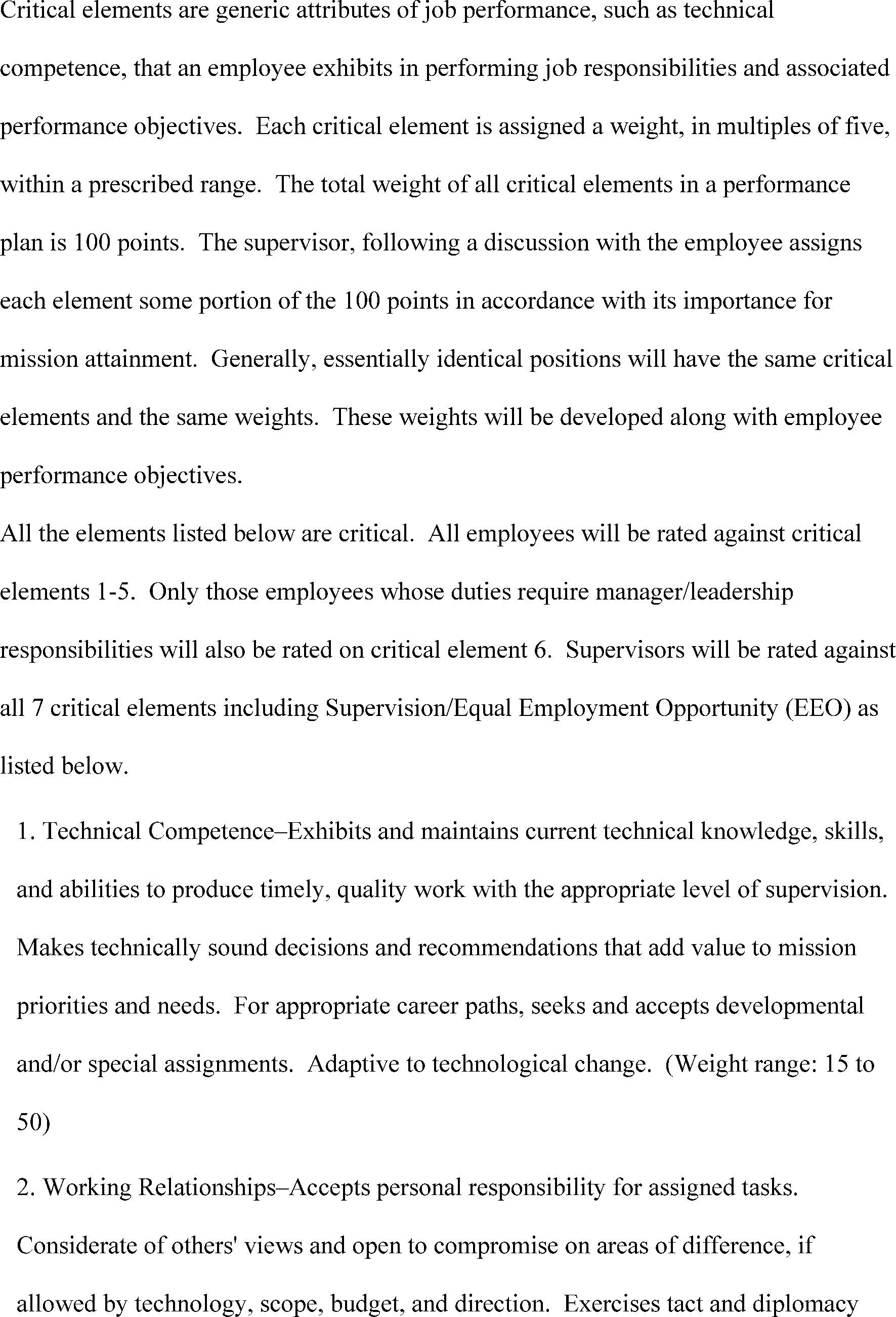
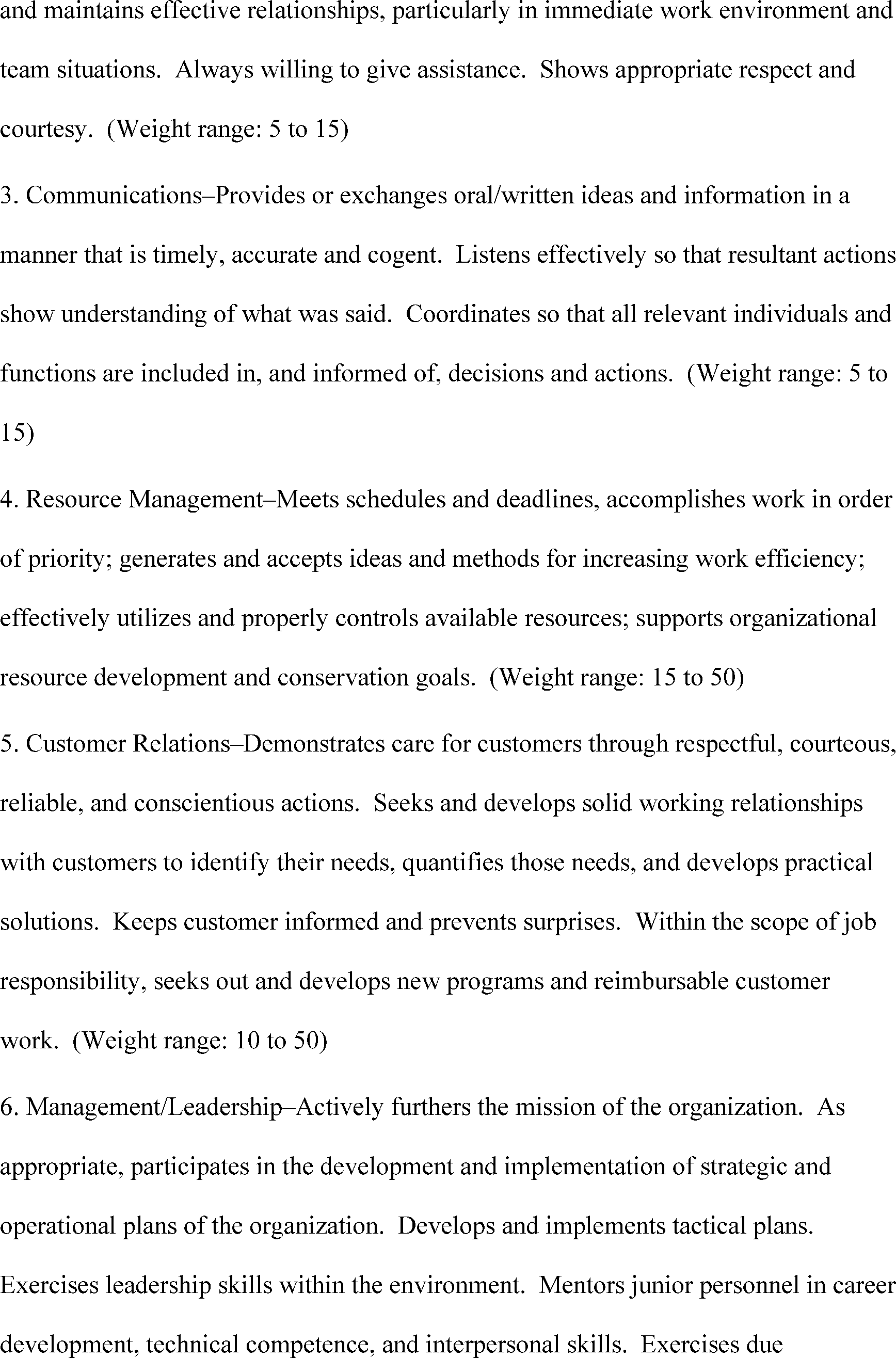
Performance elements and rating forms have been designed to implement a scoring and rating system. The performance evaluation system will be based on critical performance elements defined in Appendix C. All elements in the performance evaluation system are critical. Non-critical elements will not be used. Each performance element is assigned a weight between a specified range. The total weight of all elements in a performance plan is 100 points. The supervisor assigns each element some portion of the 100 points in accordance with its importance for mission attainment. These weights will be developed along with employee performance objectives.
Mid-Year Review
A mid-year review between a supervisor and employee will be held to determine whether objectives are being met and whether performance objectives should be modified to reflect changes in planning, workload, and resource allocation. Additional reviews may be held throughout the rating cycle; to include possible changes in assigned weights, if necessary.
Performance Appraisal
A performance appraisal is scheduled for the final weeks of the annual performance cycle. A special performance appraisal may be conducted at any time prior to the final weeks of the performance cycle if the employee has been on approved standards for a minimum of 60 days. Other instances that would warrant a special performance appraisal will be identified in the Internal Operating Procedures. The performance appraisal process brings supervisors and employees together for formal discussions on performance and results in (1) written appraisals, (2) performance ratings, (3) performance pay increases and/or bonuses, (4) cash awards, and (5) other individual performance-related actions, as appropriate. A performance appraisal will consist of two meetings held between employee and supervisor: the performance review meeting and the evaluation feedback meeting.
Performance Review Meeting Between Employee and Supervisor
The review meeting is to discuss job performance and accomplishments. Supervisors do not assign scores, ratings, pay increases, or awards at this meeting. The supervisor notifies the employee of the review meeting in time to allow the employee to prepare a list of accomplishments. Employees will be given an opportunity at the meeting to give a personal performance assessment and describe accomplishments. The supervisor and employee discuss job performance and accomplishments in relation to the performance elements, objectives, and planned activities established in the performance plan.
Evaluation Feedback Meeting Between Employee and Supervisor
In this second meeting between employee and supervisor, the supervisor informs the employee of management's appraisal of the employee's performance, the employee's performance score and rating, and any recommended related pay increase, bonus, award, or other personnel action. During this second meeting, the supervisor and employee will discuss and document performance objectives for the next rating period.
Performance Scores
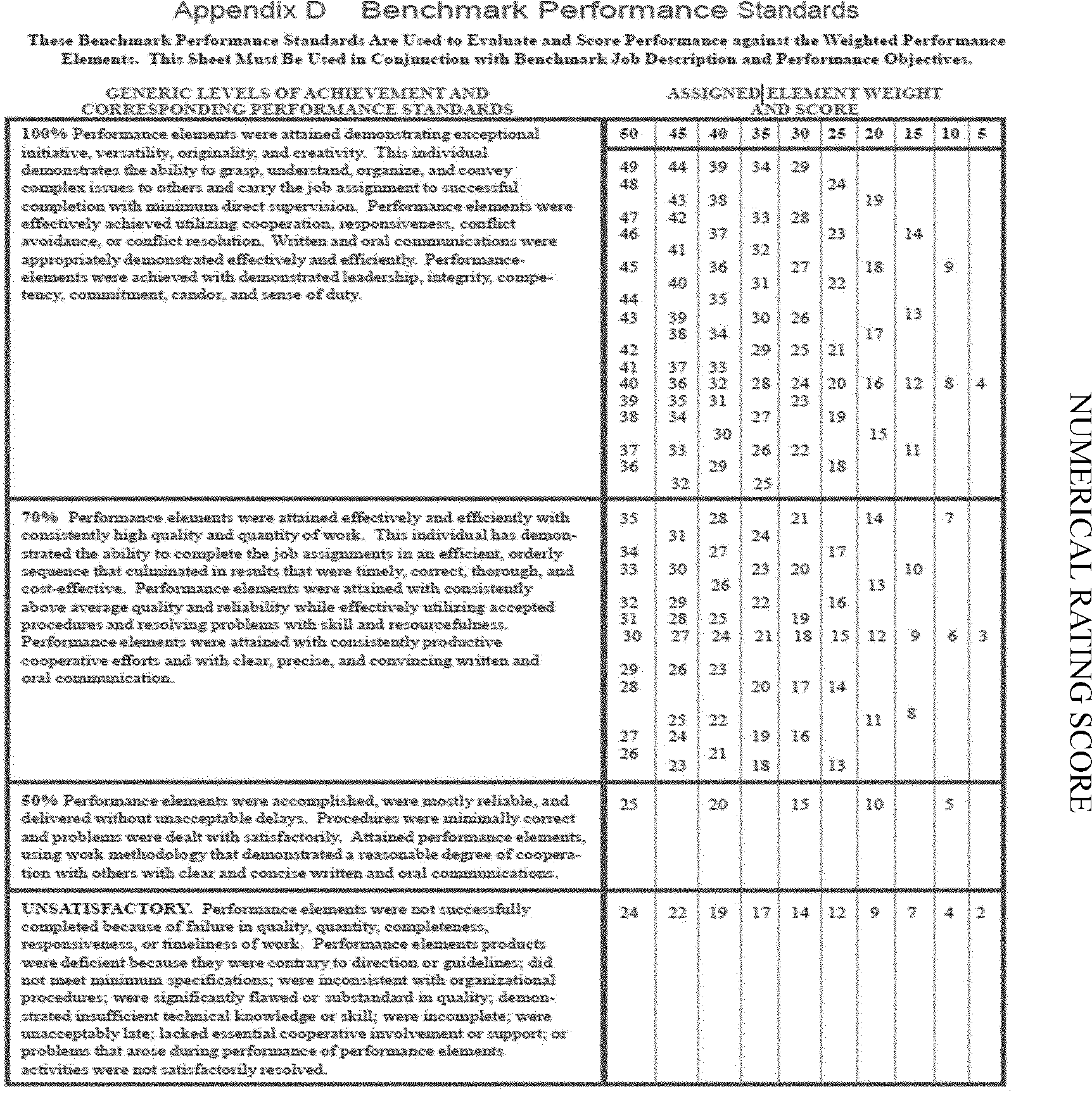
Selection of the weighted points to assign to an employee's performance is assisted by use of benchmark performance standards (Appendix D). Each benchmark performance standard describes the level of performance associated with a particular point on a rating scale. Supervisors may add supplemental standards to the performance plans of the employees they supervise to further elaborate the benchmark performance standards. The overall score is the sum of the individual element scores. Employees will receive an academic-type rating of “A,” “B,” “C,” or “F” depending upon the percentage of goal attainment and overall cumulative score. The academic-type ratings will be used to determine pay or bonus values. These summary ratings are representative of Pattern E in Summary Level Chart in 5 CFR 430.208(d)(1). This rating will become the rating of record, and
(1) Employees rated “B” or higher will be eligible to receive performance-based pay increases and/or bonuses; and
(2) Employees rated “F” will not receive the general increase or be eligible to receive performance-based pay increases and/or bonuses. A rating of “A” will be assigned for cumulative scores of 85 to 100 points, “B” for cumulative scores of 70 through 84, and “C” for cumulative scores of 50 through 69. An overall rating of “F” indicates failure to perform at the 50 percent level for any one of the assigned weighted elements. (In such a case, even though the cumulative score may exceed 49, the employee will nonetheless receive an overall rating of “F.” NOTE: An “F” constitutes an unacceptable rating).
( printed page 58861)
Performance Based Actions
The DHA R&D will implement a two-step process to deal with poor performers. This process may lead to involuntary separation if the employee receives a score of less than 50 percent of the points for any weighted element. The process will begin with the acknowledgement that an employee's performance is unacceptable (any element that would be rated at less than the 50 percent level of its assigned benchmark rate). The two steps are as follows: (1) Performance Improvement Plan (PIP), and (2) either change in assignment (optional), reduction in pay or grade (optional) or separation. When the employee is determined to be performing below the 50 percent level for any element, the supervisor and the employee will develop a structured PIP that will be monitored for a reasonable period of time. If the employee fails to improve during the PIP, the employee will be given notice of proposed appropriate action. The activity may consider a change in assignment or reduction in pay or grade as opposed to removal if the mission, organizational structure and available resources warrant such action. Separated employees have due process recourse.
Note:
Performance based adverse actions may be taken under 5 U.S.C. chapter 43 (Performance Appraisal) or chapter 75 (Adverse Actions).
If a PIP ends prior to the end of the annual performance cycle and the employee's performance improves to the 50 percent or above level in all assigned elements, the employee is appraised again at the end of the annual performance cycle.
If, in conjunction with the completion of the PIP, the employee attains an annual rating of “C” or higher, they will receive the annual general increase. In addition, employees attaining an annual rating of “B” or higher will be eligible for an increase to base-pay and/or bonus.
If a PIP ends after the end of the annual performance cycle and the employee's performance has improved to the 50 percent or above level in all assigned elements, employment continues, but no retroactive annual general increase, performance base pay increase or performance bonus is granted for that performance cycle. No new appraisal will be created to replace the failing rating, and the Defense Civilian Personnel Data System (DCPDS) will not be updated to change the rating from “F” to “C” or higher. Upon improvement, the employee will be placed on a performance plan for the next rating cycle, which will begin on July 1 through the end of the rating cycle (June 30).
Employee Relations
Employees covered by the project will be evaluated under a performance evaluation system that affords administrative grievance rights. The DHA R&D will maintain the substantive and procedural appeal rights currently afforded when taking action for misconduct and poor performance.
Awards
The DHA R&D currently has an extensive awards program consisting of both internal and external awards. While not linked to the pay-for-performance system, awards will continue to be given for special acts and other categories as they occur. Awards may include, but are not limited to, special acts, patents, suggestions, on-the-spot, and time-off, and may be modified or expanded as appropriate. Major Command and DoW awards and other honorary noncash awards will be retained. In an effort to foster and encourage teamwork among its employees, a Commander/Director may allocate a sum of money to a team for outstanding completion of a special task or significant achievement, and the team may decide the individual distribution of the total dollars among themselves.
Pay Administration Introduction
The objective is to establish a pay system that will improve the ability of the DHA R&D to attract and retain quality employees. The system will be a pay-for-performance system and, will result in a distribution of performance pay resources based upon individual performance.
( printed page 58862)
Pay-for-Performance
The DHA R&D will use a simplified performance appraisal system that will permit both the supervisor and the employee to focus on quality of the work. This system will permit the manager/supervisor to base compensation on performance or value added to the goal of the organization rather than on longevity and risk aversion. This system will also allow managers to withhold pay increases from nonperformers, thereby giving the nonperformers the incentive to improve performance or leave government service. Pay-for-performance has two components: Performance pay increases (
i.e.
base pay increases) and/or bonuses. All covered employees will be given the full amount of locality pay adjustments (as applicable) when they occur, regardless of performance. The funding for performance pay increases and/or bonuses is composed of money previously available for within-grade increases, quality step increases, and promotions from one grade to another when the grades are now in the same pay band.
Performance Pay Pool
The funding in the performance pay pool will be used for base pay increases and/or performance bonus pay. The payouts made to employees from the performance pay pool may be a mix of base pay increases, subject to the pay ceiling in the pay bands, and bonus payments. The Headquarters (HQ), DHA R&D Comptroller, in conjunction with each subordinate activity Commander/Director, will calculate the total performance pay pool and allocate pay pools to subordinate activities. Each subordinate activity Commander/Director will allocate pay pools to organizational units or teams as appropriate.
A pay pool manager is accountable for staying within pay pool limits. The pay pool manager assigns pay increases and/or bonuses to individuals on the basis of an academic-type rating, the value of the performance pay pool resources available, and the individual's current basic rate of pay within a given pay band. A pay pool manager may request approval from the Commander/Director or his/her designee to grant a higher performance pay increase/performance bonus than is generated by the compensation formula to recognize an employee's extraordinary achievement (also known as payout above) or to provide accelerated compensation for local interns.
A performance payout will be initially calculated for each individual based upon a pay pool assignment that will be composed of monies outlined previously. For illustration purposes, approximately 2.4 percent of the value of the combined basic rates of pay of the assigned employees will be used. A share will be calculated so that a pay pool manager will not exceed the resources that are available in the pay pool. The performance payout for an individual will be determined as follows:
Pool Value * SALi * Ni
Individual Performance Payout =
SUM (SALj * Nj);
j=1 to n
Where:
Pool Value = 0.024 * SUM (SALk); K = 1 to n
n = number of employees in pay pool
N = Number of Shares (0-2) earned by an employee based on their performance rating
SAL = An individual's basic rate of pay
SUM = The summation of the entities in parenthesis over the range indicated
i = individual
To illustrate the formula, the basic rates of pay of the 10 employees in a pay pool, who each earn $50,000 per year, total to $500,000. The employees earned a total of 15 shares based on their ratings (5 individuals earned an “A” rating, and 5 individuals earned a “B” rating). The pay pool value is then 2.4 percent of the sum of $500,000, or $12,000. The individual performance payout being determined is for an individual who earns $50,000 per year and receives an “A” on the appraisal, thus earning 2 shares. Using the formula, the individual performance payout is calculated by multiplying the pay pool value, $12,000, by the individual basic rate of pay, $50,000, by the number of shares earned, 2. This product is divided by the sum of the products of the individual basic rates of pay times the number of shares earned, or 750,000. The resulting individual performance payout is $1,600 for the year.
An annual performance base pay increase could be all, none, or part of the compensation formula depending on the current basic rate of pay of the employee. Annual performance base pay increases will be limited to the difference between the particular band pay cap and the employee's current basic rate of pay, or total dollar value of shares, whichever is less, with the balance converted to a performance bonus. This means that employees whose basic rates of pay have reached the upper limits of a particular pay band will receive most performance compensation as a performance bonus. Cash bonuses will not become a part of the employee's basic rate of pay. Employees receiving retained rates are subject to special rules governing basic pay adjustments. An employee receiving a retained rate whose performance rating is “F” at the time of a general pay increase will receive no increase in the retained rate. All other employees receiving a retained rate will receive a general pay increase equal to 50 percent of the amount of the increase in the maximum rate of basic pay payable for the pay band of the employee's position.
Payout Above
A pay pool manager may request approval from the Commander/Director or his/her designee to grant a higher performance pay increase/performance bonus than is generated by the compensation formula to recognize an employee's extraordinary achievement (also known as payout above) or to provide accelerated compensation for local interns. The payout above will be calculated outside the mass pay process. If a payout above is awarded the payout may be paid as a base pay increase, subject to the pay ceiling in the pay bands, and/or a bonus.
Supervisory Bonus
Supervisory bonuses of up to 10 percent of the basic rate of pay may be paid at the discretion of Commanders/Directors to supervisors with employees in the same pay band. In exceptional cases (approved by HQ, DHA R&D), supervisors who do not have employees in the same pay band may be compensated up to five percent of basic rate of pay. Employees who qualify for the bonus include supervisors in all occupational families with formal supervisory authority meeting that required for coverage under the OPM GS Supervisory Guide. The supervisory bonus is to recognize supervisory responsibilities required of supervisors most often receiving the same pay as non-supervisory subordinates. There are two situations in which a supervisory bonus may be warranted:
1. Supervisors may be granted up to 10 percent of the basic rate of pay if they supervise employees within the same pay band, or
2. Up to five percent of the basic rate of pay for those supervising employees in lower or other pay bands.
Note:
Pay band V employees in the E&S occupational family are excluded. Bonuses, which must be negotiated annually, will not
( printed page 58863)
be treated as basic pay and are not a part of the performance pay pool.
Because the bonus is paid at the beginning of the appraisal period, if the individual leaves a supervisory position or is removed from supervisory responsibilities (unless affected through RIF action), the prorated portion of the bonus for the non-supervisory portion of the performance year will be recovered as a debt due the Government. Before any supervisory bonus is paid, the supervisor (employee) will sign an agreement to make any required repayment.
Pay and Compensation Ceilings
An employee's total monetary compensation paid in a calendar year may not exceed the basic rate of pay paid in Level I of the Executive Schedule consistent with 5 U.S.C. 5307 and 5 CFR part 530, subpart B. In addition, each pay band will have its own pay ceiling, just as grades do in the GS system. Pay rates for the various pay bands will be directly keyed to the GS rates, except the maximum rate for pay band V of the engineer and scientist occupational family which cannot exceed EX4. Basic pay will be limited to the maximum rates payable for each pay band, except for retained rates as previously described.
Pay Setting for Promotion
The minimum basic pay increase upon promotion to a higher pay band will be six percent or the minimum rate of the new pay band. The maximum amount of pay increase upon promotion will not exceed $10,000 or the minimum rate of the new pay band. When a temporary promotion is terminated, the employee's pay entitlements will be redetermined based on the employee's position of record, with appropriate adjustments to reflect pay events during the temporary promotion, subject to the specific policies and rules established by DHA R&D. In no case may those adjustments increase the pay for the position of record beyond the applicable pay range maximum rate.
Placement in a Lower Pay Band
Employees who receive 50 percent or less of an assigned benchmark score in any element or who are on a performance improvement plan at the time pay determinations are made, do not receive performance payouts or the general increase. This action may result in a base salary that is identified in a lower pay band. This occurs because the minimum rates of basic pay in a pay band increase as the result of the general increase (5 U.S.C. 5303). This situation, (a reduction in band level with no reduction in pay) will not be considered an adverse action, nor will band retention provisions apply.
D. Hiring and Appointment Authorities
Hiring Authority
A candidate's basic eligibility will be determined using OPM's Qualification Standards Handbook of GS Positions. Candidates must meet the minimum standards for entry into the pay band. For example, if the pay band includes positions in grades GS-5 and GS-7, the candidates must meet the qualifications for positions at GS-5 level. Specific experience/education required will be determined based on whether a position to be filled is at the lower or higher end of the band. Selective placement factors may be established when determined to be critical to successful job performance. These factors must be communicated to all candidates for specific vacancies and must be met for basic eligibility. As a general rule, appointments will be made at the entry level of the pay band and pay will be set at the lowest level in a pay band.
Appointments made above the minimum level will be based upon superior qualifications of the candidate. A candidate appointed toward the higher end of a pay band should have qualifications approaching the lowest GS grade incorporated into the next higher pay band. For example, a person appointed at the higher end of Pay Band II in the E&S Occupational Family would have education, experience, or a combination of the two, approaching the qualifications of the GS-13 level, which is the lowest GS grade incorporated into Pay Band III.
Appointment Authority
Under the demonstration project, there will continue to be career, and career conditional appointments. These appointments will use existing authorities and entitlements. Non-permanent positions (exceeding one year) needed to meet fluctuating or uncertain workload requirements will be filled using a Contingent Employee appointment authority.
Employees hired for more than one year, under the contingent employee appointment authority are given term appointments in the competitive service for no longer than five years. The DHA R&D Commander is authorized to extend a contingent appointment one additional year. These employees are entitled to the same rights and benefits as term employees and will serve a one year probationary period. The Pay-for-Performance Management System outlined in this Plan applies to contingent employees. Appointment will be made under the same appointment authorities and process as regular term appointments, but recruitment bulletins must indicate that there is a potential for conversion to permanent employment.
Employees hired under the contingent employee authority may be eligible for conversion to career-conditional appointments. To be converted, the employee must (1) have been selected for the term position under competitive procedures, with the announcement specifically stating that the individual(s) selected for the term position(s) may be eligible for conversion to career-conditional appointment at a later date; (2) served two years of substantially continuous service in the term position; (3) be selected under merit promotion procedures for the permanent position; and (4) have a current rating of “B” or better.
Employees serving under regular term appointments at the time of conversion to the demonstration project will be converted to one of the following term appointments at management discretion, with no change to the existing Not To Exceed date;
1. New contingent employee appointments provided they were hired for their current positions under competitive procedure. These employees will be eligible for conversion to career-conditional appointment if they have a current rating of “B” or better (or the equivalent of “B” in their current evaluation system) and are selected under merit promotion procedures for their permanent position after having completed two years of continuous service. Time served in term positions prior to conversion to the contingent employee appointment is creditable, provided the service was continuous.
2. The Flexible Length and Renewable Term Technical Appointment as published in 82 FR 43339 and the internal operating procedures.
Extended Probationary Period
The current one-year probationary period will be extended to “up to three years” for all newly hired employees in all pay bands. The purpose of extending the probationary period is to allow supervisors an adequate period of time to fully evaluate an employee's ability to complete a research cycle and/or to fully evaluate an employee's contribution and conduct. The length of the probationary period for the E&S Occupational Family will be three years. The probationary period for all other occupational families will be two years.
( printed page 58864)
Aside from extending the time period, all other features of the current probationary period are retained including the potential to remove an employee without providing the full substantive and procedural rights afforded a non-probationary employee. Any employee subject to serving a probationary period that was appointed prior to the implementation date will not be affected. The “up to three years” probation will apply to new hires or those who do not have reemployment rights or reinstatement privileges.
Probationary employees will be terminated when the employee fails to demonstrate proper conduct, technical competency, and/or adequate contribution for continued employment. When the DHA R&D decides to terminate an employee serving a probationary period because his/her work performance or conduct during this period fails to demonstrate his/her fitness or qualifications for continued employment, it shall terminate his/her services by written notification of the reasons for separation and the effective date of the action. The information in the notice as to why the employee is being terminated shall, as a minimum, consist of the manager's conclusions as to the inadequacies of his/her performance or conduct.
Supervisory Probationary Periods
Supervisory probationary periods will be made consistent with 5 CFR 315.901. Employees that have successfully completed the initial probationary period will be required to complete an additional one-year supervisory probationary period for the initial appointment to a supervisory position. An employee may simultaneously complete the one-year supervisory probationary period at the same time they complete the initial two- or three-year probationary period. If an employee is promoted into the supervisory position, during this time the decision is made to return the employee to a non-supervisory position for reasons solely related to supervisory performance, the employee will be returned to a comparable position of no lower pay band and basic pay than the position from which he/she was promoted.
Voluntary Emeritus Program
Under the demonstration project, Commanders/Directors will have the authority to offer retired, or separated employees voluntary assignments in their activities. This authority will include individuals who have retired or separated from Federal service. Voluntary Emeritus Program (VEP) assignments are not considered “employment” by the Federal Government (except for the purposes of injury compensation). Thus, such assignments do not affect an employee's entitlement to buy-outs or severance payments based on an earlier separation from Federal service. The VEP will ensure continued quality research while reducing the overall salary line by allowing individuals to accept retirement incentive with the opportunity to retain a presence within their community. The program will be of most benefit during manpower reductions as individuals could accept retirement and return to provide valuable on-the-job training or mentoring to less experienced individuals.
To be accepted into the emeritus program, a volunteer must be approved by the subordinate activity Commander/Director. Everyone who applies is not entitled to a voluntary assignment. The laboratory Commander/Director must clearly document the decision-making process for each applicant (whether accepted or rejected) and retain the documentation throughout the assignment.
Documentation of rejections will be maintained for two years. To ensure success and encourage participation, the individual's Federal retirement pay (whether military or civilian) will not be affected while serving in a voluntary capacity. Retired or separated Federal individuals may accept an emeritus position without a break or mandatory waiting period.
Volunteers will not be permitted to monitor contracts on behalf of the government or to participate on any contracts where a conflict of interest exists. The same rules that currently apply to source selection members will apply to volunteers. An agreement will be established between the volunteer, the subordinate activity Commander/Director, and the servicing CHRSC. The agreement will be reviewed by the DHA legal office for ethics determinations under the Joint Ethics Regulations. The agreement must be finalized before the assumption of duties and shall include:
(a) a statement that the voluntary assignment does not constitute an appointment in the civil service and is without compensation, and any and all claims against the Government because of the voluntary assignment are waived by the volunteer;
(b) a statement that the volunteer will be considered a Federal employee for the purpose of injury compensation;
(c) volunteer's work schedule;
(d) length of agreement (defined by length of project or time defined by weeks, months, or years);
(e) support provided by the subordinate activity (travel, administrative, office space, supplies);
(f) a one-page or less Statement of Duties and Experience;
(g) a provision that states no additional time will be added to a volunteer's service credit for such purposes as retirement, severance pay, and leave as a result of being a member of the VEP;
(h) a provision allowing either party to void the agreement with 10 working days written notice; and
(i) the level of security access required (any security clearance required by the position will be managed by the subordinate activity while the volunteer is a member of the VEP).
Voluntary Expert Program
Under the demonstration project, Commanders/Directors will have the authority to offer voluntary assignments to U.S. citizens who are retired, separated or on sabbatical from private or public sector organizations. The VEP will provide opportunities for these individuals to bring commercial sector or public sector knowledge and experience into the STRLs. The VEP will not be used to replace any government personnel or interfere with their career opportunities. The VEP may not be used to replace of substitute for work performed by government personnel occupying positions required to perform the STRL's mission. The VEP assignments are not considered “employment” by the Federal government (except as described in 85 FR 5639). The DHA R&D will implement the VEP in accordance with 85 FR 5639.
E. Expanded Developmental Opportunities Program
The DHA R&D Expanded Developmental Opportunities Program will cover all demonstration project employees. An expanded developmental opportunity complements existing developmental opportunities such as (1) long-term training, (2) one-year work experiences in an industrial setting via the Relations With Industry Program, (3) one-year work experiences in laboratories of allied nations via the Science and Engineer Exchange Program, (4) rotational job assignments within the DHA R&D, (5) developmental assignments in higher headquarters within the DHA and DoW, (6) self-directed study via correspondence courses and local colleges and
( printed page 58865)
universities, (7) details within DHA R&D and to other Federal Agencies, and (8) Intergovernmental Personnel Act Agreements.
Each developmental opportunity period should benefit the DHA R&D, as well as increase the employee's individual effectiveness. Various learning or uncompensated developmental work experiences may be considered, such as advanced academic teaching or research, sabbaticals, or on-the-job work experience with public or non-profit organizations.
An expanded developmental opportunity period will not result in loss of (or reduction in) basic pay, leave to which the employee is otherwise entitled, or credit for time or service. Input for performance rating purposes will be obtained from the gaining organization to ensure a rating of record is on file and, if warranted, a performance award and/or bonus and retention years credit for RIF purposes is documented. The opportunity to participate in the Expanded Developmental Opportunities Program will be announced as opportunities arise. Instructions for application and the selection criteria will be included in the announcement. Final selection/approval for participation in the program will be made by activity Commanders/Directors. The position of employees on an expanded developmental opportunity may be backfilled by temporary promotion, or temporary/contingent employees. However, that position or its equivalent must be made available to the employee returning from the expanded developmental opportunity.
An employee accepting an Expanded Developmental Opportunity must sign a continuing service agreement. If the employee voluntarily leaves the DHA R&D before the service obligation is completed, the employee is liable for repayment. However, the DHA R&D Director has the authority to waive this agreement.
F. Revised Reduction-in-Force (RIF) Procedures
The DHA R&D will follow the RIF rules as published in 87 FR 58334 dated September 26, 2022. The RIF rules as they apply to DHA R&D will be addressed in the internal operating procedures.
When an employee in the DHA R&D demonstration project is faced with separation or downgrading due to lack of work, shortage of funds, reorganization, insufficient personnel ceiling, the exercise of reemployment or restoration rights, or furlough for more than 30 calendar days or more than 22 discontinuous days, RIF procedures will be used. The RIF notice period will follow OPM guidelines. Except where waived or modified in the waiver section of this plan, grade and pay retention will follow current law and regulations (
e.g.
occupational family pay bands will substitute for grade.)
Use of Voluntary Incentives
The 82 FR 43339, September 15, 2017, authorizes the DHA R&D Director to offer Voluntary Early Retirement (VERA) and VSIP authorities, as appropriate, to: Approve the use of VERA/VSIP incentives; determine which employees should be offered such incentives; and determine the amount of VSIP.
IV. Training
Introduction
The key to the success or failure of the proposed demonstration project will be the training provided for all involved. This training will not only provide the necessary knowledge and skills to carry out the proposed changes but will also lead to commitment to the program on the part of participants.
Training at the beginning of implementation and throughout the demonstration will be provided to supervisors, employees, and the administrative staff responsible for assisting managers in effecting the changeover and operation of the new system. The elements to be covered in the orientation portion of this training will include at a minimum: (1) A description of the personnel system, (2) how employees are converted into and out of the system, (3) the pay adjustment and/or bonus process, (4) familiarization with the new position descriptions and performance objectives, (5) the performance evaluation management system, (6) the reconsideration process, and (7) the demonstration project administrative and formal evaluation process.
Supervisors
The focus of this project on management-centered personnel administration, with increased supervisory and managerial personnel management authority and accountability, demands thorough training of supervisors and managers in the knowledge and skills that will prepare them for their new responsibilities. Training will include detailed information on the policies and procedures of the demonstration project, training in using the classification system, position description preparation, and performance evaluation. Additional training may focus on non-project procedural techniques such as interpersonal and communication skills.
Administrative Staff
The administrative staff, including human resources specialists, subordinate activity administrative officers, and human resources points of contact will play a key role in advising, training, and coaching supervisors and employees in implementing the demonstration project. This staff will need training in the procedural and technical aspects of the project.
Employees
The DHA R&D Demonstration Project Office will make and coordinate all arrangements necessary to train employees covered under the demonstration project. In the months leading up to the implementation date, meetings will be held for employees to fully inform them of all project decisions, procedures, and processes.
V. Conversion
Conversion to the Demonstration Project
Initial entry into the demonstration project will be accomplished through a full employee protection approach that ensures each employee an initial place in the appropriate pay band and pay preservation as allowed by regulation.
(a) Under the GS pay structure, employees progress through their assigned grade in step increments. The DHA R&D demo replaces the GS grade structure with pay bands. Employees being assigned to the DHA R&D demo from the GS structure, whether voluntary or involuntary, will be awarded that portion of the next higher step based upon the portion of the waiting period they have completed prior to the date of conversion to the DHA R&D demo; this is called a within grade increase (WGI) buy-in and will be added to the employee's base pay (without locality), as long as the WGI buy-in does not cause the total base pay to exceed the top of the pay band for which assigned. Employees at step 10, or receiving retained rates, on the date of implementation will not be eligible for a prorated lump sum buyout of the WGI since they are already at or above the top of the step scale.
(b) Employees who are covered by special salary rates, prior to the demonstration project, will no longer be considered a special rate employee under the demonstration project. These employees will, therefore, be eligible for full locality pay. The adjusted salaries of
( printed page 58866)
these employees will not change. Rather, the employees will receive a new basic pay rate computed by dividing their adjusted basic pay (higher of special rate or locality rate) by the locality pay factor for their area. A full locality adjustment will then be added to the new basic pay rate. Adverse action and pay retention provisions will not apply to the conversion process as there will typically be no change in total salary. In situations where the special salary rate exceeds the adjusted salary rate (that includes locality pay) may be considered for a staffing supplement.
(c) Employees serving under regular term appointments at the time of the implementation of the demonstration project will be converted to the contingent employee appointments so long as the original term appointment was made under competitive procedures. An automatic conversion from current GS grade and pay into a new broadband system will be accomplished. Each employee's initial total salary under the demonstration project will be set as outlined in paragraph (b) above. If conversion into the demonstration project is accomplished by a geographic move, the employee's GS pay entitlements in the new geographic area must be determined before performing the pay conversion.
(d) Employees who are on temporary promotions at the time of conversion will be converted to a pay band commensurate with the grade of the position to which temporarily promoted. At the conclusion of the temporary promotion, the employee will revert to the pay band which corresponds to the grade of record. When a temporary promotion is terminated, the employee's pay entitlements will be determined based on the employee's position of record, with appropriate adjustments to reflect pay events during the temporary promotion, subject to the specific policies and rules established by the DHA R&D. In no case may those adjustments increase the pay for the position of record beyond the applicable pay range maximum rate. The only exception will be if the original competitive promotion announcement stipulated that the promotion could be made permanent; in these cases, actions to make the temporary promotion permanent will be considered, and if implemented, will be subject to all existing priority placement programs.
(e) Employees who voluntarily accept a lower pay band where the maximum rate is lower than the employee's current salary, pay will be set at the maximum rate of the lower pay band.
Conversion or Movement From a Project Position to a GS Position
If a DHA R&D demonstration project employee is moving to a GS position, or if the project ends and each project employee must be converted back to the GS system, the following procedures will be used to convert the employee's project pay band to a GS-equivalent grade and the employee's project rates of pay to GS-equivalent rates of pay. The converted GS grade and GS rates of pay must be determined before movement or conversion out of the demonstration project and any accompanying geographic movement, promotion, or other simultaneous action. For conversions upon termination of the project and for lateral reassignments, the converted GS grade and rate will become the employee's actual GS grade and rate after leaving the demonstration project (before any other action). For transfers, promotions, and other actions, the converted GS grade and rate will be used in applying any GS pay administration rules applicable in connection with the employee's movement out of the project (
e.g.,
promotion rules, highest previous rate rules, pay retention rules), as if the GS converted grade and rate were actually in effect immediately before the employee left the demonstration project. The converted GS grade may be used to determine placement in non-GS positions.
Grade-Setting Provisions
An employee in a pay band corresponding to a single GS grade is converted to that grade. An employee in a pay band corresponding to two or more grades is converted to one of those grades according to the following rules:
(a) The employee's adjusted rate of basic pay under the demonstration project (including any locality payment) is compared with step 4 rates in the highest applicable GS rate range. (For this purpose, a “GS rate range” includes a rate range in (1) the GS base schedule, (2) the locality rate schedule for the locality pay area in which the position is located, or (3) the appropriate special rate schedule for the employee's occupational series, as applicable.) If the series is a two-grade interval series, only odd-numbered grades are considered below GS-11.
(b) If the employee's adjusted project rate equals or exceeds the applicable step 4 rate of the highest GS grade in the band, the employee is converted to that grade.
(c) If the employee's adjusted project rate is lower than the applicable step 4 rate of the highest grade, the adjusted rate is compared with the step 4 rate of the second highest grade in the employee's pay band. If the employee's adjusted rate equals or exceeds step 4 rate of the second highest grade, the employee is converted to that grade.
(d) This process is repeated for each successively lower grade in the band until a grade is found in which the employee's adjusted project rate equals or exceeds the applicable step 4 rate of the grade. The employee is then converted at that grade. If the employee's adjusted rate is below the step 4 rate of the lowest grade in the band, the employee is converted to the lowest grade.
(e) Exception: If the employee's adjusted project rate exceeds the maximum rate of the grade assigned under the above-described “step 4” rule but fits in the rate range for the next higher applicable grade (
i.e.,
between step 1 and step 4), then the employee shall be converted to that next higher applicable grade.
(f) Exception: An employee will not be converted to a lower GS grade than the GS grade currently encompassed within employee's current pay band.
Pay-Setting Provisions
An employee's pay within the converted GS grade is set by converting the employee's demonstration project rate of pay to GS rate of pay in accordance with the following rules:
(a) The pay conversion is done before any geographic movement or other pay-related action that coincides with the employee's movement or conversion out of the demonstration project.
(b) An employee's adjusted rate of basic pay under the project (including any locality payment) is converted to a GS adjusted rate on the highest applicable GS rate range for the converted GS grade. (For this purpose, a “GS rate range” includes a rate range in (1) the GS base schedule, (2) an applicable locality rate schedule, or (3) an applicable special rate schedule.)
(c) If the highest applicable GS rate range is a locality pay rate range, the employee's adjusted project rate is converted to a GS locality rate of pay. If this rate falls between two steps in the locality-adjusted schedule, the rate must be set at the higher step. The converted GS unadjusted rate of basic pay would be the GS base rate corresponding to the converted GS locality rate (
i.e.,
same step position). (If this employee is also covered by a special rate schedule as a GS employee, the converted special rate will be determined based on the GS step position. This underlying special rate will be basic pay for certain purposes
( printed page 58867)
for which the employee's higher locality rate is not basic pay.)
(d) If the highest applicable GS grade is GS-15, and the employee's adjusted pay falls within the locality pay cap range,
i.e.,
the maximum allowed for the GS-15, the step will be determined by looking at the base pay (without locality). If the employee's base pay falls between two steps, the rate will be set at the higher step.
(e) If the highest applicable GS rate range is a special rate range, the employee's adjusted project rate is converted to a special rate. If this rate falls between two steps in the special rate schedule, the rate must be set at the higher step. The converted GS unadjusted rate of basic pay will be the GS rate corresponding to the converted special rate (
i.e.,
same step position).
E&S Pay Band V Employees
An employee in Pay Band V of the E&S Occupational Family will convert out of the demonstration project at the GS-15 level. The DHA R&D, in consultation with the CHRSC, will develop a procedure to ensure that employees entering Pay Band V understand that if they leave the demonstration project and their adjusted pay exceeds the GS-15, step 10 rate, there is no entitlement to retained pay; their GS-equivalent rate will be deemed to be the rate for GS-15, step 10. For those Pay Band V employees paid below the adjusted GS-15, step 10 rate, the converted rates will be set in accordance with Pay-Setting Provisions above.
Employees With Band or Pay Retention
If an employee is retaining a band level under the demonstration project, apply the procedures in the Grade-Setting and Pay-Setting Provisions above, using the grades encompassed in the employee's retained band to determine the employee's GS-equivalent retained grade and pay rate. The time in a retained band under the demonstration project counts toward the two-year limit on grade retention in 5 U.S.C. 5362.
If an employee is receiving a retained rate under the demonstration project, the employee's GS-equivalent grade is the highest grade encompassed in his or her band level. The standard provisions of pay retention under 5 U.S.C. 5362 shall apply to DHA R&D employees, except as waived or modified in Section IX of the FRN.
Service under the demonstration project is creditable for within-grade increase purposes upon conversion back to the GS pay system. Performance pay increases (including a zero increase) under the demonstration project are equivalent increases for the purpose of determining the commencement of a within-grade increase waiting period under 5 CFR 531.405(b).
VI. Project Administration
All personnel laws, regulations, and guidelines not waived by this plan will remain in effect. Basic employee rights will be safeguarded, and merit principles will be maintained. Supporting personnel specialists in CHRSC will continue to process personnel-related actions and provide consultative and other appropriate services.
Automation
The DHA R&D will continue to use the DCPDS for the processing of personnel-related data. Payroll servicing will continue from the respective payroll offices. Local automated systems will be developed to support computation of performance-related pay increases and awards, and other personnel processes and systems associated with this project.
Revision
Modifications may be made from time to time as experience is gained, results are analyzed, and conclusions are reached on how the system is working. The DHA R&D will make minor modifications, such as changes in the occupational series in an occupational family without further notice.
VII. Project Evaluation
Introduction
The main purpose of the evaluation is to determine whether the waivers granted result in a more effective personnel system and improvements in both intermediate and ultimate outcomes (
i.e.,
organizational effectiveness, mission accomplishment, and customer satisfaction). In conducting the evaluation DHA R&D will ensure the Under Secretary of War for Research and Engineering (USW(R&E)) evaluation requirements are met in addition to applying knowledge gained from other DoW laboratories and their evaluations to ensure a timely, useful evaluation of the demonstration project.
This STRL adopts innovative practices tested in other STRLs, tailored policies and procedures to meet the specific needs of DHA R&D, and allows continued exploration and adaptation of innovative practices to meet future needs. The STRL flexibilities may be modified, new interventions adopted, unintended consequences corrected, and guidance clarified as experience is gained, results analyzed, and conclusions are reached on how the system is working in a changing workforce environment.
Evaluation Model
An evaluation model for the DHA R&D Demo will utilize elements critical to an assessment of the effectiveness of the flexibilities. Evaluation will include pre-implementation of DHA R&D data to assess actual effect size of transitioning out of the USAMRDC and comparing across the likely annual and five-year milestones as a baseline. The focus of the evaluation will be on pre-implementation of DHA R&D data to assess actual effect size of transitioning out of the USAMRDC, intermediate outcomes,
i.e.,
the results of specific personnel system changes which are expected to improve human resources management; and, ultimate outcomes,
i.e.,
improved organizational effectiveness, mission accomplishment, and DHA R&D customer satisfaction.
Interim evaluations, as requested by the PMB, DHA R&D Director, DHA, or DoW authority, are conducted to review and assess the effectiveness of STRL features. Qualitative and quantitative data from various sources will be used in the evaluation, to include summary data from performance rating periods and workforce surveys. Annually, reviews and analyses of the performance management system and the performance payout process are conducted for consistency, fairness, and equity and findings and recommendations are presented to the PMB, DHA R&D Director, and/or other authority, as appropriate. The DHA R&D reviews and considers the evaluations provided, may revise operating policies and procedures, and make recommendations to the PMB.
Temporary Authorities Evaluation
Procedures for evaluating temporary authorities are incorporated into the normal STRL evaluation process as appropriate. The DHA R&D Demo Program Manager will provide information on the use of such authorities including, but not limited to, hires, retention rates, compensation, awards, workforce composition, etc. when requested by the DHA, the Defense Civilian Personnel Advisory Service, USW(R&E), or other appropriate requesting authority.
Method of Data Collection
Data from a variety of different sources will be used in the evaluation.
( printed page 58868)
Sources may include employees, leadership, stakeholder, decision-maker, customer, mission partners, etc. Information from existing personnel management information systems supplemented with perceptual survey data from employees, leadership, and mission-related organizations will be used to assess variables related to effectiveness. Multiple methods provide more than one perspective on how the DHA R&D Demo is working. Information gathered through one method will be used to validate information gathered through another. Confidence in the findings will increase as results are substantiated by the review and validation of results through different collection methods (see Appendix B). The following types of qualitative and/or quantitative data may be collected as part of the evaluation:
1. Workforce data.
2. Personnel office data.
3. Employee attitudes and feedback using surveys, structured interviews, and focus groups.
4. Leadership attitudes and feedback using surveys, structured interviews, and focus groups.
5. Local activity histories.
6. Core measures of laboratory effectiveness.
VIII. Required Waivers to Law and Regulation
Title 10 U.S.C. 4121 provides authorities to the STRL to experiment with several personnel management innovations. In addition to the authorities granted by the law, the following are the waivers of law and regulation that will be necessary for implementation of the demonstration project. The below Title 5, U.S.C., and Title 5, Code of Federal Regulations (CFR) are waived to the extent necessary to allow the provisions described in this FRN. In due course, additional laws and regulations may be identified for waiver request.
1. Waivers to Title 5, U.S.C.
Chapter 31, Section 3111:
Acceptance of volunteer service—To the extent that the acceptance of retired or separated civilian and military are included as volunteers under current statute in addition to student volunteers.
Chapter 31, Section 3132:
The Senior Executive Service, Definitions and Exclusions.
Chapter 33, Section 3324:
Appointments to Positions Classified Above GS-15.
Chapter 33, Section 3341:
Details; within Executive or military departments—Increasing 120-Day Increments for Details to 180 days.
Chapter 35, Section 3502:
Order of Retention—Waived to the extent necessary to allow the provisions of RIF as described in 87 FR 58334.
Chapter 43, Sections 4302 and 4303:
To the extent necessary to (1) substitute “pay band” for “grade” and (2) provide that moving to a lower pay band as a result of not receiving the full amount of a general pay increase because of poor performance is not an action covered by the provisions of section 4303.
Chapter 51, Sections 5101-5111:
Purpose, definitions, basis, classification of positions, review, authority—Applies to the extent that white collar employees will be covered by broad banding. Pay category determination criteria for Federal wage system positions remain unchanged.
Chapter 53, Sections 5301, 5302 (8) and (9), 5303 and 5304:
Pay Comparability System—Sections 5301, 5302, and 5304 are waived only to the extent necessary to allow (1) demonstration project employees to be treated as GS employees, (2) basic rates of pay under the demonstration project to be treated as scheduled rates of pay, and (3) employees in Pay Band V of the E&S Occupational Family to be treated as ST employees for the purposes of these provisions.
Chapter 53, Section 5305:
Special Salary rates.
Chapter 53, Sections 5331-5336:
General Schedule Pay Rates.
Chapter 53, Sections 5361-5366:
Grade and pay retention—This waiver applies only to the extent necessary to:
(1) replace “grade” with “pay band;”
(2) allow demonstration project employees to be treated as GS employees;
(3) provide that pay band retention provisions do not apply to movements to a lower pay band as a result of not receiving the general increase due to an annual performance rating of “F;”
(4) provide that pay retention provisions do not apply to conversions from GS special rates to demonstration project pay, as long as total pay is not reduced;
(5) provide that an employee receiving a retained rate whose performance rating is “F” at the time of a general pay increase will receive no increase in the retained rate;
(6) ensure that, for employees in Pay Band V of the E&S Occupational Family, pay band retention is not applicable and pay retention provisions are modified so that no rate established under these provisions may exceed the rate of basic pay for GS-15, step 10 (
i.e.,
there is no entitlement to a retained rate).
Chapter 53, Section 5371:
Health Care Positions—This waiver applies only to the extent necessary to allow demonstration project employees to be treated as if they hold positions subject to chapter 51 of title 5.
Chapter 55, Section 5545(d):
Hazardous Duty Differential—This waiver applies only to the extent necessary to allow demonstration project employees to be treated as GS employees. This waiver does not apply to employees in Pay Band V of the E&S Occupational Family.
Chapter 57, Sections 5753, 5754, and 5755:
Recruitment and relocation bonuses, retention incentives, and supervisory differentials waved to the extent necessary to allow provisions as described in this FRN.
Chapter 59, Section 5941:
Allowances based on living costs and conditions of environment; employees stationed outside continental U.S. or Alaska. This waiver applies only to the extent necessary to provide that Cost of Living Adjustments paid to employees under the demonstration project are paid in accordance with regulations prescribed by the President (as delegated to OPM).
Chapter 59, Section 5948(1):
Physicians Comparability Allowances—This waiver applies only to the extent necessary to allow (1) physicians under the demonstration project to be treated as employees paid under the GS and (2) physicians in Pay Band V of the E&S Occupational Family who are performing research and technology assignments to be treated as ST positions.
Chapter 75, Adverse Actions, sections 7501(1), 7511(a)(1)(A)(ii), and 7511(a)(1)(C)(ii):
Waived to the extent necessary to apply probationary and trial period requirements described in STRL FRNs.
Chapter 75, Section 7512(3):
Adverse actions—This provision is waived only to the extent necessary to (1) replace “grade” with “pay band” and (2) provide that a reduction in band level is not an adverse action if it results from the employee's rate of basic pay being exceeded by the minimum rate of basic pay for his or her pay band.
Chapter 75, Section 7512(4):
Adverse actions—This provision is waived only to the extent that adverse action provisions do not apply to conversions from GS special rates to demonstration project pay, as long as total pay is not reduced.
Part 300.601-605:
Time-In-Grade Restrictions—Restrictions eliminated under the demonstration.
( printed page 58869)
Part 308.101-103:
Volunteer Service—To the extent that retired/separated civilians and military can perform voluntary services in addition to student volunteers.
Part 11 Probationary and Trial Periods, part 11:
Waived to the extent necessary to apply probationary and trial period requirements described in this FRN.
Part 316.301:
Term Employment—Adding years to exceed four and establishment of Contingent appointments and allow provisions of the flexible length and renewable term-technical appointments.
Part 316.303:
Tenure of term employees—Demonstration allows for conversion to career/career-conditional appointments.
Part 316.303(a):
Waived to the extent necessary to allow flexible length and renewable term technical appointments to count toward competitive status.
Part 316.304(a):
Waived to allow a two-year probationary period under the flexible length and renewable term-technical appointments.
Part 316.305:
Eligibility for within- grade increases—Demonstration employees no longer receive WGIs.
Part 334, Section 334.102:
Temporary Assignment of Employees Outside the Agency. Waived to the extent necessary to allow the provisions described in this FRN.
Part 335.103:
Covering the length of details and temporary promotions.
Part 351, Subparts B, D, E, F, and G:
Waived to the extent necessary to allow the provisions of RIF as described in 87 FR 58334.
Part 430:
Subpart B, Performance Appraisal for General Schedule, Prevailing Rate, and Certain Other Employees—Employees under the demonstration project will not be subject to the requirements of this subpart.
Part 430.208:
Rating performance is waived to the extent necessary to allow STRLs to assign an assumed rating as described in 87 FRN 58334.
Part 432:
Performance-Based Reduction In Grade and Removal Actions—Modified to the extent that an employee may be removed, reduced in band level with a reduction in pay, and reduced in pay without a reduction in band level based on unacceptable performance. For employees who are reduced in band level without a reduction in pay as a result of non-receipt of a general increase, Sections 432.105 and 432.106 (a) and (c) do not apply.
Part 432, Sections 104 and 105:
Addressing unacceptable performance and proposing and taking action based on unacceptable performance—In so far as references to “critical elements” are deleted (all elements are critical), and adding that the employee may be “reduced in band level, or pay, or removed” if performance does not improve to acceptable levels after a reasonable opportunity.
Part 511:
Classification Under the General Schedule—To the extent that grades are changed to broadbands, and that white collar positions are covered by broad banding.
Part 530, subpart C:
Special Salary Rate Schedules for Recruitment and Retention. Waived to the extent necessary to allow the provisions described in this FRN.
Part 531, subparts B, D, and E:
Pay Under the GS—Determining rate of basic pay, within-grade increases, and quality step increases. Waived to the extent necessary to allow the provisions described in this FRN.
Part 531, subpart F:
Locality Based Comparability Payments—This waiver applies only to the extent necessary to allow:
(1) Demonstration project employees to be treated as GS employees,
(2) basic rates of pay under the demonstration project to be treated as scheduled annual rates of pay, and
(3) employees in Pay Band V of the E&S Occupational Family to be treated as ST employees for the purposes of these provisions.
Part 536:
Grade and pay retention—This waiver applies only to the extent necessary to:
(1) Replace “grade” with “pay band;”
(2) allow demonstration project employees to be treated as GS employees;
(3) provide that pay band retention provisions do not apply to movements to a lower pay band as a result of not receiving the general increase due to an annual performance rating of “F;”
(4) provide that pay retention provisions do not apply to conversions from GS special rates to demonstration project pay, as long as total pay is not reduced;
(5) provide that an employee receiving a retained rate whose performance rating is “F” at the time of a general pay increase will receive no increase in the retained rate;
(6) ensure that, for employees in Pay Band V of the E&S Occupational Family, pay band retention is not applicable and pay retention provisions are modified so that no rate established under these provisions may exceed the rate of basic pay for GS-15, step 10 (
i.e.,
there is no entitlement to a retained rate).
Part 550.703:
Severance Pay—This waiver applies only to the extent necessary to modify the definition of “reasonable offer” by replacing “two grade or pay levels” with “one band level” and “grade or pay level” with “band level.”
Part 550.902:
Hazardous Duty Differential—This waiver applies only to the extent necessary to allow demonstration project employees to be treated as GS employees. This waiver does not apply to employees in Pay Band V of the E&S Occupational Family.
Part 575, Subparts A-D:
Recruitment incentives, relocation incentives, retention incentives, and supervisory differentials. Waived to the extent necessary to allow provisions as described in this FRN.
Part 591, subpart B:
Cost-of-Living Allowances and Post Differential-Non-foreign Areas—This waiver applies to the extent necessary to allow (1) Demonstration project employees to be treated as employees under the GS and (2) employees in Pay Band V of the E&S Occupational Family to be treated as ST employees for the purposes of these provisions.
Part 752.401(a)(3):
Adverse Actions—This waiver applies only to the extent necessary to (1) replace “grade” with “pay band” and (2) provide that a reduction in pay band level is not an adverse action if it results from the employee's rate of basic pay being exceeded by the minimum rate of basic pay for his or her pay band.
Part 752.401(a)(4):
Adverse Actions—This waiver applies only to the extent that adverse action provisions do not apply to conversions from GS special rates to demonstration project pay, as long as total pay is not reduced.
Appendix A: Occupational Series by Occupational Family
( printed page 58870)
( printed page 58871)
( printed page 58872)
( printed page 58873)
( printed page 58874)
( printed page 58875)
( printed page 58876)
( printed page 58877)
Appendix B: Project Evaluation and Oversight-Intervention Impact Model-DoW Lab Demonsration Program
( printed page 58878)
( printed page 58879)
( printed page 58880)
( printed page 58881)
( printed page 58882)
( printed page 58883)
( printed page 58884)
( printed page 58885)
( printed page 58886)
Appendix C: Performance Elements
( printed page 58887)
( printed page 58888)
( printed page 58889)
( printed page 58890)
Dated: September 15, 2026.
Aaron T. Siegel,
Alternate OSD Federal Register Liaison Officer, Department of Defense.
Use this for formal legal and research references to the published document.
91 FR 58853
Web Citation
Suggested Web Citation
Use this when citing the archival web version of the document.
“Science and Technology Reinvention Laboratory (STRL) Personnel Demonstration Project (PDP); Defense Health Agency (DHA) Research and Development (R&D) Activity, Fort Detrick, Frederick, Maryland,” thefederalregister.org (September 17, 2026), https://thefederalregister.org/documents/2026-19092/science-and-technology-reinvention-laboratory-strl-personnel-demonstration-project-pdp-defense-health-agency-dha-researc.
 section 4121 of Title 10, United States Code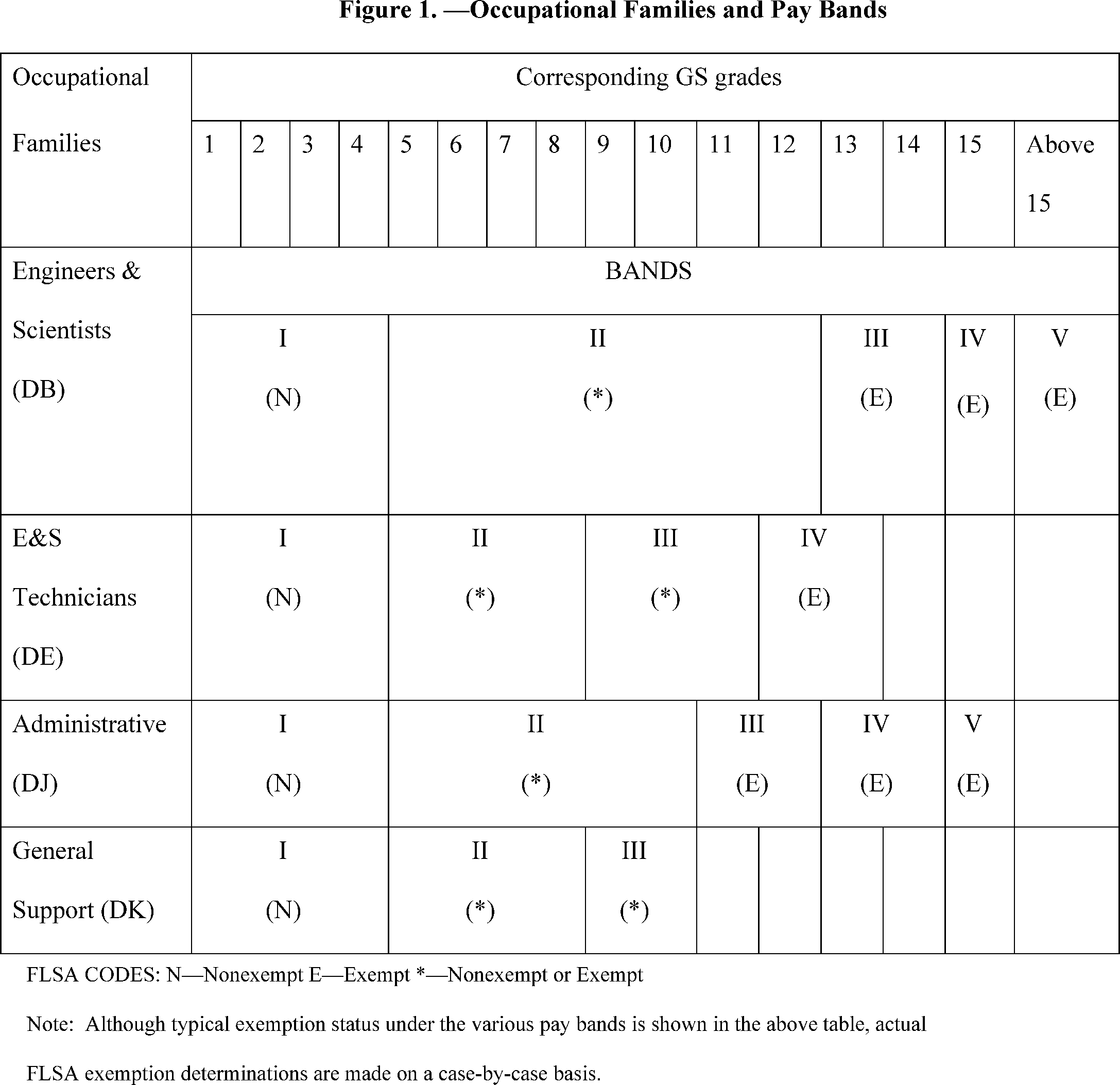
 5 CFR part 551