Great Lakes Pilotage Rates-2027 Annual Review and Revisions to Methodology
In accordance with the Great Lakes Pilotage Act of 1960, the Coast Guard is proposing pilotage rates for the 2027 shipping season. We are conducting a full ratemaking for 2027. ...
In accordance with the Great Lakes Pilotage Act of 1960, the Coast Guard is proposing pilotage rates for the 2027 shipping season. We are conducting a full ratemaking for 2027. We are requesting comments on the Great Lakes pilotage ratemaking methodology, including one proposed update to that methodology. We also propose the pilotage rate for the Straits of Mackinac, newly designated for pilotage requirements by the National Defense Authorization Act for Fiscal Year 2026. The Coast Guard estimates that this proposed rule would increase operating costs by approximately 10 percent compared to the 2026 season.
DATES:
Comments and related material must be received by the Coast Guard on or before October 21, 2026.
ADDRESSES:
You may submit comments identified by docket number USCG-2026-0049 at
www.regulations.gov.
See the “Public Participation and Request for Comments” portion of the
SUPPLEMENTARY INFORMATION
section for further instructions on submitting comments. This notice of proposed rulemaking, with its plain-language, proposed rule summary of 100 words or less, will be available in this same docket.
FOR FURTHER INFORMATION CONTACT:
For information about this document call or email Mr. Brian Rogers, Commandant, Office of Waterways and Ocean Policy—Great Lakes Pilotage Division (CG-WWM-2), Coast Guard; telephone 571-608-8418, email
Brian.Rogers@uscg.mil.
SUPPLEMENTARY INFORMATION:
Table of Contents for Preamble
I. Abbreviations
II. Basis and Purpose
III. Proposed Rates, Pilot Staffing, and Other Changes
IV. Individual Target Pilot Compensation Benchmark
V. Discussion of Proposed Rate Adjustments
( printed page 59713)
A. Step 1: Recognize Previous Operating Expenses
B. Step 2: Project Operating Expenses, Adjusting for Inflation or Deflation
C. Step 3: Estimate Number of Registered Pilots and Apprentice Pilots
D. Step 4: Determine Target Pilot Compensation Benchmark and Apprentice Pilot Wage Benchmark
E. Step 5: Project Needed Revenue
F. Step 6: Calculate Initial Base Rates
G. Step 7: Calculate Average Weighting Factors by Area
H. Step 8: Calculate Revised Base Rates
I. Step 9: Review and Finalize Rates
VI. Tables Showing Calculations by District
A. District One
B. District Two
C. District Three
VII. Regulatory Analyses
A. Regulatory Planning and Review
B. Small Entities
C. Assistance for Small Entities
D. Collection of Information
E. Federalism
F. Unfunded Mandates
G. Taking of Private Property
H. Civil Justice Reform
I. Protection of Children
J. Indian Tribal Governments
K. Energy Effects
L. Technical Standards
M. Environment
VIII. Public Participation and Request for Comments
I. Abbreviations
2023 NPRM Great Lakes Pilotage Rates—2023 Annual Review and Revisions to Methodology NPRM
2026 final rule Great Lakes Pilotage Rates—2026 Annual Review and Revisions to Methodology
APA American Pilots' Association
Apprentice Pilot United States Registered Apprentice Pilot
BLS Bureau of Labor Statistics
CFR Code of Federal Regulations
CPI Consumer Price Index
DHS Department of Homeland Security
Director U.S. Coast Guard's Director of the Great Lakes Pilotage
ECI Employment Cost Index
FOMC Federal Open Market Committee
FR Federal Register
GLPAC Great Lakes Pilotage Advisory Committee
LPA Lakes Pilots Association
NAICS North American Industry Classification System
NDAA 2026 National Defense Authorization Act for Fiscal Year 2026
NPRM Notice of proposed rulemaking
OMB Office of Management and Budget
PCE Personal Consumption Expenditures
Pilot United States Registered Pilot
RA Regulatory Analyses
§ Section
SBA Small Business Administration
SLSPA Saint Lawrence Seaway Pilots Association
U.S.C. United States Code
WGLPA Western Great Lakes Pilots Association
II. Basis and Purpose
The legal basis for this proposed rule is 46 U.S.C. Chapter 93 which requires foreign merchant vessels and United States vessels operating “on register” (meaning United States vessels engaged in foreign trade) to use United States Registered Pilots (Pilots) or Canadian Registered Pilots while transiting the United States waters of the St. Lawrence Seaway and the Great Lakes system.[1]
Specifically, 46 U.S.C. 9303(f) requires the Secretary to prescribe by regulation rates and charges for pilotage services, giving consideration to the public interest and the costs of providing those services. The statute requires the Secretary to establish new pilotage rates by March 1 of each year.[2]
Base pilotage rates must be established by a full ratemaking at least once every 5 years, and reviewed annually, with adjustments made in each intervening year.[3]
The statute also authorizes the Secretary to authorize the formation of pilotage pools by voluntary associations of Pilots to provide for the efficient dispatching of vessels and rendering of pilotage services.[4]
The Secretary may limit the number of pilotage pools, prescribe regulations governing their operation and administration, prescribe a uniform system of accounts, perform audits and inspections, and require reciprocal coordination with similar pool arrangements authorized by the appropriate Canadian agency.[5]
The Secretary's authority under 46 U.S.C. Chapter 93 has been delegated to the Coast Guard, except as otherwise provided.[6]
With this proposed rule, the Coast Guard initiates a full ratemaking for the 2027 shipping season. The Coast Guard seeks public comment on its proposed pilotage rates and, as part of this full ratemaking, on the ratemaking methodology and staffing model. The Coast Guard last conducted a full ratemaking in the February 17, 2026, final rule, “Great Lakes Pilotage Rates—2026 Annual Review and Revisions to Methodology” at 91 FR 7121 (2026 final rule). We are conducting another full ratemaking for 2027 to propose the pilotage rate for the Straits of Mackinac, newly designated for pilotage requirements by the National Defense Authorization Act for Fiscal Year 2026 (NDAA 2026).[7]
Section III.C. of this preamble discusses this statutory change in greater detail. Specifically, this proposed rule revises the methodology in Step 6, specifies the pilotage rate to be charged in the Straits of Mackinac, and updates the base compensation for Pilots and United States Registered Apprentice Pilots (Apprentice Pilots). The proposed rates and changes to the methodology continue to promote our goals, as outlined in 46 CFR 404.1, by promoting safe, efficient, and reliable pilotage service on the Great Lakes by generating sufficient revenue for each pilotage association to reimburse its necessary and reasonable operating expenses and fairly compensate trained and rested Pilots. Rate setting is fundamental to achieving these goals because it facilitates maritime commerce, protects the marine environment, and supports National Transportation Safety Board recommendations regarding staffing and Pilot fatigue.
III. Proposed Rates, Pilot Staffing, and Other Changes
A. Proposed Rates
The pilotage rates for the 2027 season range from a proposed $445 to $1,002 per Pilot hour, depending on which of the specific areas pilotage service is provided. See Table 1. The rates are paid by shippers to the pilotage associations representing each district.
( printed page 59714)
As reflected in Table 1, there are three American pilotage districts on the Great Lakes, each represented by a pilotage association.[8]
Each pilotage district is further divided into “designated” and “undesignated” areas. Designated areas, classified as such by Presidential Proclamation, are waters in which Pilots must always direct the navigation of vessels subject to the customary authority of the vessel Master.[9]
Undesignated areas are open bodies of water where Pilots must only “be on board and available to direct the navigation of the vessel” at the discretion of and subject to the customary authority of the vessel Master.[10]
The three U.S. pilotage associations representing these districts are the sole U.S. providers of pilotage services on the Great Lakes, each operating as an independent business within its respective district. Each pilotage association is self-funded, using revenue from the shippers to cover operating expenses, maintain infrastructure, compensate Pilots and Apprentice Pilots, acquire and implement technological advances, train new personnel, and provide for continuing professional development. To promote the long-term stability of the pilotage rates and from year-to-year, the Coast Guard bases pilotage rates on a 10-year historical average of pilotage demand. This approach means annual revenues may be higher or lower than projected if pilotage demand fluctuates from the average. However, this 10-year average approach helps ensure that the associations can maintain infrastructure, provide adequate compensation and rest for pilots, and retain highly trained personnel. Using 3-year and 5-year averages caused the rate to fluctuate too significantly, creating challenges for planning for future expenses. For example, a significant decrease in
( printed page 59715)
shipping activity in a single year would have a relatively limited effect on rates calculated using a 10-year average. This promotes rate stability if shipping activity returns to historical levels the following year, when pilot associations must have sufficient trained pilots and other resources to meet demand. Conversely, using 15- or 20-year averages would incorporate older data that may not accurately reflect current market conditions or pilot associations' current resource needs.
B. Pilot and Apprentice Pilot Staffing
This proposed rule would affect 61 Pilots, 8 Apprentice Pilots, 3 pilotage associations, and the owners and operators of an average of 247 oceangoing vessels that transit the Great Lakes annually. This proposed rule is not economically significant under Executive Order 12866 and would not affect the Coast Guard's budget or increase Federal spending because foreign shippers, foreign cruise ships, and vessels requesting voluntary pilotage pay these rates directly to the respective pilotage association.
The estimated overall annual regulatory economic impact of this rate change would be a net increase of $3,977,204 in estimated payments made by the foreign shippers, foreign cruise ships, and vessels requesting voluntary pilotage service, an approximately 10-percent increase in operating costs in the 2027 shipping season. While this increase is significantly more than the current annual inflation rate, it is necessary to achieve the increased revenue needed to add four Pilots and one Apprentice Pilot. An increase in the number of Pilots will help achieve part of the Coast Guard's goal of promoting recruitment and retention of qualified Pilots. In addition, the increase reflects inflation, the growth of adjusted operating expenses, changes in vessel traffic, and the need to meet Pilot compensation and Apprentice Pilot wage benchmarks.
C. Proposal To List Straits of Mackinac in Pilotage Rates and Charges
To implement the NDAA 2026 amendment to 46 U.S.C. 9302(a)(1)(A), the Coast Guard proposes adding the Straits of Mackinac to the annual pilotage rate schedule in 46 CFR 401.405 and to make a corresponding update to Step 6 of the methodology. As amended, the legislation now requires Pilots to direct the navigation of the vessel in the Straits, in addition to the other Presidentially designated waters.[11]
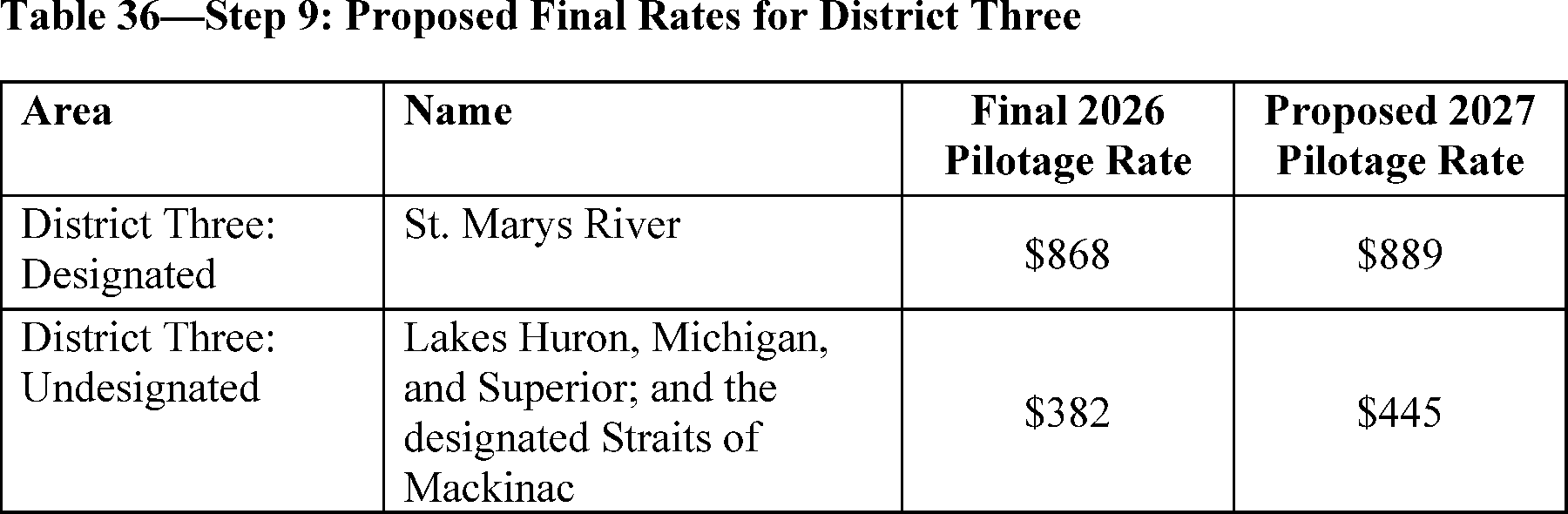
We propose to add the Straits to the list of waters in 46 CFR 401.405(a)(5) while applying the same pilotage rate used for the adjacent, undesignated waters of Lakes Huron, Michigan, and Superior.
As noted previously, under 46 U.S.C. 9303(f), the Coast Guard prescribes by regulation rates and charges for pilotage services, giving consideration to the public interest and the costs of providing the services. We propose to retain the existing Area 6 rate for the Straits because the statutory designation does not materially change the pilotage services historically provided there or the costs of providing those services. Adding the Straits to the codified rate schedule clarifies the applicable rate to this waterway for the public.
Before the statutory amendment, pilots were required under 46 U.S.C. 9302(a)(1)(B) to be on board and available to direct navigation through the Straits at the discretion of and subject to the customary authority of the vessel master. In practice, however, pilots historically directed navigation through the Straits, subject to the customary authority of the vessel master, as would be required in designated waters under 46 U.S.C. 9302(a)(1)(A), given the relatively limited geographic extent of the Straits. This practice is similar to the Coast Guard's treatment of ports in undesignated waters, another type of relatively small area. In those port waters, pilots may direct vessel movements through short inlets or rivers necessary to enter a port, while the rate applicable to the broader undesignated area continues to apply. Similarly, although the Straits are now designated waters, the Coast Guard proposes to retain the existing Area 6 rate for the Straits because pilots historically directed navigation through this relatively limited area, including the turn and transit under a bridge, without a corresponding change in the rate applicable to the broader undesignated Area 6. Accordingly, no additional Pilots, Pilot change points, or Pilot boat services are needed. Because no additional expenses are associated with this designation, the pilotage association can continue to provide this service at the same cost as adjacent undesignated waters. Any historical bridge hours in the Straits of Mackinac have already been accounted for in Step 6 of the proposed 2027 ratemaking methodology. For these reasons, we have determined that the current ratemaking practices are reasonable, and changes to how we calculate the rates for transits through the Straits of Mackinac are not necessary.
At the Great Lakes Pilotage Advisory Committee (GLPAC) meeting on February 5, 2026, the Director presented this course of action for the Straits of Mackinac to the committee and pilotage associations. At the meeting, GLPAC did not provide specific feedback on the Director's assertion that costs would not increase for providing pilotage now that the Straits of Mackinac are designated waters. The Director welcomed ideas from the committee and feedback when we publish this proposed rule. A copy of the meeting transcript is available in the docket where indicated under the
ADDRESSES
portion of this preamble.
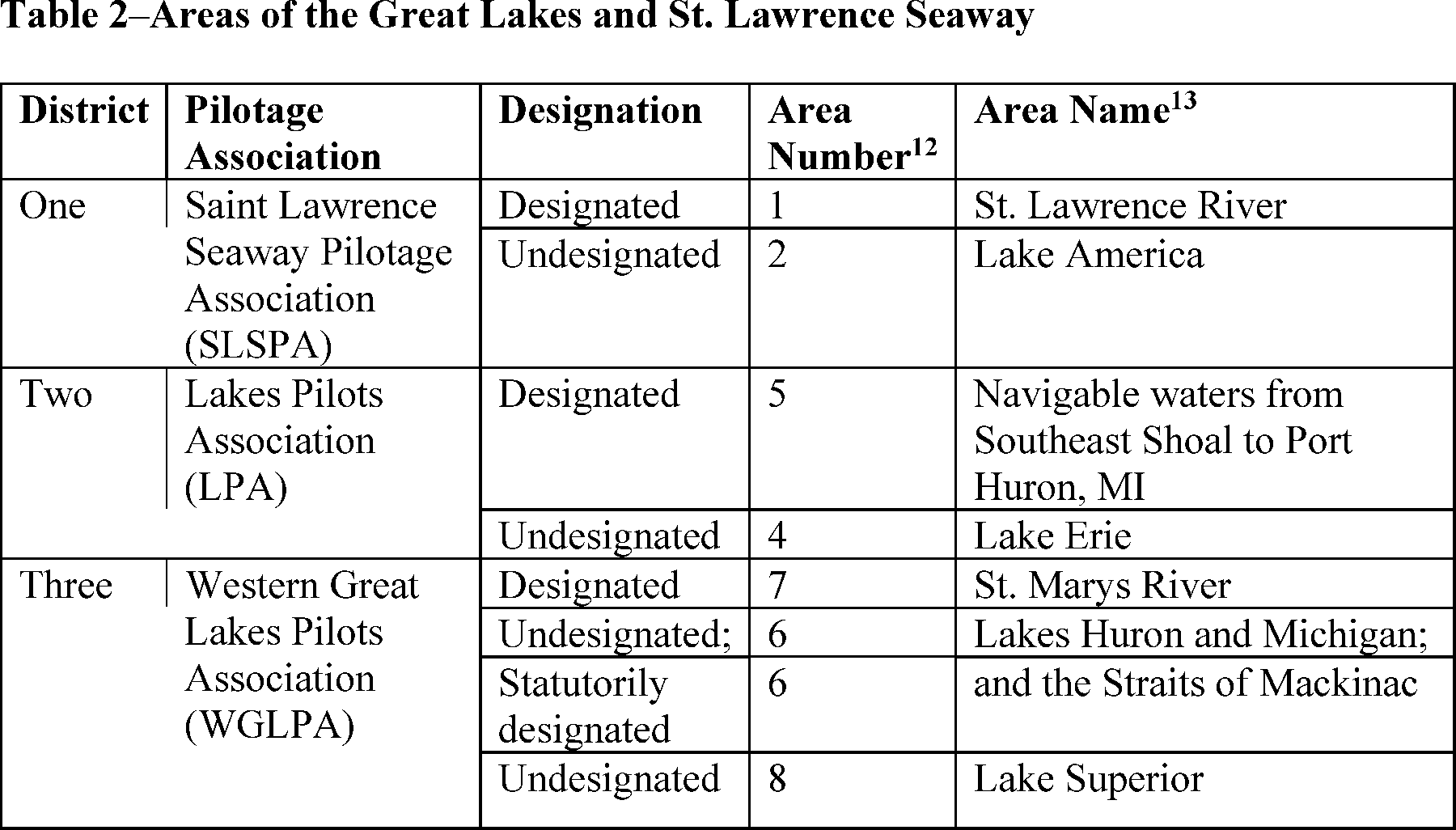
For the associated calculations within this ratemaking methodology, the Straits of Mackinac metrics would continue to be attributed to Area 6, as shown in Table 2 of this preamble. A similar table with area numbers last appeared as table 2 in the Great Lakes Pilotage Rates—2023 Annual Review and Revisions to Methodology NPRM (2023 NPRM) that published August 30, 2022 (87 FR 52870, 52873). Table 2 of the 2023 NPRM illustrates that Area 6 includes Lakes Huron and Michigan, which naturally includes transits between these lakes through the Straits of Mackinac. Though statutorily designated, the Straits of Mackinac would continue to be associated with Area 6, and its rates would be equivalent to the undesignated rates for Area 6. The following table is the proposed area division of the waterways in the Great Lakes, which maintains the current area structure.
( printed page 59716)
Second, we
are proposing a corresponding change to § 404.106, Step 6 of the methodology, to maintain the status quo for calculating rates for transits in the Straits of Mackinac. Under the proposed revision to Step 6, the bridge hours associated with the Straits of Mackinac would continue to be included in the average bridge hours of the undesignated waters in Area 6. We use this average in Step 6, dividing the projected revenue needed by the district's 10-year average of bridge hours across both designated and undesignated waters. This additional text would promote transparency in how we average the bridge hours in District Three and ensure consistency in the treatment of bridge hours for the Straits of Mackinac. It would also maintain the current methodology calculation process and would result in no substantive change from previous ratemakings. As noted in previous paragraphs, we propose to continue attributing the Straits of Mackinac transits to Area 6 for ratemaking purposes.
The operational demands for these transits are already met within the existing resource allocation for Area 6. The proposed clarification to Step 6 would not result in an increase in staffing or transportation costs for District Three, nor a notable increase to other resources relative to the 2026 final rule.
D. Executive Order Renaming Lake Ontario as Lake America
On August 27, 2026, the President issued Executive Order,
Honoring the American History of the Great Lakes and Renaming Lake Ontario as Lake America.[14]
The Executive Order directs the Secretary of the Interior, in coordination with the Board on Geographic Names, to take appropriate actions to rename the body of water currently known as Lake Ontario as Lake America.[15]
The Executive Order further directs that Federal Government references to Lake Ontario, including in agency documents and communications, reflect the renaming.[16]
Consistent with this directive, as noted in Table 1 of this preamble, we have updated references to Lake Ontario in this proposed rule to Lake America. These changes implement the terminology directed by the Executive Order and do not otherwise alter the substance of this proposed rule.
IV. Individual Target Pilot Compensation Benchmark
According to § 404.104(a), in a full ratemaking year, the Director sets the individual target Pilot compensation benchmark and may make necessary and reasonable adjustments based on current information. This NPRM proposes the 2027 yearly base compensation for Pilots on the Great Lakes to be $496,674 per Pilot (a $15,032 increase, or 3.12 percent, over their 2026 compensation). Because the Coast Guard must review, and adjust rates each year, we analyze rate changes as single-year costs and do not annualize them over 10 years. Section VII. Regulatory Analyses of this preamble provides the regulatory impact analyses of this proposed rule.
For the 2027 ratemaking, the Coast Guard proposes setting the target Pilot compensation benchmark at the target Pilot compensation for the ratemaking year 2026, adjusted for inflation. This is the same method we used for setting the target Pilot compensation benchmark in the previous full ratemaking, in 2026.[17]
This method resembles the interim ratemaking year requirements in § 404.104(b), where the base target Pilot compensation is adjusted annually for inflation. For more information about how we arrived at the target Pilot benchmark in the previous ratemaking, please see the 2026 final rule.[18]
For the reasons discussed there,[19]
we believe the base compensation as adjusted annually remains fair.
Based on the information we have exchanged with the Pilots and industry over the past several ratemakings (2025-2026), the Director continues to believe that the level of target Pilot compensation provides an appropriate level of compensation for Pilots. According to § 404.104(a), the Director
( printed page 59717)
may make necessary and reasonable adjustments to the benchmark based on current information. However, current circumstances do not indicate that an adjustment, other than for inflation, is necessary. The Director bases this decision on the fact that at this point there is no indication from the Presidents of the pilotage associations that Pilots are resigning due to their compensation or that this target Pilot compensation benchmark is causing shortfalls in achieving reliable pilotage service. The Director will continue to monitor the Associations' ability to recruit and retain pilots to ensure reliable pilotage service is not denigrated in the future. The Coast Guard finds that the target Pilot compensation benchmark is appropriate relative to the expertise to perform the necessary job functions. The compensation will continue to be adjusted annually, in accordance with published inflation rates, which will ensure the compensation remains competitive and current for upcoming years.
Therefore, the Coast Guard does not propose alternative benchmarks for target Pilot compensation at this time and, instead, proposes simply adjusting the amount of target Pilot compensation for inflation as our target Pilot compensation benchmark for 2027, as shown in Step 4. This target Pilot compensation benchmark approach has advanced and would continue to advance the Coast Guard's goals through rate and compensation stability while also promoting recruitment and retention of qualified Pilots.
V. Summary of the Ratemaking Methodology
The ratemaking methodology, outlined in current 46 CFR 404.101 through 404.109, consists of 9 steps that are designed to account for the revenues needed and total traffic expected in each district. The first several steps of the methodology establish base pilotage rates. Additional steps to incorporate the weighting factors are necessary to establish the final pilotage rates. The result is an hourly rate, determined separately for each of the six areas administered by the Coast Guard.
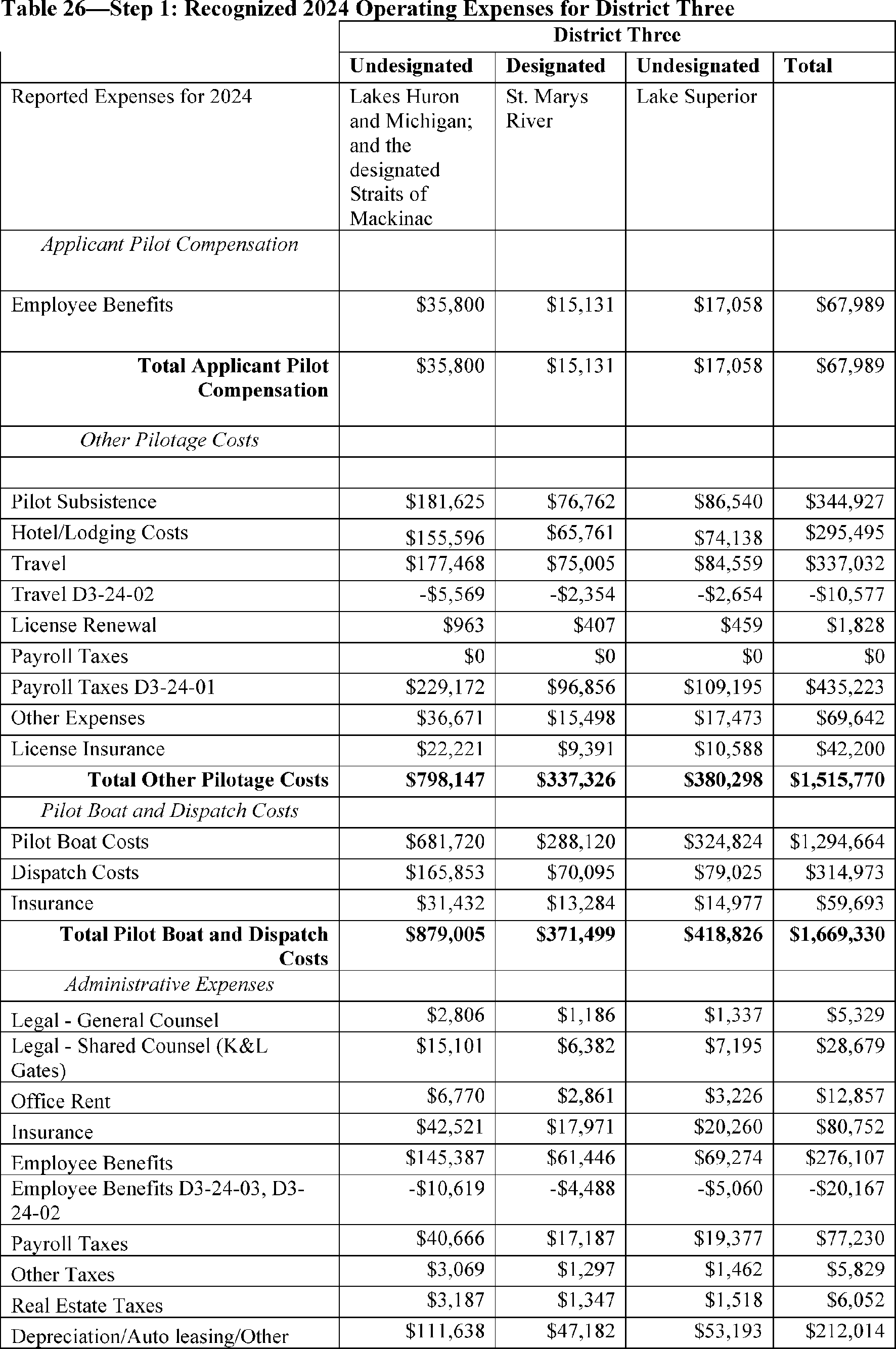
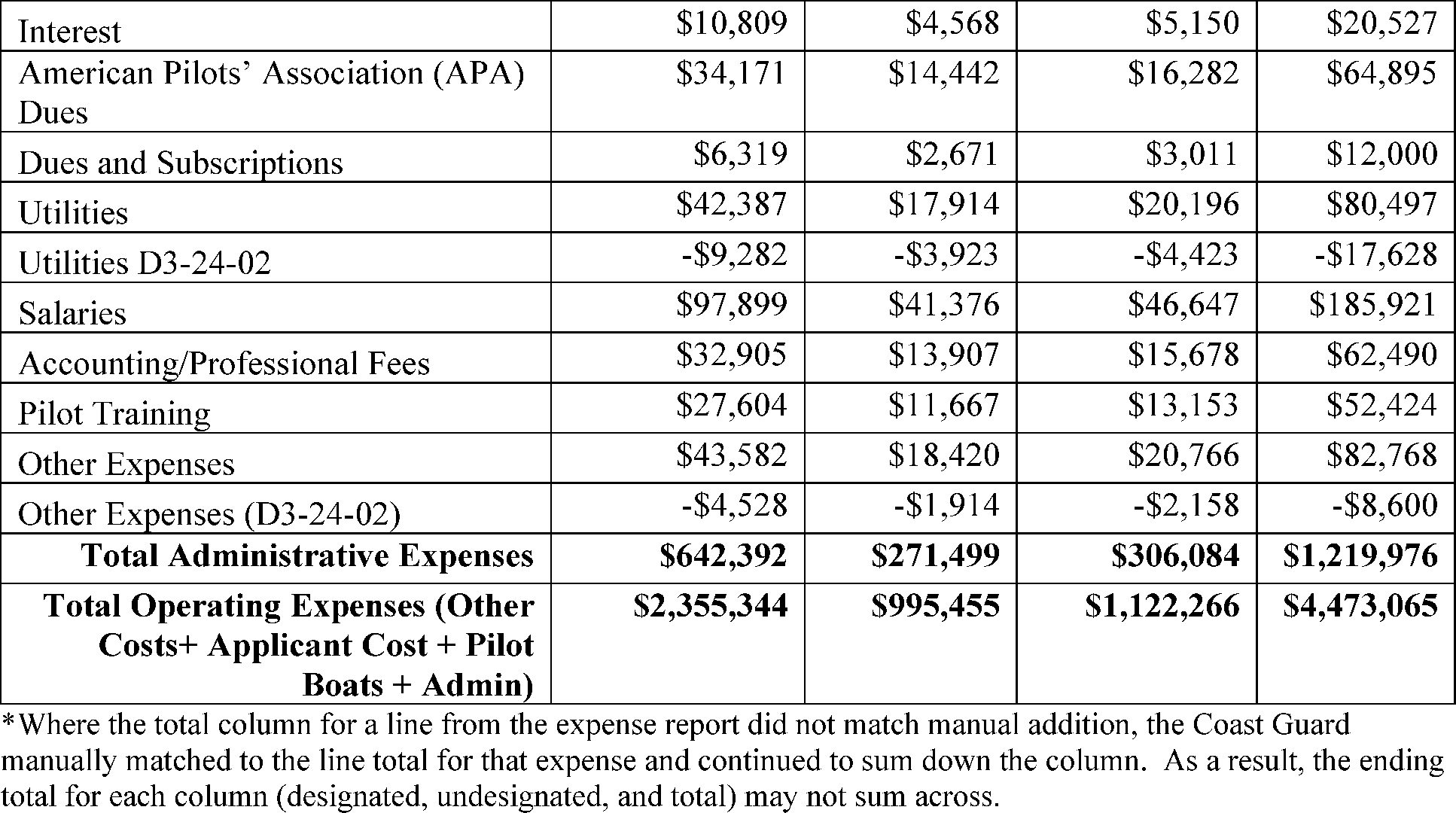
In Step 1, “Recognize previous operating expenses,” (§ 404.101) the Director uses an independent third party to review each pilot association's audited operating expenses from each of the three pilot associations. Operating expenses include all allowable expenses, minus Pilot and Apprentice Pilot wages and benefits. This number forms the baseline amount that each association is budgeted. Because of the time delay between when the association submits raw numbers and the Coast Guard receives audited numbers, this number is 3 years behind the projected year of expenses. Therefore, in calculating the 2027 rates in this proposal, we begin with the audited expenses from the 2024 shipping season.
While each pilotage association operates in an entire district (including both designated and undesignated areas), the Coast Guard determines costs by area. We allocate certain operating expenses to designated areas and certain operating expenses to undesignated areas. In some cases, we can allocate the costs based on where they are actually accrued. For example, we can allocate the costs for insurance for Apprentice Pilots who operate in undesignated areas only. In other situations, such as general legal expenses, expenses are distributed between designated and undesignated waters on a pro rata basis, based upon the proportion of income forecasted from the respective portions of the district.
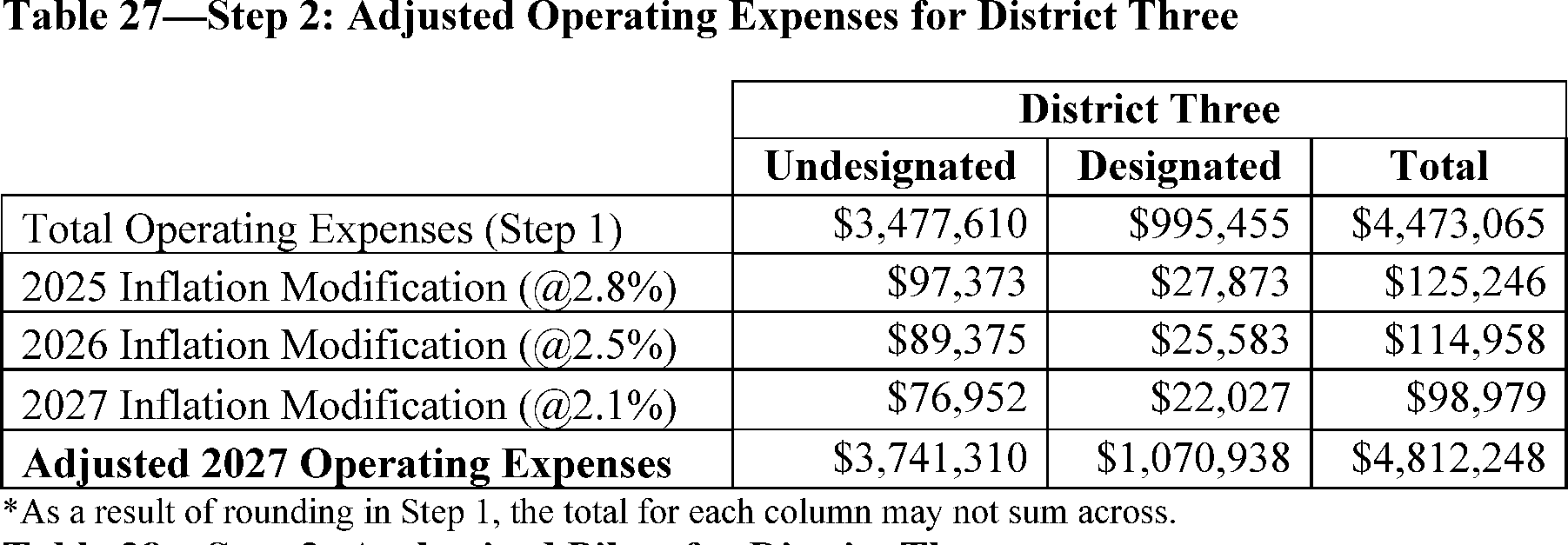
In Step 2, “Project operating expenses, adjusting for inflation or deflation,” (§ 404.102) the Director develops the 2027 projected operating expenses. To do this, we apply inflation adjustors for 3 years to the operating expense baseline received in Step 1. The inflation factors are from the BLS CPI for the Midwest Region, or, if not available, the FOMC median economic projections for PCE inflation. This step produces the total operating expenses for each area and district.
In Step 3, “Estimate number of registered pilots and apprentice pilots,” (§ 404.103) the Director calculates how many Pilots and Apprentice Pilots are needed for each district. To do this, the Director projects, based on the number of persons applying under 46 CFR part 401 to become United States Great Lakes Registered Pilots and on information provided by the district's pilotage association, the number of Pilots expected to be fully working and compensated. The director then employs the staffing model, described in § 401.220, paragraphs (a)(1) through (a)(3), to estimate how many Pilots would be needed to handle shipping during the opening and closing of the season. This number provides guidance to the Director in approving an appropriate number of Pilots.
In Step 4 of the ratemaking calculation, we determine the number of Pilots provided by the pilot associations (see § 404.103) and use that figure to determine how many Pilots need to be compensated via the pilotage fees collected. In Step 4, “Determine target Pilot compensation benchmark and apprentice pilot wage benchmark,” (§ 404.104(a)(1)), the Director determines base individual target Pilot compensation using a compensation benchmark, set after considering the most relevant currently available non-proprietary information. For supportable circumstances, the Director may make necessary and reasonable adjustments to the benchmark. For this proposed rule, the Director plans to adjust the previous year's individual target Pilot compensation using the same process as in an interim year (§ 404.104(b)).
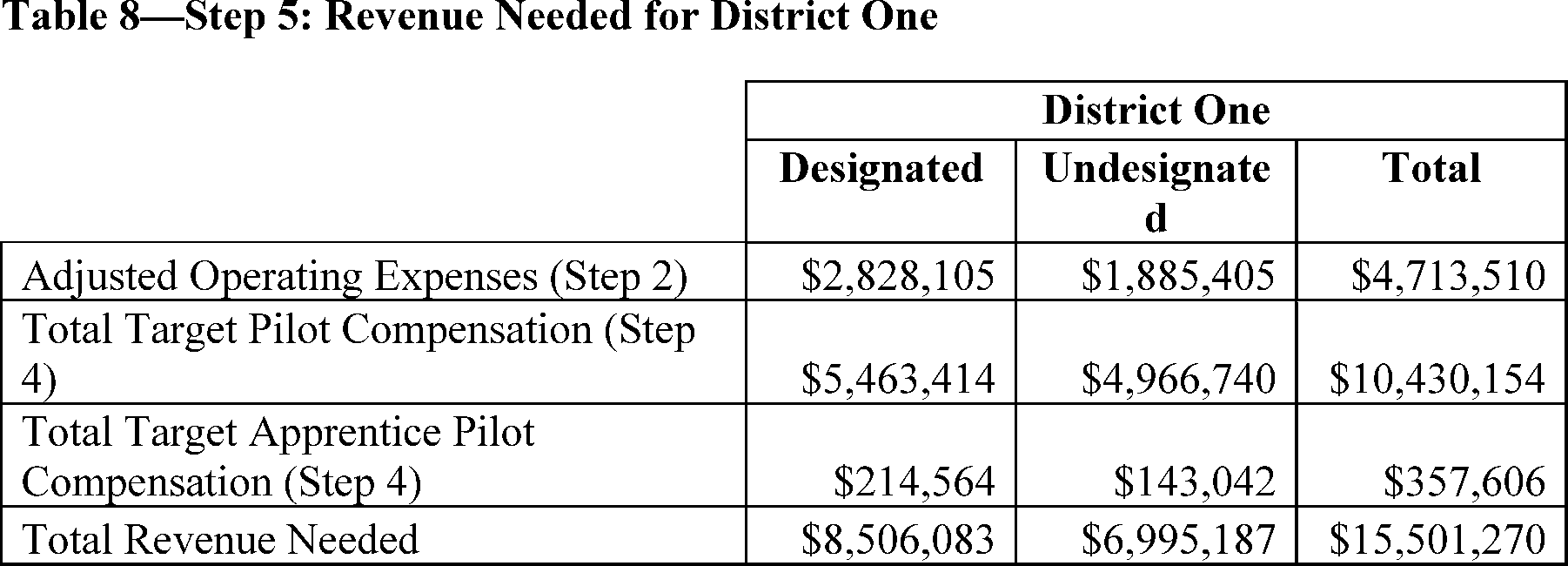
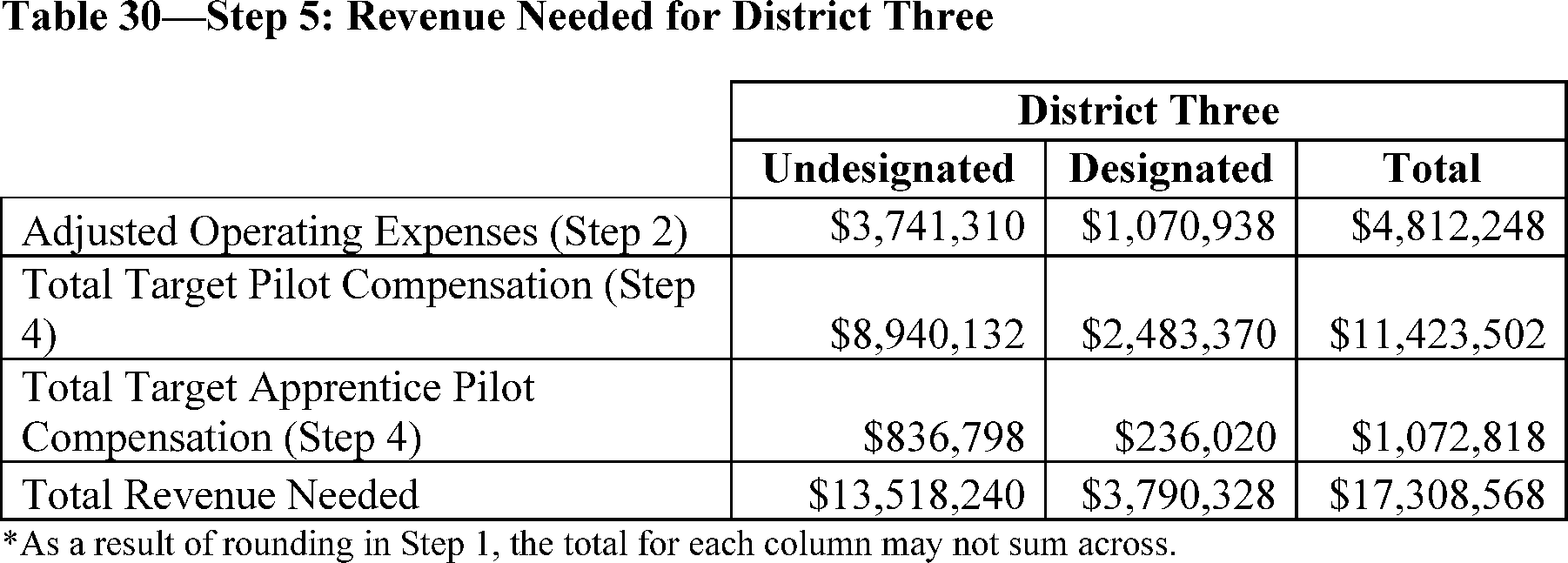
In Step 5, “Project needed revenue,” (§ 404.105) the Director simply adds the totals produced by the preceding steps. The projected operating expense for each area and district (from Step 2) is added to the total Pilot compensation, including Apprentice Pilot wage benchmarks (from Step 4). The total figure, calculated separately for each area and district, is the “needed revenue.”
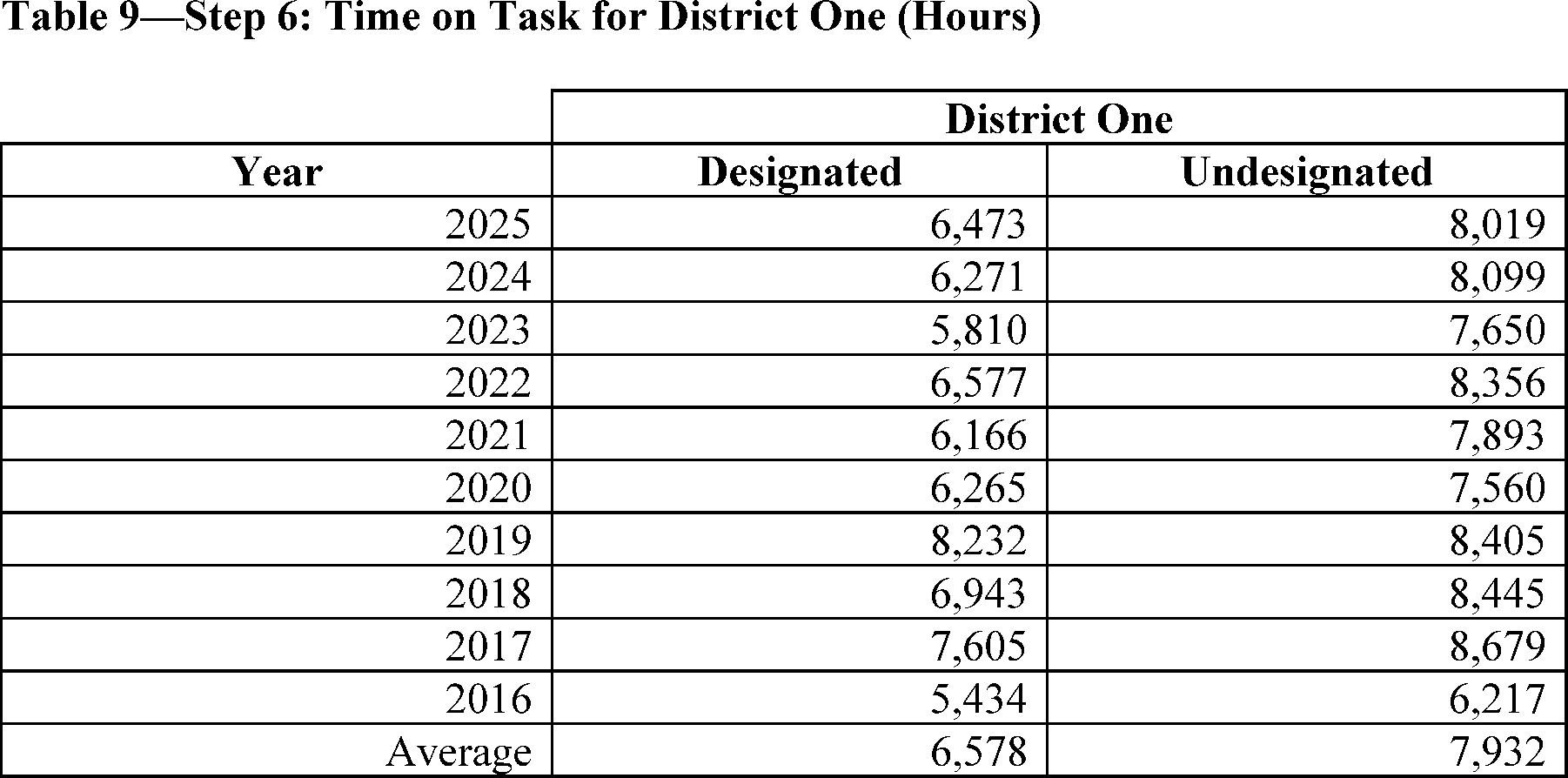
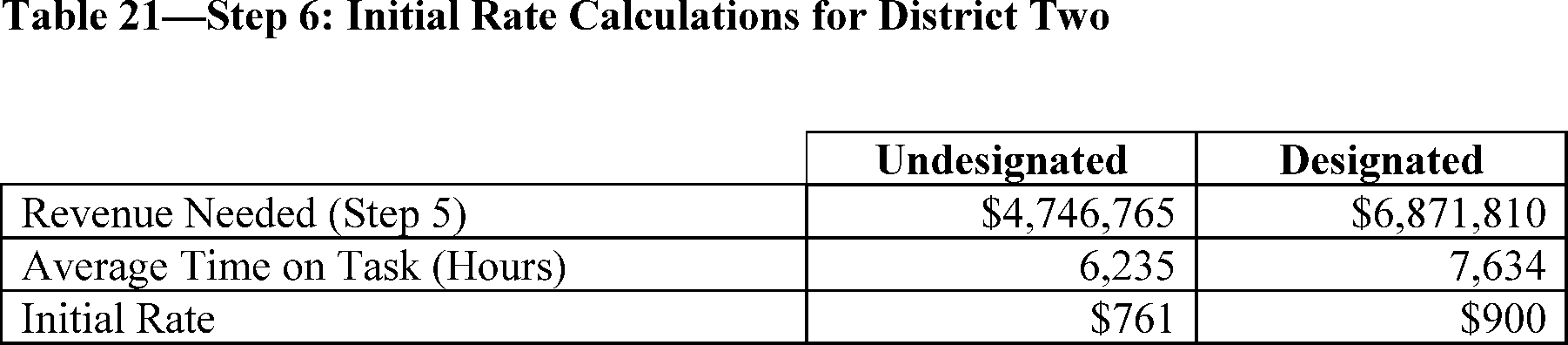
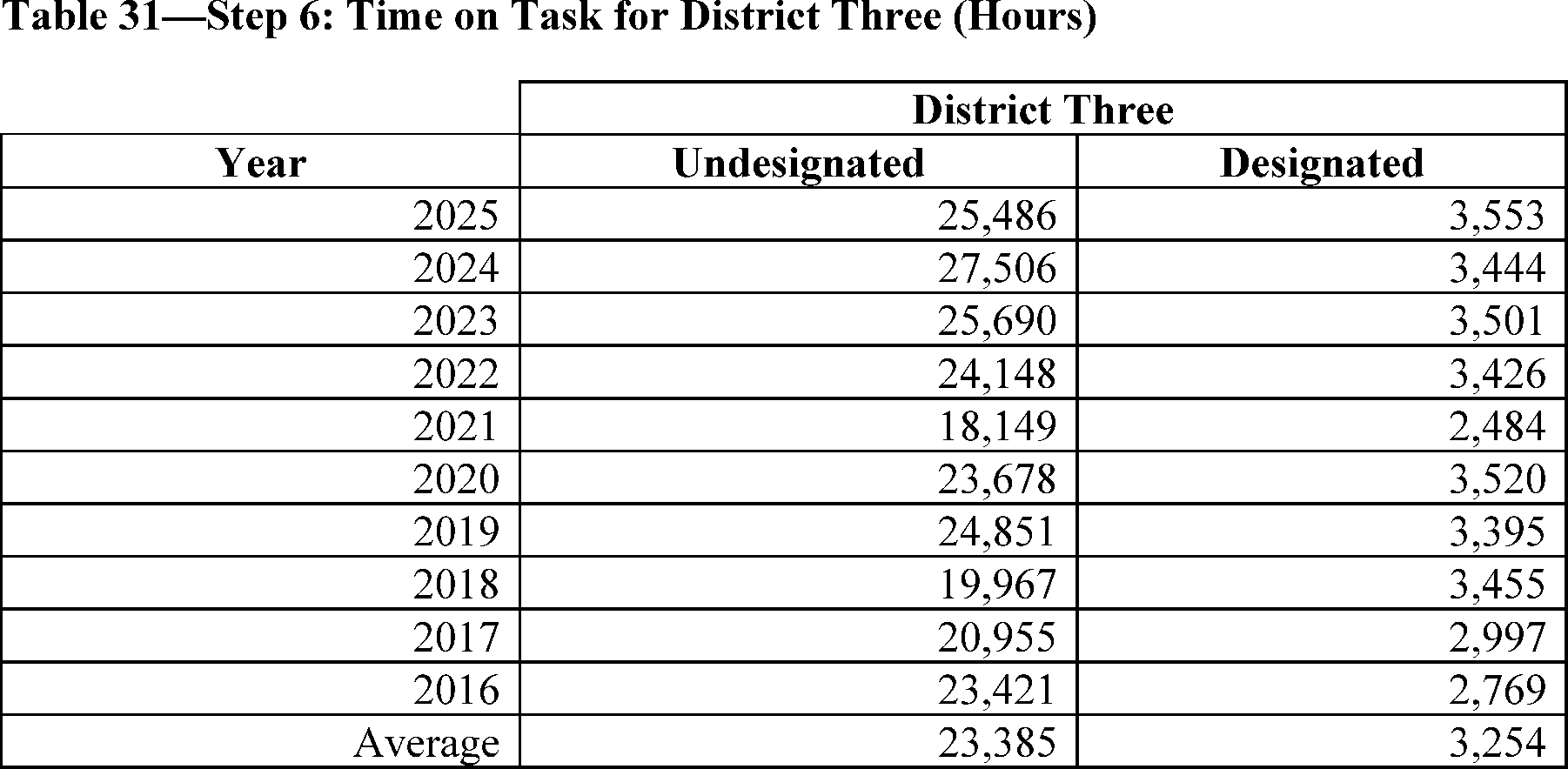
In Step 6, “Calculate initial base rates,” (§ 404.106) the Director calculates an hourly pilotage rate to cover the needed revenue, as calculated in Step 5. This step consists of first calculating the 10-year average hours of traffic for each area. Next, we divide the revenue needed in each area (calculated in Step 6) by the 10-year average of traffic hours to produce an initial base rate.
An additional element, the “weighting factor,” is required under § 401.400. Pursuant to that section, ships pay a multiple of the base rate, as calculated in Step 6, by a number ranging from 1.0 (for the smallest ships, or “Class I” vessels) to 1.45 (for the largest ships, or “Class IV” vessels). This significantly increases the revenue collected, and we need to account for the added revenue produced by the weighting factors to ensure that shippers are not overpaying for pilotage services. We do this in Step 7.
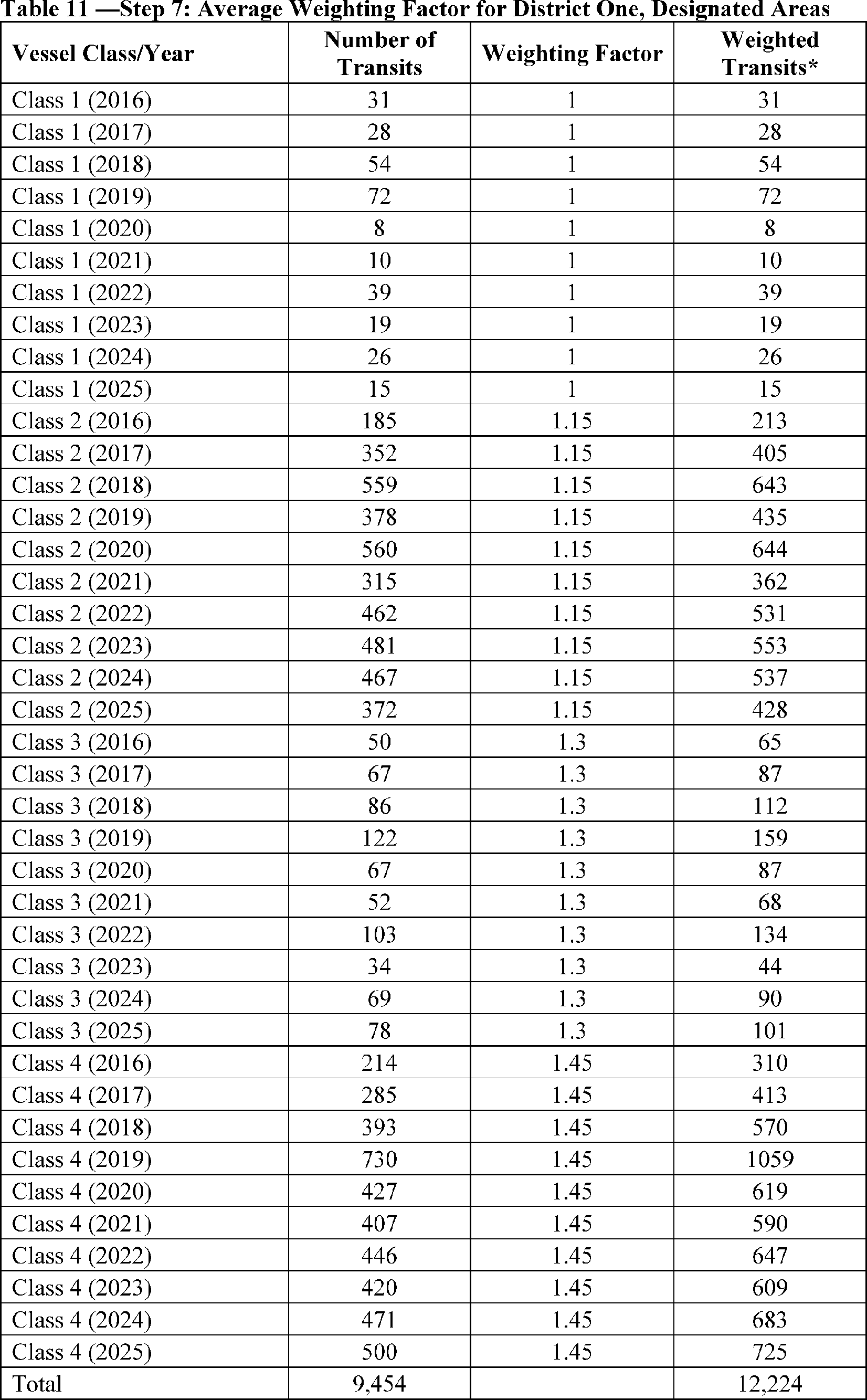
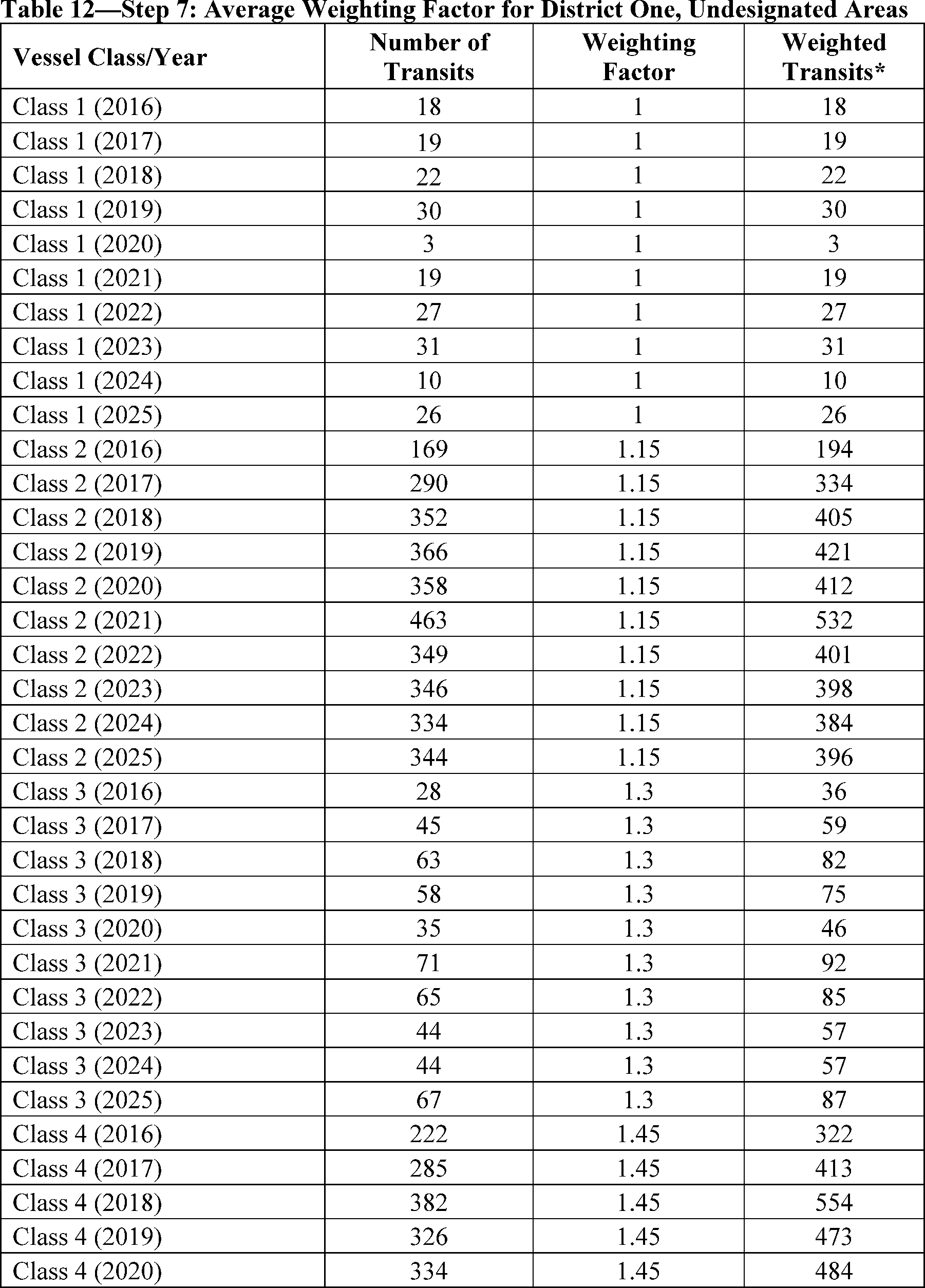
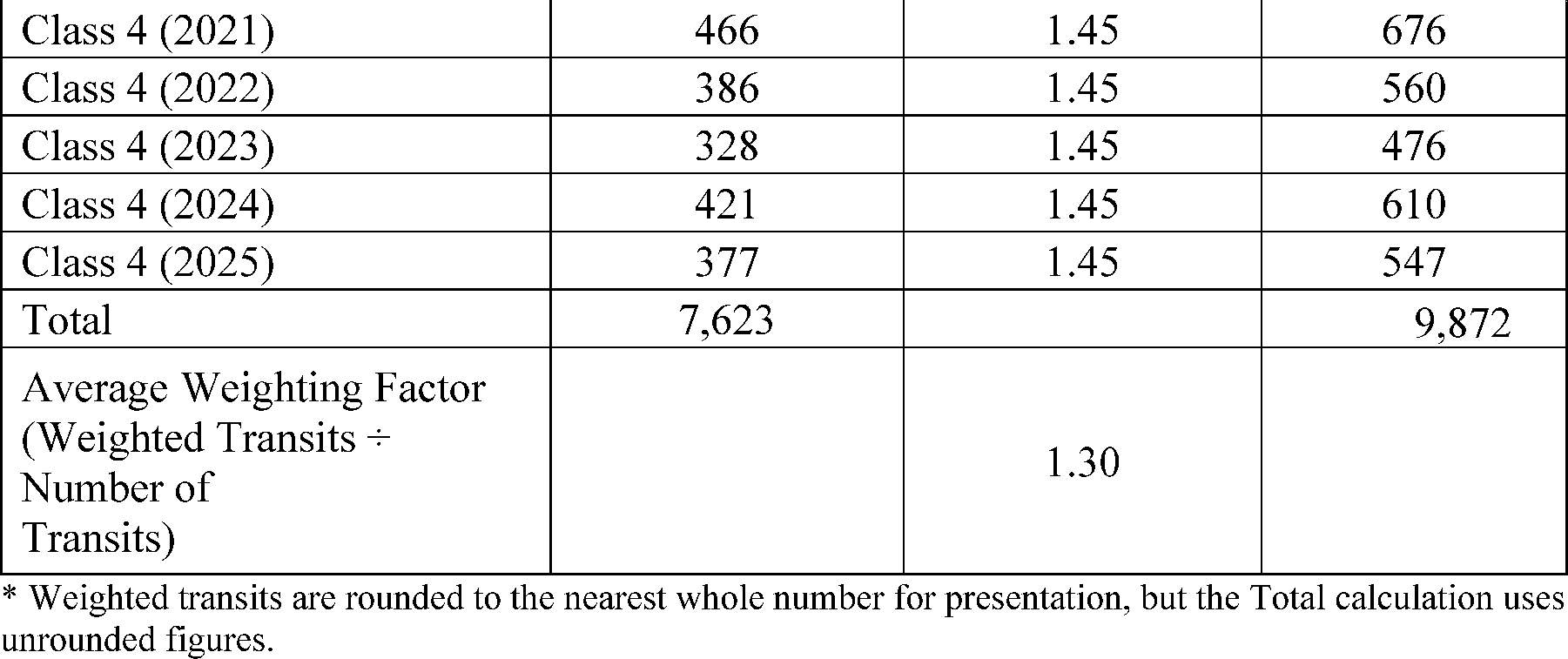
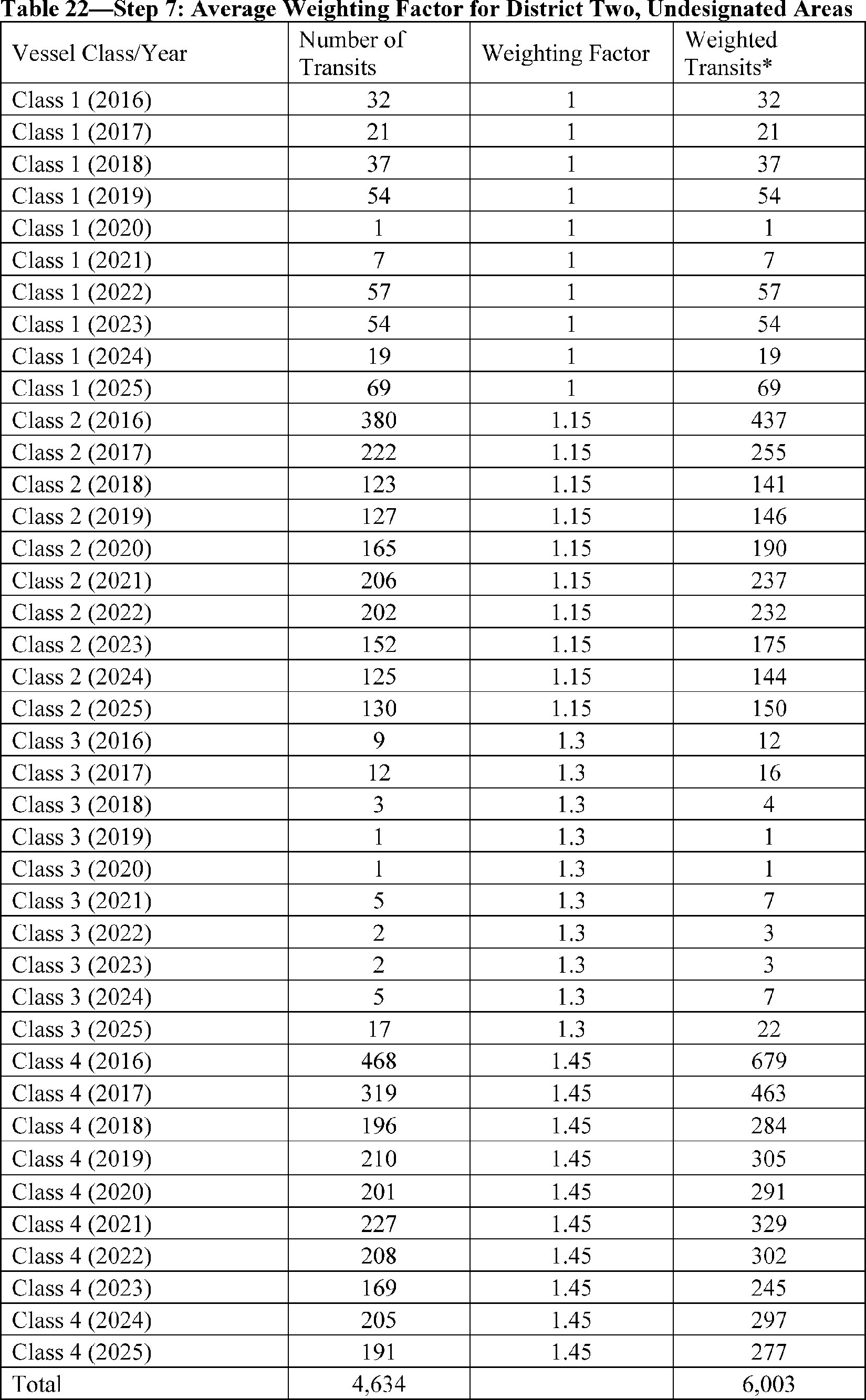
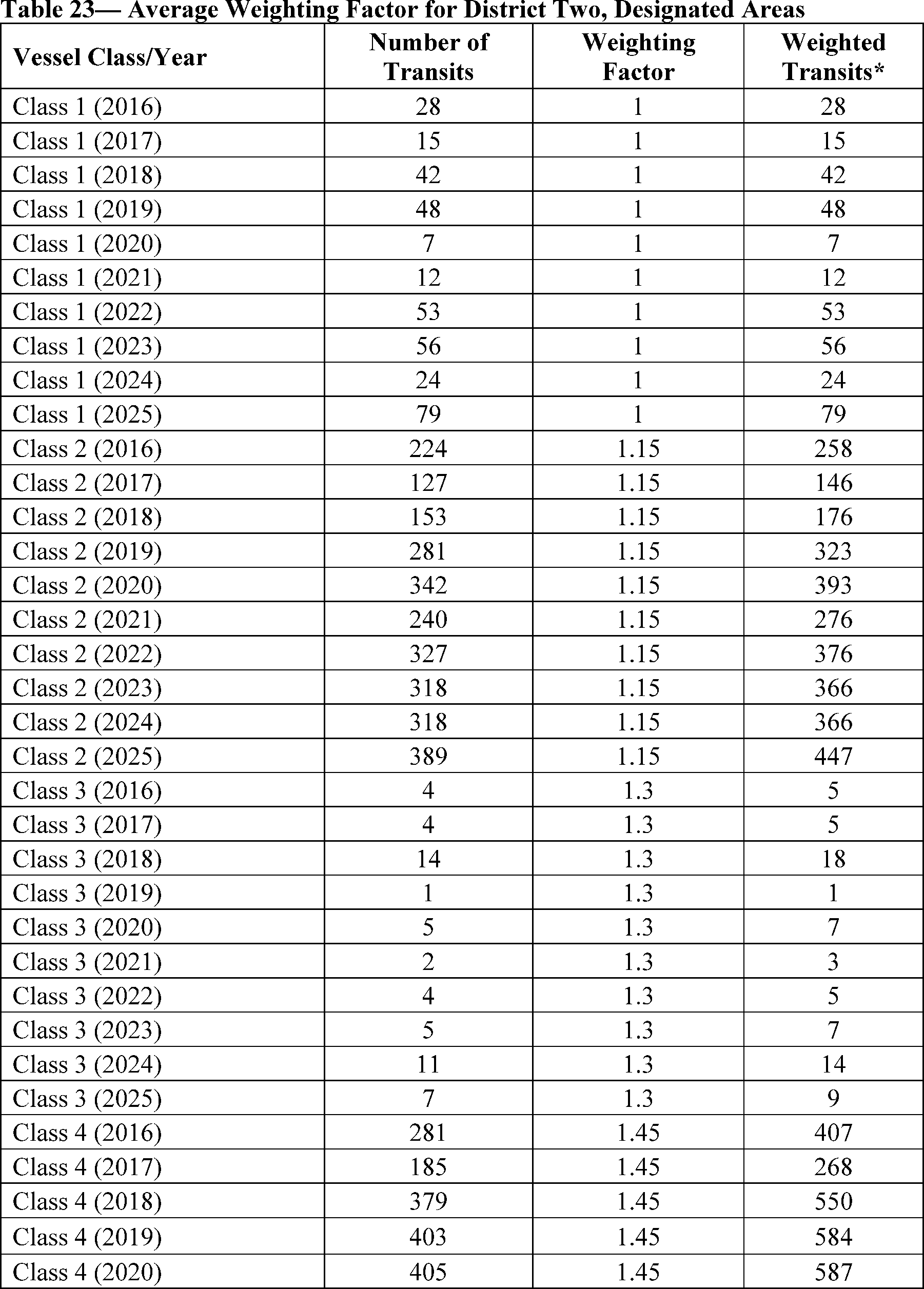
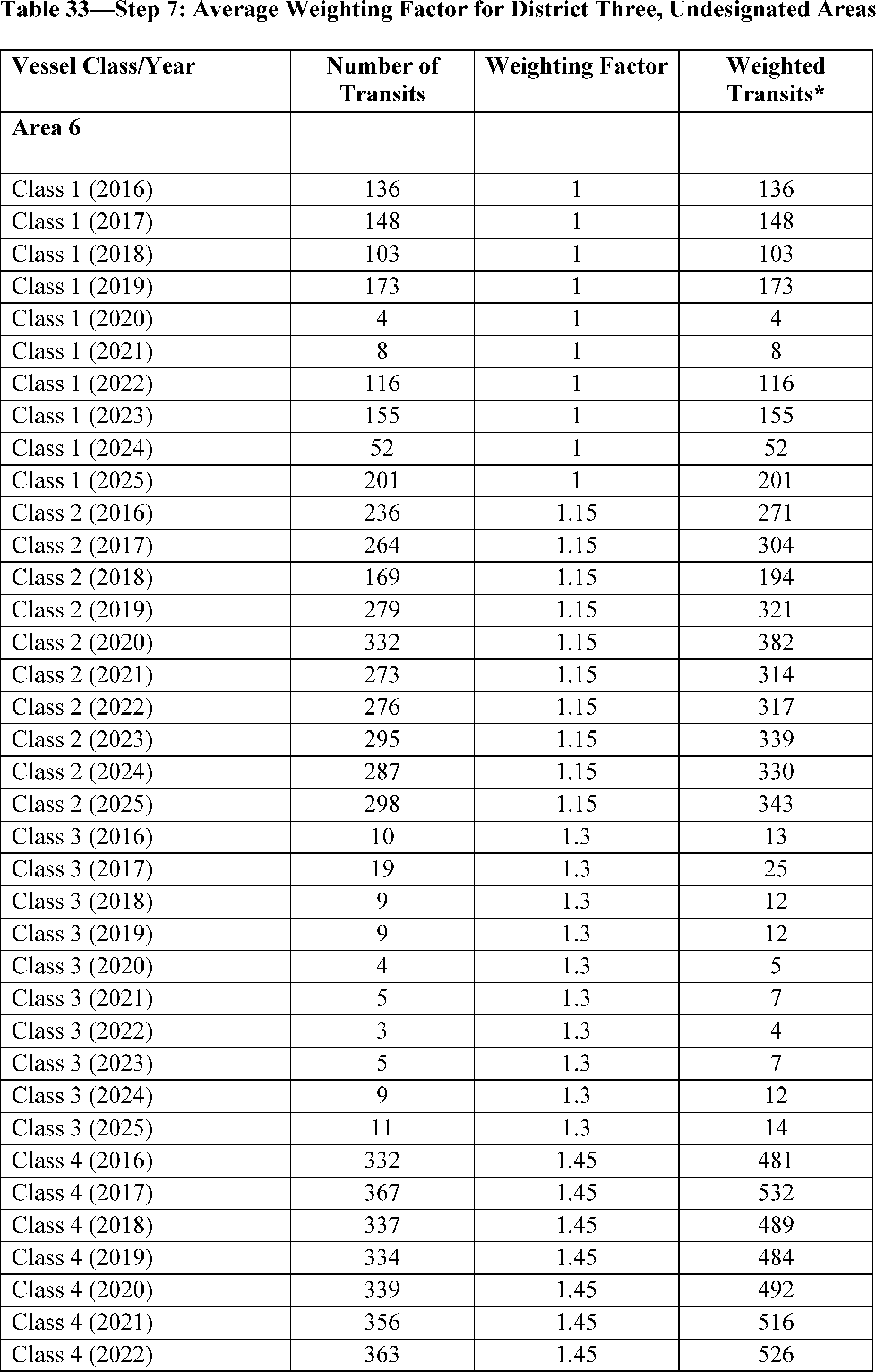
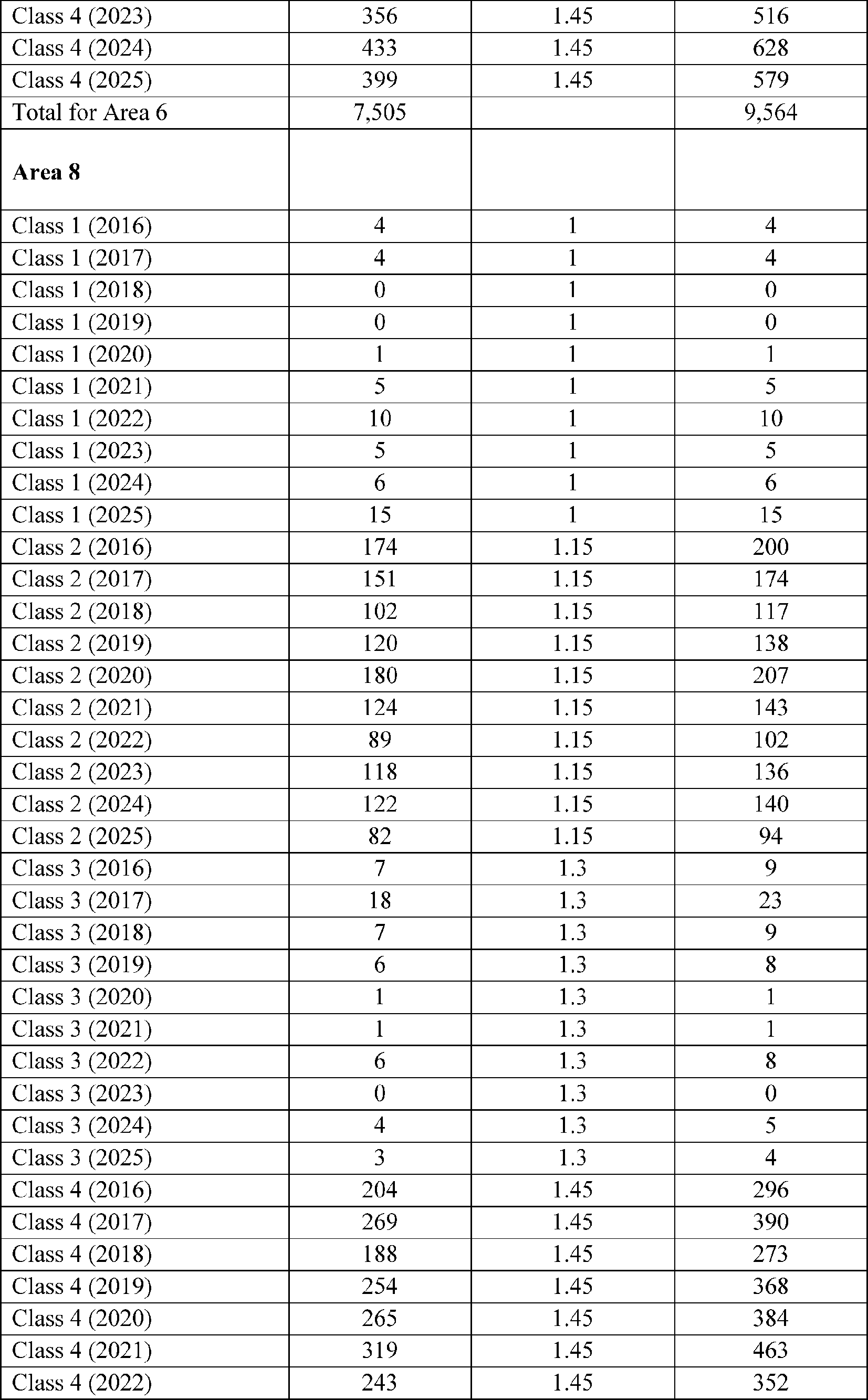
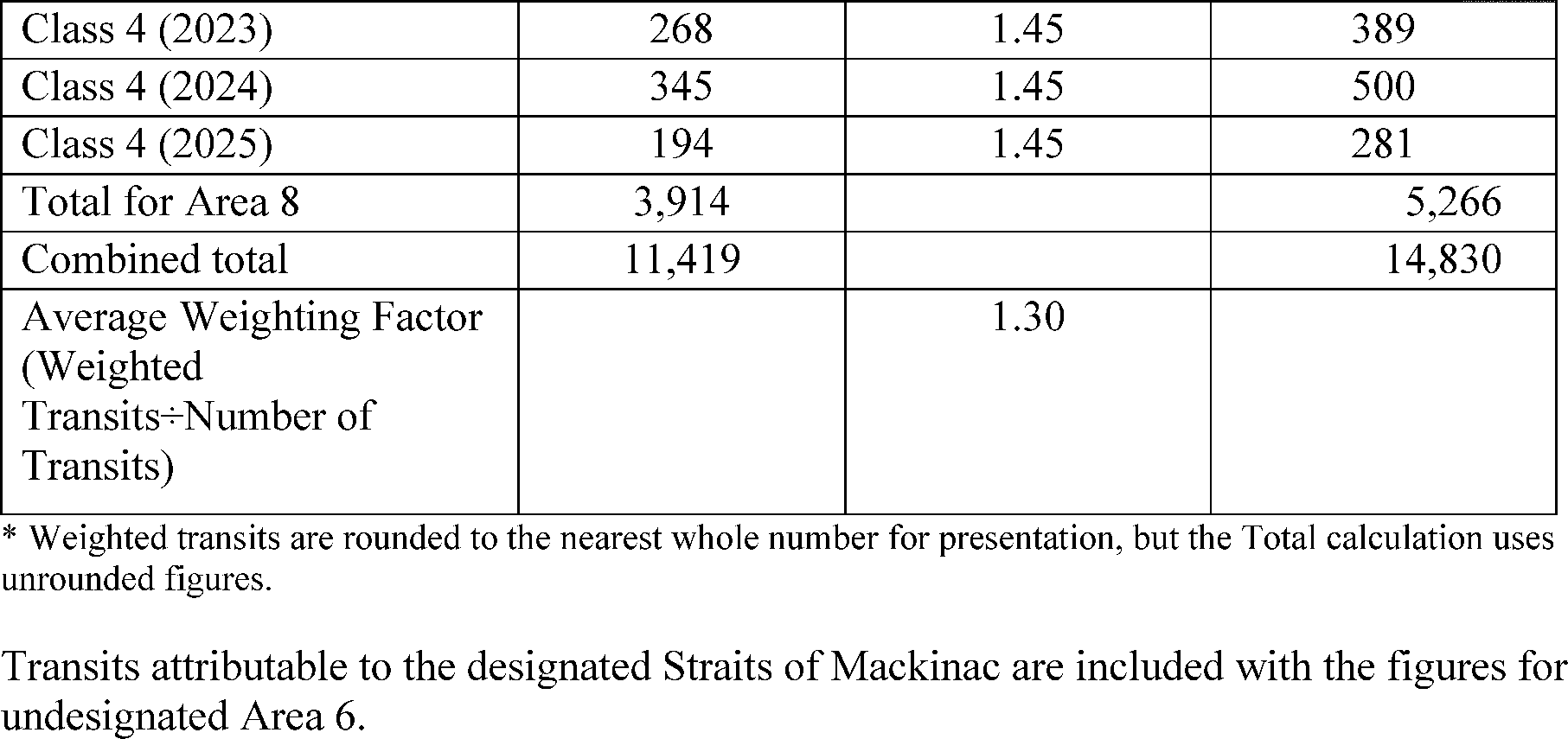
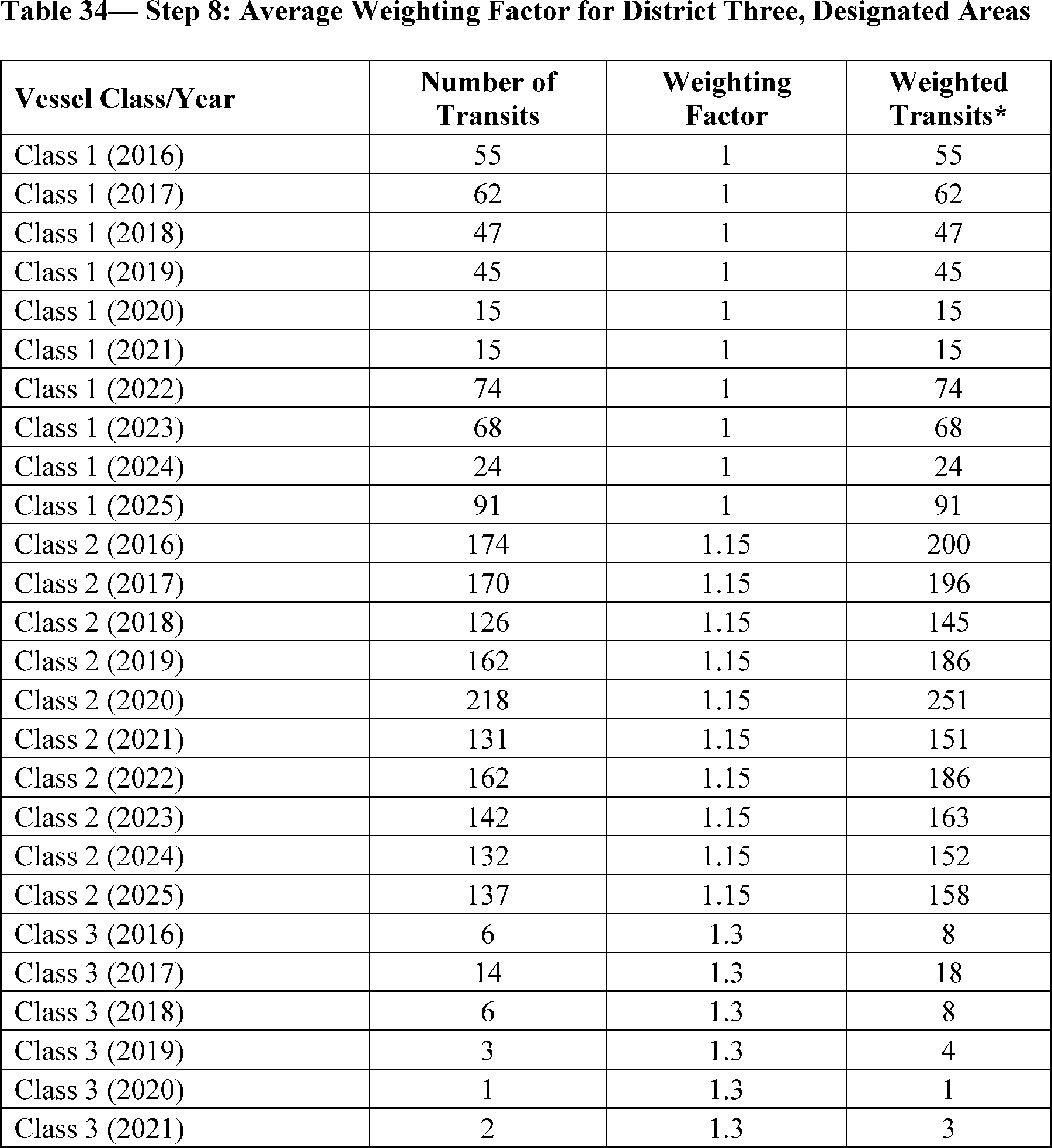
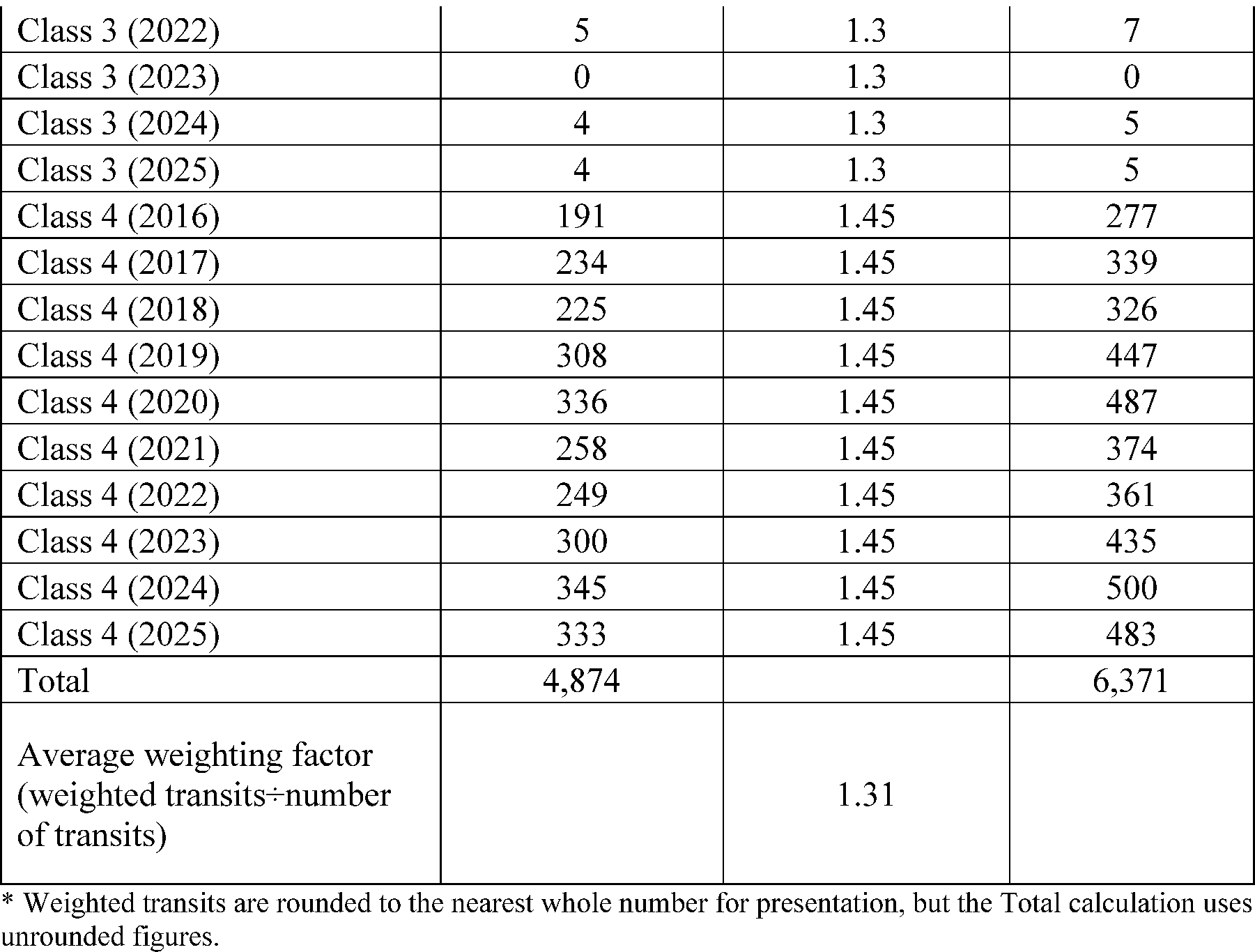
In Step 7, “Calculate average weighting factors by Area,” (§ 404.107), the Director calculates how much extra revenue, as a percentage of total revenue, has historically been produced by the weighting factors in each area. We do this by using a 10-year average of the applied weighting factors.
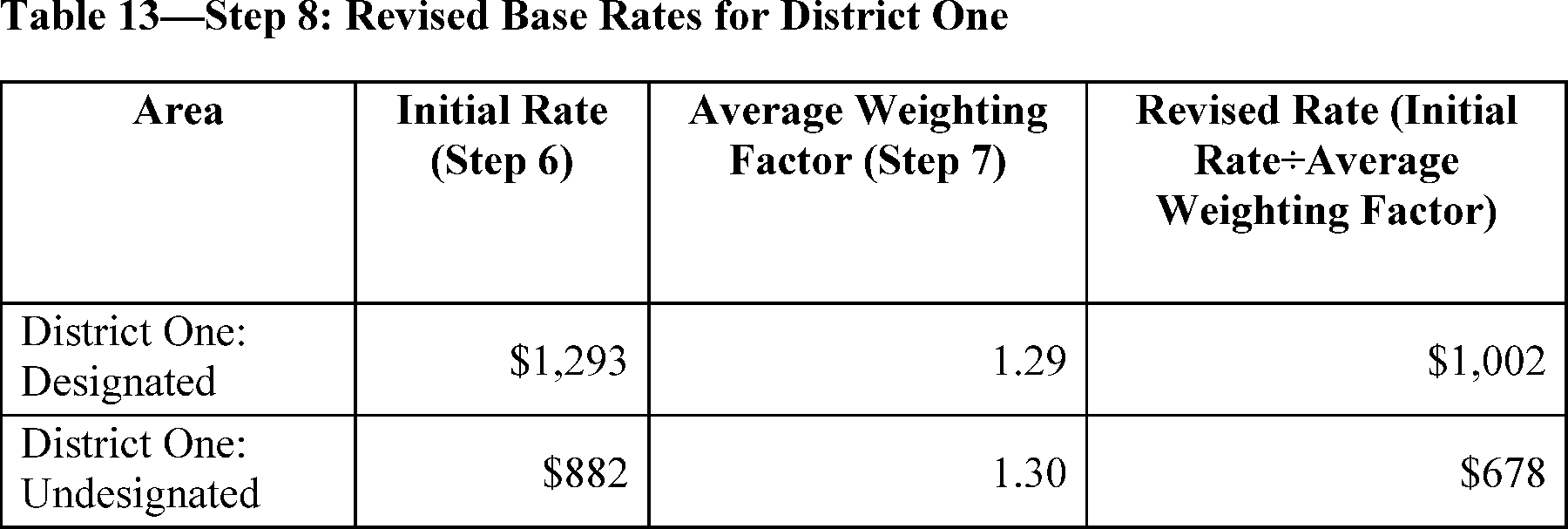
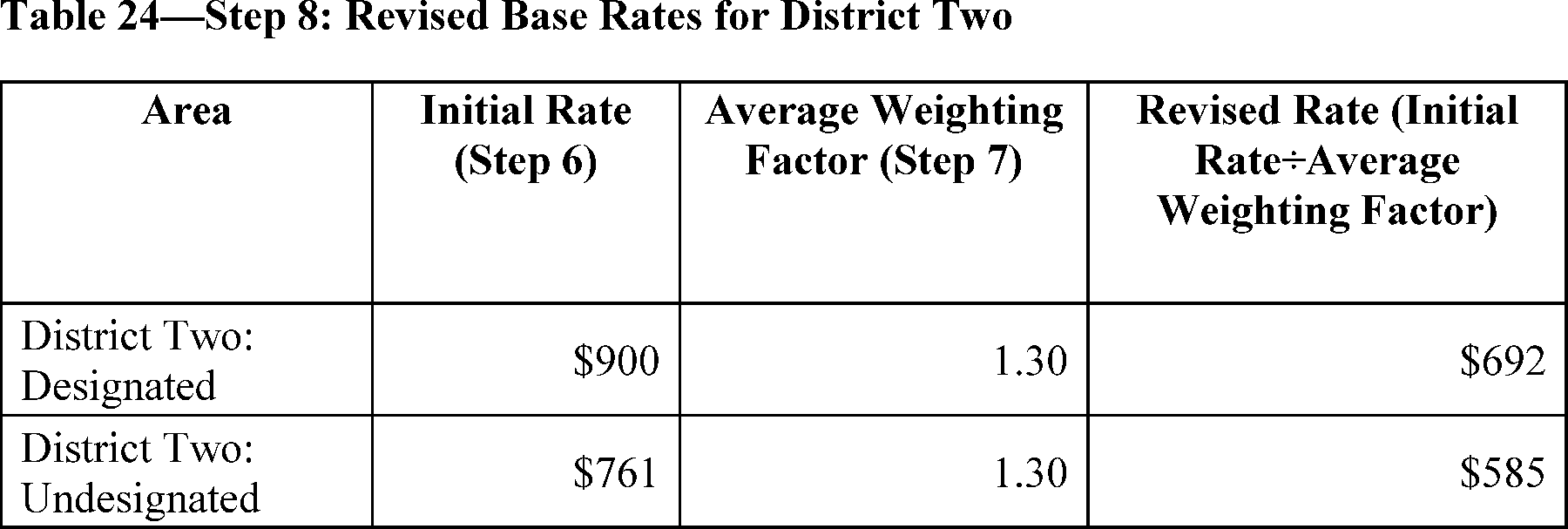
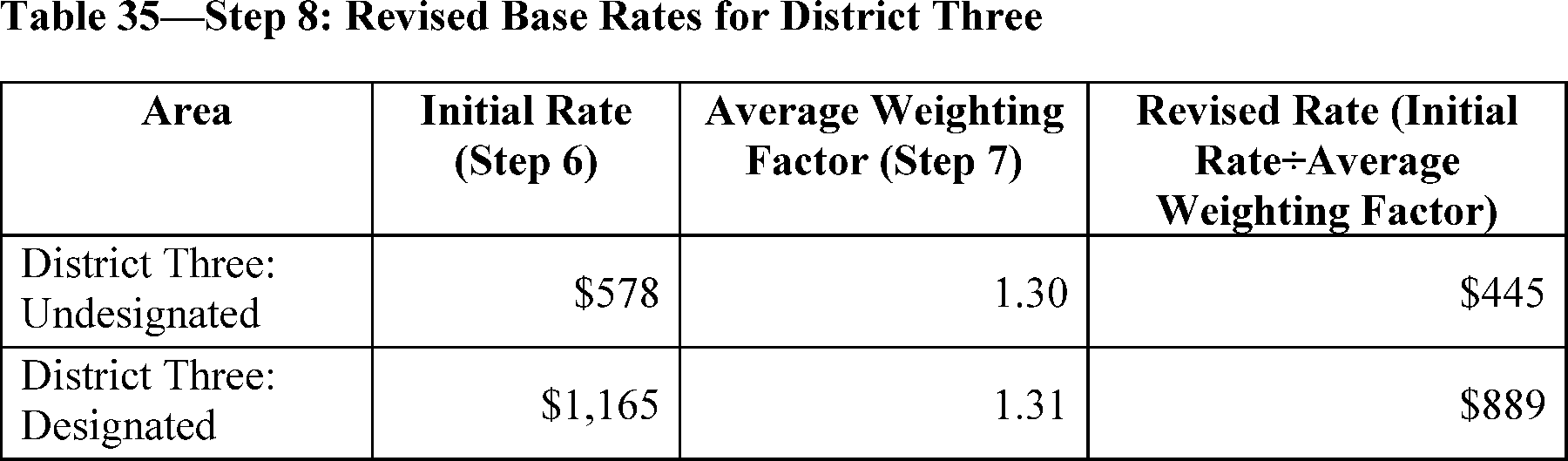
In Step 8, “Calculate revised base rates,” (§ 404.108) the Director modifies the base rates by accounting for the extra revenue generated by the weighting factors. We do this by dividing the initial pilotage rate for each area (from Step 6) by the corresponding average weighting factor (from Step 7), to produce a revised rate.
( printed page 59718)
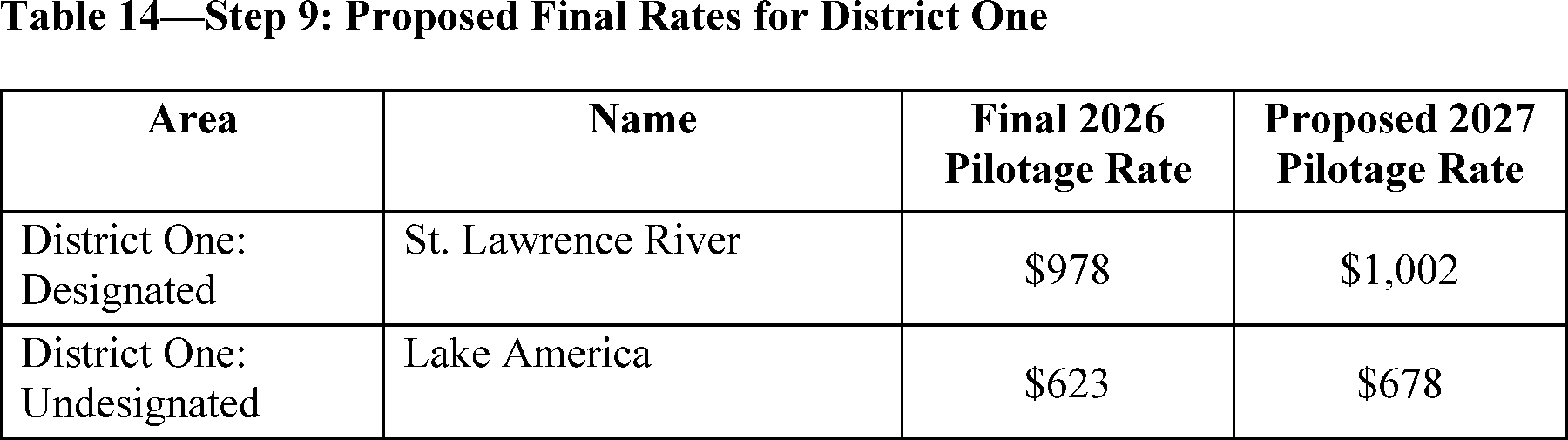
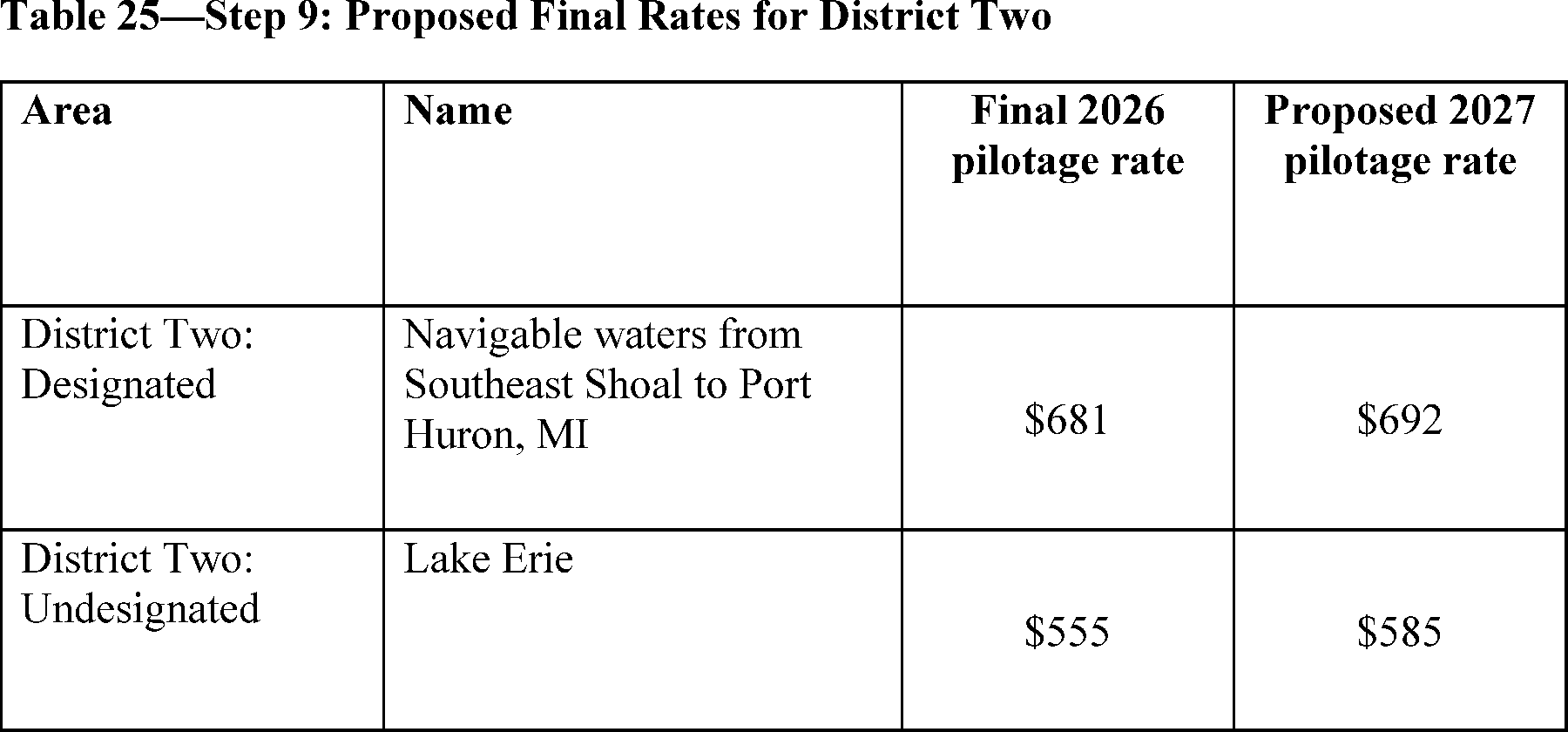
In Step 9, “Review and finalize rates,” (§ 404.109), often referred to informally as “Director's discretion,” the Director reviews the revised base rates (from Step 8) to ensure that they meet the goals set forth in 46 U.S.C. 9303(f) and 46 CFR 404.1(a), which include promoting efficient, safe, and reliable pilotage service on the Great Lakes; generating sufficient revenue for each pilotage association to reimburse necessary and reasonable operating expenses; compensating trained and rested Pilots fairly; and providing appropriate revenue for improvements.
VI. Discussion of Proposed Rate Adjustments
The process to calculate proposed pilotage rates begins by calculating a baseline rate for each district, considering projected operating expenses and the number of Pilots. This base rate is then adjusted using specific weighting factors to determine the final hourly pilotage rate. Detailed calculations for each district, illustrating every step of this process, can be found in Section VI. Tables Showing Calculations by District within this preamble.
A. Step 1: Recognize Previous Operating Expenses
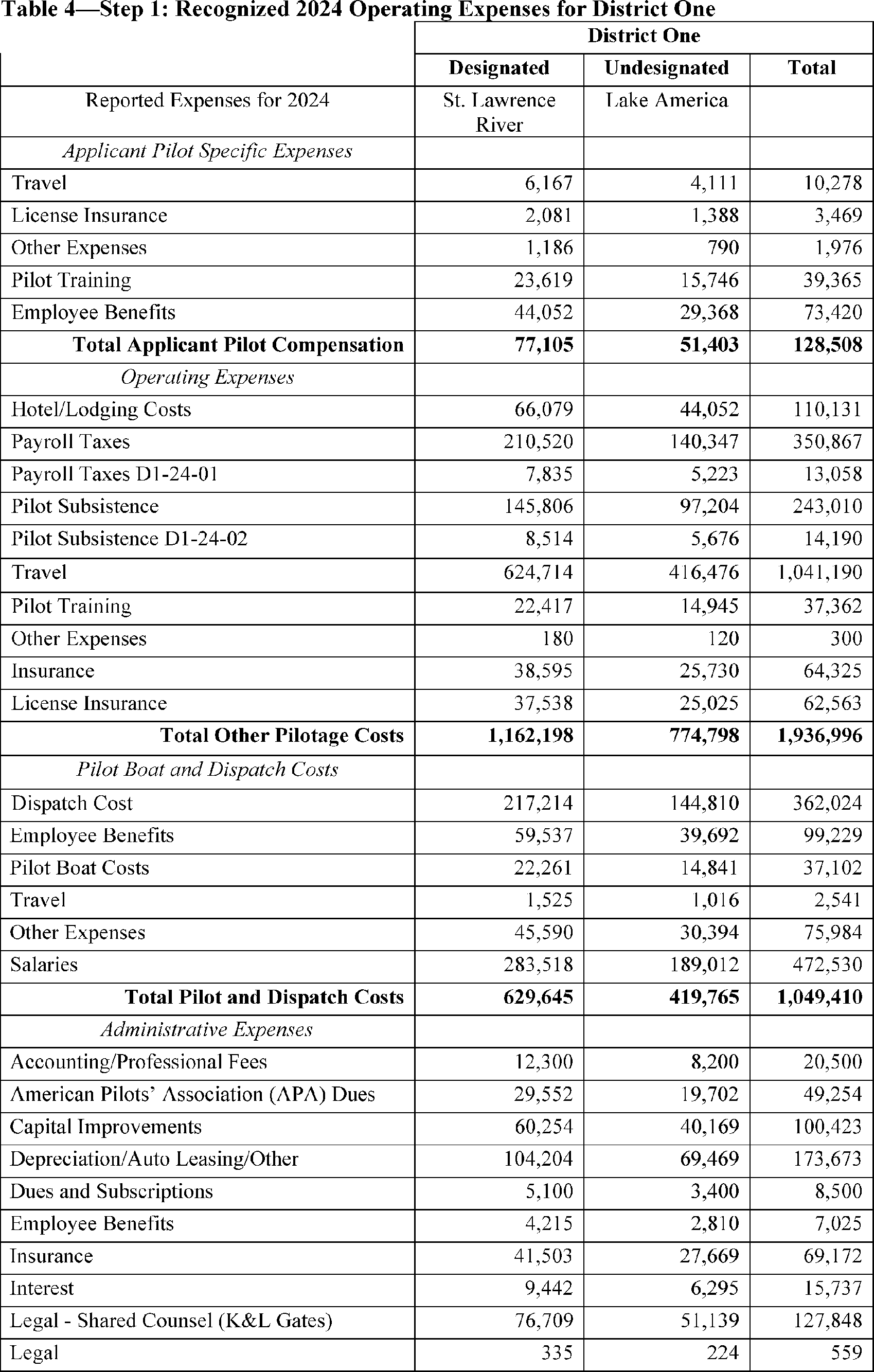
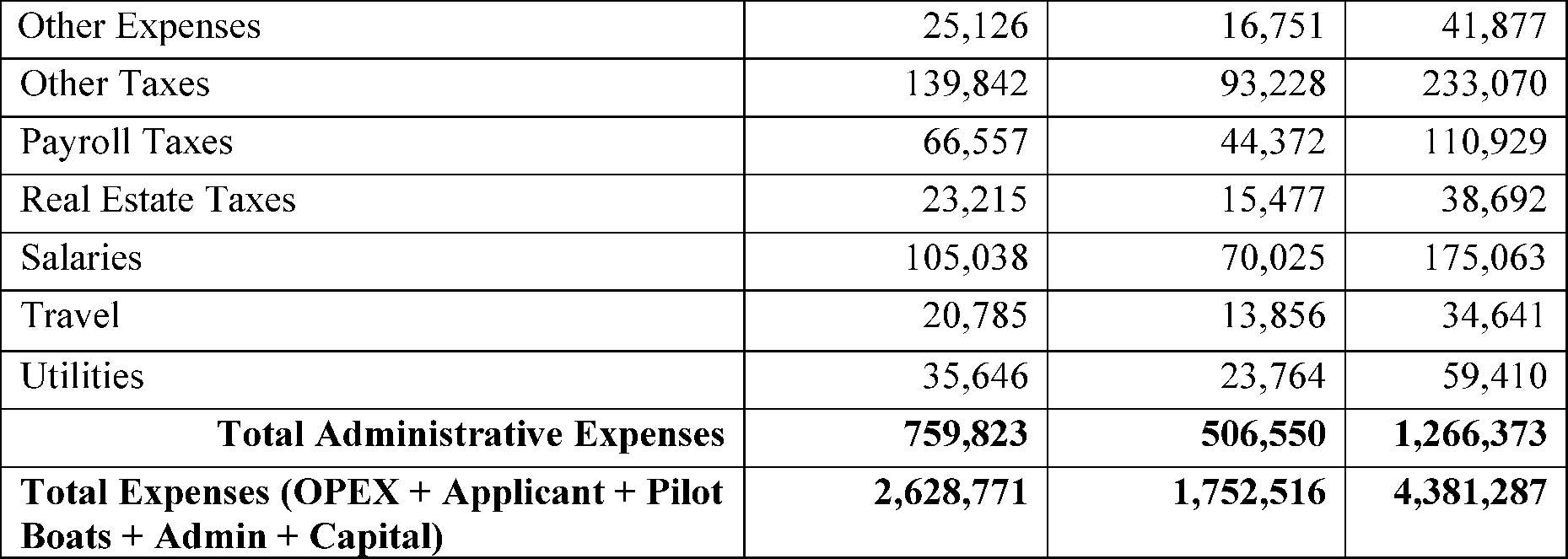
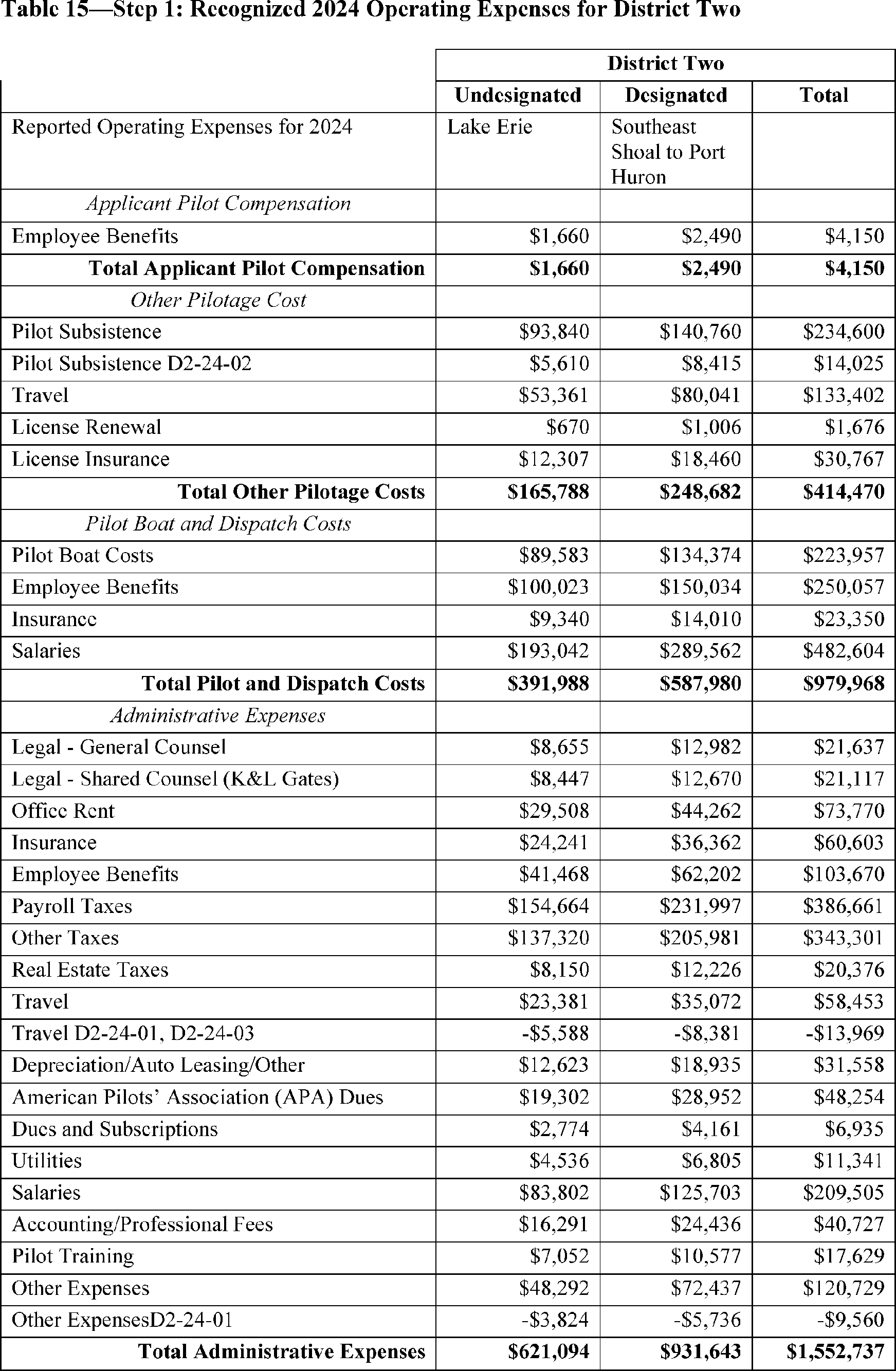
The first step in our ratemaking process, as outlined by § 404.101, is to establish a baseline budget for each of the three regional pilotage associations. An independent third-party accounting firm conducts a thorough review of each association's operating expenses to identify the foundational costs of providing pilotage services. This review includes all allowable expenses but specifically excludes Pilot and Apprentice Pilot wages and benefits, which are addressed in Step 4.
The complete reviewed financial reports, including detailed explanations of all adjustments, are publicly available in the official rulemaking docket, as referenced in Section IX. Public Participation and Request for Comments.
The recognized operating expenses for Districts One, Two, and Three are presented in tables 4, 15, and 26, respectively, in section VII. Tables Showing Calculations by District of this preamble.
B. Step 2: Project Operating Expenses, Adjusting for Inflation or Deflation
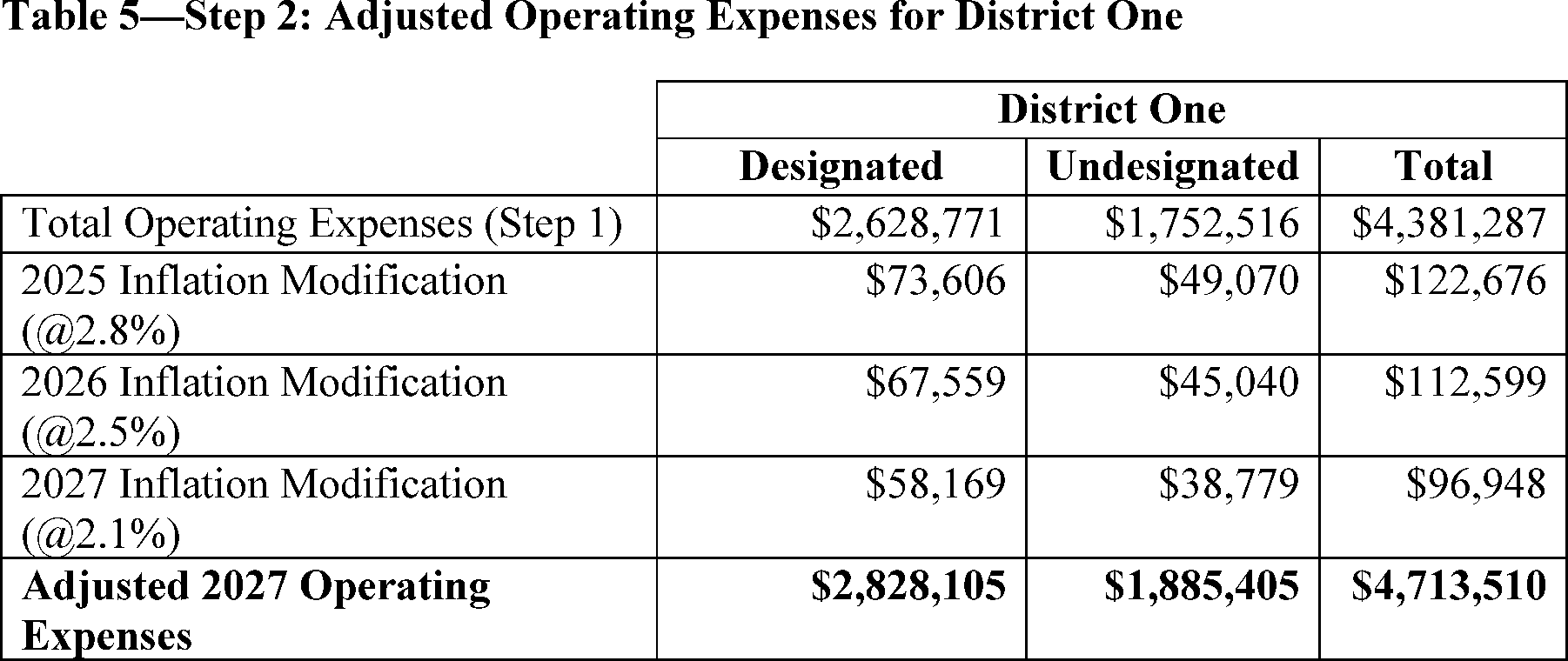
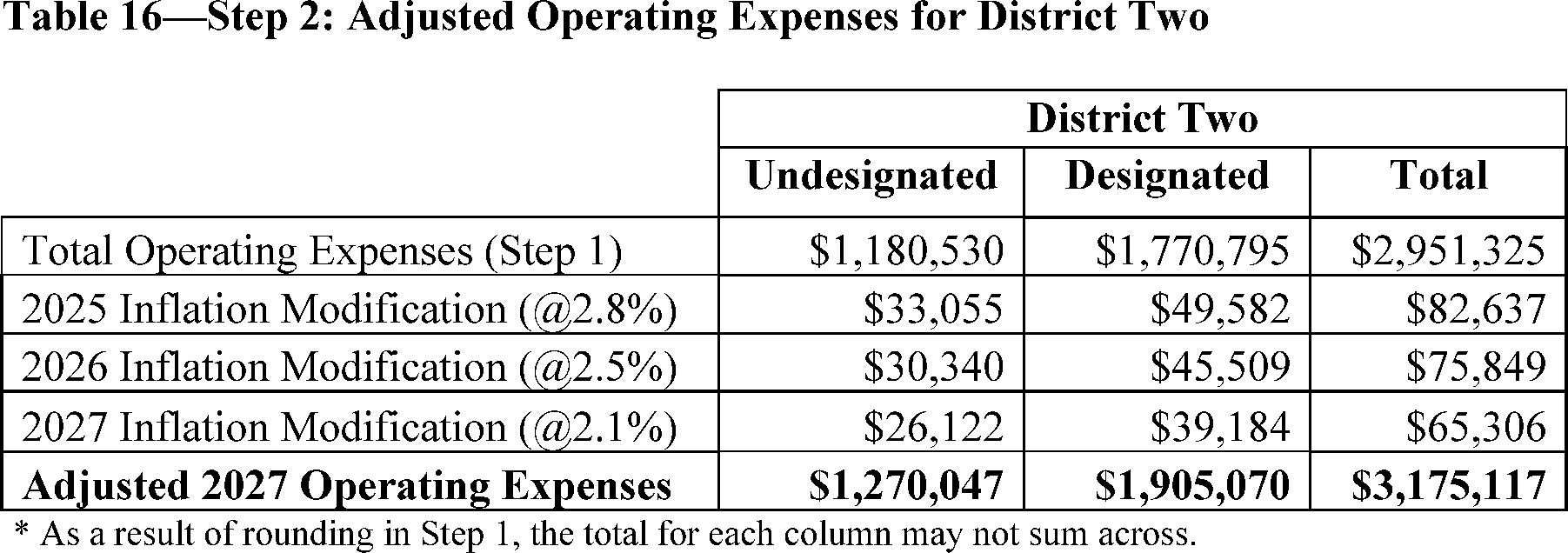
In Step 2, as outlined in § 404.102, we project the operating expenses for 2027. This involves taking the 2024 operating expense baseline from Step 1 and adjusting it for 3 years of inflation.
For the 2025 inflation rate of 2.8 percent, we use the Consumer Price Index (CPI) for the Midwest Region, as published by the Bureau of Labor Statistics (BLS) [20]
. Since the BLS does not provide inflation forecasts, we use the median economic projections for Personal Consumption Expenditures (PCE) inflation [21]
from the Federal Open Market Committee (FOMC) for the 2026 and 2027 adjustments, 2.5 percent and 2.1 percent respectively.
This process yields the total projected operating expenses for each district. Detailed calculations for Districts One, Two, and Three are available in this preamble in tables 5, 16, and 27, respectively.
C. Step 3: Estimate Number of Registered Pilots and Apprentice Pilots
In this step, outlined in § 404.103, the Director calculates how many Pilots and Apprentice Pilots are needed for each district.
Setting Minimum and Maximum Levels
To provide operational flexibility, the Coast Guard establishes minimum and maximum Pilot numbers for each district:
The minimum number is based on the current staffing model, with rounding methodologies amended by Great Lakes Pilotage Rates—2021 Annual Review and Revisions to Methodology (86 FR 14184, 14190).
The maximum number is the figure from the staffing model plus three, as recommended by the GLPAC in 2023 and as established by the Great Lakes Pilotage Rates—2025 Annual Review (89 FR 100810, 100815).
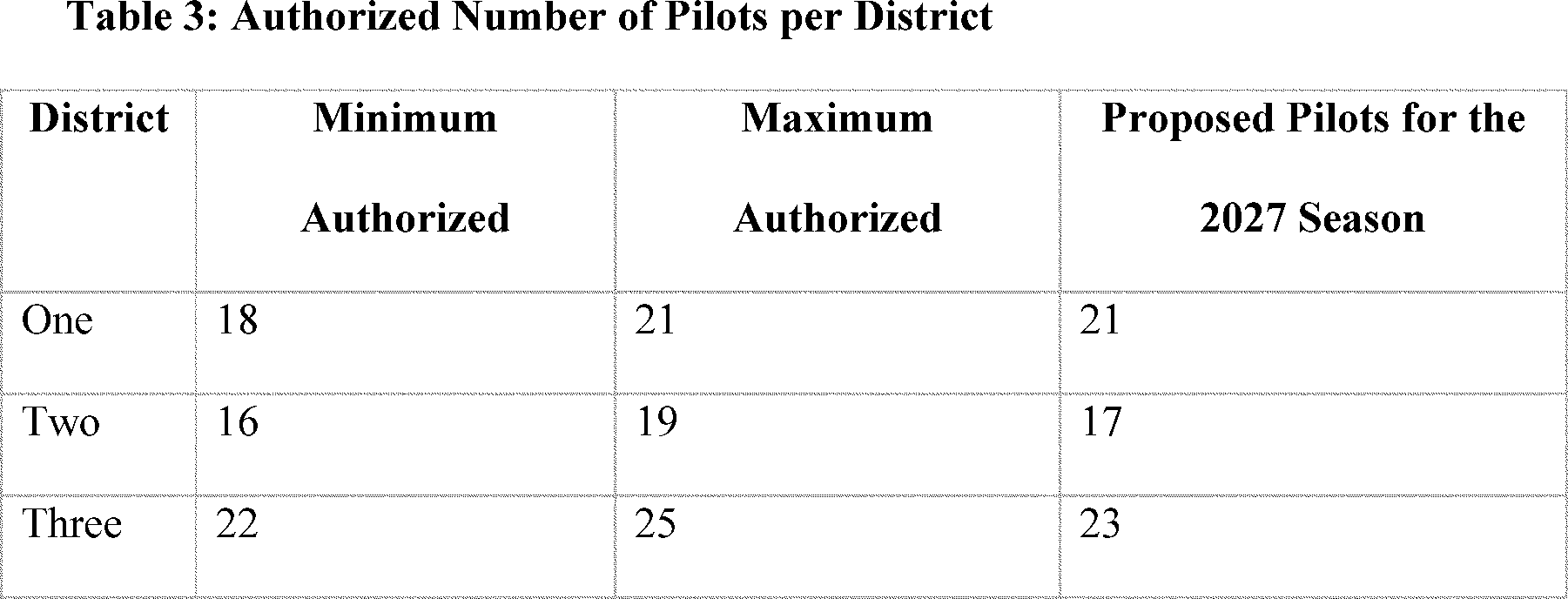
The minimum, maximum, and proposed number of Pilots for each District are as follows:
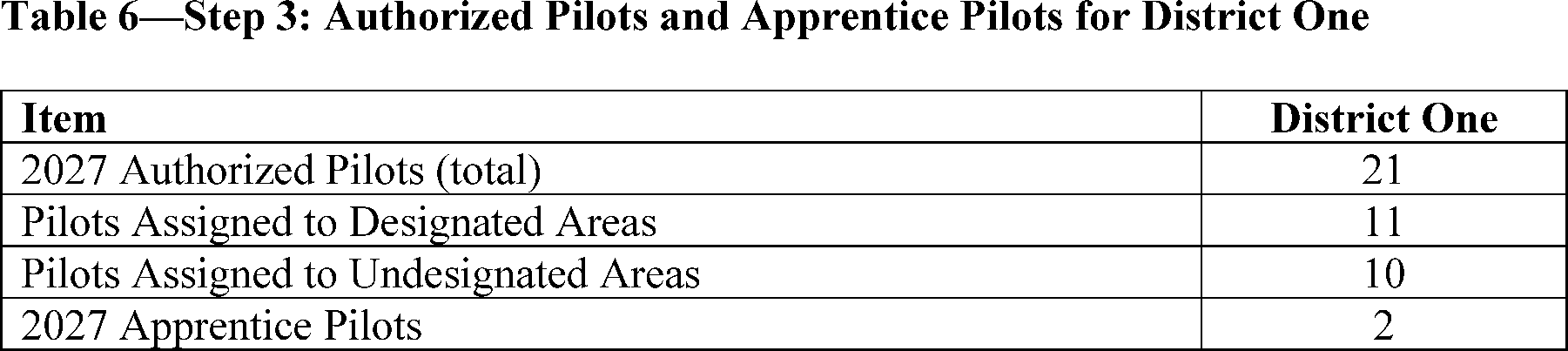
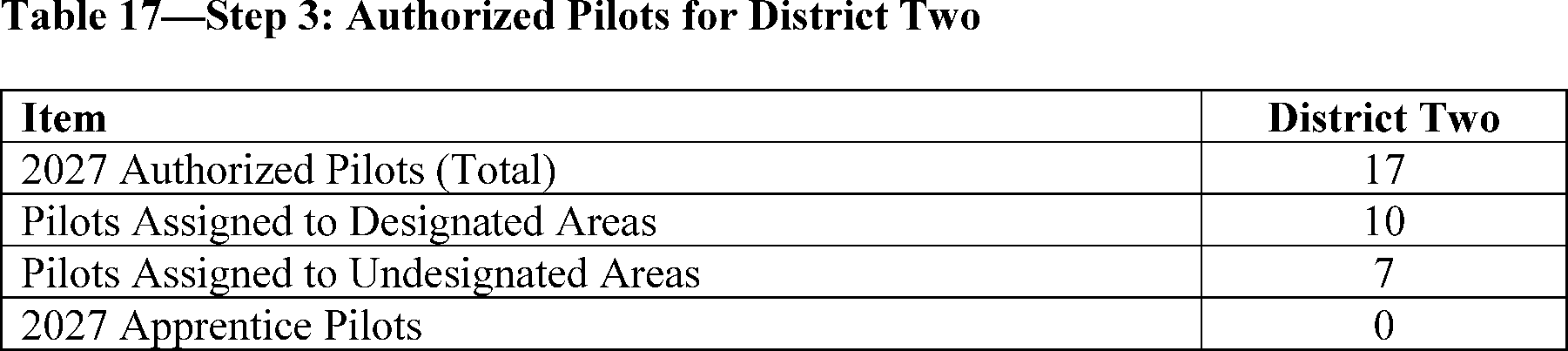
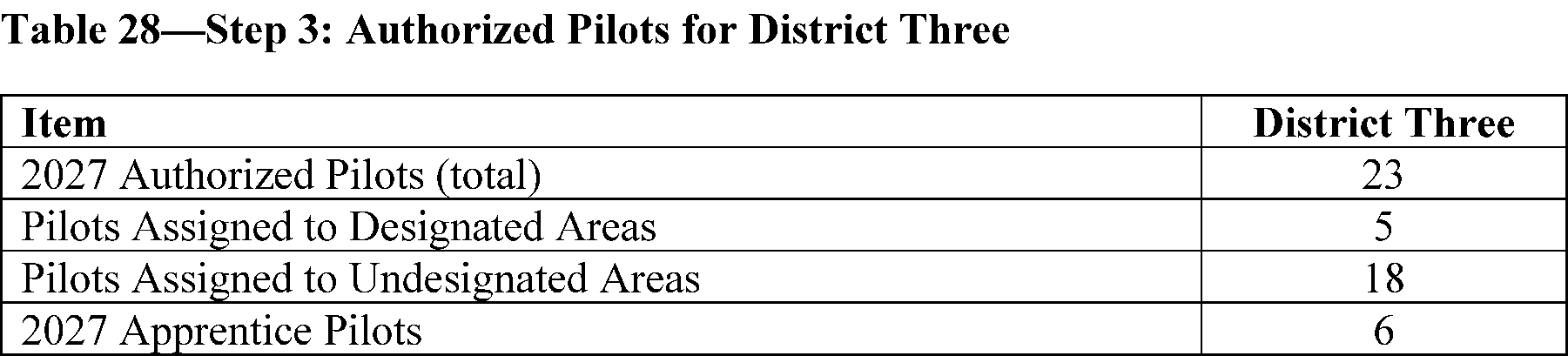
More details on projected staffing levels can be found for Districts One, Two, and Three in tables 6, 17, and 28, respectively.
Determining the Number of Apprentice Pilots
The number of authorized Apprentice Pilots is based on direct input from the pilotage associations, who identify future staffing needs considering anticipated retirements and other factors.
( printed page 59719)
D. Step 4: Determine Target Pilot Compensation Benchmark and Apprentice Pilot Wage Benchmark
In Step 4 of the ratemaking calculation, we determine the number of Pilots provided by the pilot associations (see § 404.103) and use that figure to determine how many Pilots need to be compensated via the pilotage fees collected.
This step establishes the target Pilot compensation for the number of Pilots required in each district, as determined in Step 3. We calculate an individual compensation benchmark and then use it to determine the total compensation for all Pilots and Apprentice Pilots in a district.
Calculating the 2027 Individual Target Pilot Compensation
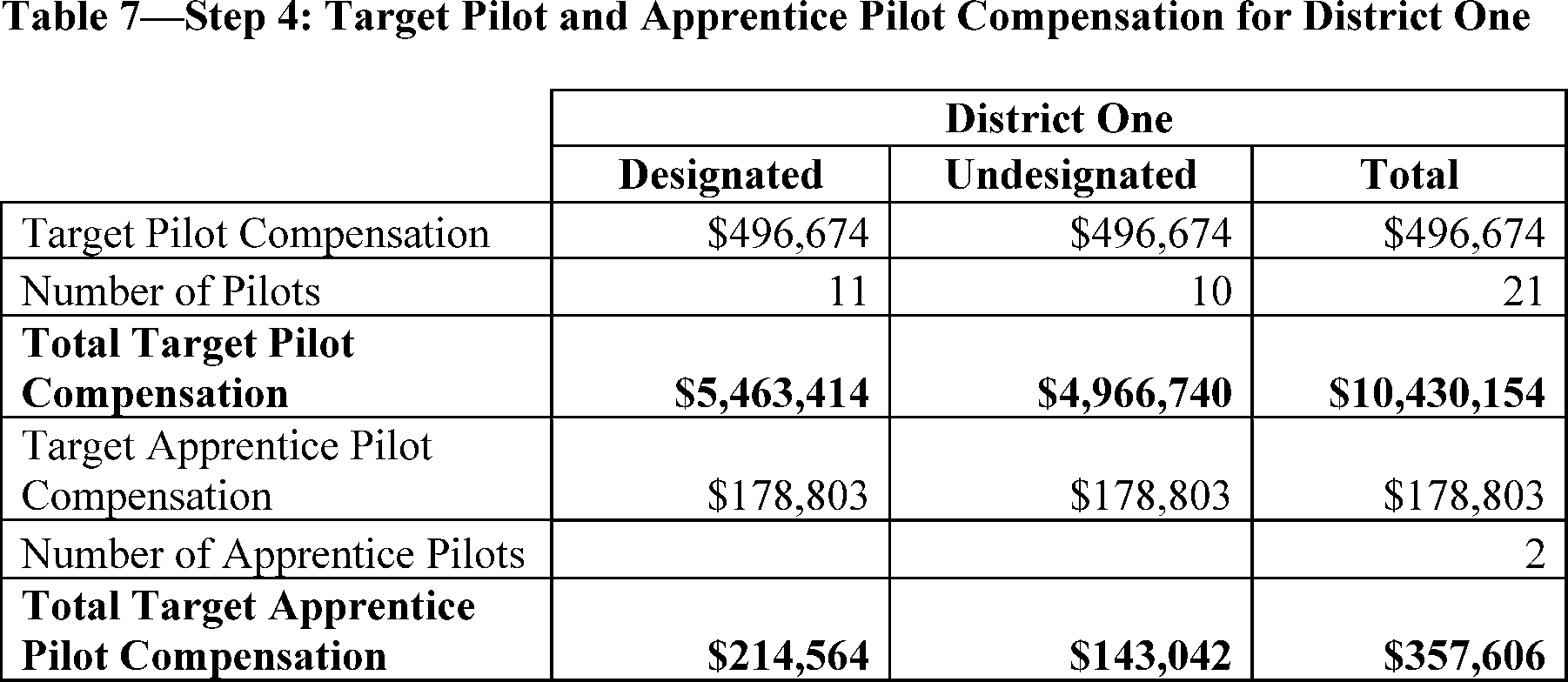
In accordance with § 404.104(a), the calculation for the 2027 individual target Pilot compensation benchmark starts with the 2026 benchmark of $481,642 and involves two key inflation adjustments:
1. Adjustment for 2026 Inflation: We adjust the 2026 benchmark to account for the difference between last year's projected inflation and the actual inflation numbers. The initial 2026 PCE inflation projection was 2.4 percent, but the Employment Cost Index (ECI) inflation for Q1 2026 was 3.4 percent. Applying this 1.0 percent difference to the 2026 benchmark results in an updated value of $486,458.
2. Adjustment for 2027 Projected Inflation: Next, we apply the projected inflation for 2027, which is 2.1 percent. This increases the individual target Pilot compensation to $496,674 per Pilot for 2027.
Calculating Total Target Pilot Compensation and Apprentice Pilot Wages
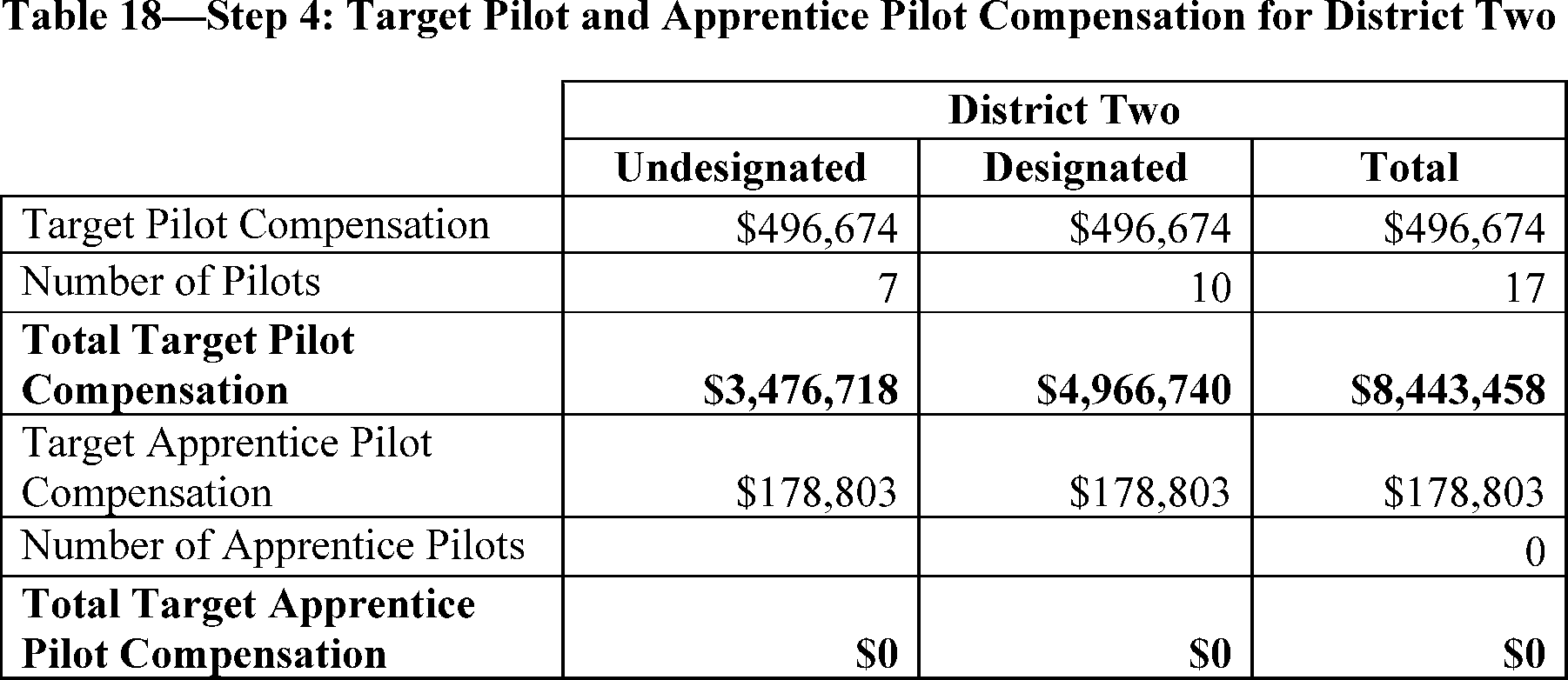
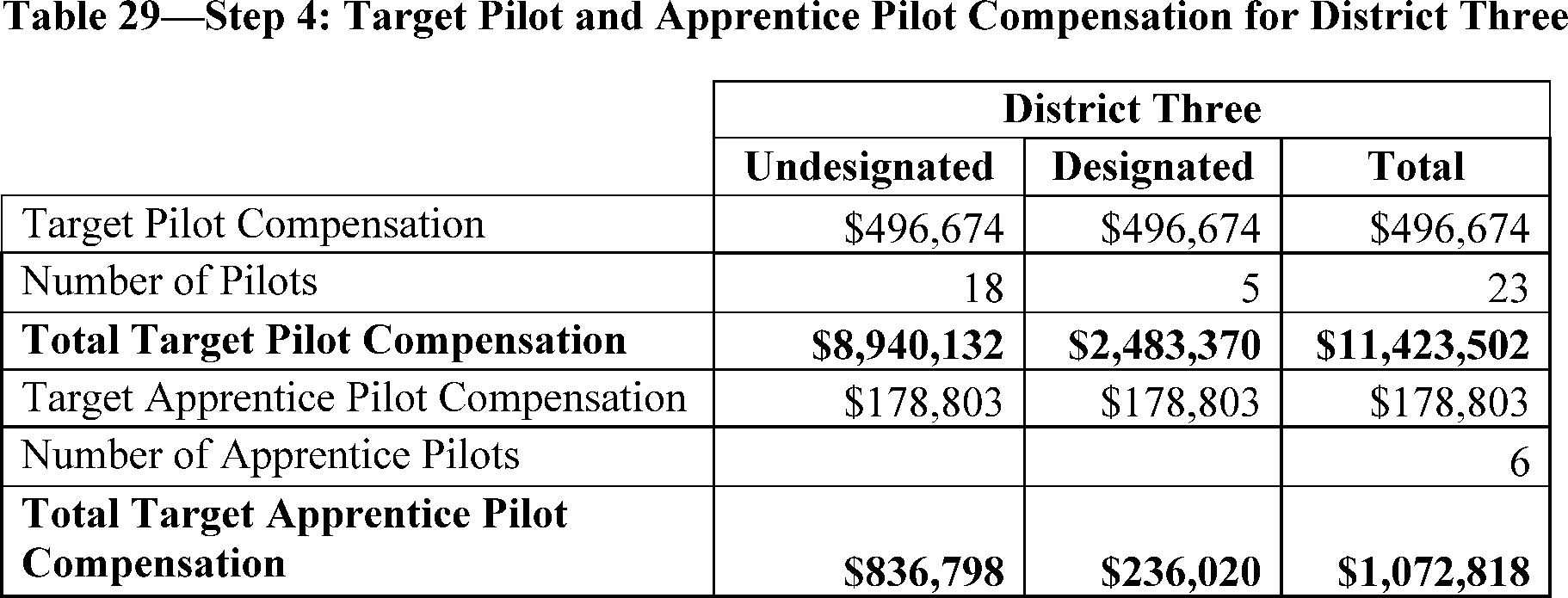
The individual target Pilot compensation of $496,674 is used to calculate the total target Pilot compensation for each of the three districts by multiplying it by the number of Pilots needed in each area and district, as shown for Districts One, Two, and Three in tables 7, 18, and 29, respectively.
From this individual target Pilot compensation, the wage benchmark for Apprentice Pilots is set at 36 percent of a Pilot's target compensation, amounting to $178,803 for 2027. The target Apprentice Pilot compensation of $178,803 is used to calculate the total target Apprentice Pilot compensation for each of the three districts by multiplying it by the number of Apprentice Pilots needed for each district, as shown for Districts One, Two, and Three in tables 7, 18, and 29, respectively. The Total Target Apprentice Pilot Compensation is apportioned to each area using the same percentage as the Step 1 operating expenses for each District. For Districts One and Two, the allocation is 60 percent for the designated area and 40 percent for the undesignated area. For District Three, the allocation is 22 percent for the designated area, 78 percent for the undesignated areas (53 percent for Area 6, and 25 percent for Area 8).
E. Step 5: Project Needed Revenue
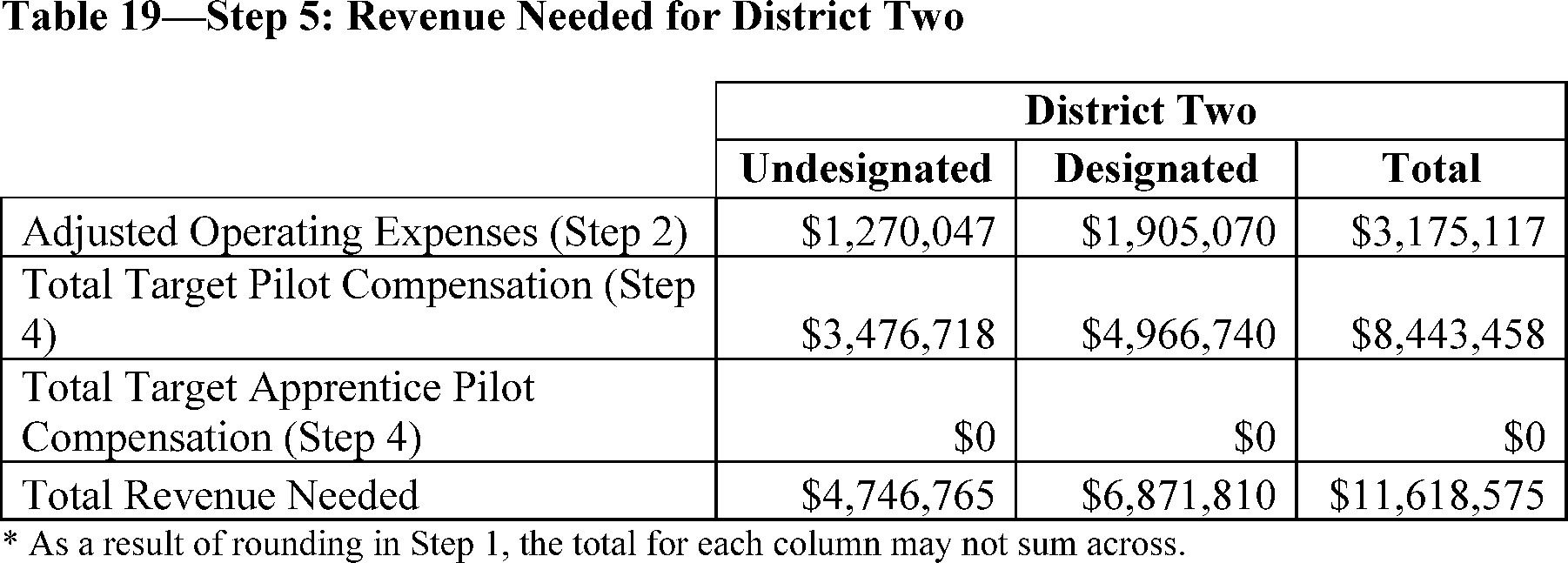
In this step, we determine the total revenue required to cover all projected operating expenses. For each area and pilotage district, we sum the projected operating expenses from Step 2, the total target Pilot compensation, and total target Apprentice Pilot wage from Step 4. The resulting figure is the “needed revenue” for that district. Specific calculations for each district are detailed for Districts One, Two, and Three in tables 8, 19, and 30, respectively.
F. Step 6: Calculate Initial Base Rates
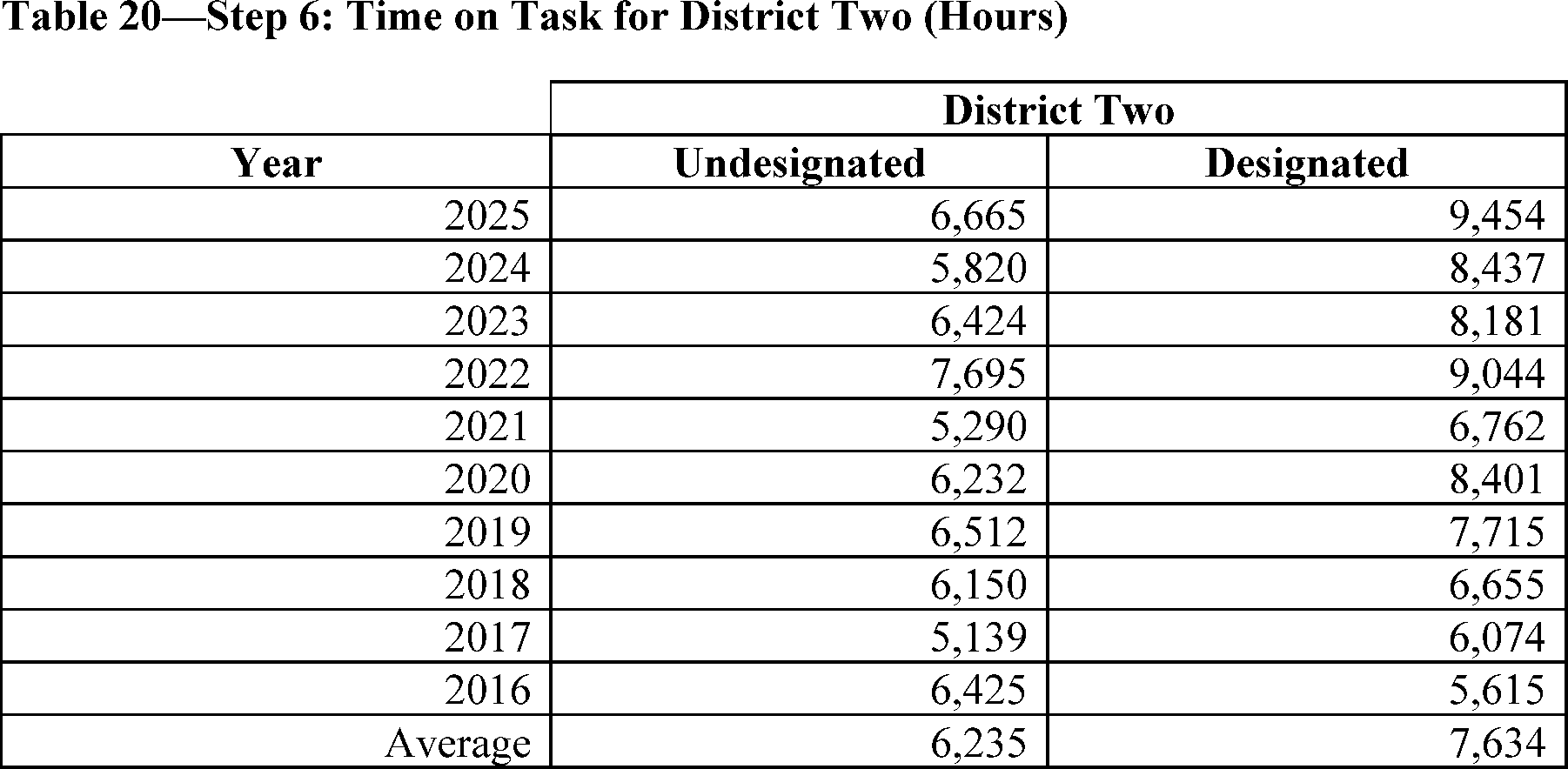
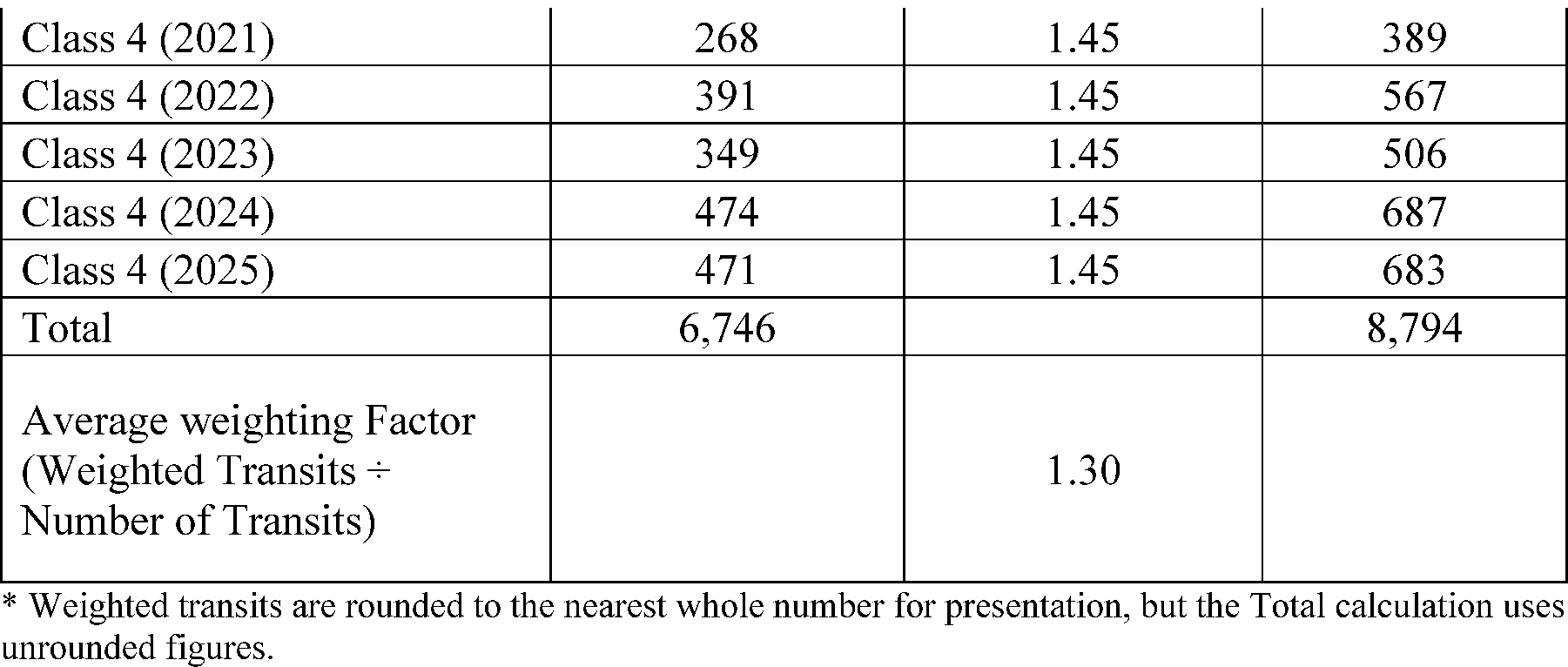
Next, we establish an initial hourly rate to meet the needed revenue. First, we calculate the 10-year average of traffic using the total time on task or Pilot bridge hours for each district. As noted previously in this preamble, we propose to continue to include the Straits of Mackinac bridge hours in the undesignated average bridge hours in District Three. Then, we divide the needed revenue from Step 5 by the average bridge hours. This calculation provides an initial base rate for pilotage services. The bridge hour data and rate calculations for Districts One, Two, and Three are available in tables 9 and 10; 20 and 21; and 31 and 32, respectively.
G. Step 7: Calculate Average Weighting Factors by Area
In this step, we calculate the average weighting factor for each district's designated and undesignated area. Using the weighting factor reports from SeaPro, we calculate the average weighting factor for each area using the data from each vessel transit in Districts One, Two, and Three over a 10- year period (2016 through 2025), as shown in tables 11 and 12; 22 and 23; and 33 and 34, respectively.
H. Step 8: Calculate Revised Base Rates
In this step, the Director adjusts the initial base rates to account for the revenue generated by weighting factors. The Director divides the initial pilotage rate for each area from Step 6 by the corresponding average weighting factor from Step 7. This calculation produces a revised, unadjusted base rate, as shown in tables 13, 24, and 35 for Districts One, Two, and Three, respectively.
I. Step 9: Review and Finalize Rates
Finally, per § 404.109, the Director reviews the revised rates to ensure they align with the goals of the Great Lakes Pilotage Act. The Director considers whether the rates adequately support a sufficient number of Pilots to handle peak traffic periods and cover all reasonable costs. Based on these considerations, the Director makes no alterations to the rates in this step. We propose modifying § 401.405(a)(1) through (6) to reflect the final rates shown for Districts One, Two, and Three in tables 14, 25, and 36, respectively, of Section VII. Tables Showing Calculations by District portion of this preamble.
VII. Tables Showing Calculations by District
A. District One
( printed page 59720)
( printed page 59721)
( printed page 59722)
In the 2026 final rule, the Coast Guard published a figure of 6,232 hours as the total 2024 designated hours, and a figure of 8,075 as the total 2024 undesignated hours for District One. Since that publication, the Coast Guard received a revised figure of 6,271 designated hours and 8,099 undesignated hours through the 2024 Revenue Report for District One provided by CohnReznick.
( printed page 59723)
( printed page 59724)
( printed page 59725)
( printed page 59726)
( printed page 59727)
B. District Two
( printed page 59728)
( printed page 59729)
( printed page 59730)
In the 2026 final rule, the Coast Guard published a figure of 5,809 hours as the total 2024 undesignated hours and a figure of 8,308 as the total 2024 designated hours for District Two.[22]
Since that publication, the Coast Guard received a revised figure of 5,820 undesignated hours and 8,437 designated hours through the 2024 Revenue Report for District Two provided by CohnReznick.
( printed page 59731)
( printed page 59732)
( printed page 59733)
( printed page 59734)
C. District Three
( printed page 59735)
( printed page 59736)
( printed page 59737)
Bridge hours attributable to the designated Straits of Mackinac are included in the undesignated waters average bridge hours. In the 2026 final rule, the Coast Guard published a figure of 26,359 hours as the total 2024 undesignated hours and a figure of 3,437 as the total 2024 designated hours for District Three.[23]
Since that publication, the Coast Guard received a revised figure of 27,506 undesignated hours and 3,444 designated hours through the 2024 Revenue Report for District Three provided by CohnReznick.
( printed page 59738)
( printed page 59739)
( printed page 59740)
( printed page 59741)
( printed page 59742)
( printed page 59743)
( printed page 59744)
VIII. Regulatory Analyses
We developed this proposed rule after considering numerous statutes and Executive orders related to rulemaking. A summary of our analyses based on these statutes and Executive Orders follows.
A. Regulatory Planning and Review
Executive Orders 12866 (Regulatory Planning and Review) and 13563 (Improving Regulation and Regulatory Review) direct agencies to assess the costs and benefits of available regulatory alternatives and, if regulation is necessary, to select regulatory approaches that maximize net benefits. Executive Order 13563 emphasizes the importance of quantifying costs and benefits, of reducing costs, of harmonizing rules, and of promoting flexibility. Executive Order 14192 (Unleashing Prosperity Through Deregulation) directs agencies to significantly reduce the private expenditures required to comply with Federal regulations and provides that “any new incremental costs associated with new regulations shall, to the extent permitted by law, be offset by the elimination of existing costs associated with at least 10 prior regulations.”
The Office of Management and Budget (OMB) has not designated this proposed rule a “significant regulatory action,” under section 3(f) of Executive Order 12866. Accordingly, OMB has not reviewed it.
Two additional Executive orders promote the goals of Executive Order 13563: Executive Order 13609 (Promoting International Regulatory Cooperation) and Executive Order 13610 (Identifying and Reducing Regulatory Burdens). Executive Order 13609 targets international regulatory cooperation to reduce, eliminate, or prevent unnecessary differences in regulatory requirements. Executive Order 13610 aims to modernize the regulatory systems and to reduce unjustified regulatory burdens and costs on the public.
A regulatory analysis (RA) follows.
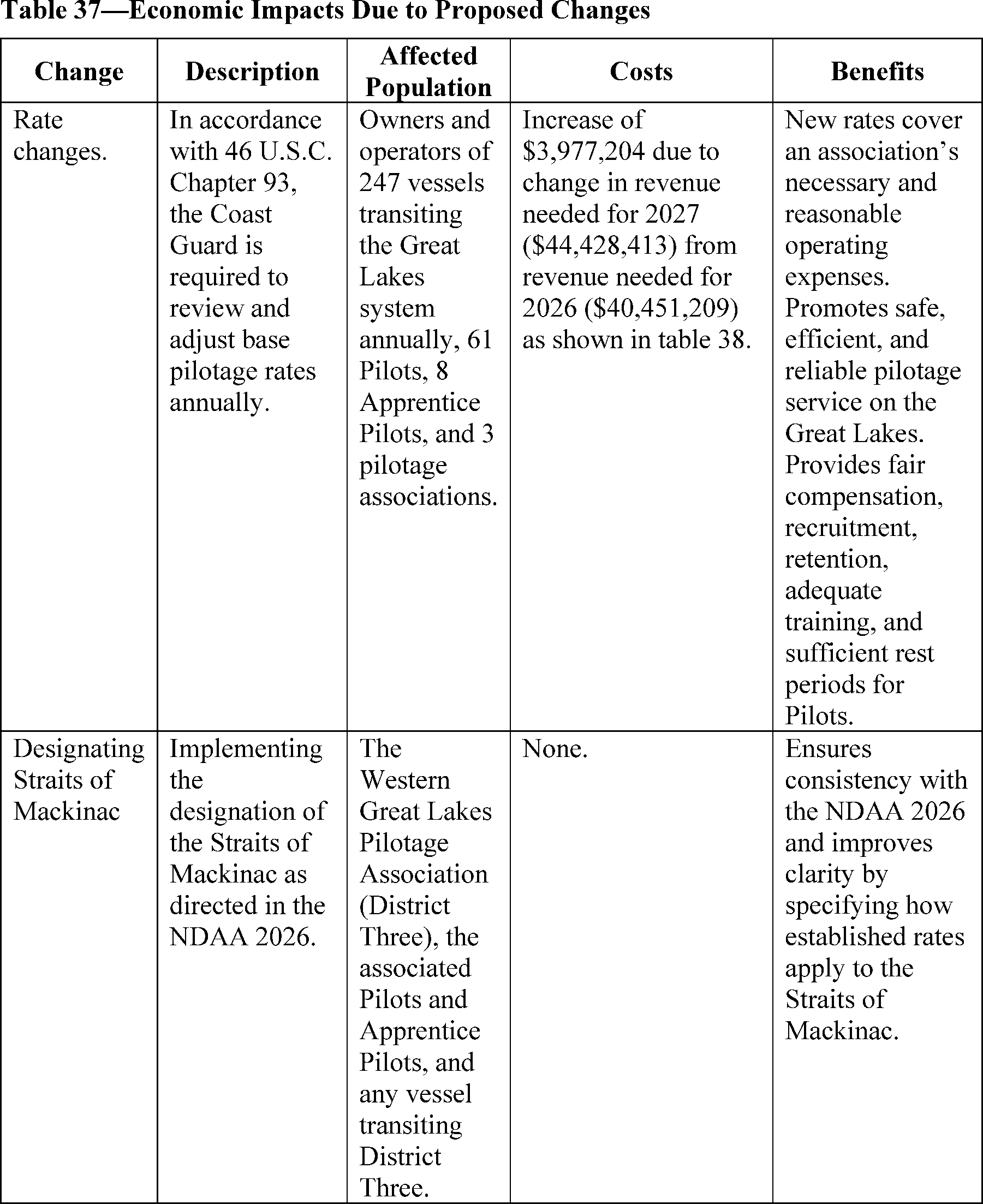
The purpose of this proposed rule is to conduct a full ratemaking to designate the Straits of Mackinac and issue new pilotage rates for the 2027 shipping season. For this proposed rule, the Coast Guard estimates an increase in costs of approximately $3.98 million to industry. This is an approximately 10-percent increase due to the change in revenue needed in 2027 compared to the revenue needed in 2026, as shown in table 37. The biggest driver of the overall increase is an increase of four Pilots and one Apprentice compared to the 2026 season, which drives a total of 53 percent of the increase. The rest of the overall rate increase is driven by changes to inflation and vessel traffic which are equally 23 percent of the overall increase.
( printed page 59745)
The Coast Guard is required to review and adjust pilotage rates on the Great Lakes annually. See Section II. Basis and Purpose of this preamble for detailed discussions of the legal basis and purpose for this proposed rulemaking. Based on our annual review for this proposed rulemaking, we propose adjusting the pilotage rates for the 2027 shipping season to generate sufficient revenues for each district to reimburse its necessary and reasonable operating expenses and fairly compensate trained and rested Pilots. The result would be an increase in rates for all areas in Districts One, Two, and Three. These changes would also lead to a net increase in the cost of service to shippers. The change in per unit cost to each individual shipper would be dependent on their area of operation.
A detailed discussion of our economic impact analysis follows.
Affected Population
This proposed rule would affect Pilots and Apprentice Pilots, the three pilotage associations, and the owners and operators of 247 oceangoing vessels that transit the Great Lakes annually, on average, from 2023 through 2025. We estimate that there would be 61 Pilots and 8 Apprentice Pilots during the 2027 shipping season. The shippers that would be affected by these rate changes are those owners and operators of domestic vessels operating “on register”
( printed page 59746)
(engaged in foreign trade) and owners and operators of non-Canadian foreign vessels on routes within the Great Lakes system. These owners and operators must have Pilots or pilotage service as required by 46 U.S.C. 9302. There is no minimum tonnage limit or exemption for these vessels. The statute applies only to commercial vessels and not to recreational vessels. United States-flagged vessels not operating on register, and Canadian “lakers,” which account for most commercial shipping on the Great Lakes, are not required by 46 U.S.C. 9302 to have Pilots. However, these United States- and Canadian-flagged lakers may voluntarily choose to engage a Pilot. Vessels that are U.S.-flagged may opt to have a Pilot for varying reasons, such as unfamiliarity with designated waters and ports or for insurance purposes.
The Coast Guard used billing information from the years 2023 through 2025 from SeaPro to estimate the average annual number of vessels that would be affected by the proposed rate adjustment. SeaPro tracks data related to managing and coordinating the dispatch of Pilots on the Great Lakes and billing in accordance with the services. As described in the ratemaking methodology, we use a 10-year average to estimate the traffic for the rate. We used 3 years of the most recent billing data to estimate the affected population. Using 3 years of billing data is a better representation of the vessel population that is currently using pilotage services and impacted by this proposed rule. We found that 392 unique vessels used pilotage services during the years 2023 through 2025. That is, these vessels had a U.S. registered Pilot dispatched to the vessel and billing information was recorded in SeaPro. Of these vessels, 376 were foreign-flagged vessels and 16 were U.S.-flagged vessels. Again, U.S.-flagged vessels not operating on register are not required to have a Pilot, per 46 U.S.C. 9302, but they can voluntarily choose to have one. Any such vessels that voluntarily choose to have a Pilot are accounted for in the methodology.
Numerous factors affect vessel traffic, which varies from year to year. Therefore, rather than using the total number of vessels over the time period, the Coast Guard took an average of the unique vessels using pilotage services from the years 2023 through 2025 as the best representation of vessels estimated to be affected by the rates in this proposed rule. From 2023 through 2025, an average of 247 vessels used pilotage services annually.[24]
On average, 240 of these vessels were foreign-flagged, and 7 were U.S.-flagged vessels that voluntarily opted into the pilotage service (these figures are rounded averages).
Total Cost to Shippers
The proposed rate changes resulting from this adjustment to the rates result in a net increase in the cost of service to shippers. However, the change in per unit cost to each individual shipper would be dependent on their area of operation.
The Coast Guard estimates the effect of the proposed rate changes on shippers by comparing the total projected revenues needed to cover costs in 2026 with the total projected revenues needed to cover costs in 2027. We set pilotage rates, so pilotage associations receive enough revenue to cover their necessary and reasonable expenses. Shippers pay these rates when they engage a Pilot as required by 46 U.S.C. 9302. Therefore, the aggregate payments of shippers to pilotage associations are equal to the projected necessary revenues for pilotage associations. The revenues each year represent the total costs that shippers must pay for pilotage services. The change in revenue from the previous year is the additional cost to shippers discussed in this proposed rule.
The impacts of the rate changes on shippers are estimated from the district pilotage projected revenues (shown in tables 8, 19, and 30 of this preamble). The Coast Guard estimates that, for the 2027 shipping season, the projected revenue needed for all three districts is $44,428,413.
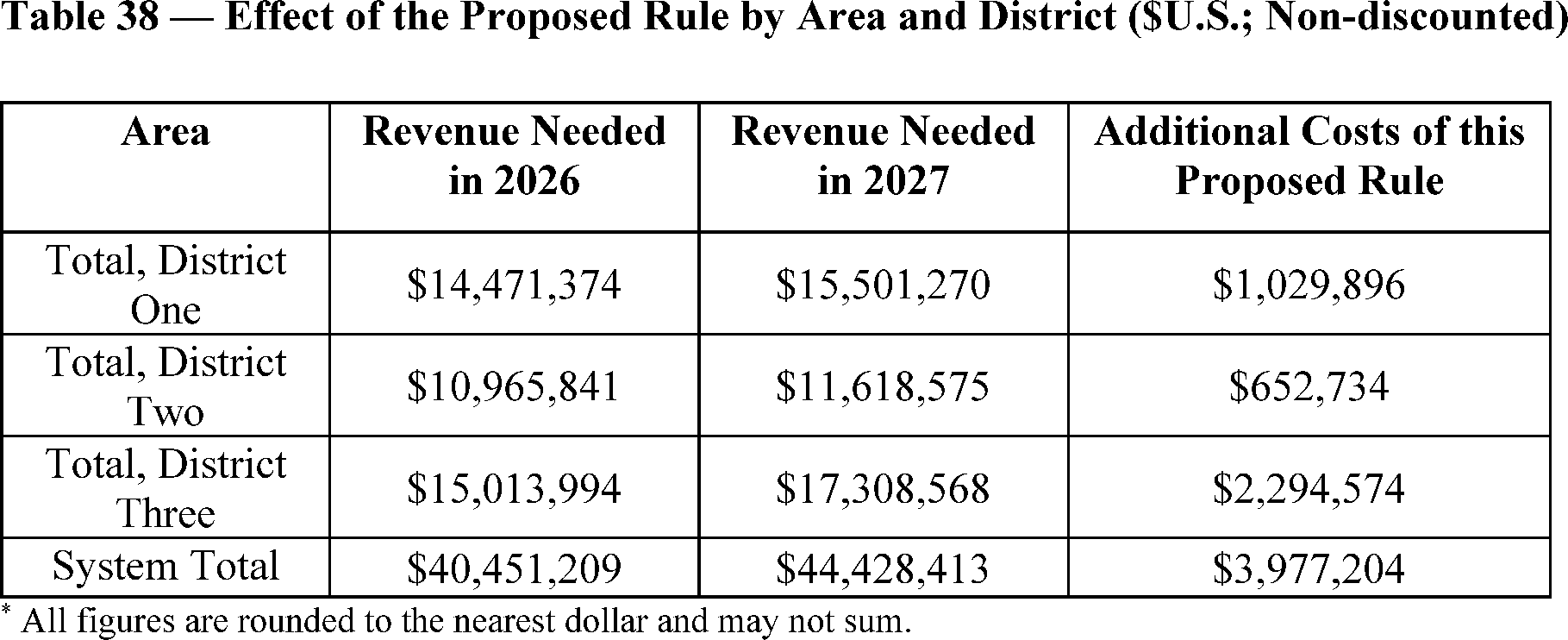
To estimate the change in cost to shippers from this proposed rule, the Coast Guard compared the 2027 total projected revenues to the 2026 projected revenues. Because we review and prescribe rates for Great Lakes pilotage annually, the effects are estimated as a single-year cost rather than annualized over a 10-year period. In the 2026 final rule, we estimated the total projected revenue needed for 2026 as $40,451,209.[25]
This is the best approximation of 2026 revenues because, at the time of publication of this proposed rule, the Coast Guard does not have enough audited data available for the 2026 shipping season to revise these projections. Table 38 shows the revenue projections for 2026 and 2027. The cost changes to shippers are detailed by area and district as a result of the proposed rate changes in traffic in Districts One, Two, and Three.
( printed page 59747)
The resulting difference between the projected revenue in 2026 and the projected revenue in 2027 is the annual change in payments from shippers to Pilots as a result of this proposed rule's rate changes. The effect of the rate changes on shippers would vary by area and district. The proposed rate changes lead to affected shippers operating in District One experiencing an increase in payments of $1,029,896 over 2026. District Two and District Three would experience an increase in payments of $652,734 and $2,294,574, respectively, when compared with 2026. The overall adjustment in payments would be an increase in payments by shippers of $3,977,204 across all three districts (a 10-percent increase when compared with 2026). Again, because the Coast Guard reviews and sets rates for Great Lakes pilotage annually, we estimate the impacts as single-year costs rather than annualizing them over a 10-year period.
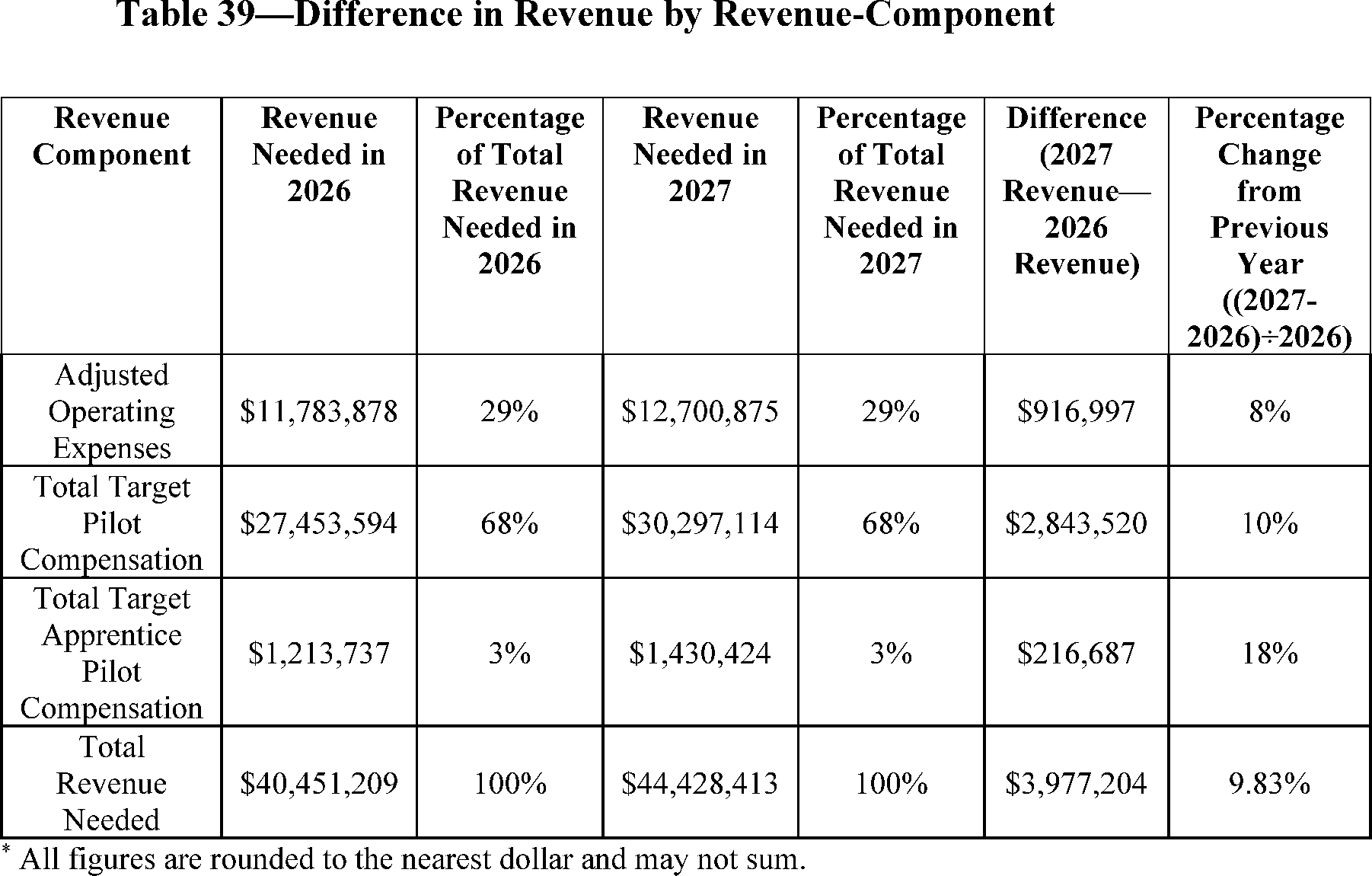
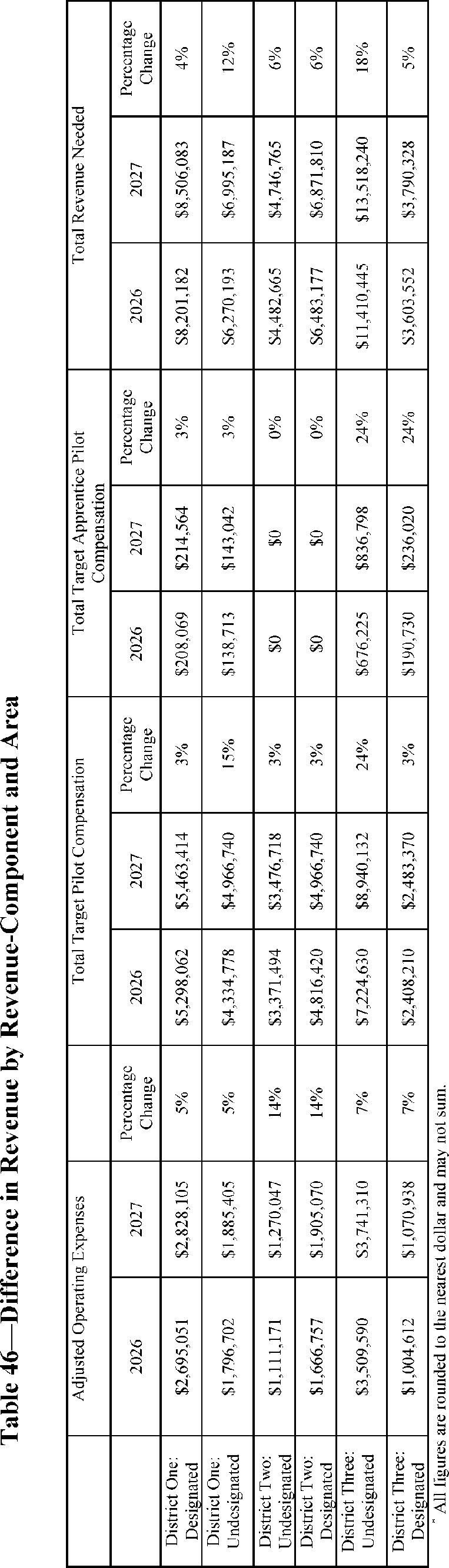
Table 39 shows the difference in revenue by revenue-component from 2026 to 2027 and presents each revenue-component as a percentage of the total revenue needed. In both 2026 and 2027, the largest revenue-component was pilotage compensation (68 percent of total revenue needed in 2026 and 68 percent of total revenue needed in 2027), followed by operating expenses (29 percent of total revenue needed in 2026 and 29 percent of total revenue needed in 2027).
We estimate that there would be a total increase in revenue needed by the pilotage associations of $3,977,204. This represents an increase in revenue needed for total target Pilot compensation of $2,843,520, an increase in revenue needed for total target Apprentice Pilot wage benchmark of $216,687, and an increase in the revenue needed for adjusted operating expenses of $916,997.
The change in revenue needed for target Pilot compensation, $2,843,520, is due to three factors: (1) The changes to adjust 2026 pilotage compensation to account for the difference between actual ECI inflation [26]
(3.4 percent) and predicted PCE inflation [27]
(2.4 percent) for 2026; (2) projected inflation of pilotage compensation in Step 2 of the methodology, using predicted inflation [28]
(2.1 percent) through 2027; and (3) an increase of 4 Pilots compared to 2026.
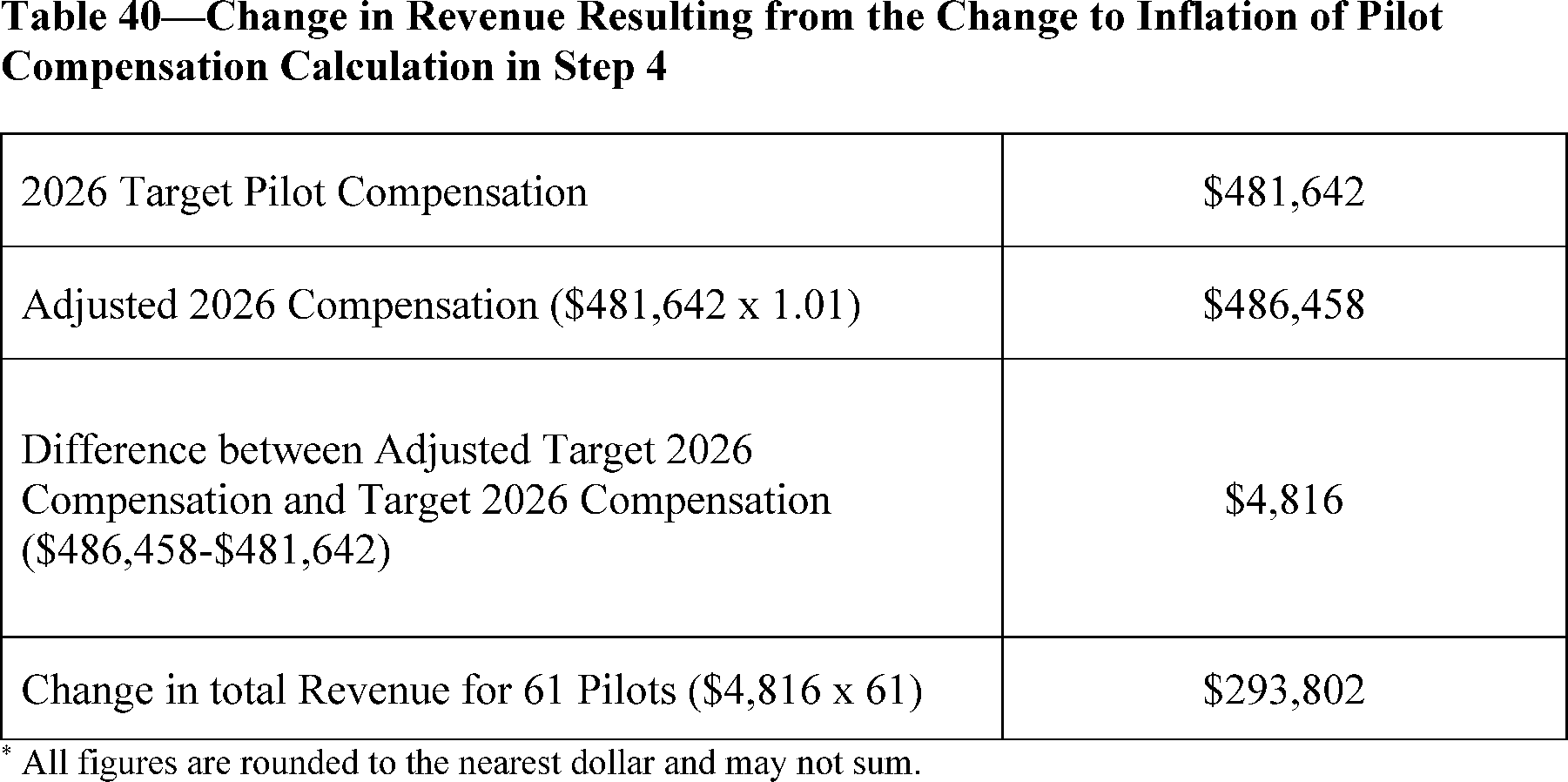
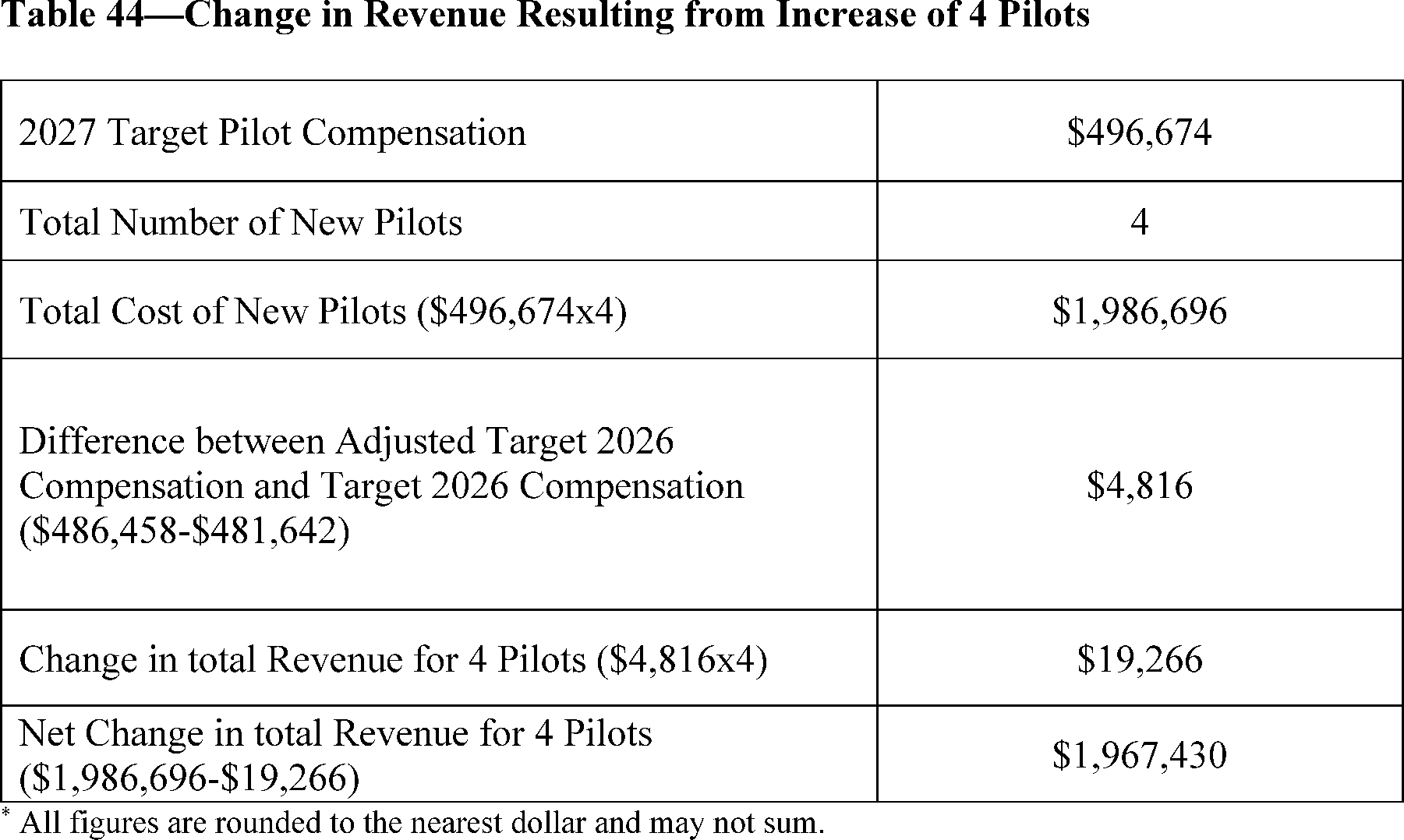
The target Pilot compensation would be $496,674 per Pilot in 2027, compared to $481,642 in 2026. The proposed changes to modify the 2026 target Pilot compensation to account for the difference between predicted and actual inflation would increase the target Pilot compensation value by 1 percent for 2027. As shown in table 40, this inflation adjustment would increase total Pilot compensation by $4,816 per Pilot, and the total revenue needed by $293,802 when accounting for all 61 Pilots.
( printed page 59748)
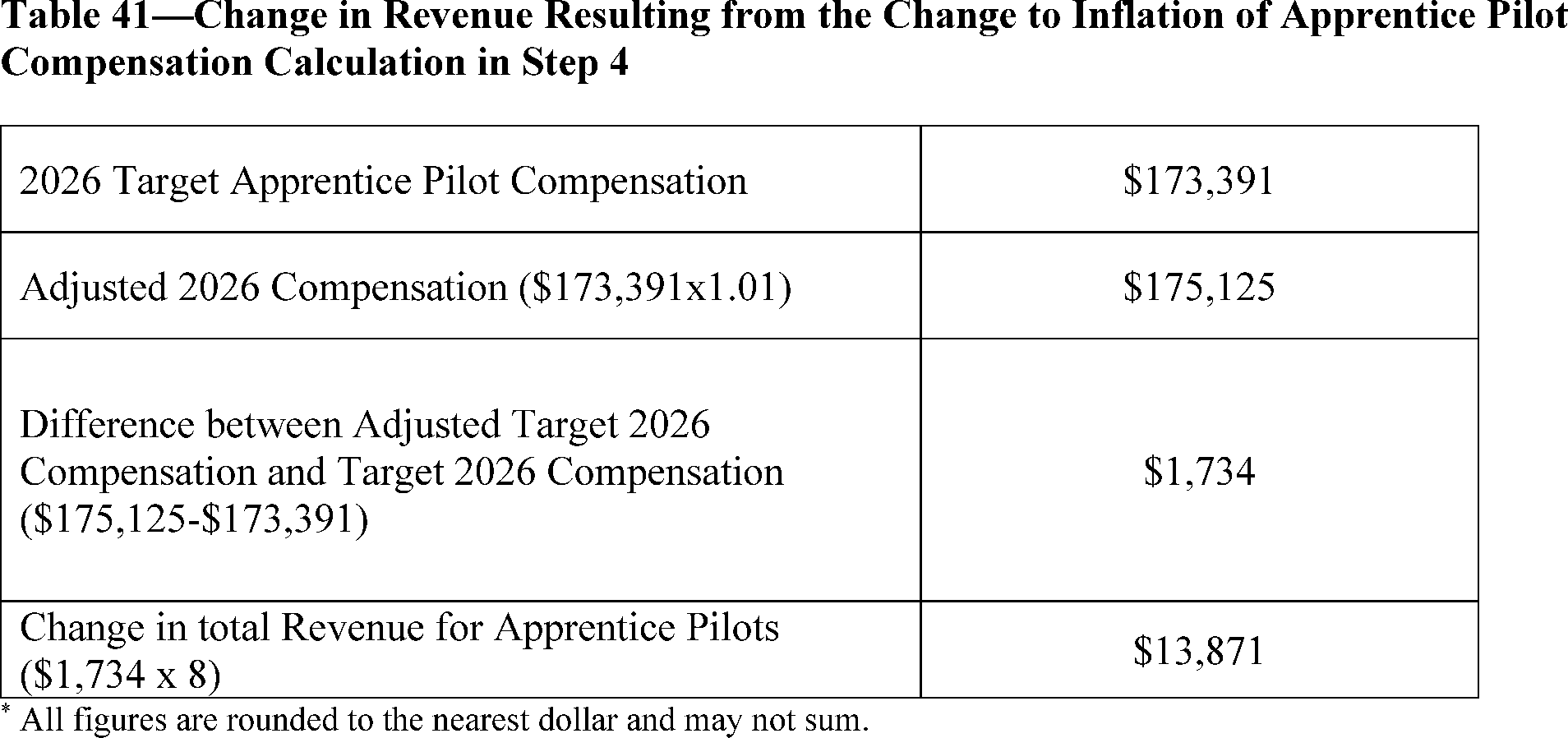
Similarly, table 41 shows the impact of the difference between predicted and actual inflation on the target Apprentice Pilot compensation benchmark. The inflation adjustment increases the target Apprentice Pilot compensation benchmark by $1,734 per Apprentice Pilot, and the total revenue needed by $13,871 when accounting for all 8 Apprentice Pilots.
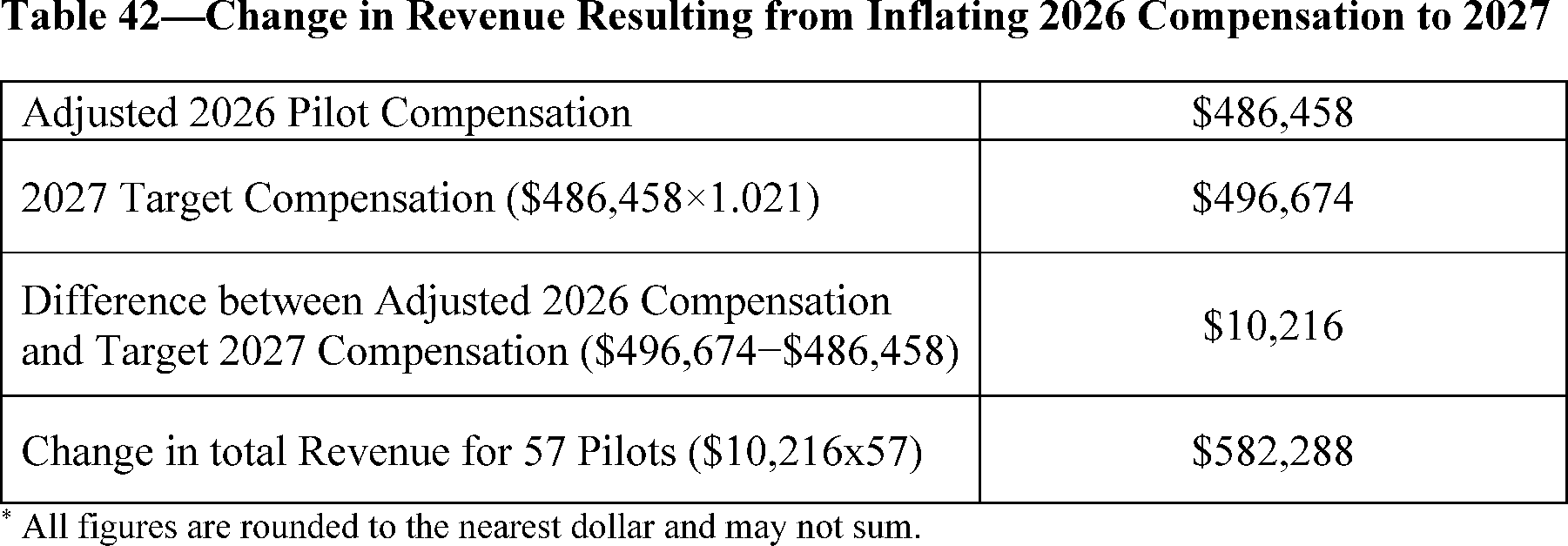
Another increase, $582,288, would be the result of increasing compensation for the 57 Pilots predicted for the 2026 season to account for future inflation of 2.1 percent in 2027. This would increase total compensation by $10,216 per Pilot when accounting for all 57 Pilots in the 2026 final rule, as shown in table 42.
( printed page 59749)
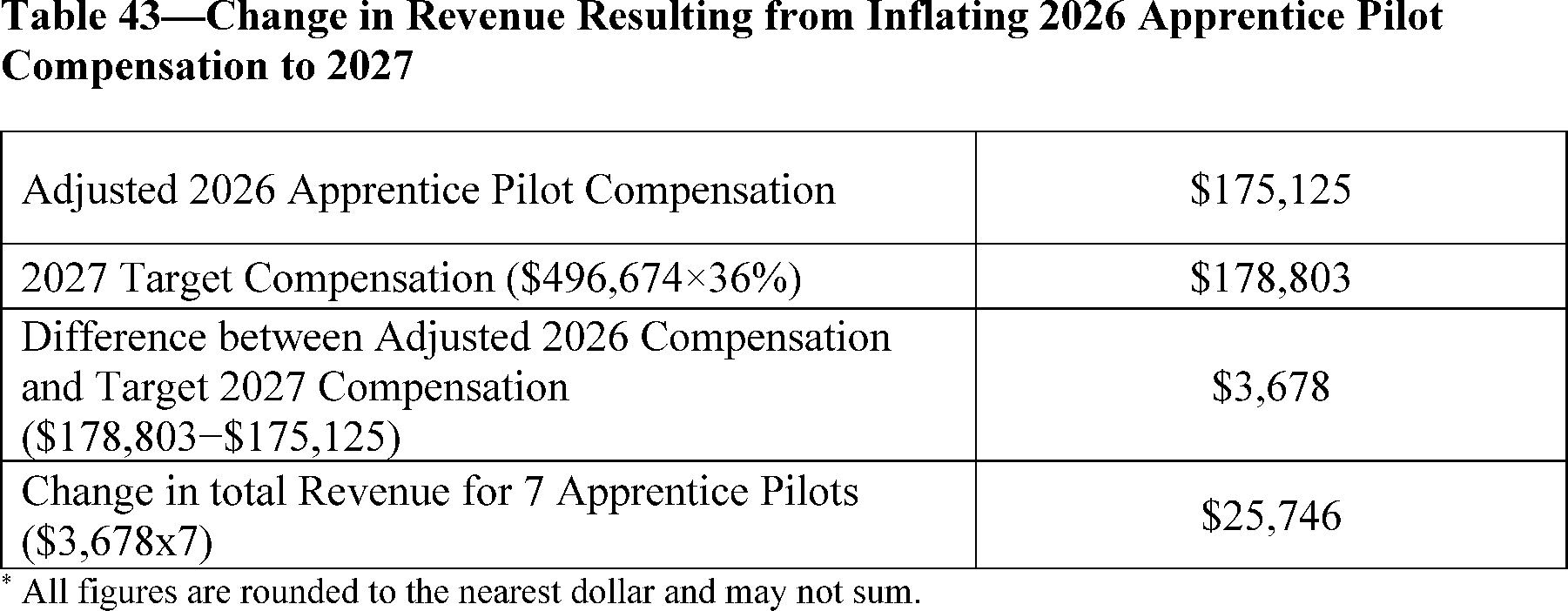
Similarly, an increase of $25,746 would be the result of increasing compensation for the 7 Apprentice Pilots predicted for 2026 season to account for future inflation of 2.1 percent in 2027. This would increase total compensation by $3,678 per Apprentice Pilot when accounting for the 7 Apprentice Pilots in the 2026 final rule, as shown in table 43.
As noted earlier, the Coast Guard predicts that 61 Pilots would be needed for the 2027 season. This would be an increase of 4 Pilots compared to the 2026 season. The difference reflects an increase of 1 Pilot in District One and 3 Pilots in District Three.
Table 44 shows the increase of $1,967,430 in revenue needed solely for Pilot compensation. As noted previously, to avoid double counting, this value excludes the change in revenue resulting from the change to adjust 2026 pilotage compensation to account for the difference between actual and predicted inflation.
( printed page 59750)
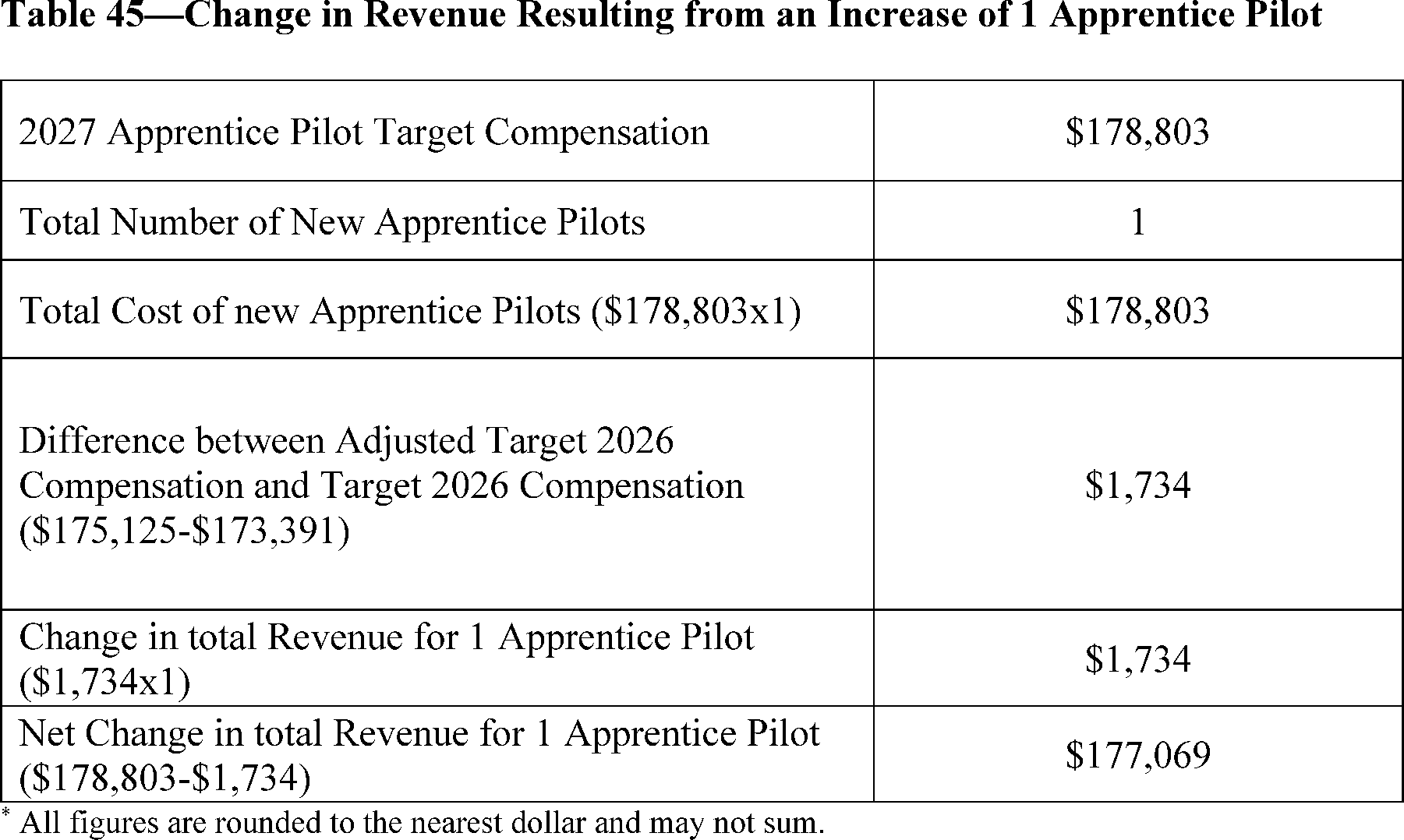
Similarly, the Coast Guard predicts that 8 Apprentice Pilots would be needed for the 2027 season. This would be an increase of 1 Apprentice Pilot from the 2026 season. The difference reflects an increase of 1 Apprentice Pilot for District Three.
Table 45 shows the increase of $177,069 in revenue needed solely for Apprentice Pilot compensation. As noted previously, to avoid double counting, this value excludes the change in revenue resulting from the change to adjust 2026 Apprentice Pilotage compensation to account for the difference between actual and predicted inflation.
Table 46 presents
the percentage change in revenue by area and revenue-component, excluding surcharges, as they are applied at the district level.29
( printed page 59751)
Benefits
This proposed rule allows the Coast Guard to meet the requirements in 46 U.S.C. 9303 to review the rates for pilotage services on the Great Lakes. The rate changes promote safe, efficient, and reliable pilotage service on the Great Lakes by ensuring that rates cover an association's operating expenses and by providing fair compensation, adequate training, and sufficient rest periods for Pilots. The rate changes also help recruit and retain Pilots, which ensures a sufficient number of Pilots to meet peak shipping demand, helping to reduce delays caused by Pilot shortages.
( printed page 59752)
Maintaining safe, efficient, and reliable pilotage service also facilitates commerce throughout the Great Lakes region.
In addition, this proposed rule provides clarity on how the ratemaking applies to the Straits of Mackinac, as designated in the 2026 NDAA. Shippers would have a better understanding of what rates apply and what would be expected of a Pilot when transiting the Straits of Mackinac, which further facilitates commerce throughout the Great Lakes region.
B. Small Entities
Under the Regulatory Flexibility Act, 5 U.S.C. 601-612, we have considered whether this proposed rule would have a significant economic impact on a substantial number of small entities. The term “small entities” comprises small businesses, not-for-profit organizations that are independently owned and operated and are not dominant in their fields, and governmental jurisdictions with populations of less than 50,000 people.
For the proposed rule, the Coast Guard reviewed recent company size and ownership data for the vessels identified in SeaPro, and business revenue and size data provided by publicly available sources, such as Data Axle Reference Solutions and Manta.[30]
As described in Section VI. Regulatory Planning and Review, subsection A, of this preamble, we found that 392 unique vessels used pilotage services during the years 2023 through 2025. These vessels are owned by 59 entities, of which 44 are foreign entities that operate primarily outside the United States, and the remaining 15 entities are U.S. entities. We compared the revenue and employee data found in the company search to the Small Business Administration's (SBA) small business threshold as defined in the SBA's “Table of Size Standards” for small businesses to determine how many of these companies are considered small entities.[31]
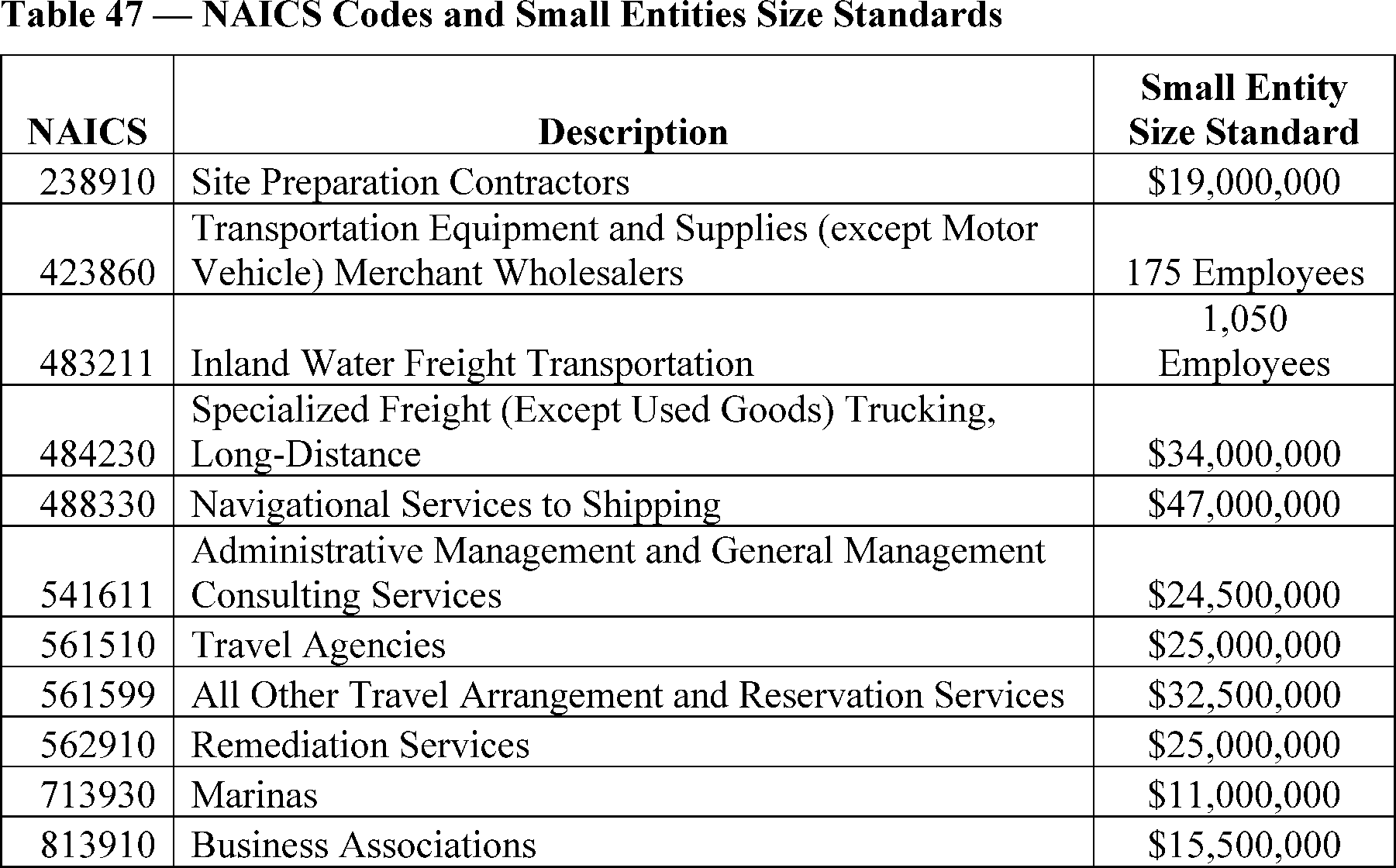
In addition to the owners and operators discussed previously, the three pilotage associations that provide and manage pilotage services within the Great Lakes districts would be affected by this proposed rule. District One's SLSPA uses the North American Industry Classification System (NAICS) code “Inland Water Freight Transportation,” with a small-entity size standard of 1,050 employees. District Two's LPA uses the NAICS code, “Business Associations,” with a small-entity size standard of $15,500,000 in revenue. District Three's WGLPA did not have a registered NAICS code through Data Axle Reference Solutions Resources. All three associations are considered small entities by SBA size standards.
Table 47 shows the NAICS codes of the U.S. entities and the pilotage associations, and the respective small entity standard size established by the SBA.
Of the 15 U.S. entities, 5 exceed the SBA's small business standards for small entities. To estimate the potential impact on the 10 small entities, the Coast Guard increased their 2025 pilotage costs to account for the changes in pilotage rates for each district resulting from this proposed rule and the 2026 final rule. In past rules, we applied the average change in the rate (9.8 percent for this year), but for this proposed rule, we applied the change in the rate within each area to better capture the impacts where the rates may
( printed page 59753)
increase for some areas but decrease for others. For example, for a hypothetical trip in the designated area of District One which had a total cost of $5,000 when the rate was $986, we estimate that the 2026 cost would be approximately $4,959 when the rate decreased to $978 ($4,959 = [(((978−986) ÷ 986) × 5,000) + $5,000]), and that the 2027 cost would be approximately $5,081, with a proposed rate of $1,002 ($5,081 = [(((1,002−978) ÷ 978) × 4,959) + $4,959]). To assign what rate would have been charged, we took the listed area for that trip (listed as Lake, River, DES, UNDES, Harbor Move, or Harbor Move In River) and assumed that all but Lake and UNDES were charged at the designated rate.
We then estimated the change in cost to these entities resulting from this proposed rule by subtracting their estimated 2027 pilotage costs from their estimated 2026 pilotage costs and found the average impact to small firms would be approximately $28,194, with a range of $528 to $86,079. We then compared the estimated change in pilotage costs between 2026 and 2027 with each firm's annual revenue, where revenue is known. The estimated impact on revenues ranges from 0.2 percent to 1.14 percent. One entity would experience an impact greater than 1 percent.
Finally, the Coast Guard did not find any small not-for-profit organizations that are independently owned and operated and are not dominant in their fields that would be impacted by this proposed rule. We also did not find any small governmental jurisdictions with populations of fewer than 50,000 people that would be impacted by this proposed rule. Based on this analysis, we conclude this proposed rulemaking would not affect a substantial number of small entities, nor have a significant economic impact on any of the affected entities.
Therefore, the Coast Guard certifies under 5 U.S.C. 605(b) that this proposed rule would not have a significant economic impact on a substantial number of small entities. If you think that your business, organization, or governmental jurisdiction qualifies as a small entity and that this proposed rule would have a significant economic impact on it, please submit a comment to the docket at the address listed in the
ADDRESSES
section of this preamble. In your comment, explain why you think it qualifies and how and to what degree this proposed rule would economically affect it.
C. Assistance for Small Entities
Under section 213(a) of the Small Business Regulatory Enforcement Fairness Act of 1996, Public Law 104-121, we want to assist small entities in understanding this proposed rule so that they can better evaluate its effects on them and participate in the rulemaking. If the proposed rule would affect your small business, organization, or governmental jurisdiction and you have questions concerning its provisions or options for compliance, please call or email the person in the
FOR FURTHER INFORMATION CONTACT
section of this proposed rule. The Coast Guard will not retaliate against small entities that question or complain about this proposed rule or any policy or action of the Coast Guard.
Small businesses may send comments on the actions of Federal employees who enforce, or otherwise determine compliance with, Federal regulations to the Small Business and Agriculture Regulatory Enforcement Ombudsman and the Regional Small Business Regulatory Fairness Boards. The Ombudsman evaluates these actions annually and rates each agency's responsiveness to small business. If you wish to comment on actions by employees of the Coast Guard, call 1-888-REG-FAIR (1-888-734-3247).
D. Collection of Information
This proposed rule would call for no new collection of information under the Paperwork Reduction Act of 1995, 44 U.S.C. 3501-3520, nor would it alter an existing collection of information.
E. Federalism
A rule has implications for federalism under Executive Order 13132 (Federalism) if it has a substantial direct effect on States, on the relationship between the National Government and the States, or on the distribution of power and responsibilities among the various levels of government. We have analyzed this proposed rule under Executive Order 13132 and have determined that it is consistent with the fundamental federalism principles and preemption requirements described in Executive Order 13132. Our analysis follows.
Congress directed the Coast Guard to establish “rates and charges for pilotage services” (46 U.S.C. 9303(f)). This regulation is issued pursuant to that statute and is preemptive of State law as specified in 46 U.S.C. 9306. Under 46 U.S.C. 9306, a “State or political subdivision of a State may not regulate or impose any requirement on pilotage on the Great Lakes.” As a result, States or local governments are expressly prohibited from regulating within this category. Therefore, this proposed rule is consistent with the fundamental federalism principles and preemption requirements described in Executive Order 13132.
While it is well settled that States may not regulate in categories in which Congress intended the Coast Guard to be the sole source of a vessel's obligations, the Coast Guard recognizes the key role that State and local governments may have in making regulatory determinations. Additionally, for rules with federalism implications and preemptive effect, Executive Order 13132 specifically directs agencies to consult with State and local governments during the rulemaking process. If you believe this proposed rule would have implications for federalism under Executive Order 13132, please call or email the person listed in the
FOR FURTHER INFORMATION CONTACT
section of this preamble.
F. Unfunded Mandates
The Unfunded Mandates Reform Act of 1995, 2 U.S.C. 1531-1538, requires Federal agencies to assess the effects of their discretionary regulatory actions. In particular, the Act addresses actions that may result in the expenditure by a State, local, or tribal government, in the aggregate, or by the private sector of $100 million (adjusted for inflation) or more in any 1 year. Although this proposed rule would not result in such an expenditure, we do discuss the potential effects of this proposed rule elsewhere in this preamble.
G. Taking of Private Property
This proposed rule would not cause a taking of private property or otherwise have taking implications under Executive Order 12630 (Governmental Actions and Interference with Constitutionally Protected Property Rights).
H. Civil Justice Reform
This proposed rule meets applicable standards in sections 3(a) and 3(b)(2) of Executive Order 12988, (Civil Justice Reform), to minimize litigation, eliminate ambiguity, and reduce burden.
I. Protection of Children
We have analyzed this proposed rule under Executive Order 13045 (Protection of Children from Environmental Health Risks and Safety Risks). This proposed rule is not an economically significant rule and would not create an environmental risk to health or risk to safety that might disproportionately affect children.
( printed page 59754)
J. Indian Tribal Governments
This proposed rule does not have tribal implications under Executive Order 13175 (Consultation and Coordination with Indian Tribal Governments) because it would not have a substantial direct effect on one or more Indian tribes, on the relationship between the Federal Government and Indian tribes, or on the distribution of power and responsibilities between the Federal Government and Indian tribes.
K. Energy Effects
We have analyzed this proposed rule under Executive Order 13211 (Actions Concerning Regulations That Significantly Affect Energy Supply, Distribution, or Use). We have determined that it is not a “significant energy action” under that order because it is not a “significant regulatory action” under Executive Order 12866 and is not likely to have a significant adverse effect on the supply, distribution, or use of energy.
L. Technical Standards
The National Technology Transfer and Advancement Act, codified as a note to 15 U.S.C. 272, directs agencies to use voluntary consensus standards in their regulatory activities unless the agency provides Congress, through OMB, with an explanation of why using these standards would be inconsistent with applicable law or otherwise impractical. Voluntary consensus standards are technical standards (for example, specifications of materials, performance, design, or operation; test methods; sampling procedures; and related management systems practices) that are developed or adopted by voluntary consensus standards bodies.
This proposed rule does not use technical standards. Therefore, we did not consider the use of voluntary consensus standards.
M. Environment
We have analyzed this proposed rule under Department of Homeland Security (DHS) Management Directive 023-01, Rev. 1, associated implementing instructions, and Environmental Planning COMDTINST 5090.1 (series), which guide the Coast Guard in complying with the National Environmental Policy Act of 1969 (42 U.S.C. 4321-4370f), and have made a preliminary determination this action is not likely to have a significant effect on the human environment. A preliminary Record of Environmental Consideration supporting this determination is available in the docket. For instructions on locating the docket, see the
ADDRESSES
section of this preamble. This proposed rule would be categorically excluded under paragraph A3 and L54 of Appendix A, Table 1 of DHS Instruction Manual 023-01-001-01, Rev. 1. Paragraph A3 pertains to the promulgation of rules of the following nature: (a) those of a strictly administrative or procedural nature; (b) those that implement, without substantive change, statutory or regulatory requirements; (c) those that implement, without substantive change, procedures, manuals, and other guidance documents; (d) those that interpret or amend an existing regulation without changing its environmental effect; (e) those that provide technical guidance on safety and security matters; and (f) those that provide guidance for the preparation of security plans. Paragraph L54 pertains to regulations which are editorial or procedural. This proposed rule involves setting or adjusting the pilotage rates for the 2027 shipping season to account for changes in district operating expenses, changes in the number of Pilots, and anticipated inflation. All these changes are consistent with the Coast Guard's maritime safety missions. We seek any comments or information that may lead to the discovery of a significant environmental impact from this proposed rule.
IX. Public Participation and Request for Comments
The Coast Guard views public participation as essential to effective rulemaking and will consider all comments and material received during the comment period. Your comment can help shape the outcome of this proposed rulemaking. If you submit a comment, please include the docket number for this proposed rulemaking, indicate the specific section of this document to which each comment applies, and provide a reason for each suggestion or recommendation.
Submitting comments.
We encourage you to submit comments at
www.regulations.gov.
To do so, go to
www.regulations.gov,
type USCG-2026-0049 in the search box and click “Search.” Next, look for this document in the Search Results column, and click on it. Then click on the Comment option. If you cannot submit your material by using
www.regulations.gov,
call or email the person in the
FOR FURTHER INFORMATION CONTACT
section of this proposed rule for alternate instructions. We review all comments received.
Viewing material in docket.
To view documents mentioned in this proposed rule as being available in the docket, find the docket as described in the previous paragraph, and then select “Supporting & Related Material” in the Document Type column. Public comments will also be placed in our online docket and can be viewed by following the instructions on the Frequently Asked Questions web page, available at
www.regulations.gov/faq.
That page also explains how to subscribe for email alerts that will notify you when comments are posted or if a final rule is published.
Personal information.
We accept anonymous comments. Comments we post to
www.regulations.gov
will include any personal information you have provided. For more about privacy and submissions to the docket in response to this document, see DHS's eRulemaking System of Records notice (85 FR 14226, March 11, 2020).
Public meeting.
We do not plan to hold a public meeting, but we will consider doing so if we determine from public comments that a meeting would be helpful. We would issue a separate
Federal Register
notice to announce the date, time, and location of such a meeting.
4. Amend § 404.106 by adding the following text after the first sentence: “For District Three, the Straits of Mackinac bridge hours are included with the undesignated waters average hours.”
Dated: September 16, 2026.
Robert C. Compher,
Rear Admiral, U.S. Coast Guard,
Assistant Commandant for Prevention Policy.
6.
Department of Homeland Security (DHS) Delegation 00170.1, Revision No. 01.4, paragraph (II)(92)(f) (delegating, in part, the Secretary's authority under 46 U.S.C. chapter 93 to the Coast Guard, except for the authority under 46 U.S.C. 9307 to establish and appoint members to the Great Lakes Pilotage Advisory Committee, which is retained by the Secretary).
8.
The Saint Lawrence Seaway Pilots Association (SLSPA) provides pilotage services in District One, which includes all U.S. waters of the St. Lawrence River and Lake America. The Lakes Pilots Association (LPA) provides pilotage services in District Two, which includes all U.S. waters of Lake Erie, the Detroit River, Lake St. Clair, and the St. Clair River. Finally, the Western Great Lakes Pilots Association (WGLPA) provides pilotage services in District Three, which includes all U.S. waters of the St. Mary's River; Sault Ste. Marie Locks; Lakes Huron, Michigan, and Superior; and the Straits of Mackinac.
9.
46 U.S.C. 9302(a)(1)(A). Two Presidential proclamations address the designation of restricted waters under the Great Lakes Pilotage Act. Presidential Proclamation 3385 designated specified U.S. waters of the Great Lakes as restricted waters and established the geographical bounds of those waters within the three pilotage districts. Presidential Proclamation 3855 subsequently amended Proclamation 3385, including by revising the boundaries of District 3. Proclamation 3385,
Designation of Restricted Waters under the Great Lakes Pilotage Act of 1960,25 FR 13681 (Dec. 24, 1960), as amended by Presidential Proclamation 3855,
Amending Proclamation No. 3385, Designating Restricted Waters under the Great Lakes Pilotage Act of 1960,33 FR 8535 (June 10, 1968).
12.
Area 3, the Welland Canal, is not included in this table because it is serviced exclusively by the Canadian GLPA and is therefore not part of the United States pilotage rate structure.
20.
The CPI is defined as “All Urban Consumers (CPI-U), All Items, 1982-4=100.” Series CUUR0200SA0. Available at
www.bls.gov/cpi/data.htm.,
All Urban Consumers (Current Series), multiscreen data, not seasonally adjusted, 0200 Midwest, Current, All Items, Monthly, 12-month Percent Change and Annual Data; accessed 04/16/2026.
24.
Some vessels entered the Great Lakes multiple times in a single year, affecting the average number of unique vessels using pilotage services in any given year.
26.
BLS, “Table 5. Compensation (not seasonally adjusted): Employment Cost Index for total compensation, for private industry workers, by occupational group and industry—2026 Q1 Results,”
www.bls.gov/news.release/eci.t05.htm;
accessed 06/03/2026.
29.
The 2026 projected revenues are from, tables 7, 18, and 29 of the 2026 final rule. The 2027 projected revenues are from tables 8, 19, and 30 of this proposed rule.
31.
See
www.sba.gov/document/support-table-size-standards;
accessed 06/22/2026. SBA has established a “Table of Size Standards” for small businesses that sets small business size standards by NAICS code. A size standard, which is usually stated in number of employees or average annual receipts (“revenues”), represents the largest size that a business (including its subsidiaries and affiliates) may be in order to remain classified as a small business for SBA and Federal contracting programs.
 www.regulations.gov
 46 U.S.C. Chapter 93
 46 CFR 404.1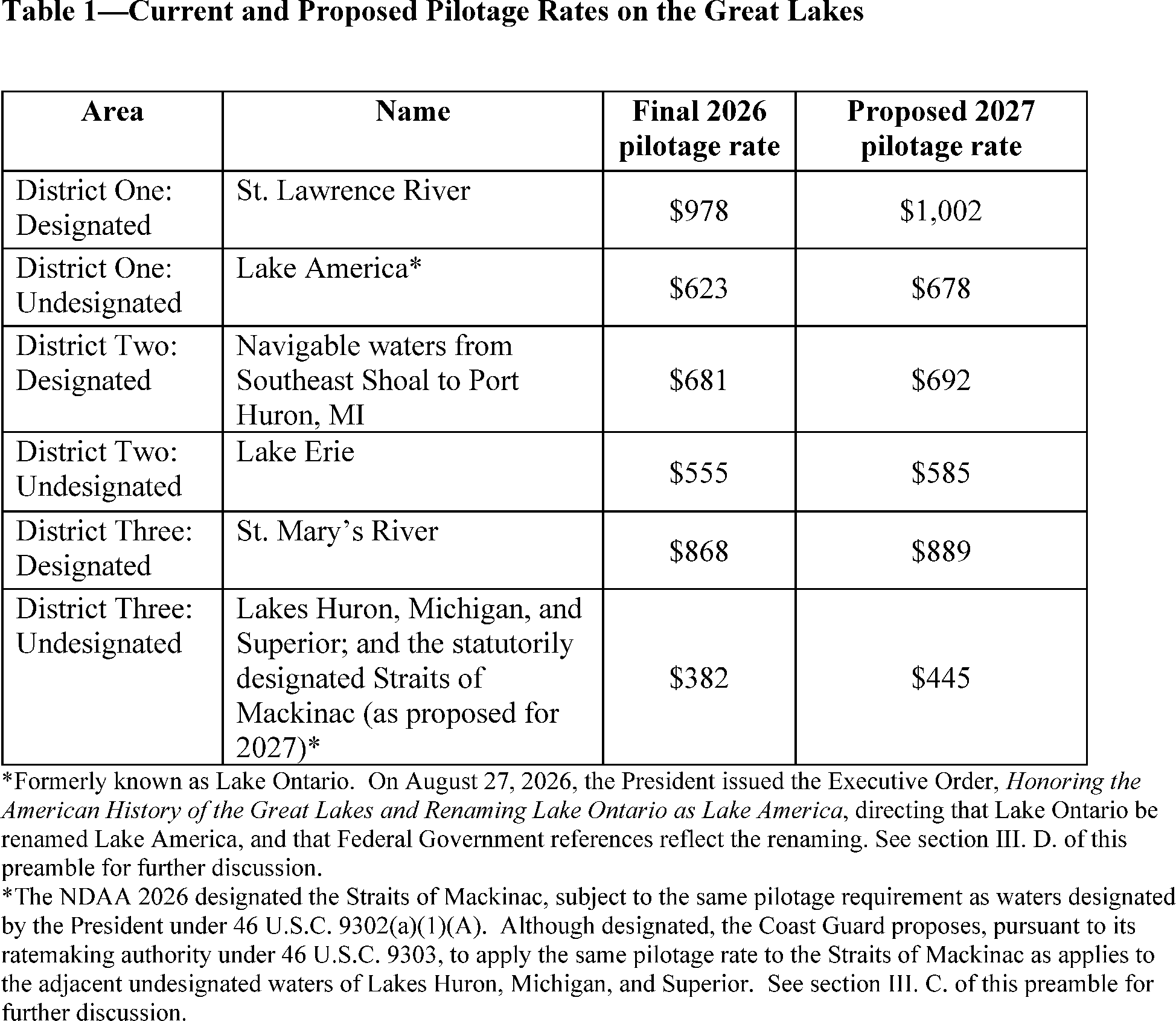





 www.whitehouse.gov/presidential-actions/2026/08/honoring-the-american-history-of-the-great-lakes-and-renaming-lake-ontario-as-lake-america/
 www.bls.gov/cpi/data.htm
 www.federalreserve.gov/monetarypolicy/files/fomcprojtabl20250917.pdf
 referencesolutions.data-axle.com
 www.manta.com
 www.sba.gov/document/support-table-size-standards