Magnuson-Stevens Act Provisions; Fisheries Off West Coast States; Pacific Coast Groundfish Fishery; Pacific Coast Groundfish Fishery Management Plan; Amendment 38; 2027-28 Biennial Specifications and Management Measures
This rule proposes 2027-28 harvest specifications and management measures for groundfish caught in the U.S. exclusive economic zone seaward of Washington, Oregon, and California...
National Marine Fisheries Service (NMFS), National Oceanic and Atmospheric Administration (NOAA), Commerce.
ACTION:
Proposed rule; request for comments.
SUMMARY:
This rule proposes 2027-28 harvest specifications and management measures for groundfish caught in the U.S. exclusive economic zone seaward of Washington, Oregon, and California, consistent with the Magnuson-Stevens Fishery Conservation and Management Act (Magnuson-Stevens Act or MSA) and the Pacific Coast Groundfish Fishery Management Plan (Groundfish FMP). This rule also includes proposed regulations to implement amendment 38 to the Groundfish FMP, which would remove rebuilding plan requirements for yelloweye rockfish and California quillback rockfish. Lastly, this rule includes proposed regulations to modify select fishery closures that apply to both groundfish and Pacific halibut.
DATES:
Comments must be received no later than October 22, 2026.
ADDRESSES:
A plain language summary of this proposed rule is available at
www.regulations.gov/docket/NOAA-NMFS-2026-1354.
You may submit your comments on the exempted fishing permit (EFP) applications (described in section III, I) and the proposed rule, identified by NOAA-NMFS-2026-1354, by the following method:
Electronic Submissions:
Submit all electronic public comments via the Federal e-Rulemaking Portal. Go to
www.regulations.gov
and enter NOAA-NMFS-2026-1354 in the Search box. Click the “Comment” icon, complete the required fields, and enter or attach your comments. The EFP applications will be available under Supporting Documents through the same link.
Instructions:
Comments must be submitted by the above method to ensure that the comments are received, documented, and considered by NMFS. Comments sent by any other method, to any other address or individual, or received after the end of the comment period, may not be considered. All comments received are a part of the public record and NMFS will post them for public viewing on
www.regulations.gov
without change. All personal identifying information (
e.g.,
name, address), confidential business information, or otherwise sensitive information submitted voluntarily by the sender is publicly accessible. NMFS will accept anonymous comments (enter “N/A” in the required fields if you wish to remain anonymous). Please specify whether the comments provided are associated with the proposed rule or EFP applications.
Electronic Access
This rule is accessible via the internet at the Office of the Federal Register website at
www.federalregister.gov/.
The draft Analysis, which includes an Environmental Assessment (EA) that addresses the National Environmental Policy Act (NEPA), as well as analyses that address Presidential Executive Order (E.O.) 12866, the Regulatory Flexibility Act (RFA), and the statutory requirements of the Magnuson-Stevens Act is accessible via NMFS West Coast Region website at:
www.fisheries.noaa.gov/region/west-coast.
The current Stock Assessment and Fishery Evaluation (SAFE) report for Pacific Coast groundfish, as well as the SAFE reports for previous years, are available from the Pacific Fishery Management Council's (Council) website at
www.pcouncil.org/stock-assessments-star-reports-stat-reports-rebuilding-analyses-terms-of-reference/.
The SAFE will be updated to reflect any relevant changes from this action by the publication of the final rule. Any in-text citation referencing an “Agenda Item” refers to Council briefing book materials, which are available at
www.pcouncil.org
(click the “+” icon next to “Council meetings” and then select the specific briefing book you wish to access). Any in-text citation referencing a peer-reviewed stock assessment is available on the Council's website at
www.pcouncil.org/stock-assessments-star-reports-stat-reports-rebuilding-analyses-terms-of-reference/groundfish-stock-assessment-documents/.
Last, the Council Analytical Document prepared to support the Council's final action is currently available as Agenda Item E.6 Attachment 2 in the June 2026 briefing book (see
www.pcouncil.org). This document will be updated to reflect the Council's final action by the publication of the final rule.
FOR FURTHER INFORMATION CONTACT:
Lynn Massey, Fishery Management Specialist, at 562-900-2060 or
lynn.massey@noaa.gov.
SUPPLEMENTARY INFORMATION:
I. Background
The Pacific Coast groundfish fishery in the U.S. exclusive economic zone (EEZ) seaward of Washington, Oregon, and California is managed under the Groundfish FMP. The Council developed the Groundfish FMP pursuant to the MSA (16 U.S.C. 1801et seq.). The Secretary of Commerce approved the Groundfish FMP and implemented the provisions of the plan through Federal regulations at 50 CFR part 660, subparts C through G. The Groundfish FMP currently manages more than 90 species of roundfish, flatfish, rockfish, sharks, and skates.
Chapter 5 of the Groundfish FMP requires the Council to assess the biological, social, and economic conditions of the Pacific Coast groundfish fishery and use this information to develop harvest specifications and management measures at least biennially. This proposed rule is based on the Council's final recommendations for harvest specifications and management measures for the 2027-28 biennium made at its April and June 2026 meetings.
The Council deemed the proposed regulations necessary and appropriate to implement these actions in a July 30, 2026, letter from Council Executive Director, Merrick Burden, to Regional Administrator Jennifer Quan. Under the MSA, NMFS is required to publish proposed rules for comment after preliminarily determining whether they are consistent with applicable law. We are seeking public comment on the proposed regulations in this action and whether they are consistent with the Groundfish FMP, the MSA and its National Standards, and other applicable law.
NMFS published a Notice of Availability (NOA) to announce the proposed amendment 38 to the Groundfish FMP (referred to interchangeably as “the amendment”) on July 21, 2026 (91 FR 45764). The NOA requests public review and comment on proposed changes to the Groundfish FMP document and the draft Analysis prepared for the action (see
ADDRESSES
). Public comments are being solicited on the amendment through September 19, 2026, which is
( printed page 60239)
the end of the comment period for the NOA. Public comments on the amendment must be received by the end of the comment period on the amendment, as published in the NOA, to be considered in the approval/disapproval decision on the amendment. All comments received by the end of the comment period on the amendment, whether specifically directed to the amendment, or the proposed rule, will be considered in the approval/disapproval decision. To be considered, comments must be received by close of business on the last day of the comment period; that does not mean postmarked or otherwise transmitted by that date.
A. Specification and Management Measure Development Process
In 2025, NOAA's Northwest Fisheries Science Center (NWFSC) conducted benchmark stock assessments for chilipepper rockfish (coastwide), California quillback rockfish (south of 42° North latitude (N lat.)), rougheye/blackspotted rockfish (coastwide), sablefish (coastwide), and yellowtail rockfish (north of 40°10′ N lat.). The NWFSC also conducted update assessments for widow rockfish (coastwide) and yelloweye rockfish (coastwide). Additionally, the NWFSC conducted catch-only projections for black rockfish (Oregon), bocaccio (coastwide), canary rockfish (coastwide), darkblotched rockfish (coastwide), petrale sole (coastwide), and shortspine thornyhead (coastwide). The NWFSC did not update any assessments for the remaining stocks managed under the FMP, so harvest specifications for these stocks are based on assessments from previous years. The full stock assessments used to set catch limits for this biennium are available on the Council's website (see Electronic Access under
ADDRESSES
).
The Council's stock assessment review panel (STAR panel) reviewed the benchmark stock assessments for technical merit, and to determine that each stock assessment document was sufficiently complete. The Council's Scientific and Statistical Committee (SSC) reviewed all of the stock assessments and STAR panel reports and made its recommendations to the Council on the best scientific information available (BSIA) for the 2027-28 biennium (Agenda Item G.3, September 2025 meeting; Agenda Item F.2, November 2025 meeting; Agenda Item D.2, March 2026 meeting).
The Council considered the new stock assessments, stock assessment updates, catch-only projections, public comments, recommendations from the SSC, and advice from its advisory bodies over the course of six Council meetings during development of its recommendations for the 2027-28 harvest specifications and management measures. At each Council meeting between June 2025 and June 2026, the Council made a series of decisions and recommendations that were, in some cases, refined after further analysis and discussion. Agenda Item E.8, Supplemental Attachment 1, June 2025 describes the Council's meeting schedule for developing the 2027-28 biennial harvest specifications. Additionally, detailed information, including the supporting documentation the Council considered at each meeting, is available at the Council's website at
www.pcouncil.org.
The 2027-28 biennial management cycle is the sixth cycle following Groundfish FMP amendment 24 (80 FR 12567, March 10, 2015), which established initial default harvest control rules for the fishery and was analyzed through an Environmental Impact Statement (EIS) (Final Environmental Impact Statement for Pacific Coast Groundfish Harvest Specifications and Management Measures for 2015-2016 and Biennial Periods Thereafter, and amendment 24 to the Groundfish FMP, published January 2015). The EIS described the ongoing implementation of the Groundfish FMP and the selection of the initial default harvest control rules. Under the amendment 24 framework, the harvest control rules used to determine the previous biennium's harvest specifications (
i.e.,
overfishing limits (OFLs), acceptable biological catches (ABCs), and annual catch limits (ACLs)) are applied as the default harvest control rule to determine the next biennium's harvest specifications after applying the BSIA. NMFS implements harvest specifications based on the harvest control rules used in the previous biennium unless the Council makes a recommendation, and NMFS concurs, to deviate from the default based on new scientific or other information. This rule therefore implements default harvest control rules, consistent with the harvest control rules implemented for the last biennium (
i.e.,
2025-26), for most stocks, and discusses Council-recommended departures from the defaults. The draft Analysis supporting this action identifies the Council's preferred harvest control rules, management measures, and other management changes for the 2027-28 biennium and will be posted on the NMFS West Coast Region web page (see Electronic Access under
ADDRESSES
).
II. Proposed Harvest Specifications
This proposed rule would set 2027-28 harvest specifications and management measures for the 90+ groundfish stocks or management units which currently have ACLs or ACL contributions to stock complexes managed under the Groundfish FMP, except for Pacific whiting. Pacific whiting harvest specifications are established annually through a separate bilateral process with Canada.
The proposed OFLs, ABCs, and ACLs are based on the best available biological and socioeconomic data, including projected biomass trends, information on assumed distribution of stock biomass, and revised technical methods used to calculate stock biomass. The Groundfish FMP specifies a series of three stock categories for the purpose of setting maximum sustainable yield (MSY),[1]
OFLs, ABCs, ACLs, and rebuilding standards. Category 1 represents the highest level of information quality available, while Category 3 represents the lowest. Category 1 stocks are the relatively few stocks for which the NWFSC can conduct a “data rich” quantitative stock assessment that incorporates catch-at-age, catch-at-length, or other data. The SSC can generally calculate OFLs and overfished/rebuilding thresholds for these stocks, as well as ABCs, based on the uncertainty of the biomass estimated within an assessment or the variance in biomass estimates between assessments. Category 2 stocks include a large number of stocks for which some biological indicators are available, yet status is based on a “data moderate” quantitative stock assessment. Category 3 stocks include minor stocks which are caught, but for which there is, at best, only information on landed biomass. For stocks in this category, there is limited data available for the SSC to quantitatively determine MSY, OFL, or an overfished threshold. Typically, catch-based methods (
e.g.,
depletion-based stock reduction analysis, depletion corrected average catch, and average catches) are used to determine the OFL for Category 3 stocks. A detailed description of each of these categories can be found in Section 4.2 of the Groundfish FMP.
A. Proposed OFLs for 2027 and 2028
The OFL serves as the maximum amount of fish that can be caught in a
( printed page 60240)
year without resulting in overfishing. Overfishing occurs when a stock's harvest rate, denoted as Fx%
, is set higher than the rate that produces the stock's MSY. The SSC derives OFLs for groundfish stocks with stock assessments by applying the harvest rate to the current estimated biomass (B). Harvest rates represent the rates of fishing mortality (F) that will reduce the female spawning potential ratio (SPR) to X percent of its unfished level. The Groundfish FMP defines SPR as the average fecundity of a recruit over its lifetime when the stock is fished divided by the average fecundity of a recruit over its lifetime when the stock is unfished. The SPR is based on the principle that a certain biomass of fish has to survive in order to spawn and replenish the stock at a sustainable level. As an example, a harvest rate of F40%
means the harvest rate that would fish 60 percent of the population, thereby reducing the stock to 40 percent of its unfished level (abbreviated as B40%
). F40%
is more aggressive than F45%
or F50%
harvest rates because F40%
allows more fishing mortality on a stock (as it allows a harvest rate that would reduce the stock to 40 percent of its unfished level, while F45%
or F50%
would reduce the stock to 45 percent and 50 percent of its unfished level). The OFL set by the SSC does not explicitly account for scientific or management uncertainty; therefore, the SSC typically recommends an ABC that is lower than the OFL in order to account for scientific uncertainty, including the scientific uncertainty related to the assessment for a stock. Usually, the greater the amount of scientific uncertainty, the lower the ABC is set compared to the OFL.
For all species except widow rockfish, the Council maintained its policy of using a default harvest rate as a proxy for the fishing mortality rate that is expected to achieve MSY (FMSY) for the 2027-28 biennium. The Council also maintained the same default harvest rate proxies as used in the 2025-26 biennium, based on the SSC's recommendations: F30%
for flatfish (meaning an SPR harvest rate that would reduce the spawning potential to 30 percent of its unfished level), F50%
for rockfish (including longspine and shortspine thornyheads), F50%
for elasmobranchs, and F45%
for other groundfish such as sablefish and lingcod. For widow rockfish, the Council adopted the SSC recommendation to use a different proxy, spawning biomass at 40 percent (SB40%
), meaning an SPR harvest rate that would reduce the spawning stock biomass to 40 percent of its unfished level. For unassessed stocks, the Council recommended using a historical catch-based approach (
e.g.,
average catch, depletion-corrected average catch, or depletion-based stock reduction analysis) to set the OFL. See tables 1a and 2a to Part 660, subpart C in the proposed regulatory text supporting this rule for the proposed 2027-28 OFLs. The SAFE document for 2026 will include a detailed description of the scientific basis for all of the SSC-recommended OFLs proposed in this rule and will be available at the Council's website at
www.pcouncil.org.
B. Proposed ABCs for 2027 and 2028
The ABC is the stock or stock complex's OFL reduced by an amount associated with scientific uncertainty. The SSC-recommended P star (P*)-sigma (σ) approach determines the amount by which the OFL is reduced to account for this uncertainty. Under this approach, the SSC recommends a σ value. The σ value is generally based on the scientific uncertainty in the biomass estimates generated from stock assessments and is usually related to the stock category. After the SSC determines the appropriate σ value, the Council chooses a P* based on its chosen level of risk aversion to address the consequences of the stock being elsewhere within the uncertainty represented by σ. A P* of 0.5 equates to no additional reduction beyond the σ value reduction. The Groundfish FMP specifies that the upper limit of P* will be 0.45, thus always ensuring at least some additional reduction beyond the σ value reduction. The P*- σ approach is discussed in detail in the proposed and final rules for the 2011-12 biennial harvest specifications and management measures (75 FR 67810, November 3, 2010; 76 FR 27508, May 11, 2011) and the 2013-14 biennial harvest specifications and management measures (77 FR 67974, November 14, 2012; 78 FR 580, January 3, 2013).
For the 2027-28 biennium, the SSC quantified major sources of scientific uncertainty in the estimates of OFLs and generally recommended a σ value of 0.5 for Category 1 stocks, a σ value of 1.0 for Category 2 stocks, and a σ value of 2.0 for Category 3 stocks. The single exception was for California quillback rockfish; the SSC chose a σ value between one and two because, although there was enough data used in the assessment for California quillback rockfish to be a Category 1 stock, there remained enough uncertainty in the assessment results and sensitivity to model assumptions to warrant a larger buffer between the OFL and ABC. For Category 2 and 3 stocks, there is greater scientific uncertainty in the OFL estimate because the assessments for these stocks are informed by less data or less informative data than the assessments for Category 1 stocks. Therefore, the scientific uncertainty buffer is generally greater than that recommended for stocks with data-rich stock assessments. Assuming the same P* is applied, a larger σ value results in a larger reduction from the OFL. For 2027-28, the Council's ABC recommendations are consistent with the general policy of using the SSC-recommended σ values for each stock category, with the exception of those species that have either constant catch alternative harvest control rules (petrale sole, rougheye/blackspotted rockfish, shortspine thornyhead, and yellowtail rockfish north of 40°10′ N lat.) or other types of alternative harvest control rules (widow rockfish).
For 2027-28, the Council maintained the P* policies it established for the previous biennium for most stocks. The Council recommended using P* values of 0.45 for all individually managed Category 1 stocks, except yelloweye rockfish. Combining the Category 1 σ value of 0.5 with the P* value of 0.45 results in a reduction of 6.1 percent from the OFL when deriving the ABC. For Category 2 stocks, the Council's general policy was to apply a P* of 0.40, with some exceptions. The Council recommended applying a P* of 0.45 for big skate, English sole, lingcod north of 40°10′ N lat., lingcod south of 40°10′ N lat., longnose skate, Pacific ocean perch, shortspine thornyhead, blue rockfish in the Oregon blue/deacon/black rockfish complex, and all Category 2 stocks in the Nearshore Rockfish complexes, Other flatfish Complex, Shelf Rockfish complexes, and Slope Rockfish complexes. When combined with the σ values of 1.0 for Category 2, a P* value of 0.45 corresponds to an 11.8 percent reduction from the OFL and a P* value of 0.40 corresponds to a 22.4 percent reduction. For Category 3 stocks, the Council's general policy was to apply a P* value of 0.45, except the Council recommended a P* value of 0.40 for cowcod between 40°10′ N lat. and 34°27′ N lat., Pacific cod, starry flounder, and all stocks in the Other Flatfish Complex except rex sole, which was upgraded to a Category 2 stock with a P* of 0.45. When combined with the σ values of 2.0 for Category 3, a P* value of 0.45 corresponds to 22.2 percent reduction from the OFL and a P* value of 0.40 corresponds to a 39.8 percent reduction. For three stocks, including
( printed page 60241)
yellowtail rockfish north 40°10′ N lat., petrale sole, and widow rockfish, the Council recommended the application of an alternative harvest control rule, to apply a reduced buffer (
i.e.,
the combination of the sigma and P*) between the OFL and the ABC/ACL during a phase in period. See tables 1a and 2a to Part 660, subpart C in the proposed regulatory text supporting this rule for the proposed 2027-28 ABCs. The 2026 SAFE will be updated to include the full description of σ and P* values by stock by the publication of the final rule and will be available at the Council's website at
www.pcouncil.org.
C. Proposed ACLs for 2027 and 2028
The Council recommends ACLs for each groundfish stock or management unit in the Groundfish FMP. To determine the ACL for each stock, the Council will determine the best estimate of current stock abundance and its relation to the precautionary and overfished/rebuilding thresholds. Under the Groundfish FMP, the biomass level that produces MSY, or BMSY, is defined as the precautionary threshold. When the biomass for an assessed Category 1 or 2 stock falls below BMSY
(
i.e.,
the precautionary threshold) but is above the overfishing/rebuilding threshold, it is considered to be in the precautionary zone. When a stock is in the precautionary zone, the ACL is set below the ABC using a harvest rate reduction, referred to as the “40-10 rule” or “40-10 adjustment”, to help the stock return to the BMSY
level, which is the management target for groundfish stocks. The Groundfish FMP uses the 40-10 harvest control rule as the standard reduction for non-flatfish stocks with a BMSY
proxy of B40%
that are in the precautionary zone. The analogous harvest control rule with the standard reduction for assessed flatfish stocks is the 25-5 harvest control rule with a BMSY
proxy of B25%
. The further the stock biomass is below the precautionary threshold, the greater the reduction in ACL relative to the ABC. If B10%
for a stock with a BMSY
proxy of B40%
is reached, or if B5%
for a stock with a BMSY
proxy of B25%
is reached, then ACL would be set at zero. If a stock biomass is larger than BMSY, the ACL may be set equal to the ABC, or the ACL may be set below the ABC to address conservation objectives, socioeconomic concerns, management uncertainty, or other factors necessary to meet management objectives. The overfished/rebuilding threshold is 25 percent of the estimated unfished biomass level for non-flatfish stocks or 50 percent of BMSY, if known. The overfishing/rebuilding threshold for flatfish stocks is 12.5 percent of the estimated unfished biomass level.
Under Groundfish FMP amendment 24, the Council set up the concept of default and alternative harvest control rules, which are policies meant to streamline the setting of ACLs each biennial cycle. Under amendment 24, the harvest control rules used to determine the previous biennium's harvest specifications (
i.e.,
OFLs, ABCs, and ACLs), are automatically applied to the best scientific information available to determine the future biennium's harvest specifications. A complete description of the default harvest control rules used for setting ACLs in the 2015-16 biennium, as well as the policies for future biennia, is described in the proposed and final rule for the 2015-16 harvest specifications and management measures (80 FR 678, January 6, 2015) and Groundfish FMP amendment 24 (80 FR 12567, March 10, 2015).
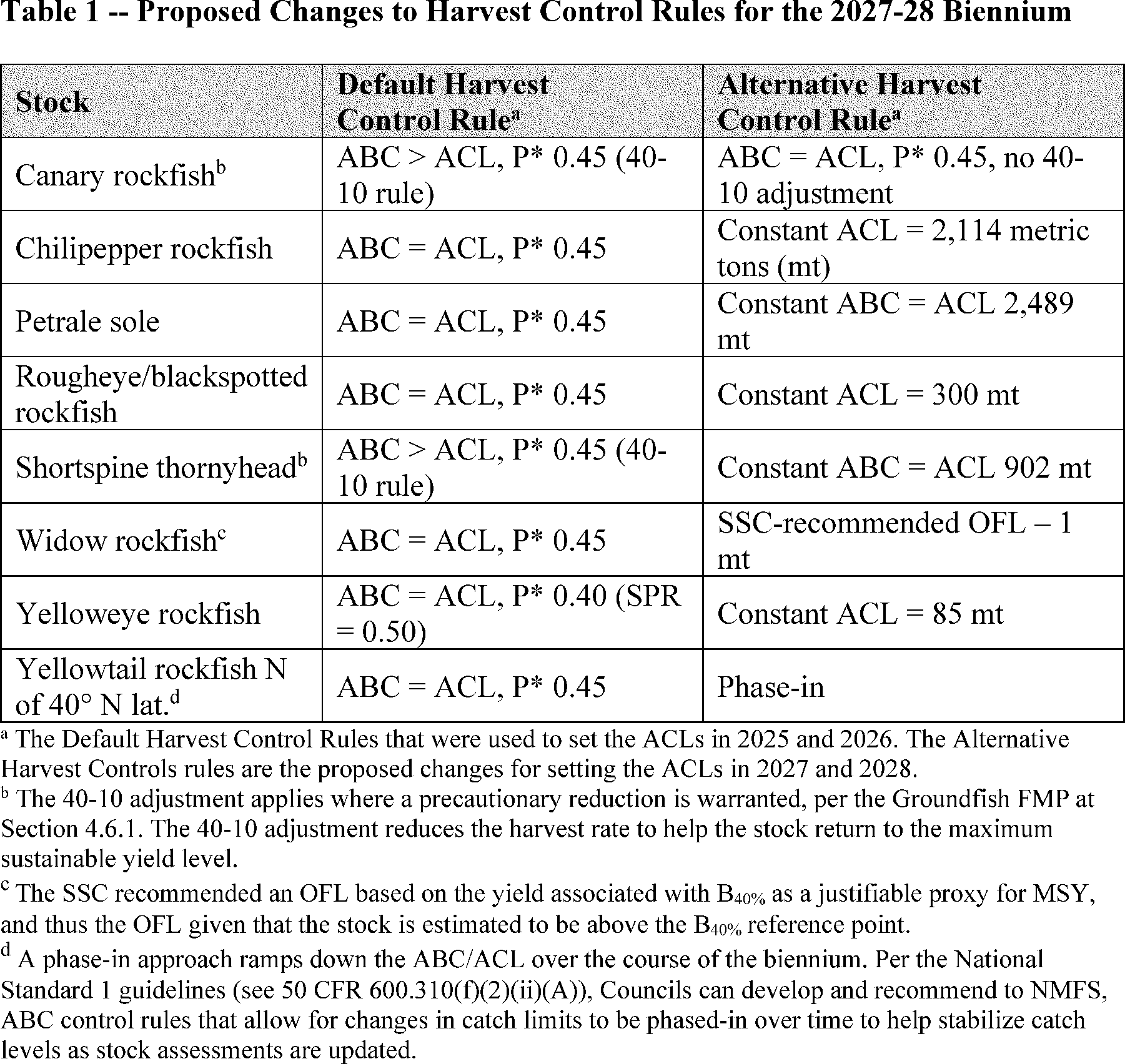
Under the Groundfish FMP, harvest control rules are typically applied at the component species level for stock complexes to calculate ACLs. Resulting contribution values of each component species, or ACL contributions, are summed to equal the stock complex ACLs. For example, the ACL contribution of chilipepper rockfish north of 40°10′ N lat contributes to the overall ACL for the Shelf Rockfish Complex for north of 40°10′ N lat. Under the Groundfish FMP, the Council may recommend setting the ACL at a different level than what the default harvest control rules specify, as long as the ACL does not exceed the ABC and complies with the requirements of the MSA. For most of the stocks and stock complexes managed with harvest specifications for 2027-28, the Council chose to maintain the default harvest control rules from the previous biennial cycle. Table 1 presents a summary of the proposed changes to default harvest control rules for certain stocks for 2027-28. Each of these changes is discussed further below.
( printed page 60242)
Canary Rockfish
Canary rockfish is a Category 1 stock managed with coastwide harvest specifications. Canary rockfish are caught in all sectors, both commercial and recreational. The default harvest control rule from the prior biennium is ABC > ACL, via the 40-10 rule, P* 0.45. In 2023, the NWFSC conducted a full benchmark stock assessment (see Electronic Access under
ADDRESSES
), which estimated the stock at B35%
, and therefore below the management target of B40%
. This designated canary rockfish as in the precautionary zone (
i.e.,
below the management target of B40%
, but still above the overfished threshold of B25%
), which enacted the automatic application of the 40-10 adjustment to the harvest control rule used to set 2025-26 ACLs. This decreased the 2025 ACL from the 2024 ACL by 56 percent (1,296 mt to 571 mt), which consequently led to substantive reductions in sector allocations and resulting fishery constraints across all sectors. These constraints were consistently reported by industry representatives throughout the 2025 fishing year, which led the Council to request a catch-only projection mid-biennium to investigate the potential to increase 2026 harvest specifications. In 2025, the NWFSC conducted a catch-only projection (see Electronic Access under
ADDRESSES
), which included more recent catch information, as well as options for changes to 2026 harvest specifications. The catch-only projection showed that there was a higher biomass of canary rockfish available for harvest than previously thought when the 2023 benchmark assessment was conducted. Therefore, NMFS implemented, in alignment with the Council's recommendation, a temporary emergency rule to increase 2026 canary rockfish harvest specifications and sector allocations in accordance with the 2025 catch-only projection (91 FR 2714; January 22, 2026). The catch-only projection estimates the stock will be at B34%
at the start of 2027, indicating the stock will still be in the precautionary zone for the upcoming 2027-28 biennium, but above the B25%
overfished threshold.
Given the anticipation of ongoing fishery constraints in 2026 and beyond, NMFS is proposing, in alignment with the Council's recommendation, a less precautionary alternative harvest control rule for canary rockfish in the 2027-28 biennium: ABC = ACL, P* 0.45, without the application of the 40-10 rule. As presented in the catch-only projection and explained in the draft Analysis (see
ADDRESSES
), the stock is not expected to fall below the overfished threshold in the 10-year projection period from 2027 to 2036. Additionally, the alternative harvest control rule would increase the 2027 and 2028 ACLs by 37 mt and 41 mt as compared to the default harvest control
( printed page 60243)
rule, which is expected to provide meaningful relief to the fishing industry.
Chilipepper Rockfish
Chilipepper rockfish is a Category 1 stock managed south of 40°10′ N lat. with species-specific harvest specifications and north of 40°10′ N lat. as a component stock in the northern Shelf Rockfish Complex. Harvest specifications are apportioned north (7 percent) and south (93 percent) of 40°10′ N lat. based on average historical landings. Chilipepper rockfish is primarily caught in the commercial midwater trawl sector but has been increasingly targeted by the commercial non-trawl sector in recent years. The default harvest control rule from the prior biennium is ABC = ACL, P* 0.45. In 2025, the NWFSC conducted a full benchmark stock assessment (see Electronic Access under
ADDRESSES
), which estimated the stock at B83.2%
in 2025, indicating the stock is healthy. Although ACLs could be substantively increased under the default harvest control rule for the upcoming biennium, the Council initially considered a more conservative alternative harvest control where the ACL would be set equal to 2,114 mt for both 2027 and 2028; 2,114 mt is a reference point from the stock assessment that represents a long-term average yield under the fishing rate that produces an SPR of 50 percent. An SPR of 50 percent is used in the Council's default harvest policy to set the OFL by applying the SPR to current and projected estimated biomass. The Council considered this more conservative approach to setting harvest specifications for chilipepper rockfish because the 10-year projection in the 2025 stock assessment displayed a steep decrease in harvest specifications in future biennia after 2027-28. Under the more conservative alternative harvest control rule, catch limits would remain more consistent over the 10-year projection. However, NMFS is proposing, in alignment with the Council's recommendation, to set harvest specifications according to the default harvest control rule, as new potential markets were identified in central California for chilipepper rockfish, and higher catch limits may enable those markets to be fulfilled. The default harvest control rule would increase the 2027 and 2028 ACLs by 1,020 mt and 904 mt respectively, as compared to the alternative harvest control rule.
Petrale Sole
Petrale sole is a Category 1 stock managed with coastwide harvest specifications. Petrale sole is primarily caught in the commercial bottom trawl sector but has also been increasingly caught in the commercial and recreational non-trawl sectors due to locational shifts in effort from seasonal closures. In 2023, the NWFSC conducted a benchmark stock assessment (see Electronic Access under
ADDRESSES
) that estimated the stock at B33.6%
in 2023, which is above the management target of B25%
for flatfish species. Although this indicates the stock was healthy in the 2023-24 biennium, the stock assessment projected declining biomass in the future due to below-average recruitment in recent years, which led to a 28 percent decrease in the 2025 ACL compared to the 2024 ACL (3,285 mt to 2,354 mt). Similar to canary rockfish, this substantive ACL decrease led to consistent reports of fishing constraints from industry representatives and the Council's subsequent request for a mid-biennium catch-only projection to investigate the possibility of increasing 2026 harvest specifications. In 2025, the NWFSC conducted a catch-only projection for petrale sole (see Electronic Access under
ADDRESSES
), which included more recent catch information, as well as options for changes to 2026 harvest specifications. The catch-only projection showed that there was a higher biomass of petrale sole available for harvest than previously thought when the 2023 benchmark assessment was conducted. Therefore, NMFS implemented, in alignment with the Council's recommendation, a temporary emergency rule to increase petrale sole harvest specifications and allocations in accordance with the 2025 catch-only projection (91 FR 2714; January 22, 2026). The catch-only projection estimates the stock will be at B26%
at the start of 2027, indicating the stock will still be above the management target of B25%
for flatfish species.
Given the anticipation of ongoing fishery constraints in 2026, NMFS is proposing, in alignment with the Council's recommendation, a less precautionary alternative harvest control rule for petrale sole in the 2027-28 biennium: Constant ABC = ACL 2,489 mt. This value is the same as the ACL implemented in the 2026 emergency rule (91 FR 2714; January 22, 2026). As presented in the catch-only projection and explained in the draft Analysis (see
ADDRESSES
), the stock is not expected to fall below the overfished threshold in the 10-year projection period from 2027 to 2036. Additionally, the alternative harvest control rule for petrale sole would increase the ACLs by 40 mt in 2027 and 66 mt in 2028, relative to the default harvest control rule, which is expected to provide meaningful relief to the fishing industry.
Rougheye/Blackspotted Rockfish
Rougheye/blackspotted rockfish is a Category 2 stock managed north and south of 40°10′ N lat. as a component stock in the Slope Rockfish complexes. Coastwide OFLs are apportioned north (98 percent) and south (2 percent) of 40°10′ N lat. based on average landings during the 1985-2012 time period, and contribute tonnage to the respective harvest specifications of the stock complex assemblages. Rougheye/blackspotted rockfish are not targeted by any specific sector, but they are primarily retained as marketable bycatch in the midwater trawl sector. The default harvest control rule from the last biennium is ABC = ACL, P* 0.45. In 2025, the NWFSC conducted a full benchmark stock assessment (see Electronic Access under
ADDRESSES
), which estimated the stock at B87.2%
in 2025, indicating the stock is healthy. Although ACLs could be substantively increased under the default harvest control rule for the upcoming biennium, the result of the 2025 stock assessment is notably different from the 2013 stock assessment (see Electronic Access under
ADDRESSES
), and the SSC noted that various sources of uncertainty in the 2025 stock assessment warrant a more risk averse approach to harvest (Agenda Item G.3.a Supplemental SSC Report 2, September 2025). Therefore, NMFS is proposing, in alignment with the Council's recommendation, a more conservative alternative harvest control rule where the ACL is set equal to 300 mt for both 2027 and 2028. 300 mt is the maximum mortality reported in the Groundfish Expanded Mortality Multi-year data report; thus, it is not anticipated to constrain the fishery. The alternative harvest control rule for rougheye/blackspotted rockfish reduces the ACLs by 544 mt in 2027 and 527 mt in 2028, relative to the default harvest control rule.
Shortspine Thornyhead
Shortspine thornyhead is a Category 2 stock managed with coastwide harvest specifications. Shortspine thornyhead is primarily caught in the commercial trawl sector but has been increasingly targeted by the commercial non-trawl sector in recent years. In 2023, the NWFSC conducted a length-based data moderate stock assessment (see Electronic Access under
ADDRESSES
) that estimated the stock at B39.4%
in 2023, and therefore below the
( printed page 60244)
management target of 40 percent unfished biomass. This designated shortspine thornyhead as in the precautionary zone (
i.e.,
below the management target of B40%
, but still above the overfished threshold of B25%
), which enacted the automatic application under the FMP of the 40-10 adjustment to the harvest control rule used to set 2025-26 ACLs. This decreased the 2025 ACL from the 2024 ACL by 60 percent (2,030 mt to 815 mt), which led to substantive reductions in sector allocations and resulting fishery constraints in the trawl sector. Similar to canary rockfish and petrale sole, this substantive ACL decrease led to consistent reports of fishing constraints from industry representatives and the Council's subsequent request for a mid-biennium catch-only projection to investigate the possibility of increasing 2026 harvest specifications. In 2025, the NWFSC conducted a catch-only projection for shortspine thornyhead (see Electronic Access under
ADDRESSES
), which included more recent catch information, as well as options for changes to 2026 harvest specifications. The catch-only projection showed that there was a higher biomass of shortspine thornyhead available for harvest than previously thought when the 2023 length-based data moderate assessment was conducted. Therefore, NMFS implemented, in alignment with the Council's recommendation, a temporary emergency rule to increase shortspine thornyhead harvest specifications and allocations in accordance with the 2025 catch-only projection (91 FR 2714; January 22, 2026). The catch-only projection estimates the stock will be at B39.3%
at the start of 2027, indicating the stock will still be in the precautionary zone for the upcoming 2027-28 biennium, but above the B25%
overfished threshold.
Given the anticipation of ongoing fishery constraints in 2026, NMFS is proposing, in alignment with the Council's recommendation, a less precautionary alternative harvest control rule for shortspine thornyhead in the 2027-28 biennium: Constant ABC = ACL 902 mt. This value is the same as the ACL implemented in the 2026 emergency rule (91 FR 2714; January 22, 2026). As presented in the catch-only projection and explained in the draft Analysis (see
ADDRESSES
), the stock is not expected to fall below the overfished threshold in the 10-year projection period from 2027 to 2036. Additionally, the alternative harvest control rule for shortspine thornyhead would increase the ACLs by 55 mt in 2027 and 46 mt in 2028, relative to the default harvest control rule, which is expected to provide meaningful relief to the fishing industry.
Widow Rockfish
Widow rockfish is a Category 1 stock managed with coastwide harvest specifications. Widow rockfish is primarily targeted by the midwater trawl sector but has been increasingly targeted by the commercial non-trawl sector in recent years. The default harvest control rule from the last biennium is ABC = ACL, P* 0.45. In 2025, the NWFSC conducted an update assessment (see Electronic Access under
ADDRESSES
), which estimated the stock at B50.1%
in 2025. Although this indicates the stock was healthy in the last biennium, this result signals a substantive decrease in biomass since the last assessment, which was an update assessment conducted in 2019 (see Electronic Access under
ADDRESSES
). This would cause an approximate 59 percent decrease in the ACL from 2026 to 2027 under the default harvest control rule, which would significantly constrain the midwater trawl sector.
The Council explored a broad range of alternative harvest control rules during the development of the 2027-28 harvest specifications, the details of which are documented in the Council Analytical Document and draft Analysis (see
ADDRESSES
). To avoid expected economic harm to the fishing industry, NMFS is proposing, in alignment with the Council's recommendation, an alternative harvest control rule of: SSC-recommended OFL—1 mt. The SSC recommended an OFL based on the yield associated with B40%
as a justifiable proxy for MSY, and because the stock is estimated to be above the B40%
reference point. This approach is consistent with recent NOAA technical guidance (see Informational Report 4, March 2026 briefing book) related to specifying reference points identified in the MSA's National Standard 1 (NS1) and is expected to prevent overfishing, while allowing for long term optimum yield. The proposed ABC/ACL of 6,238 mt would be applied over the next 2 years, which is consistent with NS1 technical guidance for phase-in provisions. This would yield an ACL that is approximately 40 percent lower than the 2026 ACL (10,392 mt), but 26 percent higher than the 2027 ACL under the default harvest control rule (4,596 mt). The recommended ACL is expected to still constrain the midwater trawl sector, but to a lesser degree than the ACLs under the default harvest control rule.
Yelloweye Rockfish
Yelloweye rockfish is a Category 1 stock managed with coastwide harvest specifications. Yelloweye rockfish has been a prohibited species across all sectors since it was declared overfished and placed under a rebuilding plan in 2002. In May 2026, NMFS declared yelloweye rockfish rebuilt. The results of the 2025 stock assessment (see Electronic Access under
ADDRESSES
) indicate the stock is at 40.1 percent unfished biomass, which is above both the overfished threshold of B25%
and the management target of B40%
. The default harvest control rule from the prior biennium, when the stock was still rebuilding, is ABC = ACL, P* 0.40 (SPR = 0.50). Since the stock is now rebuilt, yelloweye rockfish is no longer required to be managed under a rebuilding plan, and new default harvest control rules for the rebuilt stock may be considered. However, given that the stock has just come out of rebuilding, the Council initially considered a more conservative alternative harvest control rule of: constant ACL = 85 mt. The 85 mt value is between the 2026 and 2027 ACLs under the default harvest control rule (56.6 mt and 113 mt, respectively), and was intended to provide some fishing opportunity in the coming biennium while still maintaining a precautionary reintroduction to harvest. However, NMFS is proposing, in alignment with the Council's recommendation, to set harvest specifications according to the default harvest control rule in order to provide additional fishing opportunities while maintaining an acceptable level of risk to the stock. The default harvest control rule would increase the 2027 and 2028 ACLs by 28 mt relative to the alternative harvest control rule.
Yellowtail Rockfish North of 40°10′ N lat.
Yellowtail rockfish north of 40°10′ N lat. is a Category 1 stock managed with its own harvest specifications separately from the stock of yellowtail rockfish south of 40°10′ N lat. Yellowtail rockfish north of 40°10′ N lat. is primarily targeted by the midwater trawl sector but has been increasingly targeted by the commercial non-trawl sector in recent years. The default harvest control rule from the last biennium is ABC = ACL, P* 0.45. In 2025, the NWFSC conducted an update stock assessment (see Electronic Access under
ADDRESSES
), which estimated the stock at 62.6 percent unfished biomass in 2025. Although this indicates the stock is healthy in the current biennium, commercial catches have increased with the rebound of the midwater trawl
( printed page 60245)
fishery, causing an approximate 22 percent decrease in the ACL from 2026 to 2027 under the default harvest control rule. This decrease is expected to constrain the midwater trawl sector both in terms of accessing yellowtail rockfish and targeting co-occurring species, such as widow rockfish.
Therefore, NMFS is proposing, in alignment with the Council's recommendation, an alternative harvest control rule that would implement a phase-in approach that would ramp down the ABC/ACL over the course of the biennium. For 2027, the ABC/ACL would be set at 5,050 mt (one mt below the OFL under the default harvest control rule). For 2028, the ABC/ACL would be set at 4,730 mt, which is a value in between the 2028 OFL under the default harvest control rule and the value that would have been the 2027 ABC/ACL, if not for the phase-in approach (4,723 mt). The alternative harvest control rule for yellowtail rockfish north of 40°10′ N lat. increases the ACLs by 327 mt in 2027 and 190 mt in 2028 relative to the default harvest control rule. These increases are expected to provide meaningful relief to the fishing industry.
D. Summary of ACL Changes From 2026 to 2027
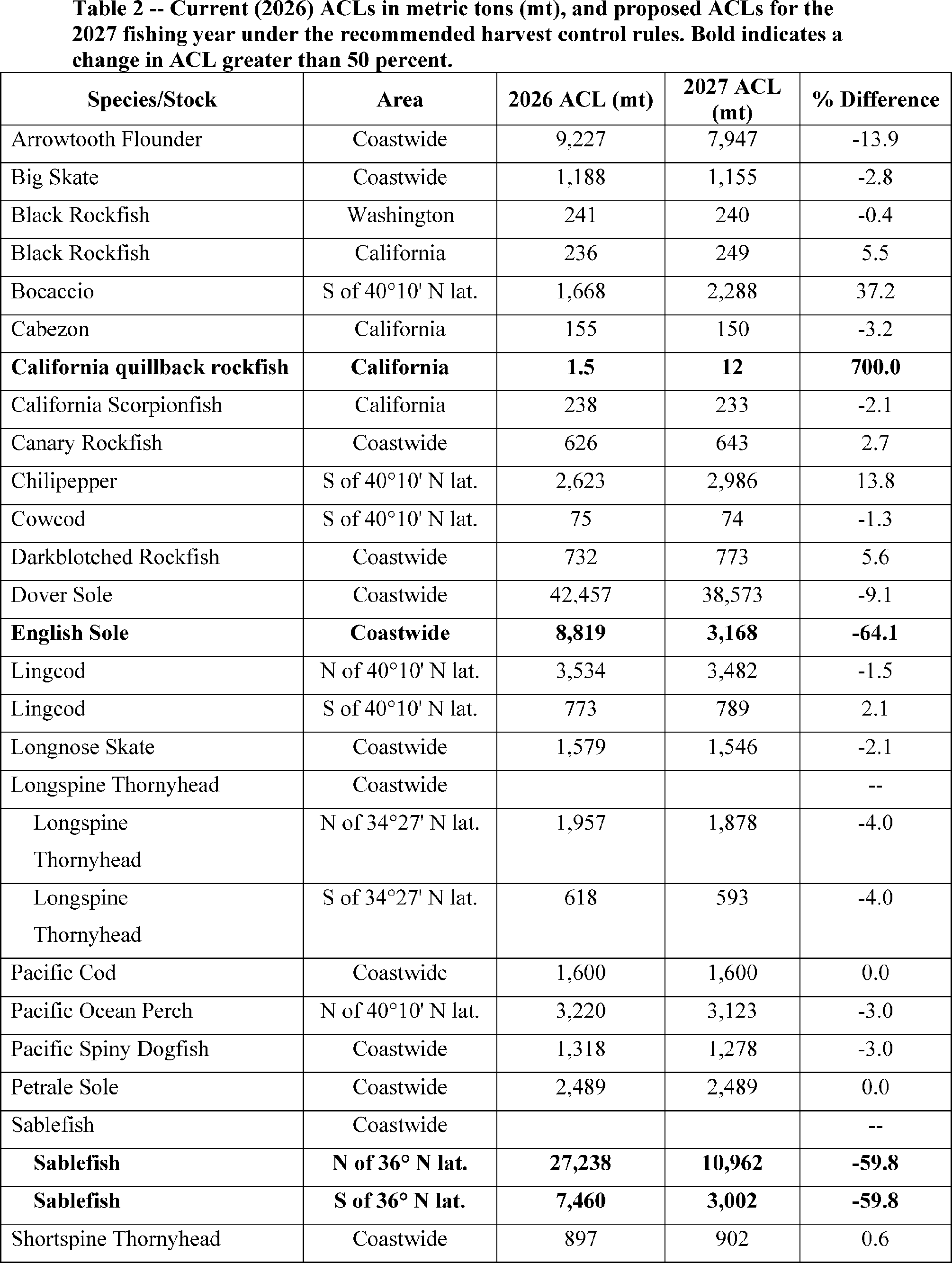
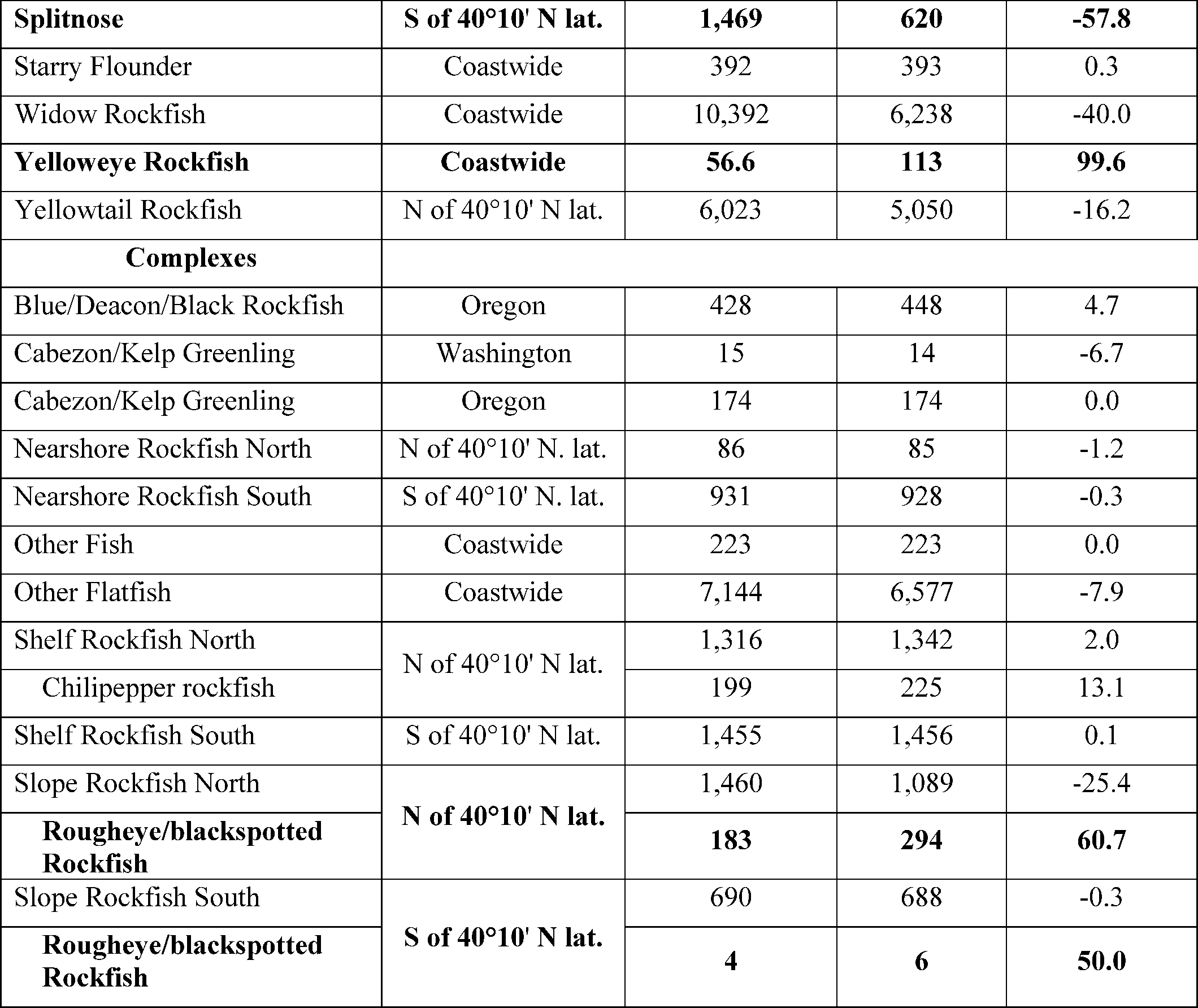
Table 2 compares the ACLs for major stocks and stock complexes for 2026 and 2027 with harvest specifications set under the Council's recommended harvest control rules. Under this proposed rule, 14 of the 41 stocks/complexes shown in table 2 would have higher ACLs in 2027 than in 2026 (excludes increases for ACL contributions within stock complexes), and 24 stocks/complexes would have lower ACLs in 2027 than in 2026 (excludes decreases for ACL contributions within stock complexes). Three stocks/complexes (
i.e.,
Pacific cod, the Oregon cabezon/kelp greenling complex, and petrale sole) would have the same ACLs in 2027 as in 2026. The ACLs for two stocks (yelloweye rockfish and California quillback rockfish) would increase by more than 100 percent as a result of their rebuilt stock status. In addition, the ACL contribution for rougheye/blackspotted rockfish within the slope north and south of 40°10′ N lat. complexes would increase by over 300 percent. These increases are due to new information provided in their respective 2025 stock assessments (see Electronic Access under
ADDRESSES
). The ACLs for four stocks (English sole, sablefish north of 36° N lat., sablefish south of 36° N lat., and splitnose rockfish) would decrease by over 50 percent. The decreases for sablefish north of 36° N lat. and sablefish south of 36° N lat. are due to new information in their 2025 stock assessments (see Electronic Access under
ADDRESSES
). The decreases for English sole and splitnose rockfish are a result of the older age of their assessments, which over time, applies a larger buffer between the OFL and the ABC/ACL to account for increasing scientific uncertainty in the biomass estimates.
( printed page 60246)
( printed page 60247)
III. Proposed Management Measures
This section describes proposed management measures used to further allocate the ACLs to the various components of the fishery (
i.e.,
biennial fishery harvest guidelines (HGs) and set-asides) and management measures to control fishing. Management measures for the commercial fishery serve to modify fishing behavior during the fishing year to ensure catch does not exceed the ACL, and include trip and cumulative landing limits, time/area closures, size limits, and gear restrictions. Management measures for the recreational fisheries include bag limits, size limits, gear restrictions, fish dressing requirements, and time/area closures.
A. Deductions From the ACLs
Before making allocations to the primary commercial and recreational components of groundfish fisheries, the Council recommends “off-the-top deductions,” or deductions from the ACLs to account for anticipated mortality for certain types of activities, including: (1) harvest in Pacific Coast treaty Indian Tribal fisheries; (2) harvest in scientific research activities; (3) harvest in non-groundfish fisheries (incidental catch); and (4) harvest that occurs under EFPs. All off-the-top deductions proposed for individual stocks or stock complexes will be published in the 2026 SAFE as opposed to the Federal regulations, as off-the-top deductions are bycatch estimates and not formal catch limits. The details of the EFPs are discussed below in section III, I of this proposed rule.
Pacific Coast Tribal Fisheries
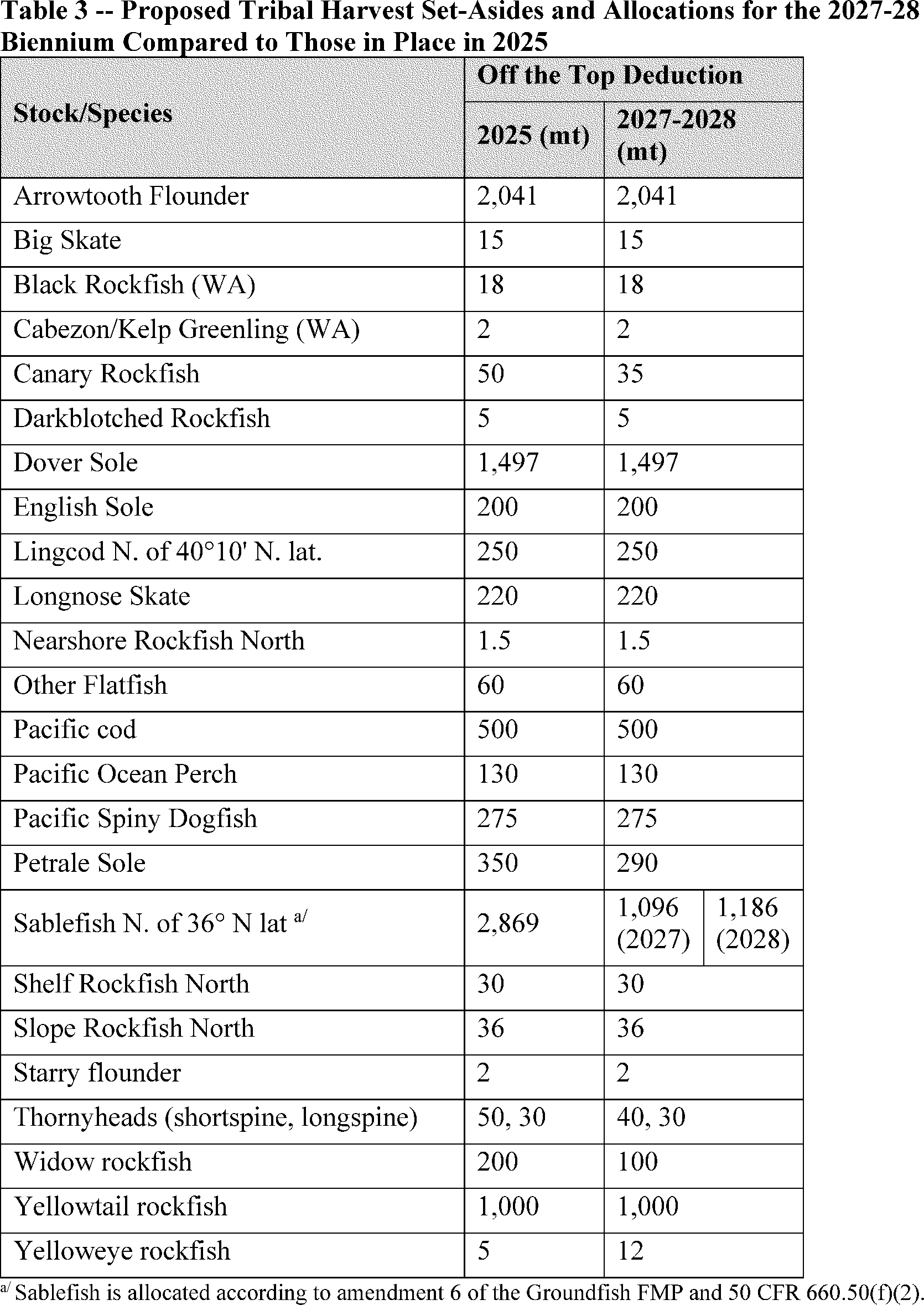
The Quileute Tribe, Quinault Indian Nation, Makah Indian Tribe, and Hoh Indian Tribe (collectively, “the Pacific Coast Tribes”) implement management measures for Tribal fisheries both independently as sovereign governments and cooperatively with the management measures in the Federal regulations. The Pacific Coast Tribes work through the Council process to maintain groundfish set-asides, HGs, and allocations pursuant to treaty fishing rights and as co-managers of the resource. The Pacific Coast Tribes may adjust their Tribal fishery management measures inseason to stay within the Tribal set-asides and allocations and within the estimated impacts to overfished stocks. Table 3 provides the Tribal harvest set-asides and allocations proposed for the 2027-28 biennium for groundfish species other than Pacific
( printed page 60248)
whiting, which is allocated through a separate annual specifications process with Canada. These targets are consistent with the 2026 targets, with the exception of canary rockfish (decrease to 35 mt), petrale sole (decreased to 290 mt), sablefish north of 36° N lat. (decreased to 1,096 mt in 2027 and 1,186 mt in 2026), shortspine thornyhead (decrease to 40 mt), widow rockfish (decreased to 100 mt), and yelloweye rockfish (increased to 8 mt).
The Pacific Coast Tribes proposed trip limit management in Tribal fisheries for 2027-28 for several stocks, including several rockfish stocks and stock complexes. This rule proposes the trip limits for Tribal fisheries, as provided to the Council at its April 2026 meeting in Supplemental Tribal Report 1, Agenda
( printed page 60249)
Item C.7 (see proposed regulatory changes for § 660.50).
Scientific Research
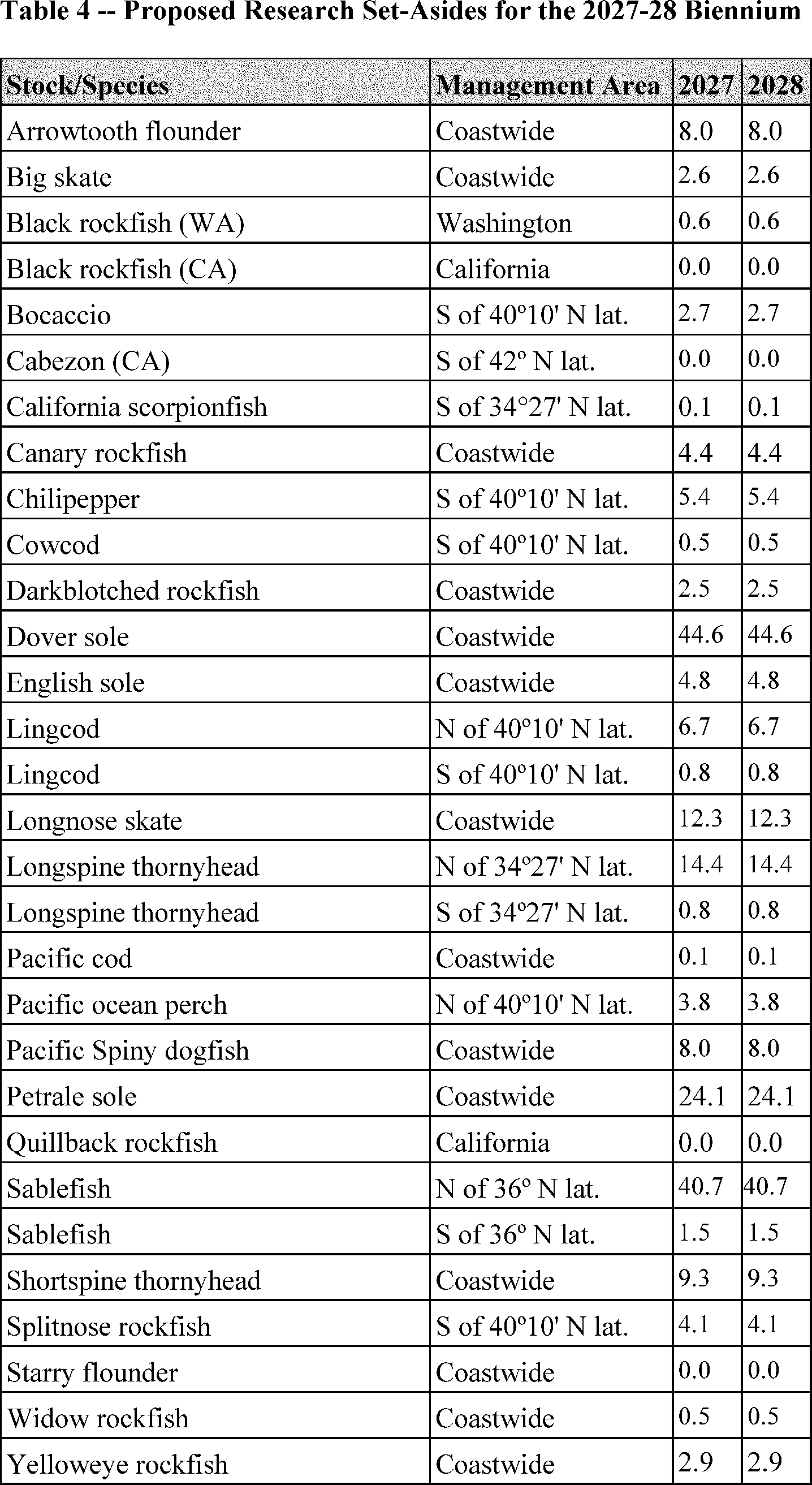
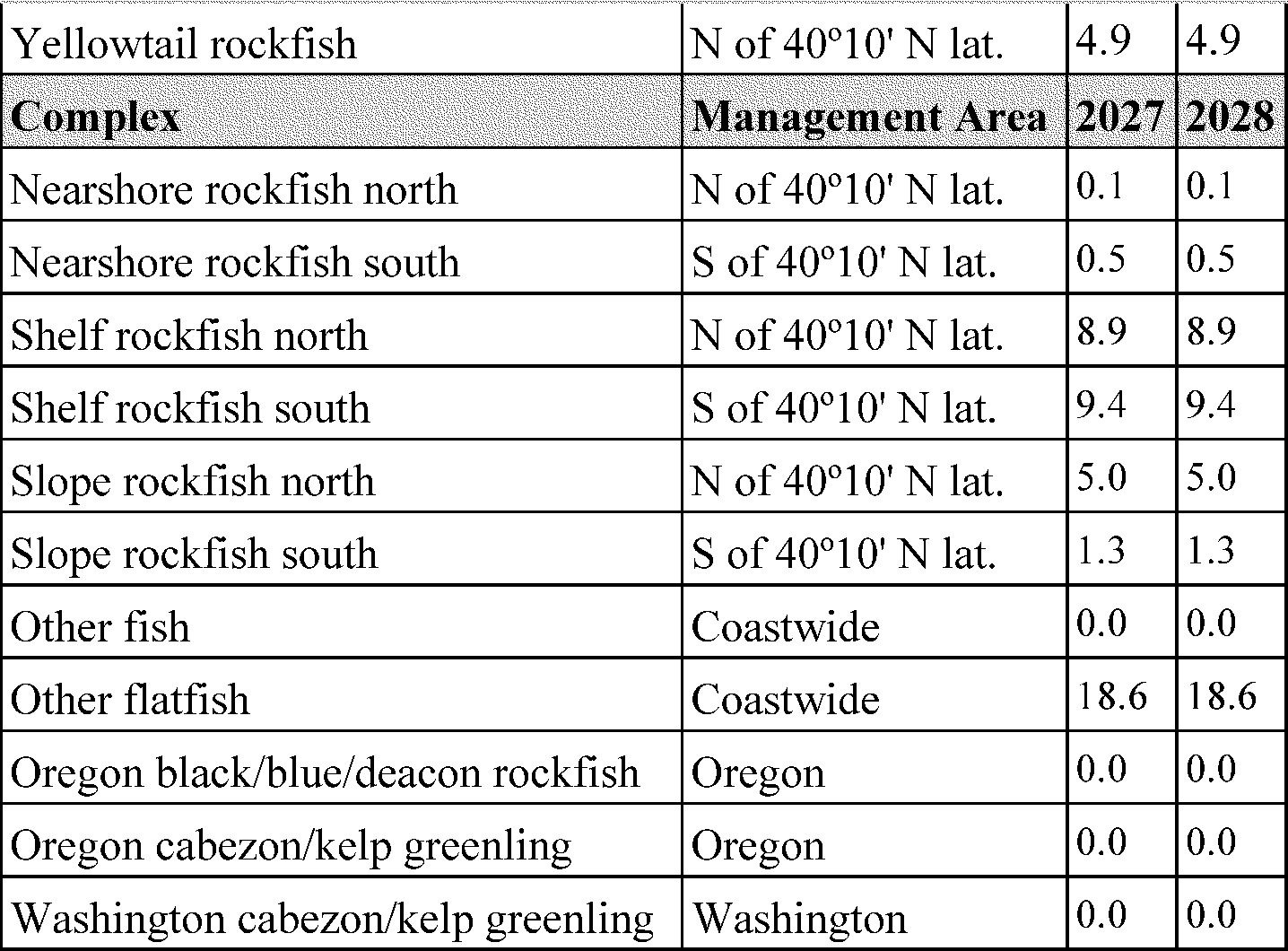
NMFS is proposing, in alignment with the Council's recommendation, the below amounts in table 4 to accommodate mortality from research activities for the 2027-28 biennium. Research activities include the NWFSC's West Coast Bottom Trawl survey, the NWFSC's Southern California Hook-and-Line survey, and the International Pacific Halibut Commission (IPHC) longline surveys, as well as other Federal and state research projects. In previous harvest specification cycles, the Council established research set-asides equal to the long-term maximum or historical average (beginning in 2003) for all species except yelloweye rockfish and cowcod, for which custom methodologies were designed for setting research set-asides. However, many of these long-term maximums or averages are not reflective of recent mortality trends in scientific research activities. Therefore, for the 2027-28 biennium, 41 of the 42 stocks or stock complexes that have research set-asides would instead be set equal to their 5-year median mortality. Using the median allows for the estimate to be less influenced by higher, often anomalous years that are unlikely to occur again due to the ephemeral nature of some research projects. The research set-aside for yelloweye rockfish would continue to be the custom value of 2.9 mt, which is based on anticipated needs from known research projects (see Agenda Item F.8.a Supplemental GMT Report 1, November 2025). The research set-aside for petrale sole would be the status quo value from 2025, which is 24.1 mt. Petrale sole is a highly attained stock, and the 2025 ACL was estimated to be exceeded by 15 mt in 2025. Maintaining the set aside of 24.1 mt, as opposed to the 5-year median mortality of 15.7 mt, is anticipated to decrease the risk of exceeding the ACL again (see Agenda Item F.8.a Supplemental GMT Report 1, November 2025). The amounts in table 4 will be published in the SAFE.
( printed page 60250)
( printed page 60251)
Incidental Open Access
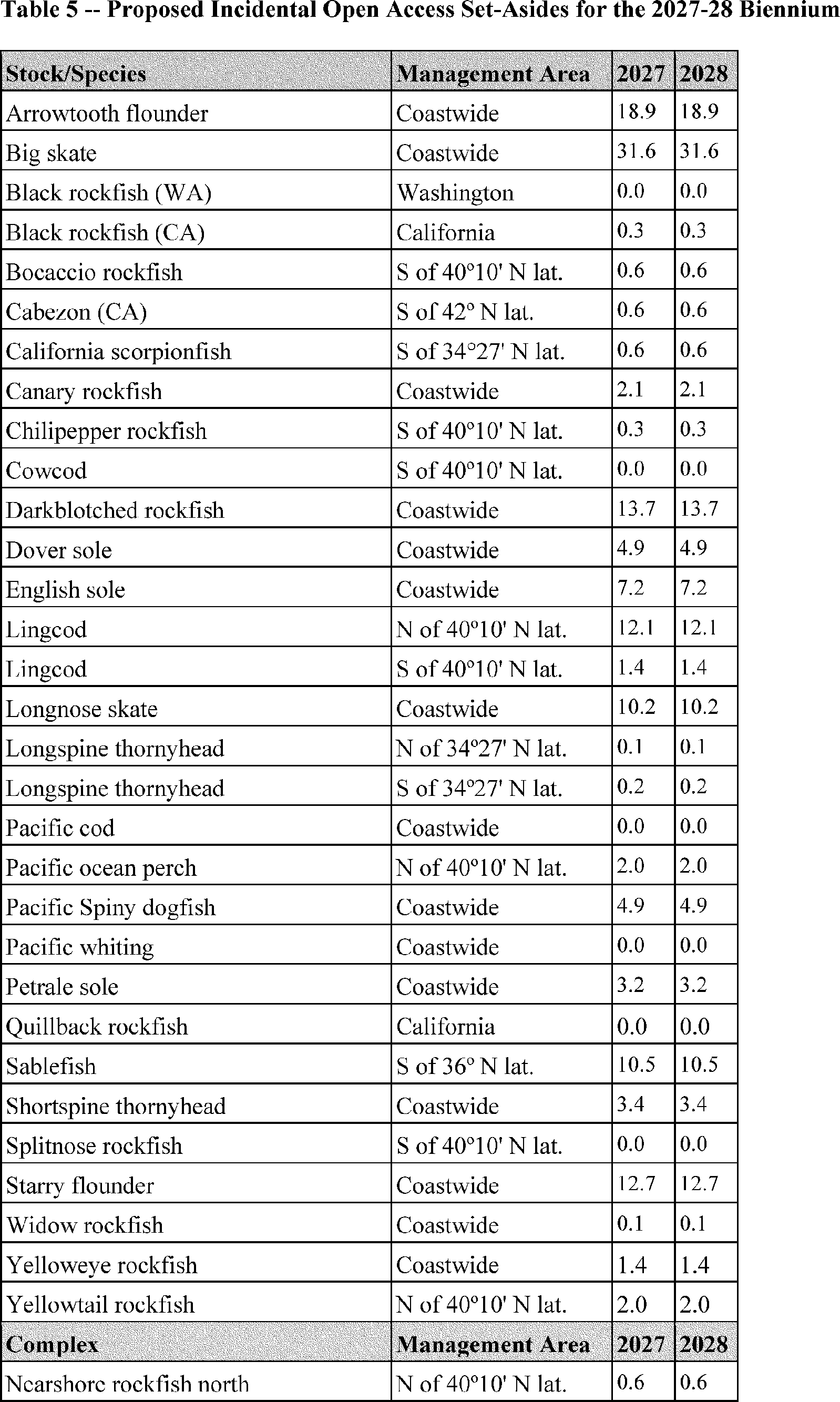
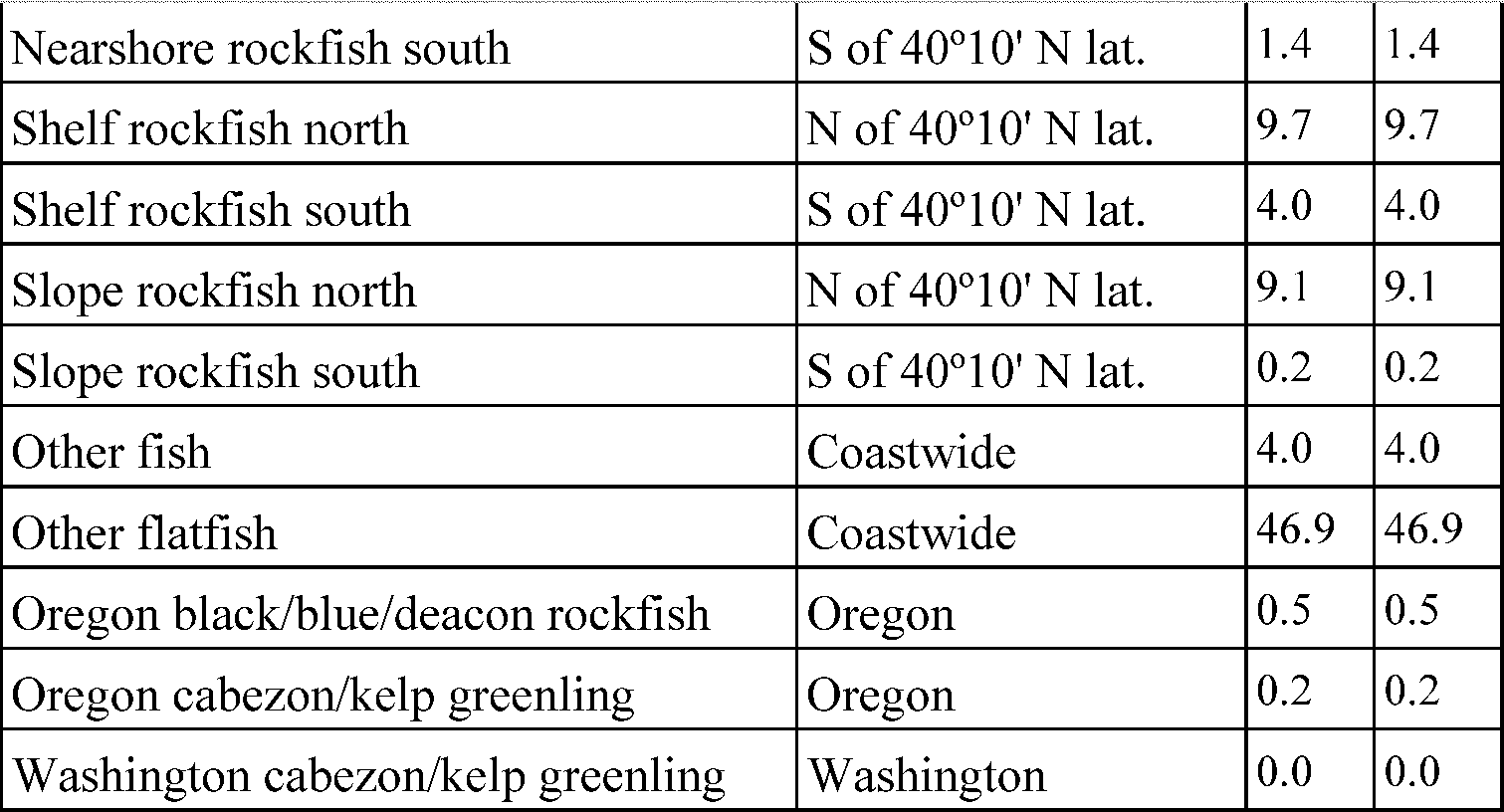
NMFS is proposing, in alignment with the Council's recommendation, the below amounts in table 5 to accommodate mortality of groundfish taken incidentally in non-groundfish fisheries (
i.e.,
the groundfish incidental open access (IOA) fisheries). IOA comprises the non-tribal directed commercial Pacific halibut, limited entry and open access California halibut, pink shrimp, and other incidental fisheries. Similar to research mortality, the Council has historically established IOA set-asides equal to the long-term maximum or historical average (beginning in 2003) for all species; however, for the 2027-28 biennium, the Council recommended establishing set-asides based on the new 5-year average mortality for all 43 stocks or stock complexes that have IOA set-asides. Using the average for IOA, as opposed to the median for research, allows the estimate to account for the possibility of large bycatch events occurring again in the future. The amounts in table 5 will be published in the SAFE.
( printed page 60252)
( printed page 60253)
Exempted Fishing Permits
Issuing EFPs is authorized by regulations implementing the MSA at 50 CFR 600.745, which state that EFPs may be used to authorize fishing activities that would otherwise be prohibited. The Council routinely considers EFP applications concurrently with the biennial harvest specifications and management process because expected catch under most EFP projects is accounted for via off-the-top deductions from ACLs. However, both EFP applications recommended by the Council for 2027-28 do not request off-the-top deductions from ACLs and plan to account for their catch via other methods. A detailed description of these EFP proposals is provided in section III, I of this preamble.
Recreational Sablefish Set-aside
The allocation framework for sablefish north of 36° N lat. was set up under amendment 6 to Groundfish FMP (57 FR 54001; November 16, 1992). This framework deducts a set-aside from the ACL to account for mortality in the recreational fisheries. The set-aside amount is usually based on the maximum historical value of sablefish caught in recreational fisheries. NMFS is proposing, in alignment with the Council's recommendation, increasing the recreational set-aside from 30 mt in the 2025-26 biennium to 50 mt for the 2027-28 biennium. Although the set-aside was increased substantively from the 2023-24 biennium to the 2025-26 biennium, (from 6 mt to 30 mt), the 30 mt was estimated to be exceeded by 15 percent in 2025 (see table 7 of Agenda Item C.7.a Supplemental GMT Report 2, April 2026), primarily due to increased mortality in the Washington recreational fishery. This increased set-aside is not expected to constrain the commercial fishery in the 2027-28 biennium.
B. Annual Catch Targets
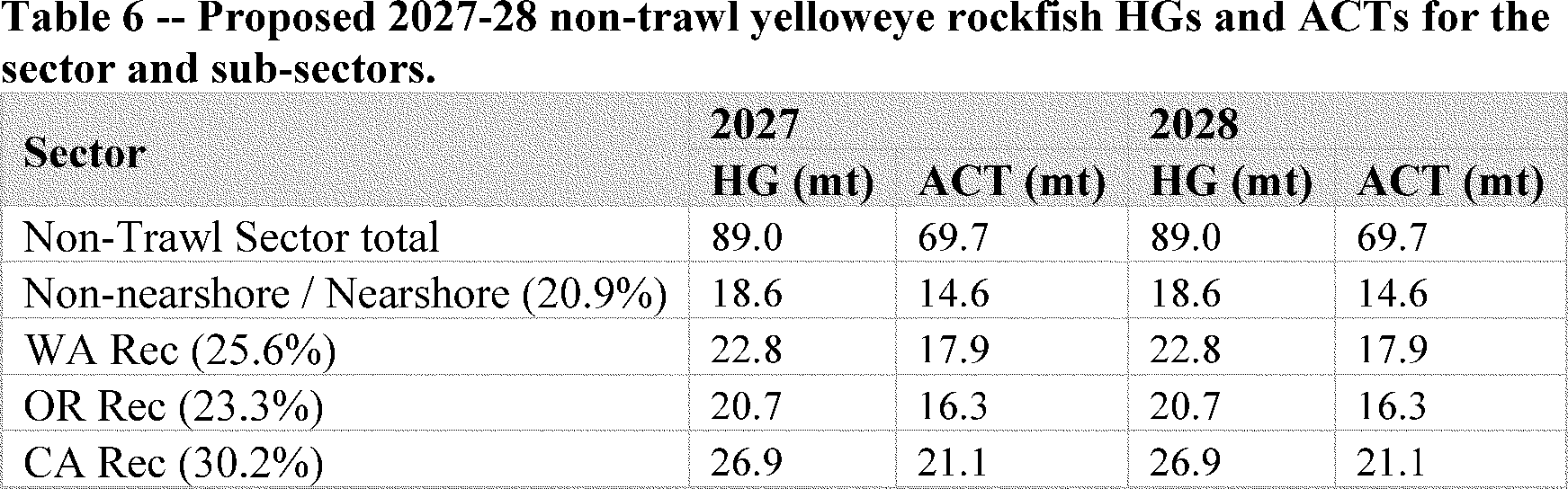
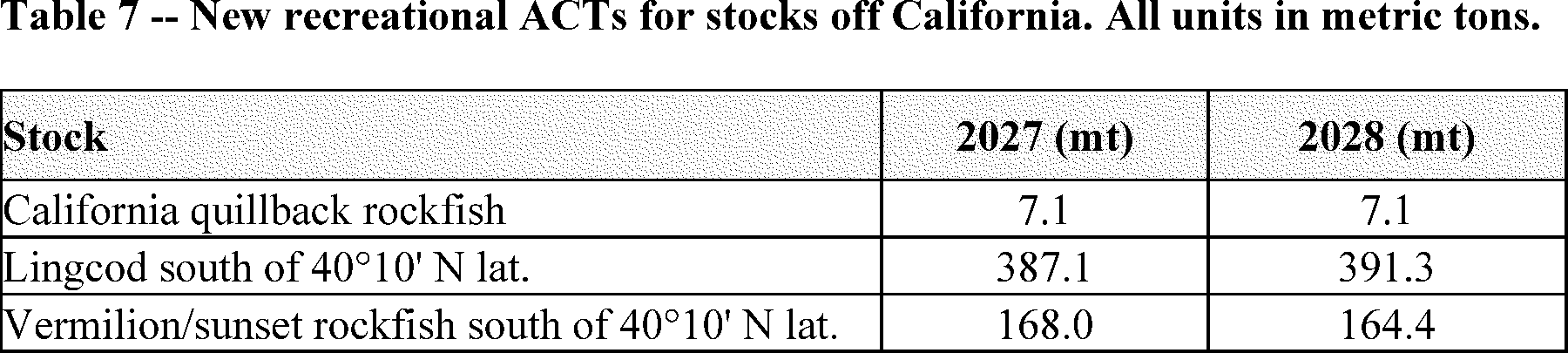
As defined at 50 CFR 660.11, an annual catch target (ACT) is a management target set below the ACL that may be used as an accountability measure in cases where there is uncertainty in inseason catch monitoring to ensure against exceeding an ACL. Since the ACT is a target and not a limit, a stock-specific ACT can be used in lieu of HGs or set strategically to accomplish other management objectives. Sector-specific ACTs can also be specified to accomplish management objectives. For the 2027-28 biennium, NMFS is proposing, in alignment with the Council's recommendation, ongoing ACTs for yelloweye rockfish in the non-trawl sectors (both commercial and recreational), copper rockfish in the recreational sector south of 34°27′ N lat., and shortspine thornyhead in the commercial non-trawl sector north of 34°27′ N lat. Further, NMFS is proposing, in alignment with the Council's recommendation, new recreational sector ACTs for vermilion/sunset rockfish south of 40°10′ N lat., California quillback rockfish, and lingcod south of 40°10′ N lat. These ACTs can be found in the footnotes to tables 1a and 2a to part 660, subpart C in the regulatory text of this proposed rule.
Yelloweye Rockfish
Yelloweye rockfish is caught in all non-trawl groundfish fisheries, where more than 95 percent of its mortality occurs. Yelloweye rockfish was declared rebuilt in May 2026, and as such, limited retention is being proposed in the non-trawl commercial and recreational fishery sectors for the 2027-28 biennium to reduce regulatory discards. However, the update assessment for yelloweye rockfish indicated that the unfished biomass (40.1 percent) only narrowly surpasses the management target of 40 percent. Therefore, NMFS is proposing, in alignment with the Council's recommendation, to maintain the standard framework for setting yelloweye rockfish ACTs below their sector HGs to continue to provide a precautionary approach yelloweye rockfish harvest.
( printed page 60254)
Copper Rockfish South of 34°27′ N lat.
Copper rockfish south of 34°27′ N lat. is primarily caught by the California recreational sector. The stock is typically subject to a recreational ACT equal to the “sub-ACL South” value specific to this area, as determined by the 2023 copper rockfish stock assessment (see Electronic Access under
ADDRESSES
). NMFS is proposing, in alignment with the Council's recommendation, to continue setting recreational ACTs for copper rockfish south of 34°27′ N lat. in accordance with this methodology. The proposed ACTs are 20.1 and 22 mt for 2027 and 2028, respectively.
Shortspine Thornyhead North of 34°27′ N lat.
A new ACT for shortspine thornyhead north of 34°27′ N lat. was implemented in the 2025-26 biennium when the management line at 34°27′ N lat. was removed and shortspine thornyhead began being managed with coastwide harvest specifications. The non-trawl commercial ACT north of 34°27′ N lat. is set at 25 percent of the coastwide non-trawl allocation. This ACT was designed to monitor catch where the most amount of effort is expected to occur. NMFS is proposing, in alignment with the Council's recommendation, to continue setting an ACT for shortspine thornyhead north of 34°27′ N lat. in accordance with the same methodology. The proposed ACT is 61.9 mt for 2027 and 2028.
New Recreational ACTs for California
NMFS is proposing, in alignment with the Council's recommendation, new recreational ACTs for California quillback rockfish, lingcod south of 40°10′ N lat., and vermilion/sunset rockfish south of 40°10′ N lat. (see table 7 below). These three stocks are becoming more highly attained in the California recreational sector and, therefore, the Council recommended these ACTs to more closely monitor recreational fishery mortality and consider inseason management responses, if necessary. These ACTs, as well as potential inseason management responses that the Council could recommend if an ACT was exceeded, were analyzed in the Council Analytical Document (see
ADDRESSES
).
C. Biennial Fishery Allocations
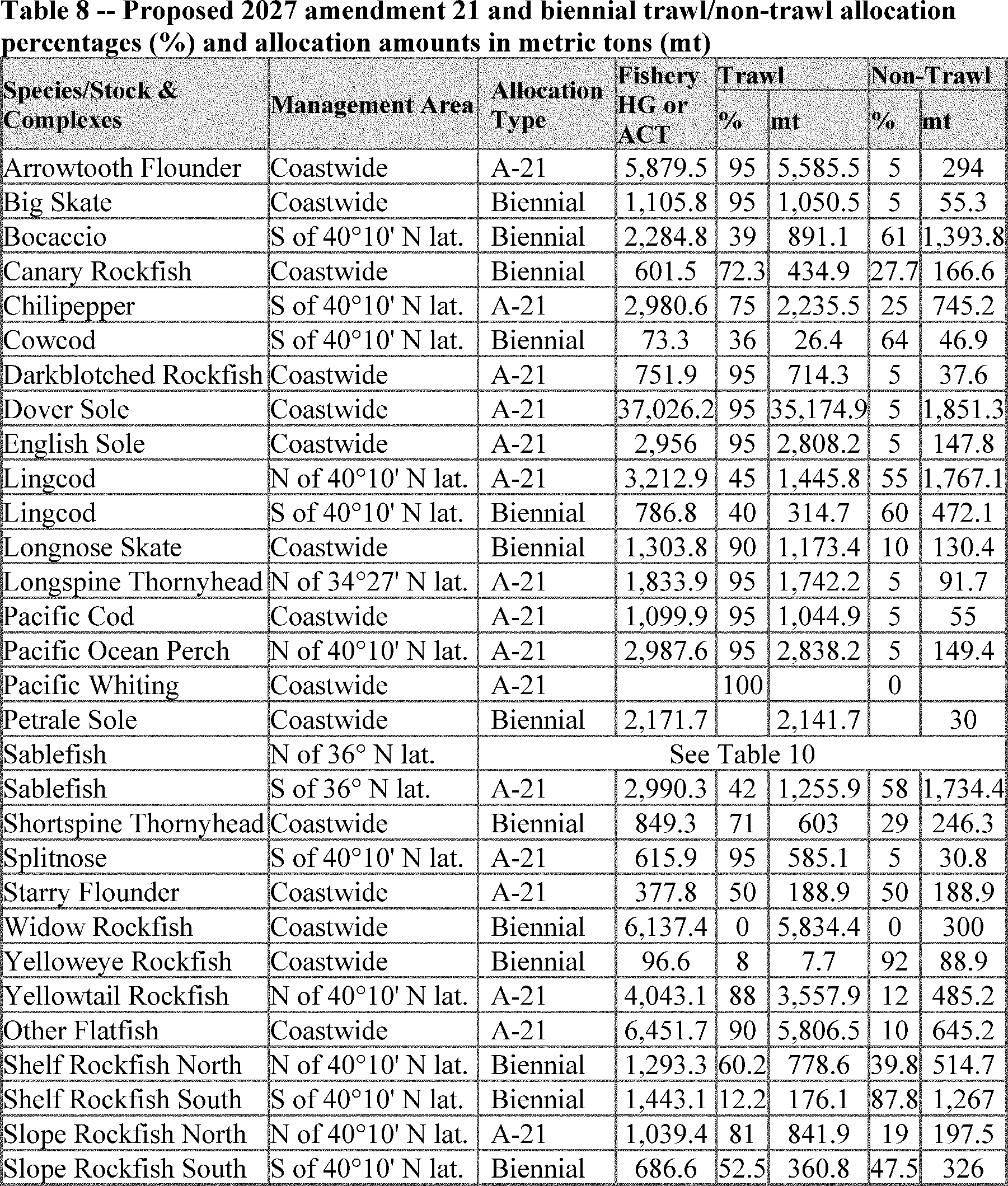
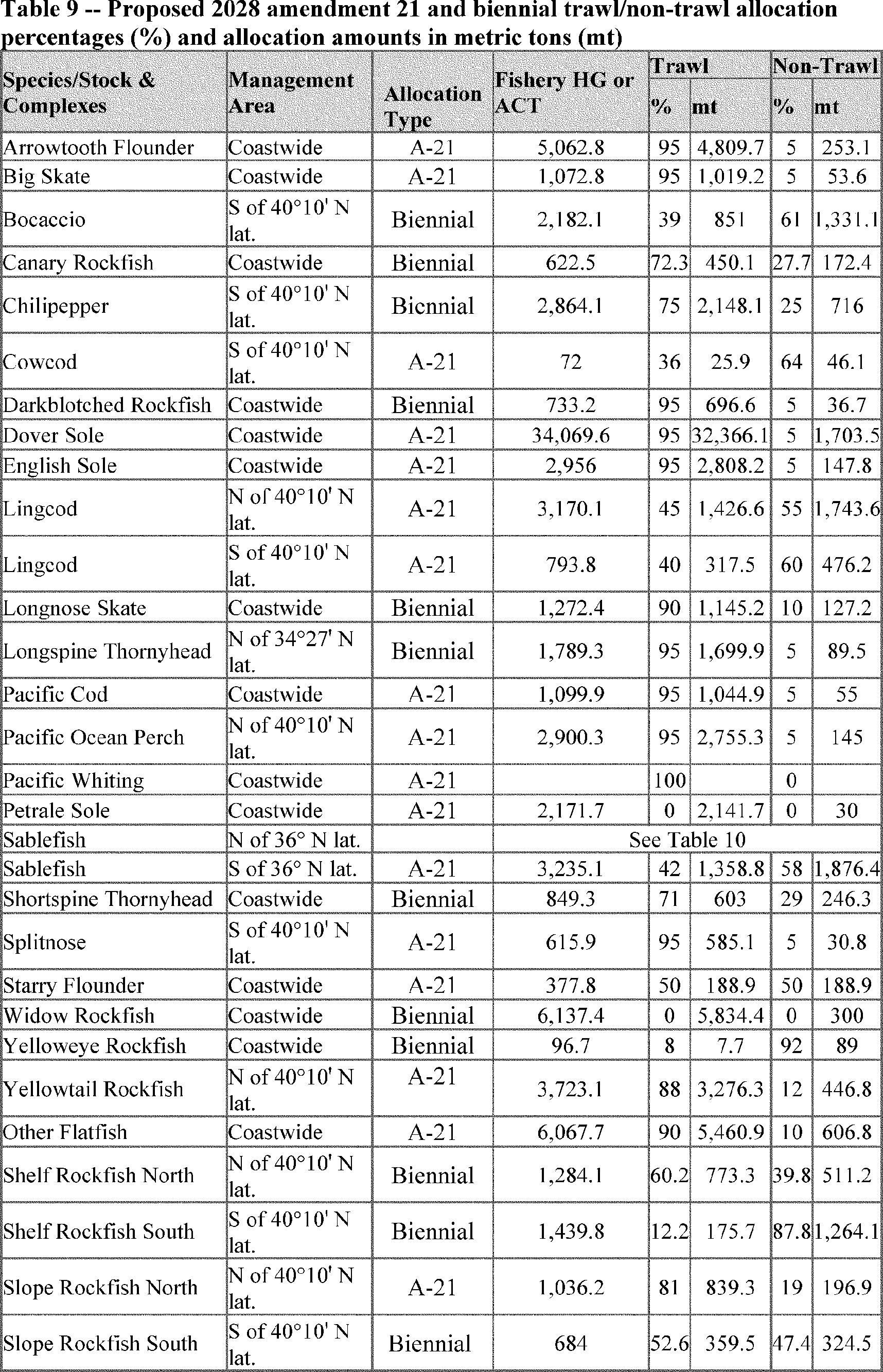
The Council routinely recommends 2-year trawl and non-trawl allocations during the biennial specifications process for stocks without formal allocations (as defined in section 6.3.2 of the Groundfish FMP) or stocks where the long-term allocation is suspended because the stock is declared overfished. The 2-year trawl and non-trawl allocations, with the exception of sablefish north of 36° N lat., are based on the fishery HG. The fishery HG is the tonnage that remains after subtracting the off-the-top deductions described in section III, A, entitled “Deductions from the ACLs,” in this preamble. The trawl and non-trawl allocations and recreational HGs are designed to accommodate anticipated mortality in each sector as well as variability and uncertainty in those mortality estimates. Additional information on the Council's allocation framework and formal allocations can be found in section 6.3 of the Groundfish FMP and § 660.55 of the Federal regulations. Tables 8 and 9 below include both categories of allocations, including formal allocations specified in the Groundfish FMP (
i.e.,
amendment 21 stocks/species) or biennial allocations that are not specified in the Groundfish FMP and only specified in the Federal regulations each biennium (
i.e.,
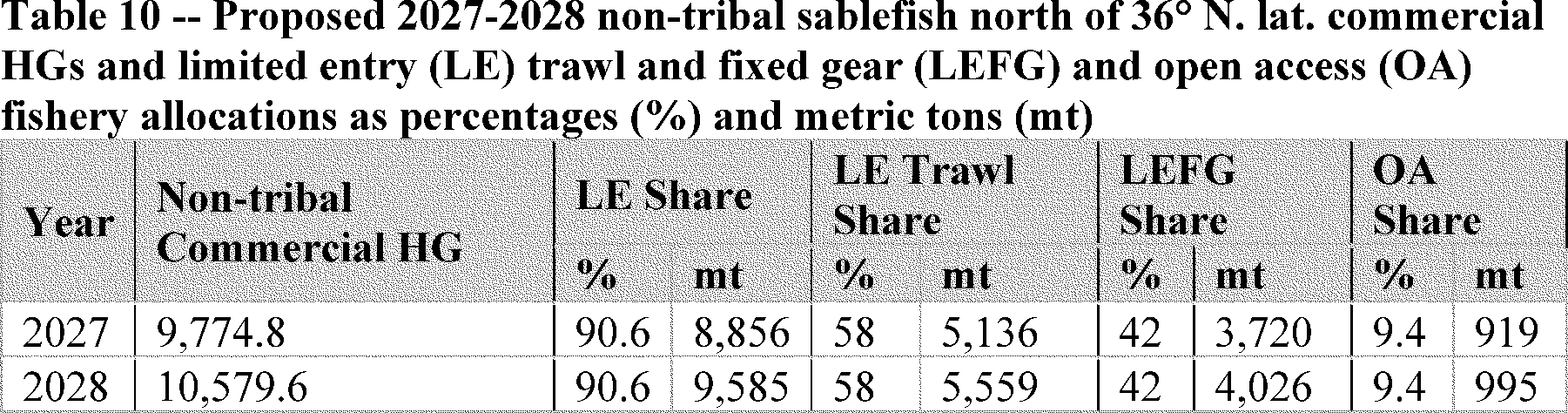
2-year allocations). Table 10 below presents the proposed allocations for sablefish north of 36° N lat. All allocations are detailed in the harvest specification tables appended to 50 CFR part 660, subpart C in the regulatory text of this proposed rule.
( printed page 60255)
( printed page 60256)
( printed page 60257)
D. Harvest Guideline Sharing Agreements
For each biennium, the Council can consider HG sharing agreements for other stocks or stock complexes separate from the standard list of biennial allocations discussed in Section III, C of this preamble. These sharing agreements can be arrangements on how the HG is split between separate states, fishery sectors, or both. For the 2027-28 biennium, NMFS is proposing sharing agreements for: bocaccio south of 40°10′ N lat., canary rockfish, cowcod, sablefish south of 36° N lat., the Slope Rockfish Complex south of 40°10′ N lat., and blackgill rockfish. All proposed sharing agreements are maintained from the 2025-26 biennium, with the exception of the Slope Rockfish Complex south of 40°10′ N lat. and blackgill rockfish. The Council is recommending a revised informal sharing agreement for blackgill rockfish (described below), based on shifting sector needs. See the Council Analytical Document (see
ADDRESSES
) for more information on how these HG sharing agreements were chosen. Informal HG sharing agreements are not managed by NMFS except in the case of a risk to the ACL. For this reason, informal HG sharing agreements are published in the SAFE each biennium (see Electronic Access under
ADDRESSES
).
Slope Rockfish Complex South of 40°10′ N lat. and Informal Sharing Agreement for Blackgill Rockfish
During the 2021-22 biennial specifications cycle, the Council adopted a specialized allocation method intended to address differing sector needs for blackgill rockfish and the other slope rockfish species within the Slope Rockfish Complex south of 40°10′ N lat. The non-trawl sector has historically landed a greater proportion of blackgill rockfish, while the trawl sector has relied more heavily on the other species within the Slope Rockfish Complex south of 40°10′ N lat. In order to ensure a system that equitably apportioned these stocks to each sector, the Council developed an informal sharing agreement that includes a unique method for calculating trawl and non-trawl sector allocations for blackgill rockfish and the other slope rockfish species in the Slope Rockfish Complex south of 40°10′ N lat. (see Agenda Item H.8.a Supplemental GMT Report 2, November 2019). In summary, the methodology uses a series of proportional calculations to allocate more of the overall HG for the Slope Rockfish Complex south of 40°10′ N lat. to the trawl sector, but specifically allocates a higher percentage of the blackgill rockfish HG contribution within the overall Slope Rockfish Complex south of 40°10′ N lat. HG to the non-trawl sector.
Since the initial implementation of this allocation approach, non-trawl sector mortality for the Slope Rockfish Complex south of 40°10′ N lat. has increased relative to the trawl sector. These changes likely reflect increased non-trawl access on the shelf for both recreational and commercial fisheries, along with a shift in trawl effort north of 40°10′ N lat. (see Agenda Item F.7, Attachment 1, November 2025). Therefore, NMFS is proposing, in alignment with the Council's recommendation, a slightly modified informal sharing agreement where the same general methodology is applied, but the Slope Rockfish Complex south of 40°10′ N lat. and blackgill rockfish allocations for each sector are calculated using a rolling 5-year average mortality by sector to update the proportions for blackgill rockfish and the other slope rockfish species in the Slope Rockfish Complex south of 40°10′ N lat., as opposed to a constant percentage of their respective HG contributions. This slightly revised methodology is intended to better reflect the needs of each sector. Under this new methodology, the resulting blackgill rockfish allocations are 35 percent trawl and 65 percent non-trawl. The allocations for the other slope rockfish in the complex are 65 percent trawl and 35 percent non-trawl. The full suite of options considered by the Council for a revised informal sharing agreement, as well as the step-by-step calculations under the proposed informal sharing agreement, are described in detail in the Council Analytical Document (see Electronic Access under
ADDRESSES
).
E. Modifications to Area-Based Management Measures
For the 2027-28 biennium, NMFS is proposing, in alignment with the Council's recommendations, three categories of modifications to area-based management measures, including changes to the 20 fathom (fm, 37 meters (m)) depth contour off Washington, the 150 fm (274 m) Rockfish Conservation Area (RCA) line around Lasuen Knoll off Southern California, and certain Yelloweye Rockfish Conservation Areas (YRCAs) off Oregon and California. RCAs are large area closures intended to reduce the catch of a rockfish stock or stock complex by restricting fishing activity at specific depths. The boundaries for most RCAs are defined by straight lines connecting a series of latitude and longitude coordinates that approximate depth contours. These sets of coordinates, or lines, are not gear or fishery specific, but can be used in combination to define a closed area. NMFS then implements fishing restrictions for a specific gear and/or fishery within each defined area. YRCAs are specialized RCA closures intended to protect yelloweye rockfish. YRCA boundaries are not depth-based; their coordinates are chosen based on areas of known yelloweye rockfish occurrence. Similar to depth-based RCAs, YRCAs can be applicable to specific gears or fishery sectors.
First, NMFS is proposing modifications to select waypoints on the 20 fm (37 m) depth contour off Washington. Specifically, NMFS is proposing to remove the first waypoint listed at § 660.71(b)(1) and replace it with two new waypoints. The specific latitude and longitude changes are included in the regulatory text of this proposed rule (see below under § 660.71 Latitude/longitude coordinates defining the 10-fm (18-m) through 40-fm (73-m)
( printed page 60258)
depth contours). The purpose of these changes is to address confusion among fishermen and associated enforcement challenges around Duntze and Duncan Rock. Currently, anglers in the Washington recreational fishery are prohibited from fishing around Duntze Rock and Duncan Rock in June and July, due to a seasonal depth restriction that prohibits anglers from fishing for groundfish seaward of the 20 fm (37 m) depth contour. Since much of the area around these two rocks is shallower than 20 fm (37 m), enforcement officers often find fishermen targeting rockfish in these areas during the depth-based closure in June and July, unaware that they are not complying with the closure. The proposed waypoints would still approximate the 20 fm (37 m) depth contour, but their revised location would place Duntze Rock and Duncan Rock shoreward instead of seaward of the 20 fm (37 m) depth contour. Expanding access to this area for June and July is expected to increase access to yelloweye rockfish and canary rockfish. However, given that the area is very small, catch rates of those stocks are not anticipated to increase substantively and would be monitored inseason.
Second, NMFS is proposing to remove the 150 fm (274 m) depth contour around Lasuen Knoll off Southern California. Per the Non-Trawl RCA Boundaries tables at Table 2a (South) to Part 660, Subpart E and Table 3a (South) to Part 660, Subpart F, the Non-Trawl RCA in the area south of 34°27′ N lat. extends from 100 fm (183 m) to 150 fm (274 m) around islands and banks. However, not all islands and banks have associated coordinates for these depth contours defined in Federal regulations, and therefore the Non-Trawl RCA closure is difficult to enforce around those particular islands and banks. Around Lasuen Knoll, there is a 150 fm (274 m) line, but not a 100 fm (183 m) line, which has led to confusion amongst fishermen and enforcement officials about whether this area is entirely closed or open inside of 100 fm (183 m) with proof of compliance with the Non-Trawl RCA closure (
e.g.,
fishing location recorded in a logbook). The addition of a 100 fm (183 m) line would not solve this issue, as the area between the two lines would be too narrow to practicably enforce with the current vessel monitoring system. Since all rockfish species are now rebuilt, the 150 fm (274 m) depth contour around Lasuen Knoll is no longer needed for use as a Non-Trawl RCA boundary. In addition to removing the line, NMFS is proposing a regulatory modification to the Non-Trawl RCA Boundaries tables at Table 2a (South) to Part 660, Subpart E and Table 3a (South) to Part 660, Subpart F, which would clarify that the 100 fm (183 m) to 150 fm (274 m) Non-Trawl RCA closure south of 34°27′ N lat. around islands and banks only applies when both depth contours are defined in the Federal regulations. This change would alleviate related enforcement challenges around other islands and banks that also lack defined coordinates for these depth contours.
Third, NMFS is proposing to remove seven YRCAs from Federal regulations that have never been used. Although all YRCAs have defined coordinates in the Federal regulations at § 660.70, many YRCAs are not currently “turned on” and used as active closures. Rather, they exist as closures that can be activated as necessary to mitigate bycatch of yelloweye rockfish. Since NMFS declared yelloweye rockfish rebuilt in May 2026, and certain YRCAs were never used even during the rebuilding phase, these YRCAs are considered no longer needed. The YRCAs under consideration for removal include Stonewall Bank Expansion 1 and Stonewall Bank Expansion 2 off Oregon, as well as all five YRCAs off California, including Point St. George, South Reef, Reading Rock, Northern Point Delgada, and Southern Point Delgada. If this proposed rule is approved, the coordinates for all seven of these YRCAs would be removed from the Federal regulations at § 660.70, and all references to the YRCAs would be removed from the applicable fishery management measure sections for the LEFG, OA, and recreational fisheries (
i.e.,
at §§ 660.230, 660.330, and 660.360). Stonewall Bank Expansions 1 and 2 also apply to the directed commercial Pacific halibut fishery; therefore, references to those two YRCAs would also be removed from the Pacific halibut regulations at 50 CFR part 300.
F. Limited Entry Trawl
The limited entry trawl fishery is made up of the shorebased individual fishing quota (IFQ) program (for whiting and non-whiting) and the at-sea whiting sectors (Mothership (MS) and catcher-processor (C/P)). For some stocks and stock complexes with a trawl allocation, an amount is first set-aside for the at-sea whiting sector with the remainder of the trawl allocation going to the shorebased IFQ sector. Set-asides are not managed by NMFS or the Council except in the case of a risk to the ACL.
At-Sea Set Asides
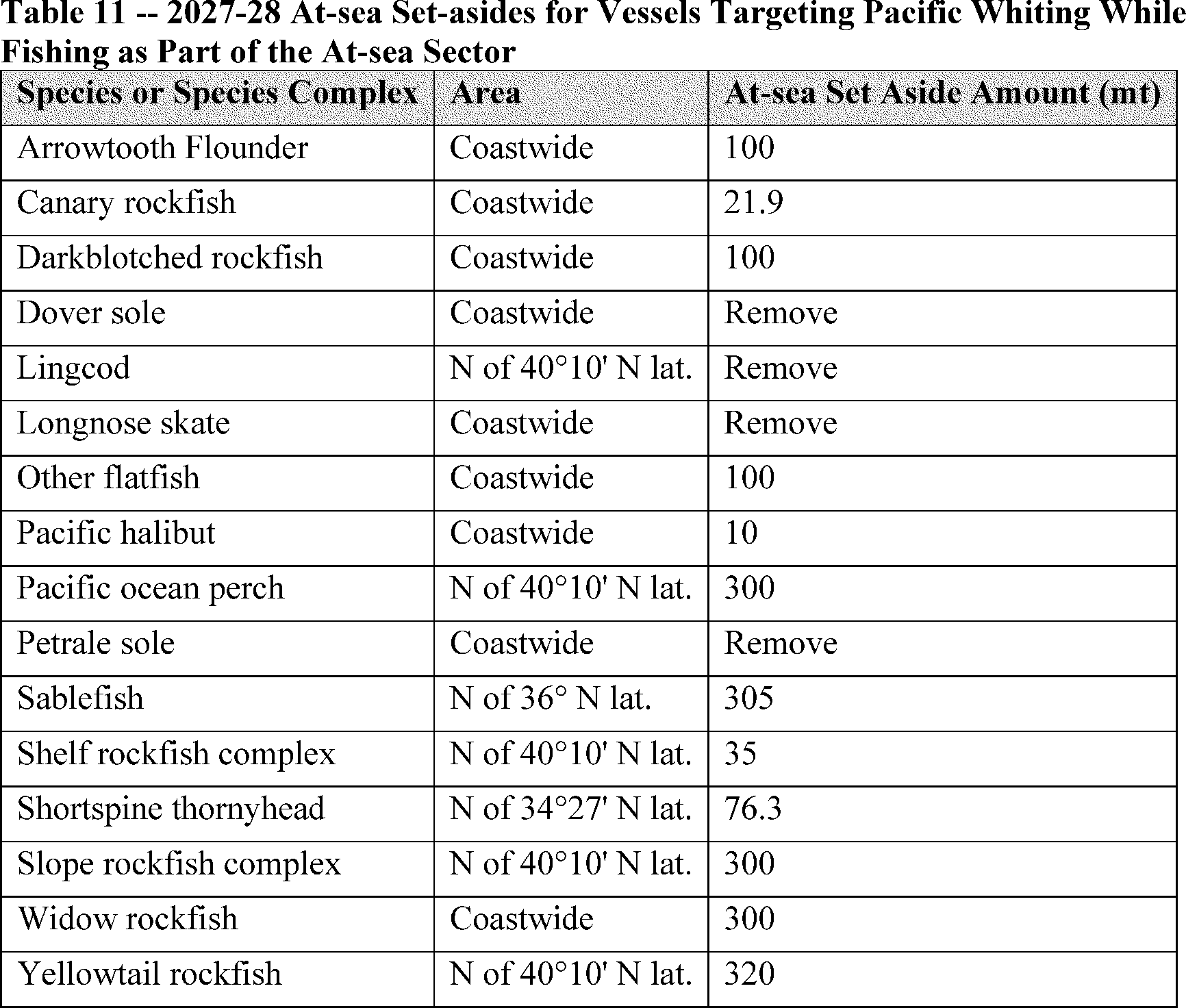
For several species, the trawl allocation is reduced by an amount called a “set-aside” for the at-sea whiting sector. This amount is designed to accommodate catch by the at-sea whiting sector when they are targeting Pacific whiting. NMFS is proposing, in alignment with the Council's recommendation, the set-asides in table 11 for the 2027-28 biennium. Relative to the last biennium (2025-26), the set-asides for canary rockfish and shortspine thornyhead increased in accordance with the set-aside increases implemented through the 2026 emergency rule (91 FR 2714; January 22, 2026). The set-asides for sablefish north of 36° N lat. and yellowtail rockfish north of 40°10′ N lat. decreased to reflect proportional changes to those stocks' ACLs and trawl allocations. Set-asides for four stocks are proposed for removal, including dover sole, lingcod north of 40°10′ N lat., longnose skate, and petrale sole. As described in the Council Analytical Document (see Electronic Access), historic mortality of these stocks in the at-sea fishery is very low and is not expected to pose a risk to the trawl allocation, even if the recent 10-year maximum was caught in the at-sea fishery. Removing all four of these at-sea set-asides would reduce management complexity and lower the number of set-asides that the Council and NMFS reconsider each biennial cycle. The set-aside amounts for the remaining species are proposed to be the same as during the 2025-26 biennium. At-sea set-asides are not managed by NMFS except in the case of a risk to the ACL. For this reason, as-sea set-asides are published in the SAFE each biennium (see Electronic Access).
( printed page 60259)
Incidental Trip Limits for IFQ Vessels
For vessels fishing in the Shorebased IFQ Program with either groundfish trawl gear or non-trawl gears, the following incidentally-caught stocks are managed with trip limits: big skate, blackgill rockfish, cabezon (California), California scorpionfish, longnose skate, the Nearshore rockfish complexes north and south of 40°10′ N lat., the Washington black rockfish and Oregon black/blue/deacon rockfish complexes, the Oregon cabezon/kelp greenling complex, the Other fish complex, Pacific spiny dogfish, and Pacific whiting. For all these stocks, this rule proposes maintaining the same trip limits for these stocks for the start of the 2027-28 biennium as those in place in 2025. Trip limits for the IFQ fishery can be found in Table 1b (North) and Table 1b (South) to Part 660, Subpart D. Changes to trip limits would be considered a routine measure under 50 CFR 660.60(c), and may be implemented or adjusted, if determined necessary, through inseason action.
G. LEFG and OA Non-Trawl Fishery
Management measures for the LEFG and OA non-trawl fisheries tend to be similar because the majority of participants in both fisheries use hook-and-line gear. Management measures, including area restrictions (
e.g.,
Non-Trawl RCA) and trip limits in these non-trawl fisheries, are generally designed to allow harvest of target stocks while keeping catch of overfished stocks low. LEFG trip limits are specified in Table 2b (North) and Table 2b (South) to Part 600 Subpart E. OA trip limits are specified in Table 3b (North) and Table 3b (South) to Part 660 Subpart F. The proposed trip limits for the 2027-28 biennium are included below; the specific trip limits that are changing from those in place at the end of 2026 are included in the regulatory text of this proposed rule.
LEFG and OA Trip Limits
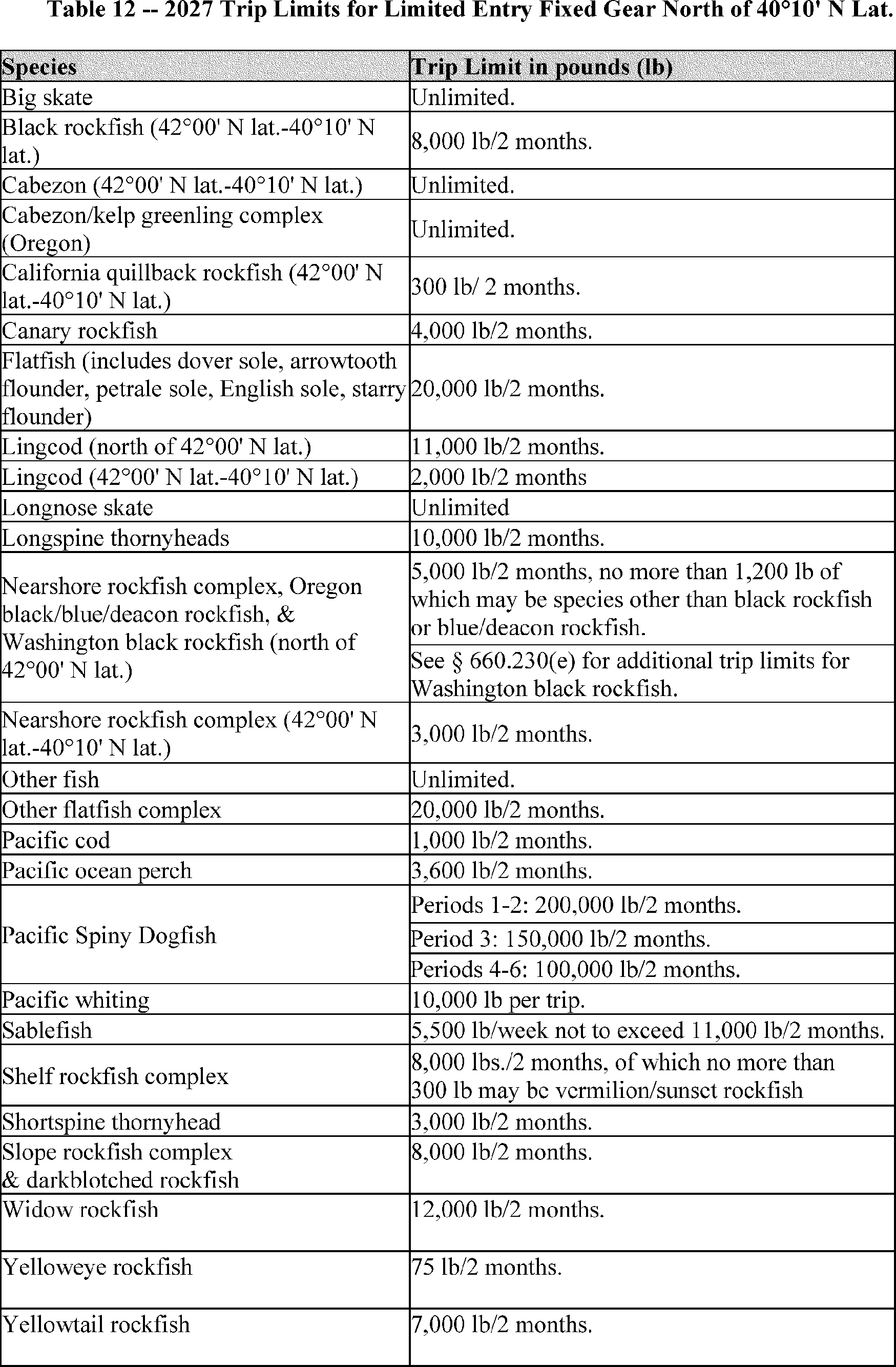
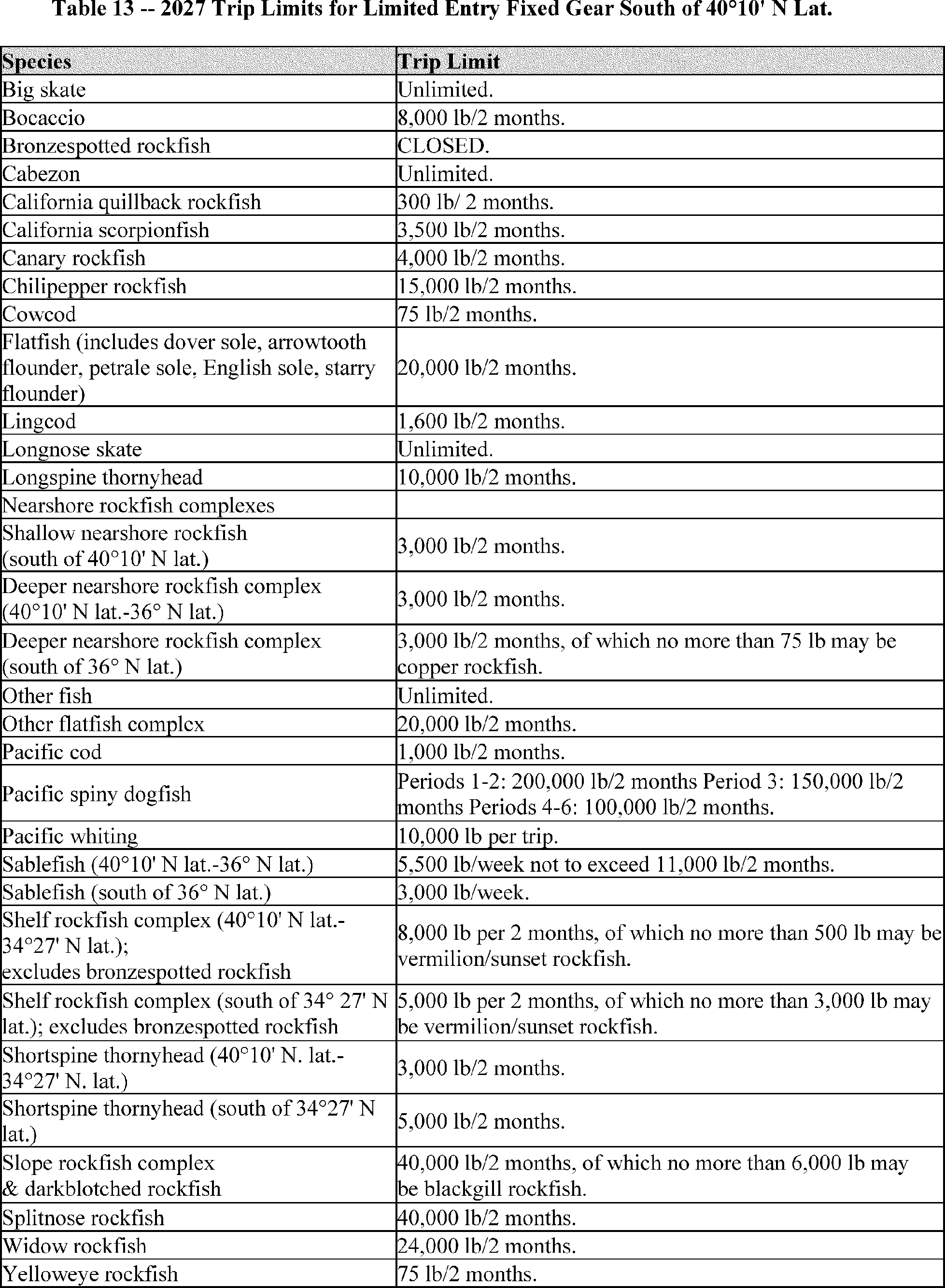
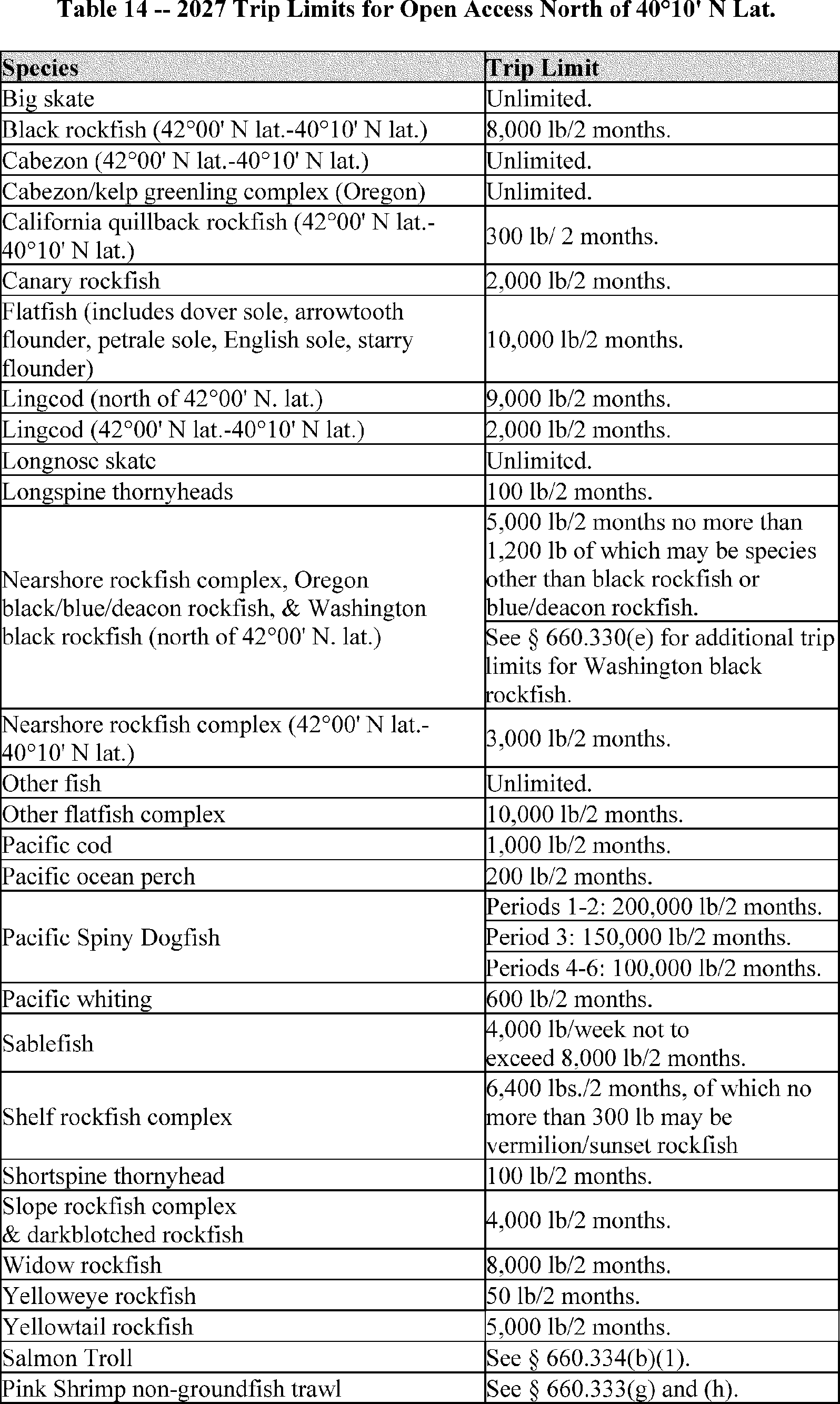
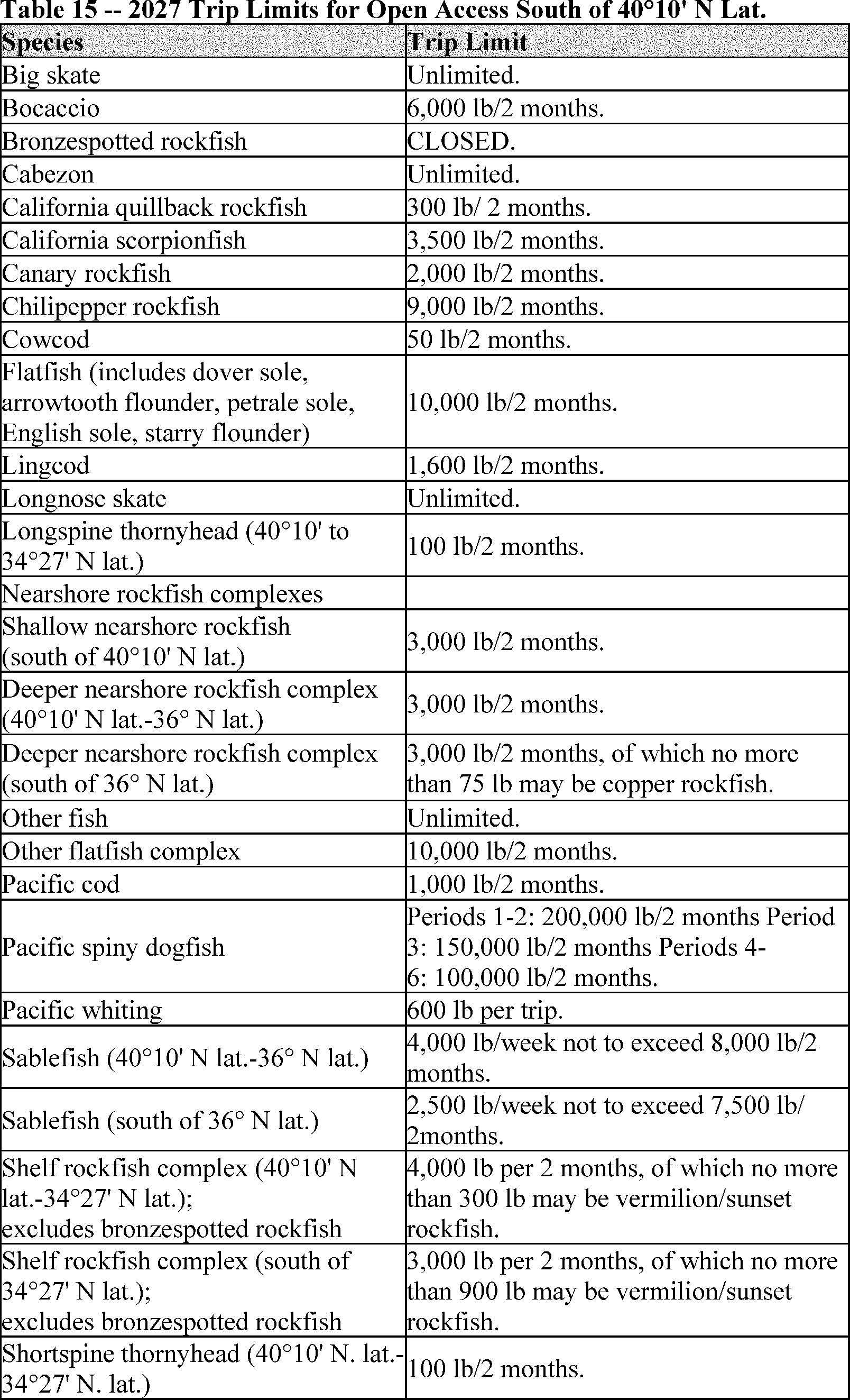
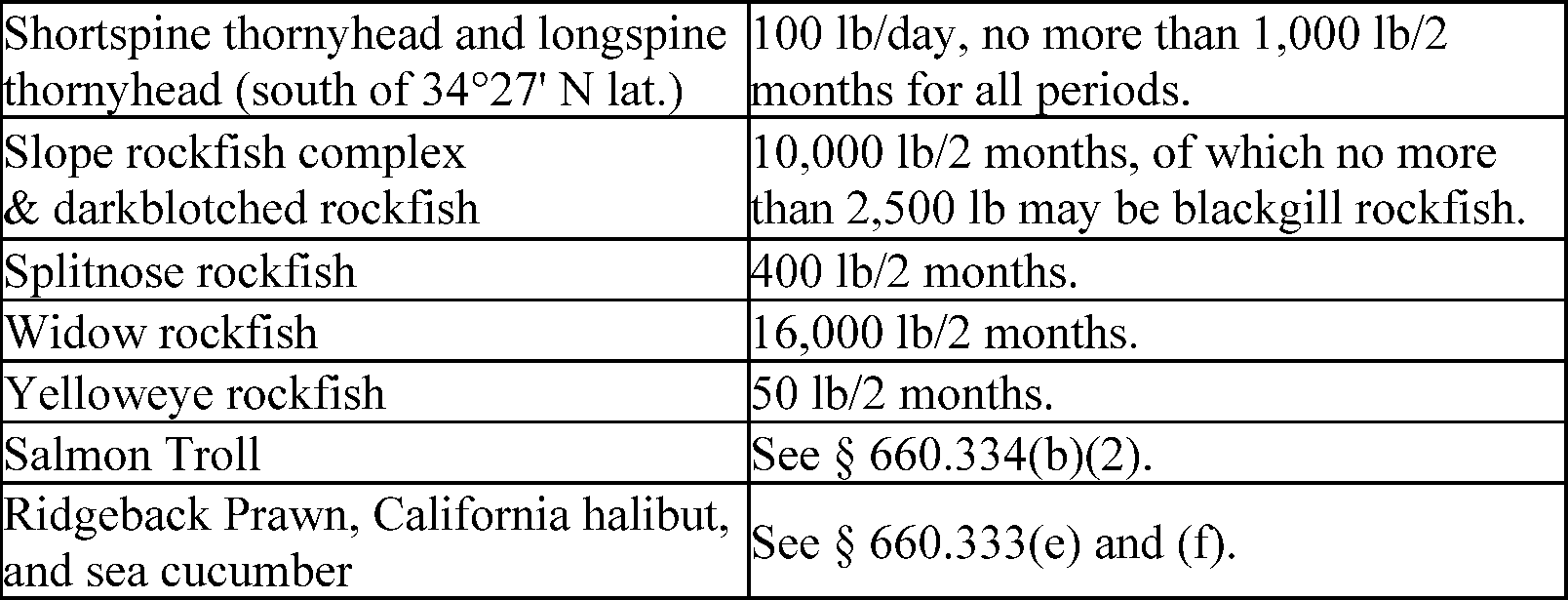
NMFS is proposing, in alignment with the Council's recommendation, the trip limits in tables 12 through 15 below for LEFG and OA fisheries at the start 2027. Relative to the 2025-26 biennium, LEFG and OA trip limits are increasing for: black rockfish between 42°-40°10′ N lat., California quillback rockfish between 42°-40°10′ N lat. and south of 40°10′ N lat., chilipepper rockfish south of 40°10′ N lat., the Nearshore Rockfish Complex between 42°-40°10′ N lat. and south of 40°10′ N lat., the shelf rockfish complex north of 40°10′ N lat., widow rockfish coastwide, and yellowtail rockfish north of 40°10′ N lat. LEFG trip limits are also increasing for shortspine thornyhead south of 34°27′ N lat. In addition, new LEFG and OA trip limits are being proposed for cowcod south of 40°10′ N lat. and yelloweye rockfish coastwide. Trip limits for all other stocks and stock complexes would remain the same as what is in place at the end of 2026, unless the Council recommends, and NMFS implements, a trip limit change via an inseason action in late 2026. More information on these trip limits and the alternative options considered can be found in the Council Analytical Document (see Electronic Access under
ADDRESSES
).
In addition to trip limit modifications, NMFS is proposing to modify the regulations at § 660.60(c)(1) to clarify that trip or sub-trip limits for any groundfish species (separately or in any combination) managed under the Groundfish FMP, including those
( printed page 60260)
species managed in a stock complex, may be adopted or revised inseason.
( printed page 60261)
( printed page 60262)
( printed page 60263)
( printed page 60264)
( printed page 60265)
Primary Sablefish Tier Limits
The primary sablefish fishery tier program is a limited access privilege program set up under amendment 14 to Groundfish FMP (66 FR 41152; August 7, 2001). Under amendment 14, as set out in § 660.231, the permit holder of a sablefish-endorsed permit receives a tier limit, which is an annual share of the sablefish catch allocation to this sector. NMFS sets three different tier limits through the biennial harvest specifications and management measures process and up to three permits may be stacked at one time on a vessel participating in the fishery. Stacked tier limits are combined to provide a cumulative catch limit for that vessel. After vessels have caught their full tier limits, they are allowed to move into other fisheries for sablefish, specifically the LEFG or OA trip limit fishery, or fisheries for other species. The proposed tier limits for 2027 are as follows: Tier 1 at 93,770 lb (42,533 kg), Tier 2 at 42,623 lb (19,333 kg), and Tier 3 at 24,356 lb (11,047 kg). In 2028 and beyond, the following limits are in effect: Tier 1 at 101,490 lb (46,030 kg), Tier 2 at 46,132 lb (20,923 kg), and Tier 3 at 26,361 lb (11,956 kg).
H. Recreational Fisheries
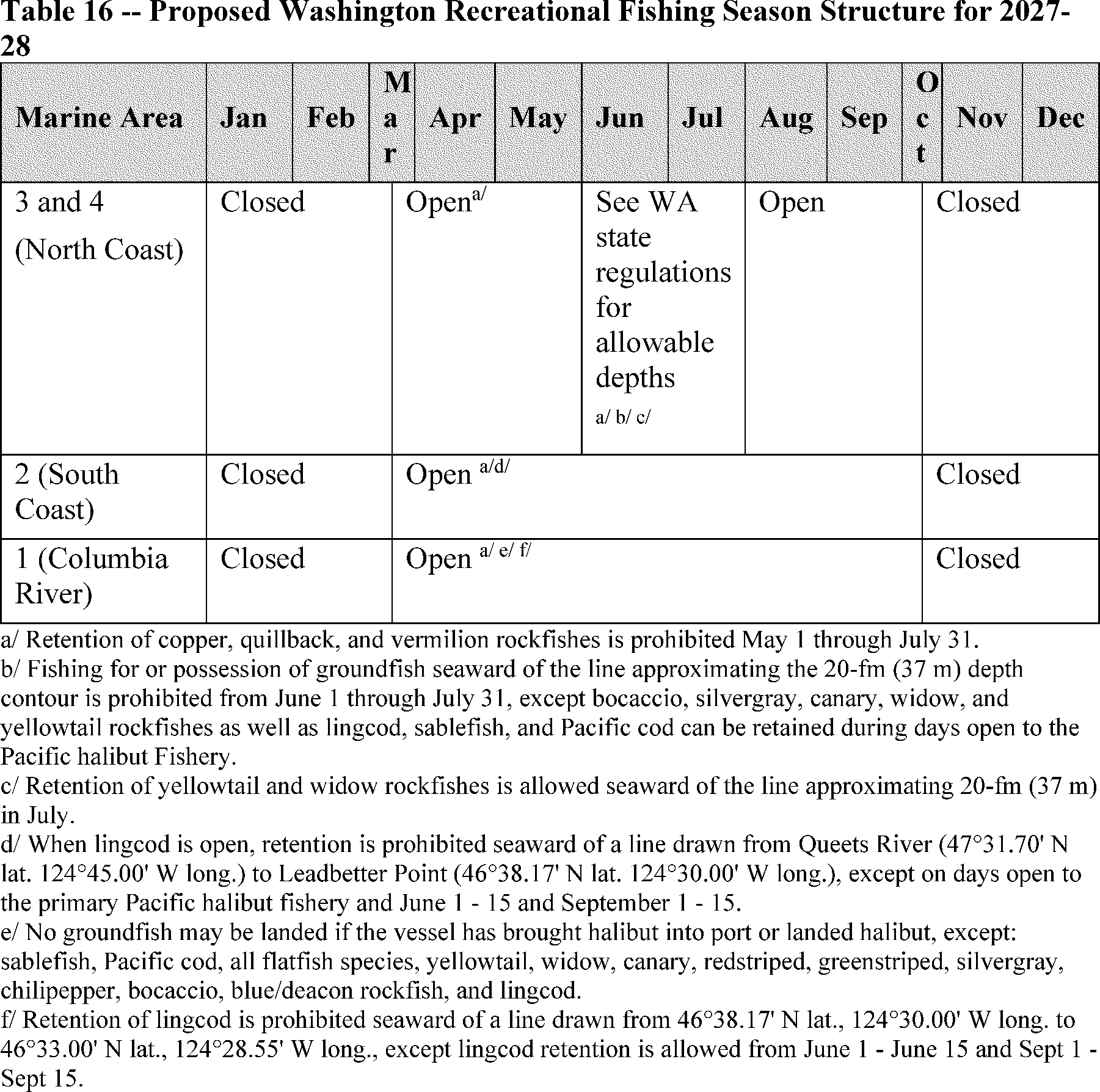
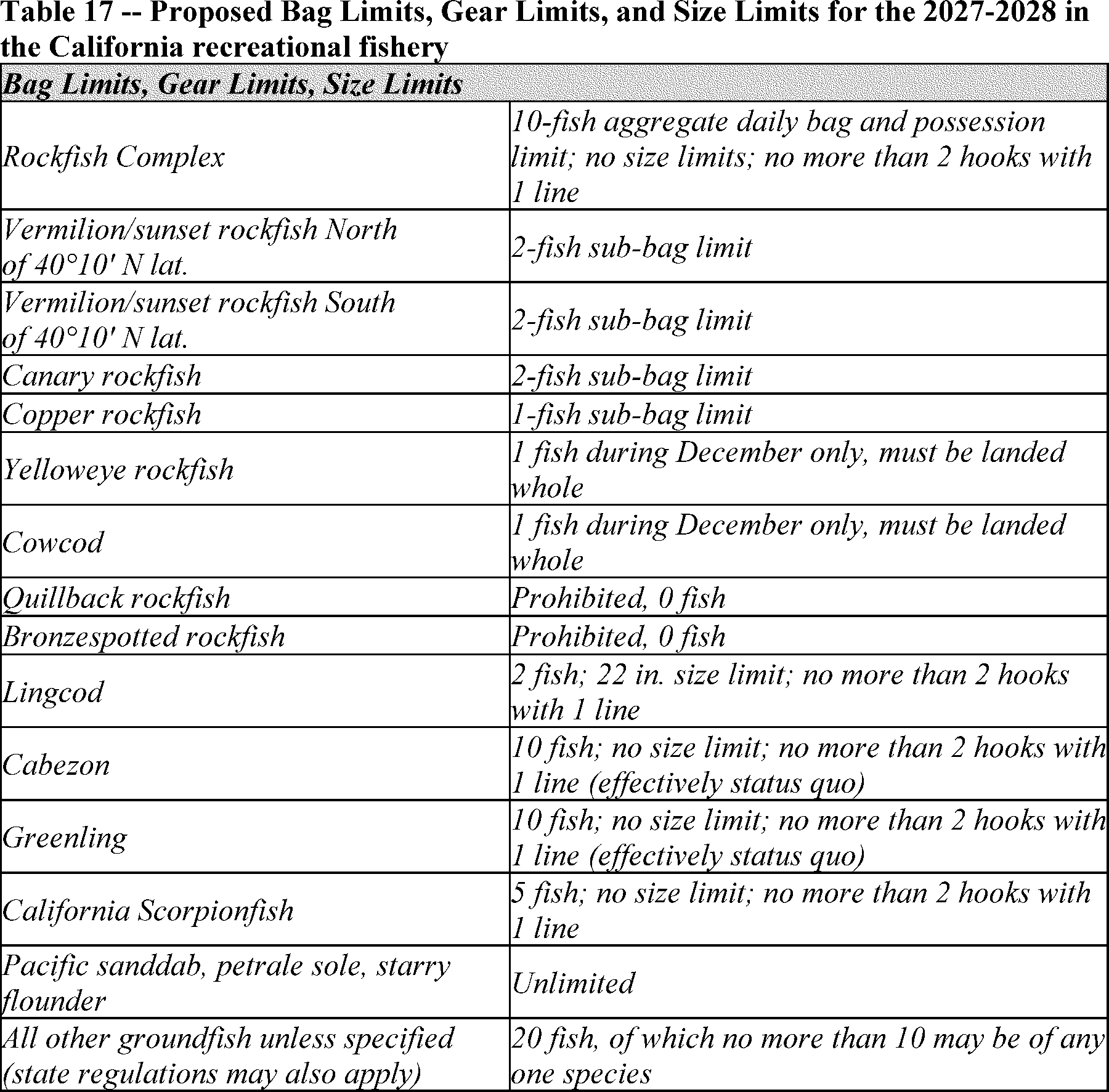
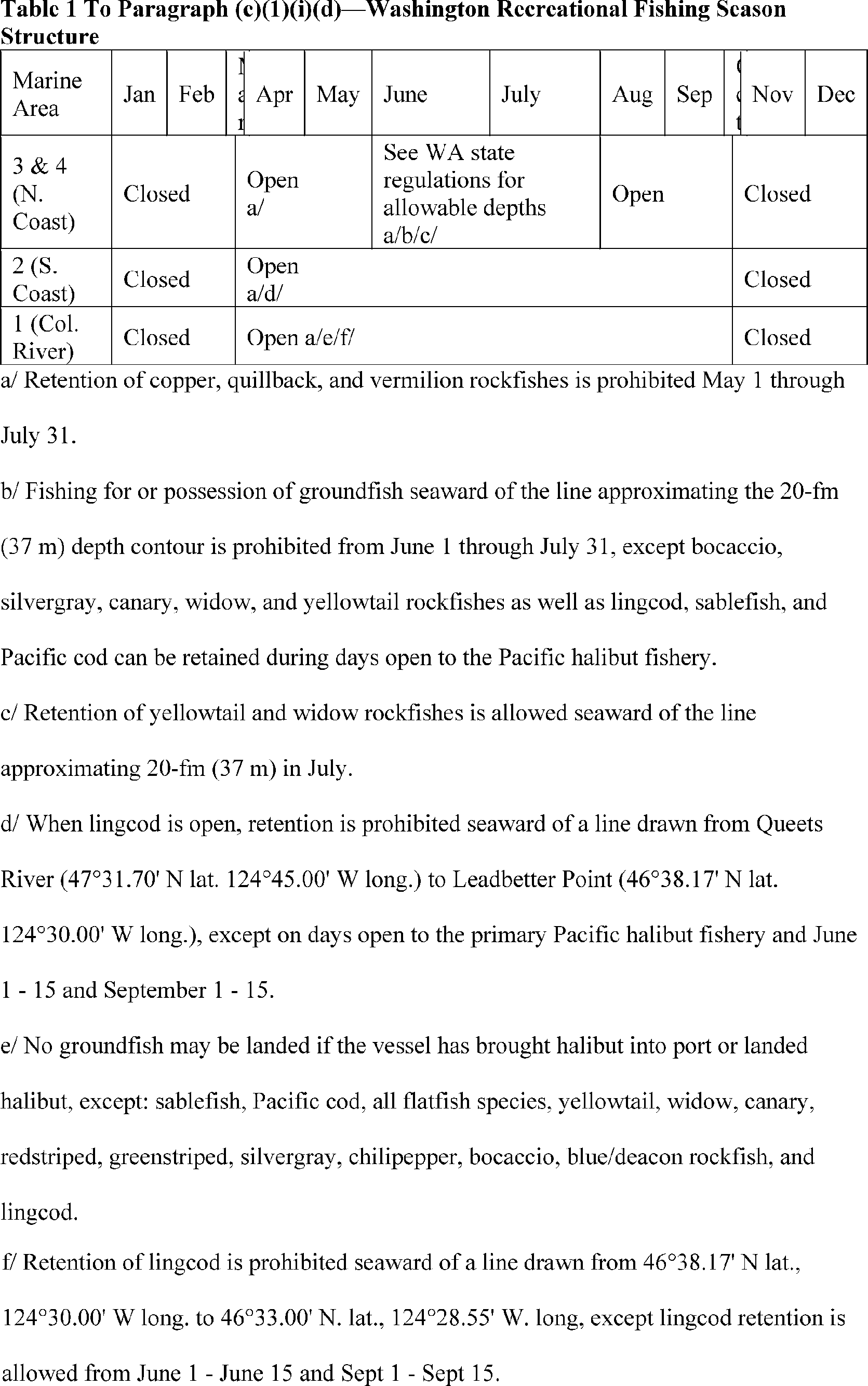
This section describes the recreational fisheries management measures proposed for 2027-2028, which are intended to keep catch within the recreational HGs for each stock. Washington, Oregon, and California each proposed, and the Council recommended, different combinations of seasons, bag limits, area closures, and size limits for stocks targeted in the recreational fisheries off each state. These measures are designed to limit catch of overfished stocks or species of concern found in the waters adjacent to each state while allowing target fishing opportunities in their respective recreational fisheries. This proposed rule would set these measures for recreational fisheries occurring in the EEZ. Each state, respectively, typically sets measures for recreational fisheries in State waters. The following sections describe the recreational management measures proposed in each state.
Washington
The Council manages recreational fisheries in Federal waters seaward of Washington in four areas: (1) Marine Area 1, which extends from the Oregon/Washington border to Leadbetter Point; (2) Marine Area 2, which extends from Leadbetter Point to the mouth of the Queets Rivers; (3) Marine Area 3, which extends from the Queets River to Cape Alava; and (4) Marine Area 4, which extends from Cape Alava to the Sekiu River.
Season Structure
Under the proposed season structure, various depth restrictions would be modified from the 2025-26 season structure to simplify regulations, limit the mortality of canary rockfish, and expand access to deeper water species, including lingcod and yellowtail rockfish.
First, select coordinates on the 20 fm (37 m) depth contour line seaward of Marine Area 4 would be modified, which would provide fishing access to Duncan Rock and Duntze Rock during the June-July depth restriction. The purpose of this change is to address enforcement concerns in the area. The details of these modifications are further described in Section III, E of this proposed rule.
Second, the restriction that prohibits recreational vessels from retaining lingcod seaward of 30 fm (55 m) during the month of May (except when the Pacific halibut season is open) in Marine Area 2 would be removed. This would expand access to deepwater lingcod during the month of May, while posing minimal impacts on yelloweye or canary rockfishes.
Third, the deepwater lingcod closure in Marine Areas 1 and 2 that prohibits retention of lingcod seaward of a specific line (see description in footnote e/of table 16) year-round, except for during June and September, would be modified to expand access to a small area of deeper water off Leadbetter Point. The open dates for retaining lingcod would also be modified from the full month of September, to September 1-September 15. The coordinate changes to the lingcod closure would expand access to deeper water lingcod; however, the reduction in open days for retaining lingcod during the month of September would serve to limit mortality of canary rockfish.
Except for the changes described above, all other elements of the 2025-26 season structure would remain in place. The proposed season structure for 2027-28 is displayed in table 16.
( printed page 60266)
Bag Limits
Yelloweye rockfish is managed as a coastwide stock. As discussed, NMFS declared yelloweye rockfish rebuilt in May 2026, based on the results of the 2025 stock assessment (see Electronic Access under
ADDRESSES
). To begin allowing access to this rebuilt stock while maintaining a precautionary approach to harvest, a small sub-bag limit of one fish per day in the months of May and September is proposed.
Except for the changes described above, all other management measures would remain the same as those in place at the end of the 2026 fishing year. For more information on the full suite of management measures considered for the Washington recreational fishery, see the Washington Department of Fish and Wildlife (WDFW) reports from the April and June 2026 Council meetings (Agenda Item C.7.a, Supplemental WDFW Report 1, April 2026; Agenda Item E.6.a Supplemental WDFW Report 1, June 2026), as well as the Council Analytical Document (see Electronic Access under
ADDRESSES
).
Oregon
The Council manages recreational fisheries in Federal waters seaward of Oregon as one management area. NMFS is proposing, in alignment with the Council's recommendation, that Oregon recreational fisheries in 2027-28 would operate under an all-months-all-depths season structure to start the 2027 fishing year. The Council recommended maintaining the 2025-26 aggregate bag limits and size limits in Oregon recreational fisheries, but with the addition of a new bag limit for yelloweye rockfish.
The proposed bag limits are: a marine fish aggregate limit of 10 fish per day with a sub-bag limit of 1 yelloweye rockfish, where cabezon have a minimum size of 16 inches (in) (41 centimeter (cm)); 3 lingcod per day, with a minimum size of 22 in (56 cm); 25 flatfish per day, excluding Pacific halibut; a longleader gear limit of 10 fish per day with a sub-bag limit of 2 canary rockfish (increased from one at the end of 2026); and 10 sablefish per day.
As discussed, NMFS declared yelloweye rockfish rebuilt in May 2026, based on the results of the 2025 stock assessment (see Electronic Access under
ADDRESSES
). To begin allowing access to this rebuilt stock in Oregon, while maintaining a precautionary approach to harvest, a small bag limit of one fish per day is proposed.
Except for the changes described above, all other management measures
( printed page 60267)
would remain the same as those in place at the start of the 2025-26 biennium. For more information on the full suite of management measures considered for the Oregon recreational fishery, see the Oregon Department of Fish and Wildlife (ODFW) reports from the April and June 2026 Council meetings (Agenda Item C.7.a Supplemental ODFW Report 1, April 2026 and Agenda Item E.6.a Supplemental ODFW Report 1, June 2026), as well as the Council Analytical Document (see Electronic Access under
ADDRESSES
).
California
The Council manages recreational fisheries in Federal waters seaward of California in five separate groundfish management areas (GMAs). Season and area closures differ between GMAs to limit incidental catch of overfished stocks and stocks of concern while providing as much recreational fishing opportunity as possible. NMFS is proposing, in alignment with the Council's recommendations, changes to routine management measures for the California recreational fishery in the 2027-28 biennium, including changes to complex management, season structure, and bag limits as described below.
Changes to the Rockfish, Cabezon, and Kelp Greenling Complex (RCG complex)
Under the proposed management measure changes, the RCG complex would be separated into the Rockfish Complex, cabezon, and kelp greenling. These three species/species groups would be managed via separate season structures, bag limits, and size and gear restrictions. Cabezon and kelp greenling are species found in nearshore shallow waters and are commonly caught with rockfish. Since 2004, these species have been managed in the California recreational fishery as a unit with rockfish and subject to the same regulatory constraints imposed on overfished shelf species. However, in recent years, the majority of mortality from the RCG complex is primarily from rockfish, with a small proportion coming from cabezon or kelp greenling, as cabezon and kelp greenling are not as highly targeted as rockfish. Therefore, separating the aggregate bag limit for these stocks would reduce regulatory complexity and provide additional fishing opportunities for cabezon and greenling, while posing minimal adverse impact on either these stocks or rockfish stocks.
Season Structure
Under the proposed season structures, the fisheries for the Rockfish complex and lingcod would be closed in all California GMAs from January 31 to March 31, and open at all depths from April 1 to December 31. The fisheries for cabezon and kelp greenling would be open at all depths year round in all GMAs. Recreational groundfish fishing opportunities in state waters may differ and would be announced separately by the California Department of Fish and Wildlife (CDFW).
Bag Limits
NMFS is proposing, in alignment with the Council's recommendation, a decrease in the sub-bag limit for vermilion/sunset rockfish north of 40°10′ N lat., and new bag limits for the Rockfish complex, cabezon, kelp greenling, cowcod, and yelloweye rockfish, as displayed in table 18 below.
Vermilion/sunset rockfish is managed within the Shelf Rockfish Complex north and south of 40°10′ N lat. In 2024, the vermilion/sunset rockfish north of 40°10′ N lat. ACL contribution to the Shelf Rockfish Complex off Northern California (between 42° and 40°10′ N lat.) was exceeded with the four fish sub-bag limit in place. With an all-depth season structure in this area, the likelihood of mortality exceeding the ACL contribution in this area increases. The reduction from a four-fish to a two-fish sub-bag limit is therefore intended to keep harvest within the ACL contribution and simplify regulations by making vermilion/sunset rockfish sub-bag limits the same for north and south of 40°10′ N lat.
With the separation of the RCG complex as described above, new bag limits are being proposed for the Rockfish complex, cabezon, and kelp greenling. The bag limit for each species/species group would be 10 fish per day.
Cowcod is managed as a single stock south of 40°10′ N. lat. Cowcod was declared overfished in 2000 and, as a result, retention was prohibited in the California recreational fishery beginning in 2001. Prior to becoming prohibited, cowcod was actively targeted by anglers due to their large size and unique appearance. Cowcod was declared rebuilt in 2019 and, since then, the Council and NMFS have taken a precautionary, stepwise approach to expanding access to this species through changes to area management (
i.e.,
condensing the Non-Trawl RCA and opening the Cowcod Conservation Area) and removing the cowcod ACT. To continue expanding access to this rebuilt stock, while maintaining a precautionary approach to harvest, a small bag limit of 1 fish per day, in the month of December only, is proposed. To facilitate effective enforcement of this new bag limit, there would also be a requirement to land cowcod whole for ease of identification.
As discussed above, NMFS declared yelloweye rockfish rebuilt in May 2026, based on the results of the 2025 stock assessment (see Electronic Access under
ADDRESSES
). To begin allowing access to this rebuilt stock, while maintaining a precautionary approach to harvest, a small bag limit of one fish per day in the month of December only is proposed. To facilitate effective enforcement of this new bag limit, there would be a requirement to land yelloweye rockfish whole for ease of identification.
All other bag, gear, and size limits would remain the same as those in place at the end of the 2026 fishing year. Table 17 below displays all proposed bag limits (including changed and unchanged), as well as their associated gear and size limits.
( printed page 60268)
Except for the changes described above, all other management measures would remain the same as those in place at the end of the 2026 fishing year. For more information on the full suite of management measures considered for the California recreational fishery, see the CDFW reports from the April and June 2026 Council meetings (Agenda Item C.7.a Supplemental CDFW Report 1, April 2026; Agenda Item E.6.a CDFW Report 1, June 2026), as well as the Council Analytical Document (see Electronic Access under
ADDRESSES
).
In addition to the changes described above for each state recreational fishery, NMFS is proposing to modify the regulations at § 660.60(c)(2) to clarify that bag or sub-bag limits for any groundfish species (separately or in any combination) managed under the Groundfish FMP, including those species managed in a stock complex, may be adopted or revised inseason.
I. Exempted Fishing Permits
Issuing EFPs is authorized by regulations implementing the MSA at 50 CFR 600.745, which state that EFPs may be used to authorize fishing activities that would otherwise be prohibited.
At its June 2026 meeting, the Council recommended that NMFS approve two EFP applications for the 2027 fishing year and preliminarily approve the EFP applications for the 2028 fishing year. The Council considers EFP applications concurrently with the biennial harvest specifications and management measures process because expected catch under most EFP projects is included in the catch limits for groundfish stocks. All of the EFP applications for 2027-28 are renewals from previous biennia. A summary of each EFP application is provided below.
Groundfish EFP Proposal—Year-round Coastwide Midwater Rockfish EFP: Monitoring and Minimizing Salmon Bycatch When Targeting Rockfish in the Shorebased IFQ Fishery, 2027-2028.
The West Coast Seafood Processors, Oregon Trawl Commission, Midwater Trawlers Cooperative, and the Environmental Defense Fund submitted a renewal application to continue research that has been conducted since 2017. The multi-year EFP project is collectively referred to as the “Trawl Gear EFP.” The purpose of the Trawl Gear EFP is for vessels participating in the West Coast Groundfish Trawl Rationalization Program's Limited Entry Shorebased IFQ Program to test whether removing certain gear, time, and area restrictions may impact the nature and extent of bycatch of protected and prohibited species (
i.e.,
Chinook salmon, coho, eulachon, and green
( printed page 60269)
sturgeon). The Trawl Gear EFP project would require exemptions for vessels fishing with bottom trawl groundfish gear from the requirement to use selective flatfish trawl gear, and the prohibition on using small footrope gear other than selective flatfish trawl gear between 42° and 40°10′ N lat. and shoreward of the boundary line approximating the 100 fm depth contour (see 50 CFR 660.130(c)(2)(i) and (c)(2)(ii)). The Trawl Gear EFP project would require exemptions for vessels fishing with midwater trawl groundfish gear from: (1) the prohibition on fishing outside the primary season dates for the Pacific whiting IFQ fishery (see §§ 660.112(b)(1)(x) and § 660.130(c)(3)); and (2) the prohibition on fishing south of 40°10′ N lat. shoreward of the boundary line approximating the 150 fm depth contour (see § 660.130(c)(3)(ii) and (c)(4)(ii)(B)). The Trawl Gear EFP project would require exemptions for vessels fishing with either midwater or bottom trawl groundfish gear from: (1) the prohibition on retaining certain prohibited species (see § 660.12 (a)(1)); and (2) the requirement to discard certain prohibited species at sea (see § 660.140 (g)(1)). If the Trawl Gear EFP application is approved, NMFS would set a bycatch limit of 1,000 Chinook salmon north of 42° N lat. and 100 Chinook salmon south of 42° N lat. for vessels declared into the EFP, regardless of gear type. If either of these bycatch limits are reached, NMFS would revoke the Trawl Gear EFP for both gear types in the respective management area (
i.e.,
north or south of 42° N lat.). Participating vessels would also be required to retain all salmon (excluding salmon already sampled by NMFS' West Coast Groundfish Observer Program) until offloading. If approved, NMFS would authorize up to 60 vessels to participate in the Trawl Gear EFP.
Groundfish EFP Proposal—California Department of Fish and Wildlife 2027-2028 EFP:
The CDFW submitted a renewal application for research that has been conducted since 2021. The purpose of the CDFW EFP project is to collect fishery-dependent biological data for cowcod and yelloweye rockfish for inclusion in future stock assessments. The CDFW EFP project would provide that any cowcod or yelloweye rockfish taken and retained would not count against the recreational bag limit of 10 fish for the Rockfish Complex. If approved, NMFS would authorize up to 30 vessels that participate in the California recreational commercial passenger fishing vessel (CPFV) fishery to retain these species for transfer to CDFW groundfish staff upon landing.
Neither of these EFP projects request set-asides as off-the-top deductions from the 2027-28 applicable ACLs. For the Trawl Gear EFP, landings and discards of IFQ species would be accounted for through the participating vessel's IFQ. For the CDFW EFP, all mortality is expected to occur in conjunction with routine recreational fishing activities and would be calculated as part of the normal recreational catch estimation process. NMFS would not require 100 percent observer coverage for vessels participating in the CDFW EFP project because recreational vessels do not meet the minimum size requirements under Federal regulations to carry an observer.
NMFS does not expect any appreciable impacts to the environment, essential fish habitat, or protected or prohibited species from these EFPs beyond those analyzed for the groundfish fishery as a whole in applicable biological opinions (available at
www.fisheries.noaa.gov/species/west-coast-groundfish#management), the draft Analysis (see
ADDRESSES
), or the EA for the 2018 Trawl Gear EFP dated December 2017 (available at:
www.fisheries.noaa.gov/region/west-coast).
After publication of this document in the
Federal Register
, NMFS may approve and issue permits for the proposed EFP projects for the 2027 fishing year after the close of the public comment period. Both EFP applications are available under “Supporting and Related Materials” (see
ADDRESSES
). NMFS will consider comments submitted in deciding whether to approve the applications as requested. NMFS may approve the applications in their entirety or may make any alterations needed to achieve the goals of the EFP projects. NMFS would not issue another
Federal Register
notice soliciting public comment on renewing these EFP projects for 2028 unless: (1) the applicants modify and resubmit their applications to NMFS; (2) changes to relevant fisheries regulations warrant a revised set of exemptions authorized under the EFP projects; or (3) NMFS' understanding of the current biological and economic impacts from EFP fishing activities substantially changes.
J. Amendment 38 Proposed Regulations
If Amendment 38 to the Groundfish FMP is approved by the Secretary, NMFS would modify the regulations at § 660.40 to remove the rebuilding plans for yelloweye rockfish and California quillback rockfish. NMFS would also no longer list these species as prohibited species, meaning the relevant sector-specific management measure sections at § 660.230 (LEFG), § 660.330 (OA), and § 660.360 (Recreational) would allow retention of these species via the inclusion of commercial trip limits or recreational bag limits. The associated FMP changes are available for public review alongside the NOA published for Amendment 38 (see Electronic Access under
ADDRESSES
).
IV. Classification
Pursuant to § 303(c)/304(b) of the MSA, the NMFS Assistant Administrator has determined that this proposed rule is consistent with the Groundfish FMP, other provisions of the MSA, and other applicable law, subject to further consideration after public comment. In making its final determination, NMFS will take into account the complete record, including the data, views, and comments received during the comment period.
Regulations governing the U.S. fisheries for Pacific halibut are developed by the IPHC, the Council, the North Pacific Fishery Management Council, and the Secretary of Commerce. Section 5 of the Northern Pacific Halibut Act of 1982 (Halibut Act, 16 U.S.C. 773c) allows the Regional Council having authority for a particular geographical area to develop regulations governing the allocation and catch of halibut in U.S. Convention waters so long as those regulations do not conflict with IPHC regulations. The proposed action is consistent with the Council's authority to regulate Pacific halibut catches among fishery participants in the waters in and off the coasts of Washington, Oregon, and California.
In accordance with NEPA, as amended, NMFS prepared an environmental assessment (EA) that discusses the impact on the quality of the human environment as a result of this rule. A copy of the EA is available from NMFS (see
ADDRESSES
).
This proposed rule has been determined to be not significant for purposes of E.O. 12866.
The Senior Lead Counsel for Regulation of the Department of Commerce certified to the Chief Counsel for Advocacy of the Small Business Administration that this proposed rule, if adopted, would not have a significant economic impact on a substantial number of small entities. The basis for this conclusion is provided below.
For purposes of the RFA (5 U.S.C. 601et seq.) only, NMFS has established a small business size standard for businesses, including their affiliates, whose primary industry is commercial fishing (see 50 CFR 200.2). A business
( printed page 60270)
primarily engaged in commercial fishing is classified as a small business if it is independently owned and operated, is not dominant in its field of operation (including its affiliates), and has combined annual receipts not in excess of $11 million for all its affiliated operations worldwide. This standard applies to all businesses classified under North American Industry Classification System (NAICS) code 11411 for commercial fishing, including all businesses classified as commercial finfish fishing (NAICS 114111), commercial shellfish fishing (NAICS 114112), and other commercial marine fishing (NAICS 114119) businesses (13 CFR 121.201; 50 CFR 200.2).
A detailed description of the fishery and affected entities is available in the SAFE (see Electronic Access under
ADDRESSES
). The SAFE includes a summary of historical harvests, a description of the management and economic characteristics of the commercial, tribal, and recreational fisheries, and a description of the relevant commercial port communities. The SAFE is incorporated by reference. Fishery specific ex-vessel revenue information presented below originates from the Agenda Item E.6, Supplemental Attachment 7, June 2026, hereinafter referred to as the “Socioeconomic Analysis.”
All vessels participating in the groundfish fisheries in the EEZ off Washington, Oregon, and California managed under the Groundfish FMP may be affected by this action. The total number of participating vessels in non-tribal commercial fisheries from 2025 was 683.
In 2025, approximately 317 vessels participated in the directed OA fishery. All directed OA vessels are assumed to be small entities with average ex-vessel revenues (all species) of $76,312. As described in the Socioeconomic Analysis, the projected total OA groundfish ex-vessel revenue is $8.6 million for the 2027-28 biennium. The OA fishery has a wide portfolio of targets, ranging from rockfish to sablefish. While the proposed non-trawl commercial allocation of sablefish would be reduced for the 2027-28 biennium, the 2025-26 allocations were so high (tripled from the 2023-24 biennium) that even the reduced allocations for 2027-28 are still at historic highs. Further, during these historically high allocations, there has been underattainment of annual sablefish catch limits. Thus, those participants who target sablefish are still expected to benefit from the sablefish quotas, and no adverse impacts are anticipated from the proposed reductions. OA vessels that target shortspine thornyhead, canary rockfish, chilipepper, and yellowtail rockfish north of 40°10′ N lat. in their fishing portfolios would have more fishing opportunity due to slightly higher proposed allocations relative to last biennium. Proposed ACLs for chilipepper and rougheye/blackspotted rockfish would also increase more substantively relative to the last biennium, which could improve the economic returns for vessels that target these stocks. The degree to which fishermen take advantage of these higher allocations will depend on a variety of factors, including but not limited to weather and markets. Overall, significant economic impacts are not anticipated for the OA sector resulting from the 2027-28 allocations, as compared to past biennia and in the context of the Pacific Coast groundfish's complex multi-species fishery.
In 2025, 207 of the 223 groundfish LEFG permits were reported to be owned by 139 small entities. Not all vessels are owned by the registered permit owners and therefore the number of impacted small businesses may be more than 139 permit owners. The average permit owner that identifies as a small entity owns 1.56 LEFG-endorsed permits, with 48 small entities owning more than one permit throughout the year. As reported in the Socioeconomic Analysis, the projected 2027-28 LEFG ex-vessel revenue is $21.5 million. The LEFG fishery is highly associated with sablefish, with 164 of the 223 LEFG permits having a sablefish endorsement, which allows vessels to participate in the sablefish tier fishery. While the proposed non-trawl commercial allocation of sablefish would be reduced for the 2027-28 biennium, the 2025-26 allocations were so high (tripled from the 2023-24 biennium) that even the reduced allocations for 2027-28 are still at historic highs. Further, during these historically high allocations, there has been underattainment of annual sablefish catch limits. Thus, those participants who target sablefish are still expected to benefit from the sablefish quotas, and no adverse impacts are anticipated from the proposed reductions. LEFG permitted vessels that include shortspine thornyhead and canary rockfish, chilipepper, or yellowtail rockfish north of 40°10′ N lat. in their fishing portfolios would have more fishing opportunity due to slightly higher proposed allocations relative to last biennium. Proposed ACLs for chilipepper and rougheye/blackspotted rockfish also increase more substantively relative to the last biennium, which could improve the economic returns for vessels that target these stocks. The degree to which fishermen take advantage of these higher allocations will depend on a variety of factors, including but not limited to weather and markets. Overall, significant economic impacts are not anticipated for the LEFG sector resulting from the 2027-28 allocations, as compared to past biennia and in the context of the Pacific Coast groundfish's complex multi-species fishery.
With regards to the Shorebased IFQ fishery, 129 (of 162) quota share (QS) accounts and 98 vessel accounts (of 119) reported as being owned by small entities in 2025. The 129 QS owners that reported as small entities owned 88.9 percent of all QS issued at the start of 2025. The projected ex-vessel revenue, under the proposed action for the IFQ fleet in 2027-28, is $22 million, as indicated in the Socioeconomic Analysis. Impacts to Shorebased IFQ participants are expected to coincide with changes in allocations for IFQ species. While some proposed allocations are expected to increase, decreases in shortspine thornyhead, canary rockfish, widow rockfish, and yellowtail rockfish north of 40°10′ N lat. will likely result in a reduction of economic returns to small entities. However, the potential reduction in economic returns is not anticipated to be significant. The Shorebased IFQ fishery targets a diversity of groundfish species, and fishery participants regularly switch to other target species when harvest limits for certain stocks decrease. In addition, harvest specifications, even if reduced, are set at sustainable levels that protect the long-term health of fish stocks and support optimum yield in the fishery across biennia. Therefore, long-term economic stability is protected even during shorter-term periods of reduced harvest opportunity for certain groundfish stocks.
For the At-Sea Pacific whiting sector, all ten catcher-processor permits are owned by large entities and for MS permits, four of six are owned by large entities. Mothership catcher vessel endorsed permits account for 33 of the 167 trawl endorsed permits and 26 are owned by small entities. At-sea fisheries are mostly impacted by the Pacific whiting allocation. Because these vessels strictly target Pacific whiting and the annual total allowable catch is set via a bilateral Treaty process with the Government of Canada, this action is not expected to have any direct impacts on these vessels. Indirectly, the management of the at-sea sector includes set-asides to account for
( printed page 60271)
incidentally caught groundfish in the fishery. No accountability measures are prescribed for set asides; however, these fleets self-manage to the set-aside amounts. Thus, in terms of this action, reduced set-asides for canary rockfish, widow rockfish, and yellowtail rockfish may constrain fishing activities as these species can co-occur with Pacific whiting. The degree to which this co-occurrence happens can vary. Reduced set-asides do not always equate to reduced harvest opportunity for Pacific whiting fishermen, particularly if pure schools (
i.e.,
schools of Pacific whiting with limited to no co-occurring groundfish species) can be found and targeted. Overall, the potential operational constraints established by the 2027-28 groundfish allocations are not anticipated to result in significant adverse economic impacts to the at-sea Pacific whiting sector, as annual catch within the at-sea fisheries is primarily impacted by the annual Pacific whiting allocation set through the treaty process, rather than by groundfish allocations. Further, as the lower harvest levels for groundfish are set to protect the long-term health of those stocks and support optimum yield across biennia, the 2027-28 allocations implemented through this action support long-term economic stability within the Pacific whiting sectors. In addition to small businesses, the RFA recognizes and defines other kinds of small entities, which are described below. Potential impacts to these entities are included within the discussion above under Shorebased IFQ impacts.
A small governmental jurisdiction is any government or district with a population of less than 50,000 persons. According to the public IFQ Account database, as of February 9, 2026, the City of Monterey owns quota shares of ten species or complexes. The U.S. Census estimates the population to be 29,571 as of July 1, 2024, so the City of Monterey is considered a small governmental jurisdiction by the RFA standard above. The City of Monterey received 4.85 percent of the non-whiting quota pounds issued for 2025 according to the public IFQ Account database.
A small organization is any not-for-profit enterprise that is independently owned and operated and not dominant in its field (5 U.S.C. 601). A nonprofit organization is determined to be “not dominant in its field” if it is considered “small” under SBA size standards. Environmental, conservation, or professional organizations (NAICS 813312, 813920) are considered not dominant in their field (small for the purposes of NMFS rulemaking) if they have combined annual receipts of $15 million or less. Other organizations (NAICS 813319, 813410, 813910, 813930, 813940, 813990) are considered not dominant in their fields with combined annual receipts of $7.5 million or less. Five small not-for-profit organizations have ownership in six QS permits in the Catch Share Program and will thus be affected by this action. Collectively, the five small not-for-profit organizations received 8.0 percent of the non-whiting quota pounds issued in 2025. Therefore, non-profit entities owning LE trawl permits will be affected by this action. Whether or not these entities would be economically affected positively or negatively by this proposed action would depend on the specific entity's portfolio of quota pounds owned, and whether harvest limits for those species are increasing or decreasing this biennium. However, significant economic impacts are not anticipated for these entities as a result of the 2027-28 harvest specifications, as compared to past biennia and in the context of the Pacific Coast groundfish's complex multi-species fishery.
A small trust, estate, and agency account (NAICS 525920) is defined at 13 CFR 121.201 as having annual receipts of less than $32.5 million (including affiliates). A total of 10 personal or family trusts/estates owned QS permits and will thus potentially be affected by this action. All of these are assumed to be smaller than the size standard above. Collectively, these ten small entities owned 11 QS permits and received 4.5 percent of the non-whiting quota pounds issued for 2025.
CPFVs are commercially registered fishing vessels that take recreational fishing passenger trips, carrying sport fishermen to target groundfish and other species. CPFVs are also known as Party and Charter boats. CPFVs are considered small businesses operating in the recreational sector. The most recent estimated numbers of active vessels that took at least one groundfish trip are: 41 vessels in Washington, 41 vessels in Oregon, and 342 vessels in California—a total of 424 vessels. Groundfish, particularly rockfish, are a core part of the CPFV portfolio. Fluctuating harvest limits in 2027-28, either increases or decreases, may affect CPFVs through resulting changes inseason or bag limits implemented to achieve optimum yield in the fishery. Some bait and tackle businesses that sell recreational groundfish gear may be small entities and may also be affected by fluctuating season and bag limits. However, due to the integration of freshwater fisheries and other marine recreational gear sold by these retailers, it is difficult to judge the impacts from this proposed action on these businesses. Recreational fishing businesses may offset potential losses associated with certain reduced catch limits proposed for 2027-28 by benefiting from additional fishing opportunities to target and retain sablefish in addition to the limits for other groundfish, and by retaining Pacific halibut, on the same trip during the applicable season in each state fishery. Additionally, during the 2027-28 biennium this proposed action would create new opportunities to retain a limited amount of yelloweye rockfish (all three states) and cowcod (California) in the recreational groundfish fisheries.
NMFS considers two criteria in determining the significance of adverse regulatory effects: disproportionality and profitability.
Disproportionality:
This criterion compares the effect of the regulatory action between small and large entities. Regulations related to harvest specifications, including inter- and intra-sector allocations, are largely fixed within the Groundfish FMP framework and are not impacted by biennial determination of ACLs. Management measures are created for each commercial and state recreational fishery independently, with the majority of groundfish participants made up of exclusively small entities. Within the trawl sector, small entities could be at a competitive disadvantage if quota pound (QP) availability for key species such as canary rockfish or shortspine thornyhead results in QP prices increasing. Larger entities may be able to outbid those entities in order to prosecute various fishing strategies, including Pacific whiting. For the non-trawl commercial sectors (OA and LEFG), where there are some large entities participating in the LEFG sector, it is possible that smaller entities would be impacted to a greater extent than larger entities given that opportunities are declining for most non-sablefish species. However, the declines for non-sablefish species would not result in significant decreases to any non-trawl trip limit, therefore, the extent of any potential disproportionate impacts would not be significant.
Profitability:
There are no anticipated compliance or regulatory costs to entities associated with this action. This proposed rule is expected to have both positive and negative impacts on profitability. Positive impacts are anticipated to result from new opportunities to retain yelloweye rockfish in all three state recreational fisheries and, in addition, cowcod in the California recreational fishery. Positive impacts are also anticipated for any
( printed page 60272)
stock with increased harvest specifications, which would result in increased fishing opportunity. Negative impacts may result given that costs are expected to remain the same (or increase with inflation) and some fishing opportunities are expected to decline due to decreases in ACLs for certain stock/stock complexes. Most notably, participants who target widow rockfish are likely to see losses in profitability due to a 40 percent reduction in the proposed ACL. While the ACL for the Pacific Coast groundfish fishery's most profitable stock, sablefish, decreases by almost 60 percent, it remains at historical highs, as explained above; therefore, fishery participants who target sablefish are still expected to benefit from the 2027-28 sablefish quotas and no adverse impacts are anticipated from the proposed reductions. Accordingly, for the subset of the fishery that targets sablefish, the profits from that stock may balance the potential decreases in profitability due to the reductions in other ACLs. Moreover, short-term economic losses from reduced harvest specifications in 2027-28 are not anticipated to impose significant adverse economic impacts for fishery participants in the Pacific Coast groundfish's complex multi-species fishery overall, as harvest specifications are set to achieve optimum yield across biennia and thus promote long-term economic stability by protecting the long-term health of groundfish stocks.
Data used to inform the draft Analysis come primarily from the Pacific Fisheries Information Network (PacFIN) and the Pacific Coast Recreational Fisheries Information Network (RecFIN), which includes data provided by the states of Oregon, California, and Washington on commercial and recreational fishing trips and landings. Other data sources include the California Passenger Fishing Vessel survey, the West Coast Region permit database, and the West Coast Region Individual Fishing Quota Account public database. The number of entities predicted to be impacted is generally based on the level of participation in the previous year (2025), and as noted above is in some cases likely to be an overestimate of the true number of entities likely to be impacted if current trends continue. However, it is possible that as environmental or management conditions change in other fisheries, such changes may impact the level of participation in the Pacific Coast groundfish fishery beyond what is predicted here.
There are no new reporting or recordkeeping requirements associated with this action.
There are no Federal rules that duplicate, overlap, or conflict with the proposed rule.
Based on the rationale above and contained in the draft Analysis (see Electronic Access under
ADDRESSES
), NMFS has concluded that this proposed action would not have a significant economic impact on a substantial number of small entities. As a result, an initial regulatory flexibility analysis is not required and none has been prepared.
This proposed rule contains no information collection requirements under the Paperwork Reduction Act of 1995.
Pursuant to E.O. 13175, this rule was developed after meaningful consultation and collaboration with tribal officials from the area covered by the Groundfish FMP. Under the Magnuson-Stevens Act at 16 U.S.C. 1852(b)(5), one of the voting members of the Pacific Fishery Management Council must be a representative of an Indian tribe with federally recognized fishing rights from the area of the Council's jurisdiction. The tribal representative on the Council made a motion to adopt the tribal management measures, which was passed by the Council, and those management measures, which were developed and proposed by the tribes, are included in this rule.
2. Amend § 300.63 by revising paragraphs (c)(5)(ii)(A)( 4) and (c)(6)(ii)(G) to read as follows:
* * * * *
(c) * * *
(5) * * *
(ii) * * *
(A) * * *
(
4) Recreational fishing for halibut is prohibited within the Stonewall Bank YRCA. It is unlawful for recreational fishing vessels to take and retain, possess, or land halibut taken with recreational gear within the Stonewall Bank YRCA. A vessel fishing in the Stonewall Bank YRCA may not possess any halibut. Recreational vessels may transit through the Stonewall Bank YRCA with or without halibut onboard. The Stonewall Bank YRCA is defined at 50 CFR 660.70(i).
* * * * *
(6) * * *
(ii) * * *
(G) Modification of the Stonewall Bank Yelloweye Rockfish Conservation Area (YRCA) restrictions off Oregon as defined in groundfish regulations at 50 CFR 660.70(i).
* * * * *
PART 660—FISHERIES OFF WEST COAST STATES
1. The authority citation for part 660 continues to read as follows:
(4)
Canary rockfish.
The Tribal harvest guideline is 35 mt per year.
* * * * *
(10)
Nearshore Rockfish.
The Tribal harvest guideline is 1.5 mt per year.
(11)
Other Flatfish.
The tribal harvest guideline is 60 mt per year.
(12)
Pacific cod.
The tribal harvest guideline is 500 mt per year.
(13)
Pacific Ocean Perch.
The tribal harvest guideline is 130 mt per year.
(14)
Pacific Spiny Dogfish.
The tribal harvest guideline is 275 mt per year.
(15)
Pacific whiting.
The Tribal allocation for 2026 is 49,130.20 mt, which is 17.5 percent of the 280,744 mt U.S. TAC.
(16)
Petrale sole.
The harvest guideline is 290 mt per year.
(17)
Sablefish.
(i) The sablefish allocation to Pacific coast treaty Indian Tribes is 10 percent of the sablefish ACL for the area north of 36° N lat. This allocation represents the total amount available to the treaty
( printed page 60273)
Indian fisheries before deductions for discard mortality.
(ii) The Tribal allocation is 1,096 mt in 2027 and 1,186 mt in 2028. This allocation is, for each year, 10 percent of the Monterey through Vancouver area (North of 36° N lat.) ACL, including estimated discard mortality.
(18)
Shelf Rockfish.
The tribal harvest guideline is 30 mt per year.
(19)
Slope Rockfish.
The tribal harvest guideline is 36 mt per year.
(20)
Starry Flounder.
The Tribal harvest guideline is 2 mt per year.
(21)
Thornyheads.
The Tribal harvest guideline for shortspine thornyhead is 40 mt per year and the tribal harvest guideline for longspine thornyhead is 30 mt per year.
(22)
Washington cabezon/kelp greenling.
The tribal harvest guideline is 2 mt per year.
(23)
Widow rockfish.
Widow rockfish taken in the directed tribal midwater trawl fisheries are subject to a catch limit of 100 mt for the entire fleet, per year.
(24)
Yelloweye Rockfish.
The tribal harvest guideline is 12 mt per year.
(25)
Yellowtail rockfish.
Yellowtail rockfish taken in the directed tribal mid-water trawl fisheries are subject to a catch limit of 1,000 mt for the entire fleet, per year.
(g) * * *
(2)
Yelloweye rockfish.
Subject to a 500-lb (227-kg) trip limit.
* * * * *
5. Amend § 660.60 by:
a. Revising paragraph (a), the introductory text of paragraphs (b), (c), and (c)(1), and paragraphs (c)(1)(i) and (c)(1)(ii);
b. Redesignating paragraph (c)(1)(iii) through (c)(1)(v) as (c)(1)(iv) through (c)(1)(vi);
(a)
General.
NMFS will establish and adjust specifications and management measures biennially or annually and during the fishing year. Regulations under this subpart may be promulgated, removed, or revised during the fishing year. Any such action will be made according to the framework standards and procedures in the PCGFMP and other applicable law, and will be published in the
Federal Register
.
(b)
Biennial actions.
The Pacific Coast Groundfish fishery is managed on a biennial, calendar year basis. Harvest specifications and management measures will be announced biennially, with the harvest specifications for each species or species group set for two sequential calendar years. In general, management measures are designed to achieve, but not exceed, the specifications (particularly optimum yields, including but not limited to harvest guidelines, allocations, quotas, and sharing agreements), and to protect overfished and depleted stocks. Management measures will be designed to take into account the co-occurrence ratios of target species with overfished species, and will select measures that will minimize bycatch to the extent practicable.
* * * * *
(c)
Routine management measures.
Catch restrictions that are likely to be adjusted on a biennial, or more frequent basis may be imposed and announced by a single notification in the
Federal Register
, if good cause exists under the Administrative Procedure Act (APA) to waive notice and comment, and if they have been designated as routine through the two-meeting process described in the PCGFMP. Routine management measures that may be revised during the fishing year, via this process, are implemented in paragraph (h) of this section, and in subparts C through G of this part, including tables 1a through 1c and tables 2a through 2c to subpart C of this part, tables 1a and 1b (North) and tables 1a and 1b (South) of subpart D of this part, tables 2a and 2b (North) and tables 2a and 2b (South) of subpart E of this part, and tables 3a and 3b (North) and tables 3a and 3b (South) of subpart F of this part. Most trip, bag, and size limits, and most Groundfish Conservation Area closures have been designated as “routine,” which means they may be changed rapidly after a single Council meeting. Council meetings are held in the months of March, April, June, September, and November. Inseason changes to routine management measures are announced in the
Federal Register
pursuant to the requirements of the APA. Changes to routine management measures are effective at the times stated in the
Federal Register
. All routine management measures for commercial and recreational fisheries are intended to keep landings within the harvest levels announced by NMFS, to rebuild and protect overfished or depleted species, to maintain consistency with State regulations, and for the other purposes set forth in this section. The following catch restrictions have been designated as routine and can be applied to sectors and gear types individually or collectively:
(1)
Commercial Limited Entry and Open Access Fisheries, all gear types
—
(i)
Trip limits.
Trip limits, including sub-trip limits, for any groundfish species, as defined under “Groundfish” at § 660.11, separately or in any combination. In addition, sub-limits or aggregate limits may be specified for groundfish stocks managed outside the Shorebased IFQ Program. Once a trip limit change is effective, it is illegal to take and retain, possess, or land more fish than allowed under the new trip limit. This means that, unless otherwise announced in the
Federal Register
, offloading must begin before the time a fishery closes or a more restrictive trip limit takes effect.
(ii)
Size limits.
Size limits for sablefish and lingcod.
(iii)
Closures.
Closures include depth-based closures, area closures, seasonal closures, and other fishery closures (
e.g.,
species, sector, or gear-specific), as defined in § 660.11.
* * * * *
(2)
Recreational fisheries, all gear types
—Routine management measures for all groundfish species, separately or in any combination, include bag limits, sub-bag limits, size limits, time and area closures, other fishery closures, boat limits, hook limits, and dressing requirements. All routine management measures on recreational fisheries are intended to keep landings within the harvest levels announced by NMFS, to rebuild and protect overfished or depleted species, and to maintain consistency with State regulations, and for the other purposes set forth in this section.
* * * * *
6. Amend § 660.70 by:
a. Removing paragraphs (j) and (k), and redesignating paragraphs (l) and (m) as paragraphs (j) and (k); and
b. Removing paragraphs (n) through (r) and re-designating paragraphs (s) and (t) as paragraphs (l) and (m).
7. Amend § 660.71 by:
a. Revising paragraph (b)(1);
b. Re-designating paragraphs (b)(2) through (112) as paragraphs (b)(3) through (113); and
Latitude/longitude coordinates defining the 10-fm (18-m) through 40-fm (73-m) depth contours.
* * * * *
(b) * * *
(1) 48°25.00′ N lat., 124°44.06′ W long.;
( printed page 60274)
(2) 48°25.00′ N lat., 120°45.22′ W long.;
* * * * *
8. Revise tables 1a through 1c to part 660, subpart C, to read as follows:
Table 1
a
to Part 660, Subpart C—2027, Specifications of OFL, ABC, ACL, ACT and Fishery HG
[Weight in metric tons]
Species/stock
Area
OFL
ABC
ACL a
Fishery HG b
Arrowtooth Flounder
Coastwide
12,152
7,947
7,947
5,879.5
Big Skate
Coastwide
1,398
1,155
1,155
1,105.8
Black Rockfish
Washington
260
240
240
221.7
Black Rockfish
California
281
260
249
248.8
Bocaccio
S of 40°10′ N lat
2,542
2,288
2,288
2,284.9
Cabezon
California
165
150
150
149.6
California Quillback Rockfish c
California
13
12
12
12
California Scorpionfish
California
263
233
233
232.5
Canary Rockfish
Coastwide
694
643
643
601.5
Chilipepper
S of 40°10′ N lat
3,194
2,986
2,986
2,980.6
Cowcod
S of 40°10′ N lat
111
74
74
73.3
Darkblotched Rockfish
Coastwide
859
773
773
751.9
Dover Sole
Coastwide
42,064
38,573
38,573
37,026.2
English Sole
Coastwide
4,072
3,168
3,168
2,956
Lingcod
N of 40°10′ N lat
4,140
3,482
3,482
3,212.9
Lingcod d
S of 40°10′ N lat
966
812
789
786.8
Longnose Skate
Coastwide
1,872
1,546
1,546
1,303.8
Longspine Thornyhead
Coastwide
4,076
2,471
Longspine Thornyhead
N of 34°27′ N lat
1,878
1,833.9
Longspine Thornyhead
S of 34°27′ N lat
593
592.1
Pacific Cod
Coastwide
3,200
1,926
1,600
1,099.9
Pacific Ocean Perch
N of 40°10′ N lat
3,856
3,123
3,123
2,987.6
Pacific Spiny Dogfish
Coastwide
1,810
1,278
1,278
990.2
Pacific Whiting e
Coastwide
Petrale Sole
Coastwide
2,645
2,489
2,489
2,171.7
Sablefish
Coastwide
14,935
13,964
13,964
Sablefish
N of 36° N lat
10,962
9,774.8
Sablefish
S of 36° N lat
3,002
2,990.3
Shortspine Thornyhead f
Coastwide
994
902
902
849.3
Splitnose
S of 40°10′ N lat.
796
620
620
615.9
Starry Flounder
Coastwide
652
393
393
377.8
Widow Rockfish
Coastwide
6,239
6,238
6,238
6,137.4
Yelloweye Rockfish g
Coastwide
129
113
113
96.6
Yellowtail Rockfish
N of 40°10′ N lat.
5,051
5,050
5,050
4,043.1
Species/Stock Complexes
Blue/Deacon/Black Rockfish
Oregon
495
448
448
447.5
Cabezon/Kelp Greenling
Washington
19
14
14
12.5
Cabezon/Kelp Greenling
Oregon
193
174
174
173.5
Nearshore Rockfish North
N of 40°10′ N lat.
104
85
85
82.3
Nearshore Rockfish South h
S of 40°10′ N lat.
1,145
929
928
925.6
Other Fish
Coastwide
286
223
223
218.5
Other Flatfish
Coastwide
9,367
6,577
6,577
6,451.7
Shelf Rockfish North
N of 40°10′ N lat.
1,673
1,342
1,342
1,293.3
Shelf Rockfish South i
S of 40°10′ N lat.
1,832
1,457
1,456
1,443.1
Slope Rockfish North
N of 40°10′ N lat.
1,966
1,623
1,089
1,039.4
Slope Rockfish South
S of 40°10′ N lat.
878
699
688
686.8
a
Annual catch limits (ACLs), annual catch targets (ACTs) and harvest guidelines (HGs) are specified as total catch values.
b
Fishery HGs means the HG or quota after subtracting Pacific Coast treaty Indian Tribes allocations and projected catch, projected research catch, deductions for fishing mortality in non-groundfish fisheries, and deductions for EFPs from the ACL or ACT. These deductions, as well as any HG sharing agreements between states and/or sectors, are published in the SAFE.
c
California quillback rockfish off California has a recreational ACT of 7.1 mt.
d
Lingcod south of 40°10′ N lat. has a recreational ACT of 387.1 mt for south of 4010 N lat.
e
Pacific whiting ACLs are set through an annual US/Canada treaty process external to the Council.
f
Shortspine thornyhead has a commercial ACT of 61.6 mt for north of 34°27′ N lat.
g
Yelloweye rockfish has a non-trawl ACT of 69.7 mt and a non-nearshore ACT of 14.6 mt. The recreational ACTs are: 17.9 mt (Washington), 16.3 mt (Oregon), and 21.1 mt (California).
h
Vermilion/sunset rockfish has a recreational ACT of 168 mt for south of 40°10′ N lat.
i
Copper rockfish has a recreational ACT of 20.1 mt for south of 34°27′ N lat.
( printed page 60275)
Table 1
b
to Part 660, Subpart C—2027, Allocations by Species or Species Group
[Weight in metric tons]
Species/stock & complexes
Area
Fishery HG
or ACT
Trawl
Non-trawl
%
mt
%
mt
Arrowtooth Flounder
Coastwide
5,879.5
95
5,585.5
5
294
Big Skate
Coastwide
1,105.8
95
1,050.5
5
55.3
Bocaccio
S of 40°10′ N lat
2,284.9
39
891.1
61
1,393.8
Canary Rockfish
Coastwide
601.5
72.3
434.9
27.7
166.6
Chilipepper
S of 40°10′ N lat
2,980.6
75
2,235.5
25
745.2
Cowcod
S of 40°10′ N lat
73.3
36
26.4
64
46.9
Darkblotched Rockfish
Coastwide
751.9
95
714.3
5
37.6
Dover Sole
Coastwide
37,026.2
95
35,174.9
5
1,851.3
English Sole
Coastwide
2,956
95
2,808.2
5
147.8
Lingcod
N of 40°10′ N lat
3,212.9
45
1,445.8
55
1,767.1
Lingcod
S of 40°10′ N lat
786.8
40
314.7
60
472.1
Longnose Skate
Coastwide
1,303.8
90
1,173.4
10
130.4
Longspine Thornyhead
N of 34°27′ N lat
1,833.9
95
1,742.2
5
91.7
Pacific Cod
Coastwide
1,199.9
95
1,044.9
5
55
Pacific Ocean Perch
N of 40°10′ N lat
2,987.6
95
2,838.2
5
149.4
Pacific Whiting
Coastwide
100
0
Petrale Sole
Coastwide
2,171.7
2,141.7
30
Sablefish
N of 36° N lat.
9,774.8
See Table 1c.
Sablefish
S of 36° N lat
2,990.3
42
1,255.9
58
1,734.4
Shortspine Thornyhead
Coastwide
849.3
71
603
29
246.3
Splitnose
S of 40°10′ N lat
615.9
95
585.1
5
30.8
Starry Flounder
Coastwide
377.8
50
188.9
50
188.9
Widow Rockfish
Coastwide
6,137.4
5,837.4
300
Yelloweye Rockfish
Coastwide
96.6
8
7.7
92
88.9
Yellowtail Rockfish
N of 40°10′ N lat
4,043.1
88
3,557.9
12
485.2
Other Flatfish
Coastwide
6,451.7
90
5,806.5
10
645.2
Shelf Rockfish North
N of 40°10′ N lat
1,293.3
60.2
778.6
39.8
514.7
Shelf Rockfish South
S of 40°10′ N lat
1,443.1
12.2
176.1
87.8
1,267
Slope Rockfish North
N of 40°10′ N lat
1,039.4
81
841.9
19
197.5
Slope Rockfish South
S of 40°10′ N lat
686.8
52.5
360.8
47.5
326
Table 1
c
to Part 660, Subpart C—Sablefish North of 36° N Lat. Allocations, 2027
[Weight in metric tons]
Percent
Allocation
(mt)
Non-tribal Commercial HG a
9,774.8
LE Share
90.6
8,856
LE Trawl
58
5,136
LEFG
42
3,720
Primary
85
3,162
Trip limit
15
558
OA Share
9.4
919
a
Off-the-top deductions from the ACL that result in the HG are in the SAFE.
9. Revise tables 2a through 2c to part 660, subpart C, to read as follows:
Table 2
a
to Part 660, Subpart C—2028, and Beyond, Specifications of OFL, ABC, ACL, ACT, and Fishery HG
[Weight in metric tons]
Species/stock
Area
OFL
ABC
ACL a
Fishery HG b
Arrowtooth Flounder
Coastwide
11,107
7,131
7,131
5,062.8
Big Skate
Coastwide
1,372
1,122
1,122
1,072.8
Black Rockfish
Washington
261
241
241
222.3
Black Rockfish
California
293
270
261
260.7
Bocaccio
S of 40°10′ N lat
2,438
2,185
2,185
2,182.1
Cabezon
California
161
146
146
145.4
California Quillback Rockfish c
California
13
12
12
12
California Scorpionfish
California
261
229
229
228.6
Canary Rockfish
Coastwide
720
664
664
622.5
( printed page 60276)
Chilipepper
S of 40°10′ N lat
3,086
2,870
2,870
2,864.1
Cowcod
S of 40°10′ N lat
111
73
73
72
Darkblotched Rockfish
Coastwide
842
754
754
733.2
Dover Sole
Coastwide
39,010
35,616
35,616
34,069.6
English Sole
Coastwide
4,072
3,168
3,168
2,956
Lingcod
N of 40°10′ N lat
4,128
3,439
3,439
3,170.1
Lingcod d
S of 40°10′ N lat
984
820
796
793.8
Longnose Skate
Coastwide
1,852
1,515
1,515
1,272.4
Longspine Thornyhead
Coastwide
4,008
2,413
Longspine Thornyhead
N of 34°27′ N lat
1,834
1,789.3
Longspine Thornyhead
S of 34°27′ N lat
579
578.1
Pacific Cod
Coastwide
3,200
1,926
1,600
1,099.9
Pacific Ocean Perch
N of 40°10′ N lat
3,781
3,036
3,036
2,900.3
Pacific Spiny Dogfish
Coastwide
1,790
1,240
1,240
952.5
Pacific Whiting e
Coastwide
Petrale Sole
Coastwide
2,619
2,489
2,489
2,171.7
Sablefish
Coastwide
16,240
15,103
Sablefish
N of 36° N lat
11,856
10,579.7
Sablefish
S of 36° N lat
3,247
3,235
Shortspine Thornyhead f
Coastwide
1,013
902
902
849.3
Splitnose
S of 40°10′ N lat
796
620
620
615.9
Starry Flounder
Coastwide
652
393
393
377.8
Widow Rockfish
Coastwide
6,239
6,238
6,238
6,137.4
Yelloweye Rockfish g
Coastwide
131
113
113
96.8
Yellowtail Rockfish
N of 40°10′ N lat
4,859
4,730
4,730
3,723.1
Blue/Deacon/Black Rockfish
Oregon
502
452
452
451.7
Cabezon/Kelp Greenling
Washington
19
14
14
12.4
Cabezon/Kelp Greenling
Oregon
193
173
173
172.9
Nearshore Rockfish North
N of 40°10′ N lat
103
83
83
81
Nearshore Rockfish South h
S of 40°10′ N lat
1,145
925
924
921.7
Other Fish
Coastwide
286
223
223
218.5
Other Flatfish
Coastwide
8,950
6,193
6,193
6,067.7
Shelf Rockfish North
N of 40°10′ N lat
1,665
1,333
1,333
1,284.1
Shelf Rockfish South i
S of 40°10′ N lat
1,831
1,453
1,453
1,439.8
Slope Rockfish North
N of 40°10′ N lat
1,964
1,612
1,086
1,036.2
Slope Rockfish South
S of 40°10′ N lat
877
696
686
684
a
Annual catch limits (ACLs), annual catch targets (ACTs) and harvest guidelines (HGs) are specified as total catch values.
b
Fishery HGs means the HG or quota after subtracting Pacific Coast treaty Indian tribes allocations and projected catch, projected research catch, deductions for fishing mortality in non-groundfish fisheries, and deductions for EFPs from the ACL or ACT. These deductions, as well as any HG sharing agreements between states and/or sectors, are published in the SAFE.
c
California quillback rockfish off California has a recreational ACT of 7.1 mt;
d
Lingcod south of 40°10′ N lat. has a recreational ACT of 391.3 mt for south of 40°10 N lat.;
e
Pacific whiting ACLs are set through an annual US/Canada treaty process external to the Council;
f
Shortspine thornyhead has a non-trawl commercial ACT of 61.6 mt for north of 34°27′ N lat.;
g
Yelloweye rockfish has a non-trawl ACT of 69.7 mt and a non-nearshore ACT of 14.6 mt. The recreational ACTs are: 17.9 mt (Washington), 16.3 mt (Oregon), and 21.1 mt (California);
h
Vermilion/sunset rockfish has a recreational ACT of 164.4 mt for south of 40°10′ N lat.;
i
Copper rockfish has a recreational ACT of 22.0 mt for south of 34°27′ N lat.
Table 2
b
to Part 660, Subpart C—2028, and Beyond, Allocations by Species or Species Group
Species/stock & complexes
Area
Fishery HG
or ACT
Trawl
Non-trawl
%
mt
%
mt
Arrowtooth Flounder
Coastwide
5,062.8
95
4,809.7
5
253.1
Big Skate
Coastwide
1,072.8
95
1,019.2
5
53.6
Bocaccio
S of 40°10′ N lat
2,182.1
39
851
61
1,331.1
Canary Rockfish
Coastwide
622.5
72.3
450.1
27.7
172.4
Chilipepper
S of 40°10′ N lat
2,864.1
75
2,148.1
25
716
Cowcod
S of 40°10′ N lat
72
36
25.9
64
46.1
Darkblotched Rockfish
Coastwide
733.2
95
696.6
5
36.7
Dover Sole
Coastwide
34,069.6
95
32,366.1
5
1,703.5
English Sole
Coastwide
2,956
95
2,808.2
5
147.8
Lingcod
N of 40°10′ N lat
3,170.1
45
1,426.6
55
1,743.6
Lingcod
S of 40°10′ N lat
793.8
40
317.5
60
476.3
Longnose Skate
Coastwide
1,272.4
90
1,145.2
10
127.2
Longspine Thornyhead
N of 34°27′ N lat
1,789.3
95
1,699.9
5
89.5
Pacific Cod
Coastwide
1,099.9
95
1,044.9
5
55
Pacific Ocean Perch
N of 40°10′ N lat
2,900.3
95
2,755.3
5
145
( printed page 60277)
Pacific Whiting
Coastwide
100
0
Petrale Sole
Coastwide
2,171.7
2,141.7
30
Sablefish
N of 36° N lat
10,579.6
See Table 1c.
Sablefish
S of 36° N lat
3,235
42
1,358.8
58
1,876.4
Shortspine Thornyhead
Coastwide
849.3
71
603
29
246.3
Splitnose
S of 40°10′ N lat
615.9
95
585.1
5
30.8
Starry Flounder
Coastwide
377.8
50
188.9
50
188.9
Widow Rockfish
Coastwide
6,137.4
5,837.4
300.0
Yelloweye Rockfish
Coastwide
96.7
8.0
7.7
92
89
Yellowtail Rockfish
N of 40°10′ N lat
3,723.1
88
3,276.3
12
446.8
Other Flatfish
Coastwide
6,067.7
90
5,460.9
10
606.8
Shelf Rockfish North
N of 40°10′ N lat
1,284.1
60.2
773.3
39.8
511.2
Shelf Rockfish South
S of 40°10′ N lat
1,439.8
12.2
175.7
87.8
1,264.1
Slope Rockfish North
N of 40°10′ N lat
1,036.2
81
839.3
19
196.9
Slope Rockfish South
S of 40°10′ N lat
684
52.4
359.5
47.6
324.5
Table 2c to Part 660, Subpart C—Sablefish North of 36° N Lat. Allocations, 2028 and Beyond
[Weights in metric tons]
Percent
Allocation
(mt)
Non-tribal Commercial HG a
10,579.6
LE Share
90.6
9,585
LE Trawl
58
5,559
LEFG
42
4,026
Primary
85
3,422
Trip limit
15
604
OA Share
9.4
995
a
Off-the-top deductions from the ACL that result in the HG are in the SAFE.
10. Amend § 660.230 by:
a. Removing paragraphs (d)(9) through (d)(13); and
b. Re-designating paragraph (d)(14) as paragraph (d)(9).
11. In § 660.231, revise paragraph (b)(3)(i) to read as follows:
(i) A vessel participating in the primary season will be constrained by the sablefish cumulative limit associated with each of the permits registered for use with that vessel. During the primary season, each vessel authorized to fish in that season under paragraph (a) of this section may take, retain, possess, and land sablefish, up to the cumulative limits for each of the permits registered for use with that vessel (
i.e.,
stacked permits). If multiple limited entry permits with sablefish endorsements are registered for use with a single vessel, that vessel may land up to the total of all cumulative limits announced in this paragraph for the tiers for those permits, except as limited by paragraph (b)(3)(ii) of this section. Up to three permits may be registered for use with a single vessel during the primary season; thus, a single vessel may not take and retain, possess or land more than three primary season sablefish cumulative limits in any one year. A vessel registered for use with multiple limited entry permits is subject to per vessel limits for species other than sablefish, and to per vessel limits when participating in the daily trip limit fishery for sablefish under § 660.232. In 2027, the following annual limits are in effect: Tier 1 at 93,770 lb (42,533 kg), Tier 2 at 42,623 lb (19,333 kg), and Tier 3 at 24,356 lb (11,047 kg). In 2028 and beyond, the following limits are in effect: Tier 1 at 101,490 lb (46,030 kg), Tier 2 at 46,132 lb (20,923 kg), and Tier 3 at 26,361 lb (11,956 kg).
* * * * *
12. Revise table 2a (North) to part 660, subpart E, as follows:
Table 2a (North) to Part 660, Subpart E—Non-Trawl Rockfish Conservation Area Boundaries
Latitude
Boundary
North of 46°16′ N lat.:
Shoreward EEZ-100 fm line.
46°16′ N lat.-42°00′ N lat
30 fm line-75 fm line.
42°00′ N lat.-40°10′ N lat
Shoreward EEZ-75 fm line.
Note 1 to table 2a (North):
The Non-Trawl RCA is an area closed to fishing with particular non-trawl gear types, as defined at § 660.11. Non-Trawl RCA boundaries apply in the EEZ only; however, state regulations may implement RCA boundaries in state waters; see appropriate state regulations. Non-Trawl RCA boundaries may be revised via inseason action; therefore, users should refer back to this table throughout the year.
( printed page 60278)
13. Amend Table 2b (North) to part 660, subpart E, by:
a. Revising the entries for “Black rockfish (42°00′-N lat.-40°10′N lat.)”, “Nearshore rockfish complex (42°00′ N lat.-40°10′ N lat.)”, “Shelf rockfish complex”, “Widow rockfish”, “Yelloweye rockfish”, and “Yellowtail rockfish”;
b. Removing the entry for “Quillback rockfish (42°00′ N lat.-40°10′ N lat.)”; and
c. Adding a new entry for “California quillback rockfish (42°00′ N lat.-40°10′ N lat.)” between the entries for “Cabezon/kelp greenling complex (Oregon)” and “Canary rockfish”.
The revisions and addition read as follows:
Table 2b (North) to Part 660, Subpart E—Trip Limits for Limited Entry Fixed Gear North of 40°10′ N lat.
Species
Trip limit
* * * * * * *
Black rockfish (42°00′ N lat.-40°10′ N lat.)
8,000 lb/2 months.
* * * * * * *
California quillback rockfish (42°00′ N lat.-40°10′ N lat.)
300 lb/2 months.
* * * * * * *
Nearshore rockfish complex (42°00′ N lat.-40°10′ N lat.)
3,000 lb/2 months.
* * * * * * *
Shelf rockfish complex
8,000 lb/2 months, of which no more than 300 lb may be vermilion/sunset rockfish.
* * * * * * *
Widow rockfish
12,000 lb/2 months.
Yelloweye rockfish
75 lb/2 months.
Yellowtail rockfish
7,000 lb/2 months.
Note 1 to table 2b (North):
Trip limits apply in the EEZ only; see appropriate state regulations for state trip limits. Trip limits are effective year-round unless otherwise specified for different cumulative periods (defined at § 660.11 under “Trip limits”). Trip limits are effective from the U.S.-Canada border to 40°10′ N lat. unless otherwise specified via latitudinal or state subdivisions in this table. Stock complexes are defined at § 660.11 under “Groundfish”. Trip limits may be revised via inseason action; therefore, users should refer back to this table throughout the year. To convert pounds to kilograms, divide the weight in pounds by 2.20462. The resulting quotient is the weight in kilograms.
14. Revise table 2a (South) to part 660, subpart E, as follows:
Table 2a (South) to Part 660, Subpart E—Non-Trawl Rockfish Conservation Area Boundaries
Latitude
Boundary
40°10′ N lat.-37°07′ N lat
Shoreward EEZ-75 fm line
37°07′ N lat.-34°27′ N lat
50 fm line-75 fm line
South of 34°27′ N lat
100 fm line-150 fm line (also applies around islands and banks with both a 100 fm and 150 fm line defined at § 660.73).
Note 1 to table 2a (South):
The Non-Trawl RCA is an area closed to fishing with particular non-trawl gear types, as defined at § 660.11. Non-Trawl RCA boundaries apply in the EEZ only; however, state regulations may implement RCA boundaries in state waters; see appropriate state regulations. Non-Trawl RCA boundaries may be revised via inseason action; therefore, users should refer back to this table throughout the year.
15. Amend table 2b (South) to part 660, subpart E, by:
a. Revising the entries for “Chilipepper rockfish (40°10′ N lat.-34°27′ N lat)”, “Cowcod”, “Shallow nearshore rockfish complex”, “Deeper nearshore rockfish complex”, “Shortspine thornyhead (south of 34°27′ N lat)”, “Widow rockfish (40°10′ N lat.-34°27′ N lat)”, and “Yelloweye rockfish”;
b. Adding a new entry for “California quillback rockfish” in between the entries for “Cabezon” and “California scorpionfish”;
c. Adding a new entry for “Deeper nearshore rockfish complex (south of 34°27′ N lat.)” in between the entries for “Deeper nearshore rockfish complex (40°10′ N lat.-34°27′ N lat.)” and “Other fish”; and
d. Removing the entries for “Chilipepper rockfish (south of 34°27′ N lat.)” and “Widow rockfish (south of 34°27′ N lat.).”
The revisions and additions read as follows:
Table 2
b
(South) to Part 660, Subpart E—Trip Limits for Limited Entry Fixed Gear South of 40°10′ N lat.
Species
Trip limit
* * * * * * *
California quillback rockfish
300 lb/2 months.
* * * * * * *
Chilipepper rockfish
15,000 lb/2 months.
( printed page 60279)
Cowcod
75 lb/2 months.
* * * * * * *
Shallow nearshore rockfish
3,000 lb/2 months.
Deeper nearshore rockfish complex (40°10′ N lat.-34°27′ N lat.)
3,000 lb/2 months.
Deeper nearshore rockfish complex (south of 34°27′ N lat.)
3,000 lb/2 months, of which no more than 75 lb may be copper rockfish.
* * * * * * *
Shortspine thornyhead (south of 34°27′ N lat.)
5,000 lb/2 months.
* * * * * * *
Widow rockfish
24,000 lb/2 months.
Yelloweye rockfish
75 lb/2 months.
Note 1 to table 2b (South):
Trip limits apply in the EEZ only; see appropriate state regulations for state trip limits. Trip limits are effective year-round unless otherwise specified for different cumulative periods (defined at § 660.11 under “Trip limits”). Trip limits are effective from 40°10′ N lat. to the U.S.-Mexico border unless otherwise specified via latitudinal or state subdivisions in this table. Stock complexes are defined at § 660.11 under “Groundfish”. Trip limits may be revised via inseason action; therefore, users should refer back to this table throughout the year. To convert pounds to kilograms, divide the weight in pounds by 2.20462. The resulting quotient is the weight in kilograms.
16. Amend § 660.330 by:
a. Removing paragraphs (d)(9) through (d)(13); and
b. Re-designating paragraphs (d)(14) through (d)(16) as paragraphs (d)(9) through (d)(11).
17. Revise table 3a (North) to part 660, subpart F, as follows:
Table 3
a
(North) to Part 660, Subpart F—Non-Trawl Rockfish Conservation Area Boundaries
Latitude
Boundary
North of 46°16′ N lat.
Shoreward EEZ-100 fm line.
46°16′ N lat.-42°00′ N lat
30 fm line-75 fm line.
42°00′ N lat.-40°10′ N lat
Shoreward EEZ-75 fm line.
Note 1 to table 3a (North):
The Non-Trawl RCA is an area closed to fishing with particular non-trawl gear types, as defined at § 660.11. Non-Trawl RCA boundaries apply in the EEZ only; however, state regulations may implement RCA boundaries in state waters; see appropriate state regulations; see appropriate state regulations for state closures. Non-Trawl RCA boundaries may be revised via inseason action; therefore, users should refer back to this table throughout the year.
18. Amend Table 3b (North) to part 660, subpart F, by:
a. Revising the entries for “Black rockfish (42°00′ N lat.-40°10′ N lat.)”, “Nearshore rockfish complex (42°00′ N lat.-40°10′ N lat.)”, “Shelf rockfish complex (north of 42°00′ N lat.)”, “Widow rockfish”, “Yelloweye rockfish”, and “Yellowtail rockfish”;
b. Removing the entry for “Quillback rockfish (42°00′ N lat.-40°10′ N lat.)”;
c. Adding a new entry for “California quillback rockfish (42°00′ N lat.-40°10′ N lat.)” in between the entries for “Cabezon/kelp greenling complex (Oregon)” and “California rockfish”; and
d. Removing the entry for “Shelf rockfish complex (42°00′ N lat.-40°10′ N lat.)”.
The revisions and addition read as follows:
Table 3
b
(North) to Part 660, Subpart F—Trip Limits for Open Access North of 40°10′ N lat.
Species
Trip limit
* * * * * * *
Black rockfish (42°00′ N lat.-40°10′ N lat.)
8,000 lb/2 months.
* * * * * * *
California quillback rockfish (42°00′ N lat.-40°10′ N lat.)
300 lb/2 months
* * * * * * *
Nearshore rockfish complex (42°00′ N lat.-40°10′ N lat.)
3,000 lb/2 months.
* * * * * * *
Shelf rockfish complex
6,400 lb./2 months, of which no more than 300 lb may be vermilion/sunset rockfish
* * * * * * *
Widow rockfish
8,000 lb/2 months.
Yelloweye rockfish
50 lb/2 months.
Yellowtail rockfish
5,000 lb/2 months.
( printed page 60280)
* * * * * * *
Note 1 to table 3b (North):
Trip limits apply in the EEZ only; see appropriate state regulations for state trip limits. Trip limits are effective year-round unless otherwise specified for different cumulative periods (defined at § 660.11 under “Trip limits”). Trip limits are effective from the U.S.-Canada border to 40°10′ N lat. unless otherwise specified via latitudinal or state subdivisions in this table. Stock complexes are defined at § 660.11 under “Groundfish”. Trip limits may be revised via inseason action; therefore, users should refer back to this table throughout the year. To convert pounds to kilograms, divide the weight in pounds by 2.20462. The resulting quotient is the weight in kilograms.
19. Revise table 3a (South) to part 660, subpart F, as follows:
Table 3
a
(South) to Part 660, Subpart F—Non-Trawl Rockfish Conservation Area Boundaries
Latitude
Boundary
40°10′ N lat.-37°07′ N lat
Shoreward EEZ-75 fm line.
37°07′ N lat.-34°27′ N lat
50 fm line-75 fm line.
South of 34°27′ N lat
100 fm line-150 fm line (also applies around islands and banks with both a 100 fm and 150 fm line defined at § 660.73).
Note 1 to table 3a (South):
The Non-Trawl RCA is an area closed to fishing with particular non-trawl gear types, as defined at § 660.11. Non-Trawl RCA boundaries apply in the EEZ only; however, state regulations may implement RCA boundaries in state waters; see appropriate state regulations. Non-Trawl RCA boundaries may be revised via inseason action; therefore, users should refer back to this table throughout the year.
20. Amend table 3b (South) to part 660, subpart F, by:
a. Revising the entries for “Chilipepper rockfish (40°10′ N lat.-34°27′ N lat.)”, “Cowcod”, “Longspine thornyhead (40°10′ to 34°27′ N lat.)”, “Shallow nearshore rockfish (south of 40°10′ N lat.); excludes bronzespotted rockfish”, “Shortspine thornyhead (south of 34°27′ N lat.)”, “Widow rockfish (40°10′ N lat.-34°27′ N lat.)”, and “Yelloweye rockfish”;
b. Adding a new entry for “California quillback rockfish” in between the entries for “Cabezon” and “California scorpionfish”;
c. Adding new entries for “Deeper nearshore rockfish complex (40°10′ N lat.-34°27′ N lat.)” and “Deeper nearshore rockfish complex (south of 34°27′ N lat.)” in between the entries for “Shallow nearshore rockfish (south of 40°10′ N lat.)” and “Other fish (defined at § 660.11)”; and
d. Removing the entries for “Chilipepper rockfish (south of 34°27′ N lat.)”, “Widow rockfish (south of 34°27′ N lat.), and “Deeper nearshore rockfish (south of 40°10′ N lat.)”.
The revisions and additions read as follows:
Table 3
b
(South) to Part 660, Subpart F—Trip Limits for Open Access South of 40°10′ N Lat.
Species
Trip limit
* * * * * * *
California quillback rockfish
300 lb/2 months.
* * * * * * *
Chilipepper rockfish
9,000 lb/2 months.
Cowcod
50 lb/2 months.
* * * * * * *
Longspine thornyheads (40°10′ to 34°27′ N lat.)
100 lb/2 months.
* * * * * * *
Shallow nearshore rockfish (south of 40°10′ N lat.)
3,000 lb/2 months.
Deeper nearshore rockfish complex (40°10′ N lat.-34°27′ N lat.)
3,000 lb/2 months.
Deeper nearshore rockfish complex (south of 34°27′ N lat.)
3,000 lb/2 months, of which no more than 75 lb may be copper rockfish.
* * * * * * *
Shortspine thornyhead and longspine thornyhead (south of 34°27′ N lat.)
100 lb/day, no more than 1,000 lb/2 months for all periods.
* * * * * * *
Widow rockfish
16,000 lb/2 months.
Yelloweye rockfish
50 lb/2 months.
Note 1 to table 3b (South):
Trip limits apply in the EEZ only; see appropriate state regulations for state trip limits. Trip limits are effective year-round unless otherwise specified for different cumulative periods (defined at § 660.11 under “Trip limits”). Trip limits are effective from 40°10′ N lat. to the U.S.-Mexico border unless otherwise specified via latitudinal or state subdivisions in this table. Stock complexes are defined at § 660.11 under “Groundfish”. Trip limits may be revised via inseason action; therefore, users should refer back to this table throughout the year. To convert pounds to kilograms, divide the weight in pounds by 2.20462. The resulting quotient is the weight in kilograms.
( printed page 60281)
21. In § 660.360,
a. Revise table 1 to paragraph (c)(1)(i)(D), paragraph (c)(1)(ii), paragraph (c)(2)(i)(A), paragraphs (c)(2)(iii)(A) and (B), and paragraph (c)(2)(iii)(E);
(ii)
Rockfish.
In areas of the EEZ seaward of Washington (Washington Marine Areas 1-4) that are open to recreational groundfish fishing, there is
( printed page 60283)
a seven rockfish per day bag limit, including a sub-bag limit of five canary rockfish. This also includes a sub-bag limit of one yelloweye rockfish during the months of May and September only. In all other months, taking and retaining yelloweye rockfish is prohibited in all Marine Areas.
* * * * *
(2) * * *
(i) * * *
(A)
Stonewall Bank yelloweye rockfish conservation area.
Recreational fishing for groundfish and halibut is prohibited within the Stonewall Bank YRCA. It is unlawful for recreational fishing vessels to take and retain, possess, or land groundfish taken with recreational gear within the Stonewall Bank YRCA. A vessel fishing in the Stonewall Bank YRCA may not be in possession of any groundfish. Recreational vessels may transit through the Stonewall Bank YRCA with or without groundfish on board. The Stonewall Bank YRCA is defined by latitude and longitude coordinates specified at § 660.70, subpart C.
* * * * *
(iii) * * *
(A)
Marine fish.
The bag limit is 10 marine fish per day, which includes rockfish, kelp greenling, cabezon, and other groundfish species. Under the marine fish daily bag limit, there is a sub-bag limit of one fish per day for yelloweye rockfish. The daily bag limit in the long-leader gear fishery is 10 fish per day with a sub-bag limit of five fish per day for canary rockfish. The bag limit of marine fish excludes Pacific halibut, salmonids, tuna, perch species, sturgeon, sanddabs, flatfish, lingcod, sablefish, striped bass, hybrid bass, offshore pelagic species, and baitfish (
e.g.,
herring, smelt, anchovies, and sardines). The minimum size for cabezon retained in the Oregon recreational fishery is 16 in (41 cm) total length.
(B)
Lingcod.
There is a three fish limit per day. The minimum size for lingcod retained in the Oregon recreational fishery is 22 in (56 cm) total length. For vessels using long-leader gear (as defined in § 660.351), possession of lingcod is prohibited.
* * * * *
(E)
In the Pacific halibut fisheries.
Retention of groundfish is governed in part by annual management measures for Pacific halibut fisheries, which are published in the
Federal Register
. Between the Columbia River and Humbug Mountain, during days open to the “all-depth” sport halibut fisheries when the recreational groundfish fishery is restricted to inside of the 40-fm (73 m) depth restriction and Pacific halibut are onboard the vessel, no groundfish, except sablefish, Pacific cod, and other species of flatfish (sole, flounder, sanddab), may be taken and retained, possessed or landed, except with long-leader gear (as defined at § 660.351). “All-depth” season days are established in the annual management measures for Pacific halibut fisheries, which are published in the
Federal Register
and are announced on the NMFS Pacific halibut hotline, 1-800-662-9825.
(3)
California.
Seaward of California, for groundfish species not specifically mentioned in this paragraph, fishermen are subject to the overall 20-fish bag limit for all species of finfish, of which no more than 10 fish of any one species may be taken or possessed by any one person. Petrale sole, Pacific sanddab, and starry flounder are not subject to a bag limit. Recreational spearfishing for all Federally-managed groundfish, is exempt from closed areas and seasons, consistent with Title 14 of the California Code of Regulations. This exemption applies only to recreational vessels and divers provided no other fishing gear, except spearfishing gear, is on board the vessel. Retention of bronzespotted rockfish and quillback rockfish is prohibited in the recreational fishery seaward of California all year in all areas. Retention of species or species groups for which the season is closed is prohibited in the recreational fishery seaward of California all year in all areas, unless otherwise authorized in this section. For each person engaged in recreational fishing in the EEZ seaward of California, the following closed areas, seasons, bag limits, and size limits apply:
(i)
Recreational groundfish conservation areas off California.
A Groundfish Conservation Area (GCA), a type of closed area, is a geographic area defined by coordinates expressed in degrees latitude and longitude. The following GCAs apply to participants in California's recreational fishery.
(A)
Recreational rockfish conservation areas.
The Recreational RCAs are areas that are closed to recreational fishing for certain groundfish. Fishing for the Rockfish Complex as defined in paragraph (c)(3)(ii) of this section, or lingcod, with recreational gear is prohibited within the Recreational RCA. It is unlawful to take and retain, possess, or land the Rockfish Complex or lingcod taken with recreational gear within the Recreational RCA, unless otherwise authorized in this section. A vessel fishing in the Recreational RCA may not be in possession of any species prohibited by the restrictions that apply within the Recreational RCA. For example, if a vessel fishes in the recreational salmon fishery within the Recreational RCA, the vessel cannot be in possession of lingcod or any species in the Rockfish Complex while in the Recreational RCA. The vessel may, however, on the same trip, fish for and retain species in the Rockfish Complex shoreward of the Recreational RCA on the return trip to port. If the season is closed for a species or species group, fishing for that species or species group is prohibited both within the Recreational RCA and outside of the Recreational RCA, unless otherwise authorized in this section. In times and areas where a Recreational RCA is in place, vessels may stop, anchor in, or transit through waters closed by the Recreational RCA so long as they do not have any hook-and-line fishing gear in the water. Coordinates approximating boundary lines at the 30 fm (55 m) through 100 fm (183 m) depth contours can be found at §§ 660.71 through 660.73. The recreational fishing season structure and Recreational RCA depth boundaries seaward of California by management area and month are as follows:
(
1) Between 42° N lat. (California/Oregon border) and 40°10′ N lat. (Northern Management Area), recreational fishing for the Rockfish Complex and lingcod is closed January 1 through March 31 and is open at all-depths from April 1 through December 31.
(
2) Between 40°10′ N lat. and 38°57.50′ N lat. (Mendocino Management Area), recreational fishing for the Rockfish Complex and lingcod is closed from January 1 through March 31 and is open at all-depths from April 1 through December 31.
(
3) Between 38°57.50′ N lat. and 37°11′ N lat. (San Francisco Management Area), recreational fishing for the Rockfish Complex and lingcod is closed from January 1 through March 31 and is open at all-depths from April 1 through December 31.
(
4) Between 37°11′ N lat. and 34°27′ N lat. (Central Management Area), recreational fishing for the Rockfish Complex and lingcod is closed from January 1 through March 31 and is open at all-depths from April 1 through December 31.
(
5) South of 34°27′ N lat. (Southern Management Area), recreational fishing for the Rockfish Complex and lingcod is closed from January 1 through March 31 and is open at all-depths from April 1 through December 31.
(B)
Groundfish exclusion areas (GEAs).
GEAs are closed areas defined by specific latitude and longitude
( printed page 60284)
coordinates (specified at § 660.70) where recreational and/or commercial fishing for groundfish is prohibited unless otherwise noted at § 660.70(t). It is unlawful to fish for, take and retain, possess (except for the purpose of continuous transit) or land groundfish within the GEAs unless otherwise specified at § 660.70(t). Prohibited recreational fishing gear for targeting groundfish, as specified at § 660.70(t), may not be deployed while transiting through a GEA. If fishing for non-groundfish species within a GEA, where all groundfish fishing is prohibited, then no groundfish may be on board the vessel.
(C)
Essential fish habitat conservation areas.
The Essential Fish Habitat Conservation Areas (EFHCAs) are closed areas, defined by specific latitude and longitude coordinates at §§ 660.76 through 660.79, subpart C where specified types of fishing are prohibited. Prohibitions applying to specific EFHCAs are found at § 660.12, subpart C.
(ii)
Rockfish Complex.
The Rockfish Complex includes all rockfish in the genus
Sebastes.
This category does not include California scorpionfish, also known as “sculpin”, cabezon, or kelp greenling.
(A) When recreational fishing for the Rockfish Complex is open, it is permitted only outside of the Recreational RCAs described in paragraph (c)(3)(i) of this section.
(
1) Between 42° N lat. (California/Oregon border) and 40°10′ N lat. (Northern Management Area), recreational fishing for the Rockfish Complex is closed from January 1 through March 31 and is open April 1 through December 31.
(
2) Between 40°10′ N lat. and 38°57.50′ N lat. (Mendocino Management Area), recreational fishing for the Rockfish Complex is closed from January 1 through March 31 and is open April 1 through December 31.
(
3) Between 38°57.50′ N lat. and 37°11′ N lat. (San Francisco Management Area), recreational fishing for the Rockfish Complex is closed from January 1 through March 31 and is open April 1 through December 31.
(
4) Between 37°11′ N lat. and 34°27′ N lat. (Central Management Area), recreational fishing for the Rockfish Complex is closed from January 1 through March 31 and is open April 1 through December 31.
(
5) South of 34°27′ N lat. (Southern Management Area), recreational fishing for the Rockfish Complex is closed from January 1 through March 31, and is open April 1 through December 31.
(B)
Bag limits, hook limits.
In times and areas when the recreational season for the Rockfish Complex is open, there is a limit of two hooks and one line when fishing for the Rockfish Complex. The bag limit is 10 Rockfish Complex fish per day, with the following sub-bag limits: two fish for vermilion/sunset rockfish, two fish for canary rockfish, one fish for copper rockfish, one fish for yelloweye rockfish during the month of December only, and one fish for cowcod during the month of December only. These sub-bag limits count towards the bag limit for the Rockfish Complex and are not in addition to that limit. Retention of bronzespotted rockfish and quillback rockfish is prohibited year-round. Retention of yelloweye rockfish and cowcod is prohibited from January 1 through November 30. Multi-day limits are authorized by a valid permit issued by California and must not exceed the daily limit multiplied by the value of days in the fishing trip.
(C)
Dressing/fileting.
Yelloweye rockfish and cowcod must be landed whole. All other Rockfish Complex filets must have the entire skin attached.
(iii)
Cabezon.
(A)
Seasons.
When recreational fishing for cabezon is open, it is permitted both outside of and within the Recreational RCAs described in paragraph (c)(3)(i) of this section. Recreational fishing for cabezon is open from January 1 through December 31.
(B)
Bag limits, hook limits.
In times and areas when the recreational season for cabezon is open, there is a limit of two hooks and one line when fishing for cabezon. The bag limit is 10 fish per day. Multi-day limits are authorized by a valid permit issued by California and must not exceed the daily limit multiplied by the number of days in the fishing trip.
(C)
Dressing/fileting.
Each cabezon filet must have the entire skin attached.
(iv)
Kelp greenling.
(A)
Seasons.
When recreational fishing for kelp greenling is open, it is permitted both outside of and within the Recreational RCAs described in paragraph (c)(3)(i) of this section. Recreational fishing for kelp greenling is open from January 1 through December 31.
(B)
Bag limits, hook limits.
In times and areas when the recreational season for kelp greenling is open, there is a limit of two hooks and one line when fishing for kelp greenling. The bag limit is 10 fish per day. Multi-day limits are authorized by a valid permit issued by California and must not exceed the daily limit multiplied by the number of days in the fishing trip.
(C)
Dressing/fileting.
Each kelp greenling filet must have the entire skin attached.
(v)
Lingcod.
(A)
Seasons.
When recreational fishing for lingcod is open, it is permitted only outside of the recreational RCAs described in paragraph (c)(3)(i) of this section.
(
1) Between 42° N lat. (California/Oregon border) and 40°10′ N lat. (Northern Management Area), recreational fishing for lingcod is open from April 1 through December 31 (
i.e.,
recreational fishing for lingcod in the EEZ is closed from January 1 through March 31).
(
2) Between 40°10′ N lat. and 38°57.50′ N lat. (Mendocino Management Area), recreational fishing for lingcod is open from April 1 through December 31 (
i.e.,
recreational fishing for lingcod in the EEZ is closed from January 1 through March 31).
(
3) Between 38°57.50′ N lat. and 37°11′ N lat. (San Francisco Management Area), recreational fishing for lingcod is open from April 1 through December 31 (
i.e.,
recreational fishing for lingcod in the EEZ is closed from January 1 through March 31).
(
4) Between 37°11′ N lat. and 34°27′ N lat. (Central Management Area), recreational fishing for lingcod in the EEZ is open from April 1 through December 31 (
i.e.,
recreational fishing for lingcod in the EEZ is closed from January 1 through March 31).
(
5) South of 34°27′ N lat. (Southern Management Area), recreational fishing for lingcod in the EEZ is open from April 1 through December 31 (
i.e.,
recreational fishing for lingcod in the EEZ is closed from January 1 through March 31).
(B)
Bag limits, hook limits.
In times and areas when the recreational season for lingcod is open, there is a limit of 2 hooks and 1 line when fishing for lingcod. The bag limit is two lingcod per day. Multi-day limits are authorized by a valid permit issued by California and must not exceed the daily limit multiplied by the number of days in the fishing trip.
(C)
Size limits.
Lingcod may be no smaller than 22 in (56 cm) total length.
(D)
Dressing/fileting.
Lingcod filets may be no smaller than 14 in (36 cm) in length. Each lingcod filet must have the entire skin attached.
(vi)
“Other Flatfish,” petrale sole, and starry flounder.
“Other Flatfish” are defined at § 660.11, and include butter sole, curlfin sole, flathead sole, Pacific sanddab, rex sole, rock sole, and sand sole.
(A)
Seasons.
Recreational fishing for “Other Flatfish,” petrale sole, and starry
( printed page 60285)
flounder is open from January 1 through December 31. When recreational fishing for “Other Flatfish,” petrale sole, and starry flounder is open, it is permitted both outside and within the Recreational RCA described in paragraph (c)(3)(i) of this section.
(B)
Bag limits, hook limits.
In times and areas where the recreational season for “Other Flatfish,” petrale sole, and starry flounder is open, “Other Flatfish” are subject to the overall 20-fish bag limit for all species of finfish, of which there may be no more than 10 fish of any one species; there is no daily bag limit for petrale sole, starry flounder and Pacific sanddab.
(C)
Size limits.
There are no size limits for “Other Flatfish,” petrale sole, and starry flounder.
(D)
Dressing/Filleting.
“Other Flatfish,” petrale sole, and starry flounder may be filleted at sea. Filets may be of any size, but must bear intact a one-inch (2.6 cm) square patch of skin.
(vii)
California scorpionfish.
California scorpionfish are also known as “sculpin”.
(A)
Seasons.
When recreational fishing for California scorpionfish is open, it is permitted both outside of and within the Recreational RCAs described in paragraph (c)(3)(i) of this section. Recreational fishing for California scorpionfish is open from January 1 through December 31.
(B)
Bag limits, hook limits.
In times and areas where the recreational season for California scorpionfish is open, there is a limit of 2 hooks and 1 line. The bag limit is 5 California scorpionfish per day. California scorpionfish do not count against the 10 Rockfish Complex fish per day limit. Multi-day limits are authorized by a valid permit issued by California and must not exceed the daily limit multiplied by the number of days in the fishing trip.
(C)
Dressing/fileting.
Each California scorpionfish filet must have the entire skin attached.
* * * * *
Footnotes
1.
MSY is the largest long-term average catch that can be taken from a fish stock under prevailing environmental and fishery conditions, while preventing overfishing.
 www.regulations.gov/docket/NOAA-NMFS-2026-1354
 www.federalregister.gov/
 www.fisheries.noaa.gov/region/west-coast
 www.pcouncil.org/stock-assessments-star-reports-stat-reports-rebuilding-analyses-terms-of-reference/
 16 U.S.C. 1801
 50 CFR part 660, subparts C